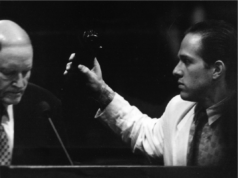
Robert Penn Warren’s novel “All the King’s Men” was the source material for a 1949 film that won three Oscars, including Best Picture. Now here’s a new adaptation of the novel from writer/director Steven Zaillian (“Searching for Bobby Fischer”), and it’s transparently bucking for more Academy accolades.
Except for being released in September rather than the more Oscar-friendly November or December, “All the King’s Men” has all the markings of a wannabe critical darling. The cast is large and impressive and full of Brits trying to file their English accents down to Louisiana drawls, and nearly everyone has been Oscar-nominated before. The flawed central character provides a meaty role for an actor to chew on, with plenty of fiery speeches with which to dazzle the voters. Indeed, if it weren’t for the fact that the movie isn’t very GOOD, it would probably stand a chance of fulfilling its Oscar dreams.
Does it make me cynical if I think Zaillian was chanting “Oscar Oscar Oscar” through every step of making the film? The whole thing just feels so calculated. Of course, if I’m right, then it’s Zaillian who was cynical, believing he could manipulate praise for something simply by giving it a superficial patina of excellence with no actual excellence to back it up.
Based loosely on the career of Louisiana governor Huey Long, this is the story of Willie Stark (Sean Penn), a good ol’ boy whom we first meet as a podunk county commissioner in about 1950. He stands for the common man, doesn’t drink alcohol, and references God in nearly every speech.
A slick adviser named Tiny Duffy (James Gandolfini, unable to convince me he’s not from New Jersey) comes along and persuades Willie to run for governor. Tiny’s plan is actually for Willie to split the “cracker vote” with another redneck candidate and thus produce a win for the fat-cat incumbent, who resides in the back pockets of Louisiana’s oil companies and other corporations. But Willie learns of the scheme, embraces his Everyman cachet, and is overwhelmingly elected by the state’s poor, dumb and outcast. (Given how great a percentage of Louisiana’s constituency fits that description, you’d think someone would have tapped the market sooner.)
Once he’s in office, Willie’s larger-than-life character comes into full bloom. He fights the corporations on behalf of his fellow hicks and is a hero to them. But he’s also a philanderer and a dirty-politics player, insisting that EVERYONE has some dirt on them somewhere and that all you have to do to control the person is find the dirt.
Penn’s performance as the contradictory, enigmatic governor is consistently engaging, fun to watch at every turn and almost never so flamboyant as to become silly. Unfortunately, the movie is not from his point of view. Our main character is Jack Burden (Jude Law), a Willie Stark staff member and former newspaper reporter whose retired judge godfather (Anthony Hopkins, too old and cranky to even attempt a Southern accent) is a thorn in Willie’s side. I couldn’t care less about Jack’s failed romance with his childhood friend (Kate Winslet), nor his relationship with her crazy brother (Mark Ruffalo). Show me more shady political dealings and crazy Sean Penn ladling out Southern aphorisms like gravy!
I haven’t read the novel, but Jack Burden seems like the kind of central-but-not-very-interesting character that works in literature but often does not in film. “The Great Gatsby” is set up the same way, with a fairly ordinary narrator serving as protagonist while a far more fascinating figure flits in and out of our consciousness. But a movie almost demands that we focus on the more compelling character, and even without being to compared to Willie Stark, Jack Burden is dull. I like Jude Law quite a bit, but he’s not exactly igniting the screen with his charisma here.
Yet despite wandering off on these seemingly irrelevant side-stories dealing with Jack’s personal life, the movie ultimately still wants to be about Willie Stark’s rise and fall. But if that’s the real theme, why bother with the Jack Burden stuff? What Zaillian fails to do is make both characters as important as their screen time indicates they should be. It’s a mishmash of a film, as thick and soupy as the bayous it’s set near.
C (1 hr., 55 min.; )