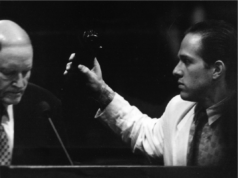
You can tell that “The Assassination of Jesse James by the Coward Robert Ford” isn’t a traditional Western because it gives away two serious spoilers right there in its title. The mechanics of the plot are not essential here, as they tended to be in the days of the black-and-white Westerns. This is a study of the two title characters, and a look at the moral codes that prevailed in their lives.
As befits a movie as ruminative as this one, writer/director Andrew Dominik (adapting Ron Hansen’s 1983 historical novel) maintains a lyrical, gentle tone. An unseen narrator (Hugh Ross) tells parts of the story in straightforward but literary language, as if describing memories, the edges of some scenes blurred and accompanied by dreamlike music. It is an idyll for a cherished figure — you know, the one who committed dozens of robberies and murdered at least 17 people.
Jesse James is played by Brad Pitt, who like his friend George Clooney occasionally makes a film like this to remind us that he’s more than just an entertaining media celebrity. Pitt’s acting muscles, underused lately, are still in top form as he plays a man who was, among other things, an entertaining media celebrity just like himself.
Jesse was gregarious and jovial until later in his life, when he was often moody, depressed, and paranoid (not without good reason). Yet even then he had his moments of good humor and could be, in the narrator’s words, “cavalier, merry, moody, fey.”
As the film begins, in September 1881, most of the James gang is dead or in prison. This leaves Jesse and his brother Frank (Sam Shepard) to recruit local scoundrels to help them pull off their heists, including the Ford brothers, Charley (Sam Rockwell) and Robert (Casey Affleck). Robert approaches Frank privately to ask if he can be included in the train robbery they’ve got planned, and Frank says, “I don’t know what it is about you, but the more you talk, the more you give me the willies.”
You can see what he means, although I think he’s being a little churlish, too. Baby-faced 19-year-old Robert Ford has admired Jesse James since childhood, eagerly reading the accounts of his deeds in the cheap paperbacks and magazines. He is awestruck in Jesse’s presence, an awkward fan who in today’s parlance would be considered a stalker. Jesse is amused by him at first, eventually trusting him and enjoying the novelty of having a worshipper to follow him around and do his bidding. In a less friendly moment, he asks Robert, “Do you want to be like me? Or do you want to be me?” It’s a fair question.
It’s also fair to wonder if Robert Ford’s affections for Jesse James go beyond mere hero worship into something more peculiar. Certainly he’s unbalanced psychologically — but then again, so is Jesse. Robert is almost a “Talented Mr. Ripley” type, except that he’s not particularly talented. Where Jesse is famous for being hard to sneak up on, Robert can be surprised with ridiculous ease. When he’s finally called upon to do something useful and outlaw-ish, he manages it OK, and then is endlessly pleased with himself for doing it.
He eventually turns on Jesse, of course, as the title of the film suggests. His reasons for doing so are complex, and the unusually long running time (160 minutes) is almost completely justified by the fact that it takes time to establish characters as deep and complicated as Jesse and Robert — especially since neither man is exactly the type to just come out and explain how he feels.
This is only the second film Dominik has made, and the first since 2000’s “Chopper,” which was as forceful and blatant as “The Assassination of Jesse James” is subtle and elegant. He directs with the utmost confidence, every scene carefully composed and every moment useful in painting the portrait he has in mind.
He makes room for some excellent supporting roles, too, including Jeremy Renner as Jesse’s cousin and gang member Wood Hite, and particularly Paul Schneider as Dick Liddil, a bawdy, poetry-reciting accomplice who never met a married woman he couldn’t hit on. On the other hand, Mary-Louise Parker is underused as Jesse’s wife, Zee — there’s not much room for womenfolk in this story — and you have to wonder what Zooey Deschanel is even doing here, appearing very late in the game as Robert Ford’s post-assassination girlfriend Dorothy.
But the most important supporting role, I think, is the film’s photography. It’s the work of Roger Deakins, the five-time Oscar nominee who happens to be one of the greatest living cinematographers. You’ve seen his work in almost every Coen Brothers movie, notably “O Brother, Where Art Thou?,” a film whose distinct “look” is almost as memorable as its characters. Here he beautifully creates the barren harshness of the Old West and the ethereal glow of the film’s more dreamlike passages. In a nighttime train-robbery sequence, the locomotive appears on the scene like a majestic animal, its headlight piercing the smoke and darkness as the men of the James gang stand by almost reverently, waiting for the kill. It’s a moment of unnecessary beauty, which is often the best kind.
A curious thing happens in the film’s last 30 minutes. The story continues past Jesse’s death, recounting what became of Robert Ford in the aftermath. He becomes a media celebrity in his own right, eventually as famous as Jesse himself had been. And yet his life turns miserable, in ways that aren’t too surprising, and I realized I was more interested in that story than I was in the pre-assassination one. What happens to an insignificant man who suddenly becomes important after committing one infamous act?
Jesse James was a folk hero, but he was also a cold-blooded killer. Or should I say he was a cold-blooded killer, but he was also a folk hero? Robert Ford counted on public opinion being in favor of the outlaw being brought down, but that’s not always the way it works with folk heroes.
B (2 hrs., 40 min.; )