Eric D. Snider

Eric D. Snider's Blog

More ‘No Country for Old Men’ questions and answers

I cannot tell you how glad I am that Miramax sent out screeners of “No Country for Old Men” to the various critics’ groups. If I’d had to wait until it actually came out on DVD to resolve these questions, it surely would have driven me crazy.

Some astute readers have posted follow-up questions and observations on my previous two posts about this movie (here and here), and since I have the resources, here are some answers!

Q Tip: “When [Bell] pulls up to the motel there are two doors that are roped off in the crime scene and both room doors seem to have their locks blown out by the pressurized cow-killer.”

Marie: “There were two hotel rooms with locks blown out. I supposed that he was in the room next door, after it was confirmed that he was not in the room Bell entered. And I assumed that Sheriff Bell sensed that as well, but backed away and didn’t attempt anymore exploration, because he knew that he was just an old man, not up for the fight.”
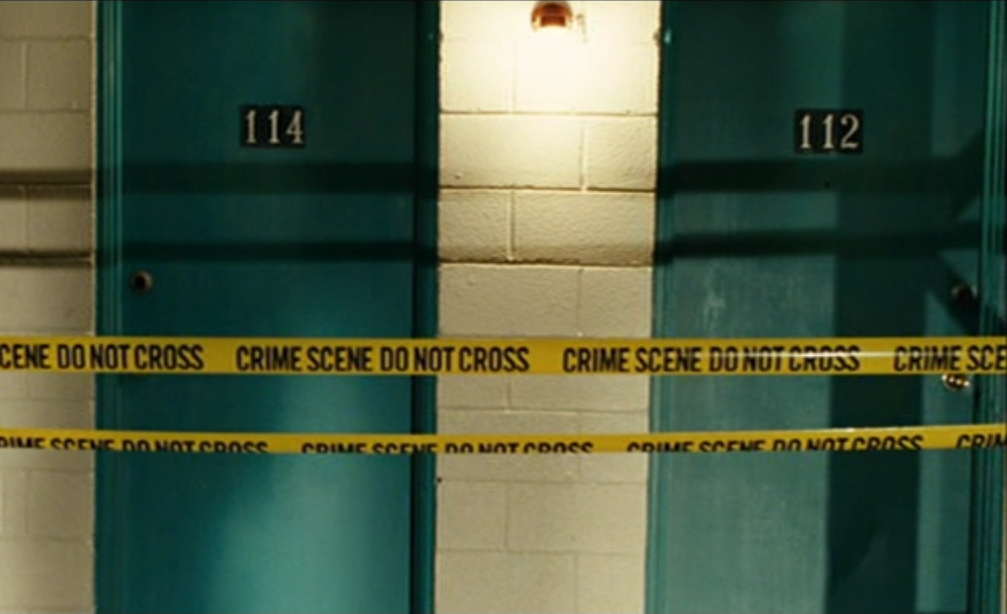
The police tape is wrapped around two poles and encompasses two hotel rooms, Moss’ (114) and the one next to it (112). I can’t say for sure that 112′s lock has been blown off. We only see it in one shot, and it’s in shadow.

More important, though: The door on 114 is the mirror image of 112. If you were to enter room 114, as Bell does, the door would swing open to your right. Opening room 112, the door would swing open to your left.
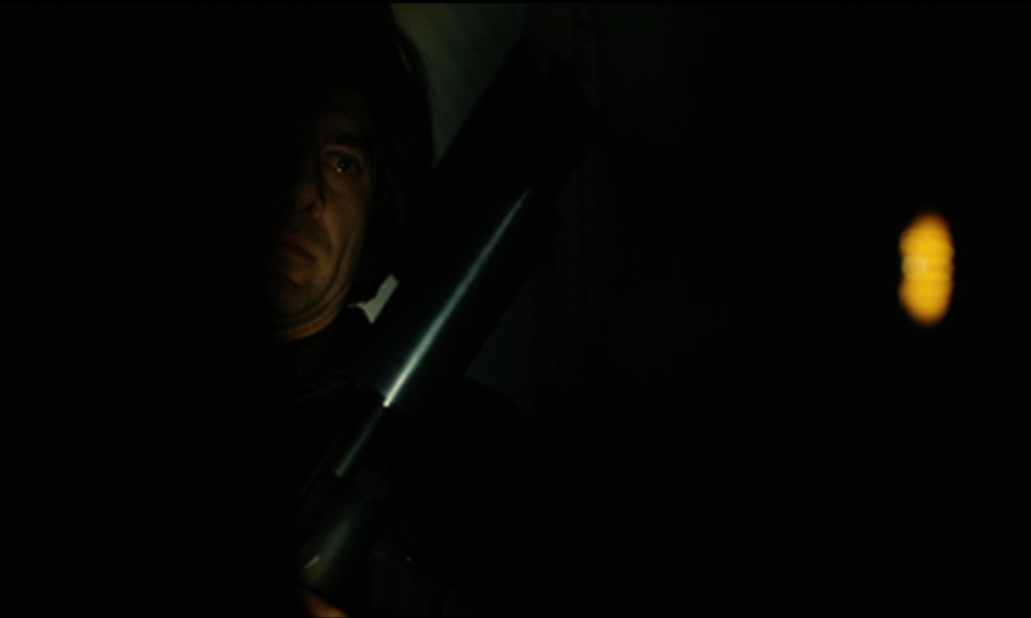
This is important because of how Chigurh (or Bell’s imagination of Chigurh) is positioned. Backed up against the wall behind the door, the door is to his left. The yellow light on the right of the frame is the door hinge. That configuration would only work in Moss’ room 114, not in 112 next door.

You can see this also in the shot of the blown-out lock from Chigurh’s point of view. That angle would be reversed if he were standing behind the door in the other room.
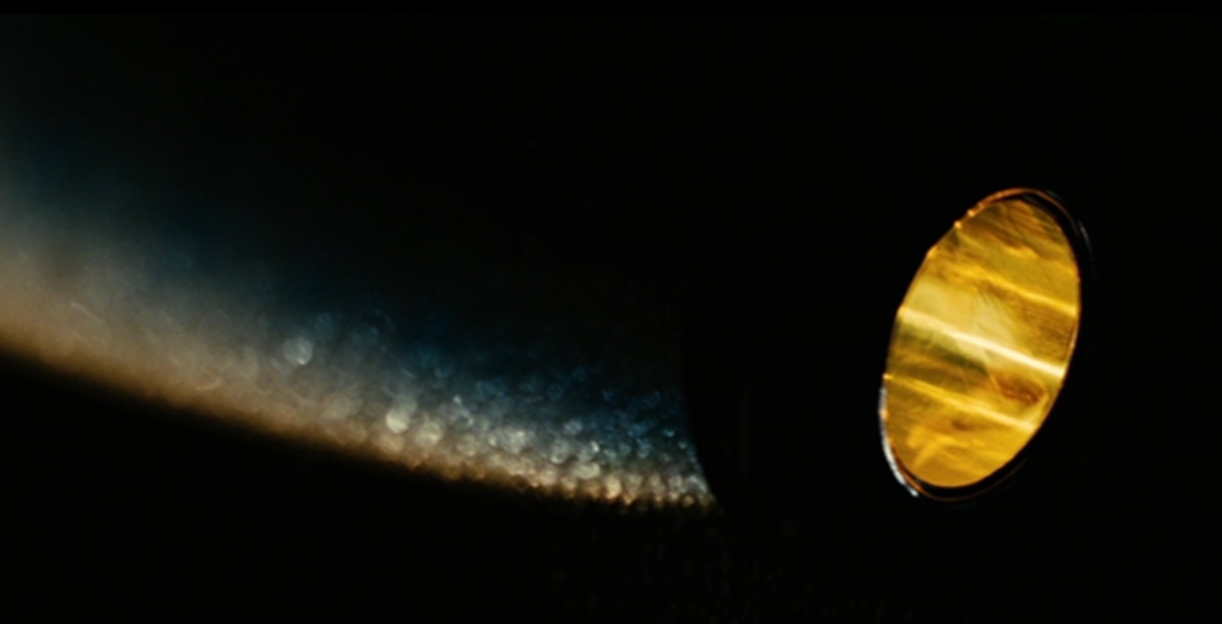
Kourtney: “If Bell is imagining Chigurh in the motel room behind the door, it would follow that Chigurh’s tears during this scene are also imaginary, right? ”

This is a minor point, of course, but I don’t think Chigurh is crying. There are no tears streaming down his face, anyway. The light catches a gleam in his eye (as seen above), but I think it’s just the natural moistness of the eye.

Marie: “Anybody here read the book? Maybe that would help clarify things.”

Someone said in another thread that in the book, Chigurh is not in the room at all, but is watching Bell from a parked car nearby.

Peter Fisher: “My recollection of the air vent in the motel room where Llewelyn dies is that it wasn’t large enough to house the money bag.”
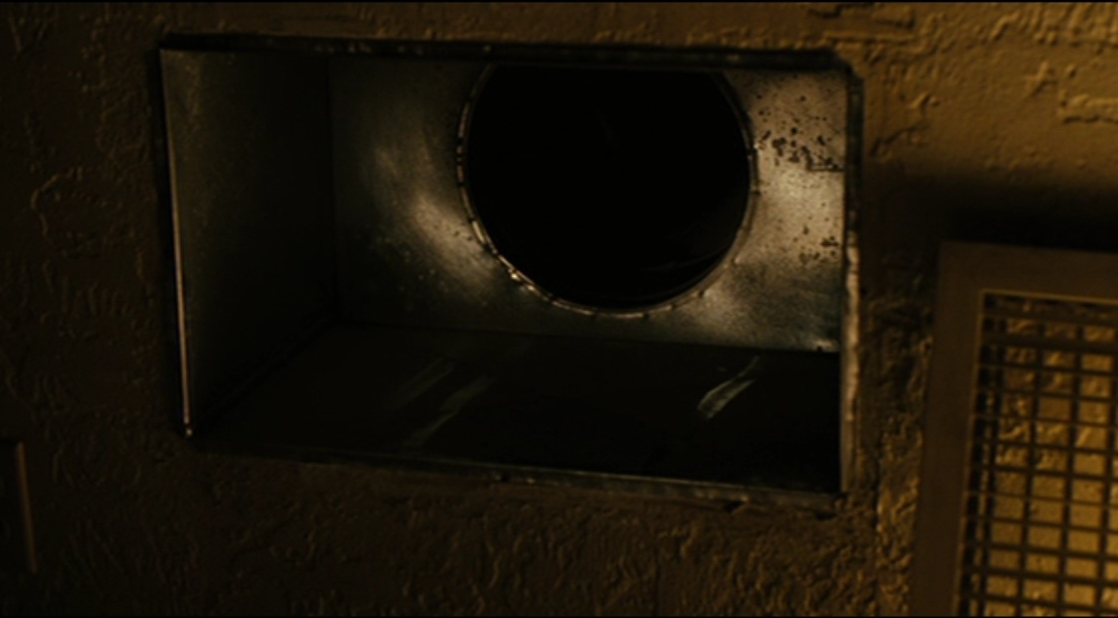
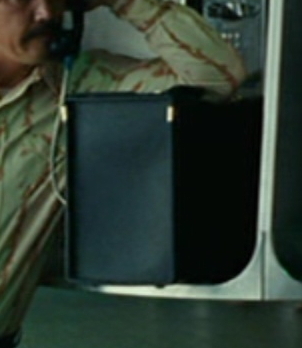
You may be right about that. I don’t think the briefcase would fit in the hole. However, it would fit in that rectangular space at the front of the duct. With the vent in place over it, it would be hidden well enough.

Any other mysteries need clearing up? I have the DVD right here, and I’m prepared to use it!

[NOTE: Before posting comments with additional questions or observations, please read these other posts -- "The status of Moss"; "Bell and Chigurh and the motel room" -- to see if the issues have already been addressed.]
37 Responses to “More ‘No Country for Old Men’ questions and answers”

  1. Kourtney Says:

    Clearly we need to put our heads together and write an alternative version of this movie where it isn’t Moss’ bloody body lying in the hotel room, Chigurh is sitting behind door 112 crying his eyes out, and Bell ends up with the cash. I’ll give the Coens a call and see what they think.

    And maybe we could give Woody a few more scenes. He makes a hunky cowboy.

  2. Hana Says:

    Thanks for clearing this up.

    And not to be a pain in the butt, but I just had a thought and maybe you can clear this up too– What if he isn’t standing behind the door in Room 112? How about right where the door opens, so he can blow your face off right as you enter, instead of having the door in his way?

  3. Hana Says:

    Wait, I assume the second picture you posted makes my suggestion impossible.

  4. Christina D Says:

    I’m a little bored with the No Country for Old Men blog posts. I miss the good stuff. I haven’t seen the movie, and won’t (because it’s R), so I am sad to come onto the website and see yet another post about No Country, and not about something I can relate to/care about/laugh at. :(

  5. Robert Says:

    I can’t believe all the interest from females, very interesting. The one young female(28 or so) in the movie last night turned to the 2 guys she was with after it was over and said,” that sucked”. It’s just sad when people can’t have an open mind. Here’s my question about this great movie. When chigurh does the first coin toss he says the quarter was 1958 and he had it 20 years, making the year 1978, which would explain that 70′s look hairstyle on Chigurh. My point is if this were true, and the mother dies in 1980, is it 2 years later, and Chigurh has come back to kill her making yet another strong statement about this killer, or was it all in 1980 in which case my theory is dead wrong.

  6. Eric D. Snider Says:

    Robert, that’s an easy one to answer: Chigurh didn’t say 20 years; he said 22 years. The whole film is set in 1980.

  7. Robert Says:

    Thanks for clearing that up, although I would think some time had passed. Would you elaborate on your theory of the unusual weopon. Do you think Chigurh came to be comfortable with it as an employee of a slaughter house killing cattle. Sheriff Bell made a point of it’s use in one of the scenes.

  8. Kourtney Says:

    My CSI-induced theory on Chigurh’s use of the cattle gun is that it doesn’t have bullets, so it’s less traceable and perhaps easier to acquire and disguise than a regular gun. It was also very efficient at blowing out deadbolts.

    Or maybe none of that logical riff raff matters, and the cattle gun is yet another component of Chigurh’s flip-a-coin/make-a-deal/crazed-killer MO.

    In other news, I watched the Critics’ Choice Awards the other night and Javier Bardem still scares me in real life, even without that hair, even though he was pleasantly accepting an award, and even though he says Josh Brolin is his dear friend.

  9. marie Says:

    Okay, I think that my second room theory has been busted. The screenplay is now posted here: http://www.miramaxhighlights.com/details/no-country-for-old-men .

    So either, Chigurh was imagined, (like Eric said) or he shot out webs from his wrists and spidermanned up to the ceiling.

  10. theguy Says:

    I think the motel scene was a bit sloppy.
    They could have shown that Chigurh was NOT behind the door or in some other way show that this was just in the sheriff’s imagination……confused the heck out of me while watching it. Also:

    1) no one has seemed to mention that the sheriff’s reflection in the blown out light sleeve showed him to be on the left side of the lock (when facing from the outside) instead of his actual positioning on the left.

    2) Chigurh could not have been in the second room. The basic camera work has him backed up against a wall very close to the door.

    3) The pictures of the second door lock do not show it blown out. It just looks dark because it is in a shadow AND there would be no way for a movie goer to notice that type of detail *if it did exist) even after watching it a dozen times…….it would be nice if it did though; I like the theory of a coin flip and the sheriff being to afraid to go into the second room.

    4) Last but not least. The money was in the duct. There are tell tale scuff marks in the duct dust that match the marks the case left in the first set of ducts.

    check out the screen play post.

    2)

  11. theguy Says:

    ummm…there is no screen play post to be found at:
    http://www.miramaxhighlights.com/details/no-country-for-old-men .

    maybe a more direct link is available?

  12. Eric D. Snider Says:

    The screenplay was posted there a few days ago. Looks like they took it down.

  13. Keezo Says:

    Screenplay: http://www.youknow-forkids.com/nocountryforoldmen.txt

  14. Anne Says:

    FYI: There is a very supportive review of the film in today’s (Jan 17, 2008) ‘Financial Times’ by Nigel Andrews (P. 11). The caption for the photo reads “Terminator: Javier Bardem’s pursuer is a near-cyborgian killer,” and we all know what/who that points to, but I really thought, if we have to go to the Arnold place, the character is more like the alien hunter in “Predator.” I guess it was his medical self-repair that first made me think of this. The hunter theme is everywhere in the film, of course, as well as the question of fate (does it, or does it not, exist, or is it all just chance?).
    I apologize if I am rehashing old discussion, I just saw the movie yesterday, one of the best things I’ve seen in ages.

  15. Onno Says:

    Just saw the movie last night, and have been looking around the web for answers to the questions raised by the motel scene. I really can’t accept the idea that Chigurh’s presence in the room is just in Bell’s head. If this is what the Coen brothers intended, then it’s a deep flaw in the movie. For a movie to include imaginary scenes, it has to alert the viewers somehow that this is a possibility in its own terms. That is, it has to signal in some way that this is within the ‘rules’ of the images of the film. I’d say the rules of the film’s images are those of a hard and spare realism. It thus makes no sense to include images that are imaginary. There are no other ‘imaginary’ scenes in the movie that I can remember. In this case too, ‘imaginary’ images of Chigurh are utterly gratuitous. We can imagine his presence in the room well enough just with the images of the blown out lock. So I think Chigurh has to be in the other room. I really haven’t seen any convincing evidence that this is not the case. The screenplay is ambiguous, just saying that Chigurh is inside and Bell is outside. Chigurh does not have to be standing behind the hinge side of the door. He could be hiding beside the other side of the door. Makes more sense too. He’s going to shoot Bell as soon as he comes in, not risk being whacked by the door if Bell chooses to ram it open. That C is behind the other door makes sense thematically too. It’s exactly like the coin toss. And that Bell doesn’t find him allows him to believe, probably to his relief, that he’s too late, and he won’t have to confront the killer. Anyway, it’s another of the really cool ways in the which the film sets up expectations in order to defy them.

  16. Corey Says:

    I have a completely off topic question that I cannot seem to figure out. Anton was hired by the boss to find his money. He had a drug deal set up with the Mexicans that went sour. When Moss returns to the scene of the deal at night to give water to the surviving Mexican, men in a truck show up and slahs huis tires and proceed to chase him into the river where he escapes. The next night, 2 men bring Anton out to the scene to examine it, however, when the two men show up they are driving a different truck then the men who chased Moss. When Anton asked who slashes Moss’ trucks tires, the 2 mwn say “Not us, must have been the Mexicans.” Therefore we know that it was not the Boss’ party who were chasing Moss, it was the Mexicans. When the boss hires Carson Welles he tell Welles that he is “out some money and the other party is out their porduct.” Who is the other party that he is talking about? It can’t be the mexicans the got their product/drugs back. Maybe I am just confused on how the drug deal went down, any help would be appriciated.

  17. Steve Says:

    My wife and I saw the movie last night. Her theory is that Sheriff Bell is confronted by Chigurh. Chigurh obviously would have killed Bell but does a coin toss. Bell wins the toss and then retires. I thought this was far fetched but if you think about it, when Chigurh did not need something from a person (i.e. a car or truck) he flipped the coin (the guy at the gas station). Perhaps that is what he did here? Also we were led to believe that Bell would have never retired.

  18. Steve Says:

    “You may be right about that. I don’t think the briefcase would fit in the hole. However, it would fit in that rectangular space at the front of the duct. With the vent in place over it, it would be hidden well enough.”

    Eric, Sorry to say that there is no way that the satchel is going to fit in the duct. Even if it made LxW which I don’t believe it will,Take a look at the depth. 2 mil cash is not going to fit….. particularly when there are some ones in it.Remember the scene with the transponder?

  19. ryanS92 Says:

    quick question: why does Chigurh shoot the two guys who take him to the drug slaughter site? The ones who said “mind riding bitch?” It seems too planned to just be random

  20. sickduck Says:

    I have one question that hasn’t been answered anywhere: Sheriff Bell stopped a man in a truck who was transporting two bodies in the back? What was it about and why didn’t Bell arrest the man?

  21. newmex Says:

    Saw the movie tonight. It left me frustrated, but thinking it over, and doing some web surfing, it’s not so frustrating. But really, stupid postmodern storytelling affectations kinda suck. I feel a little jerked around by it.
    As we left the theater we were actually wondering if Bell got the money and that was what precipitated his “retirement.”

    The guy transporting the bodies was a sheriff’s dept employee who was doing a slack job of toting the bodies to…wherever they take bodies for disposal. He got in trouble by Bell for not tying down the tarp enough, and not using a more suitable vehicle.

  22. clare Says:

    Just saw the movie …..and argued about some of the same points posted here; thanks for the illumination. What about Carla Jean’s mother? Did the Mexican at the bus station kill her – or did she coincidentally die of the cancer she told the taxi driver she had?

  23. Fran Says:

    I feel everyone misses this movie. It seems to me that The Cohen brothers have left a scene out. Tommy Lee Jones meets Bardem in that hotel room. Bardem, as he has with others in the film, offers Lee the coin toss. Lee wins. Bardem, being a man of principal (he kills Moss’ wife because he promised he would do so) lets him go. Jones dreams of his father because he faced death and his father was waiting there to meet him. Lee escapes death and his father moves on to wait up ahead and then Lee “wakes up”. He wakes up because he is still alive.

  24. Billy Bob Thorton Says:

    I’m late to this discussion, I’ve waited to see these posts until after I saw the movie.

    I did read (well, listened to) the book, so for better or for worse as I watched the movie I already had ideas about the movie’s plot. If you enjoyed the movie I highly recommend the book. It literally has changed the way I look at the world.

    My take on the story is slightly different than Eric’s. Instead of “it’s fate and there is nothing you can do” I thought the idea was “the choices you make have consequences, even if they seem like small choices.” The ideas are very similar, but there are some differences.

    The story starts when Llewelyn choose to take the money, and he chooses to go back with water.

    At the end of the book Sheriff Bell does not enter the room, it’s been a long time since I read the book, but I think maybe he goes back the next morning. In the book when he does go back to the hotel that night, he stands outside hotel, and he “knows” Chigurh is in the room. In my opinion the author now has Sheriff Bell facing the same decision Llwelyn was faced with when Llwelyn decided to go back with the water

    Sheriff Bell stands outside the hotel door knowing that the “right thing” to do is go inside, and if Chigurh is there, arrest him. He realizes he has the same choice Llwelyn had, do the right thing and die, or walk away. He decides this is “no country for old men” and walks away.

    The storekeeper chooses heads, the driver murdered on the side of the road chose to drive an average looking car.

    As to the question why Chigurh uses a cattle gun, I think it was to add a little challenge to his killings. In the book Chigurh wonders to himself why he let the deputy arrest him, instead of just killing the deputy out there on the road. He wonders to himself if it was to for the challenge.

  25. Mike Says:

    In addition to all the theory related to fate, predermination and choice, I’m surprised nobody is discussing the main allegory: this is the story of America (The Country) post 9/11. It is about an old cowboy Texan (Bush) who does not undrstand the new “wave” of villain. “How do you defend against that?” “He returned to the seen of the crime,” (Twin Towers). The cattle prod is an ordinary devise used as weapon (flying planes into buildings) and incomprehensible to a guy who is used to simple guns.
    Woody Harrelson and Moss both can’t wrap their traditional war (Viet Nam) heads around Chigurh. At the end of the book, Bell tells of his WW2 experiences in France. This is a new type of threat, oddly a prinipled one (suicide bombers). It is no accidennt that America’s borders play prominently. The border guard doesn’t understand this new threat either. He is relieved to see an old-fashioned Viet Nam vet. When Bell is reading the paper, he says “this is all out war.” At least Bell had the sense to realize you can’t fight a tradional war on this new terror. But quitting (like his dad did not) has it’s price. He stepped aside. Bell’s wife was killed with nobody even trying to stop it. This weighs heavy on Bell as he waits to meet up with his dad beside the fire – the way people on horseback used to in the old country.
    It is a rich subtext and fun to watch again with this in mind. It seems to go as deep as you would like. Is it a coincidence that the coin is from 1958, and Chigurh’s terror has been traveling since then to get here? It probably is, but it’s wild to consider what was going on in the middle east in 1958. http://news.bbc.co.uk/onthisday/hi/dates/stories/july/14/newsid_3736000/3736391.stm

    MG

  26. lala60610 Says:

    I think the movie chronicles a point in time in the ongoing battle of good vs evil.
    The character Anton C. is the devil and as the universe does, he too gives man a choice, sometimes.

    “One of the overarching themes of the movie is the unfairness and capriciousness of fate. You don’t get to choose what happens to you, at least not in the film’s worldview. “You can’t stop what’s comin’,” Bell’s uncle tells him. “it ain’t all waitin’ on you. That’s vanity.” By not giving us the satisfaction and closure of seeing Moss’ last stand, the film is emphasizing this theme of frustration and helplessness. ”

    Anton clearly gave the store clerk a choice by the flip of a coin. The same flip he gave Llewyellen’s M.’s wife and Woody Harleson’s character. These flips occurred only if the potential vicitim presented a logical argument for him not to kill them.

    I guess we can chose to enter into a devil’s game by calling it and have a chance at life or refuse to play and have your fate sealed–like with Moss’ wife.

    I liked the symbolism of the film. The sheriff and Anton parallelled each other.
    Maybe one representing good and the other evil were at the end of their respective time in that part of their lives.
    I thought it strange though that Anton walked away with his left arm in a sling. Anyone can explain that?

  27. Mike Says:

    This movie is a masterful screenplay and one that does what many great movies set out to do…generate discussion. It is my personal belief that Bell does go into the hotel room and does flip for his life (like many others have noted)…he wins and gets to go free. One piece I did not see discussed: remember when the camera flashes to the vent…we see the dime heads up on the floor. Also remember at the gas station the man chooses heads and gets to keep his life, and Anton tells him to not put it in his pocket…maybe a little far fetched, but this is the connection I made. Also I liked the symbolism of the ending, it is an ending that actually makes you think…instead of simply spoon feeding it to you.

  28. Jason Says:

    Did anybody else notice some of the chronological anachronisms of the film? I’ve only seen it once through, but there seemed to be a few things that took me out of the 1980′s time period where it was supposed to be set. For example, gas prices, cell phones, etc. Or maybe I am just thinking about Hot Rod (in my opinion, a Napoleon Dynamite knock-off), which also had elements of mixed time periods.

  29. Steve Says:

    The 1958 quarter used in the coin toss would not be in circulation. All silver coins, dimes, quarters and half dollars were 99% silver prior to 1965. I had a paper route in 1967 and 1968 and collected alot of change. Believe me, all silver coins, 1964 and earlier were out of circulation.

    In 1980 the Hunt Brothers were trying to corner the silver market, silver peaked at $54 an oz.. That quarter would be worth $13.50. It would be unnessary to tell the gas station attendant not to mingle that quarter with the silver cladded copper slug 1965 – 1980 quarters.

  30. poppyseed Says:

    Hi am I the only one who thinks it was totally ludicrous that Moss would have returned to the drug deal-gone-bad scene, to deliver water to the guy that was most likely going to be dead before he got there? It would have been kinder to put him out of his misery the first time around. I know that’s the whole premise for the hunt by Chigurh but come on aren’t most of us smarter than that? Faulty reasoning on McCarthy’s part I guess.

  31. Jacob Says:

    Ahoy! I’ve only one question/comment. How was it, that in four separate articles/blogs/whatever, each with far too many comments, there wasn’t a single Tommy Lee Jones eyebrow joke?

  32. Michael Says:

    Poppyseed –almost absolutely right, pre-1964 coins silver (90% silver) were hard to come by in 1980, and a quarter, not quite a quarter ounce but close, would have been worth about $9 at its peak and at least $5 for most of 1980. A stork clerk certainly wouldn’t have mixed it with with the other coins. Also, no mention of the heat wave Texas experienced in 1980.

    But what is important about the scene it the glimpse it gives us into Chigurrh’s psychology. It becomes clear he has a moral code, and in fact a very strict one; but one that is very different from that of a normal person. That makes him a truly enigmatic character, and one that would be good to use in a sequel, not necessarily a continuation of Cormac’s story but perhaps a different plot in which we see Chigurrh’s bizarre character in action.

  33. Leta Says:

    I think we were to be left wondering who got the money. I do not think Anton found it. The opening is too small to have hidden it there and the screen would most likely fit too close for the case to sit in front. But, we do not know how long it took him to get to Moss’s wife. It could have been a day or 2 later than the hotel scene. So, he might have had time to put it somewhere if he did find it and , therefore not have it in the car when he crashed.
    Does anyone remember Moss setting a case down on the ground when he stopped to talk to the lady at the pool? I seem to recall that, which would indicate he had it with him. Anton was in the room at night(dark) and I too believe he was in the room next door when Bell came as that was that night also.
    Why would Anton need to be on his guard with gun in hand unless he heard someone coming? And, if he were next door, that would mean he was not successful at finding the money in the first room, therefore, negating the scuff marks someone said existed in a prior blog.
    Did anyone but me notice there were only $1 bills in the case when Moss was in the Eagle hotel??? That was funny. You would need more than one case for $2 million at the rate of $1.
    It is a movie you have to see several times before getting all the DETAILS.
    Personally, I try to imagine the sheriff found the money and retired happy but with the nagging of Anton coming after him. LOL

  34. Paul Says:

    I enhanced the picture of the motel doors many different ways. The deadbolt on the right appears to be purposefully digitally maligned so that no matter what is done the image remains inconlusive. Unbelievable! I would love to get a crack at more still captures of the doors.

    As that has been rehashed I’d like to bring up something else. Bell’s two dreams. Bell told the old man in the wheelchair that God never came into his life. Cut to the end of the movie. It seems as if the first dream of Bell losing money as child was about how when we’re young life is pure and we are indifferent about money/the vices/sins of man. The second dream is more clear to me. Bell’s father was carrying fire ahead of him and Bell knew that he would have a fire waiting for him up ahead in the midst of the cold darkness. That dream was God pointing out to Bell that He’s not going to come to Bell, that Bell has to come to him. He’s up ahead waiting for Bell and that when Bell comes to him(dies) that there will be a warm comforting place ready for him.

    Also, when Harrelson says he counted the floors of the building and one is missing he’s referring to the 13th floor that is often left out of floor numbering in the name of good luck/bad luck/fate. Anton showing up there reminds us that our silly ideas and superstitions and wishful thinking are just that.

  35. Alerosin Says:

    I just wanted one thing cleared up:
    In the last scene, doesn’t Bell’s wife call him Anton? I seem to remember that for some reason..

    [No, she calls him "Ed Tom," which is his name.]

  36. ESS Says:

    Wow, just like a coin toss, heads or tails

    Room 114 or 112.

    I guess his fate/lucky choice saved him from certain peril.

    So goes the theme of the story.

  37. SBq Says:

    ryanS92, Chigurh shot the two guys who take him to the drug slaughter site because after they handed him the transponder receiver he no longer needed the people who were hiring him, and wanted all of the money for himself. The unnamed guy running the operation (Root) then realizes that Chigurh had killed two of his operatives and proceeds to hire Carson to get the money and possibly Chigurh.

    Good eye on the one dollar bills in the satchel. The Bond movie Thunderball had the same thing. In each case the producers didn’t want their prop to mysteriously disappear overnight, and the bills are filmed in such a way that 99% of the audience won’t notice.

    Things in this movie I couldn’t suspend disbelief for:
    1. Someone who, armed with a submachine gun, coolly looks for drug money to keep for himself (Moss) suddenly has enough conscience to return to the drug-buy-gone-bad scene with water. For all he knows, the place is teaming with cops.
    2. A tiny transponder, ensconced within a case no less, that can work at any kind of meaningful distance. A fifth-mile, perhaps? Note that a 20-mile radius encompasses over 1250 square miles of search territory.
    3. What did Moss intend to do after sending his wife away to her mother?
    4. That Carson, who clearly knew Chigurh only too well, would be such a stumblebum and completely oblivious to his own safety. Even after he spots the money case he returns to the hotel where he could easily be spotted and ambushed, and was. Wasn’t he hired in part to ambush Chigurh, not just to wander around looking for the money and hang out in his hotel room?
    5. Ductwork serving a single room with a cross-section sufficient to hide a large satchel. Sorry, but for a living space the size a motel room it’s the GRILLE that may be large in area, not the cross-section of the ductwork that connects to it. This part reminded me of the old Voyage to the Bottom of the Sea TV series, where in order to thwart the bad guys the actors would crawl through enormous air ducts that connected every compartment in their submarine.
    6. A deputy who turns his back on a detainee whose hands are handcuffed in front of (not behind) his body. Sorry, can’t buy it.
    7. Chighur able to carry on with his work a short period of time (half a day?) after tending to his wounded leg. What about sepsis, or local infection? Even if he stole antibiotics from the pharmacy, they don’t work instantly.

Leave a Reply


Subscription Center

Eric D. Snider's "Snide Remarks"

This is to join the mailing list for Eric's weekly humor column, "Snide Remarks." For more information, go here.

Subscribe

Eric D. Snider's "In the Dark"

This is to join the mailing list for Eric's weekly movie-review e-zine. For more information on it, go here.

Subscribe
 
Come read about baseball and web development at www.jeffjsnider.com