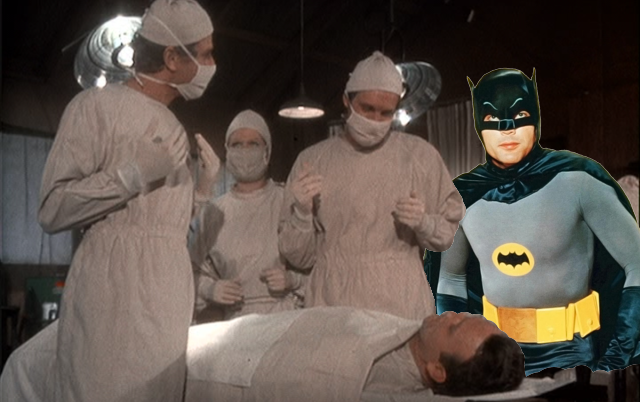
Batman in the operating room: Why some comedy isn’t funny
Robert Reed was a classically trained actor whose most famous role was that of the dad on “The Brady Bunch.” He was evidently a prickly fellow and constantly harassed the show’s producers about its lousy scripts. I get the feeling that for him, working on the show was like a gourmet chef having to take a job at McDonald’s.
I’ve just stumbled across an amazing memo that he wrote to the producers in response to a particular episode. It is amazing for two reasons. One, analyzing “The Brady Bunch” with high-minded theatrical philosophies is funny, and the seriousness with which Reed treated it is hilarious.
But two, in the process of explaining why “The Brady Bunch” sucks, Reed actually does a really good job of explaining the principles behind comedy, and why violating those principles usually results in failure.
Here is the memo. It is long and academic-sounding, but I truly do find it fascinating.
Robert Reed’s Orignal Memo Regarding Episode 116 [This was the final episode, and Reed wound up refusing to appear in it at all.]
To Sherwood Schwartz et al.
Notes: Robert ReedThere is a fundamental difference in theatre between:
1.Melodrama
2.Drama
3.Comedy
4.Farce
5.Slapstick
6.Satire &
7.FantasyThey require not only a difference in terms of construction, but also in presentation and, most explicitly, styles of acting. Their dramatis peronsae are noninterchangable. For example, Hamlet, archtypical of the dramatic character, could not be written into Midsummer Night’s Dream and still retain his identity. Ophelia could not play a scene with Titania; Richard II could not be found in Twelfth Night. In other words, a character indigenous to one style of the theatre cannot function in any of the other styles.
Obviously, the precept holds true for any period. Andy Hardy could not suddenly appear in Citizen Kane, or even closer in style, Andy Hardy could not appear in a Laurel and Hardy film. Andy Hardy is a “comedic” character, Laurel and Hardy are of the purest slapstick. The boundaries are rigid, and within the confines of one theatric piece the style must remain constant.
Why? It is a long since proven theorem in the theatre that an audience will adjust its suspension of belief to the degree that the opening of the presentation leads them. When a curtain rises on two French maids in a farce set discussing the peccadilloes of their master, the audience is now set for an evening of theatre in a certain style, and are prepared to accept having excluded certain levels of reality. And that is the price difference in the styles of theatre, both for the actor and the writer–the degree of reality inherent. Pure drama and comedy are closest to core realism, slapstick and fantasy the farthest removed.
It is also part of that theorem that one cannot change styles midstream. How often do we read damning critical reviews of, let’s say, a drama in which a character has “hammed” or in stricter terms become melodramatic. How often have we criticized the “mumble and scratch” approach to Shakespearean melodrama, because ultra-realism is out of place when another style is required. And yet, any of these attacks could draw plaudits when played in the appropriate genre.
Television falls under exactly the same principle. What the networks in their oversimplification call “sitcoms” actually are quite diverse styles except where bastardized by careless writing or performing. For instance:
M*A*S*H….comedy
The Paul Lynde Show….Farce
Beverly Hillbillies…..Slapstick
Batman……Satire
I dream of Jeannie….FantasyAnd the same rules hold just as true. Imagine a scene in M*A*S*H in which Arthur Hill appears playing his “Owen Marshall” role, or Archie Bunker suddenly landing on “Gilligan’s Island” , or Dom Deluise and his mother in ” Mannix.” Of course, any of these actors could play in any of the series in different roles predicated on the appropriate style of acting. But the maxim implicit in all this is: when the first-act curtain rises on a comedy, the second act curtain has to rise on the same thing, with the actors playing in commensurate styles.
If it isn’t already clear, not only does the audience accept a certain level of belief, but so must the actor in order to function at all. His consciousness opens like an iris to allow the proper amount of reality into his acting subtext. And all of the actors in the same piece must deal with the same level, or the audience will not know to whom to adjust and will often empathize with the character with the most credibility–total reality eliciting the most complete empathic response.
Example: We are in the operating room in M*A*S*H, with the usual pan shot across a myriad of operating tables filled with surgical teams at work. The leads are sweating away at their work, and at the same time engaged in banter with the head nurse. Suddenly, the doors fly open and Batman appears! Now the scene cannot go on. The M*A*S*H characters, dealing with their own level of quasi-comic reality, having subtext pertinent to the scene, cannot accept as real in their own terms this other character. Oh yes, they could make fast adjustments. He is a deranged member of some battle-fatigued platoon and somehow came upon a Batman suit. But the Batman character cannot then play his intended character true to his own series. Even if it were possible to mix both styles, it would have to be dealt with by the characters, not just abruptly accepted. Meanwhile, the audience will stick with that level of reality to which they have been introduced, and unless the added character quickly adjusts, will reject him.
The most generic problem to date in “The Brady Bunch” has been this almost constant scripted inner transposition of styles.
1. A pie-throwing sequence tacked unceremoniously onto the end of a weak script.
2. The youngest daughter in a matter of a few unexplained hours managing to look and dance like Shirley Temple.
3. The middle boy happening to run into a look-alike in the halls of his school, with so exact a resemblance he fools his parents.And the list goes on.
Once again, we are infused with the slapstick. The oldest boy’s hair turns bright orange in a twinkling of the writer’s eye, having been doused with a non-FDA-approved hair tonic. (Why any boy of Bobby’s age, or any age, would be investing in something as outmoded and unidentifiable as “hair tonic” remains to be explained. As any kid on the show could tell the writer, the old hair-tonic routine is right out of “Our Gang.” Let’s face it, we’re long since past the “little dab’ll do ya” era.)
Without belaboring the inequities of the script, which are varied and numerous, the major point to all this is: Once an actor has geared himself to play a given style with its prescribed level of belief, he cannot react to or accept within the same confines of the piece, a different style.
When the kid’s hair turns red, it is Batman in the operating room.
I can’t play it.
[Side note: I find it hilarious that Reed refers to his fictional children only by their relative ages, not by their names. He does not make a mistake when he refers to Bobby, however. It was Bobby who sold the hair tonic, and Greg -- "the oldest boy" -- whose hair was damaged by it.]
To summarize, Reed’s basic point is this: You cannot mix wildly different theatrical styles within the same production. If a show starts out being realistic (whether drama or comedy), then the audience expects realism. We don’t have to suspend our disbelief very much. But if suddenly a non-realistic element like slapstick or fantasy is injected, we are thrown off. We have not been prepared to accept something like that.
We have no problem accepting a fire-breathing dragon in a production that has already established itself as fantasy. But if that dragon were to appear in a Neil Simon comedy, we would find it baffling and unbelievable.
Reed seemed to be saying that it is impossible to successfully mix styles, and he’s wrong there. It is tricky, but it can be done. “The Simpsons” is a prime example. A single episode of that series might contain elements of fantasy, slapstick, satire, straightforward realistic comedy, and even the occasional dramatic moment that effectively tugs the heartstrings.
But “The Simpsons” is the exception, not the rule. Far more often we see failed attempts to combine styles. I noted two such movies opening just last week: “The Bucket List” and “First Sunday.” The latter, in particular, tries to employ slapstick (the least realistic kind of comedy) as well as serious religious drama (a very realistic style). “The Bucket List” doesn’t do much in the way of outright slapstick, but its mix of heavy drama and light comedy does not blend well.
Obviously, “the rules” don’t matter if the final product is successful. You don’t laugh at a movie and then think, “Wait a minute — this comedy is violating the rules! It’s not funny after all!” If it works, nothing else matters. But if you find yourself not enjoying a comedy, or if certain elements ring false or unbelievable, I suspect further analysis will reveal that it is breaking some rule or other — if not an element of Robert Reed’s dissertation on mixing styles, then some other Law of Comedy.
You have to know the rules before you can break them successfully. There is a difference between breaking the rules on purpose and simply not knowing what the rules are. I guarantee the “Simpsons” writers have had discussions about the mechanics of comedy and drama, and how to make different tones work for the show. (There have been some episodes where the mix did not work.) On the other hand, I suspect that David E. Talbert, the writer/director of “First Sunday,” just didn’t know what he was doing.

January 14th, 2008 at 1:22 pm
I think that there’s an 8th style that was still too new to be included in Reed’s essay, and that’s Absurdism. Within Absurdism, anything goes. Consider “Monty Python’s Holy Grail”, and try to find any of the Reed’s 7 styles missing. They’re all there. (For example, the juxtaposition of true drama — the historian’s brutal murder — is what allows a dramatic moment to be so funny.)
While the strictest interpretation of Absurdism includes the notion that “There is no point to life, or anything else,” elements of it can survive in works that contain greater meaning. Douglas Adams’ trilogy is true absurdism, denying almost any meaning for life; Terry Pratchett, whose style is almost identical to Adams’, is rife with meaning and morality.
I think that’s how Simpsons pulls it off — they are dealing with the absurd, and in that realm, anything goes.
I love this memo/essay. Awesome.
January 14th, 2008 at 3:28 pm
I was thinking about this just last week after watching 30 Rock, I felt like they really pulled off the mix well with the “Midnight Train to Georgia” juxtaposition at the end. I am certainly no “Brady” expert, but I can’t really see them getting away with a mixture like this and still producing a quality product.
January 14th, 2008 at 4:38 pm
I was also amused by the acting theory being used to dissect how crappy The Brady Bunch was, but I have a new found respect for Mr. Brady now. That was one of the most thoughtful and interesting essays on television that I have ever read. The fact that it was not meant as an essay makes it all that much cooler. Go Robert Reed. I would have refused to appear in ANY episodes of The Brady Bunch if I were him, but I guess he had to pay the bills until he just couldn’t take it any more.
January 14th, 2008 at 5:53 pm
I don’t think the lines are quite as absolute as Mr. Reed feels they are. In fact, being able to successfully include comedic elements in a drama or use fantasy elements in slapstick is one of the signs of good sophisticated writing. Note that I said “successfully”. This kind of thing doesn’t work when it violates one of the fundamental parts of a good story; for example, the characters. If a character behaves in an unbelievable way, that makes it hard to accept what the character does. However, if this “genre-creep” respects the nature of the characters, the flow of the story, the style of the show, and the fundamental ideas of the backstory, it is likely to be more successful. This is how Monty Python and The Simpsons manages it. Randy Tayler mentioned absurdism, but I think that is just keeping the backstory ideas so loose in order to permit wild use of mixed genres.
The problem with bad television is usually an inability to keep the characters true to themselves, keep the story flowing, keep the style consistent, or keep up with creative ideas. That’s true of any genre, or any mix of genres.
January 14th, 2008 at 7:38 pm
One type of comedy where “Batman in the Operating Room!” can work is an improv skit, such as “Who’s Line is it Anyway” or a live show such as those put on by Second City. It is very difficult to pull off with good timing, which is what makes improv acting so impressive. Of course, in that situation, the realistic operating-room set is completely changed (for instance, after Batman enters, the character-less actor playing the man they are operating on decides to become the Joker to continue the skit). The absurdity of the situation, and the quick-wittedness of the actors, makes it funny.
Mr. Reed’s letter is well-thought-out, and I definitely think more highly of him now.
January 14th, 2008 at 8:30 pm
My favorite part: After Reed’s long, academic exploration into the classification of acting styles, sounding very sophisticated and verbiose, his grandiloquent essay comes to its climactic apex with this enduring note:
When the kid’s hair turns red, it is Batman in the operating room.
I can’t play it.
You know, Robert, your memo would probably have been just as effective with your last four words alone. But I agree with Eric. It is fascinating.
And for the record, I would sure love to see that scene he described play out on MASH.
January 14th, 2008 at 9:03 pm
Somewhat related to all this is the downfall of The Bradys, which is the show of the Bradys a few years after they were a Bunch. There is paraplegia, alcoholism, AIDS, and a merry laugh track going on in the background.
January 14th, 2008 at 11:02 pm
What a dissertation! I wonder if Reed was film professor on the side. It would make a lot of sense.
Eric, you are right about the “knowing the rules before you break them” line. I’m beginning to wonder if anyone even understands how to make a story work anymore. If done right, every scene, set, prop, plot, character, and nuance should work to move the story along to its (hopefully) foreshadowed conclusion. Last week, I watched Jean Renoir’s “The Rules of the Game” and Roberto Rossellini’s “Open City”. Man, these films have layer upon layer upon layer of nuance and drama. Each scene has rich, textured backgrounds, long shots that show characters acting the “theme” of the film (not just the lines), and dense cinematic story-building subtleties that splash across the screen so often that you need a second viewing to catch them all. Granted, Renoir (son of famous French artist Auguste Renoir) and Rossellini (father of Isabella), were formidable geniuses, but come on Hollywood! Make a movie and make it have a point for Pete’s sake! For every Paul Thomas Anderson, we get a hundred Fred Savages, Marlon Wayans’, and Uwe Bolls! I’m not expecting Lean, Kubrick, and Hitchcock (sounds like a great law firm) every time I go to the theater, but I’d like something that doesn’t insult my intelligence every time either.
I really miss the smart PG movies Tinseltown used to make–ones that I could thoroughly enjoy and not feel like I had to deprogram myself afterwards. “Missing”, “Absence of Malice”, “Shadowlands”, “The Mission”, “Finding Neverland”, and “Chariots of Fire” to name a few. These movies reeked GRAVITAS. And story never suffered.
Well, that was fun. I’m off my box now. Someone else can have it
January 15th, 2008 at 8:58 am
Batman bursts into the OR (complete with fuzzy pink feet)…
KLINGER, WHAT THE HELL ARE YOU DOING?
YOU’RE NOT STERILE! GET OUT!
I’m not Klinger, I’m Zoltan’s alter-ego Adam West! Here’s that O-negative you asked for, Sir. Sign this form. It’s my section-8.
Done! (POW!)
January 15th, 2008 at 11:50 am
So then the writers/producers of SCRUBS must be brilliant?
January 15th, 2008 at 2:18 pm
Absolutely, Sheri.
January 15th, 2008 at 2:44 pm
Oui, Sheri, oui. (The Scrubs guys are the best).
January 15th, 2008 at 4:15 pm
This was a cool article. The main theme of Reed’s letter that I took away was the importance of consistency. Comedy and drama styles and freedoms are constantly evolving and although most entertainment (including the well-made variety) may no longer fall cleanly into the categories he outlined, the principles of establishing a particular setting/style and then remaining true to it hold fast.
When you think about it, television shows are afforded more freedom with this than a play or film because, due to their immense total running length, they have two types of consistency: intra-episode and inter-episode, the first of which matters much less than the latter.
A television show can present a novel menagerie of seemingly contradictory styles, and provided they are well mixed (of course each episode must to a degree stand on its own) and maintain essentially the same mix (or availability thereof) on every show throughout the series, there is no conflict.
Scrubs, for example, is a fairly realistic hospital-based comedy with fully acted and produced dream/fantasy sequences that border on the absurd. The fact that I could write that sentence and have it apply to basically every episode demonstrates its inter-episode consistency. A first-time watcher may be slightly thrown off by watching it initially, but the show quickly establishes itself, and by the end, one could watch any other episode and not be confused at the sequences.
The Simpsons is a little more complicated in its style(s), and though a similar topic sentence could be written about it, I’m definitely not going to try here. It gets even more freedom due to its animated nature, but there is still an established level of realism that we all accept. Kang and Kodos don’t appear as actual characters except on the Treehouse of Horror episodes, for example–episodes that demonstrate, by their very existence, the limits/universe of all the rest.
I too have a lot more respect for Reed now after reading this. I expect that, in the same circumstances, I would feel the same way, but I would probably be like… mmm… money… and not write the letter.
January 16th, 2008 at 2:12 am
I read this back when Boingboing posted it, and I don’t really agree. Reed gets caught up on genre classifications, missing the big picture: the way that something is TREATED is more important than the thing itself.
“No Country For Old Men” sure was grim, but it knew a good joke when it saw one. (Maybe “joke” could have used some quotes back there.) Worlds colliding are far more jarring than genres colliding. It was obnoxious when cheesy 90s sitcoms brought in characters from other sitcoms, and not because the shows were particularly different: you were being asked to step outside the world of one show and to introduce parts of another.
Those who are still interested can read the full analysis in my upcoming book: “Sherlock Holmes Meets Pauly Shore as The Wolfman”.
January 17th, 2008 at 2:01 am
This is great stuff. Reed’s article is so well-written: educated, intelligent, clear, persuasive. Each point is clearly based on intelligent study of the craft, and also clearly illustrated through examples.
What’s interesting to me is that I agree with just about everything Reed said – except when he refers to “The Brady Bunch,” the show he is so intimately familiar with and the whole purpose of the essay.
“The Brady Bunch” was certainly a progressive show (dealing with divorce, a modern, unconventional family) and had many dramatic moments, but make NO mistake – this show was made for fun. It was silly, consistently unchallenging and the majority of problems the show dealt with were paper-thin. It didn’t contain real problems, and the problems it did contain came with simple, sugary solutions. This was pure entertainment. Not dinner, but dessert.
But did it open this way, or did it shift in midstream? I suggest it VERY much established this universe right up front. For example, the pilot episode included Mike and Carol’s marriage climaxing with a slapstick sequence involving the family dog chasing a cat (tipping over tables and presents, causing people formally dressed to scream and gasp hysterically while running wildly), resulting in wedding cake literally in the face. And let’s not forget… Mike and Carol had all of their kids, their family dog – AND THEIR MAID – join them on their honeymoon.
In other words, from episode ONE, “The Brady Bunch” was a show that did NOT exist in the real world. It was close, and it had many elements of the real world. It wasn’t THAT far out, but it immediately established – this is sooooort of like the real world….. if the real world had no real problems. It was a world where parents take their kids and their maid on their honeymoon. It was a show that some people would laugh at, some people would awww with, and others would just sigh and wish that the real world could be so simple and sweet.
But I suspect Reed knew this. After all, referring to the cake in the face during the pilot episode, Reed was quoted as saying, in effect “When I read that, I knew we were back on Gilligan’s Island.” Meaning: I realized this is not a show that exists in the real world. This is a show where people build cars from bamboo.
I suspect that Reed, having contempt for the show for so long, had finally had enough. “The Brady Bunch” was not the type of show Reed wanted to be associated with. And yet, there he was. “The Brady Bunch” was not praised by critics or respected by fans of legitimate, intelligent theater. It was popcorn. It was fluff. It was very, very simple.
And I will say this, “The Brady Bunch” knew what it was, knew who it was for, and gave them exactly that. In fact, this show, for an incredible amount of people, has truly stood the test of time. And there’s a reason why the show was loved by so many, and continues to be, decade after decade. And after all of these years, I can add one observation to the mix that Reed missed (probably only because he didn’t have the benefit of decades of hindsight, as I do).
You can’t argue with success.
As Eric rightly said – at the end of all of it, if it makes you laugh, it works.
March 29th, 2008 at 1:28 am
I remember reading this memo in Barry Williams (Greg) memoir. According to him, Robert Reed would memo the writers & producers for just about every show, but would still show up & do his best Mike Brady for the cameras. I always thought it was a credit to him as an actor, to be able say some of his lines with such a straight face! After all, he had probably the corniest lines in the show, next to Cindy & Bobby! reading his memos give you a bit more respect for him, but again, I don’t know why he didn’t just quit the show since he had a problem with nearly every script that was ever done for the show.
For me personally, I’ve always enjoyed the absurdity that was “The Brady Bunch”. Where else could you find a show that had Joe Namath, Desi Arnaz Jr. AND Davy Jones just “happen” to drop in to wrap up the plot?!? The Davy Jones episode is still my all time favorite, just because I’m a bit of a Monkees nut, which is a whole other discussion about absurd tv shows!! Anyway, I guess the point which I have been dancing around, is that it was as everyone says, a show that made you laugh. Well….except for the last season where it was stretching it a bit!! I mean Cousin Oliver? Come on!!