Eric D. Snider

Art Depreciation

Snide Remarks #584

"Art Depreciation"

by Eric D. Snider

Published in EricDSnider.com on June 9, 2008

One of the high points of my recent trip to New York City -- and I plan to write at least 20 more columns about this trip, so get used to it -- was seeing my friends Patrick and Lindsay. They are a married couple, though they were single when I first met them, back in Utah. In fact, I'd like to think I'm part of the reason they got married. It isn't true, but I'd like to think it.

They live in Hoboken, N.J., now, just across the river from Manhattan, and I had not seen them since I moved to Portland almost three years ago. Our reunion was joyous! We chose to spend our day together at two of New York's finest museums, appreciating the art and culture and feeling good about how sophisticated we are. I mean, we were in New York City, going to museums! Of our own accord, too, not on a school field trip or to get a merit badge or something!

Our first stop was the Guggenheim Museum, which at this time had an exhibit called "I Want to Believe" by a Chinese artist named Cai Guo-Qiang. You might not have heard of him, so I will quote the Guggenheim's website, which says he is "internationally acclaimed as an artist whose creative transgressions and cultural provocations have literally exploded the accepted parameters of art-making in our time." How can he literally explode an abstract concept when the rest of us can only figuratively explode such a thing? That is something that art experts and grammarians have pondered for years.

Alt text
Cai Guo-Qiang doesn't just hang wolves in midair. He does it with cars, too. And why not?

The Guggenheim is structured with a large rotunda in the middle and a ramp that spirals around the sides up to the top level. Visitors start at the bottom and wind their way up. Whatever the current installation is, it has to fit that layout, and it usually occupies the whole space. It is the canvas, if you will, and the commissioned artist must fill it with his imagination. And, in this case, with a hundred life-size papier-mache wolves, suspended in air as if flying.

And why shouldn't there be a pack of flying wolves? Like most of the features of Cai's installation, and like those of the Matthew Barney exhibit that I saw here in 2003, the point seems to be to make patrons look at it and go, "Huh. Cool." If there are deeper artistic messages being sent, you either have to think about it really hard and hope you guess correctly, or else buy the exhibit's companion book (on sale at the museum gift shop, all major credit cards accepted!). Patrick and Lindsay and I are all very smart and cosmopolitan, and we have several college degrees between us, all of them in the arts and humanities, and we've read many important works of literature, and mostly we looked at the stuff at the Guggenheim and went, "Huh. Cool."

After the Guggenheim, we had lunch at a quintessential Upper East Side diner -- and by "quintessential" I mean a sandwich and fries cost $13 -- and then headed to the Met. The Metropolitan Museum of Art is New York's largest, most famous museum. It is a huge place with a crapload of art. Seriously, just a crapload. It has everything from ancient Greek statues of naked people to modern works by noted paint-flinger Jackson Pollock and Campbell's Soup spokesperson Andy Warhol, plus works by some of today's most talented artists, brilliant visionaries who have done what art scholars for decades thought was impossible: produce blank, untitled canvases and somehow convince the Met to hang them in a gallery.

In addition to its vastness and diversity, the Met has another advantage over the Shmuggenheim: It's cheaper. It's $18 to get in to the Gugg. The Met has a "recommended" admission price of $20, but it's actually up to you how much you want to pay. You could show up with a dollar and say, "This is for me and the next 50 people in line behind me! Cheap art for everybody!" You wouldn't really do that, of course, but you could, and the museum employees at the ticket counter would have no recourse but to glare at you witheringly.

Fortunately, Patrick has developed a very high tolerance for those withering glares. He paid $3 for the three of us. We are urbane, highly cultured individuals who go to fancy museums in our spare time, but like most people with multiple degrees in the arts and humanities, we are also poor. And in our defense, what we did is what most people do. Visitors who pay the full $20 are privately known among museum employees as "suckers."

The Met is actually a great place to spend a few hours with friends you haven't seen in a while. You can talk and laugh and reminisce as you wander around, and the artwork can inspire new topics of conversation. I can see why "go to a museum" was always one of the suggestions for inexpensive date ideas that we used to hear when we were teenagers. If you run out of things to talk about, you can always just make fun of the abstract art. And if your date disapproves, you know not to date that person anymore. Abstract art is a lot like poetry, in that it exists primarily so people can make fun of it.

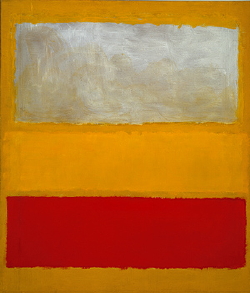
The problem a lot of people have with abstract art comes from what you might call the "I could do that" factor. If something looks extraordinarily simple, people assume it must be easy -- and if it's easy, that means they could have done it themselves, and that means it can't be great art.

Alt text
The Met's cleverly titled "No. 13 (White, Red, on Yellow)," by Mark Rothko.

I freely admit that I belong to this class of people. As Patrick and Lindsay and I walked through the Met's modern galleries, I generally appraised the artwork based on whether I thought I could have done it myself. Surely this makes me a philistine, but I can't shake the idea that certain paintings hang in the Met only as a prank to see if people will pretend to find them magnificent even though the art itself consists of nothing more than a canvas covered entirely by one solid color.

My friends and I did our best to appreciate these works, but in most cases we failed to "get" them. Adding to our skepticism was the fact that many of these paintings are untitled. This is very frustrating. You look at a piece, and you don't have a clue what it's supposed to be about, so you look at the little card next to it to see what it's called, figuring that will give you a hint. And then it's not called anything. To me, that's a dead giveaway that a painting that doesn't seem to mean anything does not, in fact, mean anything. You took a big canvas, painted half of it red, half of it blue, didn't bother to come up with a name -- how are you any different from a house painter?

It's especially disheartening when the untitled artwork is something exquisite and beautiful, a portrait or abstract piece that is obviously the work of a talented artist. You spent months, maybe years, on something, and you couldn't spend five more minutes coming up with a title? Or nothing occurred to you during all those countless hours laboring over it? Come on! Now you're just being lazy.

These are the sorts of things that smart, educated people such as Patrick and Lindsay and I discuss as we stroll through one of the world's largest and most respected museums. I don't want to sound smug or elitist or anything, but I think we literally exploded the accepted parameters of art-viewing in our time.

Digg! Stumble It!

Comments & Reaction:

Lindsay was in one of my circles of friends back in the old days, and Patrick was in another. I don't remember what caused those circles to overlap and the two of them to meet, but I'm glad they did (as I'm sure they are too). They're a very hip couple. They both always have really cool hair. That's probably the thing the rest of us admire most about them.

SnideCast intro & outro: "New York City," They Might Be Giants.
This item has 41 comments

  1. Polly says:

    I never really had much liking for the pure blocks of color on large canvases, like the Rothko above. Although, Rothko really didn't mean for the painting to be anything specifc, he ws trying to communicate with basic human emotions. He advised that you stand about a foot from it so the painting can envelope you. There are actually stories of people who would break down in front of his paintings and have "religious experiences."

    I, however, fall more towards the "Huh, cool" side of the spectrum. I can appreciate the color relationships that he plays with and the different energies that they can exude, but I've never found myself truly moved by Rothko...

    Also, that Cia Guo-Qiang picture is amazing! I wish I could see that.

  2. Melissa says:

    Dude, I know. I love talking to people that have cool hair and always know what songs are the next ones to be the popular cool songs. I wish I could be that way. I'm not sure why I'm not. I guess it's because I'm always working....and because I love Phil Collins. People who love Phil Collins can't be on the cutting edge. It's like a rule...or something.

    Anyway, good piece!

  3. Lane says:

    Those wolves were paper machete? Crazy. I know the big glass wall they run into at the end is supposed to represent the Berlin Wall for some reason. And the cars with glow sticks in your picture? Those just represent how weird the guy is.

  4. Leah Jane says:

    Museum Dates really are the best. My guy is from Minnesota, and we went to art museums a lot when I visited him. One art exhibit involved bright, flashing bulbs and heat for some reason though, and I'm photosensitive...Forget pretentious, modern art is seizure inducing.

  5. Paul Norman says:

    I really am hoping that some reader/commentator of Eric's blog will explain to us philistines why a painting that could have been easily done by Eric or others of us with little or no training is "art" when it is produced by someone with a recognized name, but "not art" when it IS done by one of us ordinary people. How does anyone know that, for example, Mark Rothko did not pay some junior high school kid $10 to paint No. 13 (White, Red, on Yellow) shown above? Once you make your name as an artist, you can get people to pay real money for just about anything!

  6. QMO says:

    "Once you make your name as an artist, you can get people to pay real money for just about anything!"

    Howard the Duck is a fine example of this.

  7. Thoughtful Observer says:

    The funny thing is that I've had this exact conversation (with the exact same examples, including the house painting one) with someone trying to convince me that it was art. I said "but I could do that", and she responded "but you didn't" and so I asked "but what if I did?" and she said "but you didn't so that doesn't matter". She designs children's clothing patterns for a living. She thinks she's an artist. Needless to say, everyone except her thinks I won the argument. I really can't stand people like that.

    Oh, and the answer, Paul, is that it's "art" because a musuem or gallery said so. That's it. One patron or gallery owner or whatever decided they could get people to pay big money for junk just because they say it has exploded and revolutionized the art scene. It's a scam is what it is. Just be happy Eric only paid $1 to see it.

  8. Turkey says:

    I went on a date to an art museum once. We spent most of the time making fun of the modern art exhibits, pretending that we saw some deeper meaning within each ridiculous piece. One painting was just plain red and we began this long discussion about the emotions it must represent and why, doing our best to keep straight faces, when a museum employee walked up and tried to join in on the discussion. He started asking us questions about why we thought this represented this, etc. We couldn't keep up the act any longer and said, "Uh, we were just making fun of it. We have no idea." He was sorely disappointed. Apparently he had been looking for meaning in that painting for a while but for the life of him couldn't find it and he was overjoyed that someone could finally explain it to him. Oh well.

  9. Ben C. says:

    That's exactly how I felt at the Tate Modern Art Museum in London a few years ago. I was with an art student from my college and she was (literally) drooling over a painting that was just a bunch of different shades of red (properly entitled "Red") mixed around on a 15'x15' canvas. I told her it made no sense. She said I wasn't cultured (I agreed with her). Some guy just had a toilet there in a glass case. I guess that passes for art, even though the guy didn't make the toilet. I guess it's kind of like #5's friend's arguement. This guy was the first one to think of it, so it is art. And a museum was willing to display it and declare it as art.

  10. Lindsay says:

    Eric,

    It was a joy, a true joy to spend an enriching museum day with you. Incidentally, last week we returned to the Guggenheim with my brother, who is an architecture nut. The museum was closed in order to facilitate the changing of exhibits, so we couldn't really see anything. Luckily, however, they left one glass door uncovered, and when we peeked in, we saw workers stuffing the papier mache wolves into large bins. I'm sure the bins represented Islamic Fundamentalism or something...

  11. mommy says:

    I loved this article. I enjoy the Turkey (#7) brand of art museum going. I was a psychology major so I'm especially good and making up emotional declarations based on slabs of color.

    i think the trick is to first have gone through some highly respected art school and drawn beautiful things, jumped through myriads of hoops, then once free of the establishment... painting huge blocks of color.

  12. Betsy says:

    I actually like Rothko. His paintings make me feel feelings. But I'm kinda a big deal like that. The rest of you are just savages.

  13. Bryce says:

    Polly:

    My art history teacher at BYU was one of those people: she told us she was studying Rothko and broke down in tears because it was such a "spiritual experience". Good grief. I'm not a hater, though!

  14. whome says:

    Paul (#5), I think the answer has to do with a little original story I wrote called the Emperor's New Clothes. Oh, wait, somebody else wrote it first, so I guess it's not art if I write it. Anyway, if everyone is convinced that it is valuable, then they will pay good money for it. It works for comic book and coin collectors, too. Those things are only valuable because people think they are. They have no intrinsic value, just societal status. It's kind of the same thing as the name on the label raising the price of the clothing. Socially, it becomes more valuable, so people pay for it.

    I've always felt that great art needs to communicate powerfully with its audience. But much of what passes for art defines its audience as "those who are sophisticated enough to -get- the work" and thus doesn't define an audience that would make it great art.

    So under my definition, I wonder if Star Wars would be great art.

  15. Cameron says:

    Aw, I miss Lindsay. Of course, I could always watch that crappy short film that I made her do back in college.

  16. John says:

    I agree completely with #5 and #13. "Art", by my definition, needs to be something that *I* couldn't do. (I do OK with stick figures, but that's about it.)

  17. That One Gal says:

    I think that abstract art can be very difficult to make. But, as you said, Eric, it can also be pointless and terribly easy. Sometimes, you look at it in awe and wonder 'How?' but other times, you snort in disgust and wonder 'Why?'

  18. Allister McBurton says:

    Let me preface my remarks by saying that I don't find anything terribly special about the Rothko. I also don't get a whole lot from the works of Jackson Pollock.

    Sure, 'most any second grader could have made the collected works of this "Rothko" character, from what I understand. But, as a thoughtful observer's friend has mentioned, they didn't. The emotions conjured up by some individuals that viewed his paintings were not evoked by anyone else but Rothko (I feel like someone just heard "Rosco" with a lisp, and decided it sounded cool) himself.

    I could have written this Snide Remarks. I assume I have the same array of characters on my keyboard that the emminent Mr. Snider does. But I didn't, so I guess I'll stop laying claim to it. Many artists have the technical skill to replicate classical works, but, and bear with me here, even if they did, it wouldn't be art, it would be a copy of art. If they'd done so before the work in question was created, then sure, give them credit.

    I hope I don't sound like a buffoon.

  19. John Williams says:

    My favorite Snide Remarks so far this year.

  20. RyanPDX says:

    Eric do you have Patricks old group's cd "Tuesday Night Supper Club"? If not I could let you borrow it. CLASSIC Patrick. Did you try to convince them to come to Portland?

  21. Paul Norman says:

    Well there were a couple of you who sort of answered my question (#11 & #17). If Rothko piece shown above makes Betsey (#11) feel feelings, then it is art to her. I was in Florence, Italy last summer and saw Michelangelo's David. That made me feel feelings too and it is certainly art to me. This Rothko piece leaves me cold.

    I do not find the-artist-did-it-first argument very compelling. I doubt very much that discovering a nearly identical work created by a no-name "artist" before Rothko did that one would cause the museum's curator to lay out big bucks for it. I think whome (#13) is dead on. I tend to buy on-sale Wrangler (or even less fashionable brands) jeans. I have never owned a pair of Calvin Klein jeans in my life and doubt I could ever be persuaded to pay more money to do so

  22. Pumpkin says:

    My hubby and I went to the Guggenheim while we were in NY and found that the best art was in the annexes and not on the main spiral thing. That stuff really had the "I could do that" factor and much of it looked like the art projects I did in elementary school. One piece in particular was just a large sheet of gold leaf laid on the floor, and when my husband saw it he had an uncontollable laughing fit while the museum employees glared at him in disgust.

  23. Karen says:

    Does that Rothko remind anyone else of ketchup, mustard, and duct tape?

  24. Craig says:

    Appreciating abstract art is much easier with a vivid imagination and a willingness to ignore the artist's intent.

    Take the Rothko, for instance. If you look closely at the white portion, you can make out rounded figures, like a crowd of people through frosted glass. The general shape of the yellow portion reminds me of an old-style riot shield, solid metal (or whatever) with a viewing slit near the top. Put together, you get a police-eye view of a rioting (or at least, unruly or protesting) crowd. However, the gauziness of the view could represent an inability - unwillingness, even - to view the crowd as anything but a faceless "other," wholly distinguished, to the point of dehumanization, from the officer. This viewpoint makes the officer's job easier, but it also makes him or her more willing to use heavier force against these antisocial things disturbing the peace for some unimportant reason, potentially leading to violence, represented by the bloody red streak. That this scenario is considered normal, even expected, by the public is symbolized in the bright yellow shield, a color as everyday as the sun.

    All of that probably has nothing whatsoever to do with whatever Rothko envisioned, which is all part of the fun.

  25. Rob Wells says:

    For what it's worth, Rothko's paintings don't really translate well in photos. The canvases are enormous, and Rothko recommended that you view them up close, so you're completely overwhelmed by the painting.

    Granted, you still might not "feel feelings", but it might be better to withhold judgement until you get a chance to see it in person. (I'm referring to commenters, not to Eric, who has seen them in person and still not felt feelings.)

    Personally, I love it.

  26. Tom says:

    At least you say "Huh. Cool." Which puts you literally leagues beyond the "if I don't like it, it's not art" crowd.

    And I'm pretty sure if there was gobs of easy money to be made by house painting canvases and selling them to the met you and I would be doing it too. Wouldn't we?

  27. Tom says:

    Also, I can play "Stairway to Heaven" on the guitar. Does that mean it's not a song?

    (Okay, I actually can't play it, but I thought I'd just throw out some ponder-fodder for the last 3 people who haven't commented yet.)

  28. card says:

    I saw a play called "Art." It was really enjoyable because it involved three friends who basically fought the whole time because one of them purchased a piece of art for an unusually high sum of money, and the art was merely white paint on a white canvas. That play helped me realize why some people view pieces like No. 13 as extraordinary pieces of art. I can't say that I agree, but at least I can now think that people who do like it aren't complete idiots.

  29. John Doe says:

    I'll be honest, I don't get most art. However, I don't even try to judge much these days. Frankly, if you're moved by something, or want to pay huge sums of money for a white canvas with white paint on it, go for it. Many adults pay huge sums of money to watch other adults play games (baseball, basketball, etc.). I am bored to tears watching the same events, so to me it's similar to this whole art thing. If you want to spend time and money looking at white canvas or watching people play games, more power to you. Just don't think you're more deep or more special than I am.

  30. Glenn says:

    One of the coolest experiences in recent years was stumbling upon a Rothko exhibit at the National Gallery in DC. Very memorable, very fun. He's one of my favorites.

    My 10-year old son liked Barnet Newman better, though.

  31. Amp says:

    I'm a Rothko fan. I think seeing the canvases in person makes all the difference. I don't think they hold some deep meaning or anything--I just think they're cool to look at.

  32. dichotomy says:

    See- I'm not a big Rothko fan but I do like Pollock. To me there is a massive difference between the two- I love Pollock and the way he puts the colour together. I don't believe I could do Pollock but I could recreate Rothko in half an hour on a lazy Sunday afternoon.

    Rothko is just big flat, bands of colour. Does nothing for me.

  33. carina says:

    I love, love, love Rothko and think he is brilliant. I've seen dozens of imitations and they all stink. Then again, I love abstract expressionism and non-representational art. Give me a Kandinsky, Weber, or Pollack over those impressionists any day of the week. That's right, I said it, the impressionists can literally kiss my abstract butt!

  34. Erin says:

    I think that art is subjective and can be found in almost anything, depending on the viewer. Just because you could do it yourself, doesn't mean its not art. Maybe not good art, but not 'not' art.

  35. Jenn says:

    When my family went to NYC, my sister went to MOMA, where they had an exhibit of preserved human bodies. She thought it was cool, I thought it was gross. Her response "You don't appreciate art." I saw the exhibit again when I was in Vegas last year & still thought it was gross. I like to think I'm not an absolute Philistine when it comes to art, but it was gross.

  36. MDV says:

    I recommend all Rothko fans take this convenient quiz:

    http://bitrot.emuchrist.org/photoshop/rothko1.html

  37. Matt Sommer says:

    I laughed like it was 1999. Thanks, Eric!

  38. Julie says:

    I personally cross my eyes every time I look at modern art. I like to see if it makes something appear, like those puzzles you have to look at for 20 minutes and then finally find something.

  39. Reagan says:

    You have to be the funniest person walking the planet. Will you please run for office? Or bishop? or co-host on the View? The world needs more Eric Snider!

  40. JD says:

    Eric (author), I'm surprised you never reviewed the Sundance film entry My Kid Could Paint That (2007). I thought it was a thoughtful look at the motives of 3 kinds of people - parents, art critics, and journalists. I think it is a film that is right up your ally. You should watch it.

  41. Jordan says:

    Ha ha ha, brilliant! I've been studying art in college, and after 4 or 5 art history classes I've come to the conclusion that the modern and post-modern movements only exist to prove how ridiculous art has the potential to be. And really, according to artist John Baldessari, the artist's job is to convince everyone else to see things the same way he or she does. It doesn't matter if it makes sense, it just matters that everybody takes your word for it.

Add your comment:

The following HTML elements are allowed: <span class="spoiler">content</span>, <strong>, <em>, <a>, and <img>.

Before posting, please read the rules.

Subscription Center

Eric D. Snider's "Snide Remarks"

This is to join the mailing list for Eric's weekly humor column, "Snide Remarks." For more information, go here.

Subscribe

Eric D. Snider's "In the Dark"

This is to join the mailing list for Eric's weekly movie-review e-zine. For more information on it, go here.

Subscribe
 
Come read about baseball and web development at www.jeffjsnider.com