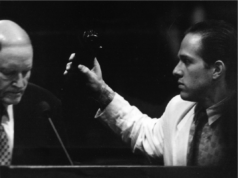
Any theater attempting to do Shakespeare has its work cut out for it. His language is foreign-sounding to the modern ear, and it takes real skill to deliver the lines in a way that sounds both honest and intelligible.
Plus, if you happen to be doing “Comedy of Errors,” as the SCERA Shell Outdoor Theatre currently is, the script is confusing as heck anyway, dealing as it does with two sets of identical twins, with each member of each set having the same name as his brother.
(Was that common then? Having twins and giving them both the same name? Wasn’t it confusing enough to have them LOOK alike? Did audiences in Shakespeare’s day roll their eyes, too, and say, “What kind of parents would do that to their sons?”? Just wondering.)
The plot: There’s a guy named Antipholus (Randy Honaker) who has become quite a well respected fellow in Ephesus, and who is never far from his personal servant, Dromio (Verdon Walker, Jr.). Along comes Antipholus’ long-lost twin brother — also named Antipholus (John Lundwall) — from Syracuse, with HIS personal servant, who is Dromio’s long-lost twin, and who is ALSO named Dromio (Thane Bingham). Only none of the four knows that they even HAVE long-lost twins, and, thanks to the wacky nature of farce comedy, they’re never in the same spot at the same time, so they never see each other and notice the resemblance.
Various people keep seeing one of the Antipholuses and mistaking him for the other, and soon even the servants are addressing the wrong men as their masters, and vice versa. It’s all extremely wacky, in a dignified, Shakespearean kind of way.
And that may be a problem. For try as it might to be truly zany and farcical, the SCERA production still seems eminently Shakespearean, with a touch of the Three Stooges forced in here and there.
SCERA’s production of “Comedy of Errors” is a mixed bag. It’s confusing, to be sure — that Shakespearean dialogue, coupled with the identity crises — but also fairly amusing in some parts. Often, you can identify the parts that are funny, but it takes so long to process what they’re saying that by the time you translate it, you forget to laugh.
Perhaps it can be blamed on the fact that it was opening night, but the audience I was in only laughed about a dozen times during the entire show. We were amused, and mostly entertained, but there wasn’t always much to make us laugh out loud.
(Two exceptions, without giving too much away: hand-held signs announcing who the twins are — the actors don’t actually look alike, you see — and an inspired bit of slapstick involving two apples.)
Shakespeare fans will probably enjoy this production, light-hearted as it is. But its fairly slow pacing and obtuse dialogue probably won’t convert any non-fans.
I tried to go easy on this show. I had just trashed the theater's last production, "Fiddler on the Roof," and I hate to give two bad reviews in a row to the same theater (that's why I didn't even go to the Villa Playhouse in Springville anymore at this point). But the fact of the matter is, this show wasn't funny. And I think a comedy should be funny. That's a bold statement, but I'm standing by it.
So far, I've never given a negative review to a show in Utah County without receiving an angry letter in response (I've even gotten angry letters in response to some fairly POSITIVE reviews). Here is the obligatory letter from a woman who dated Shakespeare and can't understand why I didn't like this show. I have italicized the outrageous parts.
Dear Editor:
This letters [it should be "letter," of course, but she wrote "letters"] is not intended for publication, but as a complaint about the review of the Scera Shell's performance of "Comedy of Errors." Eric Snider was your reviewer, and his comments appeared Friday, July 17, 1998. Although his virtual pan of the play made me hesitate, I went to see it that night and found it delightful.
Why did your paper send someone so obviously unfamiliar with Shakespeare to review the Shell's production? I have some background that gives me, I think, some license to ask this question. During my undergraduate years at BYU, I specialized in Renaissance literature, and I have taught for the last seven years at UVSC. I've made it a habit to continue studying, and I see several Shakespearean productions each year -- community theater, college, high school, and at least one trip to the Cedar City Shakespeare Festival for almost all of the last 25 years.
If Mr. Snider couldn't follow the lines or capture the plot of "Comedy," it was because of his inexperience, not the play's shortcomings. I think your paper hasn't served its readers in reviewing this production; many may have been discouraged by the reviewer's comments and missed a fun evening. He's helped to perpetuate the idea that Shakespeare is incomprehensible to a modern audience, and only for stuffed shirts besides! Enclosed is a review I might have written, and I would be happy to review any Shakespeare production for your paper. Better yet, get Laurie Sowby to do it -- she's more experienced and more open-minded.
(Laurie Sowby, I might add, has also never written a negative review of anything in her life.)
The letter writer did sign her name, but I have not mentioned it here because she indicated she didn't want her letter published, and I assume she meant not on my Web site, either.
Her "review," which was indeed enclosed, was glowing. In it, she recommends that "reading a little something about the play [before seeing it] will clue you in to some 'inside jokes' from Elizabethan England," and that "a 15-minute reading of the Cliff's Notes for 'Comedy of Errors' will clue a first-time playgoer in to [the] differences in the language of four hundred years ago."
I was disturbed at the hasty conclusions she jumped to -- that since I didn't like this play, it must be MY fault, not the play's -- and at the notion that any negative review of a play that just ONE person likes is doing the readers a "disservice." So I wrote back to her as follows:
Daily Herald lifestyle editor Sharon Gholdston forwarded me a copy of the letter you wrote on July 18, commenting on my review of "Comedy of Errors" at the SCERA Shell Outdoor Theatre. I wanted to take a moment to respond to what I feel was an inaccurate conclusion made in your letter.
You said: "Why did your paper send someone so obviously unfamiliar with Shakespeare to review the Shell's production?" Later: "If Mr. Snider couldn't follow the lines or capture the plot of 'Comedy,' it was because of his inexperience, not the play's shortcomings."
It would appear that your logic is thus: Since YOU liked the play, therefore it must have been good; therefore, if I think it WASN'T good, then it must be because I am simply unfamiliar with Shakespeare. If I were familiar with Shakespeare, I would enjoy EVERY production of EVERY ONE of his plays, including this one. Merely having a difference of opinion does not seem to be an option; not liking the play, in your mind, indicates that I am "obviously unfamiliar with Shakespeare."
I make no claims at being the Shakespeare scholar you are, but I am familiar with his work. I have read several of his plays, seen several others performed, and performed in several more myself. I am also an avid reader and a student of grammar and English, and am no slouch when it comes to vocabulary, even old Elizabethan vocabulary. I would venture to say that I am more familiar with Shakespeare, and more able to understand his archaic dialogue, than your average man-on-the-street.
You enjoyed the play because you were familiar with it, and because you are adept at understanding Shakespearean theater. Your average person is not that up-to-speed on Shakespeare; as I said, I think your average person isn't even as knowledgeable on the subject as I am, and I'm no scholar. So if I -- a person with a fair-to-middling understanding of Shakespeare -- didn't particularly enjoy the production, how much less is an Average Joe going to like it?
I'll tell you how much: apparently not at all. As I said in my review, the audience opening night laughed maybe a dozen times. That's not very good, considering it's supposed to be a comedy.
You seem to disagree with my statement that Shakespeare fans will enjoy the production but that it's unlikely to convert any non-fans, apparently feeling instead that ANYONE would enjoy it -- and yet in the sample review you wrote, you suggest that people do some homework first and familiarize themselves with the play. I agree that familiarizing oneself with the play first might help one to comprehend the lines faster and see the humor in them when they are spoken onstage -- but who's going to do that? By recommending that people become initiated before seeing it, you've merely proven my point -- that the play would not be very enjoyable for the uninitiated.
Which is it? Is the play enjoyable for Anyone, for the Masses, for the Average Joe? Or is it enjoyable for people who have pre-read it and become acquainted with it?
As I said, I wasn't the only one who didn't find the play funny. The rest of the audience wasn't laughing either, and I had even done my homework first!
Please consider the possibility that not enjoying a play you enjoy does not necessarily mean the reviewer didn't understand it. He may have understood it perfectly and simply not found it entertaining, or found some of the acting to be sub-par, or found some of the slapstick humor to be strained and unsuccessful. Such was the case with "Comedy of Errors." Your conclusion that I was "obviously unfamiliar with Shakespeare" is not only untrue, but unsupported by anything I said in my review.
For that matter, it's also irrelevant whether I'm familiar with Shakespeare or not, since the average theatergoer isn't, either, and they're the ones who read the reviews to determine whether they'll enjoy a show.