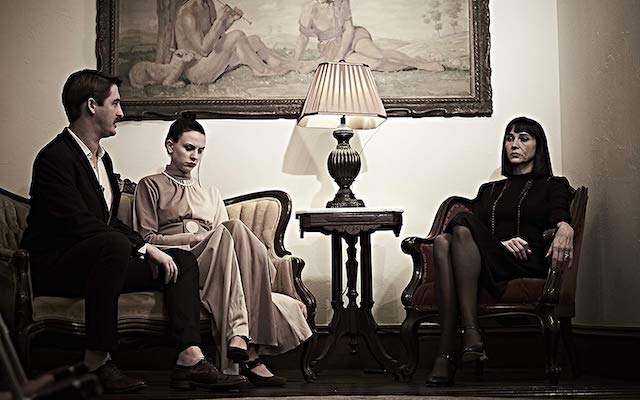
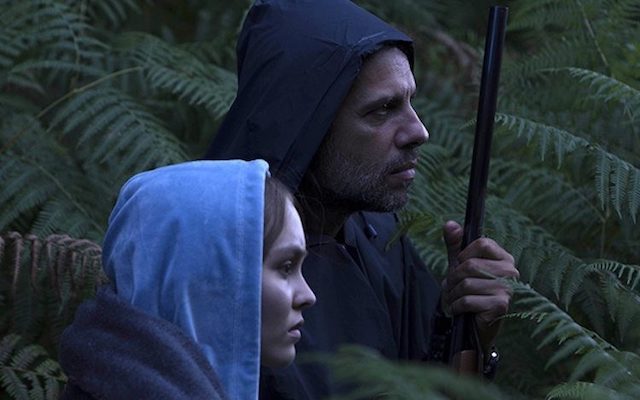
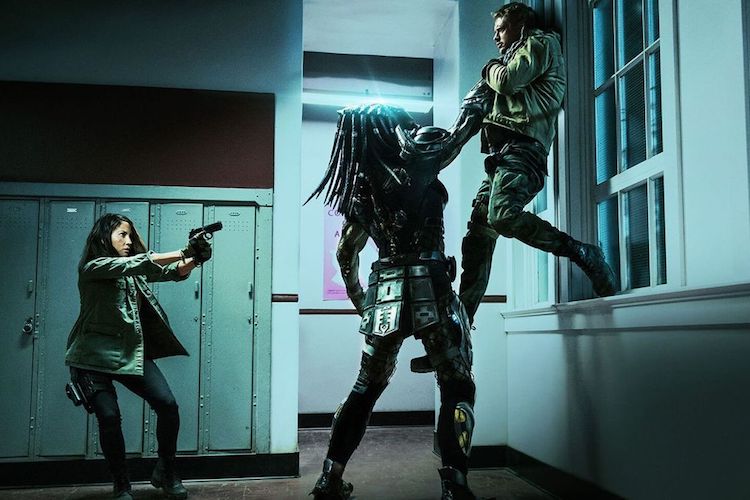
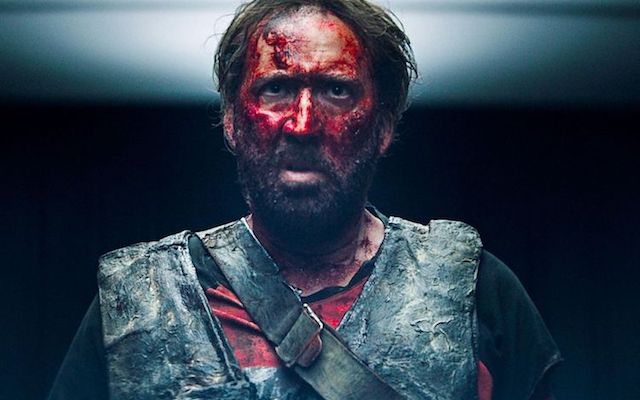
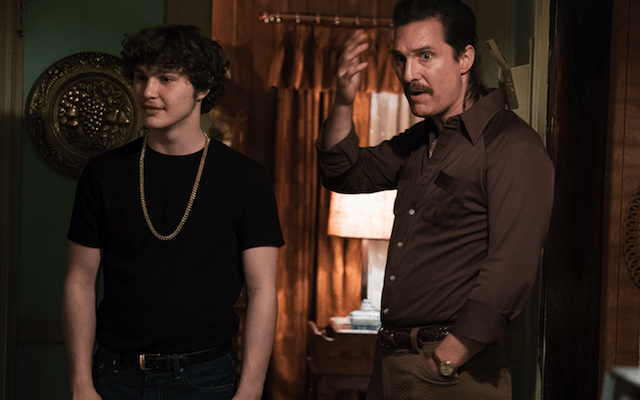
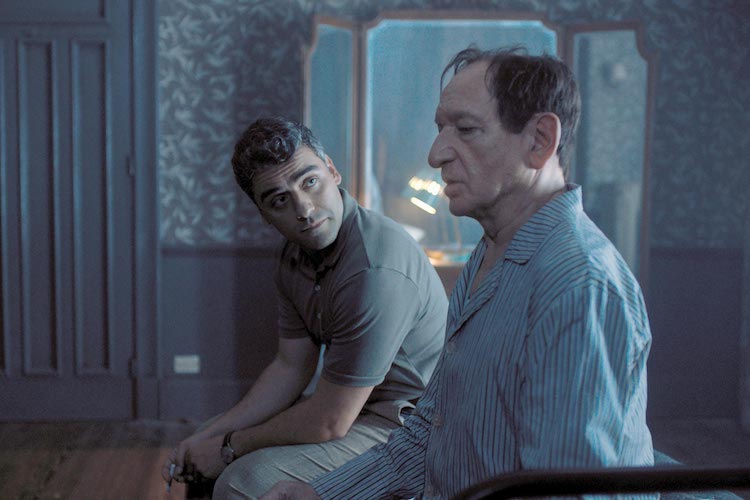
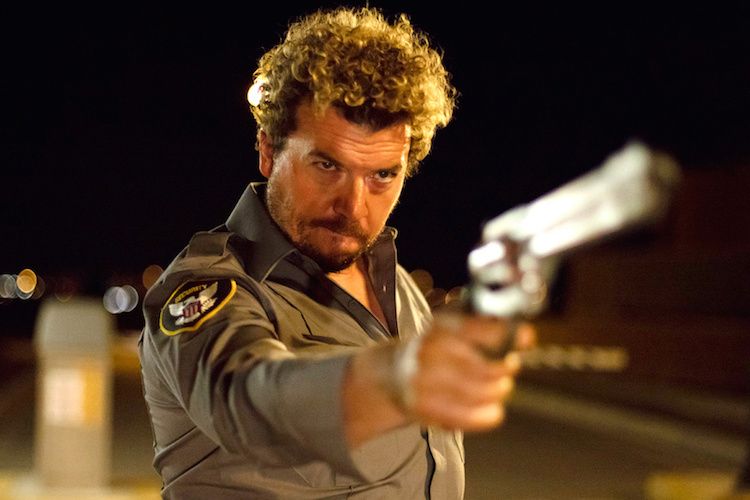
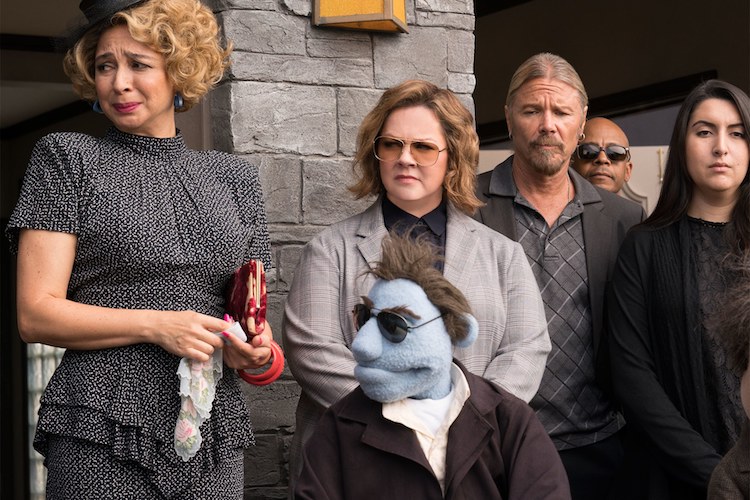
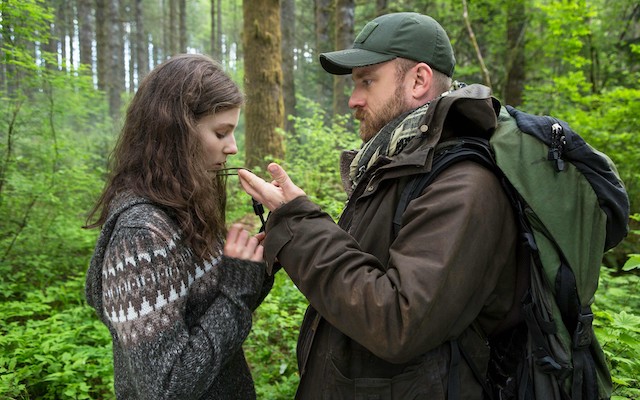
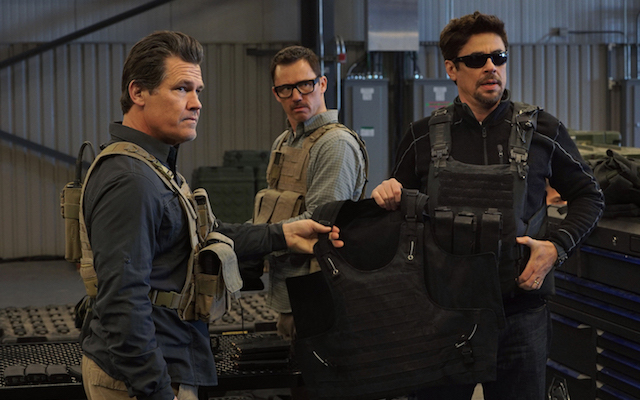
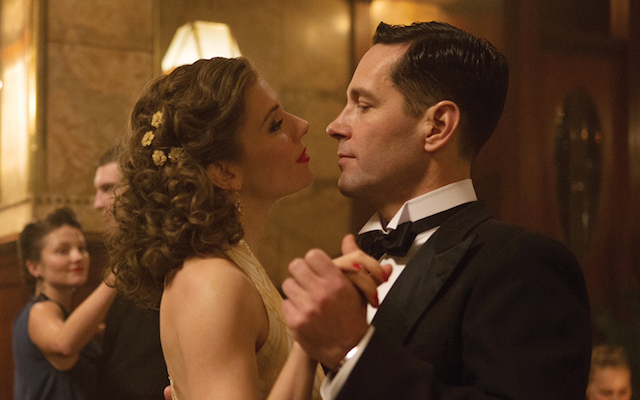
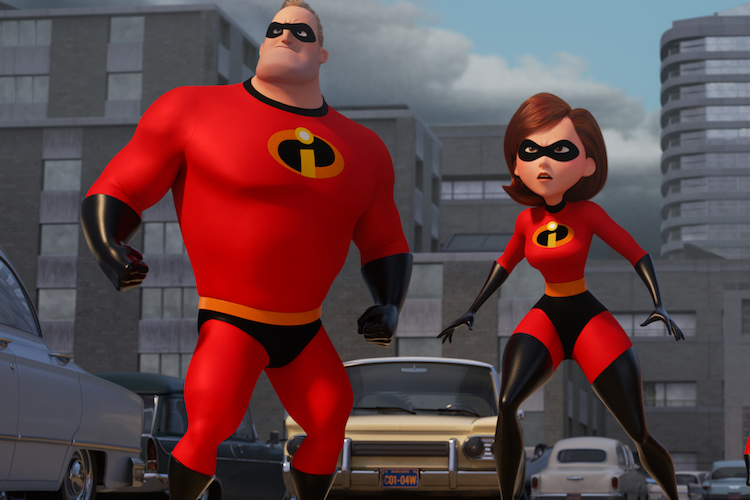
“Burning” is a mystery. I don’t mean that its plot involves a mystery (although it does), but that the film itself is hard to pin down. Based on a short story (“Barn Burning”) and directed by South Korea’s Lee Chang-dong, it’s long and ponderous, it’s a low-key slacker comedy, it’s a film noir, and it has a mesmerizing scene of a stoned topless woman dancing to jazz music as if she were in “Twin Peaks.” By the time the intense finale arrives, you’re either riveted or disinterested — it’s a slow burn that threatens to die out before it explodes.
Jong-su (Yoo Ah-in), a twentysomething Seoul man who lacks direction since graduating from college with a degree in creative writing, runs into Hae-mi (Jeon Jong-seo), a childhood classmate whom he used to tease but now finds attractive. They hook up at her cluttered apartment, and then Hae-mi asks him to feed her cat while she’s out of town, a task with a bit of mystery to it since Jong-su never actually sees the cat. When Hae-mi returns, she brings a new friend with her: Ben (Steven Yeun, credited as Yeun Sang-yeop), a suave, enigmatic guy with plenty of money but no visible means of support who mentions casually that he’s never cried. Jong-su is jealous of the interloper (he calls him “Gatsby”), and an amusing bit of triangular tension is established as the three hang out.
And then Hae-mi goes missing. Her apartment has been tidied, all evidence of a cat removed. Jong-su kicks into gumshoe detective mode, but his investigation is hampered by his own basic inadequacy and by the fact that as he checks with Hae-mi’s family and friends, he discovers that she was a flighty fabulist and exaggerator. Ben seemed a little sketchy, and now maybe Hae-mi can’t be trusted either.
Lee, co-writing with Oh Jung-mi, confidently walks us through a story that keeps surprising us. Not huge, shocking surprises (generally), but the kind where you raise one eyebrow and say, “Oh?” It strikes me as a film that’s compelling to watch once but not a second time, because it’s the unpredictability that’s so engaging — but I know others who have found multiple viewings rewarding as new layers are revealed. Your mileage may vary. While it may ultimately be too inscrutable for my tastes, I enjoyed the process and respect Lee’s singular vision.
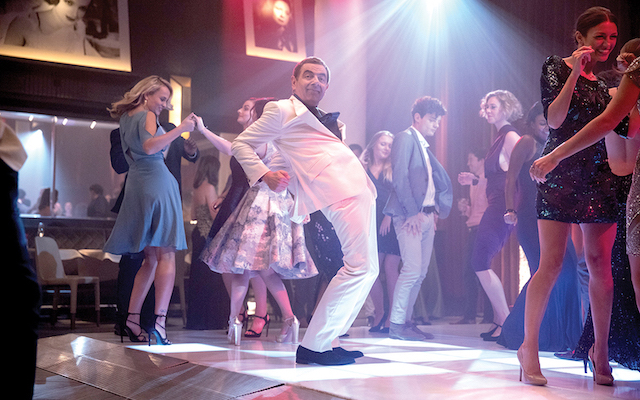
Johnny English, Rowan Atkinson’s bumbling James Bond character who is a more talkative version of his Mr. Bean character, returns for a third outing in “Johnny English Strikes Again,” a family-friendly spy spoof whose only flaw is that it has zero interest in the characters who aren’t Johnny English.
This time around, Johnny is brought out of retirement to help the Prime Minister (Emma Thompson, bless her) find the hacker who exposed all of MI7’s current agents. While Johnny is working on that, crossing paths with a beautiful, enigmatic woman (Olga Kurylenko) who might also be a spy, the PM is working with an Elon Musk-like tech billionaire named Jason Volta (Jake Lacy) to improve the U.K.’s internet access. (If you are very smart, maybe you can figure out who the hacker was!)
Returning screenwriter William Davies and first-time director David Kerr fill the movie with cartoony gags, many of them centered on Johnny’s old-school methods vs. the modern ways of espionage. These jokes range from hilarious to irritating, and Atkinson’s gift for physical comedy, pantomime, and facial expressions remains superb — but Johnny English is the film’s only funny character. Everyone else is written and played straight, as in a regular spy movie, giving us nothing to cling to but the story, which is too simple to hold an adult’s imagination for long.
The rather arbitrarily titled “Hunter Killer” is a submarine movie for dads, based on a novel called “Firing Point” (another random title) that looks like it is probably only for sale in airports. The dividing line on movies of this nature is thin and extremely subjective, but for me “Hunter Killer” is just simple-headed enough to hit the spot, not quite so ludicrous that it pulls me out of it.
After an American submarine is torpedoed in Russian waters, the Navy calls in the best man they have, a maverick named Capt. Joe Glass (Gerard Butler) who didn’t go to the Naval Academy and doesn’t always play by the rules but gets the job done, if you can imagine such a type. Glass and a crew take the USS Arkansas (“hunter killer” is the class of submarine it is) to investigate, leading to an exciting skirmish with a different Russian sub, not the one that torpedoed one of ours. That sub, the initial aggressor, is found sunk, but there are survivors aboard whom Glass and crew have a moral obligation to rescue and hold as POWs.
Meanwhile, Chairman of the Joint Chiefs of Staff Gary Oldman, advised by the Navy’s Adm. Common, dispatches a covert Navy SEAL team to Russia to spy on a meeting between Russian president Zakarin (Alexander Diachenko) and minister of defense Adm. Durov (Michael Gor), hoping to find out why the crap the Russians torpedoed us in the first place. The SEALs, led by one Bill Beaman (Toby Stephens), are your standard group of young military hotshots with girlfriends back home, etc., and they observe Durov perpetrating a coup against Zakarin, executing his men and taking him hostage. Durov wants World War III, and he’s going to get it unless the Americans — working with the rescued Russian submariners, including their Capt. Andropov (Michael Nyqvist) — can extract Zakarin and take out Durov before the missiles start flying.
So we have action on two fronts, Glass underwater and the SEALs on the ground, which lets director Donovan Marsh maintain momentum by cutting back and forth between them. The screenplay, by Arne L. Schmidt and Jamie Moss, offers the customary submarine jargon and militaristic barking of orders, with ample opportunities for manly men to get up in each other’s faces and whisper-growl. No one has ever accused Gerard Butler of being a good actor, and accusations aren’t going to start flying now, but there’s a certain charm to his roguish smile and sloppy, drunk-sounding American accent, and to the way Capt. Glass keeps talking about how he’s spent his whole life underwater and what a drag it is. In a couple years, FX or TNT or somebody will bleep out the F-words and show it constantly as comfort food for people who find “The Hunt for Red October” too intense.
It would be so much nicer if it were "The Hat U Give."
It takes its time getting there, but you know “The Hate U Give” is going to turn serious on us because it starts with our narrator, 16-year-old Starr Carter (Amandla Stenberg), telling us about the time when she was 9 and her dad gave her The Talk — not the sex talk, but the one black parents give their children to help them avoid being shot by police during routine traffic stops.
From then until her own run-in, Starr has a tranquil if complicated life, living with her parents (Regina Hall and Russell Hornsby) and siblings in the bad part of town while attending a fancy, mostly white private school in a nice neighborhood. At school, she does everything she can not to give anyone a reason to think of her as “ghetto,” which means tamping down her use of black slang or other cultural signals. She has a white boyfriend, Chris (K.J. Apa), who’s never been to her house. On the weekends, she hangs out with her neighborhood friends but conscientiously avoids getting into the drug- and gun-related problems many of them have. Starr’s father used to be one of them, working for local drug kingpin King (Anthony Mackie) before going straight. (King’s gang is called the King Lords, which doesn’t speak well for his creativity.)
After much exposition — it’s based on a novel (by Angie Thomas), and it has a novel’s languid pace — the story arrives at the inciting incident when Starr’s friend Khalil (Algee Smith) is pulled over by police and ends up shot dead, with Starr in the passenger seat. Khalil’s behavior during the traffic stop — not taking the situation seriously, assuming it’ll be fine because he didn’t do anything wrong, not standing where the cop tells him to stand — is almost comically reckless, as if he has no idea that young men like him get killed all the time in situations exactly like this — like it’s his first day being black. That lapse in credibility is symptomatic; the film, directed by George Tillman Jr. (“Soul Food,” “Notorious,”“Faster”) from a screenplay adaptation by Audrey Wells (“Under the Tuscan Sun”), is often didactic and two-dimensional, coming across like a Black Lives Matter “Afterschool Special,” albeit an especially heartfelt one. There isn’t a lot of nuance or complexity here.
The rest of the film is about the aftermath of Khalil’s death, including Starr’s struggle over whether she should become an outspoken activist or keep maintaining a low profile. Her school friends know the shooting happened in her neighborhood but not that she knew the victim, and she’d like to keep School Starr separate from Home Starr as long as she can. (Rest assured, one of the film’s messages is that living a double life is unhealthy.) The incident becomes a rallying point, the funeral evolving into a march on city hall to demand that the cop be held responsible (fat chance, of course). Starr’s whitest, blondest friend, Hailey (Sabrina Carpenter), plays the “cops’ lives matter too” card, with expected results. Starr has an uncle named Carlos (Common) who is a police officer and can provide the perspective of a black cop, but the movie’s heart isn’t in it and Common seems embarrassed.
Working in the movie’s favor is the winning lead performance by Amandla Stenberg, the bright talent who played Rue in “The Hunger Games” and has been starring in so-so adaptations of YA novels (“Everything, Everything,”“The Darkest Minds”) ever since. “The Hate U Give,” the title of which comes from a Tupac Shakur song, is her best yet, showcasing her down-to-earth charisma and natural sincerity. A strong cast (except for Common) supports her, and the movie is further elevated by its wholesome family dynamics and inspiring depictions of righteous activism. She was given the name Starr to remind her to be a light in the darkness, and the film’s focus on channeling one’s anger into productive action gives it a matching sense of optimism, even if the story is too glossy and pat to be wholly effective.
For maximum nostalgia, “Mid90s” is presented not in widescreen but in 4:3, the way it would have looked on TV or videotape back in the day. “Maximum nostalgia” is the motivating factor for almost everything in Jonah Hill’s directorial debut (which he also wrote), a coming-of-age comedy set among adolescent skater boys in Southern California in the middle of the Clinton years. The story is disappointingly formulaic (and didn’t need to be set in the mid ’90s), but Hill and his young stars capture the awkward, funny social dynamics of that age group with tender authenticity.
Our lovable protagonist is Stevie (Sunny Suljic), a small, eager 13-year-old who hasn’t lost his innocence yet — or as one girl puts it, he’s “at the age before guys become d***s.” Stevie idolizes his older brother, Ian (Lucas Hedges), a wannabe thug with anger issues, but has few friends until he meets Ruben (Gio Galicia), a boy his own age who introduces him to a cool new world. Ruben’s social circle is a small group of skateboarding high-schoolers, led by the charismatic Ray (Na-kel Smith), with boys nicknamed Fourth Grade (Ryder McLaughlin) and F***s*** (Olan Prenatt) as sidekicks (yes, the latter kid’s nickname is a portmanteau of expletives). Stevie takes up skating to fit in, and is thrilled to find acceptance and purpose among these mostly harmless delinquents.
The film’s best moments are when Stevie and his new crew are just hanging out, having dopey teenage conversations about stupid things, smoking pot, drinking beer, laughing themselves silly. None of the actors except Suljic have much prior experience (Prenatt and Galicia have zero), and there’s an un-fakeable naturalness to their casual interactions. Their conversation has plenty of casual racism and homophobia (I guess that’s the part that would be different if it were set in 2018), including an amusing thread where Ruben thinks it’s “gay” for a guy to tell another guy “thank you.” Ruben, who was glad to have someone his age in the group, gets jealous when Stevie, having gotten into Ray’s good graces, starts passing him in the hierarchy. And Ray, while not the best role model, is a suitable big-brother surrogate for Stevie, taking him out skating, just the two of them, after Stevie has a fight with his mom (Katherine Waterston). A lot of sweetness is baked into the film’s coarseness.
But before long the trajectory becomes clear. Now that he’s taken up drinking and smoking (and hiding those things from Mom), now that he feels comfortable among his new friends, Stevie has to get cocky and reckless, and then something bad has to happen to wake him up. Can it be a car accident? Sure, that’s what most filmmakers choose in this situation; why should Hill be any different? Everything is resolved in the expected fashion. But predictable or not, “Mid90s” boasts endearing performances, a spot-on soundtrack, and smooth direction by Hill, who shows an eye for capturing slice-of-life realism. The comparison is facile but apt: It’s the boy version of “Eighth Grade,” less creative but just as honest.
Based on a 1990 novel by Richard Ford, “Wildlife” has a literary feel to it and comes across as a well-acted, well-produced drama for adults. Its protagonist is a kid, though: 14-year-old Joe Brinson (Ed Oxenbould), an only child who’s witnessing the unraveling of his family in Montana in 1960.
Joe’s directionless father, Jerry (Jake Gyllenhaal), has moved the family a few times in search of his purpose, and after losing his current job in Great Falls joins a firefighting team battling a blaze in the nearby mountains, leaving his wife, Jeanette (Carey Mulligan), behind with Joe. That’s fine, except that Jeanette has been getting restless herself, gradually losing respect for Jerry as he drifts from one thing to the next. She’s become the quintessential bored housewife. “I feel like I need to wake up,” she says, “but I don’t know what from. Or what to.”
The answer, as you might expect, is an affair. She takes up with a successful local businessman, Warren Miller (Bill Camp), who’s a bit older and not particularly handsome (HE’S NO JAKE GYLLENHAAL) but has money. While Joe goes about his teenage life in the background — making friends at school, taking an afternoon job at a photo studio — in the foreground he sees everything going on around him, a silent observer of his parents’ separate and collective failings.
It’s a sad and poignant story, but the film isn’t miserable. Paul Dano, making his directorial debut and co-writing the screenplay with partner Zoe Kazan, guides it with quiet tenderness. The emotions are sometimes raw, but there are no hysterics, no melodrama, and the performances are measured and honest. The symbolism (the encroaching fire, the effort to preserve happy memories at a photo studio), while unmissable, is handled subtly, conveying a mood without spelling it out. Though both parents make parenting mistakes, the film doesn’t point fingers. That’s the kicker: Joe’s family is falling apart and there’s no specific reason for it. You feel for him, you feel for Jeanette, you feel for Jerry. It is a movie of feelings, a mature and sensitive first outing for Dano as director.
Lee Israel was a cranky journalist who made a living writing biographies before falling on hard times after the failure of her unauthorized 1985 Estee Lauder book, which Lauder undermined by preemptively releasing an autobiography. The excellent “Can You Forgive Me?,” based on Israel’s own memoir, tells the story of what happened next: Desperate for income, Israel began forging letters from literary figures and selling them to collectors. She’d find old typewriters to mimic outdated typefaces, and use her own talents to research and mimic the voices of people like Noel Coward, Dorothy Parker, Lillian Hellman, and Ernest Hemingway.
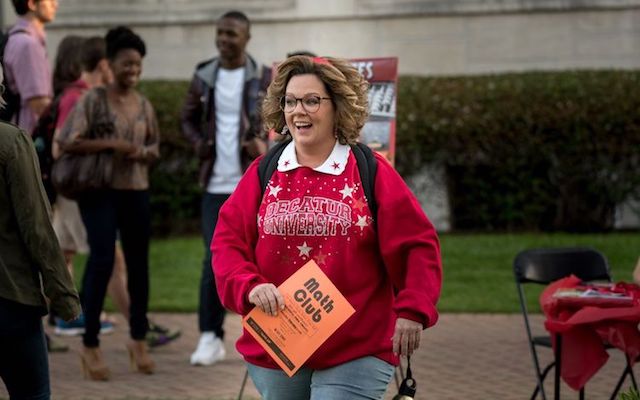
The film, directed by Marielle Heller (“The Diary of a Teenage Girl”) and starring Melissa McCarthy, is primarily a dark comedy, but it has an extra bit of gloom hanging over it as we wait for Lee’s fraud to be found out. She’s an abrasive, prickly person, and what she’s doing is obviously illegal — but at the same time, we like her (or at least understand her), and it’s a fairly harmless crime anyway, and can’t we work this out somehow?
We meet the surly and frumpy Lee at age 51, working some dead-end office job, drinking scotch at her desk before getting fired for swearing at the boss. She lives in depressed squalor in Manhattan, making periodic attempts to get the attention of her agent (Jane Curtin), who keeps telling her nobody wants a biography of Fanny Brice (one begs to differ) and that if she wants to be as successful as Tom Clancy, she needs to play the publicity game. “You can be an a**hole when you’re famous,” the agent says. “When you’re a nobody, you can’t be such a bitch.”
Needing money to buy medication for her aged cat, Lee digs up a personal letter she once received from Katharine Hepburn and sells it to one of the many people in New York who deal in such memorabilia. She happens upon a Fanny Brice letter, too, but is told by the dealer, Anna (Dolly Wells), that it isn’t worth much because the content is kind of dry. Noticing that her typewriter at home matches the font in the Brice letter, Lee adds a witty, acerbic P.S. in Brice’s style and makes the sale (to a different dealer, of course).
The ruse evolves from there, aided by Lee’s natural cleverness and her heavy drinking, which removes the urge for self-reflection. In addition to working out the aesthetic trickery to make new paper look old, she researches real letters to learn the writers’ styles, producing well-written, convincing forgeries. Ironically, it’s the best work of her career.
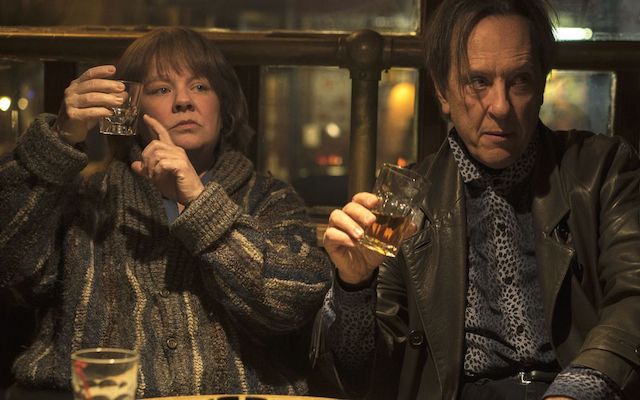
In the midst of all this, Lee re-meets Jack Hock (Richard E. Grant), a flamboyant, promiscuous gadabout and part-time cocaine salesman whom she once met at a book party, where he got so drunk he peed in a closet. With their shared queerness, alcoholism, and general misanthropy, Lee and Jack become pals and partners in crime (first figuratively, then literally). They make prank phone calls to people who have wronged them — an absurdly funny activity when the giggling participants are in their 50s — and they stumble around town drinking and sniping. “This is a celebratory drinking session, not a wallowing one,” Lee says after making a sale. “It can be hard to tell the difference with you,” Jack replies.
But Lee has trust issues. Her one romantic relationship ended some time ago, presumably her fault. She treats Jack like a drinking buddy, not a true friend, and won’t open up to him. She’s always written biographies — other people’s stories — because producing something personal would make her too vulnerable. In large part, “Can You Ever Forgive Me?” (the title comes from a Dorothy Parker letter) (a real one) is about Lee’s halting, reluctant efforts to become a less miserable and off-putting human being.
That’s why it’s crucial that the movie doesn’t end with the scam being found out, but continues on through the aftermath so we can see the character’s arc to its completion. And while dowdy, pitiable characters, even mean ones, are in McCarthy’s wheelhouse, she does something here that she hasn’t really done before: She gives Lee emotional depth. With the help of a well-crafted screenplay by Nicole Holofcener (“Lovely & Amazing,”“Enough Said”) and Jeff Whitty, McCarthy brings out the relatable aspects of Lee’s personality so we’ll sympathize with her instead of just finding her amusingly pathetic. It’s a fine-tuned performance, McCarthy’s outsized comic sensibilities channeled into in a non-farcical, three-dimensional character.
Richard E. Grant proves a fine counterpart, in a role not far removed from the drunken flaneur he played in the 1987 cult classic “Withnail & I.” Physically, he and McCarthy have the classic comedy duo dynamic — one tall, slender, and elegant; one short, dense, and blunt — and their chemistry produces some good laughs. Both figures are sad and broken in various ways, and part of the film’s pleasure is in seeing them help one another get better. Director Heller administers those soft, warm moments so subtly that they sneak up on you, never getting in the way of the movie’s curmudgeonly heart.
The 2018 “Halloween” is a direct sequel to the 1978 “Halloween,” and it exists in a timeline where there were never any other sequels, not even the one that erased the other ones. Michael Myers killed four people that night (that’s not counting his sister Judith 15 years earlier) and was evidently captured without further incident after vanishing at the end of “Halloween” (1978). He has spent the intervening 40 years locked up, never speaking — not one word — to anyone, ever, not to Dr. Loomis (RIP Donald Pleasence) and not to Dr. Sartain (Haluk Bilginer), the late Dr. Loomis’s extremely Dr. Loomis-like replacement.
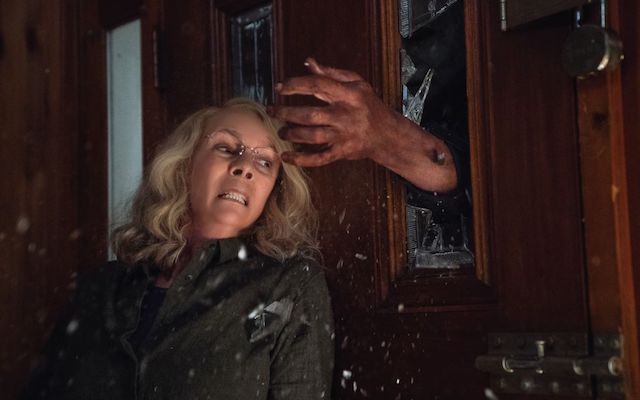
It’s possible Michael Myers doesn’t even know the name of the random babysitter who survived her encounter with him, Laurie Strode (Jamie Lee Curtis). She wasn’t his long-lost sister — that was an urban legend that sprang up later. She was just some normal girl whose life was ruined by the trauma she suffered that night. She became famous in Haddonfield for being a victim, a damaged item, the subject of pity and rumors. She lived in constant, obsessive fear of Michael’s return, driving away husbands as she raised her daughter, Karen (Judy Greer), to be a paranoid survivalist. Now Laurie has a granddaughter, Allyson (Andi Matichak), who’s the age she was in 1978, whom she hardly sees because Laurie lives in a fortified bunker behind a barrage of locks and rarely goes outside.
But Michael doesn’t know any of that. Laurie’s fear that he will return for her is irrational, like being afraid of getting struck by lightning a second time. That she has misspent her life stockpiling ammunition in a secret basement, preparing for a day that reason dictates will never come, all while ruining her personal relationships, is tragic, not heroic, a heartbreaking example of how the effects of violence can ripple across generations.
So it makes no sense when Michael Myers does escape and come after Laurie Strode. He has no reason to do it and no way of knowing where she is. By erasing the Michael-Laurie sibling connection, director David Gordon Green and co-writers Danny McBride and Jeff Fradley undermine the entire premise of the movie. Moreover, the story now inadvertently carries a dismal message: “Hey, trauma survivors, you know how you’re constantly terrified it will happen again? It very well might! Stay vigilant!”
Which is strange and unfortunate, since the film is otherwise empowering and satisfying as the resolution to Laurie’s story, which stands in for the stories of all women who seek victory over their personal Michael Myerses. Early in the movie, a pair of English journalists (Rhian Rees and Jefferson Hall), doing a story about Michael, suggest to Laurie that perhaps she should sit down and talk to him, that maybe we shouldn’t totally discount his point of view just because he’s a murderer. Laurie’s response is to rise, walk to the door, open it, and say, “Time’s up.” She just means that this interview is over, but the current connotation of that phrase is unavoidable. Spend one more minute letting bad men justify themselves? NOPE. Of course, this message is bound to be undermined, too, when “Halloween” (2018) itself spawns sequels in which Michael continues to kill and get away with it. The slasher-movie equivalent of white male privilege, after all, is suffering death for your crimes at the end of the movie but coming back in the next one anyway.
Subtext aside, it’s a passable “Halloween” film, certainly the most beautifully photographed one (kudos to arthouse cinematographer Michael Simmonds), and fortified with a body count that is high but not ridiculous. None of the “fan service” moments are egregious, and at least one is a terrific, wholly justified callback. The mini-dramas with doomed characters preceding their demise show Green’s usual knack for quiet intimacy, and a sequence with a babysitter (Virginia Gardner) and her sassy young charge (Jibrail Nantambu) provides welcome comic relief.
The movie is only mildly scary, though, and while it pretends the sequels don’t exist, it also relies on our fondness for them when it delivers, for example, the requisite sequence where a horny pair of teenagers get offed. Indeed, the very idea of Michael Myers being such a familiar local legend that everyone just refers to him as “Michael” only makes sense if he’s been a recurring presence, not one who went on a one-time killing spree 40 years ago and spent the rest of his life behind bars. (How many serial killers are popularly known only by their first names?) But the well-orchestrated finale is immensely satisfying, cashing in on the tension and symbolism built up in this particular film and over the last four decades. The whole thing might be better as a symbol than as a “Halloween” movie, but it’s not a bad “Halloween” movie.
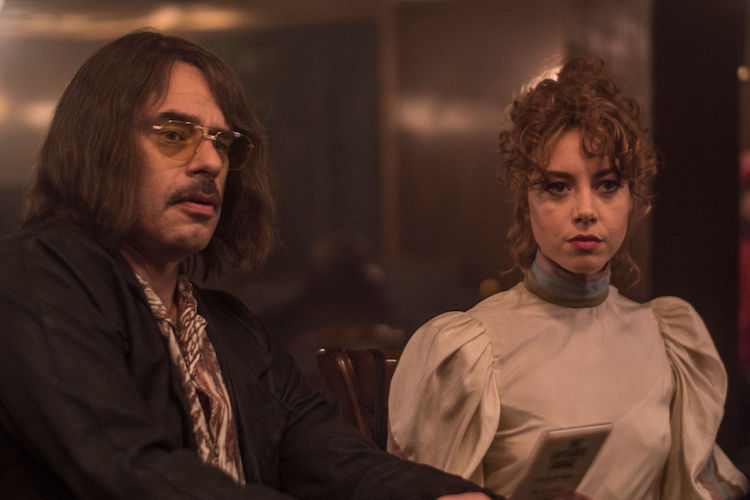
[In theaters and Video on Demand.]••• “An Evening with Beverly Luff Linn” is Jim Hosking’s followup to his infamously irritating/amusing “The Greasy Strangler,” which I enjoyed as a you-gotta-see-this provocation. I was curious to see what else Hosking could do, but it seems “Greasy Strangler” represented the sum of his skills and interests, because “AEWBLL” is more of the same, but less so. He has a few real actors this time — Aubrey Plaza, Emile Hirsch, Craig Robinson, Jemaine Clement — but they all pitch their performances to be at the same level of stilted badness as the non-actors who fill out the rest of the cast.
The story is about a woman (Plaza) dissatisfied in her marriage (to Hirsch) who discovers that an ex-lover (Robinson) is coming to town to perform a show under his stage name, Beverly Luff Linn. When the husband steals money from Plaza’s brother (who is Pakistani), the brother hires Clement to get it back, and Clement and Plaza run off together to wait at the hotel where Beverly will be performing.
I didn’t think I would miss all the gross-out stuff of “Greasy Strangler,” but “AEWBLL” hardly has any and is excruciating. Hosking removed the provocation but kept the deliberately bad acting and go-nowhere story. And the thing is ONE HUNDRED AND EIGHT ACTUAL LITERAL MINUTES LONG! There’s a peculiar sincerity underneath it all, and this is clearly the type of film Hosking wants to make. More power to him, but I don’t need to watch them anymore. I SAID GOOD DAY, SIR.
[In theaters and Video on Demand.]••• “The Guilty” is a tight, efficient, 85 minutes set in a single location: the 911 call center in Copenhagen. (Except it’s not 911 over there, it’s 112. What a country!) Police officer Asger Holm (Jakob Cedergren) is on temporary desk duty taking emergency calls — this is evidently how the Danes punish misbehaving police — when he gets a call from a woman who’s been abducted. She doesn’t know where she is or where the vehicle is going, but it’s a van, so you know it can’t be good. Asger must figure it out and send help, all without leaving his desk. Kind of has to keep it on the down-low, too, since he’s only supposed to be dispatching calls, not solving crimes himself. Oh, and there’s a hearing scheduled for tomorrow about whatever it is he did wrong, so that’s on his mind.
Already engrossed, I got more excited when I realized the movie wasn’t going to leave the call center, like when it dawns on you that a pitcher is working on a no-hitter. Can he pull this off?? It’s tricky to execute a one-location movie without becoming visually boring, but director Gustav Moller keeps us riveted by focusing on Asger’s point of view, which is being bombarded with tiny clues to which he must pay close attention. All of his investigative work is over the phone, talking to the abducted woman (whose captor thinks she’s talking to her young daughter), witnesses, other law enforcement, and so forth. We see and hear only what he does, so we share his suspense as he waits for responses and strains to hear identifying background noises. Asger’s desire to redeem himself by saving the woman gives the story some heft, but the film works perfectly well as a surface-level thriller with more twists than its simple premise would suggest.
"Aw, don't feel bad. Nobody watched the last season of 'The Office.'"
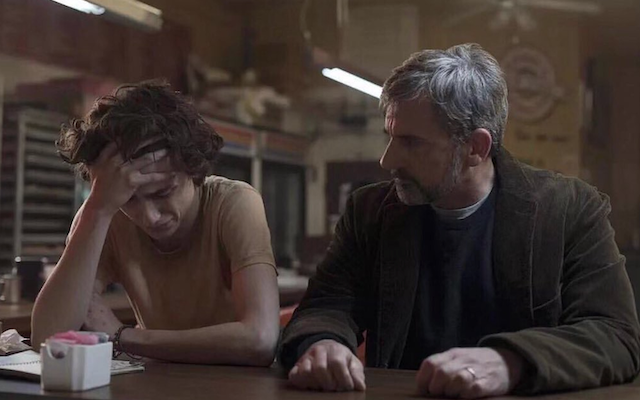
In 2008, journalist David Sheff and his son Nic published parallel memoirs, “Beautiful Boy” and “Tweak,” detailing Nic’s struggles with drug addiction and David’s efforts to help him. Both books are credited as source material for the film “Beautiful Boy,” directed by Felix van Groeningen (“The Broken Circle Breakdown”) and written by him and Luke Davies (“Lion”), a former heroin addict — but the focus is on the father, played by a suddenly very dad-like Steve Carell, more than the kid (Timothee Chalamet). The shift in perspective (these stories are usually from the junkie’s point of view) gives Carell the opportunity to do some fine dramatic work as a loving father experiencing the multiple heartbreaks of parenthood, on his way to accepting that you can’t “save” anyone. All you can do is be there for them.
Van Groeningen’s telling of the story involves a fractured timeline and unmarked flashbacks, often prompted by David going somewhere and recalling times he was there with Nic. The editing gets ahead of itself: With no context, we see Nic, who went off the grid for a couple days, sitting in a donut shop; then we cut to David at the airport, getting a call from Nic; then we cut back to the donut shop, where David is now arriving: The first shot was a flash-forward. All of these devices disorient us (not unpleasantly) and suggest a continuous, never-ending cycle of recovery and relapse (though the ending is optimistic; Nic obviously survived long enough to write a book).
As played by a skinny, pale Chalamet, Nic looks terribly young, but then sometimes seems so mature; it’s exactly the right mixture of childhood and adulthood to make an 18-year-old meth addict seem vulnerable and in need of fixing. There are worthy supporting performances by Maura Tierney as David’s second wife (with whom he has two younger kids, Nic’s half-siblings) and Amy Ryan as his ex-wife, Nic’s mom. The struggles and aggravations are heartrending, probably more so if you’re a parent, probably MORE so if you’re the parent of a wayward child. But even a childless flaneur like myself can see the intense love and sorrow in Carell’s performance, along with a father’s steadfast refusal to ever give up.
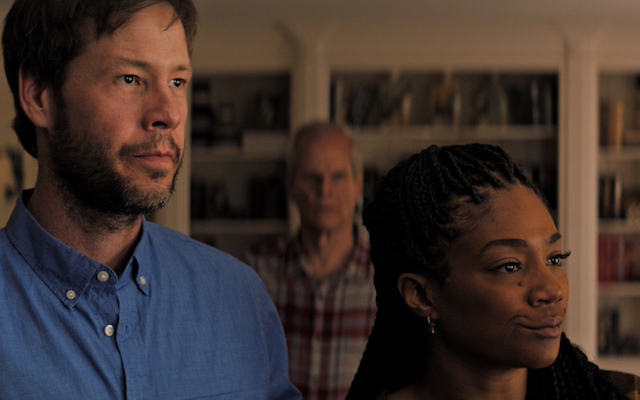
The premise behind Ike Barinholtz’s dark comedy “The Oath” is ripe with possibilities: A liberal man and his wife host his conservative relatives for Thanksgiving week, which coincides with a particularly divisive political issue tearing the country apart. There’s comedic tension in everyone trying to stay civil, followed by comedic release when civility fails. In the second half, writer-director-star Barinholtz (formerly of “MADtv” and “The Mindy Project”) lets the story expand into something bigger and more sinister that isn’t nearly as satisfying (or relatable) as the initial setting, but the film still works as a caustic social satire.
Barinholtz and Tiffany Haddish play Chris and Kai, card-carrying liberals who oppose the (unnamed) current president and are especially repulsed by his latest thing, the “Patriot’s Oath,” which Americans can sign to show their loyalty to the country and the commander-in-chief. There’s no punishment for not signing it, of course — this is America! — but you get a tax credit if you do, and the list of who did and who didn’t will be publicly available. The deadline is the day after Thanksgiving, and protests, rallies, and riots are happening all over the country.
Chris was dreading his family’s visit anyway. His brother, Pat (played by real brother Jon Barinholtz), is a compassionless, anti-intellectual conservative windbag, accompanied by a new girlfriend, Abbie (Meredith Hagner), who looks like one of the Fox News blondes and parrots their talking points. Chris and Pat’s parents (Nora Dunn and Chris Ellis) just want everyone to avoid confrontation and get along. Their sister, Alice (Carrie Brownstein), is reliably liberal, though Chris finds she’s not as strident as he is.
The dynamic is familiar and funny. Chris is infuriated by everything Pat and Abbie say; Kai tries to keep Chris from blowing his top. Pat and Abbie are awful, but Chris, amusingly, is the one who’s touchy and argumentative, unable to resist the urge to turn on the news or check his phone to see what the latest outrage is. Some liberals may see more of themselves in Chris than they’re comfortable with (and then be annoyed that no conservatives are even going to see the movie, let alone recognize themselves in Pat and Abbie).
Anyway, the family’s together, tempers are flaring, things are coming to a head … and that’s where Barinholtz seems to have run out of ideas. The story takes a violent turn when two government agents, the somewhat reasonable Peter (John Cho) and the hotheaded mega-patriot Mason (Billy Magnussen), come to the house to follow up on an anonymous tip, and we see where this “Patriot’s Oath” plan was heading. Now it’s a different film, one that’s not as funny as the first one — notwithstanding Cho and Magnussen’s fervent performances — and I can’t help but mourn the wonderful/terrible things that might have happened if we’d kept it in the family.
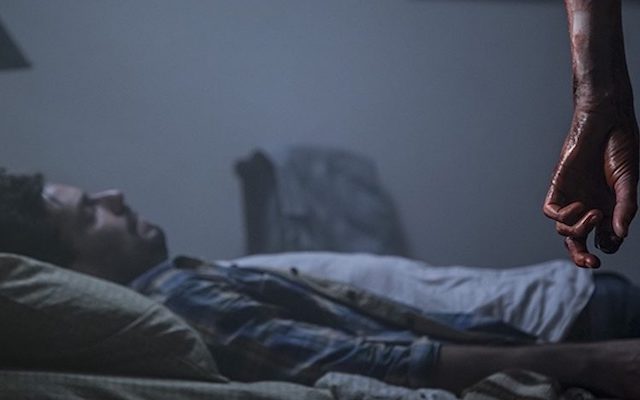
[Streaming on Shudder.] Buenos Aires is rife with supernatural activity in Demian Rugna’s “Terrified” (“Aterrados”), much of it centralized to a particular street (perhaps because of zoning?). The manifestations are frequently chilling, as when a man who hears a recurring “thump” sound investigates and finds his wife being flung repeatedly by an unseen force against the walls of the bathroom, or when a deceased boy returns bodily (and muddily) to his mother’s home. Flashbacks reveal how three houses on this block came to be connected by evil, and how paranormal investigator Dr. Allbreck (Elvira Onetto), her associate Jano (Norberto Gonzalo), and a cop (George Lewis) got involved. The shifting narrative perspective keeps things interesting, but while there are undeniably effective sequences, the film is ultimately a mish-mash of horror tropes without a central purpose, a parade of things you’ve seen before repackaged in shiny wrapping. The wrapping is pretty shiny, though.
Members of The Church of Jesus Christ of Latter-day Saints (or MOTCOJCOLDS for short) know Emma Hale Smith, wife of the Prophet Joseph Smith, as a loving spouse who put up with a lot of garbage. Long before her husband was murdered in 1844, she endured the deaths of some of her children, was forced out of one home after another, and had to contend with the then-secret practice of polygamy. It wasn’t enough that she had to share her husband with the whole church — she had to share him with other women, too.
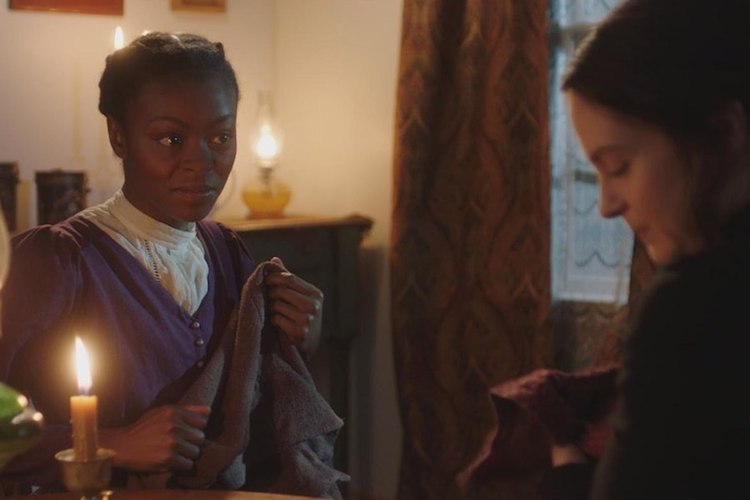
MOTCOJCOLDS are less familiar with Emma’s friend Jane Manning, one of the early church’s few black members at a time when even good-hearted saints were often hella racist. “Jane and Emma,” an engrossing historical drama set just before and after Joseph’s death, paints an inspiring portrait of two strong women who refuse to let go of their faith, but who also refuse to ignore the elements of their religion that make it difficult for people like them to stay. Directed by first-timer Chantelle Squires from a screenplay by Latter-day Saint author Melissa Leilani Larson, this is the rare film that’s spiritually uplifting without glossing over the hard parts.
In the story’s “present,” Jane (Danielle Deadwyler) returns to Nauvoo, Ill., after a brief absence to comfort Emma (Emily Goss) the day after Joseph’s martyrdom. The grief-stricken widow has sent all other mourners away, overwhelmed by their number and intensity, but she welcomes Jane, whom she considers a kindred spirit and fellow-sufferer. Emma is watching over Joseph’s body in case the mob that killed him (or another one; there’s no shortage of mobs) comes to take it. When well-meaning but perhaps insensitive church elders offer to take charge of the body — oh, and set up a public viewing, too — Emma dismisses them curtly. When a man asks whether she can protect herself if a mob descends on the house, Emma replies with action-heroine steeliness: “You’d be surprised, I think, at the things God gives me strength to do.” Buddy, you have no idea what this lady is capable of.
Flashbacks show Jane’s arrival in Nauvoo a year earlier, accompanied by several family members, all of whom walked to Illinois after being converted in Connecticut. The magnetic Joseph (Brad Schmidt) welcomes them, impressed by Jane’s spiritual insight and visions, and she takes a job at Joseph and Emma’s boarding house.
As the film toggles between 1843 and 1844, Jane and Emma’s sisterly bond is shown to be the product of the two elephants in the room: polygamy and racism. As the wife of the church’s top leader, Emma is constantly in the spotlight, constantly being judged, and has had to share the man she loves romantically with all the people who love him spiritually — and, thanks to polygamy, with some who love him romantically as well. As one of only a few black Mormon women, Jane must contend with her fellow saints’ racist attitudes, which sadly aren’t much different from those of the average American at the time. Both women are marginalized by the very community that was supposed to embrace them, that was supposed to embrace everyone. Joseph firmly rebukes one man’s race-oriented “doctrine” as false, but history shows that those beliefs found their way into official church policies after Joseph’s death, and stayed for more than a century. Joseph clearly loves Emma, but his practice of plural marriage, even if it was commanded by the Lord, is deeply humiliating to her. (In public, Emma went to her grave denying that Joseph was ever a polygamist.)
I’d like to see a movie someday focused entirely on Emma Smith’s life, but this one has the narrower scope of exploring her friendship with Jane, who emerges as a pragmatic, not-to-be-messed-with source of comfort and wisdom. Danielle Deadwyler, whose most prominent role before this was on Tyler Perry’s Oprah Winfrey Network soap opera “The Haves and the Have Nots,” brings rich, soulful nuance to the character of Jane Manning as she fights to maintain the inner peace the gospel brings her. It’s unfortunate that Emily Goss’ performance as Emma, while fitfully convincing and sometimes even powerful, lacks the strength and energy of Deadwyler’s. Their many scenes together are often imbalanced for this reason.
Larson’s tight screenplay (which assumes some familiarity with but not necessarily adherence to the LDS faith) has the two women asking tough questions about their faith, their religion, and their faith in their religion, but it never paints either of them as wholly one thing or another. Both women are flawed, and so is Joseph. Emma, who left the church after Joseph’s death and didn’t trek to Utah with Brigham Young and the pioneers, has been the subject of much character assassination by judgmental Latter-day Saints (then and now), but “Jane and Emma” doesn’t perpetuate that. It does, however, show how similar people can follow different paths when their faith is tested, reminding us to be grateful if our own tests haven’t been as agonizing.
One of the mammals in this photo is already having a bad time.
Drew Goddard wrote for TV’s “Buffy the Vampire Slayer” and “Lost” before he started making movies, and it shows. His first film as writer/director, “The Cabin in the Woods,” had a Buffy-like self-awareness and deconstructionist attitude, and his second — the pulpy neo-noir “Bad Times at the El Royale” — puts a group of strangers in an isolated location then uses flashbacks to reveal their histories one at a time. As with “Lost,” some of the tantalizing details that intrigue us so much at the beginning turn out to have disappointingly prosaic explanations; it’s more enjoyable as an unsolved mystery than as a solved one. But it’s a heck of a fun ride anyway, thanks to Goddard’s masterful storytelling. The guy knows when and how to reveal information for maximum impact.
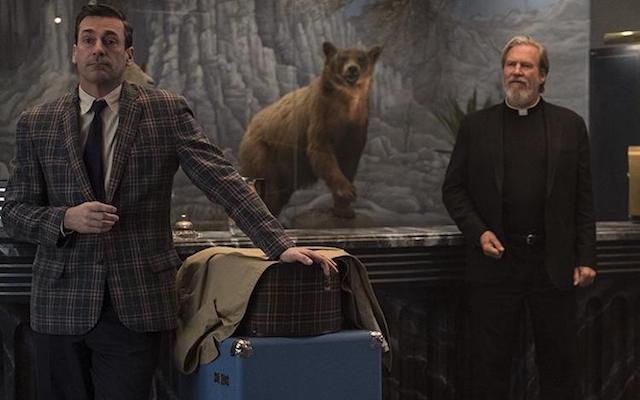
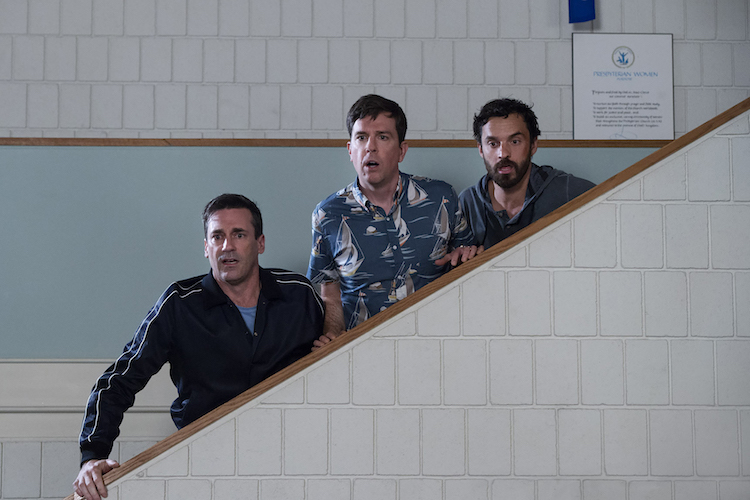
The time is 1969 — Jan. 27, to be exact, assuming the Nixon press conference seen on TV is live or from earlier that day. The El Royale, a once-hoppin’ mid-century modern motel near Lake Tahoe whose gimmick is that it straddles the California/Nevada border, has fallen on hard times. There’s no one at the front desk when guests start trickling in: Laramie Seymour Sullivan (Jon Hamm), a folksy traveling salesman from Mississippi; Darlene Sweet (Cynthia Erivo), a young black woman who is presumed to be a prostitute; Father Daniel Flynn (Jeff Bridges), a grizzled, friendly Indiana priest; and a seen-it-all woman in sunglasses (Dakota Johnson) who signs her name “F*** YOU” on the register. A young clerk, Miles (Lewis Pullman), is eventually rousted from the maintenance closet (where he’s been shooting up heroin, but that detail isn’t important now), and room assignments are made.
Describing what happens next is best done in vague terms. Every person mentioned so far is hiding something, and the El Royale, it turns out, is not a good place for keeping secrets, on account of every room being under surveillance. There was a prologue, set in 1959, in which we saw a man hide a satchel under the floorboards of one of the rooms, so we know that’s going to come up again. That’s on top of somebody having arrived at the El Royale with someone tied up in the trunk of their car, and in addition to the charismatic cult leader (Chris Hemsworth) who becomes a factor later on. Goddard breaks the movie into chapters, each named for a room number (or maintenance closet) and presenting the backstory of that room’s current occupant, often ending with a surprise reveal that makes us question what we thought we knew about that person. The plot keeps on thickening, in other words, with new details and possibilities arriving at an almost delirious pace.
The way everyone’s stories converge and overlap while evocative pop songs play on the soundtrack makes this feel like a nicer “Pulp Fiction,” one that’s more interested in telling an entertaining story than in being cool (but is cool nonetheless). Goddard takes his time and lets the characters have long conversations, including characters who won’t survive the movie, which keeps us guessing even on the matter of who’s going to emerge as the protagonist.
This free-wheeling but carefully controlled structure is a perfect environment for fun-loving actors to cut loose, sinking their teeth into their own multi-layered characters while facing off against each other. I only wish it added up to more than it does. “The Cabin in the Woods” brilliantly revealed itself to have been a shrewdly built dissection of horror movies in which every detail matters; “Bad Times at the El Royale,” in contrast, doesn’t have a central theme to tie its many, many threads to, and some are still dangling when it’s over. You’re expecting this delightfully twisted journey to have a humdinger of a destination, and then, well, no, turns out the journey was the thing. Keep that in mind and you’ll have a good time.
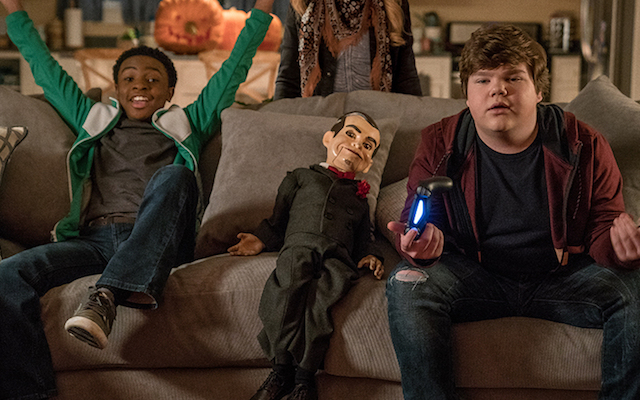
The first “Goosebumps” movie wasn’t an adaptation of one of R.L. Stine’s tween-horror books but a story about the “Goosebumps” books, in which Stine (played by Jack Black) had the power to bring his scary imaginings to life merely by writing them. With that established, the sequel doesn’t need Stine (though he shows up anyway, and remarks upon how he isn’t needed). “Goosebumps 2: Haunted Halloween” has a trio of teens finding one of Stine’s unpublished, unfinished manuscripts (that has for some reason been printed and bound), inadvertently releasing its evil into the world in the form of a ventriloquist’s dummy named Slappy (voiced by Mick Wingert).
Malevolent dolls can be pretty scary, but “G2: HH” keeps it PG, of course. Like its predecessor, the sequel doesn’t want to terrify children so much as give them Halloween funhouse vibes, which director Ari Sandel (“The Duff”) and screenwriter Rob Lieber (“Peter Rabbit”) more or less accomplish. It’s strictly garden-variety trick-or-treat frivolity, but it has a sense of humor, and the climactic mayhem — in which Halloween costumes, decorations, and even candy come to life — is admirably large-scale, including an amusing battle with a legion of gummy bears.
In a nutshell: pudgy science nerd Sonny (Jeremy Ray Taylor) and sidekick Sam (Caleel Harris) find the book in Stine’s old, abandoned house, and are surprised when Slappy magically appears and starts fighting bullies for them. Sonny’s older sister, Sarah (Madison Iseman), also gets involved, the film graciously skipping past the part where the kids say the doll is alive and nobody believes them. (“When a magic doll tells you to keep a secret, that’s a red flag,” Sarah says.) Slappy is friendly to them, his new “family,” but he’s vengeful toward their enemies and wants to unleash his magic on the whole town to create an army of monsters. (You know how it is with sentient puppets!) The kids are heroes, the adults (Wendi McLendon-Covey, Ken Jeong, Chris Parnell) are hapless bumblers, nobody gets hurt — PG monsters are only interested in property damage, really — and everybody goes home happy.
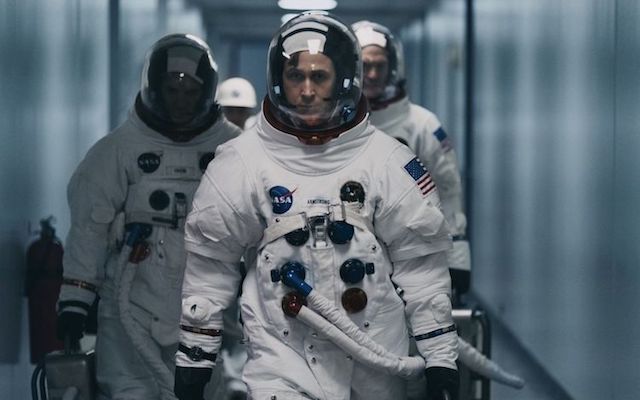
Ryan Gosling is a handsome man, but it’s his profile that’s most aesthetically pleasing. We saw a lot of it in “Drive,” where he sat behind the wheel of a car and was was often photographed from the passenger seat, and we see it again in “First Man,” where he’s a test pilot in a cockpit. The pilot, like the driver, is a man of few words who keeps his emotions under wraps. But unlike the driver, the pilot has a name: NEIL ARMSTRONG.
Yes, that one. “First Man,” which reunites Gosling with “La La Land” director Damien Chazelle, is a biography of Armstrong covering the decade-long journey that ended with him on the moon (well, that ended with him coming back from the moon). Adapted by Josh Singer (“The Post,” “Spotlight”) from James R. Hansen’s book, the film handles the biopic tropes with better-than-average success, shedding light on a man who had a household name but whose private nature made him an enigma to the public. It runs long, with restlessness setting in during the midsection, but Chazelle handles the climax — the moon landing itself — with breathless, meticulous cinematic skill.
Neil is an aeronautics engineer (an “egghead” in one observer’s estimation) and a fearless test pilot when, in 1962, he’s chosen for NASA’s Project Gemini, a steppingstone toward the Apollo missions that will lead us to the moon. It’s the height of the Cold War and the “space race,” and the Soviets have been beating America to all the benchmarks. It’s imperative, therefore, that we get to the moon before they do, because if they get there first, well, then, that would be bad, because…. (The movie does not finish the sentence.)
Neil and his wife, Janet (Claire Foy), and their little boy move to Houston, having already lost a daughter to cancer (they would have another son in Texas). Neil’s new co-worker, Ed White (Jason Clarke), lives across the street with his wife, Pat (Olivia Hamilton). The wives bond over the stress of being married to astronauts; Neil and Ed enjoy working together and would describe themselves as friends, but Neil never talks to Ed — or anyone — about his feelings. He’s particularly tightlipped about the death of his daughter, which affected him deeply.
The years pass quickly in movie terms as Chazelle hits the highlights of the Gemini missions and Armstrong’s role in them. (Side note: “Gemini” is consistently pronounced “gemin-ee,” not “gemin-eye.” The ’60s were a crazy time, man.) Neil emerges as a thoughtful scientist with steel nerves, saving his own life or the lives of others on more than one exciting occasion. But there are tragedies he cannot prevent, as space-exploration buffs no doubt recall. As time passes and the casualties mount, and as America is mired ever deeper in Vietnam and other unrest, people start to ask: Is going to the moon worth all the money and lives it’s costing?
The answer can only be yes, right? Chazelle doesn’t really make a strong case for it (other than presenting the culmination of the mission with reverent awe), but if it was all a boondoggle, then this story is depressing and ironic, not inspiring. But it seems a misstep to raise the “Is it worth it?” question and then act like it was rhetorical.
Like most of the missions it depicts, the film is top-notch in technical aspects, Linus Sandgren’s cinematography and Justin Hurwitz’s sweeping musical score leading the way. Also like the missions, the movie drags in the middle as a sense of repetition creeps in. (I know, I know: The process WAS repetitive.) You wouldn’t initially think of it as an effects-heavy film — it’s science-fact, not science-fiction — but the sequences set in space and on the moon are uncannily convincing, even better than the ones Stanley Kubrick faked 49 years ago (kidding). The supporting cast is full of familiar faces: Kyle Chandler, Pablo Schreiber, Christopher Abbott, Ciaran Hinds, Patrick Fugit, Lukas Haas, Shea Whigham, Ethan Embry, and Corey Stull. The latter plays Buzz Aldrin, who was a bit of a jerk, or at least comes off that way when the movie is about Neil Armstrong.
Biopics about people who were stoic and inscrutable are risky, as there often isn’t enough available information about them — because they were stoic and inscrutable, you see — to flesh out a movie protagonist. “First Man” and Gosling’s performance avoid that problem by giving Neil an arc that, accurate or not, provides satisfying resolution to his character. Scenes of people around the world celebrating what America has achieved on behalf of all mankind (minus the Soviets — this was to spite them, not help them) are a reminder that for all our manmade divisions and quarrels, we are one world that reached out and touched another one. And that’s pretty awesome.
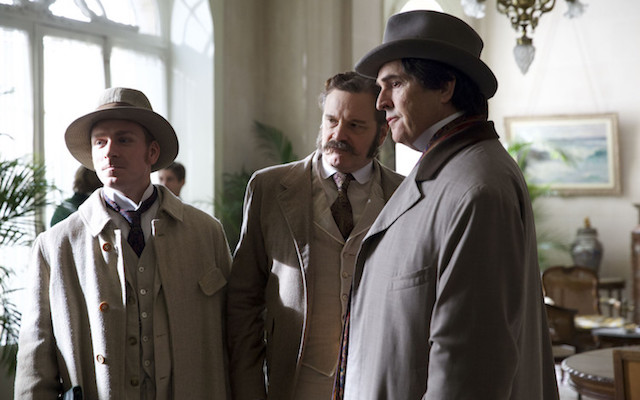
As a very funny gay person who never has enough money, I am the target audience for an Oscar Wilde biopic. But despite Rupert Everett’s passion as writer, director, and star — this is clearly the movie he was born to make — “The Happy Prince” is a lugubrious slog. It begins after Wilde has spent two years in prison for “gross indecency” (as they called homosexuality in those days), breaking his spirit and ruining his career. He’s penniless and ill, living as an “exiled fairy,” borrowing money from friends and strangers while trying sadly to maintain his dandyish lifestyle. He still comes up with droll witticisms regularly, though they’ve taken a dark turn. (Of his time in prison he says, “One never speaks, one simply weeps and has diarrhea.”) Except in very brief, dreamlike flashbacks, we never see him as a beloved public figure, never see what made him “Oscar Wilde.” It’s like a movie about the Titanic that only focuses on what happened after it sank. Everett tells the story in a non-linear fashion, like a dying fever dream, which is disorienting but not in a good way — following along is a chore, and we never get a good sense of who Wilde was. It’s just a recitation of events. It’s sincere, but let’s not overstate the importance of being earnest.
[Streaming on Netflix.] The title of “Private Life,” starring Paul Giamatti and Kathryn Hahn as an upscale Manhattan couple trying to have a baby, is ironic. There are fertility issues for both of them — he’s 47; she’s 41 (they’re both four years older than that in real life) — so they’re trying IVF, adoption, surrogates, the whole nine yards. Whatever it takes to put a baby into their lives, “short of kidnapping.” As anyone who has been through this intimate process knows, it is the very opposite of “private.”
Written and directed by Tamara Jenkins (“The Savages,” “Slums of Beverly Hills”), this is seldom an all-out comedy, though it does have droll moments and scenes, particularly when the sophisticated air is punctured by a well-placed vulgarity from Hahn, who’s on the receiving end of what can often be a dehumanizing process of injections and inspections. Jenkins sprawls the film out over 124 minutes, taking us through the many, many avenues a marginally fertile couple might explore, including flashbacks to things they already tried.
It’s somewhat exhausting, which is part of the point; imagine how they feel! It runs long, too, with a pace that is somewhere between “leisurely” and “indulgent,” and the atmosphere — the main characters and all of their associates are urbane, theater-referencing, well-educated people who claim to have money problems but don’t really — can be stifling. But Jenkins and the talented cast (also including Molly Shannon, Denis O’Hare, Kayli Carter, and John Carroll Lynch) show deep compassion for these issues, so much that I suspect the film will be cathartic for viewers who relate to them. And Hahn, a comedy dynamo, gives a deeply felt dramatic performance that adds another layer to my esteem for her.
"Never mind, get back inside my head where I can't see you."
Iron Man, Captain America, and the others in the Marvel Cinematic Universe would probably like to make it clear that “Venom” isn’t part of their program (though it’s better than at least one of the “Thor” movies). The Spider-Man villain, seen briefly in “Spider-Man 3” played by Topher Grace, gets a messy spinoff, directed by Ruben Fleischer (“Zombieland”), that has no overt connection to the larger Marvel canon besides the Stan Lee cameo, and which is a tonally uneven, mostly bumbling, and occasionally funny, sometimes on purpose. Is it good? No. Is it boring? Also no.
This time it’s Tom Hardy who plays Eddie Brock, a crusading investigative journalist in San Francisco who ruins his own career and that of his lawyer fiancée, Anne Weying (Michelle Williams), by going after Carlton Drake (Riz Ahmed), a tech/pharma billionaire whose efforts to cure cancer have taken an unethical turn. Publicly, Drake is a benevolent tycoon whose company is called The Life Foundation. Privately, as disclosed by conscientious scientist Dr. Dora Skirth (Jenny Slate), Drake is using alien life forms he found in a comet to experiment on humans. These “symbiotes,” as he calls them, can’t survive on Earth by themselves, but they become incredibly powerful when they take over a human host.
Eddie comes to be infected by one of these things, whereupon he becomes voraciously hungry and capable of great feats of strength. He hears the alien’s voice in his mind — it calls itself Venom — and is powerless to control his body when the alien takes charge, resulting in comical situations that are strikingly similar to what happened in “Upgrade,” starring Tom Hardy lookalike Logan Marshall-Green. A man arguing with a voice in his head is instant comedy, especially when the sinister-sounding alien is as petty and dumb as he is. For example, what makes Venom angriest is when someone refers to him as a “parasite.” Venom also says that the reason he’s turned against his fellow aliens’ plan to destroy the Earth is that he’s come to like the place, on account of “on my planet I’m kind of a loser, like you.”
That kind of thing is entertaining, but it doesn’t do much for the movie’s credibility. Both the hero and the voice in his head are buffoons, and so it is rarely possible to take “Venom” seriously even by the low standards of legitimacy set by other comic book movies. The dialogue is unmemorable, the plot formulaic, the characters paper-thin. Instead, you have to view it as a comedy, albeit one that only tries to be funny about 30 percent of the time. Admittedly, it’s not a great workaround.
Tom Hardy, doing an accent that’s somewhere between Brooklyn and what-the-hell-is-this?, appears to be having more fun than most people will have watching him. His performance is loose and silly, almost Stooge-like, calling to mind goofy turns by Mel Gibson long ago. Giving himself fully to the role, Hardy is by turns disheveled, feverish, manic, and confused. At no point does he seem to want us to think of Eddie Brock as a real person with complex emotions. Regardless of what anyone else is doing, Hardy is always just havin’ a laugh. Imagine how enjoyable it could have been if everyone had been on the same page.
(Full disclosure: I was 2-3 minutes late to the movie, so it’s possible everything that’s wrong with it was explained in the part I missed.)
A woman with a large nose could never make it in showbiz, and definitely not in a remake of "A Star Is Born."
Because of her outlandish costumery and made-up name, it’s easy to dismiss Lady Gaga as a gimmicky pop star. What we discover in the sturdy, old-fashioned “A Star Is Born” (if we hadn’t already) is that she has a strong, beautiful singing voice and a natural presence as an actor. Her co-star, Bradley Cooper, making his debut as a director, frequently shoots in close-up, creating an intimate mood that suits the story of someone being introduced to a new world. As we follow Gaga’s character on her journey, we feel every emotion along with her
Gaga plays Ally, a waitress at an L.A. drag bar who sings now and then at the the drag queens’ request. Cooper plays Jackson Maine, a country-rock star who stumbles into the bar one night looking for a drink — he stumbles into a lot of places looking for drinks — and finds himself smitten with Ally and her voice. A little later, when she improvises a song for him during a quiet conversation, he becomes smitten with her songwriting abilities, too. These early scenes are casual, gently humorous, and enrapturing.
Ally lives with her widowed father, Lorenzo (Andrew Dice Clay!), a limo driver who loves his proximity to celebrities and is fond of telling people that someone once told him he sang better than Frank Sinatra. He and Ally both believe the only thing stopping her from being a star is that she’s not pretty enough, a notion that Jack finds preposterous. He invites her to his next show, then calls her up onstage to sing a chill-inducing duet of one of her songs, “Shallow,” which brings the house down and threatens to make the movie (and their relationship) peak early. Footage of the duet hits YouTube, and a star, as they say, is birthed.
Now, it’s not that for one star to rise another star must fall; it’s just that that’s how this story is usually told. Cooper’s version, which he wrote with Eric Roth (“Forrest Gump,” “Munich”) and Will Fetters (a frequent Nicholas Sparks adapter), is based on the 1954 and 1976 screenplays — both of which trace their origins to the 1937 version (which was about actors, not singers) — and it follows the same pattern. As Ally’s career begins, Jack’s starts to sputter because of his alcoholism and pill addiction. He’s losing his hearing, too, but refuses to take precautionary measures, despite the pleading of his much older half-brother, manager, and babysitter, Bobby (played by Sam Elliott, whose voice Cooper is imitating and who supplies some of the film’s most touching moments).
Though this is ultimately Ally’s story, it’s intertwined with Jack’s, and much of what happens to her is because of him. We learn more about his background than hers — she’s the new star who appeared out of nowhere; he’s the one with a biography. Much of Ally’s character arc relates to her learning the ropes of fame and love, being taught by someone who’s kind of bad at both, and Gaga’s unadorned performance grants us a close-up view of the world through her eyes. But her role isn’t merely to react to what the man in her life does. She declares early in their relationship that she won’t get on his motorcycle with him if he’s been drinking and won’t come looking for him when he goes on a bender. She doesn’t abide his drunken jealousies; she learns from them. As much as Jack is a mentor to her, he’d more of a cautionary tale, and she shrewdly absorbs everything.
Gaga’s powerhouse voice is one of the film’s key assets, and Cooper is no slouch either. Both sang live on set (as opposed to lip-synching), adding to the sense of intimacy, and that intimacy has a profound effect. This rarely feels like a glitzy showbiz drama, but like a personal, private story of two artists in love. When Ally performs on “Saturday Night Live,” we don’t see how it looks to the folks at home; we see it from the perspective of one watching closely from the wings or in the studio space. The adoring crowds are never the point for either of them, and the movie packs an emotional wallop by shutting all of that out and focusing on these two faces and voices.
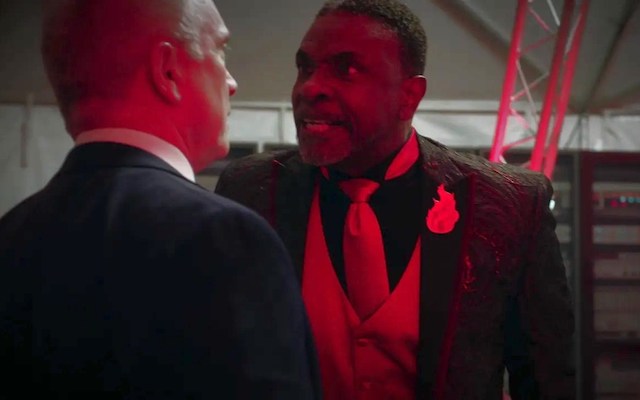
I never saw “Tales from the Hood,” but if “Tales from the Hood 2” is any indication, I must go back and watch it posthaste — though I wonder if the racial climate of 1995 could have inspired as much righteous anger and caustic satire in writer-directors Rusty Cundieff and Darin Scott as today’s does. The tone here is “We are DONE with your crap, racists.” I’m sure they were fed up then, too, but things have gotten worse in some ways, and they’ve had 23 more years to put up with it.
This is an incendiary, highly entertaining black-themed horror-comedy anthology, akin to what you’d get if Spike Lee (who executive-produced) made “Creepshow.” The stories are like the old E.C. horror comics, broadly played morality fables where people receive fitting punishments for their despicable acts. It’s the kind of movie where a character is named Dumass Beech just so someone can willfully mispronounce it “Dumbass Bitch.”
The setup is that the aforementioned Mr. Beech (Bill Martin Williams), a loathsome right-wing tycoon and Trump avatar, is building an A.I. robot called RoboPatriot to patrol America’s streets and make us safe again. Beech has hired professional storyteller Portifoy Simms (played by badass super-ham Keith David) to come in and spin some yarns for the robot to help it learn how to tell good guys from bad guys. Seeing Beech’s blatant racism (he brags about how the private prisons he owns are full of “your kind”), Simms naturally selects stories that will give RoboPatriot a better sense of racial justice than its creator has.
It’s a totally over-the-top premise, delivered with cartoonish gusto. It leads to an equally bonkers first segment, in which a clueless white girl and complacent black girl visit the Museum of Negrosity, a repository for racist merchandise and marketing of yesteryear — “the first true corporate brand,” says the ultra-serious owner (Lou Beatty Jr.) of the way white people stereotyped blacks after they couldn’t own them anymore. The white girl (Alexandria DeBerry) wants to find a replica of the golliwog doll she had as a child, but the curator won’t let her and her friend (Jasmine Akakpo) treat evil so lightly. You might guess where this all goes, but I doubt it, and even if you do, I bet it proves more grotesque and hilarious than you imagined.
The second story has a group of gangstas inadvertently killing a rival, then trying to force a TV psychic (Bryan Batt) to channel him so they can find out where he hid the money. This marvelously ridiculous premise is exploited to its fullest potential, with a very funny performance by Batt (whom you’ll remember as gay Sal on “Mad Men”).
Part three, about two Hollywood bros (one white, one black) who try to take advantage of two wannabe actresses, is the weakest of the lot and has little connection to the themes of the others. Such is the nature of anthologies.
The last segment is a curiosity, played straight like a “Twilight Zone” episode, complete with potentially heavy-handed message. A white woman (Jillian Batherson), pregnant by her black husband (Kendrick Cross) — who’s campaigning for a racist GOP Mississippi gubernatorial candidate — keeps having dreams about a young boy who we come to realize is Emmett Till. These dreams make her fear for the health of her baby for reasons I won’t spoil but which make metaphorical sense once they’re explained. “Respect the sacrifice” emerges as the rallying cry as other civil rights martyrs are invoked — the Ghosts of Racism Past, you might call them.
Part of me wishes the film had stayed at the same level of over-the-topness that it began with, where it provided laughs and shocks in equal measure while still making its (quite valid) political points. But I respect Cundieff and Scott’s choice to bring things to a serious point, preventing the movie from being “just” a biting but frivolous satire. This segment’s criticism is aimed at blacks who fail to “respect the sacrifices” their forebears made — who vote Republican, basically. Most of the people who would be offended by this or the film’s other messages won’t be seeing it anyway, but the movie doesn’t care if it does bother anyone. Like I said, they’re through tiptoeing.
And don’t worry — the resolution of the wraparound segments, back at the lab with Dumass Beech and Portifoy Simms, returns us to high levels of audacious anti-racist merriment. The glaring mixture of broad slapstick, potent satire, and exploitation-movie blood ‘n’ guts is all part of the film’s sloppy, winning charm.
After last year’s bumpy edition of Fantastic Fest, roiled by revelations that its founder had continued working with employees and associates who’d been credibly accused of sexual assault, this year’s raucous genre celebration felt almost normal — well, “normal” for an event that includes a compilation of cinema’s best deaths-by-car, an eating contest (WHICH I WON), and themed tattoos at the closing-night party. Except for Tim League no longer being its public face and ringmaster, the festival felt largely like it did two years ago.
That’s mostly a good thing. Last year’s trouble wasn’t because the festival itself had been a particularly unsafe environment for women (compared to any other large gathering), but because men associated with the fest and its parent company, Alamo Drafthouse, had been permitted by League to keep associating even after he’d become aware that they were creeps (one admitted it; one still denies everything but is lying). It wasn’t “Fantastic Fest” as a whole that needed to change; it was League’s confrontation-avoiding, under-the-rug-sweeping, let’s-all-just-be-pals business practices — and the male-centric attitudes that accompanied them — that had to go.
Photo credit: Jack Plunkett
So there was a shuffling of board members, the drafting of a new code of conduct, and League (who hadn’t been heavily involved in programming for a few years anyway) stepped away from the festival, though he remains CEO of the Drafthouse. He isn’t mentioned on the Fantastic Fest staff page, which now has more female members than it used to. After not being there at all last year, League was in attendance this week (as was his wife, Karrie), but he didn’t introduce films or host Q&As. His most visible public appearance was as a competitor in the eating contest (WHICH HE DID NOT WIN, BECAUSE I DID), dressed as a bottle of ketchup and following the Fantastic Fest ethos of day-drinking.
The best indication that Fantastic Fest had turned a corner happened on opening night. Last year’s opener, Three Billboards Outside Ebbing, Missouri — about a woman seeking justice for her daughter who had been brutally raped and murdered — was pulled by Fox Searchlight a few days ahead of time because of the controversy. This year’s curtain-raiser was Universal’s new Halloween — about a traumatized woman getting back at her male abuser after a 40-year wait — and not only did it play as scheduled, but Jamie Lee Curtis was there to support it and answer questions afterward. She would be a great “get” anyway, but having a universally admired female horror icon on hand to tacitly endorse the festival this particular year was a huge symbolic step forward. If Jamie Lee is cool with it, it must be OK, right?
(Halloween is a better fit for Fantastic Fest than Three Billboards anyway. Universal had a man in a Michael Myers costume standing in the pavilion beforehand, posing for photos, and gave out Myers masks at the post-film party. What would Fox Searchlight have done for Three Billboards? Have an angry lady in a Frances McDormand costume? I mean, that’s actually a great idea, but what does it have to do with a genre festival?)
Over the course of the week, I didn’t hear anyone from Fantastic Fest make any kind of public reference to last year’s troubles. That was probably a good call. The degree of difficulty in finding the right thing to say in such circumstances is extremely high; best to leave it alone and move forward. Evrim Ersoy, the fest’s creative director, filled League’s shoes by introducing prominent movies like Halloween and the secret screening (which was Suspiria), his hyperbolic enthusiasm and occasional awkwardness an endearing contrast to League’s sloppy-but-slick showmanship. To the extent that Fantastic Fest is a gathering of movie geeks, Ersoy reflects that better than League does. I always liked League’s shenanigans, but that was because he seemed fun and cool, not because he seemed like me.
Regular attendees could see that a few things had changed. A giant copy of that code of conduct was posted in the main hallway of the theater. Several of last year’s sponsors were gone, with a few new ones that included YouTube Originals and something called Legion M, which was consistently described as “the world’s first fan-owned entertainment company,” though we never found out what it actually does.
Many of us could name people who used to come but weren’t there this year, either because they didn’t want to support the festival anymore or because they couldn’t afford the increased prices: The basic Fan Badge was $520, up from $425; the Superfan Badge (which guarantees your first choice in every screening slot), formerly $490, was $640 this year, not including taxes and fees. The rate hike, presumably to compensate for the lost sponsors, didn’t go overwellwithsomefans; on the other hand, there were plenty of first-timers in attendance, and the website says all the badges sold out.**
And What About the Movies?
It’s hard to say whether the content of this year’s films was any different from usual, or if it was, whether it was deliberate. Movie trends are cyclical, and so are programmers’ tastes. (Also, there were 90 films in the lineup, and I saw a mere 30.) There used to be an uncomfortable number of movies with rape as a plot point, but that started changing a few years ago — whether because people stopped making them or Fantastic Fest stopped showing them, I don’t know. This year, I saw two movies in which a man stops another man from raping a woman, and only one in which rape was a significant plot point (and even then was only discussed, not shown).
Several of the films I saw had women doing what men usually do: kicking butt and/or taking names without being motivated by rape. Suspiria and Level 16 are both about groups of women taking control of their circumstances and not letting anyone — male or female — push them around. (So is The Perfection, though that one does involve sexual assault.) There’s Halloween, of course, which is about Laurie Strode, her daughter, and her granddaughter overcoming the effects of past abuse. Savage, Luz, and Cam are all about flawed women with dark sides who seek to empower themselves, while Border‘s protagonist is an unattractive woman who comes to understand and love herself (and who can also smell guilt and fear on people, incidentally). It feels like I saw less victimization of women than in years past — though, again, that trend has been waning anyway.
Which isn’t to say Fantastic Fest has gone soft. There was ample carnage, mayhem, gore, Nazis, cannibals, aliens, and demons, along with the thing that is Fantastic Fest’s most favorite thing of all: men punching and shooting each other. Donnybrook, Hold the Dark, The Standoff at Sparrow Creek, The Night Comes for Us, and Overlord are all centered on that theme, and it appears as a motif in many others.
But there was also an abundance of films without violence, or where the violence was fake and played for laughs. Keep an Eye Out, One Cut of the Dead, Mid90s, and The World Is Yours are all comedies, all of them recommendable, and all except Mid90s perfectly suited to the Fantastic Fest vibe. (Mid90s doesn’t clash, it just doesn’t have any genre elements.) After the Screaming Stops, its horrific title notwithstanding, is a pleasant documentary about the reunion of Matt and Luke Goss from ’80s British pop band Bros (pronounced Bross). It, too, belongs at Fantastic Fest only because it can be described as “awesome” — but as we’ve seen, there’s much to be gained by expanding the definition of Fantastic Fest to include more than just horror and violence.
Now let’s watch me win that eating contest.
**This is a subject for another article, but even with the rate hike, Fantastic Fest is cheaper than many festivals. If you have the $520 Fan Badge and see a movie in all 37 slots — the screenings are timed so this is actually possible — you’re paying $14.05 per movie. The comparable badge for SXSW 2019 was $825 if you booked it by Sept. 14 (it’s $925 now), which comes to $17.55 if you see every movie you possibly can (which would require rare scheduling miracles). Your most cost-effective option at Sundance is to buy 10 tickets for $500, or $50 per movie.
The premise of “Night School,” an overlong, under-funny comedy starring Kevin Hart, is that a 35-year-old high school dropout named Teddy Walker has to get his GED in order to get a job. That scenario, while not inherently funny, allows for innumerable complications that could make it funny, but none of them are employed by the screenplay (which is credited to Hart and five other guys). Instead, we get an exhausting series of pointless contrivances: Teddy hides his actions from his fiancée, Lisa (Megalyn Echikunwoke), who doesn’t know he dropped out of high school, doesn’t know he doesn’t currently have a job, and doesn’t know he’s been living beyond his means to impress her; Stewart (Taran Killam), the uptight principal at the school where Teddy takes night courses, is an old rival of Teddy’s from their own high school days and wants to sabotage his GED efforts for vaguely defined reasons.
The real conflict is that Teddy has dyslexia and a host of other learning disabilities that were never diagnosed, hence his frustration and eventual dropping out when he was a teen. It’s his GED instructor, Carrie (Tiffany Haddish), who figures this out (though we spotted it in the first scene of the movie, when Teddy took a test and the words and numbers started jumping around the page), and her solution is to use “alternative teaching methods” to help Teddy learn, e.g., kickboxing. Does that make sense? No, but it lets Kevin Hart and Tiffany Haddish horse around on gym mats while the GED students cheer them on.
Ah yes, the other students. There are six of them, including one who’s in prison but attends class via Skype. Some of these are played by recognizable comic actors (Mary Lynn Rajskub, Rob Riggle), but none of them are given enough humorous material to work with. They ought to have been one-joke ancillary characters — kooky classmates for our frantic protagonist — but instead each one gets an “arc,” dragging the runtime out further. Meanwhile, Teddy convinces the entire class (ALL OF THEM) to help him break into the principal’s office and steal the midterm rather than study for it, an inane tangent that kills another 20 minutes while offering minimal laughs.
Hart is characteristically sweaty and high-pitched, but he flounders with the material, which seeks to make him and the others Real People without doing the work to make their personalities and motivations more than one-dimensional. Haddish, normally an energetic presence, is wasted in a subdued role. Director Malcolm D. Lee (“Girls Trip,” “The Best Man”), rather than keep things tight and streamlined, lets the whole thing sprawl lazily. Six writers, an experienced director, a cast of funny people, and this is what they came up with? Believe me, I know what a group project looks like when it was slapped together the night before the due date.
In the parlance of rock-climbers, to “free solo” means to climb alone and without a rope — basically, to remove all margin for error. If you make a mistake, you die. What you must keep reminding yourself while watching the documentary “Free Solo” — about a man training to ascend one of the world’s most challenging cliffs — is this: If he had fallen to his death, they wouldn’t have made the movie. Or maybe they would have, but it would have been about his death, like that documentary about the guy who got eaten by a bear.
So, no, Alex Honnold does not fall to his death in “Free Solo.” As of this writing (October 2018), he has not fallen to his death at all, though it seems likely that he will at some point. Directed by Elizabeth Chai Vasarhelyi and Jimmy Chin (and a team of brave camera operators), this is an eye-popping profile of an extraordinary athlete whose brain literally doesn’t work the same as normal people’s (there’s an MRI and everything), yet who doesn’t behave like a reckless or thoughtless person. A lanky, amiable dude with zero body fat and a fondness for the word “stoked,” Honnold is an eco-conscious vegetarian who started a charitable foundation, not some Mountain Dew nihilist daredevil who gets off on risking his life.
Free soloing isn’t about public recognition anyway. In fact, one of the issues that arises in the film as Honnold prepares to climb 3,000-foot El Capitan in Yosemite National Park is that, for the first time, a camera crew will be watching him. The filmmakers are worried that being observed will make Honnold act differently — more boldly, perhaps — and they struggle with the hypothetical possibility that their presence will lead to his death. Honnold is concerned, too, in his own way. “I don’t want to fall off in front of my friends,” he says. “That’s messed up.”
The way you train for something like El Capitan is by climbing sections of it with a rope and harness, though I note that the presence of safety equipment doesn’t make anything Honnold does look less terrifying, and the high-definition cameras capture every precarious view in gorgeous detail. He trains with fellow pro climber Tommy Caldwell, who tells us about the “mental armor” that you have to wear if you’re the friend or loved one of a free-soloist. Honnold never tells anyone before he does a free-solo climb, lest he feel added pressure to “be safe.” His girlfriend, Sanni, a casual climber who’s responsible for Honnold being injured twice (RED FLAG, DUDE), struggles with the knowledge that climbing is more important to him than anything else. (It’s one of those “I know you told me this when we started dating, but I was hoping it wouldn’t apply to me” situations.)
Even knowing the eventual outcome of Honnold’s El Capitan endeavor, “Free Solo” is a thrilling story, mixing elements of nature documentaries (it’s being distributed by National Geographic) and character studies about fascinating weirdos. Prepare for a lot of breath-holding and armrest-clutching in what must be, on a physical level, the most unnerving movie of the year.
P.S. Because of El Capitan’s topography, the film includes dialogue such as “That’s 3,000 feet of crack-climbing” and “That’s the most magnificent crack on planet Earth.” Enjoy!
I don't know, I just thought they'd be ... littler.
(Full disclosure: The director of this film is the wife of a friend of mine, who is one of the producers. You shouldn’t listen to anything I say about this or any other movie.)
Louisa May Alcott’s beloved “Little Women” gets an update in this affectionate adaptation set in the present day. First-time director Clare Niederpruem and co-writer Kristi Shimek have Jo March (Sarah Davenport) as a headstrong 29-year-old trying to impress Prof. Freddy Bhair (Ian Bohen) with the fantasy novel she’s writing, all the while flashing back to her teenage years with her three sisters (Melanie Stone, Elise Jones, Allie Jennings), their mom (Lea Thompson), and their honorary fifth sister, Laurie (Lucas Grabeel). (Dad, instead of being in the Civil War, is in Afghanistan.) Those scenes are warm and wholesome, capturing the give and take of a functional, loving family, and the Marches’ peculiarities are endearing — and, if you came from a large family, relatable.
But I come to this as one with only passing familiarity with “Little Women” and no particular connection to it. I’m curious how hardcore Littletons (that’s what we call “Little Women” fans) will react. It has always seemed to me that part of the story’s charm was its quaint old-timeyness, which is negated by the modern setting. This version is definitely Jo’s story, too, with her sisters getting the short shrift and Jo sometimes coming across as a bit of a pill. Not all of the plot adjustments work, either — it’s not clear why Prof. Bhair is Jo’s only connection to the publishing world, for example — but the production is cheerful and heartfelt, and for some reason it’s always Christmas, so it wins points for sheer merriness.
[Streaming on Netflix.] Continuing the “Wind River” cycle of movies about outsiders going to cold, sad Indian reservations to investigate tragedies, here’s “Hold the Dark,” another brutally chilling drama from “Green Room” director Jeremy Saulnier. Adapted by Saulnier’s “Blue Ruin” star Macon Blair from William Giraldi’s novel, it stars Jeffrey Wright as Russell Core, a wildlife expert who’s summoned to the remote Alaskan village of Keelut by the pleadings of a woman, Medora Slone (Riley Keough), whose young son was taken by wolves. It’s the third child taken from this village in recent months, and Medora wants Core to find and kill the lupine offenders.
We would seem to have established a “Jaws” scenario here (underscored by Medora telling Core, “You’re gonna need better boots”), but it only begins as the story of an expert brought in to slay a beast before veering into other territory. Meanwhile, in Afghanistan (it’s late 2004), Medora’s soldier husband, Vernon (Alexander Skarsgard), is introduced in a way that sums up his character: He sees a fellow soldier raping a woman and violently stops him … but he doesn’t exactly hurry. Vernon himself is soon wounded and sent home, just in time to learn what has befallen his son. His reaction to that news, and to what has come out since then as the result of Core’s investigation in the woods and in the village, is, uh, problematic.
What follows is a moody procedural punctuated by sudden bursts of shocking violence, the graphic consequences of which Saulnier does not ignore. Vernon’s Indian friend Cheeon (Julian Black Antelope), whose daughter was a previous wolf victim, hates the police for their indifference, adding his anger to Vernon’s. James Badge Dale plays a police officer who tries to stop the violence, and who has the unenviable task of delivering a line that starts, “Cheeon, I know wolves took your girl…” which is a terrible thing to have to bring up.
The performances are strong, especially Wright as the aging, wheezing naturalist, and the story takes unexpected and fascinating turns, including some dabbling in Native American mysticism. It doesn’t come together well enough in the end to be an unqualified success, but it’s a bracing mood piece with compelling characters in a palpably, cinematically bleak setting.
“Smallfoot” is a light animated adventure set in a remote Himalayan village occupied by yetis, aka Abominable Snowmen (and Snowwomen), who have lived in isolation for generations. Though they have a complex societal hierarchy, the yetis are in many ways a primitive race. Their sacred stones tell them they are the only creatures in the world, that their mountain rests on a cloud held up by mammoths, and that they have to bang a gong each morning to make the great sky snail rise and shine its light on them. Nobody questions the yeti religion, least of all Migo (voice of Channing Tatum), our young protagonist, who opens the film by singing a song about how everything is great and he hopes nothing ever changes.
Well, tough luck, Migo. While outside the village one day, he encounters a legendary “smallfoot” — what you or I would call a “human man” — whose airplane (Migo doesn’t know what that is, either) has crashed nearby. The yetis’ tribal leader, the Stonekeeper (Common), has the carvings to show that smallfoots don’t exist and are merely a story that yetis tell their children — but Migo saw one. If the “no such thing as smallfoots” stone is inaccurate, what other traditions might be false? Next you’ll be telling him the sun will rise even if nobody bangs the gong…!
While Migo finds company with a handful of fellow smallfoot believers (including the Stonekeeper’s daughter, Meechee, voiced by Disney Channel star Zendaya), the smallfoot in question returns to human civilization, where news of his encounter reaches the ears of a TV-nature-show host named Percy (James Corden), who’d like to get a real yeti on camera but will settle for dressing his assistant in a yeti costume. Naturally, Percy and Migo do meet, are terrified but intrigued by one another, and must teach their respective races not to be ruled by fear and prejudice, et cetera.
It’s comfortable territory for an animated comedy, executed with cheerful aplomb by director Karey Kirkpatrick (“Over the Hedge”), who wrote the jaunty screenplay with Clare Sera from a story credited to “Cats & Dogs” writers Glenn Ficarra and John Requa.* That means there was a lot of rewriting (and check out that asterisk), but the film is more lucid and cohesive than script-by-committee projects usually are. There are many fine gags about Migo and the yetis misunderstanding human artifacts (they assume a roll of toilet paper is the equivalent of their stones, calling it “the scroll of invisible wisdom”), and good slapsticky shenanigans. I have a low tolerance for James Corden’s unctuous shtick, even in animated form, and having him sing a loose karaoke parody of “Under Pressure” is not a good way to change my opinion, but the rest of the voice cast — including LeBron James, Danny DeVito, Gina Rodriguez, Yara Shahidi, and “Rick and Morty’s” Justin Roiland — is charming and energetic.
Besides learning to communicate with and understand those who are different from you, the film has another straightforward, unmissable message: Accept the truth, no matter how uncomfortable or scary it is. Don’t assume your traditions are correct just because they’re yours. It would be fair to interpret this as being skeptical of religion, but the movie emphasizes that these are yeti “traditions,” not spiritual beliefs; there’s no mention of yeti deity or heaven or anything like that. (I called it “religion” earlier, but that was my word, not the movie’s.) The lesson isn’t to discard your beliefs, only to examine them. Anyway, the point is, I don’t want to hear from people who think “Smallfoot” is trying to get their kids to become atheists.
*Warner Bros. says it was all based on a book called “Yeti Tracks” by Sergio Pablos (who’s also an executive producer) — but as far as I can tell, no such book exists. The only references to it online are in articles about “Smallfoot.” A badly copy-edited interview with Ficarra and Requa suggests they never read it, either, but merely had it described to them. When “Smallfoot” was announced, the press release said Pablos (who created “Despicable Me”) would direct, and that Ficarra and Requa’s screenplay would be based on “an original idea” by him. That’s how the Sergio Pablos Animation Studios blog describes it, too. In other words, even Pablos himself doesn’t claim to have written a book called “Yeti Tracks,” but that’s where the credits say it came from. Who says studio marketers aren’t creative?
"...and then, at the end, Satan torments you for all eternity!"
The rare slasher film that’s not a sequel to or remake of a previous one, “Hell Fest” exploits the premise of a traveling Halloween carnival being infiltrated by an actual masked killer who avoids detection by blending in with the hired scarers. Directed by Gregory Plotkin (“Paranormal Activity: The Ghost Dimension”) from a screenplay with five names attached to it, the film is free of subtext and provides only minimal backstory: College student Natalie (Amy Forsyth), her best friend Brooke (Reign Edwards), Brooke’s sarcastic punk roommate Taylor (Bex Taylor-Klaus), and their respective male love interests go to the Hell Fest amusement park on Halloween night, where they — but Natalie in particular — are stalked by a Michael Myers-ish figure. The scares are modestly effective, and the between-scares scenes of six lively young people horsin’ around at a spook alley are tolerable. The place itself is a vast theme park full of creative environments (this is supposed to be a traveling operation?), and it’s fun to watch the characters interact with them even when they’re not being killed. Horror stalwart Tony Todd (the Candyman himself) has a one-scene cameo as if to give the potential new franchise its bona fides. It could have used more themed kills — smashing someone’s head with an oversized “test your strength” mallet is all we get — but slasher movies are like trick-or-treat candy: You can’t be too choosy.
Robert Redford as the old man; Sissy Spacek as the gun.
David Lowery’s last movie, “A Ghost Story,” was about a ghost but wasn’t a horror film. His new one, “The Old Man and the Gun,” is about a career bank robber but isn’t a heist thriller. Lowery keeps you on your toes if you’re a judge-a-movie-by-its-title kind of person, and he upends expectations once you’re in the theater, too.
“This story, also, is mostly true,” reads the title at the beginning, as if we’ve just joined a folksy storyteller mid-session. Robert Redford — whose last major film, “All Is Lost,” could have been called “The Old Man and the Sea” — is our old man with the gun, a septuagenarian bank robber who calls himself Bob but is really Forrest Tucker (but not the Forrest Tucker who was an actor). It’s 1981, and “Bob” and his buddies Teddy (Danny Glover) and Waller (Tom Waits) have been amblin’ around the American Southwest holdin’ up banks, using wigs and mustaches to obscure their already easy-to-overlook appearances. (Who pays attention to old men in a bank?) There’s never any violence, and Forrest is always described by witnesses as polite, gentlemanly, and happy.
Home again in the Dallas area, Forrest meets Jewel (Sissy Spacek), an effervescent widow who lives out in the country with her three horses. Forrest tells her he’s a traveling salesman, then is so quickly disarmed by her charm that he confesses he’s a bank robber before immediately backtracking and calling it a joke.
Meanwhile, a Dallas cop, 40-year-old family man John Hunt (Casey Affleck), happens to have been present for one of the group’s recent robberies and takes an interest in the case. It is he who discovers that there’s been a series of bank holdups perpetrated by old guys, a fact that the news media reports with more amusement than alarm, calling them the “Over-the-Hill Gang” and commenting on how one hopes Det. Hunt catches up with them before the Grim Reaper does. Forrest, seeing the coverage on TV, is delighted to at last have someone pursuing him.
You get the sense that this is all just for fun. Neither Forrest nor his cohorts has any apparent need for cash, nor do they spend it frivolously. (Forrest wants to use some to surreptitiously pay off Jewel’s mortgage.) Lowery, adapting a magazine article by David Grann, certainly doesn’t treat them like hardened criminals. He’s not interested in making a “heist” movie, either. Most of the gang’s jobs are the simple kind requiring almost no planning, and the one time there’s an exception, Lowery skips over the “Ocean’s 11” stuff. Flashbacks to Forrest’s earlier days as an outlaw are nostalgic and joyful. When there’s finally a car chase, Lowery sets it to Jackson C. Frank’s contemplative 1965 guitar ballad “Blues Run the Game.” Lowery seems to have made the movie for the same reason Forrest Tucker robbed banks: He just liked it, that’s all.
Danny Glover and Tom Waits aren’t given much to do, which is a shame, but they make the most of what they have. Affleck’s police detective is the low-stakes, Casey Affleck version of a hard-boiled cop with a grudge, amusingly determined to get his man but not, like, losing sleep over it. (The robberies are all so pleasant and practically victim-less, you know?) And it is a joy to see Sissy Spacek doing anything, but in particular to see her being feisty with Robert Redford, playing the woman who might be able to tame his wild ways. If anyone can, it’s her.
This isn’t the first time Robert Redford has played a bank robber, of course, but it may be the last — he’s been talking about retiring. If he does, this will be a fitting bookend to his 60-year career, a smiling swan song with gentle reminders of some of his past work. When Forrest tells Jewel he’s never ridden a horse, we assume he’s lying — not because Forrest is untruthful but because Forrest, besides being Forrest, is also Robert Redford. This role didn’t HAVE to be played by a veteran movie star at the end of his career, but the casting adds a very satisfying dimension to an already humorous, amiable story.
"And those ladies over there? Those are the Brothers sisters."
See, they’re a couple of brothers whose last name is Sisters. “The Sisters brothers.” Get it? As a novel, much of what made “The Sisters Brothers” so entertaining was author Patrick DeWitt’s amusingly dry way with words, his knack for turning a phrase. You’re bound to lose some of that with any film adaptation, but this version, directed by Jacques Audiard (“Rust and Bone,”“A Prophet”), conveys most of the book’s darkly comic charm while presenting a minor spin on the Western formula.
Set in 1851 in Oregon, it’s about a pair of hired assassins, Eli (John C. Reilly) and Charlie (Joaquin Phoenix) Sisters. Neither one has any qualms about killing, though Eli is starting to think about leaving the business and doing something quieter. (Charlie, a full-time alcoholic, is keen to keep drinking and murdering forever.) Their latest assignment is to find and execute a gold prospector named Hermann Kermit Warm (Riz Ahmed), who it turns out has developed a chemical method for finding gold deposits that the Sisterses’ shady boss, the Commodore (Rutger Hauer), wants to steal. A polite tracker named John Morris (Jake Gyllenhaal) leads the Sisters boys to Hermann, whereupon the four strike a new bargain.
There’s more to it than that; it’s an episodic, pleasantly rambling story with many scenic detours and quaint details, like Eli trying one of these newfangled “toothbrushes” for the first time. The brothers have violent, funny quarrels, but they stick together when facing opponents, like good brothers do. Phoenix is fascinating as the disastrous Charlie, while Reilly’s endearing performance as the curious, tender-hearted Eli is among his best. Ahmed and Gyllenhaal (also together in “Nightcrawler”) add color as the story’s secondary duo, playing characters who could just as easily be the protagonists in this diverting Western lark.
"No dessert till you've finished your demon-summoning."
Jack Black opted out of the “Goosebumps” sequel in order to make “The House with a Clock in Its Walls,” which is basically a “Goosebumps” movie but based on a different set of YA novels. Kids’ movies are a good place for the cartoonish, rubbery actor, doubly so if he’s not the main character (a little Jack Black goes a long way in my experience), and that’s the case here, where he plays Uncle Jonathan, a mildly competent warlock whose peculiar orphaned 10-year-old nephew, Lewis (Owen Vacarro), comes to live with him in his Gothic, enchanted house in 1955. The house and its furnishings are alive, and there’s a ticking sound coming from the walls because of a curse placed by its former owner, malevolent warlock Isaac Izard (Kyle MacLachlan). Izard is currently dead, but don’t expect that to stop him from trying to destroy the world.
Directed by horror auteur Eli Roth (his first PG movie), “THWACIIW” also delivers the always-welcome Cate Blanchett as Florence, the skilled witch next door who bickers playfully with Jonathan and helps Lewis discover his own powers. Blanchett and Black are fun together, though seeing their acting skills side-by-side is like watching Serena Williams play tennis against a pile of laundry, and Vacarro (from the “Daddy’s Home” movies) makes a sweet li’l dork. Roth provides plenty of goosebumpy, junior-level Halloween-type scares — jack-o-lanterns that come to life, a baby with Jack Black’s head (I don’t remember why), that sort of thing — most of which should be entertaining and not too traumatizing for kids 8 and up (or so; I don’t know your kids). For adults, it’s nothing special, but it’s tastefully macabre in that cozy October way and only has a few poop jokes.
“Assassination Nation,” based on the hashtags #woke and #metoo, is an in-your-face, self-consciously edgy satire about a town called Salem that goes witch-hunting after everyone’s online accounts are hacked and their secrets (and nude pics) are exposed. The primary target of everyone’s ire is Lily (Odessa Young), an above-it-all high-schooler who’s blamed for the hack, but she and her friends are mostly scapegoats. Some of what happens is harrowingly plausible (especially when it comes to police behavior and mob rule), and writer-director Sam Levinson (“Another Happy Day”) adeptly captures the dark side of a weaponized internet on his way to delivering a Tarantino-style bloodbath. But Levinson also loves to point the camera at girls’ butts while having those girls decry the male gaze — you might say he puts both asses in “Assassination” — and he’s eye-rollingly gleeful about alerting us to the movie’s “trigger warnings,” which appear on the screen in red, white, and blue lettering. (You can tell he really wanted to squeeze the word “American” into the title but couldn’t find a way.) The movie is raucous fun and occasionally suspenseful or horrific, but not nearly as insightful as it thinks it is.
We have Velvet Underground to thank for the title “Strike, Dear Mistress, and Cure His Heart,” but the movie of that name is from one Mickey Reece, an independent Oklahoma auteur who has made two dozen movies in the last 10 years that have been seen by almost no one. Plenty of obscure artists’ obscurity is merited, but “SDMACHH” shows a competent filmmaker with an experimental bent who takes inspiration from the Davids (Lynch and Cronenberg) and a couple of Andersons (Wes and Paul Thomas). And an Ingmar, too, I guess: This deadpan, perplexing oddity is inspired by Mr. Bergman’s “Autumn Sonata” (I know this only from the Fantastic Fest program blurb) and is the story of young married couple David (Jacob Snovel) and Madeline Middleston (Audrey Wagner), who have come to possess an old hotel near where Madeline’s estranged mother, famous concert pianist Dianne Herbert (Mary Buss), lives. Also present is Madeline’s vomiting, mostly brain-dead sister, Bailey (Elise Langer), who disgusts Mother. There are brief Lynchian dreams, a Cronenbergian bit of body horror, faux-eloquent conversations between carefully arranged actors a la Wes Anderson, and diversions and detours that put me in the mind of PTA’s “Magnolia.” (A young laborer renovating the hotel flirts with Madeline … and then we follow him home for a scene with his family.) Wryly narrated by Cate Jones with game performances by the eager cast, it’s the kind of unclassifiable movie that was never going to be a mainstream success but which might appeal to a certain breed of curiosity-seeker. I’ll say this: It’s short, dry, and beguiling, and I’m glad I saw it even if I’m unsure what I saw.
Coming-of-age metaphors collide messily in “Savage” (“Les Fauves”), a weak-willed French drama by Vincent Mariette in which teenage Laura (Lily-Rose Depp), spending the summer with cousins at a campground, is intrigued by the rumor that there’s a leopard loose in the woods. The alleged feline has been blamed for the deaths of local animals and even some human disappearances, and campers are on edge, especially after a boy Laura hooked up with goes missing. But Laura meets a reclusive, handsome writer named Paul Baltimore (Laurent Lafitte) who tells her he’s been perpetuating the leopard hoax himself, partly to give society the pleasure of a mystery (hoo boy, he’s very French) and partly to cover his own animal-killing activities (he uses a metal claw to replicate leopard slashes). Laura is fascinated by this, fascinated by Paul, fascinated by secrets, fascinated by the prospect of dead animals. (“Dead horses are beautiful,” she says. “I read a poem about it.”) A police investigator (Camille Cottin) whose own husband vanished last year adds intrigue to a film that’s ultimately more interested in presenting ambiguous symbols for adolescent awakening than in telling a story. Mariette and co-writer Marie Amachoukeli-Barsacq, too timid in their approach to the material, let it fall into the boring gap between bold genre thrills and high-minded arthouse metaphors.
Just as a physical specimen, the Predator clearly deserves to win this.
Unlike the late entries in some horror franchises, “The Predator” doesn’t pretend any of its predecessors didn’t happen, but you don’t need to have seen them, either. Directed and co-written by Shane Black (who was an actor in the original 1987 “Predator”), this gory, quippy sequel assumes you’ll easily catch up if you’re not familiar with the premise: that a robust, dreadlocked, sometimes invisible alien has come to Earth to hunt humans, and the humans have to fight it.
It’s not a very complicated mythology, and Black, co-writing with Fred Dekker (“The Monster Squad”), expands on it just enough to set up additional sequels, making sure not to get bogged down in world-building or references-to-previous-movies-inserting. This time around, an Army sniper named Quinn McKenna (Boyd Holbrook) is the only survivor after an encounter with a crashed Predator ship in the jungles of Mexico. From the wreckage he finds parts of the Predator’s armor, which he naturally mails home as souvenirs to his autistic son, Rory (Jacob Tremblay), in accordance with U.S. military protocol.
The specific Predator who crashed with the ship is captured by shadowy government agent Will Traeger (Sterling K. Brown) and taken to a top-secret lab from which it must eventually escape. A biologist named Casey Bracket (Olivia Munn) is brought in to study it. Meanwhile, McKenna, claiming his teammates in Mexico were killed by an alien, is put on a prison bus with a handful of other ex-military nutcases, including normal-ish Nebraska (Trevante Rhodes), wise-cracking Coyle (Keegan-Michael Key), and PTSD-addled Baxley (Thomas Jane). All of these must work together when the Predator gets loose and goes looking for the rest of its armor, which you’ll recall McKenna mailed to his autistic son.
Black, who wrote “Lethal Weapon” and wrote and directed “Iron Man 3,”“Kiss Kiss Bang Bang,” and “The Nice Guys,” is known for his dismantling of action-movie tropes. “The Predator” does a little of that — there’s a running gag where people question whether “predator” is the right term for something that hunts for sport — and generally holds a light, witty tone, but it’s not at the level of snarky self-awareness that Blackheads (as I assume Shane Black fans are called) might expect. And there are tonal missteps, too. Much is made of young Rory’s sensitivity to noise and commotion, and Quinn is a tender, protective father in that regard … but then he also kills a man in front of Rory and acts like it was nothing. Are you concerned about your sensitive son’s feelings or aren’t you? More to the point, is Rory autistic for a good narrative reason, or is it an easy gimmick to make him sympathetic?
Shane Black fans may consider this one of his lesser works, but “Predator” fans will find plenty of blood ‘n’ guts and entertaining action. Other creatures besides the main Predator are present for our amusement (and to set up future possibilities), and most of the human performances have their bright spots. Sterling K. Brown, in particular, seems to be having a good time. But there are no standout characters — there’s barely even a protagonist — and the movie never really comes together before its anticlimactic finale. It’s fine, and it’s an improvement over the “Alien vs. Predator” spinoffs, but we can do better than this.
Based on Darcey Bell’s novel, which must have been inspired by Gillian Flynn’s “Gone Girl,” “A Simple Favor” is a funny, dark-edged, lurid mystery-melodrama starring Anna Kendrick as a naive stay-at-home mom named Stephanie Smothers who turns detective when her hoity-toity best friend Emily Nelson (Blake Lively) goes missing. Eschewing the “females in peril” formula for one where the ladies control their own destinies, the film has director Paul Feig’s typically sunny, messy view of women, as seen in “Bridesmaids,”“Spy,”“The Heat,” and “Ghostbusters” (2016), but with less overt emphasis on comedy and more on MURDER (or the suspicion thereof).
Their young sons’ friendship notwithstanding, Stephanie and Emily are an unlikely pair of BFFs. Stephanie is a wholesome, chattery “soccer mom” type (and widow) with a swear jar at home; Emily, the high-powered head of P.R. for a world-famous fashion designer, has the phrase “Go f*** yourself” in her outgoing voice-mail message. Stephanie is intimidated by Emily, and the catty other moms and gay dads gossip about why a fabulous rich beauty like Emily would hang out with a timid loser like her. But though her educated mind has turned into “mommy brain” after several years of parenting, Stephanie is no dummy. She takes good lessons from the brash, sultry Emily, including valuable ones about how to deal with difficult men and when to say “I’m sorry” (about 90 percent less often than she currently does).
Emily, an inattentive mother on her best days, travels a lot for business and shares a too-lavish money-pit of a house with her husband, Sean (Henry Golding), with whom she has a tempestuously horny relationship. One day she asks Stephanie to pick up her kid after school while she attends to a work-related matter — no big deal; the boys play together all the time — and it’s a couple days before anyone realizes Emily has vanished-vanished, not just stopped answering her texts. The police get involved, suspecting Sean (it’s always the husband, right?) and flustering Stephanie — who feels guilty about her burgeoning friendship with her missing friend’s husband — with their questions.
Screenwriter Jessica Sharzer (who also adapted “Nerve”) gives Kendrick plenty to work with as a mousy doormat who must learn to stand up for herself, while Lively makes the most of her character’s eyebrow-raising yet undeniably effective life choices. We learn a great deal about both women’s pasts, and while the soapy plot gets pretty ludicrous, it avoids outright campiness, Feig and the cast striking just the right balance between taking things too seriously and not taking them seriously enough. The film runs smoothly, plot twists arriving at regularly scheduled intervals (40 minutes and 80 minutes, right on time), backed by a festive soundtrack of ’60s French pop. It spoils nothing to reveal that what we learn most about Emily and Stephanie is not to underestimate them.
He showed up to the set like this and they wrote the story around it.
[In theaters and Video on Demand.]••• “Mandy” stars Nicolas Cage, with Andrea Riseborough as his wife, the two of them living a lumberjack’s life in the Pacific Northwest in 1983. Intercut with scenes of their idyllic existence, reading fantasy novels and talking about which planets are their favorites, are scenes of a cult leader, Jeremiah (Linus Roache), and his dimwit followers occupying the same woods. The inciting incident occurs at the halfway point, making it a spoiler to tell you what the movie is about, but suffice it to say that Cage becomes hell-bent on revenge and that Riseborough is only in the first half.
The filmmaker is Panos Cosmatos, whose “Beyond the Black Rainbow” is a good litmus test for “Mandy” and its trippy LSD heavy-metal aesthetic, ponderous synthesizers, and unnatural colors. The first half is too somnolent for my tastes, but when it does eventually kick into high gear, Cage delivers the loudness and craziness his fans have come to expect. Indeed, you don’t even have to sign Nicolas Cage to star in a movie like “Mandy.” Just start filming and he’ll show up, summoned by the vibrations in the air. It’s about a man and woman who run afoul of cultists, and it ends with a chainsaw fight, and also there is a tiger for no reason. Nicolas Cage couldn’t not star in this if he wanted to, which he does not.
P.S.: I’m going to need a comprehensive list of movie cult leaders named Jeremiah.
P.P.S.: I’m going to need a comprehensive list of Nicolas Cage movies in which someone is set on fire.
It’s unlikely (I hope) that the Wershe family of Detroit will remind you of your own clan. As portrayed in “White Boy Rick,” a compelling if familiar fact-based drama set in 1984-88, the Wershes are low-class ignoramuses, the type of family where the dad (Matthew McConaughey) and his junkie teenage daughter (Bel Powley) can be having a loud, profane argument in the middle of the street and be joined by Grandpa (Bruce Dern), who pulls up and joins the screaming before he even knows what the topic is.
But as Roger Ebert used to say, movies are an empathy machine, a chance to see the world from someone else’s point of view. There’s plenty of judgment to be passed on the Wershes, and director Yann Demange (following his impressive debut in “’71” ) doesn’t sugarcoat their illegal activity or other questionable choices. But more than anything, “White Boy Rick” is the story of a desperately poor family striving to stay together despite the circumstances. They’re rough, uneducated characters — but they sure love each other.
The dad, Rick Sr., is a licensed gun dealer who operates mostly outside the law, selling weapons and silencers to drug dealers. Mom split years ago; the family has no money and lives in the bad part of town, but Rick has the eternal optimism of a born hustler. Things are always about to turn around for them. He has dreams of opening a chain of video stores. Why not leave this depressed city and start over somewhere else? “The lion don’t leave the Serengeti!” Rick says cheerily.
In the meantime, Rick’s 14-year-old son, Ricky (Richie Merritt), assists him in the gun trade. Confident despite being in the awkward, fuzzy-lipped stage of adolescence, Ricky knows his firearms and has no problem walking boldly into the den of a neighborhood drug gang to make a sale on his dad’s behalf. He comes away not only having closed the deal but having befriended the gang, which includes some kids his age. Amused by his non-blackness, they call him “White Boy Rick.”
Ricky’s knowledge of this drug operation, led by a guy named Johnny Curry (Jonathan Majors) with ties to the mayor’s office, puts him in a position to be leveraged by the FBI. The Feds, represented by Jennifer Jason Leigh and Rory Cochrane, know about Rick Sr.’s shady gun business. With the help of a Detroit police detective (Brian Tyree Henry), they put the squeeze on Ricky to keep Dad out of jail by informing on Johnny’s crew. They enlist Ricky first to buy crack, then to start selling it himself — all while he’s 14-16 years old.
WBR excels at his new trade. His father doesn’t approve, but his father — who sells guns to gang members, who use those guns to shoot people — has no moral authority. He’s worried about his son being used by the FBI, and about his daughter, Dawn, who’s addicted to the very stuff Rick slings and is living in a flophouse somewhere. Rick Sr.’s parents live across the street (Piper Laurie plays Grandma), but their stabilizing influence is minor at best. In one scene, Ricky tells his friends that he’s looking for a gun because “Grandma keeps hiding mine.”
The situation is fraught with numerous messy possibilities, many of which come to pass. The film, written by Andy Weiss and filmmaking brothers Logan and Noah Miller (“Touching Home”), becomes a rumbling crime biopic — montages of Ricky and cohorts living it up, Ricky hiding piles of cash under his bed, Rick Sr. calling him “Scarface” — with touches of dark humor and coarse but genuine familial affection. It also addresses the disparity between how Ricky is likely to be treated by the law if he’s caught and how his African American colleagues tend to be treated — a discussion that turns out to be ironic in Ricky’s case, the real-life details of which will astonish you if you don’t already know them. There turn out to be a “message,” but it’s not heavy-handed.
The movie is centered on Rick Jr., but top-billed Matthew McConaughey gives one of his best performances as Rick Sr. He imbues the rough-hewn patriarch, a well-intended but ill-equipped father, with vulnerability and regret that come through as Rick struggles to keep his family together and to maintain some semblance of authority. Surely we wouldn’t have made the earlier mistakes Rick Sr. did (knock on wood), but we understand his motivations then and desperation now.
Richie Merritt, a Baltimore teen with no prior professional acting experience, is quite good as Rick Jr., a role with its own unusual complexities. The character has had to grow up too fast, with a father who treats him more like a friend than a guardian; now, as a teen FBI informant, he’s immature with delusions of maturity, ultimately unable to fend for himself in an adult way. Many of this family’s problems are of their own making, but the system sure doesn’t help.
In addition to the obvious reasons — only seeing some of my friends’ posts, never seeing them in chronological order, so many of my friends’ friends being idiots, etc. — here are the rest of them.
They boil down to this: Facebook is a giant company with tremendous influence that acts recklessly, without oversight or regulation. The platform is used to spread hate and influence elections, and Facebook’s reaction is always, “Sorry, we’ve chosen not to exercise any control, so that’s out of our control. Golly, we’re just a li’l ol’ mom-and-pop internet site!” I finally got fed up.
(Links are approximately in chronological order, so skip to the bottom if you want to see the latest/worst ones.)
If you missed it: today it was confirmed that Facebook massively & knowingly inflated its video-view statistics, which had the DIRECT consequence of 90% of media orgs firing writers in favor of expensive video producers, who also got fired when it turned out video was worthless https://t.co/WqdAUBIe6L
I ain’t judgin’ anybody still on Facebook. I’m still on Twitter, after all, and it’s run by people who sympathize with white supremacists. One thing at a time.
You know how sometimes a horror movie will have various creepy apparitions, and how it doesn’t really matter why those particular images were chosen, the point is just to be creepy? But then you know how sometimes a horror movie makes a lot of money, so Warner Bros. commissions sequels and prequels and spinoffs to provide the backstory for everything, even if no backstory was needed?
This is “The Nun,” a prequel to “The Conjuring,” explaining where the demonic nun that Lorraine Warren (Vera Farmiga) kept seeing in “The Conjuring 2” came from. You don’t need to have seen any of those movies to understand this one. You don’t really even need to see THIS one to understand this one. Set in 1952, it’s about a Catholic priest (haunted by his past, of course) and a novitiate nun who are sent by the Vatican to investigate a nun’s suicide at a forlorn Romanian castle-convent, which it turns out is home to an ancient evil. Variations of “This place is no longer holy!” constitute approximately 30 percent of the dialogue.
Father Burke (Demián Bichir) and Sister Irene (Taissa Farmiga, little sister of Vera) are led to the dilapidated convent by Frenchie (Jonas Bloquet), a French-Canadian villager who delivers supplies every week and was the one to find the body. He’s been making deliveries for two years but had never actually seen anyone come out of the place until he saw Sister Whoever hanging from the window at the end of a rope, which hardly counts. Frenchie flirts with Sister Irene and is just skittish enough about creepy stuff to be mildly comical.
The usual freaky business ensues, directed with a smidgen of atmosphere by Corin Hardy (whose 2015 debut, “The Hallow,” was better), written by Gary Dauberman (who penned the other “Conjuring” spinoffs, “Annabelle” and “Annabelle: Creation”). There are a few unsettling images — a zombie nun, a snake coming out of a boy’s mouth — but it’s hard to tell in the moment whether they’re real or hallucinatory, so we never know how much danger the characters are actually in. The story offers no scares or surprises (other than things popping out suddenly from corners), but it checks off the boxes without actively insulting your intelligence. If you want higher praise than that, sorry, you’ll get nun.
In yet another “Death Wish” update teaching the valuable lesson that violence is the answer, “Peppermint” presents Jennifer Garner as Riley North, a Los Angeles woman who seeks revenge after her husband (Jeff Hephner) and little girl (Cailey Fleming) are killed by Mexican gangbangers. To prove the point, Riley and the girl have a scene early on where li’l Carly tells Mom she should have punched this mean other mom who was rude to her, and Riley says no, that’s not the way to live your life. The rest of the movie is Riley deciding that Carly was right and she should have punched that bitch. Oh, and it’s a Christmas movie, like “Die Hard.”
Most of it unfolds on Dec. 21, 2017, the five-year anniversary of Riley’s tragic loss. She’s been off the grid, learning how to fight and kill, ever since the corrupt legal system let the murderers go. Now she has reemerged, single-handedly reducing crime in the Skid Row district for a few months while waiting for Dec. 21 to arrive, as choosing just any random day to kill the men who killed her family would be tacky.
The choice of dates is the only stylistic touch to Riley’s methods. She’s otherwise a generically skilled and efficient assassin, dispatching the three actual murderers — plus the corrupt judge, D.A., and defense attorney — before the movie’s 40-minute mark, with hardly any panache or flair. I mean, she nails the judge’s hands to his dining room table before blowing up his house, but that’s it. She then moves on to wiping out the entire drug operation that spawned the gang, including its leader, Diego Garcia (Juan Pablo Raba), pausing only briefly to threaten a drunk, negligent stranger into sobriety for the sake of his son.
Riley’s spree catches the attention of LAPD detectives Carmichael (John Gallagher Jr.) and Beltran (John Ortiz), and of the FBI, in the person of Agent Inman (Annie Ilonzeh). Meanwhile, social media lights up with praise for the vigilante who’s cleanin’ up the streets. Before the sun goes down, it’s common knowledge that all of today’s killings were the work of one person, and everyone in L.A. knows Riley North’s name and face.
The film was directed by Pierre Morel, who made “Taken,” but the lazy, unimaginative screenplay is by Chad St. John, who had a hand in writing “London Has Fallen.” Garner has lost the action mojo she had on TV’s “Alias” (which I regret to inform you ended 12 years ago), coming across as a lightweight play-acting at toughness. Nothing Riley does is cathartic for her or the viewer; it’s slaughter for its own sake. She’s good at what she does, but her work isn’t very interesting to watch.
P.S. The title presumably comes from the flavor of ice cream that li’l Carly orders at the Christmas carnival before she and her daddy are gunned down in the street. But it’s never mentioned or referenced again, and Dad got ice cream, too, and the movie isn’t named after his flavor. Anyway: “Peppermint,” ladies and gentlemen. “Peppermint.”
“Cold Skin” starts with the Nietzsche quote about how monster-hunters must beware lest they become monsters themselves, staring into the abyss may result in the abyss staring back at you, yada yada. It’s pretty on-the-nose for the story that ensues, which is based on a novel by Albert Sánchez Piñol and directed by Xavier Gens (“Hitman”), but this chilly, restrained horror drama has a few surprises amid its familiar tropes.
It’s 1914 and war has just broken out, but that’s of little import to the residents of the small, barren island in the south Atlantic where the entire movie is set. There are exactly two residents: Friend (David Oakes), a disillusioned young man who has just arrived for a 12-month stint recording weather patterns for the British government; and Gruner (Ray Stevenson), a woolly misanthrope who runs the lighthouse a few hundred yards away from Friend’s cabin.
Actually, as Friend discovers his first night on the island, it may not be accurate to say that he and Gruner are the only inhabitants. There’s also a race of amphibious humanoid monsters who only come out at night, who besiege the cabin almost immediately, seemingly bent on eviscerating any flesh-based organism they encounter. (What happened to the last meteorologist stationed here, anyway…?) Gruner has obviously learned how to coexist with these things, insofar as he has not been eaten by them, but he’s not interested in sharing that knowledge with Friend until it becomes imperative. (Gruner is the type of person who should probably live in isolation from other humans.)
While Friend and Gruner spend most nights defending themselves from the monsters (which they call “frogs” but which more closely resemble the fish-man in “The Shape of Water”), during the day they get another view of the species thanks to the specimen Gruner has domesticated (played by Aura Garrido) who lives in the lighthouse with him like a pet. He never bothered to give her a name, but Friend — alarmed by the danger the creatures pose but cognizant of their intelligence — calls her Aneris and tries to balance his fear with compassion. Gruner points out that, after all, the “frogs” were here first — but Gruner’s stated intention is also to exterminate them, and he’s the one who treats Aneris like an animal. So don’t go by him.
With Aneris being a female member of the species and eerily beautiful in her way, living in isolation with two men, you wonder: Does the movie go there? It does, though perhaps not the way you’d expect. And truth be told, it would be a better film if it had gone further. As it is, it’s almost too reserved, too literary, playing footsie with the many horror/sex/madness possibilities of the scenario without fully exploiting them. But it’s an interesting, almost high-brow take on B-movie material, beautifully photographed, that isn’t too pretentious when it asks the perennial question “Who are the real monsters?”
As we’ve seen, the end of Adolf Hitler didn’t mean the end of the Nazis. Those suckers are hardy! “Operation Finale” recounts how one of the Naziest of the Nazis, Adolf Eichmann, was found hiding in Buenos Aires in 1960 and captured by Israeli Mossad operatives, all under the nose of the Argentine government, which wasn’t as cooperative with Nazi-hunting efforts as one would hope.
These are weighty matters, and when the film addresses the Holocaust itself, in flashbacks and memories, it is duly somber. But the rest of the time it’s a good old-fashioned Hollywood espionage caper, directed with rousing populist fervor by Chris Weitz (“About a Boy,”“The Golden Compass”), with Oscar Isaac as extraction team leader Peter Malkin and Ben Kingsley as Eichmann. The end-of-August release date was appropriate for a movie that’s not serious enough to be part of the fall “prestige” programming but not popcorny enough to be a summer blockbuster.
Eichmann is living under a false name in Buenos Aires when his son, Klaus (Joe Alwyn), starts dating a girl, Sylvia (Haley Lu Richardson), who is half-Jewish and alarmed when Klaus takes her to a clandestine Nazi meeting. (I am mildly curious about the romantic-comedy version of that story.) Word travels to Mossad headquarters in Tel Aviv, where plans are made to confirm whether it really is Eichmann, and if it is, to bring him to justice without violating Argentina’s sovereignty. When not violating Argentina’s sovereignty turns out not to be an option, the Mossad bosses (Lior Raz and Nick Kroll — yes, the comedian) do the next best thing and violate it secretly. Technically, what they plan to do to Eichmann isn’t arrest him but kidnap him.
Peter Malkin recruits a doctor for the mission, a former agent named Hanna Elian (Melanie Laurent) whose expertise will be needed to medically sedate Eichmann without killing him. Not everyone on the team is as conscientious about taking Eichmann alive, but Peter and Hanna (and their bosses) don’t want an assassination. They want a public trial. Israeli prime minister David Ben-Gurion (Simon Russell Beale) gives them a stirring speech on the symbolic importance of holding someone accountable for the Nazi atrocities — and the so-called “architect of the Holocaust” would be a good place to start.
We get the fun elements of the mission: surveillance, disguises, safe houses, banter among operatives, sexual tension between Peter and Hanna. Once they have Eichmann, they have to keep him under wraps for a while, so agents take turns sitting with him and trying not to be influenced by his devil-tongued sophistry. It was Eichmann to whom the phrase “the banality of evil” was first applied, and Kingsley’s performance shows how a monster can present himself as an ordinary, reasonable man. Oscar Isaac’s leading-man charm and the rest of the cast’s solid work make “Operation Finale” a respectfully entertaining Nazi-hunting adventure.
“Arizona” is a dark horror/comedy set after the housing collapse in 2009, an era that ought to have inspired more dark horror/comedies than it has. It stars Rosemarie DeWitt as a divorced mom in an Arizona suburb who’s about to lose her house while still working for the sleazy realtor (Seth Rogen) who sold it to her. A disgruntled homeowner played by Danny McBride confronts the boss, accidentally kills him, then takes DeWitt hostage because she witnessed it. Things escalate from there, as they do.
It starts out well, if you’re into dark comedies where violent things happen, which I very much am. McBride isn’t a terrifying psycho but a doofy suburban dad who’s immediately in over his head with a woman who’s smart and resourceful. He’s got DeWitt tied up in his kitchen when his ex-wife walks in, and she’s played by Kaitlin Olson — Dee on “It’s Always Sunny in Philadelphia.” If you know that show, you know how funny (and mean) she can be when responding to a man’s frustrating stupidity.
But the movie, directed by first-timer Jonathan Watson and written by Luke Del Tredici (TV’s “Brooklyn Nine-Nine”), soon stops being the funny version of this story and just becomes the regular version, where McBride is a psycho with no compunction about killing, and that gets old fast. And it’s a shame. DeWitt is perfect, the underlying premise of a man driven to desperation by the housing collapse is fine material, and a mostly abandoned housing tract where all the homes look the same and there’s nothing for miles around is a great horror setting. And David Alan Grier as the local sheriff! But alas, it all falls apart. JUST LIKE THE HOUSING MARKET.
When teenage Margot (Michelle La) goes missing, her widowed father, David (John Cho), with whom she has always enjoyed a close relationship, realizes he doesn’t actually know any of her friends and has no idea where to start looking. Thus “Searching” is about a parent’s nightmare, made worse (like most things) by the internet, which proves to be both the cause of and solution to David and Margot’s problems.
Directed by first-timer Aneesh Chaganty from a screenplay he wrote with Sev Ohanian, “Searching” was produced by Timur Bekmambetov, the crazy Russian who used to make whacked-out vampire movies but has recently taken to the “screen life” genre, wherein entire narratives play out on computer screens. In this case, it’s David on his own laptop and on Margot’s, looking through her past video blogs, FaceTiming with various people, searching emails and photos for clues, watching live news coverage. For it to work, you have to accept that everyone — even police detectives, even strangers — conducts most of their conversations over FaceTime, and that a teenage vlogger would keep live-casting after her dad came into the room, and a few other not-quite-plausible things.
You also have to accept Debra Messing’s bewilderingly bad performance as the sympathetic cop working the case. Whatever she’s doing, Chaganty should have stopped her.
But it works pretty well overall, Chaganty staying within the confines of the gimmick while still the usual grammar of film (close-ups, pans, dramatic music, etc.). He shoots two people having a FaceTime conversation the same way you’d shoot a traditional phone call, only instead of cutting back and forth between locations, he cuts from one window on the desktop screen to another window on the same desktop. The plot, with the customary red herrings, false leads, and last-minute surprises, all faintly ludicrous in a “Law & Order: SVU” kind of way, isn’t reliant on the format and would have worked just fine as a traditional narrative, but the “screen life” structure grants us moments we wouldn’t get otherwise, like an angry parent typing out a lengthy, scolding text message to a disobedient child before taking a breath and replacing it with something less emotional. It’s interesting to see the details of a thought process that’s usually internal, and John Cho’s sympathetic and fully committed performance as the worried father grounds the movie, giving it a beating heart instead of just a racing pulse.
It's a puppet murder. Anyone could have had a hand in it.
“The Happytime Murders” is a dismal execution of a great premise, in which puppets (think Muppets) live alongside humans in Los Angeles as second-class citizens, the way toons and people did in “Who Framed Roger Rabbit.” When the felt cast members of a popular ’90s TV show start dying, grizzled puppet P.I. Phil Philips (Bill Barretta) teams up with flesh-and-blood police detective Connie Edwards (Melissa McCarthy) — his partner back when he was briefly the LAPD’s first (and last) puppet cop — to unravel the mystery.
The hook is that the movie is gleefully filthy — puppets swear and have sex! — and has “gory” violence (crime scenes covered in fluff, like from the inside of a pillow). But Todd Berger’s screenplay is woefully under-written in that regard, relying too much on the juxtaposition of profanity and puppets for easy laughs, and getting bogged down in the straightforward film noir plot, which could have used more satire.
Directed by Brian Henson — yep, Jim Henson’s son — the film is funnier when it dwells on the logistics of a human/puppet society, where half the population is always at risk of being torn apart by a playful dog, and where humans show open contempt for their felt neighbors, insulting them right to their dumb faces. I love that the puppet equivalent of hard drugs is sugar, which Connie has a tolerance for (or perhaps an addiction to) because she received a puppet liver in a transplant.
It would also be better if it had more interaction between Melissa McCarthy and Maya Rudolph, who plays Phil’s (human) secretary, Bubbles. But that’s true of almost all movies.
“A.X.L.,” a wholesome boy-and-his-dog adventure and an inoffensive PG trifle, is patterned after “The Iron Giant” — a good role model for any movie to emulate, though obviously a hard one to measure up to. It also has shades of “Short Circuit,” “E.T.,” and the like, being the story of an underdog teenage motocrosser named Miles (Alex Neustaedter) who finds and befriends a robotic war-dog that escaped from the military contractors who built it.
Named A.X.L. (Attack Exploration Logistics), the Great Dane-sized cyber-beast has the loyalty and playfulness of a real dog mixed with the lethal capabilities of a tank, with some Transformer qualities thrown in for good measure. (We won’t see the “Transformers” prequel “Bumblebee” till Christmas, but I feel like “A.X.L.” is basically it.) It has fully articulated ears, makes growling sounds, even “sniffs” people, all while using its internal hardware to scan nearby electronic devices, hack phones, and so forth. As pets go, it’s the whole package.
A.X.L. imprints on Miles and his quasi-girlfriend, Sara (Becky G), thereafter protecting them from Sam (Alex MacNicoll), the rich brat who is Miles’ racing and romantic rival. Back at the high-tech lab where A.X.L. was created, its inventor (Dominic Rains) argues with an underling (Lou Taylor Pucci) about whether to retrieve it or wait and see how it does in its first interactions with humans (there’s a chance it will just kill them). Miles’ supportive father (Thomas Jane) is mostly kept out of the loop, involved only enough to justify hiring a “name” actor to play him. (Sam’s jerk dad is played by Ted McGinley.)
New writer-director Oliver Daly, expanding on his 2015 short, keeps things simple, targeting young viewers — and, to a lesser extent, dog lovers — who want a low-impact fantasy. It doesn’t withstand scientific scrutiny, and the dialogue is purely functional, but the movie meets the basic narrative requirements.
“Papillon” is based on the memoirs of Henri Charrière, a 1930s French safecracker who was sent to an inescapable penal colony from which he subsequently (spoiler alert) escaped. But it’s also based on the 1973 film version of those memoirs (screenwriters Dalton Trumbo and Lorenzo Semple Jr. are officially credited) and hews closely to it. What’s more, director Michael Noer has cast two actors who bear more than passing resemblance to Steve McQueen and Dustin Hoffman, practically begging us to compare the remake to the original.
And guess what? In most ways, Noer’s version improves upon Franklin J. Schaffner’s, which benefited from star power but didn’t feature those stars’ best work. Charlie Hunnam and Rami Malek have more to prove than McQueen and Hoffman did 45 years ago, as does Noer, a Dane making his English-language debut. The remake is a few minutes longer than the original yet feels shorter, more efficient, more engaging, with a screenplay (by “Prisoners” writer Aaron Guzikowski) that brings out the relationship at the story’s heart.
Robust, well-abbed gentleman Henri (Hunnam), called Papillon because of the butterfly tattoo on his chest, is a non-violent thief who was framed for the murder of a pimp. Given his occupation of stealthy skulduggery, it’s no surprise his first thought upon arriving in prison is to escape from it. But the prison is in French Guyana, with a shark-filled ocean on one side and desolate wilderness on the other. Anyone attempting escape will need help from outside parties, which means they will need money.
Louis Dega (Malek), in the same freshman class of prisoners as Papillon, is a wealthy forger with access to plenty of dough — he keeps it hidden in his butt, which was the style at the time — but no way to protect himself from the hardcore inmates who would slice him open and make a withdrawal if given half a chance. Papillon offers to protect Dega in exchange for cash and escape assistance, and they become an odd-couple pair of pals.
The prison has the cruel guards and dehumanizing punishments you’d expect, plus brutal labor requirements and the very real possibility of dying due from disease or injury. The sobering realities of life in a penal colony are presented matter-of-factly (I wasn’t exaggerating about the cutting-you-open thing), and Noer doesn’t shy away from them. But he doesn’t dwell on them, either, and the bleakly compelling story of endurance and strength is really the story of a noble friendship marked by unspoken tenderness. Neither Hunnam nor Malek is a heavyweight actor (yet), but both offer scrappy sincerity.
Peter Berg, director of good movies like “Friday Night Lights” and “The Rundown,” has fallen in with a bad crowd lately, and that crowd’s name is Mark Wahlberg. After an auspicious start with “Lone Survivor,” each of their subsequent collaborations — “Deepwater Horizon,”“Patriots Day,” and now “Mile 22” — has been worse than the one before it, culminating in this simple-minded, jingoistic celebration of violence that totally misuses Wahlberg’s limited range of abilities.
Instead of playing a blue-collar everyman, which he’s good at, Wahlberg plays Jimmy Silva, an insufferable snotbag who’s smarter than everyone else (according to the life-story montage under the opening credits) and can’t help being a snippy jerk to his underlings. Jimmy is a team leader for a secret tactical branch of the State Department that handles “sensitive” operations, i.e., ones that require more wanton murder than the public (or the Constitution) can stomach. In the pre-title sequence, Jimmy’s team busts in on a suburban house full of Russian spies and, when things go awry, hurries to execute every last one of them before the police arrive, since this is all off-the-books. So it’s like that.
Sixteen months later, Jimmy and company are working at the U.S. embassy in the capital city of a country in Southeast Asia that everyone conspicuously avoids naming (“our host country” and “the country we’re in now” are two things I heard people say). A quantity of radioactive cesium is missing, possibly with the help of the corrupt local government, but one of their own — a police officer named Li Noor (Iko Uwais) — shows up at the embassy declaring he knows where it is and will trade that information for asylum in the U.S. Li Noor has been an informant before, and Jimmy’s teammate Alice Kerr (Lauren Cohan) trusts him. The team (which also includes Ronda Rousey) is instructed by their boss, Bishop (John Malkovich in a terrible flattop), to get Li safely to the airport 22 miles away before any of the various people who want him dead catch him.
It should be relatively easy to make an entertaining action movie based on the premise of getting an important asset from Point A to Point B, but Berg and screenwriter Lea Carpenter blow it. The miscasting of Marky Mark as a supposedly deeply and enigmatic semi-autistic egghead is the first mistake. I don’t know if any actor could have played the role as written without being completely irritating (instead of a personality he has idiosyncrasies like constantly snapping a rubber bracelet), but Wahlberg obviously can’t.
Speaking of casting, Li Noor is played by Iko Uwais, the astonishing Indonesian fighter from “The Raid: Redemption” and “The Raid 2.” It was for those abilities that he was hired, of course, and he gets a few opportunities to kick henchman butt over the course of the film. But the rest of the violence — of which there is much, and Berg wallows in it, sometimes sadistically — is mostly undifferentiated gunfire and cruelty, shot and edited for maximum incoherence.
On top of all that is the distasteful and tone-deaf American arrogance at the heart of the film. Jimmy’s secret squad operates outside the law according to “a higher form of patriotism” (which, not for nothing, is also what terrorists say), accountable to no one, free to blow up anything they need to wherever in the world they may be. The notion that military strength is what makes America great, while popular, is false, especially when that strength is exercised with such careless, short-sighted selfishness. “Mile 22” was very clearly intended to launch a franchise, but with a miscast know-it-all in the lead and a hostile ideology at its core, I’m not sure I’m interested in any further adventures.
They don’t make a lot of movies that are set in 18,000 B.C. and told entirely in made-up caveman languages, perhaps for obvious reasons. Nor is the theme of “where dogs came from” often explored in film, though that angle sounds a lot more lucrative. Here to fill those needs is “Alpha,” set 20 millennia ago among the hunter-gatherers of Europe, starring Kodi Smit-McPhee as a teen who becomes separated from his tribe and must find his way home in a harsh but beautiful world, befriending a wolf along the way. The use of a fictitious primitive language (subtitled in English, of course) gives the film an earnest geekiness, which, in addition to the occasionally dodgy CGI, means we’re always teetering on the edge of ridiculousness. But it mostly works, and it’s unusual and ambitious, which is always good for a few bonus points.
Our boy, a soft, willowy lad named Keda, is the son of the tribal chief, Tau (Johannes Haukur Johannesson), and is joining the men for the first time on their annual buffalo hunt. Father and son both take the rite of passage seriously, Tau spending much of the first 30 minutes of the film giving Keda loving guidance and stern correction, emphasizing the principle that everything in life — even life itself — must be earned. When a hunter from another clan observes that Tau must be proud of his son, his reply indicates this has not yet been determined: “I hope he makes me proud.” No pressure, Keda!
As the result of a scary, vertigo-inducing encounter with a herd of buffalo near a cliff, Tau and the hunters come to believe that Keda is dead, or at least beyond saving, and mournfully leave him behind. But Keda is not dead, just badly injured, and here, at the halfway point, is when the film becomes a survivalist adventure, like a PG-13 version of “The Revenant.” Armed with a knife, Keda proves resourceful and well trained, though he still struggles with making fire, and more peril awaits him in the form of flash floods, saber-toothed tigers, and a pack of wolves. One of those wolves, wounded in its altercation with Keda, sticks around and bonds with the kid. The whole premise of the movie — prehistoric boy meets wolf — is thus a spoiler, since it doesn’t begin to happen until the second half.
Written with a sense of innocent wonder by first-timer Daniele Sebastian Wiedenhaupt, the film isn’t long yet could have used some trimming in the first act, leading up to the incident on the cliff. That’s when the story becomes truly engaging, and when director Albert Hughes (on his first solo outing after making “Menace II Society,” “Dead Presidents,” “From Hell,” and “The Book of Eli” with his twin brother Allen) can start showing off the movie’s gorgeous, desolate landscapes. There’s a lot of natural beauty here (it was shot mostly in Canada), and Hughes composes evocative and haunting images. There’s also a lot of CGI, some of which is unconvincing and mildly distracting. But Keda’s journey is frequently thrilling in the way that boys’ adventure novels are, intense but not overwhelming, with a satisfying resolution. I liked it; I think an outdoorsy kid who’s 11 or 12 would love it.
All is tranquil at the beginning of “We the Animals” before it evolves into a gentle, aching coming-of-age story for 10-year-old Jonah (Evan Rosado), who will soon learn that you have to take the moments of joy wherever you can find them. Up till now, it seemed like everything was joy.
Jonah, an introspective boy who keeps a secret diary that’s mostly pictures, lives with his two brothers (barely older than he is) and their parents in upstate New York in about the early ’90s. Ma (Sheila Vand) and Pops (Raul Castillo) were high school sweethearts who got married too young, and their loving but tumultuous relationship has grown untenable. Pops moves out, Ma spirals into depression; the boys, enjoying an otherwise carefree summer, are neglected.
In the midst of this, they meet a slightly older boy, Dustin (Giovanni Pacciarelli), the grandson of a neighbor, with whom Jonah becomes smitten (not that he understands his feelings). Dustin shows the boys a porn tape. Jonah’s brothers are probably no better equipped to handle it than he is, but the movie’s not about them. Jonah has been exposed to sex and other “adult themes” too early and lacks sufficient guidance to process it — and that’s aside from his burgeoning non-heterosexuality — hence the journal, hence everything else that ensues.
First-time feature director Jeremiah Zagar, adapting Justin Torres’ semi-autobiographical novel, handles sensitive subjects with discretion and grace. The film is full of wonderful, evocative details: the boys role-playing their parents on the phone, cracking themselves up with their impersonations; a lazy Sunday afternoon when the whole family is quietly lounging in the sunny living room; the boys’ barefoot, shirtless summertime romps against the backdrop of there not being any food in the house. Nick Zammuto’s moody electronica score and Mark Samsonovich’s simple animations contribute to the idyllic tone of this lovely, heartbreaking gem about queer awakenings and misspent youth.
In a slightly different movie, this moment leads to an awesome fight.
There are two things about “Crazy Rich Asians” that separate it from most romantic comedies. One is that it’s good. Based on Kevin Kwan’s bestselling novel and directed by John M. Chu (“Step Up 2: The Streets,”“Now You See Me 2”), it uses one of the standard formulas, but the plot isn’t based on dumb lies or moronic misunderstandings quite as much as most rom-coms’ plots are, and the characters generally aren’t self-absorbed simpletons. This counts for a lot.
The other noteworthy thing is that except for a few minor characters, everybody in the movie is Asian. Mixed in with the usual tropes of disapproving mothers, kooky relatives, jealous ex-girlfriends, catty gay sidekicks, montages of trying on dresses, frantic trips to the airport, public reconciliations, etc., are elements of Asian culture (Chinese, specifically) that give the familiar proceedings a mildly exotic twist if you’re a Westerner — to say nothing of how it must resonate for Asian audiences, who have seldom seen themselves or their culture in the framework of a Hollywood rom-com.
The story in this particular Hollywood rom-com is the one where a smart, independent New York career gal, Rachel Chu (Constance Wu), accompanies her handsome boyfriend, Nick Young (Henry Golding), to a friend’s wedding in Singapore, where she learns that Nick is heir to a global fortune and his family is one of the wealthiest in the region. Rachel comes from a working-class background, so Nick’s imperious mother, Eleanor (Michelle Yeoh), won’t approve of her. (At least Rachel’s parents were Chinese, thank goodness — her relationship with Nick would have been a nonstarter otherwise.) But Eleanor also knows what it’s like to have a demanding mother-in-law, as hers (Lisa Lu) is still reigning matriarch of the Young family and has no problem with Rachel.
The wedding they’re here for is that of Nick’s best friend Colin (Chris Pang) and one Araminta (Sonoya Mizuno), both fabulously wealthy like everyone else. The bride and her cohorts, including Nick’s scheming ex-girlfriend Amanda (Jing Lusi), play Mean Girls to Rachel during the pre-wedding events, but Rachel has people on her side, too. Her college friend, raucous party animal Peik Lin (Awkwafina), lives here with her only slightly wealthy parents (Ken Jeong and Koh Chieng Mun) and helps Rachel navigate the locals.
An assortment of other relatives and friends are introduced and trotted out for minor shenanigans, then abandoned when the story no longer has anything for them to do. Somewhat more attention is paid to Nick’s cousin, Astrid (Gemma Chan), and her husband Michael (Pierre Png), who are having problems, but you still get the feeling there was a lot more to this subplot in the book (which is part of a trilogy, by the way, and the film ends with hints about where it goes next).
Director Chu dives headlong into the sumptuous settings, basking in the characters’ lavish homes and clothes (and food!), having fun with all of it. The movie is basically one high-class soiree after another, and while some of these 1-percenters are tacky (Peik Lin says somebody’s taste for gold was inspired by Trump’s bathroom), they aren’t stereotypical selfish rich jerks. The opulence feels celebratory and well earned, not like a “Great Gatsby” delusion.
Storywise, it’s all familiar territory, but the lead performances are charming, and the central characters are intelligent, complex people you enjoy spending time with. The dialogue is witty, if only occasionally laugh-out-loud funny. Cultural touchstones like mahjong and the hand-making of dumplings are introduced without much explanation because it’s assumed the target audience already understands them. The rest of us may not know exactly what’s happening in the climactic mahjong scene, for example, but we get the gist — and hey, mahjong instead of chess for the game-as-metaphor, what a refreshing twist. It’s the small things, you know?
Like most action movies, “The Meg” begins with its tough-guy hero (who is the best of the best at what he does) performing a mission that goes awry, causing him to blame himself, quit the business, and feel haunted. Then it’s a few years later and we’re introduced to the scenario that will require Mr. Quitter’s expertise, for which he must be stoically dragged out of alcoholic retirement. “The Meg” lays it on extra-thick. Not only is he the ONLY person who can rescue the trapped divers, but the team he’s rescuing is led by HIS EX-WIFE!
“The Meg” also features a giant shark, eventually, but don’t hold your breath. Mostly it’s about deep-sea diver Jonas Taylor (Jason Statham) trying to redeem himself. He’s summoned to an undersea lab 200 miles off the coast of Shanghai, where prickly billionaire Morris (Rainn Wilson) is funding research to the Mariana Trench, testing a theory that the ocean “floor” is actually a layer of hydrogen or something, with more water beneath it. This theory has proven correct, but the submarine capsule exploring it got its power knocked out by a mysterious giant creature and is now stuck in the ocean’s basement, the crew running out of air.
Then it’s disaster-movie tropes for a while, including a self-sacrificing death by the only character who mentioned having a spouse back home. The rescue mission is accomplished, but wouldn’t you know it, the mysterious giant creature that almost killed them down there uses the opportunity to escape up into the regular ocean (where you’d think it couldn’t survive, being accustomed to cold water and no sunlight, but whatever). This creature is Megalodon, a 60-to-80-foot prehistoric shark long presumed extinct. It menaces the undersea lab for a while before destroying some ships, leading Jonas and a crew to take a boat out there, “Jaws”-style, to try to kill it. The boat crew includes the usual quirky mix of characters, including the obligatory panicky black guy (Page Kennedy) who says, “None of this was part of the job description!” and the gruff military doctor (Robert Taylor) who blames Jonas for what happened a few years ago and didn’t want him brought back for this job but is eventually forced to admit, “You might be a son of a bitch, but you’re sure as hell no coward!” Also the ex-wife (Jessica McNamee), a potential new love interest (Bingbing Li), and, why not, a little girl (Shuya Sophia Cai).
Directed by high-octane schlock maven Jon Turteltaub (“National Treasure,”“The Sorcerer’s Apprentice”), “The Meg” offers well-executed shark thrills in which the characters you’d expect to get eaten get eaten, but the downtime between those sequences is slow and serious. Most of the action, as you’ve surmised, is out in the deep sea — not nearly as fun a setting for shark shenanigans as the beaches. The movie isn’t campy or ridiculous enough to be entertaining for those reasons, though it feints in that direction occasionally (like when Jonas sings “Just Keep Swimming” from “Finding Nemo”). Do they not realize how many movies like this we’ve seen? Not just the giant shark, but the haunted hero, the ragtag crew, the rich jerk who doesn’t respect nature — all of it. We’ve been here before. The shark is sufficiently large, but if you want to make an impression, everything around it needs to be zippier, shorter, and crazier than this.
[In theaters and Video on Demand.]••• “Summer of 84” is by the trio of Canadian directors — François Simard, Anouk Whissell, and Yoann-Karl Whissell, known collectively as RKSS (Roadkill Superstars) — who made “Turbo Kid,” a daffy, post-apocalyptic, ’80s-style “futuristic” adventure that premiered at Sundance 2015. Their new film is another play to nostalgia, but in the least imaginative way possible. (Crucially, RKSS didn’t write this one; first-timers named Matt Leslie and Stephen J. Smith did.)
You know the kind of movie where four boys on bicycles have an adventure in the summertime? It’s one of those. Think of every cliché you can come up with for the genre. “Summer of 84” has them all, without subverting, twisting, or spoofing any of them. The four boys are a Normal (Graham Verchere), a Nerd (Cory Gruter-Andrew), a Fat (Caleb Emery), and a Horny (Judah Lewis). The Normal is a Spielberg fan who wants to be a filmmaker when he grows up. The four think their neighbor, a popular local cop named Mackey (Rich Sommer), might be a serial killer, so they undertake their own investigation.
There’s a pretty blonde (Tiera Skovbye) a few years older than our boys whom they lust after, but the Normal says, “Hey, cut it out, don’t talk about her like that,” because he alone knows she’s really special. And she turns out to actually have the hots for him! Shows up at his house when his parents are gone one night and puts the moves on him. I kept waiting for it to be a trick, or a dream sequence, but nope.
I kept waiting for a lot of things that never happened. Since the formula is so common, I figured they’d deviate from it at some point. Why make an homage to ’80s boys-on-bikes movies in 2018 if you’re just going to do a straight copy? But a straight copy is exactly what they made. It’s not funny, suspenseful, clever, or surprising. It doesn’t capture the look or feel of 1984 particularly well. The serial-killer angle has no teeth to it until the end, when the movie takes a cruel, tone-deaf turn and kills a character who had no reason to die. “Summer of 84” takes the path of least resistance, plays it safe, checks off every trope on the list without examining a single one of them. It’s a terrible waste of time, talent, and energy.
Even by the low standards of lame PG-13 horror movies about teenage girls being harassed by supernatural entities, “Slender Man” is quite bad. Based on a folkloric boogeyman created in 2009 for an internet contest, this aimless turd has New England high-schoolers Wren (Joey King), Hallie (Julia Goldani Telles), Chloe (Jaz Sinclair), and Katie (Annalise Basso) opening themselves up to deviltry by watching a cursed YouTube video about Slender Man, a pale, gaunt figure who goes around snatching kids and/or poisoning their minds. “It’s different for everyone,” Wren says, “but it only ends in insanity or death.” When Katie disappears during a field trip a week later, the others wonder if Slender Man might be real after all.
What follows comes from the usual template, but in the laziest way imaginable. Wren and Hallie use the library and internet to research Slender Man, all the while suffering from hallucinations and optical illusions that might be scary if they meant anything. The threats posed by Mr. Man are ill-defined, and the girls consistently fail to follow the instructions for getting rid of him. Director Sylvain White (“The Losers”) can’t muster a single creepy image or build more than a few seconds’ worth of tension, not that David Birke’s clumsy, ambiguous screenplay gives him much to work with. I doubt there’s an audience anywhere whose expectations are low enough to enjoy this.
You know those Garry Marshall ensemble comedies like “Mother’s Day” and “New Year’s Eve,” where various strangers’ lives intersect around a particular theme? “Dog Days” is like that, only not terrible! Not great, either, but it’s sunny and tame and aimed at families, and at least the theme is dogs instead of something boring like mothers.
Here’s what we’re dealing with. Newly single Liz (Nina Dobrev), host of “Wake Up L.A.,” clashes on the air with a guest, ex-NFL player Jimmy Johnston (Tone Bell), and the public reaction is so great that Jimmy is instantly hired as her co-host. Liz objects — but then again, her dog was depressed after the breakup and has rebounded since meeting Jimmy’s dog. (No, they don’t bring their dogs to the morning show. What kind of sense would that make?? They coincidentally run into each other on a dog beach.)
Meanwhile, a slacker musician named Dax (Adam Pally) must tend his sister (Jessica St. Clair) and her husband’s (Thomas Lennon) big shaggy dog while they recover from having twins. The experience teaches Dax a thing or two about responsibility, let me tell you. He lives in the same building as Tara (Vanessa Hudgens), a barista who has the hots for a veterinarian (Michael Cassidy) who works across the street from her coffeeshop and whose schlubby affiliated animal-rescue coordinator (Jon Bass) has the hots for Tara.
Also meanwhile, Rob Corddry and Eva Longoria have adopted a sweet but quiet little girl named Amelia (Elizabeth Phoenix Caro) who only starts to come out of her shell when they find a stray pug. Unbeknownst to them, however, the pug belongs to a lonely old man named Walter (Ron Cephas Jones), who misses his Mabel. A teenage delivery boy, Tyler (Finn Wolfhard), offers to help Walter search for Mabel when he’s not busy studying (he’s in school even though it’s summertime, just go with it), and as it happens, the very subject Tyler is struggling with — English literature — is the very subject Walter used to teach!
The story is garbage, obviously, full of shameless contrivances and rom-com tropes, and the movie in no way subverts them. All crises are resolved happily, no dogs die, everyone gets what they deserve. But a funny thing happened when Elissa Matsueda’s original screenplay was rewritten by Erica Oyama, veteran of absurdist television like “Childrens Hospital” and “The Eric Andre Show”: it got funny. Directed by familiar comic actor Ken Marino (who’s married to Oyama), the movie now has goofy throwaway lines, amusing peripheral characters (Tig Notaro as a deadpan dog psychologist, David Wain as a no-nonsense clown), and an air of general silliness.
And it does this without ever becoming a parody or stretching the PG rating. In fact, Marino and co. use the limitations to their advantage, mining comedy in one scene by having two characters talk about a pot-laced brownie in discreet terms because a child is listening. (You can picture that being the directive from the studio when they hired jokesters like Marino and Oyama: “Be as ‘edgy’ as you want, just pretend you’re doing it in front of your kids.”) If nothing else, “Dog Days” is proof that funny people can turn a bland formula into something watchable, even jaunty.
You can't really tell, but trust me, their minds are DARK.
With basic-cable production values and an exceedingly generic story, “The Darkest Minds” is the latest teenage dystopian fantasy film based on a trilogy of young adult novels in which a girl learns she is Very Special and becomes a leader in the fight against oppression. It’s harmless — unless you’re upset by the idea of children dying en masse and survivors being put in concentration camps — but it’s at the low end of tolerable as far as vapid teen apocalypse adventures go.
There has been an epidemic that only affects people “under 17” (I don’t know how the disease knows how old you are), killing most of the world’s children and leaving the survivors with magic powers. The kids’ new skills are mostly along the lines of telekinesis and electricity manipulation, but some can do scarier things like control people’s minds or read their thoughts. At any rate, the adults are afraid of them, so the government puts most of the kids in “treatment camps” to have their powers reversed (an unproven idea), while the kids with especially frightening superpowers are, um, executed.
That should include our heroine, 16-year-old Ruby (Amandla Stenberg), whose brain scan reveals she’s an Orange (only Red is worse) among mostly Blues, Greens, and Golds. But mind control is one of Ruby’s Orange talents, so she’s able to stay alive in the camp for a long time before her true color is revealed and she becomes a target.
Ruby escapes from the camp with the help of a doctor named Cate (Mandy Moore), who’s part of an underground movement called the Children’s League. Before Ruby can join them, though, she meets some other fugitive teens who tell her the League only turns kids into soldiers. So she ditches Cate and joins these three — hunky, telekinetic Liam (Harris Dickinson), mute, electricity-controlling Zu (Miya Cech), and nerdy, I-don’t-know-what-his-power-is Chubs (Skylan Brooks) — as they drive around in a Nissan van in search of another underground movement, this one supposedly run by teens not adults, while evading the bounty hunters pursuing them and all other free-range children.
Besides Jedi mind-tricking you, Ruby can see your memories just by touching you, a power she can’t always control and that sometimes does damage. That’s why she’s reluctant to touch Liam even though they’re crushing on each other … well, reluctant until she isn’t anymore, and then she does and it’s fine. Yes, there’s a poppy soundtrack and another potential suitor for Ruby, to create a triangle. It’s all very “Hunger Games,” but more lightweight (the mass deaths and occasional murders of children aren’t dwelt upon, and mostly involve teens, who are played by 20-year-olds).
The first live-action film by “Kung Fu Panda 2” and “3” co-director Jennifer Yuh Nelson, “The Darkest Minds” has the bright lighting of a cartoon and the weak action of, uh, a mediocre cartoon. But I really like Amandla Stenberg (who played Rue in “The Hunger Games” and was in “Everything, Everything” last year), whose gentle strength and charisma are more than capable of carrying a franchise, should it come to that. This first installment is negligible but not actively bad, so there’s room to grow.
(Note: Bradley Whitford has approximately 45 seconds of screen time as the U.S. president.)
Disney’s “Christopher Robin” is not a biography of Christopher Robin Milne, the boy featured in his father A.A.’s “Winnie-the-Pooh” books. There was a movie last year, “Goodbye, Christopher Robin,” that told that story (more or less). This Disney version pretends we don’t know anything about the real Christopher Robin and tells a fictional story about the fictional boy in the books, who played with Pooh, Tigger, and the rest as a child, then grew up and forgot about them because he’s Too Busy Working and needs to be reminded of What’s Really Important.
Savvy readers may recognize this as the “Hook” formula, rendered in basic, gentle tones, deprived of any personality except in the form of Winnie-the-Pooh, a CGI creation voiced by Jim Cummings (who does an excellent imitation of Sterling Holloway’s classic Disney version). Our grown-up Christopher, played by Ewan McGregor, is a busy manager at a luggage manufacturer in postwar London who’s called to work one weekend — the very weekend he’s supposed to accompany his wife (Hayley Atwell) and young daughter (Bronte Carmichael) to the family’s country cottage! This means Christopher is a workaholic who does this all the time, so he will need a visit from his childhood friends to slap some sense into him.
Now, you know that the real Christopher Robin Milne grew up famous as the boy in the books, and that he had complicated feelings about his notoriety. The present Christopher, whose surname is Robin, didn’t have an author for a father, and the “Winnie-the-Pooh” books don’t exist in this world. Again, it is assumed that the audience is unaware of any “real” Christopher Robin, and every detail about his biography is changed.
Anyway, Pooh appears in London and takes Christopher back to the Hundred-Acre Wood, which is in Sussex (that’s about the only true detail left intact). Christopher is surprised that Pooh can teleport but not that he can talk: He always knew his stuffed animals were alive, though he’s also aware that this will seem crazy to other people and asks Pooh to “play naptime” when they’re bustling through London to the train station. (Why isn’t this funnier?) He reunites with the rest of the gang in the woods and regains their trust by defeating a Heffalump (i.e., by using his imagination), though not before getting angry with Pooh for being Pooh and yelling about how his life will be ruined if he loses “even one sheet” of the Important Papers in his briefcase.
There’s a lot of simple, on-the-nose dialogue like that, summarizing things in black-and-white terms so even the youngest viewers will know the stakes. The screenplay, full of empty platitudes, consistently takes the easiest route. At first I thought nobody had put any effort into writing it, but soon I realized it was the opposite problem. There are three credited writers (who all worked separately from each other), plus two more people credited with the story — this thing was created by committee, no doubt watered down and over-fussed-with by image-conscious Disney execs. Then it’s sleepily directed by Marc Forster (who has done this before: “Finding Neverland”), yielding a quasi-heartwarming family-friendly fantasy with only the bear minimum of whimsy.
The two main characters in “The Spy Who Dumped Me” are ordinary women who get caught up in international espionage and turn out to be — what are the odds? — pretty good at it. They shoot villains with relative ease and accuracy, instinctively hide flash drives in their privates, pull switcheroos as if native-born to the practice, and generally make being a spy seem pretty intuitive … all while screaming frantically about how this is SO DANGEROUS and WE’RE GOING TO DIE and WE’RE IN OVER OUR HEADS, AAHHHH!
This type of disposable formula action comedy usually has men in the leading roles, but “The Spy Who Dumped Me” (directed by Susanna Fogel, written by Fogel and David Iserson) proves that mediocrity is not bound by gender. Newly single Audrey (Mila Kunis) discovers that her ex-boyfriend, Drew (Justin Theroux), is a CIA agent when two other spies — CIA’s Duffer (Hasan Minhaj) and MI6’s Sebastian (Sam Heughan) — show up to ask questions about his whereabouts. Drew himself appears later and gives Audrey a package to deliver in Vienna, which she and her kooky-with-a-capital-K best friend Morgan (Kate McKinnon) undertake to accomplish by themselves, with Duffer and Sebastian as well as various bad guys in pursuit.
The action scenes are surprisingly good (and surprisingly violent), serving a story that would be passable in a straightforward spy thriller. And the comedy has its moments, with Mila Kunis making a good straight-man for Kate McKinnon’s lunacy. But the film leans too heavily on McKinnon to provide levity without always giving her much to work with — often she just spouts non sequiturs in the hopes that randomness will prove funny (which it sometimes does!) — and the screenplay uses profanity like a kid who just learned how. A head-scratching sequence involving Edward Snowden (played by Tom Stourton) is so broad it belongs in a “Naked Gun”-style spoof; in another scene, Audrey and Morgan withstand torture. The mixture of farce, slapstick, and realism is uncomfortable.
And then there’s the fact that Audrey, especially, takes to espionage like Ethan Hunt takes to clinging to the bottoms of helicopters. It’s not that her skills are implausible (though they are); it’s that being competent takes the humor out of an “in over their heads” scenario and makes the characters less relatable than if they used their ordinary, non-spy talents to win the day. If only there were a better spy movie in theaters right now…
“Scotty and the Secret History of Hollywood” is the movie version of the 2012 memoir “Full Service,” in which George Albert “Scotty” Bowers shared juicy details about his decades-long pimping for Tinseltown celebrities. Shot by director Matt Tyrnauer (“Valentino: The Last Emperor”) back in 2012-14 (I don’t know why it took so long to get it released), the bawdy documentary shows the 90-year-old Bowers as a lifelong debaucher and raconteur who in the ’50s started using the Hollywood gas station where he worked as a trysting place for closeted actors willing to pay for the privilege of performing oral sex on attractive young men (friends of Bowers’, mostly straight, some of them old Marine buddies).
Bowers went on to play a Forrest Gump-like role in behind-the-scenes movie history, arranging same-sex dalliances for Cole Porter, Katharine Hepburn, Spencer Tracy, and scores of others. He sometimes joined the shenanigans, swinging both ways without ever applying a label to himself. He wasn’t officially a pimp because nobody paid him; he just made the introductions. Everybody knew him. He was at all the parties. (We see actual footage of a 1965 orgy!) He helped Alfred Kinsey in his pioneering research into sexuality. (“When Dr. Kinsey met me, he’d already heard about me,” Bowers says.)
The Hollywood historians interviewed here agree that Bowers’ tales jibe with the known facts — many of these “closeted” stars’ secret lives were open secrets at the time — and the talking heads also provide a neat mini-history of Hollywood repression, including fascinating details about the industry’s weirdly puritanical views on homosexuality.
More interesting, though, are the things we learn in the film’s second half about Bowers’ life, both past and present. He met his wife in 1980 and never told her about his previous adventures; she says she’s not going to read his book because she doesn’t want to know. He’s a hoarder, and his wife is concerned. There is tragedy in their past, and horrors from Bowers’ childhood that could fill a documentary by itself. All of this casts Scotty’s hedonism in a new light, turning him from a horny old goat with entertaining stories into a more sympathetic, even tragic figure (but the stories are still fun).
Tom Cruise has been starring in “Mission: Impossible” movies for 22 years, and his character, un-killable super-spy Ethan Hunt, has been on the job for about the same length of time. Hunt isn’t an archetype like James Bond, kept forever young(-ish) by recasting the role and disregarding continuity. The things that happened to thirtysomething Ethan Hunt in 1996 (and since) have shaped the fiftysomething man he is now.
The deliriously exciting sixth chapter, “Mission: Impossible — Fallout,” isn’t the first episode to acknowledge the events of a previous one, but it’s the first to really consider their weight and bring all the chickens home to roost. A direct sequel to “Rogue Nation” (and again written and directed by Christopher McQuarrie, the only repeat customer in this franchise), “Fallout” also has significant references to “III” and minor references to “I” and “Ghost Protocol.” Even “2,” everyone’s least favorite entry, is represented in the form of rock-climbing.
And Ethan? Oh, he’s pluggin’ away, running faster, falling farther, and clinging longer than ever before, as if trying to convince us (or himself) that he’s still got it. But it’s taking its toll. He has guilty nightmares about ruining the life of his one true love, Julia (Michelle Monaghan). When faced with a choice between saving one life and saving millions — which happens to him with alarming frequency — he’s still always unable to make the “correct” choice and save the millions. Alan Hunley (Alec Baldwin), the former CIA boss now heading the IMF, sees this as one of Ethan’s strengths: a savior of the world who cares about the one as much as the many. The new CIA boss, Erica Sloan (Angela Bassett), sees it as a weakness.
That’s partly why she insists on sending a CIA operative, August Walker (Henry Cavill), with Ethan and his team on the latest mission, which involves recovering plutonium from an anarchist group affiliated with the last movie’s baddie, Solomon Lane (Sean Harris), who’s in custody getting the crap interrogated out of him. The only reason the anarchists have the plutonium is that Ethan let it out of his sight while saving Luther (Ving Rhames) and Benji (Simon Pegg) — and yes, Ethan feels very bad about this, you don’t need to rub it in, ERICA SLOAN.
Ethan and Walker go to Paris in search of an enigmatic weapons dealer named John Lark, resulting in a slam-bang two-on-one fight that destroys most of a pristine white nightclub bathroom. Then it’s off to meet with a broker, called the White Widow (Vanessa Kirby), who lays out her plutonium-possessing clients’ terms: They won’t sell it, but they’ll trade it for Solomon Lane. And you know who else wants Solomon Lane? Ilsa Faust (Rebecca Ferguson), the kickass MI6 agent who was first introduced to us while working undercover for him.
So it’s business as usual, plotwise. But from the pre-titles vignette to the cliffside climax, McQuarrie and Cruise are determined to entertain us to within an inch of our lives, or die in the attempt. They pack the film with one adrenaline-charged sequence after another — a terrifying skydiving mission; a breathless motorcycle chase; close-quarters knife fights; abundant running, leaping, and climbing — and none of it ever feels extraneous to the story. McQuarrie favors long, unbroken takes, the better to show off that it’s usually Cruise himself and not a stuntman. In the chase scenes, the camera swoops in and out of Paris traffic in a way that made me fear for the camera operator’s life.
While Ethan Hunt’s psychology is at issue, the film isn’t dour or introverted, though it does have fewer lighthearted touches (and cool gadgets) than “Ghost Protocol” and “Rogue Nation” did. McQuarrie has found a way to bring the elements of the series together — despite each chapter having been conceived separately, with no master plan — and to provide satisfying resolution for the main character without adopting a grave tone. This would be an appropriate finale if the series ended now, but I suspect Cruise (who’s also the producer) has more ideas for how to nearly kill himself for our pleasure. I can’t wait!
“Teen Titans Go! To the Movies,” the very meta big-screen adaptation of the Cartoon Network series “Teen Titans Go!,” is about a quintet of adolescent superheroes seeking to earn the same respect their adult counterparts get by doing what so many of them have done: starring in a movie. The idea occurs to the team leader, Robin (voiced by Scott Menville), when they’re at his pal Batman’s latest premiere (“Batman Again”) and discover that a standalone Robin movie is even further down Hollywood’s priority list than standalone movies about Alfred the butler (coming next summer) or the Batmobile (coming next next summer).
Have all the adult heroes gotten movies? Superman (Nicolas Cage) says yes, many, with more to come. Wonder Woman (Halsey) is happy to report that it took a while, but she finally got one too. Green Lantern (Lil Yachty): “There was a Green Lantern movie, but … we don’t talk about that.”
You get the idea. Written by show creators Michael Jelenic and Aaron Horvath, directed by Horvath and Peter Rida Michail, this is a superhero spoof where the satire is pitched at about the “Weird Al” Yankovic level: funny, but simple; not exactly scathing. Like the cartoons produced by the same Warner Bros. studio many decades ago, it’s aimed at kids but has a few jokes only grownups will get, and the plot is innately silly and inconsequential.
There are jokes about Stan Lee cameos and other things related to the business of superhero movies, and jokes about superhero tropes in general. One idea briefly explored by the Teen Titans for proving their value is to travel back in time and prevent all the other superheroes’ origins from happening, thus making the Teen Titans the only game in town. Accompanied by the score from “Back to the Future,” they go back and prevent the explosion of Krypton and the death of Bruce Wayne’s parents, among other things. When they return to the present, the hero-less Earth is a hellscape, so they go back and undo their undoing, letting Krypton explode after all, encouraging Mr. and Mrs. Wayne to go down that alley after the opera, etc.
Also: a giant monster made of balloons gets shot in the butt, and the escaping air sounds like a long fart.
Robin is a surly, selfish team leader, which makes his crew’s praise of him at the end a little disingenuous. His team members are a teenage Cyborg (Khary Payton) and three I wasn’t familiar with: Goth girl Raven (Tara Strong), shapeshifting Beast Boy (Greg Cipes), and alien Starfire (Hynden Walch). Many more famous superheroes have brief cameos (Nicolas Cage is the voice of Superman), but nothing to get excited about. Like I said, it’s meant for young viewers, not their geek parents. But the geek parents will get a kick out of it too.
“Mamma Mia!” was a badly written headache based on a badly written live musical, adapted for the screen by the same people who had staged it on Broadway, who leaned on the show’s built-in fanbase like a crutch. (No reason to improve something that’s already popular, right?) The sequel, being based on nothing, has to try harder. As a result, it’s more humble and unassuming — pleasantly dumb in the manner of classic corny musicals, but not (unlike its predecessor) aggravatingly stupid. What a difference a good script makes!
The action in “Mamma Mia! Here We Go Again” picks up five years later. Free-spirited Donna (Meryl Streep) has died, and her daughter, Sophie (Amanda Seyfried), is about to reopen their quaint hotel on the tiny Greek island, working with suave hotel manager Señor Cienfuegos (a smoldering Andy Garcia). Sophie’s husband, Sky (Dominic Cooper), in New York on business, is gently pressuring Sophie to leave the island and be a normal person. The grand opening is in a couple days, so Sky’s timing is poor, to say the least.
Since this isn’t very interesting, the movie offers a second thread: the story of how Donna came to be pregnant with Sophie without knowing who the father was, the prequel to the first movie. In 1979, young Donna (Lily James, occasionally affecting Streepian mannerisms) graduates from Oxford and goes wandering the Mediterranean. She first meets skinny, nervous Harry (Hugh Skinner), who will grow up to be Colin Firth; then it’s Bill (Josh Dylan), a blond Swede with a boat who will one day be Stellan Skarsgard; and finally Sam (Jeremy Irvine), a nondescript napkin of a guy whose English accent gets much, much stronger on his way to becoming Pierce Brosnan.
The film, written and directed by Ol Parker (“Imagine Me & You”) with story input from rom-com stalwart Richard Curtis (“Notting Hill,” “Love Actually,” etc.) and “Mamma Mia!” writer Catherine Johnson, hops back and forth between timelines, which keeps the action lively. Parker stages the musical numbers like live theater pieces, and the performances are likewise big and theatrical. The first film didn’t capture the energy of a live show, but the sequel (which isn’t even based on a live show) does. The plot is silly, the dialogue laden with exposition — but at least the characters aren’t all morons with inconsistent personalities.
Having used most of ABBA’s best-known songs in the first movie (whether they fit the story or not), the sequel is free to choose less-familiar numbers and create a context for them that works. I didn’t recognize most of the tunes, but they gibed with the plot and characters better than last time. Again, it’s the difference between making an effort and merely relying on familiarity.
The late Donna’s best friends, Tanya (Christine Baranski) and Rosie (Julie Walters), are a funny supporting duo, as are the young versions of them (Jessica Keenan Wynn and Alexa Davies). Cher shows up eventually as Sophie’s grandmother — that would be Meryl Streep’s mother — which is technically a spoiler (the movie’s three-quarters over when she arrives) but is also the marketing department’s main selling point, so I don’t mind telling you it’s basically a cameo. And even though you’ll already have guessed what connection she has with someone on the island, the song she sings at that moment is a wonderfully cheesy joke.
Basically, “Here We Go Again” is everything the first film tried and failed to be: light and fun, high-energy but not hyperactive, frivolous but not moronic. It has a scrappy, sincere community-theater vibe that, if maintained, will make the inevitable “Mammia Threea!” something to be anticipated rather than dreaded.
(NOTE: We’re told here that Sophie was born in 1980. She was 20 in the first film, which therefore must have taken place in 2000. The sequel is thus set in 2005, but an alternate version of 2005 where everybody has iPhones.)
You can't tell from this angle, but right now he is equalizing THE CRAP out of something.
At the end of “The Equalizer” (2014), you probably thought everything that needed equalizing had been taken care of. Wrong, dummy! “The Equalizer 2” has non-equalized things up the wazoo, just waiting for Denzel Washington to equalize them. He usually does it by breaking someone’s arm, though he’s not opposed to shooting or stabbing, too. Whatever it takes to achieve equalization.
Still based (very loosely) on the 1980s TV series, again written by Richard Wenk (“The Mechanic”) and directed by Antoine Fuqua (“Training Day”), this respectable sequel finds retired CIA operative Robert McCall (Washington), a Bostonian, enjoying his new vocation as a freelance vigilante and corrector of injustices. A general do-gooder, McCall is also a Lyft driver who befriends a Holocaust-survivor passenger (Orson Bean), and a dispenser of advice to a young neighbor (Ashton Sanders) who’s on the verge of getting mixed up with drug dealers.
But those people aren’t in need of McCall’s equalizing powers. His old CIA friend Susan Plummer (Melissa Leo), targeted by assassins, needs them, as does her partner — and McCall’s former partner — Dave York (Pedro Pascal). That’s right: This time, the equalizing is personal.
This is standard-issue crime-drama stuff, but Fuqua gives it the aura and gravity of a much more important movie. He takes his time, letting us see McCall in his natural habitat while gradually introducing the story. There are some scenes (entire subplots, actually) that don’t progress the main plot but are just for character-building. That tactic is risky in a formula action movie where the audience is liable to get impatient, but Fuqua’s direction and Washington’s performance manage to convince us that Robert McCall, not the plot, is our central concern. The butt-kicking action scenes are our reward for going along with a quasi-realistic superhero movie made for grown-ups.
You can tell the computer belonged to a psycho because the desktop is totally clean.
“Unfriended: Dark Web” has no connection to 2015’s “Unfriended” except that they adhere to the same format: Both unfold in real time entirely on someone’s computer screen via their Skype sessions, Facebook chats, and so forth. This structure, a reflection of the “we live online” lifestyle and an outgrowth of the found footage sub-genre, is starting to pop up occasionally — see Nacho Vigalondo’s “Open Windows” (2014), starring Elijah Wood, and the upcoming “Searching,” with John Cho — but there are still a few bugs in the system that keep it from reaching maximal impact. I think it might just take some getting used to, though.
In “U:DW,” a young man named Matias (Colin Woodell) has obtained a new Apple laptop — never mind how — that formerly belonged to one “Norah C.,” whose Facebook account is still receiving messages indicating she was into some shady catfishing business. Matias is using the computer to develop an app that will translate speech into sign language, for the benefit of his deaf girlfriend, Amaya (Stephanie Nogueras), with whom he converses on Facebook Messenger.
Meanwhile, Matias’ other friends — conspiracy theorist AJ (Connor Del Rio), lesbian couple Serena (Rebecca Rittenhouse) and Nari (Betty Gabriel), Londoner Damon (Andrew Lees), and musician Lexx (Savira Windyani) — are gathering for game night via Skype group chat. With the dexterity of one raised on the Internet, Matias participates in game night while also maintaining a chat window with Amaya (who’s mad at him) AND investigating whatever “Norah C.” was up to.
Suffice it to say that there is material on the computer that its former owner wants back NOW. Matias has no choice but to tell his Skype friends what he’s found, putting them in the same web he’s stumbled into. The unseen villain, part of the Internet’s black market and one of those movie hackers who can make computers do anything, can see and hear everything in the Skype chat, knows where all of Matias’ friends are IRL, will kill them if they log off or call the police, yada yada. (“You millennials love the Internet so much? Well, now you can NEVER LEAVE!” the movie seems to cackle.)
Writer-director Stephen Susco depicts computer interfaces and usage accurately (which is surprisingly rare in movies), as long as you suspend your disbelief about how quickly applications launch and how fast everyone’s Internet connection is. A few elements are too much, though. When the villain shows up onscreen (e.g., lurking behind someone on their webcam), he — but not the entire image — flickers like a ghost, a gimmick that doesn’t make any real-world sense. Sinister developments in the story are often accompanied by a rumbling in the soundtrack, which feels like a cheat in a movie where all other sounds come from the characters and their environments. It’s amusing, too, how often Matias will point his cursor at the part of the screen where the important information is, to make sure we’re seeing it.
There are no great performances here, but everyone in the cast is committed to the high tension of the scenario, which is often broken, humorously, by the intrusion of real life. (AJ thinks the bad guys have come for him, but it’s just his mom coming downstairs, because of course AJ is in his mother’s basement.) The plot involves some exceedingly creepy ideas, including human trafficking and snuff films, but Susco avoids showing anything graphic, even when you think he’s going to. (The filmmakers were clearly hoping for a PG-13 rating, going so far as to have the characters watch their F-bombs, but to no avail.) Consequently, though we’re meant to be freaked out by the horrific things trafficked on the “dark web,” we’re denied the opportunity to be truly shocked.
In the end, I never took the movie seriously enough to be disturbed by it. These awful events transpiring and being discussed in the same ordinary windows and programs we use every day on our own computers is too great a juxtaposition. It’s like using a Speak & Spell to write Satanic curses — the message may be scary, but the medium is inherently mundane. It’s fun to go along with the bit, though, and a reminder of why I never use the Internet.
Is that ratty old sweatshirt cool? I don't think I know what's cool anymore.
“Blindspotting” is an explosive racial comedy, a love letter to Oakland, and a jumpstart to the movie career of its star, Daveed Diggs, who co-wrote the screenplay with co-star Rafael Casal. Directed by first-timer Carlos Lopez Estrada, the film is set during the last three days of a year-long probation for Colin (Diggs), who served prison time for something he regrets and that he believes no longer reflects who he is. (We learn all about it later, don’t worry.)
Colin has been living in a halfway house (11 p.m. curfew), working for a moving company, trying to stay out of trouble while he counts down the days. This is difficult when his hustling best friend and co-worker, Miles (Casal), is a goof who “acts ghetto,” waves a gun around, and picks fights with strangers. After witnessing the shooting of an unarmed black man by a white police officer, Colin begins to realize — and be resentful of the fact — that as a large black man with corn rows, he’s under more scrutiny than his play-acting, grill-wearing white pal Miles, who gets away with a lot. “YOU are the ‘nigga’ they’re out here looking for!” he yells at Miles in exasperation one night when he (Miles) has finally caused enough trouble to be noticed.
So there’s this underlying tension throughout the movie, the unspoken worry that something will happen to screw up Colin’s probation — something that will be Miles’ fault, we fear. That gives a thrill of suspense to the pointed comedy, which sometimes gives way to pointed commentary as Colin and Miles grapple with their racial identities and how those identities affect their friendship. They also lament the gentrification of Oakland (indicated by hipsters on tall bicycles) and Colin’s botched relationship with ex-girlfriend Val (Janina Gavankar), for whom Colin’s prison sentence was the last straw. Colin is reformed now, but it’s hard to convince the world of that. “You are now a convicted felon,” another black man at the halfway house tells him. “You are that until proven otherwise. Prove otherwise at all times.”
Rafael Casal gives white pretender Miles more depth and humanity than his buffoonish character might have gotten in other hands, particularly when his irresponsible behavior starts to catch up with him. But it’s Daveed Diggs’ film through and through. The actor and rapper, already a Tony- and Grammy-winner for “Hamilton,” is charismatic, sympathetic, and funny, all of which becomes crucial in the intense climax, when an extraordinary plot coincidence threatens to knock the film off the rails. I acknowledge the egregiousness of the coincidence, but for me the film is saved in that moment by the sheer magnetism of Diggs’ personality and the righteous anger of his character — which is expressed in freestyle rap, of course. As I understand it — and I understand a lot of things better now that I’ve seen “Blindspotting” — that’s how they do it in Oakland.
Owing to the slippery definition of the word and our robust (for the time being) First Amendment, it takes a lot to get arrested for “obscenity” in America, let alone actually convicted. A few performers and publishers have been, with famous names like Lenny Bruce and Mae West, but the only artist ever convicted on obscenity charges for his drawings is … Mike Diana.
Not exactly a household name — and to the extent that he is famous, it’s only because of the 1994 Florida case that exposed his work to thousands more people than ever would have seen it otherwise. They call that the “Streisand effect,” though I don’t think Streisand ever drew highly detailed pictures of grotesque demon penises (correct me if I’m wrong).
“Boiled Angels: The Trial of Mike Diana” tells the frustrating, baffling, incredible-but-true story, directed by sexploitation auteur Frank Henenlotter (“Basket Case,” “Brain Damage,” “Frankenhooker”) with an attitude of good-humored punk energy. He got participation from Diana himself, as well as his parents and siblings, his lawyer, the state attorneys who prosecuted the case, a reporter who covered it, and even one of the religious protesters who aggressively prayed for Diana outside the courtroom at the time.
Mike Diana was born in 1969 in New York, but his family moved to Florida when he was 8. As he puts it, “I feel like I never really adjusted to life in Florida.” Teachers there in the late ’70s had paddles for disciplining children, and the Catholic church his family attended was more fire-and-brimstone than the one back in New York. Young Mike, a quiet, happy, sensitive boy who liked to draw, watched all the gory movies he could get his hands on and started making his own when he was a teenager. All of this, he says, not any kind of trauma or abuse, is what led to his penchant for drawing comics that were, uh, extreme.
It was two issues of his self-published underground comic Boiled Angel that got Mike Diana in trouble with the law when he was a long-haired, baby-faced 24-year-old. The stories in these comics were darkly funny (sometimes just dark), frequently dealing with monstrous sexual abuse and torture, often involving children. Henenlotter shows us plenty of samples from the issues in question, the dialogue acted out in voice-over by Diana and Henenlotter, the perverse drawings larger than life.
Diana’s style was influenced by the underground comics — “comix” — of the ’70s and ’80s, a brief history of which is given by Henenlotter. (He actually takes it back even further, to the E.C. Comics congressional hearings of the early ’50s and the rise of the “Comics Code” to combat juvenile delinquency — a good, informative primer.) Anyway, you’ve seen Diana’s type of work before, maybe on the covers of thrash-metal albums in the ’80s. Lots of flayed flesh, blasphemous images, sexual deviancy, and the like. The style is elaborate, meticulously drawn, but extremely cartoonish, not at all realistic.
This was the era of underground “zines,” self-published, photocopied mini-mags. Diana’s comix were distributed underground, not from store shelves; he never printed more than 300 copies of anything. Nobody ever really “stumbled” across it. As his lawyer observes in the film, the only people who ever had it forced upon them were the jurors.
Supported by interviews with First Amendment activists, comic historians, and celebrity observers like Neil Gaiman, Henenlotter breezily tells the story of Diana’s arrest and trial, which is full of fascinating complications that I won’t spoil for you. The state’s case rested on Diana’s work meeting the Supreme Court’s three-pronged litmus test for whether something is “obscene” (and thus not protected by the First Amendment): it would be offensive to the average reasonable person; it appeals only to a prurient interest; and it’s devoid of any artistic or social merit. The last one is the sticking point, and why it’s usually so difficult to get a conviction. You might hate it, it might not even be well done, but does that mean it doesn’t even qualify as “art”?
I think the film goes too far in its implication that “Won’t someone think of the children??” objections are always misguided or laughable. Concerns about 1950s horror comics turning kids into juvenile delinquents were overblown, and the fear that Mike Diana’s work indicated he was a budding serial killer proved unfounded (so far) — but it’s absurd to suggest that graphic media has no potential to harm impressionable readers, or that psychopaths don’t sometimes reveal themselves ahead of time. There’s a middle ground that this particular doc, colorful and entertaining though it is, isn’t inclined to explore. What it does do, though, it does with great showmanship and flair.
How you gonna hire one-legged Dwayne “The Rock” Johnson to inspect the safety features of your spectacular new Hong Kong high-rise, then let bad guys set the building on fire and threaten The Rock’s family? You think one-legged Dwayne “The Rock” Johnson is gonna stand for that? He is not! He will beat the hell out of that skyscraper, even if it is the title character of the movie!
Johnson plays Will Sawyer, a former hostage negotiator who lost most of his left leg in a ‘splosion and now works as a safety consultant. He and his wife, Sarah (Neve Campbell), and their 10-year-old twins (Noah Cottrell, McKenna Roberts) are staying in The Pearl, a 220-story spectacle built by Hong Kong tycoon Zhao Jong Ji (Chin Han), the bottom half of which is now open for shops and offices while the residential top half gets its final inspections for fire safety and whatnot, supervised by an officious insurance agent (Noah Taylor).
Wouldn’t you know it, on the very day that Will tours The Pearl’s offsite security headquarters, guided by an old law-enforcement buddy (Pablo Schreiber), bad guys take over and start a fire on the 96th floor of The Pearl itself, deactivating the electronic fire-extinguishing technologies. Turns out there is an elaborate conspiracy afoot — not to destroy the building but to force Zhao Jong Li to hand over some MacGuffin that the bad people want. The building, and Will’s family — who were supposed to be at the zoo when all this went down but came home early to their un-fire-safety-checked 98th-floor apartment — are collateral damage.
Not if Will has anything to say about it, though! In a few sequences already widely shown in the movie’s advertising, he finds resourceful (if not laws-of-physics-honoring) ways of entering a burning building many hundred feet above the streets of Hong Kong, clinging to this, clutching that, swinging down from the other thing. Once he’s inside, “Skyscraper” (written and directed by “Dodgeball” auteur Rawson Marshall Thurber) becomes an unapologetic “Die Hard” riff, released on that film’s 30th birthday.
Being a “Die Hard” riff is fine, but even among “Die Hard” riffs this isn’t a very clever or interesting one. It’s the kind of formula action flick where everything that happens in the last 30 minutes was telegraphed in the first 30 minutes, and where most of the characters turn out to be untrustworthy. Johnson offers his usual earnest charisma, and Neve Campbell gets to kick butt for a minute, but it’s not enough to overcome the banality of the script.
Now, about the leg. The only time the leg factors into the plot is when Will takes the prosthetic off and uses it to prop open a door (seriously). The only time it factors into Will’s psychology is … never. It’s not a mental block he must overcome or anything like that. There being no reason for the disability in terms of story or character, I have to assume it’s there because someone challenged Thurber to draw three random things out of a hat and then put them in the movie (the other two were “asthma” and “hall of mirrors”). To me this seems like pandering. But Kristen Lopez, a disabled critic who frequently writes on this subject, liked the film because Will’s missing leg was just a matter-of-fact aspect of his character and not some Big Thing. So what do I know? Except that it’s not a good movie either way. I stand firm on that.
Bo Burnham, the first YouTube comedian to leverage his online fame into a mainstream career, is 27 years old and a boy. Yet he has somehow written and directed “Eighth Grade,” a marvelously, horrifically authentic dramedy about an awkward and shy 13-year-old girl trying to navigate the last days of middle school.
Maybe it’s not such a surprise. My own eighth grade was before Burnham was even born, and I wasn’t a girl either, but every bit of this film is recognizable (sometimes smilingly, sometimes painfully). Maybe middle school is the one experience that’s the same for everyone, regardless of time period or gender. Basically, it sucks, and whew, aren’t you glad it’s over?
But it’s not over yet for Kayla (Elsie Fisher), the ordinary, moon-faced single child of a single parent (Josh Hamilton), who’s a heart-meltingly good dad. Kayla’s in the middle of her school’s food chain, neither popular nor unpopular, but she makes affirmational daily YouTube videos, aimed at her peers, that reflect the way she wants to be. She needs to “put herself out there more” to make friends, so she records a video where she speaks encouragingly of having done this, even though she hasn’t yet. It’s endearing and positive in a “dress for the job you want, not the job you have” kind of way.
Kayla isn’t confident outside of those videos. She is, as I said, ordinary: embarrassed by her dad, self-conscious about her body, fond of her phone. She silently pines for the cute boy in her class, Aiden (Luke Prael), and wonders if this “sex” business she’s heard whispers about is the way to his heart. She idolizes Kennedy (Catherine Oliviere), the smooth-skinned queen bee, who invites Kayla to her pool party at her mother’s insistence.
If the thought of a middle-school pool party is making you cringe, well, get used to that. “Eighth Grade,” like the school year it’s named after, is highly cringe-oriented. Burnham’s intent is never, ever to laugh at Kayla or her peers, but to laugh with them, sympathetically, as we remember (from a safe distance) our own youthful humiliations. You laugh and wince at how everything’s the same as when you were there, shake your head at how technology (kids send each other naked pics now, you know) and active-shooter drills have made it even worse.
But the point isn’t to wallow in adolescent misery, fun as that can be. Quite the opposite. The story, a slice of life with no big twists or incidents, builds to an optimistic ending as Kayla comes to realize that the present awfulness is temporary and life will get better. Gabe (Jake Ryan), a doofy kid she meets at the pool party, shows her that not all boys are perverts (but watch out for the ones who are). A high-schooler named Olivia (Emily Robinson) takes Kayla under her wing during an orientation day, changing the younger girl’s life simply by being friendly. Kayla’s dad, slightly befuddled like all dads of daughters, gives her her space while making sure she knows he’s there for her.
Elsie Fisher’s central performance is endearingly funny, and so natural you’re almost afraid she’s a non-actor tricked by Burnham into embarrassing herself on camera. (Fear not; she’s a pro. She’s done some TV work and was the voice of Agnes in “Despicable Me” and its sequel.) In fact, every performance here has the ring of truth to it, the kids seemingly plucked from a real middle school, their acned skin and pubescent features not hidden as in most movies. Burnham uses music and other cinematic effects to heighten the comedy, but the characters remain down to earth, capturing the oh-so-relatable social intricacies of eighth grade and offering a message of hope to those still in their awkward years.
The burning question: Is “Eighth Grade” suitable viewing for eighth-graders? I don’t have kids, and even if I did, they wouldn’t be your kids, so I don’t know whether your kids should see it. But I’ll tell you what’s in it. The F-word is used four times, mostly in the context of Kayla trying to be cool. There’s a conversation about “blowjobs,” a term with which Kayla is unfamiliar and subsequently Googles (but we don’t see any nudity or porn). There’s matter-of-fact talk about eighth-graders sending nude pics to one another. But the message to young viewers isn’t that these things are awesome. They’re portrayed as challenges that Kayla must overcome with help from her father, her friends, and her own sense of self-worth. The messages for girls (and boys, though they’re not the focus) are very positive; whether that outweighs the “objectionable” content is up to you.
Hey, I think I figured out what's attracting them.
[In theaters and Video on Demand.]••• “The Night Eats the World” (“La nuit a dévoré le monde”) has a different mood from most zombie films, which proves to be refreshing. It’s less mayhem-oriented, quieter, more drama than horror (though not without its horror), with a compelling central performance and top-notch makeup effects.
It’s about Sam (Anders Danielsen Lie), a sad-sack musician who stops by his ex-girlfriend’s house to pick up a box of cassettes while she’s throwing a party, dozes off upstairs while looking for them … and sleeps through the zombie apocalypse. He wakes up to find the house and the whole neighborhood (maybe the world?) empty except for a lot of corpses and the occasional shuffling, convulsing flesh-eater. It’s a terrible turn of events, yet also the best-case scenario for a man who fell asleep at his ex’s house during a party and was expecting to feel humiliated when he went downstairs.
Here’s where the film takes a slight turn from the usual formula. Instead of looking for other survivors or seeking a way to defeat the zombies, Sam hunkers down. He finds a six-flat apartment house where all units but one are zombie-free (he just has to lock them in; they’re not smart), giving him almost the run of the place. The hordes in the street, barricaded from entry, disperse after a while. There’s one old zombie, Alfred (Denis Lavant), caged in the elevator car, who becomes Sam’s sounding board. “Being dead is the norm now,” Sam muses. “I’m the one who’s not normal.” Alfred makes no reply — indeed, the zombies in this movie do not moan or snarl but remain eerily silent, even when ravening, an unsettling effect.
Adapted from a novel by Pit Agarmen and directed by first-timer Dominique Rocher, the film avoids stagnation by involving us in Sam’s life and not making us privy to any more information than he has. We accompany him as he skulks around gathering supplies, exploring the apartment building, wordlessly preparing his defenses and establishing a routine. We’re also with him as his isolation makes him start to go a little crazy.
Anders Danielsen Lie, who gave a wonderfully vulnerable performance in “Oslo, August 31st,” engages our sympathies here with a few moments of reflection; this is a zombie movie that cares about life. He also performs, or seems to perform, two eyebrow-raising, pulse-quickening stunts, one in an elevator shaft and one on a rooftop. There’s downtime in the story, but never for long, and Rocher always handles the tension of the near-misses and surprising encounters skillfully.
Things take another turn in the third act, when Sam encounters a fellow survivor (Golshifteh Farahani) who shakes him out of his complacency. As with the ex-girlfriend, Sam needs to move on from his present situation, which is safe for now but unsustainable. For us, this intimate, small-scale zombie drama is a nice change of pace that still rattles the nerves.
You get the feeling they're not really that sorry.
It would seem rapper and activist Boots Riley watched a few Michel Gondry movies (“Eternal Sunshine of the Spotless Mind,” “Be Kind Rewind,” etc.) and decided to make a whimsical, alternate-reality satire of his own. It’s called “Sorry to Bother You,” and it is indeed his own. Though the inventive visual style and narrative absurdity will remind you of Gondry (not to mention Spike Jonze and Charlie Kaufman) and the social commentary has a Spike Lee influence, Riley’s playful, rabble-rousing story is unique — warts and all, pretty impressive for a first-time filmmaker.
Lakeith Stanfield stars as Cassius Green, a black Oakland man who gets a much-needed job as a telemarketer and finds that the key to sales success — and thus to advancement in the company — is to use a “white voice” on the phone. (His white voice is dubbed by David Cross; Patton Oswalt provides someone else’s.) Cassius’ militant performance-artist fiancée, Detroit (Tessa Thompson), does NOT care for the white voice and is further disappointed when Cassius, offered a promotion, turns his back on his unionizing co-workers, who are led by an agitator named Squeeze (Steven Yuen).
Cassius’ sudden and complete betrayal (just yesterday he was picketing with them) feels unmotivated and out of character, but don’t worry, he’ll learn the error of his ways. Now working upstairs with the “Power Callers” — white voice at all times, please, even among co-workers — he’s making great money and getting in good with the higher-ups. Trouble is, the product he’s selling now is essentially slave labor. A corporation called WorryFree promises poor people housing and food if they sign their lives over to the company; in return, they get three hots and a cot and just have to do whatever physical labor is demanded of them by WorryFree or by the third party that has contracted their workforce through savvy salesmen like Cassius.
So far everything is a bit dystopian and marked by flights of fancy (as when Cassius imagines himself physically dropping into people’s homes when he interrupts their dinners), but the story is down to earth: Cassius is conflicted about his new success, and Detroit isn’t sure she wants to be with him anymore. Things soon turn bizarre, though. Protected by private security guards, Cassius breaks the picket line every day to do his Power Calling, where he’s mentored by another black man (Omari Hardwick) whose first and last names are bleeped out anytime someone says them (and who also, incidentally, wears an eyepatch). Then Cassius meets the CEO of WorryFree, Steve Lift (Armie Hammer), a coked-out lunatic who reveals his plans for his workforce. Those plans are, um, unorthodox. It gets crazier from there.
Riley’s themes of reform and progress are frequently underscored by examples of physical transformation. Changing one’s voice to make sales is just the beginning. When Cassius gets a raise, his garage apartment turns into a swanky pad right before our eyes, new furniture magically growing out of the old (kudos to the prop department). Steve Lift’s outrageous plan — which he shows Cassius by way of an educational claymation video directed by “Michel Dongry” — likewise involves physical changes.
That those changes correspond with stereotypes about black men’s bodies points to Riley’s interest in racism, though he’s not as invested in that angle as the others. Cassius is one of only a few black employees at the telemarketing firm (Danny Glover plays another, by the way), but it’s not till he connects with Steve Lift that he’s hit with a full blast of racism. That scene, in which Steve and his wealthy white party guests ask Cassius to rap and he dazzles them by repeating “N***a s**t, n***a s**t, n***a n***a n***a s**t,” mocks the casual racism of clueless liberals the way “Get Out” did, only without the bite. Not that you need a good reason to make fun of racism, but this and the other racial aspects of the film seem underdeveloped.
Funny and inventive though the film is, it runs out of creative steam before it’s over. The weirder the plot gets, the more sporadic the jokes are. And I’m not sure where the line is between “portraying a version of reality that’s loosely defined” and “being inconsistent in your world-building,” but I think Riley crosses it. Yet Lakeith Stanfield and Tessa Thompson’s performances are both excellent — he’s deadpan and baffled, she’s righteous and angry — and Riley is generally spot-on in his targeting of race, class, and capitalism. There’s a good chance his sophomore effort will be even better, so enjoy this one while your brain can still handle it.
As those still weeping over “Avengers: Infinity War” will tell you between muffled sobs, there’s big doin’s afoot in the Marvel Cinematic Universe. But none of that matters in “Ant-Man and the Wasp,” a direct sequel to “Ant-Man” that’s just as cheerfully (and fittingly) small in scale, with personal stakes rather than fate-of-the-world stuff and a director who doesn’t pretend it’s anything more than that. (I’m still stinging from “Ready Player One,” where they were trying to save a video game but acted like they were saving the universe.)
Scott Lang (Paul Rudd) is on house arrest because of what he did in “Captain America: Civil War,” and is on the outs with scientists Hope Van Dyne (Evangeline Lilly) and her father, Dr. Hank Pym (Michael Douglas), for the same reason. Hope and Hank are fugitives now, working from a laboratory in a high-rise building, which they keep secret by shrinking it — the entire building — to the size of a carry-on bag when they’re not using it. What are they working on? A quantum tunnel to take them to the quantum realm, where Hope’s mom, Janet (Michelle Pfeiffer), has been trapped for 30 years. They need Scott’s help because he’s been to the quantum realm and seems to have a quantum entanglement with Janet. The word “quantum” is spoken several million times.
And that’s the whole objective: get Mom back from quantumland. (So she can help them save the world? Nope, just to have her back.) Hank has built a new suit for Hope that gives her wings and blasters; Scott’s suit keeps malfunctioning, embiggening and debigulating him at random, for comedy. More serious complications include buying a necessary quantum-tunnel component from an oily black-market dealer named Sonny Burch (Walton Goggins), and a ghost-like figure (Hannah John-Kamen) who keeps trying to steal it. (People also keep stealing the shrunken laboratory, which gets tossed around like a suitcase without any of the fragile equipment inside being damaged.) Dr. Bill Foster (Laurence Fishburne), former partner and now enemy of Hank Pym, is also involved, and the film finds good use for Luis (Michael Peña), Scott’s motor-mouthed ex-con friend, as well.
The returning director is Peyton Reed, of snappy comedies like “Bring It On” and “Down with Love,” and his sensibilities have not changed. The screenplay is by the team of Chris McKenna and Erik Sommers (“Spider-Man: Homecoming,”“The LEGO Batman Movie”), plus newcomers Andrew Barrer and Gabriel Ferrari, plus Paul Rudd. Everything is geared toward comedy, with much of the humor stemming (as it did in McKenna and Sommers’ other movies) from trivial things coming up during serious situations, the daily realities of life encroaching on the comic book world. It’s a good strategy that efficiently delivers laughs and exposition simultaneously. One example: Scott has a vision of Janet playing hide-and-seek with a young Hope — proof that Janet’s alive and psychically connected to Scott! — but when Hope confirms that the wardrobe in his vision is where she “always used to hide,” Scott’s takeaway is that young Hope didn’t really understand how hide-and-seek works. (This is after asserting it wasn’t a wardrobe he saw, just a tall dresser.)
In the heart department, Scott feels bad for screwing things up with Hope and Hank last time, while Hope and Hank are eager for a reunion with their beloved Janet. Those threads play out nicely, though I’m unsettled by the recent observation, first in “The Catcher Was a Spy” and now here, that the beloved, ageless, perfect Paul Rudd might not be enough of an actor to convey gravity, even the limited amount called for by “Ant-Man and the Wasp” (which needs more Wasp, BTW). He has a surface-level appeal that is very appealing but very surface-level — which works fine for about 80% of this funny, good-natured material. The main draw continues to be seeing people and things drastically change in size right before our eyes, and that never gets old.
(P.S. Stay for the mid-credits scene. There’s a very brief post-credits scene, too, but it’s unimportant, and in the trailer.)
The question we had when “The Purge” came out in 2013 was: Wait, how does this work? In this near-future version of America, there’s a 12-hour period set aside each year during which all crime is legal. The result of this planned anarchy is that overall crime rates are low — people are waiting till Purge Night to indulge their angry, violent impulses, and mostly behaving themselves the other 364.5 days.
But that was never a satisfying explanation for how the Purge came to be. The logic of it — If we let people do whatever they want for one night a year, they’ll obey the law the rest of the time — is too tenuous, and it seems just as likely to have the opposite effect. (Once you get a taste for killing….) It always seemed to me that writer-director James DeMonaco had his premise of “once a year crime is legal for 12 hours,” worked backward to find a reason for it, and never come up with a good one.
So the notion of a prequel was (for once!) promising. Won’t it be interesting to see the political process that led to the Purge, to see voters and lawmakers being won over to the idea, and then to see how it goes the first time they try it? But “The First Purge” squanders the opportunity. It begins with the proposal already accepted, the logic of it never explained any better than in the previous films even though there’s a social scientist (Marisa Tomei, somehow) whose only role in the story is to provide that explanation.
The first Purge is an “experiment” to see if Dr. Marisa Tomei’s gobbledegook idea will catch on, and if it does, to see if it has the desired effect on crime rates. It’s only taking place on Staten Island, and America’s controlling political party, the New Founding Fathers of America — think Tea Party but more fascist and better organized — is paying residents $5,000 apiece to stay on the island (rather than flee for the night), more if they actually do some Purging (rather than stay indoors). It seems shady to artificially goose the number of participants when the whole point of the experiment is to see how many people will participate, but the bribery is widely reported (about 25% of the film is badly written TV news pieces) and nobody has a problem with it. Later, though, when there’s not as much mayhem as Dr. Tomei predicted and the NFFA sends in militias to stir up trouble, suddenly THAT’S unethical.
Anyway, the result is that it’s mostly poor people and minorities experiencing the Purge (either by participating or barricading their doors against it), which is what the NFFA — represented by wormy Chief of Staff Arlo Sabian (Patch Darragh) — wanted in the first place.
We meet a handful of principals who will be our main characters: Dmitri (Y’lan Noel), a successful drug dealer in the housing projects; Nya (Lex Scott Davis), his law-abiding ex-girlfriend; and Nya’s teenage brother Isaiah (Joivan Wade), who’s recently dropped out of school to work a corner for Dmitri. Isaiah, slashed by a junkie called Skeletor (Rotimi Paul), wants to use the Purge to get revenge, but Dmitri warns his crew not to take part lest they be distracted and overtaken by a rival gang during the chaos.
And then … and then nothing. DeMonaco handed the directorial reins to Gerard McMurray this time, but his screenplay is like the other three, bringing up interesting socio-political ideas and then failing to comment on them meaningfully. It’s a movie with Big Ideas where the ideas never got past the preliminary stage.
Which would be fine, I guess, if what we got instead were thrilling or scary or something. But except for Skeletor, who kills randomly, and apart from a few scattered pranksters and perverts, nothing about the night is terrifying until the big guns show up and it turns into a “Die Hard” (or “Attack the Block”) scenario. The finale is lively, but it has little to do with the film’s ostensible themes. The dialogue and acting tend to be cheesy but not quite campy — the movie is stuck in the awkward middle ground between legitimacy and nonsense.
There’s one isolated, insane moment where some white police officers beat up a black man on a baseball field while “America the Beautiful” plays. The moment is blunt and not really substantive as commentary — but it’s audacious and memorable. If “The First Purge” wasn’t going to be an effective thriller, it could have saved face by committing more fully to that level of brazen satire.
“Uncle Drew,” a basketball comedy directed by Charles Stone III (“Drumline,” “Mr. 3000”), ought to be about the title character, a septuagenarian who was the best street-ball player in New York in 1968 before flaming out and disappearing. Played by NBA star Kyrie Irving and a lot of makeup, Uncle Drew is summoned from obscurity for a street-ball tournament, for which he recruits four fellow old-timers: Big Fella (Shaquille O’Neal), now a martial-arts instructor; Preacher (Chris Webber), a preacher; Lights (Reggie Miller), who is mostly blind now; and Boots (Nate Robinson), who hasn’t stood up under his own power in years. The group’s old rivalries resurface as they prepare to play against guys one-third their age.
For some reason, though, the movie is focused on Dax (Lil Rel Howery), the youngish man who wants to coach a team and persuades Uncle Drew to lead it. Dax’s star player, Casper (Aaron Gordon), was stolen away by his rival, Mookie (Nick Kroll), who ended Dax’s basketball career when they were teenagers, blocking a game-winning shot and humiliating him. Somehow Dax comes to believe that a squad of feeble senior citizens will be able to defeat Mookie’s dream team and shut Mookie up once and for all.
Dax’s story is unappealing and pathetic (he also has a girlfriend who doesn’t like him, played by Tiffany Haddish), and while Howery is a funny comic, Jay Longino’s screenplay doesn’t give him much to work with. The old-timers are a farce, of course, but there’s enough relatable material in their interactions to ground the film. Even the ridiculous subplot of Preacher’s wife (the WNBA’s Lisa Leslie) angrily pursuing him when he drops everything to drive to New York for the tournament has a likable sweetness to it.
The movie would have also been better if it were actually funny instead of just amiable. Granted, as someone who doesn’t watch basketball and was really only familiar with Shaq, I’m not the target audience for a lackadaisical, minimally plotted excuse for NBA stars to goof around. Word among friends who do fit the demographic is that they found “Uncle Drew” entertaining enough, but I contend it fails the Gene Siskel test: Is this film more interesting than a documentary of the same actors having lunch? It is not.
Debra Granik’s third film, “Leave No Trace,” is like her first two — “Down to the Bone” (2004) and “Winter’s Bone” (2010) — in that it’s about a resourceful female facing difficult odds in an isolated, chilly location. But where the others were bleak and dealt with the miserable effects of drug addiction, the latest is lovely, compassionate, and heartbreaking yet life-affirming. It’s about people in precarious circumstances, but it isn’t “gritty” or depressing enough to merit anything stronger than a PG rating.
The setting is Portland’s Forest Park, one of the largest urban parks in America (5,100 acres), with enough off-the-beaten-path wilderness that people with nowhere else to go can live there undetected indefinitely. (The film is based on Peter Rock’s novel “My Abandonment,” which was inspired by a real case.) Will (Ben Foster), a veteran with PTSD, has lived here with his 13-year-old daughter, Tom (Thomasin Harcourt McKenzie) for an unspecific length of time — long enough that they’ve gotten into a happy, comfortable routine sleeping in a tent, collecting rainwater from tarps, even planting a little garden in their corner of the forest.
Inevitably, they’re rousted by rangers and put in touch with social workers. It’s not against the law to be “unhomed,” as the nice government lady Jean (Dana Millican) puts it, but it is illegal to live on public land. Tom should be in school, though Will has done an admirable job homeschooling (tentschooling?) her. Jean gets them set up in a living situation that’s indoors but remote, helps Will get a job on a nearby Christmas tree farm. Tom, starting to meet other kids her age among the farmers, wants to make this work, but her father doesn’t. The sad fact is that Will can’t function in society anymore.
The screenplay, which Granik co-wrote with Anne Rosellini, doesn’t go into detail about Will’s military service or the resulting PTSD, offering just enough data for us to make the inferences. He’s completely devoted to his daughter, who hasn’t been neglected or malnourished living in Forest Park. You get the sense that if outdoor living had made Tom unhappy or unhealthy, Will would have brought her inside long ago. Tom is resilient and self-aware, by no means a victim. But the fact remains that it’s her father’s issues, not hers, that had them living off the grid. The film is about Tom figuring out her own needs, finding her own place in the world, and struggling with how to blend her life with her father’s. It’s about her realizing that, as she puts it, “The same thing wrong with you isn’t wrong with me.”
Compassionate throughout, the film’s emotions really sneak up on you in the end. It’s a story with no villains or antagonists, only internal struggles and people trying to help. Both of the leads do great work — Foster understated and subtle, McKenzie fierce and strong — and there’s also the wonderful Dale Dickey as a woods-dweller who helps them out and seems to understand their desire for isolation. It’s really a lovely movie.
Oh yeah, Jeffrey Donovan is in it, too. So is Catherine Keener! Doesn't help.
In “Sicario: Day of the Soldado,” the grim, unpleasant sequel to the 2015 film that grappled with the morality of the drug war, there is no more grappling. What was once an ethical quagmire is now a harmless mud bath, wallowed in by swaggering, non-introspective federal agents who seem to enjoy killing. No one has any regard for life or law; worse, the film has nothing to say about that disregard.
The objective this time, voiced by a bellicose Defense Secretary (Matthew Modine), is to reclassify the Mexican drug cartels as “terrorists” (they smuggled a suicide bomber across the border) and treat them as such: no more Mr. Nice Guy, in other words. He summons Josh Brolin’s shadowy black-ops agent, Matt Graver, and assures him that he can get as “dirty” as he wants in the furtherance of his goals.
They strategize to weaken the cartels by pitting them against each other. To that end, Graver kidnaps a drug lord’s teenage daughter, Isabel (Isabela Moner), and blames a rival cartel. When that project gets screwed up, Graver and his semi-psychotic associate Alejandro (Benicio del Toro) have to do more egregious things to fix the bad thing they shouldn’t have done in the first place — but let me make it clear that that’s me editorializing. Neither character ever says the false-flag kidnapping of a minor was a mistake, or even acknowledges that it MIGHT have been. Graver is the kind of guy who tells a suspect they won’t waterboard him because “that’s what we do when we’re NOT allowed to torture.” His job is hurting and killing people, and he loves his work. U-S-A! U-S-A!
Meanwhile, in the border town of McAllen, Texas, a well-behaved Mexican-American teen named Miguel (Elijah Rodriguez) is persuaded by his older cousin (David Castañeda) to take a job for the cartel helping smuggle illegal immigrants across the border. This, Graver pointed out earlier, is more profitable than smuggling drugs nowadays, since unlike a kilo of cocaine, an immigrant who gets caught can try again later (repeat business).
Emily Blunt served as the conscience of the first film, but she isn’t in the sequel, and no one has taken her place. None of the government functionaries here show much interest in eradicating the drug trade — what they want to stop is the flow of immigrants, not the flow of cocaine. The fact that nobody questions anything or learns from their mistakes might be a potent metaphor for U.S. drug and foreign policy, but any self-reflection or nuance in Taylor Sheridan’s joyless screenplay has been flattened by Stefano Sollima’s blunt direction. The film has a patina of smug xenophobia that makes me feel sad and embarrassed for America — a dud of a movie that couldn’t have come at a worse time.
He's not doing either of those things in this picture.
“The Catcher Was a Spy” begins with onscreen titles telling us that after the Nazis split the atom and put Dr. Heisenberg on the job of developing a bomb, the U.S. sent a Jewish baseball player-turned-spy to assassinate him. Color us intrigued! Alas, then the movie jumps back several years to show us what happened before the assassination mission, and the answer turns out to be, um, nothing. It’s the same problem as with “The 15:17 to Paris,” another movie built around a single incident where there’s no story to tell until it’s time for the incident, and so what are we doing here?
Our hero, Moe Berg, is played by Paul Rudd in his first dramatic leading role. Moe is a long-in-the-tooth catcher for the Red Sox who’s nicknamed “Professor” because he went to Princeton and speaks seven languages. Likable but enigmatic, Moe keeps his personal life to himself, not least because he is secretly bisexual. Even his longtime girlfriend, Estella (Sienna Miller), has no idea. When he’s recruited by the OSS (precursor to the CIA), Moe points out that he’s very good at keeping secrets.
A super-smart bisexual Major Leaguer who becomes a spy and is assigned to kill a Nazi scientist certainly sounds interesting, and the supporting cast is great, but director Ben Lewin (“The Sessions”) is hamstrung by two things. One, Robert Rodat’s screenplay (adapted from Nicholas Dawidoff’s book) is a dry recitation of biopic facts, only with fewer facts than usual because of Moe Berg’s blasted secrecy. We learn nothing about what makes the man tick, nothing about his sexuality, nothing about his inner struggles. He’s as much of a cypher at the end as he was at the beginning.
The other problem, it pains me to say, is that Paul Rudd — as charming, funny, and endearing as he is — lacks the emotional depth as an actor to play a serious, nuanced character (or at least one as difficult as this). The film feels like Rudd’s audition for meatier roles, but bless him, he just doesn’t pull it off.
Bad news, everyone: dinosaurs are boring now. People were so preoccupied with whether they could make a fifth “Jurassic Park” movie, they didn’t stop to think if they should. “Jurassic World: Fallen Kingdom,” a direct sequel to 2015’s passable but familiar “Jurassic World,” is missing nearly everything that made the original so much fun 25 years ago. It’s like director J.A. Bayona (“The Orphanage,”“The Impossible”) never saw it, only had it described to him by thirdhand sources.
“Fallen Kingdom,” written by two of the four writers of “Jurassic World,” Derek Connolly and Colin Trevorrow, hinges on the question of what to do about Isla Nublar now that the theme park is closed and a volcano is about to kill the dinosaurs still wandering the island. Some say these “de-extinct” creatures, the result of man’s interference in the first place, should be left to die. Others say we’ve had real, living dinosaurs for an entire generation now, and wouldn’t it be sad if they went extinct again?
On the pro-dino side is Claire (Bryce Dallas Howard), the park executive who had two nephews in the last film (they’re not mentioned). She’s approached by Benjamin Lockwood (James Cromwell), a dying billionaire who was John Hammond’s heretofore unmentioned partner in the early days, who wants to fund a mission to rescue the dinosaurs from Isla Nublar and move them to a sanctuary to live out their days in peace. Claire is eager to help, but they also need the best dino-whisperer in the business to track and capture the beasts: Owen Grady.
Who? Sorry, Chris Pratt. The guy Chris Pratt plays.
Owen doesn’t want to go. He’s on the side that says we should let our scientific mistakes die and never speak of them again. Playing on his attachment to Blue, the raptor he worked with, Claire says, “You’re just gonna let her die?” Owen’s response: “Well, yeah.” I’m with him, but the movie persists. He changes his mind for no reason other than that the movie needs him to change his mind, and he and Claire lead a team that includes tough paleo-veterinarian Zia (Daniella Pineda), cowardly nerdy tech guy Franklin (Justice Smith), and obviously-a-bad-guy mercenary Wheatley (Ted Levine) back to the island.
Like a “King Kong” story, “Fallen Kingdom” spends its first half collecting and occasionally being killed by animals on a remote island, then transports the animals to a new location so they can get loose and kill some more. The first half has a well-shot sequence with Claire and Franklin trapped underwater in one of the park’s gyroscope bubbles, effectively made to look like one long, breathless take. (It’s nice not to hear Franklin screaming for a while.) But the rest of the island scenes are garden-variety dinosaur hijinks, made irritating by the human characters all being the sort who, when something is running toward them, stare at it in terror for several seconds before running away (to name just one of many recurring dumb choices).
The second half of the film turns small and mundane, set mostly indoors, with the major characters relatively safe while nameless baddies get eaten. Kindly old Lockwood is OK, but his business manager, Eli Mills (Rafe Spall), has secret, greedy plans. Scientists have concocted another new dinosaur, even scarier than the one they made up last time, yada yada. There’s a totally off-the-wall subplot involving Lockwood’s young granddaughter, Maisie (Isabella Sermon), that I suspect is setting up ideas for the next film, which, if I’m right, should be a monumental trainwreck.
I’ll give Bayona and his team credit for making us feel sympathy for the scared CGI herbivores locked in cages. The people, on the other hand, are flat and forgettable (except for Jeff Goldblum’s three-minute cameo, of course). There are no laughs. And the predator dinosaurs? Over-familiarity has drained them of their ability to terrify us. Once they made the velociraptors trainable and turned the T.rex into a Godzilla figure who saves people from other monsters, the writing was on the wall. Rarely have I seen a movie franchise become such a metaphor for itself.
When “The Incredibles” came out, in November 2004, it was Pixar’s sixth movie and only about the ninth superhero movie in the modern era (which archeologists agree started with “X-Men” in 2000). Focused more on adventure than comedy, with bar-raising computer animation and starring humans rather than toys, bugs, monsters, or fish, it was a departure for Pixar. And being wholly original, not based on preexisting characters, it was a departure for superhero movies.
Fourteen years later, “Incredibles 2” is Pixar’s 20th feature and, depending on how you define the term, somewhere between the 60th and 80th superhero movie of the 2000s. The sequel, again written and directed by Brad Bird (these are the only Pixar movies where a single auteur is credited), once again sets a new standard for state-of-the-art animation, but nothing else about it feels new. Even the mid-century aesthetic, refreshingly retro in 2004, is overly familiar after seven seasons of “Mad Men.”
For the characters, no time has passed: “Incredibles 2” starts with Bob (Craig T. Nelson), Helen (Holly Hunter), Dash (Huck Milner), and Violet Parr (Sarah Vowell) vanquishing the mole-like villain (“the Underminer”) who appeared at the end of “The Incredibles,” then returning to obscurity. Superheroing is still illegal, and all the public saw of the Underminer incident was the destruction it caused.
The Parrs are approached by tycoon siblings Winston (Bob Odenkirk) and Evelyn Deavor (Catherine Keener), superhero advocates who want to change the law, which means first changing public perception. They hire Helen (aka Elastigirl) to do some crime-fighting in the metropolis of New Urbem, outfitted with a camera so that TV news can show everyone the good she’s doing. Mr. Incredible, hurt that he wasn’t their first choice (he tends to do a lot more property damage than his wife does), supports Helen and stays home with Dash, Violet, and baby Jack-Jack, whose powers are starting to emerge.
There’s a new villain, of course, and assistance from Frozone (Samuel L. Jackson) and costume-designer Edna (Brad Bird), and a new batch of junior X-Men — er, supers — who are emboldened by the change in public opinion. On the home front, Bob is overwhelmed by Jack-Jack (whose fight with a raccoon is a highlight), and Violet is crushed to learn that her crush has forgotten her, his memory wiped by government agent Rick Dicker (Jonathan Banks) because of what he witnessed at the Underminer incident. The Violet subplot feels obligatory, a loose end from the first film that had to be tied up. But that’s better than poor Dash, who’s not given anything to do here and might as well have been sent off to summer camp.
Like a lot of superhero movies, this one gets its act together for an exciting finale, and it’s peppered with flashy moments throughout. Helen’s happiness at having the spotlight to herself for once is a pleasure to see. It simply isn’t as tight or focused as its predecessor was, and apart from a brief discussion of whether it’s OK to break the law when the law is unjust, there aren’t any bigger ideas to explore. You have to be more incredible than this to compete in today’s marketplace, but “pretty OK” will have to do for now.
“Tag” turns an outrageous-yet-true story into one that’s just outrageous, with details that couldn’t possibly be true. Based on a 2013 Wall Street Journal article, it’s about five men in their late 30s who’ve been playing the same game of Tag since grade school in Spokane. The game is operative only in the month of May, during which the participants (now living around the country) never know when one of their old pals is going to jump out from behind a bush and tag them.
That much is true. Well, it’s 10 guys, and they started playing in high school, and in February not May, but close enough. The WSJ feature describes some of their elaborate methods of sneaking up on each other, and how it’s really just an excuse for the old friends to keep in touch (as it were). The movie, directed by first-timer Jeff Tomsic from a screenplay by Rob McKittrick (“Waiting…”) and Mark Steilen, exaggerates some of those methods and counter-methods into complicated Rube Goldberg machines that extend well past the limits of plausibility. When the four are pursuing the one who’s never been tagged, they become Elmer Fudds hunting Bugs Bunny. It’s amusing, but it doesn’t feel authentic — and authenticity was supposed to be the whole point here.
The one who treats the game most earnestly as a friendship-preserving tool is Hogan Malloy (Ed Helms), who successfully tags corporate muckety-muck Bob Callahan (Jon Hamm) and reveals what he has discovered: Jerry (Jeremy Renner), now a prominent fitness guru and the one who’s never been tagged, is getting married soon — in May! He’ll be a sitting duck! (Jerry’s fiancee was inflexible about having a May wedding, and Jerry was so intent on preserving his streak that he simply didn’t invite his oldest friends.) Hogan and Bob drop everything and fly to Denver, where they collect divorced stoner Chilli (Jake Johnson), then to Portland to get neurotic Sable (Hannibal Buress), then to Spokane for the wedding weekend. (Everyone has the money and free time to just do this. Also, if Buress, the one black participant, seems like a token, you’re probably right: In real life, all 10 players are white.)
The five are accompanied by Hogan’s wife, Anna (Isla Fisher), who is intensely competitive despite not actually being in the game, and by Rebecca (Annabelle Wallis), a personality-free WSJ reporter who was interviewing Bob for a corporate puff piece when Hogan showed up and made her aware of this far more interesting story, which she’s now writing about instead. That may reflect how the Wall Street Journal feature came to be (though the reporter was male), but Rebecca serves no purpose in the movie and should have been cut.
Anyway, they establish a truce with Jerry and his fiancee (Leslie Bibb) by which they won’t do any tagging during the rehearsal dinner or the wedding itself (which they are now invited to). That leaves the rest of the weekend for the four-plus-Anna to pursue Jerry and for Jerry to outsmart them. To that end, he summons Cheryl Deakins (Rashida Jones), whom Chilli and Bob both dated back in the day, hoping her presence will create conflict and distraction (which it does).
There’s a smattering of good lines in the screenplay, outnumbered by lines that aren’t bad but were supposed to be hilarious. The five leads are likable and funny individually; as a group, though, they don’t gel. You never buy that they’ve been friends for 30 years, or that they’re even really friends now. (Is it because Hamm and Renner are 12 years older than Buress and seven years older than Johnson? Maybe!) The movie wants very much to convey the bonds of friendship, including the way close friends use gallows humor in dark times, but the execution is lackluster, and undone by the unbelievability of Jerry’s booby traps and foreknowledge anyway. Even if you’re in the mood for yet another comedy about adult men acting like children, the way the sincerity and silliness collide here is as awkward as Jon Hamm and Hannibal Buress pretending they went to school together.
“SuperFly,” a modern-day remake of the 1972 blaxploitation classic — about a successful cocaine dealer of color who wants to get out of the business — is a straight crime drama, made by a music video director but not shot like a music video. It’s not kitschy, with no winking cameos by original cast members (though Curtis Mayfield’s “Pusherman” does make an appearance on the soundtrack). It acknowledges the appeal of the sex, drugs, and hip-hop lifestyle but only glorifies the sex part. The drug gang whose members wear all-white outfits and party extravagantly at clubs like stereotypical gangsta rappers are depicted as careless buffoons, while the conscientious hero — whose straightened hair is magnificently coiffed like a white dude’s — acts with dignity and is never seen snorting his own product.
All of this is quite different from the original film, where our man got the nickname “Priest” because he wore a cross around his neck that doubled as a coke spoon, which he used constantly. The new Priest (Trevor Jackson) is so called because of his moral code. He and his employees eschew violence and don’t live flamboyantly. He thinks of himself as a job creator for hundreds of drug dealers, just living the American dream. He’s stayed off police radar by being cautious and avoiding beefs with Snow Patrol, the flashy operation that shares his territory (Atlanta now, moved from Harlem). When a bystander is shot by a Snow Patrolman outside a club, Priest gives her a stack of cash and tells her which hospital has the best trauma center. Earlier, he scolded one of his distributors for not being at home with his pregnant wife or even with his pregnant “side piece.”
But the cocaine industry is starting to get to Priest, and he wants out before he’s killed or forced to kill someone else. He asks his supplier, Scatter (Michael Kenneth Williams), for one last extra-large score, which he’ll sell off and use the money to retire. When Scatter refuses, Priest goes to his supplier, Adalberto Gonzalez (Esai Morales), the less-favored son in a Mexican cartel family. Scatter will be mad when he finds out. Meanwhile, Priest’s partner, Eddie (Jason Mitchell), and employee Fat Freddy (Jacob Ming-Trent) have screwed things up with Snow Patrol, drawing the attention of police and threatening to destroy Priest’s business before he can close up shop himself.
Trevor Jackson (from TV’s “Black-ish,” “Eureka,” and “American Crime”) gives a charismatic performance as the introspective Priest, fascinating to watch as a levelheaded businessman in an industry of hotheads. He blurs the lines between “good guys” and “bad guys,” which Canadian filmmaker Director X (né Julien Lutz) is clearly interested in examining. Alex Tse’s screenplay is sometimes too serious, with Priest narrating ponderous platitudes (“All the power in the world can’t stop a bullet, and no car can outrun fate”), and there’s fat to be trimmed from the corners, like Priest’s relationship with two women, which is good for a gratuitous sex scene but never goes anywhere otherwise. But it’s all a vast improvement on the original film’s campy, amateurish roots, and it could make Trevor Jackson a star.
(Note: The 1972 film was “Super Fly,” two words. The remake is one word, stylized as “SuperFly” in press materials, I guess so people don’t think “Superfly” like “Superman.” But onscreen it’s “SUPERFLY,” splitting the difference. I know this only matters to me.)
Hello, Mom and other readers! Your old friend Eric here, checking in with some updates. If you’re a patron, you already know about most of this and can skip this post. It won’t be on the midterm.
NO MORE PRESS SCREENINGS
Well, there still are press screenings, I’m just not going to them. I stopped in February — hopefully you’ve noticed that I’ve continued to review movies anyway. Here’s the long and short of it, and here’s the really long of it.
The new routine is working well. I see the movies Thursday night and Friday afternoon, write the reviews Friday (and Saturday if need be). And if you can’t wait that long, there’s…
EDS-ASAP
A new perk for patrons is EDS-ASAP, where I email you my brief thoughts about a movie immediately after seeing it. That’s to tide you over until I’ve belched out a full review, you impatient scamps.
All patrons get these emails (unless they unsubscribe). If you’re a patron and haven’t been getting them, it’s probably because the email address you used to sign up at Patreon isn’t the one you really use. Hit me up with the right info (my email is eric at this website) and I’ll update.
If you’re not a patron, you should consider becoming one. It’s only $1 a month, which is basically nothing, and it’s the answer to the question, “Who pays you to write this garbage?”
CROOKED MARQUEE
I’m the editor of this new-ish movie website called Crooked Marquee. They’ve started reprinting my reviews, so everything is now posted in both locations. They’re paying a small syndication fee, but not enough to replace the Patreon, and not enough to constitute double-dipping on my part. The reviews continue to be funded by patrons. That’s why they’re posted in their entirety here, with no more “Visit Crooked Marquee to read the rest.”
That being said, the reason we’re doing this is to boost traffic to Crooked Marquee. It’s the CM links that we’re putting on Rotten Tomatoes, IMDb, Twitter, and Facebook. So if, on occasion, after reading a review here at EricDSnider.com, you then click the Crooked Marquee link at the bottom and look at it over there, too (or just leave the tab open for a minute), that would be good for everyone. But you don’t have to! I’m not the boss of you.
SNIDE REMARKS
I have recently published two Snide Remarks columns, as follows:
#699 Kicking and Screening: The full story of press screenings, how they work, and why I got kicked off the list.
Would you like to watch Toni Collette have a nervous breakdown for two hours? “Hereditary” is many things — a haunting story about a disintegrating family, a masterfully directed nightmare by first-timer Ari Aster, a pants-besoiling horror film — but it’s also Collette’s highlight reel, full of intense emotions and monologues that she performs with devastating perfection. This would be a very good movie with only a so-so actress in the lead, but Collette tips it into masterpiece territory. OK, Collette and whatever hell spawned Ari Aster’s imagination.
She plays Annie Graham, an artist who lives in a sprawling, modern-rustic house with her husband, Steve (Gabriel Byrne), high-school son Peter (Alex Wolff), and 13-year-old daughter Charlie (Milly Shapiro). At the outset, Annie’s secretive, controlling mother has just died, leaving behind no mourners (“Should I be sadder?” Annie wonders), except maybe for Charlie, who was Grandma’s favorite. Charlie’s an odd little girl, though whether this is the effect of her grandmother’s doting or the cause of it is not immediately clear.
Annie finds a book on spiritualism among her mother’s possessions, with a personal note (signed “Mommy”) assuring her that “our sacrifice will pale next to the rewards,” whatever that means. We are thus prepared for the story to take a supernatural turn, but on its way there, it takes a profoundly disturbing side trip through a more mundane kind of misery. A horrific event shatters the family (AND YOUR SOUL), and it’s a breathless, gripping 25 minutes before the aftermath is resolved and the story can continue. (This, by the way, is why the movie is longer than the usual horror flick. The Horrific Event must be properly addressed.)
Anything can happen after that. Many things do. True, it’s a slow-burn kind of film, with no jerky camera movements or unwarranted jump-scares. Aster often frames the rooms of the house so they look like Annie’s dioramas — which, by the way, are miniature depictions of scenes from her life, including ones you’d think she wouldn’t be eager to recreate, so there’s a whole other layer of creepiness — subtly suggesting that the Grahams are playthings in a dollhouse being controlled by outside forces. (Which, as fictional characters in a movie, they are.)
But don’t let “slow-burn” make you think “Hereditary” is dull or languid. While the cavernous house (complete with disused attic) and the book on spiritualism give you some indication of where the story is going, what makes the film so alarming is that it’s not just one kind of hell that’s threatening to break loose. As we learn more about Annie’s family history, and as the consequences of the Horrific Event unfold, we’re bombarded with numerous eerie possibilities. Sleepwalking! Parental regret! Seances! Family secrets! The emotional tension between certain characters is sometimes as nerve-racking as the more traditional scary-movie elements.
It’s not one specific thing we’re afraid of, either, nor does the film limit itself to one sense of the word “horror.” It has many good old-fashioned scares, sure (assisted by a crisp sound design and Colin Stetson’s disorienting score), but it also has events, images, and ideas that are horrifying without being meant to cause “fright,” per se. One kind of horror rattles your nerves for two hours, the other kind rattles them for days afterward.
Collette’s intensely committed performance is the anchor, but the others shine as well. Alex Wolff (“Jumanji: Welcome to the Jungle”), who’s great at looking stricken, conveys complicated emotions wordlessly in several key moments. Milly Shapiro, a girl with a distinct look who got her start playing Roald Dahl’s Matilda on Broadway, is perfectly cast as a misfit with sinister potential. Gabriel Byrne isn’t given as much to do — he only married into this family, after all — but he quietly provides stability. There’s also a noteworthy turn from Ann Dowd as a member of a grief support group who provides Annie with some solace.
With just a few short films under his belt (some of them also highly alarming), 31-year-old writer-director Ari Aster delivers his first feature with astonishing confidence, as if he’d been making stylishly effective heart-pounders for decades. At Sundance, he introduced a screening of “Hereditary” by saying he’d had “a rough few years” with his family. Whatever has happened in this guy’s life, he’s working through it by traumatizing audiences. One moment elicited an audience-wide “Gahh!” that was followed by stunned, disbelieving silence. I wish there’d been a camera to capture us all with our eyes wide, our mouths agape, our armrests broken. (It wasn’t just a shock-value moment, either, but a legitimate turn in the story.) There’s another image later that makes me shudder — an involuntary physical reaction — every time I think of it. If there’s a better horror movie this year, I’m going to need new pants.
With a hint of wistfulness to give it some weight, “Hearts Beat Loud” is a happy, sunshiny movie about saying goodbye, letting go, and collaborating with loved ones to make sick beats. It stars Nick Offerman as Frank Fisher, a widowed record-shop owner and erstwhile musician in Brooklyn whose whip-smart daughter, Sam (Kiersey Clemons), is going to UCLA in the fall. This is their last summer together, a season of change that also includes Frank’s decision to close his store (like all record-shop owners in movies, he’s surly and condescending to the few customers he has) and ongoing problems with his aging mother (Blythe Danner), whose mental condition is deteriorating.
For old times’ sake, Frank and Sam have a jam session — him on guitar, her on keyboards and vocals — and end up producing a song that coincidentally bears the same title as the movie. Both are genuinely talented, and we get the sense they’ve done this before. The song makes it onto Spotify, and Frank, a bit over-eager, thinks he and Sam should form a band and start performing. Sam, acting like the adult, wants to be practical and concentrate on her pre-med studies. What is she supposed to do, drop out of college before she even starts? To be a rock star? Come on, Dad.
Directed by Brett Haley (“The Hero”) with Marc Basch as co-writer, the film succeeds on the sweet charm between Nick Offerman in full doofus dad mode and Kiersey Clemons as his lovingly embarrassed daughter, but there are several other pleasant touches too. Ted Danson appears as Frank’s favorite stoner bartender, dispenser of advice and weed; Toni Collette plays his supportive landlady, who wants to save the store; and there are a few tender, quiet moments between Sam and her girlfriend (Sasha Lane) to remind us of Sam’s point of view: She’s leaving her father AND her friends.
The film’s interest in music isn’t merely incidental. We hear “Hearts Beat Loud” more than once, and three other Frank & Sam songs (written by Keegan DeWitt) in their entirety, all quality tunes that give us time to contemplate what’s happening in the story emotionally, underneath the affectionate humor and rock-star pipe dreams. Come for the exemplary father-daughter relationship, stay for the soundtrack.
Remember how Danny Ocean needed 10 friends (and then 11, and then 12) to pull off his heists? In “Ocean’s Eight,” his sister, Debbie (Sandra Bullock), only needs six collaborators (plus a seventh, eventually, as spoiled by the title) to perpetrate an impossible theft of priceless jewels. Are women better at multitasking than men are? Or did “Ocean’s Eight” just not have the budget for a dozen actresses? Both explanations are plausible.
This is a light, well-oiled bit of frippery directed by Gary Ross (“Seabiscuit,”“Free State of Jones”), written by him and Olivia Milch (who wrote and directed the Netflix film “Dude”). A spinoff of the George Clooney-and-friends trilogy, it affects the same debonair posture and delivers much of the same cool amusement, albeit with less pizzazz and cleverness. More so than its predecessors, “Eight” gets by on the charm of its cast — but that charm is formidable, and the movie gets by just fine.
Debbie, a smooth con artist and high-class thief like her brother, is fresh out of prison, having been double-crossed by her boyfriend/partner Claude Becker (Richard Armitage) several years ago. She’s spent her time away planning a complicated new job that entails convincing Cartier’s to lend a fabulously valuable necklace to a celebrity to wear during the swanky annual Met Gala, and then stealing the necklace right off the celeb’s neck during the party.
She swiftly assembles a team: her old scam-running friend Lou (Cate Blanchett); Rose Weil (Helena Bonham Carter), a once-prominent Irish fashion designer in need of a career boost; Amita (Mindy Kaling), a jeweler who’s been known to engage in under-the-table operations; computer hacker Nine Ball (Rihanna); master pickpocket Constance (Awkwafina); and Tammy (Sarah Paulson), a full-time mom and part-time fence for stolen property. That’s seven; the eighth will be the celebrity who wears the necklace, who won’t know she’s part of a heist. They choose Daphne Kluger, played by Anne Hathaway doing a funny parody of an Anne Hathaway type — neurotic, overdramatic, lovable in a “theater geek” kind of way.
Once and forever America’s Sweetheart Sandra Bullock presides over the movie with customary good humor and benevolence, and no one in the main cast gets shorted. Rihanna, Kaling, Blanchett, Paulson, Awkwafina (from “Neighbors 2: Sorority Rising”), and Bonham Carter (having more apparent fun than she’s had in a while) all play a key role in the heist and get at least a few moments in the spotlight — another advantage of a streamlined cast. (Weren’t there always two or three guys in the other “Ocean’s” movies who didn’t seem like they needed to be there?)
But the plot — and I mean the movie’s plot as well as the “plot” of the heist — lacks the devilish creativity that makes the best heist movies so rewarding. Debbie’s rivalry with the guy who sent her up the river isn’t established well enough to provide adequate satisfaction when she turns the tables, and the job itself doesn’t present enough setbacks or unforeseen obstacles. The film has an “Oh, that’s it?” kind of ending — you feel good, you enjoyed it, but wish the score had been a little bigger.
I didn’t grow up with “Mister Rogers’ Neighborhood” (or “Sesame Street,” for that matter). We didn’t have cable yet when I was that age, and our TV antenna didn’t pick up the local PBS affiliate. Yet even without a personal connection or a sense of nostalgia, I had a lump in my throat for most of “Won’t You Be My Neighbor?,” a lovely documentary about Fred Rogers and his gentle, monumental creation. Turns out the story of a fundamentally decent man who dedicated his life to helping children feel loved has universal appeal, whether you ever saw his show or not.
Director Morgan Neville, who’s mostly made music documentaries before (including the Oscar-winning “20 Feet from Stardom”), has interviews with Rogers’ widow and sons, and with cast and crew members who worked with him for years. Besides clips from the show itself, there’s ample behind-the-scenes footage that shows Rogers being as kind and unflappable off the air as he was on. I love the anecdote shared by a prank-loving crew member who used to take pictures of his own bare butt when nobody was looking, as a surprise for whoever developed the film. On the man’s birthday, Rogers — who kept things G-rated himself but wasn’t too prudish to appreciate bawdier expressions of camaraderie — presented him with a poster-size blow-up of one of those moon shots.
Neville’s focus is on Mister Rogers the TV personality, so we don’t get a lot of insight into his childhood. Whatever made him the way he was (his own parents must have played a significant role), it’s not explored. But we see plenty of evidence of his consistent humility and goodness, his “abiding interest in children,” and his life’s philosophy: “You don’t have to do anything sensational for people to love you.” The film briefly addresses the urban legends — no, he wasn’t a military sniper; no, he wasn’t secretly gay; no, he wasn’t offended by parodies unless they mocked his philosophy — but it’s more interested in showing examples of the goodwill he engendered.
It also reveals the origins of many elements of the TV show (some of which might already be common knowledge, I suppose). It’s interesting to me that while Fred Rogers provided the voices for most of the characters in the Neighborhood of Make-Believe, Mister Rogers only ever appeared in the “real” neighborhood — he didn’t want young viewers to be confused about whether he was “make-believe.” By all accounts he was not. “Won’t You Be My Neighbor?” offers a chance to sit in a cool, dark room for 90 minutes and smile and weep over a man who inspires us to be better, and to be reminded of the goodness in the world. By the end, everyone onscreen is crying, too.
The “John Wick” movies have a hotel, The Continental, that’s exclusively for assassins, where a code of conduct (e.g., no “working” on the premises) is strictly enforced. So fascinating is the society hinted at (they even use their own currency) that a TV series about The Continental is in production for Starz.
Unfortunately for “Hotel Artemis,” a noir-ish crime thriller set in a similar facility, anyone who’s seen “John Wick” will find these accommodations far less intriguing. Disregarding the comparison, this pulpy jaunt through the underworld, written and directed by “Iron Man 3” co-writer Drew Pearce, offers mid-grade violent fun, but it feels unfinished, as if it were based on a trilogy of graphic novels and they only adapted two. (It’s actually not based on anything. It just seems like it is.)
The Artemis is more of a hospital than a hotel, actually, run by the nameless Nurse (Jodie Foster) in riot-torn Los Angeles in 2028. With the soft accent and tough-love attitude of an East Coast nun, and assisted by a hulking handyman called Everest (Dave Bautista), the Nurse uses mildly futuristic medical technology (nanites, 3D-printed livers) to patch up wounded criminals who risk being caught if they go to a regular hospital. Not all criminals, though — you have to pay membership dues and submit to a background check, as the Nurse’s compassion does not extend to pedophiles or terrorists. And like The Continental, the Artemis has rules against fighting or killing one’s fellow patients.
We arrive here with two gunshot bank robbers, brothers, who are assigned the codenames Waikiki (Sterling K. Brown) and Honolulu (Brian Tyree Henry) according to the hotel’s themed suites. Waikiki will recover, but Honolulu is critical. Also present and recuperating from injuries are a smooth assassin, Nice (Sofia Boutella), and a bastardly arms dealer, Acapulco (Charlie Day), who, as a white-collar criminal, considers himself above the common Artemis riffraff.
The Nurse and Everest keep the Artemis up and running while the city is being torn apart by riots, but their safety is threatened by the imminent arrival of a special patient: Franklin (Jeff Goldblum), aka the Wolf King of L.A., the crime lord who owns half the city, including the Artemis. Waikiki and Nice both have unfinished business with the Wolf King, whose snotty, hotheaded son, Crosby (Zachary Quinto), and his goon squad arrive ahead of time to make sure there’s a room available and to set everyone on edge.
There’s also a subplot that we assume will tie in with the main one, or at least provide new conflict, but then it does neither of those things. A wounded police officer (Jenny Slate) shows up at the Artemis, asking for help and calling the Nurse by her real name. Cops are not allowed here, for obvious reasons, but the Nurse can’t turn away someone from her past. Bafflingly, the cop’s only function in the plot is to fill us in on the Nurse’s backstory, never interacting significantly with any of the criminals, never to return once she’s patched up and on her way.
That’s the kind of thing I mean when I say the movie feels unfinished. See also: the Nurse’s agoraphobia, often mentioned but never a real factor in the plot; a loose thread involving Waikiki and stolen jewels that doesn’t go anywhere; whatever Acapulco’s deal is. It sometimes feels like an episode of a TV series, with an A story and a B story that don’t necessarily connect — just another busy night at the Artemis, you know?
But even underdeveloped, this fictional universe is enjoyable to hang out in. I can’t imagine what possessed Jodie Foster to star in this nerdy, half-baked genre exercise after not being in a movie for five years, but she commits herself fully to gruff lines like, “Things are going to hell in a hand-basket full of blood and s***.” Jeff Goldblum, present only for a few minutes (don’t get your hopes up), is characteristically nutty, and Charlie Day is always a lively addition. The usually excellent Sterling K. Brown can’t quite get his bearings. The whole thing’s kind of a sloppy mess, but not in a bad way.
Remember the Robert Redford movie “All Is Lost,” where he was stranded at sea? “Adrift,” with teen-romance veterans Shailene Woodley (“The Fault in Our Stars”) and Sam Claflin (“Me Before You”) lost in the Pacific on a storm-damaged yacht, is like that, only boring. It’s based on real events recounted in Tami Ashcraft’s book “Sky in Mourning: The True Story of Love, Loss, and Survival at Sea” — and being anchored to history is what drags it down.
We begin in medias res, with Tami (Woodley) regaining consciousness below decks in a sinking boat and screaming for Richard, who is nowhere to be found. It’s a gripping way to open a story, dramatically shot at sea by Icelandic director Baltasar Kormákur (“Everest”), but it’s immediately deflated by the jump back to five months earlier, before anything interesting had happened.
It’s 1983, and 24-year-old San Diego surfer girl Tami is bumming around the world, hanging out in Tahiti when she meets Richard (Claflin), a gentlemanly English sailor with similar levels of leisure time. The rest of the film cuts back and forth between Tami and Richard’s courtship in Tahiti and the “present,” where Tami finds a badly injured Richard clinging to a lifeboat, pulls him onto the moribund yacht, and tries to keep him (and herself) alive until rescue, which may never come.
Most of the material set on the yacht is vivid and compelling enough until we get to the stage where they’re just driftin’ for days on end, which is tedious. But everything that takes place before Richard and Tami set sail feels extraneous — not just because we know nothing truly exciting is going to happen until they’re on the water, but because their meeting, courtship, and romance are utterly mundane. The only interesting thing about these people is that they’re lost at sea. You don’t have to show us what happened to them before they became interesting.
Part of what made “All Is Lost” work so well was that it provided no context. We didn’t even know the guy’s name, let alone why he was at sea or what he’d left behind. All that mattered was the present conflict of Man vs. Nature. That’s all that matters in “Adrift,” too, so it’s counterproductive to pad out the runtime with flashbacks that don’t add anything to our understanding of the characters or their predicament. Just get to the part where they have to drink pee already!
If the absence of Johnny Knoxville’s “Jackass” has left a concussion-shaped hole in your life, it may be partially filled by “Action Point,” a juvenile comedy with Knoxville as the owner of a rickety amusement park who tries to compete with a fancy new park by embracing what makes his unique and removing all the safety measures.
Set in the summer of 1979, it’s a fond tribute to the child endangerment of yesteryear, with outtakes at the end to remind you not to try this at home. Knoxville plays D.C. Carver, a divorced, irresponsible goof who runs the waterslides, go-kart tracks, and related diversions of Action Point with his numbskull friends (including Benny, played by “Jackass” cohort Chris Pontius). A stuffy realtor (Dan Bakkedahl) comes sniffing around looking to buy the park, giving D.C. and the gang a suit-wearing grown-up to ridicule while they hustle to drum up business and save the place.
D.C.’s 14-year-old daughter, Boogie (Eleanor Worthington-Cox), is here for the summer, enjoying his shenanigans as always but considering letting her mom’s new boyfriend become her legal guardian. The movie is only half-heartedly interested in such things, though. The important thing is for D.C., Benny, and the others to play pranks on each other, to harass wildlife (they want to build a petting zoo), and to engage in absurd stunts for their own amusement.
All of which is fine as far as it goes. Conceived by Knoxville, “Jackass” producer Derek Freda, Mike Judge, and Judge collaborators John Altschuler and Dave Krinsky, the pleasantly anarchic film always makes it clear that Knoxville’s doing his own stunts, lest we forget the movie’s real purpose. There are solid laughs in the slapstick, made merrier by the knowledge that there’s no in-story reason for any of it. The dialogue is only occasionally funny (“What a day! We ran out of beer, corndogs, and toilet paper, in that order”), but it’s cheerful.
Still, you have to wonder: Why not just make another “Jackass” movie? The thin plot that holds “Action Point” together is only barely doing its job, and the movie — 78 minutes without the credits and framed by present-day elderly D.C. telling the story to his granddaughter — is as slipshod as the park.
At the risk of making it sound more interesting than it is, “The Texture of Falling” is a lurid, Portland-set meta-drama about a timid filmmaker named Louisa (Julie Webb) who starts dating a dull married pianist, Luke (Patrick D. Green), while trying to make a movie based on her boring life, for which she resorts to stripping, dully, to raise funds. Meanwhile, also in Portland but possibly in a separate movie, an architect named Michael (Benjamin Farmer) begins a dom/sub relationship with Sylvia (Maria Allred, also the movie’s writer-director), an artist. How are these people connected? What’s real and what’s fantasy?
But again, we run the risk of giving the impression that “The Texture of Falling” is compelling, which it is not. It’s 74 minutes of mediocre actors giving meek, low-energy performances while reciting clumsily written, faux-philosophical dialogue. (On what they’re addicted to, Louisa says, “Mostly sensation. I’m not even sure what that means, really.” Luke’s answer: “I think primarily I’m addicted to fascination.” WHO ARE THESE PEOPLE?) Allred has the basic technical skills to make a film, and there are workable ideas buried in here, but the writing and acting make it a muddled, insufferable wreck.
“Upgrade” is an offbeat futuristic techno-thriller in the tradition of B-movies about scientists tampering in God’s domain, made with enthusiasm (by “Saw” and “Insidious” creator Leigh Whannell) from the spare parts of other sci-fi stories. It has some clumsy dialogue and melodrama, but it also has enough tongue-in-cheek ingenuity and kinetic energy to compensate for it.
We are in the near future, with driverless cars on the road but not yet dominant, and with police work (at least the keeping-an-eye-on-everyone part) handled by drones. Grey Trace (played by Logan Marshall-Green — think Tom Hardy, then pull back a bit) is a grease monkey who loves his old-fashioned car almost as much as he loves his wife, Asha (Melanie Vallejo), who has an automated automobile and works for one of the tech companies that makes them. When a mishap puts them on the wrong side of town, Asha ends up dead and Grey ends up paralyzed.
Along comes Eron (Harrison Gilbertson), a blond kid who’s somehow the head of a competing tech company called Vessel who lives in an underground laboratory. He offers to implant Grey with “Stem,” a cockroach-sized widget and bio-mechanical artificial intelligence that will operate Grey’s limbs for him. Grey is pleased to be up and around again, if walking somewhat robotically, then surprised to learn that Stem (voiced by Simon Maiden) can talk to him. Stem is more observant than Grey is, in addition to being a computer that’s connected to all the other computers. Having Stem is like having Sherlock Holmes and the entire Internet in your head giving you advice.
Oh, and if you want to, you can grant Stem permission to take complete control of your motor functions and do your fighting for you — if, say, you happen to stumble across the scumbags who killed your wife.
Few things have delighted me more in 2018 than the sight of Logan Marshall-Green being astonished and appalled by what his fists, arms, and legs are doing to a hapless bad guy. Once that part of the story kicks in, it’s a loopy, frenetic race to the finish, with Grey keeping one step ahead of the detective (Betty Gabriel) working his wife’s case as he encounters underworld figures who have also had bio-mechanical upgrades (such as a gun implanted in one’s forearm). Grey’s relationship with Stem is amusing — it’s like if Michael Knight had K.I.T.T. in his head — and the movie, a combination of “Death Wish” and “RoboCop” (with the HAL scenes from “2001: A Space Odyssey” thrown in for good measure), is gleefully gory at times. There are some deeply nerdy sci-fi ideas at its core, if that’s your thing, but even as a simple genre exercise it’s a hoot.
P.S. I won’t tell you what it is so you can enjoy the novelty, but “Upgrade” does something with the opening credits that I’ve never seen before, even though it’s a simple variation that you’d think someone would have already tried. Bonus points for that nice surprise.
Oh, sure, another crime where youths dress up like old people to give the elderly a bad name.
“This is not based on a true story,” say the onscreen titles at the beginning of “American Animals.” “This is a true story.” A bold assertion, but writer-director Bart Layton, whose previous film was the unbelievably engrossing documentary “Impostor,” makes a strong case for himself with his narrative debut, an account of a 2004 incident in which four Kentucky college kids tried to pull off a heist of rare books worth several million dollars.
Barry Keoghan (“Dunkirk,”“The Killing of a Sacred Deer”) and Evan Peters (TV’s “American Horror Story”) play the two main dopes, Spencer Reinhard and Warren Lipka, lifelong friends who end up at different colleges after high school. Spencer, an overachieving worrywart who is also, somehow, a pothead and a talented artist, is at Lexington’s Transylvania University (nicknamed Transy); Warren, an unpredictable class clown, is just down the road at the University of Kentucky. Spencer becomes aware of Transy’s collection of exceedingly rare and expensive books by Charles Darwin and John James Audubon, seemingly secured by no more than a single librarian (Ann Dowd), and he and Warren half-jokingly come up with the idea to steal them.
This half-joke evolves into a real (but not very good) plan requiring the assistance of two other young men, a good student named Eric (Jared Abrahamson) and a rich preppy named (what else?) Chas (Blake Jenner). The further things go, the more Spencer hopes something will happen to stop it, but he’s unable to resist Warren’s confidence, no matter how reckless or misplaced. The four plan the robbery by Googling “how to plan a heist” and by watching all the relevant movies they can get their hands on (especially “Reservoir Dogs,” which gives them the idea to use color-coded pseudonyms).
As a heist film, “American Animals” spins its wheels for too long. Layton gets so caught up in conveying the details that he seems to forget these guys are short-sighted buffoons to whom we have little emotional connection. Keoghan earns sympathy as a smart kid whose youthful arrogance gets the best of him, and Peters is always fascinating to watch as the wild card, but there’s still a sizable chunk of the movie leading up to heist day that feels repetitive and unnecessary — get on with it already, you know?
But! Drawing on his experience as a documentarian, Layton pulls a master stroke that transforms the film, incorporating real, new interviews with the actual guys into the story, even having them interact with the movie versions of themselves. (At one point the fictional Warren asks the real Warren if this is how he really remembers things, and the real Warren says, “No, but if this is how Spencer remembers it, let’s go with it.”) Layton blends documentary and dramatization in a way that I don’t think I’ve seen before, allowing each half to comment on the other. The reality-bending narrative device turns an otherwise so-so true-crime dramedy into something noteworthy.
I recently marked the 20th anniversary of the first time I kissed another male gentleman of the same gender as myself (boy). We were students at Brigham Young University, and we met exactly where you’d think: in a support group for BYU students who were trying not to be gay. The fact that our relationship never got more intimate than kissing is probably that support group’s greatest success story.
I was 23, and it had only been six months since I first told anyone I was gay. (I don’t count the time, three years before that, when I was a missionary and my mission president asked if I was gay and I said yes, because I never would have told him if he hadn’t asked.) The first person I told willingly, back in October 1997, was my friend Rob, whom I’d known only since the start of the semester. I told him because I suspected (correctly) that he was in the same boat, gaywise. We sat in Pedro, my 1987 Hyundai Excel, and had a tearful heart-to-heart while parked on the hill near the Provo Temple, surrounded by other parked couples who were making out and/or getting engaged.
Rob and I were typical BYU students: Mormons, returned missionaries, total dorks, ostensibly looking for wives (one apiece), and committed to premarital celibacy by our religious beliefs and by the university Honor Code. Being what bitter ex-Mormons sarcastically call a TBM — True Believing Mormon — I was trying to figure out how I fit into things on account of the gay.
“Same-sex attraction,” to use the vernacular of the day, wasn’t itself against Mormonism or the Honor Code; after all, one doesn’t choose whom one is attracted to. But Mormon culture at the time didn’t do a great job of making the distinction between thoughts and behavior. A 1997 survey showed 91% of BYU students claiming to understand the LDS Church’s position on same-sex attraction, but when asked for details, only 33% actually got it right. If people at BYU knew you were gay, they tended to assume you were in violation of one rule or another and view you with self-righteous suspicion, self-righteous suspicion being one of BYU’s chief exports. (That same survey showed 42% of students believing gay students shouldn’t be allowed at BYU even if they didn’t do anything wrong.) So most of us kept quiet about it.
In that spirit, Rob and I pledged to keep each other’s secrets and support one another as friends in our efforts to minimize our homosexuality. That was the verb we used: “minimize.” We accepted that the gay probably wasn’t going to vanish entirely regardless of faith, works, or wish-granting genies. But we believed we could minimize the gay, the way you minimize a window on a computer. The application is still running — there’s no way to force-quit it, no matter what you may have heard — but it’s just a little icon down in the corner, out of the way, invisible unless you bump into it (in which case it is READY FOR ACTION!). You can go about your normal, heterosexual life and hardly even know it’s there.
Theoretically, that is. We didn’t know anyone who had actually done it, but it sounded plausible.
Anyway, Rob isn’t the one I kissed. The gayest thing we did together was go to the gym. A few weeks before we came out to each other, I started seeing a therapist (whom I also did not kiss) through BYU counseling services. His name was Ken — Ken the Kounselor, as I called him in my journal. My journal says that my objective in talking to Ken was to help me cope with depression, but my journal is being coy. While I was indeed struggling with that, my objective with Ken was to un-queerify me, which I assumed would fix the depression.
My journal during this period omits, avoids, or writes around all references to my being gay. I was so closeted I wasn’t even out to my own journal. My thinking at the time was that it wouldn’t be long before I’d “minimized” the gay demon, if not slain it altogether, so there was no point in mentioning it. No one ever needed to know. ‘Twould sully the future reader’s image of me, ‘twould.
(I should stress that the de-gayification process we were talking about here only involved that — talking. Whatever arcane “conversion therapy” they used to do was before my time. How old do you think I am? How dare you.)
Ken suggested I attend the weekly support group for same-sex-attracted BYU students, where I would meet other college guys who were just as eager as I was to not be gay. To summarize, the counseling department thought that a good way to help young men lessen their sexual attraction to other young men was to put them all in a room together and have them talk about it. Presumably they would share tips for being less gay — “Don’t go out of your way to spend time with groups of gay people,” for example.
This was manifestly a terrible idea that would likely have the opposite of its intended effect, but that’s only part of the reason I was reluctant to go. The other reason was that around the same time that I came out to Rob and started seeing Ken the Kounselor, I also became BYU-famous.
• • •
BYU president Merrill J. Bateman has a word with me during a Daily Universe open house in September 1998.
As a journalism major, I worked for BYU’s campus newspaper, The Daily Universe, and I’d recently started writing a weekly column called Snide Remarks (GET IT??). Mostly I made jokes about BYU and Mormon culture, jokes the likes of which had not often been made before in the official student publication. Sometimes I made fun of The Daily Universe itself. Due to the combination of BYU students being starved for entertainment and The Daily Universe being distributed free all over campus, Snide Remarks quickly became massively popular. I got emails all the time. People stopped me on campus to talk about it. Even the university president weighed in! (Not a fan.) Strangers said something complimentary about my column to my face multiple times per day, especially on Mondays, when it was published, when everywhere I went I’d see the paper folded open to the page with my face on it.
That’s how they knew who I was, you see. The picture. Depending on the day, it was one of these pictures:
The fan who did this sent me a Polaroid picture as proof. (Yes, Polaroids were already pretty rare in 1998.)
As Mormons, the students at Brigham Young University are very friendly, and they are not shy about approaching strangers. “Hey, you’re Eric D. Snider!” they’d say (or if they didn’t want to seem too eager, “Hey, you’re that Snide Remarks guy!”). I was asked out on dates. I was invited to lunch. Friends and roommates would bemusedly report on acquaintances of theirs who’d been giddy to discover that they knew Eric D. Snider. When we published a compilation of Snide Remarks columns, charging people for content they’d already read for free, the BYU Bookstore sold 1,500 copies in five months (representing some 5 percent of the student body), including 100 on each of the two days I did signings. Somebody carved my face into a pumpkin at Halloween. When I was in the Garrens Comedy Troupe 5th anniversary show in January 1998, three girls attended one performance wearing matching T-shirts with my picture on them, which was deeply disconcerting and remains the closest my face has ever been to a woman’s chest.
I’m not bragging. I mean, I am bragging, but I’m not exaggerating. It was a very surreal way to experience college. As a campus celebrity I had many of the pressures that real famous people have (everyone is watching you) but none of the wealth (everyone is watching you write a check for $1.00 for gum at the bookstore). There are times when you don’t want people to know who you are. I was often worried that something like this would happen:
(As I leave a public restroom.)
BYSTANDER: Hey, wasn’t that Eric D. Snider? OTHER BYSTANDER: I think so. BYSTANDER: Well, he sure stunk up the bathroom.
Once I was in the locker room after a P.E. class, freshly showered and clad only in the washcloth-sized prank towel they give you. Just as I dropped the towel so I could start getting dressed — at the moment of maximum nudity — someone said, “Hey, you’re that Snide Remarks guy!” This was an awkward time to be identified, and the best response I could muster was, “I’m surprised you recognized me from that angle,” which doesn’t even make sense.
The point is, if I went to the support group, the other hapless homosexuals there would have the benefit of anonymity, and I would not. I would have the benefit of being asked by strangers, “Hey, are you going to write a column about this?”
But my curiosity and innate tendency toward self-destruction got the better of me, and I went to a meeting. It must have been around February 1998; my journal, unsurprisingly, doesn’t mention it, not even in a watered-down way (e.g., “Tonight I met a group of strangers who also don’t like sports”). There were about a dozen guys present, and I saw several expressions of recognition when I walked in. One was from someone I knew from my apartment complex, an effeminate Southerner who epitomized the notoriously difficult game of Gay or Effeminately Southern? (The tricky devil was both!) “Oh, hi, Eric,” he said, as crestfallen to see someone he knew as I was to see someone I knew. “Welcome to the club.”
I don’t remember what we discussed in the meeting, and I think I only ever went to one other, when they were having a “formerly” gay man and his wife as guest speakers, to show us it could be done. (This was 20 years ago, so I imagine that divorce has been final for at least 15.) But having been to the group and talked to a few people there, I was now part of BYU’s secret underground cabal of gays. What’s more, since the guys I met were Snide Remarks fans, I was “in.”
• • •
One of them was a guy I’ll call Stan. He was soft-spoken and gentle, and very smart. Talking to him had a much-needed soothing effect on me. He was more experienced with the whole gay thing than I was — my only experience was being in musicals, and I’d only been in one, and I had a girlfriend during it — but I don’t think you’d say he’d “been around the block.” I think he’d just been down the street and back, maybe peered through a few windows.
Stan and I became pals, hung out now and then, and talked on the phone, which was the style at the time. We didn’t think of it as a “date” when, on April 22, 1998, we saw the national touring company of “Riverdance” in Salt Lake City. In addition to writing for The Daily Universe, I was also freelancing theater reviews for the Provo city paper, whose name escapes me now, and I took friends with me to shows all the time. Besides getting to hear Snide Remarks lines that the Communications Department made me cut out, it was the only real benefit of knowing me.
According to my review of “Riverdance,” the objectivity of which I cannot vouch for given what happens later in this paragraph, the show was fantastic. It was the end of the semester and Stan was leaving for some study-abroad thing in a few days, so our farewell when I dropped him off was fraught with emotion. Parked in Pedro outside the house that Stan shared with some of BYU’s other secret gays, I leaned over from the driver’s seat to give him a hug, which he reciprocated. The hug lingered, became more of an embrace, and then turned into a mutually tentative kiss, which soon became less tentative and more kissy.
This was not my first kiss, mind you. I had kissed one person before, that girlfriend I had my senior year in high school, when I was playing the Paul Lynde role in “Bye Bye Birdie.” Kissing Stan was basically the same as kissing her, only scratchier, and without her parents watching.
But aside from that girlfriend, Stan was the first person of either gender (we only had two back then) who’d ever indicated a physical attraction to me. I was a man of average handsomeness in college, not the 43-year-old cock-of-the-walk you see strutting before you today. People who liked me did so for reasons other than my looks. I had gotten comfortable with that reality and was by now only mildly jealous of hot people, but the notion of someone I was attracted to finding ME attractive and wanting to kiss me — in addition to thinking I was funny or whatever — was exciting and new, like “The Love Boat,” or at least like the theme song to “The Love Boat.”
Our kissing continued pleasantly for a while, me still in the driver’s seat, him still in the passenger seat, neither of us making any effort to escalate the situation. And then Stan paused the kissing, his face still close to mine, and softly murmured the words every man wants to hear:
“I can’t believe I’m making out with Eric D. Snider.”
Now, he said it with a smidge of irony. I had told him about my insecurity regarding friends vs. fans, and he was partly making a joke. PARTLY. He was also expressing sincere wonderment at sharing an intimate moment with a famous person, in a “wait’ll my friends hear about this…” kind of way. But Stan, being a gentleman, didn’t tell anyone, as far as I know. If he did, he’s retroactively dead to me.
He was out of the country for the rest of 1998. We kept in touch through email and resumed our friendship (platonic) when he returned, but a lot happened in between. As my campus notoriety continued to grow, I fell deeper into BYU’s underground (not literally) gay community, where I found acceptance and understanding I hadn’t felt before. Rob accepted and understood me, but we didn’t have much in common beyond our sexuality and our religion, whereas some of these other guys also shared my interest in theater, movies, and making fun of BYU — and, on top of that, some of them were attracted to me! And it happened so fast, and was so new to me, that it caught me off-guard. A lifetime of church instruction about Not Going Too Far with girls hadn’t prepared me for what to do when the girls were guys. The same principles applied, of course, but I hadn’t internalized them. I was like a soldier who’d trained extensively on what to do on a particular kind of battlefield, only to arrive in combat and find that the battlefield was different and the enemy was cute.
I met some good people and had some positive experiences, but I also met some lousy people and made some mistakes. I did things I knew weren’t right — which led to lying and sneaking around, which I also knew wasn’t right — and I violated BYU’s Honor Code. I was more concerned about the spiritual consequences than the academic ones, but the latter were more pressing in the short term, because the Honor Code Office is less forgiving than God is. If a faculty member or tattletale student had learned of my shenanigans, to say nothing of my tomfoolery, I could have been kicked out of school.
So all of THAT — being a campus celebrity while living a secret double life and having non-unrequited crushes and feeling anxious about everything while also, you know, going to school — hung over my head until I safely graduated in April 1999 with nary a run-in with the Honor Code Office (OK, there was one).
By this time my journal-keeping had become sporadic. My life had gotten so gay that there was no longer any way to write around it, but I still didn’t want to put it on the record. I somehow still thought, in the back of my mind, that I was going to (pardon the expression) straighten things out.
• • •
That farewell moment with Stan set me on what a hack writer would call “a journey of self-discovery” but which I would call “a decade of me being a three-alarm toilet fire.” I was often happy during this time, and I had some success and wasted a lot of money in a variety of entertaining ways, but on a personal level, I was a conflicted mess. I had strong convictions about how I believed God wanted me to live my life, and these were often at odds with how I wanted to live my life, or at least with how I wanted to live it at that moment. For a few years I went through cycles, back and forth between religious devotion and, uh, the opposite of that. I always believed in it, and I never wanted to not be a member of The Church of Jesus Christ of Latter-day Saints, but I felt like I had to be either gay or Mormon. I also had it in my head that if I wasn’t going to be a 100% Good Mormon, there was no reason to be even 1%. Sometime in 2002 I quit trying altogether.
For the next several years I was away from the church. (Having spent most of this column on events that spanned a few months, I’m now smashing several years into a single paragraph. This is quality writing.) Though still a member, I was, in Mormon terminology, “less active,” which is a polite way of saying “not at all active.” I never became an enemy to the church or stopped being a TBM. It’s not even that I thought I couldn’t live its teachings. I could; I just didn’t want to. And rather than keep the parts I did want, the parts I still found happiness in, I turned my back on the whole thing — “threw the baby out with the bathwater,” as they say. (How many times must that have happened for it to become a saying?)
But rejecting God and the church and community I’d known my whole life turned out not to be a solid plan, either. Eventually some difficult personal experiences served as a spiritual cinderblock to the head, and I had some epiphanies:
I did not choose to be attracted to men. (I already knew this one.)
If God had wanted me to stop being attracted to men in this lifetime, He’d have provided a way for me to do so.
Since He didn’t, that must mean that being attracted to men is what God wants for me.
Ergo, I don’t need to hide my orientation from God or anyone else, or compartmentalize it away from the rest of me. It’s not a bug, it’s a feature.
This new understanding pried open the drawer in the back of my mind where I’d shoved everything I knew about God, and flung the contents all over the place. I already believed that God loved me, that the gospel of Jesus Christ was for everyone, and that our lives are not our own to just do whatever the dickens we want. But whereas before I had thought those truths were at odds with my being gay (hence my shoving them in the drawer), now I realized anything that was true could be reconciled with anything else that was true. Instead of asking God to un-gay me and giving up when He didn’t, I should have been asking Him to help me understand and accept my gayness and how to make it work for me as a faithful Mormon. I needed to stop hiding things in drawers and get back on track.
It took a few more years, but now I’m at peace with being both gay and Mormon. I accept and am not ashamed of the one I didn’t choose, and I find happiness and satisfaction in living by the standards of the one I did. If I had my life to live over again … I’m not gonna lie, I would probably still kiss Stan. But I wouldn’t make the subsequent mistake of thinking faith was an all-or-nothing proposition. I would hopefully find the middle ground sooner, and realize that all I needed to straighten out were my priorities. The real Snide Remarks … was love. Which doesn’t even make sense.
[ Let me stress that my fame extended no further than the borders of campus and the places next to campus frequented by students. It was a very localized fame.
Rob and I are still friends. We commemorate the anniversary of that first heart-to-heart every October.
Stan and I are friends on social media, though it’s been several years since we had any direct contact. He became an activist who has helped a lot of people. He contacted me after I posted this to confirm he never told anyone about the kiss.
I resumed writing Snide Remarks when I was hired full-time at the Provo paper after I graduated from BYU, and continued to write it on a weekly basis (twice a week for a while) until about 2009, when it got more sporadic. This is the 700th edition.
You could probably peruse the archives and find many things I wrote in the 2000s that now have a new layer of amusing irony and/or hypocrisy. You would also find references to my friends and my personal life that take on new meanings now. It’s like you’ve unlocked a secret code!
If it’s news to you that I’m gay, that’s OK. There was a proclamation, but only on Facebook. I also wrote this column on the subject. If it’s news to you that I’m Mormon, I don’t know what to tell you. ]
While I’ve always liked the original “Star Wars” trilogy, I don’t have the depth of knowledge (i.e., memorization) that some do, so there are probably references in the Han Solo prequel, “Solo: A Star Wars Story,” that I didn’t catch. That’s besides the obvious ones, which kind of poke you in the face, as when Lando Calrissian (Donald Glover) tells Han Solo (Alden Ehrenreich), “You can’t make the Kessel Run in less than 20 parsecs!” (POKE POKE)
But the only time that furnishing an origin story for a minor detail struck me as wholly ridiculous was when Han learns his new Wookiee friend’s name and says something to the effect of, “Chewbacca? You need a nickname. I’m not saying that every time!” You know, Han, you can probably just start calling him “Chewie.” We’re not going to wonder how or why you came up with it.
Anyway, this is a mostly successful “Star Wars” adventure with a few great action sequences and memorable new characters, written by original franchise scribe Lawrence Kasdan and his filmmaker son Jake. The credited director is Ron Howard, though of course you know he replaced Phil Lord and Christopher Miller midway through production and reshot Darth-only-knows how much of their footage. (Lord and Miller are credited as executive producers.) There are a few moments that feel distinctly like the work of the pranksters who made “21 Jump Street” and “The LEGO Movie” more than of the journeyman who made, say, “The Da Vinci Code,” but it’s not the fractured mess it could (and maybe should) have been.
It’s actually quite sleek most of the time, starting with Han as a juvenile delinquent on the shipbuilding planet Corellia, where he hot-wires hover cars while making plans to escape to a better life with his girlfriend, Qi’ra (Emilia Clarke), which is pronounced Kyra (parents and their crazy spellings, amirite?). When Han and Qi’ra are separated by circumstances, he joins the imperial air force to become “the best pilot in the galaxy,” gets tossed out for being unwilling to follow orders, and ends up a soldier for the not-yet-completely-evil-but-well-on-its-way Empire.
Han’s goal is to return to Corellia and Qi’ra; to that end, he teams up with a band of smugglers — Tobias Beckett (Woody Harrelson), his wife Val (Thandie Newton), and a congenial multi-armed alien named Rio Durant (Jon Favreau) — to steal a quantity of valuable fuel called coaxium and deliver it to Dryden Vos (Paul Bettany), one of the many crime lords who rule this lawless corner of the galaxy. This leads to a tremendous set piece involving a good old-fashioned train heist on a nifty mountain railway that’s just begging to be a Disney ride.
But who cares about things that aren’t Chewbacca or Lando or the Millennium Falcon?? Han’s first meetings with the tall hairy beast and the suave playboy and the not-yet-junky spaceship are satisfying additions to the mythology, and we even get to hear Han speak some of Chewbacca’s language. (Where did he learn it? Shut up, that’s where.) Glover’s performance as Lando is lovably weird — part Billy Dee Williams impersonation, part Glover’s own spin on the cape-wearing Lothario. Lando also has one of the “Star Wars” universe’s best robot companions, L3 (Phoebe Waller-Bridge), a fed-up female droid with wide hips who fights for robot equality (a topic I don’t think these films have ever addressed before).
The film drags in the middle section (during the Kessel Run, ironically) but picks up steam in the last act, when it also starts laying groundwork for other installments, including the beginnings of the Rebellion. For unlike the other standalone prequel, “Rogue One,” “Solo” leaves enough time between itself and “A New Hope” to allow for sequels — meaning we might actually see some of these new characters again.
It means we’d see more of Alden Ehrenreich as Mr. Solo, too, a prospect that yields only tepid enthusiasm. Ehrenreich isn’t bad, just a little bland, stuck with the impossible task of playing a slightly younger version of an iconic character. You can see him matching Harrison Ford’s mannerisms here and there, but unlike Glover and Lando, he never makes Han his own. It doesn’t help that the Kasdans’ story for Han has him reacting more than acting. He achieves his objective — reuniting with Qi’ra — fairly early; after that he’s just along for the ride, not really committed to or driven by anything in particular. He needs a mission he’s passionate about … which we already know isn’t going to happen until he meets Luke and Leia. Sigh. At least “Solo” answers two questions we’ve long had about the series: Have Han and Chewbacca seen each other naked, and is it possible for humans to have sex with robots? And the answer to both is yes! What a time to be alive.
A few names have been changed in this story, including some of the publicity firms. [EDIT: Some names that were previously changed have been restored.] Legalities aren’t the issue. Looking through it, there’s nothing I wouldn’t say to the relevant parties’ faces or face equivalents, but it’s not meant to be a public calling-out or exposé of those parties. It doesn’t need to show up when you Google them. Essentially, it’s a rambling workplace anecdote about a peculiar aspect of an unusual profession that might be interesting to people who aren’t part of that world. Doesn’t matter what anybody’s name is; you don’t know them.
• • •
In February, I learned a surprising fact: I am no longer allowed to attend press screenings of movies. To review them, I must wait till they open and see them like a common peasant — like one of you people!
To be honest, this has proven to be a relief. Instead of wasting two or three evenings a week going to screenings that are anywhere from 20-45 minutes away and to which I must arrive at least 30 minutes early, and where the theater is packed to capacity with people who are excited to see a free movie and have often been standing out in the sun for two hours, and where the movies always start anywhere from four to 10 minutes late because they’re trying squeeze in as many people as possible lest anyone be turned away and have their feelings hurt — instead of that, I can see those movies Thursday night and Friday afternoon at a theater nearby where two-thirds of the seats are empty and we aren’t required to check our phones with security personnel beforehand and I can show up 15 minutes after “showtime” and miss most of the previews and leave when it’s over without having to wade through 200 people clogging up the doorway to collect their free posters.
Having access to press screenings was like having a third arm. It had its perks and impressed my friends, but it was also a lot of hassle, especially when the people in charge of coordinating activities for three-armed people don’t really like three-armed people and might not even think there should be three-armed people. And now that it’s been severed in an industrial accident, I realize: You know what, two is plenty.
You are probably wondering why this happened. The short answer is I don’t know. The long answer is as follows.
• • •
Wait, first, some background. Most movies are shown to critics a few days before they open, sometimes at private, press-only screenings (usually during the day), sometimes at evening promotional screenings where the general public is also invited. This is done in every major city in the country, with the studios contracting local publicity firms to coordinate the screenings and handle local promotions.
An invitation warning us that the earliest we can post our reviews is, um, 13 hours before we see the movie, followed by an update granting us permission to post them nine days before we see it.
I started going to press screenings in Salt Lake City in 1999, and there’s always been a certain level of needless bureaucracy. You have smaller markets getting the same instructions from the studios as the big ones, resulting in silly things like requiring RSVPs for screenings in 200-seat theaters where there will be, at most, 10 people in attendance. Or we’d get emails dutifully informing us of the “embargo” (the earliest we’re allowed to post a review) of a movie that wasn’t screening for us anyway, or where the date would have already passed by the time it did screen. It’s very common for critics in different markets to be given different embargo dates, causing us to suspect that the local publicists are just makin’ ’em up.
Sometimes back in Salt Lake City we’d ask if a particular movie was going to be screened before it opened and we’d be told that it was not even though it actually was. This is what’s known as “a lie” (or as they call it in marketing, “communication”). These were cases where a promo screening was being held but the studio didn’t want critics there because they knew we wouldn’t like it, and rather than simply say, “I’m sorry, there is a screening but critics aren’t invited,” the publicists would claim the screening did not exist. This became especially funny when those same publicists would buy ad space in the local newspapers — the very newspapers we wrote for! — telling people where to go to pick up their passes for the screening that wasn’t happening.
This practice became rarer as the publicists discovered that they weren’t our only source of information and that we sometimes browsed our own newspapers, but it still pops up occasionally — like last year, when Paramount only wanted certain critics to see “Ghost in the Shell” (as far as I could determine, print outlets were invited but not online outlets, because it’s 2005 at Paramount). Those not invited, if they asked, were told it wasn’t screening. Those who were invited were warned not to tell anyone it existed and were allowed to bring a guest — anyone in the world; it could have been Ann Coulter — as long as that guest wasn’t a movie critic.
As with many privileges, being on the press list meant enduring a never-ending series of minor annoyances and insults. Due to a combination of paranoia and ignorance (the prime motivators in Hollywood), the studios would often hire security guards to confiscate our phones before a screening and keep an eye on us during it, even when it was only critics in attendance and even when it was a 3D movie and not pirate-able anyway. “We trust you enough to have you on our press list,” the studios seemed to say, “but we can’t be sure you won’t try something illegal and impossible.”
Anyway. In Portland, all screenings from the big Hollywood studios are handled by the Seattle office of Allied, a national publicity firm with branches in about 20 cities. Allied is the go-to firm for a lot of the studios, though the exact arrangements vary from one market to another. 1 When I moved to Portland, in 2005, the studio accounts were divided between Allied and two other firms, Turdwater & Associates and Flack Baffleman PR. Allied merged with Turdwater in 2011, and Flack Baffleman retired in 2017, giving Allied the monopoly. Allied likewise controls all or almost all screenings in Chicago, Atlanta, Philadelphia, Boston, San Francisco, San Diego, Denver, Detroit, Rochester, Charlotte, and Raleigh, to name the ones I’m aware of.
And while most of this nonsense is mandated by the studios and passed along to us by the local publicists, the folks at Seattle Allied seem to take special pride in embellishing it with their own all-caps, red-letter snippiness. Never have I encountered more officious, don’t-ask-questions haughtiness than with the Allied office in Seattle. I’m sure they are perfectly nice people in everyday life, but they rule their publicity fiefdom with tyranny that is only modestly efficient, like mean versions of a less competent Leslie Knope.
The general vibe toward the press is suspicion and hostility, like we’re an unruly classroom of miscreants. Which is understandable — to someone whose job is to make people have positive feelings about movies, critics are an unpredictable wild card that you’d be happier without. (You might think of us as a publicist’s third arm.) But usually there’s at least the pretense of working together with mutual respect. The tone out of the Seattle Allied office is controlling and short-tempered, like they think the critics on their press list work for them. You don’t question their instructions, second-guess them, or ask for clarification. You are not entitled to explanations. You are on the press list only because of their magnanimous nature.
This was the boilerplate at the bottom of every screening invitation:
For comparison’s sake, here’s what Allied invitations look like in a few other markets, all larger than Portland:
Strange how there are so many fewer instructions. Those screenings must be chaos!
Back to Portland. If the movie was a “special event” (read: Disney movie, because Disney is up its own butt about how special its movies are), it would look like this:
Or even this:
It’s worth noting that aside from being more obnoxious than they need to be — considering they are just emails telling us where and when to watch a movie — these instructions are also full of lies. To wit:
– “Seats will NOT be reserved.” Seats are reserved. There’s always a “screening rep” on hand to make sure things go smoothly, note audience reactions (they love everything), and tell Allied which critics showed up. This person tapes off a block of seats for critics, which stay taped off until the movie starts.
– “We accommodate [should be ‘account’] for each seat in the theatre and need an exact head count.” No they don’t, and no they don’t. Also, this statement contradicts the previous one.
– “FAILURE TO DO SO [review the film] AND SEND IN YOUR REVIEW WILL RESULT IN IMMEDIATE REMOVAL.” I forgot to send in links to my reviews about 80 percent of the time and was never called on it, not even when they were looking for reasons to get rid of me. A casual survey among colleagues reveals that hardly any of the local ones ever do it and the ones in other cities usually aren’t even asked to. This was the one actual rule that I ever actually broke, and there were no consequences. Meanwhile, there are people on the press list who don’t even write reviews anymore but still get invited.
Perhaps realizing how randomly the rule was enforced, they amended the boilerplate:
“We will IMMEDIATELY BAN YOU! Unless we DECIDE NOT TO!”
They’d go through phases where they were adamant about our sending in review links, which I gather isn’t so much to prove we’re doing the work but because the studios want them. (Why do we need to send them in when the publicists know where our work is published and how to find it? Dunno, but the publicists in other markets seem to have figured it out.) It wasn’t uncommon to get an email on Tuesday and another on Thursday reminding us that a movie was opening Friday and we needed to send our links in. We’d get these even if we hadn’t attended the screening, and it was always a separate email for each movie. Three new movies this week? That’s six emails reminding you to submit your links by 6 a.m. Friday. Sometimes these were accompanied by other emails warning us not to post our reviews any sooner than 12:01 a.m. Friday, which was always a fun combination.
Oh, and the passive-aggressive emails! Land sakes, what treasures those were. Here’s a good one, typical of the genre:
The person who sent the email knew exactly which critics had been at the screening. She could have emailed just the ones who hadn’t submitted their reviews yet, but she didn’t want to “reach out,” so instead she sent an email to everyone (which is NOT the same as reaching out, shut up), including the 80 percent of the press list that it didn’t apply to.
• • •
So anyway, speaking of lies, here’s the email I got from Judy, the boss at Seattle Allied, on Feb. 22:
“Hi Eric –
I have received a number of complaints lately, from multiple sources, about your continuous unprofessional and disruptive behavior and we can no longer tolerate it.
We have addressed these issues with you previously and have given you multiple opportunities to show us things had changed and, in good faith, even added you back to our press list after your previous ban. Your behavior has not changed so, effective immediately, you will no longer be invited to our screenings, will not be admitted as a guest and will also be removed from our press list.”
My reaction was the same as yours: What? I replied to ask for an explanation and got no answer. I emailed again a week later and continued to not hear anything, not a single citation of one of the “number of complaints” or any of the “multiple sources,” nary an example of my “unprofessional” or “disruptive” behavior. She could have just said, “It’s because you never sent in your review links like you were supposed to,” which wouldn’t have been the true reason but at least would have been a reason, but I suppose it was easier to just ignore me. (To be fair, she often ignored me before, too.)
You might be thinking: Can they just DO that? Don’t they have to have a good reason? Is the decision theirs alone? Is there no recourse? The answers are: yes, no, evidently, and not really. In the future, please do not ask so many questions at once.
Studios aren’t required to invite ANYONE to press screenings, or to even have them. They can set whatever criteria they want. I mean, if I thought I were being kicked out because of my race, gender, sexuality, or religion, that would be one thing. But while my race, gender, sexuality, and religion are all objectionable in various ways, I have no reason to believe any of them were the cause here. The studios are totally allowed to kick you off the press list just because they don’t like you. They do it all the time.
This raises (but does not beg) the question: Did “the studios” have anything to do with this? Sounds like it was all Allied and Judy. Which it was. Theoretically, I could have approached one or more of the studios to plead my case that their local publicists had overstepped their bounds and removed me from screenings that they, the studios, still wanted me to attend. Theoretically, a studio might have replied, “Some regional lackey has denied ERIC D. SNIDER access to press screenings WITHOUT CAUSE?! This is an OUTRAGE!” But in real life, I don’t have enough clout for anyone to care whether I see their movies or not. And besides, everyone in Hollywood is currently occupied with trying to seem like they respect women, so they don’t have time for me.
Mind you, I can still SEE the movies. They don’t even cost anything, really, thanks to MoviePass. 2 I just can’t go to the advance screenings, not even the free promos where every seat is filled with whatever pimps and hobos they can drag in off the street. Hooting yahoos and malodorous derelicts? Yes, please! Film critics who have run afoul of the local publicist in some unspecified way? BEGONE!
As I mentioned, this has been a net positive for me. You’re not breaking up with me, Allied; I’m breaking up with you! But I am curious what led to the ban. With no information forthcoming, I’m left to my own devices to figure it out. Judy’s email mentioned “these issues.” What does that refer to?
In 2006, I went on a press junket in Seattle for Oliver Stone’s raucous Paramount comedy “World Trade Center,” then wrote a column making fun of press junkets. Allied in Seattle, which had handled the junket, was deeply offended and kicked me off their press list, not just for junkets (which I’d never gone to before anyway) but for regular screenings, and not just for Paramount movies but for the other studios they handled as well (which at the time were just The Weinstein Company and Miramax). This is the “previous ban” Judy refers to, and it was applied nationwide, as I learned when I tried to attend an Allied screening in Salt Lake City in 2008.
In the meantime, I still went to the Portland screenings handled by the other two Seattle publicists. I also sometimes still went to the Allied screenings, the free public promos held in the evening. I would blend in with the crowd, sit somewhere other than the press row, and try not to let the screening rep see me. Then I’d make sure not to post my review until after the first opening-day screening, in case anyone was paying attention, which no one was.
In August 2009, my editor at Film.com — who was based in Seattle and knew these folks personally, and also was nice — was able to get me access to some Allied screenings in Portland. No Paramount movies, though (I had to keep sneaking into those), and I wasn’t allowed to deal with Allied directly but had to have my Film.com guy act as middleman, like divorced spouses who communicate only through lawyers. 4
In August 2011, as Allied was absorbing Turdwater & Associates, I managed to get back into their good graces by writing a subdued apology letter expressing remorse for having mocked the sacred junket system half a decade earlier. I was put back on the list, and things returned to the way they’d been prior to 2006, only now with bad blood between us.
In November 2012, I tweeted about a problem at a screening:
“LIFE OF PI screening started w/ wrong projection. 5 guards there to make sure we don’t pirate it, nobody cares if we can *watch* it.”
My frustration derived from the fact that it was a press-only screening with maybe 15 people in attendance, or approximately one security guard for every three critics, and that it was in piracy-proof 3D. For a lot of people who work for the Internet, especially those of us who work from home, Twitter is like the office water-cooler. It’s where we gab, vent, and chat about our jobs when we’re supposed to be working. This was the type of complaint that I knew my colleagues would relate to, so I shared.
But I got an email from Seattle Allied: “This puts me in a bad position with the studio and it is instances such as these that are making it hard to justify keeping you on our press list.“ I guess someone at the studio saw the tweet and was upset either that Allied hadn’t told them about the screw-up or that the screw-up had been publicized. Fair enough, no need to air the dirty linen in public. I apologized to Allied and deleted the tweet.
In June 2014, a screening of an indie film from small distributor A24 was scheduled opposite the only screening of “22 Jump Street,” which was being handled by the other remaining non-Allied publicist, Flack Baffleman PR. I told the Allied publicist about the conflict, but I had little hope. The Allied and Baffleman offices both liked to pretend that the other didn’t exist and generally made no attempt to resolve scheduling conflicts, similar to the way teachers assign homework as though theirs is your only class. Heck, sometimes screenings would conflict that had both been set up by Allied, even by the same person in the Allied office. They just didn’t care.
Anyway, concerning the smaller film, I tweeted:
“No! Just-announced Portland press screening of [THE MOVIE] conflicts with another screening! Help us, @A24. You’re our only hope.”
— tagging the studio to bring the matter to their attention.
Ninety minutes later, I got this email from Seattle Allied:
“Hi Eric –
I just found the below tweet:
If you would have given me a few hours, instead of posting a tweet like this that wasn’t neccessary, you would have realized I was well aware of the conflict after the fact and the screening was being changed.
I believe we have had issues with you in the past involving social media and being on our press list and things like this really don’t help, aren’t appreciated and really don’t entice us to want to keep you on our list.
If you have any major issues please come to myself or [the other boss in the office].”
Note that one doesn’t stay on Allied’ press list simply by being a member of the press who meets the eligibility requirements. One must “entice” Allied, give them some reason to want to keep you on the list. You really have to go the extra mile. After all, they’re doing you a favor by letting you see movies.
The problem here was that I didn’t know what I had done wrong. One of two things had happened:
1) Seeing my tweet, A24 contacted Allied and said, “Whoops, let’s reschedule the screening,” and Allied had to do a few minutes of work to handle that.
2) The office, aware of the conflict (because I told them, and I probably wasn’t the only one), contacted the studio to see about rescheduling it.
I suspect it was #1, because why else would Allied be mad about it? But either way, there was nothing wrong with my reaching out to the studio directly. At worst it was unnecessary (because Allied were already on the case), and at best it solved the problem (because Allied didn’t care about the conflict until the studio did).
I replied:
“Oh, sorry! I didn’t mean to suggest you guys were slacking or anything. I knew you were aware of the conflict [because I told you about it], and I was just trying to cover all the bases. I’ve had good luck in the past reaching out to the smaller distributors online. I certainly didn’t mean it as a slam against Allied, so I hope it didn’t come across that way.”
I received no reply.
In September 2014, press screenings for Kevin Smith’s “Tusk” had been set up in many markets around the country, but not Portland. I emailed Allied on Sept. 8 asking if there would be a screening. Nobody answered, because why would they? But I knew my friends in other cities had been notified of their screenings several days earlier.
That there were screenings at all was noteworthy because Kevin Smith had previously declared war against critics and said he wouldn’t screen his movies for them anymore (this very coincidentally occurred right after his movies started getting bad reviews). IndieWire ran an article about his change of heart, which I tweeted with this comment, a day after I’d asked Allied about a screening and heard nothing:
“Kevin Smith is letting critics see TUSK! (In some places, anyway. Not Portland. But that’s on @A24, not Smith.)”
TWO DAYS LATER — or three days after I asked — I got this email from Judy:
“Hi Eric –
Once again (just like [THE OTHER MOVIE]), I see another tweet that is entirely unprofessional not necessary:
Just like [THE OTHER MOVIE], if you were patient and had just waited a little bit you would have known I was going to screen the film, instead of making assumptions and jumping to conclusions.
Moving forward, if anything of this sorts happens again you will be removed from our press list and will be unable to attend any of our future screenings.
It is really exhausting to continue to have this problem with you after we added you back onto our press list.
If you have any questions please let us know, but please note this is your final warning with us.“
Mind you, I had “jumped” to the conclusion that it wasn’t screening because I had asked three days earlier and heard nothing and I knew screenings had already been announced in other cities. What I should have done, of course, was nothing. I was supposed to just know, somehow, that Allied was hard at work and too busy to reply.
But just like before, it’s not clear what I did wrong, or how I was “exhausting” poor Judy. One of two things had happened:
1) The studio saw the tweet and said, “He’s right. We should set up a screening in Portland,” then called Judy and had her take care of it. (This is not likely. I do not matter.)
2) The studio saw the tweet and said, “Hey, wait a minute. There is supposed to be a screening in Portland,” then yelled at Judy for not having set it up yet (or for setting it up but not telling the critics about it yet).
Either way: not my mistake, not my problem. It is not against the laws of decorum for a movie critic to contact a movie studio directly, nor is it unprofessional to do so on Twitter. Undignified, maybe, but that’s Twitter.
The problem, which I didn’t fully understand until it was too late, was that Allied Seattle’s definition of “unprofessional” was “anything that criticizes or comments on the manner in which films are marketed or that causes us additional work.” The people in that office also considered it “unprofessional” for me to speak publicly about the inner workings of the screening system, i.e., to talk about my profession. (I never blamed or named Allied or Judy or anyone else in my tweets.)
The thing is, if professional arrangements were dissolved every time there was mutual irritation, there would be no remaining professional arrangements. There’s always going to be friction between publicists and critics. We’re going to be annoyed at the persnickety emails, the nonsense rules, the frequent lies, and being ignored; publicists are going to be annoyed that we make fun of those things on Twitter. I bug you, you bug me; it’s the circle of life. You just have to accept that as part of the job — well, unless you’re in a position to unilaterally dispose of people who bug you without having to provide an explanation. Then you can just get rid of ’em.
• • •
In December 2015, the invitation for the “Star Wars: The Force Awakens” press screening (which I regrettably no longer have) marked a new zenith for unnecessarily fussy emails. I tweeted a screenshot of some of the excessive verbiage, a lot of which came from Disney but some of which was vintage Seattle Allied. Shortly thereafter, Judy called me on the phone and threatened to un-invite me if I didn’t delete the tweet. She said not only was I not allowed to tweet about screening problems, I wasn’t allowed to quote anything from a screening invitation, or even say publicly THAT A SCREENING EXISTED. I rolled my eyes and deleted the tweet. (When the next “Star Wars” came out, a year later, the invitation explicitly forbade us from telling anyone we’d received an invitation. I like to think that was my contribution.)
In February 2016, a screening for “The Witch,” another hotly anticipated indie film from A24 had again been scheduled opposite something else. Now, I want to make it clear that the earlier instance was a rare exception: Almost no screening conflicts in Portland ever got resolved. 5 Sometimes the invitation from Allied would even include a testy, preemptive, “Yes, we know there’s a conflict, there’s nothing we could do to fix it even if we wanted to, which we don’t” (I’m paraphrasing). They said the orders came from the studios.
Curiously, though, the studios seemed to be more flexible in other markets. Every time we had a schedule conflict, I’d ask my pals in other cities if the same movies conflicted there, too. They rarely did. Somehow, the screening that HAD to be Monday night in Portland could be held at other times in other cities. Huh! Either those other publicists were risking their jobs by going against strict studio orders … or maybe the studio orders weren’t THAT strict and my Allied people just didn’t want to do the extra work. Who can say?
The point is, it was futile to ask Allied about solving a problem like this. Experience had taught me that. But experience had also taught me not to tweet about it, because of the invisible clause in the contract that says whoever invites you to a press screening has authority over your Twitter account. So I emailed A24 privately to bring it to their attention. Rather than reply or take steps to resolve the issue, however, A24 simply forwarded my email to Judy, who sent me this:
“Hi Eric –
I received the email you sent over to A24 in regards to The Witch and the screening conflict that evening. I am well aware of all the conflict and unfortunately it’s unavoidable since this week and next week are all packed for evening screenings. The studio has requested us to screen The Witch in the evening, which is why I didn’t schedule it during the day. [That may be true, but let me point out that this movie had press screenings at other times of day in other cities.]
As you know from your longtime experience in this business that conflicts definitely will arise and things will screen against each other. We try our best to avoid these situations as much as we can, but sometimes we just aren’t able to accommodate every single person. Unfortunately, like I mentioned in my email before, this screening of The Witch will be the only one in Portland.
Finally, I know I have mentioned this numerous times before, but since you received my email, you know I handle A24. All inquiries about the studio and their films should be directed to me. If you write the studio, the emails always get sent back to me anyway, so if you have any issues or questions please direct them to myself or the other publicists in this office.”
Imagine a film critic interacting with a film studio without using a local publicist as intermediary! Why, to get away with such an audacious act, a critic would have to … I don’t know, live somewhere other than Portland, I guess.
I replied:
“Hi Judy —
I wasn’t trying to sneak around you or anything. In fact, I almost copied you on the email so you’d be in the loop.
Here was my thinking: I knew that *you* knew about the scheduling conflict. But I didn’t know if A24 did! And I thought there was a chance, especially with a smaller movie like this one, that they’d want to reschedule it if they knew.
But I also knew that if I asked you to ask them about the possibility of changing it, your answer would be: “This is when they told us to schedule it, so no, I will not tell them there’s a conflict and ask if we can change it.” So I was just trying to streamline the process, go right to the source, etc. No disrespect intended.
I don’t really understand all the internal workings of the studio-publicist-press relationship. But I do know that in [city redacted, let’s call it Pooville], there are almost no screening conflicts, even ones that conflict in Portland and elsewhere. Why? Because the Pooville Allied office works with the studios and the critics to avoid them. (Example: two movies were recently scheduled for 7:00 the same day, so they moved one to 4:30 so critics could see both.)
Now, I don’t know if that means the studio reps that Pooville deals with are more easy-going than the ones you deal with, or if the Pooville people are risking their necks making unauthorized changes, or what. I’ve never been on the publicist side of things, so I don’t know the details of how that process works. And I know a person could go insane trying to figure out studio marketing “logic.” 🙂
Anyway, I think we all want approximately the same thing: for as many journalists as possible to cover as many movies as possible. That’s all this is about, nothing personal.”
I received no reply.
We had no further issues until I got the email kicking me off the press list, so I don’t know what prompted it. I’d had an argument with another critic several days earlier (he claimed he wasn’t an embarrassing hack; I took the opposing view), but that wouldn’t fall under the category of “these issues” and would be even less of Judy’s concern than my tweets are. But it’s the only thing out of the ordinary that had happened recently. But on the other hand, if there were a specific “last straw,” wouldn’t she have told me what it was? She’d certainly never been shy before about detailing which of my actions displeased her. But on the third hand (maybe I need three arms after all), if there wasn’t a last straw, then why now? Did she just wake up that morning and think, “I am DONE with that insubordinate bastard”?
So I don’t know. Since it wasn’t one of the usual “these issues,” I have to expand my definition of what “these issues” might refer to. What other interactions had I had with Allied? Well, let’s see…
• • •
Screening Problems
Even though screenings are held at regular movie theaters that are accustomed to showing films all day every day, about one in 10 screenings begins as if it were the first day of operations and the staff had been replaced by a family of otters. There’ll be picture but no sound, or sound but no picture, or they can’t figure out how to play the movie at all, or the movie says “directed by Michael Bay” on it. Usually these problems are solved in a few seconds, but sometimes they aren’t.
I mentioned “Life of Pi” earlier. Other famous entries on the list of massive theater screw-ups include:
– “Everything, Everything” was in the wrong aspect ratio, the top and bottom of the image cropped like this:
Not a huge issue except that people’s faces were cut off during close-ups, and in the movie’s one subtitled scene, the subtitles were not visible.
I told the screening rep about the problem, and he went to the theater manager, who told him it was impossible to fix without stopping the movie and starting over. That isn’t true — there is a way; this manager just hadn’t been taught how. Anyway, we watched the whole movie in the wrong aspect ratio.
– “A Ghost Story” had a peculiar shape anyway: almost square, rounded at the corners, like an old photograph. But when the movie started, the projectionist (different theater this time) had cut off the top and bottom:
Another critic was present who works as a projectionist at his day job. It took him 10 minutes to 1) convince the theater manager there was a problem and 2) show him how to fix it. The movie kept playing during this time, of course. (When the image was fixed, another critic in attendance, who happens to be an embarrassing hack, bellowed, “Now it’s worse!” I think this was his dumb jokey way of saying he didn’t like the movie and liked it even less now that he could see more of the image, but maybe he really thought it looked worse this way, on account of his being an embarrassing hack.)
One recurring problem at a particular crappy multiplex that I won’t name but if you live in Portland it’s the one you’re thinking of [Regal Lloyd Center] was low volume. Sometimes it seemed like some of the speakers weren’t on; sometimes they were on but not loud enough. It became regular practice to ask the screening rep to ask the manager to turn it up. Then the rep started checking with us (me and the tall critic usually sitting next to me) shortly after the movie started to see if everything looked and sounded right. This seemed like a good system.
Did the screening rep not like having problems reported to him? Did Judy not like being told that there had been problems? I usually emailed her the next day about the major issues, not little things like the volume being low or Vin Diesel being in the movie. She sent an email near the end of 2017 asking us for specific examples so she could address them with the theaters, so it seems like she wanted to know. But maybe that was a trap to see who her “complainers” were, and maybe I was the only one who responded.
• • •
Here’s what I know:
• Allied is a marketing firm. Their job is to present their clients’ products in a positive light, regardless of the quality of those products, many of which are abominable. Movie critics, on the other hand, are supposed to give honest opinions, discuss strengths and weaknesses, and make fun of Michael Bay. This may or may not be good publicity for the movie in question (unless you believe all publicity is good publicity — which I get the impression publicists don’t), and the inability to control the message as with other aspects of marketing must be frustrating. Publicists have always viewed critics as a necessary evil, but the philosophy at Allied seems to be that they’re merely a nuisance and maybe not that necessary.
• The people in charge in Seattle don’t like it when I tweet “inside baseball” stuff about the screenings. (I don’t know how they feel when other people do it.) There’s no rule against it, and there are no trade secrets being revealed, and I never criticized them directly,6 and they’re not the boss of me, but they don’t like it.
• The people in charge in Seattle really, really like being in charge. They like creating hoops to be jumped through. They enjoy having complete, unquestioned authority, and they perceive communication with anyone else as a threat to their power. They’re kind of like dictators, except not elected.
• I’m missing a few freelance opportunities by not seeing movies in advance, but not many. My reviews are funded by patrons, who so far don’t mind that they’re being posted 12-24 hours later than before. Press screenings are getting rarer anyway: Of the 57 wide releases so far in 2018, 23 of them — a full 40 percent — didn’t screen for critics in Portland (any critics, not just me) before they opened.
I used to think the annoyances, the commutes, the wasted time, and the general exhausting rigamarole of advance screenings were outweighed by the benefits. Now I see that this is not true. While it would sometimes be useful to have access to press screenings, I wouldn’t attend them regularly anymore even if I could, now that I’ve seen the other side. It’s freer here. Join me, critics. JOOOOIIIIN MEEEE.
I’ll see you at the movies! Please don’t sit near me!
Well, he's got cancer, it's no wonder he's coffin.
What distinguishes Deadpool from most other superheroes is that he swears, kills people, and breaks the fourth wall. That is also, of course, what distinguished the first “Deadpool” film from its dozens of siblings way back in 2016. “Deadpool 2” grapples with the question all sequels face — what now? — and comes up with the usual answer: more of the same.
This boisterous second helping of Deadpool aka Wade Wilson (Ryan Reynolds) and his super-cancer powers (his body regenerates quickly and thus cannot be killed) begins with a tragedy before the opening credits, a tragedy so profound that the credits themselves can’t believe it. The credits are underscored by a 007-style Celine Dion song, though, so you shouldn’t be too sad. Wade keeps his dark, snarky sense of humor even when he’s trying to find some way to kill himself.
His challenge this time, apart from immortality, is two-fold. First, there’s an angry 14-year-old mutant named Russell (Julian Dennison, from “Hunt for the Wilderpeople”) who’s unwilling or unable to control his ability to shoot fireballs out of his hands. Deadpool would just as soon kill him (that is his solution to most problems), but the third-tier X-Men who’ve let Wade join them on a trial basis are opposed to shooting children. When Wade learns that the lad has been abused by staff at the home for young mutants where he lives, he’s glad he didn’t kill him and kills some of the staff instead. This, too, is against protocol, and Wade and Russell are both put in mutant prison, where they put a collar around your neck that disables your superpowers. (What if your superpower is being impervious to superpower-disabling technology? CHECKMATE, MOVIE.)
Deadpool’s second challenge arrives soon thereafter in the form of Cable (Josh Brolin), a hunky soldier from the future sent here on a “Terminator”-style mission. With the aid of X-Man Colossus (Stefan Kapicic) and a new batch of mutant friends recruited for the purpose, Wade must stop Russell from becoming a monster while stopping Cable from snuffing Russell out before he has a chance to reform. Wade’s new team, called X-Force, ends up being deployed mostly for humorous purposes, but one standout is Domino (Zazie Beetz), a well-trained fighter whose superpower is being lucky, which Deadpool can’t believe is a real thing. Also returning, though in limited roles, are Wade’s blind roommate Al (Leslie Uggams), his douche-bro bartender Weasel (T.J. Miller), and his faithful taxi driver/assistant Dopinder (Karan Soni), whose new thing is wanting to be a superhero, too.
David Leitch, director of “Atomic Blonde” and co-director of “John Wick,” is at the helm here, with returning screenwriters Rhett Reese and Paul Wernick joined by one Ryan Reynolds (his first writing credit). That’s fitting, given that Reynolds’ public persona closely resembles Deadpool’s and that these films love to blur the line between fiction and reality. (Blink and you’ll miss the fact that Deadpool’s autograph reads “Ryan Reynolds.”) But while the movie uses meta-references and digs at its competitors to poke fun at the genre, its satire is, at best, medium-sharp — funny but not especially pointed. In fact, the funniest thing the movie does (I won’t spoil it) negates its entire existence.
Leitch knows his way around action scenes, and the fights and stand-offs are duly impressive, punctuated by Deadpool’s sarcastic commentary and the franchise’s non-aversion to — indeed, its embracing of — blood and guts. Less impactful are the heartfelt moments involving Wade and his beloved Vanessa (Morena Baccarin), a relationship that borders on unnecessary amid the anarchy and revelry. The movie is most enjoyable when it’s just being goofy: Deadpool flirting with everything that moves; a guy with no powers (Rob Delaney) joining X-Force because he “saw the ad”; Wade’s ongoing obsession with Wolverine. I think Part 3 will need to up the ante and actually be a superhero movie (not just a spoof of them), maybe by introducing a solid villain or giving Deadpool a particularly unusual challenge. But that’s their problem, not mine.
When you go to the beach but forget your swim trunks.
Ian McEwan’s novel “On Chesil Beach” and the movie based on it (which he also wrote) tell a story set in 1962 England that could only work as a period piece, for it is based on the premise that society expects newlyweds to be virgins, and that many of them actually are. The big-screen debut of theater director Dominic Cooke, this lovely, wistful adult drama is full of introspection and memories, much of the action confined to a single room, but it never feels stagnant thanks to intimate performances by Saoirse Ronan and Billy Howle.
Young Edward Mayhew and the new Mrs. Florence Mayhew (nee Ponting), a literal blushing bride, have just arrived at their quaint honeymoon cottage at the title location when we meet them. Flanked by tittering room-service waiters, the happy couple make small talk over dinner to distract themselves from their nerves, and the movie provides flashbacks to their courtship at Oxford to give us some background on the impending consummation.
Florence, a classical musician, is a bit of a square and a prude, even by the standards of the day. Her snobbish family doesn’t approve of working-class Edward, a decent, rock ‘n’ roll-loving fellow whose own family is rattled by his mother’s deteriorating mental condition. By the time Edward and Florence nervously make their way to the marriage bed, we’ve seen enough flashbacks to have some idea (though there’s still more information to come) of why the event is such a humiliating disaster.
There’s a sort of voyeurism to the film. We are privy to Edward and Florence’s most intimate moments, yet the participants themselves cannot talk about them and would be mortified if they knew we’d been watching. Their refusal to communicate about delicate matters is maddening to a modern viewer but sadly understandable in the context of a prim, tight-lipped society where the only sex education a young lady gets is from a clinical instruction manual.
The film loses some power when it tries to establish tangible causes for Florence’s sexual hang-ups; in this case, generalities about the culture of the time are more effective than specifics. But Ronan and Howle are fantastic together and separately, both characters’ backstories earning our sympathy through the tender performances. We aren’t asked to choose sides, only to share the heartbreak of young love thwarted by factors beyond their control.
"So I says to my agent, I says, 'I don't need to read the script, just tell me if I can wear my own clothes!'"
The imaginatively titled “Book Club,” about four women in their late 60s whose love lives are rekindled by reading the “Fifty Shades of Grey” trilogy, sounds like an extended advertisement for the books, but it really isn’t. It’s just the catalyst for an even drearier formula: a story about four old friends that’s basically a dirty sitcom that you have to pay money to watch.
“We’re not spring flowers,” says one of the women.
“More like potpourri!” says another.
It’s like that.
Like many lazily written movies, this one has a narrator, but only in the first and last scenes, and only to establish one of the four as the “main character.” That’d be Diane (Diane Keaton), a recently widowed Californian who dresses like Diane Keaton and has two worrying daughters (Alicia Silverstone and Katie Aselton) who want her to move to Arizona. Every month for the last 40 years, Diane has gathered with her three best friends to discuss a book and drink heroic quantities of wine. The friends are:
– Vivian (Jane Fonda), a workaholic dynamo who doesn’t need a man, never got married, and satisfies herself with casual romantic entanglements — until she runs into an old flame (Don Johnson), that is, who might be the one to finally win her heart.
– Carol (Mary Steenburgen), who’s happily married to Bruce (Craig T. Nelson) except that — stop me if you’ve heard this one before — the spark has gone out of their marriage.
– Sharon (Candice Bergen), a federal judge who got divorced 18 years ago and is content to be a sexless cat lady. Indeed, she seems disgusted by the very idea of romance, until “Fifty Shades” inspires her to start using a dating app.
“Candice Bergen disapproving of things” is an aesthetic I can get behind, but most of this weak, simple-minded routine — from first-time director Bill Holderman, screenplay by him and Erin Simms — is a dud, albeit a glossy dud with a great cast. Andy Garcia plays the smoldering pilot who begins courting Diane; Sharon’s ex-husband is Ed Begley Jr. and she goes on dates with Richard Dreyfuss and Wallace Shawn, though none is present for more than a few moments.
The scenes of the four friends sitting around gabbing and drinking should have been the saving grace, but the banter is seldom witty, and the actresses, beloved as they are, can’t save it with their personalities alone. The whole thing reeks of stale ideas. There’s a Viagra sequence, obviously, and the accompanying boner jokes. The women become panicky bumblers when the situation calls for it. Diane, left with the really old people on the bottom floor of the mall while her daughters go upstairs, says, “I feel like I’m down here in an episode of ‘The Walking Dead.'” Because they’re so old, you see, they’re basically the “walking dead.” Get it? If you do, you’re welcome to it.
You’ll think you’ve seen “Life of the Party” before, or at least something very much like it: A dowdy, newly divorced mom goes back to college to finish her degree — and it’s the same college her daughter is attending! Collision course with wackiness, no? Mom embarrasses daughter, whose friends think Mom is fun; Mom realizes she’s a nuisance, offers to leave; daughter feels bad, comes to appreciate what Mom brings to the experience; they all live happily ever after.
But no! Melissa McCarthy, a comedy tornado who’s been upending expectations for as long as she’s had the clout to do so — remember how “Spy” didn’t have any fat jokes? — does the same here. She and Ben Falcone, her husband, co-writer, and director (they also made “Tammy” and “The Boss” together), use the formulaic premise to tell a nice, homey story that mostly avoids contrived conflict and lets the characters act in surprising (but believable!) ways, all while being kind and funny.
Deanna (McCarthy) gets the news that her philandering husband, Dan (Matt Walsh), is dumping her moments after they drop off their daughter, Maddie (Molly Gordon), for her senior year at Decatur University, the very same college Deanna dropped out of 20 years ago when she got pregnant. Dan’s taking the house, too, so Deanna needs a place to live. Does she have to move into the sorority house with Maddie?? Nope! Deanna’s own parents (Stephen Root and Jacki Weaver) live nearby, offering support and sympathy in the form of sandwiches (mom) and threatening to shoot Dan (dad).
Encouraged by her friend Christine (Maya Rudolph), Deanna decides to fix her one regret in life, return to Decatur, and get her archaeology degree. On her first day of classes she’s decked out in school spirit, bouncing around campus with Mom-like enthusiasm and naiveté; she reminded me of Will Ferrell’s first day in New York in “Elf.” A mean girl, Jennifer (Debby Ryan), mocks Deanna’s age and sincerity, and we think: OK, here’s the plot. Someone’s going to make Deanna’s life difficult. But nope.
Two of Maddie’s friends and sorority sisters, timid Debbie (Jessie Ennis) and nondescript Amanda (Adria Arjona), already know and like Maddie’s mom. Another one, Helen (Gillian Jacobs), who’s older than the others because she was in a coma for eight years (a detail that’s mentioned often but has no payoff), becomes Deanna’s pal, too. Maddie’s not going to stand for this, right? She’ll be embarrassed to have her lame mom hanging around. And it is awkward — for one scene. Then Maddie’s fondness for Mom and sympathy for her over the divorce win out and the girls all take Deanna to a frat party to lift her spirits. (The most embarrassing thing Mom does is suggest they bring a casserole.) Will the guys be mean to her? On the contrary, one of the hottest frat boys, Jack (Luke Benward), is smitten with Deanna, and his affection is treated as legitimate, not a “ha ha, the frat boy has the hots for a portly cougar” kind of joke.
See what I mean? The movie continually veers from the formula to tell a different kind of story altogether. Deanna is a clownish character at first, her unstylish eyeglasses and clothing meant to amuse us, but she soon settles into a more down-to-earth persona. What’s more, the story has no chief antagonist. Jennifer the mean girl, Dan the ex-husband, and Marcie (Julie Bowen) the ex’s new fiancee all periodically cause trouble for Deanna, but the main conflict is internal: She’s reeling from the divorce and isn’t sure she can achieve the graduation goal she’s set for herself. You know who helps her? The great friends who surround her, including her admiring daughter.
A few cliches do kick in late in the game, and there are some random loose threads. Deanna’s archaeology professor (Chris Parnell) is established as having been one of her classmates back in the day, but that never goes anywhere. Deanna’s overwhelming fear of public speaking arises suddenly, really just to set up a single scene where she gives a disastrously sweaty class presentation. But that scene is hilarious — it epitomizes McCarthy’s physicality and commitment — and so who cares if it “needs” to be in the movie, strictly speaking? The same goes for Deanna’s chummy friendship with Christine, where you get the impression they have scenes together just so McCarthy and Rudolph can riff with each other. If this is the kind of warm, meandering, good-natured comedy that McCarthy and Falcone come up with when left to their own devices, I hope Hollywood keeps leaving them to their own devices.