Home Blog Page 60

Me, Too?

0

In order to make it to the U2 concert in Salt Lake City on Friday, my friend Pants (names have been changed) had to ride, freezing, in the back of some guy’s pickup truck all the way from Mesquite, Nev. But he’s not the only one who suffered. I had to sit around my house all afternoon and wait for him!

But it was worth enduring these trials to see the world’s greatest living rock band. I am not usually much of a concert-goer, because I dislike large crowds and loud noises. (Chronologically, I am not yet 30, but mentally, I’m well into my 70s. Also, I’m a cat.) Also, I don’t care much for the smell of marijuana, which is distributed free at all concert venues. Also, most rock bands suck.

I never thought I would be one of those fusty old grown-ups who complain about how music was better when they were young than it is now, but here I am, old, grown up, covered in fust, and telling you with great certainty that modern music is terrible and music in the old days was awesome (also: tubular). In my day, we had the great synth-pop bands of the ’80s, as well as the more straight-ahead rock ‘n’ roll of such masters as … um, Laura Branigan, I guess. OK, we didn’t have much good rock in the ’80s, either, because it was all those hairy bands like Poison and Def Leppard, but the pop was good. Even Michael Jackson, who is now the least cool person on the planet, was cool then. (I know! If I hadn’t lived through it, I wouldn’t believe it, either.)

But today’s music — awful. Just awful. When I want to shake my head, roll my eyes and sigh deeply, I look at the names of the artists on the Billboard Hot 100. On the current chart are these people: Ja Rule, Ginuwine, Staind, Aaliyah, Bubba Sparxxx, Jay-Z, Nate Dogg, and Travis Tritt. Yes, Travis Tritt. They’ve even let country singers in. Clearly, the state of modern music is a sad one indeed.

U2 is another matter, though. Despite having been around for 25 years, U2 has not become a grotesque self-parody, like certain bands with names like Rolling Stones I could name. And despite being current, U2 still produces some solid rock ‘n’ roll music, and performs it with an energy and dedication not generally achieved without the aid of sorcery.

Pants shares my feelings about modern music, so you can see why getting to the concert was so important to him. He wound up in the back of a pickup truck because his car broke down in Mesquite, which is not far from Las Vegas, which is where he started. The car rental agency in Mesquite had nothing available, and the guy who offered to give him a lift to Utah wandered off to “play the slots” and was not heard from again. Pants’ last available opportunity, for which he was grateful, was to sit in the back of a truck.

He reports that this was fine at first. They were in Mesquite, and it was a pleasant, sunny afternoon. By the time they reached St. George, Pants reported “chilliness” and put on a sweater. By Cedar City, it was “cold,” and he put his jacket on over his sweater. By Fillmore, he was stuffing the spare clothes from his overnight bag into his pant legs, then guzzling hot chocolate from the gas station, then setting himself on fire. When he arrived at my house, he was colder than a dead librarian.

The concert made it all worthwhile. The soulful singing of Bono (not Sonny Bono) and the expert musicianship of the Three Guys in U2 Besides Bono warmed us to the gills; indeed, my gills were slightly singed. It was a thrilling, cathartic show. But why must they play so loud? You kids today, with your rock ‘n’ roll.
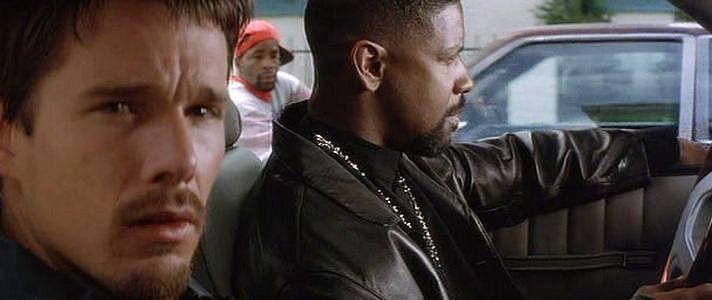
Heist

0

This year already gave us one good old-fashioned caper film with “The Score,” and now we get a second one: “Heist,” which is good, old-fashioned, and a caper film that has no pretenses about being anything else.

That being the case, you wonder why it’s not a little better. Without all the importance or dramatic depth of a “serious” film getting in the way, writer/director David Mamet ought to have found more fun in the twists and turns of a genre flick. “Heist” is a kick to watch, but it feels like it could have been more — especially from a brilliant writer like Mamet.

Gene Hackman — whom I have never not loved in a movie — plays aging thief Joe Moore, described as being “so cool, when he goes to sleep, sheep count him.” Having been observed accidentally by a surveillance camera during a recent robbery, he is eager now to retire with his wife (Rebecca Pidgeon) and his beautiful boat.

However, as is generally the case in movies with titles like “Heist,” Joe must do One Last Job. Making it even more complicated, he and his partners, Bobby (Delroy Lindo) and Pinky (Ricky Jay), are saddled with the green nephew (Sam Rockwell) of their fence (Danny DeVito).

The job involves stealing gold from a cargo plane, though we don’t know that for a while. For even longer, we don’t know where the gold has actually wound up. Mamet seems to take great delight in folding the movie on top of itself again and again: Someone gets double-crossed and then double-crosses someone else, who turns out to have been triple-crossing everyone all along. It becomes predictable after a while. We start waiting uneasily for a scene to finish and a character to walk away feeling good about having screwed everyone, just so we can hear the other characters let on that they, in fact, are the ones who screwed him. You can only ride a roller coaster so many times before the track becomes too familiar.

The acting is splendid throughout, with the notable exception of Rebecca Pidgeon. As I observed with “State & Main,” it is ironic that David Mamet’s own wife would be the WORST one at making his dialogue sound natural. You hate to be gossipy and suggest she keeps getting roles in his movies only because she’s his wife, but I can think of a dozen actresses just off the top of my head who would have been better in this femme fatale-ish role, and who could have spoken the dialogue better.

“Heist” is full of that classic Mamet-style dialogue, including a description of Joe’s wife as being so slick, “she could talk her way out of a sunburn.” That puts it a cut above most caper films, which tend to eschew the sort of verbal elegance Mamet embraces. “Heist” is less than the sum of its parts, but its parts are fun to watch.

Shallow Hal

0

Bobby and Peter Farrelly have a reputation for writing and directing films that are grossly, outrageously funny, movies like “There’s Something About Mary” and “Dumb & Dumber.” They break taboos, they push the envelope, yada yada yada.

Their latest, “Shallow Hal,” is a bit of a departure, and a disappointment. Despite its potential for crudeness — a man falls in love with an obese woman because he sees her inner beauty — it has only a few moments of Farrelly-esque outrageousness.

This is allowable, of course; filmmakers are permitted to change genres if they want to. I would rather they go whole hog and make all the fat jokes in the world, because I rather like that style, where’s it so audacious, you can’t help but laugh. But if Bobby and Peter want to be a little more gentle and touchy-feely, they are well within their rights. I just think they need to do a better job of it.

The focus is on regular ol’ non-offensive comedy here, which is fine, except that it doesn’t focus on it enough. Too much time is wasted trying to make us feel sympathy for characters who should be, by all rights, one-dimensional jokes, the way God intended them. The Farrellys try to get serious on us, and it doesn’t work, because they’re not very good at it.

Jack Black plays the title character, a ridiculously superficial moron who seeks only “perfect” women, despite his own physical flaws, which are many. Then he gets trapped in an elevator with motivational speaker Tony Robbins, who hypnotizes him into seeing people as they are on the inside. Ugly women now look good to Hal, and his equally shallow friend Mauricio (Jason Alexander, in the world’s worst toupee) is at a loss to explain why his pal’s tastes have suddenly taken a turn for the worse.

Black is one of our favorite hip, ironic young actors, but “Shallow Hal” teaches us something we hadn’t considered before: He’s best in supporting roles. His fun quotient is spread too thin in a lead. If he has depth and range, he is not showing it here, acting a one-note character in a movie that wants to have more notes.

Gwyneth Paltrow plays Rosemary, the fat woman Hal falls in love with. Most of the time, we see her the way he does — as the thin Gwyneth we know and love. (Fat suits are used to show us how Rosemary really looks.) Paltrow is the closest the movie comes to a character we care about.

By the movie’s logic, beautiful woman who are bad people should look ugly to Hal, but that only holds true in one instance. If you’re going to use a high concept like this, you’d better stick with it, or at least explain why you’re following your own rules haphazardly.

Tony Robbins is great in his cameo, and Jason Alexander gets off some good lines. But the movie is AT LEAST a half-hour too long, and its middle section drags insufferably. One thing the Farrellys have never been good at is writing a tight script — “There’s Something About Mary” was too long, too, you may recall — and that fault has never been more painfully clear than in “Shallow Hal.” Timing is everything in comedy, and this one has no idea where it’s going half the time. Sometimes, it doesn’t even remember it’s a comedy.

Dewey Think That’s Funny?

0

Today’s topic, at least until I get sidetracked: stuff that isn’t funny. (YOU: That’s what your column is always about! ME: Har!)

Certain things are considered not funny now because they are in poor taste “in light of recent events”; apparently, some people think that if something’s in poor taste, that means it’s not funny, when in fact I can think of many jokes that are tasteless AND funny, including a ribald yarn about a piano player who is 12 inches tall.

Here is a case study: The guy who hung around University Mall on Halloween and pretended to blow anthrax on people. According to the Daily Herald — and I don’t know if I believe anything I read in that rag — Scott Armstrong, 33, dressed up like a reporter and went around asking people if they were worried about anthrax. If they said they weren’t, he would blow a handful of nothing on them and tell them they had now been exposed to it.

Everyone freaked out, of course, because freaking out is what we do here — it will be an Olympic sport — and Armstrong was arrested. No doubt his defense is that he was just playing a Halloween prank. Well, fine. As a joke, it’s not bad, and though a 33-year-old should have stopped being interested in Halloween about 23 years ago, that certainly is the right day, along with April Fool’s Day and Pioneer Day, for a prank. However, he failed to take into account his local audience, which isn’t that good at taking a joke anyway (trust me), and which is particularly jittery right now.

Another example: Reagan Outdoor Advertising has refused to accept billboard ads making jokes about polygamy. An ad for Brighton Ski Resort would have said the new chair lifts have room for four people — specifically, “Wife, wife, wife, husband.” Reagan also nixed a Wasatch Brewing billboard that said, “Why have just one?,” in reference to both wives and beer. (If I had multiple wives, I think I’d have to drink a lot, too.)

According to The Salt Lake Tribune, Reagan Outdoor Advertising president Dewey Reagan said, “Yes, there’s actually a guy named Dewey. Yes, I know it’s a ridiculous name. Yes, that’s why I have no sense of humor.”

No, that’s not what he said. He said, “(Polygamy) is not something Reagan wants to be associated with.”

I notice Reagan has no problem, however, being associated with Totally Awesome Computers and its owner/pitchman/cloven-hooved demon SuperDell, who is the embodiment of all evil and must be stopped before he slays our children and drinks their blood. No, Reagan likes him and his billboards just fine. When asked about the SuperDell connection, Dewey Reagan said, “Yes, like the Dewey Decimal System. No, my brothers aren’t named Huey and Louie. Can we just let it go?”

But just let it go we cannot, for there are important issues to discuss. At times like these, don’t we need humor more than ever? And more importantly, aren’t we tired of people saying “at times like these”? Yes. Yes, we are.

I maintain that the anthrax guy’s prank suffered more from bad timing than bad taste — it would have been viewed as mere harmless stupidity a year ago — and that there is absolutely nothing wrong with the proposed skiing and beer billboards.

Let’s lighten up, folks. Anthrax is not an epidemic, and the odds you’re being targeted are slim. I know I’m not worried. I doubt the people who dislike me have access to anthrax; most of them don’t even have access to a spell-checker.

And do I even need to explain why it’s OK to joke about polygamy? Polygamists are Utah’s official State Joke. Let’s embrace them and mock them and let the whole world know we love our adorable, misguided little zealots. We need them now, at times like these.

Lost in Yonkers

0

The Little London Dinner Theater’s production of “Lost in Yonkers” is the sort of show you enjoy more than you should. Some of the acting is a bit off, and the tone is kind of flat — but darned if it’s not charming and likable anyway.

This is one of Neil Simon’s more dramatic, less jokey plays. Directed by Agnes Broberg, it’s about two teen-age boys in 1942 sent to live with their strict grandmother while their father heads out to work as a traveling salesman.

15-year-old Jay, played by Joshua Long, is the fretful brother; even when the character is happy, Long manages to look worried. 13-year-old Arty (Adam Gardner) is the craftier of the two, scheming against Grandma (Andrea Cottam) wherever possible and just generally being a wisenheimer.

Arty got those tendencies, it would seem, from Uncle Louie (David Phillips), a mid-level gangster who has a history of butting heads with Grandma. Phillips is great in this role, providing a lot of laughs and some solid characterization. (Jay, by the way, is more like his worrisome dad, played by Jason Boren, seen only in the first and last scenes.)

And then there’s Aunt Bella (Esther Covington), who lives with Grandma and is a ray of sunshine against the old bat’s perpetual raincloud. Bella is at least slow and possibly retarded. She goes to the movies often, partly to see an usher named Johnny whom she has feelings for — a thought that will terrify Grandma when she learns of it.

Kay’cee Hofheins also appears as the traumatized Aunt Gert, present only for a few moments in the second act but referred to — and made fun of — throughout.

Adam Gardner is above-average as young actors go. In a performance last weekend, he admirably covered another actor’s missed cue without missing a beat. He and Joshua Long are convincing as brothers, and Esther Covington is very sweet as Bella.

There is also much to admire in Andrea Cottam’s portrayal of Grandma. Her German accent is inconsistent, but her characterization is spot-on. It is Grandma who changes most over the course of the play, and Cottam handles it with grace and honesty.

Should you go? It doesn’t have the energy or pace of some recent Little London shows, but it is a worthy effort.

Bored of the Dance

0

I went to the ballet to try to broaden my horizons. I tend to be more artistically inclined than, say, the governor of Minnesota, but my tastes do not generally run as deep as ballet. All that dancing, and so few electric guitars. It seems like a waste.

The opera is something else I usually find inaccessible. I always wonder how it would be to live in that strange world where people sing instead of talking. I think there would be a lot of suicides in that world. Which there are in operas, too, so I guess it makes sense.

The last opera I saw was “Carmen,” which is a delightful show about a skanky woman who wins the love of a guy named Don Jose, who then kills her. Huzzah! (“Carmen,” by the way, is in no way affiliated with “Where in the World Is Carmen Sandiego?”)

But back to the ballet. Before I went, I happened to see part of a DVD recording of “Swan Lake,” which was staged last year on Broadway in an attempt to trick theater-goers into watching ballet. At one point in this ballet, several of the main characters go to an opera. A ballet about people going to the opera: What sort of experiment is this? If the opera were about people standing in line at the DMV, then the unholy trinity of tedium would be complete, all in one show.

Or so I thought, before I attended a ballet last week in Salt Lake City. (As is often the case, my opinions had to be altered upon actually experiencing the thing.)

It was not boring. It was beautiful and exciting. The stage was filled with so many lithe young men and flat-chested young women, I thought an Obsession commercial was going to break out. The music and dancing complemented each other, telling a story. (“Once upon a time, there were some people who were dancing.”)

It was a wonderful experience, even with the two old ladies behind me who kept talking. I think they’re the same two old ladies who are always behind me, talking during shows, like when I was at “No, No, Nanette” and someone in the play said, “Marry me, Nanette!,” and one of the old ladies said, “That’s Nanette,” which we all found very insightful. These old ladies follow me around everywhere I go as part of a vast conspiracy to drive me crazy. They report back to their headquarters, which are in a secret lair cut in the shape of a big purse out of the side of a mountain, where the evil queen old lady says, “What is the status of Operation Drive Eric Crazy?,” and the old ladies don’t answer, because they weren’t paying attention, because they were talking about shampoo.

But I digress. If I had a nickel for every column I’ve written about people who talk during shows, I’d have enough money to have each of those people killed.

The point of this particular column is that we needn’t be so afraid of things like opera and ballet. In Europe, people go to operas the way we in Utah go to plays: It’s a fairly casual thing, everyone does it, they bring their screaming babies, they eat candy bars during it, they call it a “good” production as long as everyone knows their lines, and they get mad if any local critics say otherwise.

Ballet is also popular in other countries, primarily countries where televised wrestling is not popular. Many of these countries are in Europe, though, so I can understand our ignoring them when they say ballet is fun. But you can take my word for it, and I’m sure the old ladies will back me up. Don’t look, but they’re sitting … behind me … right … now ….

The Three Sisters

0

Anton Chekhov wrote plays that don’t entertain so much as they build character. They can be remarkably refreshing when done well, but full as they are of people who talk a lot and do very little, they’re hard to do well.

BYU’s production of “The Three Sisters” precariously walks the line between dull and compelling. You’d expect a play that takes place at the bottom of a well to be dark and claustrophobic; by the same token, no one should be surprised that a play about people who are bored is, in fact, a little boring. That it’s “a little” and not “a lot” is a victory already.

Directed by Barta Heiner, who can direct actors like nobody’s business, “The Three Sisters” is about the well-off Prozoroff family of Russia, circa 1900. The three sisters are school teacher Olga (Susan Keller), bored housewife Masha (Jessica Mockett) and pretty young thing Irina (Erin Chambers). Their parents are dead. Their brother, Andrei (Jon Liddiard, with padding to make him look “stout” that instead makes him look ridiculous), marries the socially awkward Natasha (Eve Speer), who starts popping out babies and taking over the household.

And through it all, they want to go back to Moscow, whence they came, for surely THERE they will be happy. The uselessness of such an attitude — ignoring potential happiness in the present while looking for imagined happiness in the future — is the play’s major theme.

In terms of personalities, there is little distinction made among the three sisters: They are all listless, unsatisfied and unhappy. The performances are good, but I found myself liking the actresses more than the characters.

Jessica Mockett has some riveting moments with Jesse Harward, who plays an idealistic local soldier as tired of his marriage as Masha is of hers. Eve Speer’s shrill outbursts as the class-conscious Natasha also provide some electricity, and R. Jeremy Selim is sympathetic as a soldier courting Irina. Reese Phillip Purser is also worthy of mention for his mature, convincing work as the alcoholic old doctor Chebutykin.

The show’s emotional connection with its audience is tenuous at best. The last act consists largely of characters crying over the various frustrations their lives have brought them, but very little of it hits home. The acting is strong enough to make us like these people, but perhaps not enough to make us truly care.

Should you go? If you like Chekhov, yes. If you don’t like Chekhov, this won’t convert you.

Life as a House

0

In “Life as a House,” a teen-age boy tells his girlfriend he’s angry at his father for tricking him into loving him. If her father had done that, he says, “You would hate him for the trick.”

She replies, “Not if the trick was real.”

“Life as a House” tricks us into loving it, but we don’t hate it because of it. It’s a film that absolutely should not work, but does because of gentle directing and stellar acting, and a general avoidance of the “you WILL cry!” techniques employed by many tearjerkers.

Kevin Kline gives an Oscar-caliber performance as George, a middle-aged architect whose life couldn’t be more dysfunctional. His wife, Robin (Kristin Scott Thomas), whom he still loves, left him 10 years ago and lives across town with their Goth-rebellious son Sam (Hayden Christensen). He’s just been fired. He lives in a shack by the ocean in California. Oh, and he has terminal cancer.

Before he dies, he wants to establish a bond with his estranged son by tearing down the shack and building a real house in its place. The house becomes a metaphor, of course, and George slowly rebuilds relationships with his son, his ex-wife and other people in his life.

There are several wonderful characters in the film, and some twists in their personalities that may be irrelevant but which add to the picture’s overall charm. Mary Steenburgen, lovely as always, plays sexually frustrated housewife Coleen, who dated George years ago and now lives down the street from his shack. Her daughter, Alyssa (Jena Malone), begins a relationship with Sam; Sam dabbles in autoerotic asphyxiation and prostitution, egged on by his friend Josh (Ian Somerhalder), who is a piece of work in his own right.

Comparisons to “American Beauty” are obvious. This film is far more optimistic and less edgy, but has several similar plot elements: the protagonist, estranged from his wife and child, who will be dead before the film’s end; a sexually active teen couple; a teen-age girl expressing attraction for her friend’s father. There’s a likeness in both films’ 21-century family angst, too: These are not the same problems the people in “Leave It to Beaver” had. (Or if they did, they didn’t discuss them quite so openly.)

I am also interested in the dichotomies of family relationships portrayed here. George says his mother was terrified of his abusive father, but more terrified of life without him. Asked why he didn’t kill his father, whom he hated, he says, “I loved him too much.” These are universal ideas, where we love those we are biologically attached to, even when there seems to be little reason for that love.

Apart from those few deft touches, Mark Andrus’ screenplay is rather trite. It has its fair share of stock dialogue and kitchen-sink-drama situations. Right down the line, everything happens pretty much the way you’d expect it to.

And yet it works. Director Irwin Winkler doesn’t force the emotions; he coaxes them gently. George’s character, in particular, is droll and self-effacing, and is thankfully not one of those stoic, saintly dying people we see so often in movies. There is a great deal of humor mixed in with the drama, lightening the mood and conveying that oh-so-important feel of a film not taking itself too seriously.

Winkler has compassion for his characters, each of whom is lovable in his or her own way. Hayden Christensen — whom we will see next year playing Anakin Skywalker — is a revelation, holding his own against Kline, who is one of our most unfairly overlooked actors. It is a remarkably mediocre screenplay, made remarkably sweet by a light touch and a kindhearted attitude.

Domestic Disturbance

0

After three bad movies in a row, John Travolta has finally risen above it to an acceptable level of mediocrity. Who knows, maybe the next one will actually be good.

“Domestic Disturbance” is not a bad movie, as bare-bones, right-to-the-point thrillers go. Travolta plays Frank, a divorced boat-builder in a picturesque Maryland town whose ex-wife Susan (Teri Polo) is about to marry newcomer Rick Barnes (Vince Vaughn), a wealthy businessman beloved by all.

Immediately after the wedding, Mr. Nice Guy Rick becomes Evil Stepdad, like people do in these movies. Then Frank and Susan’s adolescent son, Danny (Matt O’Leary), who never trusted Rick to begin with, sees him kill a guy (Steve Buscemi). But no one believes him except Frank, and now Danny is living in a house with a killer, and yada yada yada.

The film is only 88 minutes long, yet still has some padding in it, particularly with a few scenes that hint at unrealized character development. Still, the pace is generally quick and efficient.

The writing, however, by Lewis Colick (working from a story that inexplicably took three people to devise: Colick, William S. Comanor and Gary Drucker), is often hasty and convenient. The way Danny witnesses the murder is a little far-fetched, as is the victim’s bloodless death. And as is the trend these days, the most important clues and discoveries are made on the Internet.

You get the feeling the movie is setting up something particularly clever for its finale, but then it doesn’t. There is no smoking gun, no stunning revelation, no clever means of catching the bad guy. Just fighting and running and breathless phone calls that say, “Get out of the house!”

The acting avoids over-the-top theatrics, and while director Harold Becker is not above a few cheap “jump” moments, he doesn’t lean on them excessively. One is tempted to call the thing “taut,” except it’s too sloppy and muddle-headed to be that. It is a simple, serviceable, reasonably entertaining thriller, and nothing more.

Monsters, Inc.

0

In this era of mediocre blockbusters and “family” films full of crudeness and stupidity, it’s nice to know there’s still a name you can trust: Disney. (Well, Disney animation, anyway; the live-action stuff is hit-or-miss.)

Disney works with Pixar, which did the computer-animated features “Toy Story,” “Toy Story 2” and “A Bug’s Life.” Pixar is also behind the new “Monsters, Inc.,” a thoroughly entertaining outing that will delight audiences of all ages.

The setting is Monstropolis, a geographically unidentified city of monsters who live normal lives, just like we do. They have families, go to work, and eat at restaurants. One of the city’s major industries is Monsters, Inc., a power plant that uses the screams of human children to provide the city with electricity. The screams are gathered by sending monsters into children’s bedrooms via their closets, scaring them, then dashing back to the factory. It’s exactly what all kids are afraid of, but for the monsters, it’s all in a day’s work.

Monsters, Inc.’s greatest scarer is James P. “Sully” Sullivan (voice of John Goodman), a furry, Bigfoot-type creature. He is assisted by his life-long friend Mike (Billy Crystal), a short green ball with one big eye and a couple of stick arms and legs.

Chaos erupts in Monstropolis when a little girl accidentally follows a monster through the closet door back into the factory. Monsters fear contamination if they come in contact with kids — they’re supposed to scare them, but not touch them — but that fear seems to be unfounded. (That the toxicity issue is never resolved is the film’s one oversight.)

Sully and Mike have to get the little tyke back to her bedroom without getting caught by the boss (James Coburn), all the while avoiding the chameleon-like Randall (Steve Buscemi), a slimy co-worker jealous of Sully’s track record.

The idea of yanking screams from children sounds ghastly on paper, but in the film, it’s amusing, even whimsical. There is no real “terror” in the movie, in part because the monsters are so personable. We really buy that it’s just a job for them, with no ill will toward the kids, whom they’re actually rather afraid of.

Sully grows fond of the toddler, and an incredibly sweet relationship develops between them, even though she’s too young to have mastered the art of speech yet. She can say “Boo!,” which is what Sully starts calling her, and she can say “Kitty!,” which is what she calls him. The inherent nastiness in frightening kids to harness their screams becomes an issue for Sully — how could he ever scare another child after learning to love this one? — and it’s all resolved very pleasantly in the end.

The tone is as light and jaunty as the “Toy Story” films, though not quite as expansive. Those films had a whole ensemble of fantastic characters, while this one focuses on just a few, making the thing seem a little smaller in scope. The “Monsters” characters are not as well-defined, either, though they are certainly likable.

But pound for pound, no film this year has been as genuinely witty as “Monsters, Inc.” It is fast-paced, tightly written, solidly acted, ingeniously funny and ultimately very touching (but not sappy). There’s no padding, no pandering, no jokes that are desperate or lame, no annoying characters, no situations that don’t make sense, no unmotivated actions, no twists that come from out of nowhere. It’s smart, funny, sweet, good-natured, kind, clever and friendly. It’s very nearly what all movies should be, but usually aren’t.

The One

0

As befitting a movie about parallel universes and multiple identities, “The One” tries to be several things: a martial-arts film, a “Matrix”-inspired sci-fi flick, and a regular ol’ action movie. But, as we learned in “Highlander” (and as is reiterated in this movie), “There can be only one.” Most films that attempt to mix genres fail at it, and “The One” certainly does not buck that trend.

The deal here is that each of us has a counterpart in at least 124 other universes, which is fine, because we don’t communicate much with those universes. But now there’s a bad guy named Yulaw (Jet Li) who is traveling from universe to universe, killing off his Doppelgangers and absorbing their life force. It is believed that if he succeeds in murdering them all, it will either destroy whichever universe he happens to be in at the moment, or else he will become a god. Either way, bad news.

So two melodramatic cops (Jason Statham and Delroy Lindo) are pursuing him, and they wind up in the universe you and I inhabit, where the local Yulaw look-alike is an L.A. police officer named Gabriel. We don’t know about parallel universes here, so he’s extra-freaked out that a guy who looks just like him is trying to kill him. His wife, T.K. (Carla Gugino), is equally wigged, and has a heck of a time keeping track of which guy is her husband and which one is the bad guy.

You’d expect there to be a lot of martial arts fighting, but you shouldn’t, because there are only about three scenes of it. Instead, there’s a whole lot of slow-motion “Matrix”-type stuff, which is getting a little old, frankly. It’s hard to be impressed with an amazing fighter like Jet Li’s athletic abilities when it’s so clearly digitized and special-effected. We’ve learned that, thanks to technology, ANYONE can look like an expert, and it’s a disservice to Li, who actually is one.

We should also point out that if you’re going to have an actor play multiple roles in your movie, you ought to choose someone with more charisma than Jet Li, who has a certain charm about him, but who certainly does not carry a move on his own.

I am duly respectful of the effort it takes to pull off special effects like the ones in this movie, and it’s exciting to contemplate what the future of filmmaking may be. But — and you can call me old-fashioned if you want — it would still be nice to have a decent script now and then, too.

This one, by Glen Morgan and James Wong (Wong also directed), is especially disappointing because those two did such great work on “The X-Files” and in last year’s funny-if-you-got-the-joke “Final Destination.” “The One,” by comparison, is too serious about itself and its silly concept, and it offers nothing beyond the fight sequences we’ve seen before.

The Man Who Wasn’t There

0

“The Man Who Wasn’t There” is from Joel and Ethan Coen, the brothers behind such films as “Raising Arizona” and “O Brother, Where Art Thou?” The new one is paced a bit slower and is more muted in tone than those, recalling instead the Coens’ “Fargo” and, especially, “Blood Simple.” But for being quieter than most of their big audience favorites, “The Man Who Wasn’t There” is still vastly entertaining and boasts several excellent performances.

Chief among them is Billy Bob Thornton, continuing to beat the odds by earning respect despite being named Billy Bob. He plays Ed Crane, a taciturn barber in 1949 Santa Rosa, Calif. “I don’t talk much,” he says in the voice-over narration, where he is much more talkative. “I just cut the hair.”

He lives with his wife, Doris (Frances McDormand), a vigorous alcoholic who cooks the books at Nirdlinger’s department store, where she also seems to be having an affair with co-owner Big Dave (James Gandolfini). Ed doesn’t particularly mind the infidelity — one gets the impression Ed doesn’t particularly mind anything — but he uses it to his advantage when he needs money for a business investment and realizes Big Dave would be a good blackmail target.

Ed winds up killing a man, somewhat accidentally and somewhat in self-defense. And then Doris is blamed for the murder, and still Ed remains silent — sort of.

Two different people ask Ed, “What sort of man are you?” and neither time does he have an answer for them. He doesn’t know what kind of man he is. His fallen arches prevented him from fighting in the war, so he’s not a hero like so many guys walking around in 1949 were. He is a non-descript figure living in the non-descript era between the hardships of World War II and the sunniness of the 1950s. He doesn’t really have any friends, but he’s not disliked by anyone, either. Like he said, he just cuts the hair.

Thornton is on the verge of brilliance in this role, saying so much with his long glances, hard stares and to-the-point dialogue. One is sympathetic for him despite apparently knowing so little about him. It’s the sort of performance that speaks volumes after the movie, when you reflect upon it and realize you know more about him than you thought you did. It is rare for the Coens to be as compassionate toward one of their characters as they are toward Ed.

Frances McDormand is reliable as always, earning pathos and laughs with equal skill. And the film is nearly stolen by Tony Shalhoub as a slick lawyer called in from out of town to defend Doris in court.

It is film noir, which the Coens have done before (“Blood Simple”), and which suits the deadpan-witty dialogue they tend to write. It’s shot in black-and-white, too, in case you didn’t get the idea that it was noir, and while it has light moments, it is far more harsh than funny. It’s a switch, then, from what many people expect from the Coens, but in truth, it employs a lot of the same dark themes that have always lurked around the fringes of their movies.

Amelie (French)

0

“Amelie” is a sunshiny movie that makes sunshininess seem cool. It’s “Pollyanna,” but without the factor of making you want to smack the protagonist.

Amelie (Audrey Tautou) is a spunky Parisian who grew up lonely, thanks to being the only child of a mother who died young and a father who was frumpy at best. Now, at the age of 24, she lives not far from her aging father, working as a waitress in a cafe and letting life slip along idly.

Then, hearing the shocking news of Princess Diana’s death causes her to drop something on the floor, which causes her to stoop down and notice a loose tile in the wall of her bathroom, which causes her to find a cigar box behind it that contains some previous tenant’s childhood keepsakes. She seeks out the owner with this plan in mind: If the rediscovery of the box brings joy to the heart of the man, Amelie will devote her life to making people happy in a similar fashion. If it does not, she will forget the whole thing.

The man is indeed overjoyed to be reunited with his childhood, and so Amelie sets out to improve the lives of her fellow Frenchies. She narrates the world for a blind man, whimsically persuades her father to travel the world, slyly sets up a coworker with a customer.

Ah, yes. L’amour. What about Amelie herself? If she can overcome her shyness, she may find love with a stranger named Nino (Mathieu Kassovitz), who may be as interested in the simple pleasures of life as she is. He works in a porn shop, but he also enjoys collecting people’s photo-booth throwaways into a collage of last-minute blinks and bad smiles. Like Amelie, Nino is interested not just in humanity, but in humans themselves.

A second look:

10/12/2011: Re-Views: ‘Amelie’ (2001)

The director, Jean-Pierre Jeunet (who co-conceived the story with screenwriter Guillaume Laurant), seems to share that trait with his characters. Much time is spent on listing the little things that make even minor characters happy; we learn, for example, that this person loves popping bubblewrap, that one likes the sound of the cat’s bowl on the kitchen tile, and this other one can’t get enough of seeing bullfighters gored on TV. Amelie, Nino and Jeunet all understand that the minutiae are what make us who we are. I suspect if any of them had an intimate conversation with, say, the Pope, they’d want to know less about his religious teachings and more about whether he likes the feeling of sticking his hand in a bag of grain or seeds.

Audrey Tautou couldn’t be more impish, beguiling and innocently coquettish if she were part fairy. No matter what else she does with her career, she will always be Amelie in the minds of millions.

Jeunet maintains a playful, optimistic tone, allowing some conflict to creep in only momentarily. When it does, it becomes clear just how much the movie’s whimsy has captured you, as you realize it’s impossible to feel any suspense. A movie like this can only end Happily Ever After. If the rules of storytelling dictate there must be a complication at some point, we’re willing to sit through it and root for the heroine, knowing full well she will emerge victorious.

Focus

0

William H. Macy is one of those actors who can appear in something mediocre or even downright stinky, but come out of it smelling like a rose. He can always be counted on to perform well, even when he’s surrounded by mediocrity.

“Focus” isn’t bad so much as it’s disappointing. Based on an Arthur Miller novel, it’s full of moralizing, some of which is heavy-handed. Movies can preach, but they need to do it with less condescension than we’re getting here.

The setting is Brooklyn near the end of World War II. Macy plays his regular role — a weary, bedraggled nebbish, this time named Lawrence Newman. Lawrence has never married, lives with his mother, and is in charge of personnel at a large, dull company. He and his neighbors have a quiet street where everyone knows everyone, and where attitudes toward the local Jew, Finkelstein (David Paymer), have become increasingly antagonistic.

One day Lawrence begins wearing new eyeglasses, and suddenly everyone thinks he looks Jewish. He is fired from his job because of this, and has trouble finding another one for the same reason. Even longtime associates like his blowhard neighbor Fred (Meat Loaf Aday), while realizing he’s not really Jewish, can’t shake the notion that something’s amiss.

Lawrence meets Gertrude Hart (Laura Dern), a fellow Christian with the same problem he has. Their public appearances as a couple don’t help matters for either of them, and the persecution that’s been heaped on Finkelstein soon is visited on them, too.

The anti-Semitism mostly takes the form of garbage being dumped on the lawn, though there is some mild violence. Director Neal Slavin’s intent apparently was not to turn this into a nightmarish “Twilight Zone” scenario, but merely a bad dream, and to provoke some thought: Before he became victim to it, Lawrence often turned a blind eye to prejudice. Are the Fates teaching him something?

Well, of course they are; the movie won’t ever let us forget that. The performances from the principles are all very good, but the film takes too long to get where it’s going. Furthermore, Slavin directs this Arthur Miller novel so that it looks like an Arthur Miller play, and plays aren’t much fun to look at when they’re on film coming from a projection booth. Put this one in the category of decent material, good cast, and misguided execution.

The Great Recession

0

The dull-looking men on TV tell us that America is entering a recession. Now, despite having its root in the word “recess,” a recession is not all fun and games and kickball, nor do school children look forward to it, nor does it end after 20 minutes with the sound of a bell. In fact, a recession is nothing at all like recess. Stupid language.

A recession is a downturn in the economy, marked by a decline in trade and employment. It is not as bad as a depression, which occurred in the 1930s and is the leading cause of thrift among old people. A depression requires Prozac; a recession just needs us to eat a lot of ice cream and watch a funny movie. Unfortunately, we cannot afford the good ice cream, so we’re stuck eating generic, and even if we could find enough loose change to go to the movies, the theater would be full of teenage girls talking on cell phones. So times are indeed bleak.

I don’t know what economic indicators are used to officially determine recessionhood, and I’m certainly not going to look them up. I’m going by my instincts: We must be in a recession, because I don’t have any money. Perhaps this is due to eating in restaurants twice a day, every day, for the past month, but perhaps it is also due to a recession. Who can say? And if someone can say, who will listen? I can’t, because I’m busy eating.

As a result of the recession, businesses are cutting back, laying off employees and, in some drastic cases, forcing upper-level management to take pay cuts, putting them in only the top 10 percent of the nation’s wealthy instead of the top 5 percent. Many executives have had to fire their chauffeurs and must now walk unescorted as they dodge the panhandlers outside their offices. Many of these beggars used to work for them.

Newspapers are not exempt from these cutbacks. The Orange County Register recently laid off 105 employees, and the Dallas Morning News sent 73 folks packing. The New York Times even had to sell its theater critics’ thesauruses. (“A tragic tragedy of tragic proportions!” is how one critic described it.)

The Daily Herald has made changes, too, some of which may not be apparent to the average reader, particularly since I made some of them up. Among them:

• Newspaper now being printed on 3×5 cards.

• Humor removed from “The Family Circus.”

• Paperboys replaced with trained monkeys.

• Bold promotion to increase circulation: Every new subscriber gets a date with Julie Stoffer.

• Expensive newsprint replaced with much cheaper Fruit Roll-Ups.

• Valuable news space conserved by switching from traditional English to more word-efficient “Tarzan-speak.”

• To be more “eye-catching,” front page will now be the same as the cover of the current TV Guide.

• Ann Landers euthanized. (No impact on finances, but good for employee morale.)

• Sensationalistic words such as “bloodbath” and “murderrific,” once banned, now encouraged. (In today’s edition: “Murderrific zoning issues discussed in bloodbath city council meeting.”)

• Instead of focusing on “who, what, why, where, when and how?,” news stories will now include “why” and “where” only on weekends.

• New attention-grabbing title: The Daily Salt Lake Tribune.

Only time can tell whether these changes will boost revenue and ultimately change the state of the economy, but it’s almost certainly going to get worse before it gets better. Pass the Prozac.

Nunsense

0

Hale Centre Theatre’s “Nunsense” is wacky theater for the masses. It has audience participation, local references and — get thee to a punnery! — enough one-liners and wordplay to single-handedly revive vaudeville.

Dan Goggin’s much-produced, mildly disrespectful musical is about five nuns putting on a variety show to raise money to bury the sisters who died from eating poisoned soup (cooked by convent chef Sister Julia, Child of God).

JaNae Gibbs Cottam plays Sister Mary Regina, the plump Mother Superior who governs the show with a no-nonsense attitude. Cottam is a charming and funny performer, and a good straight-nun against the lunacy that surrounds her.

Her main foil is Sister Mary Hubert (Camille Gerber VanWagoner), who trains new recruits and opposes many of Regina’s decisions (such as using the burial funds to buy a DVD player for the convent). There is a wonderfully comic moment when the two burly sisters face off at center stage like a Catholic “Clash of the Titans.”

Randi Harrington-Bruse very nearly steals the show (and provides it with what emotional center it has) as Sister Mary Amnesia, the nun who lost her memory after being whacked on the head with a crucifix. Harrington-Bruse is a treat to watch, displaying her comedic skills most prominently in a scene she does with a puppet called Sister Mary Annette (say it out loud).

Rounding out the cast are Sharon Lynn Kenison as the street-wise Sister Mary Robert Anne and Amy Jo Fisher as novice nun Sister Mary Leo. Kelly DeHaan is the priest pianist, Father Knowles Best, leading a live band called the Three Hale Marys.

The in-the-round staging, directed by Annette Wright, is a bit awkward at times, as actresses giving monologues are forced to spin around a lot as they talk. Marilyn May Montgomery’s choreography is lively, but it’s hard for it to reach its full potential when each actress must face a different direction.

These problems are not insurmountable, though. The show endears itself to the audience in a very basic, natural way: It makes them laugh. Some of the added jokes are extremely funny (we’ll ignore the so-five-minutes-ago “Who Wants to Be a Millionaire” references), especially in a slide show of the nuns’ trip to Salt Lake City, which included a visit to the “Mormon castle” at Temple Square, where they “knocked and knocked on the door, but no one would ever let us in.”

Should you go? It’s not sophisticated comedy, but it is often clever and usually funny.

How to Speak Mormon

0

Does it make me a bad person if the only thing I remember from church last Sunday is that every single speaker used the phrase “grateful for the opportunity” at least once?

We Mormons (non-Mormons: Stop reading now! I’m not talking to you) use the word “opportunity” far too often. Priesthood guys used to come around saying, “Did you have the opportunity to do your home teaching this month?” And I’d respond truthfully: “Yes, I had the opportunity.” Heck, I had lots of opportunities. That doesn’t mean I did it. But that’s not what they asked, and I like the idea of using someone else’s poor syntax to dodge the issue. (I am counting on the questions at the Pearly Gates being similarly vague.)

The other way we use “opportunity” is when we want to express having done something, but we want to use a lot of words to say it, possibly because we think we are being paid by the syllable. When giving a talk in church, never say in two minutes what can be said just as easily in five.

It might be a humility thing, too. Saying, “I went to the moon” sounds boastful. But “I had the opportunity to go to the moon” has the subtext of, “This was through no fault of my own, I assure you, and I’m really lucky to have gone.”

This subtext is particularly clear if you say it in a spiritual tone of voice. And by “spiritual,” of course I mean “quiet.” If you whisper when you talk, you are conveying spirituality. Conversely, it is impossible to be spiritual if you speak in a normal tone of voice. Using a loud voice is downright wrong, and if you yell, it’s the same as having Satan deliver your sermon for you.

Saying, “I had the opportunity to go” instead of “I went” is a waste of words, certainly. But sometimes Mormons conserve energy, too, and use a kind of verbal shorthand.

A few of these are already well-established. For instance, everyone knows that if a woman has a “sweet spirit,” that’s code for “she’s as ugly as Janet Reno,” and if a man is a “nice guy,” that’s code for “he’s as ugly as Janet Reno.” And Orson Scott Card, the famed author of science-fiction and other children’s stories, once pointed out to me that among Mormons, “humble” means “proud.” (“I am really humbled at being named People’s Sexiest Man Alive.”)

I am grateful for the opportunity to show you some more examples I’ve compiled:

• “share” = “make you listen to” (“I’d like to share a story.”)

• “special” = any adjective with a positive connotation; indicates the speaker has warm feelings but lacks the vocabulary to express them (“It was a special experience.”) (See also: “choice”)

• “brethren” (pronounced “broth-ern”) = “everyone here, including women”

• “struggling,” as in “Brother So-and-So is ‘struggling’ with some things right now” = “You wouldn’t believe how much porn Brother So-and-So has downloaded.”

• “Young Men’s program” = “Boy Scouts of America”

• “less active” = “not the least bit active”

• “Democrat” = “less active”

• “Word of Wisdom” = “don’t drink or smoke”

• “inappropriate” = “I personally don’t approve of that, and I’m sure no one else does, either.”

• “not very Christlike” = “I personally don’t approve of that, and I’m sure Jesus doesn’t, either.”

• “diverse” = “some non-Mormons are there, too”

• “be tolerant” = “pretend you don’t hate gay people”

• “I am being tried and tested” = “I think God has it in for me”

I hope you have enjoyed this glimpse into Mormon terminology. Now if you’ll excuse me, I have the opportunity to get some work done.

Worst Local Journalist

0

It is quite an honor to be voted Best Local Journalist. It’s right up there with Best Brother in the Snider Family and Best Guy Who Just Moved into Stonebrook Condominium No. 1236.

My job has many facets, all of which contribute to my becoming softer and doughier, physically speaking. I review plays and movies, both of which are passive activities, unless the show is really awful and I start throwing things. I also write a column called “Snide Remarks” twice a week. I generally do this from a sitting position.

So it is nice to receive some kind of recognition for all the arduous sitting around I do. My chiropractor will especially appreciate it.

Is it hard being the Best Local Journalist? Oh, my, yes. Aside from the constant sitting and reclining involved, there are mental strains, too. Reviewing movies sounds like fun, until you realize a lot of them have Freddie Prinze Jr. in them. Seeing theater productions for free sounds nice, until you find out they’re all called “Joseph and the Amazing Technicolor Dreamcoat.”

I have a lot of freedom with “Snide Remarks,” which is a writer’s dream. But some of the pleasure in writing it is tempered with the knowledge that no matter what I write, there are some individuals who will complain about it. (Some of these people, I believe, do not even read the column anymore. They just send pre-written angry comments every Wednesday and Friday.)

I write a sarcastic column, and I get this: “Can’t you ever be nice? You’re a jerk! ” (Except they spell it “your.”)

I write a pleasant, gentle column, and I get this: “Snide, you’re losing your touch!” (See previous note.)

But I shouldn’t complain. (And yet, I still do.) These are minor quibbles over what is generally a very entertaining job. And it pays fabulously well!

Sorry for the bald-faced lie there, but I wanted to make sure I still had your attention. As Best Local Journalist, I feel it is my duty to keep you alert.

• • • • • • • • • • • • • • • • • • • • •

Those of you who are not the Worst Local Journalist have no idea how hard it is to maintain that low level of quality. Combing through the Deseret News for inspiration, watching Fox News all the time — it’s a lot of work, being the worst.

But it’s worth it. When I listen to an angry voice mail — delivered late at night or on a weekend, when the caller was sure to be in no danger of actually reaching me — it warms my heart. When the caller obviously missed the point of the column, or has no idea what theater reviews are for, or thinks that movies containing cute actors are automatically “good” movies, it reassures me that my labors have not been in vain.

Being the worst means being the one people disagree with the most violently. In fact, that’s all it means. It has little to do with one’s actual writing abilities, and everything to do with the content of one’s stories. Let’s be honest: There are popular writers who have far less writing skill than I do. Some of these people wrote “The Christmas Box.”

Nonetheless, I am content with the honor of being Worst Local Journalist. I am in good company: Don Meyers, who is actually one of the best local journalists, won the title last year. The bodies of his enemies wash up daily on the shores of Utah Lake.

I would like to weigh in on some of the other “Worsts” in the valley. As the Worst Local Journalist, I feel obligated to tell you what I think and berate you if you disagree with me.

Worst Roommate: This guy named Dax, who moved out in the dark of night without advance notice and forgot to leave the key behind.

Worst Child: The kid who kept kicking my seat last week at a local playhouse.

Worst Newspaper Delivery Trend: The way the Salt Lake Tribune paperboy has not actually landed a paper on my porch for as long as I’ve lived in the house. I am fairly sure he has stopped trying.

Worst Thing to Do to a Fuddrucker’s Employee: Get him drunk and then make him try to pronounce the name of the restaurant.

Best Local Journalist

0

It is quite an honor to be voted Best Local Journalist. It’s right up there with Best Brother in the Snider Family and Best Guy Who Just Moved into Stonebrook Condominium No. 1236.

My job has many facets, all of which contribute to my becoming softer and doughier, physically speaking. I review plays and movies, both of which are passive activities, unless the show is really awful and I start throwing things. I also write a column called “Snide Remarks” twice a week. I generally do this from a sitting position.

So it is nice to receive some kind of recognition for all the arduous sitting around I do. My chiropractor will especially appreciate it.

Is it hard being the Best Local Journalist? Oh, my, yes. Aside from the constant sitting and reclining involved, there are mental strains, too. Reviewing movies sounds like fun, until you realize a lot of them have Freddie Prinze Jr. in them. Seeing theater productions for free sounds nice, until you find out they’re all called “Joseph and the Amazing Technicolor Dreamcoat.”

I have a lot of freedom with “Snide Remarks,” which is a writer’s dream. But some of the pleasure in writing it is tempered with the knowledge that no matter what I write, there are some individuals who will complain about it. (Some of these people, I believe, do not even read the column anymore. They just send pre-written angry comments every Wednesday and Friday.)

I write a sarcastic column, and I get this: “Can’t you ever be nice? You’re a jerk! ” (Except they spell it “your.”)

I write a pleasant, gentle column, and I get this: “Snide, you’re losing your touch!” (See previous note.)

But I shouldn’t complain. (And yet, I still do.) These are minor quibbles over what is generally a very entertaining job. And it pays fabulously well!

Sorry for the bald-faced lie there, but I wanted to make sure I still had your attention. As Best Local Journalist, I feel it is my duty to keep you alert.

• • • • • • • • • • • • • • • • • • • • •

Those of you who are not the Worst Local Journalist have no idea how hard it is to maintain that low level of quality. Combing through the Deseret News for inspiration, watching Fox News all the time — it’s a lot of work, being the worst.

But it’s worth it. When I listen to an angry voice mail — delivered late at night or on a weekend, when the caller was sure to be in no danger of actually reaching me — it warms my heart. When the caller obviously missed the point of the column, or has no idea what theater reviews are for, or thinks that movies containing cute actors are automatically “good” movies, it reassures me that my labors have not been in vain.

Being the worst means being the one people disagree with the most violently. In fact, that’s all it means. It has little to do with one’s actual writing abilities, and everything to do with the content of one’s stories. Let’s be honest: There are popular writers who have far less writing skill than I do. Some of these people wrote “The Christmas Box.”

Nonetheless, I am content with the honor of being Worst Local Journalist. I am in good company: Don Meyers, who is actually one of the best local journalists, won the title last year. The bodies of his enemies wash up daily on the shores of Utah Lake.

I would like to weigh in on some of the other “Worsts” in the valley. As the Worst Local Journalist, I feel obligated to tell you what I think and berate you if you disagree with me.

Worst Roommate: This guy named Dax, who moved out in the dark of night without advance notice and forgot to leave the key behind.

Worst Child: The kid who kept kicking my seat last week at a local playhouse.

Worst Newspaper Delivery Trend: The way the Salt Lake Tribune paperboy has not actually landed a paper on my porch for as long as I’ve lived in the house. I am fairly sure he has stopped trying.

Worst Thing to Do to a Fuddrucker’s Employee: Get him drunk and then make him try to pronounce the name of the restaurant.

Donnie Darko

0

I’m predicting “Donnie Darko” will be the year’s most overrated film. It smells like the kind of movie that wants you to think it’s really deep, causing people to claim they loved it even though they actually found it incomprehensible.

I defy you to tell me what this movie is about and point out portions of it to support your theory. It’s occasionally about the opposite emotions of love and fear and what falls in between them, but it’s also sometimes about fate and predestination. For that matter, sometimes it’s a character study, and other times it’s a science-fiction time-travel fantasy. But it is none of these things long enough or with enough commitment to develop any of them. As a result, it’s a mish-mash of disparate, non-cohesive ideas, the sort of film that thinks it’s brilliant just because no one understands it.

Maddeningly, it also has a lot going for it. Jake Gyllenhaal (who you loved if you saw “October Sky”) plays the title character, an upper-class suburban high-schooler beset with visions of a human-size demon rabbit (the anti-Harvey, I guess) who tells him to do things like flood the school and set fire to people’s houses. Gyllenhaal gives a wonderful, brooding performance, lending realism to a character surrounded by surrealism.

There are some delicious characters, too, including Patrick Swayze as a lubricious self-help guru (think Tom Cruise in “Magnolia,” only more grating) and Mary McDonnell as Donnie’s concerned mother. Katharine Ross as Donnie’s therapist and Holmes Osbourne as his dad turn in expert performances, too. (Ignore Drew Barrymore, who is stilted and weird as Donnie’s English teacher, and who I’m guessing got the part because she executive produced the thing.)

It has a glorious soundtrack, too, as it’s set in 1988 and uses several great popular songs from that year. (Any movie that opens with INXS’s kickin’ “Never Tear Us Apart” has something going for it, as far as I’m concerned.) There’s also quite a bit of witty, entertaining dialogue.

But back to the story. Frank the devil rabbit regularly makes Donnie get up in the middle of the night and wander around town. One such evening, he tells Donnie that the world will end in a few weeks. Shortly after he tells him this, a jet engine mysteriously falls from the sky and crashes through Donnie’s bedroom. Had Frank not led Donnie out of it, he would certainly have been killed. Now Donnie knows to trust the prophetic Frank, or something.

This includes suddenly becoming more assertive than he’s ever been, telling off his witchy gym teacher, as well as the aforementioned self-help idiot. He gets a girlfriend, too, a new student named Gretchen (Jena Malone).

Frank keeps asking Donnie if he believes in time travel, so Donnie asks his science teacher (Noah Wyle) about it. He lends him a book that happens to have been written, years ago, by the local 100-year-old crazy woman, who spends her days walking from the middle of the street to her mailbox and back again. Donnie begins to see forward into time, sort of: He can see a gel-like trail leading from people’s chests toward wherever they’re about to go, thus giving him the skill of knowing someone’s about to walk across the room before they actually do. (Why this is a skill, I don’t know. I also don’t know why Donnie can only do it every now and then.)

Will the world end the day after Halloween, as predicted by Frank? If so, what can Donnie do about it? How do time travel and the senile mailbox-tender relate to it all? Why the occasional harping on hypocrisy as it pertains to Swayze’s character and others? What does Frank the rabbit represent? Whatever the symbol is, is it totally undermined by the revelation of Frank’s real-life basis?

These questions, and many others, are raised but not answered. In fact, they’re barely even addressed. The ending is most perplexing. One can almost see Donnie as a hero or a savior, except that the way things turn out is monstrously confusing, making us second-guess the entire film.

“Donnie Darko” is not boring, I’ll give it that. High-caliber performances and unusual goings-on keep it interesting. But it’s the sort of “interesting” that also makes us enjoy dreaming when we sleep: Anything can happen, and it’s fun to continue watching just to see where it goes. You can read a lot into it if you want, but chances are you’re looking for depth where there is none.

(Note: When the film premiered at Sundance, it had the INXS song in it, as mentioned in this review. From what I’m told by approximately 50 billion “Donnie Darko” fans who write to tell me how wrong I am about the movie, however, the song was replaced with something else for its subsequent theatrical release. Be assured, the removal of the INXS song does not impact my review; if anything, it make me like the film even less.)

K-PAX

0

Aliens always take such a condescending view of humans. On the planet K-PAX, Earth is described as a planet in “early evolution, future uncertain.” Smug talk from a planet whose name sounds like a radio station!

Those strange visitors from other planets are always eager to help, though (except when they’re eager to kill us). In the movie “K-PAX,” Kevin Spacey plays a man named Prot who may or may not be an extra-terrestrial, but who is full of sage advice for the Earthlings.

Presumed to be more crackpot than alien, Prot is put into a New York mental hospital, where his doctor is the kindly Mark Powell (Jeff Bridges). Mark is sympathetic, but he’s convinced he can figure out Prot’s psychosis and help him understand he’s delusional about the whole alien thing.

And yet, Prot seems to know a lot about outer space, and he can see ultra-violet light, which humans shouldn’t be able to do. Can this be explained, or could he really be an alien?

Will Prot help the other patients overcome their own problems, a la “One Flew over the Cuckoo’s Nest”? Will he help Dr. Powell gain a better perspective on his own life? Will he make a lot of soft-voiced Spock-like observations that show us all the ways we as a society have gone astray?

Do you really need to ask?

Kevin Spacey, consummate actor that he is, avoids the preachiness that would have resulted if, say, Robin Williams had played the part. He takes the role seriously enough to give an outstanding performance — particularly in a riveting hypnosis scene — but not so seriously that it becomes heavy-handed.

Jeff Bridges, for his part, is also good, as is Alfre Woodard as another psychiatrist. Director Iain Softley maintains a light tone, mostly, and keeps us guessing as to Prot’s true biological nature.

The trouble is in Charles Leavitt’s script (based on the Gene Brewer novel), which has an ending that tries to have its cake and eat it, too. That is to say, it’s ambiguous and unsatisfying. Keeping us guessing is good for a while, but ultimately, some things need to be answered. Maybe those really smart aliens will get some profound, inspiring message out of it, but this Earthling sure didn’t.

On the Line

0

All right, class, get out your textbooks and turn to chapter two: “How to Make a Bad Movie.” The film we will use as our example is “On the Line.”

First, you need a bad script. You can’t go anywhere without a bad script. If you have a good script, there’s always the chance the movie will turn out good. If it’s a bad script, the odds are against it.

“On the Line” was written by first-time writers Eric Aronson and Paul Stanton. Now, when I say “first-time writers,” I don’t mean they have never written a movie before. I mean they have never written ANYTHING before. This is the first time they have ever picked up writing utensils and attempted to communicate through the written word. I have serious doubts they even communicated verbally prior to writing this script, so out of touch with reality and dreadfully bad is it.

One way to make sure the script is bad is to use a bad storyline. In this case, the plot is as follows: Two strangers meet, begin to fall in love, and then are separated. They spend the rest of the movie trying to reunite, which they eventually do. You have probably seen this plot before — maybe as recently as two weeks ago, when “Serendipity” came out.

Bad story, bad script, what’s next? Ah, yes: bad casting. Is there a flash-in-the-pan pop star whose current success you can milk by putting him in a movie that will appeal to the demographic that also buys his CDs? There is? Then hooray for you! “On the Line” uses Lance Bass, the fleshy-faced fellow in ‘N Sync. He’s darned nice, but he’s a pitiful actor, and he should never be put in a position where he will be expected to emote. As the lead in our terrible movie, he’ll be perfect.

He needs a wacky sidekick, though, so find someone already associated with him. Fellow ‘N Sync-er Joey Fatone (no, not Joey Fat One) will do nicely. In this movie, he is gross and flatulent. I am sure this differs greatly from his real-life persona.

Emmanuelle Chriqui plays the girl destined to fall for Lance Bass. She’s pretty.

Characters come and go randomly in this movie, including the alleged enemy, Brady (Dan Montgomery Jr.), who holds an old high school grudge against Lance Bass’ character and tries to thwart his efforts to find his mystery girl, until he (Brady) just disappears from the movie without a trace. And let’s be sure to also forget Tamala Jones as Lance Bass’ uppity co-worker, whose only purpose in the film has to do with affirmative action.

Is there a talented comic actor you can humiliate, the way Rip Torn was abused in “Freddy Got Fingered,” or how Larry Miller got a raw deal in the second “Nutty Professor” movie? “On the Line” misuses Jerry Stiller, and it is sad to watch. Dave Foley, also a funny guy, does an impression of Phil Hartman doing an impression of Charlton Heston. He plays Lance Bass’ ad agency boss; Stiller plays the mailroom clerk. Both are embarrassing.

We’ll need some bad directing, too. Here we have Eric Bross, directing his first major release and doing a lousy job at it. Granted, you couldn’t do much with this vacant, simple-minded script, but Bross hardly even tries. There’s no sense of pacing, timing, realism or intelligence. Just images slapped into the basic shape of a movie.

As an added measure to ensure ineptitude, you may want to shoot the film as if aiming for a PG-13 rating, then change your mind and seek a PG instead. The only way you’ll be able to do it is to dub over all the profanity with non-profane words, which means the actors’ lips won’t match what they’re saying. This will make the movie critics guffaw, and this will literally be the only thing worth laughing at in the whole movie, since the script is 100 percent laugh-free.

It is faux-wacky, thoroughly bland and predictable, and possessed of no emotion whatsoever. It features 8,000 ‘N Sync songs. That band’s followers will most assuredly love it, and they are welcome to it. Class, you’ve just seen a movie work really hard just to earn an F.

Thirteen Ghosts

0

In the press notes for “Thirteen Ghosts,” we are given the gruesome backstories for all the spirits who appear in the movie, including how they died. Any one of these stories is more imaginative and compelling than anything actually appearing on the screen.

“Thirteen Ghosts” is about a man whose rich old uncle dies and leaves him a haunted house, which he and his family have to stay in.

(Really. That’s REALLY what it’s about. And we’re supposed to take it seriously.)

The man is Arthur Kriticos (Tony Shalhoub), and the uncle is Cyrus (F. Murray Abraham), a villainous ghostbuster who traps psychotic ghosts and keeps them in cages in the basement of his amazing glass-and-steel, high-tech house.

Arthur arrives with his teen-age daughter (Shannon Elizabeth), morbid young son (Alec Roberts) and housekeeper (Rah Digga). They are accompanied by a grim lawyer (JR Bourne) and greeted by Dennis (Matthew Lillard), a cohort of the late Uncle Cyrus.

Turns out the house is a big machine that has been programmed to set the ghosts free one by one, and to turn into a prophesied thing that can tell the future, or some kind of crap like that. So now there are mean ghosts loose in the basement, contained only by Latin spells written on glass. And you can only see them if you wear these specials glasses that definitely are NOT just safety goggles from a high school science lab.

It all spills out over one night, like a campfire story, and commands about as much respect. The director, Steve Beck, has never helmed a picture before, but has worked in visual effects and art direction a few times. It shows: “Thirteen Ghosts” is miserably directed, but has fantastic production design and some truly ghastly ghosts.

I like some of the creepy ideas and twists — until the end, when nothing makes a bit of sense — but the movie surrounding them is nearly unwatchable. There’s certainly no emotional investment in any of the characters, which makes it hard to be scared for them. It’s yet another example of epileptic editing and gratuitous gore being mistaken for terror and tension.

Circular Reasoning

0

Outside the Wendy’s on University Parkway in Orem is a sign that reads as follows:

Pick-up window open “TIL” 2 a.m.

Notice that “til” is apparently being used sarcastically, as indicated by the quotation marks. Wendy’s is open “til” (wink, wink) 2 a.m., if you catch their drift.

I wonder what preposition they really meant, if “til” was not it? Pick-up window open “underneath” 2 a.m.? Pick-up window open “due to” 2 a.m.? Pick-up window open “on account of” 2 a.m.? The mind reels. Well, mine does, anyway.

Speaking of signs, there are several billboards in the valley right now for “The Christmas Box Miracle,” a sort-of sequel to Richard Paul Evans’ grossly overrated “Christmas Box” semi-novel. The billboards say, “You’ve only read half the story.”

Really? Must have been the bad half, then.

Speaking of books, there are also a lot of billboards for Ken Merrell’s “The Landlord,” advertised as “a clean thriller.” Is this our only criteria now? If it has no sex or profanity, it’s automatically worth reading? I haven’t read “The Landlord” (though I do recognize the potential for ruthless villains who go by that title), but if the fact that it’s “clean” is the best thing you can say about it, then maybe you’re sort of grasping at straws the way Jack Dawson grasped at that piece of driftwood. A math textbook is pretty G-rated, too, but I’m not going to curl up in front of the fireplace with it, unless I’m low on firewood.

Speaking of advertisements, I’ve been alarmed lately by radio commercials that include sound effects of horns honking. I’m always in the car when I hear these, and I always think there’s some real-life commotion going on. And then I realize it was just a radio commercial, and I feel stupid, having flipped off the guy behind me for what turns out to have been no reason.

Speaking of radio, I realized recently that whenever I hear something surprising on the radio, I always look at the radio itself in disbelief, even though I understand that the person who said the surprising thing is not actually there. Does everyone else do this, and/or am I just a big nerd?

Speaking of being puzzled while driving, I made reference a couple months ago to the way people in Utah react when they’re at a stoplight and it turns green, i.e., they don’t move. I want to expand on that with the following discussion question: What is the DEAL with these people?

Here is my theory. Utahns are so accustomed to being humble and meek that when the light turns green, they feel unworthy. They think, “A green light? For me? Oh, goodness, that can’t be right. I don’t deserve that. These other people to the left and right of me, they don’t have green lights. Why should I be the special one? (Five-second pause.) Well, I don’t feel right about this, but I guess I’ll go ahead and put the car in gear now and hesitantly take my foot off the brake and very, very slowly start to press the accelerator and oh, well, the light’s yellow now, so I’d better stop.”

Speaking of “STOP!,” I was watching an old episode of “Press Your Luck” (“No whammy, no whammy, STOP!”) on the Game Show Network the other night. The winner was a delightful old lady named Alpha, who shuffled away with more than $12,000 after a very tense second round in which she nearly lost to some Yuppie woman named Wendy who I did NOT like. And I was really happy to see such a nice grandma type win so much money, and then I realized this was in 1984, and she’s probably dead now.

Speaking of Wendy, outside the Wendy’s on University Parkway in Orem is a sign that reads — I’m sorry. Now, where was I?

Sweeney Todd

0

For those who like to take dark excursions in entertainment this time of year, the only thing more giddily horrific than Actors’ Repertory Theatre Ensemble’s production of “Sweeney Todd” would be a visit to hell itself.

Director Loraine Edwards, musical director Marcie Jacobsen and lighting designer Marianne Ohran have blended their separate fields of expertise into one dark and atmospheric show. The acting is vivid, the singing is fantastic, and the natural darkness of the outdoor theater is used to great advantage in the way lights and shadows creep across the stage.

This is a “concert version” of the show, which means the sets are minimal and the actors perform in front of microphones rather than moving around and interacting physically with one another. If this makes it sound like less of a show, think again. Stephen Sondheim’s pitch-black score and Hugh Wheeler’s grimly funny book could stand on their own, but this production doesn’t let them. There are costumes to enhance the flavor, yes, but more than that, there is tremendous, furious energy pouring out of every nook and cranny of the show.

At the center of the firestorm is David Barrus as Sweeney Todd, the embittered man who takes revenge on his native London by slitting the throats of his barbershop customers. Barrus glares menacingly through cold, penetrating eyes, the hint of a sneer lurking around his mouth, his mind obviously turning and twisting with calculated, focused evil. And then we hear him sing: a beautiful, highly trained voice uttering words of ferocious intensity, at times descending into a malevolent growl. Maybe it was the chilly weather, but I had goosebumps. I haven’t loved a performance this year as much as I loved David Barrus’ Sweeney Todd.

Mrs. Lovett is Sweeney’s conspirator, baking his victims into meat pies. (Let us remind you, this show is not for the faint of heart.) Playing Mrs. Lovett with all the fabulousness she possesses — and the level of her fabulousness is considerable — is Marcie Jacobsen. Her best number with Barrus is the hilarious and macabre “A Little Priest,” in which the machinating entrepreneurs discuss the various sorts of men who might wind up as pastries. The show reaches its gallows-humor zenith here before heading into all-out horror for most of the second act.

Brad Montgomery delivers a hit-and-run as Pirelli, the outrageously Italian mountebank who challenges Sweeney’s tonsorial prowess. He appears in only two scenes, earns huge laughs in both of them, sings fantastically, imprints himself on your memory, and then kazaam! He is gone.

His brother, Scott Montgomery, sweetly plays Tobias, Pirelli’s boy lackey. Wade Foster is Anthony, the dulcet-voiced suitor of Johanna, played by the lovely Kristin Crockett Montgomery. Anthony and Johanna exist in a world apart from the madness of Sweeney’s barbershop, and the actors have some very nice moments together.

Shining in smaller roles are Miriam Latour as a beggar woman, David Hanson as evil Judge Turpin, and Oliver Gaag as his cohort, Beadle Bamford.

The limited physicality of the show makes a few things unclear, most notably the fact that after Sweeney kills a man, the body is sent down a chute into the kitchen. Those unfamiliar with the show may not catch that important detail. Some of the ensemble actors had trouble with Sondheim’s difficult, dissonant melodies, too, though not to any great detriment of the show.

Should you go? For chills and giggles — not to mention great singing and acting — there’s no better choice.

Sophiscticated Ladies

0

The infectious swing and sizzling jazz of Duke Ellington have never been more appealing than in “Sophisticated Ladies,” the irresistible revue now playing at Pioneer Theatre Company.

Revues are a risky business. Without a storyline or the actual presence of the performer or songwriter being spotlighted, even audiences who like the subject may get restless after a while.

“Sophisticated Ladies” flies over this hurdle by maintaining a fast pace, a short running time and enough joyous singing and dancing to satisfy anyone.

The cast includes six back-up singers and six leads, all mixing and matching and singing and dancing in various combinations, working through such great songs as “Hit Me with a Hot Note,” “It Don’t Mean a Thing,” “Take the ‘A’ Train,” “In a Sentimental Mood” and “Sophisticated Lady.”

Chaundra Cameron plays the role of the Chanteuse (that’s as close to character names as the show gets) like a powerhouse, belting out “It Don’t Mean a Thing” and “I’m Checking out” with the outstanding talent and attitude of a diva. She earned the noisiest ovation opening night.

Allyson Tucker (the Danceuse) does a heart-melting “In My Solitude” and “In a Sentimental Mood,” the latter while wearing a stunning dress with a train that cascades down the staircase at center stage. (In fact, all the costumes, by Susan Branch, are outstanding in this show.)

I also quite liked David Jackson as the Raconteur, often paired with the Danceuse. As the Soubrette, Jeni Carver doesn’t have the panache of the rest of the cast; the voice is there, but the soul is not.

Carver comes into her own, though, in the second-act “Imagine My Frustration,” where she assumes the role of a nerdy girl wishing she’d be asked to dance. It’s a highly comical scene, demonstrating the range of the actors, not to mention the imagination of director/choreographer Patti D’Beck.

The live band — which is fantastic, by the way — often overpowered the singers, even though they all had microphones; one presumes this was merely an opening-night glitch and was not intentional.

Should you go? Most certainly. Great music, great singing, great dancing — what more could you ask for?

Bones

0

The great rapper/thespian Snoop Doggy Dogg has apparently grown up. In “Bones,” as with the other two films he has appeared in this year, he is credited as Snoop Dogg. That silly “doggy dogg” thing must have undermined his great dramatic skills and made people take him less seriously as an artist.

I’m kidding, of course. Snoop Dogg cannot act. He has no range or depth. He is only menacing, and even then, only vaguely so. He helps confirm my theory that no film has ever been improved by the presence of a rapper.

Mr. Dogg is the lead, more or less, in “Bones.” He plays Jimmy Bones, a drug-dealer who was killed in 1979 but now, in whatever year this is (they keep saying “20 years ago,” so maybe it’s 1999), he seems to have been reawakened.

There’s a creepy old ghetto house that some teens want to turn into a dance club, despite all the rumors about the place and despite finding a jawbone on the floor. Also, there’s a mean dog (or, perhaps, “dogg”) whom they take on as a pet, despite warnings from the neighbors. Also, the kids’ dad urges them to stay away from that evil place, as does a local psychic (Pam Grier). All in all, it’s obvious most of these kids won’t live to see the closing credits, nor should they.

There’s also a corrupt, foul-mouthed cop played by Michael T. Weiss in a fat suit that makes him look like Jiminy Glick. Pam Grier the psychic has to say this line as a warning to the kids: “Some holes can’t be filled, and some hunger can’t be satisfied!” We are expected to believe that killing a drug dealer in 1979 would rip open the fabric between Earth and hell.

At one point, a killer carries around the severed heads of two of his victims. One of the heads complains, and the killer says, “I’m just using it to carry your soul, sucker.”

Yes, it’s all about as stupid as it sounds, and possibly more so. (Oh, yeah: The dog vomits a huge tidal wave of maggots at one point.) Director Ernest R. Dickerson has some style, but quick cuts and flashing images do not a scary movie make.

The only thing that makes this different from any other slasher film is that most of the cast is African-American. To completely reverse the stereotype, they should have had a WHITE guy get killed in the first scene. But believe me, even humor as rudimentary as that is beyond this self-serious, wannabe-scary, crass, vile mess.

Trembling Before G-d (documentary)

0

“If a man lies with a man as he lieth with a woman, both of them have committed an abomination: they shall surely be put to death.”

That quote, from Leviticus 20:13, soberly opens “Trembling Before G-d,” a documentary about Orthodox Jews who also happen to be homosexual.

The participants in the documentary, believe me, find it just as dichotomous as you do. We meet many of them, men and women, of various age groups and various circumstances, but what they all have in common is that they were brought up believing homosexuality is completely unreconcilable with Judaism. They love their religion, yet they cannot deny their feelings. “I don’t want to be a less-than Jew just because I’m gay,” says one man, summing up the feelings of everyone else in the film.

The different ways in which they deal with this struggle is the focus of the film, which was directed by Sandi Simcha Dubowski. Malka and Leah have been together 10 years and still practice their religion faithfully. Israel, age 58, misses his father and holds mild resentment against his religion for making him feel unwelcome. Ditto Marc, a younger man whose rabbi suggested he seek aversion therapy 20 years ago and never recovered from it. And so on.

Though the stories are compelling in their humanity and the striking quandaries they present, even for straight viewers, they develop a sameness after a while. None of the stories are outrageous or especially moving; in fact, most of them are not stories so much as case studies. There are no coming-out scenes, no major battles with parents or friends, no significant developments of any kind. They are portraits of people, and good ones, but the film falls into a rut long before it’s over.

That said, it offers several interesting insights into the seemingly incongruous matters of homosexuality and orthodox religion. “Human loneliness was the first problem of creation,” says gay rabbi Steve Greenberg, citing the Genesis scripture, “It is not good that the man should be alone.” What are homosexuals who believe in their religion but don’t want to be alone supposed to do? “Trembling Before G-d” doesn’t claim to have answers, and that’s the part that’s most troubling to the men and women depicted in it.

Ask Eric Stuff 7

0

Heavens to Betsy! It’s time once again for “Ask Eric Stuff,” the ridiculously unpopular feature where people ask Eric stuff and he offers advice, counsel and vague threats.

All of these questions were submitted here [outdated link], where you can submit your own questions, provided you have Internet access and can type. Note that while Eric would love to reply to each and every question sent to him, at the same time, he really wouldn’t love that, either.

Dear Eric: Can you help me understand why all the supermarkets in the valley are suddenly installing gasoline pumps? — Unsigned
Dear Unsigned: Because there is an overriding desire among retailers to be mediocre at dozens of things rather than really good at just a few. Hence, we have stores like the Wal-Mart Supercenter, where you can have your oil changed, buy groceries, visit the eye doctor, get a mammogram ,and adopt an underprivileged African child, all in one overcrowded, city-sized store where the employees may not be exactly at the top of their field. I mean, do you really think guys are graduating from optometry school saying, “I hope to open a practice at Wal-Mart, looking for astigmatisms in housewives who are pushing seven barefoot children in a shopping cart”?

Dear Eric: Do you believe that there’s one person, “The Person,” out there for everyone? — Wondering out West
Dear WOW: Yes. Your person is named Ming Chi. She was born in Beijing in 1656 and died of malaria 19 years later. Sorry.

Dear Eric: Are there actually people who live in Provo during the summer, after BYU lets out? Why in the world would anyone stay? — Wondering in Washington
Dear WIW: Summer is the only time any of the lights on State Street in Orem are actually green. People travel from far and wide to see it, like the aurora borealis.

Dear Eric: Can you explain why Wyoming advertises that it is “Like No Place on Earth”? — Urban Cowgirl
Dear Cow: Because the rest of Earth wanted to make it clear Wyoming was an anomaly.

Dear Eric: Is it OK to marry a sister missionary from your mission? — Locked Heart
Dear Locky: Not while you’re still missionaries, no. (P.S. Not afterward, either. Remember how much the sister missionaries whined when you were out in the field? You think that’s going to CHANGE?!)

Dear Eric: What is your best pickup line you use to get chicks? — U.R. Cool
Dear Coolio: “Your daddy must have been a maker of high-quality garden tools, because you are one fine ho.”

Dear Eric: Why do guys cheat on girls? — Mindy Mae Noisy Hawk
Dear Noisy: Who else are they going to cheat on? If it makes you feel any better, they treat their guy friends pretty badly, too. It’s just that none of their guy friends care.

Confidential to the heavy-set woman in line behind me at the bank the other day who was wearing a short shirt that revealed her pasty, puffy stomach, and who was also wearing pants that were clearly just pajama bottoms: What were you THINKING?

From Hell

0

Nowadays, we take for granted that serial killers are often intelligent, well-educated men. Not so in 1888, when Jack the Ripper terrorized London. The notion that he might be a surgeon or professor was preposterous; educated men didn’t DO things like that.

I have just spelled out the most interesting idea in “From Hell,” the new Hughes Brothers examination of the Jack the Ripper case: The fact that the investigation was hampered by authorities refusing to believe the killer wasn’t a butcher or blacksmith.

(You might be tempted to think the film’s most interesting idea is the one where the lead investigator is psychic, but you’d be wrong. That’s a cop-out, because it excuses the guy from doing real police work. He just has to sit around smoking opium until a revelation comes.)

Anyway, the movie, all dark and icky, brings up the interesting idea for a minute and then leaves it alone. It focuses its energy instead on being as filthy and wretched as London was in those days, with prostitutes having sex openly in the streets and people drinking to the point of unconsciousness on a regular basis. I’m surprised a guy walking around slashing throats was even considered out of place.

The able and talented Johnny Depp plays Fred Abberline, the detective assigned to the case. His psychic powers are well-known, which is why supervisor Peter Godley (Robbie Coltrane), a rotund, Shakespeare-quoting fellow, chooses him for it.

The victims are prostitutes, who are in a plight already because they owe money to someone named McQueen and his band of bad guys. The leader of the whores is Mary Kelly, played by Heather Graham in what is supposed to be an Irish accent but instead sounds like Heather Graham trying to do an English accent but not trying very hard. One by one the ladies are picked off by the Ripper, who removes organs from them with precise skill.

It’s clear we’re supposed to try to guess who the killer is, because whenever we see him, the Hugheses make an obvious effort not to show his face. Which is why I was so disappointed to have guessed his identity so early on. Oh, well. Maybe I see too many movies.

I definitely see too many movies like this one: great costumes and set designs, solid acting (including Ian Holm as a helpful royal physician), a tense moment or two, and then it all adds up to nothing. The first two-thirds are fairly entertaining (in a macabre, gruesome kind of way) but only because we expect there to be a payoff. When it doesn’t come, we wonder what the point was. Why did we watch this? Even if the announcement of the Ripper’s identity is a surprise to you, I suspect you’ll find the whole thing unsatisfying and the ending unnecessarily grim.

Mulholland Drive

0

One of the most boring things in the world is listening to someone else talk about a dream he or she had. Unless you were in the dream, or unless you can actually re-live the dream yourself, there is simply nothing to hold your interest in hearing about it. It’s like attending a funeral for someone you didn’t know. You get the idea this is a big deal for the people involved, but it’s all pretty meaningless to you.

Dreams don’t follow the rules of storytelling. The plotlines are rarely sensible, things happen for no reason, and there is seldom any kind of satisfying resolution. The dreamer finds them interesting because they contain tidbits of his or her real life, but that connection obviously doesn’t extend to other people.

I mention this because David Lynch’s “Mulholland Drive” is a lot like a dream. It’s random, it makes very little sense, and it refuses to answer most of the questions a viewer might have. Roger Ebert praised the film for these very reasons, saying:

“Individual scenes play well by themselves, as they do in dreams, but they don’t connect in a way that makes sense — again, like dreams. The way you know the movie is over is that it ends. And then you tell a friend, ‘I saw the weirdest movie last night.’ Just like you tell them you had the weirdest dream.”

But as I said, your friend isn’t going to be interested in hearing about your dream, and I can’t imagine anyone honestly being interested in watching David Lynch’s dream-on-film, either.

I find it amusing that Ebert liked the movie for all the reasons I disliked it. If I had read his review without having seen the movie, I would have thought, “Wow, this sounds awful.”

Since Ebert doesn’t have a real sparring partner these days (Roeper who?), I’ll presumptuously put myself into the chair Gene Siskel once occupied just for this one review, and then I promise I’ll leave before Roger calls security. (The complete text of Ebert’s review can be found here.)

EBERT: “The less sense it makes, the more we can’t stop watching it.”
SNIDER: I disagree. Nonsense is fun for a few minutes, but not for 2 1/2 hours.
EBERT: “The movie is hypnotic; we’re drawn along as if one thing leads to another — but nothing leads anywhere.”
SNIDER: In other words, it’s a bait-and-switch, a frustrating lesson in movie tedium. You put a bunch of intriguing ideas on the screen to pique our interest … and then intentionally leave them unresolved! Hooray for you, David Lynch, you brilliant, pretentious man, you!
EBERT: “‘Mulholland Drive’ isn’t like ‘Memento,’ where if you watch it closely enough, you can hope to explain the mystery. There is no explanation. There may not even be a mystery.”
SNIDER: And you consider this a selling point, Rog? “Mulholland Drive” isn’t like “Memento” because the latter is one of the best films of the year and the former is merely a smug attempt by Lynch to see if people will proclaim him a genius just because they’re afraid to admit they didn’t get it.
EBERT: It “lingers over what it finds fascinating.”
SNIDER: In other words, most scenes drag on too long. I love a lot of David Lynch’s work — the “Twin Peaks” episodes he personally wrote and/or directed are my favorites in that series, for example — but the guy is self-indulgent to the point of irritation. For crying out loud, if nothing’s happening, quit showing it to us.
EBERT: “This movie doesn’t feel incomplete because it could never be complete — closure is not a goal.”
SNIDER: Again, you think this is why people SHOULD see it? A movie that doesn’t even TRY to mean something, that doesn’t even TRY to explain itself, that doesn’t even TRY to make sense? Saying, “Closure is not a goal” is like saying, “Coherence is not a goal,” or “Satisfying the audience is not a goal,” or “Logic is not a goal.”
EBERT: “If you require logic, see something else.”
SNIDER: O that I could!

I gave it another chance:

9/7/2011: Re-Views: ‘Mulholland Drive’ (2001)

I will say now what I like about the film. Lynch’s insistence upon stylized acting is always a treat; one is never sure whether he’s honoring the simple burger-at-the-malt-shop fare of the 1950s, or satirizing it. Laura Harring and Naomi Watts are both good as the heroines, Harring as an amnesiac who is wanted by a variety of people in Los Angeles, and Watts as a fresh-faced Canadian girl hoping to make it big in Hollywood. Billy Ray Cyrus has a cameo, and Ann Miller plays a significant role. Justin Theroux has some very funny moments as a film director being told to re-cast his lead, and being told this by a mysterious cowboy. I also laughed a lot at a calamitous scene in which a hitman tries to quietly dispatch a victim.

And there are some gloriously exciting ideas, dealing with identity and reality and celebrity. Some scenes, by themselves, are funny, beautiful, poetic and surprising, all punctuated by Angelo Badalementi’s Gothic-synth musical score. If I had any hope the movie could be unraveled by paying careful attention to it, I’d watch it again and try to figure it out. I’m certainly not saying a film shouldn’t be evasive or difficult to grasp, because those are often the most rewarding ones. But as Roger already told you, there’s no chance of understanding this one, no matter how hard you try. The movie doesn’t want anyone to understand it. To make sure of that, it removes several key pieces before it even hands us the puzzle.

The Last Castle

0

“The Last Castle” is a crowd-pleaser of a movie, full of rah-rah flag-waving sentiment and stoic patriotism. There is little point in reviewing a movie like this, but all of us have jobs that seem a little pointless at times.

Robert Redford, in his first on-screen appearance since 1998’s “The Horse Whisperer,” plays Gen. Eugene Irwin, a highly decorated war hero who has been court-martialed and sent to a military prison. His fellow soldiers-turned-inmates revere him as much as they did on the outside, and even the warden, Col. Winter (James Gandolfini, from “The Sopranos”), says, “They should be naming a base after this man, not sending him here.”

For a long time, we don’t know what Irwin did to get sent up the river. It’s clear from his behavior, though, that he either a) didn’t do it or b) had a darn good reason for doing it. No way is he actually a “bad guy.” He probably stole a loaf of bread to feed his sister’s starving family.

Winter, the film would have us believe, is the bad guy. Apparently, his methods of maintaining peace in the prison have been unorthodox at best, and men have died. Irwin plans an uprising, turning the inmates back into an army — his army.

The pieces are all there, but the film, directed by Rod Lurie (“The Contender”), doesn’t gel. Winter simply is not made to seem evil enough to warrant the actions taken against him. He orders a man shot and he orders prisoners roughed up, but HE is not the one actually doing it. Maybe a scene of him personally abusing someone, or him covering up evidence, or him killing a puppy — anything would have helped. As it is, we are told in words but not actions that he’s a bad guy, and frankly, I felt sorry for him by the end. He reminded me of a substitute teacher we had in fifth grade whom we abused simply because he was The Enemy and we were brats.

Redford commands respect as Gen. Irwin. There is nothing not to like about him, which is what one expects in a Robert Redford. Mark Ruffalo is good as a weaselly prison bookie (he takes bets on how long Irwin will last before committing suicide), and Delroy Lindo has a good cameo as a military buddy of Irwin’s.

The film handles itself fairly well for an hour or so, but when it gets to the anarchy part of the story, it employs every cliché known to man and leaves all believability behind. But it stirs the soul a little and makes you smile now and then. It’s a movie that makes you want to rally behind it, even though you have a sneaking suspicion that when the dust settles, you’ll realize it wasn’t much of a movie after all.

Waking Life

0

“Waking Life” is an unusual and intriguing film full of philosophy and social theories. It’s the sort of thing goateed, coffee-sipping college students tend to like, and the sort of thing film buffs are often impressed by.

Written and directed by Richard Linklater, the movie is about an unnamed young man (played by Wiley Wiggins) who awakens from a dream only to discover he’s still dreaming. Then he wakes up again, this time for real … except no, wait, he’s actually still dreaming. He can’t escape the dream world, because maybe the dream world IS the real world, or maybe someone else is dreaming him, or maybe we’re all just the dream of someone living in 50 A.D. (among other theories presented over the course of the film).

Whoa, dude. Trippy.

But I have placed too much emphasis on the plot, which I shouldn’t do, because plot is the very last thing focused on in the movie. As the boy wanders around, he encounters a variety of people who share their philosophies with him. Some of these ideas are highly interesting to listen to; others are not, which is where you might tune out for a minutes. Come back, though, because if you don’t care for what’s being said now, whatever happens in the next scene is bound to be more up your alley.

The movie was filmed first, then animated on top of it. As a result, people look like real people, even as backgrounds and inanimate objects sometimes behave unrealistically. The animation is more than an expensive gimmick, though. It effectively conveys a sense of being both realistic and fantastic, just like a dream. We’re not able to grasp “reality” any more than the protagonist is, because even though everything takes place in the world we’re familiar with, it seems detached from it, too. It’s rather beautiful, in a way.

A few celebrities appear as unnamed philosophers, Ethan Hawke and Steven Soderbergh among them. One suspects they were eager to be involved in a project so thought-provoking and unique. Viewers will be just as glad to have seen it.

The Endurance (documentary)

0

“The Endurance” tells a story of resiliance and courage so amazing, it’s hard to believe it’s all true. It’s only a matter of time before Hollywood gets its hands on it and makes it into something grand and spectacular, but whatever comes of that will face an uphill battle in competing with the simple brilliance of this documentary.

It is the story of Ernest Shackleton, an English explorer who barely missed being the discoverer of the South Pole, being beaten by Norwegian Roald Amundsen. In 1914, Shackleton set out instead to be the first to traverse the Antarctic continent, and to claim it for England. He found a crew of 27 men willing to endure “harsh journey, small wages, bitter cold,” as his newspaper advertisement put it.

The trip did not go as planned, to put it mildly. Their ship, The Endurance, was lodged in ice only a day from the continent. Shackleton — who excelled at commanding men and guiding their morale — had them wait several months for the thaw. Instead, the ice grew thicker, eventually crushing and sinking the boat. (“At 5 p.m., she went down,” Shackleton said in his diary. “I cannot write about it.”) The men then embarked on a journey that led to Shackleton and a select few crossing glaciers and mountains to reach a remote whaling village some 800 miles away. Shackleton’s new goal, now that crossing Antarctica was not possible, was to return home without a single life lost. His dedication to that goal is astounding.

It is all told with restraint and respect by director George Butler, with a script by Caroline Alexander and Joseph Dorman, adapted from Alexander’s well-known book. Liam Neeson narrates, and other actors provide the voices of the captain and crew as they read from the men’s diaries. Descendants are interviewed (they all say the men never talked about what happened), and there’s audio footage from radio interviews conducted with survivors well after the fact.

Most enthralling, however, are the actual film and photographs taken on the journey itself, by cameraman Frank Hurley. Hurley’s work was released as a silent documentary in 1919, and rereleased in 2000 under the title “South.” Much of it speaks for itself, though Neeson’s narration does not detract from anything. It is hard to imagine “The Endurance” being anywhere near the enthralling documentary it is without access to Hurley’s footage.

Shackleton was one of the last great explorers before the world became small and exploration became, to most people, unnecessary. His 2-year excursion coincided with much of World War I — a war that more or less ended the idea of there being any Earth left to conquer. Stories of bravery and fortitude like this one live on and are as exciting now as they were then.

Mullet over

0

Do the people with the mullets know we’re making fun of them? I mean, it’s not like we’re being quiet about it. We’re pretty much mocking them openly.

(By the way, this is going to be one of those columns where I act superior and tell you what to do and how to act. Just so you know.)

The people who continue to wear their hair in mullet fashion — really short on top and really long in the back — are either doing it out of pure self-confidence, honestly not caring what others think of their unpopular hairstyle; or else they’re doing it because they think that style actually looks good. I’m betting on the second option, because the people I see with mullets don’t strike me as the high self-esteem crowd.

The mullet is actually rather useful in our society because it helps us identify people just by looking at them: Men with mullets are rednecks, and women with mullets are lesbians.

There are no exceptions to this. If you are an ordinary man and you start growing a mullet, you will BECOME a redneck. If you are a heterosexual woman and you start growing a mullet, expect to be buying a lot of scented candles and watching “Xena: Warrior Princess” very soon. Never underestimate the power of the mullet!

Another thing I have a problem with is the “soul patch.” This is what some grungy young men have, where it’s just a little patch of hair under the bottom lip. I don’t like it. The soul patch disrupts the face. When someone has a soul patch, all I can look at is the soul patch. This might be good, I guess, if you have a third eye in the center of your forehead that you want to attract attention away from. Otherwise, you’re just interrupting your own face. People think, “Well, he looks like a handsome — wait, what’s THAT?” And they never get around to seeing the rest of the face.

And not to be argumentative, but in regards to the old people who refer to BYU as “the BYU”: They know the rest of us think that’s funny, right? They know we call it that sometimes, too, but only to make fun of them, right?

Also, all this sign language needs to stop. I don’t mean we shouldn’t communicate with deaf people, because most of them do seem nice enough. I’m talking about the sign language we’re using when there are no deaf people around. In many of our talent-show performances and church musical numbers, we have been thinking it is extra-cool to perform a verse in sign language, or to have someone perform it in sign language while we perform it in English.

This is wrong. No song will ever be made more poignant just by having someone do it in sign language. In fact, I will go on record right now as saying that there is NOTHING CHEESIER IN THE ENTIRE WORLD than using sign language in a public setting when there are no deaf people present.

Along the same lines, let’s quit thinking it’s nifty to sing a song in a foreign language when most of the audience does not speak that language natively. The last person to have been impressed by the fact that you know Spanish was your grandmother, and she died a long time ago. The rest of us couldn’t care less. Sing it in whatever language most of the audience will understand, or don’t sing it at all.

I’m sorry, but I get so worked up sometimes. If everyone would just do what I say, we wouldn’t have any problems.

The Comedy of Village Inn

0

“The Comedy of Village Inn”
An Absurdist Play in One Act
By Eric D. Snider

Dramatis Personae:
ERIC, a local man
SMACKY, Eric’s friend
SMACKY’S FRIEND, Smacky’s friend
THE WAITER, a waiter
STARVATION and WOE, non-speaking roles, present for symbolic purposes
SAMUEL BECKETT, absurdist playwright (1906-89) here playing several roles
MONKEYS, acting as stagehands

(Enter ERIC, SMACKY, SMACKY’S FRIEND, at Village Inn. Enter also SAMUEL BECKETT as the hostess. Enter also SAMUEL BECKETT as the large entourage following the principal characters.)

SAMUEL BECKETT AS HOSTESS: Table for how many?

ERIC: There are many of us. We are in abundance.

SAMUEL BECKETT AS HOSTESS: The wait will be considerable. As you can see, we are quite busy.

SMACKY: Busy indeed. We shall wait.

(One hour passes. This should happen in real time, with the audience forced to watch as the actors sit on stage and do nothing.)

SAMUEL BECKETT AS HOSTESS: Your table is ready.

ERIC: (sarcastic) But, it has only been one hour…!

SMACKY: Incur not the wrath of the hostess!

ERIC: (subdued) I shall not.

(They are seated. Enter STARVATION and WOE, who sit on ERIC‘s head. Enter THE WAITER, who does not.)

THE WAITER: Tell me what you wish and I shall bring it.

SMACKY’S FRIEND: I would like pie.

THE WAITER: I shall bring you pie.

ERIC: I would like foodstuffs.

THE WAITER: This, too, I shall bring.

SMACKY: And more for me?

THE WAITER: It shall be so. (Exit THE WAITER.)

(One hour passes. This should happen in real time again, with the audience forced to watch. If necessary, the theater doors should be locked. During this time, STARVATION and WOE take turns sitting on various characters’ heads. Enter THE WAITER.)

THE WAITER: Your food will arrive shortly. As you can see, we are quite busy. Our cooks are working as quickly as possible.

ERIC: Perhaps instead of standing here yakking, you ought to be helping them.

THE WAITER: It is a provocative statement you have made. However, I cannot cook. I lack the knowledge. (Exits.)

SMACKY: O, that I had food!

SAMUEL BECKETT AS ONE OF THE ENTOURAGE: (dies; a MONKEY carries his body off stage.)

(A few more minutes pass. To alleviate the boredom of the audience, cast members take turns reciting dirty limericks. Particular attention should be paid to the New England town of Nantucket. Enter THE WAITER with food.)

THE WAITER: I bring food! Eat and be filled!

ALL: Hurrah!

ERIC: We are merry!

SMACKY: We shall not die!

SAMUEL BECKETT AS ANOTHER IN THE ENTOURAGE: (dies; another MONKEY carries him off.)

THE WAITER: (to SMACKY’S FRIEND) Alas, I cannot bring your pie. We have served all our pie to other patrons.

SMACKY’S FRIEND: What cruel fate befalls me!

THE WAITER: May I bring you another item?

SMACKY’S FRIEND: You may.

ERIC: And should not the new item be offered free of charge?

THE WAITER: I see no reason why it should.

ERIC: I shall explain it. We have waited one hour for our food. You could have told Smacky’s Friend one hour ago that her pie would not be forthcoming. Indeed, one hour ago, you verily could have served the pie to her, as your pie supply had not yet been depleted at that time. Ergo, whatsoever replacement item you bring her now should be given free as a consolation.

SMACKY: He has proved it!

THE WAITER: It shall be so.

SMACKY’S FRIEND: (to ERIC) You are my hero. May I bear your children?

ERIC: It shall be so.

(Exeunt all. End of the play. MONKEYS steal audience members’ wallets. SAMUEL BECKETT is returned to his grave.)

My First Mister

0

With an opening sequence full of doom-rock music, dreary imagery and too much eye makeup, you’d never guess “My First Mister” was going to turn into one of the sweetest, kindest movies in recent memory.

The purveyor of all the gloomy stuff is Jennifer (LeeLee Sobieski), a 17-year-old misfit with multiple piercings and a cynical attitude that masks her true, profound sadness. “I’m not really ‘into’ people,” she tells us in the opening narration. She spends her days trudging through school, her afternoons working at a clothing store called Retail Slut (it’s a real place, on Melrose in Los Angeles), and her evenings writing eulogies and hanging out at the local cemetery, communing with the dead.

She also spends as much time as necessary avoiding her well-meaning but loopy mother (Carol Kane — more movies with her in them, please) and her absurdly toupeed stepfather (Michael McKean — ditto), neither of whom has a clue how to handle Jennifer.

After getting fired from Retail Slut, Jennifer — who, for all her rebellion, doesn’t smoke, drink or sleep around — heads to the mall to find new employment. A snooty clothing store called Rutherford’s gives her a job in the stockroom, thanks to manager Randall (Albert Brooks) and his unexplained interest in her.

And thus begins a rather strange friendship. Jennifer and Randall have nothing in common; he’s 49, single and spends his life reading magazines in his house. He convinces her to swear less and stop cutting her own flesh with safety pins, and she gets him to loosen up a little.

I worried for a while that their relationship was going to turn physical. In fact, I expected it — I figured she’s hurry up and turn 18, making it legal (or not; this is a Sundance film after all), and their solid-based friendship would blossom into something more. The fact that neither of them has any real ulterior motives beyond pure companionship and understanding is a far better choice for the film. Randall seems to be concerned for Jennifer out of simple human kindness: He sees someone in need and reaches out. We don’t know why Randall takes Jennifer under his wing, but it’s remarkably sweet and genuine that he does.

To the film’s detriment, it takes a turn late in the game that can best be described as a ploy to weasel tears out of us. (Remember Screenwriting 101: illness = sadness.) To the film’s credit, the ploy works. Though the plot twist is not a good one, director Christine Lahti handles it with grace, and the finale is not nearly as maudlin as it very easily could have been.

That light touch is what makes the film great throughout, too. It’s full of emotion, but it’s honest emotion, and it’s tempered with good humor. Remember that grungy opening sequence; you’ll want to compare it with the finale, which is a complete about-face. Jennifer has finished a poignant personal journey, and we were lucky enough to share it with her.

Bandits

0

“Bandits” is a cheerful movie in which lovable outlaws are the protagonists and law enforcement agencies are practically non-existent. It is tempered by an underlying sense of doom, as we are told up front that our heroes died in a hail of bullets while robbing a bank. The movie is about what led to that fateful heist, and the more we get to know these guys, the sadder we are to remember what we’ve been told.

And yet it is not a sad movie, for reasons I cannot fully explain here without spoiling it. I will say, however, that no journey with Bruce Willis, Billy Bob Thornton and Cate Blanchett could ever be too unpleasant, especially with each one performing so admirably well.

Willis and Thornton play Joe and Terry, bank robbers recently escaped from Oregon State Prison. To avoid alarms, customers, employees and other robbery-foiling elements, they begin showing up at bank managers’ homes the night before, staying overnight, and going to work with them the next day. They collect all the money before the bank even opens, and no one gets hurt. They are assisted by Joe’s mildly competent cousin Harvey (Troy Garity), who wants to be a stuntman.

Their goal is to make enough money to flee to Acapulco, despite Terry’s “sanitation issues” with the place. Unfortunately, they acquire a woman named Kate (Cate Blanchett), a bored housewife who is something like a hostage but more like an accomplice, and soon she is the love interest of both bandits.

The screenwriter is Harley Peyton, who also wrote several “Twin Peaks” episodes. The script is predictably loopy, with all characters capable of having conversations while operating on completely different wavelengths. Non-sequiturs abound, including Terry’s exclamation of “Beavers and ducks!” upon being awakened, and Harvey’s comment that “the thing about Irish hurling is that it’s like football with sticks.”

Thornton is endearingly funny as mega-hypochondriac Terry. His long list of phobias includes antique furniture and Charles Laughton. He gives cooking tips to the wife of one of the bank managers he’s robbing. It’s a jokey character — as are they all, really — but it works because of a sensitive performance. If actors don’t love their own characters, the audience won’t either, but that’s not the case here. The cast is eager to portray these people as quirky, yes, but still realistic and likable. I particularly enjoyed Kate’s love for cheesy pop songs like “Just the Two of Us” and “Total Eclipse of the Heart.”

Director Barry Levinson maintains an even pace, which is critic-speak for “sometimes it’s too slow.” Not often, but enough to notice it. It all leads to one of the most wonderful endings of the year, however. Don’t miss this delightful movie.

Corky Romano

0

Chris Kattan joins the ranks of so many who have gone before him as someone who is funny on “Saturday Night Live” but not in movies.

Maybe some people just can’t make the transition from video to film. Maybe there’s a filter in the film stock that weeds out semi-humor, a filter not found in the more-forgiving medium of videotape.

Maybe some people need to choose their scripts more wisely, too. This one, by TV writers David Garrett and Jason Ward, has as its primary attribute the fact that it doesn’t reek of desperation like so many bad comedies do these days. The guys aren’t earning many laughs, but they don’t seem to be trying very hard, either.

Kattan plays Corky Romano, a soft-headed animal-lover who listens to ’80s pop songs and has a bumper sticker reading, “Free Hugs: One Size Fits All.” Were it not for a love interest he develops later, we’d be pretty sure he’s gay. (Even so, I’m not convinced.)

Unbeknownst to him, his estranged father (Peter Falk) and brothers (Peter Berg, Chris Penn) are in the Mafia, and they need him now to infiltrate the FBI and see what the Feds know about them. They create a fake FBI identity for him and send him into the lions’ den, where he promptly becomes a favorite among fellow agents and a curse to his supervisors. Oh, and he gets the hots for a female agent (Vinessa Shaw).

The movie, directed by first-timer Rob Pritts, does some serious weaselling to get around the uncomfortable fact that Corky is protecting his family, and his family is full of murderers and outlaws.

But that’s beside the main point, which is that the film doesn’t make a lot of sense and isn’t really very funny. There’s an amusing recurring joke where Corky thinks he has to speak directly into his crotch to be heard through the microphone that’s been planted on him, and I like that, in order to go undercover as a neo-Nazi skinhead, he gets a fake tattoo of a menorah with a line through it. Aside from that, there’s not much to recommend this bland and forgettable comedy.

Iron Monkey (Chinese)

0

The corrupt leaders of England were no match for Robin Hood, Batman protects Gotham, and Chinese peasants of the 1850s had the Iron Monkey as their protector and champion.

The film “Iron Monkey” was released in 1993 but has now been trimmed, restored and re-released to capitalize on the popularity of its director, Yuen Wo Ping, who was fight choreographer for “Crouching Tiger, Hidden Dragon” and “The Matrix.”

Iron Monkey is the alter ego of respected physician Dr. Yang (Yu Rong Guang). By day, he treats poor people for free and charges the rich exorbitant sums; by night, he steals gold from the fat cats and delivers it, Santa Claus-style, to the desperate and downtrodden.

The governor (James Wong) wants Iron Monkey caught and orders a round-up of anyone who could possibly be him. This includes an organ grinder and a man accused of “sneezing like a monkey.”

It also includes visiting physician Wong Kei-Ying (Donnie Yen) and his young son Wong Fei-Hong (Tsang Sze Man). When the governor sees Kei-Ying’s fighting skills, he orders him to capture the Iron Monkey — and holds Fei-Hong captive until he does so.

As fate would have it, Kei-Ying becomes friends with Dr. Yang and his assistant Miss Orchid (Jean Wang), unaware of Kei-Ying’s secret identity. This helps make the film a rarity in the martial-arts genre: There’s a good storyline that makes the between-the-fights scenes as entertaining as the actual fisticuffs.

Sly humor and jovial wit abound. Iron Monkey shaves off the governor’s eyebrow at one point, just to taunt him, and there’s a wonderful scene in which Dr. Yang and Kei-Ying argue over the latter’s parenting skills. The characters are fun and the dialogue is snappy.

Oh, and the whole thing’s pretty darn exciting, too, with fight sequences that are incredibly fast-paced, inventive and thrilling. Much of it is hand-to-hand stuff, with plenty of projectiles, but one also sees the sort of gravity defiance that would later make “Crouching Tiger” such a landmark film. The fact that several of these fight scenes have a child as their principal warrior is all the more interesting.

The finale, in which the principals fight while standing atop wooden posts as flames lick their feet, is astoundingly entertaining. Imaginative, clever and heart-stopping, “Iron Monkey” rises above its silly title and makes us wonder what other “lost” movies Yuen Wo Ping has for us to rediscover.

Fat Girl (French)

0

A friend of mine who saw “Fat Girl” before I did astutely noted that it’s not the sort of film one “enjoys” watching. You might admire many things about it, and it can properly be called a very good movie, but it’s not one you’ll want to hurry out and see again.

I’m not sure I admire it as much as my friend did, nor as much as writer/director Catherine Breillat wants me to. She has a lot of interesting things to say about sexuality, and about sexual fantasies among adolescents, but I can’t help feeling like much of the shock in “Fat Girl” is there for its own sake, and not because the story required it. You can practically taste Breillat’s self-satisfaction in some places, as if she just KNEW she was creating a masterpiece.

The titular fat girl is Anais (Anais Reboux), a bored and sad 12-year-old whose family is vacationing at a French seaside resort. Her 15-year-old sexpot sister Elena (Roxanne Mesquida) has some Clinton-esque definitions of what does and doesn’t constitute sex, and as a result considers herself still a virgin. She plans to keep it that way, too, while her chubby sister wants to lose her virginity as soon as possible, if it’s possible at all.

Elena meets Fernando (Libero De Rienzo), a college student also vacationing by the sea, who flatters her with professions of love, aimed primarily at getting her to give it up — which she does, eventually, declaring she loves him, too. Their rendezvous takes place in Elena’s bedroom, which she shares with Anais, who is furiously jealous and embarrassingly titillated to be witnessing it.

Elena torments Anais about her weight, but Breillat gives them a few notable scenes of genuine sisterly affection, too, admirably portraying the love-hate relationship that often exists among siblings. They discuss virginity, and the drastic consequences of losing it, and their varying attitudes: Elena wants it to be with someone she loves, while Anais very specifically wants it to be with a stranger, to get it over with so she can start looking for real love. To what extent either of them gets her wish is the movie’s primary order of business.

There is a shocking conclusion that, yes, made me gasp and stare at the screen with my jaw on the floor. It’s unsettling — not in a queasy, gory, close-your-eyes kind of way, but in a way that makes you think far more about the movie’s ideas than you want to. That is, of course, a sign of good filmmaking, not bad, but I suspect Breillat felt she had such a great statement to make that she neglected to flesh out the rest of the film. Even at a scant 83 minutes, it feels padded. (OK, you’re driving home and Mom’s not a very good driver. WE GET IT.)

The performances are uniformly brave and real and to be commended. Few Hollywood child actors could pull off anything close to what Reboux and Mesquida achieve (nor would U.S. laws allow it: Both have nude scenes). Whether it is worth dealing with the film’s subject matter to experience those performances will vary from one audience member to the next.

[Insert ‘Butt’ Joke Here]

0

I could never be a smoker. The biggest reason might be my widely publicized disdain for people who smell bad (which everyone at least secretly agrees with, by the way). I’d hate to start smelling bad myself.

Smoking is very uncool in this century (the 21st), and especially in this state (Utah). But in the old days, everyone in the country smoked, especially movie characters. Humphrey Bogart always had a cigarette or a dame or both dangling from his lips. Shirley Temple would dance about merrily, prodded by off-camera branding irons, then say something adorable as she lit up a big, fat stogy. Lassie died of lung cancer. I could go on.

In those days, no one had any idea smoking was unhealthy. What could be more sensible than setting something on fire and sucking the smoke into your lungs? Then scientists discovered, lo and behold, that smoking was BAD for you. Everyone believed it, except the tobacco companies, which also believe the Earth is flat and the South won the war. Hillbillies like Sen. Jesse Helms continued to support the tobacco companies, all common sense, decency and oral hygiene aside.

According to the American Heart Association, every year more than 1 million people under 18 become smokers. Every year, one million kids START smoking. In the old days, when people weren’t very smart, I could understand this. But it’s the year 2001 — we live in the age of Chia-Pet technology, for crying out loud — and yet, there are still people dumb enough to take up smoking? I’m surprised anyone that stupid has the brain capacity to even light a cigarette, let alone a job that pays them enough to afford it.

Clearly, there are greater forces at work here than mere stupidity. And as much as I’d like to blame the tobacco companies for everything evil in the world, I really don’t think it’s their advertising that lures new smokers, consisting primarily as it does of images of leathery cowboys and grotesque camel-like beasts, neither of which ignites in me anything more than a determination never to become a cowboy or a camel.

Peer pressure doesn’t make a lot of sense, either. When I was a teen-ager, I lived in Southern California, where teen-agers are required by law to be cool. And yet, of the few people I knew who smoked, not one of them was cool. They were losers, and everyone knew it. I don’t know if they were losers because they smoked or if they smoked because they were losers; it’s a “chicken and the egg” thing, by which I mean I’m hungry and I’ll be ending this column soon. At any rate, kids were not, in general, taking up smoking because their peers were talking them into it.

So I’m going to have to blame the parents for this one. I suspect a lot of kids start smoking because they see smoking taking place at home. Sure, they know it’s bad for them, and maybe their parents even warn them not to start. But examples speak louder than words.

For example (see?), when I was growing up, my parents ran a secret, highly illegal cockfighting ring in our basement. They knew it was wrong. But it was so lucrative, and little Joy needed braces, and if you’ve ever been involved in cockfighting, you know it’s hard to get out once you get in. It’s like the Mafia in that regard. In fact, what the heck, my parents were in the Mafia, too.

Anyway, they always told my siblings and me not to get involved in such dirty business, but now that we’re all grown, you know what we’re doing? Telling lies about our parents in the newspaper.

The point is, 1 million new under-age smokers every year is about 999,000 too many. (I don’t care if the brats who are at Movies 8 every Friday night start.) Whether it’s advertising, peer pressure or parental example, we need to fix it. If the problem is just that kids are dumb, well, I don’t know what to do about that, except complain about it, which does seem to be helping.

Wait Until Dark

0

Why blind woman who is home alone in New York City would continually leave her door unlocked is beyond me, but aside from that little hole, “Wait Until Dark” is one of the great theatrical thrillers.

The current production at the Little Brown Theatre, directed by Robinne Booth, makes great use of the intimate space, heightening the tension by having the actors and audience so close together.

The story is of the aforementioned blind woman, Susy Hendrix (Holly Behunin), who is stalked by bad guys who believe she is in possession of a heroin-filled doll that her husband (John Robinson) unwittingly brought back from Canada.

Preying upon her handicap, two men pose as an old friend (Daryl Tucker) and a police detective (Scott Tarbet), thus gaining access to her apartment. They’re working for the truly evil Harry Roat (Scott Champion), who also plays a few roles in the scheme.

Scott Champion, also a ComedySportz performer in Provo, leads the cast with unparalleled zeal for his deliciously monstrous role. The play’s most chilling moments are thanks to him, especially in that finale, where — well, just you wait.

Also very impressive is Madelyn Tucker as Gloria, a little girl who lives upstairs and assists Susy. Madelyn is free of the self-consciousness one often sees in young actors, and her comfort on stage translates into a very enjoyable performance.

Holly Behunin is convincing as a blind woman, and in particular as one who has not been blind for very long, which describes Susy. At a performance opening weekend, Behunin grasped at a light-bulb string several times before finding it, and it was clear she was going to remain in character at all costs, even if she had to stand there flailing her arms forever. Good for her.

The rest of the cast members fill their roles nicely, if not with particular flair. None of the acting is especially bad, but it is nothing to write home about, either.

Parents should be aware that the play includes a murder or two. There is not a lot of blood, but the smallness of the space means it’s happening right in front of you, and it may be too intense for young kids.

Should you go? There are some great thrills and chills, especially if you’ve never seen it before. Take someone whose arm you can clutch.

The Importance of Peeing Earnest

0

We had a visitor at the Daily Herald office last week. He was a lunatic who wanted us to publish his lunatic opinions concerning recent events. His shoes were several sizes too big, his glasses looked like Jerry Lewis’ in “The Nutty Professor,” and he smelled like urine. He was hired on the spot.

I kid on the last point, but the rest is true. The crazies have been coming out of the woodwork since Sept. 11, which makes me wonder what’s going on in that woodwork. People get panicky and emotional and they don’t always stop to think before they act. It’s like a riot, but with less looting and more crying.

For example, we have received more than a dozen poems in the past month. Apparently, some people think that in times of national emergency, we cease publication of the news and become a literary journal. The poems all have two things in common: They are heartfelt, and they suck.

I don’t have a problem with people expressing themselves in poetry or some other artistic medium. Indeed, it can be cathartic to vent your feelings through language, particularly with the vast array of obscenities available to us. The best place to do it, though, is in your diary. It is presumptuous to think that because you were “inspired” to write something creative, that means everyone else wants to read it. I don’t doubt that God has inspired some folks to write their thoughts in poetic form, but judging from what I’ve seen, God has not been sending much talent to accompany that inspiration.

Anyway, back to Urine Man. It is my staunch belief that if you walk around smelling like urine, it doesn’t matter what you think. Your opinions are rendered null and void. They should have people sniffing everyone before they enter the voting booths on Election Day. If you smell like urine, you don’t get to vote. I’m pretty sure the Constitution allows for that sort of thing.

(Maybe he didn’t realize he smelled like urine. Maybe he’d been walking around all day, saying, “Man, somebody sure smells like urine.”)

So Urine Man’s opinions don’t matter, but we’ve come this far, so we might as well discuss them. His view was that we shouldn’t be sending food and aid to the people of Afghanistan because they are “the enemy.” I pointed out that while Osama bin Laden and his band of crazies may have been affiliated with that nation, it is not the rank-and-file population of Afghanistan that attacked us. Urine Man countered with the revelation that everyone in Afghanistan hates Americans and would kill us if they got the chance, and that we should kill them first. I suggested there was a difference between not liking a group of people — I don’t care much for people who smell like urine, for example — and actually intending to kill them. Urine Man was unfazed.

Here are his exact words, as spelled out in the flier he gave us, which was as crudely produced as he was:

“Bomb Afghanistan now! Kill 27,000,000 people [the entire population of Afghanistan]. Yes, U.S.A. has to kill all of them or they will kill all of us.”

I want you to read that again, and then I want you to be scared by it. I want you also to be scared at the following detail: Urine Man is certain that well over 50,000,000 Americans share his view.

Now, even allowing for the high level of dumbness in this country, I don’t think one-sixth of us feel we should kill every man, woman and child in Afghanistan. Most of us believe we should root out terrorism and its proponents and leave the ordinary citizens alone. The Afghan people may not care much for America, but that doesn’t mean they should die. I’d even listen to their opinions, as long as … well, you know.

Joy Ride

0

It is a joy to watch “Joy Ride,” a thriller that appears fresh not by breaking the rules but by actually following them. Since most thrillers ignore matters of logic, character and pacing, “Joy Ride” is an innovation because it doesn’t.

It’s about a college student named Lewis (Paul Walker) who embarks on a spring break road trip to see about turning his relationship with his life-long friend Venna (Leelee Sobieski) into something less platonic.

On the way from California to Colorado, he stops in Salt Lake City to fetch his estranged brother Fuller (Steve Zahn), who is in jail for being drunk and disorderly. The two haven’t had much to do with each other in recent years, but they get along well enough. Fuller is promising to clean himself up and be a little more responsible.

He takes a step or two backward, though, when he installs a CB radio — “a prehistoric Internet” — in Lewis’ car and convinces Lewis to help him play pranks with it. Lewis adopts a falsetto voice and tells a gruff-sounding trucker called “Rusty Nail” that he’s a gorgeous woman named Candy Cane who is waiting to meet him at a Wyoming motel.

They give him the number of the room next to theirs so they can peer through the window at the hilarity when he shows up and is met by someone who has no idea what’s going on. Alas, Rusty Nail turns out to be psychotic and nearly kills the guy (don’t worry, we’ve already been shown that he’s a jerk). Next thing you know, he’s calling for Candy Cane on the radio and hunting down the guys responsible for embarrassing him. Let the deadly games of cat-and-mouse begin!

The most noticeable thing that sets “Joy Ride” apart is its sense of humor: It has one, and it’s not ironic. Casting Steve Zahn — one of the funniest men on the planet — in the lead role was good thinking, but the script (by Clay Tarver and Jeffrey Abrams) is full of funny lines anyway, and none of them is about scary movies. No self-referential, post-“Scream” dialogue about how characters in movies always act, or how the bad guys are never as dead as you think they are. The humor is here because the characters are like real people who crack jokes sometimes and get scared other times.

The other major difference is that none of the characters does anything particularly stupid. Most horror films are fueled by a protagonist doing something dumb that no real person would ever do, but here, Fuller and Lewis get into their situation rather innocently. Their subsequent behavior is logical, too, which makes the whole thing infinitely scarier. This isn’t a nightmare that could only happen to movie morons. This is something that could happen to smart people like us, too!

Let us also remember this lesson: The less you see of the bad guy, the more frightening he is. Restraint is better than excess.

Steve Zahn’s wit and nice-guy energy go without saying, and Paul Walker delivers a likable performance as his brother. Leelee Sobieski remains winsome and pleasant, too. The trio are a fine ensemble.

Director John Dahl (“Rounders”) maneuvers a snappy U-turn halfway through, where the crisis apparently is averted, but we know better. And then there are a few scenes that would seem irrelevant, except that they’re so much fun. When the action picks up again, we’re not surprised, but we weren’t tapping our feet impatiently, either.

The film’s only downfall is its last 10 seconds. Unsatisfied with a crackerjack movie and a solid conclusion, they had to throw in an unoriginal “twist” that hurts more than it helps. A movie this clever and fun should have had more confidence in itself. Aside from those final 10 seconds, it’s up there among the most enjoyable thrillers in recent memory.

Serendipity

0

“Serendipity” is as cute and harmless as its star, John Cusack, who for an entire generation now has excelled at playing likable, ordinary guys.

This time, he’s Jonathan Trager, a Manhattan TV producer and hopeless romantic. When we first meet him, he and British gal Sara Thomas (Kate Beckinsale) are both lunging for the last pair of black gloves at Bloomingdale’s. As a compromise, she buys the gloves but then takes him to dinner at a little place called Serendipity.

They spend a wonderful evening together, during which time he doesn’t learn her name or anything about her. When it’s over and she must return to her boyfriend and he to his girlfriend, she continues to be evasive, claiming that if they are meant to meet again, Fate will see to it.

Well, Fate’s a jerk, and several years pass. Sara is engaged to flaky New Age musician Lars (John Corbett), and Jonathan is just about to marry a nice girl named Halley (Bridget Moynahan). But Jonathan and Sara still think about each other and begin last-ditch attempts to find one another before it’s too late.

This is another in a series of movies in which someone is about to marry one person while being destined for someone else. There’s only one way it can possibly end, so if there are to be any surprises, they will have to come in the journey, not the destination.

“Serendipity” is a pleasant film full of coincidences that make you smile. Jonathan’s best friend Dean (Jeremy Piven) is a factor in things, as is Sara’s confidante Eve (Molly Shannon), and Eugene Levy has a very funny cameo as a reluctantly helpful Bloomingdale’s salesman.

Director Peter Chelsom knows which buttons to push in a romantic comedy; were it not for the presence of non-threatening John Cusack (who is liked by men, too), this would be a straight-up Chick Flick. You have the plaintive guitar songs on the soundtrack, images of lovers ice-skating in New York, impetuous cross-country plane trips, and enough romantic gestures to gag Casanova. Fortunately, Cusack and Beckinsale play their roles close to reality and resist the temptation to go into full sap mode.

Couples on dates will find much to enjoy here. People not on dates are liable to wish they were, as “Serendipity” makes you feel like what you should really do is go out and fall in love.

Training Day

0
Training Day

“Training Day” reminds me of the films of the 1970s that were gritty and violent but that also showcased stellar acting, back before blood and intelligence became mutually exclusive in movies.

Denzel Washington, riveting as always, plays Detective Sergeant Alonzo Harris, a loose-cannon cop dedicated to eradicating drugs and drug dealers from the mean streets of L.A.

On the day in question, he is giving rookie cop Jake Hoyt (Ethan Hawke) a chance to prove himself worthy to be a part of his elite squad of undercover narcotics officers. Jake is alarmed at Alonzo’s unorthodoxy, which includes making him smoke pot so he’ll know what it feels like, drinking on the job, and letting bad guys go if they’re not “important” enough to spend time on.

His attitude toward Jake is summed up in this exchange:

ALONZO: You think I’m crazy, don’t you?
JAKE: I don’t know what to think.
ALONZO: Good.

Alonzo is a fascinating character, made positively electric by Washington. Though for much of the film we’re not sure where we’re headed, it is fun to watch a fascinating actor like Denzel Washington do his thing. Alonzo rants, howls, fights and lectures, and whips back and forth between jovial and fearsome. He is unpredictable and frightening — two of the best things a movie character can be.

Director Antoine Fuqua (“The Replacement Killers,” “Bait”) knows the film rides on the shoulders of Washington, and he’s comfortable with that. The first hour, speaking in terms of plot, does nothing more than follow Alonzo and Jake around as they patrol Los Angeles. The pace is leisurely, but still compelling: Who wouldn’t enjoy cruising L.A. with a crazy cop like Alonzo Harris?

Ethan Hawke, for his part, does better than usual, and actually musters a facial expression here and there. Jake is terrified of Alonzo — until he finally stands up to him, which is a breathtaking scene — and Hawke does well as a sort of ordinary man thrust into an unsettling situation.

The violence is minimal until the finale, which more than makes up for the lack of bullets seen in the first 100 minutes. Whether the violence is necessary or gratuitous depends on your point of view. To me, violence is unjustified only when it doesn’t fit the context (a shoot-out in a light-hearted family comedy, for example), or when the film hasn’t already earned my respect, causing the blood to turn me off even more.

The idea that Fuqua employed violence just for attention never crossed my mind, as the film was compelling enough already. Surely he knew he didn’t need it as a gimmick. He included it because it works, and because it is fitting for larger-than-life characters to encounter larger-than-life circumstances.

Let’s Mecca Deal

0

It is disheartening that lately we have to be told NOT to kill every Muslim we see. I already knew not to do that, even before President Bush told us not to. It’s common sense, really: Don’t kill people. Duh.

I don’t see Muslims that often anyway, as I live in a place not known for its diversity (Utah). But when I do see one, I don’t think, “Kill that guy!” I think, “Hey, it’s a Muslim person. Huh. How about that. Look! A flower!”

Where does all the rage come from? I’m angry about what happened, too, but I’ve managed to keep my emotions in check. I get angry on the freeway all the time, but so far it hasn’t caused me to do anything illegal. Unless tailgating is illegal. Which it is. Never mind, then.

(The other day I was driving to work behind one of our special senior citizen friends, and her license plate frame said, “Grandma’s my name, spoilin’s my game.” I assume she meant it as in “spoilin’ the grandkids,” not “spoilin’ Christmas dinner” or “spoilin’ my trousers.” Anyway, what she was spoilin’ was my drive to work, as she was driving 55 mph in the fast lane.)

So it’s scary that there are Americans who really need to be told not to kill each other. It’s a sobering reminder of something we should keep in mind every day of our lives: We have a lot of very, very stupid people in this country.

I don’t know if we have more stupid people per capita than the world average. I don’t know if our stupid-to-smart ratio is any higher than anyone else’s. (Actually, I bet it’s higher than Japan’s. Woo-whee, those guys are SMART!) I just know that many of our fellow Americans are dumb.

And what’s the deal with the South? How does a whole region get to be that way? Not dumb, necessarily, but, you know, odd. It can’t just be the inbreeding. The British Royal Family is inbred, but they still manage not to shoot their guests at wedding receptions or eat raccoons on dares.

But back to my original thesis: I’m going to get a license plate frame that says, “If the only thing you’re passing is a kidney stone, you don’t belong in the passing lane.”

No, that was my second thesis. My original thesis was that the Muslims are our friends. Or not our enemies, anyway. I personally don’t have any Muslim friends, but I wouldn’t be opposed to it, as long as they watch “The Simpsons” and don’t mind picking up a check now and then. And as long as they’re not dumb, which I sort of have issues with, as mentioned in Thesis No. 3.

Notice I avoid the term Muslim-Americans. I believe it is unnecessarily divisive. “Muslim” is not a nationality. It’s a religion. (Really! You can look it up!) No one says Catholic-Americans or Unitarian-Americans. They’re Americans, and they happen to be Muslim. If they go to a restaurant that offers a 10 percent Muslim discount, they should get it, assuming they are at least 10 percent Muslim.

There is a great air of mystery about Islam in the United States. Muslims are a distinct minority here, and while we tend to have a live-and-let-live attitude toward our non-Christian brethren, we also tend not to learn about their non-Christian beliefs. So as a public service, I have compiled this primer on the differences between Christianity and Islam.

CHRISTIANITY: Teaches that mankind can be saved through the atonement of Jesus Christ.
ISLAM: Teaches something else.

CHRISTIANITY: Follows the teachings of the Bible.
ISLAM: Follows some other teachings, possibly from someone named Karen(?).

CHRISTIANITY: Occasionally is given a bad name by a few fundamentalist lunatics, such as Osama bin Falwell.
ISLAM: Ditto.

I hope this helps more than it hurts.

Frankenstein’s Bride, or The Girl of My Screams

0

You’ll excuse a brief personal interlude, I want to mention how fun it is to review theater in Utah, where I can see the broad musical farce “Frankenstein’s Bride, or The Girl of My Screams” on Friday and the mature British comedy/drama “The Memory of Water” on Saturday.

If there are two more opposite plays — indeed, two more opposite theaters than the Desert Star Playhouse and Salt Lake Acting Company — I haven’t heard of them.

And yet, from their opposite ends of the theatrical spectrum, “Frankenstein’s Bride” and “The Memory of Water” are both excellent shows. They achieve different goals but are both enjoyable nights out at the theater, even if one does have far more singing monsters than the other.

‘Frankenstein’s Bride’

“Frankenstein’s Bride” is the first of several Halloween-appropriate shows in Utah this year, and almost certainly the funniest. It employs the Desert Star’s stock-and-trade song parodies, outrageous puns and general mayhem to great effect. It is a testament to the theater’s consistency that it has become commonplace to say a show there is highly entertaining, very fun and well worth the price.

The story takes place 15 years after the familiar Frankenstein tale. Mad scientist Dr. Polvard (Ed Farnsworth) now inhabits the Frankenstein castle, assisted by Frau Braunholder (Kathleen Richardson) and Hans (Scott Holman, also the director).

A Frankenstein heir, Victor (Steven Fehr), wants to move into the castle with his new bride (Holly Braithwaite). But first, Polvard revives the former tenant’s creation (Jack Drayton), now a rather gentle monster in search of a mate. Destined to be his bride is Juliana (Kerstin Anderson), the blind daughter of a local pub owner (Spencer Ashby).

Most of the songs this time around are parodies of showtunes. The funniest sequence has Dr. Polvard skipping through his little German town, visiting his body-parts supplier and other simple folk in a gruesome parody of the “Good morning, Belle!” scene from “Beauty and the Beast.”

There are several deft touches, most of which I won’t spoil for you. When someone tells the monster that someday he will find the perfect mate, and they will be “made for each other,” two other characters verbally identify that as “foreshadowing.” Later, a character falls to his death — but only after asking the audience members in the front row to move aside so he has someplace to fall.

‘The Memory of Water’

Things are much more urbane uptown at Salt Lake Acting Company. This theater also fills an important niche: theater that is sophisticated but not stuffy. (Indeed, one sees a lot more pretension in the audience at SLAC than on the stage.)

The current offering, Shelagh Stephenson’s award-winning “The Memory of Water,” examines the effect a mother can have on her children, and the subtle ways our upbringing is reflected in our personalities.

Three sisters have come together for their mother’s funeral. At the center is Mary (Teri Cowan), a doctor who is probably the most well-adjusted of the siblings, except for being in a five-year relationship with a married man (Paul Kiernan). Filling the martyrous I-had-to-take-care-of-Mom-on-her-deathbed role is Teresa (Joyce Cohen), a health-food nut with little patience for frivolity. And the young, carefree, pot-smoking sister is Catherine (Melissa Gessel).

There are laugh-out-loud moments, particularly in the first act, when we learn that Teresa’s phone call to Mary to inform her of their mother’s death began with “Guess what?” Mary, especially, has a tart tongue and a way of turning a phrase; she notes that someone who allegedly had been sick was seen at a club, “hopping around the dance floor like a bag of ferrets.”

The second act is much more serious, as skeletons are forced out of their closets and all three sisters come to terms with the impact their mother had on them. To the extent that such a revelation — parents imprint themselves on their kids — is not exactly earth-shattering is the play’s weakness; it would seem we were meant to be impressed with that discovery, when in fact it is rather obvious.

The acting is superb, however, across the board. It is truly a theatrical piece, with no special effects or set changes. Just human beings, talking, bickering and laughing at real life, but in a manner more appealing than most of our real lives.

Should you go? “Frankenstein’s Bride” is goofy, silly family entertainment at its finest; “The Memory of Water” is insightfully well-acted and intelligent, not to mention entertaining.

The Funtasticks

0

A telemarketer called last week. He said, “I am calling to tell you about a funtastic new offer from–” and I hung up. Any product that can be described as “funtastic” is not a product I want in my home.

“Our funtastic life insurance policy will guarantee your family is provided for–” No.

“The anti-lock brakes on the 2002 Toyota Camry are funtastic, ensuring–” No.

“When hemorrhoids flare up, reach for funtastic–” No.

I don’t understand how telemarketers stay in business. No one I know has ever bought anything from one, and indeed I am doubtful they have ever sold anything to anyone. I’m guessing their pact with Satan pays a few dividends, but enough to keep bread on the table? The Satan I know doesn’t usually subsidize such unprofitable ventures.

My friend Tanny Tantan (names have been changed) reports a new development in telemarketer evil: They called his house at dinnertime on a Sunday.

Now, dinnertime phone calls from telemarketers have been de rigueur for centuries. During the Renaissance, the toothless, inbred nobles couldn’t sit down to a feast of gristly chicken and peasant stew without a knock at the castle door from someone wishing to sell syphilis insurance, or whatever. At least they didn’t have telephones back then, although you can be sure Leonardo Da Vinci was in the process of inventing one when he died of terminal filth.

So we’re used to having dinner interrupted. But on a Sunday? That’s a new low. Not that I’m likely to buy anything anyway, but if a telemarketer called at dinnertime on a Sunday, I wouldn’t buy even if he were selling immortality for a nickel. In fact, the only way to win me over at dinnertime on a Sunday would be if they were offering to come over and make me dinner, for free.

Which brings us to an idea my brother Jeff and I had. We were eating lunch at a local restaurant which, to avoid legal troubles, we will refer to as Shmapplebee’s. Some time had passed since the last time we’d seen our server — our “server was down,” you might say, if you’re a nerd — so we had time to come up with what we consider a fool-proof business plan: pizza telemarketing.

The way it would work is that a pizza establishment would send a driver out into a particular neighborhood, stocked up with a few of the most-requested pizzas. Then the restaurant would call phone numbers in that neighborhood and say, “Hello, this is (name of pizza establishment). It is 6 o’clock. (Oh, I forgot to mention: It is 6 o’clock.) Our driver can have a fresh, hot pizza to your door in less than five minutes. Would you like to buy one?”

I don’t know about you, but there have been many times when I have been a) too lazy to cook something, and 2) too hungry to go on living. Ordering pizza is an option, but then you have to wait 30 minutes before it shows up. If someone ever called at one of those moments and offered to bring me pizza in less than five minutes, I’d jump at the chance, except for being too lazy/hungry to jump.

I mean, if telemarketers are going to continue existing — and it would appear they are, voodoo curses against them notwithstanding — they might as well do something useful. People might actually need pizza at 6 p.m.; no one ever needs more subscriptions to more magazines. So why don’t they quit trying to sell us things and do something to improve our quality of life? They should practice random acts of telephone kindness, calling people and just saying things like:

“Your boss doesn’t appreciate you, but the rest of us sure do.”

“Did you see ‘Friends’ last night? It was really funny.”

“You look good in that shirt.”

“Why don’t you lie down for a nap?”

We would thank them for their kindness, hang up the phone, and life would be just bootylicious. I mean, funtastic. Sorry.

The School for Wives

0

Rodger Sorensen is a beloved figure in the BYU Theatre and Media Arts Department. Many of those attending “The School for Wives,” in which he plays the lead role, are already rooting for him.

So when he starts forgetting lines — and his character, Arnolphe, has hundreds of them — we are sympathetic. Then, when he finally stops and says to the harpsichordist, “Amalie, what would you say here if you were me?,” and she feeds him the line from her script, he has sealed the deal. We are on his side forever. He could improvise the rest of the show and we wouldn’t care.

I can’t guarantee he’ll forget a line every night (though it’s a safe bet), but even without that bit of merriment, this is a bright, relentlessly frivolous comedy. It is a valid concern that 17th-century French comedies don’t often play well to modern audiences, but this one, written by Moliere and directed by Bob Nelson, is as accessible as if it had been written yesterday.

Arnolphe is a fat-headed rich dandy who is terrified of marrying a woman who will cheat on him, and he believes any woman who is clever is a candidate for it. (“Brightness, as a rule, is a bad omen,” he says.)

So he has acquired a ward, the lovely young Agnes (Hannah Stum), and raised her to be uneducated, naive and innocent — training her, basically, to be the perfect wife for him.

She is unaware that this is his plan, however, and while Arnolphe was on vacation recently, a suitor happened to pass by the house where she is kept, Rapunzel-style. This man, Horace (Brinton Moore Wilkins), has fallen in love with her, and she with him.

Horace, it turns out, is an old friend of Arnolphe’s, but doesn’t realize Arnolphe has a ward, much less that it’s Agnes. He confides in his friend his plan to steal Agnes away from the mean old man who keeps her, unaware that the man in question is his friend. And so on.

Sorensen is wonderful as Arnolphe, taking a character who is onstage (and speaking) for a huge majority of the show and playing him tirelessly. He leads the cast of human cartoon characters like the trouper he is.

Brinton Wilkins earns laughs as the lovestruck Horace, and Stum’s characterization of Agnes is very nice. The girl is supposed to be unbelievably naive, but just LOOKING at her, you can tell she has more going on than Arnolphe realizes.

There is also much amusement in Esther Ellsworth and Becky Witham as Arnolphe’s disgruntled maids. There’s a delightful moment when they get to beat the snot out of their employer, under the guise of “practicing” for how they’re supposed to treat Agnes’ suitor.

Amalie Marie Wickes is the aforementioned harpsichordist/prompter. She provides live accompaniment between scenes and as punctuation within them. It adds a great deal to this period piece, as do Eric Fielding’s amazing forced-perspective set and Marlene Matheson’s ruffle-rific costumes.

Should you go? Oh, heavens, yes. It is “smart people” theater, maybe, but it should appeal to all fun-loving audiences.

Don’t Say a Word

0

“Don’t Say a Word” should not exist. It is neither a bad movie nor a good one. It is neither original nor trite. It arouses no strong feelings of any kind, positive or negative. It just sits there, occupying space.

There’s a psychiatrist named Nathan Conrad (Michael Douglas) whose daughter, Jessie (Skye McCole Bartusiak), gets kidnapped Thanksgiving morning by bad guys who stole a $10 million ruby 10 years ago and now need Conrad’s help in finding it.

Apparently, one of Conrad’s patients, a complete psycho teen named Elisabeth (Brittany Murphy), knows a six-digit number that will tell the robbers where the ruby is. Either Conrad worms the number out of her, or the bad guys kill Jessie.

Conrad’s wife (Famke Janssen), meanwhile, is bed-ridden with a broken leg. The villains have put cameras and microphones everywhere, too, so they can make sure no one alerts the police.

Meanwhile, there’s hot detective Cassidy (Jennifer Esposito) who is investigating two homicides. These seem to be in a different (though still uninteresting) movie, though it eventually ties in with the main plot, albeit in a non-intriguing way.

“Don’t Say a Word” isn’t filled with cliches, but it doesn’t break new ground, either. The few engaging avenues that are initiated — the surveillance, for example — are not developed beyond the obvious. It’s as if someone (we’ll go ahead and blame director Gary Fleder) purposely blocked off all attempts to do something new.

Jennifer Esposito’s detective character is laughable. We hear her end of a telephone conversation with someone who apparently is a loved one — and that’s the extent of what we know about her. That she has a friend. She, like the movie itself, is a non-entity.

And Michael Douglas? Oh, he’s fine. You know how he is. His character just has to be worried, occasionally frantic, heroic once or twice.

I’m not even sure it’s accurate to say I watched this movie. The movie took place, and I pointed my head in the direction of it, and my senses were alert. But to credit the movie with having prompted such action as WATCHING may be going too far. It’s not interesting enough to watch, and not dull enough to walk out of. It prompts a mild state of catatonia, and nothing more.

Zoolander

0

Ben Stiller’s hilarious new comedy “Zoolander” owes a lot to the principle that something only half-funny on paper can turn out wonderful in the delivery.

“You is talkin’ loco and I like it” doesn’t sound like much of a line, but coming out of Owen Wilson — a man whose every word, nay every thought, is funny — it is comedy gold. Similarly, maybe you think Stiller’s pouty-handsome male model face will stop being funny after he does it a few times. Wrong. He pulls that face dozens of times in “Zoolander,” and it never stops being ticklish.

This is an exuberantly silly, devilishly stupid film where the humor is carefully and smartly concocted to seem dumber than it is. Just as being serious about one’s comedy seems incongruous but is vitally important, using skill and intelligence to manufacture ridiculous plots and characters is also a fine art.

Stiller (who directed and co-wrote the film) stars as Derek Zoolander, the world’s top male model who is now on a decline, having recently been passed up for Model of the Year by the single-monikered Hansel (Owen Wilson). Both are dumb as posts, shallow as mud and utterly, utterly self-centered.

They are bitter enemies at first, though Derek has bigger fish to fry. Fashion designer Jacobim Mugatu (Will Ferrell) has brainwashed Derek and programmed him to assassinate the prime minister of Malaysia, who has called for an end to child labor, which will ruin Mugatu’s sweatshop industry.

There is abundant satire of the modeling industry, though most of it eschews the insightful or clever in favor of the good old-fashioned broad, giggly stuff. That models are stereotypically dim-witted is a given; it’s the specific examples of it here that make us snicker in spite of ourselves. Derek mispronounces “eulogy” as “eugoogly” and later refers to the prime minister of Malaysia as the “prime rib of Propecia”; Hansel is thrown by the idea of files being kept “in” a computer.

Stiller and Wilson simply couldn’t be funnier. Their characters are dead serious, which makes them laughable. If the models had any idea how dumb they were, the joke would be lost. Stiller’s dad Jerry Stiller is also enjoyable as Derek’s agent, Maury Ballstein. Ben’s wife Christine Taylor is a fine straightman as magazine reporter Matilda, but she gets run over by the madness that surrounds her.

It is impressive that “Zoolander” is all about male models, yet doesn’t have a single gay joke. I’m not opposed to gay jokes; what’s impressive is that they chose the less obvious gags instead. (Not that this is necessarily a high-brow film. At one point, Jerry Stiller does say, as his reason for retiring, “I’ve got a prostate the size of a honeydew and a head full of bad memories.”)

Will Ferrell is an absolute scream as the evil Mugatu. He wears a corset. Why? Because it’s funny to see Will Ferrell wearing a corset.

At one point, Derek Zoolander is in a TV commercial, dressed like a mermaid (“mer-MAN,” he insists). He swims up to the camera and says, “Moisture is the essence of wetness.” That moment has the obvious verbal absurdity, plus the ridiculous image of Ben Stiller with a fish’s bottom half, plus that wonderful Derek Zoolander pouty-handsome male model face. Oh, and it’s being viewed in a bar frequented by coal miners. All the basics of comedy rolled into one moment, and the whole movie is full of them. What an enormously funny film.

Hearts in Atlantis

0

“Hearts in Atlantis” is that new breed of Stephen King movie, the kind that’s sort of warm and fuzzy, where supernatural elements exist only in the margins. Call me crazy, but I prefer the old, scary Stephen King movies — the kind that were usually lousy, sure, but at least you knew what they were. This one’s an uncomfortable mix of the supernatural and the sweet, and neither side emerges victorious.

It is set in 1960, with detail-perfect sights and sounds evoking a lovely, nostalgic warmth. It is also accompanied by the grown-up version of the protagonist saying sappy things like, “Why do we always expect home to look the same?” and, “Funny how when you’re a kid, a day can seem to last forever.”

That kid, Bobby Garfield (played by Anton Yelchin at age 11, David Morse as an adult), lives in Connecticut with his poor, working-girl mom (Hope Davis). His best friends are Sully (Will Rothhaar) and Carol (Mika Boorem), with whom he spends his summer days running through forests and crossing streams.

One day a new tenant moves into the upstairs apartment, one Ted Brautigan (Anthony Hopkins) who gives no clues about his past but who seems gentle and kindly enough. He takes to Bobby right away, and it turns out Ted has psychic powers of some kind, with Bobby now exhibiting signs of the same stuff in himself.

Like so many movies, it sounds like a good idea. Psychic stories can work, and so can serene nostalgia pieces. This film makes a case, however, for the notion that such opposing concepts should not be mixed.

The supernatural powers are not played up enough to make it thrilling, chilling or fascinating, and while the re-creation of 1960 white suburbia is vivid … well, so what? We’ve seen such things done in other movies — in other movies based on Stephen King stories, even (“Stand by Me”).

There is also some serious confusion as to the relationship that should be the focal point. Is it Bobby and his mom? Bobby and Ted? Bobby and Carol? None of these pairings influences the others enough to turn it all into a rich tapestry of life. It’s more like several soups splashed together into the same pot.

Which isn’t to say “Hearts in Atlantis” is bad. On the contrary, it is quite expertly directed by Scott Hicks (“Shine”), and the acting from Hopkins and young Yelchin is consistently strong. Above all else, it is a very sweet movie. Hokey, yes, but hokey can be pleasant when it’s done this slickly. Just don’t count on it staying in your memory for very long.

Aging Bull

0

We recently received a submission for our letters to the editor page that had been composed on an old typewriter, using old typing paper. I believe it was delivered by a carrier pigeon driving a Model T on the Pony Express.

Clearly, one of our senior citizens had written this letter, judging by its unusual presentation and subject matter, which was honking. (I don’t mean the subject matter was “honking,” as in, “Man, that letter sure had some honking subject matter!” I mean honking WAS the subject matter.)

Specifically, the writer felt that drivers honk too much. He proposed that car manufacturers make horns so that once they toot briefly, they cannot toot again for another five minutes. (I have proposed the same regulations against my brother Jeff. Thank you!)

The problem with the complaint of too much honking is that it’s not true. I hear a little honking here and there, especially when I have fallen asleep at the wheel, but not enough to drag out the Smith-Corona, head down to the Typing Museum to buy some typing paper, and write a letter.

A day or two after reading about the horn-honking crisis, I saw a letter in The Salt Lake Tribune from another elderly person. This person felt that mail carriers dress too slovenly, with unkempt beards and untucked shirts. “These people are supposed to be representing the U.S. Postal Service,” he wrote, the implication being that this is something the mail carriers ought to be proud of.

Now, I often notice trivial things and get amused by them. Sometimes I make cracks about them in this column. These letters were different, though. These people were ANGRY.

It occurs to me that if I’m going to do nothing but complain about stupid things when I’m old, I’d better start stockpiling them now. As it is, I shrug too many things off as being inconsequential. I can’t do that when I’m old, as I’ll need something to help wile away the hours until my death and/or the end of the world.

So here is my list of dumb stuff that’s hardly even worth complaining about that I’m going to complain about when I’m old.

• Grown men who wear ties featuring cartoon characters. Is that any way to represent your neck?!

• Couples who hold hands in church. Such an inappropriate display.

• Clothing manufacturers who don’t make clothes that fit me exactly. Everything is always either too loose or too tight. I’m going to start wearing togas. See how you like THAT, General Public! (Note: I mean the public in general, not the ’80s new wave band General Public.)

• Why can’t they make a denture adhesive that is delicious AND nutritious?

• That Mr. SNIDEr sure is SNIDE in his column called “SNIDE Remarks.” What a fitting name for such a SNIDE(r) young man who always behaves so SNIDEly!

• Why do people on game shows jump up and down when they win things? Do people do that in real life? Did the pope jump up and down when he found out he was pope? It’s not very dignified.

• Harry Potter this, Harry Potter that. What ever happened to classic children’s novels like Huck Finn and “The Scarlet Letter”?

• His name is SNIDEr, and he always writes SNIDE things! Good thing his column is called “SNIDE Remarks”!

• I am tired of plush carpeting. It is too deep. It causes more hip injuries per year than all the nation’s slippery bathtubs combined.

• The New York Times insists on putting unneeded apostrophes in decades, like the 1920’s or the 2000’s. Other papers stopped doing this a long time ago, owing to the apostrophe shortage. The Times should get with the times (pardon my cleverness).

• Can’t they make silverware lighter in weight? I don’t need a workout every time I eat, for heaven’s sake!

• And he’s SNIDE, too!

Fiddler on the Roof

0

The Little London Dinner Theater’s small performance space may have finally caught up with it.

After pulling of big-sized shows like “Joseph and the Amazing Technicolor Dreamcoat” and “Noises Off,” the current production of “Fiddler on the Roof” seems to suffer from claustrophobia.

It is not a show that one pictures as requiring a lot of space — until you see the dream sequence, the wedding scene and “To Life” pared down in scope like they are here and remember how much larger they ought to be.

It’s possible the scaling-down was a choice by director Bob Manning; the black, stark set would seem to complement that idea of simplicity. But the result is that no musical number is any bigger or more memorable than any other. All of them are nice, but none stands out. The show plugs along from one scene to the next, songs are sung with fervor, and we move on.

Ken Olsen is fantastic as Tevye, the old-fashioned dairyman whose Russian village is becoming modern before his eyes. Tevye’s relationship with God is particularly poignant here, and Olsen’s interaction with Kaye Woodworth as his wife Golde is beautiful. The “Do You Love Me?” number is lovely — a case where the show is well-served by its simplicity.

The always-vivacious Lesli Manning is, well, vivacious as Yente the matchmaker. She expertly hugs the line between charm and caricature.

The rest of the cast is just as charismatic, with varying degrees of proficiency. Cassy Anderson, Brittany Thompson and Erica Glenn play Tevye’s oldest daughters, with Seth Child, Aaron Spjute and Nate Hoffman as their respective suitors.

The wry, bleak humor of the show — another thing you tend to forget when you think about “Fiddler” — is in full force, and has never been more pleasant. (“I have something to say to you,” Golde tells Tevye. “Why should today be any different?” he replies.)

One more thing: I question the random use of props. Some are pantomimed, while others are literal, often in the same scene. At the wedding, imaginary goose pillows are brought out, followed by real candlesticks. Someone has a liquor bottle, but the glasses are pretend. It’s jarring, and it consistently drew me out of the show. Abstraction is fine (though it would be risky for a show as reality-based as this one), but not when it’s done haphazardly.

There is no lack of effort in the show, and the final product is entertaining. The criticisms expressed here are from the standpoint of someone who, like most of the audience, has seen this show before. The production overcomes some of its obstacles, but stumbles at others.

Should you go? There is nothing new for “Fiddler” fans to latch onto, but the characters are vividly played and the show’s beautiful message comes through nicely.

Robin Hood: The Musical

0

It’s exciting when a new show emerges from our local pool of talent, and even more exciting when audiences actually show up to watch it, as they are for “Robin Hood: The Musical” at the SCERA.

And so it is with great pleasure that I report the show to be delightfully entertaining. In terms of the writing (by Tony Cobb and Karrol Cobb), it’s hardly a step behind the professional shows we’ve seen. The script is actually better than the performance, which is opposite of what I expected.

The structure of the show is traditional, and it feels comfortable to those of us raised on musicals. This is not two local wannabes trying to imitate a Broadway show, though; it’s an honest-to-goodness real, live musical. If you hadn’t heard the authors were from Utah County, you probably wouldn’t have guessed it.

Karrol Cobb’s music is top-notch, with tunes that are stirring, melodic and memorable. Not every song is a winner, but there are far more hits than misses. The anthemic “Sherwood” is a stand-out, as is the dark “London.”

Tony Cobb wrote the lyrics, which are clever and keep the story moving. Some of the feats of rhyming are truly impressive, recalling the best of W.S. Gilbert or Stephen Sondheim. Most of them tend toward fast-paced patter and jaunty wordplay.

At times, the lyrics are almost too cute. “The Sheriff Raised the Tariff” has some of that, and “Feather in My Cap” has so many rhymes for “cap” that it becomes funny. I also roll my eyes at: “How can a fellow get ahead in life/Without losing the one he’s got?,” though I confess I’ve been humming it all morning.

That’s the writing. Now for the production.

First, what is it with SCERA and lights? I’ve never seen such a badly lit production. Get a good lighting system, or quit charging money for shows we can’t see.

Anyway, Tony Cobb has a gorgeous, passionate voice and plays the Sheriff of Nottingham with gleeful wickedness.

The most memorable character will be the sheriff’s henchman, the good-hearted but cowardly constable, played by Jamison Noorlander, who earns laughs calmly and expertly every time he walks on stage.

Other stand-outs are Natasha Brown as the feisty widow Ingrid, and Christopher Holmes, showing a great deal of stage presence as Will Scarlet and making the most of a smaller role.

As Robin Hood, Ken Foody does well, but never quite emerges as the show’s central character. There is nothing wrong with Foody’s performance; there just needs to be more of it. As it is, he is overshadowed by several other characters who seem more interesting. His Maid Marian, normally played by Lisa Higbee, was sweetly played by understudy Lara Johnson on Monday.

Much of the cast has little experience, and it shows in all the nonsense going on that detracts from the professionalism of the show. Just because you’re not being paid doesn’t mean you don’t have to behave like a professional. A show this good deserves better treatment.

Should you go? Yes. Technical and performance problems aside, it’s a marvelously entertaining show full of humor and life.

Money Makes My Head Go ‘Round

0

Finances baffle me. And by that I mean, I have no idea how much money I have, let alone how much I owe other people. I get a credit card statement, and I look at it and say, “That much? Really? Huh.” Then I write a check and go buy some more DVDs. You could send me a letter claiming I owe you a thousand dollars, and I’d probably pay it. (Note: If you actually do this, someone will have beaten you to it, and it won’t be cute anymore.)

I used to balance my checkbook, but it got to be too much work, and Daily Herald management has thus far been extremely unsympathetic toward my pleas for an assistant. So I started keeping a “mental record,” which initially meant I had a rough idea of my checking account balance, but which now means that as soon as I use my debit card, I forget ever doing it, like the guy in “Memento.”

What I have now is a mental alarm. If I’m about to buy something I can’t afford, my mental alarm goes off. It doesn’t tell me how much I lack to be able to afford it, or how long I’ll have to save up to afford it. It just tells me I can’t afford it. (“Don’t buy the gold-plated toilet paper!” it told me.) If I am wise, I listen to my mental alarm.

The inadequacy of my system was made clear last spring, when I bought a condo and had to go through the process of acquiring a mortgage. (“Don’t buy a condo!” the alarm said.) The mortgage people compiled a list of every debt I owe, and compared it to how much income I have.

The two figures are so different, they should not even be in the same numerical system. The “income” figure had a minus sign in front of it, and the “debts” figure was so large it had to be expressed in tons.

More recently, I was contacted by an associate of mine, Patty Cakes (names have been changed), who works for a financial planning institution. He and his partner, That Guy Whose Name I Forgot, visited me at work to discuss my financial future, including possible investments and retirement funds. The first thing we decided: No more taking time off work to discuss personal finances.

I told them I had issues with investing a lot of money now just so I can have a bunch of it when I’m retired. For one thing, I’m never going to be old. I’ll be in my late 20s forever.

For another thing, I need money NOW. If I could pay off my credit cards (“Don’t buy a ceramic dog at RC Willey!” the alarm said, and by “alarm” I mean “all my friends”), I’d have enough money to take care of retirement, no problem.

But as long as those credit cards are hanging over my head, there’s going to be trouble. My problem with credit cards is that I tend to treat them like gift certificates. If I have a $2,000 limit, I might as well spend $2,000, right? Otherwise, the money just goes to waste, and I think Congress gets it, or something. That was the logic behind the RC Willey dog, anyway.

And yet, despite my utter financial irresponsibility, I always seem to have money. Not loads of it, but enough to get by and enjoy life (assuming one’s enjoyment of life is dependent on how much money one has) (which it is). What I can’t figure out is where the money comes from. Is there a goose laying golden eggs directly into my checking account? Who authorized this? And is this goose edible? Because I just got an e-mail from a friend, informing me I owe him lunch. I don’t remember this, but I’ll take his word for it.

The Three Musketeers

0

Those unlucky enough to have witnessed the recent film “The Musketeer” will be relieved that Charles Morey’s 1989 theatrical version of “The Three Musketeers,” now at Pioneer Theatre Company, does not suffer from the same faults.

The movie was absurd but took itself too seriously; the play is extremely light-hearted and even slapsticky. The movie had virtually no good acting or characterization; the play is vivid and entertaining and performed with great skill.

The movie was rushed; the play is, well, too long.

That may be its most damaging attribute, and, depending on your patience, may outweigh some of its considerable charms. The play even acknowledges its own length with a joke near the end of it, but it’s little comfort to those who have been viewing for nearly three hours, often unsure where it’s all headed.

Still, Alexander Dumas’ classic adventure story is pretty impressive to look at, with two concentric turntables, lavish costumes and amazing fight choreography.

The concept is that Dumas (Anderson Matthews), harassed by an unsympathetic newspaper editor (pardon the redundancy), must write “The Three Musketeers” in serial form in a short space of time. The story unfolds as he tells it, and he frequently interacts with the characters — bickering with them, rewriting their deaths and trying to force them to do what he wants. It is a marvelously insightful examination of writer’s block and the way many authors feel their creations have lives beyond the creator’s control.

Fresh-faced D’Artagnan (Robert L. Devaney) is a pleasant lead character. The play ultimately is “about” his desire to become a full-fledged musketeer, though that goal falls far into the background for most of the show, causing the whole thing to feel a little unfocused.

He is joined by the religious Aramis (Mark Silence), clothes-horse Porthos (Mark Mineart), and soulfully bitter Athos (R. Ward Duffy). Each of these characters is distinct and delightful — an achievement indeed when so many characters and plot turns inhabit the play.

The person who emerges to be the chief villain is Milady de Winter, a conniving Englishwoman played with all-out sultry dastardliness by Christa Reed-Scott. When she is finally given the stage time she deserves, she quickly becomes the stand-out performer of the show.

It is all played with great humor — occasionally too low-brow — and a sense of adventure recalling the great swashbuckler movies of the olden days. It could be trimmed, focused and fine-tuned, but for heaven’s sake, don’t touch any of that wonderful swordfighting.

The American Astronaut

0

The filmmakers whose projects didn’t make it to the Sundance Film Festival must weep bitter tears when they see “The American Astronaut,” a movie that is utterly worthless, yet still made it to the festival. “They thought THIS was better than MY movie?!” they probably wail. “I made a film in which I videotaped my goldfish swimming around for 90 minutes. Isn’t that better than ‘The American Astronaut’?”

Well, yes. Yes it would be.

Taking place in the future, “The American Astronaut” is a cheerily no-budget sci-fi musical about a Han Solo-ish character named Samuel Curtis (Cory McAbee, also writer/director) who has to fetch a boy from the all-male Jupiter and take him to be the new stud on the all-female Venus. But the semi-evil Professor Hess (Rocco Sisto) is on his trail, turning people into mounds of dirt every chance he gets.

People sing on occasion, not very well, and without very good songwriting skills at their disposal. The music is a grungy rockabilly — a perfectly good genre, when it’s done well; the problem is, like every other aspect of the movie, it’s not done well. The lyrics are repetitive and stupid, and it seems like the songs were included just so McAbee could say he’d created a sci-fi musical (which, you have to admit, does get your attention).

The film’s style is retro-cheesy, shot in black and white to recall ’50s space movies. Camp is an art, though; you can just put bad actors on the screen and call it cheesy — unless you mean the bad kind of cheesy, the kind that’s boring and stupid. (This film is 91 minutes long, yet still manages to include about 20 minutes, all together, of unnecessary padding.)

Is there anything good in “The American Astronaut”? Yes. The guy on all-male Jupiter whose presence is required on Venus is called The Boy Who Actually Saw a Woman’s Breast (“It was round and soft” is all he has to tell his eager listeners on Jupiter). And at a bar in an asteroid belt, an old man tells the longest, most bizarre “Hertz Doughnut” joke you’ve ever heard, and also has a dirty non-sequitur cathphrase that I can’t repeat here.

Otherwise, it’s sheer, unadulterated pain. Let us all weep together.

Ghost World

0

The attitude of “Ghost World” is best summarized in this exchange between two new high school graduates, watching the cheesy entertainment at their graduation party.

REBECCA: “This is so bad it’s almost good.”
ENID: “This is so bad, it’s gone past good and back to bad again.”

“Ghost World” is not itself a keen, trenchant observer of the ironies of modern Gen-Y life. It is instead an observer of the observers — the young, disaffected people who sit on the sidelines and mask their emotions by heckling everything they see.

Enid (Thora Birch) is the queen of sardonicism, and her best friend Rebecca (Scarlett Johansson) tries to keep up the attitude. They spend their time wandering around their L.A. neighborhood, accomplishing nothing except passing off hilarious remarks about the people around them. They would be considered slackers, except they probably make fun of slackers, too.

They’ve just graduated from high school and have no clue what they want to do. It is clear to us that they are going to have to grow up and find something to be passionate about, and Rebecca slowly realizes this and becomes distanced from Enid. Enid, however, is in a perpetual state of apathy, casually at odds with her wimpy father (Bob Balaban) and only half-heartedly looking for a job.

She winds up meeting a nerdy, 30-ish old-record fanatic named Seymour (Steve Buscemi) and developing an unlikely friendship with him. He’s as much a misfit in society as she is, though he admits to wishing it were otherwise, while she seems content with things as they are. Eventually, he will be the catalyst to help her find a place in the world.

Terry Zwigoff directed and co-wrote the film, with Daniel Clowes, on whose comic book it is based. The world of commercialism, pop culture and strip malls in which our heroes live is vividly and humorously portrayed, and though the film has a serious undertone, it is often hysterically funny.

Teri Garr, Brian George and Illeana Doulgas all shine in limited roles as Enid’s dad’s girlfriend, a convenience store owner and a touchy-feely art teacher, respectively.

Thora Birch is perfect as Enid, with retro-nerd glasses and too-dark hair. Steve Buscemi, who has made a career out of playing weird guys, here plays a guy who is weird in a normal way — the kind of weird guy you might actually meet in everyday life. He and Birch do well together.

The audience may be able to sympathize all too well with Rebecca, who grows tired of Enid’s constant cynicism. But that is precisely the point: She can’t go on doing this forever. If she wants to have any lasting relationships in her life, she will have to get serious about something, anything. It is to the film’s credit that it treats Enid more seriously than she treats herself, eventually developing her as a dynamic, sympathetic character.

Go Tigers! (documentary)

0

Massillon, Ohio, is a blue-collar town where the high school football team’s booster club visits maternity wards to congratulate women on delivering boys — future football players, they say. And the women agree, with a “from your lips to God’s ears” sort of attitude. It’s like any of your various “Twilight Zone” episodes where an entire town acts a certain way, except that Massillon, Ohio, is real, and “Go Tigers!” is a documentary about it.

The subject is the 1999 football season — the 106th for the Tigers. Director Kenneth A. Carlson keeps a fairly objective eye, showing us the details of just how football-crazy this town is. In homes where players live, signs hang in the window announcing the fact. The marching band has permission from the mayor to march ANYWHERE IN TOWN on the day of the game versus McKinley (the major rival). Parents routinely hold their 8th-graders back a year in order to make them older, tougher and more experienced by the time they start high school football. Massillon High School’s football stadium is huge, with a scoreboard that probably cost more than many schools’ entire sports budgets.

Which bring us to a matter of intrigue at the time of the documentary’s filming: Aside from the football program, the school is falling apart. Where there used to be 17 buses, now there is one. Textbooks are in short supply. A tax levy is needed, but voters keep turning it down. One theory for this: Last year, the Tigers had a losing season, and residents don’t want to pay more money for a school that isn’t bringing them quality football. Thus, if the Tigers do well this year, maybe the levy will pass.

So as testosterone flows like water through the streets of Massillon, the documentary focuses on the three main players, each of whom credits football with keeping him out of trouble. Their parents say the same thing. One man points out how the whole town turns out for home games: “Maybe this is God’s way of bringing everyone together for 10 weeks out of the year.”

Who’s to argue? Not Carlson, who lets both points of view — the one that says these people are crazy, and the one that says don’t knock it — have a presence in the film. The viewer makes up his own mind as to the relative importance of football. In the meantime, there’s some great sports footage, some colorful characters, and a great insight into the mind of a Midwestern football town.

Checking It out

0

Our new library in Provo is very lovely. It used to be the Brigham Young Academy, but the building fell into disrepair sometime after the Civil War and was being used primarily as a place for kids to sneak into and make out.

It was a marvelous, creepy-looking old building that scared me every time I drove past it. (Bear in mind I also get scared when I see spiders or Christina Ricci.) I imagined a lot of episodes of “Scooby-Doo” taking place there. It was one of my favorite Provo landmarks, along with the neon Grimace character in the window of the Bulldog Boulevard McDonald’s who appears to be flipping us off.

A few years ago, some folks decided to restore the Academy building and turn it into a grand new library. This they did, with the help of a lot of money and the Ghostbusters.

Some people complained that the dedication ceremony a few weeks ago had too much Mormon influence in it, and I have to agree. I don’t understand why a state founded by Mormons in which most of the residents are Mormons in which a building originally built by Mormons for Mormons to use would have so much Mormon stuff in its re-dedication ceremony.

Anyway, I visited the library recently to see what’s there. Turns out the whole thing’s full of nothing but books. I figured by the 21st century they’d have holograms and talking card catalogs, but no such luck. Just the old-fashioned, left-to-right assemblage of symbols printed on pages. Oh, and cyborg librarians who can see the future.

The new facility is beautiful. I cannot stress this enough. It looks like the gorgeous old university libraries you see in movies (and, I suppose, at universities), but it’s not musty. (All the must was cleaned out with the beer bottles and skeletons and was donated to a fledgling second-hand store that still suffered from “new-store smell.”)

I observed several people sitting around, reading books. My first thought was the same one I have when I see people doing this at Barnes & Noble: Hey, cheapskates, this isn’t a library. Then I realized it WAS a library, but not before knocking “Tales of a Fourth Grade Nothing” out of some kid’s hands.

But seriously, who are these people? What a charmed life, to be able to spend the whole day sitting around a library, reading free books in quiet, air-conditioned comfort. Some of us have to sit in an office all day and surf the Internet!

The library has an entire shelf devoted to Cliffs Notes. This is the height of laziness. Why read the book when you can read the Cliffs Notes, and why buy the Cliffs Notes when you can read them for free at the library? I applaud the efforts of the American student to become more slothful.

I also heard a woman request a library card, except she pronounced it “libarry.” I understand the requirements to obtain a library card are not very stringent, but I do think you should be able to pronounce the word. Anyone requesting a “libarry” card should be given a membership at a video store instead.

Spending some time among the books reminded me of my childhood in Lake Elsinore, Calif., where the local library was named after a relative of ours. Because of this connection, we were allowed to check out books for free (or so we were told). I have fond memories of going there often. I got a lot of joke books, Choose Your Own Adventure books, the “Alice in Wonderland” books, Danny Dunn books, Encyclopedia Brown books, and others that too much time in front of the TV has since edged out of my memory. My brothers and I would prowl around the children’s section while Mom looked through the adult books; I now understand this distinction merely meant her books were for grown-ups, not that they were dirty.

I wish I had more time to read books. There are so many I haven’t read, such as “The Adventures of Tom Sawyer” and the user’s manual for my CD burner. Maybe our beautiful new city library will inspire me to call in sick for a few days and catch up with some “old friends.” And maybe then I’ll go read some books.

Cash on Delivery

0

“Cash on Delivery” spends five minutes or so winding itself up, setting up situations and characters and dropping hints at what’s to come. Then, like all good farces, it lets go and launches forward into two hours of almost relentless madness.

The Hale Center Theater Orem stage does not lend itself well to farces, being in the round and having only one door that can be considered “on stage” (and doors being so important to farce). But the current production, directed by Maureen Eastwood, adapts very well and loses none of the sharp humor in Michael Cooney’s carefully constructed script.

The situation is that British fellow Eric Swan (Dave Hanson) lost his job a couple years ago and has since been making a living by cheating the Social Security office. He has a number of fictitious tenants, all of whom suffer from various disabilities and special circumstances, entitling them to monthly support checks.

But it’s gotten too deep for Eric, and he wants out; he can only keep it from his wife, Linda (Kathy Wahlquist), for so long, and his conscience is starting to bother him. Only his Uncle George (Curtis Adams) knows the details of his secret scheme.

Before he can kill off all the characters, though, things begin to unravel. Federal weasel Mr. Jenkins (Jeremy Showgren) shows up needing the signature of both Eric Swan and his non-existent tenant Rupert Thompson. Eric can’t play both people, obviously, so someone new is brought in: his real tenant, Norman McDonald (Elwon Bakly).

Norman is a slightly dumb, easily flustered man who wants no part in the shenanigans, which of course just makes it funnier, as unwilling participants are so much better than willing ones. He’s not quite as adept at lying as Eric is, either. When someone asks him what a noise in the kitchen was, he says, “Thunder” — and his facial expression immediately shows how stupid he knows that answer to have been.

Elwon Bakly, a relative newcomer to the local theater scene, deftly eliminates any misconceptions about Norman being a supporting character. Eric’s function is to get the ball rolling and then to lie a lot near the end, and Dave Hanson takes care of all that admirably. But in between, it’s Norman’s show, thrust into an impossible scenario and forced to make sense of it all. Bakly is hysterical, taking the role seriously and not as an excuse to ham it up.

Curtis Adams is a treat as the cooperative old Uncle George. Also along for the ride are Jolene Sayers as a helpful government official, John Gholdston as a ghoulish mortician, Arlene McGregor as Mr. Jenkins’ humorless old boss, and Amanda Webb as Norman’s fiancee.

The show slows down near its conclusion, perhaps running out of steam, but then comes back to finish as wild and loopy as ever. All the classic elements of farce, from dead bodies to men in drag, are well-represented. And any show that claims “heartless tart” is not a personal attack but a dessert item is OK in my book.

I Don’t Have A CLU

0

And while we’re on the subject of PETA and other organizations that battle against common sense, let us discuss the king of them all: the ACLU.

ACLU stands for American Civil Liberties Whining Poopy-Pants Babies. The group’s goal is to make sure no one is ever slightly inconvenienced, somewhat bothered, or mildly put-out. If you have even the tiniest grievance that might conceivably be blamed on an organization larger than yourself, you can either go cry to your mommy, or you can contact the ACLU, and it will fight your whining poopy-pants baby battle for you.

Utahns heard from the ACLU a few weeks ago when an Orem baby with poopy pants whined about not receiving a missionary discount at Rodizio Grill. The restaurant pointed out quite truthfully that she was not a missionary, but her mind and diaper remained unchanged.

The ACLU sent a letter to Utah Attorney General Mark Shurtleff, expressing concern that many restaurants in Utah County offer such discounts. The letter is posted on the ACLU’s Web site (www.aclu.org) and reads, in part:

“We are writing to apprise you of several complaints [and by ‘several’ we mean ‘one’] we have received regarding what appears to be a common practice … in violation of Utah’s non-discrimination laws. [Utah has non-discrimination laws?] … Certain restaurants … offer a ‘missionary’ or ‘LDS’ discount on certain days. Customers who are not LDS are not given the same discount. [Heck, customers who are LDS but who aren’t missionaries aren’t even given the same discount. Why aren’t the thousands of non-missionary Mormons in Utah County complaining?] … The practice is hurtful [it punches people in the face] to those who are not members of the majority faith in Utah and only compounds the unfortunate impression that non-adherents are disfavored and disadvantaged.”

Strong words indeed. Here are some other letters the ACLU has sent out recently.

Dear T.G.I. Friday’s Restaurant:

We are writing to apprise you of “several” (snicker, snicker) complaints we have received regarding the behavior of your servers. When customers receive poor service, such as undercooked food or wrong orders, servers have been known to make amends by not charging them for their drinks, or by offering some other discount, in an attempt to keep the restaurant in the customers’ good graces.

This practice is hurtful to those customers who do not receive poor service. Through no fault of their own, some customers are enjoying speedy and accurate service, and are thus not entitled to apology discounts.

Either stop offering the discount or start providing equally bad service to all customers. Otherwise, we will hold our breath until we turn blue.

Dear Sizzler Restaurant:

We are writing to apprise you of MILLIONS of complaints we have received regarding your practice of printing coupons in local newspapers. These coupons allow patrons to receive food at discounted prices, thus putting them at an advantage over those who do not have the coupons. This would include people who do not subscribe to a newspaper and/or who cannot read. It also punishes those who do not patronize your restaurant at all.

Please rectify this situation by offering the same prices to all customers, regardless of literacy levels or subscription habits. Also, please distribute free money to every person in the county, so that all people receive the same advantage without having to eat at Sizzler.

Dear God:

We don’t actually believe in You, but we are writing anyway to apprise You of “literally” thousands of complaints we have received regarding Your practice of blessing those who follow Your commandments while punishing those who do not.

This practice is hurtful to those who behave wickedly and only compounds the unfortunate impression that the “righteous” are better off than the “unrighteous.” Please discontinue this practice or we will start offering sacrifices to Baal again.

Hardball

0

Some movies are good enough up to the point that they do something dreadful and manipulative to yank tears from the audience. “Hardball” pulls that kind of stunt but is at a disadvantage: It was a bad movie already. The shamelessness of its final act knocks it down not from OK to bad, but from bad to unforgivable.

Keanu Reeves, without emotion as always, is a Chicago ticket-scalper named Conor O’Neill who survives by betting on professional sports and staying one step ahead of the bookies who have baseball bats.

To get him out of a debt, and despite his protestations that “I ain’t no good with kids,” his businessman friend pays him to coach an inner-city youth baseball team that his company sponsors. These fatherless kids live in terrifying housing projects, and baseball — which they’re not especially good at — is their only release.

What happens from there could not be more predictable if Miss Cleo herself foretold it. What’s odd is that it’s told in a sort of movie shorthand (written by John Gatins, working from Daniel Coyle’s book). There is no cause and effect. The kids start liking Conor, but not because of anything he does. They improve at baseball, but no reason is given for that. Conor becomes less selfish, but there’s no indication it stems from his interaction with the boys. The movie knows it has to arrive at these points — selflessness, better team morale, friendship — but it has no clue what roads to take. So it just leaps ahead to them, like a truly horrible rough draft of a mediocre student-written movie script.

There is a romance, too, that is the very definition of obligatory. (“Movies always have a romance, right? Well, we’d better put one in, too!”) It’s between Conor and Elizabeth (Diane Lane), who is the boys’ schoolteacher. No more need be said of this, ever.

So there is not an ounce of originality so far. The kids are rather funny, insofar as urban youths who swear a lot are funny, and some border on sweetness. But Keanu’s woodenness makes him completely uninteresting as a character, and everything going on is humorless, treacly and absolutely uncompelling.

And then it happens. Director Brian Robbins (“Varsity Blues”), realizes there’s one movie cliche he hasn’t tapped yet: the tear-jerker scene. (If you’re worried about spoilers, skip now to the concluding paragraph.) The writers, fortunately, gave him one — again, in shorthand.

“We need to make the audience cry somehow.” “But how?” “Aw, let’s just kill a kid. Lunch, anyone?”

I gave it another chance:

5/2/2012: Re-Views: ‘Hardball’ (2001)

It is cheap and exploitative and unfair and vicious. It shamelessly uses the life of probably the most likable character in the movie as a bargaining chip for our emotions. It is the equivalent of bringing home an adorable new puppy just so you can watch the horror in our faces when you subsequently throw it into the trash compactor.

It isn’t that a child should never die in a movie. It’s that if you’re going to do it, you’d better make darn sure you do it right. Do it for the right reasons (hint: not for easy emotional drama), do it tastefully, and do it with class. “Hardball” does it wrong, wrong, wrong, and its desperate motives are painfully clear.

But as I said, it wasn’t a good movie anyway. Prior to the finale, the grade I’d been formulating was somewhere in the C- or D+ range. By the end, as I fled the theater with ill wishes for everyone involved, including the projectionist and the guy who sold popcorn, I had become considerably less charitable.

The Glass House

0

“The Glass House” begins with our teen-age protagonist, Ruby Baker (Leelee Sobieski), watching a lame slasher flick called “Prom Nightmare.” She is bored by its predictability, adherence to its genre and general lack of originality.

All this does is open the door for film critics to observe that “The Glass House” is not much better. Honestly, why do movies do this to us? Never include a bad movie in your movie unless you’re sure your movie is way better.

“The Glass House” is not a bad movie, but by no means is it a very good one, either. It is somewhat atmospheric, mildly suspenseful and occasionally scary. No movie ever tried harder to accomplish something so mediocre.

Ruby and her 12-year-old brother Rhett (Trevor Morgan) are two upper-middle-class kids whose parents are killed in a car accident. As per the folks’ request, they go to live in Malibu with the Glasses, Terry (Stellan Skarsgard) and Erin (Diane Lane), wealthy people with a breathtaking house and a taste for the high life. The Glasses were friends of the Bakers’ years ago, but have not been very close lately.

Things seem OK, but a little askew. Ruby and Rhett have to share a bedroom, for example, and the Glasses have put them in public school instead of continuing them in private school. Terry is more than a little creepy, too, with his advances toward Ruby.

It turns out the Glasses aren’t quite as well-off as they used to be, with debts amassing quickly and the bank accounts dwindling. Could Ruby and Rhett’s huge trust fund be a factor in all this?

This is the third movie I have seen this year in which studying Shakespeare in English class leads a character to realize something’s afoot in his own life. This is slightly better than having a psychic come along and tell them what’s up (see “Jeepers Creepers”). And it’s not usually this obvious: This time, they’re studying “Hamlet.” Perhaps the filmmakers are counting on today’s culturally illiterate viewers not to know the plot of this play, where Hamlet’s father was killed by the man who took his place. I’ve seen “Hamlet,” though, so I wasn’t fooled. I actually jotted my incredulity in my notes: “Surely they are not telegraphing this plot twist this early in the film!” Alas, they were.

Director Daniel Sackheim keeps the pace up, anyway, playing up every possible element of tension, whether it makes sense or not. (Terry’s leering at Ruby is never really motivated or explained; it’s just something creepy to have happen.) The screenplay, by Wesley Strick, neither forges new ground nor treads too heavily upon the old. It all just sort of carries on in a generally agreeable fashion. It’s not a very convincing movie, but it is watchable.

September 11

0

“Snide Remarks” did not appear in The Daily Herald on Wednesday. We figured no matter how funny it was, it wasn’t going to seem funny at all in the context of the dreadful news we’d be reporting alongside it, especially considering most readers don’t find it funny most of the time anyway.

Tuesday was a long, arduous day for everyone. Most Americans had their eyes glued on the TV set all day, and we in the news and semi-news business were obviously no exception. It was shocking, horrific stuff.

It was odd to consider how quickly things can change. On Monday, I was concerned about whether I’d be able to afford the “Godfather” DVD set and the “Simpsons” Season 1 DVD set, both of which come out in the next few weeks, or whether I’d have to buy one of them now and the other one later.

Even Tuesday morning, before I got in the car and heard the news on the radio, my mind was completely elsewhere. U2 had announced it would stop in Salt Lake City during the second leg of its U.S. tour, and I was absolutely thrilled. I also had a lunchdate planned that day with many friends and was looking forward to showing them my magic new corduroy pants (at least, I assume they’re magic, given how much they cost).

Suddenly, everything seemed trivial. The column I had prepared for Wednesday was about the missionary-discount controversy in Orem, which now seemed like the least important thing in the world (which may not be saying much, considering how unimportant it was to begin with). How in the world are we supposed to go on with our lives after something like this happens?

The lunchdate was canceled, and I stayed in the newsroom for eight hours straight, which my co-workers will tell you is not an ordinary occurrence. The TVs were on the entire time. I somehow managed to write an article about Peter Breinholt, though I later had to rewrite it and take all the gloom out (“Peter Breinholt will perform this weekend, but how can you think about Peter Breinholt at a time like this?”). That night’s movie screening was canceled, too, so I went straight home from the office, turned on the TV, and watched some more news.

Then it started to catch up with me. After 10 hours of non-stop terrorism coverage, my emotions were beginning to be overwhelming. I became utterly depressed. I forced myself to turn off the TV and do something cheerful. I watched “Mary Poppins.”

What an appropriate movie this turned out to be. First, it’s as light-hearted and jolly as the day’s news had been dreary and upsetting. Second, it’s one of my favorite childhood movies, and I hadn’t seen it in a long time. (P.S. What’s the deal with Admiral Boom firing a cannon twice a day? Who lets him do this?)

But most importantly, it’s a movie about finding joy in life. No matter how all-consuming our job at the bank may be, we have to take a break now and then to go fly a kite. If someone tells us a joke, we need to laugh at it, long and loud and clear. Sometimes we need to have crazy hallucinations about jumping into chalk drawings and fraternizing with waiter-penguins. We need to cherish our children while they’re still young, and we need to cherish our parents while they’re still tolerable.

Watching the film, I was finally overcome by the grief of the day. It was all too sad to comprehend. But at the same time, the movie was a reminder that joy and happiness still exist, and always will. There had been a lot of sadness, but there were still some very sweet things in life, too. It’s possible that all of these thoughts made me cry while watching “Mary Poppins,” but you’ll never be able to prove that.

Life really does go on. Those “trivial” things aren’t trivial, because they’re the components of our lives, and our lives are the furthest things from trivial. (Well, mine is, anyway.) Now, more than ever, we need to find the little joys around us. The spoonfuls of sugar, as it were.

Contact

0

The fact that “Contact” won the 2000 Tony Award for Best Musical may have been due more to lack of competition than anything else, but it is an unusual and interesting theater experience nonetheless, and certainly worthy of attention.

The show is nothing if not energetic, full of familiar music (no songs were written for “Contact” specifically), stylized acting and vigorous dancing.

It consists of three stories. First and least importantly is “Swinging,” set in 1767 with a girl being pushed on a swing by a servant while an aristocratic gentleman flirts with her. The fop leaves momentarily, and the girl cavorts with the servant in his absence. It is all to little effect, other than a bit of cuteness.

“Did You Move?” has more meat to it, and some heart-rending acting from Meg Howrey as a subservient 1950s housewife. She and her abusive husband (Adam Dannheisser) go to an Italian restaurant, where the appreciative waiters are a stark contrast to the belittlement she receives at home.

In fantasy (probably), she dances with the waiters, comes out of her shell, and tastes life for the first time. Interspersed with this, she continues to make attempts at communicating with her husband.

The bulk of the show is the third story, called “Contact.” In it, a suicidal advertising executive (Alan Campbell) becomes fascinated with a woman in a yellow dress (Holly Cruikshank; understudied for this review by Laura Catalano) whom he sees at a swing club.

The dancing throughout the show is superlative. Some of it is beautiful and expressive, particularly from Meg Howrey as the housewife. And some of it is just flat-out spectacular. The swing dancing in the third story is electrifying. I haven’t seen Holly Cruikshank as the Girl in the Yellow Dress, but her understudy, Laura Catalano, was incredibly magnetic Wednesday night. When she is onstage, you don’t look anywhere else.

It is the show’s concepts that are unclear. If the point is that we all need to make emotional contact with other people, then the first story betrays that with its one-dimensional characters and go-nowhere plot.

But even between the other two stories, there is muddiness. The line between fantasy and reality is confusingly blurred with the wife and the ad guy in their respective stories. Are they really dancing with waiters and at nightclubs, or is it in their heads? Is the wife even “dancing” at all, or do we see her dancing only as a metaphor for something else?

Shows needn’t spell everything out for their audiences, of course, but they must make their intentions clear if they are to have any impact. “Contact” obviously means to say something, but its message is garbled. Taken purely as a dance-for-entertainment event, however, it is fantastic.

L.I.E.

0

Some movies about the seedy underside of American suburbia use a lot of sunny skies and bright colors to serve as contrast to the film’s actual themes. Michael Cuesta’s compelling, disturbing “L.I.E.” takes the opposite route, using overcast skies and dreary sets to underline, not contrast, the dreadfulness being hinted at onscreen.

Unsettling but admirably discreet, “L.I.E.” is about childhood lost (or destroyed) and the heartbreaking pathos that results when adolescents are left to become adults on their own. L.I.E. stands for Long Island Expressway, Cuesta’s metaphor for danger and deceit. 15-year-old Howie Blitzer’s (Paul Franklin Dano) mother was killed on the highway not long ago, and his unethically wealthy businessman father Marty (Bruce Altman) has eased the pain by taking up with a nameless bimbo.

Marty’s not much of a father these days, but he’s not a bad person. His wife’s death knocked him for a loop, too, and while he wants to get to know his son better, he hasn’t had much practice at it. He literally sees the faces of his wife and young son in every room of his large, impersonal house.

Howie is left to fend for himself, going to school only occasionally (a fact which flusters Marty more than anything) and mostly hanging around with a cadre of semi-delinquent semi-juveniles, all of whom try to be older by smoking, swearing and having (or at least talking about) sex.

As often happens in the dynamics of adolescents boys’ friendships, Howie starts spending more time with Gary (Billy Kay) and less time with the other two kids. The four of them will break into houses, mostly just for kicks, and then split into two pairs and go their separate ways. Independently of the others, Gary and Howie one night break into the basement of Big John Harrigan (Brian Cox), a middle-aged pillar of the community who has too much shag carpeting and a set of personalized license plates that say “BJ.” Gary, we learn, has reasons for choosing this house: Big John’s got him in a sex-for-money operation, and this is his only course of revenge.

This detail goes a long way toward explaining Gary’s behavior toward Howie. He stands too close, asks personal questions, and wants him to join him in running away to California. Howie, meanwhile, says more than once that he’s not gay, and he’s probably right. However, missing his mother and lacking a strong male figure in his life, he’s trying on Mom’s lipstick and thinking too much about Gary … and, soon, about Big John.

Big John, who proves to be one of the oiliest, most horrible characters in a long history of movie pedophiles, attaches himself to Howie in a manner that will make you squirm. A scene in which he propositions the boy outright is almost unbearably creepy, and fantastically acted by Dano and Cox. Despite his motives, though, he also serves as a surrogate father. Left with nothing else, Howie almost has no choice but to take whatever good things Big John can offer him, while trying to avoid the bad.

Cuesta is a whiz with characters, palpably conveying emotion from every character, often through carefully placed details. Told by his more adult lover Scott (Walter Masterson) that he should be ashamed of himself, Big John says, “I am. I always am,” and we believe him — a moment of sympathy for a character largely undeserving of it. Gary swaggers when he walks, moving his small little body around like the grown-up he’s trying to be. Howie, for a similar effect, is always having to pull up his pants: He’s a kid trying to wear clothes that are too big for him, literally and figuratively.

There’s also a great sequence in which Howie and Gary have sneaked into each other’s bedrooms at the same time, looking for something. The film cuts back and forth between them, and we see more deft character touches: Gary’s house is unkempt and messy, his parents apparently gone as literally as Howie’s are figuratively. Both boys spontaneously know to look under the mattress for secret things. Gary takes off his shirt to look at himself in Howie’s large mirror.

Who would enjoy this movie? Well, I don’t know that it’s supposed to be “enjoyed,” in the traditional sense of the word. Anyone with an eye for well-made, well-acted, emotionally powerful films will certainly find it worth watching. Though a child molester is a main character, it should be noted that the movie is more about loss of innocence than about pedophilia specifically, and the end is far less depressing than it could have been. It’s a cathartic experience, and one that deserves to be watched — even if wincing causes you to close your eyes every now and then.

The Musketeer

0

As 2001: The Year of the Mediocre Film stumbles toward its dull finale, Hollywood puts in all the stops and foists another cookie-cutter action trauma upon us. It’s called “The Musketeer,” and guess what? It’s exactly like every other movie!

OK, not exactly. This one uses foils and rapiers instead of guns, and horses instead of cars. Also, thanks to movies like “The Matrix” and “Crouching Tiger, Hidden Dragon,” the people in this movie are not bound by the laws of gravity. Instead of being amazing (as in the movies just cited), however, it just looks like someone wanted Character X to get from point A to point B and couldn’t think of a logical way to do it, so they said, “Aw, heck, just let him fly.”

The film, directed by Peter Hyams (“End of Days”) and written by Gene Quintano (“Operation Dumbo Drop,” “Police Academy 4”), is based on Alexander Dumas’s “The Three Musketeers,” in the sense that both have the word “musketeer” in the title.

Our hero is D’Artagnan (Justin Chambers), whose parents were killed when he was a child by the evil Febre (Tim Roth). Now, as a grown-up, he wants to become a musketeer, defend honor and justice, and avenge his parents’ death.

It’s a difficult time for musketeers, though, as the cowardly Cardinal Richelieu (Stephen Rea) has suspended them all so his cohort Febre can carry out his own particular style of sword-based justice throughout France.

D’Artagnan gets in good with three real musketeers, a hot teen-age girl (Mena Suvari), and the Queen (Catherine Deneuve). Together, they plan … er, something. Despite being a really simple story, the movie manages to make it complicated. It involves thwarting, I know that.

Justin Chambers pretty much e-mails in his performance. His delivery is flat and uncharismatic, his screen presence is nil. His interaction with Mena Suvari is restricted to arch dialogue and flirting.

The film takes itself too seriously, which means it has the opposite reaction to itself that audiences will have to it. The lone exception is Tim Roth, who has fun with his sniveling villain role and seems to know how ridiculous his surroundings are.

Altogether, the thing comes off more like an action-movie parody on “The Simpsons” than an actual action movie. It follows all the patterns, cliches and expectations as if copying them from a template.

Rock Star

0

Mark Wahlberg plays a nice young man who gets caught up in a glamorous and sexually charged world, changes his name, realizes he has natural gifts for his new line of work, fornicates with strangers, then discovers life in the fast lane is not all it’s cracked up to be.

That’s a plot summary for both the superior “Boogie Nights” and the average “Rock Star.”

This time, Wahlberg plays Chris, a Pittsburgh kid circa 1985 who worships and adores Steel Dragon (a heavy metal band that exists just in this movie). He’s frontman for Blood Pollution, a Steel Dragon “tribute” band, and he wants nothing more than to BE the lead singer. His knowledge of the band, its songs and its habits borders on the obsessive.

His fantasy comes true when the real lead singer splits and he is tapped to replace him, thanks to the band having found videotapes of a Blood Pollution concert. Soon Chris has changed his name to Izzy, adopted an English accent, and is traveling the world with Steel Dragon, accompanied by his girlfriend/manager Emily (Jennifer Aniston).

It’s dizzying, of course, to discover the amazing things that await him — the women, the parties, the fame, the fortune, etc., etc., etc. Director Stephen Herek creates a vivid, strobe-lighted sequence at a party that accurately demonstrates how other-worldly it all is, but the details elsewhere seem sketchy and detached. Where the similarly themed “Almost Famous” was obviously made by people who love the world of rock ‘n’ roll, “Rock Star” appears manufactured by impartial observers.

Until Chris joins the band, the film moves along nicely, with some very funny moments involving his extremely hip parents and ridiculously uptight policeman brother. It is pleasant and funny and entertaining.

Then it stops. The trouble with John Stockwell’s screenplay is that, once Chris becomes a rock star, the movie has no place to go. Of course Emily will become jealous of all the trashy women who throw themselves at lead singers, of course her and Chris’ relationship will be summed up by a scene in which even SHE can’t get into an exclusive party, of course Chris will come to see he’s not as important to the band as they are to him. It’s all mapped out perfectly, and the movie’s second half doesn’t overlook a single cliche.

For us to care about a movie character, we have to see him going through some kind of change. But here, the journey is predetermined, and if Wahlberg’s character changes, it’s behind our backs. As far as we know, the only thing he wants in life is to be a rock star. If he decides that’s not for him after all, what will he be “going back” to? What are the stakes? What are the possible outcomes of his life? We don’t know any of this. It’s either rock star or absolutely nothing, as far as we’re concerned.

The life of a rock star is fun, and this movie is fun, too … up to a point. In the end, it’s the same three chords we’ve always heard.

Two Can Play That Game

0

“Two Can Play That Game” is a most unromantic romantic comedy that shows women to be calculating and manipulative and men to be hormonal dummies. In other words, it tells us nothing we did not already know, though it does it in an entertaining manner.

A very charismatic cast and steady writing and directing from Mark Brown (“How to Be a Player”) make it work. Shante Smith (Vivica A. Fox), a well-to-do L.A. advertising executive, is an expert in the art of dealing with men, doling out advice to her girlfriends like the sassiest Ann Landers you ever saw. Most of her advice boils down to “kick him to the curb”; for as pretty and appealing as she is, she ain’t sweet. She speaks directly to the camera and condenses everything down to a series of rules about when to call, how to punish misbehaving boyfriends, and so on.

As we meet her, she is about to encounter trouble with her own boyfriend, a handsome lawyer named Keith (Morris Chestnut). It seems that one night, while “working late,” he is seen at a nightclub, dancing with another woman. This calls for drastic measures, and Shante enacts the 10-Day Program, taking us through it step by step.

(By the way, Shante addresses the audience as though we are all women, and most likely as though we are all black women. As such, I’m not sure I’m the best one to review the film, since I am not part of its very specific target demographic.)

Fox’s female co-stars are Wendy Raquel Robinson, Tamala Jones and Mo’Nique, each more fabulous than the last. Their foursome is devilishly funny.

Chestnut, meanwhile, gets only one pal, played by the amusing Anthony Anderson. Anderson’s character is the more insightful of the two, giving Keith advice that indicates he ALMOST has caught on to Shante’s plan.

The trouble here is that no one learns anything until the last few minutes of the movie. There is no journey, only a destination. This opens the door to tedium, particularly around Day 5, when we realize there are five more days to go before we are assured of any major change in the weather.

But Mark Brown has done a fine job with the script and direction in that everyone behaves realistically. Shante doesn’t punch a trashy young gal (Gabrielle Union) at a party; she just wants to. A lesser film would have had her do it for the humor value, never mind that it would never happen in real life. I appreciate a movie that can be funny, like this one generally is, while still grounded in reality.

Our Lady of the Assassins (Spanish)

0

If there is a worse city to live in than Medellin, Colombia, I’d prefer not to know about it. Decades of civil war, not to mention the evil of the drug trafficking that city is known for, have made it a crumbling, anarchic shell of what was once a lovely city.

The powerful Spanish-language film “Our Lady of the Assassins” could have been made by the Medellin Anti-Tourism Bureau, if there were such a thing, though its themes extend beyond the decay of that particular city into what happens in any place that allows itself to lose its moral center.

The story centers on Fernando (German Jaramillo), a successful writer who returns to Medellin after years of traveling, now cynical and mildly suicidal. He has become an atheist and rails against God for letting society fall to pieces like it has. He deplores violence, but he lives in a violent society.

He is introduced to Alexis (Anderson Ballesteros), a teen-age boy with whom he develops a sexual relationship. Alexis carries a gun around for protection and is said to have killed a few men in his day. He and Fernando are in love and move in together, despite their many obvious differences.

Much of the film is devoted to scenes of Fernando and Alexis going about business in town — shopping, visiting, eating — all the while discussing the state of the world. It is far more interesting than it sounds. Writer Fernando Vallejo (working from his own novel) has composed dialogue that is thought-provoking, full of philosophies that demand attention, whether one agrees with them or not. Some of what is spouted by the character Fernando strikes me as uncomfortably blasphemous, but it’s compelling dialogue nonetheless.

Fernando is shocked when Alexis actually kills the noisy neighbor Fernando had complained about. “If we killed everybody we killed in our head, life would be butchery,” he says. Later, Alexis states the opposite point of view: “This isn’t Switzerland,” he says. You can’t escape the war.

Jaramillo and Ballesteros are excellent as Fernando and Alexis, separately. Together, they never quite connect. Perhaps it is the age difference, but I never really bought them as a romantic couple. Perhaps the futility of their attempted relationship is part of the point.

It is interesting, also, that they are a gay couple rather than just a mentor-student relationship or any other possible connection between an old-fashioned man and his ultra-modern counterpart. Aside from some taunts by intolerants locals, their homosexuality is not an issue in the film. This will be seen as a victory by those who believe homosexuals should be portrayed in movies as normal people who just happen to be gay, and a setback by those who believe there are enough gay characters in movies already without pushing them into the mainstream.

Despite being shot on video rather than film, director Barbet Schroeder (“Reversal of Fortune,” “Single White Female”) achieves some artfulness. He uses the medium to lend immediacy, but does not use it as an excuse for sloppiness or cheapness. There are no shaky, hand-held shots nor the bad lighting often associated with video. It makes the film’s action — particularly the shootings — seem more real than it might have otherwise, driving home the movie’s message about those who live by the sword also dying by it.

The Iron Ladies (Thai)

0

You can tell they’ve been watching our films over in Thailand, because “The Iron Ladies” makes use of every cliche Hollywood has to offer. And since it’s both a sports film AND a gay film, it has two genres’ worth of stereotypes to choose from, adding up to a movie that is amusing but not clever. You like it, but you can’t really admire it.

Based on a true story, it is about a Bangkok volleyball team coached by a no-nonsense lesbian (Shiriohana Hongsopon) who allows two gay men, Jung (Chaicharn Nimpulsawasdi) and Mon (Sahaphap Tor), to join the team. This causes nearly every other team member to quit, the only hold-out being Chai (Jesdaporn Pholdee), who is allegedly heterosexual but dying to play volleyball.

Mon is your basic brooding, bitchy gay man, while Jung is your basic over-the-top squealing fairy. (This has nothing to do with his sexuality, but I honestly think I would smack Jung in the face if I had to spend more than five minutes with him.) With their team decimated, they go recruiting among their old college friends to find new players: Pia (Kokkorn Benjathikoon), who is well on his way to being a woman; Nong (Giorgio Maiocchi), a military man with gorgeous fingernails; and Wit (Ekachai Buranapanit), a closet case who is about to marry a woman, much to his own dismay.

Every gay stereotype is used, including Nong becoming hysterical when he breaks a nail. The other teams react to the Iron Ladies, as they are known, with amusement and derision, but never any serious gay-bashing. It’s all played for laughs here, and the tone is unceasingly light.

It is interesting to note that the most straight-acting player, Mon, is the only one played by a homosexual. The other gays are played by straight actors, which may explain some of their two-dimensional drama queen behavior: They’re being played as caricatures, rather than as real people. (The matter becomes muddier, though, when I remember that I know real-life gay men who are every bit as fey and “stereotypical” as Jung, Nong and the rest. Some stereotypes are true, I guess, though obviously not in every case.)

Then there are the sports clichés, also in great abundance. They include: the Winning Streak, the Match They Lose Due to Conflicts Between Team Members, the Silly Thing That Helps Them Win (when they wear makeup, they play better), the Teammates Who Don’t Like Each Other but Learn to in the End, and of course the Player Who Must Leave but Who Returns Just in Time to Help Them Win.

It is amusing to see mincing gay men play volleyball, and what’s nice is that it’s OK to find it amusing; the movie does, and the movie is as gay-friendly as you please. The in-fighting and cattiness among team members are also good for a few laughs.

But the cuteness only lasts for so long before it gets old and the weakness of the story starts to shine through. Dress it up in as many frilly pink bows as you want, but this is still just a basic “underdog sports team” movie. It’s a charming one, but it’s nothing special.

I PETA the Fool

0

I’m not one to criticize or pass judgment, but if there’s a bigger group of morons than the folks at PETA, I’ll eat my hat (which is made of trumpeter swan, by the way).

PETA is People for the Ethical Treatment of Animals, and the group’s latest victory in the war against common sense is that Disneyland employees will no longer shoot fake bullets at the fake hippos on the Jungle Cruise ride. This was long overdue, as the fake animals have been tormented by fake bullets shot from fake guns by fake river guides for decades. It took a fake hippo nearly fake dying from a fake bullet wound before Disney finally did the sensible thing and began shooting PETA members instead.

I’m kidding on the last part, but the no-more-shooting decision is true. Disney allegedly made the decision on its own, but People for the Ethical Treatment of Fake Animals has been suggesting it for a while. Presented with the fact that Disney and PETA should both cheer up a little and enjoy life for heaven’s sake, PETA spokeswoman Debbie Leahy was quoted in Monday’s Los Angeles Times as saying:

“If it was a fantasy baby or fantasy toddler, I don’t think somebody would find it funny. Clearly, we should not be accepting it for a hippo. It’s not humorous. It’s really a form of animal cruelty.”

The PETA columns:

9/7/2001: I PETA the Fool
5/24/2002: PETA’s Dragon
9/8/2002: Milking It
5/25/2003: Pet Peeves
8/25/2008: That’s So PETArded
2/16/2009: PETA, PETA, Kitten Eater
3/7/2011: Rooster’s Millions
8/1/2011: For PETA’s Sake
10/16/2012: PETA vs. Pokemon

I don’t even know where to begin here. First of all, I wouldn’t say unequivocally that pretending to shoot a “fantasy baby” would NEVER be funny. Is the baby dressed as a clown, perhaps? Are the bullets made out of tickles?

As for being “animal cruelty”: Even if it were a real hippo, it wouldn’t be cruel to fire blanks at it. And if it were charging your boat, I wouldn’t be opposed to firing real bullets, particularly if the hippo appeared to be rabid or shifty-eyed.

I do agree with one statement, though: “It’s not humorous.” This is true. Have you been on the Jungle Cruise? NOT FUNNY.

But I disagree strenuously with the idea that because it (generally) is not OK to shoot a baby human, it’s also not OK to shoot a hippo. What happens over at PETA headquarters that makes the members so bereft of self-esteem that they truly consider themselves no better than hippos? Do they have demotivational speakers come in to talk them down off their high-horses (I’m sorry, high-humans)? I mean, I’m no great piece of work, but I’m better than a hippo. Even your finest hippo, the very champion of the hippo race, is no match for me and my opposable thumbs and my mastery of the microwave oven.

PETA was also in the news this week for its proposed billboard on the East Coast, which said: “Would you give your right arm to know why sharks attack? Could it be revenge?” That’s right, all those shark attacks have been an act of revenge! The sharks have organized themselves and are systematically hunting down anyone who has ever wronged them. Also, they are eating innocent byswimmers — but hey, you have to break a few eggs to make an omelette, right?

So PETA’s full of crazy people; we all know that. What I have the least patience for, though, is its attack on Wendy’s restaurants, as outlined at www.wickedwendys.com.

PETA’s beef (pardon me!) with Wendy’s is that it uses chickens and cows that have been genetically modified, kept in inhumane enclosures and belittled with insults and personal attacks, including wedgies, at which point Dave Thomas himself goes out there on a moonlit night, kills every single animal with his bare hands, drinks their blood, and then uses his folksy charm to persuade people to eat them.

All of this may be true, but it misses the point: Wendy’s food is delicious. If PETA would drag its pasty, tofu-weakened body down to Wendy’s just once and have a Monterey Jack Chicken Sandwich, PETA would change its mind in a hurry. Of course, they’ll have to lay off the fries, or else they’ll anger the People for the Ethical Treatment of Potatoes.


[ I think one particular sentence in the column is funnier when altered slightly: “I mean, I’m no great piece of work, but I’m better than a damn hippo.” I could have said it in the paper, but I decided to save myself the headaches that would have ensued.
Some 4 1/2 years after it was originally published, this column prompted an angry letter. She says she read all my PETA columns, but I’m including it here because of her reference to eating my hat, which suggests it was this column in particular that irked her.

Dear “D. Snider” if thats what you call yourself. [Um, no, I don’t.]
After thoroughly reading your aritcles on PETA I concluded that you are an idiot. [Really? Most people figure it out a lot sooner.]You also seem incapable of writing a humour column, and would recommend that you don’t call it that because really you are a disgrace to the world of writers. In my small amount of years upon this planet I have achieved a greater intellectual standard than you could ever hope to achieve throughout your hopefully short life. I really should eat that hat of yours [You should, or I should? Who’s eating the hat here?] not just because you are wrong but because I hope it sticks in your throat and chokes you to death. Your “writing” [Like it or not, it WAS writing, so the sarcastic quotation marks don’t make any sense] makes you sound like an old fat man who has no actual clue as to what is really happening and uses information he scrounges off the internet to write his “articles”. [Which is odd, because all the information in my PETA columns comes directly from the PETA Web site. Also, again, it was an article whether you like it or not, so lay off the sarcastic quote marks.] Feel free to email me if you ever do come up with a decent argument against PETA. They do so much good for animal welfare worldwide and deserve to be congratulated not insulted. However I do not agree with some of their principles, for instance I am not a vegetarian but you would not find a piece of battery chicken on my plate. [Battery chicken? Is that a chicken made from batteries? Or is it battery-powered chicken?] If you feel happy eating a chicken that could easily have been scalded alive then you are more inhumane then i thought possible. I suppose with these views you also find hunting acceptable. [And I suppose with your spelling and grammar errors, you are retarded. See? Sometimes supposing things isn’t logical!] If this is true I quite agree with you! I would be perfectly happy to ride out and hound you until you can run no more before skinning you alive. [You want me to choke to death on a hat and/or to be pursued and skinned alive. and I’m the inhumane one?] If this was legal I would not hesitate to do the honours.
Please do email me I would be happy to hear with any disagreements you have with my opinion.
Oh and please take some lessons in writing, because it really is atrocious

Four minutes later, she sent this addendum:

I also suggest you use your articles as bog roll because that is all they are useful for

It took her four minutes to come up with that. “Bog roll” is British slang for toilet paper, by the way. How I would use my Internet-only columns as toilet paper, she did not explain. Instead, I shall continue to use toilet paper made from the skins of baby seals. ]

Djomeh (Farsi)

0

“Djomeh” is a work of fiction, but every single moment looks, breathes and feels like real life. If it weren’t so artfully composed and photographed, you’d think it was a documentary.

For this reason, I can’t imagine it being terribly popular in its native Iran. What looks to a Westerner like a fascinating glimpse of everyday Iranian life must seem very boring to the people who live that life.

Djomeh (Jalil Nazari) is a 20-year-old Afghan boy who has left his homeland not because of the war there — which is why many of his countrymen leave — but because he behaved improperly with a widow lady and embarrassed his family. He works for a poor dairyman, Mr. Mohmoud (Mahmoud Behraznia), and desperately seeks companionship. He is a lonely young man.

He has a relative, Habib (Rashid Akbari), who also works for Mohmoud, but he’s disgusted by Djomeh’s youth and frovilous ideas. He has many heart-to-heart talks with Mohmoud, but the Iranian and Afghan cultures often clash too much for them to truly bond.

Ah, but he has fallen in love with Setareh (Mahbobeth Khalili), the daughter of a nearby merchant. As kids will often do, Djomeh frequently makes silly excuses to visit her at the shop, eventually buying so much canned food that Habib doesn’t know where to put it. He’s smitten, for sure, but as a foreigner without local family, he doesn’t have much hope for being able to marry her.

Writer/director Hassan Yektapanah uses comfortable silences and subtle imagery to his advantage, letting the story unfold without hurrying it along. Translated, that means it is slow-going — a minus for many films, but a plus here, where the atmosphere of dusty Iran and the lives of the local people are easy to watch. It is a sublime, carefully assembled movie.

Ask Eric Stuff 6

0

We return once again to “Ask Eric Stuff,” an extremely unpopular feature in which ordinary people like you, you and especially YOU ask Eric stuff in the hopes he’ll provide guidance, insight and cleverly masked swear words.

Bear in mind the following are actual questions from actual readers, submitted here [link outdated], and not made-up questions like that she-devil Ann Landers uses.

Dear Eric: How come people in Utah don’t use their turn signals? — Frustrated on the Freeway
Dear Free: Because turn signals don’t work when the radio is tuned to a country station or if the driver is pregnant.

Dear Eric: What are some of the tried and true phrases you can use to generate lots and lots of angry letters from readers? — Wondering in Walla-Walla
Dear Wally: These phrases usually elicit very strong responses: “the mayor’s rear end,” “pitching a tent,” “kicked the baby in the head,” “gay pirate” and “that Totally Awesome Computers guy kicks babies in the head.”

Dear Eric: How can I pay less for my new apartment? — Strapped for Cash
Dear Strappy-Doo: Tell the landlord you want a discount for not setting it on fire. Then, after he gives you the discount, set it on fire. And let that be a lesson to him, the gay pirate!

Dear Eric: Does that tingling sensation I get when I’m around a certain girl mean I’m in love? — Hopelessly Lovelorn
Dear Hopeless: No, Tom Green, it just means it’s mating season again.

Dear Eric: What is Victoria’s secret? — Pornokemon
Dear Porny: That “Rosebud” was the name of the sled. No, sorry, that’s “Citizen Kane’s” secret. Victoria’s secret is that she’s a man.

Dear Eric: Do you consider yourself a role model? — Curious Jorge
Dear Jor: No, just an underwear model. If the right role company came along, though, I’d be glad to model them.

Dear Eric: How can you get your friends to level with you? I’m trying to get an honest response about how well I sing. People tend to give me “oh, don’t worry about it, you’re fine” type answers. I don’t know if they’re sincere, or just trying to be nice. — Singing Sour
Dear Tone-Deaf: Your friends are just being nice. You sing so badly, you make people leave the church.

Dear Eric: What’s the deal with the 15 mph speed limit on Center Street in Provo? With so many car thefts, shouldn’t the police be patrolling the neighborhoods stopping the real criminals? When was the last time you drove 15 mph down Center Street? — Forced Revenue Supporter
Dear Just Got a Speeding Ticket: Hey, hey, one question at a time here. In order of your asking them: They choose speed limits by drawing numbers out of a hat; yes; and, the last time there was a cop behind me.

Dear Eric: In your opinion, what crimes against humanity merit definistration? — The Definistrator
Dear Gay Pirate: You sent two questions containing the word “definistration,” obviously trying to impress me with your knowledge of such a big word. The thing is, that word is actually spelled “defenestration” and it means “a throwing of a person or thing out of a window.” I’d say trying to show off your vocabulary but misspelling the key word is grounds for defenestration.

Dear Eric: What video game do you think would be the best choice for a group date? — Anime Man
Dear No Taste in Cartoons: Try Sega’s “No Goodnight Kiss” or Nintendo’s “I Can’t Believe What a Big Loser I Am.” (I can lend them both to you.)

Dear Eric: My cat is really fat, but she doesn’t eat a lot. What should I do? — Feline Friend
Dear Catwoman: Do as Bob Barker suggests: Have her neutered, and then run over her with your car. And watch “The Price Is Right,” weekdays on CBS!

Jeepers Creepers

0

It is questionable whether a movie with a title like “Jeepers Creepers” can be the fright-filled scare-fest it wants to be, but this particular “Jeepers Creepers” pulls it off fairly well. Up until the end, that is, when it falls to pieces.

Written and directed by Victor Salva (the convicted child molester behind 1995’s “Powder”), this mildly atmospheric, somewhat creepy film begins with a brother and sister driving home from college for Spring Break. Darry (Justin Long) and Trish (Gina Philips) are painted as standard movie siblings: They have a lot of arguments, most of them good-natured, and they’re competitive about everything. Aside from that, they are without noticeable character traits. Neither one is especially brave or dumb or sarcastic or sweet or anything.

While on a lonely country road, they see an ominous figure dumping bodies down a sewer pipe next to an abandoned church. Worried the victims may still be alive, Darry and Trish head back to investigate.

Darry winds up underground, where he finds hundreds of bodies lining the walls “like some kind of sick Sistine Chapel.” He and Trish enlist the aid of the police who, going against horror movie protocol, actually believe them, or at least show a willingness to check into it.

They are also contacted by a spooky psychic (Patricia Belcher), who gives them the lowdown on what kind of monster the killer is and why he kills and stuff like that.

The dialogue in the first several minutes is weak and forced, almost embarrassing at times. Salva is trying to show how real siblings talk, but it’s not convincing.

When the scares begin, though, they are good. The sequence with Darry down inside the pipe is deliriously tense, and there are other nail-biters along the way.

The quality doesn’t last long, however. The moment at which the Jezelle the psychic calls Darry is the exact moment at which the film goes over the top and stays there. Resorting to an all-knowing psychic to explain what your movie’s about is a cheap cop-out, and this particular psychic is too silly to be scary.

There’s also the well-documented fact that if you see too much of the killer or monster, it dulls the edge. The more we learn about this one, the less he scares us. The unknown is scary; simple old monsters, we can handle.

Oh, and the “ironic” conclusion is obvious a good hour beforehand. The 1930s song “Jeepers Creepers” figures prominently; if you’ve heard the lyrics before (or listen to them in the film), you know what’s going on. I like the ending (though I realize many people will not); I just wish it weren’t so predictable.

Salva gets credit for making a brother/sister duo his protagonists, instead of the random bunch of lusty teens or boyfriend/girlfriend team who usually head these movies. Altogether, it’s not a very respectable horror film, but it does deliver the goods more often than not.

O

0

“O” was filmed in 1999, but not released until now due to some unfortunate resemblances it allegedly bore to the Columbine shooting. Lions Gate delayed the film to avoid stirring up bad memories and appearing exploitative.

All of this is good for “O.” Without the backstage drama, the film would barely rate a second thought. It is marked by some good scenes, some nice moments, some solid acting … and some rather hackish scenes, moments and acting, too. It is less than the sum of its parts, though not altogether a bad picture.

It is Shakespeare’s “Othello” retold in a modern high school, which seems like a perfect fit. Shakespearean plays are known for their heightened emotion and a feeling that anything good is WONDERFUL and anything bad is TRAGIC, with no middle ground. High school, you’ll recall, is the same way: The Big Dance is the most important thing in the world, and being rejected by someone you’re in love with is clearly the worst thing that has ever happened to anyone.

The new setting is a private school in South Carolina where basketball is king. The star player and Othello counterpart is Odin James (Mekhi Phifer), whose athletic abilities make him fiercely admired, but who still remains something of an outsider due to his being the only black student in school.

He chooses to share his Most Valuable Player award with Michael Casio (Andrew Keegan), which enrages fellow player Hugo Goulding (Josh Hartnett). Hugo feels he’s more important to the team than Michael, and he’s already jealous that his father, the coach (Martin Sheen), seems to love Odin more than him.

So Hugo (whose name is consistently pronounced “Yugo” to make it sound more like “Othello’s” Iago) begins scheming, with little motivation to speak of, to disrupt the lives of others. He targets the relationship between Odin and rich girl Desi (Julia Stiles), using his toady Roger (Elden Henson) to start fights and dig dirt.

You can tell the film will end tragically even without knowing anything about “Othello,” simply from the mood director Tim Blake Nelson establishes. The first batch of short, ominous scenes reveal that nearly everyone has some dark secret or other. This turns out to be unfair on the movie’s part when some things — like Odin’s run-ins with the law and Hugo’s steroid use — wind up going unused. They were introduced, it would seem, just to give us a sense of impending doom, like telling visitors your house is haunted and then never bringing it up again.

Hartnett is coolly evil as Hugo, and Phifer portrays the underwritten Odin with great fervor. He makes the most of the few moments Brad Kaaya’s script gives him in which to shine. His final speech, basically from Shakespeare but adapted to modern language, is poetic and passionate.

Then there’s Julia Stiles, dour as always, and Martin Sheen, who seems to have been filtered through Regis Philbin. Both detract from the film, though Sheen is more at fault than Stiles, who is just being the sourpuss she always is.

The dialogue varies. Some of it sounds stilted and forced, like it’s been translated directly from another language. Other sections are straight-up teen flick fare. And some key moments, like the speech previously mentioned, capture the dark, melodramatic flavor of the Bard himself.

When it’s all over, one must wonder what all the fuss was about. The finale has no similarities to the Columbine killings, except that it involves teens shooting each other, and it’s certainly not the first movie to do that. Its message — hinted at in an opening voice-over from Hugo and spelled out with his last couple lines — would be a fine one, if it had been established over the course of the film. This is a movie that holds your interest, but doesn’t do anything with it.

The Noise of Summer

0

With Labor Day upon us, we must adapt to a few changes that come with the waning of summer. First, no more white pants or shoes, as mandated by the Fashion Association Guidelines published at www.nolinen,either.com. Second, movies have to start making sense again. Any film caught without a plot between now and Christmas is subject to becoming this year’s “Dude, Where’s My Car?”

We reviewed the first half of the summer a couple months ago, so we will now pick up where we left off. That was with “A.I. Artificial Intelligence,” a film that badly needs a colon between the “A.I.” part and the “Artificial Intelligence” part. This movie was conceived by Stanley Kubrick, directed by Steven Spielberg and misunderstood by everyone else, including me, as I thought it was going to be about steak sauce.

“A.I.” features real people made to look like robots. Meanwhile, “Final Fantasy” features cartoon people that were made to look like real people but that look like robots. “Final Fantasy” strictly adheres to the scientific theory that special effects and a good script cannot exist in the same movie. Also, since “Final Fantasy” was made in Japan by a Japanese director, I believe that makes it “anime,” which means I’m supposed to make a crack about anime fans and how they’re all loser geek boys who live in their parents’ basements.

But I will not make that crack, nor the one about the anime fan taking an animation class (“You mean cartoons are supposed to MOVE?!”), because we must move on to three movies about talking animals: “Planet of the Apes,” “Cats & Dogs” and “Rush Hour 2.” (Seriously, if Chris Tucker isn’t a hyena-chihuahua hybrid, I don’t know what he is.)

Snide Remarks summer wrap-up columns:
1999
June 2001
August 2001
2004
2006
2007
2008
2011

“Planet of the Apes” stars former rap singer Marky Mark as Charlton Heston, and former actor Charlton Heston as an old, dying, incontinent ape who doesn’t like guns. This is ironic, because in real life, Charlton Heston loves guns so much he never goes anywhere without several firearms stashed in his personal orifices. Kudos to him for being senile and penniless enough to play a role so different from his personal philosophies.

In “Cats & Dogs,” a lot of cats and dogs fight for control of the world. In “Rush Hour 2,” the people at the movie theater show “Rush Hour 1” and hope no one notices. They don’t, because they’ve also seen “Jurassic Park III,” which has destroyed whatever immunity they once had to movie sequels.

Speaking of gigantic dinosaurs that should have been extinct a long time ago, Marlon Brando was in a movie, too. It was called “The Score,” and it also starred Robert DeNiro and Edward Norton, which means that among the three leads, we have two of the greatest actors of the past 50 years, plus Marlon Brando, who is now great only in the literal sense. Al Pacino was supposed to be in the movie, too, but Brando accidentally devoured him.

Marlon Brando was supposed to have a cameo in “Scary Movie 2,” but he caught pneumonia before shooting began, his body apparently doing whatever it could to preserve his last remaining shreds of dignity. (Later, he ate his dignity as a snack.) “Scary Movie 2” was neither scary nor a movie, consisting instead of random images of desperation flashed on a screen. Still, it was more entertaining than “Bubble Boy,” another alleged comedy that insulted audiences — or, rather, would have insulted them, if anyone had shown up to watch it.

A good comedy was “Legally Blonde,” in which Reese Witherspoon goes to Harvard Law School to prove that blondes are not necessarily stupid. She doesn’t really convince anyone, but man, that little gal sure is perky. She’ll make a fine secretary someday.

Finally, we have “The Others,” a spooky thriller about a lady whose daughter sees ghosts in the house. These ghosts are shrouded in white, of course, which means it’s a good thing the movie didn’t come out after Labor Day.

The King and I

0

“The King and I” remains musty and outdated — its ideas about race relations are obviously from 50 years ago — the Payson Community Theatre production of it has a certain amount of charm and talent behind it.

Directed by Michael Carrasco, the show boasts a cast of more than 60 adults and children, with a lovely Siamese palace set designed by Carrasco and Steve Twede. There’s a live orchestra, too (conducted by Sherrie Dunford), which is uncommon these days.

Anne Hunt Flinders is strong as Anna, the English woman who comes to Siam to teach the king’s many children and eventually to help Siam enter the modern world. Her lilting voice is pleasant to hear, and her acting is solid.

Her co-star, Steve Poulsen as the king, does a great job keeping in character while singing. Every scene between Anna and the king is funny and energetic, with much verbal sparring between them.

The scene in which the youngsters produce an adaptation of “Uncle Tom’s Cabin” (“The Small House of Uncle Thomas”) is an abstract, artistic affair — much more so than is typical of community theater, even for this scene in this show. The movement is beautiful.

Some judicious cutting of the show would have been good. The scene where each of the king’s many children walks in and bows before him seems endless, and it serves no real purpose other than letting all the grandparents in the audience beam with pride. A show in which nothing really happens for the first 45 minutes shouldn’t get so far off track so early. The secondary romance, the forbidden love between Lun Tha (Blake Draper) and Tuptim (Amy Beth Spotten), never really gets off the ground, either.

The racism in the show is downplayed considerably, thank goodness. Siamese customs are not mocked so heavily nor made to appear especially ridiculous or backwards. Rodgers and Hammerstein no doubt had good intentions, but they wrote in a different era. This production doesn’t exactly modernize the show, but it acknowledges some of the shortcomings and deals with them as well as it can.

The Music Man

0

I never fail to be amused by the opening scene of “The Music Man,” in which traveling salesman chatter while imitating the bouncing and lurching motions of a train ride.

It’s a fine beginning for Meredith Willson’s “The Music Man,” currently at the Villa Playhouse Theatre. It indicates the imaginative and playful nature of the show, letting viewers know it’s going to be a musical, sure, but it’s going to be a little wackier than most musicals.

The Villa production, directed by Anna Murdock, is large, with more than 60 adults and children playing the townspeople of River City, Iowa, in the summer of 1912. Con man Harold Hill (E. Scott Wells) arrives with his usual pitch about organizing a boys’ band to keep the kids off the street, with the intention of taking off with everyone’s money before they realize he doesn’t know a thing about music. But the local librarian, Marian (Emily Thomas), begins to fall for him, and he finds himself stuck.

The large cast may be a liability; the show is so big, it nearly topples over. There’s little time for a director to work with the actors on the subtle humor and wry characters in the script when she’s busy corralling 30 kids into a line.

As a result, I can only suppose, of the actors being given free reign, many of the characters are overdone. Mrs. Shinn (Lara Z. Wells), Mrs. Paroo (Michelle Whitney), Marcellus Washburn (Rick Henage) — all are great folks, but all are played too clownishly. Too big, too over-the-top, too hammy, too interested in milking every cheap laugh. Too many lines delivered while looking straight at the audience instead of at the characters being addressed. Wells, Whitney and Henage each have wonderful moments, but each also goes too far. The show also employs a cheap gag involving a statue (the gag isn’t even new: SCERA did the same thing two years ago), guaranteed to wrench applause from the audience.

E. Scott Wells has the lung capacity and stamina to play fast-talking Harold Hill, and the restraint and timing to make him a believable character. He and Emily Thomas as Marian have pleasant singing voices.

The big numbers are grand, as they should be, with choreography by Cami Jensen and Lara Z. Wells. “Trouble,” Seventy-Six Trombones” and “Shipoopi” make the toes tap and the spirits soar. Every cast member performs with enthusiasm.

Acting issues aside, the show stands on its own as the old-fashioned, slightly goofy charmer it is. Better productions will come along, but none with so much energy.

Winning the Pews

0

The church attendance rate among Latter-day Saints is anywhere from 10 to 90 percent, depending on whom you ask and whether they like Mormons. The anti-Mormons tend to put the number pretty low, although I don’t know why they’d bother attacking the church if no one’s attending it anyway.

In all fairness, it’s a difficult thing to measure. There are too many variables. Do we count people who are present in body but who sleep through the whole meeting? If so, then I know of several bishops who are inactive.

However you look at it, not everyone who’s supposed to be going to church is actually going, and the problem isn’t just among Mormons. Everyone’s slacking off. Why, I know some Catholics who only go on Christmas now and are neglecting Easter altogether!

But this column is about how Mormons specifically can increase church attendance. I’m not talking about changing doctrines around, like lowering tithing to 8 percent or having a smoking section at Relief Society luncheons. I’m talking about things we can do within the existing system that will make church attendance more appealing.

My first suggestion should already be in place, and it should go without saying, but I will say it anyway: If you can’t sing, don’t join the choir. I suspect hideous choir numbers is the main reason people leave the church. I cannot cite statistics on that, but my suspicions are not usually wrong, as my friends Fred and Daphne will attest.

Next, I think something has to be done about the way we give talks in sacrament meeting. Specifically, I don’t think they should be boring. (Pardon me if I am contradicting scripture here.) The gospel is exciting and has many interesting facets. So quit mumbling and say something interesting, for crying out loud! My goodness, you’d think some of these people had been asked to speak at their own funerals, the way they talk in low tones and stare at the podium. If I wanted to hear people talk about nothing, I’d go back and get my master’s degree.

Of course, not everyone is adept at public speaking, which is why I propose we add some enhancements to spice things up. For instance, if you’ve ever watched a musical, you’ve noticed that no matter how time-worn or obvious the dialogue is, it can easily be punched up with a little choreography. Now, I’m not suggesting we start dancing in church. Well, OK, I am suggesting that. With better costumes, too.

I would also like to declare a moratorium on a particular genre of sacrament meeting story. It’s the kind of story where the speaker tells it in the third person — “there was a guy who did this and that” — and then reveals, in a shocking conclusion, that HE is the guy the story is about! It was him the whole time!

I don’t know what we’re going for here. Do we want a huge “Sixth Sense”-style twist, where the audience goes, “Holy crap, he TOTALLY had me fooled!,” and they spill their Tupperware containers of Cheerios? If so, I have no problem with that. Anything to keep us awake. The trouble is, we’ve heard too many of these stories to be fooled by them. Whenever I hear a story told in the third person in which the main character is not named, I assume the speaker himself is the main character, unless I recognize the story from another source (e.g., if it begins with “In the beginning” or “Once upon a midnight dreary”).

Another thing that would bring people back week after week is cliffhangers. Rather than ending each talk with everything wrapped up neatly, speakers should leave off at some dramatic point with a promise to finish it next week. People would walk out of church just itching to return. “Why was there only one set of footprints?!” people would say. “And what happened to that train on the bridge?!!” And the next Sunday, church would be packed to the rafters.

Are my suggestions irreverent or disrespectful? Possibly. But they said the same thing about other men with strong ideas, men such as Galileo and Hitler. And I’ll keep going to church regardless of whether any of my ideas are implemented. Just don’t be surprised if I bring earplugs when the choir’s performing.

Made

0

Jon Favreau and Vince Vaughn try to recapture their “Swingers” glory with “Made,” a film about two L.A. losers who try to become gangsters. As is usually the case with people trying to recapture their glory, they do not succeed. Lightning rarely strikes twice in the same place, and forcing it to follow the exact same trajectory as last time isn’t going to help any.

Favreau is Bobby, a weary odd-jobs guy whose current employment is in escorting his stripper girlfriend Jessica (Famke Janssen) from one bachelor party to the next and making sure the men don’t manhandle her.

Then he’s called up to the big leagues by Jewish mobster Max (a delightfully profane Peter Falk), who wants him to go to New York for a job with murky details and an uncertain level of danger.

The difficult part is that Bobby’s life-long friend and complete moron Ricky (Vaughn) is going with him. Bobby’s duty is to find jobs for the incompetent Ricky, and Ricky is currently beholden to Max for having “lost” his delivery truck a while back.

Ricky is a guy who talks constantly and never listens. He’s a guy who thinks he’s the epitome of with-it-ness and cosmopolitan demeanor. He think he can fit in anywhere, because he knows “how it’s done.” He tips big and talks bigger. He’s an utter buffoon.

As such, he is at times very funny and at other times cringe-worthy. He’s more obnoxious than Vaughn’s “Swingers” character, who had enough funny lines to make up for the fact that if you met him in real life, you’d smack him.

In New York, Bobby and Ricky meet their contact, a high-living fellow named Ruiz (Sean “Puffy” Combs, who, to answer your next question, cannot really act). Ricky irritates him pretty quickly, and trouble ensues.

The film, written and directed by Favreau (who also wrote “Swingers”), is held together by moments. A funny moment when Ricky and Bobby are denied access to a dance club but Screech from “Saved by the Bell” gets in. A lot of amusing phraseology and slang. Bobby’s consistently good reactions to Ricky, whom he appears to have been tired of for as long as they’ve known each other. The fact they’re always getting into fistfights.

But isolated moments do not make a film great. “Made” is enjoyably glib throughout, but not nearly as much so as the film it’s trying to duplicate. Reuniting a pair, even one with as much comedy chemistry as Favreau and Vaughn, does not guarantee success. All it did was make me want to watch “Swingers” again.

The Curse of the Jade Scorpion

0

Woody Allen has lost it. Last year’s “Small Time Crooks,” while funny, was so slight it went unnoticed. Now, “The Curse of the Jade Scorpion” is so limp and weak it practically evaporates on the screen.

It’s not a film you dislike. Nothing in it is egregiously stupid, amateurish or annoying. It’s an old-fashioned comedy that, for all its effort, is never anything more than gentle and quaint.

Writer/director Allen stars as CW Briggs, a New York insurance investigator in 1940. He’s the best in the business, stuck in his ways, unkempt and a hopeless skirt-chaser.

The woman who will tame him is no-nonsense Betty Ann Fitzgerald (Helen Hunt), an efficiency expert hired to improve the firm’s work habits. She and CW clash, of course, and engage in a great deal of barbed dialogue. “I don’t want people to think I’m with you,” she says as she scoots away from him at a bar. “Why?” he replies. “Do I look like an organ-grinder?”

While celebrating a co-worker’s birthday at a nightclub, Betty Ann and CW are hypnotized by a con artist (David Ogden Stiers). He makes them think they’re madly in love, and gives them each a keyword as a post-hypnotic suggestion. He ends the session, everyone laughs, and everything’s back to normal.

Until a few nights later, when the hypnotist calls CW on the phone, says the keyword — “Constantinople” — and instructs him to steal a bunch of jewels from the Kensington mansion. CW’s the right man for the job, as he’s learned all about burgling while working as an insurance investigator. Next day, CW is called in to investigate the very crime he perpetrated, which he now has no memory of.

These are fun ideas, to be sure, and you can’t blame Woody Allen for wanting to try them. But the script is watery and lifeless, sparked by a few good moments but overall uneventful. The film’s slow pace doesn’t help build comedy momentum, either. We get some funny lines every 10 minutes or so, and then pleasant blandness.

The cast is fun to watch, though. Wallace Shawn is in there, and Dan Aykroyd plays CW and Betty Ann’s boss. Charlize Theron shows up at the requisite femme fatale. Elizabeth Berkley hangs around. Being in a Woody Allen film used to be a treat for actors, but if the scripts he churns out are going to be this dull from now on, perhaps that day has passed.

There is a certain amount of charm in the proceedings; period pieces are usually nice, and 1940 Manhattan was a lovely time. Allen’s fondness for the city comes through loud and clear, as does his affection for the screwball comedies of that era that inspired “Jade Scorpion.” Good intentions aside, though, the film fails to do much more than wile away a couple hours.

Jay and Silent Bob Strike Back

0

Through films like “Clerks” and “Mallrats,” Kevin Smith has created a universe that moviegoers love to watch, though most wouldn’t want to live there. In his dimension, even the dumbest people speak in fluid, well-punctuated sentences. Everyone watches movies a lot, and everyone swears all the time. It’s a world obsessed with minutiae like in “Seinfeld,” but with the eloquent language of a Coen brothers film (filtered through a profanity-generating machine).

Two of the supporting flavors in Kevin Smith’s pop-cultural stew, the vulgar, dope-peddling Jay (Jason Mewes) and his aptly named buddy Silent Bob (Kevin Smith himself), are the center of attention in “Jay and Silent Bob Strike Back,” a parody of modern filmmaking that is itself a compelling example of it — a movie that has room to dish out criticism, because it can withstand the same when it’s flung back.

Jay and Bob learn that the comic book characters based on them, Bluntman and Chronic, are about to be made into a feature film — and they’re not getting any money from it. So they set off for Hollywood to stop the production.

On the way, they get tangled up with a band of vixens (Eliza Dushku, Shannon Elizabeth, Ali Larter) who convince them to break into an animal-testing lab while they (the vixens) pull a jewel heist nearby. Now Jay and Bob are fugitives, pursued by the doggedly dumb Marshall Wilenholly (Will Ferrell). (If you get the joke in the name “Marshall Wilenholly” — it’s from “Land of the Lost” — you’re the right audience for the film.)

The film is one giddy set piece after another, full of cameos from celebrities who clearly just love Kevin Smith movies and wanted to be in one. A partial list: Carrie Fisher, Mark Hamill, Ben Affleck, Matt Damon, Shannen Doherty, Wes Craven, Gus Van Sant, James Van Der Beek, Jason Biggs, Chris Rock, George Carlin, Seann William Scott and Jon Stewart.

The jokes are surprisingly on-target and fresh, with few misfires. It’s outrageously vulgar — thanks mostly to Jay, who is not just tactless, he’s downright offensive. Offensive as a person, that is. As a movie character you don’t have to worry about meeting in real life, he’s hysterical. There is no underlying sweetness with him. He really just IS a bad-mouthed moron. (A key insight into Jay’s character is given when someone mentions the Internet, and he belligerently says, “What the **** is the Internet?” This is a man who is ignorant of how ignorant he is.)

The film is self-indulgent. Smith loves “Star Wars,” so he HAD to have a light-saber duel. He has friends in Hollywood, so he HAD to make fun of them. The reason the self-indulgence is OK is that we like Kevin Smith. He’s the cool, popular kid in school who doesn’t fit with any of the cliques but is accepted by all of them. I hope he hangs around with us for a long time.

Summer Catch

0

You can’t blame Freddie Prinze Jr. for his movies being bad. The little guy sure TRIES to act. He’s out there in the new movie, “Summer Catch,” sweating, yelling, laughing and doing all those other actor-y things that real live actors do. He’s giving it his best shot. His best shot falls far short of industry standards, but he is trying.

So it’s not his lack of acting ability that will sink him. It’s his lack of discernment in choosing scripts. “Summer Catch” makes five movies IN A ROW that have hell-awful screenplays. These are movies that COULDN’T have been good, no matter who starred in them.

In the new film, Prinze plays Ryan Dunne, a minor-league baseball pitcher from Cape Cod who gets a chance to play for his local team, the Chatham A’s. He’s flanked by his two childhood friends (Gabriel Mann and Jed Robert Rhein) and becomes good pals with the team’s catcher, the obnoxiously stupid Billy Brubaker (Matthew Lillard).

Ryan’s still just a lowly laborer, though, spending days mowing people’s lawns for his dad’s (Fred Ward) landscaping business. This causes problems with his new flame, Tenley Parrish (Jessica Biel), whose snotty dad (Bruce Davison) doesn’t want her going out with the guy who does their lawn.

This is a movie that cannot decide which lukewarm personal drama it wants to serve, so it throws them all into a casserole. Ryan’s mom died, and his brother (Jason Gedrick) is jealous of his success, and he always chokes when talent scouts are in the stands, and the other pitcher on the team is a jerk, and his girlfriend’s dad thinks he’s beneath them, and on and on and on.

And the comedy is even worse. Through a series of events so contrived and implausible they don’t deserve to be described here, Ryan shows up at the first practice wearing nothing but thong underwear. One of his teammates, meanwhile, woos a fat girl and endures the taunts of his friends. (She’s actually not fat, but since the movie tells us she is, we have to believe it.) Another teammate is pursued by a trashy older woman, who provides some surprisingly crude moments. Matthew Lillard says gross, stupid things like the gross, stupid person he is.

Most characters appear shirtless throughout the film, except in the baseball sequences, which are in rather short supply, considering this is a baseball movie. One senses that if the filmmakers could have found a way, everyone would have been shirtless in those scenes, too.

For cheap drama, clumsy comedy and weak romances, you’ve come to the right place. For entertainment, keep looking. Find something that has not received the kiss of death from Freddie Prinze Jr.

Bubble Boy

0

As if the first 80 minutes of “Bubble Boy” were not insufferable enough, the last four insult the intelligence of the viewer beyond all hope of redemption. The film has written itself into a corner by putting its protagonist in a lose-lose situation, then gets out of it by suddenly changing the rules, chickening out, and making everything that occurred in the first 80 minutes a lie. It’s not an “it was all just a dream” scenario, but it’s almost as bad.

This is almost beside the point, though, except to show what a bad idea this movie was in the first place: How could anyone have thought this would turn out good with such a cheat ending?

The situation is that Jimmy Livingston (Jake Gyllenhaal) was born without an immune system, which means even one germ could kill him. As a result, he has grown up in a large plastic bubble, which protects him from germs, doted on by his hypocritical religious zealot mother (Swoosie Kurtz), who protects him from The World.

Mom reads him fairy tales like Pinocchio: “Then Pinocchio came out of his plastic bubble, touched the filthy whore next door, and died.” This object lesson is necessary because Jimmy, now a teen-ager, has been eyeing the lovely Chloe (Marley Shelton) from his bedroom window. She starts up a friendship with him, but since she cannot enter his bubble and be with him physically, she eventually gets frustrated and heads off to Niagara Falls to marry a jerk named Mark (Dave Sheridan).

Finally roused to action, Jimmy constructs a bubble just big enough for his body and sets off for Niagara. Along the way, he encounters an Up with People-type musical group that is actually a religious cult. (The cult leader is Fabio, who also had a cameo in “Dude, Where’s My Car?,” which was also a straightforward stupid movie with a lot of weird, fantastical angles to it. For that matter, the guy who plays Mark looks just like Seann William Scott, who was in “Dude.” How very cosmic.) He also meets a biker (Danny Trejo) who has one of the film’s three funny lines (a play on “We don’t need no stinking badges!” from “Treasure of the Sierra Madre”) and who encourages Jimmy to go for the gold, live without regret, carpe diem, and so forth. He also runs afoul of a freak show led by Vern Troyer, who played Mini-Me in “Austin Powers: The Spy Who Shagged Me.” He also bumps into … oh, forget it.

Gyllenhaal, a talented actor who made a splash in “October Sky,” performs with gusto the terrible script set before him. He speaks in an annoying nerd voice, though, which doesn’t make his one-dimensional character any more tolerable.

This is a garish, tawdry film, a mean-spirited trainwreck with virtually no redeeming qualities. It does not roll in the filth like so many comedies do these days, but it does dip its toe into the mud, while also slapping around a few religions and other groups.

It was directed by Blair Hayes and written by Cinco Paul and Ken Daurio — all first-timers, and it shows. Such ineptness comes only through inexperience or head trauma. Another movie like this, and there’ll be head traumas all around.

Ghosts of Mars

0

In the future, zombie movies will take place on Mars. They will still be trashy, predictable affairs with more blood than brains, but the change of venue will be nice.

The future is here with “Ghosts of Mars,” properly titled “John Carpenter’s Ghosts of Mars,” to distinguish it from “Martha Stewart’s Ghosts of Mars” and “William Shakespeare’s Ghosts of Mars.” John Carpenter — deservedly a legend for “Halloween” and a handful of other thrillers — apparently hopes his name alone will bring people to his latest offering, an unpleasant sci-fi horror film that has little more than John Carpenter’s name to make it noteworthy.

It is A.D. 2176, and Mars has been colonized. There is a matriarchal society, though this comes into play exactly zero times in the story; it’s simply an interesting idea that writer/director Carpenter brings up and then throws away. A prison-transfer train comes into Mars’ main city, Chryse, empty except for one Mars police officer, Melanie Ballard (Natasha Henstridge). Called before a tribunal, she tells what happened. The rest of the film is a flashback, and flashbacks within flashbacks.

(One thing Carpenter does well is different points of view. When a character arrives on the scene and relates what has just happened to him, we don’t just hear a monologue; we see the event, as if we’d been there. As a result, we usually know what’s happeneing to everyone at all times.)

Melanie was one of a handful of cops going to a prison in Shining Canyon to pick up notorious criminal Jimmy “Desolation” Williams (Ice Cube) and take him back to Chryse. Upon arrival, they find everyone brutally murdered, the town empty, and only a few of the prisoners remaining.

Officer Jericho Butler (Jason Statham) stops hitting on Melanie long enough to go snooping around. He discovers a horrific cult out in the desert, where the participants pierce themselves, carve their own flesh, and wear pasty white makeup. A cult of Goth teens is awful indeed, but these people are also fond of decapitating everyone they encounter, which makes them slightly worse. They even get commanding officer Helena (Pam Grier), a no-nonsense lesbian who is soon a headless lesbian.

One of the prisoners who is still alive, Whitlock (Joanna Cassidy), explains what’s going on: Somehow, a huge collection of vaporous creatures were awakened, and they’re taking over the bodies of anyone who disturbs them. Those cultists are possessed, and if you kill them, the ghosts will merely move to the next warm body.

The rest of the film alternates between: Jericho and Melanie’s sexual banter, reminiscent of Spencer Tracy and Katherine Hepburn, if Tracy and Hepburn had been penis-obsessed degenerates; the question of whether notorious criminal Jimmy “Desolation” Williams is a worse threat than the ghost Martians, or whether he can be trusted not to kill the cops if they all work together; and the question of how to kill the ghosts, who apparently are not that good at being ghosts, considering they can’t even move through walls or doors. People say, “What’s happening out there?!” a lot, and people get really worked up about everything, no matter what it is.

It’s hard to call this a thriller, since there is nothing thrilling about it. There is little suspense over who will survive, because we already know Melanie is the only one left to tell the story. It appears we were meant to be horrified by the actions of the people who are possessed, and I’ll confess a certain amount of horror, but not the kind intended. All their flesh-piercing and head-removing is gross and distasteful, but I was never frightened by it, much less entertained. It strikes me more as something you include in your zombie movie just because you like to be disgusting, and not because it gives audiences chills.

Ice Cube gives further proof of my theory than no movie is ever improved by putting a rapper in it. He’s all attitude and no personality, and certainly no charisma. Natasha Henstridge is fine to look at, and she’d probably make a good action hero, given a good script. This is a sub-par sci-fi thriller, with a plot borrowed from last year’s “Pitch Black” and dialogue taken from every action movie of the past 10 years. Give up the “Ghosts.”

One Fateful Day

0

I got an e-mail with the subject line, “Eric, an urgent message about your future!” The use of my first name let me know this was a friend writing me, and the word “urgent” informed me of the great importance of the message, but the exclamation point is what sealed the deal. Wide-eyed and sputtering, I threw my chalupa to the floor, genuflected hastily in the general direction of Mecca, and opened the e-mail.

It began, “Eric, you must have friends in high places.” I thought, “Well, yes, I have met Michael McLean.” It continued: “I’ve been authorized to issue you a Free Tarot Reading!”

My heart leapt within my breast, and I suffered a mild stroke. At last, I could gain a foothold on my life and wrench myself free of the crippling sense of doom that overcomes me every time I leave the house or encounter other people. Everything I’d ever heard about tarot cards gave me the impression they were highly accurate, non-satanic tools used by college-educated people who don’t live in trailers. Now was my chance to put these powers to work for me! I’d have them start with the front lawn, which desperately needed a trimming.

There was a toll-free number to call: 1-800-308-1673. The e-mail said, “Please do not give or use this number for anyone other than yourself. It’s a special number meant only for you!”

Now, it is not often that special phone numbers are established just for my use. If I’d had any doubts about the Free Tarot Reading — and surely I had not — they were now melting faster than a bucket of ice on Penelope Cruz (because she is HOT! Yowza!). I skimmed to the end of the e-mail and discovered who it was from: MISS CLEO.

Miss Cleo! Having watched more than five seconds of television in the past six months, I knew exactly who she was. She’s a Jamaican psychic with a song in her voice and a rag on her head. She knows everything, except grammar, which she doesn’t know. Would she be at the other end of 1-800-308-1673? This day was just getting better! It was like Christmas in whatever month this was.

I dialed the number and heard a recorded message not in Miss Cleo’s voice. It said: “We’re sorry. Based on the area you are calling from, we are unable to bill your tarot card reading to your home phone. However, for a limited time, when you use your Mastercard, Visa, or pay with a check by phone, you can enjoy speaking to a master psychic for as little as 1.99 a minute! That’s a savings of more than 60 percent off our regular prices. Just call 1-800-840-8284 to learn more!”

I was more confused than I had ever been, even more than when Luke and Bo disappeared and Coy and Vance showed up on “The Dukes of Hazzard.” Why did Miss Cleo need to bill my home phone if the Free Tarot Reading was free? Doesn’t “free” mean “without charge”? Or have the kids changed it with their slang, like how “bad” means “good” and “phat” means “I can’t spell”?

Unsure what else to do, I called the new number. This time, the recorded message was from Miss Cleo herself, telling me to press 1 to purchase psychic time (as little as $1.99 per minute) with a credit card, or 2 to pay through my checking account. I pressed nothing and got a live operator instead.

OPERATOR: Thank you for calling —
ME: Is this Miss Cleo?
OPERATOR: No, sir.
ME: Is Miss Cleo there?
OPERATOR: May I have your ZIP Code, please?
ME: 84604 (not my real ZIP Code; I was testing his psychic powers). Is this where I can get the free reading?
OPERATOR: No, this is where you can pre-pay some minutes with a credit card.

He explained that the Free Tarot Reading is free, but only for the first few minutes, and then they start charging you. I could not afford this, of course. Miss Cleo had snookered me. I admired her tenacity even as I cursed her name. Crestfallen, embittered and sad, I hung up the phone and shuffled slowly out into the night, where I was immediately struck by a bus.

I’ll Take Therapist for $100

0

From what I gather, one of the primary benefits of getting married is the assurance of always having someone who will listen to you, or at least pretend to. When you’re single, you have to make your single friends listen to you, and goodness knows they don’t care. If they were compassionate listeners, they’d be married.

The quest to be listened to is one of mankind’s most fundamental urges, up there with the desire to be loved and the impulse to pull Oreos apart. If no one will hear us, is there any reason to go on talking? No, there isn’t. So shut up.

I kid. One option, if you have no one else to talk to, is to visit a therapist/counselor/psychologist/psychiatrist. (There are differences among these professions, but what is this, a medical journal?) For a while in the Hectic ’90s, it was trendy to see a therapist. Psychiatrists still had the stigma of being only for crazy people, but “therapists” (often psychiatrists whom you referred to as therapists when mentioning them to other people) were OK. If you were seeing a therapist, it meant you had enough going on in your life to not know how to handle it.

I saw a therapist for a couple weeks. Then I overslept, missed a session, and was billed the full amount. In fact, I’d been getting a slight discount because the therapist was a friend of a friend, but for the missed session, I was billed the regular price. So it was costing me more to not show up than to show up. I needed to see another therapist just to work out the problems I was having with this one.

A therapist will go to great lengths to put you at ease and assure you he’s your friend, to join the ranks of all your other friends who charge you $100 an hour. Which is why it’s such a sad situation, really: No one will talk to you out of affection, so you seek out someone who will do it for money. It’s the world’s oldest profession.

Eventually, I realized that no one who makes $100 an hour can possibly relate to anything I have to say. We live in two entirely different worlds. I would say, “I’m so stressed out by my personal relationships,” and he’d be thinking, “If I take the Lexus in for a tune-up, I’ll be stuck driving the Miata all day, and the nanny will have to use her own car to pick up the kids from horseback-riding lessons.”

Speaking of psychological problems, it occurs to me that the person most ill-suited for ordinary society is probably Dr. Alan Grant. This is the character played by Sam Neill in the first and third “Jurassic Park” films, and if anyone’s going to have trouble finding someone to listen to him, it’s this guy. I mean, he was CHASED BY DINOSAURS, for crying out loud. The nightmares, the therapy, the fear of lizards — this guy is screwed up for life. Who can relate to him? Nobody. Here is a conversation I imagine him having:

FRIEND: Alan, I’ve been fired from my job.
DR. ALAN GRANT: That’s terrible. I was CHASED BY DINOSAURS.
OTHER FRIEND: Alan, I have cancer of the face.
DR. ALAN GRANT: Sucks to be you. I was CHASED BY DINOSAURS.
THIRD FRIEND: Alan, it turns out my internal organs are all made out of Silly Putty.
DR. ALAN GRANT: How unpleasant for you. I was CHASED BY DINOSAURS.

He may need to find a therapist who specializes in horror-movie neuroses, whose patients also include the girl from “The Exorcist” (“I can’t even LOOK at pea soup anymore”) and any of the various “Friday the 13th” survivors (“I can’t even LOOK at bad acting anymore”).

We all eventually have to find someone who will listen to us. Sadly, when many of us find such a forum, we squander the opportunity and talk about frivolous things like psychiatrists and dinosaurs. It’s all very tragic.

Now, should I write you a check for that $100, or is cash OK?

American Outlaws

0

The intentions of “American Outlaws” are unclear. It is not, from what I gather, a particularly true account of the life of Jesse James. There are no characters, plot points or action sequences which have not already been created in other films. It is dumbly entertaining, but at this late point in the summer, I think audiences may have consumed all they can stand of inconsequential escapist fare. After all, how much popcorn can we eat?

Boyish, up-and-coming young actor Colin Farrell plays the notorious Missouri bank robber Jesse James. After a successful stint on the unsuccessful side of the Civil War, Jesse and his brother Frank (Gabriel Macht) head home to Liberty, where their religious-freak mother (Kathy Bates) greets them with open arms and a farm that needs chores done. Jesse immediately starts courting Zee Mimms (Ali Larter), daughter of the town doctor, and life is good.

Then representatives of the railroad come to town, wanting to buy up everyone’s property. If the townsfolk don’t sell, the railroad will force them out. (“We’ll teach these podunks what happens when you challenge the righteousness of Progress,” says one fat-cat ominously.) Jesse and Frank stand up to them and rally the town; if this were a musical, a stirring song would go there. When the Jameses’ hot-headed cousin Cole Younger (Scott Caan) gets violent and is sentenced to hang, Jesse rescues him, turning the townsfolk vs. railroad battle into a full-blown war. The James boys and some Youngers form a band of merry men who rob banks and distribute the money to themselves and the poor folks who have been screwed by the railroad company.

This is essentially a “might makes right” movie, where the sharpest shooters with the most weapons win. It’s also an “outlaw with a heart of gold” movie: Jesse James is unapologetically the hero, and a likable one at that. Bank robber, sure, but nice guy.

The main villain is Allan Pinkerton (Timothy Dalton), the security adviser to railroad magnate Thaddeus Rains (Harris Yulin). Pinkerton sounds a lot like Groundskeeper Willie, and Timothy Dalton is not done any favors by the script, which has him saying melodramatic things that remind me of how Sean Connery is portrayed on the “Saturday Night Live” celebrity “Jeopardy!” sketches. (“Nicely played,” he tells Jesse James with great caginess after losing a particular battle. He doesn’t say, “You’ve won this round, James,” but I’m sure he thinks it.)

While director Les Mayfield stays pretty close to the trappings of the Old West, there is clearly a 21st-century mentality at work. It may be the 1860s, but darned if the heroes don’t have as much firepower as their modern counterparts. They certainly pull off as many incredible “Die Hard” stunts as folks do in the 2000s, including a daring train escape that is as exciting as it is laughable.

This is a good-natured, stupid movie. I’m not sure how dumb it was supposed to be, but laughing at it — if not with it — is a good enough way to spend 94 minutes, as long as you’re not one of those snobs who likes his movies to make a lot of sense.

Rat Race

0

Director David Zucker revisits his zany “Airplane!” and “Top Secret!” days with a broad, physical comedy called “Rat Race.” The title is ironic, however, given how slow and without momentum the thing is.

Zillionaire casino owner Donald Sinclair (John Cleese) lures in six tourists and puts them all in a race from Las Vegas to Silver City, N.M. First one there gets $2 million cash. What’s in it for Sinclair? He’s got high-rollers from around the world watching the contestants’ progress and placing bets on the outcome. It’s a horse race, but with horses who can lie, cheat and (occasionally) think.

The racers: Buttoned-down lawyer Nick (Breckin Meyer), who is joined by psychotic helicopter pilot Tracy (Amy Smart); slightly dim Vera (Whoopi Goldberg) and her upwardly mobile daughter Merill (Lanei Chapman); scheming brothers Blaine (Vince Vieluf) and Duane (Seth Green); schlumpy middle-aged guy Randy (Jon Lovitz) and his wife (Kathy Najimy) and kids (Brody Smith, Jillian Marie); hapless football referee Owen (Cuba Gooding Jr.); and narcoleptic Italian Enrico (Rowan Atkinson).

This is a “one-thing-after-another” comedy, the kind where your pants fall down, then a vat of pudding falls on you, then a horse tries to lick it off, and then your mother-in-law walks in. It’s the kind of movie where cars are always veering off the road and crashing through fences, and where people accidentally find themselves in the middle of a monster truck show, a bus full of crazy people, a Smash Mouth concert, a World War II veterans convention, and others too numerous to list. Each zany circumstance comes close on the heels of the one before it, each one serving the film only in that it gets the characters closer to New Mexico. None of them ever becomes more exasperated or more desperate or more introspective or more anything else. When it’s over, no one is any different from the way he or she began.

Which is fine for a farce, of course, except that Zucker has clearly lost his touch for this sort of thing over the years. (His last two major directing projects were “Ghost” and “First Knight.”) “Rat Race” has the attitude, wacky cameos and visual-not-verbal style of “Airplane!,” et al., but is much slower and less funny. People like Cleese, Atkinson and Lovitz are well-regarded for their comic ability, but none of them registers much here.

There are laughs, however, sporadic though they may be. Lovitz’s character, who is terrified of Hitler, winds up accidentally impersonating him. (For some reason, burning his tongue makes him speak German.) An extended slow-motion sequence involving Green and Vieluf is fun. And there’s something comedically perfect about a Lucille Ball impersonator’s hair catching on fire. A few other chuckles surface here and there. And so it goes.

It’s a fine cast — Kathy Baker and Dave Thomas join those already named — and there’s a lot of talent swimming around. Some snappier editing and a polished-up script would have made this a winner. Instead, it’s an also-ran.

Captain Corelli’s Mandolin

0

Director John Madden’s last film was “Shakespeare in Love,” a widely praised Oscar-winner full of life and wit. Apparently, Madden used up everything he had in that film, as his new one, “Captain Corelli’s Mandolin,” is sluggish, dull and altogether mediocre — in other words, the polar opposite of “Shakespeare in Love.” I can understand not wanting to fall into a rut, but this is ridiculous.

“Captain Corelli’s Mandolin” is set on the beautiful Greek island of Cephallonia in 1940. A wise doctor (John Hurt) stands around and says wise things like, “We should not ask why we are wounded; only if the wound can be healed,” while his hot daughter Pelagia (Penelope Cruz) flirts with local boy Mandras (Christian Bale).

Mandras has to go off to fight the war, which leaves Pelagia free at home to fall in love with the titular mandolinier, an Italian soldier stationed on the island. Corelli (Nicolas Cage) spends most of his time organizing his men into a formidable opera choir, which somehow fails to make them fearsome enemies when the Nazis show up. He also winds up living with the doctor and Pelagia, in a classic maneuver you will recall from “Three’s Company.”

Then Mandras comes home and is some kind of crazy underground guerrilla warrior, beard and everything. He’s jealous of the new romantic developments, of course. Corelli is kind of his enemy anyway, though you will need to know your World War II history to understand exactly what the Italians are doing in Greece in the first place, and whose loyalties are toward which countries, because the movie does a lousy job explaining it. That’s because it’s not a war picture; it’s a romantic epic.

Cage’s performance is choppy but generally watchable; he’s reigned in his lunatic side just this once. Cruz, bless her heart, can barely give much convincing emotion in English, let alone in English with a fake Greek accent. (For months, I’ve been laughing at the line she says in the film’s trailer: “You theen you can come here and turn my whole whirl usside-down?” It’s even funnier now that I’ve seen it in context.)

For about half of the film’s running time, nothing happens. Corelli shows up, they fall in love, Mandras comes back: Fine, but surely no one expected us to be wrapped up in the brilliance of THAT plotline. Perhaps some interesting dialogue or a parallel subplot would have given the old penny a new shine?

When things do happen, the film becomes quite riveting. This lasts approximately 15 minutes. Then we’re in for an extremely protracted ending where Madden seems to be avoiding the inevitable. He knows that WE know how it’s going to end, and he looks around frantically for a curveball to throw us. So there’s a random earthquake that means nothing. And then the end really comes, and sure enough, it’s just what we thought was going to happen 20 minutes ago. Nice try, fellas.

This is the sort of movie that LOOKS like an Academy Award contender. It’s a drama set during a time of war with a sweeping musical score and grand ideas, full of lofty philosphies and tragic romances. What will keep it far, far away from the Oscars is the fact that it’s just a shell of a movie. It’s puffed up real pretty, but it has no heart or soul.

Aberdeen

0

A dying woman wants her daughter and the daughter’s long-estranged father to reunite at her bedside. Is that too much for a dying woman to ask? Is it too much for a comedy to ask that we should find humor AND pathos in the events her request causes to occur?

“Aberdeen” plays out like “Planes, Trains and Automobiles,” if it had been written and directed by Ingmar Bergman. Kaisa (Lena Headey), the hard-drinking, hard-sexing party girl whose mom has cancer, heads to Norway to find her dad and drag him back to Aberdeen, Scotland. Dad is Tomas (Stellan Skarsgard), a worthless alcoholic stripped of all dignity and self-esteem. The airlines won’t let them board — you’re allowed to get drunk ON the plane, but not before — leaving Kaisa and Tomas to travel by land.

The road trip is not wacky, per se, but it certainly has some caustically funny moments, such as Tomas vomiting violently on a car windshield. But the whole thing is sweetly affecting, too, as Kaisa and Tomas learn to understand and even love each other.

It’s a chewy-centered movie with a scabrous candy shell, starkly directed by Hans Petter Moland and extremely well-acted by Stellan Skarsgard and Lena Headey. There is also, we should not forget, a gentleman accomplice the duo pick up along the way, played by Ian Hart, who provides bystander commentary on the complex relationship between father and daughter.

A few plot developments arise out of nowhere and are resolved with an equal lack of attention. But the movie is to be admired for refusing to romanticize alcoholism and for finding, in its bleak story, much humor and emotion.

Education Weep

0

Do all your driving this weekend, because starting Monday, Utah Valley will be packed with Education Week visitors converging on BYU. Many of them are from out of state and are not familiar with our local traffic laws, like the one that says when a light turns green, you have to sit there and look stunned for several seconds before moving.

There are literally millions of Education Week lectures offered to knowledge-hungry Latter-day Saints. It would be impossible to attend them all, no matter how good your Franklin Planner skills are. So here are a few of the more interesting ones you may have overlooked in the catalog.

“The Book of Numbers: Motivating Your Quorum to Get Its Home Teaching Done.” One of the most important assignments in the church is the assignment to go to a stranger’s house and be his friend whether he likes it or not. This class teaches Elders Quorum presidents how to persuade their brethren to achieve 100 percent home teaching, while simultaneously convincing them they’re not doing it just for the numbers. Emphasizes “quality vs. quantity” doublespeak that makes it sound like both are equally important. (“Don’t go visit everyone just so you can tell us you did it. But do go visit everyone. And do tell us you did it.”) Instructor: Fare E. See

“The Name Game: Are We Mormons, Or What?” Explains what the heck we’re supposed to call ourselves, now that we’ve been encouraged to say “The Church of Jesus Christ of Latter-day Saints” instead of “Mormon Church”: “Latter-day Saints” is OK, but “Mormons” isn’t really accurate. Includes practice in saying “Latter-day Saint Tabernacle Choir” and “Latter-day Saint Battalion.” Instructor: The president of the National Association for the Advancement of African-Americans

“A Funny Thing Happened on the Way to the Pulpit: Using Sacrament Meeting Talks to Win Friends and Influence People.” Everyone knows the real purpose behind speaking in sacrament meeting: to crack jokes. But not everyone is adept at doing it. This class teaches the basics: Every talk must begin with a statement to the effect of, “When Brother So-and-So called and asked me to give this talk…”; every talk should include a jovial reference to the speaker’s wish that the person speaking prior to him had taken up more time; and every talk should include a random joke, preferably involving the prophet and fishing. Note: Factors such as timing and delivery are not discussed. Instructor: The guy in my last ward who I think seriously believed all this

“All Dressed up with No Place to Worship: Getting the Most out of Prom Dresses.” When the young women have been to their high school proms, everyone in the ward wants to know how darling and precious they looked in their modest new dresses. Achieve this not by showing everyone the 500 photos you took before they left the house, but by having them wear their prom costumes to church the next day. Nothing looks more not-out-of-place and not-tacky than a pastel-colored, chiffon-oriented formal dress in the meetinghouse corridors! Make sure the young ladies wear their wrist corsages, too, to give the impression they came to church straight from the prom, because it apparently lasted 16 hours. Class also includes tips on dressing for Boy Scout courts of honor. Instructor: Calvin Klein Christensen

Other Education Week classes being offered: “Commanded in All Things: Why There Should Be ‘R’ Ratings for Books, Plays, Music and TV Shows, Too, So We’d Never Have to Use Our Own Judgment Again”; “Missionaries Don’t Play Pranks or Use Toilets: Things to Be Offended by in ‘God’s Army'”; “The Man Who Recorded That ‘Mormon Rap’ Song 10 Years Ago: What Ever Happened to That Guy?”; “Be of Good Cheer: What a ‘Joke’ Is, and How to Take One.”

Lucky Stiff

0

Harry Witherspoon is a dull retail clerk who envies the shoes he sells because they get to travel all over the world, while he’s stuck in a boarding house in, I don’t know, London or someplace. Then he gets word he’ll inherit $6 million from his uncle, as long as he meets the weird conditions of the will.

It’s those weird conditions that drive “Lucky Stiff,” the musical farce now playing at Hale Centre Theatre West Valley. Specifically, Harry (Kelly DeHaan) must take the body of his Uncle Anthony (Bryon Finch) to Monte Carlo on the vacation he never had in life. Anthony’s corpse wears sunglasses and sits in a wheelchair, so no one knows he’s dead. It’s like “Weekend at Bernie’s,” but funny.

Annabel Glick (Jennie Whitlock), a fusty woman who works for a humane society back in the States, follows Harry closely. One of the conditions of the will is that if Uncle Anthony’s requests for the vacation are not met to the letter, Annabel’s dogs get all the money instead. She’s watching to see if Harry skips a museum here or a casino there.

Also along are Anthony’s near-sighted ex-lover Rita La Porta (Jennifer Parker Hohl) and her optometrist brother Vinnie (JaceSon Parker Barrus), scheming to get the money for themselves.

Directed by Bruce Bredeson, the show is feverishly silly, full of big, goofy acting and tremendous sight gags. Puppets — yes, puppets! — are used to show scenes of skydiving and fishing, and Hale’s amazing Technicolor dreamstage is lowered to create a pit that, when covered with blue cloth, establishes a fanciful scuba-diving adventure.

There’s also an imaginative nightmare sequence that uses fluorescent paint, black lights, and tap dancing all to great effect.

Kelly DeHaan is a good, befuddled Normal Guy as Harry, though his British accent comes and goes. Maintaining a great, honking New Jersey accent the whole time, though, is Jennifer Parker Hohl as Rita. She is feisty and clever and an entertaining character all around.

The rest of the cast — which also includes David Glaittli, Jennifer Nix, JaNae Gibbs Cottam, David Schmidt and J. Tyrus Williams — keeps up the droll, rapid-fire delivery and non-stop visual mayhem admirably.

The production does succumb, a little, to the weaknesses of the script. The songs (by Lynn Ahrens and Stephen Flaherty, who also wrote “Ragtime” and “Seussical”) are fine, but the plotting is slow: For a show that’s under two hours, there sure is a lot of padding.

Criticizing the sidetracks is a double-edged sword, though. Jennifer Nix’s big number as a French chanteuse is one of the best in the show, but also the one that most hinders the narrative. If any sin has been committed, we forgive it because the whole thing’s just so darn fun.

Hollywood P.I.: Danger Is My Business

0

The hard-nosed detective flicks of the 1940s are ripe for parody, and the Desert Star Playhouse makes quick work of them with what may be the theater’s first foray into the genre of spoof noir.

“Hollywood P.I.: Danger Is My Business” has a rather low-energy first act, highlighted by a jaunty parody of “That’s Amore” called “That’s the Mafia.” The second act more than makes up for it, though, as things shift into high gear and the jokes start coming fast and furious.

“I kept my ear to the ground,” says an informant. “What did you come up with?” asks the detective. “Head lice,” he replies.

Scott Holman directed the show and stars as Sam Mussle, a Humphrey Bogart-style private eye with a strong dose of Leslie Nielsen’s “Naked Gun” character mixed in for good measure. Sam is hired by a femme who will certainly turn out to be fatale (Holly Braithwaite) to find a missing man. This leads to a search for the missing Cleopatra crown, a priceless artifact also pursued by the evil Bagdaddy (Ben E. Millet, also the writer).

Sam ignores his loyal secretary (Liz Thornell), gets help from an informant (Jack Drayton) and dodges Bagdaddy’s stuporous henchman (Morgan Walton). There’s also a saucy nightclub singer (Kerstin Anderson) and a Scottish cop (Matt Kohler). In other words, all the characters you expect to find in a show about ’40s detectives.

As always, I’m compelled to say, “As always, Scott Holman carries the show.” His deadpan delivery is often best-suited to supporting roles, but here it fits the lead perfectly. He had to ad-lib a few lines last Saturday when a phone didn’t ring on time, and we’re also tickled to see some good improvisation.

Holly Braithwaite is deliciously sultry and silly as Dominique Brunswick, the aforementioned dangerous dame. There’s also a fine sight gag involving a body bag, and an enjoyable twist in which the show’s piano player (Ben Mayfield) actually becomes a character in the scene. (After a few dozen Desert Star shows, you get excited by anything out of the norm.)

The post-show olio focuses on radio hits of yesterday and today and includes an uproarious parody of the Backstreet Boys and N’Sync. Staying for these olios is optional, but the Desert Star experience is not truly complete without them.

Too Crude, Live

0

I was listening to KOSY 106.5’s “Showtune Saturday Night” as I drove to Atchafalaya for the 2 Live Crew concert when I realized I couldn’t remember which show the song currently playing was from. It was called “It Takes a Woman,” and it was really sexist, so it could have been anything from Rodgers and Hammerstein or Lerner and Loewe (or 2 Live Crew, for that matter).

It was something I’d seen recently, I knew that. I was going to call my friend Luscious Malone (names have been changed) to see if she knew, but I thought the irony of wanting to know which Broadway show a song was from while about to attend a 2 Live Crew concert was so great it might cause the universe to collapse on itself.

I was at the concert on official business, keeping an eye on things in case all H-E-double-hockey-sticks broke loose after the Herald’s deadline and someone had to call and yell, “Stop the presses!” (Note: If YOU try it, it won’t work. You have to be an employee, and know the password.)

I was not looking forward to the show. 2 Live Crew is not really my scene — when it comes to washed-up has-beens, I prefer Gerardo — and most of the people at Hootchafaloocha were beyond the level of skankiness with which even I normally associate. There was skank dripping off the walls, and the floor was several inches deep in skank. It took hours of bathing afterward to remove all the skank from my body. I had to burn my clothes in a special skank-tank.

2 Live Crew did not perform right away. First, we had to watch a loud, thrashy opening act. I did not catch the name of this band, as the singer spoke only in incoherencies, but I believe it was something like Whaaaglrrrgllg. They performed several songs, all of which were called, “We Can’t Sing and Our Music Sucks,” from the album of the same name, released on Throw Your Money in the Trash Records.

Then there was a man who I gathered was a local rap artist. His album, coincidentally, has the same name as Whaaaglrrrgllg’s, and was released on the same label.

After much anticipation and screaming and skankiness, 2 Live Crew took the stage. The band was accompanied by three semi-coordinated bimbos in tiny shirts who danced around in worship of their misogynist gods, who themselves be-bopped around the stage as they rapped hoarsely into their microphones and gestured emphatically. I literally could not understand a word they said.

Now, please grasp what I am saying here: I LITERALLY couldn’t understand a SINGLE word. I know people are fond of saying “literally” when they don’t mean it. For example, the Web site for the Hale Centre Theatre in West Valley (www.halecentretheatre.com) says the current show, “Lucky Stiff,” is so funny it will “literally knock you dead,” which obviously is not true. A few coincidental deaths each night would not surprise me, given the average age of Hale patrons, but it’s not really fair to blame those on the show.

But when I say “literally,” I mean it. The combination of a bad sound system and poor elocution from 2 Live Crew — or “the Crew,” as I like to call them — made it impossible for me to ascertain the identity of even one word. In that regard, it was the least obscene concert I’ve ever attended.

They did a song, then they shouted unintelligibly for a while, then they did another song, or perhaps the same one over again. The bimbos kept their clothes on, and the Crew did not physically molest them. I left after a few songs — or, again, maybe just a few choruses of the same song — and put all the protests and controversy and the concert itself in the “much ado about nothing” category. It’s all over now, and it’s hardly even worth writing about.

Oh, and the song was from “Hello, Dolly!” (enthusiasm theirs), and the sexism was meant to be ironic. Now maybe we can all go on with our lives.