Home Blog Page 70

Grandma II: Margrit’s Revenge

0

I recently had the misfortune of seeing my grandfather kiss his fiancee. Have you ever seen this? I doubt it, because you weren’t at my house when it happened.

It had never occurred to me that I might ever be witness to such an act, until a few months ago, when my grandfather, back in California, announced he was getting married. My grandmother was furious.

Ha! I kid. She died a year ago. So it was perfectly reasonable for grandpa to get married … except that he’s my grandfather, and that’s not the sort of thing you want your grandfather doing. You want your grandfather to sit on the porch, doling out quarters and saying, “How’s school?” Maybe he can find some kind of hobby, like whittling, but you don’t want him DATING, for crying out loud. Dating is what young people do. Not ME, specifically, but other young people I know.

For me, part of the oddness of the situation was realizing that my grandfather had a girlfriend and I didn’t.

Now, don’t go thinking my 70-year-old grandfather has taken up with some 25-year-old girl who is only after his money. My grandfather has no money, evidenced by the fact that, as far as I can determine, he has worn the exact same pair of pants every day for his entire life. These pants are made of polyester and their color is best described as “brown,” although it is not a brown that I have ever seen occur naturally. The pants can be seen clearly in my parents’ wedding photos, and indeed there are certain cave paintings in the hills surrounding Lake Elsinore, Calif., in which these pants can also be seen.

I would also like to mention that in addition to the pants, I think my grandfather has also been bald all his life. Even in the photos of his first wedding, when he was 20, he already had very little hair on his head.

But despite the pants and the baldness and the ear hair and the eyeglasses which are older than his pants, my grandfather is probably the most kind-hearted, generous, respectable man I’ve ever known. Even great men who have traditionally earned respect, such as Abraham Lincoln and Dick Clark, would pale in comparison to my grandfather. And that, I suppose, is why a 70-year-old widow would want to marry him.

My grandfather’s new wife — “Grandma II,” as we call her — is named Margrit. You may think I have misspelled “Margaret,” but actually, Margrit is the one who has misspelled it. She’s from Switzerland, which is located in Sweden, and that’s how they do things over there.

One thing they do NOT do over there, evidently, is throw wadded-up wrapping paper at each other. I learned this when we had our huge family Gift Exchange and Wrapping Paper Fight on Christmas. The way this works is, everyone opens their presents, says “thank you,” then wads up the wrapping paper and throws it. Before long, the air is thick with wrapping paper, and everyone is involved, including infants and invalids. Margrit didn’t seem to notice the commotion until she got hit in the face with a ball of it. This particular ball had been thrown by the following person: me. The look on her face indicated that she did not consider this to be standard day-after-Christmas behavior. In fact, the look on her face indicated that she would have expected better behavior from felons, or monkeys. But it seemed to us that if she was going to be part of this family, she was going to have to get used to wrapping-paper fights.

Another thing she’ll have to get used to is the extremely casual and violent way we treat each other. The entire extended family has always been close. We get together at least once a month to celebrate whoever’s birthday it is, and we have dinner and cake and ice cream and of course a wrapping-paper fight. So we quite clearly love each other, but you might not know it from watching us. Unlike some families, aunts and uncles are not referred to by the youngsters as “Aunt Janna” or “Uncle Kenny.” It’s just “Janna” and “Kenny,” and in fact when we were young and Kenny was mean to us, we referred to him as “The Ogre.”

This may not sit well with Margrit, coming as she does from Denmark, in the Netherlands, where people are unfailingly polite to their elders and where disrespectful youths are punished by having to eat European food.

Yes, the very prim and proper Margrit no doubt finds our family odd and appalling, and I have not yet even TOUCHED the subject of belching. My brother’s wife, the diminutive and sweet Roni, can belch with such velocity that it will set your necktie on fire. I can only imagine what Margrit thinks of this, assuming she is still capable of coherent thought after experiencing it.

So anyway, it was weird to see grandpa kiss someone who wasn’t my grandmother, and it was even weirder to see him get married. But we’re all sure grandma, up there in heaven, approves of the whole thing. She wants grandpa to be happy, and she knew Margrit, and liked her. I’m sure she’s glad a good woman like Margrit gets to take care of grandpa, and I’m REALLY sure she’s glad someone ELSE has to wash that pair of pants from now on.

A Streetcar Named Desire

0

Tennessee Williams’ Pulitzer Prize-winning drama “A Streetcar Named Desire” is one of those plays that everyone considers a “classic,” even if all they know about it is the much-parodied scene where Stanley goes outside and yells “Stella!” really loud.

Fortunately, as Pioneer Theatre Company’s production of the show more than adequately demonstrates, “Streetcar” really IS a classic — one of the best plays of this century, by some estimates.

It’s summer in the French quarter of New Orleans. Blanche DuBois (Joyce Cohen) shows up at the tiny apartment of her sister Stella (Amy Tribbey) and her husband Stanley (Mark Elliot Wilson), hoping to stay with them for a while. Her reasons are vague, and she tries to maintain a dignified air even while sleeping on a hard bed in the living room/kitchen part of the house.

Blanche and Stanley immediately do not hit it off. Stanley is crude, quick-tempered and — especially — loud. His words come from the back of his throat with an odd, fascinating accent that Wilson manages to keep up for most of the production. He seems to love his wife, though he is occasionally cruel to her, and often cruel to his sister-in-law. He’s not exactly likable because he’s such a bully, but he seems like a REAL bully too — not a one-dimensional, black-wearing Bad Guy. There were times when I was genuinely afraid of Stanley, so out of control and unpredictable was he. Any actor who can actually make the audience afraid of him must be doing something right.

Blanche is even more full of contradictions that Stanley is. She is at once proud and insecure, haughty and afraid, aloof and friendly. She begins to fall for Mitch (Craig Bockhorn), one of Stanley’s poker buddies, and he is certainly smitten with her. She encourages his advances, then pushes him away, then flirts quite shamelessly with the paperboy. Cohen does a marvelous job making Blanche a fleshed-out character, one that we can identify with despite the whole slew of traumas that are revealed, one by one, as the show progresses.

Bockhorn is quite sweet and sincere, almost heart-breakingly so, as Mitch.

Ultimately, “Streetcar” is about illusion and reality, and about being a victim. Blanche suffers enormously, and most of it is not through her own doing. This makes her situation even sadder as her fragile spirit is crushed more and more by the lunkheaded Stanley.

Blanche refers to water as “the blessedest thing God created.” She takes baths constantly, and near the end of the play speaks of wanting to spend the rest of her life at sea. Her obsession with water represents her desire to wash away her past, to be reborn — baptized, if you will — and start fresh. Indeed, the first thing she notices about her sister’s apartment and the neighborhood it’s in is how dirty it is. Blanche came to New Orleans to escape uncleanness, and she winds up having to live in it.

Pioneer Theatre Company generally does top-notch plays, and this is no exception. The set is fantastic, as always, and the acting is above average. “Streetcar” is effective in its appeal to human emotions, all the way up to the devastating finale. It’s a mature, sensible, honest production.

Krippendorf’s Tribe

0

(Written for a 2002 “Reviewer Rumble” tournament among eFilmCritic.com contributors.)

In order to find “Krippendorf’s Tribe” funny, you must agree with it on one fundamental principle: Penises are funny.

If you do not hold that truth to be self-evident, there is no hope of your enjoying this movie. Also, if you are above the age of 9, there is no hope of your enjoying this movie. It’s a film aimed at kids that is too lewd to be viewed by them.

Only the people at Disney could come up with such a quandary, and it is Disney (through its Touchstone Pictures division) that inflicted this live-action trainwreck upon the world. Surely Walt spins in his cryogenic chamber when he hears of thoughtless movies like this one being made, movies that obsess over genitalia as though they were fleshy, bulbous deity.

“Krippendorf’s Tribe” stars Richard Dreyfuss, who at one point won an Academy Award, though I think he subsequently traded it for cocaine in an alley. He plays James Krippendorf, an eminent anthropologist whose wife recently died, leaving him with three kids you may have seen in other movies: the Sullen Teen, the Brilliant Boy and the Adorable 5-Year-Old.

As the film begins, James is harassed by an aggressively perky college student named Veronica (Jenna Elfman) who wants to be on his research team. She also casually reminds James that 1) he was given a research grant of $100,000 two years ago; 2) he has wasted all the money on candy and gum; and 3) he is supposed to give a lecture and report his findings TONIGHT!!!!!!!!!!!!!!

How could James have forgotten all of this? Easy. He is the world’s stupidest man.

Well, he’s in quite a pickle now, isn’t he? It is difficult to sympathize, for surely no one with capacity to read these words is dumb enough to waste $100,000 of grant money and forget what he was supposed to be doing with it. Do you suppose that every time James bought something expensive, he thought, “Oh, yeah, all this money. I guess I should go do some research with it, shouldn’t I? Ooh, look, a shiny thing…!”

Anyway, he does the only thing you could do in this situation, which is to fabricate a New Guinea tribe and attribute a lot of interesting social customs to it. For the tribe’s name he comes up with Shelmikedmu, based on his three children, Shelley, Mickey and Edmund.

How could he name a tribe after his own kids and not have anyone notice the connection and thus realize his work is a sham? Easy. They are all the world’s stupidest people.

One person doubts him, though. This is Ruth Allen, a rival professor played by Lily Tomlin, who possesses in her left buttock more class and talent than the rest of this movie combined. (The same goes for David Ogden Stiers, of whom Disney must have incriminating photos, perhaps involving livestock, in order for him to appear in this film. It also goes for Broadway legend Elaine Stritch, who plays Krippendorf’s mother-in-law and who subsequently appeared in Norm Macdonald’s “Screwed,” which makes me wonder if maybe she actually died several years ago and is merely being propped up in strategic locations, “Weekend at Bernie’s”-style.)

Anyway, the movie tries to pawn Prof. Allen off as a bad guy simply because she doubts our hero — who is lying, you’ll recall, which makes doubting him a fairly reasonable thing to do. But live-action Disney films deal in simplistic, moronic terms. The main character is always a hero, and everything he does is right. By process of elimination, anyone who opposes the main character is a bad guy. If Disney made a film about Adolf Hitler, 1) it would be a musical, and 2) you’d be expected to believe the Allies were mean for picking on cute li’l Hitly (voice of Nathan Lane).

Krippendorf not only lies to his colleagues, but involves his children in it. Sullen Teen wants nothing to do with his scheme, but Brilliant Boy and Adorable 5-Year-Old are both more than happy to help Dad perpetrate fraud and embezzlement. They build a New Guinea Shelmikedmu set in the backyard and create video footage of the non-existent tribe, including a circumcision ritual. (The leader of the tribe — impersonated by James himself — wears a penis sheath, too. This means that in virtually every scene of the movie, there is a phallic symbol or reference of some kind. Gay porn doesn’t refer to penises as much as “Krippendorf’s Tribe” does.)

In the end, Krippendorf’s massive web of lies and deceit brings the family together, as even Sullen Teen pitches in to aid Dad in selling his soul to Lucifer and setting a fine example for the kids. Not to spoil anything, but he gets away with it all. There is never any comeuppance; he never has to admit it was all a fake. In fact, he gets a new girlfriend out of the deal, though the thrill of that victory is no doubt lessened somewhat by it being Jenna Elfman. The message to our youth? Lying is fine, as long as you can get away with it. Also, penises are funny. Hooray!

Barefoot in the Park

0

The Springville Playhouse — Utah’s oldest community theater group — is performing Neil Simon’s “Barefoot in the Park,” and while the play may not come across as funny as Simon intended it, the Playhouse does a decent job of presenting a relatively entertaining show.

The story is simple. Corie (Karli C. Holdener) and Paul (Matthieu C. Kohl), newlyweds, find that life isn’t such a bowl of cherries once the honeymoon is over. He’s a bit conservative and stodgy, while she is wild and vivacious. This contrast comes to a head when Corie sets her mother (Kathy Llewellyn) on a blind date with an eccentric neighbor (Lon Keith). Hilarity ensues.

The play takes a while to get going, but once it does, it’s pretty good. Corie and Paul’s fight, in particular, is well done, though it does point out quite clearly the distinction between Holdener and Kohl as actors. Holdener is a talented actress who plays her character with gusto and skill, whereas Kohl often seems unsure of his lines and has a knack for delivering every punchline in such a way as to render it unfunny. Not until his character gets drunk does Kohl really begin to shine — but that’s not until the last scene.

Holdener is the stand-out performer in the cast, though Keith’s performance as Victor Velasco, the vaguely foreign upstairs neighbor, nearly rivals it. Keith, like Holdener, conveys a sense of confidence and professionalism in his performance, bringing a certain energy to his character.

The Playhouse made an unwise choice in trying to modernize Simon’s play. Instead of taking place in the ’60s, when it was written, it is now supposed to be the ’90s, with costumes and sets being altered accordingly. The only dialogue that is changed, however, is with added references to Johnny Cochran and Steven Spielberg. These stand out like sore thumbs, though, when mixed in with references to old Broadway shows like “Strange Interlude” and “Knickerbocker Holiday,” and such obviously-’60s slang as “stuffed shirt” and “rat fink.” Someone decided to only go half-way with the modernization, and it doesn’t work.

At two hours, “Barefoot in the Park” is a little shorter than most plays. The cast makes good use of the excellent stage area, and the show generally moves along briskly, with little down time. Supporting community theater should be a priority, and this show makes doing so a nice way to spend an evening.

Angels on the Loose

0

Let me say right off that “Angels on the Loose,” at the Hale Center Theater Orem, is enjoyable and entertaining.

I hasten to mention it now because some of what I’m about to say might otherwise make you think differently.

“Angels on the Loose” was written several years ago by the theater’s own Ruth and Nathan Hale. The play is amateurishly written and structured, with characters behaving inconsistently and occasionally speaking dialogue full of “jokes” that you’re sure you’ve heard on a thousand sit-coms already.

Whatever faults the production has, they can be traced back to the script, which resembles that of a road show.

The play is about a young widow and widower whose dead spouses conspire to make them fall in love. Sort of. Actually, they just want them to like each other so they can get married and be happy. Only, they don’t really want them to fall in love — just to ease each other’s loneliness. Except at first, when it seems like they really DO want them to fall in love, but then they change their minds. (It’s not much clearer when you see the play, either.)

Craig Connelly is the living husband, a doctor who has given up his practice because he feels guilty at not having saved his wife from death. His dead wife keeps prodding him from the great beyond to stop hiding the fact that he’s a doctor from everyone. She seems convinced that if he tells Liz Warner — the widow with whom he is supposed to fall in love — about his being a doctor, that will impress her enough to marry him. Really. In the play, this is an important issue.

Liz is a woman who dislikes her job and has two kids. The kids’ interaction with Craig’s son is what brings them together. Liz’s son, a computer whiz, is unbearably obnoxious, and yet Liz doesn’t even seem embarrassed, let alone apologetic, when her brat antogonizes everyone.

Complicating things are two broadly-drawn conniving women: Dorothea Smith, a plain-looking, perky, brownie-baking woman, and Jannette Bronson, a rich snob. Both throw themselves at Craig in an extremely shameless manner that will make feminists — or even just people who live in the 1990s — cringe.

The problem here is that every character is either drawn one-dimensionally, or not drawn at all. The two main characters, Craig and Liz, are terribly generic and non-descript. We don’t even know what Craig does for a living, now that he’s quit being a doctor — just that he has to have a “file” to his boss by 6. And Liz is a door-to-door census taker (do they really have those?) whose workaholic husband died of a heart attack. That’s about it.

Dorothea is loud and shrill in her juvenile and obsessive catering to Craig. Her character is annoying, and I think it has little to do with Julie Ann Whittaker’s portrayal of her. (This part is the only one not double-cast.) Jannette is also irritating in her unmotivated selfishness and cartoonish greed. Young Anthony Warner, while acted superbly on Tuesdays, Thursdays and Saturdays by Jonathan Wanamaker, is written to be unbearably obnoxious and pretentious. The list goes on.

The plot has contradictions too. One of the children comes downstairs at one point, and in his absence, the two grown-ups have decided to get married. Someone tells him this, and he says, “They don’t even like each other.” A parent replies, “Things have changed a lot since you went upstairs.” And they’re right. But acknowledging that the plot has advanced unbelievably quickly doesn’t make it OK.

Ultimately, the reason Craig and Liz fall in love seems to be that their dead spouses LET them fall in love. Is that all it takes? Also, sometimes the living people can sort of hear what the angels say to them, and sometimes they can’t. Basically, when it serves a purpose in the plot structure, the angels come through loud and clear.

The bottom line? The play is fun. It’s hard not to like it, as sweet and cute and relatively harmless as it is. As flawed as the script is, the cast does a good job of presenting it and having fun with it. It’s not great theater, by any means. But it’s good, family-friendly entertainment that can make even cynical theater-goers smile.

Lighting the Way Campaign is Right on Tract

0

Like all major humanitarians, I spend a great deal of time thinking of ways to make life more productive, beneficial, and happy for all mankind. For example, I recently discovered that if you honk your horn frequently and at random, people will give you a lot of extra space. This is especially true if you are not driving a car.

So I was trying to think of what aspects of life could use a little improvement, and it hit me: the “Lighting the Way” campaign.

“Lighting the Way” is the name of the program wherein BYU wants everyone who goes to BYU, or who has ever gone to BYU, or who is familiar with the letters “BYU,” to donate money in order to facilitate the digging of more holes.

No, actually, the money would be used to send out more letters requesting that people send more money.

No, actually, the money would REALLY be used to make improvements on BYU campus over the next several years. Surely we as students can go along with this. It is obvious that certain things need to be fixed. For example, every freshman who has ever come to BYU has been told that if you run past the Brigham Young statue, it looks like he’s dancing. It is not currently possible to run past the statue, due to the library construction, but even if you could do it, you would discover that it doesn’t work. Brigham Young does NOT do the “funky chicken,” or any other kind of dance. This should be remedied, and I would not mind pitching in a few dollars in order to have the statue repaired in whatever way is necessary to make him dance again.

Also, the Harris Fine Arts Center was designed by lunatics who thought it would be funny to have rooms with similar numbers be at opposite ends of the building, and to have rooms that can only be entered after passing through long, Indiana Jones-esque tunnels. The HFAC should be remodeled, or perhaps just torn down, and I wouldn’t mind paying a few dollars for it.

Also, the sound system in the Cougareat is apparently broken, because the radio station is stuck on FM-100. (I can think of no other reason why FM-100 would always be playing. Surely it is not by choice.) I’ll pitch in 50 cents to buy a new tuning knob.

Also, due to a prank initiated by some high-ranking P.E. official, the towels they give you in the locker room are comically small, about the size of a washcloth. Surely we can all donate a few bucks to have the towels biggered.

My point is that we students probably wouldn’t mind paying a few dollars each to help improve BYU, if we thought the improvements would benefit us. But by and large, students are NOT donating much money. I’m not sure why, unless it’s because students don’t HAVE any money, what with the recent increase in prices at Movies 8.

So I’ve devised a way of getting more donations from students. Here’s what we do: Send an army of individuals door-to-door at all the student housing to hit people up for money directly. If you send young, handsome, charming people, students will gladly give them money.

Who do we send? The pest control missionaries. This would be easy. They only work during the summer, during which time they generally earn around $400,000 each, along with getting to live in a beautiful Southern California community, hang out with fun guys, and wear a pager! “Ha-ha, it’s fun!” is what the blank looks on their faces seem to say in those Daily Universe ads, and while I for one don’t believe it for a minute, it would appear that the individuals who sell pest control door-to-door at least enjoy the work, perhaps due to some kind of mind control. (I had trouble tracting on my mission, and that was when I BELIEVED in the product.)

So these guys are free for most of the year, and I’m sure they would enjoy another chance to go door-to-door for eight hours a day. How do we motivate them to do this? First thing, of course, is we hold a huge meeting where we provide free pizza. This will lure them in, and once we’ve got them, we’ll promise them huge rewards and bonuses for all the tracting they’re going to do. We won’t actually GIVE them these huge rewards and bonuses, but as pest control employees, they’ll be used to such tactics. And before you know it, we’ll have the several million dollars needed to clean the bodies out of the JKHB basement, or perhaps introduce 20th-century plumbing into the Smith Family Living Center.

This is my proposal. Thank you and good night.

Socially Stupid

0

As one of the nation’s foremost social psychologists, I would like to present a few of my major social theories. These theories were met with a great deal of enthusiasm when I presented them a few weeks ago at a conference held in the Smith Family Living Center, where I was in sociology class and leaned over and whispered them to my friend Rob.

My first theory (or, “Theory No. 1”) is as follows:

Most people are stupid.

By this I mean that a majority of people on the earth do a great many stupid things — enough stupid things to where you can no longer consider them “smart people who occasionally do stupid things,” but, rather, “stupid people.” I am referring to people who talk during movies, change lanes without signaling, and buy Spice Girls CDs. I am referring to people who write self-righteous letters to the editor decrying the self-righteousness of others. I am referring to people who automatically put an apostrophe in any word that ends with an “s.” (“Me and my friend’s took our car’s down to Las Vega’s.”) I am referring to people who stop in the middle of busy sidewalks and/or bookstores in order to have impromptu mission reunions. I am referring to people who insist on talking to strangers on airplanes and in doctors’ waiting rooms, even though the strangers obviously do not wish to talk to anyone. I am referring to people who have no problem taking up to 25 minutes of class time in order to discuss important issues such as Will there be extra credit available? and How many of the test questions will be multiple choice, and how many will be short-answer?

My second theory goes along with the first one. It states:

You can only be stupid for so long before everyone’s going to know about it.

The reason for this is stated in my Corollary to Theory No. 2:

Deep down inside, many stupid people have a secret, burning desire to let the whole world know that they are stupid

Case in point: a girl in my sociology class, who is the whole reason I presented these theories to my friend Rob in the first place. What this girl does is, she invades your personal space. The classroom is one of those theater-style rooms — no desks, just rows and rows of chairs attached to each other, so you’re pretty close to whoever’s next to you. This girl likes to sit with one leg crossed over the other, her foot dangling. This is fine, except that, as you know, you have to be careful in such settings, because you’re liable to accidentally kick the person next to you with your dangling foot. This girl, however, does not care about accidental kickage. I’ve sat next to her twice, and BOTH times, she has let her foot dangle there and kick me numerous times. My shin is developing a hard, reptilian shell in order to protect itself from the kicking of this girl. You would think that after kicking me once, she would notice that her foot is WELL into my territory, and move it back to her realm, maybe grunting a small apology. But no. Every time she kicks me, she looks down, sees that her foot is right in front of me, in MY space, and then she keeps it there.

OK, I know what you’re thinking. You’re thinking, “That sounds pretty annoying, but that doesn’t mean she’s stupid.” Well frankly, I don’t care much for your attitude, because here’s something else about this girl: She says random things out loud in a class full of strangers.

One on occasion, our classroom was quite cold. Actually, it’s been quite cold on many occasions, due to the apparent practice of only taking care of the new, expensive buildings and letting the old ones like the SFLC fall apart until they can come up with the money to tear them down and replace them with big holes. Anyway, it was really cold, and TWICE during our class, this girl said: “Brrr! It’s freezing!” She said this out loud to no one in particular, while the professor was lecturing. Who says “Brrr”? I mean, who actually says “Brrr,” besides comic strip characters? Also, I should mention that she pronounced “freezing” in three syllables — “fuh-ree-zing.”

I do not know this girl’s name; I suspect she may not have one. I have every reason to believe that she does not actually even exist, and is merely a figment of my imagination. And yet there she sits, day in and day out, kicking her foot obliviously and making random comments.

And yet, her random comments are not nearly as frequent or as random as those of a guy whom we have dubbed Loud Boy. Loud Boy usually sits a few rows behind me, and he always has a friend with him. And as is often the hobby of freshman guys, he likes to make sarcastic and “funny” (that is, “not funny”) comments about whatever the professor is teaching. But instead of whispering them to his friend, he says them in a relatively loud voice — loud enough for us to hear three rows in front of him, anyway.

Here’s an example. The other day the professor was talking about how the human body naturally needs a balanced diet, and how most of us would eat a balanced meal all the time if we could. Loud Boy said, “My brother wouldn’t!”

Many of his jokes are not even THAT funny.

Obviously, we wouldn’t mind Loud Boy if he would just whisper. Why doesn’t he whisper? Maybe he can’t whisper. Maybe he comes from a civilization where whispering has not yet been discovered, or where whispering is considered extremely rude, like in many foreign countries where they pick all these weird things to be offended by, like waving, or pointing, or squatting. Maybe he thinks he IS whispering. Whatever the case, it all brings me to Social Theory No. 3, which is:

I’ll usually just keep writing until they make me stop.

True Love

0

Valentine’s Day is a meaningless, silly holiday, even more so than Halloween, and it’s certainly not worth devoting an entire issue of a newspaper to it, but you will notice that this has not stopped us.

The only thing that would help Valentine’s Day be less meaningless and silly would be if it had to do with some important and powerful human emotion, like, I don’t know, love or something. But instead, it’s all about infatuation and lust and candy and flowers, and it’s odd and crazy, and the only reason we still celebrate it is that no guy wants to be the first one to actively object to it, for fear of getting whacked in the head by his girlfriend. So we keep going, taking part in a tradition with no meaning, and going through rituals for a person who, six months from now, may have filed a restraining order against us.

Love, though. THAT would be a great thing to pay tribute to with its own special holiday. Everyone needs food, water, shelter and love — love is the only non-tangible item on the list. Even people who seem not to need love — mean people, for example, and Al Gore — even these people, deep down, need love.

And I’m not just talking about romantic love. We all need the other kind of love, too, the kind friends and families have for each other.

Why is love so important? Because if you’re loved, that means you’re accepted. It means whoever it is that loves you, they don’t judge you unfairly, and they understand you, and they can relate to where you’re coming from. It means while they want the best for you, they’re not going to force you to change into how they want you to be. It means you already ARE the way they want you to be.

Being loved means there’s a person to whom you are important. It means someone thinks about you when you’re not together, and they try to find ways to ensure your happiness when you are. It means if you were in trouble or distress, the person who loves you would try to help you out — or, at the very least, stay with you until help arrived.

But being loved is not the best thing about love. No, the best thing is loving someone else. When we love someone — really, truly love them, not the juvenile stuff we tend to get involved in — we are content to do everything in the world for them, just because it makes them happy. Getting anything in return is irrelevant. It’s not a factor. We do it because seeing them happy makes us happy, and for no other reason. When we love someone, we will sometimes go to extreme lengths just to be with them. Even if they don’t love us — yet — we still like to be around them, emitting love rays that will hopefully affect them and make them reciprocate.

Love feeds on itself. When someone loves us, it makes us love not only them, but other people too. We go around spreading love, because we know from personal experience how great love feels.

No matter how many times a relationship turns sour, most of us will never entirely give up on finding love. Because ultimately, we have faith that when we finally do find it, it will be so wonderful that all the garbage we had to sort through will seem worthwhile.

Now that I think of it, maybe a holiday devoted to the celebration of love wouldn’t work. By its very nature, true love is an ongoing process, a way of life, not something you can squeeze down into one day. If you can celebrate it in one day, it’s probably not love.

No, the only way it would work is if we had a whole season devoted to love. If we had not just a day, but several weeks where we were supposed to show love for others. If we could let this true love — this selfless, honorable, deep, charitable love — manifest itself in all our actions for an entire “Love Season,” THEN we’d have ourselves a holiday that would really mean something.

But wait. We already have that holiday.

It’s called Christmas.

Never mind about Cupid. The REAL god of love is another God altogether.

Let’s not forget what real love is, and who taught us about it.

Clash of the Titanic

0
Clash of the Titanic

Many of you have seen the film “Titanic,” which is about a great big boat that sank like a thousand years ago that for some reason everyone is just now getting worked up about. Some of you — I am speaking to the women here — have seen this movie several times. And I would like to know why. Have the principles of film-making not been adequately explained to you, so you think there’s a chance the movie will end differently if you see it again? Do you think this is a “Choose Your Own Adventure” movie? Because it’s not. No matter how many times you see it, the boat is going to sink, and the same people are going to die, including the guy who falls and whacks his noggin on the railing on the way down.

I think this movie is entirely too long. The actual sinking of the Titanic took only four hours; the movie is easily three times that long. (Note to reader: From the following choices, select the “this-movie-is-too-long” line you like best and go with it.) Savings bonds have matured in less time than it takes to watch this movie. Many marriages do not last as long as this movie. I had to shave twice during this movie. Three Eastern European nations (Izikikstan, Checher, and Zknkkmnzxxk) were formed while I was watching this movie.

As a public service, then, I am offering my much-shortened screenplay which some ambitious film-maker can feel free to use as the script for a shorter version of “Titanic.” All I want in return is a lot of money.

(Scene 1)

KATE WINSLET: Why, this is a fancy boat, isn’t it?
KATE’S WEASELLY FIANCE: Yes it certainly is. Here is the art you asked for. It is by an artist named “Picasso.” I am certain he will amount to nothing.
KATE: Ha ha ha. That is very funny to our ’90s audience, because of course Picasso later amounted to quite a bit, after this boat sank.
LEONARDO DICAPRIO: Hello, I’m Leonardo DiCaprio. Perhaps you have seen the many Internet sites dedicated to the worship of me. You are very pretty.
KATE: Thank you. So are you.
LEONARDO: I know. Prettier than you, in fact. I am going to put on my “brooding” face now, to ensure that women will keep coming back again and again to see this movie. Later, my white shirt will be soaking wet.
KATE: While you’re doing that, I will concentrate on standing here and looking pretty, to keep the men in the audience interested until the boat sinks and people start dying.
WEASELLY FIANCE: Excuse me. I do not like you, Leonardo, even though you saved my fiancee’s life. I am going to sneer at you and treat you like dirt because you’re poor, and then I’ll probably be physically abusive to my fiancee, and then, just to make sure the audience really hates me, and to make sure my character is entirely one-dimensional, perhaps I’ll throw an elderly person into the water.
AUDIENCE: Boo! We hate you! Even though all real people have at least a few admirable qualities, we have not been shown any of yours, and plus, you’re trying to come between Leonardo and Kate, and so therefore we hate you! Boo! (Even though technically it is Leonardo who is coming between you and Kate. But Leonardo is handsomer than you, even though he is only 13, so we are on his side. Boo!)

* * *

(Scene 2)

LEONARDO: I’m glad we snuck away like this so that you could cheat on your fiance.
KATE: So am I. Even though I am engaged to him and have made a commitment to marry him, that is no reason why you and I cannot climb into the backseat of a car and steam up the windows together. The fact that I am the heroine of the movie will no doubt help the cattle-like audience forgive me of this, though they would probably be VERY angry indeed if my fiance were to do the same thing to me.
AUDIENCE: Darn straight we would! Moo! We mean, Boo!
LEONARDO: I agree. First I would like to draw you, though, so of course you will have to take off all your clothes.
KATE: But can a movie with five minutes of continuous nudity be at all successful in, say, Provo, Utah, where the audiences might not stand for that sort of thing?
LEONARDO: I would be willing to bet that for the first three weeks the film is in release, every single showing at Wynnsong Theater in Provo will sell out.
NARRATOR: According to Wynnsong manager Matt Palmer, that is exactly what happened.
KATE: All right, then. (sound of clothes hitting the floor)

* * *

(Scene 3)

FIRST MATE: Captain, we’re about to hit an iceberg.
CAPTAIN: Great, I could use some ice for my drink. (sound of drinking)
ICEBERG: (hits boat)
FIRST MATE: That can’t be good.
CAPTAIN: Bottoms up!
AUDIENCE: (silence)
FIRST MATE: That was irony, you fools.
AUDIENCE: Baa! Moo! Where’s Leonardo?

* * *

(Scene 4)

LEONARDO: I have been informed that this boat is sinking.
KATE: That is terrible.
LEONARDO: Would you like to engage in some more immoral-but-justified behavior?
KATE: Certainly.
WEASELLY FIANCE: Excuse me, I —
AUDIENCE: Boo! Boo!
WEASELLY FIANCE: (aside) I’m getting the raw end of the deal here. (to Leonardo) Listen, Leonardo, to cement my morally-dubious-yet-somehow-less-annoying-than-you personality, I am going to handcuff you to this pipe, here in a room that will soon be filling with water, due to the fact that we are sinking, which I believe has been mentioned previously.
LEONARDO: Why don’t you just shoot me?
WEASELLY FIANCE: Because then you wouldn’t be able to escape and save Kate from me. Of course, you’re going to die anyway–
AUDIENCE: Don’t spoil it for us! Boo!
LEONARDO: He’s right, though. I am doomed.
AUDIENCE: Aww, look how cute he is when he’s doomed.
WEASELLY FIANCE: I hate you people.

* * *

(Scene 5)

150-YEAR-OLD KATE: And that’s when Leonardo rescued me from my evil fiance and helped me float on a board in the water. Of course, if it hadn’t been for having to rescue HIM, I could have gotten on an actual lifeboat, and not frozen my legs nearly off. Anyway, he’s pretty much dead now, and I’m well over a thousand years old, and who’s making my supper? I need a bath. Turn down that Enya music, it’s making my ears hurt. You kids today, with your loud music. Why, when I was — hey! Don’t you walk away from me, Mr. Snooty-Patootie! I’d turn you over my knee, if I had one. I’ll beat you in the head with this huge diamond! Come back here!

(Fade to black; roll credits; play annoying Celine Dion song.)


A couple housekeeping items, and then on to the big stuff. First, in scene 2, I had written “…that is no reason why you and I cannot have sex together.” It was suggested that I change it to “…that is no reason why you and I cannot climb into the backseat of a car and steam up the windows together.” I maintain that this change is actually dirtier than the first version; however, it’s also slightly less blunt, since the “S”-word is avoided. Since I didn’t feel strongly enough about it, I didn’t argue with the suggestion, and I made the change.
The word “Checher,” used as a new Russian republic, was borrowed from the great show “Mystery Science Theater 3000.” In one of the older episodes — with Joel, not Mike — Joel used that word as a euphemism for poop. I’ve been fond of the word ever since.
Now then. This column received more reaction, both positive and negative, than any other column I had written to this point. It also proved to be by far the most widely read thing I’d ever written (and even now, more than a decade later, it’s probably still up there). A couple weeks after publication, it came to my attention that this column was being forwarded via e-mail all around the country, as one of those funny anonymous e-mails you’re always getting from your friends. As the forwarded chains have come back to me, I’ve been able to conclude that literally thousands of people all over the world have seen it.
Unfortunately, my name was taken off it at some point, and almost all the versions I’ve seen have had the joke about Picasso inexplicably changed to: “That is very funny to our ’90s audience, because they know these priceless paintings will sink with the boat.” My joke was a lot funnier.
Still, it’s quite flattering that the “Titanic” column has been so popular all around the country, and not just at BYU. Especially considering I didn’t think it was that great when I wrote it. Some of the jokes are too weird, I think, and some of them are just lame. In fact, I was afraid people who hadn’t seen the movie wouldn’t find it funny at all (the e-mails I’ve gotten have proved otherwise), and that because of its unusual format — not a typical “Snide Remarks” — people just wouldn’t take to it. Obviously, I was wrong.
The first real problem with all the e-mail forwarding developed on March 10, 1998, when I received an e-mail from a co-worker. A friend had sent it to her, saying a writer friend of his parents had written it. “It” was my “Titanic” column, with several changes. Obviously, the friend of the parents of the guy my co-worker knows did NOT write it; I did. I never did get to the bottom of this. If you would like to read the plagiarized version — it is rather interesting to see the changes he made, and it was circulated somewhat widely — you can find it here.
More problems developed on March 24, when the inevitable finally happened: Someone forwarded me this column, it having been forwarded to her by someone who CLAIMED TO HAVE WRITTEN IT HIMSELF! This incident, which is called plagiarism and which is still illegal in this country, is still under investigation.
But it didn’t stop there. Following a tip given to me by an anonymous informant, I did an Internet search on the Alta Vista search engine. I discovered about 30 websites on which this column had been posted. All but two of the people had posted it without giving me credit; two or three of them even claimed to have written it themselves! Subsequent searchs over the next year or so uncovered literally hundreds of Web sites on which this column was posted.
(For the record, the following three people have each, at some point, claimed authorship of this column: Maren Connolly, D.C. Rouseau and Laura Varner. Kenneth R. Gilland’s name was put on it at some point, but after he was publicly accused of plagiarism, both on this Web site and in the first “Snide Remarks” book, he contacted me and informed me that he never claimed to have written it. He merely forwarded the e-mail to some friends, and someone along the way mistakenly attributed it to him. So he is exonerated.)
Thus began an e-mail campaign that continued for quite some time. I would find these sites, track down their creators, and set them straight as to who wrote the piece. I would then insist they either remove the article from their site, or else give me proper credit. Most gave me the credit; a few simply, lazily, removed the column from their site. A few more, even more lazily, ignored my e-mail.
When the first “Snide Remarks” book was nearing completion, I began e-mailing all the sites again, this time telling them they had to remove the piece — merely giving me attribution wouldn’t be enough. For copyright reasons, we couldn’t have the article floating around the Internet, attribution or no attribution.
All of this Internet policing caught the attention of Andy Riga, an Internet columnist for the Montreal Gazette. He interviewed me via e-mail and printed a very good column about the whole thing on July 29, 1998. It used to be online, but the Gazette apparently doesn’t keep things there forever, because it’s gone now. (2017 note: Almost 20 years later, he still writes for the Montreal Gazette! That’s quite impressive.)
As for people’s reaction to the column: Obviously, many, many people liked it, well enough to steal it. But of course, some people were bothered by it too. Some of them had exactly the reaction I thought I would get from certain females in the population. Here’s the first letter I got, exactly the way it was written, typos and all:

I thought “Titanic” was the best movie I’ve ever seen and even though you may not care what I think, your column kind of hurt. I’ve only seen it once, due to the immodest scenes (I wasn’t warned about them beforehand), but what is wrong with seeing a movie more than once if you really like it? How many times have you seen “So I Married An Axe Murderer” or “Billy Madison” or “Tommy Boy”? I’m sure more than once. [That’s true, except for “Billy Madison,” which I got half-way through before realizing it wasn’t funny.] Those are great movies and we see them more than once because they just seem funnier every time. “Titanic” may not be funnier every time people go see it but it just gets better because you understand it a lot more than the first time you saw it. Anyway, I’m not mad at you because you still tell the truth and you are still very funny, sometimes.

PD: No te preocupes, todavia me caes bien.

(The last bit is Spanish for “Don’t worry, I still like you,” more or less.)
If your feelings can get hurt just by being told that seeing a movie more than once is silly, then I think your feelings are too easily hurt. However, this girl must have gotten over it, because she bought a copy of my book — which contained her letter — and had me sign it when I did a book-signing at the BYU Bookstore in September 1998.
I then received this e-mail, written by two girls who did NOT come to the book-signing. I am reprinting this exactly as I got it. I have italicized the parts of the letter I like best:

Usually my roommate and I read your column and laugh, but this time, you went too far with your attack on Titanic. You for one, criticized girls for seeing movies over and over. They don’t just see Titanic, there’s a little known fact there that girls have feelings more than typical guys do, and they happen to enjoy movies that catch their attention. Some people have noticed Titanic more, it is a movie that not only shows a nice love story, which girls happen to love, if you haven’t noticed, it is also a history of a very important event in history. It is good for people to know this, and to see this history, to realize the mistakes that people make, in order that they are not made again. So maybe the love story isn’t true, with Rose and Jack, but it added to the dramatics of an actual story, and we feel that it is important that people see this. If you are offended by the sex scene in it, I can see how that could be, that is not the whole movie. Having Rose sketched naked isn’t the whole movie either, and people seem to only see that, and not realize the truth. Many more points are shown, the actual sinking, the amount of deaths, and the prized things that were associated with it. In your criticizing of Leonardo DiCapprio, it seems as though you are jealous of his looks, or of the fact that girls happen to enjoy seeing him act. This shows that possibly you are jealous of an actor, which would be quite natural of a guy who has been in tons of movies, and made more money than you will in your whole life. He also has more girls swarming over him than you could ever imagine. Sorry if you don’t like this movie, but we feel that maybe you shouldn’t be so critical of it when so many other people enjoy it.

This letter, which by the way was signed by two freshman girls — it took TWO people to write this letter — just irritated the heck out of me. Such immature arguments, such emotional knee-jerk reactions, such, such a lot of things. So I wrote this letter in reply:

I’m glad you guys normally enjoy my column.
“Having Rose sketched naked isn’t the whole movie either, and people seem to only see that, and not realize the truth.”

Which truth is this? The truth that the naked sketching part did NOTHING to further the love story between Jack and Rose, and was used only as an excuse to show someone naked? The truth that Mormons will go see ANY movie as long as it’s not rated R, regardless of what’s in it? The truth that many of these same Mormons would be highly offended if they saw the same exact nudity in a rated-R movie, but since it’s PG-13, that makes it OK? These are the points I was trying to make in the column.

“In your criticizing of Leonardo DiCapprio, it seems as though you are jealous of his looks, or of the fact that girls happen to enjoy seeing him act.”

Ah, see, you’ve hit on an interesting point. While I certainly wouldn’t mind looking like him (well, maybe a little older), what I don’t like is how so many girls — we’re talking about the high school girls, mostly — think he’s this great actor, when what they mean is, he’s really good-looking. They have NO IDEA whether he’s actually talented or not, all they care about is his looks. I’m tired of people in all areas of society being judged solely on looks, and having good qualities attributed to them simply because they are attractive. (“I think he’s cute, therefore he must be a great actor.”) Leonardo’s appearance has no bearing whatsoever on his acting talent, which is marginal.

“Sorry if you don’t like this movie, but we feel that maybe you shouldn’t be so critical of it when so many other people enjoy it.”

Sorry if you don’t like the column, but I feel that maybe you shouldn’t be so critical of it when so many other people enjoy it.

Are you saying I have no right to criticize a movie if a lot of other people like it? That I should adjust my opinion according to what the voice of the people says? I wasn’t trying to put forth the idea that EVERYBODY didn’t like it; just that I didn’t.

A lot of people liked the “Titanic” column. In fact, I’ve gotten more positive e-mail about it than I usually get about other columns.

As is often the case, you’ve let your emotions take over and dictate for you what’s funny and what’s not. If you had agreed with me, you’d have found the column funny. Since you disagree — and since you have such strong emotions about the movie — your emotions are refusing to let you find the column funny. I can make fun of anything else, and it’s all in fun. But as soon as I touch your precious Leonardo — now it’s not funny anymore! Now it’s unfair and mean! Now I’m just jealous! I’ve never been jealous of the other people I’ve made fun of, but now all of a sudden my motives for writing humor columns have changed. Now I’m in it to tear down the people who are better than me! You’ve discovered my secret! Aaaah!

Thanks for the great e-mail. I’ll post it to my website (without your names, don’t worry), so others — with a sense of humor — can see it.

Yours,
Eric

Obviously, I wasn’t feeling very tactful or diplomatic when I wrote that, and I knew it would just upset them more. But I couldn’t let the opportunity pass without at least trying to set them straight in some of their logic. I didn’t want them to think I agreed with them, and I couldn’t find a nicer way of putting it. (Admittedly, I didn’t try very hard.)
Why on earth did they take my column so personally? The fact that they could even get so worked up over a column that makes fun of a MOVIE indicates that these gals were letting their emotions do their thinking for them.
Anyway, they both wrote back to me, separately this time. Here are the unretouched letters, with a lot more typos than before, suggesting that maybe they really DID need to write together instead of separately.

As for me I DO find your colemn humorous in some ways. But it’s not just Leondardo. The movie in general is a good movie. And Leonardo is a good actor. HE has been in many other movies other than Titanic and girls still see him. They don’t just drool over him in Titanic. He has a good acting style and his looks are just a bonus. Personally I don’t see how making fun of anyone or anything can be humorous to you. I guess I am just the type of person who doesn’t critisize. I am not critisizing your article, I am just commenting on it. [Ah, thanks for the clarfication.] Which may be what you are doing in your articles. I just hope you know that there is a boundary line, and that can hurt alot of people. You commenting on any mormons going to see a movie because it is PG13 and not caring what is in it, well that hurts me alot. I actually do take percaution in the movies that I watch. Maybe not everyone does, but alot of people do. I am hurt by your email, and I chose not to read your colemn any longer. Not that this will mean alot to you, but just know that somewhere in the world you have hurt an individual. That individual would be me. I am sorry if you think other wise, but that still doesn’t accout for your remarks made towards me. You are actually looking down upon me for seeing that movie, well I don’t feel that I need you to judge me. But thanks for the concern anyway. Good luck in the rest of your endeavors.

I’m not sure why she felt I was attacking HER for seeing the movie. For crying out loud, I saw it too. Maybe my thing about how Mormons will see movies just because they’re PG-13, regardless of their content, was too general for her. I really didn’t mean to say that ALL Mormons are like that; just some of them, and perhaps you could even say Mormons in general. At any rate, I certainly didn’t mean to single her out. Oh, well. The other girl seemed to take it the same way, I think, though she handled it in a far less mature manner:

I was very offended by your reply, and very hurt, because of the way you judge. Your comment of “The truth that Mormons will go see ANY movie as long as it’s not rated R, regardless of what’s in it” really wasn’t a truth. For your information, I grew up in a strong household, where my parents had to see any movie rated PG-13 before I or any of my siblings could. There are many movies that I haven’t seen just because of things that are in them. You are implying that Mormons go to any movie, just as long as its rated something lower than R. I must disagree with you there. How dare you just stereotype that idea.

Leonardo DiCaprio is a good actor, and I remember watching him act in TV shows since I was young. He is not on the screen just for looks, and obviously you would know this is if you had any knowledge of his past with acting. I don’t care for the looks. I care how he is able to show emotions, and to portray himself. You assume that all people just like him because of his looks, and you are extremely mistaken there. Your comment of “I think he’s cute, therefore he must be a great actor.”, show’s that you have no clue what is going on in girl’s heads.

And as for your comment that Leonardo’s acting talent being marginal, I see him in a whole lot more movies than I’ve ever seen, um, well, YOU in. So obviously he has a talent more than you do, hu? [Oh, yeah?! Well how many newspapers does Leonardo write for? Hu? Hu?]

How dare you say that I’ve “Let your emotions take over and dictate for you what’s funny and what’s not.” You have no idea what my emotions said about that movie, or about your column. The main reason we wrote you an email was for what you said about the MOVIE. Not about Leonardo DiCapprio. [Then why did you spend the last two paragraphs so vigorously defending him? And are you somehow less emotionally wacky for writing me angry mail about a movie than you would be if you were writing about an actor?] You ought to re-read things before you go and try and put someone down, which is exactly what you have done by stereotyping high school girls, and Mormons, and myself. You don’t even know me, how dare you try and assume you know what I think. For myself, I will no longer read your stero-typic column, for I feel no need to see you find pleasure in putting others down. Isn’t BYU a place we come to build people up? I guess it is in all ways except for Eric Snyder’s opinion column. [Or even in Eric Snider’s, for that matter.]

These three letters are some of most favorite letters of all time.
I mentioned earlier that this column was forwarded to people all around the country. One of those recipients sent me this e-mail message. I have not added anything to it; all parenthetical remarks were in the original:

I received this publication via email forward. I usually find the material emailed to me amusing, but not this time.

I’ve seen this movie 5 times, NOT to think the movie will end differently, and NOT to look at Leonardo DiCaprio OR his TERRIBLE acting. I find it to be a perfectly accurate portrayal of what actually happened, and who was on board [with the exception of Rose and Jack, of course]. But in your little “I hate Titanic” rant, you did make several large-scale errors. The movie is only 3 hours and 14 minutes long. This is not quite as long as “The Stand” or “Schindler’s List,” both of which are equally as interesting. Gloria Stewart [old Rose]’s character is only 100 [“101 next month”], and it ONLY took the actual ship 2 HOURS AND 40 MINUTES to sink from the collision point, not 4 hours[and according to your calculations, the movie is 3 times as long as 4 hours, or 12 hours? I THINK NOT]. It struck the iceberg at 11:40 pm and finally went under at 2:20. So you’re WRONG. Whether you meant this as a joke or not, please get the facts before you plan on insulting people who appreciate good cinematography, and maybe you can learn to appreciate the wreck and be respectable of the 1500 people who DIED in 1912. Show some RESPECT for crying out loud.
[oh and if you actually wish to LEARN something, you can check out http://www.titanic-online.com for the RMS Titanic Inc website.
PsHvApTa98@aol.com

The letters just kept coming. This one is again reprinted exactly as it was e-mailed to me, including the 4,832 commas the writer used instead of other, more appropriate punctuation. I have italicized the parts I like best.

Actually it took 2hrs.and 40 minutes for Titanic to sink, so that leaves about 40 minutes for “extras”. I feel you are completely titled to your own opinion, Titanic is a big part of history, It is one of the event that made the world the way it is now, and you treat it, with such little respect, I am so amazed by how well this film captured Titanic, the losses, and the lifes of those aboard. I think Titanic was a wonderful movie, it’s not just because of Leonardo DiCaprio, I think he is a good actor, and Kate Winslet was amazing in it, It’s wonderful because it’s a true story, it’s romantic, funny, there’s action, and it almost all of it happened, so what if “Jack” and “Rose” were not real characters, it was a wonderful way of putting it all together, and who knows, the story might be real…Maybe there was a love triangle on the ship, if you only knew how close to home this movie has hit with people, you might think twice before putting it down so much, this movie is important to people, because it portrays real human emotions, and the fact that life is important, and that part where rose was painted in the nude I thought it was a beautiful scene, it was just a painting, art. I think people who are offended by this movie, those scenes, should just not see it.

And I think people who are offended by my column should just not read it. In reference to her “if you only knew how close to home this movie has hit with people,” that’s exactly the reason why I DID make fun of it: because the movie hits close to home. For many people — some of these letter-writers included — “Titanic” was the emotional pinnacle of their entire lives. If nobody cared about the movie, a parody would have been pointless. But you knew that.
Another letter, this one more in reference to my not-so-kind handling of the letter from those two freshman girls earlier:

I am writing you about your article “Clash of the Titanic.” I thought that your re-written script was very funny. However, it was very immature of you to make the assumptions that you made about people. I’m sure that it is very easy for you to bash a bunch of teenage girls that might not have the best writing skills, but in reading their letters and your article, I found that you are no different from them. [Okay, so maybe you can portray your feelings a bit more eloquently than they.] You ask why people – or, according to you, women – see movies (Titanic, in particular) more than once. Have you not ever read a book more than once? Have you not rented the same movie several times for the mere fact that you enjoy it? I have seen Titanic three times. Granted ten hours is a long time to devote to one movie, but I saw the movie three times because I liked it a great deal. I didn’t do it to see Leonardo DiCaprio (who, is handsome, but is nothing more than an underdeveloped boy). I didn’t do it because I’m a woman. In fact, I know many males that saw the movie more than once. I did it because it was an event. The movie is to me like many of the great classics. Of course I knew that the outcome would never change. I did not spend the $27 dollars for the suspense. I just loved the movie. True, it was not a comedy like Tommy Boy or Billy Madison, but it gave me the same pleasure that these movies do. I left the theater, eyes gushing, with a sense of happiness every time. I did enjoy the love story, but I also enjoyed the knowledge gained. I think about the poor people on the boat, and all of the chances the crew had to prevent this tragic accident. I think about the horrible way that the upper-class people turned away their fellow human beings because they had dirty hands. I realize that the movie did not completely follow the historical facts, but most movies never do.

You may not have enjoyed the movie yourself, but that is no reason to rudely (and immaturely) degrade those that did. I could easily make fun of you for seeing Tommy Boy more than once, but that would not be respecting your right to your own opinion. I loved the movie, but I also enjoyed your synopsis. I don’t feel that you were attempting to offend anyone with it, but some of your remarks were too much. Perhaps your only joy comes from cracking jokes about others, but I hope you see that that makes you no different from the teenagers you wrote about. Anyone could easily joke about your “lack of a life.” I mean, you sit around re-writing movies and getting into verbal arguments with young children. [Well, yeah, but I get paid for it.]However, I respect your opinion. I enjoyed your article. I just caution you to be more aware of what you write. Some of your statements could really offend people (Mormons, women, you know).

On March 12, I finally got an angry “Titanic” letter from a MAN! I was so excited. The subject line on the e-mail was “Titanic,” and the letter said only that I was an illegitimate child (well, he used a slightly harsher word), and that my private parts had some serious problems in regards to their location, and well, there’s really not a polite way of explaining what he said. I responded and thanked him for his concern about my private parts. That’s when he wrote back with this (it will help you to know that he is British):

The only reason you act so macho man when it comes down to Titanic is that you are afraid of showing your real emotions. Deep down feel for those 1000 odd people who froze to death in water, 4 degrees below but you think yourself too high and mighty to show any sort of recognition. You probably went to see the film with your bird (if you have one, which I highly doubt) who cried her eyes out. You thought to yourself, look at the weakness in here, but the fact is, YOU are week, as you can’t feel for those people who died and what a sad thought that is. And by the way Kate Winslet is one of finest actors I know. She based her character on how she felt when her boyfriend for four years died of bone cancer in 1995. She is a girl with determination and strength, where you some sort of SAD BASTARD who’s got so many ants in his pants, he cant sit through a three hour film. Arrrrr was it too long for, did you need to go for a pee pee stop in the middle, or did you [have an accident in] your pants and have to change your nappy. You sound like a spoilt brat and an unachiever. I will respect your criticism when you can achieve the smallest fraction of what Kate Winslet has managed to achieve. You’re a sad GIT who thought, “I will be different and slag off one of the best films of all time”. The fact is you stand-alone. So go ahead and act a fool cos that is what you are.

P.S. You are obviously not British!!

He is correct in saying that I am not British; this of course is evident in the fact that I brush my teeth regularly.
With his e-mail, he was kind enough to send this picture of Kate Winslet, whom I actually find very attractive and talented, and whom I have defaced merely out of immaturity.

Alt text

Kate Winslet
The next e-mail came from an anonymous student at Southwest Texas State University. The writer does not identify its gender, but I assume it’s a guy because of the way he writes. He addresses me as “Ed,” probably because my e-mail address began with “edsnider,” and he didn’t realize the “ed” represented my first two initials. It’s a common mistake, and I don’t think he’s stupid for making it, particularly not when he presented so many better reasons to think he’s stupid:

Dear Ed..after wasting a few minutes reading your watered down attempt at making a joke I decided that i should let you in on how mis-informed you are…..First of all the titanic was arguably one of the most tragic events that took place this century.and the people that died on that fateful day in 1912 would probably regard you as an ‘ass’ or mabey an ‘arse’ because you are indeed an ass. But that is beside the point..the thing you should realize is that you are not funny and you will probably never be funny ..so it is perhaps in your best intrest to abandon all future attempts in writing any type of literature that is supposed to have any substance – leave the titanic jokes to Letterman or Norm MacDonanld..you should try to spend the rest of your weekend looking for a new occupation as a book keeper or insurance salesmen —-may god have mercy on your pathetic frustrated soul

On Sept. 8, 1998, The Daily Universe reprinted this column in honor of “Titanic” being released on video, and also in honor of the fact that the column was in my book, which we really wanted people to buy. Along with the column, we also ran a story about all the attention it received — being e-mailed around the world, plagiarized, etc. The reprint prompted only one angry letter this time, but it’s a great one. It was hand-delivered, not e-mailed, and typed on a typewriter. It was signed with a fake name and there was no return address of any kind. (You can always tell that a person has strong convictions when they don’t want you to know who they are.) Here’s the letter, exactly as it was typed:

Dear Mr. Snider:

I am not a de Caprio fan, but I have seen “Titanic.” If this means I am going to hell because I viewed the uncut, uncensored version, so be it. [There was, at this time, much media attention given to a video store in American Fork, Utah, that would, for $5, edit out the nude scene and the sex scene from your personal copy of “Titanic.” It would appear that the letter-writer is referring to that, and to the furor over whether a movie should ever be edited, blah blah blah.]

I have read your article about the “Titanic.” So? If what you wrote was an attempt at humor, it should have gone down with the Titanic as well. [Ha! Good one!] Humorous? No, it was more like stupid, contrived, dopey, or a waste of time and good newspaper space.

All your whining about getting credit for the “article” [um, funny or not, I don’t think there’s much question that it WAS an article, though her quotation marks around that word would imply otherwise] sounds more like an effort to bring attention to sell your lame [oh, so she’s read it, then] humor booklet.

Your so-called writings [again, like them or not, I think we can safely say that the things I’ve written ARE writings] during your time at B.Y.U. have been stupid. Your picture even looks stupid. [Ouch!] To think tithing money, etc., went to support the Daily Universe and garbage like yours. Ugh!

Just leave, and take your nonsense with you.

Sincerely,
T.E. Richards
A Non-fan

Woo! Man alive! That was a scorcher, no? This person’s main complaint seems to be simply that the article wasn’t funny — but since when does something being unfunny prompt such passionate, hateful responses? This woman’s got deeper issues than just not thinking I’m funny. I don’t think I’m funny half the time, but I don’t hate me nearly as much as she does.
I should explain the “tithing” remark. BYU, being owned by the LDS Church, is largely subsidized by tithing funds from the church. (The LDS people are pretty good about making their donations. That’s why everyone thinks the church is rich.) This subsidizing helps keep tuition remarkably low, around $1,300 per semester at this time.
The truth is, though, that The Daily Universe is 80 percent self-sustaining (or at least it was at this time; I assume it’s about the same today). We paid BYU for our office space, we printed the paper off-campus, we paid almost all of our own bills. So if any “tithing money” went to publish this column, it wasn’t much. And even if was — so what?
In July 2003 — more than five years after the column was initially published — I received this angry e-mail from someone named Nikki:

I take offence to that snide remark you made about the titanic. MY GRANDMOTHER WAS ON BOARD AT THE TIME THAT IT SANK. I SWARE YOU MALES DONT THINK BEFORE YOU SHoOT OFF YOUR MOUTHS.

My first thought was that this was a fake angry letter. I get those often — more often than real angry letters, in fact — from people who either are hoping I will mistake the fake letter for a real one and immortalize it on my site, or from people who just think it’s funny to write parodies of angry letters. I assumed this was one of those. So I wrote back and said, “Thanks for the funny e-mail.” I figured if Nikki was not for real, she would realize I’d caught on and drop it. But her response made me think she was probably for real after all:

FUNNY? I WAS NOT BEING FUNNY. NICE TO KNOW YOU THINK DISASTER IS FUNNY. I GUESS YOU THOUGHT THE 9-11 DISASTER WAS A RIOT.

So there you go. Further evidence that we have failed as a society in teaching people not to be idiots.
Alt text
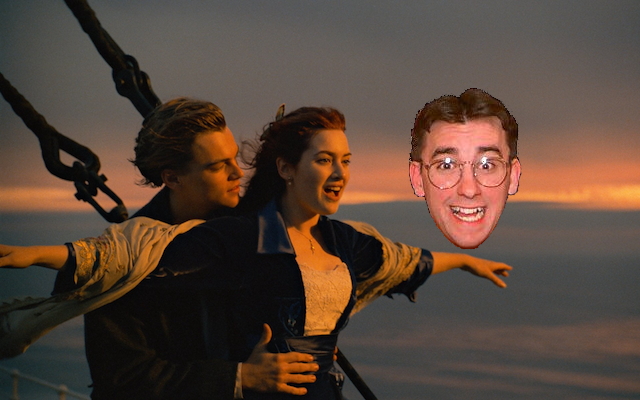
You know, I’d like to say something else about “Titanic.” Along with all these angry letters, I also got many, MANY letters from people who said, “Right on! I hated ‘Titanic’ too!” I became the poster boy for anti-“Titanic” sentiments — quite literally, as evidenced by the photo illustration a reader named Mike Booth sent me, which I have since had enlarged to full poster size. But you know what? I never said I hated “Titanic.” I said it was too long — a belief which I will take with me to the grave — and I pointed out some problems I had with it. Beyond that, all I said, or even implied, was that the movie was not as good as everyone seemed to think it was. That doesn’t mean it’s bad — that just means it’s not a Classic, or a Masterpiece.
So that’s all I was saying. Not that “Titanic” was a terrible movie; just that it was a so-so movie. To some people, though, calling it “so-so” was an unforgivable crime. And I will be amused by those people until the day I die.
Post script: Eventually, I saw “Titanic” a second time. It was in the dollar theaters in mid-summer 1998, and I wanted to see if I really hated it as much as everyone thought I did. So I went with a friend, with the main intention of mocking it and jotting down the worst parts of the dialogue. We did both of those things, but I’ll be honest: I enjoyed the movie. It entertained me the first time, and it entertained me the second time. My stated opinions of it — morally dubious, poorly written, too long, not worth all the hype — still stand. But I will reaffirm here that I didn’t think it was terrible. Happy now?
Viva Salt Lake: Eat My Rust

0

The Desert Star Playhouse in Murray prides itself on doing locally-written melodramatic parodies, and on providing an evening of family-friendly musical whimsy.

Generally, they succeed. With the current show, “Viva Salt Lake,” a satire of Elvis Presley movies, they succeed only to a marginal extent. The show is still clean and fun, but not nearly as enjoyable as the last few have been.

The plot has Johnny Hazard (R. Russell Durrant), the Elvis character, drifting into ’50s Salt Lake City on his way to California. There he becomes a racecar driver, falls in love with a local girl, Rusty (Kaycee Raquel), and of course thwarts the evil designs of the local bad guys (played with cheesy enthusiasm by Andrew R. Looney and Paul Thomas Murphy).

Along the way, the characters sing a few rock ‘n’ roll songs, mostly with re-worked lyrics. Some of these songs are funny; others aren’t intended to be and merely give the cast members a chance to show off their vocal talents, which are considerable.

But therein lies some of the problem — not even TRYING to be funny. There are several longish stretches of dialogue where nothing that’s even supposed to be amusing is being said. This is fine, of course, in a regular show, even a comedy, but when the shows have intentionally simplistic plots and characters, taking time out to establish plot devices or express a character’s background seems unnecessary.

Previous shows at the Desert Star have generally been a joke a minute — even though some of the jokes weren’t funny, at least they were lively, and at least the energy kept up.

“Viva Salt Lake,” and the “You Ought to be in Pictures” Olio that follows, can go from being hysterically funny and clever one minute to head-scratchingly unfunny and lame the next. For example, the race scenes, complete with a backdrop that rotates in order to convey the idea of motion, are ingenious and entertaining. Jokes like, “Don’t boo me — boo Clinton!” are solicitous and unimaginative. Having a fight scene with a strobe light on while one character beats up a stuffed dummy intended to represent his foe is funny. Pointing out that Salt Lake has “a church building and a 7-11 on every block” is not. Having Moses part the Red Sea and then be eaten by a shark, complete with “Jaws” music, is funny. Having a man come out onstage wearing a dress is not funny, at least not automatically. (Although you wouldn’t know it from the way the man in front of me almost gave himself a hernia laughing at it.)

As usual, David Len Allen’s piano accompaniment is exceptional and, in this show, adds a lot. Many times, he plays familiar songs whose lyrics accurately describe what’s going on in the show. For example, the evil car racers have “Put Your Shoulder to the Wheel,” set in a minor key, as their theme song. When one character talks about a van of young women driving up, we hear the strains of a Janice Kapp Perry song. “Come Come Ye Saints” and “When We’re Helping We’re Happy” also pop up, as do many others.

Gordon Johnson’s Jimmy Durante routine in the Olio is well done, funny, and even kind of sweet.

“Viva Salt Lake,” while not on a par with some other shows in the Playhouse’s history, is still entertaining and amusing, and it’s a nice way to spend an evening with the family.

Forever Plaid

0

The four members of a male harmony singing group are on their way to a gig in 1964 when a bus full of Catholic school girls plows into them and sends them to the Great Beyond.

Due to some astrophysical thing, the Plaids, as the singers are known, cannot actually rest in peace until they perform the big show they never got a chance to do in this life. That show is “Forever Plaid,” now playing at Provo Theatre Company, and it’s worth the 30-year wait these poor fictitious characters had to go through.

“Forever Plaid” is, obviously, a musical, but not in the typical sense of the word. “Musical” usually implies a story with some songs mixed in, whereas “Forever Plaid” is a lot of songs with a bit of a story mixed in. I’ve already detailed the entire plot for you; there are no surprises.

It’s suspiciously simple. “How can a show that is little more than a four-man group singing early ’60s songs be any good?” is what you may be asking yourself. The answer: I don’t know, but it is.

Part of the show’s success is due to shrewdness on the part of the writers, Stuart Ross and James Raitt. They knew the premise would wear thin after a while. That’s why there’s no intermission, and why the entire show is done in less than 90 minutes. Also, there is a surprising amount of variety in the styles of songs performed, with enough gimmicks to keep things moving. They do audience participation — in Monday’s performance, audience member LaVell Edwards had to hold a cardboard palm tree and sway it as the group sang Calypso music. They do some genuinely funny bits of dialogue and shtick. They sing “Crazy about You” and use plungers for microphones. They sing a verse of “Perfidia” in Spanish (with a terrible accent). They do a 3-minute-11-second version of “The Ed Sullivan Show” that is hysterically funny and fast-paced without being frantic or rushed. They come in too early, hold notes too long, get nosebleeds, and just generally horse around. In short, they entertain.

Another help is the four men themselves. The characters are as simple as the show, with little depth or development even intended. And yet, they are all likable and sympathetic. Even though we know nothing about them, their sheer charisma and personality shine through enough to make us like them.

The actors, Tony Akin, Brian Clark, Chris Higbee and Jason Webb, are all outstanding singers and top-notch actors. According to the biographies in the program, three of them graduated from BYU’s music/dance/theater program, and it shows. They’re all goofy smiles and innocent enthusiasm as they sing and snap their way through the show.

Also well worth mentioning are the two musicians: Ross Boothe on piano and Stephen Frandsen on bass. Both are students at Spanish Fork High School — HIGH SCHOOL students, these — and play their instruments extraordinarily well. There is little interaction between the actors and the musicians, but these guys give it their all and do a great job.

“Forever Plaid” pays homage to the guy groups with tight harmonies that prevailed in the early ’60s, and it also lovingly, gently mocks them. But mostly it celebrates those bygone days with an hour and a half of sheer energy, fun and laughter. While it may not be your typical musical, “Forever Plaid” is a break from the norm that works.

Shutteth Up!

0

The BYU Theater Department is currently performing William Shakespeare’s “Romeo and Juliet,” and I think I speak for us all when I say, “Forsooth! what doth yon bequiddle?”

Oh, I know what you’re thinking. You’re thinking I’m going to make a bunch of cheap jokes about Shakespeare, just because he’s very popular among snooty people and therefore seems like the kind of icon I would target with my unique and award-winning brand of humor and sarcasm. Well, frankly, your hasty and superficial judgments make me choke on my own bile, and I demand an apology.

Far be it from me to make fun of Shakespeare. What is there to make fun of? The fact that he wrote long, odd plays in which every single major character either goes crazy, dies, or goes crazy and THEN dies? Or maybe the fact that his plays contain many dirty Elizabethan jokes that make snooty English teachers gush about what a comic genius he was, but that if YOU were to tell them, would get you kicked out of school, particularly if you tried to tell them in The Daily Universe, which I am not even going to try? Or maybe you think I should joke about how Shakespeare would frequently have his characters stand onstage and babble on and on about stuff for half an act or so, at which point some designated stagehand would have to make loud noises in order to wake the audience from its deep slumber. Or how sometimes the stagehand himself would fall asleep during the speech, and the audience would wind up staying the night, or how sometimes even the actors would fall asleep, including the one who was talking:

“To be, or not to be — that is the quesZZX-XXXZ-ZZZ-ZZZZzzzx.”

Well, I’m not going to make those jokes, because there are bigger fish to drop from the frying pan into the fire. For example, there is the issue of people who can’t shut up and who need to be hit in the head with bricks. I watched “Romeo and Juliet” on its opening night and was disturbed throughout most of the play by several people behind me who kept talking, despite the fact that I kept turning around and glaring quite specifically at them. They surely cannot have mistaken my glare for a smile, for my glare is unmistakable. Often, even when I AM smiling, people think I am glaring. And surely they cannot have been at a loss to explain WHY I was glaring at them, unless they’re not only stupid but UNAWARE that they’re stupid.

But the talkers were not as bad as the candy eaters, whom I have considered taking legal action against. It is hard to imagine, but these people smuggled some candy into the Pardoe Theatre and began eating it after intermission. I do not know what kind of candy it was, but from the way it sounded, I would guess it was a bag of Skittles in which each Skittle was individually wrapped in the loudest celophane known to man. These people even had cans of soda (or “pop,” as some have incorrectly called it) (and no, I’m not going to get into THAT).

I don’t wish to come across as a high-class snob, but who raised these people? Hyenas? How poorly bred do you have to be to NOT know that you don’t talk during a play, and that you do NOT bring candy and drinks into the theater? I realize that at the movies, food is OK, and that at home, even talking might be OK. But in the theater, where people are doing plays, you shut up, and you go hungry. The only exception would be if you are a shrew and must eat your body weight in food every hour or else you will die. And I cannot think of an exception for the talking thing.

Come on, kids. Do you HAVE to talk? I know the play is boring. I know that, thanks to the weird quasi-British accent that Shakespearian actors feel compelled to use, you can’t understand half the words that come out of their mouths, and that even if you can make out all the words, you often still don’t actually know what they’re talking about. I know all this. I experienced all this. And yet — I managed to be quiet the entire time. Fancy that! I actually shut up and watched the play, with nothing but an Altoid to tide me over. The only time I said a word was when I leaned over and quietly pointed out to my date that Mercutio was still breathing very heavily, despite the fact that he was dead. But no one could hear this except my date. You kids didn’t hear it. Even if I had said it loudly enough, I doubt you could have heard anything over the din caused by the candy wrappers.

I would also like to discuss a similar experience I had when I tried to watch “Oedipus Rex” at International Cinema last week. Most people go to International Cinema solely because they have to, of course, which means they often do not appreciate the fine art being shown. “Oedipus Rex” is a particularly fine piece of art about a man who accidentally marries his own mother, which, as you can imagine, is a highly embarrassing predicament. “Whoops!” is probably all I would be able to think of saying, were I in that situation. (Also: “Sorry!”)

But despite the important themes of family and love being portrayed artfully (i.e., weirdly) on the screen, many people were talking during the film, and occasionally even laughing, even at the very serious and moving part where Oedipus’s mother/wife hangs herself and Oedipus stabs out his own eyes with a pin. “That should solve everything!” is probably what he was thinking, and I can see (get it?!) his logic.

My proposal for solving this epidemic of inappropriate talking is the same as my proposal for dealing with a lot of unpleasant things: poison darts. One dart to the neck, and Mr. Loud-Pants is out for the night. Try it, it’s fun! Thank you.

I’ve Been Weight Lifting for a Girl Like You

0

I’ve started working out. This is because I am out of shape. Well, that’s not to say I don’t HAVE a shape, which of course I do. I’m sort of amoeba-shaped, with odds and ends floating around in random directions. But it’s not the sort of shape a person deliberately tries to get himself into. It’s the kind of shape you see in an inkblot test, or at the scene of an accident.

The reason I’m trying to get in shape is that I’ve realized how important physical appearance is. If you examine most of your top Hollywood stars with high-powered binoculars, you’ll find that they are in excellent physical condition, and that they don’t appreciate being stared at so closely. Oh sure, there are exceptions. Some celebrities are ugly. For example, Tommy Lee Jones possesses, at last count, only one eyebrow, which extends all the way across his forehead, and in fact circumnavigates his entire skull. And yet this man has been the star of several very popular movies, including “Men in Black,” in which he was less attractive than many of the aliens.

But for the rest of us, we need to look good, not just if we want to be motion picture stars, but also if we want the opposite sex to find us attractive. Of course, women have a bigger issue with this than men do. Women will go on crash diets and lapse into deep depression if they so much as SEE another woman who weighs less than they do, whereas a man can be the fattest, awfullest thing in the world and yet still wear tiny bathing suits at the beach and prance around like Michael Flatley, Lord of the Dance.

Anyway, looks are very important, particularly in college. Having a pleasant personality and a nice sense of humor does not count for squat, as you know if you have ever been young. And so I’m working out in the weight room. I don’t want to get huge — just a little muscle tone, flatten the ol’ stomach a bit, get me one of those cute rear ends you hear so much about. (Heaven help the man who doesn’t have a cute rear end.)

This is not my first foray into the world of weight-lifting. I took a weight-lifting class a couple years ago, back when you actually had to do some kind of physical activity to meet your P.E. requirements for graduation, unlike now, where you just have to sign up for HePe 129 and then come back at the end of the semester to collect your A.

No, back then you had to take a class or two, and so I took weight-lifting. The problem was, I got stuck with a personal trainer named “Biff” (real name: I don’t remember), who would show up every day with a new way of killing me. I grew to dread the class, and I quit going (my standard method of dealing with unpleasant college classes), and I wound up with virtually no physical improvement whatsoever, although if there were a muscle representing my ability to postpone the inevitable, it would be huge.

This time, it’s different. Biff is gone, having been sent back to his home planet. So it’s just me and a bunch of sweaty guys in a weight room. I am intimidated by the sweaty guys. This is because I have almost no idea what I am doing. I know some basic weight-lifting maneuvers, but there are some pieces of equipment in that weight room that could not be more foreign to me if they came directly from Neptune. They’re all variations on the same motifs: a bench, a bar, some weights. They just rearrange them and change their shapes, leaving me to figure out what you’re supposed to do with them. I have a fear of sitting on a little bench with the bar in one hand, only to learn that you’re supposed to STAND UP on the bench and lift the bar with your ankle. The sweaty guys would laugh at me, and it would become apparent that I was a novice. Then they would beat me up.

I try to reassure myself with the self-deception that nobody else knows what they’re doing either, but that doesn’t work because it is obvious that they DO know what they’re doing. I can tell by how much weight they can lift. This is another source of intimidation for me. Currently, three weeks into my program, these guys could lift more weight with their eyelashes than I could with a forklift. These are guys who played sports in high school while I was writing irresponsible editorials for the school newspaper (“Why I Think the Principal Once Killed a Guy”). They have a huge head-start on me.

Anyway, I try to ignore my fear, and I go about my routine. This is my system: I stand in a neutral position in the middle of the weight room and identify a part of my body that does not hurt. Then I hurt it. When it is good and hurt, I pick another body part and move on. Eventually, my entire body, including my elbows and my hair, is in deep pain, and I know that I am finished for the day. I limp back to the locker room and try not to convey in my body language the fact that I feel as though I have just been hit by a train, because I know the sweaty guys would pounce on me if they knew. They can smell weakness.

I never discuss my specific regimen with people because I don’t know enough about the subject. My observation has been that most other people don’t know much about it either, but that doesn’t stop them from talking about it. (This is true of many subjects.) If I mention to another guy that I am doing squats in my program, he will tell me that squats are bad for your back or your knees or something, and that if you squat too much your kidneys will pop out. I will take his word for it and follow his recommendation, which is to do leg extensions and toe presses instead, only when I mention that to someone else, he will tell me what a moron the first guy was, and how if I want strong legs, I should do leg curls, or leg benches, or pressed leg bench curls, or whatever. Again, since I know virtually nothing about the human body except how to make my ears wiggle, I cannot respond to these conflicting reports. All I can do is smile and grunt and say “dude” and try to maintain good rapport with the sweaty guys.

And so it goes. I continue, three days a week, making my body hurt in the weight room and then making it hurt even more by walking up the 12,829 steps from the Smith Fieldhouse to the main part of campus. But it will all pay off. Soon I’ll be in shape. I’ll be buff. I’ll be one of the sweaty guys. Young punks will be intimidated by me, and I’ll frighten them to the point of tears with my manliness.

Now if only my hair weren’t so dorky looking….

Just the Fats, Ma’am

0

As of two weeks ago, I have sworn off all fat and have gone on a diet. In a related news item, Little Caesar’s stock has dropped sharply every day for the last two weeks.

Believe me, you and the good folks at Little Caesar’s are not as shocked about this as my body is. My fat cells had pretty much taken over, running my body in a ruthless reign of terror, making the other cells do all the work and leaving them free to sit around all day, smoking cigars and swearing. But now, thanks to the diet, my fat cells’ days are numbered. Of course, I hate to call it a “diet.” I prefer to call it a “change in eating habits,” because “diet” sounds so womany. Men don’t go on diets. Men mostly just go around being fat, particularly after they get married. I suspect this is why so many married men go everywhere — school, work, job interviews, funerals — wearing sweatpants: because their regular pants can now contain only approximately one of their legs, instead of the usual two.

At any rate, since I am not married and therefore cannot afford the luxury of being fat, I have decided to go on this diet, or whatever you want to call it. I mean, it’s not like I’m enormously fat. I’m maybe 15 pounds overweight, and very out of shape, and my cardiovascular fitness is so low that I cannot even hiccup without fear of my lungs collapsing. But I’d like to improve myself a bit.

The reason I’ve put it off for so long is that I love to eat, especially items from the “garbage” food group. In my heyday, I could eat two foot-long Subway sandwiches, an entire large pizza, a truckload of saltines, and a gallon of lard, straight from the carton. I could eat most people under the table, and then eat the table. I’d go for weeks at a time eating nothing but Oreos, and after the initial sugar rush, all my major motor functions would start to slow down, including the ability to say several of the consonants, and I’d walk around in a sugar-induced stupor, drooling. (It was during this time that I produced some of my best columns, by the way.) I didn’t care about fat in those days. Why, I once ate a million grams of fat in one sitting, and then washed it down with a jug of bacon grease. Those were the days, my friend, when I figured I’d rather be chubby and happy than thin and cranky.

Those days are over.

I have decided that I would much rather be thin and cranky than fat and unmarried. Not only am I lifting weights — no point in being hungry unless you can be sore, too — but I also eat very little fat, and the fat that I do eat is only allowed to be ingested in the form of foods that I don’t like. Any food/science/nutrition major (I’m sure there must be SOME) can tell you that fat only makes you fatter if it tastes good. Bad-tasting fat is harmless. It is a well-known fact, for example, that one carrot has over 1,000 grams of fat and won’t hurt you any, whereas one Twinkie has only 10 grams, and yet can make you fatter merely by being in the same room as it.

So I eat a lot of fruit now, and no-fat snacks such as pretzels, yogurt, and Styrofoam. I also — and this goes back to the whole “womany” issue again — am trying that Slim-Fast stuff. I am aware that Slim-Fast is a “quick fix,” and that as soon as you quit using it, the weight you’ve lost leaps back onto your body like fleas on a trucker. But what’s so bad about quick fixes? Was not this country founded on quick fixes? Sure, signing the Declaration of Independence may have TEMPORARILY freed us from British rule, but the fact that the Spice Girls have a movie coming out IN THIS COUNTRY is a clear indication that that freedom didn’t last.

And besides, along with using the Slim-Fast, I’m also eating sensibly. It’s a near-perfect system, really, marred only by the fact that Slim-Fast tastes like mud. Imagine putting one drop of chocolate syrup in a tall, cold glass of bathwater, and you’d have something that tastes approximately 10 times better than Slim-Fast. Of course, I’ve only tried the alleged “chocolate” variety; if Slim-Fast has another product that actually tastes good, rather than just CLAIMING to taste good, they are perfectly welcome to send me a free case of it, care of this newspaper.

I’m also following the advice of many medical professionals, which is to drink eight glasses of water a day. The logic here seems to be that you will not be eating much if you are in the bathroom most of the day.

The reason I am discussing this here is to apologize to my friends, many of whom I once had food-based relationships with, but with whom I can no longer associate. Please don’t be offended if you invite me to lunch at Pizza Hut and I decline, or if 99-cent Whoppers no longer appeal to me. Please don’t think that I’ve stopped loving you, just because I can’t go to the Shoney’s all-you-can-eat breakfast buffet anymore. Just know that I’m trying to create a new, slimmer Eric D. Snider, and that we’ll all be grateful when it’s over. Now pass the Styrofoam.

Come Blow Your Horn

0

There comes a time in everyone’s life when you have to get serious, quit acting like a kid, and start acting like a grown-up.

It’s a pretty simple message, but that’s all the message you’re gonna get in Neil Simon’s “Come Blow Your Horn,” currently being produced at the Hale Center Theater Orem.

(Note that the Hale Center uses two sets of actors for each show. This review refers to the Monday, Wednesday and Friday cast.)

“Come Blow Your Horn” is a light-hearted, pleasant, two-dimensional comedy — and in fact, so is its main character, Alan Baker (Benjamin Berneche). He’s a Manhattan bachelor-playboy, cruising through life with no commitments, no worries, and no depth. When his kid brother, Buddy (Cody Swenson), moves in with him, though, his world is turned upside-down as the usually timid and cautious Buddy becomes exactly like his older brother.

It’s a comedy of personalities as we watch the two brothers struggle with each other — even physically, in a memorable scene near the end — with their parents, and with the two women who keep coming in and out of their lives.

Unfortunately, the production is marred by a couple of inadequate performances. Cody Swenson’s Buddy is constantly hyper and over-done, with virtually no levels, and Nancy Stewart Douglas’s Mrs. Baker, the doting Jewish mother, is much the same. Still, she got applause the night I was there for her long monologue in which she has to take several phone messages for Alan and becomes increasingly over-wrought. There’s something to be said for popular opinion; however, I stand by my opinion that she over-plays the part, to the point that it doesn’t seem real anymore. (In the scene featuring just Buddy and his mom, with both of them basically trying to over-act each other, I got a headache.)

Benjamin Berneche’s Alan Baker is quite good, though. He seems to preside over the show rather than star in it, using just the right amount of energy and emotion to make his character seem honest without over-presenting himself. He seems genuinely comfortable onstage, as if the whole thing is easy for him.

LaMarr Neilsen plays Mr. Baker, the stereotypically outraged Jewish father. (Only in Utah are Jewish fathers played by men named “LaMarr.”) His accent slides in and out, but he is sufficiently blustery and crotchety to make the character fun.

Music is used creatively throughout the show, particularly in one hilarious scene featuring the song “Born Free.” (A choreographer, Marilyn Montgomery, is even credited for this scene!) Watch for it; it’s very funny and almost surreal.

One unfortunate fact about the show is that it is written in three acts. The first two happen with no lapse in time between them, however, and so this production puts them together, with intermission and the third act following. Unfortunately, most of the action happens in those first two acts, resulting in the audience coming back from intermission expecting to see a lot more, and not realizing that almost everything that is going to happen has already happened. The material before intermission is 90 minutes long; after intermission, it’s not even half that. It ordinarily wouldn’t be worth mentioning, but here it disturbs the flow of the show, and creates quite a jolt in the storytelling.

Still, the show is enjoyable, if a little long in parts. Simon writes in a quick, breezy style, and the actors generally do a good job of keeping things fun. It won’t make you think too hard, and it won’t change your life, but it will certainly make you laugh. It’s a fun show, and that’s what really matters.

Pedro’s Christmas Vacation

0

I drove home for Christmas. It’s 640 miles from Provo to Lake Elsinore, Calif., and I was pretty sure that Pedro (my 1987 Hyundai Excel) could make the trip, despite the fact that he occasionally overheats just on the way to school, sometimes when I’m not even DRIVING him.

But I didn’t want to make the trip alone, so I convinced my friend Rob, who lives not too far from Lake Elsinore anyway, to ride with me. We figured that even if Pedro broke down and we had to buy an entirely new car, it would still be cheaper than flying. And, even if Pedro broke down and we had to WALK the whole way, it would still be more COMFORTABLE than flying. (Also, we wouldn’t have to eat those peanuts in the impenetrable bags made of space-age polymers.)

We also knew that driving home would give us plenty of Bonding Time, though of course we did not discuss this out loud. Guys do not acknowledge that one another’s friendship is valuable to them, because to do so would be an obvious admission that they are sissies, and it would be grounds for shunning. Real men don’t NEED friendship; this is why they behave like such jerks most of the time, to prevent the possibility of someone desiring to be their friend.

But Rob is a good friend, and I’m not afraid to admit it. I’ve already admitted to driving a 1987 Hyundai Excel which I have taken the trouble to name; why should I be embarrassed at my machismo being questioned even further?

We knew that driving to California would be a big test. Sure, we have fun hanging out normally, when we’re just watching “The X-Files,” or eating 99-cent Whoppers, or debating which typographical error in that day’s Universe was most amusing. But you never know what’s going to irritate you until you spend 10 hours locked in a car with it, especially when you have a short attention span like I do. I was afraid that by the time we reached Beaver (town motto: “Yes, There’s Actually a Town Called Beaver”), I’d be wishing Rob were someone else, or that he were dead. Normally, of course, I don’t wish he were either of those things, and he usually isn’t.

And so, throwing caution to the wind, we barged out onto I-15, headed south, feeling young and carefree as we cranked up the stereo and let the wind blow against our faces as we put the top down. Then we realized that Pedro’s top wasn’t supposed to go down, and we quickly put it back up again.

We drove and drove, all the way down the middle of Utah. Despite what you may have heard, most of Utah is really quite ugly. The space between Springville and Cedar City consists mostly of the same one-mile stretch of landscape, repeated over and over again like the cheap backgrounds they used on Yogi Bear cartoons. I would not be surprised if people who live in Panguitch sometimes drive into Scipio and think that they are home. It all looks the same from the freeway, and I am fairly sure that all the people in both places have names with two capitals letters (LeVar, RayDeen, LeHeber, etc.).

This brings to mind an amusing anecdote from 1992, when I (note: do not do this) took the bus from Provo to Los Angeles. We stopped for lunch in Fillmore, and while I was sitting in a little diner having a cheeseburger, a young fellow — obviously a “local” — walked in. He and the waitress had the following exchange, which I am not making up:

WAITRESS: Hi, Sugar. Hey, y’all got your hair cut!
YOUNG FELLOW: Yeah, I’m goin’ on my mission next Wednesday.
WAITRESS: Oh. (pause) Want one last cup of coffee before you go?
YOUNG FELLOW: Yeah, I better.

I’m sure I do not need to explain the ramifications of THIS little conversation. I am just glad that this was his LAST cup of coffee before his mission, although I do wonder how in the world he ever got up at 6:30 a.m. without a cup of joe to clear his head. I know I occasionally had to be beaten in the head with a rubber mallet. (Although I suspect that some of these beatings were not necessary to get me out of bed, occurring as they did in mid-afternoon, sometimes while we were tracting.)

Anyway, Rob and I eventually stopped in Las Vegas. This was mainly to eat dinner, but it was also because Rob wanted to gamble. Rob had not been to Las Vegas since he became of legal gambling age, and he wanted to experience the thrill of putting quarters in a slot machine. I told him he could achieve approximately the same thrill from putting quarters in a urinal, but he refused. So I recited all the famous quotes, many of which I made up, about why we shouldn’t gamble because it’s trying to get something for nothing, and besides, Las Vegas is just so tacky and stinky, but he still wanted to try it. So I watched as he got five dollars in quarters, then I looked on smugly as he put each quarter in, one at a time, and won ten dollars, which he pocketed and left, five dollars richer than he had been when we came in. I guess he learned HIS lesson! This was a major test of our friendship, especially when, in a fit of jealousy, I attempted to duplicate his good fortune with my own five dollars in quarters, and got the exact same results, except for the “winning” part.

Aside from that minor incident, the trip was uneventful, and we came out of it unscathed and unkilled. We still watch “X-Files,” and we still occasionally eat 99-cent Whoppers. And I wonder which mistake in the Universe will be funniest todey?


[ I like this column because it talks, loosely, about friendship, which is a nice subject to talk about every now and then. Rob and I had a great time on the way down to California. On the way back, though, he was sick, and I had to drive the whole way, and he wasn’t much fun at all. I’ll tell you, there were times on that trip when I was reasonably sure that we were not EVER going to make it back to Provo.
An over-zealous editor almost “fixed” the spelling error in the very last word of the column, which of course would have ruined the joke. Fortunately, she regained her senses just in time. Journalism is full of near-misses like that. But in her defense, do you have any idea how hard it is to get sharp-eyed editors to include a mistake in the paper ON PURPOSE? It goes against everything they stand for.
This was the first column of the Winter 1998 Semester, and the first one to go through the rigorous Review Process (i.e., where the column must be read by the Daily Universe editor in chief, the NewsNet managing editor, Daily Universe adviser and Communications Department chair). Actually, another column, “Crock of Ages” was the first column to go through the process; it didn’t survive, though, and “Pedro’s Christmas Vacation” was hastily written in its place. (I vividly recall leaving a message for Rob saying that when he got home from work, at 2 a.m., he needed to come over and read the column to make sure he didn’t mind my mentioning him in it. I was glad he gave it a thumbs-up, since I had to turn something in the next day and had no other ideas.)
A couple changes were made for publication. Where I say “putting quarters in a urinal” — in the paper, that had to be changed to “putting quarters in a toilet.” We had a lengthy discussion about this, and everyone (except me) decided “toilet” would be better.
There were some who felt the whole column — or at least the part about gambling — shouldn’t go in at all. It was feared that if the administration, which was carefully eyeing Snide Remarks now, thought any BYU students were gambling, they would, to put it bluntly, freak out. Since it never gets mentioned in The Daily Universe, or in official Administration memoranda, the Administration probably doesn’t know that a lot of students gamble sometimes, and some Universe personnel didn’t want them to find out through my column.
But since I obviously take a dim view of gambling in the column, and since I make it clear that I lost when I tried it, we figured it was safe to talk about. If anything, the column is anti-gambling (if anything).
When this column was published, I referred to “an anecdote that I observed.” This is incorrect. You cannot “observe” an anecdote. You can tell, or relate, or share an anecdote, but you can’t SEE one. All that discussion over urinals and toilets, and nobody bothered to catch this major error in semantics.
(No one caught the fact that the anecdote had been shared in a column five years earlier, either, but I guess they had no way of knowing that.)
This column inspired an angry letter, believe it or not. Its author sent it to a friend of mine, knowing he would pass the criticism along to me. In the interest of preserving their friendship, I’ll not identify either of them here. Here is the e-mail exactly as it was forwarded to me.
Eric could be cured of his self-styled assessment of Southern Utah. But if he thinks it all looks the same, it is all for the better… if more people knew of the variety and beauty found at speeds of 0-5 mph, he might get addicted and there would be less space for those of us who know that the scenery is not painted on nor is it monotonous. Actually for some of us, driving that route almost brings tears of joy as we remember experiences we have had in that special part of the world and as in our mind we see the beautiful spires, lakes, lava flows, water falls, plants and creatures. Somebody did let the cat out of the bag… it seems to me that before the environmentalists and Lake Powell drunkards came on the scene, it was a bit more tranquil. But they are here now, attention has been drawn to these areas. If we can keep it a secret from some by building I-15 through a corridor which is relatively free of major geographic obstacles, yet close enough to towns with adequate water to fill our radiators, we are doing ok. Let the humdrummers keep on truckin’… After all, they say that if you think other people are boaring, you must be boaring too. Should I draw the analogy? OK, why not? If the landscape of the I-15 is that bad, maybe you are boaring enough to need to be razzled and dazzled… let’s say, hummmm, I got it, we could watch somebody gamble or spend a fortune at an amusement park!!! That’s it, let the boaring people find their pleasure where they may, but I will not deny them the opportunity to get to know other worlds. Who knows, maybe he is not boaring at all, he may have been deprived and therefore is subject to conversion. That would take away some of the space the rest of us love; but if it would make him a better person, yes, we can share. Rules: no drinking, no wild fires, no wild parties, take your garbage with you, don’t ride mountain bikes on muddy trails (it ruins them), DO NOT drive your macho truck knee deep in mud (it really destroys things), if you pick a flower make sure there are many others like it and leave the roots in place, stay on the road, and whatever you do avoid touching power lines and walking off cliffs.
Thank you, Grandpa, now go to bed. The sad part is, all these years later, I no longer remember who forwarded this e-mail to me or who the original writer was. Darn my faulty memory! ]

Crock of Ages

0

[Written for The Daily Universe for January 12, 1998; re-submitted with slight modifications for March 16, 1998; not published either time]

BYU singles wards are better than regular wards out in the real world for the following two reasons:

1. No crying babies. (Plenty of babes who cry, but no crying babies.)

2. Gospel Doctrine classes actually teach doctrines of the gospel.

I learned to appreciate item No. 2 when I went home to California over Christmas break. In the Gospel Doctrine class there, we were discussing D&C 138 (or, as it is commonly called, “D&C 138”). Early on, one class member spent several minutes talking about how her brother had been visited several times by their dead mother, and how she had explained what it was like in the hereafter: trees and flowers, and everybody’s really nice, and you can get Ben & Jerry’s for only a nickel, and there’s always a place to park, and they play FM-100 over the sound system 24 hours a day just like in the Cougareat.

While this woman was going on and on about her mother’s supposed visitations, it occurred to me that even if all this IS true, there isn’t much point in mentioning it except to show off to the other class members (“MY dead mom visits my brother, and YOURS doesn’t, so nyah nyah nyah”), because it doesn’t add any new perspective to anything, nor is it particularly inspiring. Also, if it’s true, it’s probably too sacred to be discussing it in Sunday School, where people like me can make fun of it.

Later in the lesson, the teacher asked, “What do we know about the division in the spirit world?” It’s a simple question, and one that missionaries discuss amongst each other constantly. According to the way these terms are used in common missionary parlance, “paradise” consists of those people who were good, whereas “spirit prison” consists of those people who were rude to missionaries. (This theory presents a problem in some areas. For example, in Chile, where no person has ever been rude to a missionary, and where the capital city of Santiago now has 30 missions just in the downtown area, and where the fire hydrants are constantly running so that, to save time, investigators can be baptized as they walk down the street — in Chile, missionaries are at a loss to explain WHO will be in spirit prison.)

Anyway, back to Sunday School. The question was about how the spirit world is divided, and in response to that question, the same woman as before raised her hand. She launched into another fireside talk about the order in which you meet people when you cross over into the spirit world, and how it’s a lot like Munchkinland, in that people sing you along your way and show you where to go, and there’s candy canes and lollipops and stuff. All of this, she said, is true regardless of whether you were good or bad before you died. Most of what she was saying had no basis in verifiable fact, but she was sold on it because her brother had told her, and he’s in a stake presidency, which makes it true, and he heard it from his bishop, which makes it even truer.

I have only two objections to this story:

1. It didn’t answer the question.

2. Even if it HAD answered the question, it still wouldn’t be true.

Let’s look at this logically. If you were evil and wicked in this life, full of hate and bitterness, and you went around kicking dogs and beating people with sticks, then you are probably going to “spirit prison.” (If you ever said “no” to a missionary, then you can bet on it.) (If you also beat that missionary with a stick, then you can bet double on it.) And even if all your family and friends — also dog-kickers and with-sticks-people-beaters — are there, they are probably not going to be happy about it. I don’t think it’s going to be such a jolly, Chuck E. Cheese-esque affair.

So what did the teacher have to say about all this? He said, “Well, I’m in no position to comment on that.” And I thought, “Neither was she, but that didn’t stop her.” And no one said anything, and that’s exactly my point. In a BYU ward, there would have been dozens of people ready to swoop upon this woman and point out that most of what she said could not be proven by the scriptures to be true OR false, and so it therefore shouldn’t have been said at all without clearly identifying it as personal opinion. Perhaps this woman would have been tarred and feathered, too.

In a BYU ward, you have a high concentration of returned missionaries, most of whom, despite dressing and talking exactly alike (“Fetch, dude!”), are often very different from each other. For example, if someone says something that is contrary to something Elder Bruce R. McConkie once wrote, there will be a group that will reject that person and point out what Elder McConkie said about it, and they will assume that the matter is therefore closed. “Elder McConkie wrote more books than any other general authority; therefore his opinions are more valid than anyone else’s,” that seems to be these people’s position.

On the other side, you have people who got tired of having to explain Elder McConkie’s blunt and occasionally puzzling statements to investigators and trouble-making less-active members, and so they finally decided to simply reject everything Elder McConkie said, including statements as seemingly harmless as “The sun rises in the east” and “Please pass the salt.” (“That was only his opinion,” these people will say defensively.)

On yet a third side, you will have people who chuckle and say, “We’re getting into some pretty deep doctrine here. I don’t think it’s necessary to my salvation for me to know that.” These people will even say this during the announcements at the beginning of class, and when roll is being taken. These are people who, when they were missionaries, read the LaVell Edwards biography during their personal study time, and whose idea of a heavy gospel conversation is an exchange of J. Golden Kimball stories and a round of “Church Film Trivia” (“Which sister missionary in ‘On the Way Home’ is prettier?”) (Answer: The blonde one.)

And so this goes on for a while, and eventually you’ve gained either a stronger testimony of something, or a headache. Hopefully it’s the former, but if there had been any screaming babies, you can bet it would have been the latter.

Dancing at Lughnasa

0

Pioneer Theatre Company’s production of the Tony Award-winning drama “Dancing at Lughnasa” has all the makings of a moving, powerful story, but the elements never quite come together.

Playwright Brian Friel tells us of five unmarried sisters living in rural Ireland in 1936, and he does so through the eyes of a 7-year-old boy, now grown and reflecting upon his childhood. The boy, however, is a minor character; it is his mother and aunts who take center stage.

The boy’s mother is Chris (Tara Falk), a pretty, mildly vain woman who had her son out of wedlock. The aunts come in all shapes and sizes. The oldest is Kate (Giulia Pagano), a practical, matriarchal woman who clings to Catholicism in the apparent hopes that it will keep the family together. Next is Agnes (Joyce Cohen), a quiet, reserved woman who spends most of her time taking care of Rose (Brenda Foley), who is simple and dim. The fifth sister is Maggie (Jo Twiss), a big, vibrant, fiesty gal who loves to cook and who, in 15 years or so, could be Marion the Librarian’s mother in “The Music Man.”

The common thread connecting all these characters is that their lives have known serious disappointment. Maggie’s old school chum is now married and has beautiful twin daughters; the man that Kate fancies from afar is engaged to marry someone else; Chris’s true love (and the father of her son) is flaky and non-committal; the list goes on.

Through it all, what keeps them happy and sane is dancing. In one scene, after Maggie has shared a monologue about her high school friend, all five sisters wind up dancing to the Irish folk music playing on their radio. The movement is wild and frenetic, accompanied by shrieks and screams as the women hike up their skirts and dance around the house. It’s primitive, really — just like the pagan rituals that go on up in the hills, and which their malaria-stricken brother Jack witnessed and occasionally embraced while in Africa. The sisters — particularly pious Kate — frown upon such “non-Christian” activity, but their dancing is remarkably similar to the pagan rites, and it serves a similar purpose: to maintain happiness, to appease the god of misfortune for a few minutes more, and to achieve a catharsis of sorts.

The characters’ lives are marked by sadness, but this is not a sad play. The point, in fact, is that they stave off their sadness simply by loving each other, by making jokes with each other, by having picnics out on the lawn, and, yes, by dancing. (The “Lughnasa” of the title refers to a fertility festival held in mid-summer and accompanied by much dancing, and it’s pronounced “LOO-na-sa.”)

This show won a Tony for Best Play in 1992, and one can see why. The script is full of real, honest characters, with dialogue that seems so natural you’d swear you were watching an Irish home video. But in this production, little of the emotion comes through. It is apparent which scenes are supposed to strike our hearts — usually it’s a monologue, as spoken by Kate, Maggie or Rose — but when it’s passed, we realize that it simply didn’t come together for us. “Dancing at Lughnasa” dances around the audience’s heart, but never quite enters in.

The Miracle Worker

0

Sometimes we young and cynical theater critics roll our eyes when we hear we’re going to see a 40-year-old drama. Having grown up on MTV and Ritalin, we anticipate a long, stuffy, boring production full of moralizing and old-fashionedness.

Knowing that it’s “The Miracle Worker” — about how Annie Sullivan taught blind-and-deaf Helen Keller to communicate — just makes it sound worse. One, the subject matter is rather dreary, and two, we know how it ends: Annie succeeds, Helen communicates. Whoopee.

But then, sometimes we young and cynical theater critics get our insolent faces slapped by a show so moving and human that we leave the theater with tears in our eyes.

“The Miracle Worker,” being performed at Pioneer Theatre Company through Dec. 20, is one of those shows.

Filled with hope, optimism and pure, unadulterated humanity, “The Miracle Worker” is touching and inspiring. Unfortunately, those words, “touching and inspiring,” are often used to describe things that are actually rather trite and generic, such as TV movies-of-the-week and Hallmark greeting cards. This show is none of that. The difference? This show is real.

And it’s not just because it’s based on a true story. It’s real because of some very fine acting performances. Lauren Lovett’s Annie Sullivan is young, enthusiastic, idealistic — but very real. We identify with her. She seems like someone we know. Her effervescence practically bounces off the stage into the audience, drawing us into the small Alabama homestead at which the action takes place.

Johanna Leister and Kenneth Gray are also outstanding as Helen’s grieved parents. Leister, particularly, is heart-wrenching as the mother who just wants to love her daughter. She is willing to go through any amount of heartbreak just for the chance that someone can help Helen. She never gives up, even in the face of failure.

And then there’s Helen herself. Thirteen-year-old Emily Jane Stewart plays this non-speaking role with such depth and realism that you’d swear she’d just stood there and told us Helen Keller’s life story. It’s a difficult role: no talking, just some grunts and occasional (well, frequent) tantrums. How to play that without caricaturing it? I don’t know how she does it, but Stewart pulls it off. How real is she? Even during scene changes, she stumbles around the stage, in character as a deaf and blind girl. One is almost surprised to see her walk out unassisted for the curtain call, so genuine is she in her performance.

Two scenes are particularly well done. When Annie first arrives and tries to teach Helen sign language by making the signs and having Helen feel them with her hand, the effect is riveting, captivating. One is fascinated by the interaction, hoping it will work, praying that Helen will understand. It is easy to forget that you’re sitting in a theater, watching two actresses who didn’t know each other a few months ago. The chemistry between the two cannot be faked.

The other scene is the breakfast scene. Annie kicks the family out of the house, convinced that she must be alone with Helen in order to get her disciplined enough to eat with a spoon and not with her hands. The sequence is several minutes long, with almost no dialogue, and yet again — it’s fascinating.

It’s also funny. And yet, it’s not what I’d call comical. That is, there are no set-ups or punchlines, per se. The laughs come naturally — it’s the comedy of real life, as Helen tries to get away from Annie, and Annie tries to discipline Helen.

Much of the show is like that — funny, but not jokey. True, real humor, almost like the playwright barely intended it to even be funny. Just like real life: You don’t plan the humor in your life; it just sort of happens.

When Helen finally understands at the end of the play, it’s like a floodgate has been opened, for her and for the audience. The play doesn’t show us how Helen grew up and became a powerful, brilliant woman. It doesn’t need to. Just showing us the beginnings — the struggles, the hopefulness, and the eventual discovery — is enough.

The point? That there’s always hope. Such a trite, over-used message in a world full of trite, over-used messages, but true nonetheless. “The Miracle Worker” is not trite, not syrupy, not maudlin, not melodramatic. It is powerful and touching, and genuinely inspiring. You won’t see a better play for a very long time.

Police Beat — Beaten

0

(Editor’s Note: The following article is a PARODY. None of the events described actually happened, at least not in the manner described. So put the phone down and relax.)

CRIMINAL NAUGHTINESS
A 21-year-old male student phoned University Police on Wednesday and said numerous men had exposed themselves to him. The student was in the men’s locker room shower when the incident occurred.

Two 19-year-old female students were arrested Monday for stopping, between classes, in the middle of the sidewalk between the JKHB and the library construction pit. Pedestrian traffic was tied up for several minutes as the two women, who reportedly are roommates anyway, stood there and yammered about how some guy in their ward was going to ask one of them out, or something. The suspects were charged with Criminal Dawdling. Police are urging students to keep it movin’.

MISCHIEVOUS PRANKERY
An 18-year-old female student was caught leaving the magazine area of the bookstore with a magazine in her hand. She claimed she was merely going to a register to purchase the magazine; however, police doubted her story, since the bookstore has never actually sold a magazine in its entire history. Instead, students sit on the floor and read them, like it’s some kind of library.

A 23-year-old female student living in Wymount Terrace reported Tuesday evening that there was a man in her apartment. The man was her husband. The incident is under investigation. Police are urging students not to get married.

PRANKISH MISCHIEFERY
Eight one-dollar bills were stolen from the cash register in the Porter Rockwell Museum and Shootin’ Gallery gift shop sometime Monday morning. The dollar bills are valued at approximately $1 apiece.

Two 23-year-old female students were taken to the McDonald McHealth Center this week after calling University Police on three separate occasions claiming to have seen the Three Nephites, John the Revelator, and Hugh Nibley. Doctors determined that the students were fresh off their missions and not quite grounded in reality again yet. The doctors wrote them a prescription to watch “Tommy Boy” and sent them home.

SUSPICIOUS SUSPICIOUSNESS
Police discovered a 29-year-old male sitting in a parked car in the Martin Harris Lost & Found parking lot. It was determined that he was the same individual who had been seen parking there previously. The incident is under investigation.

A 22-year-old female student reported Sunday that she thought was being stalked. The same male suspect had come to her house frequently, always uninvited, since the beginning of the semester, and had always tried to engage her in conversation, despite her firm declarations that she did not wish to speak with him. Police investigation revealed that the suspect was the victim’s home teacher. He was arrested and charged with Zealous Duty-Doing.

Two 18-year-old male students were jogging at 5:30 a.m. Tuesday when they reportedly saw a man walking. The man appeared to be about 60 years old, and he allegedly had a dog, on a leash, with him. The man did not approach the students. The incident is under investigation.

VEHICULAR WACKINESS
An 87-year-old student was driving her Cadillac Aircraft Carrier on East Campus Drive near the J. Golden Kimball Center for Religious Swearing Wednesday morning when she struck a bicyclist. The car suffered scratches and dents to the left front fender area, totalling approximately $900 in damages. The bicycle was severely damaged, with both rims being bent beyond repair, the crossbar broken in half, and the handlebars ripped off. Total damage is estimated at $400. The bicyclist, a 19-year-old male student, was found several blocks away, on the roof of LeMar’s. He was referred to the Honor Code Council.

On Tuesday, several students were caught walking slowly and nonchalantly into a crosswalk, despite seeing quite clearly that cars were coming from both directions and would have to brake to avoid hitting them. The students were taken into the woods and shot.

BAD CRIMINAL EVIL STUFF
A 19-year-old female student was studying at the library Thursday evening when a male suspect hurried past her and stole her backpack. She phoned police, but they were unable to locate the suspect. The victim describes him as “tall, with dark wavy hair, gorgeous blue eyes, strong, masculine jaw, the chiseled physique of a swimmer or Greek god, and a butt you could die for,” and then she has to lie down for a while. If anyone knows the whereabouts of the suspect, the victim is requesting his phone number.

A female suspect approached a 21-year-old male student, whom she did not know, and kissed him full on the lips before running away. The victim refused to call police or press charges.

LEWDNESS CONDUCTED LEWDLY BY LEWD PEOPLE
An 18-year-old female student reported seeing a man wearing almost no clothing Monday night on campus. She described him as “exceptionally tall.” Police arrived and determined that the suspect was actually the Indian statue west of the library. The Indian statue was arrested, but the student could not be found to press charges. Police found her several minutes later, asking the man, woman and child holding hands outside of the SFLC why they weren’t wearing jackets.

A 22-year-old male student reported Thursday that as he walked past the full-length mirror in his bedroom after taking a shower, he exposed himself to himself. He is pressing charges.

An 18-year-old male student was caught viewing pornography on the Internet on a library computer Friday. He was referred to the Honor Code Council. Later the same day, he was caught viewing the same pornographic material, only this time in a Calvin Klein advertisement in a Rolling Stone magazine in the BYU Bookstore. No action was taken.

CONTENTIOUS DOMESTIC DISPUTATIONS
Three male students, ages 21-23, called University Police Tuesday night to report that their roommate, a 21-year-old male student, was destroying their couch with a hatchet. Police arrived at the scene and questioned the couch-destroyer. He reportedly said that he was “sick and tired” of coming home every night to find at least one of his roommates making out with the “girl du jour” on the couch, and was therefore trying to get rid of the couch once and for all. Police found the roommates an alternate place to make out until the couch could be replaced.

THEFT, SHMEFT
A 21-year-old male student reported Saturday that his bicycle had been stolen from a bike rack outside of the Stephen E. Robinson & Gerald N. Lund Building for People That Everyone Thinks Are General Authorities Because They Write a Lot of Books. The student told police that the bike, which was a brand-new $2,000 Schwinn Kanab, had not been locked up. Police informed him that it served him right. No further investigation is being made.


[ Just as with my “Letter to the Editor” column, I wanted to do a once-and-for-all parody of “Police Beat,” a weekly Daily Universe column listing all the major crimes committed on campus that week. This column was just about as popular as the “Letter to the Editor” one, which is my other favorite.
The day after this ran, I got a phone call from Elder Richard G. Scott’s secretary, calling to make her own complaints, and not in behalf of the apostle. (See the comments after the Halloween column to see what else she didn’t like.) In this column, she didn’t like the part about the sister missionaries who kept seeing the Three Nephites. “I don’t think we should make light of the Three Nephites,” she said. I pointed out that I wasn’t making light of them, but of people who claim to see them all the time. She was not moved.
After it was too late, I thought of another funny name for a campus building: The Paul H. Dunn Center for Creative Writing. Man, that would have been GREAT. And of course the joke was on me when Gerald N. Lund actually DID become a general authority a few years after this column was published.
There was some uncomfortable behind-the-scenes drama with this one. After I’d written it but a few days before it was printed, a BYU student was raped just south of campus while jogging at night. The rapist was caught, but everyone was on high alert now, and some of the fictional items I’d written for the column — which is about near crimes and almost incidents — didn’t seem so funny anymore.
I removed one item entirely and reworded a few others. The 19-year-old female student whose backpack was stolen in the library was originally out walking after dark when it happened, but a woman walking alone after dark didn’t sit well anymore. The two 19-year-old males who were jogging when they saw a man? That was originally: “A 19-year-old female student was jogging at 5:30 a.m. Tuesday when she reportedly saw a man walking. The man did not approach the student. The incident is under investigation.” This was a perfect example of what I was trying to make fun of — suspicion, paranoia, making mountains out of molehills — but of course it was too close to reality now. So I changed the single woman to two men and made the man very old and gave him a dog to emphasize his harmlessness.
The day the column ran, Daily Universe staff adviser (and my No. 1 advocate) John Gholdston got a call from BYU President Merrill J. Bateman. Seems Bateman didn’t like the line where the 20 guys exposed themselves to another guy in the locker room shower. “That’s just not funny” is what Bateman said, but I don’t think unfunny writing was his major beef. (“That’s just not funny” would later appear as a quote on the back of my first Snide Remarks book, attributed to “a BYU faculty member.”)
Gholdston said Bateman’s main thing since he’d arrived at BYU had been that The Universe look professional. No silliness, no sophomoric stuff, nothing you wouldn’t find in a professional paper. Some people in the department didn’t care much for the column either.
Fearing the column might get axed, I put a page on my website the next day asking people to e-mail me their support if they wanted “Snide Remarks” to continue. (I noted in my journal that I’d been getting more than 50 hits a day on my site, which I was very proud of! Ah, the early days of the Internet….) I very quickly got a few dozen responses, including one that had 26 “signatures” on it, from the chemical engineering seniors. I sent everything to Gholdston, and he sent it to the department higher-ups. But problems with Bateman and the administration continued the next semester… ]

A Very Random Christmas

0

It’s Christmastime. How do I know? You can feel it in the air. People smile more, they’re nicer, they’re more polite, as they push and shove their way out of the Marriott Center after Devotionals and Firesides, like there’s a poison gas leak or something.

Christmas is a season of giving and sharing, particularly when it comes to illnesses. If only peace on earth and goodwill toward men were as contagious as a cold! Then the world would be a magical place, full of pixies and elves and candy canes, and houses would be made of gumdrops and taffy, and the streets would be paved with, I don’t know, some kind of good thing, or whatever.

The Christmas season means traditions, and lots of ’em. Traditions are important to us as a people, because without them, a lot of things wouldn’t be around. Bob Hope, for example. If you have ever seen one of those holiday specials on TV where he goes to entertain servicemen, you have noticed that he is a very good comedian except for one major flaw: He’s not funny. But we would all feel bad if we went up to Bob Hope and said, “Bob Hope, you are not funny, and, having been born after 1950, we are not aware of a time when you ever were funny.” It’s just sort of a tradition that we let him stay around.

So anyway, there are a lot of traditions that pertain specifically to Christmas that perpetuate things that probably don’t need to be perpetuated. Some of them affect my life personally, which is why I even care enough to mention them.

First, there’s the tradition of Complaining About the Cold Weather in Utah. My fellow Southern Californians and I like to perpetuate this one, and it just makes Utahns hate us more, which is unfortunate, especially around the holidays, when we should be loving and not hating. I have no problem with Utahns as a people, although I should mention that the next time I hear a Utahn refer to the world outside of Utah as “the mission field,” I will most likely strike that Utahn in the face.

No, it is just the weather here that I don’t like. And it’s not that I don’t like snow, either, because I love skiing and various other manly snow-related endeavors. I like snow. I like the ocean too, but I wouldn’t want to live in it. I like for it to stay where it belongs, and when I want to frolic in it, I go to where it is. I wish the snow would be as considerate as the ocean.

Sometimes you run into somebody from Alaska, which is located in Canada, where it is very cold 11 1/2 months out of the year. These people will brag about how back home, when it got up to 55 degrees, they took off their shirts and went swimming! To those people I say: Ha ha! You are freaks. Just because 55 is less cold than it usually is where you live doesn’t mean that 55 degrees is hot. You have got your sense of reality all mixed up, probably from eating too much whale blubber.

(Blubber. Maybe the streets would be paved with blubber.)

Anyway, another important Christmas tradition is Arguing Over Which Songs Are Appropriate to Sing in Sacrament Meeting. The real rule is that if a song doesn’t relate specifically to the gospel, or, even more specifically, to the Savior, it’s not appropriate for sacrament meeting. This means “Silent Night” is OK; “Frosty the Snowman” is not. It’s a simple rule to understand, and yet, as with so many other rules that are simple to understand, many people don’t understand it.

Every year, you’ll hear of some group singing that “Carol of the Bells” song. This is the one where the singers try to imitate the sound of Christmas bells. It starts with some women singing (and I am paraphrasing here), “La la THE BELLS! La la THE BELLS! La la THE BELLS! La la THE BELLS!” And then some men say, “Ding… Dong… Ding… Dong,” and then everyone is going, “Merry, merry, merry, merry ding-dong, merry, merry, merry, merry ding-dong.” It’s a cool song, but it has nothing to do with anything even remotely religious, and yet it gets sung in wards all over the country, and perhaps even in Alaska.

It’s ironic that the purpose of sacrament meeting EVERY SINGLE WEEK is to remember the Savior, and yet during the time of year when He should be remembered the most, sacrament meeting gets filled with songs that having nothing to do with Him. Of course, many of the TALKS throughout the whole year are irrelevant. You’re especially used to hearing nothing about the Savior if you go to a lot of missionary farewells, where the purpose is for the family to congratulate themselves and revere their son or daughter who is going away, and maybe, if there’s time between anecdotes about how young Chad was always kind to his sisters and treated neighborhood pets with respect, say something about the gospel. If there’s time.

Oh, and be sure to encourage the congregation to skip Sunday School and go to your Open House, too, where they’ll be expected to eat from the vegetable tray and give you some money, sort of to congratulate you for having a child worth sending on a mission.

It would appear that I have gotten away from my thesis, which is that missionary farewells are stupid. No, wait, that’s not it. My topic was Christmas traditions, and frankly, I’ve gotten so far off track now that I don’t even feel like trying to get back again. I’ll fire up a flare; you send for help. Merry Christmas.

Parking: Stick It

0

If you have ever parked on campus for longer than 12 seconds, you have no doubt received a parking ticket. Parking tickets are distributed more widely than “Watchtower” magazine. If all the money raised by BYU parking tickets over the course of one day were stacked up in a huge pile, it would reach to the moon, where you would find that BYU has also made parking illegal.

One interesting thing about parking tickets is that if you get seven of them in 12 months — even if you pay them all — you will be banned from parking, or even driving, on campus, forevermore. How do I know this? The same way I know about the secret water slides under the HFAC, and probate court: personal experience.

Actually, it’s an experience that Pedro and I both had. Pedro, as you’ll recall, is my 1987 Hyundai Excel (he sends his regards). Pedro and I have recently had our parking/driving privileges revoked because of too many tickets. I blame Pedro entirely, although I really can’t back that up with anything.

I used to get tickets in a careless, slap-dash manner. For example, last winter when I lived not-all-that-close to campus, I often didn’t want to walk to class in the snow. I knew I could park in the 30-minute parking across from the Wilkinson Center, but there was a chance I’d get a ticket for being there too long. So I’d weigh my options: trudge through the snow, or maybe pay 10 bucks. When you’re as lazy as I am, decisions like that are fairly easy to make, and you make them all the time. When I first got transferred to a bike area on my mission, I paid my new companion $10 to put my bike together for me. I was perfectly capable of doing it, but I decided I would rather read a Hugh Nibley book.

I racked up several tickets that way (being lazy, not reading Hugh Nibley books), but I didn’t know how many I had until I got a registered letter from the Traffic Office, informing me that I was thereby forbidden from parking or driving on campus anymore. It also said I could appeal the decision. I figured it was worth a shot, but of course it wasn’t.

I scheduled a hearing and met with the review committee, which consisted of the following: three elderly persons. All three of them were very nice, except for two of them. First there was a man whom I call The Lecturer. It was his job to help me realize the seriousness of my crimes.

THE LECTURER: Did you ever stop to think, when you parked in faculty lots, that you were taking up a space that a professor might need? That he might be rushing to get to class on time, but he wouldn’t be able to find a spot because your car was in the way, and so his class would go untaught and soon there would be anarchy and rioting, and before you know it, we’d all be dead?

ME: I tried to only park in faculty parking when I could see that there were several spots available, so I wouldn’t be taking the last one.

THE LECTURER: Did you ever stop to think about how fast those spots can fill up?

ME: Well, I —

THE LECTURER: Did you ever stop to think about how inconsiderate you were being?

ME: I —

THE LECTURER: Did you ever stop to think about anything?!

ME: (head bowed ashamedly) I have no regard for human life.

Next we had The Lady. She was the nice one. She smiled a lot.

Then we had The Other Guy. He was blind, like Justice. This was the only time during the whole process that the concept of “justice” entered my mind.

They gave me 10 minutes to list the reasons why I should still be permitted to park on campus. I gave the following:

* As a Daily Universe editor, I may sometimes have to work late at night, and I didn’t want to have to walk home in the cold darkness of winter, where I was liable to be killed by the gangs, or the people who hang out at Denny’s. Sure, I don’t live anywhere near Denny’s, but they can’t be hanging out there ALL the time, can they?

* At least one of my tickets had been due to an honest mistake, and the only reason I paid it rather than protesting it was that I got it right before registration time, so there was a hold on my records, and I knew if I went to the trouble of fighting it, by the time I got it cleared up all my classes would be full and I’d be stuck taking classes no one wants, like American Heritage and Social Wrestling.

* Two of the tickets happened on the same day. I parked, went away, and came back a few hours later to find TWO tickets on my windshield. The officer had apparently given me one and then come back again later to give me another one, just for good measure, or perhaps because he had an extra one weighing him down, messing up the aerodynamics on his bike.

* The more I walk, the more likely I am to run into people I don’t want to talk to, like professors whose classes I didn’t go to that day. If I drive, then I’m safe.

* I’m really, really, really sorry and I’ll never park illegally again, and can’t you please have mercy on me and forgive me? I did not quote scriptures, but I could have.

They said they would consider my case, and they sent me away. A week later, I got a letter saying they were upholding the ban, and from that moment forward if I parked or drove on campus, I would be fined $300 and The Lecturer would be sent to live at my house for six months.

Realistically, I guess I can’t complain. I knew the seven-tickets-in-12-months rule, and I often didn’t take the tickets too seriously. I just don’t see the reason behind the rule, because I always paid the tickets. If the purpose of giving parking tickets is to make money, why not let people rack up as many as they can? In fact, people who get a lot of them should be given some kind of Frequent Violator Discount, where they only have to pay $15 for parking in faculty lots, instead of $20, or where they get a free toaster or something. Eventually, maybe a high-ranking administrator would present the Frequent Violator with a plaque or certificate, thanking them for contributing so much to the BYU treasury. That would encourage the scofflaws to continue scoffing at the laws, and BYU would make more money. Before you know it, they’d have enough to tear apart ALL the buildings on campus.

And if the purpose of giving parking tickets is NOT to make money — well, I can’t think of a way to end that sentence that sounds plausible.

The irony of all this is that just after the final decision was made, I was sitting in my car — the car banned from campus — for four hours each night, guarding the cougar statue outside Cougar Stadium against over-zealous, paint-wielding U. of U. fans.

See, my friend wants to be a cop when he grows up, so BYU Police called to see if he wanted to help watch campus every night the week before the big BYU/U. of U. football game. Apparently, our stuff is always getting vandalized by those coffee-swilling apostates to the north, and we weren’t going to take it anymore.

In particular, the Utes are fond of dumping red paint on the cougar, which they did — this is true — the one night my friend and I weren’t on surveillance. For the remaining nights that week, from 10 p.m. to 2 a.m., my friend and I sat in Pedro, for free, and watched the cougar. If there was any suspicious activity, we called police dispatch on the radio and alerted them. Also, we called police dispatch on the radio if we wanted more hot chocolate and/or donuts, which they would send out in a jiffy, sirens a-blarin’. Sergeant Richard Decker, of BYU Police, seemed quite appreciative of our efforts; I think we were the only volunteers insane enough to do surveillance every night.

And to think I did it despite having been told I could never park or drive on campus again! To think I parked on campus every night, taking a tremendous risk of being fined $300, just to lend a helping hand and get a little free hot chocolate. I don’t wish to brag about the amount of school spirit I have, but I have school spirit practically coming out of my ears. It’s really unsightly, and I’d drive to the McDonald Health Center to have it checked out, but, well, you know.


[ This column almost got me fined $300! A few weeks after it was published, I was summoned to the Traffic Office, where I met with a high-ranking Traffic Office official named Steven Baker (who would later become head of the Honor Code Office). Baker told me that there were those in the department — he didn’t say whether he was among them — who thought I should be fined $300 as a result of this column. Why, you ask? Well, because I admitted in the column that I parked on campus, to do that week-long cougar-statue surveillance, AFTER being banned. Though they didn’t actually catch me in the act of parking, I admitted it publicly, and therefore I was subject to a fine.
Surely you are now wide-eyed with disbelief. Because surely YOU, being a good reader, didn’t miss the point of the column. When I mentioned parking on campus after being banned, it wasn’t to rub their noses in it, to say, “Nyah nyah nyah, I parked, and you didn’t catch me.” It was to point out the irony in spending a week volunteering for the very people who had banned me from campus. You caught that, right? You knew that’s the point I was making?
Well, the traffic people didn’t. The traffic people thought I was being brazen and defiant. Baker said, “How would it look for us to NOT fine you when you admitted publicly that you defied the ban and parked on campus anyway?”
I said, “How would it look for the Traffic Office to further ‘thank’ me for volunteering a week of my time by giving me a $300 fine? That wouldn’t be very good P.R., and the Traffic Office is already not very popular as it is.” I did not say specifically that I would write a column about it if they fined me, but surely it was implied, and surely it would have been a GREAT column.
Baker saw my point, but he stood firm. We examined what led to the ban in the first place, and in so doing, we discovered something: I was entitled to another appeal. The first letter I got from them said this, but it did so in a way that was misleading and unclear, and Baker said many students didn’t realize they had that second appeal available to them. So I helped him — this is true — re-word the letter they send to everyone, to make it clearer.
This second appeal was to a different committee, called the Campus Access Committee. Baker said that if they lifted the ban, it would make the $300 fine a moot point. However, if they did not lift the ban, Baker said he would have to fine me.
The meeting with the Campus Access Committee went slightly less smoothly than the first one did, and I was sure they weren’t going to lift the ban. Imagine my child-like wonderment and surprise, then, when they DID lift it, and everything was back to normal again. As sort of a thank-you, and a “no-hard-feelings” gesture, I went on a ride-along with the BYU Police and wrote a column about it. I lauded the police, in all sincerity, for being good at what they do, and for keeping BYU safe. I also mentioned that the parking ban had been lifted. ]

A Tuna Christmas

0

It’s hard to believe that a show whose actors spend most of their time dressed in drag could be poignant and touching, but “A Tuna Christmas,” playing at Provo Theatre Company, actually is.

A sequel to the quirky hit “Greater Tuna,” “A Tuna Christmas” tells the stories of a couple dozen residents of Tuna, Texas. All of their lives intersect as they prepare for the big Christmas lawn decoration contest, and the various other activities associated with the holidays. In the middle of all this, we see love, compassion, and real life — all played by a couple guys usually wearing wigs.

See, there are only two actors in “A Tuna Christmas,” specifically Charles L. Frost and Duane V. Stephens. And yet the two of them play 11 characters each, with no assistance. (At one point, when both actors are onstage and there needs to be the sound of a cat meowing, one of them subtly turns his back and makes the noise himself — no camera tricks here, nothing is hidden up the sleeves.)

It would be easy, then, to go for the cheap laughs. Most of the characters are women; the actors are men; instant comedy, right? Wrong. There can never be more than two characters onstage at a time; one of the actors will have to hurry off and come back on only half-dressed as the next character, guaranteeing instant laughs, right? Wrong.

There are a lot of laughs in this show — oh MAN, are there a lot of laughs — but they come, generally, from more sophisticated sources. Every time an actor leaves the stage we know he may come back as someone else, but it never seems forced. There’s never a feeling of, “Oh, they had to write it so that he left then, because this other person has to come on in a second.” Everything flows and seems completely natural and normal. The two men do such a good job, in fact, that when a character disappears backstage and the actor who played him comes on as someone else, we still think the first character is backstage somewhere. The idea of the actors quickly changing costumes in the wings seems foreign, even though we know in the back of our mind that’s what’s happening.

The best comedy, the kind of comedy that actually has depth and substance to it, is based on real characters in real situations. And therein lies the absolute brilliance of this show. When Frost and Stephens put on wigs and costumes to appear as other characters, they BECOME those characters. They actually do surprisingly little to give each of their characters different voices, but everything else completely conveys truth and reality. The way they walk, their tone of voice, their hand gestures — everything is completely convincing, and not just two-dimensionally.

So when Arles Struvie (Frost) asks Bertha Bumiller (Stephens) to dance, there are no snickers, no titterings of, “Hey, look, it’s two guys dancing!” We know that Bertha is being played by a man, but he has done such a marvelous job of painting Bertha as a real character — NOT a caricature drawn with broad strokes, but with real emotions and depth — that we hardly notice it.

The dialogue in the show is snarky and caustic, as characters diss one another and talk behind each other’s backs. In fact, the visual appearance of the characters, while vital in conveying who they are, is largely irrelevant in terms of the comedy. There are few sight gags at all. It’s mostly the dialogue that brings the laughs, and bring the laughs it certainly does.

The play begins almost deceptively, as two radio announcers talk about the latest news in Tuna. As they discuss the contestants in the lawn decorating contest, and all the other bits of gossip, the lines are played for laughs. We see the stereotypes of Texans being played out, and we laugh at what a town of yahoos this must be.

Then, suddenly, the rug is pulled out from under us. We actually begin to MEET the people we’ve just been told about, and learn about their lives. And while they’re very funny, they’re also very real. They’re not just punchlines, like the radio announcer scene would have us believe. They’re actual people, with lives and back stories and subtext. Didi Snavely isn’t just a gun-nut who owns a weapon store; she’s a woman with an alcoholic, dumb husband and a host of other real problems. Aunt Pearl isn’t just a limping old biddy; she’s a sweet, compassionate woman who is just like a thousand other women you know in real life.

In short, while this play deals greatly in stereotypes and silliness, it also conveys a tremendous amount of poignancy and reality. By the end, you feel like you know most of the 22 characters presented, and that they’re not just two-dimensional jokes up on the stage. It’s a rare kind of show: hysterically, bitingly, devastatingly funny and smart, and at the same time moving and substantive. Don’t miss this one.

It’s a Wonderful Life: Winging in the Holidays

0

At the Desert Star Playhouse in Murray, you’re never sure what you’re going to get.

Granted, the shows — all original works — are always loosely of the same genre: melodramatic, musical parodies of well-known movies, plays or other parts of pop culture. But even following that format, there is variety, depending on what’s being parodied and who’s doing the writing.

The current show, “It’s a Wonderful Life: Winging in the Holidays” is a sweet, good-natured parody of the Jimmy Stewart Christmas mainstay, although “parody” may not be entirely accurate. It’s more a retelling of the story, only funnier and with road show-style songs. The original “It’s a Wonderful Life” isn’t really spoofed or mocked, even gently. How can you make fun of Jimmy Stewart, anyway?

The insular references to Enid Greene (Note to Desert Star: Enid Greene jokes aren’t funny anymore) and other Utahns are kept to a minimum this time around, and the few that do come up seem out of place. Again, this is because the show is more of a straight-forward comedy than it is a satire.

(One notable exception: When George Bailey (Kirt Bateman) sees Pottersville, the town-that-might-have-been, with all its bars and strip joints, he comments, “This place is starting to look like Provo!”)

The crowd-pleaser of the show is Uncle Billy, played with enthusiasm by Jack Drayton. He gets many of the best lines and manages to play Uncle Billy as humorously senile without making him pathetic.

At one point in a performance last week, a man sitting in the front row took the encouraged audience participation a little too far, and starting directing the actors in what to say. Drayton looked at the man, and said, in character, “I didn’t see your name in the script, pal.”

Later, when a teenage girl was brought onstage as an additional character, she was directed to kiss Uncle Billy. After doing so, he asked her, “Do you want your gum back?” That little bit was planned, not improvised, but it’s typical of some of the character’s more outrageous old-man-played-by-a-young-man shtick.

Puns, which are used abundantly in all Desert Star shows, pop up a few times here, too. One of the best:

“I’m late for my appointment with Vidal.”
“Sassoon?”
“Well, it’s been a month!”

Pianist David Lee Allen provides mood music throughout the show, often playing specific tunes befitting the situation. Two clever examples that may go unnoticed: When George Bailey comes home to his family, we hear the Primary favorite “I’m So Glad When Daddy Comes Home”; and when Uncle Billy tries to remember what he did with the money, Allen plays “Try to Remember,” from the ’60s musical “The Fantasticks.”

After the play, the cast performs the “Happy Holiday Olio,” full of seasonal songs, dances, and skits. Some of the biggest laughs of the night came from this portion of the show. Much of the entertainment is cheesy and lame, but that almost makes it funnier — you’re laughing at the fact that they actually thought you would laugh at that. Other parts, like the “Rockin’ around the Christmas Tree” bit, are genuinely clever and amusing.

One thing should be mentioned. Two of the song parodies in the Olio, “Wreck the Malls” and “The Restroom Door Said ‘Gentlemen’,” were “borrowed,” without credit, from the Bob Rivers Comedy Corp CD “Twisted Christmas,” made famous mainly through airplay on the “Dr. Demento” radio program. Since the rest of the show, and even the Olio itself, has some song parodies that ARE original, it is unfair — not to mention unethical — to let the audience assume that these two very funny songs are original as well.

Miracle on 42nd Street: There’s Snow Business Like Show Business

0

In “Miracle on 42nd Street: There’s Snow Business Like Show Business,” the Desert Star Playhouse’s current melodrama/parody, the philosophy of comedy is: If a joke is funny one time — or even if it isn’t — why not repeat it endlessly?

For example, anytime someone says, “May I have a word?” whoever he’s speaking to MUST respond with, “Sure. Which word would you like?” You can see how funny this is once; you can imagine how great it is when it is repeated no fewer than three more times over the course of the show.

But lame jokes aside, it’s hard not to like a show that has a human-size dancing Christmas tree stumbling around the stage aimlessly because there are no eye-holes in the costume. While some of the jokes (OK, most of the jokes) make you roll your eyes, there are enough moments of genuinely warm, gentle, exuberant humor to make you laugh in spite of yourself.

In this variation on the classic yuletide film, Broadway producer C.B. d’Mille (Glen A. Carpenter) and director Bill Gailey (Scott Holman) are putting on a Christmas musical. They managed to snag big-time actress Elizabeth Taylor (Danielle Omer), as well as an actor whose real name is Wilhelm von Sinta Clausa (Russell D. Durrant) — which means they can advertise that their show stars “the real Santa Claus.”

All Desert Star shows have villains, and while they had to stretch to come up with one for this simple story, they did come up with something: gangster-type Hardy Steele (Norman E. Plate) and his stupid girlfriend Laurel Lye (Gaynl McAllister). (Later, when a judge says, “Order in the court,” it is Laurel who has to make the obligatory “I’ll have a ham and swiss on rye” joke.) Hardy owns the theater across the street, and he wants this Christmas show to fail so that he can get all the business for himself. To that end, he sabotages the show’s special effect — a flying Santa’s sleigh — and sends it crashing down during the dress rehearsal. Wilhelm von Sinta Clausa is injured, and it looks like the show won’t go on.

Fortunately, they are able to persuade the show’s writer, Kris Kringle (J.R. Moore) to star in it instead. He seems to know so much about the role of Santa Claus! they reason. He even looks like him! He even has his own Santa costume! Guess what. He IS Santa. But Natalie Walker (Caitlin Henriksen; double-cast with Brooke Robison), the young daughter of the director’s assistant (Alison Henriksen) doesn’t believe in Santa (you can blame her mom for that), much less that THIS guy is Santa, and just like the movie, the whole thing goes to court and everybody winds up happy — including the bad guys, which indicates just how jolly the holiday season is at the Desert Star Playhouse.

There are some pretty amusing moments in this show. I mentioned the dancing Christmas tree already; there’s also a bit when the judge calls for a “recess” during the trial, and everyone gets up and frolics around like they’re in elementary school. It’s that kind of energetic goofiness that will make you smile — and NOT the fact that Wilhelm, inexplicably, sounds like Forrest Gump and keeps making references to shrimp and boxes of chocolates. That kind of thing is contrived; a sleigh flying across the stage and crashing in the wings shows ingenuity and a good sense of mayhem. It’s a fun show with some nice holiday warmth to it.

How to Do Stuff Better

0

One of the perks of being extremely lazy is that you occasionally come up with time- and energy-saving ideas that revolutionize the way Americans do things, and which result in you being hailed as a genius, all without even having to get up off the couch.

I am always trying to conserve energy, and this even extends to the way my brain works. For example, I went to an electronics store to buy a VCR, and I asked the salesman why a 4-head VCR was better than a 2-head one. I knew the 4-headed ones were better because they cost more, and because having four of something is generally better than having two, unless you’re talking about personalities or kneecaps.

Anyway, I asked him why four was better, and he began to explain, and after about three sentences, I was hopelessly lost. I had no idea what he was talking about. Seeing that there was no point in continuing, my brain just shut off. It said, “Wake me up when there’s something we can deal with,” and it went to screen-saver, where it goes dark and little toasters fly across it. Then, when I was about halfway home, it perked up and went back to work, just in time to stop me from driving my car through the front window of Winchell’s.

Another time, my aforementioned car, Pedro, was acting up, as he is prone to do. I called my dad, who knows everything, and described the problem to him. He then started talking about air filters and coolants and blinker fluid, and before long, I was daydreaming about Crazy Bread. To this day, I have no idea what he told me to do with my car. For all I know, he told me to drive it over a cliff, although I frankly doubt that would have solved anything, since Pedro is possessed by the devil and is therefore indestructible.

My point is, I’m always looking for ways to save time and energy, and I have come up with some ideas that will revolutionize America, the world, and perhaps even Provo.

WEDDING RECEPTIONS

Have you ever noticed that nobody wants to go to wedding receptions? They always HAVE to go. “What are you doing tonight?” “Oh, I have to go to a reception.” Do newlyweds realize that not a single person at their reception really wants to be there? Apparently not. If they did, then when you left they wouldn’t shake your hand and say, “Thank you for coming,” they would say, “We’re sorry. We’re really so very sorry.”

Not only do the guests not want to be there, but neither do the family members. I base this on the fact that I’ve been a family member at two receptions and I didn’t want to be at either one of them. This is probably because the receptions took place at my home ward in California, where I kept getting asked annoying questions by the people in that ward. For example: “So Eric, when are YOU getting married?” And: “When’s the big day for you, Eric?” And: “Getting married soon, Eric?” And: “When can we look forward to YOUR reception, Eric?” And: “Got a girl in mind yet, Eric?” And: “I suppose you’ll be getting married soon, right Eric?” And: “I hope to see an invitation from you, Eric, pretty soon.” And: “Why aren’t you married yet, Eric?” And: “Why couldn’t we make this a double ceremony, with this person and you, Eric, both getting married?” And: “I’m the stupidest person in the world, and so I’m going to ask a question you couldn’t possibly know the answer to, as if you’re some kind of all-knowing guru, like Confucius or Yoda. And the question is: When are you going to settle down and get married, Eric?” So I know I don’t like receptions. I like the nut cups, and I like the little mints. But I can only eat maybe four or five pounds of that stuff before I get tired of the whole thing and have to go lie down for a while, away from all the people asking me about my alleged wedding.

So no one likes receptions — I’m sure I don’t need to mention that the bride and groom don’t want to be there, either — but we can’t do away with them altogether because of one thing: presents. Which brings me to my revolutionary idea, which I think is what this column was originally about. What you do is have somebody’s brother sit at a card table at a major intersection, and let the guests drive up to the curb and drop off their gifts. It would be like mailing a letter. You could also have them fill out their names and addresses on cards, and then have the bride and groom sign the cards and mail them back as thank-you notes. With this system, you get your presents, your friends don’t have to waste a whole evening, and everyone’s a winner.

DATING

As you know if you have ever been young, dating is mostly a colossal waste of time. Sure, it can be fun — most wastes of time are — but ultimately, in the grand scheme of things, the point of dating is to get married, and you are obviously not going to marry every person you date, unless you are from Manti. Which means that if you’re thinking of time and energy, dating is wasteful and imprudent.

It costs money, too. Oh sure, girls will insist that the best dates are inexpensive ones, and that you don’t have to spend a lot of money to have fun, but you must bear in mind that they are lying.

The problem with dating, if you’re a guy, is that you are basically spending money just to find out whether or not a girl likes you. It’s like going to an audition, except you have to pay the casting director just for the privilege of being there. In the real world, if a girl doesn’t like you, she’ll say no when you ask her out. Here, girls never say no when you ask them out, because they’ve been taught to say no to a long, long list of various suggestions and propositions, but to NEVER refuse a potential date, as long as he’s LDS. It doesn’t matter if he has the personality of a towel. It doesn’t matter if he has B.O. so powerful it causes blistering around the eyes and mouths of bystanders. It doesn’t matter if he’s so unattractive he spends most evenings fleeing from a mob of angry townspeople who are carrying torches and shouting “Kill the monster!” You at least agree to go on one date with him, just to be “nice.” I don’t know where this concept of blind, self-sacrificing niceness was taught, but I assume it was during Mutual, while the boys were out on those Nazi death march Boy Scout activities, learning practical skills like rebellion against the church, and swearing.

I believe I speak for all guys when I say that if you don’t want to go on a date with us, just say so! You can still be nice about it. There ARE polite ways of saying “No, thank you.” (For example: “No, thank you.”)

But I know this will not happen, so I have a revolutionary idea to reform dating. Here’s how it works: A guy goes up to a girl and hands her $20 and says, “Here’s $20. Do you like me?” If she says yes, he takes the money back and takes her out on a date. If she says no, he says, “The money is yours to keep; thanks for playing,” and he moves on to another girl. This way, a guy can go on several “dates” in one night, whittle down the list of possibilities, and, in record time, either get married or determine once and for all that no one wants to marry him.

Efficiency! Thank you and good night.


[ I think this column is the best example of a “typical” Snide Remarks from the BYU era. It’s got the tangents that some people were so fond of, it makes some relatively coherent points about BYU culture, and it has some funny jokes.
I came up with both of these “revolutionary ideas” several months before writing the column. The ideas are so simple, and if you look, you’ll see that together, they take up maybe one-fifth of the column as a whole. A lot of people told me they thought the $20 thing was a great idea. It struck a nerve with the guys at BYU, I guess.
I know of only one instance in which the $20 system has been implemented, and it’s sort of tangential. But I’ll tell it anyway. Seems this guy knew a girl who lived in Logan, Utah, which is a long-distance phone call from Provo. He could never reach her at home, and she couldn’t return his calls because she didn’t have a long-distance carrier. So the guy bought her a $20 phone card and mailed it to her, with the instructions that if she actually wanted to talk to him and perhaps pursue a relationship, she should use the card to call him; if not, the card was hers to keep anyway.
She called him. The system works. When do I start being hailed as a genius? ]

In Movie Battle, Air Farce Won

0

Surely you are aware that International Cinema played host last week to one of the masterpieces of modern filmmaking, a movie so astounding in its beauty and magnificence that audiences and critics alike have embraced it to their bosoms and are giving it wet, sloppy kisses of affection. The movie? “Air Force One.”

Wait a minute.

(Eric does mild research, checks facts, returns to computer.)

Sorry. Replace the words “International Cinema” with “Varsity Theater.” International Cinema was apparently showing some long movie about Shakespeare, or something.

But back to “Air Force One.” If you have not seen this movie, you have probably at least seen the line for it, which currently stretches around the Earth several times and is one of the few man-made objects visible from the moon. Some of the people in line for “Air Force One” originally got in line for “Jerry Maguire” and are still there. In fact, I believe the line has been cursed, like the ancient Israelites, to the effect that they will not be permitted to reach the ticket window until all the people who originally formed the line have died. It is interesting that people will show up LATE for a Devotional at which an Apostle is speaking (and then leave during the closing prayer), and yet they will get in line four hours EARLY just to buy tickets to a movie. I can understand this, though, because “Air Force One” was originally rated R, so everyone is eager to see the edited version and encourage the filmmakers to continue making more R-rated movies just like it.

I saw “Air Force One” last Tuesday, and as far as I could tell, it was an action-packed thrill-ride. It’s difficult to know for sure, though, because I think some of the action-packing and thrill-riding took place on the bottom half of the screen, which of course is invisible in the Varsity Theater unless you are exceptionally tall. And if you are exceptionally tall, you are no doubt sitting directly in front of me, becoming part of the action as you block my view and cause me to wonder why Harrison Ford is speaking to a huge head. (“Mr. President, we’ve got to stop the terrorists!” “Not until someone gets all this hair out of my way!”)

The best thing about this movie was Harrison Ford (real name: Han Solo), who is very cool and a friend to all the ladies. He is infinitely cooler than, say, Kenneth Branagh (real name: Pansy Boy), who could NEVER play the president because he’s too much of a pansy boy. Can you imagine Branagh in “Air Force One”? He would have been in the escape pod, crying like a baby, within ten seconds of the terrorists taking over, sticking around only long enough to receive a Dutch-rub and a noogie from the bad guys. Oh, and probably a swirly.

So it’s a good thing that someone cool, like Harrison Ford (real name: Indiana Jones) played the president. I think he’s even cooler than the real president, Bill Clinton (real name: Jimmy Carter). Picture Clinton hanging from a bungee cord attached to a helicopter. Now picture his puffy body bouncing off the ground like a skipping stone. Now picture the helicopter being dragged to earth and bursting into flames. Now apologize for thinking such rude things about our president.

I was recently thinking quite seriously about the issue of presidential coolness, because I often ponder deeply many important political and social issues. For example: Will I be able to write enough to fill up my column this week? The answer this time was “probably not,” and so I began thinking that Harrison Ford should really BE the president. You know that great speech he gives at the beginning of “Air Force One,” about how America isn’t going to put up with terrorists anymore, so they’d better start watching their backs? When was the last time Clinton, or any president, took a stand like that? When was the last time you saw Clinton fight Stormtroopers, or rescue a princess, or find the Ark of the Covenant? If Clinton were “The Fugitive,” running from the law after being accused of killing his wife, he’d never convince anyone that he didn’t do it. The biggest stand Clinton can ever take with any degree of authority is whether to get barbecue sauce or honey mustard with his McNuggets (answer: one of each, and he uses his finger to wipe up the remainder when he’s done dipping).

My point? I like movies.

The Man Who Knew Too Little

0

Bill Murray’s losing streak is over. After a decade or so of lackluster, what-were-they-thinking? movies, he has finally come back to himself with the clever new comedy “The Man Who Knew Too Little.”

Murray plays Wallace Ritchie, a Blockbuster video employee from Iowa who pays an unexpected visit to his investment banker brother in London. The brother, James, has an important dinner to attend to, though, so he looks for some activity to keep Wally busy for a few hours.

What he discovers is “Theatre of Life.” It’s a theater group with a twist: For a small fee, YOU become part of the play. You improvise as the actors lead you through a twisting murder mystery that takes you through the actual streets of London. Fun idea, right?

Well, naturally Wally accidentally gets involved in a REAL international intrigue-type episode, but he doesn’t realize it — he thinks he’s in a play, and that all the people around him are actors.

Surprisingly little suspension of disbelief is required here. Once you can accept the idea of there being a thing like “Theatre of Life” — and it’s really not that far-fetched an idea; perhaps such a thing already exists — then you can accept the rest of it.

Great use is made of every-day conversation that could be taken in two ways. Wally refers to “improvising,” “setting the stage,” “knockin’ ’em dead” — all expressions that he uses to refer to the “play” he’s in, but which the other characters use to mean the real-life situation they’re dealing with.

Robert Farrar did an excellent job adapting his book “Watch That Man” into a screenplay that is inventive, well-paced and funny.

There is strangely little exposition in this movie, and the result is that the first half-hour seems like a long “Saturday Night Live” sketch. We meet Wally when he’s already arriving in London; we know very little about him as a person, which is how most sketch characters are: two-dimensional, one-joke people. The joke of him thinking he’s in a play when really he’s not is quite funny, but how long can that sustain itself?

I was relieved when a plot finally developed and the movie kept going. The joke was still the same — Wally’s ignorance of the true situation keeps him blissfully entertained in the face of impending death — but enough variation was made to keep it funny.

Murray plays Wally not as a bumbling fool — an Inspector Clouseau who stumbles from one mishap to the next — but rather as a fairly ordinary, spontaneous guy who is having the time of his life despite being in serious danger.

The movie is rated PG and has only two or three objectionable words or phrases. It’s a surprisingly clean, almost innocent movie — and yet it is wickedly funny and very clever, too.

Letter to the Editor

0

(Editor’s Note: We regret that we even need to do this, but we would like to state up front that this column is SATIRE. Eric D. Snider doesn’t really think most of the things he says here. We’re not entirely sure what he does think, but it’s not this. Got it?)

To the editor:

I am writing because I am shocked and dismayed at the lack of good taste you showed in running an advertisement in Thursday’s paper for a video store that is known to carry R-rated movies. Isn’t this the Lord’s University? I thought I was safe from such purveyors of smut when I moved to BYU from Kuna, Idaho. I guess I was wrong.

I also think it is outrageous that people think caffeine shouldn’t be sold on campus. There has never been any official Church doctrine saying we can’t drink caffeine. So why doesn’t the bookstore sell Jolt Cola, Mountain Dew, or pure, crystalized caffeine, the kind you can smoke? These people need to chill out and stop acting “holier-than-thou,” and stop making up doctrines that the Brethren haven’t declared. This is a university, not a seminary.

And speaking of BYU policies, how can BYU show R-rated movies in the Varsity Theater, and yet refuse to show naked people carved in stone in the Museum of Art? If something is artistic, then it cannot possibly be pornographic. How can people get “turned on” by a work of art? That’s just sick, if you ask me.

When I was a missionary in Gomorrah, France, we went to the Museum of Nudity every other P-day, and it was always a beautiful, uplifting experience. My mission president encouraged us to go there. The only part of it I couldn’t condone was any work of art depicting homosexuals, or painted by homosexuals, or with any pink or lavender in it, which of course are the colors worn by homosexual gangs, as prophecied in “Odd Prophecies Spoken by General Authorities’ Relatives, Volume 3,” which I have never actually read, but which I saw quoted in an anti-Mormon pamphlet once. Homosexuals should be rounded up and shot like dogs, even if they’re only homosexuals in thought and not in deed — in fact, if they even have FRIENDS who are guys, or if they liked “In & Out,” that’s close enough, shoot ’em. Any man who wants to have a celestial marriage should only associate with women, and no men at all, and anyone who thinks otherwise obviously must be a homosexual himself, or else he would get himself in line with the Brethren’s thinking.

Sure, modesty is important. But even still, people shouldn’t get so worked up over whether or not students’ shorts are the right length. One’s spirituality is not determined by the length of one’s shorts. It is determined by the amount of facial hair a person has, and of course they should have none, at least not if they want to have a temple recommend, because none of the Brethren have facial hair, and we’re supposed to be emulating them in every way, except when it comes to living in Utah, because everyone knows that Salt Lake City will eventually become the most wicked city in the world, thanks largely to all the “Utah Mormons” who are corrupting it. To prove this point, I would like to share the following obscure quote from a member of the Second Quorum of the Seventy who died in 1871 and who said this while he was under heavy anesthesia: “Somebody get these spiders off of me!”

I’m a member of the LDS Church in good standing, but I don’t see why LeMar’s shouldn’t be allowed to have nude dancers if they want to. I won’t go see them, of course, but there are people who would want to, and anything people want to be able to do, there should be an opportunity for them to do it. Who are we to judge? We should be less judgmental, and allow purveyors of smut to operate here if they want to. I thought I would be safe from such narrow-mindedness when I moved here from Bangladesh, but I guess I was wrong.

I would like to point out also that there has never been any official Church doctrine saying we can’t whack off our fingers with hatchets. So why doesn’t the bookstore sell hatchets? I would like some answers, and I would like them now. If someone thinks we shouldn’t be whacking off our fingers with hatchets, then I hear there are plenty of spaces open at Berkeley. Take your radical ideas someplace else, and I’ll pray for your soul.

And while I’m on the subject, the other day I was walking into the bookstore, and the person who walked in ahead of me allowed the door to swing closed behind him, rather than giving it that half-push that you’re supposed to do to make it easier for the person coming in after you. Sure, both of my arms work fine, and I’m in good health, and I wasn’t carrying any packages. But that’s beside the point. Don’t the scriptures say to “open thy doors for thy brethren”? No, they don’t, but that’s exactly my point. This person wasn’t being very Christ-like, and to that I say shame on you, sir. I thought when I moved to BYU from off the surface of the moon that people would be nicer and more door-opening-er, but I guess I was mistaken. I am ashamed to call myself a BYU student today. Tomorrow, I may feel differently.

An Ideal Husband

0

Themes of truth, forgiveness and shallow rich people are all explored to their fullest in Pioneer Theatre Company’s new production of Oscar Wilde’s “An Ideal Husband.”

This play has similar characters and situations to Wilde’s more famous “The Importance of Being Earnest,” but ultimately has a bit more depth to it.

Things start off silly enough, though. We are greeted by a fantastic set depicting a late-19th-century upper class home in England. It’s “The Season” (that is, the social season in late spring when the snooty people come to town to marry each other and show off), and Sir Robert Chiltern (played solidly by Ezra Barnes) is having a party. Most of the first act is used to establish how superficial and shallow these people are (“Beautiful idiots and brilliant lunatics,” is how one character describes them), except for Chiltern and his wife (Kathleen McCall). These two have a strong marriage, deep affection for each other, and are among the most decent, nice folks in town — not to mention being filthy rich.

It is the “filthy rich” part that is called into question, however, as the evil Mrs. Cheveley (played with Cruella de Vil-esque villainy by Leslie Hendrix) introduces a scheme to blackmail Chiltern: Either he uses his influence in the Parliament to support a project she’s invested in, or she’ll let everyone know of the shady means by which he first gained his fortune.

This is where things get serious, and perhaps a bit too much so. The thrust of the second act is finding out more about Chiltern’s mistakes, made early in life and now coming back to haunt him. He can’t tell his wife, who puts him on a pedestal, but he also cannot sully his reputation by coming out in favor of Cheveley’s bad investment. When his wife does find out of his past deeds, things fall apart, and we are left to have our intermission with the image of a devastated Lady Chiltern weeping on the floor.

It’s dramatic stuff, coming from the same playwright who gave us the completely loony “Importance of Being Earnest.” There are powerful ideas in the whole “forgive-and-forget” and “nobody’s-perfect” and “love-me,-warts-and-all” themes — but couldn’t they have been established without getting so serious? Couldn’t this play have been an all-out comedy farce with just a bit of a moral to it?

The more I think of it, the more I’m convinced the answer is no. The third and fourth acts, after intermission, are funnier than the first two combined. Everything is ultimately wrapped up in a pleasing manner, of course, and these serious issues are dealt with — but it’s all very fun and farcical.

And this change from dramatic to comedic is very much how real life is. The characters are shaken from their socialite superficiality long enough to deal with reality — and then they get to go back again to fun and happiness. Only now, that happiness will be real, lasting stuff, for they have been through reality together. Real life can go from deathly serious to hysterically funny with just a brief intermission in between, and that’s how this play works.

The cast is as professional as anything, with even small parts being fleshed out to perfection — no small feat, considering everyone is supposed to be at least a little superficial. (How do you play a shallow character with depth?)

Richard Mathews, as Goring’s servant Phipps, has only a few lines, but gets huge laughs on almost all of them. Anne Stewart Mark and Trish Reading’s duo of ditzy social dames only appear in the first act but do a wonderful job of establishing the mood and setting.

Kathleen McCall’s Lady Chiltern is three-dimensional and sympathetic. The audience feels for her and loves her and her husband for their sheer goodness. On the other side of things, Leslie Hendrix’s Mrs. Cheveley is as humorously diabolical as they come — and yet we see a vulnerable side of her in the third act.

Even Lord Goring, who is meant to be the height of absurd idle triviality, is given depth and breadth by Dominic Hawksley. Even when he says things like, “I love talking about nothing; it is the only thing I know anything about,” one can tell that there’s more to him than that. And indeed, by the end we have seen ample evidence of his true character.

This is a good show. Do not be bogged down by the lack of humor that pervades the last 30 minutes or so before intermission; also, do not be daunted by the show’s 2:45 running time. In the end, the payoff is enough to make it all worthwhile.

Into the Woods

0

As you may have discovered, real life is not like a fairy tale. Few things go on “happily ever after,” and there’s a lot of gray in life — not much black-and-white.

In “Into the Woods,” currently being performed at UVSC’s Ragan Theater, even the fairy tales aren’t like this. “Witches can be right, giants can be good,” sings one of the characters. Getting your prince doesn’t guarantee happiness, and having your wish granted isn’t always such a swell thing, either. Heck, even the NARRATOR gets killed in this story.

Leave it to Stephen Sondheim, the master of modern American musical theater, to take familiar fairy tale characters — Cinderella, Rapunzel, Little Red Riding Hood, Jack (of beanstalk fame) — weave their stories together, and wind up with an entertaining yet serious look at the choices we must make in everyday life.

This production, directed by Susan J. Whitenight, is well-assembled and flows nicely. She has her actors all over the theater, coming down the aisles and appearing on balconies all over the place. The casting is near-perfect, too, with most performers being able to handle the demanding musical score as well as the deeper-than-you’d-expect acting that is required.

The lead characters are the Baker and his wife, who, as fate would have it, live next door to a witch who has cursed them with infertility, thanks to some wrong-doing committed by the Baker’s long-dead father. She agrees to lift the curse and let them have a child, however, if they will bring her four items. Each of these items, we soon learn, must come from other fairy tale characters (Cinderella’s slipper, Red Riding Hood’s cape, etc.), all of whom live in the same unnamed village.

The first act ends with everything wrapping up quite nicely — happily ever after, it would appear, except that we haven’t LEARNED anything. That’s where the second act comes in. Generally less comical and with far more import, this act shows what happens when the fairy tale ends and reality sets in. Cinderella and Rapunzel’s princes, who of course married them rather hastily, begin to seek after the gals we know as Snow White and Sleeping Beauty (seems all these guys really want is a challenge or a conquest). The Baker and his wife, now with a baby, see that babies aren’t all they’re cracked up to be. And Jack and his mother, rich from the gold they stole from the giant, aren’t all that happy — especially when the dead giant’s wife comes down and wants to avenge her husband’s wrongful death.

Blame gets passed along at a rapid-fire pace in one action-packed scene. It’s Jack’s fault for making this giant angry, but it’s the Baker’s fault for giving him the magic beans in the first place, but it’s the witch’s fault for making the Baker try to buy Jack’s cow from him — and on and on. “How was I to know?” asks one character of the now-dreadful consequences of his youthful actions. “How are we ever to know?”

Indeed, how? Ultimately, the message is that life requires mature decisions, and that there’s not always a narrator to tell us what we should do. The “woods,” spoken of so often in fairy tales, here represent the difficult times in our lives, the crossroads, the situations in which we are called to action. “Into the woods you go again, you have to every now and then” — and hopefully, you come out better and wiser.

Christopher Isaacson is strong as the Baker, with a powerful singing voice and good acting skills. Even better, though, is Courtney L. Young, as his wife. She gives realism, humor and depth, making her character the most fleshed-out and complex in the show. Her wrong decision in the second act, as well as the song she sings and the ensuing events, are all quite powerful.

Liz Kabbush is peppy and giddy as Little Red Riding Hood, balancing out the rather odd and annoying Wolf, played by Joshua Fitzgerald. Brian Hadffeld and Mattney Beck are superb as Rapunzel and Cinderella’s princes, getting big laughs with their songs about the “agony” of love. (It’s good that their characters are largely played for laughs, considering they turn out to be adulterous rascals.)

Michael Jensen makes Jack a happy but dim-witted boy, and he seems to have a lot of talent. It seems that lurking somewhere beneath his vacuous smile is a smart guy, playing a dumb guy.

“Into the Woods” is more mature than a children’s story, but it’s not heavy-handed or ponderous. The twists and turns are ingenious, the singing is solid, and the show is entertaining.

The Naked Truth about Smith’s

0

With all the uproar over the Rodin exhibit at the Museum of Art, I’m sure it will come as no surprise to you that I am writing a column about ice cream. Specifically, about the Ben & Jerry’s situation at Smith’s.

Ben & Jerry’s, as you know, is by far the best ice cream ever created by human beings without the aid of witchcraft. It is well-documented that the reason the Israelites loved their manna so much was that it tasted like Chunky Monkey. Separately, I don’t care much for Ben or Jerry, but together, they make my taste buds stand up and rejoice.

So whenever I go shopping, I buy a pint of Ben & Jerry’s Peanut Butter Cup. It’s rather expensive, but it’s OK, because I only go shopping about once a quarter anyway.

I know it’s uncharacteristic of me to wander off on tangents, but I would like to explain why I never go shopping. It’s because I never cook. This, in turn, is because I’m so terribly lazy, and besides, I’m always too hungry to cook. If I had the foresight to know that at 6 p.m. I’m going to be hungry so I should start preparing something beforehand, that would be one thing, but I lack such vision. Besides, it’s such a hassle to cook. First I got lazy to the point that I would only cook food that could be microwaved. Then, I got so lazy that I would only cook food that didn’t need any preparation at all — fast food or things out of boxes or cellophane. Bologna sandwiches also fell into this category, but only if I didn’t put any condiments on them.

Now I’ve gotten so lazy that I won’t cook, I won’t microwave, I won’t even open packages. I only want food that is completely ready to eat. Even fast food is too much effort, because I’m not about to get off my lazy rear and go pick it up. The only thing I can eat now is pizza, because they’ll bring it right to me. They’ll even take my credit card number over the phone, which I have memorized, so I don’t even have to stand up or find my wallet. Within a year I’ll be to the point where I’ll only eat food if someone puts it in my mouth and helps me chew it and then massages my throat until I swallow. I am pretty sure that the newspaper articles concerning my death, whenever that is, will contain the words “neighbors,” “unusual odor,” and “fire department.”

Anyway, the conflict in our story comes a few weeks ago, when Smith’s had a sale on Ben & Jerry’s. Perhaps you recall that over the summer, Smith’s underwent a major, Wilkinson Center-style renovation, the end result of which was that everything was moved to a different part of the store, and the prices were raised. Maybe they thought we wouldn’t notice the price thing. Maybe they hoped that after we’d gone through all the trouble of finding the Pop-Tarts in their new location, we wouldn’t realize that they now cost 10 cents more than they used to. That’s progress, I guess.

Anyway, while the renovation process was going on, they did their best to make the store presentable, but they occasionally failed. The hours between midnight and 6 a.m. were particularly disastrous, as this was the time that the notoriously prankish Box Pixies would come out from hiding and strew boxes all over the aisles. Add to this all the construction, and you sometimes had quite a mess. (Of course, it still wasn’t as bad as the Food 4 Less late-night scene, where shoppers are regularly maimed by forklifts operated by the guys from your high school auto shop class.)

Anyway (that’s the key word in this column), one night during the renovation I went to do my quarterly shopping at Smith’s. It was about 2 a.m., but the aisles that were being worked on at the moment had been cleared, and the products had been temporarily moved somewhere else. I had no problem finding anything until I came to an important item on my list: CORNDOGS.

Corndogs are a major staple of my diet, as they provide important nutrients from two food groups. The outside part provides “corn,” from the fruits and vegetables group, and the hot dog itself provides essential vitamins and minerals from the eyelashes and toenails group. I certainly could not leave Smith’s without purchasing a box of frozen corndogs.

Well, the aisle that contained the corndogs was blocked off at both ends, and the corndogs had not been relocated. I could see them, beyond the barricades, staring out and taunting me from the freezer window. Needless to say, the Box Pixies were of no help. In frustration, I finally just left my cart in the aisle and went to Food 4 Less instead, where I obtained the corndogs and escaped with minor injuries.

The point of this is to establish that my relationship with Smith’s was already less-than-satisfactory, and the Ben & Jerry’s incident, which I’m sure I will be discussing shortly, didn’t help any.

I’m a member of Smith’s exclusive “Fresh Values” club, wherein you give them your name and address and in return you get a card that gets you discounts on selected products, and which also enables them to trace your whereabouts via radar. The card has proven quite handy insofar as it has saved me a great deal of money on products that I would not have purchased at all had they not been on sale.

Imagine my great excitement, then, when I saw an ad in the paper mentioning that Ben & Jerry’s was to be on sale for “Fresh Values” members only! The regular price was $3.09 ($2.99 before the renovation), but now, for a limited time only, it was going for $1.99! I was more excited than I have ever been in my entire life. I jumped in my car, Pedro, and sped down to Smith’s to take advantage of this fine offer before they thought better of it.

Imagine my great disappointment, then, when I arrived in time to discover that I was not the only one who had been made privy to this juicy tidbit of information. All of the Ben & Jerry’s was gone, except for the nasty flavors like Coffee Crunch and Gravel ‘n’ Mint.

The point of all this, I think, is that I really like Ben & Jerry’s ice cream, and that I’m not always completely thrilled with Smith’s, and that I really don’t care very much whether the museum shows sculptures of naked people or not.


[ The whole Rodin thing — wherein four of his sculptures were not being shown with the rest of the exhibit at BYU — was quite a controversy, and EVERYONE was talking about it. I think every single article in The Daily Universe for two or three days mentioned it at least in passing. I think, therefore, that it takes a certain kind of columnist to just blatantly ignore the issue. ]

Blithe Spirit

0

Just in time for Halloween comes the Hale Center Theater’s production of Noel Coward’s classic comedy “Blithe Spirit.”

Coward wrote several decades ago, and in England, so his plays run the risk of being inaccessible (or, worse, unfunny) to modern American audiences.

Fortunately, veteran local director Syd Riggs has done a fine job of making the play not just understandable, but downright funny.

The play has two different casts, depending on which night you see it. I saw it on a Friday, although a couple Saturday cast members had traded with their Friday counterparts and were performing with the Friday group. It makes it very hard to review the show, for while the cast I saw was great, for all I know the other cast is awful! I doubt that’s the case, of course, but you see the dilemma.

At any rate, the play follows a man named Charles (Mark Pulham or Carl Belliston), a writer, who invites a psychic (Maureen Eastwood — the same for all performances) over to the house to perform a seance. Seems one of his characters is a medium, and he wants to see how they do their thing.

The psychic, the very wacky Madame Arcati, inadvertently calls up the spirit of Charles’s dead wife, Elvira (Nannette Watts or Anne Swenson) — but only Charles can see or hear her. This is quite alarming to his current wife, Ruth (Ashley Neves or Kierston Isom), as you can well imagine. Lots of wackiness ensues.

The play is pleasant and enjoyable, with many hearty laughs. There is never a time when the audience laughs hysterically, or for very long; such is not the nature of the play. It’s a prim and proper comedy, though its subject matter is obviously silly.

Many excellent things are done in spite of the limitations of being a theater-in-the-round. With audience members on all four sides, there is no backstage area for cast members or technicians to hide. This set-up is great for creating an intimate feeling with the audience, and for making things seem up-close-and-personal, but it usually limits the “tricks” you can do.

And yet despite this, several great special effects are accomplished. For one thing, Elvira the ghost has an echo in her voice. This is done with a small, barely noticeable cordless microphone, and it’s nothing a large theater wouldn’t try — but again, being an intimate theater-in-the-round, it seems unusual, almost ingenious.

Several other neat tricks come into play as invisible ghosts commit various acts of mischief. Tables lift off the floor, things fall of shelves, there are some very ethereal lighting effects — one character even gets slapped around by someone the audience can’t see! These are all relatively easy tricks to pull off, magic-wise, but having the audience so close to the action would normally limit the possibilities. Not here, though. This is a small community theater that doeesn’t KNOW it’s a small community theater.

The performances are by and large very good. Mark Pulham, as Charles, does a fine job of portraying his character’s frustrations and occasional bursts of mania as his situation becomes more and more maddening. The supporting cast is also quite adept, with believable English accents and behavior all around.

The play, unfortunately, clocks in at just over two and a half hours, and it FEELS too long. This is partially due to Coward’s lengthy script, but I think the production could move a bit faster than it does. Two weeks into the show’s run, Maureen Eastwood (who plays the psychic) still seemed not to know her lines very well. Her character is delightful and enthusiastic, but one can tell that she’s bogged down every now and then with remembering what she’s supposed to say. This slows down the action considerably.

Also, the play never really builds to a climax. The plot progresses in an orderly manner, with a few surprises and twists here and there, and the end definitely seems like a good ending — but it doesn’t come to a crux like you expect a show to do. If anything, the pacing needs work. Things should move faster here and there, and there could be a little more energy in other places.

Perhaps these are minor quibbles, though. The play is funny, enjoyable, and well-staged (don’t worry about where you sit; the characters move around enough to where no one has their back to you very much). The show is also unashamedly without a “moral” or lesson to be learned; it’s just fun for the sake of fun.

And that’s what an evening of entertainment is all about.

Trail of Dreams

0

Have you heard much about the pioneers lately?

OK, it’s a dumb question. This sesquicentennial year has been over-saturated with pioneer-related plays, songs, books and spectaculars. Many have been too sentimental, too contrived, or too obviously out to make a buck on the current pioneer craze.

One uplifting exception to this is “Trail of Dreams,” a musical being performed at the Valentine Theater in American Fork, just northwest of the Mt. Timpanogos Temple.

Written by James Arrington, Marvin Payne and Steven Kapp Perry, “Trail of Dreams” tells the story of John Brown, who helped a total of 70,000 pioneers cross the plains between 1846 and 1869.

This is no typical crossing-the-plains story, though. Instead, the play takes the form of John Brown’s dream, in which he and the people he crossed with all exist simultaneously — despite the fact that in real life, most of them crossed in different years and never met each other. Brown (played by Payne, who is Brown’s real-life great-grandson) flits back and forth, from winter of one year, to summer of another year, dealing with all the problems at once.

The main problem is death, as represented by Angela Hopewell (Martha Glissmeyer). Only Payne can see or hear her, but she is present whenever a pioneer dies — a genuine Angel of Death, albeit a very pretty one. It is she who eventually vocalizes the play’s theme: “Dreams are stronger than death.”

Perhaps one does not expect much from a locally written and produced musical. Good musicals are written by big-time Broadway guys like Sondheim and Lloyd Webber, right?

If this was ever my attitude (and I don’t think it was), I’ve changed my mind. “Trail of Dreams,” while obviously of local interest and subject matter, is on a par with some of the better Broadway-style shows I’ve seen. Steven Kapp Perry’s musical score is not “Mormon pop”; it’s good, technically superior music, sometimes reminiscent of “Les Miserables” in its more powerful moments.

And the play’s script, while a little long (2 1/2 hours) and occasionally too vague on all the metaphysical what-year-is-John-Brown-in stuff, is well-written and plotted.

Good acting performances are the norm in this show. Davison Cheney and Janae Thomas, as the Danish couple Nielson, are perhaps the most endearing characters, and they sing a very funny, yet very touching love song: “I’ll Love Whatever’s Left of You” (that is, even if frostbite takes your legs, or your hair falls out).

Payne is a strong John Brown, though he sort of presides over the show more than he stars in it. He often is on stage merely to observe the actions of others, and we never really get very far inside his thoughts. Still, he is solid and realistic in his performance.

The most visually impressive actor is David Whitlock, as Robert Pearce. Pearce is an English fellow who is crippled (he walks with a cane) and whose hand is withered. Whitlock is so convincing and realistic as the lame man that I was sure he actually suffered from those afflictions. Near the end, when the character was healed and Whitlock walked perfectly, the audience was stunned. This was some impressive acting.

The show is slightly heavy-handed, what with all the death and stuff, but it is ultimately positive and uplifting. It’s a show for Everyman — accessible for the casual theater-goer, but satisfying for the connoisseur.

The Reason for the Season

0

Unless you are a stick-in-the-mud or a communist, you will no doubt be celebrating Halloween this Friday. Halloween is a marvelous holiday with a long, sentimental history, but I fear that with the over-commercialization and the hustle-and-bustle of the season, people may forget the true meaning of the day.

No, sorry, forgive me, I have no idea what I’m talking about. Every year people complain about the roots of Halloween — how it used to be a Druid holiday, or a Celtic cult day, or Charles Manson’s birthday, or whatever — and see that as good reason for not celebrating it, as if the mere fact that Oct. 31 USED to be a pagan holiday automatically ruins it for all other purposes. If we follow this logic, then Christmas should be moved away from Dec. 25, and the stock market should be closed every Friday (Black or otherwise).

I see no problem with Halloween. Trick-or-treating seems like a relatively harmless activity, except of course for the malicious pranks that teen-agers pull that often result in injury and death, and except of course also for the madmen who put poison and razor blades in candy. Aside from these things, though, trick-or-treating seems perfectly safe and sane, except of course again for kids who go dressed as black cats or Darth Vader or Robert Smith from The Cure who get hit by cars because the drivers don’t see them.

Generally speaking, I think the most evil things about Halloween are the people who give out lousy candy to trick-or-treaters. You know who I’m talking about; perhaps, through some cruel twist of nature due to pre-mortal unrighteousness on your part, you actually ARE one of those people. I’m talking about people who give out apples, and pennies and nickels, and that awful hard candy from Mexico that the kids sell while you’re waiting to cross the border from Tijuana back into California. These people should turn off their lights, lock their gates, and put a sign on the fence saying, “We’re jerks, and we hate kids, and we think fruit is candy, and we’re jerks. Oh, and we hate kids.”

The worst thing anyone ever gave out was a toothbrush. At first I thought this couldn’t be a very common occurrence, but then, after asking the reporters in the newsroom, I learned that Chumbawamba is currently No. 10 on Billboard’s Hot 100, and that a good episode of “Seinfeld” was on TV (the one where Jerry can’t remember his girlfriend’s name, and he thinks maybe it’s “Gipple”). After a few more questions, I determined that indeed, many people were victims of random toothbrushings during their childhood trick-or-treat days.

What could possibly be going through someone’s mind that would make them give out dental hygiene products? Do they think they’re being cute? Do they think they’re doing kids a favor? And how do we know these toothbrushes haven’t already been used, anyway? Suffice it to say that handing out toothbrushes to trick-or-treaters is the worst crime ever perpetrated against humanity, and I include the “Batman & Robin” movie in that statement.

The cause of this lousy candy problem is that we have lost touch with the roots of Halloween. Oh sure, we TALK about “trick-or-treating” — but do we really think about what that means? If someone fails to give us a treat, do we realize that we are now both legally empowered and socially obligated to play a trick on them? My friends, I fear we do not. I fear that we say “trick or treat” over and over again so much that its repetition has lessened its meaning.

I am encouraging two things here: One, start trick-or-treating again. Some grown-up may have told you that you were too old for it now that you’re in college, but, like most grown-ups, they were lying.

And two: Do the tricks. If someone gives you something stupid — loose change, fruit, dental floss, anything with coconut — feel free to start a fire. You’ll be glad you did.

Bed-Ridden

0

I really need to get some sleep.

See, I quit sleeping several months ago, mainly because there’s just so much hanging around I have to do. I have all these friends, and my friends are always wanting to go out and do stuff, and I can’t say no to my friends, and — oh, all right, I don’t have any friends. I eat saltines and sit in front of the TV until 2 a.m. Satisfied?

Anyway, when I finally do go to sleep, I want to SLEEP. I don’t want to be interrupted. I don’t want people talking to me. I want to SLEEP.

This, unfortunately, is often not possible. For example last winter I was sick. I had this enormous head cold, and my cranium had swelled to the size of a beach ball, and my brain was floating, and most of the time I couldn’t breathe or even think. As a result, I had a difficult time getting to sleep. Once I did doze off, living as I do with other people, something would usually wake me up.

I remember one morning, I was awakened by a phone call. After getting rid of the person, I tried to go back to sleep, only to discover that in my left ear, I could distinctly hear the beating of my own heart. Somehow the fluids that were squishing around in my skull had positioned themselves so as to cause my heartbeat to reverberate in my left ear, and not only could I hear it, but it was keeping me awake. (“Come on, heart, keep it down, I’m trying to sleep!”) My first thought was that I had killed someone and buried them under the floorboards, and that I was now hearing their heart beat, like in that Edgar Allan Poe story. I quickly scanned my memory and determined that I had not killed anyone.

I then tried to rearrange my ear fluids to make the sound go away. I tried Q-Tips, an unbent paper clip, and good old-fashioned whacking myself in the side of the head. Nothing helped. So I tried to make my heart stop beating. I learned that this is not a good thing to try to do. “Let your heart keep on beating no matter what” is the lesson I learned. Approximately three days later, I fell asleep.

It was a miserable experience, being sick, but there are those who would not be able to relate to that. I am speaking specifically of my mother. I don’t wish to air my family’s dirty psychoses in public, but my mom enjoys being sick. She gets to lie in bed, everyone waits on her hand and foot, and she can sleep all she wants. She loves it.

Perhaps this goes without saying, but my mom especially loves being in the hospital. She considers the greatest travesty of modern medicine to be the fact that, due to insurance regulations, women giving birth are often being dressed and rushed out the door even before the umbilical cord is cut. When my mom had her children, it was customary for a new mother to stay in the hospital six to eight months. My grandmother was in the hospital until my mom entered grade school. In the days of the Old West, after a woman had a child she was sealed away in an airtight container and put on a shelf for the rest of her life. Or at least that’s how my mom tells it.

I think my mom should read the book I read a few years ago, entitled “Big Bird’s Jealous.” This was a “Sesame Street” story wherein either Bert or Ernie, whichever one is short and red, got sick, thus causing Big Bird to get jealous, because everyone was paying so much attention to Bert/Ernie. So Big Bird decided to pretend to be sick so that everyone would pay attention to him/her, which everyone did, only then, Big Bird got sick for real, and his/her eventual conclusion was that being sick is not very much fun. Duh. If your children need a book to tell them that, your children have some serious problems that cannot, I assure you, be solved by “Sesame Street,” or by any other program from the Children’s Television Workshop, for that matter. And I include “Electric Company” in this statement.

Nonetheless, my mom likes to be sick, and who are we to stop her?

When I was a freshman, I lived at Deseret Towers (“Where the Leaders of Tomorrow are Having Water Fights Today”), and I was constantly being woken up. A major contributing factor to this problem was the group of foreign exchange students from Mexico who lived in the room next to mine and who often invited several thousand of their friends over for parties (or, as they say in Mexico, “siestas”). They would stay up until all hours of the night singing and laughing and shouting in Spanish, and since the walls in DT are not made of cinderblock, as they appear, but rather of sturdy posterboard, I could hear everything. The fact that it was all in Spanish made it even more annoying, because I think if someone is going to keep me awake, they should at least have the courtesy to do it in a language I can understand.

I was also woken up frequently by the sound of people whistling in the DT hallways as they were getting ready for school. I don’t think people should whistle. Whistling is basically your way of saying, “Here’s the song that’s been stuck in my head all day; I’d like for it to be stuck in yours, too.”

And with that, I bid you farewell. I’ve got to go to slezzZ-Zzx-nxZJ;-zxXZZxz.

The Homecoming Horror

0

In case you were wondering why The Daily Universe is so huge today, it’s because there are 17 blank pages scattered throughout it on which you are supposed to write your own news.

Just kidding. Actually, it’s because this was Homecoming Week, and there’s a lot going on. Specifically, there are 432 Homecoming Dances scheduled for this weekend, at least one of which you are required to attend if you desire to continue as a student here.

I went to Homecoming once, when I was a freshman. It seems like only freshmen and seniors really, really want to go to Homecoming. The freshmen do it because it reminds them so much of a high school prom, except that no one drinks afterward, and the seniors do it because they realize they’ll be graduating soon and haven’t gone since they were freshmen. The in-between classes don’t seem to care, except for the people who have boyfriends or girlfriends, who see it as another chance to trot out their companion like a trophy and show people that yes, in fact, they are Seeing Someone.

What was I saying? Oh, yeah. I was a freshman, and I didn’t have any money, so I wasn’t going to go. But then I overheard this really pretty girl in my ward talking about how she’d like to go but hadn’t been asked. I figured if she was THAT desperate to go, she might even be willing to go with ME. It was a risk, but I was daring in those days, because I was young.

I considered the various ways I could ask her. Anywhere else, of course, this wouldn’t have been a factor. In a normal society, people ask other people to dances merely by, well, ASKING them. But for some reason, at BYU, you have to do something clever. For example, a guy might bake a cake with a note inside of it. When the girl eats the cake and reads the note, which says, “Will you go with me to Homecoming?”, she responds to the invitation by, say, setting the guy’s bed on fire. Then, to indicate that he received her acceptance message, he has to use computer-hacking techniques to erase all electronic evidence of her identity. She responds to this by maiming one of his family members. And it escalates like that. Only at BYU does asking someone on a date require careful planning, extensive props and, occasionally, pyrotechnic devices. The number of fingers lost and eyes poked out prior to Preference and Homecoming dances, due to creative asking methods, is probably enough to create several new people.

Anyway, I wound up just asking this girl, and she said yes, despite my non-creative invitation. Everything was going fine, up until the point that we actually left on the date.

See, we made the mistake of going to Mullboons for dinner. If you have not been to Mullboons, by all means, make a point of going sometime soon. But for heaven’s sake, don’t go on an empty stomach, because there’s no way you can afford to actually EAT there. Everyone in my group had chicken cordon bleu (French for “chicken with blue corduroys”), which was the cheapest thing on the menu, and the bill still came to — and I am not exaggerating here — seven million dollars.

Well, OK, perhaps I am exaggerating somewhat. The point is, it was very expensive, and I had not planned on it being so much. I was a freshman; I had never been anywhere. I assumed that all restaurants, including classy ones like Mullboons and Chili’s, had 99-cent Value Menus. When it was all over, I had no money left. Nothing. Not even a dollar. This, I reasoned, would be OK. We already had our tickets to the dance at the Springville Art Museum (which seems like a very odd place to hold a dance, by the way, almost as odd as holding sacrament meeting in the Varsity Theatre), and so I didn’t figure I’d need anymore money.

But as we were driving to the dance, my date turned to me and said, “So when should we have our pictures taken — right when we get there, or at the end?” Apparently, in an attempt to make this as much like a high school prom as possible, there were professional photographers there whom you could pay money to and they would take your picture. This was news to me, but it was apparently a big deal to my date. I figured now was the time to be honest and admit that dinner had cost a bit more than I expected and that I was out of money.

“Whenever you want,” I said, ignoring the aforementioned impulse to be honest.

We got there and had a swell ol’ time. We danced like crazy maniac lunatics to the fast songs by Erasure and New Order (no other fast artists were played), and we danced all slow and romantic-like to the songs by Chicago and whoever sang “Lady in Red” (no other slow artists were played).

I thought I was off the hook. It was 11:55, and there was only five minutes left before they would kick us out of the museum and send us home. My date had apparently forgotten all about pictures, what with being so caught up in the magic of the evening and the soothing voice of Peter Cetera. I thought I would get away with it.

Then, as we were strolling around the museum, we happened to walk past the room where they were taking pictures. She stopped, whirled around, faced me, and gasped, “Pictures! We still have to take pictures!”

I knew these alleged pictures had been important to her when she had first brought it up in the car. But now I could see just how much her heart was set on it. Her eyes were alight with anticipation, and her face was aglow with excitement. My brain was aterrified with terror. It was time to face the music (Get it?! We were at a dance!), and I finally told her the truth.

“I think they’ve stopped taking pictures for the evening,” I said.

She didn’t buy it. She could see them still taking pictures. And so now I had to tell her the REAL truth.

“Due to a genetic anomaly, I cannot be photographed,” I said.

She bought this even less.

“My religious upbringing causes me to believe that if a camera takes my picture, it will steal my soul as well.”

She was growing weary of my dawdling.

“I just spent my last $45 on dinner, and now I’m broke, and so the best I can do is draw a picture of you on a napkin.”

She believed this, and she understood, and she never spoke to me again.

So let this be a lesson to you, my friends. Homecoming, while full of excitement and tradition and dancing Cougarettes, can also be costly. Be careful which dances you go to, and be careful where you eat. You’re constructing memories that will last you for eternity, if not longer. Make sure they’re memories you can afford.

At the very least, make sure to bring along Dad’s credit card. It’s everywhere you want to be.

1800 Dumb Questions

0

In my ongoing quest to bother people on the telephone, I recently called several consumer hotlines. These are the 1-800 numbers on the labels of many products that you can call if you have questions or comments. I wondered if they would take me seriously if all my questions and comments were dumb.

My conclusion? Oh my, yes.

* * *

Lever Bros., makers of Lever 2000 soap and Snuggle fabric softener.

ERIC: The Lever 2000 soap — where does that name come from? The “Lever” and the “2000” part.

LEVER: The manufacturer of the soap is Lever Bros.

ERIC: Oh, I see, it’s somebody’s name?

LEVER: Right.

ERIC: And what about the “2000”?

LEVER: They say there’s over 2000 body parts.

ERIC: Really. Two thousand body parts?

LEVER: Yes.

ERIC: Do you have a list of them?

LEVER: No.

* * *

I called again and talked to someone else:

ERIC: Do you folks do the Snuggle fabric softener?

OTHER LEVER: Yes, we do, we are the manufacturers of that.

ERIC: OK, the Snuggle Bear that’s in the commercials: Do a lot of people hate that thing?

OTHER LEVER: No, actually a lot of people love it. They call and ask how they can purchase them.

ERIC: Really? People want to buy the Snuggle Bear?

OTHER LEVER: Right, yep.

ERIC: Can you?

OTHER LEVER: Well, there are promotions that go on occasionally. My question is, you ask if people hate the bear — do you love it or hate it?

ERIC: Well, see, I don’t like him, just because he’s so cute and he’s got that voice. It’s kind of annoying.

OTHER LEVER: I’ll share your comments.

ERIC: I’ve heard a lot of comedians make fun of it, like they want to put the bear in the dryer and turn it on.

OTHER LEVER: But that’s good in a way, because at least they remember the product.

ERIC: At least they remember it. Even if they hate it.

OTHER LEVER: I’ll let them know what you’re saying. You’re saying you don’t like the commercials.

ERIC: I don’t like the bear. The bear’s just too cute.

OTHER LEVER: OK, I’ll put that down.

ERIC: The fabric softener works fine. I just don’t like the bear.

OTHER LEVER: Let me put that… (typing) “Does not like the bear in the Snuggle commercials. It’s too cute.” I put that down. I want you to know that your call’s important to us, because we share all comments with marketing. They want to know how people feel about ads and everything.

ERIC: I don’t know if a teddy bear works, because bears are already snuggly. Maybe if they tried to take something that’s not always snuggly and make it SEEM snuggly, like a moose, or something. That might be a little more different, but a bear’s just so generic. You know, a stuffed teddy bear. Of COURSE that’s snuggly. Try a moose or a badger or something.

OTHER LEVER: I’ll put that in the report.

* * *

Listerine

LISTERINE: … When Listerine was first used, it wasn’t available over the counter. They used it in operating rooms to kill germs.

ERIC: Really? Well who decided you could put it in your mouth?

LISTERINE: I guess eventually they were testing the product and found it was to people’s advantage to use it as a mouth rinse to kill the germs…

ERIC: I just think they would have had to change something. I mean, Pine-Sol kills germs, but you wouldn’t want to put it in your mouth.

LISTERINE: (laughs)

ERIC: Which brings me to my other question. You’ve got Listerine, and then you’ve got the minty Listerine, and neither one of them tastes very good. And I wonder if the company has tried to come up with any flavors that taste good as well as killing the germs that can cause bad breath.

LISTERINE: You don’t think the Cool Mint or the Fresh Burst taste good?

ERIC: Oh, no, no, no. Still tastes too Listerine-y. I’d use it more if there were something that tasted better. I don’t know if it’s possible, but maybe a bubblegum, or a mint ‘n’ chip, or something.

* * *

Doritos

ERIC: The current commercials they have for the Doritos talk about how they’re really loud…?

DORITOS: Right.

ERIC: I don’t like loud food very much. It can be annoying to the people around you, like if you’re trying to eat it at the movies or something.

DORITOS: Right.

ERIC: So I wondered, does this bother people? Does this turn people off to the product because they don’t like loud food?

DORITOS: I have absolutely no idea.

ERIC: People haven’t called?

DORITOS: No. Normally I’ve heard from people who say they just don’t like the commercials, but until you said that, it never occurred to me that eating Doritos was noisy.

ERIC: Yeah, well, the commercials are right. The Doritos are noisy. It’s just that I prefer my food a little bit quieter.

* * *

Nabisco (specifically, the Oreo division)

ERIC: First of all, where does the name come from?

OREO: We don’t really have a specific definition. There are three theories about where the name came from. It was maybe chosen for its melod- melod– I’m sorry — melodic combination of sounds — “Oreo.”

ERIC: Melodic combination of sounds. That makes sense. (slowly) “Oooorrreeeoooo.”

OREO: Also, there’s another theory that it’s based on the French word for “gold.” Or, it’s based on a Greek word for “mountain,” because the original shape of the cookie was hill-shaped, before they flattened it out.

ERIC: How long before a bag of Oreos goes stale? Like if you have a bag or Oreos just sitting out. Because there are so many preservatives in them.

OREO: Right. They’ll last about four to six months.

ERIC: Have the Oreo people ever considered selling just the creme part in the middle, without the cookie?

OREO: We’ve had a lot of people suggest that, but the marketing people just don’t think there’s a high enough demand for it.

ERIC: What about TripleStuf?

OREO: Again, I don’t know.

ERIC: Do you eat a lot of Oreos?

OREO: Who, me? Oh, yeah. I love Oreos.

ERIC: Me too. Although when I eat them, the black stuff from the cookie collects in the corners of my mouth. Do you have that problem?

OREO: No, I just dip them in milk and just gulp ’em down.

ERIC: Oh yeah, the milk.

* * *

Procter and Gamble (specifically, Nine Lives cat food)

ERIC: How do you determine if cats like a certain kind of food? Because you know, cats can be very finicky.

NINE LIVES: They do testing on that in shelters, with animals.

ERIC: So they do tests on animals.

NINE LIVES: Well —

ERIC: You don’t ever have people eat it, do you?

NINE LIVES: No, no, no, no. I have seen people eat the dog biscuits, though. They’re made of grain.

ERIC: I wonder if they’re any good.

NINE LIVES: I don’t think they have much of a taste. I think they’re pretty bland.

ERIC: I guess they wouldn’t be bad for you. Have you ever thought of encouraging that, as a selling point? You can buy the dog biscuits for your dog and then have one for yourself? Help owners bond with their dogs.

NINE LIVES: The product would go twice as fast that way.

ERIC: Maybe add some flavor, like bubblegum or mint ‘n’ chip.

* * *

Post cereal

ERIC: I was curious about the Grape Nuts. How do they get the name Grape Nuts?

POST: There’s a story behind that. The story involves the actual maker of the Grape Nuts, who was —

ERIC: Freddy Post?

POST: Not Freddy Post.

ERIC: Wasn’t there a Freddy Post in history?

POST: No, sir.

(A little later in the conversation:)

ERIC: How many bowls would be OK for someone to eat in a day?

POST: Hmm. That’s all based on your consumption. If you take a look on the bottom of the box, in the nutritional information, there’s a daily value — that’s what you should be basing it on.

ERIC: I just wonder, if you ate too much, would it be bad? Because I like to have four or five bowls sometimes. Would that be bad? Could you have too much?

POST: Unfortunately we don’t have that information available. Although that’s a very good question. Myself, I eat a lot of cereal too.

ERIC: What kind do you like?

POST: I like the Banana Nut Crunch, Cranberry Crunch, the Golden Crisp.

ERIC: I like the Fruity Pebbles.

POST: There’s a wide selection that I like, but my best is the Banana Nut Crunch.

ERIC: I haven’t tried that.

POST: Oh, man, that is great.

ERIC: Do the Post people who work on the Fruity Pebbles and the sugar cereals, are they in competition with the people who work on the more legitimate cereals like Grape Nuts? Are there arguments in the cafeteria, or fights at the company picnic?

POST: Not at all. We pull together as a team.

(And a little later…)

ERIC: When I was a kid, I ate a lot of the Fruity Pebbles and Cocoa Pebbles, and sometimes I’d have like five bowls of that in the morning, and then I’d be hyper until about 3 in the afternoon. And then I’d take a nap for about three hours. So I don’t think that was very healthy.

POST: Well, I wouldn’t have any information in regards to the cereal actually making that happen. You may have to consult a physician about that.

ERIC: Well, it’s so much sugar. I mean, to make that “part of a balanced breakfast,” you’d have to have like a whole loaf of toast to balance it out. And I’d just eat the cereal and go nuts the rest of the day.

POST: (as if he thinks I’m crazy) Oh, OK.

ERIC: The teachers used to call my parents and ask why I was eating so much cereal. I’d be hyper all day, and then come down about 3. I’d take a nap for a few hours, and then wake up with this awful headache and swear I’d never do it again, but then I’d wake up the next day and do it all over. It was a downward spiral.

POST: I’m sorry to hear that, sir.

ERIC: Oh, it’s OK now. I just have the Grape Nuts now.

POST: Oh, good.

Dr. Jekyll & Mr. Hyde: Won’t You be My/Our Neighbor

0

Remember last year’s film “Mary Reilly,” starring Julia Roberts as Dr. Jekyll’s housekeeper? Don’t feel bad if you don’t; it flopped at the box office and quickly disappeared.

Do you remember the commercials for it, though? It featured disembodied male voices creepily whispering “Mary Reilly, Mary Reilly.” OK, maybe you’ve forgotten that, too.

Anyway, it’s a running joke in Murray’s Desert Star Playhouse’s current satiric musical revue, “Dr. Jekyll & Mr. Hyde: Won’t You be My/Our Neighbor,” and I think my three companions and I were the only ones who got it.

It really is obscure — it’s a parody of a commercial for a movie that failed, after all — but you have to admire a show that’s not afraid to go for the obscure jokes as well as the painfully, eye-rollingly obvious ones.

And “Jekyll & Hyde” certainly has its share of the obvious ones. Characters have names like Dr. I.M. Neverrong, and Dr. Jolly Good Fellow, and Colonel D. John Mustard. (Guess what? At one point, Colonel Mustard is found in the conservatory with a candlestick! Can you believe it?!) The acting style is broad, melodramatic and slapsticky.

But the actors are actually very good. This brand of comedy may not be the best showcase for it, exactly, but it is clear that the performers know what they’re doing. Most of them sing very well, and they generally seem fully committed to the oddness they’re required to perpetrate.

The plot is basically the same as Robert Louis Stevenson’s classic novel, with a scientist trying to separate the good and evil parts of his brain, and succeeding with flying colors.

This show is more entertaining than Desert Star’s last show, “Space Wars,” largely because “Jekyll & Hyde” mercifully puts a lid on the lame Salt Lake City jokes that permeated “Space Wars.” (Although there are still a few. To wit: When Jekyll presents his unorthodox scientific theories, someone says, “Yeah, right. Next you’ll telling us you can exit at 4500 South!” People laughed, but that’s not, technically speaking, even a joke, let alone a funny one.)

Instead, “Jekyll & Hyde” mocks, with varying degrees of success, the following: Julia Roberts and her movies, Broadway plays (the song “Parody of a Broadway Play” is very clever and funny, and perhaps a little too hip for the slapstick-accustomed audience), cloning, horror movies in general, “Phantom of the Opera,” and “Les Miserables.”

A few jokes are not only tasteless, but unfunny, which makes them wholly unexcusable. One character of high social standing is told, “Your parties attract more celebrities than a Versace funeral.” Another character is constantly swearing by the name of some saint or another (“By the arch of St. Louis!,” etc.) and, when he mentions “St. Teresa,” is told, “She’s not a saint yet.”

Hello? Have you been helped? You think that was FUNNY?

These can be overlooked, though, because the show as a whole is quite entertaining and just plain fun. The transformation scenes, when Jekyll turns into Hyde, are good — not just good for a silly little show in Murray, Utah, but good by any standards. The use of the mirror, while eventually played for laughs, is initially a clever and ingenius theatrical technique.

That, plus the aforementioned subtle jokes mixed in with the crowd-pleasing groaners, shows that there is some real talent behind this show. It’s not lowest-common-denominator levity; it’s legitimate satire, without the meanness or sharpness that can turn off some patrons.

In other words, it’s a good show, fun for the family. Go see it.

Boogie Nights

0

(Reviewed in 2002.)

“Boogie Nights” has a lot of sex in it, which does not surprise me, given the film’s porn-industry subject matter. What is refreshing is that it does not dwell on the sex in a lurid manner, but neither is it judgmental toward porn makers.

This objective point of view is borne out in director P.T. Anderson’s use of long tracking shots. The first scene, in which most of the major characters are introduced, is nearly three minutes of one shot, sweeping through a Los Angeles intersection and into the nightclub where future porn star Dirk Diggler (Mark Wahlberg) is a busboy, and where current porn director Jack Horner (Burt Reynolds) hangs out. A subsequent, similar shot takes us through one of Jack’s backyard parties, making us a fly on a very interesting wall.

Dirk’s first on-camera sex scene (with Amber Waves, played by Julianne Moore), while not done in one shot, nevertheless shows us the whole process from beginning to end with very little artistic intrusion. Most of it is seen through the eyes of Jack Horner’s cameraman, with no added music or commentary.

Which is why I say “Boogie Nights” avoids lewdness. The porn industry is never made to appear particularly glamorous. The sex scenes are not very erotic or sexy, either. They’re perfunctory, almost business-like.

It is also to the film’s credit, though, that the porn industry is not made into a monstrous villain that corrupts our youth. I believe it is guilty of those things, but Anderson’s point is more observational: Here’s what it was like in the ’70s and ’80s; make of it what you will.

The one character who objects to the rampant sexuality, insofar as it means his wife has to keep doin’ it with strangers, is not portrayed even as a happy man, much less a morally correct one. Another character who no doubt would object — Dirk’s mother — disappears from the film as soon as Dirk starts working for Jack. This movie has no use for characters who are going to object to pornography on purely moral grounds, because this movie does not particularly care about the rightness or wrongness of it.

Compare this to 2000’s “Quills,” about the Marquis de Sade. This film couldn’t manage to be about a tawdry, filthy character without being tawdry and filthy itself. Though “Boogie Nights” is far from demure, it at least succeeds at not rolling in the raunchiness any more than necessary.

Dirk Diggler, nee Eddie Adams, is an aimless 17-year-old blessed with a peculiar gift in the way of his anatomy. It is this fact that makes Jack Horner interested in putting him in show business, and Eddie is only too willing.

Wahlberg’s performance is a classic one, playing Eddie (who adopts Dirk Diggler as his porn name, though it has nothing to do with his mother’s maiden name or the street he grew up on) as a quiet kid with a strongly calculating mind. He’s not just an innocent who gets dragged into pornography. It’s more or less what he always wanted, and he knows he’ll be good at it. No naive youngster, this Mr. Adams.

The cast of characters is an interesting, mildly sad group. Their ultimate destinations are shown to us, with hints at what future pleasures or troubles await them. Fine acting all around from Reynolds, Moore, Don Cheadle, Philip Seymour Hoffman, Heather Graham, William H. Macy and especially John C. Reilly buoy the already-stellar screenplay.

In a way, this film is not much different from the “a star is born” genre of movies where a country boy heads for Hollywood and becomes a legend. The chief difference is that this country boy grew up near Hollywood, and he had his sights set on the prize before he ever got there.

Another General Conference Diary

0

One of the perks of being a Daily Universe editor is that you get lots of free stuff. For example, last week I got a fake hand in the mail from someone promoting a haunted house. The letter said, “We didn’t want you to hear about us second-hand.” I spent most of the afternoon laughing at THAT, let me tell you.

Another nice free thing I got recently was a chance to cover the Sunday morning session of general conference for The Daily Universe. I got a press pass, and a good seat in the southwest corner of the Tabernacle balcony (right next to the choir), and even a free lunch from the church’s public relations department. It was a really nice experience, even better than getting a severed hand in the mail.

Since you probably weren’t there, I’ve compiled a minute-by-minute journal of what happened in the Tabernacle before and during the Sunday morning session.

8:40 a.m. — After driving for a very, very long time on what’s left of I-15, as well as numerous vaguely marked detour routes, I arrive at the tabernacle. The Mormon Tabernacle Choir is rehearsing for the “Music and the Spoken Word” broadcast that will begin at 9:30. The Tabernacle is beginning to fill up, but is still rather empty. There are several Men in Suits milling around, doing pre-conference stuff.

8:42 — A lady in a bright-colored dress fills several plastic cups with water and puts them on a shelf under the podium.

8:50 — A Man in a Suit down on the floor speaks into his pen. I cannot determine whether this is an official Man in a Suit or just a man in a suit, nor can I ascertain why he is speaking into his pen. Whatever the reason, it looks odd.

8:55 — A KBYU video person videotapes another fellow’s back. I assume this was to check light levels or something like that, but perhaps it was related to the pen incident.

8:57 — A Man in a Suit uses a ruler to ensure the microphone is exactly the right height above the podium. It is. The Man is pleased.

9:01 — Mormon Tabernacle Choir conductor Jerald Ottley has the choir practice a song they’ll be singing in the afternoon session. He wants them to do a “modulation after verse two,” which turns out to mean that they change keys. They make it sound beautiful.

9:04 — Craig Jessop, the other conductor, becomes engaged in a deep discussion with the choir concerning an A-vs.-A-flat issue in “Press Forward, Saints.” A-flat turns out to be right, and they make it sound beautiful.

9:16 — Well, well, well, who should arrive in the balcony directly across from me but the extremely eligible bachelor and football player Steve Young. He is with a friend, or perhaps a brother; at any rate, it’s not a girlfriend.

9:17 — Elders Neal A. Maxwell and M. Russell Ballard walk up the steps past the choir seats so they can talk to Steve Young and his friend. Elder Maxwell hugs Steve Young. Following that, Steve Young goes back to his seat and graciously signs a couple of autographs.

9:26 — The lights come up and a hush falls on the now-packed Tabernacle as the First Presidency walks in. They shake hands with the Apostles, and President Hinckley motions for the audience to sit down.

9:28 — Lloyd Newell, the famous voice of “Music and the Spoken Word” and general conference, goes to the podium to explain to the audience that the broadcast is about to begin. He mentions that this is the 3,555th consecutive weekly broadcast of the show.

9:30 — A hand from down below the conductor’s stand gives a “5-4-3-2-1” count, and right on cue, the choir starts singing. It’s EXACTLY 9:30, not a second before or after.

9:59 — The broadcast goes over flawlessly, as far as I can tell. When it ends, everyone — including the general authorities — stands up to stretch their legs for one minute.

10:00 — At exactly 10:00 general conference starts. We try to follow the example of the brethren in so many other ways; why, oh why can’t we start meetings on time like they do?

10:10 — I notice the aforementioned Steve Young looks cramped. He’s a broad-shouldered fellow, you know, and they pack ’em in pretty tight on those benches.

10:45 — Steve Young listens attentively.

10:53 — As the choir finishes singing the third verse of a hymn, President Hinckley, prepares to stand up. When the choir goes on with a fourth verse, he smiles sheepishly and laughs about it with Presidents Monson and Faust. When the song really does end, he looks at his counselors mischievously for a moment before standing up and going to the podium. It is one of the funny, human moments that makes President Hinckley so well-loved.

10:54 — The choir and congregation stand and sing “Redeemer of Israel.” Steve Young stands straight with excellent posture, his suit coat buttoned and his hands behind his back. He doesn’t know all the words to all the verses, but neither does anyone else.

11:00 — While Elder Harold G. Hillam of the Seventy is speaking, the plastic-protected documents he is displaying reflect the spotlights in a strange way. A 30-foot patch of reflected light can now be seen on the ceiling, and it moves every time Elder Hillam moves the plastic. I am mesmerized by the light.

11:46 — While discussing the Sabbath, President Hinckley mentions that it has unfortunately become “a day of … football on television.” Steve Young does not flinch.

11:57 — Conference ends — three minutes early. (Why, oh why can’t we be like the brethren?) The general authorities greet their wives, who are seated in a special section immediately to the general authorities’ left. They also shake hands and say hello to a lot of strangers who have come up to them. Steve Young does the same thing as he leaves.

The Storm Testament

0

Lee Nelson’s “The Storm Testament,” a series of novels, may be good, but the play based on those books is not.

OK, I’ll stop beating around the bush. The Villa Playhouse Theatre in Springville is not known for doing Broadway-quality plays anyway, but that’s fine. “Harvey,” the last production there, while lacking in many technical aspects, was still charming in its small-town simplicity. Plus, the script itself was cute and amusing, and the show was at least enjoyable.

“The Storm Testament” falls short on all those points. Not only is the script heavy-handed and serious, but this production of it lacks the joy and enthusiasm that are usually the saving grace of a community theater show. What is often lacking in acting ability and production values can be made up for with sheer zeal — but there is no such zeal in “The Storm Testament.” Simply put, the show is not enjoyable to watch.

The show is only two hours long, but it is an extremely long two hours. Things plod along at a very slow rate, with little emotion or vigor from the cast members to keep one’s interest. Even when exciting things are happening — boat wrecks, Indian attacks, etc. — the tone is muted and ambivalent, and major events manage to pass by virtually unnoticed.

The best thing about this show is Clay Elder, who plays the main character, Dan Storm. This young man — a teen-ager, by the looks of him — is an exceptional actor, and he stands almost alone in that regard. Without his acting skill and likable stage presence, the show would be absolutely unbearable.

The novels on which this play is based are full of action and adventure as young Dan Storm makes his way around the American frontier of the late 1830s. Naturally, much of this action is going to be lost when you move it to the stage. Unfortunately, there’s little else to take its place. The plot is negligible, the characters are two-dimensional; I haven’t read the books, but I’m guessing the action was the main reason people like them. If there’s more to it than that, it definitely got lost in the translation.

You sort of have to admire a local theater for even attempting a serious drama like this, but there’s something they need to realize, too. While comedy is harder to perform than drama, it’s also much easier to make a comedy entertaining. With a comedy, the basic structure and characters are liable to at least be interesting to the audience, even if you don’t do a good job of making them funny. But with a drama, if you don’t do it well — what’s left to recommend it? Drama can only be engaging if it has emotional impact. If you don’t have the local resources to produce that impact, then you shouldn’t do a drama.

Better luck next time, Springville.

Fly Like a Weasel (a.k.a. “The Superheroes Column”)

0

I know we should try to be happy with ourselves and not try to be something we’re not, but I spend most of my time wishing I were a superhero.

This is mostly because I covet the ability to fly, because if I could fly, I could avoid nearly every unpleasant part of my life, simply by taking to the air. Whatever the unpleasant thing was, it would soon be but a speck on the ground as I soared up to the highest heights, floating on the breezes without a care in the world — unless the unpleasant thing was inside a building, in which case I would just have to hover near the ceiling until the unpleasant thing went away. Which it probably wouldn’t.

This column is actually about superheroes, but let me mention one time I wished I could fly. It was last week, and I was looking for a classroom in the Harris Fine Arts Center. Anytime I look for a classroom in the HFAC, my efforts are thwarted by the fact that the HFAC was designed by crazy people. In the HFAC, rooms are not arranged in an orderly, numerical pattern, such as those found in even your most rudimentary hospitals and prisons. No sir or madam, rooms in the HFAC are arranged in a completely random manner, so that a person can never find the same room twice.

In a normal building, you would expect rooms B-257 and B-258 to be right next next to each other, but in the HFAC, they may be in different wings, on different floors, and perhaps even in different buildings at different universities. Some rooms, I’m convinced, aren’t even THERE some of the time, much like the mythical city of Brigadoon. This is why people who have classes in the HFAC tend to have ALL their classes there: They know if they ever leave, they may return to find that the whole BUILDING is gone. It’s also why HFAC people wander around singing out loud all the time. (Actually, I guess that has nothing to do with it. I just wanted to see if you had noticed it, too.)

Anyway, I was wandering through the HFAC when I ran into a guy we’ll call Willis. Willis was, at one time, my good friend and roommate, until he got really serious with his girlfriend and turned into someone else. Mr. I Don’t Care About Anyone Except My Girlfriend was his new name, and he certainly lived up to it. He would come home late at night and tell me all about his girlfriend, whom we’ll call Tootie. He would go on about how he had the biggest problems in the whole world, and how he had been so insensitive as to accidentally forget their seven-week anniversary, and how Tootie was just so swell. Whatever problems I had were irrelevant.

WILLIS: And right now she’s got this huge bunion on her foot, and she has to wear special padding in her shoe just so she can walk comfortably.
ME: I read in the paper today that my entire family was killed in a boat explosion.
WILLIS: I’m going to get together a collection to help Tootie have her bunion removed.
ME: Also, I will be dead in a matter of seconds, due mainly to the wolverine that has attached itself to my neck.
WILLIS: I’m considering having my own foot amputated and surgically re-attached to her leg to replace the bad one.
ME: (falls over, dead, as the wolverine scurries off)

(The preceeding dramatization was based on fact and in no way exaggerated.)

Anyway, I had been avoiding Willis ever since he married Tootie last December, because I couldn’t think of anything to say to him. Now, though, we were walking toward each other in the HFAC hallway, with no one else around, and I couldn’t think of any plausible way of not seeing him. But if I had been a superhero with the ability to fly, I could have been out of there in a flash.

At this point in the column, I had two long paragraphs philosophizing about why superheroes are important to our society. It had to do with escapism and the pressures of trying to live out “The American Dream.” Frankly, I’m embarrassed I even wrote it, although it did contain an amusing reference to other countries’ “Dreams,” like “The Iraqi Dream” and “The Norwegian Dream” (“Not freezing to death”). But I won’t subject you to it. That’s not the issue anyway. The issue is that superheroes are cool.

My favorite show as a kid was “The Superfriends,” because it had a whole Pantheon of superheroes, all working together, despite the fact that Superman could easily have done all the work himself, and could, for that matter, have killed all the other Superfriends with his bare hands. (Do you suppose this was ever a point of contention? Bring up that topic when you discuss this column with your friends later.)

My favorite Superfriends were the Wonder Twins: Zan and Jaina and their space monkey, Gleek. But they were always transforming into something that was only indirectly related to what they were trying to do. Like instead of just turning into two 50-foot dinosaurs and stomping on the bad guys, they would turn into a flying walrus and a bucket of ice.

I think if they’re going to be abstract, they should be really abstract. Instead of turning into animals and various physical states of water, they should turn into concepts. “Shape of… existentialism!” “Form of… the broken dreams of the lower middle class!” “Shape of… Thursday!” And so on.

As you know, their Wonder Twin powers were activated by touching their fists together. I recall one episode where they were tied up several feet apart and couldn’t quite get their fists to touch, so Gleek got right up between them and put his nose between their fists, and it fit the gap just perfectly. But this raises a number of scientific questions, none of which were addressed in the show. For one thing, do ALL twins have these special powers? Also, can a monkey’s nose conduct Wonder Twin powers? I will grant you that it was a space monkey, but I am still skeptical as to the conductive powers of a nose.

But this is all beside the point. Actually, it’s nowhere near the point. The point is that I wish I could fly, because that would be really cool. And I’d never have to talk to Willis again.


This was the first of my Monday Daily Universe columns to go under the title “Snide Remarks.” I was worried the column wouldn’t go over very well, consisting as it does of parts of three columns sort of slapped together in a hasty fashion. But folks seemed to like it, and I realized yet again that I can slack off and still amuse at least a few people. This is important to know in my line of work (i.e., slacker).
Willis and Tootie are the same couple referred to in the first verse of “Since My Best Friend Got Engaged” (although the second verse certainly applied to them too). They were also the subject of the Garrens sketch “Some Friend You Are”; notice that some dialogue in this column is similar to the dialogue in that sketch.
This column was also among the first to show the pathos that underlies so much of comedy. If you strip away all the goofiness of the article, what’s left? You have a guy whose friendship failed and who now wants to avoid all his problems, but who can think of no practical way of doing this, so he resorts to fantasies about flying. It’s sad, really, just like a lot of comedy. Sorry to depress you.


Sweeney Todd

0

(To the reader: This review of “Sweeney Todd” contains numerous bad puns relating to the subject matter, as mandated by Theater Critic’s Code. Please excuse us.)

Perhaps the most dark and horrifying musical ever written, Stephen Sondheim’s “Sweeney Todd, the Demon Barber of Fleet Street” is also widely considered to be one of the best musicals ever written.

Why, you ask? Well, aside from that tuneless, well-crafted music that is so typically Sondheim-ian, and aside from the morbidly fascinating characters, and aside from the far-reaching moral issues presented — aside from all this, “Sweeney Todd” is about a man who slits people’s throats and bakes them into meat pies.

How can a show like that NOT be one of the best musicals ever written?

It may not suit everyone’s tastes (get it?!), but it sure is well-written.

Pioneer Theatre Company’s current production of the 18-year-old musical attempts to reach the dark depths called for by the script and score, and while it doesn’t entirely succeed, it certainly revels in the creepiness it does achieve. You like dark meat? There’s plenty here.

The show starts off promisingly enough. Rob Odorisio’s set design is huge and magnificent, and Peter L. Willardson’s lighting design — which is so complicated as to involve four light technicians actually onstage, tucked away in the corners — does wonders for creating an atmosphere of darkness and terror.

Not long after the show actually begins, however, it gets bogged down. The opening scene is appropriately chilling and moody, with cast members singing of the terrible deeds to come, but it takes a while for things to really get moving. We meet Sweeney Todd (Michael Medeiros), fresh out of prison on a trumped-up charge, and find him looking for revenge against the man who stole his wife, drove her to suicide, and who now has custody of Todd’s daughter, Johanna (Susan Spencer). Todd meets up with Mrs. Lovett (Mary Ellen Ashley), a plump, shrill woman who makes the worst meat pies in London (“worst meat pies” may be a redundancy, actually), and she agrees to help him get back on his feet.

We also meet the “evil” Judge Turpin (Robert Peterson) and his toadie, the Beadle (Michael Mandell). They are both bad — or at least, we are told that they are — and so the stage is set for what could be quite a delicious tale of revenge and darkness.

Two things get in the way, however. First, the show slows waaaaay down about 30 minutes into the 90-minute first act, and doesn’t recover until just before intermission. Things manage to keep moving throughout the second act, but that slow stretch at the beginning tends to sit in your stomach like a bad meat pie.

The other problem, unfortunately, is Todd himself. Medeiros’s portrayal of this all-important character is too obsessed and brooding. He spends all his time staring intently off into space, with an unfathomable Christopher Walken face on, and he has no levels. There’s no building with his character, no climaxes, no dimensions. He plays it so “deep” that it eventually becomes quite shallow, simply because it never changes. In short, his characterization, like some meat pies, is over-done, with no flavor left.

This has a domino effect on the rest of the show. First, it’s a contributing factor in the show’s too-heaviness in the first act, as you find yourself wishing he’d just get on with it and start killing people. Furthermore, Todd’s all-evil, non-sympathetic character causes Judge Turpin, who is SUPPOSED to be all-evil and non-sympathetic, to appear watered down by comparison. This makes the climax, when Todd finally gets his revenge on the Judge, go by with a mere shrug of the emotional shoulders, and the whole thing kind of collapses on itself at the end, when it should be tossing the audience’s emotions in the meat grinder.

Two cast members stand out and deserve special recognition. Mary Ellen Ashley’s Mrs. Lovett, a part originated on Broadway by Angela Lansbury, is delightful. Ashley acts with energy and gleefully wicked enthusiasm, bouncing around and singing like a cross between Lansbury and Edith Bunker, with a hint of Ethel Merman thrown in. She is a joy to watch.

The other is Tobias, played by Danny Gurwin. Not only does he have a great singing voice, but he also gives perhaps the most sincere, heart-renching performance of the entire cast. He alone saves the final scene from being a failure.

Obviously, this little barber shop of horrors is not for everyone. The deaths, of which there are many, range from the comical to the graphic, and there is a bit of foul language.

But despite this, and despite the flaws discussed above, the show is worth seeing. It would be hard to mess up a play written this well, and the PTC production doesn’t really fall too short.

Lend Me a Tenor

0

Provo Theatre Company’s 1997-98 season is off to a roaring start with the fast-paced, rowdy farce “Lend Me a Tenor.”

Written by Ken Ludwig (who also wrote “Crazy for You,” with some very similar plot elements), “Lend Me a Tenor” is the story of a Cleveland opera house that somehow manages to get world-renowned tenor Tito Merelli (Lon Keith) to sing “Otello” with their company. This being a farce, Merelli of course promptly winds up dead, and someone has to dress up like him to fool the audience. Hilarity ensues.

PTC has a well-deserved reputation for producing good shows, and “Tenor” is no exception. The play has slow moments, with long exchanges of dialogue that aren’t too funny, but we soon see that those scenes were setting up future, more uproarious, events — laying out the dominos before knocking them all down, if you will.

Baron A. Rohbock plays Max, the opera producer’s whipping boy, with great comic timing. He spends much of the play with his mouth agape, either in horror or surprise at what’s going on around him. He’s not a “leading man” so much as he is a guy who gets caught in the middle of a huge mess that he can’t get out of.

Probably the best character in the entire show is Maria Merelli (Linda Bramwell), the tenor’s fiesty wife. It is rare to see a character performed with such hysterical precision. Her lines are funny, sure, but her delivery puts them over the top, and her Italian accent is perfect. She is a joy to watch onstage.

The show is full of double-entendres (and single-entendres, for that matter), and one scene ends with two couples … um … well, just remember that the whole play takes place in a hotel room. That’s not to say that the whole play is “dirty,” because it’s not — but it certainly has its moments. Generally, though, the jokes are more “naughty little boy” than “dirty old man”; it is apparent that no offense is intended, and that it’s all in good fun.

Worth the price of admission by itself is the finale, which has the cast re-enacting the entire play, without dialogue, in two minutes. I have never seen such a stunningly choreographed piece of comedy. The doors all open and close, and the characters enter and exit with precision during the play itself, but that great comic timing is called into action even more in the finale.

So for an evening of frivolous, meaningless fun, “Lend Me a Tenor” is one of the best things you could do. Tickets are pricey ($12.50-$15), but the show is worth the money.

Lend Me a Tenor

0

Off Broadway Theatre gives Ken Ludwig’s great farce “Lend Me a Tenor” adequate treatment, though the play never quite rises to its manic possibilities.

“Lend Me a Tenor” has every element of a true farce: an improbable (but still possible) plot involving two-dimensional, high-society characters who slam a lot of doors, fall down a lot, mistake each other for someone else, and wind up happily ever after in the end.

The scene is Cleveland, where the local opera company has staged a major coup in getting the great Italian tenor Tito Merelli (Robert Bogue) to come sing the lead in “Otello.” The drunken, lecherous Merelli is late, however, and when his feisty wife Maria (Celesta Davis) leaves him, he gets awfully depressed in his hotel suite.

Meanwhile, opera house stooge Max (Ben Porter), told to take care of Tito, gives him some pills to calm him down. Tito takes too many, though, and falls into a deep sleep — and Max, unable to wake him, thinks he’s committed suicide.

Opera owner Saunders (Cody K. Carlson), whose daughter Maggie (Ashley Sandberg) is Max’s quasi-fiancee, has Max dress up at Otello (dark makeup, crazy wig, no one will recognize him) and sing the part onstage as if he were Tito Merelli. Sure enough, no one knows the difference — but the real Tito wakes up and gets into costume, and now there are two Tito Merellis running around, wooing the ladies and causing a great deal of disturbance.

Truly there is great potential for a loony comedy here, and OBT’s production has its moments. Bogue is the true star of the show, playing Tito with humor and absolutely no dignity — a plus, in this case. I found myself much relieved when Tito woke up, because I realized how much I’d missed him while he was asleep.

Porter’s Max is good at being frantic and high-strung, which is what the script calls for him to be much of the time. The supporting cast — Debby Blaser as the opera’s female lead, Alison Jensen as the opera house’s co-owner and Jonathan Olson as a shmoozy bellhop — are generally solid in their performances, if not particularly noteworthy.

A farce is difficult to do right. Since the plot and characters are ridiculous, you have to win the audience over through some other means. Usually, it’s slapstick humor, which is itself very hard to pull off. This production relies a little too much on people falling on couches and beds, but the timing is excellent: Doors open and close with precision, and characters narrowly missing seeing each other.

“Lend Me a Tenor” has a great script with some wonderful comic moments. OBT capitalizes on many of them, and the play is quite funny — but in the end, one gets the feeling it should have been funnier than it was.

Towing and Booting in Provo

0

[Note: “Booting” is a practice wherein a large steel clamp is put on a car’s tire, rendering the car immobile. Some booting is done by towing companies, while some is done by businesses who boot exclusively.]

I drive a 1987 Hyundai Excel named Pedro. It’s not so much a car as it is a monster from the fiery pits of the underworld.

Pedro has many faults, but the one that gets the most complaints from passengers is that the passenger door only opens from the outside. I think this is rather handy, because when ladies are in the car it forces me to be a gentlemen and open the door for them. Also, it keeps my dates from escaping when I stop at red lights. (A few plucky gals have tried breaking the glass with their elbows, but they usually just wind up with bloody elbows and a lesson learned the hard way.)

I used to deliver pizzas for a living, and so I have driven quite a bit in Provo (city motto: “Where Every Light is a Red Light!”). Naturally, I have had many harrowing experiences. But all my stories of long red lights, bad “Utah drivers” (and by the way, no matter which state you’re in, the non-locals always think the locals are bad drivers), lack of protected left turns — all these things pale in comparison to my experiences of BEING TOWED and HAVING MY CAR BOOTED!

Yes, gather ’round, children, and hear these terrifying tales. Please, if you are faint of heart or expect to give birth soon, do not read any further. These stories will shock and terrify you with their evil maliciousness.

People have been talking a lot about towing and booting ever since The Daily Universe printed several articles on the matter last semester. The true-life experiences discussed in those stories seem to have gotten bees in a lot of people’s bonnets, and there was even an episode of physical violence toward a booting company employee.

From what I can determine, here is how the business of “booting” began: Some high-ranking official in the towing business figured out a way to do less work and still make money. “Rather than tow the cars and get them out of the way of the people who are supposed to be parking there,” this person thought, “we’ll just immobilize them and make them stay there longer, and thus defeat the entire purpose, and make everyone really mad! Oh, and we won’t be very nice about it either.”

I don’t know if this is really their mind-set or not. All I can do is tell you what happened to me, and you can be the judge. Bear in mind that these true stories will make your blood run cold. Again I urge you — control the anger that you will be caused to feel in my behalf.

A few days after I moved to my apartment, I went outside to discover that Pedro the Hyundai had been booted. This is because I did not have a parking sticker yet, which can be explained by the fact that when I moved in, the manager neglected to tell me that I NEEDED a parking sticker. So I went to her, and she told me that oh, yeah, she should have given me a parking sticker, yadda yadda yadda. She called the booting company and told them that an accidental booting had occurred.

You can probably guess what happened next. That’s right, the bootman came out to where I live — how long did it take? ABOUT TWENTY MINUTES! The horror!! — and he promptly unbooted my car, for free, and went away. As you can imagine, I had a difficult time controlling my natural urge to beat this man to death with a crowbar, he having inconvenienced me for nearly a half-hour due to an honest mistake, which he fixed as quickly as possible. No jury in the world would have convicted me.

My personal nightmare with towing, which is even more terrifying — again, pregnant people, go away — happened a few months later. I was late for school, so I drove, and I don’t have a parking permit. My usual just-barely-off-campus parking spot was taken, so I had to improvise. Being no good at improvising, I wound up parking at the gas station next to Subway on 900 East. There was no sign saying “You will be towed if you’re not a customer and you park here anyway,” but it was certainly implied, and I knew it.

I came back two hours later and sure enough, my car was gone. I knew no one was stupid enough to steal it, so I went inside and asked where cars get towed to. The manager was very apologetic about the fact that they’d had their lunch rush and needed the parking spot, and he was left with no choice but to tow me. I told him I understood. He gave me the business card of Knight’s Towing, and I left.

I called Knight’s Towing from a courtesy phone on campus. I was expecting the worst, having read at least a paragraph or two of The Daily Universe’s extensive, unbiased coverage of towing in Provo. I expected the person I talked to to breathe flames through the phone and melt my glasses. I braced myself.

If you’ve been in this situation, you know what happened. It’s the kind of thing that makes you wonder how those towing people can live with themselves day after day. The woman answered the phone, asked what kind of car it was, and then put me on hold FOR NEARLY A MINUTE! Then she came back and told me where the impound lot was, and that it was $60, cash only, and that I could come in any time. My blood was boiling now, let me tell you!

So I walked home, stopping at the ATM long enough to discover that my ATM card was not working, no doubt the fault of the towing company. When I got home, I called a friend to come take me to the bank and to Knight’s Towing.

When I got there, I met the woman from on the phone face-to-face. She was a pleasant-looking young lady with a ring on her married finger. She took my $60 and pointed to the lot where the car was. Then she pointed to a man outside who could unlock the gate for me. I thanked her and she said — I still can’t believe the nerve she had — “Have a good day.” What’s worse, she actually MEANT it. I was seeing red, I was so steamed.

The guy who could unlock the gate looked like a real bruiser, but by this time, I was ready for a fight. I was all set to take the arrogant attitude he was going to have and cram it right back down his throat. I said, “Are you the fellow who can unlock the gate for me?” And he said, “Yep. Sure thing.” He unlocked the gate and waved to me in a friendly manner as I drove away. Frankly, I felt bad going to religion class the next day because of all the anger and hatred these dreadful people had stirred up in me.

These experiences have scarred me for life. I was once a dewey-eyed youth, full of hope and optimism. But these events have caused me to grow a hard, reptilian shell to block out the evil and anger that exist all around me. I only hope that no one I love will ever be forced to go through what I went through with the towers and the booters. May the heavens have mercy on them if they do.


[ This column is fairly dripping with sarcasm and irony. The real story is that The Daily Universe ran several articles about towing, and they were not exactly the most objective things in the world.  I had these experiences about that time, and I realized that my stories were not nearly as horrific as everyone else’s seemed to be. I wrote this column to poke fun at the whole uproar.
This was the first mention of Pedro, my now-famous car, by the way. I mentioned him every now and then after this, and believe it or not, people actually did come up to me and ask, “How’s Pedro?” Some of them even continued to do so even after Pedro died, a fact made clear in this column). ]

A Visit to a Psychic Hotline

0

If you’ve watched TV for longer than ten seconds, you’ve no doubt seen commercials for psychic hotlines. These things are very expensive, but they get you by offering free minutes. You can call and get a little sample, and hopefully you’ll be hooked and keep calling back.

I wanted to try the free minutes. Couldn’t hurt, right? I learned that the free minutes are legitimate, but it’s up to you to hang up when you hear the beep telling you your time’s up. If you don’t, they start charging you, and if necessary, they’ll send guys to your house to collect the money.

The hotline I called offered three free minutes each time you call. A good 90 seconds of that was taken up with being on hold and then having my psychic ask for my name and address so they could send me junk mail. (I gave them your address, so be watching for it.)

I talked to three different psychics, and I occasionally told some half-truths (and lies) in order to prove their non-psychic natures. Here are some snippets from the conversations, with my lies clearly marked.

SANDRA: Is there anything in particular you’d like me to focus on in this reading, Eric?

ERIC: Yeah, actually, I’m wondering what’s up with me in my love life. I’m not seeing anyone right now, and I’m getting to the point where I’d like to be getting married. I’m wondering if you see anything ahead for me.

SANDRA: OK, do me a favor, while I’m focusing, could you say your first name for me three times?

ERIC: Say my first name for you?

SANDRA: Mm-hmm.

ERIC: Eric, Eric, Eric.

SANDRA: I see you dealing with a lot of people who are incompatible with you. There are people and relationships out there, they’re just very incompatible with you. I’d almost say you’re in the wrong place.

ERIC: Riiiight. (I hear the beep.) Sorry, gotta go.

…

ERIC: My name’s Eric.

LITA: What’s your last name?

ERIC: Snider.

LITA: I think that I talked to you before, didn’t I?

ERIC: No, it was Sandra I talked to last time.

LITA: Oh, your name sounded familiar. (Great psychic work!) Did you have a problem that’s sort of on your mind tonight?

ERIC: Well, yes. I’m sort of at a crossroads in my life, I think. (beep) Was that my time up already? When do the three minutes start? I’m supposed to get three minutes free.

LITA: You’re supposed to get five minutes free. (She’s wrong. It’s three.)

ERIC: Is it five? Well, I heard a beep.

LITA: If you heard a beep, that means your time is up. (“If” I heard a beep? Come on, Lita, you’re the psychic — did I hear a beep or not?) Did you call 1-900-737-7793?

ERIC: No, it was 1-900-370-4892. (Poor Lita’s batting zero tonight.)

…

LITA: I think a turbulent time is about to come to an end.

ERIC: That’s good to know. Hey, can you communicate with deceased people?

LITA: Who, me? No. Have you had someone come to you after they had passed away?

ERIC: No, it’s just that my grandma died a few months ago, and I was wondering how she’s doing.

…

LITA: I think you’re about to have a realization of a sought-after prize or goal. Something you’ve been looking forward to. A goal, or something?

ERIC: Well, I’m about to get married. (Not true.)

LITA: That sounds like it, then!

ERIC: Wow. You must be psychic.

…

LITA: I’ve had tarot card readings for myself, and this may sound strange, but I put them under my pillow.

ERIC: Does the tarot card fairy come and take them?

LITA: No, I wrap them in a silk scarf. It’s supposed to help protect them.

ERIC: I have a scarf, but it’s a cotton-poly blend. (I guess it’s more of a bandana, really.) Will that work?

LITA: I don’t think that would work.

…

LITA: There’s some sort of a trial or a choice involved with your wedding.

ERIC: Well, her parents aren’t too keen on the whole thing.

LITA: Uh-oh. There’s your trial, I guess.

…

ERIC: I had something that was concerning me that I wanted to ask somebody about.

RON: Can I ask what you do for a living before we start?

ERIC: Oh, sure, I work for a newspaper.

RON: You seemed like an intelligent man.

ERIC: Thanks. (Finally, they got something right!)

RON: Are you college-educated? (Not a very bold “psychic” statement to make, since nearly everyone in the newspaper business has been to college.)

ERIC: Yeah, I’m in college right now. … Here’s the thing I’m worried about, and being, as you say, an intellectual sort of person, I’m kind of embarrassed to be worried about this, but it seems like there’s a guy following me. I walk to work, and I walk home, and it seems like there’s always this guy following me. Do you see anything about that? (None of this is true.)

RON: As you know, Eric, there are 78 tarot cards in the tarot deck… (I didn’t know that, actually). There are nine divisions… (blah blah blah; he goes on and on).

ERIC: Are you gonna use the cards?

RON: Do you want me to?

ERIC: Well, I just wondered if you can help me figure out who the guy is or what he wants.

RON: I’m picking up that there are other things you’re worried about.

ERIC: Other things? Well…

RON: How’s the love life?

ERIC: The love life’s pretty good. (Lie.) I’ve just ended a relationship, but I feel pretty good about it. (Not true.)

RON: Did you care for this woman?

ERIC: I did, but I don’t think she cared for me very much.

RON: Was she a little cold to you?

ERIC: She was. She could be a little bit cold sometimes.

RON: OK, I want you to sit back and relax, and let the cards answer your–

That’s where I hung up, because the time was up, and because I didn’t want to get the tarot cards involved.

So I guess by now it should be apparent that these hotlines are a waste of money. But it probably doesn’t take a psychic to figure that out.

The Importance of Being Earnest

0

I remember reading Oscar Wilde’s “The Importance of Being Earnest” years ago and thinking it would be incredibly difficult to stage.

It’s very funny to read, but the characters speak in such long, intricate, perfectly-grammared sentences — how could those lines be delivered in such a way as to convey the sense of them and still be funny?

It’s quite a happy surprise, then, that the Actors’ Repertory Theatre Ensemble’s production of “Earnest,” currently going on at the Castle Theatre in Provo, is so good. Not only do the performers deliver their lines clearly, with perfect diction and great English accents, but they make them funny, too.

The play is more or less a farce, although it is more deliberate and less frantic than your typical farce. Still, it has the basic elements: mistaken identities, the mocking of high society, and a few bits of outrageous physical humor.

The story has Ernest (Matt Morrill) visiting his friend Algernon (Lincoln Hoppe, best known locally for his work with the Garrens Comedy Troupe) at his home in the city. Algernon soon learns that Ernest’s real name is Jack, and that he is known as Jack at his home in the country. He has merely invented the character of Ernest — his fictitious black sheep of a brother — to explain to the folks at home all the trouble he gets into when he visits the city.

Algernon confesses then that he has a similar made-up friend: Bunbury, who is a “permanent invalid” and whose poor health often allows Algernon the opportunity to get out of unpleasant social engagements.

Now the scene has been set. Algernon loves pretending to be someone he’s not (“Bunburying,” he calls it); Jack has an imaginary brother, Ernest, whom his household has never seen; wackiness can only ensue.

And indeed it does. There is literally not a single weak link in the eight-member cast. Everyone plays his or her character with such vigor, such bold dedication, that one is easily swept away from the stone benches of the Castle Theatre into turn-of-the-century English society.

Morrill and Hoppe have one particularly memorable scene in which they eat muffins in the garden. Both have confessed privately that this scene is hardest to keep a straight face in, and indeed, the night I saw it, Morrill’s unintentional spitting of a muffin directly at Hoppe nearly broke them both up.

Also worthy of particular mention is Colleen Baum, who plays the ultra-snobby, ultra-proper, ultra-old Lady Bracknell. While everyone in the play is superficial and snooty, Lady Bracknell is the queen of them all. The thing is, she is at least twice as old as the actress who plays her — and yet Baum’s portrayal is so perfect that you might never know it. That, my friends, is skill.

“Earnest” is certainly a play that demands your attention; however it is so joyously performed that you don’t mind giving it. Despite the occasional complexity of the dialogue, the meaning is always crystal clear (thanks to the excellent delivery), and you can sit back and enjoy yourself.

TV is Good

0

Can we stop the TV bashing already? Not since Jimmy Carter has a mostly good thing gotten so little respect.

Now, I whole-heartedly agree that watching television for hours upon hours is probably not a good idea, simply because it’s such a passive activity and long exposure may dull the brain. But let’s acknowledge that doing anything for hours upon hours is probably not a good idea for the same reason: The brain gets bored after a while and shuts off. It’s the same whether you’re watching six hours of television or listening to a six-hour symphony.

The key, as with so many things, is moderation.

There are two prevailing attitudes among the “TV-is-bad” people, and they both have serious flaws.

First is the notion that all television is bad, period. These are the people who promote the annual “Turn off the TV Week,” when people are encouraged to leave the set alone for seven days. I saw a quote from one of the organizers of this campaign where she said that “99 percent of television programming is worthless.”

This is ironic, because in order to determine this accurately, she would have to have watched every single program on television. Evidently she, a woman who hates television, has been watching more of it than anyone else.

Obviously she didn’t really do that. She probably based her sweeping generalization primarily on the lame sitcoms she’s seen — “Who’s the Boss?,” “Married with Children,” “The Facts of Life,” for example. These shows and those like them were formulaic, generic and cheap, their soundtracks riddled with the braying sound of false pre-recorded laughter. I don’t blame her for not liking them, but I do take issue with her bold statement that “99 percent” of television is bad.

The main alternative people propose to watching television is reading books. But let’s face facts here: Your average newly-released book is no better than your average current television program. What do you see at the top of the best-seller lists? Romance novels, tell-all biographies, collections of comic strips. This is better than television? Books can also get away with more swearing, sex and violence than network television can.

So what we really mean when we say, “Read a book instead of watching TV” is “Read a ‘classic novel’ instead of watching TV.” You know, “Wuthering Heights” and “Huckleberry Finn” and “Great Expectations.” Which means we’re really talking about a list of maybe a few hundred books out of the hundreds of thousands that have ever been published.

Surely, out of the hundreds of thousands of hours of TV shows that have been broadcast over the last 50 years, we could find at least a few hundred programs that were thought-provoking, entertaining and uplifting. The “read a book” argument is not a valid one. Being printed on a page rather than broadcast on a screen does not automatically make something better.

The other argument against television is worse, I think, because it is maddeningly pompous and condescending. It’s the one we hear frequently at church, and it goes like this:

“Not all TV is bad. There are some very good educational programs, and it’s a good source of news, and of course it’s nice to be able to watch General Conference.”

These people are implying, if not saying outright, that the only good thing about television is its educational and spiritual value — that everything else is not worth watching. These people are kidding themselves.

Obviously, television is a tool that can be used for good, and the church has done quite a bit to harness its powers for the betterment of the saints. But let’s not pretend that General Conference broadcasts are the only reason God allowed television to be invented.

We all know the mind needs to relax now and then. We need to have entertainment. Do I need to drag out the quotes from Joseph Smith and Brigham Young about “unstringing the bow,” and “if you’re merry, dance?” Please don’t make me.

What, then, is wrong with watching a TV show that is not educational, not spiritual, and doesn’t teach a valuable life lesson — but that is really funny, exciting, interesting or in some other way entertaining? As long as the show doesn’t appeal to your baser instincts, then nothing is wrong with it.

Does it require a lot of you? Do you have to think a lot? Does it make you a better person? No, but that’s the point. People need to relax, to forget the hassles and stresses of everyday life. That’s what television is really for — the educational stuff is just icing on the cake. A

gain, I’m not saying that sitting in front of the tube for hours on end is a good idea, and it’s certainly true that some programs are morally inappropriate in their subject matter. But watching a couple of fun, entertaining programs a day shouldn’t make anyone feel guilty. Laughing is uplifting and therapeutic. A show that gets your adrenaline flowing can fill you with energy. You can come out of it not brain-dead, but quite the opposite: rejuvenated, a little happier, and ready to deal with life.

Now rock and roll music, on the other hand….

Joseph and the Amazing Technicolor Dreamcoat

0

There are some basic rules that, if followed, will make nearly any musical a success:

First, don’t take yourself too seriously, and don’t be afraid to have your actors act goofy.

Second, have a large cast, and every now and then have them all onstage at once, dancing together.

Third, have lots of colorful costumes and neat set pieces.

Put ’em all together, and pow! You got yourself a show.

“Joseph and the Amazing Technicolor Dreamcoat,” being performed at Payson High School this weekend by the Payson Community Theatre, follows all these guidelines and the result is an astoundingly entertaining show. It’s a Bible story at its heart, and it stays pretty close to the Genesis account of Joseph and his coat of many colors — but piled on top of that inspiring and moving story is a show full of singing, dancing and light-hearted fun.

Much of the credit should rightfully go to the show’s authors. The lyrics are by Tim Rice (“Evita,” “Phantom of the Opera,” “Chess”), the music by Andrew Lloyd Webber (“Cats,” “Phantom of the Opera,” “Jesus Christ Superstar,” etc., etc., ad nauseum), and Webber, in particular, has never done better work. “Joseph” is one of his earlier musicals (it’s from 1969), and much of his music since then has been unimaginative and derivative, albeit catchy. The music in “Joseph” is fun just in its variety, featuring as it does about a half-dozen distinctly different genres. You can tell he and Rice had a blast writing it, with Rice tossing off rhymes like “All these things you saw in your pajamas/Are a long-range forecast for your farmers” (it rhymes better with an English accent).

There is no dialogue in this show; everything is sung, with two fantastic vocalists (Kristi Frei and Suanne Bowcut) narrating as necessary. In addition to the large cast of characters, there is a 40-member children’s choir that joins in often, adding more activity to the already-busy stage scene. Things fall from the sky, the whole cast dances, set pieces come on and off, the costumes change to match whatever the musical genre is — it’s a fast-moving, jolly show that rarely slows down.

And at 90 minutes, plus intermission, the show is short enough to keep the attention of most children, making it a great family activity. (I’ve seen shows that didn’t even get to intermission until 90 minutes had passed, let alone be finished in that time.)

There are a few minor gripes about the show — the dancing is at times unpolished, the potentially heart-warming reunion scene is handled superficially, and Joseph looks too much older than most of his brothers — but these are generally forgiven due to the sheer enthusiasm that flows from the cast. The faults strike your attention at first, but then you forget about them because of all the fun you’re having.

It is worth mentioning, though, that the skirts worn by both men and women are sometimes too short, with not enough underneath them. This is particularly the case with Joseph, who at times shows more of himself than perhaps he’d like to, and certainly more than those of us in the first few rows care to see. It’s embarrassing to mention, but it really is unsettling and should be fixed.

But altogether it’s a wonderful production. The message, hidden underneath all the unadulterated giddiness, is uplifting (it came from the Bible, after all), and the play is emotionally involving. If you find yourself in Payson this Labor Day weekend, stop in and see “Joseph.”

Love’s Labor’s Lost

0

“Love’s Labor’s Lost,” one of William Shakespeare’s earlier comedies, is about a king and three of his buddies who make a pact to abstain from women for three years. Naturally, four lovely women come along within a matter of seconds and blow the whole plan to smithereens. Everyone breaks the oath, woos a woman, and wackiness abounds.

Sound like a great idea for a play? It probably is. The problem is that, well, Shakespeare isn’t for everybody. As much as some high school teachers would like it to be otherwise, the Bard is simply inaccessible to a lot of people. The language is very different, and this often necessitates that the style of acting be different. The result is frequently a play that, while apparently well done, a lot of people just don’t “get.”

The problem is worse with a comedy because in order to find humor in a joke, the audience has to have a firm grasp of the language, not to mention sufficient life experience to understand the situation involved. With the right tone of voice and movement of body an actor can convey a whole range of dramatic emotions even if the audience doesn’t know exactly what he’s saying. But all the actor can do with a comedy is convey that a line is SUPPOSED to be funny — if the audience doesn’t understand him, they won’t know what, exactly, is funny about it.

So it is with the Actors’ Repertory Theatre Ensemble (ARTE), currently producing “Love’s Labor’s Lost” at the Castle Theatre in Provo. Most of the actors show every sign of being quite capable when it comes to straight acting. But it takes a special kind of actor to do Shakespeare in a way that an average person can understand and enjoy, and an even more special actor to make it funny. Frankly, I’ve never seen a non-professional group pull off a Shakespearean comedy very well.

A few members of this cast do stand out, however. Mattney Beck as Berowne is quite good at getting his point across. He seems to have more energy and a slightly better handle on what he’s saying than do some of the others. The same can be said for Michael Cox’s Mote and Peter Brown’s Costard, both of whom provide some of the better laughs of the show.

Some problems with the Castle Theatre itself are inherent. It’s an outdoor amphitheater, and a fascinating one, architecturally. But one has to pay close attention to a Shakespeare play, and stone benches for sitting make paying attention difficult after a while, and intermission doesn’t come until nearly 90 minutes into the show. Ditto the copious bugs, and the music from nearby Seven Peaks. Furthermore, there is no sound system to speak of, and the actors don’t always project well enough to be heard in the back, or even, sometimes, at mid-range.

So is this a bad show? Not exactly. I don’t recommend that Shakespeare fans take their non-appreciating friends to this play as a means of “converting” them; take them instead to a larger production of a better-known play at an indoor theater, or to a Kenneth Branagh film.

But for Shakespeare fans — those who understand the language and are familiar with the play already — “Love’s Labor’s Lost” is an enjoyable show, well-staged and enthusiastically performed.

Space Wars: A 2002 Space ‘Oddity’ of Olympic Proportions

0

Donny Osmond’s gonna be President!

Enid Greene’s gonna be Vice President!

These are just a few of the more hilarious barbs to come out of the Desert Star Playhouse’s satirical stage show, “Space Wars: A 2002 Space ‘Oddity’ of Olympic Proportions.”

“Space Wars” is the kind of show that punches you in the face with its own wackiness. (Look at the title: The word “oddity” is in quotation marks, to make sure you catch that it’s supposed to be “odyssey,” as in “2001: A Space Odyssey.” You wouldn’t have caught that otherwise, right?) In their attempt to skewer Utah politics and culture, but in a nice, family-friendly way, the actors forgo all possible subtlety and instead throw lame “jokes” around like rocks. And because of the avalanche, you can’t help but laugh, even as you’re groaning.

This is not good satire. Good satire is pointed, clever and generally subtle. “Space Wars,” which tells the story of aliens from the future coming back to 1997 to stop some bad guys from spreading a deadly virus, is none of those things. The jokes are on the order of: “Space, the home of tiny parasites and the only place the Utah Department of Transportation hasn’t got torn apart.”

Or, when over-priced merchandise is referred to: “DeeDee could have paid some of her debts if she’d got in on this action.”

The jokes are generally supposed to be funny just because of the subject matter they refer to, and not because of their actual content. Just hearing references to DeeDee Corradini, Tom Welch, or the 2002 Olympics, is supposed to be funny enough on its own merits.

It may sound like I didn’t like the show, but that’s not entirely true. It all depends on what the show was trying to be. The Desert Star Playhouse is a family-oriented venue, where you sit at tables instead of in rows, and you can order ice cream or pizza from the passing waitresses. They sing to you if it’s your birthday, and there’s a sing-along before and after the show, and the whole thing is just a whole bunch of good ol’ fun. Audience participation is encouraged, and it’s fun for the kids to boo the bad guys, which is also encouraged. On that level — being entertaining for families and a pleasant way to spend an evening — the show succeeds remarkably.

Now, if the show is trying to be a good satire, or even a good comedy, it fails miserably.

It’s honestly very difficult to tell whether the show knows how dumb its jokes are. For a while it seems to think that’s it’s really stickin’ it to ’em with its obvious one-liners about Utah politicians –but then later, the actors openly acknowledge the rankness of a few particularly foul puns.

Most of the genuine laughs come from the fact that the eight cast members often don’t know their lines very well. At one point in Monday’s performance, one of the actors even brought the script onstage to help the others out. This sort of thing didn’t make them look unprofessional, it just made the show more fun.

In one scene where an audience member was used as an emergency back-up performer, the actors’ true improvisation skills shone through. It’s apparent that the performers are good at doing comedy; they’re just doing a show that doesn’t require much of them.

The only subtlety (and it’s so subtle that the audience I was in didn’t catch it) is in the pianist’s musical score. The cast sings a few songs over the course of the show, but mainly the piano just provides mood music. Occasionally, the choice of music is very funny. During a scene in which a character’s hand gets cut off, you hear the piano play the Primary song “I Have Two Little Hands.” A few Primary songs sneak in elsewhere, as do a couple of hymns, and it’s always amusing, though perhaps unappreciated.

So this is the show for you if one of the following conditions applies:

1) You have kids and want to spend a harmless, amusing evening together as a family; or,

2) Your idea of sharp, witty satire is, “Our spaceship has more glitches than TCI Cable and Utah Power put together!”

The choice is yours.

Little Shop of Horrors

0

You might never have imagined it, but I saw a pretty solid production of “Little Shop of Horrors” in a tiny, un-air-conditioned theater in Lehi last week.

The fact that it’s not air-conditioned shouldn’t matter, but man, was it ever hot. Don’t wear a shirt and tie if you see this show, but by all means, see this show, because it’s actually quite entertaining.

The cast consists almost entirely of teenagers, some of whom are lacking in stage experience but who make up for it in sheer braveness. The performing area is very small, but director Melody Johnson has them using all of the available space, including getting right up next to the audience. As if performing weren’t enough, standing a foot away from your audience is even worse. Oh, and they’re singing too, which would make things even more nerve-racking. But with only one or two exceptions, the cast handles these challenges remarkably well and never seems to feel embarrassed or awkward.

The show was written in the ’80s by Howard Ashman and Alan Menken, who later did the songs for Disney’s “Little Mermaid,” “Beauty and the Beast” and most of “Aladdin” (Ashman died mid-way through the production of that film, and Tim Rice took over). The show is based on a 1960 shlock film of the same name from master shlock director Roger Corman, who is well-known to fans of “Mystery Science Theater 3000” for his dozens of truly lousy films. The musical was meant as a parody of B-movies and was itself made into a film starring Rick Moranis, though the ending was changed considerably.

The plot has a skid-row flower shop employee named Seymour (played here by Nathan Christiansen) finding an unusual Venus fly-trap plant, which he names Audrey II, after his voluptuous fellow employee (April Deimler). He soon learns that when he feeds the plant blood (or, eventually, human flesh), it grows at an astounding rate, making him and his boss wealthy and helping him win the love of Audrey. Seymour has to kill people in order to keep the plant alive, which in turn keeps him famous, which in turn, he thinks, keeps Audrey in love with him.

Obviously, the plot is absurd, and the show is a comedy, albeit a very dark one. And yet when it’s done right, as it is in Lehi, there are some very real human emotions involved. None of us have ever been forced by an evil plant to murder our enemies, but we’ve all had to make decisions in which both choices seem unappealing. We’ve all had to struggle with our morals and our sense of right and wrong, and we’ve all felt, at one time or another, unsure of why our loved ones really love us.

These feelings come through when the cast gives it their all and really commits to the goofiness of the play, and though their technique may need some polishing, the Lehi cast does just that. The scene in which Audrey is attacked by the plant and Seymour must make a decision (I won’t ruin it for you, but it’s different from the movie) has more emotion in it and is more affecting than all of the Capitol Theatre’s “Grease!” combined. The whole situation is ridiculous, but again, underneath it all is a universal theme.

Some technical notes on the show. Avoid sitting near the pianists or else the music will occasionally drown out the singing. Also, the directors should get microphones for any actors speaking from offstage (such as the voice of the plant), as they are often difficult to hear. And if Jared Evans seems to be too energetic, too hyper, and too outlandish in his portrayal of his many characters in the show, rest assured that he grows on you after a while and that you may not want to kill him anymore by the time the show is over.

There is a great deal of raw talent in this show, a lot of dedication, and a fun, lively musical score to play with. An enjoyable family event, although very young children may be bothered by the fact that the plant eats several people. Explain to them that it’s just a big ol’ puppet, and that there’s a guy inside of it, sweating even more than you.

Grease

0

This year marks the 25th anniversary of “Grease!,” the third longest-running Broadway show in history, one of the most often performed shows in high school theaters, and one of the most popular movie soundtracks of all time.

To mark this grand occasion, the show is playing again on Broadway, and a touring company is performing all around the country — including at Salt Lake’s Capitol Theatre through Sunday.

And if ever a show was bloated from eating its own congratulatory anniversary cake, it’s “Grease!” (The exclamation mark is now part of the title, just one indication of how self-aggrandizing the show’s current promoters have made it to be.) The show is big, with big sets, big acting, big dance numbers — but it’s all hollow, with no substance. The actors deliver their lines with zestful energy, but they don’t make them funny, like they’re supposed to be. Instead, they bray them in pseudo-Noo Yawk accents, apparently unconcerned with the travesty they are committing by making truly funny lines come out over-done and shallow.

The characters are all without motivation, but this is saddest with Danny and Sandy, the two “main” characters who somehow get completely overlooked in this production. When they finally get together at the end, the audience couldn’t care less because we really never got to know them in the first place. In fact, nearly every character is performed with such blandness that the show becomes an artifact, the fossilized remains of what a good show used to look like, rather than actually being a good show.

Ironically, “Grease!” has become exactly what it set out to NOT be. When it was written in 1972, it was intended as a parody of the supposedly wholesome, pure decade of the ’50s. Great satire abounds in the script — a song about how most ’50s rock tunes only used four chords, sly mentions of Troy Donahue, Sal Mineo, and other teen idols, not to mention all the sexual innuendo that the misty-eyed nostalgia-peddlers would have us believe didn’t exist in that decade. In short, “Grease” (as originally presented, without the exclamation mark) was meant to tear down the false notions that people had about the ’50s. It takes place in 1959, just 13 years before it was written. Can you imagine a show being written now, taking place in 1984, and being a tribute to the ’80s? Of course not. No one takes the ’80s seriously right now, and so it could only work as a parody, not a tribute.

And yet “Grease!” has become a tribute. Rather than making fun of the ’50s, it’s become a Baby Boomer-oriented paean to that decade. The show set out to take a bite out of false icons, but now it’s had its teeth taken out, and it’s singing praises to its original target. And just as the ’50s were overblown and airbrushed into imaginary perfection, “Grease!” has become a show that itself is overblown and needs to be cut down to size. “Grease” set out to tear down the ’50s, and now “Grease!” needs to be torn down.

The problem here is that everyone remembers “Grease” with such fondness that it doesn’t matter if the show is actually good or not. The promoters know this. The word “Grease!” hangs above the stage hugely, and the backdrop is covered with ’50s terms like “Elvis,” “rock and roll,” and “necking.” You can practically hear the show saying, “Look! It’s ‘Grease’! Don’t you love it, just because it’s ‘Grease’? Eh? Eh?”

Furthermore, the show starts with an actual dance contest, hosted by a cast member and filled with real audience members, dancing onstage. Obviously, it’s an attempt to play to nostalgia, and it’s a fair warning of what’s to come: A slide show of ’50s images thrown together into what used to be a really good musical.

It’s even mildly disturbing that the dance contest opening night was filled with young kids whose parents, mis-remembering how vulgar and dirty “Grease” is, had brought them to see the show. It’s about the ’50s, so it must be wholesome, like “Leave It to Beaver,” right? See, we’ve forgotten that “Grease” was meant to show the falseness of that image. Instead, we remember only the false image and forget the whole point of the show. I suspect the authors of “Grease” would be frustrated at the dull, lifeless beast their once-great show has become.

Harvey

0

Before reviewing the Villa Playhouse Theatre’s current production of “Harvey,” let’s consider the purposes of community theater.

Community theater does not exist to stage Broadway-quality, grade-A productions of controversial, avant-garde material. It exists, rather, to give local citizens a chance to be involved with a production, whether in acting, directing, or in other behind-the-scenes work. In a small town like Springville, home of the Villa Playhouse Theatre, community theater also usually focuses on familiar, family-friendly shows. That’s why most of them have performances on Mondays — “Family Home Evening” night for a majority of folks in Utah.

So it would be unfair to criticize the Villa’s “Harvey” too roughly for its sometimes hilarious unprofessionalism. Lights not going on and off at the right times, actors forgetting lines, set pieces in the wrong place — these things actually add to the charm of a small-town theater production. So who cares if the biggest laugh of opening night was when an actor picked up the phone before it rang? You don’t walk in expecting the Royal Shakespeare Company; you expect to see a modest, entertaining production, and for the sets not to fall over.

Those requirements are met (the last one just barely) by the Villa’s production of “Harvey.” Mary Chase’s play won a Pulitzer Prize and was made into a 1950 film starring Jimmy Stewart; both the play and the film have been very popular and long-lived. It’s a gentle comedy about a man, Elwood P. Dowd, whose best friend is a six-foot rabbit, Harvey, whom no one else can see. Elwood’s sister, Veta Louise the socialite, wants to put him away in a sanitarium, but they wind up committing her instead, and lots of wackiness ensues. Some elements are out-dated now, but overall the play has held up pretty well over the years.

Several parts are played by different actors depending on which night you see it; this review is of the Monday/Friday cast. Greg Peters is by far the best actor of the group. His Elwood is unfailingly polite, sweet, and simple, and yet he exists in a world where people are phony and full of ulterior motives. He says things like, “My regards to you and whoever else you might run into tonight,” and means it.

Maridell Pearson and Anita Adkins, as his sister and niece, are the first characters onstage, and once you get used to their particular styles of overacting and melodrama, the characters are actually rather endearing. This is the case with most — though not all — of the actors. At first you can’t get past the unpolished acting form, but then it grows on you. As I said before, it becomes part of the charm.

Crazy for You

0

Last Saturday’s rain turned out to be very beneficial, as far as I’m concerned.

I was watching “Crazy for You,” the ’90s musical full of old George and Ira Gershwin songs, at the Scera Shell Outdoor Theatre. Near the end of the first act, it started to rain. And what with all the heavy-duty dancing on the now-slick stage, not to mention the microphones and other electrical equipment sitting around, they had to cancel the show after intermission.

So I got to go back Monday and see the whole thing again, for free.

“Crazy for You” is the kind of energetic, jubilant show that you want to see over and over again. The Gershwins wrote some of the catchiest, most cleverly rhymed songs of this century (“I Got Rhythm,” “Someone to Watch over Me,” “Embraceable You”), and Ken Ludwig’s dialogue is snappy and hilarious. Syd Riggs, Cathy Black and Jennifer Webb direct the cast in such a way that every member acts, dances and sings like a professional, even though only a few of them are. The mark of a good musical is when you walk away from it feeling like a million bucks, like nothing could go wrong, and you stay that way for the rest of the night. “Crazy for You” is just such a musical.

Jake Fry, an extraordinarily talented Music/Dance/Theater major at BYU, plays Bobby Child, a New York banker who wants to be a Broadway dancer. He gets sent to Deadrock, Nevada, to foreclose on an old theater, but instead falls in love with its owner, Polly, played with beautiful aplomb by Britani Bateman. Polly loves him too, until she finds out who he is. He wants to save the theater, though, not repossess it, so he impersonates the great director Bela Zangler, calls his dancing girl friends in from New York, and cobbles together a show, using the local cowboys as singers and dancers.

It’s the sort of plot that can only work in a musical. If we’re going to accept townspeople bursting into song, we might as well accept a guy putting on a fake beard and making everyone think he’s somebody else.

Though the dialogue was written in the ’90s, it often seems like old vaudeville stuff, with exchanges like: “You haven’t seen the end of me!” “If it’s anything like the front, I don’t want to see it.” And: “I haven’t seen so much excitement since my horse foaled.” “Gee, it must be hard to fold a horse.” Or, my favorite: “He’ll go to Nevada over my dead body!” “That seems like a pretty good route to me!” Everything is fast-paced, energetic, and fun. The plot is full of conflicts, but they’re never life-or-death, or even very serious. The show exists solely to entertain, and that it does.

Audiences want to feel like they would enjoy being friends with the stars, so it’s important to the show’s success that the stars be likable. Fry and Bateman are abundantly likable, he with his baby-faced sweetness and she with her feisty-but-still-ladylike demeanor, and this helps the show immensely.

Every aspect of “Crazy for You” is well done, even down to the ingenious, multi-functional set pieces and the orchestra, which is comprised solely of volunteers.

Do yourself a favor and see this show. It’s outdoors, so dress accordingly, and bring a blanket to sit on. (You can also rent chairs, for $1 apiece.) The gates open at 7 p.m., and you should get there about then to ensure getting a good spot on the grass. The show begins at 8, and tickets are $7.

It only runs through Saturday, though, so don’t put it off. (Bad pun coming.) It would be “crazy for you” to miss it. (Bad pun complete.)

Picture Perfect

“Picture Perfect,” the new movie starring Jennifer Aniston, Jay Mohr and Kevin Bacon, suffers from an identity crisis.

It’s billed as a romantic comedy, but it hardly even tries to be funny. It focuses more on the romance, but even that aspect of it is unoriginal. The filmmakers obviously hoped Jennifer Aniston would appeal to male viewers, and she is dressed almost constantly in low-cut, high-riding dresses — but if they wanted men to see the movie, why did they focus so much on the romance, which men don’t really care to see?

And if they wanted women to see it, why did they make the main female character so morally unsympathetic and two-dimensional? Oh, it’s riddled with contradictions, and it makes my head hurt.

The basic premise has been used a thousand times before: Someone convinces someone to pose as something he’s not in order to fool someone else. Kate (Aniston), a self-made career woman, is photographed with a stranger, Nick (Mohr) at a wedding. Her “friend” shows this photo around the office and tells the bosses that Kate is engaged to the man in the picture, hoping to impress them with how stable and mature Kate is. It works, she gets a promotion, and now she has this fictional fiance to maintain.

Naturally, the bosses want to take her and her hubby-to-be out to dinner, so naturally she offers to pay Nick the stranger $1,000 to pose as her boyfriend and then break up with her in front of everyone, and naturally things go wrong, and naturally they accidentally fall in love.

I have no problem with the plot being over-used. Plot isn’t everything in a movie, as long as it’s used creatively. The problem — and this goes along with the movie’s confusion as to its identity — is that the plot contradicts itself over and over again.

For instance, Kate is willing to pay Nick $1,000 to play the fiance role for a weekend — but she won’t get him a hotel room to stay in, instead having him sleep in her apartment, making it convenient for them to fall in love.

When the guy she really wants (played by a very oily Kevin Bacon) comes on to her, she doesn’t want to sleep with him because she’s supposed to be “engaged.” Rather than getting what she wants and letting Bacon think she’s cheating on her fiance, or even telling him the truth, she stays loyal to a fictional character! A fictional character that, I might add, she treats like garbage when she hires him to be her fiance. Her character is so ill-defined, without motivation and, frankly, mean, that it’s impossible to identify with her.

Jay Mohr, who was on “Saturday Night Live” for a while in 1994, is the standout talent in “Picture Perfect.” The audience feels sorry for his sweet, heroic character, and he is genuinely funny and sincere in his role. At the end, when Kate finally comes to her senses and tries to hook up with him, I found myself hoping he would turn her down, like she deserved. Of course he doesn’t, and everything turns out exactly the way you knew it would when you walked in.

It’s exactly like a TV show, only with more swearing and sex — this movie works hard to earn its PG-13 rating, and that alone makes it unworthy to be recommended as a “date” movie, which is what it would be otherwise. (Guys, you don’t want to take a girl to a film that’s going to make her blush, do you? If you do, what kind of girls are you dating?)

And it’s no surprise that it seems like a TV show. Aniston and Mohr are best known for their TV roles, the director used to work on “Moonlighting,” and the writers are all TV veterans. Everything is simple, unimaginative, and bland, like your generic TV sitcom, and the picture is far from perfect. Don’t bother seeing it.

Good Burger

[Some of these early reviews were written for my college newspaper with Kimber Kay, in the format seen here.]

ERIC: OK, we’ll admit the only reason we wanted to see “Good Burger” was that we thought it would be fun to review a movie we hated. The commercials for this film, from the fine folks at Nickelodeon, make it look SO stupid and SO annoying, we thought it would be perfect. Imagine my surprise, then, when I actually liked it. The commercials don’t do it justice: at least a few of the characters are likable, even sweet, and the movie is legitimately funny in some parts.

KIMBER: Parts, I will emphasize. Through most of the film I was wondering why I was still in the theater. If this is a movie for kids, my estimate of their intelligence has dropped again. There was a gratuitous use of mini-skirts, vinyl, crazy driving and exploding meat. Someone must have opened up the vault of stock characters from teen films. We have the grunting overweight pig-boy who flips burgers, the sarcastic babe the hero wins over, a stupid sidekick, an over-the-top villain and his anal retentive henchmen and a hero I can’t identify with because he is too selfish and conceited even after his redemption at the end of the film.

Why does Sinbad still have a job? He has the worst case of over-acting I have ever seen. Watching him is like getting a sponge bath with sandpaper. It grates and leaves you irritated. If you do go to see this film, close your eyes when he comes on the screen to save yourself from having nightmares.

ERIC: You have to judge a film by its intentions. This movie is meant for kids, based on a sketch from the Nickelodeon comedy show “All That.” Kids don’t care about three-dimensional characters or original plot devices; they just want fun. “Good Burger” succeeds at what it tries to do, and it manages to be entertaining for adults, too. Complaining about stereotypes or predictability in this movie is like saying you didn’t like “Schindler’s List” because it wasn’t funny enough.

Kel Mitchell, as the dim-witted, innocent Ed, is more talented than his partner, Dexter (Kenan Thompson). Ed gets some of the best laughs of the film with his complete stupidity and non-sequiturs (“Wanna see my belly button?”). Some of his lines, believe it or not, actually reflect some good writing, even from a grown-up standpoint. Being fun for adults has always been the hallmark of the Disney “kid” movies (“Aladdin,” “Beauty and the Beast,” etc.), and while “Good Burger” isn’t on a par with those films, it’s not something adults will hate, either.

KIMBER: I consider myself an adult, and I did not enjoy the film. I saw the silly song “I’m a Dude,” sung throughout the film by the hapless Ed, as the highlight of the show. The plot premise was so tired I started yawning. The villians were NOT funny. All the humor from this film is tied up with the Ed character, but I see no reason to build a star vehicle for him. If you think Nickelodeon is funny, and like to watch more than an hour of it, you will enjoy the show. Otherwise you will be wasting your money.

ERIC: Perhaps it goes without saying, but I disagree. If you can swallow your pride, relax a little, and get together a group of friends who are willing to say, “One for ‘Good Burger,’ please,” you may be surprised at how enjoyable this movie actually is. I suspect it may be the sort of film that does well when it comes to the dollar theater, where people don’t expect quite as much from their entertainment and see movies they wouldn’t see otherwise.

KIMBER: Save your quarters for laundry, or actually buy a good burger instead of seeing this stinker.

Contact

It is unusual for a summer blockbuster to inspire much actual debate.

Oh sure, you’ll have people comparing the latest sequels to their predecessors, and you’ll have psychologists saying that letting your kids see a dozen people getting eaten by dinosaurs can be disturbing to them — but that’s about as far as it goes.

Summer movies are usually “popcorn” movies, designed to be watched, enjoyed and soon forgotten.

This year’s “Contact” was a rare exception.

Directed by Robert Zemeckis and based on a book by noted astronomer Carl Sagan, “Contact” deals with issues like the balance between science and religion, life after death, and extra-terrestrial beings. It’s science-fiction oriented and spacey like a summer film, but high-minded and intelligent like a fall film.

And yet, the film has some serious problems, even beside its emotionally manipulative film-making techniques. (Didja like the slow-motion at the beginning where the little girl was running to save her dying dad? How about the maudlin scene where she tries to contact her dead father on the radio?)

No, the main problem with “Contact” is its overall message — or, more precisely, the way that message is presented.

The theme of the movie is that it takes no more faith to believe in science than it does to believe in religion. In the end Ellie Arroway (Jodie Foster) is left with very little hard evidence to prove she met with aliens. All she knows is that SHE knows it happened, and she cannot deny it. For anyone to believe her, they simply have to have faith in her story. It’s an ironic and interesting statement, and one that seems, on its face, remarkably pro-religion (or at least not anti-religion).

One problem, though. For 120 minutes before this, the movie relentlessly criticizes religion. Every religious character is shown to be either old-fashioned and naive (the guy who says, “We don’t even know if these aliens are moral” is clearly not well-respected by the movie’s other characters), or out-and-out insane (the religious zealot who blows stuff up, who of course is from Utah, stereotypical home of religious nuts).

The only religious character portrayed as being a normal, non-crazy person, is Palmer Joss (Matthew McConaughey) — and he sleeps with Arroway on their first date! I’d rather be one of the “zealots” they make fun of than an immoral pseudo-spiritual backslider like Joss.

Furthermore, Arroway, while speaking to Joss, gives two possibilities: Either God exists and refuses to make his presence known, or — clearly the more “reasonable” possibility — there is no God, and science is the answer to life’s questions. A third scenario, the one that happens to be true, is not even mentioned as being possible: That God exists and gives abundant evidence of that fact to those who are willing to see it.

When people raise concerns about sending an atheist like Arroway as a representative of Earth, when an overwhelming majority of Earthlings believe in God, we are supposed to be on Arroway’s side. But I agreed with everyone else! Arroway shouldn’t have been sent! But that’s not how the movie wants us to feel. We’re supposed to roll our eyes at how silly it is that the issue of belief in God should even be brought up in a situation that clearly has nothing to do with it. “Look at how obsessive these religious people are!” is what the movie is saying, and we’re supposed to agree with it.

So the movie goes along in this vein for two hours — belittling religion, showing religious people to be pitiable, misguided souls — and then suddenly changes. In the final ten minutes, we get this twist: That believing in science requires the same sort of blind faith that has been mocked by everyone for 120 minutes! Ho-ho, imagine the wackiness!

If it had been better executed, this would have been a marvelous ending, giving scientific credence, or at least respectability, to belief in God. As it is, though, it is too little too late. It’s hard to accept that the ideas presented so vividly and one-sidedly for two hours weren’t what the filmmakers were really intending to say — that it was merely a set-up for a grand, ironic finale. Again, the idea of it is great. But Zemeckis’ technique winds up celebrating the anti-religious sentiment, rather than making a skeptical audience reconsider it.

The General Authorities Song (4th version)

0

SINGER/PIANIST: Eric D. Snider

There’s Gordon Hinckley, Thomas Monson,
James E. Faust and Eugene Hansen,
Richard Clarke, F. Burton Howard,
Loren Dunn, M. Russell Ballard,

Dean L. Larsen, Kree-L Kofford,
David Haight and John H. Groberg,
Richard Maynes, Carl Pratt,
Carlos Amado’s one top cat,

Cecil Samuelson, Ronald Poelman,
Claudio Costa, Gary Coleman,
Spencer Condie, Dallin Oaks,
Boyd K. Packer don’t tell no jokes,

Porter, Bruce and Porter, Aldin,
Marlin K. and Jay E. Jensen,
Dallas Archibald, Dallas Merrell,
William Kerr and Hillam, Harold,

Keith McMullin, Kwok Yuen Tai,
Yoshihiko Kikuchi,
Dennis Simmons, Eran Call,
L. Tom Perry’s really tall.

Ben B. Banks and Robert Hales,
Jeffrey Holland never fails,
John J. Carmack, Sheldon Child,
Vaughn J. Featherstone is mild,

John E. Fowler, James O. Mason,
Angel Abrea, Russell Nelson,
David Burton, Merrill Bateman,
Glen L. Pace is a great man,

Enzio Busche, John B. Dickson,
William Bradford, Lance B. Wickman,
John M. Madsen, Augusto Lin,
Then D. Todd Christofferson,

Alexander Morrison,
David E. Sorensen,
Joe J. Christensen,
Andrew W. Peterson,

Neil Anderson, Neal Maxwell,
Dieter Uchtdorf knows his facts well,
Gene R. Cook and Richard Cook
Richard Allred, Quentin Cook.

Then there’s Dennis B. Neuenschwander —
Whatever your name is, his is longer —
Joseph Wirthlin, Richard Wirthlin,
Who’s the Apostle? Well, the first one,

Donald Staheli, David Stanley,
Richard Edgley sure is manly,
Jack H. Goaslind, Monte Brough,
Lionel Kendrick’s hangin’ tough,

Lynn A. Mickelsen, Craig Zwick,
Charles Didier’s hair is slick,
Henry Eyring, Richard Scott,
They’re Apostles; you are not,

Lino Alvarez, Bruce C. Hafen,
Kenneth Johnson has me ravin’,
Don Ladd is very regal,
Francisco Viñas es mi amigo,

Robert K. Dellanbach,
Duane Gerrard and Wayne Hancock,
Rex D. Pinegar, J. Kent Jolley,
I’ll play a few chords just to stall-y.

(Play a few bars of music, for as long as you want, then change keys and continue:)

If you wanna meet Richard Turley,
Better come to conference early.
The same holds true for Dale Miller,
When he speaks, there is no filler,

Melvin Hammond, Edward Brown,
Lynn G. Robbins goes to town,
Jerald Taylor, Earl Tingey,
Boy this song is fun to sing-y,

Hugh Pinnock, Robert Wells,
James Paramore, Max Caldwell,
Give ’em a hand now, if you please,
These are the General Authorities!

Men in Black

[Some of these early reviews were written for my college newspaper with Kimber Kay, in the format seen here.]

KIMBER: Will Smith and Tommy Lee Jones fill familiar roles as wise-cracking heroes in the sci-fi comedy “Men in Black.” This appears to be the runaway comedy hit of the summer.

ERIC: “Men in Black” is the souffle hit of the summer: light and airy, and the next day you’ve pretty much forgotten that you even saw it. It’s funny, but not funny enough, and exciting, but not exciting enough.

KIMBER: The label of sci-fi is only given because aliens have supporting roles. It is more of a cross between “The X-Files” and “Saturday Night Live” (when it is funny). The alien bug that takes possession of a human body is hilarious. This gives a lot of physical comedic relief. Normally aliens eating people is greeted in a theater with screams, but for “Men in Black,” it was played for laughs.

ERIC: The problem with this movie is that it has no climax. Stuff happens, and then it just sort of ends. The plot isn’t unclear or confusing; they just don’t make it clear that THAT’S the plot we’re supposed to be paying attention to. The filmmakers seem to hope that the mere idea of a government agency designed to keep visiting aliens in line would be interesting enough to keep our attention, and so they slack off on mentioning what the plot was.

It’s almost as though they were carrying on the movie behind our backs. The conflict — which has to do with an angry bunch of aliens who threaten to blow up the earth — takes a back seat to all the gadgets and wise-cracks from the two stars, and so we don’t realize until the end that we were SUPPOSED to be paying attention to the mad aliens. And all this time we thought that was a SUB-plot!

But let me answer Kimber’s protests before she makes them: The movie is fun. It’s hard not to like it, because Smith and Jones have so much charm and charisma. It’s just not hilarious.

KIMBER: Whatever. Don’t let Eric’s cynicism deter you from standing in line to see this film. I understood that the mad aliens was the major conflict. I can’t think of anything bigger than the possibility of blowing up the earth. The subplot was when a sexy New York coroner figures out some of the strange corpses showing up in the morgue are really aliens.

I felt there was a good balance between showing off the neat-o gadgets of the aliens and the computer animation and makeup of the aliens. It didn’t dominate the film but added significantly to it. If you compare this to “The Lost World,” where the dinosaurs are just eating machines, the aliens definitely have personality. Even if those personalities are annoying or short-tempered, it flavors the film.

ERIC: I should mention, since it seems to be my duty to be the voice of reason here, that there is more swearing in this movie than perhaps you might like to hear. The first two lines of dialogue contain two swear words, in fact, and there’s plenty after that. It’s not oppressive, dominating, every-other-word swearing, but it is there. Just so you know.

KIMBER: There is also a miniskirt that has a hard time staying in the right place, but this by far is more of a family flick than anything else this summer besides “Hercules.” The Varsity Theater will hardly have to edit anything out of it. This film rocks. If you don’t see “Men in Black,” what will you see? “Speed 2: Cruise Control”?

ERIC: To my knowledge, there has never been a movie that was successful at being both a comedy and a sci-fi adventure. “The X-Files” occasionally finds the right blend of the two, but usually a film will be heavy on one and light on the other. “Men in Black” is as funny as it is exciting, but there are other movies this summer that are funnier, and still others that are more exciting. This one is sort of in between somewhere.

Hercules

Hercules

[Some of these early reviews were written for my college newspaper with Kimber Kay, in the format seen here.]

ERIC: For a while there, some people were really worried about the Disney cartoons.

The boring “Pocahontas” and not-for-kids “Hunchback of Notre Dame,” while lauded by some, were generally not well received, and many people began to think that the Disney animation arm, which was only rejuvenated eight years ago with “The Little Mermaid,” was beginning to fall apart again. Were we again doomed to watch things only as good as “The Black Cauldron” and “The Fox and the Hound”?

Fortunately, “Hercules,” which opens Friday, shows that the answer is no. “Hercules” is a throwback to the good ol’ days of “Aladdin” — funny, fast-paced, with references to everything from “The Karate Kid” to “I Love Lucy,” and some dead-on satire of merchandising, mass-marketing, and the icons we falsely consider to be “heroes.”

KIMBER: This was actually fun to watch, and you had to be quick to get the jokes. This is one of those Disney films enjoyed more by adults because of the slick jokes.

The music is the best I have heard in a Disney flick for years. I just might get the soundtrack. The Muses, the musical narrators of the show, sing some good old gospel music, telling the story of Hercules. Unfortunately Hercules has as much soul as Michael Bolton, who sings the radio version of the show’s theme, “Go the Distance.” Meg, the heroine, tries her best to give a top 40 rendition of her solo song, but it gets stolen by the magnificent Muses.

Of course, Disney cleaned up the epic story of the superhuman hero. Those who know the original Greek myths will find the sanitized versions humorous.

ERIC: I must disagree with Kimber’s point about the music. Most of the singing is done gospel-style, which is fine, but gospel isn’t very imaginative or creative, music-wise. This means that instead of having three or four great, hummable songs (remember all the good stuff in “Beauty and the Beast” and “Aladdin”?), there are maybe two.

I really like “Go the Distance,” the inspiring, I’m-gonna-make-it-someday song young Hercules sings, but Michael Bolton’s version over the closing credits ruins it. Not only is it the worst part of the movie, it’s also the worst crime ever perpetrated against humanity.

Part of the charm of this movie is that Hercules is such a rare item: A three-dimensional, sympathetic MALE character in a Disney cartoon. Quasimodo and Beast were sympathetic characters, but only in a freakish sort of way, and we never saw much of Aladdin’s feelings. Hercules, with his bouts of isolationism and loneliness, seems so human and so real. He seems like a guy you could get to be pals with, someone so nice that he would never crush your skull with his bare hands, even though he could.

KIMBER: Nice point, but I guess only those who are freakish and lonely can relate to that.

ERIC: Remember Ursula the sea witch in “Little Mermaid?” I’m sittin’ next to her.

KIMBER: Hades, the villain, was a riot. James Woods plays Hades as a pathetic failure, someone who can almost can rise above his lowly station in life, but can’t. He provides a lot of the comedy, as do his dim-witted minions.

A cartoon cameo by Paul Shaffer, David Letterman’s faithful musical sidekick, as the Greek god Hermes brightens up the screen. He is drawn as a small bald man with small colored specs.

ERIC: Three things make this a particularly original Disney movie: The characters are drawn stylishly, rather than realistically; there are TWO two-parents families, with no deaths among them; and the villain is more funny than scary.

Furthermore, the theme, as stated by Zeus in the movie, is the best yet: “Being famous is not the same as being a true hero.” In this day of over-blown basketball stars and false celebrity gods, it is important that we learn what a real hero is all about. This point is well-made without being beaten into us or turned into a cliche. Overall, it adds to the general feeling of warmth and charm that defines the movie.

KIMBER: This is supposed to make us all want to be a “true hero” but that is the part I hate about Disney films. Call me cynical, but the message was trite. Isn’t this the same point they make in all the Disney films? Just be yourself, and everything will work out. Whatever.

Check out the way the characters are drawn. Meg has the most bizarre eyebrows ever to hit the big screen.

This film is good enough to see, no matter what message Disney is brainwashing the youth of America with.

A Place in the Sun

0

Astounding in its beauty and powerful in its simplicity, local band Grain’s rock opera “A Place in the Sun” is an amazing combination of music and drama that will leave an indelible impact on the heart and soul of anyone who sees it.

The show, being performed tonight and Saturday at BYU’s Nelke Theater, is an effort to clear the name of a boy Grain feels has been mid-judged.

The boy is Alden Barrett, better known as “Jay” in Beatrice Sparks’s 1978 book “Jay’s Journal.” Alden, a 16-year-old Pleasant Grove resident, committed suicide in 1971, and his journal entries were mixed with fiction to create the character of Jay. Unfortunately, as the members of Grain will tell you, truth was not adequately distinguished from fiction, and for twenty years people have thought Alden Barrett was just like the occultist, Satan-worshipping character in the book. “A Place in the Sun” sets out to show the real Alden Barrett.

The actors don’t speak or sing in this show; music and lyrics are handled by Grain — one of the best bands in Utah, by the way — who perform from a raised platform on the stage.

This leaves the actors with many challenges. First, they can’t speak. Second, with the band taking up most of the stage, they have comparatively little room to move. Third, the lyrics to the songs are generally abstract, serving more to create a mood than tell a story, which works fine — but it doesn’t give the actors much to go on.

But through the clear theatrical vision of director Alisha Christiansen, the actors portray the story of Alden Barrett — his life, his struggles, his death, and the aftermath — with stunning clarity and realism. It’s not interpretive dance; it’s not simple-minded play-acting. It’s a powerful, intense, real portrayal of real characters in real situations — all without speaking a word or using extensive props or sets. That, in and of itself, makes this one of the best productions I have ever seen.

The stars of the show are not Grain, though they do get a few moments in the spotlight, particularly in their cathartic, intense finale. No, the stars are the actors, in particular Lance Powell as Alden. This young man conveys more in his face and movement than many actors convey in a lifetime of wordy Shakespearean monologues. This show lives or dies on the talent of the people acting it out, and Powell is devastatingly real in his performance, making the character unique, but also universal. We’ve all felt lonely; we’ve all felt out-of-place; and while most of us have not had the specific problems this near-genius, manic-depressive boy had, we can all relate to his isolation and sadness. Powell brings those feelings to the surface from the moment he walks onstage.

The supporting cast is also excellent. Joel R. Wallin and Rachel Parker add depth as Alden’s bereaved parents; however, their characters are not fleshed out very well until after the suicide. Jared Lynn, Jenny Lynn, Catherine Fillmore, Jolene Sayers, Kent Ellsworth, Adam Gilbert, Jjana Morrill, and Melanie Hall round out the cast, many of them playing several characters and doing so convincingly.

No show is perfect, of course. “A Place in the Sun,” at nearly 2 1/2 hours, runs a little long; cutting out or shortening a few particular songs would make the story more smooth and concise. And most of the intensity comes before intermission, with the over-simplified ending almost being rushed toward.

But believe me — these are minor complaints. The show is stunning and powerful. The music, though pure early-’70s-style rock and roll, is not overly loud or driving, and you can enjoy the show even if that sort of music isn’t your thing.

In short, everyone should see this show. Its message, portrayed so that you don’t even realize you’re being taught a message (which is always the best way), is too important to miss, and the sheer talent and dedication behind it deserve recognition.

Batman & Robin

[Several early reviews were written for my college newspaper with Kimber Kay, in the format seen here.]

KIMBER: Everything freezes over in Warner Bros.’ fourth installment of the Batman series, “Batman & Robin.”

The film lets the villains have the most fun. I loved the way Poison Ivy, played by Uma Thurman, seduces everyone from Boy Wonder to Commissioner Gordon, and how Arnold Schwarzeneggar’s Mr. Freeze speaks in one-liners.

The supporting villain cast is background, but the ice hockey goons are fun. Why they hang out with Mr. Freeze is beyond me. Maybe Gotham hasn’t got a hockey franchise yet.

“So many people to kill, so little time,” moans Poison Ivy. I am proud of her. She is the only character to actually kill anyone. Her beefy sidekick, Bane, helps strangle people and grunts a lot. Great acting.

The botanical vamp and iceman are as campy as they wanna be. They might be cheesy, but if you were looking for great acting in a Batman movie, come here so I can beat you upside the head.

ERIC: I’m not going to beat around the bush here. This is a bad movie. The screenplay, with its absurd dialogue, outrageous plot developments and one-dimensional characters, would have worked great for the intentionally cheesy ’60s TV show. Throw in a few “Holy Ice Follies, Batman!” lines, and maybe a “What’s this? Our caped crusader and trusty teen-ager stuck on a spaceship set straight for the sun?” and you’d have had a great little campy show.

The problem is that while the screenplay reads like that, the movie was directed, designed and scored to look like an exciting action/adventure movie. In other words, the movie looks and sounds like it wants us to take it seriously, but the characters talk and act otherwise.

KIMBER: This is the campiest film so far, but I like how they keep it dark and semi-serious. This takes me back to the good old days of sneaking off with a stack of my brother’s comic books, instead of reading some Judy Blume fluff. You don’t expect the heroes to die, and you never know what crazy special device they have stashed away. The more impossible, the better.

ERIC: But there’s SO MUCH of this impossible stuff that it’s not exciting, or even very interesting. No matter what predicament George Clooney’s Batman and Chris O’Donnell’s Robin get themselves into, you know that they’ll reveal some new gadget, or perform some impossible stunt, or defy the laws of physics (gravity is particularly ignored in this film), and get out of it.

Within the first 10 minutes, they’ve had ice skates pop out of the bottom of their boots, and they’ve been skydiving without parachutes while surfing on the detached doors from a rocketship. And none of it gets your blood pumping or has you excited. You just kind of watch it, comprehending what’s going on (usually), but not caring.

Again, all this ridiculousness would have been fine if it were played for laughs. But rather than being a silly movie with a few bits of action, “Batman & Robin” tries to be an action movie with a few bits of silliness. And it just doesn’t work that way.

KIMBER: I disagree with Eric, because I think he hates everything I love about movies. I expect to see more cheese on the screen than on my nachos. Most people going to “Batman and Robin” are looking for exactly what they get: lots of action, snappy comebacks, and expensive stunts. What is wrong with that?

ERIC: My problem with it is that it is SO over-the-top, and SO silly, that it’s not even fun to watch. The previous movies managed to have a decent balance of goofiness and reality, with some legitimate humor — “The iceman cometh” and the approximately 75,000 lines just like it do not qualify as legitimate humor, I’m sorry to say.

Bateman & Robbing

0

The call came in like any other. Someone wanted to order pizza. As a Pizza Delivery Guy, I immediately sprang into action. Unfortunately, I couldn’t really do much because the pizza still had to be made. Once it was made, though, I was right on top of things.

As I sped down the street in Pedro, my 1987 Hyundai Excel, I glanced at the order. The name on it was “Bateman.” I thought, “Bateman … Bateman … Bateman … Where do I know that name from?” Then it hit me: I had forgotten the breadsticks!

I raced back, obtained the bread in question, and was soon on my way again. By the time I reached the house, I had made the connection: BYU has a president named Bateman — Merrill J. Bateman, to be exact.

The door of the large, spacious house in the Indian Hills of Provo was answered by a man who was not Merrill J. Bateman. I quickly scanned his face to see if he could be a relative. He bore some resemblance to Merrill J. Bateman, insofar as they were both males and both had the regular features you’ll find on your standard face — nose, mouth, eyes, etc.

I was courteously admitted into the house, carrying four pizzas, four bags of breadsticks, and four containers of dipping sauce. I was shown into the kitchen area, where several women of various generational origins were sitting around the table. There were children frolicking in the backyard. It was obviously a family gathering of some kind. The man who appeared to be patriarch was bending down, picking something up off the ground. While still bent over, he said, “Where’s the checkbook?” He then stood upright, and there before my eyes stood Merrill J. Bateman.

I was unsure how to act. I didn’t know if I should say, “Hey, President Bateman, I go to your school,” because this is Provo, and nearly everyone my age goes to BYU, and well, frankly, so what? I thought of making a dumb joke like, “Gee, President Bateman, why are you buying pizza when you can eat at the Cougareat [BYU’s cafeteria] for free?” but I opted against that. I eventually decided to remain silent on the matter, since I could think of no reasonable way of bringing it up.

He found his checkbook and prepared to write a check. I told him the amount he owed was $35.64. He and the man I had determined to be his son made small talk with me. Merrill J. Bateman signed the check and sent me on my way with a friendly “thank you.”

I bounced out the door, excited over my brief brush with fame. Not since the MTC president had asked me to stop playing the piano so loudly had I felt so “in-touch” with a celebrity. Then I glanced at the check, written in Merrill J. Bateman’s own hand.

It was for $35.64.

The amount of the order.

No tip.

My world came crashing down around me. Images grew fuzzy. I stumbled to the car and choked back my tears as I fumbled for the ignition. I couldn’t find the gearshift. The gearshift mocked me.

I don’t remember the drive back to the store. I know that I when I arrived I had to be led by fellow employees to the back room, where I lay on the break table with a cold compress on my forehead for the rest of the evening.

Why hadn’t Merrill J. Bateman given me a tip? The order had arrived on time — five minutes early, in fact — and it was accurate. I had smiled and been pleasant. I wasn’t going to starve or miss my rent or anything, but it was the principle of the matter. Why hadn’t he tipped?

Perhaps he thought the “delivery charge” added to the price went to me, and not to the company. That’s not true, nor is true at any pizza place I know of — drivers NEVER get those delivery fees, they’re to cover company costs — but at least that would be a reasonable explanation for his not tipping.

Or maybe he’s one of those people who don’t know that you’re supposed to tip drivers. I’ve been surprised at how many people I’ve met in my everyday life who don’t know that. But surely a man of Merrill J. Bateman’s age and experience would have learned at some point that you tip pizza guys. But maybe not.

I’m over it now. The experience has hardened me, made me a little wiser. But mostly it has taught me the value of something, and reminded me that something is good, or something.


[ This column ran in the Daily Herald four years after I quit writing my column for them, and it did not appear under the title “On the Light Side.” It was a one-time thing; I include it amongst the other Daily Herald columns on this Web site merely because it fits in well.
This column was quite popular and well-requested among my peers for a few weeks in the summer of 1997. The entire incident is true, though I obviously over-dramatized some of it. (Also, truth be told, I couldn’t remember the exact amount of the purchase and had to make it up, but I know it was somewhere around $35.)
When I first told people at BYU’s Daily Universe, where I also worked, about it, everyone thought I should write a column. Frankly, I didn’t think it would be fair to publicize something embarrassing like that, but the more I thought about it, the more I realized how funny it could be, and how he was, after all, a public figure. So I wrote it.
It was almost published in the next day’s Daily Universe; however, there was no appropriate spot to put a column like this, so they decided to hold it over for the next week’s editorial page. (I maintain that it doesn’t belong on the editorial page, since no opinion is expressed.) In the meantime, though, word got out that the column existed, and we learned that Bateman’s office had heard we were going to run it. We never found out whether Bateman himself knew, but his office certainly did.
Now it became a sensitive matter. It’s one thing to print something and then say, “Oh, did that bother you? Sorry.” It’s quite another thing to print something knowing in advance that it’s going to irk someone… particularly when that someone is the president of the university. So after much careful consideration, the Universe opted not to print it.
Fortunately, the Daily Herald (which is a city-wide paper, rather than just a college paper) has no such standards and ran it at the top of the editorial page — right where the “in-house” editorial, the official opinion of the paper, would normally go. Reaction was immediate and unfavorable; one woman called me on the phone the very night it was published, mere moments after it landed on her doorstep. At least one letter to the editor was received, and the editor told me he fielded several phone calls. A BYU professor with whom I was close told me he was in the BYU barbershop (yes, BYU has a barbershop) the next day and heard everyone in the place talking about the article and speaking ill of me.
This is approximately what I expected, of course. People who knew me generally found the article funny and harmless; others did not. Bateman himself never officially responded, though months later he assured a Daily Universe adviser that his gripes about Snide Remarks “had nothing to do with the pizza thing.” So he didn’t hold a grudge about it, anyway.
And I actually believe he didn’t hold a grudge. I dealt with him several times after that in a more official capacity with The Daily Universe, and he was friendly and amiable, though not always keen on the whole “humor” thing. We weren’t exactly best friends, but we respected each other, guardedly. I think he was a little weaselly and overly diplomatic; I suppose he thought I was a rabble-rouser and trouble-maker. Both of us were probably right in our assessments, to some extent.
Eric D. Snider and Merrill J. Bateman
These photos were taken in September 1998, over a year after this column ran, and you can see what good pals we are. The setting is the inaugural broadcast of the KBYU News from its new studios in the same office as The Daily Universe’s newsroom. Bateman was there, as were several other dignitaries, and there was a punch-and-cookie social afterwards. I happened to stumble into the newsroom and had a delightful chat with Bateman, which was caught on film by Universe photographer Michael Brandy. Note how in the second photo, Bateman looks like a drunk guy at a party who has me cornered, and I’m trying to escape.
But back to the column. Here is the text of the Letter to the Editor that was printed in the Daily Herald on June 19, 1997:
It was in very poor taste to run the guest editorial about Dr. Bateman’s tipping inadequacies. Eric Snyder [that’s how the writer spelled it, and no one at the Herald bothered to fix it], the pizza delivery boy, showed incredible lack of professionalism. I too had jobs while in college as a delivery man and a hotel bellman in the UCLA area. I came across strange perversions of the important and famous. But always: what they did, or ordered, or how much they tipped was only spoken of amongst my co-workers. Never would any of us think of going public with someone’s proclivities.
I loved “tip jobs.” There were always surprises. Please, Eric, tell us about the little old lady who ordered one pizza and gave a $5 tip. My son works as a pizza driver in south Provo and has many stories. True, he knows Indian Hills is a tipping wasteland. But that’s the fun. There are great people who always surprise you. But if this is not happening to you, then all I can say is — be professional. Get your eyes back in your head and quit prejudging. I would not tip an unprofessional driver, bellman or waiter. I’ve worked those jobs and know the difference. Perhaps Bateman saw this same unprofessional attitude.
But, things have changed from my UCLA days. Co-workers take sidelong glances to mean sexual harassment, the President’s private parts are spoken of [I assume he means here President Clinton, not President Bateman], flags can be burned, social security recipients drive Cadillacs while young marrieds drive ’87 Hyundais. But the line must be drawn and anyone who orders pizza should be free to be non-tipping, drunk, nude, or having toga parties without the pizza boy relaying this to the world.
Young Mr. Snyder, a future awaits you on the National Enquirer; or stay here, the Daily Herald may get there first.
Mike Schlegel, Provo.
I love this man’s logic. I’m “unprofessional” for saying that Bateman didn’t tip me, and Bateman didn’t tip me because I was unprofessional. ]

The Next Step

(From a 2006 DVD review.)

“The Next Step” is about a rare creature known as the Heterosexual Male Broadway Dancer. The HMBD is rarely seen in nature, so if you happen to stumble across one, take a picture!

The HMBD in question in this ridiculously padded, poorly acted backstage melodrama is Nick (Rick Negron), a talented dancer, unrepentant womanizer and first-class jerk who still has the moves but whose graying temples are a reminder that you can’t dance forever. He wants to dance forever, though, as indicated in this line, which he utters passionately after someone asks him what he wants to do: “I want to dance. Forever.” See?

Nick has a longtime physical-therapist girlfriend named Amy (Kristin Moreu), but that doesn’t stop him from boinking Heidi (Denise Faye), a fellow dancer in the Broadway show “Speakeasy: The Musical.” Amy wants to get married, and she’s just received a job offer in Connecticut. Nick wants to keep sleeping around behind Amy’s back (Heidi is just one of his lady friends in this film) and stay in New York. And thus a conflict is born.

With “Speakeasy” about to close, Nick goes out in search of another show. Minor back pain hobbles him a bit, and the director of a show called “Gangland” — think “West Side Story,” but without having to pay royalties — won’t cast him in the lead because at 35-ish, he’s just too old.

That tiny sliver of a plot — Nick wants to dance and sleep around; he has to make concessions and realize those things may not be options anymore — would occupy maybe 60 minutes of screen time in a normal film. But “The Next Step,” written by Aaron Reed and directed by Christian Faber, is not a normal film. It’s a Dance Movie! That means it has dancing, lots and lots of dancing, dancing every few minutes, dancing in every scene. Just when the story’s starting to go somewhere, pow! There’s another dance scene to slow it down again.

The dancing is quite good, I’ll give it that, and there is probably an audience that will enjoy it just for that reason. (That audience: dancers.) And as actors, the leads … are all really good dancers. The lines are bad enough, and the actors’ self-serious, overblown delivery of them is often laugh-out-loud funny. You hate to mock something as earnest as this, but what can you do?

My Brother’s War

(From a 2006 DVD review.)

Why anyone considers the name Roger Corman to be a selling point is beyond me, but here it is, plastered at the top of “My Brother’s War,” a 1997 film directed by actor James Brolin that stumbled around for a while, disappeared, and has now been released on DVD under Buena Vista’s new “Roger Corman Early Films” banner.

Corman produced it, and it’s an “early film” because while it comes very late in Brolin’s career, it was his first (and thus “earliest”) directorial effort. Corman is often credited with helping new talent get started in Hollywood, but I don’t think that really applies to producing the first movie directed by a man who had already acted in 70-plus others. None of the actors here have gone on to greatness, either.

Anyway, “My Brother’s War” is a turgid, self-serious drama about two Irish brothers who work with varying levels of fervor and murderousness for the Irish Republican Army. Gerry Fallon (Patrick Foy) is older and more politically motivated; he’s the one who doesn’t want to assassinate people if their children are present. Liam (Salvator Xuereb), younger and more erratic, massacres a dozen people, including some fellow IRA operatives, and lets Gerry take the rap for it.

Five years later, with Gerry languishing in prison, Liam is urging more violence even as the IRA leaders are calling for a slowdown. He’s become a force to be reckoned with, a dangerous character to have running around. And so for some reason, Scotland Yard calls ex-CIA agent John Hall (James Brolin) to find Liam. Why bring in an American? And a retired one at that? Good question. Ask Brolin if you meet him. While you’re at it, ask him why he cast an actress 25 years younger than himself to play his SISTER, who gets killed in an IRA attack early in the film.

So John Hall meets with Gerry in the hoosegow and Gerry agrees to help Hall and the government find his wayward, lunatic brother. Hall is of Irish descent, but he has no sympathy for the IRA crazies. “Don’t even get being Irish confused with being a damn sociopathic killer,” he says with teeth gritted and voice growly.

The performances all around are flat and flavorless, and the screenplay (by regular Corman employee Alex Simon) makes people say dumb things like this, spoken by a woman who has cornered Liam and has a gun trained on him: “You are one sick individual. And I am here to put you down.” After she says it, she lets him get close enough to her to stab her seven times. Nice going, lassie. You earn the prize for Dumbest Person in a film where there’s a lot of competition.

The Lost World

(Some of these early reviews were written for my college newspaper with Kimber Kay, in the format seen here. This is the very first one, and the first film review I ever wrote.)

KIMBER: I usually review movies for The Universe myself, but Eric whined so much, I let him help me with “The Lost World.”

ERIC: Well, she’s usually wrong, and I wanted people to see that.

KIMBER: “The Lost World” is certainly not the warm fuzzy walk down dinosaur lane “Jurassic Park” was. This is more of a slasher teen movie, with almost everyone dying a hideous death because the characters are stupid. I half expected to see a dinosaur with a hockey mask and chainsaw.

ERIC: I agree that the characters are insane idiots. The ones we’re supposed to agree with — the tree-hugging, save-the-animals people — act like over-zealous do-gooders, and the ones we’re supposed to boo and hiss at — the money-driven businessmen — are flat, undeveloped characters whom we consider bad only because the movie tells us they’re bad.

KIMBER: There is enough cheese in this film for a plate of nachos. Somehow a ten-year old girl sneaks along for the trip to an island populated by free ranging dinosaurs. Having kids in adult situations is pandering to the teen audience, tricking them into thinking this is a “family” film. It makes me sick.

ERIC: I don’t see what all the fuss is about “pandering to the teen audience.” Why shouldn’t Steven Spielberg target teens? They spend more money on movies than anyone else. And I think there’s enough legitimately good film-making in this movie to impress the grown-ups too.

KIMBER: There isn’t much of a film to make. The main characters are trying to “document” dinosaurs running free. These supposedly experienced wildlife photographers are too dumb to realize the dangers carrying off a baby T-rex to set its broken leg. Wouldn’t you think that was hazardous for your health?

With all the fancy equipment these helpless humans bring with them to the island, they never seemed to get off a good shot at any dinosaurs. All the killing in this film is one-sided.

ERIC: I think the movie works, and it works because of Steven Spielberg. He’s like a tyrannosaurus rex: He can do whatever he wants, and nobody’s going to stop him. Only he could get away with all the cliches in this movie and still give it the look and feel of an entirely original film.

Good lighting and cinematography help a lot. There are long, wide shots of dinosaur mayhem, instead of the traditional fast-cutting stuff you’d see in lesser movies, and that gives the film credibility. Allowing children and dogs to be harmed — a major movie no-no — wins Spielberg a few more points. And the most suspenseful scene in the whole film, which involves a cracked window that you really hope doesn’t break, is only tangentially related to dinosaurs at all. That’s classy.

Furthermore, having the body count of a slasher film, but with the special effects and technical superiority of a masterpiece, is another grand stroke. If the film’s budget had been $50 million less, the multiple eatings would have made it look like a cheap thriller. But as it is, being directed with the wit and expertise of a great director, the many deaths seem bold and audacious. It LOOKS like a movie that would never stoop to that level, but then it stoops to that level!

KIMBER: Speaking of stooping, this film bears almost no resemblance to the book by Michael Crichton. The only scene the movie and book have in common is the nail-biter where a trailer is pushed over a cliff by two angry T-rexes.

I guess this film works for those interested in suspenseful bone-crunching and cool computer generated carnivores. “The Lost World” made over $69 million last weekend. Whatever this movie is, it is a monster hit for the summer.

A General Conference Diary

0

(An account of a young journalist’s experience at the Saturday morning session of General Conference.)

9:13 — I find Door 4 of the Tabernacle (the press entrance), show my press credentials, three forms of ID and a major credit card, and am at last admitted into the building and sent up to the south-west balcony, where they put journalists. The floor of the Tabernacle is crawling with Men in Suits with walkie-talkies, checking things out.

9:14 — The Mormon Youth Chorus has just finished rehearsing, and the director is giving last-minute instructions. “Once conference begins, we do NOT whisper to our friends!” he says. “And you must try with all your greatest effort to STAY AWAKE!” The choir giggles at this, but they soon learn the importance of the counsel.

9:25 — One of the Men in Suits vigorously shakes the railing next to the speakers’ podium. It’s pretty loose, but the issue is not addressed any further.

9:26 — I notice the secret staircase and door for the General Authorities to exit through. From the speaker’s standpoint, it is to the right, between the panelled wall the podium is part of and the last row of Seventy chairs.

9:29 — A young photojournalist emerges from the secret staircase after having apparently roamed the underground labyrinth. A Man in a Suit stops him, and I can see from the photographer’s hand gestures that he was hoping to get some pictures from the vantage point of where the Seventies sit. This is against the rules, and everyone in the press knows it, except, apparently, for this guy. The Man in a Suit motions for another Man in a Suit to come over and help, and the photographer makes the same gestures, only with more passion. He is finally escorted back whence he came. The growing crowd and many conference officials who are buzzing around are largely oblivious to the drama.

9:33 — I talk to the female reporter from Ricks. She’s nice, though not the slightest bit interested in anything I have to say, even when I point out the photographer/Man in Suit struggle unfolding below us.

9:35 — A Man in a Suit sprays the TelePrompTer glass with some kind of hi-tech Windex.

9:36 — The press kits arrive, including transcripts of all the talks that are to be given, so that we can read along with them in our books and avoid misquoting the General Authorities.

9:39 — The first Apostles to sit down in their seats are Elder L. Tom Perry and President Boyd K. Packer. A few Seventies have sneaked in unnoticed by this time. The remaining General Authorities, except for the First Presidency, arrive within the next 10 minutes.

9:54 — Presidents Gordon B. Hinckley, Thomas S. Monson and James E. Faust walk in, in that order. We discover that the lights had not been as bright as they could have been, because they suddenly become so. The audience, almost full now, stands up and becomes hushed. Even the unfeeling journalists pause for a moment from whatever it is they were pretending to do. The First Presidency shakes hands with all the Apostles, and President Hinckley motions for everyone to sit. They do and start talking again.

10:00 — General Conference starts, the only meeting in the church that I am aware of that starts on time. I am still concerned about that loose railing next to the podium. Those of us in the Tabernacle do not hear Lloyd Newell’s voice-over (“This is the 167th annual World General Conference…), but we do hear the organ music that the folks at home hear as background.

10:06 — The security guards (Men in Suits with walkie-talkies) do not close their eyes during the prayer. They do sing the hymns, though.

10:15 — When President Hinckley mentions that temples are to be built in New Mexico and Brazil, a buzz of excitement ripples through the congregation. The journalists are glad to have something cool to write about, and the pens move furiously, but we’re given a press release in a few minutes anyway.

10:25 — During the sustainings, President Faust leans over to President Hinckley and apparently cracks a joke, probably about the long list of names. Both laugh.

10:29-10:44 — President Packer speaks. Everytime he says a word that is different from our transcripts, the journalists make a note of it. He doesn’t stray very much.

10:45-10:50 — Elder Neal A. Maxwell, whose chemotherapy treatments for his leukemia have resulted in his being bald, speaks. It is a short talk, but full of emotion and spirit. Everyone who speaks or prays after him refers to it. He seems remarkably high-spirited and happy.

10:50-10:56 — The choir and congregation sing “Praise to the Man.” Elder Maxwell slips out unnoticed.

10:56 — Sister Patricia P. Pinegar, general president of the Primary, comes to the podium to give her talk. A low note on the organ is for some reason still playing. The organist tries frantically to make it stop. Sister Pinegar ignores it and begins speaking. Finally the organist turns off the whole organ. Her back is to me, but I’m sure she is blushing.

10:56-11:08 — Sister Pinegar gives her talk. We have apparently been given an early draft of it, because the way she delivers it bears only passing resemblance to the words we have in front of us. It necessitates actually taking notes, much to the consternation of the journalists who hadn’t planned on doing any real work today.

11:47-11:52 — The choir sings a lovely rendition of “Beautiful Savior.” President Hinckley turns around in his seat to watch the choir for some of the time, much to the photographers’ delight. He seems to be in deep contemplation.

11:54 — The closing prayer ends, and conference is over — six minutes early, which is something else that separates it from most other meetings in the church.

A Freshman Easter/The Bad Haircut

0

It is perhaps unfortunate that I grew up in a family with no real strong Easter traditions. Oh sure, we’d decorate the Easter eggs with toxic store-bought dye, and we’d wake up Easter morning to find baskets containing about three pieces of candy and 7,000 strands of that annoying plastic “grass,” which my mom would wind up pulling out of the vacuum cleaner every day until Halloween, and we’d have ham for dinner, but that’s about it. I certainly understood and appreciated the religious significance of Easter, but tradition-wise, it didn’t hold much for me.

What this means is that I have few vivid Easter memories, particularly since I’ve been away from home and am doing even less in the tradition department.

I only have one real college Easter memory, and it’s Easter 1993. I was a freshman living in Deseret Towers (motto: “Enjoy the Convenience of Our Two Elevators, One of Which is Not Working”), and as such I did a lot of freshman-type things. I ran past the statue of Brigham Young to see if there really is an optical illusion of him wiggling his legs (answer: no); I helped fill a friend’s dorm room from floor to ceiling with crumpled-up newspaper; I successfully dared a guy to run around naked on another floor of the dorm. I was gloriously and unabashedly a freshman.

Unfortunately, being a freshman also meant not having any money, so I never got a haircut. Haircuts cost money, you know. But around springtime, I was getting desperate, and I learned of a fellow who lived one floor above me who said he would cut people’s hair. We’ll call him Bob (not his real name), and while I didn’t really know him, I agreed to let him cut my hair. This turned out to be the worst decision that anyone has ever made in the history of mankind.

There were many warning signs that I should have seen. First of all, it was a warm spring day, so Bob chose to take his shirt off when he cut my hair. Never go to a shirtless barber, that’s my new haircut rule.

Second, I observed that Bob had a Band-Aid on one of his fingers, having recently cut himself with his own scissors. Never go to a shirtless barber who cuts his own fingers, that’s the corollary to my haircut rule.

When it was all over, my head looked like it had been attacked by something. I left. I didn’t know what to do. I wandered the gray city streets, stumbling from alley to alley, a hat on my head and a coat pulled up over my face. I searched for meaning in my life. I had some ice cream. Finally I decided: I would shave my head and start over! It would be like repentance. You make a mistake, it screws everything up, you repent and SWISH! The slate is wiped clean, and you begin anew.

My head would be like my soul, damaged by the careless haircutting of sin, and then washed clean by the clippers of repentance and the sideburn trimmers of forgiveness. My head would be a new man.

Excited over my new-found optimism, I hurried back to the dorms and asked Bob if I could borrow his clippers. He probably wondered what for, but I didn’t give him time to ask many questions. I enlisted the aid of my friends, who, as good friends always are, were more than willing to help me on the long, painful road back to full fellowship in the world of hair. They took turns shaving various parts of my skull, until we had developed quite a nice Mohawk.

Then we had an idea: Let’s keep the Mohawk for a while and frighten people with it. I thought this was a fine idea. We cleaned it up and made it look nice, and then we dressed me up in a leather jacket, no shirt, blue jeans, and some cool-looking little round glasses. We called the girls’ dorm and told them to come downstairs and see me. They gave me the sort of squeal-filled shock/admiration that freshman men so desperately covet. It was GREAT.

There was talk of leaving the Mohawk, at least for a couple days. But aside from the whole Honor Code thing, the next day was Sunday, and it was Easter, and I was speaking in Sacrament Meeting. So we shaved the whole head and made me look at least somewhat presentable. I have this widow’s peak which normally makes me look like I’m going bald, but when my head is shaved, it just looks like a cool V down my forehead.

This all has little to do with Easter, except that it happened at Eastertime, but it also provides a weird parable about repentance. In the interest of convenience and taking the easy way out, I made a serious error in judgment and let some bozo cut my hair, knowing full well what the consequences might be. And sure enough, I regretted it. I looked and felt foolish, moreso than usual, and I felt like everyone in the world was looking at me, like everyone knew what I had done. But then I overcame the problem by starting over again. I shaved my head, getting rid of all evidence of the mistake, and within a few months, my hair was back to normal. Today you wouldn’t know that the bad haircut had ever happened, except that I keep talking about it.

I won’t try to turn this into a New Era article by stretching the religious parallels any further. Let’s just say I felt better that Easter with no hair than I would have felt with damaged hair, and the basket of candy and plastic grass my mom sent me made everything allllll better.

The Pioneer Song

0

When I wake up, well you know I’m gonna be, I’m gonna be out on the prairie on the ground.
When I’m looking for my wife and for my kids, I’ll find them in the covered wagon safe and sound.
While we’re walking, well you know I’m gonna pull, I’m gonna pull that stinkin’ handcart all the way.
When we get there, the first thing I’m gonna do, I’m gonna go out and invent the Chevrolet.

But I would walk 500 miles, and I would walk 500 more
Just to be the pioneer who reached Salt Lake on July twenty-four.

When we make it to the river, well you know, we’re gonna hope the ice is thick enough to cross.
We get filthy, we get dirty while we’re out here on the plains, no time to wash or brush or floss.
When it’s night-time (when it’s night-time) I get scared and I get frightened, ’cause the plains are full of death and treachery.
It’s not glam’rous, it’s not cool, it’s not romantic — no, it’s not the way it seems in “Legacy.”

But I would walk 500 miles, and I would walk 500 more
Just to be the pioneer who reached Salt Lake on July twenty-four.
Pioneer! Children! Sang as! They walked!
And walked and walked and walked and walked and walked!
Pioneer! Children! Sang as! They walked!
And walked and walked and walked and walked and walked!

Brother Brigham, he is strong and he is brave, he is our leader, and I’m glad that that’s the case.
I look forward to the day he finally says, “Wake up the kids, put on your shoes, this is the place.”
We’re excited (we’re excited) for the day that we arrive, when will we get there? I’m not sure, I just don’t know.
And I’m glad (I am glad) that we’re gonna settle Utah, ’cause I sure don’t wanna live in Idaho.
No, I won’t be growin’ spuds… in Idaho.

And I would walk 500 miles, and I would walk 500 more
Just to be the pioneer who reached Salt Lake on July twenty-four.
Pioneer! Children! Sang as! They walked!
And walked and walked and walked and walked and walked!
Pioneer! Children! Sang as! They walked!
And walked and walked and walked and walked and walked!

Pioneer! Children! Sang as! They walked!
And walked and walked and walked and walked and walked!
Pioneer! Children! Sang as! They walked!
And walked and walked and walked and walked and walked!

And I would walk 500 miles, and I would walk 500 more
Just to be the pioneer who reached Salt Lake on July twenty-fou-our-our.

Are You a Freak?

0

I hate to be one of the people on this page [the editorial page] who do nothing but whine and complain about how others behave, but I’m tired of the freaks.

When I say freaks, I’m talking about people who have chosen a subject, usually from pop culture, and have made it their number one priority, their very reason for living. The Internet was built for these people. (Imagine – you can obsess about your favorite thing without facing the burdensome tasks of GOING OUTSIDE or TALKING TO PEOPLE!) Anything you are remotely interested in, you can bet there are a thousand individuals who are so interested in it that they have devoted their lives to it.

You know which subjects attract these fanatics. “Star Trek,” in all its incarnations. “Star Wars.” “The X-Files.” Football, baseball, and basketball. Politics. Various rock groups. Monty Python. These are all fine things, but only when they are put in perspective. Not one of them is worthy of as much time and attention as some people devote to them, nor should they be emphasized to the exclusion of other things. Most of them shouldn’t even be taken seriously!

I heard about a group of a thousand people who waited all night to buy “Star Wars” tickets. Just as the box office opened, a group of 50 guys muscled their way to the front, bought up all the tickets, and then began scalping them at outrageous prices to the fans who had been waiting all night. Someone described this as a “tragedy.” But I think the real tragedy was that there were a thousand people waiting all night to buy tickets to a MOVIE! A movie they’d already SEEN!

Speaking of “Star Wars,” the guy next to me when I saw it reacted to each new special effect the way most of us would react if a new volume of scripture were released detailing the date and time of the Second Coming. He would say, out loud (which is irritating enough when you’re trying to watch a movie), “That’s new! That is totally new!” I thought his heart was going to explode when Jabba the Hutt showed up.

Some people were furious when BYU got dissed by the Bowl Alliance. I saw someone pounding the floor in anger. I asked him why he was so upset. He said BYU was losing several million dollars. I said the money wouldn’t have gone to him anyway. He was unimpressed.

Not sure if you’re a freak? Read on.

  • Have you ever gone to a movie dressed as one of its characters?
  • Have you ever seen a single movie in the theater more than 10 times?
  • Do you quote movie lines out loud with the characters?
  • Have you ever gone into deep depression over a sports team’s loss, or have you ever screamed at the television set while a loss was taking place?
  • Have you ever skipped out on church to watch sports on TV?
  • Have you selected one aspect of church doctrine and made it your “pet,” placing more emphasis on it than anything else? (Word of Wisdom, Sabbath behavior, and temple attendance are common selections.)
  • Do you own a laser-disc copy of the director’s cut of “Monty Python and the Holy Grail”?
  • Did you go into deep despair when Bob Dole lost the election, cursing and gnashing your teeth and quickly accumulating a food storage because the loss was clearly a sign of the impending End of the World?
  • Do you find Internet providers who only give you 20 hours a month to be inadequate?
  • Is there a TV show that you tape AND watch simultaneously?

A Paper I Wrote for a College Class in 1997 Defending ‘Independence Day’

0
A Paper I Wrote for a College Class in 1997 Defending ‘Independence Day’

I discovered this file in an old dusty corner of my hard drive in the early 2010s. It’s my final paper for a film class I took in college. It was written in March 1997, when I was 22. I like to say that I’m incapable of feeling shame or embarrassment, but reading this tests my limits.

You can see how I was just starting to learn how to “read” a movie and state my case authoritatively. Unfortunately, I used these skills to assert that “Independence Day” is a great movie, “worthy of respect,” with a “surprisingly good” screenplay that “subtly” makes its points.

I got an A-. It was probably to my advantage that the instructor had not seen “Independence Day.”

Here’s the paper, exactly as I wrote it. Let me remind you that I was 22.

* * * * *

Yes, I’m Going to Defend Independence Day

People generally go to the movies hoping to accomplish at least one of four things: to laugh, to have their emotions stirred, to be frightened, or to be caught up in the film and taken away from everyday life. (Other things, such as being educated or having perceptions changed, may come as a result of movie-going, but few people go to a film with those purposes in mind.) Many films succeed in delivering two or three of these elements; rare is the film that has all four.

Last year’s ultra-hyped, multi-hundred-million-dollar-grossing spectacular Independence Day was often looked down upon by film critics because of its simplicity. They said the movie was too loud, special effects-packed, and action-oriented to be worth anything as a “serious” film. While it may indeed have had those characteristics, I maintain that it was still a good film because it succeeded in its attempts, and because it had all four of the elements that make a movie enjoyable for most viewing audiences. In this paper I will show that despite its conventionality and flashiness, Independence Day is a film worthy of respect.

The movie’s plot centers around the impending destruction of every living thing on Earth. Huge, city-sized spaceships from parts unknown begin hovering over the planet’s great metropolises and, at the same time, open fire, blowing up everything for miles around. A cable repairman named David Levinson (Jeff Goldblum) and his father (Judd Hirsch) rush to Washington D.C. to inform President Whitmore (Bill Pullman) that they know how to stop the aliens. In the meantime, Marine flyer Steven Hiller (Will Smith) tries to find his girlfriend (Vivica Fox), who is lost in the rubble somewhere, along with the First Lady, who dies, and in the end Steven and David download a computer virus into the aliens’ system, fly an alien spaceship found years earlier up to the main alien spacebase, and destroy all the aliens, thus saving the world. They have cigars to celebrate, oh, and Harry Connick, Jr., got killed way earlier.

Obviously, the plot is convoluted and twisted, with more than a few loopholes. (Goldblum can download a virus into an alien computer system? Aliens use computers? Aliens use Macintoshes? An alien spaceship that has not flown in forty years still works perfectly AND Will Smith, a 1990s pilot, can fly it? The list goes on.) I will not attempt to defend the storyline.

Thematically, the film is pure American agitprop. The message is, “The U.S.A. is the greatest country in the world, and most other countries aren’t even worth mentioning.” This idea is conveyed in a number of ways. First, the title, Independence Day, is a sign that the movie is going to be pro-America. The two main characters are a black man and a Jew, symbolizing America’s melting-pot heritage; there’s also a single mother and a homosexual thrown in to show the changing modernism that dominates 1990s American culture. The locations used show the great geographic variety of this country — New York, D.C., Los Angeles, the deserts of New Mexico, and the Bonneville Salt Flats (although that’s not what they’re supposed to be) are all featured prominently. In the end, even though the entire world faces the same enemy, it is America and America alone that figures out how to beat them.

If there is one scene that exemplifies this theme, it is the President’s rousing pep talk just before the rag-tag group of pilots goes off to battle. The speech culminates with this patriotic declaration: “The Fourth of July will no longer be known as an American holiday, but as the day we stood up and said we will not go quietly… the day the entire world declared its independence day!” A strong musical score and the actor’s delivery help this to be a stirring, moving speech, making one feel as patriotic as anything. And what he is declaring, essentially, is that because of what’s about to happen, Independence Day will be a world holiday — thanks to the Americans.

Many aspects of this movie are exemplary. Design, editing, and directing are all well-done; however, I have chosen to analyze the cinematography, screenplay, and music/sound. As is usually the case, it is the combination of two or more of these elements that make a scene good, hence, our discussion will often overlap.

The music in Independence Day has the grand, heavily orchestrated feel of films such as Star Wars and Jurassic Park, and it plays an important role in setting the mood and heightening dramatic effect. The mood is set immediately with a shot of the U.S. flag on the moon. The camera pulls back to reveal the plaque put there by U.S. astronauts in 1969. While this is happening, we hear Neil Armstrong’s voice reading the plaque (“we came in peace for all mankind…”), along with a simple but strong musical score, punctuated with horns playing in unison and a military drum beat. It creates a mood of war, courage, and especially triumph. Subtly, however, the music changes. It turns to a minor key, with more strings and synthesizers, just as an enormous spaceship begins to loom, casting a shadow over the flag. The new mood is dark and ominous.

Just after this, we cut to a radar center on Earth, where someone is listening to the radio. The R.E.M. song “It’s the End of the World As We Know It” is playing as someone first detects the presence of the U.F.O.s. This particular song is obviously a case of foreshadowing, but it also establishes that the movie is going to be tongue-in-cheek. Realistically, the audience knows that the movie is going to deal with alien invasion, so hearing this song is funny to them. The movie is being ironic, almost self-referential, and that attitude wins over the audience right from the start.

Another case of ironic music comes later, when the character of Russell Casse (Randy Quaid) is introduced. He’s an alcoholic Vietnam veteran who currently flies a crop duster. Our first vision of him is as he soars over the fields, swooping majestically. The musical score fits this perfectly, with melodic, flowing strings making you feel as if you are flying too. (The cinematography here also helps, but we don’t want to get ahead of ourselves.) The irony comes in the fact that Russell is a) drunk, and b) flying over the wrong field. However, the music makes him seem like a hero — and indeed, this motif of Everyman becoming Great is one that pops up numerous times throughout the film.

In a film with as many special effects as this one has, the dramatic scenes must be very engaging and absorbing. If you lose the audience in the blowing-up scenes, they’re certainly not going to pay attention during the talking parts. The music helps this immensely. Whenever the huge alien spacecraft fly overhead, the same ominous, dark music plays. It is not as imposing as the famous Jaws theme, but it achieves the same effect of getting us on the edge of our seats, ready for action.

Another effective use of music to heighten dramatic effect comes in the climax of the film. All the American pilots have used their missiles, and the alien ship is still not destroyed. In fact, it is about to fire its primary weapon and destroy the entire military base below. But Russell comes along just in time, and he still has one missile. As he goes to fire it… it malfunctions. At the very instant that we see the word “malfunction” appear on the screen in his cockpit, we also hear several trumpets and French horns playing a series of discordant notes. The effect is jarring. The music has a taunting feel to it, as if the orchestra is laughing in derision at our sudden feelings of frustration and fear.

Independence Day has a lot going on in it; good cinematography is needed to make sure everything looks right. Camera angles and composition are two tools used with great success in the film; we’ll discuss them alphabetically (i.e., camera angles first).

Much discussion is had within the film about the size of the U.F.O.s — they’re as big as a city. Most of the times that they are shot, it is from below. They usually come in at the top of the screen, we see their underbellies, and they eventually fill the whole frame.

When the destruction actually begins, there are several shots of tall buildings being blasted. The shots are from the street, looking up to the top of the building, with the huge spaceship just above that. The effect is that these skyscrapers, which we normally marvel at, look insignificant because of the city-sized ships hovering over them.

More noticeable than the camera angles is the composition of several keys scenes. When the spaceships first become noticed and the White House must react, there is a shot of the Oval Office. The shot is from above, with the room perfectly framed (well, as perfectly as an oval room can be framed, anyway), and we see mass chaos. White House aides are running around frantically, phones are ringing. The room itself is symmetrical, but everything going on inside of it is not.

A second example of good composition comes the day after the destruction. Vivica Fox’s character has survived, along with her son and her dog (millions of people die in this movie, including the First Lady, but heaven forbid we should kill the dog!), and she emerges from the rubble. Her tiny body is at the bottom right corner of the screen, and the rest of the frame is filled with rubble and destruction. It’s a brown, barren landscape, with a few smoldering palm trees, and the woman is made to seem small, insignificant, and alone.

The best composition shot in the film is immediately after the first attack. We have already witnessed many buildings being blown up, including the White House; there have been fires, earthquakes, cars flying around, and just a general brouhaha. Then it all stops. The music calms down. The pace slows. We cut to a gray, dirty shot of what used to be the New York City skyline. In the background, above it all, is one of the alien spacecraft, slowly hovering and moving away. In the foreground is the Statue of Liberty lying face down in the mud. This shot, when seen in context, is emotionally stirring. Everything that has happened so far has been terrible, but not too symbolic for us personally. Even the destruction of the White House didn’t mean much: the White House symbolizes politics and scandals to a modern American, and nothing more. But the Statue of Liberty symbolizes America, and everything America is supposed to stand for. Lady Liberty has never been sullied with controversy or scandal; even cynical ‘90s citizens can’t help but feel respect for everything that made this country great, which is also everything the Statue represents. Seeing it face down in the mud, with the same stoic expression and somehow still looking dignified, lights a fire in the viewer. Suddenly, we develop a very strong, passionate hatred for the enemy. The aliens have attacked us personally, and from this point on, we long to see their destruction.

Which brings us to screenplay. Typically the weakest element in an action/adventure movie, the screenplay in Independence Day is surprisingly good. The many loopholes in the plot prevent it from being great, but several techniques are used effectively. Among these are symbolism and characterization.

The symbolism of the Statue of Liberty has already been noted; there are other examples that also help establish the theme of American patriotism. The very first shot of the film is of the American flag on the moon. Accompanying it is the sound of Neil Armstrong talking about the grand accomplishment that it was to land on the moon. Both the flag and the moon landing, in this context, symbolize American dominance and innovation.

The phrase “God help us all” is used twice in the movie, once by the President. This phrase, especially when used in American political situations, reminds one of “In God We Trust,” inscribed on all U.S. currency, and once the hallmark of American life.

When the Americans develop a plan to defeat the aliens, they cannot send the message to the other nations through normal means because the aliens have already proven their adeptness at intercepting and interpreting satellite signals. So the U.S. military sends the message via Morse Code — an American invention.

Finally, when it comes time for the big battle at the end, the American troops have been decimated. It becomes necessary, therefore, to enlist the aid of any civilian who can fly a plane. This results in an Air Force consisting of some rather motley characters, including the aforementioned drunken crop-duster Russell Casse. This hearkens back to the first battle for independence, in the 1770s, which also consisted of ordinary civilians fighting for their rights. In fact, that was the major difference between the American and British troops: the British army had nice uniforms and marched in straight lines, while the Americans wore whatever they had and hid in the trees. It was this “ordinariness” that helped America win the War for Independence, and with the President’s pep talk in Independence Day containing several allusions to that war, the comparison is unmistakable.

Ultimately, it is the characterization that makes Independence Day a very good movie and separates it from many others of its genre. The characters in this movie are, without exception, ordinary, unglamorous, everyday people, and — and this is the key — they continue to act that way even when they are put in extraordinary circumstances. They are the epitome of what Americans have become: casual and unpretentious.

This is shown right from the beginning. The first scene with people in it is at a high-tech radar center. Not only is the radio playing, but when a high-ranking official comes in to try to determine what the disturbance is, he trips over golf balls. Someone was practicing his putting in the middle of a multi-million-dollar laboratory.

The list of examples for this element is endless. Will Smith and Vivica Fox’s characters are awakened by the sound of the huge spacecraft moving overhead, and they think it’s an earthquake. Their reaction? “Not even a four-pointer,” and then back to sleep. Smith’s character, when he does get out of bed, stands and looks out the bathroom window while peeing in an extremely casual manner. The President jokes with his wife on the phone, telling her he slept with “a beautiful blonde” — referring to their young daughter. Judd Hirsch’s stereotypical Jewish father character nags his son even while flying on Air Force One, in the midst of alien destruction. A teenage boy tells his girlfriend, “This will be our last night on earth. You don’t want to die a virgin, do you?” An L.A. newscaster warns viewers not to greet the aliens by firing their guns in the air. “You may inadvertently trigger an interstellar war,” he says. These are people who, while they comprehend the seriousness of everything, remain themselves throughout it. This attitude permeates every character in the movie, and even the attitude of the movie itself.

Ultimately, this characterization adds tremendously to the “America-is-great” theme of the movie. Steven Hiller is an ordinary Marine pilot; President Whitmore is an ordinary guy as President; Russell Casse is just a drunk guy; David Levinson is a cable repairman — and they all wind up saving the world. They’re normal Americans who do unnormal things, just like Americans have done for over two hundred years.

That’s the point of the movie: America is great, and the reason it’s great is that everyday people keep making amazing accomplishments, inventing amazing machines, creating amazing works of art, and setting amazing trends — all while still being everyday people. In America, anyone can be a hero. Hollywood — in many parts of the world the most visual representation of America — is proof of that, and this movie, which at its heart is a typical Hollywood movie, presents it dramatically. (The movie itself even exemplifies its own theme. Where in the world could a film whose plot is riddled with holes and which was dismissed by critics as mere “popcorn” entertainment become one of the highest-grossing films of all time? Only in America, baby.)

As is often the case with this sort of Hollywood blockbuster, a number of copy-cat movies came out at around the same time. One of these was The Arrival, starring Charlie Sheen. (Warning flags should go up immediately: this is going to be a bad film.) The Arrival features pretty good special effects and a similar aliens-take-over-the-Earth storyline. Where the two movies part ways, however, is in characterization.

Independence Day has a variety of characters that are enjoyable and sympathetic, and the audience identifies with them. Put simply, they’re likable. In The Arrival, however, Charlie Sheen plays the lead character, and he is despicable. He steals, lies, drinks too much, and abuses women. To make matters worse, he does all of these things without fanfare. At least characters like Kirk Douglas in Ace in the Hole and James Cagney in White Heat are so obviously reprehensible that we know the screenwriter intended for them to be viewed with contempt. Charlie Sheen’s character is immoral and corrupt, but the screenwriter wants us to like him anyway. The movie wants us to just accept him as he is, practically daring us to stand up and point out what a jerk he is so that we can be mocked for being old-fashioned and non-progressive.

Interestingly, Independence Day has characters who also have serious moral problems. Vivica Fox’s character is a stripper with a live-in boyfriend; Judd Hirsch has forsaken his religion; Randy Quaid is an alcoholic. We have been trained to disapprove of these sorts of sins, and yet we like all of these characters. Why? Because somehow their charm, their appeal, and the way they are portrayed by the actors make up for their questionable personal choices. We really don’t notice the mistakes they’ve made because we’re so caught up in them as human beings.

Charlie Sheen, on the other hand, is just a jerk, and I found myself hoping the aliens would kill him. If his part had been written and/or performed better, it might have made a difference, but as it is, it serves as a stark contrast between good and bad characterization in film.

Independence Day has more depth to it than it first appears to have. It is doubtful that the filmmakers intended for the points brought out in this paper to ever be brought out; their intent was to make money. But at the same time, they knew that people would not see a movie repeatedly simply because of cool special effects. There had to be something in the movie that was engaging, intriguing, captivating — something that viewers wouldn’t be able to identify at first, but that they would know they liked.

Independence Day succeeds because it entertains in so many ways. It has humor, pathos, suspense, fear, and exploding things. It succeeds at its main purpose of being fun, but it also succeeds at its secondary purpose — to make a point about America and everything it stands for. Regardless of how ethno-centric this attitude may be, the fact remains that the film does a good job of subtly presenting it.

The History of Valentine’s Day

0

It would be impossible to have any romantic inclinations whatsoever on Valentine’s Day if one did not know the full history of it — the same as no one enjoys Thanksgiving without hearing about Pilgrims.

Therefore, in order to encourage knowledge and appreciation for this fascinating holiday, here is a basic history of Valentine’s Day.

There were two third-century Catholic priests named Valentine, at least one of whom may not have actually existed. Both were supposedly martyred in Rome during the Christian persecutions by Emperor Claudius II Gothicus. They were made saints at some point later on, and their saints’ day was declared Feb. 14.

The selection of Feb. 14 seems to have been an attempt to clean up a somewhat rowdy Roman holiday, Lupercalia, which was celebrated on Feb. 15. Lupercalia was a festival of fertility during which the ancient Romans sacrificed goats and dogs and then ran through the streets, whipping women with the animals’ skins. Such lashings were supposed to ensure fertility and easy childbirth for the women who received them, although we’d like to hear the women’s point of view on the matter.

The two (or possibly one) Saint Valentines may have been named the patron saints of love because of legends surrounding them. During times of war, when marriages were prohibited, one of the Valentines may have performed marriage ceremonies in secret.

Aside from this, there was no obvious connection between the two Saint Valentines and the way we currently celebrate Valentine’s Day. Connection or no connection, though, people began celebrating St. Valentine’s Day as a “lovers’ festival” in about the fourteenth century.

Sometime around 1500, people began making paper valentines; by 1800, hand-painted copper plates were produced to meet the high demand. Today, many thousands of valentines are produced each year.

Cupid comes from an entirely different source, the ancient Roman collection of gods. He was the god of love, in all its forms; he was the counterpart of the Greek god Eros. Cupid was the son of Mercury and Venus and was usually portrayed as a chubby, winged infant who caused people to fall in love by shooting them with arrows. Some tales depicted Cupid as uncaring and flaky, but he was usually considered to be magnanimous and kind.

The Valentine’s Day Column

0

Valentine’s Day has crept up on us yet again. You will no doubt see other articles in this very newspaper talking about the history of the holiday, but they are probably deceptive, saying that it has to do with old Catholic saints and Roman gods, or something of that nature. Actually, Valentine’s Day was started by merchandisers who wanted yet another reason to make people have to buy stuff. It is similar to the way the turkey industry lobbied to make Thanksgiving a holiday.

But I am not here just to make unsubstantiated claims about beloved societal icons. No sir or madam, I am also here to discuss my proposal for seriously re-vamping Valentine’s Day.

The reason Valentine’s Day needs changing is the same reason a baby needs changing: It stinks, and it nauseates people. Valentine’s Day widens the already-large gap between those with relationships and those without them, because people who have significant others merely become more smug about it on Valentine’s Day. They mention, ever-so-slyly, to their friends that they will be busy this Friday evening — “It’s Valentine’s Day, after all.” Enough said. We all KNOW you have a girlfriend; there’s no need to go into further detail. OF COURSE you’ll be with her on Friday, and not just because it’s Valentine’s Day, but because it’s a day, period, and you’re with her EVERY DAY OF THE FREAKING YEAR! Do people who already spend every waking hour together, as well as some non-waking ones, need another excuse to hang all over each other? Speaking as one who has had to witness the slobbering far too often, I must say that I think not.

Obviously, I am one of the cold, embittered persons who does not have a significant other. I don’t even have an insignificant other. I don’t have any kind of other. Valentine’s Day, therefore, doesn’t mean squat to me, pardon the euphemism. It’s not even like Christmas, where if you don’t celebrate it you can at least appreciate the ideals of peace on earth and goodwill toward men. Valentine’s Day doesn’t have any ideals attached to it, except the florists’ and heart-shaped candy box manufacturers’ notions that they would like to make more money.

When we were in elementary school, Valentine’s Day was so much simpler. All it meant was that we got another in-class party, to go with the 58 other parties we already had. And there were no feelings of isolation or loneliness, because EVERYBODY had to give EVERYBODY ELSE a valentine. Even kids who normally spent most of their time with their heads in toilets receiving swirlies from the cool kids got valentines from the whole class. Mom would buy a package of 30 valentines at the supermarket, and they had Smurfs or Snoopy or Looney Tunes on them, and they said stupid things like, “Valentine, you’re grr-rr-rreat!” with a picture of a tiger, and you would scribble your signature like an author signing books at B. Dalton’s, and distribute them to everyone regardless of race, creed, color or swirly history. Life was beautiful and peaceful and everyone loved each other, at least superficially and for one day, which was enough to keep the swirly kids from turning to the dark side.

Later, things got complicated. Once, when I was in high school, I happened to have a girlfriend when Feb. 14 rolled around. I gave her a stuffed bunny rabbit; she gave me a stuffed monkey. She put a little cardigan sweater and fake eyeglasses on the monkey and declared that she now thought it looked like me.

The relationship progressed steadily downhill from there.

My friends, I propose a hearkening back to the old days, back to when Valentine’s Day was simple and meaningless. It’s still meaningless, of course, but some people (again, mostly florists) have attached false meaning to it. We need to go back to when it was just another dumb, harmless holiday, a time to express insincere emotions and strengthen generic friendships.

Here’s my proposal. Let’s expand the elementary school philosophy to the university level. Next Valentine’s Day, everyone needs to bring 30,000 valentines — one for every student at BYU. To be extra nice, bring some for your professors. Spread a little Valentine’s Day joy.

Oh, and be sure to include some of those heart-shaped candies that say “Be Mine” and “You’re the One” — you know, the ones that taste like Tums. It’s just not Valentine’s Day without them.

Hold on, the Light Will Change

0

CAST:
SINGER/PIANIST: Eric D. Snider
DRUMMER: Randy Tayler
BACK-UP SINGERS: the rest of the cast

The frustration of this moment is so clear
As the stoplight’s been red forever, and you think it’s strange.
If you’re getting worried ’cause you’re running late, don’t fear.
Just hold on, hold on; the light will change.

Everyone who’s ever driven a car
Has had to wait until they’ve felt deranged.
Don’t run the red light — that would be going too far.
Just hold on, hold on; the light will change.

While you’ve waited, you’ve heard twelve songs on the radio.
It’s the longest red light you have ever seen.
And when it seems you’ve waited far too long,
Just hold on, hold on; it will turn green.

Hold on; hold on; the light will change.
(Hold on) If you feel trapped and fear this time will never pass.
(Hold on) If you’ve forgotten how it feels to push the gas.
(Hold on) If you’re half-crazy, fearing you’re the only one
Who has ever been stuck at an intersection.
Just hold on. Hold on. The light will change.

The frustration of this moment is so clear
As the stoplight’s been red forever, and you think it’s strange.
If you’re getting worried ’cause you’re running late, don’t fear.
Just hold on, hold on; the light will change.

Celebrities Wanted, Dead or Alive

0

Journalists are extremely unpopular. They are almost as unpopular as lawyers, which is not fair, considering lawyers get paid obscene amounts of money, thus compensating them for the abuse they must endure, whereas journalists have been known to quit their jobs and go on welfare in order to make more money.

I generally defend journalists and the media when I am witness to an attack on them, but sometimes I too must shake my head and say, “Why are we so lame?”

The particular lame quality with which I am currently frustrated is the tendency to make a big deal out of things simply because there are celebrities involved. I am not talking about the paparazzi shows like “Entertainment Tonight” and “Extra,” where the pseudo-journalists spend their time stalking celebrities and reporting on the most mundane aspects of their lives, perhaps as an attempt to cover the fact that they have no lives themselves. No, I am talking about mainstream news media who think that something is more noteworthy if a famous person is connected.

The most recent example of this media trend is the case of Bill Cosby’s son, Ennis. As you know, he was killed by an as-yet unidentified man during an apparent robbery attempt. Now, I am of course very sad for the Cosby family. Like most Americans, I’ve always liked Bill Cosby and considered him to be very talented and funny. And I hope they catch the man who killed Cosby’s son (where was O.J. that night, anyway?). But hasn’t the media beaten this horse long enough? Ennis Cosby was only the SON of a celebrity, and the media has still gone nuts with it.

Many people are killed every day. The fact that it was Cosby’s son makes it SLIGHTLY more interesting, but not as interesting as the newspeople seem to think it is. I have heard or read something about it literally every day since it happened.

My grandmother died a few days after Ennis Cosby. She was not murdered in cold blood; she died after a ten-year struggle with poor health, including several strokes. She was not a celebrity; she was a grandma. Ennis Cosby overcame dyslexia and had a promising future; my grandma raised six children, supported her husband with his small business in our town, was a faithful member of the LDS church, and for the last ten years managed to enjoy life without the use of her right arm or leg. Which of these two deaths was more “important” is relative. In Bill Cosby’s eyes, I’m sure Ennis was more important than my grandmother, and I know Ennis’s death didn’t particularly matter to me. In God’s eyes, they were equal. God was no more upset by the trials and tribulations of one than he was the other.

The point is, whenever anyone dies, no matter how famous or “important” they are, it only directly affects a handful of people — friends and family, mostly. Others may feel sorrow over the loss, but their lives are not significantly changed by it. So why do we insist upon making certain individuals’ deaths more noteworthy than others’? Every person’s death is sad to those who loved him or her. Ultimately, the death of Ennis Cosby, son of a celebrity, does not affect the world any more than the death of Joanna Merrifield, grandmother of a BYU student. We should remember that all life is valuable, all life is sacred, and all people are important.

Some Friend You Are

0

CAST:
DEREK: Eric D. Snider
JED: Aaron Johnston
TIFFANY: Lisa Valentine Clark

(Lights up on, as usual, an apartment where guys live. DEREK is on the phone, receiving distressing news.)

DEREK:

Really… Yeah… Well, is she going to be OK?… Uh-huh. Uh-huh…. Medication… Uh-huh. Can I do anything to help out? Should I come home? … You’re sure? … OK, but just say the word and I’ll be on the next flight…. Yeah, OK, Dad, thanks for calling. Tell Mom I hope she gets well soon. Bye. (hangs up. He is very “bummed out,” as they say, about the news he has just received.)

(JED enters, also a little down in the dumps, only his minor depression is more comical, while DEREK’s is realistic.)

JED:

Hi.

DEREK:

Hi. I’m glad you’re home. (doesn’t say anything yet, but it is clear that he is having turmoil and needs someone to talk to) (but he is still extremely masculine and manly, as are all the male characters in this sketch)

JED:

You know, Tiffany is so wonderful. I am just so lucky to be going out with her. I just wish things were going better. So how was your evening? (he asks it, but he doesn’t really mean it)

DEREK:

Well, not too good. I got some bad news. My dad called, and he said my mom is very sick, and the doctors think she’ll be OK, but it’s very stressful for the family to have the mother sick and in bed, and so it’s really a tough time for my family. I wish I could be there …

JED:

Yeah, that’s too bad. Tiffany had a very similar problem with her dad not long ago. Oh, this was terrible. See, Tiffany wanted a new car, and so to surprise her, her dad went out and bought her a brand-new, 1997 Geo Metro. Well, it turns out, Tiffany didn’t want a Geo Metro. She wanted a Geo Sprint. And so there was an argument, and she didn’t speak to her dad for like a day. It was a strain on our relationship, too. Oh, that was tough. (he seems to be expecting a great deal of sympathy from DEREK.)

DEREK:

My mom and I have always been very close–

JED:

I’m glad you waited up for me, because I was hoping to be able to talk to you. We’re having problems, Tiffany and I.

DEREK:

(decides to be a good friend and listen) What is it?

JED:

Well, we went out to eat tonight, and we had finished dinner, and I thought I might like some dessert. So I ordered some, but then I find out that Tiffany doesn’t want anything else. She’s full. But I had already ordered mine! So she was stuck there with nothing to do while I ate my dessert. It was so awkward. (he is devastated about this) I should just break up with her, because it’s not going to work out if I keep screwing up like this. She is a goddess full of majesty and beauty, and I’m not worthy to be her lowest servant. (he is at a loss for words)

DEREK:

Well, don’t break up with her. It’ll work out. She likes you a lot, I can tell. Stick with it.

JED:

You really think so?

DEREK:

Yes!

JED:

(cheering up some) You’re such a good friend! Thanks a lot.

DEREK:

No problem. You know, this thing with my mom has really got me worried.

JED:

Yeah?

DEREK:

Yeah. (pause)

JED:

You know, the other thing that happened tonight that got her upset with me was that tonight was our 7-week anniversary, and I completely forgot about it. Totally slipped my mind. I can’t believe how insensitive I am sometimes! I need to send her flowers or something to make it up to her.

DEREK:

(wasn’t particularly listening to this last bit of trivia) Do you think I should fly home?

JED:

(disgusted) It’s all about you, isn’t it? That’s all that matters, is YOU and YOUR problems. Well what about me, huh?! What about my problems?! You’re not the only one with troubles! I have been under so much stress lately with school and work and Tiffany. I have my three P.E. classes and my ceramics class burdening me, and then tonight I forget our 7-week anniversary. Do you have any idea how difficult my life is? Of course not, because you never think of anyone but yourself!

DEREK:

(can’t believe this is happening) What about my mom?

JED:

(he is ranting now, pretty much in tears) Your mom? What about your mom?!? Do you know that Tiffany — oh my gosh — Tiffany has had a bunion on her foot for two weeks. She has seen doctors, and she has put medicated pads on it, but it still will not go away. Do you have any idea what kind of stress that causes for the both of us?! No, of course not. Because it’s all about YOU! YOU’RE the only one that matters!! (sits down and sobs)

(DEREK is at a loss. A knock comes at the door. DEREK opens it. It’s TIFFANY, a gorgeous blonde huge-chested woman.)

TIFFANY:

(coming in) Hi, Derek. Where’s– (sees JED and rushes over) oh, my goodness, sweetie pie, what’s wrong?

JED:

Oh, sugar, I need some good lovin’.

TIFFANY:

(cheesily sympathetic) Oh, sweet baby! What’s the matter?

JED:

Oh, I’m just a wreck with everything that’s going on!

TIFFANY:

(still very dumb and cheesy) Isn’t your friend Derek taking care of you? (looks pouty at DEREK, who is bewildered) Come on, let’s go to my house and I’ll fix you all better.

JED:

We’ll take my car so you don’t have to drive that awful Metro.

TIFFANY:

Thank you, honey-bunny. (as they prepare to exit, she looks back at DEREK) Some friend YOU are.

(DEREK stomps on her bunion foot. She whimpers, “My bunion!” and she and JED exit. Lights down.)

The General Authorities Song (3rd version)

0

SINGER/PIANIST: Eric D. Snider

There’s Gordon Hinckley, Thomas Monson,
James E. Faust and Eugene Hansen,
Richard Clarke, F. Burton Howard,
Loren Dunn, M. Russell Ballard,

Dean L. Larsen, Kree-L Kofford,
David Haight and John H. Groberg,
Carlos Amado is the raddest,
Carlos Asay — Emeritus status,

L. Tom Perry, Ronald Poelman,
Claudio Costa, Gary Coleman,
Spencer Condie, Dallin Oaks,
Boyd K. Packer don’t tell no jokes,

Porter, Bruce and Porter, Aldin,
Marlin K. and Jay E. Jensen,
Dallas Archibald, Dallas Merrell,
William Kerr and Hillam, Harold,

Keith McMullin, Kwok Yuen Tai,
Yoshihiko Kikuchi,
Dennis Simmons, Lowell Wood,
Cecil Samuelson is good.

Ben B. Banks and Robert Hales,
Jeffrey Holland never fails,
John J. Carmack, Sheldon Child,
Vaughn J. Featherstone is mild,

John E. Fowler, James O. Mason,
Angel Abrea, Russell Nelson,
David Burton, Merrill Bateman,
Glen L. Pace is a great man,

Enzio Busche, John B. Dickson,
William Bradford, Lance B. Wickman,
John M. Madsen, Augusto Lin,
Then D. Todd Christofferson,

Alexander Morrison,
David E. Sorensen,
Joe J. Christensen,
Andrew W. Peterson,

Neil Anderson, Neal Maxwell,
Dieter Uchtdorf knows his facts well,
Robert K. Dellenbach,
Melvin Hammond, Gene R. Cook,

Then there’s Dennis B. Neuenschwander —
Whatever your name is, his is longer —
Joseph Wirthlin, Richard Wirthlin,
Who’s the Apostle? Well, the first one,

Rex D. Pinegar, David Stanley,
Richard Edgley sure is manly,
Jack H. Goaslind, Monte Brough,
Lionel Kendrick’s hangin’ tough,

Lynn A. Mickelsen, Craig Zwick,
Charles Didier’s hair is slick,
Henry Eyring, Richard Scott,
They’re Apostles; you are not,

Lino Alvarez, Bruce C. Hafen,
Kenneth Johnson has me ravin’,
Don Ladd is very regal,
Francisco Viñas es mi amigo,

Quentin Cook and Edward Brown,
How I wish I could slow down,
Jerald Taylor, Earl Tingey,
My vocal chords begin to sting-y,

Hugh Pinnock, Robert Wells,
James Paramore, Max Caldwell,
Give ’em a hand now, if you please,
These are the General Authorities!

The General Authorities Song (2nd version)

0

SINGER/PIANIST: Eric D. Snider

There’s Gordon Hinckley, Thomas Monson,
James E. Faust and Eugene Hansen,
Richard Clarke, F. Burton Howard,
Loren Dunn, M. Russell Ballard,

Dean L. Larsen, Kree-L Kofford,
David Haight and John H. Groberg,
Carlos Amado, Carlos Asay,
John E. Fowler, Glenn L. Pace,

L. Tom Perry, Ronald Poelman,
Claudio Costa, Gary Coleman,
Spencer Condie, Dallin Oaks,
Boyd K. Packer don’t tell no jokes,

Porter, Bruce and Porter, Aldin,
Marlin K. and Jay E. Jensen,
Dallas Archibald, Dallas Merrell,
Graham Doxey and Hillam, Harold,

In Sang Han and Kwok Yuen Tai,
Yoshihiko Kikuchi,
Sam K. Shimabukuro,
Samuelson (that’s Cecil O.),

Ben B. Banks and Robert Hales,
Jeffrey Holland never fails,
John J. Carmack, Sheldon Child,
Vaughn J. Featherstone is mild,

Julio Davila, James O. Mason,
Angel Abrea, Russell Nelson,
David Burton, Merrill Bate-man,
Mack Lawrence is a great man,

Enzio Busche, John B. Dickson,
William Bradford, Lance B. Wickman,
John M. Madsen, Augusto Lin,
Then D. Todd Christofferson,

Alexander Morrison,
David E. Sorensen,
Joe J. Christensen,
Andrew W. Peterson,

Neil Anderson, Neal Maxwell,
Dieter Uchtdorf knows his facts well,
Robert K. Dellenbach,
Melvin Hammond, Gene R. Cook,

Then there’s Dennis B. Neuenschwander —
Whatever your name is, his is longer —
Joseph Wirthlin, Richard Scott,
They’re Apostles; you are not,

Rex D. Pinegar, David Stanley,
Richard Edgley sure is manly,
Jack H. Goaslind, Monte Brough,
Lionel Kendrick’s hangin’ tough,

Lynn A. Mickelsen, Craig Zwick,
Charles Didier’s hair is slick,
Jerald Taylor, Joseph Muren,
Earl Tingey, Keith McMullin,

Lino Alvarez, Rulon Craven,
Kenneth Johnson has me ravin’,
Don Ladd and Stephen Nadauld,
Jorge Rojas es muy bueno,

Quentin Cook and Bruce C. Hafen,
Now my lips have started chafin’,
William Kerr, Francisco Viñas,
Oh, my poor old aching fingas!

Edward Brown and Henry Eyring,
Now my forehead starts perspiring,
Dennis Simmons, Lowell Wood,
Richard Wirthlin sure is good,

Hugh Pinnock, Robert Wells,
James Paramore, Max Caldwell,
Give ’em a hand now, if you please,
These are the General Authorities!

Since My Best Friend Got Engaged

0

I had a friend and he was swell,
Then something happened, shot it all to heck.
He made the biggest mistake of his life
When he asked his girlfriend to be his wife.

And now he’s got no money, and I’ll tell you why:
An engagement ring he had to buy.
There is nothing I despise more
Than seeing her showing off the size for
All her friends so they can see:
“He spent a lot of money, so he must love me!”
That’s the way to go, you bet —
Start off the marriage three thousand dollars in debt.

They’re always together, every minute,
He won’t enter a room unless she’s in it.
Our friendship has been growing slim —
I gotta make an appointment to hang out with him.
He called me and said, “Let’s hang around,”
And I figured she must be out of town.
‘Cause I know that’s something he wouldn’t have said
Unless she was out of town … or dead.

Ever since that fateful day, he and I have been estranged.
And I’ve just been the third wheel since my best friend got engaged.

They always kiss, and when they kiss, they linger
Ever since he put the ring on her finger.
They get so hot I have to turn the hose on
I’m just glad they keep their clothes on.
They’re always in a tight love grip,
Like Siamese twins attached at the lip.
I’m watching a movie that’s rated “G”,
But there’s an R-rated movie going on right next to me.

They’re just so gross to look at, and it gets me all enraged.
And I have lost my appetite since my best friend got engaged.

And I don’t know why they can’t leave each other alone.
I once saw them making out over the phone.
He’s engaged but his brain is not, and he’ll never be the same.
The only way he’ll listen to you is if you mention her name.

That girl has changed him, now he has class.
He doesn’t pick his nose, he doesn’t pass gas.
He doesn’t make fun and he doesn’t curse.
I tell you this chick has changed him for the worse!
And ever since this happened he’s been acting really strange,
And I ain’t had a moment’s peace since my best friend got —
I thought we were inseparable but — ha! — I guess we’re not —
And I just thank my lucky stars that I am not engaged!

Terrycloth 2000 Personal Weight Training System

0

CAST:
STEVE HARDCASTLE: Eric D. Snider
KATHIE LEE GIFFORD: Lisa Valentine Clark
ANNOUNCERS: various cast members
PARTNER: Randy Tayler

(It’s an Infomercial! But ANNOUNCER #1 speaks before the lights come up.)

ANNOUNCER #1:

The following is paid promotional programming.

(Lights up, and cheesy informercial music starts.)

ANNOUNCER #2:

And now it’s time for … Amazing Inventions, the program where we showcase new inventions and discoveries that make your life easier! Here’s your host, star of stage and screen, Kathie Lee Gifford!

(KATHIE LEE comes bounding on. She is every bit as cheesy and cheerful as she can possibly be.)

KATHIE LEE:

Hello! Hi! How are you? It’s so good to be with you again here on Amazing Inventions! And you are not going to believe the product we have for you today. How many of you in our audience today have ever tried to get in shape, only to be disappointed with the weight-training systems on the market today? Well, today we’ve got an invention that will help you get in shape once and for all!!!!! Here to show us this Amazing Invention is the inventor himself, Steve Hardcastle! Give him a hand!

(STEVE comes bounding on. He also is every bit as cheesy and cheerful as he can possibly be.)

STEVE:

Hi, Kathie Lee! Hi, everyone! It’s great to be here today.

KATHIE LEE:

So what’s this great new invention, Steve?

STEVE:

Kathie Lee, this new invention will change your life.

KATHIE LEE:

Whoa! Don’t beat around the bush, Steve! (they laugh merrily) How will it change my life?

STEVE:

Well, I’ll tell you. As you know, there are many personal weight-training systems on the market today. I’m sure many members of our audience have tried these products, and perhaps you have too.

KATHIE LEE:

(raises her hand) Guilty!

STEVE:

So you know that most of these products simply don’t work. You spend thousands of dollars and hundreds of hours, and yet you still don’t get results.

KATHIE LEE:

(agreeing) Still out of shape. Yes. Yes. You’re right. But what can you do? I mean, we’ve tried the best personal weight-training systems available!

STEVE:

No, you haven’t. You haven’t tried the best one yet.

KATHIE LEE:

What? What do you mean? You mean there’s another one?

STEVE:

That’s right, Kathie Lee. I’m here to introduce you to the Terrycloth 2000 Personal Weight Training System.

KATHIE LEE:

Terrycloth 2000?! Sounds high-tech, Steve! (laughs)

STEVE:

It’s actually very simple, Kathie Lee. Let me show it to you. (he picks up the Terrycloth 2000 from off the piano bench, which is going to be a weight-lifting bench in a minute. The Terrycloth 2000 is an ordinary bath towel.) Here it is. (holds it up proudly)

KATHIE LEE:

Oh, Steve, you silly goose! You’re having a little joke, aren’t you? Why, that’s just an ordinary towel!

STEVE:

To the untrained eye of an annoying and irritating TV talk show host, it probably looks like ‘just an ordinary towel’. But it’s much more than that. This is the Terrycloth 2000 Personal Weight Training System, and it will do wonders for you. Would you like to see?

KATHIE LEE:

How about it, audience? Do we want to see this thing in action? (audience hopefully responds positively. If not, lights down and on to the next sketch.)

STEVE:

All right then. Let’s go. (as he talks, he walks over to the side to pick up a curl bar and some weights) Let’s say you wanted to do some arm curls. With a conventional weight training system, you’d have to get a curl bar. Then you’d have to put some weights on it, and then you could do the curls.

KATHIE LEE:

Yes, and it’s so much hassle. Isn’t there an easier way?

STEVE:

There is now, Kathie Lee. With the Terrycloth 2000 Personal Weight Training System, arm curls are as easy as pie — but of course you shouldn’t be eating pie if you’re trying to get in shape! (KATHIE LEE laughs hysterically) All you need is a partner. (PARTNER walks on) Have him hold the ends of the Terrycloth 2000, and you curl away! (demonstrates this. PARTNER pulls down on the ends of the towel as STEVE pulls up on the middle. Understand?)

KATHIE LEE:

(along with the audience, she is amazed and impressed) Oh, my. That is fabulous! (to audience) Isn’t that fabulous?! Steve, this is amazing.

STEVE:

Would you like to try it?

KATHIE LEE:

I would love to! (she does some curls, and speaks as she does so) Oh, my. Steve this is absolutely amazing. I never thought curls could be so easy!

STEVE:

You can see how simple it is. And that’s not all it can do, either.

KATHIE LEE:

(this is the most shocking and incredible thing she has ever heard in her long, miserable life) You mean there’s more!?!??

STEVE:

Yes there is, Kathie Lee. The Terrycloth 2000 Personal Weight Training System can do any number of exercises. For instance, you can do squats. Ordinarily, you would take a bulky, heavy bar, put weights on it, put it on your shoulders, and squat, right?

KATHIE LEE:

Yes, and it’s such a hassle. I’ve always loathed squats. I wish there were an easier way of doing them.

STEVE:

Well, guess what.

KATHIE LEE:

You don’t mean —

STEVE:

That’s right, the Terrycloth 2000 Personal Weight Training System makes squats as easy as 1-2-3 — but of course, you can do more than three if you want to! (KATHIE LEE laughs like the hyena she is.) You simply have your partner hang on like before, and you squat, squat, squat away! (demonstrates this several times, with PARTNER hanging from the ends of the towel) It’s a great workout!

KATHIE LEE:

I cannot believe this is happening. This is the most stunning invention I have ever seen! You’ve got your arm curls, your squats — that’s a full-body workout right there!

STEVE:

Guess what, Kathie Lee — you can do even more exercises.

KATHIE LEE:

(Remember the last time she heard something shocking and incredible? That pales in comparison to this latest announcement.) Oh my goodness!! Do you mean there’s even MORE?!?!

STEVE:

That’s right, Kathie Lee. With the Terrycloth 2000 Personal Weight Training System, you can do bench presses!

KATHIE LEE:

(freaking out, as Lisa is so fond of doing) Steve, you are a liar from the infernal pits of HELL! There is NO WAY that you can do bench presses with this thing!

STEVE:

Au contrair, mon ami! (aside) That’s French for, “Oh yes, you can!” Simply lay down on the bench and have your partner lay down under it. There you go! (he demonstrates this. The PARTNER, under the bench and holding on to the ends of the towel, will no doubt come up and hit his head on the bench every time STEVE does a “bench press.”)

KATHIE LEE:

Oh, my heavens. That is simply the most incredible thing I have ever seen in my entire life! If there were anything else it could do, I think I would have an aneurism right here on the stage, lapse into a coma, and spend the rest of my life as a vegetable.

STEVE:

Well, call the hospital and tell them to prepare a bed, because this is gonna knock your socks off! Let’s say you’ve just spent a vigorous few hours with the Terrycloth 2000 Personal Weight Training System. You’re tired, you’re sweaty, you want to take a nice cool shower and spend the evening sitting in front of the TV with a warm mug of camomille tea. Well, after you’ve had your shower, you can use the Terrycloth 2000 Personal Weight Training System to dry yourself off!!!

KATHIE LEE:

(she is nearly ready to begin worshipping him as a god) No! There is no way! This can’t be true. This isn’t happening. It’s all just a dream, just an evil, awful nightmare.

STEVE:

It’s all true, Kathie Lee. Just look. (pours a glass of water on himself, then uses the Terrycloth 2000 to dry it off) Isn’t that something?

KATHIE LEE:

Oh, my.

STEVE:

Now, can you do that with a conventional weight training system? (pours water on KATHIE LEE)

KATHIE LEE:

(picks up a regular 10-pound weight and rubs it on her wet arm, trying to dry herself off) No! You can’t do it! You can’t do it!

STEVE:

You can’t, can you?

KATHIE LEE:

You can’t do it!

STEVE:

You can’t can you?

(They repeat this exchange incessantly, laughing cheesily all the while.)

KATHIE LEE:

Now Steve, let’s talk brass tacks here. We’ve all been very impressed with the Terrycloth 2000 Personal Weight Training System and all its many features. I’m sure it’s going to cost far more than the average person can afford.

STEVE:

No, Kathie Lee, it’s under $500.

KATHIE LEE:

You’re kidding me.

STEVE:

No, in fact it’s under $100.

KATHIE LEE:

You have got to be a crazy man.

STEVE:

No, in fact it’s under $75!!

KATHIE LEE:

OH MY GOSH, YOU’VE LOST YOUR MIND!!!!!

STEVE:

The Terrycloth 2000 is available now for just three monthly payments of $19.95 each, for a total of $59.85! (under his breath) Plus $100 shipping and handling.

KATHIE LEE:

That is incredible, Steve. Sign me up, I want fifty of ’em!

STEVE:

You got it, Kathie Lee!

KATHIE LEE:

Thanks a lot for joining us today, Steve!

STEVE:

It was my pleasure.

KATHIE LEE:

(to audience) We’ll see you next time on Amazing Inventions!

(Cheesy music up and lights down.)

Sharing Our Journals

0

BARRY: Eric D. Snider
DENISE: Lisa Valentine Clark

(Living room. BARRY is relaxing, reading the newspaper. His wife, DENISE, comes in.)

DENISE:

Hey, honey, look what I’ve got.

BARRY:

What?

DENISE:

It’s my journal! It’s the journal I kept when we were dating, and while you were on your mission!

BARRY:

(not terribly interested) Oh. That’s neat.

DENISE:

It’s so cool to look back and see what I wrote about everything. Don’t you think?

BARRY:

Yeah.

DENISE:

Why don’t you get out your old journal and we can see what we each wrote about things. Won’t that be fun?

BARRY:

(He thinks this is the worst idea he’s ever heard.)Oh, yeah, honey, that would be great. But I don’t know where my old journal is. It’s probably in storage somewhere, or–
journals

DENISE:

I found it. (Pulls it out from behind her back and gives it to him) OK, now let’s read. (flips through her journal) OK, here’s November 12, 1994. Did you write anything that day?

BARRY:

(reluctantly looks) Um… yeah. Here it is.

DENISE:

OK, here’s what I wrote. “Barry and I went out tonight. He’s so wonderful! The more time I spend with him, the more I can see that I’m in love with him. I can feel our relationship growing strong, and I’m growing in so many ways. I can’t wait until we get married, and I can be with him all the time.” (basks in the glow for a moment) Isn’t that neat?

BARRY:

Yeah, it is.

DENISE:

Now, what did you write?

BARRY:

“Went to Denny’s tonight, with Denise. I had the Moons over My Hammy; she had the steak and eggs.” (he’s finished; he looks up)

DENISE:

That’s it?

BARRY:

Yep, that’s it.

DENISE:

(she doesn’t believe him, so she looks over at his journal, and sees that he’s telling the truth. She looks at him incredulously) OK, let’s try another one. Here’s February 26, 1994, while you were on your mission. “I got a letter from Barry today, and if I’ve got our system figured out, he should have gotten a letter from me, too. I mail him a letter every Monday, and he gets it on Thursday. He writes his on Monday, too, so I also get them on Thursday. It’s so special how we can share an experience like that, even while he’s two thousand miles away. I can tell by reading his letters that he’s working hard, but that he misses me. He’s so sweet.”

BARRY:

(still not very excited about this whole thing) OK. “Got a letter from Denise today. Seems like they come about the same time every week. Had dinner at the McClellands’ house. We had roast beef, mashed potatoes, and corn — my favorite. Afterwards, we had Sister McClelland’s special fudge brownies for dessert. Those things are so good!” — Oh, yeah, I remember those brownies…! (goes back to reading) “We get fed so well in this area. I love it. Also, we baptized Robert today. After the service, we had refreshments. Someone brought a cake, and we had some light finger food, including a nice cheese ball that we dipped Ritz crackers in. I had never had it before, but it was pretty tasty. That’s why I love being on a mission — new experiences.”

DENISE:

I can’t believe you don’t have anything else to say!

BARRY:

Well, I was never much of a journal writer!

The following portion was cut and never performed, for fear it would make the audience too sad.

DENISE:

OK, here’s one. I know you wrote something here. It’s January 3, 1992 — the day of your mother’s funeral. “The funeral for Barry’s mother was today. Oh, what a sad thing! Barry looked so despondent, it was all I could do not to rush over and give him a hug! How fortunate we are to know that she’s in a better place, and that they’ll be together again. But how sad for that dear family now, to be without their wife and mother. I hope and pray that they’ll be able to pull through. They’re such a good family.” (by now she is crying)

BARRY:

(reading) “What a busy week! First the big basketball tournament in Riverdale — we finished second out of eight, pretty good, I think — then my mom died, then I had to get new tires put on my truck, then we had the funeral today. I’m pretty exhausted. After the funeral, some church people brought over lots of casseroles and stuff. Some of it was pretty good, although I didn’t like the green bean salad very much. Dad’s been pretty quiet lately.”

DENISE:

I cannot believe you! Don’t you have anything else to say?!

BARRY:

What else do you want me to say? I said everything. Basketball tournament, mom died, new tires, mom’s funeral, the food. What do you want from me?!

Instead, the sketch went on this way:

DENISE:

OK, here’s one. I know you wrote something here. It’s from January 3, 1992 — you remember that week. “This has been such a tragic week for Barry’s family. I don’t know how they’re even surviving. First, Barry’s dad lost his job, and they’re running out of money. Then, Scruffy, the dog they’ve had for 15 years, died. They loved that dog like it was their own family! Such a tragic loss for them! To top it all off, on Friday, Barry’s little brother was smoking in the attic and he burned the house down. They lost everything! It’s almost too much pain and sorrow for me to bear. I hope they can all pull through this tough time. They’re such a good family.” (she is very emotional by now)

BARRY:

“What a busy week! First the big basketball tournament in Riverdale — we finished second out of eight, pretty good, I think — then Dad got fired, then I had new tires put on my truck, then my brother set our house on fire, the little punk. I lost all my CDs. Some church people brought lots of casseroles and stuff to our motel room. Most of it was pretty good, although I didn’t care much for the green bean salad. Haven’t seen the dog much lately.”

DENISE:

I cannot believe you! Don’t you have anything to say?!

BARRY:

What else do you want me to say?! I said everything. Basketball tournament, dad getting fired, new tires on the truck, CDs getting burned up. What do you want from me?!

DENISE:

Some kind of emotion, or feelings, or something! Something to let me know your heart is still beating!

BARRY:

You want feelings? I write my feelings sometimes. I’ll read you some feelings. (looks through journal) OK, is this what you want? (reads) “I feel like my heart is going to break. Everything is crashing down around me. Everything I’d hoped for and dreamed about is suddenly null and void. People try to comfort me and help me feel better, but it’s no use. It all seems like a dream, an awful, terrible nightmare, like I’m just going to wake up any minute now and it will be all over. But I don’t wake up. I keep going, and I see that it’s real, and that life will never be the same again.” (he is very emotional)

DENISE:

(tenderly) Oh, sweetheart. That’s beautiful. What were you writing about?

BARRY:

(sobbing) The day that Pittsburgh lost to Dallas in the Super Bowl! [Or any other line that fits current sports news.]

(DENISE is disgusted; lights down.)

The General Authorities Song (Original Version)

0

SINGER/PIANIST: Eric D. Snider

There’s Gordon Hinckley, Thomas Monson,
James E. Faust and Eugene Hansen,
Richard Clarke, F. Burton Howard,
Loren Dunn, M. Russell Ballard,

Dean L. Larsen, Kree-L Kofford,
David Haight and John H. Groberg,
Carlos Amado, Carlos Asay,
John E. Fowler, Glenn L. Pace,

L. Tom Perry, Ronald Poelman,
Claudio Costa, Gary Coleman,
Spencer Condie, Dallin Oaks,
Boyd K. Packer don’t tell no jokes,

Porter, Bruce and Porter, Aldin,
Marlin K. and Jay E. Jensen,
Dallas Archibald, Dallas Merrell,
Graham Doxey and Hillam, Harold,

In Sang Han and Kwok Yuen Tai,
Yoshihiko Kikuchi,
Sam K. Shimabukuro,
Samuelson (that’s Cecil O.),

Ben B. Banks and Robert Hales,
Jeffrey Holland never fails,
John J. Carmack, Henry Eyring,
Vaughn J. Featherstone’s inspiring,

Julio Davila, James O. Mason,
Angel Abrea, Russell Nelson,
David Burton, Merrill Bateman,
Mack Lawrence is a great man,

Enzio Busche, John B. Dickson,
William Bradford, Lance B. Wickman,
John M. Madsen, Augusto Lin,
Then D. Todd Christofferson,

Alexander Morrison,
David E. Sorensen,
Joe J. Christensen,
Andrew W. Peterson,

Neil Anderson, Neal Maxwell,
Dieter Uchtdorf knows his facts well,
Robert K. Dellenbach,
Melvin Hammond, Gene R. Cook,

Then there’s Dennis B. Neuenschwander —
Whatever your name is, his is longer —
Joseph Wirthlin, Richard Scott,
They’re Apostles; you are not,

Rex D. Pinegar, David Stanley,
Richard Edgley sure is manly,
Jack H. Goaslind, Monte Brough,
Lionel Kendrick’s hangin’ tough,

Lynn A. Mickelsen, Craig Zwick,
Charles Didier’s hair is slick,
Lowell Wood and Joseph Muren,
Earl Tingey, Keith McMullin,

Lino Alvarez, Rulon Craven,
Kenneth Johnson has me ravin’,
Don Ladd and Stephen Nadauld,
Jorge Rojas es muy bueno,

Hugh Pinnock, Robert Wells,
James Paramore, Max Caldwell,
Give ’em a hand now, if you please,
These are the General Authorities!

Dinner at Denny’s

0

CAST:
MAN: Shawn Rapier (later Dallen Gettling)
WOMAN: Lisa Valentine Clark
WAITER: Eric D. Snider
PEOPLE AT OTHER TABLE: various, but usually Daryn Tufts and Mark Berrett


(We’re at Denny’s. MAN and WOMAN talk as they look at menus.)

MAN:

I am so exhausted. I had a long day at work.

WOMAN:

Really? What happened?

MAN:

Oh, just a lot to do. So many decisions to make. Bill comes in right before lunch, wants me to make a decision on the Thompson Project right that minute. I’m like, Bill! It’s lunchtime! Then later, Wanda starts bugging me about the decorations for the office party, and someone else is taking up a collection, and how much would I like to donate? … So many things to think about. By the end of the day, I was fed up with making decisions.

WOMAN:

Poor dear.

MAN:

That’s why we’re here. I just want a nice, quiet, relaxing dinner. No thinking. Just quiet.

(Enter the WAITER. For the rest of the sketch, the MAN should appear frazzled, harried, tired, and nearly out of breath. He is exhausted, like he said.)

WAITER:

Hi, welcome to Denny’s, my name is Damon, and I’ll be your server. Can I get you anything to drink?

MAN:

Yes, and I think we’re ready to order, too.

WAITER:

Oh, all right. How about if I take your dinner order first, then?

MAN:

Fine.

WAITER:

What will you have?

MAN:

I’d like the steak and eggs.

WAITER:

What kind of potato would you like with that?

MAN:

Pardon me?

WAITER:

What kind of potato? (MAN is thrown off. Thinks a second.) French fries, baked potato, mashed potato, rice, or cole slaw?

MAN:

(obviously tired from working all day) Uh… baked potato.

WAITER:

And would you like sour cream, chives, cheese, onions, or chili on that?

MAN:

Uh — cheese.

WAITER:

American, cheddar, or Swiss?

MAN:

Cheddar.

WAITER:

Melted or shredded?

MAN:

(perplexed) Melted!

WAITER:

All the way melted, or just sort of half-way melted?

MAN:

(a little irritated) All the way melted!

WAITER:

OK, sir. Now, how would you like your steak cooked? (MAN is drawing a deep breath, recovering from this burst of decision-making. Before he can answer, WAITER cuts him off) Rare, medium-rare, medium, medium-well, well, extra-well, or charcoal briquette?

MAN:

Medium-rare.

WAITER:

And how would you like your eggs? (doesn’t even wait) Sunny side up, over easy, over medium, over hard, scrambled, scrambled with cheese, poached, boiled, hard-boiled, soft-boiled, or raw in a cup?

MAN:

(rubbing his forehead) Over easy.

WAITER:

Toast, biscuit, English muffin, or bagel?

MAN:

Toast.

WAITER:

White, wheat, rye, sourdough, kaiser, or pumpernickel?

MAN:

Wheat.

WAITER:

Soup or salad?

MAN:

(trying to out-smart him) How many kinds of soup are there?

WAITER:

Fifty-three.

MAN:

And how many kinds of salad?

WAITER:

Just one.

MAN:

(smiling smugly) Well, I’ll have salad then.

WAITER:

Ranch, bleu cheese, thousand island, French, Italian, Russian, honey mustard, barbecue sauce, or vinaigrette?

MAN:

(sighing, defeated) Ranch…..

WAITER:

And what would you like to drink?

MAN:

I don’t want anything.

WAITER:

(Throughout this speech, MAN is protesting, insisting he doesn’t want anything to drink) We have Coke, Diet Coke, Sprite, Mr. Pibb, root beer, orange juice, apple juice, tomato juice, grapefruit juice, lemonade, iced tea, hot tea, herbal tea, coffee, cappuccino, milk, or hot chocolate.

MAN:

(finally breaking in) Milk! I want milk! Just bring me some milk!

WAITER:

Whole milk, lowfat, 2%, or 1%?

MAN:

Two percent!

WAITER:

Cow milk, goat milk, yak milk, or beaver milk?

MAN:

Forget it! I want water! Just a glass of water. (to WOMAN) How hard can that be?

WAITER:

Ice, or no ice?

MAN:

(practically yelling) Ice!!

WAITER:

(meekly) Do you want a straw?

MAN:

NO!!!

WAITER:

OK, OK, OK! That’s fine. Now, what would you like to have, ma’am?

WOMAN:

(she has just finally decided, after looking at her menu throughout most of this. She is not trying to outsmart the WAITER; she is merely stating what she wants; not too fast) Um, I’ll have the steak and eggs, steak well, eggs scrambled, white toast, French fries with Heinz ketchup, vegetable soup, in a bowl, with saltines, and a tall glass of Sprite with nine cubes of ice in it.

WAITER:

D–

WOMAN:

And a straw. (that answers WAITER‘s question)

WAITER:

(as he takes menus) OK, I’ll put your order in, and I’ll be back in a moment with your soup and salad. Do you need anything else?

MAN:

(grumpy, half-sarcastic) Yeah, an aspirin.

WAITER:

Tylenol, Advil, Bufferin–

MAN:

Never mind.

WAITER:

(shrugs) Thank you. (leaves)

(WOMAN is still cheerful; none of this seems to have struck her as unusual. MAN, on the other hand, is twice as weary and worn-out as he was when they came in. PEOPLE AT NEXT TABLE start making a lot of noise. PEOPLE AT NEXT TABLE are a bunch of rowdy-looking punks. MAN is bothered by it. The WAITER re-enters, with soup and salad and the drinks on a tray.)

WAITER:

OK, here we are. Shall I give her her soup first, or you your salad first?

MAN:

I don’t care. Serve her first.

WAITER:

Should I lean over her left shoulder, or right shoulder? (MAN doesn’t even answer. His head is in his hands. WAITER makes up his own mind, and gives MAN and WOMAN their food and drinks.) Now is there anything else you need right now?

MAN:

Yes, the people at the next table are being awfully noisy, and I have a headache, and it’s been a long day, and–

WAITER:

Don’t worry, sir. I’ll take care of it. (slight pause) Do you want me to ask them to be quiet, throw them out, call the manager over, call the police, I can beat them up, or not bring them their food —

MAN:

Just ask them to be quiet. Please.

WAITER:

Yes, sir.

(WAITER goes over to other table and has a conversation which we do not hear, because we are listening to MAN and WOMAN)

MAN:

I can’t believe this. I just wanted a quiet, relaxing dinner out, and I have to answer all these questions. Can’t this guy make any decisions on his own?

WAITER:

(still talking to PEOPLE AT NEXT TABLE) OK, where exactly do you want me to shove it? (that conversation continues silently for just a few seconds, and then WAITER comes back over) Sir, the people at the next table have told me that they do not intend to be quiet. Shall I tell them again, or call the manager, or call the police, or–

MAN:

Will you kill them for me, please?

WAITER:

(without hesitation) Yes, sir. (heads for the other table, as he starts to pull out a gun)

MAN:

No! No! Waiter! (WAITER stops; comes back)

WAITER:

I forgot. Shoot them in the head, in the face, in the chest, in the–

MAN:

I was only kidding! Don’t really kill them. Listen, we just want to go. Can we just pay for these drinks and go?

WAITER:

Certainly, sir. Would you like to pay by cash, check, Visa, MasterCard, Discover, you can go back and wash dishes for a while, you can barter a couple chickens…?

MAN:

Cash. (as he pays) Dear, will you carry me out to the car.

WOMAN:

Sure, honey. Fireman’s carry, piggy-back, should I carry you in my arms…?

(Lights down.)

Ace Ventura: When Nature Calls

0

(Reviewed in 2001.)

Sequels are rarely good, and “Ace Ventura: When Nature Calls” is a reminder that it’s even harder to do a good sequel when the original didn’t have much to it in the first place.

“Ace Ventura: Pet Detective” benefitted from Jim Carrey’s rubber-faced mannerisms and animated delivery. The question of how long such one-dimensional antics can be entertaining is answered in the sequel, which seems so slight, forgettable and uninspired that one is apt to forget Ace Ventura was once a truly amusing character.

This time around, Ace is called in to find the religious mascot of a particular African tribe. The idol’s disappearance has threatened to cause a war between two rival tribes, and some wealthy businessmen have an interest in preserving peace. Some of them, it would seem, also have an interest in promoting war.

Steve Oedekerk both wrote and directed the film, and his directorial style suggests he lacks confidence in his writing. Many lines, as written, are quite clever and funny. They are ruined, though, by Carrey’s over-delivery. It’s as if Oedekerk feared the words he wrote wouldn’t get laughs on their own, so as a last-ditch effort, he had Carrey go over-the-top with everything.

Why merely SAY a line when you can shout it, sing it or pantomime it? Why convey an emotion through delivery or facial expressions when you can dance around foolishly? Why practice subtlety and comedic timing when you can smack people in the head with a sledgehammer?

Why, indeed. Though the film grossed more than $100 million in the United States, no further sequels ever appeared. Maybe this was due to Carrey’s emerging status as a superstar who wanted to do other, bigger things. But I’d like to pretend it’s because everyone involved felt a secret shame at producing such an inferior, worthless film that they chose never to speak of it again.

Please allow me to continue with this delusion, as it makes me happy.

Halloween: The Curse of Michael Myers

0

(Reviewed in 2002, with revisions in 2017.)

Ah, blessed competence! How rarely has your light shone upon this series!

Part 6 in the “Halloween” series, given the numberless title “Halloween: The Curse of Michael Myers,” is marked by some genuine competence, and even a few scary parts. Notably, it is the first film since the original not to be shot in the ’80s, which probably helped. (How many ’80s films can you name that were ACTUALLY scary? I think there was something about the decade that sucked the terror out of everything. I blame the hairstyles. Nothing’s scary when people’s hair is feathered.)

Now, you mustn’t get the wrong idea about “Halloween: The Curse of Michael Myers.” It is still not a “good” film, at least not in the traditional sense of that word. But it is generally competent — that is, it appears to have been made by grown-ups, not by retarded preschoolers.

We meet Tommy Doyle, who you will remember was the boy Laurie Strode was babysitting that fateful night in 1978 when Michael Myers killed everybody. Tommy is about 25 now, living in a boarding house across the street from the Myers home, and being really creepy. Perhaps that last part is obvious, considering he lives across the street from the house formerly occupied by the man who traumatized him as a child.

The Myers home — restored to its original smallness after being a Victorian mansion in “Halloween 5” — is now occupied by the Strodes. The Strodes are related to the Strode family who adopted Michael Myers’ sister Laurie, who is now dead, until the next film, when she is alive after all.

But we are getting ahead of ourselves. The current Strode family couldn’t be more dysfunctional if it tried. Dad is a sloppy, abusive drunk. Mom is wimpy. Son Tim is a tooly teen-ager with a skanky girlfriend. Kara is in college, home after being gone for five years (they don’t tell us why; I don’t know why they bother telling us anything at all). She has a little boy named Danny. Everyone hates each other. Breakfast at the Strode house is like breakfast in Danang, circa 1965.

Most of the Strodes are unaware that this is the house where the evil started. How they managed this unawareness is beyond me, since the whole town can talk of nothing but Michael Myers. You’d think the subject of where Michael used to live would come up at least occasionally, but maybe the Strodes were too busy hating each other to notice.

Coinciding with all this exposition is a sequence where little Jamie from the last two movies, now at the ripe old age of 15, has given birth to a baby boy. Some weird cult wants to kill the baby because it has Michael’s blood in it (since Jamie is his niece), but Jamie and infant escape, chased by Michael himself, who wants to kill them because he wants to kill any relative he can find. (Michael is no longer welcome at the genealogy library.)

Michael kills Jamie, but not before she hides the baby in a bus station, where Tommy finds him. Then Tommy has to find old Dr. Loomis, who by this time is as insane and senile as a British monarch, and together they try to warn the Strodes that evil is headed to town. And of course it’s Halloween, and Kara’s little boy Danny comes under the influence of a weird voice-in-the-head — the same voice, apparently, that inspired Michael to do all that killing back in 1963 and 1978 (and 1988, and 1989, etc.).

Oh, and meanwhile there’s also a weird doctor named Wynn who wants Jamie’s baby because it’s the embodiment of evil, or some kind of crap like that. Honestly, I just watched this movie four days ago, and already I have no idea what it was all about. I didn’t take enough notes on the plot; all I have is, “Why would Wynn want an evil baby?” Which I think is a pretty good question. I also recall there being talk of a star constellation called “Thorn” that appears randomly, and when it appears on Halloween, WATCH OUT!

Also, there’s a horrible radio personality who says loathsome things and then gets killed, thank goodness. Also, there are no police in this movie, probably because Loomis and Co. finally realized they always do more harm than good. Also, there’s a crazy old lady who runs the boarding house and regales young Danny with delightful stories about how Halloween used to represent murder and mayhem. (Seriously, what gets into old people sometimes?)

Fifteen people die in this movie, which is a decent score, but not great. The fact that some of them are Strodes helps a little. The fact that none of them is Michael does not help at all.

Mortal Kombat

0

(Written for a 2002 “Reviewer Rumble” tournament among eFilmCritic.com contributors.)

If the movie “Mortal Kombat” were a character in a “Mortal Kombat” video game, its special maneuver would be to take off its pants, climb onto its opponent’s shoulders, and defecate on its opponent’s head. Figuratively, this is what the movie does to the audience. I think it would be satisfying, somehow, to see it happen literally (to someone else).

The film is based on a series of video games that I recall playing once or twice as a teen-ager. I now have a job and a house and therefore don’t play video games, but I recall enough about “Mortal Kombat” to know that I don’t know why it’s spelled with a “K.” Perhaps the Russians are involved? No, that’s not it; these are Asians, normally known for their spelling agility.

At any rate, the film begins with techno music greeting the viewer. Except I think “assaulted” would be a better verb, as it seems the only one appropriate when describing techno music in any context. “Badgered” or “harassed” might also work. I picture the techno music running up to you and screaming at the top of its lungs while it slaps you in the face, repeatedly and rhythmically. Are the people who play video games the same people who listen to techno music? I think they are quite opposite groups of people, in fact, and I don’t think they ought to be mixed.

But we have gotten off track, and we have barely started. After the barrage of techno music, the movie shows us a man who looks like the host of “Iron Chef” whose name is Shang Tsung (Cary-Hiroyuki Tagawa). He has just slain young Chan Kang (Steven Ho) and now points to the viewer and says, “Your brother’s soul is mine. You will be next.”

Before you even have time to puzzle over the fact that the deceased clearly is not your brother, the movie reveals that Iron Chef was actually talking to Liu Kang (Robin Shou), and he was doing it via a dream. The very hairful Liu is all sweaty and awake now, and damned if he’s not going to avenge his brother’s death.

Meanwhile, in Hong Kong, a cop (or something) named Sonya Blade (Bridgette Wilson) is hot on the trail of Kano (Trevor Goddard), who only has one eye and who killed her partner. Perhaps this is why Sonya is always making a face as if she has smelled something horrid — but no, actually, that can be ascribed to Sonya being played by Bridgette Wilson, who is always making that face and who is by far the least-attractive, least-competent actress ever to be described as “lovely and talented.” Kano is in league with Iron Chef and plans to lure her into Iron Chef’s clutches, Iron Chef apparently having a thing for shrill, talentless harpies.

Meanwhile, in Hollywood, an action star named Johnny Cage (Linden Ashby) is miffed because the tabloids are saying he’s not actually any good at martial arts. (The tabloids are mum on his minimal acting ability.) He gets a chance to prove himself, though, when he’s invited to a mysterious competition that will take place in the Far East which he must attend by getting on a leaky boat which leaves from a pier immediately. What’s to think about? He’s there!

Turns out the competition is hosted by none other than Iron Chef, and he has assembled his dream team of opponents: Johnny has arrived from Hollywood, Sonya has chased Kano there, and Liu is looking for revenge and a good conditioner. Why he wants these three in particular is something the movie probably explained when my mind had wandered elsewhere, which means it could have happened during about 87 of the film’s 90 minutes.

This trio of hotheads, of whom only Liu has any actual martial arts skill, remind me of the people I know in real life who are always fighting, i.e., they are belligerent and stupid. Seems like if you go around looking for fights, you’re bound to find them. If you go around being easy-going and peaceful, you will probably never have to fight anyone. It serves them right that everyone is always beating the crap out of them, is my point, with their attitude like it is.

Since the video games have supernatural characters like Sub-Zero and Scorpion, the movie has them, too. There’s also a big monsterish fellow with four arms, and a 10,000-year-old princess named Kitana whose function in the film is to be both hot and uninteresting (but hot).

Also, there’s a mystical Lord Rayden (Christopher Lambert) who never speaks, only hisses. He’s a good guy, but for some reason he doesn’t have the power to stop Iron Chef, whose mission, we learn, is to take over the earth with his army of martial arts soldiers. The arbitrary rules of the universe say Iron Chef only has to win 10 matches, and he’s won nine so far. The competition he invited everybody to — which he calls Mortal Combat, though I’m assuming he’s pronouncing it with a “K” — will be the 10th. Long story short, good guys have to win the match, or else Earth is invaded. But no pressure! Just relax and do your best, guys.

It’s pretty oddly organized, as tournaments go. Some of the matches occur in plain sight on a nice beach, while Johnny Cage inexplicably finds himself in the woods, fighting against Scorpion, who has a snake coming out of his hand, as befitting a man called Sna– No, wait, Scorpion. Huh. I don’t know, then. Then, mysteriously, there are some battles that occur indoors, perhaps due to inclement weather on the beach.

I like the part where the trio are looking for Kitana, I forget why, and Johnny insists she went a particular way. But as they’re “following” her, they’re cutting through massive spider webs, which means she obviously didn’t go that way, unless she has the power to pass through spider webs without breaking them.

Which she very well may. Unusual superpowers are the norm here, and it’s part of what makes the film so ridiculous. Martial-arts fighting is one thing, but superheroes pounding the crap out of each other gets old. There’s a scene early on where a suitcase gets dropped into the water, and then it sinks. This is the only cause-and-effect incident in the film that is at all realistic. (If you dropped a heavy suitcase in the water, it really WOULD sink.) The rest of the time, you have people who fly across the room after being punched, rather than just falling down. You have people who can leap several feet straight up, instead of only a couple. Human anatomy, physics, probability — all these laws are abused in “Mortal Kombat.” Gravity especially takes a savage beating.

I also like the part where Iron Chef morphs (’cause he can do that) into Liu’s dead brother RIGHT IN FRONT OF LIU, and then expects him to be fooled into thinking it’s really his brother. How stupid does he think Liu is? As stupid as the people who made this film? Impossible. Now get off my shoulders, please, I’d like to go wash up.

Richie Rich

0

(Written for a 2002 “Reviewer Rumble” tournament among eFilmCritic.com contributors.)

What is our fascination with rich people? We ascribe unusual traits to them, and we turn them into celebrities based only on their wealth. But when you get right down to it, they have their servants take their gold-embossed tiger-skin pants off them one leg at a time, just like the rest of us.

The film “Richie Rich” plays on every kid’s fantasy of being so wealthy that no one likes him. It is based on a comic book, though I suspect any child who was a frequent reader of it received savage pummelings from the other children on a regular basis. Even “The Incredible Hulk” had more readers than “Richie Rich.”

So no one was clamoring for a movie, but that’s Hollywood for you, giving us movies we didn’t ask for and then demanding we watch them. “Richie Rich” stars Macaulay Culkin as the 12-year-old only child of billionaires Richard and Regina Rich (Edward Herrmann and Christine Ebersole), who are so far from being like ordinary rich people that it almost makes the film funny (almost). For example, they contribute millions to charities and try to help the poor. Also, they firmly believe — try to control your laughter here — that money cannot buy happiness, and that some things are more important than riches. Also, they love each other almost as much as they love their son. They’re nice to their servants. What bizarro world do these people live in? If rich people existed like this in real life, they would be the subject of 100 documentaries per year.

The Riches are apparently wealthy enough to own their servants outright. Since Richie likes baseball, he plays on the lawn with maids, butlers and cooks as fielders. Not only do they do this willingly despite it not being in their job descriptions and despite possessing no prowess for the game, but they even wear their various tuxedos and chef’s hats while they play. Couldn’t the Riches spring for uniforms? It seems unfair for the maid to be forced to field ground balls in her maid outfit, which she probably has to wash herself. But evidently, these people get paid enough to put up with any measure of humiliation. Perhaps the job market is soft and they don’t want to risk being fired.

At any rate, Richie is going through that phase in all rich kids’ lives where he appreciates his personal trainer Claudia Schiffer, but wishes he had some puberty to help him REALLY appreciate her. Also, he wants friends. He heads down to the sandlot and, with the help of his valet Cadbury (Jonathan Hyde), accumulates four baseball-playing friends: Boy, Girl, Fat Kid and Black Kid. Only the girl is given a name (it is Gloria); the other three will continue to exist solely as types. (The Fat Kid is always eating, ’cause, you know, that’s what fat people do.)

The kids go to the Rich manor and engage in all sorts of amazing activities that only rich people can provide. They do this because Cadbury bribed them. At the end of their hollow, mirthless frolicking, one kid declares, “This is the best day of my life.” I wanted to cry.

But there is trouble brewing. Dad’s business associate Lawrence Van Dough (John Larroquette) plants a bomb in the Rich family plane in the hopes of killing them all so he can get their money. Richie doesn’t get on the plane, though, and the parents spot the bomb in time to survive, though they are adrift on a life raft for what must be six or eight weeks. (Since this is a kids’ movie, they have plenty of food and drink and do not get the third-degree sunburns or slow-boiling insanity that would afflict real people.)

Richie, who previously acted like an adult though a child, now temporarily takes over the family corporation, at which point he starts acting like a child though functioning as an adult. This is because the movie only grasps the most fundamental comedy building blocks such as “juxtaposition.” If Richie is living a child’s life, it will be funny if he acts like a grown-up; if he’s working as an adult, it will be funny if he roller-blades to work. You can do comedy, too, now that you understand that little secret.

By the way, the unimaginable trauma of having your parents lost in a plane crash and being left with no living relatives does not faze Richie Rich. When evil Van Dough closes the factory where Gloria’s mom works, Gloria says to Richie, “I’m really sorry about your parents, but can’t you help?” The lesson for the kiddies watching? Grief is for sissies.

And so the movie hobbles along like a crippled lobster for 95 minutes before finally stumbling awkwardly into a foregone conclusion. This was grim-faced creepy child actor Macaulay Culkin’s last film for nearly a decade, and the video box quotes American Radio Network’s Gerri Garner as saying it is “one of [his] richest performances.” If this is merely a pun on the title of the film, then why bother quoting it? And if she really means it was a fine performance, then why is she not being medicated under the watchful eye of a trained team of psychologists? It’s a perplexing situation, and one that I will have my valet look into at his next available opportunity.

Clerks

0

(Reviewed in 2001.)

“Clerks” might have been famous just for being the first film without any nudity, sex or violence to be given an NC-17 rating. The rating was appealed and the film was released as an R, without any cuts being made.

I say “might have been.” As it happens, “Clerks” turned out to be an impressively funny film that warrants a place in our memories for artistic reasons, not backstage controversies. Now that time has passed, everyone knows “Clerks,” but most have forgotten the rating debate that almost overshadowed it.

“Clerks” was made cheap, and it shows. The film stock is inexpensive, and most of the actors aren’t actors. Some of them play multiple roles with little attempt to change their appearance. The performances are amateurish, though the two leads are passable. One is amazed that such unprofessionalism could make it to the silver screen, until one hears Kevin Smith’s wonderful dialogue. His characters are among the funniest, most intelligent speakers in the film world, mixing terms like “managerial control” and “insubordinate” with every profanity you can name.

The film covers a day in the life of Dante Hicks (Brian O’Halloran), an uninspired convenience store clerk who is called in on his day off and must work the entire day, from open to close. (“I’m not even supposed to be here today!” becomes his mantra after each mishap.) Dante has little regard for the general public, but he maintains a semi-polite (if not altogether professional) demeanor. At one point, he lies on the floor behind the counter to talk to his girlfriend, but leaves a sign up instructing customers to pay for the purchases on the honor system (which they do, because they think they’re being watched).

This is in contrast to his best friend Randal Graves (Jeff Anderson), who works at the tiny video store across the street. Randal has the best lines in the movie, thanks to his wise misanthropy and blatant cynicism toward every stranger he encounters. “I’m a firm believer in the philosophy of a ruling class,” he says. “Especially since I rule.”

The driving plot point is Dante’s discovery that his ex-girlfriend Caitlin (Lisa Spoonhauer) is getting married, while his current flame Veronica (Marilyn Ghigliotti) is pressuring him to quit the convenience store and go to college. There are other problems, too, like a funeral everyone’s supposed to go to, and a street hockey game that Dante’s supposed to play in. Randal has no problem closing the video store for a couple hours, but Dante has that nagging work ethic to deal with.

Kevin Smith grew as a writer and a director as time went on. “Clerks,” while featuring fine dialogue, has some problems. Two major events are both said to have happened at 4 p.m., for example, and Veronica has college classes despite it being a Saturday. The film, while only 90 minutes or so, runs the risk of getting old before it’s finished; no matter how pithy the dialogue may be, a movie with nothing but talking is still just a movie with nothing but talking.

But you overlook that because of what’s here. There are wonderful jabs at retail jobs, with Randal and Dante each describing the typical morons they have to deal with (like the guy who comes into the video store and says, “Do you have that one with that guy who is in that movie last year?,” or the woman who looks through every gallon of milk in search of the one with an expiration date in the next century). As such, “Clerks” has become a particular favorite among young, semi-ambitious kids stuck in dead-end jobs like these.

When a customer asks what the store’s pet cat is called, and Randal says she’s named “Annoying Customer,” I don’t think I’m overstating it to suggest he’s saying what everyone in America would LIKE to say.

My So-Called Life

0

Two weeks ago, CBS premiered a new sit-com called “Dave’s World,” based on the life and times of syndicated humor columnist Dave Barry. While I make no claims at being as talented as Dave Barry (though I certainly will not argue if YOU want to say that), I still think that CBS should produce a sit-com about my life, too. On second thought, maybe ABC should do it, since they apparently have no standards there, evidenced by the premiere two weeks ago of the controversial “NYPD Blue,” a cop show in which every single character, in every scene, was completely naked.

At any rate, here is an outline of my proposed sit-com, called “Eric’s World”:

PREMISE: Eric D. Snider (played by Tom Cruise, in his television debut) is a 19-year-old college student who is currently living with his zany family in serene Lake Elsinore, California. His wacky misadventures with his family and friends, as well as his exploits with his weekly humor column, provide giggles and chuckles for the viewers. He also has a beautiful, intelligent girlfriend, Kandee, played by Valerie Bertinelli. This character has no basis in reality, but we would like to make the show a bit more enjoyable.

CHARACTERS: In addition to Eric and Kandee, there’s Eric’s mom and dad (Mary Hart and Jason Alexander), his three brothers (three little boy actors destined for obscurity, drug addictions, and felony charges), and two sisters (those adorable Olsen twins from “Full House”). Plus, he has his nutty friends Nick (Robert Urich, since by state law he must appear in every sit-com produced), Craig (Luke Perry’s younger brother Sparky), Jess (Ricky Schroeder), and Joe (whoever plays that dumb football player on “Coach”). Plus, there’s his editor at the newspaper he writes for, Shannon (Teri Garr), and all the nice folks at Millers Outpost, where he also works. (All the actors there will be people who left “Saturday Night Live” for bigger and better things, only they couldn’t find anything. For instance, Joe Piscopo.)

SAMPLE PLOT: Eric writes a column in which he claims that, get this, Denny’s is slightly less than a four-star restaurant. Then, a few days later, he and his friends eat there, only to find that Eric’s comments have made him no longer welcome there. (The waiter will be played by Jon Lovitz; the hostess, by Bea Arthur; and the police officer, by Chevy Chase, whose talk show will have been cancelled by then, giving him plenty of free time. In fact, he’ll probably do it for free.)

SAMPLE DIALOGUE, SHOWING THAT ERIC IS WITTY IN REAL LIFE, TOO, AND NOT JUST IN HIS COLUMN:
NICK: Hey, Eric, can I borrow five bucks?
ERIC: What for?
NICK: I want to get a tattoo.
ERIC: You’re stupid.

OPENING THEME MUSIC: “Hey, Hey, It’s Eric,” as recorded by the Village People. Lyrics are as follows:

“Hey, hey it’s Eric.
Look, it’s Eric.
He’s a 19-year-old college student
Living in Lake Elsino-o-o-ore.
He’s writes a column
However he sees ’em, he calls ’em.
He’s about five-foot-ten.
Yeah, it’s Eric.”

This would be a very innovative sit-com, because it would not have a studio audience. Instead, we would have a tape recording of a big swarm of bullfrogs sitting in a pond, and every time one of the characters says a funny line, we would play the tape of the bullfrogs croaking. This would be cheaper than paying human beings to laugh, which is what they have to do for shows like “Family Matters” and “Saved by the Bell.”

Also, the first episode would be a Very Special Episode, in which Eric goes nuts and kills a guy. Parental Discretion would of course be Advised. I think it’ll be a big hit. Ribbit.

(Eric D. Snider, as was previously mentioned, is a college student living at home in Lake Elsinore. He wants to be Pat Sajak when he grows up.)

Shirts and Certs

0

As you no doubt recall from the column I wrote nine weeks ago, I work at Millers Outpost in Lake Elsinore. This is overall an extremely blissful experience, as you would expect, but we have recently had a problem at Millers Outpost that I feel must be addressed. It is the problem of guys shopping without shirts on.

It strikes me as being very odd that people would go out in public half-naked. Isn’t getting dressed a natural part of the Leaving-the-House process? Were these guys getting dressed, and they got as far as pants and shoes, and then they got sidetracked? Is it possible that they have actually forgotten to put on shirts? That seems unlikely, but then, so does the other possibility, which is that they think people find them attractive with their fully-visible, fluorescent white bellies flopping out all over creation.

And here’s the interesting part. Many times, these guys without shirts will purchase one of the many high-quality and extremely fashionable shirts that we have for sale at Millers Outpost (at low, low prices, I might add), then put it on and wear it out of the store. There’s nothing wrong with buying a new shirt, of course, but when I buy one, I usually have an old one to wear while I’m buying it. Am I to assume that these guys have never had a shirt before, and that they’re buying their first ones? Maybe it’s like when people turn 21 and they go out for their ceremonial First Beer. Maybe it’s their First Shirt. It must be a highly sentimental occasion for the young lads, and I would imagine that their mothers get pretty choked up about it, going on about how quickly they grow up, and how they never thought the day would arrive when their little babies would be old enough to wear shirts.

Which brings me to another major problem I’ve had lately, which is the problem of breath mints. There is a commercial on TV in which the Tic Tac woman tells us that we should eat (Eat? Suck on? Use?) Tic Tacs because they have only one and a half calories apiece, whereas Certs breath mints each have a full ten calories. The Tic Tac woman does not even address the issue of Retsin, which Certs have and which Tic Tacs do not have and which no scientist to my knowledge has been able to define, but that is beside the point.

Personally, if I feel that I need a breath mint, I will eat/suck on/use whatever variety is closest. Sometimes this just means biting off a wad of toothpaste and swishing it around in my mouth. If I’m in a big hurry, a spritz of Right Guard also does the job quite nicely.

But assuming one has a need for an actual, legitimate breath mint, I think I should point out that we are talking about a difference of eight and a half calories here, and I don’t think that is a large enough difference to buy one brand over the other. If you are in such a physical condition that you need to worry about consuming eight and a half extra calories, you have worse problems than your breath, let me assure you.

You know how easily it is to burn off eight and a half calories? Watch I’ll do it. There. That period I just typed? I burned off at least 50 calories doing it. Question marks are even more beneficial, because they require pushing the “shift” key first.

So my point is, if you really prefer Certs to Tic Tacs, you may consume them safely, even if you are watching your figure. You may not, however, go shopping without a shirt on, no matter how attractive your figure is. Know your limits, please.

(Eric D. Snider is a college student who is for some reason still hanging around his home in Lake Elsinore.)

Poetic License to Kill

0

It’s time for everybody’s favorite newspaper column, “Eric’s Poetry Corner,” where we discuss famous works of poetry and attempt to fill lots of space. Today, we are going to discuss the work of the great Alen Peacock, who has long been revered in poetic circles as the Guy Who Lived Across the Hall from Eric in the Dorms at College.

Alen is currently a missionary for the Mormon church in Uruguay (national motto: “Uru-WHERE?”), and he sent me this poem in a letter. I will reprint it here in its entirety. Watch for the recurring “rain” and “stuff” motifs.

“Raining on a Sunday”

Raining on a Sunday
yeah, yeah.
It’s raining and stuff.
It’s wet.
I don’t like to get too wet,
but sometimes —
just sometimes —
I like to take a walk
And eat some good stuff
And stuff
But I wouldn’t want to
go over there,
Because it ain’t got no stuff that I want
But I’ll get some anyway
Oooh-ooo.
Yeah.

Clearly, this is not the work of an ordinary human being. No sir or madam, this is the work of a human being who has been drinking the water in Uruguay for a little too long. Still, I think we can see the importance of a poem like this, because it shows how we, as people, are frail and weak, and it deals with the subject of man’s inhumanity to man, and it reminds us that some people will do virtually anything to get themselves mentioned in a newspaper column.

Another example of this is when I was in college, writing a column for a local paper there, and another guy in my dorm wanted to get himself written about. So he stripped down naked and ran up and down the halls in the dorm, hoping I would consider that noteworthy enough to mention it in my column. This was a men’s dorm, a place where guys running around naked is as commonplace as pizza stains on the walls, and yet this guy thought that it would be significant enough when he did it for me to write about it. Of course, he was right, but that is beside the point. I think. I can’t be sure, because I have lost track of what the point is. I’m fairly certain that was beside it, though.

Anyway, as long as we’re discussing poetry (THAT’S what the point was!), I feel I should bring up the work of the great Steve Miller, leader of the rock group The Steve Miller Band. One of that group’s biggest hits in the 1970s was a song called “The Joker,” which featured the following lyrics:

“Some people call me the Space Cowboy;
Some call me the Gangster of Love;
Some people call me Maurice [weird guitar noise goes here]
‘Cause I speak of the pompatous of love.”

This raises a number of interesting ethical questions. For instance, just because somebody speaks of the pompatous of love, is that a good reason to call them Maurice? I personally feel that, no matter what someone speaks of, you should never call them Maurice, especially if it’s their name, because I’m sure they don’t want to be reminded.

Next time in “Eric’s Poetry Corner”: Limericks.

(P.S.: What does “pompatous” mean, anyway?)

(Eric D. Snider is a college student currently living at home in Lake Elsinore. He doesn’t really know how to appreciate poetry, but he is quite proficient at making fun of it.)

1-800-I-HATE-YOU

0

I was bored one day a couple weeks ago, so I started calling some of those 1-800 numbers they have on the labels of food products that you can call if you have questions or comments. I didn’t really have any questions or comments, but I did have to write a column.

First, I called 1-800-468-1714, which I got from the wrapper of a Skor candy bar, and I asked what “Skor” means. The woman who answered the phone (“Daphne”) didn’t know. “I think it’s Norwegian,” she said. “Let me check.” So she put me on hold for a while, and when she came back, she said, in a voice that was much happier than I think it ought to have been, “It doesn’t mean anything!”

She added, “It’s Swedish, and in Swedish, it’s ‘Diam’.” I asked how they know what language it is if it doesn’t mean anything, and how they translate it, but she didn’t know. Daphne really wasn’t much help, so I didn’t ask her my other question, which was what the secret ingredient is in Skor candy bars that makes them taste so nasty.

Next, I called 1-800-252-7022, which is the consumer number for Nine Lives cat food. Well, actually, I guess it’s the consumer’s owner number, since cats can’t really use the telephone (although most cats could probably do a better job of it than my 10-year-old sister does). I asked “Ken” how they know what the cat food tastes like. I mean, on the can, they always put stuff like “Cats love it!”, but how do they know?

Ken then told me all about this testing facility where they have FIVE HUNDRED CATS, which already sounds like a living nightmare. “It’s a very nice facility,” he said, as if he suspected I was from the ASPCA, checking up on them. He made it sound like a very scientific place, where men in white lab coats feed the cats different kinds of cat food to see which kind they eat the most of, but I think that maybe it’s just the house of some old lady who has a lot of cats, and I’ll bet the old lady knows each of the cats’ names, too.

I asked Ken if they ever have people eat the cat food, and he said, with what sounded like a straight face, “No, never.” I find it very amusing that he took me seriously.

The most interesting phone call was when I called the Grape Nuts people, at 1-800-431-POST. I talked to Carl, and I asked him where the name “Grape Nuts” came from. Well, Uncle Carl then proceeded to gather the kids around the campfire and tell us quite an exciting tale. It seems that when C.W. Post invented Grape Nuts in 1897, he discovered that in the baking process, dextrose was formed. In those days, dextrose was often called “grape sugar,” for reasons that Carl did not go into. That, in addition to the cereal’s “nutty flavor,” led to the name “Grape Nuts.” Fascinating, huh? Well, you should have heard Carl tell it! He is a very precise, unimpressible man who pronounces all of his “t’s” and “d’s” quite clearly. I particularly enjoyed the way he said the word “nutty.” I’m thinking about calling him again some day and asking the same question, just so I can hear him say “nutty” again.

(Eric D. Snider is a college student living at home in Lake Elsinore for a while. If you have any questions or comments, please call 1-800-LEAVE-ME-ALONE.)

Denny’s from Heaven

0

The Denny’s corporation has recently gone to a great deal of trouble to get across the idea that they do not discriminate against anyone. Now, while I’m sure the corporate office thinks they don’t, I’m here to tell you that in actuality, they do. They discriminate against teenagers. Read on and hear my harrowing tale. Be warned that some portions may not be suitable for children. (Portions of Denny’s food, I mean. Everything in this column should be OK.)

Last Saturday, several of my friends and I went to Denny’s in Temecula. There was no particular reason for this, except that one person in the group, Craig, inexplicably does not like In & Out. But he does like Denny’s. Scientists should research this, it seems to me, because In & Out’s food is infinitely better and less expensive than Denny’s. Of course, In & Out doesn’t give you the opportunity to torment waiters and waitresses, which is a major side benefit of going to Denny’s.

Anyway, we were at Denny’s, and an older lady seated us. She is there every time I go there, and she is obviously a manager or owner or something. Perhaps she’s Mrs. Denny. I don’t know. Anyway, you’d think that someone who is at the Temecula Denny’s twenty-four hours a day would be used to large groups of teenagers coming in on Saturday nights, since Denny’s is the only place open after 10 that has tormentable waiters and waitresses, but she apparently is NOT used to it, because she seemed extremely appalled at how jolly we were behaving. When she showed us to our table, she said, “There are other people eating here, so please keep it down.” I can only assume that “keep it down” referred to the noise level, and not Denny’s food, but either one could have applied.

Anyway, she told us to keep it down simply because we were a group of teenagers, and she assumed that we were going to get rowdy, and heaven forbid we should have fun and enjoy ourselves in a classy restaurant such as Denny’s. I personally feel that any establishment whose breakfast items all contain the word “Slam” is automatically exempt from the normal rules of restaurant etiquette, but I am just an opinionated columnist.

Anyway (I seem to be saying that a lot, don’t I?), she told us this, and she seated us with obvious disdain. Then, a few minutes later, a large group of the most redneck-looking, rootin’-tootin’, cowboy-type, rodeo refugee hick adults that I have ever seen in my life came in and proceeded to hoot and holler and practice their hog calls and throw lassos around the waitresses and just generally cause a ruckus, while my group was being comparatively quiet. I ask you, ladies and gentlemen, is this fair? We were warned to be quiet just because we were teenagers, but a group of adults, who should have been warned, weren’t, because they were adults.

We were discriminated against. I would refuse to go back to Denny’s ever again, but they give you free stuff on your birthday. I have no principles where free stuff is involved.

(Eric D. Snider is a college student living at home in Lake Elsinore for the summer, and he goes to Denny’s more often than he cares to admit.)

A Narrow (Baseball) Field of Vision

0

Lake Elsinore residents are no doubt just giddy with excitement over the fact that a minor league baseball stadium is currently being built behind the Albertson’s shopping center, near the lake. Unfortunately, I strongly suspect that the next time it rains very hard, it is going to be behind the Albertson’s shopping center, in the lake.

I have too much faith in humanity to think that the city planners didn’t have the thought occur to them that maybe, just maybe, if the lake has flooded three times in the past 20 years, it could possibly do it again. So I’m assuming that they have some brilliant plan in mind to prevent the lake from flooding out the baseball stadium, although I must admit that it would be interesting to see a game get called on account of all the players having drowned.

I’m also assuming that whatever they’ve thought of, it’s better than that cockamamie levee they built a few years ago, which was supposed to prevent flooding and which is currently in the middle of the lake, preventing nothing, except for the possibility that someone might have faith in City Hall (which is unlikely to begin with). It evidently never occurred to the people who built the levee that if the water got high enough, it might actually spill over the top. They apparently thought the water would stay where it belonged, out of common courtesy, or martial law, or whatever.

This kind of short-sightedness reminds me of Lucas Harp. Lucas Harp was a student at Robert E. Lee High School in (where else?) Houston. He and several of his classmates were on a week-long trip to New York City at the same time that my friend Andrae and several of his classmates, from Elsinore High School, were also in New York. The student travel company combined the two groups and had them share a row of hotel rooms, and Andrae wound up sharing a room with Lucas Harp.

One day on the trip, Lucas Harp put on a T-shirt bearing a replica of the Confederate flag. This is already funny enough, insofar as it reinforces negative stereotypes of people from Texas, and also because it involves a person named Lucas Harp, but it gets even funnier, because Andrae happens to be black, and the Confederate flag does not exactly make a black person want to stand up and salute. So the situation is now funnier, because some possible contention and conflict has been introduced. Heck, we’ve almost got ourselves a good plot for a short story, or maybe even a wacky sit-com on the Fox semi-network. (“One’s a racist, the other is black, and they share a hotel room!”) But wait, there’s more comedy, because not only is Andrae black, but he is also quite capable of beating up anyone reading this column, nothing personal, and it goes without saying that he could just wipe the walls with someone from Robert E. Lee High School in Houston who is named Lucas Harp.

Unfortunately, there was no blood shed, which makes me wonder why I even brought it up. Then I remember that it’s because Lucas Harp showed extreme short-sightedness when he put on that T-shirt. I certainly hope that the people responsible for building the baseball stadium are not suffering from the same affliction, because if they are, I will not hesitate to have Andrae beat them up.

(Eric D. Snider is a college student living at home in Lake Elsinore for the summer. He has been to New York, and he even stayed in the same hotel that Lucas Harp did.)

The Thing Called Love

0

(From a 2006 review of the director’s cut on DVD.)

“The Thing Called Love” is a generic title for a fairly generic movie. It’s good enough to watch, but not good enough to re-watch. Its story is predictable at nearly every turn, but its performances are likable and charismatic. You can see why it was released in a handful of cities in 1993 and then quickly forgotten. The people who saw it probably liked it, but not well enough to recommend it to anyone.

Our heroine is Miranda Presley (Samantha Mathis), a New York City girl just arrived in Nashville, where she feels the need to point out she’s “no relation” to Elvis. Like thousands of other young people, she has dreams of being a singer-songwriter in Music City, U.S.A., and she auditions for one of the Blue Bird Cafe’s coveted Saturday night amateur spots as soon as she arrives. Lucy (K.T. Oslin), the owner, says Miranda’s song is a novelty number and urges her to write something more personal and insightful.

Miranda meets three people right away, all fellow wannabes. One is James Wright (River Phoenix), an enigmatic and cocksure guy from Texas. One is Kyle (Dermot Mulroney), a more down-to-earth, less smooth but much sweeter Connecticut transplant. (Are there really so many Yankees trying to “make it” in Nashville?) The third is Linda Lue Linden (Sandra Bullock), who is from Alabama, obviously, and who’s a little ditzy and a little naive and a lot like all of Sandra Bullock’s roles in the ’90s.

Now, Linda Lue already has a boyfriend, thus taking her out of the plot, romance-wise. (She’s there for a little comic relief, and to suddenly become wise and insightful in telling Miranda what to do.) For Miranda, James and Kyle instantly form a triangle, with Kyle crushing hard on Miranda while Miranda has a thing for James, who treats her with cavalier I-could-have-you-if-I-want-you indifference. Kyle is clearly the better choice for her, and certainly no booby prize, but if there’s one thing a gal wants, it’s a guy who doesn’t seem to care about her.

So with the songwriting forming the background, “The Thing Called Love” puts Miranda and James’ tumultuous relationship at the forefront, while Kyle lurks like a wounded puppy off to one side. River Phoenix had a bit of the young Marlon Brando thing going, no question, and you can see why a woman would be drawn to him. But watching the film, I never really bought that she would KEEP coming back to him, no matter how carelessly he treated her — especially when she had a perfectly good backup guy waiting for her. But then, I’m not a woman, and the screenwriter, Carol Heikkinen, is.

There is a good deal of music incorporated into the film, as you might expect, and it’s decent stuff for the genre. Director Peter Bogdanovich demonstrates a mastery of the art of using music to enhance your movie. His style of long takes and innocuous camera movement recalls his string of excellent films from the 1970s (“The Last Picture Show,” “Paper Moon,” etc.), though it does nothing to enliven “The Thing Called Love,” which could occasionally use a little pep.

Overall, there’s nothing seriously wrong with the film. Mathis, Mulroney, Phoenix and Bullock all perform ably (though Mathis’ New York accent comes and goes), and they do their own singing, too, which is nice. The simple storyline has an old-fashioned feel to it, and it’s certainly worth spending a couple hours with, even if you never give it another thought when it’s over.

Jurassic Irk

0

There has been much debate recently on the subject of whether or not small children should be permitted to see “Jurassic Park.” As one of the nation’s foremost child psychologists, I feel I must comment. No, they should not be allowed to see it. In fact, they shouldn’t be allowed to see ANY movies, because they can’t seem to shut up long enough to do it.

I go to the movies about once or twice a week, and it bothers me greatly when my viewing is disturbed by a child behind me who keeps talking, in a normal tone of voice, as if he (it’s always a boy) thinks he’s in his own living room, watching a movie on his own personal 32-foot TV screen. These children evidently do not have parents, which is good to know — if I should do bodily harm to one of them someday, there will be no one around to get upset.

I recently saw “Jurassic Park” in Temecula with my mother (which I think boosts my credibility tremendously), and there was a pack of small children seated directly behind us. I’m quite certain that several of them had megaphones. One of the kids was about five, and he obviously did not understand many aspects of the movie. A five-year-old can only understand a few basic concepts, such as being potty-trained and tying his shoes. Bringing dinosaurs back from extinction via DNA-cloning and fossilized mosquitos is not something within the grasp of a five-year-old. Pooping is within the grasp of a five-year-old; science is not.

Anyway, since the movie was way over his head, this boy had to have many things explained. Anytime a difficult concept was presented (e.g., the Tyrannosaurus rex eating the lawyer), he would express his confusion via the following statement: “What?” Then his brother, or uncle, or kidnapper, or whatever he was, would explain the concept to the little boy using this basic format: “The T rex just ate the lawyer.” Then the boy would understand and watch the movie for approximately one second, at which point he would fail to understand something else, thus requiring further dialogue between him and his companion. I occasionally jumped into the conversation by turning around and glaring at them. This did not help, even though it is stated quite clearly in the movie-going rule book that if someone turns around and glares at you, you have to shut up. They apparently had not heard this rule, or, perhaps, they had heard it and the five-year-old just didn’t understand it. (“What?”)

But it is not just children who shouldn’t be allowed to see movies. No sir or madam, there are many fully-grown adults who also should be denied admittance. Two of them sat across the aisle from me during the aforementioned viewing of “Jurassic Park.” It was a man and a woman, obviously boyfriend and girlfriend. They came in about a third of the way into the movie, and they had obviously seen it before, because they immediately began announcing to anyone who could hear them (i.e., everybody west of the Rockies), when the good parts were coming up. “Oh, this part is good!” they would say. Or, “This is cool, this part here.” At one point, the woman — and I’m not making this up — actually imitated a Velociraptor noise. The Velociraptor made the noise on the screen, and the woman responded. It’s stupid enough to talk to the actors in a movie; it’s even stupider to talk to the mechanical Muppets.

And I should point out that glaring at this couple did not help one bit.

(Eric D. Snider is a college student living at home in Lake Elsinore for the summer. He has seen “Jurassic Park” three times, but feels it is inferior to such horror and suspense classics as “Jaws,” “Psycho,” and “The Bad News Bears.”)

A Wrestled Development

0

I don’t know why, but I recently found myself at the home of Jess “Total Package” Burch, witnessing a major wrestling match in the OWF (Our Wrestling Federation). This is basically a group of high school kids who have somehow gotten it into their heads that what they should be doing with their spare time is pretending to be professional wrestlers, and I couldn’t agree more.

According to Craig “British Bulldog” Bates, who was my major source for this story because he is the only one whose phone number I had, he and several others guys have been wrestling in Jess’s living room for a couple years. They finally had to quit, though, when Joe “Nature Boy” Zupan somehow managed to pick up my brother, Jeff “The Big Guy Who Weighs, What, 260, 270 Pounds?” Snider, and then, inevitably, drop him, creating a substantial hole in the Burch family’s floor. I am guessing that this was when Jess’s mother told the boys to go play outside.

So, with a “never-say-die, the-show-must-go-on” kind of attitude, the wrestlers all teamed up and beat the holy crud out of Jeff. Ha ha! I am only kidding, of course. Actually, what they did was to go and build an actual wrestling ring in Jess’s yard. I’m serious. They somehow collected all the necessary lumber, poles, padding, and ropes and construced a fully-functional, full-sized wrestling ring. It is definitely a sight to behold, and I imagine Jess’s mother will think twice before she tells someone to go play outside again, since the last time she said that resulted in a huge wrestling ring being constructed in her front yard.

On July 31, the OWF’s new wrestling ring made its first public appearance, and about 20 spectators were on hand to watch, most of them family members of the wrestlers, but with the occasional demented groupie thrown in for good measure.

There were a total of five regular matches, including one tag team. These matches featured wrestlers with such names as Wess “Hitman” Ricke, David “Butterfly” Butterfield, Nathan “Mr. Perfect” Bunten (I would mention that as a name, “Nathan Bunten” is pretty funny in itself, without adding “Mr. Perfect,” but that would be a cheap shot), and Shane “The Fat Boy” Burch. Shane is 10 years old and weighs maybe 80 pounds. His name, “The Fat Boy,” is an example of what we in the humor business call “irony.”

Most of the wrestlers had electrical tape wrapped around their wrists. There was no obvious reason for this, but, then doing things for no apparent reason seems to be a recurring motif with these guys. (Someone told me the electrical tape was to make the wrestlers look better, and I am not one to argue, even when someone tells me something stupid like that.)

The final match was the Main Event, between Jess and Joe. This was an “Iron Man” event, meaning that it was to last 20 minutes, and whoever had the most pins in that time would win. Joe was defending his title, and he had the words “Simply Ravishing” written on the buttocks of his shorts. Again, I am not one to argue, because Joe wound up narrowly defeating Jess, four pins to three, or perhaps five to four. I neglected to write it down. Anyway, Joe won, and it was all over.

The OWF’s big Summer Slam is scheduled for August 28. If you would like more information on the OWF, or if you would just like to make anonymous, threatening phone calls to Jess Burch, call him at [his phone number appeared here, but he probably doesn’t want it plastered all over the Internet]. See you there.

(Eric D. Snider is a college student living at home in Lake Elsinore for the summer. He plans to be a professional wrestler when he graduates.)