Home Blog Page 9

Magic Mike XXL

0

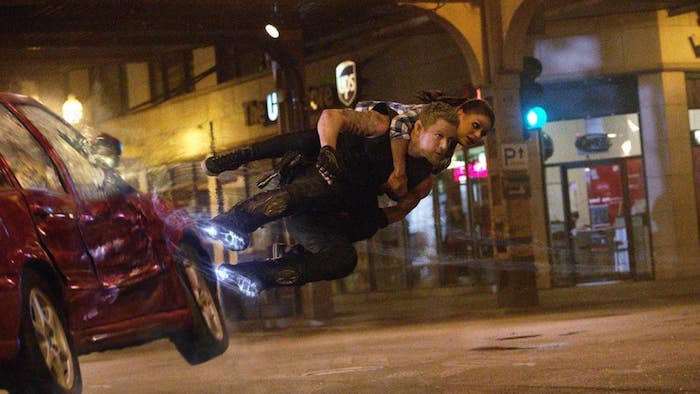
True to its title, “Magic Mike XXL” is indeed bigger than “Magic Mike,” in the sense that it’s five minutes longer. Everything else about it is smaller. It’s not as funny or engaging as its predecessor, it has almost no storyline, no character development, and it features less nudity (not usually a point worth mentioning, but these are movies about strippers). It alternates between pandering to its target audience of straight women, and just boring them.

Most of the creative team has returned for the sequel, set three years after the sinewy Floridians bumped and grinded their way to stripper glory. Steven Soderbergh turned directorial duties over to Gregory Jacobs, his longtime first assistant director, but Soderbergh produced, edited, and photographed the film, with Reid Carolin returning as screenwriter. Matthew McConaughey and Alex Pettyfer are gone, but be honest, you’ll only miss one of them.

The rest of the gang — Richie (Joe Manganiello), Ken (Matt Bomer), Tito (Adam Rodriguez), Tarzan (Kevin Nash), and DJ Tobias (Gabriel Iglesias) — are heading up to Myrtle Beach, S.C., for the annual convention of male strippers, and they recruit Mike (Channing Tatum) to join them for one more ride. (Note that this is merely a convention, not a competition, lest the story have any stakes, lest there be some suspense over the outcome). The guys road trip up from Florida, stopping a few places along the way to have rambling interludes with locals. These diversions are not, strictly speaking, “tangents,” because there is no central story for them to be tangents to.

Two vignettes are noteworthy. In one, the gang meets Rome (Jada Pinkett Smith), the emcee at a Georgia house that appears to be part brothel, part all-male revue. (She and Mike have a history.) In the other, the gang crashes a party of wine-drinking cougars (one of them played by Andie MacDowell) at a charming old South Carolina mansion. Most of the clientele at Rome’s place are black, and everybody at the mansion is white, but the message imparted to both groups of women is the same: you are all beautiful queens who deserve to feel special. I have no argument with that sentiment, but the movie slathers it on with embarrassing effusiveness, cooing to the ladies in the audience as it pats them condescendingly on the head and reassures them that they, too, are beautiful queens.

The rest of the movie is for bros, about bros, a sort of non-idiot’s version of “Entourage.” Tatum and the others are agile dancers, to be sure, and a few scenes have a tongue-in-cheek sexiness to them. But the conversation is rarely interesting; I don’t find any of the characters compelling; none of them change, learn, or grow over the course of the movie; and in the absence of a conflict (or at least some mindless titillation), what’s the point? Unlike its stars, the movie is shambling, flabby, and way too long.

Ted 2

0

As “Ted” demonstrated and “A Million Ways to Die in the West” verified, the comedy stylings of Seth MacFarlane are best enjoyed in a carefully controlled environment — say, an episode of “Family Guy,” which is animated (making the absurdities easier to swallow), and which can never be more than 22 minutes long (forcing MacFarlane and company to follow a structure). In “Ted 2,” the sequel to the 2012 hit about a living teddy bear, director MacFarlane and co-writers Alec Sulkin and Wellesley Wild are once again given free rein to stretch a small, satirical story into nearly two hours, padding it with sketches, bits, and diversions that have nothing to do with the main action. (How forced is this stretching? The four-hour drive from Boston to New York City becomes a two-day, overnight road trip, just to kill time.) There are several good laughs here — but they all come not from the characters or the situations, but from random jokes that could just as easily have been inserted into a “Family Guy” episode or a sketch-comedy show.

The story eventually has Ted (voiced by MacFarlane) and his human pal John (Mark Wahlberg) going to court to prove Ted’s personhood so that he can legally marry his girlfriend, Tami-Lynn (Jessica Barth). But first there are tangents related to obtaining a sperm donor (Ted, lacking genitals, is infertile), and somehow Tom Brady is dragged into it. Ted’s lawyer, Samantha (Amanda Seyfried), is a pothead like Ted and John are, and she becomes John’s new love interest. (His previous love interest divorced him between movies, coincidentally around the same time that Mila Kunis declined to participate in the sequel.) Giovanni Ribisi is back as the villainous janitor who wants Ted for himself. New York Comic-Con is heavily featured. There’s the usual assortment of non sequitur jokes, the more “taboo” (never mind funny), the better. Because get it? The teddy bear says swear words!

Jeff Bayer and I reviewed the film in greater detail on Movie B.S. with Bayer and Snider. You can listen to that segment below.

Download audio

Balls Out

0

Plenty of movies deal with high-profile college athletics, but why hasn’t anyone made a comedy about intramural sports? Any situation where the stakes are low but emotions are high is ripe for mockery, and that’s intramural play in a nutshell. Fortunately, this gap has now been filled by “Balls Out” (originally called “Intramural”), a loose — some might say sloppy — underdog comedy that has some solid laughs and just the right amount of heart (almost none).

Our hero, a likable fifth-year senior named Caleb Fuller (Jake Lacy), is about to graduate, take the LSAT, and get married. He’s not sure he actually wants to do all of those things. Fondly recalling the intramural football team he captained freshman year before it was riven by tragedy, he resolves to get the boys back together for one last pre-adulthood hurrah. As he puts it, “This is our last chance to do something that doesn’t matter.”

What was the tragedy that ended the team four years ago? As we saw in the film’s tone-setting prologue, it was that Caleb’s best friend Grant Rosenfalis (Nick Kocher) was hit by a late tackle during the championship game and paralyzed “from the balls down.” They haven’t spoken since. The other players went their separate ways, but Caleb easily reunites the lovable losers: dumb Vinnie (Gabriel Luna), weirdo magician Chance (Brian McElhaney), nerdy George (Will Elliott), and fat, opera-singing cowboy Jimmy (Sam Eidson). Caleb’s current roommate, the generically irresponsible Hank (Nicholas Rutherford), rounds out the squad.

And Grant (yes, his last name is pronounced “Rosen-phallus”), now wheelchair-bound and living like a hermit, returns as the “crusty yet affable veteran” to coach the team, an acknowledged reference to the beloved sports movies of yesteryear. Bradley Jackson’s free-wheeling screenplay has a lot of that kind of meta-humor — I’d be surprised if Jackson isn’t a fan of “Community” — right down to a pair of announcers (Jay Pharoah and D.C. Pierson) who do play-by-play commentary on the games, without microphones, in the empty bleachers, evidently for their own amusement.

The team’s rivals, the Titans, are a bro-moerotic group led by Dick Downs (Beck Bennett), a hyper-aggressive jerk who takes intramural football far more seriously than he should (which is to say, at all). Dick’s sister, Meredith (Nikki Reed), becomes Caleb’s new potential love interest, wooing him away from his clingy, cartoonish fiancee (Kate McKinnon), who the movie clearly only intended to be a placeholder anyway. There are training montages and faux-inspirational speeches, which coach Grant delivers in a Charlton Heston-y voice.

Directed by Andrew Disney, the film’s humor is mildly satiric at times, but mostly it’s broad and farcical, grounded in relatable conflicts and characters but not limited by the constraints of reality. George the nerd gets shot in one scene, stabbed in another, but is always OK the next time we see him, and there are sequences with a rollerskating gang from out of an ’80s post-apocalyptic movie. Beck Bennett goes all-out nutso as the douchey villain, a potential break-out performance for the up-and-coming “SNL” star, while his castmate Kate McKinnon is amusing but misused as the grating fiancee.

Most of the leads are less well-known than that. Their fresh-faced anonymity actually works in the movie’s favor, reinforcing the underdog motif and inviting us to root for them. Some of the dead-end gags would have been excised or rewritten if this were a stricter production, but it’s funny more often than it isn’t. And while a more disciplined approach might have rendered a tighter, more polished film, its shagginess is appealing.

The Overnight

0

If there’s any message or insight to be gained from “The Overnight,” anything that the characters learned about themselves or that might lead us to our own personal epiphanies, I failed to grasp it. This is not necessarily a criticism, merely an observation. Even as sex comedies go, this one is slight, an 80-minute, four-character lark about a normal married couple who meet an eccentric married couple and are unsettled by their eccentricity. That’s basically it.

But it’s funny, so that helps. Funny helps everything. Stay-at-home dad Alex (Adam Scott) and working mom Emily (Taylor Schilling) have just moved to L.A., and Alex is anxious about how he’ll make new friends without a job to go to. As luck and screenplay contrivance would have it, Alex and Emily meet someone in the park that very day, a jokey fellow named Kurt (Jason Schwartzman), whose little boy plays well with theirs. Kurt invites the family to dinner at the sleek, giant home he shares with his son and wife, Charlotte (Judith Godreche), who’s French and glamorous. After dinner, they put the kids to bed, whereupon ensues hilarity.

Kurt and Charlotte are a free-wheeling, European sort of couple. Kurt fancies himself an artist, and all his paintings are of intimate body parts. Charlotte models breast pumps for graphic infomercials. They both enjoy booze and pot, and are freely affectionate with one another (and their new friends). They’re like the more cosmopolitan versions of Alex and Emily, who alternate between being amused by their hosts and being alarmed, awkward, or jealous. Kurt and Charlotte are the skinny-dipping type (of course), and a late-night swim brings out Alex’s body issues in a way not often explored this, uh, visually in comedies.

Jason Schwartzman is the movie’s MVP, playing Kurt somewhere between insincere goofball and a parody of L.A. hipster parents, often to hilarious effect. The inherently likable Adam Scott is a good foil, going for big, broad laughs when the situation calls for it but mostly staying grounded to balance out Schwartzman. Taylor Schilling (from “Orange Is the New Black”) is funniest when she’s reacting to Alex reacting to Kurt and Charlotte. Judith Godreche does good “kooky,” but she seems a little lost among the other three.

Unlike many vulgarcoms, this one builds up to and earns its outrageous situations: they seem to arise naturally out of what’s been established about the characters. (I suppose it helps to have characters whose primary description is “you never know what they’re gonna do!”) The writer-director is Patrick Brice, whose Mark Duplass-starring comedy-thriller “Creep” premiered at SXSW in 2014. Duplass exec-produced “The Overnight,” and it’s often reminiscent of the low-budget indie comedies he’s been associated with. The difference is that while most of those at least attempt to have a narrative point — an answer to the question of “So what?” — “The Overnight” just wants to score some laughs and go home. It’s weightless and unambitious, but it definitely scores those laughs.

Dope

0

In “Dope,” Shameik Moore gives a winning, sympathetic performance as Malcolm, a black teenage nerd in Inglewood, Calif., who runs afoul of gang-affiliated drug dealers and must outsmart them with a clever plan. In this he is aided by his geeky friends, black lesbian Diggy (Kiersey Clemons) and white-ish horndog Jib (Tony Revolori).

Written and directed by Rick Famuyiwa (“The Wood,” “Brown Sugar”), the film is energetic and often funny, but it suffers from several hallmarks of unpolished screenwriting. It has a narrator (Forest Whitaker) who’s only there at the beginning to give exposition, then disappears again (though he does show up again in the middle … to give more exposition). It has a protagonist whose most emphasized character trait — his love of ’90s hip-hop — is merely an affectation (some might say gimmick) with no bearing on the story. (Briefly it feels like the movie is going to comment on how much hip-hop and black culture have changed since the ’90s, but it quickly veers away from it.) And it ends with an abrupt change in tone, with the protagonist suddenly addressing the audience directly (why wasn’t he the narrator?) and declaring the movie to have been about something that it was never about. It’s like they took an urban teen comedy and slapped a Spike Lee ending on it.

It also feels a lot like someone’s first movie, even though it’s Famuyiwa’s fourth.

Nonetheless, the soundtrack is infectious, the performances are likable, and it mostly hangs together pretty well. To hear me and Jeff Bayer review it in more detail on Movie B.S. with Bayer and Snider, listen below.

Download audio

Inside Out

0

When the Pixar wizards are at their best, they create films that are complex and thoughtful yet also, magically, hilarious and kid-friendly. We’ve stopped being amazed at how deftly they weave mature ideas into their candy-colored fantasies, simply because it keeps on happening, film after film.

Or so it seemed. The last few (“Cars 2,” “Brave,” “Monsters University”) have been, to varying degrees, sub-Pixar in quality, lacking depth and ambition. But “Inside Out” is a giant, heartfelt leap back in the right direction. Set mostly inside the brain of an 11-year-old girl, where we see her thoughts and actions determined by characters representing her different emotions, the film is a conceptual near-masterpiece … except for the big chunk in the middle where it isn’t. On either side of that section, though (and even in some respects within it), are many poignant delights.

The girl, Riley (voiced by Kaitlyn Dias), has just moved from Minnesota to San Francisco with her parents (Diane Lane and Kyle MacLachlan). The three adore each other and share a love of hockey. But moving is stressful, going to a new school is scary, and Riley is at the age where one’s emotions start to become complicated and irrational anyway.

If you’d rather listen than read, here’s the portion of Movie B.S. with Bayer and Snider where we reviewed “Inside Out.”

Download audio

Inside her head, looking out through her eyes from the starship bridge of her brain, are the five major emotions that govern her: Joy (Amy Poehler), Sadness (Phyllis Smith), Fear (Bill Hader), Anger (Lewis Black), and Disgust (Mindy Kaling). (It’s indicated that we all have these same five characters in our minds, tailored to our personalities.) Color-coded for easy reference and with attitudes befitting their vocations, any of the five li’l brain sprites can step in when their services are required, but Joy is usually in the captain’s chair, because (therefore?) Riley is generally a happy little girl. Lately, though, Sadness has been behaving erratically, and when she touches happy, yellow memories (which are bowling ball-sized spheres that project a scene), they turn blue, like her. That’s never happened before. The five emotions don’t know what’s going on.

In her frantic efforts to get things back to normal, Joy ends up whooshing herself, Sadness, and some of Riley’s most crucial formative memories out of mission control and down into Riley’s subconscious. For Riley, this means she now only feels anger, fear, and disgust. For the story, it means now there’s a journey: Joy and Sadness have to get themselves and the core memories back to Riley’s consciousness.

This is where the film struggles conceptually. The obstacles in Joy and Sadness’ way are presented as physical barriers (narrow bridges, a maze of hugely tall memory-storage shelves), and the arbitrariness of these choices is an obstacle in itself. Why are THESE the obstacles? What’s the analog? Why are there obstacles at all?

The other elements of the film are rooted in reality: abstract concepts like emotions and memories represented by tangible things like tiny personages and different-colored balls. But here it’s murkier. If your emotions were accidentally whooshed out of your consciousness and stranded in your subconscious — which, by the way, what does that even mean? — what would prevent them from coming back? Why are the shortcuts shortcuts? When they miss the Train of Thought (the one sturdy metaphor employed in this part of the story), why can’t they just wait for the next one? When Joy gets stuck in the supposedly inescapable pit of permanently erased memories, how does reusing an old daydream of Riley’s get her out?

The first section of the movie, at headquarters, is a marvel of carefully laid out metaphors that bring the intangible ideas to life. But in this second section, the rules of the universe are random and capricious, and it’s hard to feel invested. I just kept waiting, somewhat impatiently, for Joy and Sadness to get back so the story could continue.

There is a lot to enjoy in the subconscious, though, including Riley’s old imaginary friend Bing Bong (Richard Kind), who’s like a sad clown wandering the rows of stored memories. We also meet the mischievous pair of workers who throw out unneeded memories and will sometimes send an old commercial jingle up into the forefront of Riley’s mind, just to mess with her. We get to visit Riley’s dream production studios. Joy and Sadness are a funny duo, perfectly cast, and it’s oddly moving to see Joy come to realize that sometimes Sadness is the right emotion for the job.

Out in the real world, Riley is out-of-sorts and moody, and homesick for Minnesota. Your heart breaks seeing the poor girl go through tough times — a testament to director Pete Docter (“Monsters Inc.,” “Up”) and his team’s skill at conveying relatable, flesh-and-blood characters through computer cartoons. The stakes are small in scale — a little girl’s happiness, not life or death — but they feel personal, even intimate. The film is emotionally raw and deeply felt, filled with beautiful observations about how our feelings shape us.

It’s also very funny, unsurprisingly, when it’s not making you cry. The screenplay (credited to Docter, Josh Cooley, and Meg LeFauvre) gets some mileage out of showing glimpses of other people’s brains, with two gags in particular that are brilliantly executed. There are terrifically sly jokes about the way our minds work. There is, of course, the cheerful mismatched-buddy comedy that’s been one of Pixar’s hallmark ever since “Toy Story.” It’s a singular piece of work, really, cut from the familiar Pixar cloth, yet different from anything they’ve tried before. I love most of it.

Infinitely Polar Bear

0

Surely you’ll agree that it is very adorable when a man with bipolar disorder refuses to take his medication or stop drinking, thus jeopardizing his own health and the well-being of his children. If you’re not charmed by that scenario, then “Infinitely Polar Bear” is not for you.

Maya Forbes’ precious Sundance pablum (the title comes from a kid’s malaprop of “bipolar disorder”) stars Mark Ruffalo as Cameron, an eccentric bohemian who, in 1978, must care for his daughters (Imogene Wolodarsky and Ashley Aufderheide) while his wife (Zoe Saldana) goes to business school. (The film flirts briefly with examining ’70s gender roles, then doesn’t.) The kids, accustomed to his nonsense, are embarrassed by their squalid apartment and Dad’s loony adventures, but golly, they sure love him!

Here’s the portion of the Movie B.S. with Bayer and Snider podcast where we reviewed “Infinitely Polar Bear.”

Download audio

To viewers, his manic friendliness and peripatetic train of thought can be amusing, but his stubbornness is infuriating. (TAKE YOUR MEDS! QUIT DRINKING! GET A HOLD OF YOURSELF, MAN!) When it’s over, Cameron hasn’t grown or changed — if anything, the lesson is that the others should as free-spirited as he is. No thank you, generic indie twaddle.

Madame Bovary

0

There have been many film versions of Gustave Flaubert’s 1856 novel “Madame Bovary,” but this is the first one directed by a woman, French-born Sophie Barthes (“Cold Souls”), who wrote the adaptation with Rose Barreneche. Perhaps fittingly, and certainly to the movie’s advantage, Barthes and Barreneche excised the parts of the book that focused on the husband, making Madame Bovary the exclusive heroine and telling her story with a certain feminine sympathy.

Mia Wasikowska plays the tragic heroine here, the listless wife of a nice but boring country doctor (Henry Lloyd-Hughes) in provincial France. Emma Bovary had no idea marriage (or indeed life) would be so stifling and uneventful. She amuses herself with fashion and home decor, which she buys on credit from an unctuous purveyor (Rhys Ifans), and eventually with extramarital affairs with a dandy law clerk (Ezra Miller, who comes across as too modern and American for the role) and a dashing marquis (Logan Marshall-Green).

Regardless of how restrictive life could be for a woman in the 1850s — and Barthes shows plenty of period details to remind us — we agree the proper response is not to run up debts and cheat on one’s husband. But it’s not that simple. For all her faults, Emma is misused by men more than she is a misuser of them. She doesn’t want to hurt anyone: she only wants to be happy. “I will not remain standing inert in a field of despair!” she cries, her flowery language typical of the film’s dialogue.

Nonetheless, we know intuitively (and because Barthes tells us in the first scene) that Emma must eventually pay the piper one way or another. In that regard, the film doesn’t rely on suspense or story, but on tone and atmosphere. It’s quite beautifully photographed by Andrij Parekh, with the lush sets, costumes, and lighting that give period dramas so much of their appeal. Wasikowska is excellent, just as she was in last year’s “Stoker,” at playing a messy, unusual woman with conflicting emotions. It’s a handsome production that should appeal to fans of handsome costume dramas.

— Vanity Fair


Jurassic World

0

I have no problem believing that the theme park John Hammond envisioned in the original “Jurassic Park” would eventually open despite what happened in “Jurassic Park.” Sure, you’d think they’d have learned their lesson — but no, actually, you wouldn’t think that. As a society, we don’t learn lessons very quickly, especially not when there’s profit to be made from not learning.

So I buy the existence of Jurassic World in “Jurassic World,” set on the same island near Costa Rica 22 years after the original events. (The sequels aren’t referenced, but they aren’t contradicted, either, as far as I can tell.) The theme park has been open for some time when we join the action, long enough for patrons to have become blasé. “No one’s impressed by a dinosaur anymore,” says park executive Claire (Bryce Dallas Howard). People want “bigger, louder, more teeth.”

This, of course, is an unsubtle reference to us, the audience, and our unending thirst for diversion. Sure, we were dazzled by Steven Spielberg’s dinosaurs back in 1993. But we’ve seen so much since then, so many computer-generated lizards and monsters and superheroes. It takes a lot more than a realistic-looking Tyrannosaurus rex to impress us these days.

What “Jurassic World” the movie and Jurassic World the theme park have done to re-arouse our interest is to create a new dinosaur, the Indominus rex, made from T. rex DNA and a secret, proprietary blend of other dinos’ genetic herbs and spices. It’s basically a T. rex with better arms, higher intelligence, and with other capabilities that emerge one by one. Every time it does something new, they go and tell the head scientist, Dr. Henry Wu (BD Wong), and he says, “Ah, that must be from the such-and-such DNA we used.” He’s always surprised and delighted to learn about the unforeseen results of his God-playing.

Don’t worry about the Indominus rex, though. It may be bigger, meaner, and smarter than a T. rex, but it’s safely locked in a paddock from which there is no way it could possibly esca–AW, SON OF A BEE! NOT AGAIN!

Our principal humans are the aforementioned Claire; her visiting nephews, Zach (Nick Robinson) and Gray (Ty Simpkins), about 16 and 12; and Owen (Chris Pratt), an ex-Navy man who now trains velociraptors, which it turns out is possible. These are the four people the movie is most concerned about, which means they are the four who are least likely to die. Everyone else is fair game. The body count is in the high teens, including one death that’s weirdly cruel and prolonged. Otherwise, though, it’s all fun and games.

Except that unlike the original film (and even its sequels), the characters here aren’t well developed or interesting. Chris Pratt is all action hero, very little personality: anyone could have given this performance. The screenplay (attributed to four people) defines Bryce Dallas Howard’s character too inconsistently. The boys are all right, but the subplot about their parents’ impending divorce feels laughably tacked on and unnecessary, like it was thrown in as a Spielberg homage or something.

Directed by indie up-and-comer Colin Trevorrow (“Safety Not Guaranteed”) in his first shot at the big-time, “Jurassic World” offers modest adventure, mid-level thrills, and sensibly paced action. In many ways, it’s exactly the kind of awesome-but-we’ve-seen-this-already spectacle that audiences (and park-goers) have gotten used to. There’s little magic in seeing people pretend to interact with yet another menagerie of CGI lizards, even when it’s competently put together. But still, let’s not kid ourselves. Dinosaurs on the loose will always be cool.

Spy

0

Despite having almost literally the most generic title it could possibly have, “Spy” is a dizzyingly funny espionage comedy, with a non-farcical, non-spoof plot that works on a straightforward level, too. With several very funny performances and some memorable dialogue, it’s almost beside the point that, oh yeah, it happens to star a woman.

That woman is Melissa McCarthy, an unstoppable force of nature who, unlike most forces of nature, has great comic timing. Brassy, physical, and always committed to the joke, McCarthy has been misused in a few things (like “Identity Thief” and that “Fat People in Love” TV show she’s on), but it’s impressive how quickly Hollywood has figured out how to use her talents, and how quickly she’s gained enough clout not to have to settle for fatty-fall-down comedies.

“Spy” reunites her with “Bridesmaids” and “The Heat” director Paul Feig, who wrote the screenplay this time. McCarthy plays Susan Cooper, a C.I.A. analyst whose job is to stay at headquarters and feed spies information through their earpieces while they’re on missions. She’s paired with Bradley Fine (Jude Law), a suave agent on whom she has developed a crush, but to whose 007 she will always be nothing more than a Moneypenny.

When an arms dealer named Rayna Boyanov (Rose Byrne) kills Fine and exposes several other agents, it becomes necessary for the C.I.A. director (Allison Janney) to send a complete nobody into the field, just to keep tabs on Rayna before she can sell a nuke. That person will be Susan.

Now, here you are expecting that Susan will be totally incompetent, a klutz who will only save the day accidentally, and probably with pie on her face. Here you are wrong. Susan had all the C.I.A. training when she joined up, and she’s technically an agent, albeit an out-of-practice one with no field experience. She’s rusty and unsure — she’s not James Bond — but she’s not an idiot. The voice in her ear back at HQ is her best friend and co-worker Nancy (Miranda Hart), whose delightful enthusiasm buoys her through the mishaps.

A lot of jokes come from the Agency’s shoddy, almost hostile treatment of her, as she gets the unglamorous versions of the resources that more important agents get, not to mention less flattering cover identities. When she follows Rayna to Rome, her local ally is a dashingly pervy Italian buffoon played by a very funny Peter Serafinowicz. She also must contend with fellow agent Rick Ford (Jason Statham), a dim English hothead who went rogue in protest over Susan’s assignment and is trying to accomplish the mission himself. Statham’s performance is impressively daft, never more so than when he rattles off lists of past exploits that sound like funnier versions of those Chuck Norris jokes people used to tell.

While keeping an eye on Rayna, Susan spots an attempt on her life and must intervene, lest Rayna perish before she can lead them to the nukes. Now Susan is deep undercover, befriending Rayna the high-society arms dealer as the dumpy American who saved her life. Rose Byrne is fiercely funny as the haughty, cruel Rayna, continuing a streak of sharp comedy performances from her. She and McCarthy are great foils for each other, and the script mixes odd-couple humor with weirder things like Susan getting glamorous makeovers (McCarthy looks great) that Rayna finds hideous.

This movie has no fat jokes. Not one. We’ve been conditioned to expect that when a Person of Size stars in a comedy, there will be jokes about his or her weight. And “Spy” has so much funny stuff going on that it doesn’t have to bother with it. At one point Susan even asks Ford what’s so hard to believe about a man being seduced by her — a perfect setup, especially for the mean Ford — and instead of a fat joke, the movie goes with a joke about Susan’s frumpy style and personality. The humor is based on character, which Feig and McCarthy created, not on McCarthy’s physical attributes, which came with the package. In other words, they tried harder, and it worked.

It’s also notable how many roles in the movie are female, including some (like the hero’s boss and the movie’s lead villain) that would usually be male, without the story ever being overtly female-oriented. Apart from a quick exchange between Susan and her C.I.A. boss acknowledging how female agents have been overshadowed in the past, none of “Spy” is “about” girl power or feminism or equality. It just IS those things. When Susan goes undercover and needs weapons disguised as things she might carry in her purse, she doesn’t get exploding tampons or poison lipstick or whatever. Because the quartermaster (Michael McDonald) is weirdly bitter toward her, she gets embarrassing stuff like hemorrhoid pads and toenail fungus cream — again, jokes based on character rather than on the simple fact that she’s a woman. Most of the things in the film that are funny, or even supposed to be, would work with the genders reversed, too.

The best part, of course, is that it’s funny — brash, potty-mouthed, and, as Susan becomes increasingly confident, cheerfully violent in the badass fashion. Not every joke lands, of course; I don’t want to oversell it. But the success rate is high enough that when the film ended with the door open for more adventures with these characters, it sounded like an idea with promise.

— Movie Mezzanine

Insidious Chapter 3

0

The law of diminishing returns is in full effect with “Insidious: Chapter 3,” a mediocre follow-up to the half-decent sequel to the quite-good 2011 horror flick.

This one’s a prequel, actually, focusing on a teenager named Quinn (Stefanie Scott) who has a near-death experience and is thereafter haunted by something in the apartment building where she and her father (Dermot Mulroney) and irrelevant little brother live. Veteran workhorse actress Lin Shaye, committed as always, returns as Elise, the psychic who says she’s out of the seance business but reluctantly helps Quinn. Screenwriter Leigh Whannell, in the director’s chair for the first time, delivers a scant few shocks and shivers with his unimaginative take on a tired formula, and doesn’t add anything to the Insidious “mythology,” either. Get some fresh ideas or let this series die.

Wild Horses

0

Robert Duvall has settled nicely into the Lovable Old Coot phase of his career, but he doesn’t seem to be slowing down. The 84-year-old living legend wrote, directed, and stars in “Wild Horses,” a sturdy Texas-set drama about an old rancher settling his affairs at the end of his life. Duvall acquits himself well enough behind the camera, but it’s his onscreen work that’s most impressive. He gave himself a difficult role that requires him to be alternately grandfatherly and malicious, and darned if he isn’t convincing both ways.

A prologue set 15 years ago shows Duvall’s character, Scott Briggs, chasing his teenage son off the ranch at gunpoint for having a gay relationship. In the present, old man Briggs is fondly regarded by the ranch’s mostly Mexican household staff, and by the townsfolk in general. His virulent homophobia (which has abated but little) is countered by his goodwill toward needy immigrants and his affection for his grandchildren.

The gay son, Benny (James Franco), returns now to hear the reading of his father’s newly revised will, which contains bombshells that do not ultimately affect the plot. He’s joined by his brothers, KC (Josh Hartnett) and Johnny (Devon Abner), who are still in Dad’s good graces and have continued in the family business in this small town of good ol’ boys who look out for each other.

The meat of the story concerns the events of 15 years ago. At the same time that Benny was kicked out, the ranch hand he’d been fooling around with disappeared and was never heard from again. A dogged Texas Ranger, Samantha Payne (Luciana Pedraza Duvall, the filmmaker’s wife), has reopened the case, and questioning everyone all over again. Here’s where we see that Scott Briggs has a mean streak, and perhaps something to hide.

Franco and Duvall have a couple of well-wrought scenes together, hashing things out as father and son. The other brothers are underused in the story, but there’s an enjoyable fraternal-bonding sequence involving all three of them and a bar fight. Other characters, like the maid’s daughter (Angie Cepeda), whom the boys regarded as a sister growing up, and the doughy local cops, add color to Duvall’s portrait of the changing West.

But tonally, the movie is all over the place. Some weighty matters are treated whimsically, while others are handled gravely. It’s not clear how seriously we’re supposed to take Briggs’ misdeeds and his misuse of power, or how seriously Duvall takes them. As both writer and director, he seems unsure about committing to a particular attitude. And as they say on the rodeo circuit, you don’t rope calves with hesitant lassos (they don’t say that). When the emotional punches in “Wild Horses” come, they don’t hit as hard as they might have if we’d been truly invested. Still, though it may be more schmaltzy fiction than serious literature, it’s an earnest film, and a solid, respectable piece of entertainment.

We Are Still Here

0

“We Are Still Here” begins with a married couple moving to a creepy old house and immediately — I mean immediately — noticing strange phenomena. The fact that the disturbances begin even before the title appears, coupled with the give-away nature of that title, suggests that writer-director Ted Geoghegan has something more than the usual haunted-house tropes up his sleeve. At least, we hope he does. Otherwise we’re in for a long, predictable 84 minutes.

Thankfully, “We Are Still Here” does have more to offer than flickering lights and grudge-bearing ghosts. A fun throwback to the intense, free-wheeling, semi-cheesy horror flicks of the ’70s and ’80s, Geoghegan’s story expands to include not just the creepy old house but the entire creepy old town. (Do you love movies about towns with dark secrets? ME TOO.) The married couple, Anne (Barbara Crampton) and Paul (Andrew Sensenig), have moved to snowy New England to escape their grief after the death of their son. Problem is, there seem to be spirits here — and Anne thinks her dead boy is among them. A visit from local old-timer Dave McCabe (Monte Markham), who describes the house’s grim history, lends credence to the idea that something supernatural is afoot.

Things really pick up when Anne and Paul’s friends come for the weekend. May (Lisa Marie) is a spiritualist who wants to conduct a seance; her husband, Jacob (Larry Fessenden), is a good-natured hippie along for the ride. Paul is skeptical of Anne’s fears at first, but there comes a time — always a very satisfying moment in these movies — when, at last, everyone is on the same page. All that remains then is to determine the source and defeat it, which in this case leads to a raucous and bloody finale.

“We Are Still Here” offers a few good scares and some moments of high tension, lightened by a tongue-in-cheek attitude that stops short of being self-aware. (Markham’s performance as Dave McCabe is the one that feels like maybe his character is more meta than everyone else’s.) Barbara Crampton, a scream queen from ’80s flicks like “Re-Animator” and “Chopping Mall,” provides a graceful (and fierce) center for this one. No matter what mayhem ensues, she remains a loving mother who misses her son.

Entourage

0

I never watched HBO’s “Entourage” series, and seeing the movie does nothing to make me want to go back and catch up. Of course, the movie was intended to satisfy current fans, not woo new ones, and maybe those fans will enjoy it. Who knows? All I can do is report that it produced maybe two or three mild chuckles from me, and that I didn’t find any of the characters likable, sympathetic, relatable, funny, or interesting.

My understanding is that the TV show was once a satiric inside look at the nuts and bolts of the Hollywood system. The movie, which picks up right where the series ended and has Vince (Adrian Grenier) directing and starring in an adaptation of “Dr. Jekyll & Mr. Hyde,” is less concerned about finding comedy in the Hollywood machine than it is about extending the life of these characters. Vince’s friend and manager, Eric (Kevin Connolly), is about to become a father and has other female-related troubles. Johnny Drama (Kevin Dillon), Vince’s half-brother and full-idiot fame barnacle, wants to be taken seriously as an actor. Turtle (Jerry Ferrara) has the hots for fighter Ronda Rousey (as herself). Agent-turned-studio-head Ari Gold (Jeremy Piven) has to wrangle more money from “Hyde’s” financiers, a father and son pair of Texas millionaires played by Billy Bob Thornton and Haley Joel Osment.

Also, Ari’s ultra-gay former assistant, Lloyd (Rex Lee), is getting married and wants Ari to give him away. It was nice of the “Entourage” producers — and fitting for the show’s theme, I suppose — to let Lloyd tag along with the movie despite the movie having no use for him. The same could also be said for most of the blink-and-you-miss-them celebrity cameos, which serve only to slow down what little momentum the story has. (Oh, hey, it’s Ed O’Neill! Anything to add, Ed? A joke, maybe, or something to advance the story? No? Nothing? Just stoppin’ by? Well, OK.)

Written and directed by series creator Doug Ellin, this “Entourage” movie is aimless and inert. If it’s a Hollywood satire, it’s toothless. If it’s a character-based comedy, it’s a failure for not coming up with anything particularly funny for the characters to do. If it’s just fan service, meant to give the show’s viewers another 104 minutes with their beloved crew, well, I guess it’s good at that. But it’s bad at being a movie.

New song: ‘Give Me a Call (A Song for Mom)’

0

I have recorded a new song that you can listen to! It’s called “Give Me a Call (A Song for Mom),” and the link is below.

This song came about in a way that had never happened for me before: somebody hired me to write it. I’ve made money (a little bit) from songs before, but this was the first time I was contracted ahead of time to do it. Having now been through the experience of being paid to write a song, I can definitely say that I am a fan.

I was contacted by a friend who works for a film production company that sometimes does work for a particular ad agency. This ad agency asked my friend if anyone at the production company knew anyone who could write a funny song. My friend put me in touch with the ad agency, which was representing a tech client that wanted something it could turn into a viral video for Mother’s Day.

The best part was that they already knew what they wanted the song to be about: helping Mom with computer stuff. With that great premise delivered on a platter, the rest came pretty easily.

Also, for fun (and because ad agencies have a stupid amount of money to spend), they hired someone else (another friend of mine, actually) to ALSO write a song with this premise. They paid us both, and then chose the one they liked better. They chose his, and sure enough, made a video of it. It’s funny and you can watch it here.

If they had chosen my song, we’d have re-recorded it in either a barbershop quartet arrangement or a soft-shoe sort of thing — something old-fashioned and sentimental. I don’t know what the video would have entailed, but I figured that wasn’t my department.

Anyway, I hope you enjoy the song. If you’d like to download an MP3 of it for $1, you may do so here, thank you.

P.S. If you want to hire me to write a song for you, I will do that. I charge either more or less than you’d expect, depending on what you’d expect.

Heaven Knows What

0

When the opening credits roll in “Heaven Knows What,” the main character, a New York City street junkie named Harley (Arielle Holmes), has already slit her wrists. Things get better for her after that, but not much.

Directed with cinema-verite rawness by brothers Josh and Benny Safdie, “Heaven Knows What” is based on the real experiences of its lead actress, whom the directors found on the street. The story of making a movie with a homeless heroin addict as your star might be more compelling than the one in the film, which is basically the usual junkie tale of despair: Harley is poisonously in love with a fellow heroin user, Ilya (Caleb Landry Jones), and tries to stay away from him by hooking up with her semi-homeless dealer, Mike (Buddy Duress); self-destructive spirals ensue for all involved. But not only is Holmes’ performance unsurprisingly convincing in the details (her tone of voice when she panhandles, for example), it’s astonishingly good as a piece of careful, measured acting. The whole cast feels authentic, and the Safdies wisely avoid melodrama, keeping a grip on grimy reality that keeps a grip on us.

San Andreas

0
San Andreas

Let me tell you up front that I held my breath and gripped my armrests during most of the action scenes in “San Andreas,” just like the movie wanted me to. I had fun with it. The Rock is a high-wattage movie star, and the special effects are perilously convincing. But at the same time … here’s the thing:

In the old days, you could make an entire film about the collapse of a single skyscraper, or the destruction of the Golden Gate Bridge. Those were huge, grave events. But now that computers have made it easy and cheap (relatively speaking) to depict such catastrophes, one movie might have dozens of them, tossing off devastation casually, with all the import removed. In “San Andreas,” the Golden Gate Bridge collapses in the background of another scene. Tall metropolitan buildings, full of thousands of workers, crumble left and right, and the only time the movie ever shows any interest is if one of three specific characters happens to be in the building at the time.

Focusing on a few individuals is really the only way to make a disaster movie work, of course. It’s hard to make audiences feel an emotional investment in “the whole city” or “all of humanity.” I don’t fault (HA!) “San Andreas” for that, especially not when the people it focuses on are an appealing and chesty family consisting of Dwayne Johnson, Carla Gugino, and Alexandra Daddario.

The problem isn’t that the movie only cares about them. The problem is that THEY only seem to care about them, too. The Rock plays Ray, a Los Angeles Fire Department helicopter pilot and rescuer who’s the best of the best. Not a great employee, though. When The Big One hits L.A. and is felt in San Francisco, where his daughter, Blake (Daddario), is, Ray commandeers an LAFD chopper and flies north to rescue her himself — never mind that he and the chopper are needed here at the epicenter, and that, you know, San Francisco has a fire department too.

Along the way, Ray picks up his soon-to-be-ex-wife, Emma (Gugino), from the roof of a high-rise. She was having lunch at an upper-story restaurant and was the only person there with the good sense to get a phone call from her husband telling her to go to the roof rather than downstairs. The lunch companion who was rude dies; the waitress who was nice lives. That pattern continues throughout the film: anyone who dies after having had a speaking role will have somehow deserved it, with the exception of one person who dies heroically while saving someone else.

Most of the deaths are quite anonymous, though, and are not remarked upon. A casual glance at the massive destruction shown onscreen would suggest casualties in the hundreds of thousands; thankfully, nobody ever hazards a guess at the death toll, as this would be a serious buzzkill. Only Paul Giamatti, playing a seismologist who discovered a way to predict earthquakes exactly one scene after declaring his desire to do so, is concerned about the big picture. To Giamatti falls the thankless task of expounding all of the movie’s science and uttering lines like “We’ve got to act before it’s too late,” “God help us all,” etc. Giamatti is always good, even in hammy roles like this.

The film ends exactly as you’d expect it to, despite director Brad Peyton’s herculean efforts to introduce suspense into the matter of whether or not The Rock will save his daughter’s life. (I’ll give you a hint: Ray and Emma had another daughter who died a few years ago, in a situation much like the one Blake eventually finds herself in.) Actually, there was one unexpected moment: the introduction of a glorious American flag unfurling in the breeze, apropos of nothing, as Ray looks out over the now-calm scenes of devastation and says, “Now we rebuild.” It’s like they suddenly remembered that they’d forgotten to make the film patriotic, as disaster movies sometimes are, and crammed a flag in at the last minute.

None of which changes the fact that, as I said, I got a kick out of most of it. You can make a smart, logical disaster movie that’s also really fun (probably; I can’t think of any off the top of my head), but that’s not “San Andreas.” “San Andreas” is the dumb kind — visually well-executed, shiny and seat-rattling, and completely useless otherwise. It does the one thing it set out to do, though, and so here we are.

Tomorrowland

0

In the future, science will be able to produce a Steven Spielberg movie without any awe. The future is now! “Tomorrowland,” from animation whiz turned live-action director Brad Bird (“The Incredibles,” “Mission: Impossible — Ghost Protocol”), is a square-jawed, optimistic, all-American sci-fi adventure with a kid protagonist and George Clooney, for heaven’s sake. With more heart and less pontificating, it could have been one for the ages.

In Florida, Casey Newton (Britt Robertson), a teenage science buff with a surplus of curiosity, finds a World’s Fair souvenir that gives her a glimpse of Tomorrowland, a gleaming alternate dimension of jet packs and futuristic marvels. Together with Frank Walker (Clooney), who’s also been to Tomorrowland, and Athena (Raffey Cassidy), a young girl who recruits scientists and dreamers to work there, Casey must learn Tomorrowland’s secrets, save the world, et cetera.

The journey is mid-grade fun, occasionally thrilling (there are bad guys chasing them), yet strangely unsentimental, promising a “gee whiz, look at that!” sense of amazement but mostly delivering on-the-nose speeches about mankind’s duty to build a better future. And the way it’s structured (Bird co-wrote the screenplay with “Lost” creator Damon Lindelof), we don’t know what the main characters’ objective is till the film is nearly over — which makes it hard to keep caring. The central performances are likable, but though the film has some wonderful things in it, it’s not full of wonder like it ought to be. You may find that you like its ideas more than you like it.

Poltergeist (2015)

0

You probably remember the tragic fire at the MGM archives, where every single copy of the 1982 horror classic “Poltergeist” was destroyed, including, somehow, all the DVD and digital versions. I don’t recall the event myself, but it must have happened, because now there’s a “Poltergeist” remake, and why else would it exist? What other possible justification could there be?

How disappointing is this movie? It features the line “Where’d all these clowns come from?” yet is still useless. Dutifully following the same plot as the original, only now with bland CGI and slipshod characterization, it’s the story of a suburban family that moves into a house that is haunted because it was built on a cemetery. The little girl (Kennedi Clements) talks to invisible people; the scaredy-cat boy (Kyle Catlett) is traumatized by a box of clown dolls left in the attic; the bratty teenage sister (Saxon Sharbino) gets stuck in black sludge that rises from the basement.

At the film’s halfway point, the parents (Sam Rockwell and Rosemarie DeWitt) become convinced that the supernatural terrors their children report are real (once the little one goes into the TV), and they bring in a team of paranormal investigators. (These investigators are much more frightened by the house’s spooky activities than the family is, by the way. The family just seems flustered.)

Director Gil Kenan’s first film was the animated junior scare-flick “Monster House,” which would seem to be good practice for “Poltergeist.” But his remake, written with vanilla-flavored disinterest by David Lindsay-Abaire, rushes through all the story beats — scary tree, clown doll, maggot hallucination, etc. — with no sense of proportion, let alone suspense, as if he’s ticking them off a checklist. The movie has the same form as the original, but none of the substance. Cinematically speaking, they kept the headstones but got rid of the bodies.

URGENT UPDATE: I just checked, the original “Poltergeist” is readily available in all popular video formats, including digital rentals through iTunes and Amazon! The need for a remake that improves upon the original in no discernible way is thus obviated, and it will, I assume, be withdrawn from circulation.

Pitch Perfect 2 [AUDIO]

0

I didn’t love the first “Pitch Perfect” — it was fine, OK? — and the sequel is more of the same, but less so. The story meanders and is stuffed with irrelevant subplots and tangents.

From this week’s Movie B.S. with Bayer and Snider podcast, here are Jeff Bayer and myself reviewing “Pitch Perfect 2.”

Download audio

Mad Max: Fury Road

0
Mad Max: Fury Road

Noted Australian madman George Miller may have distracted himself (and amused us) with films like “Babe: Pig in the City” and the two “Happy Feet” toons, but now it’s time to quit goofing around and get back to the dusty, post-apocalyptic wasteland that launched his career. “Mad Max: Fury Road” reboots Miller’s cult-favorite franchise with all the intense, explosive energy you’d expect from a passion project that’s been some 20 years in the making. Which is to say: it is straight-up, wall-to-wall BONKERS.

Not the story, mind you. That’s actually pretty simple. In our ruined future, the Wasteland is run by a grotesque, misshapen tyrant called Immortan Joe (Hugh Keays-Byrne), who has a harem of wives to build his posterity and keeps a tight rein on his subjects by controlling the meager water supply. A loner named Max (Tom Hardy) runs afoul of Joe and finds common ground with one of Joe’s own officers, a 1.5-armed badass called Imperator Furiosa (Charlize Theron).

What follows is essentially a feature-length car chase, with Joe’s ferocious albino kamikaze soldiers pursuing Max, Furiosa, and their small band of survivors, both sides attacking each other without bothering to pull over first. Most of the battle takes place in, on, and under the speeding vehicles, which are fortified with armor and tricked out with essentials like flamethrowers and spiked tires. Amazingly, Miller paces the almost nonstop action in such a way that it doesn’t get tiresome, nor is it ever hard to follow. No shaky-cam for Miller: he WANTS us to see the spectacular stunts and intricately choreographed fights.

The details of Miller’s near-future world are a delightful hodge-podge of influences and traditions, hinting at a treasure trove of backstory. That compensates for the present characters being merely serviceable rather than memorable — not that such things matter when you’re staring goggle-eyed at high-velocity mayhem.

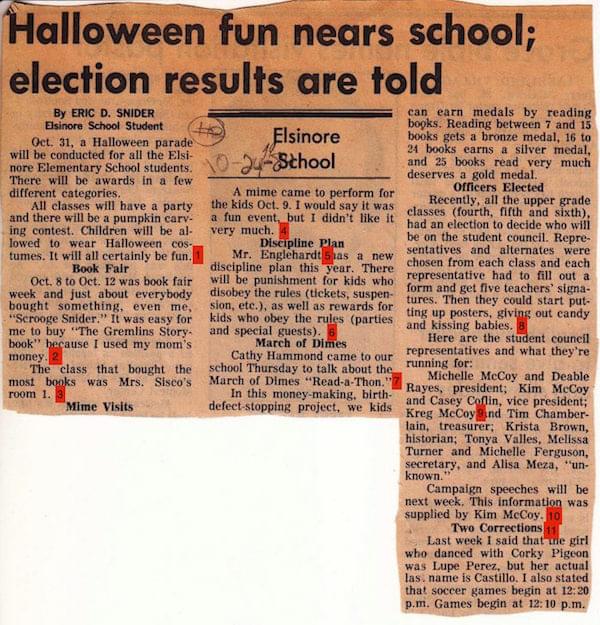
Eric D. Snider: Boy Journalist (Part 2)

0
Eric D. Snider: Boy Journalist (Part 2)

(For background on this illuminating series of historical documents, please see Part 1.)

I kept these newspaper clippings in a photo album. To make maximum use of the space in the album, I would sometimes cut the columns up and rearrange the layout. Over time, some of the smaller clippings of clippings fell out of the photo album and were lost forever. Also, there were a few columns that I didn’t save at all, out of sheer negligence.

Desirous that every word I wrote when I was 10 be available to the world, the last time I visited my parents, I went to the Lake Elsinore public library and found all the old Sun-Tribunes on microfilm. The librarian boasted that the Lake Elsinore branch has the best microfilm reader in the entire Riverside County Public Library system, and it was indeed a splendid piece of machinery. It did not, however, have a way of printing copies of the things contained on the microfilm. (The librarian acknowledged that this was not ideal.) So my only option was to use my iPhone to take pictures of the columns as they appeared on the microfilm screen, then cobble those pictures into a single image. I did a lot of work, you guys, and I deserve a Pulitzer.

_______________________________________

#3

10/31/1984
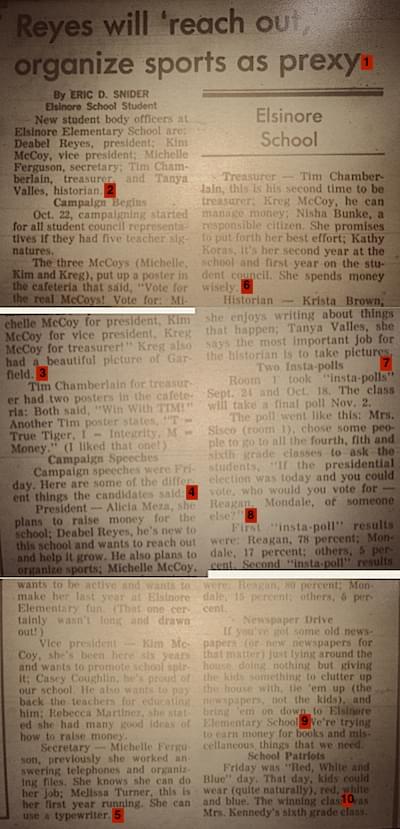
Reyes will ‘reach out,’ organize sports as prexy [1]
By ERIC D. SNIDER
Elsinore School Student
New student body officers at Elsinore Elementary School are: Deabel Reyes, president; Kim McCoy, vice president; Michelle Ferguson, secretary; Tim Chamberlain, treasurer, and Tanya Valles, historian. [2]

Campaign Begins

Oct. 22, campaigning started for all student council representatives if they had five teacher signatures.

The three McCoys (Michelle, Kim and Kreg), put up a poster in the cafeteria that said, “Vote for the real McCoys! Vote for: Michelle McCoy for president, Kim McCoy for vice president, Kreg McCoy for treasurer!” Kreg also had a beautiful picture of Garfield. [3]

Tim Chamberlain for treasurer had two posters in the cafeteria. Both said, “Win with TIM!” Another Tim poster states, “T=True Tiger, I=Integrity, M=Money.” (I liked that one!)

Campaign Speeches

Campaign speeches were Friday. Here are some of the different things the candidates said: [4]

President — Alicia Meza, she plans to raise money for the school; Deabel Reyes, he’s new to this school and wants to reach out and help it grow. He also plans to organize sports; Michelle McCoy, wants to be active and wants to make her last year at Elsinore Elementary fun. (That one certainly wasn’t long and drawn out!)

Vice president — Kim McCoy, she’s been here six years and wants to promote school spirit; Casey Coughlin, he’s proud of our school. He also wants to pay back the teachers for educating him; Rebecca Martinez, she stated she had many good ideas of how to raise money.

Secretary — Michelle Ferguson, previously worked answering telephones and organizing files. She knows she can do her job; Melissa Turner, this is her first year running. She can use a typewriter. [5]

Treasurer — Tim Chamberlain, this is his second time to be treasurer; Kreg McCoy, he can manage money; Nisha Bunke, a responsible citizen. She promises to put forth her best effort;

Kathy Koras, it’s her second year at the school and first year on the student council. She spends money wisely. [6]

Historian — Krista Brown, she enjoys writing about things that happen; Tanya Valles, she says the most important job for the historian is to take pictures. [7]

Two Insta-polls

Room 1 took “insta-polls” Sept. 24 and Oct. 18. The class will take a final poll Nov. 2.

The poll went like this: Mrs. Sisco (room 1) chose some people to go to all the fourth, fifth and sixth grade classes to ask the students, “If the presidential election was today and you could vote, who would you vote for — Reagan, Mondale, or someone else?” [8]

First “insta-poll” results were: Reagan, 78 percent; Mondale, 17 percent; others, 5 percent. Second “insta-poll” results were: Reagan, 80 percent; Mondale, 15 percent; others, 5 percent.

Newspaper Drive

If you’ve got some old newspapers (or new newspapers for that matter) just lying around the house doing nothing but giving the kids something to clutter up the house with, tie ’em up (the newspapers, not the kids), and bring ’em on down to Elsinore Elementary School. [9] We’re trying to earn money for books and miscellaneous things that we need.

School Patriots

Friday was “Red, White and Blue” day. That day, kids could wear (quite naturally), red, white and blue. The winning class [10] was Mrs. Kennedy’s sixth grade class.

NOTES:

[1] I had never heard the term “prexy” before and had to ask my mom what it meant. Well, I guess I probably knew what it meant from the context. Mom said it was a legitimate term, though, and that the newspaper had not made a crazy mistake.

[2] There was no re-writing or organizing process with these columns. I would take a sheet of notebook paper, draw a line down the middle to separate it into two columns (I think this was to make it feel more like a newspaper to me?), and write up the news items in the order that they occurred or that I found out about them. Thus, when I submitted this column, the paragraph naming the winners was at the end, after I’d written about the campaign and the speeches. I now realize I had “buried the lede,” as they say in the journalism biz (“lede” is how they spell “lead” in the journalism biz).

[3] You’ll note that only one of the three McCoys was successful in winning elected office this year, even though Kreg had a beautiful picture of Garfield (presumably the cartoon cat, not the president).

[4] My matter-of-fact reporting style has been called “Perd Hapley-esque.”

[5] As I recall, in 1984, you had to be licensed to operate a typewriter.

[6] OR SO SHE SAYS. Why won’t you release your financial records, Ms. Koras?

[7] In a hard-fought ideological battle between a historian who would focus on the written word and one who would emphasize photography, the one taking pictures always wins. It was ever thus.

[8] Even at the time, I thought asking elementary school students which U.S. presidential candidate they would vote for was stupid. Like 9-to-11-year-olds have political opinions. What we were really asking was, “Who are your parents voting for?” Either way, the answer was Reagan. Also, the question has two grammatical errors and should have been phrased thus: “If the presidential election were today and you could vote, whom would you vote for — Reagan, Mondale, or someone else?”

[9] The place was Elsinore Elementary School, and that’s how I always referred to it in my column. But the byline and the sig always called it “Elsinore School,” which didn’t make sense because it was one of three schools that could have answered to that name (we had Elsinore Jr. High and Elsinore High, too). Why did the newspaper consistently call my school by the wrong name? I never knew.

[10] So did Mrs. Kennedy have the most students wear red, white and blue? Or were they measuring the amount of red, white and blue, regardless of how many students it took to get to that level? And is either method really an accurate way of measuring patriotism? Failing to ask these hard-hitting questions is one of my greatest regrets.

_______________________________________

#4

11/7/1984
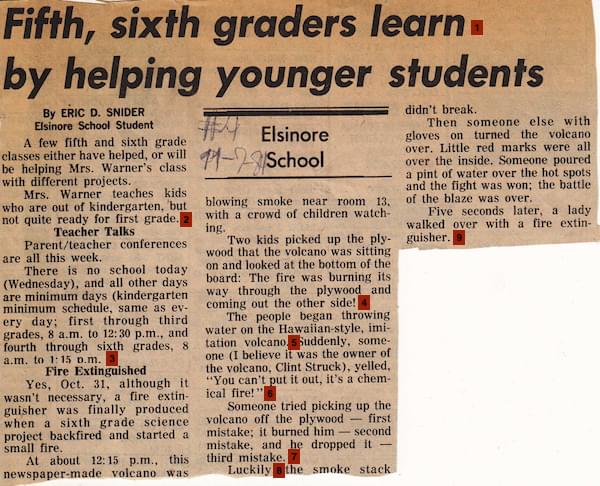
Fifth, sixth graders learn [1] by helping younger students
By ERIC D. SNIDER
Elsinore School Student

A few fifth and sixth grade classes either have helped, or will be helping Mrs. Warner’s class with different projects.

Mrs. Warner teaches kids who are out of kindergarten, but not quite ready for first grade. [2]

Teacher Talks

Parent/teacher conferences are all this week.

There is no school today (Wednesday), and all other days are minimum days (kindergarten minimum schedule, same as every day; first through third grades, 8 a.m. to 12:30 p.m., and fourth through sixth grades, 8 a.m. to 1:15 p.m. [3]

Fire Extinguished

Yes, Oct. 31, although it wasn’t necessary, a fire extinguisher was finally produced when a sixth grade science project backfired and started a small fire.

At about 12:15 p.m., this newspaper-made volcano was blowing smoke near room 13, with a crowd of children watching.

Two kids picked up the plywood that the volcano was sitting on and look at the bottom of the board: The fire was burning its way through the plywood and coming out the other side! [4]

The people began throwing water on the Hawaiian-style, imitation volcano. [5] Someone (I believe it was the owner of the volcano, Clint Struck), yelled, “You can’t put it out, it’s a chemical fire!” [6]
Someone tried picking up the volcano off the plywood — first mistake; it burned him — second mistake; and he dropped it — third mistake. [7]

Luckily, [8] the smoke stack didn’t break.

Then someone else with gloves on turned the volcano over. Little red marks were all over the inside. Someone poured a pint of water over the hot spots and the fight was won; the battle of the blaze was over.

Five seconds later, a lady walked over with a fire extinguisher. [9]

NOTES:

Sometimes it is a slow news week at your elementary school. And then sometimes, suddenly, there is a FIRE! But not yet.

[1] I just want to point out that this headline makes an assertion that is not supported by the article. I never said anything about learning.

[2] There was probably a name for this program other than “kids who are out of kindergarten, but not quite ready for first grade.” Probably something shorter.

[3] Not only was this information useless to the newspaper’s readers, who surely already knew that their children were out of school early this week, but it’s missing its closing parenthesis. I should have been fired on the spot.

[4] It has the makings of a big-budget Hollywood disaster film. The fire was COMING OUT THE OTHER SIDE! The scientist yelled, “You can’t put it out, it’s a chemical fire!” But the president wouldn’t listen!

[5] Let me be clear, this was an imitation volcano, not an actual geological formation that spews magma.

[6] Here I imagine myself a reporter for the society pages, breathlessly describing the events at a recent soiree.

[7] The punctuation in this sentence is a bloodbath. Instead of dashes, I should have set off the “first mistake,” etc., in parentheses. Also, I feel like the second mistake — the volcano burning the guy — isn’t a mistake at all but the consequence of the first mistake of picking it up. And can it be described as a mistake to drop something that has burned you? Quite the opposite, really. I move that this unnamed person made only one mistake, and it was picking up the volcano.

[8] Is my concern here not for the burned student but for the structural integrity of the science project? That appears to be the case.

[9] Who? I dunno. Some lady.

More to come…

The D Train

0

“The D Train” marks Jack Black’s first starring role since 2011’s “Bernie,” and it finds him a little more mature and self-restrained than we remember him. He’s still very funny, though, adept as ever at reaction shots and physical comedy. That holds true even in a film, like “The D Train,” that runs out of ideas long before it reaches the conclusion.

Black plays Dan Landsman, a Pittsburgh loser who heads up the class of 1994’s high school reunion committee with great fervor. The committee has been unable to drum up much support for the reunion, but that changes when Dan sees a TV commercial starring classmate Oliver Lawless (James Marsden), once the most popular guy in school and now, apparently, a successful actor. If Dan can get him confirmed as a reunion attendee, surely word will spread and others will follow suit.

Dan, who works for a consulting firm, concocts a series of lies about a potential client to justify a trip to L.A., fooling his amusingly technophobic boss (Jeffrey Tambor), as well as his sympathetic wife (Kathryn Hahn) and adolescent son (Russell Posner). In L.A., Oliver turns out to be a heavy-drinking, hard-partying bro who’s not nearly as successful as Dan thinks he is. He’s also openly bisexual. Dan is starstruck and man-crushing on Oliver, who is amused by Dan’s worship of him. They go out partying, become pals, and get involved in each other’s lies. They also share an incident of physical intimacy that means nothing to promiscuous Oliver Lawless but a lot to heretofore exclusively heterosexual Dan Landsman.

Written and directed by the team of Andrew Mogel and Jarrad Paul (“Yes Man,” TV’s “Allen Gregory”), the film makes good use of Black, Marsden, Hahn, and Tambor, and the part of the story committed to Dan’s web of lies is funny. The problems are in the other half of the story — the part about Dan’s confusion after his rendezvous with Oliver. The film wins points for treating Oliver’s bisexuality like it’s no big deal, but after The Incident, Mogel and Paul have no idea what to do with it. Many jokes boil down to nothing more than “tee hee, Dan did something humiliating!” If there’s a larger point to be made about male friendships, about the lengths men will go to for another man’s approval, or about the fluidity of sexuality, “The D Train” can’t find it. The opportunity thus missed, the film becomes just another raunchy bromantic comedy that earns a few laughs before petering out.

Hot Pursuit

0

“Hot Pursuit” is beneath Reese Witherspoon, just about right for Sofia Vergara, and bad for us all. It’s one of those comedies about supposedly ordinary people of at least average intelligence who nonetheless spend the entire movie being frantic, bumbling morons who can’t do anything without breaking something. One of them can’t talk on the phone and drive at the same time, so she hands the phone to the other one, who drops it out the window. That sort of thing.

Witherspoon plays Rose Cooper, an overeager, straitlaced San Antonio cop who’s a stickler for rules, speaks in police lingo (“I am announcing my entrance into your private domicile”), and isn’t good at jokes. She’s sent with a federal marshal to escort a drug lord (Vincent Laresca) and his preposterously Colombian wife (Vergara) to Dallas to testify against the cartel, but the cartel strikes first, and now Cooper and Mrs. Riva (as she consistently calls her) are on the run! What’s more, there are dirty cops involved, and they’ve made it look like Cooper and Riva are the bad guys, so they are fugitives, must hide in bushes, wear disguises, whisper-shout at each other, etc. Riva, of course, is wearing high heels and dragging a suitcase most of the time, for comedy.

It may sound like the female version of “Midnight Run,” but don’t forget, “Midnight Run” was funny. Written by sitcom scribes David Feeney (“New Girl”) and John Quaintance (“Whitney”), and directed by rom-com veteran Anne Fletcher (“27 Dresses,” “The Proposal”), “Hot Pursuit” is shrill, broad, and nonsensical, full of dumb details like Cooper, a lifelong Texas girl, not recognizing a longhorn when she sees one. There’s a recurring motif of the women turning male sexism back against them as a weapon: Riva displays her cleavage to focus a cashier’s attention; they pretend to be lesbians to distract a redneck; they talk graphically about their periods so their captors will let them go to the bathroom (and escape). The movie’s on to something here, but like everything else, doesn’t develop it or follow through with it.

Vergara is playing up her “Modern Family” persona in a way that makes me remember why I stopped watching “Modern Family” a few years ago, though it might have a different effect on current fans. Her loud, open-mouth crying, Lucy Ricardo-style, is not one of her finer moments. Witherspoon is wholly, admirably committed to the garbage screenplay, most notably in a sequence where she’s dosed with cocaine (yes, it’s the kind of movie where someone accidentally gets high) and earns laughs by cranking her already intense personality up to 11. Otherwise, this sloppy, half-baked idiocy is basically a disaster.

Bake Me to Church

0
Bake Me to Church

Getting married is a huge production. There are so many details to consider! For example, first you have to find someone who wants to be married to you. This step alone can be very time-consuming. Then you have to book a venue, send out invitations, and double-check that the person still wants to be married to you. And now, on top of all that, you ALSO have to take time to meet with potential bakeries to see if they will sanction your union with a cake.

This is a new development in our culture. It used to be that when you went to a wedding, you admired the cake, you ate a slice of it, and that was the extent of your cake-related thoughts. But now evidently it is the trend to ask which bakery furnished the cake, and to construe that business transaction as a seal of approval on the marriage. It has led to conversations such as this:

“This marriage isn’t going to last. They’re too young, and they’ve only known each other a few months.”
“Right? I love them, but this is a mistake. Honestly, I’m surprised they were able to find a bakery that would condone it.”
“Which bakery was it, anyway? If they would grant their blessing to such an obviously misguided marriage, how can I trust them to make cream puffs?”

And like this:

“Did you hear James and Susan split up?”
“No! They’ve only been married a year!”
“Yep. He was having an affair! It had been going on since before the wedding!”
“What?? How did that slip past the bakery?!”

And like this:

“That’s an awesome cake, bro! Where did you guys get it?”
“Oh, dude, we such had a hard time finding a bakery that would do our wedding — you know, since I’ve been divorced before, and Cindy is an atheist.”

Or at least I assume conversations like this have been taking place, given how important it suddenly is for bakers to sign off on the legitimacy of a wedding before making a cake for it. In the old days (i.e., like, five years ago), the only “message” you were sending by making a cake for a wedding was that you were a business owner who accepted money in exchange for goods and services. But now that gays are getting married (to each other, I mean; they’ve been marrying hapless straight people for years), suddenly it matters WHICH weddings you bake cakes for.

Now, I don’t want to talk about whether Christian businesspersons should have the right to refuse service to customers whose sexual identity they don’t approve of. That’s a complicated issue, and I’ll leave it to be sorted out by our great American system of courts, laws, and Facebook posts.

And for the most part, the incidents that have been in the news aren’t of businesses refusing to even let gays walk in the door, but rather turning down a particular job for a particularly gay event. It’s not that they won’t take gay money for anything — these bakeries would presumably serve a gay customer who came in just wanting a cookie, or whatever gays eat — it’s gay weddings, specifically. They are opposed to gay marriage, and they don’t want to appear to condone it by supplying the event with their deadly, fattening sugar products.

Even that Indiana pizza place that got yelled at (and then got $800,000) said of course they’d have no problem serving gays who came into the restaurant. They just wouldn’t cater a gay wedding, that’s all, not that anyone asked them to, or ever would. (By the way, I, too, will not bring pizza to a gay wedding. Can I have $800,000?)

But the people who don’t want to do business with gays AT ALL are out there, like the kook in Michigan who said he wouldn’t serve gay customers at his auto repair shop, or the various landlords who’ve said they don’t want to rent apartments to gay couples. These people always cite Christianity as the reason for their stance, and that’s what baffles me — both as a Mormon and as a gay, but mostly right now as a Mormon. Regardless of whether we Christians have the RIGHT to refuse service to gay customers, why would we WANT to? Where in Christianity are we getting that idea?

I ask because the gentleman Christianity was named after was actually pretty well-known for having the opposite view. He associated with all manner of sinners (a category that, it’s worth mentioning, includes every person He ever met), and when people criticized Him for it, He shut them down. So if your religious beliefs prohibit you from doing business with gay people, that’s fine — but your religion is not Christianity, and you should stop saying it is.

As for the Christians who don’t shun gays generally but are uncomfortable with being hired to have anything to do with a gay wedding: I get it. I understand the feeling that if you believe something is immoral, you shouldn’t have any contact with it. That’s why I’m not friends with anyone who wears pajama pants in public, and why I don’t click on TMZ links. But for these bakeries and such, it’s not like you have to GO to the wedding. You don’t have to actually WITNESS the horrific spectacle of two adults pledging their love to one another in front of their friends and families, nor are you compelled to join the happy couple on the honeymoon. In short, nobody’s asking for your blessing. They just want a friggin’ cake. And they’ll pay you for it!

It all comes down to that familiar question seen on a million bumper stickers: How’s my driving? No, not that one. What would Jesus do? Jesus did not run a bakery, but He and His foster dad, Joseph, were carpenters. Picture their little shop: Joseph & Son Tables ‘n’ Things. Imagine a couple of guys come in — let’s make it worse, they’re both Samaritans, too — and they want Jesus to make them a bed for the home they’re establishing together.

I know this is all hypothetical, and I don’t claim to be an expert on What Jesus Would Do. But I just can’t picture Him turning them away. If He would save the life of a woman caught in adultery and tell the men who want to stone her to mind their own business; if He would have dinner in the homes of tax collectors, among the most hated people in Israel, and tell those who had a problem with it that He was here for EVERYONE, not just saints; if He would associate with prostitutes and lepers and beggars, and treat them all as equals, regardless of their social or moral status — I just don’t see Him telling the gay Samaritans, “No, sorry, I’m not going to sell you a bed, because I disapprove of your lifestyle.”

They didn’t come to him for spiritual counsel, after all. His opinion of their private lives is irrelevant. More to the point, selling them the bed would not be construed by any reasonable person as an endorsement of their activities. Joseph & Son Tables ‘n’ Things has “beds” listed on the price sheet. It’s something they make. This is a business transaction. The only people who would hassle Jesus about it would be the nit-picking, holier-than-thou Pharisees — the ones He was always chiding for being hypocritical busybodies who find fault in everything. (Let me also be the thousandth person to remind you that Jesus’ recorded statements against hypocritical busybodies outnumber His recorded statements against homosexuals by a ratio of a million to zero.)

Let me put it this way. If you — a church-going, God-fearing Christian — bake a cake for a gay wedding, the only people who are going to think that this makes you a bad Christian … are bad Christians.

Good Christians — by which I mean people who sincerely try to follow the example and teachings of Jesus Christ — will be OK with it. They will see it as a nice gesture of shared humanity, a reminder that we can all live together and get along even though we don’t agree. And if they do have a problem with it, they’ll remember that it’s not their place to judge you. Because they’re good Christians.

Of course, the number of Christian business-owners whose products and services are sometimes hired for weddings is relatively small. This specific issue isn’t going to come up very often. But the general principle applies to everything. And that principle — the core of Christianity, really — is this: be faithful, but don’t be a jerk about it.

If you wanted to buy something, and the seller said he wouldn’t do business with you because he didn’t like Christians — well, even if he had the RIGHT to do that, wouldn’t you be happier if he didn’t? Wouldn’t you prefer he keep his personal views out of it and just accept your business? And if that’s how you would prefer to be done unto, maybe you should do unto others the same way? I’m just spitballing here.

Baking a cake for a gay wedding (and you can extrapolate this as necessary into other situations) doesn’t send the message that you think gay marriage is A-OK. The only message it sends is that the people requesting it are your spiritual siblings who deserve the friendly compassion and respect that Jesus said we’re supposed to give everyone. That’s all. Let’s not be so zealous in standing up for truth and righteousness that we come across as judgmental scolds. That is not the way to convert people. Let’s save the scorn for those who really deserve it, when we see them at the grocery store in their pajama pants.

Avengers: Age of Ultron

0

In “Avengers: Age of Ultron,” the 43rd film in the Marvel Cinematic Universe®, Earth’s mightiest heroes™ must band together to squabble amongst themselves, and also to save the world from a deadly threat unleashed by, uh, themselves. The Avengers’ ultimate goal is for the world not to need them anymore, but it seems like the world will always need the Avengers as long as the Avengers are around.

The threat is Ultron, an artificial intelligence program designed by Tony Stark (Robert Downey Jr.) and semi-accidentally brought to life in a way that gives it full autonomy. Ultron was to bring about world peace, but now that it’s alive (sort of), Ultron has other, deadlier ideas. Taking the form of a muscular robot, Ultron has James Spader’s literal voice and writer-director Joss Whedon’s figurative voice. That is to say, he talks like a Joss Whedon character, all glib and slangy, like everything is a joke.

Also speaking like a Joss Whedon character: everyone else in this movie.

But you needn’t fear that Whedon has made “Age of Ultron” distinctly his own. No, it is still very much a Marvel Cinematic Universe® movie, with the same look and feel and vibe and climax (everyone fighting some big thing in the air over a city) as the rest. There is a cosmic MacGuffin that has to be kept out of villains’ hands, and a Stan Lee cameo (BE SURE TO CHEER LOUDLY WHEN YOU RECOGNIZE HIM!!!!).

Tony Stark is at odds with Captain America (Chris Evans) over the scope of their mission. Bruce Banner (Mark Ruffalo) is dating Natasha (Scarlett Johansson), who has found a method for calming him down after Hulk episodes, though he’s still worried he can’t control himself. Thor (Chris Hemsworth) has a hammer. There’s still no need for poor Hawkeye (Jeremy Renner), but he’s here anyway. To address that issue, Whedon has someone tell him that the Avengers DO need him. This person (not one of the Avengers, crucially) doesn’t explain why or how they need him, but we’re supposed to feel like they do, because someone said it. Just take her word for it, I guess.

There are also a couple of new mutants, except we can’t call them mutants because that’s an X-Men thing, and the X-Men movies, despite being cinematic works based on characters from Marvel comic books, are not part of the Marvel Cinematic Universe®. One of them is Quicksilver (Aaron Taylor-Johnson), who moves really fast and should not be confused with the other Quicksilver who moves really fast who was in the most recent X-Men movie. These are two totally different Quicksilvers. This Quicksilver’s twin sister, Scarlet Witch (Elizabeth Olsen), is also present. She has telekinesis and other psychic powers.

I’ve basically enjoyed almost all of the Marvel Cinematic Universe® movies, especially on first viewing. (I’m a big Whedon fan, too, actually, but COME ON with the characters all sounding alike.) But cranking out so many in such a short span of time — “Iron Man” was only seven years ago — dilutes the effect of seeing superheroes dash across the big screen. The impact is weakened even further when the movies begin to take on a certain sameness to them, as the last few have done. It’s like we’re watching consecutive episodes of a very large, very expensive TV show. You might love the show, but it’s not exactly an “event” every time it’s on, you know?

So … it’s fine. A few good jokes, some decent action. Nothing surprising or very memorable. But hey, tune in next week.

Far from the Madding Crowd [AUDIO]

0

Thomas Vinterberg’s adaptation of Thomas Hardy’s novel “Far from the Madding Crowd” is lush and chaste, like a Victorian romance ought to be. Carey Mulligan, Matthias Schoenaerts, and Michael Sheen all give sympathetic performances, expressing a lot of restrained emotion with their faces.

From this week’s Movie B.S. with Bayer and Snider podcast, here are Jeff Bayer and myself reviewing “Far from the Madding Crowd.”

Download audio

Eric D. Snider: Boy Journalist

0
Eric D. Snider: Boy Journalist

I’ve wanted to be a writer since I was 5, but I didn’t get my first paid gig until I was twice that old. Our weekly community newspaper, The Lake Elsinore Valley Sun-Tribune, had a student from each of the local schools write a column about news at their school, and I was chosen to represent Elsinore Elementary. I was proud that all of the other elementary schools were covered by sixth graders and I was only in fifth grade.

I was paid by the column inch, which was the style at the time. The rate they offered was 25¢ per inch, or about $2 to $3 per week. I have no idea if this was the going rate for freelancers at a community paper in 1984, or if it was only what they paid dumb kids who didn’t know any better.

5th grade
My 5th grade class picture. I seem to be wearing a “Return of the Jedi” T-shirt, which 1) seems like an odd choice for picture day, and 2) must have been a hand-me-down, because I was barely interested in “Star Wars” and hadn’t seen “Return of the Jedi.”

My teacher, Mrs. Sisco, was instrumental in my getting the job. My recollection is that the sixth grader who was supposed to do it had flaked out, and Mrs. Sisco, already dazzled by my writing talent just a few weeks into the school year, had acted as my agent. For a writing sample, she gave the newspaper editor a project I’d done for Columbus Day, where I wrote a journal in the voice of a stowaway on one of Columbus’ ships. I’m sure it was very clever the way I wove fiction with facts that I’d read in the encyclopedia. “The ship I’m hiding on is very large — no wonder, since it was financed by Queen Isabella of Spain,” that sort of thing.

I met with the editor, a round, mustached man named Dave Miller, once or twice, started writing the column every week, and then, as far as I can recall, never interacted with him again. I always just handed the column to the lady at the front desk at the newspaper office. It’s not like Dave was calling me each week to give me notes on my work.

I wrote 27 columns for the Sun-Tribune between Oct. 17, 1984, and May 29, 1985. I cut them out of the paper every week and saved them in a photo album. I could describe these columns to you, but it would be easier to just let you read them. I’ll provide commentary.

_______________________________________

#1

10/17/1984
Popcorn, ice cream and candy popular
By ERIC D. SNIDER
Elsinore School Student
Don’t forget the popcorn and ice cream sales! [1] Wednesday is popcorn day (25 cents), and ice cream day is Thursday (30 cents).

Soccer Starts

Oct. 8 was the first day of soccer. There are eight teams, each with 11 players. Games start at 12:20 p.m.

Candy Sales

Nov. 2, the Elsinore Elementary School candy sales will begin and continue through Nov. 15.

Some of the candy includes: Bigger “Krisp,” bigger “Hazelnut,” and new “Milk Chocolate.” [2]

This year, there’s a new prize catalog.

Some prizes include wallets, posters and folders. Grand prizes are bikes, “Ghetto Blasters,” [3] a television set (12-inch black and white), a hair care center, a Mickey Mouse telephone and a remote control robot (you may have seen the commercial on television).

So kids, start making a list of people to sell candy to.

Back to School

Oct. 2 was “Back to School Night” for Elsinore Elementary School.
First, there was a bake sale. Then Gordon Kiefer, school principal, Mrs. Nicky Handy [7] and Dr. Ronald Flora, the superintendent, spoke. After that, all classrooms were open.

Mystery Guest

Friday was a special day for Elsinore Elementary School students for they were treated to a couple of girls dancing to The Pointer Sisters’ “Jump,” and other songs with breakers, such as Marta McKie, dancing to them. [4]

Then the “mystery guest,” came. Who was it? That’s what had made Friday such a special day and had put almost all the fifth and sixth grade girls through a lot of suspense, for one lucky girl was going to dance to the song, “Jitterburg” with … Canyon Lake resident Corky Pigeon! [5]

The girl was Lupe Perez. [6]

NOTES:

[1] My writing career begins with an exclamatory exhortation. “Don’t forget the popcorn and ice cream sales!” Whatever else happens, DON’T FORGET. Never forget.

[2] I delivered these columns handwritten, in pencil, on a piece of notebook paper. I’d drop it off at the newspaper office, and someone would type it into the computer. Then, of course, it would go through the usual editing and publishing process, whatever that was for a weekly community paper with a circulation of 13,500 in 1984. I don’t recall ever having any idea who, exactly, was editing it. All I knew was, I gave it to the lady at the desk by the front door, and then a couple days later it was in the paper.

My point is, I’m almost certain I didn’t put those candy bars in quotation marks, and I don’t know who did.

[3] I definitely wasn’t responsible for these quotation marks, because I didn’t think “ghetto blaster” was a slang term. I thought that’s what a boombox was called. I don’t think I knew the word “boombox.” Anyway, many years later I found out “ghetto blaster” might be kind of a racist term. But what isn’t?

[4] That 37-word sentence is a hot mess. “Breakers” means breakdancers. Again, that’s what we called them on the playground. It didn’t occur to me that adults might not use the same terms we did.

The newspaper came out on Wednesdays. I had to submit the column by the end of the day Friday. For this first one, I actually remember sitting on the curb outside the school writing the end of the column after the event was over. Look at the hustle I had! First week on the job, already turning copy around on tight deadlines.

[5] “Jitterburg” should be “Jitterbug” (newsroom typo), and it should actually be “Wake Me Up Before You Go-Go” (my bad). Corky Pigeon was a child actor with a recurring role as Ricky Schroeder’s nerdy friend on “Silver Spoons.” He was 14 on the day in question.

[6] The girl was Lupe Perez. A chilling conclusion.

Actually, she was Lupe Castillo, as we’ll find out in my second column, which contains my first correction. The reason I thought her name was Lupe Perez is that she was the sister of a boy whose last name was Perez. Makes sense, right? But now that I think about it, I’m not sure I actually knew that they were siblings, only that Lupe really looked like this boy, and I think maybe I assumed it? Or maybe they really were siblings and had different last names. It was 30 years ago. Cut me some slack.

[7] Oh yeah, that should be Nikki. I knew her from church, where she was just Sister Handy. I should have written that. “Then Sister Handy, from church, I don’t know if you know her, but she spoke…”

_______________________________________

#2

10/24/1984
Halloween fun nears school; election results are told
By ERIC D. SNIDER
Elsinore School Student
Oct. 31, a Halloween parade will be conducted for all Elsinore Elementary School students. There will be awards in a few different categories.

All classes will have a party and there will be a pumpkin carving contest. Children will be allowed to wear Halloween costumes. It will all certainly be fun. [1]

Book Fair

Oct. 8 to Oct. 12 was book fair week and just about everybody bought something, even me, “Scrooge Snider.” It was easy for me to buy “The Gremlins Storybook” because I used my mom’s money. [2]

The class that bought the most books was Mrs. Sisco’s room 1. [3]

Mime Visits

A mime came to perform for the kids Oct. 9. I would say it was a fun event, but I didn’t like it very much. [4]

Discipline Plan

Mr. Englehardt [5] has a new discipline plan this year. There will be punishment for kids who disobey the rules (tickets, suspension, etc.), as well as rewards for kids who obey the rules (parties and special guests). [6]

March of Dimes

Cathy Hammond came to our school Thursday to talk about the March of Dimes “Read-a-Thon.” [7]

In this money-making, birth-defect-stopping project, we kids can earn medals by reading books. Reading between 7 and 15 books gets a bronze medal, 16 to 24 books earns a silver medal, and 25 books read very much deserves a gold medal.

Officers Elected

Recently, all the upper grade classes (fourth, fifth and sixth), had an election to decide who will be on the student council. Representatives and alternates were chosen from each class and each representative had to fill out a form and get five teachers’ signatures. Then they could start putting up posters, giving out candy and kissing babies. [8]

Here are the student council representatives and what they’re running for:

Michelle McCoy and Deable Rayes, president; Kim McCoy and Casey Coflin, vice president; Kreg McCoy [9] and Tim Chamberlain, treasurer; Krista Brown, historian; Tonya Valles, Melissa Turner and Michelle Ferguson, secretary, and Alisa Meza, “unknown.”

Campaign speeches will be next week. This information was supplied by Kim McCoy. [10]

Two Corrections [11]

Last week I said that the girl who danced with Corky Pigeon was Lupe Perez, but her actual last name is Castillo. I also stated that soccer games begin at 12:20 p.m. Games begin at 12:10 p.m.

NOTES:

[1] It will all certainly be fun.

[2] Why did I cast myself as “Scrooge Snider”? That had no basis in fact. I didn’t spend money, but that was because I didn’t have money, because I was 10.

I did buy “The Gremlins Storybook,” though — this one here, I do believe. I’d seen the movie over the summer and LOVED it. I also had the novelization and can remember discussing it with my teacher, Mrs. Sisco, who said she’d also read it. Though now that I think about it, it seems highly unlikely that Mrs. Sisco would have read the novelization of “Gremlins.” Am I misremembering, or did she really say she had? Anyway.

[3] This just happens to have been my class. Should I have disclosed that in the story? It didn’t affect the reporting. I mean, we DID sell the most books.

[4] This is only my second week writing a news column and already I’ve decided it’s OK to interject my personal opinion.

[5] As noted, my class, Mrs. Sisco’s, was room 1. Room 2 was the other fifth-grade class, Mr. Englehardt. The rooms had a connecting door that we used when the classes got together, which they did frequently. We will hear more of Mr. Englehardt later.

[6] Wait, wait. Slow down. Let me get this straight. Mr. Englehardt’s plan is to administer punishment to rule-breakers and reward those who obey? What a remarkable system! I can see why I felt it was newsworthy.

[7] This so-called “Read-a-Thon,” if you will.

[8] Weirdly specific memory: I recall debating whether I should make the “kissing babies” joke, or whether it was too outright jokey for a news column. Why I thought this might be too much while “money-making, birth-defect-stopping project” was OK, I do not know.

[9] You see here the beginnings of the McCoy political dynasty at Elsinore Elementary. They were our Kennedys. They lived in Canyon Lake (home to such luminaries as TV’s Corky Pigeon), the snooty gated community next to my white-trash Lake Elsinore that shared schools with us. Two girls and a boy, all good-looking, each a year apart. Kim was in my grade. She was one of the very popular girls. I thought she was pretty (everyone did), and I was genuinely terrified of her.

[10] OF COURSE IT WAS.

[11] I can remember being told by someone that I needed to be more careful not to make mistakes like these. But I don’t remember who that person was. My teacher? Someone at the paper? The ghost of Edward R. Murrow? I don’t recall.

But I do know I took it to heart. I became a stickler for accuracy in news stories, and have always considered it a point of pride to get my facts straight. Not that I never made another mistake, of course, but that early lesson has stuck with me. What I mean is, this is why I’m always correcting people.

More to come…

Adult Beginners

0

Nick Kroll is a funny, creative comedian who’s good at playing a variety of characters. So why is “Adult Beginners” such a disappointingly familiar, albeit congenial, comedy? Kroll, sharing story credit with screenwriters Jeff Cox and Liz Flahive, stars as Jake, an arrogant Manhattan entrepreneur who slinks back to his New Rochelle hometown defeated after screwing up a launch. He returns to the very house he grew up in, actually (for maximum “starting my life over” effect), where his semi-estranged sister, Justine (Rose Byrne), now lives with her cool husband, Danny (Bobby Cannavale), and their 3-year-old boy. While here, among the losers from high school who never moved away, Jake must find the balance between work and family and learn What’s Really Important.

Sound familiar? I swear I saw three indie films with this scenario at Sundance this year alone. Jake and Justine have old resentments between them that are hashed out over the course his residency here, and the brother-sister relationship is well-played by Kroll and Byrne (who’s stellar). But their main beef is another cliché: bitterness over one sibling having to care for a dying parent while the other was out seeking his fortune. Nothing is particularly wrong with the film (which was directed by Ross Katz), and its occasional laughs and generally agreeable tone pass the time pleasantly. I’d be surprised if you can remember any details of it a week later, though.

True Story

0

“True Story,” much like the true story it recreates, begins better than it ends, with tantalizing details that suggest a more satisfying tale than is actually in store. Based on journalist Michael Finkel’s memoir, the film opens with a succession of seemingly unrelated threads: a young girl’s dead body in a suitcase; a doughy reporter (Jonah Hill) covering a news story in Africa; a scruffy American (James Franco) hooking up with a tourist in Mexico. Both men claim to be named Mike Finkel. The scruffy one is arrested and charged with four heinous murders that he says he’s not guilty of; the doughy one wants to tell his story (and find out why the accused was using his name).

First-time director Rupert Goold, who adapted Finkel’s book with David Kajganich, draws parallels between the men’s lives, ranging from the intriguing (both are persuasive but somewhat truth-challenged) to the mundane (both handwrite in block letters). Is the journalist being suckered by a killer? Or is the supposed killer’s far-fetched claim of innocence actually true? “Sometimes the truth isn’t believable,” he says. “That doesn’t mean it’s not true.” No argument there. But baby-faced Jonah Hill isn’t believable as a tough journalist, and prankster James Franco seems unsure how seriously to play his character. Moreover, when all is eventually revealed, it has a disappointing “Is that it?” air to it. Such a well-told story (and it certainly holds your attention as it unfolds) ought to add up to more than this one does.

Unfriended

0

“Unfriended,” a horror movie for the social media age, has a premise that invites mockery: six teens on a Skype chat are harassed by what may be a supernatural entity. But while the tech is new, the tropes are familiar and potent. After all, the idea of getting a Facebook message from a dead person is just as creepy as — and no sillier than — the idea of getting a phone call from one.

First-time director Levan Gabriadze wins points for portraying real-life computer usage more authentically than any movie I’ve ever seen — a significant step in getting us to suspend our disbelief, since the whole thing takes place on the main girl’s laptop (all we see is her Skype video chats, Facebook page, instant messages, Gmail, etc.). The story, which might not actually make any sense, is one of those “I know what you did last summer” things, and it loses its way when it shifts from being about typical teens involved in typical mischief to being about unusually psychopathic teens who are awful. The mind games are more eerie than scary, too. But the film commits to its premise so thoroughly that you can almost buy it.

Ex Machina

0

Alex Garland’s first novel, “The Beach” was turned into a movie by director Danny Boyle, who went on to direct two of Garland’s screenplays, “28 Days Later” and “Sunshine.” Garland strengthened his sci-fi bonafides with solid screenplay adaptations of “Never Let Me Go” and “Dredd,” and has now graduated to directing his own original work — “Ex Machina,” a wry, ponderous story of artificial intelligence, natural intelligence, and good old-fashioned hubris.

Caleb (Domhnall Gleeson), a coder at a Google-like company called Bluebook, wins an employee lottery to spend a week with CEO Nathan Bateman (Oscar Isaac), an eccentric billionaire genius who lives in a remote, high-tech house on a mountain estate, the better to conduct his mind-blowing experiments without scrutiny. Nathan is disheveled, frequently drunk, gregarious, but secretive. He tells Caleb that what he needs him to do is conduct a Turing test on an A.I. device he built. He needs to know if this computer is smart enough to make people think it’s a person.

It’s certainly beautiful enough. The computer is in the form of Ava (Alicia Vikander), a sexy robot with a model’s face, visible mechanical guts, and mesh skin. She looks remarkably human, and she converses with Caleb so intelligently that it’s hard to believe she’s not self-aware. Or maybe she is: when she has a moment alone with Caleb, she tells him not to trust Nathan.

Creations rebelling against their creators? Now we’re talking.

Garland is tackling familiar themes here, using tropes common to the A.I. genre. The film is smart but not brainy — it isn’t dumbed-down, but it’s unlikely to inspire any thoughts you haven’t had before, either.

What makes it work as an above-average drama are the charismatic performances and the dynamics between the three central figures. Oscar Isaac is tragic, often comically so, as the man who wants to be a god; Domhnall Gleeson provides the viewpoint of a non-crazy person; and Alicia Vikander is somehow both alluringly warm and robotically chilly.

Caleb, a decent man with moral quandaries, is sexually attracted to Ava, and she seems to have interest in him too. Is this by design? Is his affection reciprocated? CAN it be reciprocated? He wants to know what Nathan is hiding in the parts of the house he doesn’t have access to, and he wants to know more about Kyoko (Sonoya Mizuno), the silent maid who supposedly doesn’t speak English and waits on Nathan hand and food. He wants to know why Ava doesn’t trust Nathan. But he isn’t entirely sure HE can trust AVA, either. The story becomes a web of people (and sexy robots) carefully choosing what to say and what not to say to one another. As storyteller, Garland doesn’t give us any more information than Caleb has, keeping us guessing what’s going to happen next.

Those guesses will sometimes be accurate. Whether or not you’ve seen other movies about scientists who create machines that are smarter than they are, it isn’t hard to imagine the possible outcomes. Furthermore, there are only so many different permutations of a three-person scenario, especially when one of the persons is a machine.

That being said, “Ex Machina” is far less predictable — and much better shot (by cinematographer Rob Hardy) — than its threadbare plot summary might make it sound. It only drags near the end, when all has been revealed and we’re waiting for the wrapping up. And even then, it never stops being slick, cool, and polished, its intelligence not artificial at all.

Furious Seven

0

“Furious Seven,” the latest installment in the “Fast and the Furious” car-oriented soap opera franchise, starts with newly introduced British villain Deckard Shaw (Jason Statham) vowing to kill the entire Fast & Furious gang for almost killing his brother in the previous movie. Shaw then travels to L.A. to fight with government agent Hobbs (Dwayne Johnson) and get the list of whom, exactly, he has vowed to kill. For the rest of the movie, no matter which corner of the globe our heroes have trotted to, Deckard Shaw shows up like Wile E. Coyote to try to kill them.

And what is the mission that has them traveling the world? Terrorists have kidnapped a computer hacker who possesses a spying device that could be deadly in the wrong hands (or the right hands, really, but let’s not think about that), and so the U.S. government — represented by Kurt Russell as a shadowy figure called Mr. Nobody — needs the gang to execute a clandestine rescue operation. And why are they willing to do this for Mr. Nobody? Because if they do, he will let them use the spying device to find Deckard Shaw. Deckard Shaw. The one person they don’t need help finding, because if they sit still for a minute, he’ll find them.

Anyway, the rescue mission must be done at the highest level of secrecy, so of course it involves dropping cars out of an airplane.

This installment was directed by horror wunderkind James Wan (“Saw,” “Insidious,” “The Conjuring”), his first foray outside the genre, and once again written by Chris Morgan. Wan has a sharp eye for good visuals, and he shoots the action sequences in the manner of someone who actually wants us to be able to see what’s going on. Morgan, though, has a tin ear for dialogue, of which there is too much, always too much.

That’s the thing with these movies, and with this chapter in particular. The action scenes are ridiculous and implausible, the laws of gravity defied with extreme prejudice, but they are undeniably entertaining. Everything else, though, is drudgery, a halfwit soap opera about characters in whom, after seven movies, I still have no emotional investment. Dom (Vin Diesel) is trying to help Letty (Michelle Rodriguez) get over her amnesia. Brian (Paul Walker, in his last film role) is adjusting to life as a family man with Mia (Jordana Brewster), who is now pregnant with their second child but is afraid to tell him because she’s worried he’ll resent being tied down. You know what? Don’t care. Get back to the vroom-vroom.

A prime example of this self-destructive tendency comes at the end of “Furious Seven.” There’s a terrific climax involving all of the major characters and the villains, everyone facing off in satisfying battles set in various places around Los Angeles (where it all began, six movies ago). It’s a powerhouse of a finale. But then comes a maudlin chunk of fan-service intended to give Paul Walker a proper send-off … which is awkward, because Walker’s character in the movie isn’t going anywhere. If you didn’t know that the actor died in real life, you’d have no idea why the film suddenly takes this unusually sentimental turn, with everyone acting like it’s the end of an era. It may be an emotional button-pusher for fans, but it’s not good moviemaking.

Of course, you could make the argument that pushing fans’ emotional buttons IS good moviemaking. Depends on your definition of “good,” “fans,” and “moviemaking.” At any rate, there will be more of these, and I would not be surprised if the next one is actually set in space, where gravity isn’t welcome anyway.

Get Hard

0

On paper, the central joke of “Get Hard” is that a white-collar criminal (Will Ferrell) hires someone he believes is a tough felon (Kevin Hart) to help him prepare for San Quentin, where he’s headed a month from now. In practice, the central joke is this: Hey, did you know that in prison, there is a lot of RAPE? Where the men rape each other? With their penises? Boy howdy, what a rapey time they all have, there in the prisons!

I don’t mean to suggest that a comedy about a scared rich dude heading for state prison shouldn’t address the subject of prison rape, and even joke about it. Honestly, it would be more conspicuous NOT to mention it. But there are funnier ways to do it than by merely repeating “You’re going to get raped” over and over, which is essentially what “Get Hard” does for a total of about 15 minutes of its runtime. When Ferrell’s character practices threatening other prisoners with sexual assault, saying things things like, “You’re about to get twenty likes on Instaf***!” — well, it may not be brilliant, but at least it’s an actual joke. There’s far too little of that.

It’s a shame, too, because when the movie isn’t obsessing over forcible sex, it has a handful of solid laughs and a couple of great scenes. Written by satirist Etan Cohen (“Tropic Thunder,” “Idiocracy”) and “Key & Peele” scribes Jay Martel and Ian Roberts, the story touches on racial discrimination, income inequality, and other heady subjects, often to amusing effect. (“I’m not trying to appropriate your culture,” says Ferrell, dressed like Li’l Wayne. “That’s great,” deadpans Hart. “I’ll tell the others.”)

Ferrell plays James King, a wealthy, oblivious Los Angeles financier who’s about to marry the gold-digging daughter (Alison Brie) of his boss (Craig T. Nelson) when he’s framed for embezzlement and sentenced to prison. (A rich banker steals millions from ordinary folks and then suffers actual consequences? What universe is this set in?) Operating under the racist assumption that Darnell Lewis (Hart), the black guy who washes his car, has done hard time — which he hasn’t; he’s a squeaky-clean family man — James pays him to whip him into shape so he won’t be eaten alive (and raped repeatedly) when he reports to San Quentin. (Darnell goes along with it because he needs the money for a down payment on a house.) They do spend some time learning to fight, making shivs, forming alliances with gangs, and acting tough. In one truly hilarious role-playing sequence, Darnell plays three different types of thugs who push a bewildered James around in the yard, testing his skills. Hart’s motor-mouthed energy and Ferrell’s patented cluelessness work in beautiful harmony.

But it always comes back to the rape thing. At Darnell’s suggestion, James even propositions a man at a gay bar so he can practice, um, pleasuring a gentleman orally. As with any scenario where a person has to do something he considers gross, unpleasant, or foreign, there’s comedy potential here, once you get past the self-consciously “outrageous” nature of it. But the film CAN’T get past that. The film gets as far as “I do not want to put that in my mouth!” and stops, unable to come up with anything funny to do with the idea.

Speaking as a major Will Ferrell fan who happens to be gay, I don’t find this line of humor offensive. It’s not mean-spirited, and it’s panicky straight guys, not gays, who are the target. It’s just disappointing. Ferrell is better than this (the jury’s still out on Hart), and the premise of “Get Hard” had real potential. It handles race and class issues with broad but incisive satire, getting laughs out of tough subjects. It’s with that other tough subject, the one it doesn’t know what to do with, that it gets bogged down. To paraphrase a classic “Seinfeld” line, it doesn’t offend me as a homosexual, it offends me as a comedian.

— Vanity Fair

Run All Night

0

“Run All Night” looks to be just another movie where bad guys threaten Liam Neeson’s family, and he uses his particular set of skills to kill them all. And in truth, it isn’t much more than that. But this sturdy genre exercise — Neeson’s third collaboration with director Jaume Collet-Serra after “Unknown” and “Non-Stop” — finds the imposing Irishman in top form, menacing to villains but soft and likable to us good guys, and Collet-Serra’s workmanlike proficiency keeps all the gears running smoothly.

Neeson plays Jimmy Conlon, a drunken retired hit man who’s drawn back into that violent world when his estranged son, innocent family man Mike (Joel Kinnaman), runs afoul of the coked-up hothead son of his former employer, Shawn Maguire (Ed Harris). Pursued by the cops and Maguire’s indestructible contract killer (Common), the Conlons must clear Mike’s name and reconcile their own differences. The themes (fathers and sons, past regrets) are familiar and under-developed, and the surprises are few. But Neeson, Harris, and Kinnaman give steely-eyed, better-than-needed performances, elevating the material into the stuff of violent tragedy. It’s better than the last two “Takens,” anyway.

It Follows

0

Many a horror film has punished its randy teenage characters by killing them after they have sex, but “It Follows” takes the idea to a new level, using a metaphorical device to conjure all the fears that adolescents (and other people) have about sex. The result is one of the most original, most intelligently frightening movies to emerge in some time.

The tone is set in the first minutes, when a suburban teenage girl runs out of her house and into the street, telling bystanders she doesn’t need help, but clearly terrified of some unseen enemy. As hysterical as she is, the movie is correspondingly calm. The camera pans slowly across the scene, never quickening its pace, even when the girl runs out of the frame temporarily before we catch up to her again. Subconsciously, we get the point: whatever is pursuing this girl, she can’t get away from it.

“It,” it turns out, is hard to define. Our protagonist, a girl named Jay (Maika Monroe), learns about it from her new boyfriend, Hugh (Jake Weary), who, like the girl in the opening scene, is petrified of it. When it comes for you, you’re the only one who can see it. It takes the form of a human — any human — and walks slowly toward you, never hurrying but never stopping. You can run from it, but it will continue to follow you, and it will eventually catch and kill you.

How do you get on its bad side in the first place? By having sex with someone who’s already being followed by it. It is basically a supernatural STD. And the only way to get rid of it, it seems, is to pass it on to someone else. (Note: this does not work with literal STDs.)

More than one writer has described “It Follows” as John Carpenter meets John Hughes. I’m hard-pressed to come up with a more accurate or succinct summary, so I’ll use it too. The Carpenter connection is overt: the film uses his font (Albertus) in the credits, and has an ’80s-inspired synthesizer soundtrack (by Rich Vreeland) that would have been at home in any of Carpenter’s output from that decade.

The Hughes comparison comes from the film’s focus on suburban teenagers (the parents aren’t seen much), and on their angst over whom they should have sex with, and why, and what consequences — social, emotional, or physical — might ensue. Is it just casual sex that’s the problem here? Would it make any difference if you’re actually in love? Jay sees cool guy Greg (Daniel Zovatto), who lives across the street, as a potential partner, or at least someone she can pass the curse on to; Paul (Keir Gilchrist), the younger dork who’s part of Jay’s social circle and has a crush on her, seethes with jealousy. One serio-comic moment has Paul offering to sleep with Jay as a means of “curing” her — so selfless of him! These and other moral dilemmas pop up again and again, conveyed through the cast’s naturalistic acting and writer-director David Robert Mitchell’s light touch. Apart from the central metaphor, which is obviously, uh, obvious, nothing in the film is overstated or underlined.

This is crucial. What makes the film work so well is its nightmarish matter-of-factness, combined with its dream-like murkiness on certain details, all of which has a surreal, unsettling effect on the mind. There’s very little onscreen violence or gore — indeed, barely a hint of how, exactly, It kills its victims. The time period is likewise unclear: there’s a cell phone in one scene and a Kindle-like reading device in another, but other details suggest the ’80s or ’90s. Everything seems real yet not real, completely impossible yet strangely true-to-life. That includes some of the teens’ panicked ideas for escaping or defeating the wraith, logical in their way yet surely destined for failure.

And so the movie is tense, creepy, filled with dread. The “monster” is a universally held existential fear (how might sex screw me up?) made manifest in a haunting, unstoppable enemy that pursues its victims slowly but inevitably. What’s interesting to me is that unlike many horror movies, the fear this one produces isn’t specific. It’s not like a slasher flick, where afterward you check behind the door for knife-wielding maniacs, or “Psycho,” where you’re afraid to take shower. “It Follows” is scary in the bone-chilling way that great horror films are. We’re not afraid of what the characters are afraid of. We’re just AFRAID.

Unfinished Business

0

Sometimes when I’m writing I’ll get stuck on a paragraph or a sentence, leave it half-developed, and come back to it later. But it has happened (more than once, I confess) that I’ve been under a tight deadline and, in my haste, forgotten to return to the problematic section to polish it up before it went live.

Every scene in “Unfinished Business” feels like this. The entire movie gives the impression of having been sketched out hastily, a few place-filler jokes thrown in here and there, with the intention of coming back around later to nail down the final version. And then for some reason they filmed the rough draft. Rarely has a movie been given a more apt title than “Unfinished Business.”

It’s the story of a frustrated St. Louis businessman named Dan Trunkman (Vince Vaughn) who starts his own sales company with two castoff colleagues: Tim McWinters (Tom Wilkinson), who’s old and randy, and Mike Pancake (Dave Franco), who’s young and dumb. After a year of flailing, they get the chance to make a deal that will secure the company’s future. All they have to do is fly to Portland (Maine, not the good one), then unexpectedly to Berlin.

Three quirky dudes from three generations on a last-minute business trip together? Surely hilarity will have no choice but to ensue!

You’d think so, anyway. The screenplay is by Steve Conrad, whose previous credits include “The Weather Man,” “The Pursuit of Happyness,” “The Promotion,” and “The Secret Life of Walter Mitty” — all of which, like “Unfinished Business,” are about professional men learning important lessons about what matters most. (Family. It’s always family.) That’s an unusually specific niche, but props to Mr. Conrad for making a career out of it.

What’s baffling is that, despite so much experience with the subject, Conrad’s screenplay is half-baked. It’s full of setups that don’t pay off; characters who add nothing; subplots that only make the story murkier. For example, in Germany, Tim takes Ecstasy and goes to a dance club. You think: An old guy on drugs? OK, now we’re talking. (Wilkinson, a superb actor, could kill at a role like this in a better movie.) And then nothing. He stumbles around in a stupor for a bit. That’s all. Not only does hilarity not ensue, the film doesn’t even seem to try to MAKE it ensue.

In another scene, Dan’s wife (June Diane Raphael) calls him and starts talking dirty, unaware that she’s on speakerphone. Dan quickly tells her that Tim and Mike are there, and she abruptly changes the conversation. That’s all. She’s not really even embarrassed, since she knows Tim and Mike personally and didn’t say THAT much anyway. It’s like the movie set up a comedy scenario and then shut it down before it could get started.

And the movie is FULL of stuff like this. A bit where Dan feels like he ought to give up his first class airline seat to a soldier in uniform, but also really wants to keep it — amusing, but why is it here? It doesn’t tell us anything about Dan, nor does it move the story. All the details about his kids, a fat teenage son (Britton Sear) who’s being bullied and a firebrand little girl (Ella Anderson) who doesn’t like school — pointless. A gag where Tim orders a “sex maid” who goes to Dan’s room by mistake, while a real maid (whose uniform happens to look exactly like the one the prostitute wears) goes to Tim’s — again, vaguely funny, but abandoned before anything comes of it.

This is to say nothing of the things that happen that simply don’t make sense: Dan bringing his wife’s running gear instead of his own, and then wearing it for his morning jog anyway; the trio seeing a reindeer in the road 100 yards ahead and not even applying the brakes (then swerving at the last second and flipping the car); a scene which strongly implies that dumb Mike literally does not know how to have sex; etc.

Directed by Ken Scott (who also made Vaughn’s last bad movie, “Delivery Man”), “Unfinished Business” isn’t usually excruciating, just disappointing. And in fact it has something going for it that almost makes it worth watching: Dave Franco. Mike Pancake is a legitimately funny character, timid and fearful, unsure of his words, yet always grinning and eager to please. It’s a stellar performance of an underwritten character, and it moves Dave a few notches above James on the Francometer. The movie’s writer and director could take a lesson from him on applying oneself whole-heartedly to one’s work.

Buy This: ‘Real Moms: Making It Up As We Go’

0

Lisa Valentine Clark is one of my best friends, one of the funniest people I’ve ever met, and now a published author! Her book, “Real Moms: Making It Up As We Go,” combines two of the things she is best at: improv comedy and parenting. You should buy this book (here).

Like Lisa herself, the book is thinner than you’d expect. (It’s a healthy 182 pages, they just used thin paper.) She talks about her experiences as a mother of five children, as a typically atypical “Mormon mom,” and as a creative person trying to balance family, work, art, and church. Her voice is that of a dynamic woman who sometimes seems to have it all figured out, and sometimes is a barely functioning trainwreck.

I say in all sincerity that I can’t think of a mom, Mormon or otherwise, who wouldn’t enjoy this book. (Lisa doesn’t write a lot about religion, but the book is clearly from the POV of someone for whom church-going is part of the parenthood experience. What she says would apply to any denomination.) It’s funny, warm, self-deprecating, and relatable. It’s NOT full of advice and lectures and checklists to make you feel guilty. Lisa is anti- all those things.

Now, you may be asking: “Are you quoted in this book, Eric? On pages 90-91, perhaps?” And the answer is yes. To address your followup question, yes, those are the best pages in the book. But even if that were not the case, I would endorse this slender, sexy volume, and the book she wrote. I’m so proud of Lisa for cranking this sucker out while also doing ten thousand other things, and for doing such a good job of it.

In conclusion, here is one of my favorite pictures of me and Lisa performing together. I think it encapsulates our relationship.

Focus

0

“Focus” is about con artists, and the title refers to the fact that humans are easily distracted and thus subject to being conned. Some of us are easier marks than others, of course. I, for one, am almost always fooled by the tricks in con-artist movies. Even when I should know better, I think, “Uh-oh! They blew it! Their caper’s not going to work! How will they get out of this?” And then it turns out they knew what they were doing all along, the setbacks were part of the plan, and I am delighted. Every time.

Co-written and directed by the duo of Glenn Ficarra and John Requa (“I Love You Philip Morris,” “Crazy Stupid Love”), “Focus” is a crime caper with a romantic angle, aimed at adults, and reminiscent of “Out of Sight” or “Duplicity.” It doesn’t have any great elements, but it does have several good ones, including its stars, Will Smith and Margot Robbie. Smith plays Nicky, an experienced, unflappable conman who’s particularly gifted in the art of pickpocketing. He meets Jess (Robbie), an up-and-coming thief — and, not incidentally, a smokin’ hot babe — who wants to join Nicky’s team and learn the tricks of the trade. They collaborate on some thievery and some sex, each finding the other’s skills in both fields to be more than adequate.

Nicky’s team of light-fingered felons, most of them nameless and inessential to the story, are a wonder to behold. In a sequence set in New Orleans the week of a major tourist-drawing sporting event (prime time for pickpockets), we see them in action, their smooth choreography of distractions and handoffs as flawless as a ballet. Nicky says it’s best to stick to small stuff and get rich by volume, urging Jess to stay away from big scores, though he doesn’t always follow his own advice. A few allusions to Nicky’s personal gambling habits and an interlude with an avid high-stakes bettor (played by BD Wong) suggest a variety of ways this story could go.

It’s ultimately no more creative or genre-defying than the typical movie about con artists, and it has the same limitation as most of them — namely, when the main characters are inveterate liars, it’s hard to know when their emotions are sincere. We can be entertained, thrilled, and amused by their escapades, but we don’t really CONNECT with them, you know? That’s a problem when, as in this instance, the con artists are romantically involved. We’re not going to let ourselves be caught up in the romance when we’re always on guard, suspecting one or both of them is playing the other one.

Nonetheless, “Focus” keeps us guessing by jumping ahead a few years and moving to a new location for its second half, and by introducing a romantic rival, wealthy auto-racing maven Garriga (Rodrigo Santoro), and his gruff, fearless bodyguard (Gerald McRaney, gloriously cranky). These two, along with Nicky’s corpulent co-conspirator Farhad (Adrian Martinez), are wild cards in a story that’s really about Nicky and Jess, whom we like despite being unsure of their motives. Smith’s star power remains bright after all these years (a marvel in itself, given how few B-or-better movies he’s actually made), and Robbie, a charismatic new talent, holds her own with him. And yes, I was fooled, and subsequently delighted.

The Lazarus Effect

0

“The Lazarus Effect” begins with some medical students trying to resurrect a pig. This is a great use of everyone’s time, you’ll agree. If there’s one thing we don’t have enough of, it’s live pigs. Actually, these students have developed a serum that might lengthen the window of time that doctors can revive a person after he or she is clinically dead. What’s more, where there’s usually brain damage in cases like that, this Lazarus juice keeps the brain sharp. Why, a person brought back to life with this serum might even have EXTRA brain power…

Or at least that’s the idea. The pig stays dead. But you know where this dimly lit, competently made but mostly ineffective quasi-thriller is going. As in all B-movies about mad scientists, it’s only a matter of time before the serum is tested on a human subject. It’s a matter of a LONG time, actually: the movie’s half over before we get there. What happens next is half-baked and not particularly scary, but it’s agreeably mediocre, the sort of middling entertainment that passes the time when you have time that needs passing.

Hey, look, it’s Mark Duplass! You like him! He plays Frank, the leader of this scientific undertaking in a basement laboratory at a California university. His fiancee, Zoe (Olivia Wilde), is part of the team, along with a couple of dudes named Clay (Evan Peters) and Niko (Donald Glover). Plus a new girl, Eva (Sarah Bolger). Zoe wears a crucifix that’s shown in close-up twice early in the movie, indicating that 1) she’s Catholic and 2) since the movie is about death, the subject of hell is going to come up. Frank kids Zoe good-naturedly about the way her spiritual beliefs weigh on her in light of the work they’re doing, what with trying to raise the dead and all. Then the movie basically forgets about religion.

There’s actually a long list of things the movie brings up and then either forgets about or doesn’t get into: a pharmaceutical company trying to take over the experiment (featuring one — ONE! — scene with the great Ray Wise); fears about the project’s secrets being leaked by a spy or mole; Niko’s crush on Zoe and Clay’s crush on Eva; the idea of increased brain function manifesting itself through telekinesis and telepathy. The movie’s only 83 minutes long; I wouldn’t be surprised if the screenplay (credited to Luke Dawson and Jeremy Slater) originally had more details, resolution, and payoff. As it stands, it’s scatterbrained and unconvincing.

At any rate, one of these people dies in a lab accident and is hastily reanimated with an injection of hot Lazarus oil. I feel like I shouldn’t tell you which person it is, because like I said, it doesn’t happen till halfway in. But whatever, it’s Zoe, and she comes back … different. Wilde seems to have fun playing Zoe’s varying degrees of ill-defined creepiness, but the plot becomes disappointingly routine before long.

The whole cast’s personal charm and talent are the driving forces behind most of my positive feelings about the movie. It’s underwritten pap, directed with straightforward blandness by David Gelb — but at least it has likable people playing non-irritating characters who aren’t paralyzingly stupid. As cut-rate PG-13 “horror” movies go, this one is harmless.

’71

0

Northern Ireland’s long, bloody conflict, quaintly nicknamed The Troubles, was between people (mostly Protestant) who wanted to remain part of the U.K. and people (mostly Catholic) who wanted an independent, united Ireland. Americans may have only a vague awareness of the issues involved — apart from a few movies and a U2 song, it hasn’t been prominent in our culture — but in watching “’71,” it’s easy to see parallels to Afghanistan, Iraq, Selma, and Ferguson.

“’71” (as in 1971) is a tense, nerve-racking drama set primarily over the course of one night in Belfast. Rather than tackle the complicated and volatile emotions that divided the people, it tells a self-contained, fictional story about a single soldier who finds himself behind enemy lines — something anyone can understand, and that doesn’t require any foreknowledge of Irish politics circa 1970.

It stars up-and-comer Jack O’Connell (“Unbroken”) as Gary Hook, a British soldier whose unit is sent to Belfast to keep the peace during a house-to-house check for weapons in a part of the city known to be an Irish Republican Army stronghold. Gary’s commanding officer says to wear berets, not helmets: they want the people to know they’re here as peacekeepers, not as combatants. Things inevitably go wrong and there is a riot, during which Gary is separated from his unit and left fending for himself in a distinctly anti-British neighborhood. His mission now is simple: get to safety before the IRA catches up with him.

Directed by Yann Demange (an impressive first feature) and scripted by playwright Gregory Burke, the film spends most of its time with Gary, a brave but inexperienced soldier whose resilience is put to the test as one help after another slips from his grasp. But the story also expands to include IRA forces, British undercover operatives, and other interested parties. With traitors on both sides, and dubious characters popping up around every corner, the stage is set for a multi-faceted war drama, which Demange handily delivers (a few moments of distracting shaky-cam usage notwithstanding).

At just 24 years old, O’Connell has carved a niche for himself as an intense actor adept at playing brutally physical roles. Between this, “Unbroken,” and “Starred Up” (an under-seen prison drama from 2014), he’s due for a light romantic comedy, or at least something where he doesn’t get beaten up all the time. He carries “’71” with lean confidence, inviting us to hold our breath along with him while he scrambles for safety.

The Duff

0

Everyone knows Duff is Homer Simpson’s favorite brand of beer. What “The DUFF” presupposes is: what if it were also a mean acronym used by teens in a formulaic high school comedy? DUFF stands for Designated Ugly Fat Friend, and it’s the person in a group who makes the others look better by comparison. You don’t even have to be particularly ugly or fat to be a DUFF, just less beautiful or thin than your peers. It’s an unfair system, but that’s high school for you.

“The DUFF” is based on a novel that was written when its author, Kody Keplinger, was 17, the wounds of high school still fresh on her psyche. The movie, though adapted and produced by adults, maintains a 17-year-old’s facile view of life, offering nothing but the most familiar insights and the easiest jokes in its well-worn story about a plain Jane who comes out of her shell. (The grown-ups have managed to make all the references to modern social media sound fake and corny, though.) Anyone not currently in high school is bound to find it derivative, albeit not unpleasant.

Our DUFF is Bianca Piper (Mae Whitman), a high school senior of average appearance and sullen demeanor. She feels invisible next to her super-hot best friends, Jess (Skyler Samuels) and Casey (Bianca A. Santos). She gets tongue-tied when she tries to talk to her crush, guitar-playing beanpole Toby Tucker (Nick Eversman). Thus burdened with the usual neuroses of adolescence, Bianca becomes a total basket-case when someone actually puts a label on it. She’s a DUFF, says Wesley Rush (Robbie Amell), the hottest guy in school and also Bianca’s next-door neighbor and former childhood playmate. But if she’ll tutor Wesley in science, he’ll help her un-DUFF herself so she can get the guy she wants.

The de-DUFFification process, of course, means buying new clothes, practicing how to flirt, and so forth. Do you think there is a chance that in spending so much time together, Bianca and Wesley will accidentally fall for EACH OTHER? Do you also think that Wesley’s snotty, on-again/off-again girlfriend, Madison (Bella Thorne, the only actual teenager in the main cast), will misinterpret Bianca and Wesley’s friendship and be jealous? Not to give anything away, but it sounds like maybe you’ve seen a movie or two before.

That’s the only real problem here: this is all so familiar. Mae Whitman’s central performance is sharp — get her a real starring role, stat — and first-time feature director Ari Sandel indulges a few quirks (like brief fantasy sequences) to liven things up. But there isn’t enough of that, and certainly not enough real laughs in Josh A. Cagan’s screenplay. For the most part, what we get is a retread of the “just be yourself” teen comedies that Hollywood has been making ever since teenagers were first discovered, in the 1950s. It’s like the old saying goes: every generation gets the “She’s All That” it deserves. This one is yours, kids.

Hot Tub Time Machine 2

0

“Hot Tub Time Machine 2” answers the question of how bad a movie has to be for John Cusack to want nothing to do with it. His original “HTTM” co-stars Rob Corddry, Clark Duke and Craig Robinson all returned for this misbegotten, low-energy sequel, which—despite having the same writer (Josh Heald) and director (Steve Pink) as the first one—has little of its charm. The three remaining guys travel to the future this time (taking nostalgia-related comedy off the table), and only 10 years ahead (a waste). Playing Cusack’s son, Adam Scott partly fills the fourth slot in the ensemble, but it’s mostly been reduced to a trio—and one without an authentic emotional core to ground it. These three buffoons and jerks are acceptable (and sometimes funny) as one-dimensional vulgarians, but pretty unappealing as protagonists.

What We Do in the Shadows

0

“What We Do in the Shadows,” a mockumentary about vampires, arrives at a critical juncture, when audiences have begun to tire of both mockumentaries and vampires. But the brilliant, buoyant comedy from New Zealand’s happy shores proves an old truth: any trope, no matter how overused, can be fresh and appealing again if you put some care into it.

Plenty of care went into this one, courtesy of co-writer/directors Jemaine Clement and Taika Waititi, who took a deceptively simple premise — a fake doc about four modern-day vampires sharing an apartment, “Real World”-style, in Wellington — and spun gold from it. In lesser hands, this could have been a thin, schtick-y comedy sketch that overstayed its welcome and grabbed for low-hanging fruit. Instead, even when it addresses the obvious gags that come to mind when you think “vampire roommates” (bloody dishes in the sink, that sort of thing), it does so creatively, and it provides a rich variety of side stories and subplots. Even the special effects are better than they need to be for a comedy — proof that Waititi and Clement were conscientious about not cutting corners.

The filmmakers, who previously collaborated on the “Napoleon Dynamite” wannabe “Eagle vs. Shark,” appear onscreen here as two of our principal characters. (You’ll also recognize Clement from “Flight of the Conchords.”) Viago (Waititi), a prissy, 379-year-old vampire dandy, is the den mother of the group, the one who calls flatmate meetings and organizes the chores. Vladislav (Clement), a few hundred years older, was a legendary torturer in his day (“Vlad the Poker”); he now fills the role of the insatiable ladies’ man. Deacon (Jonathan Brugh), at a mere 183 years old, is the rebellious young troublemaker. And down in the basement, living in an old-style crypt, is Petyr (Ben Fransham), an ancient Nosferatu-type vamp so decrepit you fear he may turn to dust at any moment.

Our four bloodsuckers get along well enough overall, though they have conflicts that will be familiar to anyone who’s ever shared an apartment or watched a reality show. The humor comes from the way vampires, documentaries, and modern society all intersect in surprising (yet obvious once you think about it) ways. The fellas enjoy a night on the town, for example, but it’s difficult to gauge how fashionably you’re dressed when you can’t see yourself in a mirror, and they can’t enter a nightclub unless they’re invited. A newly turned vampire, Nick (Cori Gonzalez-Macuer), upsets the group dynamic, but he brings with him an easygoing non-vampire, Stuart (Stuart Rutherford), who becomes everyone’s new best friend. With his rosy, bite-able cheeks, Stu is the equivalent of the sexy straight guy who hangs out with gay men: look but don’t touch! The scene where Nick “comes out” to him as a vampire is priceless, perfectly mirroring the manufactured melodrama of reality TV.

Other story details combine the supernatural with the mundane to hilarious effect. Vlad still rages over an ancient battle he had with a fearsome creature known only as The Beast. Deacon’s servant, Jackie (Jackie van Beek), who does his bidding in exchange for a promise to be turned into a vampire at some unspecified later date, is tasked with finding victims for the flatmates to devour, and Vlad’s explanation of why they prefer virgins is genius. They quarrel with a pack of werewolves, who have a square, Viago-like leader of their own (“Werewolves, not swearwolves!” he scolds when one of his fellows drops a curse word). And though no effort is made to frighten us, the film takes its horror elements seriously, gushing blood when appropriate. Some thought was put into Nick’s transformation from human to vampire even though we only see it in a brief montage.

What holds it all together and keeps the joke from wearing thin is the filmmakers’ determination to create sustainable characters with interesting backstories. We’d never mistake them for real people, but we develop affection for them as honest, full-fledged creations. Amazingly, even after a laugh-packed 86 minutes, it feels like there’s still more material to explore. A comedy as inventive as this one deserves to be a hit.

Kingsman: The Secret Service

0

The gentleman spies in “Kingsman: The Secret Service” have Knights of the Round Table nicknames and use a Savile Row tailor’s shop as their front. Though their job requires deception and violence, they view proper etiquette as a non-negotiable trait of a gentleman, and being a gentleman as a prerequisite for being a spy. Imagine James Bond combined with … well, with Colin Firth, who happens to star in “Kingsman” and is the perfect chap for such a role. I had no idea how much I wanted to see Colin Firth kick butts and shoot people in the head until I saw him do it.

Firth, that beloved paragon of handsome British gentility, surely commits more acts of violence in this film than in all of his other films combined, and he does it with characteristic refined politeness. (“Hail Satan, and have a lovely afternoon,” he tells someone during a melee in a church.) In this lively espionage action comedy directed by Matthew Vaughn (“Kick-Ass,” “X-Men: First Class”), Firth plays Harry Hart, a top spy in a London-based top-secret spy organization. The agents all wear bespoke suits, and one of their gadgets requires the wearing of thick-framed eyeglasses, so they all look very smart, too. Led by senior agent Arthur (Michael Caine), they are an elite group of elitists, upper-crusters who consider espionage unfit for the lower classes.

One such person is Eggsy (Taron Egerton), an unemployed hoodlum in his early 20s who lives with his abused mother (Samantha Womack) in government housing. Eggsy’s father was a Kingsman who died in the line of fire years ago, and in gratitude for this, Harry Hart takes Eggsy on as his protégé when the Kingsmen set out to recruit a new member. The other candidates, all fellow attractive young people, are to the manor born, and they mock Eggsy’s lack of money and social standing throughout the rigorous training process. (Why they don’t ridicule his stupid name, I don’t know.) The training is overseen by Merlin (Mark Strong), another respected agent of considerable experience, and it involves physical challenges, problem-solving, and puppies.

It’s all very 007-ish, with an amused, self-aware twist, and it’s based on a comic book written by Mark Millar, whose “Kick-Ass” did the same kind of thing for superheroes that “Kingsman” does for spies. That’s especially the case with the villain, billionaire Richmond Valentine (Samuel L. Jackson), who’s squeamish at the sight of blood, speaks with a nerdy lisp, and has a deadly, technology-based plan to counteract the effects of global warming. He acknowledges the tropes of Bond villains and pledges to act differently from his fictional counterparts (yes, he seems to be aware that he’s the villain in this scenario). He also has a girlfriend/henchperson, Gazelle (Sofia Boutella), who has razor-sharp swords where her lower legs should be. Which is awesome.

In addition to frequently being funny and semi-satiric, the film is very violent, though perhaps not as graphic as it might have been because so much of the bloodshed and mayhem is done with cheap-looking CGI. As a result, when Harry Hart shoots and slashes his way through a frenetic mob — filmed mostly in an unbroken take, the better to appreciate Firth’s commitment to doing as many of his own stunts as possible — it’s more thrilling than gruesome. The level of technical expertise require for such a complicated sequence is impressive, and fortunately isn’t overshadowed by too-realistic gore.

Colin Firth, as mentioned, is ideal as a highly skilled spy who speaks with perfect elocution. He’s well-matched with Taron Egerton, a charismatic newcomer with a background in legitimate theater that helps him to hold his own among his more experienced castmates. Samuel L. Jackson seems to be having fun giving a twist to a familiar role.

It’s best not to take anything here too seriously, or think about it too hard, or read too much into the characters’ motivations and ideas. Though climate change is part of the plot mechanism, there are no cogent statements on how (or whether) to fight it. You’d do well to disregard the sexual politics too, which are mostly innocuous until they suddenly become icky: a damsel in distress, wholly unprompted, eagerly promises Eggsy anal sex if he saves her life. The fact that it’s treated like a throwaway joke only makes it more off-putting. (From the people who made “Kick-Ass.” Who could’ve guessed?) It seems unbecoming for a gentleman, who naturally would rescue a lady anyway, to actually take her up on her offer, but I suppose Eggsy is still learning the rules of appropriate conduct. Apart from a few stumbles like that, the film is a slick, cheerfully violent homage to James Bond and his ilk — the Firth of its kind.

— Geek Nation

Fifty Shades of Grey

0

However kinky and taboo the novel “Fifty Shades of Grey” may be — and I haven’t read it, so I don’t know, and I’m not going to read it, so I’ll never know — the movie version is disappointingly tame and astonishingly boring. It’s about an adult victim of childhood sexual abuse who seeks to perpetuate the cycle in the most tedious way imaginable. It is the unsexiest movie since “Bowling for Columbine.”

Foolishly, I assumed that since it was a popular novel considered worthy of cinematic treatment, “Fifty Shades of Grey” must have, you know, a plot. A story. A sequence of events establishing a theme and building toward a conclusion. But this was folly on my part. Here is the entire plot: a virgin meets a handsome billionaire; he introduces her to the world of kinky bondage sex; she doesn’t care for it; the end.

Is the book the same way? (Again: I will have to take your word for it.) Perhaps when it’s stuffed with one ribald sex scene after another, you don’t mind the lack of narrative. That’s certainly the case with most pornography. “Fifty Shades of Grey” isn’t pornography, but it is LIKE pornography, in that it doesn’t have a plot and the lead actress is named Dakota.

That would be Dakota Johnson, playing a naive Washington State college student named Anastasia Steele. (Surely her parents knew when they named her that she would grow up to be a character in a romance novel.) Through a needlessly convoluted series of improbable events, Ana ends up in the Seattle offices of Christian Grey (Jamie Dornan), a 27-year-old telecom billionaire, to interview him for the school paper. The smooth, unflappable Christian subsequently pursues Ana romantically, careful to tell her up front that his tastes are “very singular.” “I don’t do romance,” he says. He doesn’t do the girlfriend thing, either, or sleep in the same bed as a woman he’s dating, or go on dates.

What he does do, and what he would like Ana’s consent to do with her, is practice bondage and sadomasochism — spanking, handcuffs, whips, sex toys, that sort of thing. He’s a dominant in search of a submissive. When he was 15, his mother’s friend Mrs. Robinson’d him and then used him as a submissive for six years. Somehow the movie believes this is sexy, like it’s supposed to turn Ana on to know her sex-master was molested as a teenager. Is the book like that? Never mind, don’t tell me.

Anyway, because Christian is a gentleman, he wants Ana’s written permission before they proceed. There is a genuinely amusing scene of contract negotiations, in which she basically refuses to do anything out of the ordinary except get handcuffed and spanked. “What would I get out of this?” she asks Christian of his more elaborate fantasies. His reply: “Me.”

Maybe on paper Christian Grey comes across as a smoldering, dangerous, desirable man. On film, played by human doorknob Jamie Dornan, he’s a bland, expressionless cipher. Apart from his money and good looks (both of which are considerable, I admit), it’s hard to imagine why a woman would even date him, let alone put up with his peculiar, specific, idiosyncratic sexual demands. He’s so broody and secretive about it, too. Even having a conversation with him is a lot of work.

The film was adapted by Kelly Marcel and directed by Sam Taylor-Johnson (“Nowhere Boy”). They are both women, as is the book’s author, E.L. James. It is curious that a movie made by women, for women, has the same nudity ratio as movies made by men for men — lots of female nudity, with quite a bit less of the male variety — and also that the supposedly empowering female protagonist is such a doormat. (Kudos to Dakota Johnson, who seems to be talented, for doing the most she could with a flatly written character.) There must be a goldmine of potentially interesting subject matter in the psychology of a person like Christian and/or a person like Anastasia, but the movie has no interest in examining it beyond a cursory level.

The sex scenes, which comprise about 20 total minutes of the movie’s runtime, are steamy enough, I guess, as far as mainstream wide-release Hollywood-produced sex scenes go. But they’ve (apparently) been watered down from the book, to where they contain nothing transgressive or shocking, and they’re surrounded by the direst tedium and a complete lack of conflict or tension. Presumably the sequels will explore forbidden taboos like “character development” and “plot.”

The Voices

0

There are three messages to take away from “The Voices.” One: Marjane Satrapi, the Iranian filmmaker whose autobiographical “Persepolis” made waves a few years ago, is a major directorial talent. Two: there is a demented screenwriter named Michael R. Perry who should probably be on some kind of watch list. Three: if Ryan Reynolds will keep making risky, offbeat aberrations like this, we’ll overlook the “Green Lantern”s and “R.I.P.D.”s and love him forever.

Here is a pitch-black psycho-horror-comedy to restore one’s faith in the “What the eff did I just watch?” genre. Set in a wholesome American town (the praises of which are sung in an opening theme song [!]), the film stars Reynolds as Jerry Hickfang, a smiling, awkward, not-quite-all-there fellow with a low-level factory job. He’s just out of prison on a work-release program and has a regular appointment with a court-ordered psychiatrist (Jacki Weaver), but he seems harmless enough. He goes through life in a bit of a daze, attended by imaginary butterflies, and has a cute crush on Fiona (Gemma Arterton), a beautiful brunette from the accounting department.

Also, his cat speaks to him. Abusively, hilariously, and with a Scottish accent. Mr. Whiskers harangues Jerry the same way that Mrs. Bates belittled Norman, and to similar effect. (His dog talks, too, but as you’d expect, he’s supportive and optimistic.) Jerry’s mother also heard voices, and Jerry has medication that silences them. But when he’s medicated, his bright, TV-like world turns dark, and he gets lonely. The only real problem with having Mr. Whiskers talk to him is that Mr. Whiskers, being a cat and a natural killer, has some violent suggestions.

There are a number of directions you could go with this premise. Perry’s screenplay, named one of the best unproduced scripts of 2009, probably doesn’t go where you think it will (or at least doesn’t take the route you’d expect). Unsettling flashbacks shed light on what made Jerry the way he is, explaining the twisted logic that his subconscious now repeats to him through the voice of his cat. The plot veers madly between dark comedy and graphic horror, and Satrapi handles the tonal shifts with expert skill. She doesn’t wallow in the pain — like Jerry, the director doesn’t like to see any living thing suffer — but she’s not afraid to spray the screen with blood when the situation calls for it, and to make us squirm with the grimly funny (but awful) logistical details of Jerry’s deeds.

Reynolds is more than just serviceable as Jerry; he’s genuinely great, fully committed to the emotions of the role as he avoids both the campiness and the over-the-top evil that could have crept in. Jerry sweetly tries to woo the unresponsive Fiona, oblivious to the affection another co-worker (Anna Kendrick) has for him, all while trying to ignore Mr. Whiskers’ goading and lying to the shrink when she asks whether he hears voices. Even when we’re horrified by what Jerry is doing, Reynolds makes us understand him.

And then, just when it seems like the story is wrapping up in a disappointingly conventional fashion, the film goes full nutso for an incredibly bizarre, high-energy finale. It’s simultaneously a happy ending and a deeply disturbing one, and it makes perfect sense given what we’ve already seen. The movie isn’t for everyone (to put it mildly). But if you’re up for a loopy, ghastly, funny, morbid, and unforgettable 100 minutes, you might find that “The Voices” speaks to you.

Jupiter Ascending

0
Jupiter Ascending

According to interviews, Andy and Lana Wachowski’s screenplay for “Jupiter Ascending” was originally more than 200 pages long. Assuming the usual metric of one page in the script being about one minute on the screen, that means they chopped 40% from it. And boy, does it show. Many expositional details — heck, even a few entire scenes — are included despite being ultimately irrelevant, while other elements go unexplained. It’s a muddled, confusing hodge-podge of a sci-fi spectacle that presumably made more sense in the original screenplay … and which I almost thoroughly enjoyed in spite of itself.

They swung for the fences on this one, that’s for sure. It’s the story of a Russian immigrant named Jupiter Jones (Mila Kunis) who works as a maid with her mother and aunt in Chicago. You can ignore most of what we’re told about Jupiter in the first 20 minutes (she wants to sell her eggs; her sleazy cousin is acting as egg pimp; her dad was an astronomer) because it doesn’t matter. What matters is that she is the genetic reincarnation of a dead alien queen whose three children — whispery fey camp villain Balem (Eddie Redmayne), princely conniver Titus (Douglas Booth), and nondescript because I think her whole subplot got cut out Kalique (Tuppence Middleton) — are squabbling over their inheritance. Specifically, the Earth, which belonged to Mom and now belongs to Jupiter (the girl, not the planet) because she’s the reincarnation of Mom and that’s just how it works, OK?

Explaining it won’t help. The important thing is that these three highly advanced aliens who look like humans (well, except Redmayne) all have strategic reasons to want Jupiter either dead or captured. A bounty hunter named Caine (Channing Tatum) is dispatched to Earth to collect her, but he becomes her friend and protector instead. (Jupiter is the protagonist, but she’s also a girl, so she needs to be rescued a lot.) Caine mentions that he’s genetically part wolf and part albino, to name just two more details that could have been omitted because they’re never mentioned again. He skates around, sometimes shirtless, on nifty gravity boots. He has a friend named Stinger (Sean Bean) who’s part bee. Did you know bees can recognize royalty? That’s a “thing” with them.

I should stop telling you details. It will make you think the movie is more flat-out bonkers than it really is. Only Redmayne’s performance approaches the level of trash masterpiece; everyone else is more or less on the mark, giving it their all without tipping over into cheesiness.

The impressive variety of alien creatures scattered throughout the film, from skittering little gremlins to hulking winged dinosaur-men, along with the “gee whiz!” sense of adventure that permeates the story — along with, sure, Michael Giacchino’s bombastic score that features vocal choruses — puts a person in the mind of “Star Wars.” Other elements suggest “Dune” and “Brazil,” including an amusing sequence of surreal intergalactic bureaucracy that’s a direct homage to the latter. A chase scene in the skies over Chicago is thrillingly realized. There are imaginative touches in the sets and costumes, and in the peculiar details of alien society.

The bureaucracy sequence is entertaining but adds nothing to the story. That’s because there’s nothing to add to. For as big, bold, and fun as the film is, it has very little depth, no weightier things on its mind. That’s quite a change from the Big Themes of “The Matrix” and “Cloud Atlas,” and I’d be curious to know whether the fuller version of “Jupiter Ascending” had more meat on its bones. It lacks a fearsome villain, too, which is a critical miscalculation. If your story is ultimately no more complicated than “good versus evil,” well, your evil ought to be well represented, don’t you think?

Say what you will about the Wachowski siblings — for example, “Speed Racer” is unwatchable even on second try — but one thing is beyond dispute: they’re fully committed to their nerdy, insanely detailed sci-fi stories. That enthusiasm is infectious. “Jupiter Ascending” is bold, silly, and messy, but it’s sincere. Watching it, you get the feeling (even though you know this isn’t the case) that Andy and Lana don’t care if it makes money, that they’ll happily spin their adventure yarns for whoever will listen. For me, that separates this from something prefabricated like, say, “Seventh Son,” where you can tell the primary motivator was that someone wanted to launch a lucrative franchise and didn’t care if it was any good. You might not think “Jupiter Ascending” is good, but you have to see that the Wachowskis at least WANTED it to be.

Seventh Son

0

Ah, “Seventh Son.” It is at times like these — i.e., when we are assigned to review “Seventh Son” — that we recall the immortal words spoken at the beginning of “Seventh Son” by Julianne Moore, who plays a witch who is also sometimes a dragon:

“My power returns with the rise of the blood moon. Hell awakens!”

Quite so, Ms. Moore. Quite so. The interminable and charmless “Seventh Son” is based on a British fantasy novel called “The Spook’s Apprentice” (retitled “The Last Apprentice” in the U.S.), about a medieval witch-hunter, or Spook, who recruits a young boy as his new trainee. The book spawned more than a dozen sequels; the movie was clearly made with a franchise in mind. In fact, it seems to have been made with ONLY that in mind. Rarely has there been a more perfunctory, half-hearted, disinterested, going-through-the-motions attempt at a tween-friendly fantasy film than this dull, factory-assembled product.

Jeff Bridges, giving the worst performance of his career, plays Gregory the Spook, a crusty old drunkard who speaks in a faux-Gandalf voice that would not be out of place in a “Saturday Night Live” parody of this sort of movie. Gregory’s job is to kill witches when necessary, and to keep tabs on the country’s supernatural creatures in general. When his current apprentice gets killed (it’s implied this happens a lot), he heads out to a dumpy farm to collect the next boy in line, Tom Ward (Ben Barnes). Only the seventh son of a seventh son can be a Spook’s apprentice, so there is a limited number of them. Tom, a visionary boy who has yearned to get away from his slovenly home anyway, is willing (or willing enough) to travel the countryside with a weird old man. And the adventure begins!

Moore plays Mother Malkin, the queen of witches, imprisoned for the last decade by Gregory himself but now freed by the aforementioned blood moon. She regroups with her sister (Antje Traue) and teenage niece, Alice (Alicia Vikander), to plan revenge against Gregory. Meanwhile, separately, young Tom meets Alice and develops a crush on her. The Spook’s apprentice in love with a witch? What’ll they think of next?!

Beat for beat, plot point for plot point, the film follows the template laid out for unimaginative fantasy stories. Ordinary boy is the Chosen One; he wears an amulet around his neck that will be important later; he is trained by his strict master, whose life he will eventually save in a “student becomes the teacher” moment; and so forth. Everyone talks in the flowery style typical of sword-and-sorcery flicks … except when it might be funny to say something modern, like when Gregory mutters “F***ing witches” under his breath, because haha! You weren’t expecting him to say THAT!

Directed by Sergey Bodrov (who made a Genghis Khan movie called “Mongol” that was pretty good, no joke), “Seventh Son” exerts no apparent effort to distinguish itself from other, better, more creative fantasy movies. It comes off like an assignment, like someone told Bodrov he had to make a movie, and it had to contain a checklist of certain details, and so here it is. Except for a lively sequence involving a nasty creature called a Boggart, nothing in the film is memorable in a good way.

Memorable in a bad way, though, is Jeff Bridges. Egads, how was he permitted to play this character in such a broad, unappealing, cartoonish fashion? Stark realism wasn’t called for, obviously, but the other actors are at least trying to play real characters. Bridges is doing his own thing — a farce in the middle of a melodrama. Julianne Moore, camping it up as a witch-dragon, should be embarrassed, too, of course, but she’s a model of restraint compared to Bridges’ excruciating braying. Really, everyone involved needs to sit quietly and think about what they’ve done. Then let us never speak of it again.

The Duke of Burgundy

0

Photographed in the sumptuous colors of yesteryear’s art-house smut, “The Duke of Burgundy” does concern an intimate S&M relationship between two winsome ladies, Cynthia (Sidse Babett Knudsen) and Ellen (Chiara D’Anna). And these ladies do indeed have sex, with each other. But don’t mistake writer/director Peter Strickland’s surreal, mischievous love story for mere lezploitation. I’m not sure Ellen and Cynthia even qualify as lesbians, since the film is set in a world where men don’t exist. In fact, the only masculine reference in the whole thing is the title, which is a species of butterfly.

Butterflies are Cynthia’s hobby. She’s into lepidoptery the way Ellen is into bondage and sadomasochism, and the reverse is also true. Just as Cynthia tries to be supportive of Ellen’s predilection for elaborate, multi-step bondage games, Ellen seeks to learn about butterflies so she can ask smart questions at the local lecture society. Both are game but both fall short.

Perhaps as a balance to the specific and unusual code of conduct that serve as the centerpiece, Strickland sets the film in country cottages in an indistinct time and place. The women ride bicycles and don’t have telephones, but they do have electricity, ball-point pens, and pants. It all contributes to Strickland’s fantastical, whimsical tone, and gives us permission to chuckle when things to start to seem absurd from an outside perspective.

To refrain from sensationalizing such an easily pervy premise is admirable. To depict an unorthodox love affair with such sweetness and gentle comedy is genuinely unexpected. Strickland isn’t kinky, but he isn’t afraid to acknowledge the comical give-and-take of love affairs, either. Knudsen and D’Anna are fabulously well-suited to their roles, and the joy of the film comes from discovering and appreciating the dynamics of their peculiar but relatable relationship.

Stockholm, Pennsylvania

0

When you hear news stories about long-missing children being found, the joy you feel for the parents probably overshadows the murkier issues. For a child who lived for years with an abductor, being uprooted from that familiar situation and taken “home” must be jarring. What about a child who was taken at such a young age that she doesn’t remember her real parents?

That’s the idea at the center of “Stockholm, Pennsylvania,” a sincere but convoluted drama by first-time writer-director Nikole Beckwith. It begins with 22-year-old Leanne (Saoirse Ronan) being delivered to her parents, Marcy (Cynthia Nixon) and Glen (David Warshofsky), after living for 17 years with a man named Ben (Jason Isaacs), who kept her in a basement and told her the outside world had ended. Ben renamed her Leia. It’s the only name she ever remembers having.

Leia, as her reluctant parents must now call her, isn’t just ill at ease with them, but with society as a whole. As seen in theatrically staged flashbacks, Ben educated her, but he controlled her access to information, deceiving her about many things and limiting her experience to the basement (she’s never seen a toaster, for example). She’s now aloof and alien, like a species in the wrong habitat, mistrusting of anyone but Ben. She’s quick-witted and logical, has no patience for her parents or her court-ordered psychiatrist (Rosalind Chao), and always outwits them in conversations. She comprehends that Marcy and Glen are her parents, but her only emotional attachment is to the one person she’s had any interactions with for the last 17 years — the man who’s now in prison.

Marcy has the hardest time coping with the new Leia, and the film hints delicately at the strain these years have caused on her and Glen’s marriage. It’s Marcy whose actions drive the film’s second half, which is where Beckwith’s sympathetic exploration of complex, difficult emotions turns into Lifetime movie territory. Marcy, her efforts to bond with her daughter failing, tries controlling her the way Ben did. Whether it’s for a logical reason (this is what Leia is used to, so maybe we should introduce her gradually to the idea of self-determination), or because Marcy is desperate and nutty, isn’t clear. Nixon’s performance dances on the edge of histrionics, but Ronan is good as a steely-eyed, emotionally restrained young woman. The story ends in a laudably provocative way, but the almost-campy plot mechanisms leading to it make it hard to take it very seriously.

The Wedding Ringer

0

The lesson all filmmakers must eventually learn is this: your movie can work even if it has a stupid premise — but you have to try a lot harder. Audiences will swallow just about any kind of plot-related nonsense, especially in a comedy. But only if you make us laugh.

“The Wedding Ringer” was made by people who have not grasped this. First-time director Jeremy Garelick and his co-writer, Jay Lavender (the pair also wrote “The Break-Up”), start with an eye-roller of a premise — a guy who sells his services as best man to grooms who don’t have any real friends — and then demonstrate that they have no idea what to do with it. If you or I were in this situation, we would see that our tenuous concept isn’t worth pursuing, and we would not make the movie. That’s why you and I aren’t big-time Hollywood filmmakers.

Kevin Hart gets top billing as Jimmy Callahan, a smooth talker who is regularly paid thousands of dollars to spend the weekend pretending to be a close friend of a soon-to-be-married man. Business is booming, too. Evidently there are a lot of grooms who have neither friends, nor qualms about lying (expensively) to their brides. There must also be a commensurate number of gullible brides who don’t find it at all strange that their husband’s best man is someone they’ve never met or heard of before.

Anyway, Jimmy’s latest desperate client, Doug Harris (Josh Gad), is a chubby dork with no friends, who’s seen in the film’s first moments pathetically calling old college acquaintances in search of a best man before sitting on his glass desk and shattering it. (FATTY FALL DOWN!) Being both panicky and, I guess, an idiot, Doug has told his fiancee, Gretchen (Kaley Cuoco-Sweeting), that his best man is a military priest named Bic Mitchum, and that he will be attended by seven groomsmen, all named after famous athletes.

Jimmy, always up for a challenge, recruits a motley bunch of out-of-work actors to be the groomsmen (“They look like the entire cast of ‘Goonies’ grew up and became rapists,” says Doug) and trains them in their roles. For maximum hack humor value, the guys are all odd in some way: the gorgeous male model (Alan Ritchson) has a stutter; the dirtbag (Colin Kane) excelled as a sex offender in prison; the really fat guy (Jorge Garcia) is really fat, was also Hurley on “Lost.”

What follows is a lot of disappointing frantic idiocy. Stuck with nothing to do till the day of the wedding, the movie kills time with an outlandish bachelor party that’s chaotic but not particularly funny, followed by a muddy game of football against Gretchen’s homophobic father (Ken Howard) and his friends, which is likewise time-consuming yet devoid of laughs. Playing a grandmother, Cloris Leachman shows up to do the usual Cloris Leachman thing (say a few dirty words, get set on fire), while Olivia Thirlby is squandered as Gretchen’s skeptical sister, Mimi Rogers plays their mother, and Jenifer Lewis is Jimmy’s no-nonsense assistant (possibly his mother?), who reminds him that he doesn’t really have any friends, either.

Hart and Gad are both game performers, and each earns a few chuckles through sheer enthusiasm and commitment. A handful of the lies Jimmy and Doug are forced to tell are amusing, but most fall flat, the kind of lazy, sophomoric gags that would make you change the channel if you were watching a sitcom. The film never fully embraces its potential as a bawdy frat-house comedy, seemingly content to stick with safe, easy jokes and a formulaic plot that wastes the talents of its stars. There’s no shame in admitting that your idea just isn’t going to work. But you do have to realize it before you shoot, edit, and release the film.

— Complex

Blackhat

0

Looking at the known facts before seeing the film, “Blackhat” could go either way. On the one hand, it’s directed by Oscar-nominated Michael Mann, a smart filmmaker with some established credibility (“Heat,” “Collateral,” “The Last of the Mohicans”). On the other hand, it stars Chris Hemsworth as a hunky computer hacker, and it’s being released in the studio dumping grounds of January. (Mann’s last six films all had prime spots in the summer or during end-of-the-year awards season.)

Unfortunately, “Blackhat” proves to be worthier of January’s taint than of Mann’s good name. Almost perversely insistent on avoiding anything resembling excitement, and despite its globetrotting locations, this turgid dud lumbers for more than two hours before finally, mercifully, arriving at its foregone conclusion. Written by first-timer Morgan Davis Foehl, the implausible story avoids the pitfall of most hacker movies by getting the hacker away from the keyboard and out of the house, yet due to its Mann-handling it’s almost as dour and lifeless as if it were 133 minutes of typing.

Hemsworth plays Nicholas Hathaway, the best and best-built hacker in the business, currently in prison for his misdeeds. When a cyber breach causes a nuclear meltdown in China, and another one messes with the American stock exchange, Chinese intelligence teams up with the FBI (personified by Viola Davis) to get Hathaway out of the clink and onto the payroll so he can help prevent further attacks. The search for the culprit takes them to L.A., Hong Kong, and Indonesia, and along the way Hathaway essentially goes from furloughed prisoner to deputized FBI agent — joining the team on raids, carrying a gun, doing martial arts against bad guys. As one does.

The Chinese part of the team includes a fearsome brother-sister combo, Dawai (Leehom Wang) and Lien (Wei Tang), the latter of whom provides Hathaway with a love interest. In an example of the film’s weird understanding of human behavior, Hathaway and Lien have only just started hooking up when Dawai demands to know what will happen if Hathaway breaks the conditions of his furlough and is re-incarcerated. “Nine more years in prison?” he says. “What kind of life is that for her?” Like they’re married already, and it’s the 19th century. Mann’s tone is cool and dispassionate, even when the characters are expressing heated emotions. It’s like he doesn’t know how humans feel.

Mann occasionally does something visually interesting, like a POV shot from underneath a computer keyboard, or the inside view of a USB port, but those stimulations are infrequent. For the most part, in fact, the film is ugly to look at, shot on garish digital video that matches the grey, emotionless mood. That dullness is in contrast to the plot, which is ludicrous almost on a James Bondian level. If Mann would lighten up and embrace the fun of it, we’d all be having a better time. Things do liven up slightly for the Jakarta finale, when heroes and villains finally come face to face and the violence becomes realistic, but by then we’re past caring, really, what happens to anyone. This is what a dull person imagines a thriller is like.

Love and Sects

0
Love and Sects

TLC recently aired a reality program called “My Husband’s Not Gay,” about Mormon women whose husbands are gay (sorry, ladies!). The title was presumably meant to be sarcastic, like when New Jersey is called “the Garden State,” or when TLC was called “The Learning Channel.”

I didn’t see the show. I don’t even have cable, let alone one of those “Clockwork Orange” devices that pries your eyes open to make you watch something. But from what I understand, it spotlighted three Salt Lake City couples where the husbands are attracted to men but are married to non-men. Contrary to what you’d expect, these marriages were not the result of an escalating series of hilarious misunderstandings, but were done on purpose, because the men, while acknowledging their homosexuality, don’t want to act on it or call it that. They call it “same-sex attraction,” and they believe acting on it would be sinful. The wives know about their husbands’ predilections and are OK with it, though they’re also a little defensive about it, which you can understand, what with their husbands being gay and all.

As a gay Mormon, just reading about the program made me very, very sad. I can’t imagine living a life of such repression and despair that I would willingly appear on a reality show.

Also, maybe some of these marriages are not 100 percent satisfying, sexwise? But that’s actually none of my business (and, if sitcoms have taught me anything about marriage, not uncommon). If two people I’ve never met say they’re in love and have a great marriage, I’ll take their word for it. What do I care? What am I, the love police? Lots of unorthodox arrangements work just fine for lots of people. Some couples have what is called an “open marriage,” which is just like a regular marriage except you don’t have to take it seriously. Some people have spouses who are many decades older, or hundreds of pounds fatter, or multiple degrees dumber, than themselves. Why, I’ve even heard tell of people being married to Newt Gingrich.

Any of these situations might strike the average person as unnatural or indecent, an affront to all that is good and holy. And sure, I might be skeptical about the strength of the relationship. I might have no interest in following that same path myself. I might even throw up in my mouth a little bit. But if all the involved parties are informed and consenting, and nobody’s breaking the law, and they’re not trying to say that their way is the only right way, and I don’t have to watch, then my views on their marriage are irrelevant.

Anyway, reading about the show reminded me of two things. One, that the people on reality TV are pathetic attention whores who should be ignored, for their own good and the good of society. And two, that I don’t like the term “same-sex attraction.”

It’s unnecessary. We already have a perfectly good word for being attracted to the same sex, and the word is “gay.” Yes, “gay” used to mean something else, and it still does mean that when you sing Christmas carols, but it doesn’t mean that anymore. (And, side note: if you’re one of those people who still express bitterness over the gays stealing your word and turning it icky, bear in mind that “homosexual” has been the primary definition of “gay” since the 1960s, so you’ve had 50 years to get over it, so get over it.)

“Same-sex attraction” — or “SSA” as the kids call it in the chatrooms — came to be used by religious folks because they felt “gay” had too much baggage. (I know I do!) The way the word was commonly used, it often implied that people who identified as gay also lived “the gay lifestyle” (i.e., had gay sex, and apparently so much of it that it constituted a lifestyle). People to whom such distinctions mattered needed a way to differentiate between “practicing” homosexuals and people who have homosexual feelings but don’t act on them. “College a cappella club” was already taken, so they settled on “same-sex attraction.”

The unwieldy phrase was also useful because of the prevailing belief among religious leaders that homosexuality could be cured. So a Mormon man, for example, who was attracted to other men but wanted to live the gospel by not acting on those urges might be reluctant to label himself “gay” if he believed the condition was merely temporary. Better to say he’s “same-sex attracted.” As in: “I used to be same-sex attracted, but then I married LurLeen, and that cleared it right up!”

Things have changed, though. The prevailing sentiment in the LDS Church now is that most “same-sex attracted” people are going to stay that way throughout their mortal lives. Never rule out the possibility of a miracle, but, uh, don’t hold your breath, either, y’know? Church leaders don’t say, like some of them used to, that homosexuality is definitely reversible (or preventable), or that marrying a woman is a good way to go about it. Now they say to live a good life, keep the commandments, and trust God to sort everything out. The idea of “changing” a gay person into a straight one, when it does arise, is now generally met with the dismissive eye-rolling it deserves.

Furthermore, as these issues have come to be discussed more openly, society has discovered new types of gays. People who identify as “gay” might be sexually active pride-parade organizers, or they might be closeted virgins. They might be as monogamous as a Puritan, or as slutty as a Unitarian. They might be only mostly gay, with some attraction to the opposite sex, but not enough to qualify as a registered bisexual. They might be faithfully and happily married to a woman despite being mostly gay. (They might also be unfaithfully and unhappily married to a woman.) They might be flamboyant, masculine, effeminate, macho, or none of the above. There are gays who, like me, are active, faithful religious adherents, gays who are atheists (gaytheists, they’re called), and gays everywhere in between.

There aren’t any gays who play sports, though. That’s just science.

When I say that I’m gay, all I mean, and all that should be inferred, is that I’m primarily attracted to men (specifically, Jake Gyllenhaal). When I say I’m a gay Mormon, all that should be understood is that I’m primarily attracted to men, and I also like Jell-O. “Gay Mormon” doesn’t, by itself, indicate how devout a person is toward either of those things. To insist “I’m not ‘gay,’ I’m ‘same-sex attracted'” is to worry that “gay” says more about you than it actually does, today, in whatever year this is.

“Gay” is fine. We’re taking it back. It doesn’t only mean wanton, depraved sex addicts who spend their evenings and weekends dressing in leather and destroying traditional marriage (although it does include them). It applies to many types of people in many types of situations. You ladies who are married to men who are attracted to other men, your husbands are indeed gay: “attracted to other men” is what gay means! And that’s OK! Your situation may be unusual, and you may have a hard time explaining it to people — but if you’re both happy, so what? Do your thing. Just don’t do it on TV, because that’s sad.

Taken 3

0

Say what you will about Hollywood, those people are very good at making sequels that utterly fail to capture what people liked about the first one. It’s almost a gift. “Taken 2” had less energy, action, and butt-kicking than its predecessor, merely repeating what had happened before without raising the stakes or offering anything new (OK, except for using grenades and the speed of sound to triangulate someone’s location, that was neat).

Now comes “Taken 3” to force the franchise into being a trilogy, something it never asked for. Again directed by comically pseudonymed French goofus Olivier Megaton, with another dimwitted screenplay by Luc Besson and Robert Mark Kamen, this lethargic entry has a plot that screams, “We didn’t just want to kidnap the daughter again, but we didn’t know what else to do! And we couldn’t just, you know, not make a third one at all. We HAD to!” That, verbatim, is what the plot screams.

Forget the foreign adventures of yestermovie. This one’s set entirely in Los Angeles, where Liam Neeson’s particular-set-of-skills-having ex-government operative Bryan Mills is framed for murder. Yes, MURDER! Instead of rescuing someone, this time he must find the real killer and clear his own name. Presumably he was set up by the associates of one or more of the henchmen he slew in the first two movies, and there are indeed a number of lumpy-faced Europeans lurking around, popping into this scene or that.

Prior to the framing, though, there is obligatory scene-setting. Surely the reason you came to see “Taken 3” was to learn what Bryan’s family members have been up to. Bryan’s ex-wife, Lenore (Famke Janssen), tells him she’s having marital problems with her second husband, untrustworthy businessman Stuart St. John (Dougray Scott). Bryan also does the loving father-daughter thing with Kim (Maggie Grace), a college student with an acceptable boyfriend. Kim learns she’s pregnant, and she’s about to tell her dad over lunch, but then the movie does that thing where she’s gearing up to tell him, and there are some rowdy kids in the diner, and Bryan says something like, “Man, you should never children!” And so then she doesn’t tell him. You know, like on a sitcom.

THEN he gets framed for murder. It’s a pretty ham-fisted framing, too, pretty easy to clear up. But rather than show the police all the evidence that exonerates him (including one instance where it’s literally on a computer screen right in front of them), he goes on the lam, evading the cops while protecting Kim from within the shadows. Forest Whitaker plays a police detective who keeps one eye on Kim, the other on something in the opposite corner of the room.

Some of us laughed and shook our heads at how “Taken” and “Taken 2” were both rated PG-13 despite being preposterously violent. “Taken 3” is PG-13 again, only now the violence — again, one of the main things we came for — has been toned down. Neeson hardly even kills anyone! Nobody really gets taken, either, which seems like a serious betrayal of the audience’s trust. You get a kick out of some of Mills’ elaborate methods of hiding, surveilling, and manipulating, but that only takes you so far. Mostly, you get the sense that this intentionally superficial character and premise have been stretched out much further than they were ever meant to be stretched.

The Best and Worst Movies of 2014

0
The Best and Worst Movies of 2014

2014 was a terrific year for movies — and I say that without having seen several of the films that are appearing on others’ top 10 lists, like “Selma,” “Mr. Turner,” “Ida,” and “The Immigrant.” (That last one has been on Netflix for months, so I have no excuse, but the others simply haven’t screened yet where I live. For some reason, this year the studios were only interested in having their most prestigious offerings considered by critics in New York and L.A.)

But you know what? WHATEVER. Nobody sees everything. “Best movies of the year” should always be understood to mean “best movies of the year, from among the ones that I saw.” (For the whole list of everything I watched, look over here.) These are the 10 that delighted, excited, intrigued, or captivated me the most, ranked approximately according to the degree to which they did those things.

The backup 10 are a great bunch of flicks, too. And I could have listed 20 more that I’d recommend, including these 10 that made almost no money. Like I said, terrific year for movies.

THE BEST MOVIES OF 2014

topten

1. “Whiplash”
Some movies on this list are more polished, more complex, or in other ways “better” than “Whiplash.” Because of that, I resisted putting “Whiplash” at the top. But then I came to an important realization: WHATEVER. This jazzy, electrifying drama about a drummer and his fearsome, un-Mr.-Holland-like instructor grabbed me when I saw it at Sundance in January and hasn’t let go all year. On second viewing, the flaws (like the third-act implausibility) didn’t bother me, but rather heightened the feverish experience. I can hardly imagine anything scarier than seeing J.K. Simmons’ forehead veins bulge and knowing it’s me he’s mad at.

topten

2. “Under the Skin”
I left my first viewing of this eerily unnerving and abstract sci-fi curiosity feeling confident that I’d liked it but unsure why. Seeing it a second time brought it home. (Being a literal-minded fellow, I’m sometimes a bit dense about these things.) Jonathan Glazer’s account of a Scarlett Johansson alien learning what it means to be human was one of the most surreal and flat-out coolest things I saw (or heard; the ethereal sound design and trippy score are vital) all year.

topten

3. “Boyhood”
Richard Linklater shot a few scenes at a time over the course of 11 years, resulting in a magical experience that captures the bittersweet, sublimely humdrum process of growing up in a way that no other single movie has done. The story is so universal that I identified with it despite having almost nothing in common with the kid (Ellar Coltrane) who grows up before our eyes. You come out of it feeling like you’ve lived an entire childhood.

topten

4. “Listen Up Philip”
Then there’s this jerk. If you like movies about hilariously self-absorbed yet profoundly insecure semi-geniuses, here’s a smart, literate gem for you starring Jason Schwartzman as a young novelist. Elisabeth Moss and Jonathan Pryce as his girlfriend and mentor, respectively, add layers to the film, which ends up feeling like a good novel. How many movies feel like novels? Heck, how many novels feel like novels?

topten

5. “Foxcatcher”
Bennett Miller, the director of “Capote” and “Moneyball,” continues in that vein with another true story about oddballs with unorthodox ideas. In “Foxcatcher,” weird billionaire John E. du Pont (Steve Carell) undertakes to become a trainer and coach to down-on-his-luck Olympic wrestler Mark Schultz (Channing Tatum). I didn’t remember how this news story turned out, but Miller (who resists the impulse to make fun of any of these losers) expertly keeps us off-balance and uneasy. We know something is wrong; we just don’t know what kind of wrong it’s going to be. A riveting, methodical character study.

topten

6. “The Babadook”
If I recall correctly, this was the Sundance film that, sight unseen, we all assumed would be re-titled before its release. We were wrong. And having seen it a couple times now, I think the goofiness of the title (from a children’s book within the movie) makes for a suitable juxtaposition with the fear and dread that permeate the story. It’s about a single mom (the powerfully talented Essie Davis) who’s at her wits’ end coping with her difficult 7-year-old son, who’s afraid of monsters under the bed. The monster is a metaphor for whatever might take hold of a person and drag him or her into the depths of despair … which makes the eerie story seem all too plausible.
topten

7. “Ernest & Celestine”
Technically, this is a 2013 film. They released it for a week last December so it could qualify for the Oscars (it worked: it was nominated for Best Animated Feature), but the real release was in February. So I’m counting it for this year. Because WHATEVER. Anyway, it’s a perfectly charming, elegantly simple, sweetly deadpan animated tale from Belgium about a bear and mouse who become friends. If you watch this and don’t enjoy it, there’s something wrong with you.

topten

8. “Birdman”
Here’s a movie so manic and fun that it’s made to look like it’s all one unbroken take — and that’s not even the most interesting thing about it! Part backstage comedy, part showbiz satire, it stars Michael Keaton as a former movie superhero mounting an ambitious serious Broadway play as a comeback attempt. Keaton is great as a frustrated actor losing his sanity, and supporting turns by the likes of Edward Norton and Emma Stone keep this buoyant treat hopping.

topten

9. “Calvary”
True, there are ultimately some screenplay problems in writer-director John Michael McDonagh’s darkly funny and tragic gut-punch of a film about a compassionate Irish priest and his village of sinners. But please see previous comments re: WHATEVER. Brendan Gleeson, a treasured actor who improves everything he touches, is certifiably brilliant as the priest, a troubled, imperfect but devoted man who wants nothing more than to help heal people’s wounds. The movie may “only” warrant a B grade, but Gleeson elevates it to something special.

topten

10. “Cheap Thrills”
Another WHATEVER-based choice. “The Grand Budapest Hotel” is more accomplished, “Snowpiercer” more ambitious, “Two Days, One Night” more thematically rich. I could go on. But “Cheap Thrills” is sick, demented fun, a cringe-inducing and hilarious look at the reckless lengths men will go to for money. David Koechner and Sara Paxton play rich jerks who pay a couple of losers (Pat Healy and Ethan Embry) to be their prank monkeys. The remarkably insane series of events that follow make this a terrific party movie and conversation starter.

Ten More Movies That Are Really Good and You Should Watch Them

“22 Jump Street”
“Borgman”
“Edge of Tomorrow”
“The Grand Budapest Hotel”
“John Wick”
“Locke”
“Nightcrawler”
“Two Days, One Night”
“Snowpiercer”
“We Are the Best!”

And Also These:

“Inherent Vice,” “Wild,” “Force Majeure,” “Neighbors,” “They Came Together,” “Cold in July,” “How to Train Your Dragon 2,” “Obvious Child,” “The One I Love,” “Blue Ruin”

__________________

THE WORST MOVIES OF 2014

I skipped a lot of the likely contenders (“Transformers,” the Sandler thing), so this list is by no means complete. And having mostly overcome the pain caused by the garbage piles I did see, I lack the enthusiasm to rage against them now. But briefly, and as a public service, here’s a handful of movies that can burn in hell forever.

1. “Winter’s Tale”: incoherently, weirdly, bafflingly bad
2. “Alexander and the Terrible Horrible No Good Very Bad Day”: pointless chaos
3. “The Legend of Hercules”: inept, pitiful, cartoonish
4. “And So It Goes”: bland laziness aimed at the undiscerning
5. “The Expendables 3”: they’re not even trying anymore

__________________

MISCELLANEOUS DATA (originally published at Movie Mezzanine)

Anyone can tell you which movie made the most money this year (“Guardians of the Galaxy”), or which wide release had the highest Rotten Tomatoes score (“Boyhood”), or whether Sinbad was in anything (no). But who cares about that? We’ve compiled the details that truly matter. Learn these and be everyone’s favorite minutiae-oriented blowhard at your next party!

Longest movie: “Nymphomaniac: Director’s Cut,” 325 minutes

Shortest movie: (tie) “Bears,” “Meet the Mormons,” 78 minutes

Longest title: “Alexander and the Terrible Horrible No Good Very Bad Day”

Shortest title: (tie) “Ida,” “Joe”

Movies in which a dog is killed: “Calvary,” “Cheap Thrills,” “Joe,” “The Babadook,” “John Wick”

Movies in which a cat is killed: Deliver Us from Evil, The Grand Budapest Hotel

Movies in which a horse is killed: Wild, Fury, Exodus: Gods and Kings, Pompeii, The Homesman

Movies in which a gazelle is killed: The Good Lie, Lucy

Movies in which Michael Shannon is killed: “Young Ones,” “They Came Together”

Movies in which a hero stops a villain by throwing a knife through the villain’s hand, impaling it to the wall: “Captain America: The Winter Soldier,” “Divergent”

Movies in which some characters randomly have Scottish accents and others don’t: Maleficent, How to Train Your Dragon 2

Animated sequels in which central characters are reunited with long-lost parents: Rio 2, How to Train Your Dragon 2

R-rated comedies in which outsiders sneak into a frat house, and in which Dave Franco and Seth Rogen appear: Neighbors, 22 Jump Street

Movies named after popular songs that frustratingly don’t feature those songs: In Your Eyes, Night Moves, And So It Goes, The One I Love, Gimme Shelter

Movies that use the song Obvious Child by Paul Simon: Obvious Child (duh), Wish I Was Here

Movies that use the song Sukiyaki by Kyu Sakamoto: The Double, Inherent Vice

Movies that use the song Vitamin C by Can: Inherent Vice, Life After Beth

Movies centered on characters that had already appeared in at least four previous movies: Teenage Mutant Ninja Turtles, Godzilla, The Amazing Spider-Man 2, Hercules, The Legend of Hercules, Muppets Most Wanted, Jack Ryan: Shadow Recruit, I, Frankenstein, X-Men: Days of Future Past, Exodus: Gods and Kings, Son of God

Movies in which characters discover their own twins or doppelgangers: Enemy, Muppets Most Wanted, The Double, The One I Love, The Identical

R-rated sex comedies starring Freaks & Geeks cast members in which a sex toy is brandished as a weapon: Neighbors, Sex Tape

Movies in which mirrors are smashed: Oculus, Foxcatcher, Nightcrawler

Movies with wormholes via which a long-lost daughter is saved: Big Hero 6, Interstellar

Movies where we’re told at the beginning that we don’t know the real story behind a famous character, and it turns out it’s because the movie completely changed it: Hercules, Maleficent, Dracula Untold

Movies where a man goes home with a woman he meets on the street, dances seductively for her, and is then preyed upon by her: Under the Skin, A Girl Walks Home Alone at Night

Movies in which a resistance movement hacks the oppressive government’s broadcast signal and sends a message to the whole country: The Lego Movie, The Hunger Games: Mockingjay — Part 1

Fictional movies that include footage from real documentaries: Interstellar, Lucy

Movies that have a Cinderella character who leaves a shoe behind: Into the Woods, Top Five

Please welcome our newest sorority sisters: Annie, Belle, Annabelle, Ida, Lucy, Selma, Tammy

And the new fraternity brothers: Frank, Noah, Joe

Remakes of ’80s movies: Annie, RoboCop, About Last Night, Endless Love

Movies in which the protagonist ultimately becomes a computer intelligence: Transcendence, Lucy

Movies in which Cameron Diaz worries about her sex life being exposed: The Other Woman, Sex Tape

Movies in which the lead is framed for his significant other’s murder: Gone Girl, Horns

Movies in which a heavily made-up Tilda Swinton appears: Snowpiercer, The Grand Budapest Hotel, The Zero Theorem

Music-oriented movies featuring James Corden: Begin Again, One Chance, Into the Woods

Movies that open with the protagonist discovering their spouse cheating on them: Tammy, This is Where I Leave You

Depictions of bleak futures starring Kodi Smit-McPhee: Dawn of the Planet of the Apes, The Congress, Young Ones

Movies in which Willem Dafoe plays a German: The Grand Budapest Hotel, A Most Wanted Man

Movies in which Brenton Thwaites has his expectations of reality upended: Oculus, The Signal, The Giver

Movies with important sequences set in Austin, and in which Twitter is a vital plot point: Chef, Frank

Movies in which Jack O’Connell is held prisoner: Starred Up, Unbroken

Movies involving reclusive authors: The Fault in Our Stars, Listen Up Philip

Movies in which critics are portrayed in a less-than-flattering light: Birdman, Big Eyes, Top Five, Mr. Turner, Chef, Life Itself

(Additional reporting by the indispensable William Goss.)

Media Inventory: What I Watched and Read in 2014

0
Media Inventory: What I Watched and Read in 2014

As always, you’re not obligated to be interested in this. This is mostly for me. It’s just a rundown of what I consumed in 2014, media-wise. Future generations may find it useful in reconstructing the collapse of civilization.

MOVIES

I watched 369 movies in 2014, so basically one a day. My doctor was concerned I wasn’t getting enough movies in my diet, but this seems like a good amount. They were divided as follows:

– 141 theatrical releases, plus 15 that I watched twice.

– 59 festival entries that will open in theaters in 2015, or 2016, or never.

– 84 re-watches of movies from previous years.

– 70 new-to-me movies from previous years.

In the new year I hope to also watch movies.

2014 theatrical releases that I saw:

(Links are to my reviews. If there’s no link, that means I didn’t write a review. I probably talked about it on Movie B.S. with Bayer and Snider, though.)

13 Sins
22 Jump Street
300: Rise of an Empire
ABCs of Death 2
Alexander and the Terrible Horrible No Good Very Bad Day
The Amazing Spider-Man 2
And So It Goes
Annabelle
Annie
The Babadook
Bad Words
Begin Again
Big Eyes
Big Hero Six
Birdman
Blue Ruin
Borgman
The Boxtrolls
Boyhood
Brick Mansions
Calvary
Captain America: The Winter Soldier
Cheap Thrills
Chef
Cold in July
The Congress
Dawn of the Planet of the Apes
Deliver Us from Evil
The Discoverers
Divergent
Dracula Untold
Draft Day
The Drop
Dumb and Dumber To
Edge of Tomorrow
Enemy
Exodus: Gods and Kings
The Expendables 3
The Fault in Our Stars
Force Majeure
Foxcatcher
Fury
A Girl Walks Home Alone at Night
The Giver
God’s Pocket
Godzilla
Gone Girl
The Grand Budapest Hotel
Grand Piano
Guardians of the Galaxy
The Guest
Hellion
Hercules
Hide Your Smiling Faces
The Hobbit: The Battle of the Five Armies
The Homesman
Honeymoon
Horns
Horrible Bosses 2
How to Train Your Dragon 2
The Hunger Games: Mockingjay — Part 1
I, Frankenstein
If I Stay
The Imitation Game
Inherent Vice
In Your Eyes
Interstellar
The Interview
Into the Storm
Into the Woods
Jodorowsky’s Dune
Joe
John Wick
Journey to the West: Conquering the Demons
Kill the Messenger
Land Ho!
The Legend of Hercules
The LEGO Movie
Listen Up Philip
Locke
Lucy
Magic in the Moonlight
Maleficent
Men, Women & Children
Million Dollar Arm
A Million Ways to Die in the West
Missionary
Mommy
The Monuments Men
A Most Violent Year
A Most Wanted Man
Need for Speed
Neighbors
Nightcrawler
Noah
Non-Stop
Obvious Child
Oculus
The One I Love
Paranormal Activity: The Marked Ones
Penguins of Madagascar
Pompeii
The Purge: Anarchy
The Raid 2
Ride Along
Rio 2
RoboCop
Rosewater
The Rover
Sabotage
Sex Tape
Sin City: A Dame to Kill For
The Skeleton Twins
Snowpiercer
Starry Eyes
Starred Up
St. Vincent
Stranger by the Lake
Tammy
Teenage Mutant Ninja Turtles
That Awkward Moment
The Theory of Everything
They Came Together
This Is Where I Leave You
Top Five
Transcendence
Tusk
Two Days, One Night
Unbroken
Under the Skin
Veronica Mars
A Walk Among the Tombstones
We Are the Best!
What If
Whiplash
Whitewash
Wild
Winter’s Tale
Wish I Was Here
X-Men: Days of Future Past
Zero Motivation

Movies not yet released:
99 Homes
Cooties
Intramural
Madame Bovary
The Voices
What We Do in the Shadows

Film festival entries I saw:

Sundance
The Better Angels
The Double
Jamie Marks Is Dead

Portland International Film Festival
The Good Road
Manakamana
What Is Cinema?

Oxford (Miss.) Film Festival
Father-Like Son
Teddy Bears
Web

South by Southwest
Among the Living
Arlo & Julie
Creep
Faults
The Infinite Man
The Mend
The Mule
Open Windows
Other Months
Premature
Space Station 76
Stage Fright
The Wilderness of James

Tribeca
Every Secret Thing
Goodbye to All That
Night Moves
Loitering with Intent
Preservation

Fantastic Fest
The Absent One
Blind
Closer to God
Cub (Welp)
Darkness by Day
Duke of Burgundy
The Editor
Electric Boogaloo: The Wild, Untold Story of Cannon Films
Everly
Felt
From the Dark
Goodnight Mommy
Hardkor Disco
High Five
Housebond
The Incident
In Order of Disappearance
It Follows
Kung Fu Elliot
No Man’s Land
Purgatory
Redeemer
Spring
The Stranger
Tokyo Tribe
Tombville

Pre-2014 films that I’d seen before, and reviewed, that I re-watched this year:

21 Jump Street (2012)
The Avengers (2012)
Bad Santa (2003)
Bring It On (2000)
Django Unchained (2012)
Elf (2003)
Fight Club (1999)
Garden State (2004)
Gravity (2013)
The History of Future Folk (2013)
Horrible Bosses (2011)
The Ice Harvest (2005)
Napoleon Dynamite (2004)
O Brother, Where Art Thou? (2000)
Old School (2003)
The Prestige (2006)
Punch-Drunk Love (2002)
Rise of the Planet of the Apes (2011)
Sin City (2005)
Speed Racer (2008)
Tropic Thunder (2008)
Wall-E (2008)
Wonder Boys (2000)
Zodiac (2007)

Pre-2014 films that I’d seen before but did not review that I re-watched this year:

12 Angry Men (1957)
Annie Hall (1977)
Babe: Pig in the City (1998)
Babes in Toyland (1961)
Batman (1989)
Beauty and the Beast (1991)
Bill & Ted’s Excellent Adventure (1989)
Blazing Saddles (1974)
The Brady Bunch Movie (1995)
Catalina Caper (1967)
Cave Dwellers (1984)
Coneheads (1993)
The Conversation (1974)
The Crawling Hand (1963)
Dr. Strangelove (1964)
Dumb & Dumber (1994)
Fargo (1996)
Five Easy Pieces (1970)
Future War (1997)
Gamera (1965)
Ghostbusters II (1989)
The Godfather (1972)
The Godfather Part II (1974)
Godzilla vs. Megalon (1973)
Godzilla vs. the Sea Monster (1966)
Good Will Hunting (1997)
Goodfellas (1990)
The Great Muppet Caper (1981)
Groundhog Day (1993)
Her (2013)
Home Alone 2: Lost in New York (1992)
Jaws (1975)
Jungle Goddess (1948)
Lost Continent (1951)
Mad Max (1979)
The Naked Gun 2 1/2 (1991)
Natural Born Killers (1994)
The NeverEnding Story (1984)
The Nightmare Before Christmas (1993)
A Nightmare on Elm Street (1984)
Notting Hill (1999)
Pod People (1983)
Pulp Fiction (1994)
Raising Arizona (1987)
Ravenous (1999)
Ring of Terror (1962)
Rocket Attack USA (1958)
Rocketship X-M (1950)
Saturday Night (2010)
The She-Creature (1956)
The Shining (1980)
The Sidehackers (1969)
Sleeping Beauty (1959)
South Park: Bigger, Longer & Uncut (1999)
Speed (1994)
Star Wars (1977)
Tootsie (1982)
UHF (1989)
Wayne’s World (1992)
West Side Story (1961)
What About Bob? (1991)

Pre-2014 movies that I saw for the first time this year:

Alphaville (1965)
Amityville 3D (1983)
Anchorman 2 (R-rated version) (2013)
The Astrologer (1975)
ATM (2012)
The Black Scorpion (1957)
Blancanieves (2013)
Boyz N the Hood (1991)
The ‘burbs (1989)
Calendar Girl Murders (1984)
Charade (1964)
Chatroom (2010)
Cloudy with a Chance of Meatballs 2 (2013)
The Corpse Vanishes (1942)
The Crawling Eye (1958)
Death Wish (1974)
Dirty Dancing (1987)
Ernest & Celestine (2013)
Everything You Always Wanted to Know About Sex* *But Were Afraid to Ask (1972)
Fatal Attraction (1987)
First Spaceship on Venus (1960)
Flashdance (1983)
The Fly (1958)
Gentleman’s Agreement (1947)
The Godfather Part III (1990)
Half Baked (1998)
Hard Eight (1996)
Heaven Can Wait (1978)
Hellcats (1967)
Hellraiser (1987)
High Anxiety (1977)
I Don’t Want to Be a Man (1918)
Interview with the Vampire (1994)
Invasion of the Body Snatchers (1956)
I Shot Jesse James (1949)
Kicking and Screaming (1995)
King Dinosaur (1955)
L’Age D’Or (1930)
Laura (1944)
Lone Survivor (2013)
The Long Goodbye (1973)
Look Who’s Talking (1989)
Mad Monster (1942)
Moon Zero Two (1969)
The Muppets Take Manhattan (1984)
My Son (2013)
Nightmares, aka Stage Fright (1980)
Ninja: Shadow of a Tear (2013)
No Holds Barred (1989)
The Odd Couple (1968)
Red Scorpion (1989)
The Rescuers (1977)
Robot Holocaust (1986)
Robot Monster (1953)
Robot vs. the Aztec Mummy (1958)
Romancing the Stone (1984)
Scrooged (1988)
The Seven Year Itch (1955)
Sleeper (1973)
The Slime People (1964)
Snake Eater (1989)
Stir Crazy (1980)
To Be Or Not to Be (1942)
Untamed Youth (1957)
Valley of the Dolls (1967)
Watership Down (1978)
White Christmas (1954)
Wild Rebels (1967)
Women of the Prehistoric Planet (1966)

TV

I don’t watch any shows I don’t like. That seems like an obvious thing to say, but there are apparently a lot of people who hate-watch things so they can tweet about how much they hate them. To each his own, I suppose, but aren’t there plenty of GOOD shows to watch?

(OK, I admit “American Horror Story” is getting on my last nerve. But it reboots every season! There’s always new hope! That’s how they get you.)

Here’s what I watched. Current season, unless otherwise stated.

“American Horror Story” (FX)
“Archer” (seasons 3-4) (FX)
“Bob’s Burgers” (Fox)
“Bojack Horseman” (Netflix)
“Broad City” (Comedy Central)
“Brooklyn Nine-Nine” (Fox)
“Fargo” (FX)
“Hannibal” (season 1) (Showtime)
“House of Cards” (seasons 1-2) (Netflix)
“Mad Men” (AMC)
“Parks & Recreation” (NBC)
“Saturday Night Live” (NBC)
“Silicon Valley” (HBO)
“The Simpsons” (Fox)
“South Park” (Comedy Central)
“True Detective” (HBO)
“Veep” (seasons 2-3) (HBO)

BOOKS

Except for “The Maze Runner,” which I finished because I wanted to see where the story was going even though the writing was awful (so awful), I tend to quit a book if I’m 25% of the way through and not feelin’ it. Life’s too short for mediocre books. So everything here is at least good-ish. Titles I’d particularly recommend are starred.

The Girl Who Loved Tom Gordon – Stephen King
** & Sons – David Gilbert
** Pictures at a Revolution – Mark Harris
Lexicon – Max Barry
The Fault in Our Stars – John Green
The Maze Runner – James Dashner
Brutal Youth – Anthony Breznican
** Under the Skin – Michael Faber
The Lowland – Jhumpa Lahiri
** Life After Life – Kate Atkinson
** Inherent Vice – Thomas Pynchon
** Bellweather Rhapsody – Kate Racculia
The Sense of an Ending – Julian Barnes
Breakfast of Champions – Kurt Vonnegut
Skios – Michael Frayn
** The Maid’s Version – Daniel Woodrell
The Divorce Papers – Susan Rieger
Visitation Street – Ivy Pochoda
Alex – Pierre Lemaitre
** The Interestings – Mex Wolitzer
Eleanor & Park – Rainbow Rowell
** Murder As a Fine Art – David Morrell
** The Golem and The Jinni – Helene Wecker
Frog Music – Emma Donoghue

Wide releases of 2014: a handy list

0

All the 2014 movies that played in wide release (at least 600 screens). Movies that opened small but eventually expanded to 600+ are included. There were 144 of them! How many did you see?? Write down your answer on a piece of paper, chew it up, and swallow it.

1/3 Paranormal Activity: The Marked Ones
1/10 The Legend of Hercules
1/17 The Nut Job
1/17 Jack Ryan: Shadow Recruit
1/17 Devil’s Due
1/17 Ride Along
1/24 I, Frankenstein
1/31 That Awkward Moment

2/7 The Lego Movie
2/7 The Monuments Men
2/7 Vampire Academy
2/14 RoboCop
2/14 Winter’s Tale
2/14 Endless Love
2/14 About Last Night
2/21 3 Days to Kill
2/21 Pompeii
2/28 Son of God
2/28 Non-Stop

3/7 Mr. Peabody & Sherman
3/7 The Grand Budapest Hotel
3/7 300: Rise of an Empire
3/14 Need for Speed
3/14 Bad Words
3/14 Tyler Perry’s The Single Moms Club
3/21 Divergent
3/21 Muppets Most Wanted
3/21 God’s Not Dead
3/28 Noah
3/28 Sabotage
3/28 Cesar Chavez
3/28 The Raid 2

4/4 Captain America: The Winter Soldier
4/11 Rio 2
4/11 Draft Day
4/11 Oculus
4/11 The Railway Man
4/18 Transcendence
4/18 A Haunted House 2
4/18 Bears
4/18 Heaven Is for Real
4/25 The Other Woman
4/25 Brick Mansions
4/25 The Quiet Ones

5/2 The Amazing Spider-Man 2
5/9 Neighbors
5/9 Chef
5/9 Moms’ Night Out
5/9 Legends of Oz: Dorothy’s Return
5/16 Godzilla
5/16 Million Dollar Arm
5/23 X-Men: Days of Future Past
5/23 Blended
5/30 Maleficent
5/30 A Million Ways to Die in the West

6/6 Edge of Tomorrow
6/6 The Fault in Our Stars
6/13 How to Train Your Dragon 2
6/13 22 Jump Street
6/13 The Rover
6/20 Jersey Boys
6/20 Think Like a Man Too
6/27 Transformers: Age of Extinction
6/27 America
6/27 Begin Again

7/2 Tammy
7/2 Deliver Us from Evil
7/2 Earth to Echo
7/11 Dawn of the Planet of the Apes
7/11 Boyhood
7/18 Planes: Fire & Rescue
7/18 Sex Tape
7/18 The Purge: Anarchy
7/18 Persecuted
7/18 Wish I Was Here
7/25 Hercules
7/25 Lucy
7/25 And So It Goes
7/25 A Most Wanted Man
7/25 Magic in the Moonlight

8/1 Guardians of the Galaxy
8/1 Get on Up
8/8 Teenage Mutant Ninja Turtles
8/8 Into the Storm
8/8 Step Up All In
8/8 The Hundred-Foot Journey
8/8 What If
8/13 The Expendables 3
8/13 Let’s Be Cops
8/13 The Giver
8/22 If I Stay
8/22 Sin City: A Dame to Kill For
8/22 When the Game Stands Tall
8/29 The November Man
8/29 As Above/So Below

9/5 The Identical
9/12 Dolphin Tale 2
9/12 No Good Deed
9/12 The Drop
9/19 The Maze Runner
9/19 This Is Where I Leave You
9/19 A Walk Among the Tombstones
9/19 Tusk
9/26 The Boxtrolls
9/26 The Equalizer

10/3 Annabelle
10/3 Gone Girl
10/3 Left Behind
10/3 Men, Women & Children
10/10 Alexander and the…
10/10 The Judge
10/10 Dracula Untold
10/10 Addicted
10/10 St. Vincent
10/17 Fury
10/17 Birdman
10/17 The Book of Life
10/17 The Best of Me
10/24 Ouija
10/24 John Wick
10/24 23 Blast
10/31 Nightcrawler
10/31 Before I Go to Sleep

11/5 Interstellar
11/7 Big Hero 6
11/7 The Theory of Everything
11/14 Dumb and Dumber To
11/14 Beyond the Lights
11/21 The Hunger Games: Mockingjay – Part 1
11/26 Penguins of Madagascar
11/26 Horrible Bosses 2

12/5 The Pyramid
12/5 Wild
12/12 Top Five
12/12 Exodus: Gods and Kings
*12/12 Inherent Vice
12/19 The Hobbit: The Battle of the Five Armies
12/19 Night at the Museum: Secret of the Tomb
12/19 Annie
12/25 Unbroken
12/25 The Gambler
12/25 Into the Woods
*12/25 American Sniper
*12/25 Selma

*In limited release at the moment but will go wide in January

What Is My Deal? An Exhaustive Report

0

I have dwelt upon this Earth for four decades now, and if there’s anything I can say that applies to the entire span, it’s this: it certainly hasn’t been boring. There’s always something.

2014 was a difficult year for me in many respects, a rewarding one in others. On a personal level, many of my relationships with friends and family were strengthened this year, and I made some high-quality new friends. My level of fulfillment from church activity increased. I lost 10 pounds. I went on the record as being a faithful LDS Mormon who is also a gay homosexual, an openness (on both counts) that has brought blessings of its own.* In general, physically, emotionally, and spiritually, things are trending upward for Eric D. Snider.

But mentally, things have been tough. My depression has mostly been kept at bay, but I’ve been going through prolonged stretches of brain uselessness, where I can’t concentrate enough to get any work done, at least not anything requiring creativity. You know, like writing.

I used to be prolific and fast. It was sort of my “thing.” Here’s how many movie reviews I wrote in previous years and this year:

2009: 190
2010: 159
2011: 161
2012: 153
2013: 152
2014: 106

And other movie-related columns — the sort of thing I generally do for a living:

2012: 131
2013: 74
2014: 25

Remember Snide Remarks? I only wrote 14 of them in 2013 and felt bad about it. In 2014, I wrote zero. That’s even fewer than 14!

During these bad phases, which can last weeks at a time, a piece that I ought to be able to write in a couple hours will take an entire day, even two, and is always exhausting. Nothing comes easily. Everything is like pulling teeth. I’ll have a few good days here and there, and I managed to write several things this year that I was proud of, but in general, this state of befuddled low output is how it’s been for more than a year now.

It’s terribly frustrating and demoralizing. You can’t work, but there’s no apparent reason for it, so you feel worthless, and feeling worthless makes you depressed, and being depressed makes it hard to work. Also, not working (when you’re a freelancer) means not making money, which means being stressed about finances, and stress makes it hard to work. And so on. It gets so bad that you start writing in the second person instead of the first.

This is why I’ve hardly written anything all year. What I’ve put out (here’s the whole list) is all I’ve been able to muster, and it’s an embarrassingly small amount — embarrassing, in my mind, because I can’t point to a logical reason for it. True, it didn’t help that two of my regular outlets — Film.com and the world/independent section of About.com — went out of business this year, but I can’t blame it all on that.

It’s not as simple as “I’ve been depressed,” although I do think it’s connected to that, and my doctor and I have tinkered with my medications to try to fix it, but with no lasting success. On the days when I’m productive, I look back on these phases and think: Bah, you’re just lazy! But when I’m IN the phase … believe me, it’s something else entirely. I WANT to write. I just can’t focus my thoughts for more than a few moments at a time.

I’m confident there’s a solution to this problem. I’m not worried it will last forever. I’m continuing to talk to my doctor and to try new ideas. Maybe ADHD meds! Maybe sleep apnea is to blame for at least some of the mental fogginess! Maybe there’s a “Flowers for Algernon” situation happening! The possibilities are endless.

Anyway, I just wanted to tell you what’s been going on. I probably should have said something sooner, but I kept thinking I was juuuust about to snap out of it. I’ve hardly even discussed it with my friends and colleagues for that same reason, not to mention it’s a little embarrassing, professionally. I can’t shake the idea that it’s somehow my own fault, or that people will think it is. But now it’s the end of the year, and that seems like a good time to reflect and to settle one’s accounts. You faithful readers deserve an explanation for why I’ve been M.I.A. My editors deserve thanks for working with me even though I haven’t been at the top of my game.

I feel so bad about not having written Snide Remarks all year. I still owe you 26 of them from the last Kickstarter, and you will get them, I promise. You have my word, and I am a man of my word. They will be hilarious. I’m wetting my pants just thinking about how hard you’ll laugh.

I also have plans for a couple other projects that I’m excited about. These projects are heavily structured — very helpful to someone who’s having trouble concentrating — and I think you will love them.

Like I said, personally, I’m doing great. Better than ever, in fact. My brain has always been an interesting place — a gleaming, futuristic rollercoaster that also happens to be a deathtrap. This is just the latest adventure. And who knows, maybe it’s leading me toward some new path. In the meantime, while we’re sortin’ stuff out, I appreciate your patience and understanding and continued fervent devotion. Happy new year, and God bless us, every one.

_______

*No, there wasn’t, like, a big announcement. This was it, and you only saw it if you were my Facebook friend. But now that post is viewable to anyone on FB, friend or not, and so there you go. Anyway.

Everything I wrote in 2014

0

Here’s everything I wrote in 2014. Well, everything I published. I wrote some emails and bathroom graffiti, too.

Movie reviews:
22 Jump Street
Alexander and the Terrible Horrible No Good Very Bad Day
The Amazing Spider-Man 2
And So It Goes
Annabelle
Annie
The Babadook
Bad Words
Begin Again
Birdman
Blue Ruin
Borgman
Boyhood
Brick Mansions
Calvary
Captain America: The Winter Soldier
Cheap Thrills
Chef
Cold in July
The Congress
Dawn of the Planet of the Apes
The Discoverers
Divergent
Draft Day
The Drop
Dumb and Dumber To
Edge of Tomorrow
Exodus: Gods and Kings
The Expendables 3
Foxcatcher
Fury
God’s Pocket
Godzilla
Gone Girl
The Grand Budapest Hotel
Grand Piano
Guardians of the Galaxy
The Guest
Hellion
Hercules
Hide Your Smiling Faces
The Hobbit: The Battle of the Five Armies
The Homesman
Horrible Bosses 2
How to Train Your Dragon 2
The Hunger Games: Mockingjay — Part 1
I, Frankenstein
If I Stay
The Imitation Game
In Your Eyes
Interstellar
Into the Storm
Jodorowsky’s Dune
Joe
John Wick
Journey to the West: Conquering the Demons
Kill the Messenger
Land Ho!
The Legend of Hercules
Listen Up Philip
Locke
Lucy
Magic in the Moonlight
Maleficent
Million Dollar Arm
A Million Ways to Die in the West
Mommy
A Most Wanted Man
Neighbors
Obvious Child
Oculus
The One I Love
Penguins of Madagascar
Pompeii
The Purge: Anarchy
The Raid 2
Ride Along
Rosewater
Sabotage
Sex Tape
The Skeleton Twins
Snowpiercer
Teenage Mutant Ninja Turtles
That Awkward Moment
The Theory of Everything
They Came Together
Transcendence
Two Days, One Night
Under the Skin
Veronica Mars
A Walk Among the Tombstones
We Are the Best!
What If
Whiplash
Whitewash
Wild
Winter’s Tale
Wish I Was Here
X-Men: Days of Future Past
Zero Motivation

Reviews of movies not yet released:
99 Homes
Cooties
Intramural
Madame Bovary
The Voices
What We Do in the Shadows

Eric’s Bad Movies:
Chatroom (2010) [GeekNation]
No Holds Barred (1989) [GeekNation]
Nightmares, aka Stage Fright (1980) [GeekNation]
ATM (2012) [GeekNation]
Amityville 3D (1983) [GeekNation]
Red Scorpion (1989) [GeekNation]
Texas Chainsaw 3D (2013) [Film.com]

Other movie-related columns:

– Upcoming Movies with Internet-Inspired Titles Like ‘That Awkward Moment’ [Film.com]
– 11 Movie Titles That Became Part of the Lexicon [Mental Floss]
– ‘Missionary’: Mormons are mainstream enough to be crazy villains [City Weekly]
– 10 Good Movies from 2014 That Made Less Than $1,000,000 [Complex]
– What a ‘Little House on the Prairie’ Movie Would’ve Looked Like in the Hands of Other Directors [Complex]
– Interview: Jason Schwartzman, ‘Listen Up Philip’ [Complex]
– ‘Fight Club’ at 15: Marla, Men’s Rights, and the Internet [Complex]
– 20 Years Later, ‘Natural Born Killers’ Isn’t All That Disturbing [Complex]
– More Weather-Inspired Movies [Complex]
– On Robin Williams, Comedy, and Depression [Complex]
– ‘UHF’ 25 Years Later: One Boy’s Story [Complex]
– New TV Shows Will Serve As Prequels to More of Your Favorite Movies [Complex]
– ‘It Practically Writes Itself’: The Pitch Meeting for ‘Maleficent’ [Complex]
– 20 Strikes and You’re Out: Why I’m Not Watching the New Adam Sandler Movie [Complex]
– You’re Old: ‘Look Who’s Talking’ Came Out 25 Years Ago [Movies.com]
– You’re Old: ‘Speed’ Came Out 20 Years Ago [Movies.com]
– You’re Old: ‘Office Space’ Came Out 15 Years Ago [Movies.com]
– 2014 Movies: The Miscellaneous Data [Movie Mezzanine]

Selma

0

As advanced as we like to say we are, living in the future and all, it’s astonishing to watch “Selma” in 2015 and realize the events it depicts happened only 50 years ago. In America! Mostly in the parts of America that have always embarrassed the other parts, but still.

Yet at the same time, this heartfelt, compelling docudrama about Martin Luther King Jr. and the 1965 civil rights marches shows how far we’ve come. Racism today is usually the institutional, subconscious kind, not the overtly hateful, “I ain’t servin’ no N-words in my restaurant” kind. We may disagree about what constitutes “discrimination,” but nearly everyone concurs that it’s ignorant and wrong-headed to view one race as inferior to another. That alone is an improvement over 50 years ago, when open, boldly stated racism was still socially acceptable in many areas.

Early in the film, when a middle-aged black woman named Annie Lee Cooper (Oprah Winfrey) shuffles into the courthouse in Selma, Ala., to register to vote, and is given an impossible series of questions to answer to prove her worthiness, I had two thoughts. First: It’s nigh unbelievable (though sadly true) that this was a common tactic to prevent blacks from voting. And then: How glad I am that it isn’t common anymore. We still have problems, yes, including some very serious ones, and institutional racism might be harder to eradicate than the other kind. But at least clerks aren’t asking black people to name all of Alabama’s county judges before they can register to vote. That’s something, anyway.

Directed artfully and with tremendous restraint by Ava DuVernay, “Selma” deals with that very idea — the question of how to balance satisfaction over our victories with frustration over how much progress has yet to be made. In the beginning, newly minted Nobel Peace Prize recipient King (David Oyelowo) meets with Pres. Lyndon B. Johnson (Tom Wilkinson), who has just signed the landmark Civil Rights Act of 1964, ending segregation. MLK urges him not to rest on his laurels but to move on to the next problem: actually enforcing the law so that black folks in the South can register to vote. Johnson, depicted here as a pragmatic politician, wants to focus on his new War on Poverty, not immediately jump into another civil rights battle.

Even among those who, like King, want to act now, there is disagreement over which tack to take. None of MLK’s supporters want to waver from his commitment to non-violence (Malcolm X shows up briefly to offer an alternative view), but how, exactly, do we overcome the Selma courthouse, “a citadel defended by fanatics”? Which repressive law or custom or practice do we take down first?

The film’s marches and demonstrations are stirring, punctuated with acts of unprovoked violence and awful tragedy. DuVernay, whose “Middle of Nowhere” won her a best director prize at Sundance 2012, resists the urge to lay it on thick with melodrama and pathos, thereby avoiding the pitfall of shameless manipulation that many films of this type fall into. She lets the story speak for itself, judiciously using devices like slow-motion and silence to guide our emotions subtly, rather than yank them.

One scene featuring a minor figure in the Civil Rights movement — the grandfather of a marcher murdered by police — puts a human face on things, drawing us into the battle on a personal level, not just an intellectual one. (A nice touch: The actor playing the grandfather is Henry G. Sanders, star of Charles Burnett’s 1979 film “Killer of Sheep,” a milestone in the history of African American cinema.)

The closest we get to a mustache-twirling caricature is J. Edgar Hoover (Dylan Baker), a sniveling conniver who conspires with Johnson to tap King’s and other activists’ phones and to sow discord in King’s marriage to Coretta (Carmen Ejogo). The facts are basically right, but the character is written and performed just a little over the top. On the other hand, Alabama governor George Wallace (Tim Roth), a plainly racist jackass and segregationist, isn’t depicted with much nuance, but neither is he a cartoon. He’s a believable racist jackass.

David Oyelowo seems to capture King’s essence, the cadence of his speech as well as his faith in God. When King is confronted with his marital infidelities, Oyelowo conveys a multitude of feelings with no words at all. The performance reflects the film as a whole: graceful, understated, not showy, yet deeply moving.

American Sniper

0

There are a few moments in “American Sniper” when it looks like the movie is going to start examining the psychological impact of being the deadliest military sniper in U.S. history. So much killing, even justified killing, the kind that saves your fellow soldiers — that must weigh on a person, right?

We’ve followed Chris Kyle (Bradley Cooper), a swaggeringly patriotic Texas meathead, as he’s distinguished himself among Navy SEALs as the best marksman in Iraq, both in quantity and quality, saving untold American lives one headshot at a time. His cohorts call him “The Legend,” which must produce conflicting emotions. We know he leaves behind a wife, Taya (Sienna Miller), and a growing family every time he re-ups for another tour. We can’t help but wonder what effect all of this has on him.

And then, curiously, every time it seems like we’re moving into that portion of Kyle’s story, the movie flees introspection and gets back to the important work of showing how good Kyle is at his job. Back in the States, he reacts with alarm to a sound that reminds him of gunfire — but nope, no, he’s fine. Never mind. A fellow veteran mentions how messed up some guys are when they come back; Kyle hems and haws for a second, then ends the conversation. Nothing to worry about. He misreads a harmless situation as dangerous, overreacts, chats with a doctor at the V.A. hospital for a minute, and then he’s good to go. Taya delivers a predictable line — “Even when you’re here, you’re not here!” — and then, later on, says something about how proud she is of how far he’s come. Wait, when did THAT happen?

“American Sniper,” based on Kyle’s book and directed with dogged perfunctoriness by Clint Eastwood, is basically “The Hurt Locker” with all the nuance and self-examination removed. What’s left — a series of high-tension war anecdotes — is often riveting, and well edited (by Eastwood regulars Joel Cox and Gary Roach) for maximum sweaty-palms effect. Cooper’s performance, more intense than we’ve seen him do before, is solid and as thoughtful as the surface-level screenplay allows.

For a while, that’s good enough. Perhaps to hide the fact that there’s no real through line, the script (by Jason Hall) hopscotches through time, showing Kyle’s upbringing (his dad: “You’re blessed with the gift of aggression”), his love of hunting, his eagerness to serve his country after 9/11. He pals around with a series of soldiers, engaging in camaraderie, talking about their fiancees moments before being shot, that sort of thing.

But in the back of our minds, we know there’s got to be more to Chris Kyle — more to the movie — than this. I said before that we can’t help but wonder how his experiences are affecting him. Part of the reason we wonder is that we can’t imagine where else the movie is going to go if not there. No other threads have been introduced, no subplots that could potentially lead the story in an unexpected direction.

And so when the movie ends without Kyle really struggling, or even examining himself beyond a few cursory glances … well, why did we watch it, then? What message are we supposed to get out of it? That being a sniper is dangerous, intense, and exciting, but doesn’t really have any significant downsides as long as you’re great at it? Never mind whether this superficiality makes the movie reckless, it makes the movie pointless.

This blithe disinterest in going beneath the surface extends throughout the film. The soldiers constantly refer to Iraqis as “savages” while their own actions are unquestioned — and the film never presents a counterpoint to either point of view, to suggest that maybe some Iraqis are OK, or that there might be shades of gray in the war. Eastwood’s view is adamantly black-and-white. And that makes for dull drama.

The Interview

0

Consistently funny and obsessed with men’s anuses, Seth Rogen and Evan Goldberg’s “The Interview” isn’t as interesting as the foofaraw it caused, but what is? (It isn’t exactly trenchant political satire, either, but nobody expected that from the weed-and-wang crew.) As slap-happy, vulgarian pop-culture riffs go, it’s on par with “Pineapple Express” and “This Is the End.” Rogen plays a fluff-TV producer, Aaron, whose vapid star, Dave Skylark (an over-enthusiastic James Franco), is recruited by the C.I.A. to use an exclusive interview with Kim Jong-un (Randall Park) as an assassination opportunity. The mission is threatened when Dave is wowed by Kim’s party-hearty friendliness and Aaron is wooed by Kim’s sexy assistant (Diana Bang), but of course the real point is Dave and Aaron’s bromance. And who’s to say, maybe a love that pure IS worth going to war over.

Two Days, One Night (French)

0

Who’s your favorite pair of Belgian filmmaking brothers? Mine is probably Jean-Pierre and Luc Dardenne. They arrived on the international scene in the mid-1990s (when they were both in their early 40s), and have since won multiple prizes at Cannes and other fancy places for their naturalistic films about the working class (“Rosetta,” “Lorna’s Silence,” “The Kid with the Bike”).

Employment, or the lack thereof, is again the subject in “Two Days, One Night,” a simple yet riveting drama about the dog-eat-dog world one finds in the workplace. At the outset, Sandra (Marion Cotillard), a factory worker recently laid low by illness, learns that her boss has forced the other 16 employees to vote on her fate: either Sandra gets laid off and they each get a 1,000 euro bonus, or Sandra keeps her job and there’s no bonus. The vote wasn’t quite unanimous, but it was pretty heavily on the side you’d expect.

Sandra’s co-worker and friend Juliette (Catherine Salee) convinces the boss, Dumont (Baptiste Sornin), to hold a new vote on Monday on the grounds that Friday’s vote was tainted by another worker’s spreading misinformation. The reprieve gives Sandra the weekend to approach each employee individually and make a personal appeal for a vote in her favor. With the support and encouragement of her husband, Manu (Fabrizio Rongione), who works in food service for presumably not much money, she sets out on her miserable, humiliating campaign.

The first encounter is over the phone, shot in one long, unbroken take so we can appreciate Cotillard’s ability to display a wide range of powerful emotions without assistance from anyone. Subsequent appeals are in person. A pattern soon emerges: the co-worker asks Sandra how she’s feeling, says they heard there would be another vote, asks how the others she’s talked to have responded. Nearly everyone remarks on the unfairness of the situation and points out that 1,000 euros is a lot of money. (Several of them are having money troubles of their own.) Sandra has to admit that if the situation were reversed, she’d probably vote for the money too. But she really needs this job, and we understand the need to be emotional as well as financial.

There isn’t much extraneous detail in the film, or even much exposition. It’s only gradually that we fully understand the nature of Sandra’s illness (depression), or what sort of work they do at her job (make solar panels). The Dardennes don’t dwell on the outrageous cruelty of Sandra’s boss’s actions, or comment on whether it’s even legal (I don’t know how they do things in Belgium). Their purpose, as usual, is to look at how human beings treat each other under difficult circumstances, and to do so sympathetically.

One of Sandra’s co-workers weeps with shame that he ever voted against her. A pair of workers, father and son, are driven to fisticuffs over it. One woman who wants to support Sandra gets into an argument about it with her husband, then decides she’s tired of being pushed around by him. Others refuse to budge, saying they need the money; some are polite about it, others indignant. One avoids the discussion by hiding when Sandra rings the doorbell.

Though there is repetition in the encounters, a theme starts to develop as we see Sandra find strength in her supporters. Whether there are enough of them to save her job, I won’t say, of course — and it hardly matters. The point is that Sandra has suffered great emotional stress recently, and any measure of support is valuable. We can handle just about anything if we have people to handle it with us. Cotillard’s tender, heartbreaking performance as a woman struggling to hold on to her sanity and dignity makes the message impossible to forget.

Annie (2014)

0

It’s a tribute to the talents of 11-year-old Quvenzhané Wallis that the “Annie” remake in which she stars conveys the earnest optimism of everybody’s second favorite orphan (after Batman) despite its many flaws. The film is modernized, prefabricated, poorly staged, clumsily self-referential, and all the new songs are capital-A Awful — but Annie makes you think there’s still hope.

There isn’t, though. This movie is bad. The sun is never coming up again.

Annie and her billionaire benefactor are black in this version of the 1977 Broadway smash and perennial high school favorite, and that detail has gotten the most pre-release attention. But the change is largely cosmetic, unincorporated into the story. (Yes, shockingly, the family musical being released at Christmastime ISN’T a treatise on race in America.)

It’s the other alterations that are significant. Moving from 1933 to 2014 (which had to happen for the colorblind casting to make sense) necessitated other changes, setting off a domino effect. Updates range from the reasonable — we don’t really have “orphanages” anymore, so Annie comes from a foster home — to the ridiculous, as when she’s rescued from kidnappers thanks to Twitter, Instagram, and a mobile carrier’s unfettered ability to spy on its customers. A new side character is given villainous motives so that Miss Hannigan can be redeemed (ugh). The search for Annie’s parents is now part of a larger, needlessly complicated conspiracy.

This, among other reasons, is why we can’t have nice things. The “Annie” we’re familiar with is hardly a masterpiece, and altering it isn’t automatically a poor idea, but the execution by writer-director Will Gluck and co-writer Aline Brosh McKenna is badly fumbled. Once a simple story, now it’s cluttered with cultural detritus (Miss Hannigan is a failed backup singer for C+C Music Factory), winking references (a band that plays in a club is called The Leapin’ Lizards), and broad, lame comedy (Jamie Foxx does at least three spit takes). For good measure, there’s also a Very Special Message about childhood literacy.

But then there’s Annie herself, a smiling, indefatigably hopeful cherub. Wallis is well-matched with the Daddy Warbucks character, now a cellphone mogul named Will Stacks who’s played by the smoothly charming Jamie Foxx. Wallis and Foxx are great together, and Rose Byrne often helps as Stacks’ assistant Grace. Give me a movie with just those three characters and I’m happy. But here we’ve got a duplicitous chief of staff (Bobby Cannavale), an extraneous bodega owner (David Zayas), and an outrageously Russian social services employee (Stephanie Kurtzuba), among others, all underwritten and overplayed.

And then there’s drunken Miss Hannigan, played by Cameron Diaz. It was a bold choice to fill a role made famous by Carol Burnett with someone who isn’t funny, and it was even bolder to beef up that role, so that now the unfunny actress you’ve hired to play the comic foil has EVEN MORE screen time in which to cause groans of despair and ennui. The urge to give her character more dimensions (why do we keep doing this to our villains?) dilutes the comedic tension between her and the good guys. Again, something very simple has been made complicated, lessening the effect.

The Charnin & Strouse songs that survived (several didn’t) remain tuneful and catchy. They stand in contrast to the new songs, mostly written by Gluck, Greg Kurstin, Sia, and Kid Harpoon, which are uniformly forgettable, packed with lyrics that don’t scan or rhyme properly. (“Fingertips” rhymed “wish list”? Get the hell out of my office!) And while Gluck has proven a nimble director of straight comedies (see “Easy A” and “Friends with Benefits”), his foray into musicals is almost disastrous. The numbers are anemically staged, with what little dancing there is virtually ignored by the camera.

At one point, as she’s being serenaded, Miss Hannigan says, “Are you singing to me? Is this really happening?” For a musical to acknowledge the inherent strangeness of spontaneous singing is to risk pulling the audience out of it. You break the spell when you do that. (Doesn’t help that Hannigan says this after she’s already sung a few songs of her own.) It suggests a lack of confidence, like the film isn’t sure it’s cool to be a musical and wants to keep some ironic distance.

For us to buy something as sweet and saccharine as “Annie,” it needs to take place not in the real world but in a slightly magical version of it, where people do indeed sing on the street and billionaires adopt orphans. This modern version tries too hard to have it both ways, to seem realistic (CHILDHOOD LITERACY!) yet also still be a fairy tale. New Deal? Nah, let’s stick with the old one.

The Hobbit: The Battle of the Five Armies

0

Peter Jackson’s ill-advised and transparently greedy three-part adaptation of J.R.R. Tolkien’s one-part “The Hobbit” sputters to a conclusion in “The Battle of the Five Armies.” This cacophonous and half-hearted sequel bears the distinction of being the shortest of the lot (only 144 minutes!) and containing the least amount of plot by volume. The meat of the story has already been told; all that’s left now is the third-act battle and the tying up of threads whose beginnings we may well have forgotten.

“The Battle of the Five Armies” (bet you can’t name them) begins right where “The Desolation of Smaug” ended, with Smaug the dragon about to unleash hell on the lakeside town where Bard the Bowman (Luke Evans) lives. That cliffhanger is resolved and the dragon is defeated before this chapter’s title even appears on the screen. Someone interested in telling a good story would have put the conclusion to Smaug’s story where it belongs, at the end of Smaug’s movie. But someone interested in telling a good story in the first place wouldn’t have stretched one book — never mind. I’m tired of saying it and you’re tired of hearing it.

With Smaug out of the way, attention turns to his mountain full of gold. The noble Thorin Oakenshield (Richard Armitage) and his crew of interchangeable dwarves are in there now, looking for a special jewel called the Heart of the Mountain, which does something important that I don’t remember and which Bilbo (Martin Freeman) secretly already found. In the process of searching, Thorin is overcome by the feelings of greed that the treasure inspires, claims it for himself, and takes his reluctant dwarves to the brink of war to protect it. The elves, under the direction of Lee Pace riding a majestic moose, are heading for the mountain with an army. There are also a couple armies’ worth of orcs coming this way.

Meanwhile, Gandalf (Ian McKellen) is locked in a birdcage suspended over a cliff, useless as ever.

In other news, the forbidden romance between dwarf Kili (Aidan Turner) and non-canonical elf Tauriel (Evangeline Lilly) remains forbidden. Cate Blanchett, typical radiant as Galadriel, gets to say “You have no power here, servant of Mordor!” to somebody. And there’s an irritating, unfunny comic relief character named Alfrid (Ryan Gage), a cowardly, unibrowed stooge who’s dressed in drag a lot of the time. Jackson and his writers (Fran Walsh, Philippa Boyens, and Guillermo Del Toro) created Alfrid, so they alone shall be judged when the time of reckoning comes.

Yes, yes, Legolas (Orlando Bloom) is here, too, being pouty. I also jotted down the words “goblin mercenaries,” so I guess there are goblin mercenaries?

What plagued the first two films — having a surplus of characters but a dearth of characterization — is an even more glaring problem now that we’re watching them duke it out without any context. “Who are these people and why are they fighting?” is the sort of thing you might find yourself wondering. The spectacular battles that thrilled us in “Lord of the Rings” did so at least in part because of our connection to the characters. Without that element, it’s just a lot of pointless mayhem.

It would be easy to forget that this whole thing began with Bilbo accompanying the dwarves on an adventure, given how little attention is paid to his relationship with them. In the end he bids them farewell as a group, not individually, which makes me suspect he doesn’t remember their names any better than I do.

It seems likely that a single three-hour film could be culled from all of this material, and that it could be wonderfully exciting, if still rather thin on character. We’ll leave that to the people who make fan cuts. The rest of us should treat ourselves to a “Lord of the Rings” marathon and try to forget the disappointment of this misbegotten prequel.

Exodus: Gods and Kings

0

This was the year that Hollywood tried to revive the Biblical epic, hoping to duplicate the success of 1950s smashes like “The Ten Commandments” and “Ben-Hur.” It seemed like a long-shot, but Hollywood was willing to try anything (other than originality) to pull in audiences. But after Darren Aronofsky’s bizarre “Noah” and now Ridley Scott’s turgid “Exodus: Gods and Kings,” don’t be surprised if the idea quietly falls by the wayside and nobody in Los Angeles County mentions the Bible again until they’re called to swear upon it before testifying in court.

“Exodus” is based on the book of that name found near the beginning of the Old Testament, in which the Egyptian monarchy is infiltrated by a Hebrew baby who grows up to lead his people out of slavery, subsequently discovering Judaism. Scott’s version, from a screenplay with nearly as many authors as the Old Testament, doesn’t deviate too far from the basic skeleton of the Biblical account. You get your burning bush and your plagues and your Red Sea parting and whatnot, the whole package. But you also get Ramses (Joel Edgerton) arguing against abolition from an economic standpoint, and God appearing in the form of a young boy (a rather petulant one at that), bickering with His chosen prophet. So I don’t know if “faithful” is quite the word to describe the adaptation.

Our Moses is Christian Bale, a great actor who can only do so much with a character this underwritten (a word you wouldn’t think would apply to a movie with four credited screenwriters). At first reluctant to believe that he’s a Hebrew at all, let alone an important one, he gradually accepts his leadership role. But there’s no transformation, no nuanced shifting of Moses’ character and attitudes over time. He just, y’know, accepts it. What drives him? What are his motivations? He doesn’t want to do what Li’l Yahweh tells him to do … but then he keeps doing it. Why?

Isn’t answering questions like these (even speculatively) part of the reason you expand a folktale into a movie in the first place?

At some point we ought to feel inspired: Look what Moses has done! But you’d be hard-pressed to find a moment in this plodding beast that even seems like it WANTS to be inspiring, let alone actually IS. In clear emulation of the stately epics of yesteryear, Scott executes the whole thing like a pageant, without any sense of pace or momentum. This happens; then this happens; then another thing happens; then a fourth thing happens; etc. Were it not for the fact that Scott is a self-described atheist, you’d assume the dispassionate, middle-of-the-road treatment was the result of overprotective reverence for the source material. But if that’s not the explanation, I don’t know what is, other than Scott’s general late-career trend of making tiresome, overlong historical epics (albeit ones with some terrific visuals here and there).

There is also the matter of the film’s supporting weirdness, which is sufficient enough to raise eyebrows but not enough to make the film a you-gotta-see-this camp disaster. There’s John Turturro in heavy mascara as Ramses’ father; Sigourney Weaver as Ramses’ mother, speaking about two lines in her 60 seconds of screen time, making you wonder why she was cast in the first place; whiny Aaron Paul in embarrassing facial hair as Joshua; Ben Mendelsohn as a skeevy, pansexual viceroy; Ben Kingsley as — OK, Kingsley is actually pretty good as Joshua’s devout father. We’re not going to quibble there.

The film’s midsection is intriguing, when an incognito Moses leads the Hebrew slaves in acts of insurrection and rebellion — terrorism, basically, except it’s not terrorism when the good guys do it. Otherwise, this big dud isn’t blasphemous enough to be outrageous, emotional enough to be inspiring, or interesting enough to be good.

Wild

0

It’s been several years since Reese Witherspoon starred in a movie worth recommending, and a decade since she won her Oscar for playing June Carter Cash. Whether by choice or happenstance, she’s been flying under the radar, making easy trifles like “How Do You Know,” “This Means War,” and that one about Robert Pattinson and a circus elephant.

But she comes roaring back to life in “Wild,” a raw portrait of a damaged woman who embarks on a 1,000-mile hike as a means of cleansing herself. Based on Cheryl Strayed’s bestselling memoir (the movie rights to which Witherspoon optioned before it was even published), “Wild” may very well be a calculated attempt at reestablishing her bona fides. But calculated or not, it works: Witherspoon gives an unvarnished, all-in performance, free of vanity and entirely devoted to telling Strayed’s grueling, triumphant story.

The film, adapted by Nick Hornby and competently directed by Jean-Marc Vallee (“Dallas Buyers Club”), begins with a glimpse of Cheryl many days into her hike on the Pacific Crest Trail, her body exhausted and bruised, her feet bloody. She curses the wilderness, and we are inclined to curse it with her. As later visions of her pre-hike life will show, however, this is actually the healthiest she’s been in some time.

With shocking matter-of-factness, Vallee reveals, piece by piece, the elements of Cheryl’s screwed-up life. She and her husband, Paul (Thomas Sadoski), have recently divorced because of Cheryl’s indiscretions. We see snippets of memories with her blithe mother (Laura Dern), who falls ill at a tragically young age. Like bolts of lightning, there are flashes of heroin needles, sleazy hotel rooms, home pregnancy tests. Gradually we come to understand the hike as a means of spiritual rebirth.

It’s a popular trail among hardcore hikers, covering deserts and mountains as it stretches across California, Oregon, and Washington. Cheryl is keenly aware that as a woman traveling solo, she faces risks that men generally don’t, as demonstrated in an uneasy sequence with a rancher (W. Earl Brown) who offers her a ride when she runs out of camp-stove fuel. She has to be wary of him and all the other men she encounters along her journey. Some are openly malevolent, some want to help, and some want to help while also hoping they can seduce her. Flashbacks show Cheryl to be a woman in control of her own sexuality (with Gaby Hoffmann as her valued yet strangely ineffectual best friend), but here on the Pacific Crest Trail, she’s vulnerable.

The film gets ponderous now and then, with hooey like a mystical fox that Cheryl sees as a symbol of her growing strength (or something), and some voice-over narration that’s more flowery and eye-roll-inducing than it needs to be. I also think it’s a little on-the-nose that her name is Cheryl Strayed, but I guess you can’t fault a movie for its author’s choice of pen names.

Without being anything like a screed or manifesto, “Wild” comes across as an empowering, emotional tale about a woman taking control of her downward-spiraling life. Many of her experiences are unique to womanhood, and some may only apply to Cheryl Strayed specifically. But there’s also a universality to it, a sense that anyone, male or female, could find inspiration in Cheryl’s it’s-the-journey-not-the-destination story. Witherspoon must have found strength in it, because it’s one of the mostly finely tuned performances she’s ever given.

Zero Motivation (Hebrew)

0

One of the ways for film festivals to earn prestige within the industry is to host the world premiere of an under-the-radar movie that turns out to be noteworthy, thus forever associating the festival with that film. Such programming coups imply two things: that the festival is good enough to attract top talent, and that its programmers are savvy enough to recognize it.

New York’s Tribeca Film Festival has struggled with this. The 12-year-old fest showcases a lot of terrific movies, but they tend to be titles that debuted elsewhere. Among true Tribeca premieres, only a few stand out in those dozen years — but that includes “Zero Motivation,” a bold Israeli comedy that won the jury prize at the 2014 festival and could be a promising sign for the festival’s future.

Written and directed by Talya Lavie, the film is about low-ranking female soldiers in the Israeli army, in particular Zohar (Dana Ivgy) and Daffi (Nelly Tagar), who are stationed at some middle-of-nowhere military base, doing basic secretarial chores in an administrative office. The work is dull and undemanding; mostly they play Minesweeper on the computer and engage in petty bickering with their co-workers, all of whom are also bored and female. Think “Broad City” or “Girls” meets “M*A*S*H,” with a pinch of “Office Space” thrown in for good measure.

Upbeat Daffi longs to be transferred to the big city of Tel Aviv, and in fact convinces herself that the new girl in the office is intended to be her replacement. Zohar has gotten reckless and nihilistic, acting in a blatantly (and hilariously) insubordinate manner to their commanding officer, Rama (Shani Klein). For her part, Rama wants to advance in the ranks but has a hard time convincing her superiors she’s leadership material when her current charges are such screw-ups.

This might be the only film ever made to focus on the Israeli military without containing any gunfire or politics. Lavie’s tone is lighthearted and satirical, amused by the military’s absurdity but not angry about it. (Like most Israelis, she had to do a stint in the army herself.) The conflict with Palestine is referred to only obliquely: the characters we’re dealing with are far removed from that, bogged down in paperwork and bureaucracy, with only their barracks and uniforms to remind them that they’re actually soldiers. They express their frustration in crackling, snarky dialogue and through occasional acts of mischief and pranking.

But there are dark notes to the film, too, which Lavie deftly weaves into the larger, more absurd story. One of the office girls commits suicide (grim), after which another girl fears she is being haunted by the dead girl’s ghost (funny). Someone is eager to lose her virginity (funny), is sexually harassed by a male soldier (not funny), then gives the jerk an appropriately humiliating comeuppance (funny again). Gender politics are part of the fabric of the movie, but, as with the other kind of politics, they aren’t made into an agenda.

The lead actresses, Dana Ivgy and Nelly Tagar, do well with the film’s loose style and deadpan humor, and the entire ensemble of kooky supporting characters is full of energy. It’s rare these days to see a genuinely funny comedy about the military, let alone one about the Israeli Defense Forces (not generally known as a humorous organization), so let’s hope “Zero Motivation” finds an audience in its homeland and here in the West. Building on the promise of her acclaimed short films, Talya Lavie’s feature debut suggests she’s a talented new voice, not to mention an astute observer of women, red tape, human nature, and staple guns.

The Imitation Game

0
The Imitation Game
"...And then the porn shows up here."

Alan Turing, the English math genius who cracked Nazi codes and was the father of computer science, deserves to be the subject of a masterful biopic someday. This is not that day. But “The Imitation Game” works as a glossy, conventionally entertaining account of Turing’s top-secret military work, with biopic elements before and after the war thrown in for good measure.

Played by velvet-throated otter impersonator Benedict Cumberbatch, the esteemed and eccentric Prof. Turing is seen first in 1951, when he’s the victim of a burglary yet behaves oddly enough to make a suspicious cop dig into his background. Then it is 1939, and 27-year-old Alan, already among the world’s greatest mathematicians, is chosen by skeptical naval Commander Denniston (Charles Dance) to join a team of cryptographers working feverishly to break the Germans’ Enigma code and win the war.

Wartime is where the bulk of the film takes place. Alan is logical-minded, socially awkward, prone to not getting jokes, and unfailingly rational. He recruits people with a knack for solving puzzles to help him build a machine of his own design that will theoretically defeat the Enigma code, which has trillions of possible permutations and changes every 24 hours. His teammates include cocky Hugh (Matthew Goode), friendly John (Allen Leech), a couple of nondescript other guys, and Joan Clarke (Keira Knightley), who everyone is amazed to find can break codes EVEN THOUGH SHE IS A LADY!

Written by Graham Moore from Andrew Hodges’ book and directed by Morten Tyldum (“Headhunters”), the movie smoothly falls into a familiar, pleasing, dopamine-producing rhythm. Blustery Denniston keeps threatening to shut down this cockamamie program unless it gets results, while MI-6 operative Stewart Menzies (Mark Strong) sees potential in Turing’s advanced ideas. Everyone is glib and witty in the manner of characters in screenplays, and there are hijinks. Oh, and one of them might be a Soviet spy! It’s all very Hollywood.

I should mention that it is also sometimes 1928, and obsessive schoolboy Alan (Alex Lawther), a budding genius, is anxiously separating his peas from his carrots at dinner and finding friendship with a fellow cryptography nerd (Jack Bannon). This is where another detail about Turing — that he was gay — comes to light, informing his wartime demeanor as a sexless, endearing robot baffled by romance. While his co-workers date and frolic, he enjoys a platonic partnership with Joan.

Solving the Enigma machine (spoiler alert: they do it) constitutes the story’s climax, but there are loose ends to wrap up that keep the movie going a while longer. The 1951 thread addresses Turing’s homosexuality and the barbaric way the law treated his kind in those days. These are necessary elements in an Alan Turing biography, but the subject isn’t handled with as much care as it warrants. “The Imitation Game” is a rollicking wartime story first, an appreciation of Turing’s life a distant second.

The Babadook

0

In “The Babadook,” almost-7-year-old Samuel (Noah Wiseman) pledges to protect his beleaguered mother, Amelia (Essie Davis), from “the monster,” whatever it may be. He can tell something is plaguing her — she’s exhausted, bleary-eyed, and frazzled — and he’s the sort of kid who imagines monsters under the bed anyway. When a creepy pop-up book called “Mister Babadook” appears mysteriously on his shelf, he figures its title character must be what’s pursuing his mother. “Don’t let it in!” he pleads, over and over.

But the truth is more complicated than that, and as a horror film, “The Babadook” is deeper and more existentially unsettling than the usual monster-of-the-week fare. Samuel’s father died in a car accident while driving Amelia to the hospital to give birth to him, and Amelia has yet to recover from the tragedy. Samuel, who’s prone to screaming fits and behavioral problems (he’s probably “on the spectrum,” as they say), would be a difficult child to raise under normal circumstances. His birth — his very existence — being so closely connected to the death of Amelia’s husband only makes it harder. Part of her resents her son, and she hates that part of herself for feeling that way.

Written and directed by an outstanding Australian talent named Jennifer Kent, the film strikes me as a uniquely female examination of maternal anxiety. It also strikes me as dang scary, the best thriller of the year in a walk. The Babadook, a skittering, creaking, black-clad entity, becomes a metaphor for depression, grief, the struggle of unplanned single parenthood — whatever might overtake a person and drag her into the depths, or cause a child to behave erratically. (“Will this make the Babadook go away?” Samuel asks of the sedative his mother has pled with a doctor to prescribe for him.)

As mother and son grapple with dark basements, menacing phone calls, and other unexplained phenomena, we fear for their safety and sanity, and for the safety of innocent bystanders like a kindly old neighbor (Barbara West). Gradually, a story that felt like “The Omen” at first morphs into something more akin to “The Shining.” (Fittingly, as Filmdrunk’s Vince Mancini observed, the kid even looks like Shelley Duvall.) Can the Babadook be defeated? Can it at least be controlled? When the story reaches its conclusion, don’t be surprised if you find yourself exhaling for the first time in 90 minutes and realizing, uneasily, that once you strip away the metaphors, everything that has happened here is all too plausible.

Penguins of Madagascar

0

Whether in TV or movies, spin-offs are risky, never more so than when the figures being spun off are wacky supporting characters who must now carry the story themselves. What made viewers happy in small doses may overwhelm them when it’s administered in jumbo servings. You may think you want a bowl of Lucky Charms with nothing but marshmallows, but really, you don’t.

But the quartet of conniving penguins who have consistently been the funniest part of the “Madagascar” films (and who already have their own Nickelodeon TV series) have now successfully launched a “Penguins of Madagascar” movie, a zippy action comedy that’s closer in spirit to Looney Tunes than the usual DreamWorks offering. Directed by franchise veteran Eric Darnell and DreamWorks stalwart Simon J. Smith, and written by a trio of men whose experience is mostly in live-action, the film is stuffed with jokes for kids and their parents (including a running gag about celebrity names that never failed to crack me up). Is it possible that I enjoyed this more than any of the “Madagascars”? Yes, yes it is.

A funny prologue shows the four flightless schemers as chicks on “the Earth’s frozen bottom,” as a Herzogian documentary narrator (voiced by Werner Herzog!) calls Antarctica. Their characters, not previously differentiated very well, are laid out: Skipper (Tom McGrath), who talks like Kirk Douglas in a war movie, is their leader; Kowalski (Chris Miller) is his second-in-command, and the one who would have a love interest if this were live-action; Rico (Conrad Vernon) handles demolition and can store virtually anything in his mouth; and Private (Christopher Knights) is the cute younger penguin who’s protected and coddled by the other three.

With nary a Ben Stiller or Chris Rock cameo to be found, the film then leapfrogs past the events of the “Madagascar” series to the present day. Interrupted while trying to steal gold from Ft. Knox (don’t ask … because there’s no explanation), the penguins end up face to face with an insane octopus named Dave (John Malkovich), who wears a convincing human disguise and hates penguins. A true Bond villain in all but his name, Dave has a sinister plan to wreak revenge on the world’s penguin population for being a more popular zoo and aquarium attraction than he ever was.

As they work to thwart Dave’s plan, the penguins meet up with an elite undercover task force consisting of a wolf, a polar bear, a seal, and an owl, all specially trained in this line of work. (The penguins, resourceful and clever though they may be, are technically amateurs.) The hyperactive story goes a million different ways — Private feels like the other penguins don’t take him seriously; Kowalski has a crush on the sexy she-owl; the penguins have to prove their worth to the task force — but it isn’t as cluttered as you’d expect. The caper comes off as an offbeat, slightly manic adventure, exuding energy but not chaos. Turns out these birds can fly on their own after all.

Horrible Bosses 2

0

Understand: nobody “needed” a sequel to “Horrible Bosses.” But it made $209 million worldwide, which for a comedy means a sequel will be spawned automatically, whether anyone wants it or not. Fortunately, “Horrible Bosses 2” turns out to be another pretty funny romp down the avenues of vulgarity, a success due largely to the unquenchable chemistry that has developed between its three stars.

This time around, Nick (Jason Bateman), Kurt (Jason Sudeikis), and Dale (Charlie Day) have set out to be their own bosses, launching a company to manufacture a bathroom gadget they invented. The film starts with their appearance on a morning talk show to promote it, a sequence that relies heavily on an old sight gag but which is otherwise an apt reintroduction to the trio’s dynamics. Dale is sweating nervously and jabbering like an idiot; Kurt alternates between ogling women and enabling whatever nonsense Dale is up to; and Nick, the most sensible of the three, tries to preserve their dignity while maintaining a low-boiling exasperation with them (and with life itself).

The three get screwed over by an investor, catalog tycoon Bert Hanson (Christoph Waltz), and his jerky son, Rex (Chris Pine). Their financial ruin is imminent unless they can recoup $500,000. If only they knew someone rich and loathsome whom they could kidnap and hold for ransom…

Like many comedy sequels, this is as much a remake as it is a continuation. It has a different director (Sean Anders, of “Sex Drive” and “That’s My Boy”), and different writers (Anders and his regular collaborator John Morris), but many of the situations are replayed with slight variations. Jennifer Aniston’s sex-addicted dentist returns, only this time Bateman’s character falls for her, a great detail that makes Nick seem even more pathetic. Kevin Spacey’s bad boss is in prison, where the three stooges visit him for business advice. Jamie Foxx is back as MF Jones, guiding our heroes through their life of crime as before, as bad at negotiating his fees as ever.

But despite the repetition (and there’s plenty of new material, too), it works as a sophomoric dark comedy because of Bateman, Sudeikis, and Day’s fearless commitment to their characters’ short-sightedness and self-destruction. The group dynamics lead to consistently ripe comic scenarios. Dale is the manic idiot, Kurt is a little brighter but easily distracted, and Nick is “smart” yet ultimately pliable. There is something inherently amusing about three morons all accusing each other of being morons. (Elsewhere, Waltz seems to be enjoying himself in the role of another smiling, merry villain, and Pine is surprisingly sharp as his son, wisely playing it seriously, the way a dramatic actor would.)

This is all more or less how I felt about the first “Horrible Bosses,” too, so perhaps your feelings about one will match your feelings about the other. I can only speak for myself, but I can say honestly that I laughed more at “Horrible Bosses” and “Horrible Bosses 2” than I did at all three “Hangover” films. What can I say? I’m a sucker for stories where bosses are murdered and/or kidnapped.

The Hunger Games: Mockingjay – Part 1

0

Having survived back-to-back trips to the arena in “The Hunger Games” and “Catching Fire,” fearless Katniss Everdeen (Jennifer Lawrence) graduates to real-life struggles in “Mockingjay,” applying what she has learned about war, propaganda, and public relations to the growing rebellion against Panem’s oppressive government.

Yes, the last installment in Suzanne Collins’ book trilogy (split into two movies for maximum financial impact) brings the tale to its socio-political conclusion, defying readers who assumed the whole enterprise was nothing more than an excuse to have teenagers kill each other (not that this would be a bad thing for it to have been).

The film versions have further defied expectations by being serious-minded and intense, aimed at young people but made as if for adults. “Mockingjay — Part 1” (again directed by “Catching Fire’s” Francis Lawrence) is the best yet, a heady action drama that minimizes the dull romantic triangle and forsakes the titular Games altogether without seeming like it has wandered from its original purpose. Indeed, as becomes clear in this movie and will presumably be driven home in the final one, this — the fight for liberty and justice — has been the point all along.

Katniss is now in District 13 — or more precisely beneath it, in a vast underground bunker to which residents fled when the Capitol bombed them some years ago. A people’s government has sprung up here, with noble President Alma Coin (Julianne Moore) leading the 13’ers as they strategize, gather resources, and plan the overthrow of President Snow’s (Donald Sutherland) illegitimate regime.

On the advice of Capitol traitor Plutarch Heavensbee (Philip Seymour Hoffman), Pres. Coin asks Katniss to be the face of the rebellion by appearing in recruitment videos that 13’s tech wizards (like Beetee, played by Jeffrey Wright) will send to all of Panem via pirated TV signals. But Katniss, furious that she was saved while Peeta (Josh Hutcherson) remains in the Capitol’s clutches, refuses to participate unless a rescue mission is planned. This becomes politically unpopular in District 13 when Peeta appears on Capitol TV urging the rebels to put down their arms and join Pres. Snow, but Katniss and Finnick (Sam Claflin) and Gale (Liam Hemsworth) are sure Peeta didn’t mean it. If the Capitol is going to use Peeta as a propaganda tool, well, you better believe the rebellion will use Katniss.

As any Hunger Games winner knows, it’s not your talents that earn you the hearts and minds of the people, it’s your image. One of the most fascinating aspects of this series is the way it frankly acknowledges the primacy of style over substance when it comes to winning P.R. battles, its savviness about the importance of an indelible image. (It’s also rather disquieting to think that even in a future dystopia, everything will still be decided by who looks better on TV.) With a subdued but still game Effie Trinket (Elizabeth Banks) on hand to coach her, Katniss tries to inspire patriotism in a commercial shot on the District 13 sound stages, but finds she can’t do it. She’s too authentic, man. She can’t fake it. The only solution: send her to an actual battleground and film her being awesome in her natural environment.

“And if you’re killed?” asks Pres. Coin.

“Make sure you get it on camera,” Katniss replies.

Since the Games themselves have never felt like the focus of the story, it’s no loss that they don’t have an equivalent in this chapter. There’s plenty of other life-or-death action, from thrilling uprisings in the districts to a tense extraction operation that recalls, of all things, “Zero Dark Thirty.” And despite only being “Part 1,” the film has enough satisfying story movement to stand as a complete chapter. There’s obviously more to come, but we don’t feel like we’ve been short-changed.

The character work is good, too. Lawrence continues to prove invaluable as Katniss, delivering stirring emotion every time it’s called for (which is often); Woody Harrelson shines in his few scenes as a newly sober Haymitch, giving useful counsel to his protege; Elizabeth Banks and the late Philip Seymour Hoffman both shine whenever they are onscreen; and Julianne Moore gets to say things like “When you fired your arrow at the forcefield, you electrified the nation!” without rolling her eyes.

Many books meant for teenagers get turned into movies that don’t appeal to anyone else. And that’s fine; there’s nothing wrong with having a limited audience. But the “Hunger Games” series has been an invigorating surprise, offering something for every quadrant without pandering (too much) to any of them. As we approach the finale to this gut-wrenching dystopian saga, it’s worth noting how rare it is to see such an engaging story told so well for such a sustained length of time. The only downside is that we’re due for an epidemic of people naming their daughters Katniss, which I’m not sure a decent society should permit.

Foxcatcher

0

If you don’t remember the bizarre news story from the ’90s about weirdo billionaire John du Pont and gold-medalist wrestlers Mark and Dave Schultz, then Bennett Miller’s “Foxcatcher” won’t just be deeply unsettling, it will also be surprising. And even if you do know ahead of time what direction the story goes, you may not be prepared for the masterful way that Miller keeps us off-balance and uneasy, or for the gnawing sense of doom that gradually builds.

The story begins in 1987, three years after the Schultzes both won medals in the Los Angeles Olympics. Dave (Mark Ruffalo), the more well-established of the two, has a family and job opportunities. Mark (Channing Tatum), less successful, more monosyllabic, is making money however he can, including doing inspirational talks at elementary schools that thought they were getting his brother. He lives alone in an upstairs apartment, eating ramen, and spends hours training with Dave.

Then Mark is contacted by someone representing John E. du Pont (Mark doesn’t know who that is, no matter how many times the caller repeats the name), who would like to fly him out to his Pennsylvania estate for a meeting. A plane trip and a helicopter ride later, Mark is at the estate, called Foxcatcher (release the hounds!), to meet C. Montgomery Burns — er, John E. du Pont.

John is played by Steve Carell, almost unrecognizable under the elaborate makeup used to make him resemble the real John du Pont. (Tatum and Ruffalo are modified too, but not as drastically.) John is an odd duck, to put it mildly, socially awkward, fabulously rich, completely isolated from the normal world but almost heartbreakingly eager to connect with it. He has no friends, and his only family is his ancient mother (Lynn Redgrave), whom he can’t stand. His hobbies include stamps, bird-watching, and guns.

John also fancies himself a wrestling coach, and he wants to sponsor Mark and Dave’s training here at Foxcatcher, to give them all the resources they need to bring home the gold again and make America proud. Dave is skeptical when he hears the proposal — it’s only natural to be suspicious of eccentric billionaires, I think — but Mark is all for it. John du Pont has made a friend through the time-honored practice of making a dumb guy feel special.

Thus begins a peculiar, often unnervingly funny bromance, complete with a training montage set to plaintive piano music that would not be out of place in a falling-in-love montage. While there are no overt references to it, John is clearly sexually repressed, 50 years old with nary a mention of any relationship he’s ever had. Mark is oblivious, but it’s not hard to see why John might want to hang out with a strapping young athlete. Mark becomes his pet, his prize to show off at parties (“Mark won a gold medal in the Olympics!”). At one point he actually commands him to “stay,” like a dog.

Miller (“Capote,” “Moneyball”) keeps a quiet, deliberate pace, moving the film gently but steadily toward its climax. E. Max Frye and Dan Futterman’s screenplay carefully avoids telegraphing what sort of climax it will be, leaving us with the sense that it could happen in any scene. John’s behavior becomes more erratic, more bizarre (“Most of my friends will call me Eagle, or Golden Eagle”), more angry at Dave for rejecting his kind offer of training. Dave eventually comes around (everyone has a price), but John, spoiled child that he is, can be petulant and nasty. And Mark finds that John is less happy with him when he doesn’t win matches.

I’ll just say it: The makeup seems unnecessary. Du Pont and the Schultz brothers are famous-ish, but their faces aren’t. Why go to so much trouble to make the actors resemble them? It’s distracting at first to hear Steve Carell’s voice coming out of a face that obviously isn’t his. I got used to it as the film went on, though — a testament to how good Carell is, completely losing himself in the role. And I suppose if the makeup helps the actors get into their characters, more power to ’em. Still, it means viewers are spending the first however-many-minutes gawking at the prosthetics instead of being drawn into the story.

Carell is fascinating here, totally different from Michael Scott on “The Office” even though the characters share many traits (awkwardness, eagerness to be a mentor, a lack of self-awareness). Du Pont can be dull or outrageous, pathetic or humorous depending on the day, but Carell plays him at all times as a real person, albeit one with idiosyncrasies. Tatum is likewise deeply committed as Mark Schultz, adopting a wrestler’s physique and swagger and going to great lengths to convey the character’s intense frustration and sadness. Ruffalo’s role isn’t as large, but he has one terrific moment in particular where he’s asked to describe du Pont for a documentary and struggles with how to respond honestly. Ruffalo, an actor’s actor, nails it.

Miller doesn’t make sport of anyone in the story. He calmly lets the characters present themselves and do what they do without feeling a need to point out how weird they are, or how amusing something is. The movie is often funny yet not a comedy; it’s disturbing but not a horror. It’s a riveting character study, a non-sensationalist account of a true story that compels our interest even if we know the ending.

The Homesman

0
The Homesman

Tommy Lee Jones has acted in movies of many genres, but when he directs, he sticks to Westerns. His debut behind the camera was a 1995 TV movie, “The Good Old Boys,” followed 10 years later by an impressive theatrical feature, “The Three Burials of Melquiades Estrada.” Now comes “The Homesman,” a tonally disjointed, intermittently bearable drama (with awkward comic moments) that makes you wonder what TLJ ever saw in the Old West.

Based on a novel by Glendon Swarthout (author of “The Shootist”), “The Homesman” concerns one Mary Bee Cuddy (Hilary Swank), a headstrong, no-nonsense woman who farms her own land in the Nebraska Territory and wants very much to acquire a husband. Her reasons are more practical than sentimental, but it’s still humiliating when, in an early scene, she proposes marriage to a young man and is flatly rejected for being too plain. This is only the beginning of the indignities Miss Cuddy will suffer over the course of the film, and not the only time where it will be unclear whether we should find her misfortunes humorous or pitiful.

Three local women have gone tragically insane (one killed her own baby; another saw her children die of diphtheria) and need to be transported across the Iowa river so they can be returned to their families back East. Volunteering to drive the crazy wagon, Mary Bee goes around to collect the nutty wives from their sad husbands, locks ’em in for their own safety, and sets out on her journey. The film is now nearly half-over. None of the potentially interesting townspeople we’ve met will be seen again.

Cuddy soon meets George Briggs (Tommy Lee Jones), a cowardly claim-jumper and miscreant who’s been left to hang by some men he cheated. Briggs is initially a comic character, silly and loose-limbed — and completely wrong for Jones, whose stiff attempts at levity fall flat. (Here is an instance of an actor being miscast by himself.) Cuddy needs help supervising her wagonload of nutcases and Briggs needs a job, so they form an alliance. Road trip!

The “odd couple” differences between Cuddy and Briggs are the wearisome ones we’ve seen before, their rough friendship developing in the expected fashion. While individual scenes and sequences are good (including a run-in Briggs has with a hotelier played by James Spader), the film is rambling and unfocused, with little narrative momentum. It boasts a terrific cast — John Lithgow, Tim Blake Nelson, William Fichtner, Jesse Plemons, Meryl Streep — and then gives everyone a few scenes at most before the characters are discarded.

It’s light-hearted one minute, over-the-top tragic the next, and the line between the two is not always clear. The three insane women (played by Miranda Otto, Grace Gummer, and Sonja Richter) struck me as comical most of the time, rocking catatonically, stroking a doll’s hair, or screeching indecipherably, more like parodies of insanity than the real thing. Yet by all indications we’re supposed to be taking them seriously as pitiable creatures.

Jones and Swank seem invested in the material, and both seek to imbue their characters with realism and humanity (Jones does fine once Briggs stops being “funny”). But the film goes completely wrong in the last act, when Briggs becomes the focus and the story dawdles on interminably, unsure what point to make or how to make it. Like Tommy Lee Jones, most of us enjoy a good Western. This just isn’t one.

— GeekNation

Rosewater

0

“Rosewater” is a sober, respectful account of an Iranian journalist’s experiences covering that country’s controversial 2009 election, and his subsequent imprisonment on nonsensical espionage charges. It’s a serious reminder that freedom of the press is threatened in many corners of the world. And it’s a perfectly good but utterly unremarkable drama that wouldn’t garner much attention if it weren’t the directorial debut of “The Daily Show” host Jon Stewart.

It was in the course of his “Daily Show” duties that Stewart became aware of Maziar Bahari’s story, and he was ultimately moved to make it the subject of his first filmmaking effort. That sounds ambitious, especially for someone whose experience lies almost entirely in the field of comedy. But watching “Rosewater,” I realized it’s not an ambitious film at all, but an ordinary fact-based story about the triumph of the human spirit in the face of adversity, the likes of which we see about a dozen times a year, especially in the fall.

Now, I don’t mean to diminish Bahari’s experiences, which I am confident would have broken me on Day 2. I only mean to say that in movie form (or at least in the form of this movie), his story falls into a familiar genre of stolid, reputable films that shine a light on the truth, are duly praised and gravely nodded at, and then forgotten. As history, it’s important. As a movie, not so much.

It benefits tremendously, however, from a soulful and passionate central performance by Gael Garcia Bernal. A Newsweek writer living in London with his pregnant wife, Maziar returns home to Tehran to cover the important election and to visit his mother (Shohreh Aghdashloo). Their family has a long history of quarrels with the Iranian government, going back to the 1950s, when Maziar’s father was imprisoned for being a communist (which, to be fair, he was), and into the 1980s, when his older sister was killed.

When dictator incumbent Mahmoud Ahmadinejad announces he’s won the election by an absurd margin, there’s a massive outcry against the apparent fraud. Maziar documents the protests, the riots, and the government’s violent response with his video camera. At his side is Davood (Dimitri Leonidas), the young cab driver who picked him up at the airport and became his assistant. (It’s a little convenient, but hey, maybe that’s how it happened.) Davood is part of the rising tide of revolt against Ahmadinejad, and he takes Maziar to the neighborhoods where anti-Ahmadinejad sentiment is strongest.

To paraphrase the title of Maziar Bahari’s book, then they came for him. He’s rousted out of bed (in his childhood bedroom) a few days after the election, hustled off to prison, and immediately placed in solitary confinement. He’s accused of being a spy. A spy for whom? For “the CIA, MI-6, Newsweek” — whatever charge will stick, basically. As evidence, his captors cite a “Daily Show” interview he did in which Jason Jones (who appears here as himself) jokingly called him a spy. Does the Iranian government really not understand how “The Daily Show” works? Well, possibly. But the important thing is that it doesn’t matter. Ahmadinejad’s enforcers speak a number of bald-faced lies, unconcerned about being contradicted.

In solitary confinement, Maziar converses with his dead father (played by (Haluk Bilginer), who gives him advice and teases him about his imprisonment being so much easier than his old man’s was back in the day. (He isn’t wrong. As awful as solitary confinement is, Maziar is mostly spared the other forms of torture we might be bracing ourselves for.) There are hints that Maziar’s interrogator (Kim Bodnia) — known as Rosewater for the scent he wears — is disillusioned by his bosses’ corruption, but the idea isn’t taken anywhere and ends up feeling obligatory.

“Obligatory” is how a lot of it feels, actually. Stewart’s sincerity isn’t in question, and he acquits himself better than a lot of first-time directors do. But despite his good intentions, and despite Garcia Bernal’s earnest performance, Stewart (who also wrote the screenplay) can’t find a way to make the story connect on an emotional level.

Dumb and Dumber To

0

The first problem with making a sequel to “Dumb and Dumber” 20 years later — a problem that might have been unavoidable — is that playing an idiot is a young man’s game. Jim Carrey and Jeff Daniels aren’t “old,” exactly (they’re 52 and 59, respectively), but neither do they have the youthful vigor and innocence that made Lloyd and Harry such likable morons in 1994. Coming from men in their 50s, the juvenile buffoonery and slapstick often feels wrong somehow, just as it does when children try too hard to appear grown-up.

Once again directed (and co-written) by Bobby and Peter Farrelly, “Dumb and Dumber To” offers a handful of solid laughs as it reunites us with good ol’ Harry and Lloyd, sending them on another cross-country mission to deliver a package to a woman Lloyd has the hots for. (This time it’s Harry’s daughter, whose existence he has just learned of, and whose mother is played by a self-effacing Kathleen Turner.) Carrey and Daniels’ infectious enthusiasm helps considerably — a lack of commitment is not among the film’s problems — but there’s only so much to be done with a tepid, scattershot, overlong screenplay.

The film starts with an amusing explanation for why nothing has happened in Harry and Lloyd’s lives since we last saw them, then pauses for a trip down memory lane (hey, it’s the blind kid with the dead bird!) before getting to the real, overcomplicated story. In need of a kidney and lacking any other blood relatives, Harry must find the daughter he coincidentally just learned about, a 22-year-old imbecile named Penny (Rachel Melvin) who’s been raised by an eminent scientist (Steve Tom) and his gold-digging second wife, Adele (Laurie Holden). Adele and her bro-tastic lover, Travis (Rob Riggle), are plotting to inherit the scientist’s fortune, so Travis must accompany Lloyd and Harry and keep a watchful eye as they drive to El Paso to give Penny a box that supposedly contains a billion-dollar invention.

The screenplay credits a total of six writers. You’ve heard (perhaps very recently) that “too many cooks spoil the broth”? Yeah. You get the impression everyone wrote their material without seeing what the others were doing. That would explain the setups without payoffs, the characters that disappear when they outlive their usefulness, the general sloppiness of tone. Lloyd and Harry’s pranks have a meanness that wasn’t there before, reducing the guys’ lovability. They’re often more bratty than childlike.

Still, the film has its moments. When a cat farts out bird feathers, I don’t care who you are, that’s funny. (The cat’s name is Butthole. Why? Because it has one.) It’s a movie reviewer’s cliche to say that trimming a comedy by 10 or 15 minutes would vastly improve it. And like most cliches, this one is true. Perhaps unrestrained by anything other than the promise to deliver a PG-13 movie, the Farrellys let themselves wander, undisciplined, through the convoluted story with grins on their faces but no purpose in their eyes. Like another recent comedy sequel, “Anchorman 2,” it’s obvious they threw everything they had into it, regardless of whether it would work. If there’s a “Dumb and Dumber 3,” it’ll need to be more selective than this middling mish-mash.

The Theory of Everything

0

The crisp air, the pumpkin-flavored things, the respectful biopics about troubled famous people: these are the unmistakable signs of autumn. “The Theory of Everything” is about Stephen Hawking, the brilliant physicist with the robot voice, and it is as gentle, reliable, and pretty to look at as the falling of the leaves. It also has approximately the same level of dramatic tension.

Directed by James Marsh, who’s best known for the thrilling documentaries “Man on Wire” and “Project Nim”, “The Theory of Everything” is muted and restrained, content to tell its loving story with a minimum of conflict and a maximum of niceness. It’s the basic biopic package, but with the extreme highs and lows evened out to a steady mellowness. Obstacles are smoothly overcome. Nobody’s mean or angry. Nobody even swears. You come away vaguely impressed by the man’s mind, your own mind pacified for two hours, but unmoved emotionally.

Eddie Redmayne plays the esteemed scientist with intense and impressive physicality. He comes to our attention in 1963, when he is a gangly, bow-tied Cambridge student who always sounds on the verge of tears. In the first few scenes, Anthony McCarten’s workmanlike screenplay sets up everything the film will be about: Stephen’s astonishing mind, which lets him skate through his physics courses unseriously; his romance with with fellow student Jane Wilde (Felicity Jones); and his motor neuron disease, similar to Lou Gehrig’s, which will gradually cripple him and take his voice.

It’s a tight, small story, focused not on Hawking’s fame and notoriety, nor even really on his genius, but on his physical condition and his relationship with Jane. Surely these topics are rife with possible drama, or so you would think. But instead, accompanied by Johann Johannsson’s tuneful score, Marsh delivers scene after pleasant scene of Stephen requiring Jane’s assistance (which she gladly gives), or of a kindly choirmaster (Charlie Cox) befriending the couple and developing feelings for Jane (which are discreetly handled), or of people telling Stephen how smart he is (which he accepts with graciousness). Occasionally there are nods to Stephen’s atheism, with which Jane disagrees, but not enough to produce a spark. We wouldn’t want anything to sully this nice time we’re having.

On the one hand, a biopic that’s serious-minded but not too heavy is a relief. Certainly there are worse ways to spend 123 minutes than being lightly instructed on the general content of a genius’ life. But on the other hand, story needs conflict and characters need change, and “The Theory of Everything” offers little of either.

Which is a shame, because Redmayne and Jones’ performances are quite good, each conveying a range of emotions and a commitment to the integrity of the characters. Jane is a strong, loving woman, not a doormat like many biopic wives. Stephen shows impish humor and constant level-headedness, never succumbing to histrionics. If their lives together were as placid and uneventful as the movie makes them seem, then 1) they were truly blessed, and 2) they probably could have told you themselves that they wouldn’t make very good film protagonists.

But it’s not a bad film. Not bad at all! It ambles along peacefully, it refuses to ruffle any feathers, and it showcases the fine work of capable thespians. What is there to complain about? Other than the fact that once you’ve watched it, you will likely never feel the desire to watch it again. Come winter, all this serene autumnal coziness will be forgotten.

Interstellar

0

Like most of his movies, Christopher Nolan’s “Interstellar” is about the conflict between human weakness and human ambition. Whether it’s an amnesiac tracking a killer, a troubled billionaire dressing as a bat to wipe out injustice, or the last remnants of mankind seeking a new Earth, what we want to do is often far greater than what we’re capable of.

Some Nolan characters brood and beat themselves up over these shortcomings (I can easily imagine Nolan being the same way), but Cooper, the protagonist in “Interstellar,” is more of an optimist. He’d almost have to be, being played by Matthew McConaughey. Cooper named his daughter after Murphy’s Law (“Anything that can go wrong will go wrong”) because he sees it as an affirmation: “Whatever CAN happen, WILL happen!” Late in the film, in a bit of dialogue that’s almost thrown away yet seems to encapsulate the whole thing, he calls for a course of action and is told, “It’s not possible.” His response: “No, it’s necessary.”

“Interstellar” is hugely ambitious, a 169-minute sci-fi adventure that takes old tropes (space travel, alien planets) and applies fresh new studio money to them. Visually, it’s a triumph. Nolan and his team (including cinematographer Hoyte Van Hoytema) use seamless special effects and models to create an awe-inspiring view of the solar system and beyond. They even manage to convey a four-dimensional concept in three dimensions (well, 3D for the characters; 2D for us), just the sort of mechanical wizardry you’d expect from the guy who made cities collapse on themselves in “Inception” merely as a visual aid.

But like so many Nolan characters, “Interstellar” (which he co-wrote with his brother Jonathan) bites off more than it can chew and comes up frustratingly short. We’re supposed to feel a strong emotional connection to the story (perhaps a first for Nolan, who’s usually stark and unsentimental), and all the elements are in place to make it happen … and then it never quite does. Instead, we have a film that’s often fascinating, sometimes thrilling, sometimes tedious, but always strangely aloof, despite its best efforts. The movie’s easy to admire, hard to love.

Cooper and his kids, science-minded Murph (Mackenzie Foy) and undefined Tom (Timothee Chalamet), live with their grandfather (John Lithgow) on a dusty farm a few generations from now. After being decimated by famine and drought, what’s left of the population is rebuilding society, hoping it’s not too late for Earth to be made habitable. (There’s that optimism again!) Meanwhile, NASA types played by Michael Caine, Anne Hathaway, Wes Bentley, and David Gyasi have been working on a secret plan to find a suitable new planet, aided by a wormhole out near Saturn that’ll get you to another galaxy lickety-split. Cooper, once the military’s best pilot, is tapped to lead the expedition to determine which (if any) of the newly discovered planets will work.

So … SPACE ADVENTURE! That means cryo-sleep, deceptively analog-looking robots, and weighty conversations about dimensions, limited resources, and Einstein’s Theory of Relativity. Time works differently near a wormhole, you know. A few hours out here could be years back on Earth. It’s a reversal of McConaughey’s famous line from “Dazed & Confused”: the people on Earth get older while he stays the same age. And it matters because Cooper wants to return home before his children have lived out their lives.

Nolan periodically intercuts between the action with Cooper and his fellow astronauts and the scene back on Earth, where time has indeed passed and Cooper’s children Tom and Murph have grown up into Casey Affleck and Jessica Chastain. The parallel stories and themes (stubbornness, frailty, hubris) add depth, but it’s undercut by the curious neglect of Tom as a character, leaving him as dead weight. Why give Cooper two children when you only needed him to have one?

Missteps like this are disappointing because when “Interstellar” is good, it’s magnificent. The action scenes set on alien planets are exhilarating, outer space looks gorgeously vast, and the idea of love being a powerful force in the universe is ennobling. This is certainly the most humanistic movie Nolan has made, the one that feels closest to the real emotions of actual people. But it’s still off the mark, a sci-fi spectacle full of fine, teary-eyed performances but powered by a cold, mechanical heart.

John Wick

0

There’s a certain kind of action movie where a former cop/assassin/mercenary is dragged out of retirement by a nefarious act that begs for — nay, demands — justice (this time it’s personal, usually), whereupon we are treated to a satisfying tale of violent retribution. “John Wick” is that kind of movie. In fact, it’s determined to be the quintessential That Kind of Movie, slyly boiling the plot down to its barest essentials and exaggerating its hero’s power for the sake of humor, all without failing to deliver the impeccably choreographed fight sequences that are the hallmark of a quality production of this genre.

It stars Keanu Reeves and was directed by Chad Stahelski and David Leitch, experienced stunt coordinators who worked with Reeves on several films (including “The Matrix”) and are behind the camera for the first time. (Due to arcane Directors Guild rules, only Stahelski is credited.) You can tell that “John Wick” is the work of stuntmen because the action is clear, crisp, and coherent enough for viewers to appreciate it.

But more than that, the screenplay (by first-timer Derek Kolstad) skips the baloney and bulks up on the good stuff. Here’s what I mean. The film starts with John Wick’s wife dying (of natural causes) and bequeathing him the surprise gift of a beagle puppy, a new friend for him to love now that she’s gone. John and the puppy are adorable together. They drive around in his car, a 1969 Mustang that he loves almost as much as he loves his dead wife and new puppy.

Then, not four scenes later, Russian gangsters beat him up, steal the car, and kill the puppy.

BOOM, done. Despite knowing almost nothing about John Wick, we’re enthusiastically onboard with whatever he plans to do now. Plenty of films would develop John’s character first, maybe establish more of a relationship between him and the car and the dog. Storywise, that’s what you “should” do, or whatever. But our filmmakers have assumed, correctly, that the audience for this type of movie would just as soon skip the preliminaries and get to the point. This gentleman needs a good reason to seek revenge. We got it.

The Russian chiefly responsible for John’s new misery is Iosef (Alfie Allen), the sniveling hothead son of crime boss Viggo Tarasov (Michael Nyqvist). Iosef is accustomed to doing whatever he wants without consequence, but his father’s reaction to learning that John Wick has been the victim of his infamy is a rude awakening. We come to understand that before he was domesticated, John Wick worked with these Russians and others in the city’s elaborately fabricated criminal underworld. (More on that later.) The degree to which the mere mention of John Wick’s name strikes fear and awe in people is highly amusing, almost a parody of lethal movie heroes whose reputation precedes them.

The story unfolds in the expected manner. Viggo agrees that Iosef was out of line, but he can’t very well let somebody kill his son, not even John Wick. He puts Iosef in hiding and puts a price on Wick’s head, bringing contract killers Marcus (Willem Dafoe) and Jenny (Adrianne Palicki) into the story so they can pop up occasionally as additional obstacles between the protagonist and his goal of killing Iosef.

Though it doesn’t do anything overtly self-aware, the film also makes no attempt to hide its shopworn formula. We’re given only sparse details on Wick’s backstory, no specifics on how such a mild-seeming man came to be so universally feared even by hardened criminals. He just is. And in the same way, the movie is unabashedly straightforward about what it is: a rowdy, barely logical action flick about an indestructible badass hero.

There’s something more to it, though, and that’s a knowing sense of humor and an eye for world-building details. Wick stays at a fancy, discreet hotel where the desk clerk (Lance Reddick) treats him reverentially. The hotel caters to people in the Sin City-ish criminal underworld, offering a neutral place where business isn’t conducted and where a clean-up crew for any unfortunate “incidents” (like maybe you have to kill a few henchmen who came after you) is on call 24 hours a day. (Bonus: Ian McShane as Winston, an elegant man who gently enforces the hotel’s policies.) Over at Viggo’s headquarters, there’s a running joke where he keeps slipping into Russian while talking to his second-in-command (played by deadpan Dean Winters), whose exasperation over this is never not funny.

Coming after last year’s “Man of Tai Chi” (which Reeves also directed and starred in), “John Wick” (which he executive-produced) suggests the once and future Ted “Theodore” Logan is having a lot of fun in this new cycle of high-energy, fight-heavy action films. He’s a nimble fighter, as swift at 50 as he was in “The Matrix” at 35, and his characteristic woodenness works in a movie focused on relentless action. Still, when you get right down to it, what he’s mostly doing is shooting people. A certain repetitiveness does start to settle in before it’s over. But you can forgive that in such a lean, colorful, crowd-pleasing bloodbath, one that so expertly works up our righteous anger and then satisfies our thirst for justice. You never mess with a man’s dog!

— GeekNation

Fury

0

The title character of “Fury” is a Sherman tank operated by the U.S. Army at the tail end of World War II, in the heart of Nazi Germany. In addition to the home-field advantage, we’re told the Germans also have more firepower and better war machines than we do. But do they have more pluck and determination? More than the Yanks?! Think again, Jerry!

David Ayer, who has written (and sometimes directed) several films about the L.A.P.D. (“Training Day,” “End of Watch”), smoothly transfers that set of skills to the war genre while focusing on the same themes of brotherhood, loyalty, and righteousness. “Fury” is a compelling, often claustrophobic drama set mainly inside and around the tank as its crew embarks on a routinely perilous mission to take and defend a crossroads. The battle sequences are intense, sometimes brutal, an alarming recreation of the hellishness of war. The in-between scenes aren’t nearly as gripping, but the top-notch performances sustain them.

We meet the Fury crew as they’re being joined by Norman Ellison (Logan Lerman), a squeamish, fresh-faced rookie who’s never seen combat but who does get to see half of the face of the dead gunner he’s replacing, because it’s still in his seat in the tank. (War is gross.) Their leader, sergeant Don “Wardaddy” Collier (Brad Pitt), tells the new kid, “Don’t get too close to anyone” — advice that Wardaddy clearly has not followed himself, as we see from the bond he shares with the other crew members. It’s somewhere between paternal and fraternal, and it may remind you of Aldo Raine in “Inglourious Basterds.”

The others all have nicknames and obvious character traits, too, for easy reference. Boyd “Bible” Swan (Shia LaBeouf) is a bushily mustached Christian who believes the Allies are doing God’s will. Grady “Coon-Ass” Travis is a boisterous Georgia hick. Trini “Gordo” Garcia is a Mexican. God and religion come up a lot in the crew’s tank talk, with Bible’s belief in the divine endorsement of their work shared generally. (Wardaddy notes with irony that under the rules of religion, “We can kill [the Germans], but we can’t f*** ’em.”)

There’s a curious interlude where Wardaddy and Norman pause and play house for a while with two young German women in a newly defeated village. Their hatred of the Nazis does not necessarily extend to the entire German population, though when the other soldiers eventually join the scene, the dynamic between them — especially Wardaddy and Bible, who are often at odds — makes for heady drama. Other dramatic moments in the film don’t fare quite as well, falling more into the category of Standard War Drama. Nothing is bad, but none of it really resonates, either, despite the committed performances from the five leads. It needs another layer.

But it’s the thunderous tank battles that are meant to overwhelm us, not the dramatic dialogues between brothers in arms. “Fury” delivers on that score, the action loud and tense, often hold-your-breath exciting, thanks to Ayer’s un-showy yet effective style. (Roman Vasyanov’s cinematography makes it bleakly pretty to look at, too.) This is where it pays off that Ayer has already established characters, to lend weight to the setbacks and crises the plot will require. When the acts of bravery come — oh, you better believe there are acts of bravery — it’s hard not to feel stirred by the sturdy, well-told story.

Birdman

0

“Birdman” opens in a dressing room at Broadway’s St. James Theatre, where a fifty-ish man in tighty-whiteys sits meditating. And levitating. And hearing a guttural, self-doubting voice in his head berating him for falling this far. The man is Riggan Thomson, once the star of a blockbuster superhero franchise, now washed-up and trying to revive his career by starring in a stage version of a Raymond Carver story that he adapted and directed himself. Also, either he’s losing his mind, or he really does have superpowers. Or maybe both.

Riggan Thomson is played by Michael Keaton, who of course played a Birdman-like superhero 25 years ago and subsequently fell off the radar. “Birdman” is a showbiz satire, a backstage comedy, and a semi-absurd depiction of actor insecurity, directed and co-written by Alejandro Gonzalez Iñarritu, whose previous films (“Amores Perros,” “Babel,” “21 Grams”) were, uh, a lot more serious than this. Whatever inspired him to get silly, the manic energy and overriding sense of fun in “Birdman” are most welcome.

Things are chaotic on the last day of rehearsal before the play is to have its first public performance. Riggan isn’t sure what he’s doing, female lead Lesley (Naomi Watts) is nervous about making her Broadway debut, supporting actress Laura (Andrea Riseborough) might be pregnant with Riggan’s baby, and the fourth member of the cast is sidelined by an injury (which Riggan may have caused via telekinesis).

His replacement is Mike Shiner (Edward Norton), an acclaimed Method actor and legitimate thespian who comes in already memorized and with notes for Riggan about how to tighten the dialogue. Mike sneers at movie stars like Riggan, at fame in general (“Popularity is the slutty little cousin of prestige”), and at Hollywood phonies who think they can just waltz onto Broadway and be real actors. He, too, might be insane, evidenced by his insistence on drinking real liquor onstage and by his flirtation with Sam (Emma Stone), Riggan’s ex-junkie daughter who’s half-working as his assistant now.

The first chunk of the movie has a zippy “Noises Off” feel to it as the actors work on the play while grappling with their offstage problems. Producer Brandon (Zach Galifianakis) runs around handling producer things; Riggan’s ex-wife (Amy Ryan) stops by; there’s an encounter with a vindictive theater critic (Lindsay Duncan) at the bar next door. Through it all, Riggan often hears his own Birdman voice in his head, berating him and second-guessing his decisions just as Mike Shiner is doing right in front of him. Something’s gotta give, and it might be Riggan Thomson’s sanity.

Now here’s the part I didn’t tell you yet. Through painstaking planning and rehearsal (and aided by digital trickery), the film is made to look like one continuous, unbroken take, with no cuts. The camera starts in Riggan’s dressing room and follows him and the other characters around the theater, through hallways and onto the stage, up to the roof and around the block. Sometimes the camera will go by itself from one scene to the next, and we’ll realize contextually that the next scene is taking place hours later. In that way the film manages to look like it’s a single 119-minute shot even though the story spans three days. The effect is that the movie feels like one continuous performance — like a play, in fact.

It’s amazing to behold, to marvel at the sleight-of-hand, seamless digital effects, and good old-fashioned legwork needed to pull off such a stunt. The performances have to be spot-on (because they can’t be fixed with editing), actors have to hit their marks precisely, camera movement must be meticulously mapped out. Is it a “gimmick”? Yes, in that it’s meant to attract attention (the dictionary definition of the word). An unusual shooting style, especially one that makes shooting harder, does tend to say, “Look at me!” But it’s also a fun challenge for a director, a nifty trick that’ll razzle-dazzle ’em if he pulls it off. It’s showmanship! Ain’t nothing wrong with that.

The trick is only a problem if it’s intended to distract from a movie’s weaknesses — if the movie’s no good without the gimmick. With “Birdman,” the heightened sense of immediacy offered by an unbroken take does give the movie an extra thrill, but it’s a loose, funny script anyway (if slightly disorganized), the sort of story that would be entertaining no matter how it was shot. The lunatic performances by Keaton and Norton are the highlights: unhinged, totally liberated (all the more impressive given how carefully choreographed they had to be), and completely devoted to the multifarious nuttiness of their characters. They’re a lot more interesting to watch than a guy in a cape and tights.

Listen Up Philip

0

[In theaters and Video on Demand.]

With its omniscient narrator, sparkling, literate dialogue, and insufferable white male protagonist, “Listen Up Philip” is more like a novel than a film (and in fact more like a novel than many novels I’ve read). Written and directed with astonishing sure-footedness by Alex Ross Perry, this acerbic comedy is, fittingly, about a novelist — one Philip Lewis Friedman (Jason Schwartzman), an anxious, snippy wunderkind whose first book rocketed him to stardom in New York literary circles. He is now, according to the critics, “notable.”

Philip’s photographer girlfriend, Ashley (Elisabeth Moss), is fed up with him, painfully in love yet quickly realizing he’s toxic. (“I hope this will be good for us,” Philip says of some idea, “but especially for me.”) Philip’s mentor, a Philip Roth-like novelist named Ike Zimmerman (Jonathan Pryce), encourages him to strive for writerly excellence even as he himself exemplifies the sort of callous, lonely crank Philip might one day become. Ike’s daughter (Krysten Ritter), who has suffered from her father’s selfishness, sums it up for Philip: “I hope you learn to take responsibility for yourself before you destroy the lives of people who care about it.”

The film begins as Philip’s much-labored-over second novel is about to be released, reigniting his neuroses and narcissism. He’s at the crossroads in his life where he will either get his act together or succumb permanently to his ego, either check himself or wreck himself. To give us more insight into Philip’s situation, Perry does what many novelists do: he sidelines the main character for a while and focuses on his loved ones, first Ashley and then Ike, adding layers to the underlying human drama and deepening the relationships between the characters. We miss Philip’s bracing presence, but all three central performances are sharp, insightful portrayals of intelligent, wounded people. Perry’s use of 16mm film stock and a hip jazz-combo score give the movie an underground 1970s feel. It’s like a lost collaboration between Woody Allen and John Cassavetes, filtered through a lens of semi-ironic nostalgia.

Whiplash

0

“Whiplash” is about a demanding teacher trying to coax greatness out of a student, yet it couldn’t be further from the saccharine exploits of Mr. Holland, Mr. Dead Poets, and the countless other educators who have inspired their pupils and moved audiences to tears. For one thing, the teacher in this instance is abusive well beyond the acceptable limits of “tough love,” more like a drill sergeant than a mentor. For another thing, instead of gently reminding us that we mustn’t let pursuing our dreams hinder our personal relationships or prevent us from having functional everyday lives, the film suggests the only way to realize some goals is to ditch everything else.

Basically, you can be a world-class jazz drummer, or you can be a well-adjusted member of society, but you can’t be both. Not the sort of message you usually get in these movies.

This unusually unromantic approach to music education is one of many noteworthy things about “Whiplash,” a funny, exhilarating drama — bordering on psychological thriller — that was written and directed by Damien Chazelle as an expansion of his Sundance-winning short. (Chazelle also wrote “Grand Piano,” a far sillier but still very intense story of musical proficiency.) Our almost-prodigy is Andrew (the increasingly impressive Miles Teller), a freshman drummer at a New York music conservatory who idolizes Charlie Parker and dreams of reaching that level of jazz excellence. But he has other interests too, like seeing old movies with his dad (Paul Reiser) and making eyes at the pretty girl (Melissa Benoist) behind the concessions counter.

Andrew catches the attention of Terence Fletcher (J.K. Simmons), his school’s legendarily fearsome jazz chair and leader of its competitive jazz ensemble. Among students, Fletcher is spoken of with awe and reverence, the ever-present “he” and “him” in their conversations. He runs his band with military precision, including the use of vulgar epithets and mean personal insults (homophobic, anti-semitic, whatever), and demands excellence from every member. Andrew is elated when Fletcher gives him a shot as alternate drummer in the group, determined to prove himself worthy by fulfilling every assignment with exactness. (The film is named after the treacherous jazz composition Andrew must learn.)

Thus begins an educational experience consisting of mind games and emotional brutality more than pedagogical instruction. If Andrew doesn’t strike exactly the right tempo — and the untrained ear will not hear a difference between “rushing” and “dragging” it — Fletcher will shout obscenities and make him start over. A trumpet player who’s off pitch is humiliated and dismissed. Alternates are pitted against one another in order to strike fear in the hearts of the leads, lest they be replaced. Everyone Fletcher deals with is talented; what he’s looking for are the musicians who aren’t just skilled but devoted enough to endure his tyranny and possibly become true masters. None of this “positive reinforcement” nonsense, no “hey, that wasn’t perfect, but don’t worry, keep tryin’!” If it’s not flawless, it’s worthless. Fletcher’s philosophy: “There are no two words in the English language more harmful than ‘good job.'”

Fletcher’s verbal abuses are hilarious at first, the great J.K. Simmons delivering his often poetic profanities with flair, though over time it becomes little more than “Not my f***in’ tempo!” and “F*** you!” It’s worth noting that Andrew is no slouch in the attitude department himself, the sort of bold young man who will return fire when fired upon. He has to be broken down and humbled by Fletcher, but in the end Fletcher needs some tuning-up as well. The teacher becomes the student, and all that.

But crucially, while “Whiplash” isn’t a syrupy “Mr. Holland’s Opus,” it’s not a raunchy “Bad Teacher” or “Role Models,” either. (Not that there’s anything wrong with being “Role Models”!) Fletcher’s eyebrow-raising methods do indeed raise eyebrows within the story (just as you’d expect them to at a real school), and we wince when he crosses the line from mean-funny to mean-hateful. Part of the film’s allure is that even as we cheer Andrew’s incremental successes, we’re not sure we approve of the way he’s achieving him. We’re not even sure we support the ends, let alone the means. His goal — and Fletcher’s goal for him — is to be a hall-of-fame drummer no matter what the personal costs are, even if it means flaming out and dying young like Charlie Parker did. It was bold of Chazelle to put all of this out there without passing judgment on what the “right” answers are, and it makes the film that much more compelling.

A significant chunk of the film consists of explosive rehearsals and performances, all of which appear to this non-drummer to have been convincingly faked. Chazelle and editor Tom Cross present these sequences with nerve-wracking intensity, cutting back and forth from the drums to Teller’s face to Simmons’ face, musician and conductor battling one another as we hold our breath and watch. The movie’s onstage finale is a stunningly edited piece of work in its own right, practically guaranteed to send you out of the theater on an adrenaline high. You may also feel particularly grateful that you never considered becoming a drummer.

Alexander and the Terrible Horrible No Good Very Bad Day

0

Bearing so little resemblance to Judith Viorst’s 1972 kid classic that the matching titles may as well be coincidental, the movie version of “Alexander and the Terrible Horrible No Good Very Bad Day” is a pointless series of wacky mishaps that befall a generic suburban family over the course of 24 hours. But where many kids’ movies pummel the audience, with a message or moral, this one is content to resolve itself without anyone learning anything or overcoming any obstacles. Things turn out OK for everybody in the end, but only through dumb luck.

Directed by Miguel Arteta (“Youth in Revolt,” “Cedar Rapids”) from a one-note screenplay by first-timer Rob Lieber, the congenially frenetic farce has middle-schooler Alexander (Ed Oxenbould), his parents (Steve Carell and Jennifer Garner), and his siblings (Dylan Minnette and Kerris Dorsey) dealing with things like accidental fires, failed driver’s tests, and botched book launches. But the film is too easy-going to let anyone’s frustration boil over into hilarious outbursts, and too lazy to organize the chaos into coherent jokes. It might not even technically qualify as a “story.”

Kill the Messenger

0

“Kill the Messenger” begins with footage of Richard Nixon calling drugs “public enemy No. 1,” followed by clips of subsequent presidents reaffirming their commitment to eradicating the foe. This is all prelude to the film’s soberingly ironic subject matter: the C.I.A.’s complicity in selling crack cocaine in the 1980s (funneling the money to anti-communist efforts in Nicaragua), followed by the U.S. government’s predictable efforts to discredit a journalist who exposed the scheme.

Under different circumstances, the story, which first came to light in 1996, might have been another Watergate. Instead, it became a mostly forgotten scandal with some tragic footnotes. And so “Kill the Messenger” isn’t “All the President’s Men,” where our knowledge of history assures us that the film will end with truth and justice winning out (more or less). With “Kill the Messenger,” you think: Hmm. If this story had a happy ending, I probably would have heard more about it….

Our Woodward and/or Bernstein is Gary Webb (played by an unflatteringly facial-haired Jeremy Renner), an investigative reporter for the San Jose Mercury News working out of the paper’s Sacramento bureau. In the course of covering federal trials related to the disastrously wasteful War on Drugs, Gary comes into possession of a grand jury transcript that sends him down a rabbit hole of C.I.A. shenanigans, obfuscations, and chicanery. Basically, when crack was hitting the streets in the ’80s, the C.I.A. at least turned a blind eye from, but probably actually helped, the Nicaraguan drug traffickers who brought it, because the money was going to the Contras.

Gary’s editors (played by Mary Elizabeth Winstead and Oliver Platt), like all good newspaper editors, are skeptical, dead-set against getting a story wrong. All of Gary’s sources are drug traffickers and other criminals who claim to have made deals with the C.I.A. (which of course won’t comment). The Mercury News, a medium-size daily, doesn’t have much experience in breaking major national stories. And two papers that do, the L.A. Times and the Washington Post, are quick to scrutinize the story as it unfolds on the pages of the Mercury News (and online — this, in August 1996, was one of the first instances of a newspaper using its website to spread a story beyond its usual reach). The Times arrogantly assumes that if the story were legit, one of its own reporters would have broken it, while the Washington Post is too sympathetic to the C.I.A. to be objective. And the C.I.A. is more than happy publicize anything it can find on Gary Webb that might make him seem unreliable.

At home, Gary’s wife, Sue (Rosemarie DeWitt), is thrilled for the professional success he’s having, but worried about the repercussions that pursuing such a deep story may have on her and their three kids. (I don’t remember if anyone in the film actually says the line “You have no idea what you’re getting into,” but it’s definitely implied.) There are references to something that happened “in Ohio,” before the family moved to California. The wives and children of men unraveling mysteries that go straight to the top often don’t have much to do in these movies, and that’s generally true here. But Rosemarie Dewitt has a fierce presence that makes her hard to forget, and Lucas Hedges has one particularly well-calibrated emotional scene as the Webbs’ teenage son.

The film unfolds carefully, like a journalistic mystery thriller, with Gary chasing the story to Nicaragua and back as deeply concealed sources reveal crucial details. A parade of recognizable actors — Robert Patrick, Andy Garcia, Ray Liotta, Barry Pepper, Paz Vega, Tim Blake Nelson, Michael Sheen, Richard Schiff, Michael K. Williams (Omar from “The Wire”) — appear for one or two juicy scenes each and then vanish as the narrative moves past their characters’ usefulness. (No sentimentality here.) It was directed with tense skill by Michael Cuesta, who has TV shows like “Homeland” and “Dexter” on his resume, and written by Peter Landesman, a real live journalist whose other screenplays, “Trade” and “Parkland,” are about human trafficking and the JFK assassination, respectively. “Kill the Messenger” is serious-minded (though not dour; there are humorous moments), demonstrating a passion for the true story without being strident.

As sometimes happens with true stories, however, this one is anticlimactic. The events that might have served as climax in another telling of the tale (one that was more biopic than journalism) are here relegated to end-of-movie title cards. These are accompanied by more news clips of government officials admitting a few things but denying most of them, including the now-famous statement from former C.I.A. officer Duane Clarridge, “There has never been a conspiracy in this country!” (This was several years after Clarridge himself was indicted for his role in the Iran-Contra affair, which, uh, apparently was not a conspiracy.) Gary Webb and his career are mere collateral damage in what proves to be an apolitically tragic drama about a David whose Goliath might be too big to defeat.

Annabelle

0

In the summer of 2013, a spooky movie called “The Conjuring” struck terror in America’s hearts and pants, telling a “fact-based” story about husband-and-wife paranormal investigators checking out a worried family’s haunted house in 1971. Among the bedeviled artifacts this couple collected (one that had no bearing on the main story) was a creepy doll named Annabelle. I don’t know how the math works, but somehow this means that there’s now a movie called “Annabelle,” about the doll’s origins.

Even more improbably, “Annabelle” isn’t bad like you’d expect a rushed spinoff to be. Though the plot and screenplay (by Gary Dauberman) are strictly by the numbers, it’s all executed with goosebumpy skill by director John R. Leonetti, who’s usually a cinematographer and has an eye for a well-composed shot. He pulls off a few legitimate scares, all visual in nature, and maintains a passably creepy tone for much of the film. It’s not in the same league as “The Conjuring,” which was more agile in its treatment of familiar plot devices, but it’s a worthy entry for a chilly October (offer void in areas not yet chilly).

Devil-faced porcelain nightmare Annabelle comes into our lives in 1970, when a pregnant Southern California newlywed named Mia (Annabelle Wallis), a doll collector, receives it as a gift from her doting husband, John (Ward Horton), a medical student (who, now that I think about it, looks like a mannequin). So far the doll is hideous looking but not evil.

Then there is An Incident (clumsily telegraphed by TV news reports about the Manson family and references to the neighbors’ runaway daughter) that traumatizes Mia and John, and which also seems to render Annabelle haunted. Kind of. This is our conclusion because of the many sinister close-ups of Annabelle’s unmoving face, which we watch closely for any sign of malevolence. It’s the characters’ conclusion because the weird stuff that happens in their house — TV interference, self-operating sewing machines, willful record players — keeps happening even after they move.

You’ve seen this situation before, of course; like I said, “Annabelle” isn’t especially deft at hiding its intentions. A scene early in the film establishes that John and Mia are church-going Catholics, which means the story’s going to involve the devil and a priest (Tony Amendola) at some point. Two neighbor kids have one unmotivated scene of random eeriness before disappearing from the movie entirely. Alfre Woodard plays a spiritual-minded bookseller who befriends Mia and tells her what she needs to know, when she needs to know it. The Bible verse quoted at the beginning of the movie proves relevant at the end.

Nonetheless, Leonetti and star Annabelle Wallis (yes, it’s freaky that she has the same name as the demon doll) travel these well-worn paths with gusto. A dark basement and a malfunctioning elevator are good for a few suspenseful moments in one sequence; elsewhere, the sudden appearance of a ghost (or demon, or whatever the hell) is often used to great unnerving effect. Wallis can scream and cry with the best of them. I wish her character did more documenting and explaining, to avoid the “my husband thinks I’m crazy” subthread, but maybe some cliches are unavoidable. This isn’t great horror by any means, but it’s a solid, respectable effort that can tide us over till something great arrives to REALLY scare our pants off.

— Complex

Gone Girl

0
Gone Girl

David Fincher, a sly, calculating filmmaker with a fondness for dark themes and plot twists, was a perfect match for “Gone Girl,” a 2012 novel by Gillian Flynn that’s full of both. The story was lurid, “trashy” crime fiction, but Flynn also offered insightful, incisive commentary on marriage, gender roles, and the lies we tell the people we love. Surely the man who directed “Seven” and “Fight Club” and “The Social Network” would know what to do with that.

So why does the movie version (which Flynn also wrote) feel overlong and shallow? Though Fincher stages it expertly as always, his keen eye for cinematic composition in full effect, the film is almost as conventionally tawdry and surface-level as the book’s naysayers said the book was. Oh, it’s entertaining, up to a point: frequently funny, bolstered by interesting performances, full of surprises (well, unless you already know the plot). But it has the form, not to mention the running time, of a much deeper, more nuanced film.

The gone girl is Amy Dunne (Rosamund Pike), who has disappeared from her home in North Carthage, Mo., on the morning of her fifth wedding anniversary. Her husband, Nick (Ben Affleck), an out-of-work writer who brought his New York-raised wife to his hometown when his mother got sick, falls under suspicion thanks to some circumstantial evidence and a lack of other suspects.

We see Amy in flashbacks that accompany the reading of her diary entries. These scenes reveal more of her and Nick’s marital history, or at least her perception of it. Some of it contradicts the way Nick sees things, or at least the way he tells the cops he sees them. Nick’s twin sister, Margo (Carrie Coon), never liked Amy, who “always seems to attract drama” and is the daughter of successful authors who based their series of children’s books on her. Amy’s worried parents (David Clennon and Lisa Banes) come to Missouri to join Nick in the media circus that accompanies missing women, to go on TV and plead for her safe return, that sort of thing. Everything Nick does publicly is scrutinized by a Nancy Grace-like TV reporter (Missi Pyle) and the rest of America. Is he truly a grieving, worried husband, or is he the villain?

Part of the story’s appeal is that we could see it going either way. Affleck is well cast in that regard, playing to his strengths as someone who might be a cool everyday dude but might also be a complete tool. You’re never totally sure of Nick’s sincerity, and we do learn of some legitimately scandalous things he’s done and is now doing. But come on, would he kill his wife?

Rest assured, there’s more to the story than that. It’s actually a gleefully ludicrous series of twists and turns, though Fincher’s steady, meticulous hand seems to drain it of some of its mad energy. There are engaging performances around every corner: Kim Dickens and Patrick Fugit as the sharp, fair-minded detectives; Tyler Perry as a flashy celebrity lawyer; Neil Patrick Harris as an old boyfriend of Amy’s; Missi Pyle as a Nancy Grace-type TV vulture.

Surprisingly, it’s movie newcomer Carrie Coon as Margo who really anchors the film. With such a sensationalized plot that involves so much deception and scheming, it helps to have someone down-to-earth whose mindset is more like a regular person’s. Coon’s performance gives us that: a pragmatic, rational sister who will tell her brother when he’s being an idiot.

So is it all just a big, semi-ironic soap opera? Or does it have layers? On the page, Flynn had plenty to say about the way men and women lie to each other, how they play roles for one another, and also about how public perception shapes crime investigations in the media age. Much of that commentary is missing from the film, though vestiges appear here and there. (One particularly deft moment: Fincher cutting from a flashback of Amy kissing Nick, straight to a cop swabbing Nick’s mouth for a DNA sample.) Maybe it’s just the classic book-vs-movie problem that makes one pale in comparison to the other, but “Gone Girl” is a good film that should have been great.

Mommy (French)

0

Xavier Dolan is 25 years old, the writer and director of five critically acclaimed movies, and the co-recipient of a jury prize at Cannes, where the vote was split between his fifth film and Jean-Luc Godard’s 39th. Knowing this, and having seen none of Dolan’s previous work, I approached his Godard-tying entry thinking that it would probably make me want to find him and slap his pretentious face. I mean, come on.

But in fact the film, called “Mommy,” is a blast of pure cinema, an intense, intimate drama about a harried mother and her troubled teenage son that vividly captures a range of exhilarating emotions from elation to despair. Dolan plays with well-chosen music, strategic silence, even the dimensions of the screen itself to put us in the minds of his characters. As he does, he demonstrates a more experienced filmmaker’s technical proficiency, coupled with the bold exuberance of youth. Suddenly his other films are added to my Netflix queue.

The title character in “Mommy” is Diane (Anne Dorval), called Die, a brash 40-something widow in Montreal whose ADHD-riddled son, Steve (Antoine-Olivier Pilon), has just been kicked out of a juvenile detention center for setting a fire. Die’s options are limited, and though taking care of Steve herself is exhausting and patience-trying, it’s preferable to having him committed to a more severe facility for dangerous offenders. No mother wants that.

It’s important to note that Die and Steve actually get along quite well. Both are rowdy, coarse, ungrammatical, and fond of colorful profanity. They interact like quarrelsome but affectionate siblings more than mother and son (which may be part of the problem), and they share fond memories of Steve’s father, who died three years ago.

The two befriend a timid neighbor, Kyla (Suzanne Clement), a teacher “on sabbatical” who speaks with a stammer (no, Die and Steve are not polite enough not to make fun of it). At one key moment, perhaps more accustomed to dealing with “problem” kids than Die is, Kyla stands up to Steve in one of his violent moods, pinning him to the floor and putting her face right up to his. Steve wets his pants. At heart, he’s nothing more than a scared little boy.

Now there is hope. Kyla begins to tutor Steve; Die, a writer and translator, gets some work; the three become inseparable pals. This leads to an astonishing moment in the film, a perfect juncture of format and story. Up to now, the movie has been presented in a narrow aspect ratio, even narrower than old-style TV pictures. Every shot feels like a close-up, underscoring the sense that Die and Steve are imprisoned by their difficult circumstances.

But now, as Steve, Die, and Kyla run down the street euphorically, Oasis’ “Wonderwall” blaring on the soundtrack, Steve stretches his arms out in front of him — and when he does, the frame of the movie stretches out, too, from claustrophobic tightness to a traditional widescreen format. Describing it makes it sound like a cheesy metaphor (his horizons are expanding!), but in practice it’s dazzling, a combination of cinematic tools being used to produce a particular feeling. Later, when bad news causes the walls to close in again, the effect is more devastating than it would have been had we not experienced that freedom.

As Steve, Antoine-Olivier Pilon seems to share Dolan’s ability to think like a much older person. Just 15 when the film was shot, Pilon appears to grasp the complicated nature of Steve and Die’s relationship, and he plays all of Steve’s wildly varying emotions with natural charisma. He is never hysterical, even when things are at a fever pitch. The same goes for Anne Dorval, a regular in Dolan’s films whose performance here is full of sorrow, anger, joy, frustration, and worry. Die isn’t always a great mother, but she is never less than fiercely devoted to her son’s well-being, and Dorval walks us through the hectic experience with heartbreaking, cathartic sincerity. Now if you’ll excuse me, Netflix awaits.

A Walk Among the Tombstones

0

Liam Neeson, now deeply invested in his mid-career pivot into revenge-and-justice thrillers that allow him to threaten kidnappers on the telephone before killing them in person, could do a film like “A Walk Among the Tombstones” in his sleep. Goodness knows enough actors before him have breezed carelessly through a formulaic crime drama or two (or 10) for a paycheck.

But the tall, caramel-voiced Irishman, as taken as he is by the “Taken”s, the “Non-Stop”s, and the “The Grey”s, continues to give these things the full weight of his presence and attention. “A Walk Among the Tombstones” is a potboiler, based on Lawrence Block’s series of crime novels, with a haunted ex-alcoholic ex-cop, a grisly murder, a precocious junior sidekick, several red herrings, and some uncooperative informants — everything you might want in a gritty detective yarn. (The junior sidekick even reads Sam Spade and Philip Marlowe stories.) But does Neeson phone it in? He doesn’t, not even during the parts where he’s on the phone.

Modulating his gruff lilt into something like a New York accent (kind of), Neeson plays Matthew Scudder, a 12-stepping former NYPD cop now working as an unlicensed P.I. While looking into the abduction of the wife of a drug trafficker (Dan Stevens), Scudder finds evidence of another murder apparently committed by the same meticulously vicious psychos. Though he’s usually a lone wolf (of course he is), Scudder accepts help from T.J. (Brian “Astro” Bradley), a streetwise street kid who’s better with technology than ol’ Scudder is. (By the way, it’s 1999, for some reason.)

None of this is unfamiliar to anyone who’s watched a crime film or two. It was adapted and directed, with a middle-of-the-road seediness, by Scott Frank, a talented screenwriter whose previous directorial effort, “The Lookout,” was a thoughtful, character-oriented crime drama. “AWATT” is plot-driven, but you can tell that this Matt Scudder character is supposed to be a draw, too. As with many P.I.’s, his treatment of others is a regular source of amusement. (A suspect asks what gave him away. “Everything,” Scudder says. “You’re a weirdo.”) But the suspects, victims, cops, and informants are mostly duds, and in Dan Stevens’ case, laughably miscast. Aside from Scudder, no one is interesting, depending on your tolerance for sassy tween urchins.

But the Neeson effect is not inconsiderable. We may have seen this movie a hundred times before (it reminds me of the ones Morgan Freeman and Ashley Judd used to make; weren’t there like a dozen of them?), but Neeson treats it like it’s brand-new, and like it’s not pulp but literature. His commitment to character (accent notwithstanding) and his fatherly sincerity elevate this run-of-the-mill material to the level of serviceable crime drama. That’s why he’s a professional, kids.

The Guest

0

“A Horrible Way to Die,” “You’re Next,” “What Fun We’re Having,” “Autoerotic,” segments in the anthologies “VHS,” “VHS 2,” and “The ABCs of Death”: director Adam Wingard and writer Simon Barrett are probably the pair of collaborators who have made the most movies that you haven’t seen. You should rectify that — start with the gleefully bloody horror comedy “You’re Next” — and prepare yourself for “The Guest,” a peculiar mix of suspense, humor, violence, and beloved genre tropes.

Somewhere in the American southwest, the Petersons are grieving the death of their son and brother, Caleb, when his Army buddy, David Collins (Dan Stevens), shows up unannounced to bring his condolences. Humble, unassuming, and almost supernaturally polite, David is welcomed first by Caleb’s mother (Sheila Kelley) and then by his father (Leland Orser), who takes a little convincing but quickly warms up to the stranger.

David is invited to stay indefinitely. Caleb’s troublesome teenage sister, Anna (Maika Monroe), is suspicious but bedazzled by David’s dreamy blue eyes; her brother, Luke (Brendan Meyer), finds in him a surrogate for his lost big brother. David helps Luke with bullies at school, commiserates with Mr. Peterson about his dead-end job, keeps a watchful eye on Anna at a party. He’s the perfect houseguest and a comforting temporary addition to the family.

Naturally, he’s not all he appears to be. The film cheekily tips us off to this with a shot of David, alone in the guest room, getting an intense look on his face for no reason other than to tip us off that he’s not all he appears to be. Wingard and Barrett thus establish that there are meta-layers here, that our familiarity with movies like this is meant to be part of the fun.

And which “movies like this” are we talking about? The ones we watched on cable in the ’80s that combined action, horror, and sex without definitively belonging to any particular genre. It’s “The Terminator,” “The Stepfather,” “Halloween,” “The Thing,” and all the other movies about mysterious strangers with secrets to hide. Dan Stevens, best known as the upper-crust Matthew Crawley on “Downton Abbey,” is surprisingly ripped and deadly as David, and the film lets him play up the character’s all-things-to-all-people charm. There’s something particularly unsettling about chilling deeds being performed by someone this handsome, a fact that the filmmakers are well aware of.

Just like a lot of the films it emulates, “The Guest” eventually gets too formulaic and silly. The climax is set in an improbably elaborate Halloween spook alley, where Anna and Luke do the same dumb things characters tend to do in these situations (like wounding the enemy and assuming you’ve killed him). The resolution doesn’t provide enough satisfying answers about David’s past or his motivations; we keep waiting for one more revelation or twist that will bring it home, and it never comes. But it’s a fun ride as far as it goes, an affectionate homage to the messy, shambling semi-classics of yesteryear.

The Skeleton Twins

0

On paper, “The Skeleton Twins” looks like an amalgamation of Sundance-friendly dramedies, the sort of film that already feels familiar the first time you see it. But in the execution, it benefits from the presence of Kristen Wiig and Bill Hader, two of the best comedians “SNL” has produced in the last several years. Turns out they’re not too shabby at drama, either, which helps when things get dark here.

Which they do immediately. The film opens with sad gay Milo (Hader) slitting his wrists in Los Angeles while his twin sister, Maggie (Wiig), contemplates a handful of pills over her bathroom sink in New York. The siblings haven’t spoken in 10 years, but Milo’s unsuccessful suicide attempt leads Maggie to invite him to come live with her and her bland husband, Lance (Luke Wilson), in the town they grew up in. The twins reconnect over their different varieties of misery — Milo has had one disastrous relationship after another; Maggie is lying to Lance about wanting to have a baby — and the way their ruined childhood caused them to make screwed-up choices as adults.

Still an emotional trainwreck, Milo tries to meet guys at local bars, and reaches out to Rich (Ty Burrell), a former lover who seems panicked to see him. Maggie, a dental hygienist, makes Milo take a job doing manual labor with Lance, while she takes a scuba class with a hunky Australian instructor (Boyd Holbrook) and is tempted to stray from her marriage. The twins’ New Age mother (Joanna Gleason) shows up for an ill-advised and narratively unnecessary visit. Revealed backstory adds layers to Milo and Maggie’s characters, but the film isn’t really interested in giving their psychologies anything more than a cursory examination.

But there’s no shortage of comedy potential in the premise of damaged adult siblings trying to get their crap together, and it’s here that the film is at its best. The screenplay, by Craig Johnson (who also directed), has some loose ends here, some too-tidy resolutions there, and relies on too many “easy laugh” tropes like Milo and Maggie performing a lip-sync routine. But it also has its share of funny dialogue, not to mention Hader and Wiig’s undeniable comic chemistry. The lip-sync shtick might be an old one, but dammit, it works. The same goes for the scene where the twins get high on nitrous oxide and make each other laugh like siblings (and comedy partners) do. Hader may not be entirely convincing as a real-life gay man (Milo has too much Stefon in him), but Wiig complements him by being relaxed and natural

Johnson’s previous film, “True Adolescents,” was also a derivative story that was elevated by a charming lead performance (by Mark Duplass) and a general sense of congeniality. (It was about a 30-ish Seattle slacker trying to figure out what to do with his life. Sound familiar?) “The Skeleton Twins” is more dramatically ambitious than that, and while it’s only modestly effective at the serious stuff, at least it’s free of sanctimony and preciousness. Its tone, subject matter, and combination of comedy and tragedy makes it resemble “Little Miss Sunshine” — but unlike that film, no one’s going to accuse this one of being full of itself. It’s too easygoing to inspire that kind of contempt. How can you hate a movie that has a giggly Bill Hader and Kristen Wiig making fart noises at each other?

The Drop

0

If you’re a fan of adorable things happening in grim settings, you should know that Tom Hardy adopts a puppy in “The Drop,” an average crime drama that is otherwise serious and not at all puppy-like. Although he does find the puppy in a garbage can, which is more in line with the rest of the movie’s gloominess.

Hardy is the standout in this mediocre offering, a posh, London-born actor playing a lowly Brooklyn bartender with the authenticity of a native. It isn’t just the accent (though that’s harder to get right than a lot of actors make it seem) but the mannerisms, the vocal tics, that make his character — named Bob Saginowski, of course — come to life.

Bob works at a dive called Cousin Marv’s Bar, owned by a typical blue-collar striver named Marv (James Gandolfini) who actually does happen to be Bob’s cousin. Like many Brooklyn bars (or so we are led to understand), Cousin Marv’s has in recent years come under the control of Chechen mobsters, who use it as a money-laundering operation. A frustrated Marv has little choice but to go along with it, while Bob tries to keep his head down and his nose clean. Bob don’t want no trouble.

Two unrelated things happen that bring trouble to Bob anyway. One is that Cousin Marv’s is robbed by masked gunmen (“Do you know whose money you’re jackin’ here?” Marv asks in disbelief), which brings the unwelcome attention of a nosy police detective (John Ortiz). The other thing is that Bob finds a pit bull puppy, abused and whimpering, in a garbage can outside the home of a young woman named Nadia (Noomi Rapace), who most certainly did not put the poor li’l fella there and is as appalled about it as Bob is. Bob and Nadia become tentative friends, and we wait to see how this cute development figures in to the larger story (don’t worry, it does).

A seemingly humble man of few words and little education, Bob has a Rocky Balboa vibe about him (which is enhanced by his chaste courtship of the bookish Nadia), plus a little of Brando’s Terry Malloy from “On the Waterfront.” And like the pit bull puppy he rescued, Bob is subject to prejudicial assumptions about his character when in fact violent tendencies are a matter of nurture, not nature. The nosy detective is savvy enough to know that Cousin Marv’s is connected to the Chechens, and subsequent grisly developments turn up the heat on everyone professing innocence or ignorance. The question is whether Bob is smart enough to stay out of the whole mess.

It comes from a short-story-turned-screenplay by Dennis Lehane, a crime novelist whose work has been turned into movies before (“Mystic River,” “Gone Baby Gone”) but who has not adapted his own work until now. As you might expect from a screenplay based on a short story — adapted by a first-time screenwriter, no less — “The Drop” is formulaic and simple, uninterested in breaking new ground, or even in treading the old ground in a new way. The director, Belgium’s Michael R. Roskam (whose stellar “Bullhead” was Oscar-nominated a few years ago), tells the story capably but without distinction.

No, it’s Tom Hardy who makes “The Drop” worth seeing (or at least not worth actively avoiding), aided by the late James Gandolfini in a Tony Soprano-ish role that should evoke fond smiles from all who remember him. Gandolfini is in his element, of course; the chameleonic Hardy is far out of his, yet delivers an impressively heartfelt and natural performance. The power to turn a so-so script into a half-decent movie with nothing but one’s own acting prowess and personal magnetism is a mighty power indeed.

2014 Telluride Film Festival reviews

0

I spent Labor Day weekend in beautiful Telluride, Colo., where the 41st edition of that quaint mountain town’s film festival was taking place, drawing cinephiles and wealthy people from around the world (guess which one I was).

Five of the last six Best Picture Oscar winners were Telluride premieres, but given what I know about Academy tastes and how these things usually go, I don’t see this year’s Best Picture on the list. That being said, nine of the 10 films I reviewed are in the “good” category (to varying degrees), a few of them really outstanding. There will definitely be some interesting conversations this fall and winter.

Here are the reviews. Scheduled U.S. release dates are in parentheses.

Birdman (10/17) B+ [Complex]
Foxcatcher (11/14) A- [Complex]
The Homesman (11/14) C- [GeekNation]
The Imitation Game (11/21) B- [GeekNation]
Madame Bovary (TBA) B [Vanity Fair]
Mommy (TBA) A- [Complex]
99 Homes (TBS) B+ [Vanity Fair]
Rosewater (11/7) B- [Complex]
Two Days, One Night (TBA) B+ [Complex]
Wild (12/5) B+ [Complex]

The Congress

0

[In theaters and Video on Demand.]

Even with its murky story and assorted other shortcomings, “The Congress” is a wildly original and memorable experience, the sort of movie that lodges itself in your head whether you fully understand it or not. Melancholic, thoughtful, and completely animated for half of its running time, the film looks at issues both broad (technology, self-image, the nature of the soul) and narrow (Hollywood’s treatment of actresses over 40, the assembly-line process by which most movies are made). It’s meta-referential, partially based on a Stanislaw Lem novel, loosely satiric, and vaguely disquieting. We’ve seen all of the film’s elements before, but this combination of them is heady and new.

Written and directed by Ari Folman (who made the poignant animated autobiography “Waltz with Bashir”), “The Congress” stars Robin Wright as a fictionalized version of herself, a once-promising actress and potential Hollywood A-lister who has faded into relative obscurity. Here she is the mother of two children, teenage Sarah (Sami Gayle) and young Aaron (Kodi Smit-McPhee), whom she lives with in a converted airplane hangar in the California desert. Aaron’s health problems have given Robin an excuse to drop out of public life and essentially abandon her career, which was floundering anyway because of her indecisiveness.

Her longtime agent, Al (Harvey Keitel), a paternal man with genuine affection for her, comes to Robin with an offer. Technological advancements now allow movie studios to “scan” an actor into a database — not just their physical dimensions but their emotions, voice, and delivery — and then use those bytes and pixels to create entirely new performances. An actor thus scanned can keep appearing in movies forever without doing any more work, all at the discretion of the studio that did the scanning and paid for the rights to the person’s image.

Robin is against the idea despite the massive paycheck being offered, but she eventually concedes, more because the story requires it than for any other discernible reason. The actual scanning scene, in which Robin must deliver a wide range of emotions while listening to a charming anecdote from Al, doesn’t quite hit the emotional mark it’s aiming for, but we get the idea.

Now we come to the real meat of the film, 20 years later, when the flesh-and-blood Robin is totally off the grid while the scanned Robin is a major action star. Technology has advanced to the point where people can ingest a drug that turns them into animated characters, either ‘toon versions of themselves or of other people. There are entire communities that are “restricted animated zones,” populated by people who have become cartoons (or who are sharing the hallucination of being cartoons, anyway). Robin attends a Futuristic Congress meeting being held in such a place, giving us a dazzling and surreal animated sequence that completely changes the direction of the film before bringing it back to where it started.

Folman takes us down a sci-fi rabbit hole into increasingly weird scenarios, painting the future as a series of scary hallucinogens and nonstop existential crises. What is real? What substantial difference is there, really, between experiencing something and just vividly imagining that you’ve experienced it, especially if the latter can produce the same memories and emotional scars? Movie Robin navigates these and other thorny questions delicately, the real Robin Wright’s strong, sympathetic performance keeping us fascinated even when we don’t quite grasp all the “rules” of this animated world. If nothing else, we can always relate to the character’s desire to protect her children in a world that’s gradually tearing down our real selves and replacing them with avatars.

The One I Love

0

What if I told you “The One I Love” is about a married couple who take a weekend retreat to restore vitality to their strained relationship? Your interest would probably not be particularly aroused. But what if I added that when they arrive at the country estate with its charming guest house, they discover a “Twilight Zone”-style peculiarity that could be just the thing their marriage needs? Now we’re talking!

Alas, I am not allowed to tell you that. Forget I said anything. Ever since its premiere at Sundance in early 2014, the film’s handlers have been urging writers not to reveal its “twist” — by which they mean its premise. Seriously, it’s 13 minutes in that something first seems amiss, and only a few minutes later that the whole situation is laid out for us. That’s not a twist. It’s what the movie is about! How is anyone supposed to talk about the movie if they can’t talk about what the movie is about?!

Anyway, it’s a playful story with eerie undertones and implications, written by Justin Lader, directed by first-timer Charlie McDowell, and starring Mark Duplass and Elisabeth Moss as the couple, Ethan and Sophie. Apart from a few minutes with their therapist (Ted Danson), they are basically the only people in the film, and they carry it easily. Duplass and Moss are personable, smart actors with an easy rapport, and the characters are nicely defined. We get the sense that Ethan and Sophie’s marital problems aren’t devastating or insurmountable. They love each other; they just need a tune-up. They must confront the idealized versions they have of one another and determine what changes or expectations are realistic.

Speaking of reality, it seems for a while that one or both of the spouses might not be perceiving it accurately. This proves false, however: what they think is happening really is happening. And once that peculiar reality is accepted, the film lets them have fun with it. They address their bizarre situation the way two sensible, intelligent adults would — which means playing games with it, testing its limits, and looking for loopholes.

It ends up being a thin story (again, this could be a single hour-long “Twilight Zone,” or maybe “Supernatural”), but it’s a lightly funny and vaguely disturbing look at the workings of a relationship, and perhaps at the different priorities men and women have when looking for a partner. The fun part will be after you’ve seen it, when you can discuss it openly and debate whether the ending is happy.

If I Stay

0

“Sometimes you make choices in life, and sometimes choices make you.” So says an actual character in “If I Stay,” which is a real movie. It’s the kind of aphorism that sounds deep until you think about it, and “If I Stay,” which is based on a novel for teenage girls (I’m sorry, “young adults”), is likewise the kind of movie whose profundity evaporates as soon as two or three neurons are fired in its direction.

Set in hip Portland but filmed in cheap Canada, this is the story of Mia Hall (Chloe Grace Moretz), a shy teenage cellist whose parents (Joshua Leonard and Mireille Enos) were rockers and rollers before they settled down to become the coolest parents in Cooltown. Mia has a little brother too, but whatever. About 13 minutes into the film, the family is in a car accident that leaves Mia in a coma and the other three dead or dying. Now having an out-of-body experience and wandering the hospital ghostily, Mia reflects on her life thus far and debates whether to fight for survival or go toward the light.

The bulk of the film, then, is flashbacks to Mia’s recent past, particularly emphasizing her storybook romance with Adam (Jamie Blackley), the dreamiest boy in school, who sought her out and told her she’s beautiful and is basically a perfect boyfriend fond of making grand romantic gestures. (There’s a brief sequence of turmoil based on petty, dumb teenage jealousies, but it’s resolved quickly.) His rock band is rising fast, while her cello skills might get her into Juilliard. Everything’s looking up! Until the car accident.

The problem with structuring the story this way is that it presumes our interest in Mia’s story before it tells us anything about it. Then, as her pre-coma life is laid out for us, it reveals … not much of a story anyway. Good parents, nice life, doting boyfriend, bright future, no real conflict. And I kept waiting to find out what her dilemma was. She has love and a potential life of happiness ahead of her — why wouldn’t she want to live if she could? Why would she want to die? Because her family is gone? Ehh. The movie (directed by R.J. Cutler) never makes a compelling case for that line of thinking. Instead, it spins its wheels with bland melodrama, punctuated by scenes of Adam weeping over Mia’s comatose body while Mia’s spirit looks on helplessly. You’ll never guess what she decides!!!!!!!!!!

The Expendables 3

0

The point (such as it was) of the first two “Expendables” movies was to feature an all-star cast of action heroes past and present killing bad guys and blowing things up. The films took themselves too seriously overall, but you got the sense Stallone and his gnarled, wrinkly friends understood and embraced the scenario’s inherent camp value. They were in on the joke.

In “The Expendables 3,” there is no joke. It’s a general-purpose Action Flick with a formulaic plot and no personality, one that just happens to star several famous actors. The killings still number in the hundreds, but they’re edited (sloppily) so no blood is shown, so the movie can get a more lucrative PG-13 rating. (Side note: the MPAA ratings board is an abominable failure.) And remember how much fun it is to see Stallone, Schwarzenegger, Lundgren, and all your other old favorites sharing the screen together? Well, keep remembering, because memories are all you’ve got. Most of them are missing for much of part 3, and even when they’re in the same scene it’s often apparent they were filmed at different times.

The story, chosen at random from Uncle Splodey’s Big Book of Action Movie Plots, has the Expendables in pursuit of a ruthless arms dealer named Conrad Stonebanks (Mel Gibson) who severely injured one of their own (that’s right: this time it’s personal). Naturally, Stonebanks turns out to have a history with Barney Ross (Sylvester Stallone), and indeed was one of the founding members of the Expendables before he went rogue. You will perhaps recognize this situation from other movies (all of them).

Ah, but this simple plot would result in a movie of only 90-100 minutes in length, not the 126 minutes audiences demand from their disposable late-summer air-conditioned naps. To pad out the runtime (and to set up “The Expendables: The Next Generation”), Barney tells his old crew — played by Jason Statham, Dolph Lundgren, Arnold Schwarzenegger, etc. — to sit this one out while he recruits a cadre of young bucks played by nobodies (specifically, actors Kellan Lutz and Glen Powell and professional fighters Ronda Rousey and Victor Ortiz). These moppets dash around like hotshots for a while before screwing things up and having to be rescued by their elders. “You were stupid enough to get yourself into this mess,” says Statham. “We’re the only ones crazy enough to get you out.” I’m pretty sure that line came from Uncle Splodey’s Big Book, too.

A few famous old-timers are added to the mix as well, including Wesley Snipes, Harrison Ford, Antonio Banderas, and Kelsey Grammer. Not one of them is given anything useful to do, though at least Banderas gets to ham it up enjoyably as an excited chatterbox who’s dying to join the Expendables. (For what it’s worth, Snipes’ few minutes of screen time are enough to remind us that we’d totally be up for a new Wesley Snipes movie.) Gibson is likewise a hoot as the villain, and likewise barely given enough screen time to make it count before the tedious, interminable shoot-em-up finale.

Despite the marketing that emphasizes the ensemble, this has always been a Stallone thing (he directed the first one, you’ll recall). That’s never been more apparent than in part 3, where he’s front and center the whole time, usually paired with Statham, sometimes with the boring newcomers, rarely with anyone interesting like Schwarzenegger or Ford. By all appearances Stallone was the only member of the team who wanted to commit full-time to the movie, while everyone else preferred to come and go at will. You get the feeling “Expendables 4” will just be Stallone, the new kids, and maybe a cardboard cutout of Schwarzenegger.

What If

0

“What If” doesn’t exactly put a new spin on the tired romantic-comedy formula — and the meaningless, arbitrarily assigned title doesn’t help — but it does apply enough wit and relatable human behavior to the formula to make it recommendable, which is more than you can say for most rom-coms.

Directed by Michael Dowse (“Goon”), this saucy-mouthed film stars Daniel Radcliffe as Wallace, a sad sack med-school dropout whose heartbreaks have made him cynical. He befriends Chantry (Zoe Kazan), a doe-eyed animator who, alas, already has a long-term boyfriend (Rafe Spall), raising the eternal question: can Wallace and Chantry be “just friends”?

Elan Mastai’s screenplay (adapted from a play by T.J. Dawe and Michael Rinaldi) has everyone speaking with glib sarcasm and playfulness, a mostly successful attempt to mimic the attitudes of modern twentysomethings that only occasionally feels forced. The story is hurt by a few never-plausible tropes (skinny-dipping gone wrong; spur-of-the-moment overseas plane trips), but Radcliffe, Kazan, and castmates Adam Driver and Mackenzie Davis are breezily charming. A rom-com about people who aren’t idiots? What a concept!