Home Blog Page 12

Austenland

0

It is a truth universally acknowledged that a single lady who obsesses over the works of Jane Austen — particularly “Pride and Prejudice,” and specifically the 1995 miniseries version with Colin Firth — will find her real-life boyfriends lacking when compared to the dreamily perfect Mr. Darcy. This subclass of fandom was explored amusingly by Shannon Hale in her 2007 novel “Austenland,” a fluffy bit of chick-lit that I am not ashamed to say I read and found quite agreeable even though I am a boy.

Well, not to be one of those “the book is better than the movie” people, but holy crap, what an insufferable load the “Austenland” movie is. In the hands of Jerusha Hess, who co-wrote her husband Jared’s films (starting with “Napoleon Dynamite”) and is here making her directorial debut, what was once a reasonably charming story has been turned into a broad, clumsy, and embarrassing romantic comedy. Hess’ screenplay adaptation (Hale gets co-writer credit) makes the story dumber and shallower — and it was not very smart or deep to begin with!

The winsome Keri Russell flails and flounders as Jane Hayes, a 30-ish nincompoop who’s pathetically fixated on Colin Firth’s Mr. Darcy and the general early-1800s-England vibe of Austen’s books. Not content merely to have “DARCY WAS HERE” written over her bed and her apartment cluttered with era-appropriate doilies and teacups, Jane blows her life savings on a week-long trip to an Austen fantasy camp in the English countryside, where she and a few other paying customers wear period costumes and employ period manners while handsome actors playing 19th-century gentlemen chastely woo them.

Two other women are at Austenland with Jane, and all three operate under character names; Jane is Miss Jane Erstwhile. Miss Elizabeth Charming is played by Jennifer Coolidge, so you know what she’s like: ditzy, busty, oversexed, and completely uninterested in Jane Austen (she’s here for the romance). The third is Lady Amelia Heartwright (Georgia King), younger and prettier than Miss Erstwhile. The whole enterprise is overseen and regulated by the fussy Mrs. Wattlesbrook (Jane Seymour).

The most Darcy-like of the available menfolk is Mr. Nobley (JJ Feild), whose coldness is presumably meant to rouse the interest of patrons who are drawn to that sort of thing. But Jane instead falls for Martin (Bret McKenzie), the stable hand, who will break out of old-timey character when Wattlesbrook isn’t around and make Jane feel more at ease.

Because you see, despite having spent her life savings on this role-playing trip, Jane refuses to immerse herself in the role-playing. She mocks the formal language and frilly costumes and stiff manners — the very things she adores and fantasizes about and came all this way to experience. Why DID she come here? What did she hope to get out of it? The movie gives us no clue. Hess stripped the book of its characterization and exposition, which were rudimentary but serviceable, and instead gives us an inscrutable protagonist who can’t be said to achieve or not achieve her goals because we don’t know what they were.

Hess prefers to convey information by way of montage set to an ’80s pop song. I was keeping track of how many such montages there were, but I lost count after one trillion. Comedy-wise, there are many forced references to Jane’s accommodations and overall experience being less than the others’ because she couldn’t afford the better package, and some business “backstage” at the manor when the actors are on break. Most of the gags fail to land; many don’t even launch. Nearly all of the laughs that do occur come from Miss Charming’s dim but enthusiastic attempts to speak the King’s English. Bless you, Jennifer Coolidge, but there’s even too much of you.

The one advantage this has over the typical romantic comedy is that there’s no obvious answer to the question of how it will end. Jane could wind up with sweet Martin the stable boy, dull Mr. Nobley or one of the other suitors, or nobody. Naturally, the film botches it: the choice she eventually makes is unsatisfying, not to mention carried out in a hurried, implausible manner. Maybe it’s fitting that a movie about an emotionally stunted woman is nearly devoid of any recognizable human behavior.
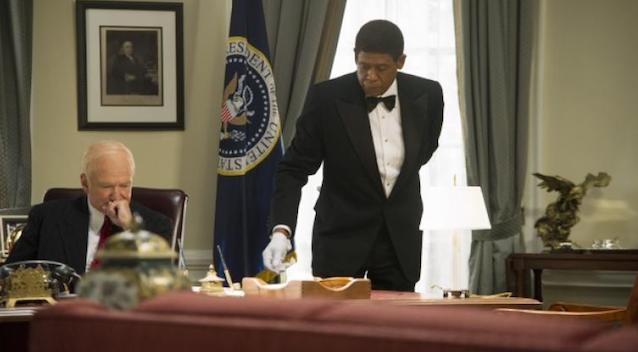
The Butler

0
The Butler

What “The Butler” tries to accomplish is so noble and ambitious that it almost doesn’t matter how clumsily maudlin it ends up being, how over-earnest and sanctimonious it can be. It’s heartening that movies on this subject are being made at all; why worry about whether they’re, you know, good?

Well, because that’s what we do, that’s why. The intention of the film (which MPAA arbitration has ruled must be titled “Lee Daniels’ The Butler”) is to cover the Civil Rights movement from a unique perspective: through the eyes of a black man who was a White House butler from Eisenhower to Reagan.

That’s an enormous undertaking for one movie. Almost every character could be the subject of his or her own biopic — never mind the hugeness of the task of addressing shifting American attitudes on race from the ’50s to the ’80s. Even limiting it to the perspective of one man at the top (or adjacent to the top, bringing tea and sandwiches to the top), there’s still an extraordinary amount of material to cover. It’s like an entire graduate course condensed into one lecture for freshmen.

A heavily fictionalized account of a true story (the real man’s name was Eugene Allen), “The Butler” stars Forest Whitaker as Cecil Gaines, an uneducated son of Georgia sharecroppers who’s promoted from “field n*****” to “house n*****” in the 1920s and trained in the service arts. He makes his way to a luxury hotel in Washington D.C., and from there to a job at the White House. At some point he marries Gloria (Oprah Winfrey), a supportive woman who swells with pride to have a husband in the White House but is lonely at home without him. They have two sons.

It is drilled into Cecil’s head that servants must be discreet and apolitical. No matter what’s happening when you bring the president his coffee, you hear nothing, see nothing, and reveal nothing. The presidents and their advisers are used to thinking of the staff as invisible, and they openly discuss sensitive issues in front of Cecil. Occasionally, though rarely, they ask for his thoughts, along the lines of “Why, here’s a black man right here! Let’s see what he thinks!”

Eisenhower (Robin Williams) struggles over whether to send troops to Little Rock, while his vice president, Nixon (John Cusack), goes campaigning for the black vote in the White House kitchen. JFK (James Marsden) worries about the safety of the Freedom Riders, who include Cecil’s son, Louis (David Oyelowo), a strident young man who considers his father a sell-out. Reagan (Alan Rickman) is unsure what to do about apartheid in South Africa. (Like most of us, the movie skips Ford and Carter entirely.)

The film, ambitious in scope but stumbling in execution, was written by Danny Strong, an actor (he played one of the three nerd villains on “Buffy the Vampire Slayer”) who has recently made a career writing political TV-movie screenplays: “Recount,” about the 2000 election, and “Game Change,” starring Julianne Moore as Sarah Palin. “The Butler” is more complex and sprawling than those, and has a lot more riding on it. Millions of people have a personal connection to the Civil Rights movement. Honor must be paid.

But somewhere between Strong’s functional yet mawkish dialogue and Daniels’ adamantly respectable directorial style (at least he’s toned it down from “The Paperboy”!), the movie is less than the sum of its parts. Collapsing years’ worth of events into a short amount of time makes the story feel like nothing more than a series of occasions where Cecil happened to be in the Oval Office when the president was having his most important conversations about racial equality. Cecil is always there to overhear and dutifully refrain from reacting. He’s more a witness to history than an actor in it, and stories about non-participants aren’t nearly as interesting as stories about participants. (If only we’d followed his Freedom Rider son instead!)

Eugene Allen’s honor as a butler probably prevented him from telling his juiciest stories, and even under the artistic license afforded by cinema, Daniels and Strong aren’t interested in gossip. Nor, unfortunately, do they care much about character. None of the presidents gets enough screen time to reveal anything about the man. Instead of insight we get vignettes that range from tepid to mildly poignant: Cecil standing by as LBJ (Liev Schreiber) tries to poop at one end of the spectrum; Cecil comforting a blood-spattered Jackie Kennedy (Minka Kelly) at the other.

Whitaker is fine as Cecil, giving him more substance than the lukewarm writing would seem to call for. Cuba Gooding Jr. and Lenny Kravitz appear as two of Cecil’s co-workers, with Terrence Howard as the Gaineses’ good-for-nothing next-door neighbor. Oprah Winfrey, appearing onscreen as someone other than herself for the first time in 15 years (“Beloved”), acquits herself with dignity, even though there isn’t much for Gloria to do in the story.

There isn’t much for anyone to do in the story. That’s the problem. We see a series of events that really happened (more or less), but seeing them is all we do. We don’t feel them, or get a sense of how they personally relate to our main character, even though we know they do. A man who worked with seven presidents during such a tumultuous time in history probably had some marvelous stories to tell. Too bad “The Butler” doesn’t tell them.

— Twitch

Kick-Ass 2

0

The first “Kick-Ass” movie ended on the usual superhero note: it set things up for a sequel. Ordinary high-schooler Dave Lizewski (Aaron Taylor-Johnson) had established himself as masked crusader Kick-Ass, with lethal tween Mindy Macready (Chloe Grace Moretz) — aka Hit Girl — poised to become his partner. Rich, spoiled, whiny Chris D’Amico (Christopher Mintz-Plasse), another would-be hero, had sworn revenge on Kick-Ass for killing his crime-boss father.

All the pieces were in place for a decent sequel — so what happened? Why is “Kick-Ass 2” a repellant, mostly unfunny, distasteful-and-not-in-a-good-way mess of mixed messages and tonal confusion?

Actually, it doesn’t really matter why it’s bad; what’s relevant is that it is. Puzzling over how it came to be that way — Mark Millar and John Romita Jr.’s comic book source material? Writer-director Jeff Wadlow’s mishandling of it? The absence of scene-stealer Nicolas Cage? — won’t make it any better.

We pick up two years later, with Dave having retired from the dangerous hero biz but itching to get back in the game. Hit Girl never left it. Now living with her godfather, a conscientious police detective named Marcus (Morris Chestnut), Mindy secretly continues her vigilante work. She and Kick-Ass (despite the latter’s disappearance from public view) have inspired legions of imitators, too, while Chris D’Amico, the erstwhile Red Mist, seeks to reinvent himself as a supervillain named The Motherf*****. (It seemed like he was going to do this immediately after the last film, not two years later, but whatever. Teenagers are easily distracted from their constant, burning obsessions.)

Dave seeks likeminded individuals to form a justice league of sorts, and naturally wants Hit Girl to be part of it. But Mindy has reluctantly agreed to obey Marcus’ wishes that she hang up the latex suit and be a normal girl. She gets connected with a scrum of mean girls, led by blonde Brooke (Claudia Lee), to guide her through the daily life of a high-schooler, all the while pining to break some bones in the name of justice.

Soon Dave is collaborating with Colonel Stars and Stripes (Jim Carrey), a gruff ex-military patriot who’s leading a team of self-appointed superheroes. One of them is Dave’s best friend Marty (Clark Duke), who somehow didn’t know until now that Dave is Kick-Ass. Another one, a lady avenger who calls herself Night Bitch (Lindy Booth), becomes Dave’s new love interest. (Dave’s previous girlfriend, played by Lyndsy Fonseca, dumps him over a stupid misunderstanding early in the film and is never mentioned again.)

The story is headed for a face-off between Kick-Ass’ crew and The Motherf*****’s. But it isn’t headed there very fast, or with much steam behind it. Instead, the major characters piddle around performing unimportant tasks and having unmotivated changes of attitude. Dave is a jerk to his concerned father (Garrett M. Brown) for no reason. Chris visits his imprisoned uncle, who does something nasty that helps Chris to decide to do what he’d already decided to do. (John Leguizamo is tangentially involved.) Mindy is betrayed by the mean girls, gets revenge with a magic machine that makes people poop and vomit, and accepts her true destiny as a killer of bad guys.

Along the way, the film frequently pauses to spout a message that contradicts whatever message was conveyed the last time it paused. Violence isn’t the answer, except when it is, which is usually. You should be true to yourself by sneaking out to fight crime in a costume if that’s your bag, but you should also follow your parents’ wishes. Oh, and you don’t need to wear a mask to be a hero.

More than once someone says “This is the real world, with real consequences,” or words to that effect — and at every turn, the real consequences of violence, revenge, and vigilantism are disregarded. If anyone involved here thinks that “Kick-Ass 2” is actually an examination of real-world violence, then I’d be afraid to live in the same community as any of them. An ultra-violent escapist fantasy is fine, but don’t insult us by claiming to be realistic.

The movie’s idea of “real-world consequences” is that after The Motherf***** kills several police officers — and then claims credit for it on Twitter — the police go around arresting everyone in a costume except him, regardless of whether they’re suspected of a crime. Somehow it becomes illegal, overnight, to wear or own a costume. Dave’s dad protects him by telling the cops he’s Kick-Ass, and they haul him off to jail for possession of a Kick-Ass costume that clearly doesn’t fit him, and it’s all just so stupid.

In the graphic novel, a female character is gang-raped by The Motherf***** and his goons. Don’t worry, though! In the movie, it’s been turned into a punchline! The Motherf***** intends to rape her, and has the goons hold her down while he unzips his pants, but then he can’t get an erection and has to settle for just beating her up. Har! Dodged a bullet there, would-be rape victim!

In another scene, Chris says he wouldn’t kill a dog because “I’m not THAT evil!” So rape, yes. Animal abuse, no. If the movie stated the conflicting views back-to-back, like I just did, it would be a darkly funny example of how twisted the guy is. But the movie doesn’t do that. It just puts both ideas out there, separately, without comment. The implication is that the movie thinks it’s OK to turn the threat of rape into a joke, but thinks killing a dog would be beyond the pale.

Where’s the fun in any of this? And where’s the structure? Dave feels like a supporting character in his own movie, while Mindy feels like the protagonist — yet her arc is bafflingly weak, even illogical. Whatever transgressive thrills we felt when Mindy was a 12-year-old saying and doing horrific things are gone now that she’s a teenager like everybody else. The film has no idea what it wants to say, much less how to say it. There’s still some potential in the premise of ordinary people trying to be superheroes, but not in the “Kick-Ass” franchise. We’re done here.

Paranoia

0

I wouldn’t say corporate espionage is automatically a dull subject for a dramatic thriller, but in “Paranoia,” Liam Hemsworth sure does his best to make it seem that way.

The Australian lunkhead plays Adam, a Brooklyn tech-industry striver with Manhattan ambitions who is strong-armed by his boss, a ruthless and controlling tech magnate (Gary Oldman), into infiltrating their rival company (headed by Harrison Ford) to learn about its secret new product. Adam gets in over his head; it gets dangerous; he’s on the run: you know the drill. Indeed, it’s hard to imagine a more generic and predictable version of this formula, directed anemically by Robert Luketic (“The Ugly Truth,” “21”). It’s watered down further by Hemsworth’s one-dimensional performance and the older actors’ disinterest: Ford and Oldman don’t even seem to be having fun, and Richard Dreyfuss — misused as Hemsworth’s sick but randy father — doesn’t have anything fun to do. It’s a shame to waste such perfectly capable old hams on such thin material.

Ain’t Them Bodies Saints

0

“This was in Texas,” reads the title card at the beginning of “Ain’t Them Bodies Saints.” It sounds like the start of an old yarn, and the film, an unadorned, sepia-toned mood piece, has an ambling pace to it. As Southern outlaws, the lovers at the center of it invite comparison to a certain infamous duo, but this is more Terrence Malick than “Bonnie and Clyde,” more how-can-our-love-survive? than shoot-’em-up (though there’s some of that too).

It’s set in the past, probably the 1960s or ’70s, judging by the cars. In a story meant to invoke wistfulness and nostalgia, specificity isn’t very important. Ruth Guthrie (Rooney Mara) and Bob Muldoon (Casey Affleck) are young, vivacious, and criminally inclined. We gradually come to understand that Bob has been in trouble with the law most of his life. Ruth seems to have come into it later, but is every bit a willing participant when the two of them and their partner, Freddy (Kentucker Audley), commit the armed robbery that winds up putting Bob in prison.

Bob and Ruth swear their allegiance to one another as he’s sent away, Bob promising to write letters every day in support of her and the child she’s carrying. It isn’t clear what Ruth’s level of devotion to Bob is: she, not he, is the one who has to be a single parent and live in the world. Four and a half years later, when Bob escapes from prison and goes on the lam, Ruth and the child, Sylvie (played by twins Kennadie and Jacklynn Smith), are still living in the same small, rural town. Ruth tells the police she doesn’t think Bob will come for her. She seems to mean it.

Bob, though, has had no one on his mind but Ruth and Sylvie (whom he’s never seen) the last four years. He’s smart enough not to head directly for home, but make no mistake: he’s comin’ for them. For him it’s an epic journey to reunite a family after a painful separation. But for Ruth, it’s a dilemma. Does she still love Bob? Of course. But is it sensible to go on the run with a fugitive? Or must she leave this old part of her life behind for good? The glimpses we see of their pre-prison life show their relationship to be tempestuous and passionate (the standard for outlaw couples, really), perhaps not destined to last forever anyway.

Adding to her quandary are the attentions of Patrick Wheeler (Ben Foster), a sheriff’s deputy who adores her and Sylvie and wants to take care of them. Skerritt (Keith Carradine), a local mercantile owner who was an employer and father figure to Bob, Ruth, and Freddy, is likewise protective of her and Sylvie — “the girls,” as he calls them. Bob is ordered to stay away. “You f***** over a lot of people,” Skerritt reminds him.

While there’s some suspense and intrigue concerning Bob’s efforts to stay hidden (a bartender friend, played by Nate Parker, helps him out), this tale of tragic love and doomed romance generally emphasizes tone over story. The details of the plot don’t matter so much as how the characters respond to them. The results are mixed. Whiny-voiced mumbler Casey Affleck is convincing as a man in love, less so as a lifelong criminal, while Rooney Mara is fully immersed in her performance as a tired, haunted woman who has few options. It’s a pleasant change to see the usually insane Ben Foster play an ordinary and humble man.

But the themes and emotions writer-director David Lowery is trying to tap into don’t come across strongly enough to feel universal. Though it has moments of beauty and poignancy, with an authentic setting and naturalistic performances, the film doesn’t draw us into its world as deeply as it needs to. Nonetheless, Lowery clearly has skills and sensitivity (this is his third feature, the first to get any attention) that warrant recognition. Sundance continues to be a laboratory for sharp, intelligent new filmmakers.

The Devil Within Her

0
The Devil Within Her

“This one doesn’t want to be born!” That’s what Dr. Donald Pleasence says at the beginning of “The Devil Within Her.” Is he talking about the movie itself? No! The movie itself wants very much to be born, to share its bizarre and baffling incompetence with the whole world, like people who proudly display misspelled tattoos.

No, the “one” that doesn’t want to be born that Dr. Donald Pleasence is referring to is the baby that is coming out of Joan Collins. In fact, “The Devil Within Her” was originally called (really) “I Don’t Want to Be Born,” a great title that unfortunately makes it sound like a pro-abortion television movie. It’s also listed at IMDb as “Sharon’s Baby,” which would have been a decent title except that the character who has the baby is named Lucy, not Sharon. I can’t explain that one.

Whatever you call it, “The Devil Within Her” stands alone among the many “demon baby” films of the 1960s and ’70s as the only one where the mother is an ex-stripper whose offspring’s satanic tendencies are the result of a curse placed upon her by a jilted dwarf. Dwarf-facilitated hexes are shockingly rare in cinema, rarer still if we limit them to hexes involving the as-yet-unconceived children of flirtatious burlesque dancers. So “The Devil Within Her” is special.

But we have gotten ahead of ourselves, as we are wont to do when discussing cheesy horror films that are 95 minutes long yet contain only 15 minutes of plot. The movie begins with Lucy Carlesi in the delivery room, “giving birth,” which Joan Collins conveys by tossing her head back and forth like someone having a bad dream. Either childbirth is a great deal less arduous than I’ve been led to believe, or Ms. Collins is not giving a very good performance!

The baby, a supernaturally strong 12-pounder named Nicholas, scratches Lucy on the cheek the first time she holds him, drawing blood and terrifying Lucy. Dr. Finch (Pleasence) calmly explains to Lucy’s very concerned and mildly Italian husband, Gino (Ralph Bates), that it was most likely Lucy’s own fault. “Maybe she was cuddling it too tightly,” says Dr. Finch, referring to the baby by a gender-neutral pronoun even though he knows damn well what gender it is. “It may have had difficulty breathing.” Dr. Finch says to forget about it (the incident, not the baby) and go home.

At home, baby Nicholas’ first act is to bite the housekeeper’s finger. She says, “Why, I could swear he’s got teeth already!” which seems like a pretty easy question to get to the bottom of. Lucy, Gino, and the housekeeper dismiss the savage biting as probably nothing, and they leave baby Nicholas alone in his crib in his nursery and shut the door behind them, as was evidently the standard method of caring for day-old babies in England in the 1970s. Later, Lucy’s alcohol-fueled friend Mandy (Caroline Munro) comes over to visit, and they hear a terrible ruckus upstairs. Upon inspection, they find the room completely trashed, Nicholas lying peacefully in his crib holding a severed doll’s head. Their reaction is along the lines of: “Huh! How strange. Oh well, what are ya gonna do?” They leave Nicholas alone again and get back to drinking.

It is already very likely that Nicholas is possessed by the devil. Newborn babies do not claw their mothers or bite their housekeepers or decapitate their toys or appear in movies called “The Devil Within Her” unless they are possessed by the devil. That’s just science. The matter is settled by the arrival of Lucy’s sister-in-law, Albana (Eileen Atkins), who is both Italian and a nun. The Supreme Court has ruled more than once that the presence of an Italian nun in a movie about a baby is incontrovertible evidence that at some point an exorcism will be required.

Nonetheless, the movie has a lot of time to kill, so Sister Albana doesn’t voice her suspicions yet — not even after Nicholas screams and makes a crackling sound when he sees her, and not even after Nicholas’ baptism is prevented by his squalling like a boiled cat when the priest draws near. Instead, it is Lucy who first says aloud that she thinks Nicholas is possessed, and she only says it to Mandy, thereby ensuring that the story will not be moved forward in any appreciable way.

In flashback, we see why Lucy is concerned. Before she married Gino, she was a dancer at a seedy nightclub where the stage shows featured not just gorgeous, almost-undressed women, but also a frolicking male dwarf named Hercules (George Claydon). (Space limitations prevent us from examining in the present treatise the usage of dwarfs in European burlesque shows of the 1970s, but rest assured that we are very interested in the matter.) Lucy used to flirt with Hercules — harmlessly, she thought, but he took her seriously and made a pass at her one night, which she sternly rejected. Humiliated and angry, Hercules quite understandably reacted by lying in wait for Lucy, then leaping out in front of her and declaring, “You will have a baby, a monster, an evil monster conceived in your womb, as big as I am small, and possessed by the devil himself!” — you know, just as anyone would. Lucy had dismissed the imprecation as nothing more than the lovesick railings of a spurned midget, but now she fears it may have been a factor in her current situation.

Dr. Finch can’t find anything wrong with Nicholas, so he suggests Lucy and Gino sedate the baby and hire a full-time nanny. Basically, the doctor’s recommendation is that the Carlesis avoid direct contact with their days-old infant at all costs, lest an act of parenting should transpire. The nanny they hire, Jill (Janet Key), takes Nicholas for a stroll in the park, and Nicholas pushes Jill into the pond so that she hits her head on a rock and dies. Yes, Nicholas the baby does this. We see his little hand reach up from his buggy and shove poor Jill from behind. It is not the last time he will commit murder in this film, nor the last time it will be hilarious when he does.

To kill some more time, the movie sends Lucy to talk to her ex-boss from the strip club, a sleazily mustachioed, frankfurter-shaped man named Tommy (John Steiner). Lucy thinks he might be the baby’s father, which will be relevant in the genetic tests the doctor has ordered. For example, is there any history of demonic possession in Tommy’s family? Have other people in his line been born under dark curses placed upon their mothers by horny dwarfs? This may be useful information.

Meanwhile, Sister Albana has been hanging around, and she finally tells Gino that she fears Nicholas is possessed — according to British actress Eileen Atkins’ Italian accent — “by the day-vil.” She says the same thing to Dr. Finch, who humors her by agreeing to bring the baby in for observation. Before that can happen, though, devil baby Nicholas kills Gino by luring him into a noose magically suspended from a tree in the backyard, then decapitates Dr. Finch with a shovel. For his final act, he chases a screaming Lucy into her bedroom, then shoves his way through the door and stabs her with a knife.

Now, you are probably picturing a little baby scampering around doing these things, filmed with puppets or animation. The image in your head is probably very silly. The filmmakers knew it would be hard to pull it off convincingly, and also could not afford any puppets or animation, so instead we just see the noose, the shovel, and the knife, with the hands that wield them mostly out of frame, the illusion of a 12-pound week-old baby moving around killing people safely maintained.

Once about 45 minutes of the film’s running time has gone by since Sister Albana first should have performed an exorcism, and after the baby’s parents are both dead, Sister Albana finally performs an exorcism. The scene is intercut with images of Hercules the dwarf collapsing onstage in the middle of a show, the rebuke of his evil curse evidently causing his demise. Let this be a lesson to us all: do not swear oaths upon women who refuse to sleep with us unless we are certain they do not have religious in-laws.

Discussion questions:

– Where did the dwarf get his powers in the first place? Do all dwarfs have them, or only dwarfs who work in the flesh industry?

– In matters of demonic possession, what difference does it make who the baby’s biological father is? What are some methods of killing time in a movie that are better than pointless subplots and irrelevant quests?

– Since the nun is the only one left alive, does that mean she was our main character? Were we supposed to be rooting for her the whole time? If so, how were we supposed to have known this? Did the movie give us any indication? Show your work.

— Film.com

Movie B.S. with Bayer and Snider #172: ‘Elysium,’ ‘We’re the Millers,’ and more

0

[Movie B.S. is baked with fresh podcasty goodness.]

Episode 172: ‘Elysium,’ ‘We’re the Millers,’ ‘Percy Jackson: Sea of Monsters,’ ‘Blue Jasmine,’ ‘Blackfish,’ ‘Prince Avalanche’

0:00-5:20 – Introduction; our lunch sponsor: Jones T-shirts is giving away a scholarship! That is cool!; also tangents about youthfulness
5:20-7:30 – iTunes review
7:30-19:40 – “Elysium” review
19:40-27:30 – “We’re the Millers” review
27:30-36:05 – “Percy Jackson: Sea of Monsters” review
36:05-44:35 – “Blue Jasmine” review
44:35-52:20 – “Blackfish” review
52:20-54:30 – “Prince Avalanche” review
54:30-55:30 – We didn’t see “Planes”
55:30-1:07:20 – QOTW (characters who deserve spinoffs)
1:07:20-1:09:50 – Summer Box Office Challenge update: it’s the final weekend!
1:09:50-1:13:30 – Wrap-up and goodbyes, including a college tangent and a plug for The Garrens Comedy Troupe 20th Anniversary Reunion Spectacular

QOTW: What PG-rated movie could be redone as an R-rated movie?

Download audio / Listen at MovieBS.com / Listen at iTunes

Prince Avalanche

0

Many reviews of “Your Highness” and “The Sitter,” two of the more pitiful comedies of 2011, featured concerned inquiries as to what (and in some cases what THE HELL) had happened to those films’ director, David Gordon Green. His first four features — “George Washington” (2000), “All the Real Girls” (2003), “Undertow” (2004), and “Snow Angels” (2007) — had been darlings of the indie world, methodical and sensitive stories of ordinary small-town folk. No one begrudged Green his “Pineapple Express” (2008) because it was funny, and because they assumed he’d eventually get back to the deeper stuff. But that one-two punch in 2011 had people examining Green’s head for lobotomy scars.

His seventh film, “Prince Avalanche” isn’t quite a “return to form” (to use an expression only movie critics use), but it is a satisfying step in that direction, a lovely, melancholy little film about loneliness and self-discovery. Except not as unbearable as that sounds. It’s actually rather light! Paul Rudd’s in it!

A loose remake of an Icelandic film (“Either Way”), “Prince Avalanche” stars Rudd and Emile Hirsch as workers on a Texas road crew in 1988, repainting lines and replacing sign posts on rural routes after the devastating wildfire that occurred a year earlier. It’s a solitary job: Monday through Friday, Alvin (Rudd) and Lance (Hirsch) are essentially alone, interacting with no one but each other until the weekend comes and they can go home if they choose to.

Alvin (Rudd) enjoys the quiet and solitude. He’s dating Lance’s sister Madison, and he delights in each new letter that he receives from her, but what he really loves is being on the move. Lance, who is younger and less circumspect, spends his days feeling stir crazy, bored, and horny. In a letter to Madison, Alvin writes of her brother, “He quite realistically could never amount to anything.”

And with that I have conveyed the bulk of the plot. With only two other speaking roles — a gregarious and booze-loving truck driver (Lance LeGault) and an old woman (Joyce Payne) whose house was lost in the fire — the focus is squarely on Alvin and Lance. Rudd and Hirsch are up to the challenge, creating believable characters composed of personalities rather than just quirks, and taking us through the stages of their gradually deepening relationship. Alvin thinks Lance is a reckless kid; Lance views Alvin as a boring, fussy grown-up; they both ridicule — and envy — what the other has. When their personal crises develop (offscreen), their fragile new bond is tested.

I don’t know what the actual process was, but this feels like the sort of intimate, small-scale film where the director had the actors live together for a few weeks before shooting began. Rudd and Hirsch seem comfortable with one another, their different skills meshing into a likable duo. Green’s regular cinematographer, Tim Orr, captures many gorgeous, placid images of the natural surroundings, making this the first Green film in six years to qualify as “beautiful.”

It’s funny, too. And when it isn’t funny, at least it isn’t too heavy. Maybe this is a lingering effect from Green’s last few endeavors — and not an unwelcome one, either. His earlier movies always had some humor in them, but you wouldn’t describe any of them as “comedies,” and some were downright Gothic in their darkness. “Prince Avalanche” isn’t an all-out laff-fest, but it plays up the humor of Alvin and Lance’s odd-couple roommate (tent-mate) situation with a gentle touch.

On the David Gordon Green scale of 1 to 10, with 1 being “Pineapple Express” and 10 being “Snow Angels,” “Prince Avalanche” is about a 6 — more drama than comedy, but more light than dark. Such a film runs the risk of feeling unimportant or weightless, and certainly no one’s going to make a case for this being Green’s best work. But if nothing else, it’s a reassuring reminder than the Green we used to know — the contemplative, emotionally fraught one — is still lurking in there somewhere.

Elysium

0

The distressingly plausible premise of “Elysium” is that in the future, after Earth has become a polluted, overcrowded nightmare, the rich have built an idyllic colony for themselves on an orbiting space station, leaving the rest of us to fend for ourselves in our slums while they relax in their artificially perfect biosphere. They have better stuff up there, too, including a tanning-bed-sized medical device that can instantly cure any disease or repair any injury. Back on Earth, healthcare isn’t even as good as it is right now, and people dream of going to Elysium just to be healed. Elysium is an afternoon’s journey from Earth via space shuttle, but only Elysian citizens are allowed to enter. It’s basically a metropolis-sized gated community.

This is the setup for what proves to be a flat and inert sci-fi action story, a disappointing second film by South African writer-director Neill Blomkamp. His debut, “District 9,” started as an apartheid allegory and got less interesting the more it got away from its message; “Elysium” stays on-point the whole time and fizzles anyway.

It stars Matt Damon as Max, a rough, neck-tattooed ex-con who’s gone straight but, like most of his fellow Earth residents, despairs of ever going to Elysium. Places like that aren’t for people like him. He has a low-paying job at a factory that makes some of the defense technology Elysium uses to keep his kind out, under a haughty Elysian boss (William Fichtner) who hates having to work on this filthy planet and views his employees as interchangeable cogs. When Max is exposed to radiation that will kill him in a few days unless he gets to one of those tanning beds, he urgently pursues all available means, including shady ones, of traveling to Elysium. In the process, he reconnects with a childhood friend, Frey (Alice Braga), who gives him another incentive: her young daughter is dying, too, and desperately needs Elysium’s marvelous healthcare system.

A larger plot unfolds pertaining to Elysium’s heartless defense secretary, Delacourt (Jodie Foster, doing some kind of inexplicable accent), who wants to seize control of her government from its president and enact stricter laws regarding immigration. Specifically, she thinks anyone who tries to enter Elysium without authorization should be killed on sight, not apprehended and deported. (You probably have an uncle who feels the same way.)

So it is an allegory about immigration, and about the 1% vs. the 99%. Very timely, you’ll agree. And there are flurries of engaging action. I got a kick out of Sharlto Copley’s maniacal Elysian sleeper agent doing Delacourt’s bidding on Earth, and Blomkamp conceives some nifty futuristic weaponry that belongs in a much more exciting movie. But the stakes feel low. The ultimate goal is for everyone to be granted Elysian citizenship so they’ll all have access to the healing machines — you know, because the Elysians will suddenly become compassionate and cooperative just because the immigration status on people’s passports has changed. The goal ought to be closer to the reverse of that: for the medical technology to be made available to everyone, regardless of citizenship. Naturalization does not make for a thrilling plot device. Also, as I’ve always said, beware of any movie whose climax involves downloading information into a computer before time runs out.

Percy Jackson: Sea of Monsters

0

Having missed 2010’s “Percy Jackson & the Lightning Thief” because of reasons, and then never catching up with it due to factors, I was at a disadvantage when it came time for “Percy Jackson: Sea of Monsters.” But I was also free of preconceived notions. Since I didn’t have an opinion of the first film, I didn’t approach the sequel with any idea of whether it was likely to be good or bad. I was a blank slate!

Speaking of blank slates, this movie stars Logan Lerman: so sweet in “The Perks of Being a Wallflower,” and such a bucket of white paint everywhere else. He plays the title character, a seemingly ordinary teenage boy who discovered in the first film that his father is Poseidon, god of the ocean. This grants Percy certain powers that occasionally and randomly manifest themselves when the situation calls for it, but not as often as you’d think.

In “Sea of Monsters,” Percy lives at Camp Half-Blood, a Hogwarts-ian summer camp for demigods, centaurs, and satyrs. (Cyclops are considered weird, though. I don’t understand the rules.) Percy is a bit of a legend because of what I gather were impressive world-saving accomplishments in the first film, but he worries about being a “one-quest wonder.” His hotshot rival, Clarisse (Leven Rambin), taunts him, while his friends — Annabeth (Alexandra Daddario), daughter of Athena, and Grover (Brandon T. Jackson), a satyr — support him by being smart and comical, respectively.

The quest this time concerns the Golden Fleece, the healing properties of which are needed to repair the magic forcefield that protects Camp Half-Blood from the forces of evil. The forces of evil are represented by a jowly teen named Luke (Jake Abel). He is the son of Hermes, and he has joined the faction of demigods who want to resurrect Kronos the Titan so he can kill everybody. Clarisse and a different satyr embark on the journey to nab the Fleece from the cyclops who keeps it as a security blanket. Then, for some reason, Percy also goes on the same quest, accompanied by Annabeth, Grover, and Tyson (Douglas Smith), Percy’s cyclops half-brother who was the result of Poseidon gettin’ it on with a nymph. Adventures ensue.

As far as kid-oriented fantasy films go, “Sea of Monsters” isn’t bad — but it isn’t memorable or distinctive, either. The story is less intense than Harry Potter (the obvious comparison), with fewer fatal consequences — there’s a whole lot of “Oh, we thought for sure you were dead!” going on here — and the mythology is quite a bit less complicated. That’s the movie, anyway. Even without having read any of Rick Riordan’s novels, you can tell from the film’s hurried pace and general superficiality that a lot of material has been excised. Camp Half-Blood’s adult leader, Dionysius (Stanley Tucci), is ineffectual; Chiron (Anthony Head), the centaur who is apparently the only teacher on staff, has one function, and it’s to warn Percy about ancient prophecies in much the same way Giles used to mentor Buffy.

The director is Thor Freudenthal, whose previous films, “Hotel for Dogs” and “Diary of a Wimpy Kid,” must have prepared him for working with animals and Logan Lerman, respectively. He has a light, anonymous touch. I’m not exaggerating when I say the most entertaining part of the film is Nathan Fillion’s one (1) scene as Hermes, the messenger of the gods who now runs the gods’ equivalent of UPS. He helps our li’l heroes prepare for their perilous journey by giving them highly specific tools that they will coincidentally end up needing — and he has more energy, personality, and humor than the rest of the movie combined.

A lack of personality is the film’s only major problem, but it is major. There are three more books in the series. My reaction to the prospect of three more movies like this one? Complete apathy. Make ’em, don’t make ’em, whatever. This might be the only franchise fueled entirely by shrugs.

We’re the Millers

0

There isn’t much about “We’re the Millers” that separates it from the typical snarky, quasi-feel-good raunchy comedy, but it deserves credit for one thing: finding a new twist on the familiar premise of mismatched strangers being forced to take a road trip together.

In this scenario, a shiftless Denver weed dealer named David Clark (Jason Sudeikis) must settle a debt with his wealthy supplier (Ed Helms) by smuggling some marijuana — “a smidge, maybe a smidge and a half” — from Mexico into the U.S. To avoid suspicion at the border, David has the genius idea of gathering some accomplices, piling into an RV, and pretending to be a typical (read: nerdy) middle-American family on vacation.

Now, why David has to recruit near-strangers, I don’t know. He might be the first marijuana dealer in history not to have any friends. His stripper neighbor, Rose (Jennifer Aniston), with whom he has already established a we-hate-each-other repartee, is willing to do it for a cut of the money. (Scenes at the club where she works, with the wonderfully sleazy Ken Marino as her boss, establish that stripping has not turned out to be a job with a lot of career advancement.) Another neighbor, 18-year-old virgin Kenny (Will Poulter), is wholly unsupervised by his mother and just wants someone to hang out with. The makeshift family, the Millers, is rounded out by Casey (Emma Roberts), a cynical, potty-mouthed, semi-homeless teen.

Thus begins a buoyant comedy that remains afloat as long as it concentrates on barbed humor rather than real emotions. Sudeikis, making a bid for the above-the-line stardom he deserves, plays a selfish jerk of a leading man in the Vince Vaughn tradition, while anyone who’s surprised to find that Aniston is terrific at playing coarse, messed-up women hasn’t been paying attention. Poulter and Roberts, both better known (to the extent they’re known at all) for more innocent roles, complete the ensemble with gusto. The indispensable Nick Offerman and Kathryn Hahn also do valuable work as a squeaky-clean married couple whose RV travels parallel the Millers’.

It was directed by Rawson Marshall Thurber, of “Dodgeball” fame, and written by two pairs of R-rated veterans: Bob Fisher and Steve Faber (“Wedding Crashers”) and Sean Anders and John Morris (“Sex Drive”). If that sounds like too many cooks for one fairly straightforward entree, it is, and the story is padded with madcap episodes that vary wildly in quality. Good: the family’s efforts to bribe a Mexican police officer (Luis Guzman). Bad: all the business with the pissed-off Mexican drug lords, who are in the story only to provide action, danger, and noise. And it’s a familiar refrain by now, but this slight and inconsequential film runs out of steam long before its 110-minute running time has finished.

It’s also bogged down by the attempts to turn what is essentially a pitch-black farce into something genuine. Predictably, all of this pretending to be a family makes the four gradually develop actual affection for one another, which the film conveys in dewy-eyed moments like Rose feeling touched when she sees David give fatherly advice to naive Kenny. I love the theme of “family” not necessarily being limited to one’s flesh-and-blood, of lonely strangers creating improvised family units for support. But this story, with these characters doing these things, doesn’t provide a convincing framework for it. We accept that comedies need a little heart to connect with audiences, and we’re willing to allow it as a formality. Yes, yes, sure, they all grow to like each other. Whatever you say. Trying to convince us it’s happening in an authentic, emotional way is a waste of time. When the film sticks to the jokes, it’s a breezy pleasure.

Dracula 3000

0
Dracula 3000

“Dracula 3000” doesn’t have anything to do with “Dracula 2000.” They’re both just bad movies about Dracula with the year they take place in added to the title to distinguish them from the other bad movies about Dracula, of which there are hundreds, if not trillions. What makes “Dracula 3000” different is that it’s set in outer space! Which only sounds exciting until you realize that means it’s set inside a grim, Soviet-looking spaceship that has all the futuristic appearance of a present-day federal building made entirely of dimly lit corridors.

Who is this movie for? That’s what I kept asking myself as I watched it, annoying myself with the constant questions. The film has nothing to offer fans of horror, vampires, or science-fiction. Nor does it have anything for people who enjoy entertainment, diversion, or pleasure. What it does have is the casting coup of the century: Casper Van Dien AND Coolio! So if you’re such a fan of both of those individuals that you’ll watch any movie with which they associate themselves, I can report that “Dracula 3000” is indeed a movie with which they have associated themselves.

Casper Van Dien plays Capt. Van Helsing (yep, they’re going all the way with this), commander of a salvage ship in the year 3000 that comes across an abandoned cargo transport drifting in the cosmos. The laws governing space society are basically “finders keepers, losers weepers,” so Van Helsing and his scrappy crew are allowed to take whatever they find.

First, though, Van Helsing tells us who his crew members are. It’s the only time in the film that voice-over narration is used, so presumably he is speaking directly to you and me. Hi, Casper! Who are your friends??

– Aurora (Erika Eleniak) is Van Helsing’s hot blond second-in-command, an enigmatic woman of mysterious origins who will turn out to be a robot because this is a shameless “Alien” ripoff.

– Mina (Alexandra Kamp) is an unpaid navigator intern who does all the thankless tasks, including being the first one to enter the scary abandoned ship. When she gripes about it, the guys tease her about how great her job is because she gets to work with buff, sweaty men all day. Then another crew member sneaks up on her, scares her, and steals a kiss from her. There is a lot of sexual harassment in the future and/or in space.

– Humvee (Tiny Lister), the strapping deckhand who’s good at being large and picking up heavy things. Also Mina’s chief sexual harasser. (Note: Humvee is a nickname, and sometimes they call him “Hummer,” which means his nickname has a nickname.)

– The Professor (Grant Swanby), a wheelchair-bound Jeff Goldblum doppelganger who does all the computer-y stuff. To underscore his smartness, he speaks in a British accent.

– 187 (Coolio): cargo specialist, comic relief. They call him 187 because that was supposedly his I.Q. “before he enrolled in the Berkeley satellite campus and starting smoking everything in sight.” (I don’t believe you that that’s where you got “187” from, movie, but whatever.) He is smoking weed when we meet him, and all of his subsequent activities involve either looking for or smoking more weed. For example, he thinks maybe this abandoned cargo ship will have some weed on it. It’s possible that looking for weed is his actual job.

To summarize: Capt. Van Helsing’s crew consists of a lazy stoner, an unpaid intern, a paraplegic, a secret robot, and a strong guy.

Once they’ve boarded the deserted ship, the movie has two choices: get to the vampire action — which we know is coming because the movie is called “Dracula 3000,” so there’s no point in coyly building false mystery — or stall by coyly building false mystery and delivering cutesy non-jokes that wink at the audience. The movie chooses the latter path. Mina expresses cliched apprehension — “I’ve got a bad feeling about this ship” — and the Professor says, “It’s a spaceship, not a forest. Nothing’s gonna bite you!” DO YOU GET IT? Because later something* will bite her!

To aid in the stalling process, the film gives us snippets of video recorded 50 years earlier by the doomed captain, who is played by Udo Kier, who was in some other Dracula movies a long time ago and was persuaded to spend no more than two hours on the set of “Dracula 3000” to film his segments. Capt. Udo Kier reports that soon after his ship left Transylvania Station (!!!) with its mysterious cargo**, his crew members were overtaken by a mysterious illness, and that no one can figure out who or what*** caused it.

Capt. Udo Kier is still aboard now, albeit in the form of a desiccated corpse sitting in the captain’s chair and clutching a crucifix. “A metal plus sign!” says 187 when they find the body. “This dude was into mathematics. That explains everything!” Now, I don’t deny that 187 is fairly stupid, but it’s not entirely his fault. Turns out religion and all its accoutrements were banned 200 years ago (when crucifixes are outlawed, only outlaws will have crucifixes), so it’s not surprising that it’s unfamiliar to him.

Capt. Van Helsing says practically no one believes in God anymore. Then Aurora says, “Who’s God?” OK, that’s stupid.

Unable to stall any longer, the movie finally gets to the point. 187 finds a bunch of coffins, each filled with sand and dust that used to be vampires, whereupon Dracula (Langley Kirkwood) emerges from hiding and vampirizes him. When 187 rejoins his teammates, the other crew members know something is unusual about him because he says filthy things to Aurora that are only slightly filthier than the things Humvee and Van Helsing say to Mina every day. OK, and also because he tries to kill them all.

Then 187 goes away for a while. People do that in this movie. There are only seven characters (not counting Ret. Capt. Udo Corpse), yet the movie loses track and just lets them wander off sometimes. Dracula disappears after telling 187 to kill everybody — you know, like Dracula’s got better things to do than help carry out his own plan.

While 187 is gone, Aurora encounters Dracula (who’s going by “Count Orlock” on this trip, so that’s the name you need to use if you call his hotel). He tells her what he is, what his hopes and dreams are, etc., and she returns to tell Van Helsing and Humvee. Humvee’s response: “What the hell is a ‘vampire’??”

OK, look. Maybe they banned religion 200 years earlier and no one believes in God anymore, and maybe for some reason in the year 3000 vampires are no longer part of humanity’s storytelling arsenal and haven’t been for a while. But just because ideas fall into disuse doesn’t mean people forget they ever existed. That’s not how culture works! “‘God’? What is this ‘God’ you speak of?” “A ‘vampire’? Am I saying that right? ‘Vam-pire’? My, what fanciful terms!” I mean, it’s been a long time since we had slavery, but people still know what it is.

Anyway, Van Helsing and Humvee want to know how Aurora met Dracula without being vampirized by him, and that’s when she has to fess up about being an android. The guys are mad she didn’t tell them sooner, but they have more important things to worry about. The ship’s computer reveals that Van Helsing’s ancestor hunted Dracula centuries ago, which leads Van Helsing to conclude that his being here now is no coincidence. The odds of that happening by chance are pretty astronomical. “Count Orlock” must have arranged it somehow, eager to settle an old score! A little later, Van Helsing comes face-to-face with Dracula, and he’s like, “Guess what? I’m a Van Helsing!” and Dracula is all, “Hmm? Oh, right, your ancestors. Whatever.” Then Dracula kills him. It was an astronomical coincidence after all!

During all this, the Professor is trying to get the ship up and running again, and then Dracula makes him a vampire and Humvee has to stake him. And Mina already got turned a while ago — I didn’t mention it because I didn’t care — and now she gets staked, too. Same goes for 187.

It comes down to Humvee and Aurora versus Dracula. They have a lot of time to strategize because Dracula wanders off again, not that interested in destroying them after all. But neither one knows how to fly the ship, so they’re basically doomed anyway. Aurora expresses sadness about the state of affairs. “I was programmed for human emotion,” she says. “I’m not the Bionic Woman.” So 1970s TV shows she’s heard of, but not God.

Finally, just when you thought the movie couldn’t get stupider, Aurora reveals that she used to be a sex-robot and asks if Humvee would like a sample, to which he eagerly assents. They scurry off to have sex while Dracula is still lurking around somewhere, and then the movie ends with the ship exploding. How? Why? I don’t know. I truly don’t. Maybe old Capt. Udo Kier set the self-destruct timer for 50 years later and it finally finished its countdown? Maybe it had been so long since Aurora worked as a sexbot that her parts had rusted and rubbing up against Humvee sparked a fire? I like to think the movie realized it was hopeless and put itself out of its misery.

*Dracula
**Dracula
***Dracula

Movie B.S. with Bayer and Snider #171: ‘2 Guns,’ ‘Maniac,’ Pitch Me

0

[You should only listen to Movie B.S. if you like great things.]

Episode 171: ‘2 Guns,’ ‘Maniac,’ Pitch Me

0:00-3:50 – Introduction; our lunch sponsor: Marty Reeder, author of young adult fiction. Support his Kickstarter!
3:50-5:50 – Jeff’s beer sponsor
5:50-18:00 – “2 Guns” review
18:00-21:35 – “Smurfs 2″ (we didn’t see it)
21:35-26:15 – “Maniac” review
26:15-44:20 – QOTW (movies at the top of your to-do list), with considerable tangents
44:20-51:20 – Pitch Me
51:20-53:00 – Some Portland events
53:00-55:10 – Eric plugs The Garrens Comedy Troupe 20th Anniversary Reunion Spectacular (coming to Provo, Utah, Sept. 14)
55:10-57:15 – Wrap-up and goodbyes

QOTW: What movie character deserves his or her own spinoff?

Download audio / Listen at MovieBS.com / Listen at iTunes

Europa Report

0

Between “Star Trek Into Darkness,” “Oblivion,” “After Earth,” “Pacific Rim,” and “Elysium,” this summer has had no shortage of big-budget science-fiction spectacles. And while their entertainment value and profitability have varied, one thing they’ve all had in common is that they’ve been a great deal more fiction than science, their plots often larded with meaningless techno-babble and logic-defying mechanical and plot devices. It’s fun and all, but come on.

A well-grounded counterpoint to the noisy frivolity is “Europa Report,” an astonishingly realistic depiction of a space voyage imperiled not by supervillains or giant monsters or an alias-adapting Khan, but by things that real astronauts would (or plausibly could) encounter. Outer space, lest we forget, is pretty dangerous on its own, without devising fictional terrors.

Developed with a painstaking approach to accuracy and some advisory assistance from NASA, this low-boiling thriller is about a six-person crew headed for Europa, an icy moon of Jupiter that scientists have reason to believe may have life on it. Rather, I should say it’s about a crew that already headed for Europa: the film is presented as an after-the-fact “documentary” about what went wrong on the way there.

Most of the film takes the form of surveillance footage from inside the spaceship. Fortunately for us (especially those of us who are weary of cheap-looking “found footage” monstrosities), the people who funded the mission sprang for high-definition cameras and state-of-the-art microphones. The picture and sound are crystal-clear, not grainy and muddy — it feels like we’re there on the ship. The gimmick isn’t an annoyance, then, but an effective device for conveying the isolation of space travel.

To add variety and suspense to what would otherwise be a rather simple narrative trajectory — ship blasts off; travels; crew has problems — director Sebastian Cordero and screenwriter Philip Gelatt unfold the story in a non-linear fashion. We have the trek’s corporate financier, Dr. Unger (Embeth Davidtz), telling viewers at the very beginning that mission control lost communication with the ship at some point in its journey. We see some of the events that took place on the ship just before and after this disruption, including the crew’s unanimous decision to continue with the mission anyway. But we also follow the story many months later, when the crew finally reaches Europa and finds new challenges. There’s also footage of the pilot, Rosa Dasque (Anamaria Marinca), reflecting on the mission sometime later.

Keeping it straight which events are happening in what order requires some concentration, but “Europa Report” is the sort of un-flashy, nuts-and-bolts sci-fi story that encourages close attention. The crew is composed of characters who could pass for real astronauts: a no-nonsense captain (Daniel Wu), a family man (Sharlto Copley) who misses his wife and son, a grizzled “space veteran” (Michael Nyqvist) who’s been out before but never this far, and two science officers (Christian Camargo, Karolina Wydra). All of the characters are refreshingly un-cliched, and their decisions are pragmatic and scientific, not reckless.

By focusing on the “ordinary” dangers of space travel instead of more fantastical ones, the film manages to wring suspense out of things like leaving the ship to repair something on the outside — an activity that the heroes in blockbuster sci-fi films perform like they’re taking a walk to the bus stop but that in reality is a delicate, perilous endeavor. But this reality-based attitude also means we’re deprived of the sort of grand, climactic pay-off that typifies the more melodramatic sci-fi adventures. The film is resonant and largely satisfying, but in a smaller, more cerebral way than many of its genre.

The Spectacular Now

0

The first few seconds of “The Spectacular Now” give you a clear sense of its tone and direction. A high school senior named Sutter Keely (Miles Teller) is sitting at his computer, preparing to write an essay for his college application. He reads the topic: “a hardship you have faced.” Before he proceeds any further, he reaches over and takes a sip of his beer.

A lot of high school students drink in movies, but it’s usually handled in one of two ways. Either there are no particular consequences for it — just a “no big deal” kind of thing that some kids happen to indulge in while others don’t — or else the movie is a hand-wringing melodrama about underage drinking. “The Spectacular Now,” an authentic and charming teen-oriented drama based on a novel by Tim Tharp, is the rare film that falls somewhere in between. Sutter’s drinking is definitely a problem, and not just because of his age. He drinks too much for an adult, too. But instead of being the focus of the movie, it’s portrayed as a symptom of Sutter’s larger issues: his refusal to face the fact of his impending adulthood, and his reluctance to do anything other than have fun and live in the moment.

Sound familiar? Like the best teen dramas, this one has characters with traits we all recognize from our own high school years, either in ourselves or our friends. A standout from this year’s Sundance Film Festival, the film was directed by James Ponsoldt (whose last film, “Smashed,” actually was about alcoholism), with a screenplay adapted by Scott Neustadter and Michael H. Weber, the duo whose “500 Days of Summer” also captured certain elements of young adulthood with painful, poignant, and occasionally hilarious accuracy.

The story commences with Sutter’s girlfriend, Cassidy (Brie Larson), dumping him over something that’s relatively minor but that we sense is just the latest in a series of disappointments. They had a lot of fun, and they’re popular in school, but apart from drinking and having sex, they never really worked as a couple. Reeling from the break-up, Sutter gets drunk at a party and wakes up the next morning on someone’s lawn. That someone is Aimee (Shailene Woodley), a classmate of lesser social standing who gets Sutter on his feet and enlists his help with her paper route.

He takes an interest in her, not romantically at first, but as a pal. Though he doesn’t say it in so many words, he seems to find her innocence and semi-nerdiness refreshing. She’s sweet and unaffected. When their relationship starts evolving into romance — endearingly, hesitantly conveyed in an outdoor scene shot mostly in a single take — Sutter’s friend Ricky (Masam Holden) cautions him that Aimee will surely take it much more seriously than Sutter will, and that he risks breaking her heart.

Since this is a coming-of-age story, you can be assured that there will be some heartbreaks and other angst as Sutter and Aimee stumble toward adulthood, both helping and hindering one another. She picks up his drinking habits, the way meek, lovestruck teens often do. But when Aimee feels obligated to skip college and stay home to help her unstable mother, Sutter encourages her to stand up for herself. For her part, she encourages him to seek out his father (Kyle Chandler), who left him and his mother (Jennifer Jason Leigh) ten years ago and never looked back. Once they get past all the ways that Sutter is a bad influence on Aimee, they may actually be good for each other.

These two central performances by Miles Teller and Shailene Woodley are key. Teller played a broader, more abrasive version of the same type of character in the raunchy comedy “21 & Over”; here, though, he finds the kernel of realism that makes us sympathize with Sutter and root for his success. You can see why Sutter’s classmates love being around him but don’t respect him. He’s a fun guy, a people person — a douchebag, maybe, but never a bully. In his part-time job at a men’s clothing store (where his boss, played by Bob Odenkirk, is something of a father figure), he’s all the customers’ favorite. Woodley, from “The Descendants” and TV’s “The Secret Life of the American Teenager,” has an aura of kindness about her, a vulnerability that makes her a perfect counterpart for Teller’s cockiness.

The story may be formulaic, hitting the same emotional beats as countless other teen dramas, and there’s a cheap trick two-thirds of the way through that manipulates more feeling out of us than is deserved. Yet there’s so much tender, relatable emotion in these characters and their experiences, and so much underlying goodness in them. Spectacular it may not be, but it’s pretty damn good.

The Steep Decline of Sketch Comedy from ‘Kentucky Fried Movie’ to ‘Movie 43’

0
The Steep Decline of Sketch Comedy from ‘Kentucky Fried Movie’ to ‘Movie 43’

Sketch comedy has been a staple of television ever since TV emerged, fully formed, from Milton Berle’s nurturing womb, but it’s never been a big hit in the movie world. Something about the format of brief, unrelated comic scenarios without an ongoing storyline just isn’t as appealing at the cinema as it is in the coziness of your own home. Maybe it’s the same reason anthologies are rarely box-office hits: moviegoers are usually in the mood for a single, full-length experience, not a bunch of short ones. It’s just how we’re wired.

Yet despite being a small sub-genre with only a handful of entries, the sketch-comedy movie has been curiously influential. Monty Python’s “And Now for Something Completely Different” (1971) helped introduce the troupe to U.S. audiences before “Flying Circus” began airing on American TV, and the group’s subsequent all-sketch feature, “The Meaning of Life” (1983), is still a much-quoted gem. Woody Allen’s “Everything You Always Wanted to Know About Sex* (*But Were Afraid to Ask)” (1972) was a smash, and it came early enough in his career to provide an important boost to his momentum. “The Groove Tube” (1974), a raunchy spoof of TV and counterculture, is all but forgotten now and got bad reviews at the time — but it made $20 million (in 1974 money!) and helped an unknown cast member named Chevy Chase get a gig on “Saturday Night Live” a year later.

But perhaps the most influential sketch-comedy movie — or at the very least the one that this article is about — is “Kentucky Fried Movie” (1977). This was the first film collaboration of writer/performers David Zucker, Jerry Zucker, and Jim Abrahams, the trio later responsible for such zany classics as “Airplane!,” “Top Secret!,” “Police Squad,” and “The Naked Gun.” Look, I don’t care who are you, that stuff is funny. Not every joke, not every scene, but most of it works, a ridiculously high batting average for a team that always swung for the fences. The ZAZ team’s spoof output from 1977 to 1994 (we’ll stop at the last “Naked Gun” movie) was a distinctive chapter in comedy history, its absurd mixture of everything from highbrow wordplay to pie-in-the-face slapstick the closest thing there’s been to a live-action MAD Magazine. A whole generation of TV and film writers grew up watching, quoting, and internalizing the ZAZ humor style, and you see it reflected in free-form absurdist-leaning comedies like “30 Rock” and “Childrens Hospital.”

And it all started with “Kentucky Fried Movie.” It was just released on Blu-ray, which means it’s sharing the shelves with two of its inferior descendants: “Movie 43” and “InAPPropriate Comedy,” both of which played in theaters in 2013 and were huge critical and commercial disasters. By comparing the three, perhaps we can learn something about how comedy has changed over the years, or at least find an excuse to say “boobs” a lot.

* * *

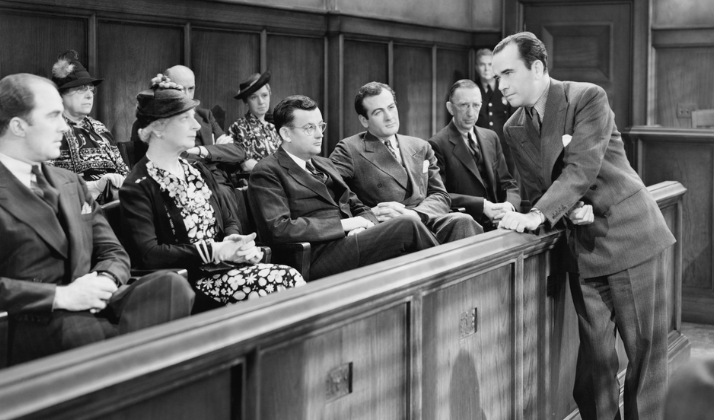
“Kentucky Fried Movie” is structured almost entirely as a series of TV, commercial, and movie spoofs. What few sketches are set in “real life” are about people watching TV or going to movies; most are parodies of the things they see. “Film and TV” is a broad concept, but a concept nonetheless. Sometimes the association is loose. “Courtroom,” presented as a black-and-white legal drama from the ’50s, doesn’t parody the conventions of the genre — it’s really just an excuse for a very funny sketch set in a courtroom. Other segments, like the ongoing TV news bits, are more directly “about” their formats.

“InAPPropriate Comedy” has the same type of structure as “KFM.” Here a creepy man who lives in a sewer clicks a series of apps on his iPad, each one leading to a sketch, each sketch being a TV or movie parody. But while “KFM” mostly spoofed generalities — types of movies, types of commercials — “InAPPropriate Comedy” goes for specifics, at least in name. “Blackass” is “Jackass” but with black guys. “The Amazing Racist” is about a guy who goes around being a racist. “Flirty Harry” has Adrian Brody as a flamboyant Dirty Harry. “Go ahead,” he says. “Make me gay.” Yes, that’s as funny as it gets.

Unlike its fellows, “Movie 43″ hardly even bothers with a structure. It has a lackluster wraparound story — a desperate writer (Dennis Quaid) tries to get a Hollywood producer (Greg Kinnear) to buy his screenplay — but the sketches are unconnected comedy bits with straightforward premises. Few of them are satirical; instead of poking fun at something, most simply find a humorous situation and put it to work making the yuk-yuks.

You could see any of these being performed live by Second City or The Groundlings or your college comedy troupe. A woman goes on a blind date with a man whose testicles are on his neck, and she is the only one who seems to notice. Two parents home-school their son and go all the way with creating a school atmosphere, complete with bullying and dating. (“It should be the unhappiest time in a teenager’s life!”) Robin the Boy Wonder tries speed-dating and is constantly interrupted by an obnoxious Batman. A man and woman are in love, and what she wants most of all as an expression of their everlasting commitment is for him to poop on her. And so on.

“Movie 43″ is also different from nearly every other sketch-comedy film in that its segments were all written and directed by different people, with no connection to one another. What consistency there is in tone and style is primarily coincidental. Several sketches happen to involve dating, for example, but there’s no larger theme. “Kentucky Fried Movie” hits a lot of subjects, but everything has the ZAZ imprint. You can find it in dialogue like this, from the “Courtroom” sketch:

LAWYER: Mr. Grunwald, would you kindly tell the court the fabric of which your shirt is made?

OTHER LAWYER: I object, your honor, that shirt is immaterial.

The longest segment, a 32-minute kung fu parody called “A Fistful of Yen,” is a miniaturized version of the feature-length spoofs that ZAZ were yearning to make. Overall, it’s the weakest part of the film — they would get better at maintaining a plot without sacrificing humor — but it has its moments, like the three Chinese bodyguards named Hung Well, Long Wang, and Enormous Genitals.

“InAPPropriate Comedy” is also the product of a single vision. Unfortunately, that vision belongs to Vince Offer, who’s best known as the ShamWow pitchman and who should be prevented, through legislative action if necessary, from ever making another film. He made a similar one, “The Underground Comedy Movie,” back in the ’90s, and I have every reason to believe it’s as excruciating as “InAPPropriate Comedy.” (Ugh, even the title makes me want to stab myself.)

* * *

Vince Offer’s problem, not to put too fine a point on it, is that he doesn’t know what comedy is. I mean, he probably laughs at things he finds funny, like the rest of us. So he’s aware that “comedy” is a “thing.” But what he and co-writers Ken Pringle and Ari Shaffir offer up in “InAPPropriate Comedy” is a punishing series of scenes that barely have comedic premises, let alone humorous execution.

For example, the joke — the only joke — of “Flirty Harry” is that he’s gay, and so everything he says comes out as a double entendre. But it’s contrived, awkward double entendre, stuff nobody would ever say except as double entendre. “I told you before, I am not gonna wait around for a bunch of other dicks [cops, I guess?], not when I have an opening to take those guys from the rear!… Sir, I know this is a heavy load. I realize I’m leaving you with a mess all over your face.” You get the idea.

“The Amazing Racist” is a great title for a sketch, maybe a parody of reality TV where people compete to see who’s the best (worst?) racist. What Offer does with it, though, is a conceptual muddle. The title character (played by co-writer Shaffir) goes around “Borat”-style doing outrageously racist things in public. He offers black people on a beach a boat ride “back to Africa,” and sets up a driving school specifically for Asians. But the filmmakers don’t realize that the reason hidden camera pranks are funny is that they involve real people who aren’t in on the joke. These are actors, performing scripted outrage. It’s pointless.

What’s more, the racism doesn’t come across as an exaggerated parody of racism. It just comes across as … well, racism. It’s cringeworthy — not, as in “Borat” or “Jackass,” because we feel embarrassed for the people being duped, but because the jokes are mean and unfunny.

Even the parts of “InAPPropriate Comedy” that aren’t about racism find ways to be racist. In one segment, Rob Schneider and Michelle Rodriguez play the porn-reviewing equivalent of Siskel and Ebert. Their current subject is a Japanese flick dubbed into English in which the woman says, “F*** me, Mr. Miyagi! Put it in there, Bruce Lee!” and the guy begs her, “Tell me I’m good at math!” The “Blackass” segments all revolve around black men having large penises, being on welfare, selling drugs, and generally being terrifying. You never get the sense that Offer’s goal is to ridicule such attitudes, only to participate in them.

“Movie 43″ is as crude and vulgar as “InAPPropriate Comedy,” but creatively so, and without the racism. I won’t claim it’s a great film, but it made me laugh more than I expected it to. Part of this comes from the commitment level of every cast member. The testicles-on-the-neck sketch stars Hugh Jackman and Kate Winslet, both as fully invested in the reality of the scene as they are in their serious movies. The homeschooling parents are Liev Schreiber and Naomi Watts, both playing it completely straight. A crucial element in any comedy sketch is how well you “sell” it, and everyone in “Movie 43″ is selling it 100 percent.

The same goes for “Kentucky Fried Movie,” which also benefits from better writing and a clearer sense of purpose. For a 34-year-old comedy, it has surprisingly few dated references. Most of the gags are timeless, like the PSA about death: “In the past year, over 800,000 Americans have died. Despite millions of dollars of research, death continues to be our nation’s number one killer. Hello, I’m Henry Gibson.” (By the way, the symptoms of death include “rigor mortis,” “a rotting smell,” and “occasional drowsiness.”) There’s a commercial for a JFK-conspiracy-themed family board game called Scot-Free (“You’ve just assassinated the president. Can you get away scot-free?”). The trailer for a soft-core nudie flick called “Catholic High School Girls in Trouble” has the tagline “Never before has the beauty of the sensual act been so crassly exploited!” The morning-show newscaster reading the daily horoscopes tells Pisces “it’s a good time to pull the plug on that machine that’s been keeping your daughter alive for the past six months.”

All three films are short. “Movie 43″ is 94 minutes; the other two are both 83. (This may be the only principle of comedy that Vince Offer understands.) All three are rated R, too, and take delight in their freedom. With “InAPPropriate Comedy,” though, there’s an overwhelming sense of desperation in it: they’re being crass because they can’t think of anything else. “Movie 43″ is even filthier, yet the filthiness is rarely gratuitous because it’s in the service of comedy premises that require it. The coarseness is earned, not forced.

“Kentucky Fried Movie” has the best attitude of all. It has no problem going for the dirty joke if it’s there, but it doesn’t stretch for it. These guys knew what they were doing. So do most of the people who made “Movie 43.” (I grant you, one of the directors is Brett Ratner.) Vince Offer the ShamWow guy and his “InAPPropriate Comedy” are proof that sometimes it’s best to leave comedy to the professionals.

— Film.com

Occasional link roundup – July 8-28

0

Oh, hi. Remember that Rotten Tomatoes thing a year ago? Good news! They have forgiven me! I’m now back in full fellowship, a member in good standing, permitted to enter the private inner Tomato sanctum, etc. The only condition is that I am not allowed to do any more shenanigans. Which is fine; I’m really more of a hijinks guy anyway.

“Byzantium” B [About.com]
“The Conjuring” B+ [Twitch]
“Fruitvale Station” B- [About.com]
“Grown Ups 2” F [Twitch]
“Only God Forgives” B- [About.com]
“Pacific Rim” B
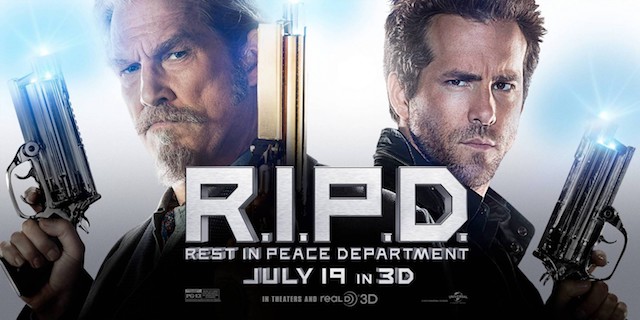
“R.I.P.D.” C
“Sightseers” B
“The To Do List” C+ [Twitch]
“The Way Way Back” B [About.com]
“The Wolverine” C+

Eric’s Bad Movies #231: “Silent Hill: Revelation” (2012) — The terrible sequel to a less-terrible movie [Film.com]
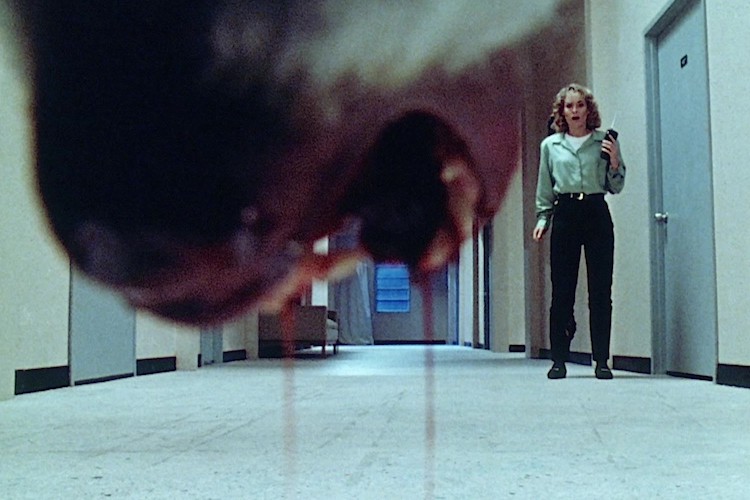
Eric’s Bad Movies #232: “Shakma” (1990) — Featuring a killer baboon! [Film.com]

You’re Old: ‘Jaws 3-D’ Came Out 30 Years Ago This Week
— And life was never the same again [Movies.com]

The ‘Butler’ Lawsuit and 7 Pairs of Movies That Shared a Title Without Anyone Suing About It — Same name, different movie [Film.com]
The Pitch Meeting for ‘R.I.P.D.’ — Another verbatim transcript [Film.com]

Snide Remarks #690: “The Surly Urban Juror” — Doing one’s civic duty, civilly or otherwise

Movie B.S. with Bayer and Snider #168 (7/12): ‘Pacific Rim,’ ‘Grown Ups 2,’ ‘The Way Way Back’ [MovieBS]
Movie B.S. with Bayer and Snider #169 (7/19): ‘The Conjuring,’ ‘RED 2,’ R.I.P.D.,’ ‘Only God Forgives’ [MovieBS]
Movie B.S. with Bayer and Snider #170 (7/26): ‘The Wolverine,’ ‘The To Do List,’ ‘Fruitvale Station,’ Character Casserole [MovieBS]

Subscribe to In the Dark, a weekly email with all my latest reviews, DVD releases, and Netflix recommendations.

Follow me on Twitter.

Movie B.S. with Bayer and Snider #170: ‘The Wolverine,’ ‘The To Do List,’ more

0

[If only you could hear how sweaty it is when I have to turn off the fans to record Movie B.S.! But I don’t think it shows in my voice.]

Episode 170: ‘The Wolverine, ‘The To Do List,’ ‘Fruitvale Station,’ Character Casserole

0:00-4:30 – Introduction; our lunch sponsor: Little Dress Up Shop, costumes for kids
4:30-17:45 – “The Wolverine” review
17:45-26:00 – “The To Do List” review
26:00-34:05 – “Fruitvale Station” review
34:05-43:30 – QOTW (movie you were embarrassed to buy a ticket for)
43:30-45:00 – Vomitorium correction
45:00-54:30 – Character Casserole
54:30-56:20 – Wrap-up and goodbyes

QOTW: What movie is at the top of your to-do list — one you’ve been meaning to watch and want to watch but just haven’t gotten to it?

Download audio / Listen at MovieBS.com / Listen at iTunes

The Wolverine

0

When we last saw the Wolverine, he was losing part of his memory because someone shot him in the head with an adamantium bullet at the end of “X-Men Origins: Wolverine” (2009). Well, no, actually, the LAST time we saw him was when he had a cameo in “X-Men: First Class” (2011), just long enough to say “Go [expletive] yourself.” But it doesn’t matter, because “The Wolverine” doesn’t have anything to do with either of those movies, picking up instead sometime after “X-Men: The Last Stand”, which came out seven years ago. I miss the days when sequels started with recaps.

A deeply sullen Wolverine (Hugh Jackman) now lives in the forests of the Yukon, drinking full-time, feeling sad that he had to kill his girlfriend Jean Grey (Famke Janssen) — who visits him in his dreams — and wishing he weren’t invincible so he could die. But he hasn’t completely lost his sense of justice, because he avenges a bear’s death.

Wolverine, or “Logan” as his friends call him, is brought out of his funk when a Japanese woman named Yukio (Rila Fukushima) finds him and says he must come to Japan to say goodbye to a man whose life he saved many years ago, who is now dying. The man, Yashida (Hal Yamanouchi), a fabulously wealthy industrialist and inventor, leaves behind a granddaughter, Mariko (Tao Okamoto), whose life is in danger from the yakuza; Logan needs to protect her; and so forth.

Of all the X-Men, Wolverine is the only one who gets his own films, a fact that probably makes sense to those who know the grand X-Men mythology and understand his place in it, but that leaves me, a non-initiate, out in the cold. I just don’t find the character compelling by himself, without the other mutants to provide counterbalance to his grumpy, lone-wolf attitude. “The Wolverine,” directed by James Mangold (“Walk the Line,” “3:10 to Yuma”), has an eye toward respectability, offering a more thoughtful and less bombastic superhero movie — a welcome change after the glut of films that all end with various cities’ buildings being knocked down like dominos. (This one finds different comic-book-movie chestnuts to drag out for the final act.) Introspective is one thing, but this tormented, brooding Wolverine is dangerously close to being boring.

Fairly early in the film, there’s an action sequence set aboard a moving bullet train that’s exhilarating, breezy, well-choreographed, and fun. It’s one of the highlights of the summer. Unfortunately, it’s THE highlight of this particular film, which soon gets mired in Logan’s lugubriousness. It’s further marred by the awkward shoehorning of an enemy mutant named Viper (Svetlana Khodchenkova) into the story — or into the movie, anyway. She never really does have a place in the story.

Look, I know “X-Men Origins: Wolverine” was lame, what with the amnesia bullets and Taylor Kitsch and everything. By all objective measures, “The Wolverine” is a better film, and I appreciate that it tries something different from the mindless destruction and jokey one-liners we’ve been getting lately. Someone who’s invested in the Wolverine character and his personal journey may find more to latch onto here than I did. After that train sequence, I didn’t really perk up till the closing credits, when a hint of what’s to come in the next “X-Men” movie made me wish I could have watched that instead.

The To Do List

0

In “The To Do List,” Aubrey Plaza plays a virginal high school valedictorian who decides, apropos of nothing, that she needs to spend the summer having every possible sexual experience as practice for college. (High school college-prep courses only teach you so much.) Since she’s a methodical, organized girl, she makes a list of all the things she needs to do, with assistance from her more worldly friends. Since she’s a hopelessly naive and sheltered girl, she doesn’t even know what some of the things are, let alone how to do them.

The problem with the film isn’t its scenario, which is just a female-centric twist on the standard sex comedy formula, with the requisite humiliations, outrageous misunderstandings, and accidental eating of gross things. Writer-director Maggie Carey, a comedy writer making her first feature, peppers the film with amusingly coarse dialogue and some genuinely funny situations. She wisely plays on nostalgia, too: like many teen comedies, the film is set in the past — in this case 1993, before the Internet came along to answer young people’s sex questions. As a member of the graduating class of 1992 (go Tigers!), I can attest to the validity of the characters’ hairstyles and musical preferences.

The main problem, it grieves me to report, is casting 28-year-old Aubrey Plaza in the lead. It’s not just that she seems too old to pass for a high school senior (although that’s part of it), it’s that the role is all wrong for her particular skills. She’s fantastic on “Parks and Recreation” as the deeply sardonic and ironically detached April Ludgate, and she’s cultivated variations of that persona elsewhere, including last year’s charming “Safety Not Guaranteed.” Here, as Brandy Klark, she’s supposed to be sincere, innocent, unpopular, geeky, and even clueless — and I never bought it for a minute. The role is wrong for her, and she doesn’t commit deeply enough to make it work. You rarely get the sense that she’s being anyone other than Aubrey Plaza. It’s fine for actors, especially comedic ones, to only play versions of themselves, ut it means you have to choose roles that mesh with the sort of shtick you do. This ain’t it.

And it’s a shame, because there’s a lot to enjoy and laugh at here. Brandy’s ultimate goal is to have intercourse with Rusty Waters (Scott Porter), the shaggy-haired lifeguard dreamboat who works at the public pool where she has a summer job. In the meantime, she’ll practice the lead-up steps with whoever’s available, including Cameron (Johnny Simmons), her platonic friend who’s secretly in love with her. Egged on by her friends (Alia Shawkat and Sarah Steele) and her slutty sister (Rachel Bilson), Brandy is doggedly determined to try everything on the list, no matter how awkward or embarrassing the experience may be. Her goody-two-shoes, non-swearing parents (Connie Britton and Clark Gregg) are a funny counterpoint as they hash out their own sexual hangups. Christopher Mintz-Plasse, Andy Samberg, Donald Glover, and Bill Hader (the filmmaker’s husband) pop up in supporting roles and earn a few laughs apiece.

To be clear, “The To Do List” isn’t bad. It’s disappointing only because it could have been — ought to have been — so much better. A more polished screenplay and a more suitable lead actress would have done wonders for it. Although maybe it’s fitting that a movie about having sex for the first time should turn out to be a fumbling, mishandled experience that’s moderately enjoyable but not nearly as good as you’ve heard.

The Surly Urban Juror

0
The Surly Urban Juror

One of the great privileges we have as Americans is the right to complain about being called for jury duty, and to try every reasonable method of weaseling out of it. This process is fundamental to our judicial system. As stated by the Seventh Amendment to the Constitution: “In all criminal prosecutions, the accused shall enjoy the right to a speedy and public trial by an impartial, reluctant jury composed of citizens resigned to just getting it over with.”

I was recently afforded the opportunity to take part in this venerable tradition. At the ripe old age of 38, I feel like I’m lucky to have avoided it for as long as I did. (Living under an assumed name, never registering to vote, and burning all correspondence from the government probably helped.) But when the call came, I did my civic duty, for the same reason we all do it: because we’re proud to be Americans, and because we don’t have a choice.

Here in Portland (maybe all of Oregon? Don’t know, don’t care), the way it works is that you get summoned for two consecutive days. For those two days, you belong to the court, no matter what. If there are no cases that need juries, I think they can assign you to janitorial work. You sit in this big room with about 200 other people, and if you’re selected for a jury, you’re on it for as long as the trial lasts. If it gets done in one day, you still have to come back the next day to sit in the jury room again, and potentially be chosen for another jury.

It’s a lot like being in the audience at “The Price Is Right.” Maybe you go the whole time without being called. Or maybe you get called early on the first day, spend some time in Contestants’ Row, and never get any further than that. Maybe you actually get onstage, lose your game quickly, do poorly at the Big Wheel, and return to anonymity. But there’s an important difference between jury duty and “The Price Is Right.” When you’re on “The Price Is Right,” there’s no chance that you’ll be required to come back and be on “The Price Is Right” every day for the next month, or that the maximum value of the prizes you could win is $25 a day, or that the game could potentially end with you sentencing one of the models to death. Although that would be amazing.

The most onerous part of jury duty, it will not surprise you to learn, was that I had to be at the downtown courthouse by 8 a.m. If there’s anything worse than being told you have to do something boring for two days, it’s being told you have to start doing it at 8 in the morning.

After being checked in and given “JUROR” lanyards to wear so that people in the hallways would know not to confess crimes to us, we were shown a brief introductory video. This video, called “Justice for All,” features actual judges, attorneys, and jurors expressing the general sentiment that jury duty is important and you should show up when you are summoned for it. Which we had all done, of course. That’s how we were able to see the video telling us how important it is that we do it. Everyone who skipped jury duty that day missed out on the video informing them of how crucial it is that they not skip jury duty.

There’s wifi in the big jury room, and you’re allowed to bring your laptop or iPad, so you don’t have to be totally bored while you sit there all day. Nothing happened till after our lunch break (they give you a break from not doing anything so you can go outside and not do anything), when they dismissed a few dozen people for the day and called another few dozen to report to a courtroom. I was part of the latter group. I was maybe going to be on a jury, for reals!

To an outsider, especially an apathetic and inattentive one like myself, this whole system seems inefficient. The reason they have so many people in the jury pool is to ensure there are enough jurors for whatever trials happen that day, even if a lot of people have to be disqualified or excused. That makes sense. What I don’t understand is why they don’t know ahead of time how many trials there are going to be on any given day. There seemed to be no way of predicting it, like trials sometimes just pop up unexpectedly, and whoops, gotta find a jury! I always assumed court scheduling was more precise than that. Are prosecutors and defenders showing up at the courthouse unannounced, demanding spur-of-the-moment trials? Are defendants being told to just stop by any weekday between 9 and 5 for their trials, take a number, and wait? I feel like we could narrow this down a little better.

Anyway, about 35 of us were ushered into a smallish courtroom, where the prosecutor, defender, and defendant already sat. The judge entered, and things got rolling. The charges were read. The defendant, a white male in his 40s, was charged with burglary in the first degree, and with possession of heroin. Looking at him, I thought: Yep, this is definitely a man who has possessed heroin. Were it not for the fact that we were in a courtroom, I wouldn’t have been surprised to learn he possessed heroin at that very moment. Of course, what mattered wasn’t whether he’d EVER had heroin — which he plainly had, and a lot of it — but whether he possessed heroin on the night in question, when he was allegedly caught allegedly breaking into the garage of a house in the part of town where people who need money to buy heroin frequently commit crimes.*

The judge said the trial would only take one day, and I began to strategize. I was committed to jury duty for a second day anyway. It was therefore in my best interest to get chosen for this jury, since otherwise I’d go back to the jury pool and possibly be selected for a different trial that would last longer. I had done plenty of reading on how to not be selected for a jury — act like a know-it-all, claim to have been a victim of the same crime the defendant is charged with, urinate on the jury box to mark it as “yours” — but not much research on the opposite goal. All I could do was answer the questions they asked me and hope one of them wasn’t “Did you assume the defendant was a habitual heroin user the minute you saw him?”

Well, whatever I did or didn’t do, it worked. I was one of three men and nine women selected for the jury — “empaneled,” in legal terms, from the Latin “empanada,” meaning “a delicious stuffed bread or pastry served to juries.” They hustled the twelve of us, like children, into our own little jury room so the grown-ups could keep talking about things that we weren’t allowed to hear. (Probably sex stuff.) In the jury room, a few jurors kept to themselves and read books or looked at their phones, but most of us chatted. One juror, a lithe young woman in her early 20s who reported that she was a dance student, said, “I’m just glad I could do my civil duty.” She was my immediate favorite.

After a while, we were led back into the courtroom and told to go home for the day. There were some kinks that had to be ironed out, and the trial would commence the next morning. I told everyone to watch “12 Angry Men” as homework and got a disappointing number of blank stares in response.

When we returned the next morning, we received the disappointing news that our defendant had made a plea bargain and the case was over. He pled to criminal trespass in the second degree (which is less illegal than burglary in the first), plus the heroin possession (which I guess there wasn’t much dispute over). He paid a fine, was put on probation, and had to enter a rehab program — which, the judge told us, is what the man really needed in the first place. I mean, he also needed to not break into people’s garages, obviously. But the underlying problem was the drug addiction.

My eleven new friends and I were sorry we wouldn’t get to sit in judgment of one of our fellowmen — something I’d been practicing my entire life for! — but we were glad the system was trying to help the guy rather than just lock him up and forget about him. Let’s save prison for the truly dangerous criminals, like people who force you to be downtown at 8 a.m. on a Monday.

*Yes, Portlanders, I mean SE 82nd.

Shakma

Shakma

Monkeys! They’re Hollywood’s favorite animal. Monkeys and their relatives (apes, gorillas, Clint Howard, etc.) have been featured in more movies than any other creature besides man, according to the Bureau of Statistics I Made Up That Sound Convincing. Often, the monkey is the most sympathetic character in the film. That is certainly the case with “Shakma,” a benign straight-to-video lump from 1990 about an angry baboon that kills medical students who were dumb enough to experiment on him and then lock themselves in a building with him.

As you might have guessed, Shakma is the baboon’s name. That’s a perfectly good name for a baboon (I guess; I don’t know what his parents’ names were), but it’s a bad title for a movie because it doesn’t tell us anything. Knowing nothing more than that it’s about a killer baboon, I could come up with five better titles for this movie. Watch, I’ll do it now:

“Killer Baboon”
“Baboondock Saints”
“Shakma Goes Bananas”
“Death Flings Its Poop”
“The Red Buttocks of Fury”

The entire film takes place in a drab seven-story building that serves as some nameless university’s depressing medical school. There are classrooms and professors’ offices, along with a laboratory where experiments are conducted on animals for the purposes of science and hilarity. One of these animals is Shakma the baboon. On the day in question, Shakma’s brain has been injected with a chemical that “usually inhibits aggression, but sometimes it has the opposite effect,” according to one student, Richard (Greg Flowers). It’s not clear whether they’re trying to make Shakma more aggressive or less aggressive, or why they’d want to do either of those things, and before anyone can ask, Shakma wakes up from the anesthesia and scratches Richard’s arm. So we’re off to a good start!

The students’ instructor, a prim taskmaster named Professor Sorenson (Roddy McDowall), is displeased by Shakma’s aggression (again, I don’t know what they were hoping for) and says the animal will have to be put down. This gives medical student Sam (Christopher Atkins, from “Blue Lagoon”) a sad face, as he had developed a bond with Shakma and was already upset that they’d experimented on him. (It’s unclear what Sam’s expectations were for his friendship with the monkey he met in a science lab, but it’s safe to say that they were unrealistic.) There is a mix-up, however, and Shakma is injected with the wrong chemicals and instead of dying he just falls asleep for a while. This allows him to rest up for his killing spree, and to miss the more boring parts of the movie.

Meanwhile, it’s a big night for the medical students because they’re going to use the building for a live-action role-playing game! A sad, sad game about dragons and princesses with clues hidden in certain rooms, puzzles to solve, passwords, that sort of thing. They have been planning it for days, and they are very excited! This is the movie’s way of helping us not feel too sorry for them when they are torn apart by a vengeful monkey.

The four people playing the game are Sam, his girlfriend Tracy (Amanda Wyss), bespectacled computer nerd Bradley (Tre Laughlin), and nondescript fourth person Gary (Robb Morris). Richard was not invited to play. In fact, they’re annoyed when they learn Richard even knows about it. Richard’s kind of a screw-up, and the other medical students don’t like him. He wheedles and begs, though, and Sam agrees to let him be the one who goes around setting up the clues in the designated places. So who was going to do this before Richard came along? And why are only four people playing a game that uses an entire university building? I am thinking way too much about this.

How disliked is Richard by his classmates? They kept the game a secret from him, but they let his teenage sister participate. Her name is Kimberly (Ari Meyers), and she is the princess who gets rescued at the end. She just has to sit in a room in a princess costume and wait for the winner to arrive. It’s really just a ceremonial role. She hopes it will be Sam who “rescues” her because she has a major crush on him. It’s adorable, her poor taste in men. To emphasize that Kimberly is in love, every time the movie cuts to her sitting around waiting to be rescued, the music shifts from “mysterious and suspenseful” to “tender and generic, like the score from a Very Special Episode of an ’80s sitcom.” Is it funny every time? Yes.

Oh! For some reason Prof. Sorenson is also involved in the game, acting as game-master and communicating with each player via walkie-talkie to tell them whether their answers are correct so they can move to the next level. For a prim taskmaster, he takes this non-educational extra-curricular Friday-night activity very, very seriously. He would probably be very dull at parties, if he ever got invited to one.

Anyway. On with the mayhem! Bradley stumbles upon the lab where Shakma has been chillin’, only now he has woken up and is very irritated, and he attacks Bradley in the face and kills him. This causes Bradley’s homing device to quit working (VERY ELABORATE TECH FOR AN AFTER-HOURS ROLE-PLAYING GAME), so Prof. Sorenson sends Richard to check on him, and Richard is also attacked by the baboon. Bam! Two down, five to go!

Prof. Sorenson finds dead Richard, is shocked by all the blood, touches the blood, then touches his own chest and face, getting blood all over himself, like a moron. He doesn’t cry out, call for help, or sound an alarm. What he does is dawdle, giving Shakma plenty of time to catch his breath and come out and kill him too. Three down! We’re makin’ good time here, movie! Looks like we might get to clock out early!

Ah, but alas. Now we come to the portion of the film in which our heroes — Sam and Tracy, by default — discover what is going on, manage not to be killed by the same thing that’s been killing everyone else, and then run around forever wasting time and accomplishing nothing. This is known as the “Waiting for Godot” section. In the screenplay, it was represented by 30 blank pages, the last of which had a scribbled drawing of a hand flipping the reader off.

There’s lots of dashing from one room to another and holding the door closed so Shakma can’t get them. They can’t call for help because this seven-story university medical building only has a few phones, and they’re all in teachers’ offices, which are locked. They can’t leave the building altogether and run for help because the main doors were locked (from the outside?) as part of the game. That doesn’t make a lick of sense, and it doesn’t explain why they couldn’t escape through a ground-floor window, but it does allow Sam and Tracy to come up with brilliant alternate plans like using a strobe light to temporarily blind the baboon. Tracy shows Sam how to use it (he’s in medical school and doesn’t know how lights work), and when the time comes Sam flips the switch; it flashes briefly and goes out; and Sam immediately gives up and throws the light at the monkey. This ends the portion of the film where Sam and Tracy come up with brilliant alternate plans.

Gary the nondescript fourth person, hilariously oblivious to the carnage and still playing the game all by himself, gets killed when he reaches Tracy on the walkie-talkie and Tracy just says “Don’t go to the fifth floor!” instead of something more helpful like “DON’T GO TO THE FIFTH FLOOR BECAUSE A CRAZY MONKEY IS THERE!!” Gary figures she’s trying to keep him from getting ahead of her in the game, goes to the fifth floor, and that’s it for Gary the nondescript fourth person.

Kimberly is still dressed like a princess, sitting alone in a college classroom on a Friday night hoping she’ll get to hook up with the college guy who has a girlfriend already, barely knows Kimberly is alive, and hates her brother (who is now dead).

Then Tracy gets killed and you think: Wow, maybe Kimberly’s going to get her wish after all! But nope, she gets one scene with Sam where she thinks he’s really going to be her knight in shining armor, and then she’s immediately killed too. Her death, like all the other deaths, is in the form of Shakma attacking her face. (Shakma is a one-trick monkey where murdering humans is concerned.) They used a real baboon for most of the movie — a cute, charismatic one with vibrant butt cheeks — but the attack scenes involved a stunt stuffed animal.

Now only Sam is alive, a fact that is all the more disheartening when you realize there’s still 18 minutes left in the movie. That’s a long time to spend alone with him. He soon finds a room with a telephone and calls 911. But when the operator answers, Sam falls silent as Christopher Atkins, summoning all of his power as an actor, conveys that Sam is “thinking.” Sam realizes that instead of summoning help, what he must do is hang up the phone and destroy Shakma himself. It is the only honorable course of action. This is between him and the monkey.

It’s a little surprising that Sam defeats Shakma, given that 1) none of the other characters survived and 2) it is far from certain that he is any smarter than Shakma. But defeat him he does, using electricity (yes, he shocks the monkey), a knife, and an incinerator. Several people are dead, but Sam is alive — which, looking on the bright side, makes him the winner of the game. And the baboon that wasn’t hurting anyone before people messed with its brain won’t be around anymore to hurt anyone. So that’s nice. You were a good baboon, Shakma. Too beautiful for this world.

— Film.com

The Pitch Meeting for ‘R.I.P.D.’

0
The Pitch Meeting for ‘R.I.P.D.’

Time now for another round of a game we like to call “How Did That Ever Get Made, Who Thought It Was a Good Idea, and What Were They Thinking?” It’s an unwieldy title, but it gets right to the heart of the matter. To play HDTEGMWTIWAGIAWWTT, we plant listening devices in the executive boardrooms of major Hollywood studios, then write down the things that we hear the people say, in a process known as “transcribing.” Join us now as we yank Hollywood’s pants down and show everybody its business!

The Pitch Meeting for ‘R.I.P.D.’


STUDIO EXEC #1:
Listen, fellas. I’m just gonna say it. I want out. I’m tired of the business. I don’t want to work here anymore.

STUDIO EXEC #2: I hear you, man. The three-hour workdays, the constant parties, the unending stream of cocaine flowing through my blood at all times — it’s too much.

STUDIO EXEC #3: I’m with you guys. I thought I had what it takes to be a studio executive, but I don’t. I’m not cut out for it! I don’t enjoy sleeping with starlets!

STUDIO EXEC #1: All the celebrity butts we have to kiss!

STUDIO EXEC #2: All the pandering to the audience!

STUDIO EXEC #3: Good grief, the pandering!

STUDIO EXEC #2: I can’t remember the last time I said something out loud that was actually true.

STUDIO EXEC #1: Let’s make a pact. Let’s get fired. All three of us.

STUDIO EXEC #2: I’m in.

STUDIO EXEC #3: Me too.

STUDIO EXEC #1: Next pitch we hear, no matter what it is, we greenlight it, we make it a disaster, and we get out.

STUDIO EXEC #2: Let’s do it.

STUDIO EXEC #1: Nameless secretary, send in whoever looks like they have the worst idea.

(Sound of someone entering, greetings exchanged, complimentary cocaine offered)

YOUNG PRODUCER: Gentlemen! Hello! Thanks for seeing me. I’ve got something I know you’ll love!

STUDIO EXEC #1: I can’t promise we’ll love it, but I can promise we’ll spend a hundred million dollars on it.

YOUNG PRODUCER: Terrific! It’s based on a comic book…

STUDIO EXEC #2: A promising start!

STUDIO EXEC #3: I thought we called them graphic novels now.

STUDIO EXEC #1: I still call them “the funny papers”!

STUDIO EXEC #3: Is it Archie & Jughead??

YOUNG PRODUCER: It’s about a police officer who gets killed–

STUDIO EXEC #2: Two weeks before retirement? Sold!

YOUNG PRODUCER: No, he’s young, but he gets killed and has to join the undead police force, arresting souls that died but somehow escaped eternal judgment and are hiding on earth.

STUDIO EXEC #1: Wait, so he’s going around busting ghosts?

STUDIO EXEC #3: Like some kind of “ghost-buster,” if you will?

YOUNG PRODUCER: Sort of. Only we won’t explain it very well or really lay out how this world works. And he has a grumpy old partner who’s been doing this a long time and shows him the ropes.

STUDIO EXEC #2: Ugh, I’m so tired of movies where two cops are assigned to work together who have totally compatible personalities and attitudes and get along nicely.

STUDIO EXEC #1: Me too. Please tell me you’re trying something different.

YOUNG PRODUCER: What if I told you the young dead cop and older dead cop disagree about a lot of things?

STUDIO EXEC #1: I would pee myself, that’s what!

YOUNG PRODUCER: Well, batten down the hatches, because that’s exactly what happens! They argue, they bicker, they have different viewpoints, they butt heads.

STUDIO EXEC #2: Brilliant!

STUDIO EXEC #3: Like some kind of “odd couple,” as it were.

STUDIO EXEC #1: Now, I’m all for shaking up the formula, but if the two cops don’t like each other, won’t it be hard for the audience to like them?

YOUNG PRODUCER: I thought of that! So get this, over the course of the movie, they gradually … come to like each other.

STUDIO EXEC #2: This is perfect.

STUDIO EXEC #3: This is literally a perfect movie.

STUDIO EXEC #1: I thought “Good Burger” was a perfect movie, but “Good Burger” was “Cop and a Half” compared to this.

YOUNG PRODUCER: You guys really like it?

STUDIO EXEC #2: It’s exactly what we’re looking for.

YOUNG PRODUCER: Awesome! So the two dead cops have to thwart a plan to let the dead take over the world, and along the way they barge around the city eliminating the misbehaving ghosts.

STUDIO EXEC #1: How do they kill them when they’re already dead?

YOUNG PRODUCER: Eh, laser gun or something.

STUDIO EXEC #1: Got it.

STUDIO EXEC #2: It sounds a lot like “Men in Black,” doesn’t it?

STUDIO EXEC #1: Not that that’s a problem!

STUDIO EXEC #1: No, of course! I’m just making an observation.

STUDIO EXEC #3: The marketing department always likes to know ahead of time which movies we’re ripping off so they can plan strategies that will remind people of those movies.

STUDIO EXEC #1: Unless we’re ripping off a movie nobody liked! Then the marketing department prefers to hide the similarities.

STUDIO EXEC #2: It’s all very complicated.

STUDIO EXEC #3: It would take a scientist to explain.

YOUNG PRODUCER: It is like “Men in Black,” but with one crucial difference: “Men in Black” had bankable stars who could open a movie.

STUDIO EXEC #1: Who do you have lined up for this?

YOUNG PRODUCER: Ryan Reynolds and Jeff Bridges!

STUDIO EXEC #3: Green Lantern and Preston Tucker??

STUDIO EXEC #2: Van Wilder and The Dude??

STUDIO EXEC #1: The guy from “Two Guys, a Girl and a Pizza Place” and Lightfoot from “Thunderbolt and Lightfoot”??

YOUNG PRODUCER: The very same. There’s just one teensy problem with Jeff Bridges. And maybe it won’t even be a problem.

STUDIO EXEC #1: What is it?

YOUNG PRODUCER: He’s still in character from “True Grit,” and he refuses to stop.

STUDIO EXEC #1: Not a problem.

STUDIO EXEC #2: That’s perfect, actually. We wanted to make a “True Grit” sequel, and this will be a good way of sneaking it in without having to buy the rights.

STUDIO EXEC #3: Oh, did we give up on doing that officially? I was looking forward to “2rue Grit.”

YOUNG PRODUCER: My vision for the movie would cost about $130 million to make, but the special effects would still be cheesy and unconvincing.

STUDIO EXEC #1: I like it. The audience won’t be expecting that.

STUDIO EXEC #2: They’ll be expecting something that looks well-made, and it will be a fun surprise when it isn’t.

STUDIO EXEC #3: Audiences love waste!

STUDIO EXEC #1: What’s it called, anyway?

YOUNG PRODUCER: “R.I.P.D.”

STUDIO EXEC #2: Rhode Island Police Department?

YOUNG PRODUCER: No…

STUDIO EXEC #1: Rhode Island Parks Department?

YOUNG PRODUCER: No…

STUDIO EXEC #3: Oh, I get it — R.I.P.D., because Ryan Reynolds is RIPPED!

YOUNG PRODUCER: No, it’s “Rest in Peace Department”! That’s what the police department for the dead is called!

STUDIO EXEC #1: Oh.

STUDIO EXEC #2: Huh.

STUDIO EXEC #3: Well.

STUDIO EXEC #2: That’s really bad.

STUDIO EXEC #1: Yeah. Well, look, if we’re gonna do this, we might as well go all the way.

YOUNG PRODUCER: Go all the way with what?

STUDIO EXEC #1: Nothing! Young man, you’ve got yourself a deal!

STUDIO EXEC #2: We’re excited to go forward with this!

STUDIO EXEC #3: I only wish we’d gotten to “The Lone Ranger” first.

— Film.com

Movie B.S. with Bayer and Snider #169: ”The Conjuring,’ ‘R.I.P.D.,’ and more

0

[Listening to Movie B.S. has been found to have therapeutic value under certain made-up definitions of those words.]

Episode 169: ‘The Conjuring,’ ‘RED 2,’ ‘R.I.P.D.,’ ‘Only God Forgives’

0:00-3:40 – Introduction; our middle names
3:40-5:25 – iTunes reviews
5:25-20:50 – “The Conjuring” review
20:50-22:30 – Coincidences!
22:30-29:00 – “RED 2″ review
29:00-35:35 – “R.I.P.D.” review
35:35-45:20 – “Only God Forgives” review
45:20-59:55 – QOTW (suggestions for one-word movie titles)
59:55-1:03:55 – Update on the Summer Box Office Challenge
1:03:55-1:05:25 – Wrap-up and goodbyes

QOTW: What movie were you most embarrassed to be buying a ticket for?

Download audio / Listen at MovieBS.com / Listen at iTunes


Only God Forgives

0

Nicolas Winding Refn had been making movies in his native Denmark for a dozen years before “Bronson,” his razor-edged 2008 biopic of a notorious British criminal, earned him some notoriety in the English-speaking world. After this came 2011’s “Drive,” an ethereal, existential crime thriller that had a mostly American cast and was the first of Refn’s films to play in more than a handful of theaters. It had a nameless protagonist who didn’t talk much, and its intoxicating neo-noir mood was punctuated by shocking acts of violence. It was my pick for the best film of 2011.

If Refn’s follow-up to it is any indication, “Drive” is as close to “mainstream” as he’s going to get. Set in Bangkok with a mostly Thai-speaking cast (subtitled), “Only God Forgives” feels in some ways like a darker, more gruesome successor to “Drive,” but with even less dialogue, less nuance, and less widespread appeal. Those aren’t necessarily criticisms, though it’s fair to point out that several moments in “Only God Forgives” are exceedingly difficult to watch.

It stars Ryan Gosling again, with a name this time but even more taciturn than last time. He plays Julian, an American expatriate making a living in Bangkok’s underworld as a muay thai fight promoter and a midlevel distributor of illicit drugs. We gather that he was drawn into this world by his brother, Billy (Tom Burke), a raging psychopath who’s far better suited to it than Julian is. Billy is the sort of fellow who goes to a brothel requesting a 14-year-old and, being told there are none, asks the proprietor if maybe he has a daughter who could step in.

Billy’s appetites soon get the better of him, and his victim’s father deals swift, righteous vengeance in the form of bashing Billy to death. Fair’s fair, after all. But what ensues is an escalating war of revenge involving Julian; a malevolent police lieutenant, Chang (Vithaya Pansringarm); and Julian and Billy’s drug-kingpin mother, Crystal (Kristin Scott Thomas), who arrives from the States to claim her favorite son’s body and reveals herself to be even more horrifying than the deceased was.

What a woman is Crystal. A bottle blonde with harsh features and caked-on makeup, she looks like an aging pin-up girl turned monstrous. She speaks lewdly, cruelly to Julian, whom she views as a disappointment and vastly inferior to his older brother. She matter-of-factly makes obscene, borderline incestuous statements to Julian and his quasi-girlfriend, Mai (Yayaying Rhatha Phongam), a prostitute. When Crystal is informed of what Billy did that led to his death — “He raped a murdered a 16-year-old girl” — her response is: “I’m sure he had his reasons.”

Crystal is well-matched with Lt. Chang, an unnervingly calm figure who seems to float in and out of scenes dispensing justice according to his exact standards. (That’s when he’s not singing Thai karaoke to an audience of entranced fellow police officers — one of the film’s several David Lynch-ian touches.) Julian, sympathetic to us despite his rough edges, is caught between them as Crystal demands he kill Billy’s killer, an assignment he balks at, not least because it will put him on Chang’s bad side.

The story could scarcely be simpler, having been boiled down to its essential ingredients of revenge, anger, and greed. Using slow pans and glacial tracking shots, Refn and cinematographer Larry Smith lead us carefully, unhurriedly into this nightmare world. The color scheme is dusky blues and lurid reds. Like “Drive,” it’s more about the tone than the story. But here, the Gothic family dynamics and other psychological components, as disturbing as they are, take a backseat to the methodically orchestrated carnage. This is a brutal yet strangely beautiful film, designed to inflict blunt-force trauma on the viewer while practically daring us not to laugh at the outrageous evil perpetrated by its villains. The experience of watching the movie is compelling, almost mesmerizing — but the artistic merits only barely compensate for how arduous it is.

— About.com

The Conjuring

0

Let’s be blunt: most wide-release horror films are bad. They tend to be either watered-down, teen-friendly PG-13 mediocrities that aren’t scary; or gruesome, R-rated endurance tests that aren’t scary either. It almost feels miraculous when something genuinely scary finds its way onto 2,000 screens, like the first “Paranormal Activity” (2009), “Insidious” (2010), and “Sinister” (2012).

This year’s pants-wetter is “The Conjuring,” a deviously creepy tale directed with smooth, fun-loving confidence by James Wan (who, not coincidentally, also made “Insidious”). Set in 1971, the story comes from the files of Ed and Lorraine Warren, the real-life husband-and-wife paranormal investigators who would later become known for their examination of a certain house in Amityville, N.Y. “The Conjuring” is thus “based on a true story,” in the sense that the Warrens really did have a case like this one, though the veracity of the supernatural stuff remains, shall we say, an open question.

Played here by Vera Farmiga and Patrick Wilson, the Warrens are contacted by Carolyn Perron (Lili Taylor), who has just moved with her husband (Ron Livingston) and their five daughters into — stop me if you’ve heard this one before — a huge, rural, 150-year-old New England house with no neighbors but a lot of spooky activity. Five kids is more than the story really needs, but it gives Wan and his writers, twin brothers Chad and Carey Hayes (“The Reaping,” “House of Wax”), multiple vehicles for mysterious events. One girl sleepwalks, another makes an imaginary friend, another feels something pulling her foot while she sleeps. Might as well share the wealth, give everyone a chance to feel haunted!

It will not shock you to learn that something terrible happened in this house years ago. In fact, very few of the details, either in plot or atmosphere, will shock anyone who’s seen a horror movie set in a menacing house before. The filmmakers throw everything at the screen: ghosts, demons, possession, scary dolls, eerie music boxes, stopped clocks, dark basements, secret rooms, creepy kids, weird animal behavior, and so on.

But guess what? It works. No one will accuse “The Conjuring” of being overly original, but it doesn’t feel derivative, either, any more than a chef is derivative for using ingredients you’ve eaten before. It’s the way the ingredients are used that matters, and Wan knows what he’s doing, avoiding (for the most part) cheap jump-scares and other gimmicks in favor of escalating tension that periodically erupts into good old-fashioned terror. We could do without the red herrings connected to the Warrens’ own family life — the story’s one narrative misstep — but they don’t detract much, and they do help flesh out the loving couple as sympathetic characters who earnestly believe in their work.

It’s actually not the Warrens but the two women, Lorraine and Carolyn, who are the most crucial figures in the story, and Vera Farmiga and Lili Taylor both perform with a level of commitment you don’t always see in horror films. The characters are empathetic, motherly types, and the actresses give them realistic edges. There’s authenticity in Wilson, Livingston, and the young actresses who play the daughters as well.

Perhaps most surprising is that Wan does it all without gore or cruelty. (The R rating it carries in the U.S. is strictly for tone. That’s right: it’s rated R for being scary.) Everyone has a different threshold for this, but some movies are so brutal and unsettling that while you wouldn’t hesitate to call them “good,” you’d stop short of calling them “fun.” “The Conjuring” is fun — intense, yes, but in a way that conjures chills, not revulsion. Wan is serious about scaring us, not interested in traumatizing us. He delivers a steady stream of fist-clenching suspense and well-choreographed surprises.

R.I.P.D.

0

In the unexciting and laugh-free action-comedy “R.I.P.D.,” Ryan Reynolds plays a cop named Nick who dies and is assigned to the Rest in Peace Department, an afterlife police force in which he and a gruff, mismatched partner, Roy (Jeff Bridges) — who died during the Wild West days — keep tabs on the escaped dead souls hiding in our world.

Despite the apocalyptic stakes (the climax involves city buildings crumbling, as usual), the film feels small in scale, with few supporting characters and not nearly enough exploration of the premise. Aside from Mary-Louise Parker as the dead cops’ persnickety boss and Kevin Bacon as Nick’s still-living partner, no one matters. Even Nick’s beloved widow (Stephanie Szostak), for whom he pines but cannot contact (shades of “Ghost”), barely registers. The fugitive souls, nicknamed “deados,” are ogreish CGI creations without personalities.

Reynolds and Bridges are game, but the obvious comparisons to “Men in Black” and “Ghostbusters” don’t work out in their favor. Directed by Robert Schwentke (“The Time Traveler’s Wife,” “RED”) with an over-fondness for quick zooms, “R.I.P.D.” wastes whatever potential it had with bland, jokey dialogue and mediocre action that is expensive yet looks cheap. It’s not unbearable — it will play well on cable a year from now — but you have far better options.

Silent Hill: Revelation

Silent Hill: Revelation

The movie “Silent Hill” has been a thorn in my side ever since it was released — first because it wasn’t good, and then because people kept citing it as the one video-game-based movie that was good. WHICH IT WASN’T. It may have been the least not-good of the bunch, but to call it “good” is a high compliment, by which I mean a compliment you can only make if you’re high.

I am vindicated by the sequel, “Silent Hill: Revelation.” Everyone agrees that this one is terrible, and according to the Internet’s Law of Retroactive Criticism, that means the original is terrible, too, having been ruined by the sequel through an anomaly in the space-time continuum unfamiliar to scientists but known to fanboys as the George Lucas Principle. So I was right all along, and everyone can eat it.

“Silent Hill: Revelation” picks up the story of “Silent Hill” six years later, or five years and eleven months after we forgot every detail of it. The little girl who was missing in that film, Sharon, is now 18 and named Heather (Adelaide Clemens), and she does not remember anything about her past. One of the things she does not remember, for example, is that a cult from the town of Silent Hill is looking for her so they can sacrifice her or impregnate her or whatever, because she’s the Chosen One or the fulfillment of prophecy or something. Heather and her dad, Harry (Sean Bean), have moved around a lot, and Heather thinks it’s because he killed somebody in self-defense and is running from the law, but the real reason is the cult thing. Heather’s mom (Radha Mitchell) is still trapped in another dimension, but Harry can see her in a mirror sometimes, so that’s nice.

Oh! I forgot to tell you: there are other dimensions in these movies. You can tell you’re in the bad dimension because there’s, say, a guy with a triangle for a head who wants to kill you, or a guy with circular saw blades protruding from his skull who wants to kill you. The way that you pass from our dimension to the bad dimension is by the screenplay just deciding to put you there sometimes. That is also how you travel back.

So anyway, Heather keeps popping back and forth between dimensions. One minute her high school hallway looks normal; the next minute it’s a decrepit cavern with faceless monsters lunging at her, and then also in some ways not a normal high school hallway. (No drugs.) Heather thinks she’s going insane, losing the ability to distinguish between dreams and reality. A classmate named Vincent (Kit Harington) tells her that dreams ARE reality, just different realities from the one you’re used to. This is a super-helpful thing to say to someone who’s afraid she’s losing her mind.

Heather is also afraid she’s being followed by a mysterious man, though this fear turns out to be well founded. The man is a private investigator hired by Silent Hill’s most popular cult to find Heather and tell her the truth about her past. The cult is hoping Heather will come back to Silent Hill on her own once she knows everything, but just to sweeten the pot, they abduct her father and write “COME TO SILENT HILL” on the wall in his blood. The persuasive technique is effective.

Heather heads for Silent Hill, accompanied by Vincent, even though Heather just met him at school today and doesn’t like strangers, or even people in general. (The movie went pretty well out of its way to establish this.) As they travel, Heather combs through the Silent Hill-related notebooks her father left behind and learns the whole story, not to mention a great deal about her father’s excellent penmanship.

Here’s where it gets confusing. By “here” I mean “when you decided to watch this movie.” Years ago, the cult in Silent Hill burned a little girl named Alessa who they thought was a witch, but she didn’t die, she just got really angry and created the hell dimension with the monsters. THIS IS WHY YOU SHOULD NOT BURN CHILDREN (or if you do, make sure you finish the job). But before Alessa turned completely into an evil demon, the last innocent part of her soul was transferred to a random newborn infant, who turned out to be Sharon/Heather, and they can’t destroy Alessa until she’s made whole again, which I guess means mushing her and Heather together. And they can’t just abduct Heather and drag her to Silent Hill — she has to go willingly, because the movie said so.

Then it turns out Vincent is a child of the cult who escaped from Silent Hill for the purpose of luring Heather back. But now that he’s met Heather and likes her, he feels bad. Totes sorry. Heather wanders though Silent Hill searching for the other half of a medallion she found in her dad’s stuff, encountering various monsters in the process in a way that is suspiciously similar to a video game. There is no rhyme or reason to when these monsters appear, or what tactics they use to harass Heather, which probably means the answer is “You’d know if you played teh video games!!!1!!” (This is the answer to a lot of questions lately.)

When Heather at last comes face to face with Alessa, she is able to overcome Alessa’s evilness with her own goodness. To be precise, she hugs Alessa very tight, and Alessa disintegrates. Hugging was her kryptonite! Lest you think the movie would end with such an anticlimax, however, Heather then has to face Vincent’s mother, the cult’s priestess, played by Trinity from “The Matrix” in an Edgar Winter wig. The way Heather defeats her is by standing aside and letting the Triangle Head monster destroy her. Heather’s main powers, then, are hugging and getting out of the way. Is that how it is in the video game, too? That doesn’t sound very exciting, but if it isn’t, then I guess the movie is a faithful adaptation.

— Film.com

7 Pairs of Movies That Shared a Title Without Anyone Suing About It

0
7 Pairs of Movies That Shared a Title Without Anyone Suing About It

There’s a kerfuffle going on right now between Harvey Weinstein and Warner Bros. over The Weinstein Company’s upcoming release “The Butler,” which shares its title with a 1916 Warner-owned short film.

To Hollywood insiders, the battle over whether a new movie can have the same title as an old, obscure one is an epic saga of egos, grudges, and wang-measuring. To Hollywood outsiders, it’s stupid. Who cares if two movies released 97 years apart have the same title?

Besides, plenty of other totally unrelated movies have had identical titles without anyone going to court or calling each other names. Let’s examine some of those matched pairs now and, as a hypothetical exercise, decide which film should be allowed to keep its title if it becomes necessary to choose. Please note that my rulings are legally binding.

“Iron Man” (1931 and 2008)

Long before Tony Stark used his money and genius to fight global terrorism as Iron Man, there was “Iron Man,” a 1931 sports drama directed by Tod Browning (“Dracula,” “Freaks”) starring Lew Ayres as an up-and-coming boxer and Jean Harlow as his treacherous wife. The novel it was based on was remade in 1937 as “Some Blondes Are Dangerous” (ain’t that the truth!), and in 1951 as “Iron Man” again.

Which film makes better use of the title?

The phrase “Iron Man” has been associated with sports and fitness for at least a century, with bodybuilding magazines and modern-day triathlons using it. Meanwhile, the superhero Iron Man’s suit isn’t even made out of iron. (He’s not even the first comic book character to go by that name.) The Robert Downey Jr. “Iron Man” is more famous, but the original “Iron Man” deserves the title more.

Alternate titles for the one that doesn’t get to keep it:

“Billionaire Daredevil”; “The Adventures of Tony Stark”; “Titanium-and-Steel Man”

“Alone in the Dark” (1982 and 2005)

The first one was a slasher flick, one of New Line Cinema’s first releases, about psychos who break out of a mental institution during a power outage. It starred Jack Palance, Donald Pleasance, and Martin Landau, and was the directorial debut of Jack Sholder, who went on to make the second “Nightmare on Elm Street” movie. The other “Alone in the Dark” was based on a series of video games and starred Christian Slater as an investigator of paranormal events and Tara Reid as an archeologist. That may sound ridiculous, but keep in mind, it was directed by Uwe Boll.

Which film makes better use of the title?

While I grant you that the Uwe Boll “Alone in the Dark” probably needed to keep that title because of the games it was based on, it’s not a useful name for the movie, which doesn’t prominently feature aloneness or darkness. The first “Alone in the Dark,” on the other hand, is about lunatics who perpetrate a scary plan during a blackout. Sorry, Uwe.

Alternate titles for the one that doesn’t get to keep it:

“Christian Slater: Monster Hunter”; “Tara Reid: Archeologist”

“The Illusionist” (2006 and 2010)

One had Edward Norton as a Viennese magician, circa 1900, wooing Jessica Biel away from the crown prince. The other was an animated French feature made by the “Triplets of Belleville” guy, Sylvain Chomet, based on an unproduced screenplay by the late, great Jacques Tati. It was about a French magician who becomes a father figure to a little Scottish girl. (There was also a Dutch film called “The Illusionist” in 1984, but we’re not going to pretend we’ve heard of it.)

Which film makes better use of the title?

OK, you’ve got me here: both of these movies are about illusionists. The animated magician, ironically, is the more realistic one in terms of doing things that actual human beings can do, but there’s no denying the Edward Norton magician is also an illusionist. Since neither film can be disqualified for failing to make proper use of the title, we must go to our secondary criterion, which is: does either of these films duplicate the efforts of a superior magician-oriented movie released the same year? Alas, the Edward Norton film was canceled out by “The Prestige,” so we’re awarding the title of “The Illusionist” to the animated Tati tribute.

Alternate titles for the one that doesn’t get to keep it:

“The Magician”; “Viennese Tricks”; “Nothing Up My Sleeve”; “Not The Prestige”

“The Postman” (1994 and 1997)

First you had the beloved sentimental Italian story of a mailman who became friends with poet Pablo Neruda, titled “Il Postino” overseas but “The Postman” in the U.S. (and sometimes “Il Postino: The Postman,” which is just awful). It was nominated for several Oscars, including Best Picture. A few years later, there was Kevin Costner’s “The Postman,” in which he delivered the mail to people after the apocalypse. It was very, very long and came too soon after that other post-apocalyptic Costner debacle, “Waterworld.”

Which film makes better use of the title?

Once again, we can’t make any simple judgements based on usage. Both films are about what their titles say they are about. The problem is easily solved, though. Retitle the Costner film “The Mailman,” since that’s what we usually call them in America anyway.

Alternate titles for the one that doesn’t get to keep it:

Or if you don’t like “The Mailman,” I offer “Special Delivery”; “Mail Sack”; “The Post-Apocalyptic-Man”

“Monster” (1980 and 2003)

You’re probably not familiar with the “Monster” from 1980, a “Jaws”-inspired horror flick about a Colombian lake monster. It had James Mitchum (son of Robert) and John Carradine, neither of whom had a reputation for being particularly choosy about film roles. The more famous “Monster” was Patty Jenkins’ biography of a Florida prostitute-turned-serial-killer, played by an Oscar-winning Charlize Theron and a lot of de-beautifying makeup.

Which film makes better use of the title?

They’re both about monsters, but Aileen Wuornos was the figurative kind. To me, “monster” is one of those words that you shouldn’t use in a movie title unless the thing literally appears in the movie, or else viewers are liable to be disappointed. (Also: “pirate,” “shark,” “dragon,” “ninja,” “killer,” “monkey,” “alien.”)

Alternate titles for the one that doesn’t get to keep it:

“A Monster Named Aileen”; “Lady Killer”; “The John Dies at the End”; “Hooker with a Heart of Murder”

“Sleeping Beauty” (1959 and 2011)

It’s easy to get them mixed up. One was an animated Disney classic based on a children’s story about a princess under a magic spell, while the other was a ponderous art-house drama about a young woman who gets paid to sleep in the nude and let skeevy men cuddle with her.

Which film makes better use of the title?

This one is tricky. I gather Julia Leigh chose “Sleeping Beauty” as her film’s title precisely because it makes us think of the fairy tale. The reference is intentional. It would be unfair, then, to make her get rid of it. On the other hand, ew. The fairy tale had it first.

Alternate titles for the one that doesn’t get to keep it:

“Creeping Beauty”; “Sleeping Booty”; “In the Nude for Love”; “The Boring Kind of Prostitution”

“Child’s Play” (1972 and 1988)

Sidney Lumet directed the 1972 “Child’s Play,” a mystery-thriller set in a Catholic boys’ school where rivalries among teachers — played by James Mason, Robert Preston, and Beau Bridges — are overshadowed by some students’ unsettling behavior. The other “Child’s Play,” of course, was about a doll that could walk, talk, and kill. It inspired — wait, “inspired” may not be the right word. It led to four sequels, with a fifth due later this year. The old “Child’s Play” didn’t inspire any sequels, so suck it, James Mason.

Which film makes better use of the title?

I would argue that the earlier film is more about the teachers than the children. But the evil doll film isn’t about children, either — it’s about an evil doll. A child’s plaything. I rule in favor of the 1972 version.

Alternate titles for the one that doesn’t get to keep it:

“Child’s Plaything”; “Evil Doll”; “Chucky”; “Pull the String on My Back and I’ll Kill You”; “The Doll That Murdered People, Kind of Seriously at First, But Then Increasingly Jokingly”; “Straight to DV-Die!”

— Film.com

Movie B.S. with Bayer and Snider #168: ‘Pacific Rim,’ ‘Grown Ups 2,’ and more

0

[Adam Sandler and other giant monsters are the topics of the day on Movie B.S.]

Episode 168: ‘Pacific Rim,’ ‘Grown Ups 2,’ ‘The Way Way Back’

0:00-2:40 – Introduction; Jeff’s beverage sponsor
2:40-5:40 – iTunes review; passive requests for listener submissions
5:40-24:00 – “Pacific Rim” review
24:00-40:20 – “Grown Ups 2″ review
40:20-49:15 – “The Way Way Back” review
49:15-1:03:20 – QOTW (adventures with your friends that would make a good movie), ending with a tangent on Twinkies
1:03:20-1:05:10 – Brief update on the Summer Box Office Challenge, wrap-up and goodbyes

QOTW: In honor of “Turbo,” what ONE word would make a good movie title?

Download audio / Listen at MovieBS.com / Listen at iTunes

Grown Ups 2

0

Believe it or not, Adam Sandler has never been in a sequel before. It only seems like it because his movies tend to be interchangeable. He plays a guy who dresses, talks, and acts like Adam Sandler; his real-life friends play the other characters; and it’s written, produced, and directed by some combination of the handful of guys who write, produce, and direct everything he does. The movies in which Sandler plays a distinct character (like Zohan, for example) are few and far between. Why bother with voices and costumes when you can just throw on a T-shirt, walk onto the set, and be yourself?

Unsurprisingly, Sandler’s first actual sequel, “Grown Ups 2,” is even lazier, dumber, and less funny than usual. It’s worse than most comedy sequels, worse than most Sandler movies, and worse than most food-borne illnesses. It’s worse than “Grown Ups,” for heaven’s sake! Written by Sandler and Fred Wolf and directed by Dennis Dugan, this awe-inspiringly pointless dreck takes the easy path every time. There’s no plot. Characters and gags are set up without payoff. When they need a few cheap jokes, they throw in a side character who’s physically weird — a really fat kid, a really manly woman — and take a few cracks at him or her. Anyone desiring a serious education in the fundamentals of how to make a comedy should study “Grown Ups 2” as an example of one that does almost everything wrong.

Sandler’s character, Lenny Feder, has moved his wife (Salma Hayek) and kids from Hollywood back to the town he grew up in, where everyone he ever knew still lives. (Except for the Rob Schneider character from the first film, who was one of Lenny’s four best friends and is now absent and never mentioned, as if he never existed.) The film takes place on the last day of school, with Lenny throwing a “beginning of summer” party at his house tonight. The party is a last-minute idea (note: there’s no story-related reason for that to be the case), but word spreads quickly and every person in town shows up in elaborate ’80s-themed costumes. The J. Geils band performs too, because I guess Sandler knows the J. Geils band.

But I’m getting ahead of myself. Over the course of the day leading up to the party, the characters go about their lives, having hints of story lines that don’t go anywhere:

Eric (Kevin James) sneaks over to his mom’s house to spend time with her, which for some reason his wife (Maria Bello) doesn’t want him to do. She catches him when SHE shows up to do her mother-in-law a favor, because she likes her mother-in-law and has no issues with her.

It’s Kurt (Chris Rock) and his wife’s 20th anniversary, but his wife (Maya Rudolph) forgot. This is good for one genuine laugh as Kurt gleefully tells Lenny about the marvelous “get out of jail free card” it represents, and then it never again figures into Kurt’s story.

Marcus (David Spade), the womanizing bachelor, is having a visit from a teenage son he never knew he had, Braden (Alexander Ludwig), who turns out to be a terrifying thug with a switchblade. Marcus sends him to school. The school Braden’s not enrolled in. On the last day.

Another friend, Nick (Nick Swardson), an improperly medicated schizophrenic, drives the school bus but is too stoned today, so Lenny does it for him. Later, Nick goes to Kmart, disrobes, takes a nap in a display bed, then poops in a display toilet. “Clean-up on aisle 9!” says the store employee. “And bring a shovel!”

There’s a scene where everybody goes to Lenny’s daughter’s ballet recital just to ogle the bosomy teacher, and a few other scenes with similar purposes. If there’s one thing these schlubs love, it’s beautiful women with large breasts! Don’t worry about inequality, though. There’s one (1) scene where the wives openly lust after their attractive new gym instructor, Kyle (Oliver Hudson), who it turns out is gay, so, WHEW, it’s OK. Later, when Lenny runs into Kyle at the supermarket, his daughter says he’s the man Mommy was working out with earlier and had a crush on. Lenny is anxious about this. I’m anxious too, but it’s because the daughter was in school at the time and has no way of knowing what Mommy did at the gym. I’m concerned the daughter might be clairvoyant and nobody’s getting her the support she needs.

The five main guys — whoops, I mean four; sorry, Rob Schneider, wherever you are! — go to the lake they used to swim at as kids and are harassed by a gang of fraternity bros, led by Taylor Lautner and Milo Ventimiglia. Here, at last, the movie has found a target it can really make fun of. Too bad the frat boys’ exaggerated, parodic behavior is intentional, while the inconsistent, reality-detached, anything-goes behavior of all the other characters is accidental.

There’s an awful lot of business with the second generation of idiots, too: Lenny’s teenage son (Jake Goldberg) asking a girl on a date; Kurt’s son (Nadji Jeter) taking his driver’s test; Eric’s tween daughter (Ada-Nicole Sanger) being a kooky individualist with bedazzled boots. Some of these kids are probably good actors, and I hope they get to be in a real movie someday.

Cheri Oteri has a couple scenes as a girl Lenny dated in elementary school who’s still obsessed with him. The movie ends without this character or the situation ever paying off — indeed, without Lenny even realizing who she is.

That’s the most striking thing about this rambling, excruciating movie: how many of its gags arise out of nowhere, add nothing, then disappear. They don’t move the story forward — there’s no story to be moved — and they don’t contribute to our understanding of the characters or their lives. The movie’s very first joke is a perfect example: a male deer wanders into Lenny’s house, up the stairs, and into his bedroom, where it rears up on its hind legs and pees in Lenny’s face. In a real movie, this would happen not just because a deer peeing on a man is a funny sight, but for some story-related reason: to establish that the family has moved out of the city and into the country, maybe, or that this guy has a fear of animals, or that he’s constantly having terrible luck. Why does it happen in “Grown Ups 2”? Just because.

And that’s what I mean when I say the movie is lazy. People who want to make funny movies take pains to ensure, in the writing process, that most of the gags have a story- or character-related purpose. Sometimes they even start at the end and work backwards: Dude, it would be HILARIOUS to see a deer pee on a guy’s face, so let’s think of a funny sequence of events that would lead to that! The people who made “Grown Ups 2” didn’t bother. Why go to the trouble of crafting jokes, sight gags, and situational humor when you can make just as much money filming 101 minutes of warm-ups and outtakes?

Pacific Rim

0

If there’s one thing we like to see in movies, it’s two things fighting. If there’s another thing we like to see in movies, it’s two GIANT things fighting. That’s the simple premise behind “Pacific Rim,” an enthusiastically subtext-free sci-fi spectacle in which mankind retaliates against gargantuan reptilian monsters by building big robots to fight them. Directed by visionary nerd Guillermo del Toro (“Hellboy,” “Pan’s Labyrinth”), the film is better than its schlocky Godzilla-vs-Transformers concept makes it sound, with an imaginatively fleshed-out vision of what the world is like after a dozen years of periodic attacks by these beasts.

A succinct prologue covers the basics of the ongoing battle, skipping us past the early skirmishes and tactical failures that led to the creation of the Jaegers (German for “hunters”), which is what the fighting machines are called. They’re not robots, strictly speaking, but are controlled by two pilots who stand in the Jaeger’s head and establish a “neural interface” (i.e., plug their brains in) with the machine and each other. The more compatible you are with a person, the better you’ll work as a duo in controlling the complicated Jaeger and killing the Kaiju.

When the story begins in earnest, the Kaiju have been getting better at defending themselves against the Jaegers, and the frequency of the attacks has increased. The Jaeger program is about to be abandoned, in fact, for being too costly and no longer effective, so its commander, the delightfully named Stacker Pentecost (Idris Elba), determines to execute One Last Mission to destroy the ocean-bottom portal that brings the Kaiju into our world from theirs. For this he recruits Raleigh Becket (Charlie Hunnam), who was his best and brightest Jaeger pilot until a personal tragedy made him retire to civilian life a few years back. Reintroduced to the Jaeger training facilities near Hong Kong, Raleigh butt heads with a cocky rival (Robert Kazinsky), earns the respect of that rival’s pilot father (Max Martini), and has an affinity for another trainee, Mako Mori (Rinko Kikuchi).

The screenplay, which del Toro co-wrote with Travis Beacham (“Clash of the Titans”), follows an old-fashioned and straightforward plot formula much like the one found in old war movies. There are few surprises in the story, and very little dialogue that’s memorable, or even particularly good. (Not helping: Charlie Hunnam’s wooden, uninteresting performance.) Things are improved considerably by Charlie Day and Burn Gorman as a pair of squabbling scientists, and by Ron Perlman as a black-market dealer of body parts from dead Kaiju — but in general, there’s little humanity or emotional connection to what’s going on.

The fight sequences are the film’s primary reason for existing, and del Toro delivers there. We always have a clear sense of which Kaiju is fighting which Jaeger, and where they are in relation to each other — elements that sound like basic principles of an action scene but which some films ignore in favor of shaky cameras and frantic editing. (That being said, I wish del Toro hadn’t set nearly every fight at night or underwater, giving the action a dimness that’s exacerbated by dark 3D glasses.) Many of us have almost a primal fondness for seeing two big things tear each other apart, and if “Pacific Rim” doesn’t do much else, it certainly taps into that.

Fruitvale Station

0

In the early hours of Jan. 1, 2009, an unarmed 22-year-old man named Oscar Grant — handcuffed and lying facedown — was shot and killed by an Oakland transit police officer. New Year’s Eve revelers captured the incident on their cellphones, and the viral videos quickly made it a national outrage.

One of those videos appears at the beginning of “Fruitvale Station,” setting the tone for a heartfelt but somewhat clumsy drama about the last 24 hours of Oscar Grant’s life. Written and directed with obvious passion by Oakland native Ryan Coogler, the film benefits immeasurably from its piercing lead performances, stumbling only in its over-eagerness to make its points.

The star is Michael B. Jordan (from TV’s “The Wire” and “Friday Night Lights”), whose charisma and raw talent have made him the subject of many columns postulating that he is the Next Big Thing. He deserves it. He plays Oscar as a troubled young man who has made mistakes but has a good heart and wants to get back on the straight and narrow. He’s kind to his mother (Octavia Spencer) and grandmother (Marjorie Shears), he loves his Latina girlfriend, Sophina (Melonie Diaz), and he dotes on the little daughter (Ariana Neal) they have together. In anticipation of the New Year, Oscar says he wants to stop selling marijuana, for which he’s already served some jail time.

As we follow him over the course of this day, we get a capsulized view of his life. He can be, at various times, charming, gregarious, introspective, and menacing. While running errands and performing mundane tasks, he’s weighed down by the larger pressures that face him, and he takes a laudable major step forward in getting out of the weed distribution business. Things are looking up.

This is all tragically ironic, of course; that’s the point. Coogler can lay it on pretty thick sometimes with the symbols and foreshadowing, and the constant somber reminders that Oscar’s not long for this world grow awkward. It’s unlikely that all of these things really happened to Oscar Grant on the last day of his life, too, but that doesn’t matter when the film is emphasizing the elements of fictionalized Oscar’s story that feel universal. When it’s at its best, “Fruitvale Station” is a sad fable about wasted potential and senseless tragedy.

So here’s the problem. If this were merely a drama that was “based on a true story” but made no claims of authenticity beyond the loose association with reality that those words normally imply, it would be a much better film. The heavy-handed foreshadowing would still be a problem, but you’d be more inclined to overlook it in light of the strong performances and underlying emotions. (Jordan, Diaz, and Spencer are all unfalteringly realistic in their emotional performances.)

The trouble comes at the end, when Coogler brings it back to reality with onscreen titles telling us what became of the BART cop who shot Oscar, how the community responded to the ensuing legal drama, and the injustice of it all. There’s footage of a Jan. 1, 2013, memorial protest with Oscar’s daughter in attendance. Emphasizing the facts here invites us to treat the story we just watched as a faithful re-creation of reality — and it can’t withstand that kind of scrutiny. It’s too neatly arranged, too self-consciously literary.

It also stacks the deck by omitting certain details from the re-creation of the shooting — like the fact that witnesses said they heard the cop say “Stand back, I’m gonna taze him!” before he opened fire, supporting the officer’s claim that he drew his gun by mistake. I don’t mean to give an opinion on the case, only to say that it’s unfair to exclude details like that while claiming authenticity. Such poetic license is one thing when you’re telling an admittedly fictionalized version of a true story, but it’s quite another when you’re going for docudrama-style accuracy. Coogler tries to have it both ways when an emphasis on the situation’s universal sadness would have served him better.

Metalstorm: The Destruction of Jared-Syn

Metalstorm: The Destruction of Jared-Syn

Imagine you have settled in to watch something called “Metalstorm: The Destruction of Jared-Syn.” Such a scenario may be difficult for you to conceive, but humor me here. Knowing nothing else about the film, what one thing would you expect to be featured in “Metalstorm: The Destruction of Jared-Syn”? The destruction of Jared-Syn, right? You would assume that at some point in “Metalstorm: The Destruction of Jared-Syn,” someone or something called Jared-Syn will be destroyed. You would allow for the possibility that this destruction will be metaphorical rather than physical — maybe Jared-Syn will only be destroyed emotionally, or financially — but you’d be disappointed if the movie were to end with Jared-Syn still undestroyed.

Well, you’d better put on your disappointment pants then, because “Metalstorm: The Destruction of Jared-Syn” intends to fill them — fill them with load after load of chunky, steaming disappointment. Whatever you’d want a movie like this to do, it doesn’t do it. Exciting action? Nope! Likable hero? Forget it! Original story? Get out of here. The destruction of Jared-Syn? Don’t make me laugh. Not only is Jared-Syn not destroyed, he actually escapes. The movie is about a hero who fails to do the one thing promised by the title. (I can’t rule on whether the movie contains a “metalstorm,” because I don’t know what that is, but it probably doesn’t.)

The film is set in an Earth-like fantasy realm, or maybe it’s the actual Earth after the apocalypse. Either way, it’s the kind of world that’s composed only of desert, and there’s magic, and people wear a lot of leather and have names like Hurok and Zax. The guy who is in the place in the story where the hero would be is Dogen (Jeffrey Byron), a hunky warrior with noble values and negligible charisma. When we meet him, he’s driving his laser-beam-equipped tank in the desert when he’s attacked by a small armored aircraft, which he eventually outmaneuvers so that it smashes into the side of a cliff. This serves as an indicator of how the rest of the movie will go: Dogen will be attacked at random intervals by anonymous opponents for unexplained reasons, and he will defeat them by making them drive into or over a cliff.

Meanwhile, a lovely young woman named Dhyana (Kelly Preston) is helping her father mine for crystals in a cave. They find a big one, and then some guys come along and smash the crystal and kill the father. The main bad guy has a robot arm, but he doesn’t use it to do anything cool. (This is where the disappointment starts to dribble down the movie’s leg.) He doesn’t even kill the crystal-miner with it! For that he uses a special red crystal, which he holds against the man’s neck, and somehow it kills him, apparently. You know a movie’s bad when it can’t even murder someone coherently. I mean, if there’s ONE thing movies are good at…

So along comes Dogen, all Boy Scout-like, and he’s going to help Dhyana avenge her father’s death, yada yada. Robot-arm was named Baal (R. David Smith), and he’s the son of a fearsome villain named Jared-Syn (Mike Preston) who’s been stirring up the local nomadic tribes. Over at Jared-Syn headquarters (a different cave somewhere else in the desert), we learn that he is, unsurprisingly, campy and vaguely British, this being the standard for villains in cheap ’80s movies. He has a cigar box full of those special red crystals, which it turns out don’t “kill” people, exactly; they just take their souls, which are then transferred to a phone-booth-sized crystal that serves as the soul repository. Why Jared-Syn wants all these souls is not explained particularly well — what, you need a reason to collect souls in a big rock?? — but the gist is that somehow they’ll help him unleash the power of something, and he can enslave the locals and rule the world, or whatever, yada yada.

Dogen and Dhyana embark on their mission, being careful in their interactions to avoid anything like “banter” or “chemistry.” They drive Dogen’s armored SUV and are pursued by two other armored SUV’s, one of which goes over a cliff. The other contains Baal, who shoots Dogen with green ooze and scampers away. The reason he doesn’t just kill Dogen is [think of funny reason to put here since the movie didn’t offer one]. But the green ooze makes Dogen pass out and have a vision where Jared-Syn threatens to take Dhyana away from him. When Dogen wakes up, Jared-Syn immediately teleports Dhyana away from him. Jared-Syn is a man of his word. Also, Jared-Syn can teleport people, I guess. Now Dhyana is in his clutches. The reason he doesn’t also teleport Dogen and get this over with is [think of funny reason to put here].

So: what we thought was going to be the story of a warrior helping his feisty love interest avenge her father’s death is now the story of a warrior having to do all the work himself AND rescue the love interest on top of it. Dogen’s day went from “No plans” to “Sure, I’ll help you out because you’re pretty” to “Oh, what, now this is MY problem??” This is why you should never stop to help people in the desert.

Jared-Syn’s lair is in a legendary lost city, and the only person who knows how to find the lost city is an ex-soldier named Rhodes (Tim Thomerson) who’s now a full-time alcoholic. It’s possible the movie told us why Rhodes would have this information, but not likely. When Dogen finds him and explains the quest, Rhodes refuses to help him because it’s too dangerous and the lost city is probably just a myth. But after a couple minutes he changes his mind and goes anyway. Why? Because we’re at the part of the story where he has to change his mind and go anyway.

So: our lone warrior has a partner again, only instead of an ineffectual blonde who brings nothing to the table it’s a cowardly drunk who’s only doing it because the plot demands it.

They travel. They walk through sand. They have slow gun fights with enemies, and languid conversations with each other. They’re captured by a group of cyclops people — well, people whose right eyes are covered up by makeup — who say they’re trespassing on their land (which they are), and the cyclops leader, the mighty warrior Hurok (Richard Moll), agrees to let Dogen fight him for their freedom. He is very confident that Dogen cannot defeat him, so he’s pretty surprised when Dogen immediately defeats him.

Some more tanks chase Dogen and Rhodes, and some more of them drive over cliffs. Whether out of financial necessity or misguided charity, Jared-Syn hires only the worst drivers in the land. Rhodes is wounded by a henchman and can’t go any further, but Dogen is able to find Jared-Syn’s lair by following the trail of blood left by an injured Baal. So: Rhodes is never helpful even one time, and Baal leads Dogen right to his dad.

There’s a final showdown, sort of, and Jared-Syn gets to scream, “I have the power of the crystal!” That’s definitely the kind of thing you expect to hear screamed by a villain in a movie like this, so I guess that’s one instance of the movie not being disappointing. GOOD JOB, MOVIE! But then Jared-Syn runs away like a chicken, hops on his space-bike, and teleports into another dimension or something. “He tapped into the master crystal and created some sort of energy tunnel” is how the movie explains it, if that helps you understand any better. And thus ends “Metalstorm: The Promised Destruction, But Actually Just the Escape, of Jared-Syn.”

IMPORTANT NOTE: This was a 3D movie, so sometimes the characters point things at the camera.

— Film.com

Occasional link roundup – June 24-July 7

0

Happy early July to you! I hope you’re having a splendid summer and are not  freaking out because it’s practically halfway over and it will be Labor Day before you know it. Cheers!

“The Bling Ring” C [About.com]
“Despicable Me 2” C- [Twitch]
“The East” B [About.com]
“The Heat” B+ [Twitch]
“The History of Future Folk” B+ [About.com]
“The Lone Ranger” D+
“White House Down” B

Eric’s Bad Movies #229: “Battlefield Earth” (2000) — It took 13 years to muster the strength to watch it again [Film.com]
Eric’s Bad Movies #230: “Metalstorm: The Destruction of Jared-Syn” (1983) — Warning: does not feature the destruction of Jared-Syn [Film.com]

The Pitch Meeting for ‘The Lone Ranger’ — Verbatim transcript! [Film.com]

All the Things That the Fiftysomething White Lady Behind Me Said Aloud During ‘The Lone Ranger’ — An exhaustive survey

Snide Remarks #689: “Proud Fathers” — What would the Founders think of us now?

Movie B.S. with Bayer and Snider #166 (6/28): ‘White House Down,’ ‘The Heat,’ ‘Monsters University,’ ‘World War Z,’ ‘Much Ado About Nothing,’ ‘The Bling Ring’ [MovieBS]
Movie B.S. with Bayer and Snider #167 (7/5): ‘The Lone Ranger,’ ‘Despicable Me 2,’ Pitch Me

Subscribe to In the Dark, a weekly email with all my latest reviews, DVD releases, and Netflix recommendations.

Follow me on Twitter.

Movie B.S. with Bayer and Snider #167: ‘The Lone Ranger,’ ‘Despicable Me 2’

0

[Sit back, relax, and listen to two jovial idiots have a conversation on Movie B.S..]

Episode 167: ‘The Lone Ranger,’ ‘Despicable Me 2,’ Pitch Me

0:00-4:10 – Introduction; it’s our 167th show; no real sponsor or iTunes review this week
4:10-25:50 – “The Lone Ranger” review, including diversions on anachronisms and Sam Rockwell
25:50-33:50 – “Despicable Me 2″ review
33:50-36:00 – Tangent on kids’ movies
36:00-50:15 – QOTW (what duo needs a new movie)
50:15-52:25 – Summer Box Office Challenge update
52:25-59:20 – Pitch Me
59:20-1:02:00 – Wrap-up and goodbyes

QOTW: What adventure did you and your friends have that would make a good movie (presumably better than “Grown Ups”)?

Download audio / Listen at MovieBS.com / Listen at iTunes

The Pitch Meeting for ‘The Lone Ranger’

0
The Pitch Meeting for ‘The Lone Ranger’

They say movies are like sausages: if you like them, you shouldn’t watch how they’re made, because it’s an ugly process that involves a lot of pigs’ anuses. But around here we disregard conventional wisdom and go behind the scenes of your favorite Hollywood productions, and also of “The Lone Ranger.” The NSA was kind enough to lend us their recording of the boardroom pitch meeting that led to this big-budget extravaganza, a transcript of which is copied below.


JERRY BRUCKHEIMER:
Good afternoon, gentlemen! I’m sure I don’t need to tell you who I am!

DISNEY EXEC #1: No indeed!

DISNEY EXEC #2: We’re very familiar with your work, Mr. Bruckheimer!

DISNEY EXEC #3: Also, you’re carrying a giant sign that says “I’M JERRY BRUCKHEIMER.”

JERRY BRUCKHEIMER: I was tired of people not knowing!

DISNEY EXEC #1: As a producer, you’ve been responsible for all kinds of great movies — everything from popcorn blockbusters like “National Treasure” to quiet historical dramas like “Pirates of the Caribbean.”

DISNEY EXEC #2: We’re thrilled you wanted to meet with us! Whatever you’re pitching, we just spent $30 million on it.

JERRY BRUCKHEIMER: Well, keep those purse strings loose, boys, because this is going to be EXPENSIVE.

DISNEY EXEC #3: Lay it on us!

JERRY BRUCKHEIMER: Well, in this era of reboots, remakes, sequels, and franchises, I feel that one iconic character has been overlooked. Fortunately, it happens to be an iconic character that my company has the rights to make a movie about!

DISNEY EXEC #1: Superman?

DISNEY EXEC #2: Gentle Ben?

DISNEY EXEC #3: Mrs. Garrett from “The Facts of Life”?

DISNEY EXEC #1: Richard Nixon?

DISNEY EXEC #3: Mrs. Garrett from “Diff’rent Strokes”?

JERRY BRUCKHEIMER: No, no… Think older, further back in pop culture…

DISNEY EXEC #2: Tarzan?

DISNEY EXEC #1: Sherlock Holmes?

DISNEY EXEC #2: The Katzenjammer Kids?

DISNEY EXEC #3: Simon Legree?

DISNEY EXEC #1: Tristram Shandy?

DISNEY EXEC #3: Othello?

JERRY BRUCKHEIMER: Good guesses, but no. It’s staring you right in the face! Think about it: what beloved character from American fiction have people been CLAMORING to see a movie about?

DISNEY EXEC #1: The Lone Ranger!

JERRY BRUCKHEIMER: Bingo!

DISNEY EXEC #2: Of course! It’s obvious!

DISNEY EXEC #3: Why, just last week my great-grandmother mentioned how she’d like to see a Lone Ranger movie, as long as it’s a talkie and doesn’t have any “ethnic types.”

DISNEY EXEC #1: I can hardly walk down the street without some 90-year-old man urging me to make more films based on characters from 1930s radio.

JERRY BRUCKHEIMER: Exactly! It’s a cash cow just waiting to be milked!

DISNEY EXEC #2: What’s your concept for it? A faithful recreation of the classic character just as people remember him wouldn’t work, obviously.

DISNEY EXEC #3: That never works.

DISNEY EXEC #1: Not that we’ve ever tried it.

DISNEY EXEC #3: Well, it doesn’t take a genius to see that when people go to a movie about a fictional character they’ve loved since childhood, the LAST thing they want is for the character to be portrayed the way they remember him.

JERRY BRUCKHEIMER: No, of course. Our version is going to be different because we’ve got Johnny Depp to star in it.

DISNEY EXEC #1: Johnny Depp as the Lone Ranger??

DISNEY EXEC #2: That doesn’t make any sense at all!

DISNEY EXEC #3: We love it!

JERRY BRUCKHEIMER: Not as the Lone Ranger — as Tonto.

DISNEY EXEC #1: Johnny Depp as Tonto??

DISNEY EXEC #2: That makes even less sense!

DISNEY EXEC #3: We love it more!

DISNEY EXEC #1: That’s $300 million domestic right there. People love Johnny Depp!

DISNEY EXEC #2: Audiences are in no way tired of his quirky oddball performances!

DISNEY EXEC #3: A disheartening sense of sameness definitely has not crept into those performances!

DISNEY EXEC #1: He was great in the three “Pirates of the Caribbean” movies.

DISNEY EXEC #2: There were four “Pirates of the Caribbean” movies.

DISNEY EXEC #1: Get outta here!

DISNEY EXEC #2: There were!

DISNEY EXEC #1: That can’t be right.

JERRY BRUCKHEIMER: Now, Johnny has a few stipulations…

DISNEY EXEC #2: The movie has to be bloated, overlong, unnecessarily complicated, yet somehow also simple-minded?

JERRY BRUCKHEIMER: For starters. He also feels strongly that the Tonto character should be a dignified representative of Native Americans, and he wants to convey this by wearing a dead bird on his head.

DISNEY EXEC #3: Look, we learned a long time ago not to question Johnny Depp’s eccentricities, no matter how forced or self-conscious they may be.

DISNEY EXEC #1: Besides, I think the dead bird on the head matches the original story of Tonto, from the Bible.

JERRY BRUCKHEIMER: I presume you also know that casting Johnny Depp means casting Helena Bonham Carter.

DISNEY EXEC #2: Oh, yes. We know all about the reverse restraining order they have.

DISNEY EXEC #3: They’re never allowed to be more than 100 feet apart.

JERRY BRUCKHEIMER: And Ms. Bonham Carter would like to be a prostitute with a wooden leg.

DISNEY EXEC #1: That doesn’t surprise me. Oh, in the movie, you mean.

DISNEY EXEC #2: Not that it really matters when you have Johnny Depp as Tonto, but who did you have in mind for the Lone Ranger?

JERRY BRUCKHEIMER: That’s where it gets tricky. We don’t want anyone who will overshadow Johnny by being charismatic or interesting.

DISNEY EXEC #3: Plenty of options there.

DISNEY EXEC #1: I have Paul Walker on speed-dial.

DISNEY EXEC #2: Sam Worthington is looking for a project.

DISNEY EXEC #3: Josh Hartnett has been sitting in the lobby since 2009.

JERRY BRUCKHEIMER: What about Armie Hammer?

DISNEY EXEC #1: Ha ha, that’s not a real person!

DISNEY EXEC #2: No, it’s the guy who played the Winklevoss twins in the Facebook movie!

DISNEY EXEC #3: Can we afford both of him?

DISNEY EXEC #2: There’s actually just one of him.

DISNEY EXEC #3: That movie was bulls***.

JERRY BRUCKHEIMER: I think Armie Hammer has just the right mix of bland handsomeness and congenial forgettability.

DISNEY EXEC #1: He’s like the Chris O’Donnell of actors!

DISNEY EXEC #2: OK, you’ve convinced us. Let’s green-light the hell out of this thing.

DISNEY EXEC #3: However much it costs, however long it takes, we’re committed.

JERRY BRUCKHEIMER: That’s great to hear! Oh, one more thing. Johnny really wants there to be a scene where someone cuts out a man’s heart and eats it, and we see the gruesome incident reflected in the eyes of the man’s dying brother.

DISNEY EXEC #1: Now you’re just being silly.

— Film.com

The Lone Ranger

0
The Lone Ranger

The prospect of Johnny Depp starring in a movie directed by Gore Verbinski — something epic and adventurous like the three “Pirates of the Caribbean” films they made together, not to mention a Western like their animated “Rango” — sounds promising enough. But “The Lone Ranger,” which stars Depp as an insane, exhaustingly quirky (and vaguely offensive) Tonto and vanilla-flavored sugar cookie Armie Hammer as the masked do-gooder, falls victim to a multitude of other problems.

One of them: Wild West lawyer-turned-avenger John Reid, a wet blanket and a doofus, doesn’t embrace his role as Lone Ranger until the film’s TWO HOUR mark. Then, at last, the William Tell Overture kicks in and we’re treated to an exhilarating adventure that runs for a splendid 20 minutes before the movie ends and the credits roll. There’s a brief but fun train-bound sequence near the beginning, too. Everything in between is a meandering mess of uneven tones (whimsical, tragic, supernatural) in the service of a convoluted plot that has John Reid pursuing a vicious outlaw (William Fichtner) in 1869 Texas, Tonto hunting for a demon called a wendigo, and a railroad baron (Tom Wilkinson) seeking to finish the transcontinental line. The anachronistic dialogue is jokey without being particularly funny, the pace languid. And it’s all weighed down further by a drippy title character who wants to be anything but the title character.

The Way Way Back

0

Oh, sure, there’s not much about “The Way Way Back” that’s new or unique. It’s a boy-oriented coming-of-age story in a year that’s already seen some great ones (“Mud,” “The Kings of Summer”), and it doesn’t tread new ground or make new observations about the painful, hilarious process of growing up. But that Fourth of July fireworks show probably looked a lot like previous fireworks shows, and you still enjoyed it, didn’t you?

July 4 figures into the story in “The Way Way Back,” as does the main character’s quest for independence. That would be Duncan (Liam James), age 14, which can be a miserable time anyway. His mother, Pam (Toni Collette), is dating a man named Trent (Steve Carell) who doesn’t relate well to Duncan and is only superficially interested in trying. (He always calls him “bud,” in the manner of modern apathetic soon-to-be stepfathers.) Joined by Trent’s teenage daughter, Steph (Zoe Levin), who has even less patience for a dork like Duncan, they’re all spending the summer at Trent’s beach house in a New England seaside town.

Trent and Steph are regulars here, so they have local friends: Betty (Allison Janney), the boozy busybody next door, and her teenage daughter, Susanna (AnnaSophia Robb); and a lively married couple, Kip (Rob Corddry) and Joan (Amanda Peet). Pam is welcomed by them all, and the grown-ups have giggly, wine- and weed-fueled late nights on the beaches. But Duncan doesn’t have anyone to play with.

He finds his salvation in a water park across town, particularly in its assistant manager, Owen (Sam Rockwell), a glib jokester with a constant patter who takes a shine to this awkward, quiet kid, offers him a job, and takes him under his wing. The water park’s guests love Owen — he’s the “cool” grown-up, the one who lets them horse around — and Owen relates to them because he shares their level of maturity. He helps Duncan gain confidence in himself by making him feel like he belongs with him and the other carefree employees (including two played by Jim Rash and Nat Faxon, the Oscar-winning duo who wrote “The Descendants” and wrote and directed this film). His mother and Trent aren’t paying a lot of attention anyway, so Duncan just doesn’t tell them where he spends his days.

The film, warm and sunshiny, is pleased to examine the awkward limbo status between childhood and young adulthood, doing so with tart humor and believable scenarios that remind us of our own adolescent follies without poking TOO painfully at them. It also underscores the opposite directions that grown-ups and kids sometimes need to go. Susanna astutely describes the summer-home community as “spring break for adults”; at the water park, Owen’s boss and ex-girlfriend, Caitlin (Maya Rudolph) — the one who has to put up with him and do all the real work — asks a highly relevant question with regard to his constant clowning: “Aren’t you sick of yourself?” Duncan’s mom and his mentor both need to grow up and be a little more responsible, while Duncan needs to relax and enjoy life more.

Sixteen-year-old Liam James (from TV’s “The Killing”) does well in his first major film role, portraying the character’s moody self-consciousness with sympathy-inducing accuracy; Steve Carell plays a heel better than we might have expected; Toni Collette gives life to her performance as a distracted but loving mother; and Allison Janney steals every scene she’s in with her barbed tongue, free-flowing gossip, and boisterous personality. But it’s Sam Rockwell you’ll be talking about afterward. Aside from being very funny as Owen, he’s also sincere: underneath the joking, he cares about people. Owen could have been nothing more than a motormouthed sidekick, but Rockwell gives him heart.

The film gets a little heavy-handed in the way it stacks the deck against Trent, and perhaps too tidy in its delivery of the plot points and revelations that move the story forward. It’s also somewhat implausible that a 14-year-old could get a legitimate job (with a paycheck and everything) without his mother’s permission. But why quibble? Take off your shoes, have some laughs, enjoy the summer.

Despicable Me 2

0

In the pilot episode of the animated sitcom “Despicable Me” — which somehow appeared in movie theaters, despite clearly being meant for TV — we were introduced to Gru (voiced by Steve Carell), a comically accented supervillain who adopted three little orphan girls as part of a nefarious scheme, only to find that their presence in his life softened his heart and inspired him to stop being evil.

The second episode of the series — called “Despicable Me 2” and somehow also mistakenly released in cinemas — continues in that limp, unimaginative vein, with a humdrum story set almost entirely in a suburban shopping mall. There’s a subplot with one of the girls, Margo (Miranda Cosgrove), developing her first crush on a boy. Gru tentatively dips his toe in the dating scene. There’s a bit where Gru wants little Agnes (Elsie Fisher) to tell a visitor that he’s not home, and he uses pantomime to indicate what lies he wants her to tell, and Agnes misinterprets the signs and gives nonsense excuses. You may recognize this gag — indeed, all of this — from every laugh-track sitcom you’ve ever seen.

I guess it shouldn’t be a surprise that a watered-down premise would get even blander in the sequel, but it’s disappointing to see just how far it’s fallen. Now fully domesticated and lacking any humorous edge, Gru takes an assignment from the Anti-Villain League to find a bad guy who has stolen a dangerous serum. The villain is believed to be using a store at the mall as a front for his operation, but they don’t know which store. So Gru, aided by AVL agent Lucy (Kristen Wiig), goes undercover as the proprietor of a bakery to scope out the neighbors. These include Floyd (Ken Jeong), who has a wig shop, and Eduardo (Benjamin Bratt), the swaggering, macho owner of a Mexican restaurant.

Despicable Us:

“Despicable Me” (2010) C
“Despicable Me 2” (2013) C-
“Minions” (2015)
“Despicable Me 3” (2017) C

Meanwhile, Gru’s resident mad scientist, Dr. Nefario (Russell Brand), leaves Gru’s operation in search of greener, eviler pastures. The Twinkie-esque Minions are still faithful, though, jabbering away in their cute fashion and earning every one of the few laughs the movie has to offer. But whoever the villain is (no prizes for guessing), he’s got designs on the Minions, too. How do they figure into his dastardly plan?

There was no change in creative personnel between the first film and this one; it’s still directors Pierre Coffin and Chris Renaud and writers Ken Daurio and Cinco Paul. How, then, could they have so drastically miscalculated what does and doesn’t work with these characters? The three girls are amusing; they’re hardly in the film. The way the girls influence the curmudgeonly Gru has potential; it’s relegated to the opening sequence. Gru himself is not a funny character, except in the loose sense that “having a funny accent” equals “being funny,” and his interactions with the ill-defined Lucy are flavorless. The plot is perfunctory, as if pulled from a random, non-special issue of a third-tier comic book.

But will your kids like it? Sure, probably! What don’t your kids like? I’m not saying it won’t pass the time agreeably for the under-10 crowd. I’m just saying it’s not a good movie. Have you seen “Monsters University” yet?

Proud Fathers

0
Proud Fathers

When the Founding Fathers slapped together this great nation of ours (America), the world was a very different place. England was the most powerful nation on Earth, a fact that never ceased to embarrass the other nations. The most scandalous fashion trend was wearing a coat made of foxes with the foxes still alive. The ice cream cone had not yet been invented. Wi-fi was spotty at best.

Yet despite all that has changed, the nation born that hot, steamy, sexy July day in 1776 has endured for however many years it has been since then, and will probably yet endure for more years after this one. The Founding Fathers would be gratified and pleased to see how much we’ve built on the foundation they laid.

OR WOULD THEY??

A recent poll asked people who were willing to answer their phones and talk to strangers, “Do you think the Founding Fathers would approve or disapprove of how things are going in Washington these days?” Only 13% said they thought the Founding Fathers would approve; 82% said they would disapprove; and 5% said they didn’t know what the Founding Fathers would think (which is actually the objectively correct answer). Liberals were more likely than conservatives to think the Founding Fathers would approve — 23% versus 8% — but no matter how you slice it, we Americans seem to think George, Tommy, Benji, and the gang would take a dim view of our current affairs.

Now, obviously, if the Founding Fathers suddenly appeared before us, they would have to recover from many great shocks before they could assess our modern government. For example, they would be astonished to learn that women are voting (though to be fair, this has come as a pretty big shock to the Texas legislature, too). They’d be surprised to see that not only has slavery been abolished, but the most powerful person in America is a black man, Jay-Z. They would marvel at how the original 13 colonies have grown to 50 states, plus a District of Columbia, plus whatever Puerto Rico is! Why, in the 1870s alone, we killed more Indians than the Founding Fathers ever dreamed possible.

And of course they would be terrified by our modern technology: our skinny jeans, our rocket launchers, our Miley Cyruses. When the Founding Fathers were doing their founding and fathering, the quickest way to get a message from Philadelphia to Boston was to find a river that flowed that direction and throw a bottle in it. No one ever traveled any faster than about 25 miles per hour, and that was only possible on horseback, and only if you set the horse on fire. The mere sight of automobiles would make the Founding Fathers soil their breeches.

But once they’d had time to acclimate themselves, what would the Founding Fathers think of 21st-century America? It’s probably true that they wouldn’t approve of the gridlock, the stubborn partisanship, and the general jackassery of modern-day Washington D.C. — most Americans who aren’t Founding Fathers don’t approve of it, either. But while it has gotten worse in the last 30 years or so, it’s not like those problems didn’t exist in ye olden tymes. Thomas Jefferson and John Adams regularly had fistfights in the Capitol hallways. James Madison once stabbed Benjamin Franklin in the neck with a fork in a dispute over the pronunciation of the word “tariff.” (Franklin kept saying “tar-EEF.”) Alexander Hamilton burned Patrick Henry’s farm to the ground just to prove a point about the Fourth Amendment. Whenever John Jay addressed Congress, John Quincy Adams would stand behind him and make fart noises. George Washington murdered John Hancock, and nobody did anything because he was George Washington.

I think the Founding Fathers would have a more optimistic view of things than we give them credit for. Sure, we have problems that they couldn’t have predicted: terrorism, crippling debt, sequels to Adam Sandler movies, Florida, the list goes on. But look at us. Just LOOK at us! Surely the Founding Fathers would beam with pride to see their crazy experiment still alive at all, let alone quasi-healthy. We took everything they started with and made it bigger, better, louder, and fatter. America’s influence is felt everywhere in the world, often in a positive way, though occasionally in the form of Donald Trump. We change presidents as often as every four years without anyone being killed over it!

If the people conducting that survey had called me, and if I had answered the phone even though the number was unfamiliar to me or blocked altogether, and if I had then agreed to take the survey — none of which would have ever happened, but stay with me here — my response would have been as follows:

“The Founding Fathers may not care for some of the details of our current government, but I think they’d be overjoyed by America’s progress, by our achievements in science, technology, literature, and fried snacks. They’d be thrilled — probably shocked beyond belief, actually — that the rebellious li’l country they started at the end of the 18th century is still around in the 21st, and that it leads the world in innovation and freedom, as symbolized by our willingness to let professional wrestlers become governors and our acceptance of Juggalos. The Founding Fathers would be delighted to see how much things have improved since their day — how, for example, Americans can just walk up to a British person and smack him in the face without being put in the stocks. Yes, despite our squabbles, our foibles, our bobbles and tribbles, I think the Founding Fathers would see that we’re gonna make it out OK.”

And the person taking the survey would have said, “Sir, this was not an essay question,” and I would have said, “YOU CAN’T STIFLE MY FREEDOM!!” and slammed down the phone, for America.

Battlefield Earth (Eric’s Bad Movies)

Battlefield Earth (Eric’s Bad Movies)

It would be cruel to force anyone to make such a distinction, but if you HAD to compile a list of the worst movies John Travolta has ever been in, “Battlefield Earth” would definitely be in the top 50. Is it worse than “Old Dogs,” “Swordfish,” “Be Cool,” “Wild Hogs,” “Staying Alive,” “Two of a Kind,” “Look Who’s Talking Now,” “White Man’s Burden,” “Michael,” “The General’s Daughter,” “Lucky Numbers,” “Basic,” “The Punisher,” or “Domestic Disturbance”? Only the highly calibrated instruments of trained scientists could say for sure.

But “Battlefield Earth” is definitely the worst Travolta film to be based on a Scientology novel (just edging out “Urban Cowboy”). It was a passion project for the actor, whose devotion to Scientology is matched only by his devotion to pie, and he used all the fame and influence he’d accumulated after “Pulp Fiction” to get the film made. Which means the person who’s actually responsible for “Battlefield Earth” is Quentin Tarantino, aka the devil.

“BFE” (as the kids call it) is set in the year 3000, when man is an endangered species and Earth is ruled by a villainous race of Klingon-like aliens called Psychlos. (L. Ron Hubbard took George Lucas’ workshop on subtle character naming.) The Psychlos are mean, arrogant, technologically advanced, and disgusted by primitive humans, who are all either enslaved by the aliens to mine the Earth’s resources, or live in dismal camps in the wilderness (like Burning Man, only more civilized). The Psychlos are also taller than humans, a visual effect that is achieved through the clever cinematic technique of almost never putting Psychlos and humans in the same shot.

Now, the Psychlos don’t intend to stay here forever. They’re only on Earth to dig up our natural resources and take them back to their home planet. You have to admit this is fair, as we would definitely do the same to them if we could. Travolta plays the Psychlo security chief currently in charge around here, an especially fey and frequently cackling bully by the name of Terl. He’s assisted by a stooge/whipping boy named Ker (Forest Whitaker), who accepts Terl’s abuse and offers loyalty in return, in the manner of Lex Luthor and Otis, or Dr. Forrester and TV’s Frank, or Adam Sandler and moviegoers. Terl hates “man-animals,” as they’re known, hates Earth, hates his Psychlo bosses who gave him this assignment, hates his friends, hates everyone. He hates speaking in a normal tone of voice, hates nuance, hates layered performances, hates being taken seriously as a villain, hates starring in movies that are praiseworthy, hates not being a laughingstock.

Meanwhile, living like savages for hundreds of years has made humans kind of stupid. They’re illiterate, superstitious, and don’t believe in science. There are probably some ways that they’re different from modern humans, too. But one of them, a strong-willed warrior named Jonnie (Barry Pepper), refuses to accept his fate. Bravely embarking on a bold journey to change his people’s destiny, he ventures into a Psychlo outpost and is immediately captured and enslaved. Ah, but he is to become their Spartacus! He gets hold of a Psychlo guard’s gun during a scuffle and fires it before being recaptured. Terl is amazed that a human was capable of shooting a gun at all, which shows how much he knows about humans.

Recognizing that this particular man-animal might be smarter than the average man-animal, Terl hatches a plan. He’ll use a “knowledge machine” (probably a Scientology thing?) to teach Jonnie some basic skills, then make him lead a group of other man-animals on a gold-mining expedition, all without the knowledge of Terl’s bosses. Terl will keep the gold for himself and use it to live like a king when he gets back to his home planet. (Why would gold be valuable anywhere other than Earth?) (SHH!) It is a foolproof plan, except for the part where Terl puts Jonnie in the knowledge machine and Jonnie learns not just gold-mining skills but also the Psychlos’ history, language, and weaknesses, which he uses against them when he leads the human uprising. Terl should have learned the lesson of every scientist in every movie about animal attacks: it never turns out to have been a good idea to make the animals smarter.

That’s especially true when the scientists aren’t too bright themselves. Wanting to know how to motivate the man-animals to work, Terl sets out to learn what kind of food they like. He does this by letting Jonnie and several others think they have escaped into the mountains, then following them to see what they eat when left to their own devices — a needlessly elaborate method of obtaining an answer that could also be obtained by just asking them. (By the way, if you try this with me, I will lead you to a Wendy’s.) And then, because there’s no real food out there in the mountains and the man-animals are starving, they eat some rats, which leads Terl to conclude that their favorite food is rat. How embarrassing it must have been for mankind to be vanquished by a race that doesn’t even understand the scientific method! On the other hand, maybe Terl is exceptionally stupid and it’s racist of me to judge all Psychlos by his example. But on a third hand, they’ve been on Earth for a thousand years and didn’t know we had gold.

Under Jonnie’s direction, the humans have a plan of their own. They pretend to mine gold while actually getting it from Fort Knox, which is 1) nearby, 2) intact, and 3) accessible. With all the time they save, they can plan their revolt, which also involves going to Fort Hood, Texas, and learning to fly the Army’s planes, which are 1) in working condition, 2) fueled up, and 3) evidently quite easy to learn to fly, because a group of humans who haven’t seen technology in ten centuries pick it up in a week. The Psychlos are ultimately defeated, astonished that they could be conquered by a species as primitive as humans. “Primitive” may sound like an unfair assessment, but keep in mind, it was humans who made “Battlefield Earth.”

— Film.com

All the Things That the Fiftysomething White Lady Behind Me Said Aloud During ‘The Lone Ranger’

0

There was a gaggle of women in their fifties sitting behind me at “The Lone Ranger.” They LOVED it. The only thing they’d ever seen in their lives that was funnier than “The Lone Ranger” was the trailer for Vince Vaughn’s “Delivery Man” that preceded it. One of the ladies was the sort of person who cannot have thoughts without vocalizing them. Here is everything she said during the movie.

Oops!
(parroting the movie) “They jump!”
(again) “All jump!”
Oh, no!
Oh! Oh, no!
He thinks the bird is alive!
Oh, no!
Oh, no!
“Nothing!”
Uh oh!
Oh, no! Scorpions!
Ouch!

(The end.)

Movie B.S. with Bayer and Snider #166: ‘The Heat,’ ‘White House Down,’ lots more

0

[After a week off, Movie B.S. returns with reviews of the new stuff plus the stuff we missed, because we’re thorough.]

Episode 166: ‘White House Down,’ ‘The Heat,’ ‘Monsters University,’ ‘World War Z,’ ‘Much Ado About Nothing,’ ‘The Bling Ring’

0:00-2:30 – Introduction; we’re back!
2:30-4:45 – iTunes reviews
4:45-18:50 – “White House Down” review
18:50-33:45 – “The Heat” review
33:45-41:25 – “Monsters University” review
41:25-47:30 – “World War Z” review
47:30-53:00 – “Much Ado About Nothing” review
53:00-58:40 – “The Bling Ring” review
58:40-1:03:00 – Summer Box Office Contest update: Bayer is ahead!
1:03:00-1:04:20 – QOTW for next week
1:04:20-1:06:40 – Wrap-up and goodbyes

QOTW: What duo, historical or fictional, needs a new movie? And who should play them?

Download audio / Listen at MovieBS.com / Listen at iTunes

White House Down

0

For a German guy, Roland Emmerich has demonstrated an unusual interest in American history, government, and iconography. Or in blowin’ it up, anyway. The director of “Independence Day,” “Godzilla,” “The Patriot,” “The Day After Tomorrow,” and “2012” returns again to big-budget mayhem involving the destruction of national monuments with “White House Down,” one of those cheerfully implausible yet somehow not too stupid pieces of entertainment that have come to define summertime moviegoing.

Beloved movie bro Channing Tatum stars as John Cale, an Afghanistan veteran now working as part of the Speaker of the House’s security detail, with eyes on joining the Secret Service. He gets the opportunity to prove how valuable he’d be to the operation when the White House is seized by terrorists while he and his 11-year-old political-enthusiast daughter, Emily (Joey King), are on a tour. With the actual Secret Service incapacitated, it befalls John Cale to rescue the president — played, with his usual aplomb, by Jamie Foxx — from a team of villains with a variety of the usual motivations (money, revenge, etc.).

James Woods is snarky-funny as the Secret Service chief; Maggie Gyllenhaal plays a staffer with old ties to Cale; reliable Richard Jenkins is the House Speaker, who opposes the president on policy matters; Michael Murphy (who played the presidential hopeful in the satiric “Tanner ’88”) is the vice president, whisked away on Air Force One. Recognizable faces like Lance Reddick and Jason Clarke appear as military men and terrorists. People you thought were good turn out to be bad, and vice versa. Lots of people die, but hardly anyone bleeds. It’s the kind of movie that can be set almost entirely inside a building and still have a car chase. The screenplay, by James Vanderbilt (“The Rundown,” “Zodiac”), takes the view that no plot point is too minor to warrant foreshadowing (make note of what young Emily did for talent night!). There’s even some endearingly clumsy political messaging! It really has everything you need in a brainless blockbuster.

The premise is remarkably similar to that of “Olympus Has Fallen,” from three months ago, but “White House Down” improves upon it in every category. The other film’s bluntly graphic violence took the fun out of it; here, in unrealistic PG-13 land, it’s pure escapism, with an energetic series of action sequences lightened by professional-level scenery-chewing by the baddies. Instead of keeping the president away from the main action while the hero saves the day, “White House Down” pairs him up with the hero pretty early on, granting us much droll buddy-comedy dialogue between Tatum and Foxx, whose chemistry is basically a sequel waiting to happen. The distinction between good-dumb and bad-dumb is precarious, and Emmerich has been on the wrong side of it before, but here he scratches the itch that we so often have between June and August.

The Heat

0

Nothing will sink a buddy comedy faster than poor chemistry between the leads, which can seem unfair if the script is good. But the opposite is also true: a pair of actors with real comic energy, who complement one another and work fluidly as a team, can turn a so-so script into a boisterous fireball of mirth.

It’s that second thing, the boisterous-fireball-of-mirth thing, that “The Heat” turns out to be. The fact that it never deviates from the standard “mismatched cops solve a case” plot formula is almost irrelevant in the face of Sandra Bullock and Melissa McCarthy using their different but compatible comedy skills to razz each other, bust their bosses’ chops, bring down a drug lord, and become BFFs. They embody “girl power” without pandering to a particular audience, and reference the glass ceiling honestly without getting preachy.

They’re also really, really funny. McCarthy is no surprise, especially since she’s reunited with her “Bridesmaids” director, Paul Feig, who seems to have a knack for helping her channel her talents into characters that are brassy and odd but still likable. (For a counter-example, consider “Identity Thief.”) Bullock is more of a revelation. She hasn’t starred in a full-fledged comedy since the one-two butt-punch of “The Proposal” and “All About Steve” in 2009, and she hasn’t starred in a funny comedy since, what, “Two Weeks Notice,” back in 2002? Here she really cuts loose, forsaking all vanity and relishing the chance to go nuts alongside someone who’s more experienced at going nuts and can show her the ropes. By the time the film reaches the inevitable montage of the two women drunkenly bonding in a trashy bar, you’d swear this was the fourth or fifth comedy McCarthy and Bullock had made together, not the first.

Bullock plays Sarah Ashburn, an uptight FBI agent who’s great at her job but doesn’t get any respect from her colleagues — not because she’s a woman, necessarily, but because she’s a drip. (Being a woman certainly doesn’t help.) She’s sent to Boston to find a brutal new drug lord who’s leaving bodies in his wake but not many clues as to his identity. Though Ashburn prefers to work alone, she finds she needs the local expertise of Boston police detective Shannon Mullins (McCarthy), a sloppy, stringy-haired, foul-mouthed force of nature who looks, from a certain angle, like Meat Loaf.

You know the drill. The screenplay, by Katie Dippold (a “Parks and Recreation” writer and co-producer), though peppered with sharp dialogue, makes no effort to break out of the routine when it comes to characters and story. Ashburn is strictly by-the-book; Mullins is a loose cannon who strikes terror in the hearts of suspects and superior officers alike. They clash, they argue, they make a lot of genital-based insults (just like men!), and gradually they come to rely on each other’s strengths. In solving the case, they butt heads with two DEA agents (Dan Bakkedahl and Taran Killam), follow the usual pattern of false leads, and take down a few lower-level bad guys along the way. Nothing to see here plot-wise, folks. Move along.

But there are several deft comedic touches besides the pairing of Bullock and McCarthy. Mullins’ parents and siblings, all fractious Boston low-lifes, add a certain flavor, and they’re played by the likes of Michael Rapaport, Joey McIntyre (from New Kids on the Block), and Nathan Corddry, with Jane Curtin as Mom. Kaitlin Olson, from “It’s Always Sunny in Philadelphia,” shows up as a Bulgarian drug-supplier. One of the DEA agents is an albino, just to give the ladies something to make fun. There’s a recurring joke about Mullins running into one-night stands who are still infatuated with her, and an admirably loose-limbed scene at a nightclub where Mullins has to teach Ashburn how to dress and act sexy while undercover.

The reason it all works is that despite the raucous vulgarity, it’s never mean-spirited. McCarthy’s size is used for laughs a few times, but indirectly, and in ways that don’t make you feel embarrassed for her. There’s a sense of affection underneath it all. You can tell when performers are genuinely having fun, and it’s loud and clear in “The Heat.”

Byzantium

0

The Irish director Neil Jordan is probably best known for “The Crying Game” and “Interview with the Vampire,” both released two decades ago, but he has continued to make interesting movies since then — see: “Breakfast on Pluto,” “The Brave One,” “The Good Thief” — and he often revisits those early themes of violence and unusual sexual relationships. His latest, the darkly compelling “Byzantium,” has all of that plus another blast from Jordan’s past: vampires! Some of the scenes with them could even be described as interviews!

The script was adapted by Moira Buffini from her own play, prosaically called “A Vampire Story.” That title, simple though it may be, actually cuts pretty close to the meat of the matter, as our bloodsucking protagonist’s fondest wish is to be able to share her story with someone. Her name is Eleanor (Saoirse Ronan), and she has been a teenage vampire for 200 years, living near the gloomy English coast with her guardian, Clara (Gemma Arterton), who was only a few years older than Eleanor when she got turned. As far as Eleanor knows, she and Clara are the only vampires in existence. For obvious reasons, their status must be kept secret. It’s nice to have a companion, but it’s torturous to have only ONE companion, to never be able to confide in anyone else.

Clara supports them both by working as a freelance prostitute, a fact that grows even sadder when we learn, through flashbacks, that it’s also what she was forced to do before she became a vampire. It’s all she’s ever known. She serves as Eleanor’s protector, yet it’s Eleanor who is more introspective and cautious. Clara messily, recklessly dispatches a victim early in the film, and the two are required to flee before they’re caught by a pair of investigators who methodically pursue them for mysterious reasons of their own.

In the seaside town that becomes their new home, Eleanor meets Frank (Caleb Landry Jones), a gangly, awkward waiter her age (well, not literally, but you know what I mean). A sweet, chaste romance develops between them, and Eleanor, struggling with her interdependency on Clara, yearns to tell the boy everything. Meanwhile, Clara has a relationship with a kind, sad man named Noel (Daniel Mays) who has inherited a defunct hotel called the Byzantium that he’s willing to let Clara and her “little sister” live in. Clara sees an opportunity to turn it into a brothel, basically, but one that’s run by someone who’s sympathetic to the working girls because she’s one herself. It’s a case of a woman who has been brutally oppressed her entire life (and then some!) trying to gain some measure of control over her situation.

Gender politics play a part in the film’s subtext (vampire stories must have subtext), with actors like Jonny Lee Miller and Sam Riley playing men who have subjugated Eleanor and Clara in different ways in the past. (The flashbacks are marvelously Gothic in both tone and subject matter.) These aren’t the sparkly, brooding vampires we’ve seen recently, nor are they fiendish, flesh-ripping monsters. The movie has little use for rules and superstitions: daylight doesn’t hurt these vamps, and they cast reflections in mirrors. Horror and gore play a part in the film — quite satisfyingly, I might add — but the focus is more on the human drama of the situation: living with a secret, being closed off from the world, and having little hope of improving your circumstances.

Jordan captures the moodiness and uncertainty of it, the ache of forbidden romance, the frustration of Eleanor’s eternal adolescence. Nor does he skimp on one of the story’s most original ideas, which pertains to the mythology surrounding how vampires are created. The film doesn’t offer the terror of some vampire stories or the swooning romance of others, but instead provides a supernaturally tinged vampire tale for grown-ups.

Occasional link roundup – May 26-June 23

0

From the last few weeks: 11 movie reviews, 4 Eric’s Bad Movies columns, a Snide Remarks, a couple You’re Old columns, some podcasts, plus other things and also more things, and stuff.

“After Earth” C
“The Attack” B+ [Twitch]
“Call Me Kuchu” B+ [Twitch]
“The Kings of Summer” B [About.com]
“Man of Steel” B-
“Monsters University” B [Twitch]
“Much Ado About Nothing” B [About.com]
“Now You See Me” C [Twitch]
“The Purge” B- [Twitch]
“This Is the End” B
“World War Z” C+

Eric’s Bad Movies #225: “Sasquatch” (aka “The Untold”) (2011) — Lance Henriksen pursues the legendary creature. [Film.com]
Eric’s Bad Movies #226: “Suburban Commando” (1991) — Hulk Hogan is a bald, long-haired space alien. [Film.com]
Eric’s Bad Movies #227: “Dylan Dog: Dead of Night” (2011) — In which former Superman Brandon Routh tries something else. [Film.com]
Eric’s Bad Movies #228: “The Freedom of Silence” (2011) — In the future, Christianity is outlawed! [Film.com]

Eric’s Movie Column: How “Man of Steel” Is Better Than “Superman Returns” — and Vice Versa — A careful examination of the facts (i.e., opinions). [Film.com]

Snide Remarks #688: “Supermania!” — A refresher course on the Man of Steel

You’re Old: “Big” Came Out 25 Years Ago — June 3, 1988. [Movies.com]
You’re Old: “Last Action Hero” Came Out 20 Years Ago — June 18, 1993. [Movies.com]

Movie B.S. with Bayer and Snider #163 (5/31): “After Earth,” “Now You See Me,” “Stories We Tell,” Character Casserole. [MovieBS]
Movie B.S. with Bayer and Snider #164 (6/7): “The Purge,” “The Internship,” “The Kings of Summer,” “Sightseers,” “Violet & Daisy.” [MovieBS]
Movie B.S. with Bayer and Snider #165 (6/14): “Man of Steel,” “This Is the End,” “Before Midnight,” “The History of Future Folk” (including interview with the stars). [MovieBS]

Subscribe to In the Dark, a weekly email with all my latest reviews, DVD releases, and Netflix recommendations.

Follow me on Twitter.

The Attack (Arabic/Hebrew)

0

The complicated situation in Israel, with its uneasy peace and frequent bursts of non-peace between Jews and Arabs, has given rise to numerous compelling stories, and will no doubt continue to do so for as long as there is conflict in that region (i.e., forever). “The Attack,” a sobering drama by Lebanese director Ziad Doueiri (“Lila Says”), explores the unique personal pain of an Arab doctor living in Tel Aviv, and emerges as one of the more piercing pieces of fiction on this subject.

The film begins with our doctor, Amin Jaafari (Ali Suliman), a well-respected surgeon at a Tel Aviv hospital, receiving a prestigious medical award — the first Arab to do so, he notes in his gracious acceptance speech. His admiring audience of fellow doctors, nearly all of them Jewish, chuckles appreciatively when he says that “every Jew is a bit of an Arab, and every Arab must admit he has some Jew in him.” In other words, we’re all more alike than we are different.

Not everyone is at peace with that concept, however. The next day, a suicide bomber kills 17 people and wounds several others, the victims rushed to the hospital where Amin works. This is devastating, but it gets worse for Amin: investigators believe his wife, Sihem (Reymonde Amsellem), was the bomber. If she was, this is absolutely the first inkling Amin ever had of her extremist sympathies.

As he tries to understand what has happened, Amin is forced to rethink what he knew (or thought he knew) about his wife and his own relatives, who live outside Tel Aviv in the Palestinian territories. He is an Arab, though not a practicing Muslim, and while he’s become assimilated into Tel Aviv, he’s forgotten that many of his Arab kindred are hostile toward Israel. Some would consider Sihem an honorable martyr.

Ali Suliman, star of the similarly themed (and Oscar-nominated) “Paradise Now,” brings somber intensity to the role of Amin, taking the character through most of the stages of grief before our eyes. As director, Doueiri (who wrote the screenplay with Joelle Touma, adapted from Yasmina Khadra’s novel “L’attentat”) prods us to consider the complexities of Amin’s situation: Arab, yet living among Jews; sickened by the idea of mass murder, yet understanding of the ideology behind it. “The Attack” puts a human face on what is for many of us an abstract, faraway problem, bringing it home to us in terms we can all relate to.

Monsters University

0

College is often a time of growth and development for people, and it’s evidently no different for monsters. In “Monsters University,” Mike Wazowski, the spherical lime-green cyclops voiced by Billy Crystal, faces the important question of whether he is scary enough to fulfill his dream of being a professional scarer. Meanwhile, James “Sully” Sullivan (John Goodman), the furry blue Sasquatch-y fellow, has a natural talent for scariness but must learn to apply himself or risk squandering it.

As with most Pixar films, this prequel to “Monsters Inc.” has some deep ideas underneath its candy-colored, kid-friendly merriment. And like almost (but not quite) every Pixar film, “Monsters University” is jolly, well-crafted fun that’s liable to be one of the year’s best animated movies — and that will probably be the case even though it’s not a particularly great one. Still, while Pixar’s last couple of entries (“Cars 2,” “Brave”) felt somewhat off-the-mark, this one is fresher and cleverer, almost a return to form.

Disregarding the line in “Monsters Inc.” that indicated Mike and Sully had been friends since elementary school, the new story has them meeting as freshmen at Monsters U., the premier institute of higher learning in the monster world (though their rivals at Fear Tech would dispute that). Mike has dreamed of coming here ever since he visited Monsters Inc. on a class field trip as a child and saw first-hand the awesome work that pro scarers do. He’s studious, conscientious, and eager to please.

Sully, on the other hand, is the son of a legendary scarer, and his family name has gotten him this far. Already a big man on campus, he cruises into class late and unprepared and has no interest in book-learnin’ because he’s got all the skills he needs. He’s easy-going and fun to be around, friendly to his classmates, but he’s coasting.

OK, now raise your hand if you were a Mike Wazowski when you were a college freshman. Mmhmm, mmhmm. I see a lot of hands. Be honest! And now, all the Sullies out there, let’s see those hands. Yeah. Lots of those, too. Part of the fun of many Pixar adventures is seeing our own experiences translated into the world of toys, bugs, cars, etc., and “Monsters University” (the directorial debut by animator Dan Scanlon) does an especially fine job of evoking college life through the eyes of monsters: frat initiations, frisbee on the quad, crusty old deans, over-helpful R.A.’s, late-night pranks, boring required courses, the whole deal. There are monster versions of nerds, jocks, snobs, goths, the local kids who live at home, and the middle-aged guys who go back to school after their careers peter out. It’s more than just giving familiar college lingo a monstrous spin (though there’s plenty of that: the frats and sororities have names like Oozma Kappa). The film’s writers, Dan Scanlon, Robert L. Baird, and Daniel Gerson, show genuine enthusiasm for revisiting what we can only assume were their own fond college days.

The plot is simple, following the familiar pattern established by university-set comedies of yesteryear. After running afoul of the intimidating Dean Hardscrabble (a centipede-like creature voiced by Helen Mirren), Mike and Sully must both prove themselves in the campus-wide Scare Games or risk being kicked out of the scaring program. Having no alternatives, they team up with a ragtag group of misfits to perpetrate a “Revenge of the Nerds”-style upset. Mike must learn to use more than his brain, Sully has to use more than his brawn, and they both have to learn teamwork.

Themes of friendship and togetherness are always welcome in these warm, fuzzy toons, and it’s no small pleasure to hear our old pals Mike and Sully — and Crystal and Goodman — bantering again. The plot wisely lets them become friends, or at least friendly, early on, so it isn’t the story of two guys who hate each other learning to be friends; it’s two guys who are opposites but both good, making each other better. (It’s nice to hear Steve Buscemi as the chameleonic Randy again, too. The origin of a villain!) The new characters — goofy Art (Charlie Day), two-headed Terri and Terry (Sean Hayes and Dave Foley), timid Squishy (Peter Sohn), and more — are sweetly lovable in their own ways. The storytelling isn’t as tight as it could be, and it isn’t very inspired or ambitious, and I can’t say I felt much emotional investment in what was going on. But “Monsters University” is no cheap sell-out, either. It has enough laughs, heart, and entertaining creatures to amuse your own little monsters.

World War Z

0

Significant rewrites, re-shoots, and other meddling have resulted in “World War Z” bearing only a casual resemblance to the very enjoyable book it’s based on, but the movie version — directed by Marc Forster (“Quantum of Solace,” “The Kite Runner”) and attributed to four writers — isn’t bad, either. It’s a more low-key, less explosive view of the zombie apocalypse than we’re accustomed to seeing, with a sober Brad Pitt starring as Gerry Lane, a U.N. investigator who must get his family to safety and then help save the world by figuring out how to stop the undead.

The slower pace and quieter tone can largely be attributed to the studio’s demand that the film be rated PG-13, depriving us of the spraying blood, graphic flesh-eating, and satisfying head shots you often get in a zombie flick. But it’s also different because of the story’s global scale. Most of the world’s large cities have fallen, so Gerry and the military hopscotch from Philadelphia to Korea to Israel to Wales, examining the small successes other countries have had and pursuing possible remedies. Along the way are a handful of modestly entertaining action sequences and creepy images (like a horde of zombies climbing over each other like ants to scale a high wall), though nothing that’ll stop your heart.

Even if you didn’t know there’d been behind-the-scenes turmoil, you’d be able to see it on the screen. Gerry’s wife (Mireille Enos) and young daughters are quickly rendered irrelevant to the story, but the movie keeps cutting back to them, as if out of obligation. (One daughter’s asthma attack is tossed in as a transparently contrived attempt to inject suspense.) Blink and you’ll miss Matthew Fox as a soldier: he was evidently a larger part of the original ending, but now he has one line of dialogue before disappearing altogether. No one, Brad Pitt included, displays much personality or vitality (excepting maybe David Morse, who has one scene as a semi-crazy ex-CIA agent). Still, the third act, involving some stealthy creeping through W.H.O. corridors and face-offs with zombies, brings everything to a climax that I’d call acceptable, if not completely satisfying. If you have a thirst for zombie movies, this one will quench it but won’t deliver anything you haven’t seen before, much less anything you’ll remember by the time the next zombie movie comes out.

Maniac

0

You can usually tell by a film’s description whether it’s something you might be interested in seeing. You don’t need a critic for that; nobody knows better than you do when a movie is your “type.” All you need a review for (if you need one at all) is to tell you whether it’s a good example of the type of movie it is.

Case in point: “Maniac,” the new remake of a 1980 underground hit about a schizophrenic man who murders women. He murders them cruelly and bloodily, scalps them, then puts their hair on mannequins which he pretends are his girlfriends. Now, if that doesn’t sound like the sort of movie you’d be into, no matter how well it’s done, believe me, I will make no attempt to change your mind. Some movies transcend their genres — people who don’t usually like fantasy enjoy “Lord of the Rings”; people who aren’t into sports films love “Hoosiers” — but “Maniac” is not one of them. It is strictly for people who have a history of enjoying gory movies about psycho killers.

I count myself one of those people, and “Maniac” still comes up short, an intriguing exercise in technique without any real bite. It was directed by Franck Khalfoun from a screenplay by Alexandre Aja and Gregory Levasseur, and these three mad Frenchmen have collaborated before in different permutations (Khalfoun is usually an actor; Aja generally directs), including “High Tension” (2003) and the parking-garage thriller “P2” (2007). Aja and Levasseur were also responsible for the remakes of “The Hills Have Eyes” (2006) and “Mirrors” (2008). Basically, when it comes to new versions of existing horror films, these are your guys.

The new element they bring to “Maniac,” not found in the original, is that they show almost all of it through the killer’s eyes. The camera — and by extension the viewer — is the maniac. We see his hands a lot, but we only see his face when he looks in a mirror. There are a few exceptions to this, when the camera briefly takes the traditional omniscient point of view. These instances let us know that the action is truly, objectively happening, and isn’t a distortion of the killer’s fevered mind.

His name is Frank, and he’s played by professional hobbit impersonator Elijah Wood, he of the baby-blue eyes and the couldn’t-hurt-a-fly adorableness. These traits suit him well in the sense that psychopaths are creepier when they don’t look like psychopaths — but to be honest, it helps that we don’t see his face very often, either. Frank is a Norman Bates type, a troubled loser with severe mother issues (flashbacks reveal she was a hooker) who inherited the family business of mannequin sales and repairs and now occupies his time in the back room of the L.A. shop, playing house with his mannequin girlfriends.

Frank’s urge to kill, though tamped down by medication, gets the best of him and he begins using an online dating site to find and stalk young women. Separately from these endeavors, he meets a beautiful photographer named Anna (Nora Arnezeder) who wants to rent some of his mannequins for a gallery show. Thus begins the familiar tension over whether Anna will be another one of Frank’s victims, or whether she’ll be the one who saves him.

Shooting from the killer’s POV presents technical challenges that made “Maniac” harder to film than your average slasher flick. (Not least among them: how do you show Frank looking in the mirror without also showing the camera?) Khalfoun and his crew handle these difficulties seamlessly, and viewers who are interested in the craft of filmmaking might find that aspect compelling. The special makeup effects used to convey grotesque killings right before our eyes are also impressive.

But apart from those distinctions, there’s nothing about “Maniac” to set it apart from the countless other films about countless other psychos who kill countless other women. It isn’t more graphic or vicious than many of its genre-mates, and the psychology behind Frank’s actions is pretty humdrum, as these things go.

The Freedom of Silence

The Freedom of Silence

It’s not considered “hip” or “groovy” to be a churchgoing Christian nowadays in these United Heathen States of America, especially with that Muslim atheist Nazi socialist Kenyan fascist devil-worshipping gay usurper in the Oval Office, but there are still millions of devout Americans hungry for quality entertainment that reflects their religious values. That’s why there are movies like “The Freedom of Silence”: to serve as stark contrast to quality entertainment and help us recognize it if it ever arrives.

“The Freedom of Silence” is the result of years of painstaking technological development that now allows a movie to be created out of nothing more than gumption, paranoia, and your aunt’s Facebook posts. The movie doesn’t name any names, but the first line of dialogue is a news anchor ominously reporting that “the president … signed an executive order mandating Phase 2 of universal health care for all citizens,” so you can guess who they’re talking about, wink wink. Only one monster would be dastardly enough to implement something as horrible-sounding as “universal health care”!

And then some years pass and it is The Future. All the official descriptions of the film say 2030, but the movie itself never names a specific year, and no effort was made to give a futuristic spin to the costumes, props, or sets. From the looks of it, I’d have guessed the movie was set in 2006. Whatever year it is, America has long since outlawed Christianity, the Bible, and, apparently, professional acting. Some stalwart Christians meet secretly in underground church groups, but to avoid detection they must be cautious and only love their neighbors as themselves if nobody is watching.

If you’re nodding your head and thinking, “Yep, this is the direction the country is heading, and it is a real possibility that Christianity could be outlawed in the foreseeable future,” then congratulations, you’re the movie’s target audience! That is not a compliment.

Our hero, Zack Thompson (Tyler Messner), is a secret Christian who has been arrested for committing “a terrorist attack that affected millions.” We aren’t told what he did, but we get the distinct impression it was the noble and courageous type of terrorism (aka “freedom fighting”), not the bad kind (aka “killing people”). His very mean interrogator, Capt. Johansen (Jeffrey Staub), speaks dismissively of the U.S. Constitution — “Words on paper, written by dead men who died nearly three centuries ago, hardly relevant to today’s society” — and demands to know the names of Zack’s co-conspirators. But Zack will not budge. The only way anyone’s going to learn what happened is if there are flashbacks…

Flashback! Zack is a kid who sees a pony-tailed street preacher talking about Christianity. Zack knows this is against the law, but he’s intrigued. The preacher makes some excellent arguments against positions that nobody holds. “I like vanilla ice cream,” he says. “(Someone else) likes chocolate. Some men like to get drunk and beat their wives. And we’re told that morally, there’s no difference between any of this!” (Note: nobody says that.) “We’re told that we have to be TOLERANT of what other people do and say because there’s no such thing as right and wrong!” (Note: nobody says this either.)

Despite having misunderstood the difference between personal taste and ethics, and possibly the difference between opinions and facts, and probably the difference between his bottom and a hole in the ground, the preacher makes a strong impression on young Zack. He is hauled away by government operatives in black suits (really!) before he can read aloud from the Bible, but Zack sneaks off with it and clandestinely studies the scriptures in his bedroom, hiding his actions from his parents, who have swallowed the godless liberal pagan communist government’s anti-religion propaganda.

Now we have two timelines going, each more boring than the other (unless that is not possible). In 2030, we have Zack being tortured by Capt. Johnansen, pausing occasionally so they can have rudimentary arguments about the existence of God, which the movie thinks are devastatingly clever but which all sound like they came from one of those weird religious mini-comic books that Christian kids used to hand out. The other timeline covers the events leading up to Zack’s arrest, with him and his buddy Aaron (Chris Bylsma) carefully planning whatever it is they did. So in one timeline, we don’t know what Zack did, and in the other timeline, we don’t know what he’s about to do. The movie is a veritable orgy of not knowing things!

I wasn’t going to mention this next thing, but it really started to bother me, and the straw-man arguments, poor acting, and general idiocy made me increasingly less charitable. On one of the four or five days it took to make the film, the actor who plays Zack had some unsightly razor burn and acne on his neck and jawline. Yet for some reason, the director (who I assume was just a well-meaning youth pastor who had a camera shoved into his hands) kept shooting close-ups anyway, one after another. Maybe he didn’t think we would notice giant whiteheads occupying our television screens? Maybe he didn’t know the film would be available in high-definition? Maybe he felt it was sinful to use makeup? I don’t know, I don’t care. I just want to complain.

After a lot of talking, speechifying, point-making, diatribing, pontificating, lecturing, and choir-preaching-to, the movie finally reveals what Zack’s risky “terrorist attack” was. With Aaron’s technical assistance, Zack commandeers America’s airwaves and Internet connections and broadcasts live footage of himself sharing the good news of the Christian gospel. Furthermore, he ends his transmission by announcing that he has “sent a digital copy of the Bible to every email address in the world.” We should have guessed that unwanted emails would be the movie’s solution to its problems, considering its ideological resemblance to so many messages in my inbox whose subject lines start with “FW: FW: FW: FW: FW: FW:”

Thanks to this brave act of spamming, people start to reconsider the constitutional validity of laws banning Christianity. Why nobody voiced these concerns back when the laws were being passed, the movie does not explain, though presumably Obamacare is at the root of it. And don’t worry about Zack, either. When word gets out that the government is hurting him, there is a huge public outcry (oh, sure, NOW torturing people is bad), and he is released. On a personal note, I do believe in God, but sometimes I see movies bad enough to make me doubt.

— Film.com

Movie B.S. with Bayer and Snider #165: ‘Man of Steel,’ ‘This Is the End,’ more

0

[This week on Movie B.S., we have guests! They are fun. We’re fun, too.]

Episode 165: ‘Man of Steel,’ ‘This Is the End,’ Interview with ‘History of Future Folk’ Stars

0:00-1:45 – Introduction
1:45-4:15 – Our lunch sponsor: Excellent musician Mike Masse, aka Mike the Sound Guy
4:15-17:10 – “Man of Steel” review
17:10-26:50 – “This Is the End” review
26:50-33:30 – “Before Midnight” review
33:30-39:00 – “The East” review
39:00-46:20 – QOTW (which movie’s cast of characters you’d want to be with when the Apocalypse happens); ending with an impromptu Pitch Me, kind of
46:20-48:00 – No show next week! Jeff is traveling
48:00-1:04:40 – The stars of “The History of Future Folk,” Nils D’Aulaire and Jay Klaitz, ending with a song
1:04:40-1:07:25 – Wrap-up and goodbyes

Download audio / Listen at MovieBS.com / Listen at iTunes

Man of Steel

0

We’ve always known in the back of our minds that there was a science-fiction angle to the Superman saga — he’s an extra-terrestrial, after all — but none of the big-screen versions have emphasized it. Until now. “Man of Steel” starts with a rousing action sequence on the doomed planet Krypton, giving us a detailed view of Kryptonian technology and animal life, and then delivers a plot driven by “world engines,” alien invasions, singularities, terraforming, and the basic questions about what it means to be human.

It does all of this while presenting Superman’s origin story, though with a slightly different spin from what we’ve seen before (at least in the movies). Directed by Zack Snyder (“300,” “Watchmen”) and written by David S. Goyer — who’s an old pro at this sort of thing (“Batman Begins,” “Blade”) — “Man of Steel” sends brooding, bearded Clark Kent (Henry Cavill) on a journey of personal discovery before he dons the cape and tights, and even before he adopts the dorky, bespectacled “mild-mannered reporter” persona. There’s no need for a secret identity at first, because he’s just a guy named Clark Kent who happens to have alien DNA and extraordinary powers. There is no “Superman” yet.

Flashbacks to Clark’s youth show key moments in his development while letting the present story progress. His adoptive parents (played with tenderness by Diane Lane and Kevin Costner) are protective, with Pa Kent in particular concerned about what will happen to Clark when the world learns his secrets. We humans do tend to react with fear and alarm to unfamiliar things, and the Kents’ worries are confirmed when some of Clark’s heroic deeds become publicly known. A certain newspaper reporter named Lois Lane (a feisty Amy Adams) happens to get involved, too.

Clark, his powers, and his heritage are drawn out into the open with the arrival of General Zod (Michael Shannon), a Kryptonian psycho who’s been searching the universe for an important piece of technology that could rebuild the Kryptonian race and may have been sent to Earth with baby Kal-El. Zod and his crew, imbued with powers like Superman, are a good match for him, and for the U.S. military, the leaders of which aren’t sure whether ANY of these aliens, Clark Kent included, are trustworthy.

The DC Extended Universe:

“Man of Steel” (2013) B-
“Batman v Superman: Dawn of Justice” (2016) C-
“Suicide Squad” (2017) D
“Wonder Woman” (2017) B+

For a while — probably two-thirds of the running time — the film is grandly entertaining. Cavill makes a fine Superman, physically speaking (he’s brawny and hairy-chested, not to mention lantern-jawed), and he has the right blend of stoicism and basic decency. A few moments between young Clark (played by Dylan Sprayberry) and his Earth dad are sublimely touching. (His biological father, played by Russell Crowe, is also present, in convenient holographic form, to give paternal guidance.) Michael Shannon and Antje Traue are appropriately menacing as Zod and his right-hand butt-kicker, Faora-Ul, and Snyder captures the sheer terrifying speed with which these super-characters can move when they’re fighting. Though different in tone from the more colorful and humorous Superman films of yesteryear, and though I miss Jimmy Olsen and bumbling Clark Kent and John Williams’ iconic musical score, Snyder and his team make the new, grittier formula work.

But then, as we get into the climactic battles, the level of wanton destruction becomes excessive, even tacky. The apocalyptic damage visited upon Smallville and Metropolis is treated as though it has no consequences. I’m accustomed to filmmakers viewing mayhem that way — but it’s troubling that Superman doesn’t seem to care. Superman is supposed to do everything he can to protect people, even when he’s got his hands full with enemies. He could draw his opponents away; instead he fights them on Smallville’s Main Street, leveling it like a tornado, and then in downtown Metropolis, knocking over one skyscraper after another, seemingly oblivious to the devastating collateral damage. Not only is that a betrayal of the character’s ideals, it’s a tired way to end a movie.

Call Me Kuchu (documentary)

0

There hasn’t been a lot of good P.R. for Uganda in the last few years, what with its parliament’s proposed legislation that would make homosexual activity punishable by death. “Call Me Kuchu,” a powerful documentary by first-time filmmakers Katherine Fairfax Wright and Malika Zouhali-Worrall, doesn’t cast the country’s anti-gay movement in a favorable light at all — which is to say, it depicts the anti-gay movement fairly and accurately — but it finds inspiration in the brave efforts of Uganda’s small community of gay activists.

Taking its title from a Ugandan slang term for gays and lesbians, “Call Me Kuchu” focuses primarily on David Kato, the first openly gay man in Uganda (!) who serves as the LGBT community’s unofficial leader. To the extent that there is a “gay agenda,” David, soft-spoken yet forceful, is the one who sets it. He’s joined in this by fellow activist Naome, who’s a lesbian mother of two, and by a close-knit group of gay and gay-sympathetic friends.

Turning the tide of public opinion is, to put it mildly, an uphill battle. Some 95 percent of Ugandans believe homosexuality is wrong. The country is predominantly Christian and highly backwards in a lot of ways, which is a dangerous combination. Anti-homosexuality laws are already on the books, and gays are subject to open harassment. A tabloid called Rolling Stone (no, the other Rolling Stone was not happy about that) sprang up in 2010 and set to work on its agenda: publishing the names, addresses, and photographs of Ugandan homosexuals, perpetuating lies about their activities, and fueling hatred and fear. When a Somali terrorist group detonated bombs in the capital city of Kumpala, Rolling Stone said it was the work of gay activists — a complete fabrication.

David, Naome, and their compatriots already had their work cut out for them when the job got even harder. A member of parliament introduced a bill that would dramatically expand the criminalization of homosexuality, and the bill seemed highly likely to pass. It would prescribe the death penalty for gays who are parents or authority figures, or who have sex while HIV-positive, or who prey upon minors. (We all agree nobody should have sex with minors. The problem in Uganda is that “gay = predator” is the prevailing belief.) The bill would make regular ol’ practicing gays subject to life in prison; would require parents to inform the authorities if they learned their child was gay; and would demand extradition of Ugandans who did gay stuff in other countries.

As alarming as it is that such a bill would be proposed in the 21st century on the planet Earth by people who are capable of reading and writing, “Call Me Kuchu” maintains a calm, even tone. The editor of Rolling Stone — a smug, pious bastard working very hard to repress his own homosexual feelings (one assumes) — is given all the rope he needs to hang himself. Some virulent anti-gay preachers are likewise afforded the opportunity to state their beliefs. The filmmakers don’t editorialize because there’s no need to.

Fortunately for the viewer’s blood pressure, the hatemongers aren’t the main subjects. What we mostly see are David and the others going about their lives, filing civil suits against Rolling Stone, having parties where they can relax and be themselves, and discussing the daily challenges they face. The film covers a span of about a year, during which there are victories, setbacks, and significant tragedies. None of this is sensationalized any more than the haters’ actions are, though the filmmakers are obviously sympathetic. What emerges is a compassionate, troubling, and ultimately hopeful story that is still unfolding in Uganda’s streets, houses, and political corridors.

The Stroller Strategy (French)

0

France has a thriving film industry, the biggest in Europe, with more than 250 productions a year. Of those, only a few dozen make their way into U.S. cinemas, usually because they’re good, or have notable names attached, or will appeal to American art-house sensibilities, or some combination of the three. And then there are outliers like “The Stroller Strategy” (“La stratégie de la poussette”), a lousy, middle-brow situational comedy with no stars, no prestige, and almost no laughs.

How did you get here, “The Stroller Strategy”? What mixture of luck and poor decision-making brought you to our shores? How many worthier French products were overlooked so that you and your unbelievable sitcom plot and psychotic protagonist could come here and pollute our cinemas? Begone with you!

The feature debut by writer-director Clement Michel actually begins well enough, with a cute series of scenes, each set exactly a year apart, establishing the relationship between twentysomething freelance artist Thomas Platz (Raphael Personnaz) and the woman of his dreams, Marie (Charlotte Lebon). They are in love, but Marie ultimately leaves Thomas because she wants to have a baby and he’s noncommittal about it. She breaks up with him in the hallway outside their apartment, unaware that there’s a surprise birthday party waiting for her inside. We start to worry that maybe we are watching a big-screen sitcom.

Those concerns soon prove justified. A year later, Thomas still pines for Marie. His wacky best friend, Paul (Jerome Commandeur), urges him to get over it, and suggests adopting his pickup strategy of carrying a baby’s carseat in public to make women think he’s a single dad. Thomas rejects this idea for being insane and stupid. But later, as he’s walking up the stairs to his apartment, his neighbor collapses, drops her infant son over the banister, and Thomas catches him one floor below. The neighbor, young unmarried Melanie (Camelia Jordana), is ill and hospitalized. And for some reason Thomas — virtually a stranger — must take care of the baby until she recovers.

Now, I don’t know a lot about the French healthcare system (except that it’s SOCIALISM!!!), but it seems unlikely that it is standard procedure when a single mother gets sick for the hospital to just hand her baby over to her downstairs neighbor for safekeeping, especially when the downstairs neighbor has neither the inclination nor the ability to care for an infant. Surely there’s a system in place for situations like this. Isn’t that the whole point of SOCIALISM!!!?

So Thomas has this baby now, and there’s the usual shtick of not knowing how to change a diaper, yada yada. (We’re spared the gag where the kid pees on him. Be grateful for small miracles.) This is followed by Thomas’ stunning decision to “accidentally” bump into Marie and pretend the baby is his. According to his foolproof plan, she’ll see that he CAN be a father, change her mind about him, and take him back.

Yeah. It’s rough. Even by the low standards of brainless romantic comedies, this premise is excruciating. And it only gets worse. How? Well, Thomas’ dumb plan WORKS, for one thing. Marie starts to reconsider him. She runs a baby-and-mommy activity center, and Thomas brings the kid there to show how involved he is in “his” son’s life. (His story is that he met the baby’s mother immediately after he and Marie broke up, and that they split up just after the baby was born.)

But the movie really goes off the rails at the end. After just five days of caring for the baby, Thomas becomes dangerously possessive. He acts weird when Melanie gets out of the hospital and takes the baby home, and lashes out at Paul when he quite reasonably suggests that Thomas tell Marie the truth about this baby she thinks he has. Melanie plans to move back to her parents’ house, and when she comes by Thomas’ apartment to say goodbye, she falls asleep on his couch (what?) and Thomas takes the baby to an event at Marie’s place (WHAT??) — one final opportunity to use the diaper-clad prop.

If this ludicrous story were presented as high-concept farce, it could conceivably work. But Michel presents it as a dry, deadpan comedy about supposedly normal people. Aesthetically, it looks and feels like a cheap TV sitcom, with bright, washed-out lighting and bland colors. It isn’t funny, it isn’t sweet, and it isn’t worth your time.

The Bling Ring

0

When a group of over-privileged, under-supervised L.A. teenagers steal millions of dollars in cash and property from celebrities like Paris Hilton and Lindsay Lohan, it’s easy to feel superior to everyone involved. Easy and appropriate: you most likely ARE better than these people. But that feeling of moral high ground, and the satisfaction of seeing shallow idiots get their comeuppance, are all that Sofia Coppola’s “The Bling Ring” has to offer. It’s 90 minutes of derisive mockery and finger-pointing. We agree with the sentiment, sure. But what about it?

Coppola adapted the story from Nancy Jo Sales’ Vanity Fair article about the real-life teens who were arrested in 2009 for their brazen, high-profile burglaries of famous people’s houses, as well as more mundane crimes like stealing regular people’s credit cards. The film begins with one of the culprits, the infuriatingly vapid Nicki (Emma Watson, doing a spot-on Southern California accent), spouting some self-serving baloney to TMZ cameras about how she sees the whole experience (i.e., arrest, trial, conviction) as a potential learning experience and opportunity for growth. She sounds just like the celebutantes she emulates, who are the very same people she stole from.

It’s a story that could only happen today. Entitled, pampered teens idolize entitled, pampered celebrities, and easily track their whereabouts by keeping an eye on gossip websites. (“Paris Hilton is at a party in Las Vegas tonight!” Ah, so that means she’s not home…) The kids steal the celebs’ stuff, then talk about it on Facebook, which is the non-celeb equivalent of TMZ. Eventually they get caught, which means they get famous — which is all they ever really wanted in the first place.

The ringleader is Rebecca (Katie Chang), a reality-TV-obsessed girl who finds a kindred spirit in Marc (Israel Broussard), a semi-outcast who’s just transferred to her alternative high school and is similarly interested in celebrity gossip and high fashion. They start by burglarizing the home of someone Marc knows, then advance to more noteworthy victims. They savor the opportunity not just to get some expensive trinkets and clothes, but to vicariously live the lives of the people they worship.

They bring Nicki and her adopted sister, Sam (Taissa Farmiga), into the act. Nicki and Sam want to be actresses and/or reality TV stars, and are encouraged by their hilariously superficial mother (Leslie Mann), who home-schools them from a curriculum based on “The Secret.” All of the teens party at nightclubs whenever they can, drinking and taking drugs as if there were no consequences, suffering from that most familiar of teenage delusions: invincibility.

There’s a certain lurid fascination in seeing head-shakingly misguided people wreck their lives, especially when it also lets us indulge in our national pastime of clucking at “kids these days.” “The Bling Ring” isn’t quite a satire of youthful hedonism, the toxicity of which is self-evident, but it is often funny in the way it reduces the vain teens to their basic, ugly elements.

All of this Coppola recreates dispassionately, without insight, though at least she’s assembled a thumpin’ soundtrack (Kanye West, M.I.A., Sleigh Bells, Frank Ocean, et al) to accompany it. Her smirking disapproval of the teens’ actions and attitudes is clear enough — to think she’s portraying their scandalous lives as “glamorous” would be to miss the point entirely — but that’s all it is: disapproval. A closer examination of what makes the kids this way, or how it reflects on society as a whole, or the uncomfortable similarities some of us share with them, would have given the film some much-needed oomph.

How ‘Man of Steel’ Is Better Than ‘Superman Returns’ (and Vice Versa)

0
How ‘Man of Steel’ Is Better Than ‘Superman Returns’ (and Vice Versa)

Zack Snyder’s “Man of Steel” arrives this week, with fans hoping it is more like Zack Snyder’s “Dawn of the Dead” (i.e., pretty good) than Zack Snyder’s “Sucker Punch” (i.e., the worst thing ever devised by man). What’s already certain is that the Superman movie franchise definitely needs a boost. After “Superman” and “Superman II” served as the prototypes for the superhero movie — a theretofore non-existent genre — the series was undone by two miserable sequels, then surpassed by johnnies-come-lately like Batman, Spider-Man, and the X-Men.

When Brandon Routh put on the tights for 2006’s “Superman Returns,” there were high hopes that the godfather of all superheroes would reclaim his place at the head of the table. The film got good reviews and earned $376 million worldwide … and was considered a disappointing flop. (The fact that it cost $270 million to make certainly did not help.) No sequel was greenlit. Brandon Routh went back to the obscurity whence he was plucked, and other heroes continued bringing in the big money.

Warner Bros., DC Comics, and all other involved parties hope that THIS time, things will be different. With Henry Cavill in the Spandex, successful populist filmmaker Snyder behind the camera, and Christopher Nolan serving as producer, THIS time the reboot is gonna stick. It won’t be like the last time.

But apart from the unprofitability, would it really be so bad if “Man of Steel” were like “Superman Returns”? I re-watched it for the first time in seven years just a few nights before I saw “Man of Steel,” prepared to be sheepish about the rave A-minus review I wrote in 2006. But sheepish I was not! “Superman Returns” remains a rousing, contemplative, satisfying adventure. In fact, there are some things it does better than “Man of Steel.”

The reverse is also true, though, and the perfect Superman film might be a combination of the two. Here are some comparisons between these all-our-hopes-are-pinned-on-you reboots, for your edification and pleasure.

Things “Man of Steel” Does Better Than “Superman Returns”

– The action (quantity). One of the chief complaints people had about “Superman Returns” was that it was too introspective and didn’t have enough flying, saving, fighting, and so forth. There is definitely no shortage of mayhem in “Man of Steel,” starting with the opening sequence on the doomed planet Krypton and continuing through the climactic, Metropolis-ruining finale. (Metropolis, Gotham, and New York must be the three most frequently destroyed cities in moviedom.)

– The sci-fi. This aspect of the Superman story often gets overlooked. He’s an alien! This is science-fiction! With its talk of “world engines,” singularities, terraforming, and other such jargon, “Man of Steel” might be the sci-fi-est superhero film since “Green Lantern.” (I realize this won’t be considered a favorable comparison.) That doesn’t make it better, necessarily, but it’s the first time a Superman film has really even tackled that side of it.

– The villain. Lex Luthor might have been Superman’s greatest foe in the comics at some point, but in the movies he’s never been more than an amusing nuisance. That was especially true in “Superman Returns,” where Kevin Spacey couldn’t overcome the character’s basic ineffectualness. General Zod, on the other hand — a Kryptonian with powers like Superman’s — now we’re talking. Michael Shannon is appropriately menacing, and “Man of Steel” presents Zod and his cohorts as a legitimate challenge to Superman’s authority (though they are no match for his heroic jawline and smoldering eyes).

– Lois Lane. Human sleeping pill Kate Bosworth is nothing compared to the feisty, dynamic, perpetually endearing Amy Adams. I will hear no argument on this subject — nor, I suspect, will anyone try to make one.

Things “Superman Returns” Does Better Than “Man of Steel”

– The action (quality). Like I said, there’s plenty of action in “Man of Steel.” It eventually grows repetitive, in fact, not to mention destructive to the point of tackiness. (Conservative estimates put the civilian death toll in “Man of Steel” at around 800,000,000.) The super-speed with which the characters zip around often renders them video-game-like. “Superman Returns” may have less action, but the action it does have is superb. The first major sequence, with Superman saving the airplane/space shuttle with Lois onboard, is breathtaking, and everything that happens in the film looks clear, real and human.

– Demonstrating why the world needs Superman. Being an origin story, “Man of Steel” is primarily concerned with getting the pieces into place. He’s not universally trusted and beloved at first. No one even calls him “Superman” until the movie’s nearly over. “Superman Returns” is a sequel, so the foundation has already been laid. But even better, it begins with Superman having been gone for a few years, giving Metropolis — and us — a chance to miss him. The world’s appreciation for its savior is stirring, and it taps into our own nostalgia for this character we’ve known all our lives.

– It feels more like a “Superman movie.” Though the aging or deceased cast members had all been replaced, “Superman Returns” was nonetheless meant to fit in with the Christopher Reeve films (or at least the first two; it pretended, as have we all, that “Superman III” and “Superman IV: The Quest for Peace” did not exist). So it used John Williams’ iconic musical themes, played up Clark Kent’s dorkiness, and brought Lex Luthor and kryptonite back into the equation. It even incorporated old footage of Marlon Brandon as Jor-El. “Man of Steel” carries over none of the details from the earlier films, nor does it try to emulate their light, colorful tone. It goes in a different direction — a valid direction, yes, and one I’m curious to follow in subsequent adventures. But there’s no denying that “Man of Steel” has a different flavor. And I have to admit, I missed the lovably clumsy Clark Kent of yesteryear. Here’s hoping “Man of Steel 2” (or whatever they call it) finds a way to mesh the new ideas with some of the old magic.

— Film.com

This Is the End

0

“This Is the End” is a bawdy, marijuana-scented inside joke about the Apocalypse happening during James Franco’s star-studded house party, with Franco, Seth Rogen, Jonah Hill, Jay Baruchel, Danny McBride, Craig Robinson, Michael Cera, and others playing themselves. If you don’t recognize those names, or if you haven’t seen the bawdy, marijuana-scented comedies they’ve made (often directed or produced by Judd Apatow), then the effects of “This Is the End” will be muted for you. Much of the humor stems from the actors’ exaggerated versions of their public personas (except for Cera, who decided to go the complete opposite direction and play a coke-snorting ladykiller), and from our knowledge that these guys have all worked together before in various combinations and presumably have ongoing friendships.

Those friendships are the basis of the story. Baruchel comes to L.A. to visit his old buddy Rogen, who takes him to Franco’s party even though Baruchel doesn’t know that crowd very well and doesn’t feel comfortable with them. Then the world starts to end — like, book of Revelation, it’s the Rapture, everybody panic, that kind of end. (The special effects are remarkably detailed for a comedy. I’ve seen straightforward horror films that didn’t have creatures as good as these.) An enormous sinkhole opens in Franco’s front yard, reducing several of the celebrities’ appearances to cameos. The survivors barricade themselves in the house, ration out the remaining food and water, and drive each other crazy.

Rogen and his “Superbad” and “Pineapple Express” collaborator Evan Goldberg wrote and directed “This Is the End” as a team, and the film taps into the abrasively affectionate way that groups of male friends interact: the ribbing, the outright abuse, the hug-it-out reconciliations, the trash-talking, the boastful one-upmanship. Rihanna, Emma Watson, and Mindy Kaling are here to represent the fairer sex, but their contributions (though memorable) are minor. In fact, when one of them shows up at the boys’ club, their frantic concern about how to behave around her only makes things worse.

There are plenty of laughs in McBride’s belligerent selfishness, in Franco’s weird devotion to Rogen, in Hill’s obsequious efforts to be nice to everyone (which I suspect are a Cera-like about-face from reality), and in Robinson’s smooth, soft-spoken cowardice. I like that Baruchel and Rogen’s friendship is at the center of it, even when the world is literally crumbling around them. The juvenile ribaldry flies fast and furious within the group, as fans of “Knocked Up” and “Eastbound and Down” would expect, culminating in a finale as bizarre and whacked-out as I’ve seen in a while. They’re swinging for the fences here.

My only major complaint is that this culminating doesn’t happen faster. The film’s premise is paper-thin, after all, and the story takes place almost entirely in one closed location with a small group of people. Fun is fun, but enough is enough — and 107 minutes is too much. A movie like this already runs the risk of being viewed as self-congratulatory and indulgent. It isn’t, miraculously — but not knowing when to call it quits starts to tip it dangerously in that direction.

Supermania!

0
Supermania!

This week the motion-picture emporiums will unspool a new Superman film, “Man of Steel,” that will reboot the franchise for the first time in well over a year. Henry Cavill is the latest actor to play the colorfully dressed bachelor, following in the rubber bootsteps of Christopher Reeve, George Reeves, Brandon Routh Reeviest, and Reeves Reeverton. Lois Lane is Amy Adams, and the villain is high expectations.

Everyone knows Superman. He’s one of the most recognizable fictional characters in the world, up there with Mickey Mouse, Santa Claus, Donald Trump, Rachel from “Friends,” and Satan. But in case you need a refresher course, let us take this opportunity to present a brief history of the Man of Steel. Up, up, and let’s go!

Superman was created in 1938 by Jerry Siegel and Joe Shuster, two young men who drew from their Jewish heritage in inventing the character. Note, for example, that in early drafts the hero was called Supermankiewicz and had the ability to tell just by looking whether a pastrami sandwich had enough mustard.

Superman is an illegal alien whose conniving parents shipped him to the U.S. just before their planet exploded. He was raised by human parents who named him Clark Kent and taught him how to pretend to be a nerd so no one would know he had special powers, because the last thing you want if you can do amazing things is for anyone to know it. Superman gets his powers from the Earth’s sun. I don’t know how, he just does. You want to prove that coming here from another solar system WOULDN’T give you super powers? Be my guest.

The comic book version of Superman was an instant hit, and soon the character appeared in other media: daily comic strips, movie serials, radio shows, instruction manuals, pornography, butter sculptures, playing cards, ancient Greek tragedies where someone had scribbled out “Zeus” and written “Superman,” etc. The Man of Steel inspired the invention of countless other superheroes, too. Soon the comic books were filled with heroes, most of them taut, clean-shaven men in skintight clothing gadding about saving the world from various fey menaces. It was good practice for World War II.

In the 1950s, when television came into people’s homes, so did Superman (metaphorically, in the sense that there was a Superman TV show that people could watch) (I’m sorry, I have over-explained it). George Reeves played him in “Adventures of Superman,” a popular series that ran for six seasons and 104 episodes and found endless ways for Superman to defeat villains without doing the obvious and simply ripping their heads off their bodies. There was a sad postscript, however, when Reeves killed himself a year after the series ended. Many idyllic ’50s TV shows had dark behind-the-scenes stories like this. Everyone remembers the Jerry Mathers/Tony Dow murder-suicide and the gruesome images of June Lockhart being torn apart by a rabid Lassie.

In 1966, in what sounds like a joke you would make up but which is actually true, there was a Broadway musical called “It’s a Bird…It’s a Plane…It’s Superman,” with songs by the duo who would go on to write “Annie” (which is also about an orphan from the 1930s who complicates the life of a bald capitalist). The Superman musical got good reviews but failed to attract an audience, despite toe-tapping numbers like “Man of Steel, Hands of Jazz,” “Day and (Krypto-)nite,” and “Kent Buy Me Love.”

Then Superman was in like a thousand Saturday morning cartoons, many of them based on true stories.

The first big-budget, big-screen version of Superman arrived in 1978. The movie was called “Superman,” narrowly beating out proposed titles such as “The Superman Movie,” “Man in Tights,” and “Clark Kent: Boy Reporter.” The film had a controversial ending, in which Superman saved Lois Lane’s life by making the Earth spin backwards, thus reversing time. He did this despite being warned by a council of Kryptonian elders that it was forbidden to do things that are stupid and don’t make sense. He ignored this warning again in “Superman II,” when he gave Lois Lane amnesia by kissing her, and in “Superman III,” when he appeared in “Superman III.”

“Superman IV: The Quest for Peace” does not exist.

We mentioned reversing time by spinning the planet backwards and using the power of his kiss to make people forget things. In closing, here are some other superpowers Superman has had at some point that were eventually discarded:

– Penmanship
– Parallel parking
– Line dancing
– Sneezing with his eyes open
– Totally shredding on the electric guitar
– Stopping at the exact right moment when fast-forwarding through commercials
– Prehensile tail
– Highly accurate racism
– Squeezing his nose so it makes an “ah-OOGA!” sound
– Being able to see what MAD Fold-Ins show without folding them
– Shooting spider webs from his wrists
– Michael Caine impersonation
– Reading people’s minds, but only if they’re thinking about fudge
– Knowing who’s calling on the phone before he answers (phased out when caller ID became common)
– Belching the alphabet
– Color-blindness

Dylan Dog: Dead of Night

Dylan Dog: Dead of Night

Do you remember Brandon Routh? He was the new Superman the last time they chose a new Superman, before the current new Superman. He made one movie, “Superman Returns,” and then the Superman people were like, “Ehhh, never mind.” Routh was left to fend for himself then, and the sad result was “Dylan Dog: Dead of Night,” an unfunny supernatural comedy about a P.I. who solves crimes in the vampire and werewolf communities of New Orleans — which sounds like a can’t-miss formula for a truly terrible movie, but it turns out it’s merely subpar in the average way that things are subpar. Poor Brandon Routh can’t even be a stand-out at being bad.

The movie is based on an Italian comic book, because we ran out of American comic books to turn into movies and had to start importing them. (Take THAT, Wonder Woman!) The “Dead of Night” subtitle has no bearing on this particular story; my hunch is that subsequent Dylan Dog movies would have had similar “dead”-themed titles: “Dylan Dog: Dead Wrong”; “Dylan Dog: Better Off Dead”; “Dylan Dog: Dead Last at the Box Office”; etc.

Anyway, the deal is that all the scary monsters you’ve seen in movies and young-adult romance novels are real. Vampires, werewolves, zombies, bronies, they all exist, and they live among us, trying to blend in and stay out of trouble. Dylan Dog (Routh) is a private investigator who used to be the one human the monsters trusted to sort out crimes committed within their ranks, but that was a long time ago, before his girlfriend got killed, which the movie will refer to 48,000 times before it says what actually happened. (Vampires killed her. THERE, WAS THAT SO HARD??) Now Mr. Dog is a regular P.I., the kind whose office is liable to be entered by leggy dames who spell trouble. He’s assisted in his work by his friend Marcus (Sam Huntington), whose function, in both the detective agency and the film, is to be panicky and stupid. Dylan’s own affable blandness is thus contrasted with his sidekick’s blundering comic-reliefitude. In a Scooby-Doo equation, Dylan is Fred and Marcus is an especially jittery Shaggy.

(Note: Sam Huntington, who plays Marcus, also played Jimmy Olsen in “Superman Returns.” “Hey, Sam! It’s your agent! How would you like to work with Brandon Routh again?” “On another Superman movie??” “Well…”)

Dylan is dragged back into the supernatural biz when a young lady named Elizabeth (Anita Briem) seeks his assistance in determining who or what killed her historian father in a most bloody fashion. Actually, she asks Dylan for help and he refuses, then changes his mind when Marcus is killed by what seems to have been the same creature. Here the movie has done two good things in one move: give Dylan a personal reason to get involved, and get rid of the character we’re already most annoyed by.

But in a cruel reversal, and a dispiriting example of the movie’s indifference toward us, Marcus comes back to life. Only now he’s a zombie, and the zombies in this world can talk, complain, be hysterical, make stupid decisions, get in the way, and act as irritating sidekicks. These zombies are just like regular people except that their bodies are falling apart and they carry the stench of death. So they are like people at Walmart. And while we’re on the subject: the vampires in the Dylan Dog world show up in photographs and don’t need permission to enter your house; werewolves can change between human and wolf forms whenever they want to, regardless of the moon; and private detectives can be successful without being any good at detecting.

Elizabeth’s father was looking for a mystical artifact that can control monsters, or something, and he didn’t have it, but a monster thought he did and killed him. Monsters are notorious for not getting their facts straight. Now the search is on for the real artifact. Everyone wants it! It’s like the Maltese falcon in that movie whose name escapes me. Peter Stormare is here as the head of a local werewolf clan, and like 115% of Peter Stormare characters, he’s super-crazy. And hey look, it’s Taye Diggs as a suave vampire who owns a nightclub and has much sex with hot human ladies! Yessir, New Orleans is a swingin’ town with a saucy nightlife, as long as you don’t mind the rotting flesh and ever-present danger of being murdered. It’s probably even worse when you factor in the vampires and werewolves.

“Dylan Dog: Dead of Night” is essentially just a generic P.I. whodunit, only with generic monsters added, for more generic-y goodness. You can see what they were going for: a mixture of comedy, horror, and mystery, but without any of those things. Brandon Routh seems like a nice boy, but his flavorless performance as the supposedly dynamic Dylan is so forgettable and unremarkable as to approach Paul Walkerian levels. The Dylan Dog movies could have become a hugely popular series, and he could have starred in all of them, and people still wouldn’t have known the name of the guy who played Dylan Dog. They’d say, “Let’s go see the new Dylan Dog movie. What’s-his-name, Dylan Dog, was on Leno last night.” Not that I can blame him for phoning it in here. I’d be a little glum, too, if I’d lost the job where I got to dress up like Superman but had to keep working with Jimmy Olsen.

— Film.com

Movie B.S. with Bayer and Snider #164: ‘The Purge,’ ‘The Internship,’ and more

0

[This is the weekly movie podcast that I co-host with “Jeff Bayer” (not a real person). “We” hope that you find the listening experience satisfactory.]

Episode 164: ‘The Purge,’ ‘The Internship,’ ‘Sightseers,’ ‘The Kings of Summer,’ ‘Violet & Daisy’

0:00-4:00 – Introduction; Jeff has a cold; his drink sponsor
4:00-6:10 – Our lunch sponsor: Jones T-Shirts
6:10-8:15 – iTunes review
8:15-16:10 – “The Purge” review
16:10-24:50 – “The Internship” review
24:50-31:40 – “The Kings of Summer” review
31:40-38:40 – “Sightseers” review
38:40-47:15 – “Violet & Daisy” review
47:15-1:03:40 – QOTW (duo you’d like to see reunited)
1:03:40-1:06:15 – Summer box office challenge update
1:06:15-1:08:50 – Wrap-up and goodbyes

Download audio / Listen at MovieBS.com / Listen at iTunes

Much Ado About Nothing

0

Twenty years have passed since Kenneth Branaugh’s definitive and very traditional version of Shakespeare’s “Much Ado About Nothing,” so it’s high time some other well-read merrymaker came along with a shiny new one. Joss Whedon, the TV geek-wizard behind “Buffy the Vampire Slayer” and “Firefly” who leapt into the filmmaking big-time with last year’s “The Avengers,” proves to be just the man for the job. His adaptation of the Bard’s prototypical romantic comedy doesn’t discover any new layers of meaning or interpret the material differently from other productions — nor does it need to. It’s a sublimely jolly presentation of a delightful play.

And why wouldn’t Whedon be up to the task? All of his previous work — which also includes TV’s “Angel” and “Dollhouse,” plus the movie “Serenity” (spun off from “Firefly”), plus the wickedly clever online sensation “Dr. Horrible’s Sing-Along Blog” — has shown that he’s adept with comedic ensembles, sordid subplots, awkward romances, and multi-layered wordplay. He is “to the manner born,” to borrow a phrase from another Shakespearean play. When the messenger sticks up for Benedick by describing him as “a good soldier too, lady,” and Beatrice replies, “A good soldier to a lady: but what is he to a lord?” … I confess, I couldn’t remember if that was Shakespeare or if it was Whedon’s own punnery. (It was the former.)

The cast is assembled mostly from previous Whedon productions, and the film was shot quickly and inexpensively at the gorgeous, spacious Santa Monica house Whedon shares with its designer and decorator, his wife, Kai Cole. Unsurprisingly, there’s a homey, do-it-yourself feel about the whole affair: Let’s get a bunch of friends together and put on a show! (I don’t know if shooting in black-and-white lowered the costs, but it is, unfortunately, the kind of B&W that looks cheap.) You COULD to this yourself, if your friends had this caliber of talent. (Which maybe they do! I don’t mean to denigrate your friends’ acting skills.)

Amy Acker plays the spitfire Beatrice, with Alexis Denisof as Benedick, her sparring partner and eventual true love. Her uncle, Leonato (Clark Gregg), is pleased to offer his daughter Hero’s (Jillian Morgese) hand in marriage to Claudio (Fran Kranz), but the romance is sabotaged by the “plain-dealing villain” Don John (a finely conniving Sean Maher) and his cohort, Borachio (Spencer Treat Clark). Nathan Fillion and Tom Lenk play the bumbling, malaprop-prone police officers who uncover the conspiracy, and their buffoonery is well-played.

My recollection of Branagh’s version is that its more serious scenes (after the wedding is disrupted and Hero’s reputation ruined) had some dramatic heft to them. Whedon doesn’t seem interested in pursuing that course, preferring to keep things light for the audience even when things have gotten dark for the characters. That’s a valid choice, but it does give the film an airiness that may prevent it from joining the canon of Important and Respected Shakespeare Adaptations.

Whedon retains Shakespeare’s dialogue but has moved the play to an undefined modern setting in an undefined land, so that references to princes and lords — not to mention the great emphasis placed on chastity before marriage — feel quaintly out-of-time, almost dreamlike. There, too, maybe the black-and-white helps: what we’re seeing isn’t really happening, not in any literal way.

But most impressively, Whedon and his cast overcome the primary obstacle facing all Shakespearean productions, that of making the old-timey language accessible and understandable. Some performers demonstrate greater facility than others, but they all clearly know what they’re saying, what it means, and why they’re saying it. All in all, ’tis a jolly, high-spirited affair, suitable for merry-making.

The Purge

0

Some movies have good premises that get squandered in the execution, but “The Purge” is the other way around. It takes a bad premise and makes it work, more or less. You won’t believe that any part of it is even remotely plausible, but you’ll go along with it enough to get a few thrills.

The premise is that in the not-too-distant future, America has almost no unemployment and very little crime. (No, that’s not the implausible part.) What either led to this or is how it is maintained — the movie isn’t clear on which came first — is The Purge, where all crime, including murder, is legalized once a year for 12 hours. During that time, you can do whatever you want (using up to a certain class of weapon) to whomever you want (up to a certain level of political standing) without legal consequences.

If you’re having trouble figuring out how an annual half-day of wantonness keeps employment up and crime down, you’re not alone, and watching the movie won’t help much. The general idea is that giving law and order a day off lets people vent the violent tendencies that otherwise build up and erupt unpredictably. Feel like murdering somebody? Don’t! Save it for Purge Night!

The film’s opening credits include a montage of surveillance footage from past Purges, in which people all over the country are seen beating one another to death in the streets. (Aside: All anybody wants to do is murder. Nobody wants to rape or steal??) Unfortunately, this misrepresents the rest of the movie, which isn’t about the widespread mayhem and chaos you’d get in a Purge, but is much, much smaller in scope, focusing on a single family’s ordeal while barricaded in their home. That’s not nearly as interesting as a story addressing the larger societal impact, but so be it.

The family, the Sandins, live in an affluent gated community. As you’d imagine, the people most likely to come out of the Purge unscathed are the ones who can afford sturdy locks and impenetrable windows, and James Sandin (Ethan Hawke, clean-shaven for once) has made a handsome living selling security systems to his neighbors. On the night of the Purge, which commences at 7 p.m., James and his wife, Mary (Lena Headey), teenage daughter Zoey (Adelaide Kane), and younger son Charlie (Max Burkholder) hunker down for a cautious but mostly unafraid night at home. “We can afford protection, so we’ll be fine,” Dad says, laying out the film’s 99%-vs-1% subtext.

Two complications arise. One is that Mary’s boyfriend, Henry (Tony Oller), who’s older than she is and not approved of by her father, is determined to have a man-to-man talk with him at this highly inopportune time. The other is that a bloodied stranger (Edwin Hodge) is running down the street pleading for help and being ignored by all the families tucked safely away in their fortress-like homes. If the Sandins show him compassion, there’s a chance it will backfire. This is the danger of compassion, and why you should never try it.

What “The Purge” really is, it turns out, is a home-invasion thriller. Writer/director James DeMonaco’s premise gives it a twist, but it’s essentially the familiar “people want to get into our house and do us harm” scenario. What makes it work is the quiet, tense atmosphere and details like the cult-ish group of masked figures who descend on the house, led by a preppy kid (Rhys Wakefield) with a polite manner and a chilling grin.

The film is a streamlined 85 minutes long, and nothing about it is elaborate. But there’s a fine line between sparseness and thinness, and too often “The Purge” falls on the wrong side of it. It needs more backstory, more fleshing-out, and a more finely tuned examination of human nature. DeMonaco has some things to say about our society, which is fine. They’d go down more smoothly, though, if it didn’t seem like he was rushing from one point to the next. You’ve got 12 hours! Take your time!

— Twitch

The History of Future Folk

0

Austin’s Fantastic Fest is an annual week-long celebration of horror, sci-fi, fantasy, stoner comedy, Asian semi-porn, and other non-mainstream genres — basically any movie that could be described as “awesome” or “insane.” The fare is often gruesome, raucous, and generally not for the faint of heart.

So it was a refreshing change of pace at the 2012 festival when the jury award for best screenplay and runner-up audience award for best film went to “The History of Future Folk,” a gentle and infectiously joyful family-friendly comedy about aliens who call off an invasion of Earth because they’re charmed by our music. You may not fall in love with the film, but I’d be surprised if you came out of it not feeling happier. In fact, if that happens, please watch it again. You must have done something wrong.

With a cheerfully low-budget aesthetic and zero pretense of being a “big” sci-fi movie, our story introduces us to Bill (Nils d’Aulaire), a seemingly ordinary New Yorker with a wife, Holly (Julie Ann Emery), and young daughter, Wren (Onata Aprile). By night, Bill plays the banjo and sings at bars, performing bluegrass music in character as an alien from the planet Hondo. It’s all very deadpan and silly — his space helmet is a bucket — and crowds enjoy the gimmick.

The thing is, everything he says in his onstage patter is true. His real name is General Trius. He was sent from Hondo several years ago to plan an attack, but changed his mind when he heard Earth’s music. No other planet in the galaxy has music, you see. No race of creatures other than humans has ever combined sounds in such a delightful way. Gen. Trius fell in love with music, with Earth, and soon with Holly. He’s been incognito as Bill ever since.

Now the leaders back on Hondo have sent another agent, an enthusiastic buffoon named Kevin (Jay Klaitz), to find out what happened to Gen. Trius and get the mission back on course. Naturally, all Trius has to do to win Kevin over to his point of view is play a few tunes for him on the banjo. This scene, featuring an assortment of familiar melodies ranging from folk to classical, perfectly captures the sheer joy of music, and Klaitz’s giddy delight at hearing it for the first time is wonderful. Kevin learns to play the guitar — evidently Hondonians have a natural talent for music, despite having none on their own planet — and they become a duo. They call themselves Future Folk.

The plot flows predictably from there: Bill and Kevin must convince Hondo not to invade Earth; Bill struggles with whether to tell Holly the truth about his background; Kevin falls in love with an Earth woman, a cop named Carmen (April L. Hernandez); and Future Folk starts to grow in popularity thanks to regular performances at a nightclub owned by Dee Snider (OK, a fictional character named Larry, played by the Twisted Sister frontman). Certain details defy logic, even within the framework of an aliens-from-space plot line, and Kevin’s efforts to woo Carmen could be seen as inappropriate. But the movie is so guileless and upbeat, its intentions so manifestly harmless, that it’s hard to find fault with it.

D’Aulaire, a non-actor whose day job is in advertising, and Klaitz, a working actor, have been performing as Future Folk in real life for the last several years, singing space-themed folk and bluegrass ditties of their own composition and talking about their former lives on Hondo. The film, written by John Mitchell and directed by Mitchell and Jeremy Kipp Walker, serves as their origin story, while also potentially exposing the duo’s music to a larger audience. And that’s a good thing, because it’s catchy, toe-tappin’ music, cleverly written and impeccably performed. Watch “The History of Future Folk” and see if you don’t find yourself humming and smiling for days afterward.

Suburban Commando

Suburban Commando

In 2012, professional wrestler and long-haired bald man Hulk Hogan was embarrassed when a video surfaced of him doing sexies with a lady who had the good fortune not to be his wife. I didn’t see the video in question — when it comes to wrestler-based pornography, I prefer the subtlety of Randy Savage’s “Snap Into a Slim Jim” — but it’s hard to imagine it was any more degrading than Hulk’s “Suburban Commando,” which was actually released in movie theaters.

This was Hulk Hogan’s second starring vehicle (after “No Holds Barred”), but it was the first time he’d played something other than a pro wrestler. He is Shep Ramsey, an intergalactic space soldier, possibly a mercenary, who zooms around the universe killing bad guys. He wears a grey unitard, plus silver gauntlets and boots, a bandolier and utility belt, and a codpiece. He looks like a pro wrestler who is going to Comic-Con.

Our introduction to Shep Ramsey comes when he infiltrates the evil Gen. Suitor’s spaceship to rescue a foreign planet’s president, then blows up the ship and saves only himself. For this abject failure he is mildly chewed out by his superior officer, who suggests that maybe Shep is a bit stressed from overwork. “I am NOT stressed out!!” Shep replies angrily. To emphasize how not stressed out he is, he punches his spaceship’s power console, thus destroying it and forcing an emergency landing on Earth, where he’ll have to wait for six weeks while his ship recharges itself. He complains about all of this as though there were a single element of it that is not completely his own fault.

This sounds like the setup for a comedy about an incompetent boob who keeps screwing things up but is rewarded anyway, like “MacGruber” or “Brett Ratner.” But “Suburban Commando” insists that Shep Ramsey is a hero worthy of admiration and praise, accompanying his every action with a valiant musical score. Maybe “Suburban Commando” didn’t see the first few scenes of “Suburban Commando”? In any event, now Shep is in generic American suburbia as the opening credits roll. Since it is 1991, these credits play under an excruciatingly white rap song, which was the style at the time.

So the deal is that Shep Ramsey will have to “blend in” on Earth for a few weeks, and since he is an alien he will misunderstand certain elements of human culture, and these misunderstandings will result in widespread hilarity leading to learning and growth. The only question is whether any of it will be funny or entertaining. The answer is no. It was hardly even a question, but I wanted to be fair.

Shep hides his damaged spaceship and disguises himself in Earthling clothes stolen from a mean man who mistreats his dog and thus deserves to have his clothes stolen. (That’s straight out of Leviticus.) Strolling through whatever town this is, Shep sees a flier on a telephone pole: “Apartment for Rent,” with an arrow pointing to the right. No address or anything, just “Apartment for Rent” and an arrow. This is very, very subtle advertising, but it’s enough for Shep to go directly to the right house a couple streets over. It is also a signifier that the people who made this film were, like Shep Ramsey, alien visitors unfamiliar with the fundamentals of Earth life.

The house belongs to the Wilcox family, headed by wimpy architect dad Charlie (Christopher Lloyd) and gaunt pop-eyed mom Jenny (Shelley Duvall), with a couple of kids who don’t matter. (Whatever other faults this film has, at least it is not about Hulk Hogan befriending children and teaching them valuable life lessons. That’s the next one, “Mr. Nanny.”) They’re renting out what used to be Charlie’s workshop but which Jenny has converted into a homey apartment. She did it all in one day, while Charlie was at work, without telling him first, all of which is impressive on a number of levels.

Charlie is suspicious of this huge, weird stranger with the bright yellow hair and cartoon mustache, but he soon comes to realize Shep’s value, which is that he is big and strong and can intimidate bullies. Yes, despite being a grown man with a good job and a family, Charlie is regularly harassed by other grown men in his neighborhood who park their cars in front of his driveway, mock him, and generally treat him like the wimp he is. His boss mistreats him, too. Charlie is a George McFly type, only instead of being taught to stand up for himself by his time-traveling son, he learns confidence from a tan, oily spaceman.

Interspersed with scenes of Shep being a positive influence on Charlie are scenes of Shep being a dimwitted ox. He assaults the mailman and the paperboy because he thinks they are enemy combatants attacking the Wilcox home. He walks past a video arcade and thinks the games depict actual space battles, and that for some reason children are entrusted with the responsibility of overseeing the galaxy’s military force. He sees a street mime performing the “trapped in a box” thing and tries to free him from his invisible cage. The mime is performing at night on a side street in front of zero people, by the way — again, I think the filmmakers had heard of certain things that occur on planet Earth and wanted to include them in their movie even though they didn’t know the context in which they normally occur. This is what happens when you let pro wrestlers and aliens make movies together.

— Film.com

Movie B.S. with Bayer and Snider #163: ‘After Earth,’ ‘Now You See Me,’ more

0

[Jeff Bayer and I have done 163 episodes of our weekly movie podcast now, and so far just listening to the show hasn’t hurt anyone directly. Maybe it won’t hurt you either!]

Episode 163: ‘After Earth,’ ‘Now You See Me,’ ‘Stories We Tell,’ and more

0:00-2:40 – Introduction; Jeff’s drink sponsor
2:40-4:15 – Our lunch sponsor: The 5Cast Podcast
4:15-5:50 – iTunes review
5:50-18:30 – “After Earth” review
18:30-29:20 – “Now You See Me” review
29:20-36:45 – “Stories We Tell” documentary
36:45-41:00 – Update on the summer box office challenge
41:00-52:00 – QOTW (favorite child performance)
52:00-59:40 – Character Casserole (Carrie Bradshaw, the Scorpion King, Angelina Jolie from “Wanted”)
59:40-1:04:00 – Where to find us online this week; wrap-up and goodbyes

Download audio / Listen at MovieBS.com / Listen at iTunes

Now You See Me

0

When you see a magician do something in a live show that seems impossible, you know there’s a trick to it. Either he didn’t actually do the thing he pretended to do, or he did it by some method other than the impossible method he pretended to use. You may not be able to figure out how the trick works, but there’s no question that it IS a trick.

When you see a movie about a magician who seems to do the impossible, the explanation is much simpler: it’s a movie. They have editing, camera tricks, and special effects at their disposal. That’s why movies about magicians, if they want to be credible, have to stay within the realm of illusions that can (or could theoretically) be performed in real life. Otherwise, our default reaction is to assume that filmmaking fakery was used instead of sleight-of-hand or misdirection, and the fun of the trick is gone.

That’s if the movies are credible. “Now You See Me” is incredible, in the old-fashioned sense of that word, a frustrating missed opportunity that squanders a fine premise and a great cast with a story that gets more preposterous the longer it goes. (Actual note I jotted down near the end: “No. Too much.”)

The promising premise is that four magicians of varying styles and abilities are assembled by a mysterious benefactor. J. Daniel Atlas (Jesse Eisenberg), a flashy street magician, becomes the leader of the quartet, probably by virtue of being the mouthiest. The other three are Henley Reeves (Isla Fisher), Daniel’s former assistant and girlfriend, now doing piranha-tank illusions for hooting audiences of bros; Merritt McKinney (Woody Harrelson), a hypnotist, mentalist, and huckster; and Jack Wilder (Dave Franco), the youngest and least experienced of the group but the most enthusiastic.

Calling themselves the Four Horsemen and promoted by a tycoon named Arthur Tressler (Michael Caine), the illusionists don’t know who summoned them in the first place, but they follow his or her intricate instructions to the letter, resulting in a glitzy Las Vegas show that culminates in — or so it would seem — an actual bank robbery.

Magicians using their skills to perpetrate crimes? Turning the “how’d they do that?” puzzle that is at the core of all performance magic to their own financial advantage? Playing cat-and-mouse with law enforcement? SOLD!

The film ups the ante even more by revealing how they did it. We won’t have to wait till the end to find out; we find out now. Dylan Rhodes (Mark Ruffalo), of the FBI, and Alma Dray, of Interpol, investigate the Four Horsemen after the stunt to see if they can prove criminality, and Rhodes figures out a reasonably plausible summary of how it was accomplished. It is truly ingenious, though already we’re wondering if they could have actually done all that. Now the question on everyone’s minds (including ours) is what the Horsemen will do at their next show. The feds are watching. Thaddeus Bradley (Morgan Freeman), an ex-magician who sells DVDs exposing magicians’ secrets, is watching. The whole world is watching.

It’s around this point that the film, vigorously directed by Louis Leterrier (“The Transporter”), starts to wobble before flinging itself completely off the tracks. The more we learn about the Four Horsemen’s meticulously detailed endgame, the more ludicrous it is. For it to work, hundreds of events, large and small, some completely beyond their control, must happen flawlessly and in the right sequence.

Moreover, some of the things the magicians do simply aren’t possible under the laws of time and space currently known to man. Merritt McKinney hypnotizes unwilling participants in a matter of seconds, then controls them with post-hypnotic suggestions so thoroughly that I suspect the writers learned everything they know about hypnosis from sitcoms and cartoons. Daniel is a sorcerer-level pickpocket; Jack can open any lock in the blink of an eye; Henley floats over an audience without wires or harnesses. With no earthly limit to their skills, they’re more like superheroes than magicians. The problem is that the movie keeps insisting they’re mere mortals. The movie wants us to believe that four talented conjurers could really do these things.

It is interesting to note that Ed Solomon, the first of three credited screenwriters (the other two are Boaz Yakin and Edward Ricourt), has a long career in Hollywood, but almost exclusively in films that are NOT meant to be tied to real-world rules: “Bill & Ted’s Excellent Adventure,” “Mom and Dad Save the World,” “Men in Black,” “Charlie’s Angels,” “Imagine That,” and so forth. “Now You See Me” goes to great lengths to explain the Horsemen’s schemes, but the explanations are dizzyingly improbable, and the motivations behind them (when all is finally revealed) are even sillier.

And yet … I had fun with it. Kind of. Up to a point. The cast is charismatic, and they all seem fully committed to the nonsense placed before them. The story moves jauntily toward its destination; the destination, unfortunately, is a disappointing wreck. But hey, the journey isn’t so bad, if you don’t expect it to make sense or be satisfying.

After Earth

0

The reason M. Night Shyamalan’s name isn’t all over the advertising for “After Earth,” which he directed and co-wrote, is undoubtedly that the marketing department knew the Shyamalan brand is no longer the robust selling point it once was. But it was an appropriate choice anyway, as “After Earth” has few of the elements that usually comprise “an M. Night Shyamalan film.” The only thing it has in common with his last several projects, unfortunately, is that it’s flatly acted and not very good.

Will Smith came up with the original story, which was shaped into a screenplay by Gary Whitta (“The Book of Eli”) and Shyamalan. Many centuries in the future, after mankind has abandoned the planet and lived on a colony in another solar system for a thousand years, a military man named Cypher Raige (the Fresh Prince) and his son, Kitai (Jaden Smith, Will’s 14-year-old boy), crash-land on Earth during a training mission. The planet has been uninhabited by humans for a millennium, and in that time Earth’s creatures have evolved to kill humans — which, yes, doesn’t make any sense (why would they evolve that way if there are no humans around?) and is also impossible (in only a thousand years??) and doesn’t matter for the story anyway (there are plenty of dangerous animals on Earth as it is).

Kitai is eager to please his stern, exacting father, and hopes to follow in his footsteps as a respected military leader. At the moment, with Cypher injured in the crash, Kitai is their only hope for rescue, but he’ll have to travel some distance through treacherous jungles to reach the beacon that can summon help. Cypher spells out the stakes, lest we misunderstand: “You are going to retrieve that beacon, or we are going to die.” From the crashed ship, Cypher provides guidance and instruction — he’s aided by technology that lets him see what Kitai sees, and also lets him see Kitai (there’s a little camera floating around Kitai, maybe? I guess?) — but it’s all up to Kitai.

That’s a lot of pressure for a 14-year-old. Kitai does all right in the end, but Jaden Smith doesn’t. After a wonderfully charismatic performance in the “Karate Kid” remake that suggested he could have his old man’s star power, young Smith is left to flounder here, all alone in the world and forced to carry scene after scene by himself. Not helping: the strange accent everyone speaks in (“Yes, suh! There ah monstaz!”), which Jaden just isn’t good at, and the film’s thematic emphasis on tamping down one’s emotions in favor of rationality. That may be good life advice sometimes, but a movie about people trying not to have emotions comes across, unsurprisingly, as emotionless. Will Smith, the superstar beloved by all peoples worldwide for his infectious optimism, is morose here.

Some of Kitai’s adventures are diverting, and everything is crisply, beautifully shot by cinematographer Peter Suschitzky (who has worked with David Cronenberg a lot). But in the end the thinness of the story is its greatest undoing, culminating in an anticlimax that is distinctly unsatisfying. Will Smith, Jaden Smith, M. Night Shyamalan — it doesn’t matter who’s to blame, the film is disappointingly meager entertainment.

The Kings of Summer

0
The Kings of Summer

Someone desiring a nostalgic double feature about what it’s like to be a common American boy on the cusp of adolescence could hardly do better than “Mud” and “The Kings of Summer,” both now in theaters and begging to help you spend a languid afternoon reliving your youth. “Mud,” with the outstanding young Tye Sheridan as an Arkansas kid who befriends Matthew McConaughey’s enigmatic drifter, may be the better film — it’s richer, more polished, more thematically complex — but “The Kings of Summer” deserves recognition for its light, often hilarious depiction of summertime boyhood and the impatience to become an adult.

The setting is a small, ordinary town in Ohio, where Joe Toy (Nick Robinson), a slight, average 15-year-old, lives with his dad, Frank (Nick Offerman). Mom died a while back, and Joe’s older sister, Heather (Alison Brie), is away at college. Joe and Frank get along the way 15-year-old boys and their dads usually do, which is to say not well. Frank can be gruff and controlling, which makes Joe — who’s at a sullen age anyway — respond stubbornly. He refers to his dad’s current girlfriend as “that spider-woman you found in the gutter.” Such is the discourse in the Toy home.

Joe’s best friend, Patrick Keenan (Gabriel Basso), has a different but equally vexing problem: his parents (Megan Mullally and Marc Evan Jackson) are overbearingly attentive and loving, maxed-out versions of Typical Parents. (“We saw this great movie on the cable,” Mom says in a very Mom voice.) Yearning for freedom, Joe and Patrick hike out into the woods near their town and use debris, spare parts, and stuff lifted from construction sites to build a ramshackle house. (When it premiered at Sundance, the film was called “Toy’s House.”) They’re joined, for additional comic relief, by Biaggio (Moises Arias), an oddball kid their age whose dialogue is peppered with non sequiturs like “I met a dog the other day that taught me how to die.”

Trekking out into the wilderness to build a fort and live off the land is a common ambition for boys, and it still counts even if the wilderness is located across the highway from a Boston Market. The boys swear one another to secrecy with regard to their house’s location, though an exception is made for Kelly (Erin Moriarty), the girl from school that Joe has a crush on. As befits a whimsical coming-of-age story about teenage friends, things get complicated when a dame is introduced into the equation. Will she literally break up their happy home?

But the film has more on its mind than young romance, which is merely one flavor in the stew of adolescence. “The Kings of Summer,” the feature debut by director Jordan Vogt-Roberts and writer Chris Galletta, is about all of the familiar crises that 15-year-olds face. Joe and Patrick are eager to be adults (as we’re reminded by the frequent references to shaving and facial hair), eager to be out from under their parents’ thumbs, eager to be rugged men who live off the fat of the land. Because we’re older and wiser than they are, we know they’ll need to compromise and accept some guidance from their parents, and probably live indoors in a real house. But because we were their age once too, we identify with their resilience and enthusiasm for this once-in-a-lifetime summer project.

A few aspects of the film strain credibility. The boys have run away from their homes, and neither their parents nor the community nor the police can find them — even though they’re just a few miles away in the woods (and not trying very hard to stay hidden, either). Biaggio is a funny character, but his weirdness feels like overwritten shtick after a while, not authentic like the other characters. Things like this stick out in a movie that’s otherwise so natural and unforced, marked by biting (but warm) humor and an honest view of life’s growing pains.

— About.com

The East

0

You’d be forgiven for assuming a movie about eco-terrorism and corporate espionage is probably a snoozer. My eyes glaze over just seeing those terms, and a vague title like “The East” doesn’t do much to sell it, either. But as it turns out, “The East” is an engaging and almost uncomfortably thought-provoking dramatic thriller about what we — as individuals and as a society — value most. It’s the rare issue-oriented film that has plenty to offer on both ends of the spectrum.

The subject is one that I don’t think we’ve seen before: anti-corporate-terrorism. There are radical environmentalist groups that perpetrate sabotage, vandalism, and other disruptions against companies that pollute the water, sell harmful pharmaceuticals, etc. To fight against these eco-terrorists (as they are known), the film introduces us to Hiller Brood, a private intelligence agency whose clients are the corporations being targeted. Hiller Brood sends its operatives undercover to work among the environmentalist groups, learn of their plans, and warn the corporations.

Our entry into this world is Sarah Moss (Brit Marling), a young woman with some government experience (FBI, perhaps) who has now moved to the private sector, hired by Hiller Brood’s top executive, Sharon (Patricia Clarkson), to infiltrate a collective called The East. By necessity, The East operates under strict secrecy, so Sarah’s process for going undercover is painstakingly elaborate. Fans of spy movies will find this aspect, along with Sarah’s continued efforts to remain undetected, enjoyably suspenseful.

The East is a cult-like entity of about 10 people, led by Benji (Alexander Skarsgard), a charismatic and intense young man who reveals little about his pre-activist life. With a dilapidated house in the woods as home base, the group has someone with medical training (Toby Kebbell), as well a computer hacker (Danielle Macdonald) and people with other useful skills, and they’re not malicious. “Anarchist” is a strong term, though it’s the one their target corporations use. Their “jams,” as they call them, run along the lines of covering a CEO’s house in crude oil, the way his company did to the Gulf of Mexico, or forcing someone to take a dip in the lake that he swears his factory isn’t contaminating.

Sarah’s introduction into the group upsets the balance just a little, especially between Benji and Izzy (Ellen Page), his more strident second-in-command, but overall she is a welcome addition. The question that arises is whether living and working with the “enemy” will lead her to sympathize with them. The companies they’re planning to harass are shady, no doubt about it. Some of them are even breaking the law. But The East’s actions aren’t entirely legal, either. Soon we realize it’s not just Sarah who has to do some soul-searching. Everyone in the group must determine how far they’ll go to protect the environment, and where they draw the line. The question cannot be ignored as the “jams” grow increasingly elaborate and potentially dangerous.

This is the second feature film from director Zal Batmanglij — and curiously, his first, “Sound of My Voice,” which he also co-wrote with Brit Marling, was also about someone infiltrating a secretive, cultish group whose members’ convictions run deep. “Sound of My Voice” was about religion and faith; “The East” is more broadly about our moral stances: how we arrive at them, how they can change over time, and whether we view those changes as positive or negative. We sympathize mostly with the environmentalists at first and assume the story is about Sarah being converted to their side, but then we come to see other perspectives as well. Marling conveys her character’s conflicted emotions well, giving us a view into both sides of the battle while keeping us enthralled by a thorny, tense story.

Sasquatch (aka The Untold)

Sasquatch (aka The Untold)

“Sasquatch” is the less imaginative but more descriptive title given to a schlocky horror film originally called “The Untold,” in which Lance Henriksen and some people who are less famous but more cheerful than him go Canada to be murdered by Bigfoot. The movie acts like it’s based on a true story, but that is only accurate in the sense that Canada is a real place and Lance Henriksen has been there.

You start out thinking it’s going to be a “found footage” movie, with researchers on a small plane documenting their excursion into the Cascade Mountains of the Pacific Northwest, and you despair, because, UGH, this again. Fortunately, the plane soon crashes and we switch out of “found footage” mode into “regular crappy movie” mode. Seems one of the passengers was the daughter of Harlan Knowles (Henriksen), president and CEO of the biotech company that sponsored the trip. Now Harlan — or Mr. H, as everyone calls him, as though he were a cool woodshop teacher instead of a dour millionaire with the facial expression of a two-weeks-sober alcoholic who’s barely keeping it together — wants to go looking for his daughter and any other potential survivors where the plane went down.

Inconveniently, the plane went down way the hell out in the forest. The movie doesn’t say whether it’s Washington or British Columbia, but since it was filmed in B.C. and most of the cast members are Canadian (or at least their speaking voices are), we assume it’s Canada. Besides, if the Sasquatch were American, he would be a lot fatter. Mr. H’s rescue mission is led by local guide Clayton Tyne (Russell Ferrier), a jovial outdoorsman filling the role of “indigenous person who takes the outsiders on their dangerous journey and warns them about all the dangerous things but they don’t listen because of hubris.”

Also on the trek:

– Winston Burg (Phil Granger), the writer of many bestselling “true adventure” books who for some reason is dressed and groomed like an Englishman on safari circa 1900. He’s prissy and fussy and probably made up the stories in his books.

– Plazz (Jeremy Radick), a computer geek who handles the expedition’s technological needs. He’s also a “cryptozoologist,” which is a person who studies mythical creatures like Sasquatch, chupacabra, Snooki, etc. Plazz, a dough-faced perv with a doofy chin-beard, never stops leering at and hitting on…

– Marla (Andrea Roth), an attractive blonde who represents Mr. H’s biotech corporation’s insurance company.

– Nikki (Mary Mancini), another lady from the insurance company who isn’t pretty enough for Plazz to harass her, so I guess yay for her?

They take Tyne’s boat up a river for a while, then get out and walk deep into the forest. Lots of walking in this movie, accompanied by mundane expository dialogue and Plazz sexually harassing Marla. Along the way, Lance Henriksen grimaces at some things, gazes with haunted eyes at others.

That night, the group has the requisite scene where everyone sits around a campfire and someone brings up the local legend about the terrifying creature that they will all scoff at and then be killed by. Marla the blonde retires for the evening before the others do, and positions her tent far away from them so that she is alone in the woods, the better to be terrorized by the Sasquatch. And then the Sasquatch shows up! I mean, we don’t know it’s the Sasquatch yet, but duh. We even switch to Sasquatch-cam® for a few shots, so we can see the world through his eyes. He has thermal vision like the title character in “Predator.” He bites Marla’s leg through the tent, causing her to scream, causing the others to come running, causing the Sasquatch to scamper back into the darkness like a COWARD.

Marla is not badly injured by the Sasquatch bite. Plazz the perv ogles the wound and says, “Scars are sexy.” Tyne the guide says it was probably a bear, and asks Marla if she happens to be having her lady times right now, as this can attract bears, which we know because we have seen “Anchorman.” Marla says yep, that was probably it. Sorry, fellas! I was out here in my tent having my period, and that’s why a bear bit me. Silly ol’ me and my menses!

The next day, the expedition goes farther into the woods and finds a cave with fresh footprints. Animal blood has been used to draw pictures on the walls, too, although they’re not very good and the perspective is off. The group’s hypothesis is that someone survived the plane crash and has gone insane living in this cave. Mr. H finds a trinket that belonged to his daughter. He has fresh hope! Fresh hope that his daughter is alive and insane! This fresh hope is balanced by his ongoing flashbacks/visions/hallucinations of his daughter being scared and in trouble. This is the film’s way of conveying that Mr. H feels guilty about being a neglectful father, and also a hilarious excuse to watch Lance Henriksen’s craggy, shell-shocked face while snippets of his daughter’s voice echo in his head. The director said, “Lance, for these scenes, I want your ‘haunted’ face,” and Henriksen said, “You mean my face?”

When the group arrives at the wreckage of the plane, we learn that Mr. H would probably be glad to find his daughter but what he really came up here for was to find an important piece of research equipment that was onboard. This device, designed by a genius scientist named Huxley, could instantly analyze the DNA of any living thing and give you its entire genetic history. The device is in the plane, but Huxley, Mr. H’s daughter, and the others are gone. Before they disappeared, they sampled an animal that came up on the Huxley device as “UNKNOWN.” WHAT IF THIS IS THE SASQUATCH?? (It is the Sasquatch.)

From there the movie follows the usual pattern of different group members almost — but not quite — being attacked by the Sasquatch, before the fussy adventure writer FINALLY gets it. Marla runs off with the Huxley device, because it turns out she’s a corporate spy or something, and the Sasquatch kills her. The others commence to flee this infernal forest and its murderous ape-men, and Tyne tells Mr. H that they should leave the device behind. He figures Sasquatch is upset because he understands somehow that the device “knows” about him, and he doesn’t want to be discovered by man. The Sasquatch likes to be left alone. That’s why he lives in the forests of Canada. Or anywhere in Canada, really. Sure enough, when Mr. H comes face to face with the beast and has the opportunity to shoot him, he instead shoots the Huxley device, and the Sasquatch permits him to depart in peace, an understanding having passed between them. It’s like the scene with Baxter and the bear at the end of “Anchorman.”

Hmm. I would not have thought that “Sasquatch” would remind me of “Anchorman” so much. At any rate, the movie was already tediously generic before it took on the goofy angle of the Sasquatch resenting the invasion of his genetic privacy, and it’s downhill from there. There’s a limit to what filmmakers can do when they only have half an idea, Lance Henriksen, and a Yeti costume. Though I admit that’s a good place to start.

— Film.com

Occasional link roundup – April 28-May 25

0

Hello! Let us celebrate Memorial Day Weekend in the traditional fashion by listing everything we’ve written online in the last few weeks.

“Frances Ha” A-
“Furious 6” C
“Gimme the Loot” B+ [About.com]
“The Great Gatsby” C [Twitch]
“The Hangover Part III” D+ [Twitch]
“The Iceman” C-
“Iron Man 3” B+
“Mud” B+
“An Oversimplification of Her Beauty” B [About.com]
“The Reluctant Fundamentalist” B- [About.com]
“Star Trek Into Darkness” B-
“Stories We Tell” B+ [About.com]

Eric’s Bad Movies: “C.H.O.M.P.S.” (1979) — Family comedy about a robot dog that is also a burglar alarm, sort of. [Film.com]
Eric’s Bad Movies: “Sudden Death” (1995) — Jean-Claude Van Damme fights terrorism with hockey. [Film.com]
Eric’s Bad Movies: “Misbegotten” (1998) — Surrogate mother stalked by her sperm donor, who is tragically Kevin Dillon. [Film.com]

Eric’s Movie Column: The Pitch Meeting for “Peeples” — Hidden microphones reveal the startling truth behind Tyler Perry’s latest presentation. [Film.com]
Eric’s Movie Column: Why Can’t We Let Filmmakers Tell Their Stories on Their Own Terms? — Quit with the “scoops” and let us just watch the movies. [Film.com]

Snide Remarks #687: “Truth Decay” — Why I’m voting against fluoridated water. (Can you believe this was even a controversy?)

You’re Old: “Deep Impact” Came Out 15 Years Ago.
A look back at the week of May 8, 1998. [Movies.com]
You’re Old: “The Matrix Reloaded” Came Out 10 Years Ago. And then a look back at May 15, 2003. [Movies.com]

Movie B.S. with Bayer and Snider #159 (5/3):
“Iron Man 3,” “Gimme the Loot,” the start of the summer box office challenge. [MovieBS]
Movie B.S. with Bayer and Snider #160 (5/10): “The Great Gatsby,” “The Reluctant Fundamentalist,” “Aftershock,” Character Casserole. [MovieBS]
Movie B.S. with Bayer and Snider #161 (5/17): “Star Trek Into Darkness,” “At Any Price,” “The Iceman,” Pitch Me. [MovieBS]
Movie B.S. with Bayer and Snider #162 (5/24): “The Hangover Part III,” “Furious 6,” “Frances Ha.” [MovieBS]

Subscribe to In the Dark, a weekly email with all my latest reviews, DVD releases, and Netflix recommendations.

Follow me on Twitter.

Movie B.S. with Bayer and Snider #162: ‘Hangover III,’ ‘Furious 6,’ ‘Frances Ha’

0

[I co-host a weekly movie podcast with Jeff Bayer. It’s pretty fun, usually. You should listen!]

Episode 162: ‘The Hangover Part III,’ ‘Furious 6,’ ‘Frances Ha,’ and more

0:00-3:50 – Introduction; Jeff’s drink sponsor; iTunes review
3:50-17:15 – “The Hangover Part III” review
17:15-31:15 – “Furious 6″ review
31:15-34:50 – We didn’t see “Epic,” but Jeff almost took Dylan
34:50-46:45 – “Frances Ha” review
46:45-52:35 – QOTW (movies that could have used car chases)
52:35-55:00 – Update on the summer box office challenge
55:00-59:10 – Where to find us online; wrap-up and goodbyes

Download audio / Listen at MovieBS.com / Listen at iTunes

Furious 6

0

Near the beginning of “Furious 6,” upon viewing a crime scene that involved a great deal of vehicular mayhem, FBI agent Hobbs (Dwayne Johnson) says, “There’s only one crew in the world that could get this done.” The punchline is that he’s not talking about the Fast and/or Furious team of Vin Diesel, Paul Walker, and friends, but about another group of automotive-based criminals. In fact, he’s going to need the assistance and expertise of the Fast and/or Furious crew to capture these villains.

Having subverted our expectations this once, the rest of “Furious 6” is basically what you think it’s going to be if you’ve seen the other films in the series, especially its immediate predecessor, “Fast 5.” Again directed by proficient visualist Justin Lin and written by Chris Morgan to include as much witless macho posturing as possible, “Furious 6” has Dominic (Diesel), Brian (Walker), Roman (Tyrese Gibson), Han (Sung Kang), and Tej (Chris Ludacris Bridges) cooperating with Hobbs and his new partner, the butt-kicking femme Riley (Gina Carano), to stop the evil Shaw (Luke Evans) from obtaining a dangerous weapon. Shaw and his friends use cars to do everything, and you know what they say: fight cars with cars.

Oh, and remember Letty? Maybe not by name. Michelle Rodriguez? She was Vin Diesel’s girlfriend until she got killed in Part [fill this in later after looking up which movie she got killed in]. Well, we learned at the very end of “Fast 5” that she was alive after all, and in “Furious 6” she is still alive but she has amnesia (!) and may have turned to the dark side.

Despite touches like this, in which the franchise has been turned into a high-octane soap opera complete with plot points in previous episodes retrofitted to mesh with new ones, the real reason to watch is the action stuff. “Furious 6” delivers its share of spectacular death-, gravity-, and logic-defying stunt sequences, including a centerpiece on a bridge that builds to a marvelously unlikely climax, and a finale involving a giant airplane, a lot of cars, and the world’s longest runway. That so much of the action ranges from the implausible to the literally impossible doesn’t matter (much) when it’s presented with energy and commitment, and without shaky cameras or chaotic editing. I don’t begrudge a movie its over-the-top action.

I do wish the 45 minutes of thrilling car shenanigans weren’t spread out of 130 minutes of movie. I know there are people who feel emotionally invested in these characters, and more power to ’em, but almost everything that happens outside of an automobile comes across as pretty dumb to me. The movie is shiny trash — which isn’t to say it’s bad; it’s too infectiously enthusiastic about its silliness to be bad. But if a coherent story with good dialogue could be constructed around the auto porn, well, then we’d really have something.

The Hangover Part III

0

Remember how “The Hangover Part II” was a lukewarm rehash of “The Hangover,” almost beat-for-beat the same story, with little originality? Todd Phillips evidently heard our complaints and has addressed them in “The Hangover Part III,” which is nothing like the first two and features no hangovers. It is barely a comedy. Heck, it’s barely a movie.

Our focus this time is Alan (Zach Galifianakis), the Kramer of the series, a man-child who is mentally unwell and perhaps mentally handicapped. His behavior has gotten more erratic lately, so his family and friends — including the Wolf Pack, Phil (Bradley Cooper), Stu (Ed Helms), and Doug (Justin Bartha) — gather to stage an intervention and send him to a rehab facility. What it is they are “intervening” in, and what addiction they hope rehab will cure him of, I don’t know. Perhaps Alan’s greatest problem is that his loved ones have a fundamental misunderstanding of what his problems are.

In any event, while road-tripping to the rehab clinic, the four guys are waylaid by Marshall (John Goodman), a ruthless crime lord demanding their assistance in tracking down the evil and insane Mr. Chow (Ken Jeong), who stole from him. Marshall holds Doug as collateral and sends the other three out to find Chow. Mayhem ensues.

Aside from Justin Bartha being immediately written out of the story (a “Hangover” tradition), this scenario is a radical departure from the simple-yet-brilliant setup of the first movie, which had the hungover men retracing their steps after a night of dimly recalled debauchery. The sequel followed the same formula, which was fine, but did it lazily, which wasn’t. Do it the same or do it different, we don’t care. Just do it well.

Part 3, co-written by Phillips and Craig Mazin, goes in a different direction, and in the process loses the thread altogether. The “hook” is gone. Instead of suffering the hilarious consequences of deeds they don’t remember committing, and continuing to stumble into outrageous and filthy situations, the Wolf Pack has a mission to accomplish. The mission itself isn’t funny or depraved, and nobody’s hungover or otherwise operating at less than full capacity. Stu and Phil are normal guys, not amusing characters. (I’ve seen three of these things now and I still couldn’t tell you anything about Phil’s personality.) That leaves Alan as the primary source of comedy, with assistance from Chow. It isn’t enough.

That being said, Galifianakis’ performance as Alan is almost sublime in its weird, Galifianakis sort of way. Except for being saddled with some wrongheaded “dramatic” character moments that don’t work on any level, Galifianakis is a peculiar ball of energetic eccentricity. The relatively few laughs the movie does have are mostly his doing. They’re mostly in the first half-hour, too, before the theme of Alan Being Weird in Various Ways wears thin. (Another crutch that the film leans on far too often: animal deaths.)

For a “Hangover” film, this one is shockingly tame, with an equally shocking emphasis on plot and action over gags. There are stretches where the film isn’t even trying to be funny, let alone succeeding — but it isn’t good as an action-oriented comedy, either. Busy and frantic, yes. Just not in a way that makes you laugh. This represents a grave misapprehension of our feelings toward the Wolf Pack. I can’t speak for everyone, but for myself, I have no interest in joining these guys on a journey that ultimately leads to their redemption. They aren’t the sort of characters whom viewers empathize with or relate to. They’re the sort of characters who make us laugh when crazy things happen to them. That’s what we’re here for, not this baloney about Alan finding his place in the world. Where’s a Thai ladyboy when you need one?

Misbegotten

Misbegotten

“Misbegotten” is a sleazy, stupid direct-to-video thriller from 1998 playing on the fears and insecurities of couples who have babies via artificial insemination from anonymous sperm donors. What if our child turns out to have been fathered by a psychopath? Or Kevin Dillon? Or a psychopath played by Kevin Dillon? These are the very real concerns of infertile couples, exploited shamelessly by a movie so bad it was unable to secure theatrical release in the same year that had 2,500 screens available for “The Waterboy.”

This is one of those movies where you can tell it’s going to be bad because even the production company logos at the beginning are cheesy. Then we are introduced to Kevin Dillon’s character, a dirtbag ex-con named Billy who makes a living obtaining cars for a chop shop via a careful method of carjacking people and murdering them. His most recent victim is a wealthy musician with the improbable name of Conan Cornelius, and after dumping the body, Billy heads to Conan’s lavish house to engage in further theft and, time permitting, identity fraud. There he finds Conan’s buxom blond girlfriend, Myrna (Kate Luyben), played by an actress likely cast solely on the basis of her willingness to go topless. The rules have relaxed a little now, but in the 1990s, it was against the law for a movie to be released straight to video unless it contained boobs. Billy tells Myrna he’s a friend of Conan’s, and she believes him, on account of she’s dumb, then agrees to have sex with him, on account of she makes bad choices.

But wait! Billy in unable to “perform,” as they say, because he keeps having flashbacks to the time he was raped in prison. That’s right, prison rape! But there’s no need to wonder whether the movie will handle such a sensitive subject delicately, because it definitely will not. Since Billy can’t have sex with Myrna, he kills her instead, as this is something he’s still pretty good at.

“But what does any of this have to do with artificial insemination??” you ask, interrupting me like an impatient child, deserving the smack you get across your rude face. I’m getting to that! Before his untimely death at the hands of Billy, Conan Cornelius had been approved as a sperm donor for a baby-making clinic — not one of those fly-by-night sperm banks that’ll take contributions from hobos, either, but a real classy joint where applicants are screened to make sure they aren’t psychos or Kevin Dillon. Having found the loophole in this system, Billy goes to the clinic, says he’s Conan Cornelius, and provides a specimen. They are not checking IDs at this clinic.

Meanwhile, there is a married couple named Paul (Nick Mancuso) and Caitlan (Lysette Anthony) who cannot get pregnant the normal way* because Paul’s spermatozoa are shiftless ne’er-do-wells. Paul and Caitlan will choose their donor from among the stack of anonymous profiles they have brought home, one of which is Conan Cornelius’, and you see where this is going. I would like to note here that Paul is an insensitive tool. His wife, whom he loves, wants a baby very much. But he’s not sure he can love a child that comes out of Caitlan’s baby factory if it wasn’t manufactured with his own personal sperm. He makes fun of the donor profiles, implicitly mocks Caitlan for participating in the process, and is snippy with the fertility doctor. We will not be at all sad later when Paul gets (spoiler warning) killed.

Everything at a fertility clinic is private and confidential, of course. Donors can’t find out where their seed went, and customers never learn the names of their baby daddies. It’s like an opposite “Jerry Springer Show.” But Billy is able to get Caitlan’s information because he is a charming con artist. I had not been aware of this. Up to this point, I’d had the impression Billy was a dimwitted goon. With his low, guttural voice and Kevin Dillon’s natural facial expression of slightly surprised dumbness — he looks like a handsome monkey — Billy comes across as a dope. But he beguiles everyone he encounters, including the clinic’s lady doctor (Jo Bates). He feigns romantic interest in her, then kills her and finds what he’s looking for in the clinic’s state-of-the-art information storage system, by which I mean a bunch of cards in a Rolodex.

We jump ahead. The words on the screen say “3 months later.” Caitlan says she’s seven months pregnant (ugh, come on, movie). Billy has been stalking her, taking pictures, being a creepy loner: standard Kevin Dillon stuff. He sends her flowers with the words “for poetry’s sake” on the card — a phrase he knows she’ll recognize from Conan Cornelius’ donor profile. Caitlan asks Paul if he sent the flowers, but he didn’t, so she furiously marches right down to that fertility clinic to find out just what kind of shoddy operation they’re running here, giving out Caitlan and Paul’s address to their donor. The remaining doctor, the one who didn’t get lost in Billy’s dreamy eyes and then killed, assures Caitlan that there’s NO WAY the donor could have gotten this information, and it MUST have been her husband who sent the flowers. It takes the doctor about 20 seconds to completely pacify Caitlan and convince her that nothing is amiss. Either he is very, very good at damage control, or Caitlan is an imbecile.

Turns out it’s the second one. Turns out everyone in the movie is kind of stupid. Billy isn’t a charming con artist; he’s a dumb con artist who succeeds because everyone around him is dumber. His next move is to send Caitlan a creepy letter, and Caitlan’s reaction is to develop a deep desire to track down and meet him — not turn him over to the cops, but hang out, get to know him. Who wouldn’t want to meet the father of her unborn child, especially after learning he’s the kind of man who sends mysterious gifts and behaves furtively? She gets a hold of his (Conan’s) phone number, calls him, has a tense conversation, and agrees to meet him, even though she is afraid and it’s an objectively bad idea and no good can possibly come from it.

When she arrives at Billy’s (Conan’s) house, she is stunned to see she recognizes him. Why, it’s the good Samaritan who jumpstarted her car a couple weeks ago! (Billy arranged that, naturally.) “You’ve been following me!” she says, accurately yet without the fear and panic such a realization should induce. She makes no effort to leave. Billy says menacing, possessive things to her about wanting to be a father to the child, and Caitlan says, “I am not interested in ANY kind of relationship with you!” — yet still she doesn’t leave. “You belong to me now!” Billy says. “YOU BOTH DO!” That’s when it finally dawns on Caitlan that maybe this clearly insane person is insane and she should leave at once, but still she dawdles long enough to let Billy touch her belly and issue vague threats against her husband.

Now, if Caitlan does the logical, sensible, obvious thing and goes directly to the police, the movie is over. Fortunately for the movie, Caitlan is as stupid as a sack of batteries. It does not even occur to her to alert the authorities, even after she gets more weird phone calls from Billy. We begin to wonder: Is “Misbegotten” set in a parallel universe in which there are no police? Did human society in this universe evolve exactly as it did in ours, but without the concept of law enforcement? We want to be fair here. We can’t blame Caitlan for not calling the cops if the cops don’t exist, if indeed the very notion of “the cops” is foreign to her species’ way of thinking.

But it turns out that the police do exist and Caitlan is a dummy. When Paul finds out she’s being bothered by this lunatic and gets mad at her for contacting him, THEN she offers to call the cops, only to be told not to bother, Paul will go handle this himself. He handles it himself by going to Billy’s (Conan’s) house and being murdered by him. Then Caitlan’s baby shower is interrupted by the arrival of a gift box containing Paul’s severed head. I swear to you, it does. And THEN the police finally get involved. The film is set in a parallel universe in which there are police, but you don’t bother them for anything less than a decapitation.

The film ends in a veritable flurry of stupid people being stupid: Caitlan decides she hates the maniac-spawned baby inside of her and tries to coat-hanger it out; she is subdued and hospitalized, then kidnapped from the hospital by Billy, who gets the drop on the police officers guarding her with minimal effort; there is a hostage situation that ends with Billy single-handedly taking out an entire SWAT team; and at last Caitlan has to shoot and kill him herself, because she’s the hero of the movie, I guess, by default. Every character in the film is incompetent at their job, and Caitlan is incompetent at life, but we couldn’t very well root for Billy, could we? The man’s a vicious murderer and psychopath, not to mention Kevin Dillon.

*sex

— Film.com

Frances Ha

0

Twentysomething drifts aimlessly, tries to figure out what to do with his or her life. That one-line summary is practically its own genre in independent filmmaking, and while plenty of movies dealing with the subject have been just fine, the sub-par entries that clog festival schedules make it hard for the truly special ones to be heard over the mumbling hipster roar.

Noah Baumbach and Greta Gerwig must have known that when they decided to collaborate on “Frances Ha,” especially since several movies of this sort have had their names on them (mostly separately, though Gerwig starred in Baumbach’s “Greenberg”). But they’ve risen to the occasion. Smartly written, expertly acted, and gorgeously filmed (in sumptuous black-and-white), “Frances Ha” could be the post-college-angst comedy of the ’10s. This is what happens when Mumblecore grows up and turns into a real movie.

Gerwig, who wrote the screenplay with director Baumbach (“The Squid and the Whale,” “Margot at the Wedding”), brings her considerable everyday charm to the role of Frances, a 27-year-old Brooklyn girl living a carefree bohemian lifestyle with her roommate and BFF Sophie (Mickey Sumner). Sophie works in publishing, while Frances ekes out a living as an apprentice and junior instructor at a dance company. When asked how they know each other, Frances’ stock reply is, “We went to college together, and we’re the same person.” As far as Frances is concerned, this state of prolonged adolescence — of cigarettes on the fire escape, of play-fighting in the park, of skipping around town like characters in a French New Wave film — could go on indefinitely.

But this is not to be, as you may have surmised. Sophie’s changing circumstances require a move to Tribeca, and the BFFs are no longer roommates. Thrust from her cozy nest before she was ready to fly, Frances struggles — in that low-stakes, not-life-or-death way that people her age and demographic “struggle” in the big city — to find her place, both literally and metaphorically. She becomes a roommate to fedora-wearing Lev (Adam Driver) and spec-script-writing Benji (Michael Zegen), trust-funded kids in their early 20s who can afford to lounge around all weekend drinking, watching movies, and being young.

When that arrangement doesn’t work anymore because of Frances’ declining financial situation, she crashes with a fellow dancer (Grace Gummer), a serious woman whose disinterest in nonsense makes her a poor substitute for Sophie, who has become more involved with her boyfriend (Patrick Heusinger). Frances pays a visit to her parents in Sacramento. Then she tries something else. Then something else. And so on.

This sounds like a shambling, low-budget kind of movie, the sort that uses handheld cameras and has semi-improvised, naturalistic dialogue spoken by actors who are friends of the director’s. In terms of story and characters, it is that kind of movie. But instead of a rough, do-it-yourself look, “Frances Ha” is polished and steady, artfully shot and smoothly edited, with a screenplay that’s loose and funny — it’s alive with crackling, quotable dialogue — while still being structured and purposeful.

I can scarcely say enough about Greta Gerwig’s perfectly enchanting lead performance. I was worried at first that Frances was going to be the most manic of pixie dream girls, flitting from one frivolous endeavor to another without consequence. But those fears faded in about five minutes: the movie’s point is actually the exact opposite. Frances is lovable and effervescent, but she needs to get her act together. The movie is about her painful process of figuring out how to become a functioning adult without losing her Francesness.

As director, Baumbach deserves credit for creating an evocative cinematic version of the “New York in your 20s” subculture that feels strikingly familiar even if you never lived in New York in your 20s. The reluctance to grow up; the feeling of betrayal as friends grow up ahead of you; the desire to live on irony and fun and being frustrated by the need to pay the bills: none of this is new in movies, of course. But Baumbach and Gerwig give it a graceful and poignantly funny new feel.

Star Trek Into Darkness

0

“Star Trek Into Darkness” has a great antagonist, a terrorist calling himself John Harrison, played by the increasingly famous British actor Benedict Cumberbatch. His voice drips with pure, theatrical villainy, but Cumberbatch plays him believably, like a real person. The movie’s worst enemy, though, may be its own zealous, clumsy intentions.

In case you missed that the movie was an allegory about 9/11 and the war on terror, it ends with a title card dedicating the film to “our post-9/11 veterans” — an awkwardly out-of-place touch. Fans of “Star Trek II: The Wrath of Khan” will be delighted or annoyed by the overt references and parallels to that film, including one over-the-top nod that is so forcefully wedged into the story that it’s unintentionally funny. You can feel director J.J. Abrams and his writers, Roberto Orci, Alex Kurtzman, and Damon Lindelof, working strenuously to appeal to longtime Trekkers as well as newbies, AND deliver a summer blockbuster, AND present a futuristic sci-fi story rooted in present-day concerns. The film never stops to catch its breath, so eager is it to dazzle and entertain us, push our nostalgia buttons, and continue rebooting the franchise — all at once. It’s generally a lot of fun, but it’s exhausting, and the busyness only somewhat disguises the fact that the story doesn’t entirely make sense.

Not long after the events in 2009’s “Star Trek,” the bombing of a Federation building puts Starfleet — normally devoted to peaceful things like exploration and sex with hot aliens — in the position of becoming more militaristic. Capt. James T. Kirk (Chris Pine), under the tutelage first of Adm. Pike (Bruce Greenwood) and then the more bellicose Adm. Marcus (Peter Weller), indulges his cowboy impulses and takes the Enterprise on a risky mission to kill the perpetrator of the attack, the sinister and otter-faced John Harrison. Mr. Spock (Zachary Quinto), the logical counterpart to Kirk’s gut-instinct methods, advises caution, not just for tactical reasons but ethical.

The relationship between Kirk and Spock has emerged as the key component of this version of the “Star Trek” franchise. Their interactions provide the emotional connection that keeps the films tied to reality even when the stories take us to the far corners of space. The film is at its most satisfying when these characters and their fellow crew members — McCoy (Karl Urban), Uhura (Zoe Saldana), Scotty (Simon Pegg), Sulu (John Cho), and Chekov (Anton Yelchin) — are working together: talking, arguing, cooperating, rolling their eyes at each other, and having adventures.

By the time “Star Trek Into Darkness” is over, all the elements are in place for any number of further episodes. It doesn’t matter much what the specific crises are. We just enjoy traveling with this group. Which is why Abrams and company ought to have eased up a little here, rather than breathlessly emphasizing go! go! go! action at all costs. Their eagerness to please becomes a detriment when it outgrows their ability to actually keep up with all the balls they’re juggling. Give these likable characters something interesting to do, with a worthy opponent, and most of us will be content.

Sudden Death

Sudden Death

“Sudden Death” is considered by many to be Jean-Claude Van Damme’s best ’90s movie, which it could very well be and still be a bad movie. This is the one where he plays a beloved hockey arena fire inspector who saves Pittsburgh from annihilation through his twin powers of playing hockey and kicking people. It is set in a fictional universe in which Americans love hockey and would be upset if Pittsburgh were annihilated.

But we’re getting ahead of ourselves. That’s easy to do when you’re talking about a film that was assembled from prefabricated parts with simple-to-follow instructions, like a bookcase.

1) Insert serious, patriotic-sounding music over the opening credits.

2) Attach prologue in which the hero fails to save someone’s life in the course of his duties, thereby giving him cause for self-doubt that he can overcome by doing something heroic.

3) Jump ahead two years, giving the impression that the hero has done nothing during that time but sit in a dark room and regret what happened in the prologue.

…

48) Place villain’s inexhaustible supply of goons and henchmen next to hero, and apply gentle pressure until hero has murdered them all.

49) Finagle plot so that hero’s obscure or useless talent becomes the very thing needed to save the day.

50) Redeem hero in the eyes of his partner/children/boss/whoever.

To all of this “Sudden Death” adds a veneer of sociopathic cruelty, delighting in the traumatization of children and the needless (from a plot standpoint) death of various innocents. Such things make an already bad film seem even worse, like a burglar stealing all your stuff and vomiting on your bedspread. On the other hand, we get to hear Powers Boothe say to a little girl, “Would you like it if I filled your mouth with spiders?” (Spoiler: she would not.)

Powers Boothe plays our chief villain, Joshua Foss, a disgruntled government employee (like there’s any other kind) with a terrific plan for becoming $1 billion richer. Listen to his plan, you will agree it is flawless. Knowing ahead of time that the U.S. vice president is going to be at game 7 of the Stanley Cup Finals, Foss wires the Pittsburgh Civic Arena with explosives and infiltrates the arena’s service staff. This gives him and his crew access to the VIP suite where the veep and his cronies are watching the game, pretending — as all good Americans do when American teams are in the finals — that they enjoy hockey. Foss and friends bust into the suite guns a-blazin’, kill the Secret Service agents, and hold the veep and his friends hostage. It is the second most violent thing ever to occur in a hockey arena, after hockey.

What are Foss’ demands? He wants a shload of CIA-seized money transferred to his off-shore bank accounts. If the transaction isn’t finished by the end of the game, he’ll blow the place up. And since there are three periods in a hockey game (who knew?), he’ll kill a hostage at the end of each one unless another 33% of the money has been transferred. This last part is just for flair. Foss wants the experience to be fun.

Like I said, it’s a brilliant plan and I’m astonished there wasn’t a string of copycat hockey-murder-extortion-hostage attempts after the film was released. But Joshua Foss didn’t count on one thing when he set his intricate, multi-stage, it-will-fail-if-even-one-thing-goes-wrong plan in motion. He didn’t count on Darren McCord: Sad Fireman.

Darren is played by JCVD, of course. The reason Darren sad is that a little girl died in his greasy arms in the movie’s prologue. Now he is a fire inspector at the arena that is home to the Pittsburgh Penguins (the hockey team, not the Antarctic waterfowl), and his own children — little turd Tyler (Ross Malinger) and dim sweetheart Emily (Whittni Wright) — are unsure whether he’s still considered a “fireman” (he isn’t) or if he’s a different kind of hero (he also isn’t). The kids are seated in the stands on this fateful night, sort of accompanied by their father, but mostly left alone because he’s on duty as the fire inspector. Darren is very busy “behind the scenes” at the arena, inspecting fires, or whatever.

Foss says menacing things to people in the VIP suite, pausing occasionally to murder one or more of them, while the game proceeds normally, the players and spectators unaware of the nefarious goings-on. Since an outright assault on the suite would be too risky, Darren plans to thwart Foss by sneaking around the stadium and disarming the explosives. But how does he know where Foss has planted them? Ah, that is simple. He uses his special skills as a fire inspector to determine the building’s weakest points, then assumes that’s where a well-prepared villain like Foss would plant bombs if he wanted to destroy the facility. Turns out he’s right! Every single time! And you thought fire inspectors were just killjoy bureaucrats who shut down concerts because people are standing in the aisles!

While Darren is skulking around disarming bombs (they teach you that on day one of fire inspector school), young Emily is taken hostage by one of Foss’ goons disguised as the Penguins’ mascot, a giant penguin named Icey. Emily met the real Icey before the game, and Icey seemed pretty nice, so Emily is understandably alarmed when the impostor Icey shoots a security guard right in front of her, then fires two more bullets into the guy’s corpse, then aims the gun at Emily and pulls the trigger and only fails to kill her because the gun is out of bullets. Ha ha! Entertainment!

Emily is then taken to the VIP suite, where she joins the other hostages and is queried by Foss concerning her interest in having a mouth full of spiders. Now it is personal for Darren McCord. Foss becomes aware of his thwart-full activities and sends one henchperson after another to kill him. Darren defeats them all in the arena’s kitchen, which was shut down earlier (they made a point of mentioning it) but which is for some reason still running at full steam, with pots boiling, grills fired up, and so forth — all so Darren will have handy, hilarious ways to kill his attackers. He stabs one guy in the neck with a chicken bone!

We eventually arrive at the thing we suspected was coming but that we didn’t think the movie would actually try to pull off because it sounds more like a parody of a JCVD movie than a real JCVD movie. I’m referring to the sequence where Darren uses his hockey-playing skills to save everyone. Like everything else in these prefabricated movies, this was telegraphed earlier when it was mentioned that Darren had played semi-professional hockey in his younger, pre-fireman days. (There are no extra parts in an assemble-it-yourself action flick!) To hide from Foss’ crew, Darren takes the place of the injured Penguins goalie, who probably has a name and was probably played by a real Penguins player. No one realizes he’s an impostor because he’s wearing the face mask. Plus, let’s be honest, all hockey players look alike.

Does Darren, in disguise as the goalie, have to play in the game? He does. Does he prevent the other team from scoring, thereby sending the game into overtime and extending Foss’ deadline? He does that, too. Do the game’s announcers describe Darren’s save as “the save of the year”? They do. Is this plausible? As plausible as anything else, yeah.

But you can’t save the world through excellent goaltending alone. Being a superior fire inspector with clairvoyant knowledge of where terrorists have planted bombs isn’t enough, either. Sooner or later, you have to swing down from the top of the arena on power cables and light fixtures, throw a jar of explosive white powder onto the roof of the VIP suite, fly in through the hole created by the explosion, and save your daughter. Your stupid son is still sitting by himself in the stands, where you left him, so don’t worry about him. And where are the police in all this? Oh, they’re useless, of course. Have you not seen this kind of movie before? It’s one of our most popular models!

— Film.com

The Great Gatsby

0

Baz Luhrmann’s half-frenetic, half-subdued version of “The Great Gatsby” is almost 100 percent faithful to the novel in terms of plot, and almost zero percent faithful in terms of theme, character, and impact. I don’t doubt that Luhrmann and his co-writer, Craig Pearce, have read the book, but if what’s on the screen is any indication, they didn’t understand it.

In the movie version, almost-30-year-old Nick Carraway (Tobey Maguire) is a blank-faced, Midwest-raised stock broker just starting out on Wall Street in the summer of 1922. He has a modest home in a part of Long Island populated by the nouveau riche, including his next-door neighbor, the smugly enigmatic Jay Gatsby (Leonardo DiCaprio), whose opulent mansion is the site of frequent raucous parties attended by everybody who’s anybody in New York. Nick observes this and the other decadent behavior of the Roaring Twenties as an outsider, drawn into it but never feeling part of it.

Across the bay from Nick and Gatsby’s houses is a part of Long Island where the “old money” lives, including Tom Buchanan (Joel Edgerton), a brutish, racist scion meathead whom Nick knew at Yale and who is now married to Nick’s cousin, beautiful flapper Daisy (Carey Mulligan). Tom is a philanderer, currently keeping one Myrtle Wilson (Isla Fisher), wife of a humble auto mechanic (Jason Clarke), as a mistress. Tom’s infidelities are not a secret, not to Daisy, and not to Daisy’s best friend, willowy pro golfer Jordan Baker (Elizabeth Debicki).

Gatsby is the sort of bon vivant millionaire who delights in being mysterious about where his money came from, and even where he came from. The more myths and legends about him swirling at his parties and in the newspaper society pages, the better. But with sincerity he befriends Nick, whose duty here is mostly to look at Gatsby in astonishment and awe and not have very many feelings of his own. Gatsby enlists Nick in a mission: to reunite him with Daisy Buchanan, whom it turns out Gatsby had a romance with years earlier.

As you may recall from the Cliff’s Notes, one of the purposes of F. Scott Fitzgerald’s 1925 novel was to underscore the emptiness of the excessive, hedonistic lifestyle embraced by some of the wealthy during that prosperous time. Through Nick’s eyes we see how frivolous it all is, how lonely and ultimately unrewarding the endless parties, bootlegged liquor, and general hedonism are. We sympathize with Nick the lonely outsider, with Daisy the free-spirited pixie kept in a cage, and even (up to a point) with Gatsby the romantic opportunist.

That’s the novel. Luhrmann’s version, presumably unintentionally, drains all the humanity out of the characters. Nick is a bore. (His own romances have been omitted.) Daisy is a simpering weakling. Gatsby is a phony schemer whose phony scheming is so obvious that you wonder how anyone in his social circle ever liked him. Tom Buchanan is interesting, but only because he’s such a one-dimensional beast. Gone are the melancholic tragedy and the evocative language that have kept people reading “The Great Gatsby” for 88 years. (To be fair, America’s high school English teachers have done their part, too.)

The kicker is that Luhrmann’s concept for the movie — basically “Moulin Rouge!”-ing the story to within an inch of its life — isn’t a bad one. Hip-hop, with its focus on ostentatious displays of wealth, is the modern equivalent of Gatsby’s era; why not blend it with the sort of tunes you’d have heard in speakeasies at the time? Luhrmann’s whooshing, highly energized depiction of the parties effectively conveys their mad revelry.

But in the non-party scenes, Luhrmann’s style is curiously restrained, and with the characters having been sapped of what made them compelling, that leaves us with no reason to watch. He has reverence for Fitzgerald’s skillful language and uses a lot of it in Nick’s narration. (He “justifies” the narration — needlessly — by adding a framing story in which Nick is recounting the tale to a psychiatrist.) But without the visual or emotional beauty to go along with it, that language just sounds flowery, even laughable. The result is a flat, longer-than-average movie (based on a shorter-than-average book) that doesn’t convey any of the source material’s merits. On the bright side, if you read “The Great Gatsby” and thought it was boring, now there’s a movie to help you defend your position.

Stories We Tell (documentary)

0

Toronto native Sarah Polley, the daughter of performers, started acting in Canadian TV and films as a child, and eventually established a steady career on both sides of the border in movies like “Go,” “My Life Without Me,” and “Dawn of the Dead.” Where people really began to take notice of her, though, was when she wrote and directed a feature film, “Away from Her,” about a married couple coping with Alzheimer’s. The screenplay earned her an Oscar nomination, and the movie (also nominated for Julie Christie’s lead performance) announced Polley as the latest in a line of perfectly good actors who might be even better filmmakers.

She followed it up with the love-triangle drama “Take This Waltz,” which was also well received, but now, with the radiant “Stories We Tell,” she breaks into even newer, trickier territory: personal documentary. Many lesser filmmakers have attempted to tell their own stories and in the process drowned in their own narcissism, producing movies of no interest to anyone but themselves. But Polley is savvy enough to avoid those pitfalls, using her talent as a director — as a storyteller — to give it universal appeal even though it’s a very specific account.

It helps that regardless of who it happened to, it’s a pretty fantastic story. Since part of the film’s magic is in the careful way it reveals information, I won’t say too much about the details. Basically, we watch as Polley interviews her father, siblings, and a few other key players, all separately from one another, on the subject of, as one sister puts it, “this one thing that happened.” Polley and her editor, Mike Munn, cut from one interviewee to another as she asks each of them to tell the story from the beginning. Every participant’s immediate reaction to this request is some combination of a deep breath and a statement to the effect of “Oh, boy, from the beginning?” One person says, “I better go pee first.” The implication is clear. This is going to be some serious family soap opera.

Polley’s father and mother, Michael and Diane, were Toronto stage actors when they met, in the 1960s. By all accounts Diane was vivacious, extroverted, with a wonderful laugh and a personality that filled the room. Polley’s sister recalls watching “I Love Lucy” reruns as a child and thinking Lucy could be Mom. Dad, on the other hand, though a gifted actor and writer, was quieter, more down to earth. He gave up show business when he and Diane got married in order to provide for the family; Diane felt he’d forsaken his talents.

They made a good pair at first, but after a decade or so their marriage had grown stagnant. There is some dispute among the siblings about how involved Michael was as a husband and father. Diane, still acting here and there, ran a casting agency with her teenage son. In early 1978, Diane went to Montreal for six weeks to perform in a play, and during a weekend visit from Michael, their affection was rekindled to near-newlywed levels.

And that’s all you’ll get out of me, plot-wise. I don’t mean to imply that what happens is particularly salacious or bizarre; it isn’t. The reason to be cagey about the details is the same reason the movie works so well. Polley has a storyteller’s knack for knowing just the right moment to provide a piece of information to the viewer. For example, at about the 47-minute mark, we learn something about Diane — something that could have been mentioned at any time — that adds a new facet to our understanding of her. The same goes for the manner in which other, more critical details are revealed. Without sensationalizing it, Polley tells the story in a way that maximizes its dramatic impact, expertly drawing us into — and getting us invested in — the affairs of people we don’t even know.

The talking-head interviews are complemented by narration written by Polley’s father, read by him in his plummy English actor’s voice — along with footage of Polley, as director, working with her dad in the studio to record this narration. Polley wants to emphasize that “Stories We Tell” isn’t just an account of “this one thing that happened,” but an examination of how all families’ stories are told. How does learning one truth change your feelings about other truths? How would things be different if this or that piece of information never came to light? We all have our stories, and they are shaped, in part, by how we choose to tell them.

Sightseers

0

One thing you should know about me is that I love “Kill List,” a sinister, unsettling British thriller released in the U.K. in 2011 and the U.S. in 2012. As off-the-rails as that movie gets, I love its audacity. Its director, Ben Wheatley, has followed it up with “Sightseers,” a morbid comedy that’s less ambitious but perhaps more conventionally entertaining. Because “Kill List” is dark, man.

Written by its stars, Alice Lowe and Steve Oram, both of whom had minor roles in “Kill List,” “Sightseers” is the story of a sheltered 34-year-old near-spinster named Tina who takes a camping vacation with her new boyfriend, Chris, whom her batty old mother doesn’t trust. It is revealed soon enough that Chris has some sociopathic tendencies — you would be wise not to litter in his presence — and the question is whether this behavior will bring out similar instincts in Tina, who’s timid but eager-to-please and harbors some untapped weirdness herself. (Her fascination with another camper’s dog is wonderfully bizarre.)

What follows is pitch-black and funny, nearly as dismal as “Kill List” but played for laughs rather than horror. Lowe and Oram’s natural performances are authentic and un-showy, like two ordinary people who happen to get involved in some casual bloodshed. By stripping away the usual trappings of movies about psychos — no longwinded explanations of why anybody does what they do — Wheatley lets us simply revel in the consequence-free mayhem.

The Pitch Meeting for ‘Peeples’

0
The Pitch Meeting for ‘Peeples’

Most of you aren’t important enough to have access to the plush, blood-stained offices where Hollywood executives make their decisions. Neither are we! But we are important enough to hire ex-CIA black-ops agents to infiltrate those offices and plant listening devices in the lamps and bongs. That is how we are able to bring you this uncensored transcript of the pitch meeting that led to “Tyler Perry Presents Peeples,” coming to theaters this week.

The Pitch Meeting for ‘Tyler Perry Presents Peeples’

AGENT: Good afternoon, gentlemen! I’ve got a project here that you are going to LOVE. In fact, you’re gonna love it so much, you’re gonna want to marry it.

STUDIO EXEC #1: Excellent!

STUDIO EXEC #2: Sounds great!

STUDIO EXEC #3: But I don’t love the thing I’m already married to!

AGENT: Do you remember a little movie called “Meet the Parents”?

STUDIO EXEC #1: Remember it?? It’s the only movie I’ve ever seen!

STUDIO EXEC #2: The only thing better than “Meet the Parents” is all the “Meet the Parents” sequels!

STUDIO EXEC #3: We’re working on a new one, where they go fishing in the wintertime and stumble across a Klan meeting. It’s called “Fockers, Ice Holes, and Sheet-Heads.”

AGENT: That’s — I find that hard to believe.

STUDIO EXEC #3: Yeah, De Niro says he might turn it down.

AGENT: I find that even harder to believe.

STUDIO EXEC #1: Anyway, you were saying. “Meet the Parents.”

AGENT: Yes, well, here’s what I’ve got in mind. Think of “Meet the Parents” –

STUDIO EXEC #2: I’ve never stopped!

AGENT: — but instead of all the characters being white, they’re — stay with me here — black.

STUDIO EXEC #3: Whoa.

STUDIO EXEC #1: Amazing.

STUDIO EXEC #2: That farty dribbling you just heard was my brain leaking out of my head.

AGENT: I knew you’d love it.

STUDIO EXEC #1: Love it?? I want to marry, cheat on, and divorce it!

STUDIO EXEC #2: Love it?? I’m already planning the third sequel!

STUDIO EXEC #3: Love it?? I hardly knew ‘er!

AGENT: My client is a talented woman who has written the screenplay and hopes to direct it.

STUDIO EXEC #1: Sure, sure, whatever. “Meet the Parents, But with Black People” practically writes and directs itself.

STUDIO EXEC #2: That’s how “The Incredible Burt Wonderstone” happened!

STUDIO EXEC #1: Somebody mentioned the idea, and three weeks later, it had written and directed itself.

STUDIO EXEC #3: I don’t know if we can call it “Meet the Parents, But with Black People,” though. There might be copyright issues.

AGENT: Yeah, we actually have another title in mind.

STUDIO EXEC #1: You know it has to involve a pun on the characters’ last name.

STUDIO EXEC #2: Otherwise people won’t know that it’s a rip-off of the “Meet the Parents” trilogy.

AGENT: Will this work? The family that our hero is trying to impress is named Peeples, and the movie is called “Peeples.”

STUDIO EXEC #1: Hmm. I would like it better if it were something like “We the Peeples.”

STUDIO EXEC #2: Or “Party Peeples in the House.”

STUDIO EXEC #3: Or “Soylent Green Is Made Out of Peeples.”

AGENT: But if we simply call it “Peeples,” that leaves the door open for not just one but MANY puns in the advertising taglines. “Not everyone is a Peeples person”; “She comes from good Peeples,” and so forth.

STUDIO EXEC #1: Yes! Good thinking!

STUDIO EXEC #2: You see that title and that tagline on a poster and instantly you know: This movie is going to be stupid.

STUDIO EXEC #3: It’ll clear $20 million opening weekend, easily!

AGENT: I agree. And we’ve dumbed down the script as much as we can without abandoning human language altogether.

STUDIO EXEC #1: We should probably take a look at it.

STUDIO EXEC #2: Yeah, when you say you’ve dumbed it down as far as it can go, we take that as something of a professional challenge.

STUDIO EXEC #3: It was my idea to remove all the humor from “Project X”!

AGENT: Of course I defer to your superior expertise, but I feel good about what we’ve got in the way of excruciating, unfunny comedy.

STUDIO EXEC #1: Is there a dog that humps somebody’s leg?

AGENT: Of course there is. Even better, it’s introduced in a way that doesn’t make any sense! The intimidating potential father-in-law yells at our hero, “Don’t run! You’re gonna set off his instinct to mate!” And sure enough, it does.

STUDIO EXEC #2: So running away from this dog makes it horny?

STUDIO EXEC #3: That’s not how dogs work!

STUDIO EXEC #1: Dumb!

AGENT: Thanks!

STUDIO EXEC #2: Is there a bit where the guy gets caught doing something innocent that looks embarrassing because someone walks in at just the wrong moment?

AGENT: There are 73 such bits.

STUDIO EXEC #3: Does the screenplay have any references to a man unwillingly seeing another man naked, and being comically repulsed by the idea?

AGENT: I’m offended that you even have to ask.

STUDIO EXEC #1: Now, who are you thinking for the star? Will Smith won’t do it, not for the tiny amount of money we’re planning to spend.

STUDIO EXEC #2: Yeah, we can’t get anyone who’s top-lined a movie in the last five years.

STUDIO EXEC #1: Really, anyone whose name has ever been said out loud in a trailer is off-limits.

AGENT: We’ve already got confirmation from a very funny actor: Craig Robinson.

STUDIO EXEC #2: Perfect!

STUDIO EXEC #3: Never heard of him.

STUDIO EXEC #1: Perfect!

AGENT: Oh, he’s great. He was in “Hot Tub Time Machine,” and he plays Darryl on “The Office”…?

STUDIO EXEC #2: Wow, I haven’t thought about “The Office” since it went off the air two years ago.

AGENT: Plus Kerry Washington, David Alan Grier, the lieutenant from “Law & Order”…

STUDIO EXEC #3: All very talented!

STUDIO EXEC #1: Yes, everyone who sees the movie will think, “Oh, it’s sad that So-and-So is in this.”

AGENT: Terrific! I have one more name attached that might interest you: Tyler Perry.

STUDIO EXEC #1: Tyler Perry?!?

STUDIO EXEC #2: We love Tyler Perry!

STUDIO EXEC #3: He’s made so many wonderful dollars for us!

STUDIO EXEC #1: Is he involved in this? Because you could have said that up front and saved us having to listen to you these last five minutes.

STUDIO EXEC #2: Tyler Perry is an automatic greenlight around here.

AGENT: Yes! He’s onboard to produce. He just has one teensy request…

STUDIO EXEC #3: Yeah, yeah, “Tyler Perry Presents Peeples.” We know the drill.

STUDIO EXEC #1: He’s not involved creatively, is he?

AGENT: No, he’s just putting up the money.

STUDIO EXEC #1: Even better!

STUDIO EXEC #2: The best Tyler Perry movies are the ones Tyler Perry has nothing to do with.

STUDIO EXEC #3: His name alone means an extra forty million at the box office, and a 20 percent increase in sarcasm in the reviews.

AGENT: I feel like there aren’t very many good movies aimed at African-American audiences.

STUDIO EXEC #1: That’s because good movies are hard to make!

STUDIO EXEC #2: Or so we’ve heard from people who have made them.

STUDIO EXEC #1: We’re content to keep making moronic ones that pander to an underserved audience.

STUDIO EXEC #3: Ooh! I thought of another title! “You Can Fool Some of the Peeples All of the Time, and All of the Peeples Some of the Time, But You Can’t Fool All of the Peeples All of the Time”!

STUDIO EXEC #1: Too long, and not true.

STUDIO EXEC #3: Fine.

— Film.com

The Iceman

0

Michael Shannon is having what they call “a moment,” with an acclaimed lead performance in 2011’s “Take Shelter,” ongoing praise for HBO’s “Boardwalk Empire,” and a special mention in almost every review of “Premium Rush,” about which he seems to have been the most memorable thing. That’s on top of the well-deserved Best Supporting Actor nomination he got for 2008’s “Revolutionary Road,” about which he was definitely the most memorable thing.

The leading role in “The Iceman” — based on the true story of prolific contract killer Richard Kuklinski — is a natural fit for him. Kuklinski was a devoted husband and father whose family had no inkling of his double life, and Shannon’s intense face can express both cold-blooded evil and warm, unassuming averageness. But the film proves a lost opportunity, a good showcase for Shannon, and a chance to see David Schwimmer as a New Jersey wannabe wiseguy with a mustache and pony tail, but not much else.

Taking full advantage of Shannon’s range, director Ariel Vroman starts the film with a close-up of Kuklinski, wildly bearded and apparently incarcerated, listening as an unseen interviewer asks if he has any regrets. Using only his eyes, Shannon conveys that the man he’s playing is more monster than human.

We cut to a diner in Jersey City in 1964, where a young, clean-shaven Richie Kuklinski is meeting a nice girl named Deborah (Winona Ryder) for coffee. Now Shannon is the picture of shy gentlemanliness, uneducated and rough around the edges but not the least bit menacing. Deborah, giggling, is smitten, and you can see why. Richie isn’t putting on an act here. This is who he really is. And shortly thereafter, when he slits the throat of a man who crossed him? That’s also who he really is. Shannon is equally convincing in both halves of the character.

In the spirit of “Goodfellas,” which “The Iceman” seeks to emulate (see next sentence for more evidence), we skip quickly through the next decade or so. Richie gets hired as a goon for local gangster Roy Demeo (Ray Liotta — see?), who admires Richie’s ability to commit the most heinous of deeds without flinching. “The Pollock,” as Roy calls him, kills a lot of guys in a lot of ways at Roy’s behest. Deborah, now Richie’s wife and the mother of his little girls, thinks he makes his living in the field of currency exchange.

This sounds like the set-up for a violent, gripping crime saga, especially knowing that the man Richie works for is nearly as sociopathic as he is. But it isn’t. Violent, yes. Gripping, no. Vromen’s screenplay, which he co-adapted with Morgan Land from Anthony Bruno’s book, dutifully delivers a grim series of events from Richie’s life, including battles with Roy Demeo, an alliance with a fellow killer (Chris Evans), a beef with Demeo’s overeager lapdog (David Schwimmer), and the perpetual effort to keep Deborah in the dark. But there’s no attempt to get inside Kuklinski’s head. What drives him? Does he enjoy murder? What is his thought process?

The closest the film gets to exploring any of this is a momentary flashback to growing up under the constant beatings of an angry father, and a brief conversation with his imprisoned brother (Stephen Dorff). But that barely scratches the surface, of course. To think that THAT’S the explanation — he had a mean dad — and that there’s nothing else to be said is laughable. Nor does Richie evolve over the course of the film, except insofar as he cultivates more facial hair to reflect deeper involvement in contract killing.

And so Richie, despite being the film’s main character, never seems like a character at all. His crimes, while loathsome, aren’t portrayed with enough malicious flair to make the film work as a sick killfest — Vromen is too serious-minded for that — but it’s not rich enough to work as a biography either. It’s an exploitation film trapped in the stifling body of a respectable crime drama.

Iron Man 3

0

Tony Stark was profoundly affected by what happened in “The Avengers,” what with the arrival of Norse gods and malevolent aliens and other things that would tend to disrupt a person’s worldview. In “Iron Man 3,” the billionaire weapons-designer-turned-do-gooder, once again played with irresistible snark and a tinge of soulfulness by Robert Downey Jr., has thrown himself even more obsessively into his work to avoid the anxiety attacks and sleeplessness that trouble him when he sits still. Pepper Potts (Gwyneth Paltrow), Tony’s CEO and soulmate, worries about his health as he tinkers away in the basement of his lavish Malibu cliffside home, upgrading, duplicating, and improving the Iron Man suits. Even Tony’s sentient computer (voiced by Paul Bettany) is concerned.

Here to handle Tony Stark’s PTSD with humor and explosions is Shane Black, the man who wrote “Lethal Weapon” (that seems appropriate) and wrote and directed “Kiss Kiss Bang Bang,” a criminally under-seen 2005 noir-ish meta-comedy that also starred Robert Downey Jr. “Iron Man 3” is only the second film Black has directed (he co-wrote it with Drew Pearce), but he takes control of the franchise with the crazy, assured aplomb of one of his characters. I liked the first “Iron Man” well enough, and “Iron Man 2” was all right (if completely forgettable), but part 3 entertained me more than either of them. It’s funnier and smoother, more surprising, defter at being creative while still working within the confines of the superhero formula. (Is there any superhero’s girlfriend who hasn’t been suspended from a perilous height by a villain?)

Speaking, parenthetically, of villains, there’s a better selection of those this time too. On the world stage, an enigmatic terrorist who calls himself The Mandarin (Ben Kingsley) has perpetrated several bombings, leading the U.S. president (William Sadler) to call Tony Stark’s pal Col. James Rhodes (Don Cheadle) into service. (Rhodes’ Iron Man-like suit, formerly called War Machine, has been re-dubbed Iron Patriot because it sounds better.) Closer to Tony’s own life, a genius named Aldrich Killian (Guy Pearce) comes to Stark Enterprises pitching biotech that can potentially re-grow a human’s missing limbs or digits. The former dork — seen in the 1999 flashback that opens the film — is suave now, and exhibits symptoms of a crush on Pepper. Stark head of security Happy Hogan (Jon Favreau, who directed the first two films) keeps tabs on Killian’s dangerous-looking goons. Meanwhile, a one-night stand of Tony’s (Rebecca Hall) reappears for dubious reasons.

Black, relishing the opportunity to play in a big sandbox, keeps things moving at a steady pace, with high-energy action sequences popping up organically in the story just as you’re starting to think you could use another one. Downey’s delivery of Black’s wise-acre dialogue is unsurprisingly spotless. (To a bad guy he’s captured: “You’ve got a minute to live. Fill it with words.”) And when the introduction of a possible junior sidekick for Iron Man threatens to erase some of our goodwill toward the film, Black handles it in a way that restores confidence without being completely cynical. Tony isn’t 100 percent glib about touchy-feely emotions, either. His love for Pepper Potts is serious, and he takes it seriously. Like most entries in the superhero genre, “Iron Man 3” is whisper-thin in terms of subtext and dramatic import — and don’t get me wrong, ain’t nothin’ wrong with that — but the legitimacy of Tony’s feelings toward Pepper and his own mortality gives it a little weight. Mostly it’s just fun, though, and a lot of it.

Truth Decay

0
Truth Decay

American communities have been fluoridating their water for 60 years, and 70% of the country’s population currently lives in places where the water is fluoridated. But Portland, Oregon, where I live, is not one of those places. In fact, Portland is the largest U.S. city without fluoridated water! We’re about to vote on whether to start doing it — and the issue is not as clear-cut as you might think. Many Portlanders are against it.

I am one of them.

And why am I against fluoridated water?

Because I don’t know what I’m talking about.

This problem has gone on long enough. Too many people let the fact that their ideas are unsound prevent them from voicing them. Too many people use their ignorance and lack of critical-thinking skills as an excuse for cowardice. “Oh, I don’t want to speak out against fluoridating the water because all my reasons for opposing it are based on superstition, paranoia, faulty reasoning, or inaccurate data!”

Not me. I will not be bullied into silence simply because what I’m saying is nonsense.

I oppose fluoridation because it is too risky. More than two-thirds of the country already does it, and it’s been going on for more than half a century, and doctors and scientists have actual data showing that it helps improve oral health in the communities that have it.

In other words, the jury is still out.

What if the health risks of adding a microscopic amount of fluoride to drinking water don’t manifest themselves until the SECOND half-century of doing it? What if the only people able to recognize the damage it does aren’t doctors and scientists but conspiracy theorists and people on Facebook?

Even if fluoridated water is OK in general — which I’m not convinced it is, because I refuse to be convinced by true things that are supported by facts — that doesn’t mean it’s right for Portland. What if there is something unique about Portlanders that would cause us to react adversely to doing what the Centers for Disease Control recommends all people do? Is fluoridated water safe for people whose blood is mostly artisanal beer, or people who have recently come into contact with vinyl records, or people who are obsessed with bicycles? What if composting your garbage AND drinking fluoridated water, in combination, is deadly?

It could be, for all I know! I’m not a doctor!

Did you know that fluoride is a CHEMICAL? Chemical, chemical, chemical! Sounds scary, doesn’t it? Our drinking water already naturally contains chemicals, including fluoride, and now they want to put MORE chemicals in, just because these chemicals will make us healthier?? No thank you! I refuse to allow chemicals into my body. That’s why I don’t smoke, drink, take medicine, eat food I bought at a supermarket, or breathe air from the sky.

The pro-fluoridation people (who are all in the pocket of Big Fluoride) like to mention the organizations and government bodies that support fluoridation: the Centers for Disease Control and Prevention, the World Health Organization, the American Dental Association, the American Medical Association, the American Academy of Pediatrics, the U.S. Department of Veterans Affairs, the Environmental Protection Agency, the American Public Health Association, and countless others.

But they ignore the notable people on the anti-fluoridation side. For example, we have a dentist. An actual dentist! Who knows more about teeth than a dentist? The entire American Dental Association? What kind of sense does that make?

We’ve also got a doctor, a veterinarian, another veterinarian, the chair of the Portland NAACP’s Veterans Committee, a former EPA scientist, a former city commissioner, the Oregon Association of Acupuncture and Oriental Medicine, a lawyer, the Portland Green Party, assorted crackpots, General Ripper in “Dr. Strangelove,” Ralph Nader, and Jenny McCarthy!

Fluoridated water is simply too dangerous. There’s no way of knowing what it will do to our bodies, other than the decades of experience and reams of scientific data. Apart from all that evidence — which demonstrates that fluoridated water is a simple, inexpensive method of improving a community’s overall dental health even in areas where people have access to fluoride toothpaste — we don’t know.

Are you willing to risk your health based on the so-called “findings” and “verifiable data” of medical and scientific professionals, plus the millions and millions of people who have spent their entire lives drinking fluoridated water without ill effects and with fewer cavities? I know I’m not. Not when there’s a video on YouTube of a lawyer repeating scurrilous and misleading half-truths!

Why would I take the word of the vast majority of doctors and scientists when a minuscule, discredited fringe is also saying words? That’s not fair. That’s not America. In America, we give all opinions equal weight, including uninformed ones.

Especially uninformed ones.

My fellow anti-fluoridation people and I are delivering hard truths to Portland. These truths may not be popular, or relevant, or factually correct, or true, but we are saying them. We’re saying them over and over, to anyone who will listen, and also to people who will not listen. And why won’t they listen? Because what we’re telling them is false.

Now if you’ll excuse me, I have fliers to distribute and wild-eyed rants to make. These fears aren’t going to monger themselves.


[ The fluoride measure was voted down. The crazies won. This is why we can’t have nice things. ] 

C.H.O.M.P.S.

C.H.O.M.P.S.

I like it when children’s movies have plots that involve events that would be very grave if they happened in regular movies, but because they’re aimed at kids, the seriousness has to be glossed over. For example, here is “C.H.O.M.P.S.,” a chokingly cute comedy from 1979 that is set in an unnamed city during a shocking crime wave. There has been a rash of burglaries so extensive and unstoppable that it’s the only story on the TV news. “Not one of us is safe from these hoodlums who are invading our homes!” says the anchorman, with far less panic and terror in his voice than there ought to be if what he’s saying is true.

Home invasions? No one is safe?? In a movie for grown-ups, the response to this would be anger at the police for failing to their job, followed by paranoia, vigilantism, and eventually bloodshed. Charles Bronson would probably be involved. In “C.H.O.M.P.S.,” everyone’s pretty laid-back about the whole “our city is overrun with crime” thing, and a dopey guy invents an adorable robot watchdog! It’s the Canine Home Protection System, or C.H.O.M.P.S.! (Certain grammatical liberties have been taken.)

Our hero is Brian Foster (Wesley Eure, the boy from “Land of the Lost”). He works for Norton Security Systems, a burglar alarm company that’s been taking a hit lately because evidently its equipment is 1) used by every home in the city and 2) very easy to disable. Brian’s girlfriend, Casey (Valerie Bertinelli, the hot girl from “One Day at a Time”), is the daughter of his boss, Mr. Norton (Conrad Bain, the dad from “Diff’rent Strokes”). In 1979, seeing this movie was just like watching TV.

Anyway, Brian has a new invention that’s going to change everything. It’s the robot dog I mentioned 104 words ago. Brian isn’t just a security systems engineer who’s not very good at his job, he’s also a robotics engineer who’s brilliant at it! He has designed C.H.O.M.P.S. to look just like his real dog, Rascal, a cute mongrel of the Benji genre.

But before we get to C.H.O.M.P.S. the robot burglar alarm dog, let’s brainstorm for a minute on the features we’d expect a robot burglar alarm dog to have. Remember, for the product to be useful and worth making a movie about, it needs to be at least as good at preventing burglaries as a regular burglar alarm or a real watchdog. If it isn’t, it’s a huge waste of our time.

So let’s see. I’m going to guess that C.H.O.M.P.S. has supersonic hearing to detect prowlers, and that when it positively identifies a threat, it notifies the police via radio waves, or whatever they had in 1979. And obviously, with a name like C.H.O.M.P.S., it has a powerful bite that can hold a captured burglar in place till the cops arrive. That’s the best of both worlds: an alarm system to detect intruders, and a watchdog that can’t be bribed with steak.

Ah, interesting! I see Brian has gone a different route! His C.H.O.M.P.S. is nothing like that. It has super strength and x-ray vision, which are useful. But when it sees that burglars are lurking outside in the bushes, it smashes through the nearest window or wall to pursue them, which strikes me as unnecessarily melodramatic, not to mention expensive. The robot dog never bites anyone, either, nor is it said to possess that ability. It detains suspects by chasing them on foot all over town until the chaos gets somebody’s attention, or until the crooks fall into a dumpster or experience some other comical form of incapacitation. Again, at no point does C.H.O.M.P.S. bite anyone. It never even occurs to anyone that a robot dog might bite someone. After a dozen or so instances where C.H.O.M.P.S. could have ended a pursuit by sinking its teeth into the suspect’s leg and instead it dragged a parked car into the villain’s path (for example), I began to wonder if the people who made the movie were even aware that “biting” is something dogs do.

But they must have known. They named the movie “C.H.O.M.P.S.”

Another thing C.H.O.M.P.S. can do is follow voice commands. But since it’s a very high-tech robot, you have to say the code number that corresponds to the command. C.H.O.M.P.S. only responds to numbers. “Thirty-three!” you might say to C.H.O.M.P.S., and it will jump in the air. Why can’t you just say “Jump!”? Because it’s a robot, so it only understands numbers. Learn some science, dummy.

The obvious problem with this system is that if you happen to say a number in front of C.H.O.M.P.S. that is also one of his commands, he will do it, even if you weren’t talking to him. We learn this when Brian shows C.H.O.M.P.S. to Mr. Norton and Mr. Norton says, “I’ve seen your dog one hundred times!,” and C.H.O.M.P.S. karate kicks Mr. Norton in the chest because that’s what “one hundred” means. I don’t know why C.H.O.M.P.S. is programmed to attack the person who says the number, though, or why it would ever need to karate kick anyone anyway.

Every scene in “C.H.O.M.P.S.” is about one of these three things:

– Brian has C.H.O.M.P.S. demonstrate its abilities for someone, but not before the person says, “THAT’S your new security system? Is this some kind of joke?” or words to that effect. Often they will go back and forth for a couple minutes, with the other person getting exasperated while Brian remains smug. “THAT’S the security system?” “Yep.” “You must be joking.” “Nope!” “But it’s only a dog!” “This is C.H.O.M.P.S.” “What does it do?” “What DOESN’T it do?” [ad infinitum]

– C.H.O.M.P.S. is called into action — either because of real burglars or as a demonstration — and destroys a lot of property in the process of apprehending the villain. The only things C.H.O.M.P.S. does that a real dog can’t do are things you wouldn’t want a real dog to do, like smash through walls. The thing you would want a watchdog to do (bite) is not within the movie’s realm of knowledge.

– Bumbling thieves hired by a rival businessman try to steal C.H.O.M.P.S. and/or the plans to make more robot dogs. These thieves are played by old-timey comedians Chuck McCann and Red Buttons, and the businessman is Jim Backus, aka Thurston Howell III. Just think how dumb a movie has to be for me to tell you it’s the dumbest thing any of these actors ever did, including the one who did 98 episodes of “Gilligan’s Island.”

One time C.H.O.M.P.S. gets captured by a regular ol’ dog catcher and put in the back of the van. Then the dog catcher happens to say the number 21, and C.H.O.M.P.S. breaks out of the cage and through van door. Write that down! “Twenty-one” means “escape from the animal control officer.” (Also note that C.H.O.M.P.S. will only escape if someone is there to tell him to do it.)

Another time, while demonstrating what C.H.O.M.P.S. can do, Brian says “twenty-one,” and C.H.O.M.P.S. chases the man who was role-playing the burglar. So “twenty-one” also means “chase that guy.”

In the climactic scene, Mr. Norton is showing C.H.O.M.P.S. to some tycoons who may be interested in a merger on the basis of this revolutionary new invention. To test the robot dog’s skills, they have six trucks parked in front of land mines, only one of which is active, and C.H.O.M.P.S. has to find the active one and move it before the truck runs it over. You know, like a burglar alarm.

But Mr. Norton took Rascal the real dog by mistake! Brian, Casey, and C.H.O.M.P.S. arrive just in time to save everybody some embarrassment and some getting blown up. “I had him programmed for watchdog!” Mr. Norton says, referring to the dog that he thinks is a robot. “Neutralizing the explosives should be a cinch!” We can add Mr. Norton to the list of people who don’t know what watchdogs do, but in the meantime, C.H.O.M.P.S. dashes out onto the test field, retrieves the explosive, and sets it in front of the nearby shack where rival businessman Jim Backus is hiding and spying. And how did C.H.O.M.P.S. know to do all these things? Because Brian said, “Twenty-one!”

To summarize, here are the things that saying “twenty-one” will make C.H.O.M.P.S. do: break out of a dog catcher’s van; pursue a fleeing criminal; use an explosive device to expose corporate espionage. To be fair, there aren’t very many different numbers in our language, so there’s bound to be some doubling up of voice commands.

Important final note: Brian’s neighbor has a dog whose thoughts we can hear. Seriously. He’s the only animal in the film with narrated thoughts. When he encounters a nice elderly lady on the sidewalk, the dog says, “Up your poop, granny.” There’s no reason for the aggression, and the phrasing is nonsensical, but I guess what do you expect from a dog? Later on, the old lady is looking for her own dog, and she says, in this very prim English voice, “Has anybody seen my Muffin?” And you hope someone will answer, “Not yet, but the night is still young,” but they don’t, because everything about this movie is a disappointment.

— Film.com

Occasional link roundup – April 14-27

0

I’m doing a new column at Film.com! Sort of. Basically, instead of doing one-off features like I’ve been doing, they’ll be gathered under a heading: “Eric D. Snider’s Movie Column.” It took us a long time to come up with that. The first one is about CinemaScore: what it is, what it wants from us, whether it can hurt us, etc.

Eric’s Bad Movies is still a thing, of course. This is separate from that, a weekly-ish repository for me to write about whatever film-related things are on my mind, without being restricted by a particular topic or format. I might even be able to sneak an occasional Re-View in there…

“Pain & Gain” C [Twitch]
“Oblivion” C+
“My Brother the Devil” B+ [About.com]
“To the Wonder” C- [About.com]
“At Any Price” B+ [Twitch]
“The Angels’ Share” B+

Eric D. Snider’s Movie Column: What Is a ‘CinemaScore’? — Breaking down the audience polling service [Film.com]

Eric’s Bad Movies: “Barney’s Great Adventure” (1998) — Terrifying prehistoric monster visits children [Film.com]
Eric’s Bad Movies: “Chain Reaction” (1996) — Keanu Reeves solves the world’s energy problems [Film.com]

Snide Remarks #686: “Correction News Network” — CNN clarifies some of its earlier coverage

Movie B.S. with Bayer and Snider #157 (4/19) — “Oblivion,” “Room 237,” “Lords of Salem,” “Upstream Color,” “The Company You Keep” [MovieBS]
Movie B.S. with Bayer and Snider #158 (4/26) — “Pain & Gain,” “Mud,” “To the Wonder,” “Arthur Newman,” “NO,” “The Angels’ Share” [MovieBS]

Subscribe to In the Dark, a weekly email with all my latest reviews, DVD releases, and Netflix recommendations.

Follow me on Twitter.

Pain & Gain

0

“Pain & Gain” is a brash, puerile action-comedy of errors about a trio of muscle-obsessed idiots who set out to extort money from a sleazy Miami businessman by kidnapping and torturing him. Michael Bay, who directed it, is almost the right person for the job. Almost.

Based on real events that unfolded in 1994 and 1995, this version of the story, written by “Captain America: The First Avenger” scribes Christopher Markus and Stephen McFeely, emphasizes the goons’ crassness, clueless bravado, and misplaced — almost endearing — commitment to their stupid ideals. Those qualities are to be found in abundance in Bay’s other films (which include “Armageddon,” “Pearl Harbor,” and the “Transformers” trilogy). You could make a strong argument for those qualities being evident in Bay himself. If anybody understands what it’s like to want to do something that’s reckless, wrong, and irresponsible but potentially lucrative, it’s the man who made “Bad Boys II.”

But “Pain & Gain” is also a satire: of something-for-nothing “American dream” greed, of hollow philosophies derived from self-improvement seminars, of selfishness-based consumerism, of brawn-over-brains mentality. Satiric intent is obvious in the way the ringleader has convinced himself that his own principles are American principles and therefore unassailable, and in the self-help guru’s slogans: “Get off your lazy American ass!” and “All your friends are LOSERS.” The whole thing has a tone of mockery about it.

The problem, not to put too fine a point on it, is that Michael Bay is terrible at mocking things. Whatever other qualities he may have as a man and a filmmaker — and “Pain & Gain” is often lively and entertaining — his sense of humor is juvenile and half-formed. He is unacquainted with subtlety (usually required for good satire). He isn’t funny. His movies aren’t funny. He is bad at comedy. With Bay, the line between mocking reprehensible meatheads and simply being a reprehensible meathead is always awkwardly drawn. Here, it’s nearly invisible.

“My name is Daniel Lugo, and I believe in fitness.” Those are the first words spoken by our first narrator, a personal trainer played by Mark Wahlberg. (All of the key players narrate at some point. It’s a smart choice for a story this bizarre and multifaceted, as it means we’re never expected to believe that any one person knows what the others are thinking.) Daniel wants to be rich, and his heroes — Scarface, the guys in “The Godfather,” etc. — were “self-made.” (While he’s telling us this, we see men in the gym locker room injecting steroids.) Daniel knows that success requires hard work and dedication. There are no shortcuts to success! So his plan is to rob one of his gym clients, a tacky Jewish businessman named Victor Kershaw (Tony Shalhoub). That isn’t a shortcut, you see, because the plan is very complicated and will require finesse to execute.

To assist him, he recruits two fellow gym rats: Adrian Doorbal (Anthony Mackie), an impotent steroid-abuser with a thing for fat girls; and Paul Doyle (Dwayne Johnson), a hulking ex-con and reformed alcoholic and junkie who found Jesus in prison. They have no intention of hurting Victor Kershaw. They’ll abduct him, keep him blindfolded so he doesn’t know their identities, force him to sign over his money and property, and be on their merry way. Of course, complications arise, people are injured, the scheme spirals out of control, and so forth.

Nearly very character is loathsome. Daniel, Adrian, and Paul are various combinations of mean, violent, sexist, narcissistic, petty, vain, and dishonest. Their victim is an arrogant, Trump-like loudmouth. The gym’s owner (Rob Corddry) is sleazy; Daniel’s stripper girlfriend (Bar Paly) is opportunistic; the self-help guru (Ken Jeong) is a hypocrite and a liar. Everybody’s dumb. The only significant characters who aren’t awful human beings are Adrian’s nurse girlfriend (Rebel Wilson) and a detective (Ed Harris) who shows up halfway through the film.

Now, all of that is fine. Many excellent dark comedies have sprung from casts of characters as despicable as these. Usually, though, the enjoyment comes first from reveling in the badness of their deeds, and then in seeing them punished for them. When there’s no punishment — when they get away with it — we seldom enjoy the story unless it’s also really, really funny.

“Pain & Gain” is only fitfully humorous. Moreover, there’s an uneasy disconnect between how detestable the characters are and how the movie treats them. On a 1-10 scale of awfulness, most of them are 9’s and 10’s. The problem is that the movie only thinks they’re 7’s. Several people in the film point out how unlikable Victor Kershaw is, which is true. But no one ever mentions that Daniel, Adrian, and Paul are pretty hard to like, too, once you get to know them.

When punishment and comeuppance are delivered, whether by the legal system or by the story’s internal system of right and wrong, it’s for the huge things like extortion and attempted murder. It’s not for the everyday vileness like, for example, Paul nearly beating an old man to death for flirting with him. The movie doesn’t suggest that sort of thing is OK, exactly — but there are no consequences for it, either. The same goes for the central characters’ mostly lousy treatment of women. Heck, for their lousy treatment of men, too. They get punished for breaking the law, but they suffer no repercussions for being heinous people.

There’s a scene where Daniel is teaching a self-defense course to a group of upscale suburban families, and the chesty stripper is role-playing as the would-be victim. “Who wants to be the rapist?” Daniel asks. The men in the group — in front of their wives and children — then fight over who gets to be the rapist. (Yes, that’s the word they use.) It’s hard to believe Bay recognizes the wrongness of the guys’ unpunished behavior when he doesn’t recognize the wrongness of this. If THAT’S supposed to be funny and OK, why wouldn’t the other stuff be funny and OK too?

Mud

0

Jeff Nichols’ last film, “Taking Shelter,” was about a man trying to protect his wife and daughter. Before that, he made “Shotgun Stories,” in which two sets of half-brothers feud after their father’s death. His third film, “Mud,” takes a 14-year-old boy’s point of view, but it is once again about the pressures of manhood and the importance of father figures. Nichols is examining the subject of modern masculinity more richly and thoughtfully than any other filmmaker.

He’s doing a pretty entertaining job of it, too: “Mud” is warm, humorous, and smart, a Huckleberry Finnish snapshot of carefree boyhood on the brink of adolescence. Our unassuming young hero is Ellis (Tye Sheridan), an Arkansas boy who lives in a houseboat with his parents (Ray McKinnon and Sarah Paulson) on the banks of the Mississippi River, where Dad makes a hard living as a fisherman. Ellis and his best friend, Neckbone (Jacob Lofland), in the course of their boyish summertime explorations, find a vagabond (Matthew McConaughey) living on a small island in the river. His name, he tells them, is Mud. He’s not a permanent resident of the island, just lyin’ low for a spell, waitin’ to meet up with his girlfriend. He has a gun and a lucky shirt. He tells tales that might be a little tall.

Every boy needs a character like this in his life. It can be an uncle, a neighbor, even a hobo who lives on an island in the river and might be a fugitive from the law. It just needs to be someone who will look out for the kid and teach him about life by saying and doing crazy things, things that aren’t said and done at home. Even boys like Ellis, who have loving, responsible fathers, need an outside influence like Mud for guidance and advice. You know how they say it takes a village to raise a child? Well, that village should have some fun-loving, semi-employed, young-at-heart but harmless ne’er-do-wells. I strongly believe this.

Anyway. Ellis, aided by Neckbone, runs errands for Mud, keeping an eye out for Mud’s girlfriend, the reportedly beautiful Juniper (Reese Witherspoon), when they’re in town. At home, Ellis’ parents are splitting up, for ordinary reasons. “You can’t trust love,” his dad says to him. But Ellis isn’t so sure. He sees Mud living like a person who believes in nothing but love, risking everything to be reunited with Juniper. It’s all so … swashbuckling. And it makes an impression on a river boy. When Ellis sees the object of his own affection, a girl named May Pearl (Bonnie Sturdivant), being pestered by schoolmates, he rushes in manfully and throws a punch to defend her honor.

Life is a little more complicated than that, as Ellis comes to find out, as adolescents tend to find out in coming-of-age stories. “Mud” is marvelously sensitive in its depiction of growing up, and in particular the way that male role models shape a kid’s perception of the world. Ellis has his father and Mud, one realistic and responsible, the other more adventurous; Neckbone’s parents are gone so he lives in a trailer with his white-trash uncle, Galen (Michael Shannon), a no-account womanizer; Mud describes old Tom Blankenship (Sam Shepard), a grizzled loner who lives across the river from Ellis’ family, as “closest thing to a daddy I ever had,” and Tom proves a valuable mentor later on. This whole chain of events, we come to find out, was set in motion by a father and son moved by filial devotion.

Nichols slightly loses his grip on the plot near the end, letting it run loose with implausible action and too-tidy resolutions, but not enough to do any serious damage. McConaughey, his career McConaissance in full bloom, has been deservedly praised for playing Mud as a larger-than-life yet eminently believable figure, and Shepard, Shannon, Paulson, McKinnon, and Witherspoon all deliver in their supporting roles among the grown-ups.

But the film belongs to the young people. The boys in “Mud” are interesting because they’re ordinary. Some of their circumstances are strange, but the boys themselves always seem like average American kids, which makes them relatable. They’re the boys we knew, or were. Tye Sheridan, who plays Ellis, had only been in school plays before he got a part in Terrence Malick’s “Tree of Life” (his one pre-“Mud” credit), and Jacob Lofland was a local kid plucked from obscurity at an Arkansas casting call. But a lack of experience doesn’t mean a lack of skill, and it’s harder than it looks to convincingly play a character who is average. Average people do things like cry, worry, laugh and fight, all of which look fake if the actor doesn’t know what he’s doing. The most emotionally fraught scenes in “Mud” show that Sheridan is the real deal, able to go much deeper than just playing make-believe pretend time. (Lofland is good too, but doesn’t have nearly as much to do as Neckbone, even though a character named Neckbone obviously should have prominence.) You heard it here (and in a million other reviews) first: Tye Sheridan has the raw talent to become a great actor. The kid is going places, especially if he keeps working with perceptive filmmakers like Jeff Nichols.

An Oversimplification of Her Beauty

0

While it’s true that nobody makes a film entirely alone, some movies are closer to being a one-person operation than others. That can be good or bad. Artists love having total creative freedom. But the ones most likely to get it are young, inexperienced filmmakers producing do-it-yourself indie features — and they’re often the very people who could benefit most from having some guidance, some reining-in, someone to tell them no. The rejection files of every film festival are crowded with movies made by people who ought to have gotten some outside perspective.

So when it works, it’s worth talking about, even celebrating. “An Oversimplification of Her Beauty,” written, directed, and edited by Terence Nance, is a good example of a single-minded vision being executed with insight and skill. Nance tells a personal story, yet mostly avoids the navel-gazing pitfalls that turn many such projects into vain affairs that should have remained in the filmmakers’ diaries. With “An Oversimplification,” he rightly supposes that his experience, while personal, is relatable to a general audience.

And he tells it with such creativity and confidence! The film is framed as a hypothetical question: “How would you feel?” A narrator with a pleasing, stentorian voice describes a scenario that we infer comes from Nance’s life. You’re young and single in New York. You come home from a long, exhausting day at work. You’ve been looking forward to casually hanging out tonight with a platonic lady friend. Indeed, the anticipation of this simple evening is what has kept you motivated all day. But now she calls you: she can’t come over tonight after all.

Nance uses this seemingly insignificant event — disappointing in the moment but hardly earth-shattering — to explore the roots of his feelings. The narrator repeats the scenario several times, each time adding new details and context. You’re kind of in love with this girl, and your platonic relationship has occasionally tilted toward romance without ever quite tipping over into it. You’re unsure whether she has any idea how you feel, and you’ve never dared to tell her. During your friendship, you’ve avoided asking many questions about her romantic relationships, lest you find out something you don’t want to hear.

To convey all of this visually, Nance uses re-creations (featuring himself and the woman in question, Namik Minter), along with several different styles of animation — everything from line drawings to water colors to stop-motion photography. He includes documentary footage of an incident in 2006, when he screened a short film he’d made on the same subject, presented it as fiction, and then dealt with the fallout of the woman recognizing their friendship on the screen. This is a movie about a filmmaker whose film about his relationship complicated the relationship and inspired another movie. At one point the woman is given a chance to offer her rebuttal, and we see a “trailer” for the film she supposedly made in response. (It’s called “Subtext.”)

How much of this is genuine and how much is fakery, I don’t know. It doesn’t matter. What matters, and what’s most prominently on display, is Nance’s gift for introspection, his ability to extrapolate his experiences into something universal. The narration is frequently poetic and lyrical, the musical score (by Flying Lotus, aka Steven Ellison) warm and evocative.

The tangent about other women Nance has been in love with doesn’t feel relevant to the main subject — which is unfortunate and strange, since it probably is relevant. Nance just doesn’t succeed in making it work within the film, though it does contribute to some of the more beautifully animated flights of fancy. It’s the closest the movie comes to being unduly self-indulgent. Otherwise, it’s an artistic but unpretentious examination of young love, with all its uncertainties and mini-tragedies. I have no doubt it’s exactly the movie Nance wanted to make, and it benefits from his singularity of vision.

The Reluctant Fundamentalist

0

In “The Reluctant Fundamentalist,” a bright, Princeton-educated Pakistani man named Changez (Riz Ahmed) comes to realize that over-emphasizing the fundamental principles of any endeavor can lead to a rigid, black-and-white view of things that’s too reductive to be useful in the real world. That applies to his Muslim faith, about which he is only moderately passionate; to his work as a Wall Street analyst, where he’s a dynamo; and to his relationships. The fundamentals are important — that’s why they’re called fundamentals — but life is usually too nuanced to be boiled down to a simple “either/or” proposition.

But the film, classy and polished and aimed at grown-ups, comes dangerously close to being guilty of the same kind of facile thinking, of boiling things down to their smallest, most easily digested components. Having been loosely adapted and significantly changed from Mohsin Hamid’s novel, which by all accounts is a more complex piece of work than is indicated here, the film offers a plot that’s a little too neat, with causes and effects that are a little too pat. Still, it’s valuable as well-intentioned dramatic entertainment, even if its examination of a foreigner’s complicated feelings about America is rather superficial.

The action begins in 2011 with the kidnapping of a U.S. diplomat in Pakistan. Bobby Lincoln (Liev Schreiber), a journalist with years of experience in this part of the world, comes to the city of Lahore to interview Changez, a local university professor, about the “new militant academia” that has been causing unrest. Changez’s family has been suspected of involvement with radical causes, and in a cool, detached manner, he tells Bobby how he came to be where he is now.

From there we jump back to 2001, with a clean-shaven, eager-eyed Changez graduating from Princeton and landing a much-sought-after position with a Wall Street company. Under the tutelage of Jim Cross (Kiefer Sutherland), a driven, laser-focused titan of capitalism, Changez learns the ins and outs of the business and quickly rises within its ranks. Outside the office, he starts dating Erica (Kate Hudson), a photographer (and the niece of one of his bosses) who is too hung up on her deceased former boyfriend to deal with the present.

Of course, we’re waiting for the other shoe to drop. Movies set in New York City in 2001 are inherently tense, and that goes double for a movie called “The Reluctant Fundamentalist” with a Pakistani Muslim as its main character. Things change for Changez after 9/11 (his name is Urdu for Genghis, by the way). At first his beardlessness shields him from the mistrust that becomes unfortunately common, but soon he starts to grow it out in solidarity — so that he WON’T be exempt from the bigotry. He recounts for Bobby how the post-9/11 humiliations and suspicions he and his fellow everyday Muslims faced made it hard not to become exactly the kind of extremists that people already assumed they were.

Riz Ahmed’s soulful lead performance is a good mix of innocence, cockiness, anger, and hurt. The central issue here — how someone who loves America can start to see where the people who hate America are coming from — is one of great import, and it’s admirable that the film tries to examine it at all. But while director Mira Nair (“The Namesake,” “Monsoon Wedding”) handles these huge issues with elegance and skill, and avoids preaching or scolding, the story is ultimately too flat to provide any real insight. Very little of the subplot with Erica rings true; it feels contrived and Hollywood-ized.

Nevertheless, the film offers 130 minutes of reasonably thoughtful, moderately engaging material dealing with some thorny issues. It may be a catalyst for intelligent conversation, which is more than you can say for most movies, even a lot of movies that are better than this one.

At Any Price

0

“It’s gonna be a great harvest,” says a farmer’s wife near the end of “At Any Price.” She’s referring to the corn crop, but what this resonant, well-acted drama has made clear by this point is that “you reap what you sow” applies to everything. For some of the characters, the harvest is going to be rough.

Set in central Iowa in the present day, when even a profession as old as farming is being changed by technology and modern business practices, “At Any Price” follows the exploits of Henry Whipple (Dennis Quaid), a hard-working striver trying to provide for his family. In addition to running the farm that his grandfather built, Henry works as a salesman for a seed company, supplying the needs of fellow farmers in the region, with his wife, Irene (Kim Dickens), handling the bookkeeping. Eagerly, at times desperately, the grinning Henry Whipple is constantly in salesman mode, always looking for a new angle, a new pitch, a new customer. He is Iowa’s Willy Loman.

Furthering the “Death of a Salesman” parallels is the fact that Henry has two sons, one beloved and one a disappointment. The older one, Grant, is seeking adventure around the world at the moment, but it’s expected he’ll return soon and start learning the family business in earnest. (At one point, believing Grant’s homecoming to be imminent, Henry literally rolls out a red carpet.) Henry scarcely even masks his disapproval of his other son, Dean (Zac Efron), a would-be NASCAR driver who hates living in a podunk farming community and wants to leave as soon as possible.

Henry is proud to be the top salesman in seven counties, but jealous of Jim Johnson (Clancy Brown), a fellow Liberty Seed representative who dominates 22 counties and is working to steal Henry’s customers. It’s all business, of course, nothing personal; Henry does the same to Jim when he can. But just look at the envy in Henry’s eyes when he learns he’s lost his standing in Decatur County. Adding fuel to the fire: Jim Johnson also has two sons, and they’re both loyal, devoted heirs to the family business.

Dean hates his father and farming, and Henry is angry at Dean for refusing to follow in his footsteps, but those feelings are merely the byproduct of their different responses to a shared problem: they’re both trapped and suffocating in a dead-end place. Farming is the only life Henry has ever known, and his own aged father (Red West) is still riding him about doing it right. This is it for him. He HAS to succeed at this, or his entire life is a failure. Dean, meanwhile, wants to emulate his brother and escape while he still can.

Plenty of their neighbors are likewise being slowly strangled by the lack of opportunities. The town hussy, Meredith (Heather Graham), didn’t get while the getting was good, and now she’s stuck here, having furtive affairs with married men and flirting with teenagers. She warns Dean’s girlfriend, a rootless waif named Cadence (Maika Monroe), that she’d better move on to bigger and better things before it’s too late for her too.

Well. This is certainly a grim portrait of rural life! That’s the big picture, though. At its heart, the film is a small-scale story about two men learning how to fix their mistakes — or, if that isn’t possible, to live with them. Quaid’s giant grin makes him perfect to play a salesman, but it’s his skill as an actor — and this is one of his best performances — that makes it so impactful when the chickens come home to roost and Henry’s smile and forced positivity fade away. Efron is likewise praiseworthy as a sullen second son who feels left behind. Whether Henry and Dean are doing the right thing, the wrong thing, or chickening out of doing the right thing, we feel for them, and relate to them.

That undercurrent of compassion isn’t surprising, since the film was directed and co-written (with Hallie Elizabeth Newton) by Ramin Bahrani, a sensitive soul whose previous moves — “Chop Shop,” “Man Push Cart,” and “Goodbye, Solo” — expressed love and sympathy for mankind. “At Any Price” is more mainstream and plot-driven than those quiet art-house darlings, but Bahrani’s affection for humanity remains intact, even if he fumbles certain storytelling points. (There’s a lot of convenient eavesdropping going on here, and Irene arrives at more than one conclusion that is accurate but which she has no reason to suspect.)

Shot under gorgeous blue skies on wide open prairies, the film looks optimistic, even when circumstances are tough. What will become of the independent American farmer in this age of genetically modified seeds and corporate-owned farms? Inherent in any story about farming is the unspoken hope that no matter what happened this year, next year’s crop could be better.

What Is CinemaScore? Can It Hurt Us?

0
What Is CinemaScore? Can It Hurt Us?

The Jackie Robinson biopic “42″ made headlines for a couple of reasons when it hit theaters earlier this month. One was its box office haul of $27.3 million, which is the best debut ever for a baseball movie. Almost as widely reported yet perhaps more revealing: it earned a rare A+ CinemaScore from audiences.

CinemaScore results have become as much a part of box office reports as the dollar amounts. Studios also use them in marketing materials, quoting the CinemaScore in commercials and on DVD and Blu-ray packaging. But what is CinemaScore? Where did it come from? What does it want from us? Can it hurt us? Does it pose a threat to our children? I will answer all of these questions and tell you what to think.

Poll dancing

Founded in 1978, CinemaScore sends pollsters to theaters in a handful of U.S. and Canadian cities every Friday night to get audience members’ reactions to new wide releases. Viewers assign a grade of A (“or better”), B, C, D, or F (“or worse”) — no pluses or minuses — and CinemaScore calculates an average. They ask a few demographic questions, too, and stuff like “Would you buy this movie on DVD?” The results are made available to the studios, which pay “thousands of dollars a year” (according to the Los Angeles Times) for access to the data.

CinemaScore is primarily an industry tool. The company didn’t really even have a website until last year, and even now only paid subscribers have access to grades going back further than three months. But many moviegoers nowadays are interested not just in the films themselves but in the box office, marketing, critical consensus, and public reaction — hence the increasing prominence of CinemaScore in showbiz reports. In a way, we’re all industry tools.

Most movies get a CinemaScore of B or higher, which means most CinemaScores don’t provoke any discussion. But an A+ is rare: fewer than 60 movies have ever earned it. There must be some fudging involved, since “A+” isn’t actually one of the choices on the ballot. I don’t know what ratio of A to non-A grades a movie has to have for its average to be A+. At any rate, it’s rare, and an F is even rarer: only eight films have earned that distinction, and not one of them starred Martin Lawrence, so right away you know something is fishy.

Those extremes are what bring out the baffled or outraged Internet commentary — usually along the lines of “That crappy ‘Here Comes the Boom’ got an A?!” or “The brilliant ‘Killing Them Softly’ got an F?!” Or: The “Evil Dead” remake only got a C+! “Haywire” got a D+! “G.I. Joe: Retaliation” got an A-?! “Alex Cross” got an A?!

The tendency is to break into another chorus of that popular song, “Moviegoing Audiences Are Dumb and Don’t Like Films That Are Challenging or Different.” But while that may be true enough in general, it’s not fair to cite CinemaScore as evidence of it.

That’s because CinemaScore isn’t a gauge of how general audiences feel about a movie, it’s a gauge of how successful the marketing was. It’s also a reflection of the mindset of the modern moviegoer.

Stay with me here.

Every movie has an Audience. By “Audience” I mean people who would enjoy that movie if they saw it. Not everybody sitting in the audience is necessarily part of the Audience, you know? For a movie like “The Avengers,” the Audience is vast. It includes the millions who saw it and liked it, as well as the millions more who didn’t see it but would have liked it if they had. For other movies, the Audience is smaller. The “Twilight” movies appealed almost exclusively to fans of the books — a large number of people, but a narrow demographic. They were its Audience, and heaven help anyone else who wandered into a screening.

It’s the job of the marketing department to figure out who the movie’s Audience is; target those people; and get them into the theater. Marketing’s duty is to play matchmaker. Every movie has an Audience, and every Audience has many movies. The trick is to get them hooked up in the right combination.

Whence bad CinemaScores?

So when a film gets a devastatingly low score, like last year’s F’s for “Killing Them Softly” and “The Devil Inside,” does that mean those movies are terrible? No. Or not necessarily, anyway. All it really means is that the movie wasn’t seen by its Audience. It was seen by other people — the wrong people. The people who would like “The Devil Inside,” whoever those people might be1, did not go to the theater.

Sometimes the marketing department had the right idea about who would love the movie and simply failed to reach those people. But more often, a disappointing CinemaScore is the result of misleading or misguided marketing. You brought people to the theater by promising them one thing, and when the movie didn’t deliver that, they were understandably disappointed.

“Drive” is a prime example. The advertising made it look like a slightly artsier “Fast and the Furious” sort of underworld thriller, with exciting car chases and Ryan Gosling, who in a parallel universe is Paul Walker. No doubt many of the people who saw it on opening night were drawn to it because of that. But “Drive” is not that movie. It’s much more serious and brooding, and it’s punctuated by shocking moments of extreme violence.

The CinemaScore for “Drive”: C-. Compare that with its overwhelmingly positive reviews and the fervent fan base it developed. Obviously there were people — a lot of people — who loved “Drive,” but on opening night, they were outnumbered by people who didn’t. If you promise me pizza, and I have my heart set on pizza, and I come over expecting pizza, and then you give me something that looks like pizza but tastes like beef stew — well, there’s a good chance I’ll be disappointed in the evening. And that may be true even if I normally like the taste of beef stew!

(Important note: I enjoy beef stew.)

George Clooney has been a victim of this at least twice, with an F for “Solaris” and a D- for “The American.” Viewers were anticipating a sci-fi adventure and a spy thriller, respectively, not slow-moving, contemplative dramas with little action. Sometimes when a movie is hard to pin down to an easily defined genre, the marketing department gives up, lies about it, and hopes for the best. And, to be fair to the marketers, sometimes people see George Clooney! Science-fiction! and make up their minds without looking any further.

“Killing Them Softly” was sold as a high-spirited, darkly comic crime caper with badass stars like Brad Pitt, Ray Liotta, and Tony Soprano. It was those things — but it was also a scathing commentary on the American government’s reaction to the banking crisis. Audiences tend to be tough on movies that criticize America anyway, but especially when they’re blindsided by it.

As for “Evil Dead,” I can’t help but think that the bold advertising tagline — “The Most Terrifying Film You Will Ever Experience” — worked against it. That’s a serious claim to make, especially for a movie that doesn’t actually even try to be “terrifying” very often. Bloody, yes. Scary, not particularly. If audiences had gone in expecting “bloodiest” rather than “most terrifying,” I suspect that C+ CinemaScore would have been higher.

Who likes it, and why?

So that accounts for some of the low CinemaScores. Where do the surprisingly high grades come from? Here it’s important to remember that CinemaScore does its surveys on opening night. Not the whole weekend — just opening night. People who see a film on opening night are, by and large, the people who are looking forward to it and expecting to like it. They believe — either through the advertising they’ve seen or through other factors (the franchise it’s part of, the star, etc.) — that this is a movie for them. They believe they are the Audience.

Now, if the marketing department has done its job properly, then opening-night crowds are indeed the Audience for it. You’ll have some other people there too — the semi-curious, the nothing-else-to-do, the first-choice-was-sold-out-so-we-went-with-this — and they may or may not turn out to be the Audience. But if the theaters are mostly full of people who are the Audience, those outliers won’t matter, statistically speaking.

This is why almost every CinemaScore is a B or higher. The people seeing a film on opening night are already emotionally invested. Normal people don’t go to a movie on opening night with an attitude of, “All right, movie. Try to impress me.” That’s more of a second-weekend thing, after hearing positive reports from the first weekend.

“Breaking Dawn: Part 2″ got an A. Well, of course it did. Who went to that movie on opening night other than people who loved the franchise and were dying to see the final chapter? The same goes for “The Hobbit: An Unexpected Journey” (CinemaScore: A) and most Tyler Perry movies. The people who are most eager to see a film are the people who are most likely to judge it uncritically, to disregard any flaws it may have. That’s human nature.

“42″ promised viewers an inspiring, uncomplicated, feel-good, soft-PG-13 story about baseball and race relations, based on a true story and released at the beginning of baseball season. It doesn’t matter how “good” it is (which is subjective), there’s no denying it delivered exactly what it said it would.

It may be instructive to look at the list of movies that have gotten A+ CinemaScores. (That list is from August 2011 and is missing a few recent entries.) They include some categories that aren’t surprising: movies that went on to win Best Picture (“Titanic,” “Schindler’s List,” “Gandhi,” “Driving Miss Daisy,” “Dances with Wolves,” “Forrest Gump,” “The King’s Speech,” and “Argo”); animated offerings from Pixar or Disney (“Beauty and the Beast,” “Aladdin,” “The Lion King,” “The Incredibles,” “Tangled,” “Toy Story 2,” “Monsters Inc.,” “Mulan,” and “Up”); and inspiring stories about teachers and mentors (“Finding Forrester,” “Lean on Me,” “Mr. Holland’s Opus,” “Music of the Heart”).

But also heavily represented is a type of movie that I wouldn’t have guessed but which makes perfect sense now that I think about it: movies about overcoming racism. “The Blind Side,” “Driving Miss Daisy,” “A Dry White Season,” “The Help,” “Ray,” “Remember the Titans,” and now “42″ all got A+ CinemaScores. Again, while you can debate the artistic merits of these movies, it’s easy to imagine opening-night crowds floating out of the theaters on clouds of warm fuzziness, having received exactly what they came for.

Over at HSXSanity, Roger Moore analyzed data from the last few years and found that CinemaScores are fairly accurate in predicting how a movie will perform at the box office in the long run. That makes it useful to people in the industry. As for the rest of us, CinemaScore reveals nothing about a movie’s quality, or even really whether the average moviegoer likes it. What it does offer, though, is a fascinating glimpse into the sociology of moviegoing.

— Film.com

Correction News Network

0
Correction News Network

Good evening. Thank you for joining us. Before we get to tonight’s top stories, CNN would like to clarify — and in some cases correct — statements we made on the air yesterday.

As you know, most of the day’s coverage was devoted to the bold daylight robbery of a bank in downtown Peoria, Illinois, which led to a high-speed chase and, eventually, the capture of the suspected robbers. CNN stands by the bulk of its coverage, but we regret that in our urgency to bring you the news, we conveyed some details that later proved to be erroneous.

It was initially reported — not just by us but by several news outlets — that there were four suspects in the robbery. Surveillance video and eyewitness accounts confirm that in fact there were three: two masked gunmen in the bank, and a getaway driver. This may seem like a small error that doesn’t affect the overall content of the story, but it’s important to us at CNN as journalists to get even the minor details right. We apologize for that error.

We also misreported the death toll in the robbery as 10. The actual number should have been zero. Zero people were killed, and another zero people were injured (not 50). We based our reporting on chatter we heard on the police scanner, only to discover later that we were listening to an episode of “CSI: Miami.”

During our coverage, there was a brief period of confusion over whether the suspects had been arrested. Our sources within the police department told us that arrests had been made, and we reported that on the air. Then, when it was clear that the high-speed chase was still going on, and that no one had been arrested yet, we continued to report that arrests had been made. Our sources even called us back and were like, “No, sorry, we messed up, no arrests yet.” But we stuck to our story. We can report now that this was out of sheer stubbornness. We were hoping that our wrong information would somehow come back around to being right again. Which it sort of did, since they did arrest somebody eventually.

There came a point in our coverage when new information grew scarce, and our news anchors — concerned that merely repeating the known facts would bore viewers — began to engage in what’s known in the TV news business as “reckless speculation.” This is standard procedure taught in broadcast journalism courses, and we stand by the practice. We should not, however, have urged citizens of Peoria to set their houses on fire as a means of smoking out the fleeing robbers. We don’t know how this would have helped, much less why Piers Morgan said it.

We also regret misidentifying the suspects in the case. We received information from an anonymous source who turns out to have been mistaken. We apologize for the error, and we’d especially like to apologize to wrongfully accused Peoria residents Mike Rotch, Hugh Jass, and Heywood Jablowme.

In CNN’s effort to provide context for the story as it unfolded, we gave airtime to several analysts with expertise in relevant fields. We now realize, however, that it was unnecessary and unproductive to interview an actor who played the Hamburglar in a series of McDonald’s commercials. Also, he stole our hamburgers.

When the story first broke, before CNN reporters could arrive on the scene, we brought you coverage from our affiliate station in Peoria. It was later determined that we do not actually have an affiliate station in Peoria, and that what we were showing was a hoaxster’s Skype conversation mixed with footage from the film “Dog Day Afternoon” — which, in our defense, is about a bank robbery.

We also regret Wolf Blitzer.

It was reported that the bank robbers wore Lone Ranger masks over their eyes and carried sacks of money with dollar signs on them, like in cartoons. It was reported, in fact, by us. We reported it. Phrasing it in the passive voice doesn’t make it any less wrong.

This seems obvious in hindsight, but for the record we should state that at no point was Batman involved in thwarting the robbery.

As is often the case with chaotic, fast-breaking stories, there was conflicting information in some of the early reports. We can tell you now that Peoria, Illinois, is a city of about 120,000 people in the midwestern United States and not, as we said, a colony on the moon. The moon colony called Peoria has no inhabitants, and won’t for at least another decade, when terraforming is finished.

Hang on, I’m getting an update … yes, OK, there is no moon colony called Peoria. The moon colony that humans will use as their final outpost when the Earth becomes uninhabitable goes by a different na– does not exist. I’m being told — this is from a reliable source? OK, I’m being told the source is reliable — are you sure? Because we got burned yesterday. All right. CNN can now report with confidence that there is not a colony on the moon called Peoria or anything else.

We thank you for watching CNN and for trusting us to bring you the news as it happens. Now for tonight’s top stories. We have late-breaking news from Denver, Colorado, where stone gargoyles on the sides of downtown buildings are reportedly coming to life and devouring citizens. We’ll have more information on this story as it becomes available; in the meantime, CNN analyst John King is here with details on how to barricade your home against the threat of sentient gargoyles.

Barney’s Great Adventure

Barney’s Great Adventure

Even the most desensitized aficionados of cinematic perversion cringe at the thought of “Barney’s Great Adventure,” a terrifying drama about three children who foolishly tamper with the dark powers of “imagination” and thereby conjure into existence an anthropomorphic dinosaur whose mirthless playtime revelry leaves them psychologically scarred and unable to cope with the realities of life. Draw near, if you dare, and pay heed as I relate the horrific tale.

The tone is established by the song that plays over the opening credits, in which young listeners are given this dangerous advice:

“If Barney the dinosaur
Comes knocking on your front door
Just go and play with him
Find your way with him
To the world of imagination.”

Having told impressionable viewers that they ought to run off with anyone who comes to their house claiming to be a TV dinosaur, the film begins its grim story in earnest.

It is summertime, and a family is headed to Grandma and Grandpa’s farm in upstate New York, where Mom and Dad will leave the kids for a week while they go off and enjoy some time far, far away from their children. The boy, Cody (Trevor Morgan), is a miserable little bastard who HATES the boring farm and is “too cool” to play along when his younger sister, Abby (Diana Rice), tries to engage him in conversation with her stuffed Barney doll. Cody absolutely despises imagination, creativity, and joy. Cody and Abby have a baby brother who doesn’t matter and I don’t know why he’s in the movie. Also, Abby has brought along her friend, Marcella (Kyla Pratt), who is African American and is in the movie so that the movie wouldn’t only be about white people.

Fun fact: Every person who appears in this movie is now a heroin addict!

As soon as they get to the farm, Cody runs off with the Barney doll and hides it in the bathtub. Has he realized that the doll is a pernicious token of evil? No, he is just being a brat. Abby and Marcella, unable to find the toy, use their imagination — whereupon the shower turns itself on, and suddenly, there in the place where the doll had been stands Barney himself. The girls summoned him, in much the same way that saying “Bloody Mary” three times in the bathroom mirror will make Bloody Mary appear, or the way that mentioning “Star Wars” and hockey while eating Cheetos will conjure Kevin Smith.

Surely this is the most terrifying thing that has ever happened to these children, right? I mean, it’s not even close, right? No matter what trauma or fear the kids might have experienced heretofore, it would be nothing compared to the shock of finding a fictional character standing in their grandparents’ shower.

But Barney, whimsical demon-spawn that he is, just laughs and asks for a towel. Appearing in bathrooms is not unusual for Barney the purple talking dinosaur! Why, sometimes he’ll show up in a child’s dark closet or under its bed in the middle of the night, just for kicks. Nothing delights Barney more than surprising the pee — the very pee — out of the children who love him.

Fun fact: To create the unique sound of Barney’s giggle, audio engineers mixed recordings of geese, donkeys, and the screams of damned souls in Hell!

Abby and Marcella are overjoyed to meet their idol, and instantly agree to do his bidding, whatever it may be, all hail to Barney. Cody remains dedicated to being surly. “Look, pal,” he says. “Real dinosaurs don’t talk.” HE’S GOT YOU THERE, YOU WIDE-BOTTOMED HARBINGER OF SORROW! But Barney replies, “I’m as real as your imagination!” — which 1) isn’t an answer and 2) means he is not real at all, since things that exist in one’s imagination are, by definition, imaginary. (To be fair, Barney is not accustomed to having existential arguments with anyone over the age of 5.)

Cody refuses to believe Barney is real. “If you’re here because of my imagination, then you’re about to disappear!” he exclaims, demonstrating more logical reasoning than anyone else so far. He closes his eyes and says, “I do not believe in you.” But it doesn’t work. Once summoned, Barney cannot be destroyed. “That’s OK, Cody,” the immortal plush reptile says. “I believe in you!”

Fun fact: In ancient Sumerian legend, Barney was a vengeance god who escorted disobedient children to the underworld, where he feasted on their flesh for eternity!

What transpires next, occupying the remainder of the film, is an adventure so nightmarish and surreal it would make Luis Buñuel throw up in his hat. A shooting star passes overhead and delivers a large, basketball-sized egg to the barn. Barney and the kids find the space egg and want to know what’s inside it, and though the movie is very pro-imagination, in this case it is necessary to use actual science. So they take the egg to a kooky lady named Mrs. Goldfinch, who has a house in the woods that serves as both a library and an egg museum. She is the local expert on birds, eggs, and the Dewey decimal system.

Mrs. Goldfinch and Barney and the kids sing a song about the mystery of the egg as they bounce merrily through the place, pulling books off shelves and making guesses. (“Maybe it’s a chimpanzee!” says one of the kids, stupidly.) At last the answer is revealed by one of the books: the egg contains a Dreammaker! Nobody knows what that is, but it sounds nice. It will hatch once the five rings on the shell change color, but only if the kids have returned it to the barn by then. That ought to be a very simple task, and it would be in the real world. In this world, however, all the people responsible for transporting the egg back to the barn are clumsy and butterfingered, and the egg itself is apparently coated with a lubricant, because it is CONSTANTLY getting away from them.

Doh! I dropped the egg and it rolled down the hill into the back of a wagon! Zoing! Now the wagon is driving into town, right in the middle of the Merrivale Apple Day Festival! Yikes! I got a hold of the egg, but then it flew out of my hands and landed in the marching band’s tuba, and the tuba player blasted a really strong note and blew the egg across the street through the open door of that fancy French restaurant! This egg is gigantic, yet invisible to everyone except us and evidently as light as a feather!

Do you like movies where the characters have to keep doing essentially the same thing over and over again? Of course not. Nobody does. The fiends who made “Barney’s Great Adventure,” in addition to disregarding the customary meanings of the words “great” and “adventure,” also intentionally devised a story that cannot be enjoyed. It is a Sisyphean ordeal, if Sisyphus had occasionally paused from his labors to sing “Twinkle Twinkle Little Star,” “Old McDonald Had a Farm,” and other songs from the public domain.

Fun fact: Even though it was an American production, “Barney’s Great Adventure” had to be filmed in Canada because of strict anti-obscenity regulations!

Cody gets over his aversion to imagination, at one point imagining an ordinary log into a biplane so that he, the girls, and Barney can catch up with the hot air balloon that now has the space egg. (Don’t ask.) The egg is recovered and taken back to the barn, where it hatches into an ALF-looking thing that shows everybody their dreams. Which seems pretty useless, since people generally already know what their own dreams are. And not to get technical, but if all you do is show people’s dreams, you’re not really a Dream maker, are you? Just one more damnable lie from this grueling, hell-spawned torment masquerading as a children’s movie.

— Film.com

Oblivion

0

Joseph Kosinski’s second movie, “Oblivion,” is a lot like his first, “Tron: Legacy.” Both are gorgeous-looking, futuristic sci-fi tales that benefit from amazing computer-generated imagery and a few nifty action beats, but suffer from a lack of human connection.

In “Oblivion,” the year is 2077, and while most of the human population has migrated to temporary quarters on one of Saturn’s moons, a few workers remain on the now-uninhabitable Earth to monitor the machines that are converting seawater to freshwater in the hopes of making it habitable again. These technicians include adventurous Jack (Tom Cruise) and businesslike Victoria (Andrea Riseborough), specialists whose memories were wiped clean at the start of the mission to enable them to focus on the lonely work at hand. In two weeks, they’ll be done, and they’ll join their fellow Earthlings on the colony. (It is nearly always a bad omen when a movie character has “two weeks till retirement.”)

Aside from each other, their only human contact is with their chirpy, efficient boss, Sally (Melissa Leo), who communicates via telescreen from headquarters. Then a long-forgotten space capsule returns from orbit, and with it a woman named Julia (Olga Kurylenko). She feels familiar to Jack. But he couldn’t remember her, could he? His memory was wiped. What’s up with that?

Kosinski, who conceived the screenplay and shares credit for it with Karl Gajdusek and Michael Arndt, excels at manufacturing awesome things to look at: rubble of what used to be New York City, deserts and craters, vast expanses of sea and sky. In IMAX, especially, the picture is crystal-clear and spectacular, and the sound design appropriately rumbly. But the story is a pedestrian accumulation of plot devices from other sci-fi films, with no new innovations or twists. I tend to think that the more sci-fi you’ve seen, the less you’ll be intrigued by what “Oblivion” is up to.

Cruise is magnetic — there’s a reason he’s been a movie star for 30 years — but in this case, that’s not the same thing as being interesting. He can be coldly inscrutable, and Kosinski’s sterile style brings out those tendencies. The emotional pull that Kosinski wants us to feel just isn’t there. Even the presence of Morgan Freeman as an off-the-grid survivor can’t warm the movie up to anything better than lukewarm.

Chain Reaction

Chain Reaction

People have made fun of “Chain Reaction” for being the movie where Keanu Reeves plays a rocket scientist, but this is inaccurate and I won’t stand for it. Keanu’s character works with physicists, not rocket scientists, and Keanu himself is merely a machinist. Granted, he is a machinist who dabbles in science and comes up with the solution to all the world’s energy problems one night in his apartment. Nonetheless, he is not a rocket scientist. (“Keanu Reeves is not a rocket scientist” isn’t something you’d think you’d have to spell out very often.)

“Chain Reaction,” directed by Andrew Davies, is about the search for clean energy solutions to cure our reliance on fossil fuels and ZZZZzzzzzzz. Forgive me, this topic is very important in real life but very boring in movies. To spice it up, “Chain Reaction” does things like have Keanu outrun an explosion on a motorcycle. This happens early in the film, and something similar occurs near the end. The notion of Keanu moving faster than the speed of blast waves is amusing, sure, but it’s disheartening when a movie about physicists openly defies the laws of physics.

Keanu (it doesn’t matter what his character’s name is) works at the University of Chicago with a team of scientists who are thisclose to figuring out how to yank the hydrogen out of water and use it as energy. They’ve got all the necessary equipment: a big laboratory, federal funding, white coats, bubbling tanks of liquid, Morgan Freeman in charge, etc. The only remaining piece of the puzzle is finding the right frequency at which to run the regulator so it stabilizes the reactions from the whatever and the hey-hey and the glavin. Keanu finds this frequency by chance one night at home. I don’t understand the science involved, but I take comfort in knowing the movie doesn’t, either.

Anyway, no sooner have Keanu and his lab-mates celebrated their success than their work is stolen and the laboratory blown up. We’re told that the explosion leveled eight blocks of the south side of Chicago. (It’s implied that this is bad.) Government and law-enforcement types are pretty worked up about it. There is extensive news coverage, even a congressional hearing! Eight blocks completely wiped out! How many casualties must there be? That is a trick question, because the movie’s answer is zero. Or at least none are ever mentioned. Not one of the many people outraged or panicked by the incident ever cites the death toll. So either the neighborhood was completely and literally unoccupied by humans at the time of the explosion, or the people who were there followed Keanu’s lead and escaped on supersonic motorcycles when they saw the blast.

Keanu and his physicist colleague, Dr. Lily Sinclair (Rachel Weisz), are as eager as anyone to find out who did this. As Keanu explains, “Whoa.” But the bad guys have framed Keanu and Dr. Lily by planting incriminating evidence in their homes. Morgan Freeman asks Keanu about the money the FBI found in his apartment. Keanu’s reply is: “What money?” Now, here’s the thing. Keanu’s character — fine, his name is Eddie — Eddie really doesn’t know anything about the money. The cash was planted there. This is genuinely the first he’s heard of it. Yet Keanu is so unconvincing an actor that when he said “What money?” I thought Eddie was lying. Keanu is unable to convey honest surprise. The only way to get that emotion from him, I assume, is to actually surprise him. And yet experts warn against this, as Keanu can be unpredictable when startled, even dangerous. So putting Keanu in your movie is a no-win situation, basically.

From this point, “Chain Reaction” is a “wrongfully accused man runs from the authorities while trying to clear his name” action flick. It’s a tale as old as time, as obsolete as Newsweek. In addition, it’s a lot like “The Fugitive,” which came out three years earlier and — get a load of this coincidence — was also directed by Andrew Davies! The difference is that instead of Harrison Ford saying “I didn’t kill my wife!” and Tommy Lee Jones saying “I don’t care,” it’s Keanu Reeves saying “Whoa!” and an FBI agent played by Fred Ward saying [before submitting column, remember to scour “Chain Reaction” screenplay, find a single interesting line of dialogue, put it here].

Among the many things that prevent the film from being engaging or exciting or not stupid is its flagrant disregard for the laws of time and space. I will give you a few thousand examples.

1) When Keanu and Dr. Lily’s pictures first start appearing on the TV news as “persons of interest” in the explosion, a bar patron recognizes Keanu, alerts a passing police officer, and a foot chase ensues. In a matter of seconds, while the foot chase is still happening, the FBI field office gets a phone call from the Chicago Police Department telling them about it. That means someone at the Chicago P.D. heard it on the scanner, thought, “Oh, I bet that’s the guy the FBI is looking for,” looked up the number for the FBI field office, called it, asked for the agent in charge of the investigation, and got patched through to him — all inside of 30 seconds, and before the cops had confirmed that the guy they’re chasing, who was pointed out to them by a random civilian, is even the guy they’re after.

2) Keanu and Dr. Lily escape to Wisconsin — a clever move on their part, since the preposition one normally expects in that phrase is “from,” not “to.” Nobody knows where they are. From a pay phone, Keanu calls his boss, Morgan Freeman. The FBI has tapped Morgan Freeman’s phone, of course, and they trace the call. In less than 30 seconds, not only have they traced the call, but they’ve notified local Wisconsin police, who have dispatched several officers, who are arriving on the scene just as Keanu hangs up the phone.

Basically, the film takes place in a world where all the following things are true:

– Motorcycles travel faster than shock waves.

– Either eight city blocks are wiped out without anyone dying, or else hundreds of people die and nobody mentions it.

– Keanu Reeves knows enough about science to create clean, cheap, renewable energy by accident.

– The communication between law-enforcement agencies on the federal, state, and municipal levels is faster and more efficient than what they have in “Minority Report.”

– Rachel Weisz is willing to spend time with Keanu Reeves.

I can accept maybe one or two of those things. But all of them? All at once? In the same movie? That’s asking too much. To quote one of the foremost rocket scientists of our generation, “Whoa.”

— Film.com