Home Blog Page 5

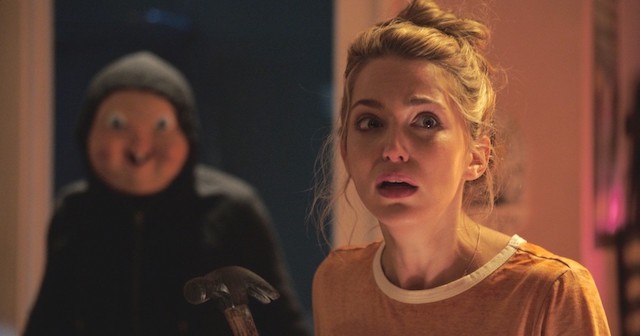
Happy Death Day

0
Happy Death Day
Someday we'll need to discuss this university's choice of mascots, but today is not that day.

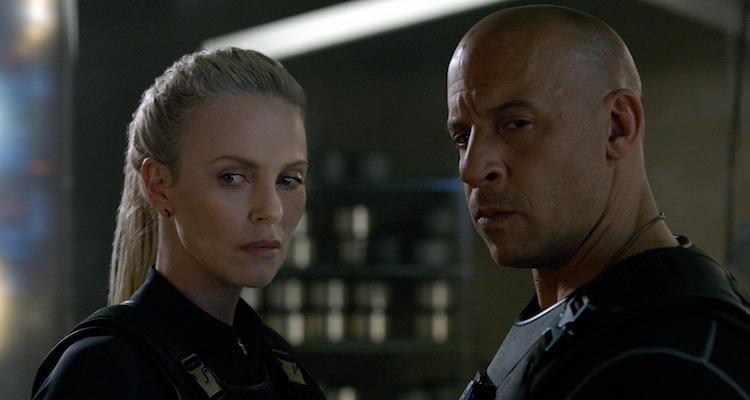
Among the numerous indignities for which 2017 will be long remembered is the fact that it produced not one but two PG-13 “Groundhog Day” riffs about bratty young women reliving the day on which they are killed. The first, “Before I Fall,” was drenched in high school angst; the second, “Happy Death Day,” is set among college students and takes the mystery/thriller route (with a hint of slasher), with mostly agreeable results. “I’ve seen worse!” I declared happily upon exiting the theater.

At Louisiana’s fictional Bayfield University, an undergrad named Tree (Jessica Rothe) wakes up on her birthday hungover and embarrassed. “Am I in a dorm room?” she asks disdainfully of its owner, Carter (Israel Broussard), a polite fellow student with whom she evidently hooked up last night. She hurries home to her sorority house, where her sensitive roommate, Lori (Ruby Modine), has a cupcake for her; rushes to class; makes out with her professor (Charles Aitken); goes to a party later that night; and gets murdered on her way home. The killer is someone wearing a creepy mask representing Bayfield’s ill-advised mascot: a baby. They are the Bayfield Babies. I don’t know either.

No sooner is Tree felled by a knife-wielding baby than she wakes up in Carter’s dorm room again and lives out her final birthday anew. She spends most of it thinking she’s just having weird deja vu, but by murder time she has the good sense to take an alternate route home. Doesn’t matter. She gets killed anyway and returns to the starting point.

With Carter’s help, Tree decides her best shot at breaking the time loop is to figure out who keeps killing her and stop him or her from doing that. But the list of people with motive is lengthy when you’re a bit of a mean girl who lives with other mean girls. There’s Danielle (Rachel Matthews), whose boyfriend Tree made out with while she was drunk. Or the boyfriend himself, Nick (Blaine Kern III), who’s been known to wear the baby mask. Or Tim (Caleb Spillyards), whom she dated once and has been stalked by ever since. Or the professor she’s sleeping with, or his wife (Laura Clifon), or “the Uber driver that I spit on last week,” or any number of others. Oh, and she keeps dodging a birthday phone call from her dad, for whatever that’s worth.

The efficient screenplay, by X-Men comic book writer Scott Lobdell, doesn’t insult its target audience’s intelligence, though it’s undercooked in other areas. The intriguing possibility of Tree’s repeated violent deaths having an aggregate effect on her body is introduced but quickly discarded; her dislike of her birthday is a non-issue (the reason for it even more so); and it’s not quite explained how Tree and roommate Lori are so closely affiliated with the university hospital. (Are they med students? Is everyone in the film a med student?) Some key sequences are set in that hospital, by the way, which like all horror hospitals is dimly lit, understaffed, and has almost no patients.

“Happy Death Day” is only technically a horror movie, though. Director Christopher Landon (“Paranormal Activity: The Marked Ones,” “Scouts Guide to the Zombie Apocalypse”) doesn’t play up the scares or suspense, focusing instead on Tree’s character arc, solving the whodunit (the whosgonnadoit?), and having fun with the premise. It’s a fairly solid genre exercise with satisfactory performances and perhaps even a surprise or two, depending on how many of these you’ve seen. If we’re doomed to watch the same movies over and over (and we evidently are), at least this one makes an effort.

The Foreigner

0
The Foreigner
The feral foreigner.

Jackie Chan plays the person that the title “The Foreigner” refers to, though nobody ever calls him that. They tend to call him “Chinaman,” as in, “That bloody Chinaman!” Halfway through I thought: I bet this movie was originally called “The Chinaman.” Sure enough, it’s based on a 1992 novel (by Stephen Leather) that had that very title. Can’t imagine why it didn’t survive the adaptation process.

Anyway, it’s good to see the 63-year-old Chan again, in his first major onscreen appearance in a wide-release film since “The Karate Kid” remake seven years ago. This is a serious-minded cat-and-mouse thriller, not a chopsocky romp, and Chan plays a man seeking justice for his murdered daughter, not a comedy figure paired with an incongruous partner who doesn’t understand him. But he still gets a few opportunities to kick butt in the traditional Jackie Chan fashion, in the service of a story that’s well suited to him as he approaches his senior years, even if it does lose its focus and even if Chan is not the main character.

He plays Quan Ngoc Minh, a Chinese-Vietnamese refugee in London whose teenage daughter is killed in an IRA bombing — the first such attack in 19 years. The sudden violation of the peace accord has everyone in the British government spooked, including Liam Hennessy (a purring Pierce Brosnan), the deputy First Minister of Northern Ireland who repented of his own IRA terrorism 30 years ago. Quan comes to Hennessy wanting the names of those responsible for the blast. Hennessy says he doesn’t know who went rogue. Quan doesn’t believe him. Quan, it turns out, also knows how to make explosives, and how to send messages along the lines of “I could have killed you just now but didn’t. I WANT NAMES.”

As Quan goes to Belfast to track down the killers himself, the movie shifts its attention to Liam Hennessy, a smooth politician with a mistress (Charlie Murphy), a wife he hates (Orla Brady), and a nephew, Sean (Rory Fleck Byrne), with special-ops training and IRA sympathies who might be able to help protect the Hennessys from attacks by Quan. Quan emerges as a Rambo-esque master of stealth and booby traps, which is fun to watch even if the backstory behind how he got those skills is only barely explored.

While I haven’t read the novel, descriptions of it (and the title) suggest it focuses more on Quan than on Hennessy. The movie, adapted by David Marconi (“Enemy of the State”) and directed by Martin Campbell (“GoldenEye,” “Green Lantern”), emphasizes Hennessy and the tricky, secretive politics involved in keeping the peace between Belfast and London. Quan disappears for long stretches of the movie, and the result feels like two separate but related stories, with Quan’s being the spinoff.

The film would almost certainly have been better if it had committed to one story or the other — to either fully develop Quan’s history and character, or to go all-in on the political machinations of a man torn between loyalties. Yet the mixture of political intrigue and good old-fashioned vigilantism proves to be a tasty one, maybe because we don’t see it very often. Brosnan gives a sparkling performance as the calculating Hennessy, and Chan’s un-campy dramatic turn is refreshing. It’s the IRA-flavored “Death Wish” remake we didn’t know we needed.

— Crooked Marquee

Professor Marston and the Wonder Women

0
Professor Marston and the Wonder Women
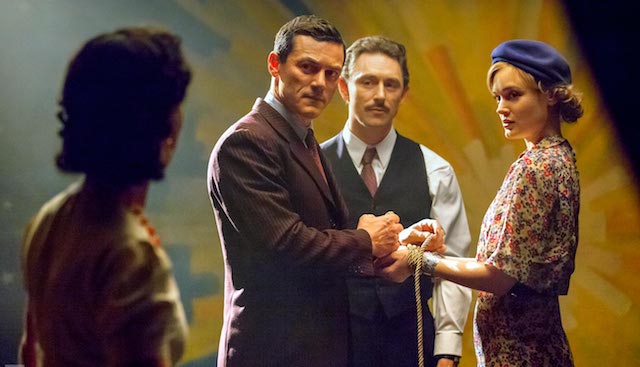
"With this rope I thee wed."

“Wonder Woman‘s” fresh take on the superhero-origins movie was a welcome addition to a stagnant genre. Now here’s “Professor Marston and the Wonder Women,” the story of how the character was created — a superhero-origins-origins movie — subverting the traditional biopic formula with affection, humor, and an irresistible “love is love” philosophy.

Written and directed by Angela Robinson (“D.E.B.S.,” “Herbie: Fully Loaded”), the fascinating true story stars Luke Evans as William Moulton Marston, a psychology professor at Radcliffe College (Harvard for ladies) in the late 1920s whose social theories are ahead of their time. He’s developing a thesis about domination and submission as healthy components of a relationship (and not affixed to either gender), and in class he jokes about the possibility of women being leaders someday. His all-female classroom giggles, but he means it.

William’s wife, Elizabeth (Rebecca Hall), is outspoken and intelligent, an equally competent scientist who would have the same degrees as her husband if Harvard didn’t refuse to give them to women. (Elizabeth is the first person in the movie to use a major profanity, which she does boldly; it’s an interesting insight into the times that later on, when the word “pornography” comes up, she whispers it.) The Marstons aren’t jealous of one another romantically (professionally, maybe), and have what we might today call an “open marriage,” at least in principle. They’re fond of one another as individuals and as scientists, and they enjoy working together. There’s a priceless moment when they’re hiding upstairs at a sorority house to make scientific observations of a homoerotic hazing ritual but can barely stifle their laughter over the self-serious absurdity of it.

These progressive, unenvious attitudes make the Marstons amenable when a beautiful grad-school assistant, Olive (Bella Heathcote), signs on to help with their research into developing a lie detector, and, in short order, the three all sort of fall in love with each other. Polyamory raises eyebrows in 2017; you can imagine how it went over during the Depression.

Lest we forget where this is going, the film is framed by scenes set in 1945 where William is defending his Wonder Woman comic book against a panel of prudes (led by Connie Britton) who take issue with the frequent appearance of bondage themes in it. (Apparently Wonder Woman and the other characters used to tie each other up a lot.) This framing device is one of the few nods to the standard biopic formula that Robinson allows herself, otherwise telling the story with energetic, stylish candor and finding humor wherever it arises. A film that involves love and a lie detector can’t help but exploit the potential comedy in that, right?

Something the film does not exploit, however, is the sexuality. Though William, Elizabeth, and Olive are polyamorous, Robinson doesn’t swell on the titillating details. There’s no nudity; in one scene where Evans is naked, the camera stares at him but only at chest-level, respectfully not panning down until he puts his pants on. The scene where the trois is first ménaged is erotic and sexy, but it’s also self-aware: it’s shot like a steamy music video, and it takes place on an empty theater stage at the college, underscoring the performative nature of it all. Robinson seems to wink at us: Is this what you wanted to see, you naughties?

It’s great fun to watch these three characters grapple with unorthodox emotions and experiment with fetishes in a non-melodramatic fashion. Most tellings of this story would emphasize the threesome’s conflicts and difficulties, but Robinson focuses on their happiness. William Marston’s progressive attitudes about gender equality are celebrated — “I’m going to inject my ideas into the beating heart of America!” he cheerfully declares after choosing the comic book as his medium — and the thoughts and desires of the women in his life are given equal weight. It’s a movie that looks forward by looking backward, executed with sly, empowering confidence.

Marshall

0
Marshall
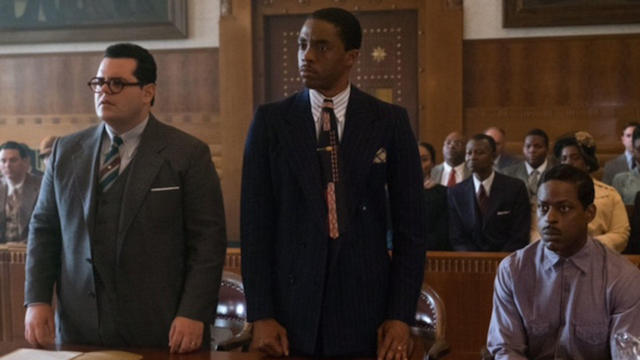
"White? What do you mean I'm white?"

You’d be forgiven for assuming that “Marshall” is a biopic of Thurgood Marshall, the first black United States Supreme Court justice. After all, it’s called “Marshall,” and a main character is Thurgood Marshall. But rather than tell the man’s life story, the film focuses on one race-related case that he argued as a young lawyer in 1941, before he was famous. Marshall’s subsequent history-making achievements are relegated to the “what happened next” onscreen titles at the end of the movie.

That’s disappointing, though it’s worth noting that what we got instead is an entertaining courtroom drama whereas a standard biopic, if it followed the usual formula, would have had a good chance of being boring. Thurgood, in his early 30s and played by Chadwick Boseman (who’s already played Jackie Robinson and MLK), is an NAACP lawyer who travels the country defending falsely accused black people. This brings him to Bridgeport, Conn., where “colored” chauffeur Joseph Spell (Sterling K. Brown) is on trial for raping and almost killing his white employer, Eleanor Strubing (Kate Hudson). Spell looks Marshall in the eye and says he didn’t do it. Marshall believes him. Nobody else in the city (or the rest of the country) does.

Marshall mentions how glad he is to be working a case in the North, where he can enter a courtroom without fearing for his life, but there are still drawbacks. The judge (James Cromwell), hard-headed but ultimately deferential to the law, won’t let an out-of-state lawyer join the case without a good reason, and the perceived racial injustice in this affluent, lily-white town isn’t considered one. So Spell’s defender must be a local insurance attorney, Sam Friedman (Josh Gad), who’s timid and untested in high-stakes cases. Marshall is allowed to help and advise but outrageously not permitted to speak in open court. (This is a true story, but that detail is fictional.)

Much of the film is devoted to the nuts and bolts of working the case, with Marshall and Friedman interviewing witnesses, visiting the crime scenes, and fighting against the blatant racism and cronyism of the prosecutor, Loren Willis (Dan Stevens), and the local justice system. Friedman, initially concerned about his reputation defending a Negro accused of a heinous crime, gets over it and finds his courage, inspired by Marshall’s shrewd, impeccable professionalism. In fact, Friedman is more of a protagonist than Marshall is. It is he who changes, learns, and grows over the course of the movie, which was written by real-life Bridgeport, Conn., attorney Michael Koskoff and his screenwriter son, Jacob, and directed by Reginald Hudlin (“House Party,” “Boomerang”).

That’s another strike against the film as a Thurgood Marshall biopic: it’s more interested in the Josh Gad character. But to his credit, Gad’s performance is humble and nuanced, and he and Boseman have an easy camaraderie. It’s not their fault that Marshall’s brilliant legacy gets the short shrift in favor of a meat-and-potatoes courtroom mystery, albeit a satisfyingly twisty one. In a way, it’s a metaphor for the Civil Rights movement as a whole: we didn’t get what we wanted — a real Thurgood Marshall biopic is still ahead of us — but what we did get is a sympathetic and well-meaning step in the right direction.

The Florida Project

0
The Florida Project
The purplest motel.

I can think of quite a few projects for the state of Florida to work on if they’re taking suggestions, but the wonderfully humane, heartbreakingly kind film called “The Florida Project” takes an unexpected route. Writer-director Sean Baker, whose “Tangerine” was also a warm visit with people on the fringes of society (transgender hookers, in that case), here presents a slice of life from the cheap motels of Orlando — in the shadow of Disney — where desperate, transient parents and their children eke out a surprisingly happy day-to-day existence with their temporary friends. Find joy wherever you can, you know?

Exuberant 6-year-old Moonee (Brooklynn Prince) and her turquoise-haired mother, Halley (Bria Vinaite), who can’t be more than about 23, find joy by visiting Halley’s friend Ashley (Mila Murder) at the waffle house down the street, getting free meals in exchange for Halley “watching” Ashley’s kid, Scooty (Christopher Rivera), while she’s at work. The most honest thing Halley does for income is buying knock-off cologne and perfume wholesale and reselling it on the street. She has other methods, too, though, which become problematic later on.

Moonee doesn’t know about any of that. She and Scooty spend their days mostly unsupervised (it’s summer; no school anyway), trotting around their motel, the Magic Castle, and the one next door, Futureland. (These dumps’ aspirational names are a mixture of amusing and sad. Get used to that combination.) They make a new friend, Jancey (Valeria Cotto), who lives with her Grandma Stacy (Josie Olivo), whose daughter got pregnant at 15. Moonee, precociously belligerent and already swearing at a 10th-grade level, gives the new kid a door-to-door tour of the motel: “The man who lives in here gets arrested a lot”; “The woman who lives here thinks she’s married to Jesus”; etc.

The manager at the Magic Castle, Bobby Hicks, is played by Willem Dafoe. When you learn that Dafoe is playing the manager of a seedy Orlando motel, you naturally assume his character is at least a sex-trafficking tattoo artist, if not a meth-fueled alligator-wrestler. But no! In what might be the most normal performance of his career, Dafoe is friendly and patient, doing what he can (within the bounds of the law) to help his ragtag guests and their ragamuffin children. Bobby has accepted that at this particular motel, his job responsibilities include being a semi-watchful, gruffly indulgent uncle, letting the kids play hide-and-seek in the office, keeping an eye out for roving pedophiles, and so forth. If Bobby is bitter about what his career in hospitality services has devolved into, he doesn’t show it.

There isn’t much plot to speak of. Halley and Ashley have a falling out when Ashley decides Moonee is a bad influence on Scooty. (The moms used to affectionately call each other “bitch”; after the split, Halley refers to Ashley as “that bitch,” which is something else altogether.) Bobby continually makes minor improvements to the motel, aided by his son (Caleb Landry Jones, also normal for once). The kids barge confidently up and down the street, bantering hilariously, scrounging up change for ice cream cones, playing in the local woods, standing on the motel’s second-floor balcony to spit on cars below.

It’s a garish, unrefined life, but the kids don’t know that. Kids can have fun anywhere, and one of the life-affirming pleasures of the film is seeing that principle in action. The kids are rough around the edges — they need more guidance and better parenting — but it’s heartening to see them feel so comfortable and free even in adverse circumstances. As Moonee says of a nearby tree that has continued to thrive despite being knocked over and partially uprooted, “This is my favorite tree because it fell down but it’s still growing.”

On paper, this is a movie about people in crisis. But Baker doesn’t tell it that way. Without judgment or disdain (you bring that to the table yourself), and helped by a cast of mostly inexperienced actors who give raw, natural performances, Baker presents these figures sympathetically as flesh-and-blood fellow humans who are just going through a rough patch. That some or all of them wound up here through their own poor choices is irrelevant, as is our sneaking suspicion that some of them will continue to make poor choices for the rest of their miserable lives. They are not inherently bad people, Baker seems to say — nobody is. In that sense, Dafoe’s Bobby is the filmmaker’s avatar, a charitable-minded, good-humored man who doesn’t forget his guests’ inherent worth as people even when they do. It is perhaps the only film I’ve seen where I watched Willem Dafoe and thought: I need to be more like that guy.

— Crooked Marquee

Welcome to October! Here’s what’s up

0
Welcome to October! Here’s what’s up

Hey, Internet friends! Happy autumn! Just wanted to check in with a status report on EDS operations.

I was recently at Fantastic Fest in Austin. Here are 10 movie reviews it spawned, and here’s an in-depth article I wrote about the behind-the-scenes controversies that made it a watershed year for the festival.

I’m catching up on the films I missed while I was in Austin. “American Made” is fine — a solid B, an average good movie, nothing special. Hoping to see “Battle of the Sexes” and “The Mountain Between Us” this weekend.

My thanks to the Patreon sponsors (you can be one!) who support my unhealthy lifestyle of watching movies and writing about them. If you’ve missed any recent reviews, well, here they all are. Go nuts.

Oh hey, I also wrote two new Snide Remarks columns, one about donuts and one about my early journalism career. I owe you 20 more Snide Remarks columns as part of an ancient Kickstarter, and you will get them. Boy will you ever get them.

Blade Runner 2049

0
Blade Runner 2049
The Future!

Having missed it as a child and then being unsure which version I was supposed to watch, I never saw Ridley Scott’s “Blade Runner” until the “final cut” was released in 2007. And I saw that one twice, because the first time didn’t take. I failed to love it, and I thought it might be my fault. Many things are.

But no, it turns out “Blade Runner” is a respectable movie with much to admire that I simply don’t care for. Though beautiful to look at, it’s cold and sterile. I respect it, but I don’t particularly enjoy it. (I feel the same way about a lot of people.)

So no hard feelings if you need your “Blade Runner 2049” opinions to come from a “Blade Runner” enthusiast and you have to stop reading now. For the rest of you, I can report that the melancholy sequel, produced by Scott and directed by Denis Villeneuve (“Arrival,” “Sicario”), is likewise visually gorgeous, likewise admirable in many ways, and likewise doesn’t do much for me, only now it takes 45 minutes longer to not do it.

The action is set 30 years after the events of the first film, with replicants (bioengineered humans) still comprising a major portion of the workforce in the dim, ashy dystopia that America has become. A blind technocrat named Wallace (Jared Leto) bought what was left of the company that used to make replicants, found a way to make them more obedient, and gave them fixed lifespans. But there are still some of the old models running around, the ones that aren’t as pliable and can theoretically live forever. It is the duty of the “blade runners” (cops) to find these and “retire” (kill) them.

Our chief blade runner, an LAPD officer played by Ryan Gosling, is nicknamed K because his real name is a serial number because he is a replicant. The movie tells us this up front, perhaps so we wouldn’t get hung up on the possibility like people did with Deckard in the original. K knows what he is, knows his childhood memories are just part of his programming, and is (mostly) content to spend his evenings at home with his hologram wife, Joi (Ana de Armas), who’s very loving, though she pauses when he gets a phone call.

Intrigue arises when K finds a 28-year-old box of replicant bones and the doctors determine that the replicant they belonged to died while giving birth. If replicants can reproduce, well, that’s new. K’s boss, Lt. Joshi (Robin Wright), orders him to track down the replicant child, if it is still alive, and kill it. “I’ve never retired something that was born before,” K muses.

It’s a procedural, then, much like the first film was. (Screenwriter Hampton Fancher has returned, sharing screenplay credit with “Logan‘s” Michael Green.) K’s investigation takes him to Wallace’s headquarters, where he learns that a blade runner named Deckard (Harrison Ford, who appears in this movie) had a forbidden relationship with the same female replicant who evidently went on to give birth, and where he does not learn (but we do) that Wallace wants to increase production of replicants so he can use them as slaves on Earth’s colony planets. K also meets a scientist (Carla Juri) who designs the fake memories that are implanted in replicants, who tells him that all memories have a hint of their creator in them.

If any film could get by solely on its breathtaking cinematography, it would be this one. The legendary Roger Deakins (who’s been Oscar-nominated 13 times in 22 years without ever winning) photographs the forlorn and dismal future with spectacular depth and clarity, giving it more life, I suspect, than the real 2049 will have. The original film’s “ruined future” aesthetic is expanded upon, enhanced by CGI, and it effectively complements the ponderous tone of the story. Villeneuve, one of our moodiest auteurs, was surely a good choice to direct, and he takes the job seriously. Though there are references to the other film, there’s no winking fan service or conspicuously wedged-in callbacks.

But movies, like replicants, need fixed lifespans. If you let them go on forever, they’re bound to cause trouble. As worthy as this film’s plot is on paper, it becomes stagnant when poured into a film lasting 163 dreamy, ethereal minutes. Methodical and sad, it’s a film with plenty of mood but little emotion, well made but frigid. Maybe you can love it, but I replican’t.

— Crooked Marquee

Better Watch Out

0
Better Watch Out

It suffers a bit in the execution, but conceptually, “Better Watch Out” (originally titled “Safe Neighborhood”) is the best twist on the “home invasion” thriller that the sub-genre has seen in a while, a consistently surprising story with more than one jaw-dropping moment.

And the execution isn’t bad, either, just clunky at times, with some weak dialogue and an unconvincing performance in a crucial role. Writer-director Chris Peckover, last seen stirring up trouble with the brutal “Undocumented,” certainly has his fiendish head in the right place, and the new film allows for more levity than the last one did while still being pitch-black in its sensibilities.

Set at Christmastime so that someone can eventually be tied to a chair with a string of festive lights (an irresistible image for a provocateur like Peckover), “Better Watch Out” stars Olivia DeJonge as Ashley, a beautiful babysitter charged with tending almost-13-year-old Luke (Levi Miller) while his bitter parents (Virginia Madsen and Patrick Warburton) go to a party. Luke, mature for his age, doesn’t think he needs a sitter. Moreover, he has a crush on Ashley and sees tonight as his last chance to profess his love before she goes off to college. Luke is encouraged in his delusions by his best friend, Garrett (Ed Oxenbould), who fits the mold of the good kid’s troublemaking, kissing-up-to-the-parents sidekick.

While Luke is putting the moves on Ashley (who’s preoccupied with her own stormy love life) and Garrett is playing video games upstairs, someone is lurking outside — or maybe inside? — the house. The intruder manifests in the usual ways: a creak here, an open door there. Soon there’s no question about it. Something deadly is afoot.

And that’s all you’ll get out of me, plotwise. With the basic elements in place — babysitter with boyfriend problems, lovelorn adolescent, comic-relief friend, an empty house — Peckover plays the music as written for a while before veering off into his own clever variations. The girl-in-peril scenario comes to involve issues of masculinity and entitlement, played for laughs that grow darker as the action progresses. Like his characters, Peckover makes some questionable choices that he doesn’t seem to realize are questionable. (For example, the parents are given vivid personalities, then dismissed from the film.) But he refrains from showing the graphic, gory details — a sign of restraint.

Olivia DeJonge is stellar as the beleaguered babysitter, vividly playing a range of emotions as her fortunes change throughout the night. Unfortunately (and you hate to lay a lot of blame on a kid), Levi Miller’s performance as Luke is a great hindrance. It’s a tricky role anyway, with a lot of intensity and layers to it, and Miller (who played Peter in the 2015 Hugh Jackman film “Pan”) isn’t up to the task. Still, the film’s ingenious plotting and wicked sense of humor shine through.

Report from a Beleaguered Fantastic Fest

0
Report from a Beleaguered Fantastic Fest

This year’s Fantastic Fest was packed with surprises, sexual deviancy, revenge, and sorrow, and that was just on Twitter. The movies were likewise full of intrigue — it was a good lineup, everything else aside (“How was the film festival, Mrs. Lincoln?”) — but the 13th edition of the Alamo Drafthouse’s celebration of genre cinema was overshadowed by behind-the-scenes turmoil that got to the very heart of what Fantastic Fest is all about. It turned a week of decapitations, Scottish zombies, and medieval forest witches into a week of those things plus reflection and self-examination. Who knew the most unsettling encounter we’d have at Fantastic Fest would be with our own feelings?

Unfamiliar with the controversy? Let me break it down for you one (1) time.

An Orange Menace

It began Oct. 7, 2016, when a recording emerged confirming that a syphilitic slumlord named Donald Trump had a fondness for grabbing unsuspecting women by their genitals. (Public reaction was swift: he was elected president.) Among the people in the film community and decent society in general who tweeted disgust at Trump’s proclamation was Devin Faraci, known then as editor of the Drafthouse-owned website Birth.Movies.Death, an outspoken proponent of social justice, and something of a butthole.

Devin Faraci

Now, this article will include some opinions, but that’s an objective fact. I never had any beef with Devin personally, and I enjoyed chatting when we’d run into each other at film festivals, but I couldn’t stand to follow him on Twitter because of his constant bickering with and harassment of others, even when the objects of his scorn (GamerGaters, Men’s Rights Activists, and other trolls) started out deserving it. Anyway, Faraci’s tweet (“The most telling thing about the Trump tape? He wasn’t talking with his best friends. He was boasting to a TV host”) prompted one from a woman he’d known in 2004, before his Drafthouse employment: “quick question: do you remember grabbing me by the p**** and bragging to our friends about it, telling them to smell your fingers?” Faraci’s reply, and the last thing he tweeted: “I do not remember this. I can only believe you and beg forgiveness for having been so vile.”

faracispacecrone
The tweets

Faraci quickly resigned from Birth.Movies.Death and fell out of the public view. There was no official statement from Drafthouse founder and CEO Tim League, but Faraci’s accuser tweeted that she’d spoken to League, “who was extremely supportive,” and that “it sounds like [Faraci] is genuinely interested in getting help.” League, like Faraci, was known to support progressive causes, but unlike Faraci, League had a reputation for being a good guy. (My reaction to the Faraci revelations mirrored that of many others in our industry: I knew he could be a jerk, but I didn’t know he was that kind of jerk. I’m trying to be more aware of the warning signs now.)

Fast-forward to a few weeks ago. When the program guide for this year’s Fantastic Fest went online, several of the 300-word capsules of hyperbolic praise that accompany each film were credited to one Devin Faraci. A mild uproar commenced. League posted a Facebook message saying that “once it became clear that his efforts [to address his addictions and better himself] were sincere, I offered Devin copywriting work at Alamo Drafthouse and have recently expanded that to include writing blurbs for our Fantastic Fest program guide.” Faraci had quit drinking, been to rehab, and was working on being a better person. Second chances and all that, you know?

Tim League

But then it came out that the gap between Faraci’s resignation and his return had been no more than a handful of weeks. Backlash was swift, both from women and their allies and from people who despised Faraci anyway and had been glad to have a specific misdeed to hang him for. (Many people seemed to believe in their hearts that Faraci had resigned not for sexual assault but out of remorse for being Devin Faraci.) League quickly discovered that re-associating this person with the Drafthouse, even in a minor capacity (Faraci had no authority or leadership), was an unpopular idea, especially so soon after his dismissal, and especially on the down-low. It looked like League was giving a longtime friend and employee a pass on sexual assault. A day after his first Facebook statement, League posted another one cutting all ties with Faraci, for realsies this time.

But then it came out that another woman had emailed League last October with details of Faraci’s harassment of her  — verbal, not physical — and that League had downplayed it. (“Thanks for sharing your story and I’m sorry to hear about this experience. I’ve been talking to Devin lately and he is going through some very serious soul-searching right now. I hope that he does emerge from this as a better person. I’d appreciate it if you kept this dialogue between us.”)

The same day that this came out, Todd Brown, a crucial Fantastic Fest programmer and a producer whose name often appears in the credits of Fantastic Fest movies, cut ties with the festival. His statement left the impression that he had other long-simmering issues with League and/or the festival and that the clandestine return of Faraci had been the last straw. “Anyone who has ever suggested that Fantastic Fest and the Drafthouse is just the geek friendly equivalent of the classic Old Boys Club, you have

Continue reading at Crooked Marquee


Reviews from Fantastic Fest 2017

0
Reviews from Fantastic Fest 2017

We’ll talk about the behind-the-scenes turmoil at Fantastic Fest in another wordpile. In the meantime, here are reviews of some of the notable films that played there. They don’t have U.S. release dates yet (except as noted), but we’ll let you know when they do.

Tigers Are Not Afraid

tigers_are_not_afraid_4guide_web__largeA tough, beautiful urban fairy tale by Mexican writer-director Issa López, Tigers Are Not Afraid is a perfect example of how genre films can help us engage with real-world crises without being overwhelmed or discouraged by them. It’s set in an unnamed Mexican metropolis from which thousands of men, women, and children have disappeared since the start of the drug war in 2006, with young Estrella (Paola Lara) coming home from school one day to find that her mother is now among them. Reassuring herself with a running fantasy about the courage of tigers and the belief that people have inherent value that gets lost when they’re afraid (“We forget who we are when the things from outside come to get us”), Estrella joins forces with a quartet of younger street boys, led by El Shine (Juan Ramon López), who have stolen an iPhone and a gun from a drug dealer who wants them back at all costs. What separates this from other stories about people running afoul of drug lords isn’t just that it’s about children, but that López presents them as children, brimming with imagination and playfulness even while negotiating for their lives. The kids are irresistibly lovable, and while López uses magical realism (graffiti that comes to life; a trail of blood that leads Estrella around) to soften the blow, she doesn’t shy away from the brutal realities. I’ve seldom seen such lyrical poignance in such a sad setting. Grade: A-

Bodied

bodied_1__largeMy understanding of battle rap — informed entirely by Joseph Kahn’s Bodied, a devastatingly funny social commentary — is that it’s like a no-holds-barred comedy roast except the jokes have to rhyme, with participants insulting each other in loosely metered couplets that may be improvised or prepared. Bodied (slang for killed or defeated) examines this subsection of hip-hop culture through the eyes of a white graduate student, Adam (Calum Worthy), who’s writing his thesis on it and ends up becoming a participant after interviewing battle-rap champion Behn Grymm (Jackie Long) — much to the dismay of his own shrill, scolding girlfriend, Maya (Rory Uphold), who’s offended by the content of the un-P.C. raps and by the very idea of a white suburban kid being involved. Kahn structures the story like a sports movie, culminating in an electrifying showdown between mentor and protege that is at least as exciting as any actual sports movie I’ve watched. But even better, he uses the scenario to crack open and satirize an impressive number of hot-button topics — racism, misogyny, homophobia, cultural appropriation, who can say the N-word, fake outrage from outsiders, the liberal game of calling out other liberals for not being woke enough — AND to discuss the mechanics of brainstorming and joke-writing. Kahn’s writing style, where people don’t have conversations so much as take turns making overwritten pronouncements, requires some adjustment, but it fits the broadly satiric tone and intentionally stereotypical characters. Despite a few comedic misfires (inevitable in a film this densely packed), it’s an explosively funny snapshot of American culture in 2017. Grade: A-

The Death of Stalin

deathofstalin_02Armando Iannucci has written and directed two films in his career, and they’re both among the best political comedies ever made. First there was In the Loop, an extension of his British TV series The Thick of It (he also created HBO’s Veep) that used fictional U.K. and U.S. functionaries to satirize our two nations’ political dysfunction and eagerness for war. Now he returns (with co-writers David Schneider and Ian Martin) with The Death of Stalin, a breathtakingly dark comedy of errors that holds up the brutal Soviet dictator’s final days as a mirror to current British and American quagmires. The fictionalized plot, which hardly exaggerates the truth, comes from a French graphic novel; Iannucci and company have added comedy to it, replaying horrific events as farce, turning everyone into bumblers, and finding grim laughs in the minutiae of Stalin’s reign of terror. (“Don’t worry!” says the Radio Moscow director cheerily to the audience he’s hastily assembling at Stalin’s command. “Nobody’s going to get killed!”) The masterstroke, however, is in the casting and the decision to have everyone speak in their native accents. So here’s Steve Buscemi as Nikita Khrushchev, a loud buffoon and sycophant who keeps track of which of his jokes get the best laughs; Jeffrey Tambor as Georgy Malenkov, Stalin’s gullible successor (he weeps hilariously at the sight of Dear Leader incapacitated) whose idiocy makes him useful; Simon Russell Beale as Lavrentiy Beria, a Cheney-like opportunist; Michael Palin as Vyacheslav Molotov, a clueless bureaucrat who was on Stalin’s to-kill list; Jason Isaacs as Georgy Zhukov, swaggering military commander; Rupert Friend as Stalin’s raving conspiracy-theorist son. True to form, Iannucci packs the dialogue with profane insults (it’s the sort of movie where someone shouts obscenities at the burning corpse of a political enemy), but he also performs a delicate tight-rope act, conjuring thoughts of Brexit and Trump without laying it on too thick and mocking political connivers of all stripes with elegant savagery. Grade: A-

Seven more reviews at Crooked Marquee


American Made

0
American Made
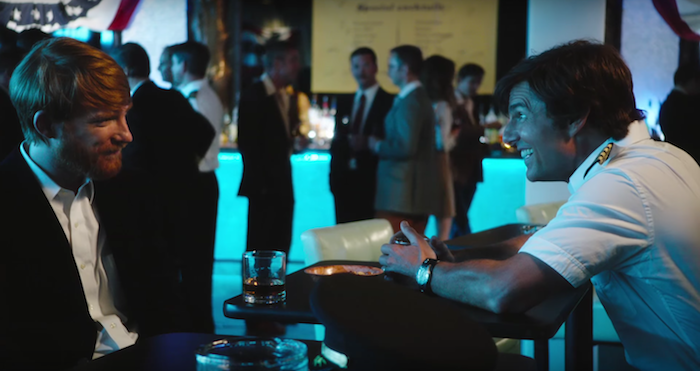
"Full medical coverage, two weeks vacation, AND all the cocaine I can snort?!"

“All of this is legal?” asks airline pilot Barry Seal (Tom Cruise) in “American Made” when CIA agent Schafer (Domhnall Gleeson) recruits him to fly secret surveillance missions in Central America. “If you’re doing it for the good guys, yeah,” replies Schafer.

Mind you, when we meet Barry Seal, he’s already making a few bucks on the side smuggling Cuban cigars into the U.S. He’s a good ol’ Louisiana boy with Tom Cruise’s toothy charm. If he has any compunctions about working with the CIA, he doesn’t show them. Indeed, once he gets going, he uses the opportunity to establish a side gig running drugs for the Medellin Cartel, which leads to more off-the-books work for the CIA, including flying guns to the Contras, which eventually turns into the whole Iran-Contra Affair.

The gross illegality and questionable morality of the whole true story (well, mostly true) renders it an odd choice for an upbeat popcorn flick, but director Doug Liman (“Mr. & Mrs. Smith,” “Edge of Tomorrow”) — whose father, coincidentally, was chief counsel for the Senate’s Iran-Contra investigation — makes it crackle with entertainment value, aided by Cruise’s ability to turn a criminal into an antihero.

Cruise, as Seal, narrates the film (written by first-timer Gary Spinelli), which starts in 1978, covers much of the ’80s, and involves such colorful historical figures as Manuel Noriega, Pablo Escobar, and Oliver North. (A young-ish George W. Bush even pops up at one point.) Seal spins a good yarn, telling how he kept his wife, Lucy (Sarah Wright), in the dark about his work until the amount of under-the-table cash he was getting became too large to hide. The Seals become insanely rich, overseeing a major smuggling operation for multiple clients, and involving Seal’s idiot redneck brother-in-law, JB (Caleb Landry Jones). There’s comedy and adventure in their efforts to conceal their wealth from local authorities, and in the prickly nature of Seal’s relationship with the CIA: they’re paying him a lot of money to do a lot of work, but they’ll aggressive disavow all knowledge of it if he’s caught.

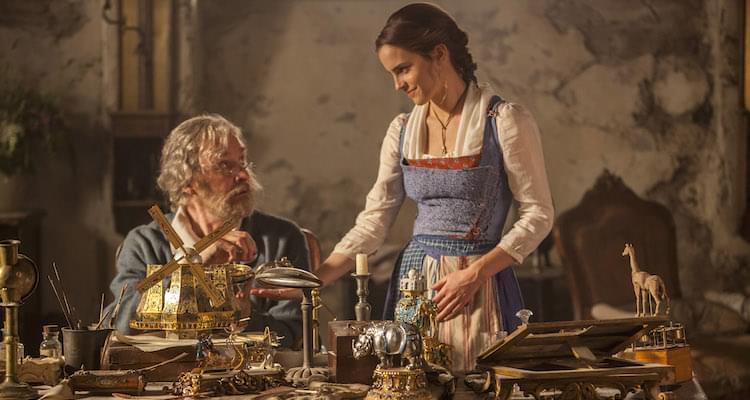
Liman covers a lot of ground, introducing us to (or reminding us of) numerous details from the Reagan Era without being overwhelming or hard to follow. But I can’t help thinking there’s a missed opportunity here, a chance to explore the intricate web of well-intentioned deceit and bald-faced greed that created so much instability in the ’80s and led directly to many of the international problems America faces today. Liman and Cruise keep things at surface level, delivering an enjoyably audacious caper but neglecting the context and subtext that could have made it something more.

The LEGO Ninjago Movie

0
The LEGO Ninjago Movie

Whoever had “three” in the “How many LEGO movies will it take before the brand feels stale and uninspired?” pool, step up and claim your prize! (Your prize is that you do not have to watch any more of these.) “The LEGO Ninjago Movie,” an extension of the Cartoon Network series, is about six ordinary teens in the vaguely Japanese metropolis of Ninjago City who spend their after-school hours as color-coded, Power Ranger-y heroes in mech-suits defending the city against attacks by Lord Garmadon (voice of Justin Theroux) — who, as it happens, is the long-lost father of the most ordinary of the teens, Lloyd (Dave Franco). There are scattered chuckles amid the silliness — one of the ninja kids is a robot who insists he’s a human; the monster who terrorizes LEGO buildings is a cat named Meowthra — but the film is only fitfully amusing, relying on meta-references and filling the rest of the time with ordinary animated action sequences. True to its roots, it feels like an overlong episode of a TV show, not a giddy big-screen event.

Battle of the Sexes

0
Battle of the Sexes
"Excuse me, I believe 'worst haircut' also goes to me."

The nice thing about history is that if we’ve learned from it, and if enough time has passed, we can also laugh at it. Look how foolish we were then! “Battle of the Sexes,” a highly entertaining account of the 1973 tennis match between self-described male chauvinist pig Bobby Riggs (Steve Carell) and top female player Billie Jean King (Emma Stone), begins with a litany of comically sexist excuses for why men are paid more than women, spouted by U.S. Lawn Tennis Association head Jack Kramer (a Mitt Romney-looking Bill Pullman). “Men are more exciting to watch,” he says. (But men’s and women’s events sell the same number of tickets.) “That’s just biology.” It’s a hair’s breadth from the “Anchorman” news team’s freak-out over a woman joining the staff (“Their periods attract bears!”) — except it really happened, more or less.

Writer Simon Beaufoy, whose previous true-story screenplays include “127 Hours” and “Slumdog Millionaire,” paints Bobby Riggs as a past-his-prime gambler, hustler, and clown, but Carell plays him fondly, a likable cad with some degree of self-awareness (“I’m gonna put the ‘show’ back in ‘chauvinism,'” he says). This is Billie Jean’s story, though — she has a character arc; Bobby doesn’t. Besides breaking off from the sexist USLTA to start a new women’s tour, Billie Jean is discovering that she may be a lesbian. She is aided in this by the tour’s hairstylist, Marilyn (Andrea Riseborough), whose first question for her — “What do you want?” — is tonsorial but has a wider application. All of this will be sad news for Billie Jean’s nice husband, Larry (Austin Stowell), and it will have a dramatic impact on the remainder of her life.

But first, tennis! Husband-and-wife directors Jonathan Dayton and Valerie Faris (“Little Miss Sunshine,” “Ruby Sparks”) make the most of the giddy excitement of the women’s tour, with Sarah Silverman as World Tennis magazine founder Gladys Heldman coming along to help Billie Jean with logistics and sponsors. (Welcome aboard, Virginia Slims!) Other players include Rosie Casals (Natalie Morales, who’s seamlessly integrated with footage of the real Howard Cosell) and Margaret Court (Jessica McNamee), who takes Bobby Riggs’ bait when Billie Jean initially declines, and serves as a more serious, matronly counterpart to the up-and-coming Mrs. King. Without dwelling on the gameplay itself, Dayton and Faris convey the fun sisterhood of the tour, interspersing it with Bobby’s humorous efforts to arrange his Battle of the Sexes match. Once that is in motion, there’s ample comedy in the pre-match publicity, in Bobby and Billie Jean needling each other at press conferences, and in the smug self-assurance of Jack Kramer and his fellow tennis establishment squares.

The big match is shown in some detail, building momentum as a cavalier Bobby realizes his opponent is more formidable than he expected. If you’re not aware of the outcome (and I guess there’s no reason anyone under 40 who’s not a tennis fan would be), the directors create impressive dramatic tension — turns out this is a legitimate sports movie, too.

Carell is good as Bobby Riggs, imbuing him with enough soul to prevent his being nothing but a villain, helped by Elisabeth Shue as his loving but weary wife. But the movie belongs to Emma Stone, who inhabits the character of Billie Jean King without attempting an impersonation of her. Through her, we feel the thrill of Billie Jean and the other women’s feminist advances, as well as the personal exhilaration of self-discovery. There remains much work to be done when it comes to gender equality, obviously, but we’ve made enough progress since 1973 that we can sit back and laugh at what was then a frustrating, demoralizing situation, and to cheer the heroines who fought against it.

P.S. Having seen the film, I am convinced that Michael Jackson was telling the truth about Billie Jean not being his lover. Let us put this issue to rest.

Stronger

0
Stronger
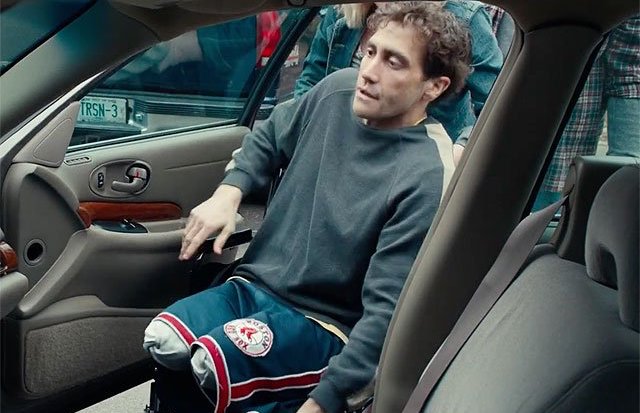
No! His beautiful knees are gone!

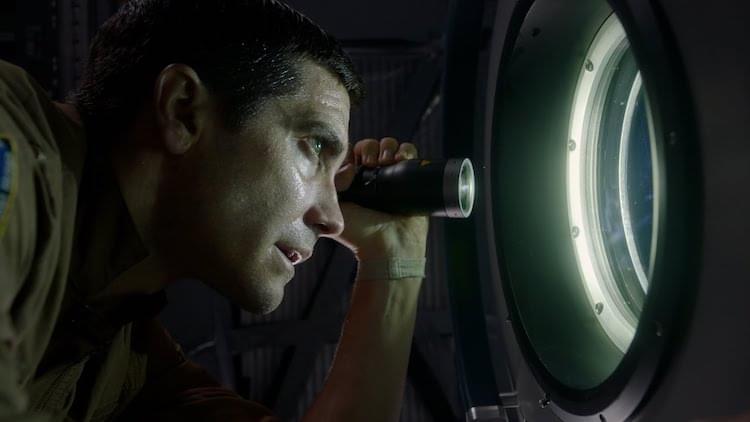
“Stronger” isn’t the first film about the 2013 Boston Marathon bombing, but it is the first to earn its emotions legitimately, and the first that’s not an insult to the victims. Directed by the diversely talented David Gordon Green, who’s made everything from stoner comedies to introspective character dramas, this is a moving true story focused on 27-year-old Jeff Bauman, who became a national hero after he lost his legs in the blast and helped identify one of the killers.

Jeff, played by a curly-mopped Jake Gyllenhaal, is presented as a kind, eager man who still lives with his mom (Miranda Richardson) and fits the mold of Boston denizens as established by the movies: he’s superstitiously obsessed with the Red Sox (they lost two in a row because he wasn’t watching!), and he swears like a sailor. He works at Costco, where he’s well liked, and he gets everybody at his neighborhood bar to contribute to the fundraiser that his ex-girlfriend, Erin (Tatiana Maslany), is doing in conjunction with running the Marathon.

Jeff and Erin have broken up a few times, it seems, but it never quite takes. Unable to resist his enthusiasm, she’s more amused than annoyed when he insists on being at the finish line to cheer for her, waving a sign he made himself. When Jeff wakes up in the hospital hours later, groggily remembering the bomb, he asks about Erin’s safety before anything else. The film is centered on Jeff’s personal journey and recovery, but it allows that his relationship with Erin, rekindled by the drama, plays a significant role in both.

“Stronger,” based on the book Bauman co-wrote with Bret Witter, adapted for the screen by John Pollono, is steeped in Boston’s colorful speech patterns (“Go f*** yourself” is something parents and children say to each other), its provincialism, and its use of sporting events as community catharsis. Green, who was born in Arkansas, raised in Texas, and went to college in North Carolina, treats all of these cultural peculiarities with sensitivity, even when they result in absurdities like Jeff’s best friend, Big D (Nate Richman), breaking the news to him in these words: “Theah was an explosion. Ya f***in’ legs? Theah gone, bro.” There is likewise deep humanity in a scene where a representative from Jeff’s job (Danny McCarthy) nervously approaches the extended family at the hospital with news about his insurance coverage, and blue-collar defensiveness melts into compassion.

Gyllenhaal, who is seldom less than excellent in anything (particularly my dreams), is especially fine as the resilient Jeff, who’s good-humored and upbeat but shell-shocked by what happened. He goes through the expected dark times, drinking too much (enabled by his lush mother), slacking off on his physical therapy, pushing Erin away out of self-pity. But Gyllenhaal avoids the clichés often found with these tropes, giving us a character whose flaws and reluctant heroism feel authentic. This is bolstered by an extraordinarily powerful scene of Jeff’s bandages being changed for the first time, the camera focused on Gyllenhaal’s anguished, angry, determined face.

Jeff’s arc isn’t that he overcomes tragedy (although that is also true); it’s that he comes to accept his role in the grand scheme of things as a person whose determination in the face of adversity makes him an inspiration to others. As one admirer puts it in an emotional face-to-face near the end, “I just wanna say f***in’ thank you fa that.” Indeed.

Kingsman: The Golden Circle

0
Kingsman: The Golden Circle
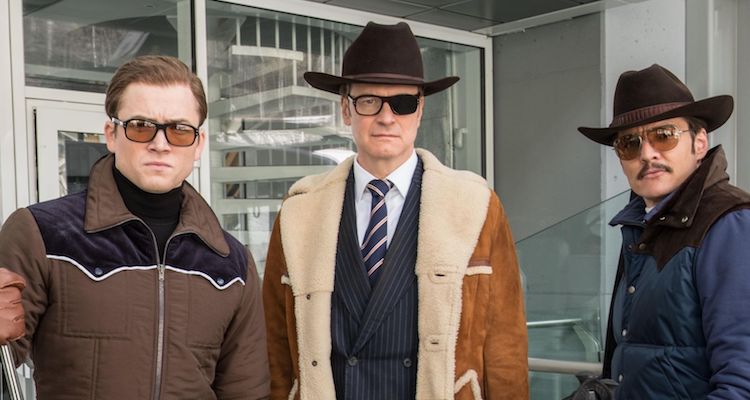
Yes, Colin Firth is in it even though he died last time.

“That movie seemed very pleased with itself.” That was a non-critic friend’s assessment of “Kingsman: The Golden Circle” immediately after the screening, and it’s such an apt description that I have stolen it without attribution.

Whatever you thought of “Kingsman: The Secret Service” (I liked it), the sequel is longer, more bloated, and less entertaining, yet it constantly acts like it’s doing us a favor. Director Matthew Vaughn and co-writer Jane Goldman, both returning from the 2014 surprise hit based on the 007-skewing graphic novel, let the story sprawl out over 141 minutes even though much of it is just a retread of last time. (A villain whose ultimate goal is a perversion of progressive politics, whose co-conspirators’ bodies are marked with a symbol that gives them away, plans to infect the entire population with a mind-controlling virus. Sound familiar?)

It begins promisingly, with a terrific fight in and around a speeding taxi between our hero, chav-turned-spy Eggsy (Taron Egerton), and Charlie (Edward Holcroft), a former Kingsman applicant who’s now a bad guy with a robotic arm. At no point do the computer-generated stunts look convincing, but the sequence is ludicrous fun.

Unfortunately, it’s downhill from there, as the story continues to reference the James Bond formula without really satirizing it. Charlie is working for Poppy Adams (Julianne Moore), a smiling American woman who runs the world’s most powerful drug cartel from her ’50s-themed villain’s lair in the jungles of Cambodia, where she is protected by numerous goons and a pair of robot attack dogs. (She also has Elton John there to perform on command, having used Samuel L. Jackson’s mass abduction of celebrities in the last film as cover to steal one for herself.) Her sinister plan involves tainting her products, which run the gamut from marijuana to meth, with a deadly disease and extorting the world for the antidote. But first she’ll need to eliminate Kingsman.

Kingsman, you’ll recall, is England’s top-secret, off-the-books spy agency operating out of a fancy tailor’s shop on Savile Row. Eggsy’s mentor, Harry Hart (Colin Firth), was killed last time (OR WAS HE????), leaving tech-expert Merlin (Mark Strong) to guide him. Now they must join forces with their American cousins, Statesman, which operates out of a whiskey distillery in Kentucky.

Here’s where the film could have had a lot of fun, introducing us to the good ol’ boys who are counterparts to our well-dressed British spies. Vaughn assembled a good cast: Channing Tatum as the cocky Eggsy equivalent, code-named Tequila; Jeff Bridges as the big boss, Champagne, who goes by Champ; Halle Berry as Ginger Ale (!), the doctor and technician. But the three are given nothing to do, all of them confined to Statesman headquarters while a much less interesting agent, Whiskey (played by the much less famous Pedro Pascal), is assigned to assist Eggsy, Merlin, and Harry Hart (HE WAS NOT!) on their globe-trotting mission.

Vaughn is rightly proud of his ability to create action sequences that are frenetic but not chaotic in a variety of settings. The problem is that many of these scenes are gratuitous, padding out a thin story to the point of exhaustion. There’s an entire tangent, lasting about 15 minutes, in which the Kingsman guys set out to get A Thing; get it; then lose it and have to get it somewhere else … rendering the whole sequence moot. There’s also a bland domestic subplot with Eggsy and his girlfriend, the princess of Sweden (Hanna Alstrom), dragging out a joke from the end of the last film. Even the elements that work well, like Julianne Moore’s campy-evil villain, are hurt by overfamiliarity: we spend too much time with them, and it’s quantity, not quality. I bet there’s a 90-minute version of this movie that’s fantastic.

— Crooked Marquee

Eric D. Snider: Boy Journalist (Part 3)

0
Eric D. Snider: Boy Journalist (Part 3)

(When I was in fifth grade, I wrote a weekly column for my town’s free paper, The Lake Elsinore Valley Sun-Tribune, about news events at my elementary school. I’m reprinting the columns here with commentary. For more background on this illuminating series of historical documents, please see Part 1. See also Part 2.)

It was around this time, with four columns under my belt, that two things happened. One, I realized that even under the loose definition of “news” that applied to events at an elementary school, there was not enough of it to report. Or at least not enough that a 10-year-old had access to. An adult probably could have blown the lid off the PTA’s embezzlement of bake sale funds, but not me.

Fortunately, the second thing that happened was I got comfortable enough with the format to start trying other things. At no point did I ask anyone at the paper whether was I allowed to take such liberties with my assignment, but at no point did anyone tell me not to, either.

Here are columns 5, 6, and 7.


suntrib05-1114

11/14/1984
Teacher interviewed; ‘kidnap’ caper solved
By ERIC D. SNIDER
Elsinore School Student

Every five weeks, I’ve decided that I’m going to have a spotlight on a certain teacher in the school.[1] This time, that person is — (the envelope, please) — Mrs. Avallone!

In my interview, I “beat”[2] out of her that she’s been teaching off and on since 1966. I also asked her if she likes teaching, but if she doesn’t, who has been forcing her to teach all this time?

Although she thinks most of her students like her, she says her favorite student would be someone who smiles a lot and who always brings back homework.[3]

She said that her pupils are teaching her to do the moonwalk and her four-year-old son is teaching her to pop.[4] She enjoys rock and roll music.

Watch for the Dec. 19th issue of the Lake Elsinore Valley Sun-Tribune for my next interview.[5]

Slumber Slowed

Nov. 2 was the day of,[6] “The Case of the Cabbage Patch Kid Kidnapping.”

Why?

Well, that day about 20 girls from Mrs. Valles’ and Miss Kennedy’s classes were having a slumber party at Christina Atkinson’s house with their Cabbage Patch Kids.

But, while both classes were out of their rooms, someone broke into the rooms and took all dolls, leaving a note saying that unless 100 pieces of candy were delivered to the office by two o’clock, the babies would be on the 3 p.m. fight to China.

Well, during lunch period, the kidnapper called the police station to see if anyone could come up to the school and play along with the — gag —[7] by questioning the young mothers.[8]

As it turned out, the culprits were Mrs. Valles and Miss Kennedy. They had thought up the whole thing.[9]

Talk about creativity! Einstein made a theory about that called the Theory of Creativity![10]

NOTES:

[1] Or, to phrase it grammatically, I’ve decided that every five weeks I’m going to spotlight a teacher. The way I wrote it here makes it sound like I made the decision every five weeks. I only made the decision once, and barely even that many times.

[2] Those quotation marks were added by editors, my deadpan assertion that I’d beaten Mrs. Avallone being too dry without them.

[3] I bet my question was, “Who is your favorite student?” and this was the weasel answer she gave. As a journalist, I shouldn’t have let her off so easy.

[4] Pop (intransitive verb): to jerk one’s limbs and extremities in a fast, rhythmic manner, often while breakdancing.

[5] Yeah, we’ll see about that.

[6] I see the copy editor adhered to the incorrect principle that anything in quotation marks must be preceded by a comma. It was wrong in 1984, and it’s wrong now.

[7] Here is a case where an editor should have corrected my punctuation but left it the way I submitted it, even though it doesn’t make sense. Why are there dashes on either side of “gag”? Because this was the first time I’d let on that the stolen dolls affair was only a prank, and in my young writer’s mind, I didn’t think I could just drop that detail in passing. I needed to underscore it somehow. Since it was not possible to wink in a newspaper column (emoticons had not yet been discovered), I thought, for some reason, that dashes would do the trick.

[8] They weren’t actually young mothers, of course, though some of them were by the time we graduated. Also, how messed up is it that when their babies went missing, the cops came and questioned them? Like they abducted their own babies! Unbelievable.

[9] This is a funny story, badly told. It was a Friday, and a bunch of girls from these two classes were having a slumber party that night, and they were going there straight from school. That’s why they had their Cabbage Patch Kids with them. As a prank, the teachers kidnapped the dolls during lunch, and pestered the local police department to see if a cop with nothing better to do could come play along with the joke. (There was indeed a cop with nothing better to do.) (Probably multiple cops, actually.)

[10] This is stupid. I desperately wanted to write something clever at the end of the story, and this is what I wrote instead.


suntrib06-1121

11/21/1984
Big celebration marks 100th school birthday
By ERIC D. SNIDER
Elsinore School Student

Lake Elsinore School District was 100 years old Thursday. A big celebration took place, with food, drink, candy and games available.

Mrs. Sisco’s class sold “Qickles,”[1] Mrs. Valles’ class sold carameled apples, Mrs. Avallone’s class and Mrs. Leonhart’s classes both did square dances, and Mrs. Moss’ class hosted a bake sale.

There was a pie-baking contest won by Jeanne Gulley.

There was also a breakdancing contest. A team made up of Manuel Lojan, Genaro Molina, Jesus Areliz, Ruben Nieves and Phillip Santos won first place.[2]

Mrs. Margaret Hoole, the Altha Merrifield Memorial Library librarian[3], came to our school to present a slide show about old Elsinore.

The first slides I took notes on were about Franklin Heald.[4] He wanted to establish a colony, but didn’t have enough money so he teamed up with Donald Graham.[5]

Also pictured was the Graham house, the Heald home, an old train, the Jones Hotel, the Crescent Bath House (now The Chimes), the Bank of Elsinore (now the Ambassador Hotel), and City Park.

People picture were Charles Sumner Merrifield and Altha Merrifield Cauch.[6]

They had pictures of Amy Castle, of which Thomas Yarborough, the man who Yarborough Park is named for, was caretaker. Yarborough was the first black mayor of Elsinore.[7]

Riddles

Now, a couple of riddles:

1. What did one heart say to the other heart?
2. Why did the elephant sit on his trainer?

If you can figure out one or more of these riddles, tell me[8] or telephone[9] me at [REDACTED][10] and I’ll put your name in my next article.

NOTES:

[1] Well, no. Our class sold pickles, which are a real thing, not “Qickles,” which are not. I hand-wrote these columns in pencil on a sheet of lined notebook paper, as was typical of 10-year-old journalists working at community newspapers in the mid-1980s. The “p” and “q” are similar, and I guess I accidentally wrote “q,” or at least wrote “p” in a way that made the editor think I’d written “q.” Where it breaks down for me is where the editor, instead of thinking, “Oh, he meant ‘pickles,’ not ‘qickles,'” evidently thought, “Huh! Mrs. Sisco’s class produced something new called ‘qickles’! It is probably a trademark and should be capitalized.”

[2] I defy you to show me a single instance of a school centenary that was NOT commemorated with pickles, square dancing, breakdancing, and a pie contest.

[3] Humblebrag: the local library was named after Altha Merrifield, who was my maternal grandfather’s aunt. Buncha stuff in Lake Elsinore is named after my ancestors, as the Merrifields were among the town’s first settlers. (First white settlers, anyway. You know how it worked in those days.)

[4] More journalists should be this honest. “I wasn’t paying attention at first, but this was the first thing they said once I started.”

[5] Donald Graham, of course, had all that cracker money.

[6] Charles Sumner Merrifield was Altha’s father and my great-great-grandfather. Sumner Street, where Elsinore Elementary School was (and still is), was named after him.

[7] I didn’t know this at the time, but Thomas Yarborough was actually the first black mayor of ANY city in California. Pretty much all racial issues have since been solved.

[8] “Tell me,” i.e., if you happen to run into me, a fifth-grader, around town.

[9] Surely I wrote “call me,” not “telephone me.” I don’t think I’ve ever used “telephone” as a verb in my life, and certainly not as a 10-year-old. I guess there was an editor who thought “Qickles” was OK but “call me” was simply too casual a construction for a professional news outlet.

[10] I have redacted this because it is still my parents’ phone number and I don’t want you jokers harassing them.


suntrib07-1128

11/28/1984
‘Pilgrim soup,’ ‘showdown’ highlight school’s week
By ERIC D. SNIDER
Elsinore School Student

Mrs. Sisco’s class went over to Mrs. Warner’s class Nov. 21 to enjoy a Thanksgiving feast which included cranberries on crackers, cornbread with whipped cream butter and “Pilgrim soup.”[1]

Awards Ceremony

Nov. 21 was Elsinore Elementary School’s third awards ceremony. The first was Sept. 12 with Corky Pigeon and the second was Oct. 31 with a Halloween special television program.

The Nov. 21 ceremony was called a “showdown” and had eight events to be won.

Here are the winners of the categories: Standing on head, Phillip Santos; jumping rope, Canto By; pushups, Shawn Winters; limbo, Sam Neal; bubble gum blowing, Yolanda Lara; balloon blowing, Jason McLingberg; Hacky Sack, Soeub Thury, and standing broad jump, Jason Johnson.[2] Mr. Englehardt put all this together.[3]

Riddle Answers

The answers to my riddles from last week are: What did one heart say to the other heart? “You aorta be in pictures.”[4] Why did the elephant sit on his trainer? “Because he couldn’t see him.”[5] (That one really flattens me!)

NOTES:

[1] “‘Pilgrim soup,’ which I’m going to put in quotation marks because it’s a made-up thing, but which I’m not going to tell you any more details about. What’s in it? Screw you, that’s what’s in it.”

[2] Notice that they brought in a celebrity guest for the first ceremony; let us watch TV for the second one; and for the third one just made us do tricks.

[3] Must have taken him the better part of a minute, too!

[4] NO. I blew it. The answer is “Aorta be in pictures,” not “YOU aorta be in pictures.” This has bothered me for 33 years.

[5] This one I … don’t get? Is this a non-joke, where the answer is obvious rather than clever? (See also: “Why did the monkey fall out of the tree? Because he was dead.”) I don’t think I was aware of such humor in fifth grade. Maybe the real punchline the parenthetical that follows it? I don’t know. All I know is I could have printed any riddles I wanted and THESE are the two I chose. You can see why I didn’t pursue a career in writing or comedy.

Brad’s Status

0
Brad’s Status
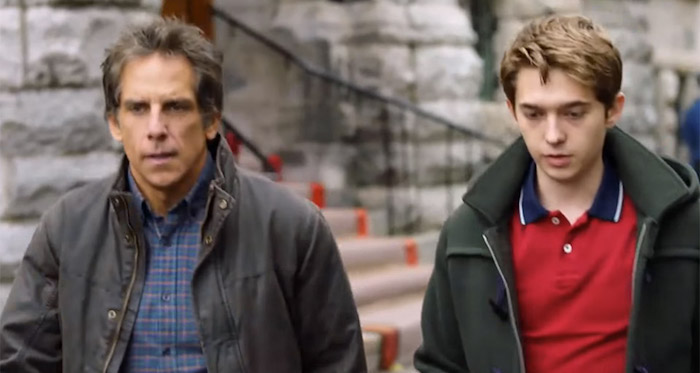
From left: Brad, Brad's son. Not pictures: Brad's status.

“Brad’s Status,” built around an interior monologue and reflections on the past, might have worked better as a novel, though it would have been a slight one. More of a novella, probably. Instead, Mike White wrote and directed it for the screen, where it’s still rather lightweight but benefits from Ben Stiller’s honest, likable performance. It’s the second time that White, an indie screenwriter (“Chuck & Buck,” “School of Rock”), has gotten behind the camera (see the deadpan “Year of the Dog”), and he has some uncomfortably funny insights into the modern man.

Stiller plays Brad Sloan, a restless suburbanite for whom a Boston trip with his son (Austin Abrams) to look at colleges is an opportunity to stew over how his own college friends (Michael Sheen, Jemaine Clement, Luke Wilson, and Mike White) are now more successful than he is. They’ve lost touch over the years, so Brad mostly relies on Facebook and his imagination to conjure images of their affluent lives. The movie shows Brad’s fantasies of his friends’ lives as if they were objective reality when in fact they have been adorned by his insecurities. The voice in Brad’s head yammers on and on with depressing comparisons to his former peers.

But Brad himself is gainfully employed, happily married (to Jenna Fischer!), and has a loving son. He’s a whiner who needs to check his privilege. Fortunately, writer-director White realizes this and doesn’t let Brad wallow in self-absorption for so long that it becomes exasperating. Instead, we watch in amusement as Brad fumbles from one simple epiphany to another, trying to impress his son with his Harvard contacts, trying to outdo a particular old friend (Michael Sheen has the most screen time of them), working himself into a lather over things that we know do not matter. He gradually learns the lessons that you’d have predicted he’d learn if you’d written down your guesses at the beginning of the movie. There’s nothing revelatory here, but it’s gently humorous and sympathetic to its hapless main character, who you may rest assured comes to appreciate his blessings by the time it’s over.

mother!

0
mother!
mother!

It’s immediately clear that “mother!” is not to be taken literally, as it starts with a reverse time-lapse of a rotting corpse in a bed forming back into a sleeping Jennifer Lawrence. That sort of thing doesn’t happen literally, not where I come from. The pleasure in writer-director Darren Aronofsky’s feverishly surrealistic allegory about God and His creations is seeing how he (Aronofsky) translates it into a domestic horror story that’s riveting even when you don’t understand why things are happening. Which I guess is a good metaphor for life, too.

Nobody has names here; the credits call Lawrence’s character Mother. Initially photographed so as to emphasize her suppleness and fertility, she has an idyllic, peaceful life in a spacious country house with her somewhat older husband, Him (Javier Bardem), a renowned poet. (A renowned poet? See, this can’t be literal.) Mother is nearly finished with the monumental task of restoring each room in the house after a tragic fire that occurred before she met Him; he’s hoping she will be the muse who gets him out of his writer’s block. He hasn’t created in ages.

Out of nowhere there arrives a Man (Ed Harris — not bad for a Man) whom Him invites to stay the night. The Man’s very presence upsets Mother physically, but her husband didn’t ask her opinion before making the offer. We soon see a pattern: nobody listens to Mother. She tends to everyone’s needs, but her own feelings are ignored. When the Man’s wife (Michelle Pfeiffer) arrives, the two are an almost comical pair of rude, brazen houseguests, entertained and indulged by Him while Mother cleans up. And then their two sons show up, fighting…

Have you figured it out yet? Mother is Mother Nature, Gaia, the Earth goddess. The house is an extension of herself, its sudden outbreaks of wood rot and other injuries a manifestation of her emotions. (When she places her hand on the wall, she feels a heartbeat.) Her husband is God, whose need to create and be loved leads Him to admit intruders into their paradise who trample everything and ignore Mother Nature’s warnings. God gets all the glory, but Mother is the one burdened with the temporal support of His creatures. When death is introduced to this world, it creates a whole new way for Mother to feel pain and anguish, represented by the ever-burning furnace in the basement.

And that’s all just in the first third of the movie! The rest of it continues the metaphor of God and His nature-wife, incorporating not just Old Testament themes but the New Testament, end-of-days calamities, and elements of other belief systems about the Earth, her origin, and her destiny. This may be giving Aronofsky too much credit, but many of the film’s details remind me of the Old Testament prophet Isaiah and the book of Revelation in that they seem to have multiple applications spanning different time periods. For example, the public’s reaction when Him finally writes a new poem could symbolize Jesus’ popularity in his own day as well as modern Christian zealotry. History is presented as happening all at once, not necessarily in a linear fashion.

That fits with the dreamlike logic of the narrative, which is what makes the story compelling, sometimes nightmarish, regardless of whether or how much you “get” it. As in a dream, time is collapsed (a funeral happens hours after the person’s death), situations escalate quickly, and odd occurrences are treated as normal. Aronofsky, always a fan of showing a protagonist’s subjective point of view, often makes it feel like Mother is dreaming even when she’s awake. The things that happen to her — unexpected guests, being dressed inappropriately for an occasion, not being heard — are the cold-sweat frustrations we all dream about.

I don’t think everything in the film has a one-to-one correlation with something from the Bible or world religion. Some details exist simply to make the story work. And while Aronofsky has made it clear that Jennifer Lawrence = Mother Earth is his primary metaphor, there’s enough creative ambiguity to allow for other, complementary readings. It could be a parable about living with artistic geniuses who become obsessed with their work to the exclusion of all else (in which case it should be a red flag to anyone contemplating a relationship with Aronofsky, whose current girlfriend is … Jennifer Lawrence). It could be about society’s treatment of women in general, not just Mother Nature. It may imply a mistrust of God and a pessimistic view of humanity that I don’t personally share, but it’s thrilling to see a major filmmaker and major movie stars explore it so boldly and with so little regard for convention.

— Crooked Marquee

The Hole Problem

0
The Hole Problem

We need to talk about the donut situation. I know there are greater problems facing us right now, but also, from another perspective, no there aren’t.

For years, the standard was that donut shops were open 24 hours a day. That’s how they came to be associated with cops, alcoholics, and other people whose professions have them up all night. It was good and proper, and it rebutted the pernicious falsehood that donuts are a “breakfast food.”

But a new type of donut shop has begun to proliferate that flouts the norms of society, capitalism, and decency. Instead of being open 24 hours, or even something reasonable like 6 a.m. to 6 p.m., they are open from 6 a.m. until 6 p.m. or until they run out of donuts, whichever comes first. That means sometimes you might want a donut during normal business hours yet be unable to get one because the place that sells them just, you know, doesn’t have any.

But wait, it gets worse. Some of these lazy shops that make a batch of donuts in the morning and then are too exhausted to do anything else, once they have depleted their donut supply, will stay open till closing time anyway. Why? In case someone wants to buy a cup of coffee. That means sometimes you pull up to the donut shop and are happy to see that they are still open, but then you go inside and find that they do not have any donuts, even though they are open and a donut shop. Then you turn into the Hulk, smash your fists against the empty display case, and leave a swath of destruction as you stomp away to hurl yourself into the sea.

I’m sorry, but this is America. When I drive to the donut shop, I shouldn’t have to cross my fingers and HOPE that they have donuts when I get there. Of course they’ll have donuts: they are a donut shop. If they sell all the donuts they made that morning, they’ll make more donuts. That’s how this works.

You wouldn’t accept this in any other situation. “Let’s go to Outback Steakhouse.” “Ooh, I hope they have steak!” If you walked up to an Outback and found that they closed early today because they ran out of steak — or worse, ran out of steak but stayed open in case someone wanted to buy a potato — you’d be justified in angrily phoning the CEO (Australia P. Outback) and asking what the hell kind of operation they’re running over there. You wouldn’t just say, “Aw, shucky-darn, no steak for me today. Better luck next time!”

A donut shop like this assumes its wares are tasty enough to justify the emotional rollercoaster involved in obtaining them. But they are not. I can make that blanket statement because NO donuts are tasty enough to compensate for such cruel mind games. Given the choice between B+ donuts that are a sure thing and A+ donuts that might not be there when I arrive, I will choose the former every time. Donuts should be a source of comfort in these times of anxiety and uncertainty, not a further cause of it. I SAID GOOD DAY.

My attitude toward all bakeries, restaurants, and other food emporia is that while I am pleased to purchase and consume their delectables, when it comes down to it, they need me more than I need them. Eating at a restaurant is nice, but it’s not like I’ll starve otherwise. There’s food everywhere! The grocery stores are full of it! So if the wait for a table at a restaurant is more than 15 minutes, and if I have any say in the matter (which I usually don’t, for this reason), then I say let’s go somewhere else. Why wait? Food is abundant! There’s probably another place that sells it less than 100 yards from here.

Here in Portland (city motto: “Whites Only”), the most popular ice cream parlor is Salt & Straw. During the summer, there is frequently a line out the door, which is absurd. We live in a land of plenty. There is no reason to wait in line for food. Portland has several ice creameries that are just as tasty as Salt & Straw (like Ruby Jewel), just as locally sourced and tenderly milked from consenting cows, but that aren’t overcrowded with customers who only went there because they saw the long line and figured that must mean it’s the best.

As ice cream is to Portland, so is barbecue to Austin (city motto: “Sorry About the Rest of Texas, Y’all”). Boy howdy, people in Austin love their barbecue. They speak of nothing else. I have never had a conversation in Austin that did not end with everyone slathered in sauce.

There’s this one place, Franklin’s, that’s like those infernal donut shops in that they make one giant batch of meat early in the morning and that’s it, no more, we’re spent. And since Franklin’s is very popular, the only way to get meat is to be there when they open, which means getting in line before dawn. Out of bed and in line to purchase smoked meats hours before you’ll be hungry to eat it! And you might not even get any! Despite your efforts, you might be too late to win the meat lottery. This is no way to live, friends.

Is it good barbecue? Yes, very. Is it worth getting up early and waiting in line for? You will by now have discerned my answer to this question. It’s just food, you guys. We are surrounded by food, and in Austin, we are surrounded by barbecue. You don’t need to go to Franklin’s.

Have you ever had good barbecue — I mean, really, really good barbecue? You have? Well, it tastes like that.

Now, please don’t take these denunciations to mean I look down on people who enjoy waiting in line for basic services, or that I think they are fools who waste their time, or that I believe I am better than they are. All of these things are true, but please don’t think that I think them. We need to be unified as we face the crises of our day, including the new Oreo flavors, which have gotten way out of hand.


[ Since you asked, the Portland donut shops that sometimes don’t have donuts during business hours are Coco and Blue Star. Avoid them unless you are going first thing in the morning. Same goes for Annie’s, which is better-stocked but not as good.
Voodoo Doughnut is open 24 hours, and while their gimmicky donuts that attract tourists are OK, their regular donuts are quite good. Heavenly Donuts is also open 24 hours, but is hit-or-miss in terms of quality.
Tonalli’s has terrific donuts and is open until midnight! I have wandered in as late as 11:30 and found plenty of selection remaining. They also sell ice cream, but it’s just Umpqua brand (which is fine, but you can buy it in a grocery store).
My favorite donuts in Portland, and the most reliable, are at Helen Bernhard Bakery. They close at 6 p.m. and have everything in stock (give or take one or two items) the whole time. Helen’s donuts are tasty, moist, crunchy where appropriate, and inexpensive. They have my fat, sticky seal of approval. ]


Home Again

0
Home Again
Reese Withersweater.

Hallie Meyers-Shyer is the daughter of Nancy Meyers and Charles Shyer, whose marital collaborations also included the films “Irreconcilable Differences,” “Baby Boom,” “Father of the Bride,” and “I Love Trouble.” Ms. Meyers-Shyer’s debut as a writer-director, “Home Again,” is about a Los Angeles woman whose father was an Oscar-winning director and whose mother was his actress and muse. The kicker is that even though the film starts with the woman narrating the details of her famous father’s career, it actually has nothing to do with the plot. Why, one is tempted to think Meyers-Shyer gave her protagonist a background so similar to her own simply because she didn’t know what else to do!

But I’m being facetious. Of course that’s why Meyers-Shyer made Alice Kinney (Reese Witherspoon) the daughter of (fictional) filmmakers. It may also be why Alice, who’s a dilettante but doesn’t realize it, and who doesn’t need to work for a living but wants to be an interior decorator, worries, “Am I one of those women who think all of their hobbies should be a profession?” Though I doubt Meyers-Shyer intended that line to be as self-indicting as it is.

“Home Again” is an inoffensively bland, brightly lit sitcom about a newly single 40-year-old mother of two getting her life back in order with the help of three polite, eager, young filmmaker dudes who move into her guest house. The guys — director Harry (Pico Alexander), writer George (Jon Rudnitsky), and actor Teddy (Nat Wolff) — made a successful short film, have come to L.A. to pursue their dream of turning it into a feature, and need a place to crash. Alice’s mother, retired actress Lillian Stewart (Candice Bergen, a living goddess whose divine presence elevates the few minutes of the movie she’s in), is flattered by the fellows and urges Alice to let them stay, just for a few days.

A domestic sitcom ensues — not the wacky kind with misunderstandings and loud parties and sex shenanigans (Alice and Harry hook up, but it’s tame), but the heartwarming kind where three strange men prove to be good tenants, role models, and part-time nannies. George becomes a mentor to Alice’s neurotic 11-year-old, Isabel (Lola Flanery), a budding writer. Teddy plays with the younger daughter, Rosie (Eden Grace Redfield). All three are concerned and protective when Alice’s estranged husband, Austen (Michael Sheen), comes back into the picture. George has a crush on Alice, and Harry is actually sleeping with her, but they all treat her more like a beloved den mother than an object of desire.

As much as I roll my eyes at the whole scenario, it’s cute how the guys dote on Alice and the girls with no ulterior motives or bad, dude-like behavior. I couldn’t care less about whether they get their film made (Meyers-Shyer doesn’t seem that interested either), but they’re nice boys. Witherspoon is spunky as ever, in her wheelhouse as an independent woman who’s exercising her autonomy and isn’t a train wreck. She’s crying in front of a mirror when we meet her, but it’s a sterile, benign, romantic-comedy type of crying — a Nancy Meyers type, if you will.

Ultimately, while this is too indulgent and shallow to be good drama, and too lacking in wit to be good comedy, it’s not grating, cloying, or stupid enough to be a bad movie. And at least it didn’t cost $100 million! As nepotism-based filmmaking whims go, this one is more harmless and less wasteful than most.

It

0
It
Is that "It"? A giant old truck tire?

“It” is very long for a horror movie (135 minutes), yet covers only half of the Stephen King novel it’s based on, yet is full of half-mentioned details that seem to have been crammed in hurriedly. I guess it’s fitting that a nostalgic tale set in a childhood summertime would seem both eternal and not long enough, and feature a carnivorous sewer clown. (Your childhood summers may have been different from mine.)

Scary? Yes, when it wants to be, and often bloody and murderous, though not as much as the novel prescribes or the R rating would have allowed. Directed by Andy Muschietti (“Mama”) from a screenplay credited to Chase Palmer, Cary Fukunaga (“Beasts of No Nation”), and Gary Dauberman (“Annabelle”), this adaptation, rather than inspiring deep-seated terror, tends to be frightening in the carnival funhouse sort of way. But it’s also about childhood friendship and coming of age in a manner that makes it a slightly less gross companion piece to “Stand by Me.”

The first part of King’s 1986 novel was set in the summer of 1958. That’s been updated to 1989 (nostalgia stops being lucrative if you go TOO far back), which now seems about as quaint as the ’50s did then, especially in the small Maine town of Derry. Here we meet a group of too many 13-year-olds, more than the film needs or has the wherewithal to develop, personalitywise.

Their leader is Bill (Jaeden Lieberher), a sensitive boy with a stutter whose little brother went missing last fall, which happens to a lot of Derry children on account of the carnivorous sewer clown (though nobody knows that’s the reason; they just think, “Huh, lots of kids disappear here, weird”). Then there’s Eddie (Jack Dylan Grazer), a motormouth who we eventually realize is supposed to be a germaphobic hypochondriac; Richie (Finn Wolfhard), another motormouth but with eyeglasses who we eventually get is “the smart-aleck”; and Stanley (Wyatt Oleff), the Jewish one.

But wait, there’s more! There is also a fat kid, Ben (Jeremy Ray Taylor), who has a crush on outcast Beverly (Sophia Lillis), whose father is a pervert. And there’s also a black kid, Mike (Chosen Jacobs), who’s homeschooled and has to kill sheep with a bolt-gun as part of his stepfather’s business. All seven children are self-described “losers,” which is doubly true when you consider that at least two of them (Mike and either Richie or Eddie) are extraneous to the movie’s plot. On the other hand, the kids have a potty-mouthed rapport that rings hilariously true from what I recall of being a 13-year-old boy. They may be interchangeable or unnecessary, but they’re likable, normal kids.

The film’s title character, played by Bill Skarsgard, is an ancient evil entity that lives in Derry’s sewers and generally takes the form of a circus clown. Pennywise, as It calls itself, is a chilling mixture of levity and menace (just like a real clown), but It can apparently shape-shift into anything It wants, appear or disappear at will, and make people hallucinate.

It feeds on children, though not as wantonly as you’d think. All of the “losers” have a run-in with It at some point. Sometimes It appears in the form of something previously established as something a particular child is afraid of, but that’s not consistent. It is likewise unclear what Pennywise’s limitations are. Each of those run-ins could have resulted in the child’s death but didn’t. It either couldn’t finish the job for reasons the movie doesn’t explain, or else It only wanted to terrorize them, not kill them (also without explanation). At any rate, the kids realize they’ve all had sightings of the same thing and set out to destroy it, like you do.

When the movie focuses on these primary concerns, it’s a shivery, armrest-gripping good time. Thanks to excellent makeup and Skarsgard’s insidious performance, every moment with Pennywise is at least unnerving, often terrifying, and the kids’ fear is palpable. Muschietti directs these sequences with assured skill.

That clown isn’t the only evil presence in Derry, though. There are a lot of freelancers, too, including Beverly’s dad (Stephen Bogaert), Eddie’s mom (Mollie Jane Atkinson), and a trio of bullies (two more than the story needs). All of these people eat up screen time without contributing to the larger themes, and their interactions with the main characters are among the details that got shafted in the adaptation. The situation with Eddie’s mom — who for some reason is wearing an amazingly fake-looking fat suit that only covers her upper body and makes her the shape of a refrigerator — is glossed over in a few lines of dialogue (why even bother?); the bullies’ vicious cruelty seems random and unmotivated; and Beverly’s dad’s atrocities have been obscured to the point of undermining the points they were supposed to have made about Beverly’s psychology.

But the degree of difficulty in adapting a hugely popular and very lengthy novel into a film that respects fans’ attachment to the source while appealing to the uninitiated is immense, and “It” mostly pulls it off. The trims and elisions that would have made it a better movie would have betrayed the readers, many of whom are as nostalgic about the book as the book is about Stephen King’s childhood. Hey, for a King horror novel to be turned into a movie that isn’t terrible is noteworthy on its own.

— Crooked Marquee

Movie BS #373: ‘Patti Cake$,’ ‘I Do… Until I Don’t,’ ‘Birth of the Dragon’

0
Movie BS #373: ‘Patti Cake$,’ ‘I Do… Until I Don’t,’ ‘Birth of the Dragon’

It’s a slow week for new movies, but we also talked about “The Best Years of Our Lives” (1946), which we hadn’t seen before.

0:00 – Hello, an iTunes review, the virtues of New Orleans, the paradox of wives listening to this show, mention of another show with a similar name
7:00 – “Patti Cake$” review
15:15 – “I Do… Until I Don’t” review (Bayer only)
18:30 – Snider saw “Wind River” and “Birth of the Dragon”; Hollywood has forsaken us again this week
23:10 – A few loose ends to tie up regarding the Summer Box Office Challenge
27:25 – DVDs are “Baywatch” and “My Cousin Rachel,” and an Agent can win a copy of “Guardians of the Galaxy Vol. 2”
31:00 – Our Movie of the Month: “The Best Years of Our Lives” (1946)
45:30 – Our MOTM for September is “In the Heat of the Night” (1967); recap and good day

REVIEWS:
Patti Cake$: B- 7/10
I Do… Until I Don’t: n/a 4/10
Birth of the Dragon: C- n/a

Download audio

Listen at MovieBS.com / Listen at iTunes

Birth of the Dragon

0
Birth of the Dragon
Wow, not even close.

In 1964, the not-yet-legendary Bruce Lee had a fight with Wong Jack Man, a Shaolin master who’d recently arrived in the Bay Area from China. The details of the match, including who won it, remain controversial (it happened in private, with few witnesses and no judges), but it is believed that it changed Lee’s attitude about his fighting style, opening the door for his later success.

Well, fine. The dully mediocre “Birth of the Dragon,” directed by George Nolfi (“The Adjustment Bureau”), embellishes wildly upon those basic facts, portraying Lee (Philip Wan-Lung Ng) as an arrogant showman in need of humbling and Wong (Xia Yu) as an austere monk who disapproves of Lee teaching kung fu to white people. Neither of them is the protagonist, though; that, of course, would be a fictional blond kung fu student of Lee’s, one Steven “Mack” McKee (Billy Magnussen), whose desire to free a girl (Jingjing Qu) he likes from Chinese gangsters is presented, dumbly, as the catalyst for the fight.

Viewers hoping for a Bruce Lee biopic will be disappointed. Aside from the creative liberties taken by screenwriters Stephen J. Rivele and Christopher Wilkinson (a duo with several actual biopics to their credit, including “Nixon,” “Ali,” and “Miles Ahead”), there’s also the matter of Lee being the No. 3 character and kind of a bastard. (This may well be accurate, but the film treats it, and everything, shallowly.) Even those who just want to see some sweet martial-arts action will be left wanting more, as the central fight is anti-climactic, the skirmishes before and after it forgettable.

Movie BS #371: ‘Logan Lucky,’ ‘The Hitman’s Bodyguard,’ ‘Brigsby Bear’

0
Movie BS #371: ‘Logan Lucky,’ ‘The Hitman’s Bodyguard,’ ‘Brigsby Bear’

The 2017 Summer Box Office Challenge officially concludes with this episode. I won, and now Jeff has to be punished.

0:00 – Hello, community service, an iTunes review
3:35 – “Logan Lucky” review
16:25 – “The Hitman’s Bodyguard” review
28:40 – “Brigsby Bear” review
34:25 – The final Summer Box Office Challenge update of 2017, in which bets are finalized and the historical record is amended
44:10 – “Alien: Covenant” and “Everything, Everything” are on DVD, if that matters to you
45:20 – Recap and good day

REVIEWS:
Logan Lucky: B+ 7/10
The Hitman’s Bodyguard: C+ 5/10
Brigsby Bear: B+ 8/10

Download audio

Listen at MovieBS.com / Listen at iTunes

Logan Lucky

0
Logan Lucky
The masterminds.

Steven Soderbergh tried to retire a few years ago, but it didn’t take. Perhaps he can relate to Jimmy Logan (Channing Tatum), the lovable West Virginian ne’er-do-well at the center of “Logan Lucky” who tries to make an honest living but keeps coming back to the bullet-pointed plan for robbing a bank that’s posted on his kitchen wall.

“Logan Lucky” is a heist comedy like Soderbergh’s “Ocean’s” trilogy, with the Coen Brothers-ish condescension of his “The Informant!” and the shaggy, unhurried pace of his “Magic Mike.” Written by first-timer Rebecca Blunt, the film is as sunny and implausible as an old-timer’s anecdote, with a few hints at topicality (coal miners, economic anxiety, “Game of Thrones”) that don’t detract from its insouciance. It’s fun for fun’s sake. The conscience only nags a little bit.

Jimmy, a former high school football hero who’s now paunchy and bad-kneed, is an out-of-work coal miner whose most recent job was on a project shoring up the tunnels under the Charlotte Motor Speedway in North Carolina, a hundred miles or so from the West Virginia county where Jimmy and a lot of other drawling rednecks live. His brother, Clyde (Adam Driver), missing half an arm from a tour in Iraq, is a bartender who believes the Logan family is cursed, citing as examples his arm, “Pawpaw’s diamond, Uncle Stickly’s electrocution,” and so forth. Their sister, Mellie (Riley Keough), works in a beauty parlor, but her real skills are behind the wheel.

Jimmy is close to his daughter, Sadie (Farrah Mackenzie), about 10 and currently into beauty pageants, though she’s also a good assistant when Jimmy’s working on his truck. Sadie’s mom, Bobbie Jo (Katie Holmes), exasperated from years of dealing with Jimmy’s unreliability, has a new husband, Moody Chapman (David Denman), who owns a Ford dealership but can’t drive a stick. This is a culture where that sort of thing matters, masculinity-wise.

Family curse notwithstanding, Jimmy enlists his siblings to help with a plan to steal the cash out of the Charlotte Motor Speedway’s vault on a busy event day. For us, the plan is made all the more delicious by the fact that one of its key participants will need to be broken out of jail so he can help, then secreted back before he’s missed. That’d be Joe Bang (Daniel Craig), a bleach-blond explosives expert whose drawl is the drawliest of them all. Joe’s idiot brothers, Sam (Brian Gleeson) and Fish (Jack Quaid), are, at his insistence, also involved, but they’re such screw-ups that even a screw-up like Jimmy Logan finds them frustrating.

Once the plot is in motion, Soderbergh sits back, puts his feet up, and lets things unfold casually. Sure, as a heist caper it has its requisite twists and switcheroos, and a few moments of giddy “will they get caught?” tension. But Soderbergh allows plenty of time to enjoy the amusements of Blunt’s screenplay: Jimmy and Clyde’s dopey brotherly rapport; Mellie’s taunting of her ex-sister-in-law’s new husband; Joe Bang’s crafty intellect and unpredictability; the prison warden’s (Dwight Yoakam) smug arrogance (“We don’t have [blank] at Monroe” is his mantra, spoken every time [blank] happens at Monroe). It’s the kind of heist film that can pause mid-heist for one of the principals to give his co-conspirators an impromptu chemistry lesson, for no better narrative reason than that it would be funny to do so.

The film takes broad swipes at West Virginia white-trash bumpkins. Joe Bang’s brothers are the biggest targets — misspelled tattoos, frequent malapropisms, a reverence for NASCAR — but the whole enterprise is full of rubes and goobers for us to laugh at. Tatum and Driver are semi-serious about giving the Logan brothers depth, but there’s always the sense that they’re mocking them at the same time, play-acting like hillbillies. Which is fine if it’s funny — which it generally is. Meanwhile, Daniel Craig is doing his own crazy thing as Joe Bang, and seems to love every minute of it (as do I).

One aspect that sticks out like a sore thumb is a subplot with Seth MacFarlane doing a mediocre English accent as an aggressively douchey energy-drink mogul who sponsors a NASCAR driver. Where everyone else is doing their level best to bring the stock characters to life, MacFarlane plays Max Chilblain like a villain in a comedy sketch. (Of all the people in the world to play a British jerk, why Seth MacFarlane?) It’s like you’re watching “Ocean’s Eleven” and next to Clooney, Pitt, and Damon, there’s Rob Schneider’s “makin’ copies” guy. But it’s only a minor dent in what is admittedly a leisurely, off-the-cuff sort of movie about whimsical decisions. Soderbergh can make as many of those as he wants if it means he stays un-retired.

— Crooked Marquee

Crown Heights

0
Crown Heights
The wheels on the injustice bus go round and round...

We’ve seen a lot of films like “Crown Heights” lately — true stories about black people getting screwed over by police and the justice system. The surge is a testament to the increased awareness of these issues, and a reflection of the sad fact that the supply of real incidents on which to base such movies is seemingly inexhaustible. This particular film, written and directed by Matt Ruskin (“The Hip Hop Project”), is a swift, solid entry with passionate performances by Lakeith Stanfield and Nnamdi Asomugha. It would stand out more if it didn’t have so much company, but that’s part of the problem, isn’t it? How do you get people to care about acts of injustice when there are SO MANY OF THEM?

Stanfield plays Colin Warner, a Trinidadian 18-year-old who was arrested for murder in the titular Brooklyn neighborhood in April 1980. As the film presents things, Colin isn’t a completely upstanding citizen (we see him breaking into cars), but he had nothing to do with this or any other murder. It’s a case of mistaken identity, pure and simple. The only question is whether the witness mis-identified him accidentally or on purpose.

That’s the only question for Colin and us, anyway. For the bullying police detective (Zach Grenier) and D.A. (Josh Pais) working the case, the only question is how fast they can convict somebody. Thanks to his minority status, unfamiliarity with the U.S. legal system, and lack of money to hire good attorneys, Colin is railroaded in a most outrageous manner, convicted of murder at the movie’s 25-minute mark despite there being no motive or physical evidence connecting him to the crime.

Time passes quickly. I won’t say how much in case you don’t know the details of the case (which was the subject of a “This American Life” episode), but Ruskin underscores his points by featuring, in the background, footage of presidents Reagan, Bush, and Clinton giving “crime and punishment” speeches about policies that we now know led to mass incarceration of non-violent offenders and had a devastating impact on black men in particular. On the outside, Colin’s best friend, Carl “KC” King (Asomugha), devotes himself to proving Colin’s innocence, going so far as to take a job as a process server so he’ll come in contact with lawyers and hopefully find one to help him.

Stanfield’s mournful puppy-dog eyes and slight build (he’s 6 feet tall but rail-thin) draw out our sympathy for his plight, the nightmarish details of which the film doesn’t dwell upon. (A stint in solitary confinement passes in seconds.) Asomugha, a former NFL player, is soulful and loyal as KC, though the character falls into the usual biopic trope of being so obsessed that his wife must appear for one scene to complain that she feels neglected.

The film builds to a satisfying resolution in which the truth about what happened that fateful day in 1980 is revealed, better late than never. Ruskin’s direction is fluid and competent, his quietly outraged screenplay serviceable. A diet of nothing but films like this would be exhausting and demoralizing, but the occasional emotionally rousing docudrama is good for the soul.

Patti Cake$

0
Patti Cake$
Wow, Meat Loaf really let himself go.

The title character in “Patti Cake$,” one Patricia Dombrowski (Danielle Macdonald), is a portly white New Jersey girl who aspires to be a rapper. She’s quite good at it, spitting rhymes as intricate and vulgar as anyone’s; she just needs her big chance. She lives in a dumpy white-trash town with her cigarette-hacking grandmother (Cathy Moriarty) and brassy, jealous mother, Barb (Bridget Everett), who gave up her own dreams of rock stardom when Patti came along. They live hardscrabble lives, paycheck to paycheck. When Patti tells Nana a dirty limerick, Nana hack-laughs and says, “Suck on that, Robert Frost!” Charming family.

Though it sounds like the setup for a laugh-at-the-buffoons comedy, writer-director Geremy [sic] Jasper presents it as a legitimate dramedy about an underdog determinedly pursuing her dreams. It almost works. Jasper quickly gets us past the novelty of a rapper looking like Patti — it’s not a one-joke movie, and that’s not the joke — but his treatment of the formula is shallow and glib, with contrived conflicts and convenient climaxes. The details by which Patti meets her idol, a Jay-Z-like rapper named O-Z (Sahr Ngaujah), and then encounters him again later should never have made it past the first draft in a script not intended as a parody.

Macdonald’s performance as both a rapper and an actress is impressive and sometimes endearing, and the film is best when it stays light: Patti freestyling with her Indian-American friend Jheri (Siddharth Dhananjay) on the public-address microphone at the pharmacy where he works; the two of them getting producer help from a taciturn African-American speed-metal enthusiast named Basterd (Mamoudou Athie) who lives in a shack in the woods (and is also sort of a “magical Negro” figure, appearing out of nowhere to show Patti the way); Patti dominating in a rap battle against a cocky Eminem wannabe (McCaul Lombardi) who goes right for the fat jokes and lives to regret it. The inspiration is faux and the repairing of Patti and Barb’s mother-daughter relationship is forced, but the rest of “Patti Cake$” is a¢¢eptable.

The Hitman’s Bodyguard

0
The Hitman’s Bodyguard
"You heard me! I will ALWAYS love you!"

The poster for “The Hitman’s Bodyguard” parodies the Whitney Houston/Kevin Costner “The Bodyguard,” with Ryan Reynolds lovingly carrying Samuel L. Jackson to safety. It’s a terrific spoof, and it hints at the comedy potential in the premise of an assassin needing to hire protection.

Unfortunately, the poster is more clever than anything in the movie, which is sporadically funny but completely devoid of personality. To achieve that despite having two very personality-heavy stars is quite something. Leave it to the director of “The Expendables 3” (Patrick Hughes) and the writer of nothing (Tom O’Connor), I guess.

Reynolds plays Michael Bryce, once an esteemed “executive protection agent” who’s been on the skids since losing a client two years ago. Through a convoluted series of events involving his ex-girlfriend, Interpol agent Amelia Roussel (Elodie Yung), Bryce ends up guarding Darius Kincaid (Jackson), an imprisoned hitman who’s going to testify at the International Criminal Court and must be transported safely to The Hague.

hitmanandbodyguard

The man on trial, brutal Belarusian dictator Vlad Dukhovich (Gary Oldman, obviously), has tentacles everywhere and has killed or silenced all previous witnesses. (The scenes depicting his evil are unnecessarily grim and graphic for what’s supposed to be an action romp.) But if someone doesn’t show up by 5:00 on an arbitrary day with hard physical evidence of Dukhovich’s atrocities, the ICC has no choice but to let him go! That’s just how the ICC works.

One smart move the screenplay makes is to give Bryce and Kincaid a history together, as Bryce and his clients have often been Kincaid’s targets. This allows them to quarrel as soon as Roussel puts them together, rather than having to wait until their personality differences — Bryce is cautious, by-the-book; Kincaid is loose and improvisational — emerge and put them at odds. (What if there were a movie about two strangers who were forced to travel together who instantly got along and became pals? Would the movie even work?)

Kincaid is testifying as part of a deal to free his imprisoned wife, Sonia (Salma Hayek), a lethal Mexican whose backstory is barely hinted at. (Apart from two flashbacks set in a bar, the only place we ever see Hayek is in a prison cell.) She swears as prodigiously as her husband, though, and Kincaid’s recounting of the night they met is one of the film’s highlights, an edgy combination of choreographed violence, sensuality, and humor. The movie needed more of that — because otherwise, it’s a standard action-comedy with a formulaic plot, no different from countless others.

And my, does it ever go on and on. The chasing, the running, the fighting, one sequence after another, as Bryce and Kincaid make their way to The Hague. There’s an enormous chase scene shot in Amsterdam, which looks wonderful, but after a few minutes all I could think was: How is this still going on? How big is Amsterdam?!

Still, were it not for the repetitive action and off-putting slaughter (SO MANY dudes get killed point-blank), I’d have been on the thumbs-weakly-up side of what is otherwise an amusing, mindless caper. Reynolds, Jackson, and Hayek are fun to watch. But those other factors, like the gunshot to Kincaid’s leg early in the story, have an impact from which the movie cannot recover.

Good Time

0
Good Time
There's a lot of this.

The first character we meet in “Good Time” is Nick Nikas (co-director Benny Safdie), a unibrowed schlub with unspecified mental challenges that render him simple and compliant. Nick is with a kindly therapist, who draws tender emotions from him before his wiry, shifty-eyed, goateed brother, Connie (Robert Pattinson), busts in and angrily hustles him out of there. Connie claims to only have Nick’s best interests at heart, but that rings false. We know his type.

Benny Safdie, his brother/co-director Josh, and co-writer Ronald Bronstein know Connie’s type as well, a scrawny lowlife Queens criminal who always seems to be on drugs (something in the speed family) even when we haven’t seen him take any. Connie makes his trusting brother his accomplice in a stupid bank robbery, then spends the rest of the film trying to free Nick from police custody while evading the cops himself. “Good Time” is a somewhat ironic title for a sweaty, panicky crime caper focused on a bad guy, but the sleazy thrills do have entertainment value (if your blood pressure can take it).

Connie’s first attempt at getting Nick out of jail is legitimate — he goes to a bail bondsman (Eric Paykert) — but it quickly melts into a disaster. The bondsman can’t take a lot of the stolen bank cash (it’s been marked with dye), so Connie needs another $10,000, which he tries to get from his girlfriend, Corey (Jennifer Jason Leigh), a fellow junkie who’s twice his age and is trying to steal the money from her own mother’s credit card. The scene in the bail bondsman’s office is the movie in a nutshell: a comedy of errors among greasy, desperate losers prone to violence and agitation, amplified by Oneohtrix Point Never’s intensely loud electro-industrial musical score.

The Safdies set most of the story within the confines of one very long night. Connie ends up teamed with a random dirtbag named Ray (Buddy Duress) who has a lead on scoring a valuable cache of LSD, and the two of them bounce from one predicament to another as they impose upon, take advantage of, and do outright harm to good-hearted strangers. These include a hospital van driver (Craig Mums Grant), an elderly woman (Gladys Mathon), her 16-year-old granddaughter Crystal (Taliah Webster), and the security guard (Barkhad Abdi) at a shuttered amusement park.

All of them, it is interesting to note, are black, and Connie and Nick pulled the bank job while wearing rubber masks of black faces. Everywhere Connie goes, he hurts minorities. There are no explicit discussions of race in the film, but that might be the point. This clueless idiot (who perhaps represents a common mindset) doesn’t realize the damage he does as he tromps around the borough, doesn’t see how it escalates with each encounter. We’re forced to conclude that Connie is a psychopath.

And man, does Robert Pattinson ever sink his teeth into the role of a psychopath! With a meaty Queens accent and an unpredictable temper, Pattinson makes Connie a compelling jerk whose increasing sliminess makes him a figure of horrified, open-mouthed fascination. It’s only through the detachment of fiction that most of us can watch somebody like this, and even then you need a shower afterward. Whatever objectives the Safdies had in mind (and it is not clear to me what they were), they’ve succeeded at capturing a manic, jangling underside of humanity.

Ingrid Goes West

0
Ingrid Goes West
"Here's our Christmas card photo!"

In “Ingrid Goes West,” a cautionary comedy about social-media fame, Aubrey Plaza (“Parks and Recreation”) plays an unstable woman fresh out of the mental ward who heads to California to stalk and befriend a minor Instagram celebrity, Taylor Sloane (Elizabeth Olsen), whose lifestyle looks appealing. We know it will end badly because we already saw how Ingrid’s last girl-crush ended: she crashed the woman’s wedding reception and pepper-sprayed the bride.

It’s good that the movie, directed by first-timer Matt Spicer from a screenplay he co-wrote with David Branson Smith, begins with Ingrid in psycho mode. That way, we’re not wondering “Will she go nuts?” as the story unfolds, but rather “How nuts will she go?” In the meantime, Ingrid is a socially awkward but otherwise fairly normal-seeming millennial, at least in public. Using the cash she has recently, conveniently inherited, she goes to Los Angeles and finds Taylor Sloane in the flesh simply by hanging around the places Taylor posts Instagram photos of. The next step is to ingratiate herself into Taylor’s life and become actual pals. Ingrid accomplishes this through flattery, practiced manipulation, and good old-fashioned stalker work (hiding behind a tree outside Taylor’s house, eating In-n-Out from a bag).

Once Ingrid has established an amusingly uncomfortable and lopsided friendship with Taylor and her starving-artist husband, Ezra (Wyatt Russell), the movie adds a 21st-century twist to the “Single White Female” theme: Taylor, the object of Ingrid’s adoration, is a vapid, shallow L.A. phony, the sort of person who speaks only in hyperbole and has never read the smart-sounding books she mentions. “You are amazing! I love you so much, you’re my favorite person ever!” Taylor says to Ingrid the first time they hang out, repeating what she probably said to the Whole Foods cashier yesterday. (Ezra describes his wife’s personality as “exhausting.”) What happens when someone whose statements are never meant literally meets someone who’s desperate for approval? Or, more broadly, what happens when someone who views superficial social-media fame as the pinnacle of success moves to the most superficial city in America?

Spicer and Smith find humor in L.A.’s idiosyncrasies, like a touchy-feely restaurant called Grateful Kitchen where the question of the day on the menu board is, “What is your biggest emotional wound?” In the spirit of La La Land mockery comes the movie’s secret best asset: Ingrid’s new landlord, Dan Pinto (O’Shea Jackson Jr.), who, like everyone in L.A., wants to be a screenwriter. Specifically, he wants to write Batman sequels. Dan’s obsession with Batman is a silly counter-balance to the film’s darker humor, yet he’s also the most well-adjusted person in the movie. His easy-going friendship with Ingrid helps keep her down to earth (until it doesn’t) while providing us with a baseline for what constitutes “normal behavior” in this universe.

Plaza shows range beyond the taciturn goth she played on “Parks and Rec,” giving Ingrid complex emotions that prevent her from being nothing more than a punchline. Olsen’s depth as Taylor isn’t as surprising, though the fact that the character requires it is. There are more layers to both of these women than expected, raising the film from slim comedy to something more profound (albeit still very funny) about self-image and toxic friendships. And though the story turns grim (how could it not?), it stays within the acceptable mainstream limits of grimness, adeptly satirizing our modern definition of “fame” with an ending that satirizes our modern idea of “happiness.” See it with someone you Like.

Annabelle: Creation

0
Annabelle: Creation
OK, first of all, don't make dolls the same size as children.

“Annabelle: Creation” is a prequel to “Annabelle,” which was a spinoff of “The Conjuring,” which was about the work of a pair of real-life paranormal investigators who really did once have a case involving a creepy doll. Now, at last, we can learn where the doll came from and how it got to be evil, solving a mystery that has nagged at the minds of Warner Bros. executives ever since “Annabelle” made enough money to warrant a followup.

This one, by returning writer Gary Dauberman and new director David F. Sandberg (“Lights Out”), continues the downward trend of the franchise and offers absolutely nothing new, though it does have a few tingly moments of mediocre-horror-movie flavor. It would take a worse filmmaker than David F. Sandberg to completely screw up a creepy doll scenario.

First there is a prologue, set in the ’40s, in which professional doll-maker Samuel Mullins (Anthony LaPaglia) and his wife, Esther (Miranda Otto), lose their beloved daughter Bee (Samara Lee) in an accident. The fact that Mullins’ latest creation looks a lot like Bee, though unmentioned, is hard to miss.

Fast forward 12 years. The Mullinses, now morose and secretive, Esther hidden away in her bedroom and Samuel wary of strangers, have incongruously offered their large rural house as a home for orphaned Catholic girls. Six of them arrive one day, supervised by one Sister Charlotte (Stephanie Sigman). Four have dark hair and are in their mid-teens; the other two, the ones who matter, are blonde and a little younger — Janice (Talitha Bateman), who has polio-leg, and her trusty sidekick Linda (Lulu Wilson).

The house has the usual locked doors, hidden rooms, and creaky dumbwaiters, all the better to provide us with multiple instances of feeling mildly startled. Soon there are supernatural manifestations in the form of crayon-written notes that lead Janice to a boarded-up closet wherein the Mullinses have stashed the creepy doll that looks like their dead daughter. This, you will not be surprised to learn, leads to unholy mayhem.

Eventually, anyway. The trouble with derivative horror flicks that don’t have any new ideas is that you get bored waiting for all hell to break loose in the last 20-30 minutes. When it finally does, the effect is modestly chilling, with good use of light and shadows and excellent use of a scarecrow. Sandberg achieves a handful of good hero moments before the obligatory epilogue that ties it in with the other “Annabelle” movie (and won’t make any sense to people who haven’t seen it). There’s a vast trove of creepy objects, haunted artifacts, and other horror McGuffins from which to spin yarns, if that’s what these folks want to do. But they need to put more care into the craftsmanship, like Samuel Mullins used to do with his unsettling dolls.

— Crooked Marquee

Wind River

0
Wind River
What's on his chest? Is he a knight?

A handful of innocent sheep are stalked by a coyote at the beginning of “Wind River,” an intense, somber mystery-thriller set on the Wyoming Indian reservation of that name. But the coyote is soon dispatched by a greater predator, or at least a better-armed one: Cory Lambert (Jeremy Renner), a hunter for the fish and wildlife department whose job is to track and kill animals that track and kill.

Thus the dynamic is set for the film, a “humans are the most vicious animals” story based loosely on real events, written and directed by Taylor Sheridan, writer of “Sicario” and “Hell or High Water.” Cory, a white man with deep ties to the Indian community — he married a Native American woman and has a biracial son — is called upon for help when a young Arapaho woman, Natalie (Kelsey Asbille), is found dead in the snow, barefoot, miles from shelter, showing signs of rape. Investigating FBI agent Jane Banner (Elizabeth Olsen) and the tribal police chief (Graham Greene) agree that foul play was involved, but since Natalie’s official cause of death is exposure rather than homicide, Banner can’t immediately summon additional FBI resources, and the tribal police are understaffed.

But as Cory points out, traditional detective work isn’t what’s needed here anyway. Law-enforcement can interview the reservation’s usual suspects (which include a pair of ne’er-do-well brothers and Natalie’s own brother) and look at surveillance footage from a nearby drilling station, but Cory says the truth will be in the tracks — Natalie’s footprints, snowmobile tracks, and other markings in the snow. He quietly but readily agrees to help Banner follow the trail of clues, still nursing his own grief over the death of his daughter a few years earlier. This grief makes him compassionate to the present victim’s father, his friend Martin (Gil Birmingham), and leads to a tender monologue that is some of Renner’s best work.

The mystery of Natalie’s death does not go unsolved, but it becomes apparent that it’s not Sheridan’s primary objective. The more time we spend with the reservation’s inhabitants, from the upstanding to the delinquent, the more we’re overwhelmed by how much they hate the place. “Frozen hell” is how one person describes it, a dead-end, God-forsaken wasteland where the harshness of nature is made worse by the apathy (if not malevolence) of the government toward the people who live there. The tragedy at the center of the story is part of a greater injustice spanning many decades.

It’s a familiar plot with familiar details, executed with sober brutality and surprising compassion and punctuated by sequences of ghastly tension as the various forces — Cory, the FBI, the tribal police, the suspects, the oil-drilling company leasing land on the reservation — come to be at odds with one another. But there’s one particular touch that makes it something special, and it has to do with when and how Sheridan reveals the facts about the night Natalie died. His narrative choices here are a masterstroke by a storyteller at the top of his game.

— Crooked Marquee

The Dark Tower

0
The Dark Tower
Is it just this for eight books?

“The Dark Tower” is a bland, benign mediocrity that’s probably significantly worse if you’ve read the Stephen King novels it’s based on. As a non-reader (of those; I’ve read other books), I don’t know what level of violence has been done to the source material by director Nikolaj Arcel (“A Royal Affair”) and the unremarkable 87-minute (without closing credits) screenplay for which he and three other men are credited, nor can I speak to which of the eight books the film’s half-baked story is drawn from/has ruined.

On the screen, it’s the story of Jake Chambers (Tom Taylor), an adolescent New Yorker with a strong “shine” (psychic power) that manifests itself as vivid dreams that his mother (Katheryn Winnick) and stepfather (Karl Thaning) think are signs of mental illness. Like all movie children, Jake draws detailed pictures of his dreams, which are of an Old West-ish planet called Mid-World where a cool Gunslinger (Idris Elba) seeks revenge against the Man in Black (Matthew McConaughey), a Satany magician who, with his well-organized multi-world army of human-skin-wearing minions, is trying to destroy the Tower in the clouds that protects the universe from being overrun by extra-dimensional monsters.

But again, that’s the movie. For all I know, the books are about old English ladies who solve mysteries.

Thanks to portals (this is the kind of universe where there are portals), Jake travels to Mid-World and meets the Gunslinger, who is impressed by Jake’s powerful shine. The Man in Black, whose name is Walter, is impressed, too. He learns of Jake’s abilities by having one of his underlings (Jackie Earle Haley) taste some of Jake’s blood (analysis: “His shine is pure”), which they have because the floorboards in the dilapidated Brooklyn house where the portal is hidden came to life and tried to prevent the boy from using it, drawing blood in the process. It’s a tale as old as time.

The film hints at deeper, richer mythologies than it has time for (or than it has interest in, I guess; the movie’s pretty short). There’s a glossed-over, watered-down feel to everything — not rushed, exactly, but disinterested. The stakes seem low even though they are not. But Elba’s stoic Gunslinger is aces, McConaughey is a sonorous, low-key ham, and the kid is fine. Though there are bumpy patches in the narrative, it mostly avoids being ludicrous, remaining a few (but not many) steps above a made-for-SyFy series pilot.

Step (documentary)

0
Step (documentary)
Honestly, this doesn't look very hard.

“Step” is ostensibly a documentary about an inner-city high school’s step-dancing team, but this crowdpleaser is more focused on the students’ academic pursuits and struggle to break the poverty cycle. Issues related to race, class, and gender are likewise addressed by director Amanda Lipitz, all in a tight, inspiring, 84-minute package sure to lift even the heaviest spirits of even the most dance-disinterested.

The setting is the Baltimore Leadership School for Young Women, a public charter school that opened in 2009 with the ambitious goal that all 120 of its incoming students — then sixth-graders, most (all?) of them African American — would graduate with college acceptance letters in hand. “Step” chronicles their senior year, spotlighting three members of the step-dancing team who represent BLSYW’s first graduating class.

First is Blessin (the viewer must agree not to make fun of the names), a strikingly beautiful and outgoing girl who founded the step team back in 2009. She’s smart, but she hasn’t applied herself academically, and she has a temper. Her mother suffers from depression, which impacts her ability to be supportive. Blessin’s mom went to college herself for two years before withdrawing. “I should have stayed,” she says simply and regretfully.

Then there’s Cori, a whip-smart, competitive girl who hopes to get in to Johns Hopkins. She idolizes her mother, who was pregnant with her at 15 but has worked hard to provide for her family.

Finally, we meet Tayla, a diva-in-training (she describes herself in Beyonce terms) with an embarrassing stage mom who comes to step practice and knows the routines better than Tayla does. (Incidentally, Tayla’s mom works for the Department of Corrections, a surprisingly serious job for someone who seems like the “fun mom” of the group. The film observes the dichotomy without dwelling on it, adding color to the overall picture.)

Lipitz tracks these girls over the 2015-2016 school year. The recent death of Freddie Gray at the hands of Baltimore police has cast a pall over this community of mostly lower-income black students, some of whom, on top of homework and extracurriculars and a social life, struggle with not having enough food to eat. Lipitz presents their stories with dignity and affection, never exploitation; the director is as eager to see them succeed as we are.

What struck me most is how the film portrays the strength and sisterhood of black women. All three of the main girls are close to their mothers (their fathers are out of the picture), as well as to each other and to the school’s tirelessly dedicated guidance counselor, Ms. Dofat, who supplies them with hugs and advice and is perhaps single-handedly responsible for getting some of them into college. The moms confer with Ms. Dofat and one another about the girls’ needs, everyone seemingly on the same page: they need to get good grades, graduate, and escape this life. There’s a powerful camaraderie here, the women and girls disregarding (usually) whatever differences they have in favor of encouraging one another. You can see the compassion and empathy in the way they interact, the tacit acknowledgement of “we’re all in this together.”

Intermingled with the ups and downs of this drama is the story of the step team, underdogs (of course) who, at year’s end, will have their last chance to win their first championship. I won’t spoil the outcome of the contest or of BLSYW’s goal of universal matriculation and college acceptance, but Lipitz covers all angles with a satisfying storyteller’s gusto. Any documentary that makes you feel optimistic about the rising generation, female empowerment, strong mothers and daughters, or overcoming economic disparity should be celebrated.

Detroit

0
Detroit
"What do you think, do I have a shot at Best Supporting Eyebrows?"

“Detroit” is about one of the more unpleasant things to have happened in a city where so many unpleasant things have happened that you can elicit a feeling of despair just by naming your movie after it. (“Wanna go see ‘Detroit’?” “No, that sounds depressing.”) Directed with well-placed outrage by Kathryn Bigelow from a screenplay by her “Hurt Locker” and “Zero Dark Thirty” scribe Mark Boal, the overlong film bristles with anger but is undermined by a meandering, repetitive story that doesn’t come together well enough to make the arduous experience worthwhile.

It’s set a half-century ago, in 1967, when the black neighborhoods of Detroit (and other American cities) felt oppressed by the heavy-handed tactics of the mostly white police force, and long-simmering racial tension came to a boil. (Hard to imagine anything like that happening today, right?) The result was a five-day riot that left more than 40 people dead. Onscreen titles summarize how the city came to be such a tinderbox, but the movie isn’t about the history of Detroit, or even the 1967 riot. It’s about a specific ugly incident that happened during the riot, involving racist cops and black civilians at the Algiers Motel. Since the film presumes unfamiliarity with it (a safe bet), and since the incident doesn’t occur until the second half of the movie, I won’t spoil it.

Before we get there, the film introduces us to numerous unrelated people and lets us follow them around without a sense of where it’s all headed. The Detroit cops include blatantly racist Krauss (Will Poulter, with sinister eyebrows) and his complicit cohorts Demens (Jack Reynor) and Flynn (Ben O’Toole). Early on, Krauss is reprimanded for over-aggressive policing (to put it mildly). “We’re not supposed to shoot the looters,” a colleague tells him. “Then how the hell are we supposed to stop them?” asks Krauss, putting his finger on the problem without realizing it.

Among the civilians, there’s Larry (Algee Smith), who’s part of a quintet of black singers on the verge of being discovered by Motown, and Fred (Jacob Latimore), the younger brother of one of the other group members. There’s also Melvin Dismukes (John Boyega), straddling the line between law enforcement and civilian as an armed security guard who’s disrespected by cops for not being white and by black men for being a sellout.

Riot scenes are interspersed with real news footage, giving the docudrama an air of authenticity while underscoring Bigelow’s skill at making the recreations match the originals. All of this is fitfully engaging, but the narrative feels like it’s wandering. Bigelow’s tactics change when we finally get to the Algiers Motel, a seedy flophouse where Krauss & co., looking for a sniper, subject every innocent guest — mostly black men (including those already named plus Anthony Mackie, Nathan Davis Jr., and Jason Mitchell), plus two white girls (Hannah Murray and Kaitlyn Dever) — to manhandling, abuse, and worse. Now the real news footage goes away and we’re trapped for what feels like an eternity in this frustrating nightmare scenario. At last it becomes clear that this was what the movie was all about, and we’re left to wonder why all that exposition wasn’t abbreviated.

The Algiers sequence occupies a significant chunk of the film. It’s tense and often terrifying, the Detroit cops joined by National Guard and State Police while chaos reigns outside, but those returns diminish the longer it drags on. After a while the movie becomes more of a grueling punishment than an artistic experience, an “eat this, it’s good for you” film that might not even be that good for you. The commentary on police brutality, while duly enraging, is reduced to platitudes and on-the-nose declarations (“What kind of animal would do this?” says a good cop upon finding a victim). But even if it were eloquent and nuanced, at what point does this display of misery and injustice stop being nutritional — something to spur us to action — and start discouraging us? We know there is mud. How much must we wallow in it?

The performances are good, even with Poulter’s racist cop being written so one-dimensionally. Algee Smith’s young crooner is an emotional anchor, and the way the experience affects him is an interesting thread that should have gotten more attention. But as noble as Bigelow and Boal’s intentions must have been, the film generates more heat than light, stirring up anger without channeling it into something productive.

— Crooked Marquee

Movie BS #368: ‘Atomic Blonde,’ ‘Girls Trip,’ ‘The Lost City of Z’

0
Movie BS #368: ‘Atomic Blonde,’ ‘Girls Trip,’ ‘The Lost City of Z’

Besides the reviews, the Summer Box Office Challenge is heating up in the final innings…

0:00 – Hello, here’s an iTunes review, the clown costume is discussed
3:25 – “Atomic Blonde” review
16:55 – “The Emoji Movie” wasn’t screened, which is pretty unusual for an animated film, but Bayer thinks you should see it anyway
18:35 – Summer Box Office Challenge update
22:20 – “Girls Trip” review (Snider only)
24:00 – This week’s DVDs: “Ghost in the Shell,” “The Boss Baby,” “Gifted,” “Unforgettable”
25:25 – “The Lost City of Z” review (Bayer only)
29:30 – A flashback to this weekend in 1992, and that whole summer, and the Penguin
38:50 – Recap and good day, and don’t forget to watch “Dangerous Liaisons” before next week if you haven’t

REVIEWS:
Atomic Blonde: B+ 8/10 (BS-approved!)
Girls Trip: B- n/a
The Lost City of Z: n/a 8/10

Download audio

Listen at MovieBS.com / Listen at iTunes

The Emoji Movie

0
The Emoji Movie
"Who will help us escape the torture of living?"

Hating “The Emoji Movie” is easy, not to mention fun, necessary, and appropriate. It’s like Trump. Though it represents humanity’s worst tendencies (laziness, vulgarity, cynicism) and we groan under the indignities suffered at its cartoonish hands, there’s comfort in having an enemy who’s entirely despicable. You can blast away all day long and never feel like you’ve gone too far.

Borrowing from “Toy Story,” “Wreck-It Ralph,” and the fever dreams of a syphilitic vaudevillian, “The Emoji Movie” is set in the digital city of Textopolis inside the text app of a smartphone belonging to a high school freshman named Alex (voice of Jake T. Austin). Our hero and narrator is Gene (T.J. Miller), the “meh” emoji, who’s about to have his first day on the job as one of the emojis Alex can use. The face emojis in Textopolis all have their designated expressions 24/7, even when they are feeling other emotions, but Gene has a problem: his face keeps registering how he feels! It’s hard to stay “meh” in such a wonderful, fascinating world!

And what is Textopolis like? It’s a teeming city full of mobile, sentient icons, pictures, and faces, who presumably spend their days just … being. Like the one that’s a Christmas tree? It just hops around saying “Merry Christmas” all the time. The poop emoji (Patrick Stewart) has exchanges with other emoji that go like this:

OTHER EMOJI: (referencing his leniency) You’re so soft, Poop!
POOP EMOJI: Not too soft, I hope!

What a life!

When Alex picks up his phone, all the emojis scramble to their individual cubes to await selection. When Alex chooses one, that emoji stands still and lets himself or herself be scanned; the scanned image is what’s sent to Alex’s screen. (The actual emojis themselves do not go anywhere. That would be ridiculous.)

Well, during Gene’s first outing (did Alex not have a “meh” emoji before today?), he panics and makes a bunch of faces while being scanned, resulting in a hideous image that only confuses the girl Alex sends it to. This causes Alex to believe his phone is buggy and should be erased and reformatted. Smiler (Maya Rudolph), the ever-grinning but ruthless leader of Textopolis (she was the first emoji, after all), declares that malfunctioning Gene must be deleted to save them all.

Pursued by virus-killing bots, Gene and his friend the High Five (James Corden) go on the run, leaving Textopolis and venturing into other apps on Alex’s phone. In the “piracy app” (the film avoids naming a specific one), they find a hacker named Jailbreak (Anna Faris) and persuade her to help them get off the phone and into the Cloud, where it’s safe. Jailbreak turns out to be a fellow emoji who left Textopolis (that’s a spoiler), but what about the other entities in the piracy app? There are “Internet trolls,” “spam,” a “Trojan horse” virus, and more — but unlike emojis, they don’t represent actual visible things. They’re concepts given arbitrary physical forms, and it DOESN’T MAKE ANY SENSE, GOOD DAY.

Anyway, thus begins the adventure, hopping around from app to app (Candy Crush, Spotify, YouTube, etc.), making countless easy references (not quite “jokes”) along the way, the bots on their tail, Gene having an existential crisis over what his purpose in life is. When they get to the cloud, Jailbreak the expert hacker’s big plan for getting in turns out to be trying to guess Alex’s password. Gene, High Five, and Jailbreak all learn lessons about … friendship? I guess?

Conceptually, the whole thing is a train wreck, only without the pleasure of being on a train. The director, Tony Leondis (“Igor”), conceived it with co-writer Eric Siegel (a TV producer with a few random writing credits), but they didn’t conceive it enough, getting no further than “What if emojis were alive?” (OK, they got a little further: “What if we could get a studio to pay us for saying ‘What if emojis were alive?’?”) Gene’s ability to express a variety of emotions turns out to be a good thing, but only because the movie says it is; it doesn’t actually make sense within the slipshod universe created here. (Seems to me the utility of an emoji whose meaning is ever-changing and unpredictable would be pretty low.)

In terms of message, the soul-crushingly depressing theme of the movie is summed up in one line: “If we help Alex connect to [the girl he likes], maybe he won’t delete us!” The movie is populated by yapping, unfunny, single-minded creatures who will be killed if they don’t prove themselves useful. And to be useful, they have to convey one thought at all times (except Gene, who can do whatever he wants), and help a 14-year-old boy flirt with a girl. That is their raison d’etre. Imagine the despair, not just of having such a limited purpose but being conscious of it. The film doesn’t address it, but surely Textopolis has the highest suicide rate of all the apps (except maybe LiveJournal).

To summarize: it’s an unworkable premise that never should have been a movie, that nobody thought would actually become a movie, and that, having become one anyway, puts forth no effort to be a good one and is as bad as everyone thought it would be. We need to make movies great again.

(NOTE: I didn’t use any emojis in this review because I am an adult.)

Atomic Blonde

0
Atomic Blonde
Do NOT talk to Charlize before she's had her morning coffee.

To the extent that there are James Bonds in the real world — dashing, highly skilled secret agents who can kill enemies with a rolled-up newspaper — surely by now there are also Jane Bonds. Yet Hollywood has offered few lady spies worthy of the comparison, leaving a void now filled by “Atomic Blonde,” a banging Cold War thriller starring Charlize Theron as an MI6 agent who could break every bone in 007’s body (especially Pierce Brosnan).

Her name is Broughton, Lorraine Broughton. She comes from a graphic novel called “The Coldest City” (by Antony Johnston and Sam Hart), adapted for the screen by Kurt Johnstad (“300”) and directed by David Leitch, the stuntman who co-directed “John Wick” with a similar (though flashier) way of presenting stylized, well-choreographed violence. Most of the action is set in Berlin in November 1989, on both sides of the Wall that is days away from being torn down. Sometime after this, Lorraine is back in London telling her MI6 boss (Toby Jones) and an unwelcome CIA visitor (John Goodman, always welcome) everything that happened in those final days of a divided Berlin.

She’s sent to Germany when a fellow MI6 agent, Gasciogne (Sam Hargrave), turns up dead and a valuable piece of intel goes missing. That intel: a list of all the secret agents on both sides, i.e., the same list that falls into enemy hands in 75% of all spy movies. (Maybe they shouldn’t keep an actual list?) Lorraine connects with MI6’s David Percival (James McAvoy), a manic loose cannon who has “gone native,” selling Jordache jeans and other Western treasure on the black market in East Berlin. They are in pursuit of the list and of a suspected double agent known only as Satchel, all while evading the various Germans and Soviets who want to kill them.

It’s standard espionage fare, diverting from the formula only in being set in a very specific time and place and having a lead spy who’s female (though it’s worth noting that no one in the film seems to find that remarkable). The story adheres comfortably to the James Bond model, save for a few turns that I shan’t reveal and a sleek, high-tech modernity that is at odds (though not unpleasantly so) with the very, VERY ’80s pop soundtrack.

It’s loaded with memorable supporting characters, none of whom can be entirely trusted (neither can Lorraine or Percival, for that matter), some of them known only by codenames: Spyglass (Eddie Marsan), a Stasi agent and informant who wants to defect to the West; the Watchmaker (Til Schweiger), whose precision instruments are used as hiding places for top-secret intel; Delphine (Sofia Boutella), a mysterious Frenchwoman trailing Lorraine; Bremovych (Roland Moller), a cruel Stasi officer who is introduced in a scene where he savagely beats a teenage underling with the lad’s own skateboard.

At the center of it all is Charlize Theron, confirming the action heroine bona fides she submitted in “Mad Max: Fury Road” and staking a claim on the title that was once supposed to belong to Angelina Jolie. There may be actresses with more physical strength and agility than Theron (mostly former fighters like Ronda Rousey), but none currently working who are better ACTRESSES. A spy thriller can only get so far on plot twists and broken bones without a convincing performance by the lead spy. (McAvoy is good too, crazy and entertaining but not over the top.)

And anyway, there’s a soon-to-be-legendary sequence in “Atomic Blonde” that makes me doubt my own assertion about there being tougher women in Hollywood than Theron. It’s shot in one continuous take (or made to look that way), following Lorraine through stairwells and apartments as she fights one bad guy after, ultimately spilling out onto the street and into a getaway car. The technical choreography involved is impressive enough — the benefit of having a stuntman in charge of the movie — but even more eye-popping is how much of the tumbling, falling, and fighting Theron appears to have done herself. This crunchy, crackling sequence, one of the rare parts of the film not accompanied by music, is awe-inspiring in its brutal excessiveness. How long can this go on?? I hope Lorraine Broughton has a successful post-Cold War career and lives long enough to team up with John Wick.

— Crooked Marquee

Girls Trip

0
Girls Trip
In New Orleans, everyone's a big easy.

The raunchy, heartfelt “Girls Trip” takes the “Hangover”/“Bridesmaids” formula — four college friends, now in their early 40s, reunite in New Orleans to get their individual and collective grooves back — and gives it some black flavor. Directed by Malcolm D. Lee (“The Best Man Holiday”) from a screenplay by Kenya Barris (TV’s “Black-ish”) and Tracy Oliver (“Barbershop: The Next Cut”), the setting is the Essence Musical Festival, allowing for cameos by everyone from New Edition to Puff Daddy; the main characters are prayerful Christians; and the melodramatic subplots are clumsily Tyler Perry-esque.

Media mogul Ryan (Regina Hall), “the second coming of Oprah,” discovers her husband (Mike Colter) is cheating, and Sasha (Queen Latifah), a struggling gossip blogger, might have to leak the story to save her own career. Meanwhile, former party girl Lisa (Jada Pinkett Smith) is now a frumpy divorced mom who needs to get laid, and the psychotic fourth friend (obligatory), Dina (clear MVP Tiffany Haddish) is a whirlwind of breathless obscenity and moral turpitude. The interpersonal dramas are labored, the story erratic (they check into a lousy motel long enough to get some comedy out of its filthiness, then move to a better place before even spending a night there), but the movie earns laughs whenever it goes for them. It’s too long … but no more so than “The Hangover” or “Bridesmaids.” Score one for representation?

Valerian and the City of a Thousand Planets

0
Valerian and the City of a Thousand Planets

It was while making “The Fifth Element” that vibrant French madman Luc Besson realized his real calling was to adapt the futuristic “Valerian and Laureline” comic book he’d read as a child, but it took another 20 years for technology to catch up to his vision for the story’s many exotic monsters and alien planets. Two decades was not enough time, however, for Besson to become a good enough writer to produce a screenplay worthy of the dazzling fantasy worlds he now had the tools to create.

“Valerian and the City of a Thousand Planets” is big, unabashedly geeky fun, more fantasy than sci-fi (more “Star Wars” than “Star Trek”), full of colorful aliens and flamboyant minor characters. Several hundred years in the future, cocky rogue Maj. Valerian (Dane DeHaan) and his rule-following partner-girlfriend, Sgt. Laureline (Cara Delevingne), are sent on a peace-keeping mission to Alpha, a man- and alien-made planet-sized city that’s home to 30 million beings (including 9 million humans) representing a huge diversity of life from around the galaxy. A radioactive threat of some kind has emerged at the core of the city, and it may be related to the strange vision Valerian had in which a woman from a dying planet sent him an energy pearl. (Spoiler: it is related to that.)

Besson’s world-building is visually astonishing as he vividly (and expensively) creates planets, species, and gadgets out of nothing and makes it look natural. Many of the story’s details, presumably lifted from the comics, are a nerdy delight: Valerian popping in and out of an alternate dimension to entrap a black-market dealer; a suit that responds to all of Alpha’s different climates and enables Valerian to break through walls; a chubby reptile called a Converter that poops out duplicates of whatever it eats, including energy pearls; a shapeshifting space-prostitute (played by Rihanna, with space-pimp Ethan Hawke) who can take the form of any creature but prefers to take the form of Rihanna. There’s an entertaining — and, from a narrative standpoint, completely unnecessary — tangent where Valerian has to rescue Laureline from oafish, human-hating aliens. There’s a trio of small elephant-trunked platypus-like creatures who sell information and finish each other’s sentences. Besson is clearly having a great time.

Two things keep the film from being excellent instead of merely OK. One is that Besson has no ear for dialogue (in English, anyway; maybe he’s great in French), which is a detriment in a 137-minute movie with a lot of talking. When Laureline points a gun at an informant and says, “If you don’t tell me where to find Valerian, this bullet is going to find you,” well, that’s as clever as the screenplay gets. The film has moments that are exciting, amusing, or clever, but it’s rarely because of anything someone said.

The other problem is Dane DeHaan, a baby-faced (yet somehow baggy-eyed) log who is completely wrong to play a swaggering, self-assured bad boy with a history of romantic conquests. DeHaan’s Valerian, with his young Keanu voice and unearned arrogance, comes across like a soft, douchy frat boy, not a charming hero. His romance with Laureline, which the movie already treats like an afterthought, is unconvincing; DeHaan and Delevingne barely seem to like each other. That’s going to be a problem in the unlikely event that “Valerian” earns enough money to justify a sequel.

And that’s disappointing. There’s much to admire and enjoy here, and the stage is set for deeper mythology and greater adventures. But hey, they reboot Spider-Man every couple of years, so why not Valerian?

Dunkirk

0
Dunkirk
This guy.

With “Dunkirk,” writer-director Christopher Nolan, most famous for his Batman trilogy but even better at mind-benders like “Memento” and “Inception,” applies his cerebral skillset to another familiar genre: the World War II movie. Rather than turn the true story into a puzzle, Nolan keeps the plot simple and delivers an intense, carefully calibrated mini-epic about surviving war. But he puts his own spin on it, too, breaking the story into three separate overlapping narratives. It is every inch a Christopher Nolan War Movie.

The situation, as you no doubt recall from history class or from falling asleep watching The History Channel, is this. It’s late May 1940, and nearly 400,000 British and French troops are trapped by the Germans on the beaches of Dunkirk, France, waiting to be evacuated. But the massive ships that can carry many soldiers are too heavy to get close to shore (or too heavy to leave again once they do, I suppose), so the anxious troops must wait several days for a flotilla of smaller boats, in the meantime almost defenseless against the German dive-bombers that come around now and then to shoot them like fish in a barrel.

Onscreen titles tell us the film’s structure. Part 1, set on the beach (or the “mole,” referring to the stone piers that form the harbor), occupies a week of time. Part 2, set on the sea and following the efforts of a British civilian named Dawson (Mark Rylance) to sail his yacht across the English Channel to assist in the evacuation, takes place on the last day of that week. Part 3, with Royal Air Force pilot Farrier (Tom Hardy) coming in to provide cover, spans an hour of that last day. So it’s only the last bit of the story where all three converge, but Nolan, with his God-like view of time, alternates between sections as if they were happening simultaneously. The benefit of this is that it lets the people in Parts 2 and 3 be major characters in the film, not just saviors who arrive in the last few minutes.

Whether on land, sea, or in the air, there is peril to be found at every moment. On the beach, we follow soldier boys named Tommy (Fionn Whitehead) and Gibson (Aneurin Barnard) as they scramble from one hiding place to the next (under the pier, inside an abandoned trawler, etc.). Representing the mass of troops, these and a few other young men (including one played by Harry Styles) are in a near-constant state of panic, which Nolan gooses by having the Germans strafe the beach periodically in ominous, terror-inducing strikes.

Out in the Channel, Dawson, his teenage son Peter (Tom Glynn-Carney), and Peter’s friend George (Barry Keoghan) pick up a shellshocked British soldier (Cillian Murphy) whose vessel was sunk by a U-boat and who is now strongly opposed to the idea of going back to Dunkirk. In the air, Farrier fights German planes while seeing his fellow fliers picked off one by one. In all three scenarios, there is a high incidence of being rescued from metaphorical frying pans only to be dropped into metaphorical (and in one case literal) fires. By telling all three parts at once, Nolan keeps the story from building to a climax in the customary way. Instead, the movie feels like one slow, sustained climax, urged onward by Hans Zimmer’s tick-tock musical score, with nothing to indicate how much further we have to go. It often feels like a bad dream that could end momentarily or last forever.

For as expansive as the visuals often are (gorgeously shot by cinematographer Hoyte Van Hoytema), Nolan is more measured when it comes to the emotional beats. That’s where “Dunkirk” sneaks up on you. Despite barely knowing any characters’ names or seeing much to distinguish them from one another, we’re moved by their plight and stirred by their eventual rescue. There are officers, of course (including Kenneth Branagh), but most of the 400,000 are practically kids who have done their best, lost the battle, and now just want to go home. For them, surviving is a victory in itself. The film isn’t as viscerally harrowing as some war movies, but thanks to Nolan’s precision and the work of editor Lee Smith, it packs the punch of something far more graphic.

(Trivia: “Dunkirk” is also the phonetic spelling of the “Law & Order” sound.)

— Crooked Marquee

Wish Upon

0
Wish Upon
"I knew it -- made in China."

“Wish Upon” is a dumb, silly teen-horror flick about an entitled brat who enters into a monkey’s paw situation with a wish-granting music box, leading to consequences that only a sensible person who gave it a moment’s thought could have foreseen. But it’s the kind of good-natured dumb silliness that’s hard to stay mad at, like an idiotic puppy.

Our brat is 17-year-old Clare (Joey King), whose mother committed suicide years ago, leaving her to be raised by her father, Jonathan (Ryan Phillippe), who is a dumpster diver (a person who digs through the trash to find salable or reusable junk). Clare is embarrassed when Dad roots through the dumpsters across the street from her high school; Dad seems unable to determine why it bothers her.

Also: When Jonathan is feelin’ blue, he stands in the darkened living room of their house late at night and plays a slow, sad saxophone. This is hilarious.

Anyway, one day Jonathan’s raccoonery yields an ornate Chinese puzzle box that he gives to Clare as a gift. She’s learned just enough from her Mandarin class at school to read the inscription that says the box will grant seven wishes (the customary three would have made the movie too short), but not enough to read the other instructions warning her of all the side effects. She idly wishes that Darcie (Josephine Langford), the mean girl at school whose posse is slightly meaner than Clare’s, would “go rot somewhere.” Next day, Darcie comes down with necrotizing fasciitis. The look on Clare’s face when she learns this news and then, a moment later, makes the connection between it and “go rot somewhere” is unintentionally funny. Later, addressing the artifact directly, she says, “You definitely have my attention, lucky box.”

The script (by Barbara Marshall) has Clare making the sort of wishes the teenage female target audience will expect: please bless that rich Uncle August left me everything in his will; please bless that the cute boy falls in love me; please bless that Dad will stop embarrassing me; etc. What Clare doesn’t know is that each time she makes a wish, someone has to die, preferably in a slightly convoluted “Final Destination” manner, as when neighbor lady Mrs. Deluca (Sherilyn Fenn) falls victim to a garbage disposal.

The director, John R. Leonetti (“Mortal Kombat: Annihilation,” “Annabelle”), realizing that these household death scenes are the only source of horror or suspense in his horror-suspense film, milks them as much as he can. But they’re not elaborate or clever enough to be interesting by themselves, and they tend to turn out stupidly: after several moments of teasing other outcomes, Mrs. Deluca is killed by getting her ponytail caught in the disposal. Poor Leonetti doesn’t even get to wallow in the grisly aftermath, as each death is choppily edited into near obscurity to avoid an R rating. This is annoying. Not that I LOVE graphic violence, but if someone’s going to be impaled, I want to see what it looks like. What am I paying you for?

If nothing else (and there is very little else), the film earns points for a “Twilight Zone”-y ending that’s well executed and funny, maybe even on purpose this time. You could wish for a better throwaway supernatural teen thriller, but why risk it?

Movie BS #366: ‘War for the Planet of the Apes,’ ‘Wish Upon,’ ‘Maudie’

0
Movie BS #366: ‘War for the Planet of the Apes,’ ‘Wish Upon,’ ‘Maudie’

We do this show every week, though I don’t always post a link to it here. This week, we disagreed rather vociferously about a movie, which doesn’t happen often. Enjoy!

0:00 – Hello, it’s a nice summer day (unless it’s winter where you are, which would suck)
2:45 – “War for the Planet of the Apes” review
22:00 – “Wish Upon” review
37:30 – You get a free 30-day Audible trial (and we get a kickback) if you sign up at www.audibletrial.com/moviebs
39:00 – “Maudie” review (Snider only), and a reminder about BOATS
44:45 – Summer Box Office Challenge update
49:50 – Revisiting the original “Spider-Man” films
55:45 – Recap and good day

REVIEWS:
War for the Planet of the Apes: B+ 4/10
Wish Upon: C 3/10
Maudie: B n/a

Download audio

Listen at MovieBS.com / Listen at iTunes

War for the Planet of the Apes

0
War for the Planet of the Apes
"When's it our turn?" - horses

There isn’t much battle action in “War for the Planet of the Apes,” but it still feels like a war movie — a World War II movie, specifically, set largely in a wintry prison camp, with some captives collaborating with the enemy in the vain hope of postponing their own deaths while others make escape plans. It’s a melancholy film but a hopeful one, with a combination of technical wizardry and soulful acting that’s nothing less than extraordinary.

Onscreen titles summarize where we are after the first two “Planet of the Apes” prequels, “Rise of the…” and “Dawn of the….” The man-made virus that made apes smarter also wiped out most of the human population, and its effect on the survivors is still unfolding. In the two years since the last chapter, ape leader Caesar (Andy Serkis in a motion-capture suit) has been in the forests of the northern California, marshaling his monkey armies to defend themselves against the humans who are still trying to destroy them.

Caesar differentiates himself from Koba (Toby Kebbell, seen in flashbacks), the furious ape he conquered in the last film, who wanted to exterminate the humans altogether. Caesar only wants to be left alone. But after a devastating raid on the apes’ camp leaves him personally bereft, Caesar finds himself slipping into thoughts of angry retribution. These emotions put the group at risk, reviving the theme of the whole series: that to become “human” means taking on humanity’s flaws, too.

Among the actual humans, things are also grim. Led by a monkey-hating madman called The Colonel (Woody Harrelson), a group of rogue soldiers has taken possession of a weapons depot and turned it into a P.O.W. camp for captured apes, using them as labor to fortify the place against an intervention from humans higher up the command chain who will soon come to stop The Colonel’s unauthorized extermination plan. Much of the film concerns the efforts of Caesar, his kind-hearted orangutan lieutenant Maurice (Karin Konoval), and tribe members Luca (Michael Adamthwaite) and Rocket (Terry Notary) to free their fellow simians from the prison. They’re aided by two new additions, a sweetly self-doubting zoo chimp who thinks his name is Bad Ape (Steve Zahn) and a mute human girl (Amiah Miller) who was orphaned in the fighting and develops a friendship with Maurice.

These characters give Caesar an opportunity to embrace or reject one of humanity’s good qualities — empathy — besides giving director Matt Reeves (returning from “Dawn of the…”) and his team a chance to show us how engaging a batch of non-existent, non-human creatures can be. Watching the film, I often marveled at how emotionally invested I was in Caesar, Maurice, and the rest, at how expressive their faces and body language are, realistically ape-like in movement yet uncannily human, too. We’ve come a long way from guys in latex suits whose mouths barely moved when they talked. These advances, accompanied by good writing and acting, have opened the door to a whole new world of storytelling possibilities.

Caesar is a great leader, stoic, resolved, and self-sacrificing, but flawed in his anger. Andy Serkis, working from a screenplay by Reeves and Mark Bomback, gives him the weight of a tragic Shakespearean figure, as nuanced and careful as the best live-action performances. Likewise, Karin Konoval as Maurice, who still communicates in sign language, conveys complex emotions without saying a word.

Reeves’ tone is a sad one; in a saga that must end with humanity decimated and ruled by apes, how could it be otherwise? But it’s sad in thoughtful ways, with constant visual reminders of the historical and cultural events that the fictional story parallels. When we see apes (derisively nicknamed “donkeys”) collaborate with The Colonel, it’s hard not to think of the Nazis’ Sonderkommandos and to reflect on the complicated motives behind such actions. Religious references abound, both subtle and obvious, with Caesar acting as the savior (or at least the Moses) of his people while The Colonel sets himself up as a messiah for his own group (which is called Alpha-Omega and seeks to save humanity).

It’s a heavier, think-ier summer blockbuster than usual, focused on character more than action. If there were some way to hide the fact that it’s about talking monkeys, I suspect it would have been released during the end-of-year prestige-movie season. It has that kind of dramatic heft to it. The apes might be taking over, but man, they earned it.

P.S. As in most films containing sign language, we are given the impression that it can be learned in a day or two, and that people (or apes) will know what you signed even if they weren’t watching. I have come to accept this as fact.

— Crooked Marquee

A Ghost Story

0
A Ghost Story
Boo.

“A Ghost Story” is indeed a story about a ghost, but that’s where the similarities between it and, say, “Poltergeist” stop. Written and directed by the contemplative David Lowery (“Ain’t Them Bodies Saints,” “Pete’s Dragon”), this is more of a melancholy love story and a rumination on the passage of time. Framed like an old photograph, nearly square with rounded corners, the film has a great beauty to it, notwithstanding some patience-trying stretches.

We never learn the names of our protagonists, played by Casey Affleck and Rooney Mara; the credits call them C and M, respectively. They’re a married couple who live mostly happily in an old suburban house until C dies and returns as a ghost. Not the scary kind, either, but the trick-or-treat kind: a white sheet with eye holes cut out. Silent and unseen, he observes M as she grieves, recovers, moves on.

Time passes for C as in a dream. He sees M with another man and immediately lashes out in anger, knocking books off a shelf (as ghosts do) — only it’s not “immediately,” it’s the next day, or several days later. He can’t keep up with chronology. He tries, in his ghostly fashion, to pry a scrap of paper from the wall where M hid it; when he glances up, years have sped by and the house has new occupants. Standing at the window, C communicates (silently) with a fellow ghost in the house next door who’s also waiting for someone, also in vain.

Structurally, the movie is built on a combination of montages and long, unbroken takes, on silence as well as Daniel Hart’s plaintive musical score (which is often stretching, yearning, never resolving). Perhaps because time isn’t measured on the spiritual plane, Lowery freely hops around the timeline (timecircle?), showing us the mundane togetherness and minor disagreements of C and M’s marriage before leaping even further back and further ahead.

By far the talkiest, least abstract part of the film is a scene where the house that once belonged to C and M is the site of a party, during which a man (Will Oldham) monologues about life, the universe, and everything as C listens. Here’s where Lowery’s themes are summarized: we try to leave a lasting impression on the world even though nothing lasts; all we have is now.

Though this isn’t a horror film, a word applies that is often used to describe them: haunting. Only it’s not ghosts or demons that haunt us, it’s mortality and the unstoppable march of time. The helpless sense that time is passing too quickly, felt by all adults at some point in their lives, is no less poignant for being exaggerated in C’s case. What’s curious is that Lowery is able to convey deep feelings vividly despite the character with the most screen time not having a face for most of it. The hollow, oval-shaped eye holes in C’s sheet look perpetually sad, enhanced by the somber absence of a mouth. He can see but he can’t communicate. We know how he feels.

To help us appreciate the weight of passing time in a film that is only 92 minutes long, Lowery uses cinematic tricks like “dragging things out” and “making us watch what feels like nothing for what actually is several minutes.” The most notable of these is an early sequence in which M grief-eats most of an entire pie brought to her by a friend after C’s death. In two long takes totaling more than four minutes, M silently cries and chews while her ghost husband stands motionless nearby. Mara’s performance is effective (and harder to pull off than it looks), but in this and a few similar instances you think: Could this maybe be a minute shorter without losing its impact?

Nonetheless, Lowery takes huge risks here, casting known actors in an experimental tone-poem of a movie that could easily have been an insufferable disaster. If some sections of it are more wearying than enlightening, that’s outweighed by the unforgettable emotional experience of seeing eternity pass before your eyes.

Spider-Man: Homecoming

0
Spider-Man: Homecoming
If you see a Spider-Man hiding in a cool, dark place, let him be. He's more afraid of you than you are of him.

Some superhero movies have subtitles referring to the dramatic events or villains featured therein: “Apocalypse,” “The Age of Ultron,” “Civil War,” “The Last Stand.” Then there’s “Spider-Man: Homecoming,” which refers to a dance at Peter Parker’s high school. Yes, the new incarnation of the web-slinger is a scrawny 15-year-old who’s at least as concerned about the perils of adolescence as he is about using his great power with great responsibility. He has to save the world — but there’s a Spanish quiz today!

Taking Peter back to high school is one of several things “Homecoming” does to distract us from the fact that this is the sixth Spider-Man movie and third Spider-Man actor since 2002. (If the new Peter Parker is 15, he was born the year Sam Raimi’s “Spider-Man” came out.) But the main trick employed to keep us from feeling exhausted by the repetition is to make “Homecoming” exhilarating, hilarious, fast-paced, and grounded in reality. It’s the funniest chapter yet in the Marvel Cinematic Universe, directed by Jon Watts (“Cop Car” — see it) with an eye for humorous details and recognizable teen angst. Imagine if John Hughes had made a Spider-Man movie, using a script punched up by “SNL” writers (the good ones, though).

Of course, the title “Homecoming” is also a nod to the character’s long-awaited adoption into the Disney-owned Marvel Cinematic Universe after being held captive by Sony all these years — and you’d be surprised how many seemingly ordinary moviegoers that matters to. Now, at last, he can interact with the other Marvel heroes (except for the X-Men, who belong to 20th Century Fox, but never mind), adding a much-needed teenager’s perspective to the affairs of Norse gods, irradiated green monsters, and patriotic Nazi-punchers.

Played with adorable eagerness by baby-faced Tom Holland (who was 20 when it was filmed), this Spider-Man memorably made his debut in “Captain America: Civil War,” helping Tony Stark (Robert Downey Jr.) sort out some intra-Avengers squabbles. “Homecoming” is set two months after that, with Peter back in Queens, N.Y., waiting for Mr. Stark to call again. Keeping his secret from his worried Aunt May (Marisa Tomei), Peter spends his non-school hours doing whatever heroics he can in his neighborhood, which sometimes just means giving people street directions. “The Spider-Man,” as he’s called, is a YouTube celebrity, loosely identified with the Avengers and included with them when Peter’s female classmates play “Eff, Marry, Kill.” But he wants to be an official Avenger, pestering Tony Stark’s right-hand man Happy Hogan (Jon Favreau) for an invitation.

Meanwhile, Peter wants to impress Liz (Laura Harrier), a pretty senior at his school, and to do well at the academic decathlon, and to continue perfecting his web-fluid formula (which he works on in science class when the teacher isn’t looking). Soon he has a new goal, too: keeping his nerdy best friend Ned (Jacob Batalon), who has discovered his Spider secret, from revealing it to the world. Ned proves crucial to the film, grounding it, acting the way we suppose we would if we found out our friend was a superhero. Between that and the authentic-feeling Queens locations, this might be the Marvel film that seems most like real life. It conveys what has always been the selling point for Spider-Man: he’s just a regular kid, with the powers of a superhero but the brain of a teenager. He often plunges headlong into a conflict with no actual plan for resolving it, motivated by good intentions but lacking the maturity and experience of his fellow superheroes. It’s highly endearing.

Like any kid, Peter pushes against the boundaries established by the adults in his life. In his case, that means pursuing a potentially very dangerous villain, one Adrian Toomes (Michael Keaton), who’s been using stolen alien technology to develop high-tech weapons that he sells on the black market. Peter-as-Spider-Man gets in over his head more than once and has to be humiliatingly rescued by Iron Man, which only makes him more determined to prove himself. He’s frustrated by the “training wheels” limitations built in to the high-tech Spidey suit Tony Stark made for him, and he feels stifled by his geographically small sphere of influence. (When was the last time a movie superhero worried about something as mundane as how he was going to get from New York to Washington D.C.?)

Watts, who’s credited with five (!) other writers for the screenplay, marvelously keeps the story clear and cohesive and manages to pull off a few delightful narrative surprises. He has also conscientiously inserted humor wherever he could, never in a jokey, set-up/punchline kind of way, but naturally: a bored Washington Monument tour guide; a nihilistic classmate named Michelle (Zendaya); a poster warning against identity theft in the background when Spider-Man fights bank robbers impersonating the Avengers; Captain America (Chris Evans) doing educational PSAs for public schools.

Michael Keaton makes for a menacing villain, his articulate eyebrows doing much of the work, even if Toomes’ motivation is disappointingly vague. And for all the hoopla over Aunt May being significantly younger than she’s been in past versions, she’s sadly underused here. Apart from a running joke where every male in Peter’s life has the hots for her, she doesn’t serve any purpose in the story.

Little else is wasted, though. Watts makes every one of the film’s 133 minutes count (including the post-credits scenes), relying on Holland’s relentless enthusiasm to carry us through and delivering action sequences worthy of the character. Let’s hope there are more bright adventures to come before they reboot him all over again.

— Crooked Marquee

The House

0
The House
GOULET

When I tell you that a film with Will Ferrell and Amy Poehler isn’t very good, keep in mind that I find them both very, very funny and am predisposed to liking pretty much anything they do. So if I’m sorta down on “The House,” you have to figure that the average person with no particular feelings one way or the other about Ferrell and Poehler will HATE it. Just so you know.

“The House,” written by “Neighbors” and “Mike and Dave Need Wedding Dates” scribes Andrew Jay Cohen (who directed) and Brendan O’Brien, has a perfectly good premise that it doesn’t know what to do with. It is this: loving but hapless parents Scott and Kate Johansen (Ferrell and Poehler) can’t afford to send their daughter, Alex (Ryan Simpkins), to college, and a trip to Las Vegas doesn’t improve their financial situation because, as you know (but I guess they didn’t), “the house always wins.” Well, what if THEY were the house? At the suggestion of their newly divorced gambling-addict friend Frank (Jason Mantzoukas), they start an underground casino to raise Alex’s tuition money.

There’s some good comic energy at first, Scott and Kate working together (not against each other) to execute their hastily conceived plan while keeping it a secret from Alex, and reining in Frank’s tendencies to spend everything they make on upgrades to his basement Vegas. Scott quickly evolves into the clueless suburban version of a casino gangster; Kate, randomly, gets hooked on marijuana. There are typical touches like Ferrell’s character being so bad at simple arithmetic that numbers make him physically woozy.

But where does it go from there? Right down the toilet. All of this is set in a quaint small town that calls itself a “village,” where a nefarious city councilman, Bob (Nick Kroll), embezzled the funds that were supposed to be Alex’s scholarship. Bob is having an affair with a fellow councilperson (Allison Tolman), and the town’s one police officer (Rob Huebel) is unsure where his loyalties should lie. These are all diversions that pad out the story without improving it. The real potential conflict — running afoul of actual bookmaking gangsters (represented by Jeremy Renner) — is introduced and eliminated in just a few scenes before our focus returns to the village’s civic corruption.

More significant than the weak story, of course, is the fact that the movie just isn’t very funny. Despite having a supporting cast of recognizable mid-level comedians (including Cedric Yarbrough, Michaela Watkins, Lennon Parham, Andrea Savage, Sam Richardson, and Randall Park), and despite the general all-in commitment from Ferrell, Poehler, and Mantzoukas, it never earns more than the occasional laugh, mostly just moments, rarely an entire scene. If I didn’t love these people, it would barely be tolerable.

ADDENDUM: I watched this movie again several months later on HBO and enjoyed it quite a bit more than I did the first time — probably a solid B. I don’t know how to account for the difference. Life is mysterious.

Despicable Me 3

0
Despicable Me 3
The '80s guy uses a lot of bubble gum in his work. Not sure why.

With “Despicable Me 3,” I finally put my finger on what it is about these movies that keeps them from working. The premise, as you and your children know, is that a super-villain named Gru (voiced by Steve Carell) adopted three orphan girls, got domesticated, and left his life of crime to work for the Anti-Villain League. He’s now married to a fellow AVL agent, Lucy (Kristen Wiig), and they all live as one big happy family.

In the new one, written by franchise creators Cinco Paul and Ken Daurio and directed by Kyle Balda and Pierre Coffin, Gru learns he has a long-lost twin brother named Dru (also voiced by Carell) who is wealthy, cheerful, and has lustrous blond hair. (That’s pretty much all we ever learn about Dru’s personality.) Dru is disappointed to find that Gru has gone straight, as he wants to continue the family legacy of villainy. This eventually provides the conflict between them.

But this whole premise, where Gru is a “villain” who supposedly loves evil but resists it now, and who even at his peak was only a thief who never hurt anyone, and where Dru wants to be evil despite being a good person with no unkind impulses — all of this is a difficult reality to maintain. I can only buy it for a few minutes at a time before the contradictions overwhelm me. Their actions consistently belie their professed beliefs! Of course, you couldn’t make a kids’ cartoon about someone who’s truly evil. And yet now they’ve tried, counting the “Minions” spinoff, four times.

Despicable Us:

“Despicable Me” (2010) C
“Despicable Me 2” (2013) C-
“Minions” (2015)
“Despicable Me 3” (2017) C

It’s a shame, because there are some solid laughs scattered throughout this gentle family sitcom. The main plot concerns a villain named Balthazar Bratt (Trey Parker), an ’80s child actor who turned rotten when his show was canceled and now perpetrates ’80s-flavored crimes accompanied by cheesy catchphrases. Bratt’s goofy-sinister antics are funny, as is much of the film’s slapstick humor. There’s a highly enjoyable scene where Gru and Dru, having spent the day getting to know each other and bonding as brothers, snickeringly impersonate one another for Lucy and the girls.

Everything else is weakly amiable and perfunctorily pleasant, like an old episode of “Full House” (OK, it’s not that dumb). Gru’s family travels to the kooky foreign nation of Freedonia to meet Dru, and everybody gets a B-story. The littlest girl wants to find a unicorn; the middle girl helps her; the oldest girl misunderstands local customs and gets betrothed to a local boy; Lucy struggles with being a stepmother and learning to say “no.” There is much personal growth and hugging.

Meanwhile, here is what happens to the Minions in this movie. They leave Gru because he refuses to be evil, walk to Hollywood (I don’t know why), wander onto a live TV show, get arrested for it, go to prison (I guess just because of the TV thing, though maybe their centuries of war crimes were factored in), and escape from prison. The end. See you at “Minions 2”!

I know everyone is more amused by this franchise than I am, and I’m OK with that. This chapter, at least, isn’t irritating. So I guess that’s a step forward.

Baby Driver

0
Baby Driver
"What do you mean I'm not the lead?"

Admittedly, “Baby Driver” employs a gimmick. Written and directed by the impossibly clever Edgar Wright (“Hot Fuzz,” “Scott Pilgrim vs. the World”), the film’s main character is a getaway driver who times his crew’s bank robberies to be in sync with his iPod, which has an eclectic playlist of pop/rock songs that are heard not just in his earbuds but by us, the audience.

“Baby Driver” is thus a musical of sorts, not in the sense of characters bursting into song to express their feelings, but in the sense that the action and dialogue are inextricably linked to a carefully curated selection of tunes. In the bravura opening-credits sequence, our guy struts down the sidewalk to Bob & Earl’s “Harlem Shuffle” as snippets of the lyrics appear “coincidentally” in store windows, graffiti, and posted signs. Elsewhere, you’ll find that gunshots and other sounds are sometimes synched with whatever song is scoring that scene.

I call the use of music a “gimmick” because the film would be significantly less entertaining without it. The story is elementary: Baby (Ansel Elgort), an expert car thief and driver so nicknamed because of his youth and reluctance to speak, works for Doc (Kevin Spacey), a menacingly folksy Atlanta drug kingpin with a revolving cast of miscreants doing robberies for him. Baby meets a diner waitress, Debora (Lily James), who’s lovely and sweet and makes him yearn to escape his life of crime, but first he has to do One Last Job, which, wouldn’t you know it, goes awry. Wright gives the dialogue his usual pep, having fun with gangster cliches (“Here’s Eddie No-Nose, formerly Eddie the Nose”) and giving the characters amusing quirks, but the framework is basic.

Still, if the use of music is a gimmick, it’s a remarkably well-executed one, successfully transforming the familiar material into something buoyant and new. Baby has good reasons, both physical and psychological, for always being plugged into his iPod. He’s aware and unconcerned that it makes his underworld colleagues think he’s being aloof. An orphan, Baby was raised by an old deaf man, Joseph (CJ Jones), with whom he communicates silently. He fell into the criminal lifestyle accidentally and doesn’t have the stomach for it. He’s strictly the driver, not a gunman, and he’s shocked at how casually the gunmen he works with — including a cackling Bonnie-and-Clyde couple, Buddy (Jon Hamm) and Darling (Eiza Gonzalez), and a flat-out psycho named Bats (Jamie Foxx) — perpetrate violence. (It is suggested that these and the other robbers under Doc’s thumb owe him service because of their cocaine habits, which Doc discreetly calls “nasal problems.”)

The contents of Baby’s iPod (iPods, actually; he has several) are often the subject of conversation. Buddy, trying to be his buddy, talks about his own choice for a “killer track” to listen to when you need to be pumped up (Queen’s “Brighton Rock”). Debora wants to hear the T. Rex song that Baby says shares her name (same spelling, even), and they listen together, their toes tapping along with yours. Baby treasures the tape he has of his mother singing to him, in effect reaching from beyond the grave through the power of music. Baby’s tastes run wide and deep; you’ll hear Martha & The Vandellas, The Beach Boys, Dave Brubeck, Sam & Dave, Beck, Blur, Barry White, Danger Mouse, Brenda Holloway, Golden Earring, The Jon Spencer Blues Explosion, The Detroit Emeralds, and a dozen more (including Simon & Garfunkel’s “Baby Driver,” of course*).

As we go jauntily from one plot point to the next, the tension growing as Baby tries to extricate himself from Doc’s employ, Wright meticulously choreographs the action, the editing, and the music for maximum complementary effect — to the point that, in most cases, the song Wright chose feels like the only song that could have worked in that scene. (You could almost believe “Harlem Shuffle” was crafted to match the opening-credits sequence, not the other way around.) A few of the songs are thematically appropriate (“Nowhere to Run,” “Let’s Go Away for Awhile,” “B-A-B-Y”), but nothing too on-the-nose. It’s more about how the songs feel than what messages they contain.

And that’s the movie as a whole, too — focused on creating moods more than conveying ideas, and doing a bang-up job of it. Though the Tarantino-lite story turns violent (how could it not?), Wright avoids wallowing in carnage. He wants us to have fun: to laugh, gasp, and cringe; to grip our armrests during the chase sequences; and to hope for our hero and his girl to get away together. And when it’s over, he wants to send us out of the theater dancing. Mission accomplished!

*I didn’t know Simon & Garfunkel had a song called “Baby Driver” until I saw this movie. I said “of course” because I wanted it to seem like I knew about it all along. I’m a fraud.

— Crooked Marquee

The Big Sick

0
The Big Sick
"I don't want to use 'Girlfriend in a Coma,' it's too on-the-nose."

There’s a lot happening in “The Big Sick,” an autobiographical romantic comedy by Kumail Nanjiani (“Silicon Valley”) and Emily V. Gordon about the early days of their relationship. It’s a rom-com, complete with the trope where one party lies to the other, the discovery of which leads to a breakup. But it’s also a light drama about Kumail’s inner religious turmoil: he hasn’t told his parents that he no longer practices Islam and is dating a non-Muslim girl, but he’s led the girl to believe that he has.

Most rom-coms arrive at this point in the story at around the 90-minute mark. But Kumail (playing a version of himself) and Emily (played by Zoe Kazan) break up at about 40 minutes, immediately after which Emily becomes deathly ill and is put into a medically induced coma, leaving Kumail to deal awkwardly with her parents, Beth and Terry, whom he has never met and who know their daughter just dumped him.

The mom is Holly Hunter, too. Can you imagine having Holly Hunter mad at you?

It’s a very funny and authentic film, with effective drama that gives it weight but doesn’t weigh it down, directed by the increasingly mature Michael Showalter (“Hello, My Name Is Doris”). Kumail, a Pakistani immigrant trying his luck as a stand-up comedian in Chicago, is torn between his secular life and his good-naturedly old-fashioned parents (Anupam Kher and Zenobia Shroff), who intend to arrange a marriage for him with an eligible Muslim girl. That aspect of the story — which at first seems like the focus — takes a backseat to Emily’s medical crisis; the medical crisis, in turn, adds depth to the religious conflict, the experience helping Kumail crystallize his feelings and make a decision.

Nanjiani and Kazan have good romantic and comedic chemistry, but she’s absent from much of the film. More crucial is the interaction between him, Hunter, and Ray Romano, who plays Emily’s father (and is fantastic, by the way, a reality-based version of his sitcom persona). This relationship, clumsy at first, develops into understanding and affection as Kumail, Beth, and Terry, get to know each other, with Kumail using humor as a tension-breaker. They bond over an incident at a comedy club where Kumail is heckled by a Muslim-hater, awakening Beth’s mama-bear instincts. (Again: I do not want to be on the wrong side of Holly Hunter.)

As you’d expect from a true story, there are numerous touches that feel painfully or charmingly authentic. One is when Beth and Terry first get to town and Kumail takes them to Emily’s empty apartment, sensing the strangeness of being there without her as they see her belongings and associate memories with them. Another is how, as Kumail and Emily’s romance blossoms, she starts pronouncing “Pakistani” the way he does (“pock,” not “pack”), a subtle detail that means a lot.

The only real problem with the film, oddly, is Nanjiani: he’s too old to play this version of himself. He and Gordon got married 10 years ago, when he was 29. The film is set in the present, with Kumail in his late 30s, but it still has him acting like someone in his late 20s: slovenly apartment, slacker roommate, directionless existence, and so forth. His traditional Shia parents try to marry him off the way they probably did back then, not with the panicked intensity they’d surely have if their son were still a bachelor at almost 40.

But we shouldn’t ding Nanjiani and Gordon too hard for sticking to the story as it actually happened; in almost every other respect, the honesty is a boon to the film. The romantic comedy, the religious struggle, and the medical drama blend and overlap with the bumpy harmony that can only be found in real life.

The Beguiled

0
The Beguiled
You don't want none of this, Colin Farrell.

Sofia Coppola’s “The Beguiled” is a remake of one of the two films directed by Don Siegel and starring Clint Eastwood that were released in 1971 — the other was “Dirty Harry” — but Coppola makes it her own by giving it the female perspective it needs (and which the Thomas P. Cullinan novel it’s based on, originally titled “A Painted Devil,” already had).

It is, after all, the story of a wounded Union soldier, John McBurney (Colin Farrell), who seeks refuge at a girls’ boarding school in the South in 1864, becoming a source of curiosity and desire among its inhabitants. While Coppola’s version hews pretty closely to Siegel’s in terms of plot, she shifts the emphasis to the effect that McBurney has on the women: headmistress Martha Farnsworth (Nicole Kidman), teacher Edwina (Kirsten Dunst), and their five teenage pupils in various stages of adolescence.

The youngest girl, Amy (Oona Laurence), is the one who finds McBurney, injured in the leg and left behind by his fellow “blue-bellies,” while out picking mushrooms. The oldest, Alicia (Elle Fanning), is mature enough that her feelings about McBurney could be more than a schoolgirl crush. The other girls have mixed reactions to him, some insisting they notify the Confederate troops ASAP so they can take him away. Miss Farnsworth hates Yankees as much as the next Southern belle but reasons that if McBurney is handed over to the Confederacy now, he’ll just die in prison of his injuries. To keep him here until he recuperates would be “the Christian thing to do.” And if it means playing nurse to a handsome soldier — the first male company they’ve had in some time — well, ah do declare, there are worse things.

McBurney turns out to be Irish and quietly charming, grateful for the care and compassion he receives but not entirely humbled by it. Miss Farnsworth keeps him at arm’s length (well, except for a sponge bath), getting angry when he treats her offer of medicinal liquor as a social invitation. Edwina, the teacher, is more overtly drawn to him. The girls make up excuses to peer into his room, to ask about his health, to find favors to do.

In time, McBurney and the women strike a delicate balance where everyone is essentially comfortable with the situation. This delicate balance must be upturned, of course; such is the nature of drama. Coppola naturally sympathizes with the females, her camera lingering over Farrell’s taut body whenever possible while the women remain prim and modest, scandalized when Alicia wears something off-the-shoulder. But when things do get messed up — and boy, do they — there’s room for discussion on whose fault it is, who has beguiled whom.

Coppola vividly captures the Southern Gothic aesthetic: the moss, the humidity, the din of chirping insects. She also conveys (sometimes subtly, sometimes overtly) the constant peril under which women of the time lived. When Confederate soldiers stop by the house unexpectedly, it might be for a cup of water, or it might be to rape everyone. Miss Farnsworth keeps the girls hidden upstairs, lest their very appearance “tempt” the soldiers. This tension underscores every scene, reminding us that the women must remain vigilant even when it seems they are safe and in control. The way they solve their problems is haunting — and, when you think about it, inevitable.

Transformers: The Last Knight

0
Transformers: The Last Knight
There's a lot of this.

Much of what you hear about “Transformers: The Last Knight” makes it sound more watchable than it is. Stanley Tucci hamming it up as Merlin the wizard? Marky Mark employing a small robot pterodactyl to bring him bottles of Bud Light®? A World War II flashback where Transformers help the Allies defeat Hitler? A sociopathic robot butler with a “Downton Abbey” voice??

Yes, all that and more can be found in this, the fifth chapter in the timeless franchise about alien robots that occasionally are also cars. But you have to remember: Michael Bay and his team of 13-year-old boy writers aren’t as smart as you are. (I say that with confidence despite not knowing you.) So whatever campy awesomeness you’re imagining, it’s dumber, clumsier, and more exasperating than that.

I didn’t see part four, “Age of Extinction,” so I don’t know the in-universe explanation for why Shia LaBeouf is now Mark Wahlberg (a lateral move in my opinion), but other than that I felt no more lost watching this one than I did watching the first three.

Wahlberg plays a guy somehow named Cade Yeager, a fugitive from the law because of whatever he did in the last movie (did he kill Shia? Let’s go with that) who lives in a trailer in a junkyard/ghost town in South Dakota that is also the hiding place of numerous Transformers, who are illegal now. Among them is the beloved Bumblebee, who can only speak in snippets of radio signals, never in his real voice, except for when he can.

Cade Yeager and his robot friends, along with a feral girl (Isabela Moner) who attaches herself to the group like a barnacle, must stop the bad alien robots from getting a magic staff of power. This staff belonged to Merlin (the one from Camelot), who got it from Transformer aliens, who it turns out have impacted human history for centuries, like the Minions. The reason nobody knows is that everyone who witnessed it kept it a secret, generation after generation. Related to this staff is a talisman that affixes itself to Cade Yeager — the talisman is a Transformer, because everything is a Transformer — and gives him powers, sometimes.

The descendants of King Arthur’s knights are somehow involved, as explained by chief expositor Sir Anthony Hopkins, playing a dotty old earl named Sir Edmund Burton, a member of the secret group that keeps the secret history of Transformers secret. Burton is the one with the robot butler-henchman, Cogman (voice of Jim Carter), who’s supposed to be funny because he has that plummy English butler voice but says vulgar things.

But wait, you’re thinking. Shouldn’t there be a hot chick? There is, in the form of Oxford history professor Vivian Wembley (Laura Haddock), who gets dragged into all of this because she’s the last descendant of Merlin. She is written about as well as most women are in Michael Bay movies, and is wearing a tight cocktail dress for much of the film. Burton tells her and Cade Yeager to find the staff, which they are able to do because Vivian’s father knew the location and left obscure clues to it hidden in his study before he died, so that only someone who liked solving puzzles could find it.

And what of Optimus Prime (voice of Peter Cullen), last seen embarking on a mission back to his home planet of Cybertron to find his creator? Well, he gets there, and the place is a mess, and the slithery robot in charge, Quintessa (Gemma Chan), says she’s his creator. To restore Cybertron to health, she says, O.P. has to go back to Earth and find that stupid staff. And where is the staff? Inside a labyrinthine, city-sized alien spacecraft hidden deep in the ocean for hundreds of years, obviously.

The film quickly devolves into undifferentiated shooting, yelling, and exploding. It’s overstuffed; there are several more characters played by recognizable actors that I haven’t even mentioned, like John Goodman voicing an Army sergeant robot that can turn into a jeep (but, like all of the Transformers, mostly stays a robot). From a visual standpoint, little effort is made to convince us that the computer-generated robots with vividly animated faces and expressive limbs are or could be the same physical matter as the factory-made vehicles they change into, which is what I always thought was cool about Transformers in the first place. And Stanley Tucci’s only in the first five minutes! You shouldn’t introduce hammy Merlin unless you’re going to keep him around.

Movie BS #362: ‘Cars 3,’ ‘Rough Night,’ ’47 Meters Down,’ ‘The Book of Henry’

0
Movie BS #362: ‘Cars 3,’ ‘Rough Night,’ ’47 Meters Down,’ ‘The Book of Henry’

Man, it was a bad week for new movies. Good week for the podcast, though!

0:00 – Hello, some teasers
2:00 – “Cars 3” review
14:35 – “Rough Night” review
27:10 – “47 Meters Down” review (Bayer only)
32:25 – “The Book of Henry” review (Snider only), in which the Nicholas Sparks Rule is invoked and the ENTIRE PLOT revealed
42:40 – Summer Box Office Challenge update: Bayer’s “The Mummy” did poorly
47:05 – This week’s DVDs include “John Wick: Chapter 2,” “The LEGO Batman Movie,” “Table 19”; one lucky Agent can have a copy of “My Big Fat Greek Wedding 2”
50:20 – Don’t forget to watch “sex, lies and videotape” this month, as we’ll be watching it for the first time and talking about it in July; and also, our “Princess Bride” commentary is now available
51:50 – We’re creating the Mt. Rushmore of comedy. Tell us your four (4) favorite comedies of all time (the order doesn’t matter)
54:05 – Recap and good day

REVIEWS:
Cars 3: C- 5/10
Rough Night: D 3/10
47 Meters Down: n/a 6/10
The Book of Henry: D n/a

Download audio

Listen at MovieBS.com / Listen at iTunes

Maudie

0
Maudie
Hawke and Hawkins walkin', talkin'.

Folk-art buffs and extremely patriotic Canadians may already know the story of Maud Lewis, an arthritic Nova Scotian who sold her simple but charming paintings out of the tiny house she shared with her fishmonger husband in the middle decades of the 20th century. For the rest of us, there’s “Maudie,” a gentle biopic directed by Aisling Walsh (“Song for a Raggy Boy”) and written by Canadian TV producer Sherry White, with the great Sally Hawkins as Maud. It’s not exactly a “Pollock”-level dissection of a tortured artist — but, hey, Maud Lewis wasn’t exactly Jackson Pollock.

When we begin, in approximately the late 1930s, Maud Dowley is a thirtysomething woman living with her Aunt Ida (Gabrielle Rose) because she cannot take care of herself. Or so everyone assumes; we don’t hear any doctors’ opinions. Maud is stiff, walks with a limp, and one of her arms is a bit twisted; our first impression is maybe cerebral palsy. (It’s only in passing much later that the real culprit — arthritis — is mentioned.) Additionally, her wide, innocent grin and halting speech suggest a mental slowness, though this turns out not to be the case. She’s guileless and naive, but she isn’t dumb.

She meets Everett Lewis (Ethan Hawke), a gruff, unlettered bachelor, when he posts an ad for a housemaid. Why he needs a live-in maid to keep things tidy in a 200-square-foot house is not addressed, but I suppose that’s how it was in those days. Even for a rural Canadian fishing village, Everett is old-fashioned. The car he drives has a hand crank, and his little house has no electricity. He doesn’t even have a second bed for his live-in maid — Maud has to share his.

In between her household chores (which she isn’t very good at), Maud passes the time by painting lovely, unsophisticated pictures of birds and flowers and other basic subjects, first on the walls of the house, then on postcards and other scraps. One of Everett’s fishmonger customers (Kari Matchett) with an eye for art and sympathy for a working woman offers to buy a few of them, and next thing you know, Maud and Everett have a modest side business.

Walsh and White present Maud Lewis’ life as a love story of sorts, Everett’s initial indifference and occasional disdain toward Maud growing into affection as he’s won over by her goodness. The film shows no interest in the details of Maud’s health (which were evidently much worse than the film lets on), only using her increasingly stooped posture and withered hands to indicate the passage of time. This isn’t about her art, either, or the fame it brings her; there are no onscreen titles at the end describing her legacy as one of Canada’s most enduring folk artists, or telling us where her work is now.

No, it’s the unorthodox, unromantic love story between two misfits (“a pair of odd socks,” Maud says) who find compatibility. Ethan Hawke, in a role you can picture Clint Eastwood taking 40 years ago, plays Everett’s subtle tenderness effectively. Maud is just a mediocre housekeeper at first, less important to him than his dogs and his chickens (he says so explicitly). But no matter how grumpy Everett gets, Maud remains cheerful and optimistic, seemingly unfazed by him. He warns her on their wedding day that he’s “still gonna be contrary tomorrow,” but Maud knows he’s softening. There is sublime pleasure in watching his evolution.

Of course, that only works because of Hawkins’ portrayal of Maud as a pure, resilient woman who has never harmed anyone and has a smile for everyone. The narrative choice to mostly avoid talking about her physical afflictions and not to dwell on her life’s other setbacks has the added effect of making Maud seem stoic and uncomplaining, earning our esteem rather than our pity. It’s a nice, unassuming movie, such as one might take one’s aged mother to, with a warmth that compensates for its lack of insight.

Rough Night

0
Rough Night
"Think! What would the cast of 'Very Bad Things' do?"

“Rough Night” comes from two of the writers and directors of Comedy Central’s very funny “Broad City,” Lucia Aniello and Paul W. Downs, and features one of its stars, Ilana Glazer. The dark, zealously silly plot — five bachelorette-partiers accidentally kill a male stripper and attempt a cover-up — would be at home on the show.

So why doesn’t it work? Why does most of the film fall flat? Let’s explore.

Scarlett Johansson plays the bride-to-be, Jess, a political candidate with a stiff public persona and a Justin Bieber haircut. She’s starting to forget her best friends from college, who are: clingy Alice (Jillian Bell); rich Blair (Zoe Kravitz); lesbian activist Frankie (Ilana Glazer); and Australian kook Pippa (Kate McKinnon). The five meet in Miami for a raucous pre-wedding weekend, drink a lot, take some drugs, and invite a stripper to their beachfront rental house.

The death is an accident, but the woman make it worse by tampering with the scene and moving the body. This sets in motion a series of efforts to dispose of the corpse, to retrieve evidence from the neighbors’ surveillance cameras, and to do all the other things one must do in a zany comedy under these circumstances.

Meanwhile, Jess’s fiancé, Peter (played by co-writer Downs), misunderstands a phone call, thinks the wedding is off, and hurries to Miami to intervene. To save time, he follows the “sad astronaut” plan of wearing adult diapers so he can drive straight through.

On paper, all of this is fine. On paper, it’s a madcap farce that would work as a “Broad City” episode (maybe a two-parter). But the movie, of course, is the length of five episodes, stretching the premise beyond its breaking point. Moreover, director Aniello seems to have thought that it needed emotional grounding. So instead of embracing its two-dimensional farcicality, the movie tries to pass off its stock characters as real people who have relationship crises in the middle of the third act.

But that doesn’t work! If these are real people, they’re AWFUL. We can only enjoy them if the film maintains a sense that nothing matters. Why is it so hard to commit to fast-paced, door-slamming, identity-mistaking, corpse-hiding farce?

That’s what this movie desperately wants to be: a breezy, high-stakes comedy where everything’s resolved through deus ex machina and coincidence. Instead, though it has scattered chuckles, the film is largely a failure, with a cast that lacks chemistry and a script that even Kate McKinnon can’t make funny. It’s a manic premise, but Aniello never gets the energy up to the zippy level required to pull off such mania.

The Book of Henry

0
The Book of Henry
What a fun time we're having!

“The Book of Henry” is such a mushy, misguided disaster that even its irrelevant subplots are inexplicable. The baffling wrong-headedness permeates every scene in such a way that you’d swear it was done on purpose.

Directed with Hallmark-movie superficiality by Colin Trevorrow (“Jurassic World”) from a phony-sweet screenplay by novelist Gregg Hurwitz, it’s about a precocious 11-year-old genius named Henry Carpenter (Jaeden Lieberher). He’s the sort of quirky movie kid who constantly scribbles in a notebook and who does the family’s finances while his somewhat flighty mother, Susan (Naomi Watts), plays video games.

(Henry also has a little brother, Peter, played by Jacob Tremblay, but he doesn’t matter.)

Susan works as a diner waitress even though she’s independently wealthy, which Henry keeps pointing out makes the job unnecessary. She actively keeps her affluence a secret from her co-worker, Sheila (Sarah Silverman), who’s also more or less her best friend. Why Susan has the job (which she isn’t very good at) is never explained, nor is her secrecy, nor does any of it serve any purpose in the story.

But that’s not what the movie’s about. The movie’s about Henry’s discovery that Christina (Maddie Ziegler), the quiet girl next door, is being abused by her stepfather, Glenn (Dean Norris). Trevorrow goes out of his way not to show or describe what the “abuse” is — he wants it to be a plot point without being a bummer — but the mature viewer will understand that Glenn is raping his stepdaughter. Henry learns this horrific fact when Glenn enters the girl’s room one evening to commit his nightly rape and doesn’t close the curtains or notice there’s a boy watching him from the window of the house next door.

Despite being an eyewitness (apparently — the movie doesn’t show us what he sees), Henry can’t get anyone to take action to help Christina. A call to Child Protective Services is a bust: Glenn is the police commissioner, and wouldn’t you know it, the guy in charge of CPS is his brother!

[Non-spoiler review ending.]

The story’s most distasteful elements fall under the “spoiler” category; suffice it to say that brain tumors, emotional manipulation, logistically impossible schemes, and nonsensical character choices are all involved. The movie brings up ghastly subjects but refuses to address them realistically, lest the whimsical mood be ruined. This is twee, simple-minded button-pushing for dummies.

[SPOILER REVIEW ENDING. This movie is crazy, and you deserve to know the whole plot.]

About halfway through the film, Henry gets a brain tumor and dies. (Re-read that sentence if you want to, but yes.) He has enough time between diagnosis and death — maybe a week — to finish his notebook. Little brother Peter finds it, reads it, and has this conversation with Susan:

PETER: Mom, I think Henry wants us to kill Glenn!
SUSAN: (correcting him) Mr. Sickleman.

Seems Henry formulated a thorough plan to kill Glenn and get away with it. He found a disreputable gun shop that would sell illegal weapons and untraceable bullets. (He found it by happening to sneak in to the shop when a lowlife happened to be there making the under-the-counter negotiations.) He devised a way to lure Glenn into the woods near their home, and plotted a hiding place from which Susan (or whoever) could safely shoot him in the head.

Now, at first, Susan is not having it. “We are not murdering the police commissioner and that’s final,” she tells Peter. But then she, too, witnesses the abuse — Glenn never thinks to close those curtains before raping his stepdaughter — and now she is onboard.

Fortunately, Henry left cassette tapes with detailed, minute-by-minute instructions for the entire affair — including the part, before the killing, where Susan tricks Glenn into signing a document giving her custody of Christina if anything should ever happen to him. These cassettes are SO detailed that when Susan is in her sniper position with Glenn in the crosshairs, Henry is on the tape saying, “Mom! Take the shot! Do it now!” (There we have an example of a movie taking an inherently stupid plot and making it worse by executing it stupidly.)

Susan does not kill Glenn, however, as she remembers at the last second that Henry was a child and children often have bad ideas. Instead, she confronts Glenn, who becomes convinced that the jig is up and commits suicide. Christina joins Susan and Peter’s family and they all live happily ever after, I guess.

The only way I can imagine this movie working is if it were treated as a pitch-black comedy. (Those bits of dialogue I quoted are the only instances of self-aware humor.) But Trevorrow is bent on making it aggressively whimsical, with saccharine interludes like Susan singing a bedtime song while accompanying herself on the ukulele, or a school talent show where Peter pays tribute to his dead brother with a magic trick. And at its core, the film is centered on heinous acts that it refuses to treat seriously, a cavalier misuse of tragedy. This is twee, simple-minded button-pushing for dummies.

Cars 3

0
Cars 3
And why are there school buses? Even child cars wouldn't fit through those doors.

Pixar’s first bad movie, “Cars 2,” erred in making Mater the tow truck the main character and in emphasizing a tired espionage caper over jokes. Pixar’s second bad movie, “Cars 3,” fixes those mistakes and replaces them with different ones. This time, the accursed Mater is hardly around at all (and the film seems apologetic when he is), and instead of a spy adventure it’s a boring existential drama about an aging racer’s fear of obsolescence. Whee! Vrooom!

Pretending (as far as I can tell without re-watching “Cars 2”) that “Cars 2” did not happen, “Cars 3,” has champion racer Lightning McQueen (voice of Owen Wilson) still (or possibly again? I don’t remember) at the top of his game. But a new challenger has emerged: Jackson Storm (Armie Hammer, wasted), a sleeker, faster rookie whose modern design and state-of-the-art training practices could spell the end for old-timers like Lightning McQueen.

But Lightning McQueen will not be forced into retirement! “I decide when I’m done,” he says resolutely, as if rubbing it in our faces that Pixar will never stop making “Cars” movies. Lightning reluctantly teams up with a new high-tech sponsor, Sterling (Nathan Fillion), who gives him a perky female trainer, Cruz Ramirez (Cristela Alonzo), who puts him through his paces like a spin-class instructor (“And merge! And yield! And merge. And yield!”) Missing his old mentor, Doc Hudson (Paul Newman, resurrected for a few lines), Lightning also goes in search of Doc’s mentor, Smokey (Chris Cooper), for advice. Everyone helps him get back to basics and come to terms with his own mortality.

Doesn’t that sound fun, kids??

Now, the Toy Story trilogy got pretty grim and philosophical too — but the Toy Story trilogy also included humor (remember humor?) and established a convincing reality for its characters, the rules of which were scrupulously followed. We understood how their world worked, and we cared about them. “Cars 3” (directed by Pixar animator Brian Fee) is nearly devoid of comedy, a straightforward racing drama that happens to be animated. Apart from a jaunty sequence at a demolition derby, it isn’t much to look at.

Furthermore, it’s part of a franchise that stubbornly refuses to flesh out any of the details of its universe. Cars can die but are made in factories, not born; but there are children cars, so they must grow up somehow; etc. (When Lightning McQueen is badly injured in a wreck, the movie jumps past the medical parts, lest it actually reveal something about how this all works.) This caginess results in endless contradictions and inconsistencies that make it hard to be drawn in to the story emotionally.

The culmination of that attitude is a somber eye-roller of a scene where Lightning meets a group of veteran racers from Doc Hudson’s day. One car, a female (Margo Martindale), talks about how she was a trailblazer in a male-dominated sport. Another car, voiced by Isiah Whitlock Jr. — who is African-American — concurs with her, saying, “If we had waited for an invitation, we would have never raced.” The implication, obviously, is that racism prevented this car from competing. The car is “black.” But the car is actually gray in color, and there are black cars in the movie that aren’t racially black. Besides, it’s established that body color is meaningless and can be changed with a coat of paint; it’s more of a costume than an ethnicity. So never mind why there would be racism in a world where “skin” color is impermanent. Even if we accept that racism exists here, what is it based on? Was it because he SOUNDED black?

No, the movie didn’t bother to think it through. The movie wanted to make a cursory nod to progressivism because that’s what we do nowadays, even (apparently) when the story takes place in a world where progressivism is unnecessary. (The differences between male and female cars are not explained either. If they don’t reproduce sexually, why would there be any?) They wanted to make a movie where “What if instead of people there were cars?” and, upon discovering that a straight-across translation was unfeasible because not everything human has an automotive equivalent (and vice versa), they … did it anyway. Three times now. And at some point forgot to make it a comedy. This isn’t for kids. It’s for NASCAR-loving adults who find generic stories compelling when they involve talking cars.
— Crooked Marquee

Movie BS #361: ‘The Mummy,’ ‘It Comes at Night,’ ‘I, Daniel Blake,’ ‘My Cousin Rachel’

0
Movie BS #361: ‘The Mummy,’ ‘It Comes at Night,’ ‘I, Daniel Blake,’ ‘My Cousin Rachel’

Please join me and my friend Jeff Bayer for 40 minutes of scintillating conversation about movies, interspersed with dumb conversation about movies.

0:00 – Hello, moms and technology, our T-shirts exist IRL
6:00 – “The Mummy” review
16:30 – “It Comes at Night” review
24:00 – “I, Daniel Blake” review (Bayer only)
25:55 – “My Cousin Rachel” review (Snider only)
29:30 – Summer Box Office Challenge update: Bayer joins the game!
33:35 – This week’s DVDs
35:35 – We dip our grubby hands into the ol’ mailbag and tell our origin story
40:00 – Recap and good day

REVIEWS:
The Mummy: C 6/10
It Comes at Night: B+ 7/10
I, Daniel Blake: n/a 8/10
My Cousin Rachel: B n/a


Download audio

Listen at MovieBS.com / Listen at iTunes

The Mummy

0
The Mummy
Tom Cruise IS the mummy.

The primary objective of “The Mummy,” Universal’s latest reboot of its 85-year-old horror property, is to establish an Avengers-style “shared universe” with the other monsters the studio owns. The secondary objective seems to be an experiment: will audiences turn out for a Tom Cruise movie even when he’s woefully miscast and the movie is a mess?

Cruise plays Nick Morton, a cocky, irresponsible Army guy who’s evidently supposed to be about 20 years younger than Cruise is. Nick and his comic-relief buddy, Chris Vail (Jake Johnson), are looting antiquities in Iraq when they get in over their heads and call in an airstrike. The crater caused by the airstrike reveals an ancient Egyptian tomb, which was planted there because it contained an evil too great to be buried in Egypt (the ancient Egyptians were NIMBYs).

Against common sense, professionalism, and the advice of an archeologist named Jenny Halsey (Annabelle Wallis) — with whom Nick had a one-night stand that he now keeps referencing in a douchy way — Nick disturbs the tomb and awakens Ahmanet (Sofia Boutella), a cursed Egyptian princess who now imprints on Nick and wants him to become host body for the death-god Set. Jenny’s function in the movie is to scold Nick repeatedly and correctly for his reckless, ignorant behavior; Chris’ job is to yell things like “We’re gonna die!” and “I never should have agreed to this!” Oh, and Russell Crowe plays Dr. Henry Jekyll. Really! I told you Universal was serious about this!

See also:

6/9/2017: The Pitch Meeting for ‘The Mummy’ [Crooked Scoreboard]

Well, “serious” in the sense that they really, REALLY want to start a new franchise. Oh, man, they want it so hard. They already have a name (“Dark Universe”) and a logo and everything. But that seriousness of purpose did not extend to the creative side of things, for “The Mummy” is a hasty, tepid effort. The main character is explicitly established as NOT having a good heart beneath his outer selfishness, making him a shallow choice to lead a franchise no matter who played him (though it should have been someone younger and more insouciant, like Jason Sudeikis). Cruise is just flat-out wrong for the role of a cocky, cavalier one-night-stander with no moral compass and a streak of anti-intellectualism. (When Nick talks about the “writing on the box” and Jenny says it’s actually “hieroglyphics” and “sarcophagus,” Nick sputters objections like an “I don’t need no book-learnin'” Fox News commentator.)

First-time big-budget director Alex Kurtzman delivers a few entertaining action sequences in Cruise’s wheelhouse, including a breathless zero-gravity airplane plummet and some fights with crumbly corpse warriors. So Cruise gets to play his hits — you get the feeling he had a wishlist — but the film is glib, charmless, written-by-committee piffle with no character. Better stake this idea in the heart (or whatever you do to mummies) before it gets too far.

It Comes at Night

0
It Comes at Night
This is no way to communicate.

“It Comes at Night” opens on the lesioned face of a dying old man surrounded by tearful loved ones wearing gloves and gas masks. He has a fatal and highly contagious disease that has decimated the population. He’s euthanized by the end of the next scene, not to put him out of his misery so much as to protect his family from him. The man’s 17-year-old grandson watches it happen.

This is an intense psychological thriller, slow-boiling and unsettling, written and directed by Trey Edward Shults, whose under-the-radar debut, “Krisha,” won near-universal acclaim in 2015. Here he presents another family in crisis, doing what they believe is right but plagued by doubts, fear, mistrust, and an actual plague. Can over-caution be as destructive as carelessness? How drastically can you alter your lifestyle to prevent harm before the alterations become worse than the thing you’re afraid of? Whether taken as an allegory for immigration, terrorism, or something broader, Shults’s cool, sure-handed sophomore effort will stick with you.

Living in a spacious, isolated house in the woods in some part of what used to be America is a small family: Paul (Joel Edgerton), his wife Sarah (Carmen Ejogo), and their son Travis (Kelvin Harrison Jr.). Sarah’s father was the old man at the beginning, but she and Paul are of one unsentimental mind when it comes to matters of safety. The front door to the house (painted red for ominous effect) is always closed and locked, and any stranger the family encounters is assumed contagious unless proven otherwise. Paul, a history teacher before the plague, never intended to be a rugged survivalist, but has become one through his desire to protect his family.

This natural instinct has made Paul jumpy, so cautious about his wife and son that he’s indifferent, even cruel, toward others. They meet another, slightly younger family — Will (Christopher Abbott), Kim (Riley Keough), and their little boy Andrew (Griffin Robert Faulkner) — with whom they can share resources, but Paul is never sure he can trust them. Travis, a sweet kid through whose eyes much of the film is seen, is charmed by the newcomers, envious of their familial intimacy. Seeing this, Paul reminds him: “You can’t trust anybody but family.”

Paul’s fear infects Travis’s dreams, too, which comprise the movie’s creepiest imagery and serve as a running commentary on the daytime action. Everyone’s fear, whether awake or asleep, is that one of them will turn out to be infected, at which point severe protocols would need to be followed.

Shults isn’t interested in the details of the epidemic or how it affects people’s bodies but in how the threat of it affects their minds. Though the pronoun of the title remains ambiguous (several things do), “fear” seems to be the thing it refers to most. Shults captures this fear, this claustrophobic paranoia, with sweaty, nightmarish precision, incorporating shifts in the sound design and even the movie’s aspect ratio to disturb our sense of comfort.

Another smart choice Shults makes is to occasionally show us the second family when the main family isn’t around. Those moments don’t reveal enough to convince us that Paul’s apprehensions about them are unfounded — there remains tension on that point until the shocking climax — but they do make us consider how the story would be different if it were from their point of view. Early on, Will tells Paul, “I know you’re just protecting your family, but don’t let mine die because of it.” Paul is the “hero”; we put ourselves in his shoes. Maybe we would let another family die if we thought it would save our own. Paul, speaking of Will and Kim, warns his own family, “Have you ever seen people when they get desperate?” He doesn’t realize he’s describing himself.

Joel Edgerton is excellently understated, often using just his eyes to convey his inner misgivings. As his son, Kelvin Harrison Jr. gives the movie its heart and humanity, linking us to the love-thy-neighbor attitude that prevailed before the world fell apart. The question for us, as viewers, is whether that philosophy still has a place in our world, or whether the times have become desperate enough to require desperate measures.

— Crooked Marquee

My Cousin Rachel

0
My Cousin Rachel
"I know you're a widow and my cousin and everything, but..."

“My Cousin Rachel” stars Rachel Weisz in the part she was born to play: a person named Rachel! Based on Daphne du Maurier’s 1951 novel, it’s a gothic romantic mystery set on an English estate around the turn of the last century. It involves beautiful people, proper manners, handwritten notes, and whispered conversations. It is exactly the sort of story in which a string of pearls breaks and bounces down the stairs dramatically during a climactic moment.

And it’s a sumptuous little potboiler, adapted and directed by Roger Michell (“Notting Hill,” “Hyde Park on Hudson”) with an eye toward genteel, respectable sensationalism. Weisz’s Rachel is the widow of wealthy landowner Ambrose Ashley, who left his estate to his orphaned cousin, Philip (Sam Claflin), before moving to Italy to recover from a lingering illness. Philip never met Rachel, only read about her in Ambrose’s letters, which took a dark, paranoid turn near the end of his life. Rachel (who’s also a cousin of theirs; welcome to the aristocracy) was already a widow once before she married Ambrose. Why do her husbands keep dying?

Philip, who loved his cousin Ambrose like a father, believes their cousin Rachel killed her cousin-husband and is prepared to hate her when she comes to visit. When she arrives, he is thrown by her beauty, grace, and humility. What’s more, Ambrose never got around to amending his will after he married, so his estate goes to Philip — and Rachel, self-sufficient and less willing to put up with patriarchal coddling than many women of her day, is fine with that. Philip’s hostility toward her begins to melt, much to the dismay of Louise Kendall (Holliday Grainger), the local girl whom everyone in town has always assumed Philip would marry. Louise’s father (Iain Glen), Philip’s godfather and executor of the estate until Philip turns 25 — in a few days! — also has concerns about his falling under Rachel’s spell.

The story turns, therefore, on questions about Rachel: is she trustworthy, did she kill her husband(s), is she an innocent victim, is she plotting something? Sam Claflin, a pointy-faced actor of regal bearing, does well as Philip, who is a man of his times … which means he considers himself chivalrous even when treating women like property. Weisz, meanwhile, is well-suited to the role of someone who’s enigmatic, beautiful, and smarter than she’s given credit for. Her carefully calibrated performance and Mona Lisa smile keep us guessing right up to the end.

Band Aid

0
Band Aid
Spice things up by introducing Fred Armisen to your marriage.

“What if we turned all our fights into songs?” That’s the idea hatched by a creatively and maritally frustrated L.A. couple in “Band Aid,” a very funny — and then deeply emotional — comedy written and directed by Zoe Lister-Jones (from TV’s “Life in Pieces”), starring her and well-matched goofball Adam Pally.

They play Anna and Ben, a struggling writer (sort of) and graphic designer (also sort of) whose friends are finding work in showbiz while they stagnate, brimming with creative impulses with no place to put them. When they’re getting along, Anna and Ben are a likable married couple, both witty, natural performers who joke and improvise with each other. The problem is, they rarely get along anymore. They fight constantly, to the extent that you wonder how their marriage (which couldn’t have been more than a few years ago) ever happened.

But they both have a bit of musical talent, and a playful moment with toy instruments at a friend’s kid’s birthday party leads to their epiphany. Perhaps writing silly songs about the arguments they’re always having will help exorcise those arguments, or at least dilute their power. With the assistance of a supremely wacky neighbor named Dave (Fred Armisen, more cartoonish than anyone else in the movie, but that’s OK) on the drums, they form a little band.

The idea works at first. The act of co-writing the songs (which turn out catchy and forgettable) reintroduces the thrill of discovery to their relationship. Soon, though, it becomes apparent that the band idea was just … well, a Band-Aid, covering up their real issues.

That’s when the movie gets serious, revealing layers we didn’t expect as those real issues are treated with the weight they deserve. It’s nothing devastating — the story doesn’t become a downer — but it does afford Lister-Jones and Pally the opportunity for some emotionally raw scenes as their characters do some growing up. Ben’s mother (Susie Essman) has a talk with him gently summarizing the differences between men and women (hormonally, emotionally, etc.), and you get the sense that neither he nor Anna has ever really considered that the other spouse has an entirely different thought process.

The first half of the film, besides being peppered with funny dialogue, captures the exhilaration of making music and the general pleasure of creative collaboration. The second half fills out that light framework with insightful details about personal growth and making relationships work. Even single people and non-musical couples are bound to find it entertaining, if not completely relatable.

Wonder Woman

0
Wonder Woman
Oh yeah, one of the guys from "Trainspotting" is here too.

You don’t want to read too much into these things, but after DC Comics’ bleak creative stumbles in establishing a shared movie world — the so-so “Man of Steel,” the bad “Batman v Superman: Dawn of Justice,” and the awful “Suicide Squad” — it turns out all they really needed was a woman’s touch.

“Wonder Woman” finally brings the 77-year-old Amazon princess to the big screen in her own film (her brief appearance was one of the bright spots in “BvS”), and the result is not just one of the better origin stories but one of the most hopeful, positive superhero movies we’ve seen in a while. Directed by Patty Jenkins (“Monster”) from a screenplay by experienced comic scribe Allan Heinberg, the film maneuvers comfortably within the confines of the genre while offering enough that’s new and fresh to stand out from the DC and Marvel pack for reasons not related to gender.

Of course, it stands out for that reason, too, and doesn’t pretend otherwise. Women and men often have different ways of approaching the same problems — not for nothin’, but there’s isn’t much property destruction in this story — and I hope subsequent Wonder Woman appearances delve more into how a heroine’s thinking can be different from a hero’s, and how that can be helpful. Her credo isn’t based on justice, revenge, or strength, but on love. Surely this will have an impact on how the Justice League solves its problems.

The year is 1918, though we don’t know that yet. The lady we will come to know as Wonder Woman (she’s never called that here) is Diana, (Gal Gadot), who lives on a hidden island paradise inhabited by the Amazons, a race of women who were created by the Greek gods and still speak with Greek-adjacent accents. They are extremely well educated in the languages, arts, and sciences of mankind, and they’re aware of men’s biological purpose, but they’ve never dealt with them directly and have no need for them. (No, they don’t sit around all day talking about how much they hate men, either. We’re not on their minds at all, fellas. Sorry!)

The DC Extended Universe:

“Man of Steel” (2013) B-
“Batman v Superman: Dawn of Justice” (2016) C-
“Suicide Squad” (2016) D
“Wonder Woman” (2017) B+
“Justice League” (2017) C+

Most Amazons are trained as warriors against the inevitable day that the island’s peace is ruptured, but Diana’s mother, Queen Hippolyta (Connie Nielsen), wants a pacifist life for her special daughter. Yet Hippolyta’s warlike sister, Antiope (Robin Wright), sees potential greatness in her niece, especially when Diana exhibits supernatural powers during a training exercise. When an American World War I pilot named Steve Trevor (Chris Pine) somehow stumbles into the island’s protective bubble (this is not explained), trailed by the Germans (ditto), the Amazons find that their arrows and spears, though wielded magnificently and filmed in awesome slow-motion, are no match for the Germans’ guns. Jenkins makes sure we understand how new and horrifying modern weaponry is to the old-school Amazons.

What’s more, upon learning that millions are dying in a “war to end all wars,” Diana believes it must be the work of Ares, the god of war, and that she must fulfill her duty as an Amazon to stop him. Steve Trevor is skeptical about Ares being the cause of the conflict (or existing), but he’s glad to take the fetching Diana with him to London, where he’s working with the Brits to stop the evil German scientists Dr. Maru (Elena Anaya) and Ludendorff (Danny Huston) from developing new poisons.

The scenario is different from most superheroes’ origins. Diana’s abilities are inborn, not acquired by accident or through the use of expensive technology, and she continues to discover them throughout the film. There isn’t a montage where she practices her new skills, or scenes of her thwarting bank robberies. So the film has a different feel to it, a fresh angle. But it also has those satisfying moments we require from our superhero films, including an iconic scene where Diana makes her public debut in full Wonder Woman regalia. Fittingly, this happens at the battlefront, in the area called No Man’s Land.

(Here’s an example of restraint in a series of films that often has none. When Steve tells Diana, “You can’t go out there! It’s No Man’s Land! No man can go out there!” she doesn’t say, “Then maybe a woman can” or “I’m no man” or whatever. She leaves it unsaid and just does it.)

Gal Gadot makes for a stunning, enigmatic heroine, a warrior-princess with regality, grace, and warmth under her fierceness. Chris Pine is a good foil and comic relief. There are delicious, pulpy details like Dr. Maru’s haunting face mask (covering a ghastly injury) that give the story some texture, as well as appropriate emotional beats like Diana’s farewell to her mother. These outweigh the film’s flaws, which include bafflingly bad CGI and a messy final act (which, to be fair, is typical of the genre). There’s some inconsistency in how Diana is written, too. She’s trained in combat yet naive about war, thrown by the word “front” in a battlefield context despite knowing hundreds of languages.

Jenkins doesn’t lean on it too hard, but there’s a recurring motif of people (usually Steve Trevor) telling Diana that she can or can’t do something, and Diana disregarding them. One key moment has her saying flatly, “What I do is not up to you.” That response from nearly any other superhero would be either uncharacteristically impolite or, in the case of someone like Iron Man or Batman, typically arrogant. From Wonder Woman, though, it feels righteous and proper. She has lived her life without ever seeing a man, let alone being bossed around by one; she’s more powerful than the man trying to tell her what to do now; there is no earthly reason for her to obey him or for anyone to expect her to. But she doesn’t make any speeches about feminism or equality or other principles, either. She doesn’t need to. She embodies them.

— Crooked Marquee

Pirates of the Caribbean: Dead Men Tell No Tales

0
Pirates of the Caribbean: Dead Men Tell No Tales
How they got Johnny Depp to the set every day.

“Pirates of the Caribbean: Dead Men Tell No Tales” is the fifth chapter in the apparently immortal franchise, and like most of us, it pretends part four (“On Stranger Tides”) never happened. But that isn’t enough to pull the series out of its tailspin. Despite the impressive special effects and spectacular visuals, though, “Dead Men Tell No Tales” is a fairly charmless and wearingly frenetic sequel with a feeling of desperate obligation to it. I think (as I often do) of “Weird Al” Yankovic, whose most recent album was called “Mandatory Fun.” YOU WILL WATCH THESE PIRATE SHENANIGANS AND YOU WILL BE AMUSED BY THEM! ARE YOUR SWASHES NOT BUCKLED?!

Original director Gore Verbinski has not returned, but neither has part four director Rob Marshall. We have instead a pair of Norwegians, Joachim Ronning and Espen Sandberg, overseeing a screenplay by Jeff Nathanson (“Catch Me If You Can,” “Rush Hour 3”) that returns us to the story of Will Turner (Orlando Bloom, but don’t worry, he’s not in the movie very much). Back in part three (“At World’s End”), Turner was condemned to pilot the Flying Dutchman for eternity, and now his teenage son, Henry (Brenton Thwaites), desires to free him. To do this he needs Poseidon’s trident, which can break any sea-related curse, but to find the trident he needs a special map, but to find the map he needs a magical compass. Somehow this all means that he needs Capt. Jack Sparrow (Johnny Depp).

Jack, drunker than ever and lacking a ship or crew, teams up with Henry after asking leeringly about his mother (the Keira Knightley character, remember?), which is creepy and off-putting but I guess still less offensive than the behavior of actual pirates. They are joined by one Carina Smyth (Kaya Scodelario), an orphan who’s accused of being a witch because she understands science. She has an astronomy diary kept by her father (whom she never knew) that aids in finding the map, etc.

Meanwhile, there is yet another undead pirate with yet another undead crew in pursuit of Jack Sparrow for purposes of revenge. His name is Capt. Salazar (Javier Bardem), and he is very Ethpanish. He has zombie sharks at his disposal, which doesn’t make any sense but is kind of cool, which is the POTC franchise in a nutshell. Good ol’ Capt. Barbossa (Geoffrey Rush), who used to be undead, is in the story, too, chasing after the same stuff as everybody else. Geoffrey Rush, a seasoned and dedicated actor, gives everything to his performance, finding the truth in the character even when the situations are absurd. There are other good actors here too, but none who give a full measure the way Rush does. Depp, in particular, seems to be phoning it in, as if it recently dawned on him that he is cursed to play this role forever.

This is the shortest film in the series — 129 minutes, including the obligatory unnecessary post-credits teaser — and perhaps the one with the simplest plot. It compensates for these achievements by stuffing itself with exhausting, ceaseless buffoonery and uninspired slapstick, mediocre, you-can-tell-this-is-the-fifth-one dialogue, and a noticeable uptick in sexism. Jack Sparrow and his mates talk a lot about whores, and there’s a cringing sequence where Jack is forced at gunpoint to marry a hideous chubby woman, har har. Again, I realize this is better than actual pirate behavior — they were thieves, murderers, and rapists — but it’s awfully retrograde for escapist family fare. (There are dozens and dozens of killings, too, but one assumes families are OK with that as long as it has the Disney stamp of approval.)

The climactic final sequence is a good bit of fun, with an energy and purpose not found elsewhere in the film. Alas, it’s too late. By the time we get there, we’ve endured too much bland, loud nonsense to be won over by a sudden burst of competence. Disney needs to let the series die. And unlike all the characters in it, it needs to stay dead.

— Crooked Marquee

Baywatch

0
Baywatch
I looked for a more interesting picture from this movie and couldn't find one.

The movie version of “Baywatch” is similar to the ubiquitous ’90s TV show it’s based on, in that both are not very funny. The problem, of course, is that the TV show wasn’t supposed to be. The movie, carelessly directed by Seth Gordon (“Horrible Bosses,” “Identity Thief”), purports to be an outrageous, self-aware, “21 Jump Street”-style reboot, yet it falls flat so consistently that you start to wonder if everyone got the memo about this being a comedy.

Dwayne Johnson stars as Mitch Buchannon (the David Hasselhoff role), heroic leader of the lifeguards who patrol a fictional Florida bay (not California anymore). His team, which includes dumb blonde CJ (Kelly Rohrbach) and no-nonsense Stephanie (Ilfenesh Hadera), is joined by Matt Brody (Zac Efron), a washed-up bad-boy Olympic swimmer who’s in need of positive P.R. but hates teamwork. Two other trainees, capable Summer (Alexandra Daddario) and doughy klutz Ronnie (Jon Bass), are also on hand, the latter as overt comic relief.

The plot concerns a villainous businesswoman named Victoria Leeds (Priyanka Chopra) who’s flooding the beach with drugs and blackmailing city councilors as part of her plan to seize valuable beachfront property. What’s curious about Victoria Leeds is that her scenes rarely even try to be funny but are written and performed like straightforward plot-advancing scenes in a straightforward action film. The action sequences are un-comic, too, but with cheap-looking CGI that prevents us from taking them seriously as action sequences.

The oddness of this can hardly be overstated. Here we have a high-flying farce with no pretense of reality, no reason to exist other than to be funny … and probably 40 percent of it is played straight. The screenplay is credited to horror writers Damian Shannon and Mark Swift (“Freddy vs. Jason,” the “Friday the 13th” remake), revising drafts by four more writers who get “story by” credit. All those hands the script passed through and nobody thought to punch up the dry scenes?

So where is the humor? To the extent that it is anywhere, it is on the beach. Mitch and Brody butt heads over Brody’s hot-shot attitude and over Mitch’s insistence that the lifeguards investigate crimes instead of calling the police. (That angle seems to be a joke about how the TV show’s lifeguards often overstepped their bounds, but the movie never figures out how to sell it.) Ronnie falls in love with CJ and regularly embarrasses himself in front of her, usually in a way that involves his penis.

And … that’s about it. Johnson and Efron are well-cast and have separately proven themselves capable of thriving in a raunch-com environment, but here they are left to flounder with subpar material. Jon Bass, a relative newcomer, deserves credit for getting as much as he can out of Ronnie’s character, but it isn’t a lot. None of the women are given anything funny to do. The supporting roles are filled by comic actors like Rob Huebel and Hannibal Buress, seemingly in the hopes that they would ad-lib something humorous. The outtakes over the closing credits indicate that they did not — and you know you’re sunk when even the outtakes of a comedy aren’t funny.

Movie BS with Bayer & Snider: ‘Alien: Covenant,’ ‘Everything, Everything,’ ‘Diary of a Wimpy Kid: The Long Haul’

0
Movie BS with Bayer & Snider: ‘Alien: Covenant,’ ‘Everything, Everything,’ ‘Diary of a Wimpy Kid: The Long Haul’

Kind of a dismal week for new movies. We have fun with ’em, though, and also time-travel back to this weekend in 1992.

0:00 – Hello, some remembrances of Cannes five years ago
4:20 – “Alien: Covenant” review
14:00 – “Everything, Everything” review
23:30 – “Diary of a Wimpy Kid: The Long Haul” review (Snider only)
29:00 – Summer Box Office Challenge update; Bayer is feeling confident
33:30 – Nothing interesting on DVD, including “Resident Evil: The Final Chapter,” which we watched
34:40 – We travel back in time to this weekend in 1992, run through the movies that were playing, and talk about Eric’s high school girlfriend
49:30 – A mailbag question about “guilty pleasures”
52:30 – Recap and good day

REVIEWS:
Alien: Covenant: C 5/10
Everything, Everything: C+ 4/10
Diary of a Wimpy Kid: The Long Haul: D+


Download audio

Listen at MovieBS.com / Listen at iTunes

Alien: Covenant

0
Alien: Covenant
"OK! Let's go out there and get pregnant."

To watch the “Alien” prequels — “Prometheus” (2012) and now “Alien: Covenant” — is to marvel at the changes in astronaut-hiring practices that must have been implemented between the earlier chapters and the later ones. The characters in Ridley Scott’s 1979 original, set in 2124, are competent spacefarers who encounter difficult situations. But the people in “Prometheus” (set in 2093), and even more so in “Covenant” (set in 2104), are clumsy dumbasses who slip in puddles of blood, fire their weapons haphazardly, bend face-first into unknown organisms, ignore obvious warning signs, violate safety protocols, and are easily tricked by robots. Whatever reforms were made at the Weyland Corporation in the first couple decades of the 22nd century, they resulted in much smarter (and, I must say, charismatic) employees.

The new film, set 10 years after “Prometheus” and again directed by Scott, begins aboard the colonization ship Covenant as it makes its way across the universe to a habitable planet designated Origae-6. In cryogenic sleep are 2,000 colonists and 15 crew members, while Walter (Michael Fassbender) — a cyborg of the same design as David in “Prometheus” but upgraded to an American accent and a more opinionated personality — tends to the ship’s needs. A malfunction causes the crew to wake up seven years early, except for the captain, who burns alive in his pod and is jettisoned into space.

So! We’re off to a good start. (I’m won’t tell you which famous actor has a cameo as Capt. Crispy, but I can tell you you’ll laugh when you recognize him.) The new captain, Oram (Billy Crudup), is prickly and weak, uncertain of his authority. It is mentioned two or three times that he’s a man of faith, but that fact never becomes relevant (one assumes there are deleted scenes). Investigating a rogue transmission, Oram and company find a planet near their current location that seems to be even better for colonization than Origae-6. Wouldn’t hurt to send a landing party down there, see where the signal is coming from, check things out, get eaten by aliens, etc.

Most of the film, then, is set on this planet, a desolate, Earth-like place that is probably quite colorful when it’s not being photographed in steel-gray tones. (The future, as usual, is desaturated.) The dead captain’s widow, Daniels (Katherine Waterston), argues with the new captain about what they should do; fans of the “Alien” franchise will not be surprised when the correct opinion turns out to be the woman’s. Other crew members, mostly interchangeable, include Karine (Carmen Ejogo), Upworth (Callie Hernandez), Ricks (Jussie Smollett), Lope (Demian Bechir), and Faris (Amy Seimetz). Danny McBride plays a pilot named Tennessee, the closest thing to comic relief that the drab film has to offer.

I’ll let you discover how this is connected to the events of “Prometheus,” which ended with that movie’s surviving female (Noomi Rapace) and David the polite British android commandeering an alien ship to go in search of life. Logic suggests that the character who cannot die is more likely to be in this part of the story than the one who can, so expect the two Michael Fassbenders to have differing views on a robot’s place in society. You may also enjoy the moment when David plays a tune on the flute and it is the musical score from “Prometheus,” which I guess he saw somehow.

Frustratingly, the screenplay (credited to “The Aviator” writer John Logan and newcomer Dante Harper) has intriguing ideas that are swallowed up in the formulaic rehashing of past “Alien” imagery. For every five minutes of philosophical conversation about the origins of life and “Paradise Lost” references, there are 15 minutes of morons poking at alien things, being infected by them, and giving birth to CGI monsters that burst from their ribcages. Tense moments are rare and mild. No characters are exceptional. We’ve seen all of this before — and even if we hadn’t, Scott keeps telegraphing the action, so that almost none of the things that surprise the characters are surprises to us. This would be a disappointment as a standalone sci-fi horror film. As an entry in the “Alien” franchise, it’s almost an insult.

— Crooked Marquee

Everything, Everything

0
Everything, Everything
"How much will you do on the first date?" "Everything, everything."

If you don’t know anything, anything about “Everything, Everything,” it’s based on a novel for young adults by Nicola Yoon. As a female-written YA novel, it must involve either a post-apocalyptic dystopia (preferably part of a trilogy) or a doomed romance between two teenagers (one of whom, ideally, will have a fatal disease). “Everything, Everything” takes the latter route, and director Stella Meghie’s film version is a nice enough romantic drama until it gets jacked up by a cheap, cop-out ending that is totally the book’s fault.

Amandla Stenberg, who played young Rue in “The Hunger Games,” stars as Maddy, an 18-year-old girl who has lived in a virtual bubble her entire life due to having SCID (severe combined immunodeficiency) — basically, she’s allergic to everything, everything. She lives in a sterile, high-tech house with her mother, Pauline (Anika Noni Rose), who is overprotective even under the circumstances. Maddy is active online but has no in-real-life friends other than her nurse, Carla (Ana de la Reguera), and Carla’s teenage daughter, Rosa (Danube R. Hermosillo).

Crucially, Maddy is not depressed by this. She’s a smiling girl who reads a lot, takes online courses, and exercises regularly. Stenberg’s open, trusting face conveys innocence and sincerity.

And, soon enough, thirst. A new family moves in next door that includes a floppy-haired teenage son, Olly (Nick Robinson), who tickles Maddy’s previously untickled fancy. Their bedroom windows face each other, so they communicate at first by miming and mugging, then by text message. Maddy imagines their correspondence as in-person conversations in a diner, which keeps the chats from being visually boring. Nurse Carla concedes in letting Olly visit the house briefly (there’s a de-contamination system in the doorway), but only when Pauline is at work.

The conflict in the story — Maddy and Olly want to be together, but Maddy’s condition makes physical contact potentially deadly — is the emotionally brutal sort often found in teen-oriented melodramas. Meghie and the cast carry it out tenderly, chastely, with unabashed romance and a simple, pretty musical score (by Ludwig Goransson) that is sure to stir adolescent hearts. But Stenberg and Robinson, though charming separately, don’t have much chemistry together, and Maddy and Olly’s love is built on shaky foundations. (Her disease is pretty much the only thing they ever talk about.) Then again, perhaps such details are irrelevant when it comes to young love.

Then there’s the ending, which is a disappointing cheat. I won’t spoil it for you, but it resolves the conflict in the easiest way possible, undermining the film’s emotional complexity. It doesn’t completely ruin the movie (which, mind you, would be only barely recommendable anyway), but it does damage its credibility and threaten to overshadow everything, everything else.

Diary of a Wimpy Kid: The Long Haul

0
Diary of a Wimpy Kid: The Long Haul
Whatever, nerd.

Having seen two of the four “Diary of a Wimpy Kid” movies and disliked them both to a great degree, I have diagnosed their problem: they are live-action movies about human beings in the real world when they should be cartoons about talking animals who have all suffered brain injuries.

The latest one, called “The Long Haul” and adapted from Jeff Kinney’s book by Kinney and director David Bowers (whose background is in animation), finds 12-year-old Greg Heffley (Jason Drucker) on a road trip with his dorky parents (Tom Everett Scott and Alicia Silverstone), moronic older brother Rodrick (Charlie Wright), and extraneous toddler brother. The Heffleys are headed to Meemaw’s 90th birthday celebration a few states over, but Greg has an alternative plan to sneak off to a gaming expo nearby and meet a doughy loudmouth who’s YouTube-famous for playing video games (which is a thing).

The story, such as it is, consists of one improbably contrived mini-crisis after another, usually predicated on something false, as if conceived by 11-year-olds with no adults on hand to explain why that wouldn’t work. For example, Greg discovers at a motel one morning that he crept into the wrong room last night and slept with the wrong family. (“No, honey, see, motel room doors lock automatically when they close. You couldn’t accidentally walk into the wrong one.”) While stopping at a country fair, Greg and the toddler win a baby pig as a raffle prize, even though they don’t want it. (“Now, you don’t really think the fair could force children to take a pet without their parents’ permission, do you?”)

The gags also tend to rely on a defiance of the laws of physics, as when a boat being pulled by a car launches off its trailer and lands in a distant swimming pool. (By the way, the Heffleys’ plans don’t actually include boating. They brought the boat along solely for extra storage, because they couldn’t fit all their stuff in the minivan. The fact that Dad doesn’t even comment on, much less complain bitterly about, the disastrous effect that pulling a boat FOR NO $&@*#@% REASON will have on his gas mileage is evidence enough of the movie’s failure.)

Weirdest of all is how so many farcical scenarios are set up and then resolved (or dropped) without a payoff or a punchline. Greg spills Cheetos into a jacuzzi and comes out with orange skin; his dad says, “Is your skin orange?”; that’s the end of the bit. There’s an ongoing rivalry with another road-tripping family with whom the Heffleys keep crossing paths, but the rivalry isn’t based on anything; the writers just thought the Heffleys should have an opponent. Basically, every character is a dummy, and the film relies on the audience being too young to realize it. It’s not wimpy, just lazy.

Episode 357: ‘King Arthur: Legend of the Sword,’ ‘Snatched,’ ‘The Lovers’

0
Episode 357: ‘King Arthur: Legend of the Sword,’ ‘Snatched,’ ‘The Lovers’

We’re in the critical minority this week — we both liked “King Arthur” and “Snatched.” What’s wrong with us? Listen and find out!

0:00 – Hello, here’s an iTunes review
3:40 – “King Arthur: Legend of the Sword” review
15:40 – “Snatched” review
23:45 – “The Lovers” review (Snider only)
28:00 – This week’s DVDs are bleh, but we’re giving away a copy of “xXx: Return of Xander Cage” to an eligible Agent
30:50 – Summer Box Office Challenge update: Snider is in the lead, doesn’t know if Bayer can catch up
34:00 – Recap and good day (and a cute outtake)

REVIEWS:
King Arthur: Legend of the Sword: B 7/10
Snatched: B 7/10
The Lovers: B+ n/a


Download audio

Listen at MovieBS.com / Listen at iTunes

King Arthur: Legend of the Sword

0
King Arthur: Legend of the Sword
"Can you take the picture? I'm tired of posing."

English dude-bro Guy Ritchie, having made his mark on the Sherlock Holmes mythos, turns his attention now to a famous Brit who probably actually existed. “King Arthur: Legend of the Sword,” which Ritchie co-wrote with Joby Harold and Lionel Wigram, applies the same kind of whirling, modern, masculine energy to Arthur and Excalibur that he applied (somewhat exhaustingly) to Holmes and Watson, and the results are slickly, dumbly entertaining. Guy Ritchie is what you would get if Michael Bay had a sense of humor and wasn’t a moron.

After a spectacular pre-credits battle that involves, among other things, giant war elephants and the death of Arthur’s father, Uther (Eric Bana), we get a brisk montage of young Artie growing up a streetwise urchin cared for by prostitutes in the bustling town of Londinium. As an adult (played by Charlie Hunnam), Arthur is unaware that tyrannical king Vortigern (a coldly sniveling Jude Law) is his uncle, much less that Uncle Vort is searching the kingdom for him. There’s this sword stuck in a rock, you see, and the only person who can pull it out is Uther’s son and the rightful heir to the throne; Vortigern wants to find this person and kill him.

Vortigern, it should be mentioned, is using dark magic to maintain his usurped authority and amass more power, having made a deal with a many-tentacled octopus-witch, as one does.

Yes, there is magic in this world, in the form of Mages, whom everyone liked just fine until one of them went rogue and started using all that sweet Mage power to create, among other things, giant war elephants. Anti-Mage sentiment is now at an all-time high, but a mysterious young Mage (Astrid Berges-Frisbey) who can control animals with her mind is sent by Merlin (who is not a character in the film) to help Arthur learn his power, face his destiny, and save his people. In this they are aided by resistance fighters with names like Bedivere (Djimon Hounsou), Goosefat Bill (Aidan Gillen), and Back Lack (Neil Maskell), who are all good for some laughs and a bit of pathos.

The story details, pulled from Arthurian legends and the writers’ own butts, are bizarre enough to be intriguing but not so crazy they’re laughable. The effect is one of amiable insanity: this is nonsense, mostly, but not the intelligence-insulting kind. It’s frisky and funny, with a game cast — Hunnam’s charisma has mostly been absent from his film roles prior to this one — and an infectiously chipper tone. Ritchie has a knack for breezy, anachronistic sarcasm that amuses me, not to mention an ability to stage action scenes un-chaotically. On the other hand, as a storyteller he has an annoying fondness for skipping over events in the plot and coming back a couple scenes later to fill us in on what happened. These narrative jumps, peppy though they are, start to feel superfluous. But you get used to it. Excessive? Yes: just the right amount.

— Crooked Marquee

Snatched

0
Snatched
"Sisters?! How dare you!"

Why aren’t there more zany comedies about blond women being kidnapped by human traffickers while vacationing in South America? Seems like a goldmine. Anyway, “Snatched” is here to remedy that lack, to provide Amy Schumer with a follow-up to her breakout hit “Trainwreck,” and to bring Goldie Hawn back to the screen after a 15-year absence. That’s a lot of responsibility for one movie, and this one is bogged down by formula, but it mostly succeeds.

Schumer plays Emily Middleton, a directionless, self-absorbed woman-child who is dumped by her equally shallow boyfriend (Randall Park) just before their planned trip to Ecuador. The tickets being nonrefundable, and Emily having no one else in her life who can stand her, she persuades her cautious mother, Linda (Hawn), to come along, despite her mom-like fear of everything.

Upon arrival at the resort, the two have the expected mother-daughter conflicts: Linda wants to slather Emily in sunscreen; Emily wants to hook up with a handsome local (Tom Bateman); Linda wants to stay indoors and read a book; Emily wants to sight-see; etc. There’s a great joke revolving on the Ecuadorian pronunciation of the word “welcome.” Wanda Sykes and Joan Cusack appear as an experienced pair of travelers who warn of the dangers lurking everywhere, almost but not quite parodying U.S. xenophobia about South America.

But then, as foretold by the title, Emily and Linda are abducted by a generic, thin-mustached baddie named Morgado (Oscar Jaenada) and held for ransom. This unfortunately depends on Emily’s brother, Jeffrey (Ike Barinholtz), an agoraphobic mama’s boy who persistently, gratingly, amusingly calls Linda “mamá,” with the accent on the second syllable.

A mother and daughter being menaced by henchmen while chained up in an Ecuadorean shack sounds like icky territory for a comedy, so I was relieved when they escaped almost immediately. From an audience perspective, being on the run is less threatening, easier to enjoy. It gives the ladies some room to breathe, bicker, and bond, and a chance to meet characters like Roger Simmons (Christopher Meloni), a self-style roguish adventurer who pledges to get them to safety through a part of the Amazon jungle known as “the sac of the jaguar,” but, uh, does not.

The screenplay is by Katie Dippold, who wrote “The Heat” and co-wrote last year’s “Ghostbusters.” Contrary to what you’d think given those credits, “Snatched” isn’t a showcase for the duo of Schumer & Hawn, but rather a solo comedy — a showcase for Schumer and whoever happened to play her mother. Hawn is fine, and it’s great to see her again, but she’s written primarily as the straight man. It’s Schumer who gets most of the laughs, and Emily who gets the character arc.

Those laughs are plentiful, though, and amplified by the funny supporting characters who wander in and out. Director Jonathan Levine (“50/50,” “The Wackness”) manages several well-executed visual gags (the best involves a bathroom door and a treasonous mirror), mining every facet of the situation — mom and daughter vacationing; daughter embarrassed; foreigners scary — for as much comedy as he can find. Naturally, it all boils down to a simple message about how you gotta love yer mom even when she bugs you, and how she’s probably right about whatever she’s telling you not to do. Moms are great, right? Can’t think of anyone I’d rather be kidnapped with.

The Lovers

0
The Lovers
The daze of wine and poses.

Don’t let the comparison oversell it, but “The Lovers” is like a Shakespearean comedy soaked in mid-career Woody Allen: urbane, well-acted, and slightly problematic. A sunny farce, albeit one with three-dimensional characters, it tells a story that ends happily for the people in it but not necessarily for us.

Mary (Debra Winger) and Michael (Tracy Letts) are an unhappy long-married couple, both having affairs and each secretly planning to leave the other after their son (Tyler Ross) is done visiting from college. Mary is in love with a writer named Robert (Aidan Gillen); Michael has Lucy (Melora Walters), a dance instructor. Neither illicit relationship is merely a fling — they have blossomed into true love. But while Mary and Michael are waiting for the right time to end their marriage, wouldn’t you know it, they start re-falling love with each other. 

Writer-director Azazel Jacobs’ astute screenplay trips merrily through the lies and alibis that (one assumes) must accompany adultery, which become funnier when you’re lying to your lover so you can hook up with your spouse. It’s full of details that ring true, like Michael having Lucy listed in his phone as “WORK” in case Mary sees an incoming call. But more crucial are the performances. Winger (who needs no introduction) and Letts (a powerhouse stage actor and playwright who merits big-screen stardom) play their characters’ mixed emotions with impeccable finesse, establishing a relationship that feels well worn and lived-in. (Gillen and Walters also do fine work as the paramours, giving life to the relationships that would often be underwritten in a story like this.)

Sometimes Jacobs leaves things unsaid and lets us watch as Michael and Mary reflect, realize, and decide, their thought processes as vivid as if they’d verbalized them. Other times, he gives them coy, playful dialogue that lets them talk circles around each other. We can see why they fell in love in the first place, as well as why it got stale.

The story’s resolution, though unexpected, suits the characters as we’ve come to understand them. It’s not the ending I would want, or the one I think they should want, but it’s clearly the one they do want. To me it feels cynical, a downbeat comment on love and marriage, but don’t let it bring the mood down. All’s well that ends well, as they say.

Episode 356: ‘Guardians of the Galaxy Vol. 2,’ ‘Buster’s Mal Heart,’ Summer Box Office Challenge draft

0
Episode 356: ‘Guardians of the Galaxy Vol. 2,’ ‘Buster’s Mal Heart,’ Summer Box Office Challenge draft

Welcome to summer blockbuster season! We’re back this week with “Guardians of the Galaxy Vol. 2,” “Buster’s Mal Heart,” and the always-popular Summer Box Office Challenge draft, plus a recap of The Overlook Film Festival.

0:00 – Hello, we’ll get right to it
1:40 – “Guardians of the Galaxy Vol. 2” review
13:30 – “Buster’s Mal Heart” review
22:45 – Eric talks about “Unforgettable”
27:50 – The Summer Box Office Challenge draft, during which Jeff is already making excuses again
43:10 – Eric’s report from The Overlook Film Festival
51:30 – We reveal the terms of the bet for this year’s Summer Box Office Challenge
57:45 – Recap, a bit more about “GOTG2,” and good day

REVIEWS:
Guardians of the Galaxy Vol. 2: B- 7/10
Buster’s Mal Heart: C+ 5/10


Download audio

Listen at MovieBS.com / Listen at iTunes

Guardians of the Galaxy Vol. 2

0
Guardians of the Galaxy Vol. 2

In this week’s episode of the Marvel Cinematic Universe, entitled “Guardians of the Galaxy Vol. 2,” the ragtag group of space-rogues led by self-described “Star-Lord” Peter Quill (Chris Pratt) meets a new friend: Peter’s father, played by Special Guest Star Kurt Russell! Peter never knew anything about his dad, only that he was not an Earthling and that he left Peter and his mom behind.

“GOTGv2,” again written and directed by James Gunn, has the same tone and attitude as its predecessor — think glib “Star Trek” — and much of the same swashbuckling space action. It begins with baby Groot dancing to ELO’s “Mr. Blue Sky” while Peter says, “Showtime, a-holes,” and the Guardians fight a giant space-squid. Fun, you know? Kind of the same fun as last time, and this is at least the 10th film this century to feature “Mr. Blue Sky,” but still. Fun.

But it’s missing some of the pizzazz. Part of that is due to the storyline, which has low stakes and is surprisingly uncomplicated for a Marvel movie. The Guardians do a job for a race of narcissists called the Sovereigns, and as payment get custody of Gamora’s (Zoe Saldana) adopted sister Nebula (Karen Gillan), a fugitive who’s wanted in space-court for her crimes in the first film. But Rocket the space-raccoon (voiced by Bradley Cooper by way of George Costanza) steals the Sovereigns’ valuable space-batteries (the same things Nebula was caught trying to steal), making enemies of the Sovereigns. It’s while fleeing them that the Guardians meet Peter’s father, an immortal being named Ego (a bit on the nose) who has created his own planet and lives there with Mantis (Pom Klementieff), a bug-like empath woman with whom the hulking Drax (Dave Bautista) develops a rapport.

But it’s a good 80 minutes before anything like a villain or opponent shows up to give the film some conflict. Much of the time is spent on the Peter-Ego relationship, the son skeptical of the man who abandoned him, the father seemingly sincere in his desire to make amends. (In flashback, we see a digitally enyoungened Kurt Russell head over heels in love with Peter’s mom.) Once Peter accepts Ego, it turns sitcom maudlin: Gamora thinks something is fishy about Ego’s planet; Peter gets all “Why are you trying to take this away from me?” and says Gamora is just jealous because he found his family; Gamora acts wounded because (sniff) “I thought WE were your family”; etc.

Meanwhile, there’s intrigue among the Ravagers, the space-pirates who raised Peter from a boy. The Sovereigns hire them to capture battery-thief Rocket, and their leader, Yondu (Michael Rooker, stealth MVP), disappoints his crew and is subjected to a mutiny. Rocket and Yondu bond over their shared self-destructive tendencies while trying to stop the new Ravager leader, Taserface (Chris Sullivan), from killing everyone and Nebula from killing Gamora.

Gunn’s screenplay, punctuated with laughs but not what you’d call consistently funny, is blithely easygoing, never too concerned about the crises facing our heroes. I had the same issue with the last one: It’s hard to get caught up in the peril of the moment when the characters themselves don’t seem to find it very threatening. The action sequences have energy, if not a lot of personality, building to the usual summer blockbuster climax (the heroes have to blow something up). It’s all fine. It’s fine. To a large extent it’s coasting on goodwill from the previous film — but the previous film established a lot of goodwill to coast on. Now we just need some of the rest of the Marvel Cinematic Universe to show up and give these people something to do.

— Crooked Marquee

What You Missed at the Overlook Film Festival

0
What You Missed at the Overlook Film Festival

A certain breed of movie fan knows immediately why something called The Overlook Film Festival would be held at a place called the Timberline Lodge. The Timberline Lodge? In Oregon? Why, that’s the place that stood in for the fictional Overlook Hotel in Stanley Kubrick’s movie version of “The Shining”! What better place to hold a horror film festival?

Well, OK, one better place might be the Stanley Hotel in Estes Park, Colo. That’s the hotel that inspired Stephen King to write “The Shining,” and the 1997 TV version was actually filmed there. The Stanley was indeed home to an eponymous horror festival from 2013-2015, but after taking a year off, its programmers, Landon Zakheim and Michael Lerman, have moved it to Oregon and renamed it The Overlook.

Did they do this just so that I, a Portland resident, would find it easier to attend? You can’t prove that they didn’t.

The first edition of The Overlook Film Festival was a success by all of the usual measurements. Things ran smoothly, the movie lineup was solid, and Kevin Smith didn’t show up. This wasn’t Zakheim and Lerman’s first rodeo, nor the first rodeo for their advisers and co-programmers, and everyone’s experience (not to mention enthusiasm) made a huge difference, rodeo-wise.

The films, 24 features and 17 shorts, screened in two makeshift cinemas, one in the main Timberline Lodge, the other in a lesser lodge a few steps across the parking lot. As is customary for smallish festivals not held in actual movie theaters, the digital sound and projection were excellent, the chairs astonishingly uncomfortable, as if designed to enhance the experience of watching a movie where people are tortured. Sight-lines weren’t great, either. Unless you were a grotesquely tall monster (over 6’3″,) it took planning and luck not to have a head blocking your view. But logistical problems like these are typical in a new festival, and I have every confidence that the amount of bitching everyone did will lead to either improvements or murder by next year.

Continue reading at Crooked Marquee


Slow movie week(s)

0
Slow movie week(s)
This is a stock photo, but it's pretty close to what the lodge looks like right now.

I’m writing this update from the Timberline Lodge on Mt. Hood, about 60 miles from Portland. The exterior of the hotel was featured in Stanley Kubrick’s movie version of “The Shining,” making it a fine setting for a horror festival. Which is indeed why I am here! They’re calling The Overlook Film Festival, after the fictional hotel where all work and no play made Jack something something.

It kicked off last night, and I’ll write more about it later. Just so you know, the inside of the hotel doesn’t match the one from the movie (which was a set in England), nor is the elevator filled with blood. Which is kind of a gyp.

Anyway, I wanted to update you on the movies back in the real world. There aren’t any! The two wide releases this week are “The Circle” and “How to Be a Latin Lover,” neither of which was screened for critics. That’s especially alarming in the case of “The Circle,” which is based on a Dave Eggers novel and stars Emma Watson and Tom Hanks. How bad must it be for them to hide it from critics?

Because of the dearth, there’s no Movie B.S. with Bayer and Snider this week.

Most of last week’s films were buried, too. Only “The Promise” (PG-13, B-) and “Free Fire” (R, I didn’t write a review but it’s a B) were screened, while “Unforgettable” (R, C-), “Phoenix Forgotten,” and the Disney nature documentary “Born in China” went missing.

But the summer blockbuster season starts next week with “Guardians of the Galaxy Vol. 2,” so we’ll soon be back to our regular routine of deeply insightful reviews of loud movies.

Unforgettable

0
Unforgettable
Pretty much.

Giving a formulaic thriller a title like “Unforgettable” is an act of wishful thinking, but as middlebrow trash goes, this latest entry in the “psycho ex from hell” sub-genre isn’t bad. Or maybe it’s more accurate to say it’s no worse than it’s supposed to be? These Lifetime Channel-type movies thrive on a mixture of melodrama and camp, the charms of which often elude me.

Anyway, web publisher Julia Banks (Rosario Dawson) is engaged to nondescript perfect gentleman David Connover (Geoff Stults) and has just moved into his Southern California home with him and his young daughter, Lily (Isabella Kai Rice). Living nearby is David’s bitter ex-wife, an exacting, white-haired ice queen named Tessa (Katherine Heigl) who is cuckoo for cocoa puffs and uses her and David’s shared custody of Lily as an excuse to second-guess and undermine poor Julia.

But there’s another component here, and it’s a ripe, tacky one! A few years ago, Julia fled her abusive husband, Michael (Simon Kassianides, seen in aggressive flashbacks), and filed a restraining order against him that has recently expired, putting her in a nervous mood. Crazy Tessa discovers this and, by impersonating Julia online, plots to ruin Julia and David’s relationship by bringing Michael back into the picture. (Julia never told David about her past trauma, from which she has still emotional and physical scars. The movie pretends she keeps it from him for complicated psychological reasons, but really it’s so David can plausibly be confused and suspicious when evidence of “another man” starts popping up.)

Heigl, thanks to her reputation as a “difficult” actress and her knack for starring in terrible films (“27 Dresses,” “The Ugly Truth,” “Killers,” etc.), has taken her lumps in the last several years. But she’s well cast as Julia, who’s essentially a soap-opera villain, a caricature of feminine severity that’s part “Mommie Dearest” and part “Fatal Attraction” bunny-boiler. Heigl is smart to lean into this sort of role, her mien perfect for a character who drinks red wine in a dark room while plotting her rival’s demise. And Rosario Dawson? She’s fine.

But the film, directed by veteran producer Denise Di Novi and written by Christina Hodson (“Shut In”), is hindered by its refusal to be creative and unwillingness to surprise us. It begins with a flash-forward to Julia being interrogated by cops, showing her the dirty Facebook messages she exchanged with her abusive ex and accusing her of murder — so we already know what Tessa’s plan is before she carries it out. It’s also the frustrating type of movie where a crazy person tells insane lies that everyone believes because the innocent party doesn’t try hard enough to explain the truth. The dithering and gaslighting and poor communication make me impatient.

(P.S. You might be intrigued to see Cheryl Ladd playing Tessa’s mom or Whitney Cummings as Julia’s best friend, but don’t be.)

Movie BS with Bayer and Snider #355: ‘The Promise,’ ‘Free Fire,’ Pitch Me

0
Movie BS with Bayer and Snider #355: ‘The Promise,’ ‘Free Fire,’ Pitch Me

It’s a light week, or at least it is when the studios don’t show critics the movies they’re opening. But we reviewed two of them and brought out an old game, too! For fun!

0:00 – Hello, there are a lot of movies this week but they only screened two of them
3:45 – “The Promise” review
12:30 – “Free Fire” review (Bayer only)
18:35 – This week’s DVDs are “The Founder” and “Split,” and we’re giving away a copy of “La La Land” to an Agent
23:15 – A round of Pitch Me, which we haven’t played in a while
32:25 – No show next week, but when we come back it’ll be time for the Summer Box Office Challenge (for which Jeff already has some ideas); recap and good day

REVIEWS:
The Promise: B- 6/10
Free Fire: n/a 8/10


Download audio

Listen at MovieBS.com / Listen at iTunes

The Promise

0
The Promise
Talkin' Turkey

Stipulated: The Armenian genocide, in which some 1.5 million Armenians were murdered by the Ottoman government (we call it Turkey now) between 1915 and 1922, is underrepresented in history books and in popular culture. Among 20th-century holocausts, it takes a backseat to the capital-H one in terms of size, scope, and worldwide societal impact. More storytellers should turn their attention to the unreported tales of tragedy, bravery, and humanity from that dark era that are waiting to be told.

That being said, those storytellers will need to do better than “The Promise,” a respectable but middling film that bites off more than it can chew and can’t deliver the emotional payload it strives for. Perhaps overwhelmed by the near absence of movies on this subject, director Terry George (who covered a different genocide in “Hotel Rwanda”) and co-writer Robin Swicord try to include everything — a love triangle, a prison-camp escape, political intrigue, a ragtag army of refugees, commentary on the horrors of war — and as a result don’t do any of it particularly well (though they don’t do any of it badly, either).

We begin in 1913 in a small Armenian village, where penniless young scholar Mikael Boghosian (Oscar Isaac) agrees to marry Maral (Angela Sarafyan) at some point in the future so he can use the dowry to attend medical school in Constantinople now. In the big city, he befriends fellow student Emre (Marwan Kenzari), the son of a Turkish bigwig, and Ana Khesarian (Charlotte Le Bon), another Armenian. He also meets Ana’s American boyfriend, Chris Myers (Christian Bale), a journalist for the Associated Press.

When the Turks enter World War I and local anti-Armenian sentiment reaches a fever pitch (the film doesn’t get into the long-simmering issues at play there beyond the Muslim-vs-Christian factor), Emre helps Mikael get a student deferment. It doesn’t last, though, and Mikael finds himself in a brutal labor camp, and then on the run, and then back in Armenia, where for his own safety he must marry his betrothed and forget about Ana, with whom he has fallen in love.

The story takes several more turns from there, focusing mainly on Mikael but occasionally veering off to cover Ana and Chris, who join a Protestant missionary group in trying to evacuate a batch of orphans. Mikael’s family is threatened, and he sees the atrocities up close. Chris endures punishment for refusing to name a Turkish source who warned him about an upcoming purge, and strives to report the facts to the oblivious Western world. Ana struggles, kind of, with her attraction to both men (she doesn’t seem particularly crazy about either of them), and the men regard one another jealously but without any drama.

Terry George seems to have intuited (correctly) that it would be distasteful to use the Armenian genocide as nothing more than the backdrop for a fictional romance, so he wavers uneasily between that story and the weightier issues. The advantage of having so many irons in the fire at once is that if, say, the love triangle grows tiresome, there’s (for example) a rousing sequence of Armenian exiles defending themselves against Turkish forces in the desert to revive us. The disadvantage is that no single story thread has sufficient impact — the “jack of all trades, master of none” dilemma.

And so we’re left with a film that’s more righteous than good, but more good than bad. Oscar Isaac’s sensitivity serves him well (he’s an expert at the anguished moan); Christian Bale’s intensity and Charlotte Le Bon’s willowy strength likewise give the production an air of earnestness and legitimacy. There’s so much more to explore here, but “The Promise” is a worthy step in the right direction.

(P.S. My dislike of bad titles forces me to mention that “The Promise” is the worst kind. Not only is it vague and generic, but the “promise” it refers to 1) isn’t crucial to the plot and 2) becomes a moot point about halfway through the film anyway. We can do better!)

— Crooked Scoreboard

Movie BS with Bayer and Snider #354: ‘The Fate of the Furious,’ ‘Gifted,’ ‘The Void’

0
Movie BS with Bayer and Snider #354: ‘The Fate of the Furious,’ ‘Gifted,’ ‘The Void’

0:00 – Hello; the ethics of laser pointers; the abandonment of Bayer
3:50 – “The Fate of the Furious” review
19:25 – “Gifted” review (Snider only)
25:10 – “The Void” review (Snider only)
27:20 – Movie BS Agents are eligible to win a copy of “The Founder”; meanwhile, “Hidden Figures,” “The Bye Bye Man,” “Lion,” and “War on Everyone” (retroactively BS-approved!) are out on DVD this week
33:15 – Hey, What’d You Watch? (“Paper Moon”)
35:45 – Recap and good day

REVIEWS:
The Fate of the Furious: C 4/10
Gifted: B- n/a
The Void: B- n/a

Download audio

Listen at MovieBS.com / Listen at iTunes

The Fate of the Furious

0
The Fate of the Furious
Oooo, such serious faces!

The most prominent theme in the “Fast and the Furious” movies isn’t family (they didn’t come up with that until a few sequels in) but conciliation. Enemies who aren’t killed often become friends in the next chapter, their former misdeeds evidently forgiven and forgotten. I suspect this is due more to narrative convenience than any overarching moral philosophy on the part of the writers, but it can be fun to see villains become heroes (“heroes” being defined as “those on the same side as the protagonists, who are criminals”).

It means, however, that in part 8 of the saga, “The Fate of the Furious,” our lead-footed pals team up with Deckard Shaw (Jason Statham), the cockney bastard who killed their friend Han! You must remember Han’s death. It happened in part 3, was shown again at the end of part 6, and shown again in part 7. Han dies so regularly that his friends call him “Bruce Wayne’s parents.”

If you’re emotionally invested in the sprawling cast of characters who populate these movies, you may feel betrayed to see Deckard Shaw welcomed so casually into the crew. But desperate times call for desperate measures! While honeymooning in Cuba with the recently not-dead-after-all Letty (Michelle Rodriguez), Dom Toretto (Vin Diesel) is leveraged into going rogue by a cyber-terrorist named Cipher (Charlize Theron).

Agent Hobbs (Dwayne Johnson), whose superhuman strength has now reached comic-book levels, gathers the team to stop Dom, find out why he’s being naughty, and restore order. Since Deckard Shaw successfully found Dom once before, and since he has his own reasons for wanting revenge against Cipher, and since Jason Statham was willing to appear in another film, shadowy government agent Mr. Nobody (Kurt Russell) brings Deckard onboard as well.

(By the way, Mr. Nobody has an assistant with him, a junior agent played by Scott Eastwood. This character, dubbed Little Nobody, is a duplicate of Mr. Nobody, serves no narrative function, and has presumably been introduced as a budget-conscious long-term replacement for Kurt Russell.)

And that’s the gist of the plot: Hobbs, Letty, Roman (Tyrese Gibson), Tej (Chris “Ludacris” Bridges), and recent addition Ramsey (Nathalie Emmanuel) must capture Dom, whose rogue actions they don’t understand but we do, which removes all suspense or tension from the scenario. To achieve their goal, they must drive some very expensive cars very fast through New York City (famed for its wide, empty streets) and across a frozen sheet of Russian ice, among other places. Their cars are extensions of their bodies, like Tony Stark’s Iron Man suit, and there’s a cool sequence where five of them harpoon Dom’s car like knights attacking a dragon.

Cool sequences are in short supply, though, relative to the overall runtime. That’s become the norm for the series: 30-40 minutes of solid action surrounded by 90 minutes of soapy melodrama. Remember when I said you might feel betrayed if you’re emotionally invested? If you’re not emotionally invested — if, like me, you find everything not car-related in these films to be pedestrian (ha!), forgettable pap — then the other stuff can feel interminably hokey. This one was written by Chris Morgan, who’s penned every entry since part 3, and directed by F. Gary Gray (“Straight Outta Compton”), who’s new to the franchise and brought what appears to be a lot of CGI with him. The orgies of destruction that punctuate the film are effective, but as usual they’re overwhelmed by the tiresome details of the characters’ personal dramas — dramas that can be overwritten or ignored in the next sequel, so why bother? Anyway, we look forward to Charlize Theron joining Dom and Letty’s team in part 9.

— Crooked Scoreboard

Going in Style

0
Going in Style
"Alan, we got a telegram about your shorts."

What kind of lazy, lowest-common-denominator movie is “Going in Style”? The kind where the one F-word in the script is delivered gratuitously by an old lady who has no other lines, and it’s supposed to be hilarious because she’s an old lady. An old lady who says the F-word! Why, next thing you know she’ll be rapping!

Mind you, it’s also the kind of hacky, ill-conceived sitcom where three old men decide to get back at the big banks that ruined this country (and, more to the point, their own pensions) by robbing one, and where the movie believes they are perfectly justified in this and should face no consequences. Indeed, the movie goes so far as to have a witness to the robbery perjure herself because she believes in the righteousness of the men’s actions.

But don’t worry. It’s also the kind of easy, first-draft movie where the diner waitress says to the elderly patrons, “Always eat your pie. Life is short,” to which Alan Arkin replies, “Thanks for the reminder!!” And where the old men see an even older, more senile old man, and one of them says, “If I ever get that bad — SHOOT ME!!” Not only is that incongruously mean — there’s no reason the other retirees would be so callous toward this poor fellow, who’s a friend of theirs — it’s not funny. That’s your best line? “If I ever get that bad — SHOOT ME!!”? This isn’t improv, you know. You don’t have to go with the first thing that comes to mind.
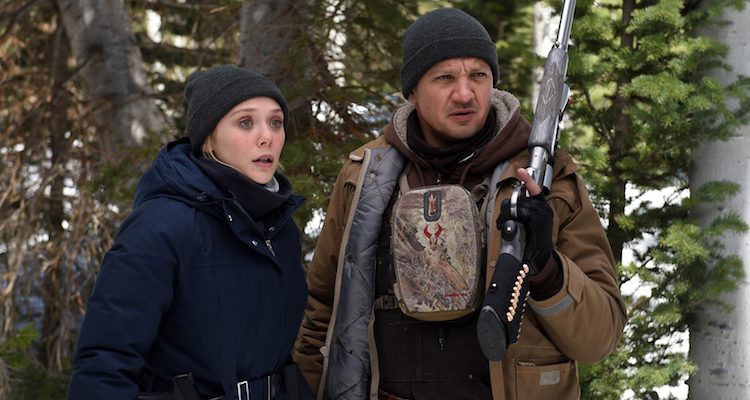
(To make matters worse, the Alzheimer’s patient is played by Christopher Lloyd. It’s the saddest, most humiliating role of his career, and he was in “Baby Geniuses.”)

“Going in Style” is a remake of a gentle, little-remembered 1979 film that starred George Burns, Art Carney, and Lee Strasburg. The new one has Michael Caine, Morgan Freeman, and Alan Arkin; was written by Theodore Melfi (who wrote and directed “Hidden Figures,” a film that is notable for not being terrible); and directed by Zach Braff — who, between this and his previous film, “Wish I Was Here,” has proven to be so unfamiliar with the basic operations of society and human interaction that you’d think he was an extra-terrestrial. Apart from the central premise, the only thing this version of “Going in Style” has in common with the original is that they both won’t be playing in theaters a month from now.

Joe (Caine), Willie (Freeman), and Al (Arkin) are retired Brooklyn factory workers on tight pensions. Joe is about to lose his house to a mean bank. Willie and Al live together, and Willie wishes he could afford to visit family more often. (He also needs a kidney transplant, to name one of a dozen or so plot threads that the film starts but isn’t interested in.) When their pension checks stop coming, the three visit the old factory to find out what’s up, conveniently doing so on the very day that the company gathers the employees — and former employees, whoever happens to be there — to tell them the factory is closing and all the pensions are gone. Moreover, the pensions are being “handled” by the very bank that has been tormenting Joe. Having witnessed a robbery at that same bank and noticing how easy it seemed to be, Joe proposes that he, Willie, and Al try it themselves.

Let me tell you some more about what kind of imbecilic poop for dummies this is. To practice for the robbery, the three oldsters shoplift from a grocery store. Mind you, they do not go to the register and demand the cash, which actually would be good practice for a bank robbery. No, they sneak around the store and stuff food in their clothes. Is this how they think banks work? That the money is just out on shelves for customers to take? They get caught shoplifting, of course, because they’re morons, and then there’s a painful slow-speed chase on a motorized scooter during which Willie deploys a bag of flour at the security guard in pursuit.

They finally get pointers from a real criminal (John Ortiz) who is referred to them by Joe’s lowlife ex-son-in-law (Peter Serafinowicz), who has not been a good father to Joe’s granddaughter (Joey King). But never mind, that’s another one of those underdeveloped extra threads. (See also: Al’s romance with Ann-Margret; Willie’s absent family; a scene where the three have to smoke pot but then don’t do anything funny; etc.)

The plot (which is not the same as in the 1979 film) reads like a dark comedy or a crime caper, genres where it’s palatable for likable characters to get away with major felonies while the FBI agent (Matt Dillon) who’s just doing his job is made out to be a schmuck. But Braff plays it as a sappy, straightforward comedy, the kind where everybody hugs at the end. And if you’re ever not sure how Braff wants you to feel, wait a second and Rob Simonsen’s simpering, obtrusive musical score will tell you.

I have one good thing to say about this clumsy, charmless, disposable turd: despite being a comedy about elderly men, it has no Viagra jokes. In fact, when Alan Arkin and Ann-Margret are about to hook up, and you think, “Uh-oh, here we go with the jokes about shortness of breath and creaking joints,” Braff cuts straight to the afterglow, sparing us whatever broad, embarrassing farce the sex scene might have been. Let’s be grateful for small mercies.

— Crooked Scoreboard

Smurfs: The Lost Village

0
Smurfs: The Lost Village
This "Avatar" sequel looks weird.

The lesson learned at the end of “Smurfs: The Lost Village” is that Smurfette can be anything she wants to be — a great message for girls! — while the boy Smurfs will continue to be defined strictly by their one dominant personality trait, which they can never change. That’s … not ideal. You know how some people (misogynists) think the true goal of feminism is for women to control men and have every advantage over them? They’ll love the ammunition this gives them. I can already picture the outraged thinkpieces at Breitbart and National Review.

Apart from the poorly thought-out gender messaging, the movie is still a flaming mediocrity that merits no consideration. There were two Smurf movies earlier this decade that had CGI Smurfs in a live-action world, but “The Lost Village” is a whole new reboot, entirely animated, with none of the same cast or creative personnel. (The director, Kelly Asbury, made “Shrek 2” and “Gnomeo & Juliet”; the writers, Stacey Harman and Pamela Ribon, have worked in TV.) It’s pitched very young, too, with no interest in appealing to adults or even smart children. In a previous era, it would have debuted on VHS and played in a loop in pediatricians’ waiting rooms.

We begin with Papa Smurf (Mandy Patinkin) acting as Narrator Smurf to remind us of Smurf nomenclature. All Smurfs are named according to their personality or profession, and only ever act in a manner befitting their names. Vanity Smurf, for example, can’t NOT be vain, even if he wanted to, which he presumably does not.

The exception is Smurfette (Demi Lovato), the lone female Smurf, who technically isn’t a Smurf at all but a golem made by Gargamel (Rainn Wilson), an evil wizard who lives in a castle and argues with his cat. (Yes, a golem: she was a lump of clay into which Gargamel breathed life.) Smurfette’s only distinction is that she’s a girl, and she’s begun to feel let down by this. Why must she be defined only by her gender? Doesn’t she deserve to be reduced to a single exaggerated character trait like everyone else?

It is in the midst of this existential crisis that Smurfette, Hefty (Joe Manganiello), Brainy (Danny Pudi), and Clumsy (Jack McBrayer) set out on an expedition to find a lost village of Smurfs that they have just learned exists, like, half a mile from their forest. Wouldn’t you know it, after a perilous journey and numerous near-misses with Gargamel, the four Smurfs find the lost village and discover it is populated entirely by female lady girl Smurfettes!! Instead of being named according to their personalities, they are named the way many human girls are, i.e., by randomly choosing a girly-sounding word. Their leader is Smurfwillow (Julia Roberts); they also have a Smurflily (Ariel Winter), Surfmelody (Meghan Trainor), Smurfblossom (Ellie Kemper), and Smurfstorm (Michelle Rodriguez). Except for Smurfstorm, who’s tough and suspicious, and Smurfblossom, who’s enthusiastic and welcoming, their personalities are indistinct.

The girl Smurfs are suspicious of these three boy Smurfs (and Papa Smurf, who shows up later; all the other familiar Smurfs are back in the village, absent for 90% of the film). Some wonder if Smurfette can be trusted, either, since she was created by Gargamel, and Smurfette herself fears she may be destined to support him. You may be assured that it all ends happily, with everyone learning that it doesn’t matter where you came from or what gender you are, you can be anything you want to be (unless your name stipulates something specific, in which case you have to be that). Young kids will like the movie well enough, but they’ll like it just well when it’s free on HBO in a year. Twelve bucks for this weak pablum? Smurf that.

Oh, that reminds me. The verbal tic that plagued Saturday-morning Smurfs in the ’80s, where they would replace some words with “smurf” and the other Smurfs just knew what they meant, is largely under control now. They only do it four or five times in the new movie. Whether this progress is due to medication or psychological reprogramming is not explained.

Movie BS with Bayer and Snider #353: ‘Going in Style,’ ‘Colossal,’ ‘Smurfs: The Lost Village’

0
Movie BS with Bayer and Snider #353: ‘Going in Style,’ ‘Colossal,’ ‘Smurfs: The Lost Village’

Rarely does one have the opportunity to hear men in their early 40s discuss the Smurfs.

0:00 – Hello, an iTunes review, discussion of beer ingredients, it’s a bad week for movies
5:20 – “Going in Style” review
16:20 – “Colossal” review
24:00 – “Smurfs: The Lost Village,” including more talk of Smurf lore than you need
32:25 – This week’s DVDs (“Rogue One,” “Paterson,” “Office Christmas Party,” “Youth in Oregon”)
38:50 – Recap, another sidetrack, and good day

REVIEWS:
Going in Style: D+ 4/10
Colossal: B- 6/10
Smurfs: The Lost Village: C- n/a

Download audio

Listen at MovieBS.com / Listen at iTunes

Gifted

0
Gifted

“Gifted” is a simple, pleasant drama that engages the emotions without manhandling them. It depicts a child-custody battle yet avoids cheap melodrama and doesn’t paint anyone as a villain. It has the glistening falseness of a Nicholas Sparks weepy that bears only passing resemblance to real life, but you can caught up in its family turmoil — resolved peaceably, you may be assured — without feeling insulted.

Chris Evans stars as hunky loafer Frank Adler, a damaged fellow living in Florida and caring for his 7-year-old niece, Mary (Mckenna Grace), whose math-genius mother committed suicide 6.5 years ago. Mary is a math prodigy too, bored and sassy when Uncle Frank sends her to public school for the first time. Everyone tells Frank that Mary should be at an academy for smart kids, but that’s the route Mary’s mother took, and it made her unhappy. Frank is convinced that his sister would want Mary to have a normal childhood.

The person who doesn’t want that is Frank’s mother, Evelyn (Lindsay Duncan). A former math whiz herself before she got married, Evelyn is a no-nonsense Brit who’s had no contact with her granddaughter until now, when she sweeps down from her hoity-toity Boston home to sneer at her son’s lower-class lifestyle (she’s been estranged from him, too) and paint him as an unfit guardian. Evelyn, though not unkind, doesn’t have much personal affection for Mary, but she is motivated by love — love for her lost daughter, who died before reaching her full potential.

Directed by Marc Webb (“500 Days of Summer”) from a screenplay by Tom Flynn, the story plays out satisfyingly and, believe it or not, not too predictably, with earnest performances all around (including from Jenny Slate as Mary’s schoolteacher and Frank’s potential love interest, and Octavia Spencer as his neighbor and landlady). No wheels are reinvented, no new ground is broken, but it’s a suitable example of sentimental filmmaking done right.

The Boss Baby

0
The Boss Baby
"Whose duty was it? It was his duty!"

“The Boss Baby,” starring Alec Baldwin as the voice of a suit-wearing infant sent to an unsuspecting family to fulfill a secret mission on behalf of BabyCorp — that’s the heaven-based company in charge of the world’s babies, which are treated like a separate species from other humans — sounds like a fictional bad movie in a Hollywood satire.

It gets more dire when you realize it’s a feature-length extrapolation of a plotless 225-word picture book (by Marla Frazee) that had only one simple, gentle joke: a new baby in the house is the “boss” of everyone, calling “meetings” in the middle of the night, making his or her “employees” work overtime, and so forth. From this they derived a whole movie?

But the movie is real, and it’s … good? Good enough, anyway? Written by Michael McCullers (“Baby Mama,” no relation) and directed by Tom McGrath (“Madagascar”), it expands the book’s cute central gag into a creative, unassuming take on fraternal bonding. Though the fictional world it creates crumbles under the slightest scrutiny, the film avoids being the type of dumb children’s movie that entertains tykes while annoying their parents.

Sometime in the recent, pre-digital past, we meet 7-year-old Tim (Miles Christopher Bakshi), the adult version of whom (Tobey Maguire) serves as narrator. Young Tim loves being an only child and is alarmed when his parents (Lisa Kudrow and Jimmy Kimmel) bring home a baby brother. (The fact that they don’t bother to give him a name should set Tim’s mind at ease.) The new kid wears a suit, having been identified in the pre-mortal realm as a Management baby, not a Family baby. The parents take the suit to be an amusing affectation over which they have no control, just as the baby’s arrival seems to have had nothing to do with them. You kind of just have to go with it.

Anyway, unbeknownst to Mom and Dad, the new baby has a cunning adult mind and is tasked with spying on them — they work for a pet conglomerate — to sabotage a new breed of puppy that would threaten babies’ share of the “adorable thing families bring home” market. Yes, it is a story about corporate espionage. Tim uncovers the baby’s secret identity and tries to expose him as an interloper, but he and the other neighborhood babies revert to goo-goo gah-gah when adults are around. (There are some funny bits with Boss Baby’s underlings being as self-aware as he is but not as dextrous.) The boys eventually work together on the mission and fall into brotherly love. Aw!

Much of the early part of the film rings comfortably true as we see the arrival of a new baby through the eyes of his imaginative older brother. Tim’s flights of fancy (his bedroom becomes a prison when he’s grounded) are good for some hearty laughs when we switch to the objective reality point of view, though it gets confusing when objective reality becomes more surreal than Tim’s imagination — like when he and the baby sneak to Las Vegas on a plane full of Elvis impersonators, for example.

But it’s pleasantly non-snarky for a DreamWorks ‘toon, doesn’t overdo the sappy stuff, either, and doesn’t weigh itself down with endless pop-culture references (the studio has been getting better about that lately). The humor is easygoing and inoffensive, aimed at kids but sharp enough not to seem mindless to adults. Everybody wins. Unless the film leads to questions about where babies actually come from. But that’s your problem, not mine.

Friday movie roundup – March 31

0
Friday movie roundup – March 31

Happy spring! Here are the reviews I’ve posted in the last few weeks, in case you missed any precious drops of wisdom.

“Beauty and the Beast” (PG) C [Crooked Scoreboard]
“The Belko Experiment” (R) D
“The Boss Baby” (PG) B
“CHIPS” (R) B-
“Ghost in the Shell” (PG-13) C+ [Crooked Scoreboard]
“Kong: Skull Island” (PG-13) B [Crooked Scoreboard]
“The Last Word” (R) D+
“Life” (R) B
“Power Rangers” (PG-13) C
“The Sense of an Ending” (PG-13) C+
“T2 Trainspotting” (R) B [Crooked Scoreboard]
“The Zookeeper’s Wife” (PG-13) C

The Zookeeper’s Wife

0
The Zookeeper’s Wife
"Tell me about the Georges, rabbit."

One silver lining to the current political situation is that at least in a few years we’ll have some new stories to tell about fighting Nazis. Without diminishing the importance of remembering the Holocaust, I respectfully submit that the films on that subject have become formulaic and uninspired, the somber Never Forget equivalents of Hallmark Channel movies.

“The Zookeeper’s Wife” is the latest well-intentioned but useless dramatization of a true story (adapted from Diane Ackerman’s book), a rote, glossy feel-bad-then-good account of a Polish couple, Jan and Antonina Zabinski, who used their empty Warsaw zoo to hide Jews right under the Nazis’ noses. Actually, as the title suggests, it’s more about Antonina (Jessica Chastain), who’s highly skilled in caring for the zoo’s animals but I guess isn’t officially a “zookeeper.” Whatever. In 1939 Poland, there are more pressing concerns than sexism.

The film begins in the summer of that year, with tension in the air but Hitler still inside his borders. It is firmly established that Antonina loves the creatures at her happy little zoo, and that the feeling is mutual. When an elephant has trouble delivering a calf, Antonina is there to save the day, impressing the visiting German zookeepers led by the nice-for-a-Nazi Lutz Heck (Daniel Bruhl). Later, when Warsaw is first attacked, she and Jan (Johan Heldenbergh) and their little boy, Ryszard (Timothy Radford), scramble to protect the surviving animals. Is this a new twist on the story? Brave civilians hiding animals from the Nazis?

Nope. Having spent every moment of the first part of the film establishing the Zabinskis’ devotion to their animals, director Niki Caro (“Whale Rider”) eliminates them entirely. The zoo is now empty, with Lutz Heck’s Nazis scientists using it to breed a master race of bison, or something. While pretending to collaborate with the Nazis, Antonina and Jan help Jews escape from the Warsaw ghetto and hide in the zoo’s basements and storerooms. Jan, though, is jealous of Antonina’s friendship with Lutz Heck, fearing she is attracted to him. Tension! Drama!

Meh. The performances are adequate. The screenplay, by Angela Workman (“Snow Flower and the Secret Fan”), conveys the events and emotions with perfunctory competence. To the extent that we get to know them (which isn’t much), the rescued Jews pull our heartstrings in a manner that satisfies the minimum requirements. But there is nothing about this story — or at least not in this telling of it — that compels interest to any greater degree than any other Holocaust story you’ve seen, and it’s quite a bit less emotionally impactful than many of them. A movie whose only point is to Never Forget might as well be a paragraph in a textbook.

Movie BS with Bayer and Snider #352: ‘Ghost in the Shell,’ ‘The Boss Baby,’ ‘Raw,’ ‘The Zookeeper’s Wife,’ ‘CHIPS’

0
Movie BS with Bayer and Snider #352: ‘Ghost in the Shell,’ ‘The Boss Baby,’ ‘Raw,’ ‘The Zookeeper’s Wife,’ ‘CHIPS’

We have this week’s movies, plus a little catch-up on last week’s. And don’t miss “Raw,” which is great and has been bothering us for several months.

0:00 – Hello, Jeff has a new beverage, an iTunes review from Argentina.
4:50 – “Ghost in the Shell” review (Snider only)
13:50 – “The Boss Baby” review
21:15 – “Raw” review
28:35 – “The Zookeeper’s Wife” review (Snider only)
33:20 – “CHIPS” review, and Eric says just a little about “Power Rangers” (it’s not good)
36:35 – DVDs this week: “Silence” (we’re giving a copy away to one of our Agents), “Patriots Day,” “A Monster Calls,” “Why Him?,” and “20th Century Women”
40:20 – Recap and good day

REVIEWS:
Ghost in the Shell: C+ n/a
The Boss Baby: B 7/10
Raw: B+ 10/10 (BS-approved!)
The Zookeeper’s Wife: C n/a
CHIPS: B- 7/10
Power Rangers: C n/a

Download audio

Listen at MovieBS.com / Listen at iTunes

Ghost in the Shell

0
Ghost in the Shell
"See? I look just like her!"

Futuristic cyber-thriller “Ghost in the Shell” is loaded with advanced technology, but it’s in the service of a disappointingly basic plot with few surprises. Add to that the bafflingly tone-deaf treatment of racial and cultural issues and you’ve really got a “Why’d they bother with this?” situation on your hands.

In a heavily CGI’d future Japan with a diverse population (“diverse” meaning both Japanese and European), people routinely enhance their physical or mental abilities with cybernetic add-ons. Plug a dongle into the back of your neck and boom, you’re fluent in Russian. Or robot eyes with X-ray vision. Just about everyone is part-cyber now, the downside being that they’re susceptible to hacking, like a computer, the upside being that, at long last, white men can jump.

Our heroine is a super-soldier called the Major (Scarlett Johansson), the first case of replacing every part of the body except the brain. Her brain — and thus her soul, her self — was supposedly rescued from a dying refugee, though Major doesn’t remember her pre-robot life, so wink wink. Cared for by compassionate Hanka Robotics scientist Dr. Ouelet (Juliette Binoche), who assures her she’s still human, and supervised by a growling government functionary (Kitano Takeshi), Major leads the cyber-crimes team that investigates when a terrorist named Kuze (Michael Pitt) starts hacking civilians and killing important Hanka scientists.

The film, directed by Rupert Sanders (“Snow White and the Huntsman”), becomes a spiffy-looking but dull police procedural as Major and her lunkhead partner, Batou (Pilou Asbaek), pursue leads and track Kuze. Since it’s The Future, this routine police work has some twists — cops can communicate telepathically while sneaking around, and Major can sometimes turn invisible (this is not explained, nor do I accept invisibility as a standard robot feature) — but make no mistake, it is routine. Questions about humanity and the soul and the essence of life are vaguely suggested but never really dealt with; the same goes for the ethical dilemmas presented by mixing technology with biology.

I’m told that Masamune Shirow’s comic-book series and the subsequent animated TV show based on it explored these issues more thoughtfully. The film, credited to Jamie Moss (Street Kings) and William Wheeler (Queen of Katwe) after years of rewrites, is content to throw a lot of tech jargon and cool gadgets at the screen and call it a day. As the investigation continues, Major starts asking questions about her own past and Hanka Robotics’ history of cyborg experimentation, leading to revelations and discoveries that will shock her but not you. Still, as with most police procedurals, there’s a certain pleasure in seeing the ritual play out.

I’m more fascinated by how the film addresses the cultural difficulty of mostly white Westerners adapting a very Japanese, very Eastern-influenced story after casting a very non-Japanese actress in the lead role. The way the film addresses it is to ignore it, but it can’t help coming up. Major’s boss only speaks Japanese, but she replies to him in English, even though robots can speak any language they want to. Does she just … not want to? Why wouldn’t a cyborg built in Japan have Japanese as its default language anyway? And why does a Japanese robotics firm put the brains of Japanese people into caucasian-looking robots, and then also give the robots black hair and eyebrows, as if trying to pass them off as Japanese? When it comes to these matters, you’re better off following the filmmakers’ example and just not thinking about it.

— Crooked Scoreboard

Life

0
Life
Jake, that's not a microscope.

Scientists talk of distant planets that could almost, but not quite, sustain life, lacking some small but essential condition. “Life” (the movie, not the cereal) is a bit like that, an effective sci-fi thriller that would be truly outstanding if it had just a little something more — stronger characters, a standout performance, a cleverer plot — something.

Still, as is, it has a lot to offer, a variation on the “Alien” scenario that isn’t just a ripoff of it. The setting is the International Space Station, where an elite crew of scientists led by Russian commander Katerina Golovkina (Olga Dihovichnaya) have found a single-celled organism in a sample of dirt from Mars. It’s the first concrete proof of extra-terrestrial life, and everyone on Earth is jazzed. Schoolchildren vote to name the organism Calvin.

Hugh Derry (Ariyon Bakare), a British biologist, is in charge of studying the creature in a quarantined lab on the ship. Miranda North (Rebecca Ferguson), representing the Centers for Disease Control, is onboard to make sure the thing neither has nor is space AIDS. Pilot Rory Adams (Ryan Reynolds) is a hotshot and a joker who takes bold risks in the early moments of the film to ensure the safe return of the Mars capsule. Dr. David Jordan (Jake Gyllenhaal), the medical officer, incidentally about to set a new record for consecutive days in orbit, is a thoughtful physician who cares more about people than protocols. The engineer, Sho Murakami (Hiroyuki Sanada), has a wife and newborn baby waiting for him back in Japan.

It will not surprise you to learn that Calvin doesn’t remain single-celled for long, or that not all of the crew members will survive to the end of the movie. Calvin grows quickly into a translucent, gelatinous, tentacled thing the size of your hand, and then bigger still, exhibiting signs of intelligence and problem-solving as it does. It feeds on a lab rat (absorbs it, really) with alarming ferocity, and commits worse crimes thereafter as the crew scrambles to contain it while repairing damage to the ship. The situation leads to several superbly creepy moments, near-misses, and disasters, which director Daniel Espinosa (“Safe House”) executes with workmanlike skill, energetically assisted by Jon Ekstrand’s blaring musical score (“BRAAAAAMMP! BRAAAAAAMP!”). Espinosa takes us on long, zero-gravity tracking shots through the space station, providing a fly-on-the-wall experience. We’ve had this meal before, sure, but it hits the spot.

It’s during a lull in the action midway through that the film that its mild deficiencies become apparent. The screenplay, by “Deadpool” and “Zombieland” scribes Rhett Reese and Paul Wernick, isn’t as humorous or inventive as those credits would lead you to expect, with dialogue that’s merely functional, seldom lively. None of the characters distinguish themselves; though all are given personal, humanizing moments, none of those moments pay off in any meaningful way. The plot isn’t predictable, exactly, but it feels like it needs one more twist or turn or complication to really connect — though I’ll say this much for it: it ends well. With just a bit more ingenuity and horror in the 100 minutes leading up to it, it might have been a new classic instead of a respectable but slight popcorn flick.

Power Rangers

0
Power Rangers
Sick album cover, bros.

“Power Rangers” is the “Batman Begins” of its franchise, the gritty reboot that tells our heroes’ improbably lengthy and self-serious origin story and introduces them to a whole new generation (by which I mean the same generation as before, only 20 years older now).

Mind you, “gritty” is a relative term. The new film does have an intermittent “Friday Night Lights” vibe and a campfire scene of Power Rangers baring their souls to one another. (“What does this mean, when this is all over? Are we Power Rangers, or are we friends?”) Its 124-minute runtime and emphasis on brooding character backstories over actual heroics are evidence that it wants to be a respectable, grown-up kind of superhero movie, not just for kids.

And it certainly is more real-world than the cheap ’90s TV show it’s based on — but what isn’t? The film’s uncomplicated plot, undemanding stunt work, unconvincing special effects, and unpolished acting are reminders of its cheesy, simple-minded roots. Try though it might, it’s more “Teenage Mutant Ninja Turtles” (any of them) than “The Avengers.”

We begin at the end of a battle 65 million years ago, in the Earth’s Cenozoic Era. The incongruous melding of cool fantasy and baffling dorkiness that has always been this property’s Achilles heel comes to light as two latex-clad warriors fight ferociously while speaking a language whose subtitles are in the font of a fantasy computer game. One of the grapplers is named Zordon, which puts him right at home in a story like this. Zordon’s opponent is named … Rita. Rita Repulsa, we later learn.

But never mind them for now. In the present, in the all-American (actually Canadian) town of Angel Grove, we meet five high-school students representing your basic “Breakfast Club” types: Jason (Dacre Montgomery), the star quarterback who blew his chances with adolescent mischief; Kimberly (Naomi Scott), a newly disgraced cheerleader; Billy (RJ Cyler), an autistic science whiz; Zack (Ludi Lin), an unpredictable Asian-American wild man; and Trini (Becky G.), the lone wolf rebel.

These five, who attend the same school but don’t really know each other, become heroes primarily thanks to coincidence. One day they all happen to be in a canyon near their neighborhood, separately, when they all stumble upon ancient coins that give them super strength. (I am omitting some extraneous, nonsensical details, like how the coins aren’t activated until after the five are in a van that gets hit by a train, whereupon they all wake up, unharmed, in their beds at home, and the train thing is never explained. Or the fact that they only find the coins because Billy, acting on some vaguely referenced information from his departed father, blew up part of the mountain.) When they return to the canyon to test out their powers, the five accidentally fall into a submerged cavern where a friendly robot named Alpha 5 (voice of Bill Hader) introduces them to Zordon (Bryan Cranston), whose essence has been uploaded into the computer system of a spaceship that’s been hidden here for 65 million years. Zordon tells these five randos that since they found the coins, they must be the Power Rangers, whether they like it or not.

They mostly do not. Boy, you’ve never seen such a group of ungrateful teens as these newly invincible snowflakes who love having great power but grumpily refuse to accept great responsibility. Be part of a TEAM? With these STRANGERS? Harmonize our spirits so we can “morph” and gain EVEN GREATER POWER? Ugh, forget it. We’ll just keep the magic coins that give us super strength, thank you.

And so there is a lot of dickering and dissembling, ham-fistedly written (by John Gatins) and broadly, earnestly acted as the five half-heartedly try to unite by training with Alpha 5. Their ultimate purpose is to stop the evil Rita Repulsa (Elizabeth Banks, working for a living), now reanimated after her desiccated corpse was recently, coincidentally discovered by a fishing boat — indeed, by Jason’s father (David Denham), because why pay an additional actor for a small role when you can just have someone already on the set say the lines? Rita intends to build a monster out of gold and have that monster, whose name will be Goldar (obviously), retrieve some magic crystal that will destroy the Earth, etc. You know the routine. The crystal is currently buried under a Krispy Kreme, mentioned by name 475,000 times.

It may interest you to know that the film is 90 minutes old — 75% over — before the team finally morphs into their costumes and does the whole “Power Rangers” thing. These origin-story reboots do sometimes take a while to arrive, but we don’t mind if the time is spent developing interesting characters and building a world in which future stories can take place. That is not that case here. These 90 minutes are not a tight 90 minutes, and these teenagers, though likable enough, are not particularly compelling, their personalities somehow still unformed despite the film having spent so much time on them.

When it comes to world-building, the film chickens out on being a big-boy movie and does what lame kids’ movies do: let the outlandish or illogical details stand and hope the audience isn’t discerning enough to care. The director, Dean Israelite (“Project Almanac”), shows occasional stylistic flourishes, suggesting a desire for legitimacy. But the wide, flat dopiness of the screenplay prevents the movie from rising above its tween-centric class.

CHIPS

0
CHIPS

There’s a really funny R-rated buddy-cop movie starring Michael Peña as a reckless law-enforcement officer. It’s called “War on Everyone,” and it co-stars Alexander Skarsgard. You should see it!

There’s also “CHIPS,” a significantly less funny though still watchable buddy-cop movie starring Peña and Dax Shepard as motorcycle-riding California Highway Patrol officers. It has the same title, punctuation notwithstanding, as “CHiPs,” a 1977-83 TV series, but I assume that’s a coincidence, as they have almost nothing else in common.

In this version, Shepard — who also wrote and directed — plays Jon Baker, a banged-up former motorcycle racer who now chews pain pills like candy and has just become a CHP officer in sunny Los Angeles. He’s partnered with Frank “Ponch” Poncherello (Peña), a federal agent working undercover as a CHiP to investigate a series of armored-car robberies that might have been perpetrated by crooked L.A. cops. (Not to spoil who it might be, but Vincent D’Onofrio is also in the cast.)

Jon’s an eager rookie who wants to do everything by the book and earn back the respect of his shrewish wife, Karen (Kristen Bell, Shepard’s real-life spouse). He doesn’t know that Ponch, a loose cannon, is a Fed with a secret agenda who’s interested only in pursuing his investigation and not, for example, in doing everyday CHP work. Jon is touchy-feely and enlightened (always “three beers too intimate,” Ponch calls him); Ponch is insensitive, grossed-out by male affection or physical closeness. The movie keeps coming back to this subject, one of Shepard’s personal fascinations. Is it “homophobic” for Ponch to refuse to hug a man clad only in underwear? How much skin-on-skin contact is acceptable before it becomes “gay,” and why is that a problem? The returns on this topic diminish considerably before Shepard is finished with it, I can tell you that.

Anyway, things shift about midway through the film, when Ponch finally fills Jon in on the federal investigation and they start working together on it. It’s a good development that should have come sooner: there is much more fun to be had in opposite-but-partnered characters having the same goal than there is in an odd couple working on different agendas. These versions of Ponch and Jon are cluttered with extraneous quirky personality traits — besides what I’ve already mentioned, Jon is overly sensitive to smells, and Ponch is a sex addict and compulsive masturbator — but this gives the film a pleasant unpredictability. It follows the formula of the buddy-cop action movie, but it’s peppered with detours and Seinfeldian conversational tangents that vary widely in quality but at least keep things from feeling too familiar.

Michael Peña’s casual disregard for social norms is the movie’s most consistent pleasure, followed closely by a running gag about his tense relationship with his former partner (Adam Brody). Shepard’s obsession with cars and motorcycles pays off in the action scenes, an example of a filmmaker’s personal interests making him a good fit for the material. At the other end of that spectrum is a glaringly out-of-place gag about paparazzi, one of several purely self-indulgent touches that make you think, C’mon, Dax. That’s not what grown-ups do when they make real movies for big studios. “CHIPS” is uneven in that way, veering from scathing humor to patience-trying nonsense and back again, but it winds up just barely on this side of the thin blue line between good and bad.

Movie BS with Bayer and Snider #351: ‘T2 Trainspotting,’ ‘Life,’ ‘The Last Word’

0
Movie BS with Bayer and Snider #351: ‘T2 Trainspotting,’ ‘Life,’ ‘The Last Word’

“Life” (which is a pretty solid alien thriller) screened at the last minute and I haven’t written my review yet, so the podcast is your only option for the time being. The rest of the show is also valuable, if you value podcasts about movies.

0:00 – Hello, Dogcat brings up a good question, Jeff tells of showing Dylan “The Empire Strikes Back”
9:10 – “T2 Trainspotting” review
23:15 – All three new movies this week (“Life,” “Power Rangers,” “CHIPS”) all screened at the same time, at the last minute, because their studios are super proud of them
24:35 – “Life” review
35:05 – “The Last Word” review (Snider only)
39:50 – This week’s DVDs: “Assassin’s Creed,” “Live By Night,” “Miss Sloane,” and “Sing” (which Bayer is not a fan of)
45:00 – Recap and good day

REVIEWS:
T2 Trainspotting: B 6/10
Life: B 8/10
The Last Word: D+ n/a

Download audio

Listen at MovieBS.com / Listen at iTunes

Beauty and the Beast (2017)

0
Beauty and the Beast (2017)
Crazy old Maurice barely looks crazy or old!

The only way Disney’s live-action remake of its own “Beauty and the Beast” works is if you don’t compare it to the 1991 animated masterpiece. This is hard to do, though, because 1) you have seen the 1991 animated masterpiece, possibly many times, and 2) the remake keeps chasing it, going so far as to duplicate specific shots and sight gags in an effort to trigger fond memories. Those memories are indeed fond, but the new film pales in comparison to them. It never passes the “So why am I watching this version?” test.

It’s only a remake of the 1991 cartoon, by the way, with those seven songs — “Be Our Guest,” “Gaston,” etc. — and none of the ones that were added when the film was turned into a Broadway musical. (It doesn’t even use the “Human Again” sequence from the film’s 2002 re-release.) Instead, it has a few uninspired new songs written by Alan Menken and Tim Rice just for the movie (and thus potential Best Song Academy Award consideration). Directed by Bill Condon (“Dreamgirls”) from a screenplay by Stephen Chbosky (“The Perks of Being a Wallflower”) and Disney stalwart Evan Spiliotopoulos (“Pooh’s Heffalump Movie”), it’s 129 minutes long and has about the same amount of singing as the 85-minute original did. You know what that means: more talking!

The plot is essentially unchanged save for minor variations and some expanded backstories. Belle (Emma Watson), the only headstrong, literate girl in her provincial French village, becomes prisoner to a buffalo-like Beast (Dan Stevens), actually a handsome prince who was cursed with beastliness as punishment for his selfishness. He dwells in an enchanted castle with his servants, who were transformed into housewares due to guilt by association, I guess. These include Lumiere the candlestick (Ewan McGregor), Cogsworth the clock (Ian McKellen), and Mrs. Potts the teapot (Emma Thompson), plus a narcoleptic, opera-singing wardrobe (Audra McDonald) and her harpsichord husband (Stanley Tucci). If the Beast doesn’t get someone to fall in love with him before the last petal on the arbitrary magic rose arbitrarily falls, he and his employees (slaves?) will be stuck like this forever.

Meanwhile, an over-compensating violence enthusiast named Gaston (Luke Evans) wants to marry Belle whether she likes it or not (she does not). Assisted by his faithful, pear-shaped sidekick LeFou (Josh Gad) — whose romantic crush on Gaston is more obvious than before but still unspoken — Gaston uses Belle’s dotty father, Maurice (Kevin Kline), as leverage. Maurice is a vaguely defined artist or tinkerer now instead of an inventor, and there’s a lengthy tangent giving unnecessary details about his late wife, Belle’s mother. On the other hand, new information about the Beast’s pre-Beast life effectively fleshes out his role in the story, and it’s good to finally have an explanation for, among other things, why the villagers never noticed the giant Beast castle a few miles away.

The enchanted objects, including much of the Beast, are mostly CGI creations — animated, in other words — but Condon and company chose to make everything adhere to the laws of physics that would apply to real objects. They sing and dance, but they only bend and stretch in natural ways. And so the film has this manufactured, weighed-down feeling to it, a magical story hampered by gravity and reality: it turns out talking candlesticks aren’t as wonderful without that rubbery, cartoonish energy. The songs often have repetitive, vamping measures added between lyrics to accommodate the blocking (not an issue in a cartoon, where characters can move from one side of the room to the other instantaneously). Some visual jokes fizzle for similar reasons. For example, when the Beast is encouraged to flash a smile, the result isn’t a hilariously exaggerated grin but a mild one, confined by the limits of what a real Beast’s mouth and teeth can do.

That being said, the cast is almost uniformly excellent. If there’s any element of this remake that surpasses the original, it would be found among the performances. Emma Watson and Dan Stevens have chemistry together even under the makeup and CGI, and it’s nice to see (and hear a bit of singing from) Kevin Kline as crazy old Maurice. Luke Evans makes a fine preening Gaston, though Josh Gad’s campy LeFou veers wildly between funny and irritating, saddled with anachronistic dialogue like “I used to be on Gaston’s side, but we are so not in a good place right now.” And if someone had to replace Angela Lansbury as the kindly, title-song-singing Mrs. Potts, you couldn’t do better than Emma Thompson.

But the whole thing is just so labored, so effortful. It does what it tries to do, technically, but you feel all the work. Most of its charms are borrowed; rarely does it create charm of its own. As delightful as it sounds (and often is) to have, say, Ewan McGregor and Ian McKellen play Lumiere and Cogsworth, in the end it’s like everything else about the movie: not as enchanting as you want it to be.

— Crooked Scoreboard

Movie BS with Bayer and Snider #350: ‘Beauty and the Beast,’ ‘The Sense of an Ending,’ ‘Personal Shopper’

0
Movie BS with Bayer and Snider #350: ‘Beauty and the Beast,’ ‘The Sense of an Ending,’ ‘Personal Shopper’

We disagree on “Beauty and the Beast,” which is always good for a laugh. We also talk about new goals and rewards for our Agents (formerly known as patrons) and give away a Blu-ray of “Fences.”

0:00 – Hello, we’re not at SXSW this year
5:45 – iTunes review
8:20 – “Beauty and the Beast” review
24:50 – There’s also a movie called “The Belko Experiment,” we guess?
26:00 – “The Sense of an Ending” review
33:40 – “Personal Shopper” review
42:10 – DVDs this week: “Collateral Beauty,” “Elle,” “Passengers,” and “Fences” — and patrons can win a copy of “Fences”!
47:40 – Patreon updates: patrons are now called Agents and get free downloads of all past and future movie commentaries we record; and once we meet our goal we’ll start doing a second weekly show!
51:35 – Introducing the Movie BS Cafepress store, which has golf balls and thongs!
55:30 – Hey, What’d You Watch? (“Trainspotting,” “Porky’s”)
59:15 – Recap and good day

REVIEWS:
Beauty and the Beast: C 8/10
The Sense of an Ending: C+ 6/10
Personal Shopper: C+ 6/10

Download audio

Listen at MovieBS.com / Listen at iTunes

The Belko Experiment

0
The Belko Experiment
This year's performance reviews were rough.

As a movie, “The Belko Experiment” prompts the same questions that the experiment it depicts would. What was the purpose here? What were you trying to prove? Do you maybe just enjoy torturing and killing people and wanted to cover your bloodlust with a thin veneer of social science?

In this bleakly pointless film, directed by Greg McLean (“Wolf Creek,” “The Darkness”), 80 American employees of nondescript international corporation Belko Industries arrive at their Bogota, Colombia, headquarters one morning to find things in a state of agitation. There are new, unfamiliar security guards in addition to friendly, rotund Evan (James Earl) at the front desk. The non-American employees — the locals — have been sent home. We see all of this through the eyes of a young woman named Dany (Melodie Diaz), her first day on the job. We assume Dany is the main character, but it turns out she is insignificant and the movie only followed her for a few minutes because it needed an excuse to have the head of H.R. dump some exposition on us.

Anyway, wouldn’t you know it, first day on the job and already Dani’s bosses are playing murder games! Without warning, the several-story building goes into lockdown and an unseen voice (Gregg Henry) starts ordering the employees to kill each other. Choose two of you among yourselves and murder them, or else we’ll murder four of you, that sort of thing. It is established that the captors have audio and video surveillance throughout the building, and that they have the means of executing hostages remotely. (Employment tip: even in a down economy, do not take a job that requires the implantation of a tracking chip.)

Good guy Mike (John Gallagher Jr.) — the actual main character — takes a firm no-murder-no-matter-what stance. Barry (Tony Goldwyn), the craven C.O.O., is more pragmatic, saying maybe they should go ahead and take a few lives if it will save more. Things escalate quickly and nastily as preexisting intra-office conflicts come to a head. For example, Mike’s girlfriend, Leandra (Adria Arjona), is always being leered at by fellow employee Wendell (John C. McGinley), who can’t take a hint and is emboldened by the current circumstances.

The screenplay is by James Gunn, written before he found superstardom as writer-director of “Guardians of the Galaxy.” But it’s devoid of his usual wit, as also found in “Slither” and even the questionable “Super,” and director McLean misses every opportunity for dark comedy, social commentary, or psychological horror. Is this about haves vs. have-nots? America’s corporate presence in foreign countries? Nah, nothing like that. Does it explore the psychological effects of being trapped in a building and told to kill your co-workers, or examine the intricacies of moral dilemmas? Nope. (A few people crack up under the pressure, but not in realistic ways.)

No, Gunn and McLean are only interested in tormenting 80 nameless strangers in the service of a story that hints at a larger mythology but fails to develop it. With no subtext or style to justify it, the film is as cruelly nihilistic as its fictional experimenters are.

T2 Trainspotting

0
T2 Trainspotting
Not one of these idiots is looking anywhere close to where a train might be.

“Trainspotting,” a cult favorite since the moment it arrived 21 years ago, was Danny Boyle’s second movie and most of the world’s first exposure to Ewan McGregor. Boyle has directed nine more films since then, and McGregor has exposed himself countless times, but fans keep jonesin’ for another hit of that sweet, sweet ‘spotting.

The largely satisfying if over-stylized sequel, nonsensically called “T2 Trainspotting,” is a loose adaptation of Irvine Welsh’s followup novel, “Porno,” which caught up with our quartet of Edinburgh junkies 10 years later. Circumstances require Boyle’s movie (again adapted by screenwriter John Hodge) to increase the gap to 20 years, but the extra decade gives it more weight. These men are in their mid-40s now, middle-aged, either more introspective than before or more cemented in their non-introspection. By this age, the chickens have come home to roost.

Mark Renton (McGregor) is drug-free (we meet him on a treadmill) but not without health problems. Simple-minded Spud (Ewen Bremner) is despondent over his ongoing struggle with heroin and the impact it’s had on his girlfriend (Shirley Henderson) and son. Sick Boy (Jonny Lee Miller), now going by Simon, has graduated from heroin to cocaine and makes a living blackmailing men with surreptitiously recorded tapes of them having kinky sex with his Bulgarian girlfriend, Veronika (Anjela Nedyalkova). The psychopathic Frank Begbie (Robert Carlyle) is in prison, where he belongs, but soon gets free and tries to reconcile with his wife (Pauline Turner) and teenage son (Scot Greenan), who wants nothing to do with his father’s legacy.

You will recall that when we last saw these fellows, Mark had stolen money from Simon and Begbie, secretly paid Spud his share, and fled the country. His return to Edinburgh, to his childhood bedroom with the train wallpaper, is bound to cause some ripples. Simon, whose goal is to open a brothel with Veronika as madame, fights with Mark initially, then cools down but secretly nurses his grudge. The two pal around again as in old days, pulling little jobs to come up with cash — not to score skag this time, but to get started on converting an old pub into that brothel. There’s a delightful scene where they distract a beer hall full of Orange Order Protestants by improvising a song about the 1690 Battle of the Boyne.

Begbie is another matter, and the other three avoid him as he tries to resume his life of crime. (His eventual run-in with Mark makes for another terrific moment.) As the underlying tensions among the four percolate, Boyle shows us their efforts to atone for the past, snippets of footage from the first movie popping up frequently in their memories. Spud, who’s got a touch of the poet in him, starts writing stories about the old days. At least two songs that were prominently featured on the original “Trainspotting” soundtrack appear again here as part of the musical score. There are other nods, too (including an updated “Choose life” speech), but Boyle isn’t wallowing in nostalgia for its own sake. These memories, even the “happy” ones, take on a mournful quality as the four men look back on the wreckage of their half-wasted lives, seeing shadows (in one case literally) of what they’ve lost. If the first movie was about tragically reckless youth, the sequel is about the poignance of adulthood.

Which is why it’s sadder than its predecessor and, purely on the basis of entertainment value, not as dynamic. But the (relative) wisdom of middle age makes “T2” a richer character study, the tragicomic junkies evolving into full-fledged human beings. McGregor’s wide-grinned optimist, Bremner’s deceptively dim sadsack, Miller’s coked-out paranoiac, and even Carlyle’s psychotic nutcase feel more authentic now than they did then.

— Crooked Scoreboard

Movie BS with Bayer and Snider #349: ‘Kong: Skull Island’

0
Movie BS with Bayer and Snider #349: ‘Kong: Skull Island’

“Kong: Skull Island” is our only new film this week, so the show’s shorter than usual. It’s the normal width, though. 

0:00 – Hello; Jeff keeps showing movies to his kid; Eric had to steer a 10-year-old away from “Kong: Skull Island”
5:40 – “Kong: Skull Island” review
18:30 – Directors getting big movies after making very small movies
21:10 – No other new movies this weekend, but “Jackie,” “Moana,” and “A Brand New Testament” are out on DVD; Jeff has ideas about renting and buying movies from iTunes
27:20 – Recap and good day

REVIEWS:
Kong: Skull Island: B 6/10

Download audio

Listen at MovieBS.com / Listen at iTunes