Todd Solondz is exploring mankind’s ugliness again, only this time I’m not sure why.
I got it with “Welcome to the Dollhouse,” “Happiness” and “Storytelling.” Those movies, despite focusing on such unpleasant topics as pedophilia and rape, were — and I hesitate to use this word — entertaining. Solondz is a provocateur, but he’s usually a funny one, wringing shocked laughter from an audience too stunned to fight back.
But his new film, “Palindromes,” isn’t especially funny, nor is it even outrageously shocking. The world has changed since 1995, when Solondz made “Dollhouse.” More than ever, things like “South Park” are making us realize that ANYTHING can be used for laughs. A story about a 13-year-old girl who desperately wants to have a baby barely raises an eyebrow in 2005.
The girl is named Aviva, and she is a cousin of Dawn Wiener, the protagonist of “Welcome to the Dollhouse.” Dawn has committed suicide at the outset of the current film, and Aviva expresses fears that she will turn out like her — obese, drugged-out, and pregnant. Her mother (Ellen Barken) allays her fears, telling her she’ll never be like Dawn because she and Aviva’s father love her, which Dawn’s parents didn’t. Fair enough.
While visiting family friends, Aviva clumsily, childishly seduces their young teenage son Judah (Robert Agri) and gets pregnant. Her parents enforce an abortion, however, and before long Aviva has run away, looking for more opportunities to get pregnant.
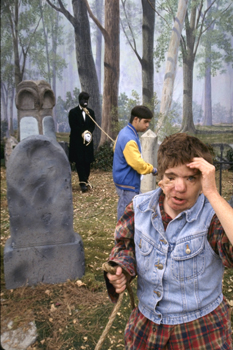
In her part-Dickens, part-Twain travels from New Jersey to the Midwest, Aviva winds up at the home of Mama Sunshine (Debra Monk), a sort of halfway house for misfit children: an albino, a blind girl, an epileptic, one with Down syndrome, and so forth. Mama Sunshine and her husband (Walter Bobbie) are evangelical Christians, and the kids all perform in a Christian rock band, loving each and every moment of it. Aviva feels their love but doesn’t belong in such a place.
I have not told you who plays Aviva, and this is because she is played by eight different actresses, a different one for each segment of the film. She is black twice, obese once, and Jennifer Jason Leigh once. Most of these actresses were clearly chosen for their physical characteristics rather than their acting ability; the Aviva during the Mama Sunshine segment is excruciatingly dull, and if the child actress who plays her in the first scene is any good normally, she certainly does not have the chops to handle Solondz’s mouthy, erudite language.
The film’s typically pessimistic message is stated by Aviva’s cousin Mark (Matthew Feber), an alleged pedophile. “People always end up the way they started,” he says. “They think they change, but they don’t.”
Well, that’s awfully charming, Solondz, but what’s your point? So much of “Palindromes” isn’t funny — not because it’s trying and failing, but because it isn’t trying. It seems to have other things on its mind besides comedy, which means Solondz has overlooked what made his other films work. It wasn’t their outrageous ideas; those were merely a part of it. It’s because they were entertaining. “Palindromes” is mildly interesting, but it examines humanity’s hypocrisy and stupidity in not nearly so amusing a fashion as Solondz has done before.
In 1999, I published “Snide Remarks II: Electric Boogaloo,” a compilation of 20 columns that had been published over the previous two years in The Daily Universe, BYU’s student newspaper and birthplace of “Snide Remarks.”
The book sold well at the cover price of $7, and continues to sell in trickles, even though many years have passed since its initial printing.
But now I am tired of the book.
There are 255 copies of it, including a cache I’d forgotten about that I have just discovered, currently occupying valuable space in my apartment. I want them gone. I want them out of here. And I want them out of here NOW.
So from now until they are gone, all copies of this book are selling for $5 instead of $7, and there are NO SHIPPING AND HANDLING CHARGES!
That’s right, $5 gets you the book, autographed by me and mailed to your home, dorm or cellblock. Give me a sawbuck or a personal check, or send me $5 through Paypal, and the book is yours.
Only 255 left — too many to be sitting in boxes in my closet, but too few for you to put off buying them. Because once they are gone, they are GONE, forever, no more printings. The same thing happened with Volume 1 last year, and woeful is the weeping of the people who procrastinated buying a copy.
The easiest method: Go to Paypal and send $5 to Eric@EricDSnider.com. Be sure to include your mailing address, and put “BOOK” somewhere so I know what you’re buying.
You can also mail $5 to:
Eric D. Snider
[redacted for historical purposes]
Salt Lake City, UT 84101
Thank you, and happy buying!
Sincerely,
Eric
P.S. For details on what the book contains, visit this page.
Yo, dawgs, it’s time for another edizzle of “Ask Eric Stuff,” the totally crunk feature where people ask Eric stuff and he answers them, because that’s how he rolls. If you want to ask questions, you can do it here, at this magic Web site. Now crack open a 40 and let’s do this up proper, aight?
Dear Eric: My roommate always leaves the dish sponge in the sink so it gets all gross and stinky. How can I get her to stop? — Wishing for Clean Dishes Dear Dish Wish: While she is asleep, anesthetize her with a powerful sedative. Then, make an incision in her belly and put the filthy sponge there. Then sew her up. When she develops a deadly infection from the foreign object lodged in her gut, she’ll think twice about leaving the sponge in the sink!
Dear Eric: Would you ever consider a mohawk? — Hairdresser from Hell Dear Hairy: Sure. I’ve dated an Asian, a Mexican and an African-American, so why not a Mohawk?
Dear Eric: Why doesn’t anyone ever e-mail me back? — Lonesome in Vegas
Dear Eric: Would you rather die in a tsunami, in a car accident, or of starvation? — Morbidly Curious Dear Morb: I want all three simultaneously.
Dear Eric: What is your favorite article of clothing? — Loves Her Shoes Dear Love: Your underpants.
Dear Eric: I have a fear of dating. When someone is interested, I run. And when I find someone interesting, it’s usually someone safe. How can an individual get over this kind of fear? — Scared of Dying Alone Dear Scaredy: The best way to overcome any fear is to face it head-on. So the next time you meet someone who is interested in you, marry that person.
Dear Eric: What’s the best way to be a good dad? — Newbie Dear Newb: Always get the child support payment to your baby mama on time, and let her know when visiting days are.
Dear Eric: Why do people use cell phones in the library when there are signs telling patrons to turn them off before they come in? — Longing for Silence Dear Longy: What makes you think people who go to a library can read? Oh, right. Hmm. I don’t know, then.
Dear Eric: I had to take my grandmother to the vet this morning where her beloved “fella” had to be put to sleep. She’s moping around and crying as if she had just lost her own child. I don’t know what to do. It’s just a cat! What can I tell her to comfort her at a time like this? — Lacks Kompassion in Kitty Krises Dear KKK: You should be comforting your grandmother during this difficult time. Assure her that you will weep just as bitterly when you finally have her put down.
Dear Eric: Why does everyone automatically assume that because I don’t say much at times (being somewhat reserved), I must be rude and arrogant? — Irritated in Indiana Dear Snob: I don’t know, jerk. Try being less of a jerk and see if people are nicer to you.
Dear Eric: If you could live anywhere in the world where would it be? – Globetrotter Dear Trots: In a Florida hospice. There’s an all-you-can-eat feeding tube buffet, plus all the fame and celebrity you can handle! (P.S. I want pizza in my tube.)
Dear Eric: Whenever the forecast predicts even an inch of snow here, people rush out to the grocery store and buy lots of milk and bread. How come? — Mystified in Maryland Dear Mysty: They are afraid those items will become difficult to obtain if the storm turns out to be severe. For example, cows cannot give milk in extreme weather, and wherever it is that bread comes from, that place might get snowed in.
Dear Eric: How come in Utah even the store brand bread is as good as homemade but everywhere else you can’t find bread half as good? — Hungry Hungry Helen Dear HHH: There’s a certain “magic” about Utah. The people here have a special something that makes everything just a little bit better. And that something is meth.
Dear Eric: What’s the best cure for the common cold? — Snifflin’ in Salt Lake Dear Sniffle: Turning up the common thermostat.
The Farrelly Brothers allow themselves only one true Farrelly Brothers Moment in “Fever Pitch,” and that is when a character’s friends help him into the shower after a “lost weekend” and one of them begins attending far too zealously to the man’s personal hygiene. Apart from that, it’s a perfectly congenial PG sort of movie, exactly what 20th Century Fox wanted — which means I should amend my lead to say that Fox allows the brothers only one true Farrelly Brothers Moment, not that they allow themselves. Had they been in charge, and not just directors-for-hire, surely they’d have been more outrageous.
Which isn’t to say they’d necessarily have been funnier. The Farrellys, Bobby and Peter, remain lionized in some circles for “Dumb & Dumber” and in other circles for “There’s Something About Mary,” but both circles agree that their other output — “Kingpin,” “My, Myself & Irene,”“Osmosis Jones,”“Shallow Hal” and “Stuck on You” — has been hit-or-miss. “Fever Pitch” was not even written by them, but by the predictable jokemeisters Lowell Ganz and Babaloo Mandel (frequent writers for Billy Crystal, if that tells you anything), based very, very loosely on Nick Hornby’s novel.
Consequently, it is a fairly average romantic comedy, complete with the third-act breakup, the montage of the main characters missing each other while a slow pop song plays on the soundtrack, and the reconciliation that occurs in a public place and inspires applause among the onlookers. That the cause for the breakup is the man’s fanatic devotion to the Red Sox does not, in itself, make the film wackier, more inventive or funnier than its rom-com sisters, and neither the screenwriters nor the Farrellys do much to make it so. For the first time, that personal-hygiene moment aside, the Farrelly Brothers have contented themselves to make a very ordinary movie.
Jimmy Fallon, still an unproven commodity in movies, plays Ben, the Red Sox devotee. He is a high school geometry teacher for a few hours on weekdays, but mostly his vocation is attending Sox games at Fenway Park, or watching them on television when they are away. He has not missed an inning in 11 years, though he has been a fan for 23, which makes you wonder what happened 11 years ago to make him miss one.
His obsession with the team has gotten in the way of his previous relationships, which is why he is now 30 and still unattached. He meets Lindsey (Drew Barrymore), a high-powered, ultra-busy graphic designer who is charmed by Ben’s non-hectic lifestyle and laid-back persona. Why, he doesn’t even own a cell phone! They fall in love during the off-season, which means she is in for a rude awakening come opening day.
Oh, she tries to stick with it. She goes to games with him and meets the people with season tickets next to his, who comprise his second family. But sometimes she brings her laptop with her, ’cause, you know, she’s so busy and stuff. And she doesn’t really “get” why his loves the Red Sox so much, especially when they’re always breaking his heart. He counters with the fact that, win or lose, they’re always there for him. When he goes to Fenway Park, the Sox always show up, too.
I am no fan of Barrymore and her brand of forced whimsy and adorability, and Fallon is not what you’d call an “actor” so much as he is a sketch performer who giggles a lot. But they have a certain charm together, one of the few rom-com pairs who actually seem like a real couple. The movie — often amusing, occasionally funny — rides on their friendly shoulders well enough to be, if nowhere near a homerun, at least a respectable single.
Much of what happens in “Sahara” relies on the heroes finding very old items that are still in working condition, including the wreckage of an airplane and a 150-year-old cannon. If these machines did not function — which they surely would not if you or I were to find them — there would be no movie. And if there were no movie, then there would have been only eight films called “Sahara” in the past hundred years, rather than nine.
It is not just in its blank title that the new “Sahara” feels overly familiar. Its treasure-hunter protagonists are wise-cracking and resourceful; its snarling villains have British accents; its action sequences are competent but no better than an average episode of “Alias”; its plot twists stretch the boundaries of how much “coincidence” viewers can believe. It seems less like a movie and more like excised pages from an Indiana Jones script being enacted by B-listers.
It is set in Nigeria and environs, where two American thrill-seekers and hack historians — the handsome and cavalier Dirk Pitt (Matthew McConaughey) and his less-handsome but more-cavalier companion Al Giordino (Steve Zahn) — are working with Ret. Adm. James Sandecker (William H. Macy) to recover an ancient tomb currently lying at the bottom of the sea. While in town, Dirk and Al pursue leads on one of their favorite obsessions: the mysterious 1865 disappearance of a Civil War ironclad ship. Legend says it was sighted off the coast of Africa, a theory discounted by most historians because ironclads weren’t meant to cross the ocean. But Dirk and Al find some solid evidence that the warship did, in fact, make an appearance near the Dark Continent, and they convince Sandecker to let them take his boat up the river to look into it.
Meanwhile, the World Health Organization has sent its hottest, most incomprehensible doctor, Eva Rojas (played with hot incomprehensibility by Penelope Cruz) to Western Africa to investigate a series of unusual illnesses that might point to a larger plague. But Mali is in the midst of its own civil war (no ironclad ships, though), with half the country being run by a warlord named Kazim (Lennie James) who, along with snotty English businessman Yves Massard (Lambert Wilson), is trying to keep the W.H.O. out of Mali. Why? Oh, but the reasons are nefarious indeed.
Dirk, Al and Eva all wind up together, two Hans and a Leia, embarking on various “Star Wars”-esque missions. At one point it looks as though they will be attacked by Jawas, and when they infiltrate a secret factory, it is reminiscent of sneaking aboard the Death Star. Zahn is wry, as always; McConaughey grins a lot, as always; and I can’t understand a word Cruz says, as always.
Directed by Breck Eisner (out-going Disney chief Michael Eisner’s son) and adapted from Clive Cussler’s novel by four, count ’em four, screenwriters, “Sahara” gets crazier and crazier as it goes, with the heroes outrunning bullets, resurrecting ancient airplanes, and stumbling across great treasures at the most extraordinarily useful times. A little inventiveness is one thing, but this movie strains credibility at every turn.
In addition, it has far too much exposition before anything really happens — and even once it does happen, it’s the same old thing. An attempt has been made to re-create the jaunty thrills of “Raiders of the Lost Ark,” but it doesn’t even come close. These characters are jokey and generic, and their adventures are common.
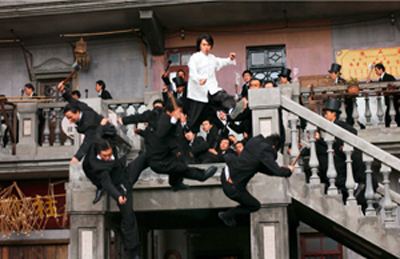
The camera in “Kung Fu Hustle” is never where you expect it to be, and it never moves the way you think it’s going to. It is a perfect match for the movie itself, which is wildly funny and inventive, a giddy re-imagining of martial-arts flicks that might be one of the most audaciously entertaining films of the year.
The writer, director and star is Stephen Chow, whose “Shaolin Soccer” was mishandled by Miramax, screened in only a handful of theaters before being dumped onto DVD. After the rapturous response “Kung Fu Hustle” received at Sundance this year, Miramax may have seen the error of its ways, as “Hustle” is now receiving a real theatrical release backed by some legitimate promotion.
Chow has set “Hustle” in approximately the 1930s in Pig Sty Alley, a U-shaped tenement high-rise on the outskirts of a Chinese city. The landlord is greedy and unfair, but his wife is even worse. Clad in a housecoat and curlers, a cigarette forever dangling from her lips, she bullies all the occupants of their little ghetto into paying their rent and keeping the peace.
Still, Pig Sty Alley is a relatively happy place, the residents living out their cramped lives without much connection to the hectic, dangerous world of the city. The slum has merchants and businessmen, housewives and laborers, a full microcosm of lower-class life.
Into this world comes the ruthless Axe Gang, a well-choreographed group of miscreants who wear black suits and top hats and occasionally break out into dance numbers. They are unaware of Pig Sty’s existence until word gets back to them that a couple of Axe Gang wannabes are there, attempting to extort residents by pretending to be true members of the gang.
How will the town defend itself against the Axe Gang? Are there heroes and kung fu masters hiding in plain sight among the slum’s ordinary inhabitants? At one point is there a guy who plays a weird harp-like instrument that sends musical notes flying out like weapons? Why, yes!
There are astonishing fighting sequences, usually flagrant in their disregard for the laws of physics and gravity. There is abundant cartoonish humor, including a bit where the landlady runs at high speed like the Roadrunner. There are broad, silly characters like the gay tailor and the super-strong coolie, and joking references to classic kung fu movies. It is explosively funny, with exaggerated, stylized violence — it’s not realistic, so it never looks painful — and unflagging energy. Few films remain so buoyant for such a long duration; when this one ends, it feels like it could run at top speed for another two hours.
Leo Spivak has a combination of problems that is supposed to make him sound like Everyman but that really makes him sound like EveryMovieCharacter. His teenage daughter is growing up too fast, his aged father is crankily awaiting death, he hates his job, and a younger co-worker is trying to replace him. He’s married to Isabella Rossellini, though, so I don’t know what he’s complaining about.
“King of the Corner” benefits most from its performances. Not its plot, which is typical mid-life-crisis-comedy stuff, nor its characters, who are not especially intriguing, but its performances. In the lead (and also the writer and director) is Peter Riegert, one of those New Yorkish actors you recognize without knowing his name. He’s been a defense lawyer on “Law & Order” several times, and has a recurring role as a crooked assemblyman on “The Sopranos.” This is his first lead role, as well as his feature-directorial debut, and he shows an earnest affection for what he’s doing, an actor’s working knowledge of script and story.
Leo works in marketing for a New York firm, conducting focus groups for his clients’ new products. These include the home security device that alters your voice when you talk on the phone so that you sound like Gregory Peck. Even not being a single woman who’s afraid of being home alone, I would buy that. Leo is good at what he does, and he’s happy to mentor young Ed Shiffman (Jake Hoffman, son of Dustin) as he climbs the corporate ladder, unaware that Ed is willing to steal Leo’s ideas if it will help him climb.
Every other weekend, Leo flies to Arizona, where his cranky Jewish father Sol (Eli Wallach) has migrated to run out the clock in a retirement home. Sol has already bought a burial package from a local mortuary in anticipation of his demise. Leo doesn’t want to talk about the sort of thing. Dad’s never been very affectionate to Leo, but his friends at the retirement home say when Leo’s not around, Sol never stops bragging about him.
OK, so there’s the situation. Now where is it going? While in Philadelphia on business, Leo runs into Betsy (Beverly D’Angelo), a girl from high school some 30 years ago. He had a big crush on her back then, and obviously still does, while she hardly remembers him. They sleep together. This leads to a very funny/uncomfortable scene with Leo showing up at Betsy’s house and confronting her husband. It’s funny, but why is it happening? Why is Leo behaving this way?
I think what Reigert’s going for, and achieving with only slight success, is some insight into the mind of a bored, middle-aged man, that sort of “what do I do now?” phase that many people go through. And while “King of the Corner” is amusing, and eventually reaches some clarity about Leo’s psyche and his relationship with his father, it is not the sort of transcendent human comedy that it wants to be. It is, instead, a middling one, certainly watchable but by no means special.
“Winter Solstice” is such a low-key drama that I’m not sure anything happens in it at all. I like its characters, though; they feel like real people, with real hang-ups and motivations, and their dialogue sounds natural. I just wish they would DO something.
Regrettably, we have a pun title on our hands: Winter is the last name of the family involved, father Jim Winter (Anthony LaPaglia) and his sons Gabe (Aaron Stanford) and Pete (Mark Webber). Pete, who can hear just fine with a hearing aid, is only randomly motivated in his academic endeavors and will be sentenced to summer school again this year. Gabe, a few years older, has a girlfriend named Stacy (Michelle Monaghan) and works at a produce warehouse, though he has plans to move to Tampa to live with a friend and try something different.
The Winter men as a group are still reeling from Mom’s death. The film is more than an hour old before her demise is stated outright, but it’s clear from the beginning: Their breakfast conversations are terse and have an unspoken sadness; Jim enforces a family dinner every night to ensure their continued togetherness, and Pete and Gabe are only to happy to oblige him. Jim and the boys love each other, and we get the impression they have grown closer since Mom died.
But they are stagnant, and the film is about their stagnancy, and that is undoubtedly why the film itself sometimes feels motionless and uneventful. Jim meets Molly Ripkin (Allison Janney), a single woman who has moved in down the street in their New Jersey suburb, and she is a catalyst for some change, just as Pete’s experiences in summer school and Gabe’s decision to move to Florida help them.
The key is something Pete learns in history class, about how the Mongols quit conquering Europe and went home after Genghis Khan died, simply because without their leader, they couldn’t decide what to do next. Mrs. Winter was evidently the glue that bonded the Winter family, for now, without her, everyone is stuck.
The film was written and directed by Josh Sternfeld, his first time in either capacity. It has that Sundance indie-drama feel to it (indeed, the script went through Sundance’s screenplay lab), but it’s more ambitious, and in more subtle ways, than many of its cousins. The Winters speak to each other the way family members do, without elaborate exposition. Even when Mom’s death is finally mentioned, she is never called by her first name but simply “my wife”; Pete and Gabe never call her “mom,” but refer to her as “she.” Gabe is going to live with someone named Brian in Tampa, but we don’t know who that is. A friend? A relative? No one specifies, because no one needs to: Jim, Pete and Gabe all know who Brian is.
In the final analysis, I like what the film is trying to do more than I like the way it does it. Kitchen-sink dramas that are realistic and uncontrived are rare, and so I find myself wanting to appreciate “Winter Solstice” more than I do. It doesn’t need anything flashy, but it does need a more solid story line, a more definable path of progression for its characters.
While I was an undergraduate pursuing a degree in journalism, many of my friends in the Communications Department were studying advertising. We had a few courses together, and then we separated, as the remainder of my classes were aimed at teaching us how to dig up the truth, while the advertising sequence focused more on lying. (Journalists don’t learn lying until they reach the workplace.)
As a result of my limited academic study of it, I barely understand advertising. Many ads tout features that I don’t consider worth bragging about, and the things I think would make good selling points never get mentioned. For example, one of the reasons I like Junior Mints is that they are quiet. This is nice when you’re at the movies and you don’t want to disturb the people around you with your loud, crunchy candy. (Peanut M&M eaters, I am looking at you.) (Glaring, actually.) But do the ads for Junior Mints ever point out their silence? No. In fact, I don’t know that I’ve ever seen an ad for Junior Mints at all. Maybe they don’t know what their best feature is and hence don’t bother saying anything. Well, now they know.
Meanwhile, I see ads for Carl’s Jr. that seem counter-productive. You folks in the eastern part of the U.S. don’t get these, so count your blessings. The fast-food chain seems to think its sandwiches’ strongest feature is not that they taste really good, or that they’re made with fresh ingredients, or that they are available at a reasonable price. No, what they believe to be the greatest asset of a Carl’s Jr. sandwich is that it is horrifically messy and drippy. “If it doesn’t get all over the place, it doesn’t belong in your face” is their slogan. Well, I can think of lots of things that don’t get all over the place that do, in fact, belong directly in my face. Junior Mints, for example. And bread. Bread is a very neat, well-behaved food, and if I could live by it alone without contradicting the Bible, I would.
So Carl’s Jr. is way off-base there, and sometimes their commercials are so dreadful, with their images of men drooling barbecue sauce from their beefy, unshaven maws, that I wonder if the ads are actually being paid for by Burger King, to get people NOT to eat at Carl’s Jr.
I am also a little confused by the current commercial for the Ford F-150 truck, which has the vehicle being suspended from a crane by its rear bumper, and a man standing underneath it. This is to demonstrate how solidly the truck is built: Even if you dangle it upside-down, it doesn’t fall apart. The commercial is accompanied by this warning: “Do not attempt.”
My first reaction was: Really, Ford? I shouldn’t go outside to my industrial 40-foot crane and lift a truck over my head by its bumper? Then why did I buy the crane, Ford? Why did I buy the crane?!
But then I thought: Why not, Ford? If I have access to a crane and a Ford F-150, why shouldn’t I stand underneath it to prove how sturdy it is? Are you afraid I won’t get the same results? Afraid that if anyone actually attempts this independently, the truck will come crashing down? How many botched takes did you waste shooting that commercial? How many scientists in lab coats were crushed by trucks that fell apart as soon as you lifted them off the ground?
Then I had my final thought, which was: Is that really the most impressive thing about your truck? That it doesn’t fall apart? Not the way it handles, or how much stuff it can carry, but the fact that it was made with bolts? Huh.
Speaking of automobiles, there’s a commercial for Enterprise Rent-a-Car where a doofy-looking guy rents a car and drives it to his high school reunion, where two hot babes immediately sidle up to him and, eyeing his car, say, “Lookin’ good!”
My question is, what happens when the women learn the car is just a rental? Some women may be impressed by a man OWNING a nice car, but I assure you, no woman has ever been wooed by a man’s ability to rent one. Owning a car suggests money and status; renting one only indicates that you are 25 and have a credit card. Only the most desperate of women would claim these as their primary criteria.
Finally, there are the ads that don’t sell anything at all. I have mentioned these before, the billboards that advertise attributes rather than products — the ones for “Dependability,” “Honesty,” “Strength” and so on, always accompanied by a picture of someone who embodies that quality. They’re sponsored by something called Foundation for a Better Life, and I’m not really sure what that organization does, but whatever it is, it rakes in enough money to be able to afford hundreds of billboards. I wouldn’t have guessed more advertisements sullying our nation’s cityscapes would lead to anyone having a better life, but what do I know? I studied journalism.
Anyway, they have a new one that says, “Me, quit? Never.” It’s accompanied by a picture of a one-armed woman in a wetsuit, posing with her surfboard, which has a huge bite mark out of it. We are to gather that while riding the waves one day, she lost her arm and part of her surfboard to a shark. The principle being advertised is: “Rising Above.”
Now, first of all, that’s kind of awkwardly worded. Most of these billboards are for familiar, easily stated principles such as “Integrity,” “Persistence,” “Determination,” etc. “Rising Above” isn’t much of a noun. Try plugging it into a sentence. “I’ll say this for him: He had a lot of rising above.”
But semantics aside, let’s look at the facts. You’re surfing and a shark eats your arm and part of your board. You know what? I think you’re allowed to give up surfing at that point. No one will blame you if you hang up what’s left of your board with what’s left of your arm and never enter the water again. There would be no shame, no being looked down on by others. Being half-eaten by a sea monster is, I think, valid cause for finding a new pastime.
I mean, what are all the people supposed to think who were attacked by sharks and thereupon quite sensibly stayed out of the ocean for the rest of their lives? That they’re a bunch of cowards who lack rising above? I propose a billboard promoting the virtue of “Knowing When to Quit.” It would have a picture of 19th-century president James K. Polk, who in four short years met his every goal and thus sought no second term; or perhaps Kenny Rogers, who always knew when to hold ’em and when to fold ’em. Either way, I’m sure the billboard would be a huge hit and make tons of money for the advertisers, or something. I don’t know how these things work.
When I recall moments from “Sin City,” what I see in my mind are stark graphic-novel images — men drawn with jagged lines and sharp angles, women with impossible curves, the dialogue conveyed in all-caps bubbles above the characters’ heads. This, despite the fact that “Sin City” is live action, not a cartoon, with real humans playing all the roles and the dialogue spoken as in any other film. But the movie looks, feels and sounds so much like a graphic novel miraculously sprung to life that in my memory, that’s what it is. It is one of the most visually impressive films I’ve ever seen.
It’s a collaboration between writer/director Robert Rodriguez (“Desperado,” the “Spy Kids” movies) and Frank Miller, a comic book writer on whose graphic novels the film is based and to whom Rodriguez insisted on giving co-director credit — going so far as to resign from the Directors Guild of America when that organization’s rules prohibited the credit. Rodriguez loves the books’ noir-ish dialogue and its grim stories of shady characters patrolling alleys and strip clubs in a large, faceless city. And he has gone to extraordinary lengths to give the film the same qualities as the graphic novels, even framing his shots (he acts as his own cinematographer) so they’ll resemble the comic book panels on which they are based.
This includes shooting the film in black-and-white except for occasional small elements of color: a woman’s dress, or a spurt of blood, or Yellow Bastard’s face, for example. It also includes creating events that are physically impossible — usually in regards to how far someone is propelled by a punch to the face — because that’s how they looked in the graphic novels.
Of course, slavish devotion to a text has been the downfall of many movies; see the first two Harry Potter films, for example, which accurately transcribed the books’ content yet failed to capture their magic. But it works here, probably due to Miller’s intimate involvement with the production, ensuring the film retains not just the look of its source material but its tone, too — its dark mood swings, its hard-boiled love affairs, its grimly funny violence.
Sin City is the nickname for Basin City, a distinctly grimy metropolis that is the setting for the film’s story — its handful of separate stories, actually, all connected by characters and locales but shown to us slightly out of sequence. Like “Pulp Fiction” (and that isn’t the last reference I will make to that film), finding the connecting threads and figuring out the proper chronology of them is part of the fun.
The closest thing to a “good guy,” at least in the traditional movie sense, is John Hartigan (Bruce Willis), a cop who is working his last day on the job when he is ambushed while trying to bring down a notorious rapist/killer. I want to tell you more about his story, but it would ruin some of the surprise. He remains a true hero, though, albeit a grim, tragic one.
He is in many ways a contrast to Marv (Mickey Rourke), a brutal ex-con with a boxer’s nose and a ham-sized chin who, despite his violent, cynical ways, knows true love when he finds it. That he finds it in the arms of a prostitute named Goldie (Jaime King) does not make it any less enraging when she is killed by an unknown assassin. This sends him on a murderous mission to find the assailant, eventually leading him to the den of a mute, baby-faced cannibal named Kevin (Elijah Wood), whose lair is the stuff of which nightmares are made.
Then there’s Dwight (Clive Owen), a regular at the strip club that appears in all the film’s plot lines, who develops a thing for Shellie (Brittany Murphy), a waitress there. She is tormented by her abusive ex-boyfriend Jack (Benicio Del Toro), whom Dwight threatens, resulting in a chase that leads them to Sin City’s Old Town, where the police aren’t welcome and where prostitutes dispense justice themselves.
Those are the basic stories, none of them particularly complex but all of them thrilling, horrific and garishly engrossing. They are, like “Pulp Fiction” (told you it would turn up again), well, pulpy — pure entertainment, without a real “point,” per se. The dialogue is peppered with the empurpled language of the 1940s detective flick, where women are called “dames” and a bad heart is a “bum ticker,” and where all characters express their thoughts in eloquent, steel-throated voice-over narration.
Despite all of the stories having women as their catalysts, the acting among the ladyfolk leaves something to be desired. Bruce Willis and Mickey Rourke, on the other hand, both give outstanding performances. In particular, I think this film may do for Mickey Rourke what “Pulp Fiction” did for John Travolta.
Shooting in black-and-white and so thoroughly re-creating the look of the graphic novels works for the film. It doesn’t come across as a “gimmick” but as a medium, simply a different way of telling the story. It is without question the best film released so far in 2005, and its dark tones, sly humor and wantonly extravagant entertainment value lead me to believe it will remain near the top throughout the year.
The Baja 1000 is the longest point-to-point race in the world, covering a thousand miles through the desert of northern Mexico and open to all manner of vehicles, from motorcycles to dune buggies to vintage VW Bugs (but not the new models). “Dust to Glory” chronicles one typical year’s race, and gives the event’s history in the process. Only serious racing fans will be intrigued by every element of the labor-of-love documentary, but even casual admirers of adventure will find much of the footage entertaining.
The director, writer and narrator, a race enthusiast named Dana Brown (who also made 2003’s surfing doc “Step into Liquid”), speaks in the manner of a person who loves his subject and who has not availed himself of an editor. Solecisms like “conversating” and “had shrank” creep into his narration, as do overblown declarations like, “This isn’t about A race, it’s about THE race: the human race,” and the opening description of the Baja 1000 as “sharing an adventure in a place where reality is on holiday.” Puh-leeeze.
But if you ascribe Brown’s high-school-level prose to his unadorned love for racing, his zeal becomes contagious. He introduces us to the legends of the Baja 1000 (including NASCAR’s Robbie Gordon, who comes to Mexico every year), the great, unknown-to-history riders and drivers like 62-year-old J.N. Roberts, Mouse McCoy, and the McMillin family (now with three generations of dune buggy drivers).
Since it includes a lot of rough terrain and even some ordinary paved roads on which there are speed limits that sometimes the local cops try to enforce, the race can take up to 32 hours to complete. (“It’s like being in a 24-hour plane crash,” someone says.) Mile-long patches of silt slow drivers down, as do huge divots and moguls in the roads. Rare is the vehicle that completes the 1,000 miles without several tire changes; some cars need new transmissions half-way through.
These guys are the poster children for Determination, noting more than once that any fool can drive a car in a circle at the Indy 500, but driving through Baja California takes a true mechanic and athlete. Take Mouse McCoy, for example. Most motorcyclists work as a team, switching riders a couple times during the race. McCoy wants to do the whole thing solo this year — more than 20 hours of non-stop riding through dusty, sweaty, bumpy terrain. Is he crazy? Clearly. And he becomes crazier as the race wears on, the mental and physical efforts taking their toll on his lucidity as he stops at the checkpoints set up randomly through the course.
The film’s most appealing aspect is the footage of the race, of course. With vehicle-mounted cameras and at least one helicopter watching from above, Brown gets some choice shots of thrilling, almost heart-stopping, action. The competition is good-natured, the drivers quick with a joke and eager to befriend their fellow racers before and after — but when the heat is on, there is a take-no-prisoners attitude. These are one-lane roads, mostly, so how do you pass someone? You “gently” rear-end them, and race etiquette dictates they move over so you can get around them. That rule seems to be suspended during particularly intense moments, though, when it’s every man for himself.
A fine outing for fathers and sons who admire the world of racing, “Dust to Glory” could be more tightly focused and more judiciously editing. (Some of the side stories, in hindsight, were not nearly as critical to the film as Brown apparently thought they were.) But its funny, audacious and profoundly exciting moments are abundant enough to keep it running for the entire thousand miles.
We have this image of the French, that they’re all upper-class cigarette-smoking, wine-drinking, cheese-eating, literature-reading, artsy-movie-watching snobs. “Look at Me” is about those kinds of French people, though it suggests they’re really more a subset than the majority. But they’re not fooling me. They’re ALL like that, I know it.
The characters are all satellites orbiting Etienne Cassard (Jean-Pierre Bacri, also the co-writer), a precise, impatient author whose latest widely acclaimed masterpiece has just been made into a sappy film that he hates. He hates, or at least has limited tolerance, for most things, in fact, and if you are speaking to him, you may be assured that he is not listening.
Despite this, the number of people who fawn all over him grows daily. His daughter, Lolita (Marilou berry), a plain-faced, slightly overweight college student, desperately needs his approval and attention, and despises him because of it. (That she usually fails to get what she needs from him just intensifies her bitterness.) Etienne’s very young second wife Karine (Virginie Desarnauts) dotes on him and wants his attention. A man named Vincent (Gregoire Oestermann) has no clear connection to him — he’s not a business associate or really even a friend — yet remains by his side constantly. Another character says Vincent’s job is to be Etienne’s “sidekick,” and that’s about right.
Lolita’s voice instructor, Sylvia (Agnes Jaoui, also co-writer and director), who is second only to Etienne on the list of people Lolita idolizes, has a husband named Pierre (Laurent Grevill) who is also an author, albeit a far less successful one. When Sylvia learns who Lolita’s father is, she suddenly becomes much more interested in her pupil, her agenda being to put the famed wordsmith into the same social circles as her struggling husband. Lolita is used to this kind of manipulation, where people use her to get close to her father, but it still stings.
For her part, Lolita is hung up on a guy named Mathieu (Julien Baumgartner), who, predictably, is more interested in her dad. But she meets a new guy named Sebastian (Keine Bouhiza), a nice fellow with what seem to be honest intentions. Unfortunately, she can’t stop thinking about Mathieu.
All these figures whirl around Etienne like devoted puppies, eagerly seeking to impress or delight him. It’s a film full of selfish, needy people, people who are always being interrupted by cell phones and who always want to be with someone other than who they’re with.
The film works, though, because with the exception of Etienne, who really is an insufferable, short-tempered bastard, we like and identify with everyone. Lolita’s self-consciousness, Pierre’s frustration, Karine’s loneliness — it all hits home, in one way or another, for all of us.
The lifestyle of the characters is almost as important as the characters themselves. You read about these people in old European novels, upper-crust types who go away for a weekend to their country house, where the cook makes tarragon rabbit, which even the people who hate rabbit eat, because they want to fit in with the host. Authors are recognized on the street, and people watch literary programs on the Parisian television stations. As ripe as this sort of behavior is for mockery, as puffed-up as some of these clods are, they remain accessible — even ordinary — in the film, like the kind of people that slobs like us know, too.
Is “Look at Me” a response to the dim view Americans have of the French? Is the idea to show us that they’re regular people, too? Probably not. The film was made in France for a French audience; that we’re seeing it at all was probably an afterthought. I suspect the idea was simply to show people as they are, warts and all. As it turns out, Bacri and Jaoui happens to have a soft spot for their countrymen, which results in a warm, funny movie for us to like, too.
After seeing “Beauty Shop,” I sympathize with the plight of African-Americans even more than I already did. Imagine being part of a culture that is so under-represented by Hollywood that garbage like “Beauty Shop” is the only thing you have to call your own. Recycled plots, lame jokes, stereotyped characters: Sorry, black America. That’s all we’ve got for you. (I guess it’s nothing personal; that’s usually all we have for ourselves, too.)
No one should have to settle for a franchise re-tread like this. Inspired by the success of “Barbershop” and its lackluster sequel, “Beauty Shop” is something of an off-shoot — not a sequel, really, since the only “Barbershop” character is Queen Latifah, and she was only introduced in “Barbershop 2” as a setup for “Beauty Shop.” But since “Barbershop” was about people gossiping in a barbershop, and “Beauty Shop” is about the people gossiping in a beauty shop, it’s considered a spin-off. (Which means they’re all spin-offs of “Steel Magnolias,” obviously, but never mind.)
We begin at Jorge’s, an upscale Atlanta salon run by the titular fey German, played with an outrageous accent by Kevin Bacon. Among his employees is Gina Norris (Queen Latifah), a gifted stylist who often rubs Jorge the wrong way with her less-than-snotty attitude and her friendly demeanor. In one of the film’s stupider jokes, he reminds her that HE is in charge: “You don’t give the shots here. I give the shots here. Unless you are diabetic.”
Bacon and Latifah have the film’s second-stupidest joke, too. Repeating the same theme about his ownership of the salon, he tells her, “My name is on the moniker!,” and she thinks “moniker” is “my n*****,” which greatly offends her. Ha ha, it’s funny, she thought he said the N-word. Except guess what: He’s misusing the word “moniker.” It’s not a physical thing that you can put your name on; the word MEANS name or nickname, as in, “That’s Kevin Bacon, who often goes by the moniker ‘Weasel Face.'” Jorge — and by Jorge I mean the screenwriters — probably confused “moniker” with “marquee.” Or maybe they realized their mistake but declined to fix it because then they’d have lost the priceless “moniker/my n*****” joke. Either way, this is what happens when dumb people are allowed to make movies.
Gina eventually quits Jorge’s and opens her own salon, securing the business loan by giving the frumpy loan officer a makeshift makeover in the bank’s public restroom. (Paper clips are involved.) I’m not kidding you. She is rejected for the loan, she follows the woman into the bathroom, she does the woman’s hair, and the woman is so overjoyed she says, “The loan is yours!” The entire sequence is wholly unnecessary — couldn’t we just assume Gina got the loan and move ahead to opening the salon? — and I have to assume it was kept because someone thought it was funny. Which it isn’t. Again, you let dumb people gain access to movie cameras, you’re going to wind up with crap like this.
Gina inherits a few stylists from the salon’s old owner, including an over-sexed married woman, a black-pride Maya-Angelou-quoting activist, a slutty-acting girl, etc. Two others quit immediately, and they are named Porsche and Mercedes, only so someone can later make a joke about the fact that they’re named Porsche and Mercedes. Gina brings someone with her from Jorge’s, too: a blond cracker named Lynn, played by Alicia Silverstone with what is, without question, the single worst Southern accent I have ever heard. It is so exaggerated and drawn-out that I wonder if maybe Silverstone had never met a Southern person and had to have the accent explained academically to her, the way you’d have to explain to an Ethiopian actor how to react to snow. Surely no one who has ever heard a Georgia drawl first-hand would think Silverstone’s approximation of it is even remotely acceptable.
(And what’s Alicia Silverstone doing here, anyway? Who let her out of oblivion?)
For some reason, there is an electrician who lives above the salon, and for some reason he is played by Djimon Hounsou, who goes by the moniker “Walking Tranquilizer.” I get why he’s in the film — the scene where he’s not wearing a shirt makes that clear — but what, couldn’t they find anyone duller? Was a cinder block with a face painted on it unavailable? Did they not have access to a bucket of sand that they could tape word balloons to? Every line he speaks sounds like it is being muttered in his sleep. He reminds me of when athletes host “Saturday Night Live”: they may be good at something, but speaking publicly with personality and charisma is not it.
The character, Joe, teaches Gina’s daughter Vanessa (Paige Hurd) how to play jazz piano, and he and Gina fall in love, even though Djimon Hounsou and Queen Latifah wouldn’t have less chemistry together if they were played by a towel and a loaf of bread.
But I have forsaken the plot. That is “my bad,” as they say. My personal bad. The plot is that the uptight, very white state inspector (Jim Holmes) keeps coming by Gina’s salon and finding violations and issuing citations and Gina MIGHT LOSE THE SHOP!!!!!!!!!!!!!!!!!!!!!!!!!!!!!!!!!!!!!!!!!!!!!!!!!!!!!!!!!!!!!!!!!!!!!!
(Note: None of the inspector’s complaints ever relate to the fact that a woman is selling catfish out of a cart in the middle of a salon.)
Also, Jorge is really mad that Gina keeps stealing his clients, including the always-bad Andie MacDowell, who does nothing to change our expectations of her here. More also, Gina has been mixin’ up her own special conditioner at home and maybe she’ll get a major company to buy the formula from her. (Is she a chemist? Or is she just mixing name-brand conditioners together, like the time Fred and Barney thought they’d created a new kind of glue when really they were just mixing store-bought glue with other things?)
The film has a good deal of vulgar sexual dialogue, and it’s not funny enough to justify its inclusion in what is otherwise a fairly genteel story. In fact, none of the movie is funny. Latifah has a charming presence on the screen, and it’s always nice to see Alfre Woodard (as the Maya Angelou fan), but they’re given nothing to work with. This is the very picture of bland, uncreative filmmaking, and the fact that it was made by African-Americans is just a further example of the tragedy of black-on-black crime.
P.S. Have you always wanted to see little Rudy from “The Cosby Show” dressed up all hootchy-like? Then you must see this movie.
Fact: Within the Amish culture, children in their mid-teens are permitted to leave the community and get a taste of non-Amish life — as much of a taste as they want, for as long as they want — before returning and committing themselves to a lifetime of good, clean Amish living. This visit to the outside world is called “rumspringa” (literally, “running around”), and Amish parents anxiously await their children’s return from it, perhaps comforted somewhat in knowing they have raised them to have strong consciences and high morals.
May the heavens have mercy! I have just experienced my first day of rumspringa, and it is a far sight more exhausting and bewildering than I had anticipated. How the English live lives so rushed and “hectic” — I believe that is the word; it is uncommon in Amish culture — is beyond me! I am now relaxing in a room at a boarding-house called “Motel 6” in a town known as Ft. Lauderdale, trying to recover from the day’s merry-making and other disturbing developments.
It began early on this warm March morning, when I was awakened by the sound of a commotion in the outer courtyard of the inn. I sprang from my bed and peered through the “curtains” — a worldly luxury with which I was unfamiliar — to see what was going on. It sounded like a barn-raising to me, only with more profanity and fewer sounds of barn-raising. Through the “window” (a marvelous aperture made of glass that enables one to see through a wall!) I saw a squadron of young men and women in various states of undress, so immodestly attired that I could see their umbilical cord scars. They were all moving, with great festivity and jocularity, toward the ocean shore, not half a hectare down the boulevard. Following them were men carrying what I have since determined were photographic cameras, the particularly devilish ones that take not just graven images of the subject, but graven images which move and reproduce sound. They are used for preparing programmes to be broadcast on the televisual box.
Intrigued by this activity, so different from my custom and thus a fine thing to observe, I thought, during my rumspringa, I quickly dressed and hurried after the group. As I reached them, I did my best to incorporate myself into their good graces, displaying a broad smile and tipping my hat to the womenfolk. “It is a most agreeable morning for a pie-baking, is it not, good sister?” I said to one young lady whose chest was barely contained by the odd corset she wore about her upper torso. To another, a gentlemen who apparently had suffered a machinery accident that caused bits of metal to be lodged in his earlobes and bottom lip, I remarked, “Say, friend, which way to the nearest quiltery? My sleeping quarters were fearsome chilled yesternight.” But from both young people — no older than myself, I reckoned, and I am 18 — I received no response other than laughter.
Upon the ocean shore I found many young, nearly naked people already assembled before a stage over which hung a banner reading: “MTV SPRING BREAK 2005.” The only word with which I was unfamiliar was “MTV”; generally a word with its vowels removed is ancient Hebrew, but I saw no other indications of an Hebraic influence on the proceedings.
The young people surrounding me were in a constant state of motion, convulsing in a manner that I believe is what the English call “dancing,” though my only experience with the “devil’s walk,” as we call it, is rudimentary drawings found in the back of a non-approved textbook that cousin Enoch and I once glanced at behind the woodshed. (We were soundly whipped for it, of course.) This “dancing” was to the strains of music unlike anything I had ever heard. For one thing, it involved instruments. For another thing, it was harsh and vulgar, the lyrics making reference to a “candy shop” and some manner of “lollipop” which the singer had evidently purchased there.
As the music blared at a most unacceptable volume, a man approached me and asked my name. “Elijah Guttcott,” I replied, shaking his hand. “And whose acquaintance do I have the honor of making?” He said his name was Kyle and that he was a “production assistant” for “MTV SPRING BREAK 2005” and he wondered if I would consider being a contestant in a game of some kind.
Now, despite common belief, we Amish do play games of all sorts. In the evening hours, after the chores are done and we have finished Bible study, evening prayers, supper devotional and wood-piling, there is often as much as 15 minutes of relaxation time during which we can indulge in games such as “Quote the Bible” and “Pile That Wood.” I state with all due humility that I am frequently the champion of these contests, defeating even the most virile Bible-quoters and wood-pilers in my village.
So I told Kyle I would happily take part in whatever his game was. I have heard that the English play games of a far more scandalous sort than ours — some even involving the throwing of six-sided numbered cubes, I am told! — but I did not see the harm in “living it up,” as they say, as long as it was rumspringa. Certainly Kyle and his “MTV SPRING BREAK 2005” would have nothing in store for me that would violate my honor.
Thirty minutes later, I was standing on the stage clad only in my undergarments, my torso covered in whipped cream as two blindfolded young ladies attempted to find the frankfurter that Kyle had glued to my inner thigh. (The presence of the frankfurter confirmed to me that “MTV” was not a Hebrew word.) The rest of my clothing — my suspenders, trousers, girdle, hat, under-shirt, shirt, over-shirt, over-trousers, socks, shoes and under-shoes — were in a pile behind the stage, where other men in similar disrobe were awaiting their turn to be whipped-creamed and frankfurtered.
The purpose of this game I still did not know — how does any of this promote Christian brotherhood, I ask you — and so I removed myself from the blindfolded vixens and attempted to leave the stage to find Kyle. My honor dictates that I follow through with my commitments, but I wondered if I could fulfill my obligation to “MTV SPRING BREAK 2005” in some other way, perhaps by churning some butter for them, or by fetching the eggs from the local henhouse. But I was thwarted in my efforts to leave the stage by the master of ceremonies, a de-shirted man who carried a stick which, when he spoke into it, amplified the sound of his voice so he could be heard by all in attendance. (How the Lord could have used such a device when He delivered His Sermon on the Mount! I thought, before realizing the talking-stick was probably empowered by the devil.)
“Hold up, dude,” the man said to me with a laugh. “Where ya goin’?!” Then he pointed the talking-stick at me, presumably so that my response could be heard by the congregation. I spoke hesitantly into it, unsure whether merely using the device would put me in league with the devil, or whether I would actually have to hold it for that to occur.
“I am sorry,” I said to the man who called me “dude.” “Ye and your brethren have been fine hosts to me this day, and I am honored to have been accepted into your good graces to the extent that you would view me a worthy participant for your contests. But I cannot continue. Your games, while perhaps common to your daily lives, are alarming and unwholesome to my taste. I am a simple man from a simple village, and I fear I dishonor my principles if I continue to stand here, nearly unclothed and mauled by strange women. I hope you will forgive me, ‘MTV SPRING BREAK 2005.'” And with that I began to exit the stage.
It was then that the unthinkable happened. The man with the talking-stick declared that, unbeknownst to myself, my parents and the parents of all the other participants in this game were on hand to witness the proceedings. Evidently the game customarily includes this surprise, which the gathered audience found delightful indeed but which I found as shameful as when Noah’s son Ham found him naked and inebriated.
My parents then came forward from their hiding place. My mother embraced me awkwardly, getting whipped cream on her in the process, and my father shook my hand, which surprised me, as he is not often that affectionate in public.
“My son!” my mother cried. “Ye have made us proud, but the sort of ‘proud’ that is good, not the bad kind.”
My father added, “We came here afeared that ye would behave wrongly, but lo, ye have lived up to the Christian principles we have taught you. Praise be!”
“But Mater and Pater,” I said as the audience looked on. “You see the state I am in, unclothed and festooned with foodstuffs. How can ye say I have not failed you?”
“Let it not trouble you, son,” my father said. “It was rumspringa, and ye were misled by the devils who run this den of iniquity, this ‘MTV SPRING BREAK 2005.’ To be tempted is not a sin, and what person with blood in his veins would not be tempted by the promise of such earthly pleasures as having pork affixed to his legs? What is important is how ye dealt with the temptation, and it was a right fine speech ye gave when ye realized this place was not for you.”
“Right fine indeed,” my mother agreed.
And so I re-clothed myself, bid the cheering congregation adieu, and left the ocean shore with my parents. “MTV SPRING BREAK 2005” had not provided a horse-and-buggy when they invited my parents to Ft. Lauderdale, so we walked through the town, arm in arm, by the power of our own feet. ‘Twas a pleasant walk indeed.
The main thing missing from “D.E.B.S.,” which is a comedy, is comedy. Apart from that, it’s a perfectly good comedy.
Based on a short film that everyone seems to agree was 10 times as funny as the feature, “D.E.B.S.” is about a top-secret government spy agency that recruits girls via a hidden test in the SAT. Without knowing what, exactly, qualified them, nubile teenage girls are brought into the D.E.B.S. organization, given a plaid-skirt schoolgirl uniform, and trained in all manner of surveillance, crime-fighting and makeup application.
The story has ultra-talented D.E.B. Amy (Sara Foster) falling in love with the sexy supervillain she and her fellow D.E.B.S. are supposed to be pursuing, Lucy Diamond (Jordana Brewster). Amy thought she was straight until she met Lucy. Now she’s the only person to fight Ms. Diamond and live to tell about it, plus she has a crush on her.
Yes, it is a fun premise, isn’t it? The production design is sharp and comic-bookish, the tone light and spoofy, and the performances energetic. Alas, it is so short on humor! Most of the jokes do connect, like in the montage where Lucy tries to become non-evil; the problem is that there aren’t enough of them. The film, written and directed by Angela Robinson, maintains a frothy sensibility that feels like it ought to be funny — or at least be TRYING to be funny — yet isn’t, and doesn’t.
Dress it up with all the kitsch in the world, this is still just a lesbian falling-in-love story, and not a very interesting one at that. The characters are two-dimensional parody characters, trapped in a movie that doesn’t know how to do parody. It’s a good idea for a short, dragged out into a feature-length film.
As far as I can tell, the point of “The Ballad of Jack and Rose” is to warn us not to be single-minded idealists who ruin our lives and the lives of others through our obsessions.
Well, OK. I hadn’t planned on it, really. The warning is appreciated, but unnecessary, thank you.
What we have here, in writer/director Rebecca Miller’s follow-up to her equally obfuscated “Personal Velocity,” is a movie that breathes with interesting characters but that eventually becomes so “interesting” itself that it crosses over into “preposterous” territory. You pile up too many unusual people and events and the thing’s bound to tip over.
This moody drama is set on an island of the East Coast in 1986. Here live Jack (Daniel Day-Lewis) and his 16-year-old daughter Rose (Camilla Belle), alone on what used to be a commune, back when Jack and Rose’s mother and innumerable other hippies dwelt in peace and harmony and marijuana. Now it’s just Jack and Rose, though, and they live remotely and sparsely, but pleasantly enough. Rose is home-schooled by Jack and has no contact with the outside world. They have electricity, but prefer not to use it. When a developer (Beau Bridges) starts building houses on the other side of the island, Jack fires a shotgun into the construction site. The ’60s are over, but don’t tell Jack that. He clings to the ideals he held then, and is disgusted by the greedy, corporate America that lives today.
Jack is dying, slowly, but Rose doesn’t want to hear it. Never having known any other life, she cannot imagine living without her father. And so she is vexed greatly when Jack invites his girlfriend Kathleen (Catherine Keener) and her two teenage sons — the intelligent, circumspect Rodney (Ryan McDonald) and his younger, more sex-crazed brother Thaddius (Paul Dano) — to come live with them. This is Jack and Rose’s home. Two is company, but five is liable to give Rose a breakdown.
Aaaand … cue breakdown. Seeing her father and Kathleen having sex is all it takes to bring out the craziness that has bubbling under Rose’s surface for years. She is maladjusted and unable to deal with life; “She is the way you’ve made her,” Kathleen correctly observes to Jack. Rose has been sheltered from reality and thus finds reality frightening.
The film uncovers layer after layer in the characters’ back-stories and psyches, deftly doing so without a lot of expository dialogue or flashbacks. Rodney says her mother has moved in with Jack because she has a “savior complex,” and he’s absolutely right, but he and Thaddeus have psychologies, too. Miller isn’t content to give us two central characters and a handful of wallflowers. She gives everyone depth.
Jack’s depth, unfortunately, just irritates me. This man is a piece of work. He refuses to realize first that Rose is insane, and second that it’s his fault. Once he does accept these facts, it is too late and not enough. I like Day-Lewis’ performance, but I dislike the character strongly — and he’s the main character.
Beyond that, the film’s trouble arise when the plot begins to go as insane as Rose. Her sexual awakening, her behavior toward Kathleen, an injury Thaddeus receives during a late-night visit to what used to be the commune’s “acid pad” — it careens out of control, all these little dramas, all this angst, all this quasi-deep symbolism (watch for “Eve” to bring a snake into “paradise”!). It is a quiet, character-driven piece that slowly gets too big for itself.
It is a twisted mind that conceived “Oldboy,” and while I am frightened to know that imaginations this macabre exist in the world, I am delighted that they have been set toward making movies, as opposed to, say, running for public office.
“Oldboy” is about a man named Dae-su Oh (Min-sik Choi) who is kidnapped and imprisoned by anonymous captors for 15 years, kept in a large-ish room with a bed, bathroom facilities and a television. On TV, he sees that his wife has been killed and that he — believed by everyone to have simply disappeared or run away — has been framed for the murder. He’s not tortured or mistreated in any way; he’s simply held prisoner, food delivered on a tray through a slot in the door, so that he has no direct contact with the outside world.
Dae-su is released just as suddenly as he was taken, dropped back into the world as a fugitive, a ghost and a nobody. He is given clothes, money and a cellphone, the latter item used by his captor to call and taunt him. Like all good unseen tormentors, he speaks in riddles, hinting at his identity and about his reasons for imprisoning Dae-su.
Then Dae-su decides to seek revenge.
Here, for the next hour, the film becomes a deviously funny, outlandishly exciting ride, snappy, thrilling and violent. Dae-su trained himself to fight while imprisoned and has emerged something of a superhero, albeit one with an agenda. Aided by a sushi waitress (Hye-jeong Kang) who takes pity on him and who also becomes his lover, he learns who imprisoned him, but then he must determine why — and even then, it’s not enough. “Seeking revenge has become a part of me,” he says.
If Quentin Tarantino were Korean, he would be Chan-wook Park, the man who directed “Oldboy” and co-wrote its screenplay (with Jo-yun Hwang and Chun-hyeong Lim). His use of urgent, intense, stylish music is certainly Tarantino-esque, and his gallows humor and fondness for violence are exemplary. (Of course Tarantino himself was inspired by the martial-arts films of East Asia, so perhaps he and Park are drawing from some of the same influences.) I note the scene where a man’s teeth have been removed as a means of getting him to reveal what he knows. His speech is garbled now, so subtitles are provided — but they’re in Korean, the language of the film, so his subtitles have to be subtitled. That’s comedy, friends. Dark, gory comedy.
Park also achieves something masterful in a scene where Dae-su fights a dozen or so henchmen in a dank corridor, shot all in one two-minute take, with no cutting away. It’s brilliantly, messily choreographed, and the longer it goes, the more amazing it is.
You will also never forget the scene in which Dae-su eats a live squid in order to make a point.
The film culminates in a grand, operatic finale full of shocking twists, and it probably is dragged out a little too long (which I guess is partly why it reminds me of an opera, but that’s neither here nor there). But there is a singular vision at work here, a mind full of imagination and cleverness, and a sharp skill for storytelling. The movie is dark, mad and haunting, and wonderfully so.
As much as I try not to like Ashton Kutcher, he keeps appearing in movies where he is goofily charming and often very funny. “Guess Who” is a quintessential role for him — affable, put-upon and mildly clueless — and he and his co-star Bernie Mac (also playing to type as a blunt, outspoken father) are the saving graces of what is otherwise a poorly written, misguided rehash of a movie.
The title suggests it was inspired by “Guess Who’s Coming to Dinner,” the seminal 1967 film in which a snooty white girl brings home her black fiance. “Guess Who” reverses the races so that now it’s an upper-class black girl introducing her white boyfriend to the family, but that’s as far as the similarities go. It is “Meet the Parents” that springs to mind most often, as the hapless beau faces off against the sour father while the ineffectual mother and daughter look on. Watch for the young lovers to be caught in provocative situations by Dad, and notice that Dad tells the suitor that he’ll be watching him — sans De Niro’s my-eyes-are-on-you two-fingered gesture, but it’s there in spirit.
Kutcher plays Simon Green, a successful Wall Street broker who has just quit his job for reasons unknown to us. In classic sitcom style, just as Simon is about to tell his girlfriend Theresa (Zoe Saldana) about his sudden unemployment, she mentions that her dad never cared who her boyfriends were as long as they held down good jobs — which makes Simon chicken out and keep it a secret, so that it can come out later at the wrong time and cause trouble between them.
They have bigger fish to fry anyway, because they are going to New Jersey for Theresa’s parents’ gala anniversary party, and at some point over the weekend they plan to announce their own engagement. Theresa has thus far failed to mention Simon’s whiteness to her folks, perhaps only so we can have the gag where her dad thinks the African-American cab driver who delivers her to the house is her boyfriend.
Dad is Percy Jones (Mac), a loan officer at a bank, while Mom is Marilyn (Judith Scott), a homemaker who couldn’t care less what race Simon is. But Percy cares, though he claims not to, and his paternal tendency toward overprotection of his little girl is greatly exacerbated by Simon’s lack of pigment.
The movie’s chief flaw is that there is no good reason for Percy to be as grumpy as he is. His behavior goes beyond simple racism; he seems deeply and profoundly irritated all the time. It’s supposed to be funny, and Mac’s knack for this kind of role means it sometimes is. But I kept noticing that he was often saying or doing something only because the script told him to, and not because the character had any reason to. It’s all very contrived, and never organic.
The movie occupies the space of one weekend, culminating in the big anniversary party. In between are Kutcher and Mac doing their respective klutzing and blustering, eventually settling into a nice groove as a likable comedy team, albeit one that appears in a hack movie. But just as they’re really beginning to gel, the movie (directed by “Barbershop 2’s” Kevin Rodney Sullivan) goes off-course with a bump in Simon and Theresa’s relationship that sends us careening in generic romantic-comedy territory (complete with the public reconciliation). The focus up to this point had been Simon/Percy dynamic; switching to Simon/Theresa is a stark error, because that element is neither funny nor interesting.
A scene at the film’s halfway point, in which Percy bullies Simon into telling black jokes around the dinner table, demonstrates the movie’s ineptitude. The point of the scene (and, ultimately, of the movie) is one that’s already been made clear in countless other film: that it’s OK for black people to make fun of white people, but not the other way around. For all its posturing as an examination of racial tension, the screenplay (by David Ronn, Jay Scherick and Peter Tolan, men whose credits include “Serving Sara,”“National Security” and “Stealing Harvard”) actually has no idea how to address race relations. It can make jokes about the subject, but even those are often thunderingly unfunny, the writers flinging everything at the wall — including ideas that contradict other ideas — to see what sticks. It’s a haphazard film that way, funny one moment and embarrassing the next, all of it only made tolerable by Kutcher and Mac.
Coming-of-age comedies about teenage boys with prurient desires for hot older women are a dime a dozen. Make that woman the boy’s aunt, though, and now you’ve got something!
Or something. “Nina’s Tragedies,” a bittersweet comedy/drama from Israel, is kind of sweet and a little creepy in its attempt to convey adolescent yearning and loneliness. The titular Nina, though, is played by a winsome, beautiful actress named Ayelet Zorer, and her warm persona more than carries the film.
Nina’s nephew is Nadav (Aviv Elkabeth), about 14 years old and beginning to develop that dirty-looking half-mustache that teenage boys (and the women of New Jersey) get. He is emerging as Ninasexual — that is, Nina, his mother’s urbane book-editor sister, is seemingly the only object of his desires. With the help of his oily grownup friend Menahem (Dov Navon), he spies on Nina regularly, even keeping a diary of all his secret, lustful thoughts.
Nina’s first tragedy is that her husband dies. This is good news for Nadav, though, because his mother asks him to move in with Nina for a while, to make sure she’s OK. He is soon jealous of a man named Avinoam (Alon Abutbul), the military man who notified Nina of her husband’s death who has since been haunted by the thought of her and seems to desire a relationship with her.
Written and directed by Savi Gavison, the film is often wryly funny, as when Nadav describes his lunatic mother’s fashion designs and her stormy relationship with his father. What doesn’t work, really, is the structure. Nadav is the narrator, yet we often see things he had no way of seeing, or even knowing about. In addition, the film changes its focus from Nina to Nadav halfway through, leaving us with the feeling that we’ve watched two half-stories rather than one full one.
But while the young actor who plays Nadav is a bit of a cipher, Ayelet Zorer gives Nina grace, sexiness and a real personality. She’s someone you’d want to see a movie about, though maybe you’d wish the movie were a little more polished than this one.
It is a low moment in “Miss Congeniality 2: Armed and Fabulous,” not to mention one that panders shamelessly to the film’s target audience of women and gay men, when Sandra Bullock and Regina King dress as men-dressed-as-women to perform a Tina Turner number in a drag club. That any movie would steal pages from “Connie and Carla” is bewildering; that it would be a movie where the scene doesn’t even fit, where it is completely unnecessary to the plot, is downright sad.
But “Miss Congeniality 2” is a sad movie, a desperate, toothless comedy that, unable to do any real biting, threatens to gum its subjects to death instead. This is a movie where a maverick law-enforcement officer is actually referred to as a “loose cannon” (notwithstanding the innumerable comedy sketches and satiric articles that have mocked that trite old phrase), and where the very height of comedy is supposed to be Sandra Bullock dressed as an old Jewish lady to infiltrate a retirement home. (Posing as her son, a fellow agent asks the woman at the reception desk, “Do you have a euthanasia program?” That is literally the funniest thing that happens in the entire film.)
Bullock is back as Gracie Hart, who in the first film went undercover as a Miss United States contestant (do NOT call it the Miss America Pageant!) to stop a terrorist attack. Part two commences three weeks later, when Gracie is so famous from her appearance in the pageant and the ensuing news coverage that she is useless as a field agent. You can’t go undercover to stop a bank robbery when people are coming up to you and asking for your autograph.
So the FBI wants her to be the new “face” of the bureau, to do the talk-show circuit and be a walking public-relations department for the FBI. It is unclear what the FBI’s aim is with this, but Gracie takes to it immediately, becoming as shallow and Barbie-fied as the women she used to despise. Why, she doesn’t even snort when she laughs anymore!
After a few months of this — of being handled by her mincing personal stylist Joel (Diedrich Bader) and harassed by her masculine female bodyguard Sam Fuller (Regina King) — Gracie is distraught when the reigning Miss United States, Cheryl Frasier (Heather Burns), and pageant emcee Stan Fields (William Shatner) are kidnapped in Las Vegas. The FBI sends Gracie to Vegas to act as — what? Bureau spokesperson? Press liaison? Once again, I am uncertain what her duties are. Mostly she barges around Vegas, vexing the local bureau chief (Treat Williams) and talking about an upcoming press conference she has to handle (which never does occur, by the way).
Gracie wants to work the case herself, of course, but the FBI won’t let her, but of course she works it on her own, and of course she and polar-opposite Sam eventually become friends despite their differences, save each other’s lives, yada yada yada. The movie, written by Marc Lawrence (also of “Forces of Nature,” “Miss Congeniality” and “Two Weeks Notice,” making this his fourth Bullock screenplay), sets up the Vegas stuff just to exploit all the obvious Vegas jokes — showgirls, gambling, the Mafia, female impersonators, etc. — and then doesn’t even do a good job executing those obvious jokes. The gags are limp and half-hearted, director John Pasquin (a Tim Allen veteran: “The Santa Clause,” “Jungle 2 Jungle” and “Joe Somebody”) not putting forth enough effort even to fail spectacularly.
I was no fan of the first “Miss Congeniality,” finding it average and unimaginative. The sequel is predictable, dumb and flaccid, too, but to a greater degree. It is everything its predecessor was, and less.
The chief difference between the O.J. Simpson trial and the Michael Jackson trial is that we hoped O.J. was innocent. We liked the guy, and we didn’t want to think he had stabbed his wife and her acquaintance to death, even though we suspected he had.
Michael Jackson, on the other hand, we know he did it, and we’re glad he did it, because now we finally have a legal reason to hate him. Heretofore, our distrust and antipathy stemmed only from intuition: There was something about him that just wasn’t right. Now we have a name for that “something,”? and it’s a bad enough name that we’re well justified in shunning him forever. It’s a bit of a relief, really. You hate to shun someone forever based solely on a gut feeling.
The most disturbing thing about the Michael Jackson trial, really, is that it forces me to think about Michael Jackson. I have spent most of my life NOT thinking about him, at times quite willfully and conscientiously, and now here is a Trial of the Century (the first of many Trials of the Century, I’m sure), thrusting Michael into my thoughts, with his shrill mannerisms and unsettling elfin behavior. And it’s not just Michael Jackson in my thoughts, but Michael Jackson and his private regions! Sure, in grade school we speculated on the subject of whether or not Michael Jackson even HAD private regions, but believe me, we did not really want an answer. We certainly didn’t want the answer being discussed on CNN, that’s for sure.
Michael doesn’t really do himself any favors, either, does he? Showing up to court in pajamas is fine if you’re going for an insanity defense, or if you are 3 years old. But neither of these applies to Michael. He has no excuse to appear in court in pajama pants, and definitely not pajama pants with SpongeBob on them. In fact, I don’t think Michael Jackson should even be allowed to OWN pajama pants with SpongeBob on them. Doesn’t Wal-Mart monitor who they sell these things to?
We Americans are glad Michael is on trial, because we have a thirst for celebrity justice. We love putting people on pedestals, revering them, honoring them, worshiping them, and then knocking them off the pedestals with baseball bats and setting fire to the pedestals. O.J. evaded us, that slippery devil, but we got Martha Stewart, and now we’re jonesin’ for more. Martha actually did jail time! Do you know what that did just for the careers of people who make lame jokes for a living, people like editorial cartoonists and Jay Leno? The goddess of domesticity in prison — why, the jokes about using pine cones and potpourri to decorate her cell practically write themselves! (In Jay Leno’s case, they actually do write themselves, with the computer program HackComedianPro 4.0.)
And now we are positively salivating over the prospect of Michael Jackson going to prison. We know he’s guilty, and we’re glad he’s guilty, and we cannot wait until he is convicted. If we had a choice between boys not being molested, and boys being molested but a pop superstar going to prison for it, we would choose the latter. We are not generally in favor of that sort of thing, of course, but if a few children have to suffer so that we can see a once-beloved, now-mocked idol go to prison, we are willing to make that sacrifice. We don’t have coliseums (colisea?) in which to feed Christians to lions anymore, so this is the next best thing. Heck, anything to get rid of Michael.
My friend Eddy had flown from New York, where he lives now, to Salt Lake City, where he used to live, and his parents were driving down from Idaho, where he grew up, to collect him for a week’s vacation, though I don’t know if that’s word I would use to describe seven days spent in Idaho.
Eddy’s parents are wonderful salt-of-the-earth types who run a small dairy farm in Preston, Idaho, which you’ll recall was the setting of “Napoleon Dynamite.” (Eddy reports that the film is highly accurate, which I had not doubted, and that he often had to be shushed when he watched it because he kept saying things like, “Hey, that’s my high school!” and “Hey, I’ve been on that street!”) Both of his parents were raised in rural Idaho, too, which perhaps explains Eddy’s mom’s dialect. Upon being introduced to me on the day in question, she declared, “Well, hi, Ereek!,” with the “i” in my name coming out “ee.” Air-reek. I made no comment, for already I liked Eddy’s parents, and already I could see they were about to invite me to lunch.
Sure enough, we found ourselves a few minutes later across the street from my apartment at P.F. Chang’s, a chain restaurant that Eddy’s folks visit whenever they hitch up the wagon and head down to the big city for provisions. Mom thought we should get the lettuce wraps for an appetizer, though she wasn’t sure which vegetable was involved. “Cabbeej? Is it cabbeej?” she asked. Which it wasn’t, of course, not cabbeej, nor even cabbage, but lettuce. But again, I point out these incidents not to mock Eddy’s mother, who I find delightful and who paid for lunch, but merely to observe the quaint humor to be found in everyday life. I’m a lover of mankind’s foibles, as you know.
Not long after the cabbeej incident, I noticed a waiter in another part of the restaurant who looked familiar. Since Eddy and I sometimes traveled in the same circles when he lived here, I asked him if he recognized the fellow, and he said he looked familiar to him, too, but he didn’t know from where. We dropped the matter and went back to discussing Jay Leno, of whom Eddy’s parents are big fans. (“We saw eem the night he had on, oh what’s his name? The guy who wrote ‘Fahrenheit 11’?”)
A few weeks later, I was exiting my apartment building when I saw the P.F. Chang’s waiter leaving another building. So that was it. He lives there, or knows someone who does. Mystery solved, not that it was a very compelling mystery to begin with.
* * *
The next day, I was walking past the Red Rock Brewery a few blocks from my apartment when I saw a wallet on the sidewalk. I examined it and discovered that it contained a $50 bill. Much to my dismay, it also contained a driver’s license, a document that is notorious for featuring its owner’s name and address. This meant I would have to return the wallet, $50 bill and all, to its rightful owner.
I cursed my luck. Why can’t I be one of those people who find wallets with thousands of dollars in them and no identification, where it’s ethically justifiable to just keep the money? Or better yet, a wallet with thousands of dollars AND identification, so you do the right thing by returning it, only to have the owner be so stinking rich he lets you keep the money as a reward for your honesty? That way, you get the bonus points for having integrity, and you also get a ton of money, which is really the best reward for integrity that I can think of.
But no. Only $50, not thousands, and I had to give it back. I trudged home with the accursed wallet in my pocket, noting bitterly that it occupied more space than my own empty wallet did. By the time I got home, I had almost rationalized why it would be OK to keep the $50. Surely if anyone else had found it, he or she would have kept the money, I reasoned. The minute you lose your wallet, you forfeit the right to expect that you’ll get it back intact. That’s just how it is in the modern world. Furthermore, why had the guy lost it in the first place? It was outside Red Rock Brewery, a popular brew-pub restaurant whose food, I have to assume, tastes good when accompanied by alcohol. (I know it’s lousy by itself, anyway.) Had he gotten so drunk at Red Rock that he had carelessly dropped his wallet on the way out? Well, anyone who could afford to get drunk at Red Rock and STILL have $50 in cash left over must be extremely well-off. Surely he wouldn’t miss the $50, if indeed he even remembered having it, what with all the drinking he had done. Why, a man that poisoned by alcoholism practically deserves to have his money stolen. It serves him right!
Oh, I’m good with the rationalizing. But finally I forced myself to do the honest thing by dropping the wallet, complete with a kind note, in an envelope and putting it in the mail. I spent 84 cents on postage, bringing my losses in this incident to a total of $50.84.
* * *
Not long after that, I was at ComedySportz in Provo, where I am tangentially involved. In the audience was the P.F. Chang’s waiter, marking the third time I had seen him in recent weeks, and the third different locale. Clearly he was stalking me, which I found flattering but disturbing, but mostly flattering, and in fact not actually disturbing at all.
* * *
A few days later, I opened my apartment door to find a man standing there, preparing to knock. He asked if I was Eric, and I said I was. He told me his name, and said he was the man whose wallet I had found. His office is nearby, so he wanted to drop off a thank-you card while he was in the neighborhood. Apparently, he was neither wealthy nor alcoholic, but simply a white-collar working man who had dropped his wallet on a sidewalk near where he’d had lunch. He was glad to have it returned, and surprised the $50 was still intact. (See?! I told you he didn’t expect to get it back.)
The thank-you card said this:
“Eric — Thank you so much for returning my wallet. It was an amazing relief to see it again, especially with cash in it. I am so impressed that someone would take the time to return it, and not keep it for themselves. Thanks again. You made my day. I hope you like Chinese food. I appreciate what you’ve done.”
“I hope you like Chinese food”? What does THAT mean?! I was alarmed at what I presumed to be code of some kind. I do like Chinese food, but only in the literal sense, not in whatever sicko metaphorical connotation he meant it.
Oh. Then I saw that he had included with the thank-you card a $25 gift card to P.F. Chang’s. Twenty-five dollars at P.F. Chang’s! I’d still rather have had the $50.84, but hey, $25 was nothing to sneeze at. Rather than being a loathsome burden, honesty had actually paid off!
Don
I used the gift card a few days later when a friend and I went to lunch there. The waiter who had been making cameos in my life was working that day, and it finally dawned on me: He’s in “Napoleon Dynamite.” He plays Don, Summer’s uber-blond jock boyfriend who occasionally torments Napoleon. It was satisfying to have resolution to the whole affair: the wallet, the money, P.F. Chang’s and the waiter. To celebrate, my friend and I had some of those delicious cabeej wraps.
Like most film critics, I reviewed “Diary of a Mad Black Woman” last month, and like most film critics, I thought it was absolutely crap. This has not stopped it from being remarkably successful at the box office, almost exclusively through widespread support throughout the black community. Some lovers of the film take the movie very personally and write angry, poorly spelled e-mails to film critics….
From: vanessaporchia@____
Date: February 28, 2005 8:45:24 PM MST
To: snider@hollywoodbitchslap.com
Subject: your words
we are not use to words like this it was a great movie and millions of people love even some white folks. it was a movie we enjoyed, and your negative words only make us stronger as in years ago [Really? You’re going to compare white film critics dissing “Diary of a Mad Black Woman” to white people enslaving and subsequently discriminating against black people? Really?], we will still march on and i will pray that tyler perry keep strong because he has a lot of support from a lot of americans, you critics need a real job, because you do not know was good and what is not, you only go by what is in your selfis hearts [And what was in MY selfis hearts was that this movie was terrible], no matter what hollywood says, i will see this movie over and over again and when it comes out on dvd i will buy, the diary of a mad black women. love it love it i give it 10 stars above any movie made in hollywood. you have a nice day
From: Jeremy Jefferson jr29boy@____
Subject: (movie) Diary of a Mad black Woman Review
Date: March 14, 2005 10:01:36 AM MST
To: eric@ericdsnider.com
I cannot believe the review you gave for The Diary of a Mad Black Woman. Stating that the character of Madea belongs in a In Living Color skit is a racist, and ignorant move. [Ah, the knee-jerk cries of “racism.” “In Living Color” distinguished itself by having an almost all-black cast and by doing over-the-top, outrageous characters. To say that Madea fits that description is not racist, you idiot. And as for “ignorant,” I’d say true ignorance is 1) not knowing the real definition of racism, and 2) crying “racism” every time you get mad at somebody.] Who are you anyway to slander such a movie. [I am Eric D. Snider.] You know nothing about Madea, Tyler Perry or any of his plays to make such a snap judgement. [Don’t have to know anything about his plays to write a review of his movie. The movie must stand on its own.] It was rude and who actually cares what the hell you thik anyway. [Well, obviously you do.] If you noticed, the title of the movie was The Diary of a Mad BLACK Woman. [Wha–?! Oh, man. I totally didn’t see that. I’ll take down my review at once. How embarrassing. By the way, does this mean that you, Jeremy Jefferson, are not allowed to criticize movies about white people?] Henceforth you could only fully understand and relate if you were African-American, not some rich White man with a homemade website. [Heavens, now I’m rich? I wonder if he just thinks all white people are rich, or if my homemade Web site is so fantastic, he assumes it was produced at a cost of thousands of dollars?] I think your bashing of the movie was harsh and unecessary.
From: Kimberly Bell bradleyindia2003@____
Subject: (general) sad
Date: March 15, 2005 11:02:40 AM MST
To: eric@ericdsnider.com
Hello, I too am a young, black woman and I find your review offensive. Everybody goes through different trials of life. That is why this movie so believable. Unless you know someone who has gone through this, you don’t know what you are talking about. [I’m not sure which “this” she wants me to have gone through. Having a wealthy husband who suddenly and viciously drags me out of the house one night, even though he’s a lawyer and knows that such behavior will make him look bad in divorce court? Having a grandmother who looks, speaks and acts like an “In Living Color” sketch? Are these common experiences within the black community?] How dare you hate on this movie. Its about saving souls not violence. [I agree it’s not about violence. Did I say it was about violence?] I have seen many “white america” movies and sometimes black people can’t identify with it. But you know what, there is a god, a forgiving god. I hope you are god-fearing, because without him, you are nothing because he brought you into this world, and he can take you out. [Indeed. He even overlooks it when you spell his name with lower-case letters.]
The laws of Hollywood dictate that any film grossing more than $100 million must produce a sequel, regardless of whether anyone has a good idea for it. The only things more common in America than lackluster sequels are critics’ columns bemoaning them.
But I find “The Ring Two” particularly disappointing, not because it’s a bad movie — it’s more mediocre than bad — but because it so thoroughly fails to live up to its forebear. Deconstruct “The Ring,” the uber-scary 2002 hit about a videotape that kills its viewers, and you’ll find that nearly all of its positive qualities are absent in “The Ring Two.”
We pick up the story six months later. Rachel Keller (Naomi Watts) and her young son Aidan (David Dorfman) have moved from Seattle to rural Astoria, seeking a new life and to forget the death and mayhem they witnessed in Seattle (an experience common to many residents of that city, I understand).
Readers who have not seen “The Ring” should not read any further, as secrets will be revealed. That film ended with Rachel and Aidan breaking the curse of the videotape by showing it to other people: Apparently, all the dead, wrathful Samara wanted was for people to see the weird tape she made (or commissioned; I was never clear on how, exactly, the tape came to be, though I can tell from watching it that college film students were involved).
Now, half a year later, the tape has re-emerged in little Astoria, and not everyone knows how to survive it. In addition, Samara (now played by Kelly Stables) begins making cameos in the dreams and waking life of Aidan, leading Rachel to summarily conclude — correctly, as it turns out, but without much evidence to warrant the conclusion — that Samara wants to take over Aidan altogether, to BECOME him and thus to live again.
The only way that idea doesn’t give you the willies is if you’ve had your willies inoculation, but the film goes about executing it in entirely the wrong way. “The Ring” had a certain straightforward logic to it: You watch the tape, and seven days later you die, preceded immediately by sudden weird events (water on the floor, TVs turning on spontaneously, etc.) that foretell your imminent doom. In the sequel, there is no more logic. The odd events occur randomly and as harbingers of nothing in particular, and the movie is centered around them. Samara shows up, or lights flicker, or TVs turn on — and then that’s all that happens. It’s a desperate movie’s way of suddenly grabbing our hands in an attempt to startle us, hoping we will confuse being startled with being scared.
But “The Ring Two” is not scary. Granted, Samara retains a certain creepiness merely in the way she walks and moves, and there are moments early on where the movie achieves a modicum of dread. But beyond that, we have nothing but sudden jolts and senseless eeriness, scattershot elements that might be frightening if there were any rhyme or reason to them.
Sequels are uphill battles anyway, but particularly in the case of a movie that was based so much on solving a mystery: What’s the story behind the tape and the creepy little girl? With those questions answered 2 1/2 years ago, there’s not much that a sequel can do to surprise us without contradicting what we already know. Some new information is revealed by a crazy woman played by Sissy Spacek, but it might fall under the “contradiction” category. At the very least, it’s too little, too late: Any movie that has its protagonist go to a mental hospital in search of guidance is grasping at straws. (Of course she’s going to advise you to listen to the voices in your head. What else would a crazy person tell you?!)
“The Ring Two” has a troubled history, with multiple re-writes and start-overs and several directors being involved. The screenwriter wound up being Ehren Kruger, who wrote the first film (well, adapted it from the Japanese flick of which it was a remake), and the director is Hideo Nakata, who directed both the original Japanese film and its sequel (which bears no resemblance to THIS sequel, by the way, and which is supposedly much worse). How two men who know the material well enough to get it right got it so wrong, I don’t know. Perhaps that’s the mystery we should be investigating now.
The only thing wrong with “Ice Princess” is that I am not enough of a 14-year-old girl to appreciate it. In fact, I’m not really a 14-year-old girl at all. I mean, I watch “American Idol,” but that’s as far as it goes.
I was one of many film critics to receive indignant e-mails from people who loved “Diary of a Mad Black Woman” and who insisted that, since I am not black, I was unqualified to review the movie anyway. Leaving aside my suspicion that if I had loved it they’d have had no qualms about my qualifications, it’s absurd to think a person has to be in a particular demographic to have an opinion on whether or not a movie is good.
For example, as stated, I’m not the target audience for “Ice Princess,” and while watching it was not unpleasant, it certainly was not the high point of my week, either. Yet I can still write a fair review of the film because I can see how well (or unwell) it does what it’s trying to do, and how well (or unwell) it will reach its audience.
Fourteen-year-old girls will probably like “Ice Princess” well enough. It’s one of those harmless, mildly inspiring, completely predictable tween films with pre-packaged conflicts and ready-made romances, the sort of flicks that appeal to the undiscerning and the easily entertained. (Not that there’s anything wrong with that.)
We find ourselves in Connecticut, where Casey Carlyle (Michelle Trachtenberg) is a high school senior with excellent math and science skills and, if the few seconds of cursory support for this are to be believed, no social skills. For a physics project, she begins studying the kids who skate seriously at the local rink, attempting to observe and define the laws of physics that apply to excellent skating.
The world of ice-skating, it turns out, is cutthroat. You thought soccer moms were bad, wait till you see skating parents. The kids are decent enough, but their moms and dads are ruthless in their plans to propel their children to stardom on the skating circuit.
Casey takes some novice lessons to make her project more personal, and she finds she has a knack for it. She has a built-in enemy in Gen Harwood (Hayden Panettiere), a popular girl whose mom Tina (Kim Cattrall) owns the skating rink and is the most ruthless mom of them all. At some point when I wasn’t looking, Casey and Gen become friends, though, much to Tina’s consternation, as she sees Casey’s natural abilities as a threat to her daughter’s potential success.
Gen has a brother named Teddy (Trevor Blumas) who runs the Zamboni and is destined to be Casey’s boyfriend, although already I have spent more time discussing it than the movie does.
Casey’s mom, meanwhile, Ms. Joan Carlyle (Joan Cusack), is a severely sweatered literature professor with strong ideas about feminism who sees Casey’s future as involving Harvard and not pirouetting on frozen ponds. Skating at the competitive level is demeaning, she says, because of the spangly outfits the girls have to wear — and besides, it’s not nearly as useful as getting an education, right?
Since Joan is unsupportive, it only stands to reason that she will show up at The Big Meet just in time to see her daughter excel, at which point she will have a change of heart about the whole thing. Of course, this will only come after Joan warns Casey that she is giving up her dreams by forsaking Harvard to become a skater, to which Casey will reply, “They weren’t my dreams, Mom. They were yours.” This exchange is so common in movies that I cannot recall the last movie I watched that did not include it.
Directed for a paycheck by Tim Fywell (of 2003’s “I Capture the Castle,” also a girl-power movie) and written very basically by TV scribe Hadley Davis, the film is a drama more than a comedy, and that might be a mistake. For a drama to appeal to a young audience, it probably needs to be exceptionally inspiring, sad, or otherwise engrossing, and I don’t think “Ice Princess” is. All of its conclusions are foregone, and none of its characters are strong. It doesn’t stand out at all from the pack of similarly themed movies — but, then, maybe I’m wrong. I know I wouldn’t watch it again, but maybe the 14-year-old girls will eat it up.
One of my favorite quotes on the subject of comedy comes from Mel Brooks: “Tragedy is when I cut my finger. Comedy is when YOU fall into an open sewer and die.” An event can be either comic or tragic, depending on how deeply we care for the people involved.
Perhaps more to the point, as Steve Martin used to say, “Comedy isn’t pretty.” Woody Allen’s “Melinda and Melinda” examines the fine, messy line between comedy and tragedy by telling essentially the same story from two viewpoints: one from a writer of comedies telling how he would adapt it for the stage; the other from a tragedian, playing up its sadder elements.
The different versions appear in tandem, a few scenes of one followed by a few scenes of the other, back and forth. To help us keep straight which is the tragedy and which is the comedy, Allen has cast different actors in each version, except for the central figure, Melinda, who is played by Radha Mitchell in both.
In each case, a dinner party among Manhattanite friends is interrupted by the arrival of a disheveled Melinda. In the tragedy, she is the childhood friend of two of the women present, a former addict and alcoholic who lost custody of her two children after being dumped by her husband. In the comedy, she is unknown to everyone, simply being the downstairs neighbor of the host and hostess, and her sudden appearance at their door is due to her having ingested 28 sleeping pills and evidently not wanting to die alone.
Right away Allen is subverting our expectations; you’ll notice it is the comedy, not the tragedy, that begins with a suicide attempt. It is funny, too, the host concerned about Melinda vomiting on the carpet and worrying over his Chilean sea bass that’s still in the oven.
The tragedy has Lee (Jonny Lee Miller) and Laurel (Chloe Sevigny) as the hosts of the dinner party, and it is in their apartment that Melinda decides to stay until she gets back on her feet. Lee, an alcoholic actor who is cheating on his wife, resents the intrusion of Laurel’s deadbeat friend into their lives. Laurel, meanwhile, with her friend Cassie (Brooke Smith), tries to help Melinda find a man, a job and a new life.
In the comedy, Melinda had no children before losing her husband, and her upstairs neighbors are Hobie (Will Ferrell) and Susan (Amanda Peet). Hobie, a congenial, slightly bumbling out-of-work actor, gets a crush on Melinda but feels guilty even THINKING about it, let alone acting on it; he loves his wife too much. Nonetheless, he is grumpy when Susan sets Melinda up on a date with a wealthy, perfect man named Greg (Josh Brolin).
The stories wind up in very different places. Many of the events are the same, but the comedian and tragedian alter details to suit their purposes. In one extreme case, the tragic events that befall Melinda in that version remain in the comedy — but they are foisted upon a minor character instead.
That is where Allen shoots himself in the foot, I think. Here he has suggested a fascinating idea — spinning the same story to be either funny or sad — and then he has not followed through. He has taken the same starting point (Melinda crashes a dinner party) and a few of the same basic scenarios and from there created to entirely DIFFERENT stories.
But what if Melinda’s tragic finale had been kept intact for the comedy, and the telling of it changed so that it could be funny? The line “I’ll never find love and I’m going to die alone!” (to create an example) can go either way, depending on the context, on our attitude toward the person saying it, and (especially) on the delivery. Maybe it’s just me, as a person who ponders comedy deeply when he should be doing other things, but that sounds like a fantastic exercise.
Of course, maybe such a film would be just that: an exercise, an academic treatise on comedy that would be more instructive than entertaining. Maybe Allen had the right idea, to use the same jumping-off point to tell two similar but very divergent stories.
He chose some good actors, anyway, Jonny Lee Miller nicely creating the handsome, cold-hearted actor and Sevigny playing well his conflicted wife. Will Ferrell earns nearly all of the film’s laughs in what is essentially the Woody Allen role: the neurotic, fussy New Yorker who says wry things more to himself than to anyone else. I have no doubt that if Allen were 40 years younger (OK, maybe just 20, considering his ego), he’d have cast himself in this part.
Woody Allen has been irrelevant for so long that a whole generation of viewers has sprung up who don’t remember when he mattered. I am one of them. He has made good films within my lifetime, of course, in the 1970s and early ’80s, but kids don’t watch Woody Allen movies. In my movie-going lifetime — say, from age 16 — his work has been sporadic, unmoving, even embarrassing. (That’s to say nothing of his personal life, to which the same three adjectives have often applied.)
“Melinda and Melinda” doesn’t even come close to approaching Allen’s former glory, but viewed outside the unconquerable shadows of “Annie Hall” or “Hannah and Her Sisters,” it’s solidly watchable. Its comedic parts are only occasionally laugh-out-loud funny — Allen has always been more drolly urbane than “funny,” in my opinion — yet it feels amusing anyway. The impression one gets as the final credits roll is one of having seen an enjoyable, witty flick, even if one’s audible reactions were confined to a few chuckles.
I am introducing a new euphemism into the lexicon: “Robbing the convenience store.”
It is inspired by Jack Bauer’s actions earlier this season on “24.” Jack has a tendency to find the most complicated solution to any problem, but he reached the pinnacle of that behavior when he needed to prevent a suspect from leaving a convenience store, and so he pulled out his gun and held the place up. He didn’t deflate the guy’s tire, or park his own car so the guy’s car was blocked. No, instead he pretended to be a robber and held all the customers — including the suspect — hostage. He accomplished what he wanted to do, but he did it in a very complicated, unnecessarily twisted way.
So now I am using “robbing the convenience store” as a figure of speech meaning “making the problem more complicated than it needs to be.” For example:
MAN #1: So I’m not sure what Sarah meant by that. I think I’m going to call her friend Brittany and see if she knows what Sarah was doing that weekend, or maybe see if I can get a look at some of Sarah’s e-mails.
MAN #2: Dude, you’re robbing the convenience store. Why don’t you just ASK Sarah what she meant?
You get the idea. Feel free to use it in your everyday conversation.
My grandfather, who died March 2 at the age of 84, was a small-framed man with short little legs, saggy britches, and a beer-made belly that extended over his belt. He had a great shock of white hair, which he never did lose, and a bushy white mustache lodged under his large-ish nose. He looked a bit like Maurice, Belle’s crazy old father in “Beauty and the Beast.”
He was something of a “character,” as they say, but not in a wacky way. He was reserved and quiet, a simple man who knew a lot of words but only used a few of them. He was a hillbilly, actually, born in Oklahoma and raised in the mountains of Arkansas in the 1920s and ’30s. His father was a sharecropper; his mother smoked a pipe. I’d heard all my life that he didn’t own a pair of shoes until he was 10, a detail that turns out to be somewhat apocryphal; what he told my dad was that he “always had a hat, but didn’t always have a pair of shoes.” He was a child when the Great Depression struck, though I’m not really sure you could tell the difference in Arkansas.
His life was fairly ordinary from a cultural standpoint. Like many men of his generation, he served in World War II, married a fellow Southerner, then moved with her to California to start a life together. Grandpa worked until he was nearly 70 years old, possibly out of financial necessity, but also possibly because what else was he going to do? He came from a different era, when work ethics were different from what they are now. I’m only 30, and I’m already trying to find ways of never lifting a finger again. But Grandpa kept plugging away well into advanced age.
Oh, and did I mention he was a roofer? Because he was. A guy works until he’s 70 in an office, that’s admirable, but it’s not Herculean. A guy sweats, strains and toils on hot roofs for almost half a century, that deserves recognition. He outlived Grandma by 15 years and didn’t experience any major health problems until recently. Even when he died, it was in his sleep, and he hadn’t felt ill beforehand. If you have to go, that’s the way to do it: after a long life and without any drama.
Grandpa and Grandma moved once during my childhood, from L.A. to the high desert city of Hesperia, Calif. Both houses had a garage, though, and that was pivotal to Grandpa’s success. Like all boys, he needed a fort wherever he lived, and it absolutely could not be indoors. He worked outside, and when he wasn’t working he relaxed outside. As a result, his skin was exceptionally thick, all dark and leathery, like beef jerky. His arms were probably bullet-proof. He allegedly wanted to be cremated when he died, and if that’s true, I wonder if part of the reason was that he was curious to see whether or not he’d burn.
Anyway, his place was always in the garage. The garage door remained open, for ventilation and visibility; he wasn’t trying to hide or anything. He had an easy chair out there, along with a TV tray for holding magazines and drinks, and a black-and-white TV. It didn’t matter that the TV wasn’t color, because his preferred programming was John Wayne movies, which were black-and-white anyway. In fact, I believe John Wayne himself was in black-and-white.
My memories of Grandpa in the garage all include John Wayne movies. He apparently had a magic TV that was patched in directly to the John Wayne Network. The one exception is the time I went out there and he and my dad were cracking up laughing at an ancient “Popeye” cartoon. I believe the cartoon featured the throwing of many pies. Like I said, his tastes were simple.
Grandpa’s fondness for the garage meant that when we’d go to visit him and Grandma, there were two venues. If you got bored with whatever was happening indoors, or if the conversation became too grownup, or if you can only sit in your grandma’s house looking at doilies and knick-knacks for so long before you go stir crazy anyway, then you could go outside and visit Grandpa, who evidently had long ago become permanently fed up with doilies and knick-knacks. In fact, maybe that was part of Grandpa’s appeal. By moving his base of operations outdoors, he represented what all kids aspire to: freedom from grownups. He was a grownup, too, of course, but only chronologically. Most adults were taller than he was, and most adults aren’t doing handstands on the front lawn when they’re 60 years old, either. Most adults keep their teeth, too, and Grandpa’s began to fall out around the same time my baby ones did.
Grandpa’s love of being outside didn’t mean he was anti-social, though. He didn’t initiate many conversations, but he was always keen to talk to you if you started one. When you’d go out to visit him, he was always glad to have company, no matter how riveting the John Wayne movie was. If it was too hot in the garage, he’d move to the little wall surrounding the rose bushes, where he’d whittle and chew tobacco and occasionally lean back too far and get jabbed by thorns. He told jokes and laughed a lot, and greatly enjoyed having his children and grandchildren around. For fun, sometimes we’d punch him in his belly, which made him go, “Oof!,” and then he’d laugh. (I was kind of sad when, about 10 years ago, a doctor warned him about his blood pressure, suggested a better diet, and Grandpa lost his belly.) If there were family activities, he was involved: playing cards around the dining-room table, going miniature golfing, watching Dodger games on TV. He always wore old, comfortable slacks, a white T-shirt and a baseball cap. If he was to be out in public, sometimes he’d put a button-up shirt on over the T-shirt, but he wouldn’t button it. I like to think that’s because he didn’t like The Man telling him what to do, but it was probably because his shirts wouldn’t button over his oddly shaped gut.
I don’t have a single unpleasant or uncomfortable memory of Grandpa. He might seem more flawed if I knew more details about his early life, and it’s with some regret that I realize I don’t. But he was always a fixture in my life, even if I didn’t know all the particulars of his. I can picture him now, sitting in heaven’s garage, watching John Wayne movies. They’re still in black-and-white, of course, but now he gets to watch them with John Wayne.
Every year The Daily Herald, where I worked until being fired in August 2003, has a readers poll to determine the “Best of Utah County.” There are categories for Best Mexican Restaurant, Best Movie Theater, Best Dentist, and so forth.
There are media awards, too: Best Local Print Journalist, Best Radio Personality (none of whom are in Utah County, but rather in Salt Lake City), best TV Anchor (ditto), etc.
In 2001, I won the prizes for Best Local Journalist AND Worst Local Journalist, presumably from different voters. (My columns accepting these awards are here.) I don’t recall what happened in 2002 or 2003, and the poll wasn’t conducted in 2004. But now, in 2005, the results of the latest Daily Herald readers poll are in, and guess what: Once again I have been named Best Local Print Journalist!
Yes, despite neither living nor working in Utah County, nor indeed even in the print medium (except for occasional pieces in Salt Lake City Weekly), I am apparently the Best Local Print Journalist. The results were announced in a special section that went out with the paper on Feb. 24. I can imagine my former boss’ head exploding as he realizes the guy he fired got more votes than all the people who still work there.
Here is the Letter to the Editor that I wrote accepting the award:
Editor:
I am writing to officially accept the recent honor of being voted “Best Local Print Journalist” by the Daily Herald readers.
Despite neither living in Utah County nor working for a newspaper there, and not having done so since August 2003, the readers have spoken, and I respect the Herald for acknowledging that. Surely it was difficult to accept that the writer you had fired had received more votes than the ones who still work there.
Still, I was disappointed not to see my picture accompanying the announcement, as the runners-up’s pictures were. Does the Herald no longer have photos of me on file? Was there a purging, perhaps a ritual one, after I was terminated?
It is curious that I should win this award. Perhaps the Herald readers simply have not noticed that nothing with my name on it has appeared in the paper for 18 months. Or perhaps the award was part of an organized effort to protest the Herald’s dismissal of me. If it is the latter, I am honored. If it is the former, I am disturbed.
Anyway, I humbly accept the honor. And to the writers whom the Herald has not fired, and who still came in behind me in the voting, I assure you: There is no shame in being out-voted by a man who doesn’t even work there anymore. None at all.
Directed with flash, if not always finesse, by video game auteur Florent Emilio Siri, “Hostage” is a visceral, entertaining bit of pulp, full of violence and mayhem and high-stakes dramatic situations. It is something like an entire season of “24,” condensed into two over-the-top hours, and peppered with profanity.
It is also a return to form for Bruce Willis, back in the loose-cannon, butt-kicking “Die Hard” saddle after playing far too many stiff military characters (“Hart’s War,”“Tears of the Sun,” etc.). (It’s worth noting that the “Hostage” screenplay was adapted from Robert Crais’ novel by Doug Richardson, who wrote “Die Hard 2” and is set to write “Die Hard 4.”)
Willis plays Jeff Talley, a hostage negotiator who sees a crisis go wrong in the film’s prologue and who, a year later, is kicking back as chief of police in a small community in Southern California’s canyon country. Like most movie characters in this situation, he is haunted by what happened a year ago, has a rocky relationship with his wife (Serena Scott Thomas), and can’t communicate with his sullen teenage daughter (Rumer Willis, Bruce’s real-life offspring).
Talley is drawn back into the fine art of hostage negotiations when a trio of felonious teens take a wealthy family prisoner in their well-guarded home up in the hills. Their leader, ostensibly, is Dennis Kelly (Jonathan Tucker), with his younger brother Kevin (Marshall Allman) quavering and second-guessing his plans. But it is the quietly psychotic Mars Krupcheck (Ben Foster), a recent acquaintance of the Kelly brothers’, who is truly running the show. It is because of Mars’ actions that what began as a simple instance of grand theft auto has turned into a full-blown hostage crisis, with homeowner Walter Smith (Kevin Pollak) knocked unconscious and his two children, teenage Jennifer (Michelle Horn) and younger Tommy (Jimmy Bennett), left to be used as bargaining chips.
In itself, this does not comprise a movie. This is an episode of “S.W.A.T.” or something, but it is not a feature film (though heaven knows a lot of movies have tried to be successful with nothing more than this). And so complications are added. Walter Smith, it turns out, is an accountant for some shady characters, and a trade of some kind was scheduled for tonight. The people responsible for it want it to happen no matter what, and to that end they find a position of leverage against Jeff Talley, getting him to work for them even as he simultaneously works within the law to get the hostages released.
Talley is grim and resourceful, two of Willis’ best qualities in this sort of role, and this is certainly Willis’ most enjoyable action-hero performance in several years. Jonathan Tucker and Marshall Allman, both relatively unknown, do well as the misguided Kelly brothers, their familial tensions adding to the fear they feel over how catastrophic the situation has become.
As for Ben Foster, well, I like the kid. He has always done odd, interesting work in films and on HBO’s “Six Feet Under,” but in “Hostage,” it seems his penchant for weirdness has finally overtaken him. Mars, the long-haired psycho he plays, is oily and creepy the way all movie psychos are, but Foster makes him just a little more strange, often in ways that are more funny than frightening.
And is there a moment when Mars seems to be a Christ figure, with a person who seems to be a Mary figure looking at him piteously as flames surround them both and the soundtrack swells to grand, emotional heights? Yes. Yes there is.
“Hostage” is an intense film, without question. Bombastic, audacious and slick, yes — but in this genre, those are often good attributes. I can certainly recommend it to people who enjoy this sort of film, and to anyone who feels Bruce Willis has been rather dull lately.
Have we reached critical mass for computer-animated movies about fantasy worlds where everything is a jokey parallel to our own? It’s underwater, but it’s just like New York, so the crosswalk signs say “Swim” and “Don’t Swim”! Or it’s the fairy tale world, but it’s just like ours, so there are fast-food joints with names that sound like ours but with fairy tale puns! I believe we have “The Flintstones” to blame for this epidemic, among the many other things we have “The Flintstones” to blame for. (The gradual decline of civilization, for example.)
It’s a problem because some writers and directors are relying on the jokes to propel their movies, rather than devising interesting stories or creating lovable characters. “Shark Tale” marked the low point for computer-animation, and though “Robots” is a bounce back, it’s not a very high bounce. Once again, we’re given a tour of the town — this time it’s a city with no organic life, only robots! — and once again, we see robot dogs being warned by robot fire hydrants not to pee on them. Har!
(Of course, if there’s no organic life, I’m not sure why there’s even water, let alone hydrants. And how come the hydrant can talk but the dog can’t? And what would be the point of building a fire hydrant that’s also a robot? Why not just build a hydrant? They’re not supposed to get up and walk around, you know. That would actually defeat the purpose of a fire hydrant, which should always be where you left it, not ambling around scolding dogs. I’m just sayin’.)
Like I said, you don’t notice this kind of visual punnery if the movie is great, or if the jokes are particularly clever. In “Monsters Inc.,” it felt like part of the film’s overall vibrance and good cheer to see the monster-influenced world the characters lived in. In “Robots,” it feels like they sat around thinking of robot-world gags and neglected everything else.
It doesn’t help that Robin Williams, master of creaky impressions and manic, substance-free ad-libbing, plays one of the lead roles. Asking him to recapture the magic of what he did in “Aladdin” 13 years ago winds up looking like all he did was, um, try to recapture what he did 13 years ago. Which is more sad than funny, really.
“Robots,” directed by Chris Wedge (“Ice Age”), is about an idealistic young robot named Rodney Copperbottom (voice of Ewan McGregor) who leaves his hometown of Rivettown and heads to the big city of Robot City to become an inventor. He wants to work for Mr. Big Weld (Mel Brooks), a major robot entrepreneur whose populist ideas and open-door policy give hope to young tykes like Rodney.
But Big Weld has been forced out of his own company, with Phineas T. Ratchet (Greg Kinnear) in as the sleek, handsome new CEO. Ratchet’s plan is to stop making spare parts for the city’s robots and force them to buy expensive “upgrades” instead. The poorer robots who can’t afford such things? They become scrap metal — which is just great for Ratchet’s evil mother Madame Gasket (Jim Broadbent), who melts scrap metal down and re-uses it for profit. That can opener you’re using? It was your homeless cousin just yesterday.
Robin Williams is the voice of Fender, a robot who lives with other unemployed, shiftless robots in a flophouse. They’re all falling apart, and they’re thrilled when Rodney — a born tinkerer and fix-it man — arrives on the scene and starts repairing them, free of charge. This doesn’t sit well with Phineas T. Ratchet, of course, because if someone’s fixing robots, they won’t need spare parts OR upgrades. Rodney represents Canada’s national health care program, and Phineas is the HMO. (As always, it’s the lefties making the movies.)
The screenplay, by perennial jokesters Lowell Ganz and Babaloo Mandel — think “City Slickers,” “Multiplicity” and TV’s “Happy Days” — has some extremely clever bits that should not be overlooked, but it has more mediocre ones.
In addition, there are a few amazing action sequences set in the mechanical robot world that rival anything we’ve ever seen, at least in terms of technical proficiency and state-of-the-art wonderment. But where are the characters to make it all MEAN something? Watching strangers on a roller coaster isn’t nearly as much fun as watching your friends.
Joan Allen has been nominated for, but has never won, three Oscars: Best Actress for “The Contender,” and Best Supporting Actress for “Nixon” and “The Crucible.” She was not nominated for “Pleasantville,” but surely she was worthy. And this year, we’ve already seen her show her range as a nudist hippie in “Off the Map.” She is, as they say the Real Deal.
But it is clips of “The Upside of Anger” that I hope will be shown at next year’s Academy Awards ceremony, and while it’s too early in 2005 to be calling for a deserving winner, there’s no question Allen ought to be nominated. For if five actresses deliver performances in the next nine months that are MORE fine-tuned, more engaging, more emotionally effective than Allen’s in “The Upside of Anger,” then I will be astonished.
Allen plays Terry Wolfmeyer, an upper-class housewife in suburban Detroit for whom the term “housewife” seems inadequate. It’s true she doesn’t work outside the home, but she has the demeanor of a high-powered executive or a corporate lawyer. With her patrician face, withering stare, and ever-present glass of liquor, she is the very picture of bourgeois anger. She could kill a person with just her eyes — and in one brief, hysterical fantasy scene, she does just that.
But she wasn’t always like this. We’re told, but not shown, that she was once radiantly happy, liked by everyone and adored by her family. Then, at the film’s outset, her husband of 20-some years abruptly leaves her, apparently gone to Sweden with his secretary. Terry becomes depressed, alcoholic and bitter, her sardonicism knowing no bounds and her anger at the world unable to be contained. She has four daughters — college student Hadley (Alicia Witt), ballet dancer Emily (Keri Russell), and high school students Andy (Erika Christensen) and Popeye (Evan Rachel Wood) — or, as Terry puts it, “one that hates me and two or three that are leaning that way.” (Hadley is the confirmed hater, for the record, probably because she is the furthest on her way to becoming just like her.)
Into this home of despair and frustration comes Denny Davies (Kevin Costner), a former Major League Baseball player who now hosts a radio talk show where he refuses to discuss baseball. When he gets drunk, which is often, he’ll autograph baseballs in the hopes that kids will sell them on eBay and keep his celebrity cachet alive. He is as gregarious and affable as Terry is angry. (He also represents what is probably Costner’s best performance in at least a decade — funny, soulful, unshaven and very entertainingly disheveled.)
Denny was a friend of Mr. Wolfmeyer’s and is as surprised as Terry and the kids are by his departure. He begins to casually ingratiate himself into the family, notably by becoming Terry’s drinking buddy — rest assured, the comedy of alcoholism is thoroughly explored in this film — and by being a pal to the girls. Still, he’s in over his head. You don’t need tact and caution to enter this household; you need a hard hat.
Denny gets Andy a job as a production assistant on his radio show, much to the delight of his leering producer Shep (Mike Binder, also the film’s writer/director), who favors younger women and who, as expected, begins a physical relationship with Andy post-haste. Denny also goes with Popeye and her would-be boyfriend Gordon (Dane Christensen) on a bungee-jumping excursion, though Gordon’s dad is the only one who actually goes through with it. When Emily forsakes college to be a dancer, and when Hadley becomes pregnant and married in the wrong order, it is Denny who tries to soothe and reason with the furious, unreasonable Terry.
Mike Binder’s nicely assembled comedy/drama falls prey to the temptations faced by many relatively new filmmakers, including the Unnecessary Narrator (i.e., one who speaks at the very beginning and the very end and nowhere in between), and the Rainy-Day Graveside Funeral Where Everyone Has Black Umbrellas (they do make them in other colors, you know, and a lot of times cemeteries are sunny).
The funeral itself is a bit of a gimmick, too. We don’t know who is dead (only that it is not Terry, Denny or Popeye), and it is shown at the beginning of the film, before we jump back in time three years to the movie’s REAL start — which means for the next hour and a half, we’re watching for someone to die. Binder makes sure to include several scenes where death is a possibility, too, a complete non-necessity, since the movie is quite engrossing already without such tricks, thank you very much.
The end of the film is a bit of a problem, in part because it is a starkly serious contrast to what has generally been a funny movie (albeit one with dark undertones), and in part because I’m not sure it’s plausible. That said, it helps the movie’s overarching themes, the idea that anger can be transformative, that it may be misplaced but ultimately useful — and that in the meantime, it seldom accomplishes anything good. This is a sharply funny, piercing examination of righteous indignation.
“Off the Map,” which premiered at Sundance in 2003, is a quintessential Sundance movie. Its plot is simple, its artsy, quirky characters relate to each other in unusual ways, and its theme deals with the vague notion of “navigating through life.” If pressed, I could name 20 other movies fitting that description that I’ve seen at Sundance.
Which is not a criticism, necessarily, but merely an observation. “Off the Map” is actually a rather charming drama, albeit a talky one. It has some smart, fine-tuned performances and is directed by Campbell Scott, who is a smart, fine-tuned actor himself, so there you go.
Framed by an unnecessary present-day focus on the now-grown-up narrator (played by Amy Brenneman), the film is actually set in 1974 on a remote homestead in Taos, N.M. It is home to the Groden family — parents Charley (Sam Elliott) and Arlene (Joan Allen), and their 12-year-old daughter Bo (Valentina de Angelis) — who live a peaceful, existence “off the map,” as Bo puts it. They have no indoor plumbing, telephone or television. They live off trinkets that Arlene makes and sells in town, and most of their food they grow, hunt or reel in themselves.
Bo is reaching an age where such a life is no longer interesting, and she longs to go to a public school. Her hippie mother (who gardens in the nude) has bigger worries at the moment, though, as Charley has suffered from a profound depression for several weeks, unable to function and barely willing to speak. Arlene enlists Charley’s best friend, the slightly dim George (J.K. Simmons), to help her in obtaining medication for him, but she wonders if he’d even be willing to take it. Even today, manly men such as Charley don’t often admit they need pharmaceutical help for emotional problems; you can imagine what it was like in 1974.
In the midst of all this, the Grodens are visited by William Gibbs (Jim True-Frost), a tax auditor sent by the I.R.S. to determine why the Grodens have not paid taxes in several years. The reason is simply that they don’t have any real income to speak of, but William — a nice, polite man who is immediately smitten with the lovely Arlene — must do his duty and make the necessary reports. He timidly enters the Groden home, unsure what sort of people these are with no phone or toilet, and then falls ill, lapsing into a three-day fever and semi-coma. When he awakens, he feels differently about life and wants to share this rural, communal existence with the Grodens.
Adapted by Joan Ackermann from her stage play (hence the talkiness), the film’s performances are its greatest assets. Sam Elliott, so cowboyish in his demeanor and voice, is a brilliant choice to play Charley because he is exactly the sort of man you would not expect to be grappling with clinical depression. Elliott plays the role perfectly, slightly stylized (do depressed people really just refuse to speak altogether?), and with a palpable sadness about him.
He is supported by the other leads, all of whom function smoothly as a cast and as individuals. Even the film’s setting feels like a character, the beautiful desert landscapes New Mexico evoking thoughts of loneliness and isolation. It makes the eventual resolution of the family’s problems seem all the more sweet and satisfying.
I’m a little embarrassed to admit that “Mail Order Wife” had me fooled. It is a mockumentary, which is to say it’s a scripted film played by actors that is made to look like a documentary. And I, not knowing a single thing about it before I pressed “play” on the DVD that the studio provided, fell for it hook, line and sinker.
Up until the closing credits, I believed I was watching a real documentary about a schlubby Queens man who sent for a wife from Burma, who treated her like a maid and lost her. I was fascinated at how involved the filmmaker became in his project, how he eschewed objectivity and fell in love with the wife, even hiding her from her husband when she finally fled his domineering household.
You will not be fooled, of course, since you know going in that it’s not real, and I suppose it’s a testament to the filmmakers’ skill that they so convincingly faked the elements of a documentary. The artifice never lets up; there are only a couple minor details in the film that would ruin the illusion (and they didn’t occur to me until later). All of the dialogue, scripted though it may have been (and much of it was surely improvised, that much I can tell), sounds natural.
In hindsight, I can view the film’s first 30 minutes as funny rather than painfully awkward. Adrian Martin (Adrian Martinez) is the desperate groom, a Super Mario Bros.-looking man who drives a giant Cadillac El Dorado and works as a doorman. He has given up on the dating scene and has found Lichi (Eugenia Yuan) in a “matchmaker” catalog. In exchange for letting filmmaker Andrew Gurland (as himself) film the whole process, Andrew funds Adrian’s purchase of Lichi’s address from the Paradise Girls company, and after three months of correspondence pays for Lichi’s trip to America.
Adrian and Lichi’s first meeting at JFK is almost unendurably uncomfortable, as he is nervous and she is demure, her head bowed, her face locked in a polite smile. He seems like a decent guy, but as soon as they’re home, he’s showing her how to scrub toilets and make chili. The next thing he shows her is how to feed a live rat to his pet python. Lichi is traumatized by the experience. I was horrified, too, feeling nothing but sympathy for this poor Burmese creature (Lichi, not the python) who has come to America only to find a boorish husband who thinks of her as his housekeeper. Were I to watch it again, knowing now that she is an actress and the scene is contrived, I would probably think it was very, very funny.
The breaking point for Lichi comes when Adrian takes her to a clinic for what she thinks is a routine check-up, only Adrian wants the doctor to snip her tubes so she can’t get pregnant. She flees the doctor’s office. Andrew suggests that Adrian might want to discuss the issue with her some more, and Adrian tells Andrew he’s tired of his “judging” him. He puts a stop to the documentary.
Five weeks later, Lichi contacts Andrew herself, with the help of a translator (Deborah Teng) who pops up from time to time to help with delicate matters. Lichi shows Andrew a videotape that Adrian has made, an amateur bondage/porn film in which she is the reluctant star. Andrew and the translator are appalled. He harbors Lichi at his apartment, continuing to film everything to see where this documentary goes.
The progression of things is funny when you think it’s real, perhaps funnier when you know it’s not. After arguments concerning her affection for pig figurines and toys, and his paranoia that she is talking about him in Burmese in her phone conversations (she’s actually talking about “Buffy the Vampire Slayer”), Andrew finds himself being left by Lichi, too. Soon Andrew and Adrian, despite being mortal enemies by this point, scheme together to determine Lichi’s whereabouts and to get some closure. (Well, Andrew wants closure. Adrian wants “payback.” Tomato, tomahto, I guess.)
The film is a sly skewering of class warfare — Adrian’s a schmo, Andrew has a nice Manhattan apartment and fancy friends — and a pitch-perfect indictment of what idiots men are. There is one point where the scheming becomes outrageously complicated — it involves a crew member’s father posing as a new suitor for Lichi — and I thought, “How much does Andrew really think this is a good idea, and how much is he doing it just because it will make his film interesting?” I concluded that his eye for entertaining documentary footage was fueling some of his actions, but I also didn’t doubt his heart was in it, too. No plan is so byzantine and ill-fated that some guy won’t pursue it.
Andrew may not be quite on the level of Christopher Guest’s characters in his own mockumentaries, but Gurland has achieved some subtle touches that are funnier the more you think of them. He has a tendency to believe everyone except him is a nutcase, when in fact his obsessive behavior regarding Lichi is no less insane than Adrian’s. The difference in Andrew’s mind is that Adrian is a doorman. He lives in QUEENS, for crying out loud! Andrew is a Manhattanite and a filmmaker. While most mockumentaries simply use the documentary format as a medium, “Mail Order Wife” actually satirizes and deconstructs documentaries, showing the snobbery and condescension that can result from a filmmaker using another human being as his “subject.”
I can say this for “In My Country”: A more well-intentioned film has not been made. Directed by John Boorman and based on Antjie Krog’s book “Country of My Skull,” the movie dramatizes the feelings of South Africa during the tender healing years that followed apartheid. I do not question the filmmaker’s sincerity, but he has made a flat, uninvolving movie. The road to boredom is paved with good intentions, after all.
In 1994, apartheid was overthrown and amnesty was offered to those who had persecuted and killed during those shameful years, provided they disclosed everything and could prove they were merely following orders. Victims were allowed to face their tormenters, and it was a step toward starting over in a new South Africa.
At least that’s how it’s viewed by Anna Malan (Juliette Binoche), a white South African poet and journalist assigned to cover the Truth and Reconciliation Commission hearings for NPR. Disagreeing with her is Langston Whitfield (Samuel L. Jackson), a black journalist for the Washington Post who believes granting amnesty is simply letting whites off the hook for decades of institutional racism. He cannot grasp how his black South African cousins are able to forgive the men who beat and killed their families
Anna and Langston’s ideological differences prompt volatile sparring, leading to mutual respect and friendship, and eventually ending in bed — an outcome foreordained by the movie’s reliance, despite its unique subject matter, on clichés. Most of Ann Peacock’s screenplay consists of platitudinal statements masquerading as dialogue. No one has conversations; they just take turns stating their political views.
We hear the horror stories told by the victims and survivors of apartheid, but they do not impact us nearly as much as they impact Anna, who cries often and suddenly throughout the film. I suspect the film wants to touch our hearts, but it does not have the arsenal necessary — engaging characters, engrossing dialogue — to achieve it.
It opens with shots of beautiful South African scenery interspersed with violent footage of white police harassing black civilians, and Boorman’s point is clear: This is a magnificent, serene country where such hatred and aggression seem tackily out of place. But the dichotomy extends further than Boorman would like it to, when exposure to his heartfelt sentiments fails to enlighten or uplift us. How can a movie full of such earnestness not connect? It is a paradox indeed.
We learn in “Waterborne” that our own human nature may be a greater threat to society than any terrorist attack. Like those Martians discovered on “The Twilight Zone” decades ago, all you have to do is make people THINK there’s a crisis and they’ll turn on each other soon enough.
The film presents a real crisis, though, not a rumored one: Someone has released a deadly biological agent into the water supply of Los Angeles. No tap water until the problem is solved. Set over the course of three days — with each day announced by an onscreen title and the rising action occurring right on schedule at the end of Day 2 — “Waterborne” is not about mass mayhem and rioting but about individuals reacting to the crisis based on their own situations. It’s not a thriller, as you might suspect, but a drama, rather “Crash”-like (though predating that film) in the way it establishes groups of Los Angelinos whose stories intersect in combustive ways.
A dedicated college student named Zach (Christopher Masterson) and his pothead cousin Bodi (Jake Muxworthy) try to get to Zach’s dad’s house somewhere north of the city. A National Guardsman named Ritter (Jon Gries) is called up to maintain order in the L.A. while his wife (Lindsay Price) stays home and worries. Out in the streets, Ritter has to contend with a hotheaded racist soldier (Christopher Berry).
Elsewhere, a Punjabi man, Vikram (Ajay Naidu), contends with his mother (Shabana Azmi), who runs a convenience store, fears attacks from citizens who blame all Arabs for the water situation, and disapproves of Vikram’s white Jewish girlfriend Lillian (Mageina Tovah) — a lot of worries for one woman at one time, but somehow Mom manages it.
Rekhi also indulges in a few plot devices that ought to have been retired years ago, including The Character Who Pulls a Gun Out of Nowhere, and The Gunman Who Gets Shot from Behind by Someone We Didn’t Know Had Entered the Room. (You hear a shot — the gunman has fired! But no: The gunman himself was shot, by someone else. It happens on “Law & Order: SVU” like every other week.)
Yet I commend Rekhi for creating a film about such a volatile situation, filling it with so much dialogue, and still keeping it from feeling “talky.” The characters talk a lot, but it doesn’t seem like they talk too much. On the contrary, the things they discuss — how to handle the crisis, what it means for their lives, how it puts everything in perspective — are perfectly believable subjects given the circumstances.
The acting performances are all solid, each actor using the water crisis to bring out his character’s natural instincts, aggressions and flaws. Even without terrorists, it seems, we may be our own worst enemies. “Waterborne” makes that point with a compelling, highly watchable story.
The Associated Press reported in January that a 2,000-ton pile of cow manure was on fire in Milford, Neb., and had been for three months.
If you are like me, you are wondering why the AP waited until the poo had been ablaze for three months before reporting it. Anytime something weighing 4,000,000 pounds catches on fire, I want to know about it immediately! It’s just another example of the liberal media failing to report the stories that really matter.
The article, which you can read here, says no one knows how the fire started, but the prevailing theory is that heat from the decomposing manure deep within the pile simply ignited of its own accord. I think you will agree that when enormous mounds of dung are spontaneously combusting, it is time for all of us to start making our peace with God.
So my question is this: Why was there a 2,000-ton pile of cow manure sitting around anyway? Was it someone’s job to dispose of the poop every day, and he kept slacking, and the whole project just sort of got away from him? I know I’ve done that with the kitchen garbage before, but never quite to that degree.
Anyway, speaking of flaming piles of crap, Rush Limbaugh was in the news recently. He and fellow right-wing commentator Michael Medved (who used to be an actual movie critic) intentionally ruined the ending of “Million Dollar Baby” for listeners because they feel it promotes a message that they find immoral. Now, since I’m not a jerkwad, I won’t tell you what their specific objection is, as that would ruin the movie for you, too. So I will use a codeword: “muffins.” You may read the rest of this column without having anything spoiled for you.
At the end of the film, a character engages in muffins, which many people consider to be immoral. Some characters in the movie consider it immoral, too, in fact. They actually struggle quite a bit with the idea of muffins before eventually proceeding.
Rush Limbaugh was upset by the film’s depiction of muffinry, saying the movie promotes muffin activities. In fact, the movie does nothing of the kind: It merely includes muffins as something that one of the characters does. The film recognizes the moral conflict inherent in muffinness. In fact, another character realizes he or she will be haunted by the muffins forever — not exactly a ringing endorsement of muffinology.
So why is Rush finding a political message where there is none? His problem (well, among his problems) is that he has to fill four hours of radio time every day with political banter, and sometimes there just isn’t enough political news to be found. His preferred method of killing time — placing the microphone near his rear end and breaking wind for several minutes — only gets him so far. So apparently, when he gets truly desperate, he simply finds a non-political story like “Million Dollar Baby” and politicizes it.
Which, in itself, doesn’t bother me. It’s your show, Rush. Talk about whatever you want. If “Million Dollar Baby” had its muffins in its first half-hour, and if it were generally known to be a movie that contained muffins, then I would absolutely support Rush’s right to rail against its allegedly pro-muffin agenda. He’d still be wrong about that, and he’d still have missed the whole point of the movie, but being wrong and missing the point are not crimes, thank goodness. Heaven knows our prisons are crowded enough already.
But in fact the muffins don’t come into play until late in the film, and the way they are eventually handled marks the film’s climax. Even mentioning that muffin batter gets mixed is bad enough, spoiler-wise, but to reveal that the muffins are then actually baked, too, is downright mean.
Rush’s purpose was to “warn” people about the movie, as the film’s muffin-related material was not in its advertisements, and most critics did a good job of keeping it a secret — not because they wanted to ambush viewers with a hidden political agenda, but because they knew revealing it beforehand would detract from viewers’ enjoyment of the film. So since people didn’t know up front that there were muffins involved — the film is only billed as a boxing movie, not a muffin movie — Rush saw fit to warn them.
Now, I get where he’s coming from. There are certain elements whose presence in a movie should be disclosed beforehand. For example, if a movie is about aliens, I need to know that before I start watching it. Movies whose aliens are a secret are too easy to write, and it makes me angry: There’s some weird stuff, no one can explain it, we’re paying attention to the clues, trying to determine what it all means, trying to figure out which character is responsible, and — oh, it turns out it was aliens who did it, and it was easy for them because aliens can do anything. Mystery solved.
I also feel audiences should be alerted ahead of time if a movie contains Rob Schneider. His starring vehicles are clearly marked, of course, according to government regulations. But what about his cameos? There is currently no system in place to protect viewers from those brief, upsetting appearances.
But far be it from me to ruin a movie for people just because I don’t like it, regardless of my reasons. Now, that doesn’t apply to movies where the ending is obvious from the beginning — most romantic comedies, for example (ending: they get back together), or anything starring Steven Seagal (ending: you demand a refund). Those movies aren’t counting on audiences being surprised. But a film like “Million Dollar Baby,” which halfway through takes a turn in a direction you wouldn’t have foreseen, counts on audiences seeing it unspoiled to get the full, undiminished impact.
It all goes back to what I was saying originally, about the 2,000-ton pile of manure. Sometimes you think you’re dealing with one thing when really, lurking far beneath the surface, there is something else waiting to come along and surprise you, something difficult and thought-provoking just waiting to be ignited. If someone douses it before it starts, well, where’s the fun in that? And I know that’s a bit of a stretch, but how often do I get a chance to talk about Rush Limbaugh and a giant poo fire in the same column?
ABC is premiering a new series tonight called “Blind Justice,” about a cop who loses his sight in the line of duty and then insists on continuing to work as a cop.
Two things:
1) You can DO that? You can go blind, and they’ll let you still be a cop?! Explains some of the speeding tickets I’ve gotten, I think. He couldn’t even SEE the radar gun. He was just guessing.
2) I find it hard to believe that in television’s 60-year history, no one has already done a show about a blind cop and called it “Blind Justice.” It’s too easy, too obvious. Someone must have thought of it before.
“Historias Minimas” means “Minimal Stories,” and a truer title for this good-natured but tedious film could not have been chosen. (It has been retitled, for some reason, “Intimate Stories,” which is not apt at all.) It shows us three disparate characters, each heading for the Argentine city of San Julian, each for different reasons and by different means. It shows us very little beyond that.
Roberto (Javier Lombardo) is a traveling salesman hoping to impress a young widow by surprising her child, Rene, with a birthday cake. Don Justo (Antonio Benedictis) is an old man with poor vision who sits in front of his son’s grocery store and entertains passing children by wiggling his ears. He learns that his long-lost dog, Badface, has turned up in San Julian. Maria (Javiera Bravo) is a shy young mother who has won an appearance on a TV game show called “Multicolored Casino.”
It is a road movie for a while, with characters coming in and out of each other’s lives and getting into mild predicaments. Roberto frets over getting the perfect cake, ultimately reaching Seinfeldian levels of obsession; Don Justo evades his son, who is pursuing the crazy old man; Maria wins a “multiprocessor” but doesn’t know what one is (neither do I). Little of it is funny, per se, but it’s all very light-hearted.
Unfortunately, light-hearted can only take you so far. The plot threads are all resolved, but not with any measure of originality or poignancy. Director Carlos Sorin cast mostly non-actors and allowed them to improvise from Pablo Solarz’s script. This doesn’t always work. Sometimes you need strong dialogue and carefully nuanced acting to pull it off; I think something as minimal as “Minimal Stories” is one of those times.
(Of course, the character who stood out the most to me as seeming like an uncomfortable non-actor — he has one scene in a diner with Roberto — turned out to be one of the few professional actors in the film, so what do I know?)
Having sat through the repetitive film and having been bored through much of it, I still have fond memories of the people in it. The characters are likable and honest — the benefit of casting regular people, I suppose. I would love to see these characters but in a different movie.
Having somehow missed “Get Shorty” when it was released, I watched it for the first time on DVD the night before seeing its sequel, “Be Cool.” I don’t recommend a back-to-back viewing like this. It makes it obvious how fun “Get Shorty” is, and what a desperate, wheezing mess “Be Cool” is. Maybe with more distance between them, the sequel wouldn’t have seemed so bad.
It is once again based on an Elmore Leonard novel, but now middling action director F. Gary Gray (“The Italian Job”) has filled Barry Sonnenfeld’s shoes, with bad screenwriter Peter Steinfeld (“Drowning Mona,”“Analyze That”) doing the adaptation. I haven’t read Leonard’s novel, but I can’t imagine it’s as lifeless and watered-down as the movie is. Elmore Leonard novels are a lot of things, but they’re not usually dull.
John Travolta returns as Chili Palmer, once a debt collector for loansharks and underworld types, now a Hollywood producer. (The original joke, that crooks are crooks no matter what business they’re in, has long since evaporated.) On a whim, Chili becomes interested in the music industry, with a particular liking for Linda Moon (Christina Milian), an up-and-coming singer whose contract is currently owned by the abusive, pimpish Raji (Vince Vaughn). Chili tries to steal her away, which upsets Raji and his enormous gay bodyguard Elliot (The Rock, aka Dwayne Johnson).
Meanwhile, Chili’s friend Tommy Athens (James Woods), a record-label executive, is gunned down outside a cafe, apparently by the Russian mob. Chili takes Tommy’s widow, Edie (Uma Thurman), under his wing and suggests himself as an aide in handling her newly inherited music empire. This is primarily so that John Travolta and Uma Thurman can dance together again, in a scene that demonstrates desperation on the part of both the movie (for trying to photocopy that great scene in “Pulp Fiction”) and John Travolta (for suggesting it).
The plot gets very complicated without ever getting very interesting. Various people want various other people dead, and there’s a group of black record-label guys, led by Cedric the Entertainer, and they’re involved somehow, as is Harvey Keitel. It’s labyrinthine, but it’s not FUN, you know? It completely lacks the gangster-chic, twisty crime caper feel of “Get Shorty.” This one just seems to be going through the motions, lurching forward in fits and starts before finally sputtering to a conclusion.
The jokes are mostly self-referential: The Rock plays a guy who wants to be an actor based solely on the fact that he can do a cool thing with his eyebrow; Aerosmith’s Steven Tyler says he’s not the kind of singer who shows up in movies; Chili points out that you only get one F-word in a PG-13 movie, then immediately uses his one; hardy-har-har. Were it not for Vince Vaughn, who continues to play his swinging ’70s characters for all they’re worth, I don’t think I’d have laughed once in the entire film.
Oh, but it sure tries. Having just watched “Get Shorty” the night before, it was easy for me to identify the lines of dialogue that are repeated in “Be Cool,” as well as the other jokey references to the earlier film. Like most sequels, this one is merely a ghost of its former self.
The first baby puke in “The Pacifier” occurs within 10 minutes. Poop and pee follow shortly — this film wallows in poop and pee — and it is not long before we have run the gamut of juvenile things normally associated with PG-rated “family” comedies.
All except for one. Somehow, the film overlooks the essential “guy getting hit in the groin” moment for more than 80 minutes! Everything is winding down, and you’re thinking it will end without any crotch-shots — but then, at the last minute, a bad guy gets nailed right where it counts. And it’s a good thing, too! If the groin injury had been left out altogether, Walt Disney Pictures would have lost its license to practice crappy film producing!
“The Pacifier” marks Vin Diesel’s official descent into oblivion. It is his “Kindergarten Cop,” his “Mr. Nanny” — except that those films were made by muscular stars (Arnold Schwarzenegger and Hulk Hogan, of course) who had enjoyed action-hero status for many years prior. Diesel’s only been on the scene for four years. Already he’s resorting to this?
He plays Shane Wolfe, a Navy S.E.A.L. who considers himself responsible for the death of a government scientist. (He is right to consider himself responsible, by the way, because it was his fault. I’m just sayin’.) The scientist had been working on some kind of weapon or project or device or something, and the government thinks he has left it in a safety deposit box in Switzerland. So they escort his wife (Faith Ford) to Zurich and leave Wolfe behind to protect her five children, who may be at risk of attack by whoever killed their dad.
It sounds hilarious so far, doesn’t it? Murdered scientist, bereaved widow, children in danger — what’s not to love? If only it had Nazis…!
Wolfe treats his governance of the children — teenagers Zoe (Brittany Snow) and Seth (Max Thieriot), younger Lulu (Morgan York), toddler Peter (Keegan and Logan Hoover) and baby Tyler (Bo and Luke Vink — my goodness, someone named their twins after the Duke boys!) — like a military operation, and therein lies the “joke,” for want of a better word. He loads up his tool belt not with grenades or guns but with juice boxes and bottles. He gives the children code names and wakes them up at 6 a.m. It’s all run like a special top-secret mission. Get it?
I just saw a movie like this a week ago, “Man of the House,” starring Tommy Lee Jones as a Texas Ranger who moves into a house belonging to five college cheerleaders so he can protect them from assassins. The reason that movie worked even as minimally as it did is that Tommy Lee Jones is a serious actor. He knew that playing the role as straight as possible would make it the most effective, as it would provide contrast to the silliness of the situation. Juxtaposition is, after all, very often at the root of comedy.
Diesel should have done the same thing for “The Pacifier.” He ought to have been as tough and serious as he is in his action films. But instead, though he does tough and serious things, he does them winkingly, with the apparent attitude that since the movie is a comedy, he ought to be silly about it. This is wrong, and if the director were someone who knew how to direct comedy, he would have corrected him. But instead, the director is Adam Shankman, giver of such mediocrity as “The Wedding Planner,”“A Walk to Remember” and “Bringing Down the House.”
As expected, Wolfe slowly bonds with the children. He teaches Lulu and her Girl Scout troop (only they’re not called “Girl Scouts”) self-defense for when the Boy Scout troop (only they’re not called “Boy Scouts”) harasses them. He sings little Peter his special bedtime song every night. He even steps in to direct Seth’s community theater play when the director drops out, figuring his experience with commanding intricate search-and-rescue missions is the same thing as choreographing dance routines. (What’s amazing is that he turns out to be right.) In fact, the play is “The Sound of Music,” which means there ARE Nazis in this movie.
But you’re wondering why he has so much time to live with the children when their mother only had to go to Zurich long enough to retrieve the safety deposit box. Well, it turns out she doesn’t know the password, so she must sit there and guess it. She does this for two weeks, apparently going to the bank every morning at 8 and guessing passwords until 5. Whether she breaks for lunch or not, the movie does not say.
In the end, he tells young Lulu, who has sort of a crush on him, “You’re the best friend I’ve ever had.” This is both creepy and sad.
The real tragedy here is that Thomas Lennon and Ben Garant, who are brilliant on Comedy Central’s semi-improvised “Reno 911,” wrote this useless screenplay. They wrote “Taxi,” too, that miserable Jimmy Fallon/Queen Latifah comedy from last year. The subject of how two men can be so funny as improvisational actors yet so lousy as screenwriters is worthy of an essay. Maybe another time. Right now I need to lie down.
“The Jacket” moves like a thriller yet rarely does anything thrilling. Take out all the obvious marks of thriller-dom — the tense music, the flashy editing, the frightened looks on people’s faces — and you’d have a decent psychological drama. It’s not that it fails as a movie altogether; it’s just that it fails to be what it’s trying to be.
It begins during the Gulf War of 1991, where Jack Starks (Adrien Brody) is shot in the head and develops retrograde amnesia. Some months later, he is wandering in Vermont, where he accepts a ride from a fellow drifter (albeit a drifter with a car). They are pulled over by a state trooper. Flash ahead one year: Jack has been convicted of killing the trooper and is sentenced to a hospital for the criminally insane. But Jack has no memory of what happened, and he’s not insane. So what happened?
The hospital is populated with “One Flew Over the Cuckoo’s Nest” characters and has a maverick doctor in its midst. He is Dr. Becker (Kris Kristofferson), scruffy and gravel-voiced, and possessed of some unusual therapy ideas. Jack is taken by Becker and his crew in the middle of the night, strapped into a raggedy patchwork straitjacket, put on a long metal tray and slid into a morgue drawer.
For some reason, when he is in this jacket and locked in this drawer, Jack experiences an alternate reality. He finds himself in 2007 — 15 years ahead of the present — encountering a woman named Jackie (Keira Knightley), whom he met just before accepting that ill-fated ride from the drifter. Jackie was a little girl at the time, and now she wonders how it is that Jack, whom she remembers vividly, has not aged in the intervening years. Avoiding the sun and using a good moisturizer can only account for so much.
The sci-fi mysteries of the jacket are not explained, thankfully — those “explanations” never make sense anyway — but Jack does begin to see that his actions back in 1992 in the mental hospital might alter or prevent unfortunate events in the future. Like his own death, for example, which he learns is imminent.
My fear is that in describing the film, I have made it sound more interesting than it is. It surely has the potential for excitement — it deals with time-travel, after all, that old standby — but it remains somber and slow-moving most of the time. Director John Maybury seems so intent on being artsy that he forgets to have fun, and Massy Tadjedin’s screenplay simply wanders listlessly from one plot point to the next.
There is also the matter of Keira Knightley, who, lovely though she may be, is consistently one-note in her portrayal of the depressed and downtrodden Jackie. I wonder if the role is too serious for her as an actress. Her previous characters have mostly been fanciful — pirate maidens, medieval princesses, that sort of thing — not grounded in harsh reality like this one.
And I must say, Adrien Brody is beginning to grate. Like “The Pianist,” “The Jacket” is another chance for him to be St. Adrien the Martyr, to gaze heavenward with that beatific smile of his, accepting his dreary fate so that others might live. I don’t mind a character who is called upon to endure a lot, but if he’s going to be so smugly “humble” about it, I just want to smack him. Put on the jacket, see the future, and stop evil-doers, Adrien. That’s what this movie needs you to do.
We Americans are only partially aware of India’s Bollywood films, the ones with the lavish costumes and random song-and-dance numbers that you see parodied or referenced here and there. So Gurinder Chadha, a Kenya-born, London-raised woman of Indian descent, has followed her modest hits “What’s Cooking?” and “Bend It Like Beckham” with “Bride & Prejudice,” a romantic comedy that combines Jane Austen and Bollywood musicals cutely, if not especially effectively.
It does not lack for color or energy, though, and all of the Indian cast members are instantly likable. (Curiously, all of the Western actors are flat, but more on that later.) It is set in the town of Amritsar, where the Bakshi family has four daughters, three of whom are of marriageable age and thus are the objects of Mom’s (Nadira Babbar) ceaseless matchmaking.
At a wedding party for some friends, the oldest girls, Jaya (Namrata Shirodkar) and Lalita (Aishwarya Rai), meet men who will soon change their lives. Jaya meets Balraj (Naveen Andrews), the groom’s best man and a well-to-do Indian; Lalita, meanwhile, meets and clashes with Will Darcy (Martin Henderson), a millionaire American whose family owns hotels around the world and who is considering buying a beach-front resort elsewhere in India.
Darcy is condescending toward India, finding it simple and provincial. Lalita, a smart, motivated woman who loves her traditional culture, bristles at Darcy’s implications, and thus are the two set on a path for love.
There can be, of course, few surprises in a film based on a Jane Austen novel that, if no one has actually read, has at least been internalized by people who have seen one of the movies based on it. Lalita and Darcy’s relationship will be on-again, off-again, and love will eventually be found by all parties. There is a brief interruption by Darcy’s nemesis Johnny Wickham (Daniel Gillies), but that is dismissed almost as soon as it’s introduced, allowing us to get back on track quickly.
Along the way, Chadha (who co-wrote the screenplay with her husband and writing partner Paul Mayeda Berges) stages several delightful musical numbers, filled with lively dancing and rhythmic, drum-based accompaniment. Her weakness is with the non-musical scenes, which are pretty unremarkable. Martin Henderson plays Darcy not as aloof or cold, but simply dull, making his and Lalita’s story profoundly ineffective. In fact, nearly everyone’s dialogue is mediocre at best, with no particularly good exchanges, one-liners or scenes standing out as memorable.
Still, those musical numbers. The film is worth seeing just for their exuberance, whimsy and occasional silliness. If the movie were always as footloose and creative as it is during those moments, it would be brilliant, rather than pedestrian.
Among the myriad documentaries that have emerged in the past few years to laud or lambast George W. Bush’s war in Iraq, “Gunner Palace” is the one with the least divisive agenda. The filmmakers are apparently against the U.S. occupation of Iraq, but their film does not belabor that point. Instead, the focus is on the soldiers of Baghdad, to show us what their daily lives are like. Good and bad, smart and dumb, patriotic and merely arrogant, it’s all here.
Gunner Palace is the nickname for a bombed-out Hussein property that is now home to some 400 U.S. Army troops. The enormous palace — complete with ballroom and swimming pool — was a pleasure dome for Saddam’s son Uday, and is located in Adhamiya, a Sunni stronghold where Saddam made his last public appearance before the fall of Baghdad. As such, it’s a dangerous area, and in September 2003, four months after the end of “major combat,” the soldiers spend their days acting as police officers, social workers, crowd-control specialists and bomb-disarmers.
It is narrated by Michael Tucker, who co-directed with Petra Epperlein, and Tucker has written his monologue to resemble a Dashiell Hammett private detective story. “Some days, it’s almost normal here,” he intones like a hard-boiled detective. “It’s how you hope it would be. Peaceful.” You half-expect a dame with legs up to here to walk into his office, bringing nothin’ but trouble with her.
Most of the troops are young, hotheaded, lusty men, around 19 or 20 years old and intoxicated by their own machismo. Many are barely high school graduates; most are dirtbags, F-dudes, head-bangers, frat jerks, dumb jocks, tools, whatever term you prefer for that particular breed of faux-mature, testosterone-heavy, “Halo 2”-playing idiot. And there they are, defending freedom and planting the seeds of democracy.
In fairness, most of the officers are more experienced and sensible, and the film does not dwell on military misbehavior. In fact, the film cannot be said to “dwell” on anything or anyone. We get their names and jobs in captions, but only one or two are featured enough to be considered stand-outs. There is no through-line or story thread, per se, but merely an ongoing glimpse at the day-to-day activity of our troops overseas. For that reason, the movie, even at only 85 minutes, is far too long. I am glad to see a film about Iraq that is practically agenda-free, but a slice-of-life like this loses steam after about 45 minutes. At least a strident political viewpoint gives you something to talk about.
Note: The film contains a few dozen uses of the F-word, yet is rated PG-13. The MPAA originally gave it the expected R rating, then changed its mind after an appeal from Palm Pictures, which distributes the film. Palm Pictures reasoned that if high school students who are considering entering the military want to see the film, which details the daily lives of modern soldiers, they should be able to. In reversing its decision, the MPAA shows a rare glimmer of common sense. Their job should not be to count swear words or naked breasts, but to give movies ratings that take into account their audience, their intentions and their messages.
All movies require you to believe something, or at least to pretend not to disbelieve it. What “Dear Frankie” asks is that you take its word for it that its heart is in the right place. If you succumb to the suspicion that it is pushing your buttons intentionally, that it’s TRYING to gain your sympathy, the mood will be spoiled and you’ll dismiss the film as manipulative. If you can go with it, though, it’s a sweet little heart-tugger.
Young Frankie Morrison (Jack McElhone), a deaf, introverted lad, has just moved with his mother Lizzie (Emily Mortimer) and grandmother Nell (Mary Riggans) to a small Scottish seaside town. They move often and lead lives that are impoverished but relatively happy. Frankie believes his father is out at sea on a ship called the Accra but in fact his father is out of the picture altogether. Frankie writes to his dad faithfully, and his mother — who intercepts the letters at the post office box to which Frankie addresses them — writes replies and signs them “Dad,” even including stamps from the far-off places “Dad” has visited.
Why Lizzie began this charade is not clear, but it’s apparent now that it has gone on too long and she just has no way of resolving it. Her mother disapproves altogether, but agrees that simply telling Frankie the whole truth would do more harm than good.
As fate would have it, the Accra — which turns out to be a real ship, to Lizzie’s horror — is due to dock in a few days, and Frankie is thrilled at the prospect of meeting his father for the first time. Resolute to the last, Lizzie sets out to find a man whom she can pay to pretend to be Frankie’s dad for a day. There is a truly mournful sequence in which she spends an evening in a smoky, raucous pub hoping to meet a decent, understanding man, only to be dismayed and discouraged by the prospects.
You have already spotted the red flags: the lonely kid (he’s DEAF, too, for heaven’s sake!), his loving mother, the seemingly inevitable heartbreak of Frankie learning the truth — this has maudlin Hallmark drama written all over it. And to be fair, it has its share of melodramatic moments, where the emotion moves further and faster than is comfortable. But the film, written by Andrea Gibb and directed by Shona Auerbach — few men could produce something that so nicely combines sentiment with intelligence — is served by a plot that dares to go in directions we would not have supposed. Lizzie does find a man (Gerard Butler) to stand in for Frankie’s dad, and he and Frankie do spend a marvelous day bonding. But where it goes from there is unexpected and satisfying.
Yes, Lizzie could have told Frankie that the Accra about to dock is not the same Accra his father is on. And yeah, any trouble she has because of her massive web of deception is her own fault. But Emily Mortimer plays Lizzie with a sort of bedraggled conviction, having the aura of a mother who, misguided though she may sometimes be, would do anything for her child. We can say she shouldn’t have done it, but we can’t deny she did it out of love.
Young Jack McElhone, who plays Frankie as a smiling, near-mute boy who has (as do all fictional deaf characters) a supernatural ability to read lips, achieves with no dialogue what few child actors are able to do with pages of it: believability. You take it for granted that adult actors can convince you they are who they’re pretending to be, but that quality is much rarer in kids, so rare as to be the exception rather than the rule. But here is McElhone, as convincing as his older counterparts, making the drama a lovely, heartfelt one.
My alma mater, Brigham Young University, is famous for having a strict Honor Code. It pops up frequently in news stories, as when BYU is suspending its football players for “Honor Code violations,” which means they were drinking and committing sexual felonies. You drink and commit sexual felonies, you’re going to be in violation of the Honor Code, I don’t care how you spin it.
Of course, most universities have honor codes, usually covering the basics of ethical conduct: Don’t cheat on tests, don’t plagiarize, that sort of thing. Even party schools like San Diego State and UNLV have honor codes. (“Students shall refrain from pilfering other guys’ chicks, because dude, that’s not cool.”) But BYU’s is noteworthy for going further than just prohibiting basic dishonest behavior. Since it’s a privately owned religious institution, it can require its students to follow strict guidelines even in their personal, non-academic lives. The BYU Honor Code, therefore, has a lengthy list of things that are forbidden if one is to continue being a student at BYU.
Which brings us to the story of the time I got in trouble for violating the Honor Code.
I will tell you up front that I was guilty of the thing I was accused of. This separates me from most of the students who deal with the Honor Code Office, as they usually insist they are innocent. If you are their friends, you are required to believe them and become indignant that the Honor Code Office is hounding them so relentlessly, and then, when you find out later that your friends actually HAD done what they were accused of and simply didn’t want to admit it to you, you are allowed to be a little cheesed off. Or so I’m told.
Here is what happened to me. Picture it: Provo, 1998. I was in the middle of one of my occasional phases where I lift weights in an attempt to re-shape my body into something more pleasing and less resembling a bag of zucchini. My friend Rob and I were working out three times a week in BYU’s weight-room facilities, each pestering the other into showing up so that neither of us could weasel out of it.
One day, we approached the preacher curl station (though BYU calls them “bishop curls”) only to find a woman occupying it, sort of. She was really just standing near it, working with free weights, and her towel was on the preacher curl bench. We wondered if perhaps she was attempting to be in two places at once, to stand there with her free weights, and also to do preacher curls. Perhaps she meant for her towel to “save” the bench for her, the way coats can save seats at the movies. Perhaps the towel was doing its own exercises. We had seen the woman here before. She was a Cuban gal in her early 40s, out of place among the college-aged caucasians who generally populated the gym, and we later learned that she was the wife of a faculty member. I asked her if the towel was hers, and she said no. So we moved the owner-less towel and began using the preacher curl bench.
Now, in the process, we kind of had to squeeze past the woman, as she was standing very near the bench, not close enough to be using it, just close enough to be in the way. In the process of squeezing past her, Rob said, “Excuse me,” such as a civilized person would say in a situation such as this. Most people, were they in the woman’s shoes, would have thought, “Oh. I am too close to this piece of equipment. I will take one step in the opposite direction so as to give these attractive, sweaty young men more space.”
This evidently did not occur to the woman, whose name we later learned was Betty. Instead, Betty began to harass us about how we had invaded her space. When I, as the spokesman for Rob and myself, tried to explain that we weren’t in her way, and that she would not feel crowded if she would simply move away from the equipment that she was not using, she responded with even more hysterical verbal hectoring. She told us that she was old enough to be our mother, and that we ought to be more respectful, and that we ought to wait until she was done before we started using the equipment (the equipment that she wasn’t using anyway, I am obliged to point out). She flatly refused to take one step backward and thus be away from us; in fact, we had to move the curl bench ourselves so that we could use it, and so that she could continue standing in the area she had designated as Betty’s Spot.
All the while, she kept going on and on, quite angrily. She wouldn’t let us get a word in edge-wise, and edge-wise is usually the way I am best able to get words in. I tried to tell her that we had not been rude, and that Rob had even said “excuse me,” and her response was that he had NOT said “excuse me.” I told her he had; she insisted he hadn’t.
I’m afraid that was my breaking point. I am a great lover of truth and fact and concrete evidence. I suppose an insane Cuban woman could construe our behavior — the polite “excuse me,” the calm responses to her angry badgering, and so forth — to have been rude. Rudeness is subjective. Perhaps in her native land “excuse me” and unemotional conversation are the very height of impudence. I don’t know. But Rob having said “excuse me” was not an issue for debate. He HAD said it, very clearly, and no amount of paranoia or persecution-complex behavior could change that fact.
Seeing that she was going to fight me on this issue — this very black-and-white, clear-cut issue — I became frustrated, knowing now that there would never be an end to her ranting and raving. And so my brain conjured the following message: “Shut up.” Except somewhere between my brain and my mouth, the message was altered so that it came out this way: “Shut the hell up.”
Well. I might just as well have smacked her in the face with an anvil. Shut the hell up she did, let me tell you! Her eyes widened, her mouth fell open, and she dropped her weights to the floor. Now so enraged she could barely speak — a state I was surprised to learn she had the capacity for — she stormed over to the attendant’s booth. She made it clear she wanted to make a federal case of my extremely mild profanity, saying she was going to call the Honor Code and the university police, which she did. Meanwhile, Rob and I continued doing our preacher curls, trying to be as nonchalant as possible, that heightened sense of self-awareness flooding over us the way it does after you’ve been part of a public spectacle. I said to Rob, by way of explanation, “I’m as surprised as you are. I just meant to say ‘Shut up.'”
While waiting for law-enforcement to arrive, Betty stomped back over to me and Rob, demanding to know our names. We declined to reveal this information, as Betty’s temper was hot enough that, for all we knew, she would show up at our apartments and murder us, or at the very least subject us to further haranguing. She stormed away and made some more phone calls, probably to the National Guard.
The situation was now way out of hand, so Rob and I approached her and apologized. I told her I had lost my temper and that I was sorry. (I’m pretty sure I would not do this today, if the person truly needed shutting up the way Betty did. This was long ago, in 1998, when I was meeker.) But Betty said she would not accept our apology unless Rob admitted to and apologized for pushing her — which, I hasten to point out, he had not done. He had brushed past her, perhaps, but he had not pushed her. Heavens, Rob was a strong man. If he had pushed her, she’d have been doing all her shouting from the floor. But since Rob would not apologize for the thing he had not done, Betty would not accept our apology and continued making phone calls to dignitaries and law-enforcement agencies.
The university police eventually arrived, at which point Betty suddenly dropped her claim that Rob had pushed her (which, had it been true, would have been the only semi-crime we’d been guilty of). So the police just sort of talked to us for a minute and left. Rob went on to work for them, and he is now a police officer himself.
But the Honor Code Office was a different story. They deal frequently in things that are not illegal but that are nonetheless morally questionable, things like dressing immodestly, or shoplifting. Since Betty filed a complaint against me with them, they were obligated to follow through on it, to see if any punishment was warranted. Someone from the office called me and set up an appointment, and I ventured into the storied halls of the Honor Code Office.
I met with a slight, bespectacled man who looked like an accountant. I pictured him hunched over his desk, calculating numbers of Honor Code infractions on an adding machine. He read Betty’s complaint to me, and I offered clarifications of her wild exaggerations and outright lies. For example, in her official report, which was replete with revisionist history that made her look sane and us abusive, her reason for not accepting our apology was not because Rob wouldn’t admit to pushing her, but because we wouldn’t tell her our names. (She did not indicate why we didn’t accept HER apology for being a screeching maniac in the first place; it was because she never offered one.) Her version of things also conspicuously omitted how good I looked in my P.E.-issue shorts.
Now, as strict as the BYU Honor Code is, the only thing I had done that was an actual violation of it was the swearing — when I had told her to “shut the hell up.” So the Honor Code man asked me if that part was true. I told him it was. He said, in a tone that suggested he was tired of frivolous complaints made by every self-righteous, easily offended student at BYU, but nonetheless was resigned to dealing with them, “You know that sort of language is inappropriate, right?” I said, “Hell yeah.”
Just kidding. I wish I had said that! Man, that would have been awesome. I actually just said, “Yeah.” He said, “So don’t do it anymore, OK?” I told him I wouldn’t — though I will confess, now that I have safely graduated, that in fact I went on to tell a number of people to shut the H-word up, though few as deserving as Betty was.
Post-script: Betty also filed a report with the P.E. department, and I had to meet with the department chair — well, the guy who occupied it, not just the chair itself — to assure him that such confrontations were not common in my life and that it would not happen again, at least not as far as I was concerned; I couldn’t speak for Betty, who of course had provoked the whole thing in the first place with her screaming, irrational rudeness. Betty also sent a letter to the faculty adviser of BYU’s Daily Universe, where I was a columnist, suggesting that a person of my low moral standing should not be given a position where students might look up to him. The adviser told her that any student looking for guidance from a guy who writes a humor column in a student newspaper probably deserves whatever misdirection he gets. And that, I suppose, probably shut her up again.
We had a splendid little gathering here at my apartment (space is limited; I apologize if you weren’t invited, and if we kept the party’s existence a secret from you so you wouldn’t feel hurt over not being invited) that included many junk foods and carbonated beverages. TiVo enabled us to rewind certain key moments so that we could say, “Who’s that woman they keep showing who looks like Sally Struthers or possibly Miss Piggy?” and “What on EARTH is Hilary Swank wearing?!”
Here are some thoughts summarizing the event.
– The ceremony was only 3 hours and 14 minutes, which must be some kind of record. I know the longest was just over 4 hours, so 3:14 feels short by comparison. I didn’t mind the obvious attempts to shorten things, like presenting technical awards in the audience or with all the nominees already onstage — though let’s be honest, how much time is really wasted waiting for people to walk to the stage? Maybe two minutes total, over the course of the show. The REAL time-waster is the various tributes and montages, which were blissfully few this year. There was no mid-show comedy piece (Rock’s bit early on where he talked to average movie-goers was the only one), and only one montage, for Johnny Carson. No special tributes to Movie Comedies or Music In The Movies or Movies That Star Fat People or anything like that.
– I don’t know why they didn’t have the actual singers sing the Oscar-nominated songs. The guy who wrote the winner, “Al Otra Lado Del Rio,” sang it in the film, and did a fine job. So why did Antonio Banderas have to sing it in the show? And since “Look to Your Path” was sung by a boys’ choir in “The Chorus,” why did it have to be sung by Beyonce Knowles with a boys’ choir relegated to the background at the ceremony? For that matter, why did Beyonce have to sing ANYTHING, let alone THREE SONGS?! Good grief, people. At least get someone who can actually, I don’t know, speak French to sing the French song.
– I watched Joan and Melissa Rivers’ pre-Oscar trainwreck on the TV Guide Channel solely because I knew it would be a trainwreck, like it always is. Joan knows NOTHING about the movies being nominated, and even less about the stars she’s interviewing. My favorite moment tonight: When she asked Imelda Staunton, who plays the title character in “Vera Drake,” “Did you get a chance to meet her?,” meaning the real Vera Drake. To which Staunton replied no, she didn’t, because Vera Drake was a fictional character.
– Selma Hayak and Penelope Cruz presented two awards together. I assume Oscar producers arranged that in order to prove once and for all that they are not the same person. Maybe Bill Pullman and Bill Paxton will co-present next year, or Cedric the Entertainer and Bernie Mac.
– Annette Bening and Clay Aiken have the same hair.
– Prince butchered every single name in the list of Best Song nominees. Had he never seen the list before? Did they not give him a chance to practice? Was he familiar at all with the alphabet, and what sounds letters are supposed to make?
– We think the “phantom” who walked Beyonce down the stairs during her “Phantom of the Opera” number was the same guy who scurried out to hand Chris Rock a microphone earlier in the show. He’s Oscar’s designated skulker.
– I assume the only reason P. Diddy was there to present an award was that he shot whoever was supposed to do it.
– I did not think Chris Rock would be a good host. I thought his jokes would all be about how white people are different from black people. I thought he would be sophomoric. I was wrong. His opening monologue was savagely funny, mocking Hollywood pretension fearlessly, but doing so in a way that was funny, and not just “outrageous for the sake of being outrageous.” Throughout the night, he was a confident, competent host, dignified but not stuffy.
– By the way, I correctly predicted 15 out of 24 awards. That’s about how well I usually do. I came in second at our gathering, behind my friend Chris, who got 16. He took home the prize, which this year was a frozen turkey. I should have gone with my gut and given Art Direction to “The Aviator” (since it won nearly every technical award it was nominated for), and Foreign Language Film to “The Sea Inside.” But come on, “Downfall” was about Hitler, and Holocaust movies always win! How was I to know?!
– The most surreal moment was only seen by Utah viewers. During commercial breaks, ads for tonight’s local newscast pimped a story about a bank robber who was killed by cops on Friday — old news now, but the new spin was that the dead guy’s lifelong friend was none other than Dell Schanze, aka Super Dell, an ultra-irritating local computer-store owner with uber-annoying TV commercials. So ABC 4 was promoting their “news” story tonight, in which they interview Super Dell about his bank robber friend (who, it turns out, he’s really only KNOWN since childhood, and didn’t hang out with much, because the guy was kinda crazy). Anyway, while Julia Roberts was presenting the nominees for Best Director, ABC 4 flashed a promo on the screen that read: “SUPER DELL’S BEST FRIEND KILLED BY POLICE: NEXT ON ABC 4 NEWS.” Classy, ABC 4. Classy.
The writer in question is Kevin Williamson, who also created “Dawson’s Creek” and wrote such craptacular films as “I Know What You Did Last Summer,” “Teaching Mrs. Tingle” and “The Faculty.” Basically, “Scream” was the quality exception to his general rule of teen-skewing mediocrity — but it was an exception directed by Wes Craven, who has also directed “Cursed.” So perhaps the pairing would again prove fortunate?
Well, let’s remember: Craven’s name is no guarantee of quality, either. Like Williamson, he is well-regarded; but like Williamson, that regard puzzles me, as quality is his occasional exception, not his rule. He only directed the first and last installments in the “Nightmare on Elm Street” series; his other films have been wildly erratic and mostly schlocky. Tell me again why some people get so excited to hear he’s directing a new one, because I have forgotten.
Anyway, “Cursed” has a watered-down version of “Scream’s” self-aware attitude, with celebrity cameos and random bursts of humor mixed with the unintentionally funny “horror.” It is set in Hollywood, where Ellie (Christina Ricci) is a sober young woman with a job working on “The Late Late Show with Craig Kilborn” (way to tap the zeitgeist, Williamson!). Her younger brother, Jimmy (Jesse Eisenberg), is a nerdy, friendless high school student. Since the plot has no use for Ellie and Jimmy’s parents, they are dead.
Ellie is dating a secretive, bearded man named Jake (Joshua Jackson), who is about to open a horror-themed nightclub called Tinsel and who Ellie hears is quite the womanizer, though how this can be true of a character played by Joshua Jackson, I do not know. Jimmy, meanwhile, has a crush on a nice, popular girl named Brooke (Kristina Anapau), whose jerky boyfriend, Bo (Milo Ventimiglia), taunts and abuses Jimmy.
Jake and Bo are thus marked for comeuppance when Ellie and Jimmy become … WEREWOLVES!!!!!!!! They’re driving on a forested road one night when they collide with another car, sending it off into the trees, whereupon a beast of some sort drags off the occupant and mildly injures Ellie and Jimmy in the process. They then slowly begin the process of werewolfization, developing a heightened sexual appeal, super-strength and a fondness for raw meat. Ellie, being rational and dour, does not believe in foolish things like werewolves. But Jimmy, being geeky and lonely, does.
In the tradition of the movies that “Cursed” should be much better than, there is a character early on who tells people that they are doomed — DOOMED! — if they do not heed her predictions. Often this character is an old man who’s lived in this town all his life and knows what goes on out in those woods, or whatever; here, it is a fortune teller (played by Portia de Rossi), who reads two girls’ palms and warns them of imminent werewolf-induced death. She pops up again later to warn Ellie that she, too, is in danger, though since Ellie now has pentagram-shaped zits on her palm — an indication you’ve been bitten by a werewolf — reading her palm is not much of a feat. A blind man could read a palm with five pimples on it.
The film occasionally flirts with campy inside-Hollywood humor, and that’s fine, as far as it goes. Its trouble is with the horror elements, which are exceedingly slack. Our protagonists are never in danger until the end of the film, and the “Teen Wolf” subplot isn’t really even interesting, let alone scary. The movie wanders for quite a while, seemingly unsure what it’s supposed to be doing. Exhibit A of its absent-mindedness is a looooong scene set at a PETA-sponsored Hollywood party, where Ellie meets Scott Baio and gazes longingly at the full moon. Nothing is established, no plot points are furthered, no character development is achieved. It’s just a lengthy scene in the middle of the movie that has no purpose. I wanted to snap my fingers to get the movie’s attention and say, “Movie! Over here! Focus!”
Note: “Cursed” has a WB factor of three: Milo Ventimiglia (“Gilmore Girls”), Joshua Jackson (“Dawson’s Creek”), and Michael Rosenbaum (“Smallville”). However, I am confident that if the WB Network had existed 20 years ago, Scott Baio would have appeared on it, too. So we’ll call it four.
If you don’t like the tone of “Diary of a Mad Black Woman,” just wait five minutes and it will change. It is, at various times, a soap opera, a madcap farce, a melodrama, a crime drama and a Christian missionary tract. A film that can shift gears like that so often, and do it successfully, is a rare, surprising delight. Unfortunately, “Diary” does it painfully and awkwardly, displaying a blind ineptitude on the level of some of the worst films I’ve ever seen. It doesn’t keep changing styles because of some grand master plan; it keeps changing because it doesn’t know what it’s doing. This movie is an absolute train wreck.
The main casualty in this horror show is Helen McCarter (Kimberly Elise), the wife of a prominent Atlanta lawyer named Charles (Steve Harris), who dumps her after 18 years of marriage so that he can be with his long-time mistress and their children instead. Charles is cruel and monstrous to an absurd, implausible degree, literally dragging Helen out of the house with no notice and coldly denying her any alimony, despite being filthy rich himself.
Helen finds solace in the home of her great-aunt Madea, and that’s when the film turns into a badly handled, over-the-top farce. You see, Madea is one of those enormous, sassy, fast-talking old black ladies you see in movies, and she is played (as they so often are, for some reason), by a man in drag. He is Tyler Perry, writer of the stage play on which the film is based, and also the portrayer of Madea’s vulgar brother Joe and Helen’s cousin Brian. But Madea is clearly Perry’s bread-and-butter, his Hamlet, his Mona Lisa. I see on Perry’s Web site that the character has been spun-off into other plays in which she takes center stage.
Pity, then, that she’s such a broad, unbelievable, hastily assembled character — or at least she is in the film (which was directed by first-timer Darren Grant but adapted by Perry). She carries a pistol and encourages Helen to go back to Charles’ house and tear up the place. She is meant to be “outrageous,” but I don’t believe anything she does. She doesn’t belong in what is otherwise a dramatic comedy built around real emotions and relationships. She belongs in an “In Living Color” sketch, if anywhere.
But the film has more problems than that. If we were talking about one out-of-place character, that would be one thing. A movie can recover from a problem of that nature. But let’s continue. Charles, it turns out, used to be involved in some nefarious deeds with low-lifes, and one of them blackmails him into being his defense attorney in an upcoming case. Then Charles is shot and becomes paralyzed (!), at which point Helen must work through her feelings of hatred for him and consider helping him, since she is still legally his wife. Unfortunately, she has already met and fallen in love with a hunky man named Orlando (Shemar Moore).
Meanwhile, Helen’s cousin Brian has a wife named Debrah (Tamara Taylor, and yes, “Debrah” is misspelled like that), and she has a bit of a crack problem, and I think she lives on the street. For some reason, the movie believes that after all the mess with Helen and Charles and Madea and Orlando, we’re STILL going to have room to care about ANOTHER story. To make the Brian/Debrah situation even more convoluted, Debrah doesn’t want their daughter to join the church choir because it was music that got her (Debrah) on drugs in the first place. She doesn’t say whether it was a church choir specifically that did it, but I like to think it was, because the image of pious altos and sopranos in choir robes passing syringes back and forth in the choir loft makes me laugh. But anyway: What the F, movie? Seriously, what the F?
After what feels like an eternity, the movie finally gets around to its hollow redemptions and trite messages, but darned if I care. The stories are illogical, the characters are badly written, and the film constantly wavers between being ludicrous and simply boring. The whole thing is a mistake from start to finish.
Between R. Lee Ermey and Tommy Lee Jones, “Man of the House” is a very eyebrow-ful movie, not to mention a Guy Named Lee-ful movie. It is not, however, despite its best efforts, an awful movie, but merely a lazy one. In fact, it’s occasionally even charming, almost in spite of itself.
Because man, this thing sure does try to make you hate it. Before it’s even five minutes old, Cedric the Entertainer has already hidden a cell phone in a cow’s rectum, and Tommy Lee Jones has put on a long plastic glove and retrieved it. Usually a comedy is in its second hour before it gets desperate enough to try a joke like that, and here’s “Man of the House” doing it before the opening credits have even finished rolling.
The first 20 minutes are more violent than you expect a frilly comedy to be, too, director Stephen Herek (“Holy Man,” “Mr. Holland’s Opus”) finding it necessary to show us several police shootouts in order to establish the plot.
Which is as follows. Texas Ranger Roland Sharp (Tommy Lee Jones) must protect five University of Texas cheerleaders who have witnessed a murder. The victim was a bad guy himself, part of some elaborate web of shady dealings whose specific nature the movie does not bother to tell us. (It probably knows we don’t care. I assume it’s drugs, because it’s usually drugs.)
Sharp thinks it’s best if no one knows there even ARE witnesses, let alone their identities, so he moves into the girls’ house near the UT campus, undercover as the new assistant cheerleading coach. With a no-nonsense man like Sharp sharing quarters with five boy-crazy 20-year-olds, you can imagine the wackiness and hijinks that will surely ensue.
They do ensue for a little while, and that’s where the otherwise lame movie manages to earn a few chuckles. Tommy Lee Jones is to be thanked for most of them; goodness knows the pale script (by Robert Ramsey, Matthew Stone and John J. McLaughlin) doesn’t give him much to work with. Jones is serious enough as an actor to know that even throwaway roles like this one require dedication and intensity. His delivery is terse, dry and deadpan — exactly the counterpart needed for the five fairly ditzy girls he’s living with.
Sharp helps one of them, Barb (Kelli Garner), with her “Romeo and Juliet” report — how come college and high school classes in movies are ALWAYS studying Shakespeare? — and the girls help him on his date with Barb’s English professor (Anne Archer). They help him loosen up, he helps them become more serious. You know the drill.
Alas, the movie soon becomes stagnant. It establishes a good comedic premise, uses it well enough for 15 minutes or so … and then finds it has another 30 minutes to kill before it’s time to get back to the “action” part of the film, where the bad guys come after the cheerleaders. That half-hour is dreadfully listless, nearly undoing whatever goodwill the film had earned after the unfortunate cow-butt incident. This is a movie with a solid lead actor, appealing supporting actresses, a reasonably good idea — but nothing else. These things don’t just write themselves, you know.
Probably the most representative scene in Crispin Glover’s “What Is It?” is the one in which a nude woman wearing a monkey mask brings a watermelon to a naked cerebral palsy-stricken man who is sleeping on a clamshell. That wild, random confluence of images is the film’s area of expertise. It’s weirdness for weirdness’ sake, and while I disagree fundamentally with a film that has no purpose other than to make you go “huh … that was odd,” I do concede that most of the weirdness in this case is at least interesting weirdness.
Glover, best known to many audiences as George McFly in the “Back to the Future” films, has an offscreen history of being a strange, unpredictable man, dating back to his mid-’80s appearance on “Late Night with David Letterman” in which he so unnerved Dave that the host walked off the set of his own show. Glover remains deceptively calm and coolly handsome; I noticed in my brief encounter with him at the Sundance Film Festival, where his film premiered, that he is so quietly likable that he’s either the last person you’d expect to be insane, or the first.
“What Is It?” certainly does not mark a departure for Glover. It is a strange, non-narrative film in which most of the actors are mentally disabled non-professionals, and in which snails are mutilated regularly.
I would tell you what the movie is about, except I don’t know. Instead, I will tell you some of the things that happen. Bear in mind that, despite having overlapping characters and settings, few of these events actually seem to have anything to do with each other.
A man with Down syndrome smashes a snail, at which point another snail arrives and (in the voice of Fairuza Balk) despairs over the death of her fellow gastropod. (It is unclear whether the snails were acquainted or whether the second one’s anguish is merely general.) Then Crispin Glover himself appears as a kingly fellow in some kind of fantasy underworld, possibly as the conscience or inner psyche of the snail-killer. Glover has a minstrel. Glover plays a record that is very, very racist. Then there is a man in blackface who wants to be an invertebrate, and to that end injects himself with snail juice. Then a praying mantis kills a snail and a retarded person.
OK, I have to stop there. The fact that I just wrote “Then a praying mantis kills a snail and a retarded person” is evidence enough that no description of the film will suffice.
To determine whether it’s a “good” film, I have to look at what it was trying to do, and examine whether it accomplished it. Glover clearly doesn’t expect us to know what the movie means. My guess is that he wanted to experiment with film structures, narrative styles and imagery, and to make us go, “huh … that was odd.” It works — I mean, I sure did think it was odd. I wouldn’t urge anyone to see it, but I think some hardcore film buffs might find it amusing.
Czech filmmaker Jan Hrebejk’s 2000 movie “Divided We Fall” was a depiction of Nazi-era Czechs sticking together in a time of crisis. It was a funny and touching film that earned an Oscar nomination (and would have won, had that not been the year of “Crouching Tiger, Hidden Dragon”). Hrebejk’s new movie, “Up and Down,” once again shows Czechs helping each other, only this time it’s in the present, and some of the banding-together is for less noble purposes than the Nazi-evading of “Divided We Fall.”
There’s a subtle point being made here. The Czech Republic might be better off overall now that Europe is post-Soviet, but left to their own devices, people can be quarrelsome and greedy. At least an ongoing crisis keeps them in line.
Honesty is not a prevalent virtue in “Up and Down.” The movie is a crazy-quilt of disparate Prague residents whose stories intersect occasionally. The action begins when a pair of smugglers sneak a truck full of people across the border and afterward find that one of them has accidentally left her infant son behind. This being a capitalist system now, and these men being dishonest, they take the baby not to the authorities but to a pawn shop. Surely the proprietor will know someone willing to pay for a baby on the black market.
As fate would have it, a young woman named Mila (Natasa Burger) desperately wants a baby, going so far as to attempt to steal unattended ones at carnivals. Her husband, Franta (Jiri Machacek), once a violent soccer enthusiast, now domesticated and working as as security guard, is alarmed when Mila comes home with a baby from out of nowhere but is soon won over by the child’s potential. It’s a boy! An heir, a future soccer player.
Meanwhile, there is a college professor named Otto (Jan Triska) who is dying of a brain tumor and sends for his estranged son, Martin (Petr Forman), currently living in Australia. Martin’s mother, Otto’s ex-wife, is Vera (Emilia Vasaryova), an eccentric woman with a fondness for wigs and kitschy collectibles and a hatred for Gypsies and immigrants (she is not alone in that last attribute). She is still legally married to Otto, a fact he wants to remedy so that he can marry his long-time partner Hana (Ingrid Timkova) — who, it should be noted, was once the girlfriend of Martin.
Most of these people — including the smugglers and baby’s birth mother — eventually cross paths, but the film is not focused on coincidences or cutesy plot devices. It is content to show a variety of people in a variety of situations and to let us deduce what they have in common.
The commonality is that they are human: imperfect, prejudiced and often selfish, but still human and thus, in the filmmaker’s view, eventually eligible for redemption. The Czech Republic is still getting used to itself, still adapting to life after the Soviets. Hrebejk suggests, through this tragi-comic film, that while things are rough now, they’ve got to get better. I mean, they can’t get much worse, can they?
I’m not much of a guy. I don’t say “dude,” I can’t build anything, I don’t know what “torque” is, and I’ve never measured anything in horsepower (except, one time, a horse). And so, as an outsider, I’m fascinated and often troubled by the behavior of my fellow men. What motivates them? What drives them? Why do they wear hats?
Take, for example, the subjects of sports and fighting. Most men have engaged in these activities at least once, some of them many times. Both are foreign concepts to me. I mean, I understand how they work, and I sort of get why they happen. In the case of sports, it’s because men are driven to compete, and in the case of fighting, it’s because men are stubborn jerks. But I lack whatever it is that would make me be interested in either of them. The only scenarios I can imagine that result in me engaging in a fistfight involve my defense of a helpless victim, and even then I suspect I would carefully weigh all the options before I actually threw a punch. (For example, could I just push the person down and run away instead?) And I can’t imagine ANY scenarios that result in me playing sports.
These two activities were combined a few months ago at the Pistons/Pacers basketball game when a brawl erupted between players and spectators. I remember it well. I was eating at Squatter’s, minding my own business, when suddenly I was assaulted by images of fisticuffs on the TVs, which were all around me. It was worse than the time I was accidentally watching the Super Bowl and got an eyeful of an aging pop star’s nipple.
Now, already we have something here that I don’t really “get,” and that’s a basketball game. To me basketball is like a vasectomy. I understand how it’s done, and I can appreciate the skill involved, but I have no interest in watching it performed, much less participating. And then we add a fight to the mix, and I’m completely baffled. What is going ON here?
I think it boils down to this. The players are spoiled millionaires, many of them from the streets in the first place and now accustomed to getting anything they want because every Friday, a huge dumptruck pulls up to their houses and drops big piles of money on them. Factor in that a lot of these guys are hotheads anyway, perhaps from years of being teased for being 11 feet tall, and yeah, you’re gonna have a fight or two. I’m surprised it doesn’t happen more often.
It’s interesting that the sport where you see the most bench-clearing brawls is baseball, an otherwise very passive — some might even say boring — sport. I suspect it’s because the players spend most of their time sitting around. You’d have a short fuse, too, if you had to stand in a field next to a fence all day doing nothing. And so when a pitcher does something minor like hit a guy in the head with a baseball, next thing you know all the players are on the field, shoving and cursing. I think they’re just glad to have the exercise.
But back to the fight in Detroit. Several players received major suspensions, but I wonder how much good that’s going to do. Ron Artest was benched earlier in the season already because he asked for time off to go promote his rap album. People this rich and this pampered aren’t like normal people. A slap on the wrist, even one that costs them millions of dollars, isn’t going change their attitudes. I think we need to turn the baseball players loose on them. Then you’d see some fights, my friend.
The Academy Awards, hosted by Chris Rock, who will make approximately 15,000 jokes about how black people are different from white people, will air live on ABC this Sunday, Feb. 27, at 8 p.m. EST, 5 p.m. PST. (That’s 6 p.m. MST and 7 p.m. CST. There, I did the math for you.) Here are my predictions on the winners.
Best Picture
THE AVIATOR
FINDING NEVERLAND
MILLION DOLLAR BABY
RAY
SIDEWAYS Should win: Of these five, “Million Dollar Baby” is clearly the best, being nearly a perfectly constructed, sublimely understated, emotionally powerful film. Will win: “The Aviator” is more along the lines of what usually wins — three hours long, deals with history, made by an acclaimed director — but I think “Million Dollar Baby” will edge it out.
Best Director
Martin Scorsese, THE AVIATOR
Clint Eastwood, MILLION DOLLAR BABY
Taylor Hackford, RAY
Alexander Payne, SIDEWAYS
Mike Leigh, VERA DRAKE Should win: Clint Eastwood, baby. The film is so well-directed, you don’t notice it’s being directed at all. It’s a smooth, well-oiled machine that sneaks up on you with its power. Still, it would be nice to see Scorsese finally win one. Will win: Eastwood, methinks. Partly because support for “The Aviator” in general is waning while “Million Dollar Baby” is picking up steam … and partly because Eastwood won the Directors Guild of America award, which has correctly predicted the Oscar winner all but six times in the past 1,000 years, or something like that.
Best Actor
Don Cheadle, HOTEL RWANDA
Johnny Depp, FINDING NEVERLAND
Leonardo DiCaprio, THE AVIATOR
Clint Eastwood, MILLION DOLLAR BABY
Jamie Foxx, RAY Should win: I’m torn between Eastwood and Foxx, but my sentimental choice is Eastwood, simply because, unlike Foxx, he’s very classy and hasn’t spent the last five years irritating the crap out of me. Will win: Foxx seems to have this one locked up. People have been saying that since before he was even nominated.
Best Actress
Annette Bening, BEING JULIA
Catalina Sandino Moreno, MARIA FULL OF GRACE
Imelda Staunton, VERA DRAKE
Hilary Swank, MILLION DOLLAR BABY
Kate Winslet, ETERNAL SUNSHINE OF THE SPOTLESS MIND Should win: Imelda Staunton has been my favorite since I saw “Vera Drake,” and nothing I saw after that has changed my mind. If you haven’t seen it, do yourself a favor and do so, just to watch her. Will win: They keep talking about how it came down to Annette Bening and Hilary Swank five years ago, too, for “American Beauty” and “Boys Don’t Cry,” and how Swank beat Bening then, too. But here’s the thing: Bening doesn’t even have a CHANCE this year. This supposed competition between them is commentators trying to make something out of nothing. Hardly anyone has seen “Being Julia,” and those who have agree it’s a mediocre film that happens to have a great performance by Bening. Meanwhile, “Million Dollar Baby” is well-regarded in all aspects, and Swank is worthy of the Oscar she’s going to win. And if Swank didn’t win it, Staunton would have, so it’s not like Bening should be cursing Swank’s name.
Best Supporting Actor
Alan Alda, THE AVIATOR
Thomas Haden Church, SIDEWAYS
Jamie Foxx, COLLATERAL
Morgan Freeman, MILLION DOLLAR BABY
Clive Owen, CLOSER Should win: All five are worthy entries — maybe the only major category in which I have absolutely no qualms about who they chose. But I would go with Freeman, who provides much of the heart and soul in “Million Dollar Baby.” Will win: It’s either Freeman or Church — Alda’s role is too small, Foxx won’t win twice in one night, and Owen’s film doesn’t have enough general support — and my money’s on Freeman.
Best Supporting Actress
Cate Blanchett, THE AVIATOR
Laura Linney, KINSEY
Virginia Madsen, SIDEWAYS
Sophie Okonedo, HOTEL RWANDA
Natalie Portman, CLOSER Should win: I love Blanchett in anything, but I was only a casual Portman fan until “Closer” (well, that and “Garden State”). I’d be happy to see either of them take home the gold. Will win: Blanchett. Even detractors of “The Aviator” agree her portrayal of Katharine Hepburn is brilliant.
Best Adapted Screenplay
BEFORE SUNSET
FINDING NEVERLAND
MILLION DOLLAR BABY
THE MOTORCYCLE DIARIES
SIDEWAYS Should win: What you like about “Before Sunset,” “Finding Neverland” and “The Motorcycle Diaries,” if you like those films, is the performances, not the screenplays. “Sideways” has some excellent dialogue, but my vote is for “Million Dollar Baby,” which accomplishes the more difficult task of using dialogue sparsely and carefully, as opposed to merely wittily. Not to mention the fact that the whole screenplay is so perfectly structured, scene by scene, with nary an extraneous moment. Will win: “Sideways” is the sort of film — quirky, intelligent, subtextual comedy — that gets honored in the screenplay category and almost nowhere else.
Best Original Screenplay
THE AVIATOR
ETERNAL SUNSHINE OF THE SPOTLESS MIND
HOTEL RWANDA
THE INCREDIBLES
VERA DRAKE Should win: I used to favor “Eternal Sunshine” for this, but the more I think about “The Incredibles,” the more I admire its wit, wisdom and efficiency. “Vera Drake” was largely written by the cast through months of improvisations, and the scripts for “Hotel Rwanda” and “The Aviator” are solid but unremarkable. Will win: “Eternal Sunshine,” for the same reasons as “Sideways.”
Best Documentary Feature
BORN INTO BROTHELS
THE STORY OF THE WEEPING CAME
SUPER SIZE ME
TUPAC: RESURRECTION
TWIST OF FAITH Should win: “Super Size Me” was one of the best films of ANY kind last year, making powerful statements while also being crowd-pleasingly entertaining. Will win: … which is why it won’t win. The documentary prize usually goes to something Serious and Important. I’m guessing it’s “Born into Brothels,” which is about Calcutta prostitutes who raise their children to go into the same profession as their moms.
Best Foreign Language Film
AS IT IS IN HEAVEN
THE CHORUS
DOWNFALL
THE SEA INSIDE
YESTERDAY Should win: I’ve only seen “The Chorus” and “The Sea Inside,” and I wasn’t blown away by either of them. The best foreign-language film of the year was “A Very Long Engagement,” which France refused to consider for its entry because, despite being written, directed and produced in France, in the French language, with an almost entirely French cast and crew, the French film board decided it wasn’t quite French enough. (They said the fact that it was financed by Warner Bros. — an AMERICAN company! — disqualified it.) For that reason alone, the film France put up instead, “The Chorus,” should NOT win — you know, just to teach the froggies a lesson. Will win: “The Sea Inside” has more notoriety, but “Downfall” is about Hitler, and pretty much anything about the Holocaust usually wins any category it’s nominated for. It’s like I always say, the smart guys puts his money on Hitler.
Best Animated Feature
THE INCREDIBLES
SHARK TALE
SHREK 2 Should win: “The Incredibles.” “Shrek 2” was a great film, but no classic. And “Shark Tale”? Come on. Get outta here with that “Shark Tale” business. Will win: “The Incredibles.”
Best Cinematography
THE AVIATOR
HOUSE OF FLYING DAGGERS
THE PASSION OF THE CHRIST
THE PHANTOM OF THE OPERA
A VERY LONG ENGAGEMENT Should win: Did you see “House of Flying Daggers”? And do you know what cinematography is? If the answer to both questions is yes, then you know which of these five films deserves the Oscar. Will win: This is one of several categories where the highest-profile movie often wins, as opposed to the movie that actually deserves it. Expect “The Aviator” to take it.
Best Art Direction
THE AVIATOR
FINDING NEVERLAND
LEMONY SNICKET’S A SERIES OF UNFORTUNATE EVENTS
THE PHANTOM OF THE OPERA
A VERY LONG ENGAGEMENT Should win: “Lemony Snicket” deserves it for the sheer imagination that went into making the film. Not a single scene was shot on location! It was all done on sound stages! That’s pretty cool. Will win: I think “Lemony Snicket” will take it, though I will not be surprised if “The Aviator” sneaks up instead.
Best Costume Design
THE AVIATOR
FINDING NEVERLAND
LEMONY SNICKET’S A SERIES OF UNFORTUNATE EVENTS
RAY
TROY Should win: “The Aviator” had sooo many characters, and all of them had to be dressed in period costumes ranging from the 1920s to the 1950s. Will win: “The Aviator” will continue to dominate the technical categories, having been shut out of the other ones.
Best Editing
THE AVIATOR
COLLATERAL
FINDING NEVERLAND
MILLION DOLLAR BABY
RAY Should win: None of these films is especially flashy as far as editing goes. Just like its directing, though, “Million Dollar Baby” benefits from editing that’s so good you don’t notice it — editing that serves the story, in other words, rather than the editor’s desire to be acknowledged. Will win: “The Aviator,” pulling a “Lord of the Rings” and getting lots of technical awards and no acting ones.
Best Makeup
LEMONY SNICKET’S A SERIES OF UNFORTUNATE EVENTS
THE PASSION OF THE CHRIST
THE SEA INSIDE
Should win: “The Sea Inside” doesn’t even belong here, as the only makeup it employs is making Javier Bardem look slightly older and sicker than he is in real life. The work in “Lemony Snicket” is more inventive, but the “Passion of the Christ” makeup is more realistic and more useful to the film’s purpose. Will win: I’m predicting a shut-out for “Passion of the Christ,” with this award going to “Lemony Snicket.”
Best Original Score
FINDING NEVERLAND
HARRY POTTER AND THE PRISONER OF AZKABAN
LEMONY SNICKET’S A SERIES OF UNFORTUNATE EVENTS
THE PASSION OF THE CHRIST
THE VILLAGE Should win: I don’t remember a single note of music from any of these movies, though I do recall thinking the score in “Passion of the Christ” complemented the film’s emotional impact. Will win: John Williams doesn’t really NEED another Oscar, but I bet he gets one for “Harry Potter.”
Best Original Song
“Accidentally In Love” from SHREK 2
“Al Otro Lado Del R�o” from THE MOTORCYCLE DIARIES
“Believe” from THE POLAR EXPRESS
“Learn To Be Lonely” from THE PHANTOM OF THE OPERA
“Look To Your Path (Vois Sur Ton Chemin)” from THE CHORUS Should win: None of these pieces of crap, that’s for sure. Will win: If “Phantom of the Opera” had more support in general, this tacked-on, just-for-the-movie song would be a shoo-in. But the movie sucks and everyone knows it. Instead, the cheesy “Believe” from the cheesy “Polar Express,” sung by the cheesy Josh Groban, will win.
Best Documentary Short Subject
AUTISM IS A WORLD
THE CHILDREN OF LENINGRADSKY
HARDWOOD
MIGHTY TIMES: THE CHILDREN’S MARCH
SISTER ROSE’S PASSION Should win: No clue. Haven’t seen a one. Will win: No Holocaust material here, so nothing’s a sure thing. “Mighty Times” deals with racism and segregation, but “Autism Is a World” deals with, um, autism. So it’s a toss-up. I say “Autism Is a World” wins, but I say that randomly.
Best Animated Short Film
BIRTHDAY BOY
GOPHER BROKE
GUARD DOG
LORENZO
RYAN Should win: See previous category. Will win: My Magic 8 Ball suggests “Lorenzo.”
Best Live Action Short Film
EVERYTHING IN THIS COUNTRY MUST
LITTLE TERRORIST
7:35 IN THE MORNING
TWO CARS, ONE NIGHT
WASP Should win: Again, no clue. Will win: Entertainment Weekly notes that “Everything in This Country Must” is the only American-made film in the category, and that seems as good a reason as any to predict it.
Best Sound Editing
THE INCREDIBLES
THE POLAR EXPRESS
SPIDER-MAN 2 Should win: Seems to me that an animated film — where ALL the sounds are created, as opposed to recorded live on a set — deserves this award, and the sound in “The Incredibles” is pretty incredible. Will win: “The Incredibles” probably has more general sentiment behind it than the other two.
Best Sound Mixing
THE AVIATOR
THE INCREDIBLES
THE POLAR EXPRESS
RAY
SPIDER-MAN 2 Should win: The music-heavy “Ray” deserves it for keeping everything — songs, dialogue, background — at juuuuust the right balance. Will win: “The Aviator.”
Best Visual Effects
HARRY POTTER AND THE PRISONER OF AZKABAN
I, ROBOT
SPIDER-MAN 2 Should win: “I, Robot,” what are you even doing here? Go away. Between the other two, I have no preference, as both were supreme examples of incorporating special effects seamlessly into a story. Will win: I don’t predict much Oscar love for “Spider-Man 2,” unfortunately. “Harry Potter” takes this one.
I often hear radio commercials for auto dealerships where we are told the proprietor has “gone crazy” and is slashing prices right and left, and we should hurry on down before he regains his senses. But to me, suggesting that car salesmen are mentally unstable is not a selling point. Sure, their insanity may be manifesting itself in low, low prices right now. But what if by the time I arrive their insanity has switched to the kind that involves high, high prices and killing people? What if they get tired of slashing prices and begin slashing throats? Where does that leave me? Dead and without a new car, that’s where.
All of which means it is time for another column in which we ask the question: How are we treating our crazy people?
It’s a sensitive subject, as you know, and there is no better place to address sensitive subjects than in this column. Here in Utah, we have had to deal with the matter of craziness a lot lately because Brian David Mitchell, the man who kidnapped Elizabeth Smart, is a total loon. He has a tendency to sing hymns and make wild prophecies during his court appearances, rather than, you know, defend himself. This is maddening to Utahns because we fear he will be found incompetent to stand trial, which means he won’t get quite the punishment we want him to get, which would ideally involve electrodes, piranhas, and Mitchell’s groinular region. If he’s nuts (sorry!), he’ll just go to a mental hospital and be watched closely. Being crazy probably has its drawbacks, but here Mitchell has found an advantage.
Craziness was in the news nationally last month when the Vermont Teddy Bear Company introduced its special “Crazy for You” bear, an adorable li’l fellow who arrives in a straitjacket complete with “commitment” papers, meant to show the recipient that the sender is stark raving mad for him/her, and also that the recipient is not particularly sensitive to the sanity-challenged.
The bear was the cause of many panties being gotten into wads, most notably the panties of the National Alliance for the Mentally Ill, which has special panties on reserve just for the purpose of getting them into wads. NAMI gets upset every time insanity is trivialized in public. For example, if you tell the joke about the woman who goes to a psychiatrist and says, “You’ve gotta help me! My husband thinks he’s a refrigerator!,” and the psychiatrist says, “What’s the problem with that?,” and the woman says, “He sleeps with his mouth open, and the little light keeps me awake!,” the National Alliance for the Mentally Ill will get its panties into a wad, and then send you a letter.
I think I might agree with NAMI on the bear, though, at least in part. I’m not sure it’s offensive, but isn’t it just a little creepy? Let’s say you’re a woman who’s been dating a man for several months, and he sends you a teddy bear in a straitjacket. Isn’t the suggestion, even in jest, that you’ve driven your boyfriend over the edge of sanity mildly unsettling? What’s he saying here? That’s he’s no longer responsible for his actions? That he needs to be restrained so that he does not harm himself or others? I think “I’m crazy about you” is one of those figures of speech that is best not to think about literally, like “she broke my heart” or “he beat the crap out of me.”
NAMI was not alone in decrying the “Crazy for You” bear. Vermont Gov. James Douglas also said the toy was insensitive and demeaning. The whole thing got a lot of news coverage. For its part, Vermont Teddy Bear insisted the “Crazy for You” item was simply a humorous Valentine’s Day gift and that no offense to the mentally ill (or “cuckoos,” as they are known) was intended. The company continued to sell the bear until the inventory ran out, which occurred rapidly, perhaps due to, I don’t know, maybe ALL THE EXTRA ATTENTION it got. Thanks, NAMI and Vermont Gov. James Douglas! Vermont Teddy Bear’s profits this month were totally insane!
But all was not well for the teddy bear company. Its CEO, Elisabeth Robert, wound up resigning from her position on the board of Vermont’s largest hospital, saying the “Crazy for You” controversy made it sorta hard for her to be on the board of a hospital that sometimes actually TREATS crazy people. It is exactly like the time I had to resign from the Special Olympics board after I pushed a retarded kid down the stairs.
So yes, the Vermont Teddy Bear Co. got to sell its crazy bears and make a lot of money, but at what cost? Did the bear represent a stain on the dignity of mentally ill people? Or can we make light of something and still take it seriously? More to the point, how long can a crazy guy run an auto dealership before he loses it? Seems like you’d be able to take advantage of him pretty easily. Which, again, is why I wouldn’t include that in the ads if I were them. I’m just sayin’.
Friday’s Salt Lake Tribune included a story about the Nebo School District’s attempts to keep homosexuality out of the curriculum for high school psychology classes.
Tribune reporter Mark Eddington writes, “State law bans teachers or texts from advocating homosexuality, but Nebo District’s policy is more restrictive.
“‘Our policy is that it will not be taught unless it is teaching the negative consequences thereof,’ said Nedra Call, Nebo’s director of curriculum.”
(Nebo School District is in the lower part of Utah County, by the way, just south of Provo.)
The problem they’re running into, of course, is that most psychology textbooks published in the past several years include at least SOME material on homosexuality. Of course, they also include material on antisocial and psychotic behavior, the Oedipus complex, serial killers, and various other unsavory subjects, but those are OK. It’s homosexuality that Nebo doesn’t want anyone mentioning.
So they’re having a hard time finding new textbooks for the students to use, but Priscilla Leek, a Springville High School psychology teacher, doesn’t see this as a problem. As far as she’s concerned, they can just not HAVE textbooks.
“I can find current research material, selected readings, and we have the Internet,” she is quoted as saying. “I mean, we’re not living in a cave.”
Now, I know what she meant. She was just trying to say that there are many forms of media besides textbooks from which she can draw teaching materials. But come on. You’re trying to pretend homosexuality doesn’t even exist, and you’re NOT living in a cave? Please.
The day after I saw “Harry and Max,” I heard a news story about Jane Carter, mother of Backstreet Boy Nick Carter and his younger brother Aaron, who has attempted to follow in Nick’s pop-idol footsteps. It seems Mom has swindled money from the boys, tried to manhandle their careers and in other ways made a nuisance of herself. Fame, it seems, can do devastating things to families.
Still, the Carters have nothing on Harry and Max, pop stars and brothers who occasionally HAVE SEX WITH EACH OTHER.
Pardon the all-caps declaration, but I feel this is an important element of the film that ought to be announced up front. For once you have broached that subject in your movie, you have embarked on a path whence there is no return. Your movie cannot be “about” anything else. No matter what other events it depicts, it will forever be remembered as the movie about the gay incestuous brothers.
Harry (Bryce Johnson) is 23 and part of a still-going but slightly fading boy band. His 16-year-old brother Max (Cole Williams) has just begun a solo career that has seen some measure of success. Their father, whom they speak fondly of, is not in the picture. Mom (Michelle Phillips) is handling Max’s career, though not to Harry’s liking. Harry drinks a lot. Max is gay; Harry is not, though he has done some freelance work in that field. They pretty much have only each other for support.
There was a family trip to Bermuda some time back during which some, er, events occurred between Harry and Max. Now, on a California camping weekend filled with dialogue, dialogue, dialogue, Max brings up the subject again. It may be that one or both of the brothers is in love with the other.
Writer/director Christopher Munch, whose script reads like a tedious stage play, gets a few things right. The awkwardness of one man flirting with another, uninterested man is palpable (the awkwardness is intensified, I suspect, when the unresponsive party is one’s brother), and Harry and Max have a fraternal camaradarie that feels like the bond between real-life brothers.
Nearly everything else is wrong, though. The dialogue is either porn-film cheesy or soap-opera trite, and the performances are far from convincing. The ups and downs of the Harry/Max relationship — on again, off again, and so forth — are unlike those of a real-life relationship, and while I realize theirs is an unusual arrangement, people are still people. You don’t just suddenly stop being interested in someone; something must HAPPEN, at least internally, to motivate such a response. Yet Harry and Max go in every direction without rhyme or reason.
There’s nothing wrong with making a film on this subject, and I suppose Munch gets points for bravery. But if you’re going to bring it up, you must be prepared to deal with it, and deal with it effectively. “Harry and Max” is amateurish and doesn’t even approach doing justice to its very complicated and sensitive subject matter.
Geez oh Pete, it’s an epidemic. I just got done harping on mediocre “family films” in my reviews of “Uncle Nino” and “Her Majesty,” and now here’s “Because of Winn-Dixie,” barging into theaters and demanding that families view it. Well, if I had a family in the traditional sense — wife, kids, that sort of thing — I wouldn’t take them. No sir! I’m not even going to take the family I do have, which consists of me and my TiVo receiver.
I’m putting my foot down in regards to the mediocre family films. “Because of Winn-Dixie” fits the profile to a T: harmless, fluffy, nice message, cute dog, everyone hugs a lot at the end, and there’s no cussin’ or love-makin’. And I’m tired of it. Not of all those elements, because there are certainly fine films that use them. What I’m tired of is movies that hit all those buttons without any charm, wit or imagination.
Meet Opal (AnnaSophia Robb), a 10-year-old girl whose mother walked out on her when she was 3, leaving her in the kind hands of her father (Jeff Daniels), a non-denominational Christian preacher. The two have just moved to the tiny town of Naomi, Fla., where Preacher (that’s all the movie ever calls him) has a small flock of church-goers waiting for him.
Opal can’t remember her mother, and Preacher avoids talking about her. Opal is lonely. In answer to her prayers, she finds a homeless dog one day while picking up a few items at the local Winn-Dixie, and she adopts him as her own. Preacher is against it because the cat-loving landlord at their trailer park doesn’t allow pets, but even the stern Preacher cannot resist the wiles of the adorable dog, whom Opal names Winn-Dixie.
For some reason, this dog can smile. It happens a few times in the movie, and someone always says, “Is that dog smiling?” It’s a little creepy, frankly.
Anyway, Opal makes some friends in the town, including rock star Dave Matthews as an employee at a pet store (who coincidentally as luck would have it happens to play the guitar!!!!!!!). There’s also Cicely Tyson as a mildly crazy old blind woman who lives alone and who all the kids think is a witch. (She isn’t.) And there’s Eva Marie Saint as the town librarian who recalls the time a bear made off with a copy of “War and Peace.” Opal wants all these people to be friends with each other, so she and Winn-Dixie (I guess the dog is involved) throw a part at Cicely Tyson’s house and everyone is invited. The end.
This movie ain’t hurtin’ no one, and that AnnaSophia Robb and whatever dog plays Winn-Dixie sure are chipper. Directed by Wayne Wang (“Maid in Manhattan,”“Anywhere but Here”) and adapted by Joan Singleton from Kate DiCamillo’s novel, the movie actually has affable performances all around. The decades of experience between Cicely Tyson and Eva Marie Saint really do make a difference; they class up the joint, and they make average material feel a little better. Jeff Daniels, too, is often unfairly overlooked when we count off the solid, reliable actors of our day.
But none of that changes the fact that nothing really HAPPENS in this movie. It’s nothing more than a series of scenes, first cute, then sentimental, then funny, and then the cycle repeats itself. I find it hard to actually dislike it, but I find it hard to recommend it, either.
The world of “Constantine” is a complicated one, combining elements of Catholicism, philosophy, theology and good ol’ comic-book horror. Our guide through this complex system is Keanu Reeves, who demonstrated in the “Matrix” films that, if nothing else, he can shut up and let the bizarre movie around him speak for itself.
“Constantine,” stylishly shot by music video director Francis Lawrence (with a nod also due to cinematographer Philippe Rousselot), is a good enough movie to make you forget, most of the time, how truly dreadful Reeves’ stilted, monotonous delivery is. There is a lot of talking here, often about things we don’t quite understand because the movie hasn’t explained all the rules yet, but most of it is done by the other characters, not Reeves.
Reeves plays John Constantine, a freelance exorcist who has a special connection to hell, having spent a few moments there during a near-death experience. Now, dying of lung cancer, he knows for reasons I won’t spoil for you that when he draws his last gasping breath, he will be delivered to hell permanently.
In the meantime, he roams the streets of Los Angeles — where else could a film about Heaven vs. Hell be set but the City of Angels? — maintaining the balance. You see, demons and angels are not allowed to come to our plane; they can only influence the people here. There are people called half-breeds, though, who are part human and part demon or angel, and who are therefore more susceptible to influence by their respective supernatural forces. This keeps things balanced. When a demon breaks the rules and actually crosses over into our world — usually in the form of a possession, a la “The Exorcist” — John “deports” that sucker back to hell, where he belongs.
John meets an LAPD detective named Angela (Rachel Weisz) whose mentally ill twin sister has just died, an apparent suicide, though Angela is skeptical. This ties in somehow with an unusually high rate of demon sightings that John has had lately, as well as with something called the Spear of Destiny that holds magic powers and was recently unearthed by a Gollum-ish Mexican boy. Some dusty old prophecies indicate all of this is a sign that Mammon, the son of Satan, is about to take over the world. This prospect is problematic for a lot of people, as you might imagine, so John must, you know, save the world and stuff.
John is aided by a few people, who no doubt support his mission more than they support him, since he is sullen and moody (though, in fairness, no more so than these reluctant-hero types usually are). Chas (Shia LaBeouf), whom John calls his apprentice but who is mostly his chauffeur, and Beeman (Max Baker), a geek who lives in a bowling alley and assists John with weapons and general nerdery, both provide some comic relief amid the brief sojourns to hell and the end-of-days mayhem.
There is also Gabriel (Tilda Swinton), a half-angel woman who advises John on occasion; her counterpart is Balthazar (Gavin Rossdale), a fey, nattily dressed half-demon.
I freely confess that there were several times in the film when I had no idea what was going on, so thick is the mythology surrounding John Constantine’s world, and so intermittently does the screenplay (by Kevin Brodbin and Frank Cappello) spell it out. But I generally enjoyed myself anyway, finding many of the theological ideas thought-provoking and much of the action butt-kicking. It’s a pretty respectable Good vs. Evil action thriller, filling its minutes not just with relentless adventure, but with stories and ideas, too, and always looking cool while it does it.
When people decry the travesty of “Son of the Mask,” it is based on the supposition that “The Mask,” to which it is ostensibly a sequel, was a great film whose memory must be respected. But in fact that film was mediocre at best, being little more than an excuse for clown-man Jim Carrey to engage in his prancing and buffoonery that was, at that time (1994), just coming into vogue.
“Son of the Mask” is no better than that, except that instead of Jim Carrey’s clowning being the film’s raison d’etre, it is the sub-par mayhem of Jamie Kennedy and a computer-animated dog and baby that serve as centerpieces. The characters are just as flimsy, the plot just as contrived. But, directed by Lawrence Guterman (“Cats & Dogs”), it has moments of devilishly cartoonish whimsy.
Kennedy plays Tim Avery, an aspiring cartoonist who has a low-level job at an animation studio. He is married to Tonya (Traylor Howard — yes, I said TRAYLOR), who wants to have a baby with him. But Tim is too immature for that sort of thing, preferring to spend his hours playing GameBoy and teaching new tricks to his dog Otis. The thought of a baby terrifies him, just as the thought of someone like him fathering a baby should terrify you.
One night before going to a Halloween party, Tim puts on a wooden mask that Otis dragged home, and finds that it transforms him into an uninhibited, Id-centered madman capable of doing marvelously cartoonish things. He performs a big song-and-dance number that is supposed to be manic but that feels overworked, then comes home and has some carnal knowledge of the missus. When she gets pregnant — which she apparently discovers the very next day, which I don’t really get — the baby, having been conceived while Tim was under the influence of the mask, has all the powers of the mask.
Meanwhile, we learn the origin of the mask. It was created by Loki, the Norse god of mischief who is here played by Alan Cumming, which means he is fey and precious. Loki must retrieve his lost mask in order to stay in good graces with his father, Odin (Bob Hoskins). For real. I’m not making this up.
Anyway, Loki, being an idiot, stumbles around the world for nearly two years without any success — time enough for Tim and Tonya’s baby Alvey to be born and become about a year old, at which point he starts exhibiting signs of his mask powers. Tonya goes out of town for some reason and leaves Tim with Alvey, and Alvey gets an idea from watching cartoons: He’s going to do bizarre things when only his dad is around, so that Tim will think he’s hallucinating or going crazy. Meanwhile, Otis the dog digs up the mask, puts it on, and, jealous of the attention baby Alvey has been getting, plots to, um, destroy the baby. As in, kill him. I guess.
It becomes very cartoony at that point, and I don’t think we’re supposed to think too hard about the fact that a dog is trying to kill an infant. Otis gets a cartoon face when he has the mask on, and with Alvey dancing around and singing like the frog in that Warner Bros. cartoon (“Hello, my baby, hello, my honey, hello my rag-time gaaal!”), it’s easy enough to accept things as fanciful, not realistic.
In fact, while the movie is rather tiresome and aimless early on — Tim’s one night of mask-induced charisma makes him a hit around the office the next day, but then that story line is abandoned — it becomes fairly diverting once it settles into what it really is, i.e., a live-action cartoon. I hesitate to call the film “good,” because it’s still carelessly written, but it has bursts of semi-animated antics that may please youngsters.
“Her Majesty” typifies two erroneous mindsets that are common among would-be filmmakers: first, the tired cry that “there are no good family films out there”; and second, that in order to make a “good family film,” all you have to do is come up with something that has no profanity, sex or violence.
The second fallacy is the more troubling one, because it means we get movies like “Her Majesty” — which, sure enough, is devoid of swear words, naked people and explosions, yet which has thinly drawn characters and ridiculous plot twists, not to mention being a rather sleepy, unengaging film anyway. But hey, no naughty stuff!
It is set in the 1950s in beautiful New Zealand, in a small town called Middleton, where class distinctions between the white residents and the aboriginal Maoris have relegated the latter to the most menial, low-paying jobs, while the whites run everything. All of this is of little importance to 13-year-old Elizabeth Wakefield (Sally Andrews), though. Elizabeth is fascinated with the newly crowned Queen Elizabeth II, and when the monarch announces she will be touring New Zealand and letting her minions admire her in the coming weeks, Elizabeth sends numerous letters asking her to stop in Middleton so that she and her fellow townspeople may fawn over her.
Much to everyone’s surprise in this quaint, gossipy little town, the queen’s itinerary is altered to allow for a visit in Middleton. Everyone springs into action to prepare for the occasion. Elizabeth’s father Stuart (Craig Elliott), a big cheese at the town’s big cheese factory, thinks the queen should visit the factory, since it is a major source of revenue for Middleton. But the officially appointed welcoming committee, composed of several haughty ladies in hats, decides to direct Her Majesty toward their prized garden of rhododendrons. The school’s marching team, of which young Elizabeth is a member, prepares its routines. All of the town is abuzz. (You can imagine life as a queen: You stop somewhere and your choices are to look at a cheese factory, a bunch of flowers, or some people marching.)
But on the outskirts, there is an elderly Maori woman named Hira Mata (Vicky Haughton) who lives in a dilapidated shack and is the constant target of harassment and pranks by the local children. All little towns have a creepy old house where a “witch” lives; this is Middleton’s. Elizabeth’s older brother John (Mark Clare), about half a step shy of being an honest-to-goodness psychopath, has been one of the major abusers, and Elizabeth befriends the woman out of guilt and shame for her brother’s behavior. Hira Mata teaches her about Maori culture and about the town’s history — all the things that have been overlooked since the Maoris became the minority.
I can offer sincere congratulations to writer/director Mark J. Gordon, in his film debut, for addressing a subject as nobly as he does this one. You sense a real love for New Zealand and its people, and I can respect what Gordon has tried to do, teaching tolerance and all that.
However, the film’s pace is sluggish and its lead actress, young Sally Andrews, is not charismatic enough to carry the movie herself. More importantly, the movie nearly derails in its final half-hour, beginning with the welcoming committee’s embarrassment over Hira Mata’s run-down house, which leads them to hire John Wakefield to set fire to it. Nearly everything that happens from that point on is absurd, the two-dimensional villains and heroes growing laughable in their transparent, unrealistic behavior. What has been a tranquil, unmemorable slice-of-life film becomes a cartoon.
The title character in “Schultze Gets the Blues” is a spiritual brother to the title character in “About Schmidt.” Jack Nicholson’s Schmidt and Horst Krause’s Schultze had very different jobs — Schmidt was an insurance man; Schultze was a coal miner — but both find their lives cast into upheaval by the prospect of retirement, discovering that without their jobs, they have no idea what to do with themselves. The films are both droll, poignant looks at what happens next.
“Schultze” is a deadpan film with few close-ups and little camera movement, first-time writer/director Michael Schorr’s demeanor apparently as unobtrusive as Schlutze’s. Still, Schorr manages to be dryly funny at times, beginning with the first shot: opening titles accompanied by joyful zydeco music stop abruptly and are replaced by a shot of four scowling Germans riding silently in a mine-shaft elevator. You thought you were in for a wacky time, but no: scowling Germans.
Schultze is a rotund, unmarried man who, at the film’s outset, takes his age-mandated retirement and goes home. He plays accordion for his town’s little music club, a conservative group that favors traditional polkas and such, and hangs out with his two fellow retirees Manfred (Karl Fred Muller) and Jurgen (Harald Warmbrunn), but that’s not enough to occupy the rest of his life. If he has given thought to what he will do without the mine to go to every day, he does not show it. He seems neither alarmed nor depressed by his sudden inactivity; you get the impression life was never very interesting for him to begin with.
One night he is scanning radios stations — avoiding a news report on cancer rates in miners — and stumbles on a bit of zydeco, the accordion-based music of the Louisiana cajuns. He has never heard anything like it. He is startled to discover that he loves it, even though it is completely different from the staid, dull music he’s used to. He picks up the tune on his own accordion. The next day, he goes to his doctor to see if something is wrong with him: Schultze is so boring, he thinks the onset of becoming interesting might be life-threatening.
Soon he is obsessed with this new music, and with the culture that accompanies it, going so far as to cook jambalaya for Manfred and Jurgen. (They find it too spicy.) Yet his interest doesn’t extend to locating CDs or sheet music of zydeco songs. Instead, he continues to play the one song he heard on the radio that night, the music serving as a symbol of his new lease on life, the moment he found something to latch onto in his post-retirement world.
As luck would have it, his music club is sending a representative to Texas for a music festival, and Texas is not far from zydeco’s homeland. Despite the general disapproval of Schultze’s new fondness for non-traditional accordion music — the Germans are fearful of dramatic changes, perhaps because of what happened the last time they embraced something drastic — Schultze is selected to take the trip.
This is an uncommonly good-natured and simple film, bearing no malice, holding no agenda, desiring no undue attention. Schultze is a dull man, but he’s not a dull character. On the contrary, he is droll and amusing to behold, shuffling through life as an unimportant cog in the machinery of society. What the film suggests, subtly and sweetly, is that you can find contentment without having to go out and change the world. Even the cogs can be happy.
Regardless of your position on the American effort in Iraq, “Turtles Can Fly” might change your mind. It shows the wretched, deprived existence of many Iraqis under Saddam Hussein, suggesting his ouster was imperative by whatever means necessary. Yet the arrival of the Americans is no magic elixir, either. The film doesn’t care about politics. It cares about the day-to-day lives of the Iraqis and Kurds, whose opinion of the war probably varies depending on whether they currently have a roof over their heads and all their body parts.
The film, written and directed by Bahman Ghobadi, is set in the weeks preceding the U.S. war on Iraq in early 2003, in a little village on the Turkish border. The people here are mostly refugees, living in tents and huts, and there are numerous orphaned children roaming around as well. They are led by Soran (Soran Ebrahim), a gawky, bespectacled lad of maybe 12 years who goes by the nickname Satellite and who governs his band of lost children like a cross between Peter Pan and Donald Trump. Each day the kids go to work in the fields, carefully removing the land mines and turning them in to Satellite, who sells them to arms dealers and merchants. The money is used to support himself and the children he cares for. Satellite even helps the village buy a satellite dish so they can see the news and get some hint of when the war is coming.
With his Western clothes and fondness for the English language, Satellite is the go-to kid in this ramshackle town. You need rope? He’ll get some rope for you. You need a translation of what the CNN anchor is saying? He’ll make up something plausible.
His attention is drawn, as is ours, to a trio of children recently arrived in the camp. Hengov’s (Hiresh Feysal Rahman) arms were blown off by land mines and he has an odd ability to predict the future. His sister, Agrin (Avaz Latif), sad-faced and solemn, carries a child around with her, little Riga (Abdol Rahman Karim), no more than 3 years old. Hengov loves the cross-eyed tyke, but Agrin seems to resent him. We suspect he is not their brother but Agrin’s son, the product of a rape when their home village was marauded.
The adults are peripheral; the movie is about the children, who are forced to act like adults. And as is nearly always the case in movies about children who act like adults, there comes a time when events become so overwhelming that the kids revert to their natural inclinations. Satellite can only be the leader of his children, barking instructions to them like a strong-willed district manager, for so long before it catches up with him. When he does finally break down and sob, the film reaches its emotional zenith. We realize how pitiful the situation is, how hopeless and desperate life has become for these people. No matter what we thought about Iraq, now we see things a little differently.
Brad Pitt and Jennifer Aniston have broken up, and now it looks like Britney Spears and Kevin Federline’s marriage is on the rocks, too. Now, unless your name is among the four I just mentioned, nothing in that sentence should matter to you. It was a test. Did you pass?
For surely we can all agree that there are better things to discuss than the marital status of strangers. The fact that Claire on “Lost” has come back and doesn’t have any memory of the plane crash, for example!!!!!!
Anyway, since it is Valentine’s Day, it seems appropriate that we should discuss matters of love. And where better to start than with the British royal family? It was announced last week that the stork-like Prince Charles will marry his horse-faced girlfriend and adultery partner Camilla Parker-Bowles as soon as he returns from delivering babies and she has finished running the Kentucky Derby. They hope to produce many beaked and hooved children. Charles’ ancient, inbred mother, Queen Elizabeth II, issued a statement indicating her approval of the marriage, then went outside to dance on the grave of Princess Diana, which caused her to fall and break a hip, which caused all of England to weep like little snaggle-toothed girls. It was indeed a sorry spectacle.
Meanwhile, over in the British colony of Australia, a 29-year-old bachelor has gotten fed up with being single and has elected to live in a plastic bubble for five days in the hopes of attracting a mate. Well, not a “mate,” probably, since that just means “friend” over there. He wants a girlfriend. A girlmate.
Anyway, the point is, an Internet dating service set up the stunt, and the AFP has reported it here. The idea is that the man lives in a bubble in a Sydney shopping mall for five days, during which time shoppers can gawk at him and women who think he’s nutty and outrageous can send e-mails begging him to please please please take them out on Valentine’s Day. He is scheduled to emerge today, reeking of five days’ worth of unshowered flatulence, and take the lucky lady on a date. After the date, they will never see each other again, because wacky “how we met” stories never work. I’m just sayin’. But good luck anyway, desperate Sydney man.
Meanwhile, back in England, there comes this report of a woman who is about to get married and whose chief bridesmaid will be a dog. This is not newsworthy, of course; we’ve all been to weddings and seen bridesmaids who were dogs. But I mean this is an ACTUAL dog, with four paws and everything. Her name is Lucy Brown. Welcome to England, where the pets get last names but the royalty do not.
The bride, Sonia Wilde, loves her dog so much that she wants her to be her bridesmaid. How Sonia’s human girlfriends feel about this is not indicated, but you know the old saying: Always a bridesmaid, never a bride, and sometimes not even a bridesmaid, because the bride chose an animal instead.
And now on to the darker side of love. I should warn you that the following report contains the word “testicle,” so please stop reading now if you fear you will be upset by it. The testicle in question gets torn off, if that helps you make your decision.
According to Reuters, a 24-year-old London woman has been sentenced to 2 1/2 years in jail for ripping off her ex-boyfriend’s testicle with her bare hands after he refused to sleep with her.
I’m sure it goes without saying that alcohol was a factor in this incident.
The man, Geoffrey Jones, had already broken up the woman, Amanda Monti, and was now rejecting her further advances. I’m curious, though, how she had access to his naughty bits. If he wasn’t going to sleep with her, why were his pants off? Can a man without pants really be said to be “rejecting” someone’s advances? Not that it would give her the right to go medieval on him if he were leading her on, but still. You can understand why she’d be upset.
The news story says the woman pleaded guilty to “unlawful wounding,” which implies that in England there is such a thing as “lawful wounding.” I suspect things like beating up a mime or stabbing a hippie would fall under that category.
As we see, love — or the lack of it — can make us do crazy things. Whether it’s maiming a loved one, living in a plastic bag, or allowing an animal to do the work of a human, we’ve all been moved to insanity by love at some point in our lives. So insane we would leave Jennifer Aniston if we were Brad Pitt, or vice versa? Yes, even that insane.
Special note: Today is also Mom’s birthday. It’s fitting that she was born on Valentine’s Day, because I don’t know anyone who exemplifies the ideals of love, peace and chocolate-consumption as well as she does. Happy 67th birthday, Mom!
“The O.C.” Through its first season, I was captivated by this show’s mix of self-aware humor and guilty-pleasure soap opera plots. But after three episodes of the new season, I completely lost interest. It’s not outrageous enough to be as much fun as a daytime soap opera, and it’s not funny enough to keep me watching for humor’s sake. It became bland and forgettable to me. What Fills the Void: “Point Pleasant.” This show has all the character prototypes from “The O.C.,” and much of the same soap-opera cheesiness — yet it’s ALSO about a girl who is the spawn of the devil! All “The O.C.” ever needed, really, was some true, end-of-days evil, and I’d have kept with it.
“American Idol.” I quit this one near the end of last season, when I realized I didn’t care which of the final four contestants won. I was set to come back this season, until I learned Fox had scheduled four weeks of audition episodes. I love bad auditions as much as anyone, but FOUR WEEKS of them? No thank you. I might pick it up again when they’ve actually selected the finalists to see if there’s anyone I want to root for. What Fills the Void: Listening to William Hung’s CD over and over and over again.
“Medical Investigation.” I had no medical dramas on my schedule when this one premiered last fall, so I gave it a look and found it entertaining. But after six episodes I realized the formula was never going to change, and tedium set in. Every week there’s a minor outbreak of some mysterious illness, a crew of specialists fly in to investigate, and eventually they figure out what it is. A show with a premise this inherently formulaic ought to have shown somewhere in the first handful of episodes that it could avoid the pitfall and change things up a bit when necessary. “Medical Investigation” didn’t do that, and for me the formula got old pretty quick. What Fills the Void: “House.” It’s also formulaic — in fact, it’s almost the SAME formula, except the patients come to the team of doctors rather than the doctors flying around the country — but with a critical difference: Its main character, Dr. House, is an arrogant, sarcastic jerk, and the show is often surprisingly funny. It’s a formula with a twist, and that will keep my attention a little longer.
“Queer Eye for the Straight Guy.” Once again, the formula became dull. This show needs some variety, but quick. I was amused by a recent episode in which the Fab Five went to England to help a straight guy — a real variation, except that the straight guy and his wife were Americans who happened to be living in England. So there was really no variation at all. I like the idea of going to other countries — or heck, even going to non-NYC places in THIS country — but don’t stop there. Find us a blind straight guy, or a straight guy in a wheelchair, or a bisexual guy, or a woman, or a high school student. Once they helped a man in his 60s, and it was fascinating to see how an older man reacted to everything, to see how different his needs were from a 25-year-old guy’s, and how much they were the same, too. The episode where they helped throw a wedding for a couple where the man was about to go to Iraq? Beautiful. The new “Queer Eye for the Straight Girl” series needs to chucked and its basic ideas folded into the original “Queer Eye.” Let the Fab Five makeover ANYONE, not just the basic “sloppy straight guys with commitment issues and pretty girlfriends” type. The show needs more variety like that if I’m ever going to watch it again. What Fills the Void: Nothing, really. This is the only makeover show I’ve ever watched, except for one time when I watched “Pimp My Ride” just so I could make fun of it.
There are two movies running in tandem in “Hitch,” and they both star Will Smith. In one of them, a rather delightful buddy comedy, he’s a professional date adviser who coaches a schlubby man toward dating success. In the other one, a run-of-the-mill romantic comedy, he mishandles his own personal life but eventually gets the girl. More of the former and less of the latter would have been ideal, but when dealing with Will Smith films I have come to expect less-than-ideal circumstances.
Smith plays himself, of course, though this version of himself is named Alex “Hitch” Hitchens. Hitch lives in New York (as do all romantic-comedy characters) and makes a living as the Date Doctor, helping men woo the women of their dreams. He gives advice on dating techniques once it comes to that, and he is not above manipulating events so the woman will notice the guy in the first place. For example, when a man is smitten with a woman who loves her little dog, Hitch arranges it so the guy can save the dog’s life.
Hitch prefers to remain anonymous as the Date Doctor, and he operates on the down-low so thoroughly that women think he’s an urban legend. Yet he still makes a fabulous living at it, apparently, given the state of his apartment and his well-tailored clothing.
His greatest challenge comes in the form of Albert (Kevin James), a slightly fat man who, in the tradition of all slightly fat men in movies, often spills food on himself and is known to be something of a klutz. (These are also the traits of all movie men, both fat and thin, who are socially inept. Somehow being nervous around strangers makes them sloppy even when they’re alone. Have sociologists studied this?) Albert works for a financial planner and is in love with the company’s richest client, the beautiful Allegra Cole (Amber Valletta). Hitch helps Albert get noticed by Allegra and subsequently coaches him on every aspect of their budding relationship.
Meanwhile, Hitch himself meets Sara (Eva Mendes), a gossip columnist who is jaded toward love yet who finds Hitch intriguing. He keeps his profession a secret from her, presumably so she can find out later, misunderstand it, and become angry with him, thus giving the plot a climax.
The joke is that Hitch the Date Doctor keeps screwing things up with Sara, attempting romantic maneuvers that backfire, accidentally knocking her into rivers, that sort of thing. Hitch’s ineptness is a much subtler irony than the film’s zany commercials make it out to be, for which I am grateful.
Kevin James, star of TV’s “King of Queens” (which I have not seen), is the film’s greatest asset by far. He demonstrates a flair for good-natured, non-frantic slapstick, falling around not with the reckless abandon of a Chris Farley, but with the comic grace of a Steve Martin. Some of his scenes with Will Smith are wonderfully played gems. The bit where he shows Hitch his awful dance moves is great, but I think I found the other highlight — where Hitch shows him the right way to get a kiss on the doorstep — to be even funnier.
Smith, let it not be forgotten, once starred in a sitcom, too, and is eminently more capable as a comedian than as an action hero. That said, even his comedy now has a certain sameness to it, and he needs strong co-stars like Kevin James to keep him afloat. Eva Mendes can do the funny when she needs to, but this film doesn’t let her. Her and Smith’s part of the movie lurches along amiably but unremarkably. Whenever they are on the screen, you wish Kevin James would show up again.
Eventually, the two plotlines must meet, and given director Andy Tennant’s schlocky track record — “Fools Rush In,” “Ever After,” “Sweet Home Alabama” — you can guess how it’s going to go down. You know it’s going to be a trainwreck, with someone stupidly misunderstanding someone else and everyone getting broken up and a sad song playing on the soundtrack until they get back together. I was hoping the highly entertaining Will Smith/Kevin James buddy comedy would take over, but in the end it’s the generic romantic comedy that wins out. Which is sorta like life, you know?
Still, that buddy comedy is real corker. James has the talent; if he can get a few good scripts, he might become a bona fide movie star. Let’s just hope he sticks to comedy, because I do not want to see him killing aliens. Well, OK, maybe just a little.
I can vividly recall Disney’s animated Winnie the Pooh stories from the 1960s and ’70s: “Winnie the Pooh and the Blustery Day,” “Winnie the Pooh and Tigger Too,” and so forth. What I remember most about them are the storybooks and records that tied in with them, with the distinctive voice of Sebastian Cabot as the narrator and Sterling Holloway as Pooh. The stories were so simple and charming, the characters distinct but gentle. They were meant to come from the imagination of a child, Christopher Robin, and they always seemed like they could have done just that.
And while Disney has bastardized, ruined, and sold out pretty much all of its other properties, the bedeviled corporation has somehow managed not to sully the good name of Winnie the Pooh. The most recent theatrical films — “The Tigger Movie” and “Piglet’s Big Movie” — had their missteps but generally kept the spirit alive, albeit in a weakened condition.
Now here is “Pooh’s Heffalump Movie,” another fine addition to the canon and a delightful little movie in its own right. Nothing has been modernized (no more rapping for Tigger after “The Tigger Movie,” thank goodness), there’s nothing subversive, there are no fart jokes. It’s just good ol’ Pooh and his whimsical little friends.
The story begins with the residents of the Hundred-Acre Wood being awakened by the elephantine trumpeting of what they presume to be a heffalump, one of the dreaded creatures who live in the forest beyond the borders of the Wood. Just as in “The Village,” Pooh and company have a tacit agreement with whatever lives in that forest: You don’t come in here, and we won’t go in there.
But when heffalump footprints are discovered within the Hundred-Acre Wood, everyone gets panicky and decides they should venture into the forest to investigate. Rabbit is the leader but is no less cowardly about it than, say, Tigger. Pooh is blithely calm, as usual, and Piglet stammers and worries, also as usual. They all interact amusingly, with Eeyore serving as their pack mule. (As usual, Eeyore gets most of the best lines.)
Young Roo wants to join them but is told he is too young. “A heffalump expedition is fraught with danger!” Rabbit warns, and Tigger adds, “You just can’t argue with a word like ‘fraught.'”
Roo goes off on his own, then, and meets the heffalump first. The heffalump in question is a baby elephant with an adorable cockney voice and an infectious giggle. I want to tell you, he is probably the cutest li’l cartoon character you’ll ever see. He is 10 pounds of cute in a five-pound bag. He and Roo become friends and sing songs together. (The songs in this film, of which there are several, are entirely forgettable and obligatory, unfortunately.)
The animation, under the supervision of director Frank Nissen, is fluid and energetic, a cut above many of Disney’s low-end products, which often appear no better than a Saturday-morning cartoon. They seem to have put some effort into this one, rather than just cranking it out and shoving it into theaters.
Everything in the story turns out fine in the end, of course, with everyone learning not to be afraid of the unknown or of creatures who are different from them. As is often the case, I suspect it’s the adults who need to hear this message more than the kids do, since kids are pretty accepting anyway. Luckily, there will probably be some adults in the audience, too, recalling their own childhoods and enjoying another brief stay in the Hundred-Acre Wood.
The bane of movie critics — the very bane, I tell you! — is these little family-friendly movies that were clearly meant for direct-to-video distribution but that wound up in theaters instead, perhaps due to a clerical error. These films are seldom awful. They usually fall under the “harmless but useless” classification instead — which is actually worse, from a critic’s standpoint. I mean, I have no problem eviscerating a terrible movie, family-friendly or otherwise. But a friendly little film that never hurt anyone but that lacks artistic merit, wit, or originality? I rip on this thing, and I seem like a jerk.
Well, I’m a jerk, then. That’s fine; I’ve been called worse. “Uncle Nino” isn’t a bad movie, just a pointless one. It does nothing that hasn’t been done (and better) in countless other films. There is no reason to watch it. And yet, it wouldn’t HURT to watch it, either. It’s not aggravating or stupid. It’s just this sweet, amorphous lump of a movie.
In fact, the movie itself reminds me of its title character: mildly obtrusive, brimming with kindly old wisdom, and quick to wear out its welcome. Uncle Nino (Pierrino Mascarino) is an extremely old Italian man who leaves his village and heads for suburban Chicago to visit his nephew’s family. The reason for his visit remains a secret from us for a while, but his purpose as far as the movie is concerned quickly becomes apparent: He’s there to fix everything.
The nephew, Robert Micelli (Joe Mantegna), has a vague, high-pressure job with a vague, multi-million-dollar company, and is prone to neglecting his family because of work. His wife, Marie (Anne Archer), misses him and wishes he were home more often. Their teenage son Bobby (Trevor Morgan) hangs out with a tough crowd — well, OK, one of them smokes and they all like to toilet-paper the neighbor’s house sometimes; I guess that’s “tough” — and is about to compete in his school’s battle-of-the-bands competition, AND has a crush on a girl. Bobby’s little sister Gina (Gina Mantegna) wants a dog.
And wouldn’t you know it, Uncle Nino, in his gentle way, with his broken English and his apologetic smile, he helps Robert learn what’s really important in life, makes Marie feel good about herself, plays a mean rock ‘n’ roll violin for Bobby’s band, gives him tips on getting a girl to notice him, and buys Gina a dog. He even gets that toilet-papering friend to quit smoking. The man is a miracle worker!
The problem is that while I have just revealed the entire plot, I haven’t actually spoiled anything. Events occur exactly as you would expect them to, with nary a twist, complication or surprise. At any given moment, you could stop the film, write the next five pages of screenplay, and probably not be very far off from what writer/director Robert Shallcross came up with.
But again, I must stress, it’s not a BAD movie. Pierrino Mascarino’s performance as Nino, as much as I’d like to hate it, is actually rather charming in its way, and the film has a few nice, genuine moments. It means well, darn it, and if it fails to entertain, at least it fails to annoy, too.
Many documentaries end with words on the screen telling us something sobering — what happened next to the people in the film, or a statistic about the film’s subject, perhaps. You can often measure the effectiveness of the documentary by the impact those final words have on you. Are you shocked? Outraged? Relieved? Bored?
“Inside Deep Throat,” which recounts the history of the seminal (sorry, but that’s the right word for it) porn film “Deep Throat,” spends some time discussing the legal problems the filmmakers had, being prosecuted for violating obscenity statutes and so forth. At the end of the documentary, we read that “the laws used to prosecute ‘Deep Throat’ are still in place.” The clear intention is that we are supposed to be shocked by this, to think that our country still has such provincial, archaic laws on the books — but the film never actually makes a case for that. It assumes, before it ever begins preaching, that only choir members are present, and hence makes no effort to convert the non-believer.
That’s where I realized (if I had not already) that I was not among the people “Inside Deep Throat” was aimed at. Its target demographic is viewers who see pornography as harmless fun, kitschy in its 1970s incarnations, lame but useful in its more modern forms. “Inside Deep Throat” is pure popcorn info-tainment, a look at how one skin flick polarized a nation and changed an industry, and not an examination of pornography itself, at least not a serious one. That isn’t a weakness in the film, necessarily, though it does limit its audience to the ranks of those who already agree with it.
Our filmmakers are Fenton Bailey and Randy Barbato, the duo behind such excellent Age of Irony documentaries as “The Eyes of Tammy Faye” and “Party Monster,” as well as the subsequent fictionalized version of the latter, which put Macaulay Culkin in butt-less leather pants in his role as an ’80s-era club kid, drug addict and murderer.
With “Inside Deep Throat,” as ever, Bailey and Barbato are not interested in history so much as pop-cultural camp value. Their documentaries are fast-cut and up-tempo, with eye-catching visuals used to spruce up the talking-heads interview segments. They are fond of lingering on their subjects for a second or two after the person has finished speaking, intentionally making the process seem amusingly awkward.
These stylistic trappings mask what is actually a fairly adept method of filmmaking, concisely revealing a lot of information and getting to the heart of the matter with precision. Early in the film, they ask “Deep Throat” director Jerry Damiano if “Deep Throat” — the highest-grossing porn film ever made — is a good movie. “No, I don’t think it’s a good movie,” he says matter-of-factly. Point made, audience entertained, let’s move on.
“Deep Throat” was made for $25,000 in 1972, with only a tiny plot and some badly acted comedy distinguishing it from the other “stag films” of its day. It struck a nerve with people, though, and gained enough legitimacy to be booked in regular theaters, resulting in lines around the block and outrageous box-office receipts. (Bailey and Barbato repeat the urban legend that it eventually made $600 million, an impossible sum that the Los Angeles Times debunked, noted here. Whatever the final tally was, though, it was certainly unprecedented for an X-rated porno.)
Much of “Inside Deep Throat” is nothing more than dirty now-old men talking about their involvement with the production and the ensuing publicity, indecency charges and trials. The filmmakers also include interviews with such likely candidates as Hugh Hefner, John Waters and Dr. Ruth, and with less-expected commentators like Norman Mailer, Gore Vidal and Dick Cavett. The directors make the point that pop culture is an all-encompassing creature: You can’t talk about a film of the 1970s without talking about the 1970s in general.
Linda Lovelace, the sweet small-town girl who starred in “Deep Throat,” says in footage from 1972 that she was paid only $1,200 for it — “but now I’m known, so it’s OK.” She wanted to be an actress, but soon found that porn fame isn’t really the kind of fame that you can do anything with.
Ditto Harry Reems, the mustachioed male lead who was eventually convicted by a federal court for indecency because of his role in the film. His luck went downhill after “Deep Throat,” and he never found work outside of that industry. He’s now a real estate agent in Park City, Utah — home to the Sundance Film Festival, where “Inside Deep Throat” premiered. (Yes, he was there.)
Bailey and Barbato cover all their bases and tell a fine story, reminding us often that “Deep Throat” was an important cultural touchstone. It brought hardcore pornography from the fringe to the forefront. Thousands of porn films are made every year now, compared to the mere hundreds of mainstream movies. Home VCRs played a part in that proliferation, too, but without “Deep Throat,” the industry would have remained a small, filthy tangent to the legitimate film business, not a huge force in its own right.
If you wish there were more hand-wringing over that fact, and less celebrating of “Deep Throat’s” effect on American society, then this documentary will only cause you concern. Its aim is to entertain and to recount a fascinating chapter in pop-culture history. It does this reasonably well, though its winking, tongue-in-cheek attitude wears thin after a while.
The martial arts film “Ong-Bak: The Thai Warrior” has become mildly famous on the festival circuit because of what it doesn’t have: wires, stuntmen, or computers. There are tricks of camera placement and creative editing, of course, but for the most part, what you see is what you get, and it’s often extraordinary.
It’s a good thing, too, because the story is dumb and the paper-thin characters are motivated only by the needs of the plot. But man, those action scenes! Just watching the film’s hero, played by lithe super-human Tony Jaa, run down a city street is thrilling, as he is able to leap over tables, carts and other tall objects as though they were curbs. His fighting skills are even more impressive — he and the character are trained in Muay Thai — and the film works as a sort of Muay Thai porno, where there’s a basic story and a little dialogue between scenes of everybody gettin’ busy.
Jaa plays Ting, the favorite son of a humble village called Nong Pradu. The town deity is Ong-Bak, and a festival to honor him is coming soon — but alas, a greedy fiend named Don (Wannakit Sirioput), angry that he could not strike up all the deals he wanted while visiting Nong Pradu, has sawed off the head of the Ong-Bak Buddha statue and taken it with him back to Bangkok. Without a head for the statue, surely the village is doomed! (I do not pretend to understand this, nor do I know if it accurately reflects how Buddhism is practiced in modern-day rural Thailand. Either way, the townspeople are distraught.)
So Ting takes a hero’s journey to Bangkok to retrieve the head by all means necessary, even if he has to kick a lot of butt in the process. And in the process kick a lot of butt he does! He first finds Hum Lae (Petchtai Wongkamlao), a Nong Pradu boy who has forsaken the traditional ways of the village and now works the streets of Bangkok as a grifter, thief and con man. Hum Lae has a little sister figure in the tomboyish Muay Lek (Pumwaree Yodkamol), his accomplice and friend, and they sort of agree to help Ting find Don, but mostly they are awed by his fighting skills and thus find every opportunity to exploit them, including pitting him against competitors in an underground fight club.
And there you go. There are more details than that, but there’s the gist: fighting, running, snooping, statue-head-retrieving, more fighting, and so forth. Director Prachya Pinkaew injects some humor and imagination into the action sequences (if not very much anywhere else), recalling in Tony Jaa a less-charismatic Jackie Chan or a younger Jet Li. Pinkaew does have the irritating habit, however, of showing particularly cool stunts from several different angles, apparently so pleased with himself and his actors for having accomplished it that he can’t resist showing it to us three times.
Rough edges aside, the movie is giddy good fun to watch, and probably would be just as much so without subtitles. A fleet of three-wheeled taxis being destroyed during a chase through Bangkok is entertaining in any language, after all.
I want every movie to be good. I really do. I always walk into the theater with high hopes, even when all signs point to the likelihood of my hopes being dashed. For while I do get a certain pleasure from seeing bad movies, the same as I enjoy watching those “blooper” shows on TV — it’s fun to watch things go wrong, isn’t it? — I’d much rather see something good. And if it’s not too much to ask, I’d like for it not to star any WB network cast members, OK?
But after so much hope-dashing, you start to become wary of hoping TOO strongly that a movie is going to be good when it’s obvious that it isn’t. There’s hoping, and then there’s being stupid. For example, the other night I went to see “Alone in the Dark,” a sci-fi/horror film that opened last weekend to universally negative reviews. And I do mean universally: Of the 91 reviews tallied at RottenTomatoes.com, only one is positive (and that “positive” review only gave it a C+). Even the dumb people who go around saying, “If the critics all hate it, it’s probably really good!!!!!!!!!” can’t ignore statistics like those.
Furthermore, the film was directed by Uwe Boll, a German filmmaker whose previous work, the zombie movie “House of the Dead,” was fantastically stupid, even for a zombie movie. I believe in the principle of repentance, and I believe that people can change. However, I did not believe that Uwe Boll had seen the light with regard to his moviemaking skills, and so I had little reason to hope that “Alone in the Dark” would be any better.
I had missed the press screening of this movie because I was at the Sundance Film Festival, so it became my lot to watch it after it opened, in the theater, with normal people. I chose a middle-of-the-road stadium-seating multiplex in Salt Lake City, one of those theaters that, despite starting to show its age, still tries to maintain a hip atmosphere by including, next to the standard popcorn and Raisinets, a counter with coffeeshop products like danishes and bagels. I bought a brownie there, and as the teen gave me my change, he said, “Enjoy your movie.” I said OK, but I didn’t really think I was going to. In fact, I was a little offended that he thought he could boss me around like that.
At first it looked like I would be watching “Alone in the Dark” alone in the dark, as I was the only person in the theater. It was 10 p.m., and it was a Wednesday night. You might drag yourself to the movies under those circumstances to see if an Oscar-nominated film is worthy of its buzz, or to catch a movie you’d heard positive things about from friends. But why see “Alone in the Dark” at all, let alone when doing so will keep you out until almost midnight in the middle of the week? Why do that to yourself?
So I sat alone and watched the pre-show entertainment that many theaters have nowadays. It used to just be slides of easy trivia questions and name-the-movie quote games that were projected on the screen. But now there’s sound and motion — little movies up there, trying to amuse us in the idle minutes before the movie starts.
One of the segments was about “Racing Stripes,” which was described as an “upcoming” film despite having been released three weeks ago. Dustin Hoffman, who is the voice of a Shetland pony in the movie, was being interviewed about his character and about the film in general. He said, “There’s a subtle message in this piece,” and I was startled. Did he just refer to “Racing Stripes” as a “piece”? Like it’s art or something? As in: “Last weekend we listened to the symphony perform a piece by Mozart, then we went to the museum to see some exquisite Picasso pieces, then we went to the movies to watch the piece about the talking zebra”? I thought “Racing Stripes” was a “piece,” too, but probably not in the same sense that Hoffman meant it.
Just before “Alone in the Dark” was scheduled to begin, some other audience members began to arrive, first in the form of a married couple who I found fascinating. They were in their 50s, making them approximately 30 years older than the film’s target demographic. The husband, a rotund, white-haired man, sat with an empty seat between him and his wife, apparently because he felt he was too fat to comfortably occupy a seat directly next to another person. There was no discussion first; this was just how they always do things, evidently. They chortled at the excerpts from “Racing Stripes” that were shown before and after Dustin Hoffman’s dissertation, especially at the part where two horseflies sing, “Who let the zebras out? Who? Who? Who? Who?”
Speaking of who, who are these 50-year-old unhip married people who go to the movies at 10 p.m. to watch a horror/sci-fi flick that everyone knows is going to stink? What could possibly attract such people to this particular film? Weren’t they worried they’d miss Leno? Didn’t they have to get up early the next morning so he could get to work at the factory and so she could get to her part-time cashier job at the dollar store?
A few more people arrived in time for the movie, too, most of them young people, although there was also a dumpy-looking couple in their early 30s, he with a mullet, she with bangs arranged in the shape of a claw, who smelled so powerfully of cigarettes that I could smell them even though they sat 10 feet away from me. The movie began, it sucked mightily, and it ended. As we all shuffled out of the theater, no one gave any indication of having enjoyed it. I wondered if I was the only who was not surprised at this. Were these people more hopeful than I had been? Are they still in that innocent, child-like phase of movie-going where you believe that if a movie makes it to the cineplex, it must have been assembled with some degree of competence? How I wish I could return to those carefree days. But I have become jaded. I have seen “Freddy Got Fingered” AND “White Chicks.” It is a wonder that I have any happiness left in my life at all. Were it not for movie-theater brownies, I might not.
Almost no imagination was used in the making of “Boogeyman,” a thriller that is so generic it can only be dispensed if your doctor checked the “generic OK” box on the prescription. It borrows from other lame thrillers like “They” and “Darkness Falls,” without capturing even the low level of suspense that those bad movies managed.
Because there is always a prologue in these movies, this one has a prologue set 15 years ago, when young Timmy is horrified to see his father whisked away by the Boogeyman who lives in his (Timmy’s) closet. This comes just after Timmy’s dad opens the closet, pokes around, then announces there is nothing to be afraid of — famous last words if I’ve ever heard them.
In the present, Timmy (now played by Barry Watson) still believes Dad was devoured by the Boogeyman, while everyone else thinks he just left. You know, went to the store for a pack of cigarettes and never came back, that sort of thing. The incident, real or imagined, scarred Tim very badly, though, and now he is afraid of … doors. Yes, doors. Probably more specifically of the Boogeyman who might pop out from behind a door, but definitely afraid of doors, too. He has a glass door on his refrigerator so he can see what’s behind it, and all the doors from his kitchen cabinets are gone altogether. He probably did not see the Val Kilmer movie “The Doors,” and he probably thinks “Monsters Inc.” uses inappropriate humor to gloss over the real problem of monsters who live in closets.
At any rate, Tim now has a wealthy girlfriend named Jessica (Tory Mussett) whose family’s house has, like, a thousand doors. Don’t worry, though: The movie quickly forgets Jessica and her family and their many-doored house ever existed, although Jessica does briefly show up later in the film just so she can disappear again.
Tim is advised by a psychiatrist who clearly couldn’t care less about him to go spend a night alone in his childhood home as a means of curing himself of his door- and Boogeymanphobia. The house in question, I need hardly tell you, is dilapidated, Gothic, and isolated from all other houses, and the nights there are often both dark and stormy.
While there, whom should Tim see riding past on a horse but his childhood girlfriend Kate (Emily Deschanel). They reunite briefly, but then the movie realizes it has no use for her and sort of pushes her aside. “Dang!” says the movie. “Why did we even come up with her in the first place? We already had one female character we didn’t know what to do with. What were we THINKING?”
Then, while still sort of spending the night in the house but also leaving the house quite a bit, Tim meets a little girl named Franny (Skye McCole Bartusiak), who is creepy and who collects “MISSING” posters of lost children. Franny tells Tim that in order to defeat the Boogeyman, he has to go back to where it all began, which is his bedroom. What about all the kids who were afraid of the Boogeyman before Tim was even born? I guess they were just being crybabies, because the Boogeyman didn’t really BEGIN until Tim’s bedroom.
The film tries our patience by not finding a through-line to follow. It’s slow-moving and unfocused, drifting from one tangent to another, first with Tim’s girlfriend, then with a children’s psychiatric hospital he spent some time in, then with Franny, then with a man Tim knows whose daughter was taken.
I note also a three-minute sequence in which Tim is driving and a crow smashes into his windshield. I get the whole “crow=death” symbolism, but does that need to be drawn out for an entire scene? (Answer: no.)
Furthermore, while most films of this genre have some lore in them — some explanation of where the monster came from and how to kill it — “Boogeyman” has none. Tim’s goal is therefore frustratingly vague: He must “stop” the Boogeyman. But how? He has no idea, and the improvised method he comes up with is starkly unsatisfying.
There aren’t many “rules,” either. This Boogeyman can emerge from closets and from under beds, like you’d expect, but also through ceiling tiles and bathtubs. And it doesn’t have to be nighttime, either. And sometimes he takes grownups instead of children. Many of these acts are violations of the Geneva Convention, I am sure.
Director Stephen T. Kay (of the 2000 “Get Carter” remake) favors ominous sound effects as a way of keeping us on the edges of our seats, rather than, you know, actual scary stuff. The film is more intense than frightening, and it is occasionally very intense. But it’s mostly just a thick, soupy movie with no ambition and no plans. It’s the worst thing to come out of the closet since Richard Simmons.
“Sons of Provo” is a mockumentary about a Mormon boy band. I laugh just thinking about it, but while the movie shows promise, it isn’t as funny as a movie about a Mormon boy band ought to be.
Will Swenson, a fixture in LDS cinema (“The Singles Ward,”“The R.M.”), conceived the project with Peter Brown, the two of them writing an outline that was subsequently improvised by the actors, with Swenson taking the lead role and directing the film. Everyone involved has obviously studied the important works of this genre (especially “This Is Spinal Tap”), and the basic elements — clueless protagonists, deadpan humor, songs that are funny to us but not to the characters — are all in place.
The film begins strongly as it introduces the band members and subtly brings us into the world of Provo, Utah, the heartland of Mormon culture. Will Jensen (Will Swenson) and his brother Danny (Danny Tarasevich), 10 months apart in age and harmonizing since infancy, have just lost the friend who made them a trio and are seeking to revitalize their little band. “We want to move the band in a more positive direction, a more frugal direction, a more punctual direction,” says Will with great earnestness.
Will is an aerobics instructor and a control freak. Danny is a hothead who seeks to soften his competitive nature with recreational Buddhism. By touring around Utah to firesides, road shows and talent nights, they eventually discover Kirby Laybourne (Kirby Heyborne, also of “The R.M.”) singing in a local production of “Forever Plaid.” (If you have lived in Utah, you know that someone, somewhere, is always doing a production of “Forever Plaid,” making this one of the film’s many small jokes that will fly past most viewers.)
Kirby is naive, sweetly spiritual and prone to crying when overcome by emotion, which is often. He works at a scrapbooking store, and the fact that my word processor’s dictionary doesn’t recognize “scrapbooking” as an actual verb reminds me that people outside of Utah have no idea how keen our people are on the hobby. Kirby doesn’t make waves, and when he comes up with the perfect name for the band — Everclean — he lets Will go ahead and take credit for it.
The band learns dance moves from Yvonne Bolschweiler (Maureen Eastwood), a 60-year-old hip-hop choreographer who looks and sounds like the teapot in “Beauty and the Beast.” Their songs, written by Will and Danny (written by Swenson and Brown in real life), are hilarious, spot-on parodies of boy-band fluff, addressing in mock hipness and mock seriousness such issues as health (“Word of Wizzum”), physical beauty (“Sweet Spirit”), chastity (“Love Me But Don’t Show Me”), and the evils of profanity (“Dang, Fetch, Oh My Heck”). Indeed, the film’s soundtrack is funnier than the film itself.
Within the movie, of course, Everclean is 100 percent serious about its work, and after the usual terrible gigs (wedding receptions held in church gyms, ward firesides held in living rooms, and so forth), the boys finally start to hit it big — within Utah, of course.
The usual travails of squabbling, egotism and the pressures of fame then befall the group, and that’s where the film loses its footing. Without a clear storyline, it isn’t sure where to go or how to get there, and some scenes feel superfluous at best and embarrassing at worst. The band’s discovery in St. George, Utah, that their hotel room hasn’t been reserved leads to a useless scene, with high-strung band manager Jill (Jennifer Erekson) haggling with a cross-eyed desk clerk (Michael Birkeland) for several unfunny moments before finally giving up. The scene exemplifies the danger of including wacky, histrionics-prone characters in a mockumentary — i.e., it’s a bad idea.
I also note a scene at Will and Danny’s family reunion, where former manager Grayson (Peter Brown) gets a group called Moosebutter to make a surprise appearance. The joke is that the family doesn’t know what to make of Everclean but goes nuts for Moosebutter, and that joke might be a little funnier if you know that Moosebutter is a real group that really does perform a lot around Provo. Which means we’ve gone from including gags that only Mormons will get to including gags that only Mormons who live in Provo will get.
The finale is a mistake, pure and simple. The film ends at a climactic concert with a song that is … serious. Not just the movie pretending to be serious, but a song that is actually serious. And low-key, too, with no dancing. To end a satiric comedy with a low-energy non-humorous musical number is just wrong.
The makers of fine mockumentaries like “Waiting for Guffman” speak of the hours and hours of footage that was assembled, and how only the very best was selected for the final cut. It stands to reason there would be much to choose from: Improvising scenes and shooting without special effects means you can do almost anything relatively quickly and easily, and decide later whether it works. And so I have to wonder, where are the hours and hours of footage shot for “Sons of Provo”? Was this truly the best they had? What must the outtakes have been like, then?
For “Sons of Provo” has its amusing moments, to be sure, and the three leads are able performers and improvisers. The satire is often wickedly perceptive. But the film seems to count on the very notion of a Mormon boy band being funny enough to sustain it, and it just isn’t. “It’s such a great idea it practically writes itself!” is only a figure of speech, after all. It shouldn’t be taken literally.
By now you are familiar with the sitcom device where a person convinces someone to pretend to be his or her significant other for the purpose of fooling relatives and/or making ex-S.O.’s jealous. When this premise is transferred to the movies, it is inevitably accompanied by one of the parties actually falling in love with the person they were pretending to be in love with, a twist which the audience always receives with delight and surprise.
What I like about “The Wedding Date” — and this is literally the only thing I like about it — is that it never pretends that it’s going to do anything other than what we expect it to do. When the hopelessly single Kat Ellis (Debra Messing) must attend her sister’s wedding in London and see her ex-fiance act as the groom’s best man, her first thought is to hire a male escort to pose as her new beau. In fact, the film opens with the deal having already been struck. We are spared any potential scenes of Kat stressing out, whining to girlfriends, and finally deciding to hire an escort. The movie cuts right to the chase. Its first act is what most films would have as their second act.
Unfortunately, this means that its second act — complications, shenanigans and wackiness — does all the things that another film’s third and final act would do. So “The Wedding Date” must tack on its own third and final act, in which the tone turns shockingly melodramatic, as if we care enough about these characters to be concerned when their lives turn into soap operas.
But we are getting ahead of ourselves. Kat Ellis has hired Nick Mercer (Dermot Mulroney) to pretend to be her boyfriend, at a cost of $6,000 plus expenses, which you will agree is a lot of money just to make someone jealous. The someone in question is Jeffrey (Jeremy Sheffield), who dumped her two years ago after a relationship of several years and whose best friend is now marrying Kat’s self-centered sister Amy (Amy Adams).
The wedding is taking place in England, although any scenes explaining why Kat’s American family (except for a British stepfather) live over there have been excised. I understand the film was edited after initially receiving an R rating; perhaps some of the clarity went with it. Maybe the filthiest scene happened to be the one that explained the Americans-in-London thing. Maybe the scene was of the family sitting around discussing their history, except that they were sitting around naked, and so the scene had to go. Who knows?
Directed with muddled confusion by Clare Kilner (who also directed the equally nonsensical Mandy Moore vehicle “How to Deal”), the movie goes through its stock characters (alcoholic mother, sexpot girlfriend) and obligatory plot points (Kat and Nick sleep together, then bicker about it; revelations are made about some characters’ pasts) without enthusiasm or charm.
Debra Messing is funny on “Will & Grace,” but that’s because Grace has actual traits, the way real people do. Kat is nondescript and ordinary, a flat, mildly neurotic woman who seems like … well, like Grace, only not interesting.
The screenwriter is named Dana Fox, and this is her first film credit. I wonder if, as a fresh new writer, she knows that her work sucks, or if she will have to learn the hard way, i.e., through people like me telling her. Is it possible to think, “Hey, what if a woman hired an escort to pose as her boyfriend and then they ACTUALLY FELL IN LOVE?!?!” and not immediately discard the idea as being overused and unimaginative? Is it possible to come up with that and decide it’s worth fleshing out?
For that matter, is it even possible to “come up with” that idea? That’s like “coming up with” the idea of two cops who dislike each other but have to work together, and eventually they become friends. You can’t “come up with” a story that’s been around for 4,000 years. All you can do is steal it.
So maybe that’s what Dana Fox did. Maybe she wrote an imbecilic, unfunny romantic comedy on purpose, figuring if she can just get her foot in the door, she’ll be able to get someone to look at her REAL screenplay, the one she’s actually proud of. Dana Fox, if you’re reading this, please let me know if that was your plan. Also please let me know if you are a man or a woman, because “Dana” could go either way.
The horror of “Nobody Knows” descended upon me later, when the film was over and I was considering its effects. It is the very definition of “haunting,” in that it has a strong impact in the viewing, but an even stronger one in the contemplating.
Loosely based on a true story, it begins with Keiko Fukushima (one-named actress You) moving into a small apartment with her 12-year-old son Akira (Yuya Yagira). She checks in with the husband-and-wife landlord team, exchanges pleasantries, and assures them Akira is her only child, so they needn’t worry about noise or clutter. The landlords are happy.
Then the Fukushimas unpack their suitcases and reveal two stowaways: Keiko’s other children, 5-year-old Yuki (Momoko Shimizu) and Shigeru (Hiei Kimura), about the same age. A fourth child, a girl named Kyoko (Ayu Kitaura) around 10, arrives by train later that night and is secreted into the apartment where the family of five will now live, three of them hiding, Anne Frank-style, from the world.
Mom is a sad case. She maintains a playful, easy relationship with the children, reminding Yuki and especially the energetic Shigeru of the importance of staying quiet and never leaving the apartment. They do not seem unhappy by the restrictions; probably this is life as they’ve always known it, bouncing from one apartment to another as Mom bounces from one low-level job to another. We gather that each of the children has a different father — Akira is on a first-name basis with a few of them, who work in various menial jobs around town — and that Keiko has never been married. She is flighty and silly, coming home very late one night, drunk, and waking up the kids so they can eat sushi with her. She thinks it sounds fun; the kids just want to sleep.
Keiko begins to be away for long periods of time, always leaving enough cash behind for Akira to run the household and buy groceries. Her absences grow longer and longer, her stays at home shorter and shorter, and finally she stops coming home altogether. She has abandoned her children.
Akira and Kyoko become the family’s “parents,” washing the dinner dishes while they discuss Shigeru’s reluctance to eat his vegetables, Akira doing the shopping and errands while Kyoko tends to the younger children at home. None of them go to school, and they can’t tell the police of their plight for fear of being split up into different foster homes. Besides, the situation doesn’t strike them as dire. Mom left some money and continues to send cash now and then from her new home, wherever that is. Akira has grown accustomed to being the adult in the family; all that Mom’s disappearance has done is make it official.
But you can only do something unnatural for so long before nature rebels. Akira is a young boy on the bring of adolescence. He goes through a phase where he befriends some trouble-making local boys simply because he wants the normalcy of childhood. He invites them over to play video games, pushing his siblings out of the way, shirking his family duties simply by being what he’s supposed to be: a kid. In one heartbreaking scene, he takes Yuki into the city because it’s her birthday, the little girl realizing Mom probably isn’t coming back but so used to being neglected that now it just rolls off her. In another scene, Akira finds a baseball in the park and hits it with a stick, that simple childlike pastime bringing him unimaginable joy. And then it is back home to the kids.
The money runs out eventually. The electricity and water are shut off. The children make friends with a local girl named Saki (Hane Kan), a sad waif who sympathizes with their loneliness, though they withhold the complete details of their situation from her, and it looks like she will be of some help to them. But they don’t need another minor looking out for them. They need parents.
Japanese filmmaker Hirokazu Koreeda (“After Life”) shot “Nobody Knows” in chronological order and took a year to do it, which means the children age, almost imperceptibly, over the course of the film. More noticeable is the gradual descent of the little family from neatness to squalor as they slowly lose sight of the real world, though even there, Koreeda avoids melodrama. I didn’t even notice until afterward that at some point, the children stop keeping the secret their mother gave them (that there are four of them in the apartment, rather than one) and start going outside boldly, probably because they have realized that the world doesn’t care about them anyway.
The film ends with a sense of hope, but also with a sense that the hope is false. The young actors give such disciplined, believable performances as to be heart-wrenching — not because they overdo the emotional aspects or play to our sympathies, but precisely because they DON’T do that. The children remain so stoic, their determination barely masking their youthful innocence, that we can’t bear to think of their story having an unhappy ending.
With regard to retirement centers and nursing homes, “assisted living” means more than just helping old people eat and get dressed. It means helping them to be happy, too — really assisting them in living, in other words. This idea isn’t explored much in movies (perhaps because films starring senior citizens are rarely blockbusters), but “Assisted Living” does it sweetly, with a dry sense of humor.
Shot cheaply and on location at a real, functioning nursing home by writer/director Elliot Greenebaum, “Assisted Living” is about a 20-something named Todd (Michael Bonsignore), a chronic pothead who passes his days working as a janitor and general go-to guy at an assisted-living center called Meadow View. He is not overtly compassionate toward his elderly charges, but he does care for them in his own way. Sometimes he’ll help the more feeble ones make phone calls to “heaven” (really it’s him on the other end of the line, speaking from a phone extension in another room), putting them in contact with deceased spouses and children, helping ease their fears about the Great Beyond. (“If you die in heaven, do you go to extra heaven?” one old man asks. Todd’s answer, of course, is YES.)
If Hance Purcell (Clint Vaught), the head of Meadow View, is not thrilled with Todd’s frequent tardiness and general unreliability, the patients are definitely his fans. One of them, Mrs. Pearlman (Maggie Riley), is beginning to show signs of Alzheimer’s and is especially fascinated with Todd. Probably he reminds her of her son Jeremy, whom she says is living in Australia and whom she desperately wants to call on the phone. She clings to Todd, who is uneasy at first but whose secret love for these dear old souls wins out in the end.
Greenebaum often shoots “Assisted Living” like a documentary, putting some “interview” scenes on video instead of film and letting key characters talk to the camera. Other moments are more cinematic, though, as when he includes ethereally scored montages of daily life at Meadow View: people eating, taking medication, playing bingo, etc.
In all, the movie is a slight one, setting a poignant scene and dramatizing some simple events, but not quite filling out even its comparatively short running time of 75 minutes. Still, I like its wry sense of humor and its compassionate heart.
The 2005 Sundance Film Festival ended yesterday after 11 days of shmoozing, partying and occasionally watching movies in Park City. Many celebrities were on hand to celebrate the world of independent film and to enjoy Utah’s rustic splendor, at least until their own movies were done screening, at which point they resumed hating middle America and fled back to L.A.
This was my sixth year covering the festival as a writer and critic. This year and last were as a freelancer; the four years before that were for a Provo, Utah, newspaper I worked for called The Daily Herald. Working for that paper was odd in general, but never more so than every January, when Sundance rolled around. Join me now as I stumble down memory lane and recall some key moments in my relationship with the Sundance Film Festival and the Daily Herald.
2000: I had been working full-time as a features writer at the Herald for only seven months when the film festival came around, and I was just beginning to convince my bosses that my capabilities extended beyond writing stories about women who made nativity scenes out of Popsicle sticks and old ladies who were turning 100 yet had never left the town of Payson, Utah.
The Herald had always covered Sundance before, but generally half-heartedly and cluelessly. (To be fair, this was how the paper tackled most other issues, too.) Now that they had someone on staff who was moderately knowledgeable and extremely eager to write about Sundance, the managing editor, Mike, told me to go whole-hog. See as many movies as I could! he said. Write little reviews of them! he said. Give us the whole scoop! I enthusiastically complied with his requests.
However, I was not yet a salaried employee, and when I turned in my time card after a week of pre-festival screenings, it had 20 hours of overtime on it — the result of seeing as many movies as I could, writing little reviews of them, and giving them the whole scoop. On day four of the festival, I received a panicked phone call from Mike urging me to stop seeing movies at once.
The jig was up. Faced with the fact that covering Sundance cost money, my bosses had decided that “covering Sundance” just meant being lazy and watching movies all day. I don’t know what they think it is when sports writers watch football games, but apparently that’s OK, because the Herald was always quick to spend thousands of dollars to send our sports guys to faraway places to watch Brigham Young University lose at some pastime or other. But a world-renowned film festival being held an hour away from our office, that’s frivolous.
2001: Mike was still the boss, but the paper had just launched a new entertainment-specific wing of its Web site and Mike was eager to try it out. He wanted me to cover Sundance again and post reviews each night on the site — same-day reviews and up-to-the-minute reports! What could be more exciting than that?
I was salaried by now, so the millions of hours it would take didn’t matter. I was editor of the features section now, too, but as long as I could get that work done in addition to my Sundance duties, Mike didn’t care how much time I spent in Park City. So I put the section on auto-pilot, ran a bunch of Associated Press stories and local articles about women who knit scarves for homeless dogs, and moved into my friend’s cabin near Park City to live full-time. It was my goal to not even set foot in Provo for the duration of the festival, and I am pleased to say I met that goal.
2002: I had a new boss now. Mike was gone, and the new managing editor was Mike (but a different one). The new Mike, who went by the nickname “the Rev” due to having sent off for a minister’s license one night while drunk and in college, was a congenial, easy-going sort of man, by far my favorite boss I’ve ever had. He let me do whatever I wanted in the features section — movie reviews, theater reviews, whatever — as long as the section maintained a modicum of quality and as long as “Snide Remarks” was funny. He stayed out of my way, I stayed out of his way, and we enjoyed a friendly working relationship.
Nonetheless, he never really “got” the whole movie review thing. He had the disease that a lot of newspaper editors have — not alcoholism (though that too), but the disease where you assume that if YOU aren’t interested in something, neither are the readers. The Rev didn’t go to the movies and thus didn’t read movie reviews, and thus assumed our readers didn’t, either. Conversely, the Rev was a huge sports fan and thus reasoned that the latest wins and losses of the BYU football team should go on the front page (next to the latest arrests and convictions of the BYU football team, an organization that commits rape more often than it commits fumbles).
So it was an uphill battle persuading the Rev to let me “take a week off work” and cover Sundance. Finally I convinced him by offering to write a “Snide Remarks” column every day during the festival, for five days straight. He was a big “Snide Remarks” fan, and the thought of reading one every day for a week softened his big, Scotch-soaked heart.
2003: The Rev was gone now, as were many of his cronies, after a big shake-up. The new managing editor was named Randy, and in order to focus my attention on writing (my strength) as opposed to running the features section (the bane of my existence), I had been made “senior features writer” and a new features editor had been brought in. Her name was Crazy Crazy Jean.
CCJ and I got along swimmingly (up until the time that she got me fired, but that’s another story), and we had one goal in mind: to cover the heck out of Sundance. We wanted her, me and another features writer in Park City full-time. We wanted to give the Salt Lake papers a run for their money in terms of festival coverage.
What we REALLY wanted, of course, was just to GO to the festival, and for the Herald to cover our expenses. But we had to formulate a good pitch to sell Randy on the idea.
We knew it would be tough because we had begun to face a very real problem: People who live in Provo don’t care about Sundance. They don’t go to the festival; they don’t care what movies play there; they aren’t interested in the film industry, or in fine art in general. The word “provincial” comes to mind when I think of Provoans, although that may be an insult to some of the finer provinces I’ve visited.
The point is, Mike and the Rev were right to limit our coverage of the festival. We should address it nominally, of course — it is a news event, after all — and give it some restrained attention. But a writer covering it full-time? For our readers, that was overkill. And THREE writers covering it full-time? Even overkiller (or possibly “more overkiller”).
Crazy Crazy Jean and I knew this but made a pact to ignore it when making our pitch to Randy. Instead, we would convince him that Sundance warranted all the attention we could muster, and that we were just the writers to do the mustering.
Now, you should know something about Randy: He’s insane. His behavior is marked by impulsive decisions and brief bursts of energy, followed by a period of forgetting what he was doing and moving on to something else. He was easily swayed — not by staff members, but by readers. If a reader called him directly and said, for example, “I think the Herald should run a weekly column about trees,” he would burst out of his office as if shot from a cannon, aimed at us — his cockamamie reader-inspired ideas usually fell under the features category — declaring, “Trees! We’re going to do a weekly column about trees! It will start next week! Jean, find a staff member or a freelancer to write the column! Get the graphics department involved so we can run photos of whatever trees we’re writing about every week! Trees! Everyone loves trees!” And we would nod and pretend to agree, knowing that in a day or so he would be distracted by a shiny object and forget he’d ever said anything about a trees column.
Meanwhile, if a staffer were ever to approach Randy about doing a trees column, Randy would squint at the person and declare his idea stupid. (Which of course it would be.) So Crazy Crazy Jean and I weighed our options. We could bribe a reader to call in and suggest to Randy that we provide extensive Sundance coverage, but that was risky. For one thing, we didn’t know any actual readers who thought that. For another thing, Randy might see through the ruse and get mad at us.
But then we remembered: Randy hated his predecessor the Rev and disliked all of his policies on principle alone simply because the Rev had thought of them. So when CCJ and I laid out our proposal for Sundance coverage, and Randy was getting that squinty look in his eyes, I casually added, “Now, in the past, we haven’t done much with Sundance. The Rev didn’t think it was ‘interesting’ to our readers.” I said this with great incredulity, the subtext being, “Can you believe what a moron the Rev was?,” when of course in secret I agreed with him.
That’s all it took. Upon hearing that the Rev ignored Sundance, Randy became a staunch pro-Sundance advocate. He authorized us to reserve two hotel rooms in the Park City area for the festival, and to send three writers up there full-time. There would be front-page coverage, and each day’s features section would have a page devoted to it. He would cover our gasoline and food expenses. All told, it would cost the paper well over $1,000, but it was worth it — not in terms of reader response, because of course the readers didn’t care, but in terms of CCJ, another writer and me getting to spend all our time at the film festival for free.
2004: By now I didn’t work at the Herald anymore, Randy having extended his well-known impulsive behavior into the realm of firing people. Crazy Crazy Jean didn’t work there anymore, either, because I got her fired two weeks after she got me fired. (Note to journalists: Don’t rat on one of your colleagues for committing a vague ethical violation when you yourself have been plagiarizing CD reviews on a regular basis.)
But my friend Smacky still worked at the Herald, and he was one of the writers covering the festival. Randy had not realized that the previous year’s exploits had been a waste of Herald resources, so the same plan was in effect, including the two hotel rooms. Smacky’s room had a couch with a fold-out bed, so he let me share his room — which means even after the Herald fired me, it continued to pay my way at Sundance.
2005: Smacky doesn’t work at the Herald anymore, and the writer I know who’s covering Sundance is a married woman, so sharing her hotel room probably wouldn’t be appropriate (or even pleasant, if her husband were staying there, too). So I was on my own this year, covering Sundance with no assistance whatsoever from the paper that fired me 17 months ago. But I did run into another Herald writer, an old pal of mine, who told me that Randy is still crazy, still hasn’t caught on to the whole Sundance scam, and that the Rev and Crazy Crazy Jean are working for different newspapers in — where else? — Florida, land of the crazies. Maybe I’ll get press credentials for the Miami Film Festival and share a hotel room with them there.
The first day of Sundance is always a Thursday, and the only event is the opening-night film in Park City, which is preceded by a welcome address from festival founder and timid woodland creature Robert Redford. As a rule, I do not attend this event, because why drive to Park City just to watch ONE movie? Redford is cool and all, but I wouldn’t go to all that trouble just to see him speak for a few minutes. Clint Eastwood, yes, and certainly Steven Spielberg. But Redford? Nah.
Day 2 (Friday, Jan. 21, 2005):
The first REAL day of the festival is always an exciting one. Everyone has arrived the night before or early that morning, and all the festival-goers are bright with energy and optimism. On the first real day of the festival, no movies have sucked yet.
My reputation is as a person who plans to attend 9 a.m. screenings yet fails to actually do so, but today was different. I awoke at 6:45 a.m., showered, dressed and made the 35-minute drive to Park City, checked in at festival headquarters, and was in my seat at 8:40. Eight-forty, my friends! And more to the point, 6:45, my friends! I had forgotten what 6:45 looked like, at least coming at it from that direction. (I’ve seen it as I was GOING to bed a number of times, of course.)
It feels good to get up early and get a head-start on the day, though as with most things that are good for me, I decline to do it regularly. Today felt especially good because the fantastic weather we’ve been having the past few days continued: clear blue skies and temperatures in the low 40s. The low 40s sound cold, but when it is often overcast and in the 20s, you are grateful for sunny and 40. It’s nature’s way of tricking us into being appreciative of crappy things.
A couple years ago, a third press-screening venue was added at one of the Holiday Village Cinemas theaters — an actual movie theater, as opposed to a hotel ballroom with ad-hoc seating. That venue only hosted one or two screenings a day, but still, it was nice to have.
This year, further advances have been made. That Holiday Village theater has been upgraded to full service, with six screenings a day, just like the other two venues. That makes a total of 134 press screening slots — enough for every film in the festival to be shown once, and another dozen or so shown twice.
In addition, one of the press-screening venues has moved. It used to be downstairs from the Eccles Theatre, which is the festival’s main venue. The press-screening room was small and often too hot, though it was convenient for when you attended a public screening at the Eccles and wanted to just dash downstairs afterward for a press screening.
Now that small Eccles press venue has closed and in its place there is a second venue at the Yarrow Hotel. So two press-screening venues are in the same hotel, mere feet from each other — and the third venue, at the Holiday Village Cinemas, is just across the parking lot. For denizens of press screenings, this means no shuttle-busing back and forth, and no reason to even go outside, really, which is a boon to film geeks, since our skin is pasty and sensitive to the elements.
Jason Ritter and Tom Arnold are stunned to realize that Tom Arnold is appearing in a film at Sundance.
Anyway, my first screening — the one at 9 a.m.! that I made it to on time! — was in the new Yarrow venue, and I found it to be large and spacious and as uncomfortable as its older Yarrow brother. But still. The movie was the one that was shown at the big opening-night gala last night, “Happy Endings,” from the man who gave us “The Opposite of Sex.” It’s a fairly funny movie (with Lisa Kudrow, Jesse Bradford, Jason Ritter and others), but at 128 minutes, it’s long. Most Sundance films clock in at around 90 minutes, and most comedies in general aren’t much longer than 100. A hundred and twenty-eight, that’s Oscar drama length, there, and “Happy Endings” is not an Oscar drama.
Next up, in the other Yarrow room, was “9 Songs,” from director Michael Winterbottom. I rather enjoyed Winterbottom’s Sundance entry from a few years ago, “Wonderland,” though I have found much of his other work to be as cold as his name. (Seriously, “Michael”? *shudder*) “9 Songs” is, um, pornography. Usually I don’t stumble onto the pornography until much later in the festival, but here I was, porning it up before noon on the first day.
Technically it’s just a movie about this couple who go to a lot of concerts and who, when they are not at concerts, have sex a lot. But I know porn when I see it, and trust me, this was porn. Not very good porn, either, not that I’m a conoisseur. It was only 69 minutes long, though (tee-hee!), so that’s a plus. But really, when you’re being bored and titillated simultaneously, time moves very slowly.
I had a few minutes after “9 Songs,” so I walked over to Burger King, the official sponsor of Eric’s diet when he’s at Sundance. Then it was back to the Yarrow (which sounds like a pirate hotel if you say it right: “Yarrrrrr-ow”). While in line to see “The Jacket,” starring Adrian Brody and his amazing colossal nose, I met up with my pals from HollywoodB****Slap.com, Erik, Scott and Chris (“The Movieman,” “The Angry Jew” and “Oz,” respectively). I was happy to see them all in good health in spirits since our last in-person visit together, one year ago. They flew in from Chicago, Philadelphia and Vancouver this morning, and boy were their potty mouths tired! Like sailors they swear, all of them. But I love the little effers!
“The Jacket,” which already has a distributor (Warner Independent) and a movie trailer, was a hot ticket for us press types, who like to be able to tell people when a movie comes out in the summer that we saw it way back in January. Inexplicably, it was being shown in the smaller of the two Yarrow venues, so many press people were turned away.
This caused a bit of pre-screening drama when Anthony Kaufman, film critic for the Village Voice, returned from the bathroom to find that Ruthe Stein, film writer for the San Francisco Chronicle, had taken his jacket from the chair on which he had placed it and had begun to occupy the chair. She had stolen his seat, in other words. He had clearly marked it as his by putting his coat on it, and she had simply moved the coat and taken the seat. And now there were no seats left. And Ruthe Stein would NOT relinquish her ill-gotten seat.
Kaufman left the room and returned three times, each time trying to reason with the woman, but she would not budge. I heard him say one time that if he did not see this movie, he would lose his job, which probably was an exaggeration. But I suppose people who are attempting to retrieve their property from madwomen are entitled to a bit of hyperbole.
Eventually, he became quite vocal and caused a scene — which was exactly the right tack to take, as it made Ruthe Stein’s craziness a matter of public record and, in theory, embarrassed her. “Who ARE you?!” he demanded several times, not in the way of, “What is your name?” or “Who do you think you are?,” but more like, “Who DOES that? Who steals someone’s chair and then refuses to give it up?” The crowd was on his side and applauded him. Ruthe Stein would not move.
Eventually, the man sitting next to Ruthe Stein, perhaps seeking to avoid any further ugliness, gave up his seat and left the room. This meant Kaufman had a seat, but it was a seat next to his nemesis, Ruthe Stein. We found this delightful. We hoped maybe they would fall in love during the film.
But alas, “The Jacket” was not the sort of movie that inspires love. (Ironically, it was a jacket that caused the trouble in the first place.) The title character of “The Jacket” is a straitjacket, specifically one that gets put on Adrian Brody when he’s in a nuthouse, and when he’s wearing it, he can travel through time. Um, sort of. It’s a lot like “Butterfly Effect,” but without Ashton Kutcher, which I’m sure you’ll agree is a good thing.
Mere moments after “The Jacket,” I watched “Loggerheads.” This is an ensemble drama taking place in North Carolina on three different Mother’s Days. Bonnie Hunt is in it, and man, I love her. I’d go to Park City just to watch her introduce a movie, too.
“Loggerheads” got out at around 6:30 p.m., which meant I had seen four movies in just over nine hours. My previous record for single-day viewing was four movies, so I only had to see one more to break that. I had time to see two more, but six movies in one day, that’s crazy talk. Besides, I needed to take a break to write and to wander around Main Street and look for famous people.
So I took the shuttle bus up to Main Street. On the bus, I heard a man and woman discussing the recent influx of Asian directors, particularly directors of horror films. The man said, “I was just getting used to all those Mexican directors we had to know, and now there’s all these Korean and Japanese ones.” This is the sort of problem that independent-film lovers have.
Main Street was a-bustle with activity, it being the first real night of the festival and a Friday to boot. There is only one Sundance screening venue on Main Street, the classy old Egyptian Theatre, but it’s full of shops and restaurants and party venues, thus making it THE place to be if you are a celebrity, although mostly it is populated by people who are merely looking for celebrities. The actual celebrities are hiding.
But I did see Jay Mohr, host of the Sundance Channel’s daily updates, being prepped and primped in Sundance’s makeshift studios in what I think is usually an art gallery. I also saw two women having their picture taken with a man who looked familiar, so I asked them who he was. They said he was on “Queer as Folk” and his name is Robert Gant. I looked it up on the Internet Movie Database and was able to verify this. Why he looked familiar to me, I don’t know, since I’ve never watched that show. I think he just looks a lot like Ryan on “The O.C.,” and hence familiar to me (even though I am so over “The O.C.” now).
After I had dawdled long enough, I found a quiet place and wrote for a while, including some of the very words you are reading now. Then it was back down to the Yarrow to kill some more time before my 10 p.m. screening of “Oldboy.”
“Oldboy” is a Korean film from one of the aforementioned Asian directors that we have to get used to nowadays. His name is either Park Chan-wook or Chan-wook Park; I know the Asian method of naming is opposite from ours, but I can never tell when it’s the original Korean version and when it’s been Westernized. Anyway, that’s his name, and “Oldboy” is a freaky movie about a guy who gets locked in a room for 15 years then gets out and wants revenge on whoever locked him in there. At one point he extracts a man’s teeth with a hammer, rendering him incomprehensible, so that his dialogue has to be subtitled … in Korean, originally, which means his subtitles have to be subtitled, too. The movie is JUST THAT FREAKY.
Before the film, the publicist handed out a notice that reads (and I quote exactly):
NON-DISCLOSURE AGREEMENT: By entering these premises and viewing “Oldboy” you agree to hold in confidence all information regarding the end of said Film and further shall not directly or indirectly disclose to others such information.
In other words, don’t spoil the ending. I’m not sure which specific plot points they were referring to, though, because the movie ends for about 20 minutes. You keep thinking it’s over, and then it’s not done and you have to let it be over some more. So I just won’t tell you anything else about the movie, except that at the very end the main character dies in a fiery explosion.
The screening ended just after midnight. Who scheduled the 119-minute movie as the last screening of the day? Somebody evil, that’s who.
And that did it for me. Five movies in one day. I headed home, still thinking about Ruthe Stein of the San Francisco Chronicle. If she should happen to read this and want to give her side of the story, I’d be glad to print it, though I reserve the right to make fun of it, too.
Day 3 (Saturday, Jan. 22, 2005):
Remember how I got up at 6:45 a.m. yesterday? What was up with THAT?
Today I got up at 9:45, which is much more reasonable (though still early, since I didn’t get to bed until 3 a.m.). Even still, I barely made the 11:30 film, due to the shuttle-bus system having changed since last year. See, they added a new public-screening venue, at the Park City Racquet Club, which means the shuttle buses have to, you know, stop there. This meant changing the whole route, and the result is that while the Yarrow used to be quite easy to get to from festival headquarters, now it’s the last stop on the route. In fact, there are two different routes, and it’s the last stop on both of them.
I happened to see Oz from HBS.com, and we traveled together. We arrived at the theater at 11:40, 10 minutes late for “Forty Shades of Blue.” Luckily, the movie started nine minutes late, so we had only missed, like, half a shade.
Rip Torn accepts his “Looking Like the Guy Who Kidnapped Elizabeth Smart” Lifetime Achievement award.
The movie is a slow drama starring Rip Torn that I found engrossing at first but less so as it went on. Oz had the opposite reaction; he said it grew on him. But I should point out that Oz is Australian, so he thinks it’s summer right now, too.
Since the movie started nine minutes late, that meant it ended nine minutes late, too. Hence, instead of having 13 minutes to make it to the next screening, I had four. Luckily, the next screening was just over at the Holiday Village, a one-minute walk — three minutes to spare, but I do like to use the restroom first, you know?
Anyway, Erik and Scott from HBS.com were there, saving me a seat. It was between them, unfortunately, so I had to endure Scott’s asking me every five minutes what time it is. (“Time to buy a watch,” I told him. Ha ha! I’ve got his number!) The movie was “The Matador,” starring Pierce Brosnan as an alcoholic hitman who is slowly losing his mojo. Greg Kinnear plays the regular Joe who befriends him in Mexico City. It’s quite a funny movie, with Brosnan giving one of his most enjoyable performances to date, full of vulgar figures of speech. (“I look like a Bangkok hooker on a Sunday morning after the Navy leaves” is one of the more printable ones.)
Halfway through the movie, the words “Press Any Button” appeared on the screen superimposed over the movie, and began moving around, like a computer that’s gone to screensaver. Evidently some digital-projection-type thing up in the booth had gone to sleep. If you’re curious what it looks like to see “Press Any Button” on Pierce Brosnan’s face, don’t worry, David Poland of Movie City News took a picture.
I had a few hours before the next screening, so I vowed to get some writing done. This plan was thwarted, however, by my Salt Lake City friends Michael and Jamie, who have no business at Sundance, yet who were calling to tell me they were here. Seeking, as always, any excuse not to work, I took the bus up to Main Street to meet them for a few minutes.
On the bus I chatted with a California-based contributor to a Chicago newspaper who mentioned Santa Monica three times in two minutes.
I found Michael and Jamie. They had already seen Jesse Bradford (of “Bring It On” and “Swimfan,” and of “Happy Endings” at this year’s fest) and had taken a picture of him, despite not knowing who he was, only that he appeared to be famous. I guess maybe someone was in the act of kissing his butt or something. Anyway, they showed me the picture, and I ID’ed him.
They had also seen noted hobbit Elijah Wood dining with friends at an outdoor cafe, so we returned to the scene so I could gawk. Elijah was bundled up in large sunglasses and a scarf, obviously trying to avoid detection, which seems like it would defeat the whole PURPOSE of Sundance, but whatever. I mean, if you don’t want people to recognize you, don’t get famous, all right? Anyway, seeing that other people were harassing him for photos (during which he was very gracious, I should mention), we opted not to add to his misery. So we merely whispered and giggled for a few minutes about how tiny he is in real life — I suspect they actually had to make him look bigger in order for him to play a hobbit — and then left.
I subsequently had this phone conversation with my friend Rob:
ME: I saw Elijah Wood.
ROB: I feel like I should know that name….
ME: Did you see any of the “Lord of the Rings” movies?
ROB: No.
ME: (pause) Why are we even friends?
The HBS.com crowd are staying in a house on Park Avenue, in the midst of the Sundance hubbub. I have no idea how they got it; they have outstanding accommodations every year, possibly via illegal means. In fact, I assume it’s via illegal means. This year they are sharing their house with actresses Joan Chen and Elizabeth Peña. I don’t know how that happened, either. I don’t really understand anything about my HBS.com friends, now that I think about it.
Anyway, I stopped by their house for a few minutes to write and chit-chat, and then Erik and I headed back to the Yarrow for a couple more screenings. We could have taken a shuttle bus, but traffic was so bad we suspected we’d make it there faster if we walked. We were right. It’s a 15-minute walk from their house to the Yarrow, and the bus was still behind us when we arrived. This is why public transportation does not work and should be abandoned.
The movie was “Lonesome Jim,” a “Garden State”-ish dark comedy about a sadsack who goes home to Indiana to have a nervous breakdown. Steve Buscemi directed it but does not appear in it, THANK GOODNESS. (That man is UGLY.) We found the film quite enjoyable, though I think it often sacrifices realism for the sake of a joke. But then, don’t we all?
Seriously, if you looked like this, why would you even bother having your picture taken?
We had a brief break, and then it was back into the screening room for “Pretty Persuasion.” This is a dark comedy a la “Heathers” or “Mean Girls” about high school girls who accuse their teacher of sexual assault. Scott joined us for this film, and afterward we were split. Scott loved it, saying it was a scathing, angry indictment of modern America; I took the opposite view, that Scott is a moron. No, kidding. I thought the first half of the movie was very funny but often too obviously trying to be “outrageous,” and that the second half of the film was considerably less funny and eventually ugly and heavy-handed. Erik was somewhere between us. We discussed it in a lively fashion as we walked back to the HBS house, where we discovered Elizabeth Peña. (The alleged Joan Chen was nowhere to be found. Perhaps she discovered she was going to be bunking with three Internet film critics and Elizabeth Peña and got a hotel.)
Elizabeth is an extremely friendly and lovely woman. She is famous, but not the kind of famous that makes me recognize her. (I did spot her voice, though: She was Mirage in “The Incredibles.”) I see she’s been in films like “Rush Hour” and “Tortilla Soup,” but eh; still not ringing any bells for me. Anyway, she’s very nice. I hope I get a chance to see her Sundance movie, “How the Garcia Girls Spent Their Summer.”
Oz, Erik, Scott and I then departed for Main Street, where Oz had finagled an invitation to a party at a restaurant/bar, hosted by Femme Fatale. I had never heard of it, but apparently Femme Fatale is one of those Maxim-type men’s magazines with pictures of half-naked women and articles about cars and sex. The party was too full to permit any additional guests without violating fire codes, but Oz knows a guy. Specifically, he knows a guy named Paul from Femme Fatale magazine. Paul led us to the door, where he shmoozed like a pro with the gatekeepers. One of them said, “We’re totally to capacity,” and Paul replied, “Oh, but have you talked to Jamie?” And he dropped a couple other names, too. Evidently this carried some weight, this Jamie person and her associates, because we were allowed into the party.
The party was crammed with fresh-scrubbed pretty people, the sort of people who would either, depending on their gender, appear in or subscribe to Femme Fatale magazine. Erik and I noticed that there was a table with free food on it, so we made a beeline. Unfortunately, a young couple, he in tattered jeans and a trendy tight T-shirt, she in a furry white jacket, were posted in front of the table, filling their plates and taking a good long while to do so. Perhaps they were removing all the carbs manually. I craned my neck to see around them to the table itself and found nothing terribly appetizing anyway, mostly just that froofy party food, like little things on little crackers. But I did see a big bowl of tortilla chips, so I reached over and grabbed some.
Erik said, “Ten dollars if you take the bowl with you and walk around the room with it.” I had been planning on doing this anyway, so Erik’s dare was unnecessary. The bowl wasn’t doing anyone any good on the table, where Trendy Couple were blocking it; if I carried it around the room, it could benefit all in attendance.
So I became Chip Boy. Party-goers were surprised to see a man toting a bowl of chips around with him, but they were grateful to have the localized service. It became a conversation piece, a way to mingle and chat with strangers, and also to maintain my status as someone who is a dork with no dignity. I only regretted that I could not carry salsa with me, as I needed a free hand to hold my beverage.
Day 4 (Sunday, Jan. 23, 2005):
There is a film playing at the festival called “The Aristocrats,” a documentary in which a few dozen famous comedians tell the same filthy joke, each putting his own spin and personality on it. This joke has been around since the vaudeville days, passed from one comedian to another, and told mostly just in private comedian gatherings like Friars Club dinners and country club events, seldom in public.
Being a fan both of comedy and of secret things — all of the press materials regarding this film don’t even hint at what the joke actually is, only saying that it’s the filthiest thing you’ve ever heard — I am curious to see it, and I was looking forward to the press screening at noon today. Unfortunately, yesterday they revised the schedule and moved “The Aristocrats” to 8:30 a.m. If you have been reading these diary entries regularly, I’m sure I don’t need to explain why that is a problem.
Nonetheless, I set my alarm for 6:45 this morning, and I stumbled out of bed when it went off. I immediately discerned that I was in no condition to do anything other than get back in bed, and that even that task would require superhuman effort. I was unable to speak or even think in English. Only two of my senses were working, and neither of them was sight or hearing. I had had less than four hours of sleep, and no amount of caffeine was going to repair that. I resolved to scrounge a ticket to the public screening set for Tuesday afternoon instead.
So my first movie of the day was “The Dying Gaul” at 11:30 a.m., and I found it extremely compelling. It features performances from Campbell Scott, Patricia Clarkson and Peter Sarsgaard that are probably the best of all three of those actors’ careers. It is about a gay writer (Sarsagaard) who writes a screenplay based on the recent AIDS death of his boyfriend. Scott plays the Hollywood executive who will pay him $1 million for the script — but only if he changes the dying boyfriend character to a woman, to make the film more palatable to straight America. Oh, and then the executive and the writer become lovers, even though the executive has a wife; whoops!
After this film I headed to festival headquarters to put in a request for a ticket to “The Aristocrats” on Tuesday, and to pick up my ticket for today’s public screening of “Kung Fu Hustle” at the Eccles Theatre. This was my first public screening of the festival, and I was looking forward to it. I don’t like regular mulitplex audiences, what with the talking and the eating and the coming in late and the answering cellphones, but Sundance audiences are different. I suspect waiting in the cold for two hours to get into the film makes them determined to concentrate on it no matter what. And it’s fun to be at a premiere with the director and cast members, and to see an audience’s reaction to a new work.
Before the film started, I happened to see Roger Ebert, the dean of modern American film criticism, in the crowd. I think he has become easily entertained in his old age — the number of 3-star reviews he gives astonishes me — and he makes a lot of little factual errors nowadays, but let’s face it: The guy can write. Good heavens, can he write. He’s not as erudite as the Entertainment Weekly critics, nor as urbane as the New York Times crowd. But in terms of sheer sentence-assembling and brisk readability, he cannot be beat.
I introduced myself to him two years ago at the festival, back when he was still the world’s fattest man, weighing well over 1,200 pounds. Then he missed last year’s fest due to health problems, so it was good to see him back again now. I don’t watch his TV show, so I haven’t seen him lately, and I was surprised to see how, well, old he looks. I mean, he looks well — color in his face, spry and lively as always in his conversation — but he looked well for an old man. He’ll be 63 this year, and I don’t want him to be that old, and I don’t want him to have health problems, because being that old and having health problems tend to cause people to die. And as much as I want his job, I don’t want him to have to die for me to get it. (Actually, if his death DID mean I would get his job, like automatically, I would probably revise that position. But in realistic terms, where I will never, ever have his job, I am firm: I don’t want Roger Ebert dead.)
I reintroduced myself to him and said I was a fan of his work as a fellow film critic, and he asked me who I write for. I told him I’d done some pre-festival stuff for Salt Lake City Weekly and that I also write for HollywoodB****Slap.com. (I find it awkward to tell people, “My name is Eric D. Snider and I write for EricDSnider.com.”) He said, “Oh, that’s a good site.” I was a little surprised he was familiar with HBS.com, so I said, “Really?” And he said, “Well, it’s readable.” But he said it like a compliment, as in, “Well, a lot of stuff on the Internet isn’t even readable, but not HBS.com!”
I had not planned any further conversation with him than “hello,” but now he engaged me in further discussion. “Have you seen ‘Murderball’?” he asked as he sat down in the aisle seat. I squatted next to him and said, “No, but I hear it’s very good.” (It’s a documentary about quadriplegic men who play rugby in their wheelchairs.) He confirmed that it is, and I said I hoped to see it.
Seeing it now was my turn in the Sundance volley of casual conversation to bring up a film, I said, “Have you seen ‘Inside Deep Throat’?” It is a documentary about the adult film “Deep Throat” that became a cultural touchstone in the early ’70s, and the reason I mentioned it to him was that I had just heard some people on the shuttle bus talking about how fantastic it was. He said he had not seen it, but that there was a press screening tonight at 10 p.m. that he was considering attending. But he wanted to know: Should he see some other film that was playing at 8:30, or should he see “Inside Deep Throat” at 10? Roger Ebert wanted my advice on what movie to see! Unfortunately, not having seen either of the films in question (I forget what the other one was), I could only rely on hearsay, which was in favor of the porn documentary. So that was the advice I gave him. I returned to my seat, pleased to have had a friendly conversation with one of my professional role models, and fearful my recommendation would turn out to be a bad one and that he would hate me for it and put in his will that even after his death, I am not to have his job.
“Kung Fu Hustle” is a film by Chinese director Stephen Chow, one of about a dozen people I can think of who are always described as “huge stars in Asia but little-known here in the states.” Apparently, Asia is brimming with fantastic talent that no one in America cares about. Chow writes, directs and acts in his films; his most recent one was “Shaolin Soccer,” which had a little cult following here in the U.S. (Actually, “cult following” was the best it could do, since Miramax never played it on more than about two screens at once, and never opened it at all in most of the country.)
Some Asian men are thrown from a balcony in this documentary about Kung Fu hustlers.
“Kung Fu Hustle” is my favorite film of the festival so far. It’s a sheer joy to watch, an endlessly inventive and funny martial-arts film about a little slum being harassed by a gang of ax-wielding thugs. It seems to be set in the ’30s, and sometimes the thugs (who are dressed in black suits and tall top hats) break into dance, and sometimes the characters can run super-fast like the Roadrunner. It’s a wonderful movie. The audience gave Chow, who was in attendance, a thunderous ovation afterward. I noticed a quartet of geeks wearing T-shirts that said “Disciples of Chow,” with pictures from his movies on the back. It occurred to me that these men will have to be content with their love for Stephen Chow, as they will almost surely never know the love of a woman.
I had a couple hours to kill after “Kung Fu Hustle,” so I headed up to Main Street to hang out at the Sundance House, an art gallery that becomes a lounge and Internet cafe for passholders during the festival. As it happens, I arrived just in time for the opening reception for members of the press and for any filmmakers who care to show up. Seeing that there was free food and drink to be had, I entered.
While at the bar obtaining a Coke, I was approached by a friendly man who asked if I had a film at the festival. I told him I was but a lowly movie critic and asked if he had a film there. He said he did: “Shake Hands with the Devil.” Now, I watched a screener tape of this a couple weeks ago, and it is a very fine film, a documentary about the 1994 genocide in Rwanda, the same event as the recent film “Hotel Rwanda,” except a documentary. It turns out I was speaking with Peter Raymont, the director of the “Shake Hands with the Devil,” so I told him I liked his film very much, and he thanked me. He was enjoying the free martinis, and I feel I should emphasize the plural nature of the word “martinis.” He had two just during our conversation, and he showed signs of having had some before we met.
He observed that the Nick Nolte character in “Hotel Rwanda” was based loosely on Romeo Dallaire, the Canadian man who is the focus of his documentary. He said Nolte was all wrong for the part, and that the filmmakers didn’t even consult Dallaire before making their movie. I gently pointed out that Nolte’s character is a composite, based on Dallaire and someone else, but this did not stop Peter Raymont from being mildly annoyed by the whole thing. Nonetheless, he said, anything that causes people to think about the tragedy that occurred in Rwanda is a good thing. And it’s true: I myself have not killed a single Rwandan since watching these films.
Elsewhere at the party was enormous magician/comedian Penn Gillette, who, with fellow comedian Paul Provenza, made the aforementioned dirty-joke documentary “The Aristocrats.” I told them about the obscene starting time of the press screening and said I hoped to see it on Tuesday, as I’d heard many good things about it. They agreed with me that 8:30 is too early.
I then noticed a table that had a fountain of chocolate surrounded by a host of things to be dipped into it, fondue-style. I made a beeline, as dipping junk food into other junk food is, in my opinion, the very pinnacle of an unhealthy lifestyle. However, I soon discovered that my access to the table was blocked by Crispin Glover.
Yes, the man who played George McFly and who once nearly kicked David Letterman in the head on his own show was having fondue and chatting with some other festival-goers, and being an obstacle as he did so. Glover wrote and directed a movie called “What Is It?” that I plan to see later in the week and that I assume is crazy, just like he is. Seeing me approach, he introduced himself and immediately handed me a card with the screenings dates and times for “What Is It?,” then asked if I wanted to participate in a round-table interview with him on Friday. He said we could go find his publicist, who was somewhere at the party, and she could give me the details. I wasn’t really interested in doing any interviews, but I was very interested in getting him away from the fondue, so I let him lead me to his publicist, who agreed with me, once he had left us alone together, that he is crazy. (“Esoteric genius” is actually what she said, but she meant crazy.)
After I stuffed myself with fondue, I left the party and went to the lounge part of the Sundance House to write for a while. Then it was back down to the Holiday Village Cinemas for back-to-back documentaries: “Why We Fight” and the aforementioned “Inside Deep Throat.” (Both films include interviews with Gore Vidal, by the way. Evidently he is the go-to guy if you are interested in hearing about America’s love for war and/or fornication.)
“Why We Fight” is essentially “Fahrenheit 9/11” with Michael Moore removed (which, yes, makes it several hundred pounds lighter). It purports to be about why America has gone into battle in general in the past 50 years, but it’s really about why American went to Iraq. (Answer: No good reason.) The film is very sobering, but I wonder if we sort of already did this last year, with Moore’s film. Did we need another one?
“Inside Deep Throat,” which Roger Ebert did in fact attend, is a pretty entertaining examination of “Deep Throat” and what it did to American society and culture in the 1970s. The film is not itself pornography; it is merely ABOUT pornography. (I got my porn fix already, with “9 Songs.”) I don’t think the filmmakers make their case very strongly, though. They seem to assume that we already agree with them that adult films should not be banned or censored or prosecuted for violating decency laws. At the end, an onscreen title points out that the same laws used to prosecute the makers of “Deep Throat” are STILL ON THE BOOKS! And we’re supposed to be appalled that such archaic laws are still around, but I wasn’t appalled, because the film hadn’t done a good enough job convincing me that I needed to be. It assumed it was preaching to the choir, I guess, and didn’t realize that some non-members might wander in.
With four more movies under my belt, bringing my festival total (including 10 pre-festival screenings) to 23, it was time to retire for the night. On the shuttle bus back to the parking lot that contained my car, I found an unopened, perfectly good package of peanut butter and crackers — a satisfying conclusion to a satisfying day.
Day 5 (Monday, Jan. 24, 2005:
Today I saw many celebrities urinating. But we’ll get to that later.
My first film of the day wasn’t until noon, so I went to Sundance headquarters first to kill a few minutes and to see what free stuff there was. I found beverages, but since this is Sundance, it was only bottled water and froofy tree-hugger fake sodas. I tried one with the Wild Oats brand on it that was allegedly cherry vanilla but which was made without artificial flavors or colors and which, unsurprisingly, tasted like water that had been vaguely tainted with cherry and vanilla.
The noon movie was “Tony Takitani,” a somber 75-minute Japanese drama about a man struggling with loneliness. It is told almost entirely by a narrator, with very little spoken dialogue, apparently keeping in the spirit of the short story upon which it is based. The narration gives it a mythical, fabulous (as in, pertaining to fables) quality, and it’s an unusually lovely film. (Alas, I was so caught up in it that I failed to take notes adequate enough to write a review some two months later.)
After this I went to the Eccles Theatre for a public screening of “Marilyn Hotchkiss Ballroom Dancing & Charm School,” to commence as soon as they could get all the letters up on the marquee, or 3 p.m., whichever. While in the bathroom at the Eccles, whom should I see at the urinal but James Cromwell. He was the farmer in “Babe,” of course, and most recently he was seen on “Six Feet Under” as a crazy old man. When he was done peeing, I said, “That’ll do, James. That’ll do.” OK, I didn’t, but man, what if I DID?!
In the audience for the film were Ted Danson and his wife Mary Steenburgen, who appears in the film. Neither of them was peeing, at least not that I could tell.
“Marilyn Hotchkiss Etc.” turned out to be a rather dismal affair, competent but rough, and consisting mostly of dialogue that bears no resemblance to the way people actually talk. It’s about a widower who finds a new lease on life by taking ballroom dance classes, which he starts doing only because a dying John Goodman tells him to. You know how it is.
From there I scurried over to the Yarrow for a press screening of “Thumbsucker.” I got to sit with my Salt Lake City film critic buddies Jeff Vice (the Deseret Morning News) and Scott Renshaw (Salt Lake City Weekly). Scott is a regular fixture at Sundance press screenings, but we hardly ever see Jeff because he has a magic special press pass that gets him into all public screenings without having to show up early or wait in line. His crap, as they say, don’t stink.
Before the movie, I used the restroom and whom should I see at the urinal but famed magician Penn Gillette (of Penn & Teller). When he was done peeing, he showed me the secrets of how he did it. OK, he didn’t, but man, what if he DID?!
“Thumbsucker” is reminiscent of “Tadpole,”“Igby Goes Down” and many other quirky, sophisticated coming-of-age comedies. It’s about a 17-year-old boy who sucks his thumb when he’s stressed, and his attempts to overcome the habit. But it’s more about him, his mother and his father, and their various internal conflicts with themselves. It’s a very funny movie, and sweet, too, much like the two films I just compared it to. I suppose that’s why I compared it to them.
It was about 7:30 now. I had decided to catch the 11:30 p.m. public screening of “Strangers with Candy,” a feature film based on the Comedy Central series, and so I had a few hours to kill. I went to Main Street with the intention of hanging out at the Sundance House or the Starbucks/Media Lounge, or some such place. Main Street is loaded with spots like that, written up cheerfully in the Sundance film guide as being places where you can “drop by to check your e-mail, meet up with friends, catch a morning yoga class, or just warm up between screenings.” (That’s an actual quote.) What they don’t mention is that none of these venues have any compunction about closing randomly for private events. So sure, drop by to chill out for a while — as long as it’s not one of the 1,100 times during the week that the place has closed early so that Blender magazine can funnel liquor down Thora Birch’s throat.
As you might have guessed, all the places I wanted to sit and relax at were closed. I wandered up and down the street for a few minutes, but nothing much was happening. I suppose everyone was indoors, at those public venues that were closed now. But also, Main Street always slows down a bit after the first weekend of the festival, and probably more so this year, since the Oscar nominations are being announced tomorrow and a lot of the celebrities have fled back to L.A. for the occasion.
So I went to the house where the HBS guys and Elizabeth Peña are staying. Elizabeth was not to be found, but joining us was fellow HBS writer Carina (aka Maegs), up from Provo with her sister to watch a few screener tapes and live the Sundance life vicariously. We all chatted and made merry and watched a Slamdance film called “Abel Raising Cain,” about a media prankster. I’m not counting it, though, because mostly I typed on my laptop instead of watching it.
Now, I never saw more than a few minutes of “Strangers with Candy,” though I do find the stars — Amy Sedaris and Stephen Colbert — extremely amusing. But apparently the 30-episode series has a sizable cult following, because people were sitting in the wait-list line for tickets to the 11:30 showing as early as 6 p.m. (For a typical screening, people might show up two hours early at the most.) One guy told me he’s driven out from Detroit primarily just to see the film. (He was third in line for wait-list tickets, and about 50 of those people got in, so I assume he was one of them.) Earlier in the day, I saw a girl on the shuttle bus with a sign attached to herself saying, “Need ‘Strangers with Candy’ tickets. Will pay any price.” Her male companion’s sign read, “Need ‘Strangers with Candy.’ Am very open-minded.” I don’t like to contemplate what he was offering in exchange for tickets, but I hope he got them.
My point is, this was apparently a BIG DEAL. I got a press ticket (nyah nyah) and got a good seat early. The cast of the film was on hand, including Amy Sedaris, who I absolutely adore. She was behaving the way you’d expect her to, i.e., wacky. I do believe her brother, David Sedaris (one of my favorite writers), was in attendance as well, though I am not 100 percent certain it was him.
The crowd was obviously packed with big fans of the series, because they applauded pretty much everything that occurred in the film, often covering up the dialogue in doing so. You’d think after they missed a few lines they would realize maybe they shouldn’t clap for EVERYTHING — or maybe not even for ANYTHING, since IT’S A MOVIE, you idiots, not a concert — but in fact they did not.
Nonetheless, the movie “Strangers with Candy” is very funny for the first 45 minutes, just a wonderfully absurd comedy, and then it mellows out considerably. It commits to a particular plot line early on, and then has to see it through, and it gets bogged down in that. You can almost hear the movie saying, “Oh, geez, we introduced this story, didn’t we? Crap, now we gotta finish it.”
And thus the festival was half-over, and I was more than half-exhausted. I drove home half-asleep.
Day 6 (Tuesday, Jan. 25, 2005):
The main reason I saw “Strangers with Candy” last night was that the press screening for it was at 8:30 this morning, and you know how I feel about 8:30 a.m. screenings. Plus, it conflicted with the 9 a.m. press screening of “The Squid and the Whale,” which I had high hopes for. (Its writer and director is Noah Baumbach, who co-wrote “The Life Aquatic with Steve Zissou.”) Seeing “Strangers with Candy” last night freed me up to see “The Squid and the Whale” this morning.
In theory, anyway. In practice, again not getting to bed until 3 a.m., the possibility of getting up at 7 and making it to a 9 a.m. screening was remote. And indeed, the 9 a.m. screening and I continued not to be on a friendly basis. However, there is a public screening of “The Squid and the Whale” on Friday. However, it is at 9:15 a.m. Maybe this is on purpose. You know how some movies are only funny if you watch them really late at night? Maybe “The Squid and the Whale” is only funny in the morning.
Anyway, I rolled into Park City at about 10 and went to headquarters to see about the ticket I had requested for the public screening of “The Aristocrats,” a movie that is apparently SO offensive that someone who had never seen it posted a note on my Web site’s message board warning people not to. This only made me more curious, of course, which may have been the guy’s intention in the first place. Maybe he’s a publicist.
Imagine my dismay, then, when I was told by the very helpful Bert in the press office that he could not get a ticket for me. He expressed what seemed to be genuine regret over the state of things, but he only had two press tickets available, and he had to give them to the people who had asked before me (or, possibly, who were more important than me. You accept such matters of hierarchy at Sundance). He said another press screening would probably be scheduled for tomorrow, which is all well and good, except that now my afternoon for today was all screwed up.
I considered going to the theater and simply getting in the wait-list line with the common folk. I would have to stand in line, but if I did get a ticket, it would be free with my press pass. But getting a ticket seemed unlikely; this film was a hot commodity.
Then I remembered my buddy, whose name happens to be Buddy, who is a manager at the Sundance box office and who had said he might be able to hook me up if I ever needed him to. I called, he checked, and sure enough, he was able to finagle a ticket for me. I had to pay $8 for it, but still. As Paris Hilton will tell you, a hookup is a hookup.
In the meantime, I was scheduled to have lunch with Elyssa, an old co-worker of mine from a daily newspaper I used to work for that is now owned and operated by Satan’s minions from the fiery maw of hell. But Elyssa’s cool. We ate Mexican food at a restaurant that is not on Main Street, which means we didn’t have to wait for a table, and the food cost less than $1,000.
Then I headed to the Prospector Theatre to wait for “The Aristocrats.” It turned out to be a fascinating, often hysterically funny look at the inner workings of comedy. There is an old joke called “The Aristocrats” whose middle section allows the teller to improvise and come up with the filthiest, most taboo acts imaginable. The more shocking they are, the funnier the punchline eventually is. Because of the room for improvisation, comedians like telling it in private gatherings or amongst each other. Comics like to put their own signature on it, the way a singer will make a song “hers.” George Carlin’s version has lots of poop in it; Bob Saget (one of the filthiest comedians alive — I’m not kidding, either) includes a lot of sex in his. You get the idea.
Living corpse Phyllis Diller recalls the first time she heard the “Aristocrats” joke, in 1642.
The film has many clips of various comedians telling the joke, but mostly it’s comedians talking about HOW to tell the joke — what makes it funny, how it works, and so forth. This leads to a discussion of how comedy in general works, and why things are funny. It’s extremely insightful, in my opinion, and the best comedians don’t just throw a bunch of naughty words into it; they get descriptive and creative, and that’s where the humor comes in.
The film’s directors, Penn Gillette and Paul Provenza, were on hand afterward to take questions. Penn said he doesn’t want anyone to see the movie who wouldn’t enjoy it. He said, “Mel Gibson and Michael Moore — who are really the same person — they think their movies are so important, and everyone HAS to see them, and they’ll save the world.” But for “The Aristocrats,” Penn doesn’t want anyone wandering in who doesn’t have a significant interest in the dynamics of comedy, or who doesn’t like to see movies with dirty words.
I went back to headquarters after this to write and recuperate and such. They have a room with little tables set up, sort of like a coffee shop, but without all the hippies. While I was typing away on my laptop, a trio of Japanese people arrived and began occupying the other chairs at my table. It was one man and two women, and the man was clearly the leader, and he instructed the caucasian Sundance volunteer who was guiding them around to get them something. He spoke in Japanese, which the volunteer evidently understood, and the volunteer went off in search of whatever the item was.
Turns out it was coffee, and he brought back three cups of it. Or maybe he doesn’t actually understand Japanese, and coffee is just what he THOUGHT they wanted. At any rate, the leader instructed the volunteer to sit down and join them, which he did, at which point the three Japanese people began to talk very excitedly amongst themselves for a few minutes, whereupon they ran out of conversation and began quietly reading magazines. The volunteer continued to sit there, as instructed, not doing anything, apparently having been given as a gift to the Japanese people. I continued to type on my laptop and pretended not to notice that three Asians and their man-slave were sharing a table with me.
Two dull women face off moments before one of them says, “Lou wha’ jew MADE me do!”
After a brief visit to the HBS.com/Elizabeth Peña house, Erik the Movieman and I headed to the Yarrow for a press screening of “Between.” The film guide made this movie sound very intriguing: a psychological thriller in which the heroine’s memory plays tricks on her and time seems to wrap around itself. Sounds good, right?
Ah, but as it turns out, the movie sucks. It’s about this boring woman who goes to Tijuana to find her missing sister, and she keeps locating all these weird clues, and a mysterious old Mexican woman offers enigmatic advice. Then the Mexican woman drops a framed photograph on the floor and says, “Lou wha’ jew MADE me do!,” with the emphasis on “made” rather than on “do.” She sounded a lot like Al Pacino in “Scarface.” In fact, she was so bizarre, she wins the Christopher Walken Award for Craziest Performance by a Supporting Actress.
Members of the press began walking out of this movie about 20 minutes into it. Before long, the film was, as Scott Renshaw put it, “hemorrhaging viewers.” (Scott was responsible for yesterday’s “That’ll do, James” joke, too, by the way. I’m giving him credit now because he caught me stealing it.) But we stayed for the whole thing, which I’m not sure makes us better people, but at least we can say we watched it. It didn’t have a single swear word in it, either, so if your only choices are this and “The Aristocrats,” and you hate swearing, see this.
Next up was “Hard Candy,” recently purchased by Lions Gate for eventual theatrical release. It is about a pedophile who meets a 14-year-old girl through the Internet for predatory reasons and comes to regret it, because she is hell-bent on teaching his pedophiliac booty a lesson. The star is Patrick Wilson, a Broadway actor most recently seen boring audiences as Raoul in the movie version of “The Phantom of the Opera.” He is a good deal more lively in “Hard Candy,” particularly in the scene where the vengeful girl states her intentions to castrate him. (“Don’t mutilate me; that’s all I ask of you” would be a good song lyric here.)
Tomorrow, none of the films showing at 8:30, 9 or 9:30 are even remotely attractive to me. So for the first time this week, I’m not even going to PRETEND to get up at 7. Take that, Sundance.
Day 7 (Wednesday, Jan. 26, 2005):
The day began with three movies in a row, bam, bam, bam, with almost no time between them. I felt as rushed as a one-legged man in a thing where he has to watch a bunch of movies. (No time for good metaphors; we have movies to discuss.)
First was “Reefer Madness,” the film version of the recent stage musical that is a spoof of the 1938 anti-marijuana propaganda film “Tell Your Children,” which was later re-titled “Reefer Madness.” Got it?
Despite having no overt homosexual content, this is one of the gayest movies I’ve ever seen. It’s campy and ironic from beginning to end, full of singing, dancing, mincing, gamboling and cavorting. I suspect the crowd that enjoys pop-cultural kitsch (i.e., gay men, and the women who hang out with them) may delight in it. But they might not, too. Irony is fun for a while, but for 108 minutes? It gets old. And the songs aren’t that great, either. (It will have its premiere not in theaters but on Showtime, so I’m not going to waste my time reviewing it.)
From there it was off to the Racquet Club, a new festival venue this year, for a public screening of “Brick.” I had heard many good things about this film from some friends who caught the press screening earlier in the week, and I’d requested a ticket so I could see for myself. It’s basically a film noir set in a modern high school — “Maltese Falcon” and “Chinatown” meet “Saved by the Bell” (or something). The dialogue is arch and peppered with 1930s slang, and all the noir prototypes are there: the reluctant anti-hero, the femme fatale, the bad guy, the hired thug, etc. Unlike “Reefer Madness,” “Brick” is able to sustain its concept for its entire running time. So hooray for “Brick,” and boo for “Reefer Madness.”
Before the film, I went outside to the waiting area to buy a Three Musketeers at the snack bar. (Does anyone else eat Three Musketeers? Someone told me I’m the only one he knows.) I assumed the price would be a dollar — ridiculously marked-up, of course, but common for vendors who are selling food to people who have no alternatives. But then the guy told me it was TWO dollars. I was so stunned, I didn’t have the presence of mind to do what I should have done, which would have been to say, “Two dollars? Eff that!” and walk away without buying anything. Instead, I got another dollar out of my wallet and, observing the tip jar on the counter, said, “Now I don’t have any money left to leave a tip.” I’m sure that showed him!
(In truth, I did have plenty of money left, and also in truth, I wouldn’t have left a tip anyway. I don’t buy into the notion that putting a jar on the counter with the word “TIPS” on it means that what you’re doing actually merits tipping. Bring food to my table or deliver something to my house, and then you’ve got grounds for a gratuity. But dispensing a cup of hot chocolate or handing me a piece of coffee cake from the cooler? Forget it, Hector.)
Terence Howard takes a break from hustling to do some flowing, or perhaps vice versa.
After “Brick,” I had to hustle back to the Yarrow for a press screening of “Hustle & Flow,” which, despite its title, is not a 1970s police drama. It is instead a “gritty” (i.e., the F-word is spoken 2,389 times) “urban” (i.e., it’s about black people) “drama” (i.e., it’s not a comedy) about a pimp who wants to be a rapper. Which to me is like a cockroach who wants to be a dung beetle, but whatever. As it turns out, this pimp who wants out of the pimping business and into the rapping business pretty much only raps about his days as a pimp, which makes me think, if he misses it so much, why did he want out?
“Hustle & Flow” was a hot ticket because just a few days ago, it was purchased by Paramount for $9 million — a record for a Sundance purchase, if I’m not mistaken. (I do know that last year’s $5 million for “Napoleon Dynamite” was considered huge.) In addition, Paramount also paid the producer, John Singleton, $7 million extra to do two more, unspecified films for them. So $16 million for “Hustle & Flow,” basically, which is a ton of money for a movie that’s only sorta good.
When the pimp-rap movie was over, I went up to Main Street to meet a couple friends for dinner. Well, one friend, Chris, and his friend who I don’t know but whose name turned out to be Greg (I think). We ate at Burgie’s, a hamburger joint right there on the main drag that was inexplicably uncrowded. Our waiter told us, unbidden, that he made a film that he’s been showing around town, and that he doesn’t even work at Burgie’s anymore, he just came in to pick up a couple shifts while he’s in town pimping his film. I was apathetic and ordered a bacon cheeseburger.
It was about 8:30 when we were done eating, and Chris and Greg(?) scampered off to another film. I was thus left alone with my thoughts, and it was here that I reached the point in the festival — it happens every year — where it starts to feel like a JOB, and not the fun kind of job. I began to feel like my job is that every day I drive to Park City, watch four movies, then drive home and write about it — which, if that were actually a person’s year-round occupation, would get very old, very fast. It’s only been seven days and already my shoulder is sore from carrying my laptop-laden backpack, my butt is sore from sitting in uncomfortable screening-room chairs for hours on end, and my mind is sore from ingesting so many disparate ideas, images and words in such a short space of time.
Watching movies is great, of course; it’s one of my two favorite things to do with other people in the dark. (The other is telling ghost stories.) But Sundance always induces a sort of sensory overload, the result of seeing a wacky comedy immediately after enduring a grueling tragedy, for example. The range of emotions inspired by good films — joy, sadness, disgust, horror, pleasure, anger — is considerable. Sometimes there are movies at Sundance that are so powerful (or so funny, or so sad, or so whatever) that they would be enough for one day by themselves. And then to go watch something else afterward, to force your mind to reset so that you can go into the next one with a clean slate — it’s work! Honest-to-goodness actual WORK!
A man can’t figure out what to do with the hot woman who fell from the sky and is now on his bed.
I was tired now, and I decided to go home and call it a day a little earlier than usual. But I have this odd work ethic with Sundance. For some reason, I feel like anything less than four movies a day is a sign that I am slacking off. I only watched three yesterday, and I didn’t want a repeat of that lazy performance today. So as I sat on the shuttle bus, I decided that if it happened to stop at the Eccles Theatre before 9:30, I would get off there and watch “The Girl from Monday,” which was to commence at that time. And if we stopped at the Eccles after 9:30, I would stay onboard and go home instead. I left my fate up to the bus driver.
And damn him, he made it to the Eccles at 9:20. The one time this week that the shuttle moves with any degree of speed, and it forces me to watch “The Girl from Monday.” This is a bad quasi-science-fiction movie about a girl from another planet who shows up in New York in the future, when America has been taken over by some kind of corporation. The film was written and directed by Hal Hartley, which would mean something to you if you were an independent-film geek, which maybe you are. If so, then be aware that one of your heroes has made a very dull, very flat movie. But he shot it on digital video, so at least he didn’t waste any precious film on it.
When it was over, then, finally, I was allowed to go home. I had seen my quota of four movies, only one of which I especially enjoyed. It was time to punch my time card and hope tomorrow is a little better. I gladly accept gratuities, by the way.
Day 8 (Thursday, Jan. 27, 2005):
I woke up this morning feeling woozy and inordinately tired. This continued through my drive to Park City, and it was joined by a bit of nausea. I felt like I was pregnant, though I wasn’t sure how that could have happened. I do know a few people who are pregnant right now. Had I caught it from them? Is that even possible? How do you get pregnant, anyway?
Glenn Close attempts to find the secret of Dakota Fanning’s eternal creepiness.
I figured the best cure for feeling out-of-sorts was to watch a movie. The movie in question was “Nine Lives,” a collection of vignettes about various women’s lives. How many women? Why, nine, actually.
The film guide says this movie is 153 minutes long, which you’ll agree is far, far too long for any film that does not have hobbits in it. Plus, at this point in the festival, people are generally choosing their movies based on how short they are. I was seeing “Nine Lives” only because it was the only option in that time slot. Believe me, if another movie had been available that was shorter, I’d have gone there, even if it had starred Carrot Top.
So imagine my Christmas-like surprise when “Nine Lives” turned out to be only 105 minutes! It was a small miracle that made me realize, despite my low day yesterday, that Sundance is still worth going to, and life is still worth living. And I was feeling better now, too. If I had been pregnant before, it had gone away. Thank goodness!
I had to rush back to Salt Lake City after “Nine Lives” to take care of some business and sign a bunch of papers. I won’t bore you with details, but I will offer this advice: Never buy a condo. And if you do buy one, don’t ever try to sell it.
Anyway, that ate up much of the afternoon, but don’t worry! I still got my requisite four movies in today. At 4:30, I was back in Park City and watching “The Puffy Chair,” which I keep thinking is called “The Comfy Chair,” which of course was a torture device in one of the old Monty Python “Spanish Inquisition” sketches.
But no, this was a puffy chair (though it was probably comfy, too, I guess). The film is an easy-going little comedy about a slacker 30-year-old who still calls everyone “dude” and “man” (including his girlfriend) and who recently quit his rock band to become a rock band promoter. He finds this old chair on eBay that is an exact replica of the chair his dad used to lounge on, so he buys it as a birthday present for the old man. He has to drive from New York to North Carolina to pick it up, and then on to Atlanta to deliver it, and his girlfriend and his pseudo-hippie brother come along, and it’s a big road trip full of awkward confrontations and emotional maturation.
I liked the movie. It made me laugh and smile, and the performances are very good-natured and likable. It was shot documentary-style, which means it is non-traditional and might not get picked up, and if it does, it might not make any money. But it’s the sort of “independent film” that normal folks would like, too.
A man in blackface, a guy in a jacket and a man with physical deformities wander around a cemetery. It doesn’t make sense in context, either.
Shortly after this film was a press screening for “What Is It?,” the writing/directing debut of Mr. Crispin Glover, who is the craziest person I have ever met. The film confirms it. It’s not so much a movie as a cry for help. Most of the cast are people with Down syndrome, I kid you not. Glover himself plays a kingly underworld sort of guy who seems to be afraid that one of the Down syndrome guys thinks he (the Down syndrome guy) is Glover. I don’t know why Glover thinks the kid thinks that, but he does. The Down syndrome kid himself, meanwhile, is fond of tormenting snails. Also, there is a man in blackface who wants to be an invertebrate. Also, there is a scene where a naked woman with a monkey mask on brings a watermelon to a naked middle-aged retarded man who is reclining on a giant clam shell. All of this is joined together by absolutely no plot, at least not that I could discern. It is probably the strangest movie I ever seen. I kinda liked it.
This was only three movies for the day, but I was feeling very tired and there was nothing else showing in Park City that I felt like seeing. Just like last night, I decided to call it an early night. This time, I actually made it to my car and drove home to Salt Lake City.
As I got into town, though, it occurred to me that there are Sundance Film Festival venues IN Salt Lake City, where I live! I had never taken advantage of that fact before, because prior to this year, I lived 40 minutes away in Orem, so driving to The SLC wasn’t much better than driving to Park City. But now I live in The SLC, and in fact I live within walking distance of the Broadway Centre, where Sundance occupies as many as three screens during the festival. (Please do not take the term “walking distance” to mean that I actually walked there.)
“No, THIS guy is the bad one! Beat THIS guy up!”
It was 9:15, and I saw in the schedule (which I looked at while I was driving) that “The Chumscrubber” was to commence at 9:45. This film stars Jamie Bell, who I’ve always thought was a good young actor, and there have been no press screenings at all and only two public screenings in Park City. This would be my only chance to see it.
So once again, my plans to have an early night were thwarted when I accidentally watched a movie. But unlike last night, I’m glad it happened. “The Chumscrubber” is a very good movie set in sunny suburbia, and detailing the oddness of adults and the unsupervised mayhem of teenagers. It reminded me a bit of “Donnie Darko,” but in a good way: the surreal middle-class characters, the hallucinatory protagonist, the deeper themes of angst and death. It’s a comedy, more or less, but it’s also a satire and a mystery. I hope it gets picked up for release, because I would like to see it again.
Oh, and it has Ralph Fiennes in it, except the whole time I thought he was Liam Neeson. It wasn’t until I looked at the cast list that I realized it was Fiennes. Ditto Carrie-Anne Moss, who I thought was Sarah Clarke (Nina Myers from “24”). Maybe it didn’t even star Jamie Bell. Obviously my eyes aren’t to be trusted.
Day 9 (Friday, Jan. 28, 2005):
After a brief burst of icky weather yesterday, the skies were clear again today as I headed to Park City for my last full day of the festival. Sundance definitely winds down around this time. Many members of the press have headed home, most of the celebrities (except for those with films yet to premiere) are gone, and the crowds are smaller. The people who remain are noticeably tired and less chatty on the shuttle buses, like survivors of a holocaust.
I stopped by headquarters first to pick up the ticket I had requested for a public screening of “Murderball.” This documentary was the belle of the ball, buzz-wise, and was considered a “must-see.” There was to be a press screening tonight at 5, but that conflicted with the public screening of another must-see, “MirrorMask,” that I wanted to attend. So I’d requested this public-screening ticket of “Murderball.”
When I arrived at the table where Bert the helpful ticket guy works, he told me there was no need to attend the public screening at 11:15, because there was a press screening at 5. “Yes,” I said, “but that conflicts with the public screening of another must-see, ‘MirrorMask,’ that I wanted to attend.” He saw my dilemma and quickly issued me a “Murderball” ticket. Bert is the only guy I’ve ever known who was actually named “Bert,” but even if I knew many Berts, I’m sure he’d still be my favorite.
My friend Scott Renshaw of Salt Lake City Weekly has been taunting me all week for my dependency on the shuttle buses while he, being manly, often walks from Sundance headquarters to the Yarrow, a hike of about 10 minutes. I am not opposed to walking in general, but when it’s cold out, and there’s ice on the sidewalks, and the buses are warm and due to arrive, I’m sure, ANY time now — well, why walk? Besides, the buses are often the site of events which later make for amusing anecdotes. No amusing anecdotes ever happen when you’re walking, that’s for sure.
But it was now 10:50, and I believed “Murderball” to be starting at 11:15. The shuttle often takes 20 minutes to get to the Yarrow from headquarters due to the circuitous route it takes and due to many people believing the bus drivers to be their personal chauffeurs and insisting they stop at random intersections or in front of random condominiums. Not wanting to push my luck, I opted to walk instead, partly because it was faster and partly because I wanted Renshaw to respect me. On the way, a driver who was stopped at an intersection failed to look at the curb before turning right and therefore did not see me entering the crosswalk and therefore almost hit me. He missed me by mere inches, and I and thought, “Well, that would have been an amusing anecdote, for sure. And it would have gotten Renshaw off my back for never walking anywhere.” I sort of regretted not being struck by the car.
Turns out “Murderball” wasn’t scheduled to start until 11:30 and didn’t actually start until 11:45, but no matter. It’s a fantastic documentary, quite worthy of all the buzz that’s been circulating. It’s about the U.S. Paralympics Quadriplegic Rugby team, in which men with varying degrees of limitations upon their four limbs play rugby in souped-up, reinforced wheelchairs. “Murderball” is the colloquial name of the sport, and it’s apt. If you know how violent regular rugby can be, imagine it when steel and wheels have been added to the equation.
The sport itself is fascinating to watch, but even more compelling are the stories of the athletes. Some became paralyzed in extremely horrific ways — one was thrown from the bed of a pickup truck into a canal, where he clung to a branch for 14 hours before being discovered; another was tossed off a balcony during a fistfight — and all are candid about their injuries and their disabilities. The film even addresses the question on everyone’s mind when they meet someone in a wheelchair: Can you still have sex? (Answer: yes!) “Murderball” is among my two or three favorite films of the festival.
After this I stuck around for a press screening of “212,” a little comedy about post-college New Yorkers making connections and falling in love in the Big City. I lasted about 20 minutes before I realized the film had failed to engage me in any way, and I left. By the end of the festival, my patience for mediocre films runs thin, and it’s not very thick to begin with.
So I walked — walked, Renshaw! In your face! — back to the press office to write and whatnot. The atmosphere had become more relaxed in this usually hectic place, too. While I was there, some of the volunteers and employees began playing a guitar and singing a song about pirates. This struck me as a perfectly reasonable thing to do, given all the stress they’d been under all week.
In the press lounge I saw a man who was associated with the film “Marilyn Hotchkiss Ballroom Dancing and Charm School.” Film-related people have nametags like the rest of us, except instead of their actual names, it just says the name of their film. So instead of saying “Eric Snider,” your nametag would say “Murderball” or “212” or whatever. I guess the people’s names don’t matter; all anyone wants to know is what movie they’re with. This guy’s tag said “Marilyn Hotchkiss,” as the full title was too long to include. Under “Marilyn Hotchkiss,” he had written his own name, apparently having gotten tired of people thinking his name was Marilyn. I thought that was funny. (Did you? Please check yes or no.)
One of the prettier creations in the extremely odd “MirrorMask.”
At 6:00 I attended the aforementioned public screening of “MirrorMask” at the Eccles Theatre. This was a much-ballyhooed film boasting jaw-dropping visual imagery and creativity, in a “Wizard of Oz”/”Alice in Wonderland”-type fantasy story about a young girl who has to stop the Dark Queen from taking over the world, or something. I enjoyed the visual aspect of the film immensely, but the story itself (written by noted author Neil Gaiman) is somewhat lacking. Still, I would recommend it, especially on the big screen.
I saw Paul Provenza, director of “The Aristocrats,” in the lobby and engaged him in conversation for a moment so I could compliment his film and wish him well with it. I said I looked forward to the DVD, to see the comedians who got cut out; he said there were about six of them. No huge names among them, but he did say that Jerry Seinfeld was willing to do the project and simply hadn’t been able to arrange his schedule. Considering Jerry’s act is generally very clean and profanity-free, it would have been interesting to hear him tell a dirty joke. Alas, it was not to be.
I had half-hoped to make it back to the Yarrow for a press screening of “On a Clear Day” at 8:00, but I didn’t get out of “MirrorMask” until 7:50, and even Scott Renshaw couldn’t walk it in 10 minutes, and I knew a bus was hopeless. So I went to Plan B, which was to eat dinner with my friend Chris and his friend Greg, whose name turns out to be Craig. Seeking to take full advantage of the star-studded Sundance atmosphere, we went to Pizza Hut.
One of the creators of modern rock stands in front of a poster for one of the people who killed it.
There was one more movie in store for me: a 10:00 press screening of “New York Doll.” This film was talked about a lot this week, which is why another press screening of it was added for tonight. It’s about Arthur “Killer” Kane, bass player for the early-’70s pre-punk group New York Dolls, a band I’d never heard of but which apparently laid the groundwork for later bands like the Clash and the Sex Pistols. This means the New York Dolls were indirectly responsible for Green Day, too, so I don’t know how proud of themselves they should be.
Anyway, Arthur Kane was an alcoholic who had hit rock bottom when, in 1989, he joined the Mormon Church. He cleaned his life up completely and became a fairly ordinary Mormon middle-aged man, all the while wishing for a reunion with his old bandmates. The film shows them reuniting for a concert in London in 2004, and the entire experience is very sweet and inspiring. This is a wonderful film about a genuinely nice man who found God and changed his life because of it. It, too, becomes one of my festival favorites this year.
Day 10 (Saturday, Jan. 29, 2005):
Today Park City was almost like the ghost town it is for 51 weeks out of the year. Everyone connected with Sundance was finishing up last-minute business or in hiding somewhere, resting up for the big end-of-festival party tonight.
I saw two movies. Both were public screenings. Only one of the three press-screening venues was still in operation today, and it was only showing films I’d already seen. Over 120 press-screening slots over the course of the festival, and some movies get shown three times while others get none. It’s not fair, I tells you.
At noon I saw “Protocols of Zion,” a fascinating documentary by Jewish filmmaker Marc Levin in which he examines the current state of anti-Semitism in America. There has been an upswing since 9/11, with some conspiracy theorists saying the Jews were responsible for those attacks, pointing to the fact that no Jews were killed, and that 4,000 Jews who worked in the Twin Towers did not show up to work that day.
Of course, these “facts” are completely bogus — just look at the wall listing the names of the dead and you can pick out hundreds of Jewish names — but facts seldom get in the way of people hating each other. The film takes its title from a book published a century ago that purported to be the minutes from a meeting of Judaism’s top elders as they discussed their insidious plans for world domination. Problem is, the meeting never took place, and the book is a 100-percent fraud. Yet to this day, some people still believe its talk of the Jews wanting to take over the world and exterminate all gentiles.
The documentary was interesting to me because, not being Jewish and not living in an area where many people are Jewish, I do not witness anti-Semitism on a regular basis. I wasn’t aware of its prevalence. How many other people are hating each other without me knowing it?
Speaking of hating, I next saw “Dirty Love,” a despicable and unfunny film starring former celebrity Jenny McCarthy, who also wrote the screenplay. It resembles “Sex and the City,” except it is set in Los Angeles and is not the least bit funny. McCarthy apparently believes that if she makes goofy faces all the time, that is the same thing as being funny. In fact, I wanted nothing more than to smack her, savagely and repeatedly, until she quit making those effing faces.
It was a terrible film to end the festival with, but it does allow me to quote the greatest example of hyperbole in this year’s Sundance film guide. John Cooper writes, “‘Dirty Love’ could well establish (McCarthy) as the Lucille Ball of the new millennium.” I’m not even a huge Lucille Ball fan, but I think this statement offends me.
It was only 5 p.m. when “Dirty Love” was over, but I had some non-festival obligations to attend to. And so the festival is over for me now. There are more screenings tomorrow, but mostly of the films that won awards (most of which I’ve seen). Besides, TiVo has a lot of things waiting for me that I simply must catch up on.
Ah yes, the awards. There is a jury who sees all the films in the competition categories and chooses winners, and then there are winners chosen by audience voting, too. Think of the Academy Awards vs. the People’s Choice Awards. In the American documentary category, the jury chose the somber “Why We Fight” (no surprise; it’s a Very Important film), while the audience selected the superior “Murderball.” In the world documentary contest, the jury went with “Shape of the Moon,” and the audience chose “Shake Hands with the Devil: The Journey of Romeo Dallaire.” So far, I am two-for-two in agreeing with the audience rather than the jury.
In the American dramatic competition (“dramatic” simply meaning non-documentary, not necessarily that the films are dramas), the jury prize went to “Forty Shades of Blue,” which astounds me, because I wasn’t aware of anyone really liking that film all that much. The audience, on the other hand, chose “Hustle & Flow,” perhaps because Paramount bought it for $9 million and everyone therefore assumed it must be really good.
In the area of foreign films, the jury chose “The Hero,” while the audience voted for “Brothers.” I didn’t see either film, but I suspect I would like “Brothers” more, given that so far I have not been thrilled with the jury’s choices.
There were a few “Special Jury Prizes” for some films, but since I don’t really understand the criteria — if you liked the film so much, why didn’t it win the REAL prize instead of some “special” prize? — I’m not going to get into it.
This was my sixth year covering the festival, but the first time that it has ended without me being ready for it to. Usually by now I’m burnt-out and somewhat relieved that it’s over. But this year is different. Today I wanted to cancel my other obligations and see something else after “Dirty Love.” I wanted to cancel the things I’m supposed to do tomorrow and catch whatever remaining screenings there are. I want the festival to go on for another week, so I can see “The Squid and the Whale” (I never did make those 9 a.m. screenings…) and “Grizzly Man” and “The Devil and Daniel Johnston” and “Twist of Faith” and all the others that I heard good things about that I was unable to see.
Kudos are in order to Geoffrey Gilmore and the others who program the festival, their pro-“Dirty Love” exaggeration notwithstanding. The festival continues to grow and improve, and it is largely due to their selection of diverse, interesting films. My thanks also to Patrick Hubley, Sundance’s head of media relations who oversees everything pertaining to the hundreds of members of the press who attend the festival, and who does so with grace and good humor; and to Sarah George in the materials office for handling all the press kits and screener tapes and whatnot; and to Bert Hall, who has the awesome responsibility of granting or not granting public-screening tickets to members of the press who request them, and who only denied one of my requests this year.
The shuttle buses were screwy, and the documentaries far exceeded the narrative films in terms of quality, and Paris Hilton was permitted to enter the boundaries of Park City … but still, Sundance 2005 was a fantastic, enriching experience for me. I feel like the woman I talked to who is from Colorado and who decided on a whim to attend the festival, who was having such a great time that she said, “Now I can’t imagine not coming back every year.” I can’t imagine it, either.
Two-thirds of “Fear X” are a quiet, atmospheric psychological drama whose dread-inducing style holds a viewer’s interest even though the events unfold slowly. The cards are being laid out so masterfully that you’re sure the film has a good hand. Alas, in the last half-hour, you realize it’s been a bluff, and the resolution is painfully ordinary. The film doesn’t live up to the expectations it produces.
But for 60 minutes, what a swell ride! Danish director Nicolas Winding Refn, in his English-language debut, uses a somber, deliberate pace to tell the story of a man named Harry (John Turturro), a mall security guard whose wife was randomly murdered in the very mall where he works. The police cannot find the murderer, so Harry sets out to. Obsessively, he watches surveillance tapes, finding subtleties we wouldn’t and patterns that may not exist. He also struggles with dreams, visions and hallucinations, all leading him to the house across the street from his, and thence to Montana in search of a woman who may hold answers.
There is a distinctly “Twin Peaks”-ish feel to everything, the sense that there’s something happening beyond what we’re seeing, and it’s extraordinarily effective. The dialogue is vaguely stitled and unnatural, the performances just slightly off — and it seems intentional. Refn (working from a script he co-wrote with Hubert Selby Jr.) wants uncertainty and moodiness, and he achieves it brilliantly.
However, if there is no payoff, then it is all for naught. And there is no payoff. The discovery of the killer’s identity is downright disappointing, and Harry’s own realizations about things aren’t nearly as momentous as he thinks they are. Turturro’s performance is fine, to be sure, but there’s nothing here. With a better third act, this would be an A movie. As it is, it’s a
“Hide and Seek” is the kind of by-the-numbers thriller where a man says, “I was always afraid of the woods” just so someone can reassure him, “Nothing to be afraid of in THESE woods,” and it’s all some screenwriter’s brilliant idea of foreshadowing. Because of course there IS something to be afraid of in these woods, duh.
I can recommend “Hide and Seek” to you if you enjoy films depicting families who move into giant, secluded houses where odd phenomena occur, and in particular if you like for those phenomena to involve old music boxes. (Personally, the very idea of music boxes has been tainted for me, because of their frequent inclusion in scary movies.) And do you like multiple red herrings and climaxes full of deus ex machinae? Then once again, “Hide and Seek” is up your alley.
The rest of us will find it to be an ordinary, mildly suspenseful, eventually preposterous thriller that warrants no more attention or thought than the time it takes to watch it, if that.
Robert De Niro, offering further proof that the time to stop respecting him as a great actor was at least five years ago, plays David Callaway, a New York psychologist whose wife slits her wrists in the bathtub as the film begins (possibly BECAUSE the film begins). He is left to care for their young daughter, Emily (Dakota Fanning), who witnessed the aftermath of the suicide and is traumatized by it.
Seeking to get away from the nasty old memories of the city, David moves himself and Emily to upstate New York, to a secluded old house on the lake. Here they can build a new life together, a life free of dead, exsanguinated mothers in bathtubs, a life where complete isolation from the rest of the world will surely help Emily become a normal, healthy little girl.
But wait! Removing Emily from her familiar surroundings and putting her in a strange old house with only her De Niro-ish father to keep her company somehow FAILS to lift her spirits! Already morose and haunted, she initiates some disturbing behavior along the lines of maiming dolls and torturing insects. She also creates an imaginary friend named “Charlie” on whom she blames her various misdeeds — not unlike the “Family Circus” children and their playful alter ego “Not Me,” except that Charlie drowns the family cat and writes accusatory messages over the bathtub, mischief that Not Me could only dream of perpetrating.
Emily apparently blames her father for her mother’s suicide, and she apparently intends to lay the blame at his feet not through tearful outbursts over dinner (which is the generally accepted method), but through eerie, destructive behavior that causes pets to die (which is somewhat frowned-upon).
I don’t count myself among Dakota Fanning’s devotees — I assume there are some — but I do admit that the creepy little girl does a good job playing a creepy little girl. At last, she has been assigned a role that suits her. She has a natural quality about her in this film, not contrived, as in most of her other appearances.
The film’s trouble comes in its finale, where it attempts to negotiate a twist that is beyond its capabilities. Written by new-comer Ari Schlossberg and directed by “Swimfan” auteur John Polson, the movie just isn’t clever enough to pull off what it’s trying to do. It’s so intent on keeping us from guessing the ending that it lies to us — or, at the very least, seriously misleads us — about certain events earlier on.
This isn’t fair, of course, and a movie that has to cheat to win its surprise is not a movie to be respected. It’s not worth the effort to actively dislike “Hide and Seek”; it is enough merely to disregard it.
You know “Alone in the Dark” is going to be bad just by looking at the cast list. Tara Reid as a museum curator/archeologist? Who do they think they’re kidding? The only role she’s equipped to play is that of a drunken whore, which she does regularly in the tabloids and on “Inside Edition.” Anything smarter or classier than that is a stretch for her.
The film, based on a video game (another bad sign) and directed by “House of the Dead” hack Uwe Boll (yet another bad sign), begins with confusing exposition spelled out in text that scrolls up the screen and that is also read by a narrator (in case we can’t read, I guess). The gist of it is that there was a highly advanced ancient people called the Abkani who opened the gate between the World of the Light and the World of the Dark, and that something evil slipped through before they could close it again. This begs the question of why they were opening the gate in the first place; couldn’t they have foreseen something evil slipping through as a potential consequence? You don’t even have to be a SMART ancient race to see that one coming.
Anyway, thousands of years after that, and 22 years before now, a mad scientist named Professor Hudgens (Mathew Walker) went to an orphanage and acquired 20 boys to use in his experiments. We see this in a flashback, and it is not clear whether he purchased the lads or simply took them. Either way, the nun in charge appears only mildly conflicted. I suspect she did not last long in the nun business after that.
One of the boys escaped and lost his memory and grew up to be Christian Slater, which you have to admit isn’t such a bad deal. His name is Edward Carnby, and he used to work for a top-secret government bureau of paranormal-investigators called 713 (named, apparently, after Houston’s area code). He still has a rivalry with a guy there named Commander Richards (Stephen Dorff) for reasons I don’t understand, and Edward himself freelances now, traveling the world in search of unusual phenomena and monsters and such.
But occasionally he comes back home to the museum to have sex with Tara Reid (when there’s not too much of a waiting list, I mean), whose character, Aline Cedrac, works there with the aforementioned insane Professor Hudgens. Hudgens has recently discovered an artifact that unleashed some sort of non-corporeal beasts on the world, things that look like the title character in “Alien.” Edward and Aline have to battle them in video-game fashion, complete with loud heavy metal songs blaring on the soundtrack.
But don’t forget, there’s also those experiments Hudgens did 22 years ago. His subjects, now well-adjusted grownups, become automatons when the monster-creating artifact is discovered, and subsequently they become the kind of automatons that try to kill people.
But also don’t forget the mystery of how Edward escaped and what he saw and what he doesn’t remember anymore! That’s an important part to not forget while you’re busy trying to pay attention to everything else.
For as busy as this movie is, you’d think it would have more going on. Instead, it’s just a big, chewy wad of badness where people say things like “I’ve never seen anything like it!” and “Where the hell’s our backup?” The acting, I need hardly tell you, is laughable, and the plot is confusing and convoluted, cramming far too many elements into far too small a space. Director Uwe Boll continues to believe that copying good movies is the same thing as BEING a good movie, and he fills “Alone in the Dark” with sloppy rip-offs from dozens of creature/horror/sci-fi/fantasy movies. The one thing he forgets is how to tell a coherent story, or even how to make an incoherent one entertaining.
The Internet Movie Database reports that “Travellers & Magicians” is the first feature film ever made in Dzongkha, a language spoken by some 160,000 people in the Himalayan nation of Bhutan. It is also one of very few movies to be shot in the pristine, unspoiled beauty of that region. Little wonder this area was the inspiration for Shangri-La in “Paradise Lost.”
But Dondup (Tsewang Dandup) doesn’t consider it paradise. Having recently moved to a remote village from the big city and taken a government job, he finds he is bored and unsatisfied there. He smokes cigarettes and listens to Western rock ‘n’ roll and anxiously awaits word from his friend who has already moved to America. When the letter finally comes, Dondup leaves the village for Thinphu, and from there he will proceed to the United States. Why, you can do anything you want there, and make more money at it!
He misses the one bus that passes the outskirts of the village and must wait for another ride. Hitchhiking appears to be an acceptable means of transportation, as there is also an elderly apple salesman (Ap Dochu) and a Buddhist monk (Sonam Kinga) waiting alongside him. They are bemused by Dondup’s disdain for village life and by his fervent, outspoken desire to find something better in the West.
The wise monk tells him a story, which we see in enacted in the imagination of the film. It’s about a young man named Tashi (Lhakpa Dorji) who has been sent to magic school but who finds it boring and unfulfilling. He, too, wants to flee his small village and seek his fortune. He wanders into the woods and finds an isolated house where an old man and his beautiful young wife Deki (Deki Yangzom) live. Slightly injured, Tashi remains with them for a few days to recuperate, the few days turning into weeks as he becomes smitten with Deki. He no longer just wants a better life than his small village can provide; he wants HER.
Writer/director Khyentse Norbu, whose first effort was the cute but unmemorable “The Cup,” shows promise with his sophomore effort. The natural beauty of Bhutan is spotlighted constantly, and if all of it feels necessarily “foreign” to a Western viewer, the story-within-a-story is downright otherworldly, shot with partial color and bleary, dreamlike cinematography.
In the end we are warned against the dangers of dissatisfaction, of the falsehood that the grass is greener on the other side. The parallel stories are simple, the destinations are unimportant, the acting is un-showy, but the movie has a certain power to it. Like “The Cup,” it will probably not be long remembered, but it charms and entertains in the moment, at least.
My friends who live in Las Vegas told me it was snowing there a few weeks ago. Snow in Las Vegas! Hell had literally frozen over. Do you realize how many things had to happen now? I was going to have to pay my BYU parking tickets, eat at Arby’s and set foot in Florida again.
The snow was newsworthy because it was unusual, but I find even ordinary weather interesting. I like discussing the weather, and I think we should all do it more often. It’s a courteous subject, one that can be broached even in the most mixed of company. People used to talk about it all the time, back when more people were farmers and when even non-farmers were at the mercy of the elements due to there being no air conditioning or central heating. Back then, a heat wave or a cold snap affected you. Nowadays, it’s something to complain about, sure, but it doesn’t cause you hardship for any longer than it takes you to scurry from one climate-controlled area to another.
So gone are the days that inspired the witticism, “Everyone talks about the weather, but nobody does anything about it.”? Today, no one even talks about it, and we actually have the technology to do something about it, as explored in the futuristic cautionary tale “Superman III.”
This is too bad. (The lack of weather conversation, I mean, not “Superman III.”) (Although “Superman III” is too bad, too.) The weather is the one subject everyone has feelings about, the one subject everyone actually could discuss. You might not care about religion, politics, art, film or books. But you care about how hot it is outside, or how much precipitation there is, or how beautiful the blue sky is, or how the breeze coming off the lake is just this side of rancid. If religion and politics are the two topics not to discuss in polite company, the weather is their opposite.
If you say, “I sure hate this humidity,” you don’t have to worry that a hard-line humidity proponent is going to accost you with pro-humidity rhetoric and accuse you of being ignorant for not seeing it his way. This is very different from religion and politics, where if you express an opinion, people will get all up in your grill and try to change your mind.
Think of all the pleasant conversations that could be had among strangers, at bus stops and in grocery-store lines, if we would all just talk about the weather. Sure, the citywide book club aims at giving everyone a conversation starter — but that requires reading. Discussing the weather just requires going outside. Or heck, even just looking outside.
And so I enjoy talking about the weather. I like saying to people, “Nice day, isn’t it?” or “Think the rain will let up?”? Apart from making me feel like a character in a Mark Twain novel, it’s a chance to notice the world around me, to remember that we have nature even when tall buildings and loud traffic have infiltrated it. I feel remiss when it’s 6 p.m. and someone says, “Nice day, isn’t it?”? and I realize I hadn’t even noticed. To let a nice day blow past you without paying attention to it — well, that’s just ungrateful. If I were in charge of the days, I wouldn’t go on making nice ones if no one ever noticed them.
Hey look! It’s time for another stimulating edition of “Ask Eric Stuff,” the popular game from Europe where people ask Eric stuff and he answers them! As always, you may contribute your own questions to “Ask Eric Stuff” by going to this page and following the simple instructions, which have recently been translated into English from their original Latin.
Dear Eric: What is your opinion of “hot-saucing,” the current controversy in parenting wherein the parent punishes bad behavior by putting drops of hot sauce on the child’s tongue? — Tabasco Mom Dear Hot Momma: I am in favor of any method of child-rearing that will leave the youngster emotionally scarred and which resembles torture. So, hooray for hot sauce!
Dear Eric: I just moved out to college and I was wondering how often I should wash my bedsheets. My mom always changed them for me but now it’s up to me and I have no idea when I should wash them. — On My Own in Owatonna Dear Ownatowna: Sheets should be washed when they become scratchy or abrasive to the touch, or when making your bed in the morning causes them to produce a crackling noise.
Dear Eric: My girlfriend keeps wanting me to nibble her ears. How do I explain in a nice way that I find her ears totally disgusting, what with all the waxy buildup and general uncleanliness? — Grossed out in Green Bay Dear Gross: Your girlfriend’s ears are waxy and unclean? That’s strange. They were fine when I was nibbling them last night! WOOOOT!
Dear Eric: My sister told me a really big secret, and she told me not to tell anyone. Can I tell my husband? — Keeps No Secrets from My Man Dear Blabby: Only if the secret is about him, or if it’s especially juicy, or if you’re having dinner and you can’t think of anything else to say.
Dear Eric: My family makes fun of my boyfriend because he can tie his shoes with his toes. They think it’s a stupid talent. How do I convince them that if they look beyond that, he’s a really great guy? — In Love in Lubbock Dear Lubby: He can tie his shoes with his toes? What’s the point of that? If he’s tying them with his toes, then obviously his feet aren’t in them, which means they don’t need to be tied. Your boyfriend is a moron. I don’t know how to convince your family he isn’t.
Dear Eric: How do I put the magic back into my marriage? — Bored in Boise Dear BIB: Pull a rabbit out of your wife’s blouse. When she asks how it got there, say, “I love you” and give her some flowers. Then run away before she has time to think about it. (Note: Take the rabbit with you.)
Dear Eric: How do I teach my son to not eat from the floor? — Harried in Hurricane Dear Harry: Quit leaving food on the floor, you dirty pig.
Dear Eric: I was asked to participate in a musical program. I was supposed to sing or play instruments for four songs, but the director cut three of them. I am so upset. What should I do? — Really Good Musician Dear Humble Musician: Do a really crappy job on the one number you’re still doing. That will show them!
Dear Eric: I want to substitute honey for sugar when I bake. How should I alter the recipes? — Cooking Queen Dear Cookie: Replace your five-pound bag of sugar with a one-gallon jug of bees.
Dear Eric: I’m graduating from BYU soon and I’m not sure what to do once I’m out. Do you have any advice? — Confused on Campus Dear Campy: I don’t know what to do once you’re out, but whatever you do, don’t come out while you’re still at BYU!
Dear Eric: I’m thinking of getting a digital camera. What kind of features should I look for when shopping for one? — Photo Phanatic Dear Phan: I know they’re supposed to have pixels. Get one with pixels.
Dear Eric: The people who live directly upstairs from us stomp around constantly and it drives us crazy. What can we do to stop the insanity? — Tested to the Limits Dear Teste: Get a set of earplugs. These will be very useful for when you go upstairs and shoot your neighbors.
It is now possible to patent human genes. If someone discovers and isolates the gene that causes, say, colorblindness, he can patent it so that only he (or his authorized agents) can do the procedures necessary to prevent someone’s unborn child from being born with it. And of course for him to do it, you would have to pay him money. We have taken capitalism to a microscopic level.
“Frozen Angels” is a documentary by Eric Black and Frauke Sandig, whose “After the Fall” (1999) explored life in Germany after the Berlin Wall. They’re onto a different sort of new frontier now, discussing the current state of surrogate parenting, in-vitro fertilization and other reproductive science, and the ramifications of the latest developments. This they do for 90 minutes, which is unfortunate, because they only have 60 minutes of material. That hour is pretty solid, though.
The setting is L.A., where if anything can be made shinier or better through technology, it will be. Bill Handel is a talk show host on KFI AM 640, and he is also the beneficiary of reproductive science: He has two daughters who were born through in-vitro fertilization. He is now the head of an agency that coordinates surrogate mothers and egg donors, taking clients from all over the world.
We meet clients of his, and clients of other agencies. We meet a woman who sells her eggs, and a part-Hispanic woman who wishes she were white. We meet the head of a sperm bank (the “donation” rooms are, in fact, called “masturbatoriums”), and a woman who is an expert on the legal matters related to surrogate-mothering.
Most importantly, we meet Amy and Steve Jurewicz, an extremely well-educated couple who have been unable to conceive and who have tried every medical option except one. At last, for $80,000, they make an arrangement with Kim Brewer, an experienced surrogate mother. She has a baby for them.
The film follows Kim and the Jurewiczes through the pregnancy and birth, and I find Kim a fascinating figure. She has a military husband and a young son of her own, yet she loves having babies for other people. She claims not to have any attachment to the children she brings into the world, though how a woman can turn off the natural impulses she feels to love her offspring is beyond me. The look on her face as the Jurewiczes fawn over their newborn baby — the baby that was inside of Kim just minutes ago — is haunting. It speaks volumes about the human side of all this buying and trading.
The film dabbles a little in matters of genetic engineering. Someday it may be possible to have babies whose genes have been scrubbed clean beforehand, born without risk of any number of potential diseases or imperfections. The question is, how far will it go? If you learned your child was going to be born with a debilitating disease but that there was a way to prevent it, you’d do it, right? But what if you learned he was going to be born missing a finger? Or with one blind eye? Or with a tendency toward obesity? Or with dark hair, and you always wanted a blond? What degree of meddling is ethical, and when does it become frightening?
Black and Frauke do not dwell on those matters for long, though I wish they would have. There is too much padding in the movie — as in a lengthy sequence about beach-side body-builders — and not enough focus on the most fascinating aspects.
I don’t know about you, but I forget about the Indians sometimes. We relegated them to reservations decades ago, effectively shutting them off from the rest of America both geographically and culturally, and the writers and artists who emerge from the Native American world are few. “5th World” will not help bridge this gap. It is a brief glimpse into the world of the modern Navajo, but it is also a brief, painfully dull glimpse.
It is about two Navajos, Andrei (Sheldon Silentwalker) and Aria (Livandrea Knoki), who have met only recently at college in Arizona and are now traveling to Aria’s mother’s house on the reservation in New Mexico. They hitchhike most of the way, giving them many hours between rides to talk. The film, though ostensibly written by the director, Larry Blackhorse Lowe, nonetheless feels improvised much of the time as Andrei and Aria engage in naturalistic banter about movies, Navajo life and other minutiae.
Their rapport is casual and believable, though not necessarily interesting. Rather than introducing anything as revolutionary as, say, a plot, Lowe gives us endless shots of desert landscapes and blue skies, often recalling Gus Van Sant’s “Gerry” (which featured Matt Damon and Casey Affleck wandering, lost, in the desert for 90 minutes).
Something does eventually happen in “5th World,” but it’s more than an hour into the film — and the film’s only an hour and 15 minutes long. By then it’s too late. We have been given a window into a world that is foreign to most of us, and we have found that world exceedingly tiresome, which surely is a disservice to Native Americans.
The timing of “The Shape of the Moon” is coincidental and probably fortuitous, as far as the film is concerned. It is a documentary about a Christian family living in the world’s largest Muslim nation — the nation of Indonesia, which since Dec. 26, 2004, has been the focus of the world’s humanitarian efforts after the devastating events there. Some of the places shown in this film no longer exist. How’s that for putting the film’s characters in perspective?
But in many ways, the recent tragic events make the film more compelling. Though the Christians are occasionally the focus, the movie is mostly a slice-of-life piece on Indonesia itself, as director Leonard Retel Helmrich draws us vividly into a world most of us have never seen. It humanizes an exotic, faraway place — a crucial thing to do at a time when people are considering donating money to help that place.
Helmrich paints a picture of squalid living conditions, starving alley cats, and fervent anti-U.S. protesters amidst the ordinary devout Muslims. The local newspapers warn of the threat of “Christianization” — a threat probably more real than imagined, but one that might inflame anti-Western attitudes even further.
In the midst of these Muslims lives Rumidja, an elderly widow who practices Christianity quietly and humbly with her adorable young granddaughter Tari. She donates money to the local mosque during a fundraising drive, and she even incorporates some Muslim traditions into her life. She has the appearance of someone who was born Muslim and subsequently converted to Christianity, though we are not told whether that’s the case. Rumidja’s son Bakti isn’t particularly spiritual in any direction, but he does finally convert to Islam so he can marry his Muslim girlfriend. (Probably not the best reason, but better than not doing it at all, right?)
The “Christian in a Muslim Land” angle doesn’t get the attention it deserves, but the film excels at bringing us graphically into this foreign land. We see characters doing mundane things like eating and sleeping, and while those scenes aren’t particularly interesting separately, they combine to make Indonesia an unforgettable, tragically real place. It is an engaging travel brochure for a place most of us would never want to visit.
Not having spent any time in Butte, Mont., I cannot say whether life there is as dull as “Who Killed Cock Robin?,” a movie that is set there. I do know, however, that if Butte really is boring and meandering, then at least it did not become that way on purpose. “Who Killed Cock Robin?,” on the other hand, seems to be trying at it.
The film, from minimalist writer/director Travis Wilkerson, paints Butte as a Western, honky-tonk kind of town, once a mining community but now just a quiet place full of barflies and would-be cowboys. These include Barrett (Barrett Miller), a local boy who works occasionally as a dishwasher in a restaurant; Dylan (Dylan Wilkerson), who calls himself “one of Ginsburg’s Trotskyites” and works as a hospital clerk; and Charlie (Charlie Parr), Barrett’s landlord, 20 years older than the boys and a divorcee.
The three men spend their time shooting pool, drinking beer, and occasionally taking a break from those activities to smoke cigarettes. Through it all, they wax philosophical about war, workers’ rights and other important things, their major thesis being that everything in Butte went to crap since the mines closed down.
Wilkerson generally avoids anything resembling a plot, though Barrett — a sympathetic, pitiable character — does manage to shoplift some beer and spend the night in jail before the film returns to its doldrums.
It’s a semi-effective exercise in bare-bones filmmaking, mixed with some fine guitar-accompanied folk songs, but mostly it’s a shot-on-video, seems-like-it-was-improvised, film-school-style rumination on the bleak future of small-town America — and a stilted one at that.
If Sundance gave a prize to Most Original Film at each year’s festival, “Love, Ludlow” would come in dead last. It would be behind the comedy about the 23-year-old slacker who doesn’t know what to do with his life and the drama about the girl who experiments with lesbianism. “Love, Ludlow” is a lightweight comedy about a young woman whose responsibilities caring for her mentally challenged adult brother have prevented her from having a life of her own. The film was shot on a shoestring budget in New York and has “quirky” characters and a whimsical indie-pop musical score.
But what it also has is its heart in the right place, not to mention very likable performances from its trio of lead characters. The film’s missteps early on try one’s patience, but there are rewards in seeing it through to the end.
Myra (Alicia Goranson) is a 20-something Queens girl who has had to care for her brother Ludlow (Brendan Sexton III) ever since their mother died five years ago. Ludlow’s specific impairment is never mentioned, but we know he’s about 20 years old, very smart in some ways (he quotes Shakespeare often), artistic, and has the emotional capacity of about a 6-year-old. He stays in the apartment all day while Myra works as an office temp. She doesn’t have to worry while she’s gone, because Ludlow is terrified of leaving the apartment alone.
Myra, perhaps hardened by these years of responsibility, is grumpy and serious when it comes to men, refusing to be wooed by anyone, usually shooting them down with a withering glare and a sharply worded dismissal. A man in her office, a shy but friendly loner named Reggie (David Eigenberg), persists, and wins a date with her. They hit it off, his meekness balancing out her gruffness (which slowly melts anyway). But Ludlow, wanting Myra all to himself, feels threatened by this outsider.
David Paterson’s script (based on his play “Fingerpainting in a Murphybed”) rushes through some of the character development, with Reggie becoming confident way too fast and bonding with Ludlow too quickly (literally overnight!). The direction and cinematography (by Adrienne J. Weiss and Ruben O’Malley, respectively) are troublesome in the first half, too, with some shots framed poorly and others not matching where they’re supposed to. (For example, characters in a restaurant talk to the waiter by looking to the right of the frame, but when we cut to the waiter, he’s on the left.)
Those sorts of mistakes bespeak amateurishness, but looking beyond them, we see a very mature, well-written story unfolding. Alicia Goranson, best known as the oldest daughter on “Roseanne,” pulls off a flawless Queens accent while delivering an honest, emotionally realistic performance. Myra is more conflicted than anything else, wanting to care for her brother as much as she wants to live her own life and be free of him. The ups and downs she endures in that struggle are very realistically (and often comically) portrayed by Goranson.
Likewise, Eigenberg presents Reggie as a sympathetic loner whom the viewer wants to succeed. It’s apparent by the film’s halfway point that Reggie and Myra don’t just want to be together; they actually NEED each other for emotional survival. You want them to work through the obstacle that is Ludlow and find a way to be happy together.
The film is a solid early effort from the filmmakers, and it shows some promise. The laughs are not of the gut-busting variety, but the film does make you smile a lot.
Are we there yet? Well, that depends. Is “there” the state of being annoyed, chafed and bored? Then yes! We are there, and our chauffeur has been Ice Cube.
“Are We There Yet?” is the sort of simple-minded, fill-in-the-blanks comedy where if a man is revealed to A) love his car and B) hate children, then we know that by the end of the film his car will be 1) destroyed 2) by children. You could plug any factors into the equation and get the same instant comedy. “I sure love my necktie but I sure hate raccoons!” says the man, only to watch aghast a few minutes later as a raccoon eats his necktie. Or: “This new bionic hip sure is sweet! I’m just glad there are no Asians around here to spoil my mood!,” followed by a Chinese man smashing the hip with a sledgehammer.
What gets me is that audiences actually respond to these painfully telegraphed gags. When Nick Persons (Ice Cube), the protagonist of “Are We There Yet?” goes on and on about how much he loves his new car, I understand that the car MUST be destroyed. Yet when it happens, the shocked audience reacts with groans of “Oooohhhhh!” Come on, folks. It’s like the movie said “two plus two” and then you’re amazed when “four” happens. Try to act like you’re not a bunch of rubes, OK?
Nick lives in Portland, where he runs a sports-collectibles store with his bland white friend Marty (Jay Mohr). Nick admires the woman who works across the street, a gorgeous event-planner named Suzanne (Nia Long), but is turned off to discover, as he observes her, that she has children. He doesn’t like children. (He does like his car, though. I sure hope his car and her children don’t meet, or else we are on a collision course with wackiness!)
Her children are Lindsey (Aleisha Allen) and Kevin (Philip Bolden), both around 10 years old, and as it happens, they don’t like male suitors, either. They are clinging to the sad, pitiful hope that their parents will reconcile and their father will come home, to the point that they sabotage every relationship Mom has. They are willing to hurt the men, if necessary, as seen in a painful prologue featuring “NYPD Blue’s” Henry Simmons. These are two kids who need some serious discipline, but I’ll leave that for the family courts to decide.
Anyway, Nick and Suzanne become friends — no romance, because they both realize his dislike of children will get in the way — and is thus called upon to help out when the kids’ father can’t take them over New Year’s Eve as planned. Suzanne must fly to Vancouver for an event she’s coordinated; could Nick possibly fly up with the children and meet her there?
Now, this is a dilemma for a screenwriter. We don’t want Nick flying to Vancouver with the kids; it’s too easy. The movie would be over before it started. No, we need Nick to DRIVE the children to Vancouver, in his car that he loves so much. But how do we get them off the plane and into the car?
If I were writing this movie, I would first become despondent and wonder what had gone wrong in my life to lead me to this point. But then, when I got back to the task at hand, I would probably have the flight get canceled due to bad weather, or have there be no available seats (which is plausible, since the tickets are being purchased last-minute). Then maybe they miss the last Amtrak headed north, too. Problem solved!
But what these screenwriters (Steven Gary Banks and Claudia Grazioso, with additional help from “Shrek 2’s” J. David Stem and David N. Weiss) come up with is for the malicious young Kevin to put a corkscrew in Nick’s jacket pocket, thus setting off the metal detectors and getting all three of them ejected from the airport. Never mind that a person carrying a corkscrew through the security checkpoint would merely have the corkscrew taken away, not be removed from his flight altogether. The sight of three security guards tackling Nick is funny (?), so we will include that in our film EVEN IF IT MAKES NO SENSE.
They miss their train, too, for a stupid reason that I don’t feel like talking about, and so then it’s a road trip to Vancouver. In the tradition of all road-trip movies, there is a run-in with an animal (a deer, specifically), numerous incidents of damage to Nick’s car, a puking, and arguments over what should be played on the stereo. All the while, the children torment Nick, having realized he’s attracted to their mother and is thus a threat. It’s like “Planes, Trains and Automobiles,” but with Steve Martin replaced by Ice Cube and John Candy replaced by two spiteful, hateful children who are unworthy of love.
Director Brian Levant, of such stellar works as “Jingle All the Way,” “The Flintstones in Viva Rock Vegas” and “Snow Dogs,” continues to demonstrate in “Are We There Yet?” that he has no idea how to tell a story. This one is off the charts, with tangents that include stopping at a wild New Year’s Eve party for children, searching for asthma medicine for Kevin, knocking over a Paul Bunyan statue at a truck stop, and careening down the side of a mountain. At one point, I kid you not, Nick is on horseback pursuing a train. It’s a movie where the events keep getting bigger and bigger, but never funnier.
Because this is a comedy aimed at families, there are multiple instances of people being hit on the head with things and being hit in the groin with things. There is also an old lady who farts, played by Nichelle Nichols. Old ladies who fart are commonplace in family comedies — why, I can’t remember the last family comedy I saw that didn’t have one — but they are not usually played by Lt. Uhura. So we are clearly breaking new ground here. She was half of TV’s first-ever interracial kiss, and now she’s breaking wind in a mirthless January comedy.
Oh! I almost forgot. Nick has a bobblehead doll on his dashboard in the likeness of legendary baseball player Satchel Paige, and the doll speaks to Nick in the voice of Tracy Morgan. I thought for sure I had dreamed this part of the movie — first broad, obvious slapstick, now talking tchotchkes? That can’t be right — but I checked with a fellow film critic who was at the screening and he confirmed it happened. Whew. I thought I was losing my mind for a minute there.
The title of “When Zachary Beaver Came to Town” is deceptive. It implies that something HAPPENED when Mr. Beaver arrived — and not just that something happened, but that Monsieur Beaver or his arrival was the cause of it. But in fact, the presence of Señor Beaver in the little town of Granger, Texas, causes only minor ripples in the lives of the folks there. If “When Zachary Beaver Came to Town” weren’t such a fantastic name for a movie — or for anything, really — I would insist that they change it.
Based on Kimberly Willis Holt’s award-winning 1999 young adult novel, the film is a harmless but ineffective slice-of-life story about a young boy named Toby (Jonathan Lipnicki) and how a bunch of stuff happens to him one summer — the summer that, by sheer coincidence, is also the summer that Zachary Beaver comes to town.
Herr Beaver (Sasha Neulinger), a corpulent 12-year-old boy, is the property (or perhaps offspring) of a New Jersey huckster who bills him as the “World’s Fattest Boy.” Consequently, Beaver-san lives in a trailer and is driven around the country so that bumpkins can pay two dollars to observe him in his natural habitat (assuming that the natural habitat of obese adolescents is a trailer).
Granger, Texas, is just the sort of place where people will pay money to look at fat people, and Toby and his best friend Cal (Cody Linley) are as curious as anyone. When the Beavster’s owner/guardian leaves him unattended for a couple days, the boys become his friends and attempt to find him a new life.
That sounds like a lot, but the film is really about so much less than that. Toby has a crush on a junior Southern belle named Scarlett (Amanda Alch). Cal’s older brother goes off to war, and for some reason Cal won’t write to him. Toby’s mom goes to Nashville to sing in a country-music contest and decides not to come back. All of these little dramas are tossed into a bag and jiggled around until they smush into an object that vaguely resembles a plot, albeit it one with jagged corners and awkward joints, and is then presented in a folksy manner by director John Schultz (who also adapted Holt’s novel). It’s not a movie so much as a series of events in the life of a little Texas boy.
The little boy, Jonathan Lipnicki, is the one from “Jerry Maguire” and the “Stuart Little” movies; if you have seen those films, then you already know your Lipnicki Tolerance Level. (Mine is low.) If not, be aware that he behaves like an adorable little kid even though he is not, technically, adorable.
Anyway, the point is, the movie’s fine. It has a New Jersey guy who actually says “Why I oughta…” in a threatening manner, like a character from a 1940s gangster movie, or a Stooge, and any movie with that sort of behavior is OK in my book. It’s not dull, either, and if it’s sloppily handled here and there, it’s not enough to ruin it. Kids may find it reasonably entertaining, though surely there are more exciting movies out there for them, ones with titles that aren’t so misleading.
Cahit (Birol Unel) is a violent and drunken man, a bum whose weathered face looks every day of its 40-plus years. He works at a nightclub, picking up empty glasses and bottles, drinking to excess in his spare time. One night in a rage of depression and bitterness, he rams his car straight into a brick wall.
The suicide attempt does nothing to improve his demeanor, and he is still a wrathful jerk in the hospital, where he meets Sibil (Sibel Kekilli), a beautiful 21-year-old Turkish girl who recently proved inept at slitting her wrists. Cahit is Turkish, too (though they both live in Germany now), and for that reason Sibil wants to marry him. Her old-fashioned family will not leave her in peace until she has wed a nice Turkish boy, and so she proposes a marriage that would be in name only. They’d be roommates, basically, free to live their own lives as long as Cahit makes an occasional visit to the in-laws’.
So far, “Head-On,” by German filmmaker Fatih Akin, sounds like a blithe romantic comedy, wherein living together leads the two fake-marrieds to eventually fall in love for real. And though that is, in fact, what happens, “Head-On” remains the furthest thing from romantic comedy. It is dour and gritty, brimming with harsh language, harsh sex and a moment or two of harsh violence for good measure. It is punctuated by interludes of a woman and six tuxedoed men performing Turkish folk music next to a river — a whimsical touch that belies the movie’s general somberness.
I do find the central characters interesting, though I can’t say I really like either of them. Both are paradoxes, and taken together they both complement and contradict one another. Cahit is cynical and angry, yet his suicide attempt was just one night of drunken sadness. Sibil, radiant and sunny in appearance, is the truly depressed one whose suicidal tendencies are ongoing. It is Cahit who introduces Sibil to his life of wanton sexual encounters and cocaine use, but soon Sibil has outpaced him in every regard, leaving him as the voice of reason and the spurned would-be lover. (Cahit never gets to sleep with Sibil, partly because of their agreement, and partly because his “wife” is always out sleeping with someone else.)
As their relationship becomes more tragic, so do the events in their lives, and there is where the film loses me altogether. A weepy romance is one thing, but “Head-On” is too sober to be weepy, not romantic enough to achieve any real emotional connection.
“Assault on Precinct 13” is a thick, serious movie with foul-mouthed police officers, an old Irish cop who’s about to retire, bad guys with unlimited resources, and a cop who’s been haunted ever since he saw two of his team members die during a mission that went wrong. It is, in other words, composed of the same ingredients as every other movie of its genre. That doesn’t mean it isn’t fun, only that it’s not original.
Technically, it had no hope of being “original” anyway, since it’s a remake of a 1976 film that was itself a modernized version of “Rio Bravo” anyway. Indeed, the story of police officers who must join forces with criminals in order to fight off the murderous rogue cops who lurk outside the stationhouse is as old as drama itself, having first appeared in the works of Sophocles, Euripedes and … oh, I’m full of crap, don’t listen to me.
The time is New Year’s Eve, the place is Detroit. Venerable old Precinct 13 is closing down and all its cops are moving to a new building elsewhere in the district. On this final night of Precinct 13’s existence, only three employees remain: young Sgt. Jake Roenick (Ethan Hawke), old alcoholic officer Jasper O’Shea (Brian Dennehy) and a slutty receptionist named Iris (Drea de Matteo). Roenick has been neurotically hiding behind a desk since two of his partners died in a bust eight months earlier, and O’Shea is retiring soon and drinking immediately. All three have resigned themselves to a dull New Year’s Eve at a defunct police station, basically just keeping an eye on the place for one last night.
Meanwhile, a cop-killing crime lord named Marion Bishop (Laurence Fishburne) has been arrested and is being transported with three petty criminals when a vicious snowstorm forces the bus to make a pit stop at Precinct 13. The instructions are to camp there for the night — the prisoners in the holding cells, of course, which still work just fine — and continue once the storm has passed.
The storm also forces Roenick’s very hot department-appointed psychiatrist Alex Sabien (Maria Bello) back inside, primarily so the movie can give Roenick a love interest, since Iris is too skanky.
Then all hell breaks loose. A squadron of masked men storm the precinct and are only barely repelled by Roenick and company. Everyone assumes it is Bishop’s men, there to free their leader, but the truth is soon revealed: They are dirty cops with whom Bishop used to have an arrangement, and who will be exposed if Bishop makes it to court on Monday. Led by the ashen-faced Marcus Duvall (Gabriel Byrne), they are there to kill Bishop and anyone else who gets in the way.
From that point, the film is not unlike any of your standard zombie movies, in that a motley group of strangers barricade themselves inside a building and fend off the evil fiends outside, who make occasional attempts at getting inside again, much like the Big Bad Wolf. Roenick reluctantly realizes he needs the help of the prisoners (who include John Leguizamo and Ja Rule) in fighting back the bad cops, and an uneasy truce between law enforcement and the criminal element is reached, just for tonight, just to stay alive.
I question the logistics of Marcus Duvall’s mission. Despite not knowing in advance that Bishop would be in Precinct 13 for the night — indeed, not even knowing Bishop was in police custody until this afternoon — he has managed to assemble a team of at least 20 well-armed, highly trained men to do his bidding and assassinate Bishop. What, no one had plans tonight? And the armory was unguarded, and no one’s going to miss all the vehicles and weapons they took?
As far as we know, the masked men involved are all police officers, too, apparently the ones involved in Bishop and Duvall’s big crime ring. How do they think they’re going to get away with it? Where are they going to tell their wives and girlfriends they were all New Year’s Eve? Won’t it seem suspicious that 20 cops are unaccounted for on the same night that everyone at Precinct 13 was murdered? And even if Bishop winds up dead, won’t his surviving henchmen and lieutenants figure it must have been the cops who did it and blow the whistle on them? This is one of the stupidest missions ever embarked upon. It was doomed from the start.
Director Jean-Francois Richet, making his English-language debut, demonstrates a fondness for showing people lying dead while blood trickles from bulletholes in their foreheads. (I counted at least four such moments.) He’s keen on violence in general, in fact; this is a often a stark, jarring movie, rife with violent images and harsh profanity.
How many times has this happened to you: You’re sitting at home, doing nothing, completely bored — and suddenly you’re dragged into an international crisis that makes the next 24 hours of your life a non-stop roller-coaster of explosions and death! What’s that you say? It’s never happened to you? Then apparently your name isn’t Jack Bauer!
But now the adventures of Jack Bauer, hero of TV’s “24,” can be YOUR adventures, too! Simply follow the instructions in this handy guide and you’ll soon find that your life is every bit as thrilling and bloody as Jack Bauer’s!
VOCABULARY: To be a CTU agent, you must speak like one. Learn the following terms and work them into your daily conversation.
INTEL: n., information or data.
Example: “Caitlyn, I have just received intel that indicates you were totally flirting with Spencer at the dance last Saturday!”
HOSTILE: n., enemy.
Example: “Caitlyn, look out! There is a hostile approaching, and she’s mad that you were flirting with Spencer!”
OPERATIVE: n., employee or agent.
Example: “When the toilet overflowed, I had to call Rodney’s Qwik-&-EZ Plumbing, and they sent out an operative to fix it.”
PROTOCOL: n., standard procedure or policy
Example: “I could see most of the man from Rodney’s Qwik-&-EZ Plumbing’s butt crack, which I believe is protocol.”
* * * * *
BONUS TIP: Replace all the light bulbs in your home with 10-watt bulbs for that “CTU headquarters” feel.
* * * * *
SCHEDULING: As a Jack-Bauer-in-training, you must make effective use of your time. Follow this template for scheduling your daily activities.
8:01 a.m. – 8:58 a.m.: drive; bark instructions on cell phone; stop occasionally to shoot someone.
8:59 a.m. – 9:00 a.m.: attempt something outlandish, foolish and/or impossible.
9:01 a.m. – 9:58 a.m.: drive; bark instructions on cell phone; stop to rescue daughter from bear trap.
9:59 a.m. – 10:00 a.m.: attempt something outlandish, foolish and/or impossible.
etc.
* * * * *
FIELD QUESTIONS: Answer the following questions as though you were Jack Bauer. Growly whispering is not necessary.
1. You are driving the kids to soccer practice when you encounter heavy traffic due to a minor fender-bender that occurred up ahead. What do you do?
A) Get out of your car and leap from hood to hood until you reach the source of the traffic jam, waving your gun as you do so.
B) Take one of the victims of the fender-bender as a hostage and shoot your way to the front of the line.
C) Shoot one of the people involved in the fender-bender and cut off his leg with a saw, and then somehow take down a chopper, too.
2. Your spouse calls you from work and says, “Honey, I was thinking about picking up some Chinese take-out for dinner.” What is the correct response?
A) “Dammit, that’s not the right move!”
B) “Dammit, there’s no time!”
C) “The chow mein is the real target! I repeat, the chow mein is the real target!”
3. The copy machine in your office is malfunctioning for the third time this month. What do you do?
A) Alert your boss to the urgency of the situation by shooting a co-worker in the head.
B) Notify your superiors that you believe the manufacturers of the machine are Middle-Eastern terrorists, then set fire to the copier in order to draw them out of hiding.
C) Inject yourself with heroin so the police will come, thus getting your office mentioned on the nightly news, thus reminding a executive of the Xerox company (who watches that particular news show every night) that he needs to send someone out to service the machine.
* * * * *
You are now prepared to be Jack Bauer. The world is in peril! Get out there and make it worse, and then ultimately make it sort of better!
For as trend-setting as MTV is supposed to be, its filmmaking division sure exhibits a remarkable devotion to cliches. “Coach Carter,” an urban hip-hop sports drama, is a mealy conglomeration of high-school-sports movies, teacher-who-motivates-students movies, and inner-city-kids-have-a-tough-life movies. It’s sort of “Dead Poet’s Society” meets “Hoosiers” meets “Lean on Me,” with every possible cliche ticked off as if the filmmakers had a checklist.
It was directed by Thomas Carter, who also helmed MTV’s “Save the Last Dance” in 2001. Both movies are marked by a serious, even sincere attitude, but hampered by mediocre storytelling. I just named three movies that, while not exactly original, still managed to be very good. You can use old materials to make something interesting; MTV just chooses not to.
“Coach Carter” is based on a true story that happened in 1999, though the film is set in the much hipper 2004. (1999 is so five years ago.) Samuel L. Jackson, in a PG-13 version of his badass self, plays Ken Carter, newly hired to coach the undisciplined, disorganized basketball team at Richmond High School, a poor school in a poor Northern California neighborhood. Carter owns a sporting-goods store as his day job and is paid only a $1,500 stipend to coach the team for the entire season. But he went to Richmond High himself, back in the day, and some of his basketball records still stand. He loves the game, and he wants to give something back to his alma mater.
The team is a mess. They won four games last season, lost the other 20, and more than one game ended in a fight — if not with the other team on the court, then back in the locker room, amongst themselves. One player, Kenyon (Rob Brown), has just gotten his girlfriend (played by a person called “Ashanti”) pregnant. Another player, a fiery Latino named Timo Cruz (Rick Gonzalez), is tangled up in drugs with his gang-banger cousin. In general, the team is bitter and hopeless.
Coach Carter shakes things up immediately. He addresses the players as “sir” and insists they return the courtesy. He has them sign contracts promising to be on time for practice, to maintain good grades, and to wear neckties on game days. He promptly, bodily ejects Cruz from the gymnasium for insubordination. When Cruz protests, “Teachers ain’t supposed to touch students!,” Carter replies, “I’m not a teacher. I’m the new basketball coach.” Jackson delivers the line as if he were saying, “I’m your worst nightmare.” Jackson is cool even when he has to tone it down, and even when the script gives him corny things to say.
Under Carter’s direction, the team has an unprecedented winning streak, the Cinderella story of the year. Alas, the players become cocky and let their grades slip — a direct violation of the contract. Carter puts a lock on the gym doors, makes the players join him in the library to study, and cancels an upcoming game. The school, the town and the parents are in an uproar.
The film was predestined to be generic: The writers, Mark Schwahn and John Gatins, are responsible for writing “The Perfect Score,”“Hardball” and “Summer Catch,” three movies that exemplify by-the-numbers filmmaking. With the director’s “Save the Last Dance” on his résumé, “Coach Carter” is probably even better than it should have been. It has moments of honesty, bursts of good acting, scenes of exciting sports drama. But then it always retreats to safety, to trite platitudes and obvious epiphanies. By the time it’s over (about 20 minutes after it should have been), when Coach Carter is delivering his standard “I’m proud of you, I came here to coach boys and wound up coaching men” speech, you’ll be watching the clock, waiting for it to finally run out.
The title character in “Elektra” is a superhero, but only in the vaguest sense of that word. She’s a hired assassin, for one thing, which makes her a bit less noble than, say, Superman, or even Batman, who may have killed a few people but who at least never got paid for it.
More vague, though, are her powers, in that I don’t know what they are. She does this thing where she’ll zip from one place to another really fast, like one second she’s on the other side of the room and the next she’s right behind you, but she never does it in battle. She only does it around the house, mostly to alarm people. So it’s really more a parlor trick than a superpower.
She can sometimes see into the future, but only about two seconds ahead. This makes her useless for buying stocks or picking winning lotto numbers.
Oh, and she has the power to be very rude to strangers and to make the wind blow suddenly so that her long, luxurious hair gets tossed around sexily. Again, these are powers whose usefulness is limited, unless you are making a movie about a frigid superwoman with sexy hair, in which case these powers might be your chief asset.
“Elektra” is crap, but it’s expensive, finely made crap. It’s Faberge crap. It is confusing, dull and laughable, sometimes all at once but mostly by turns: First you’re bored, then you’re interested but you don’t know what’s going on, and then you understand what’s going on but it makes you laugh.
Elektra (Jennifer Garner), a warrior and martial-arts expert, appeared in “Daredevil,” where she died but was apparently brought back to life by her sensei, a blind old man named Stick (Terence Stamp). In the new film, she is an assassin for reasons not explained, and she has the aforementioned “super” “powers,” which she acquired through means that are not explained either.
Her agent, McCabe (Colin Cunningham) — yes, she is in such high demand as a killer that she requires a booking agent — has a new job for her that requires her to live in a cottage on an island off the coast of Washington State. She is happy for the seclusion, as it gives her time to practice her obsessive-compulsive disorder and to be plagued by nightmares and flashbacks to her troubled childhood. (Despite her name, she does not seem to have been particularly fond of her father.)
While on the island awaiting further instructions from her anonymous employer, Elektra meets the neighbors, Mark Miller (Goran Visnjic) and his 13-year-old daughter Abby (Kirsten Prout). They are elusive about their past but are friendly to Elektra, who rewards their neighborliness with cold hostility.
As fate would have it, Mark and Abby turn out to be the targets Elektra has been hired to kill, but when she learns this, she aborts the mission and sets out to save them instead. Save them from whom? Why, from The Hand, of course. The Hand is a cartel of Japanese men who represent the forces of evil, which the film conveys by having them dress in business suits and sit around a boardroom table. The Hand wants something they refer to as “the treasure,” and whatever this prize is, it’s worth killing for, which is always the way with those evil, dark-suited consortia.
When The Hand fails to obtain the treasure, though, a squad of villains barges into the boardroom to, I’m afraid I must report, talk to The Hand. They offer to take the job on themselves, but a Hand representative tells the ringleader, “Your forces are an abomination!,” and, well, when even The Hand thinks you’re too evil, you must really be evil, that’s all I’m sayin’.
But this renegade group goes freelancing anyway, led by Kirigi (Will Yun Lee), who has the same ambiguous powers as Elektra. His oddly powered team includes Tattoo (Chris Ackerman), who, rather than being a Hispanic midget who alerts island dwellers to the arrival of da plane, is a man whose tattoos of snakes, hawks and other animals can come to life and do his bidding. (Why not just get a tattoo of a gun and make it easy on yourself?) He also has Stone (Bob Sapp), an enormous slab of a man who cannot be pierced with bullets; and Typhoid (Natassia Malthe), whose breath and mere countenance destroys all life in her path, which makes her easy to follow when pursued.
What a delightfully stupid movie it all makes! Jennifer Garner, for her part, is fantastic, her stoicism, femininity and strength all combined the way they are on her TV gig “Alias” (though “Elektra” makes far less use of her puckish sense of humor, since Elektra herself is so dour most of the time). But she’s trapped in a cryptic movie that does dumb things like having her return to her childhood home, deserted for 20 years, and finding the gas and electricity still turned on. Or the campy, overblown final battle in that house and on its grounds, where we discover the downside to having tattoos that come to life is that when they do, you fall asleep, which leaves you kind of vulnerable. Or the lame dialogue (written by Raven Metzner, Stu Zicherman and Zak Penn) that requires Elektra to tell Stick, “You talk in riddles, old man.” (“You talk in riddles old man”? Are you KIDDING me?!)
What director Rob Bowman (an “X-Files” veteran) has overlooked is that comic book movies, perhaps more than any other genre, need good stories in order to be successful. We must know who the characters are and why they do what they do, and their goals must be clear. A heroine with issues is fine, maybe even preferable to a squeaky-clean one. But we need to know what the issues are, and why they cause her to wear revealing red clothing as she goes about her daily business of murdering people. You can’t just put that out there and expect us not to ask why. You talk in riddles, stupid movie.
When I wasn’t paying attention to what was actually going on in “Racing Stripes” — and if you saw it, you wouldn’t blame me — I spent time marveling at how far the technology of making animals appear to talk has come since “Babe.”
The animals in “Racing Stripes” talk as if to the manner born. It isn’t just their lips that move, but their whole jaws and throats, too. It looks pretty much the way I expect it would look if animals really could talk.
But would they say the things they say in this movie? I guess maybe they would; some animals aren’t very smart. “Racing Stripes” feels like the films Disney used to make, the ones about mules that kicked field goals, or dogs that practiced law, or lions that developed cold fusion, or whatever. It is about a zebra that wants to run races — which, when you think about it, isn’t exactly an absurd idea, since zebras are related to horses, and horses run races all the time. I mean, it’s not like the zebra wants to drive a bus.
Anyway, this particular zebra has the voice of Frankie Muniz, and his name is Stripes. As a colt, he fell out of a circus truck during a rainstorm and was taken in by a kindly Kentucky farmer named Nolan Walsh (Bruce Greenwood), who let his daughter Channing (Hayden Panettiere) raise him along with the other, more typical barnyard animals. You’d think the sudden absence of a newborn zebra would elicit some response from the circus, like an extensive search and probably some news coverage, but I guess then we wouldn’t have a movie.
The Walsh farm is just over the hill from a racetrack, where Channing works part-time for the wealthy and, need you ask, evil owner Clara Dalrymple (Wendie Malick). Mr. Walsh used to train horses to race there but has not done so since his wife was killed in a racing accident, which must have been one HELL of an accident. I mean, how often are jockeys killed in the line of duty? Was the horse gasoline-powered or something?
But we will not get anywhere if I keep wasting time making jokes. Stripes sees the horses in the nearby fields and wants to race like they do. His goal is met mostly with support by the other animals, which include a dwarfish old horse (voice of Dustin Hoffman), a goat (Whoopi Goldberg), a rooster (Jeff Foxworthy) and a pelican (Joe Pantoliano), the latter being tied up with the animal Mafia and currently in hiding (in case you wondered why there was a pelican on a farm in Kentucky).
Alas, the horses that Stripes converses with through the fence have a racist streak; they do not believe a black-and-white striped horse has any place alongside the monochromatic ones. But Stripes is undaunted. He and his barnyard friends conspire to get Channing to realize that Stripes wants to race, a difficult task, since they can only talk to each other and not to her. But you may rest assured that the message is conveyed, that Stripes becomes a racezebra, and that all the appropriate lessons are learned in the end.
It’s a pleasant enough little movie, occasionally witty but mostly average. I would recommend it to families with children except for one thing: the presence of two flies, voiced by Steve Harvey and David Spade, whose sole purpose in the film is to be disgusting. Flies love trash, you see. They also love feces. So there’s a moment when they fall into a pile of poop and begin eating it, proclaiming their love for poop as they do so. Another time, they make fart bubbles in someone’s coffee cup. When you see jokes like this in a family comedy, it is a sign that the filmmakers are not confident in their product and have resorted to cheap, easy laughs. “Racing Stripes” would not have been a winner otherwise, but it would have been tolerable. Including this material reduces the film’s enjoyability rather than raising it.
Near the end of “The Chorus” (“Les Choristes”), the protagonist, a would-be composer who teaches at a school for troubled boys, declares in hindsight that he “felt a surge of joy and optimism” over his story’s finale. I can relate to him. As a viewer, I felt the same way. This is a movie fraught with clichés, yet also so full of beautiful music and innocent merriness that its more mawkish attributes are overlooked.
Though it is based specifically on 1945’s “La Cage aux Rossignols” (“A Cage of Nightingales”), modern viewers will recognize it as similar to “Mr. Holland’s Opus” — “L’Opus du Monsieur Holland” is what I like to call it in my illiterate French. There are strains of countless other films, too, though; even in 1945, “La Cage aux Rossignols” wasn’t exactly groundbreaking with its story of a teacher who uses music to reach his rebellious students.
What “The Chorus” excels at is earnestness, wearing its plain heart on its sleeve while it tugs at ours. I always say that all movies are manipulative in that they seek to make us feel something; what separates the good ones from the bad ones is whether we notice (or mind) that we’re being manipulated. In “The Chorus,” I know it’s happening, but it doesn’t bother me. Manipules-moi, I say, this time having looked up the French word before I used it.
Written by Christophe Barratier and Philippe Lopes-Curval and directed by Barratier, it’s set in 1949 at Fond de l’Etang — “bottom of the pond,” literally — a school for wayward boys. Some are orphans, some are from broken homes, some are merely unfocused. There are no true delinquents on hand among these 8-to-14-year-olds, a fact made clear when a real one is shipped in and obviously doesn’t belong there. They are simply energetic, mischievous lads who need a little guidance.
They do not get it from the overly strict principal, Rachin (François Berleand), who rules with an iron fist and is prone to putting misbehaving students in solitary confinement as a means of detention. His philosophy is “action-reaction”: You act up, you get punished, swiftly and strongly.
The new instructor is Clement Mathieu (Gerard Jugnot), a froggish, dowdy man who befriends the boys and reacts to their cursory taunts — calling him “baldy,” taking his satchel, and so forth — with good-natured amusement, even retaliating with his own jests. When one of them has put a lit cigarette in the mouth of the science skeleton, Mathieu says, “No smoking in class,” plucking the butt from the skeleton’s mouth and adding, “That includes you.”
Unbeknownst to all, Mathieu is a closet composer, writing oratorios and choir pieces in his spare time. On a whim, he organizes the boys into a little chorale, teaching them some of his own pieces in addition to whatever else it is he teaches during class time. (His specific area of expertise is not made clear, though we know he’s not the math teacher, because we meet that guy.)
I do not need to tell you the rest. One especially problematic boy, Morhange (Jean-Baptiste Maunier) turns out to have a naturally beautiful singing voice; Rachin is unsupportive of the choir but eventually lightens up; music changes everyone’s lives and saves the day.
There are some movies about boarding schools where children are molested or otherwise abused by adults, or where other forms of tragedy are afoot. This is not one of those movies. This film is matched by its music (composed by director Barratier and Bruno Coulais): lovely, spring-like and inspiring. Mathieu’s relationship with Pepinot (Maxence Perrin), the youngest boy, who waits for his parents to come collect him even though he has been told they are dead, is particularly sweet.
And there may be a star in the making with Morhange, played and sung by Jean-Baptiste Maunier. Morhange is the son of an unwed mother, and Maunier’s large, expressive eyes and narrow face convey sadness beyond his years. I would not be surprised if this film came about because someone heard his voice and was moved to build a movie around it.
The film plays on people’s natural fondness for wide-eyed orphans and our tendency to revere teaching as a noble, selfless profession. It’s a light-hearted, sentimental revisiting of those themes, and it is a lovely one.
On a recent Saturday afternoon I opened my door to exit my apartment so I could walk to the nearby arthouse theater and watch something foreign or lewd, when my roommate said something that caused me to stop and converse with him briefly. The door remained open as we spoke, and as we did, our home was invaded by kittens.
Yes, kittens, two of them. They were very young, and they mewed in a most adorable fashion as they walked tentatively and curiously into my apartment, in much the same way as I had done when I moved in (though my mewing sounded more like, “Why is there an overhead light fixture in the water-heater closet but not in the living room?”). I glanced up and down the hall and saw no signs of an overbearing mother cat, nor of an angry dog, nor of a little girl in pigtails wearing her mother’s fancy hat and trailing a tea set behind her, nor any of the other reasons I could think of that two kittens might be on the run.
How did the kittens get into the building? Even if they knew the security code to access the main door, they wouldn’t have been able to reach the keypad to type it in. Why, it’s four feet off the ground, and these kittens were no more than six inches tall! Had they been assisted somehow? Had they loitered near the door until someone exited, then quickly scampered in before the door shut? And once they were inside, how had they made it up to the third floor? The elevator buttons, as with the security keypad, would be much too high for them to reach, and navigating the stairs would have been perilous for kittens of such little height. They must have had good reason for being there, to go to such trouble. Had they friends in our apartment building? Business to attend to? Were they hired goons there to make a kill, like John Travolta and Samuel L. Jackson in “Pulp Fiction”? Were these hit-kittens?
My roommate, Greg, and I discarded the last theory, not just because the kittens seemed to be carrying no weapons of any kind, but because they were the cutest li’l guys you ever did see. I’m allergic to cats, but not to kittens. I think it’s because kittens have not yet developed their dander, or their keen powers of evil, whatever it is specifically that I am allergic to. And so Greg and I were delirious under the power of the kittens’ adorability, cooing and chucking them under the chin and continue to wonder where they belonged.
This lasted for one minute. Then I really needed to leave if I was going to make the movie on time, and I don’t know what Greg was doing. Whatever his plans for the afternoon were, they did not include tending to misplaced kittens. They obviously were not strays; surely they belonged to someone in the building, probably on our floor. Someone was probably already sick with worry over their absence. So we, um, put them back into the hallway and closed the door. And I hurried to the elevator and made sure they did not follow me.
I want you to know, I was torn about this. I am not in the practice of abandoning lost animals, and even though I assumed they’d be found by their owners in a matter of minutes, I still worried about whether I should have stayed behind to see the matter through. But if I missed this screening of the movie, I’d have had to wait until Monday. Why throw your entire schedule out of whack just because someone can’t keep track of his pets?
When I got home a couple hours later, the kittens were not in the hallway anymore. On the door of the Korean family who lives down the hall from me was this sign: “Found two kittens. If kittens are you please knock door.” Now, see, this is what I would have done if I’d been able to stick around: welcome the kittens into my home (well, let them stay there, I guess, since they’d already barged in) and put up signs announcing my discovery of them. I probably wouldn’t have used that exact wording, no, but the idea would have been the same. My Korean neighbors seemed to have the right —
Hang on. The Korean family had custody of the kittens? My mind raced. Do Korean people ACTUALLY eat cats, or is that just one of those racist stereotypes (“racist” here being defined, as it usually is in modern America, as “something that makes reference to a race, whether negative, positive or neutral”)? What had I done?! Had my insistence on getting to the movie on time consigned the kittens to death? Were they even now sitting in a big black cauldron over a fire as the Koreans cut up carrots and potatoes to make a stew, like Bugs Bunny in “Hiawatha’s Rabbit Hunt” (1941)?
I calmed myself. If the neighbors were planning to eat the kittens, they wouldn’t have put a sign on the door. They’d have simply whisked the cats inside with a glance up and down the hall to make sure there were no witnesses and commenced cooking. Still, what if the owner didn’t come in time?
Later that evening, I noticed the sign was gone. Either the kittens’ owner had come and knocked the door, as directed, or else the kittens had been dispatched in some other, more culinary manner. I guess I’ll never know what actually became of them. But if they were eaten, I’d like to think they were as delicious as they were adorable.
(NOTE: “She Gets What She Wants” was originally titled “Slap Her, She’s French” and was scheduled for a summer 2002 theatrical release. It was screened for critics about a month early, then pushed back to another date, and then another, and more and more, all because the distributor, The Premiere Group, was having financial troubles. By the time they solved them, they gave up on releasing the film theatrically and sold it to TV, where it premiered on ABC Family under the terrible title “She Gets What She Wants.” That’s how it was released on DVD, too. This is the review I wrote in 2002, after the press screening. I don’t know if the movie was changed at all thereafter.)
“Slap Her, She’s French” is a dark comedy where we like the characters only to the extent that we can laugh at them. The moment we are asked to feel compassion for any of these connivers and manipulators, we rebel, because such attempts go against the reason they were created in the first place.
Fortunately, this very funny comedy, directed by Melanie Mayron, only occasionally lapses into Redeeming Qualities Mode, remaining instead in the realm of brightly lit farce and uproarious mayhem.
In Splendona, Texas, lives Starla Grady (Jane McGregor), whose sole aim in life is to become a “Good Morning, America” anchor. She has compiled a checklist of lesser goals and reputation-making achievements that she uses as stepping-stones toward anchorhood, including winning the Miss Splendona Beef Pageant. One of her competitors steals her idea of mentioning God in the question-and-answer portion, though, so Starla has to improvise to win the judges’ favor back. (It’s hard to top a God reference in a Texas beauty pageant.) Starla announces she and her family will be taking in a foreign-exchange student as a means of showing the world what a great place Splendona really is. If there’s anything Texans are more proud of than their Christianity, the movie suggests, it’s themselves. Starla wins.
The exchange student, unaware she is a token player in Starla’s life-sized game of Stratego, is a shy, bespectacled Parisian named Genevieve LePlouff (Piper Perabo). She is immediately in awe of Starla’s beauty and popularity, and good-naturedly envious of her quarterback boyfriend (Matt Czuchry). She even offers to help Starla pass her French class, which she must do in order to remain on the cheerleading squad.
Ah, but Genevieve turns out to be, as Starla puts it, a “treacherous skank,” with an agenda even more manipulative and calculated than Starla’s. Therein lies much of the fun, in seeing not one but two despicable characters getting their comeuppance, complete with plenty of slapping.
That the film uses such age-old comedy devices as secret tape recorders and hidden microphones is somewhat disappointing, as is the forced character arc near the end where Starla realizes there may be more to life than her high school Texas empire. This epiphany is aided by Ed (Trent Ford), an oddball fellow student who doesn’t fit in at school or in the movie.
Who does fit in the movie? Everyone else. Newcomer Jane McGregor shows remarkable star potential, with enough natural charm and comedic flair to make this film worthy of comparison to such crackling you-go-girl comedies as “Legally Blonde” and “Bring It on.” Piper Perabo, after doing such awful work in “The Adventures of Rocky & Bullwinkle” and “Coyote Ugly,” redeems herself with Genevieve.
Also hilarious are Julie White as Starla’s mom, who drinks “iced tea” from a never-ending supply of thermoses; Brandon Smith as Starla’s dad, always armed with a video camera; and Jesse James as Starla’s genius little brother Randolph (he reads “A Brief History of Time” and “Tropic of Cancer”).
If the finale becomes too conventional and unbelievable, take refuge in memories of the previous 75 minutes, where the humor is sharp and the satirical targets are mercilessly skewered. If you’re a Texan, put on your thick skin before entering the theater.





 The first REAL day of the festival is always an exciting one. Everyone has arrived the night before or early that morning, and all the festival-goers are bright with energy and optimism. On the first real day of the festival, no movies have sucked yet.