Home Blog Page 15

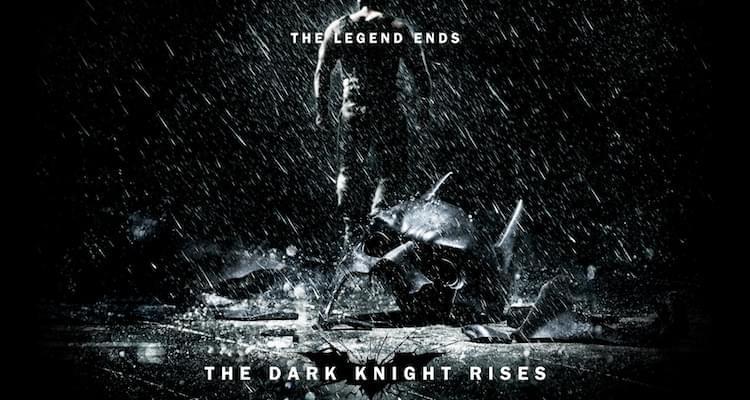
The Dark Knight Rises

0

You may recall that the last time a series of Batman movies ended, it was with rubber nipples, Chris O’Donnell, and ice puns. Christopher Nolan’s 21st-century trilogy, which started with “Batman Begins” and reached its zenith with “The Dark Knight,” now draws to a close with “The Dark Knight Rises,” and it’s a much more somber affair than the last time we said farewell to the Caped Crusader. (Of course, the awfulness of “Batman & Robin” was the reason it turned out to be the end of that run.)

“The Dark Knight Rises” does have one thing in common with Joel Schumacher’s franchise-killing disaster, though: both are the weakest entries in their respective series. “Batman Begins” thrillingly reintroduced us to Bruce Wayne (Christian Bale) and his personal demons; “The Dark Knight” was a complex psychological nightmare made legendary by an iconic villain. Part 3 dutifully wraps up the themes and story lines already established, and feels like part of a master plan. But though it’s good — “weakest” is a relative term — it doesn’t take advantage of the delirious momentum built by the previous films.

Eight years have passed since the death of Harvey Dent (spoiler alert: Harvey Dent dies at the end of “The Dark Knight”), and the two-faced district-attorney-turned-lunatic is a Gotham hero, his crimes having been scapegoated to Batman, who has vanished. Still reeling from the tragedies of the last film, Bruce Wayne now lives like a hermit in his fancy mansion, attended by faithful butler Alfred (Michael Caine). The streets of his beloved Gotham have been cleaned up. But all that means is that the criminals have moved underground.

The new bad guy in town is Bane (Tom Hardy), a hulking, masked psycho whose eloquent speaking voice — that of a young, drunk Sean Connery — and high-flown platitudes about rich-vs-poor belie his monstrous appearance. Meanwhile, also engaged in a bit of class warfare is Selina Kyle (Anne Hathaway), an expert cat burglar and con artist who robs rich people like Bruce Wayne.

Also meanwhile, Commissioner Gordon (Gary Oldman) considers revealing the truth about Harvey Dent; a uniformed police officer named Blake (Joseph Gordon-Levitt) wants to clear Batman’s name; millionaire Miranda Tate (Marion Cotillard) tries to get Bruce to re-invest in an energy project; Lucius Fox (Morgan Freeman) keeps an eye on the armory; and various wormy businessmen make corrupt back-room deals with various low characters.

Bane is at the center of a lot of this, eliciting fascination and some giggles from us, but not enough fear. He’s working according to mysterious motives that are connected to the events of “Batman Begins,” advocating chaos the way the Joker did in “The Dark Knight” (albeit strategically rather than randomly), and is more physically, brutishly powerful than his Gotham-menacing predecessors. All of that would seem to make him a fitting villain for the trilogy’s last chapter — but he lacks personality. He has too much screen time to be nothing more than an unstoppable killing machine, yet Nolan (co-writing as usual with his brother, Jonathan Nolan) doesn’t flesh him out, either, and Hardy can only do so much from behind a mask. The frequent callbacks to previous films, with their more interesting and alarming antagonists, make Bane suffer all the more in comparison.

Something else missing from this Batman film is Batman. We get very little time with the Caped Crusader, and what we do get tends to be businesslike. Instead of using gadgets and tricky maneuvers, Batman engages in ordinary fistfights, when he fights at all. I understand that the nature of the story being told here requires Batman to be absent frequently, and to be more grimly focused when he is present, but that doesn’t make it any less disappointing for those of us who enjoy seeing his superhero exploits. He’s practically a supporting character in his own movie.

His billionaire alter ego has a more pivotal role, and Bale still plays Bruce Wayne with haunted, barely restrained anger. He’s almost upstaged by Joseph Gordon-Levitt’s young cop, who appears idealistic and fresh-faced but has anger issues of his own, and by Anne Hathaway’s black-clad feline thief. There’s real fire in these new characters, which is especially useful with series regulars like Caine, Oldman, and Freeman relegated to the background.

The story has several satisfying twists (I don’t know if they’ll all be surprises for readers of Batman comic books) and is laid out carefully, without any rush. Nolan has confidence in his grim story, as well he should, and in his ability to tell it compellingly. Terrorism, fascism, class warfare, government stability — this is heavy stuff. But unlike “The Dark Knight,” which was also heavy, “The Dark Knight Rises” isn’t very deep, and its surface-level thrills aren’t powerful enough to sustain the film for two hours and forty-five minutes. But it caps off the trilogy with passion and dignity, if not always with slam-bang entertainment. Whoever directs the reboot in five years will have a lot to live up to.

The deal with that Rotten Tomatoes thing

0

So here’s what happened. This is the short version.

I think it’s funny when people post angry comments on one-sentence excerpts from reviews on Rotten Tomatoes without reading the actual reviews. What could be more useless than a response not to a review but to a one-line quote from a review? I also think it’s funny when people get worked up over a movie’s Tomatometer score, becoming increasingly despondent or outraged as each new negative review pulls the score lower. All of this is especially funny when it pertains to a movie that the angry people haven’t even seen yet.

To exploit this, I posted a fake negative review of “The Dark Knight Rises” — and clearly labeled it as fake — on my website, then posted a link to it on Rotten Tomatoes. I wanted to see how many people would post angry comments on Rotten Tomatoes without reading the “review.” It would be obvious, since anyone who was angry clearly hadn’t read the “review.”

Here is what the fake review said:

“The Dark Knight Rises” is easily the most disappointing Batman film so far — and I’m including Schumacher’s “Batman & Robin” in that statement. Nolan has finally lost his touch.

Just kidding! I haven’t seen “The Dark Knight Rises” yet. It’s probably very good! I just wanted to post a negative quote on Rotten Tomatoes and see how many idiots would type angry words at me without actually clicking the link to read the whole review. Given that Rotten Tomatoes commenters are the worst human beings on the planet, I suspect the number will be large.

Also: It doesn’t matter if a movie you love doesn’t get a 100% RT score. It affects you and the movie in no way whatsoever. “You ruined this movie’s RT score!” is the dumbest complaint a person can possibly make.

Also: If you get angry about a review of a movie that you haven’t even seen yet, the terrorists win.

Real review to come!

The first sentence is what I used as the Rotten Tomatoes quote.

The fake review was up for a couple hours. I never intended to keep it up forever, just long enough to get some responses, and then the joke would be over. The Rotten Tomatoes staff, quite understandably, doesn’t like people pranking their system. Like many critics, I had a log-in that allowed me to post links to my reviews on Rotten Tomatoes. (RT staffers add other links manually, and I believe there’s an automated system that periodically checks certain critics’ sites for new reviews.) Since I abused this back-end privilege, Rotten Tomatoes took it away — which is perfectly fair. Your kid gets a speeding ticket, you take away his car keys.

Rotten Tomatoes also decided that my reviews will no longer count toward the Tomatometer. I hope they’ll reconsider, but that’s their decision to make. I can understand where they’re coming from. With the nonsense that was happening with the actual negative reviews, they were in no mood for shenanigans this week.

Here is what Rotten Tomatoes editor Matt Atchity said about it in an article explaining why RT had temporarily suspended commenting on “Dark Knight Rises” reviews:

Which leads me to Eric D. Snider. He thought [correctly] it would be funny to post a negative review link on Rotten Tomatoes that links to his own site. He misrepresented his review link. (In case you didn’t know, some critics post their own reviews, and my staff posts some — it’s about 50/50). By attributing the link to Film.com, he misrepresented that organization. This is not the first time he’s done this. [It is the second.] In our opinion, by knowingly posting a link that isn’t a review (and he hadn’t seen the movie), Snider has abused our trust, and therefore, his reviews will no longer apply to the Tomatometer.

Please understand that I have no argument with Matt. He and I have been in contact via email. We’re still discussing all of this. I understand where he’s coming from, and I think he understands where I was coming from.

My point was to make fun of blind, mindless fandom. It had nothing to do with Rotten Tomatoes itself, which is a useful site that I refer to every day, but with the freaks who post comments there, and who have turned Rotten Tomatoes, IMDB, and just about every other movie website into cesspools.

I made no attempt to deceive anyone. My fake review was clearly labeled as such. The only people who were deceived were the ones who just read the one-sentence excerpt from it. They got what they deserved: fooled. I’m responsible for exploiting their foolishness, and for giving them a venue to demonstrate it. But I am not responsible for their foolishness.

And the people who realized it was a joke and were STILL upset because I had tampered with the Tomatometer — well, I don’t even know what to say about those people. A movie’s Tomato score has no bearing on your ability to see and enjoy the movie, especially a huge movie like this. It doesn’t matter. If you are angered by negative reviews and/or by a diminishing Tomato score, you should be made fun of. I stand by that.

The only people who are justified in taking the Tomatometer seriously are the Rotten Tomatoes staff. It’s their business. The Tomatometer might be trivial in the grand scheme of things, but it’s what Rotten Tomatoes does, and so it’s reasonable for them to be upset when someone tampers with it. I am sorry — really — for any extra work I caused the RT staff during a week that was already busy and stressful for them. RT was the venue of the prank, not the target of it. I have no beef with Rotten Tomatoes.

I’m also sorry for indirectly dragging Film.com into it. I do write for them, but of course my fake review was posted on my own site, not theirs. My reasoning was simply that the joke would be funnier if my super-negative quote were attributed to a higher-profile site, regardless of where the link was actually going. “This is even worse than ‘Batman & Robin’ — Eric D. Snider, Film.com” is better than “This is even worse than ‘Batman & Robin’ — Eric D. Snider, EricDSnider.com.”

When you post links to your reviews on Rotten Tomatoes, there’s a little drop-down menu that has all the outlets you write for, and you choose the appropriate one. About 10 percent of the time, I accidentally click the wrong one anyway, and mark a review as EricDSnider.com when it’s actually Movies.com or whatever. I’m not saying this time was an accident — this time was on purpose — just that one shouldn’t read too much into it. I take full responsibility for the prank, and I apologize to my Film.com bosses for besmirching that site in the process.

Did I pull this prank to drive traffic to my site? No. I did it for the reasons already stated: as an experiment to see how unhinged people would get over a negative review. People tend to assume that traffic is the only reason anyone does anything on the Internet, but that wasn’t what I was thinking. The best-case scenario for my joke would have been that I got NO traffic, because EVERYONE would have just read the quote on Rotten Tomatoes and not the whole review. The link was only up for a couple hours. I did get some extra traffic in that time, and have continued to get some this week, but my site isn’t monetized very well. The extra clicks on Google Adsense have earned me maybe two dollars. I will gladly donate it to whichever charity is handling outreach and counseling for people who have been traumatized by negative “Dark Knight Rises” reviews.

Some news reports have asserted that Rotten Tomatoes BANNED a critic for posting a FAKE REVIEW of a MOVIE HE HADN’T EVEN SEEN!!! There’s nothing factually wrong with that sentence, yet it completely misses the point. It makes it sound like I tried to pass off a fake review as legitimate, and then sometime later was found to be lying. That’s not what I did at all. The review was clearly labeled as a fake from the very beginning, and my reasons for posting it were clearly described. I had no intention of deceiving anyone for longer than the two seconds it took to click the link at Rotten Tomatoes and see the punchline.

I don’t mind if you didn’t like the joke. But please at least acknowledge that it was a joke, not an earnest attempt to lie about a movie I hadn’t seen.

I’ve been a movie critic for 13 years. I’ve written close to 3,000 reviews in that time, and the links are all still cataloged at Rotten Tomatoes. (The count there says 3,150. There are duplicates because some reviews were posted at more than one site and RT’s automated system counted them twice.) I’ve done some “trolling” in my day — it’s worth noting that I did basically the same thing with “The Dark Knight” four years ago — but where movies are concerned, the instances of regular old reviewing and dissecting and snarking outnumber the instances of prankery and hijinkery.

Anyway, “The Dark Knight Rises” is pretty good. “Iron Man 3” is terrible, though, worse than “Daredevil.”

UPDATE: Almost exactly a year later, Rotten Tomatoes rescinded the ban and let me back in, on the condition (of course) that there be no further shenanigans.

Theodore Rex

Theodore Rex

Whoopi Goldberg is best known today for being one of the hosts of “The View,” a show you never watch yet somehow keep hearing about. Before that she held the coveted center position on the political discussion program “Hollywood Squares,” a job previously held by the eminent scholar Dr. Paul Lynde.

But before THAT, Whoopi Goldberg was an actress. She did a couple of serious things like “The Color Purple” before turning her attention to the milieu in which she would find her greatest success, that of cackling nonsense. She cracked wise and called people “child” in “Sister Act,” “Sister Act 2: Back in the Habit,” “The Little Rascals,” “Made in America,” “Sister Act 3: Nun Too Soon,” “Sister Act 4: Forgive Me, Father, For I Have Sung,” “Boys on the Side,” and “Sister Act 5: Bloodsport,” to name just a few and to make up a few others.

It was during that stretch in the 1990s that Whoopi starred in the film that would secure her place in the annals of Hollywood lore: “Theodore Rex,” about a cop whose partner is a talking dinosaur. The film was famous at the time for going straight to video because test audiences hated it. (Bear in mind that test audiences the same year evidently had no objections to “Lawnmower Man 2” and “Kazaam.”) At a cost of $35 million, “Theodore Rex” was one of the most expensive straight-to-video films to date, as well as one of the worst films to cost $35 million. All that money is up there on the screen, though. The dinosaur costumes look like they cost $35 each, and there are about a million of them.

theodore rex

The film is set in a future America where the dinosaur-cloning procedures depicted in the science documentary “Jurassic Park” have been improved. These newly cloned dinosaurs aren’t much larger than an especially fat human, are capable of speech, and do not eat people. None of those things were true of the “Jurassic Park” dinosaurs, so SUCK IT, John Hammond.

The other nice thing about these dinosaurs is that they can be pushed around. They live as second-class citizens and are not taken seriously, no matter how smart (none of them are smart) or graceful (none of them are graceful) they are. A casual observer might assume the motivating factor for cloning the dinosaurs in the first place was that humans had run out of groups to oppress and needed somebody new.

Whatever the actual reason was, now there are lots dinosaurs shufflin’ around whatever city this is. One of the dinos is Theodore “Teddy” Rex (voiced by George Newbern), an ordinary T. rex who works in public relations for the police department but dreams of being a detective. You have heard that a T. rex’s arms were shrimpy and useless, but Teddy’s are pretty functional. His tail, however, is completely beyond his control. It’s constantly knocking things over and wreaking havoc and generally giving the impression that Teddy did not even have a tail until this morning. This is for comedy, because it is funny when someone’s tail bumps into stuff three hundred and fifty thousand times in 90 minutes.

Teddy gets his chance to be a cop when one of his own kind is murdered in cold blood — which, to be fair, is the only way a dinosaur can be murdered — and the police commissioner (Richard Roundtree), seeking to curry favor with the dinosaur community, assigns Teddy to the case. Teddy is paired with Katie Coltrane (Whoopi Goldberg), an experienced cop who DOES NOT WANT a dinosaur as her partner, because she is racist against dinosaurs, and also possibly because dinosaurs are animals. The movie seems to think that being able to talk means the dinosaurs should be treated like humans, but parrots and ventriloquist dummies can talk, too, and nobody’s campaigning for their rights.

theodore rex

Because it is The Future, Katie Coltrane is not an ordinary cop. She is “bio-ware,” a human with some computer components wired into her. I thought she was a robot at first, but no, she is bio-ware. She is probably offended when you call her the R-word. Storywise, there is no reason for Coltrane not to be an ordinary human being. But since she is partly electronic, the filmmakers have an excuse to dress her in a skin-tight black rubber bodysuit not unlike Catwoman’s, thus fulfilling the dreams of countless bondage fetishists and writers of Whoopi Goldberg fan fiction.

We already know who killed the dinosaur, by the way. It was a comet! It came back to finish the job it started 65 million years ago. No, just kidding, it was someone employed by billionaire Elizar Kane (Armin Mueller-Stahl), the geneticist who cloned the dinos to begin with. The whole dinosaur community, Teddy included, views Kane as a benevolent creator and father figure, but that’s only because they don’t know that he has nefarious secret plans, even though his Evil Villain accent should be a dead giveaway.

Kane’s goal is to bring about a new Ice Age to wipe out mankind, then reanimate the pairs of extinct animals he has frozen in his lair and create a “New Eden.” Why he wants to do any of this is not explained. The villain’s motives are none of the movie’s concern. The movie is a little surprised you would even ask. Anyway, Kane is going to cause this Ice Age by launching a missile — the kind of missile that causes Ice Ages, duh — and one of the dinos found out and was going to tell the police and had to get whacked.

But Teddy and Coltrane don’t know any of this. The movie only told us so that we wouldn’t suffer from any surprises or intrigue. Investigating the dinocide, Teddy and Coltrane do the buddy-cop thing where they bicker, ineptly stumble upon clues, and say sarcastic things to everyone they meet. It’s like “Lethal Weapon,” only with Whoopi Goldberg and a prehistoric monster instead of Danny Glover and a prehistoric monster. And instead of actual comedy, we get Teddy doing random impersonations of easy-to-impersonate movie stars like Bogart and Schwarzenegger, and Teddy and Coltrane both making fun of an English character’s accent. (That’s really all they’ve got for her. When you see movie characters resort to accent-mocking, you might as well get a telegram from the screenwriter saying, “I have given up on my profession, and indeed on life altogether, and have sent this telegram as a final notice of my apathy, may heaven have mercy on my soul, stop.”)

Our cops go to a dinosaur nightclub to look for leads. This is where we notice that while the movie’s dinosaur costumes aren’t very good, at least there are a lot of them. This is also where we meet Teddy’s love interest, a singer named Molly (voiced by Carol Kane). Also, a triceratops flirts with Coltrane, which may sound like an unlikely pairing, but remember that Whoopi dated Ted Danson.

The murder turns out to be pretty easy to solve because the assassin killed the victim with a specially designed explosive that is easily traced back to its source. Teddy notices the easy-to-notice evidence of the explosive on the victim’s body, which impresses Coltrane and the coroner, who had both not noticed it despite its easy-to-notice nature. The movie wants to eventually arrive at the point where Teddy has proven his worth as a police officer, so it gives him simple tasks like this and pretends he is AMAZING for accomplishing them, the way you praise a 2-year-old for pooping in the toilet, or Louisiana for not being ranked 50th in something.

Despite his fervent desire to be a cop, Teddy is reluctant to use a gun under any circumstances. Normally I would agree that access to weapons should not be granted to genetically engineered clones of extinct animals, especially species with notoriously poor dexterity, but Teddy should have thought of that before he joined the force. In the end he defeats Kane by outsmarting him, no guns required, and is proud of himself for avoiding violence. I admire the sentiment, but let’s be honest, some situations are best handled by just shooting everybody, a thought that I suspect crosses Whoopi’s mind every day on “The View.”

— Film.com

Help me write 50 ‘Snide Remarks’ columns

5

“Snide Remarks” used to be nothing more than a dumb weekly column that I wrote for my college newspaper. That was in 1997. Today, it has grown into a dumb weekly column that I write for the Internet! Like you, I marvel at how far we have come.

But with this progress has come change — change to the journalism industry, change to the way people access information and entertainment, change to my hair. I make a living as a freelance writer, working almost exclusively online. As a freelancer, it’s not feasible for me to spend time and energy writing something — even something I love, like “Snide Remarks” — without getting paid for it. I don’t have a “day job” that keeps me afloat while I dabble in side projects in my spare time. For someone in my situation, there’s no such thing as a side project.

At the moment, no reputable outlet is interested in paying me to write “Snide Remarks.” I know, I know: this is an outrageous affront to all decency, etc. Let us leave the remedying of that deplorable state of affairs for another day. In the meantime, I have found a way to circumvent the traditional publishing model and to keep “Snide Remarks” a-churnin’.

Basically, instead of convincing a publisher to pay me to write “Snide Remarks,” I seek to convince you — the readers — to commission the work. I’m crowd-sourcing.

We did this about 18 months ago, and it was a smashing success. I put in a bid for how much I wanted to be paid to write 50 columns; you guys passed around the metaphorical hat and raised the non-metaphorical money; I wrote the 50 columns.

Now it’s time to do it again!

For $6,000, I will write 50 more “Snide Remarks” columns. They will appear approximately weekly on Tuesdays starting Sept. 4. They will be marvelously funny and insightful, or at the very least will make fun of PETA.

Hot to Trot

Hot to Trot

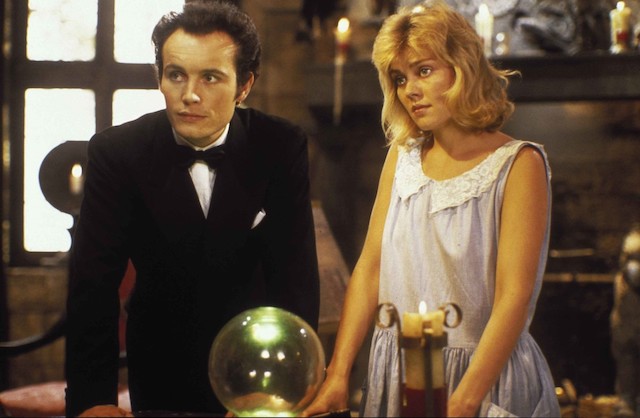
John Candy did a lot of funny things in his life, like “Planes, Trains and Automobiles” and “Uncle Buck,” in addition to the many sad and tragic things he did, like “Nothing But Trouble” and dying. But one particularly pungent offense on the spherical Canadian’s rap sheet is “Hot to Trot,” in which Bobcat Goldthwait owns a talking horse, and John Candy is the voice of that horse.

When word of this film’s existence reached my ears, my initial reaction was skepticism. A guy with a talking horse? Please. The back alleys of my memory are littered with the decaying corpses of hundreds, if not thousands, of forgotten movies about talking horses. The only way I’m going to add “Hot to Trot” to the pile is if the talking horse ALSO gives his owner stock tips. I demand variety.

hot to trot

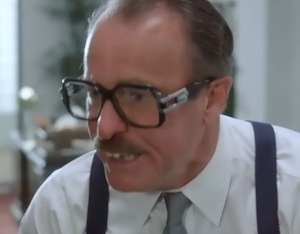
Well, shut my mouth, because that’s exactly what the horse in “Hot to Trot” does! His name is Don, and he is one of two possessions bequeathed by a dead lady to her idiot son, Fred (Goldthwait), the other being half ownership of a brokerage firm. Fred doesn’t want a horse and is too stupid to work in finance — he kind of got shafted, inheritance-wise — but he chooses to stay on as half-owner sheerly to spite the other half-owner, his jerky stepfather, Walter. Walter is played by Dabney Coleman, who is wearing, for no discernible reason, giant fake comedy teeth. Since the character’s teeth are never mentioned and do not serve any story-related purpose, we are forced to conclude that Coleman wore them solely to avoid being recognized.

So here’s a snaggle-toothed S.O.B. and a stringy-haired cretin who hate each other running a brokerage firm together, one motivated by greed and the other spite. Such an arrangement seems destined for failure (though people said the same thing about Tom Cruise and Katie Holmes, and they turned out fine). And indeed, Fred’s complete ignorance of even the most rudimentary elements of running a brokerage firm would seem a dismal portent, were it not for the narrative device known to the Greeks as equus ex machina.

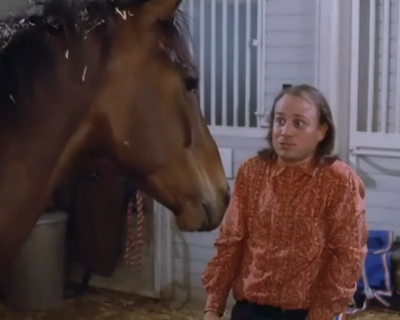
Fred has already met Don the talking horse at this point. They met in the stables, and as is customary in these movies, Fred was shocked by the idea of a talking horse for about five seconds, then immediately got used to it. Now, in his moment of distress, Fred receives a phone call from Don urging him to invest heavily in some little-known company that’s about to get huge. Don knows this because he overheard a rich dude talking about it at the stables, and he immediately used the opposable thumbs and dexterous fingers that all horses have to dial the phone and tell Fred.

hot to trot

Perhaps you are thinking that no matter how dumb Fred is, he would never take stock advice from a horse. The movie is a step ahead of you. Don doesn’t identify himself when he calls, and Fred doesn’t recognize his voice. So when Fred takes the stock advice, he doesn’t think it’s coming from the talking horse his mother left him; he thinks it’s coming from an anonymous stranger. Give the guy some credit.

The tip proves correct, and Fred is instantly rich. He moves into a luxury apartment, then is guilted by Don into letting Don live there, too. No reason is given for Don’s desire to dwell in a place that is 100 percent unsuited for equine residents, nor can I imagine one. It has already been established that Don has a comfortable life among other horses, all his needs amply met, with soft straw to lie upon and abundance places to defecate. Yet suddenly one day he’s trotting down a city street, as if he were homeless, sees Fred’s picture in the newspaper, and shows up on his doorstep wanting to be his roommate.

It’s like the filmmakers thought it would be funny if a man shared an apartment with a horse, but they couldn’t think of a good reason for that to happen, so they just made it happen anyway, and then it wasn’t funny after all.

Fred is flustered by the sudden arrival of his talking horse (who, it should be noted, does not have a job and will not be able to help with the rent). The talking horse went from a novelty to a nuisance in record time, even faster than Russell Brand did. Oh, the hilarious shenanigans Fred and Don have! In another movie, I mean, an imaginary one, one that’s like “Hot to Trot” but with comedy. In this one, Don just throws a wild party attended by other animals — including dogs, geese, a pig, and another horse, don’t ask me where they came from — who trash the place and, yes, do refer to themselves as “party animals,” in case you were wondering.

Let us devote a few words to the things uttered by Don the magical talking horse. According to Hollywood lore, John Candy was a last-minute addition to the film, brought in after disastrous test screenings — which had Elliott Gould as Don’s voice — caused audience members to weep openly and question the existence of God. The idea was to have Candy provide not only a new voice but new, funnier things for Don to say.

Instead, Candy ad-libbed a stream of limp one-liners in his usual cheerful manner, punctuating most of them with a “heh heh” laugh. As portrayed by Candy, Don is the sort of talking horse who laughs at his own jokes, which are terrible. Sometimes they’re not even really jokes, yet Don laughs anyway.

For example, when he tells Fred how many other animal languages he speaks: “You might say I’m a four-legged Dr. Dolittle! Heh heh!”

Or when he describes his upbringing on a farm: “I was restless — wild, I guess you could call it. A lot like James Dean, except I slept standing up! Heh heh!”

Or when he uses his dark powers as a speech-enabled beast of burden to summon the malevolent lord Satan to rain fire and anguish upon the Earth’s inhabitants: “Time for the apocalypse — or should I say, clippety-clop-alypse! Heh heh!”

Just kidding, I made that one up, as an example of the sort of thing I would make up if I found a comedy profoundly irritating and wished to subject its tropes to ridicule.

In addition to John Candy’s pitiful snarking, the film suffers from the casting of Bobcast Goldthwait as the lead. Goldthwait is a creative and well-respected writer-director today, but in 1988 he was still using that whiny-shouty-breaky voice that he used to do in his stand-up, as it had not yet been banned by the United Nations. Ninety minutes of that is bad enough on its own; when it’s in tandem with a chatty, self-amused horse that speaks only in rejected Billy Crystal gags, it’s enough to make us rethink the wisdom of adding sound to motion pictures in the first place.

hot to trot

But “Hot to Trot” is not just a movie about a talking horse who gives stock tips. You wouldn’t be able to get very far with that premise, not in today’s economy, not with today’s horses. Don’s second tip is for Fred to urge clients to buy stock in the company that makes the brand of oats he (Don) loves to eat. Don’s reasoning is that since this product is delicious, the manufacturer is surely about to become a major player in the industry, what with so many people who invest in the stock market relying so heavily upon the dietary preferences of their horses. This logic fails, however, and the company goes belly-up, and now Fred is flat broke.

The only way for Fred to regain his fortune — you have no doubt already arrived at this conclusion — is for Don to run in a race and win the prize money. Don isn’t really a “race horse” so much as a lazy horse that lives in an apartment with a bumbling financier. But Fred isn’t really a “jockey,” either, so much as a person who is the opposite of a jockey, and he does just fine riding Don to victory. Somehow the win is bad news for Comedy-Teeth Walter, I forget how, and so everyone who deserves to live happily ever gets to live happily ever after. No way is Fred getting the security deposit back on that apartment, though.

(P.S. This film has three credited screenwriters, and one of them is named Stephen Neigher. You would think that neither of those things could possibly be true, and yet both are.)

— Film.com

Savages

0

Every film Oliver Stone has made in this century has been set in the world of finance, politics, or history. Now we come to “Savages,” a vaguely sleazy pulp drama that addresses those topics obliquely but is mainly filled with the director’s other favorite things: sex, drugs, and violence. In other words, it’s vintage Stone, albeit without as much cocaine-fueled editing as in, say, “Natural Born Killers.”

Based on Don Winslow’s 2010 novel and set in Laguna Beach, Calif., “Savages” is the sun-baked story of two beach-bum friends, Ben (Aaron Johnson) and Chon (Taylor Kitsch), who run a simple marijuana operation. Ben, the pacifist, double-majored in business and botany at Berkeley, and has the unkempt mane and wispy facial hair to prove it. Chon, an Iraq veteran with scars both physical and emotional, is rougher, meaner. While Ben’s professionalism and easygoing nature prevent most of the violence typically associated with a drug business, Chon handles whatever problems do arise. They are a complementary pair.

Nobody knows this better than O (Blake Lively), their girlfriend. Yes, their. In her function as narrator, O — her name is short for Ophelia — informs us that Ben and Chon are both the love of her life, and that their yin-and-yang personalities comprise, for her, one complete partner. The fellas are cool with this arrangement. The three of them share a beach house and a lot else.

This idyllic three-sided relationship is disrupted, as are so many things, by a Mexican drug cartel. Headed by a vain, treacherous she-devil named Elena (Salma Hayek), the organization seeks greater control of the California pot market, and is particularly interested in the highly potent strain of weed that Ben and Chon (mostly Ben) have cultivated. Their business has benefited from the cooperation of a corrupt DEA agent, Dennis (John Travolta), who runs interference with the feds, but there’s not much he can do to protect them from Tijuana’s most notorious and decapitation-happy band of drug lords.

Other key players include Elena’s top henchman, Lado (played by a leering, sinister Benicio Del Toro) and Alex, her well-dressed lieutenant (Demian Bichir). Alex is the one who meets directly with Ben and Chon to make an offer to absorb their business, with Elena safely tucked away in her Mexico palace, watching via webcam. But it is entirely Elena’s decision to escalate matters when the bros decline her offer.

Stone, who co-wrote the screenplay with the novelist Winslow and Shane Salerno (“Aliens vs Predator: Requiem”), lets it go mostly unspoken that all of this violence and death would be erased if the War on Drugs were ended, but the point remains as subtext. Chon has been trained to kill by his government and uses tricks he learned from Iraqi insurgents to help fight Elena’s cartel, but Stone doesn’t dwell on these facts either. In most instances, where Stone has a choice between hammering a message home and telling an entertaining story, he goes with the latter, letting “Savages” function as nothing deeper than a gritty and glib damsel-in-distress action caper. In that respect, it’s his most purely enjoyable, no-ax-to-grind movie since “Any Given Sunday.” (Of course, “enjoyable” is a relative term. “Savages” has scenes of brutal violence that are difficult to watch. But you know what I mean.)

Among the leads, Johnson is more convincing as a hippie-dippy do-gooder than Kitsch is as a butch, battle-scarred killer, but the relationship between Ben and Chon feels authentic (or as authentic as a strictly heterosexual relationship between two men who have equal shares in the same girlfriend is liable to feel, anyway). Lively, despite her narrator duties, has little to do story-wise.

The real fun is in the less savory characters. Travolta is energetically nutty as the conniving DEA agent, with Del Toro just as magnetic as the cruel assassin (who literally twirls his mustache on at least one occasion). But my favorite performance is Salma Hayek as the villainous yet surprisingly nuanced cartel chieftain, a fiery, Spanglish-spouting vixen who lands just this side of campiness. It’s hard to tell how seriously we’re supposed to take any of this lurid guns-and-drugs ludicrousness; Johnson and Kitsch, especially, seem to be taking it more seriously than anyone else. To me, Hayek strikes the right balance between thinking too hard about the story’s inherent nonsense and sitting back and enjoying the ride.

The Amazing Spider-Man

0

Every movie needs to stand on its own two feet, and you could argue that there’s no reason to compare a remake to the original if the original is old, obscure, or otherwise unlikely to have been seen by your audience. But “Spider-Man” came out ten years ago, and the second of its two sequels is only five years behind us. The Sam Raimi-directed trilogy made a total of $2.5 billion worldwide.

So I’m not even going to try to avoid comparing Marc Webb’s new “The Amazing Spider-Man” to its predecessors. Such an effort would be futile and pointless. Everyone in the audience will be comparing them; why shouldn’t critics?

Though not exactly a “remake” of the 2002 “Spider-Man,” this is a retelling of Spidey’s origin story: we’re back at square one, with bites from radioactive spiders, homemade costumes, and the death of Uncle Ben. This time Peter is a mechanically inclined high school loser — played with effective wimpy vulnerability by Andrew Garfield — whose parents (Campbell Scott and Embeth Davidtz) hurriedly left him with his Uncle Ben (Martin Sheen) and Aunt May (Sally Field) some years ago, never to return. Dad was a scientist working in the field of inter-species genetics with the eminent Dr. Curt Connors (Rhys Ifans), an erudite but disheveled one-armed genius who dreams of harnessing various organisms’ powers to create a “world without weakness.”

Peter comes into contact with his father’s old collaborator through Gwen Stacy (Emma Stone), a fellow student at Midtown Science High School who interns for Connors. A tour of the high-tech science division of the corporation Connors works for provides a certain arachnid the opportunity to bite a certain young man, who subsequently develops certain powers, et cetera. Where the Raimi version, with the dorkier Tobey Maguire in the lead, emphasized Peter’s awestruck jubilation at discovering his new strength and abilities, the Webb version (no pun intended) focuses on Peter’s alarm, and on his initial inability to control what has happened to him. That sense of panic over what one might have unleashed through one’s scientific meddling arises again when Dr. Connors experiments on himself and experiences unforeseen physical changes, rendering him the movie’s official villain.

As the newly minted Spider-Man, Peter’s interest in crime-fighting extends only as far as finding the fleeing robber who killed Uncle Ben. These efforts are considered dangerous vigilantism by New York’s no-nonsense police captain (Denis Leary), but hey, at least he’s getting criminals off the street. It is later, after a harrowing experience helping civilians, that Spidey realizes he has a duty to use his powers for more than selfish reasons. His scene with a little boy on a bridge is an almost perfect encapsulation of why we like superheroes: it’s personal, it’s quietly heroic, and it inspires awe in a child.

Peter and Gwen are the core of the movie. If you don’t care for them, I don’t know if you’d care for any of it. As luck would have it, Garfield and Stone have a sweet chemistry together, her sparky personality balancing his softer one. (Peter becomes a smart-aleck when he puts the Spider-Man mask on, but the attitude never seems to suit him, possibly because his bon mots aren’t funny.) Their relationship is a heightened mix of authenticity and big-screen romanticism — no surprise to those of us who were fans of the director’s previous film, “500 Days of Summer,” in which he achieved a similar effect with two similar actors.

Webb doesn’t show nearly as much facility for the action sequences, most of which can be described as somewhere between “fine” and “good enough.” Maybe we’ve been overloaded with too many of these scenes — not just in the Spider-Man movies but in all the comic book adventures of the last decade — but none of the action here is memorable. It feels like an average issue of a comic book.

Which is kind of what it is. As the fourth Spider-Man movie in ten years, its effort to justify its existence is more arduous than most films’, and to approach it as an “event” movie is to set yourself up for disappointment. The screenplay — credited to James Vanderbilt (“Zodiac”), Alvin Sargent (“Spider-Man 2”), and Harry Potter adapter Steve Kloves — while generally nimble, falls into embarrassing corniness at times, including a cringe-worthy sequence involving construction cranes that’s accompanied by on-the-nose TV news commentary: “Spider-Man appears to be injured. It’s not clear if he’s going to make it!”

Still, that’s better than the scene where Peter first enters Connors’ facility with a group of students and, looking for his name tag, is told by the receptionist, “You’ll find yourself to the left.” In case that didn’t drive the point home, she repeats the metaphor: “Are you having trouble finding yourself?” Ugh.

But the story’s all right, the performances are decent, the special effects are top-notch. In some respects, the only thing that keeps this from being an outstanding Spider-Man origin film is that it isn’t the first one. In a parallel universe, where “The Amazing Spider-Man” came out in 2002 and the Tobey Maguire “Spider-Man” is the 2012 reboot, the unfavorable comparisons run in the opposite direction. (Or so I assume. I am not in contact with a parallel universe.) I think a viewer who hasn’t seen any of the other Spidey movies, who is disposed to enjoying this sort of thing at all, would find this one perfectly serviceable. The problem is that few such people exist. “The Amazing Spider-Man” is fine; there just isn’t any reason for it.

Cherry 2000

Cherry 2000

Of all the post-apocalyptic films made in the 1980s, only “Cherry 2000” dared to explore the effects that the collapse of civilization would have on the supply of sex robots. The prognosis is grim, my friends. According to the movie, the sex robots that you take for granted today will become rare after World War III. Replacement parts will be especially hard to find. So you’d better keep your sex robot in tip-top shape! Lube her chassis regularly, as specified in the owner’s manual! That’s the message of “Cherry 2000.”

One evening in the far-distant future year of 2017, an ordinary man named Sam Treadwell (David Andrews) comes home from a hard day’s work seeking nothing more than a quiet night with his robot sex wife. She is the Cherry 2000 model (played by Pamela Gidley), and Sam loves her deeply. Cherry loves him, too, by which I mean she was programmed to act like she loves whoever bought her, and Sam bought her, which I guess is the same thing. Sam and Cherry start making out on the kitchen floor after dinner, as newlyweds (newly-boughts?) often do, and they’re so passionate they don’t notice that the sink has overflowed. Within seconds, Cherry has been short-circuited by the water and soap suds.

“You can’t get these things wet?!” is what you are thinking. Believe me, buddy, I was as surprised as you. She eats and drinks like a human being, but a little dishwashing soap shuts her down. If I were Sam, I would definitely have some choice words to post on the Cherry 2000 manufacturer’s Facebook page, if the apocalypse hadn’t destroyed the Internet. (SEX ROBOT DIES IF IT GETS WET!! ZERO STARS!! DO NOT BUY!!)

Oh, right. The apocalypse. They had one of those vague ’80s-movie apocalypses, the kind where the futuristic cities remain more or less intact but everything else is a desert wasteland filled with either unruly teens or grizzled prospectors. Also, the economy is now somehow based on recycling old appliances, I think, according to the brief scene of Sam at his place of employment, where there’s a long line of people trudging forward with carts full of junked microwaves and toasters and such. Look, I don’t know what’s going on. I didn’t write the movie. Nobody wrote the movie.

Anyway, Sam removes Cherry’s memory “chip” (actually a miniature compact disc), figuring he can install it in another Cherry and it’ll be like nothing happened. All the Cherry 2000s look the same, of course, which has got to be weird if there are other guys in your social circle who bought the same robot sex wife as you. Alas, Sam learns that the Cherry 2000 was a limited edition — because it breaks down at the first hint of dampness, I would guess — and that finding another one will be difficult. But he will not be deterred! Cherry is the love of his life. Ain’t no mountain high enough, ain’t no world post-apocalyptic enough, etc.

The movie now sets up a classic “hero’s quest,” wherein our fearless protagonist will face all manner of peril in order to replace his robo-whore with another one that looks just like her. It is exactly like “Lord of the Rings.” Sam’s journey has the requisite multiple layers of wild goose chases: first you have to go to this weird place and find a guy, and he’ll tell you how to get to this other weird place, and at the second place there’s a map to the third place, and that’s where the thing you’re actually looking for is. Nobody can ever give all the instructions all at once.

Sam’s first destination is a Wild West outlaw town called Glory Hole. Yes, Glory Hole. Look, I don’t care how much of an apocalypse you had, no one’s ever going to name a town Glory Hole. That’s the second least believable thing about the movie, after the part where having a sexy android wife who says she loves you isn’t considered the saddest thing in the world by everyone who hears about it. Sam’s in the town of G.H. (I’m not acknowledging it anymore) to hire someone to guide him into the even more dangerous, even more wasteland-y territory where the spare Cherry 2000s are believed to be stored. In keeping with established movie precedent, this treacherous area is called Zone 7. Sure, we’ll give the useless boondocks town a raunchy name, but the scary important place just gets a number.

The guide that’s been recommended to Sam is named E. Johnson, and Sam is astonished to discover that E. Johnson — prepare the smelling salts for your imminent fainting! — is a lady female woman person of the opposite sex! She is played by Melanie Griffith, who at this time was not the major A-list Hollywood star that she would eventually be for a few months.

E. Johnson and Sam hop in E. Johnson’s awesome hot rod and head out into Zone 7, located in the Nevada desert, which even pre-apocalypse is an hellish landscape uninhabitable by man. Zone 7 is controlled by a mean dude named Lester (Tim Thomerson), who hates outsiders for undisclosed reasons and tries to kill everybody just because. Sam and E. Johnson’s narrow escapes from and violent confrontations with Lester are the kind of thing that would be exciting and adventurous in a movie that was capable of conveying those sensations. Instead, they merely yell a lot, and say inane things like “Whoa!” and “Here we go again!,” and Melanie Griffith’s expression and tone of voice never change. No, it does not turn out that her character is an android, but that’s an honest mistake to make.

Through it all, it is apparent that Sam and E. Johnson are destined to fall in love. They make wise cracks and argue with each other, and falling in love is the only possible outcome for movie characters of the opposite sex who engage in those activities. But Sam continues to replay Cherry’s memory chip, forlornly listening to his broken computer repeat the last things she said to him before she froze up. He has no interest in another (i.e., a human) woman! This leads to some tension between him and E. Johnson, especially after E. Johnson misleads him about something. “Say what you will about Cherry, she never lied!” Sam yells, to which E. Johnson retorts, “Well, I’m not a f****** robot!” Cherry, on the other hand, was a f****** robot. That’s literally what she was built for.

But I digress. They run into an old buddy of E. Johnson’s named Six-Fingered Jake (old-timey actor Ben Johnson), who lives in a cave and is surprisingly chipper considering he lives in a cave and only has six fingers. Six-Fingered Jake helps our heroes by telling them the next stop on their scavenger hunt: they have to go find Stinky Pete or Slappy Jack or somebody and fly his airplane to what’s left of Las Vegas, and that’s where the Cherry 2000s are. They do all of those things, eventually, although there’s a lot of shouting involved, and it kind of gave me a headache, but finally Sam inserts Cherry’s memory chip into a new Cherry body, and presto! He has his creepy fake wife back! That’s when he realizes he’s in love with E. Johnson and leaves the newly resurrected Cherry behind with the outlanders! And they all live happily ever after, except Cherry, who is bewildered and not really alive anyway, which shouldn’t be a problem in Las Vegas.

— Film.com

Ted

0

There are so many things that “Ted” gets right that the things it gets wrong are baffling. The impertinently vulgar live-action directorial debut from “Family Guy” creator Seth MacFarlane cleverly subverts a lot of movie tropes, suggesting ingenuity and self-awareness. But it also runs a good 20 minutes longer than it should and includes dramatic scenes with no attempt at humor — suggesting a curious lack of insight into what the audience for a movie about a raunchy talking teddy bear is looking for.

The premise is that when John Bennett was a little boy, he wished that his beloved teddy bear could talk to him and be his best friend forever, whereupon some Christmas magic made this come to pass. (The holiday-themed prologue, complete with jingly music and a Patrick Stewart narration, is perfect.) That was in 1985. Now John (played by Mark Wahlberg) is 35 years old, and Ted (a CGI creation voiced by MacFarlane) is indeed still his best friend and constant companion. Ted’s personality has developed — I hesitate to say “matured” — at approximately the same rate as John’s, so they share similar interests, which mostly include smoking weed and watching TV.

One of the film’s best decisions is to skip the Calvin & Hobbes route and let everyone, not just John, hear Ted when he speaks. Ted is known to be a magical living stuffed animal. This earned him notoriety back in the ’80s that still flares up occasionally, though most people are blasĂ© about it now: Oh, look, it’s that magical living stuffed animal. But then sometimes you get weirdos like Donny (Giovanni Ribisi), who wants to buy Ted as a companion for his doofy son. The very idea is offensive, of course. John doesn’t “own” Ted. He’s his pal.

The story’s conflict comes in the sexy form of Lori (Mila Kunis), John’s cool and understanding girlfriend of four years. She gets along with Ted well enough, the way most cool and understanding girlfriends get along with their boyfriends’ irresponsible buddies. But maybe it’s time for Ted to get a job and move into his own apartment, you know? Maybe Ted is keeping John from growing up.

“Ted” basically follows a traditional plot, the one where a dude feels like he has to choose between his best friend and his girlfriend, or between staying immature and growing up. MacFarlane, co-writing the screenplay with “Family Guy” scribes Alec Sulkin and Wellesley Wild, acknowledges the formula to the point of parody. A crucial moment for John comes when he must choose between accompanying Lori to an important social engagement and experiencing something with Ted that “is the symbol of our friendship” — a nice instance of saying, in so many words, what most movies would pussyfoot around. It’s an attitude common on “Family Guy”: “Eh, screw it, let’s just come out and say exactly what we’re doing.”

It will come as no surprise to those familiar with MacFarlane’s animation empire that the jokes in “Ted” are scabrous, lewd, racist, and insensitive, and that Ted sounds a lot like Peter Griffin. (The movie acknowledges that, and thus employs another regular “Family Guy” device: “It’s OK to be lazy as long as we make it clear that we know we’re being lazy.”) The dialogue includes not one but two 9/11 references, as well as the customary assortment of illness-related jokes. (“As one gentleman to another, I really hope you get Lou Gehrig’s disease,” says John to Lori’s smarmy boss, played by Joel McHale.) We get a few hit-and-run celebrity slams that are mean and irrelevant and cruelly funny. Some jokes are better than others, but the success rate is generally high.

In fact, this would be one of the year’s best comedies were it not for two significant errors in judgment. One is that it’s 106 minutes long, and by the end it drags like a … like a big draggy thing. (Eh, screw it, I don’t feel like coming up with a joke.) The other is that it places a strange degree of emphasis on the emotions behind John and Ted’s friendship and John and Lori’s relationship. A comedy, even a raucous one like this, doesn’t need to be ha-ha funny every single minute. But there are entire scenes near the end of “Ted” with no jokes at all, played totally straight. This is especially deadly when the story is starting to drag like a draggy thing anyway. Just get back to the jokes about hookers pooping on the carpet!

Magic Mike

0

When I tell you that “Magic Mike” is about a male stripper who is played by talking beef slab Channing Tatum, who drew from his own pre-stardom experiences as a stripper to inspire the screenplay, you assume the movie is a wild party of sweaty thongs, dollar bills, screaming drunk women, and general bacchanalia. But when I tell you that “Magic Mike” is a Steven Soderbergh-directed drama about aging, self-destruction, and the recession, you envision something completely different.

Both descriptions are accurate — which is why preview screenings have been filled with people curious to see the latest Soderbergh movie, as well as those more interested in the bachelorette party side of things. (Take a guess which faction is louder.) I don’t know that either group will be completely satisfied, but “Magic Mike” does a better job of mixing Chippendales-style guilty pleasures with reality-based cautionary tales than you might expect.

To use a marketing phrase that Warner Bros. didn’t, Channing Tatum is Magic Mike, a 30-year-old Tampa entrepreneur who earns most of his income at an all-male revue but has dreams of bigger things. He’s skilled at crafting custom furniture, for example, and he has a roofing company. Given the right opportunities, or even just a reasonable bank loan, he could make something of himself. And he’ll need to. He knows he won’t be young forever. The club’s owner, Dallas (Matthew McConaughey), once a stripper himself but now primarily an emcee, is a constant reminder of that.

The other performers in Mike’s troupe are not vital to the story, but they are named Ken (Matt Bomer), Tito (Adam Rodriguez), Tarzan (Kevin Nash), and Richie (Joe Manganiello). The DJ, a fat and flamboyant drug enthusiast, is named Tobias (Gabriel Iglesias). The guys’ backstage interplay, often filmed with fly-on-the-wall long takes and overlapping dialogue, feels authentically jocular, somewhere between a Broadway theater dressing room and a frat house.

Into this world comes Adam (Alex Pettyfer), an unmotivated 19-year-old college dropout who’s been crashing at his sister Brooke’s (Cody Horn) apartment while waiting for something to fall into his lap. He didn’t have stripping in mind, but he takes to it like a duck to water when he is thrust onstage without warning like Elmer Fudd in one of those opera cartoons. Mike promises Brooke he’ll watch out for the kid — The Kid soon becomes his stage name — and protect him from the pitfalls of popularity.

Soderbergh has a blast staging the performance scenes, which are the non-full-monty variety that employ borderline-campy props, costumes, and choreography. (That, perhaps, is the chief difference between male and female stripper audiences: women like to see a show; men are just there for the nudity.) No judgments are made about the dancers or the women who lust after them. The environment isn’t portrayed as sleazy, or at least no more so than anything that happens in Tampa. It’s just fun!

The sleaze is offstage, where it is viewed at first with matter-of-factness — oh, hey, look, Mike’s girlfriend Joanna (Olivia Munn) loves recruiting a second girl for threeways! — but with increasing alarm. Adam gets reckless, as would any 19-year-old who suddenly finds himself a sex symbol, and Mike struggles to keep his promise to Brooke. The basic trajectory of the plot isn’t revelatory, but the screenplay (by producer Reid Carolin) offers a few tweaks in the way it handles it.

“Magic Mike” might be less sexy than you want a stripper movie to be, and less potent than a drama should be. It’s not “Boogie Nights” — but neither is it “Showgirls.” Soderbergh weaves back and forth between dizzying fantasy and harsh reality, and only sometimes captures the full impact of either one.

But it’s surprising how quietly dramatic some of the non-stripping scenes are, and how effective Tatum is in them. His scenes with Cody Horn, in particular, are naturalistic, almost documentary-like in their believability. Mike comes across as a smart dude, a decent bro, a talking beef slab with a good head on his waxed shoulders. Who’d have thought this film would be a showcase for Channing Tatum’s acting talent?

Beasts of the Southern Wild

0

Hushpuppy, the little girl at the center of “Beasts of the Southern Wild,” lives in squalor and ignorance in an especially water-logged part of the Louisiana bayou nicknamed the Bathtub. Separated from “the dry world” by a levee, Hushpuppy and a couple dozen others live simply but cheerfully, with elevated shacks for houses and roots and folk remedies for medicine. Her primitive circumstances have taught Hushpuppy something basic about the natural world: “The whole universe depends on everything fitting together just right.” When the balance is upset, things go wrong.

This lyrical film, an astonishingly poignant debut from director Benh Zeitlin (who co-wrote it with Lucy Alibar), addresses that imbalance with clear, beautiful vision and an unmistakable affection for humanity. An allegorical coming-of-age story, it combines magic realism with a decidedly un-glossy, un-prettified view of Hushpuppy’s off-the-grid lifestyle, drawing us into her world as if in a dream. It does this unpretentiously, with gorgeous cinematography (by Ben Richardson), an urgent and plaintive musical score (by Zeitlin and Dan Romer), and unaffected acting.

That last achievement stems from Zeitlin’s use of non-professional actors, including a remarkable 6-year-old named Quvenzhane Wallis in the role of Hushpuppy. She’s also our narrator, describing life in the Bathtub with matter-of-fact eloquence. Her mother “floated away” some time ago, leaving her in the care of her father, Wink (Dwight Henry), who loves her but is ill and irresponsible. Its residents stubbornly independent from the outside world, the Bathtub is essentially a commune, and the children are tended by a teacher, Miss Bathsheeba (Gina Montanna), whose instruction is both academic and philosophical. “This is the most important thing I can teach you,” she says. “You gotta take care of people smaller and sweeter than you are.” People are happy despite the lack of creature comforts; they live here by choice, after all. There is enough food to be found in the bayou. In the Bathtub, any occasion is right for festivities and drinking.

Then there is a serious storm. Living this close to nature means being affected by such things more than the average North American, and the people of the Bathtub do what little they can to preserve their rickety homes and their own lives, eventually resorting to a Noah’s Ark scenario. Hushpuppy is alarmed by the sudden changes to the landscape and the unraveling of her world. “For the animals that didn’t have a Dad to put ’em on the boat, the end of the world already happened,” she says in narration. People from the dry world arrive to evacuate the Bathtub and take everyone to the white, sterile safety of emergency shelters.

Hushpuppy’s journey from that point forward is an enchanting mix of metaphors and reality. Part fairy tale, part Dickensian adventure, the film feels like a poet’s response to civilization’s disrespect for Mother Nature. Hushpuppy must face a scary new world that she had no part in creating, and her loss of innocence stands in for the similar growing pains we all experience.

Comparisons to Terrence Malick’s “Days of Heaven” and David Gordon Green’s “George Washington” are inevitable and appropriate, as Zeitlin emulates those movies’ sense of reverie and poetry and their ability to find aesthetic beauty in the natural, mundane world. But “Beasts of the Southern Wild” is also very much Zeitlin’s own film, a uniquely poetic view of ordinary people in extraordinary circumstances whose artistic, ideological, and visual loveliness will stick with me for a long time.

What’s to become of Snide Remarks?

18

Greetings, friends! ‘Tis I, fictional Internet character Eric D. Snider! I would like to update you on what is happening in the realm of Snide Remarks, the weekly column I write in the English language for people who can read English.

A while back, I ran a Kickstarter campaign to fund the production of 50 Snide Remarks columns. I am pleased to report that last week’s entry, “Requiem for a Chair,” was the 50th. My obligation is complete. And only three and a half months later than originally promised!

Here they are, added to the archives as #619-668. These last 50 all have audio versions now, too, except for a few where the format of the column makes it unfeasible. I’ve been enjoying recording those more and more recently, especially the ones that are written as monologues anyway. It’s like I get to perform but without anyone having to see me!

And may I add that audio versions were not even part of the original contract. Threw those in for free, I did! That is added value for you, the customer.

Do I wish to continue writing Snide Remarks? Indeed I do! But must I make money writing it? Indeed I must. Such is the life of a professional writer: always needing to get paid for writing.

The Kickstarter thing worked well last time. Those who wanted to pay a dollar or five or a hundred for 50 Snide Remarks columns cheerfully (I assume) did so. Those who preferred not to contribute didn’t have to — and they still got to read the columns! Everybody was a winner.

Soon I’ll be launching a new Kickstarter campaign for another cycle of 50 columns. It’ll work basically the same as the last one, with a few tweaks. It will start soon. Don’t worry, once it starts it will not be possible for you not to know that it has started.

In the meantime, Snide Remarks is on hiatus. Think of it like a TV show. We ran 50 episodes, and now we’re on break until the new season starts. Except that the new season won’t start at all unless the people who make the show raise enough money. I even ended the last column on a cliffhanger, on purpose, just to mess with you. Better pony up the bucks, readers, or you’ll never know what happened to the chair!!

All laffy-laffs aside, I hope the regular readers know that I love writing Snide Remarks. There are things I write just for the money, but Snide Remarks isn’t one of them. I’ve been writing Snide Remarks since 1997, and similar weekly columns under different titles since high school. But I hope you also understand that as someone who makes his living as a freelancer, I can’t afford to write something regularly without getting paid for it, no matter how much I enjoy it.

Consider your gynecologist. You think she doesn’t love performing hysterectomies? Of course she does! That is why she became a gynecologist, because of the thrill she gets pulling uteruses out of ladies. But she still has to make a living. (The same applies if your gynecologist is a “he” not a “she.”) She cannot just go around doing hysterectomies in her leisure time. I mean, now and then, sure. At a party or whatever. But in general, we writers and gynecologists have to make a living.

So anyway, Kickstarter, coming soon. Thanks for your support. I love each one of you deeply, to the point that it is uncomfortable.

UPDATE: As threatened, the Kickstarter is up and running from now till July 20!

Abraham Lincoln: Vampire Hunter

0

The problem with coming up with the title first and the story later is that sometimes you don’t get around to coming up with the story. “Abraham Lincoln: Vampire Hunter” seems to be an example of this, promising so much campy-awesome historical-fiction insanity with that title but delivering a benignly dumb product that’s disappointingly restrained.

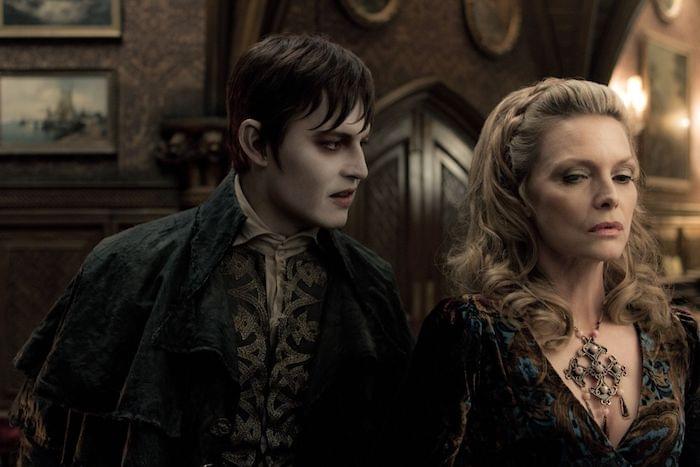
Maybe the novel is different, although its author, Seth Grahame-Smith, wrote the screenplay too. Oh, and he’s also credited for last month’s miserable “Dark Shadows.” He evidently has a passion for vampires that outpaces his ability to write about them.

In this version of American history, young Abraham Lincoln (played as a child by Lux Haney-Jardine) is devastated by the death of his mother at the fangs of a vampire named Jack Barts (Marton Csokas), who by day is merely a ruthless local merchant. He’s pretty racist, too, but there was a lot of that in those days.

There was apparently a lot of vampirism as well. Abe grows up seeking vengeance against the evil Barts, and as an adult (now played by Benjamin Walker) meets a drunk, carousing vampire tracker named Henry Sturgess (Dominic Cooper), who fills him in on just how prevalent they are. Henry even has photographs of some of the more prominent bloodsuckers, which he displays via carousel slide projector in much the same way that CIA officials fill their agents in on the facts of their cases. Of course, we all know that vampires can’t be photographed, and especially not in 1837, but whatever. “Abraham Lincoln: Vampire Hunter” is set in a fictional version of history where Abraham Lincoln was a vampire hunter, and where advancements in photography were made much faster.

They have sunglasses and sunscreen, too. And these things allow vampires to walk around in the daylight. But again, whatever. I SAID WHATEVER!

Abe moves to Springfield, Ill., to study law, and to bump off the vampires on Henry’s kill list. He meets a lovely young lady named Mary Todd (Mary Elizabeth Winstead), gets a job working in a shop owned by Joshua Speed (Jimmi Simpson), debates Stephen Douglas (Alan Tudyk) on the merits of slavery, and I guess becomes president at some point. (The movie kind of glosses over it.) Through it all, Abe and Henry strive to wipe out the vampire population, which is led by a creeper named Adam (Rufus Sewell) and is making alliances with certain Confederate folks.

There are two ways to tell a tongue-in-cheek revisionist-history story like this, the clever way and the dumb way. The clever way involves adding fictional details that coincide with — and do not contradict — the actual facts of history. The dumb way involves a half-hearted attempt at that, combined with a lot of flaccid references to famous things. Guess which route we’re taking here.

This is a step down for Russian director Timur Bekmambetov, whose “Night Watch,” “Day Watch,” and “Wanted” (with Angelina Jolie) were exactly the kind of energetic preposterousness that “AL: VH” ought to have been. Sure, there’s a battle scene in which a vampire throws a live horse at Abraham Lincoln. What the movie needs is MORE of that — more crazy nonsense, more outrageous history-baiting, more “I emancipated that vampire’s head from his body.” (That’s not in the movie. It should be, is what I’m saying.) Bekmambetov doesn’t expect us to take the premise seriously, exactly. But he doesn’t seem to want us to laugh at it, either. He seems caught in between, working both angles — intense vampire flick and campy spoof — at the same time. And as history teaches us, a house divided against itself cannot stand.

Brave

0

Disney animation is big on the whole “princess” thing, especially if you expand the definition of “princess,” as Disney’s marketers do, to include basically any female protagonist. Yet somehow Pixar — in business with Disney since “Toy Story” and now officially part of the family — has been light on lady heroes until now. The streak is broken with “Brave,” a charming but weightless adventure tale set in the Scottish Highlands. Fiery-haired Merida might not join Snow White and Cinderella in the Disney pantheon, but she’s a good addition to the roster of headstrong cartoon women.

She might not want to hang out with those someday-my-prince-will-come types anyway. Though Merida (voiced by Kelly Macdonald) is a medieval princess, the daughter of raucous King Fergus (Billy Connolly) and stately Queen Elinor (Emma Thompson), her way of thinking is considerably more enlightened. She’s a skilled archer, much to her mother’s embarrassment and her father’s secret pride, and she has no interest in the stuffy refinements of proper princess decorum. She’d rather be like her little brothers, a set of hellion triplets who are allowed — expected, even — to get dirty, cause trouble, and make noise.

Merida is particularly outraged by the custom of intermarrying among the kingdom’s clans, whereby she, as the king’s daughter, will be betrothed to whichever lunkhead suitor best proves himself in a contest of skill among all the clan leaders’ sons. It is on this point that Merida and Elinor, who have already clashed the way that all teenage girls and their mothers do, simply cannot agree. Neither will budge.

Here the story reaches the point where magic must become involved or else it can’t have the Disney name on it. I’m going to be vague because I enjoyed the experience of seeing where the movie went without any foreknowledge of it. Suffice it to say that Merida desires something and gets it, but with unforeseen consequences. The bulk of the film is about Merida and Elinor healing the rift between them.

Though the story takes a couple unusual paths, it’s essentially very simple. Most of the themes are typical for a Disney and/or Pixar production: accepting your responsibilities, doing your duty, carving out your own fate, growing up, learning not to trust witches, etc. There are magical transformations and fearsome beasts, as usual. All of this is delivered with the customary Pixar sincerity, if not the usual dosage of emotional resonance.

But the relationship between Merida and Elinor rings truer than we’re used to seeing between mothers and daughters in animated films. (For one thing, the mothers are usually dead.) It’s a completely different dynamic from the one between father and daughter or father and son, and “Brave” (written by Brenda Chapman, Irene Mecchi, Mark Andrews, and Steve Purcell, directed by Chapman and Andrews) captures it well. The interaction between Elinor and Fergus is also refreshing — partly, yes, because it’s rare enough to see an intact married couple in a cartoon, but also because their genuine love for each other raises them above the standard husband-and-wife shtick.

“Brave” is focused more on adventure than humor (though there is some comedy), and the action moves swiftly enough. What the film is missing is the crackling dialogue that has marked almost every previous film from this outfit — that familiar Pixar zing. The characters in “Brave” may be speaking in lovely Scottish accents, but the sentences they’re using are perfunctory. “This is what you’ve been preparing for your whole life!” says Elinor. “No, it’s what YOU’VE been preparing me for!” retorts Merida. That exchange could have been pulled verbatim from any other movie about a child who didn’t want what her parents had in mind for her, and it’s typical of the whole screenplay. Four writers and nobody could punch up the dialogue a little?

This is lesser Pixar, for sure. I doubt even the people who made it would claim it’s among the company’s best creations. But the first “Cars” reminded us that not every entry can be a masterpiece, or needs to be. There’s room for pleasant, sturdy attractions, too, including ones aimed squarely at the hearts and souls of wide-eyed little girls.

Seeking a Friend for the End of the World

0

“Seeking a Friend for the End of the World” is about exactly what it sounds like it’s about. A 70-mile-wide asteroid is headed for Earth. There’s no way to stop it. Our governments presumably tried all the stuff from “Armageddon” and it didn’t work. Scientists say the rock will hit us in 21 days, killing everyone on the planet when it does. All we can do till then is wait.

We’ve all wondered what we would do if we knew we were going to die soon. Plenty of movies have addressed that subject. But how do your plans change if it’s not just you but the entire world that’s going to die? What happens to society in the meantime? This is a far less common movie premise. (There have been a few, though, including a fine Canadian film from 1998 called “Last Night.”) We want the characters in our movies to have at least SOME chance of success, and pitting them against an unstoppable force that will definitely destroy the planet sounds like you’re dooming them to failure from the get-go.

Ah, but there are different ways of measuring success. “Seeking a Friend,” a bracingly original romantic-comedy-drama, reminds us that your life is a success if you make the most of whatever time you have. Maybe you can’t stop the utter annihilation of the world and everything in it. But don’t underestimate the importance of short-term goals!

The film begins three weeks before doomsday. Dodge (Steve Carell), an unambitious office drone with a name that’s a little too on-the-nose for his character, finds himself newly single when his wife figures now’s the time to split. Dodge is the sort of schlubby guy who always seemed beaten-down and resigned, even before the end of the world was announced. “You’d think a lifetime of waiting for the worst would have prepared me for this,” he says at one point.

A younger neighbor of his, Penny (Keira Knightley), is almost his opposite — carefree and optimistic, good at finding the bright side, fond of marijuana, flighty. She’s the kind of girl who thinks nothing of popping into Dodge’s apartment by way of the window and fire escape. She’s also dangerously close to being a Manic Pixie Dream Girl, but Knightley’s simple charm keeps the character from teetering over into that realm.

Writer-director Lorene Scafaria, who penned the “Nick & Norah’s Infinite Playlist” screenplay and has written for TV’s ultra-absurd “Childrens Hospital,” finds plenty of humor in the details of civilization’s breakdown, imagining a wide range of reactions that all seem plausible. There are people who continue to go about their normal lives, finding comfort in the routine; some commit suicide now, to get it over with; others do what we tend to think we would do, i.e., go completely bonkers, host orgies, do drugs, give liquor to children, etc. Brief appearances by the likes of Rob Corddry, Patton Oswalt, T.J. Miller, Gillian Jacobs, Connie Britton, and Adam Brody are funny.

For society at large, there’s still some semblance of order at first. (“Feel free to wear casual Friday clothing any day of the week,” Dodge’s boss tells his employees.) But soon this collapses into rioting and mayhem, forcing Penny and Dodge to embark on a road trip toward their individual goals: she wants to get home to her parents, he wants to reconnect with his high school sweetheart.

There are a few missteps in what is overall a very solid film. Dodge and Penny wind up in jail for a night, a useless diversion that doesn’t make sense logically and doesn’t help the story. More crucially, as much as I believe the Dodge and Penny characters individually, I just don’t buy the relationship that forms between them over the course of the movie. We’re supposed to feel like they’ve found something real, but their connection seems forced and contrived. Still, there are some truly affecting moments in this unusual, melancholic comedy.

To Rome with Love

0

“To Rome with Love” is the kind of Woody Allen comedy that makes people who aren’t fans of Woody Allen comedies secure in their assessment, and makes the auteur’s fans grimace and say, “Well, OK, disregard that one. Have you seen ‘Annie Hall’??”

Allen’s first Roman production is a love letter to the Eternal City (which is beautifully photographed by Iranian cinematographer Darius Khondji), with additional affection shown for Federico Fellini by means of borrowing some of his plot devices. It has a merry tone, like “Midnight in Paris” did. But this frothy anthology of unconnected stories has none of that film’s buoyancy, instead burdened by limp, hoary jokes and a frustratingly meandering pace, as if assembled from random notes Allen has left for himself over the past few decades.

An American girl (Alison Pill) is engaged to an Italian dreamboat (Flavio Parenti) whose mortician father (Fabio Armiliato) is an amazing operatic tenor, but only when he’s singing in the shower. The girl’s retired dad (Woody Allen), visiting from the U.S. to meet his future in-laws, wants to make the man a star. In a parallel story, an ordinary middle-aged nobody (Roberto Benigni) is mystified when he is suddenly and inexplicably pursued by paparazzi and reporters who hang on his every boring word.

Then there is the architecture student (Jesse Eisenberg) who happens to meet a well-known architect (Alec Baldwin) who might be the older version of himself and who offers advice as the lad navigates a relationship with his staid girlfriend (Greta Gerwig) and her dynamic sexpot friend (Ellen Page). Finally, a timid newlywed (Alessandro Tiberi) temporarily misplaces his starstruck wife (Alessandra Mastronardi) and has to let visiting relatives think that a high-priced prostitute (Penelope Cruz) is the bride.

These vignettes don’t directly overlap — nor could they, since some take place over several weeks while others are confined to a day or so. They share a setting and some loose themes: the desire for fame, the urge to make something of oneself, the impulse to be romantically unfaithful. There is a running undercurrent of surrealism as whimsical things happen that would not happen in life. Allen is playing around here, having fun.

Well, at least someone is having a good time. Allen seems committed to a languid, casual pace, even when dealing with farcical situations — like the prostitute-posing-as-wife — that call for something more madcap. The gags are flat and familiar, like deleted scenes from previous Allen movies. Our introduction to the character Allen himself plays comes when the man is on an airplane kvetching about turbulence: the stereotypical neurotic whiner that you do when you do a Woody Allen impersonation. I admire a guy who’s 76 years old and still writes and directs a movie every year, but this sloppy thing feels phoned-in.

Fundraiser for 13-year-old Miriam

6

This is Miriam. She’s 13 and lives in Utah. In August, she is going to have brain surgery. A malformation of blood vessels in her noggin, probably growing since birth, recently began to cause seizures. The doctors have concluded that surgery is necessary to prevent further, potentially life-threatening, damage.

Now, your thoughts and prayers and karmic wishes on Miriam’s behalf are certainly welcome. But that’s not what this is about.Miriam!

Miriam’s mom and stepdad have health insurance, fortunately. But they also have a $5,000 deductible. They also have another child who began having seizures around the same time as Miriam — seizures which turned out to be caused by something totally different (and far less severe), but which nonetheless required numerous tests and specialists. Oh, and a third kid had an asthma-related emergency-room visit, despite her many and expensive asthma medications.

The point is, Miriam’s parents have enough stress and worries without having to deal with a $5,000 insurance deductible on top of it.

So here’s what we are going to do.

We are going to raise the $5,000 ourselves. Each of us is going to contribute a little, as much as we can afford, whether it’s $1 or $100, or another amount in between, or more than that. (But not less than a dollar. Come on.) These contributions will add up and Miriam’s parents won’t have to worry about money when they are already worried about Miriam’s brain surgery.

BRAIN SURGERY, FOR CRYING OUT LOUD!

PayPal is the easiest way to do this. Miriam’s mom, Sarah, has a “Donate” button on her blog. Go there and click it. The account is jointly owned by Sarah and her husband, Richard. Sarah had to be coerced to let us do this fundraiser — a certain amount of pride-swallowing is involved in accepting help from strangers — and has promised that every penny will be deposited into their health savings account so it can only be used for medical expenses.

I will vouch for her as well. This is legitimate.

For more background, here’s a blog post Sarah wrote a few months ago, before it was clear that surgery was needed. If you would like to contribute via check rather than PayPal, email me (the contact form is under the “About Eric” tab above) and I’ll tell you where to send it.

OK? OK. Let’s do this. As you can see, Miriam is a “Weird Al” Yankovic fan. Surely this grants her a special place in our hearts.

UPDATE: Sarah informs us in the comments below that more than $500 was contributed in the first 24 hours! That’s fantastic! Keep it up!

UPDATE #2 (6/22 afternoon): Sarah reports that we’re at $1,200 already! Please keep spreading the word through Twitter and Facebook and things and such.

UPDATE #3 (6/25 afternoon): Just over $1,800. This is great/not enough!

UPDATE #4 (6/26): Thanks to a few giant donations, they’re at $3,000 now!

Donate here.

Requiem for a Chair

0
Requiem for a Chair

There comes a time in every man’s life when he must put away the things of his youth and embrace adulthood. It is just as the Apostle Paul said: “When I was a child I spake as a child. But now I am grown up and do not ride a skateboard anymore, because come on.”

Such a milestone recently arrived in my own life, when it became necessary to dispose of an ugly yellow chair that I’d had since college. The mangy thing was already very old when I bought it at a thrift store in 1996, and it had only gotten older since then. Though it was still comfortable to sit in, the fabric on the armrests was wearing through, and stuffing was popping out in random places. It creaked and groaned with every slightest movement. If the ugly yellow chair were a person, it would have been set adrift on an ice floe years ago (assuming it was also an Eskimo, and that Eskimos actually do that).

Then some friends of mine announced that they were moving to another city and divesting themselves of certain pieces of furniture, including a comfortable reclining chair that could fill the same function as my beloved but decrepit ugly yellow chair. This seemed to be the right opportunity to make the switch. My friends delivered the chair, bringing with it many years’ worth of accumulated cat hair, which I vacuumed out and fashioned into three new cats, which I dropped off at the animal shelter. Now all I had to do was get rid of Old Yeller.

This was going to be difficult, not logistically but emotionally. We’d been through so much together, the chair and I! We first met one spring day in 1996, when I was a college student. I lived in a furnished off-campus apartment, and sometimes when it was a nice day I would drag one of the apartment’s comfy chairs out onto the landing and read a book in the sunshine. One day I was engaged in this activity when the apartment manager happened by. He said we were not permitted to bring the furniture outside, as it could be damaged by exposure to the sun and other elements. Well, fair enough, I thought. The furniture belongs to the property owners; they are entitled to make the rules concerning what we may and may not do with it. So I will buy MY OWN chair! A man who possesses his own chair is beholden to no one!

old yeller

This all happened in Utah, so I went to the Utah equivalent of Goodwill, which is called Deseret Industries, and bought the ugly yellow chair for $7 — quite a bargain for any piece of furniture, you must admit. I didn’t mind its baby-poop color, and I found its raggedy appearance charming: this was a chair that had been lived in. It was homey. It swiveled on its base, so I could spin around in circles if I wanted to (and I did), and while it was not a “recliner” as such, it did lean back far enough to where a person could nap in it (and I did).

I never planned on forming a 16-year relationship with the ugly yellow chair. I bought it as a temporary measure, for as long as I happened to live in that apartment. But when I moved to a new place several months later, I figured I might as well take it with me. It was mine, after all — I’d spent $7 on it! — and I had come to enjoy sitting in it, not just on sunny days when I took it outside but the rest of the time, too. It was my TV-watchin’ chair. My snack-eatin’ chair. My socializin’ chair. (Mostly TV-watchin’ and snack-eatin’.)

So it came with me to my next apartment, where I lived for a year, and to the apartment after that, where I lived for four years, and thereafter to my condo, for three years, and thence to another apartment, for another year. Then it went into storage with most of the rest of my stuff while I moved to Portland and lived with a friend while searching for my own place. That was only two months, but it must have been the worst two months of the ugly yellow chair’s life: locked in a hot, dark storage unit with a bed, some bookcases, a lot of DVDs, and memories — so many memories of so many hours happily spent cushioning my buttocks, supporting my weight as I went about my leisure activities. What nobler purpose is there for a chair than to provide rest and comfort? I can proudly say I did everything within my power to help that chair fulfill its usefulness. I sat on the hell out of that chair.

Of course, I don’t know what happened to the chair before I owned it. Maybe it had experienced greater sadness and loneliness than being in a storage shed. It appeared to have been manufactured in the 1970s, so heaven only knows what atrocities it witnessed during that decade: how many shag carpets it got snagged on, how much sweaty polyester was pressed against it. For as long as it was under my care, though, it had a happy home.

Uh, except that I never really cleaned it. The thing about a chair that you buy at a thrift store for $7 is that it never occurs to you do any maintenance or upkeep on it. It’s like adopting a 14-year-old dog. Oh, sure, I vacuumed the food crumbs from under the chair’s cushion now and then. But that’s literally all I ever did. No upholstery cleaner, no carpet cleaner, no damp cloths, not even a spritz of Febreze. Whatever odors, stains, or germs came in contact with that chair over the last 16 years remained in contact with it, are still in contact with it. If I was ever eating, say, Cheetos, and licked the cheese powder off my fingers and then absent-mindedly wiped my hand on the arm of the chair, that was it. I’m not saying I routinely, consciously use my chair as a napkin. I’m just saying that over the course of 16 years … well, things are going to happen. Mistakes were made. Who among us is not greasier and filthier now than they were in 1996?

In any event, it was time to bid farewell. If you think about it, the ugly yellow chair had been in my life longer than most of my friends, and was also better acquainted with what my butt feels like. The majority of the thousands of hours I’ve spent watching TV and movies — from VHS to DVD to Blu-ray — in the last 16 years were spent in that chair. The combined vibrations of every fart I had deployed while sitting in that chair would be enough to register on the Richter scale. If the chair and I had procreated immediately after I brought it home, our child would now be in high school (assuming the product of a human-chair coupling would be more human than chair, or at any rate human enough to attend school).

So it was with heavy heart that I disposed of the ugly yellow chair in a manner most final. Next time I will tell you all the gory details. For now I stand, mourning.

_____________________________________________

A Year of Snide Remarks was funded by a Kickstarter campaign. This week’s column was sponsored by a donor on behalf of Cocoon House, a Seattle-area youth homeless shelter. Sponsor had no editorial control over the column, and the author alone is responsible for its content.
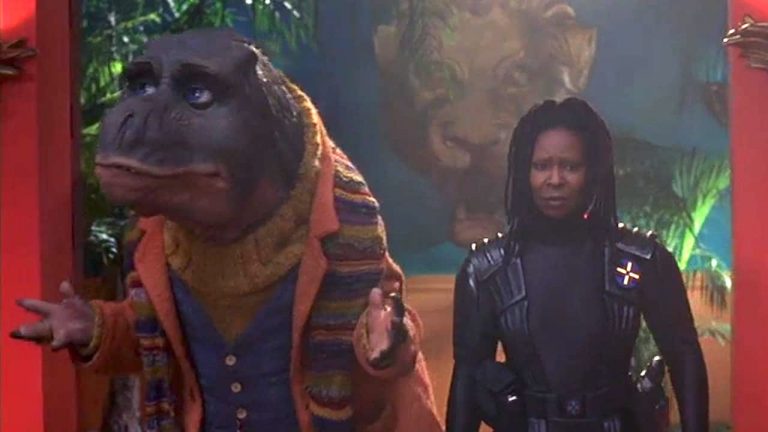
Ice Cream Man

Ice Cream Man

One of the ways that unimaginative people come up with ideas for horror movies is to take something normally perceived as harmless and have it start killing people. That’s why there are movies about killer Santa Clauses, Tooth Fairies, Easter Bunnies, dolls and other toys, snowmen, gingerbread men, scarecrows, tomatoes, and beds, to name too many. Few of these movies are ever popular, good, or successful, but at least they are numerous.

So it was only a matter of time before someone thought, “We should make a movie about a killer ice cream man! And the movie should be punishingly bad, even by the low standards of Movies About Killer Things! And it should star Ron Howard’s creepy-looking brother and not make any sense!” Why anyone would have these thoughts, I do not know, but the thoughts led to actions, and the actions led to the movie “Ice Cream Man,” after which no further thought was necessary, or even possible.

The premise is very simple, yet somehow still mishandled. In a black-and-white prologue, a young boy in a picturesque, Anytown U.S.A. suburb is traumatized when he sees his friendly neighborhood ice cream man murdered in a drive-by shooting. No reason is given for the shocking crime. (Territory disputes with rival ice cream vendors? Payback by militant anti-dairy vegans?) The important thing is that the boy who witnessed it, Gregory, is scarred for life. “Who’s gonna bring the ice cream?” he asks his mother forlornly, like there’s only one ice cream man in the whole world. So Gregory may not have been the most mentally competent child to begin with.

As if witnessing a murder weren’t enough trauma for one boy’s life, he grows up to be Clint Howard. He also spends years in an insane asylum, presumably because of the horror he witnessed (but possibly also because of being Clint Howard). Newly released, he becomes the ice cream man in his hometown, which has evidently gone without mobile frozen snacks services all this time. “That new ice cream man’s pretty freaky!” says one kid, accurately. “Maybe he’s just different!” replies another, giving Gregory the benefit of the doubt. Said by no one: “Why have the adults in our city allowed a defunct ice cream business to be revived by the boy who had a mental breakdown after seeing the previous owner gunned down in broad daylight?”

Gregory’s attitude toward being an ice cream man is complicated. On the one hand, he views it as a solemn duty to drive a van around the neighborhood on hot summer days, bringing joy and refreshment to all the boys and girls. But on the other hand, the inside of the van is lousy with mice and cockroaches, he uses his bare hands to scoop an ice cream cone, and he kills a neighbor’s dog and puts one of its eyes in somebody’s rocky road. You would expect this kind of contemptuous behavior from a Taco Bell employee or Newt Gingrich, but from the ice cream man? Disappointing.

One night Gregory abducts a neighborhood boy named Paul and stuffs him into the back of the ice cream van. Witnessing the act is Paul’s friend Tuna, a chubby boy whose odd name is not explained, and whose “chubbiness” is obviously the result of making the young actor wear bulky, padded sweaters all the time, even though the movie takes place in the summer.

You’re thinking that if they went to the trouble of making a non-chubby boy look chubby, it must be crucial to the plot for this character to be overweight. That’s certainly what I was thinking! But it turns out we are both wrong: Tuna’s weight is only referenced a couple times and never plays a part in the story. It is genuinely baffling.

Anyway, Tuna tells the cops what he saw, and the cops — played by Jan-Michael Vincent and Lee Majors II — search Gregory’s ice cream factory and warehouse. They do not, however, look in the van, which is the one place where Tuna specifically told them he saw Paul. My point is, everyone in town is a moron. My other point (I have two points) is that Lee Majors had a son named Lee Majors II.

And where is Paul? Oh, he’s fine. Gregory has him in a hidden room — not only did the cops fail to search the place where Paul was last seen, they also did an incomplete job of searching the place they did search — and is teaching him to be his apprentice. “Ice Cream Man” is set in a world where the men who drive ice cream trucks don’t just sell Eskimo Pies and Fudgsicles, they also sell their own fresh-scooped ice cream, which they make themselves back at the warehouse. Confectioners, drivers, sales clerks, business owners — they’re really Renaissance men, these ice cream men. Gregory is passing this knowledge on to Paul, who doesn’t seem to mind having been abducted and never tries to escape, making him the ideal hostage.

Perhaps you are troubled, as was I at this point, by the film’s lack of child murders. To be clear, I do not endorse the murder of children in real life (generally). But in a movie that promises a homicidal ice cream man, it is only natural to assume that children will be among his victims. Why give him a kid-oriented profession if he’s only going to kill adults? Yet so far Gregory has only dispatched a dog (which is not a child) and an old man (which is literally the opposite of a child). And we didn’t even get to see him kill the old man! (We don’t know why he did it, either. The grandfatherly fellow’s only scene had him appearing in a public park to tell children the story of “The Pied Piper,” which the movie seems to think is relevant to its own story. Which means the people who made “Ice Cream Man” either never read “The Pied Piper” or, just as likely, did not know what “Ice Cream Man” was about.)

To compensate for his failures in the child-murdering department, Gregory kills a few grown-ups, including Tuna’s philandering father and his mistress. He also decapitates two uniformed police officers and does a puppet show with their heads. I must admit that the fake heads look pretty good for a movie that couldn’t even afford to hire a real fat kid to play the fat kid. The filmmakers knew they looked good, too, and sought to get their money’s worth by giving them 10,000 minutes of screen time.

Meanwhile, Gregory halfheartedly terrorizes Tuna and his pals Jimmy and Heather, who ride around on bicycles and like to think of themselves as junior sleuths. Heather’s father (played by notable character actor David Warner) is the town’s minister, and in one scene Heather’s mother is shown speaking in tongues — “the archangel Gabriel speaking through her,” according to her husband. This intriguing bit of information is never mentioned again and plays no role in the story. Was it part of an excised subplot? Or was the movie vainly struggling to change itself into a different movie?

Gregory’s ice cream van says “WATCH OUT FOR CHILDREN” on the back … except in some shots, where the word “FOR” has been painted over. At first I thought this was a subtle joke, that the van would say “WATCH OUT CHILDREN” whenever Gregory was prowling for victims and “WATCH OUT FOR CHILDREN” when he was being normal. But no, it changes at random. I was giving the movie too much credit when I assumed that its obvious, flagrant, easily remedied continuity errors were there by design. I might be giving the movie too much credit when I call it a “movie.”

— Film.com

Your Sister’s Sister

0

“Your Sister’s Sister,” a funny, small-scale charmer with a trio of dynamite performances, plays out like a smart indie version of “Three’s Company,” complete with a guy named Jack. This Jack (played by likable everydude Mark Duplass) is a scruffy Seattleite still reeling from the death of his brother a year ago. His platonic best friend, Iris (Emily Blunt), orders him to clear his head by spending a weekend at her father’s isolated cabin on a nearby island, unaware that her half-sister, Hannah (Rosemarie DeWitt), is planning to use the place for her own emotional regrouping, having just ended a long-term relationship. Jack and Hannah knew of each other but had not met until now, and a late-night emptying of a tequila bottle helps them get comfortable sharing the house. Iris makes a surprise visit the next day, filling out the three corners of the awkward comedy triangle. Confessions, revelations, and misunderstandings mark the rest of the weekend.

Written and directed by Lynn Shelton — whose last film, “Humpday,” was just as truthful and funny — “Your Sister’s Sister” has a loose, improvisational feel that can be immensely satisfying to watch. The comedy and drama (mostly comedy) that emerge do so naturally, even though we realize that the circumstances have been contrived by a screenwriter. The warm chemistry among the actors feels like an invitation for us to flop down on the couch next to them and enjoy their companionship.

Of course, we get to enjoy it from an emotional distance, laughing conspiratorially as two sides of the triangle try fumblingly to keep secrets from the third. But once Jack, Iris, and Hannah have all made their discoveries — once everything hits the fan — the movie doesn’t quite know what to do other than find perfunctory resolutions. The fun was in seeing these authentic, believable characters squirm around the truth as they strive comically to avoid hurting one another. When it comes time for the frowny aftermath, Shelton’s heart isn’t in it.

And who can blame her? Nobody wants to see jovial folks like this deal with relationship crises. But all’s well that ends well, as they say, and it’s no spoiler to reveal that this astutely observed mini-farce ends in a way that leaves everybody happy, the audience most of all.

Rock of Ages

0

In the interest of full disclosure, I should say up front that I didn’t like most of the songs in “Rock of Ages” when they were new, in the ’80s, and there was little reason to think I would find them improved by karaoke performances surrounded by a makeshift plot. There is only so much of “Paradise City” and “Here I Go Again” and “Hit Me with Your Best Shot” that I can enjoy, and I reached that threshold long ago.

Nonetheless, there’s more to a musical than the songs. With a good story, a good script, and some good performances, the movie version of this Broadway hit could have been nothin’ but a good time, just as the live show is purported to be. (I haven’t seen it.) But whatever charms it had on the stage have apparently been lost in the transition, leaving us with a tedious, tacky lump whose tone ranges haphazardly from sincerity to self-awareness to sappiness.

It’s set in 1987 at a fictional club called the Bourbon Room on L.A.’s Sunset Strip. Here a bland Oklahoma blonde named Sherrie (Julianne Hough) has come to seek her fortune as a singer, and here she will work as a waitress until her big break arrives. Joining her in this quest is Drew (Diego Boneta, striving unsuccessfully to repress his Mexican accent), a blank-faced guitarist and songwriter who idolizes the glam rockers of the day, especially Stacee Jaxx (Tom Cruise), lead singer of Arsenal. That band got its start at the Bourbon Room back in the day, so as a favor to the club’s aging, long-haired owner, Dennis Dupree (Alec Baldwin), they will do their final show here in a few days, after which Stacee Jaxx will go solo.

Assisted by club manager Lonny (Russell Brand, playing to type), Dennis contends with the nightly hassles of rowdy crowds, loud bands, and diminishing profits. His latest headache is an ongoing protest against his and the other clubs by a group of church ladies who believe rock ‘n’ roll is satanic. The city’s wormy mayor (Bryan Cranston), running for reelection, has enlisted his busybody wife (Catherine Zeta-Jones, striving unsuccessfully to repress her Welsh accent) to beat the drum for cleaning up the city’s moral fiber.

I don’t know, and am not particularly interested in knowing, what behind-the-scenes events led to this decision, but for some reason the storyline of the movie bears only a loose resemblance to the stage version. The sole playwright, Chris D’Arienzo, is one of three men credited for the screenplay — and he’s not even listed first. That would be Justin Theroux, the actor and “Tropic Thunder” co-writer. (The third scribe is Allan Loeb, a veteran of recent unfunny debacles like “The Dilemma” and “Just Go with It.”) My point is, there has evidently been a lot of stage-to-screen revision, so it’s not even clear whether fans of the live show will enjoy the movie.

There are certain problems that probably couldn’t have been avoided. Like most jukebox musicals, this one suffers from the fact that the songs weren’t written with storytelling in mind. Most of these ditties were written to fit in smoothly on the radio rather than stand out, and are thus essentially interchangeable. They’re about wanting to rock and have a good time, or they’re about being in love. Drew and Sherrie sing “I’ve Been Waiting for a Girl Like You” while Stacee Jaxx and a Rolling Stone reporter (Malin Akerman) sing “I Want to Know What Love Is” — but it could have been the other way around, because both songs’ lyrics are generic enough to apply to either pair’s situation. The same is true for almost every other song in the film. One line from the chorus summarizes the message — “Nothing But a Good Time,” “Any Way You Want It,” “Don’t Stop Believin'” — and everything else is just filler.

(I’m not clear on the thinking behind the song choices, either. As celebrations of rock ‘n’ roll go, the soundtrack is awfully mild, with an abundance of Foreigner, REO Speedwagon, Journey, and Pat Benatar watering down the more thrashin’ songs by Guns ‘n’ Roses and Bon Jovi. Even the loose theme of “music from the 1980s” isn’t strictly applied; “Hit Me with Your Best Shot,” was recorded in 1979, and “More Than Words” was 1990. I’m starting to think the only requirement for inclusion was that 1) the filmmakers had to like the song and 2) the original artist had to agree to let them use it. But this is perhaps nit-picky, which is why I put it in parentheses, so you can ignore it. Sorry if you already read it.)

When the film is focused on Sherrie and Drew and their predictable dumb romance, it is deadly boring. The actors have no spark, separately or together, and their dialogue sounds like it was copied from a template. Yet they recite it earnestly, as if unaware of its cheesiness. The Broadway version apparently has its characters break the fourth wall, acknowledging the show’s kitschiness. We get none of that from Sherrie and Drew. These two are SERIOUS.

So thank goodness for Tom Cruise, Russell Brand, and Alec Baldwin! Cruise’s temperamental, hard-partying, constant-sex-having Stacee Jaxx — a man accompanied everywhere by a monkey named Hey Man and only barely controlled by a cynical manager (Paul Giamatti) — is yet another example of Cruise’s overwhelming star power and canny ability to choose projects. He plays Stacee as a parody of rockers like Axl Rose, but keeps it grounded enough that when he sings “Wanted Dead or Alive” — a song about the loneliness of being the world’s biggest rock star — you can believe some of the sentiment. His over-the-top goofy/sexy number with Malin Akerman is a highlight of the film, and a taste of how the whole movie should have been.

Meanwhile, Baldwin and Brand bring their own personal styles to their characters, earning laughs where laughs might not have otherwise been found. (Brand addresses a Bourbon Room crowd as “you hot, fecund soup of estrogen and testosterone.”) Like Cruise, these two get it. They’re aware of the material’s inherent insipidness, and they play it up like kids in a mud puddle. But even they can only do so much with impossibly bad dialogue like this:

“For a second I thought Kate Jackson from ‘Charlie’s Angels’ had walked into my club!”
“More like Michael Jackson!”
“He looks pale, doesn’t he?”

(Get it? Because it’s 1987!)

And I will never forget the moment when someone says “ciao” while departing and Brand’s response is: “I didn’t know he spoke Italian.” I can only assume that line fell out of the “Three Stooges” script and somebody at “Rock of Ages” picked it up.

The film was directed by Adam Shankman, whose screen version of the “Hairspray” musical was one of my favorite confections of 2007. “Rock of Ages” is similar in some ways, especially with the added subplot of do-gooders trying to shut down the style of music that the show celebrates. (Zeta-Jones’ embarrassing, unnecessary character isn’t in the Broadway version.) But without any big dance numbers to choreograph or high-spirited songs to showcase, Shankman is left to flounder. His lack of a clear vision for the movie’s tone — campy, satiric, straight-faced, or sincere — makes it more of a mess. Were it 30 minutes shorter and focused on Cruise, Brand, and Baldwin, it would almost be recommendable. But not like this. This is nothing like living in paradise.

That’s My Boy

0

Heaven help me, I thought this time might be different. Yes, the last several films Adam Sandler has starred in have ranged from barely tolerable to intolerably awful, but it’s not like he makes movies all by himself. “That’s My Boy” was written by David Caspe, creator of TV’s very funny “Happy Endings” — and someone Sandler has never worked with before. The same goes for the director, Sean Anders (whose “Sex Drive” wasn’t bad).

Besides the new collaborators, “That’s My Boy” had an R rating going for it. Nearly all of Sandler’s bad comedies (and his good ones, for that matter, if your memory stretches back that far) have been PG-13 or PG. Having a wider arsenal of swear words and crass situations to draw from doesn’t guarantee more laughs, but at least it changes up the formula, which is something Sandler definitely needed. The last R-rated film he made, “Funny People,” was the best thing he’d done in years.

So it was with a certain level of cautious optimism that I approached “That’s My Boy,” in which Sandler plays the dirtbag father of a young man (Andy Samberg) he spawned when he was 13, the product of a scandalous affair with his teacher. And it was with a significantly greater level of disappointment and heavy-heartedness that I exited the theater two hours later, my spirit broken, my optimism shattered, my soul reborn under a thick, cynical shell.

“That’s My Boy” is yet another putrid comedy in which Sandler plays an aggressive idiot with an annoying fake voice who shows up to disrupt someone’s life, and in which the message of the film turns out to be that everyone needs to act more like the aggressive idiot. (Adam Sandler characters seldom see the need to learn or grow. I assume this is an example of art imitating life.) This time he’s doing a thick Boston-y accent as Donny Berger, a former tabloid fixture who impregnated his middle school teacher in 1984 and has been riding on the fumes of that notoriety ever since. The teacher is in prison, and Donny’s offspring (played by Andy Samberg) has changed his name from Han Solo Berger to Todd Peterson in an effort to distance himself from his icky origins and his Donny-influenced upbringing.

Now in desperate need of cash to pay off tax debts and avoid prison, Donny reaches out to Todd — now a successful financier — on the eve of his wedding to the beautiful Jamie (Leighton Meester). Everyone is at Todd’s boss’ lavish summer home on Cape Cod, the perfect setting for an uncouth loudmouth to appear and offend people. Keenly aware that Todd wants nothing to do with him, and that he has in fact told everyone his parents are dead, Donny presents himself as Todd’s best friend (albeit a best friend Todd had never mentioned before).

Next thing you know, Donny’s the best man in the wedding and everyone’s new favorite guy! The joke is that while Todd is normal, nice, and reasonable, nobody likes him much, while they go nuts for Donny, a beer-drinking cretin who adamantly refuses to adjust his mullet-oriented, eff-you behavior for any situation. Everyone in the wedding party, from demure old grandma (Peggy Stewart) to Todd’s square coworker (Will Forte), thinks Donny is a hoot, even when doing so contradicts what has already been established about those characters.

Maybe “characters” is too strong a word. Apart from Todd (who is neurotic and emotionally scarred by Donny’s negligent parenting) and Donny (who is a lewd imbecile, end of story), no one in the film is a “character,” really. They exist as springboards for whatever outrageous, self-consciously taboo-busting thing Donny is gonna do next. If a scene requires someone to be quarrelsome, the person will be quarrelsome, even if he or she was docile in the last scene.

I’ll give an example that represents the rancid screenplay’s festering laziness. When Jamie’s brother, Chad (Milo Ventimiglia), a U.S. Marine, arrives, Todd good-naturedly salutes him. Chad’s response is anger and indignation: a civilian should never salute military personnel. Later, when Donny arrives and does the same thing, Chad happily returns the salute. The comic premise of one character being praised while another is chastised for the same behavior is solid enough, but it doesn’t work when you apply it arbitrarily. Without an in-story reason for the different reactions, it’s a non sequitur, a leap from Point A to Point B with no line between them. The movie does this over and over again, expecting us to laugh just because, well, that’s where the laugh should go.

The other major thing it does repeatedly is try to get laughs by being tasteless — not by humorously employing a tasteless scenario, mind you, but merely by being tasteless. I think there is rich potential in jokes commenting on society’s double standards about underage relationships, where a 13-year-old girl who has sex with her teacher is a rape victim while a 13-year-old boy who nails his teacher is a hero. There is also something to be said for the premise of a child being more responsible than his father. But “That’s My Boy” squanders nearly every opportunity to find real humor in any of this, resorting instead to poo-poo, pee-pee, boners, and bongs. There’s casual racism toward the Chinese household staff — not because it makes any sense for these characters to be casually racist, but because it’s funny to hear people say racist things.

To be clear, I have no problem with making comedy out of forbidden topics. You do have to actually make the comedy, though. Merely presenting an appalling situation — That stripper is fat! That grandma is horny! That man has a potty mouth! — is not, by itself, funny. How do Sandler and his cohorts not realize this? Somehow stretched to an excruciating 114 minutes in length, the film offers seven or eight genuinely clever lines, but they are drowned out by the braying, pointless stupidity that surrounds them.

Now if you’ll excuse me, I’m going to watch something funnier than “That’s My Boy.” It’s a video of my mother being torn apart by bears. Good day.

The First Man Ever to Decorate His Home with Hunting Trophies Tries to Sell His Wife on the Idea: A Dramatic Monologue

0
The First Man Ever to Decorate His Home with Hunting Trophies Tries to Sell His Wife on the Idea: A Dramatic Monologue

Hey, honey? I had some decorating ideas for when we move to the new house.

Now, just hear me out, OK?

So I was thinking we should put the nice recliners in that nook by the big windows, you know? And maybe buy a settee for over near the fireplace?

And then I was also thinking maybe a moose head on the wall?

Uh, it’s like a long upholstered seat.

Oh, that! Yeah. A moose head.

What do you mean “what do you mean?”? I’ll take the head of a moose, attach it to a flat piece of wood, and nail it to the wall.

What? Why not?? You got to put up those pictures of your parents!

The actual head of an actual moose, yes. A dead moose, obviously. Sorry, I should have mentioned that. It will be the head of a moose that has died. Not a living moose. That would be insane.

Well, yes, the antlers too. Why would I take off the antlers? Look, honey, I don’t want to be rude, but what part of this aren’t you getting? I’m going to take my rifle into the woods, shoot a moose with it, then sever the dead animal’s head from its body and hang it – i.e., the head – on the wall.

No, not as a warning to the other mooses. As a decoration! I don’t think “mooses” is even the right word. And how would it be a warning to other moose, anyway? There aren’t going to be any moose in our house!

OK, there will be ONE moose in our house. But it will be dead, and just the head. There aren’t going to be any live “mooses” in the house.

Well, yes, I do think it’s a little silly for you to assume that I intend to bring live woodland creatures into our home, actually. I’ve said nothing of the kind! I’m talking about one creature, and only its decapitated head, which I’m going to nail to the wall. It’s not like I’m inviting a herd of moose to graze in our kitchen or whatever.

I mean, come on, Susan.

No, there won’t still be blood dripping from the neck! Yeesh!

Ah! Now there’s a good question! What I was thinking I’d do is hollow out the head and fill it with sawdust, so there’s nothing left to rot. It won’t smell at all. It’ll be as sanitary as a vase!

Oh, they’ll be open, for sure. You don’t want the eyes closed. What, so it looks like it’s dead? That would be lame, honey. I know this isn’t really your thing, but just so you know, a moose head with closed eyes would be lame. You want it to look alive and vibrant, so you can really appreciate the majestic beauty of nature!

The majestic beauty of nature in the form of a dead moose’s severed head, yes. Exactly. Although I feel like you’re being sarcastic.

Haven’t you ever accomplished something significant and wanted to keep a reminder of it floating above you at all times? Just hovering in midair, like a gruesome specter that gazes down upon you forever? So any time you want, you can just look up and be like, “Oh, yeah. I killed a moose!”?

I don’t know, maybe it’s a guy thing.

OK, OK, we can come back to the moose head. Along those same lines, though, I’ve also got this rug made out of a bear that I was thinking we could spread in front of the fireplace, and maybe sometimes make love on top of it.

A bear, yeah. No, not just the head, the whole thing. I mean, I took out the skeleton and guts and stuff, so it’s flat. It’s really just the skin.

Oh, and the fur. It still has the fur! Ha ha, you were thinking I had a shaved, hairless, deflated bear! That’s hilarious. Oh, honey, that’s cute.

Basically, picture a bear that’s been run over by a steamroller in a cartoon. That’s pretty much what it looks like. Except that the head isn’t flat. The head is still head-shaped. But everything below the head is flat. It’s a very soft, comfortable rug. Very nice for snuggling.

Snuggling ON, I mean. Not snuggling WITH. You and I could lie down on the dead, flat bear, and, you know, see what happens…

Mmm, we’re on the bear’s back, I guess. Yeah. The bear is on its stomach, so we’re on its back. And it’s facing away from us.

Eyes open, yeah. The eyes are always open.

Well, I don’t know if I would have put it in those terms, but yeah, I guess I like the idea of making love to my wife on the back of a deceased, horizontal bear whose eyes are open as if it were still living and breathing.

Sure, you can think about it. We don’t have to decide anything right this minute.

There’s one other thing. Remember how I accidentally ran over that cat with the car a few weeks ago? Now, just hear me out….

Karate Dog

Karate Dog

When parodying bad movies, no intentionally terrible idea is so absurd that there does not already exist a real movie that is worse. I had known in this in my heart for a long time, but it was only recently that it crystallized in my conscious mind. As with many great epiphanies, it was sparked by a movie about a talking dog.

I was about to watch a film called “Karate Dog.” Or maybe “The Karate Dog.” The DVD cover and menu say one thing; the onscreen title says another. “(The) Karate Dog” stars former model and MTV veejay Simon Rex as a police officer, with Chevy Chase as the voice of the martial-arts-trained dog who assists him in solving a murder. Contemplating that I was about to watch this movie, and not just watch it but take notes on it, I realized that if I conceived a list of fake one-sentence summaries to satirize the dumb stuff that comes out of Hollywood, none of them would be any dumber than this actual one-sentence summary of an actual movie. The line between reality and parody is indistinguishable. Mankind’s capacity for stupidity is even greater than its capacity to make fun of stupidity.

karatedog

Anyway, Simon Rex. He plays a cop. I shouldn’t even know who Simon Rex is, let alone have to believe him as a cop. (Never mind the dog. How’d they teach Simon Rex to talk?) If you’re unfamiliar with Rex, he started out doing porn in the ’90s before debasing himself even further by becoming an MTV host. After this he moved on to the customary obscurity and desperation specified by MTV’s performer contracts, then became an actor, then became whatever it is that a person is when they star in “Karate Dog.”

He plays Det. Peter Fowler, a tech-savvy investigator and a bit of a geek who is one of the cops at the scene when a kindly old gentleman named Chin Li is found murdered. We saw the whole thing go down: Chin Li — played by Pat Morita, cursing the day he signed a contract obligating him to appear in any film with “Karate” in the title — was ambushed in his apartment by a squad of masked ninjas, who wanted a canister of green fluid he had in his possession. The only witness to the crime was Chin Li’s dog, Cho-Cho, who, as luck would have it, can talk. (Don’t get too excited, though. He has the voice of Chevy Chase, and it’s post-1985, so the odds he’ll say anything funny are slim.)

karatedog

Now, about the talking. Before the ninjas attacked, Chin Li reminded Cho-Cho that he shouldn’t go around talking to just anyone, but to “speak only to one who seeks the truth.” Why? Dunno. How did Cho-Cho learn to speak at all? Also dunno. We are told, however, that Chin Li is the one who taught Cho-Cho karate. Thank goodness THAT was cleared up! I’d have had a hard time accepting a movie about a dog that knew karate just because.

Do you suppose it was Cho-Cho’s ability to talk that made Chin Li think he’d also be able to learn karate? Or do you think it was studying karate that gave Cho-Cho the discipline necessary to learn to talk? These questions probably would have been addressed in the “Karate Dog” sequel, except that the sequel was never made because — and you might remember when this happened — the U.S. Constitution was amended to specifically forbid it.

karatedog

But back to the story at hand. Recognizing that Peter is one who seeks the truth, Cho-Cho follows him home and talks to him, in a painful scene requiring Simon Rex to convey the complicated actor emotions of “astonished” and “freaking out.” Peter and Cho-Cho have some “Odd Couple” banter — for some reason Cho-Cho occasionally walks on his hind legs, wears Peter’s bathrobe, and uses Peter’s toothbrush — and then Peter takes the dog to the police station. Cho-Cho refuses to speak to the other cops, and now they think Peter is crazy. It’s like that old cartoon where the frog will only sing and dance for one guy, but less realistic.

Why won’t Cho-Cho talk to the other cops? Aren’t they also seeking the truth? Don’t they want to find Chin Li’s killers the same as Peter does? Yes. Cho-Cho has a conversation with Peter that ends with Peter understanding why Cho-Cho will only talk to him, but in this case Peter is better at understanding things than I am because I still don’t have any idea.

At this point we are introduced to the villain of the piece, a wealthy biotech industrialist named Hamilton Cage, played by former actor and noted Jolie-spawner Jon Voight. Hamilton Cage speaks in a Southern gentleman drawl, like Foghorn Leghorn. He and Cho-Cho were both karate students under the tutelage of Chin Li, who worked for the Cage Corporation in some unspecified capacity. Cage has been developing a food additive that makes greyhounds run faster, helping him win bets at dog races: steroids for dogs. He intends to test it on humans, too. This is the stuff that was in the canister the ninjas took from Chin Li. The old man had stumbled across it and was going to expose Cage’s crimes, so Cage had him whacked, etc.

karatedog

This is the “mystery” that Cho-Cho and Peter have to solve. It won’t take very long, obviously, so there is plenty of time for tangents involving wacky shenanigans and crazy mix-em-ups and all the usual monkeyshines you expect from an 84-minute children’s movie made by people who didn’t care and perhaps actually hated children. The tomfoolery includes such incidents as these:

– Peter goes on a date with a lady cop played by Jaime Pressly. Fearing he will be nervous and tongue-tied, he arranges to have Cho-Cho the dog hide in the bushes outside the restaurant and tell him what to say through a tiny earpiece. When a cat passes by and Cho-Cho makes angry remarks about how much he hates cats, Peter dutifully repeats these words to his date. You might wonder how someone as stupid as Peter can even dress himself in the morning, but remember, this is a movie about a talking dog.

karatedog

– Cho-Cho and Peter are about to get in Peter’s car when Cho-Cho sees a man who he thinks might have been one of the ninjas who killed Chin Li. Cho-Cho grabs the keys out of Peter’s hand, starts the car, and speeds off in hot pursuit. He is not a very good driver, though, and the car crashes into a pond. You might wonder how a dog could reach the gas pedal, but remember, this is a movie where someone as stupid as Peter is able to dress himself in the morning.

I should mention that so far, the only time we’ve seen Cho-Cho the Karate Dog do any karate is in the opening scene, when he fought the ninjas (and lost). I don’t know, I just figured a movie called “Karate Dog” would have more karate in it, and that the karate it contained would be more heroic than a dog kicking some guys who escape anyway. I also think calling the movie “Karate Dog” is burying the lead, since the dog in question also speaks, drives, walks upright, and helps guys score with chicks. Karate is actually the least of his skills.

karatedog

At any rate, all of this Hitchcock-level intrigue and Chaplin-level comedy eventually culminates in a climactic rooftop battle between karate masters Cho-Cho and Hamilton Cage. At long last: karate. Since it is notoriously difficult to train real dogs to do karate, the filmmakers were forced to use computer animation. But since realistic computer animation is notoriously expensive, the filmmakers were forced to use something from the local high school’s remedial art class, the one they send the ADHD kids to. (The filmmakers also used a stuntman who looked nothing like Jon Voight, but I believe that was out of sheer contempt for the audience.) Cho-Cho and Cage do a lot of slow-motion “Matrix”-type fighting that looks even worse than you are imagining it looking. Cage is vanquished, Chin Li is avenged, and Peter, who didn’t do anything, gets a medal from the mayor, which he gives to Cho-Cho, who doesn’t get any official recognition because he’s just a stupid dog.

P.S. “Karate Dog” was directed by Bob Clark, whose work on the beloved “A Christmas Story” was sadly outweighed by his work on not one but two “Baby Geniuses” movies, not to mention “Karate Dog,” which indeed we will never mention again.

P.P.S. In case you doubted that this imbecilic, unendurable experience could get any worse, Randy Travis sings a songs over the closing credits. Now blood is spurting from your ears AND eyes!

— Film.com

Prometheus

0
Prometheus

Thirty-three years after his “Alien” introduced moviegoers to the terrors of extra-terrestrial life and the horrors of being named “Sigourney,” and 15 years after “Alien: Resurrection” basically ended the franchise (we do not speak of the two “Alien vs. Predator” movies), Ridley Scott returns to outer space with “Prometheus,” a visually arresting but thematically drab sci-fi thriller that’s set in the same fictional universe.

You could call “Prometheus” a prequel to “Alien,” but it tells a standalone story, and no prior knowledge of the other films is necessary. If you have seen “Alien,” though, you’ll appreciate some “Prometheus” details better. You’ll also notice a certain symmetry between the two films’ plot lines, and either admire this or feel a little cheated by it.

Set mostly in the year 2093 and mostly aboard the title spacecraft, “Prometheus” concerns a small crew of scientists, engineers, and mercenaries at the tail end of their two-year journey toward a distant destination for an as-yet-undisclosed mission. They slept most of the way, of course, in those suspended-animation sleep pods that sci-fi movies are so fond of, watched over by the android David (Michael Fassbender), who is eerily human-like and wishes he were even more so.

Most of the crew is in the dark up to this point about the specifics of their mission, so I’ll let you hear about it when they do. But in general terms, they’re following up on a hunch by archeologists Elizabeth Shaw (Noomi Rapace) and Charlie Holloway (Logan Marshall-Green) that a planet out here might have clues regarding the origin of life on Earth. Aging billionaire industrialist Peter Weyland (Guy Pearce) funded the expedition because he believes in Shaw and Holloway’s theories, while the mission’s haughty commander, icy Meredith Vickers (Charlize Theron), is derisively skeptical. Let’s get there, look around, confirm it was a wild goose chase, and go home, she says. Again, not to spoil anything, but she’s wrong.

Though it’s been decades since Scott tackled anything this special-effects-heavy, he makes full and competent use of the technological advancements that have been made in the meantime, continuity with the now-retro-looking “Alien” be damned. Shot by expert cinematographer Dariusz Wolski (“Dark City,” “Sweeney Todd,” “Alice in Wonderland”), “Prometheus” has a crisp, cold look that’s appropriately otherworldly, often beautiful to behold. The creature effects are seamless. Clearly no expense was spared to make the film look as awe-inspiring as the state of the art will allow.

It’s the screenplay that doesn’t quite measure up, especially in comparison to the extraordinary visuals. Written by Jon Spaihts and Damon Lindelof (“Lost”), the story is about 80 percent solid and 20 percent ridiculous. Shaw and Holloway, who are lovers, have some jarringly mawkish relationship dialogue. The ship’s captain, played by the terrific Idris Elba, is given little to do. Melodrama pops up when it is least expected or needed. You start to realize that for all its satisfying turns and heart-pounding suspense, and for all the lip service it pays to Big Questions, the story is actually quite thin.

But that almost doesn’t matter when you’ve got Michael Fassbender’s mesmerizing android capturing your attention, or Noomi Rapace fretting about what organism she may have come in contact with, or Sean Harris and Rafe Spall’s uncourageous scientist characters stumbling frantically through a situation that we’ve been conditioned to expect will not end well for them. It isn’t until about the midway point that the film becomes truly exciting, but it never fails to be intriguing.

By being set in its timeline and emulating many of its traits, “Prometheus” invites comparison to “Alien” – which is unfortunate, since most things that are compared to “Alien” do not come out ahead. This film isn’t nearly as scary as that one, and there was a gritty charm to the rough 1970s production values that the digital wizardry, marvelous though it is, can’t duplicate. But if Ridley Scott wants to return to sci-fi, “Prometheus” is a strong reintroduction. It will be interesting to see what bursts out of his chest next.

In Search of Pirates

0
In Search of Pirates

The greatest crisis facing Hollywood today is piracy. Well, that’s not strictly true. Hollywood’s greatest crisis is that Hollywood’s profits are not as high as Hollywood would like them to be, and piracy is an easy thing to blame it on. If people are buying fewer movie tickets than they used to, it must be because they’re illegally downloading the movies at home! It’s certainly not because ticket prices are too high and movies aren’t that good anyway and people have high-quality sound systems and big-screen TVs at home and theaters are hellish dens of rude jackasses and you have to sit through 20 minutes of commercials and previews before the film starts and concessions are so absurdly overpriced that even people who work in the banking industry think, “Wow, they are really ripping us off here.” No, it can’t be that. It must be piracy.

They sound like hysterical Victorian women, these studio executives. “Why are we losing money? Because of pirates! PIRATES, I say! Great flotillas of them! Oh, do hide our ladies and children from the fearsome pirates! Where is my fainting couch??”

I don’t mean to suggest that the illegal copying and distribution of movies isn’t a legitimate concern. Of course it is. But the profit losses that studios attribute to piracy are comically exaggerated, and their anti-piracy efforts are ineffective, driven by pants-befouling panic rather than logic. Hollywood’s response to piracy has been like a meth addict’s response to being set on fire, with a lot of counterproductive screaming and running around in circles and paranoid accusations about who lit the match.

The reason for this is that while movie studios produce a lot of cool, hip things, the studios themselves are run by elderly white men. And if there’s one thing elderly white men are afraid of, it’s everything. That especially includes new things like smartphones, and even no-longer-new things like the Internet. The elderly white men who run Hollywood have only recently gotten over their fear of television and Hispanics. Now they’ve heard young people talk about filming something with their iPhones and posting it online, so they conclude that iPhones are a piracy tool and ban them from preview screenings, even screenings of 3D movies, which you couldn’t film with an iPhone anyway. All of this is because the people who make the rules fear and misunderstand technology.

Think of your uncle. The one who believes he’s emailing you when he’s actually posting on your Facebook wall, and who’s afraid to leave his computer on overnight lest identity thieves creep in through the ethernet cable and steal his passwords. That’s who runs Hollywood.

What unnecessary and useless steps are the studios taking to reduce piracy? I’m glad you asked, hypothetical person who asks me things while I’m writing!

One new tactic, announced last month, has to do with the FBI warning that appears at the beginning of DVDs and Blu-rays. Common sense tells us that this warning has almost certainly never prevented a single act of piracy. Nobody who intends to make copies of a DVD is going to be dissuaded by the FBI warning, any more than a sign reading “It is against the law to rob banks,” posted at banks, would stop someone from robbing banks.

Anyway, since these warnings are ineffective, the obvious solution is to have more of them. With the endorsement of the Motion Picture Association of America’s member studios, the U.S. government has revealed new anti-piracy warnings that will appear on all new DVDs and Blu-rays starting this year. There will be two of them, back-to-back, each 10 seconds long and unskippable. They want you to sit there for 20 seconds and reflect on the horrors of piracy – which, having lawfully rented or purchased the DVD you’re watching, you have not engaged in. (You know who won’t have to sit through those warnings? People who download the movies illegally. I’m just sayin’.)

Something else that the studios have been doing for several years that is a complete waste of time and money is hiring security guards to monitor preview screenings for piracy in action. These poor saps have to stand at the door as the audience members file in, checking their bags for cameras and running metal-detector wands over their bodies like visitors at a prison. You thought you were going to a fun promotional screening of “What to Expect When You’re Expecting” – but nope! It turns out you’re meeting with a mobster who suspects you’re wearing a wire!

If you have a phone that can take pictures, sometimes you’re merely admonished not to use it. (If you have a phone that doesn’t take pictures, you are laughed at.) But sometimes, depending on which movie studio is involved, you are told you cannot bring the phone into the theater, period. You can take it back to your car – or you can hand it over to the security goons, who will put it in a brown lunch bag and give you half of a raffle ticket as a claim check. That phone of yours? The one that cost a few hundred dollars? Just give it to some guy! You can trust him. I mean, if you can’t trust a stranger who’s making ten dollars an hour to protect Adam Sandler’s intellectual property, whom can you trust? I ask you? WHOM??

This whole process is pointless for several reasons. One, bootlegging a movie by sneaking a camcorder into the theater is very 1990s. People don’t really do that anymore. In the 21st century, most illegal versions of movies are digital copies that were leaked online by someone at the studio who had access to them. The studios haven’t figured out how to stop that, though, so they make a big show out of stopping this other thing that nobody’s doing anyway.

Another reason the heightened security is silly is that they only do it at preview screenings. Once the movie opens, it’s up to the individual theaters to prevent people from bringing video cameras in. And if you’ve been to a theater recently, you know how many craps their employees give about piracy (or anything, really), i.e., no craps.

Now wait a minute. I’m a movie critic, a member of an elite professional group that includes just four hundred thousand Internet writers, plus eleven newspaper writers. Surely my colleagues and I aren’t subject to these heavy-handed anti-piracy tactics. The riff-raff that shows up at preview screenings, fine. You don’t know who those people are. But the critics were invited to the screening. We’re there because the studio’s publicist sent an email saying, “You – you, specifically, a person on our press list – are invited to come watch this movie!” They know who we are, who we work for, and where we live. Surely there is no reason to confiscate our phones! Surely we would not be on your press list if you thought there was a chance we’d steal your movie!

Surely there’s especially no reason to go through all that nonsense at a press-only screening, with everyone in attendance having been personally invited by the studio to be there. Why, it would be ludicrous to set up a screening just for critics, then act like the people who show up are random, shifty-eyed drifters that you don’t trust.

Ah, but there’s your mistake. You’re thinking like a rational person. Remember, when it comes to preventing piracy, Hollywood’s attitude is exactly the same as the TSA’s attitude toward preventing terrorism: WE DON’T KNOW WHAT TO DO HERE ARE SOME RANDOM RULES THEY ARE DUMB DO NOT BREAK THEM WE ARE IN CHARGE WE ARE THE BOSS!!! And the only thing more pointless than the rules is pointing out how pointless the rules are. The security guards are just following instructions. The people who make the rules are back in Hollywood, on the phone with tech support because they can’t get Internet Explorer 7.0 to quit freezing up.

Is it insulting to be invited to a screening and then treated like a criminal? Sure. But it’s also insulting to be invited to a screening and then shown a Nicolas Cage movie. What’s really irksome is hearing movie studios sob about diminishing profits due to piracy, even as they’re wasting millions of dollars on impotent anti-piracy efforts. You want to make more money? Quit paying four security guards to attend every advance screening of every film in every market in the country. Come on, it’s hard enough work telling you what’s wrong with your movies. Do I have to tell you how to run your business too?

C Me Dance

C Me Dance

One of the problems facing modern-day Christians is the fact that so many of their fellow modern-day Christians make them look bad. For every humble soul who genuinely tries to do good to others, care for the poor, and love his neighbor, you’ve got a loudmouthed jackass picketing soldiers’ funerals or setting Korans on fire. And then there’s the embarrassment of well-intentioned but terrible Christian-themed entertainment like “C Me Dance,” a movie so disastrous it may qualify for FEMA intervention. The Apostle Paul told the Romans that he was not ashamed to be a Christian, but he never saw “C Me Dance.”

This will-to-live-sucking melodrama was the brainchild of one Greg Robbins, an undoubtedly nice fellow who’s been writing and directing uplifting TV shows and movies for the last decade or so. “C Me Dance” was actually released in movie theaters somehow, possibly due to a clerical error, and earned more bad reviews than it did dollars. Every theater that showed it was subsequent struck by lightning and burned to the ground.

cmedance

It is the story of Sheri (Christina DeMarco), a teenage Christian girl whose mother died when Sheri was a baby, leaving her to be raised by her adoring Christian father, Vince (played by Robbins, who looks like an especially bloated Beau Bridges). Sheri is a promising ballet dancer, as evidenced by the many scenes in which the actress’ body double dances beautifully while being photographed from a distance, from the waist down, or in dim lighting. Then one day at dance practice, Sheri collapses to the floor in a comically abrupt manner! You assume Sheri is pretending to be ill, but no, she really is ill — the actress just isn’t any good. (That’s right, the young woman playing Sheri cannot even fall down convincingly.) We cut to a doctor’s office, where Dr. Beth (Laura Romeo) has the following exchange with Sheri and Vince:

DR. BETH: I’ve gone over Sheri’s test results, and I’m sorry, but Sheri has leukemia.
SHERI: Dad…?
VINCE: No, no, no, it’s OK. Look, let’s get started on treatment right now.
DR. BETH: Unfortunately, she’s in the advanced stages, and treatment’s not going to help.
SHERI: No! I’m not going to die!

This is the clip they showed at the Oscars.

cmedance

Now that she’s been diagnosed with leukemia — the advanced, terminal kind, the kind where the only symptom is collapsing once — Sheri is free to fulfill her inner desire of being a jerk to everyone. She rejects all demonstrations of concern from her father and friends, even exclaiming “Just stop loving me!” at one point, because her leukemia is also the kind that makes you say things in dialogue that were supposed to remain subtextual.

But Sheri has a change of heart after she has a dream in which her heathen friend Ally (Samantha Sham) calls out to her to save her from drowning. It must be, Sheri concludes, that God wants her to use her remaining time on earth to convert Ally. (Sheri does not even consider the possibility that Ally is literally drowning.) Quick as you please, Sheri does indeed help Ally to be born again.

THAT’S WHEN THINGS GET WEIRD. Up to this point the movie has been a cringeworthy smorgasbord of poor acting, weak dialogue, and general butterfingeredness — but at least it has made sense within the world it inhabits. A religious girl finds out she’s dying, feels inspired by God to bring others to Him, sets out to do so. Okay! BUT THEN THINGS GET WEIRD. I’m sorry, I know I’m yelling and that I already said that. I just want to emphasize how weird things get, even for viewers who have been onboard with what’s happened so far.

cmedance

Sheri is suddenly endued with spiritual powers far beyond her wildest, most spiritually fulfilling imagination. All she has to do to convert people is touch them. If she touches you, you see a split-second vision of the Crucifixion, and you’re instantly converted. What if you don’t want to be converted? What if you’re a perfectly happy Jew or Muslim or Buddhist? TOO BAD, STUPID. You should have thought of that before you let Sheri touch you. You’re a Christian now.

This power first manifests itself in a major way as Sheri is walking home from school and Jacob (Joe Pawlenko), a jerky guy who sometimes hits on her, drives up alongside and tries to get her into his car. Sheri politely but firmly refuses, whereupon Jacob leaps from the car and chases her down the street on foot, intending to do goodness-knows-what when he catches her. While this is happening, Vince’s phone rings at work, but nobody’s on the line when he answers it, and so he realizes Sheri is in danger. (Evidently the Holy Spirit was able to dial Vince’s number but not to say anything aloud.) Vince jumps in his car, speeds across town, and arrives in time to save his daughter from her attacker. Sheri touches Jacob and a couple bystanders, and poof, everyone’s converted.

Now Sheri’s a lean, mean, convertin’ machine. But you know who isn’t happy about it? The devil, that’s who. He starts appearing before Sheri in the form of a man dressed in black, and he is steamed! To be fair — to play devil’s advocate, if you will — it is a bit of a cheat for God to give someone the power to save souls merely by touching them, as this eliminates the sporting chance that Satan has traditionally had. I’d be a little peeved, too, if I were Lucifer.

Anyway, despite the occasional Satanic threats, Sheri continues to go around touchin’ and savin’. To help her reach more people, her pastor suggests she get on stage at an upcoming Battle of the Bands contest while a Christian rock group is performing. When he mentions the band’s name, Vince says, “I know those guys! I hear them on the radio all the time.” And Sheri says, “Wow, Dad! I didn’t know you were so hip!” That may sound like nonsense, but I suppose if you can believe that an audience at a rock concert would tolerate a sermon in the middle of the show, you can also believe that Christian rock music is on the radio all the time, and that being familiar with it makes you cool.

cmedance

Soon the churches are filled with new converts thanks to Sheri’s hands-on missionary efforts. There are dramatic effects on society. Some guy who doesn’t have a name but who is one of the pastor’s friends hurries in with a newspaper and says, “In the last two weeks, murders and rapes have gone down 89 percent! It’s the biggest decrease in 50 years!”

But wait, there’s more! “In Variety, it says the next big three movies scheduled for release have been shelved by the studio executives! It reports that they say that they may harm family values, and they’re never going to release them!” Of course, if Variety is reporting that, it means the movie blogs already reported it two weeks ago. But still, big news!

I know what you’re thinking. Isn’t Sheri supposed to be dying of sudden-onset late-stage untreatable leukemia? Could she maybe get on with that? Yes, but hold your horses. She and her dad and the pastor think of yet another way to use her unprecedented magic powers: put her on television! (Sometimes she can convert people just by talking, without touching them.) Now, if the idea of mass conversion that overrides people’s free will makes you uncomfortable, this might start to seem creepy, like the mind-control stuff in “Halloween III: Season of the Witch.” She’s got to be stopped before she converts the entire world!!

cmedance

The devil tries to stop her by possessing people’s bodies and shape-shifting and otherwise deceiving her, but it’s no use. “You’re the dark prince of this world, and I can see your end!” Sheri declares, hilariously. She converts millions, then falls over dead on Christmas morning, her second collapse as unconvincing as the first. The message, I guess, is that while you should probably become a Christian, don’t worry if you don’t get around to it. Someone will come along and do it for you.

— Film.com

High School

0

“High School” starts with a viable premise that could evolve into a satisfying stoner comedy, then veers off into something more mundane: a generic high school comedy.

Which is a shame, because that initial scenario is gold. The day after M.I.T.-bound senior and all-around good kid Henry Burke (Matt Bush) smokes pot for the first time in his life, a school-wide drug test is announced, with expulsion promised to anyone who fails. Panicked, Henry turns to burnout acquaintance Travis Breaux (Sean Marquette), who says, “Times like this, you need to think like a stoner.” The solution? Secretly get the whole student body stoned, skewing the test results and forcing a redo.

The thought of a campus populated entirely by baked students should have you drooling with comic anticipation, and for a while “High School” – oh, “high” school, I get it now – sets out to exploit the potential of dazed teens who have the munchies and don’t realize why. An anti-marijuana video shown to the kids in detention is wonderfully hysterical in its straight-faced assertions about the evils of weed, smartly skewering drug PSAs of the past.

But before long, the film falls into a familiar rut. Henry and Travis must evade the twitchy dealer (played by Adrien Brody) from whom they stole all that pot, while also navigating around the exaggeratedly crusty and drug-hating principal, Dr. Gordon (Michael Chiklis), who of course is giving the school board a tour of the campus today. (Of all days…!) Henry has a rival for the valedictorian spot, a sour preppy named Sebastian (Adhir Kalyan), as well as a foxy dream girl (Alicia Sixtos) whom he doesn’t have the courage to talk to. Perpetual loser Travis starts to wonder if he can make something of himself after all. In other words, it becomes an ordinary teen comedy, light on the transgressive laughs you were hoping for and heavy on formula. Sure, being stoned when you see it would probably make it funnier. But that’s true of most things.

Piranha 3DD

0

One of the problems with letting adolescent boys make movies is that adolescent boys are notoriously bad at knowing when a joke has run its course. The 15-year-olds who made “Piranha,” a 3D boobs-and-blood explosion from two summers ago, got some mileage out of unapologetically gratuitous nudity and graphic violence, simultaneously delivering what the young male audience wanted while making fun of them for wanting it. But the sequel, made by a different set of 15-year-olds, just does more of the same, only without any verve or novelty.

It’s called “Piranha 3DD,” and yes, they obviously came up with the title before they came up with anything else. The setting this time is an Arizona water park adjacent to a lake that may (spoiler alert) have mobs of prehistoric piranha living in it, and those fish may (spoiler alert) make their way into the pools and water slides. The owner, a sleazeball named Chet (played by excellent sleazeball David Koechner), is unconcerned about public safety, leaving his stepdaughter, Maddy (Danielle Panabaker), to be the heroine.

That’s pretty much it, plot-wise, until the massacre begins. The slim running time (it’s 70 minutes when the closing credits start rolling) is padded out with standard vignettes: some horny teens fool around in the water and die; Maddy has a douchey boyfriend (Chris Zylka) while her nice-guy platonic friend (Matt Bush) pines for her; celebrity guest stars get eaten; Christopher Lloyd, the dotty ichthyologist from the first film, shows up again to warn of doom; and so forth. Most of this is half-hearted at best, with 15-year-old director John Gulager (of the “Feast” series) and his 15-year-old writers seldom bothering to attempt wit or suspense.

The movie comes to life briefly when David Hasselhoff shows up as himself, doing duties as a “celebrity lifeguard” on the water park’s opening day. Hasselhoff has reached the point in his career where he exists almost entirely as a self-aware parody, but as self-aware parodies go, he’s pretty good. Also worthwhile is the return of Ving Rhames as the indestructible cop whose legs got eaten off in the first movie, now visiting the water park for a safe, non-traumatic aquatic vacation. (“I’m not afraid of some punkass water!” he declares.)

As you’d expect from a film made by 15-year-old boys, “Piranha 3DD” is brimming with lithe, naked women, yet is terrified of actual sex. Every sexual encounter in the movie ends in death, and the women are never naked during it. A man’s penis gets bitten off by a piranha that somehow found its way into a hot virgin’s hoo-ha: there must be a dozen Freudian symbols in that sentence alone. I wonder if the filmmakers realize how telling it all is.

Yet even as dumb trash the film can’t quite succeed. It’s not outrageous enough to warrant a you-gotta-see-this-to-believe-it screening, and the gore is nothing that gore fans haven’t seen a hundred times before. Even by the absurdly low standards set by its predecessor, it’s a disappointment. Maybe it’s time to bring some grown-ups in.

[Also available through Video On Demand.]

Snow White and the Huntsman

0

The first Snow White adaptation of 2012, “Mirror Mirror,” took the sunny, kid-friendly route – and thus couldn’t be more different from the second one, “Snow White and the Huntsman,” which is serious and grown-up. And why shouldn’t it be? We’ve seen intense, mature films based on comic books and superheroes; why not one based on a fairy tale?

When I say that “Snow White and the Huntsman” is “serious,” I don’t mean it’s humorless; just that it takes its fanciful, magic-tinged story seriously. No winking at the audience, no nods to the Disney cartoon. The film’s star, on the other hand, is humorless, or at least consistently comes across that way: it’s Kristen Stewart, lead frowner in the “Twilight” franchise. Granted, this Snow White doesn’t have a lot to smile about. Her royal parents dead, she has spent most of her teen years languishing in a castle prison while her vain sorceress stepmother, Ravenna (Charlize Theron), lets the kingdom go to seed. Escaping, hiding in the forest, and eventually aligning with an unnamed huntsman (Chris Hemsworth) doesn’t cheer her up much, nor does befriending a flock of dwarfs.

The movie’s first act is its best, as director Rupert Sanders (a commercial guy making his film debut) establishes a bleak medieval world of decaying villages and drafty, echo-filled castles. The tone is harsh and unforgiving, the setting for what could turn out to be – and often is – a gripping fantasy story.

As the evil Ravenna, Charlize Theron is mean enough to be fearsome but human enough to be interesting. Assisted by her magic mirror (which takes an unexpectedly cool visual form) and her creepy albino brother, Finn (Sam Spruell), Ravenna lets her boundless self-doubt drive her to intense extremes. She wants to be prettiest in all the land, and to that end engages in rejuvenating processes both common (milk baths) and not (absorbing the life force of the young). But her vanity takes her further than mere physical beauty. She wants the peasants to think she’s the kindest in all the land, too, despite being far from it. Whatever traits are considered “good,” she wants to be thought of as possessing them in abundance.

She’s far more intriguing than Snow White, though I guess that’s often the case in these tales. The screenplay, credited to Evan Daugherty, John Lee Hancock, and Hossein Amini (“Drive”), diverges from the familiar plot in a way that gives Snow White more of an active role in vanquishing evil and freeing her people – more to do after the wake-up kiss, in other words – but Stewart is so relentlessly bland and affectless that you’re liable to start rooting for Ravenna.

The film hints at a romantic triangle between Snow White, the huntsman, and a duke’s son (Sam Claflin), but it never develops. That can’t be pinned on the acting, though. Hemsworth is given enough dialogue and screen time to let his Thor-proven charisma shine through, and he does, even if some of his bickering with Snow White is disappointingly common. (“I’m staying away from you!” he says. “You’re trouble!”) But that poor duke’s son never stands a chance, with little screen time and almost no reason to be in the story at all.

When it’s focused on Good vs. Evil and the mechanics of the plot, the film is highly watchable – enchanting, even. Seamless special effects give the dwarfs the heads of recognizable actors (Ian McShane, Bob Hoskins, and Nick Frost among them), and there is magic in the mysteries of the forest and some of the story’s other creative embellishments. But when it’s over – and it’s over a good 15 minutes later than it should be – it hasn’t left much of an impact. Even Prince Charming can’t counteract Princess Dour.

The 2012 Cannes Film Festival: A Recap

0
The 2012 Cannes Film Festival: A Recap

Bonjour, amigos! I was thrilled to attend the Cannes Film Festival for the first time this year, fulfilling a dream I’d had ever since I learned that you don’t pronounce the “s.” It’s not possible for any one human to see every movie playing at Cannes (especially when the human in question is lazy), but I did manage to catch 18 of them in the eight days I was there. Here’s a rundown, arranged in order from trés bon to trés mauvais.

The best Cannes film I saw was actually a holdover from Sundance: “Beasts of the Southern Wild” (here’s my review), a lyrical and poignant drama about a little girl living in the bayous of Louisiana. Having already won the Grand Jury Prize at Sundance, it won the Cannes prize for best first film and is destined to be one of the most talked-about indie films of 2012 when it opens theatrically on June 29. Watch for it. Grade: A-

Wes Anderson’s “Moonrise Kingdom” was Cannes’s opening night selection, marking the director’s first visit to the Palais des Festivals. (As a filmmaker, anyway. Maybe he’s been there as an audience member.) It’s playing in New York and Los Angeles now, and will expand to more theaters in the next couple weeks. My review is here. Grade: A-

“Reality,” by Cannes alumni Matteo Garrone (“Gomorrah”), offers a Fellini-esque satire of celebrity culture in the story of a man who wants desperately to become a star by being a “Big Brother” contestant. Oscilloscope Laboratories (the one founded by Beastie Boys’ Adam “MCA” Yauch) will distribute the film in the U.S., so you’ll be able to see it sometime this year. In the meantime, here’s my review. Grade: B+

One of France’s best contemporary directors, Jacques Audiard (“A Prophet”), returned to Cannes with “Rust and Bone,” an exceptionally well-acted drama about a brutal lout (Matthias Schoenaerts) and his strange relationship with a tragically injured orca-trainer (Marion Cotillard). Sony Classics will bring it to U.S. theaters. Did I write a review? I did. Grade: B+

“The Angels’ Share” comes to us from Ken Loach, the socially conscious British director whose “The Wind That Shakes the Barley” won the Palme d’Or in 2006. But “The Angels’ Share,” written by regular collaborator Paul Laverty, is much more lighthearted than the I.R.A.-based “Barley,” being concerned with nothing more than the exploits of some Glasgow delinquents who want to steal some very old, very valuable whisky. It’s the “Ocean’s Eleven” of whisky-heist movies! And what a charming, sweet-natured comedy it is! Robbie (Paul Brannigan), a young former hoodlum seeking to stay out of trouble so he can care for his girlfriend and newborn son, befriends some of the low-level criminals with whom he’s assigned to do community service. Their supervisor, a kindly, coach-like middle-aged man named Harry (John Henshaw), is a whisky aficionado, and he begins to share his expertise with Robbie and the crew, leading to a scheme to pilfer a few bottles’ worth from a recently discovered cask of rare booze about to be auctioned. (For the purposes of the film, stealing old whisky does not qualify as a “crime.”) Robbie and his pals — including dim-bulb Albert (Gary Maitland) and punk-girl Mo (Jasmine Riggins) — are a fun bunch of tart-tongued Scots, and watching their adventures is a pleasure. (Sundance Selects, a division of IFC Films, will distribute in the U.S.) Grade: B+

One thing you should know about me is that I love “Kill List,” a sinister, unsettling British thriller released in the U.K. last year and the U.S. this year. As off-the-rails as that movie gets, I love its audacity. Now its director, Ben Wheatley, has followed it up with “Sightseers,” a morbid comedy that’s less ambitious but perhaps more conventionally entertaining. (“Kill List” is dark, man.) Written by its stars, Alice Lowe and Steve Oram, both of whom had minor roles in “Kill List,” “Sightseers” is the story of a sheltered 34-year-old near-spinster named Tina who takes a camping vacation with her new boyfriend, Chris, whom her batty old mother doesn’t trust. It is revealed soon enough that Chris has some sociopathic tendencies; the question is whether this behavior will bring out similar instincts in the timid but eager-to-please Tina. What follows is pitch-black and funny, nearly as dismal as “Kill List” but played for laughs rather than horror. Lowe and Oram’s natural performances are authentic and un-showy, like two ordinary people who happen to get involved in some casual bloodshed. By stripping away the usual trappings of movies about psychos — no longwinded explanations of why anybody does what he does — Wheatley lets us simply revel in the consequence-free mayhem. (IFC has U.S. distribution rights.) Grade: B

“Amour” was this year’s Palme d’Or winner, a bit of a coup for writer-director Michael Haneke, whose “The White Ribbon” took top honors in 2009: six other filmmakers have won the Palme d’Or twice in their careers, but no one’s done it in such a short span of time. Strangely enough, “Amour” — by the man who made the controversial and unsettling “Funny Games,” “The Piano Teacher,” and “Cache” — was the “safe” choice this time, a film liked by most and loved by a few that didn’t bring any particular baggage with it. Don’t worry that Haneke has gone soft, though. His story of an elderly man (Jean-Louis Trintignant) caring for his beloved wife (Emmanuelle Riva) after a debilitating stroke is unnerving in its own way — heartfelt and tender, but with an undercurrent of foreboding. Haneke’s cold style of long takes and frequent silences forces us to spend a lot of time doing nothing with the old codgers, which the sympathetic performances make us happy to do. Though the film doesn’t have much emotional impact, it does have a way of burrowing into your head and making you worry about what you and your sweetheart will do when you get old. (Sony Classics will distribute in the U.S.) Grade: B

“Killing Them Softly,” starring Brad Pitt as an underworld enforcer called in after a mob-run poker game is robbed, is based on George V. Higgins’ 1974 novel “Cogan’s Trade.” But writer/director Andrew Dominik (“Chopper,” “The Assassination of Jesse James by the Coward Robert Ford”) has added something that makes it stand out from the run-of-the-mill Tarantino-ish crime drama it otherwise resembles: He’s set it against the backdrop of the 2008 financial collapse and the American presidential election that was happening at the same time. The actions of the movie’s criminals therefore become a commentary on how the U.S. responded to the economic crisis: punishing scapegoats in a public, message-sending manner while letting those at the top go free; doing little to prevent it from happening again; that sort of thing. As un-subtle as Dominik is, at least he doesn’t get too political, and “Killing Them Softly” works as a cool, unsavory blend of slow-motion bloodshed and amusingly vulgar gangster dialogue. (Opens theatrically Sept. 21.) Grade: B

As far as crowd-pleasing crime dramas about Prohibition-era bootleggers go, “Lawless” is a bloody good time. Yes, Shia LaBeouf plays the main character. Get over it. Tom Hardy is here, too, as are Guy Pearce, Jessica Chastain, and Gary Oldman. It opens theatrically on Aug. 31, just in time to keep Hardy’s momentum going after everyone loves him in “The Dark Knight Rises.” My review is here. Grade: B

Did you ever watch a David Cronenberg film like “Videodrome” or “Naked Lunch” or “The Fly” and wonder if the director’s son, Brandon Cronenberg, would grow up to be just as weird as his dad? “Antiviral” has your answer, and the answer is, “Eww, yes.” The 32-year-old junior Cronenberg’s debut feature is set in a sterile white metropolis in which the latest trend is being infected with the same diseases as your favorite celebrities. And not just the same disease, but the actual strain that your idol has, as if you it were passed straight from her mouth to yours. (Pharmaceutical companies strike deals with willing stars to take samples of their viruses and sell them to consumers.) Syd March (Caleb Landry Jones), a technician at one of the companies dealing in such things, gets involved in the black market; that’s when the plot goes a little stale, with corporate espionage and conspiracies and a hammy Malcolm McDowell. Cronenberg has created a creepy and compelling world, though, even if the story he tells in it doesn’t resonate. (No U.S. distributor yet, but it’s bound to get picked up by someone.) Grade: B-

Iranian filmmaker Abbas Kiarostami’s “Certified Copy,” starring Juliette Binoche and William Shimell, made waves in indie circles when it was released in the U.S. last year, showing up on a handful of top-10 lists and bringing the director to the attention of a lot of people who’d never heard of him. (He’s been making movies since 1970; “Certified Copy” was his 40th.) Riding on that wave of success, Kiarostami returned to Cannes with “Like Someone in Love,” a Japanese-language drama that plays on many of the same themes. A young college student who works part-time as an escort is dispatched to spend an evening with a wholesome old professor who is mistaken by the girl’s controlling boyfriend to be her grandfather. The intrigue (such as it is) of “Like Someone in Love” hinges, as did “Certified Copy’s,” on the uncertainty of identity: who are these people, and how are they connected to one another? My reaction was about the same, too: I’m enraptured by the slow-moving, methodical storytelling while it’s happening, but when it’s over I’m unsatisfied. I’m the quintessential rube who says “That’s it?” when the lights come up. Whatever is going on in these two films, it’s not for me. But my hunch is that those who loved “Certified Copy” will be somewhat less fond of “Like Someone in Love,” which feels like a less effective version of its predecessor. (IFC’s Sundance Selects division will distribute the film in the U.S.) Grade: B-

Walter Salles’ version of Jack Kerouac’s “On the Road,” long thought to be unfilmable, is probably about as good as any adaptation of the distinctively written Beat novel could be. It’s hard to translate Kerouac’s style to the visual medium of film, so Salles (with a screenplay by his “Motorcycle Diaries” collaborator Jose Rivera) doesn’t knock himself out attempting it. Instead, he focuses on the plot, such as it is, with Kerouac avatar Sal Paradise (Sam Riley) falling under the spell of charismatic Dean Moriarty (Garrett Hedlund) in the late 1940s, traveling the country with him and his sexually adventurous wife (Kristen Stewart). Everybody’s too good-looking to be accurate reflections of the real people these characters are based on, but I guess that’s a common problem with turning books into movies. My greater concern with “On the Road” is that while it’s fairly engaging and well-shot, it does nothing to convey why the book it’s based on — or the Beat movement as a whole — ever mattered to anyone. There’s a certain ineffable magic about the book that just doesn’t come across here. (Sundance Selects/IFC has this one in the U.S.) Grade: B-

Another Sundance holdover, “Room 237″ is a shoddily assembled but entertaining documentary about several crazy people’s crazy theories about hidden messages in Stanley Kubrick’s “The Shining.” One enthusiast is convinced the film is all about the Holocaust; another asserts that every time the movie deviates from Stephen King’s novel, it’s because Kubrick is inserting a clue about his involvement in faking the Apollo 11 moon-landing footage. (Nobody’s saying we didn’t land on the moon. That would be a crackpot theory! All they’re saying is that the footage we saw of it was fake.) Director Rodney Ascher uses clips from “The Shining” and other films to illustrate what’s being discussed by the unseen enthusiasts, whose names are given once at the beginning and not mentioned again. Some theories about the film’s layers make sense and can be reasonably supported by what’s on the screen. (The hotel’s floor plan is shown to be impossible, for example.) Other theories are just silly. (The placement of a tray on the hotel manager’s desk is said to represent his erection, for example.) “Room 237″ is inelegant in the way it assembles all this stuff — it seems to dump it on the floor and say, “Here, you sort this out” — but anyone who’s ever obsessed over the subtext of a beloved movie will find it amusing. (IFC will distribute in the U.S.) Grade: C+

“The Sapphires” is a generically inspiring fact-based story of four Australian Aborigine girls who formed a singing group in 1968 and performed for the troops in Vietnam. Whatever uplifting traits the real events had, they’ve been muted by director Wayne Blair’s sappy treatment, which turns them into a by-the-numbers musical drama that hastily moves through the requisite plot points. (“I refuse to join you three in forming this group!” [BING BONG] “I changed my mind! I’m going to join you!” “You four are clearly unrehearsed, and your audition was so-so at best — but congratulations, you’ve got the job!” “How are we ever going to overcome this racism?” “Hooray! We have overcome this racism!”) Chris O’Dowd plays the girls’ boozy, shiftless pianist/manager — of course he’s boozy, and of course he’s shiftless — and earns a few laughs in the process. The late-’60s soul music is energizing, and the film is harmless and forgettable. It isn’t bad; it’s just ordinary. (The Weinstein Company will release it in the U.S.) Grade: C

Ye Lou, regularly at odds with government censors in his native China, was last at Cannes with “Spring Fever” (2009), which won the festival’s screenplay prize, and before that with the sexually explicit “Summer Palace” (2006), which was banned in China. But his latest, a lurid soap opera called “Mystery,” is a bust, a confusing jumble of adultery and hell-hath-no-fury-like-a-woman-scorned melodrama. Yongzhao is cheating on his wife, Lu Jie. Lu Jie’s friend Sang Qi believes her own husband is cheating, too. Meanwhile, a young lady is hit by a car, and the cops don’t think it was an accident. These threads come together drearily, in a way that’s somehow unsurprising (the “mystery” element is not mysterious), hard to follow, and hard to swallow. (No U.S. distribution.) Grade: C-

I can only recommend Yousry Nasrallah’s “After the Battle” (“Baad el Mawkeaa”) if you’re interested in a didactic, heavy-handed drama about the aftermath of the 2011 Egyptian uprising, and if you also like being bored. The story concerns a poor horseman named Mahmoud who was persuaded by President Mubarek’s people to assist in repelling the protesters. He has subsequently lost his livelihood and his standing in the community and is mocked by adults and children alike for having been on the wrong side of that conflict. A wealthy, cosmopolitan do-gooder named Reem tries to help him; mostly she delivers speeches. Nasrallah’s goal of showing the gray areas of a seemingly black-and-white situation is admirable, but his dry, verbose approach scuttles it. This feels like a lecture from an unenthusiastic college professor. (No U.S. distributor yet.) Grade: D+

Perhaps you caught Romanian director Cristian Mungiu’s searing abortion drama “4 Months, 3 Weeks and 2 Days” a couple years ago and were eager to see what he would do next. The answer is “Beyond the Hills,” an excruciatingly tedious drama about a novice nun and her troubled friend. It won the Cannes prize for Best Screenplay (which consists of the same five pages photocopied 15 times) and for Best Actress on the part of the two leads, Cosmina Stratan and Cristina Flutur (who are blank-faced and insufferable). Obviously I should have been on the Cannes jury, an oversight I am certain they will correct next year. You can decide for yourself when IFC releases “Beyond the Hills” stateside later this year. My review, for your reading pleasure. Grade: D

“Dario Argento’s Dracula” is an example of Cannes trying to implement a “midnight movie” subsection, which is a little like the Wall Street Journal trying to cover the dubstep scene. Did anyone at Cannes actually watch this 3-D (!) offering by the 71-year-old Italian horror legend before programming it? Or did they see Argento’s name on it and figure that was enough to earn some street cred with genre fans? Because this thing is terrible, y’all. Wooden acting, cheap special effects, awful dialogue, and a scene where Dracula transforms into a human-sized praying mantis. It’s the kind of thing you watch and laugh at … except that, like many bad movies, the novelty of ridiculing it wears off and it just becomes boring. (No U.S. distribution deal yet, but I have to assume it will show up on a bargain-priced DVD at some point.) Grade: F

— Film.com

Yes We Cannes!

0
Yes We Cannes!

Bonjour! (This concludes the foreign-language portion of this column.) It was recently my great fortune to attend the Cannes Film Festival, which is currently held in the quaint seaside village of Cannes, located in a country known as “France.” I had never been to France before, and indeed have only barely been to France now, as Cannes is located in the far southeastern corner of the country, perilously close to Italy. The people of Cannes are probably always complaining about the steady stream of Italians sneaking across their border and taking their cheese-factory jobs.

Cannes is a beautiful city on the French Riviera with a population of 70,000 Celsius and an average summertime temperature of 72 Euros. Being a resort town, it is home to a lot of affluent people, as well as non-affluent people who wish to appear affluent by wearing skinny gold bracelets and being tan. The local economy is centered on tourism, pastries, and reminding people that the Cannes Film Festival is held there. The city adds to its glamor by enforcing a strict “no fat chicks” policy.

Not having been to France before, I had certain preconceived notions about what the country would be like. I expected everyone to be dressed like mimes and wearing berets and smoking cigarettes and carrying grocery bags with long baguettes sticking out of the top of them. I expected Frenchmen to pop out of bakery windows singing “Bonjour!” as I walked past, like at the beginning of “Beauty and the Beast.” All of these things proved to be true.

But I also saw things I did not expect to see. For example, I saw numerous young men wearing polo shirts with popped collars and reeking of cologne. Douchebags, in other words. Their sheer numbers surprised me, for I had always assumed that nothing could be douchier than an American college campus. It made sense when I remembered that France literally invented douchebags.

merde
The most ignored sign in Cannes.

Another thing I saw a lot of in Cannes that I did not expect to see much of at all is dog crap. It’s not that there are more dogs per capita in Cannes than in other places, nor do the dogs in Cannes defecate at a higher rate than dogs elsewhere. It’s just that when French people’s dogs make poop on the sidewalk, they don’t clean it up. They just leave it there. I didn’t see as much on the busy thoroughfares in the heart of Cannes, but up in the neighborhoods? Sacrebleu, it is everywhere! One pile per block, minimum. You’d just be strolling along, taking in the beautiful sights of centuries-old architecture, and whoops, there is the excrement from a dog. Usually it’s smeared from where someone else has already stepped in it, but occasionally you encounter a fresh pile, undisturbed by man; pristine. The city of Paris is also renowned for its overabundance of poop, so let’s go ahead and assume it applies to all of France.

Why don’t the French clean up after their dogs? Scientists have several theories.

– The French believe that their dogs’ poop, being French, is inherently beautiful and worthy of admiration.

– The French figure that since their country is two thousand years old, they might as well quit trying to keep it looking nice.

– The French are filthy savages who do not understand the fundamentals of hygiene and sanitation.

– The French are far too dignified to pick up their pets’ excretions, and prefer to slide around in it.

– The French automatically do the opposite of whatever the English do, and the English clean up after their dogs.

– The French simply love poop. Can’t get enough of it! The only thing that stops the French from pooping on the sidewalk right next to their dogs is that they are embarrassed to let strangers see their grotesque, malformed French genitals.

A third thing I saw a lot of is chest hair. The men of that region consider it distasteful to use their top three shirt buttons, and they do not wear undershirts, and so everywhere you look there is chest hair billowing in the breeze like amber waves of grain. You might have thought that French guys aren’t masculine enough to have hairy chests, but come on, let’s not indulge in stereotypes.

Biweekly link roundup – May 14-27

1

My first trip to the Cannes Film Festival was even more amazing and exhausting than I thought it would be, and I thought it would be pretty amazing and exhausting. Bayer and I did seven episodes of “Movie B.S. with Bayer and Snider” while we were there, for your listening pleasure. I wrote some reviews, too (linked below), for Film.com and Movies.com.

My travels prevented me from seeing “Battleship,” “Men in Black III,” “What to Expect When You’re Expecting,” and “Chernobyl Diaries.” That is the price one must pay for going to the Cannes Film Festival. I’ll probably catch up with “Battleship” and “Men in Black III” at some point; the other two, probably not.

Things should be back to normal this week, with new editions of Snide Remarks, Eric’s Bad Movies, Re-Views, and My Shame List. This will make everything OK again.

NEW MOVIE REVIEWS:

“American Animal” B+
“The Dictator” C+
“Hysteria” B-
“Mansome” C
“Moonrise Kingdom” A-
“Oslo, August 31st” B+
“Sleepless Night” B+
“Sound of My Voice” B+

* * * * *

CANNES FILM FESTIVAL REVIEWS:

“Antiviral” B-
“Beyond the Hills” D
“Dario Argento’s Dracula” F
“Killing Them Softly” B
“Lawless” B
“Moonrise Kingdom” A-
“On the Road” B-
“Reality” B+
“Rust and Bone” B+

Oslo, August 31st (Norwegian)

0

The haunting drama “Oslo, August 31st” opens with a cross-section of people offering their memories of the Norwegian capital city. Most of the reminiscences are pleasant, and they pertain not to Oslo itself but to its people, the friends and family who make up the best parts of our lives.

After this tender, universal opening comes a story that’s less overtly upbeat and is focused on one person, a 34-year-old man named Anders (Anders Danielsen Lie) for whom the date in question is the proverbial first day of the rest of his life. Clean-shaven and smiling, Anders looks like a Best Buy salesman or a Mormon missionary, not a hardened drug addict. But he’s just been released from a rehab facility after several months of being clean and sober, and he’s tentatively gearing up to face the world.

He visits his old friend Thomas (Hans Olav Brenner), who used to carouse with him but has long since settled down into marriage and family – a good role model for Anders. He tries to contact an ex-girlfriend who has moved to New York. Conversations with family members are tense; he has lost their trust. He applies for a magazine job for which he is evidently qualified, but finds that the gap of several lost years in his work experience is a hindrance. All around him are reminders of his own Oslo, the one he’s trying to get past.

Presented quietly and in long takes, the film was written and directed by Danish filmmaker Joachim Trier, whose first feature, “Reprise,” also starring Anders Danielsen Lie, made waves in world cinema circles a few years ago. (“Oslo, August 31st” was loosely inspired by Pierre Drieu La Rochelle’s novel “The Fire Within,” which was also the subject of a Louis Malle film.) A list of the film’s actual plot points would barely fill a page; Trier is more focused on character than action. Even when an addict succeeds in overcoming his addiction, what life is left for him to live? Is it sometimes too late? Have too many bridges been burned, too many loved ones hurt, for a former user to find support?

I would be surprised if there are many positive reviews of the film that don’t use the word “haunting.” It’s exactly the right word for it. The movie itself doesn’t have a lot of harrowing images or hard-to-watch sequences, but afterward, when the final moments have played out and we see the path Anders has put himself on, we feel unsettled. Without any flashiness or grandstanding, Joachim Trier and Anders Danielsen Lie make us sympathize with the character on a deeply personal level. Everyone deserves a second chance, and while this might be Anders’ tenth or twentieth … still, we’re rooting for him.

Moonrise Kingdom

0

Wes Anderson’s films have all taken place in a stylized version of the real world – from the Texas plains of “Bottle Rocket” to the meadows and dens of “Fantastic Mr. Fox” – but “Moonrise Kingdom” is the first to be set in an entirely fictional location: New Penzance Island, home to a handful of full-time residents, a favorite destination for Scout troops, and the setting for a typically dry, droll, and sweet Anderson outing.

One morning at the tail end of the summer of 1965, Scoutmaster Ward (Edward Norton) emerges from his tent at the Khaki Scouts’ camp on New Penzance Island to find that one troop member – 12-year-old Sam Shakusky (Jared Gilman), a precocious orphan not well liked by his fellow boys – has flown the coop. Sam has a rendezvous with Suzy Bishop (Kara Hayward), a girl his age who lives with her family on the island and with whom he has been corresponding by letter over the past year. Suzy and Sam want to run away together, in the manner of young lovers since time immemorial.

Scoutmaster Ward activates the rest of the troop to go searching for their lost member, joined by local police captain Sharp (Bruce Willis) and Suzy’s attorney parents, Walt (Bill Murray) and Laura (Frances McDormand). Social services, represented by a woman who only ever refers to herself as Social Services (played by Tilda Swinton), also gets involved eventually, as do Scout leaders at nearby camps (played by Jason Schwartzman and Harvey Keitel) and a local man (Bob Balaban) who serves as narrator.

Evading capture while living in the wild via Sam’s expert camping and survivalist skills, Sam and Suzy enjoy a chaste, tender romance that has the distinction of being both whimsical – Suzy, as precocious as Sam (and every other youth in a Wes Anderson movie), has brought along a battery-operated record player to provide entertainment – and heartrendingly realistic. That disarming mixture of quaint hipsterism and genuine emotion is what makes Anderson’s best work so effective, and it’s in full force here thanks to winningly unaffected performances by young Jared Gilman and Kara Hayward.

Though it’s been five years since Anderson’s last live-action feature (“The Darjeeling Limited”), his fans will be glad to know he has not deviated from his formalized visual style and fondness for elaborately composed shots. Co-writing with Roman Coppola, his humor remains subtle and wry, the young characters – who are definitely the focus here – as well-spoken as the adults.

I know there are people who find Anderson’s films too self-consciously twee to be enjoyable. I don’t agree with those people, but I know they exist. “Moonrise Kingdom” certainly won’t change their minds; it is every inch a Wes Anderson joint, and he isn’t exploring much new territory. But don’t dismiss it. This is terrific work by an enviably talented filmmaker, with a wistful poignance that will stick with you.

American Animal

0

“American Animal” is a work of astonishing ego. It was written, directed, and edited by 27-year-old Matt D’Elia, his feature-film debut. D’Elia is also the film’s star, though he’s never acted before. Oh, and he’s naked a lot of the time. A man who will cast himself as the frequently nude main character in a movie which he will also write, direct, and edit is a man brimming with confidence, or possibly foolishness, or possibly both. If the movie doesn’t work, it’s going to be nobody’s fault but Matt D’Elia’s.

Good news: It works. Or it works for me, anyway. All movie reviews are subjective, of course, but it seems important to point it out specifically in this case. D’Elia’s character is such an oddball that you’ll either find him fascinating or profoundly irritating, and your enjoyment of the film will depend entirely on that.

D’Elia plays Jimmy, a skinny, bearded layabout who is dying of something. The film opens with a montage of Jimmy taking a dozen prescriptions, all of it shot and edited artfully and set to a Beethoven composition. Jimmy then goes about his daily routine, which involves hanging around the apartment in his underwear and pestering his best friend and roommate, James (Brendan Fletcher). Both young men have rich parents and don’t need to work, but James — whose long-suffering and patience with Jimmy is wearing thin — has at least tried to maintain the semblance of a normal grown-up life. Jimmy has not.

They are visited by two women of their acquaintance, Blonde Angela (Mircea Monroe) and Not Blonde Angela (Angela Sarafyan), who hang around the house with the boys, smoking pot and failing to communicate. The dialogue-heavy screenplay is filled with characters saying “What?” and repeating themselves, a highly theatrical style that D’Elia and his small cast translate to film with minimal awkwardness. (The filmmaker cites “Who’s Afraid of Virginia Woolf?” as one of his influences, and it shows.)

The conflict arises when Jimmy discovers that James has gotten a job, a betrayal of everything Jimmy stands for, i.e., prolonged adolescence. Already a bit of a kook, Jimmy now descends into deeper weirdness and mania while the film, already a bit of a fever dream, becomes more cerebral. Jimmy’s hedonistic worldview is expressed in several long speeches, passionately delivered by D’Elia, that walk the line between nuttiness and lucidity. Like many polarizing movie characters (and real-life people, for that matter), Jimmy is either very, very crazy or very, very sane.

Either way, he’s riveting to watch. He likes to repeat words; he likes to have nonsense conversations; he always seems to be performing in a show that only he can see. You could argue that he’s made entirely of character tics, that he’s nothing like a real person. For me, that’s part of the appeal. He’s a wholly original figure, not found in nature — but at the same time, he’s just reminiscent enough of real-life screwballs I’ve encountered to seem like he could exist.

The other three cast members offer strong support, neither stealing focus from D’Elia nor being entirely overshadowed by him. Still, it’s basically The Matt D’Elia Show, a peculiar film that takes risks and generally succeeds. Jimmy — and by extension the film — is funny, pathetic, and maddening, and eerily resonant for viewers of his generation.

Hysteria

0

In the olden days, “hysteria” was a medical term applied to women (it comes from the Greek for “uterus”) to describe everything from anxiety to melancholy to fluid retention. Some of the symptoms were eventually attributed to a lack of sexual satisfaction, though it took a while for doctors to express this directly. Anyway, the point is, the movie “Hysteria” is about the invention of the vibrator.

The title card sets the whimsical tone: “This story is based on true events. Really.” In London in 1880, a young doctor named Mortimer Granville (Hugh Dancy) keeps bouncing from one hospital job to another because his modern theories — he believes in things called “germs” — are at odds with established medical practices, which emphasize leeches and superstition. Granville finds a kindred spirit in Dr. Robert Dalrymple (Jonathan Pryce), who runs a very busy practice treating hysteria with a controversial new method known as “vulva massage.” To put it as delicately as I can, Dr. Dalrymple uses his fingers to stimulate the patient’s sex organ until she arrives at “hysterical paroxysm.”

Lascivious though it may sound, neither Dalrymple nor his patients consider the act to be any more “sexual” in nature than administering a Pap smear (which didn’t exist yet in those days, but you know what I mean). (Look, I know the histories of a lot of gynecological procedures.) In fact, it’s a lot of work being at the forefront of the digital revolution, and Granville is soon plagued with hand cramps and sore muscles. If only there were a method that didn’t require so much manual labor…!

But we’re getting ahead of ourselves. It isn’t until the end of the movie that the electric vibrating massager is invented, though its arrival is foreshadowed by Granville’s friendship with Lord Edmund St. John-Smythe (Rupert Everett), an Oscar Wilde-ian layabout who loves tinkering with the latest technology and gadgets. (It’s strangely nostalgic to see Everett play the kind of amusing, desexed sidekick he used to play all the time 10-15 years ago. When Lord Edmund becomes one of the first people in London to own a telephone, you just know he’ll also be one of the first people to talk dirty on it.)

In the meantime, the story is about Granville and Dalrymple’s daughters. He’s quickly engaged to Emily (Felicity Jones), Dr. Dalrymple’s pride and joy, a refined, intelligent woman who plays Chopin on the piano and will one day make a fine “doctor’s wife.” But the other Dalrymple girl is more interesting. Charlotte (Maggie Gyllenhaal) is indecorous and brash, in favor of women’s suffrage and equality and not afraid to yell at any man who says otherwise. She has dedicated her life to helping the poor at a settlement house. She thinks her father’s work shows a fundamental misunderstanding of women’s health (which is true, but he’s still ahead of most of his colleagues) and disgusted by his doctorly focus on treating only well-to-do patients.

It’s all a good bit of light, inconsequential fun, directed by Tanya Wexler from a screenplay by Stephen Dyer and Jonah Lisa Dyer. But it’s not exactly (pardon the expression) deep or penetrating in its examination of female sexuality, or of the feminist movement, or of medical science’s attitude toward ladies and their parts. Much of the humor is broad and scoff-worthy, as when one patient, an opera singer, literally hits a high note at the completion of her weekly treatment. The story falls into formula, too, complete with a dopey courtroom scene in which an impassioned speech by Charlotte is met with thunderous applause.

But what is it they say? Mediocre sex is better than no sex at all? “Hysteria” is a notch above mediocre, with charming performances by Pryce, Dancy, and Everett, plus Sheridan Smith as a saucy prostitute-turned-slutty-maid. Gyllenhaal doesn’t have the right accent to play Charlotte, but she has her fire, and she easily dominates every scene she’s in. I give it two fingers up. Way up.

Mansome (documentary)

0

With “Mansome,” Morgan Spurlock had the opportunity to make a fascinating documentary about men’s grooming habits, and what it means to be “masculine” in the 21st century. Instead, he made a shallow, disposal trifle about beards and waxing: the People magazine version of anthropology.

Mixed with fluffy vignettes about beard-growing competitions and hirsute professional wrestlers who have to shave their body hair are comments by celebrities like John Waters, Judd Apatow, and Zach Galifianakis, with interstitial scenes of Jason Bateman and Will Arnett riffing while they get spa treatments. Most of the celeb commentary is reasonably funny but uninteresting; most of the material focusing on “regular people” is just uninteresting.

No one ever accused Spurlock of being a hard-hitting investigative documentarian. But his previous films — fast-food shockumentary “Super Size Me”, politically minded “Where in the World Is Osama Bin Laden?,” and “The Greatest Movie Ever Sold” (about product placement) — at least contained information that the average person didn’t already know, and presented it in an entertaining fashion. That isn’t the case here.

Since nobody told Spurlock that he doesn’t HAVE to do some kind of personal stunt for each movie, in this one he shaves off his own facial hair … which was thin, wispy, and light in color to begin with, so its absence is hardly noticeable. That seems like an apt metaphor for the movie as a whole. It reminded me most of those VH1 shows like “I Love the ’90s”: people crack jokes about the topic at hand, and you get a few laughs and zero insights.

The Dictator

0

“The Dictator” is a departure for Sacha Baron Cohen. Oh, don’t worry, it’s as self-consciously vulgar and politically incorrect as “Borat” and “Bruno,” and in many of the same ways, with outrageously bigoted characters providing satire of bigotry. What’s different is that Baron Cohen has shifted from the mockumentary style in favor of a traditional narrative structure.

Gone are the magnificently awkward scenes of innocent bystanders interacting with a bizarre character who they don’t realize is a character! Gone is the conceit that everything is unplanned and un-staged (a conceit that was never universally applicable anyway)! Gone are the “Jackass”-like stunts that inspire admiration and cringes in equal measure!

This change in style does render “The Dictator” — in which Baron Cohen plays a Middle Eastern tyrant — slightly less electric than its predecessors, like a TV show that used to air live but is now pre-taped. Baron Cohen and his writers (“Seinfeld” alumni Alec Berg, David Mandel, and Jeff Schaffer) have assigned themselves an actual plot line to follow, leaving no room for improvisation. Under those strictures, and without the added jolt of encounters with angry civilians, “The Dictator” feels a lot less dangerous. It’s also just not as funny as “Borat” and “Bruno.”

Baron Cohen plays Admiral General Aladeen, a brutal and stupid man-child who rules the fictional country of Wadiya with an iron fist. Like Khadafi and Kim Jong-Il (to whose memory the film is dedicated), Aladeen requires his subjects to love him and his news media to report that he is victorious in every endeavor. He’s accustomed to having his every whim catered to. He’s a man in need of comeuppance!

Under pressure from the international community to allow open elections and stop murdering his own citizens, Aladeen and his top adviser, Tamir (Ben Kingsley), plan a visit to the United Nations. While in New York, the traitorous Tamir has Aladeen kidnapped, replacing him with his body double, a borderline-imbecile goatherd. Aladeen escapes death at the hands of guest torturer John C. Reilly but loses his signature beard and with it his recognizability. Now he’s just a homeless nutcase in Manhattan.

Here the movie evolves amusingly into a romantic comedy, with Aladeen meeting Zoey (Anna Faris), an unshaven-armpits liberal feminist who runs a food cooperative and who is, it turns out, just as strident as Aladeen. Her company is catering the upcoming U.N. function, which Aladeen hopes will give him access so he can assassinate his double and re-take his rightful position. In the meantime, perhaps they will find love…

Aladeen’s loathsome treatment of women, ethnic minorities (i.e., anyone who isn’t Middle Eastern), and others is good for some shock-based laughter, and there’s something inherently funny about a rom-com formula being carried out by a cruel dictator and a humorless do-gooder. A scene in which Aladeen and a fellow Wadiyan exile (Jason Mantzoukas) have an innocent conversation in their native tongue that sparks terrorism fears thanks to their unfortunate usage of words like “911” (as in Porsche 911) and “boom” (as in fireworks) is a pretty good example of that kind of comedy-of-misunderstanding. Aladeen also delivers a speech that acutely skewers the current state of American democracy, though this is more trenchant than laugh-out-loud funny.

But many of the comic bits centered on innocuous subjects — like one where Aladeen is trying to zip-line between two buildings and finds himself the wrong weight — fall painfully flat. You start to think that Baron Cohen doesn’t know what to do without a hot-button topic to mess around with. For as taboo as “The Dictator” gets, it feels kinder, gentler, and more watered-down than his other work. If this is reform, I’ll take the old regime.

Live-Blogging the ‘Dark Knight Rises’ Trailer

0
Live-Blogging the ‘Dark Knight Rises’ Trailer

“The Dark Knight Rises” won’t be in theaters until July 20, but Warner Bros. has helped satisfy our bat-appetites by releasing several hundred trailers. The latest one “dropped” (I think that is the slang term) a couple weeks ago. Here is our second-by-second response!

0:00 – The film is rated PG-13 for “intense sequences of violence and action, some sensuality and language.” I’m guessing the language is English (except for Bane), but what’s the sensuality? I hope Alfred’s finally getting a girlfriend.

0:15 – Anne Hathaway says, “There’s a storm coming.” Meanwhile, some guy in a Hannibal Lecter mask is on an airplane. That is probably the storm! The “storm” is metaphorical.

0:22 – Christian Bale: “You sound like you’re looking forward to it [i.e., the metaphorical storm].” Anne Hathaway: “I’m adaptable.” Ah. So she’s actually nothing like a cat.

0:35 – Scared man: “What are you?” Man in Hannibal Lecter mask who we assume is Bane: “I’m Gotham’s reckoning.” So now there is conflict among metaphors! Catwoman thinks Bane is “a storm coming,” whereas Bane believes himself to be “Gotham’s reckoning.” They will probably argue this point in a series of televised debates.

0:35 – By the way, when someone asks what you are, “I’m Gotham’s reckoning” is not a useful answer. He probably means more along the lines of “Why are you wearing that terrifying mask and why are you about to kill me?” not “What do you perceive as being your overall role vis-a-vis this city?”

0:39 – Mayhem on the football field. Oh, great, the Jets have found another way to collapse under pressure.

0:42 – Whatever Joseph Gordon-Levitt on a bridge next to a school bus is looking at, he is not happy about it.

0:47 – Oh. He’s looking at other bridges blowing up. No wonder, then.

0:49 – I’m sorry, but a school bus full of children in mortal peril? Is a damsel going to be tied to a railroad track, too? Maybe Batman will stop a bank robber in a raccoon mask as he dashes out of the bank carrying two large sacks with dollar signs on them?

0:56 – The bad guys have thrown Bruce Wayne down a well. Those fiends! No one can ever escape from a hole in the ground with an opening at the top!

1:03 – They also sent Bane down to taunt him. Coming storm, Gotham’s reckoning, taunter of billionaires: the man can do it all.

1:13 – JGL doesn’t know if Batman is coming back. Probably depends on how this one does at the box office, no?

1:16 – Whoa! Snow on the ground. Maybe the storm was literal after all? Mind = blown.

1:28 – “I won’t bury you. I’ve buried enough members of the Wayne family.” What are you saying, Alfred? If he dies you’ll just let him sit out in the sun? What will that prove? Anyway, YOU don’t have to bury him. There are people for that.

1:36 – “You don’t owe these people any more,” says Catwoman. “So tell Fannie Mae to get off your back!”

1:49 – If Gary Oldman isn’t nominated for best supporting mustache, I don’t know what I’m going to do.

1:51 – The inmates are puttin’ on a show! Five-six-seven-eight!

2:10 – Catwoman: “My mother warned me about getting into cars with strange men.” Batman: “This isn’t a car.” Catwoman: “You’re missing the point of my mother’s warning.”

2:15 – He’s right that it’s not a car, though. It’s some kind of flying thingee! A bat who can fly?? Now I’ve seen everything.

VERDICT: I was going to see this movie anyway, no matter what, and now I am still going to see it anyway, except now I get to complain about too many things being spoiled! Yay!

— Film.com

Weekly link roundup – May 7-13

0

Bon voyage, me! I’m leaving Monday night for the Cannes Film Festival, located in far-away “France”! Very excited about this, as I’ve never been to this festival (or even this country) before. My podcast cohost Jeff Bayer and I will be doing daily shows from Cannes starting on Thursday, reviewing the movies we’ve seen and recounting the presumably hilarious things that have befallen us. You may keep abreast of this at the Movie B.S. with Bayer and Snider website, or by keeping an eye on my Twitter feed. Merci in advance! (That is French.)

NEW MOVIE REVIEWS:

“A Bag of Hammers”
B
“Dark Shadows” D
“God Bless America” B-

* * * * *

MOVIE COLUMNS:

Eric’s Bad Movies: “The Initiation” (1984), a generic ’80s slasher movie set in a sorority of oft-nude young women.

Re-Views: “Borat” (2006), which I loved at the time. Is still very nice?

My Shame List: “Jackie Brown” (1997), Quentin Tarantino’s third film and the only one I hadn’t seen.

* * * * *

MY OTHER STUFF:

Snide Remarks: “Los Churros del Diablo” — A subway-dwelling junk-food vendor

Movie B.S. with Bayer and Snider: Our last regular episode before we do our daily podcasts from Cannes. [MovieBS] or [iTunes]

In the Dark: Subscribe to this weekly e-mail and get all the latest movie reviews, DVD releases, and other pertinent info delivered to your electronic mailbox. [Eric D. Snider’s In the Dark]

Twitter: @EricDSnider

A Bag of Hammers

0

Your complaint that “A Bag of Hammers” is slight, oversimplified, and unrealistic is not unfounded. You have a good point. I hear what you’re saying. And I don’t care. Because “A Bag of Hammers” is also happy, uncynical, and heartfelt, so gosh-darned likable that any flaws in its methods are easily overlooked.

Our heroes in this congenial affair are Ben (Jason Ritter) and Alan (Jake Sandvig), a pair of twentysomethings who have been friends since childhood, and for whom childhood is an ongoing process. Alan has a sister, Mel (Rebecca Hall), who waits tables at a waffle house; other than that, neither Alan nor Ben has any family. A few lines of dialogue suggest that all three had chaotic upbringings.

Ben and Alan, as close as brothers and as comfortable as an old married couple, make a living as two-bit grifters. They’ll pose as valets and steal a car left in their care, selling it to a shady auto dealer, or pretend to raise money for charities. They live in a house one of them acquired somehow, and make legitimate income renting out part of the property.

What is interesting so far is that while Ben and Alan are criminals, the movie makes no judgments against them. There’s no suggestion that their behavior is justified, either. It’s just what they do. Perhaps this is one of the film’s flaws that I’m ignoring: These guys are too genuinely nice and compassionate to be such flagrant criminals.

In any event, the tenants in their rental property are Lynette (Carrie Preston), a harried single mother, and Kelsey (Chandler Canterbury), her eager-to-please 12-year-old son. Displaced by a Louisiana hurricane, Lynette and Kelsey are penniless, and Lynette, who lacks most of your basic office skills, is desperate to find a job. Any interest she had in being a good mother has long since dissipated, so Kelsey is left alone a lot. Mel worries he’s being neglected, as does the boy’s teacher (Gabriel Macht). Meanwhile, he becomes a sidekick to Ben and Alan.

This “About a Boy” scenario becomes more complicated — and more poignant — when external events intrude on the little group’s serenity. In other words, stuff gets real, yo. The situation is eventually resolved more happily than realistically, but in the meantime the film is surprisingly elegant in its treatment of serious issues. Director Brian Crano, who wrote the screenplay with Jake Sandvig, achieves an unusual blend of comedy and tragedy, aided by strong, sympathetic performances from the cast. Jason Ritter and young Chandler Canterbury both have scenes that are every bit as emotionally stirring as the other scenes are funny.

Sandvig and Ritter are an affable duo, playing an amusing pair of goodhearted man-children who aren’t, for a change, insufferably obsessed with making pop culture references. (You have no idea what a relief that is.) Having endured the breakdown of their biological families, Ben and Alan have created a makeshift family unit, with Mel and Kelsey as auxiliary members of it. All we have in this harsh world is each other, you know. How can you not enjoy a scrappy comedy that so cheerfully reminds us of this?

Dark Shadows

0
Dark Shadows

Tim Burton and Johnny Depp are known to be huge fans of two things: each other, and the old ABC daytime soap opera Dark Shadows. The supernatural series ran on weekday afternoons from June 1966 to April 1971, racking up 1,225 episodes and entertaining millions of viewers with its Gothic tales of vampires, ghosts, time travel, and shoddily constructed sets. It’s easy to see why Burton and Depp would be fans of it, and easy to see why they’d be considered the perfect team to adapt it into a film.

But this thing they came up with — what is this? This is tiresome, meandering piffle. I care not a whit for the sanctity of the original series (which I’ve never seen), but surely its fans won’t like the slick, comical tone of Burton’s version: as far as I can tell, apart from the character names and some plot elements, almost none of this resembles the old soap opera. Written by first-timer Seth Grahame-Smith — whose novel Abraham Lincoln: Vampire Hunter is about to become a movie — this Dark Shadows can’t decide whether it’s a parody, a horror comedy, an atmospheric melodrama, or a tedious bucket of crap. Eventually it chooses the last one.

Depp plays Barnabas Collins, an England-born, Maine-raised scion of a wealthy fishing-industry family who, in 1775 or thereabouts, was turned into a vampire and buried alive. He is unearthed in 1972 to find that the Collins family still inhabits the gorgeous Collinwood mansion, but that they are no longer the town’s most prominent citizens. Their business has been usurped by a rival cannery run by Angelique Bouchard (Eva Green), who is 1) a witch and 2) the very witch who killed Barnabas’ fiancee and cursed the poor fellow with vampirism 200 years earlier. Barnabas is thus especially motivated to help the Collinses regain their fortune.

The family’s matriarch, Elizabeth (Michelle Pfeiffer), is at first the only one who knows that Barnabas is a vampire from the 1700s; everyone else is told he’s a distant relative from England. This leads to several unbearable moments where Barnabas, making no attempt to conceal his true nature, says something vampire-y or 1700s-y, followed by Elizabeth hastily improvising an explanation, like it’s Three’s Company or something. All of that is lame, but I did get a few laughs from Barnabas’ incongruously refined manner of speech, particularly when he’s confused by a modern device. (“Show yourself, Satan! Mock me not with your strange luminance!” he says to a car’s headlights.)

Elizabeth’s 15-year-old daughter, Carolyn (Chloe Grace Moretz), is a brooding wannabe sexpot. (Suggestion for Burton: try not to sexualize your 15-year-old actresses so much! Thanks!) Elizabeth’s brother, Roger (Jonny Lee Miller), sticks around long enough for the movie to check him off the list, then vanishes. Roger’s son, 8-year-old David (Gulliver McGrath), sees ghosts. (Suggestion for screenwriter: since the story has no use for Roger, delete him from the script and make David Elizabeth’s son instead.) David has a new governess, Victoria Winters (Bella Heathcote), who also sees ghosts, and who is a dead ringer for Barnabas’ long-dead fiancee. Also on hand are Dr. Julia Hoffman (Helena Bonham Carter), here to care for troubled young David — though she’s been living at Collinwood for years, it seems — and a caretaker named Willie (Jackie Earle Haley) who becomes Barnabas’ lackey.

Surely this is the laziest film of Burton’s career. It reeks of deletions, second-guessing, and plain old not caring. I mentioned the Roger character, who serves no purpose and is quickly dispatched. Some other examples of inane, inept storytelling:

– Victoria tells Barnabas that young David “idolizes” him. But as of the moment she says this, Barnabas and David have not spoken a word to each other. They’ve only even been in the same room a couple times, and never addressed one another. Whatever idolizing David has done has taken place behind our backs.

– Barnabas has sex with Angelique even though he hates her and has the hots for Victoria. Later, Angelique crashes a fancy ball being thrown by the Collinses, yet the only thing she does is witness Barnabas and Victoria sharing a kiss. That’s it. That’s the sole reason for her character showing up.

– Victoria seems to be a major character at the beginning of the film. We hear her thoughts and see her train journey from New York City to Maine. Yet it’s not until 80 minutes into the movie that we learn her history (complete with flashbacks) — and then it’s forgotten again.

– Speaking of Victoria, she disappears for the last 20 minutes of the movie. While the large, clunkily choreographed, woefully unfunny showdown between Angelique and the Collinses is taking place, Victoria is simply … not present.

Helena Bonham Carter has very little screen time and does little with it. Michelle Pfeiffer has plenty of screen time but is given no character to play. Christopher Lee gets 30 seconds as a fishing-boat captain — an appalling waste of Christopher Lee. Last-minute revelations about certain characters are included just to set up a sequel, with no bearing on the present story. I don’t know what tortuous journey Grahame-Smith’s screenplay took (frequent Burton collaborator John August did enough writing or rewriting to earn a “story by” credit), but it wouldn’t pass the scrutiny of a first-year screenwriting instructor. It’s a mess.

Burton’s contributions as director are just as scattershot. There are a few nods to his familiar style of macabre humor, but most of the comedy is broader and less imaginative than that. When it’s not being comedic — rather, when it’s not unsuccessfully attempting to be comedic — the film is a dull mishmash of unclear character motivations and uncertain tone. Are we ever supposed to be creeped out by anything? Should we feel suspense? Mystery? Excitement? I have no idea.

This thing’s a wreck. The more I think about it, the more I dislike it. I should probably follow Burton’s example and just not think about it.

— Film.com

God Bless America

0

Bobcat Goldthwait makes some barbed and highly accurate observations in “God Bless America,” the perverse black comedy about the idiocy of modern culture that he wrote and directed. We have an overdeveloped sensed of entitlement, he says, with no regard for the way our actions affect others. We watch TV shows devoted to the mockery of people whose behavior is bad enough to make us feel better about our own, or who are weaker than we are. “We’ve lost our kindness,” Goldthwait says through his avatar, a beaten-down middle-aged man named Frank (Joel Murray). “We’ve lost our soul.”

Combining the pop-culture parody of “Idiocracy” with the mad-as-hell-and-not-going-to-take-it-anymore frustration of “Network” and “Falling Down,” “God Bless America” has an intriguing formula, but it’s one that’s never fully utilized. The first 20 minutes or so are painfully funny, promising razor-sharp analysis of our declining civilization from the perspective of an experienced observer. But the film doesn’t go anywhere from there. It doesn’t say anything in the last 80 minutes that it didn’t say in the first 20.

Frank is an office drone with an ex-wife and a bratty daughter, a defeated man plagued by migraines and insomnia. He finds 21st-century culture toxic, fixated on shallowness and obsessed with celebrities. Millions of people watch “American Superstarz” every week just to ridicule the latest no-talent loser to be paraded in front of them. Political pundits trade in fear, deception, and vitriol.

Frank fantasizes about unloading a shotgun into the people who make society a hellhole: his ignorant neighbors, the coworkers who repeat whatever “edgy” jokes they heard from the coarse morning DJs on the way to work, the awful teenagers on MTV’s reality programming, not to mention their worthless parents. When he finally acts on one of these impulses, he finds the weight slightly lifted from his miserable shoulders.

He finds a kindred spirit in Roxy (Tara Lynne Barr), a spunky teenage runaway who shares his disdain for modern culture and wishes death upon those cheapen it. Frank jokingly calls her Juno, which offends her and gives the movie an excuse to rip into Diablo Cody. (“The only stripper who suffers from too much self-esteem.”) Sometimes you get the feeling Goldthwait is just making a list of the people he could do without, which is funny and makes you nod your head but doesn’t add up to much.

That’s the movie in a nutshell, really. On a surface level, it appeals to the elitist tendencies in all of us, earning laughs (often dark, DARK laughs) in the process. Yet Frank is the same at the end of the film as he was at the beginning, having made no progress, having learned nothing about himself or the world around him. Static characters make poor protagonists — unfortunate, given how fine-tuned and sympathetic Joel Murray’s performance is. I had the same thought when the movie was over that Frank probably has on a regular basis: Is this all there is?

Sleepless Night (French)

0

“Sleepless Night” is a workmanlike action thriller from France that’s so unfussily entertaining — and inexpensive to produce — that Hollywood’s urge to remake it will be irresistible. (Indeed, the rights to do so have already been purchased.) Along with last year’s “Point Blank,” this is evidence of a new wave of knuckle-cracking French action.

“Sleepless Night” begins with two men in masks stealing a bag of cocaine, then spends most of its time in a swanky club run by a gangster, Marciano (Serge Riaboukine), who is the rightful owner of that bag of cocaine. Our hero is Vincent (Tomer Sisley), a cop with ambiguous loyalties who must reunite Marciano with his cocaine before he harms Vincent’s adolescent son (Samy Seghir). Vincent’s partner, two internal affairs detectives, and a pair of Turks who are supposed to be buying the coke from Marciano are also involved, with all the major players carefully avoiding or strategically encountering one another during a busy Friday night at the club.

Don’t let the simplicity deceive you. What writer/director Frederic Jardin has done, ingeniously, is reduce the adrenaline ride to its most basic elements. Every character has a clear objective; most of these objectives are in opposition to someone else’s objective; and all of these people are dropped into one location to hash it out. There are no explosions or helicopter crashes, no multi-car chases causing millions of dollars in collateral damage, just a winning combination of good old-fashioned fighting, shooting, and outsmarting. John McClane would be proud.

Los Churros del Diablo

0
Los Churros del Diablo
(Dramatization.)

I believe the verb “to trudge” was coined specifically to apply to traveling. There’s no better way to describe what it’s like when you’re dragging a wheeled suitcase behind you up a city street and down into a subway station. TRUDGE. You’re leaning slightly forward, counterbalanced by the weight of the suitcase. TRUDGE TRUDGE TRUDGE.

It was during such a trudge a couple weeks ago that I realized I was very hungry. Trudging will do that to a person. I was in Manhattan, heading to JFK (the airport, not the guy) to fly home to Portland, and there was no time to stop for a proper meal. The airport was about 16 miles from where I then stood, but it takes an hour and 15 minutes to get there by train. That’s crazy, especially considering I was about to get on an airplane that would transport me 3,000 miles in five hours. But ruminating on the incongruities of modern travel wasn’t going to get me to the airport any faster, nor make me any less hungry. I resolved that I would buy a snack from a newsstand while I was transferring from one subway line to another, which I would have to do a couple times.

There was no newsstand in the first station. There was, however, an old Hispanic woman with a shopping cart full of churros. And they were for sale! She wasn’t just an old woman who loved churros. I mean, that might have been true as well, but the main thing is that she was selling them. I walked over and said, “How much?” She said, “Two for a dollar.”

Well, punch my throat and call me Maria! Two churros for a dollar is an amazing bargain. Churros at theme parks and county fairs will run you three or four dollars apiece. And these appeared to be homemade churros, not mass-produced ones. They didn’t come from the Nabisco Churro Factory. They’d been lovingly assembled by this old Hispanic woman, I assumed, and tossed into a giant plastic bag that was now being pushed around in a shopping cart. These were AUTHENTIC churros.

I happily handed over a dollar bill and received a paper bag with two churros sticking out of it. The paper bag was useful because the churros were very greasy, and as much as I wanted to eat the churros I did not really want to touch them.

I stood on the platform, waiting for my train, now quite content. Instead of eating one churro in its entirety before moving on to the other, I took bites out of both of them, back and forth, so that they remained approximately equal in size. This was for aesthetic reasons as well as practical. It’s not like I was going to be sharing them with anyone. It was unlikely that any situation would arise between here and the airport that would call for one whole, untouched churro rather than two partial churros.

I was happily munching away on my 50-cent churros when something occurred to me: I just bought two churros from some random woman with a makeshift cart on a New York City subway platform. She was not a licensed vendor. She didn’t have a sign. The health department had not approved her. Officially, I don’t think you’re even allowed to sell stuff right there on the platform — there were no other vendors there — which means she was only a half-step above the guys who sell knock-off jewelry from inside their trench coats.

Then I noticed that nobody else was buying churros from her. Whenever I pass a hot dog cart or a pretzel cart on the street, people are patronizing them. They do a brisk business, those hot dog and pretzel carts. Yet down here in the subway, at rush hour, with no other food options in sight, the churro woman had had only one customer, and it was an out-of-towner.

Now I began to worry. I thought I was being all cosmopolitan, buying food from a street vendor the way New Yorkers in movies do. But what if I was actually a rube, a bumpkin, a yahoo? For all I knew, the other subway passengers, all native New Yorkers, were quietly laughing at me. I’d fallen for the old “buy a churro from a random lady in the subway” trick, and now I was going to die.

I gazed down at my greasy, half-eaten churros. I did feel a bit queasy, but that could have been because I was hungry and because, let’s be honest, that’s the effect that even high-quality churros have on a person. You never eat a churro and then say, “Mmm! I’m sure glad I did that!” I concluded that I was being needlessly paranoid about the fact that I was the only person in all of New York City who had ever bought a churro from this woman. I also concluded that the woman was definitely real and had really been standing there, and that I was not the only person who could see her. (“The old woman who sells churros? Why, she died 20 years ago!”) But I remained wary of the two half-churros that I was now clutching in a paper bag as I rode in silent contemplation toward the airport. They felt like a harbinger of doom.

This thought was vaguely lurking in the back of my mind when I got off the subway and headed up the escalator. I was dragging my wheeled suitcase behind me with my left hand while my right hand was occupied with holding the churros and steadying the backpack slung over my right shoulder. As I neared the top, the churro bag slipped from my grasp and fell onto the escalator. As I bent down to pick it up I realized that the step onto which it had fallen was about to disappear into the grate at the top of the escalator. In a split second I had a vision of the paper bag getting stuck, my fingers getting stuck with it, and my entire body being cut into thin slices by the escalator shredder. This was my “Final Destination” moment. And the churros were to blame! Those accursed churros!

Fortunately — albeit anticlimactically — I snatched the bag of churros before the escalator could devour it and me. There were no further incidents from that point forward, and I got something more substantial to eat when I arrived at the airport, from an officially licensed purveyor of foodstuffs (Wendy’s). Maybe there is no story here after all. Or maybe the effects of old woman’s churro curse have yet to fully manifest themselves!!!

THE END (?)

Here is some good advice for everyone

15

You know I don’t like to get too serious, or too religious (or too anything, really), but I heard this talk a few weeks ago, and it stuck with me. I thought: YES. I agree with these things. We would all be a lot happier if we lived like this. This is terrific advice for all human beings, myself included. And since a lot of human beings visit my website, I thought I would post it here.

The talk, called “The Merciful Obtain Mercy,” is about forgiving one another and not holding grudges and, in general, just not being resentful jerks. You know how sometimes we’re resentful jerks? Well, we shouldn’t be. That’s the gist of it.

Now, the thing is, the talk was given by Dieter F. Uchtdorf (he is German, but nice), a member of the First Presidency of The Church of Jesus Christ of Latter-day Saints. That makes him a Mormon. In fact, it makes him one of the top Mormons. Most of you reading this aren’t Mormon, maybe aren’t into the whole “religion” or “God” thing at all. And that’s fine. The counsel Uchtdorf gives about how to live your life is common-sense, gut-instinct, how-could-anyone-argue-with-this? kind of stuff. One of the reasons he gives for living this way boils down to “because Jesus said so” — but even without that angle it is sensible advice.

It doesn’t take a genius to realize that you’ll be a lot happier letting go of negative feelings than you will dwelling on them.

I’ve freely abridged and condensed the talk below, though I encourage you to read the whole thing here. Oh, and I bolded the parts that I liked best, so if you’re in a big hurry, you could just read those. (Why are you in such a hurry, though? My goodness, slow down!)

And before you point it out: Yes, I need to work on this too, SO SHUT UP.

“The Merciful Obtain Mercy”
By Dieter F. Uchtdorf

Strained and broken relationships are as old as humankind itself. I imagine that every person on earth has been affected in some way by the destructive spirit of contention, resentment, and revenge. Perhaps there are even times when we recognize this spirit in ourselves. When we feel hurt, angry, or envious, it is quite easy to judge other people, often assigning dark motives to their actions in order to justify our own feelings of resentment.

Of course, we know this is wrong. The doctrine is clear. Forgiveness for our sins comes with conditions. We must repent, and we must be willing to forgive others. Jesus taught: “Blessed are the merciful: for they shall obtain mercy” (Matthew 5:7).

Of course, these words seem perfectly reasonable — when applied to someone else. We can so clearly and easily see the harmful results that come when OTHERS judge and hold grudges. And we certainly don’t like it when people judge us.

But when it comes to our own prejudices and grievances, we too often justify our anger as righteous and our judgment as reliable and only appropriate. Though we cannot look into another’s heart, we assume that we know a bad motive or even a bad person when we see one. We make exceptions when it comes to our own bitterness because we feel that, in our case, we have all the information we need to hold someone else in contempt.

The Apostle Paul, in his letter to the Romans, said that those who pass judgment on others are “inexcusable.” The moment we judge someone else, he explained, we condemn ourselves, for none is without sin. Refusing to forgive is a grievous sin.

This topic of judging others could actually be taught in a two-word sermon. When it comes to hating, gossiping, ignoring, ridiculing, holding grudges, or wanting to cause harm, please apply the following:

Stop it!

It’s that simple. We simply have to stop judging others and replace judgmental thoughts and feelings with a heart full of love for God and His children. God is our Father. We are His children. We are all brothers and sisters.

I don’t know exactly how to articulate this point of NOT JUDGING OTHERS with sufficient eloquence, passion, and persuasion to make it stick. I can quote scripture, I can try to expound doctrine, and I will even quote a bumper sticker I recently saw. It was attached to the back of a car whose driver appeared to be a little rough around the edges, but the words on the sticker taught an insightful lesson. It read, “Don’t judge me because I sin differently than you.”

We must recognize that we are all imperfect. Haven’t we all, at one time or another, wished with all the energy of our souls for mercy — to be forgiven for the mistakes we have made?

How can we deny to others any measure of the grace we so desperately desire for ourselves? My beloved brothers and sisters, should we not forgive as we wish to be forgiven?

Is this difficult to do? Yes, of course. Jesus said it is easy to love those who love us; even the wicked can do that. But Jesus Christ taught a higher law. His words echo through the centuries and are meant for us today: “Love your enemies, bless them that curse you, do good to them that hate you, and pray for them which despitefully use you, and persecute you” (Matthew 5:44).

My dear brothers and sisters, consider the following questions as a self-test:

Do you harbor a grudge against someone else?

Do you gossip, even when what you say may be true?

Do you exclude, push away, or punish others because of something they have done?

Do you secretly envy another?

Do you wish to cause harm to someone?

If you answered yes to any of these questions, you may want to apply the two-word sermon from earlier: stop it!

In a world of accusations and unfriendliness, it is easy to gather and cast stones. But before we do so, let us remember the words of the One who is our Master and model: “He that is without sin among you, let him first cast a stone” (John 8:7).

Brothers and sisters, let us put down our stones.

Let us be kind.

Let us forgive.

Let us talk peacefully with each other.

Let us do good unto all men.

Let us return good for evil. Let us not seek revenge or allow our wrath to overcome us.

Remember: in the end, it is the merciful who obtain mercy.

There is enough heartache and sorrow in this life without our adding to it through our own stubbornness, bitterness, and resentment.

We are not perfect. The people around us are not perfect. People do things that annoy, disappoint, and anger. In this mortal life it will always be that way. Nevertheless, we must let go of our grievances. Part of the purpose of mortality is to learn how to let go of such things.

Remember, heaven is filled with those who have this in common: They are forgiven. And they forgive.

The Initiation

The Initiation

The stereotype about 1980s horror movies is that they’re all about horny, dumb teenagers who get stabbed to death by psychopaths, and that the movies are full of gratuitous female nudity that was clearly included just to attract male teen eyeballs. As stereotypes go, this is a pretty good one, as it holds true about 95 percent of the time. I wish all stereotypes were as useful!

A prime example of this winning formula is “The Initiation,” a slasher film from 1984 that set out to indulge in every cliche except for the one about slasher films occasionally being scary. That is where they drew the line. Nubile coeds being naked a lot? Yes. A frightening villain, or a plot that makes any kind of sense? NO SIR AND GOOD DAY!

A title like “The Initiation” suggests the movie will be about a satanic cult or an inner-city gang, but it’s actually about something more evil than that: a sorority. A college freshman named Kelly Fairchild (Daphne Zuniga, later of “Spaceballs” and “Melrose Place”) is pledging the Delta Rho Xi house, which is a typical movie sorority in that all of its members are buxom and their primary activity is showering and their president is an awful b-word named Megan. Kelly’s father (Clu Gulager) is a wealthy businessman whose ugly three-level cinderblock department store, called The Fairchild Building, is the city’s most popular shopping center, providing a sad commentary on the state of consumerism in the mid 1980s. Awful b-word Megan’s scheme for the upcoming Delta Rho Xi “prank night” is for Kelly to use her family connections to gain access to The Fairchild Building after hours so that she and the other pledges can perpetrate harmless mischief (and get murdered, but that’s not explicitly part of Megan’s plan).

So we have a boring prank to look forward to, but what about in the meantime? In the meantime, Kelly keeps having a recurring nightmare in which she sees herself, as a little girl, walking in on her parents having sex, whereupon they are interrupted by another man, whereupon the other man grapples with her father and then accidentally catches on fire. Kelly talks to handsome Peter Adams (James Read), a grad student in the psychology department, about the dream, and Peter notes that it contains “all the classic symbols: mom, dad, fire, strange man.” (Tell me the last dream you had that DIDN’T contain mom, dad, fire, and strange man. See? You can’t.) Peter is also fascinated by the fact that Kelly cannot remember anything from before she was 9 years old, when she fell out of her treehouse and suffered a head injury. Or at least that’s what they tell her. She doesn’t remember the incident.

At this point, any viewer who is paying even casual attention to the film — say, a viewer who is also looking at Twitter a lot while he is watching the movie — can deduce the following:

1) Kelly’s recurring nightmare is not a Freudian exploration of her subconscious but a suppressed memory of something that actually happened.

2) It probably happened instead of the alleged “falling out of a treehouse” incident, which sounds suspiciously like “I walked into a doorknob” or “I fell down the stairs, I’m such a klutz!”

But “The Initiation” cannot risk any of its viewers failing to see through this transparent attempt at misdirection. To drive the point home and eliminate any chance of suspense or mystery, the film gives us a sequence at a sanitarium where an inmate whose face is covered with burn scars (!!!) does the gardening, followed by “someone” escaping from the sanitarium. There. Now it’s pretty obvious that Kelly’s nightmare is a real memory, and that the strange man who caught on fire is still alive and probably angry. The movie should not expect us to be surprised later on when it tells us flat-out that this is the case.

Kelly lets Peter hook her up to an EEG machine while she’s sleeping so that Peter and his frumpy research assistant, Heidi, can monitor her brain waves. Heidi points out that even when Kelly is having her nightmare again, the EEG doesn’t indicate that she’s dreaming. Why, it’s almost as if — but it can’t be — but it’s almost as if her nightmare isn’t a “dream” at all but an actual memory of a real event that she witnessed as a 9-year-old! Peter dismisses this notion as folly — but still, the movie should not expect us to be surprised later on when it reveals that Heidi’s suspicion was correct.

Back at Fairchild manor, Kelly’s parents hear the news about the sanitarium breakout and express concern. Oh dear, they say. Perhaps the terrible lie we’ve been perpetrating all these years is coming back to haunt us, they say. They don’t mention specifics, but we have a hunch about what happened. The movie should definitely not expect us to be surprised later on when it reveals everything, not after it’s telegraphed it to us three different ways.

Meanwhile, the girls at the sorority take a lot of showers. The name of the university is never mentioned, but it is evidently one where everybody gets really dirty all the time. (Best guesses: Grime College; University of Muck; Texas A & M.) One scene begins with the camera pointed at a showering coed’s naked crotchular region. Then the camera moves up to reveal that this girl also has breasts and — who knew? — a face, before moving out to the adjoining bedroom to show us the people who are actually in the scene, who have nothing to do with the girl we just saw in the shower. If you look up the word “gratuitous” in the dictionary, you will find … well, just a definition of the word “gratuitous.” I don’t know what you were expecting.

But wait a second! What about all the murders we were promised?? Don’t worry, friends, “The Initiation” has got you covered. While the EEG sessions and random showers and Fairchild soap operas are happening, the movie occasionally cuts to a scene in which someone is stabbed by an unseen person, usually with a gardening tool. Not to sound jaded, but these murders are boring. They also remind us A LOT of the first “Halloween,” in which a dangerous lunatic escapes from an asylum and kills his way back to his hometown to do more killing. But at least Michael Myers had flair! Whoever’s killing people in “The Initiation” is doing so with a noticeable lack of enthusiasm.

Finally it is time for “prank night.” Kelly and her three fellow pledges sneak into The Fairchild Building after hours. Their task is to obtain the night watchman’s uniform, via seduction if necessary, but they are unable to complete this mission on account of the killer already got there and killed the night watchman and stashed his body somewhere, uniform and all. Awful b-word Megan and three frat guys named Andy, Chad, and Ralph are creeping around with the intention of scaring Kelly and the pledges, but instead Megan and Andy get murdered immediately, and so does one of the pledges. That leaves Kelly, two other pledges, and the two remaining frat guys to sit around the closed department store and wait for whatever is supposed to happen, unaware that there are like seven dead bodies moldering all around them.

One of the pledges is Kelly’s friend Marcia (Marilyn Kagan), who gets teased by everyone for being a virgin. Marcia, Kelly, Andy, Chad, and the other pledge (it doesn’t matter what her name is) are chillin’ at The Fairchild Building, drunk somehow, when somebody makes a good-natured crack about Marcia’s lack of sexual experience. That is when Marcia, in a Very Special Episode of “The Initiation,” drunkenly reveals that when she was 12 she was raped by her violin teacher, and THAT’S why she doesn’t sleep around like every other girl at Filth University.

I wouldn’t mention this unpleasant detail except for two things. One, it winds up having nothing whatsoever to do with the story, raising the question of why the movie saw fit to include it. And two, right after this emotional moment, Ralph the “class clown” frat boy comforts Marcia, then has sex with her on a department store bed. Revealing her past trauma to a couple of friends and casual acquaintances while drinking wine in a closed shopping mall turns out to have been an aphrodisiac for ol’ Marcia!

But I have not even gotten to the astonishing part yet. The astonishing part is right after the sex, when Ralph jokes, “Was I as amazing as I think I was?” Marcia’s reply is: “Well, I don’t have a lot to compare you to, but I’d say, mmm, maybe a 7.”

I don’t have a lot to compare you to? Uh, do I need to spell this out? Marcia’s only prior sexual experience was — I mean, she just got done telling us about it! It was a devastating assault from which she is still recovering psychologically. But good news, Ralph! Sex with you was better than that!

Ralph and Marcia have a sweet conversation and then get cheaply killed, because this is an ugly movie with no regard for human emotions or cinematography. Whoever else was left besides Kelly gets killed, too. Then it turns out — HOLY CRAP, GUESS WHAT? You know that recurring nightmare Kelly has? IT REALLY HAPPENED. Except the truth of it is that she walked in on her mother having sex with another man, and her father was the “strange man” who entered the scene and got burned up. Then Mom and not-dad sent Kelly’s melted dad away to the nuthouse, got married, and pretended Kelly was theirs all along, aided by her convenient amnesia.

So Kelly’s real father is the one who’s been killing everybody, right? No! There is a twist! Kelly’s father has been following the murderer, trying to prevent the murders! (Not trying very hard, apparently.) The actual murderer is … Kelly’s twin sister! She was in the loony bin with their father, then broke out so she could kill everybody!

Yes, Kelly had a twin all this time. Don’t feel bad for not knowing. The movie never mentioned it. The movie was so busy setting up the shocking revelation that Kelly’s nightmare was a real memory that it forgot to lay any groundwork for the out-of-nowhere revelation that Kelly has a twin. I would not be surprised if the movie itself didn’t know Kelly had a twin until the movie got to the part of itself where it had to reveal the murderer and then the movie was like, “Hey, what if she had a twin?” Maybe the movie was high when it thought of that. At any rate, “The Initiation” is a bad movie with bad ideas that are badly executed; but, then again, boobs.

— Film.com

Weekly link roundup – April 30-May 6

1

NEW MOVIE REVIEWS:

“The Avengers” B+
“Bernie” B
“Headhunters” B+

* * * * *

MOVIE COLUMNS:

Eric’s Bad Movies: “Ringmaster” (1998), starring Jerry Springer as a Jerry Springer-like TV personality with a show called “Jerry.” [Film.com]

Re-Views: “Hardball” (2001), one of the first movies released after 9/11, which is not relevant but I like to mention 9/11 whenever I can. [Film.com]

My Shame List: “Beetlejuice” (1988). Apparently I was the last person born between 1970 and 1985 to see this movie. [Film.com]

Every Girl’s Guide to “The Avengers”: This was partially a response to this, an attempt at satire that misfired and enraged the Internet for a few hours on Wednesday. I felt bad for the writer, whose main mistake was that she didn’t go far enough to make it clear that it was satire. (Her other mistake: writing for a website that everyone already hates and is eager to tear down.) So I stole her idea and … well, not to put too fine a point on it, I did a better job of it. [Film School Rejects]

* * * * *

MY OTHER STUFF:

Movie B.S. with Bayer and Snider: We’ve launched our new summer box office competition. Last year Jeff lost and had to shave my beard off. We haven’t set the stakes yet this year, but I assume Jeff is going to lose again. [MovieBS] or [iTunes]

In the Dark: Subscribe to this weekly e-mail and get all the latest movie reviews, DVD releases, and other pertinent info delivered to your electronic mailbox. [Eric D. Snider’s In the Dark]

Twitter: @EricDSnider

* * * * *

MISCELLANEOUS MERRIMENT:

Here is a song called “Shia Labeouf,” by Rob Cantor. It’s some of the most fun you’ll have in under 120 seconds. [Soundcloud]

A family of ducks crosses a highway near Toronto. A news helicopter captures the footage. The most suspenseful film I’ve seen all year! [CTA]

During an “SNL” rehearsal, Jorma Taccone dances shirtless to Fleet Foxes. [YouTube]

Maybe this is too “inside baseball,” but here’s a Tumblr of GIFs about the editor-writer relationship. [Editor Real Talk]

Here is a lioness trying to eat a baby, in Portland. There are a lot of vegetarians in Portland, but not the lions. [YouTube]

The Avengers

0

Given the complexity of what it set out to do, “The Avengers” is probably as good as anyone could have expected. I’m not referring to the logistics of working out the actors’ schedules or the cost of the special effects (which are not unprecedented), but to the narrative complications: “The Avengers” has to unite multiple characters who have wildly different pre-established personalities and backstories, come up with a plot line that gives each of them a reason to be involved, AND deliver a satisfying good-guys-vs-bad-guys superhero adventure.

Oh, and what else? Most of these superheroes are meeting each other for the first time? So we have to address their conflicting attitudes and motives, and can’t start with them already functioning smoothly as a team? On top of everything else this has to be an origin story, too?

That’s what I mean about “The Avengers” being about as good as an Avengers movie was ever going to be. Making something like this entertaining may sound like a no-brainer — you just gotta throw all those awesome heroes on the screen at the same time! — but doing it right is more complicated than that (as you know if you saw “The Expendables”). What they’ve come up with here has some clunky patches as things are being established, and the story is thin, standard fare. But when it works, it works exceptionally well. And it mostly works.

Things kick off at S.H.I.E.L.D. headquarters when an otherworldly power source called the Tesseract is activated, opening a space portal through which malevolent Norse demigod Loki (Tom Hiddleston) can travel to Earth. After using his magic space-scepter to brainwash a few S.H.I.E.L.D. team members into supporting him — including expert marksman Hawkeye (Jeremy Renner) — Loki makes off with the Tesseract. Whatever he wants with it, it can’t be good.

Nick Fury (Samuel L. Jackson), the one-eyed leader of the S.H.I.E.L.D. initiative, gets to work. Lethal spy and assassin Natasha Romanoff (Scarlett Johansson), aka Black Widow, is sent to recruit Bruce Banner (Mark Ruffalo), the brilliant scientist who turns into the Hulk when he’s angry. It seems that gamma radiation factors into Loki’s plans, and nobody knows more about the potential of gamma radiation than Bruce Banner. Billionaire playboy and smart guy Tony Stark (Robert Downey Jr.), also known as Iron Man, is recruited by Agent Coulson (Clark Gregg) to check out the research left by Dr. Erik Selvig (Stellan Skarsgard). Captain America Steve Rogers (Chris Evans), frozen during World War II but now thawed and a little upset at finding himself 70 years in the future, goes after Loki. Naturally, Thor (Chris Hemsworth) shows up too, since Loki is his brother and a known troublemaker.

The rest of the plot unfolds in the customary fashion, with the Avengers making progress in stopping Loki, suffering setbacks, learning more about what he’s after, and ultimately having a battle that wrecks several blocks of a major city (spoiler: it’s New York). The story, credited to genre veteran Zak Penn (“The Incredible Hulk,” “X-Men: The Last Stand”) and director Joss Whedon, doesn’t offer much originality; it replays the usual comic-book formula and just changes the names.

But the screenplay, which is attributed only to Whedon, more than compensates for the story’s averageness with consistently witty dialogue and a stream of terrific moments. Steve Rogers is an old-fashioned soldier, a loyal patriot and the epitome of a team player. He literally once jumped on a grenade to save his platoon — something the narcissistic and volatile Tony Stark would never do. Stark is also involved in the manufacture of weapons technology, which runs counter to Rogers’ mindset. “You may not be a threat,” he says to Stark in one heated moment, “but stop pretending you’re a hero.” Stark has plenty of sarcastic things to say to a Boy Scout like Rogers, as well as to Thor, whose courtly language and attire invite mockery. Bruce Banner, constantly struggling not to become “the other guy,” can bond with Stark over mathematical and scientific matters. I also love the detail of Agent Coulson being a gushing Captain America fanboy.

In short, while the characters themselves are flights of fancy, the way they interact with each other — and themselves, in battling their own weaknesses — makes sense. To me, that’s the movie’s greatest achievement. Putting Iron Man, Captain America, Thor, the Hulk, Black Widow, and Hawkeye in a room together is one thing. Portraying what happens next in a way that’s believable given what we already know about those characters is another. (Black Widow and Hawkeye don’t get as much focus as the others, but they have enough screen time and juicy character moments to register.) Loki is a typical rule-the-world villain, but Hiddleston plays him with sneering, dastardly charm. Mark Ruffalo might be the best of the modern Banners.

The action scenes are appropriately thrilling, shot and edited coherently and with gusto. Each Avenger’s individual strengths are used for the benefit of the team; it doesn’t feel like anyone has been wedged into the film merely out of obligation. I didn’t feel any emotional heft, but that’s been the pattern of these recent Marvel films, hasn’t it? Glossy, bang-pow comic-book fun, without much sentiment. I miss the affecting sensitivity of the first two “Spider-Man” films, but “The Avengers” doesn’t have room (or time) to explore anybody’s personal depths. If it has a flaw, that’s it, and I was mostly having too good a time to notice.

Hardball (2001)

0
Hardball (2001)

Trivia! Hardball, a PG-13 drama starring Keanu Reeves as the reluctant coach of an inner-city youth baseball team, was released in what might be the worst slot in movie history: the first weekend after 9/11. It was joined by the Leelee Sobieski thriller The Glass House. (Curiously, Diane Lane was in both movies.) There was supposed to be a third wide release, Big Trouble, but it was postponed because it had a scene involving an airplane hijacking.

(Tangent! I attended a press screening of Big Trouble on Monday, Sept. 10, 2001. At some point the next day, in the midst of all the turmoil and tragedy, it randomly occurred to me that the film would probably be shelved.)

(Second tangent! I should probably do Big Trouble for this column. When it finally did come out, in April 2002, I gave it an A-. That can’t be right, can it?)

Back to my point! Regardless of when it was released (I actually saw it before 9/11, so that didn’t have any bearing on it), Hardball was terrible. It was lousy anyway, and then a last-act melodramatic tearjerker twist made it worse. Or at least that’s how I felt at the time. Might a second lap around the bases change my mind?

What I said then:

“Some movies are good enough up to the point that they do something dreadful and manipulative to yank tears from the audience. Hardball pulls that kind of stunt but is at a disadvantage: It was a bad movie already…. Keanu Reeves, without emotion as always, is a Chicago ticket-scalper named Conor … [whose] businessman friend pays him to coach an inner-city youth baseball team that his company sponsors…. What happens from there could not be more predictable if Miss Cleo herself foretold it. What’s odd is that it’s told in a sort of movie shorthand…. There is no cause and effect. The kids start liking Conor, but not because of anything he does. They improve at baseball, but no reason is given for that. Conor becomes less selfish, but there’s no indication it stems from his interaction with the boys. The movie knows it has to arrive at these points … but has no clue what roads to take. So it just leaps ahead to them, like a truly horrible rough draft of a mediocre student-written movie script…. Keanu’s woodenness makes him completely uninteresting as a character, and everything going on is humorless, treacly and absolutely uncompelling…. By the end … I had become considerably less charitable.” Grade: F [Read the whole review.]

I was in good company, with 62% of the reviews at Rotten Tomatoes being classified as Rotten. Plenty of them were just as harsh, too, with lots of D’s and F’s and 1 stars and so forth. At the other end of the spectrum, among the 38% of critics who reviewed it favorably, I can’t find any who loved it. Poor Keanu: occasionally tolerated, sometimes praised, seldom loved.

The re-viewing:

As usual, I hadn’t re-read my old review before I re-watched the film. I wondered if it was possible that the movie was so-so (rather than bad) and that my disdain for the ending had retroactively ruined the whole thing. (The TV series The Killing got that treatment from a lot of viewers, who’d liked it for 13 episodes but suddenly hated it — all of it, from start to finish — when they didn’t like the way season 1 ended.)

This hypothesis proved incorrect, however. First thing that happens is Keanu drinking booze out of a paper bag while stumbling up the steps of a church in the rain — I think there are three cliches right there — and when the priest asks if he’s praying for forgiveness or redemption, he says he’s praying that the Bulls cover the point spread. Har har! He is praying in a church because he is a gambler! That is totally a thing that people do.

Everything that happens after that is just as aggressively generic. Keanu’s stock-broker friend (why does he have a stock-broker friend?) has slicked-back Wall Street hair. There only seems to be one other team in the baseball league, and its coach is a humorless, winning-is-everything jerk. The pitcher on Keanu’s team can only perform well when he listens to a Notorious B.I.G. song on a loop on his Walkman — idiosyncrasy! — and so when the rules say that’s not allowed, Keanu and the other players sing the song for him, joined by all the parents in the bleachers.

At first Keanu’s kids all trash-talk one another during practice and show no team spirit at all. Then Keanu basically says, “Knock it off!” and immediately — I mean immediately — they are supportive and friendly, helping a teammate feel better when he botches a play. The movie doesn’t travel from Point A to Point B. It teleports.

Oh, I have two Guess Who’s In This Movie® celebrities to report: John Hawkes (Winter’s Bone, Deadwood) as Keanu’s fellow gambler, and Michael B. Jordan (Wallace on The Wire, Vince Howard on Friday Night Lights) as a baseball player.

Now let’s address the ending. (Major spoilers ahead.) After the usual heartwarming business of Keanu learning to care about these kids and the kids having a positive role model in their lives, the movie decides it needs one more sledgehammer upside the head to really drive the message home. So one of the boys — the youngest and most adorable — gets caught in the crossfire of a gang shooting and dies.

This ending is still manipulative and unnecessary, but it’s not quite as appalling on second viewing, when I’m not being blindsided by it. Taken with the rest of the bullpoop being shoveled out by the movie, it barely feels any more desperate than the rest of it. Looking back, my reaction definitely had an “ugh, that’s the last straw” component.

Do I still hate this movie?

Yeah, but now I hate it in a much more balanced way. In 2001 it was: This is a bad movie with an even worse ending. Now it’s: This is an awful movie that ends as awfully as an awful movie like this ought to end.. That being said, the ways in which it is awful are not unusual. The maudlin finale is pointless, but it’s not offensive (or even unique). I shall henceforth think of it not as an especially rancid crapfest but merely as an ordinary and forgettable one. Grade: D

— Film.com

Ringmaster

Ringmaster

Did you know that “The Jerry Springer Show” is still on the air? It is! The syndicated trash cavalcade is just wrapping up its 21st season and is contracted for two more. This surprises me — not because the public’s interest in seeing jack-o-lantern-toothed troglodytes embarrass themselves has waned, but because those needs are being met by countless reality shows on countless cable channels. Almost anyone appearing on an average “Springer” episode could easily become the subject of his or her own series on TLC. The show now feels like a quaint relic from the ’90s, when an hour of televised schadenfreude per day was all you could get.

It was in 1998, during the height of Jerry Springer’s reign as King of Sadtown, that we got “Ringmaster,” a grotesque effort to cash in on the TV show’s success by turning it into a movie. But for legal reasons, “Ringmaster” couldn’t acknowledge that it was a barely fictionalized version of “The Jerry Springer Show,” and had to assert the opposite with this hilarious disclaimer:

“All characters and events in the preceding motion picture were entirely fictional. Any similarity to actual persons, living or dead, is entirely coincidental and unintentional. Nothing is intended to depict any actual participant in, or aspect of, ‘The Jerry Springer Show,’ which is broadcast on television. [Oh, it’s not a radio programme?] This motion picture is not connected to ‘The Jerry Springer Show’ and is not licensed from its producers.”

This is after we’ve seen a movie in which Jerry Springer plays a TV host named Jerry whose show is identical in format and content to “The Jerry Springer Show.” Those similarities are coincidental and unintentional. They did NOT happen on purpose. In fact, the movie is a little offended that you would even suggest a thing.

As you’d expect from a movie about poor white trash, this one starts in Florida. (Save your outrage. We all know Florida’s state flag is shaped like a Dorito and has a picture of a one-armed man punching an alligator.) A hotel maid named Angel (Jaime Pressly) performs sexual favors for hotel guests and, when she’s not “on the clock,” is also sleeping with her grizzled stepfather, Rusty (Michael Dudikoff). Angel’s mom, Connie (Molly Hagan), is only 15 years older than she is, so they tend to compete for the same men, like a Tennessee Williams version of “Gilmore Girls.” When Connie learns of the affair, she marches right out of her trailer and over to Angel’s trailer, where she administers revenge fellatio on Angel’s boyfriend, a taciturn dope named Willie (Ashley Holbrook). Connie and Angel are devoid of decency, scruples, and, most of the time, brassieres.

Then Connie hears that her favorite TV show, simply called “Jerry,” is doing an episode on skanky whores who sleep with their nasty stepfathers. This is the perfect chance for Connie and Angel to become gen-u-wine tee-vee celebrities, hyuk hyuk! They’re gonna put on their nicest tube tops and least-filthy stretch pants and get famous!

Meanwhile, somewhere else, lest you think Jerry Springer is racist, there is a group of black people who are just as awful as these white people. A muscular stud named Demond (Michael Jai White) has been cheating on his girlfriend, Starletta (Wendy Raquel Robinson), with her two best friends, Vonda (Tangie Ambrose) and Leshawnette (Nick Micheaux). Jerry is doing a show about skanky women with stupid names whose skanky friends with stupid names sleep with their sleazy boyfriends, and Starletta’s crew all have the same attitude as Connie’s: It doesn’t matter if airing your dirty laundry on TV is embarrassing, because at least you get to be on TV. (That’s actually in the Constitution.)

The “skanks and stepfathers” and “skanks and friends’ boyfriends” episodes are taping back to back, so everybody gets flown to L.A. at the same time. (Actually, as we will soon learn, the episodes aren’t “taped” at all, but are aired live, as they happen. “Ringmaster” believes its target audience is too stupid to know how TV works. An assumption of ignorance would be reasonable in most cases, but believe me, if there’s one thing Jerry Springer fans understand, it’s how TV works.) Connie and Angel immediately start trying to out-whore one another by flirting with Jerry himself, and then they go after Demond. Rusty finds the whole affair distasteful — this is the man who has been sleeping with his stepdaughter, remember — and heads back to Florida, while Starletta and her friends say “Aw, HELL no!” and pull off their earrings and get into fights a lot.

Then the filmmakers realize they have made a crucial error: Their movie about Jerry Springer has precious little screen time allotted for Jerry Springer. To rectify this, there is a scene in which Jerry goes to a country-and-western bar and sings a song. Jerry the character is reluctant to do this; one suspects Jerry the real person was just as reluctant, if only because Jerry the character’s reluctance is convincing and Jerry the real person is not that good an actor.

There is also a scene where Jerry has lunch at a local diner and is besieged with people seeking his advice and desiring to flash their boobs at him. Jerry the real person seems OK with this.

The parts of the fictionalized “Jerry” show that we see are exactly like the parts of the real “Jerry Springer Show” that we’ve seen (mostly when we were in college, in the ’90s, when we would flip through the channels late at night and pause for a moment when we saw screeching floozies arguing with mulleted dirtbags while an audience of writhing howler monkeys befouled their pants in ecstasy). Regardless of what topic is being discussed, it quickly turns into a brawl that Jerry’s security guards attempt to pacify, in much the same way that Captain Renault tried to eradicate gambling at Rick’s CafĂ© AmĂ©ricain. Jerry stands at a safe distance, pretending to be mystified and saddened by the outbreak of violence that he and his staff actively encouraged before the show started. Sometimes women expose their breasts like they’re in New Orleans on Mardi Gras — which is risky, as the only place teeming with more disease and filth than New Orleans on Mardi Gras is a Jerry Springer taping.

All of this is wretched and sleazy enough, and not even the entertaining kind of wretched and sleazy. And then the movie goes too far: it tries to justify itself. A man interrupts a “Jerry” taping to complain that the participants are all terrible people, and that Jerry is terrible for putting them on TV — valid complaints, certainly, though it’s impolite to disrupt the show to express them. Jerry responds with this impassioned speech (which you can watch here):

“Let me tell you something. The rich and the famous, they go on television every single day. They reveal the most intimate, lurid details of their private lives. They tell us who they sleep with, what kind of drugs they’re on, and you know what? We can’t get enough of it! We just love that stuff! Now these people come on. They’re not rich, they’re not powerful, they’re not famous, they’re talking about the exact same issues. They don’t speak the king’s English, they don’t belong to your fine, fancy neighborhoods and country clubs. But you know what? They hurt just as much. And what are they now, suddenly the scum of the earth because they don’t have all your money an all your power and all your elitism? How dare they go on television! Well, I got a program note for you, buddy. This is a slice of American life. And if you don’t like it, bite something else!”

In other words, Jerry — and by extension the real Jerry Springer — exploits these dummies for profit, then asserts that he’s doing a noble thing by giving them a voice. And if you think they’re all rancid, fame-hungry, trailer-dwelling, squirrel-eating, gun-toting morons, you’re just being an elitist who hates poor, uneducated people — because clearly, when you gaze with disgust upon a panel of mouth-breathers talking about how this stripper gave birth to a transvestite’s baby on a pile of dirty heroin needles at Klan rally, it’s their poverty and ungrammatical speech patterns that offend you. You LOVE it when wealthy, educated people talk about having bisexual threesomes with their cousins in alleys behind abortion clinics!

It’s impossible to know whether the real Jerry Springer believes that line of B.S., but the movie Jerry definitely does. Here’s a film that has just spent 85 interminable minutes trying to make us laugh at what depraved idiots these hapless fools are, and now it has the gall to insist that we respect them? Sorry, “Ringmaster”! No sale! Get back to me when Angel and Connie have a reality show on The History Channel (“Trailer Skanks”). That’s when they’ll earn my respect.

— Film.com

Weekly link roundup – April 16-29

0

NEW MOVIE REVIEWS:

“The Five-Year Engagement” C
“Goon” B+
“Hysteria” B- (Tribeca Film Festival)
“Kill List” A-
“The Lucky One” D+
“The Playroom” B+ (Tribeca Film Festival)
“The Raven” C-
“Replicas” B (Tribeca Film Festival)
“Think Like a Man” C+

* * * * *

MOVIE COLUMNS:

Eric’s Bad Movies: “BMX Bandits” (1983), starring a frizzy-haired Nicole Kidman.

Re-Views: “The Way of the Gun” (2000), from a time when we were all under the thrall of Benicio Del Toro and Ryan Phillippe.

My Shame List: “Once Upon a Time in the West” (1968), an epic Western heretofore unseen by me.

* * * * *

MY OTHER STUFF:

Snide Remarks: “Wedding Your Appetite” — Burning money with Brad & Angelina

Movie B.S. with Bayer and Snider: We’ve done 108 episodes now. So everyone who said we’d never do more than 107 can stick it. [MovieBS] or [iTunes]

In the Dark: Subscribe to this weekly e-mail and get all the latest movie reviews, DVD releases, and other pertinent info delivered to your electronic mailbox. [Eric D. Snider’s In the Dark]

Twitter: @EricDSnider

* * * * *

MISCELLANEOUS MERRIMENT:

Internet rapscallion Drew McWeeny has published the third installment in his “Commander Future” series of short stories, about a reporter chronicling the adventures of a time-traveling superhero. It is, like its predecessors, delightful. [Part 1] [Part 2] [Part 3]

Terrible, terrible celebrity name puns. So terrible. I love them. [Slacktory]

In honor of this season’s developments on “Mad Men,” a one-minute song entitled “Fat Betty.” [YouTube]

A story about the time my friend Patrick Livingston smelled Sean Hayes. [Part Time Authors]

The forty-year nostalgia cycle, explained. We’re due for a 1970s revival, so brace yourself for that. [The New Yorker]

A detailed appreciation for the marvelous way Dick Clark hosted the “Pyramid” shows. [The Gameological Society]

David Bordwell — who, with his wife Kristin Thompson, literally wrote the book(s) on film history — delivers a damning smackdown of James Cameron’s strong-arm tactics in converting the world to digital and 3D. [Observations on film art]

The Five-Year Engagement

0

The first 30 minutes are funny, and the last five minutes offer a satisfying new resolution to a familiar storyline. But everything else in “The Five-Year Engagement” feels like it’s unfolding in real time, a bloated slog that isn’t humorous or heartfelt enough to justify its existence.

This is disappointing. Coming from “Forgetting Sarah Marshall” director Nicholas Stoller and his co-writer (and star) Jason Segel, with Judd Apatow onboard as producer and a winning cast assembled, “Five-Year Engagement” would seem to have everything it needs to be another raunchy-but-sweet success. Segel and Emily Blunt play Tom and Violet, a San Francisco couple whose marriage plans are postponed when Violet gets into a two-year graduate program at the University of Michigan and Tom accompanies her, leaving behind a promising career as a chef. Since the move is only temporary, and since things are hectic, and well, what with one thing and another, the wedding is put off indefinitely.

In the meantime, Tom and Violet’s relationship suffers. Her success in academia (she’s working in social psychology) pleases Tom, but he’s also mildly resentful about his inability to find a promising culinary career in Michigan. Violet is a go-getter; Tom is less ambitious. Violet’s adviser, pretentious Winton Childs (Rhys Ifans), flirts with her, and Tom feels threatened.

Somewhere in all this is an insightful comic examination of the messiness and imperfection of relationships. We catch glimpses of it occasionally, but they are quickly extinguished by one cheap, implausible comic stunt or another: Tom wanders drunkenly in the snow and gets frostbite; Violet gets shot with an arrow by an unsupervised toddler; Tom grows a mountain man beard and starts making mead out of homegrown honey. There’s an embarrassingly ill-conceived tangent — occupying some 20 percent of the film — in which Tom and Violet split up and the story meanders humorlessly while the audience waits impatiently for them to reunite and get it over with.

There are bright spots all over the place, though, enough to keep the film from being a total bust. Chris Pratt and Alison Brie shine as Tom’s best friend and Violet’s sister, respectively; Mimi Kennedy has a sharp scene as Tom’s truth-talking mother; Violet’s embittered mother (Jacki Weaver) is good for a couple laughs, as are her fellow grad students (Mindy Kaling, Randall Park, and Kevin Hart). Chris Parnell is here as a fellow emasculated grad-student-partner, padding out the number of NBC sitcom actors with roles in the film, which was produced by Universal, which owns NBC, yada yada.

The usual complaint about Judd Apatow-produced comedies is that they’re funny but too long — or, to put it another way, that they have too many extraneous scenes but we don’t mind much because they’re funny. “The Five-Year Engagement” demonstrates how that formula can go wrong: most of the non-essential material is mediocre at best, and there’s so much of it that it feels wearisome. The only reason I still wear a watch anymore is so I can check it repeatedly during endless comedies like this one.

The Raven

0

The problem with “The Raven” is the same problem with a lot of movies: it doesn’t star Nicolas Cage.

Set in Baltimore in 1849, this lurid and ludicrous mystery has author Edgar Allan Poe summoned to assist police when a serial killer starts committing murders based on his stories. The macabre writer, rapidly disintegrating in the final weeks of his gloomy life, penniless and pulling the “Don’t you know who I am?!” routine in taverns for free drinks, is portrayed here as having a pet raccoon and ongoing feuds with all of his literary colleagues. And then, you know, he fights crime. In other words, it’s exactly the kind of preposterousness that could benefit from one of Cage’s trademark over-the-top nutty performances.

Instead of Nicolas Cage (Christopher Walken would have been good, too) we have John Cusack, who is beloved by one and all but who seems to be taking this nonsense seriously. Somehow he read the screenplay (credited to Ben Livingston and Hannah Shakespeare [!]) and thought: Ah, yes. Here is something meaty into which I can sink my thespian teeth. There are moments when he’s almost as outrageous as the material calls for — say, when Poe is pursuing the killer across a catwalk above a stage where a production of “Macbeth” is in mid-performance — but in general he is frustratingly subdued.

The same is also true of the director, James McTeigue. After “V for Vendetta,” which was flamboyant but smart, he made “Ninja Assassin,” which was loud and stupid. Now he’s mixing the two: “The Raven” has bursts of tasteless, gratuitous, “Saw”-style violence, but McTeigue never commits to the kind of full-bore lunacy that might have made the film a campy pleasure. He’s splitting the difference between respectability and fun trashiness, and it doesn’t work. You gotta choose a side.

We don’t even get a decent mystery plot! The police, represented by Detective Fields (Orlando Bloom impersonator Luke Evans), initially suspect Poe himself of the murders. The wealthy young woman Poe is wooing (played by Alice Eve) must eventually fall into the clutches of the killer, of course. Her father (Brendan Gleeson) disapproves of her relationship with Poe. The killer leaves notes instructing Poe to write about the murders in the newspaper, lest he strike again, which he does anyway. The killer’s identity becomes apparent in a most ham-fisted manner, and is completely implausible.

So what kept me from hating the film altogether? Those occasional moments of intended humor, as when Poe remarks, “If I had known my work would have such an influence on people, I’d have devoted more time to eroticism”; and the moments of unintended humor, which are much more frequent. Basically, I laughed at the film a lot, but not enough to make it worthwhile as an all-out train wreck.

96 Minutes

0

“96 Minutes” (which is 94 minutes long, but I’m not complaining) is built like one of those intense dramas where the protagonists get into a bad situation and quickly find everything spiraling out of control. But in this case, it’s a moron whose dumb mistake gets himself and his friend in trouble, followed only by a lot of yelling and hand-wringing. The plot doesn’t spiral; it falls with a thud and then just lies there.

The film’s bareness is partially disguised by first-time writer/director Aimee Lagos’ use of that old standby, the flash-forward. We begin with four people in a speeding car, one passenger bleeding from a gunshot wound while everyone else screams profanity as the camera whips back and forth between the front and back seats. Then we go back to that morning and watch these characters’ paths start to cross, occasionally jumping ahead to the speeding-car-and-gunshot timeline as if to remind us that, hey, don’t worry, eventually things will get exciting.

In the meantime, representatives of various segments of society are going about their lives, unaware of the speeding cars and gunshots that the future holds for them. At a tony-looking university, Carley (Brittany Snow) prepares to graduate and has a tearful phone conversation with her unsupportive father. Her classmate Lena (Christian Serratos) fights with her boyfriend and smashes up her car. At a local high school, the scary kind with metal detectors, a kid named Dre (Evan Ross) is struggling to graduate and escape the gang violence that has captured most of his friends. One of those friends, Kevin (Jonathan Michael Trautmann), who doesn’t even bother with school anymore, lives with his trampy mother while seeking to prove his value to the neighborhood gangsters. A decent man named Duane (David Oyelowo) runs a barbecue joint and casts a disdainful eye at the thugs who come and go.

A random sequence of events leads to one of these people being shot by one of the others. The clear course of action is to get the victim to a hospital, but the perpetrators fear the legal consequences and instead drive around for a long time, engaging in the aforementioned shouting and arguing. That’s what I mean when I say the plot doesn’t spiral. Dre and Kevin don’t make a series of mistakes that keep making the situation worse. They make one mistake — avoiding the hospital — and then spin their wheels, literally and figuratively.

There are a few puzzling attempts at “Crash”-style racial commentary (Dre and Duane are black; Kevin, Carley, and Lena are white), mainly by way of police officers hassling law-abiding minorities instead of the real criminals. This comes across as heavy-handed, though — and, worse, pointless. A conversation early in the film about capital punishment must have been intended to add weight to the movie’s themes, but those themes are never really developed.

It’s not what you’d call a “bad” movie, though. It’s competently made, and Evan Ross’ performance as Dre is rather soulful. It’s more like a film student’s half-decent senior project: a solid effort, well-intentioned, clumsy in the execution, but with a hint of greater potential.

Bernie

0

If Joel and Ethan Coen teamed up with Christopher Guest to make a dark comedy about a murder in a small East Texas town, it might resemble “Bernie,” written and directed by Richard Linklater and based on a true story.

Actually, I may have oversold it. The hypothetical Coen/Guest collaboration would probably be more substantive and incisive than “Bernie,” which offers laughs but stays at the shallow end of the pool. Set in Carthage, Texas, it tells the tale of a beloved, probably-gay mortician named Bernie (Jack Black) who befriends the most hated woman in town, mean old widow Marjorie Nugent (Shirley MacLaine). Does he have ulterior motives for this, or is Bernie simply a kind man who likes everyone?

Documentary-style testimonials from plain-talking townsfolk add tremendous Texas flavor, and Linklater’s affection for them is clear. His affection for Bernie, Marjorie, and district attorney Danny Buck Davidson (Matthew McConaughey, riffing on the slicker lawyers he has played) is less evident — that’s where you see the Coens’ influence — though the outsized characters are fun to laugh at.

Frustratingly, Jack Black’s refusal (or inability) to fully commit to a character without winking at the audience is a hindrance. Bernie is supposed to be a sincere oddball, a fey pixie who earnestly believes in the funeral products he so capably sells to grieving families. But the way Black plays him, he comes across as a smarmy huckster — a serious detriment to a story that hinges on the question of whether Bernie is good or bad. A more authentic leading performance would boost the film, but even as it stands it’s irreverent, off-kilter fun.

Headhunters (Norwegian)

0

With “Headhunters,” a whip-smart and stylishly entertaining entry from Norway, you get three movies in one: first it’s a heist caper; then it’s a domestic drama; and finally it’s a thrilling chase film.

Our hero, Roger Brown (Aksel Hennie), is a pale, short man who compensates for his Napoleon complex by having a hot wife and living outrageously beyond his means. He makes a good living as a headhunter (i.e., a corporate recruiter), and to supplement it he’s also an accomplished art thief. When he meets a ruggedly handsome potential client named Clas Greve (Nikolaj Coster-Waldau, from “Game of Thrones”) and feels his masculinity threatened, Roger is unnerved. When he learns that Clas owns a very valuable painting, Roger sees his chance to assert his dominance by stealing it.

Ah, but it turns out Clas is not the kind of man you want to steal from. Let’s just leave it at that.

One of the many pleasures in Morten Tyldum’s film (which was based on a novel by Jo Nesbo) is the way he makes us root for Roger Brown even though Roger Brown is a con man and a thief. Seeing him wriggle out of danger in various ingenious ways is exhilarating and often comical.

Like many multi-threaded caper films, the plot of this one ends up having some holes in it; the screening I attended was followed by several conversations on the order of “But wait, why did he…?” and “But wait, where did the…?” Those conversations were enthusiastic, though: Whether it makes complete sense or not, “Headhunters” is a fun ride.

Sound of My Voice

0

“Sound of My Voice” takes place mostly in an unremarkable finished basement in an ordinary Southern California tract home, in which a young woman of average physical appearance named Maggie tells a small group of regular people the most extraordinary things. Chief among them: that she is from the year 2054 and can help us prepare for the future.

This low-tech approach to what sounds like a science-fiction story is in keeping with the movie’s larger theme about appearances being deceiving. “Sound of My Voice” doesn’t look like a time-travel movie any more than Maggie looks like a time traveler. Yet there’s something compelling about her, something that has convinced a handful of apparently rational people that she’s telling the truth. As viewers, we’re just as intrigued.

Maggie is played by Brit Marling, who cowrote the screenplay with director Zal Batmanglij and who also cowrote and starred in “Another Earth,” another low-budget character drama set against a sci-fi backdrop. (This is her “thing,” apparently.) Maggie is the focal point, but the film’s protagonist is Peter Aitken (Christopher Denham), a twentysomething know-it-all who wants to make a documentary exposing Maggie’s secretive little cult. Peter and his girlfriend, Lorna (Nicole Vicius), posing as earnest seekers of truth and fitted with a hidden recording device, go through the elaborate measures set by Maggie’s handlers to gain access to her. That means scrubbing themselves clean, putting on disinfected clothing, and allowing themselves to be blindfolded while they’re transported in a minivan to Maggie’s location.

Though Maggie is frail and sickly (due to the differences between our environment and 2054’s), and despite being soft-spoken, she has the confident aura of a cult leader. Rather than try to prove to everyone that she really is from the future, she’s content to tell her story and let people believe it or not. That in itself is unnerving: she’s not manipulative like a con artist or insistent like a crazy person. She’s serene, like someone utterly at peace, someone with nothing to prove.

She also has an uncanny ability to read people, which makes her interactions with the duplicitous Peter mesmerizing. We don’t know what Maggie’s deal is yet, but we do know Peter’s: he’s skeptical, he’s lying, and he has ulterior motives. What happens if she and her handlers catch on to his plan of exposing them? If Peter has to abort his mission, how are we going to find out what’s going on?? Meanwhile, the more evenings Peter and Lorna spend with Maggie’s group, the more personal Peter’s obsession becomes, and the more his relationship with Lorna is strained. For her part, Lorna finds the fellow cultists nice enough, and spends some time socializing with one, a middle-aged woman named Joanne (Kandice Stroh).

Interspersed with all of this quiet urgency are scenes focused on an odd little girl named Abigail (Avery Kristen Pohl) whom Peter encounters at his day job as a schoolteacher. The film shrewdly gives us no information at first to hint at how Abigail is connected to the main story, trusting us to be patient until the time comes.

That being said, even when the time does come, there is room for interpretation about what the truth is. If it wasn’t clear already, “Sound of My Voice” is the type of film that’s more about the journey than the destination. I found the journey riveting, thought-provoking, and vivid — but yeah, part of me wishes the conclusion were more conventionally satisfying. On the other hand, maybe this is how stories are told in 2054, and we’d better get used to it now.

Whole Lotta Sole

0

Belfast-born filmmaker Terry George returns to his homeland with “Whole Lotta Sole” (DVD title: “Stand Off”), a light-hearted crime comedy that — oh, what? Did I lose you at “light-hearted crime comedy”? Yes, the man who directed and co-wrote heavy films like “Hotel Rwanda” and “Reservation Road” has taken the silly path for once, conjuring an unoriginal but fun caper that reads like something out of Elmore Leonard. The ensemble features Brendan Fraser as Maguire, the American cousin of a Belfast shopkeeper who has come to Ireland to lie low for a while, for undisclosed reasons. Through a series of random events and misunderstandings, Maguire gets into an ad hoc hostage situation controlled by a desperate young father named Jimbo (Martin McCann), who has robbed a fishmonger in order to pay back notorious local gangster Mad Dog Flynn (David O’Hara). Also involved are a couple of trailer-trash kids, an old-fashioned police inspector (Colm Meaney), and various colorful ne’er-do-wells. Maguire’s hollow romance with another shopkeeper (Yaya DaCosta) rings false, and the screenplay (which George co-wrote with Thomas Gallagher) peels off more layers of mystery than it can handle. But the film is good-natured, jaunty and amusing, occasionally laugh-out-loud funny, and consistently watchable.

Wedding Your Appetite

0
Wedding Your Appetite

Big news from the world of entertainment! “Cool World” star Brad Pitt and his girlfriend, animated science-classroom skeleton Angelina Jolie, who have been together for seven years and are the parents of six children, announced that they are getting married! This is huge, as it is exceedingly rare for a man and woman who have been together for seven years and are the parents of six children to make such a bold commitment! The news media will definitely want to cover this important story with breathless excitement!

The announcement was made in the traditional fashion, with the bride-to-be appearing in public wearing an engagement ring the size of a Cambodian orphan’s skull. Pitt and Jolie — or, as they’re known in the tabloid press, Brandgelinapitt — once said that they would not get married until gay people were allowed to get married, but it turns out they were joking. “Ha ha!” said Brandgelinapitt through their spokesperson (Oprah). “We only said that because it had been two weeks since we’d been in People magazine, and we needed attention.”

Once the engagement was announced, E! Online — your top source for entertainment news, and also for news regarding the private lives of people who produce entertainment, and also for a lot of gibberish involving the made-up word “Kardashian” — immediately sent its crack squad of journalists out into the Internet to type “how do famous people get married?” into Google. This resulted in an informative exposĂ© covering, among other things, the betting odds that Jolie will wear a Versace dress rather than one from another designer. (Also being wagered: whether the wedding will take place in France, whether Pitt will be scruffy or clean-shaven, whether Jennifer Aniston will attend, whether we will pray to the Mayan gods to destroy us before any of this can occur.) Did you know that there are people who wager actual money on things like that? I did not! I mean, I knew there were people who had too much money and not enough sense to know what to do with it, but I had not realized it had reached this point.

Noted entertainment journalists the Associated Press also covered the Brandgelinapitt story, dutifully reporting that it would probably get a lot of media attention, which is sort of like someone warning you that you might get some vomit on you while he’s in the act of vomiting on you. The Associated Press quoted an editor from The Hollywood Reporter as saying, “This is America’s equivalent to Prince William and Kate Middleton,” apparently meaning that Brad and Angelina’s wedding will be an obscenely expensive and over-publicized event that will in no way affect the life of anyone paying attention to it, and that Elton John will be there.

One problem that Angelina won’t have is fitting into her wedding dress (unless the problem is that the dress is the size of one of those plastic bags that the newspaper is delivered in and it still hangs too loosely on her ghoulish, emaciated frame). But losing weight in time for the wedding is something that matters to quite a few brides and zero grooms, so it’s a good thing that medical science has come up with solutions. One of the latest advancements is the K-E Diet, which promises to help you lose 20 pounds in 10 days without being hungry. And ALL you have to do is put a tube through your nose down into your stomach and keep it there for 10 days and let it administer a slow drip of protein, fat, and water totaling 800 calories a day, and in the meantime not eat anything! Ta-da!

This might sound like a dangerously unhealthy way to lose 20 pounds. And it might sound excessive to be so concerned about weighing 20 pounds less on your wedding day than you do right now. And it might sound bizarre to walk around with a feeding tube jammed up your nose for a week and a half. But it only sounds unhealthy, excessive, and bizarre because it is all of those things. And don’t worry — it’s also expensive! The doctor that ABC News interviewed charges $1,500, the bulk of which I assume goes toward his malpractice insurance premiums.

But then, I don’t know how he’s getting any customers anyway. I would think that any woman vain enough to spend $1,500 to look good in her wedding pictures is too vain to walk around for 10 days with a tube coming out of her face.

If you’re a careful reader, you may have noticed that the K-E Diet is the same thing as merely limiting yourself to 800 calories a day and not eating any carbohydrates. It is wasteful to spend $1,500 for that. So I hereby offer my services as follows: I will lock you in a house for 10 days and bring you the appropriate amount of nourishment every morning. I will do this for only $1,000, for a savings of $500, which you can use to buy Brandgelinapitt a wedding present. They’re registered at Target and the orphanage.

_____________________________________________

A Year of Snide Remarks was funded by a Kickstarter campaign. This week’s column was sponsored by You Look Nice Today Photography (“It’s more than a photography studio; it’s a compliment and it’s true”). Sponsor had no editorial control over the column, and the author alone is responsible for its content.

You Look Nice Today

Think Like a Man

0

“Think Like a Man” isn’t as grueling as most ensemble comedies about the battle between the sexes — it’s no “He’s Just Not That Into You,” in other words — and it’s good-natured, occasionally even funny, in the way it reduces men and women into simple stereotypes. Men, as you may have heard, are either cads, mama’s boys, or slackers, while women are blameless, tormented creatures who are doomed to put up with (and try to improve) men. If that sounds familiar, you must have watched a sitcom at some point in the last 30 years.

Inspired by comedian Steve Harvey’s relationship-advice book “Act Like a Lady, Think Like a Man” and turned into an overlong screenplay by “Friends with Benefits” duo Keith Merryman and David A. Newman, the film is based on the principle that men will never do what women want them to do — which is, by definition, what they should do — unless women trick them into doing it. The women in the movie, who all live in Los Angeles and have jobs that do not permit them to have money problems, treat Harvey’s book like a bible. No matter what kind of gal you are or what kind of fella you’re dealing with, the current host of “Family Feud” has a list of tips for you!

Dominic (Michael Ealy) is a dreamer who flits from job to job with no long-term goals; his new lady friend, Lauren (Taraji P. Henson), is a successful business executive with high standards who must motivate him. Michael (Terrence Jenkins) is too attached to his mother (Jenifer Lewis) to make a girlfriend a priority; it befalls his latest, Candace (Regina Hall), a single mom herself, to show him how. Jeremy (Jerry Ferrara) has been with Kristen (Gabrielle Union) for several years and shows no sign of popping the question; Kristen, obviously, must take matters into her own hands. Zeke (Romany Malco), a smooth ladies’ man and total player, meets Mya (Meagan Good), who has decided she’s not going to have sex with him until they’ve known each other for 90 days.

These four guys have two other friends as well, a newly divorced one (Kevin Hart) and a happily married one (Gary Owen.) The former character is included purely for comic relief, enjoying his new liberation by spending too much time at strip clubs. The latter is here to remind everyone of the ideal relationship they’re all hoping for. I’ll try not to read too much into the fact that the guy is hardly in the movie and we never see his wife.

The four main couples’ ups and downs provide some modest laughs for a while. Directed by Tim Story (“Barbershop,” the “Fantastic Four” movies), the film might best be viewed as a glossy showcase for several likable performers who don’t often get leading roles. (I’m pleased to note that while all but one of the major characters is African American, race is mentioned only in passing, and jokingly at that. This isn’t a Tyler Perry movie. In fact, the script takes a couple of well-observed swipes at Perry’s formula.) Facile and shallow though it may be, it’s breezily inoffensive.

But it’s also drastically overlong, burdened by too many stories about too many couples who are too one-dimensional to be relatable. Even when the women’s suggestions are good ones — Jeremy really should stop being complacent about his career; Michael really is too focused on his mother — the men would rather lie to their girlfriends about improving themselves than actually improve themselves. Why? Because men are liars, duh. Meanwhile, the most serious flaw that any female character has is that she’s too good at her job.

And the overarching plot doesn’t make any sense. The women think the Steve Harvey book is a secret, even though it’s a bestseller, and are angry when they find out the men have been reading it, too. Why? Well, because it got to be that point in the movie where the women were supposed to get angry and the men were supposed to feel bad and apologize. You know the routine. You’ve seen sitcoms.

The Lucky One

0

There are people (mostly young men) whose knee-jerk response to Zac Efron is that he’s a terrible actor whose movies are all terrible — but who feel that way not because they’ve seen and disliked anything he’s done but because he was in the “High School Musical” films that little girls liked. That attitude is immature, obviously, and most people grow out of it eventually. But I have to say, Efron doesn’t do himself any favors starring in stuff like “The Lucky One.” It’s exactly the kind of sappy hogwash that his detractors think is the only thing he’s capable of doing.

It’s based on a Nicholas Sparks novel, though you may have surmised that from my use of the phrase “sappy hogwash.” (If anyone can prevent Efron from climbing out of the teeny-bopper ghetto, it’s this guy.) Efron plays Logan, a shellshocked Marine in Iraq who sees a discarded photograph lying in some rubble, walks over to pick it up, and is thus saved when a bomb goes off right where he’d been standing. After his tour of duty, suffering from undiagnosed PTSD and with nothing else in his life to keep him grounded, he sets out to find the stranger in the picture. He feels a connection. He wants to thank her for inadvertently saving his life.

Fortunately for our story, the stranger in the picture happens to be an attractive single woman in Logan’s approximate age group. This would have been a very different movie indeed if Logan’s life had been saved by a snapshot of a grizzled homeless man, or by a picture of a burrito from a magazine ad. Logan uses contextual clues to figure out where the photo was taken (the movie spends 11-12 seconds on this sleuthing), determines it was a small town in Louisiana, then walks there. From Colorado. Why not drive or take a bus? Because this method allows him to seem more sensitive and wounded by walking forlornly on the side of the road like David Banner at the end of every episode of “The Incredible Hulk.”

The girl in the picture is Beth (Taylor Schilling), a single mom who runs a dog kennel with her sassy grandmother, Ellie (Blythe Danner). Beth’s son, Ben (Riley Thomas Stewart), not quite 8 years old, is the product of her failed marriage to Keith (Jay R. Ferguson), her high school sweetheart who’s now a sheriff’s deputy in this quaint little bayou dump. When Logan shows up, he’s too tongue-tied to say the one thing he came here to say — THE ONE THING HE CAME HERE TO SAY! — and instead lets Beth assume he’s just some stranger applying for a job. So now he has a job at Beth’s kennel, hooray.

It wouldn’t have been hard. It wouldn’t have even seemed that weird to Beth. Watch, I’ll show you.

“Hi, my name is Logan. We don’t know each other, but when I was a Marine in Iraq I happened to see something on the ground that caught my attention, and when I walked over to pick it up a bomb went off behind me, right where I’d been standing. The thing on the ground turned out to be this picture of you. So in a crazy, coincidental way, you kind of saved my life, and I just wanted to say thank you.”

Then Beth would have told Logan about her brother, who was also a Marine in Iraq, whose snapshot this must have been. It must have fallen out of his pocket at some point before he was killed. “Wow, Logan, thank you for bringing it back to me. Thank you for helping me reconnect with my dead brother.” And then we could have had an unusual story about these two damaged souls brought together by fate, who maybe fall in love or whatever.

But no, instead it’s the same old romantic-drama formula where one person has a Big Secret and we’re just waiting for the other person to find out about it so she can feel angry and betrayed and then get over it and forgive him in time for the finale. Logan puts the photo under a book on his dresser, to make it easier for someone to stumble upon it accidentally. Ugh.

Meanwhile, Logan and Beth start to fall in love. This upsets Keith, a laughably bad character who’s been written to be a jerk in every possible way. He’s jealous of any man who gets close to his ex-wife; he uses his power as a cop to harass people; he openly mocks his 8-year-old son for playing the violin; he threatens to sue for custody if Beth dates anyone he doesn’t like. At one point he gets really drunk — I’m not making this up — and pulls a gun on Logan’s dog.

Right. It’s that kind of movie (the dumb kind). It gets dumber, though. Maybe you’re wondering about when Beth inevitably finds out that Logan ISN’T just some random drifter who walked here from Colorado to apply for a job at her kennel, and that in fact he has had her picture all along. You know she has to get upset. But maybe you’re wondering … why, exactly. Why is she angry? Logan never lied to her. Logan didn’t pretend to be anything he wasn’t. He should have told her right off the bat that he’d found her picture, etc., etc., instead of being a mealy-mouthed imbecile. But his failure to do so isn’t some huge violation of trust.

So why does Beth get mad? Well, because the girl is supposed to get mad at the sensitive boy near the end of the movie, so that the audience can feel bad for the sensitive boy and think, “Aww! He was just bein’ sensitive!”

This brings us to what I should, in fairness, say about the film’s positive attributes. As a plausible story with believable characters and authentic emotions, it’s worthless. But as a thing designed to push emotional buttons on teenage girls, it works reasonably well, I guess. It’s Efron playing to his base, bringing out his greatest hits and sleepwalking through his performance. He can almost certainly do better than this. But if this is the only thing he wants to do, well, there’s apparently no shortage of opportunities to do it.

(P.S. The Louisiana scenery is lovely. It is always nice to see Blythe Danner. The director, Scott Hicks, also made “Shine,” which was a good movie. The end.)

The Way of the Gun (2000)

0
The Way of the Gun (2000)

Here’s a discussion topic to stump all but the most detail-obsessed movie buffs: Whatever happened to Christopher McQuarrie? Most people’s answer would be “Who’s Christopher McQuarrie?” Some will know that he won an Oscar for his second screenplay, The Usual Suspects (1995), and maybe that he made his debut as a director five years later, with The Way of the Gun. And then? Wow, good question.

The Way of the Gun blew me away back in 2000 — a dark, funny, violent crime drama starring then-hot Benicio Del Toro and Ryan Phillippe. It tanked at the box office, which I knew, and got mostly negative reviews, which I didn’t know until recently. My A- rave made me part of the minority of critics (48% according to Rotten Tomatoes) who liked it. That makes it a prime candidate for Re-Viewing!

(For the record, McQuarrie co-wrote Valkyrie and The Tourist, and wrote and directed One Shot, starring Tom Cruise, scheduled for release this December.)

What I said then:

“While I certainly don’t advocate violence toward women and think very little of a man who would hit one, [the first scene in The Way of the Gun] is outrageously funny, and indicative of the black-as-night humor and violence that will pervade the film. It also warns us what our main characters are like: lawless, despicable petty thugs and occasional murderers who are not confined by such notions as ‘justice.’… Phillippe and Del Toro are appropriately only sort of likable as the main characters, both acting their parts well, particularly Phillippe, with his swallowed, Stanley Kowalski-style delivery. McQuarrie’s directing is stylish but not stylized. That is, you can tell a good director was involved … but he doesn’t draw attention to himself or his craft. The plot is as delightfully twisted as the humor, but that ‘look how many plot twists I can come up with’ method is occasionally to the film’s detriment…. Most of the loose ends are wrapped up, though, usually by way of a bullet, and while it’s hard to feel anything resembling upliftment or happiness at the film, it’s undeniably an adrenaline-pumped punch-in-the-face of a movie.” Grade: A- [Read the whole review.]

As usual, some of the things I wrote 12 years ago make me cringe now. I described McQuarrie’s direction as “stylish but not stylized,” clarifying that this meant it didn’t draw attention to itself. So a movie that is stylized is drawing attention to the director’s skill? No. I mean, sometimes, sure. Sometimes “stylized” means the director is showing off. But that’s not what the term means. I implied a logical fallacy there.

I also said this: “You can tell a good director was involved — extended shots where the camera just sits there while people attempt suicide, talk, or kill each other — but he doesn’t draw attention to himself or his craft.” Here I fell prey to a common misconception among young film fans: that long, unbroken takes are automatically the sign of a good director.

The re-viewing:

Right off the bat, I’m tickled by the creative swearing in McQuarrie’s screenplay. Though I don’t like to work blue myself, I do appreciate the innovative re-phrasing of familiar obscenities, and McQuarrie has a knack for that.

I think a lot of his other dialogue is cool, too. Many of the negative reviews said it was self-consciously cool — cool in a contrived, “look how cool this is” kind of way — but it doesn’t strike me that way. When James Caan says, “I can promise you a day of reckoning you will not live long enough to never forget,” that’s fantastic delivery of a fantastic line. When he asks Benicio Del Toro if he’s the “brains of the operation” and Del Toro responds, “Tell you the truth, I don’t think this is a brains kind of operation,” that’s both clever and revealing.

But I do see how some of the dialogue can come across as faux-deep. The same goes for the plot, which is nifty and convoluted without actually adding up to anything. Every single character is shady, even when there is no story-related reason for them to be. (Example: Taye Diggs’ bodyguard character having an affair with the trophy wife. That fact is never relevant after it’s established, nor does it motivate either character’s actions.) I wouldn’t consider this a flaw, though. It’s more of a style choice that doesn’t do much for me as a viewer.

My only major objection to my 2000 review is where I said this: “Phillippe and Del Toro … [act] their parts well, particularly Phillippe, with his swallowed, Stanley Kowalski-style delivery.” Del Toro, OK. Phillippe: ugh. What I jotted in my notes this time around was “Phillippe doing some kind of voice.” It feels phony, unnecessary, and bizarre. And is that some kind of East Coast accent he’s trying? I have no idea why this performance appealed to me 12 years ago. Were we all under the sway of Ryan Phillippe’s charisma at the turn of the century? What a strange time it was.

Do I still love this movie?

I wouldn’t use the L-word, but I would say I like it (which is also an L-word but a different one). The things I marveled at 12 years ago are somewhat less marvelous to me today, no doubt because I’ve seen a lot of other movies do basically the same things. But The Way of the Gun does them well. I find the carefully calculated recklessness highly entertaining. There’s not a lot to it, but it’s smoothly put together. Grade: B

— Film.com

BMX Bandits

BMX Bandits

Today Nicole Kidman is known as a translucent ice-based life form who occasionally stars in movies and briefly pretended to be in love with Tom Cruise. But in 1983 she was just a frizzy-haired 16-year-old with a role in “BMX Bandits,” an Australian teen comedy promoting bicycle-oriented vigilantism. What a difference 29 years makes!

This is a goofy film, made by goofy people in a goofy country where Christmas is in the summer and horses ride people and dingoes eat babies. The setting is the beautiful ocean-front metropolis of Sydney (commonly known in the Northern Hemisphere as “Australia’s only city”), in which unsupervised teenagers loiter in quaint seaside suburbs and speak in hilariously exaggerated “Australian” accents. Two of these kids are the sardonic and skinny Goose (James Lugton) and the grinning and athletic P.J. (Angelo D’Angelo), best friends who spend their non-school days riding bicycles while clad in very awesome helmets, safety pads, and jumpsuits. Self-conscious about how uninteresting this is, the movie tries to compensate by arranging scenes of Goose and P.J. riding their BMX bikes into a montage, accompanied by intense ’80s-style montage music. Furthermore, whenever one of the bikes is airborne, however briefly or un-dramatically, we hear a space-laser sound effect, as if riding your bike off a jump you set up in the driveway is akin to traveling through time.

bmxbandits

Goose and P.J. meet up with Judy (Nicole Kidman), a fellow teen who wants to earn enough money to buy her own radical bike. The boys decide to help. “If we put our heads together we can come up with something!” says P.J. “Yeah,” Goose replies, “multiple dandruff.” That’s typical of the movie’s dialogue, which tends to be smart-alecky without ever being funny (aka the “Chevy Chase in ‘Fletch'” method). The three of them head down to the bay and wander the docks, hoping to catch some seafood that they can sell to nearby restaurants, like maybe some lobsters or mussels. That’s seriously their plan. I haven’t been to Australia, but evidently there is a market for secondhand seafood captured barehanded by scavenging minors? This is a thing that Australian kids do to earn spending money? Crikey! (Please excuse my burst of profanity.)

The kids find what they assume is a lobster trap tied to a dock. They cut it loose — which is to say they steal it — and take it back to their lair, where they discover the box contains not delectable and salable crustaceans but walkie-talkies. We heard about these walkie-talkies in a previous scene, where a gang of bank robbers planning a heist were notified by their leader that he’d ordered communication devices “all the way from the U.S. of A.!” Something about the walkie-talkies is illegal, apparently, because the crooks had to hide them by the docks. They look like ordinary walkie-talkies to me, the kind you can buy at Radio Shack, but maybe they were banned in Australia at the time. Maybe the Australian government did not recognize the validity of short-wave-radio-based transmissions. Maybe Australia didn’t want to distract its citizens from the prime directive of finding and selling all unclaimed seafood.

At any rate, the kids sell a bunch of the walkie-talkies to their fellow teens and use the proceeds to buy Judy a bike. End of story, right? NOT SO FAST! The bank robbers are going to be very angry with Judy, Goose, and P.J. if they figure out it was they who swiped their equipment, which they do figure out immediately, somehow. For the next 45 minutes the movie is basically one scene after another of two goons in New Wave suits chasing the trio all over town trying to retrieve the stolen walkie-talkies, which the movie treats the way “Raiders of the Lost Ark” treated the Ark. The kids generally escape by riding their BMX bikes faster than the bad guys drive their car.

bmx

Also involved: the police, kind of. Turns out these walkie-talkies use the same frequency as the police radios, so the cops hear all the dumb things that Goose, P.J., and Judy say to each other. But for some reason when the cops respond and say “Get off this frequency,” those messages don’t transmit, and the kids have no idea they’re being listened to. I don’t understand why a gang of bank robbers would want walkie-talkies that allow them to be heard by the police without being able to hear the police in return — and want such devices badly enough to place a special order to the U.S. of A. — but I believe I have already indicated my lack of comprehension regarding Australia’s laws, criminals, and economy.

A construction crew is also using this frequency, by the way, and there are hilarious mishaps when they hear Judy or one of the boys say something and misinterpret it to be a command from the construction foreman. It occurs to me now that perhaps the reason walkie-talkies were illegal in Australia in the early 1980s is that no one in the country understood how they worked or was smart enough to use them properly.

Our three teenage heroes — “heroes” being defined as “characters who sell stolen goods to feed their bicycle habits” — split up while being pursued through a cemetery. Judy is nervous. Goose says, “We can always keep in touch on the walkie-talkies!” Judy says, “Who needs ’em? My knees will knock out a message on their own!” Oh, sure, Judy. Like your knees are literally going to clatter like a frightened cartoon character’s, and spell out a message in Morse code when they do! That rarely happens, and even when it does, it is unlikely that the Morse code message would reflect your thoughts at that moment.

Somehow the bank robbers are eventually thwarted when the kids and their fellow bike-riding teens use their walkie-talkies to communicate with one another about the bank robbers’ current whereabouts, then descend on them as a mob and throw bags of flour at them until the police arrive. (I assume the flour-throwing is an Australian thing. I’m done trying to understand.) You’d think the police could have done all of this themselves, except maybe for the flour-throwing, but they’ve been too busy eavesdropping on Judy’s conversations with Goose about how she has a crush on P.J. to do any police work. This is why Australia is still stuck under the jackboot of the United Kingdom instead of having its own queen and Red Lobster franchises.

— Film.com

Weekly link roundup – April 9-15

1

NEW MOVIE REVIEWS:

“Blue Like Jazz” C
“Bully” B
“The Cabin in the Woods” A
“The Three Stooges” C

* * * * *

MOVIE COLUMNS:

Eric’s Bad Movies: “House on Haunted Hill” (1999), starring Geoffrey Rush, Taye Diggs, and Chris Kattan. So you know it’s super-scary.

Re-Views: “Drowning Mona” (2000), a comedy I hated then, find mildly entertaining now.

My Shame List: “The French Connection” (1971), now at last finally seen by me.

* * * * *

MY OTHER STUFF:

Snide Remarks: “ShAAMCO” — An encounter with a shady mechanic

Movie B.S. with Bayer and Snider: This is my movie podcast. I share it with Jeff Bayer. We talk about movies. Do I have to explain everything to you? [MovieBS] or [iTunes]

In the Dark: Subscribe to this weekly e-mail and get all the latest movie reviews, DVD releases, and other pertinent info delivered to your electronic mailbox. [Eric D. Snider’s In the Dark]

Twitter: @EricDSnider

* * * * *

MISCELLANEOUS MERRIMENT:

The new Three Stooges’ painfully awkward appearance on “WWE Raw.” Look, if you can’t sell The Three Stooges to a crowd of professional wrestling fans, I don’t know who you’re gonna sell it to. [AV Club]

Related to that last item, my pal John Gholson — who knows a lot about pro wrestling and awkward promotions — shares some other cringe-inducing WWE product placement. [Movies.com]

The 100th anniversary of the Titanic sinking and the re-release of the movie “Titanic” gives me an excuse to mention this parody I wrote 14 years ago. It’s still probably the most widely distributed thing I’ve ever written. [Clash of the Titanic]

“Don’t Stop Believing,” as sung by clips from movies. This is amazing. [YouTube]

DGA Quarterly (that’s the Directors Guild of America) has a terrific nuts-and-bolts interview with Christopher Nolan, who comes out as anti-3D and anti-digital. He also offers this bit of truth: “You’re never going to learn something as profoundly as when it’s purely out of curiosity.” [DGA]

First go see “The Cabin in the Woods.” Then, after you have done that, read Rex Reed’s hilariously off-base and inaccurate review of it. He talks about things that aren’t in the movie, because he dreamed them, maybe? [New York Observer]

The Cabin in the Woods

0

From a movie buff’s perspective, “The Cabin in the Woods” represents the most exciting shake-up in the slasher genre since “Scream,” 16 years ago. But where “Scream” went one direction, introducing self-awareness to a formula that desperately needed it, “Cabin in the Woods” takes another route. Instead of characters who have seen slasher movies before and know what the “rules” are, we get a whole new configuration altogether.

If that analysis sounds too geeky, don’t worry: anyone who’s even vaguely familiar with the genre of movies where good-looking teenagers are killed one at a time by an unstoppable menace will find plenty to enjoy in this ingenious deconstruction of it. The really hardcore devotees will just geek out a little harder, that’s all.

The scenario is standard, quite intentionally so. (You’ll see why.) Five college kids are heading to a lake house for a weekend of revelry: demure Dana (Kristen Connolly), dumb blonde Jules (Anna Hutchison), her jock boyfriend Curt (Chris Hemsworth), handsome nice guy Holden (Jesse Williams), and comical stoner Marty (Fran Kranz). As part of our cultural DNA, we are programmed to understand that not all of them will survive, due to some as-yet-unknown person or thing in the woods.

But before we meet them — in the movie’s very first scene — we meet Steve Hadley (Richard Jenkins) and Richard Sitterson (Bradley Whitford), engineers at some kind of research facility or secret laboratory or something. What, if anything, do they have to do with the kids at the lake house? WHAT INDEED??

That’s all you’re getting from me in terms of plot summary. Parceling out information strategically (but not frustratingly!) is one of the movie’s strong suits, keeping us so regularly entertained by new twists in the story that we forget how much there is that we don’t know yet. The writers are Drew Goddard (who also directed) and Joss Whedon, both veterans of serialized, slightly sarcastic genre television programs like “Buffy the Vampire Slayer,” “Alias,” and “Lost,” all of which frequently excelled at masterful storytelling, especially when they had a clear endgame in mind. Fans will recognize the tone, which can switch effortlessly from self-aware irony (We’re like the Scooby-Doo gang, huntin’ monsters!) to disarming sincerity (My best friend was killed by a monster, and I’m genuinely sad).

When it’s all over, it’s easy to appreciate how “The Cabin in the Woods” could have been nothing more than a lifeless exercise in cleverness. Centering a story on five characters who are intentionally archetypal is risky: there’s a fine line between archetypal and generic. But these five are endearing and funny, coming across as interesting figures even as they fill their prescribed roles — a rare example of slasher-movie characters who we DON’T want to see killed.

It’s worth noting that while the film is about horror, and has many terrific horror elements, it’s not particularly scary — nor is it meant to be. The idea is to set up a movie we’ve seen a hundred times before, and then to rearrange it into something new and deliriously satisfying. What a fun, brilliant movie this is.

The Three Stooges

0

Watching “The Three Stooges,” the Farrelly Brothers’ new incarnation of the vintage slapstick characters, one thing is clear: Bobby and Peter Farrelly genuinely love the Three Stooges. Plenty of old properties get dusted off and trotted out as cynical money-making ploys, but here the Farrellys demonstrate real affection for Larry, Moe, and Curly (their opinion of Shemp remains unexamined). I don’t doubt for a minute their sincerity in wanting people to rediscover the old eye-poking, nose-twisting Stooge magic.

Nor do I think it’s insulting to the legacies of Larry Fine, Moe Howard, and Curly Howard to have other actors play the icons they created, any more than it was disrespectful to find a new voice for Kermit after Jim Henson died. You have to do it right, of course, and the degree of difficulty in doing it right is immense, but there’s nothing inherently distasteful about the idea.

No, any reasonable objections to the Farrellys’ “Three Stooges” will not be on the grounds that it desecrates a revered comedy franchise, but on the grounds that it’s not very funny. The screenplay (which the Farrellys wrote with longtime pal Mike Cerrone) has a workable premise — Larry, Moe, and Curly must raise money to save the orphanage they grew up in — but it’s hindered by something that might be an unavoidable truth when it comes to Stooge humor: a little of it goes a long way. The original trio made 20-minute shorts that were concentrated doses of physical shtick, unburdened by matters of character development or continuity. Stretching that into 90 minutes means adding supporting characters and subplots, rising action and interpersonal conflicts. If there’s a way to do that so it blends seamlessly with the simple Stooge aesthetic, the Farrellys didn’t find it.

Larry (Sean Hayes), Moe (Chris Diamantopoulos), and Curly (Will Sasso), in their efforts to raise money, are tricked into working with a gorgeous rich woman (Sofia Vergara) who’s looking to get rid of her husband (Kirby Heyborne) so she can run off with his best friend (Craig Bierko). The fellas squabble over how to proceed, and while squabbling is an integral part of Stoogedom, it’s supposed to manifest itself in punching and smacking, not in Moe separating from the other two and going off on his own. (Tender moments? In “The Three Stooges”? The only thing that should be tender is Curly’s forehead, after Moe drags a cheese grater across it.) That bad idea is compounded by another one, as Moe stumbles into a career as the newest cast member of MTV’s “Jersey Shore.” If you’re skeptical about Stooge humor being performed by a new Larry, Moe, and Curly, wait till you see it done by Snooki and The Situation.

Meanwhile, back at the orphanage — well, you don’t care about what’s happening at the orphanage, do you? Any scene that doesn’t have at least two Stooges in it is a waste of time, and feels like one. But for the record, the nuns are played by Jane Lynch, Jennifer Hudson, Kate Upton, and, amusingly, Larry David as Sister Mary-Mengele, the meanest, manliest nun who ever crossed paths with three hammer-swinging boys. There’s a sick kid, too, but whatever.

Scattered throughout the film and appearing at unpredictable intervals are a handful of solid laughs. When they’re not bogged down with non-Stooge matters, the Farrellys are quite faithful in re-creating the tone and flavor of Stooge humor, and every now and then a gag works exactly as it was meant to. The mayhem never builds into anything gut-busting, but it’s watchable. Hayes, Sasso, and Diamantopoulos do exceptionally good impersonations of Larry, Curly, and Moe’s voices and mannerisms, and they execute the slapstick choreography with satisfying skill. The actors obviously learned the routines the way a great dancer learns a ballet — through careful study and painstaking rehearsal, and probably a lot of ice packs — and the Farrellys give them plenty of wide shots and unbroken takes to show it off.

What’s strange is that even when what they’re doing is exactly like something you’d see in an old Three Stooges short, it doesn’t register a lot of laughs. Yanking your friend’s tongue or hitting him in the face with a plank of wood isn’t automatically funny; you have to work for it, and these guys know it. They have worked for it. But it’s still not quite there. Maybe it’s just that the original Stooges perfected their craft over the course of decades while these guys have had to take a crash course, but it also feels like there’s some intangible magic that can’t be forced no matter how closely you re-create the circumstances. (Remember that shot-for-shot remake of “Psycho”?) There are individual moments of Stooge bliss to be found here, but everything surrounding them is a dud.

Blue Like Jazz

0

If you were a teacher and “Blue Like Jazz” were a paper handed in by a student, you’d wish you could disregard the usual criteria and grade it solely on its thought-provoking ideas and good intentions. To put it another way, it’s a shame that a story with such an intriguing perspective on religious faith was squandered on such a heavy-handed and didactic movie.

Based on Donald Miller’s book of autobiographical essays, the film stars Marshall Allman as Miller, a 19-year-old Houston boy raised by his mother (Jenny Littleton) to be a devout Baptist. “Back in Texas I knew everything,” Don tells us. “Because I was from Texas.” Spurred by his hippie absentee father (Eric Lange) to expand his horizons, and all-too-suddenly disillusioned with organized religion, Don moves to Portland to attend Reed College, a liberal-arts school that’s the opposite of the Christian university he had originally planned to attend.

Reed College is a real place, and the film’s withering view of it as a freewheeling campus of kooks is only a slight exaggeration. (We Portlanders sometimes call it Weed College, if you catch my drift.) Don, all wide-eyed and virginal, is bemused by the co-ed bathrooms, the anti-bottled-water activists, the open-discussion classrooms, the offbeat extracurricular activities like Malaysian cocktail tennis and Vietnam War reenactment. He finds it easy to slip away from his religious devotion — prudent, even, since his new lesbian friend Lauryn (Tania Raymonde) says flat-out that Christians tend to stay hidden while at Reed. The super-tolerant, super-liberal student body doesn’t have much patience for mainstream Christianity.

Though the film is about on Don’s crisis of faith, it doesn’t follow the usual path, at least not at first. Dramatizations of spiritual journeys tend to make it look like an either/or prospect: either you adhere to everything you’ve been taught, or you forsake every last bit of it. But real life isn’t nearly that tidy, and “Blue Like Jazz” is notable for exploring the nuances. Not all irreligious people are directionless; not all Christians are charitable; not all peacenik protest-marching activists are godless heathens; not all organized religion is corrupt. Don’s potential love interest, a humanitarian crusader named Penny (Claire Holt), helps him figure it out.

But eventually we lapse into a simplistic, black-and-white view of the world. Lauryn’s frank “we don’t like your kind around here” declaration is the start of it, and more creeps in gradually over the course of the movie. The preachiness and moralizing that director Steve Taylor and co-writer Ben Pearson avoided at first arrives in full force, coming from a different angle than most Christian-themed films but coming nonetheless. (Taylor and Pearson’s previous film, “The Second Chance,” is a better example of how to do this kind of thing.) There’s also some clunky plotting with The Pope (Justin Welborn), a Reed acquaintance of Don’s who acts as ironic religious leader for the school’s ironic student body.

The lessons that Don learns about himself and his faith are worthy of discussion, and they ring true, at least for this believer. I haven’t read Miller’s book, but I suspect his reflections work better as insightful sermons or inspiring lectures than they do as drama. The film’s heart is in the right place; it just can’t make the rest of its parts function smoothly.

Drowning Mona (2000)

0
Drowning Mona (2000)

One of the essential principles of reviewing movies that ought to go without saying but that often does need to be said is that you have to review the movie they made, not the movie you wish they’d made. You were hoping 21 Jump Street would be a straightforward adaptation of the TV drama, which you loved; instead it’s a broad comedy. Do you automatically give it a bad review? No. You review it based on how well it works as a broad comedy. “Review the movie they made, not the movie you wish they’d made” is just a restatement of another obvious truth: you have to judge a film on its own terms. No fair criticizing Airplane! for not being realistic, or Schindler’s List for not being funny, or Toy Story for not having enough sex.

I bring it up because I think I kinda blew it with my review of Drowning Mona, a film from March 2000 that tanked at the box office and got mostly bad reviews. (It has a 29% Fresh rating at Rotten Tomatoes.) The basic premise — a woman everyone hated is murdered, making everyone a suspect — suggested potential for a dark, macabre comedy, which I love. Danny DeVito, a veteran of black comedies (Throw Momma from the Train, The War of the Roses), was the star and executive producer, and his Ruthless People cohort Bette Midler was onboard too. I was expecting — hoping for — something along those lines. I don’t remember whether I’d seen the trailer beforehand, but if I had, it probably would have contributed to those expectations.

And then Drowning Mona wasn’t like that. It was a dark comedy about an awful woman whose death was celebrated by all the amoral dipsticks in her town, sure. But it moved slowly instead of frenetically, and didn’t go as dark as I wanted it to. I lost all patience with its variety of quirky humor. I panned it.

What I said then:

“While some movies are so obnoxious they seem to sit on your head and relieve themselves, Drowning Mona merely sits on your head and does nothing. But rest assured, it DOES sit on your head, and you WON’T like it. The premise suggests black humor and outrageous possibilities. In the small, white-trash town of Verplanck, N.Y., a loathsome woman [is killed]…. The problem is, there’s not a single person in town who didn’t have a motive. Fun, right? Well, yeah, could have been…. Verplanck is meant to be a slow, quiet town, and Drowning Mona takes those qualities to the extreme, bringing us frustratingly bad pacing (the No. 1 killer of potential comedy, as you know)…. Director Nick Gomez and writer Peter Steinfeld have mistaken quirkiness for humor. They figure if everyone in town is odd in some Coen Brothers way, and if they say weird things, and if there are non sequiturs all over the place, it will add up to hilarity…. It’s like they came up with a bunch of wacky details, but forgot to put a movie around them. It’s not that the film tries to be funny and fails. It’s more that it really doesn’t even try…. If you pay money to see this movie, thus supporting and encouraging the people responsible for it, I will come to your house and hit you.” Grade: D- [Read the whole review.]

That last line — “If you pay money to see this movie, thus supporting and encouraging the people responsible for it, I will come to your house and hit you” — I regret that. Oh, it’s a good line, and it made for a catchy Rotten Tomatoes pull-quote. But it didn’t apply to this movie. It didn’t even jibe with the rest of the review, which suggested the movie wasn’t aggressively bad enough to be worth hating. I should have saved the line for a movie that deserved it, like Bad Boys II.

The re-viewing:

Having given the film very little thought since that first viewing 12 years ago, and having heard people mention it only rarely, I had no reason to doubt that I would still dislike it when I watched it a second time. There is no Drowning Mona cult following that I am aware of. It never gets included on lists of overlooked or underrated gems.

Yet right from the start I was mildly intrigued. The film is set in the town that Yugo supposedly used as its test market in the ’80s, so everyone drives 15-year-old Yugos with personalized plates. This is the first information the movie gives us — and then it never comes up again. Nobody so much as says the word “Yugo.” The make of automobile never figures into the plot. It’s a purely random, extraneous detail, and it’s there for entirely no reason. I admire that sort of thing, in moderation.

Then there’s the cast, which has more appealing stars than I remembered. DeVito, Midler, Neve Campbell, Jamie Lee Curtis, William Fichtner, Casey Affleck (blond, for some reason), Will Ferrell — how had I forgotten that Will Ferrell was in this?? Plus Mark Pellegrino (Jacob on Lost) and a brief appearance by Melissa McCarthy. Not that a good cast automatically makes for a good movie, but it might prevent you from dismissing it out of hand.

Re-watching it all these years later, I realize it isn’t terrible; it just isn’t what I wanted it to be. It lopes along at a leisurely pace, punctuated by occasional bursts of mania, and it tells a fairly decent whodunit comedy mystery. (One significant plot hole remains: Everyone knows Mona was driving her son’s car when she died, but it’s very late in the film before anyone puts two and two together and realizes this means her son was the intended target, not her.) Instead of grating on me, the film’s quirkiness — which rarely draws attention to itself — amused me. I said in 2000 that “it’s like they came up with a bunch of wacky details, but forgot to put a movie around them.” Now that doesn’t bother me. The “wacky details” (which are generally too understated to be “wacky”) have the pleasant whiff of good-natured oddness about them.

It’s worth pointing out that I still didn’t laugh very much. But it’s also worth pointing out that I didn’t roll my eyes or sigh with exhaustion very much either. That is to say, few of the jokes fall flat. They either succeed, or they pass by harmlessly. It’s a game full of base hits, a couple doubles, no home runs — but few embarrassing strikeouts.

My original review basically said as much. I wrote: “It’s not that the film tries to be funny and fails. It’s more that it really doesn’t even try.” On second viewing, I see that I should have taken that line of thought further. What the movie does try to do is establish an eccentric little world full of eccentric little people, several of whom are intentionally unlikable yet fun to watch. On those terms, the movie succeeds well enough. Who says a dark comedy has to be an all-out madcap farce? Nobody, that’s who.

Do I still hate this movie?

Nope. The laid-back vibe and cheerfully grim humor are engaging, if not often laugh-out-loud funny. I enjoy the peculiarity of it all: the breezy randomness, the unassuming attitude. I suspect the filmmakers would feel like they’ve succeeded if you came out of it with a puzzled half-smile on your face and said, “Well, that was odd.” The fact that that’s all the movie wants out of us makes it that much more unusual. Grade: B-

— Film.com

10 Universal Truths We’ve Learned at the Movies

0
10 Universal Truths We’ve Learned at the Movies

1. If there’s only one person with a British accent, that person is the villain.

2. Any plan deemed “just crazy enough to work” will, in fact, work. Any plan deemed “foolproof,” “simple,” or “perfect” will fail.

3. If someone goes over a very high waterfall, all observers will assume he or she cannot possibly have survived and will consider that person dead. In fact, however, the person always survives. No one ever actually dies from going over an apparently deadly waterfall.

4. If a woman is nauseated, she is pregnant. Pregnancy is the only known cause of nausea in females.

5. Something can happen at 2 a.m. and still be in the newspaper that arrives on people’s doorsteps four hours later.

6. Any attempt to move something heavy by attaching a chain or rope to it and attaching the other end to the back of a car and driving forward will only result in the car’s bumper being torn off.

7. Uniformed police officers are young, idealistic, and married. Plain-clothes detectives are middle-aged, cynical, and divorced, and either drink a lot or are recovering alcoholics.

8. You can’t successfully commit suicide via wrist-slitting. All it does is leave you with scars that will serve as notification to other people down the road that you once attempted suicide.

9. If extra-terrestrials ever come to Earth, they will already speak perfect English and know all about human culture. But there will be something basic and obvious — like the custom of handshakes, or the use of sarcasm — that they won’t have heard of and will be totally baffled by.

10. The best place to be on the run is Mexico because there is always a local festival or parade going on that involves the wearing of masks, enabling pursued persons to disappear into the crowd.

— Film.com

ShAAMCO

0
ShAAMCO

My car is a 1994 Geo Prizm. Doing the math, you see that my car is 18 years old. That is not very old for a person — in fact, you normally wouldn’t even pay attention to a person who isn’t at least that old — but it is quite old for an automobile that is in working condition and being driven regularly. In the United States, the average car on the road is 10.8 years old. By those standards, my Geo Prizm is a senior citizen!

Like most senior citizens, my car has begun to fall apart and make odd noises and leak fluids and embarrass me in front of my friends. Miraculously, however, it has not yet cost me a lot of money. I got the car for free five years ago from my metaphorical Aunt Karen, and apart from the expense of getting it from Aunt Karen’s house in Ohio to my apartment in Oregon, I’ve had to spend very little on it.

But I feared recently that this was about to change. The car has a manual transmission, and one night I noticed that it was suddenly harder to shift from neutral into first gear than it was supposed to be. Going from first to second was a little tricky, too. What did this portend? I didn’t think it was the gear shift itself that was bad, simply because I’d never heard of a car having to have its gear shift replaced. That didn’t sound familiar. Maybe it was the clutch? That sounded better. “Yeah, the clutch went out. Had to replace the clutch.” That rang a bell. That was definitely a thing that I’d heard men say before.

It got worse over the next couple days. The gears would grind terribly when I shifted into first, second, or reverse, and the act of shifting required far more arm strength than I was accustomed to using (for anything, not just shifting). So I called my dad. Dads in general are supposed to know about cars, of course, but my dad actually made a living as an auto mechanic for several years when I was a kid. For that reason, he is very good to have around. (I can take him or leave him otherwise.) Based on my description, he said it was possible that the synchronizers were bad and that the transmission would need to be rebuilt, a labor-intensive project that could cost well over a thousand dollars — far more than the car is worth. The car is not worth very much at all. It basically doubles in value whenever I fill the gas tank.

I began to prepare myself for the possibility that the end was nigh, that it was time to convene the Death Panel, declare my car not worth curing, and set it out by the curb for the garbageman to collect. But we weren’t there yet. After a few more days of increasingly difficult shifting and incredibly loud gear-grinding, I took the car to AAMCO, which everyone knows is where you go for transmission problems. Meineke is for mufflers, Jiffy Lube is for oil changes, and AAMCO is for transmissions. They used to have TV commercials that said “Double-A — honk honk! — M-C-O.” Any auto-repair chain that spells out its name for you on TV is surely trustworthy.

I left my car with a guy at AAMCO named Dave (all garages have a guy named Dave), who called me a couple hours later to report his findings. He said I had two problems. I said, “Oh, I have more than that,” and he said he was just talking about the car. With this bit of bonhomie out of the way, he explained. One of the clutch-related cylinders was leaking hydraulic fluid and would have to be replaced. In addition to that, the clutch itself was damaged due to the something of something, and the flywheel and the friction plate and the hey-hey and the glavin. He could very well have been making up words. All told, it was going to cost around $800. I told Dave at AAMCO that I would call him back.

Quickly, before I could forget everything Dave had just told me, I called my dad to get his opinion. Now, the thing you have to understand about my dad is that since he used to be an auto mechanic, he despises auto mechanics. He assumes they’re all crooked and dishonest, the whole lot of them. If you drive your car into a shop with flames leaping out of the engine, and the mechanic tells you that the engine is on fire, my dad will recommend guarded skepticism until he’s had a chance to look at it himself.

I reported what I could remember of what Dave had said. My dad, unsurprisingly, was suspicious. While it was possible for the cylinder to be bad AND for the clutch to be in need of replacement, it would be a major coincidence if both occurred simultaneously. The problems I was having could very well be explained entirely by the bad cylinder, which would only cost a hundred, maybe a hundred and fifty bucks, to replace. Furthermore, my dad said, the only way Dave could know these other things he was saying about the clutch was if he had taken the transmission out of the car and pulled it apart — which he obviously had not done, since that’s a big project and he’d only had the car for a couple hours. Based on what I was telling my dad about what Dave was telling me, things didn’t add up.

I didn’t know what to do. Was I supposed to call Dave back and say, “Hey, Dave, sorry, but my dad thinks you’re lying”? That was going to be awkward. Besides, it was possible — likely, even — that I had not conveyed everything to my dad with the utmost accuracy. Dave had used terms I was not familiar with to describe parts of a car that I was not familiar with. (The parts of a car that I am familiar with are as follows: tires, steering wheel, gear shift, pedals, stereo, cup holder.) Further clarification was needed. My dad offered to call and talk to Dave himself. I told him to go for it.

Am I 37-year-old man who had his dad deal with a possibly dishonest mechanic for him? Yes. YES I AM. But I don’t look at it as having my dad fight my battles for me. I look at it as having an acquaintance who knows a lot about cars helping me out, and that acquaintance happens to be my dad. (For the record, though, I also have no problem with my dad fighting my battles for me.)

So Dad called Dave, then called me back several minutes later with this diagnosis: Dave at AAMCO sits on a throne of lies. When my dad asked Dave to explain in greater detail what the problem was beyond the damaged cylinder, Dave responded with — and this was my dad’s phrase — “a stream of nonsense.” He said that when Dave had realized he was talking to someone who knew a thing or two about cars, he had paused only momentarily to recalibrate his story before plunging ahead with a fanciful and elaborate tale of clutch-related problems that my dad did not buy for one second. It all came down to Dave claiming to know things about my clutch that he couldn’t have known without spending several hours pulling the transmission apart, or without being a car psychic, which isn’t a real thing.

Dad’s recommendation, basically, was that I return to AAMCO, push Dave into the bushes, and get my car out of there. Naturally, I was still concerned about the social etiquette involved. I didn’t want to tell Dave, “You’re a liar, so we’re going somewhere else,” especially since I knew my car was going to make comically loud screeching noises when I drove it away. It’s hard to take the moral high ground when your actions are accompanied by cartoon sound effects.

“I said good day, sir!” [GRRRRNNNNKKK-KKCCHCCHH! GRRRNNNNKKKNNKKK-KKKKCCCHCHCKHRRNNGG!]

My dad suggested I frame it in terms of “Well, since it’s so expensive, I’m going to get a second opinion before I give you the go-ahead.” That sounded smart. Since it was not feasible for my dad to fly to Portland and go with me to face Dishonest Dave at AAMCO, I handled it myself.

Dave was all smiles and humility when I returned. I think he realized we were onto him. When I said I was going to get a second opinion, he said, “You know, we could just replace that bad cylinder and see if that solves the problem. That would only take about an hour, cost a hundred and twenty-five dollars or so.” In other words, he was now offering to do the thing that we suspected was the only thing that actually needed to be done anyway. My dad had warned me that Dave might try to backpedal. But how could we trust him now? He’d had the chance to be honest and up-front, and he’d been greedy and underhanded instead. There was no going back now. I told him no, I was going to take the car for another diagnosis somewhere else, and I’d let him know if I required his services. We shook hands and parted amicably.

When I got home, I went online to look for another transmission shop. One that jumped out at me was called Guaranteed Transmission. Guaranteed! That sounded good! It wasn’t a national chain, and their website was charmingly terrible, with do-it-yourself graphics and atrocious spelling and grammar.

guaranteedtransmission

GUARANTEED TRANSMISSION welcome you to our shop website.

GUARANTEED TRANSMISSION, our mission has been to give our customers a quality services at a fair price….that has been our goal over 25 years in the field and holds true today in the North of Portland, Oregon.

Also we understand our customers needs….whether you are keeping the vehicle or will be selling or trading it in….we have the right warranty.

Each technician at our shop is hight qualified and ready to deliver their expert transmission repair technician and skills for your every repair need.

Our skills technicians always check the level and condition of your transmission fluid, drive, or attempts to drive, your car, raise it up on uor lift & inspects underneath your car for damage or leak

If you have any the transmission problems… No Problem! Bring your car to the experts at GUARANTEE TRANSMISSION shop or please don’t hesitate to call us. Anytime, we have time to take your call.

This was the place for me. There’s no way you can have a website like this AND lie to your customers AND stay in business. I took the car in the next morning. It was a relatively small, appropriately greasy garage, clearly a mom-and-pop operation. The owner, Tinh, a Vietnamese man of about 50, asked what the trouble was, and I repeated what my dad had told me to say: “The clutch cylinder is leaking, and Dave at AAMCO is a liar.”

Tinh said, “Do you know which cylinder?” I said, “Yeah, we do, it’s the clutch slave cylinder.” That’s really what it’s called. There’s also a clutch master cylinder. I don’t like it either. I didn’t want to say “clutch slave cylinder” to the guy until I had to, in case the terminology had been updated since the last time my dad worked on cars professionally. (“Could you help me out? My clutch slave cylinder is bad.” “Uh, sir, I think you mean the clutch dignified servant cylinder?”) But no, it’s still called that, and Tinh opened the hood of my car and showed me where it was. I told him AAMCO had wanted to replace the whole clutch. He said, “No, no, we’ll do this first, and then we’ll see if it needs anything else.” I asked how much it would cost. He said, “About a hundred dollars, maybe a hundred and twenty.”

I went away. Tinh called me two hours later and said it was ready. I came back. The car now shifted smoothly into all gears, without turmoil or calamity. Where the gear shift had previously felt like it was encased in cement, now it felt like it was wrapped in Jell-o. It was better than it had been in the five years since I’d owned it. Tinh charged me an even $100, or about one-eighth what Dave at AAMCO had intended to charge. Tinh has my business from now on, and AAMCO can kiss my Meineke.

Speaking of which, if Dave at the AAMCO on NE 82nd Avenue in Portland happens to read this, I have a message for him.

Hi, Dave. Remember me? I was the guy with the Geo Prizm with a bad clutch slave cylinder, and my dad called you? Remember? You probably don’t get a lot of phone calls from the fathers of grown men whose cars are in your shop. Well, you overplayed your hand when you said the car needed eight hundred dollars’ worth of work. There was no way I was going to pour that kind of money into an 18-year-old car with 275,000 miles on it. If you’d been honest, I’d have paid you the hundred or hundred and fifty bucks to replace the cylinder. But no. You got greedy. You thought I was some rube who could be taken advantage of — which, to be fair, is usually accurate — and as a result, you got nothing from me, while an honest immigrant made the sale and earned my loyalty. So you can just sit there and think about what you did wrong.

Sincerely,
Eric D. Snider

P.S. My dad can beat up your dad.

_____________________________________________

A Year of Snide Remarks was funded by a Kickstarter campaign. This week’s column was sponsored by Lowry Financial Advisors. Sponsor had no editorial control over the column, and the author alone is responsible for its content.
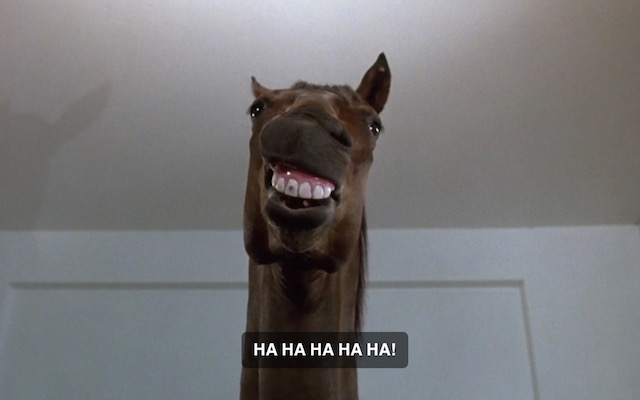
lowry

The House on Haunted Hill

The House on Haunted Hill

Among the many disappointing things about “The House on Haunted Hill” is that it promises a haunted hill and doesn’t deliver one. Oh, the house is haunted, sure. The house is haunted from here to next Tuesday. But the hill? Just a normal hill. Nothing strange about it except that it has a haunted house on top of it, which isn’t the hill’s fault. Leave the poor hill out of this!

Some of the other disappointing things about “The Haunted House on Normal Hill” are that it’s dumb and not scary and has Chris Kattan in it. It’s a “remake” of a 1959 semi-classic that starred Vincent Price, in the sense of “remake” that means they abandoned most of the original story but named a character after Vincent Price in order to stave off charges of disrespect. “We love the 1959 original!” the filmmakers would say in their defense. “We paid tribute to it by changing everything and gave the main character the last name Price!”

That’s Stephen H. Price, to be exact, played by moist, succulent Australian ham Geoffrey Rush. Price is an amusement park tycoon who hates his beautiful wife, Evelyn (Famke Janssen), who hates him right back and is only married to him for his money. Evelyn sees a TV show about an old asylum that got shut down in the 1930s after its head doctor was found to be experimenting on the patients and a lot of people got killed, and she figures this would be the perfect place for her next birthday party. (The haunted Chuck E. Cheese where all those kids died was already booked.) She reports her desires to Stephen, who agrees to throw her a fine soiree at the creepy sanitarium, shreds her guest list, and invites other people instead.

But someone else (Satan?) has other ideas! After Stephen H. Price enters his modified guest list into his laptop, a ghost or something comes along and replaces the names with other names, and those people get invited instead. Which means the party is not attended by Evelyn’s friends, nor by whoever it was that Price tried to invite, but by total strangers who do not know why they’ve been invited. What a fun party! Wheeeee!

twinsies

The guests are: Watson Pritchett (Chris Kattan), whose family owns the defunct property and is renting it to the Prices; Eddie Baker (Taye Diggs), a former pro athlete whose first line of dialogue is “G–damn, this house is scary, yo!,” which is the movie’s way of letting you know that he’s The Black Guy; Donald Blackburn (Peter Gallagher), a doctor; a businesswoman named Sara; and a D-list local media celebrity named Melissa. Sara and Melissa are played by Ali Larter and Bridgette Wilson, identical blondes with identical “Who farted?” expressions on their faces all the time.

Price’s plan is to scare everybody with spook-house gimmicks and offer a $1 million reward to anyone who stays in the asylum all night. Evelyn’s plan is to talk about how much she hates her husband and make disparaging remarks about his sexuality. Pritchett doesn’t care about the reward and wants to leave NOW; the other four are keen on staying in order to collect their easy prize. Wouldn’t you know it, the building immediately goes into “lockdown” mode, with steel barriers sliding down to block all the doors and windows. This is a leftover precaution from when it was an insane asylum; it’s also how theater owners kept patrons from escaping when this film was showing. Price didn’t activate the lockdown, though, and doesn’t know how it happened. Naturally, someone must descend into the building’s dark, sinister, cobwebby basement to investigate and/or get killed.

Hoo boy, lotsa supernatural activity down in that basement! Nothing that follows a cohesive narrative formula, mind you, just lots of random spooky things. (“Eh, whatever seems vaguely creepy!” is what the director told the production designer, who was on crystal meth.) Sara thinks she sees Eddie jump into a giant vat of blood. As she’s reaching in to pull him out, the real Eddie arrives and asks what the heck she’s doing. That’s a good question! Other good questions include what is in the vat pulling on Sara’s arm when she reaches in, and why is there a giant vat of blood in the basement in the first place, and why do Sara and Eddie both disregard the entire incident without further discussion. Meanwhile, Melissa the would-be media star wanders around with a camcorder and sees things in the viewfinder that aren’t actually there. Guns presumed to have been loaded with blanks mysteriously have real bullets. Images of dead asylum inmates appear and then disappear. Charges appear on the satellite bill for pay-per-view movies that nobody ordered!

Pritchett, the Chris Kattan character, keeps insisting that the place is possessed by malevolent spirits — that the house itself wants them all dead. This information is correct but unhelpful: they can’t get out of the house anyway, so it doesn’t matter who’s trying to kill them. Pritchett would do well to shut up, especially if he’s going to keep speaking with Chris Kattan’s voice, a grating, nasal baritone that is itself responsible for countless deaths.

This brings us to the film’s major obstacle. It wants to be the sort of movie where a lot of people die in a gory fashion. But it only has seven characters, and at least one of them, preferably one of the blondes, is required by Hollywood law to still be alive at the end. The movie’s workaround for this scarcity of victims is twofold. One, we see bloody flashbacks to 1930s mayhem, when the inmates got fed up and attacked the crazy doctor and his staff. Two, some of the characters in the present die more than once. Evelyn is found electrocuted to death by ghosts — which makes Price very angry, even though he hated her — and is subsequently revived by Dr. Donald Blackburn, with whom she had conspired to fake her death in order to trick Price. Then she is killed for real by the house’s dark energy, which takes the form of a black cloud, like the one that hovers around Pigpen. Likewise, Price is shot several times in the chest, and we are encouraged to believe he’s dead for several minutes before it’s revealed that the gun had blanks and he was using squibs to fake everybody out, whereupon he is also killed by the house.

Perhaps you are wondering how the angry house chose these particular people to invite to Evelyn’s birthday party. The movie is glad you asked! It’s because they’re all descendants of people who worked with Crazy Experimenting Doctor, and they must be punished for their ancestors’ crimes. This is not entirely fair, but try telling the house that. The house has a very Old Testament philosophy when it comes to the sins of the fathers being answered upon the heads of the children. Let’s be honest, the house is as insane as its former occupants were — maybe more so, comparatively speaking, since the sanity baseline for edifices is so much lower than for people. I mean, a person acts a little squirrelly and you think, “Ha, well, it takes all kinds to make a world.” But when a house behaves strangely you think, “Holy crap, this place is BANANAS!,” and you call a priest.

Anyway, the point is this: the house is bad, not the hill. Maybe that’s not supposed to be the point, but it’s the message I took away from it. The hills in “The Hills Have Eyes” don’t have eyes, either. The people who live in the hills do. I’m tired of liberal Hollywood taking out its prejudices on innocent hills, and I won’t stand for it anymore.

— Film.com

The ol’ link roundup – March 26-April 8

7

Programming change! I’m pleased to report that I’ve launched a new column at Film.com: My Shame List, in which I finally watch all the movies that I’m embarrassed not to have already seen. The first entry is “Schindler’s List” (yes, I’d never seen “Schindler’s List” until last Monday), and the inaugural column goes into more detail about how and why I chose these particular movies. Do enjoy, won’t you?

My Shame List makes its debut a week after the final installment of What’s the Big Deal?, which had run its course. I’d hit all the likely targets for the column and was starting to feel a little stagnant. Also, it was really labor-intensive, and I never felt like I had enough time to do it right. Should have been a bi-weekly column rather than weekly. Anyway, I did 99 of them and figured that was a good place to stop.

NEW MOVIE REVIEWS:

“American Reunion” C-
“Intruders” C
“Mirror Mirror” B
“Wrath of the Titans” C-

* * * * *

MOVIE COLUMNS:

Eric’s Bad Movies: “Color of Night” (1994), starring Bruce Willis as a color-blind psychiatrist.
Eric’s Bad Movies: “Spellcaster” (1992), starring a VJ, a video vixen, and Adam Ant.

Re-Views: “Series 7: The Contenders” (2001), one of the early parodies of reality TV.
Re-Views: “Remember the Titans” (2000), a film whose feel-goodness overwhelmed me the first time I saw it.

What’s the Big Deal?: “The Deer Hunter” (1978), about Vietnam and Russian roulette. (This is the last edition of this column, as explained above.)

My Shame List: “Schindler’s List” (1993).

Things the Avengers Theoretically Would Not Assemble For: An exhaustive list.

* * * * *

MY OTHER STUFF:

Snide Remarks: “Things to Do with Eric When He’s Dead” — My last requests, when the time comes
Snide Remarks: “The 2012 American Hunger Games” — A live play-by-play commentary

Movie B.S. with Bayer and Snider: We have fixed our audio problems, by the way. We thank you for your patience during these trying times. If you don’t know what I’m talking about because you don’t listen to the show anyway, then never mind, and up yours. [MovieBS] or [iTunes]

In the Dark: Subscribe to this weekly e-mail and get all the latest movie reviews, DVD releases, and other pertinent info delivered to your electronic mailbox. [Eric D. Snider’s In the Dark]

Twitter: @EricDSnider

American Reunion

0

As near as I can figure, the plot in “American Reunion” is that the people who own the rights to the “American Pie” franchise wanted to make another movie and didn’t particularly care whether that movie had a plot. Why bother with a story when all you need to do is re-create moments from the previous films?

And so here is this uninspired parade of raunchy tropes, in which the entire cast is reunited under new writers/directors Jon Hurwitz and Hayden Schlossberg (the “Harold & Kumar” guys) and given a to-do list that could just read “ditto.” Jim (Jason Biggs) endures some kind of humiliating genital trauma and has embarrassing sexual conversations with his dad (Eugene Levy); Stifler (Seann William Scott) is cheerfully vulgar and abrasive in his attempts to score with young ladies; Michelle (Alyson Hannigan) mentions going to band camp and proves to be more sexually adventurous than might have been supposed; Stifler’s mom (Jennifer Coolidge) is a sexpot; an attractive young actress’ breasts are prominently featured; somebody gets poop on them; etc.

These are all fine things to include in a raunchy comedy, of course, and they were generally pretty funny when we saw them in “American Pie” (1999), “American Pie 2” (2001), and “American Wedding” (2003). (We are disregarding the four straight-to-DVD quasi-sequels that had none of the original main characters.) The first film, especially, wasn’t just dirty; it had some genuinely sharp writing and performances. Now it has devolved into a crass sitcom — I kept thinking of “Two and a Half Men” — where the dirtiness is the joke. We’re supposed to laugh because someone said a no-no word.

The class of 1999 is holding a 13-year reunion, and everyone’s coming home to celebrate! (The characters are aware that 13 is a weird number for a high school reunion, but no attempt is made to explain it.) Jim and Michelle have a 2-year-old son and have allowed their marriage to grow a little stagnant, a plot device you might recognize from every other comedy ever made about a married couple with young children. Oz (Chris Klein) is a successful L.A. sportscaster with a hot girlfriend (Katrina Bowden), but he might still have feelings for Heather (Mena Suvari). Kevin (Thomas Ian Nicholas) is a domesticated househusband with a hot wife (Charlene Amoia), but he fears he will rekindle his spark with Vicky (Tara Reid). Finch (Eddie Kaye Thomas) has been living a mysterious life of world travel. Stifler is still Stifler.

Apart from those just mentioned, most of the returning cast members are here just so we’ll say, “Hey, look, it’s So-and-So” (John Cho! Natasha Lyonne! Shannon Elizabeth! Chris Owen!), and not because Hurwitz and Schlossberg had any humorous ideas for how to use them. And that plays into the film’s primary reason for existence: nostalgia. It sounds odd to be nostalgic for something that only happened 13 years ago, but “American Pie” was a cultural touchstone for a lot of Millennials, so you can understand why “American Reunion” would spend so much time reminding us of the kooky shenanigans from the previous films. I just wish they had come up with better comic scenarios for these 31-year-old characters.

Stifler is still the funniest one, operating on pure, unbridled Id and self-gratification. Jim’s dad and Stifler’s mom also contribute some laughs. Heck, everybody has a moment or two. (Maybe not Oz. Was Chris Klein always such a jaw-droppingly incompetent actor?) It isn’t that “American Reunion” is unenjoyable. It’s just perfunctory. If you can’t think of a better excuse to get together, maybe you shouldn’t get together.

Series 7: The Contenders (2001)

0
Series 7: The Contenders (2001)

One of the benefits of being very, very old (I was born in 1974) is that I can remember when reality TV did not exist. Prior to 2000, the examples of it were so rare — Cops (which premiered in 1989) and MTV’s The Real World (1992) were about the only ones — that the genre didn’t even have a name. When the term “reality TV” was coined, it appeared in quotation marks for a few years before becoming an ordinary part of the language. Now there is an entire section of the Emmys devoted to it.

Things changed in 2000. Big Brother and Survivor, both already popular in Europe, launched hugely successful American editions that year, followed by Temptation Island, The Mole, The Amazing Race, and Fear Factor in 2001, American Idol and The Bachelor in 2002, and numerous others not worth mentioning.

Series 7: The Contenders premiered at Sundance in January 2001, days after the launch of ABC’s The Mole and Fox’s controversial Temptation Island (in which romantic couples were tempted to cheat on each other). I’d seen only a little of Survivor and Big Brother, and nothing of the others, but I was familiar with them because of the media’s relentless, breathless coverage of this exciting new television trend. Series 7 felt spectacularly timely and observant. It wound up on my top 10 list for the year.

What I said then:

“Series 7 is one of the most devastating satires of American pop culture ever conceived, a vicious and dark look at ‘reality TV’ — and, by extension, our society’s obsession with everyone getting their 15 minutes of fame…. Written and directed with precision detail by Daniel Minahan, [the film] couldn’t have come at a better time, what with ‘reality TV’ being all the rage at the start of the new millennium. We’ve all been raised on TV; in fact, most of our parents (and even THEIR parents, in many cases) were raised on it, too. TV is boring now. In order for us to be entertained by it, we have to actually be part of it…. Series 7, then, is the logical extreme of the directions we’re already heading. Sooner or later, we’ll be bored with people stranded on desert islands, and someone will have to up the ante. As if to smack us in the face for even thinking such a thing, the film is at times wantonly violent…. Minahan seems to say, ‘You think the idea of a TV show where contestants have to kill each other is funny? Well, here’s how awful it would be if it really happened.’ Relentless morbid and incredibly, darkly funny, Series 7 is a brilliant parody.” Grade: A [Read the whole review here.]

Other reviews were mostly positive, if perhaps not as effusive as mine. The distributor, USA Films, gave it a tiny theatrical release in March 2001, where it grossed a little under $200,000 and faded into obscurity. It continued to linger in my memory, but for some reason I never watched it again until now, 11 years later.

The re-viewing:

This turns out to be a great example of how a person’s opinion of a movie might shift because of factors that have nothing to do with the movie or the person. In January 2001, Series 7: The Contenders was an audacious, blistering attack on reality TV, which was new and had not yet been satirized extensively. In April 2012, while still a good parody, it doesn’t seem nearly as notable — but that’s only because ridiculing reality TV has become as commonplace as, well, reality TV. What was outrageous and daring then is almost subtle now, so accustomed are we to the conventions of reality TV and the mockery thereof.

None of that is a flaw in the movie. Owing to their of-the-moment nature, pop-culture satires that don’t feel dated after a decade are the exception, not the rule. And it isn’t that Series 7 is dated, really; pretty much all the points it makes still apply. Those points are just less clever now that so many others have made the same ones.

I didn’t laugh out loud this time as much as I remember laughing in 2001. The film itself is very straight-faced, almost never underlining its jokes. I’d call it “droll” or “sly” now, rather than hilarious.

Still impressive is the film’s spot-on imitation of the aesthetics of reality TV: the editing, the graphics, the music, and so on. If you were only halfway paying attention to it, you’d have no reason to believe it wasn’t a real show (except for the killings) because it doesn’t do anything to give itself away. Writer-director Daniel Minahan clearly had a keen eye for what made the new reality genre look and feel the way it did, and I was a little surprised to find that he hadn’t gone on to work in that field after Series 7. In fact, the TV shows he’s directed have been the cinematic kind — Six Feet Under, Deadwood, True Blood, and Game of Thrones, to name a few — which is almost exactly the opposite of reality TV.

I also like that participation in The Contenders is mandatory if your name is drawn, but the movie makes no effort to explain how or why that came to be the case. It’s set in present-day (well, 2001) America, with no reference at all to what has led to such a strict entertainment regimen. This was a wise choice for two reasons. One, it allows the film to just be satire instead of having to be sci-fi on top of it. Two, as soon as you start explaining what changes in American society and government supposedly produced this environment, viewers start trying to figure out which current real-life political trends you’re commenting on, which can become a distraction. (“He’s saying that this is where Obamacare will lead us!” “No, he’s saying we need better gun control!” Et cetera.) Minahan was smart to avoid that mess.

My only problem with the film is something that happens near the end, where the TV show presents a “re-enactment” of an event rather than the actual event. It’s the only time the movie ever feels like a parody, and it takes us out of the moment. On the other hand, it gives us a few moments with Will Arnett, back before anyone knew who he was, so maybe it’s OK.
Do I still love this movie?

The cultural landscape has changed a lot since 2001, yet nearly everything Series 7: The Contenders says about reality TV is still accurate. If anything, the film was ahead of its time, making observations about society that didn’t really sink in for a few more years. The humor trenchant, the characters authentic. When the history of reality TV parodies is written, this one will stand out as one of the most effective early examples. Grade: B+

— Film.com

Things the Avengers Theoretically Would Not Assemble For

0
Things the Avengers Theoretically Would Not Assemble For

So this movie coming up, “The Avengers,” you know what it’s about, right? It’s about some superheroes from other movies, plus a guy with a bow and arrow, who get together to fight villains. This is necessary because some villains are too powerful to be vanquished by just one superhero (unless that superhero is Superman, who you’ll notice is not in this movie). From what I gather, one of the Avengers sees a threat, says “Avengers assemble!,” and the Avengers assemble. I believe attendance is mandatory. I don’t think you are allowed to opt out of the assembly if you’re an Avenger.

We know the kind of things the Avengers will eagerly assemble for: supervillains, killer robots, monsters from other dimensions, Tom Hiddleston, etc. But let us now hypothetically consider scenarios in which the Avengers would refuse to assemble.

Things the Avengers Theoretically Would Not Assemble For

– To fight the scourge of between-meal snacking among children.

– To help Bruce Banner move to a new apartment.

– To help Black Widow fight a speeding ticket.
– “Mad Men.” We all have DVRs. We don’t have to watch it together. Tony has a thing on Sunday nights anyway.

– A meeting of people who want to repeal the part of the First Amendment that guarantees the right to peaceably assemble. The Avengers do not like situational irony.

– A performance of Batman’s one-man show, “I, A Bat.”

– Game night at Nick Fury’s house, because last time they did this, Nick lost an eye.

– To play softball against the Justice League. Those guys cheat.

– Christmas caroling.

– Comic-Con.

– Fourth of July barbecues. Steve Rogers treats it like a religious holiday, reads the Declaration of Independence aloud, weeps uncontrollably, brings everyone down.

– Not a damn thing, unless you’re willing to pay the standard $50,000 appearance fee.

— Film.com

The 2012 American Hunger Games

0
The 2012 American Hunger Games

Welcome to the 2012 American Hunger Games, the country’s most exciting youth competition and bloodsport! A teenage boy and girl have been selected from each of the 50 states, and those 100 young people will murder one another on television until only one remains! Sponsored by Coca-Cola!

The contestants have gathered in the arena and are now waiting for the signal that will officially start the 2012 American Hunger Games. Looks like there’s been some kind of technical delay up in the production booth. They’re saying it’s going to be a few more minutes before they can start. The contestants have been standing there for a good five minutes, so now they’re starting to sit down on the ground, they’re taking out their phones, they’re occupying themselves while they wait. A few of them are chatting with each other.

Oh, here’s a tweet! One of the contestants — Mackenzie, 16 years old, from California — she’s just tweeted this:

grr dumb hunger games startin late!!! so board!! #hungergames

OK, now I’m being told that everything is fixed and we’re ready to begin! The contestants are getting back on their feet, preparing for battle — oh, not all of them. Looks like several are having trouble hoisting their obese, lazy carcasses into a standing position. I have to tell you, I have been covering the Hunger Games for years, and this is easily the fattest group of competitors I’ve seen. They just get worse and worse every year.

There’s the starting gun! The Games are underway! Right off the bat a few of the more athletic contestants are racing to the middle of the arena to grab food and weapons. They’re approaching the giant cornucopia where everything is stashed, and … OK, it looks like one of the boys is pretending to hump the cornucopia while the others laugh and take pictures with their phones. I think — yes, yes, those pictures are now appearing on Facebook, the boy doing the humping identified as Jordyn, a 15-year-old from Florida. Jordyn wants to be a bouncer at a nightclub when he grows up, and he lists his hobbies as “keepin’ it real and cold steppin’ to suckas.”

And right there at the cornucopia, we have our first casualty! Thirteen-year-old Ashleigh, from South Carolina, who had hoped to spend time on Facebook for a living when she grew up, has succumbed to a peanut allergy. Gotta be careful with those peanut allergies. Now several of the other girls have gathered around to make fun of her for dying. I believe one of them is tweeting … yes, here’s her tweet:

omg ashleigh’s dead body is soooo fat lol #hungergames

That tweet comes from 15-year-old Bella, of New Jersey, who told us that if she wins the Hunger Games but doesn’t get a car for her Sweet Sixteen, she’ll kill herself. Ooh! And now Bella is dead! Struck from behind with a baseball bat wielded by Jordyn, who has torn his attention away from pretending to hump the cornucopia long enough to get his head in the game! His buddies are high-fiving him now, taking more pictures to post on Facebook. By the way, if you favor Jordyn to win the Hunger Games, you should “like” him on his fan page, facebook.com/jordynhungergames. That’s Jordyn with a “y,” of course.

Back at the starting point, a lot of the contestants are still standing around, watching YouTube videos on their phones while they wait for things to clear up at the cornucopia. I see Caitlyn — 16 years old, from Pennsylvania — is conferring with her parents, who are now signaling to the judges about something. They seem to be upset about some element of the Games. I’m not sure what it is. OK, it looks like Caitlyn’s parents are insisting that the playing field be swept for ticks before they let their daughter participate. Yes, something about Lyme disease … they are concerned about Lyme disease … Caitlyn’s stefather is very agitated, he’s talking about lawsuits. Not sure how that’s going to resolve itself.

Now that the stronger competitors have gotten their weapons and food and scrambled off into the forest, some of the others are timidly waddling toward the cornucopia to get whatever is left, panting and wheezing as they go. Several have stopped halfway there to sit down and rest a while. Now one of them — I believe that’s Tighson, from Colorado — he’s 14 — he’s picked up an empty bread wrapper. It’s a wrapper that used to have a loaf of bread in it, now it’s empty, he’s holding it up, smiling, waving it to the crowd. His parents, on the sidelines, are cheering for him. “You’re doing great, sweetie!,” that’s what his mother just yelled. Good for Tighson, clearly giving it his best effort despite having no competence for anything, anything at all. According to the new rules stipulated for the 2012 American Hunger Games, at the end of the contest everyone, including the 99 who are dead, will get a trophy for participation. Tighson’s parents can definitely look forward to putting that on the mantel.

Now, a few of the boys have formed an alliance, it would appear. They’re working together on something. They’re running around with cables and wires, making a snare of some kind … OK, yes, I see they’ve rigged up a generator so they can play Xbox. Very clever boys. Now one of them is using the book of matches he found in the cornucopia to light his farts on fire.

Back at the starting point, a few kids have converted a bottle of water into a bong, and they’re passing that around while several others nap. It has been a long and grueling half-hour of work, and they are tuckered out.

Looks like a few more contestants have fainted dead away from heat exhaustion or food allergies. Two boys are openly sobbing about how the whole thing is unfair because the actual Games bear very little resemblance to the PlayStation version of the Hunger Games. One of the girls is demanding that the game-masters let them all start over again because she didn’t get a chance to do her hair properly, and it’s not fair. She’s also pointing out that Jenna is a skank. That would be Jenna from Michigan, a 17-year-old contestant who lists her hobbies as “music, boys, and being a skank.”

Along comes Jordyn, out of the forest, still the frontrunner in this competition. He’s creeping up behind a group of boys and girls who are listening to music on their iPhones while the boys alternate between trying to touch the girls’ boobs and insulting the girls for not letting them touch their boobs. Jordyn won’t be able to kill more than a couple of them before he loses the element of surprise, but who will he choose? We’ll have to wait to find out — the judges have signaled to him to stop where he is, because it’s time for a commercial. We’ll be right back!

Color of Night

Color of Night

“Color of Night” begins with a pretty woman in a nice dress sobbing while she applies her makeup. She looks like she’s getting ready to go out on a date. But then she smears on her lipstick in a comical fashion, puts a gun in her mouth, and, as she continues to cry, simulates performing a sex act on the gun. In the next scene, she meets with her psychiatrist, which you will agree is a good idea. Alas, she decides to terminate the session by taking a running leap out the office window, smashing through the glass and plunging to her death many stories below.

colorofnight

Why has this woman suddenly pulled a Hudsucker? It doesn’t matter! Screw her. The important thing is that it really messes up her psychiatrist, Bill Capa (Bruce Willis), who is unaccustomed to his patients committing suicide right in front of him. Bill is so traumatized by the sight of his patient lying in a pool of blood on the street below that he immediately develops psychosomatic colorblindness and can no longer see the color red. Really! This is the movie’s idea of a deep psychological scar.

So we’re barely 10 minutes into this thing, and already “Color of Night” is a cavalcade of dumb craziness. Can it get any dumber, crazier, or cavalcadier? Surprisingly, yes! Wait’ll I tell you about the man who is clearly a woman in disguise but the movie thinks we won’t notice!

But I have gotten ahead of myself. “Color of Night” came out in 1994, on the heels of erotic thrillers like “Basic Instinct,” “Sliver,” “Jade,” and “Mrs. Doubtfire.” Unlike many erotic thrillers, however, it is neither erotic nor thrilling, though it is sleazy and boring. It belongs to the genre of sleazy borers. Look for that shelf at your local video store! (If you can find your local video store, I mean. Try looking in 2003.)

Bill is shaken up by the colorblindness (and I guess by his patient’s suicide), so he closes his practice and heads to Los Angeles to visit his best friend, Bob (Scott Bakula), a fellow headshrinker. First thing Bob does is invite Bill to sit in on a group therapy session. (“Hey, guys, would you mind if my depressed pal observes this week? Don’t worry, he’s a psychiatrist too! His last client leapt to her death rather than continue to speak with him. Is it cool if he joins us?”) This is Bob’s regular Monday night group, attended by five people with widely varying disorders who do not get along very well and can’t possibly all benefit from the same method of treatment. You know those websites where you can pay fifty bucks and become a licensed minister? That is where Bill and Bob became psychiatrists.

I’m going to list the nutcases in this therapy group. You will need to know them because there’s going to be a murder, and the movie will want to make it seem like each one could be a suspect. You’ve got Sondra (Lesley Ann Warren) the sex addict, Clark (Brad Dourif) the obsessive-compulsive, Casey (Kevin J. O’Connor) the weird artist who’s into bondage and masochism, Buck (Lance Henriksen) the angry guy whose wife and child were murdered, and Richie the stuttering teenage boy with a gender-identity disorder. “Richie the Stuttering Teenage Boy with a Gender-Identity Disorder” is not an old Dana Carvey character from “SNL,” but it should have been.

Richie gets our attention because he is clearly played by a woman. You tend to notice that sort of thing. The woman is Jane March, the British model-turned-actress who only two years earlier had starred in the smutty French movie “The Lover.” “Color of Night” doesn’t want us to realize that Richie is actually a girl at all, much less recognize Jane March as the specific girl that he actually is. “Color of Night” thinks it is pulling a fast one on us! The other characters do not notice that Richie is a girl, the same way everyone in “The Muppets” didn’t notice that Gary’s little brother was a Muppet.

Anyway, Bob gets stabbed to death the next night, right there in his office. The detective working the case, Martinez (Ruben Blades), tells Bill he thinks the murderer is someone from the Monday night group. He would also like Bill to take over the group for Bob, which Bill is reluctant to do because 1) the last patient he treated flung herself through an upper-story window right in front of him, and 2) he heard somewhere that one of the people in the Monday night group might be a murderer. But then he takes over the group after all, because the plot needs him to.

colorofnight

While this is going on, Bill lives in his murdered friend’s spacious home in the Hollywood hills and starts dating a mysterious young woman named Rose. Rose is played by Jane March, whom you will recognize as the woman who also plays Richie the stuttering teenage boy with a gender-identity disorder. Rose and Bill have a lot of steamy sex, which it turns out is the main reason for the movie to exist. Between sex scenes, the movie goes through the therapy participants one at a time, making it look like each of them could have murdered Bob: this one has anger issues, that one has secrets in his past, yada yada. The problem, of course, is that we know none of them is the killer. It was Rose/Richie, obviously, or at the very least someone closely connected to her. (Maybe her brother, Dale, who acts skittish and protective whenever somebody talks to him???) So it’s like an Agatha Christie play, only instead of five equally plausible suspects in a room you have four equally plausible suspects and one suspect who is wearing a sign that says, “YOU SHOULD FOCUS ON ME.”

This is all pretty sleazy and dumb, obviously, but it isn’t sleazy and dumb enough. “Color of Night” has very high standards where sleazy dumbness is concerned. So in a side story, Sondra the sex addict has a lesbian adventure with her friend, Bonnie, who is played by — wait for it — Jane March. And once again, the movie doesn’t want us to notice that Bonnie is the same person as Rose, who is the same person as Richie. The movie is really counting on those sex scenes to distract viewers’ attention. Bonnie wears a blond wig and speaks with a British accent, presumably so attentive audience members will think, “Are Bonnie and Rose the same person?? No, they can’t be, or else they would have the same color hair and speak with the same accent.”

The interesting thing about “Color of Night” is that for such a bad movie, it was very competently made. It was shot and edited by professionals, and it occasionally exhibits signs of artfulness. Which just makes it even weirder that people who ought to have known better would agree to participate in it, since its laughable story and transparent smuttiness doomed it from the start. What a terrible waste of window-smashing and lesbian-adventuring and unconvincing-gender-disguising!

Note: At no point does Bill’s colorblindness factor into the story in any meaningful way. The closest we get is a scene where Bill is driving and he gets a call from someone menacing who says, “I’m in the red car!,” and Bill doesn’t know which car that is. But then the person tries to run him off the road, which helps him narrow it down.

— Film.com

Mirror Mirror

0

After a decade of snarky, “Shrek”-inspired fairy tale parodies, it’s refreshing to see “Mirror Mirror” take on the Snow White story with an attitude of mischief and charm rather than outright satire. There are no hip, soon-to-be-dated cultural allusions, no spoofing of fairy tale conventions. A person who had never heard the familiar Snow White tale (if there is such a person) wouldn’t miss anything in “Mirror Mirror” because it works as a standalone, family-friendly fantasy.

This version begins from the wicked Queen’s point of view. Played with full-wattage charisma by Julia Roberts, the Queen reports that her stepdaughter’s parents named her Snow White “probably because that was the most pretentious name they could think of.” Ever since the death of the King left her in charge, the Queen has wasted the kingdom’s money, made the peasants miserable, and kept Snow White in the castle, essentially if not literally locked up.

It is on the occasion of her 18th birthday that the beautiful Snow White (played by Lily Collins, daughter of old-timey pop musician Phil Collins) starts getting ideas about venturing out into the world. She has a meet-cute with the dashing Prince Alcott (Armie Hammer) in the forest, where he and his steward, Renbock (Robert Emms), have been set upon by a band of robbers who wear stilts to disguise their short statures. If you had to guess how many of these diminutive highwaymen there are, you would do well to stay in the ballpark of seven.

The Queen proves to be as smitten with Prince Alcott’s good looks as Snow White is, leading to some very funny exchanges between the young Prince and the, um, slightly older Queen. More to the point, she’s smitten with his vast riches and large kingdom, which she would very much like to add to her own. (Renbock warns Alcott: “This queen radiates ‘crazy.'”) Jealous of Snow White’s beauty and influence over the Prince, the Queen orders her buffoonish servant Brighton (Nathan Lane) to get rid of her.

As you can see, while some of the traditional framework is in place, this version of Snow White (written by Melissa Wallack and Jason Keller) goes in significantly different directions from the Disney version, which deviated from the Brothers Grimm version, which was merely the most famous of the folkloric tales anyway. So this isn’t a retelling of the famous story but from the Queen’s perspective, the way “Wicked” retold “The Wizard of Oz” or “Rosencrantz & Guildenstern Are Dead” retold “Hamlet.” It’s a different story altogether, albeit one with some familiar elements.

There are pros and cons to this approach. For example, part of me hoped the seven dwarfs would have the same personalities as their Disney counterparts, just for the fun of seeing them translated into live-action characters. But I can see the wisdom in not being too devoted to that version of the fairy tale, as to do so would have made this one seem dependent on it.

Directed by the visually talented Tarsem Singh Dhandwar (“The Cell,” “The Fall,” “Immortals”), “Mirror Mirror” brims with fanciful imagery, as well as marvelous sets and costumes, and Collins, Roberts, Hammer, Lane, and the rest of the cast revel in the opportunity to play dress-up in fairy-tale land. The first half of the film is about as enchanting and blithely funny as an all-ages movie gets, but this diminishes over time as the story falls into sillier devices (a potion makes Prince Alcott act like a dog) and is sometimes slowed down by, of all things, the action scenes. The delights are in the dialogue — humorous but rarely jokey, jaunty and only lightly sarcastic — more than in the mechanics of the plot. The kids are gonna love it, though, and I can’t blame them.

Wrath of the Titans

0

Oh, right, this thing. Remember that “Clash of the Titans” remake a couple years ago, the one with lousy after-the-fact 3D conversion and a boring lead actor? The one that was anticlimactic and dull, even though it had a Kraken in it? Well, they made a sequel.

“Wrath of the Titans” features little wrath and only one Titan, but at least the special effects are good. (In 2D anyway, which is how I saw it.) This time, bland demigod Perseus (Sam Worthington) must join forces with his ne’er-do-well cousin, Agenor (Toby Kebbell), to prevent god of war Ares (Edgar Ramirez) and grumpy Hades (Ralph Fiennes) from unleashing devastation upon humanity by releasing Cronos from his prison. Cronos is a Titan, the father of Hades, Zeus (Liam Neeson), and Poseidon (Danny Huston), though how he sired those three sons despite being a giant lava monster is not explained. Presumably the lads’ mother was more human-looking? Maybe Cronos was not always a giant lava monster?

I don’t have time to delve into Greek genealogy. The point is, dull Perseus and his wacky cousin have a mission that necessitates traveling through perilous terrain, seeking ancient artifacts, that sort of thing. Encounters with a tribe of cyclopses and a two-headed dragon-bat monster are energetically staged by director Jonathan Liebesman (“Battle Los Angeles”), and the always-welcome Bill Nighy is on hand as Hephaestus, the dotty old god who manufactured the gods’ weapons and knows how to use them properly.

But oh — it’s all so dumb. Rarely has so much money and time and talent been expended to make something so inert and useless. Look at all the effort they wasted just to bore me! Believe me, I can be bored for a lot less work than went into this.

Goon

0

“Goon” represents two noteworthy achievements. One is that it’s a very funny R-rated sports comedy, which is not common. The other is that it stars Seann William Scott — heretofore best known as the aggressively jerky Stifler in the “American Pie” films — as an endearing character you actually want to root for. Could Scott play a genuine leading man in a mainstream, big-studio comedy? Here is strong evidence that he could!

Scott plays Doug Glatt, a Massachusetts underachiever who is recruited to play for a minor-league hockey team. He is offered this position not because he’s good at hockey — he’s never even been on skates — but because he’s a terrific fighter. No matter the size of his opponent, Doug can lay him out with a punch or two. (This comes up a lot in his current job as a bar bouncer.) As his new coach says, “You’ve been touched by the fist of God.”

And so Doug winds up playing for a semi-pro team in Halifax, coming into the game when someone on the other team is deemed to be in need of a smackdown. He’s also assigned to protect his teammate Xavier Laflamme (Marc-Andre Grondin), who is gun-shy after taking a beating from the league’s most legendary brute, Ross “the Boss” Rhea (Liev Schreiber). Doug, now called Doug “the Thug,” dreams of one day fighting Ross himself.

To someone who isn’t a hockey fan, the idea of recruiting a player who’s bad at the sport but great at fighting sounds like satire. The movie — which is loosely based on fact, as recounted in Adam Frattasio and Doug Smith’s book “Goon: The True Story of An Unlikely Journey into Minor League” — certainly plays up that aspect, adding to it the fact that Doug is not by nature a combative or aggressive person. He’s actually quite gentle and polite. (When his bouncer job required him to rough somebody up, he usually apologized first.) He has a skill, and he’ll cheerfully use it, but he doesn’t go looking for reasons.

But what keeps this from being a one-joke film is the way the story develops from there. Doug becomes a legitimate member of the team, a rag-tag group of misfits with an abysmal win-loss record who desperately need a new attitude. Doug gets a love interest, a local girl (Allison Pill) with a thing for hockey players, and starts to feel, for once in his life, like he’s living up to his potential. “Goon” becomes, in other words, an exuberant underdog sports comedy, and a good one at that.

The screenplay is by Evan Goldberg (“Superbad”) and actor Jay Baruchel, who also steals scenes as Doug’s magnificently vulgar best friend. They find abundant humor in the relentless mocking in the locker room and the absurd violence on the ice (which director Michael Dowse shoots lovingly), as well as in the sport’s crazy fans and off-kilter commentators. I wouldn’t have thought a movie about violence would be this happy, or that a movie starring Seann William Scott would be this good-natured, but here we are. It’s practically a miracle on ice.

Intruders

0

The best thing that “Intruders” has going for it is its central image of a person with a featureless face. Hollowface, as he’s called in the movie, is a bedroom-closet boogeyman who torments a young Spanish boy and a young English girl in parallel (or maybe perpendicular) stories, and there’s no denying he makes for a creepy visual. But “Intruders” gets disappointingly literal with what proves to be a goofy psychological story, and the goosebumps produced by Hollowface are all for naught.

This is the third feature by Spanish director Juan Carlos Fresnadillo, whose first two, “Intacto” and “28 Weeks Later,” showed creativity and promise, and which had better screenplays than this one (credited to Nicolas Casariego and Jaime Marques). The mystery is tantalizing at first, though. In Spain, young Juan (Izan Corchero) has nightmares about a Hollowface-like character that enters his home and attacks his mother (Pilar Lopez de Ayala). In London, an imaginative 12-year-old girl named Mia (Ella Purnell) writes a monster story about a similar fiend and is also troubled by nightmares, which she comes to believe are real. Her father (Clive Owen), an otherwise sane and ordinary man, starts to think she may be right — or, at the very least, that there has been an intruder in the house.

We cut back and forth between Spain and England for a while. Juan’s mother brings in a priest (Daniel Bruhl) to talk to the lad; Mia’s dad installs surveillance cameras in case the perpetrator returns, and worries his wife (Clarice van Houten). Juan and Mia’s visions of Hollowface become stronger and more palpable. Can it be that their imaginations are willing the monster into existence?

Re-reading those last two paragraphs, I think: That sounds like a great set-up for a scary movie! Where do our nightmares come from? What real-life experiences inspire them? What makes them go away? Yes, yes, good stuff. Unfortunately, it’s followed here by twists that explain things too easily, making the fantastical seem ordinary after all. Less explanation might have been better in this case. The haunted house isn’t nearly as scary once you’ve turned all the lights on.

Bully (documentary)

0

I don’t know what it will take to eliminate bullying among young people. Better parenting, more effective school policies, possibly some reprogramming of basic human nature. “Bully,” a somber documentary by Lee Hirsch, doesn’t have any answers either. But it does shine a light on the problem by relating the experiences of several American kids whose lives have been made miserable by their peers. This is probably a good start.

We meet Alex, a gawky 12-year-old Iowa boy whose small frame, unhandsome face, and timidity have made him a target for the a-holes he goes to school with. (I’m guessing being followed around by a camera crew did not help.) He doesn’t get much physical abuse; as with most of the kids featured here, it’s verbal and emotional bullying that torments him. We witness a particularly jarring incident on the school bus between Alex and a classmate whose cruelty is so matter-of-fact it can only be the result of much practice.

Then there’s 16-year-old Kelby, whose life in a small Oklahoma town has been hell ever since she came out as a lesbian, with schoolmates and even many adults openly persecuting her. Her supportive parents offered to move the family away, but Kelby refused: “If I leave, they win.” In Mississippi, a 14-year-old girl named Ja’Maya is in juvenile detention after relentless bullying led her to do something rash. Elsewhere, we meet the families of bullied kids who committed suicide, now working to raise awareness of the problem.

Hirsch treats his subjects as sensitively and non-exploitatively as it is possible to do when making a documentary about kids who probably do not need a lot more scrutiny in their lives. It’s heartbreaking to see them keep pluggin’ away in spite of it all, especially when we see their loving parents’ frustration and helplessness.

Speaking of frustration, Hirsch includes a few scenes with an assistant principal at Alex’s school whose cluelessness might make her the new face of administrative ineptitude. She and her colleagues have no idea how to actually solve the problem of bullying, so instead they downplay its severity, subtly shift the blame back to the victims, spout a lot of platitudes, and claim to be on top of things. (You might recognize these tactics from the last time you went through airport security.)

To me, that feels like the theme of the film. We know kids shouldn’t treat each other like this, harassing their peers into suicide, but we don’t know how to make them stop. Understanding what makes the bullies act the way they do would help; the movie doesn’t explore that angle, so we don’t get any insight there. We also don’t get much in the way of encouraging bullying victims to hang in there because life will get better. “Bully” starts a conversation that hopefully will be continued by people who can make a difference.

Michele Schalin is a plagiarist

33

Michele Schalin is a forty-something woman who lives in or near Austin, Texas, where she owns a web-design company, hosts a weekly Internet TV show (this you gotta see), and writes film reviews for her website, The Movie Junkies.

Well, that’s misleading. For one thing, The Movie Junkies seems to be gone now. For another thing, Michele Schalin didn’t write the reviews she posted there — she mostly plagiarized them from real writers, like some kind of craven word-thief.

Nobody knew who Michele Schalin was until Wednesday, when my colleague Mike McGranahan of The Aisle Seat discovered that she’d stolen significant portions of several of his reviews. Mike poked around and discovered that she’d also pilfered from Will Goss, MaryAnn Johanson, Jeffrey Overstreet, and — aw, hells no! — Eric D. Snider. That’s meeee!

Remember the Titans (2000)

0
Remember the Titans (2000)

My buddy Jeff and I were waiting for another friend of ours to show up for happy hour, and I was telling Jeff that I needed to watch “Remember the Titans” when I got home, for my Re-Views column. “I gave it an A when it came out,” I said. Jeff made an astonished are-you-crazy? face and said, “Yeah, that seems a little strong.” Then our other friend arrived and we had food and drinks, and afterward I mentioned to this other friend what I was up to later, including the part about giving it an A when it came out. He made the same face as Jeff and said, “Wow, that does seem a little high.”

Yeah, yeah, I know. Even before re-watching it I suspected my original assessment would prove to be hyperbolic. I had two distinct tendencies in my early days as a film critic. One was to give out A and A- grades like Halloween candy. The other was to forget all about a movie’s shortcomings if it made me feel warm and/or fuzzy in the end. (In the end of the movie, not in my end.) It seemed like there was a good chance both of these tendencies would apply to my “Remember the Titans” review.

What I said then:

“‘Remember the Titans’ is a cheerfully uplifting triumph, that rare film that conveys emotion without sentimentality, and whose weaknesses are so overpowered by its strengths that you practically forget they exist…. Racism is obviously a central issue here, but screenwriter Gregory Allen Howard does the near-impossible by keeping it from getting preachy…. Director Boaz Yakin has painted the landscape with numerous honest, real characters. They aren’t just white football players and black football players: They’re genuine people whose attitudes and interactions make this more than just another inspiring movie about sports…. The message of it all is obvious, and so the film doesn’t beat us over the head with it. We’re allowed to just enjoy the movie for the fantastic feel-good article that it is, and subtly become better because of it, too…. The film has its minor flaws. But taken as a whole, it’s as close to perfect as you’re going to find — a feel-good movie that’s also smart and deep, that makes you feel good without manipulating you.” Grade: A [The whole fawning review.]

It’s a little strange that I’d never seen it a second time considering it’s one of my mom’s favorite movies. She and my dad apparently watch it all the time. (I don’t live with them, though, which I guess makes it less strange that I haven’t watched it with them.) Back in 2008, in conjunction with Mother’s Day, the dear departed Cinematical had its writers ask their moms about their favorite films. Here’s what my mom told me:

“I love ‘Remember the Titans.’ It’s set in my senior year in high school, so the music reminds me of high school. I’d love to get the soundtrack. [I don’t think she intended that as a hint, but I took it as one anyway.] It’s such a warm story. I have trouble comprehending that in 1971 in some parts of the country there was still that kind of racial junk going on, but I guess it was. It comes on TV a lot, and we have it on DVD — and VHS — so every time it comes on we start watching it, and then we get frustrated with the commercials and put on the DVD. And Denzel Washington! I love Denzel Washington.”

That’s pretty much how I felt when I saw it in 2000. Most reviewers were basically on the same side as me and Mom (73% positive at Rotten Tomatoes), but my review seems to have been particularly effusive. The negative reviews said it was watered-down, melodramatic, oversimplified, and Disney-fied.

Harrumph! Those sad sacks!

The re-viewing:

First of all, you know who’s in this movie? Wood Harris, aka Avon Barksdale, from “The Wire.” I hadn’t realized, when I started watching that show, that I’d seen him before. I thought he sprang fully formed from my nightmares. Also present are are Ryan Gosling, Kate Bosworth, Donald Faison (Turk from “Scrubs”), Ethan Suplee (the fat guy from “My Name Is Earl”), and an 11-year-old Hayden Panettiere.

Now, my mom makes some good points. For example: Denzel Washington! The man oozes old-fashioned charm and decency. When he appears in a bad movie, the stink of it doesn’t stay on him. If you cast Denzel as your lead actor, you’ve already done half the job of getting the audience on your side. A second viewing of “Titans” highlights the character’s speechifying tendencies — no longer will I claim the screenplay is anything approaching subtle or nuanced — but is that not part of the comfortable pattern of an inspiring sports movie? And who better to delivery those stern but affectionate speeches than a respectable authority figure like Denzel Washington?

My mom’s other good point is that it’s such a warm story. It is a warm story. Now it occurs to me that sometimes “warm” means oversimplified. Don’t make us feel too bad before we get to feel good. And I rolled my eyes a little during this second viewing, but I was always smiling when I did it. The movie earnestly strives to tell a complicated, painful race-relations story in a simple, easily digestible way. This is the greeting-card version; though it’s based on a true story, you can tell at a glance that it didn’t happen this easily. The film conveys the darkness of the conflicts just enough so that we’ll be able to feel appropriately happy when those conflicts are overcome.

Does that mean it’s “oversimplified”? Well, yeah. That’s kind of the definition of “oversimplified.” But as fast-food stories of triumph go, “Remember the Titans” is satisfying and relatively nourishing.

The cynical view — and a charge that was often leveled at “The Help” last year — is that a movie like this one makes our ongoing race problems look much easier to solve than they are. But is that always a bad thing? Fables and fairy tales distill thorny issues into simple aphorisms, and that makes those thorny issues seem more manageable. It isn’t being naive; it’s being optimistic. We like to hear “You can do it!” a lot more than we like to hear “You can do it, but it’s going to take years and there will be many setbacks and it’s going to be discouraging.” That more sophisticated approach has its place, of course, and plenty of movies do a fine job of examining society’s struggles in a realistic and truthful fashion. But what’s wrong with the occasional burst of wishful thinking?

Do I still love this movie?

As my friends predicted, “love” is a strong word. The movie isn’t “smart and deep” like I said it was 11 1/2 years ago, nor does it succeed “without manipulating you.” It manipulates the dickens out of you. But it isn’t embarrassingly preachy, and it doesn’t insult our intelligence. I’ll stand by it as a sturdy, sincere, enjoyable drama, made with a lot of passion and a fair amount of skill. Grade: B

— Film.com

Things to Do with Eric When He’s Dead

0
Things to Do with Eric When He’s Dead

Death is a fact of life — though you wouldn’t know it by watching the television series “The Facts of Life,” which barely mentioned the subject outside of that one episode where Natalie murdered a clown. Everyone dies eventually, except Dick Cheney, so there’s no point in refusing to think about it.

That, and a surplus of cold medicine, is why I’ve recently been contemplating my own death. Rest assured, I don’t expect to die anytime soon, and definitely not before I finish watching “The Wire.” (I’m on season 4.) But when my time eventually comes, as it must come for us all, except Dick Cheney, I want to be prepared. More importantly, I want those I leave behind to be prepared to carry out my final wishes. If I look down from heaven (?) and find that my instructions aren’t being followed to the letter, I will be very mad, and I will haunt the crap out of you.

Viewing instructions:

I want an open-casket funeral. Moreover, I want the casket positioned vertically rather than horizontally, so it looks like I’m standing up.

If I should die in such a horrible manner that to gaze upon what’s left of my once beautiful body would nauseate mourners, my remains may instead be shoveled into a garbage bag and set on top of the casket, with a life-size painting of my head set on top of the garbage bag, so that people know who’s in there. The painting should be produced by an artist of known taste and skill, as judged by my next of kin, and should lean toward a Romantic rather than an Impressionistic depiction.

If I should die in a manner that leaves my body unharmed but my head destroyed or missing, the painting described in the previous paragraph shall be commissioned and placed atop my shoulders in the casket.

Special instructions for the mortician who prepares my body for viewing:

I want my eyes to be open. Use glue if you have to. This will freak everybody out.

Regardless of how I actually died, please draw cartoon tire tracks across my chest.

Funeral instructions:

I do not care which particular hymns are sung, as long as the lyrics are about me specifically. I ask also that they be sung in a brisk, up-tempo fashion, and that the members of the congregation who cannot carry a tune just shut their mouths.

As a special number, a skilled singer of my next of kin’s choosing is to be hired to sing a jaunty polka version of “Send in the Clowns.” This must be performed with a straight face, even though it is silly. If in the course of the performance the singer lets on that he or she knows it’s silly, he or she will not be paid. Commitment to a joke is one of our most cherished traditions.

Under no circumstances is Elton John to perform a musical number at my funeral. He is permitted to be a pallbearer and nothing more.

You know how in some cultures they’ll hire professional mourners to come weep and wail at funerals? That’s weird. Don’t do that.

Even if no deaf people are in attendance, I want a squad of eight to ten sign-language interpreters standing on either side of my casket translating the proceedings. They should be dressed in identical outfits.

These phrases are to be included in my eulogy:

“…noted scholar and philanthropist…”

“…the most respected acrobat of his generation…”

“…courageous battle with terminal dandruff…”

“…filled with nougat…”

“…skilled lover…”

“…fat idiot…”

“…orange-flavored…”

Note: the eulogy is to be delivered by whoever happens to be the last person to have spoken to me, even if that person is a stranger or an enemy. If it was a doctor, police officer, or firefighter, he or she is to give the eulogy dressed in his or her work uniform, as if having come straight to the funeral from the job. If the person is unwilling to deliver the eulogy, he or she may be forced at gunpoint.

I would like any friends or relatives who are willing to do so to casually make the following remarks at the post-funeral luncheon, to be overheard by others:

“Does this mean the D.A. is dropping the charges?”

“The paramedics said they’d never seen so much vomit.”

“But what about all the other people who cheated death that day by getting off the roller coaster before it collapsed?”

“I’m just saying, the sooner we get that bastard in the ground, the sooner we can dance on his grave.”

“Anyone mind if I rifle through his pockets? He owed me ten dollars.”

“It’s a shame he died before he could realize his dream of being the first black man on the Moon.”

“Wait, where’s Eric?”

Spellcaster

Spellcaster

Back in the 1980s, before there was YouTube or the Internet or electricity, a major way for young people to amuse themselves was to watch “music videos” on a basic-cable channel called “Music Television.” It was just like listening to the radio, except you had something to look at. Somehow this phenomenon led to a movie called “Spellcaster,” starring a VJ, a girl who had been in a famous ’80s video, and Adam Ant. The fact that “Spellcaster” didn’t come out until 1992, way after its freshness date, makes the film’s poor quality all the more poignant. Imagine making a terrible movie, then compounding your failure by releasing it five years too late!

The VJ who stars in the film is Richard Blade, a thin, pasty Englishman (but I repeat myself) who was a popular radio DJ in Los Angeles before becoming the host of several music-video programs in the ’80s. (Yes, the biggest star of “Spellcaster” is a VJ who wasn’t even on MTV, which is sort of like being a blogger who’s not even on the Internet.) Blade plays Rex, a VJ for the fictional RockTV who oversees a contest in which seven lucky viewers get to spend a weekend in an Italian castle and search for a check worth $1 million. This is a publicity stunt connected to a rocker who calls herself Cassandra Castle, who is played by a person called Bunty Bailey, who is best known (?) as the hot chick in A-ha’s famous “Take on Me” video. So this is definitely a movie that has “MTV generation cult favorite” written all over it, next to “clearance sale” and “$1.99.”

Adam Ant is also in this movie. He gets top billing in the credits, and his name is all over the advertising. He does not appear until the last 10 minutes. I kept thinking, “I wish Adam Ant would get here!,” which is not something anyone had ever thought before.

But enough about the big-time celebrities in the film. The actual main characters are Tom (Harold Pruett) and Jackie (Gail O’Grady), a wholesome brother and sister in their early 20s who miraculously won two of the seven spots in this worldwide contest entered by millions of people. (THIS IS SHADY.) Jackie and Tom are both devoid of personality — if they were a flavor of ice cream they would be water — except that Tom has the distinction of being kind of dumb. He brings his skateboard with him on the trip, because for sure there will be many opportunities for skateboarding in a medieval Italian castle.

The other five contestants are as follows: a fat dude named Harlan who is always eating, on account of his fatness; a snobby French girl named Yvette who thinks everything that is French is better than everything that isn’t French; an Italian phony named Tony who pretends to be suave and rich; an English woman named Myrna who dresses like she’s going on a fox hunt and claims to be an expert hunter; and Teri, a blond American skank.

These seven join skinny wrinkle farm Rex, drunk and petulant Cassandra, and a small TV crew at a beautiful old castle in Italy owned by one Signor Diablo, who has graciously lent out the use of his home for this special occasion. Signor Diablo’s last name is pronounced “Diab-o-lo” by his butler and “Diab-o-li” by Rex, which might be why no one notices it’s actually “Diablo” and that he’s the devil. Anyway, he doesn’t show his face until the end of the movie, when he’s Adam (spoiler) Ant.

In the meantime, the seven idiots get to chill in the castle while looking for a check that’s been hidden somewhere on the premises. Whoever finds it first gets to keep it. Rex tells everyone they’re not allowed to damage Signor Diaboloni’s property, and that they can’t start their search until tomorrow morning. Later that night, Tom says to his sister Jackie, “We can start searching now!” When she says, “That’s against the rules,” Tom replies, “The only rule is to win!” Which is demonstrably untrue. Rex just got done telling you the rules, Tom, and there were several of them. “To win” wasn’t even one of them, let alone the ONLY one. See what I mean about Tom being thick?

Meanwhile, Yvette the French girl tries to use sex to get Rex to give her hints about where the check is hidden. Since Rex is a desperate and sad semi-celebrity on basic cable, he obliges and gives Yvette a hint. Unfortunately, she very soon thereafter is poking around in the castle basement when an ornate antique chair comes to life and bites her on the neck, vampire-style, because why not? Evidently this is the kind of movie where furniture becomes sentient and attacks people who deserve karmic punishment. We soon learn that it’s also the kind of movie where Cassandra the drunk rock star wanders into a room and is harassed by zombies, barely escapes, and can’t get anyone to believe her that there are zombies in the room. In fact, she can’t even get anyone to open the door and see for themselves whether there are zombies. That’s how sick everyone is of Cassandra’s drunken B.S. “You think zombies tried to get you? Right behind this door? WELL, I’M NOT EVEN GOING TO OPEN IT, YOU CRAZY LUSH!”

Also meanwhile, Teri the American skank pulls the ol’ “my shower isn’t working, could you help me fix it?” routine with dumb Tom, flirts with him, disrobes in front of him, makes him think they’re going to make sexxytimes, then abruptly kicks him out of her room. She later does the same thing to someone else. Her motivation for being a cruel tease is not explained or discussed, but between these scenes and the one with Yvette and Rex, you definitely get the impression someone at “Spellcaster” headquarters wanted the film to resemble something you would see on Showtime in the middle of the night, i.e., vaguely erotic but mostly disappointing and featuring actresses whose breasts you recognize.

And where is the check that everyone’s looking for? Cassandra has it. Rex gave it to her, and she tucked it into her bosom. Now, I don’t know if the contestants are expected to search Cassandra’s bosom, though I do know that “Searching Cassandra’s Bosom” is the title of a movie you would find on Showtime in the middle of the night. I also don’t know why Rex would trust Cassandra with the check in the first place, considering he doesn’t even trust her to accurately report whether there are zombies in the castle. What I do know is that the check falls out of her bosom (flees for its life, probably) and starts floating around on the breeze, because I guess this castle is very drafty. Occasionally we cut to a shot of an unseen person’s hand waving over a crystal ball, presumably “casting” the “spells” that cause these various dumb things to happen.

A lot of miscellany occurs at this point. Characters interact in unimportant ways and do things that don’t matter. It’s like the movie didn’t feel like preparing a lesson and assigned us a bunch of busy work. Tony the Italian tries to molest Jackie, then falls off the roof of the castle and dies; Rex pours Cassandra’s vodka on the floor, and she kneels down and laps it up, then cries about how pathetic she is; Harlan the fat guy eats a roast pig and then turns into an actual pig; the TV show cameraperson chokes to death when an electrical cord comes to life like a fluorescent green snake and strangles her.

It turns out Signor Diablo is a Willy Wonka type who invites TV contestants to his castle in order to use his black magic to punish them for their vices, though his definition of “vices” is loose enough to include every person in the world. He explains this to Jackie, who has used her powers of blandness to become the movie’s main character when nobody was looking. He also reveals that Cassandra sold her soul to him, which is why she’s involved in all this nonsense, whereupon Cassandra fires a gun at the crystal ball, which somehow destroys Signor Diablo and releases all of his victims from their limbo state, because ha ha, none of them died after all, they were just in limbo in Signor Diablo’s cellar. The film’s mythology is hard to follow, but I believe the gist of it is that Satan’s powers are contained within an easily shattered crystal ball, that people who die go to Satan’s basement, and that the bland shall inherit the earth. Oh, and the only rule is to win.

— Film.com

Eric’s Bad Movies needs suggestions

101

I write a column called Eric’s Bad Movies every week at Film.com. The premise is that I watch a bad movie and then make fun of it. It’s not very complicated. But finding bad movies to write about can be tricky. That’s where you come in!

It’s time once again to ask you fine people for suggestions. These are very, very useful to me. Of the 179 (!) EBM columns I’ve done so far, easily 30 percent were films I’d never heard of until readers suggested them. So keep up the good work! In fact, WORK HARDER!

Here are the basic criteria to be eligible for Eric’s Bad Movies:

– The more well-known it is, the better. Movies that played in theaters and were backed by Hollywood studios and had stars in them are ideal. I’ve relaxed the rule against straight-to-video releases, but I still prefer movies that people have heard of.

– Comedies are extremely hard to make fun of because they already don’t take themselves seriously, so I tend to avoid those. Focus on action movies, dramas, and the like. That being said, if the comedy has some kind of “hook” — a supernatural element, an animal co-star, etc. — it’s easier to get a handle on.

– It needs to be something whose badness is generally agreed upon, as opposed to something that YOU happen to hate but that is otherwise fairly well regarded. Remember, I need to think it’s bad, too.

– I’m avoiding movies that I reviewed in the normal movie-critic fashion when they came out in theaters. I’ve been reviewing movies since 1999, so in general, you can skip anything released since then.

After the jump, the list of what I’ve covered so far. Then it’s up to you to post suggestions in the comments. Thanks!

Link roundup for the last few weeks

1

March has been a busy month for me, with a trip to Austin for the South By Southwest Film Festival, thence to Houston to visit friends, thence to a private hospital in Zurich for a few “procedures.” The last one of these link roundups I posted was March 2, so here’s pretty much everything that’s happened since then.

(Also: Snide Remarks will be back this week after two weeks off.)

NEW MOVIE REVIEWS:

“Casa de Mi Padre” B+
“Coriolanus” B
“Friends with Kids” B+
“The Hunger Games” B
“Jeff, Who Lives at Home” B+
“John Carter” C+
“The Raid: Redemption” B+
“Silent House” B+
“21 Jump Street” B

* * * * *

SXSW REVIEWS:

“Bernie” B
“The Cabin in the Woods” A
“Fat Kid Rules the World” A-
“Funeral Kings” B+
“God Bless America” B-
“REC 3: Genesis” B-
“Sinister” B+
“Somebody Up There Likes Me” B
“The Tall Man” C

* * * * *

MOVIE COLUMNS:

Eric’s Bad Movies: “Slappy and the Stinkers” (1998), starring Bronson Pinchot, children, and a seal.

What’s the Big Deal?: “Nanook of the North” (1922) / “Patton” (1970).

Re-Views: “National Lampoon’s Van Wilder” (2002) / “Million Dollar Baby” (2004).

Random column: What Household Items Will Become Movies After the Board Games Are Used Up?

* * * * *

MY OTHER STUFF:

Snide Remarks: “Bathroom of Terror” — In which brief but awful things occur.

Movie B.S. with Bayer and Snider: The usual nonsense. [MovieBS] or [iTunes]

In the Dark: Subscribe to this weekly e-mail and get all the latest movie reviews, DVD releases, and other pertinent info delivered to your electronic mailbox. [Eric D. Snider’s In the Dark]

Twitter: @EricDSnider

The Hunger Games

0

For a movie with the word “games” in the title and based on a book written for young adults, “The Hunger Games” is startlingly un-frivolous. This is serious business, this matter of a dystopian future America in which every year two dozen teenagers are forced to fight to the death! As campy as the premise is, and notwithstanding how tongue-in-cheek most of the other movies that have used this scenario have been, the big-screen version of Suzanne Collins’ novel takes it seriously.

Which isn’t to say the movie’s not entertaining. In fact, treating the material with gravity rather than levity increases its capacity to thrill us: the higher the stakes feel, the more invested we are in the story. As directed by Gary Ross (“Pleasantville”) and adapted by him, Collins, and Billy Ray (“Shattered Glass”), “The Hunger Games” is exciting and solid, as intently focused on its goals as its protagonist is on hers. It feels like it was made for grown-ups, even though it probably wasn’t.

The bleak tone is established immediately with somber views of impoverished District 12 and its weary, resigned inhabitants. Among them is Katniss Everdeen (Jennifer Lawrence, not far from her Oscar-nominated role in “Winter’s Bone”), a diligent teenager who cares for her widowed mother (Paula Malcolmson) and 12-year-old sister, Prim (Willow Shields), by sneaking out of the district boundaries to hunt small game with a bow and arrow. (Well, “sneaking” might not be the right word. There’s a sign on the fence warning that it’s electrified, and Katniss casually climbs through a gap in it.) Katniss is headstrong but smart enough not to openly question the oppressive government that keeps her district in poverty. Her apparently platonic friend Gale (Liam Hemsworth), on the other hand, is angry.

Today is the Reaping, wherein each of the country’s 12 districts chooses a boy and a girl at random to send to the Capitol to compete in the Hunger Games, wherein 24 participants enter an arena and fight until 23 of them are dead — all televised and packaged as entertainment. The winner’s district gets extra allotments of food and other federal magnanimity for the next year, plus praise from the coldly tyrannical head of state, President Snow (Donald Sutherland). Treated like a cross between the Fourth of July and “American Idol,” the Hunger Games are held every year as a reminder of the government’s power over the people, to prevent uprisings (although why anyone would rebel against a country ruled by Donald Sutherland is beyond me).

Katniss ends up as District 12’s female tribute this year, with Peeta Mellark (Josh Hutcherson), the baker’s son, also chosen in the Reaping. They’re whisked away to the Capitol, a gleaming, futuristic city populated by gaudy rich people, to train with the other tributes before they’re turned against each other. Their “mentor” is Haymitch (Woody Harrelson), a drunken stumblebum who is District 12’s only living Hunger Games winner. (I THINK THE GAMES MESSED UP HIS HEAD.) Their chaperone, a Capitol representative, is the vibrantly colored Effie Trinket (Elizabeth Banks), whose creepy enthusiasm at the Reaping ceremony makes that intense scene even more unsettling.

The Games do eventually happen, and they’re lethal. What’s interesting is that they don’t feel like the only reason for the movie to exist. Instead of rushing to get the story to that point, Ross lets the preliminaries play out, to give some weight to Katniss’ life (and, to a lesser extent, Peeta’s). Because of this, and aided by Lawrence’s steely, mature performance, the Games themselves don’t feel like a sensationalistic gimmick. This isn’t a movie about a death match; it’s a movie about Katniss Everdeen, who must participate in a death match.

Ross’ matter-of-fact treatment of the deaths, when they do come, is jarring in the way it nudges the movie’s PG-13 rating without getting expressly gory. (For me, the violence was more graphic than I thought it would be, but not as graphic as it would be in reality.) Part of the story’s point is to condemn the sort of mentality that would see the Hunger Games as entertainment, so it makes a certain thematic sense for the movie not to seek to entertain us with realistic gruesomeness. Let’s be honest, though: the reason the violence isn’t graphic is that the studio didn’t want an R-rated movie. Given those restrictions, Ross does pretty well, though his overuse of shaky, handheld cameras — either for faux grittiness or to obscure some of the gore — is exhausting.

There’s a bit of satire in the TV portions of the Hunger Games, presided over by the smiling host Caesar Flickerman (Stanley Tucci, his teeth enhanced) and piped into every home, but not a lot. Scrutinizing our reality-show-craving, entertainment-starved society is only part of the point. The larger theme is Katniss asserting her identity and individuality, and inspiring her fellow citizens to do the same (at least eventually; the rebellion is saved for the next installments in the trilogy). Because an action hero needs a love interest, and because young-adult fiction needs romance, Katniss and Peeta make sparks during the Games while Gale broods back in District 12 — but that aspect of the story is kept to a minimum, thankfully, walking the line between pandering to the young female audience and turning away the young male audience.

And that’s good, because the story has general appeal. Collins’ novel felt cinematic to begin with, as if it was always destined to be a movie, and this treatment basically does it justice. It could use more Effie, more of Katniss’ stylist Cinna (Lenny Kravitz), more of game-master Seneca Crane (Wes Bentley), and more Haymitch — always more Haymitch. It could probably use an actor with more presence than Josh Hutcherson as Peeta, too. And it skimps too much on explaining the nature of this society, how things work day-to-day, and how they got that way. But it’s effective anyway, both as a standalone sci-fi action drama and in laying the groundwork for the trilogy. I, for one, welcome our new arrow-wielding overlords.

The Raid: Redemption (Indonesian)

0

The main ingredient in “The Raid” is action, specifically the kind of action where dudes beat the living hell out of each other with their fists, their feet, and whatever weapons are nearby. There are other ingredients, too — there’s a plot, kind of, and some characters, in a way — but that’s just to create an infrastructure for delivering all that bone-crunching, head-shooting, thigh-slashing mayhem.

“The Raid” made people’s heads explode when it premiered at the Toronto International Film Festival last September — mostly because the action is so jaw-droppingly frenetic and well-executed, but perhaps partly because it came from Indonesia, a country whose film industry doesn’t usually get much attention. Certain fans of the genre weren’t too surprised, though: the writer/director, Gareth Huw Evans, made a film called “Merantau” a couple years ago that hinted at this kind of skill.

The setup for “The Raid” is appealingly simple. A young cop named Rama (Iko Uwais) says goodbye to his pregnant wife one morning and joins his SWAT team in an ambush of a grimy tenement building that serves as headquarters for a nasty crime boss named Tama (Ray Sahetapy). Tama and his army of thugs, goons, and henchmen have the run of the high-rise, and even the building’s few legitimate tenants must pay obeisance to him. Soon after entering the building, the cops’ cover is blown. Shots are fired. All hell breaks loose.

I mean no disrespect when I say that the film, with its no-frills scenario and almost relentless violence, resembles a video game. The good guys fight their way onto another level of the building and are instantly set upon by furious enemies, whom they either kill or are killed by. Nobody’s shy about using guns to do the job, but they’re good at old-fashioned hand-to-hand combat, too. (An Indonesian martial art called Pencak Silat is the movie’s bread and butter.) They also do a lot of stabbing, slashing, and slicing with whatever sharp implements are handy, including knives, machetes, and broken fluorescent light bulbs. Skirmishes take place in hallways, stairwells, and individual apartments. Combatants crash through doors, windows, and floors, breaking their backs, necks, and arms.

At the center of it all is Iko Uwais, an extraordinarily dextrous martial artist who also starred in “Merantau” and could, I assume, murder anyone reading this. As an actor, he delivers his lines suitably. As a fighter, he destroys everyone who challenges him. His character often take several opponents at a time, dispatching them with thrilling efficiency and resourcefulness. Uwais, Evans, and the large cast of mostly anonymous fighters come up with enough different ways to kill each other to keep things interesting, but nothing so elaborate or inventive that it seems contrived. Kills are not followed by one-liners. This is serious business. That intensity is what makes it so electrifying to watch.

The film’s only flaw is that almost everything between the action scenes is negligible, consisting of the usual generic elements like dirty cops and personal vendettas, with little effort made to inject any originality. (One exception: a suspenseful moment with someone hiding behind a fake wall.) It’s clear that Evans knew he could deliver spectacular fight sequences and felt like he didn’t need to knock himself out on the other stuff. And he has a point. The movie gets a little slow when it settles down for some routine dialogue or plot development, but it’s never more than a couple minutes before break time is over and it’s back to the insane fighting stunts.

(Note: For U.S. release, the film’s title was changed to “The Raid: Redemption.” Whatever.)

National Lampoon’s Van Wilder (2002)

0
National Lampoon’s Van Wilder (2002)

It was ten years ago next month that Ryan Reynolds had his first starring role in a wide theatrical release. The occasion was not auspicious for the Canadian-born, TV-trained young comic, however, as National Lampoon’s Van Wilder got miserable reviews and only made $21 million at the box office. Nonetheless, Reynolds and his abs went on to have an enviable career in films and in Scarlett Johansson’s bed.

This film will always live in my memory because of the unique way it was marketed. One day in February 2002, a good six weeks before it was scheduled to open, Van Wilder played for free all day long at a multiplex in downtown Salt Lake City. The Winter Olympics were happening in Salt Lake at the same time, you see, and the film’s distributor, Artisan Entertainment, was one of dozens of companies seeking to capitalize on all those extra eyeballs. For two whole weeks, Salt Lake City was THE place to market your product! Then the Games ended and everybody left and nobody paid attention to Utah anymore.

I lived and worked in Utah at the time, and while these Van Wilder screenings weren’t the official way for critics to see the movie — there was to be a regular press screening closer to the release date — there was no reason not to see it now and get it out of the way. So I grabbed a couple of buddies and headed for The SLC (as nobody called it), braving what we feared would be unreasonable traffic and mayhem but which turned out to be quite manageable. Mitt Romney was in charge of the Olympics, so I guess we can give him credit for this, too. While we’re at it, let’s go ahead and blame him for how terrible the movie was…

What I said then:

“National Lampoon’s Van Wilder belongs to the genre of movies in which someone ingests something not meant to be ingested, usually a bodily fluid of some kind…. It is also the kind of movie in which the bad guy winds up with severe gastrointestinal problems and has to relieve himself in an office wastebasket…. The attachment of “National Lampoon’s” to the title suggests this might be a parody of some kind, as was the case with the last several movies with that moniker. But Van Wilder is not exaggerated enough to be a parody of gross-out flicks, college flicks, or even flicks in general. It merely indulges in the worst elements of all of them…. Ryan Reynolds, who starred in TV’s Two Guys and a Girl, which I never saw, would appear to have talent. He’s definitely charismatic, and if he can stop delivering every line like he thinks he’s Jim Carrey, not to mention get some better material, he could be good…. The movie specializes in … non sequitur, but rarely does it succeed in creating laughs…. [It’s] aimed at shocking an audience that, for heaven’s sake, really can’t be shocked anymore…. This movie just seems like a retread of American Pie, There’s Something About Mary, and Dumb and Dumber. It brings out the occasional chuckle amidst a sea of disgust and boredom, but it is not worth wading through that sea to find those few laughs.” Grade: D- [My complete review.]

I’ve had some good fortune with comedies in the Re-Views column before, finding things to appreciate about formerly hated films like Not Another Teen Movie, Dude, Where’s My Car? and even Freddy Got Fingered. Given that Ryan Reynolds is now well-established as a funny actor who can do funny things, I thought Van Wilder might also improve upon second viewing.

The re-viewing:

I was hardly the only critic in 2002 to note that while Van Wilder was bad, Reynolds had potential. This fact leaped out again when I re-watched the movie. Reynolds had the smarmy insincerity of a young Chevy Chase, and a gift for razor-sharp delivery that could render bad lines almost interesting.

Problem is, almost all the lines in Van Wilder are bad. Time has not helped this woeful screenplay, which squanders nearly every opportunity for laughs. For example, right off the bat Van holds auditions to choose his new personal assistant. The “montage of weird/bad/funny/scary auditions” is a venerable device in the comedy world, but what does Van Wilder do with it? Well, there’s a male cheerleader who’s too enthusiastic, a couple of super-flamey gay guys who speak only in double entendres, and a fat guy who makes fart noises with his belly. In other words, nothing.

The “National Lampoon” designation suggests Animal House, and Van Wilder is clearly modeled after the genre of rowdy comedies launched by that 1978 classic. The formula is familiar — laid-back college slacker is pitted against crusty grown-ups and an uptight preppie — and so are several of the supporting actors: a professor played by Paul Gleason (the principal from The Breakfast Club), Van’s father played by Tim Matheson (Eric “Otter” Stratton from Animal House), and a campus cop played by Curtis Armstrong (from Risky Business, Revenge of the Nerds, and Better Off Dead). But the merry anarchy of those earlier films is filtered through the gross-out lens of American Pie (aided by the presence of Tara Reid), and all the charm and most of the humor is gone. The uptight preppie belongs to a fraternity called Delta Iota Kappa — DIK. Get it?? In case you don’t, the guy’s name is Richard (Richard Bagg!!), and Van even says to him at one point, “You didn’t tell me you were a DIK!” You can smell the desperation. It isn’t funny.

Do I still hate this movie?

I’m afraid so. Sadly, a second viewing a decade later did nothing to improve the film’s lazy, haphazard screenplay. The template is viable, as are several of the stars (don’t forget Kal Penn!). But this particular entry in the genre is as bad now as it was in 2002. Grade: D-

— Film.com

Casa de Mi Padre (Spanish)

0

After bracing myself for “Casa de Mi Padre” to be a significant departure for Will Ferrell, and after the deliberately Tarantino-esque opening title sequence had me intrigued about the possibilities of this Spanish-language exercise, I was surprised to find myself noting that the first few scenes were very Ferrell-y indeed. Perhaps we were starting out in the usual vein in order to ease us in to something completely different?

As it turns out: not completely different, no. “Casa de Mi Padre” is a unique Ferrell outing in that it’s entirely in subtitled Spanish and has a distinct aesthetic style, being a parody of the Quentin Tarantino/Robert Rodriguez school of faux-grindhouse cheesiness and cheap Mexican dramas. But under that veneer are all the hallmarks of a Ferrell adventure: absurdism, earnest silliness, humor that’s weird but not quite Tim-and-Eric levels of weirdness, and whole-heartedly committed performances.

Ferrell conceived the idea and developed it with screenwriter Andrew Steele and director Matt Piedmont, both collaborators from his “Saturday Night Live” days and the ongoing Funny Or Die web venture. The story is about an old Mexican rancher, Miguel Ernesto (Pedro Armendariz Jr.), and his two sons, Armando (Ferrell) and Raul (Diego Luna). While the loyal but incompetent Armando has stayed home to work the land, Raul has been out running the family business, in the process joining forces with drug kingpins. He returns to the ranch to the great joy of his father — “You’re the son I always loved!” Miguel Ernesto cries, right in front of Armando — and brings with him his beautiful fiancee, Sonia (Genesis Rodriguez).

But Sonia is dangerous, and not just because of her beauty. She has ties to another drug cartel, headed by a ruthless character called the Onza (Gael Garcia Bernal), which could spell trouble for Raul. Because we recognize the basic formula being employed here, we know what to expect: greedy Raul will fall, honest Armando will have to find his courage and save the family, and lovely Sonia will come between them.

Contrary to what you might expect, this isn’t a one-joke film. Only rarely is the fact that Will Ferrell is speaking Spanish meant to be funny. It’s more like a long-form spoof, with a basic story serving as the framework for general goofiness. There are “Anchorman”-ish bits like Armando and his ranchero friends Esteban (Efren Ramirez) and Manuel (Adrian Marinez) enjoying a hearty laugh that dissolves into a series of increasingly unenthusiastic chuckles. There’s a running gag, at first unaddressed but then finally the subject of a hilarious conversation, about Armando rolling his own cigarettes and not being any good at it. There’s a “vision quest” scenario that looks like an acid trip, a comically grotesque sex scene that emphasizes the slapping of butt cheeks, and more than one traditional-sounding musical number.

Piedmont, previously uncredited as a feature film director, imitates the Leone-filtered-through-Tarantino style remarkably well, down to the artistic slow-motion gunfights and close-ups of people’s boots. Added to this is an ongoing gag about this being an impossibly cheap production, with obviously fake horses and painted backdrops. Sometimes the jokes slide into self-referential territory, like “Monty Python and the Holy Grail” meets Mexploitation.

That might be overselling it, though; mention Monty Python and people’s expectations go up considerably. I laughed a lot at the joyful absurdity of “Casa de Mi Padre,” finding it consistently enjoyable both as an oddball experiment and a straightforward spoof. But I tend to be amused by Will Ferrell in most circumstances, and the things I like about him — his bizarre sensibilities hidden beneath a mainstream exterior, his unwavering sincerity regardless of his characters’ absurdity — are on display here.

21 Jump Street

0

The movie version of “21 Jump Street” isn’t faithful to the tone or spirit of the TV show, which ran from 1987-91 on the fledgling Fox Network. It isn’t quite a satire of the show either, despite five or six lines of dialogue suggesting such a thing, nor is it a parody of buddy-cop movies, though there’s also some of that. So what is the movie version of “21 Jump Street”? I dunno, but it’s funny.

A giddily foul-mouthed and playful comedy, “21 Jump Street” stars Jonah Hill and Channing Tatum as rookie cops whose baby faces make them prime candidates to go undercover as high school students to break up a drug operation. (“We’re reviving an old program from the ’80s,” says their boss, wink-wink.) Something else that makes them ideal for this kind of thing: they’ve screwed up all their previous assignments. Schmidt (Hill), though smart, is too timid and physically weak to be effective. Jenko (Tatum) has the brawn and braggadocio, but he’s too dumb to remember the words to the Miranda warning.

When they actually were in high school, Schmidt and Jenko, as nerd and jock, were sworn enemies. As police officers, they have chosen to combine their strengths and work together. Still, Schmidt is nervous to re-enter the perilous waters of high school, to be exposed to the taunts of peers who aren’t even really his peers. Jenko figures he’s got it made, since he’s still as athletic and extroverted as he was when he graduated.

The joke is that high school has changed since then. “Liking comic books is popular!” Jenko shouts in amazement. Kids are environmentally conscious and tolerant of others. It’s cool to study hard and work toward going to college! The tables have turned for Schmidt and Jenko, opening up many avenues for comedy as they struggle to pass themselves off as citizens of a world they no longer recognize, and which might even favor the formerly unpopular Schmidt over Jenko. But the movie adds another layer — unnecessarily, I think — by having them accidentally trade their false identities, resulting in dumb Jenko being stuck in the advanced-placement classes while Schmidt has to pretend to be a track-and-field star.

At any rate, they fall in with Eric Molson (Dave Franco), a well-regarded member of the student body who also coordinates the sale of a dangerous new synthetic drug that has caught the attention of the police department. The effects of this drug are powerful and hilarious; naturally, there’s a sequence in which Jenko and Schmidt are dosed and experience all of it while at school.

The screenplay, by Michael Bacall (who co-wrote “Scott Pilgrim vs. the World” and last month’s disastrous “Project X”), gives everyone plenty of cheerful, ribald dialogue to say while engaging the usual devices of the “Lethal Weapon”-style buddy-cop action comedy. Most of all, under the direction of Phil Lord and Chris Miller — the duo behind “Cloudy with a Chance of Meatballs” and TV’s “Clone High” — everyone is clearly having a good time. Ice Cube revels in his few scenes as the guys’ “angry black captain” character; Chris Parnell and Rob Riggle do nice work as teachers; Johnny Simmons is breathtakingly funny as a student whose drug trip made it to YouTube. (Less useful is Ellie Kemper, playing a young teacher with the hots for Jenko, a joke that never goes anywhere.)

Best of all, and perhaps most surprising, is the easy comic chemistry between Jonah Hill and Channing Tatum. To be honest, it’s surprising that the equation Tatum + x = funny is ever true, regardless of who x is. The guy is charismatic and dances well and is usually likable even in his blandest roles, but a comedian he is not. Yet here he demonstrates real talent for physical shtick and a good grasp of timing (which is everything), and easily holds his own in partnership with the more experienced Hill.

I assume “21 Jump Street” purists exist (simply because I assume purists for every extinct entertainment property exist), and I assume they’ll consider this reinterpretation a travesty. To be sure, there’s little reason for this to have been a “21 Jump Street” adaptation instead of a standalone undercover-cops-in-a-school comedy. But it’s not just a nostalgia-peddling cash-grab either, as it offers raucous laughs contained in a jubilant male-bonding storyline. See it with a bro.

Jeff, Who Lives at Home

0

The Jeff who lives at home in “Jeff, Who Lives at Home” is a 30-year-old pothead who rarely leaves the coziness of his mother’s basement, where he has all the weed, snacks, and TV he needs. He’s played by Jason Segel, which probably tells you a lot, and the film was written and directed by brothers Mark and Jay Duplass (“The Puffy Chair,” “Cyrus”), which should tell you a little more.

What might catch you by surprise is how warm and endearing this affable comedy is, and how soul-stirring Jeff’s silly revelations turn out to be. Running a simple errand for his mother while under the influence of metaphysical thinking (and, yes, marijuana) leads Jeff on a quest for self-actualization that involves his mom, brother, sister-in-law, and others, resulting in a pleasingly sunny resolution that will give you a serious case of the warm ‘n’ fuzzies.

Obviously, M. Night Shyamalan’s “Signs” plays a significant part. Wait, maybe that isn’t obvious. Jeff is a big fan of that film, you see, finding particular import in its everything-happens-for-a-reason philosophical underpinnings. When Jeff’s phone rings and the caller asks for Kevin, Jeff doesn’t think of it as a wrong number. He thinks of it as a sign. When he is subsequently given a task by his mother, Sharon (Susan Sarandon), who fusses over him while working an office job, Jeff is determined not just to do what has been asked of him but to discover how this “Kevin” person factors into things.

His adventures in town (the film is set in Baton Rouge) involve several coincidences not unlike those found in “Signs.” He happens to run into his older brother, Pat (Ed Helms), a goateed doofus who’s oblivious to how his buying a new Porsche might upset his wife, Linda (Judy Greer), who might be cheating on him. Jeff and Pat end up antagonizing and assisting one another in their respective missions (run that errand for Mom; figure out whether Linda is having an affair), while back at the office Sharon gets instant messages from a “secret admirer.” Every character’s day-to-day existence is in need of being shaken up, and this is the day it’s going to happen.

The family dynamics between Jeff, Pat, and their mother are recognizable and funny, sometimes painfully so. I might be nearing the limits of my appreciation for Ed Helms’ dweeby cornball characters, but he’s mastered the art of it, just as Segel has replaced Seth Rogen as our favorite baby-faced slacker. Segel and Helms operate like a comfortable old comedy team. Meanwhile, Susan Sarandon — no stranger to comedy but rarely fully appreciated for it — brings sincerity to her role as the boys’ tender-hearted mother.

Now that the “Mumblecore” movement in indie filmmaking has lost what hipster-powered momentum it had, it’s clear that the only survivors are the Duplasses. The reason for this is that they have evolved. “Cyrus” had better production values and bigger names than “The Puffy Chair” and “Baghead,” but it retained the witty, affectionate tone of the brothers’ previous work while stretching the “immature man-boy has to grow up” premise just a little. “Jeff, Who Lives at Home” likewise does something fresh with its familiar-sounding scenario. Where many of their colleagues are content to make the same movie over and over again (why yes, Joe Swanberg, I am thinking of you), the Duplasses build on what they’ve done before by finding new ways of making their protagonists learn things about themselves. Maybe they can’t keep riffing on that theme forever, but they’ve got a winning formula for now.

Silent House

0

There are no original ideas in “Silent House,” and not just because it’s a remake. The 2010 Uruguayan film that spawned it, barely seen outside the festival circuit, is reportedly composed of familiar ingredients, too. But so are the scary stories that you tell around campfires, and plenty of those get the job done, their simplicity notwithstanding. It’s all in the execution.

“Silent House” is executed with unnerving skill, practically a master class in how to tell a spooky-house story. Start with a vulnerable female; put her in a large, rural house with creepy noises; keep daylight to a minimum; let the pants-wetting ensue. Directors Chris Kentis and Laura Lau — the husband-and-wife duo who made “Open Water” — don’t reinvent the horror game, but they play it very well.

The story is told in real time, and even appears to have been shot in one continuous, unbroken take. (It probably wasn’t.) At the center of nearly every frame is Sarah (Elizabeth Olsen), a young woman who spent her childhood summers at this charming old house in the woods. Now suffering from the ravages of age and vandalism, the house is being prepped for sale by Sarah’s father (Adam Trese) and uncle Peter (Eric Sheffer Stevens). Sarah is on hand to help with the repairs.

Unexplained sounds emanate from upstairs. The house is big and has been unoccupied for years; it could be anything from raccoons to squatters. Sophia (Julia Taylor Ross), a young woman who lives nearby and played with Sarah when they were both little, stops over to say hello, but Sarah isn’t sure she remembers her. Sarah’s father is demanding, her uncle vaguely inappropriate, the general atmosphere slightly puzzling.

From these simple ingredients comes a hair-raising, armrest-clutching, close-the-closet-door-before-you-go-to-sleep suspense thriller. By shooting the film in one long take (or at least appearing to do so) and focusing on one character, the directors achieve a greater degree of intimacy — a greater sense of “you are there” — than a traditional structure would allow. (The Uruguayan film, by Gustavo Hernandez, used the same technique, though I’m told there are significant differences in the plot.) Kentis and Lau use the naturalistic setting to their advantage. When Sarah walks into a dimly lit room, for example, it takes us as long to make out the shapes as it does her. We don’t know anything that she doesn’t.

Elizabeth Olsen, the heretofore-unknown younger sister of Mary-Kate and Ashley, handles the daunting task of carrying an entire scary movie on her shoulders with impressive skill. She is called upon to do a lot of crying, screaming, and cowering, and while the story has her hiding under tables and beds a few too many times, she is never less than convincing. Sarah is the quintessential heroine for this type of movie: vulnerable but not weak, strong but still feminine.

The actors who play Sarah’s father and uncle aren’t nearly as good, resulting in a few unintentionally funny moments. (I note that the acting was the major problem with “Open Water,” too.) It’s also possible that Kentis and Lau employ too many “jump scares,” and that the ominous musical score is overused.

I’m also disappointed by the film’s usage of the old “This really happened on such-and-such a date!” framing device. This isn’t a true story; no one believes you when you say it is; insulting our intelligence doesn’t make the film any scarier.

But I’m in awe of the directors’ ability to pull off the single-take trick. Even assuming that it was actually three or four separate shots, each one is full of movement and activity, taking place on three levels of a real house; the logistics alone set a movie nerd’s heart a-flutter. There are several nifty sleight-of-hand tricks that could only have been done live, without post-production assistance. Any weaknesses in the film are more than outweighed by the smooth confidence with which Kentis and Lau tell their goosebumpy little story.

John Carter

0

Much has been made of the fact that “John Carter” was going to be called “John Carter of Mars” before someone at Disney decided the “of Mars” part would lessen the film’s appeal to girls, who presumably aren’t interested in science-fiction. Just imagine if they’d gone with the title of the Edgar Rice Burroughs novel the film is based on: “A Princess of Mars.” Not only is that more intriguing than “John Carter,” it’s also a better reflection of the movie, which has a strong, charismatic princess character and a bland John Carter character.

It’s a shame that Burroughs’ work, which influenced so much of the 20th century’s science-fiction, would be turned into a movie that feels like a weak imitation of 20th-century science-fiction. There’s a similar paradox in the fact that while this is the first live-action movie from animation whiz Andrew Stanton (who directed “Finding Nemo,” “WALL-E”), it feels shallower and more cartoonish than anything he did at Pixar. By all rights this ought to be a smashing sci-fi adventure, not a second-tier throwaway.

John Carter is played by Taylor Kitsch, a hunky brooder who beguiled many a lady on TV’s “Friday Night Lights” but who, as an action hero, has the screen presence of a dirt clod. Carter, a Civil War veteran roaming the West in the 1870s, is a man without a cause now. His wife and daughter were slain during the war; Carter has had enough of fighting. But he finds something new to believe in when he’s transported to Mars, where a battle among that planet’s various races may benefit from his assistance. You will recognize the archetype from “Dances with Wolves,” “Avatar,” “The Last Samurai,” and plenty of others (many of which, again, can at least partially trace their roots back to Burroughs).

How does Carter know which side deserves his help? It’s the side with the beautiful princess, obviously. She is Dejah Thoris (Lynn Collins), a fierce warrior whose father, Tardos Mors (Ciaran Hinds), is going to make her marry the arrogant Sab Than (Dominic West), a prince from the opposing side, in order to maintain peace between the kingdoms. While these two groups grapple for dominance, a third species, the tall, green, four-armed Tharks, live on the frontier with primitive weapons and an ancient code of honor. Carter falls in with the Tharks first, before finding his true calling with Dejah and her people.

There are also beings called Therns that are immortal and can shape-shift. You can tell the Therns are bad news because one of them is played by Mark Strong.

I have a hard time mustering enthusiasm for anything about the movie, which is too long and episodic. But I can’t work up the energy to actively dislike it, either. The action sequences whizz by at an acceptable clip, the dialogue is generally serviceable, and the Martian world looks nifty in a way that would probably seem even niftier if I were 8. The abundant CGI is flatly unconvincing; the humans and their non-human surroundings never feel like they’re actually sharing the same space. More than anything, “John Carter” resembles the “Star Wars” prequels: busily adventurous, packed with exotic creatures and boys-in-the-sandbox playfulness, and altogether kind of fake.

Friends with Kids

0

There’s a derivative, by-the-numbers rom-com lurking in the periphery of “Friends with Kids” — and thank goodness it’s never allowed to come out. What we get instead is a sharp, funny comedy about two platonic friends who have a baby together and eventually discover (surprise!) that maybe they have feelings for each other. Most of the easy cliches suggested by that premise are sidestepped, which is almost miraculous.

The pals are Julie (Jennifer Westfeldt, who also wrote and directed) and Jason (Adam Scott), New Yorkers with a long-standing relationship that both are happy to keep at the just-friends level. Now in their mid-30s, Julie and Jason are at the age where their fellow educated professionals are coupling up and having children while trying to remain as awesomely carefree as they were before. For example, their married friends Leslie (Maya Rudolph) and Alex (Chris O’Dowd) announce at the beginning of the film that they’re expecting a baby, but that they’ll never be THOSE parents — you know, the kind who take their misbehaving children to nice restaurants, or who let parenthood suck all the spontaneity and fun out of their lives. Another couple, Ben (Jon Hamm) and Missy (Kristen Wiig), are so amorous they can barely keep their hands off each other. Surely that will never change, right, even if they have a baby too?

Skipping ahead a few years, we find that of course things have not turned out as expected for either married couple. Leslie and Alex now have two children and have settled into domestic chaos, while Ben and Missy have one and are feeling the strain on their relationship. All of this is conveyed with knowing, well-observed humor that jabs at parental follies without cutting too deep. You get the feeling that as writer and director, Westfeldt is sympathetic to every character — a great quality to have in a comedy.

As witnesses to all this, Julie and Jason wonder if it’s possible to have a child (something they both want) without ruining the romantic spark. They conclude that it is possible — if there’s no romantic spark to begin with. What if Julie and Jason were to have a baby and raise it together as loving but unattached co-parents? With the parenthood itch scratched, they could continue to seek their separate soulmates without having to worry that those relationships will eventually be damaged by children.

So that’s exactly what they do, rather improbably. They are careful to remind everyone that they are NOT a romantic couple. Their married friends think the idea is crazy. Yet at first, sure enough, it seems like parenting is much less stressful when the mother and father aren’t simultaneously trying to maintain their own romance. On the other hand, dating is tricky when you have to coordinate babysitting schedules with your child’s other parent…

Westfeldt, who previously wrote “Kissing Jessica Stein” and “Ira & Abby” but has not directed before, is skilled at making comedy that’s cosmopolitan but still relatable for regular people. A lot of the banter between Julie, Jason, and the other characters has a distinctly New York feel — the drudgery of going all the way from Manhattan to Brooklyn just for a dinner party, for example — but focuses enough on “Seinfeld”-esque minutiae that everyone can get the joke. (Jason rejects one potential girlfriend because “she over-French-pronounces French words.”)

What’s more, the characters are warm and human, even when they do scoundrelly things, and Westfeldt makes use of the whole ensemble, not just Julie and Jason. (In real life, she and Jon Hamm are a couple.) There’s humor in Julie and Jason taking turns making each other jealous with their separate romances; humor in Leslie and Alex’s comfortably hectic suburban lifestyle; humor (and pathos) in Missy and Ben’s rapidly fraying relationship; humor in the way all three pairs interact with and comment on one another’s choices. There’s also a great deal of insight into a variety of perspectives on marriage, romance, and parenthood. It’s the type of movie where each character reminds you of someone you know, aided by a cast that is immensely likable. (The impromptu “Bridesmaids” reunion of Wiig, Rudolph, Hamm, and O’Dowd is a nice bonus.)

We run into a bit of a snag when Megan Fox arrives as a love interest for Jason. Her character is bafflingly wrong for Jason, and Fox is out of her depth in this cast of skilled comic actors. (Edward Burns fares much better as Julie’s superman boyfriend.) It’s the one major instance of the film succumbing to rom-com conventions — but it’s not enough to keep this sophisticated, character-driven story from reaching a conclusion that’s satisfying comedically and emotionally.

Million Dollar Baby (2004)

0
Million Dollar Baby (2004)

When The Artist won the Oscar for Best Picture a few weeks ago, the divided reaction among commentators reminded me that there hadn’t been this many people upset by a Best Picture win since … well, since last year, when it was The King’s Speech. Or the year before that, when it was The Hurt Locker. Or Slumdog Millionaire. Or Crash. Or Chicago. Or American Beauty. Or … you get the idea. It’s rare that the movie declared by the Academy to be the best of the year is viewed with anything approaching a consensus by the people who pay attention to such things. There’s always a faction, and often a very large one, that strenuously disagrees.

Such was the case with Million Dollar Baby, which won the prize for Best Picture of 2004, with additional Oscars for Clint Eastwood’s direction and Hilary Swank and Morgan Freeman’s performances. Though the movie had opened, in mid-December, to overwhelmingly positive reviews — it has a Rotten Tomatoes score of 92% — there had been a backlash that was actually pretty similar to the one The Artist got. People weren’t saying it was bad (for the most part), just that it didn’t deserve to win Best Picture.

A much smaller minority of critics were actually saying that it was a bad movie. I wasn’t among them, but I was aware of their existence. Some of the negative reviews were specifically on moral grounds (no spoilers, but if you’ve seen the movie you know what the topic is) rather than artistic ones, a viewpoint championed by such stalwarts as Rush Limbaugh and Michael Medved. Other critiques called the movie manipulative, phony, and cliched. Some people really, really didn’t like this movie.

What I said then:

“I see maybe two or three films in a year that affect me like Million Dollar Baby did. They are the films that I enjoy as I watch them, but that I become positively rapturous about later, as it all sinks in and I process everything…. This is the 21st time that Clint Eastwood has directed himself in a movie, and it’s some of his most nuanced, delicate work on either side of the camera…. [The film] nudges up against every cliche in the book without ever actually using them…. Eastwood keeps a steady hand, allowing sentimentality to seep in only when it’s appropriate, and even then only at a comfortable level…. He simply tells the story in a warm, kindly manner, like an expert artisan methodically going about his craft…. The boxing-as-life metaphors that have permeated a thousand other stories never felt as true as they do in this beautiful, understated film. It is destined to become a classic.” Grade: A [My complete review.]

Ugh, “destined to become a classic” again. Never say that!

I still remember the experience of watching the movie, though. It had opened in New York and Los Angeles on Dec. 17, and I saw it in L.A. when I was home for Christmas. As reflected in my review, the more I thought about it afterward, the more it affected me. I had no idea going in that the story would turn from boxing to another topic in the last half-hour, and I found it achingly tragic. Would I have called it the best film of 2004? Nah. But I did love it.

(Look, there’s no sense trying to hide it. I called Spider-Man 2 the best movie of 2004. That’s a conversation for another day.)

In preparation for this article, I looked at the negative reviews linked at Rotten Tomatoes. I noticed a curious fact. Of the 19 “Rottens” posted, 16 of them didn’t appear until the movie went into wider release in January 2005 — after the initial deluge of “Fresh” ratings. What’s more, several of these negative reviews specifically mention the positive ones.

“It’s strange that so many have mistaken its dull sincerity for something profound and moving,” wrote Josh Bell in Las Vegas Weekly.

“Have any of the critics praising Million Dollar Baby actually ever seen another movie — any movie?” asked Charles Taylor of Salon, like a condescending bastard. (Other movies with 90% or higher Tomato scores that Taylor didn’t like include Sideways, Vera Drake, Catch Me If You Can, and my beloved Spider-Man 2!!)

Andrew Sarris, in The New York Observer, was more polite about it: “I intend to explain why — unlike my esteemed colleagues — I don’t share their enthusiasm for this film.”

“A thematically inconsistent and dramatically unsatisfying false idol that has been strangely elevated to the level of Clint Eastwood’s actual masterpieces,” wrote Nick Rogers in the State Journal-Register (now behind a paywall).

“After last year’s wildly over-praised Mystic River, Eastwood delivers another sucker punch, and reeling critics have fallen for it again,” said Thomas Delapa in Boulder Weekly.

My friend James Rocchi was a film critic for Netflix at the time (yes, Netflix used to have a critic on staff), and while the site doesn’t archive Rocchi’s old stuff, I found it reposted here. It ends with this: “There’s really no reason to see Million Dollar Baby — unless, of course, you want a crash-course reminder in just how low mainstream Hollywood is willing to sink in order to get a better grip on the heartstrings of maudlin mainstream movie critics and easily led Oscar voters.”

It’s hard to read that kind of invective without wondering whether those critics would have disliked the movie as much if so many other critics hadn’t liked it so much. If it’s possible for someone who tries to be unbiased to get “caught up in the hype,” surely it’s just as possible for someone to be caught up in the backlash.

The re-viewing:

The second time around, more than seven years after the first viewing, I was charmed again by the movie’s simple, homespun feel. It starts with a small group of important characters and gradually becomes even narrower, finally resting on just Eastwood and Swank. It’s over two hours long, but not “epic” in any sense. It feels like a small, quiet story. Maybe that’s why my protective instincts kick in.

Eastwood’s detractors call his movies vanilla, bland, devoid of personality. I’ve felt that way about some of them, but Million Dollar Baby feels to me like the positive version of those qualities: unpretentious, not showy, unassuming. There’s a fine line between formulaic and pleasantly familiar, between simple and simple-minded. The location of that line differs from person to person and from movie to movie.

But I did cringe at some elements that seemed like oversimplifications. Jay Baruchel’s character, a would-be boxer named Danger, is comically stupid, far beyond the realm of plausibility. In a similar vein, Maggie’s white-trash mother (played by the wonderful Margo Martindale) is too one-dimensionally sinister. And as much as I like Morgan Freeman, and as much as I fell for his triumphant moment the first time I saw the movie, the second time through I thought that entire subplot didn’t even need to be there.

I also noticed the tidy way the film is portioned out. At the 45-minute mark is when Frankie finally decides he’ll train Maggie. After another 47 minutes is when The Tragic Incident occurs. Then it’s 20 more minutes before the first suggestion of The Controversial Way of Dealing with the Tragic Incident, and 20 minutes from there to the end. That’s 45, 47, 20, and 20, a comfortable pattern that resembles the way most network TV dramas are structured (in proportion if not in actual length). Million Dollar Baby has the same “comfort food” feeling, enhanced by the poignance of the last 40 minutes.

Do I still love this movie?

Pretty much, yeah. Some of the story’s impact is lessened when you already know what’s going to happen, and I recognize that the film has elements that are overly simple. But it still works for me. The film may not be brilliantly artful or subtle, but it’s workmanlike and humane. It’s a movie with a tender heart. Grade: B+

— Film.com