Home Blog Page 14

Red Dawn

0

There are many reasons not to remake 1984’s “Red Dawn.” One good reason is that it’s a stupid movie. Another is that it’s a paranoid fantasy based on Cold War fears that no longer have any basis in reality. Yet some people have remade “Red Dawn” anyway, and have done so faithfully. The new version is at least as stupid as the original, yet modernized to include the Subway product placement that today’s audiences crave.

Shot in 2009 with China replacing the Soviet Union as the country whose army invades and occupies the United States, the movie fell victim to MGM’s money woes and was shelved. In the interim, to increase its potential with international audiences, the movie was digitally tweaked to make the invaders’ uniforms and flags North Korean instead of Chinese, with dialogue re-dubbed as necessary. (If China is the bad guy, China won’t let the movie play there. Nobody cares what North Korea thinks.)

Yes, America is taken over by North Korea in 2012’s “Red Dawn,” a premise that is laughable on its face and only grows more laughable in the execution. (“North Korea?!” says one of the characters upon learning who the invaders are. “It doesn’t make any sense!” An excellent point!) Directed by Dan Bradley, a stunt coordinator and second-unit director taking his first turn on the captain’s chair, the film is set in Spokane, which the North Koreans have invaded and now occupy for reasons the movie doesn’t even try to explain. A group of high school kids, led by Matt Eckert (Josh Peck) and his ex-Marine older brother Jed (Chris Hemsworth), hide in the forest and join the resistance movement. One training montage is all it takes for Jed to single-handedly turn them all into competent soldiers, fighters, and marksmen.

Bradley is addicted to shaky-cam, which lessens whatever impact the film’s more passable action scenes might have had. He’s also the sort of filmmaker who figures why have a truck drive down a street when you can have it plow through a series of backyards instead? Never mind the movie’s inherent ludicrousness: regardless of who, specifically, has invaded us, or why, “Red Dawn” turns it into just another brainless loop of shooting, fighting, and running; shooting, fighting, and running; shooting, fighting, and running.

Rise of the Guardians

0

A story in which mythical figures like Santa Claus, the Easter Bunny, and the Tooth Fairy team up to protect children from the Boogeyman sounds like a sure bet, and William Joyce’s “Guardians of Childhood” book series has evidently found plenty of material in that concept. But the movie version, going by the franchise-launching title “Rise of the Guardians,” runs out of steam with shocking speed. Energetic animation and a handful of amusing character touches help, but they can’t compensate for the paper-thin story and muddled messages.

There are four official Guardians, called and ordained by the Man in the Moon (who is in charge for some reason) to watch over the children of the world. They are Nicholas St. North (voice of Alec Baldwin), aka Santa, a sturdy Russian with “naughty” and “nice” tattooed on his forearms; the Easter Bunny (Hugh Jackman), cantankerous and Australian; the Tooth Fairy (Isla Fisher), whose work is assisted by thousands of hummingbird-like minion fairies; and the silent, enigmatic Sandman.

Perhaps you have already identified a problem. Young children believe that Santa Claus, the Easter Bunny, and the Tooth Fairy are real. Nobody thinks of the Sandman that way. I’m not sure kids are even familiar with the concept of “the Sandman.” The only time most adults ever mention him is in the context of a 1950s pop song or a 1990s metal song. You’ve really got a maximum of three persons eligible for inclusion in this Superfriends squad, and they pertain to Christmas, Easter, and dental care. Anything beyond that is a stretch.

That includes the proposed fifth member of the Guardians, Jack Frost (Chris Pine), a skinny emo teenager with a carefree existence centered around freezing lakes and making icicles. He thinks all the kids should love him because he gives them snow days, but the sad truth is that kids don’t believe in Jack Frost. When their parents tell them to “look out for Jack Frost,” they scoff. Santa, the Easter Bunny, and the Tooth Fairy (and, according to this movie, the Sandman), sure. We buy that. Jack Frost? No. Quit trying to make Jack Frost a “thing.”

Nonetheless, the Man in the Moon has Jack join the Guardians to help fight the return of Pitch Black, aka the Boogeyman (Jude Law), who turns children’s dreams into nightmares and may pose some other, greater threat, too, though the movie is fuzzy on details. The big danger seems to be that children will stop Believing In Things, and that this lack of faith will cause our magical friends to lose their powers. But nobody believes in Jack Frost — that’s his major complaint, you’ll recall — and he does OK. Also, the kids in the movie believe in the others without having any direct evidence of their existence, but refuse to believe in Jack until they see him with their own eyes. So which is it — you gotta have faith, or seeing is believing?

This isn’t nit-picking. It’s the whole basis of the movie. Aside from Jack’s desire to learn his purpose in life, no one in the movie has a relatable goal, dream, or desire. We know we’re rooting for the good guys because, well, they’re the good guys. But without clear stakes or identifiable motivations, the story is flat.

Which isn’t to say it’s unenjoyable. There are fun variations on the familiar mythologies (Santa’s elves are incompetent, so the real work is done by Yeti), and the movie plays with the characters’ knowledge of one another: the Easter Bunny is resentful over the Easter egg hunts Jack Frost has ruined; the Tooth Fairy’s minions swoon over him like a rock star. This collection of folkloric personalities, with their different approaches and styles (the Tooth Fairy works every night, not just once a year!) has great potential as movie fodder, but “Rise of the Guardians” doesn’t tap into it. The stage is set — now all we need is a show worthy of it.

Silver Linings Playbook

0

As its title suggests, “Silver Linings Playbook” is about looking for the bright side in life, acknowledging that sometimes it’s a victory just to be awake and functioning and wearing clothes. That’s an upbeat and sensitive message coming from David O. Russell, the famously “difficult” writer-director whose off-camera battles during “Three Kings” and “I Heart Huckabees” are the stuff of Hollywood legend. His new film, which he adapted from Matthew Quick’s novel, is more like his last one, “The Fighter”: down-to-earth, funnier than you’d expect, and sympathetic toward its volatile, damaged characters.

It’s romantic comedy of sorts, about a bi-polar Philadelphia man named Pat Solitano (Bradley Cooper) who moves in with his parents (Robert De Niro and Jacki Weaver) to get his life back together after a stint in a psychiatric facility. Seems he caught his wife cheating on him and beat the other fellow nearly to death — an understandable impulse, but one of those impulses one is supposed to repress. Now there’s a restraining order against him. He’s considered fit to be out in the world, but he still struggles with the highs and lows of his condition, and refuses to accept that his marriage is well and truly over.

He meets his buddy’s sister-in-law, Tiffany (Jennifer Lawrence), an aspiring dancer who’s got her own case of the crazies and is in a similarly transitional period of her life, living in the guest cottage behind her parents’ house. Pat and Tiffany’s friendship is adversarial at first, as they hilariously take turns pestering, harassing, and hitting on each other. He wants her to deliver a letter to his ex-wife; she wants him to be her partner in a dance competition.

For all its divergences from the usual formulas, “Silver Linings Playbook” succumbs to a few major ones, including a finale that rests on the outcome of a football game AND a dance contest. (That’s a twofer.) There’s also the matter of the helpful neighborhood cop who seems to be assigned exclusively to monitoring Pat’s behavior, and the matter of a fellow mental patient (played by Chris Tucker — his first non-“Rush Hour” film in 15 years) who keeps showing up, sitcom-style, despite having no real purpose in the story. But Bradley Cooper, who has emerged as a reliable comic actor in the last few years, shows new range in this deeper, more dramatic role, and is well-matched by Jennifer Lawrence (last seen as Katniss in “The Hunger Games”), a fiercely dedicated actress who can make sparks with just about anyone. That includes Robert De Niro, who shows more commitment and heart than he’s delivered in years as Pat Sr., an undiagnosed OCD sufferer and superstitious Eagles fan. Tiffany and Pat Sr.’s few moments of interaction, stubbornly squared-off against each other as they debate Pat Jr.’s wellbeing, are crackling highlights in this hopeful, semi-serious comedy.

My Rejected ‘Breaking Dawn — Part 2’ Screenplay

0
My Rejected ‘Breaking Dawn — Part 2’ Screenplay

I admit I was discouraged when my screenplay adaptations of the “Twilight” novels were rejected by Hollywood for being “too short” and “written in crayon” and “potentially not serious.” But I swore I would adapt all the books no matter how many movies they split them into, and a man’s word is his bond. Here is my submission for the final entry, “Breaking Dawn — Part 2.” If you see it in theaters, you’ll notice they stole a lot of my ideas.

MY SCREENPLAY ADAPTATION OF STEPHENIE MEYER’S “BREAKING DAWN” (PART 2)
By Eric D. Snider
Scene 1

EDWARD: Oh, Bella! We’re the same temperature now! Finally your body is as cold and lifeless as you are.
BELLA: I’m so glad to be a vampire. It’s what I’ve always wanted, ever since I found out you were one. It’s what I’ve always wanted for the last 18 months or so.
EDWARD: Just be careful. It can take a while for newly “born” vampires to get used to their new powers.
BELLA: [looks up from the mangled mountain lion carcass she’s devouring] Hmm? What? Oh, speaking of newborns, didn’t we have a baby? What happened with that?
EDWARD: She’s fine. She’s growing quickly, though. She was born two days ago and already she’s three years old, and made of CGI.
BELLA: Were the doctors able to perform name-correction surgery?
EDWARD: No, I’m sorry. They did everything they could, but she’s still called Renesmee.
BELLA: So tragic.

* * * * *

Scene 2

BELLA: You know what’s great about being a vampire? We can have sex all the time without ever getting tired! Isn’t that amazing?
EDWARD: Not as amazing as making five movies about sex without ever saying the word “sex.”
JACOB: Sorry to interrupt you guys, but do you want to see your baby?
BELLA: Hoo boy, Jacob! Now I know what the vampires were talking about! You stink!
JACOB: That’s actually just Axe Body Spray.
EDWARD: How is our little Renesmee?
JACOB: As creepy and inhuman as her parents. Listen, Bella, I need to tell you something. I sort of accidentally imprinted on your baby, if you know what I mean.
BELLA: I do not.
JACOB: Well, you see, when a werewolf loves a baby very much, he becomes soulmates with it. We actually can’t control who or what we imprint on. My uncle imprinted on a table! I know it sounds weird, but all it means is that I’m deeply connected to Renesmee and will one day have to marry her or I will die. We’re registered at Petco and Gymboree.
BELLA: Hmm. Well, that sounds legit.
EDWARD: It sounds to me like an excuse to keep Jacob in the story long after his character has stopped being useful.
BELLA: I can see that.
EDWARD: It also sounds like an insane, twisted consolation prize for a character who never had a chance of getting the girl he loved but whom the author didn’t want to send away sad because fans liked him too much.
BELLA: Another good point.
JACOB: You’re a jerk, Edward. Now I’m not going to let you walk her down the aisle, unless we get married before she learns how to walk.

* * * * *

Scene 3

BELLA: Dad, I need to tell you something. But first I have to know: How gullible are you?
CHARLIE: Oh, I’m quite gullible. Quite gullible indeed.
BELLA: Mm-hmm, good, good. So you’d believe anything I told you, no matter how nonsensical?
CHARLIE: Absolutely. As a father and a police officer, I’m prepared to accept without skepticism any lunatic story I hear.
BELLA: Great! Well, Edward and I adopted a baby that I definitely did not give birth to and that definitely is not growing at seven times the normal human rate! And I may or may not be a vampire, which Edward also may or may not be, but I’d prefer you not ask any questions.
CHARLIE: OK! Sounds good! Catch ya later! Not sure why I was in this story to begin with!

* * * * *

Scene 4

EDWARD: Bad news, everyone. Irina told the Volturi that Rensmee is a monstrous aberration called an “immortal child” that must be destroyed.
BELLA: What?? But she isn’t! She’s an abomination, sure, a creature whose very existence is an affront to the laws of nature, God, and man. But she’s not dangerous!
CARLISLE: I know that, and you know that, and this whole family of extraneous vampires whose names run together in my memory knows that. But the Volturi don’t know it.
EDWARD: There’s only one way they’ll believe that Renesmee is not a threat. We’ll need to recruit a couple dozen vampires from around the world to serve as witnesses.
BELLA: How will the witnesses know Renesmee’s true nature?
CARLISLE: Oh, it will be obvious just by meeting her.
BELLA: So … why don’t we just have the Volturi meet her?
EDWARD: What, and miss the chance to pad out this thin story by 30 minutes??
CARLISLE: Come on, Bella. We’re having enough trouble justifying splitting the book in two parts as it is.

* * * * *

Scene 5

ARO THE CRAZY VOLTURI: Ha ha ha ha ha ha! Thank you all for meeting me out here on a frozen lake! Let’s get down to business! Ha ha ha ha ha ha!
RANDOM NEW VAMPIRES: Renesmee will not harm you. She is gentle and sweet and engaged to a nice werewolf boy from a good family.
ARO: Huh! You’re right! Now that I’ve met her, I can see that.
BELLA: I told you!
ARO: But I’m thinking of killing everyone anyway, just for giggles.
BELLA: Jacob! Take Renesmee and run!
JACOB: Feets don’t fail me now! [cartoon sound effect as he scampers away]
EDWARD: Fight!
ARO: Don’t let them escape!
CARLISLE: We must defend ourselves!
ARO: Kill them all!
BELLA: No!
VAMPIRE WHO CAN CONTROL THE ELEMENTS: I am controlling the elements!
VAMPIRE WITH ELECTRIC HANDS: I have electric hands!
DAKOTA FANNING: I don’t have any lines!
EMMETT: When was the last time you saw this many decapitations in a PG-13 film?
JASPER: Never! There has literally never been a PG-13 film with this many decapitations!
ALICE: Psych! Just kidding! None of that happened. The book didn’t have a climax, so we had to make one up for the movie. Nobody died, everything’s fine, you can forget the whole thing.
AUDIENCE: Tell that to the pants we just wet!

* * * * *

Scene 6

BELLA: Now that that’s all settled, we can move on with our lives. Our eternal, never-ending lives.
EDWARD: You became a vampire just so you could be with me. What a sacrifice!
BELLA: And now we can be together forever. FOR. EVER.
EDWARD: Yeah…
BELLA: We’re never going to die, and we’re going to be with each other, exclusively, until the end of time.
EDWARD: Right…
BELLA: Just think of it! You’ll never be with, or so much as look at, another woman. The girl you’re sitting with in this meadow right now is the only girl you’ll ever touch for the remainder of your unnatural life, which will extend for countless millennia. And I’ll never acknowledge the existence of another man, or have any friends or outside interests except for you. It’ll be you and me, just the two of us, 24 hours a day, every day, with no variations or surprises, for alllllllll eternity!
EDWARD: The people who said this wasn’t a horror story didn’t know what they were talking about.

Give My Regards to Broad Street

0
Give My Regards to Broad Street

Paul McCartney was an extraordinarily wealthy man, one of the most successful songwriters in history and a charter member of rock ‘n’ roll’s greatest, most influential band (Wings). Yet this was not enough. Having caught a bit of the “acting bug” when the Beatles made their movies, Paul longed to return to the thespian arts, to once again bring a character to life through the magic of acting! He finally got his chance in 1984, with the movie “Give My Regards to Broad Street,” in which he plays himself and mostly just sings a lot. Acting!

McCartney wrote the screenplay, too, which sounds like a bad idea until you realize it’s just “[and then I sing a song],” repeated for 100 pages. I’m only barely exaggerating. The movie is 108 minutes long, including credits. Of those 108 minutes, 53 — I KEPT TRACK — consist of music, usually with the dullest possible visual accompaniment: Paul and his band rehearsing, Paul and his band in a recording studio, Paul and his band rehearsing again but somewhere else, Paul and his band in a different recording studio, etc. Sometimes the movie will switch things up and just put a McCartney song on the soundtrack while we see a montage of Paul driving, presumably as a respite from the adrenaline-pumping excitement of seeing him sit on a stool with a guitar.

Now, I enjoy seeing Paul McCartney play instruments and sing songs as much as the next person (unless the next person is my mom), but devoting half a feature film to it seems liable to tax the attention span of even the most ardent McCartneyite. It’s not like we’re at a concert and he’s live on stage. We’re watching a movie, and that movie has filmed images of him lip-synching songs that he recorded prior to filming. Not exactly dazzling stuff, cinematically speaking. Convenience store surveillance tapes have more action, not to mention fewer Ringo cameos.

The question isn’t how a movie like this got made. It got made because Paul McCartney wanted it to get made, and nobody says no to Paul McCartney. He will cut you. If Paul McCartney comes to you and says, “I want to spend part of my untold riches on a vanity project that no one except me will enjoy,” YOU LET HIM. The last person who said no to him ended up with a leg missing.

No, the question is not why this movie exists but why it has not become a cult favorite, like most musicians’ unwatchable vanity projects. No matter how bad a movie is, there’s usually some group of devoted fans who will claim to love it, usually the same people who also just happen to love every single other thing that artist has ever done. But not “Give My Regards to Broad Street”! Ain’t nobody sticking up for this. I bet if you asked Paul McCartney himself what he thinks of it, you wouldn’t be able to hear the reply because he lives in a giant bubble made of money, and because his bodyguards would snap your neck.

The plot that happens between musical numbers is as follows. The person who was supposed to deliver the master tapes of Paul’s new album to the record factory has disappeared. The fellow’s name is Harry. He had a prison record before Paul hired him, but Paul trusted that he’d gone straight. Everyone else was skeptical, and now they take turns telling Paul he was wrong to trust an ex-con, who has surely stolen the tapes. No, no, says Paul. He must have been hurt or abducted or something. Paul still believes Harry is good. And if I’ve learned anything from vanity projects written by stars in which they play idealized versions of themselves, it’s that Paul is going to turn out to be right and everybody else wrong.

So that’s the movie: looking for Harry. Well, the tapes. No one gives two farts about Harry. If the tapes don’t turn up by midnight, a flock of crusty old investors will claim ownership of Paul’s company, or possibly of Paul himself, it isn’t clear. The point is, it’s fun for movies to have deadlines, so this one has a deadline of midnight. Wheee!

In between periods of looking for Harry, Paul goes about his busy day of rehearsals and such, as mentioned, in what feels like real time. Sometimes he gets distracted while singing and has daydreams of Harry being chased by the police — but no, Paul is sure Harry is not a criminal. After each song he’ll ask someone on his staff if there’s been any word from Harry, and the answer is always no, and Paul always replies optimistically that “things will work out.” Then he goes somewhere else and does another song. THAT’S THE WHOLE MOVIE.

Ringo Starr plays Paul’s drummer, and does about as good a job of it as he did in the Beatles. There’s a scene where a lady reporter asks if she can interview him, and Ringo falls in love with her. This occupies maybe 90 seconds of screen time and is never mentioned again, because this is Paul’s movie, dammit, not Ringo’s. You want a subplot? Go make your own movie. But you definitely get the vibe that the lady reporter was Ringo’s real-life wife or girlfriend — which she was — and that she’s in the movie because Ringo was like, “Oi, guv’na, could we put me bird in the movie?,” and Paul was like, “Yeah, sure, whatever.”

IMPORTANT NOTICE: Tracey Ullman is in this movie. She plays Harry’s mistress. She doesn’t know where Harry is, either. That is all.

This is all tedious and frustrating, but so far the film has not been exasperating. Boring, sure, but not flagrantly annoying. This changes with the dramatic conclusion, when Paul remembers seeing Harry with the tapes last night, and Harry saying, “Good night, all! I’m off to Broad Street!” Of course! He was going to the Broad Street rail station to take a train home to whatever comically named London neighborhood he lives in — Chichester, or Houndsbane, or Dicksworth, or Hammertyme, or Spoon-on-Tinkle, or whatever! It doesn’t take a detective to conclude that since Broad Street is the last place anyone knew Harry was going, it would be prudent to look for clues there. It does, however, take some kind of special brainiac not to remember this until 10 minutes to midnight.

Sure enough, there are the master tapes sitting on a bench at the Broad Street station, untouched by any of the thousands of passengers who passed by over the course of the day. But where is Harry? Oh, Harry’s stuck in a maintenance shed, obviously. He stumbled in there while waiting for the train, thinking it was a public restroom, and got locked in. (He left the tapes on the bench when he went looking for the toilet, as you would expect from a valued employee entrusted with such an important piece of property.) Harry was in the shed overnight and throughout all of today, unable to get anyone’s attention to let him out until now, when Paul hears him. (Maybe Paul is the only person who can hear Harry?) Paul, good-hearted soul that he is, has a laugh with Harry about the crazy misunderstanding. He does not do what you or I would do, which is push Harry in front of a train.

And thus the repetitive, uninteresting mystery that occupied the parts of the movie that weren’t occupied by repetitive, uninteresting songs comes to a close! We sat through all of this for THAT.

Oh, but wait! Then the movie reveals that none of this happened, and that it was all a daydream Paul had in the back of the limo on the way to doing publicity for the new album. Ha ha, says the movie! Gotcha! You just watched 108 minutes of Paul McCartney daydreaming! This answers the age-old question about whether celebrities have more entertaining fantasies than regular people do, and the answer is no, their fantasies are boring and have too many songs in them.

— Film.com

Weekly link roundup – Nov. 11-17

0

With the Unspecified Holiday Season now upon us, you have perhaps wondered, “How can my gift shopping benefit Eric D. Snider?” And the answer lies in the Amazon affiliate program.

Whenever you’re going to buy something from Amazon.com, come here to EricDSnider.com first. Under the “Buy Stuff” tab at the top of the page, choose “Shop on Amazon.com.” You’ll be taken to Amazon’s home page, just like normal — except that now there is code hidden in it that will result in a small commission for me on everything you buy in that session.

It’s not a huge amount of money, but it helps cover the web-hosting fees, and it pays the salaries of the Laotian children who work in my sweatshop. And hey, you’re shopping at Amazon anyway, so why not?

P.S. If you have Amazon bookmarked in your browser, replace the bookmarked URL with this one: http://www.amazon.com/gp/redirect.html?ie=UTF8&location=http%3A%2F%2Fwww.amazon.com%2F&tag=thelandoferic&linkCode=ur2&camp=1789&creative=9325  Then you won’t have to come here first every time.

Now then. Links!

“Lincoln” B+
“Breaking Dawn — Part 2” B- [Twitch]

Eric’s Bad Movies: “Carnival of Souls” (1998) — the terrible in-name-only remake, not the 1962 cult classic. [Film.com]

Re-Views: “Moonlight Mile” (2002), a forgotten drama (with a lot of comedy) starring Jake Gyllenhaal, Susan Sarandon, and Dustin Hoffman. [Film.com]

Snide Remarks: “Vegging Out” — My harrowing tale of not eating meat.

Dear “Twilight”: Thank You for Ending. The entertainment media says farewell. [Film.com]

Movie B.S. with Bayer and Snider: We review “Lincoln” and the final “Twilight” movie, discuss what it takes to get an “F” grade, and engage in many other scintillating conversations. [MovieBS]

Subscribe to In the Dark, a weekly email with all my latest reviews, DVD releases, and Netflix recommendations.

Follow me on Twitter.

Dear ‘Twilight’: Thank You For Ending

0
Dear ‘Twilight’: Thank You For Ending

The “Twilight” movie franchise has been so successful that even people who are not in its target audience of teenage girls and sexually frustrated middle-aged women have been consumed by it, overwhelmed by it, unable to escape seeing evidence of it at every turn. That includes those of us who work in the field of entertainment journalism (put sarcastic finger quotes around either or both of those words). Just as sports writers must pay attention to the WNBA occasionally and soccer every four years, entertainment writers must go where the stories are. And for the last five years, the stories have been in the “Twilight” zone.

But now we come to “Breaking Dawn — Part 2,” the fifth and final installment in a series that critics have hailed as “expensive” and “based on some books.” This is the last one. There will be no more “Twilight” movies (until the franchise is rebooted) (in eight years). It is the end of an era — not just for fans but for everyone who has seen its stars gazing blankly, Kardashian-like, from the cover of every magazine; for everyone who has been personally offended by the blasphemous notion of vampires that sparkle, as if the very idea exhumed Bram Stoker’s corpse and violated it; for every literate person who has condemned the popularity of Stephenie Meyer’s “awful” books, which they haven’t read; for every person in America who thinks that Robert Pattinson is odd-looking and who still only has a vague but unfavorable impression of what a “Taylor Lautner” even is.

It is the end of an era for us all. A bittersweet moment. As journalists, we say farewell to something we weren’t very interested in to begin with, yet we know in our hearts that we will miss Kristen Stewart’s facial expression (singular), and that we will fondly recall the pointless arguments between Harry Potter fans and “Twilight” fans. We movie bloggers will miss asking tough questions at red-carpet events, questions such as “Are Kristen and Rob back together?” and “Why won’t you comment on Kristen and Rob?” and “Will you take your shirt off?”

Most of all, we will miss the pageviews, the millions and millions of pageviews we got simply by mentioning something “Twilight”-related in the headline. So many glorious pageviews in exchange for so little effort! We will miss you a lot.

But overall, we are glad to see “Twilight” fade into the rearview mirror (which for some reason these vampires cast reflections in, don’t get us started). We’re tired of pretending that Taylor Lautner may one day be a legitimate movie star. We didn’t like being forced to admit that Robert Pattinson may have some talent. (For future reference, once we decide an actor is useless based on the movies he chooses to star in, please do not correct us.) We were briefly cheered when Kristen cheated on Rob, but the novelty quickly wore off. “Will this affect the box office for ‘Breaking Dawn — Part 2′?” was not a question we could ask with a straight face very many times.

Yes, we are relieved to have endured the last mumbly press junket, the last Comic-Con panel, and the last cacophonous outcry from Comic-Con stalwarts who don’t think “Twilight” belongs there. Never again will we be obligated to report with breathless astonishment that the latest “Twilight” movie has sold a lot of tickets!!!!!! and is popular among people who love “Twilight”!!!!! We’ve written the last of our “think pieces” about how “Twilight” reflects Stephenie Meyer’s Mormon faith, or how the popularity of the series is a statement on post-feminist America, or any of the other B.S. things we made up to fill space.

With “Twilight” out of the way, we can finally get back to important movie journalism, such as ranking the James Bond films and posting links to mashed-up trailers. No longer will controversial topics like Spider-Man’s new mask being the wrong thickness or Dan Aykroyd saying the word “ghostbusters” in his sleep be put on the back burner. Now, at last, we are done with “Twilight” and can turn our attention to something that really matters: blindly guessing who will direct the new “Star Wars” movie. Our future is bright, so bright it practically sparkles.

— Film.com

Breaking Dawn — Part 2

0
Breaking Dawn — Part 2

Even those of us who hadn’t read the book could tell by watching “Breaking Dawn — Part 1,” with its many scenes of inactivity and waiting around, that the story didn’t need to be split into two films. “Breaking Dawn — Part 2” confirms that suspicion — there’s a lot of wheel-spinning here, too — but it also delivers a climactic action sequence that’s genuinely entertaining in its over-the-top nuttiness. (Perhaps tellingly: it’s not in the book.)

Shot back-to-back with “Part 1” by the same creative personnel (director Bill Condon, screenwriter Melissa Rosenberg), “Part 2” brings the timeless “Twilight” saga to a close in a way that fits the rest of the series: sometimes eye-rollingly sappy and inherently silly, yet fully committed to the bizarre story concocted by author Stephenie Meyer. Nobody who isn’t already invested in the series is going to see the film anyway, and those who are will probably find it to be more or less what they hoped for. If you’re looking for a review that will tell you the movie is terrible and its fans are idiots, I’m afraid I must disappoint you.

Bella (Kristen Stewart) is a vampire now, and has given birth to a human-vampire hybrid baby that she and Edward (Robert Pattinson) have saddled with the trainwreck name Renesmee. The monster baby ages rapidly, which must make it hard to buy clothes for her, but there is a greater problem. The Volturi, who are like the vampires’ congress of cardinals, get wind of Renesmee’s existence and believe she’s an Immortal Child, an uncontrollable creature that must be destroyed lest the vamps’ well-kept secrets be exposed. That’s not what Renesmee is, but try telling that to the Volturi. They do not listen to facts and reason. They are what we call low-information voters.

The bulk of the story here has Bella and Edward’s vampire friends assembling an international team of vampires who will serve as witnesses to Renesmee’s harmlessness and to do battle with the Volturi if it comes to that. These characters, many with special abilities beyond the usual vampire talents, comprise an X-Men-like squad; unfortunately, most of them are given almost nothing to do in the film other than fight anonymously as an army.

Also stuck with nothing to do: poor ol’ Jacob (Taylor Lautner), the werewolf who’s in love with Bella. He and Renesmee have a peculiar connection that might have served some thematic purpose in the book but that plays no real part in the movie story: Jacob would have been protective of any child of Bella’s anyway, without this odd “imprinting” business. Condon salvages it, though, by embracing the inescapable humor of the situation. He does that in other parts of the movie, too, including the moment when Jacob comes out as a werewolf to Bella’s dad (Billy Burke), and with various aspects of Bella getting used to her new vampirism. Condon doesn’t turn it into pure camp, but he does allow us to find comedy in what might have otherwise been a too-serious teenage romantic drama.

The high point is an extended battle sequence that serves as the movie’s climax. Here we have Michael Sheen hamming it up as the gloriously insane Volturi leader Aro, and a lot of nameless vampires and werewolves ripping each other’s heads off, opening chasms in the ice to swallow enemies, and perpetrating other energetic acts of violence. I unabashedly enjoyed every minute of this sequence: it’s big, it’s fast, and it’s fun. Does the CGI look awfully fake, especially with the werewolves? It sure does! Godzilla looked like a guy in a rubber suit, too, and it didn’t detract from the cheesy B-movie pleasure of it.

Nothing about the story’s emotional through line — which is ultimately the real point, not the vampires-vs-werewolves aspect — connected with me this time, for most of the usual reasons: Stewart and Lautner are wooden, Pattinson seems embarrassed, and they all talk like people in a paperback romance novel. No doubt the experience will be different for viewers who are more attached to these relationships than I am. And thus we bid adieu to one of the strangest, unlikeliest, and most divisive franchises in moviedom. Wave your freak flag high, “Twilight”! Be proud of what you are!

Funeral Kings

0

Of all the coming-of-age films set among adolescents at Catholic schools, “Funeral Kings” is one of the most heartfelt and charming, not to mention one of the most realistically vulgar. The potty-mouthed 13- and 14-year-old boys who populate the feature debut of brothers Kevin and Matthew McManus are more interested in cleavage and cigarettes than catechisms, and the natural, unaffected performances by Dylan Hartigan, Alex Maizus, and Jordan Puzzo — all the same age as their characters, setting this apart from most Hollywood productions — are endearing, no matter how profane their behavior. Set in a small Rhode Island town, apparently in the present but with an old-fashioned feel (the kids seek glimpses of boobies at the video store, not the Internet), the film is a funny slice-of-life exercise about cynical altar boys Andy and Charlie introducing a new kid into their circle. Not every episode in their adventures is plausible, but most of what befalls them as they scheme to attend a high school party, obtain an R-rated DVD, and steal food from the town’s Chinese buffet has a familiar “boys will be boys” ring to it. This is a strong first film from the McManus Brothers.

Vegging Out

0
Vegging Out

I recently became a vegetarian because I lost a bet, which I assume is the only reason anyone becomes a vegetarian. This was not a permanent lifestyle adjustment, but it did last 61 days, enough time for my blood-gravy levels to fall dangerously low.

The wager was with Jeff Bayer, a tall friend of mine who is also my cohost on the “Movie B.S. with Bayer and Snider” podcast. (He plays the role of “Bayer”; I play “Snider.”) We each chose nine films being released this summer and bet on whose list of movies would have the highest total opening-weekend box office. The stakes were these: If I won, Jeff wouldn’t be allowed to drink alcohol until his wife, Lisa, had their baby, which was due Nov. 10. If Jeff won, I wouldn’t be allowed to eat meat until the baby was born. You’ll notice that in our arrangement, the winner didn’t “win” anything other than the satisfaction of seeing his friend suffer. This is the basis of our friendship.

Well, I lost. There’s no sense in pointing fingers, but too many of you saw “The Avengers” and not enough of you saw “The Dark Knight Rises.” Those are the choices you made, and I had to live with the consequences. The results were tallied in mid-August, but we agreed not to start my forced vegetarianism until Aug. 27, the day after my birthday, because birthdays are a celebration of life, and what point is there in living if you can’t eat meat?

Once my vow of meat celibacy had begun, I regularly encountered a few misconceptions. One was people thinking that “vegetarian” meant “vegan.” I was not a vegan. Vegetarians don’t eat the flesh of animals; vegans don’t eat ANY animal products, including eggs, milk, tusks, or feathers. You know how sometimes for a snack you’ll take a chicken head and just gnaw on it until the skull is gleaming white and all the marrow has been sucked out? Vegans don’t even do that. My bet with Jeff didn’t obligate me to be a vegan. I don’t think that’s actually even a “thing.” Live for two months without eating any animal products? Oh, sure! And then I’ll live as a wizard for two months, and fly around the world on my magical broomstick! COME ON.

On the other hand, some vegetarians eat fish, because for some reason a fish’s body isn’t made out of meat? It’s made out of fish, which I guess is different from meat? I don’t know how it works. Anyway, I was NOT allowed to eat fish. Our version of vegetarianism meant forsaking all chunks of all animals’ bodies, whether those bodies were previously covered in fur, feathers, or scales. Would I have been permitted to eat oysters? That’s a gray area. A gray, slimy, mucus-y area that I wouldn’t have wanted to eat anyway.

Another common misconception was that people thought being a vegetarian would cause me to lose weight and be healthier. “Do you notice any … changes?” people would ask, their voices filled with hope. But it turns out you can abstain from meat and still be REALLY unhealthy. “Vegetarian” doesn’t mean you only eat vegetables, any more than “veterinarian” means you only eat veterans. Ice cream, candy, pizza, French fries, fistfuls of granulated sugar, methamphetamine, entire bottles of maple syrup — these are just a few of the delicious meat-free dinner entrees that will keep you fat and unsavory during a period of enforced vegetarianism.

But I did see some changes. For example, it only took a few days of being a vegetarian before I felt an increased sense of smugness. “I’m a vegetarian!” I would say to myself. “Good for me!” Soon I was making plans to get rid of my TV so that I could tell everyone I didn’t own a TV. Why, I almost started composting! (I got as far as thinking, “I wonder what composting is?”)

Because of the public nature of the bet, my friends and associates knew that I was not allowed to eat meat as long as Lisa still had a baby inside of her. I was therefore surrounded by an army of witnesses and potential tattlers, which staved off any temptation I might have had to cheat. Then there were the enablers, the friends who would say, “Go ahead and have a burger. We won’t tell Jeff! It will just be our little secret!” Though I did not succumb to their devilish wiles this time, it is reassuring to know that I have friends who are willing to enter into conspiracies with me.

In truth, the experience wasn’t as great a hardship as I thought it would be, and certainly not as great as Jeff hoped it would be. The only thing I didn’t like about being a vegetarian was not being able to eat meat. Other than that, it was fine. But I did miss my chicken sandwiches and bacon cheeseburgers and buckets of raw sheep parts, and I was eager for Lisa to pop that baby out so I could once again know the taste of flesh. I didn’t want her to give birth TOO early, of course, because I guess that’s “bad” or whatever, but once she had passed the point where the baby was done cooking and could safely come out any time, I fervently hoped she would go into labor immediately. Jeff, the terror of imminent fatherhood having descended upon him, wanted the opposite.

It’s fun to joke about making a pregnant lady go into labor by having her lie on her back while you bounce on her belly like an exercise ball, but this is not something you should do. It is much more effective to simply push her down some stairs.

baby
Eric D. Snider and Dylan James Bayer (last known photograph).

No! Do not push pregnant women down stairs, either. If anyone had a good reason to induce labor it was me, and I took the high road and let nature take its course. At last my meat deprivation ended on Oct. 27, when a healthy, beautiful baby boy came sliding out of Lisa’s baby hole, two full weeks before the due date. It was a Christmas miracle! I was very happy for my friends, and I would like to publicly apologize here and now for eating their baby.

Carnival of Souls

0
Carnival of Souls

“Carnival of Souls” was a low-budget horror film from 1962 that developed a cult following and influenced other directors in the genre. Since it was so well-regarded, the only reasonable thing to do was to produce a terrible in-name-only remake, thus reminding people how good the original was.

The remake came along in 1998, and it was officially titled “Wes Craven Presents: Carnival of Souls.” As you know, Wes Craven’s name on a movie is a guarantee of one thing: Somebody asked Wes Craven if they could put his name on a movie. That was definitely the case here.

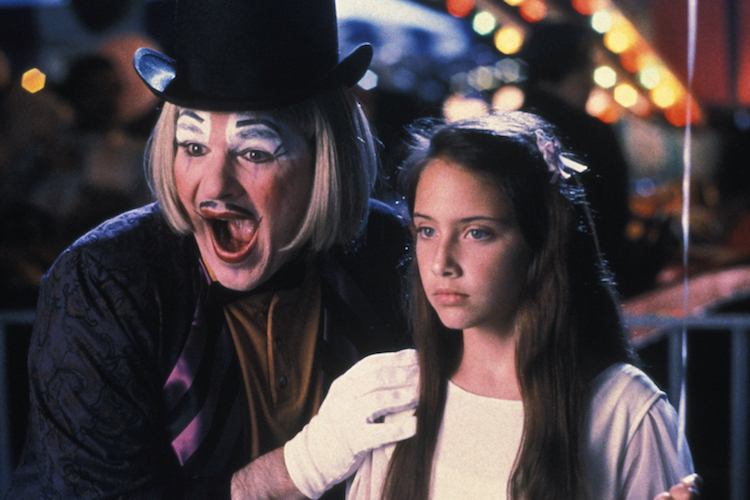
We begin with a lovely 11-year-old girl named Alex carrying a basket of flowers home to her mother, only to find that Mom is being slapped around by her boyfriend, Louis (Larry Miller), an off-duty carnival clown. (The movie doesn’t tell us until later that Louis works in the clown industry, but I feel a duty to announce it immediately. I have stricter “obligation to report” standards than the movie does when it comes to clowns.) As Alex looks on in what the blank-faced young actress mistakenly believes is “horror,” Louis becomes sexually aggressive, too, finally prompting Alex to say, “Please don’t hurt my mommy.” So what does Louis do? He snaps her mother’s neck — exactly the opposite of what she asked! Louis is a jerk.

We jump ahead 15 years or so. Alex is now a grown woman, played by Bobbie Phillips, who was in “Showgirls,” which gives you some idea of the caliber of acting we’re dealing with here, i.e., no caliber. After visiting her mother’s grave one day, Alex is alarmed to find Louis in the backseat of her car! That is definitely not where she left him. Louis sticks a gun in her mouth and paws at her bosoms and makes lewd comments about how much she has “grown up,” and just generally behaves in an icky, Sheen-like fashion. Though it’s unpleasant, we’re at least intrigued to see the killer from Alex’s past reappear so early in the movie. Usually that sort of “surprise” gets dragged out forever. Kudos, movie, on being original!

Oh, but wait, it turns out Alex is safe at home and this whole sequence was a dream. An eight-minute dream. Which started four minutes into the film. The movie is only 12 minutes old, and the bulk of that was spent tricking and manipulating us. Kudos rescinded, movie. Instead, screw you. Screw you right to hell.

So the deal is that grown-up Alex and her sister, Sandra (Shawnee Smith), own a rustic old dockside tavern called the Mermaid Inn, located on what appears to be the California coast. (The original “Carnival of Souls” was set in Utah, which is much creepier, believe me.) Alex is plagued by nightmares such as the one we just wasted eight minutes watching, in which her mother’s killer returns to pester her. Sandra seems fine, though. Sandra got over Mom’s violent death years ago. What’s YOUR problem, Alex??

Having established the basic scenario, the film treats us to “a day in the life” of Alex. There’s a plumbing leak in the basement of the inn, so she goes to rent a pump. Then she stops by the carwash. This is a horror movie about a woman running errands — only it’s even more boring than it sounds, because Bobbie Phillips has but a single facial expression and recites her dialogue like a text-to-speech application from a late-’90s Macintosh. It’s like we’re driving around town with a particularly uncharismatic bucket of white paint.

While she’s at the carwash, Alex has another hallucination. She imagines that the carwash guy has turned into a devil with a long tongue. It is scary (to her). For us, it’s hard to get invested in the story when we know anything remotely interesting will turn out to be imaginary. Also, it becomes apparent that this is going to be one of those movies where the ONLY thing that happens for the first hour is the heroine being afraid of things that aren’t there.

cos

We get a reprieve from this relentless tedium in the form of flashbacks to Alex and Sandra’s youth, to the night they met Louis selling balloons at a carnival. All clowns are pernicious, cloven-hoofed demons from the underworld, of course, but Louis looks particularly unsuited for human society, with a Vincent Price greasepaint mustache, a blond pageboy haircut, and white mime makeup that only covers his eyelid and eyebrow area. You wouldn’t buy a balloon from him if you saw him, you would douse him with holy water and run for your life.

Nonetheless, the girls talk to him, and so does their mother, who is for some reason charmed by him. “Where’s Daddy tonight?” Louis asks the girls, to which Sandra responds, “Daddy’s where the balloons fly,” presumably to indicate he is dead and in heaven, though maybe she means he’s caught in some power lines. Louis asks the girls’ mom on a date, she readily accepts, they become a serious item, and then at some point he kills her, as mentioned. Far be it from me to blame the victim here, but when you enter into a relationship with a clown you met at a carnival, there is a 92 percent chance you will be murdered.

The odds get even higher when the relationship takes place in a movie that enjoys tormenting women as much as this one does. The opening scene, with the near-rape and neck-snapping, leads directly into the one where grown-up Alex dreams she’s molested in the car by the gun-toting ex-clown. All of this is followed by scene after scene of men leering, pawing, waggling their eyebrows, and making innuendo-laden remarks to Alex and Sandra, even in situations that do not call for it.

For example, Alex wants to know if Louis is still in prison for killing her mother, so she approaches a regular at the bar who’s a retired detective. “How would you like to drink for free tonight?” she says, in a manner suggesting businesslike professionalism. “Sounds like you need a favor,” he replies lasciviously, in a manner indicating he hopes the favor will involve sitting on his face. And everybody talks like that! After a while you start to suspect the movie just doesn’t know how actual decent people talk, like the screenwriter grew up in a brothel or something.

Anyway, the detective delivers bad news, which is that Louis is out of prison, followed by good news, which is that Louis is dead. So Alex has nothing to worry about. You know what that means: more hallucinations! When you’re making a horror film, you can never go wrong filling it with material that is frightening to the protagonist and no one else.

If you’ve seen the original “Carnival of Souls,” you know how the remake ends; it’s the only thing they have in common. In the meantime, a great number of nonsensical things occur, many of them only in Alex’s head, some of them in real life, and too many of them involving visions of Louis, who has a lot of screen time for someone who is supposed to be dead. He’s played by Larry Miller, a comic actor who’s been in dozens of movies, notably “Nutty Professor II: The Klumps,” in which he plays a college dean who gets raped by a 12-foot hamster. But that’s neither here nor there. The point is, “Carnival of Souls” is the 12-foot hamster of horror remakes.

— Film.com

Weekly link roundup – Oct. 28-Nov. 10

0

Catching up on the last two weeks’ worth of material, including some very important James Bond propaganda that you should be aware of.

“Wreck-It Ralph” B [Twitch]
“Flight” C+
“This Must Be the Place” D
“Skyfall” A-
“In Their Skin” B

Song: “Randy Newman’s Title Song from ‘Skyfall.'” Fun fact I discovered this week: having a cold and being at the beginning stages of losing your voice actually improves your Randy Newman impersonation. [SoundCloud]

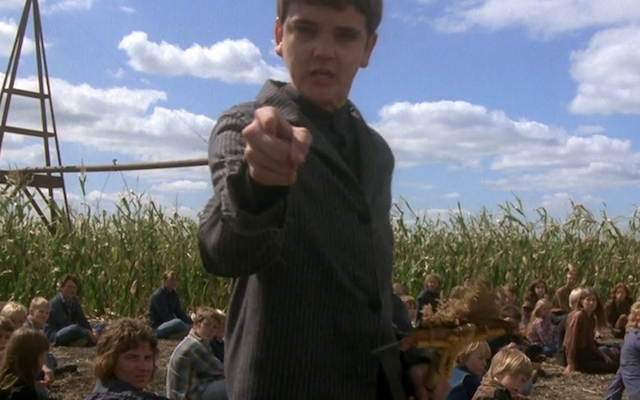
Eric’s Bad Movies: “Children of the Corn” (1984), which spawned innumerable sequels despite being as dull as corn. [Film.com]

Re-Views: “Ballistic: Ecks vs Sever” (2002), a bad movie with a bad title that I decided to give another chance. [Film.com]

Re-Views: “American Beauty” (1999). There was some backlash after this won all the accolades. The word “overrated” gets tossed around a lot. I took another look. [Film.com]

Quiz: Female Character in a James Bond Movie, or Drag Queen We Made Up? Test your knowledge! [Pajiba]

007 By the Numbers: Every James Bond Statistic You Never Knew You Needed to Know. Part 1 gives stats for the franchise as a whole; Part 2 breaks it down movie by movie. [Movies.com]

Snide Remarks: “Supernatural Selection” — Spooky candidates debate the issues.

Movie B.S. with Bayer and Snider: Episode 133 brought news of Bayer’s baby son, along with reviews of “Wreck-It Ralph,” “Flight,” and “The Sessions”; Episode 134 has “Skyfall,” “Smashed,” “The Comedy,” and other jovialities. [Listen at MovieBS]

Subscribe to In the Dark, a weekly email with all my latest reviews, DVD releases, and Netflix recommendations.

Follow me on Twitter.

In Their Skin

0

This is reductive and unfair and I’m going to feel bad for saying it, but “In Their Skin” could be described as “Funny Games” lite. The scenario is similar to the one in Michael Haneke’s infamous home-invasion thriller, though with key differences in the details and in the execution. “In Their Skin” (which originally screened under the title “Replicas”) is less intense, more mainstream, not as hard to watch. And you don’t feel like the filmmaker is scolding you for enjoying it. OK, maybe the films don’t have anything in common beyond the basic premise. Shoot. I told you I would regret saying it.

Mark and Mary Hughes (played by Joshua Close and Selma Blair) are headed to their vacation cottage in the woods, accompanied by their 9-year-old son, Brendon (Quinn Lord), and still mourning the loss of their daughter. She was a “little blond angel,” according to the kindly old man at the country store, who knows the Hugheses and all the other families with summer homes here. Mary is now unusually (and understandably) protective of Brendon, and her and Mark’s marriage is suffering. A few weeks of tranquility should do them good.

It isn’t long before they meet the new family in a nearby cottage, the Sakowskis, who are so eager to make a good impression that they can barely wait for dawn to deliver a batch of firewood as a nice-to-meet-you gift. The Sakowskis’ demographics line up with the Hugheses’: a tall father, Bobby (James D’Arcy), his brunette wife, Jane (Rachel Miner), and a son, Jared (Alex Ferris), who’s just a few months older than Brendon but much larger. Though Mary and Mark aren’t in the mood for it, they feel social pressure to invite their enthusiastic new neighbors over for dinner.

Well, then there’s some trouble. Let’s leave it at that, detail-wise. First-time director Jeremy Power Regimbal shows a skill for ratcheting up tension without making it unbearable — which probably sounds like a polite way of saying the film isn’t as tense as it should be, but I mean it as a compliment. Not every thriller needs to be a psychologically traumatic experience. “In Their Skin” is unsettling enough to warrant that description, but not so much that you’ll never want to think about it again.

The movie falters a little when it comes to getting its point across. Mark and Mary’s fractured marriage and residual feelings of grief and guilt don’t end up mattering as much as they ought to. The screenplay, which Regimbal wrote with brothers Justin Tyler Close and Joshua Close (who plays Mark), hints at class issues as well — the Hughes family must be fairly well-to-do to own such a fine vacation home; the Sakowskis are resentful — but that theme is underdeveloped. More polish could have made this alarming psycho-drama resonate better, but even as it stands it’s a nerve-racking good time.

Skyfall

0

There aren’t many franchises that this applies to, but if anyone ever needs advice on how to make a 50-year-old movie series seem fresh and relevant again, “Skyfall” is the model. James Bond’s 23rd outing, in which he is once again played by a steely-eyed Daniel Craig, is an explosively entertaining mix of old and new, giving the die-hard fans what they want without ignoring the problems associated with a character who’s been around for half a century.

Directed by Sam Mendes (“American Beauty,” “Road to Perdition”), “Skyfall” completes the reboot that began with “Casino Royale” and continued in “Quantum of Solace.” (Two of those films’ screenwriters, Neal Purvis and Robert Wade, are back, joined by “Rango” and “The Aviator” scribe John Logan.) Agent 007 dwells in the modern world now, with threats more realistic and complex than a cat-fancying, volcano-dwelling megalomaniac or a three-nippled sharpshooter. What’s more, the James Bond movies live in the 21st century, viewed by audiences that have come to prefer realism (or at least an approximation of it) over campiness. We’re just not going to sit still for some cornball throwback unless it’s presented as a retro parody, like the “Expendables” movies. And nobody wants to see Bond reduced to that.

None of this is new information. “Casino Royale” and “Quantum of Solace” laid the groundwork for a down-to-earth Bond, the sort of government agent who seems like he could actually exist in real life. What “Skyfall” does is address head-on the thorny question of how to modernize 007 without rendering him completely unrecognizable — without taking all the fun out of him, basically. How do you find the right combination of old and new? As it turns out, the answer is pretty simple: keep what still works, replace what doesn’t.

In this outing, the entire MI6 organization is threatened when a list of secret agents is stolen by nefarious parties who intend to expose and/or kill the spies. The theft of something dangerous is a standard James Bond plot engine, but here it’s information rather than weaponry. Appropriately, the villain isn’t just a bomb-throwing terrorist but a cyberterrorist, a lunatic named Silva (Javier Bardem) with mad hacking skillz capable of bringing down the government and a grudge against MI6. (He’s not afraid to throw bombs, too.) Bond’s commander, the redoubtable M (Judi Dench), is already having her job sniffed at by one Gareth Mallory (Ralph Fiennes), a bureaucrat higher up the food chain who thinks MI6’s old-school cloak-and-dagger methods are antiquated. “We can’t keep working in the shadows,” he says. “There are no more shadows.” The latest breach in security puts M at even greater risk, both professionally and personally, and is seen by Mallory as confirmation of what he already thought: MI6 must adapt or die.

Sound like any movie franchises you know?

The new Quartermaster, or Q for short, represents Mallory’s modern way of thinking, a genius focused on computer technology rather than silly gadgets. (Bond without his jet-pack and exploding wristwatch? What madness is this??) The new Q is also new in the sense of being about one-third the age of his predecessors: played by Ben Whishaw in a hipster cardigan and boxy eyeglasses, he looks like he must have been a barista before landing the job with British Intelligence. He and Bond square off with semi-playful jabs about how Q’s too young and Bond’s too old before coming together on what is essentially the whole point of the movie: new innovations help us keep with the times, but sometimes the old ways are best. An intricate computer virus can cause untold devastation in the modern world, but you know what else does a lot of damage? A good old-fashioned knife in the throat.

Without belaboring the point, “Skyfall” keeps the idea of old vs. new — and the question of whether it should even be “vs.” — at the forefront of our minds. Frequently it’s on the surface, as in the instances mentioned, but often it’s ingeniously subtextual, as when elements of the classic Bond formula surface without anyone calling attention to them. Silva is a modern madman, but he’s also a villain in the old Bond tradition, with physical oddities and an insatiable bloodlust. (He’s also brought to life by a deliriously snide Javier Bardem.) He brings the “Bond villain” archetype into the 21st century in much the same way that the Joker did it for Batman in “The Dark Knight.”

Bond’s relationship with M is a crucial component of the film, keeping things intimate even when there is large-scale mayhem. Bond is also smiling a lot more these days than in the last two chapters, sparring with Q and fellow field agent Eve (Naomie Harris), giving M grief, even getting off a wry one-liner here and there.

The one drawback to putting 007 in the real world is that it makes us expect, well, realism — something no one ever demanded when Bond was going into space or surfing into North Korea. A lapse in plot logic is more glaring when you’ve set such high standards for yourself, and there are some here. Yet from the dynamite opening sequence (a franchise high point) to the globe-trotting espionage; from the hand-to-hand combat to Bond’s resourceful use of weapons; from the exotic ladies in Bond’s bed to M, Eve, and Q in his heart, “Skyfall” packs more sheer, satisfying entertainment into its runtime than any Bond film before it. It’s not just a terrific Bond movie; it’s a terrific movie, period.

Lincoln

0

Well, of course Steven Spielberg’s history lesson about the abolition of slavery is entertaining, big-hearted, and soul-stirring. With its clear-cut moral issues and patriotic significance, “Lincoln” is right in Spielberg’s wheelhouse, and Daniel Day-Lewis’ warmly captivating lead performance is a perfect fit. The title is wrong, though, as this is less a biography of the 16th president than the story of how the slavery-ending Thirteenth Amendment was passed in the final days of the Civil War, and all the political wrangling that went into it. Lincoln’s secretary of state, William Seward (David Strathairn), plays a crucial part, as does Thaddeus Stevens (Tommy Lee Jones), a tart-tongued Republican congressman in an awful wig who is bluntly opposed to slavery on moral grounds but is able to help sell Democrats on the bill by focusing on legal principles: “equality before the law.” Parallels to modern politics are easy to see but not underlined; apart from the Washington wheeling and dealing, which has a “West Wing”-like appeal of its own, you can enjoy “Lincoln” purely as a great story full of drama.

And comedy: the film is surprisingly funny. Written by Tony Kushner (“Angels in America,” “Munich”), based in part on Doris Kearns Goodwin’s book “Team of Rivals,” the screenplay gives Tommy Lee Jones ample opportunity to demonstrate his gift for verbal abuse, with Stevens throwing around insults like “fatuous nincompoop” as he keeps his Republican brethren in line. James Spader, Tim Blake Nelson, and John Hawkes play a lively trio of lobbyists brought in by Seward to secure Democrat votes by offering favors from the administration. Not only is their conniving funny, it helps us relate more intimately to the story: politics was a sleazy game then, too! The people in our textbooks were just like us!

Lincoln was a humorous man too, which Day-Lewis captures as immaculately as everything else in his performance. The president has a commanding presence, captivating every time he speaks, by turns folksy, gentle, jocular, and grandiose. His odd sense of humor goes over people’s heads sometimes; other times he’ll tell a joke and nail it. Kushner’s screenplay doesn’t limit itself to the official record of what Lincoln and his associates are known to have said, but it manufactures dialogue for them that feels authentic.

As far as I’m concerned, the movie has two flaws. One is the opening sequence, in which Lincoln visits soldiers who recite the Gettysburg Address to him. That’s hokey, and not at all representative of the rest of the movie, which is smart and doesn’t pander. The other is Lincoln’s oldest son, Robert (Joseph Gordon-Levitt), who’s given nothing significant to do and contributes little to the main story. In a similar vein, though Sally Field gives a more sympathetic portrayal of Mary Todd Lincoln than we’re used to seeing, there’s no emotional connection between the audience and her, her husband, and their children. When “Lincoln” focuses on the political, social, and historical side of things — which is 80% of the film — it’s grand, populist, high-minded entertainment.

American Beauty (1999)

0
American Beauty (1999)

Like almost every film that wins the Oscar for Best Picture, “American Beauty” was highly acclaimed, and then suffered a backlash for being too highly acclaimed. (The nerve of some movies, being praised enthusiastically!) Though the vast majority of contemporary reviews were positive — 88% at Rotten Tomatoes, with a Metacritic score of 86 out of 100 — once all the shouting was over a sense of buyer’s remorse began to creep in.

In 2005, Premiere magazine put “American Beauty” at the top of its list of the “20 most overrated movies of all time.” (The feature is no longer online, but the list is archived here.) The New York Times’ A.O. Scott famously hates it, and mentions his disdain every chance he gets. A simple Google search for “American Beauty” overrated brings up numerous likeminded sentiments.

Now, the condescending term “overrated” makes me feel stabby: what you’re saying is that the amount YOU like the movie is the correct amount, and anyone who liked it more than you did has made an error. But I understand the sentiment. “American Beauty” won a lot of awards, yet plenty of viewers don’t think it’s that great. That’s fair. And since its director, Sam Mendes, has a certain James Bond movie coming out this week, it seemed like a good time to take another look at his first film, 13 years later.

What I said then:

“This is an extraordinary film, managing to be both dreary and optimistic simultaneously…. As with all the great daydreaming milquetoast protagonists, from Willy Loman to Walter Mitty, there is some amount of hope by the end – even if that hope seems shattered by the final scene and its implications…. Not one of these characters is good, nor do any of their real selves match their facades, but several are still sympathetic and even lovable…. ‘American Beauty’ is compelling to watch, full of black humor, evocative imagery and wrenching sadness. It creates more of a mood than an actual theme or message, though even that mood is difficult to describe. You have to see it to understand that even by seeing it, you may not understand it. All you know is, you’ve just watched a movie you couldn’t take your eyes off of for a second.” Grade: A [Here’s the whole review.]

Allow me to point out something about that review: it’s not very good. I was still pretty new to the whole film critic biz, and my recollection is that “American Beauty” stumped me. I knew I loved it, but I had a hard time explaining what I loved about it, or why — which, you know, is only the whole point of a movie review.

The re-viewing:

Thirteen years later, it’s hard to watch “American Beauty” without thinking about the parodies, homages, and rip-offs it inspired. That business with the floating plastic bag (which is a little precious), the rose petals, and Thomas Newman’s distinctive plink-plink musical score feel particularly dated now — not because they’re typical of movies from 1999, but because they’ve been reproduced and referenced so often since then. Screenwriter Alan Ball’s next project, HBO’s wonderful “Six Feet Under,” was cut from the same cloth, adding to the familiarity.

I think what made it difficult to put my finger on why I liked the movie is also what turned some viewers off altogether. Its tone is constantly shifting from dark comedy to suburban drama to broad satire to middle-class tragedy. Most of the characters are two-dimensional types: the dissatisfied mid-life-crisis husband who buys a sports car, the career-driven wife who has an affair, the homophobic Marine with a Southern accent, the teenage Lolita, and so on. This lack of depth is fine (preferable, even) when the movie is operating as an almost farcical satire, a slick mockery of the fakeness of modern American life. But I can see how it would be problematic for viewers who find it off-putting not to be able to sympathize with anyone, especially as the story progresses and we’re drawn more deeply into the serious crises facing these shallow people.

Sometimes the shift in tone happens abruptly, leaving us uncertain how we’re supposed to react. The scene where Frank Fitts (Chris Cooper) observes his son (Wes Bentley) selling drugs to Lester Burnham (Kevin Spacey) but misinterprets it as a gay sex liaison is straight out of a sitcom or an Austin Powers movie. It’s clearly meant to be funny. But it’s immediately followed by Fitts’ violent and shocking retaliation against his son, permanently fracturing their relationship and steering the film toward its tragic conclusion. As viewers, we’re not comfortable with such important plot developments arising out of such a goofy scenario. We expect funny misunderstandings to have light consequences, and for heavy dramatics to have serious roots. Going against that feels wrong, like the filmmakers miscalculated somewhere. A person’s reaction to the movie might hinge on whether this strikes them as a mistake, or as an intentional subversion of expectations, perhaps a comment on how the most important moments of our lives can have their origins in triviality. Basically, it either works for you or it doesn’t.

Newman’s score plays a greater role in the film’s success than I realized. Like the movie itself, the music is ambiguous, without much melody, often upbeat even when it seems like it shouldn’t be. It isn’t unpleasant, but it doesn’t follow a traditional pattern, either. Is the jauntiness meant as mockery of these poor fools’ tragic lives, a sarcastic underscore to a dark comedy? Or is it a clue that the movie isn’t tragic at all — that finding moments of beauty and clarity, as some of the characters do, fulfills them and makes the story an optimistic one? Either interpretation is justified. That multifaceted, it-works-on-different-levels element is one more thing to admire about the movie.

Do I still love this movie?

As it turns out, I do. Whether you view it as a scathing satire or a piercing drama — or some combination of the two — it’s effective at grabbing hold and not letting go. It’s compelling in an unusual way, adhering to a formula while continually refreshing itself with vivid performances and creative flourishes. Hopeful or pessimistic, bleak or beautiful, we have no reason to disown this movie. Embrace it! Even that stupid plastic bag. Grade: A-

— Film.com

This Must Be the Place

0

The tricky thing about reviewing “This Must Be the Place” is that every description of it makes it sound much more entertaining than it is. It stars Sean Penn as an aging Goth rocker named Cheyenne — think Robert Smith from The Cure — who goes searching for the Nazi war criminal who eluded his Holocaust-survivor father. Most people only get as far as “Sean Penn plays a Goth rocker” before deciding they are definitely going to see this movie.

Unfortunately, the strange premise and inspired casting are wasted on a stale, tiresome mess of a movie. After scoring with his acclaimed 2008 political biopic “Il Divo,” Italian writer/director Paolo Sorrentino has let his artistic tendencies evolve into baffling, self-indulgent weirdness. How can a movie about a Nazi-hunting retired Goth rocker played by Sean Penn be boring?? Sorrentino has done the impossible.

Cheyenne, a big star in the 1980s, is retired now, living on a vast green estate in Dublin with his wife, Jane (Frances McDormand), who is a firefighter. Cheyenne spends his days hanging out with a 20-ish girl named Mary (Eve Hewson) and still dresses in the costumery of his heyday — black clothes, makeup, a lot of jewelry — but his reading glasses and middle-age paunch serve as reminders that his youth is gone. He speaks slowly and softly in a high-pitched whine that must surely grate on the nerves of anyone who converses with him for longer than a minute. When he is amused, he laughs in a whimpery giggle. Someone could probably make a documentary just about the conversations Penn and Sorrentino must have had that led to this performance.

Cheyenne is haunted by the fact that two teenagers committed suicide many years ago, apparently influenced by one of his gloomy songs. Bored and depressed, he’s without purpose in his life until his estranged father dies, whereupon Cheyenne takes it upon himself to continue the old man’s mission of finding the Nazi officer who tormented him during the war. Soon Cheyenne is driving around the American Southwest, having odd interactions with locals as he searches for the elusive German.

Please do not get the impression that there is anything like a “point” to any of this, or that the story resolves into something satisfying or comprehensible. On the contrary, Sorrentino’s two-hour reverie (which he cowrote with Umberto Contarello) is only fitfully entertaining, and that’s mostly in the first half. Once Cheyenne heads to America, we’ve realized that Sorrentino’s intensely quirky and surreal touch is just for show, without meaning or humor. And then it’s just tedious.

The story is filled with weird interludes like Cheyenne playing ping-pong against teenagers in a diner, or helping a boy court Mary’s affections. Jane’s dog has a cone around its neck; Cheyenne doesn’t know why. Their swimming pool is empty so they can play handball in it. Cheyenne is afraid to fly. The list of bemusing details goes on and on. But Sorrentino never does anything with them! His undeniable talents for constructing visually arresting images and shooting things in an unconventional way are squandered on a pointless, meandering narrative led by an off-putting protagonist. As Cheyenne puts it on more than one occasion, “Something’s not quite right here.” Yeah, I’ll say.

Flight

0

There’s an unusual moral dilemma at the center of “Flight,” and some hints at exploring how belief in a higher power affects a person’s attitude toward life’s tragedies. But mostly “Flight” is an ordinary drama about addiction and recovery, made somewhat noteworthy by Denzel Washington’s firing-on-all-cylinders performance.

Washington plays Whip Whitaker, a commercial airline pilot who narrowly averts disaster when his plane malfunctions during a routine flight from Orlando to Atlanta. (This sequence alone is harrowing enough to ensure the film will not be a popular in-flight selection.) Whitaker is a hero: the outcome is tragic, but not nearly as bad as it could have been. His quick thinking and expert piloting saved many lives.

The problem is that when he pulled off this amazing feat, he was drunk, high, and sleep-deprived, having spent the night partying with a stewardess. It’s clear that the plane’s mechanical problems would have happened no matter who was flying it, and Whitaker takes some comfort in that knowledge. Still, he knows there’s something inherently wrong with flying a commercial aircraft while blitzed, whether it was a factor in this particular incident or not, and he’s unsure how truthful to be to the government entities investigating the crash.

Until the official hearing, he has to stay clean and sober. This is partially a response to the wake-up call he just had, but also at the insistence of Hugh Lang (Don Cheadle), the airline’s cocky, authoritative attorney, whose client has a vested interest in Whitaker’s intoxication levels being left out of the evidence. In the hospital, Whitaker befriends a recovering junkie (Kelly Reilly) and has a curious one-scene encounter with a philosophical cancer patient (James Badge Dale) who declares: “Once you realize all the random events in your life are God, you will live a much easier life.” That conversation, along with several other elements, including the devout Christianity of Whitaker’s young co-pilot (Brian Geraghty) and his wife, suggests “Flight” is interested in examining faith, God, and fate. But the film doesn’t go anywhere with it.

Robert Zemeckis is the director, returning to live-action for the first time since “Cast Away,” 12 years ago. It’s hard to get a read on what point he’s trying to make here, and John Gatins’ screenplay sends what might be charitably described as mixed signals. Obviously it is a cautionary tale about the perils of addiction, which Washington conveys with more gravitas and actorly devotion than usual. But when Whitaker’s drug supplier, a pony-tailed dynamo played by the always-welcome John Goodman, resurfaces late in the film, it’s to underscore a strangely pro-narcotics message. Maybe the whole movie is a load of hooey. Too bad, then, since so much of it is right on the mark.

Wreck-It Ralph

0

Whichever Disney employee said, “Let’s do ‘Toy Story,’ but with video game characters,” I hope he or she got a big fat raise, if only to compensate for the seething jealousy coming from co-workers kicking themselves for not thinking of it first. It’s the kind of forehead-smackingly obvious concept that often results in a cash-grab — I think sometimes the makers of kids’ movies take the expression “It practically writes itself!” too literally — but “Wreck-It Ralph” is a bubbly, buoyant treat with near-Pixar levels of heart.

The conceit is that the computer-generated people and creatures that populate video games have lives of their own apart from what happens on the screen. After hours, they travel through the extension cords and power strips to other games in the arcade, where they socialize with friends like Broadway actors after curtain call.

Among them is Wreck-It Ralph (voiced by John C. Reilly), a giant-handed lummox whose job is to destroy stuff in Fix-It Felix so the game’s goody-two-shoes title character (Jack McBrayer) can repair it. In other words, Ralph is the bad guy. But he’s not a bad person! He’s quick to point this out — not that we need him to, since having the voice of John C. Reilly already signifies that his oafishness is good-natured and harmless.

Ralph struggles with his role in life. “It’s hard to love your job when nobody likes you for doing it,” he says at the support group for video game villains, where his fellow bad guys (a Pac-Man ghost, Bowser from Super Mario Bros., etc.) nod sympathetically. The characters in his own game treat him like a pariah, not having realized yet that the game — and thus their very existence — would be pointless without him.

The movie is about Ralph’s quest to prove that he can be a hero too, a mission that takes him into a modern first-person war game and then to a racing game, Sugar Rush, set in a candy land. (The arcade where Ralph lives has consoles from the early ’80s, now deemed retro-cool, as well as the newer ones that have ultra-realistic graphics and take eight quarters to play.) In fact, the bulk of the story takes place in Sugar Rush, where Ralph meets Vanellope (Sarah Silverman), a little girl who’s ostracized by her peers for being a “glitch” (she occasionally freezes or disappears for a split-second) and wants to prove herself like Ralph does. Meanwhile, Felix and a tough female sergeant from the war game (Jane Lynch) search for Ralph, desperate to bring him back to Fix-It Felix before it’s declared out of order — a death sentence for a video game.

It’s difficult for a movie whose characters are all digital creations to make the audience feel like any of it matters, and the stakes in “Wreck-It Ralph” do seem low. Woody and Buzz are physical things that can be torn apart or incinerated; Ralph and Vanellope are 1’s and 0’s made out of electricity. But the film does everything in its power to present its convoluted reality in terms we can understand, including a generous portion of perspective shots that take us into and out of the game consoles so we get a sense of what the world looks like from the characters’ point of view. The in-world explanation for how first-person-shooter games work is surprisingly sophisticated, though I suspect every kid in the audience will have no problem grasping it.

Directed with an appropriate sense of lunacy by “Simpsons” veteran Rich Moore, the movie provides enough cameos by familiar game characters to make fans happy without alienating those of us whose firsthand gaming experience ended with Super Mario Bros. And the screenplay, by Jennifer Lee and Phil Johnston, is full of good lines (Pac-Man is a “cherry-chasing dot-muncher”) and a plethora, maybe two plethoras, of puns, especially in the candy world (which is ruled by a dotty king voiced by Alan Tudyk doing an Ed Wynn impersonation). Characters there have names like Taffyta Muttonfudge and Crumbelina De Caramello, which delights me to no end.

You can’t help but like Ralph, of course, the sort of lovable misfit who’s been at the center of about 90 percent of animated Disney features. His friendship with the scrappy Vanellope is cute, and I’m impressed by the film’s theme of turning weaknesses and disabilities into strengths. (I also like that glitchy Vanellope is said to suffer from “pixlexia.” Sue me, I’m a sucker for wordplay.) The film’s weightlessness keeps it from being an instant Disney Classic®, but it’s as breezy and fun as a game of Frogger. Unless you think Frogger is boring, in which case it’s as breezy and fun as whatever is currently considered breezy and fun. Oh, man, I’m so old.

Supernatural Selection

0
Supernatural Selection

MODERATOR: Good evening. We are pleased to present this televised debate between the two candidates for President of the United States: Senator Casper T. Goest and Senator Batt Bloodgood. The format is as follows: I will introduce a topic, and the candidates will bicker about it until I interrupt them. Gentlemen, welcome.

SEN. CASPER T. GOEST: Thank you.

SEN. BATT BLOODGOOD: Thank you.

MODERATOR: Your first topic is the economy. Senator Goest, you won the crotch-kicking contest backstage, so you get the first response.

SEN. GOEST: Thank you, nameless moderator. Our nation’s economy continues to struggle, and many people are still out of work. As a ghost — that is, as the disembodied spirit of a deceased person — I know firsthand how hard it is to find a job, or to find rest for my tormented soul, or to find closure for the unfinished business I left behind in my mortal life. But all Americans, living or otherwise, have the right to do an honest day’s work for an honest day’s pay, and as president I will make reducing unemployment my top priority — or should I say, top scare-ority!

SEN. BLOODGOOD: Senator Goest makes some bold claims, and I’ll leave it to the American people to judge whether he’s capable of fulfilling them. But I would ask this: Is a man who has been dead for 30 years qualified to lead us in the 21st century? How can a ghost relate to the problems faced by ordinary living Americans? I don’t know about you, my friends, but when I touch a wall, my hand doesn’t go right through it. Is America ready for a president who is literally out of touch with everyday life?

SEN. GOEST: If we want to talk about being “out of touch” with America, let’s talk about Senator Bloodgood — a known vampire! The media has been tiptoeing around the issue, Senator Bloodgood openly and unapologetically embraces the vampire lifestyle, feeding on the blood of the living to survive. That sort of thing might be OK for the elitists who live in fancy mausoleums and gold-plated coffins. But it won’t fly on Main Street, where everyday folks are struggling to make ends meet. It’s unwanted — or should I say, un-haunt-ed!

SEN. BLOODGOOD: Personal attacks, Senator? Shameful. Yes, I am a vampire. I’ve never hidden that fact. I stand proudly with my fellow Vampire-Americans, most of whom are patriotic, law-abiding citizens who just happen to subsist on the sweet nectar of human blood. But our reliance on the precious blood of the living is nothing compared to our nation’s reliance on foreign oil — which will only increase under Senator Goest’s policies! America cannot afford a President Goest any more than I can afford to go outside in sunlight!

SEN. GOEST: I’m glad you brought that up, Senator. Not that I question a vampire’s ability to serve his country — I know we have had vampires in every level of government for decades, primarily in the Internal Revenue Service — but are Americans ready for a president who can never address them from the White House’s sunny rose garden? Or who cannot ride in parades down America’s streets? Must we have a president who works only under cover of darkness, like Nixon? If I am elected, I will be the most transparent president in history.

SEN. BLOODGOOD: I would ask you, Senator: how will you sign bills into law when you cannot grasp physical objects with your ghost body? How will you shake the hands of the American people?

SEN. GOEST: Why don’t you leave the specifics of my corporeal manifestations to me, Senator, and worry about your own policies? Your plan to solve unemployment is for people without jobs to have their blood drained from their bodies, to be used by the Red Cross and vampires. That plan isn’t good for the economy, and it’s not good for the old red, white and blue — or should I say red, white and boo!

MODERATOR: Gentlemen, it’s time to move to another topic. As president, how would you address the problem of terrorism? Senator Bloodgood.

SEN. BLOODGOOD: I think my record on terrorism speaks for itself. As a U.S. Senator, I introduced legislation making it illegal to bring a wooden stake or a silver crucifix on an airplane. Since that time, no vampires and hardly any regular people have been killed on airplanes. I have worked tirelessly to send a message to our enemies at home and abroad, and that message is this: If you cross me, I will use my super-human strength to restrain you as I plunge my razor-sharp fangs into your soft, quivering throat, and either bleed you dry, or turn you into a fellow vampire, depending on my whim. That is my policy, and I stand by it.

SEN. GOEST: Look, if there’s one thing I’m good at, it’s scaring people. To our enemies who would do us harm, I say this: you’d better leave the lights on. You’d better not go into a dark bathroom and say my name three times in the mirror. Don’t bother putting your weapons of mass destruction in a safe place, because they will have been moved when you go looking for them, and you won’t know why. “I could have sworn I left that bomb on the dresser!” you’ll say. “How did it get moved to the garage?” I’ll tell you how: ghosts. Ghosts have served America since its inception, and it’s time we put one in the White House.

SEN. BLOODGOOD: My opponent seems to think you should vote for him just because he’s a ghost. I, for one, am tired of this affirmative action. Is he even qualified for the job? Look at his record on the issues. Thirty years ago, he was alive. Now he’s dead. Do we need another flip-flopper in the Oval Office?

SEN. GOEST: The fact that Senator Bloodgood would bring up my own personal tragedy of dying in order to make a point speaks volumes about his character. And you know what else speaks volumes about his character? His being a soulless, undead monster with no regard for human life, who selfishly feeds on others to sustain his own tortured existence.

SEN. BLOODGOOD: America needs a strong leader, one who is not afraid to take decisive action when a problem arises! America is dying of thirst — thirst for improved health care, thirst for lower unemployment, thirst for security and freedom. As president, I will do all in my power to satiate that thirst, to affix this country’s teeth to whichever vein is richest in the nutrients of liberty, and suck and suck and suck until America is the most powerful, immortal, invincible nation in the world.

SEN. GOEST: That’s all well and good, Senator, but the fact remains that vampires are weak. They are easily killed. How do we know that at the first sign of trouble, you won’t turn into a swarm of bats and fly away?

SEN. BLOODGOOD: You insult me, sir, with your prejudice and your anti-vampire hate speech. I am no more likely to “turn into a swarm of bats and fly away” than you are likely to turn blue and run away when Pac-Man comes after you.

SEN. GOEST: Pac-Man?? Where?!

MODERATOR: Gentlemen, we have time for one last question. Who would win in a fight between zombies and werewolves? Senator Goest.

SEN. GOEST: My administration will work to prevent such a war from taking place, but if our peace-keeping efforts should fail, my money is on the werewolves.

MODERATOR: Senator Bloodgood?

SEN. BLOODGOOD: [turns into swarm of bats, flies away]

_____________________________________

This edition of Snide Remarks is sponsored on behalf of the Filmdrunk Frotcast live shows, taking place on Nov. 3 and 4 in Chicago. (Their Kickstarter campaign was successful; the shows will happen!) Chicago-area fans of raucous podcasting and general jackassery should plan to attend. Each show will include a screening of “The Running Man,” for some reason.

Children of the Corn

0
Children of the Corn

Since the dawn of cinema, filmmakers have strived to convey the important truth about kids, which is that they’re evil and should not be trusted. Yes, “children are our future,” as the great prophetess Whitney taught us many years ago. But her unspoken subtext was that our future is one in which we will be enslaved by these demonic children, cruelly subjected to their malicious whims, unless we destroy them all now.

“Children of the Corn” is one of the many films to address this important issue. Like a lot of horror movies, it is based on a Stephen King story and isn’t very good. Also like a lot of horror movies, it led to innumerable sequels — I mean it, scientists literally don’t know how many there are — and helped people to be afraid of the Midwest, as nature intended.

The setting is a small fictional town called Gatlin in a large fictional state called Nebraska. Gatlin used to be a quaint little place, the sort of town where everybody knew everybody else, where folks would smile and say hello when they passed, and where adults were not brutally murdered by their children. Then, one peaceful Sunday afternoon, all the adults were brutally murdered by their children. To be fair, what else is there for young people to do in Nebraska on a Sunday? Also, many of the victims were old and probably cranky.

You might wonder why the kids suddenly up and murdered everybody. That is a normal question to have. The movie says that it was because a creepy boy named Isaac (John Franklin) told them to, for God. Well! That explains it! You know how kids are: always eager to join a religious movement that demands devotion and sacrifice, always looking for an uncharismatic member of their peer group to slavishly follow. No further explanation is necessary — no, really, movie, don’t bother providing any more details, that’s fine.

Now it’s three years later. The sudden violent death of every adult in Gatlin somehow escaped the attention of the surrounding communities, and the kids are doing fine on their own. Indeed, the people have Nebraska have basically forgotten that Gatlin ever existed. It may sound implausible that such a significant event could go unnoticed, but keep in mind, this was before Twitter.

The brand of religion preached by Isaac is a strict one. In addition to the commandment about murdering everyone over the age of 18, there are rules against music, games, art, and other entertainment. (Again, you can see why young people were so readily drawn to it.) But Isaac isn’t just pulling these doctrines out of thin air, or his butt, or wherever the kids are pulling falsehoods out of nowadays. He gets his orders from He Who Walks Behind the Rows, an otherwise unnamed deity who evidently lives in the massive cornfields that comprise 128% of the Midwest. Isaac is merely HWWBTR’s prophet, declaring the good tidings of HWWBTRism to His followers.

As great as this all sounds, there are, believe it or not, some children in Gatlin who have lost faith in HWWBTRism. But the only way to escape the town is to go through the cornfield, and if you do, Isaac’s lieutenant, Malachai (Courtney Gains), will stab you to death. Malachai is a memorable character because he’s — there is not a delicate way to put this — ugly enough to knock a buzzard off a crap-wagon. Ask anyone what they remember about this film and I bet they’ll mention Malachai. The actor who played him has grown up to be an ordinary-looking man, but he was a goony, ostrich-faced youth, and his ghoulish orange visage haunts my dreams.

Anyway, Malachai kills a boy who tries to escape from Gatlin, then stands his body up in the middle of the road. He does this 1) in defiance of physical laws stating that dead bodies do not stand up on their own, and 2) in a way that ensures it will attract the attention of any passing motorists, which is actually something Malachai and his fellow cultists do not want. Sure enough, the dead kid gets hit by the people who it turns out are the heroes of the movie: Vicky (played by a pre-“Terminator” Linda Hamilton) and her doctor husband Burt (played by a pre-whatever-else-he-was-in Peter Horton), who are driving to the West Coast and have elected to skip the freeways in favor of the backroads that America is famous for, with their colorful roadside attractions and produce stands and dead boys.

Vicky and Burt look for help at the nearest sign of civilization, a decrepit garage run by an old man (R.G. Armstrong) who has an agreement with Isaac’s followers: in exchange for deterring all passersby from driving into Gatlin, Isaac’s followers will not murder him. The old man dutifully discourages Vicky and Burt from going to Gatlin, but then Isaac’s kids kill him anyway, which goes back to what I said about children being untrustworthy.

The pair wind up in Gatlin anyway, and they eventually figure out the town’s horrifying secrets, only about a million hours after normal people would have figured it out. The few children they see are acting skittish; there are literally no adults anywhere; the streets are deserted and overgrown with weeds; every building has dried-up corn husks strewn inside of it (because apparently at some point Isaac said, “Behold! He Who Walks Behind the Rows commands you to put dried-up corn husks everywhere!”); and the wifi is unreliable. “There’s something very strange about this town,” Vicky says thoughtfully as they drive through empty streets after visiting a dilapidated, rat-infested diner and seeing three urchins try to steal their car. Vicky is sharp!

While Burt goes looking for a phone, Vicky stays with a little girl they’ve met named Sarah who seems nice enough. Burt and Vicky are unwise to split up like that, but the plot requires it so that Vicky can be captured by the evil kids, which will give Burt something to do for the rest of the movie. Burt turns out not to be very good at rescuing his wife from children. But lucky for him, there’s a power struggle between Malachai and Isaac during which Vicky is freed and Isaac is tied to a cross made out of cornstalks, from which he hollers indignantly like Daffy Duck, with a lot of “You can’t do this to me!” and “It’s all mine!” and whatnot.

Well, then a supernatural entity devours Isaac. We were not expecting that. We thought the whole “He Who Walks Behind the Rows” thing was hooey, but nope, it’s legit. Only problem is, the children thought they were worshipping God all this time, and it turns out it’s actually been a demon. Whoops! Isaac punk’d them. The kids are disappointed to learn they’ve been tricked into worshipping the devil, just as the members of the Westboro Baptist Church someday will be.

How can Burt and Vicky and the repentant children destroy the demon that lives in the cornfield? The kids wish they knew! Some of them have been searching for a solution for a while now! Whatever the standard method is for removing unwanted devils from cornfields, they are not aware of it. I mean, you could set the cornfield on fire, obviously, but there must be more to it than just– hmm? There isn’t more to it? You burn the corn down, and that’s it, the demon is gone? Huh. That is not the climax I would have conceived for this story, but I probably wouldn’t have tried to build a horror film around a food crop in the first place.

Discussion questions:

– Is corn the scariest vegetable? Why or why not?

– Would it be funny to make a joke to the effect that burning all that devil corn produced Satanic popcorn, and that from this hellfire sprang Orville Redenbacher? Support your answer with examples from the text.

– Have you ever been to Nebraska? Shut up, no you haven’t.

– Think about the times you’ve considered murdering your parents. Were your religious beliefs a factor? Or did you have other reasons? What stopped you? Explain.

— Film.com

Weekly link roundup – Oct. 21-27

0

Everybody stay warm and dry this weekend, unless you’re an amphibian or one of certain reptiles. Here are some things you can read that have my name at the top of them.

“Cloud Atlas” A-
“Fun Size” D+ [Twitch]
“Fat Kid Rules the World” A-
“The Paperboy” C
“Sleep Tight” B+

Eric’s Bad Movies: “Jaws of Satan” (1981), about a small-town priest pursued by a Satan-possessed cobra. [Film.com]

Re-Views: “Silent Hill” (2006), which I considered just another bad video-game-based movie then. Has it improved in the last six years? [Film.com]

Snide Remarks: There was no new column this week. Instead, check out these past columns that deal with politics and voting, in case you haven’t been getting enough on those subjects lately.

Movie B.S. with Bayer and Snider: [Listen at MovieBS]

Subscribe to In the Dark, a weekly email with all my latest reviews, DVD releases, and Netflix recommendations.

Follow me on Twitter.

Sleep Tight (Spanish)

0

The basic premise of “Sleep Tight” is simple enough; it’s a stalker movie. But some ingenious variations, shrewd direction, and a killer lead performance render it fresh and absolutely entertaining. You’ll wonder how you never thought of this yourself, and then maybe feel relieved that you didn’t.

At the front desk of an apartment building in Spain sits the unflappably polite César (Luis Tosar). They call him the “concierge”; his duties run the gamut from doorman to maintenance man to dogsitter. He has all the appearance of a humble and happy servant, but he is miserable.

The bright spot in his day is when he gets to see Clara (Marta Etura), one of the building’s lovelier tenants. His fascination with her goes much deeper than she realizes. I don’t want to get into the specifics of it, because one of the many satisfying delights in Alberto Marini’s screenplay is the way it gradually reveals the layers of this obsession. Suffice it to say that it’s wonderfully creepy.

Once the scenario has been established, the film explores all the ramifications of it, including all the ways it can go wrong for César. The best part? He’s a skeevy, loathsome person — and we’re rooting for him not to get caught. You gotta love a movie that puts us on the side of the creep.

Much of the success in that area comes from the tight, suspenseful direction by Jaume Balagueró, the Spanish filmmaker whose terrific “[REC]” was remade as “Quarantine.” Inherent in the skin-crawlingly creepy situation in “Sleep Tight” are many opportunities for tight close-ups of people being very, very quiet. Balagueró plays these to the hilt, ratcheting up the suspense incrementally from one sequence to the next.

And of course all of it is helped by Luis Tosar’s calm and unsettling performance as César. He’s an intriguing antihero, a character who elicits pity rather than sympathy, distaste rather than outright contempt. Not every aspect of his story comes together as satisfyingly as the rest of the film, but when it comes to sheer twisted obsession, his methodical approach is impressive.

Fun Size

0

“Fun Size” is a trick-or-treat comedy aimed at tween girls. As such, the film’s potential audience — 11-15-year-old girls who are interested in seeing a Halloween comedy — must be vanishingly small, but that’s the marketing department’s problem, not mine. My problem, as a viewer, is that the movie is a gaudy, simple-minded fiasco that’s too dumb for adults and too suggestive for kids.

According to Wren (Victoria Justice), our 16-ish Midwestern heroine, “Everyone loves Halloween — especially in Cleveland.” That’s two unverifiable claims right off the bat, but we’ll roll with it. Wren and her friend April (Jane Levy), both “misfits” at school despite being attractive, sociable, and normal, hope to attend a Halloween party being thrown by the super-cool campus stud-muffin. But their plans are thwarted when Wren’s cougar mom, Joy (Chelsea Handler) — “cougar” is code here for “slutty” — goes to a party with her too-young boyfriend, leaving Wren to take her monstrous little brother trick-or-treating.

The brother, Albert (Jackson Nicoll), is a chubby li’l bastard with a penchant for mischief and trickery. He hasn’t spoken a word since his and Wren’s dad died a year ago, which at least spares us from whatever annoying things this character might have said otherwise. He gets lost while trick-or-treating, so Wren and April and Wren’s platonic nerd friend Roosevelt (Thomas Mann) and Roosevelt’s wingman, Peng (Osric Chau), spend the rest of the film frantically searching for him, getting into hijinks and shenanigans of their own along the way.

You will be interested to know that reluctant Peng’s assistance in the matter is secured by April agreeing to let him touch her boob. The police are strangely unconcerned about the idea of a missing child, but that’s probably only because April didn’t sweeten the pot for them.

Though its premise makes it sound like a perfectly serviceable “Adventures in Babysitting” sort of thing, “Fun Size” is only sporadically funny. More often it’s frenzied and slapsticky, as when a fast-food joint’s giant rooftop chicken falls onto — and begins to mechanically hump — Roosevelt’s car, or when a cat has an asthma attack from getting too close to April, who accidentally got Nair on her nether regions earlier. For the purposes of the gag, it would have been just as funny for April to have used Nair in the normal way; mentioning that it was her butthole makes it seem more desperate (BUTTS!! HA HA!!), not to mention less plausible.

Max Werner, the “Colbert Report” scribe who wrote the screenplay, told The Hollywood Reporter that his version was dirtier: “I think the way I originally wrote it, it would have been R mainly because of language and innuendo.” The studio wanted it to be a mild PG-13 at the most, yet hired Josh Schwartz — creator of TV’s racy “Gossip Girl” and “The O.C.” — to direct it.

With these opposite objectives in play, I hope no one at Paramount is surprised that the result is a bad mish-mash of kid-friendly humor, a plot aimed at tweens, and out-of-place grown-up jokes. Instead of committing to its raunchiness and going for an older teenage audience, the movie was diluted into something almost fit for kids but not quite, an uncomfortable and moronic mixture of the two worlds.

Cloud Atlas

0

“All boundaries are conventions waiting to be transcended,” says one of the characters in “Cloud Atlas,” an ambitious and frequently enthralling new epic directed by Andy and Lana Wachowski and Tom Tykwer. If that line and the others like it are in the David Mitchell novel it’s based on, you can see why the Wachowskis were attracted to it. Ever since “The Matrix” (when Lana was Larry), the siblings have been neo-spiritual gurus for a generation of movie fans, expanding minds in a way that straddles the line between genuine depth and “Whoa, dude, that’s trippy” pseudo-philosophy.

“Cloud Atlas” further explores humanity’s interconnectedness, and is mostly effective at it. It’s even more effective at being an audacious and risky piece of popular entertainment, unusual yet accessible. Set in six different time periods ranging from 1849 to a post-apocalyptic future, the film tells six stories that are separate but related, with themes and events that recur whether the characters realize it or not. That awareness, or lack of it, is part of the point: history repeats itself, and we make the same mistakes our forebears did unless we make a conscious effort not to.

Reinforcing this concept is the movie’s most noticeable stunt, whereby the major characters in each of the six stories are played by the same troupe of actors. Tom Hanks is an unscrupulous hotelier in one story, a thuggish author in another, a wise tribesman in another; Halle Berry is the Jewish wife of a composer in 1930s Europe, an investigative reporter in 1970s California; and so forth. For the sake of consistency, race and even gender are disregarded: Jim Sturgess is Asian in one segment; Doona Bae is Mexican in another; in one, Hugo Weaving is a woman. (Rest assured that Jim Broadbent is always a slightly dotty older fellow.)

By having the actors play multiple roles across timelines, the Wachowskis and Tykwer (“Run Lola Run”) don’t necessarily mean to suggest that the characters are reincarnations of specific souls. I don’t think it’s as literal as that. Rather, the suggestion is that as mankind gradually and painfully progresses, there will always be people, places, and things that are familiar, echoes of the past. In every era people are divided and restricted by race, class, sexuality — and, perhaps in the future, species. (Humans shall not fall in love with clones!) Love is a constant — romantic love, familial love, and a general love of one’s neighbor. Each story has moments in which a person must help someone else, without any benefit to himself, simply because failure to act would bring the other person harm. There are billions and billions of us, and everything we do affects the world as a whole.

The six stories aren’t equal in scope or in quality. The present-day segment, about an aging publisher (Broadbent) with money problems, is mostly comic relief, a light variation on the other stories’ weightier themes. It’s fun but has little resonance, and much of the humor is bumblingly flat. The story of a young gay man (Ben Whishaw) working as a composer’s assistant while pining for his lover (James D’Arcy) has a heartbreaking tenderness; the one set in a future Korea delivers sci-fi adventure and returns to the theme of forbidden love; the crusading reporter’s story, set in San Francisco in 1973, resembles the paranoid thrillers of that era.

All of these are interwoven by Alexander Berner’s fluid editing, which often uses the end of one scene as the jumping-off point for the next, holding our attention despite the potentially distracting leaps forward and backward in time. Society’s various methods of record-keeping help tie everything together as well: an 1849 character’s diary is read in 1936 by someone whose letters are found by someone in 1973, who becomes the subject of a book read in 2012 by someone whose own life is turned into a movie watched by someone in 2144, and so on. One generation’s records become the next generation’s scriptures.

Making a 172-minute film that spans multiple stories and time periods yet isn’t hard to follow is a feat in itself, and Tykwer and the Wachowskis deserve credit for pulling that off. How well it works for you on an emotional level may depend on how much you buy into the filmmakers’ earnest thematic declarations. The messages aren’t controversial — we should do what’s right; we should look out for one another; freedom is better than captivity — but the film states them with such heart-on-sleeve sincerity that it could be a turnoff if you’re not completely onboard already. Personally, I felt ennobled by the inspiring ideas, and captivated by the impressive performances both in front of and behind the camera. Whatever you make of “Cloud Atlas,” you can’t ignore it.

Snide Remarks flashback: politics (ugh)

0

Only about a dozen of the 673 “Snide Remarks” columns I’ve written have been about politics, and most of those were silly rather than partisan. It was never a conscious decision to avoid politics in the column; I’ve always just written about whatever was on my mind, and politics has not often been on my mind (or at least not in a funny way). Since ’tis the season for politics now, here’s what I’ve written on the subject over the years.

“Every Vote Re-Counts” (11/24/2000): Election 2000!
“Zombie for Mayor” (5/29/2002): At a small town’s political debate.
“Apolitical Science” (7/12/2004): These are hard times for people who don’t care about politics.
“Roger Hunsaker, Zombie President” (11/8/2004): Our nation’s first zombie president’s acceptance speech.
“The Blog Cabin” (8/15/2005): Abraham Lincoln’s blog.
“Nation of the Dead” (10/31/2005): President Hunsaker makes his annual address.
“Hot Library Action” (10/30/2006): Voting early, and the library tax.
“The Current State of American Political Discourse: A Tragedy in One Act” (11/6/2006): The template for political debates in 2006 [or 2008, or 2010, or 2012…]
“The Perfect Thanksgiving” (11/19/2007): Different viewpoints on the holiday.
“Your Candidate/My Candidate” (9/15/2008): A lesson in spin-doctoring.
“Fact Checking” (10/20/2008): Examining some of the candidates’ claims.
“Choosing Your Candid Hate” (6/27/2011): The types of people we won’t vote for.
“A Grimm View of Politics” (1/10/2012): Fairy tales for our partisan times.

Jaws of Satan

0
Jaws of Satan

In the olden days, if you wanted to make a horror movie about animals killing people, you basically had two options: the animals could be bigger than they’re supposed to be, or there could be too many of them. Unusual size or unusual number, those were your choices. But then along came a visionary who said: “I will make my killer animals no larger or more numerous than is typical — but they will be possessed by the devil!!” (He spoke in italics to indicate he meant business.)

The result was “Jaws of Satan,” a movie about demonic snakes that is instantly disappointing because we know it won’t be as good as its title. Were there any movies prior to “Jaws of Satan” that featured murderous animals under the direct influence of the devil? Maybe. It’s impossible to know without researching, or asking somebody. But if there were, they didn’t count, because they weren’t called “Jaws of Satan.”

Our adventure begins on a train that is passing through Alabama (the customary thing to do to Alabama). Two grimy men are in charge of the cargo, which includes a cobra that’s part of a traveling carnival, though none of the carnival’s other elements are on this train. The viewer supposes the cobra is a diva who demands separate travel accommodations from the rest of the carnival. At any rate, the cobra uses the power of its mind (?) to break the lock off the trunk it’s in, then uses more mind power to make one of the men leap from the moving train. (How much mental energy is required to overpower a carny? Let’s be realistic here.) As for the second guy, the snake just bites him, old-skool.

Here the film helpfully reminds us that snakes are mentioned in the Bible. This is in accordance with the Hollywood belief that movies are scarier if they have a scriptural connection. Millions of flies are infesting your town? Gross. Millions of flies are infesting your town, AS PROPHESIED IN THE BIBLE?? Terrifying!

Onscreen titles furnish this quote from Revelation: “And the angel seized the serpent, who is the Devil and Satan, and bound him for a thousand years… After that he must be loosed for a little while.” By putting two and two together, we infer that the cobra is, or represents, or is under the influence of, or acts on behalf of, or is a metaphor for, or has power of attorney for, Satan.

The train incident occurs just outside the small, depressing Alabama town of Eutaw (a real place), home to a morose Catholic priest named Father Farrow (Fritz Weaver), who we figure is going to have to be our main character, what with the villain being a devil-snake. Father Farrow attends a cocktail party thrown by Matt Perry (Bob Hannah), a local businessman who’s about to open a dog track that is already being heralded as the best thing to happen to the county in years, which is sad and probably also true and therefore sadder.

Also at the cocktail party is Evelyn Downs (Diana Douglas), the town witch. Yes! Eutaw has a witch. She’s a good one, though, the kind of witch who gives you helpful advice about your future, not the kind who cooks your children or throws fire at Scarecrow. She gravely warns Father Farrow that “a powerful enemy” is pursuing him, and that this powerful enemy is the devil. Unsurprisingly, Father Farrow doesn’t put much stock in the opinion of the town witch. That’s not even an elected office!

The snake’s victims from the train turn up at the town hospital/morgue/bait shop the next day. The coroner shows Dr. Maggie Sheridan (Gretchen Corbett) how one of the corpses has what are clearly snakebite marks on his face, and says he’s not sure what caused them. “Some kind of puncture,” he says. “I think it’s a bite. Venomous lizard, reptile. Probably snake.” Highly alarmed by this notion, Dr. Maggie suggests that they announce a killer snake is on the loose so the whole town can panic and make things worse. (Those aren’t her exact words.) The coroner talks her out of this. Instead, she flies in a snake expert and potential love interest, Dr. Paul Hendricks (Jon Korkes).

Meanwhile, a local farmer gets bitten by a snake — not the devil-cobra from the train, but a common rattlesnake. This is unremarkable in itself; you know farmers, always getting bitten by this thing, or having a limb cut off by that thing, or falling into a barrel of that substance. Nonetheless, the rattler attacks become more common, suggesting that the devil-cobra has recruited some of his local snake brethren to assist him in his mission, whatever that might be. We’ve been given the clear impression that the cobra is after Father Farrow, but the cobra has made no effort to find him, even though he is listed in the phone book and this is not a large town. Why serpent-Lucifer wants to have random people killed by back-up snakes, I don’t know. Serpent-Lucifer moves in mysterious ways.

One of the mysterious ways in which he moves is that he bites Evelyn the witch in the face and kills her. Dr. Paul Hendricks the snake expert says he’s never seen a wound like the one on Evelyn, recalling what the coroner said about the other victim. Everybody keeps talking about how unusual these snakebites are, even though they look like what you’d expect snakebites to look like. It’s not like the victims faces have turned rainbow-colored or caught on fire or something.

Anyway, that night Maggie goes home and finds a big rattlesnake at the foot of her bed. She is too scared and stupid to move away from it, so instead she just sits there, frozen, and calls Dr. Paul on the phone at his hotel. He drops everything and rushes over to save Maggie from the rattlesnake, which has dutifully remained in the same spot this whole time. Paul kills the snake and has sex with Maggie, in that order.

Father Farrow learns from his elderly uncle, also a priest, that their family got cursed by Druids hundreds of years ago, and now terrible things happen to them every three generations. BLAH BLAH BLAH, the movie might as well say.

Then there are horny teens having a party by the lake. Hooray! This will be an opportunity for many of them to be killed by snakes, possibly in a hilarious manner. But tragically, and in violation of established movie law, all we get to see is one snake surprise an amorous couple before the scene abruptly ends. If this movie thinks we are interested in seeing anything other than scenes of people being bitten by snakes, this movie is woefully mistaken.

The cobra that is either possessed by or actually is Satan makes a cameo appearance the next day at Evelyn’s funeral, chasing Father Farrow around the cemetery and into an open grave (which is to say, a pit that he can’t get out of in what is otherwise essentially an open field). It looks like curtains for poor dumb Father Farrow until he picks up a crucifix to use as a weapon and discovers that it repels the snake. Is the snake a vampire? No, that would be stupid. The snake is the devil.

Now there’s a town meeting exactly like those depicted in various episodes of “The Simpsons.” The locals are mighty agitated about all these snake deaths, which are far more numerous than Alabama usually gets this time of year. Epidemics of rickets and ringworm? Sure, that’s typical. Deaths caused by improperly fermented outhouse moonshine? Of course. But snakes? No sir, we don’t take kindly to no snakes ’round these parts.

Maggie, Paul, and Father Farrow agree that they must get rid of the snakes before the dog track opens, because everyone in this miserable county is going to be at the dog track, and they’ll be sitting ducks for when the snakes show up, because nothing attracts snakes like a dog race. And they can’t just delay the opening of the dog track, because then the terrorists (snakes) win. Father Farrow tells Maggie and Paul, “Supposing that this particular king cobra was more than just a snake. Supposing this was the embodiment of evil.” Maggie and Paul accept that theory a bit more readily than two scientists should, but whatever.

They track the cobra to a cave outside of town. Paul arrives first and swings into action by immediately slipping and knocking himself unconscious. Then Maggie arrives and saves the day by immediately falling under the Satan-snake’s spell and lying down on a rock. Then Father Farrow shows up yelling, “Satan! SATAN!!” This gets the snake’s attention, because the snake is Satan. Now fully into his role as snakesorcist, Father Farrow spouts some Latin, all priest-like, until he has recited enough of it to make the cobra catch on fire and burn to death. The moral of the story is that you should not watch this movie if you have a fear of snakes or Southerners or witches.

(Post-script: This was the film debut of 9-year-old Christina Applegate, who plays dog-track entrepreneur Matt Perry’s daughter. Her function in the movie is to sneak over to the dog track on opening day, hide in a broom closet so her dad won’t see her, then get bitten by the rattlesnake that was already hiding in that closet.)

— Film.com

Weekly link roundup – Oct. 14-20

0

It’s getting to be that time of year when I remind you that when you shop at Amazon.com, a small percentage of your purchase can be redirected out of Amazon.com’s pocket and into mine. It costs you nothing and requires almost no effort! More details are here, but the gist is that you replace your Amazon bookmark URL with this other one that has my code in it, or you come to my site before you go to Amazon and click “Shop on Amazon.com” under the “Buy Stuff” tab. That post explains it better.

“Paranormal Activity 4” C+ [Twitch]
“The Sessions” B [Twitch]
“Alex Cross” D

Eric’s Bad Movies: “Case 39” (2010), in which Renee Zellweger squinches up her face and tries to figure out how to deal with a little girl who might be the devil. [Film.com]

Re-Views: “The Tailor of Panama” (2001), starring Geoffrey Rush and Pierce Brosnan, has been forgotten in the mists of time. Is it still good? [Film.com]

Snide Remarks: “PETA vs. Pokemon” — Whoever wins, they’re all still losers.

Movie B.S. with Bayer and Snider: We talk about “Alex Cross,” “Paranormal Activity 4,” “Wake in Fright,” and also waste some time playing games and fartin’ around. [MovieBS]

Subscribe to In the Dark, a weekly email with all my latest reviews, DVD releases, and Netflix recommendations.

Follow me on Twitter.

Alex Cross

0

You can’t blame Tyler Perry for wanting to prove himself a bankable star outside of his own movies, and maybe he has the potential to do it. But he won’t be helped by the dim-witted “Alex Cross,” a shallow and threadbare detective thriller that’s based on James Patterson’s novels (see also “Kiss the Girls” and “Along Came a Spider”) and is a transparently cynical attempt — and a half-hearted one at that — to launch a new franchise.

In this reboot, Alex Cross (previously played by Morgan Freeman) is a brilliant Detroit psychologist and police detective whose powers of deduction enable him to spot the tiniest, vaguest clue at a crime scene and immediately know when someone is lying to him, yet be shocked when his wife announces she’s pregnant. He and his partner, Tommy Kane (Edward Burns), are on the trail of a vicious killer nicknamed Picasso because he draws pictures at crime scenes, or at least he did one time at one crime scene. Picasso, a cackling lunatic who resembles a wiry meth addict, is played by Matthew Fox, now made entirely of veins. Cross uses his amazing profiling skills to determine that Picasso is an ex-military narcissist, i.e., that he is exactly like all serial killers in all movies. Cross is determined to catch the killer, but then the case gets personal, and now Cross is determined to catch the killer, uh, even more, I guess. All of this is directed by Rob Cohen (“The Mummy: Tomb of the Dragon Emperor,” “The Fast and the Furious”) with his usual flair for incoherence. You keep waiting for the fresh twist that will prevent this from being a generic, paint-by-numbers episode of “The Mentalist,” but it never comes. At least this confirms my long-held suspicion that Tyler Perry is drawn to bad scripts whether he wrote them or not.

Paranormal Activity 4

0

Give the “Paranormal Activity” people some credit. They’ve made three sequels now to what was initially a standalone, not-meant-to-be-a-franchise horror film, and they’ve done it without becoming a laughable parody of themselves. They’ve expanded the story in ways that largely make sense. The movies have only gradually diminished in quality, too — unlike most series, which may start strong but are complete disasters by the time you get to Part 4.

That being said, “Paranormal Activity 4” is certainly the weakest of the bunch. The jump-scares that are the franchise’s hallmarks are a little less potent, the suspense not quite as high, the payoff not nearly as chilling. Is some of this due to a perhaps unavoidable over-familiarity? Is it unfair to expect your fourth Crunchwrap Supreme to taste as good as the first one did? Probably. But the story in “PA 4” is disappointingly incoherent, a problem its predecessors did not have.

The action is set five years after the events of “PA 2,” which ended with Katie (Katie Featherston) killing her sister’s family and making off with her baby nephew, Hunter. Their whereabouts are unknown, says the title card, though we suspect that’s about to change. In Henderson, Nev., 15-year-old Alex (Kathryn Newton) and her little brother, Wyatt (Aiden Lovekamp), are bemused by the boy across the street, Robbie (Brady Allen), who behaves in standard Creepy Kid fashion, with the staring at walls and the talking to unseen friends and the showing up in the middle of the night and what have you. When Robbie’s mother is hospitalized, he comes to stay with Alex’s family, whereupon spooky things start happening.

Alex and her nice, parent-approved boyfriend, Ben (Matt Shively), are the only ones who notice the strange events, of course; Alex’s mother (Alexondra Lee) and father (Stephen Dunham) either don’t see them or dismiss them, and Wyatt is … well, Wyatt is 6, just like Robbie. Six-year-olds have a different threshold for “strange.” Inspired by a late-night Skype session during which Ben sees an odd shadow pass behind Alex, they rig all the Macbooks in the house — there are many Macbooks in the house — to film everything, all the time. Alex also films quite a bit with her iPhone, like the kids do nowadays.

In other words, it’s the usual pattern: things go bump in the night, so the characters set up cameras to document what those things are. Directors Henry Joost and Ariel Schulman and screenwriter Christopher Landon, all returning from “PA 3,” don’t bring anything new to the series in that regard — nor would audiences want them to. Tweak the structure and format too much and it stops being a “Paranormal Activity” movie.

But significantly less effort is made this time to justify why people are carrying cameras around. Alex and Ben aren’t amateur filmmakers or anything like that; they just film every mundane thing they do. And as for using Macbooks as surveillance cameras, that’s a neat workaround — it’s not like Alex can mount security cams in the ceiling — but it relies on no one in the family ever closing their laptops (or taking them out of the house, or turning them off).

There are a few creative touches, though. The motion sensors on an Xbox Kinect play a crucial role, producing admirably goosebump-y results. Introducing a Creepy Kid into the mix also helps, and it allows for an homage to “The Shining,” which is rarely a bad thing. Newton and Shively play likable teens (unusual in itself), and the boys are authentic and unprecocious.

Too bad it nearly falls apart in the end, undone by what must have been poor editing choices. Major elements of the plot go unexplained or unresolved, as if scenes are missing. There is ambiguity in places where the filmmakers obviously intended for there to be clarity. The ride is enjoyable enough, but it’s hard to be satisfied by the destination when you’re not sure how you got there, or even where “there” is. Each of these three sequels was produced quickly, but this is the first one that felt rushed.

The Sessions

0

“The Sessions” tells a true story about a physically disabled man who enlists a professional sex surrogate to help him through the difficulties, both emotional and logistical, of losing his virginity. That may sound like shameless Oscar-bait — a perception enhanced by the presence of John Hawkes, Helen Hunt, and William H. Macy — but in truth the film is simpler than that, more small-scale, with a light and unpretentious sense of humor. Were it not for its frank sex scenes, it could be a TV movie.

I think it’s important to make that distinction because otherwise, when you hear “true story,” “disabled man,” and “Helen Hunt,” you think, Oh, boy, here we go. Get ready to be forcibly inspired by some grim thing I’ll never want to watch again. But it’s not that kind of movie. For one thing, it’s too upbeat. For another thing, it’s not about a handicapped man fighting the system or battling for equality. It’s about a guy who wants to have sex. Everyone can relate to that.

Hawkes, his lean body and gaunt face serving him well, plays Mark O’Brien, a 38-year-old poet who spends most of his time in an iron lung and all of his time in a horizontal position. Stricken with polio as a child, he has virtually no control of any muscles below the neck, though he’s not “paralyzed,” strictly speaking. Nor is he complacent. Before the film begins, in 1988, he has already graduated from UC Berkeley, attending classes on a motorized gurney and using a mouth-held wand to type papers.

But unlike most college graduates and Berkeley residents, he’s never had sex. He’s unsure of the “hows,” which makes him reluctant to actively seek a “who”; and not having a “who” means he has little motivation to research the “hows.” At last he hits on the idea of a sex surrogate, one who specializes in helping the disabled learn how to adapt the act of doin’ it to their specific circumstances.

This brings him to Cheryl (Hunt), a respected professional with an understanding husband (Adam Arkin) and an oblivious son. She is happy to explain the difference between what she does and what a common prostitute does, including the fact that she can only have a maximum of six sessions per client, lest attachments form. Also, your basic street whores seldom take the time to help a nervous client become comfortable with his own body, nor do they have the psychological training to do so.

As written and directed by Ben Lewin (who also suffered from polio as a child but is mobile now), the film emphasizes Mark’s self-deprecating sense of humor. That makes a world of difference for the audience: if he can laugh at himself, so can we. Affecting a Massachusetts accent that makes him sound like the friendly, garrulous neighbor who’s always got a story to tell, Hawkes portrays Mark with outstanding sensitivity and sweetness, in addition to nailing to role’s physical demands. Hunt’s sharp, expressive eyes are important — there is a preponderance of reaction shots here — though her Massachusetts accent is hit-or-miss. (Mark and Cheryl are coincidentally both Massachusetts transplants.) William H. Macy is a welcome sight, albeit a mostly unnecessary one, as a Catholic priest whom Mark confides in.

Religious faith plays a minor but interesting part in the story, with Mark concerned about the morality of his desires and frequently wondering how God figures into it all. In a subplot, Cheryl is converting to Judaism for her husband, suggesting that faith is mutable. A woman at the synagogue (played by Rhea Perlman) tidily summarizes the movie’s message when she praises Cheryl for being unselfconscious about the nudity required in the ritual cleansing: “This is your body. This is the body God crafted for you.” Whether it’s nimble or feeble, it’s a gift from God, so make the most of it.

The sex scenes are treated about as clinically as you can imagine, with Hunt sharing her character’s indifference toward nudity and Lewin having no interest in producing something erotic. Still, while the film is about deeper things — being comfortable in your own skin, gaining the confidence to make connections with other people — it is also very much about the basic human desire to get it on. As such, it ultimately feels slight rather than substantive: charmingly small, and cheerfully small, but small nonetheless. It will put a smile on your face and probably very little thought in your head.

Holy Motors (French)

0

It is gratifying to discover that, in the year 2012, after a century of movies and many centuries of human culture, mankind is still capable of finding new ways of being weird. Leos Carax’s “Holy Motors” is not just a gloriously unusual film, it’s unusual in ways that I haven’t seen before, combining metaphor, symbolism, and sheer looniness to convey a profound affection for cinema itself.

On the surface, the story is this. Over the course of a day, a man named Oscar (played by the stunningly chameleonic Denis Lavant) is driven to a series of “appointments,” each requiring him to portray — to be, really — a different person. At one he is an old beggar woman; at another he does motion-capture work for a special-effects-oriented film; at another he is a troll who lives in a cemetery. Never less than 100 percent committed to the task at hand, he uses the time between appointments to change costumes and apply makeup in the backseat of his fully stocked limousine. Whatever this weird line of work is, Oscar is the consummate professional at it.

Nothing about it makes any literal sense. Oscar has a boss (Michael Piccoli), and his assignments are chosen for him, but there’s no real-world explanation for why he does these little performances, or who’s paying for them, or for what purpose. “Holy Motors” is not intended to function as a regular story about a day in the life of a working man, and it will seem exasperatingly pointless if viewed that way.

Instead, it gradually becomes clear that this is a metaphor for something else. Interpretations will vary — even people who “get” the movie disagree about some of the particulars — but it’s plain enough that Carax is using this movie to talk about the history, the present, and the future of movies. “Holy Motors” begins with silent images, followed by a brief vignette in which a man played by Carax himself walks into an empty movie theater that was, moments earlier, filled with an appreciative audience. Oscar’s mini-adventures represent a variety of “genres,” utilizing a broad range of cinematic devices: the character seems to represent Film itself. He bristles at his boss’ observation that “people don’t believe in what they’re watching anymore,” but he carries on for the same reason that he started doing this in the first place: “the beauty of the act.”

Nostalgia plays a part. The film grows wistful indeed when Oscar runs into a colleague (played by Kylie Minogue) with whom he shares memories of past exploits, and he has a tender rapport with his limo driver, Celine (Edith Scob). But there’s dazzlingly bizarre comedy, too, as in a “Beauty and the Beast”-inspired sequence where Oscar absconds with a fashion model (Eva Mendes) and takes her into the catacombs beneath a cemetery. He has to assassinate himself in one scene, which proves to be funnier than it sounds. Oh, and there’s an intermission involving a church and a band of accordion players. Why not?

Lavant’s performance is the best of the year. He transforms himself into several characters, each distinct from the others in appearance, voice, and manner, doing in one film what many actors could not do in a dozen. Carax seems to be emphasizing the dying art of performance, which modern filmmaking threatens to replace with special effects and computer trickery.

Is this about the “death of cinema”? Is it about old-fashioned film being replaced by digital technology? Is it about the changing face of movies? If Oscar represents The Movies, what does that make his limo and the driver? Who’s behind it all? Who makes the decisions? What will become of the whole operation? The answer to these questions is: I don’t know. Carax is so exuberant about what he’s doing that to translate the nitty-gritty details seems beside the point. Familiarity with certain corners of film history helps fill in some of the gaps; for example, the driver, Edith Scob, starred in the 1960 French horror film “Eyes Without a Face,” playing the disfigured daughter of a mad scientist obsessed with restoring her appearance, and Carax makes overt references to this. He makes other references, too, that I’m sure I don’t have the background to appreciate.

“Holy Motors” will be the most satisfying for hardcore cinephiles — the people who don’t just love movies but who love the very idea of movies, and who have contemplated the medium from a philosophical perspective. It is both a tribute to, and an example of, the unlimited potential that movies have to expand our imaginations. It’s the most fascinatingly strange and creative thing I’ve seen in ages.

PETA vs. Pokemon

0
PETA vs. Pokemon

Good news, animal lovers! You can all breathe a sigh of bacon-scented relief. The pattern of animal cruelty that has plagued our world for centuries has at last been eradicated. There is no more animal suffering!

This news comes to us from no less authoritative a source than PETA (People for the Ethical Tenderizing of Appetizers), which recently launched a campaign to fight the imaginary abuse of fictitious animals in the Pokemon video games. The only reasonable conclusion to be drawn from this is that real abuse of actual animals is no longer an issue. So congratulations to us all on that! To celebrate, I kicked a swan in the neck.

Pokemon, for the uninitiated (i.e., grown-ups), is a weird thing that, like many weird things, comes to us from Japan, where no entertainment property can be released to the public without first being approved by the National Weirdness Council. In the various Pokemon media — video games, TV cartoons, trading cards, comic books, Homeric odes, religious tracts, etc. — the Pokemon are small animals that are kept as pets by their Trainers. If a Trainer comes across a Pokemon he doesn’t own, he can tell one of his Pokemon to fight it, and he gets to keep it if they win. The more Pokemon a Trainer collects, the more he is insulated from the sad emptiness of his life, until eventually he collects the complete set and commits honorable hara-kiri.

In other words, Pokemon is cockfighting. Everybody knows that. The difference, obviously, is that Pokemon is not real. Pokemon is the fantasy football version of cockfighting. I think the kids who play it know that if there were animals like Pokemon in real life, they would not use their powers to fight battles on behalf of their owners; they would use their powers to kill and probably eat them.

The folks at PETA do realize that Pokemon is fictional. They might be narrow-minded zealots who oppose all forms of pleasure and fun, but they’re not narrow-minded zealots who oppose all forms of pleasure and fun and are also delusional. Nonetheless, in response to the newest Pokemon game, called Pokemon: Black and White 2, PETA has produced a parody: Pokemon Black & Blue (tagline: “Gotta free ’em all!”). The pitch is this:

“For generations, Pokemon have suffered at the hands of their cruel Trainers. Help PETA free Pikachu and his Pokemon friends as they struggle for Pokemon liberation!”

As video game premises go, helping pocket-sized monsters fight for their civil rights isn’t bad. It makes as much sense as Italian plumbers digging for coins in sewer pipes, or sentient pie charts eating pellets while dodging ghosts. But one thing that PETA is very good at is coming up with ideas that are sort of logical, that sane people might sort of go along with … and then crazying up those ideas and blowing the opportunity to gain sympathizers. For example, PETA’s efforts to make us sympathize with fish started by pointing out that fish can feel pain, which is reasonable, but have now progressed to articles with headlines like this: “9 Ways Fish Are Just Like You.” I assume one of them is that we both love to eat fish.

The way they botch the video game (which you can play at the PETA website) is by starting not with a brief narration giving the player some context, but with a guilt trip, to make the player regret his decision to play the game. It reads thus:

“As battling Pokemon grew in popularity, generations of children were growing up believing that Pokemon exist for no other reasons than to be used and abused by humans. Children learned about dominance instead of compassion. While Pokemon faced the worst abuses, children also started bullying each other. Until one Pokemon decided he’d had enough.”

PETA does have a way with children! “Hey, kids! Aren’t you tired of using games as a means of expressing dominance? Wouldn’t you rather use games to build compassion? Eh? Eh? (P.S. If someone bullies you, it’s Pokemon’s fault. Love, PETA.)”

pokemon

I would like to believe that this is a case of poor word choice, and that PETA doesn’t really think that the actual problem of bullying among children is less serious than the fake problem of Pokemon abuse. On the other hand, if that is their position, it would line up with PETA’s usual stance that animal suffering is more egregious than human suffering, and it would clarify that this policy extends to imaginary animals as well.

The PETA columns:

9/7/2001: I PETA the Fool
5/24/2002: PETA’s Dragon
9/8/2002: Milking It
5/25/2003: Pet Peeves
8/25/2008: That’s So PETArded
2/16/2009: PETA, PETA, Kitten Eater
3/7/2011: Rooster’s Millions
8/1/2011: For PETA’s Sake
10/16/2012: PETA vs. Pokemon

But anyway. On to the game! PETA’s Pokemon-themed I-am-Spartacus slave-rebellion game lets you stand in for Pikachu, the most famous of all Pokemon, as he fights back against his trainer, named Cheren. Pikachu’s options are “Quick Attack,” “Thunder Shock,” “Group Hug,” and “Protest.” The first two are standard acts of violence common to all video games and apparently endorsed by PETA as long as they are directed at humans, while the other two are more PETA-specific. A “Group Hug” disarms the foe with love, and if you choose “Protest,” Cheren’s strength is diminished and you see this message: “Pikachu beat down on Cheren with some powerful words!” So there’s deception on all sides: the Pokemon games teach kids that it’s OK to abuse animals, but now here’s this PETA game teaching them that protesting works.

If you keep fighting long enough, Pikachu eventually vanquishes his owner and declares, “Pokemon are not yours to abuse, Cheren. We exist for our own reasons.” (These reasons are not given.) The player’s reward for successfully completing the game is to read a dialogue between Pikachu and Cheren about animal rights, which is every bit as thrilling as it sounds.

My understanding of Pokemon — which is limited to having seen a few of the theatrically released Pokemon cartoons, which are poorly drawn, seizure-inducing abominations worthy of contempt and rage — is that the Trainers love their Pokemon, and the Pokemon love them back. Besides, for all PETA knows, maybe Pokemon were created by whatever deity created the Pokemon world for the sole purpose of being kept as warrior-pets. Who is PETA to question the Pokemon god?? This is blasphemy, and I won’t stand for it! I will sit, here on my sofa made of eagle feathers and manatee skin.

Case 39

0
Case 39

“Case 39” has an interesting story behind it. Not in it, behind it. The story in it is stupid. The story behind it is interesting in that the movie was made in 2006, but then it fell behind a desk or something and didn’t get released until 2009, whereupon it played in every other country on Earth before finally hitting American theaters in 2010, whereupon nobody noticed it and the people who did notice it just pointed and laughed.

Hmm. I take it back. There are no interesting stories associated with “Case 39.” Sorry!

This supposed thriller stars Renee Zellweger, whom the filmmakers were lucky enough to get during the brief period of time between the conclusion of her work on the second Bridget Jones movie and the commencement of her work on trying to get someone to please make a third Bridget Jones movie. She plays Emily Jenkins, an exhausted child services worker who’s already handling 38 cases when her boss gives her another one. NOW SHE HAS 39, GET IT??

The new case concerns a 10-year-old girl named Lily (Jodelle Ferland) who has become withdrawn and unproductive at school, leading her teachers to fear neglect in the home. Sure enough, when Emily stops by to visit, Lily’s bleary-eyed white-trash parents, Margaret (Kerry O’Malley) and Edward (Callum Keith Rennie), are uncooperative and hostile. Edward won’t even speak to Emily, that’s how belligerent and/or angry about “Cold Mountain” he is.

But there’s nothing specific for Emily to act on. As her boss says, “It’s not against the law to be weird.” (Oh, if only!) Lily tells Emily privately that she overheard her parents saying they were going to “send me to hell,” but she clams up when asked to repeat this to Emily’s supervisor. You know how kids are (chicken).

So we’re thinking this will be a grim story about cruel, awful parents, and about Emily’s valiant efforts to rescue the poor girl despite the bureaucracy and red tape of The System. Fine with us! We enjoy a good squinty-eyed-crusader-against-injustice story as much as the next person. We’re expecting things to unfold gradually over the course of 90 minutes, though, so we’re surprised, and maybe even slightly impressed, when in the very next scene Lily’s parents put her in the oven. Just straight-up try to cook her, like fairy tale witches! We admit we did not see that coming.

But Lily managed to call Emily before Mom and Dad went all Julia Child on their child, and Emily and her cop friend, Mike (Ian McShane), arrive just in time to save her. “What the hell is wrong with you people?!” Mike yells. You can’t just shove your kid in an oven and turn it on! You have to preheat it first.

With her parents in jail on charges of child abuse, attempted murder, and any number of health code violations, Lily is going to be put in foster care, but she wants to come live with Emily. (Emily did not offer, by the way. Lily’s being pushy.) The child welfare people basically say, “No, no, that’s not allowed, that’s not possible, it’s against protocol, that’s not how we do things, we can’t just– OK, fine, she all yours.” They are able to push the paperwork through by exploiting a loophole in the Punky Brewster Act of 1984.

After wasting a lot of time not getting to the point, the movie now finally gets to the point: this isn’t a story about evil parents; it’s about an evil kid! Lily is the devil, or whatever! Her parents were right to try to kill her. This suits us just fine, as we prefer to blame children for everything anyway. Kids, always listen to your parents. If they say you’re the devil, you’re the devil.

Now the film shifts into the phase where Lily acts spooky and does creepy things and all the adults are really, really slow to figure out she’s Satan, and the ones who do figure it out can’t get anyone to believe them before she causes their deaths. This is the standard procedure for Evil Kid movies, though I would love to see one where the whole town realizes the kid is a monster in the first 10 minutes and the rest of the movie is just scene after scene of angry mobs trying to kill her.

Did I mention Bradley Cooper is in this? Or that a swarm of hornets bursts out of his head? My bad. I should have mentioned both of those things. Especially the second one. In fact, all advertising for this movie should say, “Featuring a swarm of hornets bursting out of Bradley Cooper’s head!”

He plays Doug, a child psychologist friend of Emily’s who wants to be more than friends. (I think the thing about this movie that I have the hardest time accepting is that all these people want to be close to Renee Zellweger.) Lily freaks Doug out by asking what he’s afraid of, and he says hornets — childhood trauma, long story — and so that night, Lily uses her Lucifer powers to make him think hornets are coming out of his ears, nose, mouth, and eyes. Every orifice above the neck has hornets popping out of it. He thrashes around madly in his bathroom, trying to escape the hornets, and in the process smashes through the glass shower door, knocks the sink off its base, and snaps his neck on the edge of the bathtub. The police, I am not making this up, call it a suicide.

Emily, not exactly cut out to be a mother anyway, and especially not to a demon, panics when she realizes she has a monster living with her. (“Welcome to the club!” say all parents.) She can’t just kill her, though. For one thing, you are not supposed to murder children, no matter how sure you are that they are demon-spawn. For another thing, Lily can read people’s thoughts sometimes (i.e., when the movie needs her to), so it’s hard to surprise her. Unable to act, Emily removes all possible weapons from the house, save one kitchen knife that she puts under a couch cushion, the handle sticking out ominously in order to provide a few seconds of “WILL LILY SEE IT????” suspense. Lily doesn’t see it — whew! — and Emily resolves to improve her weapon-hiding skills.

I won’t tell you how the movie ends, except to say that it’s not soon enough. Some movies about Evil Kids keep things ambiguous, which is fine, and some tell us in no uncertain terms that YES, this child is evil. That is also fine. What is not fine is to misdirect us for a half hour, then reveal the truth about the kid, and then continue to wander around aimlessly, even if you do pause occasionally to make hornets fly out of Bradley Cooper’s skull. Once we know the kid’s evil, we want to see some EVIL, dammit! A lot of it! Is that too much to ask? This thing is half-baked. (Too soon?)

— Film.com

Weekly link roundup – Oct. 7-13

0

I had a flurry of creativity Thursday night after seeing the Internet’s reactions to the vice-presidential debate, and I slapped together a folk song called “Big Joe Biden” that explores the mythical figure’s larger-than-life persona. You can listen to it at SoundCloud.

Let me also reiterate my humble plea from last week that you be sure to click the links to my reviews and columns that are posted someplace other than EricDSnider.com. I mean, read the ones here, too, but especially read (or at least click on) the ones where the number of page-views matters more. Thanks, pals.

“Sinister” B+ [Film.com]
“Argo” A- [Movies.com]
“Here Comes the Boom” C+ [Twitch]
“Seven Psychopaths” B+
“The Perks of Being a Wallflower” B+

Eric’s Bad Movies: “The Minis” (2007), about four dwarfs who recruit Dennis Rodman to help them win a basketball tournament. Yes, really. [Film.com]

Re-Views: “Book of Shadows: Blair Witch 2” (2000), which at the time felt like one of the worst things I’d ever seen. [Film.com]

Snide Remarks: “Going Back to Cali” — In which I attend my high school reunion.

Movie B.S. with Bayer and Snider: This week’s episode is super-sized, full of thick, meaty deliciousness. Reviews of “Argo,” “Here Comes the Boom,” “Sinister,” “Seven Psychopaths,” and “The Paperboy,” plus Question of the Week, a round of Pitch Me, and other malarkey. [MovieBS]

Subscribe to In the Dark, a weekly email with all my latest reviews, DVD releases, and Netflix recommendations.

Follow me on Twitter.

Sinister

0

Your pants. Do you like having them scared off you? Then you and your pants will enjoy “Sinister,” a deeply frightening horror film that takes its obligation to alarm very seriously. If this isn’t the most disquieting movie I see in 2012, I don’t know if I’ll be able to handle whatever is.

Ellison Oswalt (Ethan Hawke) is an author of true-crime books whose biggest achievement, the New York Times bestseller “Kentucky Blood,” was a decade ago. Increasingly desperate for another hit, he has moved to a small Pennsylvania town where the disappearance of a young girl and the murder of her entire family were never solved. He intends to immerse himself in the case, write a book, and maybe bring about some justice. His reputation for being able to find things the police missed does not endear him to the local cops, as represented by an unwelcoming sheriff (Fred Dalton Thompson).

He’s not too popular with his own family, either. His wife, Tracy (Juliet Rylance), is tired of moving to places where awful things have happened and being treated like a ghoul for it. Their 12-year-old son, Trevor (Michael Hall D’Addario), sometimes has night terrors, and is at the age where he wants to know the grisly details of his dad’s work. And little Ashley (Clare Foley), a budding artist, just misses their old house.

Ellison does indeed find evidence that eluded the cops, but not through any effort on his part. In the attic there’s a box of old Super 8 home movies that would seem to have been planted there by someone with intimate knowledge of the murders. These films are marvelously creepy, and Ellison is marvelously creeped-out by them. He’s also intrigued by the subtle clues they appear to offer.

Would you be surprised if I told you that Ellison starts to see and hear strange things in his family’s new house? Or that the murders depicted on those old films have more to them than meets the eye? Probably not. But what separates this from the average story about things that go bump in the night is the sheer dark intensity of it. “Sinister” has little use for levity or half-measures. Directed by Scott Derrickson (“The Exorcism of Emily Rose”) from a screenplay he wrote with C. Robert Cargill, the movie conveys its ghastly, unsettling ideas without watering them down (and, I might add, without being needlessly graphic).

Just a couple qualms. It’s insinuated that Ellison is reluctant to take what he’s found to the police because of something that happened with a previous book — he arrived at the wrong conclusion and did some real-world damage, apparently — but the nature of the incident isn’t explained, nor does it justify withholding smoking-gun evidence like he’s got now. Going to the cops with an alternate theory is one thing. Showing them a box of snuff films you found in your attic is another.

“Sinister” also leans on the jump-scares more than it needs to (and more than it should). With so many genuinely unnerving ideas, images, and events at your disposal, why keep using the cheap stuff? This is the unholy offspring of “The Ring,” “8MM,” “Blow-Up,” and “Poltergeist.” No pants are safe.

Argo

0

When it comes to crazy plans, there’s a fine line between “just crazy enough to work” and “so crazy it won’t work.” That line is explored to great effect in “Argo,” a supremely entertaining and stimulating film, directed by Ben Affleck, about the time the CIA used a fake movie production to try to sneak Americans out of Iran during the 1979-81 hostage crisis. Objectively speaking, it was a bad idea. But as one of the characters in the movie puts it, “This is the best bad idea we have.”

The mission took place in January 1980 and was big news at the time, but the amazing account of what really happened wasn’t declassified until 1997. By then, the episode was no longer of general interest, and it had been overshadowed in history by the release of the 52 hostages in January 1981. The semi-obscurity works to the movie’s advantage, as the average viewer under the age of about 40 probably hasn’t heard the story. The terrific suspense that Affleck achieves in the third act is all the more potent when you don’t know how it’s going to end.

In November 1979, when the American embassy in Tehran is seized by Iranian militants and more than 50 people are taken hostage, six U.S. diplomats manage to escape to the home of the Canadian ambassador (played here by Victor Garber). Over the next several weeks, as the world watches the crisis unfold and the U.S. government negotiates for the hostages’ release, the State Department secretly looks for ways to get these other six out of the country. They’re safe for now — but only because the terrorists don’t know they exist. Once the militants realize they’re missing a half-dozen Americans, they’ll tear Tehran apart looking for them.

Time is of the essence, therefore, when the CIA calls in “exfiltration” specialist Tony Mendez (Affleck). Sneaking across the border is out of the question; the only realistic way to get the fugitives out of Iran safely is to give them fake identities and cover stories and let them take a commercial flight like anybody else. After pointing out the reasons why all of the higher-ups’ ideas won’t pass scrutiny with Iranian officials (there are very few plausible reasons for Westerners to be in Tehran at this point), Tony comes up with the aforementioned crazy plan: the six will pass themselves off as Hollywood-backed Canadian filmmakers who are in Iran scouting locations for a movie.

Here we shift gears smoothly from a serious-minded (but not humorless) political docudrama to something like a Hollywood satire. To make the fake movie production seem authentic, Tony enlists jovial Hollywood makeup artist John Chambers (John Goodman) and past-his-prime producer Lester Siegel (Alan Arkin) to help him fill in the details. It has to look right, not just for the sake of the six diplomats’ cover story but for the sake of Siegel’s reputation: “If I’m doing a fake movie, it’s gonna be a fake hit!” They find a screenplay called “Argo” that would require desert settings (it’s a “Star Wars” rip-off), set up a production company, and commission a poster. Having once wandered through the film market at Cannes, I can tell you that a title and a poster are pretty much all you need to convince people you’re making a movie.

These Hollywood scenes are very funny without devolving into silly parody. Chris Terrio’s screenplay wisely avoids making wink-wink inside jokes, focusing instead on industry-related humor that outsiders can appreciate. I kept bracing myself for wacky cameos; fortunately, none came. If there’s maybe one too many gags along the lines of “You’re worried about the Ayatollah? Try the WGA!,” it’s easily forgivable in light of Arkin and Goodman’s cheerful performances as seasoned, lightly cynical showbiz veterans. They’re scene-stealers, in the best possible way.

Yet even here, in this comical middle section, Affleck deftly keeps the film thematically cohesive, and also avoids undercutting the life-or-death seriousness of the situation. To give the fake “Argo” credibility, Siegel stages an event that will get it written up in the trade papers; as the old saying goes, if you want to sell a lie, get the press to sell it for you. Meanwhile, in Tehran, the revolutionaries put on their own kind of show, giving impassioned speeches in front of news cameras so that their cause will remain in the public consciousness. While there are varying degrees of sincerity involved, both sides are using the media to get their message across.

With the plan now in place, Affleck shifts gears again, and “Argo” becomes a tight, breathless suspense film. Tony must handle the nuts and bolts of giving the six fugitives their cover stories, schooling them in how to pretend to be filmmakers in a way that will convince the authorities, and actually getting them on a plane. The whole charade could collapse at any moment, especially given how nervous the six are about its audacity.

Drawing from a Wired magazine article by Joshuah Bearman and a book by the real Tony Mendez, “Argo’s” screenplay is a marvel of efficiency. (One downside: Canada’s role in the affair is drastically understated.) The film is two hours long and extremely plot-heavy, yet it’s densely packed with just enough information about the many, many characters to keep us interested in them. Tony has a son he adores and a wife from whom he is separated, but that angle isn’t overplayed. He has a brief but memorable conversation with Lester Siegel about their respective families that brings both characters to life in only a few lines, humanizing them without being schmaltzy. Reliable actors like Bryan Cranston, Kyle Chandler, Bob Gunton, and Philip Baker Hall, playing various CIA and State Department officials, bark their caustic, profanity-laced dialogue with gusto, like a less satiric “In the Loop.” As the fugitives, Clea DuVall, Christopher Denham, Tate Donovan, Rory Cochrane, Kerry Bishé, and Scoot McNairy each get at least a couple moments to establish themselves.

If Affleck’s bonafides as a director were still in question after “Gone Baby Gone” and “The Town,” “Argo” should be the end of that. With an impressive eye for period and location details (and he’s not on his home turf anymore, either), Affleck guides this fraught, multi-faceted story with the confident and un-showy skill of a man who has directed thirteen movies, not three. This is mature, invigorating stuff, alternately tense, funny, stirring, and ultimately very satisfying.

Here Comes the Boom

0

The thing about the boom is that it will come whether you’re ready for it or not. The boom follows no schedule, obeys no law but the law of the boom. We would be prudent, therefore, to heed such warnings of imminent boom-coming as we are given, including the one contained in this new film, “Seven Psychopaths.” Er, no, “Here Comes the Boom.”

This is the one where Kevin James plays a schoolteacher who becomes a mixed martial arts fighter to raise money to save the music department, written by James and Allan Loeb (“The Dilemma”) and directed by frequent Adam Sandler collaborator Frank Coraci. What’s surprising is that, despite this description, the movie is NOT a hellish ordeal filled with jokes about fat guys falling down and MMA fighters farting in each other’s faces. It is instead a blandly agreeable feel-good trifle, more “Mr. Holland’s Opus” than “Paul Blart: Mall Cop,” with a few laughs and a general sense of good-naturedness. It isn’t worth seeking out, but it won’t do you any harm if you happen to stumble across it.

James plays Scott Voss, a once-promising but now lazy biology teacher at an ordinary — which is to say underfunded, understaffed — public high school. But he’s inspired by the music teacher, Marty Streb (good ol’ Henry Winkler), who still has passion for his work, and who will be devastated both personally and professionally if budget cuts force the cancellation of the music program. Scott declares at a faculty meeting that he’ll spearhead the effort to raise the necessary funds, partly because he’s a good guy at heart and partly because he wants to stick it to The Man (who in this case is the school’s officious principal, played by Greg Germann).

Naturally, the only way to come up with $48,000 between now and the end of the school year is to become an MMA fighter. This probably would have been your first thought, too. Scott was a champion wrestler in college, and still has a solid build 20 years later, so it isn’t completely implausible. He doesn’t even have to be very good: even the losers in MMA matches get paid. Encouraged by Marty and fellow teacher Bella Flores (Salma Hayek), Scott recruits an enthusiastic Dutch immigrant named Niko (real life MMA dude Bas Rutten) to train him.

From there, the plot proceeds as you’d expect it to, with training montages, comical mishaps at low-rent fights, opposition from crusty school administrators, seemingly devastating setbacks, and eventual (SPOILER) success. (I don’t want to give anything away, but just FYI, the movie does not end with the music program being shut down.) Kevin James, who has always been likable even when starring in mediocre films, has turned a much-needed corner here: he’s not playing “the fat guy” anymore. “Here Comes the Boom” doesn’t have a single joke about his weight. That could be because he’s not actually very fat — but he wasn’t very fat in “Grown Ups,” either, and that movie couldn’t shut up about it. Whatever the reason, I’m glad the Chris Farleyization process has been halted.

But while this is a quasi-inspirational, quasi-respectable, family-friendly dramatic comedy, it can’t entirely resist its lowbrow tendencies. For every worthwhile moment like Scott getting his teaching mojo back, there’s something dumb like Scott being overly concerned about what song plays when he enters the arena. (He favors P.O.D.’s 2002 alt-metal hit “Boom,” of course.) There’s a sincere subplot about the importance of music in kids’ lives, but there’s also a moronic one about Niko and others trying to become American citizens, with the accompanying “foreigners are funny because they misunderstand things!” jokes. Every time the film tries to crawl out of the pit it was conceived in, a Sandlerian tentacle reaches up and pulls it back.

It’s not enough to completely ruin it, though. Against all odds, and despite the other half-dozen lame story elements I could mention, the film wins points for being earnest and straightforward. It isn’t nearly as funny or inspiring as it wants to be, but it makes a legitimate effort — something that “Zookeeper,” which James and Coraci also made together — did not do. Furthermore, it helps us prepare ourselves for the inevitable day when, ready or not, the boom finally comes.

Seven Psychopaths

0

Onscreen titles identify which characters in “Seven Psychopaths” are the official seven psychopaths, but the selection is arbitrary. Irish playwright-turned-filmmaker Martin McDonagh (“In Bruges”) has populated this violently funny, self-referential tale of criminals and wannabes with enough nutcases to fill a dozen psych wards.

And what fun lunatics they are! McDonagh’s surrogate, an Irish screenwriter named Marty (Colin Farrell) who’s trying to break into Hollywood, is probably the sanest one here, though he counters this with heavy, consistent drinking. Stuck with a title for his next project — “Seven Psychopaths” — and little else, he reluctantly takes story ideas from his friend Billy (Sam Rockwell), a good-time guy and fledgling actor whose wild temperament has been a hindrance in his career. (“I didn’t mean to break his nose,” he says of a director he auditioned for. “His nose just happened to be in the middle of where I was punching.”)

Some of Billy’s loopiest ideas come from his pal Hans (the inimitable Christopher Walken), a dandyish fellow who makes a living stealing people’s dogs and collecting the reward money for “finding” them. Hans, the type of man who not only wears a cravat but uses the word “cravat,” also makes daily visits to a local hospital to see Myra (Linda Bright Clay), a cancer patient whose relationship to him is not clear at first.

Meanwhile, a certifiable underworld criminal murderer maniac named Charlie (Woody Harrelson) has lost his beloved dog and will do anything — or kill anyone — to get it back.

You see where this is going. But actually, the clever and loquacious McDonagh is using this bullet-riddled scenario — reminiscent of countless indie crime comedies of the ’90s — to go meta on us. As Marty compiles his screenplay ideas, and as he’s dragged by Billy and Hans into a dangerous situation not unlike the violent things he writes about, McDonagh makes observant jokes about the tropes of Hollywood screenwriting. There are unwritten rules, like the one that says you can kill all your female characters but the pets have to survive. Convention requires action movies to end in shootouts and bloodbaths. But what if you put all the mayhem in the first half and then, say, had the characters drive to the desert and just talk for the second half?

Walken’s performance is classic Walken, with the odd line readings and kooky mannerisms we’ve come to love, but it has surprising depth, too, a reminder that the goofy old guy is still a capital-A Actor. He’s well matched with Rockwell, whose happy, carefree performance as Billy is a thing of beauty. They and their fellow players, all up for anything and having a fine time, make “Seven Psychopaths” a breezy, quotable, blood-soaked treat.

Going Back to Cali

0
Going Back to Cali
Senior picture, 1992.

One of the most notable things about 2012 is that it marks the 20th anniversary of 1992. I was reminded of this startling fact a few months ago, when I was summoned to attend a reunion for people who went to my high school and graduated from it on the same day as me. This occurred 20 years ago, according to math.

Well do I remember that day! It was a sweaty California afternoon in June when more than 400 Elsinore High School seniors marched onto the football field in their rented gowns of academia and waited sweatily in line for a school administrator to hurriedly mispronounce their names into a screeching P.A. system so they could collect a document that was not actually their diploma but a voucher to redeem their diploma in the gym later on. How eager, how fresh-faced, how big-haired we were as we looked toward a future that, unbeknownst to us, would contain such unfathomable treasures as the Internet, Sisqo, George Clooney as Batman, and pogs!

That day is now 20 years behind me. Twenty years! That’s more than 19 years! If I had given birth to a baby on the day I graduated from high school, not only would I not have been the only one in my class to do so, but that baby would now be in college, probably still coasting on the fame of being the first baby born to a male virgin.

Having missed the 10-year reunion due to reasons, I was eager to attend this one and see some of my classmates before everybody starts dying off. Apart from mortality issues, this could be the last reunion we have. The primary appeal of a high school reunion used to be that it let you see how old and fat your friends had gotten, but now we have Facebook for that. Then again, Facebook is useless for getting drunk with dimly remembered acquaintances while dancing to Boyz II Men songs.

this guy
This guy.

Reunions in movies and sitcoms are usually held in the school’s gymnasium, but ours wasn’t, possibly because some of those who planned to attend aren’t allowed within a thousand feet of a school. Instead, our venue was 30 miles away, in the banquet room of an Indian casino. (What people have always said about the Elsinore Tigers is that we are classy.) I had hoped the reunion committee would select a theme that would make us nostalgic for 1992 — “Ross Perotmania!”; “Remembering the Rodney King Riots”; “Schwinging with ‘Wayne’s World'” — but they went with the more subtle theme of “This Is What the Banquet Room at the Indian Casino Looked Like When We Got Here.”

But I kid the reunion committee, who did a lot of work while I did nothing (which does make me nostalgic for high school). Everyone had a great time. I suspect that at a 10-year reunion, when the alumni are in their late 20s, a lot of people are still trying to look cool for their classmates, hoping to impress everyone with the awesome jobs they landed after college. Ten years out of high school, you still feel young. Twenty years out, nobody cares. You’re almost 40, for heaven’s sake. Everybody has changed careers or gotten divorced or been an alcoholic or killed a guy. Many of us at my reunion were gearing up for our midlife crises, which I think will be a lot of fun.

The evening’s “high” point, if you’ll pardon the pun — which I’m sure you will because you don’t know it’s a pun yet, because I haven’t gotten to the part of the sentence that makes it a pun — was when someone offered me drugs! (There it was.) I was loitering with my buddy Nick just outside the banquet hall when a fellow alum emerged from the men’s room and made a beeline for us, all smiles and backslaps. To protect his identity, we’ll call him Susan. Susan and I didn’t travel in the same circles in high school, but we were friendly to one another when our paths crossed. He looked quite different now from the way he looked back then, most noticeably because he was now very, very drunk — sweaty drunk, the kind of drunk where beads of liquor were dripping from his pores, and he could probably lick them up and get drunk all over again. He was gregarious and energetic. Susan was having a GREAT time at the reunion.

Nick and I had been chatting with him for only a moment when suddenly Susan said, “Do you want some oxy? I just took some in the bathroom!” This seemed like an odd thing to say, especially as a non sequitur.

“Oxy?” I said. “Like oxycodone or oxycontin or whatever? Pain pills?”

Susan replied in the affirmative and again asked if we would like some. Even though he had just taken some in the men’s room, he was willing to go back for seconds if we were joining him. Susan knows how to party (i.e., drink and take drugs). He assured us that the pills had been prescribed to him legally, and the way he said it gave the impression that he believed this was the only possible concern we might have. To bolster his argument, he fished the pills out of his pants pocket and showed them to us. They were in a plastic baggie, no doubt the prescription baggie he got at the pharmacy.

I’ll admit that I was slightly tempted to take him up on it. In four years of high school, not one person ever offered me drugs. I would have said no if they had, but still: it would have been nice to be asked. I was flattered that Susan — who’d been relatively popular back then, a football player and everything — was now making up for the oversight by including me. Maybe after the game I could ride to In-n-Out with him and his friends!

But I’d never taken oxycodone before, and while I could see the appeal in trying it just once for curiosity’s sake, it seemed unwise for my first time to be with a drunk, stoned ex-athlete at an Indian casino 30 miles from the town I grew up in. You really want a more controlled, familiar environment for that sort of thing. And I thought it would be poor etiquette to say, “Could I have a pill to take home with me for later? I want to try your drugs; I just don’t want to try them with you.”

So Nick and I politely declined, and Susan went on his merry way. Later in the evening he sidled up to me again to ask if I had changed my mind. I guess I really seem like the kind of person who would be fun to have drugs with! I’ll remember that for the 30-year reunion, if there is one, and if peer pressure is still a thing by then.

_____________________________________

This edition of Snide Remarks is sponsored on behalf of Modest Needs, a non-profit charity aimed at helping “the ‘working poor’ — the hard-working but low-income individuals and families that conventional philanthropy has otherwise forgotten.” Donations made through Oct. 10 will be matched by Groupon (but feel free to contribute after that too).

The Minis

0
The Minis

The message of “The Minis” is that you can accomplish anything if you believe in yourself. I know this is the message because that platitude, or some variation of it, is spoken by the characters at least a dozen times. When I noticed how frequently they were saying it, I considered starting the movie over again so I could get an exact count, but sense and decency prevailed and I forged ahead.

“The Minis” is about four dwarfs who form a basketball team and recruit Dennis Rodman to be their fifth player. Yes: THAT old cliche. (“Dwarf” is the term the characters prefer. They never say “little people.” Get off my back.) We begin with home-video footage of a dwarf father talking to his dwarf son on a basketball court, pestering him with questions about whether he believes in himself. From the boy’s downcast appearance, we infer that he suffers from non-belief, thus establishing the movie’s central theme, to be repeated a hundred times (figures are approximate).

Jump ahead to the present. The boy, named Roger (Joe Gnoffo), is now grown-up — well, you know what I mean — and has a wife who is average-sized (a little chubby, maybe, but regular height) and a teenage son, Chris (Kalan Shires), whose stature is unremarkable. Roger and his best friend, fellow dwarf Chevy (Gabriel Pimentel), have always played basketball recreationally, because isn’t that funny? There’s no indication that they’re any good at it — the one attempt we see at sinking a basket ends with the ball lodged between the rim and the backboard — but Roger and Chevy love basketball anyway. One need not be competent at one’s occupation in order to enjoy it, as Carson Daly has demonstrated.

Chris is in the phase that many teenagers go through where he’s embarrassed by everything his dad does. For example, his dad is always going around being really short. The bullies mock Chris for this, like it’s HIS fault. Chris and Roger’s relationship is further fractured when Chris fails to get a basketball scholarship to “Northern Heights University,” possibly because it doesn’t exist (double-check on this), which means he can’t go to college at all because whatever Roger’s job is, it doesn’t pay well enough for his children to go to college, or even apply to real ones.

Roger is sad about Chris’ lack of respect for him. “He doesn’t even look up to me!” he says to Chevy, to which Chevy replies, “Dude, wouldn’t you have to get a ladder for that?” If I failed to mention that the film is a comedy, now you see why.

Chevy, by the way, who is bald and unusually tiny and looks like Mini-Me’s Mini-Me, is frustrated at how his shortness prevents him from getting laid as regularly as he would like, i.e., ever. He has the hots for Natalia (Caroline Macey), a dumb Texas blonde who only likes men who are wealthy, famous, or tall. Since he is none of these things, Chevy is sad, and he’s always talking about getting some kind of crazy surgery that would make him taller, which I think he might have gotten from a spam email.

The cure for all this sadness arrives in the form of a community basketball tournament in which the grand prize is $50,000. This would solve everything! They’d have to split it with three other teammates, but there would still be enough for Roger to send Chris to college for like half a semester, and for Chevy to be Natalia’s boyfriend for a week, maybe go to a restaurant where you have to wear a tie. They approach their friends Nick (Bradley Laise) and George (Dana Woods), who are also little people — Roger and Chevy don’t know any tall people — to form a team with them, and when they are skeptical about the odds of victory for a basketball team that only has four members and a combined height of 15 feet, Roger declares, “Together we can do anything!” That statement, while obviously false, is enough to win them over, and the dwarfs go from grumpy to happy.

But they need a fifth player. That is where Dennis Rodman comes in. We already knew Dennis Rodman was going to be involved because Chris’ high school principal mentioned he’d be a guest at an upcoming fundraiser. “Basketball great Dennis Rodman is going to be there!” are the actual exact words uttered by the principal. Was Rodman’s participation in the film contingent on his being referred to as “basketball great Dennis Rodman”? You cannot prove that it wasn’t.

Persuaded by his agent, Jack (Richard Portnow), that teaming up with dwarfs for a community basketball tournament is just the thing he needs to recapture America’s heart, Rodman joins Roger’s crew. Jack the agent calls them the Minis and instantly launches a full-court press (that is a basketball term) to get them on every talk show and magazine cover in the country. This movie is about 80 percent montage, and several of those montages involve photo shoots and merchandising opportunities. Zero of them involve the Minis playing basketball. We start to suspect that “We can do anything if we believe!” is not just their motto but their game strategy. Just get out on that court and BELIEVE!

The Minis quickly become minor celebrities despite not having done anything noteworthy, marking the first plausible thing that has happened in the movie. But then there is drama: Chris reveals to Roger that, college or no college, he doesn’t want to play basketball. He doesn’t like it. He’s been playing because Roger wanted him to. So what DOES Chris want to do with his life? Well, first he says, “I want to make people laugh,” but then he contradicts that by saying he wants to be a clown. So I don’t know.

All the merchandising and publicity takes its toll on the Minis, who start to feel like shameless attention whores instead of what they set out to be, which was attention whores who had a modicum of shame. The final straw is when Jack the agent suggests doing a commercial for a brand of adult diapers. Even Rodman thinks this is degrading, and he used to date Madonna. “Thanks to those guys, I understand that life is more than money and fame,” Rodman tells Jack, having been greatly inspired by the heroic efforts of these money- and fame-seeking dwarfs.

The dramatic scenes are the most fascinating to watch because not one person in the cast displays even a shred of acting ability, and they’re performing dialogue that does not resemble human speech. Dennis Rodman is literally the best actor in the film, surely the fulfillment of a biblical prophecy.

The team breaks up for like two seconds, then reunites in time for the tournament, which is being breathlessly covered by the news media because of the Minis’ “freak show” appeal. (I’m talking about Rodman.) They win the first game easily, thanks to Rodman hogging the ball and doing all the work himself. I assumed that was the whole idea: we’re short and not very good at basketball, so let’s get an NBA player to help us win. But Rodman’s teammates are offended and sad that they didn’t get to handle the ball much, so he includes them more in the next game, the bunch of babies.

(Oh, yeah: once Chevy realizes Texas blonde is a golddigger, he drops her and goes for the dwarf waitress at his favorite diner, as foreshadowed by every moment they had previously spent together.)

Back to the tournament. The Minis make it to the finals without fanfare, suspense, or competent cinematography. You’re going to think I’m making this part up, but I’m not: down by one point in the final seconds of the game, the four dwarfs stand on each other’s shoulders and dunk the ball. This is unnecessary, as they must have scored plenty of points the normal way throughout the tournament. But the formula for a movie like this requires whatever is unusual or unique about the heroes to become the very thing that saves the day in the end. The Minis are short; ergo, their shortness must be integral to their success, even if — and this is important — it doesn’t make any sense.

But that is not the end! The referee says that last basket doesn’t count because you’re not allowed to stand on your teammates’ shoulders (DUH), and so the Minis lose the game. Rodman, ever the wise, Yoda-like figure, tells them it doesn’t matter: the crowd loves them. They have earned a victory in their hearts. Why? Because they believed in themselves. They believed that a group of very short men could win a basketball tournament and send a kid to college. True, they wound up accomplishing neither of those things. But it’s still a victory because they … got famous and popular? Learned to be happy with who they are (short guys who lose basketball tournaments)? Spent time with Dennis Rodman? I don’t know.

The best thing I can say about “The Minis” as a film is that it’s very short. HA HA HA HA HA HA HA GET IT?? No, I’m serious, it’s only 75 minutes long. Even at that, you might think you won’t be able to endure the whole thing, but you can if you believe in yourself, and drink.

— Film.com

Weekly link roundup – Sept. 23-Oct.6

0

There wasn’t any fanfare or ritual sacrifice to accompany it, but in the last several weeks I start writing for Pajiba and Twitch, two movie sites staffed by cool people. I’m doing a weekly column, New to Me, for Pajiba that basically serves the same function as My Shame List, which only lasted a few weeks before getting overhauled (and I’m still tinkering with it). And I’m doing movie reviews at both sites.

If you’d be so kind, I’d appreciate it if you’d be sure to read the stuff I post at these sites. Actually, even if you don’t read it, if you’d at least click the links and visit the sites, that would help. (The same still goes for my Film.com columns, but I’m not as concerned about those because they’re more well established.) There are only a few ways of measuring a writer’s value nowadays, and one of the key ones is page-views. So view those pages! Or at least pretend to. Thanks.

Here’s what we have from the last couple weeks:

“Looper” A-
“Hotel Transylvania” B- [Twitch]
“Pitch Perfect” B
“Frankenweenie” B
“Taken 2” C-
“V/H/S” B

Eric’s Bad Movies: “Abduction” (2011). Taylor Lautner: action hero! [Film.com]

Re-Views: “Eight Crazy Nights” (2002). “Hotel Transylvania” wasn’t bad, so I decided to re-visit Adam Sandler’s last animated treasure. [Film.com]

New to Me: “Dr. No” (1962). The first of several movies about a guy named “James Bond.” [Pajiba]

Snide Remarks: “Islam, You Slam, We All Slam”
— On movies, Muslims, Christians, and movies

Movie B.S. with Bayer and Snider: We review “Taken 2,” “Frankenweenie,” “Pitch Perfect,” “V/H/S,” and play Character Casserole. Listen here.

Subscribe to In the Dark, a weekly email with all my latest reviews, DVD releases, and Netflix recommendations.

Follow me on Twitter.

V/H/S

0

We’ve reached the point where there are so many “found-footage” horror films that we have to cram several of them into one package to avoid glutting the marketplace. The result, “V/H/S,” includes six segments by nine directors, and like most anthologies it’s a mixed bag. But the nice thing about anthologies is that if one of the stories isn’t very good, you only have to wait a few minutes before another one starts.

The conceit in “V/H/S” is that a bunch of vulgar hipsters are being paid to break into a house and steal a particular videotape for reasons unknown to them (or us). They’re filming themselves in the act, so we’re able to see what befalls them. We also see the videotapes they watch while trying to find the right one, and each tape has its own ghastly story to tell.

Genre fans will find the scenarios familiar, though not unimaginatively so. One segment is a twist on the classic “horny teens at a lake”; another is about a haunted house. Most of the tales have men being awful to women, with the women getting varying degrees of revenge. There is no shortage of boobs ‘n’ blood, nor of hip, raucous humor.

None of that will surprise you if you’ve seen the contributing directors’ previous work, which includes “The Signal,” “A Horrible Way to Die,” “The House of the Devil,” and “I Sell the Dead.” The new generation of indie horror has moved past the self-referential “Scream” style and gone back to the gory, don’t-go-in-the-basement basics. “V/H/S” shows them adapting well to the constraints of “found footage” and finding ingenious ways to avoid the sub-genre’s recurring “Why is that idiot still holding the video camera?!” problem. One segment consists entirely of two people’s webcam chats. Another has a character wearing eyeglasses fitted with a tiny camera so that he can film his buddies having sex with girls without the girls knowing they’re being filmed. In the lake segment, the video camera plays an important role in the story itself.

The best segments are the first one and the last one. David Bruckner’s contribution, about the date-rapists and their special eyeglasses, has some deliciously satisfying twists. The haunted-house entry, by four-man collective Radio Silence, is just good old-fashioned armrest-clutching fun. In between are the aforementioned video chat (directed by Joe Swanberg, written by him and Simon Barrett), whose ideas are better than the execution; a story about a young couple on a road trip (by Ti West) that offers a few moments of suspense but doesn’t add up to much; and Glenn McQuaid’s teens-at-the-lake chapter, which plays its tricks admirably well. The wrap-around story (directed by Adam Wingard), with the dudes looking for a videotape, is functional but very slight on its own.

Could any of these be expanded into a full-length film? No! And nobody’s trying to make that happen! Let us admire the restraint.

Though the individual segments are hit or miss, the technical aspects are uniformly terrific. The “Paranormal Activity” series has reminded us how much can be done with “live” effects — sleight of hand rather than CGI — and “V/H/S” takes it even further in a variety of clever ways (and uses some computers, too). Cinema’s first found-footage horror anthology suggests that there’s still some life left in these old tropes.

Frankenweenie

0

Tim Burton fans have had a rough time the last several years, but “Frankenweenie” is a return to form for the mischievous old macabre-meister — fitting, since it’s an expansion of a live-action short Burton made for Disney way back in 1984, before he was famous (and just before Disney fired him, allegedly because they didn’t like “Frankenweenie”).

Gorgeously shot in black-and-white with stop-motion animation, the new “Frankenweenie” is an homage to certain horror classics of yesteryear, with inventive young Victor (voice of Charlie Tahan) using electricity to resurrect his beloved dog, Sparky, after a tragic car accident. Though Victor is filling the role of mad scientist, most of the kids in town are Goth-looking weirdos, spacey girls with pin-point eyeballs, or hunchbacked freaks, as befits the populace of a Burtonville. (The girl with prophetic dreams and her cat who looks just like her are my favorites.) Burton revels in the morbid jokes inherent in the situation, the way kids revel in haunted houses in the month of October; don’t be surprised if everyone you know under the age of 13 declares this their new favorite Halloween film. There are also some terrific, sly laughs surrounding Mr. Rzykruski (voice of Martin Landau), Victor’s serious Eastern European science teacher, who confronts the townspeople’s fear of science. As painstakingly crafted as the whole thing is, clearly a labor of love for Burton and his massive team of artists, the story feels padded, unable to sustain itself to feature length. The pro-imagination, pro-science, and pro-dog messages are awfully heartwarming, though, even for the coldest, deadest of hearts.

Taken 2

0

Look, nobody’s saying that “Taken,” in which Liam Neeson flexed previously unknown action-star muscles to rescue his daughter from flesh-traders, was some kind of masterpiece. But it worked. If I may quote myself: “It’s a delightfully dizzying balm to soothe the pain inflicted by recent action films that have failed to deliver. It subscribes to the less-talk-more-rock school of thought, intentionally free of nuance but overbrimming with relentless, efficient, energetic mayhem.” Given the usual trend with sequels, you’d expect “Taken 2” to be even bigger, louder, and shallower. And yet it’s just shallower. Directed by the hilariously fake-named Olivier Megaton (“Transporter 3,” “Colombiana”), the follow-up has less action, less energy, less Liam Neeson awesomeness — in other words less of everything that people liked about the first one. What is this, some kind of perverse anti-entertainment stunt?

A “Taken” sequel isn’t necessarily a bad idea. Neeson’s character, ex-CIA operative Bryan Mills, had to kill a lot of bad guys to save Kim (Maggie Grace), so it’s logical that those bad guys’ associates might want revenge. And so it is that a cold Albanian villain named Krasniqi (Rade Serbedzija), father of the dude Mills electrocuted, targets Mills, Kim, and Mills’ ex-wife, Lenore (Famke Janssen), while the three are in Istanbul.

This should be a thrilling, if repetitive, continuation of what happened last time. But it’s not. We’ve already seen how far Mills will go to save his family (i.e., as far as he has to), and “Taken 2” doesn’t make him stretch. The stakes aren’t any higher just because his ex-wife is involved, and he’s not required to do anything he hasn’t done before.

The larger problem is simply a lack of good action. Fights are bumblingly choreographed and chaotically edited. Apart from one nifty Boy Scout trick involving the speed of sound and map triangulation (which is more exciting than it sounds), the story offers no compelling new angles, neither in the espionage department nor the violence department. The movie feels like 90 minutes of Neeson and Grace running around Istanbul firing guns and yelling, and occasionally chucking grenades (which is less exciting than it sounds). Near the end, Mills tells Krasniqi, “I’m tired of all this,” and you can hear the audience thinking: Yeah, me too.

Fat Kid Rules the World

0

(Reviewed at the 2012 South By Southwest Film Festival.) I hope whichever distributor is savvy enough to pick up the irresistibly funny and honest teen comedy “Fat Kid Rules the World” is also smart enough to market it correctly. They’ll want to downplay the fact that it’s actor Matthew Lillard’s directorial debut — the man best known as Freddie Prinze Jr.’s pal and the portrayer of Shaggy in the Scooby-Doo movies carries too much baggage — and emphasize the film’s sympathy for misfit kids and affection for punk rock.

Based on K.L. Going’s 2003 novel, “Fat Kid” stars Jacob Wysocki (“Terri”) as Troy Billings, an obese Seattle high-schooler who’s rescued from a half-hearted suicide attempt by Marcus (Matt O’Leary), a semi-homeless drug addict and rock guitarist who was expelled from Troy’s school and remains a legend in some circles. With his easygoing charm and an addict’s gift for quick thinking (i.e., lying), Marcus insinuates himself into Troy’s life, to the chagrin of his ex-Marine father (Billy Campbell) and favored younger brother (Dylan Arnold). But the unlikely friendship also helps Troy to find new passions in life as he decides he’d like to be a drummer in Marcus’ possibly non-existent band. The scenario sounds cliched, but it’s brought to life by authentic characters, solid laughs, and surprisingly honest emotions. This heartfelt, hard-rockin’ comedy was the hidden gem of the festival.

The Paperboy

0

Perhaps you have heard that “The Paperboy” is the movie in which Nicole Kidman pees on Zac Efron. That does happen — it’s to soothe a jellyfish sting, so maybe not quite as kinky as you thought/hoped — but to focus on that one scene is to overlook all the other overwrought and laughably bizarre elements contained in this faux-artsy hot mess of a movie.

Directed by Lee Daniels (“Precious”) from a screenplay he and Peter Dexter adapted from Dexter’s 1995 novel, “The Paperboy” is almost a coming-of-age drama about a Florida teenager (Efron) in the early ’70s who falls in love with a trashy older woman (Kidman) who’s working with the teen’s journalist brother (Matthew McConaughey) to exonerate a convicted murderer (John Cusack). I say “almost” because that basic plot description is overwhelmed by the nutty details, many of which are funny but few of which are supposed to be: embarrassing sexual encounters, family secrets, the teen’s odd relationship with his maid (Macy Gray), an alligator-gutting, racial tensions, and more. The sweaty, lurid, self-serious nonsense is hard to take seriously, but I’ll say this much for the film: it ain’t boring. 


Islam, You Slam, We All Slam

0
Islam, You Slam, We All Slam

You’ve probably heard about the movie on YouTube that says terrible things about Muslims and that inspired some Muslims to fight back against the slurs by proving them right. While it is far from the most loathsome thing on YouTube, it has certainly been the most lethal. So far the film has caused more than 50 deaths worldwide, an impressive figure that even “Ghost Rider” was unable to match.

Actually, I should say that the reaction to the film has caused these deaths. The movie didn’t do it. The movie is barely capable of being a movie, let alone killing people. No, it has been the Muslim extremists’ wildly disproportionate reaction to the movie that has been problematic. Murder is not a rational response to a movie, no matter how infuriating it is. (To someone talking during a movie, yes.) I mean, I’m hardly the picture of self-control, and I never detonated a bomb in a public place, not even after I saw “Mr. Popper’s Penguins.”

Yet we keep shifting the blame, sometimes subtly and sometimes not. It happened two years ago with that idiot pastor in Florida who was planning to burn a pile of Korans, and it happened again recently with this movie, “The Innocence of Muslims,” which used the twin evils of lying and bad acting to defame Mohammed. In both instances, sane people pleaded with the antagonizers not to do it, because it would only make the terrorists more terrorist-y.

Now, most of us agree that making movies for no other reason than to insult someone’s religion is a poor use of one’s resources, and that burning Korans is a pointless waste of perfectly good Koran trees. But one of the great things about America is that we are free to do any moronic thing that pops into our heads, as long as it doesn’t infringe on the rights of others (or occur in an airport, which of course is a police state). So assuming that the filmmaker had the proper permits and didn’t break any laws while shooting, and assuming the pastor owned all those Korans he intended to burn and hadn’t stolen them from a Koran store*, they were well within their rights. In America, everybody’s free to make propaganda and set fire to holy books all the livelong day.

It all goes back to that famous quote about free speech: I may disapprove of what you say, but I will defend to the death my right to make fun of you for saying it.

The problem isn’t that some bigot hates Muslims and made a crappy film to provoke them. The problem is that there are some Muslims who respond to insults BY KILLING PEOPLE. Trying to persuade people not to do dumb things out of fear that the dumb things will inspire crazy people to murder them is ridiculous. If you have a pet monkey that viciously attacks and kills anyone who taunts it, sure, you can advise people not to taunt the monkey. But you know what else you could do? Get rid of the monkey. At the very least, you can acknowledge that the monkey is the one with the problem here. Taunting a monkey is despicable and ignorant, but it doesn’t warrant that kind of reaction.

By the same token, however, let us not forget that the vast majority of monkeys do not respond to tauntings with violence. Many people — including, I’m ashamed to say, some of my fellow Christians — don’t give the same benefit of the doubt to Muslims (who, I hasten to add, are not monkeys. That was an analogy). Read any news article on the Internet about Muslim extremists and you’ll find people in the comments asserting that Islam as a whole is a dangerous, bloodthirsty religion — in other words, that the terrorists are the rule, not the exception. (The lesson here is that you should never read Internet comments.)

So is that true? Is it an article of Muslim faith that righteous Muslims must destroy America and all other infidels? One way to find the answer to this question might be to read the Koran and see what it says on the subject. But most Christians are reluctant to do this. Most Christians, let’s be honest, hardly read their own scriptures, let alone someone else’s. And even when they do read the Bible, they usually ignore 75 percent of it (i.e., the Old Testament) except for the parts that say it’s OK to kill gay people. So we won’t hold our breath waiting for non-Muslims to learn about Islam by reading the Koran.

But we don’t need to read the Koran to determine whether all Muslims wish to murder us. All we need to do is employ a little common sense. (Don’t worry! Just a little!) There are 1.7 billion Muslims in the world. If most of them were hell-bent on destroying America, America would already be destroyed. Heck, if even 10 percent of the world’s Muslims passionately hated and actively sought the death of non-Muslims, that would be 170 million people. An army that large — even an angry, disorganized mob with no money or sophisticated weapons, riding camels instead of tanks and wearing turbans instead of helmets — could easily wipe us out.

You don’t have to know anything about Islam to know that a religion doesn’t gain 1.7 billion adherents by focusing on a message of hate, outrage, and murder. The old axiom about catching more flies with honey than vinegar applies just as well to religion as it does to fly-catching.

For example, the most hateful of all religious groups is the Westboro “Baptist” “Church,” the douche-necks who protest at soldiers’ funerals and behave like attention-starved sociopaths. That group has something like 50 followers, most of them related to the pastor, “Rev.” Fred Phelps. Why the low membership numbers? True, it’s partly because the church is located in an obscure, hard-to-find place (Kansas). But it’s primarily because most human beings have little enthusiasm for ideologies that are centered on antagonism, on being against something rather than for something. That’s why fringe groups like Westboro Baptists, Muslim extremists, white supremacists, and Ayn Rand proponents remain on the fringe. When your central tenets are cruel, uncompassionate, and violent, the only people you’re going to attract are the lunatics. And as much as a visit to Wal-Mart or a small-town newspaper’s letters to the editor page might suggest otherwise, lunatics still make up only a tiny fraction of the human population.

I should think that Christians, of all people, would be careful about judging an entire religion based on the actions of a few of its believers. Do Catholics like it when people assume all priests are pedophiles? Do Mormons like it when people assume all Mormons are polygamists? Do Southern Baptists like it when people assume all Southern Baptists are conservative racists? Do Methodists like it when people assume whatever it is that people assume about Methodists? That they all smoke meth, maybe? In every case, the faithful of those religions would insist that the bad apples do not reflect the values of the church as a whole, and that those people have perverted the church’s teachings to suit their own agendas.

The same holds true for Muslims, as is obvious to anyone who gives 10 seconds of rational thought to the subject (which is to say, not Glenn Beck). There are 2.7 million Muslims in the United States. What, are they all secret sleeper agents, just waiting for the signal to attack from the inside? Or are maybe 99.9 percent of them perfectly ordinary, law-abiding Americans who love their country, and who shake their heads every time one of their fellow Muslims does something evil that gives the rest of them a bad name? You know — the same as with every single other religion?

Here’s what all of this boils down to: don’t be a jerk. Don’t go out of your way to aggravate people for no good reason — and if someone aggravates you for no good reason, don’t murder them. Don’t go looking for things to be insulted by, and don’t go looking for ways to insult people. You’re offended? Get over it. You’re being offensive? Cut it out. If you can’t follow these basic guidelines, I’m afraid I’m going to have to make you watch “Ghost Rider” again.

*Possible names for Koran stores: Koranthropologie; Korann Taylor; The Islamporium; Allah Dollar; Let’s Mecca Deal.

Abduction

0
Abduction

As soon as plasticine llama-human hybrid Taylor Lautner became a household name in households where teenage girls live, the young “Twilight” star set out to prove that he can do more than take off his shirt and be the third wheel in an adolescent soap opera. To demonstrate this, he took the lead in “Abduction,” a robot-written, factory-assembled, man-on-the-run action thriller. Lautner remains shirted for almost the entire film, silencing critics who cynically assumed he would capitalize on his creepily smooth comic-book-character abdominal muscles. On the other hand, critics who cynically assumed he would not be very good at being the lead actor in a drama had plenty to talk about.

“Abduction” was somehow accidentally directed by John Singleton, exactly 20 years after his “Boyz n the Hood” made us assume that he would never direct something like “Abduction.” It stars Lautner as Nathan Harper, a Pittsburgh teenager who is first seen riding on the hood of a friend’s car en route to a raucous house party, where he drinks until he passes out. This is to let viewers know that Nathan is nothing like that goody-two-shoes doormat Jacob the werewolf, who is literally a monster and yet somehow also a wuss. Nathan may not be a deadly carnivore cursed by ancient evil to walk the earth in search of flesh, but he knows how to par-tay (i.e., binge-drink)!

Nathan’s parents (played by Jason Isaacs and Maria Bello) are a couple of big ol’ meanies who don’t approve of their high-schooler son staying out all night drinking. Dad’s method of punishment is to give a hungover Nathan boxing lessons in the backyard, a tactic that teaches Nathan self-discipline while also allowing Dad to punch him in the face. The sparring session ends when Nathan delivers a roundhouse kick to his father’s chest. Dad considers this cheating, insofar as it is not “boxing,” per se, but Nathan reminds him: “You always said the person that ends the fight is the winner.”

His dad always said THAT? Like, as fatherly advice? “Son, if you’re ever in a fight, it doesn’t matter if you fight fair or dirty, as long as you’re the one left standing at the end while your opponent writhes in pain on the ground”?

Anyway, Nathan is seeing a therapist, Dr. Bennett (Sigourney Weaver), to help him with his various issues, which include “insomnia, impulsivity, and anger management” (so, yeah, teaching him how to fight is definitely a good idea). Nathan tells Dr. Bennett that he feels different from the other kids his age, and that he’s still having a recurring dream about a woman dying in a Paris hotel room. Since we have seen movies before, we know that this dream is a flashback to Nathan’s forgotten past. Nathan and Dr. Bennett do not make this connection, however, leading us to assume that they have not seen movies before.

As for why Nathan feels different from other kids, I don’t know. Maybe other kids’ fathers don’t engage them in fistfights as punishment for drinking?

We get to the real meat of the film when Nathan is assigned to partner up with Karen (Lily Collins), whom he has a crush on, for a sociology research paper. Quickly growing bored with actual research, Nathan and Karen start looking at a website about missing children and laughing at the computer-rendered images that speculate on what the kids would look like today. You have to admit, this is hilarious. But the laughter ceases when they stumble across a missing boy whose computerized 18-year-old self looks just like Nathan! Well, it looks more lifelike and alert than him, but it’s otherwise pretty close.

Nathan’s investigation into the matter attracts the attention of bad guys, and two assassins are dispatched to Nathan’s house to kill his parents, who it turns out are not really his parents, though they really do get killed. Fleeing the scene, Nathan calls 911 and gets a CIA agent named Burton (Alfred Molina) instead, because this is the kind of movie where shadowy government types can instantly retrieve information about any person — including that person’s current exact whereabouts — and reroute telephone calls as needed.

Burton tells Nathan that the CIA wants to help him and that he should follow Burton’s instructions. “You need to trust me,” he says. Nathan responds: “Trust needs to be earned.” OH SNAP! That’s what Nathan’s non-mother told him after he stayed out all night drinking! Of course, she was overreacting to Nathan’s reckless, illegal, and irresponsible behavior, because she was a total square who didn’t understand young people. So it’s gratifying that Nathan has found a way to use the line on someone who really deserves it: an authority figure who is probably honestly trying to help him.

(It will eventually become clear that Burton is not to be trusted, but Nathan doesn’t know that at this point. Nathan’s only reason for not trusting him is that Nathan is a petulant little bastard.)

So what’s up? Did the people Nathan called his parents steal him from his real parents? Did they “abduct” him, hence the film’s title? No, they did not. (There are no abductions in the movie “Abduction.” Why would you assume there were?) Nathan’s real father, a CIA black-ops agent, was unable to care for Nathan after his wife died when Nathan was 2, so the kid was sent to live with Mr. and Mrs. Harper, who I guess were also CIA agents? Who happened to be married to each other? Who didn’t have or want kids of their own? I guess?

Anyway, now Nathan’s real father, still working for the CIA, has obtained an encrypted list of government agents who have sold state secrets to the enemy, and the Serbian bad guy who found the list in the first place wants it back so he can blackmail the government with it. His name is Kozlow (Michael Nyqvist), and he wants to capture Nathan to use him as a bargaining chip. Evidently it was common knowledge among Serbian villains that this CIA black-ops agent had a secret son. Apparently everyone knew it except Nathan.

Agent Burton doesn’t want Kozlow to get the list back no matter what. Again, because we have seen movies before, we know that this is because Burton’s name is on the list. When it turns out that Nathan’s therapist is also secretly a CIA agent who’s been assigned to keep an eye on him, we briefly entertain the possibility that it is she who is bad, not Burton. That is the kind of twist that movies of this genre (Regular Idiot Becomes Action Hero While Fleeing Government Villains) often employ. But in this case, no, everything is exactly as it appears to be. The only surprise at the end is that you’re still watching.

So Nathan and Karen are on the run — Nathan because Kozlow and Burton are after him; Karen for no reason except hey, the movie needs a girl. They end up on a train, where they profess their feelings for one another and kiss passionately, then separate just long enough for a bad guy to grab Karen and tie her up so he can fight with Nathan, who remembers the training his not-father gave him in the backyard and shoves the villain out of the train’s window. While Nathan is recalling his fake dad’s advice to fight with as little honor and dignity as possible, Karen escapes from her bonds all by herself, thank you very much, though you can bet Nathan will take the credit for saving her.

Throughout all of this, whether he’s kissing a girl, learning the truth about his parents, or being kicked in the groin, Nathan’s facial expression remains fixed. Coincidentally, it is the same expression that Taylor Lautner always has on his face, that of a very dumb puppy who is fervently trying to work out a math problem. It is this flat, dead-eyed central performance that hurts the movie most — not the story’s inherent absurdity; not the part at the end where Kozlow gets shot in front of a crowded baseball stadium and nobody notices; not the part where Sigourney Weaver sneaks Nathan out of danger behind a bouquet of helium balloons and then, once Nathan is safe, releases the balloons and says, in a tough Ellen Ripley voice, “I hate balloons.” And when your performance is the worst thing about a movie that also has Sigourney Weaver saying “I hate balloons,” you know you’ve really done something special.

— Film.com

Hotel Transylvania

0

After years of fruitless searching, it would appear that modern science has finally found the right place for Adam Sandler’s crew: children’s cartoons. “Hotel Transylvania,” a congenial toon about a monsters-only resort accidentally discovered by a human, has a lot of the same names in the credits as Sandler’s recent live-action output, with roles for friends and family members and a writing credit for longtime “SNL” collaborator Robert Smigel. But while “Jack and Jill,” “That’s My Boy,” “Just Go with It,” “Grown Ups,” etc., etc., have been lazily written and dully executed, some of them nearing atrocity level, “Hotel Transylvania” is a mild treat. It turns out childish jokes go down a lot smoother when they’re actually directed at children, and when you can’t see everybody’s simpering faces mugging for the camera all the time.

Sandler is the voice of Count Dracula, who, in the spirit of animated films since the beginning, is a single parent. He and his daughter, Mavis (Selena Gomez), live happily in a remote castle that’s been turned into a hotel catering exclusively to a monster clientele. Dracula and his associates avoid interaction with people at all costs, teaching their children to fear the dangerous humans. But now, on the occasion of Mavis’ 118th birthday and entry into adulthood, Drac’s little girl desperately wants to see what life is like out there.

She gets her chance, sort of, when an American backpacker dude named Jonathan (Andy Samberg) stumbles into the hotel on its busiest weekend, when the place is just crawling with monsters. Jonathan, a go-with-the-flow kind of bro, finds the existence of monsters more awesome than terrifying, and he’s willing to pretend to be one of them so that Dracula’s business won’t be ruined by the scandal of a human violating the sanctity of this place. Also, he has a crush on Mavis.

Directed by “Dexter’s Laboratory” creator Genndy Tartakovsky and written by Smigel and Peter Baynham (“Arthur Christmas”), “Hotel Transylvania” is not exactly bursting with creative story elements. The formula is essentially the same one perfected by the Disney people, in which a headstrong girl clashes with her father, pursues her own path, and finds love, while Dad realizes he has been stubborn and must let go. The details provided here aren’t particularly original or funny.

But! A lot of the cartoonish slapstick and easygoing dialogue is. The arrival of fellow creatures like Frankenstein (Kevin James), his wife (Fran Drescher), a mummy (CeeLo Green), an invisible man (David Spade), two werewolves (Steve Buscemi and Molly Shannon), their many rambunctious children, and assorted others provides for some fun “monster mash” entertainment. You know the type of gag to expect — yes, it turns out monsters fart too — but the zippy pace and good-natured vibe go a long way toward making the derivative material pleasant. There are also a few sly jokes about the way vampires are misrepresented in modern culture, and exactly one line (but it’s enough) addressing the “racism” of a hotel that doesn’t allow humans.

We’re not talking non-stop laughs here. We’re talking smiles, chuckles, and a few guffaws. But in the role of a concerned father and cartoon monster, Sandler manages to be something he has not been onscreen in a long time: likable. This film is no less artificial or contrived than the usual Sandler fare; the difference is that artificiality isn’t as great a hindrance in animation, where a certain amount of oversimplification is expected. I say the only hope for “Grown Ups 2” is to make it a cartoon and have everybody be aliens, animals, or monsters instead of people. Adam Sandler was born to play a non-human.

Looper

0

And for his next trick, Rian Johnson — writer/director of the high-school noir “Brick” and the whimsical con-men caper “The Brothers Bloom” — delivers “Looper,” a satisfying sci-fi thriller about time travel, telekinesis, and human weakness. It has a few superficial things in common with Johnson’s previous work, but the most substantive element the three movies share is more substantive and elemental: they are crafty, clever stories that transcend their genres.

Set in a not-too-futuristic 2044, “Looper” stars Joseph Gordon-Levitt as Joe, a seemingly ordinary fellow who earns a living as a special kind of Mob hit man. Thirty years hence, after time travel has been invented and outlawed, crime bosses will dispose of enemies by sending them back to 2044, where guys like Joe kill them. (What better place to hide a corpse than 30 years in the past?) There is no bright future in such a career, no climbing up the corporate Mob ladder, and Joe is well aware of this. As he observes in the hard-boiled narration that gives the film its noir-ish edge, people in his line of work tend not to be forward-thinkers.

These hit men are known as Loopers. The only way a Looper can really screw up his job is if his target gets zapped back to 2044 and he fails to immediately kill that person. The last thing you want is somebody from the future running around in the present, causing rifts in timelines and such. You go to the appointed place at the appointed time; you wait for the target, already bound and gagged, to appear before you; and you execute him. You do this even if the target is your own future self.

Do you see where this is going? Trust me, you don’t. OK, maybe a little. Joe’s future self, played by Bruce Willis, is sent to him to be executed, and Old Joe escapes before Young Joe can do the job. This puts Young Joe in hot water with his boss, Abe (an evilly sardonic Jeff Daniels), and soon both Joes are on the run. Old Joe claims to have a good reason for escaping, though, beyond the obvious reason of not wanting to die. Something in the future is wrong. Having been sent back in time, albeit as a condemned man, perhaps he can fix it.

While I enjoy a ripping time-travel yarn as much as the next guy, what I enjoy even more is one like “Looper” that focuses on telling a suspenseful, human story instead of fixating on time-travel paradoxes. (There’s a moment where Old Joe pointedly tells his younger self not to worry so much about the details.) Johnson devotes sufficient creative energy to laying out the rules of this world, but he’s not interested in the “how” of time travel (which is fair, since time travel is impossible), nor does he care about conjuring puzzles to bend our brains (though there’s some of that too). For him, the subjects of time travel and telekinesis — oh yeah, telekinesis is a thing in 2044 — are merely the setting for an ingenious story about bigger things.

Joe’s addiction to a futuristic drug seems incidental at first, but then it hints at the movie’s larger messages about history repeating itself and our efforts to break the cycles we get stuck in. This is demonstrated viscerally in a chilling sequence concerning a Looper named Seth (Paul Dano) who discovers that what happens to him now immediately manifests itself in the body of his older self. We see it also in the fiercely protective mother (Emily Blunt) who is determined to guard her son (Pierce Gagnon) against anything that might hinder his future.

Bruce Willis is characteristically good in the role of a fast-moving action hero, but it’s Joseph Gordon-Levitt whose performance is most remarkable. Aided by makeup to enhance the physical resemblance, JGL adopts Willis’ speech and mannerisms to an uncanny degree. We have no problem buying that these are two different versions of the same character, and that their fates are intrinsically connected.

This is the real deal, folks — intelligent, humorous, exciting entertainment that happens to be sci-fi but is by no means limited to that genre’s target audience in terms of appeal. Anyone who appreciates good fiction, science- or otherwise, will find much to enjoy in what amounts to the latest proof that Rian Johnson is one of the best up-and-coming filmmakers in America.

Pitch Perfect

0

College a cappella groups are cool now, apparently, which must be at once gratifying and frustrating for the hundreds of people who participated in them 20 years ago, when they weren’t. “Pitch Perfect,” a scattershot but infectious comedy in the vein of “Bring It On” and TV’s “Glee,” is here to capitalize on the a cappella boom, although its formula — rival performing groups compete for an award — could be (and has been) applied to just about everything.

A cappella is a big deal at the fictitious Barden University, where Beca (Anna Kendrick), an aloof freshman who wants to be a DJ and is only in school to placate her professor father (John Benjamin Hickey), gets roped into joining The Bellas. They are the only all-female vocal group ever to reach the finals of the International Championship of Collegiate A Cappella (which is a real thing), but they lost to another Barden group, the Treble Makers, an all-male bunch of fratty douchebags best represented by their smug leader, Bumper (Adam DeVine).

Beca is added to the ensemble because she can sing well, but she immediately clashes with The Bellas’ director, Aubrey (Anna Camp), an uptight, in-it-to-win-it taskmaster whose own flubs are what cost them the championship last year. Aubrey insists on retaining the group’s familiar set list of ’90s pop songs reworked for a cappella, while Beca thinks The Bellas could stand to be hipper. Aubrey’s second in command, Chloe (Brittany Snow), isn’t sure whom to support. Beca’s fellow newcomer Fat Amy (Rebel Wilson), a confident Tasmanian who owns her girth by referring to it constantly, is on Beca’s side.

Further conflict is provided by The Bellas’ intense rivalry with the Treble Makers, with whom Bellas are strictly forbidden from fraternizing. Ignoring that childish restriction, the Trebles’ new singer Jesse (Skylar Astin) befriends Beca, the cute “hook” of their relationship being that she doesn’t like movies (?!) and he wants to change her mind.

Weak character details like that are unfortunately prevalent in the film, which was written by “30 Rock” scribe Kay Cannon and directed by Jason Moore (who has helmed TV shows like “One Tree Hill” and “Brothers & Sisters” but hasn’t made a movie before). Beca’s dad’s opposition to her career plans doesn’t ring true, nor does the notion that a girl like Beca would have to be forced to go to college. Less significant but just as telling is the running joke where new Bella singer Lilly (Hana Mae Lee) always speaks and sings in an imperceptible whisper. That’s funny and all — but if you can’t hear her, why would you put her in the group?

Ironically, Beca’s complaint about movies is that they’re predictable, which “Pitch Perfect” most assuredly is. But it’s also very funny at times, usually when it embraces the campiness of the subject matter. The best examples of that are John Michael Higgins and Elizabeth Banks as veteran a cappella competition commentators, whose observations walk the line between loving and hating the event. (Banks on the Treble Makers’ popularity with female audiences: “Nothing makes a woman feel more like a girl than a man who sings like a boy.”) Serious reverence for a cappella as an art form wouldn’t have served the film very well, but neither would outright mockery. For the most part, the tone is right down the middle, with genuinely impressive high-energy performances from the singing groups balanced by an awareness that a cappella is dorky. (“Organized nerd singing” is what Jesse calls it, before he joins up.)

Anna Kendrick’s chipper, sardonic demeanor suits the movie well. She’s supported by Rebel Wilson, whose in-your-face “outrageousness” is overplayed here but still generally funny; she has the potential to be a major comic star. Adam DeVine (from TV’s “Workaholics”) helps convince us that an a cappella group could be full of party animals, bringing absurd swagger to the Treble Makers. I suspect this is the kind of comedy that grows less funny with repeat viewings, not more. But it’s a good, up-tempo confection that first time around.

Terminal Velocity

0
Terminal Velocity

A good way to come up with an action movie if you don’t care whether it’s any good and it’s the ’90s and Charlie Sheen is going to star in it is to just think of a cool-sounding title and hope for the best. For example, “Terminal Velocity.” That sounds neat, right? It’s a scientific term, which is a plus, and the “terminal” part has a death connotation. Yessir, once you’ve come up with “Terminal Velocity” as the title of your movie, you’re pretty much home free.

And that is the story of why there’s a movie called “Terminal Velocity.”

Charlie Sheen is the “hero” (under certain definitions of that word) of this “action” (under certain definitions of that word) movie, playing an expert skydiver named — hang on to your hats and purses, ladies and gentlemen — Ditch Brodie. Ditch Brodie is his “name” (under certain definitions of that word), and being the biggest hotshot skydiving instructor in the greater Phoenix metropolitan area is his game. You know how every skydiving school always has a “bad boy” who hits on the lady clients and regularly violates FAA safety regulations? That’s Ditch Brodie.

What did Ditch Brodie do before he became the Fonzie of skydiving? Do you really care? Oh, fine. If you must know, he used to be an Olympic gymnast. We learn this when we see him on the cover of an old issue of Sports Illustrated that’s in his office wastebasket, right on top, presumably so people will notice and ask him about it.

One day a gorgeous blonde named Chris (Nastassja Kinski) walks in, wanting to jump out of an airplane TODAY. Ditch Brodie is awfully busy, but he can always free up an afternoon for a gorgeous blonde who’s acting suspiciously and demanding to be put in a life-risking situation as soon as possible. Ditch Brodie flirts hardcore with Chris throughout the instruction and practice period, which may or may not be a factor in Chris’ decision to leap to her death as soon as the plane is in the air.

Well, it’s not good for a skydiving instructor’s reputation to have a student die, not even when the student apparently did it on purpose and the instructor is understood to be a carefree playboy. A district attorney named Pinkwater (played by James Gandolfini back when he could still breathe through his nose) comes around investigating whether manslaughter charges are appropriate. Ditch Brodie is so certain he has nothing to hide and did nothing to contribute to Chris’ death that he sees no harm in being a combative jerk-knob with Pinkwater, who is polite and non-accusatory.

You have to understand, “Terminal Velocity” comes from the period of Charlie Sheen’s career during which he only played arrogant jerks whom viewers were inexplicably supposed to like anyway. This period comprises the years 1987-present.

Anyway, Ditch Brodie does a little investigating of his own, much like an actual hero might do, albeit for purely selfish reasons, and he learns that Chris is not dead. She faked her death using the body of her roommate, previously killed by bad guys for reasons not yet revealed. Now she manipulates Ditch Brodie into helping her break into a well-protected top-secret facility using his marvelous skydiving skills, and thereupon to steal a top-secret [select one: computer chip/data disk/scientific formula/weapon].

It turns out the way you would have predicted: Chris, Pinkwater, the guys who killed Chris’ roommate, and the roommate herself are all former KGB agents who got laid off when the Soviet Union went out of business. Bored and broke, they hijacked an airplane full of gold, but now Chris wants to stop them because Pinkwater and his goons will use the money to stage a coup, ruin Russia, and be the new Stalin.

Ditch Brodie’s only question is this: how does this affect me, personally, right now? Realizing that Chris will not be able to have sex with him if she’s killed by Pinkwater for turning against the Russians, he grudgingly decides to rescue her. Bonus: he’ll get to use his skydiving powers in the process. When you set up your hero as having a very specific skill like that, you do everything you can to make sure he gets to use it. If that means everybody uses airplanes instead of automobiles to get around, so be it.

The film’s climactic sequence is a violation of physics, logic, and basic human decency, which is to say it’s pretty typical. Chris has been locked in the trunk of a bad guy’s car, and the car is on a plane. Ditch Brodie pushes the car out of the back of the plane and while in free fall, climbs to the trunk, unlocks it with the key, gets Chris out, and parachutes them both to safety. The car, meanwhile, plummets to its death, an innocent victim of collateral damage.

But hey, remember that part where Ditch Brodie used to be a gymnast? What about that? Well, for helping thwart Pinkwater and the others’ dastardly plan, Ditch Brodie and Chris are both given medals by the grateful Russian government. Receiving a medal fulfills Ditch Brodie’s Olympic dream (sort of), which it turns out is what the movie was about the whole time. The movie just never mentioned it before. Ditch Brodie totally milks the applause at the medal ceremony, too, like the unlovable toolbox he is. Ditch Brodie, ladies and gentlemen! Ditch Brodie.

— Film.com

Weekly link roundup – Sept. 16-22

0

I’m at Fantastic Fest, the genre festival hosted and programmed by Austin’s Alamo Drafthouse, which happens to be the world’s best movie theater. Fantastic Fest is basically a full week of the movies that play in most fests’ “midnight” sections: horror, martial arts, explosions, broad comedies, people being set on fire, monsters, general weirdness. It got a reputation a couple years ago for showing a lot of movies that used rape as a plot point, but I have seen very little of that this year. So far the trend this year is child death and head trauma.

As for current events, three of the four new wide releases this weekend weren’t screened for press in Portland, even though Portland is awesome. “Dredd 3D” and “End of Watch” — both of which are reportedly pretty good, actually — were shown in most of the bigger markets (“Dredd” even had a Fantastic Fest screening that I missed), but not in P-town. And I don’t think “House at the End of the Street,” which is probably as generically PG-13 as it sounds, was shown to anyone, including the people who made it.

Here’s what I do have for you, the viewer.

“Trouble with the Curve” D+ [Pajiba]
“Liberal Arts” B+ [Pajiba]

Eric’s Bad Movies: “The Phantom” (1996), in which Billy Zane runs around the jungle in a purple leotard. [Film.com]

Re-Views: “Manic” (2001), a tough drama starring Joseph Gordon-Levitt as a teen in a psych ward. [Film.com]

New to Me: “An American Werewolf in London” (1981). I do love a good international love story! [Pajiba]

Snide Remarks: no column this week due to pre-Fantastic Fest concerns.

Movie B.S. with Bayer and Snider: We interviewed comedian Mike Birbiglia about his movie “Sleepwalk with Me,” and also reviewed “The Master” (kind of) and “Trouble with the Curve.” Listen here.

Subscribe to In the Dark, a weekly email with all my latest reviews, DVD releases, and Netflix recommendations.

Follow me on Twitter.

Trouble with the Curve

0

“Trouble with the Curve” begins with Clint Eastwood standing at a toilet, trying to sweet-talk the pee out of his bladder. I can’t say the film gets much better after that, but I can say that this is the only scene in which Eastwood speaks directly to his penis.

As you may have heard in recent news reports, Eastwood is very old. His character in this flavorless, unsubtle dramatic comedy, an irascible bastard named Gus, is also very old. Gus has been a talent scout for the Atlanta Braves more or less since the invention of baseball, driving up and down the East Coast in search of promising young players. While his colleagues have started using things like “computers” and “statistics” to compile their data and make the bulk of their decisions, Gus still does it the old-fashioned way. You think a computer can tell you what’s in a pitcher’s heart or a batter’s soul?? As far as Gus is concerned, you can take your “Moneyball” and your Internet and your fancy math numbers and cram ’em where the sun don’t shine (e.g., Clint Eastwood’s recalcitrant urethra).

Gus, his eyesight failing and his cranky stubbornness losing its charm, is rapidly becoming a dinosaur in the scouting business. His faithful friend Pete (John Goodman) is the only one left to stick up for him at the Braves’ head office; the younger executives, typified by a smarmy jerk played by Matthew Lillard, think it’s time to put him out to pasture.

At Pete’s request, Gus’ daughter, Mickey (Amy Adams), a workaholic attorney (is there any other kind?) joins her dad on his current scouting expedition in North Carolina. Mickey grew up loving baseball and wishing Gus would show her some affection. They bicker constantly, primarily because Gus is as intractable and inflexible as his own pee-hole.

Seldom have I seen a movie so adamantly opposed to nuance. Every character is starkly Good or Bad, every line of dialogue on the nose, every motivation carefully spelled out. Mickey will make partner at her law firm if she wins the big case she’s currently working on. She has a dull boyfriend whose only function is to be replaced by someone more interesting, a young talent scout played by Justin Timberlake. The player Gus is looking at is an arrogant showboater, while the humble immigrant family that runs the local motel has a teenage son who’s a pretty good pitcher (HINT HINT). Gus’ way of doing things must be vindicated, and those who would dare suggest he modernize his technique must be vilified and humiliated.

Written by first-timer Randy Brown and directed by Eastwood’s long-time producer and assistant director Robert Lorenz, “Trouble with the Curve” is the movie equivalent of a slow pitch straight down the middle: predictable, easy, and hardly worth the effort required to hit it. What it is not, curiously enough, is a baseball movie. The joy of the sport is never depicted or even acknowledged. The gradual repairing of Gus and Mickey’s relationship is the focus, but good luck finding anything relatable there, either. To be honest, it wouldn’t surprise me to learn that Brown and Lorenz had never seen a baseball game or witnessed an interaction between a human father and his adult daughter.

The Perks of Being a Wallflower

0

It’s easy to see why “The Perks of Being a Wallflower,” Stephen Chbosky’s 1999 coming-of-age novel about a troubled high school freshman, was a massive hit with adolescent readers (and more than a few adults). Without condescending or relying on trite platitudes, the story reassures teens that regardless of the flaws they have or the mistakes they’ve made, they have unlimited potential. Everybody is messed up somehow, but we can all still love and be loved.

That sweet message, wrapped in a package that’s funny, melancholy, and oh-so-relatable, comes across vividly in the movie version — as well it should, since Chbosky adapted and directed it himself. Set in 1991, when mixtapes were still an important means of communication, the story concerns a quiet, intelligent Pittsburgh boy named Charlie (Logan Lerman) who enters high school nervous about his future because of his past. He had some emotional problems a while back, the result of some prior traumas, and he feels isolated, awkward. He connects with his English teacher (Paul Rudd) on the first day of school, but also realizes that if your only friend is your English teacher, well…

Soon Charlie is befriended by two seniors: Patrick (Ezra Miller), a free-spirited mischief-maker, and Sam (Emma Watson), his likeminded stepsister. Between “Rocky Horror Picture Show” screenings and the usual teen parties and many nights of driving around listening to the radio, Patrick and Sam integrate Charlie into their circle of friends, which includes belligerent Buddhist Mary Elizabeth (Mae Whitman) and others. These aren’t the “popular” kids, but they’re not outcasts either. They’re the ones who have found their kindred spirits and are comfortable with who they are — or as comfortable as any high school student is, anyway.

Which is sorta the point. Charlie admires his new friends for being so adept at navigating adolescence, but of course it’s not as easy for them as it looks, and it has taken some work to get where they are. “Do you ever think that if people really knew how crazy you were, they would never talk to you?” Charlie asks Sam, fearing he’s the only one. Her reply, delivered by Emma Watson with heart-wrenching tenderness and sympathy: “All the time.” Sam has a reputation, not entirely undeserved, for being slutty. Patrick is gay — an emotional minefield unto itself, complicated by his relationship with a closeted football player (Johnny Simmons). What Charlie learns over the course of the school year is that if his friends can survive, so can he. To use an already overused but no less comforting expression: it gets better.

The cherubic Logan Lerman, who is 20 and looks 15, has an unassuming innocence about him that probably makes it scientifically impossible not to root for Charlie. (Aw, who could ever pick on a kid like this? He’s adorable!) Watson, in her first major post-“Harry Potter” role, proves there’s more to her than Hermione, bringing heart and compassion to Sam. Perhaps best of all, though, is Ezra Miller, who was in danger of being typecast as Creepy Teenager (“We Need to Talk About Kevin,” “City Island”) but is marvelously engaging and authentic here as the likable, smart-mouthed Patrick.

Certain elements of Charlie’s backstory aren’t explored as fully as they might have been, and the narrative device of having him tell his tale through a series of letters to an unnamed person, which worked in the book, feels precious onscreen. But for the most part, and despite some bumps, Chbosky expertly brings his heartfelt novel to life. It’s been a while since a movie captured so colorfully the comedy, tragedy, angst, and exuberance of adolescence.

End of Watch

0

“End of Watch,” a visceral and strangely gripping story of police brotherhood in the rough parts of Los Angeles, succeeds at some of the things “Act of Valor” failed at earlier this year. That movie tried to convey the camaraderie and bravery of the Navy SEALs by having real SEALs play fictional ones, but was sunk by a lousy script and noticeably bad acting. “End of Watch” zeroes in on a pair of L.A.’s finest, Brian Taylor (Jake Gyllenhaal) and Mike Zavala (Michael Peña), whose interaction as partners and friends has a compelling, documentary-like authenticity that carries the film even when the story drifts into day-in-the-life mundaneness.

Written and directed by LAPD aficionado David Ayer (his screenplays include “Training Day,” “Dark Blue,” and “S.W.A.T.”), “End of Watch” doesn’t benefit from its framing device, which has Taylor, a night-school student, filming his daily adventures for a class project. The snippets of footage we see from his camera’s POV don’t put us in the moment any better than the rest of the movie, which is shot in an effective you-are-there hand-held style anyway. And at its core, it’s a formula film, not vastly different in content from a season of TV’s “Southland” or a comparable high-quality police drama.

What makes it worthwhile are Gyllenhaal and Peña’s soulful performances as colleagues who have become like brothers, each as dependent on the other as they are on their own spouses. As they go from call to call (in the process stumbling into gang activity that leads to larger evils), they joke, quarrel, boast, and confide like two bros at a bar, only not in a way that makes you want to punch them. It’s one of the best depictions of male friendship that I’ve seen in a movie this year, wholly believable and at times shockingly tender. Also shocking, in an entertaining way: the occasional bursts of gruesome violence that Ayer uses as punctuation to make sure we haven’t been lulled into thinking this is some touchy-feely tripe.

The Phantom

0
The Phantom

The Phantom was a popular comic strip and movie serial in the 1930s and ’40s, so it makes sense that Hollywood would produce a big-budget feature in 1996, after the target audience was dead. Making a movie aimed at a non-existent demographic — people who have fond memories of The Phantom and are also still alive — obviates the dilemma of whether to be faithful to the original material or to reinvent it for a new generation, since anyone who sees it won’t know either way.

That was the thinking behind “The Phantom,” a fairly expensive Paramount flop from an era when the only successful superhero movies were about Batman and did not, as a rule, have villains played by Treat Williams. Of course, when your film has no built-in audience, and also is not very good anyway, you’re not surprised when it does poorly at the box office. The only surprise anyone at Paramount felt when “The Phantom” grossed $17 million on a $45 million budget was that seventeen million dollars’ worth of people DID see it. “That seems high,” the Paramount people muttered to themselves as they reexamined the ledger. “Are we sure this doesn’t include people who thought they were pre-buying tickets for ‘The Phantom Menace,’ which opens three years from now?”

Who is the Phantom? Good question! According to the prologue, the Phantom started a long time ago when a little boy saw his father get killed by pirates and barely escaped with his own life. The boy grew up on a jungle island inhabited by cannibals who, instead of eating him, gave him a ring with a skull on it, and so that meant he was the Phantom (apparently; the movie doesn’t explain it any better). He passed the title of Phantom down to his son, who passed it to his son, and so on, for 20 generations. To give you an idea of how the bloodline has been watered down, the current Phantom is played by Billy Zane.

What are the Phantom’s superpowers? Another good question! You came prepared! Unfortunately, I cannot answer this question with any certainty, even though I have seen “The Phantom,” which is a movie about the Phantom. He’s in pretty good shape, as far as that goes, and he does OK in a fistfight. Those aren’t really “super” powers, though; those are regular powers. The ring with a skull on it proves handy at the end of the movie, when it emits a laser beam to repel a laser beam that’s being emitted by something else. But the power to produce a laser-beam-repelling laser beam has limited applications, and I don’t think the Phantom even knew the ring could do that until it happened. So the answer to your question is that whatever the Phantom’s superpowers are, he is keeping them a secret, and we should respect that.

You can usually get some idea of a superhero’s powers based on his or her appearance, but the Phantom is no help in this regard. He wears a purple, skintight bodysuit and a black Lone Ranger mask, carries a gun, rides a horse, and has a wolf as a pet/intern. He looks like he was created via Mad Libs.

Our story begins in 1938, in a jungle, where a “Raiders of the Lost Ark” rip-off is underway. Instead of a lovable, roguish hero and peppy action, we have some cold-blooded, fedora-wearing mercenaries who make a native boy drive their truck across a perilous bridge before stealing an ancient artifact from a cave. The artifact is one of three mystical skulls that are hidden around the world, and if you collect all three skulls, you get a fourth one free, or whatever. It’s the usual mumbo-jumbo. Point is, you don’t want these skulls falling into the wrong hands.

The Phantom’s job is to protect the jungle and its precious artifacts from those who would misuse them. Given that this one skull is the only precious artifact that the jungle is known to contain, and that the jungle itself is located far away from civilization, being the Phantom is probably fairly easy, like being a lighthouse keeper, or the box-office manager at a theater showing “The Phantom.” When word arrives that these Un-diana Joneses are on the premises, the Phantom swings into action, and before we even see his face we see his accessories: ring, belt buckle, and holster, all adorned with his skull logo. Maybe one of the Phantom’s superpowers is brand management?

Anyway, he’s unsuccessful at keeping the magic skull out of the wrong hands, i.e., the one thing his job required him to do, so he returns to his lair to sulk.

Back in New York City, some rich people are having a party. One of the rich people, newspaper publisher Dave Palmer (Bill Smitrovich), has raised the ire of fellow rich person Xander Drax (Treat Williams), an industrialist whose company does shady things that Drax doesn’t want the newspapers talking about. Palmer’s staff discovers that Drax has been at the public library researching a mysterious crime syndicate called the Sengh Brotherhood, and Drax — who mistakenly believed that there was such a thing as librarian-patron confidentiality — expresses his anger at this disclosure by stabbing out the librarian’s eyes. This tells us two things about Drax: he supports public libraries, and he doesn’t like snitches. I don’t see a problem here.

Palmer’s niece Diana (Kristy Swanson) heads to Bengalla to investigate what Drax is up to. It was Drax’s goons who swiped the skull, of course. (I’ll say one thing for this movie: it consistently avoids being complex or unpredictable.) On the way there, Diana gets abducted by some of Drax’s other goons, including sexy villainess Sala (Catherine Zeta-Jones). She is in the movie so that there can be a second lady so that we can see two ladies slapping each other.

Now the Phantom must spring into action again. Twice in one week! This time he has to rescue Diana. He does a better job of that than he did protecting the magic skull, so at least his employee evaluation at the end of the year won’t be all bad news. Diana’s first remark when she encounters the Phantom is “Your dog’s a wolf!,” which seems fairly low on the list of things about this guy that are worthy of comment. Nothing about the purple costume?

Duly rescued, Diana returns to New York. A few days later, the Phantom shows up, now dressed like an ordinary American businessman and going by the name “Kit Walker.” This is his alter ego, which we didn’t even know he had. As far as we knew, he was the Phantom full-time, hanging out with the natives in the jungle and bossing his wolf around. What’s more, Kit Walker and Diana went to college together! They even dated! But when Diana runs into Kit in New York, it doesn’t occur to her that he looks and sounds very much like the man in the Lone Ranger mask who saved her in the jungle earlier that week. I know that the inability to recognize the hero when he’s standing right in front of you is common in superhero stories, but I’m holding it against “The Phantom” specifically, just out of spite.

Kit Walker and Diana go to New York’s “Museum of World History” (NO ACTUAL MUSEUMS WERE HARMED IN THE MAKING OF THIS FILM) and find the second magic skull, just in time for Drax’s goons to show up and take it from them. Not only did the Phantom fail to prevent the theft of the one skull he was in charge of, now he has also lost a second skull that he took on pro bono. If Drax’s guys are smart, they will just follow the Phantom around until he leads them to the third one.

The goons take Diana again, too, which seems to be a more powerful motivator for Kit Walker than the skulls are. Before he acts to save her, though, he ducks into a broom closet to change into his Phantom costume. Since the costume grants him no special powers and barely conceals his identity, and since everyone outside of Bengalla thinks the Phantom doesn’t exist anyway, why not pursue Diana’s captors in his street clothes? I assume the answer is superstition. Failing that, I assume the answer is a better one that the movie just forgot to tell us, the way it forgot to tell us what the Phantom’s powers are, or what personality traits he has, or what anyone finds interesting about him.

Everybody eventually ends up in another exotic location, not Bengalla this time but an uncharted island in “the devil’s vortex” (NO ACTUAL BERMUDA TRIANGLES WERE HARMED IN THE MAKING OF THIS FILM). This is where the third skull is supposed to be. It’s also where the evil Sengh Brotherhood is headquartered. These are descendants of the pirates who killed the first Phantom’s father centuries ago — or perhaps the actual same pirates, several hundred years old, how the hell do I know? I don’t even know how the film’s title character shuttled between his Bengalla lair and the United States regularly enough to go to college, so why would I know something as trivial as whether the villains who don’t show up until the last 15 minutes of the movie are immortal?

Drax gets the three skulls and joins them together, whereupon a laser beam shoots out of them and vaporizes a henchman. “I’ve harnessed the power of the sun!” Drax exclaims, overstating things a bit. That’s when the Phantom shows up and uses his skull ring to make a laser that destroys the three magic skulls, as well as Drax and the possibly immortal pirates, and we’re done. The story has reached its “climax,” which in this case means the part of the story that was slightly less tedious than the other parts.

Then the Phantom takes off his mask so that Diana can see he is Kit Walker, her old college boyfriend. Diana doesn’t seem surprised, but neither does she say anything along the lines of “I knew it!” She doesn’t really have much of a reaction at all. This suggests that she isn’t particularly interested in this “Phantom” person and whatever his whole deal is, and I can relate to that, so she’s my favorite character.

— Film.com

Weekly link roundup – Sept. 9-15

0

I wrote all of these things for you (yes, YOU, specifically).

“Resident Evil: Retribution” D [Twitch]
“Sleepwalk with Me” B+
“Cosmopolis” C

Eric’s Bad Movies: “Wishmaster” (1997). Wes Craven “presents” (i.e., puts his name on) this lame genre flick about a genie. [Film.com]

Re-Views: “American Psycho” (2000). Before he was Batman, Christian Bale was Bateman. How does it hold up? [Film.com]

New to Me: “East of Eden” (1955). James Dean’s first film (also his third-to-last film) finally has the privilege of being watched by me. [Pajiba]

Snide Remarks: “Painless Chair Removal.” In which I dispose of the ugly yellow chair.

Movie B.S. with Bayer and Snider: We reviewed “Resident Evil: Retribution” and “Arbitrage,” and talked to a Kickstarter supporter, and played Pitch Me, and did all sorts of fun things. Listen here.

Subscribe to In the Dark, a weekly email with all my latest reviews, DVD releases, and Netflix recommendations.

Follow me on Twitter.

Resident Evil: Retribution

0

Since “Resident Evil: Retribution” starts with a slow-motion battle scene shown in reverse, the easy joke to make is something about how the franchise is moving backwards. Usually it’s best to avoid the easy jokes, but this film is such a lazy, uncreative, wheel-spinning debacle that to write a clever review of it would almost be inappropriate. If the movie’s not going to put forth any effort, why should I?

The fifth entry in the perplexingly profitable video-game-based series, once again written and directed by franchise mastermind and renowned terrible filmmaker Paul W.S. Anderson, has the thinnest story so far. That is perhaps why the 95-minute film starts with a credit sequence, a recap, and a simulation zombie attack — all totaling 15 minutes — before the story actually begins.

Truth be told, I was somewhat glad to have Alice (Milla Jovovich) face the camera and deliver a summary of what has happened so far, and not because I had forgotten (though that is also true). Her description of the events, illustrated by clips from the previous films, gives the impression that the previous films were exciting and fun. Knowing that to be untrue, I smile at the craftsmanship involved in making me think otherwise.

“Retribution” is set in a vast Umbrella Corporation facility in which Alice is being held prisoner, entirely naked except for two dishtowels tied to her front and back. Assisted by company-spy-turned-freedom-fighter Ada Wong (Bingbing Li), Alice she acquires weapons and manages to slip into a more suitable outfit of skin-tight black rubber and lycra with a lot of buckles.

Ada and Alice are guided by Albert Wesker (Shawn Roberts), another corporate turncoat, who appears on a computer monitor to tell them what to do — exactly the way a character in, say, a video game might do. Their mission is to reach a rendezvous point where a team of fellow resistance fighters will meet them.

Along the way, of course, there are a lot of zombies and monsters to shoot. To ensure that we enjoy these sequences as much as possible, Anderson presents them in slow motion. That’s as far as he went, creativity-wise. Alice and Ada shoot zombies; meanwhile, the extraction team making their way to the rendezvous point also shoot zombies; meanwhile, Umbrella Corporation honcho Jill Valentine (Sienna Guillory, whose acting is so comically bad that I suspect even porn directors would not cast her) tries to prevent everyone from escaping.

The one thing Anderson does well is use the camera. Plenty of “Retribution” is mediocre even in that regard, but there are also moments of surreal, gleaming beauty amid the green screens, backdrops, and CG effects.

One thing he does not do well is write dialogue. (He also apparently lacks the ability to hire actors who can deliver it.) Whether it’s Ada filling the role of perpetual exposition machine and explaining everything to Alice, or an ally arriving with a getaway car at the last second and coolly saying, “Waiting for a written invitation?,” or somebody saying “The Red Queen knows we’re here” immediately after the Red Queen announces that she knows they’re there — whatever the situation, you can bet Anderson has slapped together some inelegant, barely functional sentences to keep us informed.

“Can you get it back online?” asks one of the resistance fighters with regard to Umbrella’s computer system. “Not without the access codes!” comes the reply. Yes, it’s the classic “can you get it back online?/not without the access codes” exchange, as heard in dozens of other apathetic movies made by people who assume you don’t care about the dialogue anyway.

“Resident Evil: Retribution” is for the hardest-dying diehard fans, the ones who have seen the other four movies and feel obligated to stick with it until it’s over. Any unfortunate souls who wander in with no prior “RE” experience will wonder how something this anemic and shallow was ever popular. You and me both, friends.

Liberal Arts

0

Maybe it’s for the best that I never saw “happythankyoumoreplease,” the ensemble comedy that marked “How I Met Your Mother” star Josh Radnor’s debut as a writer and director. The consensus was that it resembled an uninspired sitcom, and I think we’ve all seen enough of those. But Radnor’s sophomore effort, “Liberal Arts,” is an exuberant, heartfelt concoction, the kind of sunny comedy that’s good for the soul. Would I have bothered with it if I’d seen (and been disappointed by) Radnor’s other movie? I don’t know! I’ll never know! The near-miss haunts me!

Radnor stars as Jesse Fisher, a 35-year-old alumnus of an unnamed Ohio university who returns to his alma mater to honor his favorite professor, a self-deprecating old hippie named Peter Hoberg (Richard Jenkins), on the occasion of his retirement. On campus again after all these years, Jesse experiences the rush of happy, whitewashed memories that often accompany such a visit, and he feels nostalgic for his carefree and intellectually stimulating college days.

While there, he meets a current student, 19-year-old Zibby (Elizabeth Olsen), whose love of literature, learning, and language rivals his own. They begin a correspondence after Jesse returns to New York (where he works in a college admissions office) — and here, for a while, it’s not clear what the movie’s story is going to be. You assume a romance, or something like it, will emerge between Jesse and Zibby. But how does Prof. Hoberg fit into things? What about the frosty romantics professor (Allison Janney) Jesse always admired? What function is served by the two of Zibby’s classmates who are introduced — Dean (John Magaro), a depressed bookworm, and Nat (Zac Efron), a knitted-cap-wearing, Zen-spouting stoner?

Nothing about the answers to these questions is revelatory, and the seeming lack of direction in the plot only lasts for a few scenes before we get our bearings and start to understand approximately where we’re headed. The beauty of it is that it’s never listless or meandering. Those scenes depicting Zibby and Jesse’s pen-pal relationship are vibrant and joyful, full of character-establishing details and a heartening fondness for the written word. We like the characters, we like their world, and we like their way of thinking. There’s splendor to be found everywhere. “Grace is neither time- nor place-dependent,” Jesse says, a good example of a line that should have made me roll my eyes but made me nod my head instead.

Radnor is easy-going enough to compensate for his character’s lack of depth, and he plays well with others, his sitcom experience having honed his talent for quizzical reactions and straight-man flustering. Elizabeth Olsen studiously avoids letting Zibby become a dream pixie, even when she’s reminding Jesse that her training as an improv performer means always saying YES to life. Zac Efron’s scarce, well-timed scenes as the dippy Nat are highlights. Richard Jenkins and Allison Janney, of course, improve everything they touch.

This is a movie about smart people, made for smart people, but it also deflates the snobbery of smart people like Jesse who ridicule popular fiction and are, in the words of the romantics professor, “effete, over-articulate man-boys.” What use is there in learning if it doesn’t help you enjoy life more? Here’s a film that makes you want to read some great books, learn some amazing stuff, and wring all the truth and beauty you can out of life. And it does it without forgetting to be funny and compassionate along the way.

Painless Chair Removal

0
Painless Chair Removal

So as I was saying, the time had finally come for me to get rid of the ugly yellow chair that I’d had since 1996, when I bought it for $7 at a thrift store. The chair was old and ratty when I got it, and had only grown older and rattier since then. In fact, most things are older and rattier now than they were in 1996, except maybe Madonna.

old yellerThere was only one question: What do I do with the thing now that I’ve replaced it? (The chair, not Madonna.) I could have dragged it out to the sidewalk and put a sign on it reading “FREE CHAIR,” and someone probably would have taken it. But it seemed like the only places that a stained, musty, 30-year-old armchair found on the street was liable to wind up were apartments where meth addicts live and dilapidated houses shared by six bohemian 23-year-olds who work as baristas and are all in bands. I didn’t want my beloved old friend to live out the rest of its days in either such place.

After much consideration, I determined that the most respectful thing to do with the chair was to throw it away. And since the garbage cans behind my apartment building were not large enough to hold entire chairs, obviously I would need to smash it into a thousand small pieces.

As it happens, I also enjoy smashing things into a thousand small pieces. In the past I have destroyed a desk, a couch, various cheap bookcases, and an improv troupe. Don’t most people find it satisfying now and then to bring utter annihilation on an inanimate object? Or is that exclusively a male trait? (I’m missing some of the other male traits, like the one where you can tell different makes of automobiles apart, so that’s why I ask.)

First up on the executioner’s block was the flat cushion that was the chair’s only removable component. I’d routinely picked up the cushion to vacuum food crumbs from under it, but only now, in the act of discarding it, did I realize that the cushion had a zipper around it. This meant that at any time over the past 16 years, I could have unzipped it, removed the panel of stuffing from inside, and washed the outer fabric. Huh! How about that! It was too late now, of course, so I just threw the stuffing away. Then I cut out a square from the cushion fabric and mailed it to my friend Luscious Malone, who always hated this chair more than anyone else, and who I figured probably wanted a grimy trophy to memorialize the occasion of its demise. She never thanked me for this gift, which I take as a sign that she’s not as thoughtful as I am.

old yellerI then commenced a campaign of tearing off pieces of the chair wherever I could get a fingerhold. Soon it was stripped of most of its fabric covering and padding, revealing a wooden framework that was sturdier and more complex in its design than I would have suspected. Staples, nails, tacks, and screws were employed variously depending on which fastener was most appropriate for the task at hand. In other places, twine and metal springs played integral roles. I couldn’t find any indication of the chair’s place of origin, so I’m assuming it’s a proud example of solid American craftsmanship rather than a sad reminder of America’s dwindling status in the international marketplace — but wherever this sucker was built, it was built to last. All these years of resting my plump, doughy buttocks on this thing and I’d never considered how even an ordinary chair must be intricately engineered to be comfortable and durable, not to mention cost-effective for the manufacturer. I guess what I’m saying is that there turned out to be more involved in the thing I’d never given any thought to than I would have thought if I had given any thought to it.

One of my chief interests in destroying the chair was that I wanted to find out how much junk had accumulated inside it. I don’t mean the crumbs and coins under the cushion. I’m talking about past that, way down in the guts of the chair, where if something slips through, it’s gone, man, forget it. Not gonna lie to you, this part was gross. It was basically like performing an autopsy on a skanky old dog that had spent its life ingesting whatever food and non-food particles it could get its mouth around. Here are the non-perishable things I found inside:old yeller

– 21 coins totaling $1.69, with each coin dated between 1974 and 1999.

– Three pens.

– A tiny toy gun, probably belonging to a toy cowboy or something, and a few colored pegs that I assume are from a kid’s game.

– A handful of perfectly preserved farts, which I released into the wild.

And now, here are the food items I found:

– 1,000,000,000,000 Cheez-Its, Wheat Thins, and individual pieces of breakfast cereal.

This was my TV-watching and snacking chair, you’ll recall. I’m a fan of munching on cold cereal as a snack, and of course stray morsels are bound to escape now and then (or, apparently, constantly). There were Frosted Mini-Wheats, Apple Jacks, Cap’n Crunch, various Chexes, and Cheerios, among others, all faded to the same approximate beige color. What gave me pause was the realization that Cheerios are not in my current rotation of snack cereals, and haven’t been for two or three years.

I should mention that for some reason, instead of tearing the ugly yellow chair to bits quickly and efficiently, like someone performing a mercy killing, I did all of this in piecework over the course of a few days, like a serial killer. My living room became a torture chamber. The chair, gradually increasing in its state of decomposition, occupied one corner of the room, and I went about my daily life, pausing occasionally to casually rip another piece from its tender frame. My chief regret here is that I allowed all of this to take place in full view of my other furniture, which must now be in a state of perpetual terror as it wonders when I will tire of it, too.

Wishmaster

0
Wishmaster

For a horror fan, watching a movie that begins with the words “Wes Craven presents…” produces the same sense of despair that a comedy fan feels when a movie starts with “National Lampoon’s.” In both cases, one’s grief is compounded by the knowledge that those words were once harbingers of good, not ill. O, how the tides of fortune have turned! we cry poetically, perhaps a bit melodramatically.

“Wishmaster” is one of several feeble, un-scary horror movies that Wes Craven “presents,” i.e., he comes to the theater, sets up the projector, and tells you a little about the film before it starts, like that nice old guy on Turner Classic Movies. Being a Wes Craven presentation, “Wishmaster” also features Robert Englund, who is best known as Freddy Krueger and who is, through a constitutional loophole, actually the legal property of Wes Craven.

The monster in “Wishmaster” is a djinn, which is like a genie except evil and worth more Scrabble points. Whoever wakes up a djinn gets three wishes, but after the third one, the djinn’s fellow djinn (the word is singular and plural) get to cross over into our world and destroy the Earth, as djinn are wont to do. This has evidently not yet occurred, even though the djinn have been around for thousands of years. How hard could it be to get a dumb human to make three wishes? Sounds to me like the djinn haven’t really wanted to cross over and destroy the world.

They almost accomplish it in the movie’s opening scene, though, set in old-timey Persia. A king’s second wish is to see “wonders,” which the djinn interprets as “please kill my party guests by having their skeletons pop out of their skins,” which you have to admit is pretty wonderful. Before the king can utter his third wish, presumably more articulately and specifically than before, his royal sorcerer imprisons the djinn in a magic gemstone (as one does).

In the present day, the gemstone is hidden in an ancient statue that gets broken when an antiques collector named Beaumont (Robert Englund) has it shipped to the U.S. and a drunken dockworker drops the crate on someone’s head. In the ensuing chaos, another dockworker steals the jewel and takes it to a pawn shop. The lesson here, as previously taught in season 2 of “The Wire,” is that all dockworkers are corrupt.

Meanwhile, in what might be an entirely different film, a pretty blond lady named Alex (Tammy Lauren) is playing tennis with her platonic friend Josh (Tony Crane), who wants to “date” (i.e., sleep with) her. Once these important details are established — Alex plays tennis and has a friend — Alex returns to her job as an appraiser for an auction house. The djinn jewel lands on her desk, and in the process of examining it she does whatever one must do to awaken the djinn. When it’s a lamp, you just have to rub it, but there must be more to it when it’s a gemstone, because a gemstone fits in the palm of your hand and gets rubbed all the time. Maybe it only works when the person doing the rubbing is also a tennis-playing gemologist who has a friend.

In any event, the djinn is awake but not yet released. Releasing the djinn is a multi-step process, and you get the feeling the only way it ever happens is accidentally. Again, not to blame the victims here, but if the djinn really want to open the portal to our world and destroy us all, maybe they shouldn’t have such a strict security system.

The djinn finally gets out when Alex takes the jewel to Josh, who’s a physicist. He runs a thermal imaging test to see what’s in the center of the stone, and this makes the stone explode, whereupon a small, slimy, reptilian fellow who we assume is the djinn appears. He asks Josh, who has been injured in the explosion, if he’d like him to make the pain stop, and Josh says he would like that very much, thank you. So the djinn kills him. The djinn is kind of a bastard like that. If the djinn were your little brother, he’d be in the backseat of the car with his fingers an inch away from your face saying, “I’m not touching you! I’m not touching you!”

He now grows to the approximate size and shape of an ordinary man — you might say the djinn blossoms — but he still has a reptilian face, like Rick Santorum. So the djinn (played by Andrew Divoff) sneaks into a medical school’s cadaver room, peels a corpse’s face off, and affixes it to his own, thus transforming not just his face but his entire head into a human one, complete with a lustrous mane of hair. Now he can walk among humans without being recognized for the purely evil monster that he is, unlike Rick Santorum.

Mr. Djinn now embarks on the plan he and his djinn brethren have been hatching for centuries. He just has to go to the person who awakened him — which was Alex — and have her make three wishes, right? Not so fast! FIRST he has to recharge the gemstone, duh. The gemstone that was his prison is also the portal through which the other djinn can cross over. The gemstone has multiple uses. It is the spork of supernatural jewels. The way to recharge it is to collect human souls, which the djinn does by offering random people single wishes that generally end in their ironic death, in the manner of short stories you were assigned to read around Halloween in 8th grade English class.

wishmaster

Meanwhile, Alex is sad that the gemstone she gave Josh to study killed him. After reading about the dock accident in the newspaper, where the story is accompanied not by a photo of the victim or the scene of the accident but by a giant picture of the statue that got broken (a questionable editorial decision), Alex tracks down Beaumont, the broken statue’s owner, to learn more about it, and to give Robert Englund some more unnecessary screen time.

Beaumont passes her off to a folklore professor named Wendy (Jenny O’Hara), who explains in lengthy, lengthy detail everything you could possibly want to know about djinn, and then some. Wendy’s main point is that djinn are NOT funny cartoon characters who sing songs like the genie in “Aladdin.” “Aladdin” is generally historically accurate, but it falls short in its depiction of genies. Wendy was probably one of the people who boycotted it for that reason. She gives Alex some books about djinn to take home and read on her own, and now somehow “Wishmaster” has become a real-time college course on Near Eastern folklore.

According to the book Alex reads, “The sole limitation of the djinn’s power is that it may only be used in the service of wishes.” Now, I don’t think anybody wished for the djinn to be able to peel the face off a corpse and use it as his own, but I’m not going to argue with the professor on the first day of class. The movie makes a big deal over the djinn’s supposed limitations. For example, in his search for Alex, the djinn goes to the auction house she works at, where a security guard tells him it’s after hours and nobody can come in. “I have to get inside!” the djinn says. “Well, now, you’d have to go through me,” replies the security guard. “And that is something I would love to see!” Even though this is obviously sarcasm, the djinn is able to count it as a wish and literally go through him to get inside. I have to assume this sort of syntactical gerrymandering has been the subject of much controversy and discussion at the djinn council.

(The security guard is played by Kane Hodder, whom horror aficionados know as Jason Voorhees in several “Friday the 13th” films. However, I am more interested in the fact that he wears a neatly trimmed beard minus all trace of sideburns.)

wishmaster

The djinn eventually finds Alex and tricks her into making a wish, and then a second wish to undo the first one. The djinn is pretty good at this. We marvel anew that our world has not already been conquered by djinn.

They wind up at a fancy party being thrown by Beaumont, because that’s where Alex’s sister Shannon is, and the djinn wants to use her as leverage against Alex. When the djinn, in human form, chats with Beaumont about the very memorable ancient Persian party that we saw at the beginning of the movie, Beaumont says, “I’d love to host a party like that!” Then the djinn says, “As you wish,” and lo, the party becomes a massacre. BUT THAT WAS NOT A WISH! Words have meanings, djinn. Saying “I would love to [do something]” is not the same as wishing that it were happening right here, right this minute. What kind of cockamamie operation are these djinn running? No wonder the “Wishmaster” sequels did so poorly. People lost confidence in the system.

— Film.com

Weekly link roundup – Sept. 2-8

0

This week marked the long-prophesied (2 1/2 months) return of Snide Remarks, and I guess some other things as well. Here’s everything with my name on it that I could find on the Internet® this week.

New movie reviews:

“The Words” D+
“The Cold Light of Day” C [Pajiba]

Reviews from the Telluride Film Festival:

“Argo” A- [Movies.com]
“At Any Price” B+ [Twitch]
“The Attack” B+ [Twitch]
“The Central Park Five” B [Twitch]
“Frances Ha” A- [Movies.com]
“Hyde Park on Hudson” C [Movies.com]
“NO” B+ [Twitch]

A list of the 2012 fall TV premiere dates.

Why I (mostly) got rid of comments on my site.

Eric’s Bad Movies: “The Apparition” (2012). I’ve never done a current theatrical release for this column, but “The Apparition” required it. [Film.com]

Snide Remarks: “Dumb and Summer” — The summer blockbuster season recap. This is the first of 50 new Snide Remarks columns commissioned via Kickstarter, by the way. Thanks to all who contributed and made this Labor Day miracle possible!

Movie B.S. with Bayer and Snider: We reviewed “The Words,” “For a Good Time, Call…,” “The Inbetweeners Movie,” and “Samsara.” We also engaged in more tangents than usual. Listen here.

Subscribe to In the Dark, a weekly email with all my latest reviews, DVD releases, and Netflix recommendations.

Follow me on Twitter.

2012 fall TV premiere dates

0

Gentlemen, start your DVRs! This list is mostly copied from Entertainment Weekly, verified as much as was convenient. New shows are marked with an asterisk. Please watch responsibly.

Mon 9/10
*The New Normal (NBC; hereafter on Tuesdays)
The Voice (NBC)

Tues 9/11
*Go On (NBC)
Parenthood (NBC)
Sons of Anarchy (FX)

Wed 9/12
*Guys with Kids (NBC)
The X Factor (Fox)

Thur 9/13
Glee (Fox)

Fri 9/14
Shark Tank (ABC)

Sat 9/15
Saturday Night Live (NBC)

Sun 9/16
Boardwalk Empire (HBO)

Mon 9/17
*Revolution (NBC)
*The Mob Doctor (Fox)
Bones (Fox)

The Cold Light of Day

0

One reliable way to spot a mediocre film is when it stars big-name American actors but doesn’t play in U.S. theaters until after it’s been released everywhere else. That’s certainly the case with “The Cold Light of Day,” an unnecessary but inoffensive espionage thriller that you have to assume was an inch away from going straight to DVD in the States before someone decided to dump it in 1,500 theaters with hardly any advertising, possibly as a “Producers”-style tax write-off.

Bruce Willis is in the cast for paycheck purposes (and boy, when his shift is over, he is out of there), and Sigourney Weaver plays an ice-blooded spy like the trouper she is, but the actual star is Henry Cavill, the English actor who Warner Bros. hopes will soon be best known as the new Superman. No one has seen “The Man of Steel” yet, but I feel safe in saying it’s more realistic than “The Cold Light of Day.”

Cavill plays Will Shaw, a young businessman who has reluctantly torn himself away from work to take a vacation in Spain with his father (Bruce Willis), mother (Caroline Goodall), brother (Rafi Gavron), and his brother’s girlfriend (Emma Hamilton). Will and his dad, a government bureaucrat who had to move the family around a lot during Will’s childhood, butt heads on every subject. But you can bet they’ll start working as a team when the rest of the family gets kidnapped!

Turns out Dad isn’t so much a “government bureaucrat” as he is a “CIA agent.” Enter Ms. Weaver as Jean Carrack, an old friend and colleague to whom he turns for help, helpfully summarizing for her (and us) what the issue is here: “The group we took the briefcase from? They want it back.” Get the briefcase, save the family.

But it soon falls on Will alone to be the action hero, and he rises to the occasion in the manner of most mild-mannered civilians in movies, which is to say he’s suddenly very good at firing a gun, escaping from rooftops, and engaging in car chases. In the course of determining who is trustworthy, he joins forces with Lucia (Veronica Echegui), a young Spanish woman whose uncle was a local contact of his dad’s.

The screenplay, by Scott Wiper (who made the Steve Austin vehicle “The Condemned”) and John Petro, could plausibly have been written as part of a contest to produce the most bland, derivative, and generic action screenplay ever known. It isn’t outrageously stupid or laughable; it just delivers a stock set of situations in the usual order, like a third-season episode of “The A-Team.” It does benefit a little from the efforts of director Mabrouk El Mechri (“JCVD”), a savvy technician who gives the unremarkable story more visual flair than it deserves (except in the fight scenes, which are jittery).

Henry Cavill doesn’t make much of an impression as an action star, though it’s hard to say how much of that is his fault. His character is poorly drawn and often jerky, getting angry at the Spaniards for not speaking English and just generally being a pill. Granted, he has a lot on his mind, what with his family being abducted and people trying to kill him. But the everyday civilians in movies who become expert marksmen and skilled getaway drivers usually become charming, too. Why keep all the other cliches and omit that one?

The Words

0

The closest thing to a point that I can find in “The Words” is when one writer tells another, “My tragedy is that I loved the words more than I loved the woman who inspired them.” That theme is worth exploring, but “The Words” doesn’t do it. Instead, this tedious and needlessly convoluted drama (written and directed by first-timers Brian Klugman and Lee Sternthal) just meanders aimlessly.

The film also suffers from a rare condition known as Superfluous Quaid Syndrome. Normally, of course, the presence of Dennis Quaid is welcome, but here he is unnecessary. He plays an author named Clay Hammond who’s appearing at some swanky gathering to read from his novel, called “The Words”; most of the movie is simply a cinematic depiction of this fictional author’s fictional novel. The book is about a would-be novelist named Rory Jansen (Bradley Cooper) who finds an old typewritten manuscript, author unknown, which he publishes, to great acclaim, as if it were his own work. Then the real author shows up (played by Jeremy Irons), and we see flashbacks to a half-century earlier, when his life experiences inspired the story.

To summarize: “The Words” is a movie about a writer reading his novel to an audience, and that novel is about a writer who stole another writer’s work, which we see produced in flashbacks. It’s the “Inception” of boring, pointless dramas.

Bradley Cooper gets to flex some dramatic muscles as the ethically conflicted Rory Jansen, and his scene with his supportive but dubious father (J.K. Simmons) is a small gem. But his relationship with his wife (Zoe Saldana) — who is supposedly his muse and soulmate — is reduced to generalities and cliches. When the movie finally ends, abruptly, you may wonder what it is that we and Rory are supposed to have learned.

REC 3: Genesis

0

I missed “REC 2,” which was barely released in the U.S., but those familiar with the quasi-zombie horror franchise report that part 3 has little in common with it. Writer/director Paco Plaza, going solo after co-directing the first two with Jaume Balaguero, dispenses with the “found footage” method after 20 minutes or so, and stages much of the film in broad daylight, setting it at a jubilant wedding reception marred by an outbreak of whatever it is (virus? drug? demon?) that turns people into flesh-eating monsters. These departures make “REC 3” different from its predecessors, but they don’t diminish its effectiveness as a genre film. As a standalone story, it’s solid if predictable — ancillary characters tend to die immediately after being useful to the main characters — and it offers some dark laughs, bloody kills, and moderate thrills.

Why I got rid of comments on my site*

0

(*Mostly.)

This has been brewing in my brain for a while, and now I have taken the plunge. No more posting comments on movie reviews at EricDSnider.com! I have decreed it, with a decree! Here are the reasons why.

1) Hardly anyone comments anyway…

2) … but enough people do that it requires moderation. I have to pay attention to it. My brother Jeff keeps an eye on it, too. We have to watch out for profanity. There’s this one guy named Russ who posts all the time who hasn’t caught on yet that swearing isn’t allowed, whose posts I always have to bleep (or delete). Beyond that, there’s making sure the spam filter catches what it’s supposed to and doesn’t catch what it’s not supposed to. We gotta watch for obscenity, libel, personal attacks, etc., etc. None of this is difficult, but it’s one more thing to deal with, and the time — a few seconds here, a few seconds there — adds up to a lot of wasted energy.

3) And it isn’t worth it. There’s very little benefit to having comments enabled. Theoretically, allowing comments increases pageviews and reader engagement: people post a comment, then come back later to see if others have responded to them. In reality, this doesn’t happen here. A few articles have inspired actual conversations, but these are so rare that I can almost name them all off the top of my head. On the vast majority of articles I publish, people don’t read or respond to other comments. They read what I wrote (or don’t), then say what they think (or type some words, anyway), and that’s it.

4) There are, on the other hand, drawbacks. Comments clutter up a page. They make it take longer to load. Also:

5) The vast majority of comments are pointless.  Now, I don’t want to hurt anyone’s feelings here. I’ve been lucky in that my site has not generally attracted the “OMG LOL” crowd or the trolls who make most websites’ comments sections a cesspool.

But most comments simply don’t say anything — which is probably why people tend to post them rather than read them. On movie reviews, the comments are usually on the order of “This is also a movie that I saw!” On “Snide Remarks” columns, they tend toward “I read this and am now commenting on it.”

I am truly grateful to have readers. Honestly. But you don’t have to leave a note letting me know that you read it. If you enjoy what I’ve written, please continue to visit the site, and to share my articles on Twitter and Facebook. If you have specific comments about something you liked or didn’t like, you can always email me. I know I have a history of making fun of emails, but only dumb ones. I promise I will be as thoughtful and polite to you as you are to me.

If I write something that you feel warrants public comment, by all means, do it! That’s what Facebook and Tumblr are for.

6) I hate anonymity. If it were up to me, the only way anyone would be able to comment anywhere on the Internet would be with their full, real name. Online nicknames are silly. When they’re used so the person can remain anonymous and thus unaccountable, they’re insidious. You want to say something out loud, in public? Then put your name on it. Own up to it. Otherwise, be quiet. There are situations where anonymity is justifiable, but they’re rare, and they almost never have anything to do with movie reviews.

We’re going to keep comments open on “Snide Remarks” for the time being, mostly because my mom likes it, and because there seems to be a small community of regular commenters who appreciate it. They don’t cause much trouble, so I’m OK with keeping that for now.

Please understand that I’m NOT saying I don’t want feedback! I welcome emails, tweets, and telegrams if there’s something you want to say. Corrections are welcome, too; I strive to run a clean operation here. There just isn’t much reason for that feedback to be public, that’s all, and the hassle of it outweighs the benefit.

Thank you, I love you, I will kiss you all on the face, etc.

Dumb and Summer

0
Dumb and Summer

Summer is over, folks, which means it’s time to wipe three things: the sweat off your forehead, that smile off your face, and the images of Channing Tatum from your memory. This year’s crop of summer blockbusters was as potent and full-bodied as ever, with films covering a wide span of subjects ranging all the way from Marvel to DC, and drawing inspiration from such rich source materials as television shows, board games, and Seth MacFarlane’s bong. Whether you were the stars of “Twilight,” or just one of the hundreds of entertainment journalists assigned to write about the stars of “Twilight,” it’s safe to say you had a busy and deeply fulfilling summer.

Summer began in mid-spring, as usual, with “The Avengers,” a superhero movie with so many superheroes that they forgot to give some of them any super powers. “The Avengers” was a huge hit, thanks largely to the elaborate advertising campaign, which involved releasing two-hour commercials for the film every summer for the last five years. It was directed by “Buffy the Vampire Slayer” creator Joss Whedon, who continued his pattern of showcasing strong female characters by casting Scarlett Johansson’s breasts in a key role.

“The Avengers” was not the only comic-book-based movie this summer, of course. What do you think this is, Soviet China?? We also got “The Dark Knight Rises,” the concluding chapter in Christopher Nolan’s dark trilogy about a mentally unstable fetishist billionaire who uses black-market weaponry to crush a political movement; and “The Amazing Spider-Man,” about a teenager who is bitten by a spider, develops super powers, and says, “Wait, didn’t this just happen to another guy? Am I crazy here? I swear I read about this somewhere.”

Spider-Man wasn’t the only thing that happened again even though it already happened. “Total Recall” was remade with Colin Farrell instead of Arnold Schwarzenegger and special effects instead of a story, much to the dismay of purists who hold the original “Total Recall” in high regard due to their having been 15 when they saw it.

But we’ve only been talking about big studio blockbusters. Were there any low-budget independent films making waves in cinemas? Yes, probably!

Snide Remarks summer wrap-up columns:
1999
June 2001
August 2001
2004
2006
2007
2008
2011
2012

Anyway, for the kids there was “Madagascar 3: Europe’s Most Wanted” and “Ice Age 4: Everybody’s Least Wanted.” These two animated franchises producing sequels within weeks of each other certainly did not help those of us who are always getting them mixed up. (We are almost positive they both feature penguins and Ray Romano.) Also for the kids, we got to see Pixar’s first female protagonist in the Scotland-set “Brave,” though the film was criticized for giving young viewers the impression that it’s OK to have red hair.

But summer blockbusters aren’t just for young actors! Well, OK, they are. But old people made some anyway, out of spite. For fans of Meryl Streep, there was “Hope Springs,” in which the talented actress demonstrated yet again that there is no role too difficult for her to tackle as she convincingly portrayed a human being who wants to have sex with Tommy Lee Jones. And for fans of creepy, waxy-skinned gargoyles with concussions, there was “The Expendables 2,” a delightful romp about a group of senior citizens who travel the world killing everyone they meet. The all-star cast included such familiar names as Stallone, Schwarzenegger, Lundgren, Van Damme, Activia, Ibuprofen, and Metamucil.

In sadder news, Whitney Houston, having been offered a deal by the devil wherein she could either drown in a hotel bathtub or do publicity for “Sparkle,” made the choice any of us would have made.

Do you like spaceships, alien creatures, and goo? Then I bet you wish you’d gone to the movies this summer, because the multiplexes were literally jam-packed with literally all of those things! For example, “Prometheus” told the exciting story of a trillion-dollar effort to send a ship full of idiots to another planet to be killed through their own stupidity. Though it was disguised as a frivolous sci-fi adventure, “Prometheus” asked many of life’s most important questions, such as: Where did humans come from? Will spaceships in the future all be equipped with automated abortion machines? When will this movie be over? Is it over yet? Why isn’t it over?

It’s possible to mix laughs with sci-fi, too, as demonstrated by “Men in Black 3,” which hilariously proposed the comedy premise of people wanting to see another “Men in Black” movie.

Speaking of unwanted things, Adam Sandler.

Summer is also a time for singing and dancing and just generally frolicking around like a lunatic. For people who are fans of both karaoke and ’80s rock music, allow me to recommend “Rock of Ages,” as well as electroshock treatment and prescription medication. “Step Up Revolution” showed that you can bring about political change with nothing more than street dancing, and that you can write a screenplay consisting entirely of stage directions. And “Magic Mike” proved that the only thing strippers need to do to be taken seriously is to refer to themselves as “dancers” and be men.

Alas, all good things must come to an end. Labor Day signals the end of summer movies just as surely as “Dark Shadows” signals the end of Tim Burton. Soon our multiplexes will be filled with period pieces, historical epics, literary adaptations, and inspiring dramas in which serious obstacles are overcome by unattractive people. There’s probably one about a retarded guy who becomes a football coach, or something. Whatever happens this fall, we will always cherish our memories of the fun times we had this summer, and also “Battleship.”

The Apparition

0
The Apparition

“The Apparition” marks a bold step forward in filmmaking. After decades of stubbornly resisting the influence of lobbyists and special-interest groups, Hollywood has finally made a movie about people who are frightened by strange occurrences in their new home.

At long last! The one remaining taboo in popular cinema has fallen, and audiences can now be thrilled and intrigued by tales of homeowners whose cabinet doors open inexplicably! Yet this news is bittersweet, for now we must contemplate how many compelling stories have been withheld from us all these years due to Hollywood’s reluctance to show families moving into houses and hearing spooky noises therein. So much wasted potential!

As if the central premise of supernatural events taking place in a quiet house weren’t fresh enough, “The Apparition” begins with what appears to be yet another innovative technique: the first few minutes of the movie are in the form of material purported to have been filmed not by an unseen omniscient camera but by the characters themselves, using home movie cameras! This “footage” that someone “found” — let us call it, for lack of a better term, “found footage” — depicts a 1973 semi-scientific effort by quasi-scientists to contact spirits, and it is all the more exciting because some words on the screen tell us the exact date that it happened. I mean, if I tell you that some improbable event took place “in 1973,” you will not believe me. But if I say it happened “on May 21, 1973,” well, now you’re convinced.

After approximately one pointless minute of this, the movie jumps ahead to the present, where a batch of college students are trying to replicate the 1973 experiment. They’re attempting to do what we just saw some other people do. Basically, the movie didn’t want to reference an event that took place at an earlier point in time without showing us footage of that event, lest we become hopelessly confused. “They say they are copying the 1973 experiment — but how do we know what the 1973 experiment looked like??” is what we would have been saying at this juncture. This part is also in the style of “found footage,” to coin a phrase.

Oh, but whoops, this only lasts a minute, too, and then we jump to another location and another set of characters, seemingly unconnected to the previous ones. This is where the movie actually starts, for real this time. Those prologues were just warm-up exercises, like batting practice, or the first season of “Seinfeld.”

Now, in the real movie (shot in the traditional fashion), we’ve got Kelly (Ashley Greene) and Ben (Sebastian Stan), an almost supernaturally bland young couple who have just moved into a new tract home in Palmdale, Calif., an almost supernaturally bland desert community in which nothing interesting has ever transpired. That streak will not be broken today. Kelly and Ben are only in their mid-20s, yet they are boring at an 80-year-old level, speaking stilted dialogue in emotionless voices and generally giving the impression that the actors have been forced at gunpoint to say words they neither mean nor understand.

No sooner have Dull and Duller moved into their cookie-cutter tract home than odd things begin to happen. For example, they find mold growing! And, um, that’s it. So not “things,” I guess. Just one thing, mold. Still, this is alarming because the house is brand-new, and also because we’re 15 minutes into the movie and nothing has happened yet, so any occurrence, even one as mundane as mold, seems exciting. “The Apparition” is a film that asks its audience to be frightened by the presence of fungus.

Things that are more genuinely troubling do start to occur after this, mostly along the lines of objects being moved by invisible forces and scratch marks appearing on walls. (Just imagine if another movie had ever dared employ such devices of terror before!) While Ben vainly reacts to this by installing surveillance cameras — as if ghosts will show up on video!!! — Kelly does the sensible thing and takes a shower. All experts in paranormal activity advise young women to shower when frightened. After this, in further accordance with established protocol, she walks around the house in her underwear for a while, and the movie checks those items off its list.

It only takes 70 or 80 nights of tiresome, repetitive terror for Ben and Kelly to try staying at a motel, but the malevolent force follows them. So it’s not the house. The house is blameless. Quit trying to pin everything on the house. When the neighbors’ dog wanders over, sits on the floor for a minute, then dies — causing the little girl next door to glare reproachfully at Kelly and say with contempt, “Your house killed my dog” — well, the girl is wrong, and she should apologize, both to Kelly and the house.

So what IS the problem? Well, it turns out that the second pointless prologue, the one where they were trying to duplicate the experiment shown in the first pointless prologue, was filmed by Ben. He and his science buddies inadvertently unleashed some kind of evil, and now, a few years later, the evil thing wants to rearrange furniture and kill dogs.

Here’s where the film comes dangerously close to having an interesting idea before veering back into brazenly formulaic nonsense. According to what writer-director Todd Lincoln has said in interviews (and it’s also suggested in the film’s trailer), the original concept was that these supernatural forces only came into being because people believed in them. There is no monster under the bed — but if you believe strongly enough, you can conjure the monster into existence. That’s an intriguing psychological premise. It’s also where Carlos Mencia came from.

But at some point, every trace of that concept was deleted from the movie. Now it’s just a regular ol’ demon or ghost or something. All that’s left of the original idea is a lot of nonsense dialogue about brainwaves and EEGs (“Linking process complete! Amplifying transmitter feed!”), mostly delivered by the guy who ran Ben’s experiment, played by Tom Felton (aka Draco Malfoy), who shows up late in the movie, possibly by accident. His plan to repel the demon, which might have made sense at one point, now just sounds like crazy people putting tinfoil on their heads to keep aliens out.

And it doesn’t work anyway. After an interminable 80 minutes of Ashley Greene and Sebastian Stan emoting vacantly like stoned CW Network actors doing a high school version of “Poltergeist” after suffering head injuries, the movie finally ends with the evil force taking them off to hell, or wherever. No twist, no payoff, no callback — nothing. Some non-scary, non-entertaining crap happened for a while, the end, screw you, thanks for the ten bucks.

I don’t pretend to know what goes on behind studio doors (that’s not true, I do pretend to know), but my assumption here is that the people at Warner Bros. watched the first cut of “The Apparition” and then said, “You know, this is almost as inane, useless, incompetent, and insulting a horror film as we’ve ever released. If we could just lose the one thing about it that’s mildly creative, then we’d have something awful that we could truly be proud of, insofar as we are proud of awful things, like toddlers who smear their poop on the walls.” In fact, I’m certain that’s what the Warner Bros. people said, and you can’t prove they didn’t.

— Film.com

Weekly link roundup – Aug. 26-Sept. 1

2

Greetings from Telluride! I say that because that is where I am right now. Specifically, I’m at the Telluride Film Festival. But this town is so beautiful that it’s a waste of beauty to come here and then sit indoors all day watching movies. Film festivals should only be held in ugly cities. That’s why I appreciate South By Southwest so much.

Anyway, here’s the non-Telluride stuff I excreted this week.

“Lawless” B
“Killer Joe” B+
“The Good Doctor” B+
“The Tall Man” C

New to Me: “The Night of the Hunter” (1955). My new column at Pajiba gives me a chance to watch classics I’ve never seen before and share my enthusiasm for them with you, the reader. [Pajiba]

Eric’s Bad Movies: “Lock Up” (1989). Sylvester Stallone goes to prison! Don’t worry, though. He’s still the good guy. [Film.com]

Re-Views: “Big Trouble” (2002). Barry Sonnenfeld’s “Get Shorty”-like crime comedy, based on a Dave Barry novel, sort of got forgotten. [Film.com]

Pitch Meeting: “The Oogieloves in the Big Balloon Adventure.” I hid some microphones in the studio office and got this transcript. [Film.com]

My ideas for follow-ups to “Beached,” which is about a fat kid raised by whales. [Movies.com]

Movie B.S. with Bayer and Snider: Good heavens, we reviewed a poopload of movies this week. They include: “Lawless,” “Killer Joe,” “Sleepwalk with Me,” “Cosmopolis,” “2 Days in New York,” and “Oslo, August 31st.” Listen here.

Subscribe to In the Dark, a weekly email with all my latest reviews, DVD releases, and Netflix recommendations.

Follow me on Twitter.

The Good Doctor

0

True fact: Of the 14 movies Orlando Bloom has starred in that played theatrically in the United States, 11 were set in a fantasy world or the historical past, eight required his character to brandish a sword or bow, and two had him using a firearm. In every instance, he has been a good guy, or at least a charming rogue. So it’s unusual to see him as he appears in “The Good Doctor,” dressed like an ordinary physician in the present day, not a sword in sight, and doing things that are not entirely reputable. And the change is welcome! Bloom seems to relish the opportunity, delivering a solid performance in what proves to be a creepy, darkly funny bit of entertainment.

He is Dr. Martin Blake, a first-year resident at a Southern California hospital and an ambitious, pragmatic planner. He’s already thinking about which fellowships to apply for next year and how to keep his performance record spotless in the meantime. A transplant from England, he has done little to decorate or furnish his new beachside apartment, or really to do anything outside of his work at the hospital.

One of his patients, a teenage girl named Diane (Riley Keough), develops a crush on the handsome young doctor. Her parents and sister are likewise smitten, all the more when he cures Diane’s ailment and sends her home healthy. As a show of gratitude, they invite him over for dinner, where they continue to be taken in by his charm. Here is where the first evidences of Martin’s obsessive nature start to emerge, but the family doesn’t see them.

At work, Martin is viewed less favorably. A nurse, Theresa (Taraji P. Henson), thinks he’s arrogant because he thinks doctors should automatically be treated with respect. An orderly, Jimmy (Michael Peña), thinks he’s a humorless prig because he disapproves of Jimmy’s fondness for having sex with patients. Martin’s boss, Dr. Waylans (Rob Morrow), sees his potential but is amused by his aggressive go-getter attitude, the way tenured professors are amused by zealous freshmen.

And then what? And then you will have to wait and find out for yourself as Martin’s ambition and God complex — two characteristics not uncommon among physicians, and often found in the very best of them — take him in Machiavellian directions. Director Lance Daly (“Kisses”), working from a screenplay by John Enbom (writer for TV’s “Veronica Mars” and co-creator of “Party Down”), handles the film’s unusual tone remarkably well. Some sections are intended as dark humor; others are meant to be suspenseful or thrilling; some are a mixture of those elements — and nearly all of them work. While the film doesn’t have the scope or intensity of a heavy-hitting psychological thriller (it’s more like a made-for-TV version of one), it doesn’t lack conviction, either.

Bloom has yet to establish himself as a leading man. It wasn’t because of him, after all, that the “Lord of the Rings” and “Pirates of the Caribbean” franchises made billions of dollars. “The Good Doctor” probably won’t do it either. It’s too esoteric to be a blockbuster, even if it gets a wide theatrical release, and his character is too controversial. Bloom is about to return to more familiar territory in “The Hobbit” anyway. But if he wants to transition into more diverse roles, “The Good Doctor” will be worth highlighting on his resume.

The Tall Man

0

Pascal Laugier’s followup to his notoriously graphic and painful revenge-horror film “Martyrs” (2008) is “The Tall Man,” a rather tame mystery with little onscreen violence and no “extreme” content. This shift in tone, while potentially disappointing to Laugier’s fans, isn’t a problem per se; the fact that it’s in the service of a story that’s half-baked and stumblingly executed is.

Jessica Biel stars as Julia Denning, the only physician in a dying mining town called Cold Rock, Wash., now populated mostly by desperate trailer trash. The community’s children have gone missing at an alarming rate in recent years, giving rise to the legend of a supernatural kid-stealing boogeyman known as the Tall Man. Julia becomes intimately involved when her own over-protected child is taken, leading to shocking revelations about the town, etc., etc.

Laugier earns points for taking what begins as a derivative story in unexpected directions, but loses at least as many points — I guess we’re on a point system here — for running out of momentum long before the conclusion. While there’s plenty to like about it in hindsight once it’s all laid out, and though Laugier maintains a suitably suspenseful atmosphere, it isn’t enough to lift this mystery-thriller out of the realm of the mundane.

Lawless

0

The recipe for potent movie moonshine is as follows. You take an indestructible hero, a scrappy underdog, a memorable villain, and a dame with a checkered past; mix in several moments of triumphant violence; throw in some wisecracks; boil it for a couple hours; then sit back and drink it until you feel dizzy.

That formula works just fine in “Lawless,” a bouncy, messy, bloody, fact-based piece of entertainment set among Virginia bootleggers during the Prohibition. Even with its throat-slittings and brass-knuckle-bashings it’s the most lighthearted thing director John Hillcoat has made. There weren’t many laughs in the post-apocalyptic “The Road” or the dusty Australian vengeance tale “The Proposition” (which, like “Lawless,” was written by musician Nick Cave). There are plenty of laughs here, interspersed with cringes and gasps.

As you might guess, the “villain” is law enforcement, and our heroes are good ol’ boys who happen to make a living producing booze in the 1930s. They are the Bondurant brothers: hot-headed team leader Forrest (Tom Hardy), hulking enforcer Howard (Jason Clarke), and eager-to-prove-himself Jack (Shia LaBeouf), the youngest, who also narrates. (The story was adapted from the book “The Wettest County in the World,” by Matt Bondurant, Jack’s grandson.) All three can handle themselves in a fight, but Forrest, in particular, seems nearly unkillable, which should contribute plenty to Tom Hardy’s status as Hollywood’s badass du jour.

While their fellow bootleggers are content to pay the necessary bribes to keep the feds off their backs, the Bondurants will do no such thing. This means they have no buffer when a new menace, special agent Charlie Rakes (Guy Pearce), arrives from Chicago with the intention of eradicating the hooch business. Rakes is a fastidious, bow-tied, glove-wearing prig who parts his hair forcibly down the middle. His fussy demeanor is balanced by his fondness for brutal, outside-the-law enforcement tactics: he’s as savagely violent as the men he’s trying to capture.

As the Bondurants and Charlie Rakes scheme against each other, with competing moonshine producers and corrupt local cops complicating matters, young Jack and his lame-legged buddy Cricket (Dane DeHaan) try to prove their value to the family business. Their idol is the notorious outlaw Floyd Banner, who’s played with such marvelous flair by Gary Oldman that you’ll wish the character had more screen time. Maggie (Jessica Chastain), a beautiful and possibly dangerous woman with an unsavory past, comes on as the Bondurants’ barmaid and Forrest’s love interest, and Jack courts a preacher’s daughter named Bertha (Mia Wasikowska).

You may be disappointed to learn that Shia LaBeouf, not Tom Hardy, is the lead actor. That reaction is natural, and Jack’s extracurricular affairs and coming-of-age dramas aren’t especially compelling, either. But LaBeouf does solid work, more than holding his own opposite Hardy, Oldman, Pearce, and the others. The Bondurant brothers’ family discussions are often explosively funny, and their interactions with enemies tend to result in much bloodshed on both sides. Hillcoat revels in the realities of these skirmishes. Let it not be said that “Lawless” only inflicts pain on its antagonists.

This is all a great deal of rowdy, crowd-pleasing fun, and there ain’t nothin’ wrong with that. The only drawback is that nearly everything about the plot and characters is so familiar. We’ve seen this movie before, and we know more or less how it’s going to play out. But the taste of this particular blend still stings real good going down.

The Pitch Meeting for ‘The Oogieloves in the Big Balloon Adventure’

0
The Pitch Meeting for ‘The Oogieloves in the Big Balloon Adventure’

The question that people ask most frequently about the Hollywood film-making process is this: What were you thinking? This is followed closely by Why did you do that? and Who would want to see that? and, perhaps most importantly, What the hell were you thinking? To help outsiders understand the complicated dream factory that is Hollywood, we have placed hidden microphones in some of Tinseltown’s most important boardrooms, executive offices, and opium dens, thus making us privy to the details of the origins of some of your favorite filmed entertainments. Here is a transcript of one such discussion.

The Pitch Meeting for ‘The Oogieloves in the Big Balloon Adventure’

KENN VISELMAN: Good afternoon, gentlemen. My name is Kenn Viselman. You probably know me best as –

STUDIO EXEC #1: The producer and marketer who brought “Teletubbies” to America!

KENN VISELMAN: Yes, that’s right.

STUDIO EXEC #2: You’re a visionary! That show helped me through some really rough times.

STUDIO EXEC #3: I love “Teletubbies”! I know Tinky Winky was supposed to be the gay one, but I always thought Dipsy was the most physically attractive.

STUDIO EXEC #1: No need to explain your credentials here, Mr. Kenn Viselman. We are all big fans of “Teletubbies.”

STUDIO EXEC #2: Of all the various Tubbies, really, not just Tele-.

KENN VISELMAN: I am flattered, gentlemen.

STUDIO EXEC #3: Please tell us you’re here because you want to make a “Teletubbies” movie.

STUDIO EXEC #1: I can already taste money just from the idea of it! And from the hundred dollar bill I’ve been chewing on since lunch.

KENN VISELMAN: I wish that were the case. For several years, I tried to convince the creator of that series to let me produce a movie version, but she refused.

STUDIO EXEC #2: What?? Why?! Does she hate money??

KENN VISELMAN: She didn’t think it would make for a very good film.

STUDIO EXEC #3: Right. And?

KENN VISELMAN: Well, and … since she didn’t think it would be a very good film, she … didn’t think we should make it…

STUDIO EXEC #3: I don’t understand the connection.

KENN VISELMAN: Because why would you make a movie that you knew wasn’t going to be … you know what, forget it. The point is, we can’t do a “Teletubbies” movie.

STUDIO EXEC #1: I hope you came here with some good news, too, Viselmann. The cocaine I had for lunch is wearing off.

KENN VISELMAN: Don’t worry. Here’s my idea. Let’s make a movie that’s exactly like the “Teletubbies” TV show, but with characters that look slightly different and have different names.

STUDIO EXEC #1: Oh.

STUDIO EXEC #2: My.

STUDIO EXEC #3: Humps.

STUDIO EXEC #1: What?

STUDIO EXEC #3: I thought we were doing something else, sorry.

STUDIO EXEC #1: Correct me if I’m wrong, guys, but this is the best idea we’ve heard this week.

STUDIO EXEC #2: No question.

STUDIO EXEC #3: It’s right up there with the Mister Rogers biopic starring Vin Diesel, and the movie where it’s just going to be a 90-minute single-take shot of a dead possum being eaten by crows.

STUDIO EXEC #1: Ah, yes. “Awesome Possum.”

KENN VISELMAN: I’m glad you like it!

STUDIO EXEC #2: Let me make sure I’m following you here. You’re suggesting a film that’s every bit as pointless, irritating, incomprehensible, and babylike as the “Teletubbies” TV show –

STUDIO EXEC #3: — but without the expense of using the “Teletubbies” name –

STUDIO EXEC #1: — AND we get to charge money to see it?

KENN VISELMAN: That’s about the size of it, yes.

STUDIO EXEC #2: Why didn’t we think of this sooner?

STUDIO EXEC #3: It’s inexcusable that we didn’t think of this sooner.

STUDIO EXEC #1: Fire everyone who didn’t think of this sooner!

STUDIO EXEC #2: What will we call these characters who are Teletubbies but can’t be called Teletubbies?

KENN VISELMAN: Does it matter?

STUDIO EXEC #3: No! No it does not.

STUDIO EXEC #2: Just so we have something to put on the poster, though.

KENN VISELMAN: Can we go with Telletubbies, with two L’s?

STUDIO EXEC #1: We’ll get legal on it, but just in case, what else have you got?

KENN VISELMAN: I don’t know. The Doodyboodies? The Flomm-Flamms? The Squeezkers? The Puffypomps? The Nudgybuffins? The Fuddlymorphs? The Huggggggggggggggalots? Cuddly Cutesypoo and the Adorabumpkins? The Flufflesnugs? The Oogieloves?

STUDIO EXEC #2: Oogieloves! That’s perfect!

STUDIO EXEC #3: Nonsensical, yet vaguely dirty!

STUDIO EXEC #1: I can already hear my preschool-age children screaming it incessantly!

KENN VISELMAN: Ah, the sound of children wanting something that their parents have to buy from me!

STUDIO EXEC #2: Is there anything sweeter?

STUDIO EXEC #3: Now, the Oogieloves themselves will just be no-name actors in giant, horrifying foam heads, right?

KENN VISELMAN: Like mascots at a triple-A baseball game!

STUDIO EXEC #3: So anybody can play those parts. What about the human and humanoid characters they interact with? We’ll need celebrities there, to give the whole thing credibility.

STUDIO EXEC #1: Right. Without recognizable faces, people will think the movie is just a crass marketing tool devised to sell toys to children.

STUDIO EXEC #2: And it’s not just that.

KENN VISELMAN: Not at all! It’s also born of my longstanding deep-seated hatred for parents, and my desire to inflict agony upon them in consequence of their bringing children into this world, a world so wicked and evil that things like “The Oogieloves” exist!

STUDIO EXEC #3: So, what stars can we get to be in it? Who isn’t busy and/or very discriminating?

KENN VISELMAN: Cloris Leachman, obviously.

STUDIO EXEC #1: Sure, sure. We have a contract template with her name on it.

KENN VISELMAN: I’ve also reached out to Cary Elwes, Jaime Pressly, and Chazz Palminteri.

STUDIO EXEC #2: Kids love Chazz Palminteri!

STUDIO EXEC #3: Oh! And I found a grizzled hobo who looks like Christopher Lloyd!

STUDIO EXEC #1: I’ll have to check with legal on this, but I bet we can just say it’s Christopher Lloyd.

KENN VISELMAN: There is also a character in the movie who is a talking vacuum cleaner named J. Edgar who’s in love with a window named Windy.

STUDIO EXEC #2: Ha, ha! Now you’re just pulling our legs! Here, have some more cocaine!

— Film.com

Lock Up

0
Lock Up

Throughout the 1980s, whenever Sylvester Stallone wasn’t busy making a “Rocky” or a “Rambo,” he would dial his agent’s phone number, hold the receiver up to his mouth, and make a series of unintelligible groans and grunts that signified, when translated into human language, that he wished to make a movie that wouldn’t take very long or have very many words for him to try to say. The result of one such request was “Lock Up.”

This is the movie where Stallone is in prison, playing a skilled auto mechanic named Frank Leone. We don’t know at first what Frank was convicted of, but we assume he was wrongfully accused or that his actions were morally justified, since Stallone’s contract stipulates he will not play an out-and-out bad guy. (Other characters off-limits to Sly: cowards, very tall men, literature professors, Asians.)

Whatever Frank’s transgression was, it couldn’t have been too serious, as he’s incarcerated at one of those relaxed movie prisons where the guards and inmates are all pals and everything operates on the honor system. The movie begins with Frank returning from a weekend furlough, cheerfully strolling back into prison after two days out like a man returning to work at a dull but not unbearable job. “Did you see the game?” asks a jovial prison guard, probably because the screenwriter neglected to replace the screenplay software’s default dialogue with real dialogue.

This pleasant arrangement is shattered when Frank is suddenly transferred to a meaner, scarier prison called Gateway. “Aaauuuyyyoooaaa!” he cries. “Whaaa gaaannnn suuuu?” The answer to his plaintive query is that the warden at this other prison, the sadistic, comically named Drumgoole (Donald Sutherland), has a grudge against Frank. Seems he was Frank’s warden back when he was first incarcerated, and when Frank escaped from that previously-never-escaped-from facility (how he did this is not mentioned), a humiliated Drumgoole was reassigned to Gateway, which is a hellhole, even for the employees. Frank got five years added to his sentence, but that wasn’t enough to soothe Drumgoole’s burning wrath. Drumgoole wants to punish him personally. So he pulled some strings, and now Frank must spend his final six months under his thumb, subjected to his every evil whim.

My goodness! This all sounds very erotic and steamy, doesn’t it? I have seen movies like this before, usually very late at night on Cinemax, in which cruel wardens with personal obsessions enact their perverse fantasies on whichever nubile young inmate has caught their fancy. But for some reason “Lock Up” turns out not to be like that at all, except in our imaginations.

Now, lest we think Frank’s prior escape from prison means he is dishonorable or guilty, the movie takes pains to reassure us that such is not the case. Frank doesn’t do things that are immoral or unethical. Awesome and badass, sure! But not “wrong.” See, what happened was that his prison sentence was nearly over anyway, and he wanted to spend an hour — just an hour! — with his dying father before it was too late, and Drumgoole wouldn’t let him go, not even with a chaperone, so he broke out. And the reason he was incarcerated to begin with is that he beat up some punks who had beaten up an old man. Frank Leone is basically Jean Valjean.

With that settled, we can return to our titillating story of bondage. Drumgoole does mean things like put Frank in solitary for no reason, hoping to break his spirit or provoke a reaction, but Frank remains a Zen-like prison guru who dispenses calm wisdom to his fellow inmates. “Guh eeg yoh,” he tells one. “Glahhh waa eoo brampf. Brampf!” A prisoner named Dallas (Tom Sizemore), who had heard of Frank’s prior escape and is a fan of his work, seeks guidance in perpetrating his own prison break. He tells Frank what his plan is, and Frank points out seven or eight obvious reasons why it won’t work. Dallas is awestruck and grateful. You see, in the land of morons, a man who is merely dimwitted can be king.

Not everybody likes Frank, though. The meanest SOB in the place, a hulking menace with the unfortunate name of Chink Weber (Sonny Landham), makes it his business to persecute Frank at every opportunity. “You’re dead, Leone!” says Chink Weber a hundred times. Then we learn that Chink Weber is doing this because Warden Drumgoole has ordered him to do so (why Chink Weber is willing to obey the warden is not mentioned). In other words, everything unfair that happens to Frank is the result of a coordinated conspiracy, and is never because of anything Frank has done.

Frank gets a job in the prison’s auto shop, which I guess is a thing? They let felons fix cars for fun? Eh, why not. Frank and several of the nicer inmates fix up a classic car in montage fashion, including some playful fights with the spray paint, and it’s set to pleasant, wistful music, and this is all very pointless and uninteresting but otherwise not like the rest of the movie.

One of the guys, nicknamed First Base (Larry Romano), is a 20-year-old kid serving two life sentences for — surprise, surprise — tragically getting mixed up with the wrong gang and being in the wrong place at the wrong time (i.e., like every other inmate except Chink Weber, First Base is actually a good guy, and it’s the warden and guards who are bad). He never learned how to drive! In a touching sequence, he sits in the driver’s seat of the newly restored vehicle while Frank pushes him in a circle around the garage, the two men using their imaginations to pretend they’re on the boardwalk in Atlantic City (which seems like a lateral move compared to being in prison, but whatever). It is very much like Mr. Rogers’ Neighborhood.

Just about everything in the film that pertains to the auto shop could have been deleted without affecting the story, which is really about Drumgoole’s increasingly desperate and elaborate schemes to make Frank Leone do something that would justify killing him. At length we arrive at the apex of Drumgoole’s fixation, a complicated plan that involves making Frank think his girlfriend is in imminent danger so that he will attempt to escape from prison to save her. It’s the old “tell an inmate you’re going to hire someone to rape his girlfriend so he’ll break out and get in trouble” routine! Oldest trick in the book.

Frank falls for it, of course, gets caught — then turns the tables and forces Drumgoole to confess everything! Some prison guards get killed in the process, but only the corrupt ones. Poor dumb Dallas gets killed, too, but only because he was a turncoat who sold Frank out. The movie’s point is that all cops aren’t necessarily “good,” nor are prisoners necessarily “bad.” No, the only true metric for determining whether a man is honorable is looking to see whether he is with Frank Leone or against him. Frank Leone is the standard of morality and justice, and all who oppose him shall be smitten, amen.

— Film.com

Weekly link roundup – Aug. 19-25

0

It was a rather light week, but here’s what I have for you to insert in your Internet eye sockets.

“Premium Rush” B+

Eric’s Bad Movies: “King of the Camp” (2008). The Canadian rip-off of “High School Musical” is about as good as you would expect. [Film.com]

Re-Views: “Bubble Boy” (2001). Has Jake Gyllenhaal’s first major comedic role gotten any better over time? [Film.com]

Q&A: Dax Shepard and Kristen Bell on “Hit and Run.” I interviewed them. They were adorable. [Film.com]

Movie B.S. with Bayer and Snider: Jeff and I review “Premium Rush,” “Hit and Run,” “The Apparition,” “Celeste & Jesse Forever,” and “The Imposter”; play a round of Pitch Me; and talk to one of our Cannes sponsors. Listen here.

Subscribe to In the Dark, a weekly email with all my latest reviews, DVD releases, and Netflix recommendations.

Follow me on Twitter.

Sleepwalk with Me

0

One of the highest compliments I can give to “Sleepwalk with Me,” Mike Birbiglia’s good-natured autobiographical comedy, is that it made me want to seek out more of his work as a comedian and writer.

His lightly fictionalized alter ego, Matt Pandamiglio, is a struggling comedian whose failure to maturely address his stagnant relationship with his girlfriend (Lauren Ambrose) or his unfocused career goals manifests itself in anxiety-produced sleepwalking incidents. Often breaking from the story to speak directly to the audience (a holdover from the film’s origins as a one-man stage play, no doubt), Birbiglia comes across as endearing and affable, the sort of hapless buffoon you’re eager to root for as he struggles to become a responsible adult.

That character arc is awfully common in movies about men in their late 20s, but “Sleepwalk with Me” — based on fact and given the Ira Glass “This American Life” seal of approval — feels authentic rather than contrived. (His development as a comedian, finding his voice and figuring out how the business works, is especially full of vivid details.)

Aided by Lauren Ambrose’s sharp performance as the girlfriend (whom Ambrose refuses to turn into a cliche), and with Carol Kane and James Rebhorn scoring as his dotty parents, Birbiglia humbly finds gold in his unassuming story.

Premium Rush

0

Every time something moronic like “Transformers” makes a lot of money, some of the people who liked it will telling the disapproving critics, “Not everything has to be Shakespeare! Just relax and enjoy the popcorn!” What these folks overlook is that it’s not an either/or prospect. Movies can be frivolously entertaining AND smart — satisfying on a basic, fun level, but also stylishly produced and not insulting to the viewer’s intelligence.

That’s “Premium Rush” in a nutshell. This adrenaline-charged end-of-summer trifle, directed and co-written by crowd-pleasing screenwriter David Koepp (“Panic Room,” “Jurassic Park,” “Spider-Man”), delivers 90 minutes of recreation in a way that’s simple but not simple-minded. It stars Joseph Gordon-Levitt as Wilee, a New York City bicycle messenger who’s even more of a reckless thrill-seeker than the profession calls for, who must deliver an enigmatic package to Chinatown while being harassed by a suit-wearing menace named Bobby Monday (Michael Shannon) who wants to take it from him. As he zips from one corner of Manhattan to another, weaving in and out of traffic like a madman, Wilee races against time, Monday, and other pursuers.

And that’s essentially it. Sure, Koepp (who shares writing credit with John Kamps) fills us in on details like what’s in the package and why Monday wants it, leading to flashback information on him and on the young Chinese college student (Jamie Chung) who ordered the delivery. We get some relevant background on Wilee, and on his co-worker and ex-girlfriend Vanessa (Dania Ramirez), and on the fellow bike messenger, Manny (Wole Parks), who serves as Wilee’s friendly rival at work and in romance. But those elements are merely window-dressing for the movie’s sturdy, time-tested framework: an ordinary guy gets dragged into something dangerous, then reluctantly sticks with it because he discovers it’s the right thing to do.

Koepp keeps things moving with a visual style that puts us smack-dab in the middle of unnerving Manhattan traffic, most of it shot on location without stuntmen or camera tricks (though those are both deployed when necessary). Near-misses come at a dizzying rate, punctuated by occasional collisions to let us know the stakes are serious. (Gordon-Levitt actually smashed into a taxi during filming, an outtake of which appears with the closing credits.) One of the neat tricks Koepp uses is to freeze the action and show us Wilee’s split-second thought process as he considers and rejects possible paths through vehicles, pedestrians, open car doors (a particular hazard), and other obstacles. You may not have realized you wanted it, but you’ll come away from the film with a good sense of what it’s like to ride a bike in Manhattan — without the broken bones or road rash that would normally accompany that education.

Gordon-Levitt is characteristically sunny and confident as Wilee, and he’s a good unimposing leading man for a small-scale action flick like this. But the scene-stealer is Michael Shannon, who turns an ordinary bad guy into an impossibly amusing, almost campy, not-quite-over-the-top villain. His giggle alone may be worth the price of admission, one of many small but important touches that make the film a guilt-free pleasure.

King of the Camp

0
King of the Camp

You probably remember the first time you saw “High School Musical,” the way it thrilled you and changed your life and filled your heart with Hudgens. Some people in Canada saw it, too, and were inspired to make a “High School Musical” to reflect their national values of politeness and subpar choreography.

The result was “King of the Camp,” a maple-flavored atrocity that aired on the Canadian equivalent of Nickelodeon, which is not called Nickeloodeoon, like you’d think, but YTV. “A YTV Original Movie,” the opening credits declare, though I don’t know if “original” is the word they were looking for. This squeaky-clean teen fantasia is set at a summer camp but follows the same basic story formula as “High School Musical,” in a transparent attempt to duplicate that movie’s popularity with female viewers age 12-15 (13-16 Canadian).

The setting is Camp Wahanowin, a place of natural beauty that is just like the U.S. summer camps you’ve seen in movies, except that the counselors are not being systematically murdered. Our nonthreatening Efronian outsider hero is Will Cross (Justin Stadnyk), a humble teen who has taken a summer job on the camp’s kitchen staff. He arrives at Camp Wahanowin to discover that behind the idyllic setting lies a strict and archaic caste system. The kitchen staff, consisting of ordinary middle-class slobs like himself, does NOT fraternize with the camp counselors, who are all snotty rich teenagers.

The snottiest, richest teenager, Chase Gunn (Isaac Haig), is the popped-collared son of the man who owns the camp and everything around it, and it is Chase who most rigidly enforces the social hierarchy. He derisively calls Will a “hayseed” and a “bumpkin,” overlooking the fact that they are both Canadian. But one of the counselors, Cindy Keyes (Ashley Carter), isn’t like that. She rolls her eyes at the class divisions, and she’s even nice to the new kitchen boy! This display of basic human decency means that they will fall in love.

Everything I’ve told you so far is conveyed in the film’s opening number, an upbeat tune called “Ready for It All” that sets the tone for the rest of the movie by establishing that the songs are going to be terrible and that you will not enjoy hearing them. After Will, Cindy, and Chase each sing a stanza laying out their own hopes and dreams, the entire cast sings about the camp experience:

It’s the best time of year
All our friends are here
It’s gonna be great, come on, get up and cheer!
We’re ready for it all
For the good times
Summer is here and we can do anything at all
For the first time
We feel like we’re ready
Feel like we’re ready for it all!

You and I would interpret this song to mean We are eager to have sex! But no. The movie is determined to be every bit as G-rated as a Canadian rip-off of a Disney Channel movie can be. Which is to say, very G-rated.

So what’s this “king of the camp” business all about? Oh, it is a very big deal at Camp Wahanowin. At the end of the summer, the campers are split into two groups to compete in an olympiad. Each side chooses a male and female counselor to be their captains, and the winning team’s captains are named king and queen of the camp. You’ll notice that, in order to prepare the campers for real life, the honor goes to the leaders rather than the people who do the actual work.

Despite this, the campers spend the entire summer consumed with excitement about the eventual coronation. It’s pitiful, really, like a classroom of students feverishly awaiting news of which faculty member has won Teacher of the Year. The campers even (of course) sing a song about how this is the only topic that interests them:

Here at camp there is no doubt
King and queen’s what we dream about
Everyone should strive to be
The closest thing to royalty
Kings and queens
And all it means
It’s all the kids are talking about!

The kids speak of nothing else! And remember, these are the campers, who are not even eligible to be king and queen. Why would they sing and dance so enthusiastically about something they can never have? Do they not understand that their status as non-counselors means the glory of which they dream shall never be theirs? Or is this the film’s poignant yet subtle way of reminding us that we, as humans, all yearn for things that remain forever just out of reach? For example, in my case, the DVD remote?

I will leave these deeper questions for the many doctoral dissertations that “King of the Camp” will no doubt inspire, for we must now return to the class warfare that is brewing. Our hero, Will Cross, does not like that he and his fellow kitchen employees are barred from socializing with counselors. Others in his station are complacent, but not Will! “It’s time for things to change around here!” he declares, adding, “It’s time for things to change!” (That is the film’s best line of dialogue.) Will is a political agitator, the likes of which Canada has not seen since 1782, when rabble-rouser Gordon Vancouver led a rebellion that ultimately put government in the hands of the people after decades of being controlled by beavers.

But the movie’s primary focus, obviously, is wakeboarding. You know, wakeboarding. It’s like waterskiing, but on a board instead of skis. I don’t know why it’s called wakeboarding when the more logical term would be waterboarding — OK, now that I say it I do see why. Anyway, Will happens to be great at wakeboarding, which happens to be the major thing that Chase is well known for at camp. This adds another dimension to their rivalry, bringing the total number of dimensions up to one.

In the film’s gripping finale, the end-of-summer olympiad ends in a tie, and the only way to settle a tie is to have the team captains face off in a wakeboarding contest (duh). Chase figures he’s got it in the bag, especially after the opposing captain is injured and must forfeit. But wait! Sarah the homesick girl comes running up and declares, “Camp rules say that a team can substitute their captain in the event of a default!” She’s not making that up, either: she has an actual rulebook in her hands, and she’s quoting from it. They take their camp olympiads very seriously in Canada.

So Will is recruited to compete with Chase in a wakeboarding jump, but first he overhears Chase being chewed out by his rich, jerky father, who owns the camp. Mr. Gunn hates the poors even more than Chase does, and he will NOT allow his camp’s good name to be sullied by a kitchen worker winning king of the camp. Chase assures his dad that he’ll win, and Mr. Gunn replies with this amazing speech:

“You better, son! Because if you don’t, you can go find another camp to work at! You’re a Gunn! If you lose, we lose everything. Our status, our stature! You’re nothing if you lose the jump. Nothing! End of discussion!”

Like I said, these competitions are very important in Canada. Their prime ministers are chosen the same way.

Knowing all this, Will is conflicted. Cindy tells him, “Beating Chase won’t make you king!” (Uh, it will, actually. Have you not been paying attention??) Will has nothing to prove, and Chase has so much to lose, so Will takes a fall and lets Chase win. Chase is humbled by Will’s decency, and after he’s crowned king of the camp, he publicly thanks the kitchen staff for all their hard work. “From now on, we stand together as one!” he cries. Well, of course the Canadian version of “High School Musical” would turn out to be about socialism.

So there is a lot going on here! Will and Cindy’s budding romance, Will’s rallying of the proletariat, the end-of-summer olympiad, Chase butting heads with Will — not to mention the agonized wails issuing from the victims who have been immobilized and forced to watch the movie (I assume this is how most people saw it). This is all plenty of activity for one film.

And yet the film insists on giving us more! There is also a subplot about a nerdy camper named Sarah who is homesick, though when I say “subplot” what I mean is that Sarah sings a song about being homesick, and then her homesickness is never mentioned again. There’s a similar “subplot” with Chase and his comic-relief pal Rob telling campers a ghost story — singing them a ghost song, actually — in order to extort candy from them. There’s a section where Chase dumps his plastic girlfriend Jackie for another counselor, and says it’s because the other counselor and her friends are hotter. (In Chase’s defense, this is true.) The kitchen staff does a musical number about what a thankless job it is to work in a summer camp mess hall, and this reminded me of those theme restaurants where the waitstaff occasionally breaks into song, and how much I hate them.

In closing, I’d like to say a few words about the film’s 3,275 musical numbers. I’m not prepared to say that these are the worst songs I’ve ever heard, as I’ve seen a lot of musicals produced by community theater groups that were written by the community theater’s director’s wife, and I also listened to the radio in the 1990s. But these are certainly among the most generic songs I’ve encountered, sung on-key but otherwise without distinction by bland performers as they trudge through dull choreography with vacuous grins pasted on their bored, wholesome faces. (Someone has compiled a montage of musical clips that you can watch.) If you’ve ever had to attend a younger sibling’s dance recital or school play, you’ve seen a show that is probably of a higher calibre than “King of the Camp,” which does not even have the decency to serve cookies and punch afterward.

— Film.com

Weekly link roundup – Aug. 12-18

0

Here’s everything that smelled like Eric D. Snider this week!

“Hope Springs” B+
“The Odd Life of Timothy Green” C
“ParaNorman” B
“Sparkle” D+ [Pajiba]

Eric’s Bad Movies: “Chill Factor” (1999). Cuba Gooding Jr. and Skeet Ulrich in a “Speed”-inspired action comedy. [Film.com]

Re-Views: “My Big Fat Greek Wedding” (2002). I gave it a straight-up “A” grade ten years ago. What about now? [Film.com]

8 Unanswered Questions We Had After Watching ‘The Bourne Legacy.’
Turns out the first question is answered in the movie — but two other people I know asked me the same question after watching it. How did we all miss it? Are we dumb? [Movies.com]

Movie B.S. with Bayer and Snider:
In this week’s podcast, Jeff and I reviewed “The Expendables 2,” “ParaNorman,” “The Odd Life of Timothy Green,” and “Sparkle”; talked about dead actors we wish had made one more movie; played a round of Character Casserole; and declared a winner in our summer box office challenge. Listen here.

Subscribe to In the Dark, a weekly email with all my latest reviews, DVD releases, and Netflix recommendations.

Follow me on Twitter.

ParaNorman

0

The young boy in “ParaNorman” suffers from what you might call “Sixth Sense” syndrome, which is the ability to see and communicate with dead people. There are plenty of dead people for him to encounter, too: he lives in New England (that place is crawling with ghosts), and his quaint hometown, Blithe Hollow, has a Salem-like history of executing witches and such. In fact, the 300th anniversary of the town’s most famous witch-related incident is fast approaching. Some say the occasion will be marked by the fulfillment of a horrible curse…

Ah, but do not be alarmed! ‘Tis all in the spirit of fun that “ParaNorman” tells its Halloween-ish tale. Produced by Laika Entertainment (which made “Coraline”) using stop-motion animation and marvelously handcrafted models and sets, this slyly macabre zombies-and-ghouls story is meant for kids — kids like 11-year-old Norman, actually, who stays up late to watch old horror movies on TV and has gotten used to communing with the dead. Sometimes his late grandmother (voiced by Elaine Stritch) watches with him.

With a small, weak body and hair that stands on end as if he’s constantly in a state of fright, Norman (Kodi Smit-McPhee) looks the part of a haunted lad. But his only real source of unhappiness is the way he’s misunderstood and disbelieved for his gift. “I wish everyone could see what I can see!” he says, exasperated. “I didn’t ask to be born this way!” At school, an idiotic bully named Alvin (Christopher Mintz-Plasse) teases him. At home, his parents (Jeff Garlin and Leslie Mann) dismiss his ghost-seeing as imagination, while his teenage sister, Courtney (Anna Kendrick), is too busy with the usual concerns of teenage girls to care either way.

Norman’s insane Uncle Prenderghast (John Goodman), who looks like a homeless Fidel Castro, believes him, though that is not much comfort. It’s Prenderghast who relates an old legend to Norman, informing him that he may be able to prevent a cemetery full of zombies from wreaking havoc on Blithe Hollow.

The ensuing adventures are great juvenile fun, with Norman, Alvin, Courtney, Norman’s fat friend Neil (Tucker Albrizzi), and Neil’s dumb-jock brother (Casey Affleck) racing around town in various combinations, trying to ward off an apocalypse. Rest assured, though, it’s a family-friendly sort of apocalypse, with the kind of undead stooges one finds in Disney’s Haunted Mansion. I can’t imagine any kid who enjoys Halloween (I mean the holiday, not the movie) not being delighted by “ParaNorman.”

It’s from an original screenplay by Chris Butler, an animator who’s also making his debut as co-director (with Sam Fell, who helmed “Flushed Away” and “The Tale of Despereaux”). The story runs out of steam before it’s over, and seems to be spinning its wheels for a while. (The story is steam-powered, yet it also has wheels, I guess.) But you could spend all day being caught up in the dazzling and inventive visuals on display, admiring the craftsmanship and artistry required to produce such a colorfully twisted end-of-summer confection.

Sparkle

0

“Sparkle” is a remake of a 1976 film about a girl group breaking into the music business, but it’s cobbled together so generically that it might as well be a remake of every other movie on that subject. Only two things distinguish it from, say, a straight-to-DVD “Dreamgirls” or “Glitter” sequel: it has an “American Idol” winner in the lead, and it has Whitney Houston in a supporting role as her drunk, washed-up, cautionary tale of a mother. But it’s so dumbly on-the-nose that she actually uses the words “cautionary tale” to describe herself. This is the second most embarrassing thing to happen to Whitney Houston this year.

This sluggish melodrama, set in Detroit in 1968, has 2007 “Idol” winner Jordin Sparks as Sparkle Anderson, a shy 19-year-old songwriter whose Motown-y tunes are perfect vehicles for her fame-hungry older sister, whose name is Sister (Carmen Ejogo). (As far as I can determine from the information provided within the film, Sister and Sparkle are the girls’ given names.) Sister went to New York to seek her fortune a while back but, in the words of a family friend, New York “spit her back out.” Now she’s at home with Sparkle, their other sister Dee (Tika Sumpter), and their church-going, God-fearing, utterly demolished mother, Emma (Houston).

Prodded by an up-and-coming talent manager named Stix (Derek Luke) who saw Sister sing at an open-mic night, Sister and her sisters form a group called Sister and Her Sisters. Dee has college plans and Sparkle fancies herself more of a songwriter and back-up singer than a star, but Sister is in it to win it. She ruthlessly pursues wealth and glamour, casually dumping her broke but earnest boyfriend (Omari Hardwick) for a flashy, rich entertainer named Satin (Mike Epps), who promptly gets her hooked on drugs and beats her up, as is customary.

All of this happens against the wishes of Emma, a former singer who knows firsthand how brutal the music industry can be and doesn’t want any part of it for her daughters. She had three babies by different fathers and suffered untold bouts with alcoholism and whatnot, and Sister is only too eager to throw her poor parenting choices back in her face. When Sister claims she had to help raise Dee and Sparkle because Emma was unconscious in her own vomit, Emma’s defense is that, sure, she’s been drunk many times, “but you’ve never, ever seen me laying in my own vomit!” SO YOU TAKE THAT BACK, YOU LIAR!

Houston’s presence in the film was always going to make us think of her real-life troubles, of course — that was surely part of the motivation in casting her — but her death six months ago changes the effect from “poignant” to “ghoulish.” No longer are we viewing a woman who is bowed but unbroken, one who has been through the wringer but may yet emerge triumphant. Now we’re watching a woman who lost. Her speaking voice is hoarse and quiet, though her musical number (clearly wedged into the film just to give her one) presents a singing voice that’s nearly as powerful as ever.

Houston’s acting is neither good nor bad enough to be worth mentioning — but she’s better than Jordin Sparks, who celebrates her thespian debut by mousily delivering dull lines in a meek voice. She’s a terrific singer; she’s just not an actress. And despite being the title character, she’s seldom the movie’s primary interest. In fact, the interminable middle section is devoted to Sister’s overly familiar rise and fall, amusingly condensed and simplified by Mara Brock Akil’s by-the-numbers screenplay. One moment Satin is suggesting cocaine to Sister, who is nervously reluctant; literally five seconds later, in the next scene, a coked-up Sister is stumbling into a rehearsal with powder on her nose. Things go downhill from there. Carmen Ejogo does her best not to seem like a Lifetime Original Movie character, but there’s only so much she can do when she’s required to explain her need for cocaine with the line “Sister can’t fly on one wing.”

Directed by Salim Akil (“Jumping the Broom”), who’s married to the screenwriter, “Sparkle” has occasional moments of dramatic interest, including a dinner-table scene where Emma butts heads with Satin. But most of the film is meandering and murky, full of cliches, histrionics, and implausibilities. Nobody has much screen presence, and once Sister’s tale is concluded and we get back to Sparkle, it’s hard to guess when, if ever, the directionless story will end.

Cosmopolis

0

The works of Canadian oddball David Cronenberg are hit-or-miss for me, and “Cosmopolis” — a sterile, mannered adaptation of Don DeLillo’s 2003 novel about a young billionaire riding around Manhattan in his bulletproof limo — is a miss, a stylish experiment whose big ideas prove unsatisfying.

“Twilight” star Robert Pattinson plays the rich guy, Eric Packer, a start-up founder who’s made his fortune in foreign currency exchange. Willfully shut off from the world of common people, Packer spends as much time as possible in his high-tech, soundproof, fully stocked limousine, conducting business meetings, sexual affairs, and even a doctor’s exam from the comfortable backseat. Outside, protesters have adopted an “eat the rich” policy, giving Packer even more reason to stay out of sight.

Cronenberg emphasizes the artificiality of Packer’s lifestyle with fake-looking views through the car windows (it’s always obvious that we’re on a sound stage, not a real city street) and stilted, non sequitur-heavy dialogue. The antiseptic tone is thematically appropriate, and it’s not wrong for a movie about a cold person to leave the viewer cold. But “Cosmopolis” quickly grows repetitive and tiresome, meandering toward messages that land softly, producing little impact. I know some people have gotten more out of this than I did, and more power to ’em. It didn’t work for me.

The Odd Life of Timothy Green

0

“The Odd Life of Timothy Green” is a fanciful story that has the same basic concept as two otherwise very different films: “Mary Poppins” and “Weird Science.” In all three movies, two people make a list of the qualities they’d want in an ideal nanny/woman/son, then are shocked when that imaginary person, accompanied by unusual weather, actually appears in the flesh. The newcomer takes them on adventures and helps them learn valuable life lessons, and then, having fulfilled his or her duty, vanishes.

The trouble with “The Odd Life of Timothy Green” is that there is no reason for the fantastical title character to show up. He’s wished into existence by Cindy and Jim Green (Jennifer Garner and Joel Edgerton), a loving couple in a wholesome Midwestern town who have just learned that they cannot have children. As an exercise to help them accept this reality and move on, Cindy and Jim write down what their perfect child would be like, then bury the notes in the garden as an act of catharsis. But after a freak rainstorm, 10-year-old Timothy (CJ Adams) appears, having sprouted from the ground like a plant in answer to the couple’s prayers.

Timothy is unusually friendly and optimistic, the sort of kid who’s instantly loved by nearly everyone who meets him. But we know he won’t be here permanently: all of this is being related after the fact by Cindy and Jim, who are sitting in an office trying to persuade an adoption official (Shohreh Aghdashloo) to give them a child, and for some reason they think that telling the amazing story of the time they grew a boy out of the dirt and kept him like a son for a few months will help their case. So what will this kindly married couple have learned from their experiences with Timothy? How will he have enriched their lives and made them ready to be parents?

Instead of answering that question, the film is satisfied to prance around whimsically in Precioustown for two hours, delivering sweet vignettes that are full of magic but devoid of purpose. Jim wants to be a better father to Timothy than his dad (David Morse) was to him — but he was already intent on that before Timothy arrived. Cindy has no discernible conflicts until late in the film, when we discover that her sister (Rosemarie DeWitt) is always bragging about her overachieving children and that this irks Cindy, and that this has apparently been a problem all along and the movie just didn’t mention it.

Near the end, Timothy tells Jim and Cindy that they’re ready to be parents. Then he adds, “You’ve always been ready.” That last part, delivered almost as an afterthought, summarizes why the movie, for all its cute touches and warm performances, is ultimately unsatisfying. Cindy and Jim weren’t flawed, irresponsible, or immature people who needed an angelic surrogate son to show them the ropes of parenthood. They were perfect parents from the outset! They didn’t need Timothy. Timothy hasn’t taught them anything. So, uh, why are we here, movie? You should know better than to call a meeting without having an agenda.

It was written and directed by Peter Hedges, a departure from his much sturdier and more down-to-earth “Pieces of April” and “Dan in Real Life.” This thing’s just sloppy. The scenes set at the adoption agency have a time limit applied to them, for no reason other than to create false suspense over whether Jim and Cindy will plead their case before the clock runs out. Having fantasized in their initial brainstorming that their perfect son would score the winning goal in a soccer game, Jim and Cindy eagerly await the moment when this will come to pass with Timothy, and mention it about a dozen times in two minutes. “He’s going to score the winning goal! Just you watch! He’s going to do it!!” (Gee, do you think it will turn out in a way they didn’t expect???) The rich family that owns the local pencil factory — the chief industry in this little town — is named Crudstaff (har har!), and they’re all cranky jerks. Cindy has a botanist friend who appears in one early scene, then is forgotten until the end, when he’s included on the list of townsfolk whose lives Timothy touched.

Even allowing for a certain level of unreality in a movie intended as an allegory, “The Odd Life of Timothy Green” smells of contrivance and falseness. What keeps it from being completely insufferable is the earnest charm in Jennifer Garner, Joel Edgerton, and young CJ Adams’ performances. Whether or not it makes any sense or serves any purpose, their time together is sweet. I just wish it made for a better story.

Chill Factor

Chill Factor

A lot of people have joked about Cuba Gooding Jr.’s post-“Jerry Maguire,” post-Oscar career, and how he’s made almost nothing but bad movies since then. In the interest of fairness, I should point out that these jokes are funny and appropriate and people should make more of them.

One sterling example of Gooding’s bombs — the “Cuba missile crisis,” as they’re collectively known — is “Chill Factor,” a shouty, explodey action comedy from 1999. It was released over Labor Day weekend, which means the studio realized it was too dumb for autumn, but not entertaining enough for summer.

This movie is so bad it had to star Cuba Gooding Jr. AND Skeet Ulrich! At first they just wanted Cuba, but then the technicians at the lab were like, “Nope, it’s too bad for one guy to pull it off alone. You’re going to need Skeet.”

Skeet and Cuba don’t show up for a while, though. You can’t just rush into a Skeet-and-Cuba affair. First we have a sequence on a tropical island where the U.S. government is testing a chemical weapon to see how effective it is at killing people, as this is something the government would like to be better at.

The weapon turns out to be even better at perpetrating slaughter than anyone realized, insofar as it vaporizes everybody within a five-mile radius, including the soldiers who were hanging around the testing site. The dweeby main scientist, Dr. Long (David Paymer), is very sorry about this, but not as sorry as the gruff military commander, Col. Brynner (Peter Firth), who takes the fall for the accident and spends 10 years in military prison.

So we are off to a very fun start!

Now it’s 10 years later. Freshly released from prison, Brynner is just angry and bitter enough to be one of those psycho ex-military guys in movies who steal weapons of mass destruction and hold the world hostage. Meanwhile, Dr. Long, who is racked with guilt over his role in the tragedy, has spent these 10 years dealing with that guilt by continuing to develop the weapon for the government. We all heal differently, I guess.

But I believe we were promised some Skeet ‘n’ Cuba?? Yes indeed. Skeet plays Mason, a shiftless ne’er-do-well who lives in a folksy Montana town and works at a homey diner owned by someone named, obviously, Darlene. Dr. Long’s research facility is nearby, and he and Mason sometimes go fly-fishing together. They are pals, though Dr. Long has not told Mason about his tormented conscience or his ongoing efforts to make his weapon deadlier. Mostly he tells Mason wise things about fly-fishing that can also be applied to life, in that ponderous tone of voice that you can already imagine hearing as an echoey voice-over later in the movie.

Brynner, his parole papers still wet from the printer, has assembled a team of nameless goons to break into the lab and steal the now-deadlier-than-ever chemical weapon. They shoot Dr. Long in the gut, but he escapes with the weapon in a paper bag, drives several miles to the diner, and tells Mason what to do with it before dying.

Oh, and Cuba is here, finally! He’s playing Arlo, an excitable, screeching dope who drives a refrigerated delivery truck. He happens to be at the diner when Dr. Long stumbles in — which is fortunate, since the main thing Dr. Long tells them about the weapon is that it will detonate unless it is kept cold.

COLD?? Why, coldness is the chief characteristic of the refrigerated deliver truck that is now sitting just outside this very diner! Gentlemen, we have ourselves a movie!

The weapon is in the form of neon-colored goo that is housed in a canister that looks very much like — and could very well be — a cylinder from the pneumatic tube at a drive-through bank. Mason and Arlo have to get the goo to a military base some distance away before Brynner catches up with them, and they have to keep it colder than 50 degrees or else everybody will die.

Now, if you’ve seen “Speed” recently, you’ll realize that the people who made “Chill Factor” had also seen “Speed” recently. Instead of “Speed” it’s “Temperature.” Brynner is Dennis Hopper, Skeet is Keanu, and Cuba is Sandra Bullock. Once that’s in place, the thing pretty much writes, directs, acts, edits, and distributes itself.

So Arlo and Mason are driving a refrigerated truck as fast as they can over treacherous mountain highways while Brynner and his squad of black-clad goons chase them on motorcycles and fire weapons at them. Numerous explosions and collisions cause significant collateral damage in both property and human life, but all the characters who have names are OK.

Because this is supposed to be an action comedy, Cuba and Skeet bicker stupidly with one another. They bicker about stupid things, and they bicker in a stupid manner. To start with, Arlo doesn’t want to let Mason use the truck to get the goo canister to safety, even though it is the only option and failure to do so will result in the death of every person within a hundred miles, including himself. Mason has to force him to drive at gunpoint! So the fact that Arlo is a petulant idiot is one thing that causes many arguments, as I would suppose it has done for Arlo all his life.

Arlo, since he’s played by Cuba Gooding Jr., is a high-pitched, over-caffeinated Cowardly Lion type, and Mason is an exasperated-but-keeping-his-cool Han Solo type, and all they do is yell angry dumb things at each other like “You’re gonna get us killed!” and “When this is all over, remind me to kick your ass!” Fortunately, their inane bro-banter is frequently drowned out by the comparatively soothing sound of things exploding around them as Brynner’s people continue their bafflingly futile efforts to apprehend them and take the goo canister.

At last the truck smashes into another vehicle and Arlo and Mason must escape on foot, carrying the goo canister with them. Did you like it earlier in the movie when a refrigerated truck happened to be nearby just when it was needed? Coincidences are fun, aren’t they? Then you will also like it now, when the vehicle Mason and Arlo have run into happens to be towing a boat, which Arlo and Mason use as a sled to slide down a fortuitously placed steep hill into a dizzyingly convenient river that happens to be glacier-fed, so the water is very cold and Mason can keep the goo canister stable by floating it from a fishing line behind them.

This is all good news for them but bad news for us. Now that they’ve ditched Brynner and have a few calm moments as they paddle down the river, there’s nothing for them to do but have a conversation where they reveal their backstories and start bonding as friends. Didn’t think you’d miss the shouting and exploding, did you?

In the interest of full disclosure I should tell you that this is where I took a bathroom break from the movie and did not pause the DVD player when I did so. When I returned they had gotten out of the river and were in a town.

Brynner wants to negotiate with them for the weapon (or at least pretend to negotiate so he can take the weapon and kill them anyway), and here is where Mason’s fly-fishing days with Dr. Long come in handy. He recalls the scientist telling him how to catch trout: “Create a piece of bait that sends the fish’s instinct into overdrive, forcing him to strike,” says Dr. Long’s ghost voice in Mason’s head. “And only then does our noble friend realize that the prey can bite back.” Mason’s resulting plan is to give Brynner a canister of fake goo and skedaddle with the real stuff, which is a little less elegant than it sounded like Dr. Long was going for.

The weapon is eventually neutralized, of course, with Brynner being killed and Mason and Arlo unfortunately living to banter moronically another day. The film ends with the pair scheming to use their semi-heroic efforts as a way to pick up girls. Sadly, it works. Good luck getting a word in edgewise on that double date, ladies.

— Film.com

Update on this ‘Eric D. Snider’ person

3

Happy August to you! And to my friends in Australia, happy February! (I think that is how that works.) Just a quick update to let you know what’s happening at the factory where “Eric D. Snider” is produced.

First: Thank you to everyone who made the Snide Remarks Kickstarter campaign a success! The next batch of 50 columns will start on Tuesday, Sept. 4. I’ll be in touch with those of you who earned rewards with your contributions. We had 227 donors totaling $6,222, for an average pledge of $27.41. The actual pledges ranged from $1 to $400. My thanks to one and all!

There have been some behind-the-scenes changes this summer. The main outlet I was freelancing for, Film.com, was sold to new owners back in May. This was followed by a period of uncertainty as to whether (and how much) the new bosses wanted me to write for the site. A weekly column I had just started, My Shame List, got axed in the transition, but Re-Views and Eric’s Bad Movies remain, and I’m still doing one-off features for them more or less weekly.

Meanwhile, I’m still writing movie reviews here and occasionally at Movies.com and in City Weekly, and talking about them with my voice on the “Movie B.S. with Bayer & Snider” podcast. Soon I will start a new weekly column at another movie website, too, which I’ll tell you more about when the time comes.

My little roundup of links that I used to do every weekend has been on hiatus while I’ve been sorting stuff out and doing summertime things, but I want to get back in the habit. Here’s everything with my name on it from the last fortnight or so. As always, thanks for pointing your Internet at my words.

“The Bourne Legacy” B-
“The Campaign” C+
“Celeste & Jesse Forever” B-
“Red Hook Summer” B-
“Ruby Sparks” B+
“Total Recall” C

Eric’s Bad Movies: “Double Trouble” (1992)
Eric’s Bad Movies: “The Mod Squad” (1999)
Re-Views: “Small Time Crooks” (2000)
Re-Views: “Bad Boys II” (2003)
Happy Anniversary to 1987, the Worst Year in Film History
The Aurora Tragedy: Have We Found Every Way to Exploit It?

Subscribe to In the Dark, a weekly email with all my latest reviews, DVD releases, and Netflix recommendations.

Follow me on Twitter.

Red Hook Summer

0

[Note: This review is of the 130-minute version of the film that premiered at the Sundance Film Festival. It has been trimmed to 121 minutes for theatrical release, but I haven’t seen that version and don’t know what was cut.]

After dabbling with World War II in “Miracle at St. Anna” and mainstream popcorn action in “Inside Man,” Spike Lee returns to his old stomping grounds — geographically and thematically — with “Red Hook Summer.” This rambling drama is set in the same universe as “Do the Right Thing,” and serves as a spiritual sequel to the film that put Lee on the map 23 years ago. And just as “Do the Right Thing” is a snapshot of the artist Lee was in 1989, “Red Hook Summer” reflects the artist he is now: a little less angry, a little more self-indulgent, and still fascinating even when he’s not totally on his game.

This time we’re in the housing projects in the Brooklyn neighborhood of Red Hook, where a 13-year-old Atlanta boy named Flik Royale (Jules Brown) has come to spend the summer with his grandfather, Enoch Rouse (Clarke Peters), whom he has never met. Enoch is the preacher at a tiny church called Lil’ Peace of Heaven — we see several Sunday services, and there’s never more than 25 people in the congregation — and has the respect of everyone on the block. Flik is warned to stay away from the drug-dealing gang members who occupy part of the courtyard, but even they don’t seem genuinely dangerous. Red Hook, depicted fondly, with bright colors and sunny personalities and almost no profanity, seems like an idyllic little community.

Enoch puts Flik to work at the church during the days, assisting drunken old Deacon Zee (Thomas Jefferson Byrd) in small clean-up work and such. Flik also becomes companion to Chazz (Toni Lysaith), a bossy, tattling girl his age whose mother is one of the church’s trustees. Chazz shows Flik around the neighborhood, where his iPad — and especially his constant use of it — makes him stand out even more than his tall, puffy haircut (known as a ‘frohawk, apparently).

For a while, that’s about all the story there is in the film, which Lee cowrote with “Miracle at St. Anna” novelist James McBride. Enoch earnestly loves his grandson and his parishioners, and strives to help them have faith in Jesus; Flik rebels against the structure and claims to be an atheist. Slice-of-life vignettes with neighbors — including Mookie, the pizza delivery guy from “Do the Right Thing” — give Lee’s vision of Red Hook a vivid sense of authenticity. Lengthy, fiery sermons delivered by Bishop Enoch feel like they could have been pulled from a corner church, and Clarke Peters so fully inhabits the role that you’d swear he was a preacher in a former life.

But in the absence of a regular storyline, this day-to-day pleasantness starts to feel aimless, and it’s unfortunately hindered by 14-year-old newcomer Jules Brown’s weak acting. When something significant finally happens and we realize the movie has a plot after all, we wish Lee had gotten to it sooner — especially because it involves Enoch, who we realize is so much more fascinating than his grandson. The film is easily 30 minutes too long, and it meanders, even though it’s punctuated with several incisive scenes of Enoch and his associates conversing on matters of modern values, the broken economy, and their disappointment in the Obama administration.

Still, for those who have been watching Lee do his thing for almost a quarter-century, “Red Hook Summer” is a comforting return to form. Messy and sprawling though it is, the film resonates in a way that is distinctly Spike Lee. It makes you want to know what else is on his mind. I hope we don’t have to wait too long to find out.

The Bourne Legacy

0

Oh, you thought Jason Bourne was the only super-spy the CIA had created? That’s adorable. It’s adorable that you thought that! Of course the CIA had other test subjects too, all just as lethal with their hands, feet, and rolled-up magazines as Bourne. Now that Bourne himself is gone — which is to say, now that Matt Damon is finished with the franchise but the studio wants to keep going — it becomes necessary to deal with these heretofore unmentioned operatives.

Hence “The Bourne Legacy.” Its retroactive story-altering isn’t as cheesy as it might sound, though it is the first film in the series not based on one of Robert Ludlum’s novels. Ludlum’s successor, Eric Van Lustbader, wrote seven more Bourne books — including one called “The Bourne Legacy” — but the film has nothing to do with that. (Confusing, I know.) This slick but overlong new chapter is instead the brainchild of Tony Gilroy (“Michael Clayton,” “Duplicity”), who co-wrote the previous “Bourne” screenplays, wrote this one with his brother Dan Gilroy, and also directed it. He replaces Paul Greengrass in that capacity. He has brought a tripod with him.

“The Bourne Legacy” takes place at the same time as “The Bourne Ultimatum,” with the CIA and other government bodies scrambling to repair the damage done by that rascal Jason Bourne. It turns out that not only were there more super-spy test subjects besides him, but their enhanced mental and physical skills were the result of top-secret experimental drugs. With intel on the program starting to leak out, a Pentagon official named Col. Byer (Edward Norton) declares that the whole operation must be burned to the ground, figuratively for sure and literally if necessary.

Meanwhile, a grave-faced fellow named Aaron Cross (Jeremy Renner) is in the frozen Northern wilderness, heading for a rendezvous with a CIA contact while dutifully taking his pills at the prescribed intervals. Cross and everyone else in the movie calls them “chems,” I guess because that sounds cooler than “pills,” “drugs,” or even “meds.” These chems come from a government-contracted pharmaceutical company that employs many white-coated scientists, including Dr. Marta Shearing (Rachel Weisz), who witnesses a chilling event that might be connected to Byer’s orders to shut everything down. She eventually finds herself on the run with Aaron Cross, both of them (but mostly him) pursued by their own government.

In other words, it’s the same scenario as in the other films, with Aaron Cross standing in for Bourne, Col. Byer serving as the new antagonist, and Marta Shearing filling the role of the super-spy’s female companion. The only significant difference is the chems. Gilroy doesn’t make it clear whether Jason Bourne was also taking them, or whether he was part of a different program. But the chems are crucial to Cross’ and the other test subjects’ well-being: if they stop taking them, there will be dire consequences. The film brings up a “Flowers for Algernon”-type possibility — maybe Cross will get dumber and weaker? — but then, disappointingly, doesn’t do anything with it.

The rather serious and businesslike film offers a handful of intense action scenes and some satisfying spy-vs-spy combat, Renner proving himself more than capable in every regard. He has the requisite steely, haunted look in his eye, much like the one he had in his breakout performance in “The Hurt Locker.” “You should have left me alone,” he tells an enemy at one point in “Bourne Legacy,” and you can tell he means it. Like his predecessor, Aaron Cross is not to be messed with.

But the film also lingers too much on the scientific side of things, explaining and re-explaining the chems and their effect on Cross and his compatriots. Chems, chems, chems. You will hear that non-word at least 45,000,000 times in this movie. Make no mistake, the concept of altering agents’ genetic code to make them more efficient is extremely cool. It’s constantly yammering on about it that slows things down. We’re not all that interested in why Cross is good at fighting, spying, and killing; we just want to see him do it.

The Campaign

0

As comedies go, “The Campaign” is reasonably funny, though it doesn’t even approach the great things its stars, Will Ferrell and Zach Galifianakis, have done in the past. As political satires go, it’s broad and obvious, seldom clever. It starts with Ferrell’s character, a fatuous four-term Congressman from North Carolina named Cam Brady, going over his talking points with his campaign manager, Mitch (Jason Sudeikis), right before a public appearance:

CAM: America, Jesus, and freedom.
MITCH: And what does that mean?
CAM: S*** if I know. I just know people love it when I say it! How’s my hair?

In another scene, Cam’s attack ad smears his opponent on the basis that he has a mustache, and so did Bin Laden and Hussein. That’s an absurd, bottom-of-the-barrel charge for a political commercial to make … but it’s not a very original comedy idea, is it? (Fortunately, it leads to a response ad that’s even more shameless, followed by a reply that’s as hilariously ludicrous as you wish that first one had been.)

So, yeah. We’re not quite at the basic Jay Leno level of “har har, politicians are shallow double-talkers!” humor, but sometimes we’re dangerously close. And sometimes the screenplay, which was written by Chris Henchy (“Land of the Lost,” “The Other Guys”) and Shawn Harwell (HBO’s “Eastbound & Down”), comes right out and states its points in clear, unhumorous language: the Citizens United v. F.E.C. Supreme Court decision enables corporations to buy elections, we need campaign-finance reform, and so forth — valid points, perhaps, but do you have to be so wonky about it?

Aside from these momentary lapses and some third-act stuff that wants us to take the characters far more seriously as human beings than we’re capable of doing, “The Campaign” is an effective vulgar comedy about two idiots competing with each other. Cam Brady, a family man with a picture-perfect blonde wife (Katherine LaNasa), two kids, and at least one mistress, is used to running unopposed for his seat in the U.S. House of Representatives. His constituents in North Carolina’s 14th district expect little of him, and he gives little in return. Along come the billionaire Motch brothers (Dan Aykroyd and John Lithgow) — modeled on the Koch brothers, obviously — who select and fund an easily pliable candidate to unseat Brady, with the expectation that the new guy will be in their pockets. (Why Cam Brady is not already in their pockets is not clear. He’s certainly the type who would be.)

The Motches’ choice is Marty Huggins (Galifianakis), an effeminate, sweater-vested small-town booster who comes from a well-connected family. (His father is played by Brian Cox, so you know he’s serious.) Marty is awkward, effusive, and honest. His slogan is that he’s going to take a broom to Washington D.C. because “It’s A Mess!” Even as an imbecile, he’s able to compete with Cam merely by making statements that are mildly substantive, as opposed to Cam’s utterly substance-free talking points. Cam, petulant and childish in the traditional Will Ferrell fashion, is mad that someone’s making him work for his reelection. Now it’s a real contest!

You would assume at first — indeed, I believe we are supposed to assume — that Marty is gay. But no, he’s just prissy. He has a dumpy wife (Sarah Baker) and two chubby children. The film makes light of their unhealthy eating habits and naively PG-rated dinner conversations, and usually treats them like buffoons. Which is fine, because everyone else is a buffoon too. If Marty and Mitzi Huggins are the fat, uneducated corner of the Republican base, Cam and Rose Brady are the ruthless, hypocritical corner: publicly folksy and religious, privately venal and blasphemous. The Hugginses actually believe in Jesus; the Bradys only pretend to. Everyone gets the same harsh, slightly mean-spirited treatment.

The problem comes later, when we’re suddenly asked to think of Marty and Mitzi Huggins as real people who deserve sympathy. After deploying some brutally dark humor at their expense, now “The Campaign” shifts gears and wants us to consider the actual repercussions. The Bradys, too, must learn lessons. This sharing and growing rings false, and it slows down what is otherwise a nimble 85-minute movie.

The director is Jay Roach, who made the Austin Powers movies and “Meet the Parents,” as well as HBO’s fact-based political films “Recount” (about the 2000 presidential election) and “Game Change” (about Sarah Palin). He has been more widely praised for his work in the latter category than the former, and “The Campaign” reflects a certain political seriousness under all the crass humor and comedy of ignorance. I laughed at Ferrell and Galifianakis, and Sudeikis and Dylan McDermott are sharp as the two sides’ campaign managers. There’s some solid material here. But it might have been better if it had focused on comedy first, politics second, rather than the other way around.

Hope Springs

0

I’ve never been married, let alone been to a marriage counselor, so I can’t be certain that “Hope Springs” is authentic. But its depiction of fizzling marriages and couples therapy sure feels like it rings true, and it sure seemed to hit home with the middle-aged women in the audience I saw it with, whose audible reactions had an air of recognition about them. Their husbands probably recognized themselves in the film, too, but they kept quiet about it.

This tender, optimistic dramatic comedy about a timid wife trying to find the lost magic in her 31-year marriage to an inexpressive husband has an intimate scale, with only three major characters: Meryl Streep and Tommy Lee Jones as the couple, Omaha residents Kay and Arnold, and Steve Carell as Dr. Feld, the New England author-therapist whose one-week counseling course they sign up for. Actually, it’s Kay who signs up for the retreat. She’s the one who feels unhappy with the mundane, sexless routine that she and Arnold have lapsed into over the last several years, ever since their kids moved out of the house. Arnold, in the classic style of Oblivious Husband, hasn’t been introspective enough to notice that anything is amiss.

But he does love his wife. That’s why he agrees to accompany Kay to Maine without her having to coerce him through some kind of sitcom-y emotional blackmail, which is how a lesser movie would have gotten him there. No, he decides on his own to go with her, even though he thinks therapy is hooey and that she’s wasting her money. He continues to complain after they arrive, then is briefly pacified after Dr. Feld helps them achieve a small breakthrough, then returns to cynicism after a setback. Kay wavers between hopefulness and despair, gradually realizing that if she can’t convince Arnold of the need for change, then all is lost. “I think I might be less lonely if I were alone,” she says.

As the therapist, Carell sets aside his comedic skills to focus on one of his less-heralded talents: empathy. Dr. Feld isn’t a huckster but a genuinely concerned professional, a man who wants to help and is good at his job. Carell conveys this through facial expressions and vocal inflections: a compassionate half-smile here, a discreet glance there. In the therapy scenes, Carell is perfect at making sure neither party thinks he is taking sides or assigning blame. I think what I’m saying here is that if I ever need a marriage counselor, I want it to be Steve Carell.

These therapy scenes — Kay and Arnold have a session every morning, then spend time the rest of the day in the seaside village where Dr. Feld has his practice — are astonishingly realistic (or at least feel like they are). I suspect the questions Dr. Feld asks are close to what a real marriage counselor would ask, and that Kay and Arnold’s responses are likewise authentic. There are no big, dramatic reasons for the downturn in their marriage, no shocking revelations or secrets that led to it. Nothing “caused” them to become more like housemates than spouses; it just happened. Nor is it entirely Arnold’s fault, even though it seems like that at first. He’s not good at sharing his feelings, but Kay isn’t good at speaking up when there’s a problem, either.

Directed with maturity by David Frankel (“The Devil Wears Prada”), you can imagine the film having been adapted from a stage play (it’s actually an original screenplay by “Everwood” and “Jack & Bobby” writer Vanessa Taylor) — but I wouldn’t envy anyone trying to mount a production of it with actors of lower caliber than Streep and Jones. As well-written as it is, with frank analysis of what can make a good marriage lose its spark over time, the film gets its emotional resonance from the heartfelt performances. Streep, who usually plays confident, vibrant characters, is vulnerable and wounded here, at times heartbreakingly so; Jones, who usually plays gruff, no-nonsense characters, shows what it’s like when those men have real feelings beneath their rough exteriors. Both do exactly what great actors are supposed to do: they make us feel what the characters are feeling, make us understand where they’re coming from, get us invested in their happiness. The payoff is rewarding.

Despite its marketing as a sunny comedy, this is really a dramatic — but not heavy — examination of middle-age love. I suspect that any couple in a decades-long relationship, even one that is running smoothly, will find much to relate to in these sympathetic and very human characters.

Double Trouble

Double Trouble

One of several grudges we have against Arnold Schwarzenegger is that his success in Hollywood made a lot of bodybuilders think that they, too, could be movie stars without being able to act or pronounce English words. Among these starry-eyed hopefuls were Peter and David Paul, aka the Barbarian Brothers, identical twins from Connecticut who trundled into Hollywood with their heads full of dreams and their veins full of protein shakes, their magnificent brunet mullets billowing in the breeze behind them. They were destined for greatness.

Or so it seemed! Though the hulking twins starred in a handful of movies, none of them were successful — not artistically, critically, financially, or strategically. Some were not even successful at being films, except in the loosest technical sense. The Pauls never became A-list celebrities or pop-cultural icons.

And of course that was fair, because the Pauls were terrible at acting, even by the very low standards set by other athletes*-turned-actors. They mumbled their lines as if they’d only learned to speak that afternoon. They essentially always played themselves, and they were bad at that. They didn’t deserve to be famous. Hollywood isn’t always a meritocracy, but sometimes it works out that way.

Our text this week is “Double Trouble,” a 1992 caper whose title suggests that Peter and David were already, at this early stage in their careers, not giving a crap what their movies were called. “Double Trouble”? Come on. I bet that was the title of every fifth “Patty Duke Show” episode. Peter and David play twins named Peter and David, which does nothing to discourage the stereotype of bodybuilders being dumb. (Also not helping: these two are dumb.) David is a police detective; Peter is a cat burglar. After not having seen each other in years, the brothers are reunited when David arrives at the scene of a break-in and attempts to arrest Peter, at whom he fires several bullets, missing every shot, before Peter escapes by leaping off the roof of the skyscraper they’re on.

Does Peter have super powers? He does not. His jump from the rooftop is set up in a way that makes us expect a cut to another angle, where we’d see that there’s a scaffold or ledge or something. We’ve seen this trick in other movies! Except this movie forgot to include those shots. Going only by the information the film has provided, we’re left to conclude that Peter can plummet from skyscrapers without suffering injury.

I mention this detail because it’s representative of the movie as a whole, i.e., it was made by people who lacked even a rudimentary knowledge of how to make a movie. It would not surprise me to learn that scenes are missing because there was no film in the camera when they shot them, or because the director accidentally taped over them.

But back to the story. David’s fellow cops ridicule him, as well they should, for letting the cat burglar get away, while his partner, a lady named Danitra (A.J. Johnson), goes to a meeting with an informant. Danitra, by the way, is always dressed like a hooker — presumably for undercover purposes, though it’s never mentioned. (“Shoot, what was on this tape? Was it the scene where we explain why Danitra is dressed like a hooker??”) She gets killed at her meeting, which we knew was going to happen because the movie is about David and his twin brother, not David and his possibly-a-hooker partner.

Danitra’s murder is somehow connected to another murder that we saw earlier, that of a stern gray man in a suit who had a briefcase handcuffed to his wrist. The briefcase didn’t contain anything interesting like cash or Marsellus Wallace’s soul, it was just a key card, which the bad guys need to perpetrate a jewel heist, which is somehow connected to money-laundering, which is somehow connected to local

businessmen and city councilors, which is somehow connected to Danitra’s murder. And how are all these things connected? Well, they all occur in the same movie. That’s as far as I was able to narrow it down.

The doubleness of the trouble alluded to by the film’s title comes into play when Peter does another burglary and gets arrested, seemingly on purpose, though the movie is as unclear on this point as it is on everything else. Peter claims to have information about the money-laundering thing — which you’ll recall is somehow connected to the murders — and in exchange for immunity on the burglaries he offers to help David solve the case. That’s right: David’s felonious twin brother is now his law-enforcement partner! You can imagine the funny things this implausible scenario might lead to. You’ll have to imagine them, in fact, because the movie doesn’t show any. What the movie does show is a lot of dumb sibling rivalry gags and hijinks where the guys work together to do something idiotic to a suspect, like turn his car upside-down.

Because they’re very strong, you see. The movie takes great pains to keep reminding us of that.

At one point they have a knock-down, drag-out fistfight that sends them sprawling into the street, and then they make up and

forget about it, as brothers do. That part is logical. Later David gets punched one time in the face by a scrawny criminal, and it knocks him out. This sounds illogical but is actually in accordance with the Hollywood law of action movies that allows brawny heroes to be rendered unconscious by a single punch if the plot requires it.

doubletrouble

Let’s pause for a moment to discuss the twins’ physical appearance. They are identical as far as I can tell, each brother’s grotesquely misshapen arms and cartoonishly oversized thighs matching the other’s. Their thick, luxurious mullets are a perfect set, like two expertly crafted comedy wigs made from otters. But they dress differently. Peter, the criminal, always wears a slick suit that is somehow too large for him; he looks like a Mafioso on court day. David, the cop, wears tight acid-wash jeans that come up way past his waist, and a Raiders sweatshirt that only comes down to mid-belly, as if he’s some kind of prehistoric monster that’s never had to wear human clothes before.

Is there a scene where one of them does some bodybuilding? There is. It’s David. Frustrated after a hard day at work, he goes home and does bench presses while grunting sexually. This tender moment is accompanied by the sort of music you normally hear during sex scenes. Conclusion: lifting weights is how David has sex. You’re welcome!

Incidentally, the following famous people have supporting roles in this movie: David Carradine, Roddy McDowall, James Doohan, and Troy Donahue. They all belong to the class of actors where at first you think, “What?? What is someone of that caliber doing here??,” but then you think about it a little bit more and realize that no, this is about right. I mean, David Carradine was in something like 200 movies, but how many of them were substantially better than “Double Trouble”? Ten or eleven?

“Double Trouble” has the stink of a movie meant for children, with simple jokes and broad characters and a barely coherent storyline. Yet it’s rated R and has dirty jokes, swearing, and bullet wounds. (A lot of people get killed in this movie.) Who was the intended audience, then? The mentally infirm? People just coming out from under anesthesia? Bodybuilder groupies?

I don’t know where the Paul twins are now, or care. But I like to think they fly into fits of rage every time they see an actor playing his own twin in a movie, like Nicolas Cage in “Adaptation” or Adam Sandler in “Jack and Jill.” “Those roles should be going to actual twins!!” is what I like to believe Peter and David shout at the movie screen, in unison, before being asked to leave by theater management.

*For the purposes of this sentence alone, we are extending the definition of “athlete” to include professional bodybuilders.

— Film.com

Celeste & Jesse Forever

0

The first few minutes of “Celeste & Jesse Forever” establish a playful, silly relationship between the twentysomething title characters, portrayed by Rashida Jones and Andy Samberg. They banter like the best of friends, they tease without hurting, and they clearly know each other well. Why, Celeste and Jesse do seem like a couple who will be together forever!

But then we learn the rest of the situation. Celeste and Jesse are actually in the process of getting a divorce, and have been separated for six months. Separated in legal terms, anyway: Jesse, an underemployed artist, is living in a cottage behind his and Celeste’s house, and they continue to spend most of their free time together. This baffles and worries their soon-to-be-married friends Tucker (Eric Christian Olsen) and Beth (Ary Graynor). To put it bluntly — which Tucker and Beth do — it’s weird.

Having trouble giving up an ex even though you know it’s the right thing to do might be weird, but it’s the kind of weird that people can relate to. That honesty is the primary strength of this likable, low-key comedy, which Rashida Jones co-wrote with Will McCormack (who also appears onscreen as a weed dealer named Skillz). We cringe in recognition when Celeste stalks Jesse’s Facebook page to see what he’s doing, or when she casually pumps mutual friends for information on his new girlfriend. Jones and Samberg’s shared knack for coming across as funny, everyday people enhances the subtle feeling that these could be friends of ours.

It was Celeste’s idea to break up, and Jesse, whose immaturity drove her to it, continues to hold out some hope of reconciliation at first — hope that is fostered by occasional relapses into togetherness. The balance of power shifts when Jesse starts seeing someone new: now it’s Celeste who feels left out, leading to some questionable attempts at finding someone of her own. It seesaws like that, with Jesse and Celeste remaining friends (mostly) as they struggle to move past their failed marriage.

When the film gets weaker, it’s because it has moved away from the funny-because-it’s-true aesthetic toward one that’s more broad and contrived: Celeste falling out of a garbage can she was snooping in just as Jesse arrives; a series of bad first dates that become exaggeratedly awful. At times it seems like Jones is attempting the kind of comical self-abasement that Kristen Wiig did so well in “Bridesmaids,” but it never suits her. Jones just isn’t that kind of comedian, at least not yet, and the humiliations she endures here aren’t very funny.

Much more promising is the angle that has Celeste always thinking she’s smarter than everyone and gradually being humbled into realizing that’s not true, in part through her professional experiences (she’s in marketing) with a vapid tween pop star played by Emma Roberts. Despite the two-name title, the film (which was directed by Lee Toland Krieger) is mainly about Celeste’s personal journey, and this aspect of her flawed personality is interesting. But the theme is underdeveloped: it’s not apparent that Celeste has a superiority complex until another character spells it out.

Thematic murkiness aside, the film achieves a mostly successful mix of mainstream and indie sensibilities — hip enough to have street cred, accessible enough to reach an audience outside of art-houses. It’s also a promising first screenplay from Jones and McCormack, two actors with no prior writing credits. May their partnership last forever.

Total Recall

0

The remake of “Total Recall” is a total reboot, forsaking the 1990 Arnold Schwarzenegger version and going back to the source material, Philip K. Dick’s 1966 short story “We Can Remember It for You Wholesale,” which it forsakes in entirely different ways. Basically, there’s a guy in the future who seeks to have fake amazing memories implanted, only to find that he has actual amazing memories hidden in his brain already. That’s about all that Dick’s story, Arnold’s film, and the new remake have in common.

Still, fans of the ultra-violent 1990 hit will be glad to know that the new version — directed by Len Wiseman (the “Underworld” franchise) and starring Colin Farrell — has managed to keep the triple-breasted hooker, which seems to be the main thing people remember about the other film. It’s a bit of a mixed message. Wiseman’s movie is PG-13, wildly different in plot, and utterly Arnold-free, all of which suggests they weren’t concerned about getting the old “Total Recall” enthusiasts onboard. But the presence of the three-boobed prostitute suggests otherwise. But who can say what, if anything, goes on in the minds of studio executives who remake well-known properties?

Farrell plays Douglas Quaid, a factory worker in a future version of Earth where the United Federation of Britain (i.e., the U.K.) and the Colony (i.e., Australia) are the only remaining habitable places, which would be terribly inconvenient were it not for a clever means of high-speed transportation that’s been established between the two. The heavy-handed tactics of the U.F.B. government, headed by one Cohaagen (Bryan Cranston), have led to a resistance movement in the Colony, led by Matthias (Bill Nighy), a mysterious underground figure whose sympathizers have been labeled terrorists.

But that is of little concern to Quaid and his wife, Lori (Kate Beckinsale), who are poor but happy living in the noisy, squalid Colony (portrayed as a crowded, Bangkok-like metropolis). Quaid, however, has recently been perplexed by strange dreams featuring a mystery woman (Jessica Biel), and he grows uneasy at the thought that his life is missing something. New brain-tampering technology known as Rekall may have just the solution: you can have fictional memories inserted that will feel as authentic to you as your actual memories. Whatever you wish you could have done, you can remember it as though you had. What is “reality,” anyway, if not our perception of it?

Well, turns out Quaid already has some rather alarming knowledge stored in his noggin, indicating he might have been Rekalled once before and had his recollection of the process wiped away. He has abilities he did not realize he had. The mystery woman from his dreams shows up. Lori and the resistance movement get involved. People run around shooting at each other and pushing one another off of things and blowing things up.

A handful of the action sequences are ambitiously staged and excitingly delivered, and Beckinsale (who is married to the director) seems to be enjoying herself in what proves to be a pivotal role. Farrell and Biel are just sort of along for the ride, though — which fits the “eh, good enough” attitude of the movie as a whole. It’s a generic, inconsequential sci-fi caper that looks slick and has a famous title, and offers little else, no matter how many nipples the whores have.

The Mod Squad

The Mod Squad

Something that used to happen a lot in the 1990s is that an executive at a movie studio would be rummaging around in the studio’s attic and find an old trunk with some keepsakes in it, and one of these keepsakes would be the legal rights to an old TV show. Then the executive would hurry back downstairs to the boardroom and say, “Hey, everybody! Stop doing cocaine and look at this! We own the rights to this old TV show!” And then they would make a movie out of it, that day.

One day in 1999 the TV show was “The Mod Squad,” a cool crime drama that had aired from 1968 to 1973 and followed the adventures of a cool white dude, a cool black dude, and a cool blonde chick who were young undercover cops who solved cool crimes such as drugs and hippies. The TV show had been popular with young people from 1968 to 1973, but those people were old by the time it got to be 1999, and the new young people didn’t know what “The Mod Squad” was, nor were they fond of pop culture from the early 1970s. But MGM made a “Mod Squad” movie anyway, for reasons that remain mysterious to this day.

It starts out with Dennis Farina, playing a real cop, telling us about the three juvenile delinquents he recruited to be sort-of cops. “This little girl was as hard as they come!” he says of the blonde. He’s talking about Claire Danes, though, so scale back your expectations, hardness-wise. She plays Julie. The other crooks-turned-sort-of-cops are Pete and Linc, played by Giovanni Ribisi and Omar Epps. They’re all pretty belligerent for a trio of punks who are supposed to be in jail. Why aren’t the youth of today (1999) grateful for the second chances they’ve been given? That is the theme of this insightful drama.

Dennis Farina, as Capt. Greer, spends half of his time supervising his three loose-cannon operatives, and the other half apologizing to his superiors for their actions. If the Mod Squad didn’t exist, Capt. Greer would not have anything to do all day. So from an efficiency standpoint, it is just as well that he gets killed pretty early in the movie, thus eliminating his position and reducing government waste.

Greer dies not long after he has assigned his crew to infiltrate a nightclub that’s serving as a front for a prostitution ring. Julie gets a job as a cocktail waitress, and Linc and Pete pose as regular customers who hang around all night and eavesdrop on people’s conversations, trying to gather clues. To the untrained eye, their police work is nearly indiscernible from the behavior of two guys who just go to bars a lot and pick up girls. Trust me, though, they are conducting a serious investigation. Parts of the investigation happen to involve pressing a woman against a wall and making out with her, that’s all.

Julie, Linc, and Pete are the ones who find Greer’s body after he is gunned down in an alley near the bar. Linc says they must flee the scene rather than call the police, as the police would consider them suspects in Greer’s murder. Julie points out that there is no reason to believe the cops would think any such thing, since Greer was their mentor and rescuer and only defender and they had no motive to kill him. But Linc is persistent and convinces the squad to fabricate a fake alibi for where they were when Greer was killed, which of course does make them look guilty. It’s a good thing these three became sort-of cops, because they are not very good at being criminals.

So who did kill Greer? Dirty cops, obviously. In addition to the other generic things that “The Mod Squad” is, it is also the kind of movie where the cops you assume are going to turn out to be dirty are, in fact, dirty. No red herrings here! No reversals, no switcheroos, no bad-seeming-cops-who-turn-out-to-be-decent. This is a helpful tactic for the filmmakers to use, as it enables viewers who get bored and turn the movie off after 30 minutes to still know how it ends.

Meanwhile, in her capacity as fake waitress at the bar, Julie runs into her ex-boyfriend, Billy (Josh Brolin). They used to be alcoholics together, but now they are both sober. They start being lovey-dovey again, which makes Pete jealous, because I guess Pete likes Julie? The movie didn’t mention that before, being so preoccupied with making sure we knew which cops would turn out to be dirty.

Anyway, after dating again for like five minutes, Julie thinks Billy is cheating on her because she calls his house and a WOMAN answers the phone. Everyone knows that if you call a man’s home phone and a lady answers, the man is having sex with that lady, probably right now. So Julie spies on Billy and finds out that nope, he’s not cheating on her: he’s just a pimp. Whew! But he’s also a bad guy, as revealed when he makes a phone call and Julie hears him say, “None of them have any idea that I know they’re cops, especially her!”

While that part of the plot is congealing, Pete and Linc are investigating Greer’s murder. Mostly, though, they’re doing this comedy shtick where Linc loves his car and Pete keeps damaging it. Dumb ol’ Pete even takes the vehicle through a car wash with the top down! Doooh! But just when you think the movie might be an unfunny comedy rather than a dull action flick, Pete and Linc’s informant gets shot and spatters blood on Pete’s face — an event the director shows us three times in rapid succession. Should I be shocked, movie? Should I think that’s cool? Am I supposed to be laughing? Should I be excited? How do you want me to feel? You’re gonna have to tell me, movie. I am not good at guessing what scatterbrained, discordant movies are thinking.

There’s also a part where Pete, upon discovering what’s going on, says, “This is one of those dirty cop drug things? That s*** really happens??” Later he observes, “I feel like one of us should say ‘I’m gettin’ too old for this s***!” and subsequently someone does say that. So the film is aware of cop movie cliches, and halfheartedly comments on them, but in every other instance merely indulges in them. It’s like the movie is smart enough to know that it’s dumb, but too dumb to figure out how to be smarter. (Believe me, I know the feeling.)

Pete really turns out to be the most important character, despite being played by Giovanni Ribisi, who has never been the most important anything. It is Pete who overhears all the bad cops talking in clear, distinct voices about all the crimes they’ve committed, and it is Pete who happens to have a tape recorder with him to capture the entire conversation, even though Pete has never had a tape recorder with him before and would not seem to have any reason to be carrying one. It is possible that Pete is a cartoon character who can reach behind his back and pull whatever he needs out of thin air, be it an anvil, a stick of dynamite, or a tape recorder. For this reason, and despite being quite useless otherwise, Pete is a valuable member of the team.

“The Mod Squad” isn’t the worst of the TV adaptations. It wasn’t even the worst of the TV adaptations that came out in the first three months of 1999 (see also: “My Favorite Martian”), nor the worst Giovanni Ribisi movie from that period (see also: “The Other Sister”). Yet for a movie that isn’t the worst in at least two categories, it sure is dull and tiresome. It feels like a throwaway two-part episode of a TV show that’s in its seventh season and all of the original cast members are gone and you thought it had been canceled but it showed up on the DVR and you were like, “Oh. Huh. All right.” Which probably isn’t what the studio was going for.

— Film.com

The Watch

0

Not much about “The Watch” is surprising, though whether that’s good or bad depends on your view. The sophomorically dirty R-rated comedy has performances by Ben Stiller, Vince Vaughn, Jonah Hill, and Richard Ayoade that are approximately what you’d expect from those actors, playing characters not far from their comfort zones. (Ayoade, the least famous of the four in the U.S., comes from the U.K.’s “The IT Crowd.”) The screenplay, originally by Jared Stern, was revamped by Seth Rogen and Evan Goldberg (“Superbad”), as is evident in the many, many, many penis-related jokes. The director, Akiva Schaffer (“Hot Rod”), is one-third of the hip-nerd troupe Lonely Island, whose other two components are Jorma Taccone and Andy Samberg.

There. That’s not even a review, but I bet you already know whether you want to see it.

At any rate, “The Watch” has Stiller playing Evan, a button-down Costco manager who loves his suburban home of Glenview, Ohio, the way “Parks and Recreation’s” Leslie Knope loves Pawnee, Ind. Evan forms clubs, attends city council meetings, and cheers at high school football games. Apart from being thus far unable to have a baby with his sweet wife, Abby (Rosemarie DeWitt), Evan is perfectly content in his little corner of the world.

Then a grisly murder is committed in his Costco, and Evan forms a neighborhood watch to protect what remains of the community’s innocence. Joining him are Bob (Vaughn), an excitable everyman with a well-stocked rec room; Franklin (Hill), an intense failed cop who refers to the neighborhood watch as a “militia”; and Jamarcus (Ayoade), a horny, recently divorced fellow with impeccable manners. The four set out to patrol the town while also enjoying some male bonding, by which I mean drinking beer and talking about penises.

What we suspect early on, and what is confirmed by the watchmen a bit later in the story than I would have expected, is that aliens are involved. This is a sci-fi comedy, as it turns out, and not a bad one as far as that goes. It’s far more interested in being good comedy than in being good science fiction, and doesn’t try to spoof the genre’s conventions — it’s a comedy that happens to have supernatural elements — but the action flows smoothly and the special effects are functional.

The four leads are funny, separately and together, flinging invective at one another and engaging in absurd conversations about, for example, how best to disguise one of them so as to enter a suspicious old man’s house. The discovery that extra-terrestrials are involved makes them even more frazzled and paranoid, which is also good for laughs. I don’t think I’ve enjoyed Vaughn this much since “Wedding Crashers” — seven years ago! — and I get the sense he hasn’t enjoyed himself this much in a long time either. Ayoade, blessed with excellent timing and delivery, should be a bigger star Stateside than he is. Even Jonah Hill, not normally prone to stretching himself, does well playing a character who’s slightly more off-kilter and less of a slacker than usual.

Stiller is good, too, but he’s often stuck in the role of straight man, and is so tamped-down that you wish he’d get the chance to flip out a little. One flaw is that his character, initially the level-headed voice of reason, becomes an idiot like the others without any transition — a fault of the writing, probably, but it makes it hard to get a read on what type of person Evan is. His baby-making subplot feels extraneous, as does the entire character of his wife, for that matter. Franklin and Jamarcus are unmarried, and Bob’s wife is unseen until the very end, when she appears briefly and has no lines. This boys’ club has little use for women, not when there’s so much raucous swaggering and dim-bulb buffoonery to carry out.

Step Up Revolution

0

“Enough with performance art,” someone says in “Step Up Revolution.” “It’s time for protest art!” Yes, at long last, the street dancers at the center of this energetic but silly franchise will use their terpsichorean skills not just to delight onlookers but to effect social change. No longer will they dance purely for art’s sake! Now it is time for a revolution — a revolution OF DANCE!

Most film series have run out of ideas by the time they get to their fourth entry, but not “Step Up.” These confections — “Step Up,” “Step Up 2 the Streets,” and “Step Up 3D” — have been filled with impressive, exuberant dance numbers separated by dumb, forgettable non-dancing scenes. (Full disclosure: I didn’t see “Step Up 3D.” My understanding is that it was more of the same.) “Step Up Revolution” continues with that formula, yet also finds new ways to be stupid, ways that the prior films only dreamed of.

The setting this time is Miami, where a group of enigmatic young dancers known as The Mob are gaining notoriety for their “flash mob” appearances, in which they suddenly break into a pre-rehearsed routine in a public place for the amusement and bafflement of bystanders. The Mob’s only agenda is the one you’d expect: they want to be famous. They’ve entered a YouTube contest wherein the first video to break 10 million views wins $100,000. Of course, there are about a dozen people in The Mob, so after taxes each person would get something like $5,000, which is hardly a fortune, but whatever.

The Mob’s leader is Sean (newcomer Ryan Guzman), a talented, 20-ish dancer whose day job is waiting tables at a posh beachside resort along with his best buddy and fellow Mobster Eddy (Misha Gabriel). The Mob also includes a visual artist who incorporates the words “The Mob” into each act of public dancing; a DJ who provides musical accompaniment (though I’m pretty sure just pressing “play” on an iPhone plugged into the sound system would suffice); and a videographer who captures the entire performance, from many different angles, on his one hidden camcorder.

There are two mysteries surrounding The Mob. One is expressed by a local newscaster: “Who is The Mob? What is this all about?” The other mystery, not spoken aloud by anyone, is who cares?

OK, there is a third mystery. How are the members of The Mob all anonymous when their faces are clearly visible in the broad-daylight videos of themselves that they post on YouTube? And why do they WANT to be anonymous? Contrary to what the movie, in its childlike understanding of how the world works, would have you believe, it is not actually against the law to dance in public in Miami.

Anyway, enough about The Mob. Let’s talk about the movie’s paint-by-numbers romance! Sean falls for a new girl at the resort, Emily (Kathryn McCormick), a dancer of the more traditional school who’s trying out for an elite company headed by a woman played by “So You Think You Can Dance” judge Mia Michaels. Emily’s father — you’re never gonna believe this, but hang on — her father (Peter Gallagher) is the OWNER of the posh resort! And he’s a land developer who wants to turn Sean and Eddy’s old Cuban-influenced neighborhood into another resort!!

Against Eddy’s objections, Sean lets Emily (who opposes her father’s actions) join The Mob. Eddy responds by making Emily the lead dancer in the next event. (It doesn’t make sense in context either.) Why does Emily want to join the group? Because her fancy dance lady told her she needs to loosen up a bit, and Sean’s style of street-dancing might be just the ticket. Or, as expressed in this dialogue:

EMILY: I can’t just do whatever I want. There are rules!
SEAN: (intensely, as he draws her close to him) Break the rules.

All of the film’s choreography (credited to Chuck Maldonado, Jamal Sims, and Christopher Scott) is executed with skillful enthusiasm, as usual. The dance numbers are fun, as they’re supposed to be. But first-time director Scott Speer, perhaps accustomed to his background as a maker of music videos, keeps cutting away and switching angles, denying us an unobstructed view of the talented hoofers doing their hoofing. The dancing is the one thing — and I mean the ONE THING — that the film has going for it, and it’s not showcased as well as it should be.

The saving grace might be the finale, which is so laugh-out-loud ludicrous it could turn this harmless bit of fluff into a cult classic. Without spoiling anything, let me just tell you that it involves staging a Mob event at the site of a ground-breaking ceremony specifically for the purpose of disrupting it and changing the hearts and minds of those in attendance. It is dance with a message. It’s like Occupy Wall Street, if OWS had choreography and showers and a less coherent viewpoint. The movie, written by previously uncredited Amanda Brody and blissfully unaware of its own cheesiness, is complete nonsense, but it’s inoffensive nonsense.

Killer Joe

0

“Killer Joe” begins with Gina Gershon answering the door to her mobile home in a T-shirt and no pants (aka “Donald Ducking it”), which disturbs the man knocking, who is her stepson. The movie doesn’t get any classier from there — nor will you want it to. Directed by the gutsy William Friedkin (“The Exorcist,” “Cruising”) and adapted by Tracy Letts from his own stage play, this Southern-fried, darkly humorous trailer-trash exploitation crime noir revels in the greedy characters’ idiocy and the deranged story’s psychosexual luridness.

Chris Smith (Emile Hirsch), the shiftless stepson, is here to talk to his father, Ansel (Thomas Haden Church), who is likewise not what you’d call a productive member of society. Chris is upset with his mother — Ansel’s ex-wife — because she seems to have stolen some of his cocaine. Moreover, he has to pay off gambling debts to a local leg-breaker (Marc Macaulay). Ansel’s response when his son tells him he needs $6,000: “You better get out of town fast.” Not a lot of sentimentality with this family.

Chris has an idea: kill his hated mother and collect the insurance money, which will go to his younger sister, the aptly named Dottie (Juno Temple), a spacey virgin who lives with Ansel and her stepmother, Sharla (Gershon). Chris has learned of a fellow called Killer Joe (Matthew McConaughey), a detective with the Dallas Police Department who moonlights as a hitman. Joe normally gets paid up front, but since that isn’t feasible in this case, he suggests taking a retainer: Dottie.

Suffice it to say that there are complications in the plan. McConaughey, exercising acting muscles we forgot he had, is mesmerizing as the ferociously creepy-funny title character, his calm manner and impeccable grooming a stark contrast to the dirty white trash he’s dealing with. But the whole cast is enthusiastically committed to the gleefully sleazy proceedings, which will make you gasp, laugh, or both. In fact, I think the real star is Letts’ jaw-dropping, I-can’t-believe-they-went-there, tragicomic storyline.

Ruby Sparks

0

It was in an essay about Cameron Crowe’s “Elizabethtown” that film critic Nathan Rabin coined the term “Manic Pixie Dream Girl” to describe a type of “bubbly, shallow” female character who exists “to teach broodingly soulful young men to embrace life and its infinite mysteries and adventures.” The term was Rabin’s, but the character has been around forever — think Audrey Hepburn in “Breakfast at Tiffany’s,” or Barbra Streisand in “What’s Up, Doc,” or Zooey Deschanel in anything. The MPDG is now a bona fide stock character, alongside Wacky Neighbor, Blustery Police Chief, and Eccentric Millionaire.

Which makes it ripe for a deconstructing. Here to provide that is “Ruby Sparks,” a smarter-than-average romantic comedy directed by “Little Miss Sunshine” husband-and-wife duo Jonathan Dayton and Valerie Faris and written by Zoe Kazan, who also plays the title character, a manic pixie who is literally someone’s dream girl.

The soulful young man who imagines Ruby Sparks (boy, that name is perfect, isn’t it?) is Calvin (Paul Dano, Kazan’s real-life boyfriend), a 29-year-old bookworm who wrote a bestselling novel when he was 19 but has failed to follow it up with anything. On a personal level, he still feels wounded and victimized by the disintegration of his last relationship.

One night he dreams of a winsome gal named Ruby Sparks who becomes his girlfriend, and poof! No more writer’s block. He transcribes the dream to paper via his manual typewriter — a hipster affectation that actually does work better for the film’s story than a laptop would — and is thrilled to be back on track. His brother, Harry (Chris Messina, who couldn’t be less Paul Dano’s brother), is less enthusiastic after reading the pages. “Quirky, messy women whose problems only make them endearing aren’t real,” he says. “You haven’t written a ‘person,’ you’ve written a ‘girl.'”

That observation is both accurate and familiar: “Ruby Sparks,” which at first seemed to be setting up a generic MPDG scenario, is now instead commenting on those scenarios. Girls like Ruby only exist in movies and in writers’ imaginations. So it is strange when Ruby suddenly appears in Calvin’s home, in the flesh, her biography matching what he wrote. In fact, he can go back upstairs and type something new — that she speaks fluent French, say — and return to find that it is so. Like all writers, Calvin wields absolute power over his characters. It’s just that this particular character has magically come to life, that’s all.

Having established this whimsical dream-come-true situation, the film now sneakily subverts it. Without regular maintenance (i.e., new drafts and revisions), Ruby’s love for Calvin starts to cool, the way many romances do. Yet exercising too much writerly control over her feels unfair to him. Calvin experiences the literal embodiment of a figurative problem he has often had, one that many of us can relate to: we can’t change people to be the way we want them to be — and even if we could, the results wouldn’t satisfy us.

Kazan and Dano, who have been dating for five years, have an authentic onscreen chemistry that resists being too cutesy. Neither is what you’d call conventionally beautiful; their everyday attractiveness makes them relatable. Kazan’s screenplay (her first) has more on its mind than just giving her and her boyfriend a chance to make a movie together. It delves into the way we idealize our romantic partners, the way we try to control one another, the way we often fail to learn from our mistakes. Along the way, the film also functions well as a gently funny and intelligent relationship comedy, something a little more sophisticated than the Katherine Heigl-y norm.