Home Blog Page 51

White Chicks

0

I hope “White Chicks” proves to be the worst movie of the year, simply because I don’t want to imagine a movie worse than it. It takes a premise that is unworkable to begin with, stretches it so far that no one will buy it, and then utilizes only the stalest and most obvious jokes anyway. Audiences therefore have two reasons not to enjoy it: because the plot doesn’t make any sense, AND because it’s not funny. Most bad films give us only one of those.

The movie is about two FBI agents who are brothers, Marcus (Marlon Wayans) and Kevin Copeland (Shawn Wayans). They are useful in sting operations and busts because they are masters of disguise, though if the opening sequence in which they pose as Latinos is any indication, they always wind up acting like African-American men anyway, so I don’t know why anyone is fooled. I guess it’s supposed to be funny when the “Latino” store owners don’t know any real Spanish and do a lot of hip-hop dancing, but all I could think was: Wouldn’t the guys they’re trying to trap think something is fishy?

Anyway, their boss thinks they’re a couple of screw-ups (he’s right), but gives them one last easy job: Pick up millionaire heiresses the Wilson sisters (think Paris and Nicky Hilton) at the airport and escort them to the Hamptons, where it’s Labor Day weekend and a huge end-of-summer party. The Wilsons, both blond, shallow, stupid and arrogant, are believed to be in danger of kidnapping, hence the FBI escort.

For reasons too wearisome to explain, the Copelands and the Wilsons are in a minor car accident that leaves one girl with a mild cut on her lip and the other with a tiny scratch on her nose. They refuse to proceed to the Hamptons looking like THAT and hunker down in a hotel instead. Now the brothers are screwed: If they can’t do the one simple thing their boss asked them to do — deliver the Wilsons to the Hamptons — they’ll be fired. Obviously, there is no alternative but for them to dress up AS the Wilson sisters and show up in their place. Surely this solution would immediately occur to you, too, if you were in their shoes.

Suspension of disbelief is one thing. Cross-dressing comedies have a long tradition in film (and in theater before it), and while it’s true the men seldom REALLY look like women, at least not enough to fool anyone up close, we buy it because hey, that’s the premise, and sometimes the movie is funny enough to make us overlook the details.

But there’s one substantial difference: In most cross-dressing comedies, the perpetrators are not attempting to impersonate SPECIFIC members of the opposite sex. The people Jack Lemmon and Tony Curtis encountered in “Some Like It Hot” (to use one of the best examples of the genre) didn’t have to believe Lemmon and Curtis were anyone they knew. They were just two new “women” they’d never met before.

In “White Chicks,” Marcus and Kevin are posing as two specific women, and two much-photographed, extremely famous women at that. They hang out with the Wilson sisters’ friends, who somehow don’t notice that the Wilsons are now taller and heavier, have different speaking voices, behave completely out of character and LOOK NOTHING LIKE THE WILSONS.

I cannot overstate this point: THEY LOOK NOTHING LIKE THEM. With their caucasian-tinted facial prosthetics, the Wayanses look vaguely like white women, yes, but more like mannequins, or burn victims. I thought frequently of the blank-looking mask Michael Myers wore in the “Halloween” films. These guys MIGHT pass themselves off as white chicks, but as two specific white chicks whose faces everyone is very familiar with, and to fool even the girls’ best friends? Not a chance. If they approached you, they’d have to tell you who they’re supposed to be, because you’d never guess.

I also feel great frustration over WHY they impersonate the Wilsons: that stupid car accident and the minor injuries. If Marcus and Kevin had to go undercover as a means of protecting the girls, to hide the real heiresses away so the kidnappers wouldn’t find them — well, that would at least make sense. The jokey reason given instead, and the over-the-top shuckin’ and jivin’ that accompanies it — “Lawdy-lawd, we gonna get fired if we don’ get them white girls to the Hamptons!” — might be enough to fuel a five-minute comedy sketch, but not a whole movie. Films need more solid foundations than a simple “look how vain the rich girls are” joke.

There are simply no believable situations anywhere within the film, and we don’t laugh at things when our brains are screaming, “That would never happen!” It’s the old line between implausible and impossible. We often find humor in something unlikely happening, if the characters react the way real people would react in those situations. But we don’t usually find humor in something impossible happening, because our minds reject it.

Here is an example. One of the guys (I don’t know which, because they are indistinguishable with their horrific plastic faces on) becomes the object of affection for a massive black football player named Latrell (Terry Crews), who has a thing for white women. A date with “her” is being auctioned at a charity function, and to keep Latrell from winning, the remaining brother scurries around in the back of the crowd, making men raise their hands so the auctioneer will think they’ve placed bids. To achieve the involuntary hand-raising, he stomps on one man’s foot, hits another one in the butt, and tickles another. Of course, none of these acts, if committed against you, would cause you to raise your hand in the air, but that is the effect it has on these men.

I gave it another chance:

1/4/2012: Re-Views: ‘White Chicks’ (2004)

The screenplay — credited to SIX men, including the two stars and their brother Keenen Ivory Wayans, who also directed — resorts often to crude humor, including a by-now overdone joke with one of the brothers being lactose intolerant. He is so lactose intolerant, in fact, that literally 10 seconds after eating a dairy product, he is rushing to the bathroom to commit loud, vile acts of flatulence. Later, when he tries to make Latrell stop liking him by farting loudly in a restaurant, Latrell simply joins in with a chorus of his own. A movie about the differences between the races and the sexes, and we’re doing fart jokes. Hilarious.

The other jokes are your garden-variety “white people are different from black people” bits. Witness the scene in which the fake Wilsons and their best girlfriends are driving around in a convertible. The guys are stymied when the girls expect them to sing along with Vanessa Carlton’s “A Thousand Miles” (which is apparently a really “white” song), but when some rap comes on the radio, they bust a move.

So APPARENTLY, black people like rap music! Get it?! They like rap music!!! What could be funnier than observing that?!

At another time, everyone is in a dance club in the Hamptons, and the Wilson crew gets into a highly choreographed “You Got Served”-style dance-off with another squadron of rich rhymes-with-witches. I highly doubt that socialite white women know moves that funky, much less that they would act so urban in public. I don’t think people like this HAVE dance-offs, frankly. So why do these characters do it? So the faux Wilsons can come in and show them how it’s REALLY done, of course.

Apparently, black people are also better at dancing than white people are. Again, the insightful cultural observations are astonishing.

I think it’s funny, by the way, that Kevin doesn’t even shave his goatee when going undercover as a Wilson sister. How that plastic face is applied — and more to the point, how it’s removed, when it’s been stuck to a goatee — I don’t know. I hope it was painful, though. I hope a lot of pain was involved in making the film, because I can attest that a lot of pain — and boredom and eye-rolling and disgust — was involved in watching it.

Wal Together Now

0

Wal-Mart is perceived as a place for white trash to shop, a low-cost, no-class, generic warehouse frequented by people with no sense of style, taste or hygiene. And yet Wal-Mart is ALSO perceived as a major threat to American society, a ruthless conglomerate that is destroying small businesses while taking over the world.

Which is it? Is it a barn for mullet-headed dimbulbs and their dumpy, spandex-clad mistresses and snotty-nosed filthy children to tromp through in search of truck tires and beer? Or is it a shrewd corporation so thorough in its scheming that it has managed to become loved by ALL types of consumers?

It’s both, apparently. The Los Angeles Times ran a series of articles in January examining Wal-Mart’s power and influence and how it affects middle America. Regular people shop at Wal-Mart, too, apparently — lots of them. The store’s prices are often unbeatable, and with the advent of the Wal-Mart Supercenter — which combines traditional Wal-Mart merchandise with a fully stocked grocery store — it has become possible to do ALL your shopping in one location. Some of these Supercenters also have a McDonald’s, an optometrist and a family portrait studio. I understand plans are underway to install trauma centers, slaughterhouses and roller coasters in some of them.

Do you need a loaf of bread, a Bible and a lawnmower? Head to a Wal-Mart Supercenter. Does your shopping list include batteries, a typewriter and pants? Wal-Mart is the place for you. Need a bookcase, some potted plants and a Big Mac? The Supercenter awaits!

I can do this all day, folks. Want a gallon of ice cream, an engagement ring and a fishing pole? Wal-Mart! A scented candle, three aprons and a pair of dice? Wal-Mart! A gun, a muffin pan and a Ouija board? Wal-Mart!

So what’s the problem? Well, some people question Wal-Mart’s tactics. Any time a new store goes up, the competition generally forces nearby businesses to go under, with the Supercenters having that effect on grocery stores, too. Employees from those ruined businesses have to look elsewhere for jobs, and many of them wind up at Wal-Mart — where the pay is generally much lower than it was at the now-defunct stores. In addition, Wal-Mart executives have been known to eat the flesh of sacrificed virgins at their board meetings, and company founder Sam Walton was behind a plot to blow up the moon.

Wal-Mart also won’t let its employees join unions, so they can never go on strike for better wages. (Which reminds me of a tangent: The grocery workers in California went on strike a while back, and while visiting family there, we went to one of the affected grocery stores to cross the picket line and gawk at the strikers. I was disappointed to discover they were just standing there. They had signs, but they weren’t marching around or chanting catchy slogans, much less slogans that rhymed. They didn’t even seem to care that people were shopping at the store. They were just standing around, talking. Well, sometimes I stand around and talk, and I certainly don’t have a job. Does that mean I’m on strike, too?)

On the Wal-Mart issue, I am torn. For one thing, I have a hard time believing Wal-Mart can be some kind of evil genius mastermind when its headquarters are in ARKANSAS, for crying out loud, a state where people sometimes go to football games wearing fake pig noses but no shoes.

But more importantly, the Wal-Mart Supercenter near my house is convenient and cheap. I suspect many people feel that way. Yeah, Wal-Mart might be bad for America in the long run, but darned if it’s not inexpensive to shop there now! The average American loves its low prices and its extremely loose dress code.

But on the other hand, capitalism is like striking slow-moving pedestrians with your car: fine in general, but it should not be taken to extremes. Some have predicted a scenario in which Wal-Mart establishes a de-facto monopoly on retail merchandise by forcing all its competitors out of business with its low prices. Then, having no one to compete with anymore, Wal-Mart is free to raise its prices, and customers — whose loyalty to Wal-Mart helped it become a monopoly in the first place — have no alternatives.

That is a dark future indeed. My head swimming with conflicting thoughts, I went to my local Wal-Mart Supercenter in search of resolution, hoping to find peace. I often go there for sanctuary anyway, but today it seemed especially appropriate. As I wandered the aisles, occasionally pausing to reflect or to shoplift a small piece of merchandise, I drafted a mental list of Wal-Mart pros and cons on the notepad of my brain.

PRO: Between Wal-Mart and NASCAR, at least we always know where the white trash are, should we ever want to destroy or imprison them all at once.
CON: Having places such as Wal-Mart for white trash to congregate might serve only to encourage them to reproduce.
PRO: If it weren’t for the success of Wal-Mart and Sam’s Club, Sam Walton’s heirs would be ragged, pitiful millionaires, not the highly polished billionaires they are today.
CON: Wal-Mart prices always end in strange numbers like .84 or .96, instead of the traditional .98 or .99 we’re used to. Surely this is un-American in some way.

What I saw at Wal-Mart during my fact-finding mission were hundreds of shoppers of all sorts, mostly middle-class, but a few who clearly felt they were shopping “beneath” themselves, which they probably were, but hey, when you need a laundry basket, live bait and a thong, only Wal-Mart will do. People don’t think about the Wal-Mart corporation’s long-term plans while they’re shopping. They’re just living their lives, getting their errands run as efficiently as possible before scurrying back to their homes.

And that’s why the whole argument of whether Wal-Mart is good or bad for America is moot. Even if continued patronage of the store would lead to the slow, lingering death of every man, woman and child in America tomorrow, people would still shop there today. Humans in general aren’t good at modifying their current behavior in order to make the future better, and Americans, with their I-want-it-NOW philosophy, are even less good at it. So despite the protests from certain groups, Wal-Mart will continue on whatever path it’s on, and only time will tell whether that path is beneficial or detrimental. Only one thing is certain: sunblock, Cheerios and a pocketknife. (Sorry, I just wanted to get one more in.)

The Terminal

0

Steven Spielberg’s “The Terminal” takes you on such a funny, good-natured ride that you forgive its destination being so ordinary and disappointing. Here’s a master storyteller at work, delighting us with warm characters and surprises at every turn, only to find himself stymied when he gets to the end and realizes this wonderful story has nowhere to go.

Set in the present at John F. Kennedy International Airport, the film opens with scenes of chaos and cacophony typical of a busy terminal. This frenetic world will soon become home to Viktor Navorski (Tom Hanks), a native of a place called Krakozhia, which has undergone a military coup since Viktor left mere days ago. With a new government in place that is not yet recognized by the United States, Viktor can neither get back on a plane (his passport is useless now), nor can he officially enter America. Frank Dixon (Stanley Tucci), the bureaucrat who runs JFK’s Homeland Security office, tells him all he can do is stay in the airport until a decision is reached. Viktor has no choice but to take up residence there in the terminal. And wait. And wait.

There’s a real-life guy who’s been living in the Paris airport for years because of a situation like this, and his situation, which does not sound at all fun to me, inspired this one. In the hands of Spielberg — back on the whimsical, gee-whiz train that has marked most of his career — the story becomes a fable, the terminal becomes a microcosm, and characters become modest archetypes.

Despite speaking little English during the film’s first act, Viktor evolves into a fully developed character. This is due to a performance by Hanks that is so fine-tuned, he makes us forget, yet again, just how good an actor he really is. He makes it look so natural and effortless, but watch his eyes when Viktor learns his homeland has fallen to military rebels, and then tell me Hanks isn’t one of the best actors of his generation.

Viktor learns English over the course of several weeks by watching the terminal’s CNN feeds (for other characters learning English by watching TV, see Spielberg’s “E.T.” or Hanks’ “Splash”), and by locating a travel guide in English and the same one in Krakozhian and comparing them. Like Hanks’ characters in “Big” and “Cast Away” (where he also didn’t speak much for a good chunk of the film), Viktor is extremely smart and resourceful. He’s just out of his element, that’s all.

Dixon, wryly underplayed by Tucci except in the end, when the screenplay forces him into hysterics, represents The Government, which Spielberg’s films have often looked upon with mistrust — not in a political way, really, but in the way a child would view something so monolithic and powerful. The same government that would take away a boy’s best friend just because he’s an alien would also make a man live in an airport just because he’s … well, an alien.

Dixon and his league of airport security guards find Viktor fascinating, watching his every move on the surveillance cameras like an ongoing drama. (It will not surprise you to learn that “The Terminal’s” screenplay comes from a story by Andrew Niccol, who wrote “The Truman Show.”)

Viktor, meanwhile, becomes friends with various airport personnel. Among them: An Indian janitor named Gupta (Kumar Pallana), who himself is a refugee from his native land; Enrique (Diego Luna), who works for an in-flight meal provider, gives Viktor the unused meals, and asks Viktor to help him woo Officer Torres (Zoe Saldana), the pretty INS agent who’s a Trekkie. The sequence in which Viktor approaches Torres, obtains information and returns to Enrique, over and over again, is utterly fantastic, buoyantly paced and smartly edited.

Viktor also meets a stewardess named Amelia (Catherine Zeta-Jones), who has been carrying on an affair with a married man despite her better judgment. Since she winds up at JFK every few weeks, and since Viktor is there 24/7, their paths cross often enough to strike up a friendship. But while Zeta-Jones in this role is more personable and radiant than she’s ever been, her character is useless, nothing more than an obligatory romantic subplot.

Through Amelia we find out why Viktor came to America in the first place, and why he’s determined to get to New York City. The reasons aren’t as good as they ought to be, and that’s a letdown. As fine as the movie has been to that point, we’ve come to expect everything to be first-rate, so the schmaltzy resolution in Sacha Gervasi and Jeff Nathanson’s screenplay feels hollow.

Still, I feel churlish making any major criticisms, since most of them did not occur to me until well after viewing the film. While I was actually IN it, I was almost constantly captivated by the high-spirited humor, which at times is wildly loosy-goosy, even manic. This is probably Spielberg’s funniest film, and though it’s ultimately not as tender as it wants to be, it certainly has enough else going for it.

Grand Theft Parsons

0

I direct your attention to this Web page, where the real story of the death and subsequent adventures of Gram Parsons is told. It’s a curious tale, to be sure, and it’s even more interesting than “Grand Theft Parsons,” the likable but slight film that dramatizes it.

We are told (for we do not remember, really) that Gram Parsons was the “standard-bearer in the new country music movement,” a pioneer in the genre of country rock, when he died of a drug overdose in 1973. His road manager and best friend Phil Kaufman (Johnny Knoxville), upon hearing of the death, immediately goes about fulfilling a pact he and Gram once made with each other: They swore that whoever died first, the other one would “set his spirit free” in California’s Joshua Tree National Forest.

“Set his spirit free” is evidently early-’70s talk for “cremate him,” but that is beside the point. The point is that Phil has no legal claim to the body; that would be Gram’s father Stanley (Robert Forster), who wants to take it back to New Orleans for funereal purposes. Meanwhile, Gram’s gold-digging girlfriend Barbara (Christina Applegate) wants the body because she needs it to get a death certificate, which she needs to lay claim to his money, which she insists he left to her.

So we have three separate parties endeavoring to procure a dead body, setting the stage for a potential farce of “Weekend at Bernie’s” proportions, especially after Phil actually gets the body and heads for Joshua Tree. But instead of wackiness, writer Jeremy Drysdale and director David Caffrey take the story other directions, and without much flair. There are bright moments between Johnny Knoxville (who really is doing good work here) and Michael Shannon as the hippie whose run-down hearse he borrows for the bodysnatching, but basically, all the obstacles are overcome as you’d expect, with little imagination. The story is told dutifully, almost by rote.

There are several implausibilities within the story that you’d accept in an all-out farce because of the exaggerated nature of the genre. This is no farce, though, despite the subject matter. It’s given a low-key treatment that unfortunately only serves to highlight the parts that don’t seem logical: Gram’s father’s ultimate decision about the body, various encounters with police, Phil’s girlfriend embarking on a road trip with Gram’s girlfriend, for example. But Knoxville’s and Shannon’s outgoing performances make it all watchable, if not especially memorable.

Dodgeball: A True Underdog Story

0
Dodgeball: A True Underdog Story

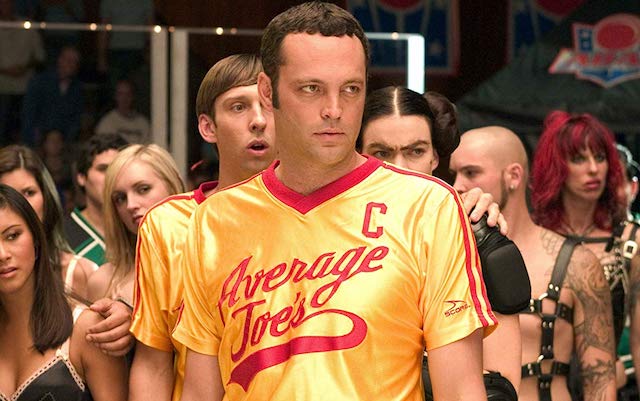
Dodgeball, we are told by helpful ESPN-8 anchors Cotton McKnight and Pepper Brooks, is the sport that “separates the men from the boys, the … awkwardly feminine from the possibly Canadian.” That there even exists a movie called “Dodgeball: A True Underdog Story,” and that it includes sportscasters named Cotton McKnight and Pepper Brooks, makes me feel happy inside. That the sportscasters are played by Gary Cole and Jason Bateman only adds to it.

And those are just two peripheral characters! This very funny, very screwy comedy is packed with entertaining oddballs such as these. “Dodgeball” stars Vince Vaughn as Peter La Fleur, the owner of a low-rent neighborhood gym who must get his regulars together into some semblance of a team so they can win a dodgeball tournament and pay off the mortgage before evil corporate gym owner White Goodman (Ben Stiller) buys him out.

Peter is the sort of poor businessman you see a lot of in movies, with a closet full of tax records and files that cascade to the floor when you open the door. This concerns Kate Veatch (Christine Taylor), the lawyer hired by his bank to go after him for the $50,000 he owes. She hates White Goodman as much as everyone does, though, so she leans in Peter’s favor as much as she can, going so far as to join the aforementioned dodgeball team, if only so she can hit White in the face with a red rubber ball.

Oh, because White has put together a team, too, of course, to thwart Peter’s plan. White is not far off from Stiller’s “Zoolander” character: dumb, arrogant, whisper-voiced and vaguely gay, though ultimately straight. (His gym, Globo, is a wonderland of homoerotic imagery.) He is truly a cartoon in a real world, for while many of the other characters are odd — one of Peter’s teammates thinks he’s a pirate, for example — they still seem grounded in reality. Stiller, on the other hand, goes full-bozo, and it’s extremely funny, if occasionally a bit too much.

Written and directed by newcomer Rawson Marshall Thurber, this is a comedy of absurdity, both in words and in physicality. White often talks circles around himself when trying to sound intelligent, and the dialogue is rife with delicious, quotable gems. And physically, well, seeing people get hit in the face with a dodgeball, with that loud PANG! sound, is funny, no matter how many times it happens. And it happens A LOT in this movie. Sometimes they even get hit in the crotch!

Peter’s team includes Stephen Root, who was the nerdy Milton in “Office Space,” as, um, a nerdy guy; and Alan Tudyk as the aforementioned pirate. The other few don’t quite register as characters, but there is a little subplot with one of them, Justin (Justin Long), a teenager with a crush on a girl who perhaps he can woo with his dodgeball prowess.

It all works as a parody of sports flicks, too, right down to the crusty old legend who comes on as the team’s coach. (He’s Patches O’Houlihan, played with salty cantankerousness by Rip Torn, and in a 1950s instructional film by Hank Azaria.) Of course you know how the tournament ends, but what you don’t know is that there’s a hilarious “Miracle” reference that I won’t spoil for you. Giggly little treasures like that abound in this clever, juvenile movie.

Seducing Dr. Lewis (French)

0

In “Seducing Dr. Lewis,” probably at least the one-millionth film ever made about quirky small-town folks, a bunch of quirky small-town folks must convince the titular physician to take up residence there. This is done primarily by deceit, which of course is eventually revealed, which of course makes Dr. Lewis feel betrayed. The film therefore follows the same basic trajectory as a romantic comedy, except instead of being about a man and a woman, it is about a man and a town.

It’s a charming movie, written by Ken Scott and directed by Jean-Francois Pouliot, both French-Canadians who are barely known in the U.S. It’s set in a small, economically depressed fishing village called St. Marie-La-Mauderne, a town that once thrived but that has now seen all of its residents either move to Montreal or stay put and go on welfare.

There’s talk of a factory being built in the town, which would give it the boost it needs. Problem is, the corporation’s insurance company won’t let it build there unless the town has a local doctor. Which it doesn’t. So Germain Lesage (Raymond Bouchard), about 50 years old and one of the town’s many garrulous, scruffy heavy drinkers, recruits his grizzly best friend Yvon (Pierre Collin) and nerdy town banker Henri (Benoit Briere) to implement a plan. They send letters to every doctor in Quebec, touting the charms of St. Marie-La-Mauderne and pleading with them to relocate.

No one bites, of course; you can’t make $100,000 a year in a remote fishing village. But as luck would have it, a former St. Marie resident, now a police officer in Montreal, pulls over a doctor who has cocaine in his possession. A deal is cut: Go to jail, or go to St. Marie for 30 days.

He is Dr. Christopher Lewis (David Boutin), a handsome, vaguely scoundrelly plastic surgeon whose reaction to this benighted village is somewhere between bemusement and horror. The town, meanwhile, led by Germain, knows it has only a month to make Lewis fall in love with the place and decide to stay. They pretend to love cricket (his favorite sport) and tap his phone so they can learn more about him and thus how to woo him. He mentions his girlfriend’s feet, and the next day all the women in St. Marie are wearing open-toed shoes.

The film has a wistful, summer-evening feel to it, as Germain remembers the good ol’ days of the town’s prosperity and does everything he can to regain it. The locals are likably odd, as is customary for films like this, and the whole thing is pleasantly funny, even sweet at times. Most impressive is the fact that the town has exactly one pretty young female — and yet her falling in love with Dr. Lewis is NOT a foregone conclusion. That’s a nice touch in a movie that could have been (and in some ways is) entirely predictable.

Around the World in 80 Days

0

“Around the World in 80 Days” is an example of modern Hollywood’s dumb way of thinking. There is no reason for a congenial Chinese martial arts expert to be in this story, as the Jules Verne novel is about Englishmen and Frenchmen and involves very little hand-to-hand combat. To you or me, this would mean not putting Jackie Chan in the film. We would would find someone else to star.

But not in Hollywood. In Hollywood, no idea is too untenable. If a big star wants to be in a movie, he or she will be shoe-horned in at all costs, regardless of what damage it does to the film. Hollywood believes that when people go to the movies, they are paying to see CELEBRITIES, not to watch interesting stories.

Unfortunately, Hollywood is probably right, and movies can make $100 million based solely on who’s in them, even if the movies themselves are crap. And so here is “Around the World in 80 Days,” which spends about an hour getting past its casting and screenwriting hurdles before finally settling into an even, enjoyable pace. That first hour, though: Man. It’s pure death.

Jackie Chan plays a Chinese man named Lau Xing, currently in Victorian London to steal back a sacred jade Buddha from the band of Chinese terrorists who swiped it from his village to sell to the unscrupulous Lord Kelvin (Jim Broadbent). While fleeing the cops, jade Buddha in hand, Lau Xing falls into the yard of inventor Phileas Fogg (Steve Coogan) and pleads with him to hire him as his new valet (so he can hide out, of course). Fogg insists he only hires French valets, so Lau Xing gives him a cock-and-bull story about his mother being French, and comes up with the fake name Passepartout after seeing someone walk by with a passport.

And I ask: Why? You wanna put Jackie Chan in the film, fine. Change Passepartout into a Chinese immigrant or something. Why give Fogg the odd trait of refusing to hire any but French valets? Is it because Passepartout isn’t a Chinese name and you think Chan has to be named Passepartout? Well, he doesn’t. Hardcore fans of the novel aren’t going to forgive you just because you retained the character’s NAME if you completely changed everything else about him. Ugh, Hollywood mentality frustrates me.

Anyway, Fogg hires “Passepartout,” then makes a bet with Lord Kelvin, who is head of the Royal Academy of Science, that he can circumnavigate the globe in 80 days. In the 19th century, this is absurd, and Kelvin calls him on it: If he can do it, Kelvin will step down from his post and give Fogg the position instead. If Fogg loses the bet, he has to stop inventing and never darken the Royal Academy’s door again.

So Fogg and Passepartout are off. In Paris, they pick up a woman named Monique (Cecile de France), an artist who joins them … um, for no reason, really. She says she needs to get away from Paris. She’s not in the book; she’s in the movie because movies are supposed to have love interests for their caucasian male leads. (The Chinese ones, of course, go loveless.)

All this extra baggage — Passepartout being on the run from the cops and from bad guys, the stolen sacred artifact, the pretty blonde tacked on as a plot device — these reek of art-by-committee, focus-group interpolation. Verne’s novel is a high-flying adventure story. Here, it’s been genericized so it resembles every other Hollywood adventure movie.

The second half of the film is much faster and funnier than the first half. We’re past the ridiculous moment where Fogg is shocked — shocked! — to learn that the Chinese-looking Passepartout with the Chinese accent is, in fact, Chinese; past the extended, over-long Gov. Schwarzenegger cameo; past the part where Rob Schneider has a cameo; and on to more reasonable entertainments. Steve Coogan has a wonderfully dry delivery that provides several laughs, and though he doesn’t belong here, Jackie Chan is always such a likable guy. And he does do plenty of the fighting he’s known for.

(By the way, if your movie doesn’t require Rob Schneider, why would you go out of your way to include him? You should count your blessings your movie DOESN’T have Rob Schneider, not defy the gods by squeezing him in anyway.)

The director, Adam Sandler veteran Frank Coraci (“The Waterboy,” “The Wedding Singer”), is hobbled by the script from David Titcher, David Benullo and David Goldstein, none of whom has done much before. (I wonder if they decided to work together because they’re all named David.) The screenplay believes that because it’s about an around-the-world tour, it’s OK if it has long mini-adventures here and there. In fact, this is only OK if the mini-adventures are exciting or in some other way diverting, not pointless, like these.

Postscript: Whenever I watch films set in the past that are lazy in other ways, I like to see if they got lazy with their history, too. This one most assuredly does. It is set in 1890, according to the newspaper front pages shown, yet there is a climactic scene involving pieces of the unassembled Statue of Liberty … which in 1890 had been erected and standing in the harbor for four years. There is also a glimpse of Vincent Van Gogh in a Paris art studio, though in real life he spent the first half of 1890 in an asylum and in Auvers-sur-Oise, and the last part of it dead. Next is Chan’s use of the term “international date line,” which my dictionary tells me did not come into usage until about 1909. Finally, the characters refer to visiting Constantinople, which is correct. But the onscreen title calls the city Istanbul, which didn’t become its name until 1930. (Why did Constantinople get the works? That’s nobody’s business but the Turks’ … and the filmmakers’, I guess, who changed the name 40 years early.)

Five Things a Man Should Not Do After He Is Married

0

Five Things a Man Should Not Do After He Is Married:

1. Have a bicycle as his primary mode of transportation.
2. Wear tank-tops.
3. Have a soul patch.
4. Play video games more than one hour per day AT THE MOST. (Once a man is 30, married or not, he should not play video games at all.)
5. Call people “bro.”

Things are Different Now, But They Didn’t Used to be

0

The old saying is, “You can’t go home again.” But why not? Did you offend someone? Did you break something? Personally, I am comforted to know that I CAN go home, even if all my parents have for me to sleep on is a futon, which means I’d be just as comfortable sleeping on the driveway. But hey, at least I’m home.

I don’t know who invented the futon, but it was obviously someone who has never slept and who hates people. An insomniac Nazi, maybe. The futon that sits in the guest bedroom at my parents’ house has a gridwork of steel bars for a foundation, with a paper-thin mattress on top of it. It is a poor idea to begin with, and it is poorly executed. Bed : futon :: La-Z-Boy recliner : electric chair.

But I should not complain about the sleeping arrangements, because the Snider manor in Lake Elsinore, Calif., is a warm, inviting place that I enjoy visiting. I also should not complain about the sleeping arrangements because I need to complain about the shower for a while instead. I might come back to complaining about the sleeping arrangements later.

I have two sisters living at home, and they both have very long hair, almost down to their respective butts. I regard their hair as beautiful; however, I have discovered that its beauty is limited to the time that it is affixed to their heads. Once it has been jettisoned, the individual hair strands become ghastly and terrifying, and a den of them occupies the upstairs shower. They are willful, eel-like creatures that lurk quietly on the wall of the shower, waiting to attach themselves to any passing object. I find myself showering gingerly, trying not to disturb the hairs’ slumber, similar to how one would tiptoe through a cave full of bats. But inevitably I arouse their fury and become entangled, lost in the grip of two-foot strands of discarded hair.

Two feet is not an appropriate length for something that has been cast off from one’s body anyway. Most things that long need to be kept, not thrown away in bunches, much less strategically placed to attack innocent bystanders as they shower.

But I should not complain about the hairful showers, because goodness knows there are starving children in Africa who don’t have showers at all, nor food. My point is, any time you attempt to return to the past, you will find things are not as you left them. When I lived at home, I had my own room with an actual, honest-to-goodness BED in it, and I don’t recall ever being victimized by someone else’s hair while showering. But circumstances change, people alter their habits, and life evolves.

While in California recently, I went to Six Flags Magic Mountain with my friend Rob. I had been to this amusement park only once before, in high school, and found the rides very fun and the general ambiance, if not exactly Disney-esque, at least well-maintained and clean.

That was then. Now, Magic Mountain is a dump, just an absolute ghetto. There’s graffiti on the walls, and most of the TV monitors that are supposed to keep you entertained when you’re in line don’t work, and the ones that do work are covered in dirt. The employees are not courteous or friendly, like Disney folk; instead, they’re just typical teen-age laborers, i.e., surly, unhelpful and apathetic. The park is brimming with trash and debris, and gangs roam it freely, like bison in the Old West. The whole place looks post-apocalyptic, like the neighborhood Adrian Brody hides in near the end of “The Pianist.”

The rides themselves are enjoyable, though they’re all just roller coasters, which means they’re all sort of the same. They call one “Batman: The Ride,” but it has nothing to do with Batman. It’s just a roller coaster that they named after Batman. I could call my car “Batman: The Ride,” but that doesn’t make it Batman-related. In fact, I AM going to call my car “Batman: The Ride.” Let’s see if people want to pay $40 to ride in it.

Batman: The Ride

Batman: The Ride

Anyway, the good thing is, the important things never change. Home is still home, no matter what, and a beautiful summer day spent in Southern California with a friend is still that, even if it’s spent at a thrashed amusement park. It’s the people who make our memories special, not the things. Even if my parents and sisters lived in a shack with beds made of broken glass, they’d still want me to visit, and I’d still want to visit them. Hey, anything would be better than the futon.

Angry Letter: ‘Touching Wild Horses’

0

I don’t often receive e-mails criticizing my movie reviews. Oh, there’s the occasional “how com you dint like that movie is it cuz ur a retard???,” but most of the feedback I get on film reviews is from people who think that because I watched a movie, that means I know the name of the song that plays when Kate Hudson gets out of the car, or that I know when the film will open in Tupelo.

But actual feedback is rare, and so my attention was grabbed when I received this e-mail regarding my review of “Touching Wild Horses”:

Dear Mr Snide(r) [Yes, even though I write a column called “Snide Remarks,” people still think they are being clever when they point out the similarity between my last name and the word “snide.”]

I checked in with your preview of the movie, “Touching Wild Horses” and was very disappointed in the language you used in your remarks and feelings about the movie. [I said that while “the film seems to have been made with good intentions,” you can “take your good intentions and put them in your bum.” I also described the lead character as “bitchy” and “a beeyotch,” which I believe is the medical term for her condition.] I don’t know anything about the movie, so your preview of it may well not be the best movie of the year, however, your language in describing your thoughts about it were deeply offensive. [I hate when my language were offensive.] I would have expected much more from a person in your position. [What position? Upright?] It seemed like you gave an R rated preview to a PG movie.

With deep disappointment. . . . The Neilsons

I do not know whether the Neilsons wrote this e-mail as a family, or whether it was one Neilson speaking for everyone. The e-mail address is, predictably, “neilsons@something,” which means they’re one of those families I don’t like where everyone has to share an e-mail account. These are the kinds of super-religious, fundamentalist families that tend to not have doors on their bedrooms, either, because they equate privacy with an assurance that illicit things will occur. (I know the Neilsons are religious not just because of the tone of their e-mails, but because they live in Southern Utah, as indicated by their e-mail provider, an ISP serving that region.)

Anyway, I do hate to disappoint people I don’t know, so I wrote back to the Neilsons:

Sorry you were offended. As for this being an “R rated preview to a PG movie,” I should point out that the expression I used, if it appeared in a movie, would not earn anything stricter than a PG.

Out of curiosity, what “position” is it that you think I’m in that causes you to expect more from me?

I received this prompt reply:

Dear Mr. Snide(r) [Even cleverer the second time]

Thank you very much for your reply. As far as the expression you used in regards to if had of been in a movie and what rating it would have gotten, this is how I feel about that. [“if it had of been” is definitely a Southern Utah-ism — well, it’s an undereducated-ism generally, but Southern Utah specifically]

If something isn’t right, its’ wrong. And, it isn’t possible to make a wrong thing come out right. Only a right thing will go right in the long run. [This paragraph was in a larger font. That and its familiar ring made me suspect it was a quote, but I can’t locate its source.]

It’s unfortunate that movie makers puts such crude and crass remarks in their productions. Just because they do, doesn’t make it right, or funny, and it does offend many viewers. Unfortunately, it seems like anymore, if a person goes to see even a PG rated movie, they always have some kind of crudeness in it. That certainly isn’t your fault. But, in our thoughts and talks and writings, we can decide who we want to be. We like to read a review to see if we want to go see the movie or not. Not the other way around. [I don’t know what that last part means, but I think I get the Neilsons’ general meaning.]

And, to your question. . . . . I guess I was thinking that someone who had a website for reviews or whatever; someone who millions of people can log on to read his opinion of a particular move, ( and I believe your opinion is worth as much or more than anyone else’s), would have enough integrity to give a review for the masses instead of to a select group of people who may think crudeness and crass is the height of sophistication. [Heavens, I never claimed I was being sophisticated when I called Jane Seymour’s character a “beeyotch.”] I know not everyone does. [So … the position I’m in that makes the Neilsons expect more of me is that I have a Web site? Yikes. Have they BEEN on the Internet?]

I guess, I believe you are a good person. Too good to use such language. I guess, I believe you have some special and magical talent in you that could be used in a more gracious manner. I guess, I believe there’s people out there who love you; whether it’s your parents or wife, siblings or friends; people you don’t want to disappoint. How easy it would be with your talent to make them proud if they heard your reviews read out loud and not be embarrassed or ashamed. [Because OBVIOUSLY, if the Neilsons are disappointed in my language, so will all those who love me be.]

Thank you for listening, The Neilsons

The Neilsons make a good point, however inelegantly they may express it. A review of a family-friendly, PG-rated movie ought not itself be un-family-friendly or un-PG-rated. Again, though, I point out that my language, though coarse, was not worse than that found in most PG-rated films — this one included. Still, I should take better care to let the reviews fit, where possible, the films being described. I do not wish to fall any further in the Neilson ratings.

Garfield: The Movie

0

“Garfield: The Movie” is faithful to “Garfield” the comic strip in that both are benign, obvious and unfunny. How anyone thought they could get a good movie out of a two-joke comic strip — 1) the cat is fat; 2) the cat is also lazy — is beyond me, but here it is, all bright colors and whimsy, waiting to bore you. I get bored reading a “Garfield” strip, and it only takes 10 seconds. Imagine the effect of watching a movie that is just as dull, but 480 times as long.

Garfield is a computer-animated cat who, in a tragedy of epic proportions, is voiced by Bill Murray. He lives with his owner, Jon (Breckin Meyer), who has pictures of himself and Garfield all over his house, which is sadder than I care to contemplate. Garfield’s life of selfishness and gluttony is interrupted when Jon brings in a new pet, a dog (a real one, not a cartoon) named Odie.

Garfield hates the intruder, but when Odie is dognapped by a TV personality (Stephen Tobolowsky) in need of an animal sidekick, our feline hero comes to his rescue in the sort of Big City adventure that has been the hallmark of many a family movie but that has rarely been as anemic and flat as it is here.

That is the whole movie, in fact: toothless, pale, limp and regrettable. It is vigorously unfunny, and I counted three superfluous Wendy’s references among the various product placements, making the whole affair even less tasteful. It was written with a where’s-our-paycheck-please? disinterest by “Toy Story” scribes Joel Cohen and Alec Sokolow, and directed by Peter Hewitt, whose previous contribution to world cinema was “Bill & Ted’s Bogus Journey.”

You know what I laughed at? Odie the dog, whose skill is that he can dance on his hind legs. The more he does it, the more I laugh. Odie doesn’t speak, and therefore he comes across as a subtle character. This is in stark contrast to Garfield, whose lovability wore out 20 years ago and who comes across in the film as a greedy, unpleasant character.

Plus, he winds up being friends with Odie, and Jon gets the girl (played by Jennifer Love Hewitt) — two clear violations of the comic strip’s extremely simple mythology. Every day is a Monday when you’re watching “Garfield: The Movie,” and all the lasagna has maggots in it.

The Chronicles of Riddick

0

“The Chronicles of Riddick” is a silly movie, but aren’t all fantasy films, really? Most of what happens here is no less believable than, say, a pointy-eared man taking down a gigantic warrior elephant single-handedly in the midst of a massive battle fought alongside ghost soldiers who are working off a debt they owe a long-dead king. I’m just sayin’.

It’s technique that separates something brilliant like “Return of the King” from something absurd like “The Chronicles of Riddick.” David Twohy has the ideas, I think, and he obviously cares enough about them to make this sequel to a film nobody saw (“Pitch Black”). What he lacks is the finesse, the subtle skill of making ridiculous dialogue plausible and the ability to cast actors good enough to deliver it.

Vin Diesel was not yet a star when “Pitch Black” came out. Since then, of course, he has become a star and then become not one again — pity “Riddick” didn’t come out two years ago, while his celebrity was still at its peak.

At any rate, he plays Riddick, who in “Pitch Black” was established as an evil murderer with a peculiar aversion to light and a knack for escaping even the most dogged of pursuers. He is the same here, a few years later, when a religion of Necromongers has sprung up seeking to either convert or kill all humans. A prophecy long ago foretold that one of the Furian race would defeat the Necromonger Lord Marshal (Colm Feore); hence, the Lord Marshal had that race annihilated. Whoops, though, he missed one, and it is Riddick.

Riddick is not especially interested in saving humanity, which makes sense, given his fondness for killing people. But he is enlisted nonetheless by a wispy fairy-woman named Aereon (Judi Dench), who appears occasionally to deliver exposition and then, noticing the movie is sucking, disappears again.

First, though, Riddick has to go to a prison planet called Crematoria to rescue a friend/nemesis named Kyra (Alexa Davalos). It is on Crematoria that the film’s dumbest events occur, all centering around the planet’s curious weather patterns: It is 700 degrees during the day, -300 at night. People are incinerated the instant sunlight touches them, yet for some reason, no one needs so much as a sweater at night, when it’s -300.

Also, you can escape the deadly heat if you hide in the outcropping of a rock or in some other shady place. You’d think that when it’s 700 degrees out, it would still be, oh, maybe 690 in the shade. But no. On Crematoria, when it’s high noon and people are bursting into flames before your eyes, you’re nice and comfortable as long as the sun isn’t hitting you directly. Such egregious ignorance of the way weather works has not been displayed since … well, a couple weeks ago, when “The Day After Tomorrow” came out.

Also, it’s pretty easy to outrun the sun on Crematoria. When you see it’s about to be sunrise, and light is beginning to flood the landscape, you just have to book it in the other direction and you’re fine. I mean, you have to run FAST and everything, but it is possible. (On Earth, by the way, you’d have to be running about 1,000 miles per hour, but maybe Crematoria rotates a lot more slowly.)

Anyway, while all this is going on, there’s a guy back with the Necromongers named Vaako (Karl Urban) who wants to be Lord Marshal. To that end, his wife (Thandie Newton) Lady Macbeths him, urging him to kill the current L.M. and take his position. The Necromongers have a weird rule where “you keep what you kill,” meaning, I guess, that if you kill me, you get to be my wife’s new husband. What if you are a woman? Then you’re my wife’s new wife, I suppose. I don’t have a wife, so it’s all moot, but you get the idea: The Necromongers are not against killing each other in order to get what they want.

Vin Diesel, that thick slab of rounded meat — honestly, there’s not an angle anywhere on him — well, I still like the guy. His delivery of the dialogue presented to him, as always, walks the line between ludicrous and cool. Others in the cast are not quite as adept with it, tending toward overacting and hysteria. But I guess you expect that sort of thing in this sort of movie.

What sort of movie is this? Well, it has the glib idiocy of an action flick, but the breadth and self-importance of a fantasy film. It has multitudes of characters, worlds and ideas, most of which are usually absent in the action genre; it also doesn’t have all that much action, frankly. Twohy clearly wanted to make something more than your average blow-’em-up popcorn picture, and his ambition is admirable. I like that he even TRIED to include themes from Shakespeare and Greek tragedy. But more than mere ambition is required to pull off something as bombastic and bloated as this without it looking, you know, bombastic and bloated. I kinda liked it, sort of, but then again, not really.

The Stepford Wives

0

The Internet Movie Database classifies “The Stepford Wives” as “comedy/drama/thriller,” and I suppose that’s part of the film’s problem: It doesn’t know what it is. It’s a comedy mostly, but not a very funny one, and it’s too broad to be taken seriously as drama, and I don’t recall ever being thrilled by it. Yet it has components of all of those — dialogue that should have been funny, scenes that ought to be dramatic, and elements that might have been thrilling if we didn’t already know all the surprises.

The 1975 film of which it is a remake was altogether serious, about a town where the housewives have been replaced by perfectly obedient and subservient robots. The new film has the same basic story, but plays it for laughs and changes some key plot points. I suppose feminism has come so far since 1975 that the idea of people behaving outrageously sexist is much funnier than it was then. Then, it was still relatively normal for men to expect their wives to stay home and to have their martinis waiting for them after a long day at the office. Now, the protagonist knows immediately that something is wrong when she sees that sort of behavior. “What is this?” she must be thinking. “1975?”

Anyway, she is Joanna Eberhard (Nicole Kidman), a high-powered Manhattan TV executive who has suffered a nervous breakdown and retreated to quaint Stepford, Conn., to live a quiet life with her husband Walter (Matthew Broderick) and their two little-seen children. Joanna is perplexed by the women in Stepford, who all have old-fashioned hairdos and wear June Cleaver dresses even when they’re working out. The women are all beautiful, too, while their husbands are exceedingly average.

Her only new friends are her two fellow outcasts: Bobbie Markowitz (Bette Midler), a shlumpy author (“I Love You, But Please Die” was her book about her mother) who refuses to assume any traditional female roles; and Roger Bannister (Roger Bart), a gay man living in Stepford with his life partner. Joanna, Bobbie and Roger quickly become girlfriends, all suspecting that something odd is going on around here, but wanting to give the Stepford way of life a try, too. Who knows, maybe wearing an apron and baking muffins all day will cure Joanna of the blues.

Wisely, the movie reveals early that the women have been turned into robots. Everyone in the audience knows that, of course, having seen the original, or at least having heard the term “Stepford wife” used in conversation (I’ve seen it used in reference to First Lady Laura Bush more than once).

Ah, but what to do then? The original had Stepford’s secret as a surprise later in the film, so there was suspense and intrigue as Joanna snooped around looking for answers. The 2004 Joanna still snoops, but we already know what she’ll find. The screenplay, by Paul Rudnick (“Isn’t She Great,” “In & Out”), ought to offer us plenty of comedy in the meantime, but instead settles for whimsy punctuated by a few funny moments. Most of those are provided by Broadway’s Roger Bart — ironic, considering an out-and-comfortable gay character doesn’t even belong in the movie, which is all about traditional male and female roles. (I doubt a private community run by conservative, old-fashioned men would let a gay couple move in anyway.)

Several of the performances are fun, particularly in the film’s first half. You’ve got Glenn Close as Stepford’s bubbly matriarch Claire Wellington, Christopher Walken as her husband, and Jon Lovitz playing Bette Midler’s husband. Matthew Broderick is likable as ever — his role was originally for John Cusack, and it suits both men’s natural affability — and even stony Nicole Kidman comes off as personable.

In the second half, much of the fun wears off as the story wears thin. On-set problems between director Frank Oz and various cast members are already legendary, and the film was sent back for re-shoots, which is never a good sign. Plus, the characters get split up for various plot reasons, and thus the banter is gone. Once the movie has to focus on its “thriller” elements, it has absolutely no idea what to do.

Word Wars (documentary)

0

It’s exciting to see what’s happening with documentaries these days. 2003 saw a resurgence in success, both critical and popular, in the genre, and now we begin to see a sub-genre: the documentary about competitors in word-based tournaments.

First was “Spellbound,” about kids competing in the National Spelling Bee. Now, related to it and probably hereafter and forever mentioned in the same breath as it, is Eric Chaikin and Julian Petrillo’s “Word Wars,” a perfectly good, if not quite as scintillating, documentary about hardcore Scrabble players.

Four word nerds are followed through the preparations and smaller tournaments leading to the national championship tourney in San Diego in August 2002. These men are dedicated, obsessed, even; the fact that this film contains abundant harsh profanity and some drug use should be a clue that this is not your grandmother’s Scrabble we’re talking about.

Matt Graham is a handsome-ish, 30-ish guy who favors torn T-shirts and occasionally works as a stand-up comic. Then there’s Joel Sherman, a true nerd with acid reflux trouble (he guzzles Maalox constantly) and no job other than Scrabble. (Underemployment is a recurring theme among people who must practice Scrabble for three or four hours a day.)

We also meet Joe Edley, the reigning national champion, a calm family man who uses tai chi to focus himself. His contrast — in fact, the contrast of most Scrabble pros — is Marlon Hill, a dreadlocked black man from the Baltimore ‘hoods who swears like a sailor and smokes pot like, um, a sailor. Everything about him suggests a Spike Lee film or a UPN sitcom, yet he wins game after game of Scrabble. His formal education is lacking, but his knowledge of Scrabble-friendly vocabulary is immense.

They’re a quirky, funny lot of guys, friendly but still competitive with each other, each plagued by insecurity and anxiety over the coming nationals.

Not a lot of time is spent on actual plays in the games. We see highlights and final scores, with more emphasis placed on the men’s pre-game jitters and mid-tournament woes.

Still, it is enough to demonstrate the awesome ability involved here, even if suspense and dramatic tension are not built quite as well as they might have been. For those of us who, like Bart Simpson, rely on words like “qwijibo” to make high scores, it’s an entertaining look at the ones who make the game look easy.

Ask Eric Stuff 14

0

What the–?! It’s time for another installment of “Ask Eric Stuff,” a regular feature that is so absurdly popular that the government asked us to stop doing it for a couple years. In this feature, people ask Eric questions, and he answers them as best as can be expected under the circumstances (the circumstances being that Eric is a snarky jerk). You, too, can submit questions to “Ask Eric Stuff” by going here.

And now, let the questioning and answering commence! Huzzah!

Dear Eric: What’s up with this crazy weather on the east coast? One minute it’s freezing and the next we’re all sweating through our shirts. — Nutty in New England
Dear NINE: Really? Through your shirts? Most people sweat through their armpits.

Dear Eric: Is your condo BYU-approved? — Wondering in Washington
Dear Washy:. No, but I did manage to get it UVSC-approved, by putting a sign on the front door that says “push,” with a picture next to it.

Dear Eric: Why did milk get so expensive all of a sudden? — Cowless
Dear Cowl: Because of the ongoing war against terror being fought in Iowa. The Iowan hardliners are refusing to do business with the United States, and this has driven up milk prices.

Dear Eric: Have you ever tried online dating? I’m thinking that at the old-maidenly age of 27 it’s about time I give it a go. But will I meet anyone as special as you? — Sweetly Single
Dear Single: Depends on how you mean “special.” If you mean “retarded,” then yeah, you’ll definitely meet people as “special” as me. Almost everyone on the Internet, in fact.

Dear Eric: I am a very nice dentist. Why do people always tell me, “No offense, Doc, but I hate dentists”? Should I keep trying to be nice or just give up and be as hateful as they expect me to be? — Dr. Really Nice
Dear Dr. Feelgood: You’ll have to bear with people. It’s not that they actually hate dentists; it’s that they associate visits to the dentist with discomfort, blood, drool and being charged $150 to scrape gunk off their teeth when they could have gotten a sharp piece of metal and done it themselves for free. Win their trust by trying not to be such an evil sadist.

Dear Eric: In your last column, you had a fictional character named Ivan Drbckz. How is that pronounced? — Hooked on Phonics
Dear Phony: EYE-van.

Dear Eric: Do you have any tattoos? — Inked up in Indiana
Dear Inky: Yes. I had all of my internal organs tattooed with my name so that if they were ever stolen, they’d be useless on the black market.

Dear Eric: My sister says that guys “don’t think.” Is that true? — Wondering Woman
Dear Woman: What was the question? Sorry, I was busy playing a video game and saying “dude.”

Dear Eric: My friends work at a local movie theater, so it has been around a year since I have had to pay for a movie. Do you think this is unethical? — Stealin’ in Santa Cruz
Dear Santa: I haven’t paid for a movie in several years, nor for magazines, books or groceries. Not because of perks of my job, but because I’m really, really good at shoplifting.

Dear Eric: I’m in California for the summer and I don’t have any friends out here and I was wondering if you’d come out here and be my friend. — Friendless in Santa Barbara
Dear Santa: No.

Dear Eric: My son’s tennis shoes really, really stink. I don’t even let him keep the shoes in the house. We’ve tried foot odor spray, but that hasn’t helped at all. What do you suggest? — Pinching My Nose
Dear Pinchy: Tell your son if his feet don’t stop stinking, you’ll stop loving him. Then follow through. Good parenting sometimes requires tough love.

Harry Potter and the Prisoner of Azkaban

0

With regard to the near-impossible task of making a Harry Potter film that captures all the magic and cleverness of its source material, “The Prisoner of Azkaban” succeeds more thoroughly than either of its predecessors. It is darker and funnier than “The Sorcerer’s Stone” and “The Chamber of Secrets,” and in nearly every way a better movie.

The difference, of course, is in the direction. Chris Columbus was never more than a serviceable director, offering average entertainment such as “Mrs. Doubtfire” and “Home Alone” before delivering his overly faithful adaptations of the first two Harry Potter books.

Now we have Alfonso Cuarón, a genuinely talented filmmaker (“Y Tu Mama Tambien,” “A Little Princess”) with a creative eye and a fresh vision. Where Columbus was content to make films that told the stories from J.K. Rowling’s novels without distinction, Cuarón uses camera angles, sight gags, scary special effects and (above all) a lively pace to make “The Prisoner of Azkaban” every bit as good a MOVIE as it is a book adaptation. The other films felt like nothing more than companion pieces to the novels, illustrations to go along with the words; this one stands on its own.

Chew on this: The third book in the series is 100 pages longer than the first two, yet the third film is a good 20 minutes shorter — and still, nothing significant is missing. What Cuarón and screenwriter Steve Kloves (who adapted the other films, too, though apparently with more freedom) have done is streamline the story. Where a book can have events add up over the course of, say, two evenings before coming to a head, it makes more sense for a film to condense the action into one scene. “Azkaban” does this repeatedly, thus finally satisfying fans who want the same flavor and plot lines as the books, while not trying the patience of moviegoers who are perhaps not as rabid in their devotion to the novels and who simply want a solid, well-focused film.

Harry’s (Daniel Radcliffe) third year at Hogwarts School of Witchcraft and Wizardry finds him and his fellow students on edge because notorious murderer Sirius Black (Gary Oldman) has escaped from the inescapable Azkaban prison. Consequently, the Ministry of Magic has sent troops of Dementors — cloaked, Reaper-like demons who suck the souls out of their captives — to patrol the periphery of the school.

Sirius Black, it is said, was responsible for the death of Harry’s parents and presumably wants to find Harry to finish off the Potters altogether. Harry, meanwhile, deals with the usual problems of a schoolboy: his broomstick breaks, Snape (Alan Rickman) is still on his case, and kind-hearted Hagrid (Robbie Coltrane) is in trouble because one of his odd creatures bit Draco Malfoy (Tom Felton). You know, kid stuff.

As his best friends Hermione (Emma Watson) and Ron (Rupert Grint) have some alone time on field trips to Hogsmeade — where Harry can’t go because his guardians wouldn’t sign the permission slip — he finds a confidante in Professor Lupin (David Thewlis), the new Defense Against the Dark Arts instructor who harbors a dark secret himself. Lupin helps Harry learn how to conjure a Patronus, a protective phantasm that can help him defend himself against the Dementors.

The first chunk of the film and the last chunk — which involves the manipulation of time! — are the best, whizzing with sly humor (the Whomping Willow makes occasional appearances) and marvelous special effects. Buckbeak the hippogriff — part eagle, part horse — is a wonder to behold, and the Dementors are hideously frightening. The thrill of the Knight Bus — a high-speed wizard transport service that Muggles can’t see — is captured with a sort of mad energy, and aided by John Williams’ whimsical score.

In the middle, things are not as buoyant. The books deliver the events of a single school year in linear fashion, without regard for the story having a clear beginning, middle and end. The films have not yet mastered the art of following that pattern without occasionally feeling like they’re not GOING anywhere, and even Cuarón is unable to avoid the trap.

The performances continue to be rich and, where suitable, personable. Gary Oldman and David Thewlis are welcome additions, and Emma Thompson is a hoot as Sybil Trelawney, the addle-pated professor of divination. (I submit that even if she were to play a mass murderer, Emma Thompson would still be unbelievably appealing and likable in the role.)

Only the most hardline fans of the books will object to the minor customizations made for the film. All else will praise its ingenuity, spirit and wicked sense of humor.

The Story of the Weeping Camel (documentary; Mongolian)

0

Nothing within “The Story of the Weeping Camel” itself makes it apparent whether it is fact or fiction. Some elements are clearly real and would be difficult to fake convincingly — I think of the scene in which a camel gives birth and its owners act as midwives — and the opening title “Spring 2002” is far more specific than most fictional films get.

But then there are the cameras on tripods, the flow of the story that feels the way made-up stories feel, and the characters’ naturalism that give the film a fictional texture. People in documentaries usually look at the camera a lot, and the cameras are usually shaky, hand-held things. Not so here.

The filmmakers, Byambasuren Davaa and Luigi Falorni, call their work “narrative documentary” — a blend of fact and fiction, in other words. Elvis Mitchell in the New York Times explains that while following a family of nomadic shepherds in the Gobi Desert simply to document their way of life, the directors happened upon the incidents that became the film’s central storyline. Some scenes were recreated using the original participants (no actors), while others are original, candid footage. Knowing that going in, you can probably figure out which category each scene belongs to, but the movie is so simple and captivating that you probably ought to just enjoy it.

It is set in southern Mongolia, amidst a multi-generational family living in elaborate tents on the barren plains. They deal in sheep, primarily, with camels being used for transportation, cargo-carrying and their hair (useful for weaving). The family’s existence is simple and happy. We see them playing cards in the evening hours, working during the day, speaking to each other matter-of-factly but warmly.

At the moment, all eyes are on the lady camels who are about to give birth. One delivers without complication. The other struggles for two days, getting a white-furred colt only halfway out, hooves first, before humans intervene and yank the baby out of her. It is at first the World’s Ugliest Thing, but you’ll soon find yourself adoring it.

The mother, unfortunately, does not share your sentiments. For whatever reason — the family speculates it’s because of the difficult labor — the mother rejects the baby and won’t nurse it. She kicks him aside when he tries to drink, and walks off when he tries to follow her, his plaintive bleating echoing after her. It’s heartbreaking.

To get help for the problem, the family sends two of its youngest members, Dude and Ugna (yes, Dude and Ugna), into the nearest town. Here we meet the film’s secondary, less-compelling theme, dealing with traditionalism versus modernism. The town is more or less completely modernized, and little Ugna is thrilled to have a chance to watch TV and eat ice cream while running his parents’ errands. The modernization provides a stark contrast: The boys walk through town dressed in colorful, traditional robes while everyone around them wears jeans and T-shirts. (I thought of the polygamists who live in the rural areas of Utah, whose women often come to town wearing gingham dresses that reach their wrists and ankles, and who are gawked at by everyone.)

The solution to the camel situation is unique, or at least it seems that way to me. Maybe it’s commonplace in the Gobi Desert. I note, however, that the film has no musical score until the end, when it really matters. Like many animal-centric films try to be, this one is sweet and joyous and wonderful.

The Corporation (documentary)

0

Woe betide any conservative who wanders into a screening of this Canadian cautionary film! With sly, mildly irreverent wit and the enthusiasm of cause-happy youth, the eye-opening doc examines what a “corporation” is, how corporations are the dominant force in the modern world, and how that’s generally not for the betterment of society. The conclusion: If a corporation were a person, it would be a psychopath. A staggering number of interviews and piles of footage both stock and new provide insight and provoke thought, and the whole thing’s pretty darn entertaining, too.

Coming Soon

0

Since it’s summer blockbuster season — “the most wonderful time of the year,” as the old summer blockbuster carol goes — I thought I’d share with you some of my ideas for summer blockbuster movies. Please do not steal these ideas, or I will hunt you down, restrain you, reveal my diabolical plan for killing you, and then permit you to escape.

“Cool Breeze”

A disaster film that truly “blows” … you away! Windologist Jack Weatherman discovers that his worst nightmare/fondest dream is about to come true: Cool breezes from the Atlantic Ocean are heading for the East Coast at a deadly, leisurely pace! If people don’t act quickly, they’ll find themselves refreshed and killed within a matter of days.

Jack rushes to Washington to warn the president, only to discover that there are TWO Washingtons, and the president is in the one surnamed D.C. So he rushes to that Washington to warn the president, but his advisers tell him not to worry about the rantings of a crazy windologist. Evacuating coastal citizens to the midsection of America would be both costly and boring.

Fortunately, an insane old professor named Winston Stodgy believes Jack’s foretelling of doom, and the two set about finding a way to stop the cool breeze from reaching the coast. But they are too late: Before they know it, the breezes have hit New York City, which is soon in rubble, the State of Liberty lying face down in the gutter with her dress up around her waist. Other cities on the East Coast may or may not be as unlucky; cities other than important ones (i.e., New York) are not shown. People panic, and there is mayhem. Cats and dogs live together. It is mass hysteria. The president, now aware of the danger, goes on television with with an impassioned, concerned look on his face and tells America to brace itself and be brave. When his handlers insist on whisking him away to a breeze-proof bunker, he refuses, saying he won’t hide while the people he serves live in terror. He rushes out into the breeze and is stoically killed instantly. His handlers drag his corpse into the bunker and find a look-alike to take his place (but we leave that for a different movie).

Meanwhile, an alcoholic former fighter pilot named Slushy has an idea: Fly his plane directly into the breeze as a means of diverting it away from the mainland and back out to sea. Even though this plan makes absolutely no sense from a scientific standpoint, Jack and Winston tell him to do it, even though it is deadly (and impossible). Slushy says goodbye to his estranged children, flies into the breeze, and America is safe … for now. Every character who has a name survives, except for the aforementioned Slushy, who dies nobly; those without names die.

“Intense Deadly Murder of Death”

An action film like nothing you’ve ever seen before! (Note: Assumes you’ve never seen an action movie before.) Joe Gruffton is a homicide detective who doesn’t play by the rules. He’s a one-man wrecking crew, and he’s surly and sometimes he beats up perps, but he’s a good cop and he gets results. So what if he’s a bit of a “loose cannon” or a “borderline sociopath”? He gets the job done!

But Joe’s life and career are on the line when he stumbles into a ring of international drug smugglers/kidnappers/terrorists, run by Ivan Drbckz, a darkly handsome man with a vague European accent who commands a squadron of ugly, foreign-looking henchmen. When Joe’s partner is killed by Drbckz for getting too close to the truth — the truth was really hot, and it burned him when he approached it — Joe vows to the man’s widow that he will find the killers and bring them to justice, or possibly just kill them. His sergeant tells him he’s too personally involved with the case and suspends him, but that just makes Joe angrier and more personally involved.

This leads to a deadly game of cat-and-mouse in which all bets are off and the stakes are high, which makes it even more disappointing that all bets are off. After a high-speed chase through the city in which fruit stands are knocked over and many non-fatal accidents are caused, Drbckz leads Joe to an abandoned warehouse in which all the machinery still functions. As they grapple, Drbckz explains his motives to Joe, somehow finding the strength to speak despite being repeatedly punched in the face and whacked with a crowbar. Levers are pulled and switches are switched, and it ends with Drbckz hanging by one hand over a vat of molten lava (this was a molten lava factory). Joe briefly considers letting him die, but remembers his job is to uphold and protect the law, and part of the law is not killing people, so he pulls Drbckz to safety instead. Then, when he turns his back, Drbckz — in a move that surprises everyone, because we all thought this was a drug lord who had scruples — tries to push Joe into the vat, but Joe darts out of the way and Drbckz goes in instead. As the old saying goes, he who lives by the vat dies by the vat.

“Comic Book Man”

A super-exciting superhero movie based on the comic book “Comic Book Man.” Kent Parkerson is an ordinary man, until one day he’s in an accident involving some kind of science-y thing, and he wakes up the next day to find himself … Comic Book Man! He has all the powers of a movie hero who’s based on a comic book! (In the comic book, Comic Book Man has all the powers of a guy who’s about to be made into a movie.) He must keep his identity a secret as he pursues the evil Dr. Comic Book Man Hater and attempts to thwart his plan of destroying Comic Book Man. A must-see for all fans of Comic Book Man! Ask your mom for some money and a ride to the theater!

“It Head to Be You”

A light-hearted, unpredictable romantic comedy about a stuffy, uptight man and a carefree, irresponsible woman who meet — and don’t like each other! Except then eventually they do. But at first they don’t!

It starts when Jenna McTramp meets a man in the elevator on the way up to the trendy magazine where she works and insults the man’s taste in neckties, before accidentally spilling her hot coffee all over him, resulting in third-degree burns. (You knew this romance would be red-hot, but you probably didn’t expect me to take it so literally, didja?!) To make matters more hilarious, it turns out he’s her new boss! His name is Gavin Straightly, and he does NOT like Jenna or her attitude, nor she him or his. Jenna’s chubby, dateless friend thinks they should get together, though, and so does Gavin’s less-attractive, wisecracking roommate. But they can’t! Jenna already HAS a surly boyfriend who doesn’t love her, and Gavin already has a ditzy girlfriend who cheats on him. So they’re already taken.

Anyway, then Gavin and Jenna have to work on a project together, redesigning their magazine to make it filthier, and they totally start to like each other, in spite of their many differences, her immaturity, his prison record, and their fiery hatred for each other. Trouble is, Gavin’s been lying to Jenna about something: He doesn’t have a head! The “head” she sees atop his shoulders every day is an elaborate prosthesis, complete with mechanical mouth and furrowing eyebrow action. He lost his real head in a car accident a few years back, and he’s ashamed to tell her. Now, he’s in too deep: What will she say when she learns the truth, and that their love is predicated upon a lie, i.e., the lie that he has a head?

Well, sure enough, the truth comes out like a debutante at cotillion when Gavin’s fake head falls off in the street and is crushed by a truck. Jenna’s feelings are crushed, too, though this is more a figurative crushing. She breaks up with Gavin, and they miss each other while it rains and while a Norah Jones song plays on the soundtrack. Then, while Jenna is addressing Congress on an important magazine-related issue, Gavin shows up and apologizes to her — and this all goes out LIVE on television! Jenna takes Gavin back, and they all live happily ever after and have little headless babies.

Raising Helen

0

I’m told that bringing children into your life is a marvelous way to straighten out your priorities and determine what’s really important. I’m told this most often by movies, every time a new one comes out with this theme, which is approximately once a month. If I had kids, and if I had therefore already learned this for myself, I would probably be even more tired of the movies telling me about it than I already am.

Oh, but I’m being churlish already, and “Raising Helen” isn’t a bad movie, just an unoriginal one, following in the footsteps of “Big Daddy,” “Uptown Girls,” “Family Man” and countless others. These films follow this pattern: The protagonist is either a workaholic or a slacker, he or she suddenly has to care for a child or children, and he or she grows up.

The Helen in need of raising is played by Kate Hudson, still riding the applause for her “Almost Famous” performance despite not having given a good one since then. Helen is a top exec at a New York City modeling agency, so her life is equal parts work and partying, leaving no room for anything else.

Then her sister and brother-in-law are killed in a car crash, and their will specifically leaves their three children to Helen, even though their other sister Jenny (Joan Cusack) would have been the logical choice, being very mom-like and having two kids of her own. Jenny’s kinda hurt at the slight, and both she and Helen are puzzled. Nonetheless, Helen takes the kids, moves to an apartment in Queens, and puts them into a Lutheran private school. (The public schools are icky.)

I like the kids. There’s Audrey (Hayden Panettiere), a teenage girl just beginning to explore the limits of her rebelliousness; Henry (Spencer Breslin), a goofy pre-adolescent with a fondness for turtles; and little Sarah (Abigail Breslin), the kindergartner just learning to tie her shoes. The children are believable, their interaction seems real (Henry and Sarah are siblings in real life), and the script gives them a few funny things to say. (I like Sarah’s answer when Henry asks why she always wants to name the pets “Hippo”: “Because I can spell it.”)

Anyway, Helen’s job, which requires frequent travel and long hours, soon becomes unworkable with the current arrangement and she finds she must give it up. (The job, not the arrangement.) She has some solace in her friendship with Pastor Dan (John Corbett), principal of the kids’ school, and help from feisty Indian neighbor Nilma (Sakina Jaffrey), but ultimately still feels overwhelmed by it all.

Those supporting characters provide a spark of life, as does Joan Cusack as Helen’s anal-retentive sister. Never mind why a New Jersey-bred girl has such a thick Chicago accent, I’m just glad anytime I get to see Cusack in a movie. She can make almost anything funny.

It is Helen herself who is the least-interesting person here. Kate Hudson has cuteness, but very little personality. She’s as ill-equipped to carry the film as Helen is to raise three children, and the movie falls into a lull every time she becomes the focus of it.

There is also director Garry Marshall’s penchant for making his films far longer than they need to be, and for not being a very good filmmaker anyway. (“Dear God,” anyone? “The Other Sister,” perhaps?) His only two legitimately good movies have both starred Julia Roberts and Richard Gere; the rest, like this one, are tolerable at best.

In fact, “Raising Helen” is one of his better efforts. It is gently witty and occasionally entertaining, if you can overlook the fact that you’ve seen it all before.

The Day After Tomorrow

0

Roland Emmerich’s films have depicted America being attacked, at various times, by aliens, Godzilla and the British. Now comes a force even more powerful, even more potentially deadly, with even greater possibilities for being really stupid: the weather.

“The Day After Tomorrow” is a movie about what happens when global warming turns out to be real, screws up the North Atlantic current, and brings the Northern Hemisphere into a new ice age, all in a matter of weeks. This isn’t possible, of course, and I don’t think Emmerich even wants us to buy it. He just wants us to swallow the basic premise, sit back, and enjoy the sights and sounds of all we know and love being destroyed.

I did not like Emmerich’s “The Patriot” or “Godzilla,” though I do find myself in the critical minority for having enjoyed “Independence Day.” “The Day After Tomorrow,” which Emmerich again wrote and directed, is cut from the same cloth as “Independence Day,” but with more plot holes, less excitement, and fewer jokes. In addition, I doubt there is a single disaster-movie cliche that Emmerich does not employ, right down the last noble character who dies so that others may live. Emmerich must have had a list in front of him; there’s no way you could make a movie with this much recycled material just from memory.

Dennis Quaid plays Jack Hall, the obsessive scientist whom no one listens to. He was in Antarctica with his two researcher buddies (Dash Mihok and Jay O. Sanders) not long ago when a Rhode Island-size chunk of it broke off and floated away. This means the global temperature is rising, which is not good. The world leaders he tells, however, including the American vice president, are unimpressed. (Maybe if he’d told them the chunk was the size of Delaware. Rhode Island just sounds so small.)

Fellow researcher Terry Rapson (Ian Holm), who works at a Scottish weather station, believes Jack, and is equally fearful of what the future may bring. Neither man thought it would happen so soon, though: Within days, temperatures in the North Atlantic are rising dramatically, and most of the world begins to experience crazy weather. Tokyo is pelted with a rain of huge ice chunks. Los Angeles is wiped out by tornadoes. Other, less important cities are probably destroyed, too, but the movie doesn’t have time to show us, because we have to get to New York to see what happens there.

What happens there is, the ocean rises and Manhattan is flooded. (That most-abused symbol of America, the Statue of Liberty, is this time shown neck-deep in Atlantic water.) The flooding is bad news for Jack and his wife, a nurse named Lucy (Sela Ward), who of course tends to children with cancer at the local hospital. Jack and Lucy have a teenage son named Sam (Jake Gyllenhaal) who is currently in the aforementioned Manhattan on a school trip. It’s pouring down rain, the streets are flooding, the rain is turning to snow, and soon Fifth Avenue is solid ice about 20 feet deep. And just when tourism in the Big Apple was starting to pick up again! Mother Nature is the worst terrorist of all, no?

Sam, his objet d’amour Laura (Emmy Rossum), and various New York types (homeless man, business man, tourists, etc.) have fled to the safety of the public library. Via telephone, Jack tells Sam not to go outside because of what is to come: It will soon become SO COLD, SO FAST that people will freeze to death INSTANTLY! Meanwhile, Jack tries to get from Washington D.C. to New York to rescue his son, and Lucy stays at the hospital to hug cancer kids.

The general idea of this film presents no problem for me in terms of logic or believability. They say the world’s gonna go ice age on us, fine. I’ll buy that. It’s the little things that are absurd, and that reduce the film from awe-inspiring disaster epic to silly special-effects showcase.

For example, there are the people at the library who realize they must start fires in order to keep warm. So what do they burn? The books. They even debate which books ought to be burned last, and which are worthless enough to go now. What they DON’T burn are any of the library’s hundreds and hundreds of wooden chairs and tables. Those, apparently, must be preserved for future generations.

I also like how Sam leads a small team to a Russian freighter that drifted down Fifth Avenue when the city flooded and has now become moored in the ice. (Luckily, Fifth Avenue is EXACTLY WIDE ENOUGH for a freighter to float down it. The ship doesn’t even scrape any buildings on the sides.) They go because they figure the ship will have food and first aid supplies. While on board, not only do they have to hurry up before The Cold arrives, but they are also chased by wolves. Yes, wolves. I figure Emmerich sat there with his co-writer (Jeffrey Nachmanoff, giving credit where it’s due) and said, “There needs to be danger on the ship. What can we have chase them? Snakes? Zombies? Ghosts? No … wolves!” Well, sure. Why not wolves?

And then there is the moment when The Cold arrives and everyone dashes for safety, trying to outrun it, trying to move faster than the speed of cold. Of course this is a variation on the action-movie theme of heroes outrunning fireballs. A bit less exciting, really. At least fire is a tangible, physical thing. Fleeing from “cold” is a bit obscure, even if it is represented by walls and ceilings crackling over with frost.

It’s summer blockbuster time, which means stuff needs to get blowed up, and blowed up BIG. On that count, Emmerich delivers as reliably as ever. The scenes of New York and L.A. being wiped out are suitably impressive. But there’s a mechanical feel to it, like Emmerich doesn’t have his heart in it. There is little wit or imagination to the film, and certainly no spark in any of the characters. It’s all just a rote recital of the disaster-flick images we’ve been through so many times before. If the world’s going to end, it ought to end more creatively than this.

Soul Plane

0

More than any film I’ve ever seen, “Soul Plane” is clearly one comedy sketch idea, stretched out to feature length. Someone in the “Saturday Night Live” (or, more likely, “In Living Color”) writers’ room might have pitched the sketch this way: “What if there were an airline run by, and made for, black people?”

It practically writes itself! The plane would be pimped-out with spinning gold rims on the landing gear! When a jet full of white people pulls up next to it on the runway, the white jet would instinctively lock all its doors! In coach class, instead of distributing individual meals, they would just pass around a bucket of Popeye’s chicken! (Naturally, only black people can make these jokes. If a white person suggested that African-Americans were fond of fried chicken, they’d be in serious trouble.)

I’m not saying these jokes aren’t funny; I’m just saying that if you’re plugged into black culture, you could come up with them yourself. But too bad for you, someone beat you to it — director Jessy Terrero and writers Chuck Wilson and Bo Zenga, all experienced in behind-the-scenes work in movies, but making their debuts in these capacities.

And they’ve made a movie that is uneven, but often very funny. It recalls, at times, the anarchy of “Airplane!” (not to mention that movie’s plot), and it impressively covers the entire length and depth of its premise. No aspect of air travel is left un-hip-hopped or un-blinged.

It has an unfortunately obnoxious central character, Nashawn Wade (Kevin Hart), who wins $100 million in a settlement against an airline and uses it to start his own. He calls it NWA, and if you don’t know why that’s funny, then trust me, you won’t know why ANY of this is funny.

On NWA’s inaugural flight from L.A. to JFK (or “from the 310 to the 212,” as the captain puts it), one white family stumbles on board. They are the Hunkees (pronounced more like “Honky,” of course), led by Tom Arnold as the befuddled single dad flying with his slutty teenage daughter Heather (Arielle Kebbel) and brainy younger son Billy (Ryan Pinkston), and with his hot new girlfriend Barbara (Missi Pyle).

The family has a little plot arc, but it is irrelevant compared to the central shenanigans, which involve a pot-smoking captain (Snoop Dogg, type-cast yet again) and the various African-American stereotypes who fill the seats. You have a horny couple attempting to have sex in a variety of locales; a blind man who flirts with all the women and fingers a baked potato; your various playas and gangstas and ghetto-fabulous trash and so on. The first-class lounge features Cristal champagne and other accoutrements; the “low-class” section is a graffiti-heavy block party; upstairs, there’s a disco.

Some bits are funny and some aren’t, and some resort too desperately to jokes involving bodily functions and sex acts — jokes that have been done before, and better, in other films.

When it spoofs black culture, though, the movie connects solidly. The writers and director possess a keen eye for how blacks are perceived by whites, as well as how blacks actually are — and how the two often overlap. I laughed a lot at Mo’Nique and Loni Love as the security checkpoint women who spend all their time rapping, talking about Denzel, or trash-talking the customers as they pass through the metal detectors. It’s useless to get offended by anything the movie does — the lisping, flouncing gay flight attendant, the joke where everyone is terrified of the Arab passenger, and so on — when it’s all done so gleefully and without apparent malice.

Saved!

0

You’d think that in a film where a born-again Christian teenager gets pregnant, the comedy would write itself. But “Saved!,” the feature-film debut by Brian Dannelly and Michael Urban, can only mine so many jokes about fundamentalist Christians — and organized religion in general — before they become too earnest for their own good and wuss out on us. If you’re going to make a biting satire, keep biting until the film is over.

It is set at a Christian high school where the “coolest” kids in school are the most haughtily righteous ones. In this case, that’s Hilary Faye (Mandy Moore), a pretty, blond, sanctimonious girl who despises her brother, Roland (Macaulay Culkin). This might be because she’s generally a hypocrite, or it might be because she’s “righteously” frustrated with Roland for being a backslider: He hasn’t been thrilled with God, it seems, since he was in an accident that landed him in a wheelchair.

Their friend Mary (Jena Malone) is the one who becomes with-child, and not in nearly as sanctioned a way as her namesake. This Mary learned her boyfriend Dean (Chad Faust) was gay, and subsequently had a dubious vision in which Jesus told her to have sex with Dean in order to “cure” him. Dutifully, she did this, even though the vision came after being knocked unconscious in a swimming pool, and “Jesus” was actually the pool guy, diving in to save her.

Well, the sex thing didn’t work, and Dean’s fundamentalist parents send him to Mercy House, a rehab center for Christians struggling with a variety of tragic conditions, including homosexuality. Mary can’t figure out why Dean wasn’t cured when she did what she thought was right, and she’s even more alarmed to find herself expecting. Such behavior will not be looked upon favorably at a Christian high school, obviously.

The battle lines are soon drawn: Hilary Faye and her followers versus the more down-to-earth Christian kids, which include Mary, Roland, the pastor/principal’s son Patrick (Patrick Fugit), and Cassandra (Eva Amurri), the token Jew. Like all good high school movies, it has its climax at the prom, by which time Mary is “showing” rather noticeably.

The film has its share of funny lines and snarky situations — it’s like “Mean Girls” for the Christian set — and its cynical attitude toward religion is consistent. Much of its humor is laugh-out-loud outrageous. It’s the satire that’s slipshod: One minute we’re making fun of religious people, and the next minute we’re claiming to respect the idea of “faith.” Entertainment Weekly notes that critics have praised the movie “for walking a fine line between skewering ugly fundamentalism and respecting the faith behind it,” but it doesn’t come across that way to me. It seems to me to be mocking both religion and the people who believe in it, regardless of how fanatic they are about it, and the lip service paid to “faith” feels insincere.

More to the point, the last half-hour of the film isn’t funny, and barely tries to be. That’s where Dannelly and Urban (who wrote it together; Dannelly directed) try to wrap their jagged, snarling satire into a tidy finale, and it just doesn’t work. I can respect a movie that mocks things I believe in if it does it well, but not if it peters out before it’s finished.

Baadasssss!

0

If you don’t already know the significance of the 1971 film “Sweet Sweetback’s Baadasssss Song” — how it was the first “blaxploitation” film (predating “Shaft” by a few months), how it helped redefine how blacks were portrayed in the cinema, how it was shot for almost nothing and was the top-grossing independent film of the year — then “Baadasssss!,” the new movie about the making of it, will explain it to you, and tell you an entertaining story in the process.

Mario Van Peebles made “Baadasssss!” as a tribute to his father, Melvin, who wrote, directed and starred in “Sweet Sweetback” and subsequently wrote a book about the experience. Working from that book, Mario wrote and directed “Baadasssss!,” and plays his father in it.

(Mario himself, who was 13 at the time, is played by a young actor named Khleo Thomas. The film has a nice way of looping back on itself like that. The characters mention how, in 1970, there aren’t many black directors working, and that Ossie Davis is one of them — and Davis himself appears in “Baadasssss,” as Melvin Van Peebles’ father.)

In 1970, America was still reeling from the turbulent ’60s, a decade that had seen much social and political change. Melvin Van Peebles was among the black men working in Hollywood who realized that, while the world was changing, the movie industry was not. Blacks in movies were still caricatures, cartoons or racially offensive stereotypes. Melvin — who had just directed a film called “Watermelon Man” — wanted to make a movie in which blacks stood up to police brutality and cultural bigotry, a movie in which The Man finally gets what’s coming to him.

Obviously, no one wants to produce a movie like that, and “Baadasssss!” derives much humor from Melvin’s failed attempts to find backers (one of whom is played by Adam West). Ultimately it falls on him to provide his own cash, what little of it he has, and to shoot the film guerrilla-style, without permits, without professional actors, and without union crew members. (To keep the unions off his back, Melvin lets the impression get out that he’s making a porno, a genre the unions never bother with.)

Melvin becomes single-minded and obsessed with the film, firing anyone who disagrees with him and taking their jobs on himself. Before long he is script supervisor and executive producer, in addition to writer, director and star. He shoots everything as cheaply as possible, and scrounges up film stock wherever he can find it. He puts young Mario in the film as a young version of Sweet Sweetback — in a scene where Sweet loses his virginity, a fact which does not sit well with those concerned for Mario’s psychological well-being. (He apparently turned out OK, though; here he is 34 years later, making a movie about it.) Melvin’s vision — I mean his physical vision, not directorial — starts to go, requiring him to wear an eyepatch. The film nearly kills him.

All of which is thoroughly enjoyable to watch. “Baadasssss!” benefits a little from being a true story, but it would be a giddy, fast-paced romp even if it were fictional. It is funny, even suspenseful — once the film is made, will anyone watch it? — and it teems with unusually quirky supporting characters like Rainn Wilson as Melvin’s hippie friend, Terry Crews as a bodyguard/boom operator, Vincent Schiavelli as the film’s distributor, and Len Lesser (“Seinfeld’s” Crazy Uncle Leo) as twin movie theater owners.

You get a strong sense of the mission Melvin was on. To him, the film HAD to be made, the message HAD to be sent, and though watching “Sweet Sweetback” on DVD today will demonstrate it’s not really a very good movie, you appreciate the climate of the time and what Melvin was trying to do. The film’s eventual impact on modern urban filmmaking cannot be overstated.

“Baadasssss!,” unfortunately, cannot escape movie clichés like The Man Who Works So Much He Neglects His Family, nor the Look How Amazing This Guy Is Even In The Face Of Adversity overkill — but if it’s sometimes too laudatory, you forgive it, because it’s a son paying tribute to his father. You’re allowed to lay it on a little thick when your intentions are that good.

WB’s Superstar USA

0

I am far more entertained by WB’s “Superstar USA” than I thought I would be. I was expecting bad singing — the highlight of each new “American Idol” season — but I wasn’t expecting such comedy from the judges.

Some background on the show, if you haven’t heard of it, or if you (wisely) boycott The WB on general principle. It is part of the post-“Joe Millionaire” world of reality TV in which unsuspecting people are lied to and tricked. Everything is set up to be WB’s answer to “American Idol,” complete with a trio of judges (with the same gender and racial demographics as “AI”), a cappella auditions, and the gradual whittling down of contestants to a final winner.

The difference is that what the judges are ACTUALLY doing is sending the good singers home and promoting the bad ones, paying them false compliments and lying to them throughout. Eventually, the worst singer in the bunch will be named the winner — at which point the hoax will be revealed, and someone who thought they’d just been named best singer in America will be told that no, in fact, they’re actually the worst. All our compliments have been lies. JOKE’S ON YOU, STUPID!!!

I believe this is the cruelest reality show so far. “The Littlest Groom” may have been more exploitative, but at least those tiny people knew what they were getting into. “The Swan” may be worse for women’s self-esteem, but again, at least they did it of their own accord.

It’s cruel because these kids’ only crime is the combo of being bad singers and thinking they’re good. Such an offense deserves being told by Simon Cowell to give it up, and if they get especially arrogant about it, then they need to be cut down to size (as do all people who are arrogant about anything). But such an elaborate prank, just to tell them they suck? There’s no justifying it. It’s mean. And when the final moment comes and the hoax is revealed, I’m pretty sure it will be painful to watch, maybe even unbearable.

But in the meantime, it sure is funny. The judges are Tone Loc (he of “Funky Cold Medina”), Vitamin C (an actress and former lead singer of Eve’s Plum who had a couple solo hits a few years ago) and Chris Briggs, the Simon Cowell figure who is one of the show’s producers. Their job is to watch the dreadful auditions with straight faces — Tone Loc’s ever-present sunglasses may be an aid in not making eye contact — and then offer false compliments as sincerely as possible.

Here is where I begin to be amused, and surprised. Loc doesn’t say much, but Vitamin and Briggs are masters of the backhanded compliment, the earnest-sounding sarcasm and the outright lie. Vitamin told one contestant, “I love how you refer to yourself in the third person,” when of course she meant, “I hate that you refer to yourself in the third person.” Contestants are told, “You made that song your own!” and “You have your own unique style!” And of course sometimes the judges just blatantly lie to them, but even then often with a healthy dose of absurd humor, as when Briggs said, “Hello, 911? I’d like to report a robbery: Frank has just stolen the show,” or when he told a contestant, “You put the ‘uperstar’ in ‘superstar.'” Simply telling the bad singers they’re good would have set up the prank well enough; adding some actual comedy to the proceedings makes the show a hoot in the process.

The show’s philosophy really came to be established in the third episode, when the judges selected the final 12 from the 28 worst auditions. While looking at Polaroids of the contestants, this exchange occurred:

VITAMIN: Is she arrogant?
BRIGGS: Check.
VITAMIN: Can she not sing?
BRIGGS: Check.

See, arrogance is a key factor. They want people who genuinely, outrageously, obnoxiously THINK they’ve got the stuff, and they want to slap them into reality. William Hung wouldn’t quite fit: He thought he could sing, but he didn’t get belligerent when the judges told him he couldn’t. (Of course, “American Idol” took that joke way too far — even further than “Superstar USA,” because “AI” never told Hung the joke was on him — but that’s another matter.)

The final 12 are indeed a motley collection of untalented, arrogant freaks. Several of them are ridiculously, flamboyantly gay — not that there’s anything wrong with that, but as with all extreme demeanors, it makes them hard to watch. (They make Jack on “Will & Grace” look like John Wayne.) There’s a creepily androgynous Hawaiian boy named Ross, two or three African-American and Hispanic divas-in-training (including one who calls herself Nina Diva yet who cannot sing a note), a Ruben Studdard-esque fellow who inexplicably said he wants to emulate Clay Aiken in his wardrobe choices, and a William Hung-ish Latino boy named Mario who said, “I am hip. I feel hip. But now I want to look hip,” and who actually seemed to believe it.

It is Mario I will probably feel most sorry for, because he’s in his own little world. With a freakishly thin frame, unfashionable eyeglasses, a face that can politely be described as unhandsome, and not an ounce of singing or dancing ability, he is the furthest thing from “hip.” Yet there he was, saying with quiet, personality-free meekness that he IS hip. Why would he believe that? What ever happened in his life to make him think that? He seems sweet, and not very arrogant; he will be one of the show’s true casualties.

The show also suffers a bit in that it seems overly pleased with its concept, the Seacrest-ish host Brian McFadyen telling us approximately 20,000 times per episode that “the GOOD singers get sent HOME, while the BAD singers PROGRESS!!!!!” (Yeah, yeah, we get it.) And the scenes of the judges rejecting the good singers, with insults and scorn, were truly hard to watch. After one of them, Briggs even said, of his own behavior, “Wow, that was mean.” Fortunately, they haven’t shown us too many of those.

But then again, there are the hilarious assessments from the judges. Of Frank, a pencil-thin, uber-gay Britney Spears wannabe, Vitamin said, “There were times when his singing was so odd, it made me not notice his dancing. And then there were times when his dancing was so strange, I couldn’t even hear him singing.” Their frank, astute observations — made out of the hearing of the contestants, of course — are the backbone of the show.

This is a series born in the Age of Irony, when “so bad it’s good” is viewed as legitimate praise. They’re setting out to give us entertainment in seeing people perform badly, and then to also tell us that, by the way, these people are so bad that we never should have been entertained by them. Fine with me if the show wants to have it both ways.

The Five Obstructions (Danish)

0

As I’m SURE you’re aware, Danish filmmaker Jørgen Leth made a 12-minute absurdist short called “The Perfect Human” in 1967. Surely you have seen this film numerous times and have pondered its significance in the history of Danish cinema.

Sorry, I’m full of crap today. No, I’ve never seen “The Perfect Human” either. But Lars von Trier has, and he worships Leth the way some people worship chocolate, or Jesus. In “The Five Obstructions,” von Trier gets Leth to remake “The Perfect Human” five times, each with different odd rules and requirements, as an exercise for the filmmaker and a treat for us. “The Five Obstructions” shows von Trier and Leth’s conversations, Leth on location, and the finished products, all in one entertaining, voyeuristic film.

The first obstruction is that Leth must shoot the film in Cuba, and that the final product must be edited so that no shot is longer than 12 frames — about half a second. For the next variation, he must shoot in a miserable place where there is “social drama”; Leth chooses the streets of Bombay, where the film is shot against the backdrop of starving people.

And so on. It seems primarily to be a friendly game between filmmakers, but there’s a strange sadomasochism to it, too. When Leth disobeys one of von Trier’s rules, von Trier feels obligated to “punish” him somehow on the next one, a fate Leth accepts without question.

The new versions of “The Perfect Human” are presented more or less in their entirety (none is more than a few minutes long); they would be more enlightening if we’d seen the original, too, of which only excerpts are shown.

Even without having ever seen a Leth film, you can tell he’s a clever, pragmatic director, able to deal with all the obstacles von Trier gives him. How many directors would be able to do that? “The Five Obstructions” is an amusing look at idol worship and a refreshing foray into the nuts and bolts of making films, and the creativity that sets the best ones apart.

Señor Clean

0

The other day I cleaned the dickens out of my bathroom. The very dickens, I tell you! It wasn’t especially untidy, as I do generally run a tight ship. But it was legitimately in need of a good scouring, top to bottom, and I was suddenly struck with a passion for doing it. However, this passion occurred at 3 a.m., just as I was preparing to go to bed.

So I was about to clean the bathroom then and there, but I thought, If I am to stave off the onset of obsessive-compulsiveness, I need to NOT clean the bathroom at 3 a.m., for that way lies madness. If the bathroom truly needs cleaning, and if I truly want to clean it, it still will and I still will after I wake up in the morning.

Next morning, sure enough, the bathroom was still dirty and I still had a hankerin’ to clean it. But after about 10 minutes of scrubbing and scouring, my back hurt like the aforementioned dickens and I had to lie down and read a magazine for a while. I concluded that obsessive-compulsiveness is not really a danger for me, as I am not in good enough shape to maintain it.

I try not to be abnormally fastidious. I generally like things tidy, but mostly I like them CLEAN. “Clutter” is not an issue with me as long as the items comprising the clutter are individually clean. But DIRTY things — dishes, food wrappers, corpses — lying around the house, THAT I cannot tolerate, even if they are neatly stacked.

All of which is necessary to explain to you why Raoul must die.

Raoul (names have been changed), of course, is the Argentine fellow renting a room here at Condo de Eric. Now, I have never been to Argentina — I am only vaguely aware that it is an actual country, not a fictional place like Narnia or Chechnya — and what little I know of it was gleaned from “Evita.” So I don’t know if there are local customs that would explain Raoul’s behavior, or whether he would be considered a freak in his homeland, too.

For example, let us discuss the issue of raw meat. If you or I intended to thaw a piece of frozen meat — well, let’s say you, because I never buy food that needs to be prepared — you MIGHT leave it sitting on the counter, though you know it’s a bit safer to put it in the refrigerator. But either way, once it was thawed, you would wrap it in something, or cover it with something, and put it in the refrigerator until it came time to use it, that day or maybe the next.

Not Raoul. Raoul recently thawed a three-pound chunk of raw beef, put it on a plate, and deposited it in the fridge, uncovered and unseparated from the other, non-beef products. Hence, my milk began to smell and taste like raw beef, an unpleasant reminder of its bovine source. Additionally, every time the refrigerator was opened, the smell would burst from its arctic cage and distribute itself through the house like an exceptionally offensive poltergeist.

Issues of taste and odor aside, it is not healthy to eat meat that has been left unprotected in a refrigerator, especially not when it has been in that condition for four days, which is how long it was before Raoul got around to cooking it. Meat that has been treated with such disrespect is liable to turn on you, the way a roommate might turn on you after you tainted his milk.

And so I wondered: Has news of the existence of bacteria not reached Argentina? Or has it simply not reached Raoul? The most alarming thing is that Raoul loves to cook and hopes to become a chef one day. Obviously, I will not be dining at Raoul’s House of Botulism, or whatever he calls his restaurant. It will probably only be able to open at all because the health officials who inspect it will have died before they could file their reports.

Anyway, because Raoul is scary and ill-tempered, I prefer not to engage him in conversations that are potentially incendiary or that I fear he will not understand. (Like Frankenstein’s monster, he gets angry when he does not comprehend things.) So I avoided a conflict, bought some Saran Wrap, and took care of the problem myself, in true passive-aggressive fashion. Better to be an unpunched passive-aggressive than a punched obsessive-compulsive, that’s what I say.

And then there was the Dishtowel Incident.

One good thing about Raoul is that while he loves to cook and make messes, he also generally cleans up after himself. It might take a day or so, but he does it. Unfortunately, one Saturday afternoon I made the mistake of WATCHING him clean. Where you or I would use a dishtowel for drying a) dishes or b) our hands, Raoul uses the dishtowel to clean the countertops. He sprays the Formula 409 or whatever, and then instead of using oh, say, a sponge to do the wiping, he uses the dishtowel. What then becomes of the dishtowel? Why, he hangs it right back up, of course, so that an unsuspecting person might use it to dry dishes, and in the process transfer deadly chemicals to said dishes.

(So what does he dry dishes with? He doesn’t. When he washes a dish by hand, he simply puts it back in the cupboard wet. I am not making this up.)

More appalling abuse of the dishtowel came to my attention when I saw Raoul making a meatloaf of some kind. This involved fondling and manipulating ground beef with his bare hands, after which he “washed” his hands by wiping them on the dishtowel. No soap or water was involved; just wiping. On the dishtowel. Which he then hung up again, so that someone could use it to dry their hands, because who doesn’t enjoy drying their hands with a meaty towel?

I am fearful of even entering Raoul’s bathroom. Given the way he treats objects that he has to eat, I can only imagine what goes on at the other end of things, as it were. I suspect that if I entered his lavatory, I would feel compelled to clean it, and I’m pretty sure my back is not up to the task.

Random pet peeve

0

Random pet peeve:

People who think “yeah” is spelled “ya.” It is even worse when, in online chatting with these people, I say “yeah” for something, and then they persist in spelling it “ya.” Did you not JUST SEE how I spelled it?! Do you think I’M wrong?! Don’t be afraid to learn, my friend!

Control Room (documentary)

0

When the war in Iraq began, President Bush referred to Al Jazeera as “the mouthpiece for Osama bin Laden.” Donald Rumsfeld frequently called the Qatar-based news channel, the CNN of the Middle East, “anti-U.S. propaganda”; Iraq’s information minister called it anti-Iraq propaganda. “Control Room” takes us behind the scenes at this much-maligned — but much-watched — satellite news network before and during the war, and the result is fascinating and revelatory.

“This word ‘objectivity’ is almost a mirage,” says an Al Jazeera reporter, and of course she’s right. Al Jazeera, the most controversial and most popular news channel in the Arab world, was about as impartial in regard to the U.S. invasion of Iraq as Fox News was (though in the opposite direction, obviously). And it is interesting — particularly if you are one of the Americans not in favor of the war — to see the perspective of news reporters who are not just visiting the scene, but who grew up there.

Al Jazeera is known to Americans primarily as an anti-America lie factory, because that’s how Rumsfeld and others characterized it. But this film, shot largely at Al Jazeera headquarters just prior to the war and during the early weeks of it, demonstrates that perhaps some of the half-truths were coming from our side, not theirs.

Not that the film is one-sided. We meet Lt. Josh Rushing, a keen, humble military leader who acts as media liaison and who seems to honestly believe in America’s mission and his role in it. We also meet Hassan Ibrahim, a BBC journalist with local ties whose loyalties lie in the truth, wherever it is. He wants America to be right about all this, but he’s skeptical, like a good journalist should be.

The director is Jehane Noujaim, co-director of “Startup.com,” another documentary that captured the zeitgeist of its time and took us beyond the headlines into the news itself. Her skill for selecting timely topics and crafting them into worthy documentaries is impressive.

The “Angel” finale

0

First of all, boo on The WB for canceling the show. In this, its fifth season, it was really hitting its stride. The addition of Spike to the cast brought new undead life to the proceedings, and the stories were as interesting and involving as ever. As even a basic show of respect, WB ought to have warned them up front it was their last season, so they could prepare for it, rather than waiting until they had only six episodes left.

At any rate, the finale was fantastic. Nice how The WB had the thing at the end saying, “Thanks for all the memories, blah blah blah, love, your friends at WB.” Guess what, WB. If you were “Angel’s” friends, you wouldn’t have canceled it. Friends don’t cancel friends.

The apocalyptic ending was a perfect way to go out, and particularly the open-ended way it happened. Our heroes are about to fight, barely escape (like always), and spend the next however-long fighting the apocalypse. What more could we want for them?

The scene where Wesley died was priceless. When Illyria turned into Fred and cried over him and said it was OK for him to die because “You’ll be with me” … well, my friend and I had to agree that our story is that we did NOT cry, and we’re sticking to that.

Shrek 2

0

“Shrek” was a lark, a satirical cartoon with little depth. It existed mostly just to NOT be something: to not be Disney, to not be syrupy, to not be polite. That a sequel to such a one-shot idea could expand on its predecessor without merely repeating it is surprising, but that is what “Shrek 2” does.

“Shrek 2” is comfortable in its own green skin. It is not desperate to prove its rebelliousness. It’s content to take its funny characters, put them in funny situations, and let the story occur naturally. As a result, the story is more cohesive, and in many ways more amusing than the first film. It doesn’t feel like a parody anymore, but like an actual self-contained narrative.

Computer-animated even better than last time, Part 2 begins with Shrek (Mike Myers) and Fiona (Cameron Diaz) returning home to the swamp from their blissful honeymoon. They are soon greeted with an invitation to visit Fiona’s parents, the king and queen of Far Far Away, so that they and their subjects may greet the new prince. Shrek is hesitant, assuming Fiona’s and his ogreish appearance will put off the Far Far Awayans. Fiona insists her parents wouldn’t be so shallow. They head off to Far Far Away, with Donkey (Eddie Murphy) tagging along, naturally.

Of course Shrek was right. Queen Lillian (Julie Andrews) is polite, but King Harold (John Cleese) begins butting heads with Shrek almost immediately. Turns out there’s an even deeper reason than Shrek’s appearance for Harold’s displeasure at Fiona’s choice of husbands: He had an arrangement with the Fairy Godmother (Jennifer Saunders) that her handsome, stupid son Charming (Rupert Everett) would be the one to rescue Fiona from the castle and marry her. It’s not Harold’s fault that Charming took so long to do it, but Fairy Godmother is incensed nonetheless, and orders Harold to get rid of Shrek one way or another.

This decree turns out to be one of the film’s best moves, because it introduces a hitman character called Puss-in-Boots, voiced to unreasonably hysterical perfection by Antonio Banderas. Puss is a swashbuckling cavalier with impeccable sword-wielding skills who isn’t afraid to use his feline abilities to his advantage. (The cute kitten eyes can be a powerful weapon.) Soon Shrek, Donkey and their enemy-turned-friend Puss are headed for Fairy Godmother’s factory to seek her help, unaware that she’s the bad guy behind all this in the first place.

Directed by Andrew Adamson, Kelly Asbury and Conrad Vernon (director, story artist and co-writer, respectively, from the first film), this is a giddy stew of pop-cultural references and fairy tales elements, flavored by a witty screenplay (by J. David Stem, Joe Stillman and David N. Weiss) and several vigorously funny performances. As has been the trend in animated films lately, the very casting is brilliant: John Cleese as a fussy king, Julie Andrews as a demure queen, Jennifer Saunders (“Absolutely Fabulous”) as a conniving, bitchy fairy, Larry King as an Ugly Stepsister — yes, Larry King as an Ugly Stepsister, and trust me, it’s hilarious.

There are parodical references to the things you’d expect, like “Lord of the Rings” and “Beauty and the Beast,” as well as some you’d never imagine, like “Cops” and “Sanford and Son.” But none of the comedy feels forced or obligatory. Even the spoofs seem to arise naturally from the story, rather than the story being developed around the spoofs. The movie thrills, amuses and delights better than its predecessor, and better than I expected it to.

Note: Stay for the closing credits.

Underpants of the Ancients

0

I was thinking about Helen of Troy, and then I began thinking about the underpants of Troy. This occurred when I was watching the movie “Troy,” which is not about a guy named Troy, but about a city (or possibly a country) named Troy, which stole Greece’s queen and then had to defend itself when Greece came looking for her. I always pictured Greece storming up in a wife-beater T-shirt, like Marlon Brando in “A Streetcar Named Desire,” standing outside the walls of Troy yelling, “HELLLLL-ENNNN!,” but this is not the way the movie portrays it.

Anyway, all the men in this movie wear tiny skirts, as news of pant technology had not yet reached Greece in 1200 B.C. Beneath the tiny skirts, they wear even tinier underpants, necessary for purposes of modesty, particularly in battle, when the men spend a lot of time in mid-air or upside-down. And it occurred to me that the underpants of the ancient Greeks cannot have been very comfortable. Heck, I’m not thrilled with the underpants of the modern Americans, and we’re light years ahead of the ancients in most ways. (We speak English, for example.)

As the movie wore on — it is well over a million hours long — I began to wonder more and more about ancient customs, fashions and practices. Did the women wear lacy, pretty underclothing, or was it the same as the men’s? What about brassieres? How often did all this stuff get washed? Did people have more than one set?

By the time the movie ended, several days later, I was consumed with a desire to learn about the unmentionables of the ancients. So I went to our friend the Internet, which knows everything. I told Google to look for “underwear,” but this brought up quite an alarming number of alarming sites, so I narrowed it down to “ancient Greek underwear.”

Ancient Greek fashion in general is covered quite thoroughly on the Internet (as are most subjects, I suppose). I was delighted to read this story, at the Web site for the Hellenic Museum [direct link now defunct], by the historian Herodotus, that explains why Greek fashion changed from Doric to Ionic:

“Herodotus explains, after a disastrous military campaign by the Athenian army, all the forces were put to death except one man who managed to escape, return to Athens and tell the women about their husbands’ fate. Devastated, the women took the huge pins from their Doric peplos and butchered the man in anger and contempt. The remaining men of Athens were so horrified that they declared that only closed pins would be worn on clothing and that the Ionic dress should be worn by everyone in the future, as it required only two pins. Whether the story is true is uncertain, but there was a period when open pins went out of favor.”

The closest parallels to this that I can think of in modern life are the sudden unpopularity of the narrow, square mustache circa 1939 and the pillbox hat post-1963.

Information on ancient Greek underwear specifically is a bit harder to come by, and if the Internet doesn’t have ample information on something, I feel like I must be a complete weirdo for wanting it. One source says the Greeks didn’t wear underwear per se but that the Romans did. There is a discussion group at Yahoo! (enthusiasm theirs) called Male Underwear History whose moderators found it necessary to note, “This is NOT a gay fetish list!” (sure it isn’t), but the folks there don’t go back as far as ancient Greece. Other sites indicate the basic triangle-shaped loincloth was worn by all peoples and cultures for hundreds of years, except that the Greeks were fond of being utterly naked, even during their Olympics (which gave new meaning to the term “freestyle”).

So at this point, my findings are inconclusive. And the trouble with ancient history is that even if you read all the books on the subject, you still might not have a consensus on how things actually went down, since most of the books were written thousands of years later by people who weren’t there. (I’ve already heard from one person telling me the film “Troy” is inaccurate because the warriors in those days went into battle wearing NOTHING below the waist, either to intimidate the enemy, or to make him laugh, whichever worked, and I’m sure now I’ll hear from historians who believe the opposite.) Nonetheless, I shall continue to research until I’ve gained a greater understanding of Greek underpants, or until I get tired of it, whichever comes first. The important thing is, if you search for “Greek underpants” on Google, my Web site will hereafter be among the hits. So I’ll be attracting a pretty interesting clientele from now on, I think.

By the way, it was reported that Brad Pitt tore his Achilles tendon while playing Achilles in the film “Troy.” You don’t even want to KNOW what happened to the guy who plays Buttocks.

Ten Words You Seldom Hear Spoken in Prayers at Church

0
Ten Words You Seldom Hear Spoken in Prayers at Church

Ten Words You Seldom Hear Spoken in Prayers at Church

knapsack
zesty
ninja
haltertop
tetherball
Value-Meal
spicy
holla
bear claw
pirate

Troy

0

While the somewhat-familiar story of Helen of Troy is an epic about love and war, the spectacular-looking new film version is mostly just about war, with love merely lurking in the fringes. This is a huge movie, bearing the DNA of films like “Titanic,” “Lord of the Rings” and “Jason and the Argonauts,” with huge sets and huge characters, and it’s nearly as enthralling as the glorious epics it emulates.

Combining Homer’s “Iliad” with screenwriter David Benioff’s (“25th Hour”) Hollywood-infused imagination, the film is set in approximately 1200 B.C., at a time when Greece had conquered most of the immediate area. King Menelaus (Brendan Gleeson) of Sparta is eager to stop all the fighting and have peace in his realm, unaware that his wife Helen (Diane Kruger) is having an affair with young Paris (Orlando Bloom), prince of Troy. When the Trojans head home after a visit to the mainland, she goes with them, infuriating Menelaus and destroying his vision of a peaceful retirement: As Bugs Bunny used to say, of course you know THIS means war.

This development is precisely what Menelaus’ brother Agamemnon (Brian Cox), leader of the Greek army, was waiting for. Agamemnon is a warlord of the old school, a swaggering braggart who won’t be happy until he has fought and defeated every last city. And so far Troy has been the only holdout, its city walls impenetrable and its army formidable. Now, at last, is an excuse to attack them, and to do it with the full force of an outraged Greek army behind him.

He calls upon Achilles (Brad Pitt), an impudent soldier who commands a little army known as the Myrmidons and who is easily Greece’s most cunning and agile warrior. Achilles and Agamemnon have a mutual respect and dislike for one another, both appalled at the other’s self-serving nature and both intent on fighting for HIMSELF and no one else. Achilles, it is rumored, cannot be killed, though when a messenger boy asks him if it’s true, he sardonically replies, “Why would I be putting on my armor?”

And so the war is afoot, the Greeks enjoying victory on the shores of Troy but being repelled once they reach the walls of the city itself; you are probably aware that a wooden horse is eventually brought into play. Director Wolfgang Petersen, adept at heart-pounding action (“The Perfect Storm,” “Air Force One,” “In the Line of Fire”), guides the battle scenes with a sure hand and a sharp eye for exciting visuals. James Horner’s brassy, portentous musical score adds adrenaline, and the cinematography of Roger Pratt captures the vastness of the landscape and its inhabitants. This is, as I said, a big movie.

Trojan king Priam is played by Peter O’Toole, one of those “great actors” who has not appeared in a great movie for so long that he might as well be an ancient Greek himself for as much as a modern audience knows about him. His performance here won’t get him an eighth Oscar nomination, but it is appropriately majestic.

He’s out-acted by several others, including Eric Bana as Hector (Paris’ more circumspect brother) and Brendan Gleeson as the enraged Menelaus. And they’re all out-acted by Brian Cox, who as Agamemnon lights up the screen with his borderline hammy, deliciously bemused delivery. The way he snarls, threatens and postures is the stuff Oscar dreams are made of.

Unfortunately, Brad Pitt doesn’t quite cut it as Achilles. I’m a fan of his work generally, but he’s out of his league here. He’s not as theatrical and grand as his co-stars; he’s a little too pretty, and a little too shallow.

In all, the film lacks the emotional gravity of the great epics, and not just because of Pitt. The love affair that ostensibly started the war is barely addressed, and the relationships in general — between fathers, brothers, husbands, friends — don’t feel as real as in some better films. In “Troy,” the war itself is so all-encompassing that the people in it are almost lost — a tragic fact of real-life war, and a disappointing one in movie wars, I suppose. But on the other hand, it looks and sounds fantastic, and people get to say things like, “Before my time is done, I will look down on your corpse and smile,” and it’s hard not to enjoy a movie like that.

Breakin’ All the Rules

0

“Breakin’ All the Rules” is boring, and all the people in it are stupid. I wish I could leave it at that, but I have a job to do. Sigh.

What writer/director Daniel Taplitz has written is a farce, except no one told him, and so he keeps directing it like a serious comedy. It is packed with mistaken identities, mischievous ruses, screwball plot twists and other accouterments of farce … but for some reason it all stays tamped down and cool. Maybe Taplitz was afraid it would be beneath everyone’s dignity to cut loose and really go for the laughs.

Whatever the reason, the film suffers because of it, and the audience suffers along with it. It is about a man named Quincy (Jamie Foxx), a Los Angeles men’s magazine editor who writes a book called the “Breakup Handbook” that teaches people how to dump their significant others without significant turmoil. He gleaned this expertise after being dumped, and combined his thoughts with the research he did on the best methods of firing people in a business setting. The book becomes a bestseller.

Meanwhile, his cousin and best friend Evan (Morris Chestnut), who works at the same magazine, has been dating a woman named Nicky (Gabrielle Union) who he thinks is about to dump him. He sends Quincy as his emissary, to talk him up and get Nicky to change her mind — except that Nicky pretends not to be Nicky and pretends not to know that the man she’s talking to is her boyfriend’s cousin. Quincy, who has never met Nicky, doesn’t realize the nice woman he’s talking to in the bar while he’s waiting for Nicky IS Nicky.

They begin to date, of course, and Quincy soon realizes that he and his cousin are dating the same woman. Naturally, he doesn’t tell Evan this and put a stop to it, or else the movie would end immediately. So instead, we must endure what Roger Ebert calls an Idiot Plot, where everything could be solved easily if one of the characters would just SAY something.

But wait, there’s more. Evan and Quincy’s nerdy boss (Peter MacNicol) has a golddigging girlfriend he wants to break up with but lacks the courage. Sensing she’s about to lose her money train, the woman (Jennifer Esposito) sets out to seduce Quincy, to use this as bargaining power later. Alas, she sleeps with Evan instead, because Evan tells her he’s Quincy. And the shenanigans continue.

You wouldn’t think a movie with this much plot could be this dull, but you’d be wrong. Jamie Foxx, normally a loony presence, is reined-in so thoroughly that he has no more power to annoy or irritate, only to bore. The others are similarly flat, save Peter MacNicol, who I think is just crazy enough, like Christopher Walken, to enjoy anything he does, no matter how lousy.

But none of the characters are believable. They are smart people — career professionals, all of them — who behave like imbeciles at every turn. The film has no honest relationships, and hardly a minute of it feels anything other than contrived.

Coffee and Cigarettes

0

Ordinary people don’t generally go for Jim Jarmusch’s quirky indie films, and while “Coffee and Cigarettes” won’t be the one to earn him a huge mainstream audience, it is accessible in a harmless, unpretentious sort of way.

It is, simply, 11 separate scenes — self-contained short films, even — featuring one, two or three people drinking coffee, smoking cigarettes, and talking. The coffee and cigarettes are the only unifying theme, and they usually get a brief mention within the conversations. But otherwise, the chatting covers a wide variety of topics, all mundane, never important, some interesting, some not so much.

The first scene, between mega-hyper Roberto Benigni and ultra-deadpan Steven Wright in a run-down outdoor cafe, was shot in 1986. The third, featuring Iggy Pop and Tom Waits at a California roadside diner, is from 1992, and won a short-film award at Cannes in 1993. (Waits amusingly claims to be both a doctor and a musician, “living in that place where they overlap.”) The rest of the scenes are recent, and feature other actors, mostly well-known, mostly playing themselves, mostly engaging in skits and sketches, with a few that you could call legitimate “scenes.”

I adore the scene with Cate Blanchett playing both herself and her (I presume fictional) inelegant, unfamous, jealous cousin Shelly, meeting for a quick coffee in a hotel lobby while Cate engages in a publicity tour. They discuss the quirks and perks of fame, Cate radiating grace and charm the way she always does, and Shelly radiating jealousy and crassness. Whether Jarmusch wrote it all himself or whether Blanchett (and the others, in the other scenes) contributed, I don’t know. But this exchange feels as true to life as anything I’ve read about the life of a celebrity.

Another highlight is between Steve Coogan and Alfred Molina — both Brits, so they drink tea instead of coffee — with Molina presenting exciting information to a very uninterested Coogan. That these two are good actors anyway helps a lot; a scene between Jack White and Meg White of the White Stripes doesn’t fare as well, largely due to the participants’ lack of charisma when they’re not playing rock ‘n’ roll.

The great scenes are ultimately outnumbered by the forgettable ones, giving the film an unfortunate feeling of tedium. It’s worth sticking around to the end, though, if only to see Bill Murray interact with GZA and RZA from the Wu-Tang Clan.

Please, Sir, Can I Have Samoa?

0

Fat, fat, fat. That’s all anyone talks about anymore. Americans are all fat, and they need to be less fat, and being fat will kill you, and blah blah blah fat fat fat. I get so tired of hearing about fat that it makes me want to get as fat as I possibly can, just out of spite, and also laziness.

My beef (har!) with the fat discussion is that we’re lying when we say it’s about health. The issue is really that most Americans don’t like to LOOK at fat people, particularly when those people wear revealing clothing, and particularly when it’s women wearing belly shirts and low-rise jeans who have tattoos on their lower backs and who are in line in front of us at 7-Eleven buying what must be, by the looks of them, their twelfth pack of Ding Dongs TODAY.

We all know people who are larger than average who nonetheless wear it well, comport themselves with dignity, don’t make public appearances in the nude, and so on. It doesn’t bother us that those people are fat, because their fat doesn’t offend our sense of decorum. It’s when they go on a daytime talk show, scantily clad and spewing ignorance as they bounce around the stage, that we think, “Look at that fat idiot!”

Author Paul Campos has just published a book on this very subject, entitled, “The Obesity Myth: Why America’s Obsession with Weight Is Hazardous to Your Health.” Campos basically says that the statistics suggesting that obesity causes health problems are suspect — that fat people can be just as healthy as thin people.

Furthermore, he says our definition of “obesity” is messed up anyway. We use the “body mass index,” a mathematical formula that tells you, in one easy number, how fat you are. (You can find out your BMI here.) To determine your BMI, you simply multiply your height by itself, then divide it by your weight, then multiply it by twice your pants size, then add the loudness, in decibels, of the sound you make when you have to bend over to pick up something off the floor. If that number is less than 25, you’re OK. If it’s 25-29, you’re what the government calls a “fatty,” and the government is permitted to make taunting remarks such as, “Hey, Fatty!” or “Get a load of that fatty!” If it’s 30 or higher, you’re a “lardo,” and the government is required by the Constitution to say things like, “Geez, Lardo, go easy on the pie!”

Campos says this is all wrong. He points out that the BMIs of noted hotties Brad Pitt, Michael Jordan and Mel Gibson put them all in the “overweight” category, while Russell Crowe, George Clooney and Sammy Sosa are “obese.” Also, he points out the difference between our standards of “thinness” for women and men: If Jennifer Aniston had the same BMI as her husband, she would weigh 50 pounds more than she does, and everyone would talk about how fat she is, and they’d say it’s a good thing Ross convinced her to get off the plane, because it never would have gotten off the ground anyway. (She currently weighs 18 pounds and can fit in your jacket pocket.)

I think Campos has a point, despite the fact that, with the exception of athletes, it’s pretty difficult to find out how much celebrities weigh and thus determine their BMIs. (According to the best info I can find on the Internet, he’s right about the ones he listed, except Sammy Sosa, who at 6’0″ and 220 lbs. has a BMI of 29, which only makes him “overweight.”) There are cultures where being fat does not carry the stigma it does in America, where people have no problem with largeness, and where the people aren’t falling over dead from being fat, either.

For example, let us consider the island nations of Tonga and Samoa. One of the things I have always admired about these cultures is that they like their men to be both fat and shirtless. Being fat, sure, you see that some places. Or shirtless, that’s pretty common in some of your more tropical regions. But fat AND shirtless! Not just obese, but semi-nude, too! As if to say, “Yeah, we prefer our men super-sized — and we’re NOT ASHAMED OF IT! You Americans can take your image issues and go the hell back home!” (Note: Pacific Islanders are generally more friendly than that.)

You know how most countries hide their more peculiar or offensive traditions when they host the Olympics, so the rest of the world won’t think they’re insane? Well, if Tonga or Samoa had the Olympics, they’d send their fattest, most shirtless men to the airport to greet the visitors. The runway would be lined with enormous, topless men, their flapjack-sized nipples proudly displayed as they waved to their newly arrived guests, their pendulous arm fat flapping vigorously from the effort. Fat isn’t such a bad thing over there. And is it a coincidence that the OTHER thing those cultures are known for is being happy?

Which brings us to the subject of the fat people who got kicked out of the buffet for eating too much.

I’m proud to say this event, which was widely reported in the national media last month, occurred in Utah, a place where nothing is so innocuous that it will not offend someone. Sui Amaama and Isabelle Leota, a married Samoan couple, were asked to leave a Chuck-A-Rama buffet restaurant because they were eating too much roast beef. Specifically, Amaama was going back for his 12th slice when the manager cut him off, citing concerns that there would not be enough roast beef for the other customers. When Amaama and Leota asked for a refund, then, if they weren’t going to be allowed to eat all they could at this all-you-can-eat restaurant, the manager refused, and the police were eventually called to escort them out of the place.

The reason Amaama was eating 12 slices of roast beef was not, ironically, because he’s a fat guy (though he is a fat guy). It was because he was on a diet — the Atkins Diet, obviously, a perfect diet for gluttons because it allows you to eat all the fat you want as long as you avoid carbohydrates, and as long as you tell everyone you encounter, including strangers and infants, that you are on the Atkins Diet. He and his wife were both on this program, and they ate at Chuck-A-Rama at least twice a week, taking advantage of the plentiful Atkins-approved meats they have there.

Leota and Amaama later told The Salt Lake Tribune that they felt they were “targeted” because they were Pacific Islanders. Their lawyer said, “When people ask for a refund, do they normally call the police?” Leota said, “We want to end the stereotypes that Pacific Islanders eat more than your average customer.” She said this as she hefted an entire pit-roasted pig to her mouth and gnawed off one of its hooves.

No, I kid. But this is a complex issue, and I have a number of half-developed thoughts to share about it.

1. How much sympathy can we really have for people who admit to eating at Chuck-A-Rama twice a week? Good grief, have some dignity. At least go to Golden Corral, where they have those delicious fresh rolls. Chuck-A-Rama is a bland, mediocre buffet chain frequented by the elderly and the people who have to dine with the elderly. It has the word “Chuck” right there in the name. How many red flags do you need?

2. On the other hand, Chuck-A-Rama is understood to be an all-you-can-eat restaurant. That’s why people go, because it seems like a bargain. Amaama should therefore have been permitted to eat roast beef until the supply was depleted or until he exploded, whichever came first. The Chuck-A-Rama manager is not a bartender, required by law to cut you off when you’ve had too much. He can’t say, “Whoa, buddy, no more protein for you! You driving tonight? Lemme call you a cab.” No, instead he needs to keep serving you until you sweat au jus and fall into a coma.

3. On the other hand, 12 slices of roast beef is not part of any diet plan. I don’t care what Atkins says, 12 slices of roast beef might be OK according to the letter of the law, but surely it violates the spirit. I’m not saying you shouldn’t eat 12 slices of roast beef; I’m just saying that if you do, you shouldn’t pretend you’re trying to lose weight.

4. Leota said, “We want to end the stereotypes that Pacific Islanders eat more than your average customer,” even though her husband was going back for his 12TH SLICE OF ROAST BEEF. Guess what, Isabelle. That’s more than your average customer. That’s more than your average four customers combined, I’d wager. If you don’t want people to think you eat too much, then stopping eating too much.

To its credit, Chuck-A-Rama eventually apologized to the couple for the brouhaha and offered them some free meals, though I think you’ll agree it’s a sad state of affairs when a free meal at Chuck-A-Rama is considered fair compensation for anything. The whole problem could have been avoided if some of that fat-love from Samoa had made its way into American culture, because then Amaama and Leota wouldn’t have been trying to lose weight by eating at Chuck-A-Rama in the first place. Of course, if the customs of the Pacific Islands had ALL made it to America, they’d have been kicked out for being shirtless, so maybe we do need to draw the line somewhere.

An angry old man re: Buffy

0

This letter appeared in the May 8 issue of The Salt Lake Tribune. The accompanying photo is the one he’s referring to.

The photo published in your May 1 issue, showing Buffy the Vampire Slayer throttling a demon with a piece of barbed wire, was grotesque in the extreme, most disturbing and does not belong in a newspaper that is accessible to persons of all ages. I happened across it while waiting for my car to be serviced. I’m a grandfather and it disturbed me. I can’t imagine what it would do to a child who saw it.What’s worse, the accompanying article extolled the “virtues” of this television show and praised the “values” that it transmitted. Sorry, that holds no water at all. Next you’ll be telling me that “South Park” or “The Simpsons” have redeeming social value. Reason enough for us to have thrown out our televisions years ago, and a good reminder why I do not subscribe to The Tribune.

Christopher C. DeSantis

This letter amuses me to the point of urination. First of all, the picture itself is not especially grotesque. The demon himself is ugly-looking, I suppose, but the barbed wire isn’t drawing blood; it’s not a particularly violent picture. But hey, we’re all bothered by different things.

The funniest part is where he says the idea of “Buffy the Vampire Slayer” containing any virtues “holds no water at all” — and then later says he hasn’t owned a TV in “years.” Which means he’s never SEEN “Buffy the Vampire Slayer,” which means he has no way of KNOWING whether it advocates any virtues. Maybe all he knows about the show is what he sees in that photo, and surely a program that depicts Good defeating Evil can’t be good … no, wait. Maybe it’s the idea of women working outside the home that bothers him. Or maybe he’s a vampire, and so the notion of “vampire slayers” offends his sensibilities.

Whatever the reason, a man who has never seen a particular TV show is in no position to say whether that show does or does not present valuable messages.

He’s also certain that “South Park” and “The Simpsons” have no redeeming social value, and I would bet money that he has never seen either of those, either. He read about Bart’s iconoclasm in 1990, and “South Park’s” vulgarity in 1997, and that’s all he needs to know! Never mind that entire BOOKS have been published on the positive religious, social and familial messages presented in “The Simpsons,” or that “South Park” is known for being one of the most trenchant and astute social commentaries of the day. Both of those shows have cartoon characters who sometimes say dirty things, so they’re both OUT! The world is black-and-white, remember?

So basically, here’s another old man who doesn’t know what he’s talking about. I hope I still know what I’m talking about when I’m his age.

The Mudge Boy

0

We learn in “The Mudge Boy” that you can calm a chicken by putting its head in your mouth. This raises fascinating questions.

1) Why would that calm the chicken? Does it remind her of being in the egg or something?

2) Why would you WANT to calm a chicken? What are the situations in which a rambunctious chicken is inappropriate?

3) How did someone discover this? What methods of poultry-soothing did people try that were unsuccessful before they finally hit on the effective one? Were farmers trying to sedate their hens by putting their feet under their armpits? The mind reels.

At any rate, these questions are only tangentially related to the film we’re discussing, which is writer/director Michael Burke’s “The Mudge Boy,” a coming-of-age drama about grieving, sexuality and, yes, chickens.

In a small farm town lives Duncan Mudge (Emile Hirsch), an oddball teen-ager with a home-schooled look about him. His mother died recently, leaving him with his taciturn father, Edgar (Richard Jenkins), and no friends. Mom used to care for the chickens, so Duncan has assumed those duties, though Dad and townsfolk alike think it queer when Duncan adopts a particular hen (named Chicken) as a housepet.

Duncan and Edgar are dealing with the death in different ways. Edgar painfully moves her clothes out into the barn. Duncan, meanwhile, likes wearing the clothes sometimes and will occasionally carry on conversations with Mom, providing both voices. It’s a little psycho, and a little “Psycho.”

Awkwardly, Duncan tries to make friends with the crude-talking, beer-drinking boys in his town, who mock him as “Chicken Boy” but accept him into their circle when he provides beer money. Duncan — a smart lad who likes to tell you what your name would be backwards (he’s Nacnud Egdum) — doesn’t belong here, but that’s the point. Sweet, innocent Duncan doesn’t really belong anywhere.

His friendship with Perry (Thomas Guiry) becomes most pronounced. Perry, as foul-mouthed as any of them and a swaggering sexual braggart to boot, may have actual feelings of comaraderie with Chicken Boy, and Duncan certainly admires the bigger, handsomer boy.

It is somewhere in the second half of the film that the tone becomes tawdry, clumsily handling its themes of sexual awakening and introducing some elements apparently just for shock value. It is a good film, but it ought to have been better. Emile Hirsch is impressive as Duncan, and I liked Richard Jenkins as his compassionate but bewildered father, too. Mr. Mudge doesn’t understand his son, but he doesn’t pass judgment on him, either. There is love in his voice, even when his demeanor is gruff or passionless. It’s a central relationship, and a nice one.

Van Helsing

0

“Van Helsing” feels like it was based on a particularly dumb comic book, but it wasn’t. Its source material was the basic stories of Frankenstein, Dracula and the Wolfman, and the rather cool idea of a monster-hunter wandering through Europe dispatching all the beasties we’ve come to know and fear over the years.

Cool idea, yeah, but this is a massively silly film, silliness on a grand scale, so silly and over-the-top yet simultaneously so emotionally flat and even dull. Written and directed by Stephen Sommers, still milking his “Mummy” success despite subsequent misfires “The Mummy Returns” and “The Scorpion King,” “Van Helsing” is a one-note film, the equivalent of a singer striking one medium-high tone and staying on it for two hours.

It is set mostly in Transylvania, where Dracula (Richard Roxburgh) and his three vampire brides have been trying to multiply and replenish the earth but have so far been unsuccessful. For reasons not explained and which I don’t really care to understand anyway, they need essence from both werewolves and the Frankenstein monster to give their offspring life.

Enter Van Helsing (Hugh Jackman), a monster-killer employed by a super-secret association of priests, monks and sheikhs to rid the world of its lurking evils and abominations. He needs to kill Dracula, of course, but he especially needs to do it before the pitter-splatter of li’l vampires can be heard around the village.

In Transylvania he meets Anna Valerious (Kate Beckinsale) and her brother Velkan (Will Kemp), whose family line has been trying to off Drac for centuries. The usual methods of vampire-killing don’t seem to work, though, leading Van Helsing and his blithering, cowardly sidekick Carl (David Wenham) to seek answers from ancient prophecies and that sort of thing.

Of the various men who have played Dracula over the years, I have to say Richard Roxburgh is the funniest, gayest of them all. There is such melodrama in nearly every word he speaks, such elaborate, operatic passion! If he or Sommers had intended it to be funny, I would applaud them. As it is, I fear we are laughing AT them, not WITH them.

The cartoonish sidekick routine has been done to death, and Carl seems particularly out-of-place in Van Helsing’s world of self-seriousness. He is more an irritation than a comic relief. On the other hand, I rather like Shuler Hensley as the very eloquent Frankenstein’s monster.

Why does Dracula have teams of what look like Jawas from “Star Wars” working for him? Why do they insist Van Helsing will only have from the first stroke of midnight to the last stroke of midnight — about 12 seconds, in other words — to kill Dracula and then allow him several minutes in which to do it instead? Why do Dracula’s wives screech and wail so? Are they TRYING to make us giggle? ‘Cause that’s what they’re doin’. Goodness me, such hammy, overwrought stuff this is.

New York Minute

0

In “New York Minute,” a film that went by the working title of “Jailbait: The Movie,” Mary-Kate and Ashley Olsen play twin sisters who become involved in a series of simple-minded Big Apple hijinks that leave them clad only in bath towels for a few minutes as they run through the streets, and later in skimpy cheerleader skirts as they run through the streets some more. The girls will turn 18 on June 13; for the time being, they remain underage, and the manner in which they are held out as teasing sexual objects is at once frustrating, repellant and hot. If I didn’t hate this movie anyway, I would hate it just because of that.

Fortunately, there is so much more to hate about “New York Minute,” and the hate flows powerful and strong from me as I reflect upon it. There is not a minute of it that makes sense or that resembles anything that would ever happen in the real world. Cause and effect are meaningless. There is no real humor. It is a dour trainwreck of a faux-screwball movie.

Jane (Ashley) and Roxy (Mary-Kate) are Long Island high school seniors who, despite being twins, can’t stand each other. Jane is prim, organized and anal retentive; Roxy skips school regularly, wears dirty clothes, and I don’t know, probably has sex with illegal aliens in Grand Central Station washrooms.

The day in question is a big one for both girls. Jane is giving a speech at Columbia University as part of a scholarship competition — if she wins, she goes to London, far, far away from her sister — while Roxy is hoping to be an extra in a music video for A Simple Plan. (That’s one of those new “punk” bands the kids like so much.)

Roxy is being pursued by an overeager truant officer played by Eugene Levy, who proves here that even he is fallible, unable to create humor despite his gallons of talent. And soon Jane is being pursued, too, by a guy named Bennie (Andy Richter), who for some reason speaks with a Chinese accent even though he’s caucasian, who needs a microchip that a bad guy dropped into Jane’s purse when she wasn’t looking, and which has now been eaten by a small dog. Bennie is holding Jane’s day planner hostage until the dog passes the chip, and Jane can’t give her speech without her day planner.

Oh, and there are two cute guys whom Jane and Roxy keep running into, usually literally. At one point, Jane’s guy, played by Riley Smith, lands on top of her when she is wearing naught but a towel. Olsen is 17; Smith is 26. I bet the set was crawling with child-labor officials and Olsen parents that day.

So it’s all a big theft of “Ferris Bueller’s Day Off,” and a joyless, wretched one at that. It is directed with absolutely no effort by Dennie Gordon (“What a Girl Wants,” “Joe Dirt”), and written by nobodies Emily Fox, Adam Cooper and Bill Collage. None of it makes sense, but I have a few choice moments that I especially want to share:

– When a driver asks Jane, “Are you and her going to the same place?,” she corrects him, saying, “‘You and SHE.’ You’re using the wrong possessive.” Well, yeah, except that there were no “possessives,” wrong or otherwise, in that sentence. What he was using was the wrong PRONOUN. The screenwriters wanted to establish Jane as the sort of person who would correct a stranger’s grammar, yet they themselves were so stupid that they couldn’t come up with a good example of it. Never try to write characters who are smarter than you are, guys. It never works.

– A passing bum spills his drink all over the front of Jane’s blouse, and after examination Roxy declares, “That’s not just a cherry Slurpee. I smell alcohol.” But you know what, Roxy? It probably wasn’t a cherry Slurpee anyway, considering the stain is blue and cherry Slurpees are red.

– With just under two hours before Jane’s big speech, the girls stumble into a Harlem beauty salon, where they are treated to a series of hair and costume makeovers. My hair-stylist sources tell me even ONE of those new hairdos would take over an hour, yet Jane and Roxy each get four or five in the space of one montage.

– A dog pees in Andy Richter’s face. I’m not saying it doesn’t make sense for a dog to pee in someone’s face, but what are you doing holding a dog up to your face like that anyway? You kinda deserve it, really.

Super Size Me (documentary)

0

Morgan Spurlock has Michael Moore’s provocateur mentality, sharp sense of humor and mischievous good nature, without Moore’s obnoxiousness or unsightly slovenliness.

It is that last point, in fact, that is the focus of “Super Size Me,” Spurlock’s funny, surprising and thoroughly effective documentary about America’s unhealthy love affair with fast food.

The star of the film is Spurlock himself, a likable West Virginia native now living in New York with his vegan girlfriend. The film is an experiment: What would happen if you ate nothing but McDonald’s food, three meals a day, for an entire month?

Spurlock does just this. His rules are that he must eat three meals a day, he can ONLY eat food from the McDonald’s menu (luckily, many of them sell bottled water), he must super-size when asked, and he must eat everything on the menu at least once.

The camera follows him through his 30-day journey, during which he busies himself with research. He interviews the son of Robbins (as in Baskin-Robbins), who is now a health expert after having grown up on ice cream and feeling sick all the time. He investigates junk food in public schools, including the USDA-provided school lunches, which Spurlock discovers are nearly as unhealthy as letting kids choose items from vending machines. He goes to Texas, home to six of the nation’s 20 fattest cities.

Oh, and he makes repeated phone calls to McDonald’s headquarters to get their side of the story for the film. His calls are not returned.

The most entertaining highlights, though, are of Spurlock eating, and trying to eat, and wishing he could stop eating, McDonald’s food. We track his progress, his weight gain, his inability to walk up stairs easily, and his girlfriend reports on the sexual side effects. He learns the food has an addictive effect on him, and his team of doctors — who checked him out beforehand and pronounced him in fantastic health — are positively STUNNED at the effects his insane diet produces. “I knew it would be unhealthy,” one of them says. “But this….”

What could have been just an anti-fast food screed is instead a remarkably watchable, high-spirited, persuasive film that is as entertaining as it is alarming. It’s packed with faceless statistics about the fattening of America, but it’s packed with human interest, too, as Spurlock becomes a real figure for us to root for and worry over.

No one loves fast food more than I do. I expected the film to have the opposite of its intended effect, i.e., that it would make me hungry to go eat some McDonald’s food. Instead, I came out of wanting to skip fast food forever. The feeling wore off in a day or so, of course, but that it changed my attitude even for a while is a testament to the power of good filmmaking.

Papa Was a Swollen Stone

0

Having waxed the excess portions of my eyebrows a year ago, I found it necessary recently to do so again. It’s a slippery slope, eyebrow maintenance. You can’t do it once and forget about it for the rest of your life. You have to tweeze and pluck and groom quite vigilantly, and still visit a trained professional on occasion for a tune-up. It’s like joining a religion.

So it was that I went to a place that is very near the bottom of my list of favorite places, the mall. This was University Mall in Orem, Utah, a mall containing no fewer than five hair and/or beauty salons, yet a mall also containing no more than zero bookstores. (I do not consider Deseret Book a bookstore, as it is primarily an outlet for Mormon publications. Many of these are books, yes, but that does not make Deseret Book a “bookstore” in the traditional sense of that word, just as kids selling brownies on the street corner do not comprise a “bakery.”)

I chose which beauty establishment to patronize based on which one had among its employees a friend of mine who would give me a discount. Only one salon met this requirement, and thus the decision was easy.

Fig. A

Fig. A

The waxing went as smoothly as can be expected, given that it is a procedure in which abject pain and humiliation are inherent factors. My brow was red afterward, but that’s to be expected when you’ve applied scalding hot wax to your flesh and torn hairs from their roots. I would have been alarmed if my brow had NOT seemed a little abused.

What did alarm me, though, was when I arose the next morning to find my left eye and both earlobes swollen, accompanied by a scaly, leaky rash along my forehead. (See Fig. A) I’d awoken in various unsettling conditions before — nauseated; blind; upside-down; in Arkansas; etc. — but few as visually disturbing as this. It was a toss-up whom I resembled most: Sloth the monster from “The Goonies,” Jared Leto after he gets beaten up in “Fight Club,” John Hurt in “The Elephant Man,” or Eric Stoltz in “Mask.” (Whoever I resembled, it was definitely someone from a movie.)

I wasn’t panicked, though. Somehow I knew the situation wouldn’t be permanent, perhaps because everyone I’d ever encountered who looked like this had either been born that way, or had gotten that way through some obvious, violent means. If there were instances on record of spontaneous deformation, I was unaware of them.

Fig. B

Fig. B

Since the symptoms were localized to the areas that had come in contact with the wax (yes, I had my earlobes waxed, too — WHAT OF IT?!), I figured the wax, or perhaps the cleanser used to remove it afterward, was to blame. I’d had allergic reactions to things before, including to makeup I wore for a stage play in 1999, and to the vinyl wristband on my watch in 2003. So basically, I don’t like it when anything touches me.

I thought that if this was an allergic reaction, Benadryl might help stop it. However, I could not go to the store and buy some, because I was embarrassed by my appearance, more so than usual. So I made my brother Jeff bring me some, and I ensconced myself in the house, prepared to live the life of a hermit until the symptoms had faded.

This plan was aborted the next day, when I woke up to find BOTH eyes swollen, and additional swelling in the sideburns region of my face. (See Fig. B) I cursed the name of Benadryl (which is actually the name of a far-Eastern god, so I think I might be in trouble now) and drove myself to the nearby urgent care center, where I was given a prescription for some steroids, and then to the pharmacy, where I filled the prescription.

Fig. C

Fig. C

In both places, I relished the opportunity to be a monster, hoping to scare children and horrify adults. Sadly, no one looked at me. People were very good about not noticing my appearance, and they went about their business merrily. I ask you, what kind of country is this, where we’re afraid to stare at freaks? We’ve become so politically correct that when someone with puffy features and a lubricious forehead lurches toward us in a crowded drug store, we pretend nothing is amiss, when in fact something IS amiss: There is a person with puffy features and a lubricious forehead lurching toward us! Geez, you people!

Fig. D

Fig. D

Anyway, those steroids worked wonders. Within an hour, there was noticeable improvement in my swollenness, and I was 90 percent back to normal by the next morning. (See Fig. C) In addition, I was able to lift an automobile over my head. (See Fig. D) So, point of the story, hooray for waxing and hooray for drugs!

Laws of Attraction

0

In the case of The People v. “Laws of Attraction,” we find the defendant guilty of being a crappy movie and sentence it to death at the box office.

This is a sad case of When Bad Movies Happen to Good Actors. Pierce Brosnan cuts a rakish figure as a theatric, disheveled divorce lawyer named Daniel Rafferty, and I bow to no one in my love for Julianne Moore, who plays the skittish, married-to-her-job divorce lawyer Audrey Woods. They are charming separately, and they have a certain spark together, but the material they have to work with is third-rate.

They first meet on opposite sides of the aisle in a rather nasty divorce case, and soon find themselves frequent opponents, as they are the top two divorce attorneys in New York City. He’s a romantic; she thinks marriage is dead. He stands on tables during trials; she uses the law, not stunts, to win. He says “potato”; she says “po-tah-to.” You get the idea.

Well, then for some reason they accidentally sleep together, even though they hate each other, and then they have to go to Ireland to figure out which party in a pending divorce actually bought a certain castle there, and then they accidentally get married, and I’m NOT making that part up. The film doesn’t have a “plot” so much as it has a series of weak, pointless scenes that aren’t funny, don’t develop the characters and don’t further the story. The situations are seldom amusing and almost never believable.

It is directed by Peter Howitt, who also gave us mediocre products such as “Johnny English,” “AntiTrust” and “Sliding Doors.” It was written by Robert Harling, who has done good work (“Soapdish,” “Steel Magnolias”), and Aline Brosh McKenna, who has not (“Three to Tango”).

So how do our two beloved actors fare? Brosnan is just playing a slightly goofier version of the suave James Bond, and while Moore is radiant as ever, the silly comedy she’s required to do simply doesn’t suit her. They appear to be enjoying themselves, but they’re the only ones.

Envy

0

I need to tell you up front that “Envy” is not funny, which is generally a major liability for a comedy. But I found it strangely watchable. It didn’t annoy me or bore me the way most unfunny comedies do. Instead, I felt compelled to see it through: So much of what was taking place onscreen was so odd and so completely NOT funny that it became, in a way, interesting.

It also has Christopher Walken being Christopher Walken — i.e., bizarre, non-sequitur-ish and entertaining — and I find that hard to resist. In fact, Walken, as a long-haired bum who befriends Ben Stiller’s character, is the film’s only legitimate bright spot.

Stiller plays Tim Dingman, uptight denizen of a dingy L.A. suburb whose best friend, co-worker and across-the-street neighbor Nick Vanderpark (Jack Black) invents a spray that makes dog droppings disappear on contact. Nick, a scatterbrained slacker, becomes unfathomably wealthy, and Tim is nearly incapacitated with jealousy (and regret, since Nick offered him a partnership early on, when the idea was still just an insane pipe dream).

It is J-Man (Walken), whom Tim meets in a bar, who advises him to act on his jealousy, to “stir things up,” as he puts it. Rather accidentally, Tim kills Nick’s horse, making this the second film this year (after “Starsky & Hutch”) to feature Ben Stiller murdering a horse; PETA might want to keep an eye on him. The coverup of the horse tragedy, and the inherent difficulty in hiding an equine corpse, leads to many hijinks and shenanigans, all while Nick remains oblivious to Tim’s slow-boiling rage and envy.

This is all well and good as the premise for a black comedy, but as written by first-timer Steve Adams and directed by Barry “he ought to know better” Levinson, it reeks of desperation. But rather than becoming frantic in their attempts to mine laughs from the hollow screenplay, the cast remains steadfastly reined-in, proceeding diligently through all the steps, all the forced wackiness, all the imbecility, like troupers — like people who are good enough at what they do to know that there’s no WAY this crap is going to be funny, so there’s no sense in overacting. Such restraint is admirable, and goes a long way toward making the film tolerable, if not exactly good. Which is to say, I can’t really recommend it, but I didn’t loathe the time I spent watching it, either.

Mean Girls

0
Mean Girls

Viewers of “Saturday Night Live” enjoy Tina Fey’s lethal mix of sass and intelligence each week on the “Weekend Update” segment. But Fey is also “SNL’s” head writer, which means she approves an awful lot of bad material for every episode. Luckily, we get the funny Tina Fey — the smart, clever, painfully insightful one — in “Mean Girls,” the film she wrote and has a supporting role in.

It is inspired by Rosalind Wiseman’s book “Queen Bees and Wannabes,” a nonfiction work about the social structures of teenage girls, and how adults can navigate them. Fey used the book’s principles and her own memories of high school to construct a screenplay that is as sharply perceptive as anything we’ve seen since NBC canceled “Freaks and Geeks.” It’s what would happen if you took a John Hughes film, removed the sap, heightened the laughs, and pitched everything just a wee bit darker.

Lindsay Lohan, of “Freaky Friday” and the unfortunate “Confessions of a Teenage Drama Queen” (of which “Mean Girls” is the polar opposite, intelligence-wise), plays Cady Heron, a 16-year-old daughter of research zoologists who is entering the public school system for the first time, having been tutored heretofore by her parents while living in Africa. As a newcomer not just to North Shore High School but to high school in general, she has a clean slate and soon realizes, with the aid of misfit Janis (Lizzy Caplan) and too-gay-for-words Damian (Daniel Franzese), that she must choose her social circles wisely.

She measures up favorably in the eyes of Regina George (Rachel McAdams), leader of the Plastics, a trio of girls who are the prettiest, richest females in the junior class. Regina and her associates, Gretchen (Lacey Chabert) and Karen (Amanda Seyfried), manipulate the entire class, and keep a scrapbook of sorts in which they paste girls’ pictures and write gossip about them. They are feared, loved, venerated and hated by all of their female classmates. (“One time Regina punched me in the face,” says one girl in a to-the-camera testimonial. “It was awesome.”)

Provided she follows the rules — wear pink on Friday, don’t join the math club, etc. — Cady is allowed to socialize with them. This suits her: She, Janis and Damian want to infiltrate their ranks, learn their secrets, and destroy them. It begins well enough, as they employ sabotage and subterfuge to get the Plastics fighting amongst themselves, and to get Regina in a fix with her current boy-toy, the dreamy Aaron Samuels (Jonathan Bennett). Unfortunately, in the process of acting, thinking and talking like a Plastic, Cady slowly becomes one. She becomes a Mean Girl.

The best laughs are in the first half of the film, as the habits of teenagers are trenchantly observed and dissected by Janis and Damian. Cady often compares her classmates to wild animals — they’re what she knows best, after all, given her upbringing — and finds more similarities than differences. The faculty, including Fey as math teacher Ms. Norbury and Tim Meadows as Principal Duvall, exhibit a weary resignation to the hormonal hell they work in, and between them deliver some of the best laugh-out-loud commentary in the film (which was directed by “Freaky Friday’s” Mark S. Waters).

Lohan never quite convinces me as a Mean Girl, but she has a winning presence in the film and continues to show potential as a strong leading lady. The Plastics are all well-played by the young actresses, and current “SNL” highlight Amy Poehler has a hysterical turn as Regina’s too-hip mother.

I’m impressed not just with the film’s comedy, which is as funny as anything I’ve seen this year, but with its underlying realism. Many of the specific events, while exaggerated for comic effect, exemplify principles that ring true. I mentioned the girl who says Regina punched her, and it was awesome: No one would say those words, per se, but the idea behind them — that Regina is vicious and evil, yet many girls are thrilled just to have contact with her — is painfully true. Watch also as Cady continues to vie for approval from Regina, whom she openly despises. If it doesn’t remind you of high school, you must not have gone to high school.

Godsend

0

If you’re going to make a movie about cloning a dead kid, and how weird stuff starts happening once Kid 2.0 reaches the age where Kid 1.0 died — well, if you’re going to do that, you have to expect that things are going to get silly. Absurdity is probably inevitable when you join the subjects of creepy kids and technology.

This will be of little consolation to the people behind “Godsend,” who evidently thought they were making a suspenseful and dread-inspiring cautionary tale but who made a ridiculous movie instead.

Its first two-thirds are good enough, actually. Paul and Jessie Duncan (Greg Kinnear and Rebecca Romijn-Stamos), a biology teacher and a photographer, are happily raising their perfect son Adam (Cameron Bright) in a big city somewhere. But the day after his eighth birthday, Adam gets nailed by a car, and whoops! So much for that perfect life. Better luck next time, Duncans.

Ah, but there IS a next time! Richard Wells (Robert De Niro), a former professor of Jessie’s, shows up just after the death to propose a zany scheme wherein Adam’s DNA and a few cells are used to make a new baby, which Jessie will carry to term, give birth to, and presto! Adam 2.0, fresh out of beta-testing and ready for use. Paul thinks the idea is madness — MADNESS, I tell you! — but gives in to Jessie’s wishes to just have her son back. Or a new son who looks just like the old one, anyway.

So it happens, and the kid gets to be eight years old, and he passes the point where the previous Adam died. That’s when things start to get freaky. Director Nick Hamm gets good play out of Adam’s nightmares, particularly one where he sees a screaming reflection of himself in a window. Could he be “remembering” his past life? Is that even possible? Is ANY of this possible? (Don’t answer the last one.)

The screenplay, by Mark Bomback, starts to stall in the third act, though, constantly hinting at horrible things to come without actually letting any horrible things come. We begin to realize the film is more bluster than substance, as it keeps putting off the inevitable manifestation of Adam’s new-found evilness.

Alas, when it does finally get to where it’s going, it rushes over the edge and into the pit of lunacy, the characters fulfilling their destinies with requisite screaming and melodrama while assorted nefarious secrets are revealed. The unsatisfying ending, which shies away from where the very dark places the story was REALLY going, is the result of Lions Gate sending the film back for reshoots last fall, and while I can only guess what the original ending was, surely it was better than this one.

Still, I kinda liked the first hour or so — not in a “Wow, this is good” way, but in a “Hey, this isn’t so bad” way. Within the genre of dumb movies that think they’re really smart, it’s better than some.

The Saddest Music in the World

0

The great bane of independent filmmaking is pretention, often manifested as the “weird just for the sake of being weird” syndrome. Some directors, especially novice ones, believe incomprehensibility is the same thing as depth, and they imbue their films with nonsensical dialogue and druggish images.

“The Saddest Music in the World” shows the positive flip side of cinematic weirdness. It is a crazy, crack-smoking movie, no question, but it’s weird in an accessible, amusing way. It’s not obtuse or illogical. Its plot, in fact, is entirely straightforward. It’s the way the story is told, the details, the fringes, the camera work, that make it a giddy, insane lark. It’s bizarre filmmaking that regular people can enjoy, too.

Directed by Canadian maverick Guy Maddin, the film is set in Winnipeg in 1933, the midst of the Great Depression (which Canada totally stole from us). Chester Kent (Mark McKinney), a Winnipeg native who became a Broadway producer, went broke, and has now returned home, is desperate for a new idea (“It needs to be vulgar and obvious, full of gimmicks,” he says of American sensibilities), and also for money. His girlfriend, Narcissa (Maria de Medeiros), who claims to have a tapeworm that talks to her, is as broke as he is. They are in love, but love doesn’t keep you warm during the Manitoba winters (unless you set your love on fire, I guess).

Meanwhile, beer-industry maven Lady Port-Huntley (Isabella Rossellini) has found a way to garner publicity for her beer halls. Since Winnipeg has been named the saddest city in the world three years running by a London magazine, Lady Port-Huntley will sponsor a contest to determine which nation produces the saddest music in the world. The musician who can prove his native land to be the dreariest, song-wise, will win $25,000.

Chester plans to represent America. His father, streetcar driver and alcoholic one-time doctor Fyodor (David Fox), will represent Canada. Chester’s brother, a fellow expatriate named Roderick (Ross McMillan), will represent his new homeland of Serbia (starting point of World War I, after all, putting it right up there in terms of sadness).

All three Kents have ties to Lady Port-Huntley, who lost her legs in a tragic car accident years ago. Narcissa is involved, too, and the connections among all the characters are revealed as the story progresses.

I am struck first and foremost by the film’s odd sense of humor. A pair of play-by-play announcers give us the low-down on each of the competitions in the tournament (Mexico vs. Siam, etc.), delivering a hilarious line almost every time. (“No one can beat Siam when it comes to dignity, cats or twins,” one of them says. Later, a cellist is remarked to have “drawn enough moisture from hardened Old World eyes to fill the English Channel.”) Lady Port-Huntley’s leglessness, and the eventual solution to that problem, are a continual source of amusement, too.

Visually, the film is composed to look like it was shot in 1933, including being in black and white (except for a few scenes, apparently randomly chosen, that are in color). The picture occasionally jumps a bit, as if frames are missing, as often happens with old films. Cinematographer Luc Montpellier frames some scenes with foggy edges, and makes others look like they’re set inside a snowglobe or a raindrop. It’s as though an old German expressionist film were discovered in a vault and is being shown now for the first time.

I don’t know whether the film would hold up to repeat viewings; it may be that the fun of it wears off once you’ve been through it once. That first run-through, though, is a doozy. It’s a fantastically weird and funny movie that exhibits creativity in its most sharp and disciplined form.

Touching Wild Horses

0

“Touching Wild Horses” is a bad, wholesome movie about a sullen child who goes to live with his stern aunt when his family is killed in a car accident. She has a million rules, and she doesn’t like children. So what brings them together? Touching the wild horses, obviously.

The film seems to have been made with good intentions, and it’s done well at squeaky-clean festivals like Heartland and the Chicago Children’s Film Festival. But you know what? Take your good intentions and put them in your bum. This is as dull and pointless a film as I’ve seen in ages. I’ll take a good movie made with bad intentions over a bad movie made with good intentions any day.

Written by Murray McRae and directed by Canadian TV director Eleanor Lindo, the film is set on an island off the eastern coast of Canada where only two people dwell: Fiona (Jane Seymour), the aforementioned crusty aunt who likes to be left alone; and Charles (Charles Martin Smith), the government official who monitors the island’s weather station. The two don’t get along, partly because Fiona is such a beeyotch, and partly because Charles doesn’t want ANYONE on the island and possibly messing with the wildlife.

Then along comes 12-year-old Mark (Mark Rendall), grieving over his dead father and sister (his mother remains in a coma) and despondent at having to come live in so remote a place with so bitchy a person. Fiona used to be a schoolteacher, she says, so she’ll be furthering Mark’s education while he’s with her. This includes studying the wild horses that populate the island, and that indeed comprise the only wildlife visible in the film. Just don’t touch the wild horses! she tells him. It’s against the law for humans to have any direct contact with them. If they do, they (the humans) will get kicked off the island, “Survivor”-style.

Oh, and for some reason it’s all set in 1984. Dunno why. It’s not like they’re watching TV or reading magazines on that desolate island. It could just as easily have been set in 1884, or 2084.

Fiona’s the kind of woman who likes to rattle off her rules in numbered lists, couched in crisp tones, and she calls Mark “Boy” most of the time. It’s all a facade, of course, to mask her own personal tragedies from long ago. This, to go along with Mark’s current tragedy, plus the additional tragedy of having come from an abusive, alcoholic home. Oh, the drama.

Or the melodrama, I should say. This is maudlin, sappy stuff that I have to assume was made for the big screen only because ABC is no longer producing Afterschool Specials. It’s harmless enough, but it’s deadly boring and tells a story that is no different from countless other harmless, boring stories we’ve seen before. It is a movie that wants to be admired for being clean, when what audiences really want are movies that are, you know, GOOD.

A Guy Old Time

0

As a column-writing, piano-playing, condo-owning man who doesn’t enjoy sports or drive a truck or work at a slaughterhouse, it’s not often that I get to do real GUY things. Most of my activities are genteel and sedentary, and seldom involve equipment any more complicated than a pillow. So when an opportunity arises to build, fix or destroy something, I seize it with manly gusto. Of course, even the seizing process often causes my back to go out, but this is the price you must pay for manliness. The Rock’s back is probably out all the time.

When I first moved into my condo, I found it necessary to put bookshelves into some of the walls. I did this myself, thank you very much, obtaining the necessary materials from Home Depot and doing all the measuring and stud-locating and hammering without help from anyone.

Needless to say, these were the most dubious, improbable shelves ever built. They creaked and wobbled every time I touched them, or didn’t touch them. There were spots in the wall where you could see several holes next to each other, false starts where I’d misjudged the location of the stud and had to try again; these series of holes made it look like I’d been shot at with a machine gun. I was wildly suspicious of the shelves, bordering on paranoia, confident they would collapse at any moment, until finally one day they did. One of the shelves overpowered its supporting brackets, fell onto the shelf beneath it, and took it and all of its contents down. This was known as the Great Shelf Disaster of 2003, and my ego and a bag of cookies were crushed in the fracas.

Another incident of manliness that occurred in my home was when I wanted to simplify the living room arrangement by getting a smaller entertainment center. The one I had occupied most of an entire wall, and was filled with videotapes and DVDs and multiple VCRs, which the Laotian kids who worked in my sweatshop used in conjunction with my video-pirating racket. I purchased a smaller, more tasteful unit at Wal-Mart and planned to put some of the videotapes in storage, since it is not often that I need ready access to a collection of “Golden Girls” episodes anyway (though it is more often than you’d think).

All that remained was for me to assemble the new unit. It came with instructions, of course, some of which were in coherent English and some of which I could not decipher without the aid of divine revelation. They seemed to have been written for the target audience of people who do nothing but put together entertainment units all day. There were pictures of each of the individual pieces of wood, labeled “A,” “B,” “C,” etc., but this was unhelpful, as there were several pieces that looked identical on paper but which were different sizes in real life.

I thought, Is this what it’s like to be a Guy? To be constantly uncertain that what you’re doing is going to make any sense when you’re done? Or do true Guys not worry about such things, proceeding vigorously without regard for the consequences? I think it’s the latter, actually. Which means being a real Guy isn’t for me. I have too much respect for the notion of “consequences.”

So it was a game of chance, assembling this entertainment center, but when it was done, it more or less resembled the display model at Wal-Mart, except without all the white trash wandering around fingering it.

The third incident of manliness that I wish to share concerns my car, which of course is the manliest thing a man owns, except when, as in my case, it’s a Kia Spectra. Then it’s the womanliest thing he owns, even womanlier than the mascara he bought once for a Halloween costume.

During the Sundance Film Festival this past January, I had to drive every night from Park City back to Heber City, where I was staying, a trip of about 25 minutes through rural Wasatch County. During one of these drives, I was pulled over by a county sheriff’s deputy, who told me that I had a non-functioning headlight. (Well, that my car had one. Mine were fine.) At first I assumed Robert Redford had smashed it in retaliation for the time I called him a leathery midget in a newspaper article, or that perhaps I had actually run him over, accidentally, not being able to see him as he skittered out in front of me. However, the officer informed me that the light was not broken; it had merely burnt out.

It made no sense to me that one headlight could burn out while the other remained active, considering they tend to operate in unison, always either both on or both off. How does one wear out faster than the other? Cars baffle me, as you see.

Anyway, the next night, while driving the same route, a different cop stopped me, as I hadn’t had time to fix the headlight in the intervening 24 hours. I realized that with the dearth of crime in Heber City, I would probably get stopped every night until the end of the festival, and so I’d better replace the headlight immediately.

I thought, A headlight is just a light bulb. I’ve changed light bulbs in my home before, and it only takes one of me, despite the jokes you may have heard. I can do this myself. So I visited an auto-parts store and told the man, whose name of course was Steve, what I needed, and he sold me the replacement bulb for $15. This seemed excessive, but I am not in the custom of haggling with auto-parts Steves over the prices of their wares. Don’t anger the Steves, that’s what I’ve learned.

My efforts to change my own light bulb were thwarted, however, when I realized access to the headlight in question was blocked by the car’s battery. This seemed like poor planning to me, but I’m not the Korean gentleman who designed the car. I’m not Korean at all, in fact, despite the jokes you may have heard. I realized that even my manly manliness has its limits, and there was NO WAY I was going to remove the battery from its stronghold. It would require wrenches and whatnot, plus I would probably get my hands extremely dirty, and then I’d have to lift the battery, too, and I know how heavy those things are.

So the next time I had the oil changed at Jiffy Lube, I had them replace the headlight. They normally charge $12 for this, but since I was supplying the new bulb, they only charged me $9. Which means I paid $24 for a new headlight when, if I had just gone to Jiffy Lube in the first place, I’d have only paid $12. If poor planning and over-spending don’t make me a Guy, then I don’t know what does.

Man on Fire

0

“Man on Fire” wants to be more than an ordinary kidnapped-child drama, and more than an ordinary revenge thriller, and I think it succeeds. It has just enough weight and depth to feel like it means something. I don’t think it actually DOES mean anything, but it gives the illusion of it nicely.

It is set against the backdrop of modern-day Latin America, where we are told a child is kidnapped every 60 minutes. (Who is this child, and why does everyone want to kidnap him? But I jest.) In Mexico City, where the film takes place, these abductions are generally not for political reasons, but for good ol’ financial ones: Bad guys want money, and the city is brimming with wealthy businessmen with abductable children.

Consequently, many of these tycoons employ bodyguards for their offspring, and that is how we find John Creasy (Denzel Washington), an alcoholic former military man who has come to Mexico to hang out with his old buddy Rayburn (Christopher Walken) and his even better buddy Jack Daniels. Rayburn is an American who has found, like many Americans, that you can live like a king in Mexico on very little money. He encourages Creasy to find a job suited to his particular skills.

Creasy is hired by Samuel Ramos (Marc Anthony) to guard his supernaturally cute daughter Pita (Dakota Fanning) as she goes from Catholic school to piano practice to swim meets and such. At first Creasy wants only to be her bodyguard, not her friend, and he therefore evades her attempts to learn about his personal life and background. But slowly she wins him over with her youthful innocence and infernal adorability.

The screenplay, adapted by Brian Helgeland (who also wrote the similarly themed “Payback”) from A.J. Quinnell’s novel — which was already made into a 1987 film that no one saw — takes plenty of time developing the bond between Creasy and Pita. The film is 52 minutes old before she finally gets kidnapped, and by then the two have become best friends. Part of me admires the movie for wanting to truly establish a relationship, but part of me resists such efforts because I know they’re all just part of the set-up: Once she’s gone, he’ll have to find the evil-doers, whether he and the girl were bosom buddies or not; that’s just how movies work. Likable performances from Washington and Fanning aside, I never felt like they were anything more than mechanisms in a plot.

At any rate, the ransom drop goes awry and Pita is presumed killed as a consequence, turning Creasy into the titular man on fire — not literally, unfortunately, as I always enjoy seeing a man on fire, but figuratively, as he goes after the killers.

After “Kill Bill Vol. 2” and “The Punisher,” this is the third film in two weeks to focus on someone tracking down and killing people who have committed great wrongs. “Man on Fire” doesn’t have the style or black humor of “Kill Bill,” but neither is it as relentlessly bleak as “Punisher.” It is matter-of-fact about Creasy’s duty to exact revenge on the kidnappers; the option of letting the police sort it out is not even mentioned. We are to understand that Mexico is an utterly lawless place, full of corrupt cops and social anarchy. Maybe this is true, I don’t know; I’ve only ever been to Tijuana, and just for a day.

The film’s greatest liability is its director, Tony Scott, brother of Ridley Scott (“Alien,” “Gladiator”). The less-talented Tony is known for big, bombastic stuff like “Top Gun,” “The Last Boy Scout” and “Enemy of the State.” I don’t recall his jittery, gritty style bothering me before, but “Man on Fire” seems to be his magnum opus of spastic filmmaking, a veritable grand mal seizure of quick cuts, swirling close-ups and over-caffeinated movement. (Action cinematographer Paul Cameron and editor Christian Wagner, a Scott regular, should be blamed for this, too, I suppose.) It is “stylish” for a while, but then it becomes “flashy” and eventually “irritating.” Even the subtitles, used when characters speak Spanish, get into the act, certain key words being made larger or the whole lines jumping around the screen as the people talk. And I think making the SUBTITLES part of your action-thriller is the very definition of over-doing it.

Rhinoceros Eyes

0

“Rhinoceros Eyes” would have made a great short film, and ought to have been one. It has characters who are quirky but ultimately flat, a whacked-out premise that can’t sustain itself for 90 minutes, and a few cool ideas. Trim this sucker down to 20 minutes, enter it in a film festival, and watch the plaudits come rolling in!

Alas, in its full-length form, it reeks of film-school, “Donnie Darko”-inspired weirdness. It’s the sort of movie that would be pretentious if it were smart enough to figure out how.

Chep (Michael Pitt) is a man in his early 20s, mildly slow and socially awkward. He works in a Hollywood prop shop, and lives there, too, amongst the Egyptian talismans, Shakespearean goblets and other movie-magic detritus. His young, vulgar bosses, Bundy (Matt Servitto) and Hamish (James Allodi), like his work ethic and keep trying to get him to go out for drinks with them, generally to no avail. The only time he ever leaves the shop is to go to the movies, always to see a turgid romantic drama called “The Sweltering Squaddee” (which reminds me, probably intentionally, of “The English Patient”).

Then, of course, the props start talking to him. They don’t tell him to do anything terrible, at least not at first, but they do talk to him, and Chep is mildly disturbed. But he is interrupted in his disturbedness by a customer. A woman named Fran (Paige Turco), working on a nearby movie set, needs a pair of rhinoceros eyes. The next day, she needs a wooden prosthetic arm. Chep is smitten with her and will do anything to find — or, if they don’t have them, to obtain — these items. Slowly, he loses touch with reality.

The mood here is more whimsical, even mystical, than funny (though Bundy and Hamish do have some amusing exchanges) — but it’s so obtuse and deliberately offbeat that you can feel writer/director Aaron Woodley straining to make it that way. Throw in an ambiguous, odd ending and you have a film experience that is proficient but unsatisfying. Pity, because Pitt’s performance is good, even nuanced — far better than this faux-artsy claptrap deserves.

13 Going on 30

0

“I want to look like THOSE people,” 13-year-old Jenna Rink says, pointing to the pictures in a fashion magazine called Poise.

“Oh, those aren’t people, honey,” her mother replies. “Those are models.”

Ah, wisdom. Thus begins “13 Going on 30,” a sweet, unassuming little comedy about girl power and self-esteem that has the impish Jennifer Garner to lead the way.

We start in 1987. Jenna (played at 13 by Christa B. Allen) is an average, self-doubting girl whose best friend is a tubby boy named Matt (Sean Marquette). She wishes her best friends were the Six Chicks, a band of pretty girls led by uber-snob Lucy (Alexandra Kyle). They have the traditional arrangement: Jenna does their homework for them, and they kind of pretend to sort of be nice to her sometimes.

After a particularly humiliating run-in with the Six Chicks at her 13th birthday party, Jenna wishes with great fervor that she were 30; she chooses that age because of the Poise article that talked about being “thirty, flirty and thriving.” She wakes up the next morning to find herself fast-forwarded 17 years to 2004, where she’s a successful 30-year-old editor of Poise magazine, and best friends with the once-envied Lucy (Judy Greer). She has no memory of the intervening 17 years, and her friends and co-workers wonder why all of a sudden Jenna is acting like a 13-year-old. Somehow, she has skipped ahead.

She’s played by Jennifer Garner now, of course, and Garner’s youthful enthusiasm in the role is absolutely contagious. She has young features — accompanied by an angular face and square, mannish shoulders, but that’s beside the point — and she bubbles with the zeal of a girl who has suddenly found that all her dreams have come true.

Jenna looks up Matt (Mark Ruffalo) and is alarmed to learn they drifted away shortly after that fateful birthday party. What’s more, he’s engaged, though perhaps you saw that coming.

More unsettling realizations await Jenna, but I will only hint at them here. Basically, she must discover HOW, exactly, her dreams all came true, and what sort of person she became in the process.

I mention the introspection because it’s wholly unusual for a film based on a fantasy premise to even suggest that a character look within herself, much less for her to be shocked by the results. Most films would let Jenna become princess of the world, give her a mild complication with Matt, let them overcome it, and send them on their merry way. This one, directed by Gary Winick (“Tadpole”), sends us through much more interesting terrain on our way to the happy ending.

I like the scene where Jenna’s magazine is hosting a party, which is turning out to be a dud. Still mired in 1987, she gets the DJ to spin Michael Jackson’s “Thriller,” and soon everyone is dancing. Not only is this one of filmdom’s few spontaneous dance sequences that actually make sense — it’s entirely plausible that a group of 30-somethings would, in fact, know the dance moves from the “Thriller” video — but it has the added humor of underscoring Jenna’s 1987 innocence in a 2004 world. She has no idea, after all, that Michael Jackson’s music is played solely for camp value nowadays.

(That scene also gives us a chance to see Andy Serkis — Gollum himself — moonwalk as Jenna’s boss.)

Written by “What Women Want’s” Cathy Yuspa and Josh Goldsmith, with polishing by Niels Mueller (“Tadpole”), the story uses both the kid-in-a-grown-up’s-body premise and the person-from-the-past-thrust-into-the-present premise without overdoing either of them. Jenna’s confusion in the modern world is limited mostly to being frightened by cell phones, and I was grateful not to see a crazy shopping spree once Jenna realized she was an adult now. (We’ve all seen “Big”; we get it.)

The trouble with it all is that it runs out of steam by the end, and introduces an unnecessary subplot involving a Lucy-sponsored backstabbing to boot. Garner and the goofily likable Ruffalo’s chemistry is satisfactory, but it can’t hold the movie together when it’s collapsing on itself. That said, it’s a pleasant surprise that the movie holds up as well as it does for as long as it does. Jennifer Garner might have a future as a big-screen star.

Twilight Samurai (Japanese)

0

“Twilight Samurai” is to Japanese samurai flicks what Clint Eastwood’s “Unforgiven” was to American Westerns. It belongs to its violent genre even as it espouses a philosophy of anti-violence, and it spotlights characters who are far more thoughtful and humane than one normally finds in films of its type.

It is the 19th century, at a time when the samurai system is beginning to wane as Japan is beginning to modernize. Our hero is Seibei Iguchi (Hiroyuki Sanada), a quiet, disheveled men in his 30s whose wife has died after a long battle with consumption, leaving him to care for two young daughters and his own aging, senile mother. He trained at the dojo of an acclaimed master many years ago, but has since become entirely domesticated, intellectual and peace-loving. He encourages his daughters to read and think, unheard of for females in those days.

By chance he is reunited with Tomoe Iinuma (Rie Miyazawa), the girl he teased and payed with as a child who has now just been granted a divorce from her alcoholic, abusive husband Koda (Ren Osugi). Tomoe is sweet, maternal and smart, and her influence on Seibei’s house — both with housekeeping and in being a surrogate mother to Seibei’s daughters — is immediate. When Seibei must defend her against Koda one night, it would seem their fate is sealed. Surely Seibei and Tomoe are in love and will get married.

But Seibei is hesitant. This is, in fact, not an action movie but an inaction movie, a film about a man who cannot decide. Leaving behind his old samurai ways had the positive effect of making Seibei rational and calm, but it also took the occasionally necessary killer instinct out of him. He can no longer make important decisions quickly, as would a warrior in the midst of battle. He is mired in self-doubt and introspection, a sort of Japanese Hamlet.

Then the governing body of samurais known as the Clan (not the Klan, thank goodness) calls upon Seibei to dislodge and kill a rebel who has barricaded himself within his house. The rebel is skilled at short-sword combat, which was Seibei’s expertise, too, back in the day. Seibei is told if he does not accept the assignment and kill the rebel, he will be put to death himself. The decision having been made for him, he sets out to perform the task.

Director Yoji Yamada, adapting the novels of Shuuhei Fujisawa, shoots the few duel scenes in this film with remarkable restraint. There are no quick cuts; there are hardly any cuts at all, in fact, the camera instead remaining neutral at a medium distance from the action. This has the double effect of showing us how skilled the actors are, as there clearly are no special effects being used, and also of making the action seem less adrenaline-fueled as in most films. The fights simply happen, without fanfare or melodrama. They are not romanticized or made to seem more thrilling than they are.

I am also quite taken with Hiroyuki Sanada’s extremely sympathetic performance as Seibei. He’s an honest, honorable man who loves his family but who has been thrown so many curveballs that he hardly knows what to do anymore. We feel for him immediately, hoping things will work out for him, and I marvel at how a character so far removed from modern Western culture can seem so much like you and me.

Angry Letter: Baptists column

0

I don’t know why, but six years after the fact, someone has responded to a column I wrote about the Baptists holding their convention in Utah. Read it here.

Caesarean Salad

0

It is my understanding that childbirth is an extraordinarily painful process, which is no surprise, given that it consists of reaching inside a person and pulling another person out of her. I can’t think of any 8-pound section of me that I would let you remove unless you first gave me enough drugs to kill me.

Yet women have babies every day. Not the same women, obviously, but different women. And EVERY DAY. Somehow they endure it. Some of them endure it better than others, though, and that brings us to this week’s subject matter, which is: CRAZY CHILDBIRTH STORIES.

A couple childbirth stories have been in the news recently, both involving Caesarean sections, a procedure named after the first person known to have been born that way, one Thaddeus Section. From Utah comes the dreadful story of Melissa Ann Rowland, who refused to have a C-section and thus lost one of the twins she was carrying. She was charged with “depraved indifference to human life,” and eventually pled guilty to the lesser charges of “child endangerment” and “extreme skankiness.”

Melissa Ann Rowland

Noted fashion icon Melissa Ann Rowland

Rowland, who also took drugs during her pregnancy and was smoking cigarettes minutes before she delivered, was told repeatedly that a C-section was necessary to save the lives of her unborn babies. She refused, however, allegedly because she didn’t want the scars that such a procedure would produce. According to a nurse who spoke with police, Rowland said she “would rather lose one of the babies than be cut like that,” and if you’ve seen Rowland (her picture is posted to the left), you know she’s someone who takes great pride in her appearance.

So she refused the C-section for several weeks, even though she was unable to deliver them, er, the normal way. (The term is “vaginally,” but I refuse to say it, except in parentheses.) Finally, after major complications had set in and she realized there was no other way to get the babies out of her, she allowed the procedure to be performed, but it was too late. One baby was stillborn. The surviving twin has been placed with a non-insane family.

You look at someone like Rowland and you think: How did she even GET pregnant? I mean, I know HOW. But HOW did SHE get pregnant? Despite the unpleasantness of the story, it does serve as a reminder to those of us who are average-looking, or even grossly unattractive, that willing romantic partners may indeed be out there, somewhere, provided you have access to liquor. At any rate, she will be locked up for a while in a women’s facility, so there is not much risk of her reproducing again anytime soon, at least not the traditional way.

From Mexico comes a story at the far opposite end of the spectrum, and by spectrum I mean continent. No, I mean spectrum. A 40-year-old woman in rural Mexico took extreme measures to ensure the safety of her unborn baby. What did she do, exactly?

(Warning: If you are disturbed by the thought of a woman performing a C-section on herself with a kitchen knife, do not read the next sentence.)

She performed a C-section on herself with a kitchen knife, that’s what!!!

As reported by CNN.com, the woman lives eight hours from the nearest hospital and has no running water or electricity. She lost a previous baby due to labor complications, and when this one proved impossible to deliver, er, the normal way (you know the word I mean), she took matters into her own hands, as it were.

Dr. R.F. Valle of the Dr. Manuel Velasco Suarez Hospital in San Pablo, Mexico, said: “She took three small glasses of hard liquor and, using a kitchen knife, sliced her abdomen in three attempts … and delivered a male infant that breathed immediately and cried.” (Well, you’d cry, too, if the first thing you saw upon waking was your intoxicated mother coming at you with a kitchen knife. Believe me, I know!)

I am both horrified and touched by this story. It speaks to a mother’s natural instinct to protect her child at all costs. And it is also a sobering reminder that we should consider ourselves lucky that we do not live in Mexico (although, even with accessible hospitals in most of the United States, the kitchen knife method of childbearing still might be easier than dealing with an HMO).

Finally, we come to the story of my friend Pants (names have been changed) and his wife, Mrs. Pants, who delivered their fourth child AT HOME, without ANY ASSISTANCE, while sitting IN THE BATHROOM!

Now, the crazy thing about Mrs. Pants — well, among the crazy things about Mrs. Pants — is that she prefers to give birth at home, with midwives, as opposed to in a hospital, with drugs. She is also home-schooling her children. My conclusion? She just doesn’t like leaving the house.

Anyway, early one Saturday morning last fall, she found herself, as she often does, nine months pregnant and on the verge of delivery. Her contractions had begun, but they were relatively mild and widely spaced. She and Pants decided the midwife, Margie, did not need to be called just yet.

But after a while, the contractions began to be longer and closer together, and so Pants called Margie. “Why don’t you come on over for the party?” he told Margie. “Her contractions, though not really hard yet, are pretty close, and I’m sure we’re on our way”

“OK,” Margie said, “I’m going to throw some clothes on and I’ll jump in the car.” (Pants adds, “I appreciated knowing she would be dressed when she arrived.”)

At this point, Mrs. Pants ventured into the bathroom to do a little business, but found that things were progressing faster than expected. She bellowed loudly, and Pants rushed to her aid. “I have to push,” she told him. He reports: “I called Margie back and said, ‘She needs to push.’ I suppose I was hoping that Margie had a ‘Back to the Future’-type car and would be able to arrive immediately, if not five minutes ago. Margie shot back, ‘Oh, tell her not to push.’

“Thanks, Margie. My wife’s on the brink of delivering, and I’m going back in with ‘Margie says not to push.’

“‘Margie says not to push,’ I told Mrs. Pants. She looked up at me like she was wondering when I had started drinking in the mornings. Then there was a large gush of water. Her water had broken. The expression on her face was telling me this was IT. I had seen it before and I knew this was it. I knelt down and had her scoot to the edge of the toilet and lean back. There was the baby’s head. Not just a sliver of it, but the entire top of the head. At this point, it didn’t matter if she pushed or not, the baby was coming out.

“Mrs. Pants seemed calm, and I think more than anything, that is what helped me be calm. I told her I was ready and that she could push when she was ready. She pushed once and the head came right out, no problem. It was facing to the side, correctly. I put my hand on it to guide it out, and waited for her to push again. She sort of panted and reevaluated the situation. She stood up and hunched over my shoulder, and pushed again. The baby came right out into my arms.”

Margie called from the road to see how things were going, and she instructed Pants on how to cut the umbilical cord. Everything turned out just fine, though baby Roxanna may one day face taunting when her classmates find out she was a toilet baby. I’ve advised the Pantses to tell her that early, so she doesn’t have to hear it from someone else first. It would be especially cruel in her case, since her classmates would be her siblings, being home-schooled at all.

So here’s to you, responsible mothers of the world! My hat’s off to you. And to you, Melissa Ann Rowland, I say this: What are you doing Friday night?

Kill Bill: Volume 2

0

Watching a Quentin Tarantino film, one is struck by the exactness of the dialogue he writes. There are no throw-away lines, no wasted chatter. You get the feeling everything you hear on the screen is word-for-word, with nothing improvised by the actors or altered from Tarantino’s screenplay.

The contrast between this style and that of your average movie-factory product is sharp. With most films, the dialogue is a means to an end: The characters have to say SOMETHING to keep the plot moving; which words they choose doesn’t matter, as long as the basic idea is expressed. In a Tarantino film (or a David Mamet film, or a Coen Bros. film), the story is adorned with well-crafted dialogue that is full of wit and style.

In “Kill Bill: Vol. 2,” the words continue to be Tarantino’s bread-and-butter, complemented by his other staples: wanton violence, perverse humor, and a truly exciting visual style. Watching it is like watching a symphony. You know that every part, even for the lesser-used instruments, has been composed deliberately and with due concern for the product as a whole.

In his continuing homage to other film styles, Tarantino opens this one like a Western, with a desert setting and stark black-and-white photography. It is a flashback to the incident that set everything off, the day that Bill (David Carradine), leader of an assassin squad, felt betrayed by one of its members and turned the rest of the crew against her on the eve of her wedding. The Bride (Uma Thurman) alone survived the massacre of her wedding party, and she lay in a coma for four years. Now, as viewers of “Vol. 1” will recall, she has awakened, wants to know what happened to the child she was pregnant with, and is P.O.’ed in a major way at Bill and his band of killers.

“Vol. 1” saw her dispatch several of them in a manner both balletic and systematically violent. (These are people who don’t just want to kill each other; they want them to suffer first, and then to die with a flourish.) “Vol. 2” focuses more on story than on action — so much so that the first 20 minutes feel slow — but both components are represented with equal flair.

I like the way Tarantino tells his stories. In this film, we’re on a need-to-know basis. We learn crucial information — how Elle Driver (Daryl Hannah) lost her eye, for example, or how The Bride was trained by Pai Mei (Gordon Liu) — in flashback form just at the moment it becomes useful to know it. What feel like tangents turn out to be central building blocks. The film’s narrative is a non-linear jungle gym that prevents predicting what will occur next.

Uma Thurman continues to be a stalwart, often-bloody heroine, combatting Bill’s trailer-dwelling brother Budd (Michael Madsen), Elle Driver, and finally Bill himself, suffering all manner of setbacks and injuries along the way. (One is reminded of the Black Knight in “Monty Python and the Holy Grail”: Apparently, when you’re The Bride, a shotgun blast to the chest is merely a flesh wound.) David Carradine is evilly avuncular as Bill and Michael Madsen is enjoyably slimy as Budd.

But lo and behold, it’s Daryl Hannah who wins the film for me. She is devilishly funny as Elle, and her battle with The Bride is one of the most breathtakingly knock-down drag-out fights I’ve seen in a movie. Her segment of the film is its zenith, the perfect blend of dark comedy and adrenaline-charged action. Once she is dealt with — and oh, my, is she dealt with — there’s almost nothing the film can do to top it.

Did I mention there’s an attack snake in the film? Well, there is. The “Kill Bill” movies demonstrate that Tarantino still knows what “cool” is.

The Punisher

0

Who wants to see a movie about a guy who takes it upon himself to punish people? Fighting for justice and capturing bad guys is one thing; that’s what superheroes are supposed to do. But actually PUNISHING them? That’s for the courts, dude. LEARN YOUR CHECKS AND BALANCES, MR. PUNISHER!

The punisher in “The Punisher,” a relentlessly dark and unintentionally funny movie, is Frank Castle (Thomas Jane), a tightly abbed, often shirtless man who has just retired from the FBI despite being, what, 35? On his last bust, a screwed-up punk got killed, and now the kid’s father — powerful underworld boss and nightclub owner Howard Saint (John Travolta) — wants revenge.

Saint’s idea of revenge is not to kill Castle, however. It’s to kill Castle and his family. But it’s not just the wife and son who get axed, like it usually is in revenge movies. It’s his ENTIRE FAMILY — parents, uncles, aunts, cousins, everyone. This is easily accomplished because the Castle family has conveniently scheduled a reunion in Puerto Rico on the very weekend that Saint decides he wants them all dead. (If family reunions weren’t already a bad idea, here’s another reason to avoid them.)

Frank Castle survives, though, and now HE wants revenge. He’s gonna take down the whole operation, every part of the Saint crime organization. He’ll hatch elaborate plots to turn the Saints and their associates against one another, plant evidence and manipulate facts to get them where he wants them, and spend weeks training, planning and scheming. And yet still, as it always does in these movies, it will all come down to two men shooting at each other.

The film is directed by Jonathan Hensleigh, a film writer (“Armageddon,” “Die Hard: With a Vengeance”) making his debut in this capacity, and written by Hensleigh and Michael France (“Hulk,” GoldenEye”). It is based on a Marvel comic book, one of the more unusual titles, as it deals with a character who has neither super powers nor a particularly good motive: Once he’s avenged his family’s death, why does he need to go around killing OTHER people who have wronged someone? Again, fight the crime if you want, but QUIT KILLING PEOPLE!

The dialogue is frequently laughable, and the supporting characters — including a trio of misfits who live in the apartment next to Castle’s — are cartoonish. It’s all kind of diverting, in a big, dumb way, but it doesn’t come close to connecting on the level that the good comic book films have done, and it’s too dark and occasionally gruesomely violent to feel very “fun” anyway.

Travolta’s insane, fey villain, Jane’s steely-eyed avenger, the henchmen and goons and lackeys — shouldn’t Steven Seagal be starring in this? And if he were, would I even have wasted THIS much space writing about it?

Connie and Carla

0

In writing “Connie and Carla,” Nia Vardalos should have cut right to the chase and named the characters Lucy and Ethel. The wacky shenanigans, the outrageous costumes, the lunkish menfolk, the celebrity guests — this is “I Love Lucy,” right? It’s about as funny, too, and I don’t really mean that as a compliment.

Vardalos, who also wrote and starred in “My Big Fat Greek Wedding” and thus has impossible expectations to meet here, plays vivacious Connie to Toni Collette’s hesitant Carla (or Lucy to her Ethel, but I’ll stop belaboring that point). They’re a pair of hapless Chicago gals with a showtune-oriented cabaret act that they’ve so far only been able to perform in airport lounges, though they have their sights set on dinner theater. One night they not only witness a mob hit, but inadvertently run off with some of the mob’s cocaine, too, thus making themselves targets if ever there were.

Rather than go to the police, they flee to Los Angeles — West Hollywood, specifically, where both women’s utter lack of both common sense and ordinary gaydar means they don’t realize all the men around them are homosexual. But it works to their advantage, because the nightclub near their new apartment (yes, they rent an apartment … I guess they’re planning to live in L.A. forever, rather than figure out a way to handle the mobsters) is holding auditions for new drag queens to headline its cabaret nights. Since Connie and Carla aren’t very pretty, all they have to do is tart themselves up a bit and dress in gaudy clothing and they’ll look like men dressed as women. Plus, they can actually sing their numbers, whereas most drag queens only lip-synch. It’s the perfect ruse!

Their act is a huge hit with the club’s clientele of young gay men and straight women. Connie and Carla’s onstage mantra of accepting yourself even if you’re not beautiful and in perfect shape resonates with the audience (even though most of them ARE beautiful and in perfect shape, making their endorsement of that philosophy seem a little hollow), and the girls are finally living their dream. They even attract the attention of their idol, Debbie Reynolds (who makes a cameo that is embarrassing in its uselessness.) So what if they have to make themselves up as drag queens 24 hours a day?

In keeping with the “Some Like It Hot” homage (or ripoff, depending on how you look at it), Connie falls for a guy named Jeff (David Duchovny), the brother of one of the club’s backup drag queens. Jeff thinks Connie is a guy who happens to dress in drag all the time, though, and since he’s straight, men have no appeal for him, regardless of how they’re dressed.

Carla, meanwhile, is nervous about the success she and Connie are having at the club. If they get TOO famous, she’s worried the gangsters will find them. As it is, the bad guys have sent an underling (Boris McGiver) to all the dinner theaters in the country, since that’s where Connie and Carla had made it known they were aspiring to go, hoping to find them but finding only one production after another of “Mame.”

The film’s first act is too preposterous to accept, and I don’t mean the girls’ silly plan of posing as drag queens. I mean little things like not going to the police, not recognizing a room full of gay men when they see one, thinking if they twist the tape in a cassette of accompaniment music it will lower the key — stupid things like that. If this were “Dumb and Dumber,” I’d buy it. But these characters aren’t supposed to be imbeciles. They’re supposed to be ordinary women, but the screenplay conspires against them.

However, once the movie (directed by Michael Lembeck, of “The Santa Clause 2”) settles into its groove, it’s a moderately enjoyable little comedy, albeit a predictable and sloppy one.

Toni Collette, who is best-known for more dramatic roles in films like “The Sixth Sense” and “About a Boy,” here uses the self-deprecating wit that served her so well in earlier works such as “Muriel’s Wedding,” “Emma” and “Clockwatchers.” Her face has character, and she is unafraid to use it to make herself look absurd.

Nia Vardalos, on the other hand, hasn’t quite come into her own as an actress. Nia is likable in her magazine interviews and TV appearances, but Connie isn’t quite — or rather, she might be, if Vardalos were a good enough actress to convince us she’s real. As it is, I kept thinking about the way Connie was steamrolling over Carla’s free will by forcing her into things, and the idiotic way she kept drooling over Jeff. Had Collette been paired with a comic equal, things might have been different.

A Thousand Clouds of Peace (Spanish)

0

If Fellini and Bergman mated and produced a semi-talented gay Mexican son, he might be Julian Hernandez, whose second film “A Thousand Clouds of Peace” is a ponderous, quiet little mess that has nothing to say and no idea how to say it anyway.

I tend to think of movies as living, breathing things, and this living, breathing thing is stoned. It thinks about stopping to examine love, but it gets sidetracked and stares off into space for a while instead.

In Mexico City we meet Gerardo (Juan Carlos Ortuño), a teenager who’s been lookin’ for love in all the wrong places, i.e., in the streets, from strange men. His sexual adventures tend to result in people giving him money even when money had not previously been discussed. This speaks volumes about his prowess, but Gerardo is not flattered, he is depressed. He wants a connection, not a hookup. He wants love.

Having recently spent what seemed to be a promising evening with a fellow, only to have that fellow jilt him, Gerardo begins a morose search for the man, drifting in and out of fantasy as he does. The film adopts a dreamy surrealism, complemented by the black-and-white photography, that would be gorgeous if there were something behind it. Hernandez uses a lot of silences, and he’s an artful director, but Ortuño isn’t engaging enough as an actor to keep us interested when all he’s doing is standing there, looking tormented.

It’s a shame, because the film hints at talent in Hernández. I like his trend of giving his movies long, poetic names: This one is actually called “A Thousand Clouds of Peace Fence the Sky, Love; Your Being Love will Never End” (“Mil nubes de paz cercan el cielo, amor, jamás acabarás de ser amor”); his last one, also about street hustlers, was “It Was a Time When Dreams Gave Way to Long, Sleepless Nights” (“Hubo un tiempo en que los sueños dieron paso a largas noches de insomnio”). He has a poet’s heart, and visually, he has a strong sense of composition. It may be his skills as a writer that need honing, then, for “A Thousand Clouds of Peace” offers little in the way of theme or meaning, and ultimately just becomes dull.

Young Adam

0

There is clearly more to “Young Adam” than I am getting. The title, for example. No one in the movie is named Adam, so it must be symbolic. Used in that sense, “Adam” usually refers to the world’s first man, an unspoiled creature who lived a life of ease and splendor in the Garden of Eden before he screwed up and got evicted. But the protagonist in “Young Adam,” Joe, is a fairly wicked person, devoid of scruples and morality — if anything, he’s the “old” Adam, the one who HAS been corrupted by the flesh. Maybe the “young” implies that he’s not perfect YET, that God is still working on him. Adam in the garden was fully grown when God put him there, after all. Maybe in his youth, somewhere in the mists of heaven, God workshopped him, getting him ready for the big-time. Maybe he was every bit the scoundrel that Joe is.

But this is all speculation. What’s certain is that “Young Adam” is repetitive and drawn-out. Its first 45 minutes or so seem to promise interesting things to come, but its last hour does not deliver. We realize all that will occur is more of what we’ve already seen.

Joe is an itinerant Scottish laborer who has found work aboard a barge run by Les Gault (Peter Mullan) and his wife Ella (Tilda Swinton). Played dourly by Ewan McGregor, Joe is the sort of man who sleeps with every woman he meets, if he cares to, and he usually cares to. Ella, perhaps sensing this and seeking to thwart him, behaves coldly, but the affair happens nonetheless.

Meanwhile, Joe and Les have discovered the body of a woman, clad only in petticoat, floating on the river. Finders of corpses become minor local celebrities in a town where there is seldom any real news, but Joe’s interest in the woman runs deeper. In flashback, we learn why: He knew her. And since we’re talking biblical here, you know what “knew her” means.

Directed by David Mackenzie and adapted by him from Alexander Trocchi’s novel, this is a somber, moody film, often cast in muted colors and midnight blues. (Cinematographer Giles Nuttgens did equally striking work in “The Deep End,” which also starred Swinton.) The visuals are thus appealing, and the way information about the characters is revealed slowly and out of chronological sequence invites a viewer’s interest.

Alas, the film, as it turns out, has nowhere to go. It establishes beyond question that Joe is a bad person, a user, liar, manipulator and hedonist. He flirts with repentance prompted by guilt, but guilt alone is not powerful enough to change a man like this. We learn all this, but to what end? Joe’s character arc is that he has no character arc: The lesson WE learn is that HE refuses to learn lessons. The movie ladles out its atmosphere of quiet dread admirably, but atmosphere alone seldom makes a film watchable. This one is too sour in its attitude and vague in its ideas.

The author of “Footprints in the Sand” comes forward

0

Someone who claims to have written “Footprints in the Sand” sent me a crazy, crazy e-mail that I’ve posted for all the world to enjoy. It’s at the bottom of the page here. Enjoy!

Oregon Transplant

0

The people of Portland, Ore., love their city. And why shouldn’t they? It’s a fine city, surrounded by beautiful trees for tree-huggers to hug, and rivers for river-huggers to hug (unless there is no such thing as a river-hugger, in which case the rivers are just for looking).

I’ve been to Portland several times to visit friends, and each time I go, I am reminded of what a great city it is. And when I say I am reminded, I mean verbally, hundreds of times, by the locals, who ramble on constantly about what a great city it is. All the time an outsider spends in Portland is occupied with listening to natives extol its virtues, as if they are all trained Portland representatives who get a commission if they convince you to move there. I assume that if I did finally cave in and relocate to the Northwest, the hard-sell would cease and Portlanders would finally talk about something else. (Like how they hate all these outsiders moving in, probably.)

Due, I’m sure, to the tsunami of Portland propaganda that washes over me when I visit, I’ve actually considered moving there. “Simpsons” creator Matt Groening is from Portland, and so is “Fight Club” author Chuck Palahniuk. Who’s from Orem, Utah, where I live? Those nerdy, nerdy Osmonds. Who’s from Lake Elsinore, Calif., where I grew up? Felons. Portland is definitely the best of the three locales.

Some of Portland’s pluses, which you will hear mentioned repeatedly if you go there: No sales tax; lovely scenery; a thriving cultural community; it’s not Seattle.

Some of Portland’s minuses, which locals are forbidden to speak of in the presence of outsiders: It has never stopped raining, not even for one minute, ever, not even during the most severe droughts in all of recorded history; no Del Taco.

One thing that some people believe is a plus but which I insist is a minus is that you are not allowed to pump your own gas in Portland, nor anywhere in Oregon. You have to let an attendant do it for you. New Jersey has the same law; in the other 48 states, regular citizens are permitted to perform this simple, mindless task unassisted. I myself have done it well over 1,000,000,000 times, and I say that without the least degree of exaggeration.

At first, I liked the idea of someone pumping my gas for me. It reminded me of my childhood, when full-service gas stations were the rule and not the exception, when cheerful attendants would fill the tank, check the oil, clean the windshield, rotate the tires, install a new stereo, and give you a back rub, all while making small talk about the weather. In our modern world of impersonal automation, the idea of full-service gas stations seems refreshing and quaint, like a cool glass of lemonade or vodka on a hot summer day.

I also liked the idea of Oregon’s arrangement because it jibes with my general philosophy that the fewer duties I am obligated to perform, the better. But after experiencing it for myself, the other part of my philosophy kicked in. It’s the part that says, “If you want something done right, and fast, and if you don’t want to sit in your car while some kid runs from one vehicle to another, forgetting where he left off and letting an idle gas nozzle sit in your gas tank forever, the pump having stopped long ago, DO IT YOURSELF.”

Imagine standing there, watching helplessly as the tank reaches its capacity and the pump clicks off. All that’s left is to remove the nozzle, replace it on the pump, and leave. You could reach over and do it yourself. But to do so would incur the wrath of the Oregon State Gasoline Board, or whoever, because average citizens are NOT ALLOWED to engage in any part of the gas-pumping process. So you must stand there and wait for the kid to come back and do it for you, like you’re some kind of swear-word invalid who can’t even pump his own swear-word gas.

In short, I don’t understand the reason for Oregon’s law. In New Jersey, it makes sense, as many New Jerseyans are mentally dim and/or morally shady enough to warrant not trusting them with flammable liquids. But the people of Oregon are generally decent, educated, non-Mafia-affiliated folks. Why the mistrust? What is Oregon afraid will happen? Do they think motorists will drink the gasoline? Spray it all over their cars? Use it as cologne? Are they afraid people will fill up their gas tanks, then insert the nozzle in the back seat and fill up the rest of the car, too? Is there a chance irresponsible Oregonians will use the gas pumps like guns and playfully engage in “shootouts” with one another? Why is Oregon so terrified of gasoline, when most other states — EVEN SOUTHERN STATES — let average citizens handle it routinely with few problems?

In search of answers, I located the portion of the Oregon state code that establishes the no-gas-pumping rule. You may read it in its entirety here. Specifically, paragraph 480.330 says this:

“An owner, operator or employee of a filling station, service station, garage or other dispensary where Class 1 flammable liquids [that includes gasoline] … are dispensed at retail may not permit any person other than the owner, operator or employee to use or manipulate any pump, hose, pipe or other device for dispensing the liquids into the fuel tank of a motor vehicle or other retail container.”

So that’s the law. Paragraph 480.315 gives 17 reasons for it, each dumber than the last. I quote some of them:

“Exposure to toxic fumes represents a health hazard to customers dispensing Class 1 flammable liquids.” (But apparently, toxic fumes have no effect on owners, operators and employees.)

“Self-service dispensing at retail contributes to unemployment, particularly among young people.” (In other words, we need to create jobs for our teenagers, and if those jobs can involve constant exposure to gasoline fumes, all the better.)

“Self-service dispensing at retail presents a health hazard and unreasonable discomfort to the handicapped, to elderly persons, small children and those susceptible to respiratory diseases.” (They make a good point about handicapped people, who may be able to drive but not to pump their own gas, and people susceptible to respiratory diseases, who may be harmed by the gas fumes. The thing about small children, I don’t get. It’s not like they’d be the ones pumping the gas, unless their parents are especially lazy. As for elderly people, I think we can all agree they shouldn’t be driving anyway.)

But aside from the gas situation, Portland is indeed a magical wonderland of bliss and euphoria, if only because of all the pot that gets smoked there. If I do move there someday, I’ll have to make occasional trips across the river to Washington to pump my own gas and to get out of the rain for a few minutes.

More trauma at Carl’s Jr.

1

Back in December, I reported on my local Carl’s Jr. and its poorly assembled signage. Well, the same mentally challenged manager has struck again.

Last week, I noted a sign advertising the fact that Carl’s Jr. now offers both kinds of Diet Coke: with caffeine, and without. Since Carl’s Jr.’s signature burger is the “Star,” they sought to make a play on words and indicate that the menu now “stars” caffeine-free Diet Coke. They put up this sign:

… which doesn’t say “Now Starring,” like they wanted, but says “Now Staring,” as in, “Why is that Diet Coke staring at me? Is it because I’m an idiot who can’t spell?”

When I drove past Carl’s Jr. today to take a photo of the sign, I was greeted with yet ANOTHER sign to document:

The store will be close to what? Close to closing down because no one who works there can read or write beyond a sixth-grade level?

The Alamo

0

It’s no wonder “Remember the Alamo!” is spoken so often as a rallying cry. If the new film depicting the battle fought there is any indication, it’s a pretty easy place to forget. Because apparently, NOTHING HAPPENED.

Could this be the dullest war film ever made? Perhaps so. It occupies 137 minutes, the first 90 of which are spent not doing anything. The Mexican forces line up outside the Alamo at around the 30-minute mark, and then the Texans and Mexicans occasionally shoot at each other. But only for two or three rounds. Then they quit for the night, and repeat the process the next day. It’s the laziest war I’ve ever seen.

OK, I’m being unfair. In real life, the siege really did last about 10 days, ending, as it does in the film, with hand-to-hand combat within the walls of the Alamo itself. My point is that, real or not, it makes for a dull film. Since the actual fighting was relatively short-lived and depressingly one-sided, perhaps other elements ought to have been bolstered to give the film dramatic weight. Three-dimensional characters would have been nice, for example, rather than the Hall of Fame busts presented by the script (written by Leslie Bohem, Stephen Gaghan and John Lee Hancock, the latter of whom also directed).

It all begins in 1835 in what I consider a promising manner. It establishes a few historical figures — Col. William Travis (Patrick Wilson), Davy Crockett (Billy Bob Thornton), Gen. Sam Houston (Dennis Quaid) and James Bowie (Jason Patric), to name a few — and further establishes that many of them don’t like each other. Bowie calls Travis a “two-bit dandy”; Travis calls Bowie a “drunken hottentot.” (Additionally, Houston calls someone else a “Scottish catamite,” a catamite being, according to Webster’s, “a boy kept for unnatural purposes.” Any film that can dish up epithets like these deserves a fighting chance.)

For reasons I do not grasp, the largely inexperienced Travis is left in charge of the Alamo, a Spanish mission that has often been the focal point for skirmishes with Mexico, and which appears destined to be one again. Crockett, who you will recall kilt him a b’ar when he was only 3, and who is now a congressman, is passing through but offers to help fortify the mission. Bowie, dying of consumption, continues to command his troops, vying with Travis for control of the whole operation. And Houston is off fighting somewhere else, ignoring the Alamo’s plea for reinforcements.

Santa Anna (Emilio Echevarrí­a), the Mexican dictator who commands his men into battle against the Alamo, is depicted as a mustache-twirling villain with no regard for his own men’s lives and who orders them to take no prisoners among the Texans. From what I gather, this is relatively accurate, at least as far as American-penned history is concerned. But again, we must accept that just because something really happened doesn’t necessarily mean it makes for good filmmaking. Santa Anna seems like a caricature here, reminiscent more of an animated Disney evil-doer than an actual historical figure.

The film also fails to convey why, exactly, we should be so concerned about the outcome of this battle. “As the Alamo goes, so goes Texas,” someone says, but that’s a platitude, not an explanation. What happens if Santa Anna takes the Alamo? Will he take all of Texas? And so what if he does? Texas isn’t part of the U.S. at this point. Various people seem to be fighting for various things — the liberty of Texas as an independent republic, the liberty of the United States, and so on — and the idealism never coalesces into a unified front for a viewing audience to get behind. We’re supposed to root for the Alamo just because, well, it’s the Alamo. You know, THE ALAMO!

I like Thornton’s performance as Davy Crockett, largely because I don’t think he realizes how silly he is. Watch for his unintentionally funny tale that explains his aversion to potatoes; then watch later for his rooftop fiddle performance that soothes the savage Mexicans. (I couldn’t make this up, folks.) Except for him, the film is as dry and flat as Texas itself.

The Girl Next Door

0

Where most good films spend their time developing one clearly defined path — cold woman learns to love, sad man finds happiness, old miser becomes generous, etc. — “The Girl Next Door” undertakes several such threads. Characters develop and mature in several ways, all building on the central idea of a young protagonist finding his way in the world.

And yet at the same time, the movie is about a porn star who moves in next door to a horny teenage boy.

Such is the paradox that is “The Girl Next Door.” Its premise is pure sex-farce, but its themes are more introspective. It has, for all its audacious laughter, a wistful tone about it, defying romantic-comedy conventions to become a genuinely unusual coming-of-age story.

The star is Emile Hirsch, who plays Matthew, a high school senior who is student body president despite being only mildly popular. He looks younger and shorter than his fellow students (thanks to the Hollywood trick of casting 20-somethings in their roles, while Hirsch himself is 18), and feels unconfident around them. He associates primarily with two oversexed dorks named Eli (Chris Marquette) and Klitz (Paul Dano), not because he’s as bottom-rung as they are, but because he thinks he is.

Matthew is destined for Georgetown in the fall, but his plans there are not specific. He feels the angst of uncertainty, the sadness of not knowing how he fits into the world. And then he meets Danielle.

Danielle (Elisha Cuthbert) is the 20-ish girl who moves in next door to do two weeks’ worth of housesitting for her aunt. She is gorgeous, and she is not averse to changing clothes with the blinds open. For reasons Matthew cannot fathom, Danielle likes him. His confidence is boosted, and he begins to hold his own among his peers.

That could be the end of the movie, plot-wise, but we’re only 20 minutes into it. Thanks to Eli’s extensive knowledge of pornography, Matthew learns that Danielle is a porn star. Since Matthew’s primary contact with women has been through porn, we now see his awkward idiocy as his feelings toward her change from affection to lust, leading to another incident of lesson-learning.

There’s almost a feminist vibe to the film, in places, as the effect of pornography on women is discussed, and especially as it’s made clear that Danielle lacks the self-esteem to try any other profession. Her agent, the predictably but amusingly slimy Kelly (Timothy Olyphant), won’t let her out, and soon he and Matthew are butting heads over their contradictory wishes for Danielle’s future.

It all leads to The Big Dance, as it often does in teen films, only here a few of the boys have porn stars for dates, and they’re grabbing people off the dance floor to sneak off and do some amateur filmmaking. So, you know, it’s a little different.

The film is a joy to watch, often very funny, always engaging and consistently unpredictable. I kept thinking I knew where it was going, and then it would surprise me by changing directions. Technically, this jumping from one genre to another, and from one plot trajectory to another, could be considered a liability, a symptom of an unfocused screenplay, but I don’t care. It makes the film stand out among its peers. There’s nothing wrong with breaking the rules, as long as the result is entertaining.

That said, I do think the film, directed by Luke Greenfield (“The Animal”), suffers from some lapses of logic that do it harm. Matthew’s panic over the loss of some school fundraiser money is unlikely, given that the loss was entirely the bank’s fault, not his, and the very notion, subsequently raised, of a porn film’s plotline being copyrightable is absurd.

It was written by David T. Wagner, Brent Goldberg and Stuart Blumberg, the former two being the scribes responsible for “My Baby’s Daddy” and “National Lampoon’s Van Wilder.” “The Girl Next Door” has elements of those films — the sexual humor, the randy teens — but it infuses them with real characters and actual comedy.

Emile Hirsche has a very natural, vulnerable charm to him, and he is completely believable as a confused teenager. Elisha Cuthbert, who plays everyone’s favorite dumb girl on TV’s “24,” demonstrates here that, given something to do, she can do it.

I like these characters, because I like their flaws and foibles. And I like the film’s small touches, the throwaway jokes that are sometimes as funny as the big, blatant ones. It’s as raucous a comedy as, say, “Eurotrip” or “American Pie,” but it has the feel of something better, something truer.

The Whole Ten Yards

0

I saw “The Whole Nine Yards” and paid enough attention to it to write a review, yet I remember nothing about it. Even reading the review doesn’t jog my memory. But here’s this sequel, cleverly called “The Whole Ten Yards,” and if the B- grade I gave its predecessor is to be believed, then the quality has dropped off considerably between the two films.

The sequel, directed by Howard Deutch (who has fallen a long way since directing “Pretty in Pink”), assumes we remember the events of the first film, so I’m not going to help it out by giving a recap. Nick “Oz” Oseranksy (Matthew Perry) is a dentist in Brentwood, Calif., married to Cynthia (Natasha Henstridge), who is the ex-wife of hitman Jimmy “The Tulip” Tudeski (Bruce Willis). Everyone believes Jimmy is dead, but in fact, he is living in Mexico with his wife Jill (Amanda Peet), who used to be Oz’s receptionist. (The four all had dealings with each other in the first film, of course.)

Oz lives in constant fear that the various hitmen and mobsters he encountered four years ago will come back for him, and his home is a fortress of security cameras, alarm systems and motion sensors. Cynthia thinks he’s being silly. Then she gets kidnapped by Hungarian mobsters. Who’s being silly now, Cynthia?

The Hungarians are the Gogolak family, led by aging patriarch Lazlo. He is played by Kevin Pollak, who in the first film played Lazlo’s son Yanni, whom Jimmy the Tulip killed. It is that very death that Lazlo and his crew now seek to avenge. They believe Oz was responsible, and so now Oz must find Jimmy and persuade him to help convince Lazlo otherwise.

I noted in my review of the first film that Matthew Perry does good physical slapstick. Either my tastes have changed or else Perry has, for in “The Whole Ten Yards” I find him wholly unfunny. He resembles nothing so much as a jittery sitcom character plopped into a big-screen story, out of place and desperate. He runs into things and falls down a lot. I have a theory that the more times people fall down in a non-animated film, the less funny that film actually is. For a writer, falling down is what you have your character do when you feel like you need a laugh but you can’t think of anything better.

The same goes for slapping people, which Lazlo does approximately one thousand times. Kevin Pollak, who can do comedy when he wants to, is admirably committed to the character of Lazlo; unfortunately, Lazlo is a worthless caricature whose shtick is dependent on his comical mispronunciations of English words. This gets old, believe me.

I laughed a bit at a scene where Jimmy and Oz are drunk in a bar. It has the kind of jollity and pleasantness that the first film had, the kind of sunshiny attitude that lightens a movie. Then that scene ends and we’re back to the forced, stupid shenanigans, where Oz and Jimmy wake up in bed together, having drunk themselves unconscious. Naturally, while they are still half-asleep, they cuddle and coo, Oz thinking Jimmy is Cynthia and Jimmy thinking Oz is Jill. You will recognize this comic device from the 75,000,000,000,000,000 other films and television shows in which it has already been used.

I should also mention that Lazlo’s aged mother farts a lot. It makes me sad to realize that this, too, is a comic device I have seen in 75,000,000,000,000,000 other films and television shows.

Ella Enchanted

0

To watch the witless, ham-fisted attempt at fairy-tale romance that is “Ella Enchanted,” you’d never know the book it’s based on is actually rather clever and charming. The travesty of the film — which I hasten to add would be a bad movie even without comparing it to its source material — isn’t quite on the level of “The Cat in the Hat,” but it is a crass whoring-out of a once-lovely story.

Set in the far-off kingdom of Frell, it is the tale of a poor teenage girl named Ella (Anne Hathaway), who upon her birth was given a “gift” by a visiting fairy named Lucinda (Vivica A. Fox). Lucinda blessed Ella that she would be unfailingly obedient all her life — the result being that it is physically impossible for her to disobey even the most metaphorical of orders. Tell her to “hold her tongue,” and she’ll literally hold it with her fingers. Casually suggest she accompany you to the mall by saying, “Come with me to the mall,” and she will have no choice but to comply, even if she doesn’t want to.

Needless to say, this fairy gift is a curse, and it could be dangerous if the wrong people knew about it. The only people who do know about it are Ella’s dead mother and a woman named Mandy (Minnie Driver) who I guess is like a nanny or a maid or something. (OK, I know what she is from reading the book, but the movie is unclear, and that’s what we’re reviewing.)

Alas, Ella’s poverty-stricken father remarries for money, the haughty Dame Olga (Joanna Lumley) being the sap who weds him, for reasons I cannot fathom. She has two daughters to serve as wicked stepsisters in this Cinderella arrangement, dumb Olive (Jennifer Higham) and mean Hattie (Lucy Punch), the latter of whom figures out Ella’s secret burden and begins to exploit it. And so Ella goes off in search of Lucinda to persuade her to take back the gift.

There is a prince in all this, Prince Charmont (Hugh Dancy), who is a teen idol in the kingdom and whose path keeps crossing with Ella’s. Char’s father was recently devoured by ogres, so the story goes, so his uncle Edgar (Cary Elwes) and Edgar’s exceedingly fey talking pet snake are in charge. If you are literate enough to suspect a “Hamlet” scenario is also in effect here, kudos to you for not being distracted by the presence of a talking snake.

Adapted from Gail Carson Levine’s book by Laurie Craig, Karen McCullah Lutz and Kirsten Smith (the latter two also wrote “Legally Blonde” and “10 Things I Hate About You”), the script is an utter mess, hitting most of the points required by the story but subsequently forgetting about half of them. The issue of equality among the various species — humans, ogres, giants and elves — is trifled with but never properly addressed. And what happened with Ella’s friend Areida, played by “Bend It Like Beckham’s” Parminder K. Nagra? Hattie makes Ella shun her, but they’re friends again at the end of the movie, a loose end that apparently got tied up when we weren’t looking.

For some reason, there are two musical numbers in the film sung by Anne Hathaway, even though — follow me closely here — Anne Hathaway is a poor singer. I guess someone noticed that most female teen stars these days are singing in their movies — Mandy Moore, Lindsay Lohan, Hillary Duff, etc. — and hence decided Hathaway should, too, without stopping to consider whether it was a good idea.

Some of director Tommy O’Haver’s (“Get Over It,” “Billy’s Hollywood Screen Kiss”) interpolations are amusing, especially as he depicts Frell as a cross between modern and medieval sensibilities. (They have escalators, for example, but they are made of wood and hand-cranked.) The thing is, that stuff doesn’t belong in this movie. It belongs in a more raucous comedy. It goes under the same heading as O’Haver’s other “edgy” ideas, like showing an ogre’s butt crack, having a baby pee on someone, and depicting the fart of a giant. They make a simple story seem ragged and juvenile. Like most films aimed at girls age 7-17, this one assumes they’re idiots and talks down to them. I’m not saying teenage girls AREN’T idiots, but that’s no reason for their movies to treat them like it.

I’m Not Scared (Italian)

0

Miramax continues to mishandle its foreign films in the instance of “I’m Not Scared,” an excellent Italian drama that Miramax for some reason is marketing as a thriller. The film’s poster, which I first saw upon exiting a screening of the film, says, “Secrets. Betrayal. Murder. Who can you trust when everyone’s a suspect?” This has so little to do with the movie’s actual content that I stood there, nonplussed, for several seconds before I realized Miramax and I were talking about the same movie.

For you see, while “I’m Not Scared” does indeed have thriller elements — there is a kidnapping, for example, and a cover-up — its excellence lies in its perspective, which is through the eyes of a 10-year-old boy. Because the boy hardly realizes, at first, that the boy he’s found shackled in a ditch is a kidnap victim, much less that people he knows are responsible for the crime, the thrills and chills are not immediately evident. To the boy, it’s a curious adventure, an interesting thing to have happen during a lazy summer. He’s “not scared” because he doesn’t grasp the full import of everything. He’s only a kid, after all.

It is 1978 in southern Italy, in a rural village populated by poor workers and their children. Michele (Giuseppe Cristiano) and his little sister Maria (Giulia Matturo) wander through the fields with their contemporaries, playing games and looking for mischief. Their new haunt is a dilapidated old shack of a house that is exactly the sort of place kids love to play. It is a tetanus shot waiting to happen.

One day Michele notices a large sheet of metal on the ground, moves it, and finds that it covers a ditch. At the bottom of the ditch is a blanket, and sticking out from under the blanket is a foot. Further investigation yields that the foot belongs to a boy whose other foot is shackled to something. The boy is alive, but weak and hungry, and nearly blind. Michele doesn’t know why he is there, but he vows to bring him something to eat.

Michele doesn’t tell his beautiful young mother (Aitana Sanchez-Gijon) or his playful, gift-giving father (Dino Abbrescia) about his find. What young boy doesn’t love a secret? He is young enough not to understand all the implications here, and young enough to be sufficiently self-involved not to think of reporting the shackled boy to an adult. Logic is an altogether different thing when you’re young and carefree.

The director is Gabriele Salvatores, whose 1991 film “Mediterraneo” won the Best Foreign Film Oscar. The new film, written by Niccolo Ammaniti and Francesca Marciano from Ammaniti’s novel, brilliantly shows the frivolity of childhood and the joy of summertime — when I saw that old house, a tetanus shot waiting to happen, I yearned for my own childhood summer days that were so often spent exploring such wonderful places. This is an effectively contrasting background against which to set a kidnapping drama, you must admit.

Everything looks different through the eyes of children. Their capacity not to be scared is one of their more admirable traits, when you think about it, and this is an admirable film.

Johnson Family Vacation

0

“Johnson Family Vacation” is a paralyzingly unfunny and desperate comedy. It dulls the senses and aggravates the mind. There hasn’t been a movie this painful to watch since “The Passion of the Christ.”

It stars Cedric the Entertainer as Nate Johnson, a nerdy Los Angeles family man who doesn’t understand his hip-hoppy teenage son (Bow Wow, no longer Lil’), nor his phone-addicted, skanky-dressing teenage daughter (Solange Knowles), nor his attractive wife (Vanessa L. Williams), who is studying to become a CPA. His hapless disconnection from his family, a repeat of the Clueless Dad scenario from a million other movies and TV shows, is pivotal because they’re about to embark on a road trip together, driving to Missouri for the Johnson family reunion. If he can’t bring his family — in particular his marriage — together on this trip, all is lost. It is what philosophers describe as his long, dark night of the soul.

It is an even longer and darker night for those of us viewing the film, however, as the Johnsons are subjected to all manner of forcedly wacky and supposedly amusing predicaments and hijinks. None of it is funny — I mean NONE of it — and that’s because most of it doesn’t make any sense. Events are based on randomness, not on characters or on reasonable situations. I jotted down a few of the events that struck me as completely illogical:

– Their SUV is rear-ended by a semi, causing the back hatch to open and their luggage to fall out. Some of it is run over by the semi, but the Johnsons don’t seem to be lacking it later, so maybe it was all superfluous luggage anyway, stuff they didn’t need that they were just HOPING would be smashed by a truck.

– Nate’s wife, with whom he has been on the outs, lures him into a hotel’s hot tub with promises of friskiness, then confiscates his swim trunks and cruelly abandons him. This is unprovoked and curious behavior on her part, as she was perfectly sincere when she suggested the rendezvous.

– The family picks up a hitchhiker.

– The hitchhiker is an occultist.

– The hitchhiker has a pet alligator with her, which the family failed to notice (it must have been stuffed in the ONE small bag she was carrying), and which gets lose in the family’s hotel room in the middle of the night.

– They run out of gas, and Nate’s uncle Earl (also played by Cedric) comes along to help them, but instead of giving them gasoline, he takes their car apart piece by piece.

– At the reunion, Nate and his brother (Steve Harvey) get into a praying contest, to see who can out-pray the other.

– In the quest for the “Family of the Year” prize given each year to the most excellent branch of the Johnson clan, Nate and his brother’s respective broods perform in a talent show. But for some reason, they are the only competitors, even though there are a dozen or so other families that competed in all the other events. (I’m not saying I wanted to SEE more mid-grade talent-show acts; I’m just saying there should have BEEN some.)

And on and on. Saddest about this trainwreck is that several cast members — Cedric, Williams and Bow Wow in particular — are so likable. They deserve better. First-time director Christopher Erskin and first-time writers Todd R. Jones and Earl Richey Jones deserve worse.

It is interesting to note that my lack of amusement watching the film has nothing to do with the cultural gap between me, a white male, and those who made it, who are mostly African-American. The characters’ race has almost nothing to do with the jokes, the plot or even the characters’ personalities. It could just as easily be a white family or an Asian family or a Martian family undergoing all this … and it wouldn’t be any funnier. Lame comedy is colorblind.

Doing Tiempo

0

I’ve had very poor luck with the tenants-slash-housemates I’ve lived with since buying a condo three years ago. One moved out in the dark of night without telling me; he left the key on the upper shelf of a cupboard to ensure I wouldn’t find it and realize his departure for at least a few days; I never heard from him again. One disappeared altogether for two months, leaving behind his pet tarantula, a creature which can apparently survive without food for at least two months, since I sure as H. wasn’t going near it. One otherwise well-bred fellow occasionally sat shirtless on the couch drinking beer from a bottle, as if our couch were located in a trailer park.

And yet despite these characters, it wasn’t until last month that I ever had to visit a roommate in jail.

Raoul (names have been changed) moved to Utah from his native Argentina three years ago to pursue the American dream, which evidently consists of working at a call center and watching a lot of the E! Channel. He’s a pleasant, harmless, law-abiding fellow, so you can imagine my shock when he was arrested on DRUG CHARGES!!!!!

Man, I was excited. I got a collect call from the Utah County Jail at about midnight on a Monday night. It was Raoul, but as soon as I accepted the charges, the call disconnected. So I found the number for the jail and called back, asking if I could talk to the inmate who was unfamiliar with American collect-calling systems and who had just tried to reach me. Raoul came to the phone, and this conversation ensued:

ME: Raoul, it’s Eric.
RAOUL: Aaron?
ME: No, Eric. Eric Snider.
RAOUL: Eric Essnider?
ME: Eric your ROOMMATE!
RAOUL: Oh, Eric, listen, I am in jail.

I don’t know how many of his friends Raoul thought would be calling him in jail, nor do I know why he felt it necessary to tell someone who had called him in jail that he was, in fact, in jail. But I suppose he was probably not in his best frame of mind. He told me he’d been pulled over for a traffic violation and that an outstanding warrant for his arrest had been discovered, a warrant issued in Wyoming (which state Raoul has never visited) and including several drug-related charges. He assured me it was a mistake, which I tended to believe — Raoul exhibited none of the usual signs of drug-dealerness, such as having expensive things or paying his rent on time — but nonetheless it would take time to sort it out. I told him I would call my lawyer friend the next day and determine what we needed to do.

Well, I was worried now, let me tell you. They were talking about extraditing Raoul to Wyoming. There’s no justice in Wyoming! That’s frontier country up there, with posses and lynchings and saloons and country stores and town meetings and old Indian chiefs who live on the outskirts and offer terse advice to cowboys who pass through as they search the territory for the outlaw who shot their brother. This was no place for a domesticated Argentine!

But I was also excited, as I mentioned. All those hours of watching “Law & Order” were finally paying off, because I knew how things were going to work. Raoul had said on the phone that he couldn’t afford a lawyer, and I’d said, “Well, you have the right to an attorney, and if you can’t afford an attorney, one will be provided for you.” I could have told him the rest of his rights, too, if so required. And I knew that if they were serious about these charges, they’d probably send detectives — ooh, real detectives! — to the house to search his room. The search warrant would only cover his bedroom and the common areas, though, and would not include my room, which I was relieved to realize, not because I have anything to hide, but because they always make such a big mess when they conduct those searches. I don’t want detectives rifling through my stuff.

So I was a little disappointed the next day when Raoul appeared before a judge who quickly realized, as did the stormtroopers in “Star Wars,” that Raoul was not the fugitive they were looking for, that he could go about his business, and that he could move along. The actual bad guy, it turns out, has four names to Raoul’s three, and only two of them match. I’d rather not believe that Utah police officers see a “WANTED” poster for a Mexican fugitive and then arrest the next Latino they happen to stumble across, but I guess it’s possible.

At any rate, no charges were filed, but Raoul’s troubles were not over. It seems he had allowed his visa to expire, which fact the immigration department was not pleased to learn when the Orem Police Department helpfully informed them of it. Consequently, Raoul remained in jail for another two weeks while he accumulated the necessary bail money, which I assume he did by making license plates.

In the meantime, he became very bored and lonely. State prison is probably thrilling, what with the constant shankings and shivvings. But county jail is dull. No one’s there for the long haul; it’s mostly just drunks and speeding-ticket non-payers, staying for no longer than one night. So there’s no chance to bond or join gangs or whatever.

Being a decent roommate, and wanting Raoul to be in good spirits so he’d let me access his checkbook and write a draft to myself to cover his rent, I headed for the hoosegow one afternoon to visit him. I had never visited anyone in jail before, and I was fascinated to see the waiting area full of people assembled to visit their loved ones. What an assortment of folks from all walks of life! There was old white trash, young white trash, white trash men, white trash women, white trash people of indeterminate gender, white trash in stretch pants, and white trash with mullets. Oh, and a few bishops. We all sat quietly until a surly, burly policeman called us, one by one, and told us how to access our inmates. (I guess we can’t all visit at once, or we might stage an uprising.)

When it was my turn, I walked down a long, yellow, fluorescently lit corridor to where Raoul was. Here I learned the Utah County Jail names its sections after Utah ski resorts. Raoul was in Alta; I could also see a Snowbird and a Sundance. Is this to taunt the prisoners? (“Hey, jailbirds, people are out skiing right now, but not you! You’re in jail. You were naughty. You suck.”) If so, I LIKE IT!

Just like in the movies, Raoul and I were separated by glass, and we had to talk on telephones. I was grateful for this, as it eliminated the awkward question of whether I’d be expected to shake hands with, or possibly even hug, Raoul. Unfortunately, due to the language and cultural barriers that separate us like a figurative glass window, Raoul did not fully appreciate the humor of my asking, “Can I get an outside line on this phone?”

Raoul was eager to hear news of the outside world, and I was eager to help him regain some of the dignity and humanity that was lost when he became part of “The System.” So I told him about the Oscars for 20 minutes or so. Then I made up an excuse about why I had to get going. (I believe it involved lunch.)

After a first-hand encounter with a correctional facility, I am left with many questions. Does jail rehabilitate people, or does it merely humiliate them into deeper scofflaw attitudes? Does our penal system work, or is it impossible for it to be effective when it’s known as the “penal system”? Why keep a law-abiding person in jail for an expired visa? Seems like if you let him out, the worst he might do is flee the country, which is sorta what you wanted him to do in the first place.

I don’t know the answers to these questions, and I’m too tired to see if Google has them. But I will reflect on them the next time a roommate of mine is arrested, which I suspect will occur regularly from now on. Essnider out.

The United States of Leland

0

What we have in “The United States of Leland” is a pessimistic film with the aura of an optimistic one. The glossy cinematography, the acoustic guitar soundtrack, the themes of life and death — it all sounds like something that will be affirming and redemptive. Yet its ultimate point, I swear, is that once you’ve done something wrong, there’s no way of undoing it.

I like this movie. I like that it has these themes, yet doesn’t wallow in its pessimism. Ryan Gosling plays Leland P. Fitzgerald, a 16-year-old boy who, as the film begins, has stabbed a retarded boy to death. From there the film, smartly written and directed by Matthew Ryan Hoge, unfolds on two timelines, one showing the aftermath of the murder, the other showing the events preceding it.

Leland says in voice-over, “I know what they want from me. They want a why, they want a reason.” His implication is that we’re not going to get one; indeed, even he doesn’t seem clear on why he did it. The film is not about what causes a young person to kill. It’s about human nature, which is prone to making mistakes, and how those mistakes often cause other people to err, too, in response to the wrongs we’ve done them. It’s about the never-ending cycle of man’s inadvertent inhumanity to man. “You have to believe that life is more than the sum of its parts,” someone says. Unfortunately, the person who says it doesn’t actually believe it, and neither does anyone else in the film. We in the audience ought to try to believe it; the movie seems to hope we will adopt a better attitude than the characters we’re observing.

Gosling excels at playing isolated young men, and his work as Leland is fantastic, imbuing him with sadness and a slight dopiness that is endearing — yes, endearing, for a guy who killed a retarded kid. The father of the victim refers to Leland as a monster, and we can certainly see where he’s coming from. But at the same time, Leland is an uncommonly sensitive boy who seems unlikely to harm anyone.

The teacher at the juvenile hall, Pearl Madison (Don Cheadle), notices Leland’s introspective qualities and the apparent dichotomy in a boy this good having done such an awful thing. He looks for answers and hopes to find them in Leland’s father, Albert (Kevin Spacey), a detached, sardonic author who left the family when Leland was young and has lived in France ever since. (Spacey is not a major figure in the film, but he lights up the screen every time he appears.)

Part of the film’s intrigue comes from the way Hoge reveals things to us. We meet all the central characters — including Leland’s girlfriend (Jena Malone) and her family — immediately, but we learn all their relationships to each other gradually.

Just after committing the murder, Leland tells his mother, “I think I made a mistake.” That statement and its variations are repeated often throughout the film by most of the characters. They all, and we all, make mistakes. Whether we dwell on them or rise above them is the issue, and “The United States of Leland” addresses that question with compassion and insight.

The Prince and Me

0

OK, listen up. “The Prince & Me” goes wrong in a number of ways, so we need to get right to it or we’ll never finish.

First, Julia Stiles is dour and humorless. She strikes me as a 45-year-old woman stuck in the body of a 23-year-old. This suits her well enough when she is cast in serious films, as in “Hamlet,” “O” and the little-seen “Business of Strangers.” It is disastrous, however, when she appears in lighter work, especially something as frothy as “The Prince & Me.”

Every time her character, a pre-med student named Paige Morgan, laughs or smiles, it strikes me as phony, like both the actress and the character are trying unsuccessfully to convince us that they’re not uptight sticks-in-the-mud.

But a greater problem with the film, directed by Martha Coolidge (“Out to Sea,” “Lost in Yonkers”) is that it is really two movies in one, and both are sub-par.

It is first a standard romantic comedy, following all the rules: Two people meet and initially clash but grow to like each other, just in time for one to learn that the other has been lying about something. They break up because of it, followed by a montage of missing each other, followed by a reunion that occurs in a public place.

After all that happens, “The Prince & Me” becomes the kind of movie where an average person is suddenly thrust into royalty and/or fame and/or wealth. How does she adjust? Can she do it, or is she just not cut out for that sort of thing? And so on.

Oy vey. Such mediocrity, I don’t need. Paige meets Eddie (Luke Mably), a new student from Denmark who is actually the crown prince and heir to the throne of that country. He has come to Wisconsin to get away from his fusty old parents (you know how monarchs are…), and also to get out of the limelight for a while. He hides his princehood from everyone, but he’s accompanied by his valet, Soren (Ben Miller), who I guess is just supposed to pass himself off as another student, one who’s 37 years old and who waits on his roommate hand and foot.

Anyway, Paige is a bee-yotch to Eddie even before he gets drunk and starts hitting on her. This is because she’s pretty much a bee-yotch to everyone, a trait that changes later on, which is another fault of the film — but I am getting ahead of myself.

Eddie manages to charm her a bit, and she starts to melt, and she takes him home to the farm for Thanksgiving. There he enters a lawnmower race with Paige’s brothers, in a sequence that should have been the first thing cut when someone realized this movie was too long (which is another of its faults, but I don’t need to elaborate on that point).

Eventually, the truth comes out about Eddie’s royal heritage, and Paige feels betrayed at having been deceived. They break up, and Eddie heads back to Denmark, where the king is ailing. Once Paige gets over her issues, she heads for Denmark — I do like that the film shows her pooling her friends’ credit cards to pay for the trip, because I always wonder how movie characters can afford to fly on a moment’s notice — and reunites with the prince.

Then the second film begins, as they are engaged to be married, which means she is engaged to be the next queen. The standard scenes of Paige wearing uncomfortable dresses and attending boring state dinners are delivered. Second thoughts are had, and decisions are reached.

What this means is that you, the viewer, must endure not one but TWO breakups and reunions, and if you write me to say I’ve spoiled the plot for you by indicating that there are, in fact, two reunions, then I will be forced to conclude that you have never seen a movie before. Even a novice moviegoer knows exactly what will happen in a film as safe and uncomplicated as this one; they might as well hand out copies of the script as you enter the theater so you can follow along.

Lastly, we must deal with the characters of Paige and Eddie. Why must we deal with them? Because someone must, and the actors chose not to. Their personalities change randomly to suit the needs of the pieced-together script (written by four people whose names you don’t need to know). Paige is unfriendly and rude sometimes, but behaves with average civility other times. Eddie is reckless and drunken back in Denmark, landing himself in the tabloids on a regular basis; yet his first day at an American college, he’s quoting Shakespeare and behaving with utmost gentility.

WHO ARE THESE PEOPLE?! Never mind, I don’t care.

Hellboy

0

The top-secret weapon at the top-secret Bureau of Paranormal Research and Defense is named Hellboy. He’s a strong, red-hued man with horns (which he files down), a tail, and a huge right hand made of stone. He was found by the U.S. military in 1944, a byproduct of the Nazis’ failed attempt to open a portal that would unleash a set of hell-gods on the world. Now he helps the good guys anytime monsters attack.

Either you buy this or you don’t, and “Hellboy,” written and directed by Guillermo del Toro from the comic book by Mike Mignola, benefits from just the right attitude. It takes itself neither too seriously nor too lightly. It remembers it’s only a comic book, but it also remembers that even fanciful characters can feel “true” to an audience.

The greatest weapon in the film’s arsenal is Ron Perlman, who plays Hellboy as a wise-cracking over-grown adolescent. He is resigned to his fate as a freak, but he continues to pine for fellow misfit Liz Sherman (Selma Blair), who can make fires with her mind. He initiates and torments his new caretaker, young John Myers (Rupert Evans), who also has a crush on Liz, the way kids treat new babysitters. He sneaks out against the wishes of Professor Bruttenholm (John Hurt), his surrogate father; when “Dad” comes home, Hellboy hides his cigar behind his back. And he taunts Dr. Manning (an amusingly wormy Jeffrey Tambor), who heads the facility and doesn’t like Hellboy.

Perlman is great fun to watch, and he helps the film achieve an emotional connection that most comic book movies do not have. We actually care about him and Liz, honest-to-goodness CARE about them.

The plot, I don’t care quite so much about. It is typical stuff involving a reptilian monster that can resurrect and reproduce itself endlessly, and the evil-doers who sponsor it, and it all culminates in an apocalyptic good-vs.-evil finale. The action scenes are well-staged, to be sure, bolstered as they are by Hellboy’s sardonicism and Del Toro’s sharp eye for exciting visuals; it’s the content itself that feels a little recycled.

As a whole, however, the film feels refreshingly different from its genre-mates. It has undertones of a Gothic romance — not unlike Perlman’s “Beauty and the Beast” TV series — and overtones of covert government operations and deadly supernatural menaces. It’s a bit darker than, say, “Spider-Man,” and it somehow manages not to seem as inherently silly as it really is. The ingredients may be ordinary, but the presentation — the tone, the flavor, the texture — is sublime.

Home on the Range

0

Disney started using “name” actors for key roles in its animated films as early as 1955, with Peggy Lee taking the lead in “Lady and the Tramp.” But it wasn’t until the late ’60s that the idea of pairing recognizable voices with animated characters who were reminiscent of them really began to take hold. That’s when you had swing singer Louis Prima as swingin’ King Louie in “The Jungle Book” (1967), snobby Eva Gabor playing a snooty cat in “The Aristocats” (1970), and Sir Peter Ustinov as the vain, childish Prince John in “Robin Hood” (1973).

It only got better in the modern era. Who better to play a motherly teapot than Angela Lansbury? Who could bring a wise-cracking, improvising genie to life more thoroughly than Robin Williams? Jeremy Irons as a scheming, Shakespearean lion? Danny DeVito as a goat-man? You can almost see the writers and directors giggling with glee as they indulge in the “Who should play…?” game.

Which brings us to “Home on the Range,” a sly and witty new animated film that brims with perfect casting. When a part is written for a sassy, no-nonsense cow, who comes to mind more immediately than Roseanne Barr? A short, oily underworld figure is obviously Steve Buscemi, Patrick Warburton (who played Kronk in “The Emperor’s New Groove”) should clearly play a deadpan horse, and if anyone other than the doll-voiced Jennifer Tilly is meant to portray a touch-feely, New-Age cow, then I have not heard that person speak. Furthermore, I have to assume Cuba Gooding Jr. was chosen for the part of the sheriff’s over-eager horse on the basis of his Oscar acceptance speech alone.

The story is set in the Old West, with a prize-winning cow named Maggie (Barr) the lone survivor of a cattle-rustling perpetrated by yodeling Alameda Slim (Randy Quaid) and the Willy Brothers gang, a trio of dim-witted lookalikes. Her owner, bereft of income with the cows gone, must give Maggie away to a blissful dairy farm called Patch of Heaven, where lead cow Mrs. Calloway (Judi Dench — perfect!) does not approve of extroverted “show cows” like Maggie.

Maggie, Mrs. Calloway and fellow bovine Grace (Tilly) must work together, however, when Patch of Heaven is threatened with foreclosure. If they can capture Alameda Slim, they’ll get $750 in reward money, and that’s just the amount needed to save the farm.

Co-written and co-directed by animation veterans Will Finn and John Sanford, the movie takes every Western-flick cliché it can find and adapts it to animals, from the salty chuck-wagon chef (who’s now a rabbit) to the Main Street shoot-out (which now involves an entire menagerie). Some of the jokes fail, but most of them work, enabled by enthusiastic performances from the voice talent. (Some of the jokes, like the reference to James Cagney’s “Little Caesar,” only grownups will get.)

It comes in at a tight, breezy 76 minutes, without extraneous plotting or diversions. The songs, by Glenn Slater and Alan Menken and sung by the likes of k.d. lang and Bonnie Raitt, are appropriately clever, if not outstanding.

This is, rather famously, Disney’s last hand-drawn animated feature, the facility having been shut down after this one was finished. I suppose you can’t blame them when the last few have been financial disappointments. But it’s frustrating to note that if all the films had been as funny, simple and pleasant as this one is, maybe they’d have done better.

Walking Tall

0

“Walking Tall” is said to be “inspired by a true story,” but that’s a stretch. In reality, it was inspired by the 1973 film of the same name, and THAT movie was inspired by a true story. What actually happened to Sheriff Buford Pusser bears only passing resemblance to what occurs in this shallow, violent remake.

The original film, which I have not seen, starred Joe Don Baker as the Tennessee lawman. A user-submitted plot summary at the Internet Movie Database says Pusser “(fights) corruption in his county with a four-foot-long wooden club. When the criminals attack his family, Buford shoots a whorehouse manager in the head and runs hillbilly gangsters over with his car.” From this description alone, and in particular its reference to “hillbilly gangsters,” I can tell you I like the original better than the remake.

But first things first. The remake stars The Rock (aka Dwayne Johnson) instead of Joe Don Baker, calls him Chris Vaughn instead of Buford Pusser, and sets it in a rural Washington county instead of Tennessee (though most of the events make you think, “Shouldn’t this be happening in the South?”). Maybe they thought audiences wouldn’t believe a non-white man being named “Buford,” and maybe they thought we wouldn’t buy a person of color being elected sheriff in a tiny Southern town.

Whatever the reasons, we’re in the Northwest now, and Chris Vaughn has just returned home after eight years in the army. He is disturbed to see his once-tranquil town having turned a bit seedy. In his absence, the lumber mill was closed by its owner, silver-spoon Jay Hamilton (Neal McDonough), who subsequently opened a casino instead. The police, led by wussy Sheriff Watkins (Michael Bowen), look the other way whenever there’s crime involving the casino, because with the mill closed, it’s the town’s major source of revenue. Some of the locals are doing drugs, too, including Chris’ little brother Pete (Khleo Thomas). As Chris’ best friend Ray (Johnny Knoxville) puts it, “This ain’t home anymore.”

Chris, who is both hot-headed and self-righteous, is enraged to discover the casino using loaded dice at the craps table. He makes a fuss, which results in a major skirmish with casino security, which results in some of Hamilton’s top henchmen doing a number on Chris with a box cutter. The cops buy the casino’s version of the story, the one that says Chris kinda started the fight. Revenge plans foment.

Then Pete almost OD’s on crystal meth he got from the casino security guys, and Chris goes ballistic. He concludes Hamilton must be selling drugs out of his casino — an odd business plan considering, as Hamilton himself points out, the casino is plenty profitable on its own without adding drug trafficking to the menu. Chris grabs a block of wood and smashes up the casino, breaks some security guards’ arms, and beats a few others to within an inch of their lives.

That’s where the movie starts losing me: Chris is thoroughly unjustified in his actions. Even if he KNEW Hamilton was behind the drug thing, which he doesn’t, the movie has still taken a shortcut in having him seek this kind of revenge so early. Are we really to believe the local cops wouldn’t do anything about DRUG TRAFFICKING in a small-town casino? DRUG TRAFFICKING, people! It’s not loaded dice or too-nude pole dancers. Chris doesn’t even try legal routes, though. He had one bad experience with the sheriff — back when he tore the casino apart the first time, also only semi-justified — and decided they were useless. Sorry, but I’m not buyin’ it.

I’m buyin’ it even less when Chris is charged with all the crimes he committed there in the casino (vandalism, assault, etc.), fires his lawyer mid-trial, and represents himself — which he does by offering a rousing speech to the jury about how he had to fight for his hometown, at which point the jury finds him not guilty — EVEN THOUGH HE IS CLEARLY GUILTY — and then he gets elected as the new sheriff. It’s one of the most outrageously unbelievable series of events I’ve ever seen in a movie.

This is a classic example of a film assuming we will be on the side of its protagonist just BECAUSE he’s the protagonist. In fact, Chris behaves like a big, dumb animal, taking the law into his own hands at the slightest provocation, abusing his power egregiously once he becomes sheriff. (He still has to take down Hamilton once and for all, you see.)

Part of the problem is that we’re never given much indication that the town is as bad off as Chris seems to think it is. We see one or two people doing drugs, we see that Chris’ ex-girlfriend Deni (Ashley Scott) has become a stripper, and we see the lumber mill has shut down. That’s it. The film’s only 77 minutes long; I wonder if additional scenes were cut that would have better established the town’s downward spiral and Chris’ frustration over it.

Since this is a guy movie, the men generally get even with each other by vandalizing one another’s automobiles. (What better way to emasculate someone than to wreck the thing he bought as proof of what a man he is?) Being a guy movie also means that the casino strippers are shown amply, and that there is plenty of gunfire in the finale.

I’m able to enjoy certain moments and images in the film on a visceral level. Johnny Knoxville has the right kick-back attitude for his role, a gunfight held in the Vaughn family living room is funny, and obviously it’s entertaining to see stuff getting blown up or torn apart, like when Letterman drops watermelons off the roofs of tall buildings. But I can’t enjoy the movie as a whole. It’s too illogical and superficial, and it’s impossible for me to get behind the actions of its central character.

American Idol musings

0

My thoughts on this week’s “American Idol”:

No one has ever sounded worse, ever, in all of recorded history, than Crooner Boy sounded last night. I’m hoping the reason Rose Bowl Loser was in the audience so that he could beat him up afterward. (By the way, does Matt’s presence in the audience remind anyone else of what kind of person he is: A guy who did something cool, once, a long time ago, who can’t let it go? But anyway.)

George Huff is starting to win me over, and that bothers me. I don’t want to be won over by him. I will continue to resist.

Fantastia still has a great voice, but she still scares me when I look at her.

Do we have to call Jon Peter Lewis “JPL”? Well, I hope so!!!!! It sure is fun. Almost makes me forget his dancing.

Nick Ashford and Valerie Simpson are two of the strangest-looking people I’ve ever seen. They look like alien “Star Wars” characters. And you see the old pictures of them: They’ve ALWAYS looked like that. They wrote some good stuff, but they also wrote “I’m Every Woman” (which Whitney Houston sang on the “Bodyguard” soundtrack), and for that they cannot be forgiven.

Good to see the Funk Brothers get some love. The documentary “Standing in the Shadows of Motown” tells their story and celebrates their music admirably. Motown has that very distinctive sound to it, and these guys were the ones responsible for it. Very cool of “American Idol” to recruit them for the Motown show.

Eric Eric Eric Eric Eric Eric

0

I frequently must call my DSL provider to alert them to the fact that my DSL has stopped working. Typically, their plan is to keep me on hold for so long that by the time they answer me, the problem has fixed itself and I no longer have anything to say to them. But occasionally, a customer service representative accidentally picks up the phone when I have been on hold only a few minutes — an error for which he or she is probably fired — and after a brief confirmation of user info, this exchange occurs:

TECH SUPPORT: What is the account holder’s name?
ME: Eric Snider
TECH SUPPORT: And is this Eric Snider?
ME: Yes.
TECH SUPPORT: Is it OK if I call you Eric?

And I wonder, Why does he have to call me ANYTHING? This is a telephone conversation in which only two parties are participating. If I hear him say something, I’ll assume he’s addressing me. It’s not like we’re in a crowded train station and he has to shout my name to get my attention.

Customer service types are trained to use the customer’s name, because psychological studies show that people like to hear their names spoken aloud. This is apparently true even when people have unpleasant names, like Griselda or Amber. If someone, especially a loved one, says our name, it reassures us that we are important to them, that we are more than just “buddy” or “dude” (unless our name IS Buddy or Dude) (which it isn’t).

At Sam’s Club, there are signs posted at the checkout stands indicating that if the checker fails to thank you by name at some point during the transaction, you get a dollar. Of course, if they were really serious about it, the prize would be more like $50; they obviously don’t have much faith in their employees to get this right, offering a measly dollar every time they screw up.

But the whole thing is silly anyway, because the signs are posted right there for the customer to see. Are we really going to feel special when the clerk says our name, knowing that he only did it to avoid having to give us a dollar? And how special can you really feel when you’re at Sam’s Club, anyway? Throw me a surprise party and a “This Is Your Life”-style celebration of my past achievements, I’m still going to feel like I’m in a dingy warehouse, surrounded by people who shop at Sam’s Club.

But back to the DSL situation. He asks if he can call me Eric, and I tell him yes. Unfortunately, this means that each subsequent thing he says will end with “Eric.”

TECH SUPPORT: OK, what system are you using, Eric?
ME: Macintosh OS X.
TECH SUPPORT: Have you experienced trouble before, Eric?
ME: Yes.
TECH SUPPORT: I see, Eric.
ME: Do you?
TECH SUPPORT: (sneezes) Ah-CHOO! Eric.

The name thing loses its effectiveness when it’s repeated incessantly because it starts to sound insincere, insincerity being another thing in which customer service people are trained.

During my last phone call to DSL customer service, I attempted to explain that having me try the same fixes on my computer that we tried the last time, even though they didn’t work then and indeed had never worked, was the very definition of insanity. I told him the only thing that ever worked was leaving me on hold for 45 minutes. I told him no amount of human intervention can fix a downed DSL connection. My logic fell on deaf ears, however; this, coupled with the rampant overuse of my name, agitated me into a peevish state in which I began to contemplate the “May I call you Eric?” strategy.

Do people ever say no? Does someone ever say, “No, I’d prefer Mr. Snider”? If so, what a jerk THAT guy is!

Does anyone ever say, “I’d prefer you call me Doctor Snider” as opposed to “Mister Snider”? Those people are jerks, too. I agree a person who is a doctor ought to be called a doctor in situations where his being a doctor is relevant, such as when he is doctoring something. (“I notice you have altered the birth date on your driver’s license, Dr. Farnsworth.”) But when he’s just calling to report his Internet service is down, the number of years he went to college is of little consequence. (For that matter, the number of years you went to college is usually of little consequence. For example, I went for five years, and I’m no smarter than I would be if I’d gone for four.)

I decided that from now on, when the DSL guy says, “May I call you Eric?,” I’ll reply, “Actually, I’d prefer you call me His Eminence and Grace, the Lord Master Snider, Earl of Shatston, Most Noble Protector of the Realm and Defender of Truth.” If he has to repeat that after everything he says, before you know it 45 minutes will have passed and the DSL gods will again smile upon us.

Jersey Girl

0

Kevin Smith is listed as writer and director on “Jersey Girl,” but surely it can’t be THE Kevin Smith. Not the un-Hollywood maverick Kevin Smith who gave us the rambling anarchy of “Clerks,” or the subversive parody of “Dogma,” or the dead-on Hollywood mockery of “Jay and Silent Bob Strike Back.” This must be some OTHER Kevin Smith, a Kevin Smith who graduated from ABC family sitcoms to a feature film about a single dad raising his supernaturally cute daughter while living with his crusty, tell-it-like-it-is father.

Ah, but it is the same guy. And that’s sad. “Jersey Girl” is so by-the-numbers, so depressingly average, that I’m tempted to believe Smith is PARODYING by-the-numbers, depressingly average films. Alas, that is mere wishful thinking on my part, as there is nothing within the film to suggest Smith is anything other than sincere about this piddling story and its piddling characters.

Affleck plays Ollie Trinke, a Manhattan music-industry public relations flak; J-LO plays Gertie, his wife. Fortunately for moviegoers, she dies, but not before delivering a child, also named Gertie.

Ollie’s pretty much a self-important butthole who throws himself into his work to avoid grieving, and he pawns baby Gertie off on his dad (George Carlin), an alcoholic street-sweeper in New Jersey, to care for while he’s shmoozing for a living. Ollie cracks eventually, though, leading to a public meltdown and the loss of his job. Now a broken man, he moves back in with his father on a semi-permanent basis.

Skip ahead seven years. Ollie is working alongside his old man and maintaining a reasonably happy existence, though he still wishes he could get back into the P.R. biz. Gertie (Raquel Castro), now 7 years old and ferociously cute, is the light of his life because she reminds him of dead J-Lo, and she’s perfectly content to stay in the suburbs, away from the big city.

Then Ollie meets a woman, Maya (Liv Tyler), who works at the video store and who is fascinated by the porn-renting habits of a single father. They become friends and maybe more, but Ollie can’t adjust to the idea of being with another woman after the death of his soulmate, even though that was seven years ago.

So there’s that After-School Special topic to deal with, plus another, more outrageous one: Ollie finally gets an interview with a big P.R. firm, but guess what? It’s the same day as Gertie’s school talent show! Following the standard formula to the letter, Ollie finally realizes what’s truly important in his life after he has a pivotal conversation with a stranger. Everything works out nicely, and there are hugs all around.

There is a smattering of funny dialogue; most of the characters speak in that hip, literary style Smith is known for. Unfortunately, what they’re actually SAYING tends toward the banal. Still, there is much glee in hearing Ben Affleck tell J-Lo that the reason the women look so good at the MTV Video Music Awards is that they’re all “coked-out whores,” reassuring her that she, too, can be one if she so chooses.

George Carlin is an acerbically welcome presence, and Affleck generally does his best work in Smith films. Stephen Root and Mike Starr help out as Carlin’s drinking buddies and surrogate uncles to Gertie — and little Raquel Castro, Gertie herself, is so excrementally cute I wanted to pound my head through a brick wall. But in a good way.

I don’t grade on the curve, so “Jersey Girl” isn’t being docked any points simply because it fails to live up to what Kevin Smith is capable of. If anyone else had made it, I would dismiss it as a mildly diverting, occasionally humorous fluff film and forget I ever saw it. But as a fan of Smith’s, I’m concerned that this movie signifies the start of a new, mediocre direction for him.

Scooby-Doo 2: Monsters Unleashed

0

Surely everyone enjoys seeing a cartoon dog light his own farts on fire as a means of staving off an enemy. And who doesn’t think it’s funny when a knight in armor is kicked in the crotch and he says, “Ooh! Right in the round tables!”?

Because these ideas are clever and entertaining, you should by all means take your children to see “Scooby-Doo 2: Monsters Unleashed.” Be prepared to stop at Burger King afterward, though; you will find two direct references to the chain within the first 17 minutes of the movie, and BK is where all the “Scooby-Doo” toys are.

This sequel to the 2002 hit, again directed by Raja Gosnell (“Big Momma’s House,” “Never Been Kissed”) and again combining live action with an animated Scooby, finds Mystery Inc. at the height of fame. A museum exhibit featuring costumes used by criminals the gang has caught over the years is about to open, and media attention is high.

Unfortunately, some maniac is turning the costumes into real monsters, daring Mystery Inc. to stop him. But who is it? Recently released criminal Old Man Wickles (Peter Boyle) is a suspect, and it’s possible escaped convict Jacobo (Tim Blake Nelson) or museum curator Patrick (Seth Green) are the culprits, too.

It’s a lot of loud, silly stuff, mostly inoffensive (MOSTLY), and more tolerable than its predecessor, though it’s still a long way from being what I’d call “good.” I’d like to believe this muted, backhanded non-endorsement of the film will prevent people from seeing it, but I’m more realistic than that.

Freddie Prinze Jr. again proves that the bland, forgettable Fred is the part he was born to play. (He may take that as a compliment if he likes.) Sarah Michelle Gellar fares better as Daphne than she did last time, in that she’s no longer made to be an airhead. (It’s good to see Buffy fighting evil again, too.) And Linda Cardellini is forever a welcome sight as Velma, whose budding romance with Patrick is cute indeed.

Once again, I’m compelled to give props to Matthew Lillard, who plays Shaggy. A grating, hyper-comic actor in the worst tradition, Lillard has found his niche in the “Scooby-Doo” films. Here his rubbery faces and loose-limbed goofiness actually work, because where better to act like a cartoon character than when your nearest co-star is, in fact, a cartoon? He has Shaggy’s voice and delivery down pat, and he’s got the technical skill required to make his scenes with the added-in-later Scooby look believable (which is harder than it sounds). I still hope he never, ever appears in any other film, but in this franchise, he’s OK.

It should not surprise you to learn that Ruben Studdard appears in the end to sing a song over the closing credits, and to dance with the Scooby characters. I believe that here, like Prinze and Lillard, Studdard has found where he truly belongs.

The Ladykillers

0

There is no swearing permitted in the home of Marva Munson, an elderly, church-going African-American woman in a small Mississippi town. No smoking, either. And though it is not specifically mentioned, one assumes it is also forbidden for a band of thieves to use her root cellar as their base of operations.

So the cadre of criminals at the center of “The Ladykillers” are three-time offenders of Mrs. Munson’s regulations, and that subtle juxtaposition of the profane and the classy propels much of the comedy in Joel and Ethan Coen’s film, a remake of a 1955 British movie.

Witness the early scenes of Munson (Irma P. Hall) complaining to the local sheriff that a neighbor boy has been blasting “hippity-hop” music on his boom box, full of lyrics that use the N-word with shocking regularity. Then see Professor G.H. Dorr (Tom Hanks), the very picture of Southern gentility, renting a bedroom in Munson’s little home, their conversation as polite as can be, hiding Dorr’s true plans, which involve digging a tunnel from Munson’s cellar to a nearby riverboat casino’s vault.

We cut then to a series of vignettes introducing Dorr’s cohorts for the heist, each scene more laden with profanity than the last, all reminding us how different these folks are from the simple, kindly Mrs. Munson.

The inside man, a shiftless casino employee, is Gawain MacSam (Marlon Wayans). The explosives expert is Garth Pancake (J.K. Simmons), a gregarious fellow who does that sort of thing for TV and movies. For tactical issues, we defer to the taciturn General (Tzi Ma), and for sheer brute strength, we have college football player Lump Hudson (Ryan Hurst).

Dorr is the brains behind the operation, putting on the Southern gentleman front in order to charm Mrs. Munson. It is interesting to note, however, that Dorr’s persona is not an act. He is just as literate and verbose, and as cool as a mint julep, in front of his compatriots as he is with their landlady. Whether he is truly a professor or not, we don’t know, but it wouldn’t surprise me.

It is a typically Coens-esque film, set in the present but with a bucolic atmosphere that could put it in the ’20s, too. It boasts numerous amusing sight gags, visually appealing camera angles, and several recurring jokes, one involving a garbage barge that is handy for removing evidence quickly. And, as is typical for the Coen boys, even the minor, one-scene characters are quirky and memorable. (I shall always recall Walter K. Jordan as Elron, a rotund security guard who never stops laughing.) Even the characters’ names are funny, and I haven’t even mentioned Weemack Funthes or Fernand Gudge.

Look at the whole thing as a live-action cartoon, albeit one with very dark comedy, in which a harmless “victim” — in this case Mrs. Munson — is constantly targeted but just as constantly saved without realizing she was ever in danger. Every time something drops onto that garbage barge, I’m reminded of Wile E. Coyote falling off the cliff. It’s the Coen Bros. meets the Warner Bros.

Where I think the Coens have slacked off a bit is in their direction. The film is funny, often hilarious, but it also feels slower than it should, particularly with its loony-tunes premise. Perhaps it is Dorr’s excessive monologues — which Hanks, a consummate comic actor, delivers in a manner that is goofy but still admirably restrained — that bog down the proceedings; maybe it’s the fact that the story is very simple yet is stretched for 104 minutes when perhaps 90 would have been better. I like the movie, but with the top-notch acting, cinematography and dialogue it has, I should have loved it.

Dogville

0

As I reflect on “Dogville,” Lars von Trier’s pretentious 3-hour dark fable, I’m excited by its ideas. Such theatricality! Such social commentary! Such drama! Why, someone could make a great movie out of these ideas.

Someday, maybe someone will. Von Trier has made a mediocre one, a film that feels too long given how little it actually has to say, but that nonetheless burrows into the viewer’s mind and nestles there for a while. It is a mixed bag, to say the least.

The manner in which it is staged has already made it famous. It’s set in a small Colorado town circa 1920, but it was filmed on a sparse sound stage with the entire town represented by painted lines on the floor. Ma Ginger’s gooseberry bushes are indicated by the words “gooseberry bushes”; even someone’s pet dog is just an outline of a dog painted next to the outline of the owner’s house. (This is a dog that doesn’t move around much, obviously.) With no doors (or even walls), characters mime opening them, with appropriate sound effects added.

Von Trier’s motivation for the odd staging is probably twofold. First, it is an homage to Bertolt Brecht, the playwright whose works deliberately and constantly remind the viewer that he is only watching a play and is never truly “there.” “Dogville” is based loosely on a story from Brecht’s “Threepenny Opera,” so the homage is appropriate.

In addition, however, the stage will remind audiences of “Our Town,” Thornton Wilder’s play about a small town in the early part of the last century. It, too, has a narrator, sets indicated by lines and simple props, and characters who are quaintly old-fashioned. “Dogville” begins like a variation on “Our Town,” then skews the formula to show the evil that lurks within people’s souls. Furthermore, “Our Town” is the quintessential American play, about good ol’ American life and values. “Dogville,” on the other hand, takes a distinctly dim view of America.

That fact will be a turnoff to many people, who don’t like foreigners (von Trier is Danish, and has never even been to this country) telling us what’s wrong with us. I can sympathize with that point of view, but I suspect the Americans who would be most bothered by it aren’t the type to go watch a 3-hour minimalist experiment anyway.

Now to the story. Nicole Kidman plays Grace, a willowy beauty who stumbles into Dogville on the run from gangsters. She hides in the old silver mine until she is found by Tom Edison (Paul Bettany), a shiftless, underemployed young man whose father (Philip Baker Hall) was the town doctor before retiring. Tom is willing to let Grace hide out in Dogville, which is secluded enough to keep her safe, but first must get approval from the other 14 adults in town. They agree, tentatively, suspiciously.

Grace slowly ingratiates herself with the town, committing herself to working an hour a day at each home as a means of proving her loyalty and sincerity. She gets old Jack McKay (Ben Gazzara) to finally admit he’s gone blind, and she describes the world to him. She helps dim-witted Bill Henson (Jeremy Davies) get better at checkers. She helps Ma Ginger (Lauren Bacall) run her mercantile.

People warm up to her, except for Chuck (Stellan Skarsgard), the gruff husband of homemaker Vera (Patricia Clarkson). Possibly it is because he has a crush on Grace that he wants to subvert that he treats her roughly, but things come to a boiling point in what the film calls Chapter 6: “Dogville bares its teeth.”

We discover that as Grace’s staying in town becomes riskier — the gangsters come through now and then, and seem to suspect she’s around — the town requires more of her in exchange for staying. It’s simply capitalism, of course: The more you want something, the more they’re going to charge for it. Dogville won’t hide Grace out of the goodness of its heart, because when push comes to shove, there is no goodness in its heart.

The film indicts America’s treatment of foreigners, not in terms of policy (because we’re actually pretty lenient about who we let in), but in terms of how the average American regards outsiders. There’s some criticism for the arrogance of America, too, the sense of entitlement we have, the idea that we’re big and bad and everybody better do what we say.

And so it goes. Von Trier is entitled to make his points, of course, and they are not without merit. He’s smart enough to keep the criticisms fairly low-key, and couched in metaphor, to prevent the film becoming just a lengthy tirade … until the last hour or so, when it becomes a loud anti-American screed.

Its problem is that while its concepts are interesting, its content is only marginally so. The film feels too subdued and stagy, the dialogue stilted and unreal, the performances mannered. Some of this may be intentional, again paying tribute to Brecht — but I don’t like Brecht, either, so I’m not surprised that I don’t care much for things done in his style. It seems counterproductive to make a film that alienates its audience, whether the alienation is intentional or not.

The Box Cutter Rebellion

0

Sometimes for fun I browse through eBay, the world’s largest online garage sale, to see what odd things people are selling and what odd prices other people are willing to pay for them. One day I happened upon a couple of brand-new DVD sets going for cheap that I knew I could resell at a profit elsewhere. So I bought them, but upon receiving them discovered they were not in the condition described on the eBay listing. I e-mailed the seller, a girl whose first name was “Christal” (which should have been an immediate indication of trouble), and explained the situation:

Hello —

I bought “X-Files” season 7 and “Deep Space Nine” season 7 from you, item #[item number] and #[item number]. There are some problems with the items, which I received today.

Your description of the “X-Files” set said, “has been opened but never viewed in great perfect shape.” In fact, it has not been opened — which would be a plus, except that instead, it has been scratched on the back cover, about two inches long, through the shrink wrap and into the case itself. It looks like a box cutter did the damage. This is not the same as “has been opened”; this is “has been damaged.”

Your description of the “DSN” set said, “new but has been opened but never viewed.” I can see it has been opened; the outer shell has also been sliced open, perhaps by the same box cutter as before, and taped up. The slice got through to the inner case, too, making it impossible to resell the item as “new,” or even “like new.”

I see that you sell a lot of things, so I’m guessing these were just oversights, where things were accidentally listed in the wrong condition. An honest mistake, I’m sure. But I can’t resell them, which was my intent, so they are of no use to me. Please indicate how quickly you can refund my money, and give me the address to mail them back to.

Thanks,
Eric D. Snider

A fairly polite letter, I believe, and you’ll notice I gave her the benefit of the doubt when I pretended to think it was an honest mistake, when in fact I believe she did it on purpose because she is evil and stupid.

Christal’s reply was thus:

AIM SORRY ALL I CAN DO IS GIVE YOU A DISCOUNT THE ITEMS WHERE LISTED AS OPEN AND I BELIEVE I SAID IN DISRIPTION JUST LET ME NO WHAT YOU THINK IS FAR DISCOUNT THANKS

Right. Well. I immediately realized I was dealing with a foreigner, and by foreigner I mean a person from a different planet, one where written language exists only in its most primitive, all-caps form.

Since she appeared not to have grasped what I was telling her — that the items were not the way she said they were — I replied and explained it again:

No, see, that’s the problem. The items were NOT as described.

I’ll repeat myself: You said of the “X-Files” set, “has been opened but never viewed in great perfect shape.” But it is NOT in “great perfect shape”; it has been sliced with a box cutter. My imagination is not fertile enough to envision a situation where an item that has been lacerated with sharp implements is still considered in “great perfect shape.”

You said of the “DSN” set only that it was “has been opened but never viewed.” That may be true, but you omitted the fact that it, too, has been sliced and taped up. The fact that it has never been viewed seems disquietingly beside the point.

Both items are damaged. Your descriptions of them on eBay gave no indication that they were damaged. Quite the opposite: You said they were in like-new condition.

Your descriptions were misleading. Therefore, I am entitled to a full refund, including shipping. Please don’t make me go to eBay with this, because I will. Avoid negative feedback and eBay on your back by doing the fair thing and giving me a refund.

Thank you,
Eric D. Snider

Here I employed the most powerful tool you have against a dodgy eBay trader: the threat of Negative Feedback. The way it works is after each transaction, whether you were the buyer or seller, you are invited to post feedback on the other person, letting others know how smoothly or unsmoothly the sale went. Positive feedback boosts your overall rating, which enhances your reputation and lets others know you are reliable. The more positive feedback you have, the more people like you, the more confident and relaxed you feel in your daily business, the more you’re the envy of your friends and colleagues. A high feedback rating gives your skin a healthy glow and can lengthen your life by several years. Your positive feedback can testify as a character witness in your behalf in a criminal trial. In the afterlife, positive feedback can be redeemed for the absolution of your sins.

Negative feedback, on the other hand, is the bane of all eBayers’ existence. It is a curse, a pox, a brand, a scarlet letter, the mark of Cain, a big giant “666” on your figurative forehead. EBay traders will do ANYTHING, up to and including murder, to avoid receiving negative feedback. To threaten negative feedback is like using Hitler as an example in an argument: You won the fight, but you fought dirty.

By the time Christal replied to my last e-mail, she had drunk enough whiskey to render herself unconscious, at which point she fell face-forward onto her keyboard and deactivated the caps lock key:

ill give you the refund but please dont bid on any more of my items you need to send a invoice requestion a refund for my records thanks and iam sorry you wornt happy

I’m entertained to know that she thought she had to TELL me not to bid on her auctions anymore, as if I had been likely to do so otherwise. I sent her the invoice requestion a refund, even though I don’t know what “requestion” means. My best guess is it means “to ask a second time,” which I suppose is what I did when I demanded a refund twice.

Out of curiosity, I checked her feedback to see what others had said. What I learned told me I ought to have checked BEFORE I bought from her, not after. I found this item, a complaint from someone a few weeks before I had my run-in with her: “Item listed as opened, not cut with a razor blade. Seller not willing to refund.”

Christal posted this response: “payed for item quick but never read item discreption complained”

I THINK what she means is, “The buyer paid for this item quickly, without having read the item description, then complained when the item wasn’t what he thought it would be.” This is a reasonable defense, until you look at the actual item description, which says, “has been opened but never viewed in new condition!!” I can’t imagine why Christal would claim the description noted the damage when all you have to do is click on the link to SEE what the description said. Obviously, Christal is more stupid than I previously thought, which is saying something, because I believed her to be the most stupid person who had ever lived.

Another buyer says this: “Seller represented that the game was ‘new and never opened’. Seal was cut!”

And another: “DVD sets were to be XMAS Presents! Can’t Give with RAZOR BLADE DAMAGE TO BOXES!”

And another: “Seller came to my house and cut me with razor blade! Not willing to call 911!”

OK, I made up the last one. Anyway, apparently Christal sits around with her brand-new merchandise and slices it with razor blades. Why does she do this? I don’t know. Maybe it is the custom on her home planet. In fact, that is my conclusion. I’m sure you wornt going to offer any better theories.

“Cracking Up” vs. “Arrested Development”

0

I loved the first episode of Fox’s new series “Cracking Up,” but found each of the next three increasingly less funny. I’ve given up on it altogether now, and I’ve told TiVo not to burden me with recordings of it. TiVo takes these directions seriously, so I don’t anticipate “Cracking Up” will be occupying a place in my home again any time soon.

It seemed to be a show with great promise, but I realize now that it was doomed from the start. The premise is that a psychology grad student goes to live with a rich family to help their 10-year-old son overcome his problems. Naturally, the kid turns out to be the sanest one of the bunch, while his older siblings and his parents are completely crackers. The voice over on the opening credits even spells this out for us.

And there’s the problem, and there’s why the show was destined to fail: It tries too hard to be wacky. Most shows that declare themselves “crazy” or “zany” — “Ben has to take care of the 10-year-old, but that’s the LEAST of his problems! Wokka wokka wokka!” — aren’t. Even the show’s title, “Cracking Up,” underscores the show’s one joke, which is that every character is totally KRA-ZEE!!!!!!

Compare this with “Arrested Development,” which is currently the funniest show on television. Yes, funnier than “The Simpsons,” yes, funnier than “Scrubs.” (Those are Nos. 2 and 3, by the way.) “Arrested Development” is also about a dysfunctional family whose members tend toward the loony, but it takes the smart route and refuses to hit us over the head with their quirkiness. The show’s style is dry, viewing the insane goings-on with the eye of a casual observer. It is even shot like a documentary, which adds to the matter-of-factness.

And let me tell you: The show is HYSTERICAL. It has an ongoing storyline, which may scare off new viewers, but I promise you’ll figure it all out pretty fast. It’s on at 9:30 p.m. Sundays (8:30 p.m. Central/Mountain). Please watch it, or it will get canceled, and I will be very, very sad.

When I think about you, I touch evil

0

I am intrigued and entertained by a new show on the USA Network entitled “Touching Evil.” Based on a 16-episode British series from the ’90s, it is generally about the Organized & Serial Crimes unit of the FBI in the San Francisco Bay Area, but it is more specifically about one agent, David Creegan, who has just returned to work after being shot and killed in the line of duty.

That’s right, he was clinically dead for 10 minutes after being shot in the head, and he’s come back a bit — how you say? — off. He no longer has any shame, for one thing; he says exactly what he thinks and acts on impulse. He has a bit of trouble discerning the line between legal and illegal behavior for a law-enforcement officer, but he’s also extremely good at knowing when people are lying. He operates mostly on instinct now, you see, and doesn’t let things like rules or protocol get in the way of his gut. So he’s basically like all cops who are “loose cannons” and who “don’t play by the rules” that have become so clich�, except that he has a medical excuse for it.

What’s most enjoyable about the series, which is directed by the Hughes Brothers (“From Hell,” “Menace II Society”), is Jeffrey Donovan’s performance as Creegan. He’s a fascinating assemblage of odd quirks, attention-deficit and random observations, making him one of TV’s funniest characters in a non-comedic show.

The two-hour pilot episode, about a serial kidnapper, was especially well-done; the second episode, about a serial arsonist, was good but had an egregiously illogical showdown at the end. (It felt like they had a 50-minute story and had to drag it out to an hour.) I’m keeping with it, though, because it’s convinced me it deserves a chance, and because I’m curious to learn more about Creegan’s shooting. Flashbacks of it show it occurring in an all-white room of a house, with someone Creegan apparently knows entering and shooting him, point-blank. It has the markings not of an irrelevant job-related injury used as the series’ jumping-off point, but of something we’re going to come back to later.

New episodes air on Fridays on USA and are repeated several times over the weekend. Give it a look.

Taking Lives

0

If you want further evidence that Hollywood is an absurd, illogical place, look at, but do not attempt to touch, Angelina Jolie. She has appeared in 20 films now, 19 of which have been average or worse. (“Girl, Interrupted” is the lone stand-out, and it’s too depressing to watch again.) Only four of her films have been profitable, which means she’s not being cast for her box-office draw, either.

So if her movies are bad and they don’t make money, why IS she being cast? I’m thinking it’s either her lips or her breasts. Producers are hoping they’ll find a film that people will go see just because they want to look at HER, regardless of what she’s doing.

Well, in “Taking Lives,” what she’s doing is engaging in car chases and hunting down clues and having smutty, torrid romances, all the things you expect a detective to do in a suspense-thriller about a serial killer. (As you know from watching movies, serial killers make up approximately 90 percent of the criminal population.)

Jolie plays Illeana Scott, an FBI profiler who likes to lie down where the bodies were found to get a feel for the crime, even if the bodies were found in a shallow grave. (As always with Jolie, it’s hard to know which creepy behavior is hers and which is the character’s.) Despite being hot and fond of form-fitting T-shirts, she has no social life, instead spending her dinners eating alone and staring at crime-scene photos. (Again, reality and fiction blend.)

She is called in by Montreal police to help them find a serial killer whose modus operandi appears to be killing men and taking over their identities. One French-Canadian cop, Leclair (Tcheky Karyo), is glad to have Illeana aboard. Another one, Paquette (Olivier Martinez), does not like her, for reasons that are not explained. I would say maybe Olivier Martinez just doesn’t like Angelina Jolie, but maybe I would be taking the art-imitates-life thing too far.

Anyway, they have two people with vital information. One is Mrs. Asher (Gena Rowlands), who reports recently seeing her son in a crowd despite her son having been killed years ago. It is theorized that this son of hers, Martin, is the killer, that he faked his own death as a teen, assumed the identity of the boy who ACTUALLY died, and proceeded from there.

The other informant is Costa (Ethan Hawke), an artist who witnessed the killer performing one of his deeds, interrupted him in the act, and is now assumed to be next on the killer’s list, since murderers hate being interrupted almost as much as they hate witnesses. He is loath to participate in any kind of trap for the bad guy — “The bait always dies,” he observes, indicating at least SOMEONE here has watched these kinds of movies before — but he has the hots for Illeana, so he hangs around.

Written by Jon Bokenkamp and directed by D.J. Caruso (“The Salton Sea”), the film handles itself well enough for its first 60 minutes or so. An early sequence cleverly toys with our expectations of who the psycho is, and the movie boasts a few good “jump” moments, if that’s your thing.

But once the killer is identified, it all goes downhill but fast. The film rambles on for another 30 minutes when it ought to be wrapping itself up in 10 or 15, and it all culminates in a final showdown so ludicrous that if I explained it to you in detail, you would laugh and call me a liar, for surely no film produced by thinking, rational adult humans would attempt to pull off such an absurd finale. And yet there it is, in all its far-fetched, illogical glory, a silly cap on a mediocre movie, and Angelina Jolie’s streak continues unbroken.

Dawn of the Dead

0

While George A. Romero’s “Night of the Living Dead” (1968) still holds up today as a stark, frightening monster-movie masterpiece, his 1978 follow-up “Dawn of the Dead” doesn’t earn much love from me. It has a number of wonderfully shocking moments, but they flounder in a 127-minute sea of ham-fisted social commentary.

The new remake, though: Now HERE’S a zombie movie! Fresh, witty, scary and thrilling, it gives hard-core horror fans ample opportunity to see the flesh-eating and mayhem they love so much, without forcing the more casual viewer to wallow in non-stop gore. Movies like this sometimes get so oppressively murderous that they turn loathsome; this one is just plain fun.

It employs the same basic situation as the original — suburbanites barricade themselves in a shopping mall to defend against the undead — but forgoes the social commentary and aims instead for a straight-ahead Us vs. Them plot, with some genuinely horrific material leading up to the mall standoff. The film’s pre-titles prologues, in which a nurse named Ana (Sarah Polley) barely escapes from her tract-home neighborhood as all around her is chaos, is utterly terrifying in its apocalyptic madness. Houses are on fire; people run through the streets, chased by the animal-like zombies; ambulances and police cars speed around frantically and uselessly. It is anarchy at its most chilling.

She eventually connects with Kenneth (Ving Rhames), a police officer whose brother is stranded somewhere out in the madness; Andre (Mekhi Phifer) and his very pregnant girlfriend Luda (Inna Korobkina); and Michael (Jake Weber), a decent family man who provides the film’s moral center. He stands in particular contrast to the mall security guards who have already claimed the site as their haven. They go from good Terry (Kevin Zegers) to bad Bart (Michael Barry) to worst CJ (Michael Kelly), and it’s soon obvious which ones are most worthy of zombie-induced death.

Thanks to quick thinking on the part of a truck driver, more refugees soon arrive, several of whose fates are ill. This may be the film’s most useful improvement on its predecessor: More characters means more possibilities. With a dozen people holed up in the mall, and with ravenous zombies crowding the exterior and occasionally gaining access, there is a greater chance for victims (who of course become zombies themselves as soon as they die) than when there are only four people.

The original got away with being part of a relatively small genre; nowadays, audiences have seen it all before and expect something new. Gone are the slow, cow-like zombies of yesteryear, who were fearsome indeed if they caught you, but who were easy to evade. The 2004 models move as swiftly as their living counterparts, snarl and growl rather than moan, and behave with startling viciousness. They pose an imminent threat to the living, not just a theoretical one.

First-time director Zack Snyder (trained, as are so many new directors, doing music videos and TV commercials) and writer James Gunn (who must accept blame for the “Scooby-Doo” movies’ scripts) tell the story with dark humor and a keen perception of what makes a movie like this fun. They indulge in some sloppy character development — Kenneth is ready to go out looking for his brother then precipitously changes his mind; world-class jerk CJ behaves selflessly without provocation — but those stand out more as mild niggles than as full-blown faults.

There is a point where the characters have safely protected themselves from the zombies for the time being but have not yet formulated a long-term plan, and boredom sets in. That is when they hold up signs asking the gun-store owner stranded on his roof across the parking lot to shoot particular members of the zombie congregation who are milling around below — the one who looks like Jay Leno, for example, or the one who looks like Burt Reynolds.

There is also a morbidly funny montage of down-time activities set to the hellish heavy-metal song “Down with the Sickness” — only the song has been re-recorded as a lounge act, the singer blithely crooning about imminent destruction by way of mental disease (“open up your hate and let it flow into me … madness is the gift that has been given to me”).

I like the subtext there. Not only is the song funny when juxtaposed with cheesy jazz music, but it’s the very epitome of insouciance in the face of peril — fiddling while Rome burns, as they say. “Dawn of the Dead” takes its characters’ plight very seriously, and gives us scene after scene of near-misses, direct hits and incredibly tense confrontations with the undead, all conceived and executed with pulse-pounding efficiency. But it also remembers that hey, it’s just a movie. Why not make it fun as well as terrifying?

Eternal Sunshine of the Spotless Mind

0

Entertainment Weekly theorized in its post-Oscar issue that, due to factors like the Oscar broadcast being moved up to February and the brouhaha over screener tapes of to-be-considered movies, all the Oscar-bait films would no longer be released in December, but spread out in the year, to give voters more time to see them. “Eternal Sunshine of the Spotless Mind” puts this theory to the test. It is worthy of nominations for directing, editing, cinematography and screenplay, and perhaps some acting nods, too — and here it is being released in the barren wasteland of March.

It was directed by Michel Gondry, though that probably doesn’t tell you much (he’s mostly done music videos); however, it was written by Charlie Kaufman, and that probably tells you plenty. His other screenplays, “Being John Malkovich, “Human Nature” (which Gondry also directed), “Adaptation” and “Confessions of a Dangerous Mind,” are renowned for their brainily funny executions of exceedingly bizarre premises. “Eternal Sunshine” fits right in there, but it also has far more emotional resonance and honest humanity than any of his previous, jokey-silly work.

The high concept this time is that a company called Lacuna has developed a means of erasing specific parts of people’s memories — ideal for that post-breakup anguish, where you wish you could just forget the person altogether. You give Lacuna all the physical items that remind you of the offender, and they use those to find and eradicate the memories attached to him or her. Even a future meeting with the person won’t trigger any memories, because there are no memories to trigger. They’re gone, man.

Joel Barish (Jim Carrey), a neurotic, shy fellow, learns all this the hard way when he tries to talk to his bohemian ex-girlfriend Clementine (Kate Winslet) and she seems not to recognize him. Mutual friends reluctantly fill him in on what happened. Enraged and hurt that she would go to such extremes — I mean, what ever happened to just burning the love letters and eating ice cream? — Joel sets out to have HER erased from HIS memory, too, only to discover while in the process that perhaps even painful memories ought to be retained.

Here, at last, is a performance from Jim Carrey that actually blends his comedic and dramatic abilities rather than ignoring one or the other. As we follow the memory technicians (played by Elijah Wood and Mark Ruffalo) backwards through Joel’s failed relationship with Clementine, Carrey exhibits the entire bittersweet spectrum of emotions, from elation to agony and back again, that love produces. And when the situation calls for it, he breaks out his mad comedy skillz, most amusingly in a scene where he re-enacts a memory from when Joel was 4 years old.

And Kate Winslet is on fire, giving unquestionably her best performance since “Titanic” and perhaps her best ever. Clementine is free-spirited and impulsive (of course; those are the only kind of women that anxious, repressed men are allowed to meet in the movies), and Winslet is positively radiant with energy and comedic passion. I don’t recall ever liking her as much as I did here.

Joel’s memory-erasing process comprises most of the film, and director Gondry uses every cinematic trick in the book to create a brilliantly imaginative interior map of the character’s mind, particularly in showing the dissolution of the Clementine-centered memories. Joel dashes across a train station with Clementine, with bystanders disappearing one by one as the scene is erased from his memory, Clementine last. Elsewhere, he speaks to her in a Barnes & Noble, and we slowly realize the titles are disappearing from the books’ spines as they talk. One clever device after another is used, some funny, some poignant, as she is gradually taken out of his mind. Cinematographer Ellen Kuras and editor Valdis Oskarsdottir do inventive work in keeping up with Gondry’s frenetic, ingenious vision.

I thought the film’s underlying sadness reminded me a bit of “Punch-Drunk Love,” and then I notice that film and this one had the same composer, Jon Brion. I made a note of his score for “Punch-Drunk Love,” and I did the same again here, not realizing it was the same artist. His work in both cases is wistful and evocative, astutely underlining the tones of the films.

But in the end, “Eternal Sunshine” is mostly a comedy, even if the humor is tinged with longing and regret. Joel asks the Lacona founder Dr. Mierzwiak (Tom Wilkinson) whether there’s any risk of brain damage with the procedure, and Mierzwiak replies, “Well, technically, the procedure IS brain damage.” The technicians, aided by Kirsten Dunst as the receptionist and Ruffalo’s girlfriend, are young slackers who treat their jobs with only basic seriousness, suggesting what I think is Kaufman’s attitude, too: This is heavy stuff, but it sure is fun to mess around with it.

The movie is so inventive and beautiful that I don’t see how it can be overlooked when next year’s awards are given out. If something this good can emerge in March, then perhaps we are in for a great year at the movies. It gives me hope, anyway.

Intermission

0

“Intermission” reminds me of “Love Actually,” but with most of the romance and charm removed, and some violence added. It’s an amusing film, and a likable one, but its ensemble of characters almost universally fails to engage our emotions the way it ought to.

The setting is Ireland, and the accents are thick. We open with Colin Farrell as a charming cad named Lehiff who flirts smoothly with a mall cashier before making us realize he is a wolf in sheep’s clothing — a petty thief, specifically, and one frequently pursued by a police officer named Jerry (Colm Meaney). Jerry, meanwhile, loves the spotlight and hopes his TV-producer friend Ben (Tomas O’Suilleabhain) can make a reality program about him.

Elsewhere, we meet the good-hearted but occasionally misguided John (Cillian Murphy), in the doldrums after having broken up with sweet Deirdre (Kelly Macdonald), which he now realizes was a foolish decision. Deirdre — whose mustachioed sister Sally (Shirley Henderson) was dreadfully mistreated by a previous boyfriend and now mistrusts all men — has taken up with a married man, Sam (Michael McElhatton), who has left his wife for her.

John’s best friend Oscar (David Wilmot) is earnest but increasingly desperate in the love department, renting porn regularly and eventually visiting a nightclub known for attracting … well, people who are desperate in the love department. There he meets Noeleen (Deirdre O’Kane), who happens to be Sam’s just-dumped wife, and who likes it rough in the bedroom.

There are more characters, and more stories, and more connections between them all, but we’d be here all day if I enumerated them. Besides, half the fun of the movie is seeing it all unfold, and being drawn into the small, interconnecting worlds of these characters.

The question is, is it ENOUGH fun? Directed by John Crowley and written by Mark O’Rowe, both in their feature debuts, this tableau of working-class Irish folks has flashes of greatness — I love the simple, sweet way that Oscar’s story finally pans out — but is mostly only a mild diversion, not anything that truly connects.

It has its charms, particularly in the performances, but then it has flashes of violence that jolt us — not so much because of their brutality (though that is a factor), but because the film doesn’t seem like “that” kind of film. It is neither dark nor funny enough to be a “dark comedy,” nor is it romantic or funny enough to be a “romantic comedy.” It’s just sort of a comedy, with dashes of other elements thrown in to keep us on our toes. It works, and then it sort of doesn’t.

Noi the Albino (Icelandic)

0

The first images of “Noi the Albino” are of the title character, a 17-year-old Icelandic boy, digging him and his grandmother out of their home following a massive — and, we gather, not infrequent — snowstorm. Thus the isolation and claustrophobia of Noi’s life is established, themes that will continue through this quirky, amusing little film.

Noi (Tomas Lemarquis) is an odd kid, too smart for school and hence uninterested in doing any work there. Teachers don’t know what to do with him, his grandmother (Anna Fridriksdottir) must fire a shotgun to rouse him from bed in the morning, and he spends much time at the gas station, drinking soda and flirting with the new employee, Iris (Eli­n Hansdottir). He lives in a desolate, remote village that is perpetually snow-covered, and he is an albino with a shaved head. He practically disappears against the landscape.

The film, written and directed by Dagur Kari, does not have a plot in the traditional sense. Instead, we see the various aspects of Noi’s life, his affable complacency, his courtship of Iris (to the dismay of her father, Oskar, played by Hjalti Rognvaldsson), and his relationship with his absentee father, Kiddi (Throstur Leo Gunnarsson), who is one of those convivial movie alcoholics and an unrepentant Elvis fan. In a sweetly amusing gesture, Noi’s grandmother sends him to the town fortune-teller (who is also the town auto mechanic) for guidance.

All of the humor is deadpan, sometimes so subtle you’d miss it. Until the film’s finale, in which Kari pulls off a change in tone so abrupt that few American films ever try it, the pace is low-key and unflustered, like Noi himself.

There is a bleakness about the film, a sort of hopelessness, where we must reassure ourselves with the fact that, though we may occasionally be directionless or complacent, hey, at least we’re not stuck in a tiny village in Iceland. We can find humor in Noi’s situation for as long as we don’t identify too strongly with him. People who actually live in remote Icelandic hamlets probably would not find the film very entertaining at all.

Greendale

0

Everyone knows rock stars shouldn’t make movies, but that goes double for old, drug-addled ones like Neil Young. I respect the heck out of the guy’s music, but his directorial skills are so lacking, it’s an insult to the word “lacking.”

“Greendale” is an 83-minute album of music videos. We hear 11 songs that more or less tell the stories of the people in the titular town, all sung by Neil Young and played by him and his band, Crazy Horse. The characters in the town sometimes lip-sync when a song’s lyrics include quotations from them, but that’s the closest to “dialogue” that the movie has.

The story is vague, and the parts that are clear are pretentious. A guy named Jed shoots the cop who pulled him over; immediately after this, there are images of John Ashcroft, with lyrics warning about the Bush administration’s eroding of our civil rights (“leave the doing to us,” Young sings).

There is also a sea captain who warns his mates about the “devil’s sidewalk,” which is portrayed literally as a sidewalk on which a man in a red coat and red shoes — the devil, one gathers, if not Tommy Tune — dances crazily while playing the harmonica.

Young’s fixation on the Alaskan wilderness and environmentalism in general are predominant themes, and the film culminates in a chorus of “Be the rain!” sung over and over again by the townsfolk.

The cinematographer is Young himself, which may explain why the film stock is grainy and cheap and the whole film looks like a home movie from the ’70s. Chapters have titles like “II: Double E: (a while ago, later).” A lot of the music truly rocks, but the film is agonizingly dull. I can recommend it only to hardcore Neil Young fans and/or stoned people.

The American Idol finalists

0

Here’s the rundown on this year’s “American Idol” finalists.

Amy Adams: She’s the one with the krazy pink hair. Like all people with krazy pink hair, she dyed it krazy pink so that people would notice her. Well, it’s not working on me. I’m going out of my way NOT to notice her.
For her: She has a great, mature voice, in stark contrast to her faux-punk appearance.
Against her: Her best friend is a person named “Cortnie.”

Camile Velasco: She’s one of the 11,000 contestants from Hawaii. OK, I’ve just double-checked, and apparently there are only two. But still.
For her: She’s sorta pretty, in a bland, Cinemax sort of way.
Against her: She sang a great song this week, “Son of a Preacher Man,” but it suuuuure was boring.

Diana DeGarmo: She’s one of the 11,000 teenagers in this year’s competition, and isn’t she just cute as a frickin’ button?! I could chop her up, deep-fry her and eat her.
For her: Her rendition of Aretha’s “Think” would have made me get up and boogie, were it not for my prosthetic hip.
Against her: She’s from a place called “Snellville.” WTF?

Fantasia Barrino: She’s a favorite so far, having gotten high marks from the judges almost every time. Still, I can’t past the fact that she has a huge, gaping jaw, vaguely resembling the title character in the film “Predator.”
For her: A great voice.
Against her: Her name is Fantasia Barrino, people. FANTASIA BARRINO.

George Huff: The judges kept telling him he looked too old, and he FINALLY figured out that the reason was that he had a mustache, which adds 10 years to ANYONE, and he got rid of it. Ah, too bad he’s still a goofy, Mr. Potato Head-looking performer.
For him: His voice is pretty decent, and I like how he hops around when he dances, like his head’s on fire and his butt’s catching.
Against him: Even without the mustache, he’s still not Idol material.

Jasmine Trias: What a lovely Hawaiian beauty she is! She sang “Inseparable,” which the “American Idol” Web site consistently misspells “Inseperable.”
For her: She wears a flower in her hair, but she makes it work.
Against her: Can the Hawaiians knock off the smug “we’re-so-happy-all-the-time,” “Aloha spirit” nonsense? It’s really starting to grate on those of us who don’t pass one dreamy day after another wandering white-sand beaches, playing ukuleles and ingesting entire pigs. Quit being so [expletive] happy all the time!!

Jennifer Hudson: I like her attitude and her personality, though I don’t like that she pronounced the silent “s” in “Illinois” (her home state).
For her: She reminds me of Aretha Franklin, both in her voice and her stage presence, and that’s a good thing.
Against her: She’s essentially competing against the other really strong female black performers, and La Toya London is a little bit prettier, which is probably what it will come down to.

John Stevens: The crooner. He’s 16, he looks 14, and he sounds 40. He sings with all the choirs at his high school. I don’t care if he wins “American Idol,” he’s still going to get beaten up by the jocks every day after school, and rightfully so.
For him: He’s unique.
Against him: He’s unique. We only get one chance a year to choose an American Idol, and we’re not going to waste it on a niche performer. You don’t see us electing rappers or yodelers, do you?

Jon Peter Lewis: The Mormon boy from Rexburg, Idaho. His father is a round buffoon and evidently proud of it. Like a Smurf, Jon is four apples high.
For him: His voice is strong, and folks seem to like his personality.
Against him: I can’t shake the impression that he’s like 1,000,000 guys I knew at BYU, none of whom I would vote for in anything.

La Toya London: She’s the gorgeous Bay Area girl with the soulful voice.
For her: The judges love her, and she has tremendous energy.
Against her: Once again, I couldn’t tell you a single thing about her other than what I just said. She doesn’t stand out enough from the pack. I recommend she get arrested.

Leah Labelle: She’s the one from Transylvania.
For her: She’s exotic, insofar as Eastern Europe is exotic. Maybe depressing is more the word I’m looking for.
Against her: She’s already been booted out. Go back to Russia, Natasha!

Matthew Rogers: He’s a football player. When he was in college, he played in the Rose Bowl. How do I know this? Because he has never opened his mouth without mentioning it. Photos in his televised bio show he’s had the goatee for at least 10 years, which means he was wearing it back when it was actually fashionable.
For him: I refuse to accept that anything could possibly count in his favor. As far as I’m concerned, everything about him is a minus.
Against him: I’ve never liked jocks, and he’s no exception. I do look forward to seeing him beat up John Stevens, though.

Hung: Out to Dry

0

Voting Americans will soon be faced with an important and difficult decision, and of course I don’t mean the presidential election, because that decision is easy: Don’t vote for anyone who looks like an evil clown, which means John Kerry is OUT.

The important and difficult decision that looms large on the horizon like a large, looming thing is the one where we select our next American Idol. Do not treat this lightly! We have the power, with our touch-tone phones and our fingers, to change people’s lives forever. (You with rotary phones and/or no fingers are powerless.) Why, first-season winner Kelly Clarkson is now so famous that her face is being used on currency in the Southern states, and second-season idol Ruben Studdard can’t even leave the house anymore, and I mean he CAN’T leave the house, at least not without greasing the doorway first. Even Clay Aiken, who was runner-up in the second competition, is absurdly famous — and he’s NOT EVEN HUMAN!

So we must use our votes carefully. Unfortunately, “American Idol” is in its dull semi-finalist phase right now, as each week several half-talented losers are trotted out, paraded around like ponies, and then sent packing. (Again, you may draw your own comparisons to the presidential primaries.) The terrible singers highlighted during the early audition episodes are entertaining because of their badness and arrogance, and the excellent singers we hear in the final weeks are entertaining because, um, they’re good, and good stuff is entertaining. But the mediocre ones? BORING. If I wanted to see talent that was merely average, I’d start attending community theater.

Now, not everyone supports “American Idol” and its democratically elected objects of worship. I refer you to a letter to the editor printed in the March 4 edition of The Daily Universe, the student newspaper at Brigham Young University, written by one Sarah Phelps:

“Isn’t the word ‘idol’ in ‘American Idol’ the same word used in the scriptures? [Very good, Sarah! Now find two more words that are the same! No, ‘there’ and ‘their’ only SOUND the same. Try again, sweetie!] Isn’t idol worship still a bad thing? [Meh. Idol worship is sooo Old Testament.] I’ll admit that I’ve seen a few episodes of last season’s contest, but only so that I can personally attest to both the extreme idiocy and addictiveness of this TV show. [What, you watched the show as part of a science experiment?] What sounds more stupid to you: kneeling before a golden cow, or sitting before a glowing TV screen with a phone in hand, ready at a moment’s notice to mash trembling fingers into cell phone buttons as soon as Ryan Seacrest winks and says the lines are open? [Mormon ‘Idol’ contestant] John Preator says, ‘The Mormon community, for some reason, has a huge draw to “American Idol.”‘ I say that’s the saddest thing I’ve ever heard.” [Avoid reading the news out of Bosnia or Ethiopia, then.]

So, just as America has communists and anarchists living within its borders, “American Idol” has its detractors, too. And I confess I’m having a hard time dealing with something created by “American Idol,” and that something is William Hung.

William Hung is an engineering student at Berkeley whose dreadful, arrhythmic rendition of Ricky Martin’s “She Bangs” was played over and over again during the early weeks of the current “American Idol” season, precisely because it was so bad that it was hysterically funny to watch. William is from Hong Kong, speaks with an accent, is not what you’d call “handsome” (I am being charitable; in parentheses I can tell you that he is altogether strange-looking), and possesses not an ounce of musical talent or even basic charisma. If he were an ice cream, he would be vanilla with nerdberries.

But after his audition was shown, William went on to capture the heart of all America with his pluck and indomitable spirit! By which I mean, America has rallied together to mock him. He was asked to appear on talk shows and radio programs, all with the unstated goal of ridiculing him further. Here is a guy with no discernible talent who nonetheless appeared on a televised talent show; laughing at his laughable performance is a perfectly reasonable thing to do, especially if he is so clueless as to continue performing for audiences who are only snickering at him.

“American Idol” even invited him back for a special show, called “Uncut, Uncensored and Untalented,” where rejected contestants were reunited and given another chance to suck, which they all did, marking the first time in their careers that they’d met anyone’s expectations. During this show, audience members were permitted to ask questions that they had clearly rehearsed with producers beforehand, and which perhaps the producers had written for them. One girl asked William, “Do you have a girlfriend?,” in a lame, quasi-sexy manner that she was obviously uneasy with. She and the show were making more jokes at William’s expense, pretending to suggest that now he was some kind of sex symbol, sort of like inviting the least-popular girl in school to the prom just so you can pour pig’s blood on her. Except William didn’t know it was pig’s blood, because he thinks pig’s blood and genuine praise are the same thing. (I am speaking metaphorically. In practical terms, I’m sure he can differentiate between swine gore and a compliment.)

And now it’s gone too far, people. TOO FAR! William Hung has a recording contract. The Associated Press reports that the Fuse Music Network and Koch Records have signed him to record an album, “The True Idol,” to be released April 6, and to produce a video in connection with it.

Fuse president Marc Juris says, “He may not be the next American Idol, but he is definitely a star and inspiration to everyone who sings in the shower,” which may be true, but I don’t think most shower-singers would expect anyone to buy their albums. That’s why they sing in the shower, not in the recording studio.

But Koch Records general manager Alan Grunblatt, displaying a remarkable lack of common sense, declared, “(William Hung) is the new Elvis!” That’s right, the new Elvis. They do have a lot in common, in the sense that both William and Elvis are carbon-based life forms, and in the sense that neither one will ever record another album.

This needs to stop. The joke’s over. We saw the audition, we made him do it again and again for our amusement, like when you tell the town drunk you’ll give him some whisky if he’ll dance for you, and now it’s just getting sad. (With William, I mean. The town drunk thing will ALWAYS be funny.) If you buy his CD, not only will you be encouraging him to continue performing EVEN THOUGH HE IS UNTALENTED, but face it, within six months, you’ll be embarrassed you bought it. Again, sort of like the election.

What a Maroon

0

It’s official: Maroon 5 is now big enough for me to be tired of them.

It’s a shame, because I really like the group. If you’re not familiar, they’re a funky modern-rock/pop band whose album, “Songs About Jane,” recently went platinum. Their songs “Harder to Breathe” and “This Love” have had massive radio airplay — especially the latter, hence my getting tired of them — and the band recently performed on “Saturday Night Live,” postponing a show in Utah in order to do so (not that I blame them).

The reason any of this matters is that the guitarist, James Valentine, is someone I know. His sister is Lisa Valentine Clark, who is one of my best friends. She sings “A Whole New Ward” with me on my CD and was in the Garrens Comedy Troupe for a long time. In “Snide Remarks,” she is known as Claire, notably in the column where I talked about visiting her and her family in England (they’re the ones with a son who acts like he has bees in his head, and the bees are crazy).

So I’ve met James a few times, and he even dated another friend of mine for a while, sort of, though she has subsequently married someone else. (Just as well, really. I think the marriage between a grad student and a Pier 1 employee has a much greater chance of success than the one between a grad student and a rock star.) James is a fun guy, very nice and cool and stuff. Maybe he’ll become a jerk when he becomes a millionaire, but he hasn’t so far.

Anyway, “This Love” is a great song, but man, am I sick of it now. Local station 107.5 The End has taken a particular liking to it, and so every time I tune that station in, I hear that song. Drives me crazy. The End used to be my No. 1 radio station, but now it’s my No. 2, with X96 in the No. 1 spot, even though a lot of X96 material is too hard and heavy for my tastes. I told myself I would move The End back to No. 1 if they could go 24 hours without playing “Dead Man’s Party” by Oingo Boingo, but they are apparently unwilling to meet those terms.

So anyway, congratulations, Maroon 5. You’ve really hit the big-time when you’re ubiquitous enough to be tiresome. A dubious honor, for sure, but an honor nonetheless.

Agent Cody Banks 2: Destination London

0

I believe I am not the only one for whom the novelty of movies about teenage spies has worn off, though maybe that is more a hope than a belief. Even the last “Spy Kids” movie was mediocre; that franchise’s rip-offs, like “Catch That Kid” and “Agent Cody Banks” were bad to begin with.

“Agent Cody Banks 2: Destination London” is even worse. If there was any charm in its predecessor, I have forgotten it, and so have the filmmakers. It was made by people who didn’t care about making a good movie; they just needed to make a FAST movie, one that could be done while the genre still had an ounce of life left in it.

I’m talking about details in the film, mostly, but enough of them to support my position that no one involved was even trying. There’s a retina-scan device to access a top-secret facility, but it’s on a toilet-stall door, which means you could just crawl underneath it rather than have your identity checked. Someone complains that his wife has parked too close to the lake, but later, when they return to the van to drive home, they are parked somewhere else altogether. A bad guy hurriedly sneaks around a cabin in search of a target, but he stands in one place long enough for a child hidden beneath a bed to tie his shoelaces together. Stupid stuff like that, see?

A more pivotal problem is that Cody Banks himself (played by Frankie Muniz) is humorless, uptight and a little dense. He’s not likable, either as a spy or as a regular kid. He neither makes nor appreciates jokes, and he acts as though perpetually constipated.

I note one scene where he is attempting to pass himself off as a musical prodigy and someone asks him the name of his favorite composer. Rather than name an actual musician, he decides he has to make one up, and goes with “Heinz,” since that’s the brand of ketchup sitting on the table. (I suppose most viewers of this film won’t recall the episode of “The Brady Bunch” when Jan made up a boyfriend named George Glass for a similarly stupid reason.) Why not say Beethoven or Mozart? If the asker presses for his favorite piece by that composer, and if he can’t think of one, he could easily deflect with something non-committal like, “Oh, it’s hard to choose a favorite, but I always preferred his earlier work.” See? I haven’t even been trained, and I’m already a better spy than this idiot.

The plot involves a mind-control device (though it’s really more of a body-control device; it involves a joystick) that has fallen into the wrong hands. Cody goes undercover in a London-based international youth symphony because its benefactor is believed to be one of the device’s thieves. His handler, demoted CIA agent Derek (Anthony Anderson), is along posing as a chef, even though he can’t cook anything. (Again, I wonder how much debriefing the CIA is doing before throwing its agents willy-nilly into their missions.)

There is the obligatory fart reference — I’ve stopped calling them “jokes” when all that happens is, somebody farts, which can hardly be considered a “joke” — and the obligatory pubescent romance and a lot of other obligatory things. The whole film is obligatory, of course. It’s a typical smash-and-grab sequel, produced solely to milk a fad before it dies, created without any imagination or skill. It is credited to three writers, which stuns me, because I know plenty of writers who could have written something this bad single-handedly.

Spartan

0

David Mamet writes dialogue that doesn’t quite reflect how people really talk, but that doesn’t quite sound fake, either. It’s full of stops and starts and figures of speech, and it makes his plays and movies colorful, to say the least.

But more important than the style of his language is how smart it is. Mamet dialogue is rarely expository — that is, it never seems to be saying, “Here’s the premise for our movie; here’s who that guy his; here’s who this guy is.” In “Spartan,” for example, we are dropped into a tense situation and only learn the particulars after we eavesdrop on the participants. The film proceeds that way, letting us spy on the characters and figure things out for ourselves, rather than giving everyone nametags and expository monologues.

It adds some extra excitement to what is essentially a fairly standard, albeit handsomely realized, political thriller. At the outset, the Secret Service detail in Boston has been thrown into chaos because the president’s daughter, a student at Harvard, has disappeared. Val Kilmer leads the charge as a CIA officer named Scott, taking his rookie partner (Derek Luke) along as he hunts down the leads, follows the clues, and discovers that some truly sinister work is afoot. It’s a kidnapping, but hoo-boy, is it ever more than that, and it stretches into the realm of terrorism, betrayal and creepy nightclubs.

Mamet, who also directed the film, establishes some pretty tense moments through it all, including one where we’re not sure whether or not Scott really is going to stab out the eye of a reluctant witness. Scott is the kind of agent who might do such a thing, and Mamet is the kind of storyteller who might let him.

Some actors are better at handling Mamet’s dialogue than others, and it shows in the awkward performances by some of the less-experienced members of the troupe. Kilmer is not among those who have mastered it, but William H. Macy is, and he has a small but satisfying role as a shadowy government bigwig.

It’s good, enthralling stuff, as far as it goes. It’s nothing new, for sure, but it’s old tricks that have been repackaged very well.

Broken Wings (Hebrew)

0

The characters in “Broken Wings” want to fly. This desire seems literal with some characters and metaphoric with others as writer/director Nir Bergman shows them standing on the tops of walls, sitting on balconies, and even leaping from the rims of empty swimming pools.

Of course, they can’t fly, either literally or metaphorically. Nine months ago, the patriarch of the Ulman family died, leaving behind a wife and four children. His widow, Dafna (Orly Silbersatz Banai), is cautiously thinking of dating again, but the memory of her husband weighs heavily upon her. Their oldest daughter, Maya (Maya Maron), is lead singer in a promising garage band but often has babysitting responsibilities that keep her homebound. Her slacker brother Yair (Nitai Gaviratz), about her age, has a job dressing in a mouse costume and handing out fliers on the train. Their younger siblings, Ido (Daniel Magon) and Bahr (Eliana Magon), grieve in their own quiet ways. The Ulman family is only barely functioning.

“Broken Wings” isn’t a contemplation of grief, though, as much as it’s a portrait of a family in crisis, a family that must be snatched out of its rut and put back on track. And it is a touching portrait, too. It is marked by performances that are uniformly sublime and honest, most notably from Maya Maron and Orly Silbersatz Banai as angry daughter and stricken mother, respectively. Their relationship is as genuine as any I’ve seen in a film this year, so rife is it with real angst, love and emotion.

Bergman doesn’t allow hokey weeping or melodrama into his picture; instead, he sets events in motion and lets the characters react the way real people would. The effect is poignant, though at times unfocused, as there are stretches where nothing seems to be happening, nor even in development to happen. But it feels REAL, anyway, something we can relate to and experience along with the characters, even if we’ve never been quite where they are.

Secret Window

0

If you’re not tired of hearing people go on and on about Johnny Depp, let me ramble just a little about how glad I am that he’s apparently decided to start doing more purely commercial, mainstream films. He’s always been a reliably quirky performer, but he seldom appeared in anything resembling a blockbuster. Now that things like “Pirates of the Caribbean” and “Once Upon a Time in Mexico” are no longer beneath him, we’re able to see him more often (and in more theaters), and the movies are better for having him.

No one disputes he was the best thing about “Pirates,” and those who saw the insanity that was “Once Upon a Time in Mexico” recall him being a stand-out there, too. Now here’s “Secret Window,” a deliciously pulpy thriller in which Depp plays an author tormented by a man accusing him of plagiarism. Both Depp and the character, Mort Rainey, have a snarky insouciance about them, even in the face of mortal danger. It breaks the tension into laughter, which could be considered a bad thing in a thriller, but honestly, how scared were we gonna get? With Depp, it becomes equal parts comedy and suspense, and the mix is nice.

Mort is a successful Stephen King-ish author (not surprising, given that King wrote the story this is based on) who is currently going through a less-than-amicable divorce from his wife Amy (Maria Bello). She’s taken his city house with her new boyfriend Ted (Timothy Hutton), so Mort’s exiled to their homey cabin in upstate New York, where he spends as much time napping as he does writing.

It is the cabin where Mort is visited by John Shooter (John Turturro), a Mississippi redneck who claims Mort’s short story “Secret Window” was stolen from him and, what’s worse, that Mort screwed up the ending when he stole it. Shooter says he wrote his in 1997 — a-ha! Mort can prove his was published two years before that, meaning that if anything, Shooter copied Mort, not the other way around.

But Shooter is not the sort of fellow to be dissuaded by something as simple as chronology. He begins to harass Mort in traditional movie-stalker fashion, i.e., his actions become increasingly menacing but only vaguely illegal, leaving the victim with no help from the police. In this case, the town sheriff (Len Cariou) is too old and good-natured to understand something as devious as this anyway, so Mort enlists the aid of his lawyer (Charles Dutton) to help him keep his cabin safe.

Hints are dropped delicately about Mort’s previous run-ins with crazy fans and, apparently, with allegations of plagiarism. We are also privy to more than a few remarks about the dissolution of his marriage and the things that led to it. Some of these are only red herrings, but some do figure into the final twist (which is rather ordinary and not terribly surprising).

Like most Stephen King stories, this one taps into a particular emotion and finds ways to make it frightening. In this case, it’s a writer’s anguish over wrong choices, both literary and personal, that serves as the springboard for horror, and King exploits it well.

The screenplay was adapted and directed by David Koepp, who has previously written such enjoyable fare as “Jurassic Park,” “Panic Room” and “Spider-Man.” His track record demonstrates he knows his way around a story, and that he can write something with mass appeal without being stupid.

“Secret Window” fits exactly into that pattern of respectable, honest fun, and Depp knows just how to play it. It’s not a great film, simply because there’s so little to it, but darned if it’s not a fun couple of hours.

Wilbur Wants to Kill Himself

0

Danish filmmaker Lone Scherfig scored with her last picture, “Italian for Beginners,” which depicted some hapless types fumbling their way through lives that were humorous but tinged with sadness. Her new film, “Wilbur Wants to Kill Himself,” attempts many of the same ideas, but is less successful at it.

It is set in Glasgow, where the North family owns a used-book shop. The father having died recently, oldest son Harbour (Adrian Rawlins) now runs it, while simultaneously trying to watch over his brother, Wilbur (Jamie Sives), who, as you may have heard, wants to kill himself.

Wilbur makes half-hearted attempts at suicide every now and then, always winding up with a bitter group of fellow suicidals who comprise a rather non-supportive support group at the hospital. It is on the advice of group leader Moira (Julia Davis) that Wilbur moves in with his brother, upstairs of the bookshop.

Meanwhile, there is a janitor at the hospital named Alice (Shirley Henderson), a single mom with a young daughter. Alice keeps any discarded books she can find around the hospital and sells them at the brothers’ store occasionally, hence becoming familiar with Harbour and Wilbur both, more so when she interrupts one of Wilbur’s attempts (a hanging, this time). She and Harbour get married, only to discover Harbour has health problems too, more physical than mental.

Scherfig (who co-wrote the screenplay with Anders Thomas Jensen) is onto something here. The film has the elements of either a weeping tragedy or a dark comedy, yet somehow finds a middle route that makes it neither. The film is matter-of-fact about most things, except when the facts would be unbearably sad, in which case Scherfig lightens them.

It is an interesting approach to this subject matter, and I find the story involving enough, but it doesn’t really go anywhere. Wilbur’s slow ascent out of depression isn’t given the weight it would need to make the film a character study, and the peripheral elements — various supporting characters who fall in and out of love, mostly — contribute only a flavor, not a full-blown entree. It’s certain parts of the film that I enjoy — all three lead performances, for example, and some of the snarky dialogue employed by perpetually grumpy Wilbur — rather than the film as a whole.

Tightening the Belt

0

In the latter half of 2003, my status as a gainfully employed citizen of this country became sporadic, which is to say I got fired. I won’t rehash the details — you show up to the office pantsless ONE TIME…! — but I will say that I’m glad I’d been dumped in romantic situations before — many times, often by the same person, occasionally through the use of strongly worded restraining orders — because this prepared me for the experience of being fired.

That’s what being fired is, really. It’s your job breaking up with you. Your boss says, “You’ve been nice, but I think it would be best if I saw other employees.” And you try to remind your boss of all the good times you’ve had, and how you’ve been great for each other, but to no avail. Really, the only difference between being fired and being dumped is that at least people who fire you have the honesty to say, “It’s not me; it’s you,” instead of the other way around.

There are some benefits to being unemployed. Not having to go to work every day comes to mind. But the downside is that no job means no income, and without an income, it’s difficult to buy things. And when I had a job, buying things was one of my favorite pastimes, up there with making purchases, shopping for items, and obtaining products by exchanging money for them. I was extravagant with money! I’d go out to eat every single day for lunch, and often for dinner, too, and sometimes I would stop by a modestly priced restaurant between lunch and dinner, pay for some food, and then just throw it in the bushes. When approached by people on the street asking for spare change, I would frequently buy them automobiles. There was no limit to my spending habits.

When I lost my job, though, I knew my savings would run out soon. Probably within the hour, in fact, because my savings consisted of 50 cents, and I needed a candy bar. The lavish lifestyle had to stop, at least until I found another source of income. And so for the first time since college, I had to start finding ways of conserving money.

Coincidentally, one of the last things I wrote for the newspaper I was dismissed from was a brief, humorous item on a book I’d discovered called “The Tightwad Gazette,” a compilation of newsletters by Amy Dacyczyn in which she and her readers offer helpful hints on living as though you were as poor as a Kentuckian.

For example, Amy suggests using scrap paper to make your own envelopes, rather than buying them. Of course, you could also go to Wal-Mart and buy 100 envelopes for 79 cents, YOU CHEAPSKATE! To me, saving 79 cents a year is the same as saving zero cents a year. The figures are too close to be distinguished from one another. But maybe it was precisely that attitude that had put my finances into such dire straits.

(By the way, you can buy “The Complete Tightwad Gazette,” an even more thorough volume than the one I found, at Amazon.com for $13.99, making it the only self-help book in history whose philosophies prohibit buying it.)

So taking the principles behind “The Tightwad Gazette” to heart, I began looking for ways to spend less money. I started visiting grocery stores regularly, not just to buy ice cream or to steal magazines, but to buy actual groceries, things I could use at home in preparing meals. I canceled a few subscriptions and memberships that I didn’t need. I told the Laotian kids who worked in my sweatshop that I couldn’t afford their salaries anymore, and I released them back to their parents’ custody. Tough times call for drastic measures.

Within a few months, I noticed something: I was living on a vastly smaller income, yet I was not starving or doing desperate, crazy things like canceling my TiVo service. I had learned to live within my means, something I’d never been able to do even when I had larger, more spacious means. If I had lived this cheaply back when I HAD money, I’d be rich now, and I wouldn’t have to live like this.

Probably the most pitiful thing I did in all my cutbacks involved RC Willey, a Utah-based chain of furniture stores. Most Saturdays, they offer free hot dogs and sodas out behind the store, to encourage families to come shopping together. And so what I did was, I went to RC Willey just to eat the free hot dogs, drink the free soda, and therefore not have to pay for lunch that day.

It’s not like there are signs saying, “Hot dogs are for customers only,” and you do have to walk through the store to get to the hot dogs, so there’s always the chance something will catch your eye and you’ll make an impulse purchase, like an armoire or something. Plus, I have bought things there before, including two beds, a couch, a loveseat, a kitchen table, four chairs, a car stereo and a life-size plastic dog named Junko. I think I’m entitled to a few free hot dogs, thank you very much!

OK, I’m rationalizing. In truth, I’d have gone there even if the hot dogs were right out front, and even if I’d never shopped there before. They were free, and I wanted them. But as I was eating my free, ethically questionable frankfurters, I cast my eyes about and observed that I was clearly not the first person to think of doing this. There were many hot dog eaters in attendance who clearly were not shopping at RC Willey that day or any day. I noticed five or six mentally challenged adults from a group home, brought there by a supervisor to enjoy the free wieners. There was also a non-mentally challenged woman who was wearing pajama pants, and I figure someone who cannot afford to buy pants to wear when she leaves the house surely cannot afford to buy furniture, either. There were numerous unsupervised children. I wondered if parents dropped their kids off at the hot dog store while they dashed over to Home Depot or Sears or something.

I suppose RC Willey probably knows that people are mooching off them. They know they’re running a soup kitchen, and I applaud them for doing it. One free lunch every now and then helps, especially when you’re on a tight budget. (For the record, I fed those Laotian kids lunch EVERY DAY.)