Home Blog Page 43

An American Haunting

0

The big selling point for “An American Haunting” seems to be that it’s based on the only case in U.S. history where a spirit caused the death of a man. That credential is cited so authoritatively in the film’s promotional materials and in the movie’s opening titles that it’s a couple seconds before you think: Wait a minute. Are you telling me the official cause of death was a GHOST? That was the undisputed medical opinion of the examiners? That a ghost killed him? I don’t think so, movie. Not even in 1820, not even in Tennessee.

The legend of the Bell Witch who tormented a Red River, Tenn., family in the late 1810s is, of course, widely disputed, and is mostly believed only by people who like to believe in ghosts anyway. But even if the story were scientifically documented and universally accepted as truth, “An American Haunting” would still be a very lousy thriller.

Written and directed by Courtney Solomon — the man who brought us “Dungeons & Dragons” in 2000 and hasn’t done anything since — “An American Haunting” firmly believes if something happens suddenly and is accompanied by a loud “sting” on the musical score, that’s all that’s necessary to scare an audience. There are no haunting images, no creepy scenarios beyond the basic “there’s a ghost in my room and it keeps rattling the doorknob.” Nope, just a lot of loud noises designed to make you jump.

The story is set mostly in 1817 and 1818, where John Bell (Donald Sutherland) is cursed by a local woman who believes he has wronged her in some business dispute. The woman, Kate Batts (Gaye Brown), declares that “darkness will fall upon you — you and your precious daughter, too!” So if you wondered whether ALL witches talk like the Wicked Witch of the West, it turns out they do.

Soon thereafter, John and his precious daughter, Betsy (Rachel Hurd-Wood), are indeed harassed by a violent spirit that drags Betsy around the room and rips pages out of Bibles. At first her father and mother (Sissy Spacek) think she’s just having nightmares. Then they see her suspended in midair by an unseen force and slapped around like Faye Dunaway at the end of “Chinatown.” That settles it: This house is haunted!!

For no reason at all, the story is framed by scenes of the house in 2006, where a mother and daughter live in it and are also beset by spirits. (The girl in these scenes has a poster behind her bed from the movie “Monster,” where Charlize Theron played a trailer-trash lesbian murderer. It’s such an odd, unlikely detail that I feel obligated to point it out.) The movie also offers a rather specious “explanation” for what causes the haunting, one that adheres to Hollywood’s Principle of Religious Hypocrisy: If a character is portrayed as a hardcore Bible-quoting good-faith Christian, he will turn out to be evil.

Donald Sutherland and Sissy Spacek deserve better than this, and both use their considerable talent to imbue the generic ghost story with more weight than it deserves. Rachel Hurd-Wood, meanwhile, conveys her character’s torment mostly by looking sleepy all the time. I guess she would be, what with the ghost pestering her all night, but still. Try to look a little scared, sweetie, not bored. Goodness knows I’m trying.

The King

0

In Texas, there are two men referred to as kings: Elvis and Jesus. Both figures are evoked in the subtly creepy drama “The King,” in which a man named Elvis threatens another man’s relationship with Jesus.

Elvis is the name of a young Mexican-American man (played by Gael Garcia Bernal) who shows up in Corpus Christi after a three-year stint in the Navy. He’s looking for his father, whom he knows only from pictures and stories his mother told him, and finds that the man, David Sandow (William Hurt), is now a rock ‘n’ roll preacher with a large, profitable church and a wife and two kids.

David’s tryst with Elvis’ mother was before he became a Christian, and he wants nothing to do with the fruit of that fornication, nothing to remind him of his younger, more wanton days — certainly nothing that will make his congregation think any less of him. His wife, Twyla (Laura Harring), intuits who Elvis is — perhaps David once confessed to her his pre-conversion sins — but his children don’t.

The kids — Elvis’ half-siblings, of course — are both teenagers, Mallory (Pell James) and Paul (Paul Dano). Paul is frontman for the church’s in-house rock band and spends his time petitioning the school board to teach Intelligent Design in the classroom. He plans to attend a religious university and follow his father’s path as a minister.

Mallory, meanwhile, is naive and susceptible to the charms of Elvis, who begins an insidious campaign to woo her. David tells his daughter not to see the man, but he can’t tell her why, and being told not to see him just makes her want to see him more. But Elvis and Mallory are successful in keeping their relationship a secret, so when David has a change of heart regarding his bastard son, he’s able to welcome Elvis into his home and life without reservation.

If it sounds like the Sandow family is in for some tense times and harrowing drama, they are … and I haven’t even told you the big thing that happens at the film’s midpoint that adds an extra dimension to it. Director James Marsh, working from a screenplay he co-wrote with Milo Addica (“Monster’s Ball”), craftily gives the film the look and feel of a regular ol’ drama, superbly acted and methodically (perhaps a little too slowly) told. It’s not until it’s over that you fully appreciate how emotionally suspenseful it was.

Elvis, smoothly and smilingly played by Bernal, ingratiates himself with the family like so many mysterious outsiders in movies before him, and it’s only gradually that we realize his true intentions. There comes a point where everyone has so many lies and secrets floating around that it’s only a matter of time before they to come out in a flurry of revelations and realizations. When that moment comes — well, no matter what anyone says, Elvis is NOT going to leave the building.

Down in the Valley

0

Harlan Carruthers is the L.A. version of Travis Bickle, Robert De Niro’s character in “Taxi Driver.” Like Travis, Harlan longs for a world that doesn’t exist anymore, pretends he’s something he’s not, and dreams of living a life of stoicism and heroics instead of the empty drudgery he’s confined to now. Some might call him delusional. He would probably prefer “visionary.”

Harlan is played by Edward Norton in “Down in the Valley,” a sober and often chilling examination of the conflict between the Old West and the New West as it plays out in the hazy, overcrowded sprawl of the San Fernando Valley.

Norton is always a compelling actor, but he’s especially riveting as Harlan, who hails from South Dakota and works as a gas station attendant, though his real passion is for ranching. With his old-fashioned manners and love of horseback riding, you could mistake him for a real cowboy.

We aren’t given his age, but he’s obviously a few years older than the girl he starts dating, Tobe (Evan Rachel Wood), the promiscuous and extroverted daughter of a corrections officer named Wade (David Morse). Tobe shouldn’t be going out with a man so much older than her, but Harlan is all polite deference and “sir” and “with your permission,” which stymies Wade so much that he allows it to happen.

He doesn’t have much control over Tobe anyway. He confesses to her younger brother Lonnie (Rory Culkin) that for all his bluster and posturing, he really has no idea how to govern the headstrong girl. “I admire her gumption, even though it drives me crazy,” he says.

Harlan is a perfect gentleman with Tobe, at least at first, but Tobe is no lady. She quickly seduces him (and, to be fair, doesn’t get much resistance from him), and their status as a couple is affirmed. That’s when Wade finally puts his foot down, distrusting this stranger as much as he distrusts Tobe. And that’s when the trouble begins.

The conflict really comes down to Harlan and Wade, both modern incarnations of old archetypes. Harlan is (or at least wants to be) a cowboy, and Wade is the equivalent of the local sheriff, wary of the interloper who has wandered into town. Harlan spends hours in his one-room apartment practicing shoot-outs, even taking care to perfect the dialogue he’s learned from movies. Wade has a gun collection and no patience for sissies. When Lonnie says he believes “the meek shall inherit the earth,” Wade says, “Where’d you get that crap?” Lonnie doesn’t tell him it’s from the Bible.

Writer/director David Jacobson, whose previous films, “Criminal” (1994) and “Dahmer” (2002) I have not seen, piles on the Western imagery in “Down in the Valley.” He’s fond of juxtapositions, staging a final showdown first on horseback in the underbrush, then moving it to a tract-home development where the horse is locked in a garage. (Out with the old, in with the new, get it?) He even casts Bruce Dern, an old actor familiar with the Western genre, as a rancher.

The movie would be better if it weren’t made of such familiar independent-film parts. The sexually active teen, the sudden violence, the anti-hero protagonist, the family being divided by a newcomer, the general moodiness — that’s a typical day at Sundance.

But “Down in the Valley” manipulates the shopworn elements pretty well. Norton and Morse are both very good, and Wood is OK, though I think three Lolita roles before an actress has passed out of her teens (“Thirteen,” “Pretty Persuasion” and now this) is probably enough for one career. And don’t forget Rory Culkin, playing Tobe’s little brother. Lonnie needs a reliable father figure, and he’s glad to let a rugged-yet-sensitive cowboy like Harlan be the one. No wonder Wade is so upset.

Children’s Letters to Raven-Symone II

2
Children’s Letters to Raven-Symone II

Here’s another batch of e-mails sent to symone.raven@gmail.com, an address that does NOT go to singer/actress Raven-Symone, but that a lot of people seem to think does. (For background, read this previous blog entry.)

CHILDREN’S LETTERS TO RAVEN-SYMONE

Nov. 15, 2005:
Hey Raven,

I think you’re a great actress, and also a great singer. I love all your songs! I’ve almost seen every episode of “That’s So Raven”. Here is my fan site I made for you. It isn’t up right know, but it should be by your birthday in December http://www.Raven-Symone-Hottie.piczo.com. If you have time can you go to my site. If you don’t that is fine ’cause I know that your really busy. By the way I sent you a birthday card, I was wondering if you got it? Please e-mail me back. It would really be cool. Hope to talk to you soon, maybe. [emoticon that seems to indicate “maybe…? hopefully…?”]
-One of your biggest fans Sam!

* * * * *

Angry Letters: ‘Akeelah and the Bee’

1

Here’s what happens when you write a negative review of a movie that shows African-Americans in a positive light: You get e-mails from people calling you a racist. (Ripping on a movie that portrays blacks negatively elicits no response whatsoever.)

Sure enough, last weekend’s “Akeelah and the Bee” — a harmless but generic, overdone family film about a spelling bee champ — drew some criticism from readers. First, Jeff writes in to say this:

Boy, did you miss the boat on this review. Time does not permit me to tell you where your review missed the boat. [Translation: If I think too hard about it, I’ll realize the only “problem” with your review is that I disagreed with it. So I’m not going to think too hard about it.]

BTW, I seem to notice, for whatever it’s worth, that you RARELY give a positive review to Afircan-American themed films… What’s up with that?

I replied:

I dunno … Most of them have sucked lately?

Truly, I judge films based on their individual merits, not on the race of the people involved. I dislike lots of movies starring white people, too.

I think the real problem is that there are very, very few black directors and writers with any clout in Hollywood, and only a handful of actors. There are probably a lot of good African-American-themed movies that COULD be made, if it weren’t for the politics (and no doubt some racism) that prevent the writers and directors from making them.

Eric

As I was writing that response, however, Jeff was perusing my site and firing off another complaint:

I think I got clarification on how you do your reviews. Damn, you gave Zoolander an A and Crash only got a C+?

Tell me this is voluntary work. Please don’t tell me you actually get PAID for your reviews.

My response to him:

Damn, you gave Zoolander an A and Crash only got a C+?

I also really liked that apple, while I didn’t care much for that orange.

The films have two entirely different goals. “Crash” wants to provoke thought about racism but comes off as heavy-handed and self-important. “Zoolander” wants to mock the modeling world and provoke laughter, and it does it successfully. (That said, I was a bit hasty with that A grade. It should have gotten maybe a B+.)

Tell me this is voluntary work. Please don’t tell me you actually get PAID for your reviews.

Let me guess: If I agreed with you more often, THEN I would be worthy of getting paid? I’ll pass that along to the people who pay me….

Amazingly, he then responded with this:

Touche’…I deserved that! Sorry.

Props to admitting you went overboard! I respect that.

Speaking of respect, next is someone I don’t. Margaret Opine writes:

I came to this site because of the opening line in your review. But when I read your review I found another line:

“I question whether any parent — especially one whose other child is flirting with gang activity — would be ANGRY that her daughter was competing in spelling bees. But I guess inspiring, ennobling stories of dedication and triumph have to have obstacles, so Mom is obligated by the mechanics of the plot to be one.”

Welll, don’t question any more; let me educate you on REAL life which does seem to be missing in your worldview including the introduction to “snide remarks.” [For the record, I don’t know what “introduction” to “Snide Remarks” she’s talking about. Unless she means the first paragraph of this week’s column, which is featured on the front page of the site.] (FYI– it is a compliment to your writing that you can inflame people; it is good marketing but all that will die out soon enough because there is very little weight to squabbles and frustration.) [Thanks, Yoda.] Anyway, let me tell you want I want you to learn.

If you take 100 Moms and there is an Akeelah and a spelling bee:
A full quarter of them will be just like the character in the movie.
Another quarter will be like the character but they will not give in; they will take her off the stage and she will never return to it.
Another quarter will not even know there is a stage or know what a bee is.
Only one quarter, and that’s stretching it, [Actually, if the other three categories are each one-quarter, then this last category would HAVE to be a full quarter, unless there’s a fifth group you’re not mentioning] will know how important the Bee is to the child, take a full interest like a “soccer Mom”, be at every Bee, check the background of the teachers, and have their children in a better school and neighborhood.

My point is this: whether in suburbia, whether in Manhattan or whether in South Central or Queens, there are mothers who are depressed, jealous of their daughters, on drugs, alcohol, working too many jobs and feeling under-loved and motivated themselves and some of those moms on the edge are soccer moms. So, if you have lived a fairy-tale life so far and that’s your reference, be grateful, thank the universe — it won’t last forever. Sooner or later you will have to deal with REAL life. [Evidently, moms who are jealous of their children and/or who are alcoholics are “real life,” while my own mother is some kind of imaginary, mythical character.]

Oh, by the way, you’re a racist. You seem to see this movie as something that has been done before . . .and not realize that it is a human story (with all those humans in it) but then you claim this is JUST an African American story. No, it’s still human and some A. Americans starred in it.

This is an education; I hope you comprehend it well. There will be a Bee for you to compete in. (smile)
Margaret

You know, I was OK up until the end. I said Akeelah’s mom was unrealistic; she says she’s more realistic than I realize. Fine. I can concede that such baffling behavior (not wanting your kid to participate in a spelling bee) might happen in real life.

But then we come to the end of the e-mail, where she continues her “education” of me by informing me that I’m a racist. And that’s what I responded to:

Oh, by the way, that’s ridiculous. I don’t even MENTION race in the review until the last paragraph, when I say the movie is commendable for showing inner-city African-Americans in a positive light, instead of the way movies usually portray them. NOWHERE do I say, or even imply, that the movie is “just an African-American story.” If it were, wouldn’t I have mentioned race somewhere else in the review, and not as an afterthought in the last paragraph?

The story is generic and has been done before, but that has nothing to do with the race of the characters.

Eric

Here’s where it gets good. Margaret replies:

Eric,

I told you to get an education from me. Your response reads like my children when they pout from being criticized, reliably so.

ALLLLLLLLLLLL of the movies we see have been done before. Every last one of them. It’s called a genre and all the genres can be reduced to something thousands of years old, even older than the Iliad and the Odyssey. Like I said, a human story. Inner City tales have been told for the box office — make money or deliver a message, fall in love or terrorize somebody. Everybody does it, even: “Munich” and “Schindler’s List” — those are “inner-city” stories too based on historics and the list goes on and on. But here, in racist America, in post-manumission times, [manumission: the act of freeing a slave or slaves] just 141 years on the other side of centuries of atrocity and just forty years on the other side of Civil Rights, people who have been held from reading and writing, people who have been held from enterprising, such as movie-making, are trying their hand at it. They are performing their view of hopes and dreams for better tomorrows. They are falling in love, having sex, making people laugh at our human condition and terrorizing too. That’s it really . . . that’s it; that is all there is, really!

The role that Angela performed was new: it demonstrated what was the old and introduced the transition to the new. The old was shown, demonstratively, and the new was shown demonstratively so that people can see the truth of our lives. And one of those truths is: When we know better, we do better but knowing is often directly paralleling with what we are able to earn.

Now . . . stop pouting and learn something (from me, I’m a teacher) and grow into 21st century mentality. Stop leaning on the “race” thing to qualify things. . .because inner-city nuances are not just A. American nuances; they are nuances attain from living in the city. But I can say this though: the impact may be about the same, similarly, but the response won’t be. Now that’s where ‘ethnicity’ comes in but it won’t match a color chart.

(If you have no idea what the last couple of sentences mean, you’re not alone.)

I believe there are times when a person needs to be shown how full of crap they are, when the high-and-mighty need to be taken down a few pegs. I considered this one of those times.

My response:

Well, I can say this for you: You definitely win the prize for most pretentious and condescending e-mail of the month.

I’m aware of what genres are, and I’m aware that most stories have been told before in some way. The good movies, however, manage to make old
material seem fresh. They infuse new life into familiar situations and characters “Akeelah and the Bee” does not do this. It repeats every cliché, every plot point and every character without variation or originality.

But here, in racist America, in post-manumission times, just 141 years on the other side of centuries of atrocity and just forty years on the other side of Civil Rights, people who have been held from reading and writing, people who have been held from enterprising, such as movie-making, are trying their hand at it.

All of this is true enough … and yet it has nothing to do with what we’re talking about. Unless your point is that since blacks have been oppressed for so long, we ought to cut them some slack and like their movies just because they went to the trouble of making them, whether they’re any good or not. But I know you’re too smart and sensible — you’re a teacher, after all!!!! — to adhere to that immature, racist way of thinking. (See, I can throw words like “racist” around, too. And to suggest that “black films” should be given a pass because their creators have endured such struggles is belittling and reductive to black people.)

Stop leaning on the “race” thing to qualify things.

Once again, I hate to point this out, especially when it’s YOU who are supposed to be teaching ME, but YOU’RE the one who brought up race as an issue. The only place I mentioned it in my review was in passing, as an afterthought. In the main body of the review, the characters’ race had no bearing on my assertions. So why don’t YOU stop leaning on race, and stop looking for racism where it doesn’t exist.

Oh, and stop pouting, too. (I’m using your definition of “pouting,” which seems to be “disagreeing with me.”)

So far, there have been no additional replies. I’ll keep you posted. In the meantime, enjoy “Akeelah and the Bee,” brought to you by Starbucks!

Murder Most Fowl

0

I know what you’re thinking. Is that rooster a danger to itself or others? Should I cuddle with my deadly pet snake? Will befriending a goose help me beat cancer? These questions and more will be answered in this edition of “Earth’s Crazy Animals, and Why We Should Eat Them All.”

First we travel to Australia, but only metaphorically, because that place is NUTS. A man from Hazelbrook is in the hospital after being bitten by his pet snake, a death adder, which is one of the most poisonous serpents in the world, ranking above the king cobra but below Judge Judy.

According to the Sydney Morning Herald, the man “was bitten twice on the hand … when he opened a cage at his home to inspect the snake.” Now, what sort of up-close inspection does a snake need? Was the man checking the snake’s pulse? Testing to see if the death adder had bad breath? I would hope the man is now questioning his behavior the same as I am, except that the news story also says “it was not the first time the man had been treated at Nepean Hospital for snake-bite-related injuries.” Furthermore, the fact that he even OWNS something called a “death adder” suggests to me that he is not of sound mind.

(Tip for finding a friendly and fun pet: Avoid animals with the word “death” in their names! In fact, don’t even go to pet stores that sell them!)

But snakes are not the only deadly creatures in Australia. No, you also have to worry about kangaroos, scorpions, Russell Crowe and roosters. Yes, according to another Sydney Morning Herald article, a rooster attacked a little girl a few weeks ago, sending her to the hospital with a collapsed lung. And while I normally consider children with life-threatening injuries to be extremely funny, for some reason this incident disturbed me.

Luckily, I was cheered up by the girl’s uncle’s description of the incident: The girl was “feeding the chooks” when the rooster “went berko. It’s gone off its tits. I don’t know what it was doing. You hear of cranky roosters but I’ve never heard of one actually attacking anyone like that.”

Ha ha! You can always count on an Australian to sum things up concisely and with a large amount of barely intelligible slang!

(Tip for finding a friendly and fun pet: Immediately kill any rooster you see!)

As these examples indicate, the reason animals dwell on the earth is to murder us. But occasionally, Mother Nature makes a mistake and creates an animal that actually helps mankind, instead of biting mankind or poking mankind’s eyes out.

That’s why the Associated Press story last week about a goose being nice to a man was newsworthy. Normally, any interaction between humans and geese ends badly for one or both parties, often with at least one of them being eaten. But in this case, a 73-year-old Idaho man with terminal cancer says his friendship with a feral goose has helped him live longer. (Sure, if you call being in Idaho “living.”)

According to the story, Bill Lytle was diagnosed with pancreatic cancer last fall, with doctors giving him only a few months to live. Yet here it is, not a few months later, but SEVERAL months later, and Lytle fails to be dead. He says it’s due in part to the wild goose, named Mr. Waddles, who honks and snaps at everyone else but who nestles up to Lytle and accompanies him on his daily walks through town.

“Sometimes he walks around me, sometimes he walks beside me,” Lytle says. “I rub his neck, and the top of his head and down to his back.”

Whoa, cowboy! Let me stop you there! This is a family column!

Is the daily exercise prolonging Lytle’s life? Or does Mr. Waddles have some kind of healing power unknown to science? There is only one way to find out: Cut Mr. Waddles open and see if there is magic inside of him. And just pray he doesn’t go berko.

Q&A on film criticism

0

An old acquaintance of mine e-mailed me some questions last week, seeking responses to aid him in writing a paper of some kind. Now, I shudder to think what sort of academic exercise can be improved by input from me, but I’m always glad to help out a friend. I thought readers here might be interested in the discussion, so here it is.

1. Why do you think film criticism is important? (Or better yet: it seems as if so many people have disdain for critics. How do you justify your job?)

I think criticism is important in any artistic field. As much as artists would like to work in a vacuum, the fact is they don’t. They work in the real world, where not everyone is going to appreciate their art just because they went to the trouble of making it. Ideally, good film critics help to elevate the art by encouraging good productions and scorning bad ones. Ideally, critics help inform audiences, who in turn reward worthy films with their box offices dollars and punish the bad ones by staying away.

Ideally. Realistically, of course, lots of people go watch terrible movies even when every critic says they shouldn’t. And most of the time, those people come out of the movie saying, “You know, that really wasn’t very good” or “That was only OK.”

I also justify my job with the fact that ain’t nobody forcing anyone to read my reviews, much less heed them. You want to be a film critic, too, and offer a voice contrary to mine? I ain’t stoppin’ you.

2. How do you judge the value of a film? Are all films subjected to the same criteria? Were there any films you wish you ahd given a better/worse rating to?

That’s actually three questions, you know.

My basic philosophy in reviewing films is this: What is the film trying to accomplish? Does it succeed? Why or why not?

Figuring out what a film is trying to do is sometimes tricky, often because the film’s advertising campaign has falsely represented it. The trailers make it look like a comedy and it turns out to be a drama — in which case it’s not fair to criticize it for not being funny, because that’s not what it was TRYING to do.

You have to look at the film on its own merits, not comparing it to the ads, not comparing it to other movies you’ve seen, not comparing it to anything other than itself. What’s it trying to do? Is it succeeding?

All films are subjected to the same criteria: They have to be good. I don’t care if a movie is trying to do something that I’m not particularly interested in seeing done. The only question is, did it do a good job of doing it? If it did, it’s a good movie.

Sometimes I’ll see a movie a second time and decide it’s not as good or as bad as I initially thought, but meh, what can you do? The reviews are honest descriptions of how I felt about the movie after one viewing — which is how many viewings the average movie-goer will give it, too. So that’s probably fair.

3. Have you ever given a positive review to a film that your contemporaries (namely the other Utah critics) despised? Do you ever discuss or compare notes with other critics?

Oh yeah, we disagree often enough. (I’m in Portland now, not SLC anymore, but we Portlanders disagree, too.) Usually it’s by degrees: One person thinks it’s pretty good while another things it’s mediocre. Someone LOVING it while someone else HATES it not very common, at least not among the critics I know personally. I see some online, though, who will give something an F that I gave a B, and I wonder what the DEAL is with those people.

I try not to discuss a movie too thoroughly before I’ve actually written my review. (I definitely don’t read any other reviews before I’m done with mine.) That’s mostly because I don’t want my opinion to be swayed too much with second-guessing and with observations that didn’t come from my own experience.

There’s usually some general conversation on the way out of the theater — a snarky one-liner about it or an expression of surprise at its quality, or something — and maybe a little more talking in the idle moments before the next day’s screening. (“What about that thing last night?” “Yeah, that was bad,” etc.) But it’s not usually very in-depth. Let’s face it, the average movie doesn’t really warrant a lot of in-depth discussion.

4. What was the absolute worst movie you have ever seen?

I have to go back to Tom Green’s “Freddy Got Fingered,” which was bad on so many levels.

5. What is the best movie you have ever seen?

That’s cheating! That’s the same question as, “What’s your favorite movie?,” and everyone knows better than to ask a film critic that. You’ll get 10 answers, and they change daily.

6. Clearly, there are “critics” (a la Larry King and Jeanne Wolf) who shill for virtually every movie but seem to have some credibility to the general public, and then there are Critics, who are trying to give an honest review, whether it is favorable or not. How do you feel about “critics”? Do they weaken or strengthen your credibility with your readership?

We call them quote whores. They’ll claim to like anything, as long as it gets them quoted. We hate them. I don’t think they do have any credibility with audiences. People see “It’s great!” in the commercials and don’t bother to notice who said it. If they did notice, they’d notice the same names popping up again and again and start doubting the opinions of those “critics.”

The quote whores make it hard for real critics to get taken seriously, for sure. Look at it this way. Movie reviews have one of two purposes: They’re either to offer interpretive claims about a film’s merits from a strictly academic standpoint, thus elevating the art form; or they help movie-goers decide what to do on a Friday night. (Most newspaper reviews are of the second variety; publications like The New Yorker get into the other kind a little bit more.) Well, quote whores make a mockery of both goals. They add nothing insightful to the world of film commentary, and they offer no reliable guidance in choosing what movie to watch this weekend, either. Their ONLY purpose is to help studios promote their movies. They don’t help you, the film-goer, at all.

United 93

0

In making a film about the tragedy of United Airlines flight 93 — the hijacked plane that crashed in a field in Pennsylvania on Sept. 11, 2001 — there are a million ways to screw it up. Too much Hollywood-style bravado and overstatement rings false. Too strong a focus on the “action” elements does a disservice to the victims, turning them from real people into Schwarzenegger clichés. In fact, we’re so accustomed to movies being un-real even when portraying real events, it seems almost impossible for someone to do it in a way that won’t seem exploitative and distasteful.

Yes, there are a million ways to screw up a film like “United 93.” And “United 93” dodges every single one of them.

As observers had hoped, writer/director Paul Greengrass turns out to have been the perfect choice for such sensitive material. His “Bloody Sunday” (about the British army’s attack on Irish civil rights marchers in 1972) and “The Bourne Supremacy” (that rare sequel that improves on its predecessor) were both masterpieces of the cinema verite style, giving the action a sense of immediacy and realism while still, in the case of “Bourne,” providing entertainment, too.

“Bourne” became famous for its car-chase climax. Here’s what I wrote about that sequence at the time:

“Some will complain about the shaky cameras, but for me, it makes it that much more intense. No longer do I feel safe, comfortably watching the mayhem as it’s slickly photographed and projected back to me. With this sequence, I feel like I’m in it, being pummeled and beaten along with the cars and their drivers.”

Regarding an earlier sequence in that film, I wrote this:

“I note a particularly wicked fist-, knife- and magazine-fight that is shot with hand-held cameras and without musical accompaniment that feels like it could be happening in the apartment next door. Compare this with most Hollywood action scenes, which feel like they could only happen in a movie.”

Both of these descriptions apply just as well to “United 93.” Music is used sparingly (and to great emotional effect, without being cheesy), and the same you-are-there camerawork is employed to create a vividly realistic atmosphere.

And truthfully, what other way could the traumatic events of 9/11 be re-created in a movie? Anything false or contrived or Hollywood-ish would be offensive, and would seem to be using the true story to create entertainment. “Entertaining” is definitely not something “United 93” strives to be.

The film’s focus is United 93 specifically. But since that plane took off after the others, and since the passengers became aware of the other hijackings through mid-flight phone calls to loved ones, all the events of 9/11 come into play. We’re with air-traffic control personnel when the planes hit the World Trade Center and the Pentagon. We’re onboard United 93 when its four hijackers take control and threaten to detonate a bomb. We’re with the military as they scramble to protect New York and then Washington, while the air-traffic centers slowly realize United 93 has been taken, too.

Eventually, the focus subtly shifts to United 93 exclusively. It dawns on us that while we had been cutting back and forth between the flight, the military, and the various air-traffic control centers, we haven’t cut away from the plane in a while now. We’re in it for the long haul. The passengers can’t escape, and neither can we. We’ll be with them until the end.

What struck me again and again was how in every situation, Greengrass makes exactly the right choice. Not long after United 93 takes off, the pilot tells passengers on the left side of the plane that they’ll have a beautiful view of Manhattan. Any other director would have then zoomed in on a cabin window’s view of the still-standing Twin Towers as a means of ominous foreshadowing, perhaps with a blast on the musical score, too. But Greengrass does nothing of the kind. Instead, as the camera moves casually through the cabin, we see just a glimpse of the tops of the towers through the bottom of someone’s window. No attention is drawn to it; you might not even see it.

Near the end of the ordeal, passengers are praying, some of them reciting the Lord’s Prayer. At the same time, the hijackers are praying to their God. Again, another director would have made something out of this, cutting back and forth and making sure we noticed the parallels. Greengrass simply lets both events happen, not calling attention but not hiding them, either.

In every instance where it might have been tempting to underline something, or to give a character a “meaningful” piece of dialogue, or to establish a “message,” Greengrass resists. Even one passenger’s famous last words — “Let’s roll” — are dropped as a throwaway line, lest they become an action-movie catchphrase.

There are very few recognizable faces among the actors, and Greengrass even got some participants — including FAA manager Ben Sliney — to play themselves, basically re-enacting what they did and said on 9/11. Most of the dialogue on the plane is speculative, of course, but it feels natural and believable and unrehearsed. The film has no “star,” no lead character. We never even learn any of the passengers’ names. Why would we? It’s not like they’re introducing themselves to one another.

Even without being told, we get the feeling the film has been meticulously researched. It has that air of authenticity and factuality. As a result, we trust it to be straight with us, and not to manipulate the facts toward any particular agenda.

The effect of all this? The most powerfully gripping film I’ve ever seen. It’s a masterpiece of craft, to be sure, and something would-be filmmakers should study shot by shot. But it’s also an emotional, visceral story, one that overwhelms and consumes the viewer, completely immersing us in the urgency of the day.

So why would anyone want to see it? An apt parallel might be “The Passion of the Christ.” Both movies are intense re-enactments of real events that end with the death of the victim(s). In both cases, we already know the basic story; we aren’t interested in seeing surprises or twists.

Where the comparison ends, crucially, is that while “Passion of the Christ” was too grotesquely brutal to be endured more than once, I already want to see “United 93” again. Not because it’s “entertaining,” but because I’m in awe of Greengrass’ talents and I want to more carefully examine the mechanics of how he did it, the camera angles, the cuts, the subtle shifts in focus, all of that. As a FILM, it’s extraordinary, so brilliantly put together that it looks effortless.

But as an EXPERIENCE, it’s extraordinary, too. So many films seek to disturb us with prurient horrors and fetishistic violence, and they’re often effective at it. There’s a sense of fun at having endured something gruesome like “The Hills Have Eyes” or “The Devil’s Rejects.” But cinematic abortions like those make you feel like you need a shower afterward. “United 93” had exactly the opposite effect: It made me feel cleansed. It’s a cathartic, purifying experience, like having all your emotions washed away so you can start fresh.

As devastated as I was after seeing it — weak at the knees, my muscles sore from being tensed constantly during the final minutes, on the verge of a complete sobbing breakdown — I also felt invigorated at having experienced something so ennobling and pure.

It’s a sensitive, brilliant, uncynical re-creation, one that seeks not to exploit the dead but to commemorate them. It does this by telling the story as truthfully as possible, without Hollywood bombast, gratuitous violence or fake heroism. It doesn’t reek of self-importance or false humility, the way so many “important” films do. It speaks to us honestly, not mincing words and not shying away from the horrors inherent to the story. It’s a stunning piece of work.

RV

0

Barry Sonnenfeld was a cinematographer before he became a director, and was a favorite of the Coen Brothers, so he knows how to make a movie look good. In particular, he has a knack for framing a shot to achieve a sight gag.

This skill comes in handy in “RV,” where what few laughs are present are entirely visual in nature. I’m guessing he works very closely with his own cinematographers, because the films he directs (including “Men in Black” and “Get Shorty”) often employ the same camera movements and visual style as the ones he photographed (particularly the Coens’ “Raising Arizona”). He’ll position the camera and the actors in just the right way to catch the comedy, even when, as is the case for most of “RV,” there’s no comedy taking place.

Because Tim Allen was busy, I guess, Robin Williams stars as Bob Munro, a bumbling, workaholic dad who tries to make up for neglecting his wife and kids by taking them on an RV trip to Colorado. What they don’t know is that he HAS to go there for a business meeting. This whole “let’s spend more time together” thing is just a ruse.

Wouldn’t you know it, his wife, Jamie (Cheryl Hines), is pretty and formidable, his teenage daughter Cassie (Joanna Levesque) is surly and embarrassed of him, and his younger son Carl (Josh Hutcherson) is peculiar.

Wouldn’t you also know it, the RV is a rental, which means it must incur severe damage over the course of the film, and Bob must frequently run over things and knock things over and generally drive like an idiot. And even more wouldn’t you know it, there is a mishap with the RV’s toilet that results in a poo geyser.

Yes, friends, all the cliches of the road-trip comedy are present, including the scene where Bob runs afoul of wildlife (a raccoon, specifically). And in a special two-for-one offer, we also get the cliches of the workaholic-dad-learns-what’s-really-important comedy, right down to the finale where Bob tells his soulless boss (Will Arnett) to take this job and shove it.

The screenplay is by Geoff Rodkey, who also wrote “Daddy Day Care” and “The Shaggy Dog,” both belonging to the genre just mentioned. “RV” hits all the usual plot points as if working from a template, with very few legitimately funny lines. For example, as the result of the Munros meeting a corny Southern family (headed by Jeff Daniels), we get not one but TWO “Deliverance” references. (Actually, I have to believe that’s the work of Robin Williams, whose ad-lib comedy is often obsessed with homosexuality in general and “Deliverance” specifically.)

It’s been quite a few years since Williams has played a regular joe in a comedy, and it’s something he should do more often. When he’s reined in — i.e., not doing “funny” voices and rapid-fire pop-cultural references — he can be extremely likable. He needs a good script, too, which he doesn’t have here, but it’s nice to see a glimmer of hope.

Why would you see this movie? Well, you wouldn’t, and I’m not recommending that you do. It’s lame and uncreative. But it’s elevated to a status of juuuuust above a complete waste by Sonnenfeld’s visual acumen. You can tell a talented professional had his hand in it. Now, why a man with the gifts Sonnenfeld has would expend so much effort in making a poo geyser look interesting, I have no idea. But he did, and I’m grateful for small favors when watching movies like “RV.”

Stick It

0

Screenwriter Jessica Bendinger struck gold with “Bring It On,” a savvy 2000 film that subverted the teen-movie genre by being, of all things, genuinely smart and witty. She got distracted after that with tweener piffle like “First Daughter” and “Aquamarine,” so it’s good to see her back in snark mode with “Stick It,” a smart-mouthed little movie that does for gymnastics what “Bring It On” did for cheerleading.

In fact, “Stick It” could be the story of the Eliza Dushku character in “Bring It On,” the rebellious girl who joined the cheerleading squad only because the school had no gymnastics team. Haley Graham (Missy Peregrym) is certainly from the same mold. The 16-ish Texas girl made it to the world finals a few years ago, only to walk away before the last competition and leave gymnastics forever, earning the scorn of her fellow gymnasts (particularly the teammates she let down). Now she terrorizes Plano on her skateboard and avoids organized athletics of any kind.

When Haley is charged with vandalism after a skating stunt goes awry, a plea bargain is struck: To stay out of juvenile hall, she’s sent to the Vickerman Gymnastics Academy in Houston, where she’s expected to resume training and make the most of her natural abilities.

The owner of the VGA is Burt Vickerman (Jeff Bridges), and he’s in need of some redemption, too. His own gymnastics career was cut short, and as a coach, he’s famous mostly for turning out gymnasts who get hurt during competitions. To keep the money coming in, he tells every hopeful mother that her little girl is bound for the Olympics, if only she’ll keep training at the VGA.

He has a squad of nine teenage girls who actually are promising, however, some of whom have been nationally ranked already. They know Haley, either personally or by reputation, and greet her with open disdain. (“Pariah Carey” is what one of them calls her; Burt dubs her “Rebel without applause.”) But don’t worry about Haley: The girl can sling the sass as well as anyone.

Burt tells Haley that the IG Classic is coming up, and if she can win it, she’ll have enough money to make restitution on the vandalism and get her life back. We assume the movie’s heading for a standard competition finale, but then the IG Classic comes and goes and we realize the movie has decided, as long as it’s already on the road, to make a few other stops, too.

We end up with a scathing indictment of the gymnastics scoring system, where judges with grudges can make competitors’ lives miserable, and where minor, archaic infractions can ruin a score. Haley and her competition teammates — softened rival Joanne (Vanessa Lengies), perky, semi-clueless Wei Wei (Nikki SooHoo) and harmless Mina (Maddy Curley) — undertake a rebellion against the unfair scoring practices that has a vigorous “fight the power/bring down The Man” feel to it. Who knew there was such rancor here? Not me. The agenda seems odd for a movie like this, but it proves to be compelling. If nothing else, at least it’s something different.

Bendinger, who makes her directorial debut with this film, also spends some time reinforcing the philosophy that while gymnastics can be important, it shouldn’t be a girl’s whole life. That point is very sweetly and amusingly made in a sequence where Haley’s platonic guy friends Poot (John Patrick Amedori) and Frank (Kellan Lutz), both too young and mid-adolescent to be threatening, come to visit and woo some of Haley’s teammates, who are only too glad to have something other than pommel horses and floor routines to think about.

The characters inhabit a world where everyone speaks in that “Buffy the Vampire Slayer”/”Gilmore Girls” patois, full of puns, pop-culture references and smart-aleck slang. No one talks like that in real life, and certainly not all the members of any group, but it is fun to listen to, and eminently quotable.

Jeff Bridges hasn’t been this entertaining in a movie since “The Big Lebowski,” and his performance here, along with 2004’s “The Door in the Floor,” suggests he’s settling into a mellow, devil-may-care phase as he approaches 60 (!). His every line in “Stick It” is delivered with enough bite to make it count but enough heart to make it believable, even when the line itself is jammed with an absurd amount of screenwriter’s excess.

Missy Peregrym, who looks like a young, non-equine Hilary Swank, has been in films before, but “Stick It” could be her breakout. I don’t know how much of the gymnastics footage is her and how much is a stand-in, but she’s clearly a very capable physical actress, not to mention a quick-witted and self-effacing comedic one. She’s not afraid to fall down, look silly, or make a dumb face — and it’s always in the interest of the story, not of drawing attention to herself.

The film has a decidedly more serious undertone to it than “Bring It On” did, fluffy and comical all the way through but with real characters and real feelings underneath. Bendinger handles it all impressively, especially for her first time in the director’s chair, shooting the red and white VGA gym with overhead cameras and using time-lapse editing and other nifty maneuvers to give even the everyday training montages some new vitality.

The film is almost too energetic for its own good, considering how many subplots and motifs it has to deal with. It has a marathon’s worth of material yet tries, impossibly, to maintain a sprinter’s pace. That being said, I’d rather see a movie that’s TOO amped-up than one that’s lazy. And this one’s anything but lazy.

Akeelah and the Bee

0

The most impressive thing about “Akeelah and the Bee” is that it has the courage to stand there with a straight face and tell us it’s an inspiring, ennobling story of dedication and triumph … when in fact it’s an utterly derivative, 100-percent-recycled, completely forgettable story of dedication and triumph.

Its top asset is young Keke Palmer, who plays the title character (Akeelah, not the Bee) with aplomb and surprising depth. Her face registers the worry and weariness that afflict Akeelah, a student at South L.A.’s Crenshaw Middle School who is too smart to be confined to such a poorly funded institution, and who has grown bored with school and life at the early age of 11.

Her principal, the well-meaning Mr. Welch (Curtis Armstrong), gets her to enter the school spelling bee, where she excels to an alarming degree. Welch worries she is too untrained to go very far in the spelling bee circuit, but Dr. Larabee (Laurence Fishburne, in full sensei mode) — a former teacher whose association with the school is not well-explained — senses that the Force is strong with this one. Under his tutelage, perhaps she can become great.

Soon Akeelah is at Larabee’s house regularly to train and study, and she slowly makes her way up the ranks: first the district bee, then the regionals, on to the national competition in Washington D.C. But her mother, a put-upon single mom played by Angela Bassett with more conviction than the character deserves, is unsupportive at first, reasoning that Akeelah shouldn’t be devoting so much time to just one school subject.

I question whether any parent — especially one whose other child is flirting with gang activity — would be ANGRY that her daughter was competing in spelling bees. But I guess inspiring, ennobling stories of dedication and triumph have to have obstacles, so Mom is obligated by the mechanics of the plot to be one. Rest assured, she sees the light eventually, and does that movie thing where she shows up late to a competition and catches Akeelah’s eye from the stage.

Writer/director Doug Atchison knows from watching the documentary “Spellbound” that spelling bees can be exciting, suspenseful events. But preparing for them? Boring. That doesn’t stop Atchison from trying, though, going to absurd lengths like giving Larabee hyper-intense speeches like this: “The bee is a tough nut. I’ve seen it chew kids up and spit them out!”

And I laughed right out loud during the training montage, where Akeelah jumps rope to help get the rhythm of spelling (and, perhaps, because they had to find SOMETHING action-oriented for her to do). I expected her to run up the art museum steps next, or maybe yell for Adrian, or tell Mick to cut her. For that matter, it seemed like only a matter of time before Larabee would teach her the finer points of waxing on and waxing off.

All of this falsely manufactured drama for the training — and then the bee scenes themselves are curiously non-dramatic and slow. They’re certainly not suspenseful; the outcomes are foregone conclusions. (Also a no-brainer: When Akeelah gets too involved with her fellow spellers, who come from upper-class families, she will neglect her homegirls and appear to them to have “sold out.”) And though the film overflows with supporting characters — fellow bee participants, teachers and so forth — only Akeelah herself has any dimensions.

I respect the film for being wholesome and upright, and for presenting an alternative to the lifestyles we usually see depicted in films about urban African-American families. It has a positive message. I just wish there were one element of it — just one! — that was fresh or original.

Water (Hindi)

0

A little girl is awakened by her father, who asks if she remembers getting married. She says no. Anyway, her father says, her husband is dead. She’s a widow now. “For how long?” she asks, but she doesn’t get an answer. Her father can’t bear to tell her that she’ll be a widow for the rest of her life.

This is India in 1938, and ancient Hindu texts command that widows remain chaste and unmarried, lest they be reincarnated as jackals (!). The girl, named Chuyia (played by a little cherub named Sarala), is the central figure in “Water,” the third part in Deepa Mehta’s political trilogy that began with “Fire” and “Earth.”

Mehta, an Indian woman who moved to Canada in her 20s, creates a powerfully real (but cinematically lovely) view of 1930s India, at a time when Gandhi was coming to prominence and urging Indians to get out from under British rule. Indian women, however, particularly widows, remained oppressed.

Chuyia is sent to a small compound where a dozen or so widows live, most of them a great deal older than her. (How she came to be married is never explained, but we are given to understand that child brides were common, and that there’s every chance she never even met the man.) At 8, Chuyia is curious, stubborn and cheerful like a child should be, and she quickly befriends Kalyani (Lisa Ray), a beautiful young widow who shares her enthusiasm for life. Kalyani is in a different class altogether, though, being pimped out by the head woman Madhumati (the single-named Manorama) in order to bring much-needed income to the house. That widows are supposed to remain unmarried yet can work as prostitutes is just one of many contradictions in the archaic rules the women live by.

While in the city one day, Kalyani and Chuyia meet Narayan (John Abraham), a handsome law student. He’s an idealist and a nationalist, eager to follow Gandhi’s teachings. He and Kalyani are smitten with each other. Can she defy her keepers and remarry?

Though the details of the story are foreign to Western thinking, the general themes of forbidden love and conflicted religious feelings are familiar to almost everyone. Mehta includes another widow character, Shakuntala (Seema Biswas), who experiences some of the same conflicts as Kalyani. While many of the widows are complacent and resigned, Shakuntala questions whether this is what the Scriptures truly teach. She turns to a local priest for guidance, devoutly obeying the rules in the meantime just in case.

Mehta’s regular cinematographer Giles Nuttgens beautifully photographs the Sri Lankan scenery (Sri Lanka because threats and pressures in India made it impossible to shoot the film there). The nights are tinted in blue, the Ganges river looks deep and strong, and the countrysides are alive with color. The film’s visuals hold almost as much power as its story does.

Lady Vengeance (Korean)

0

Chan-wook Park’s “revenge trilogy” began brilliantly with “Oldboy,” stumbled only slightly with “Sympathy for Mr. Vengeance,” and now falls into deep trouble with “Lady Vengeance.” Nearly gone is the absurd, dark sense of humor. The plot is mostly free of twists and surprises. What’s the matter, Chan-wook? Has vengeance lost its fun?

Lady Vengeance is Geum-ja Lee (Yeong-ae Lee), who at age 19 went to prison for kidnapping and murdering a little boy. Her crime shocked all of Korea at the time, and now, 12 1/2 years later, she is being released. She’s a changed woman, apparently, newly converted to Christianity and a model prisoner — “kind-hearted Geum-ja,” they called her. (That’s the film’s Korean title, too.) Yet when a minister greets her outside the prison with a loaf of tofu — symbolic of a reformed person’s vow to be pure henceforth — Geum-ja responds by dumping it on the ground.

Geum-ja has had a change of heart, all right: She was meek and decent before prison and is breathtakingly cold-hearted now. For reasons I won’t spoil she wants revenge on a man named Mr. Baek (Min-sik Choi) and needs assistance from some of her ex-con friends to get it, thus explaining why she was so nice to them on the inside. Geum-ja had a young daughter when she got locked up, too, and is keen on finding her now.

The film, which Park co-wrote with Seo-Gyeong Jeong, is told in Park’s typically stylish way, with razor-sharp editing, screwy camera angles and all sort of photographic tricks. (Apparently his preferred version of the film slowly fades from color to black-and-white as it progresses, but that’s not the version being shown in the U.S.) The story emerges piece by piece, with many brief flashbacks to Geum-ja’s time in prison and to her fellow prisoners’ backstories — a sort of Korean “Chicago” — and the movie is two-thirds over before we completely understand what everyone is up to.

Such careful control over the details is fine, but “Lady Vengeance” proves to be much bloody ado about almost nothing. Its ideas are creepier on paper than they are in practice, and the whole product isn’t very satisfying. And that’s what it’s all about, isn’t it? Geum-ja should get revenge, and we should feel satisfied vicariously. Yet while the story does conclude more or less the way it ought to, it doesn’t have the feeling of catharsis that a revenge thriller needs. Somewhere over the course of this trilogy, most of the flavor has gone out.

The Bauers (or 24: The Sitcom)

0

(Theme song)

He’s a guy who works for CTU, and he’s always in control!
(That’s Jack!)
She’s a gal who works for DOD, and she may have been a mole!
(That’s Audrey!)
They settled down and had a few kids of their own,
They’re bringing homeland defense into the home,
They still take care of Kim, even though she’s grown —
‘Cause they’re The Bauers!

JACK: (voice over) The following takes place before a live studio audience.

(We open on the two adorable Bauer daughters, BRIANNA, 10 and TAYLOR, 6, playing on the living room floor.)

BRIANNA: OK, you be the terrorist suspect, and I’ll be the CTU agent!
TAYLOR: You ALWAYS get to be the CTU agent! I wanna be the agent!
BRIANNA: I’m the agent. You can be Chloe if you want.
TAYLOR: I don’t know how to make my face like Chloe’s.
BRIANNA: Just pretend you smelled a fart.

(KIM pokes her head in the front door.)

KIM: I can help with that! (farts; audience applauds her appearance)

BRIANNA & TAYLOR: Kiiiim!!

(KIM enters the room. She has a bear trap attached to one leg.)

KIM: Guys, have you seen dad? I’m stuck in a bear trap again.
BRIANNA: He’s in the kitchen.
JACK: (yelling from offstage) WHO DO YOU WORK FOR?! WHO DO YOU WORK FOR?!
KIM: Is he interrogating a suspect?
TAYLOR: No, a telemarketer.

(JACK enters, still on the phone. Audience applauds.)

JACK: Let’s get one thing clear. The only reason you’re still alive is that I don’t know how to kill you through the phone — but don’t think I’m not working on it! Put my number on your Do Not Call list, or I’ll send your coordinates to my tactical team. (hangs up) Hey, sweetie. Another bear trap?
KIM: (sheepishly) Yeah….
JACK: What have I told you about following trails of M&Ms that you find in the woods?
KIM: (reciting) Don’t follow the trails of M&Ms that I find in the woods, because they probably lead to a bear trap.
JACK: That’s right, honey.
KIM: But I thought –!
JACK: (as he removes the trap) One more bear trap and you’re going to lose this foot, the way Chase lost his hand and that other boyfriend lost his leg.
BRIANNA: (piping up) “Go out with Kim, lose a limb!”
JACK: Oh, you!

(AUDREY enters through the front door. Audience applauds.)

AUDREY: Hi, honey! Hi, kids!

(All greet her warmly.)

JACK: How was your day?
AUDREY: Pretty good. The Department of Defense gave me a new assignment.
JACK: Oh? What is it?
AUDREY: They want me to stand around being blond and pretty, to occasionally burst into tears, and to get injured now and then so someone can rescue me.
JACK: That’s wonderful, honey!
KIM: Do they have any openings?

(The phone rings. JACK answers it while KIM and AUDREY talk.)

AUDREY: Do you have a date tonight, Kim?
KIM: Yeah, I met this nice guy in an alley who said he wants to show me his bomb shelter.
AUDREY: That’s wonderful! He sounds terrific.

(JACK hangs up the phone and returns to the conversation.)

JACK: I’ve just received some alarming intel from a reliable source.
AUDREY: What is it?
JACK: Brianna has been misbehaving in class!
BRIANNA: What? That’s not true!
JACK: I just spoke with your teacher, Mrs. Cantrell. She says you were passing notes, and that when she caught you, you sassed her!
BRIANNA: Never! This is a set-up!
JACK: (swinging into action) Audrey, get me my tools! Kim, prepare the interrogation room!
KIM: You mean the kitchen?
JACK: DO IT! NOW!

(Everyone gets moving. JACK transports young BRIANNA into the kitchen, where he plops her down into a chair as AUDREY and KIM look on.)

BRIANNA: I wasn’t sassy to my teacher! I swear!
JACK: (holds up a carton of ice cream) See this ice cream? Do you want some of this ice cream for dessert tonight?
BRIANNA: Yes….
JACK: Well, you’re not going to get any! Not unless you tell me what you know!
BRIANNA: I don’t know anything!
JACK: No ice cream for you! (he throws it in the wastebasket)
BRIANNA: No!
AUDREY: Jack, maybe we should talk to her teacher some more, find out more details.
JACK: Dammit, that’s not the right move!
KIM: Someone help….

(She has gotten her head stuck in the ice cream carton.)

JACK: Audrey, help Kim. I’ve got to keep working on the sass-mouth situation!
AUDREY: Couldn’t you just —
JACK: DAMMIT, THERE’S NO TIME!!

(AUDREY helps KIM get the ice cream carton off her head.)

JACK: Now Brianna, this is your last chance to tell me what you know before I cut you off from dinner, too!
BRIANNA: Mrs. Cantrell caught me passing a note — but the intel I was passing was highly sensitive! If Mrs. Cantrell had read it, it would have jeopardized family security!
JACK: So you sassed her?
BRIANNA: I told her she didn’t have clearance to read the note.
JACK: What did the note say?
BRIANNA: I was telling my friend Kaitlin that Mom is going to buy Mrs. Cantrell a bouquet of flowers for her birthday next week.
AUDREY: She’s right, Jack. I am. I thought it would be a nice gesture. She’s Brianna’s favorite teacher.
BRIANNA: And if she read the note, it would ruin the surprise!
JACK: So you couldn’t let her read it.
BRIANNA: Right!
JACK: You followed protocol, sweetheart. I’m proud of you. I’ll do a background check on Mrs. Cantrell and then explain that it was all a misunderstanding.
BRIANNA: Thanks, Dad! You’re the best!

(JACK, BRIANNA and AUDREY hug.)

KIM: Um, can someone help me out here?

(She has a bear trap on her leg.)

JACK: Kim Bauer, you are un-bear-able!

(All laugh. Then: The bear trap explodes, killing KIM and sending shrapnel and smoke everywhere. The clock ticks: 8:29:57, 8:29:58, 8:29:59, 8:30:00)

‘United 93’ press screening: A comedy of errors

0

“United 93” is a brilliant film (you can read my review when it opens this Friday), but the way it was handled by its publicists was the opposite of brilliant. “Stupid” I think is the word I’m looking for.

Not having heard yet when the press screening would be, I e-mailed my contact at the public relations agency that handles such things a couple weeks ago and asked. I received this reply:

As is to be expected, Universal is being very protective of this film. As such, they have only allowed us a small screening with a very select invite list. Unfortunately, I am not able to accommodate you into this screening.

I hope you understand, and will take the time to see it when it opens on April 28th. I have heard it really is an amazing film.

Now, we’re familiar with the trend of not screening lousy movies for critics. But if the movie is GOOD, why show it to only a handful of reviewers? Wouldn’t you want ALL of them to see it, to flood the marketplace with positive reviews come opening day?

Nonetheless, it happens now and then, usually with “prestige” films. There will be a press-only screening some weeks before it opens, to which only a few members of the press are invited, usually the critics for that market’s daily papers, and no one else. (Yep, the studio spends hundreds of dollars renting the theater, then only lets two or three people attend the screening.) Everyone else has to see it at a nighttime “promo” screening a few days before it opens, packed in with excitable members of the public who got free passes in radio station giveaways — not really the best environment to watch “Brokeback Mountain” or “Pride & Prejudice,” to name two recent films that went this route.

The “United 93” tactic was even more bizarre, though. After the exclusive press-only screening to which only a few people were invited, there wouldn’t BE a nighttime promo screening. All the legitimate newspaper and online critics in Portland who are normally on the invite list would be out of luck for “United 93,” and their outlets wouldn’t be able to run reviews on opening day — unless they were part of the magic, lucky group who got invited, that is.

So who did get invited? Someone from The Oregonian, of course, and someone from Willamette Week. A few TV station people. No radio people. No online writers, of course. The Portland Mercury, a foul-mouthed, snotty weekly paper (but a very entertaining one) that takes nothing seriously, had someone on the invite list. But the Portland Tribune, a respectable twice-weekly paper? Not invited. Weird, huh?

Now, back to that e-mail I got from the publicist. First of all, I want to give her points for honesty. Usually in this situation the publicists say there ISN’T a press screening, just a public promo — they lie, in other words, rather than admit there is a screening and you’re just not invited.

But still, let’s look at the e-mail:

As is to be expected, Universal is being very protective of this film.

What does THAT mean? Protective, as in, they want to shelter it from negative reviews? From reviews in general? From people who won’t take it seriously? Yet you invite the Portland Mercury, which for Easter had a cover drawing of a giant Easter Bunny crapping eggs from which little Jesuses emerged. Those people you trust to treat your 9/11 movie with respect. Gotcha.

As such, they have only allowed us a small screening with a very select invite list.

Again, I question the selectivity of it….

Unfortunately, I am not able to accommodate you into this screening.

Notice she doesn’t indicate what the criteria were. No online people, of course. We’re used to being shut out. But it’s usually because the studio is afraid we’ll go right home and post a review that day, a week before the movie opens, or that we’ll include a lot of “spoilers.” (Thank you Harry Knowles and Ain’t It Cool News for giving legitimate online film critics a bad name.) Spoilers aren’t a worry here — everyone dies at the end; there’s your spoiler — so it must be that they don’t want Internet critics posting reviews early. Of course, the reviews are likely to be really POSITIVE, so I’m not sure what harm it would do, but whatever.

So no Internet critics. Why TV but no radio? Why one newspaper but not another? Did they only invite specific critics whose track record for Universal films suggested they were most likely to write positive reviews?

I hope you understand, and will take the time to see it when it opens on April 28th. I have heard it really is an amazing film.

Ha! “The movie is amazing; we just don’t trust you to write a review that would reflect that fact.”

That gets a big “screw you” from me. If it had turned out that I hadn’t been able to see it at the special-magic-lucky-exclusive screening, I wouldn’t have paid to see it. I’d have bought a ticket to something else and sneaked in to see “United 93.” And I wouldn’t have written a review.

As luck would have it, one of my freelance gigs, the Willamette Week, assigned me to review “United 93,” so I got to go. But it still wasn’t easy. The invitations were not for outlets, but for specific critics. It wasn’t “Willamette Week” on the list; it was “David Walker.” We had to e-mail the publicists and ask for permission to transfer the invitation over to me. AND THEY ALMOST DIDN’T GRANT IT. For real.

So if the movie does well, I have to assume it’s in spite of the way it was handled in the press, not because of it.

American Dreamz

0

There’s so much going on in “American Dreamz” that it’s no wonder it sometimes forgets to be funny. You’d lose focus, too, if you had to execute parodies of reality TV, terrorism, the Bush administration, the war in Iraq, western consumerism, and “American Idol,” all in one film. Fortunately, when the movie does remember to be funny, it’s very, very funny.

Martin Tweed (Hugh Grant) is the host and sole judge on “American Dreamz,” a hugely popular “Idol”-esque TV show about to begin a new season. But Tweed, bored, barbaric and British, wants to shake things up this year. He orders his staff to ensure that an Arab and a Jew are among the competitors, and when the president of the United States says he wants to appear as a guest judge for the finale, well, that should be good for a laugh, too.

The president is Joseph Staton (Dennis Quaid), a recently re-elected Bible-thumper who does whatever his chief of staff Sutter (Willem Dafoe, in a Cheney/Rove bald cap) tells him. But Staton, experiencing something of a mid-term mid-life crisis, has actually started reading the newspapers and thinking for himself. In fact, he’s so ensconced in the world of current affairs and book-learning that he hasn’t appeared in public in several weeks, leading to rumors he’s had a nervous breakdown, and prompting Sutter’s efforts to get him on “American Dreamz.”

Meanwhile, the early front-runner in this year’s “Dreamz” is Sally Kendoo (Mandy Moore), a perky-as-punch Ohio blonde who can turn on the charm in public as easily as she can turn on the connivery in private. In that respect, she is the soulmate of Martin Tweed, and the two find kinship in their duplicitous black-heartedness. This distresses Sally’s boyfriend William (Chris Klein), a semi-wounded Army volunteer whom she’s dating solely because it looks good on TV to have a boyfriend who fought in Iraq.

But what about the Arab and Jew Martin requested? The Jew gets shortchanged (as do a lot of the film’s story elements), but the Arab is front and center. He’s Omer (Sam Golzari), a bumbling but sweet former terrorist-in-training who was exiled by his Iraqi handlers to live with his cousins in America. Omer was never cut out for terrorism anyway; he prefers singing and dancing. Nonetheless, when his handlers tell him to use his “Dreamz” appearance — and the presence of the U.S. president as a guest judge — to further the cause, he has no choice but to obey.

Yes, writer/director Paul Weitz has his hands full here, and “American Dreamz” isn’t as accomplished or smooth as his “American Pie,” “About a Boy” and “In Good Company.” (It’s better than his Chris Rock misfire “Down to Earth,” though.) While it’s never boring, some scenes do feel like they ought to be funnier, or at least end more succinctly.

It’s also a shame to see so many great characters and subplots underused. Omer’s Americanized Iraqi cousins, led by the great Shohreh Aghdashloo; John Cho and Judy Greer as Martin’s assistants; “SNL’s” Seth Meyers as Sally’s snaky agent; Jennifer Coolidge as her opportunistic mother; Marcia Gay Harden as the First Lady — any of these roles could have been enhanced. There’s a line between memorable supporting characters who serve their purpose and then disappear, and great supporting characters who make us feel like their scenes were deleted. This film crosses that line.

But it’s the most outrightly satirical thing Weitz has done, and he demonstrates a real knack for it. The scenes mocking “American Idol” are hilariously accurate, from the types of contestants (the black diva, the prettified white boy, the wannabe rocker), to the drippy songs they choose, to the audience’s fanatic devotion.

Hugh Grant is never better than when he’s onstage as Martin Tweed, a perfectly unctuous TV airhead. He’s not as charming in the offstage scenes as we like our Hugh Grants to be, but what can you do? He’s working with Mandy Moore, for crying out loud.

Which brings me to an important point. The film is being marketed to Mandy Moore’s demographic, but that audience will not enjoy it. They won’t appreciate the multi-layered satire at work. The preview audience I saw it with often didn’t even realize the jokes WERE jokes, let alone how funny they were. Besides, Moore’s character is a scheming vixen, not the sweetheart her fans are used to.

Curiously, the one truly sincere character in the whole thing is President Staton, played with fiendish glee by Dennis Quaid. Staton may be an uncharitable send-up of our real-life commander in chief, but at least he’s honest. You see in his arc (he’s the only character who has one) a hint of what has made Weitz’s previous films so winning: that layer of heart underneath the comedy that drives the whole thing home.

The Sentinel

0

There are two conspiracies going on in “The Sentinel,” and even combined they’re not as interesting as one episode of “24.”

I bring up “24” because Kiefer Sutherland plays essentially the same character in both places, a no-nonsense velvet-voiced federal agent who pursues justice with guns a-blazin’. Also like “24,” “The Sentinel” has an icy, flaxen-haired First Lady who’s on poor terms with her husband but good terms with a Secret Service agent, and at least one mole in the organization.

But let’s hope the actual “24” movie turns out better than this wannabe, which was directed by TV veteran Clark Johnson (“Homicide: Life on the Street,” “The Shield,” “NYPD Blue”) with an energy that proves futile in the face of the lackluster screenplay (by George Nolfi, from a novel by Gerald Petievich).

Here we have Sutherland as David Breckinridge, a gruff Secret Service detective who tells his rookie partner (Eva Longoria), “Résumés don’t mean a lot to me. And they don’t mean a thing out on the street!” (He doesn’t say so explicitly, but I assume he’s quoting from the Movie Cop Cliché Handbook.) The team’s suspicions are raised when a fellow agent is murdered, apparently because he had uncovered a plot to kill the president — a plot hatched from within the ranks of the Secret Service.

Meanwhile, Pete Garrison (Michael Douglas) — Breckinridge’s former partner and friend — is on First Lady detail, and he’s taking his job very much to heart, going so far as to sleep with her when the president’s away. She is played by Kim Basinger, though, so you can see where he’s coming from.

Soon Garrison is receiving blackmail photos of him and the First Lady, and he wonders: Is this connected to the conspiracy to kill the prez?

Well, duh. And a thousand times, duh. I guessed who the bad guy was pretty early, due to an unusual and undue emphasis the film placed on a particular detail. And once the villain is officially revealed, it goes further downhill: His motives are weak, and the people pulling his strings are the dullest murderers I’ve seen in a long time. It leads to a climax that’s both confusing AND boring, which is really the only noteworthy feat the film accomplishes.

Silent Hill

0

First things first: Why in the name of Sony Playstation is “Silent Hill” 127 minutes long? Cheap, nearly plot-less horror movies based on video games should be 100 minutes AT THE MOST. Cracking the two-hour mark does not endear you to anyone, especially if you’re going to fill those two hours with nothing but repetition and chaos.

Now then. Written by Tarantino associate Roger Avary and directed by Christophe Gans (of the admirably over-the-top cult hit “Brotherhood of the Wolf”), “Silent Hill” has a pedigree better than most game adaptations, and I jotted in my notes that it starts off with an air of respectability, even legitimacy. There is no before-the-credits opening slaughter, and we’re 20 minutes in before anyone even gets attacked by mutants! What is this, a Merchant-Ivory production?!

The mutants, when they do arrive, are on the heels of Rose De Silva (Radha Mitchell), who is searching the West Virginia ghost town of Silent Hill for her 9-year-old daughter Sharon (Jodelle Ferland). Once a mining village, Silent Hill shut down in 1974 after an accident, and a coal fire still burns below the ground, filling the air with ashes and soot. Rose and Sharon came here because the child keeps having nightmares about the place, but a car accident on the way knocked Rose unconscious. When she woke up, Sharon was gone, apparently lost within the town itself.

Rose’s husband, Christopher (Sean Bean), was opposed to the idea of visiting a dead town that his daughter has nightmares about (seems like a no-brainer, really), but Rose took off without telling him. He has several scenes with unhelpful police officers as he tries to locate his wife and daughter. You could remove every one of those scenes without losing any of the story, while cutting probably 10 minutes off the running time. (I’m just sayin’.)

In the town, Rose wanders from one dusty, dilapidated building to the next, yelling “Sharon!” a lot and looking intense and frantic (and, occasionally, blood-spattered). She encounters a sexy leather-clad motorcycle cop (Laurie Holden) who alternates between helping and hindering her, and they both meet various zombie nurses (I think), burning mutant children (I think) and, finally, a Christian cult of zealots who like to call heretics “witches” and set them on fire.

(By the way, it is impossible to see an angry mob yell “Witch!” and “Burn her!” without 1) thinking of “Monty Python and the Holy Grail” and 2) laughing.)

These neo-puritans hold the key to all of Silent Hill’s spooky goings-on, and it is eventually explained — that is to say, someone tells the whole story. It doesn’t make any sense, and it doesn’t justify all the random eeriness that has preceded it, nor does it excuse what comes after. But the movie considers it an explanation, and the characters seem satisfied with it, so I guess that’s enough. Maybe you had to be there, i.e., actually IN the movie.

It is paradoxical that while the film begins so non-graphically, it ends in exactly the opposite manner, with possessed barbed wire emerging from the floor to rip apart, dissect and generally eviscerate everyone in its path. It does this in full view of poor little Sharon — CLASSY, movie. Classy.

Gans can evoke atmosphere like nobody’s business, and I do admire the way he hints at Christopher’s investigation and Rose’s search for Sharon being in different dimensions (or something), with his scenes being sunny and hers overcast. I would admire it a lot more, however, if it amounted to something scary, creepy or original.

Note: I’m told that if you are intimately familiar with the “Silent Hill” video game, the film makes a lot more sense. That may be true. But sensical or not, it would still be repetitive and dull. SO THERE.

Eric’s Sack of Mail: errors, age differences and ‘Brick’

1

Here’s another edition of Eric’s Sack of Mail, where we respond to e-mails of general interest that are not angry or stupid. You can always reach me through the e-mail link at the top of this page.

First, a reader named Casey writes in with a correction:

The review for “Ultraviolet” reads: “I guess it makes sense, being known as ‘Hemophages,’ but I didn’t remember what ‘-phage’ meant, only ‘hemo-.’ My Latin isn’t what it should be.”

And yet “hemo-” and “-phage” are both from Greek. The equivalent Latin word is “sanguivore” (from “sanguis,” “blood,” and “voro,” “I eat”), which, a quick search reveals, is a real word people use.

Doh! Casey is right, of course. My secret shame is that I often confuse Greek and Latin things, not just with word origins but all their crazy gods, too. (OK, the gods were weren’t “Latin,” per se, but Roman. But you know what I mean.) I must work harder on this in the future.

Next, Zoe wrote in with some comments on the movie “The Cookout.”

You’re probably WAY OVER this topic, but I had the “pleasure” of watching the cookout for the first time today (thank God, for free!). And I too came upon your site by accident. Why? Because half way through the movie I couldn’t take anymore and I frantically looked up the film to find out who directed it. That’s how I found your review. I read it. All of it.

Now I don’t know how you feel about Black people, but I am a Black woman, and I hate this movie. Hate might be a strong word, but yes, I think I hate this movie. You were rather diplomatic in your review. Bless your heart. This was a piece of crap. And I don’t usually call films crap being that I am a filmmaker myself. But it just baffles me to no end how in the new millennium there can still be a market for this horrible stereotyping of ANYBODY. And it got funding! Wow. And why is Mr. Danny Glover in here? Sorry, I could go on, but I won’t torture you. Thanks for your review. I fully agree. Just sad.

I like black people just fine, Zoe, but thank you for asking.

To tell you the truth, I had honestly forgotten this movie existed until Zoe brought it up, and even then I had to re-read my review to bring any details to mind. Sometimes I use the word “forgettable” to describe a bad movie, and apparently that was literally true in this case.

Our next letter comes from Tim, who has noticed a recent trend in my reviews. He writes:

What’s with your recent obsession with age differences in movie reviews? You’ve mentioned the (surprisingly large) age differences of the actors in the movies “The Benchwarmers,” “The Shaggy Dog,” “Slither,” and another one that you gave a bad review to that I can’t think of off the top of my head.

Just wondered if this was some new thing that you’ve decided to make particular note of when reviewing bad movies, or “Slither.”

I think it’s a coincidence, actually. I’ve mentioned it for different reasons.

In “Slither,” the age difference between one character and his wife is actually acknowledged in the movie itself and figures into the plot. (She married him for financial security.) So my mentioning it wasn’t a criticism but merely part of the plot summary. In “The Benchwarmers,” I mentioned it to point out a logical flaw, in that David Spade and Jon Heder are supposed to have gone to school together, yet in real life they are 15 years apart. And in “The Shaggy Dog,” I mentioned it for the reason you’d think: Tim Allen is old and busted while his wife is young and hot. (Hollywood has a history of giving leading men love interest who are much younger.)

That said, if it’s a bad movie, an unrealistic age difference between characters can be worth mentioning, if only to pile on one more thing that’s wrong with the movie.

Oh, and I don’t know what the other review would have been. I thought it might be “Firewall,” where Harrison Ford is 63 and Virginia Madsen is 44, but a quick glance at my review shows I didn’t mention it. I remember noticing it, though, and even writing about it at one point before changing my mind. Did you read my rough draft?

Finally, a reader named Ben has this question:

Hey, why is “Brick” rated R? I read another review of it that said there is literally no swearing in it, and no sex/nudity. Is the violence really enough to warrant an “R”?

There is indeed literally no swearing in it, nor sex, nor nudity. The R comes from one scene where someone gets shot, and it’s shown fairly realistically. The only violence besides that is a lot of fistfighting. Unless someone is particularly bothered by violence, they should ignore the R rating in this case and pretend it’s a PG-13.

That does it for this round of Eric’s Sack of Mail. Thanks for reading, and thanks for writing letters that aren’t stupid or angry!

A Moving Experience

0

Why must people move? I don’t mean “move” in the sense of being in motion. Obviously some movement is necessary in the course of one’s daily activities. I mean “move” in the sense of packing your belongings into boxes and transporting them to a new dwelling place and making your friends help you do it. Actually, I guess it’s really only the last part that distresses me. So let me rephrase my original question: Why must people make me do stuff?

My friend Luscious Malone (names have been changed) is living with her parents and brother while she goes to grad school (or maybe forever; I don’t know), and the whole family recently moved from their townhouse to a regular house, one of the non-town variety. And though Luscious is one of my dearest friends, and though the Malones have been a surrogate family to me here in Portland, and though the court has ordered that I do more community service, I hate hate HATE moving.

I hate every aspect of moving. I hate the packing. I hate the lifting. It goes without saying I hate the carrying. I hate U-Haul trucks, where the cabs always smell like sweat and cigarettes and where the cargo bays are haunted by the filthy ghosts of a thousand mattresses. I hate remembering new addresses. I hate the fine, dusty residue that cardboard boxes leave behind after you tear them down.

Luckily, the Malones are active church-goers, which means that on the day of the move, a dozen or so large Christian men would be on hand to assist them. I knew this, and I knew Luscious knew how much I hated moving, so I figured she’d let me off the hook. The conversation went as follows:

ME: So you’ll have a bunch of guys from the ward helping out, right?
HER: Yes. From both wards, in fact, because we’re moving into a new one.
ME: Oh, super. So … lots of help, then.
HER: Mmhmm.
ME: So, you won’t really need me, right?
HER: Won’t we?
ME: Well, with all those guys helping….
HER: Well, many hands do make light work, so the more hands we have….
ME: But you don’t NEED me!!
HER: It’s up to you. If you don’t want to give of your time and services, that’s fine. It will be remembered.

At this point, obviously, the negotiations were over. The message was clear: I could either help the Malones move, or I could let Luscious hold this over my head for the rest of my life. I looked ahead to the next 40 years and didn’t like what I saw, never enjoying a moment’s peace, tormented all the remainder of my days by a woman with a grudge. It wasn’t that Luscious needed my help; she just wanted to demonstrate that she can make me do whatever she wants. She’s kind of a bastard like that.

They moved on a Saturday. It was a) 9 a.m. and b) raining and c) did I mention it was a SATURDAY when it was 9 a.m.? And that it was also d) raining? Well, it e) was. As predicted, there were 15 men there, plus a few teenage boys whose fathers had cruelly conscripted them into helping. The project was moving along at a good clip, and my assistance was clearly not needed. Neither was Luscious’, apparently, as she had taken on a “supervisory” role and was merely watching the men work, often pointing at something or giving an order of some kind but never lifting or carrying anything herself.

I was impressed by Luscious’ ability to give the appearance of working without actually doing anything. Having worked in retail, I was certainly familiar with the concept. So I dusted off my old “look busy” skills and began striding purposefully back and forth from the house to the moving van, always empty-handed but always with a look on my face that gave bystanders the impression I was on my way to pick something up. I would occasionally pause from my labors to enjoy one of the many doughnuts the Malones had provided, or to chat with Luscious’ brother, who was engaged in a campaign of non-busyness similar to mine. The move was accomplished, and everyone went home happy.

Not a week later, my friends Rob and Curtis moved from their suburban home to a condo in downtown Portland. Like Luscious Malone, Rob knows how much I hate to move. However, unlike Luscious Malone, Rob realizes that in all other areas of friendship, I am stellar, and that he needn’t make me prove it by helping him move. He knows I’m a terrific friend. Wherever possible, I help, aid, console, uplift, and support. I’m like a brassiere. Why, I would give you the shirt off my back if you needed it, as long as it wasn’t the pale yellow one with the blue pin stripes, because that one’s my favorite. It has long sleeves, so it can be worn in the winter, but it’s good for summertime, too, if you wear it unbuttoned with a T-shirt underneath and roll up the sleeves a bit. It’s quite versatile. Truly, I do love you, but I’d rather you didn’t take that shirt. Any other shirt is fine. (Note: Luscious would take that shirt.)

The point is, Rob didn’t ask me to help him move — BUT I OFFERED ANYWAY. You see, while the Malones didn’t need my help because they had all the guys from church, Rob and Curtis did need my help because they don’t have any friends. Seriously, they’re a couple of recluses. So knowing I was needed, and appreciating not being cajoled into it, I called Rob and offered my help. He did the whole “What?! Who is this? What have you done with Eric?!” thing, hardy-har-har, and then he told me when to come help, and I did. The nice thing was, I had earned so many points by offering to help, they didn’t even notice how little work I actually did.

Hard Candy

0

The specter of pedophilia is raised in “Hard Candy,” an intense, well-acted film that deals with its alarming subject matter in an audacious way. Like it or hate it, there’s no denying it hasn’t been done quite like this before.

Our suspect is Jeff (Patrick Wilson), a handsome 32-year-old who meets a 14-year-old girl named Hayley (Ellen Page) on the Internet, followed by an in-person conversation at a coffeehouse. She seems every inch a giggly, flirtatious teenager, flattered and giddy to have a cute older man so interested in her. They go back to his house to listen to some MP3s of a cool new band that he has downloaded: He has done his homework.

At his house, though, the tables turn and it becomes apparent that Hayley — in truth a precocious, intense girl bent on revenge — has entrapped Jeff. She knows what he is and she plans to execute a particular bit of cruelty on him that will deter him from approaching an underage girl (or perhaps anyone) ever again.

As proud as the movie is of this development — the sequence is the film’s piece de resistance, at least in terms of editing and suspense-building — I don’t want to spoil it for you. Use your imagination, though. Whatever you’d consider doing to punish a pedophile, it’s probably close to what Hayley has in mind. (If you’ve come up with something worse, then I am frightened of you. Please do not contact me.)

The movie, written by Brian Nelson and directed by David Slade, both in their feature debuts, is largely a two-character psychological thriller, Jeff and Hayley playing cat-and-mouse in his stylish, well-appointed home. Patrick Wilson more than redeems himself for his flat performance in “Phantom of the Opera” with this turn, which is rawly emotional but not over-the-top. Jeff is so likable, and his plight so desperate, that we question whether he is even guilty of what Hayley has accused him of. There are moments, in fact, when we sympathize with him more than with his would-be victim.

Ellen Page, a striking young actress who would seem to have potential, is a problem at first because the film seems to take itself too seriously to jibe with Hayley’s dark sense of humor; her remarks are cheesy and supervillain-esque. But in time the balance adjusts and the tone of the movie begins to work with Hayley’s attitude, not against it. Slade faces the difficult task of keeping things interesting despite having only two characters, and he manages it with solid acting and sharp camera work.

Still, at 103 minutes, the film is too long. A movie this simple, this uncluttered, this narrowly focused ought to clock in at around 80 minutes, don’t you think? The emotional and psychological points reached by the characters meet their zenith long before the film has ended, and there’s not much more for the story to do after that. Cut this thing down to size and you’ve got yourself one dickens of a thriller.

Kinky Boots

0

“Kinky Boots” is a perfectly harmless little comedy that is exactly like the other perfectly harmless little comedies of its genre, right down to the last plot point. I can’t think of any reason for you to see it, but I can’t think of any reason not to, either.

In the English town of Northampton is a shoe factory that has been run by the Price family for generations, with a team of loyal employees cranking out high-quality footwear with love and pride. Upon the death of Mr. Price, his eldest son, Charlie (Joel Edgerton), must return from London — where he had plans to abandon the shoe business and study marketing — and keep the factory from going under, lest all those dedicated cobblers be out of work.

You may remember this plot from “Tommy Boy,” but that’s not the film it most closely resembles. It’s more like “The Full Monty” or “Calendar Girls,” movies where people band together and do something odd for a good cause. In “Kinky Boots,” Charlie meets a drag queen named Lola (Chiwetel Ejiofor) who turns him onto an unfilled niche in the shoe market: No one’s making high-heeled boots for men. They only make them for women, with a woman’s weight and general carriage taken into consideration in the design, so when female impersonators try to wear them, they tend to break the heels off accidentally.

Are there enough drag queens, transvestites and cross-dressers in England to support a line of boots made just for them? That is the 64,000-pound question facing Charlie, but with Lola on board as a designer, he plunges ahead. His fiancee, Nicola (Jemima Rooper), doesn’t understand him or his factory; luckily, one of the employees he had to lay off, Lauren (Sarah Jane Potts), does.

Don’t worry about Charlie dumping Nicola, though. That would make him a bad guy. The movie avoids shades of gray by having Nicola cheat on him, thus paving the way for her to depart and Lauren to take her place. And if you consider any of that information a “spoiler,” you have apparently never seen a movie before.

I think you’d be the film’s target audience, actually. With generically pleasant direction by first-timer Julian Jarrold and a script by Tim Firth (who wrote the identical “Calendar Girls”) and Geoff Deane, “Kinky Boots” counts on its viewers being delighted by the most predictable of developments. Will the staunch anti-drag-queen shoemaker eventually be won over by Lola? Will the make-us-or-break-us fashion show aaaaaalmost fail before Lola shows up at the last minute and saves the day? Tune in and find out! Or don’t.

Scary Movie 4

0

You kids today, with your “Date Movie” pseudo-spoofs and your PG-13 horror remakes and your “SNL”-fueled misconceptions about satire — you don’t remember what REAL movie parodies were like, back in the days of “Airplane!” and “Top Secret!” Back then, movie parodies were so goofy that the federal government required them to have exclamation points in their titles, to warn the viewer. That’s the way it was, and we liked it!

For slapsticky, loose-limbed, MAD Magazine-style movie satires, you can do no better than the works of director David Zucker, whose “Airplane!” defined the genre, whose “Top Secret!” perfected it, and whose “Naked Gun” furthered it. “Scary Movie 3” was a return to form for the long-dormant Zucker, and now, reunited with his long-time writers Pat Proft and Jim Abrahams (along with SM3 scribe Craig Mazin), he has assembled the respectably amusing and juvenile “Scary Movie 4.” It’s no classic, but it’s no dud, either.

The plot rather cleverly combines elements of “The Grudge,” “War of the Worlds” and “Saw,” with sequences parodying “The Village,” “Million Dollar Baby” and “Brokeback Mountain” thrown in for good measure. “Scary Movie” stalwart Cindy Campbell (the under-appreciated Anna Faris) is now a home-hospice nurse caring for a catatonic old woman (Cloris Leachman) whose house is haunted by an androgynous Asian boy-ghost. Meanwhile, next door, there’s a divorced man named Tom Ryan (Craig Bierko), whose situation will remind viewers of Tom Cruise’s in “War of the Worlds” (complete with stentorian narration, not by Morgan Freeman but by James Earl Jones). When alien tripods (which look like iPods, hardy-har) begin killing people, Tom and Cindy must save the day.

Previous participants such as Charlie Sheen, Regina Hall, Anthony Anderson and Simon Rex show up here and there, too, and all continue to revel in the silliness with admirable gleefulness. Keen-eyed viewers will also notice the presence of Bill Pullman, who appeared in “The Grudge” but is featured in the “Village” portion of this movie. (Charlie Sheen takes Pullman’s spot in the “Grudge” parody, and I wonder: Why didn’t they have Pullman do it?)

Leslie Nielsen has only a few scenes as the clueless U.S. president (a role he has earned as the godfather of this kind of comedy), but he makes them count. His Bush-like reaction to the news that the world is being invaded is priceless.

The jokes are hit-or-miss, but they occur in Zucker’s typical rapid-fire pattern, so you’ll catch a bit of comedy shrapnel no matter what. When you’re being sprayed with a barrage of birdshot, a few pellets are bound to hit you even if a lot of them don’t. Just ask Dick Cheney.

And the “War of the Worlds” satire is actually very astute and funny, right down to a Dakota Fanning lookalike character who does nothing but scream. When the aliens make everyone’s machines stop working, it includes bicycles and skateboards, too; gangsters are vaporized by the alien laser beam and leave only their bling behind; and in the scene where everyone goes out to their backyards to watch the storm clouds, the wind whipping violently through the clothes on the clotheslines, we hear three questions yelled:

“Where are these clouds coming from?”
“Why is the wind blowing toward the storm?”
“How come none of us have dryers?”

The other spoofs are somewhat less inspired, with the “Brokeback Mountain” sequence feeling more obligatory than anything. (“Brokeback” and “Million Dollar Baby” weren’t scary movies anyway, no matter what Michael Medved says.) Similarly, Craig Bierko’s impression of Tom Cruise on the Oprah show would have been really timely last year but now feels embarrassingly old. Heck, my Dick Cheney joke was old, and that only happened two months ago.

You gotta move fast in the spoof business, which is why the “Scary Movie” films, focusing as they do on specific movies instead of the genre at large, are so scattershot. It takes months to make a movie, and many ripe targets don’t stay fresh that long. On the other hand, if you’ve always wanted to see Leslie Nielsen’s naked 80-year-old butt, now’s your chance.

Trivia: This is the best movie ever made whose title ends with the number 4.

The Wild

0

Please remember what we’ve learned the past few years. Just because a film is animated and has the Disney name on it doesn’t mean it’s any good. In fact, sometimes it’s actually pretty bad. (“Treasure Planet,” anyone? No? No takers?)

As the new Exhibit A, I offer “The Wild,” a lame, half-witted adventure that is probably the worst cartoon Disney has ever produced. (I never saw “The Black Cauldron.”) It offers no real laughs, no excitement, no adventure, and no interesting characters. It’s so unmemorable that when it ended, I had already forgotten how it began.

The computer animation is pretty, though.

If you saw last year’s “Madagascar,” you a) deserve a refund, and b) have already seen “The Wild.” In the New York Zoo, a young lion named Ryan (voice of Greg Cipes) is mopey because he can’t roar very well yet — or, as his dad puts it, “he’s 11, but he’s still roaring at a 9-year-old level.” Of course, an 11-year-old lion would be fully grown and actually quite elderly, the equivalent of about a 65-year-old man, but never mind.

After an argument with his dad, whose name is Samson (Kiefer Sutherland), Ryan scampers off and hides in a storage compartment that is subsequently hauled out of the zoo and put on a ship bound for Africa. Samson must then start finding Nemo — er, Ryan — with the help of a streetwise squirrel (James Belushi), a demure giraffe (Janeane Garofalo), a persnickety koala (Eddie Izzard) and a dizzy snake (Richard Kind).

They all wind up in Africa, where nobody knows how to survive because they were born in captivity, and there’s a cult of wildebeests who want to become carnivores, and they intend to start practicing on the lions, and there’s a dance number. Honestly, a dance number.

These films take years to make, of course, so it’s hard to tell whether the similarities between “The Wild” and “Madagascar” are the result of thievery or coincidence. (We all remember the “Antz”/”A Bug’s Life” one-two punch of 1998.) But the fact is, Disney knew “Madagascar” would be released first. So why proceed with a film knowing it would be dismissed as a copycat? Pride and arrogance, I assume. Why else?

But the fact is, even if it didn’t feel derivative of “Madagascar,” “The Wild” (directed sans-style by first-timer Steve “Spaz” Williams) would still be a terrible film. It’s not 20 minutes old before there’s a tender pop song on the soundtrack to tell us we should feel sad about the rift between Ryan and Samson — waaaaay too early for a desperate grab at our emotions — and it’s less than 10 minutes later when Coldplay pops up as the animals tour Manhattan. (What “Clocks” has to do with hiding in a garbage truck as it drives through Times Square, I don’t know.)

This kind of shorthand reeks of amateurism, and with four credited writers, you’d think someone would know how to write a funny line or execute an amusing sight gag, but no. Instead it’s — you guessed it — farts and poop jokes! Which can be funny, sure, but not when they’re as lazy as these ones are.

Yes, that’s the word for it. Lazy. The film feels like a rough draft that was dashed off in an afternoon with the intention of coming back later and filling in some comedy and characterization and originality, and then somehow they got sidetracked and never got around to it. It’s tempting to call it “The Mild,” but I’m not sure it’s even interesting enough to be considered mild.

(If you must see it, here is a game you can play to pass the time. Every time the Kiefer Sutherland lion speaks, pretend it’s Jack Bauer talking. Many of the lines actually transfer pretty well, like when he insists he must go search for his son ALONE! And that there’s NO TIME TO ARGUE!! And when he yells “WHO DO YOU WORK FOR?!?” while shooting a kangaroo in the leg. OK, I made that one up.)

Subject Two

0

I can almost recommend “Subject Two” as an introspective take on medical ethics and the doctor-patient relationship, set against the background of a modern-day Frankenstein story. It’s almost a good movie in that context.

In fact, though it moves perhaps too slowly and quietly, the film, shot on digital video and boasting a very bright, sharp color palette, has a certain magnetism to it. With only two central characters and a remote setting atop a snowy mountain in Colorado, it reads like a small chamber piece — except that in this case, one of the characters is constantly killing and resurrecting the other.

Adam Schmidt (Christian Oliver) is a medical student who is invited by a mysterious doctor to participate in a study. The doctor, Franklin Vick (Dean Stapleton), knows that Adam is frustrated by the medical world’s views on ethics — he’d like a little more leeway — and that this makes him a perfect candidate for his, Dr. Vick’s, experiments, which certainly push the limits of ethical behavior.

To wit: Vick is looking for immortality, for the ultimate victory over death. Having failed with his first test subject, he dubs Adam “Subject Two” and commences killing him and bringing him back to life, again and again. Each time brings about changes in Adam’s mental and physical abilities (as well as side effects), and the doctor believes he is getting closer to creating an indestructible man.

A faint sadomasochistic streak runs through the men’s relationship, with Vick exercising ultimate control over his patient and the patient seeming to enjoy the experiments, at one point ASKING to be killed. They work in utter isolation in a snowbound cabin, both of them medical scientists, yet never living as equals. That imbalanced relationship gives the film, written and directed by Philip Chidel, some of its latent creepiness.

It is not, ultimately, a horror film, though it has some horror elements. It’s more a psychological science-based thriller, something akin to 2004’s “Primer.” The plot’s surprises aren’t the focus, though they do exist; it’s the overall story and its implications that Chidel wants us to consider. I think he’s onto something. This one isn’t bad, but I bet his next film is better.

The Notorious Bettie Page

0

Bettie Page was a pinup model in the 1950s, at a time when there were a lot of pinup models but not very many who were willing to pose nude. Page, a Baptist girl from Tennessee, overcame whatever qualms she had about that and was soon one of the most famous models in America. Then, after a few years in the sun, she left the business, possibly due to a religious awakening.

It sounds like Bettie led an interesting life, which is why “The Notorious Bettie Page” is a disappointing film. Written by Mary Harron and Guinevere Turner and directed by Harron (the same duo who brought “American Psycho” to the screen), “Notorious” delivers the who, what and where of Bettie’s life but is scant on the hows and whys. It’s a shallow recounting of events without theme or purpose.

Bettie is played by the lovely and too often underemployed Gretchen Mol as a down-home girl who, after a lousy first marriage in her native Nashville, moves to New York City in 1949. Wide-eyed, naive, and intent on becoming an actress, Bettie stumbles into modeling and doesn’t seem to mind the lecherous photographers who ogle sweatily at her. In fact, she enjoys posing.

Before long, she is working for Irving Klaw (Chris Bauer) and his sister Paula (Lili Taylor), chief purveyors of the nation’s bondage/S&M magazines. They run it like a business, not a free-for-all, don’t let the photographers touch the girls, are careful to adhere to decency laws (no pubic hair!), and so forth.

The bondage photos involve clothing (barely), but Bettie does some nude pictorials, too. She sees everything as a form of acting, or at least she says she does. “God gave me the talent to pose for pictures,” she says in her innocent Southern drawl. “And it seems to make people happy.”

Is that really how Bettie Page felt? I dunno. It’s hard to tell whether that’s even how this fictionalized version of her feels. Harron and Turner’s screenplay, and Mol’s reading of it, keeps everything on the surface, with very little exploration into people’s motives or psyches. There is the merest hint of sexual abuse when Bettie is young, and a subsequent rape, with neither issue ever referred to subsequently. Surely those things helped carve Bettie’s path in life (assuming they’re true), but the film only introduces them so it can ignore them again.

Most of the film is in black-and-white except for a few bursts of color, notably when Bettie visits Florida, supposedly her place of refuge. Most of the film is also told in flashback, centered around the Senate hearings on juvenile delinquency, at which the Klaws and Bettie are called to testify. Bettie’s testimony is bound to liven things up, you figure, but no: She is dismissed without speaking, and the hearings are over.

“The Notorious Bettie Page” has a modestly enjoyable storyline; it just never goes anywhere with it. Like so many biopics, it tells us what the subject did without telling us why.

La Mujer de Mi Hermano (Spanish)

0

While our elected officials are screaming at each other about illegal immigration and 700-mile-long fences, they’re overlooking an infestation just as insidious: the steady stream of crappy movies flowing into this country from south of the border.

“La Mujer de Mi Hermano” (“My Brother’s Wife”) stars actors from all over South America and was shot in Chile by a Peruvian director, yet what it most closely resembles is a Mexican soap opera. Light-skinned Latinos barge around nicely decorated sets, hissing accusations at one another and having sex with people who aren’t their spouses — the very picture of wealthy, spoiled brattishness. I don’t know if Telemundo produces TV movies the way Lifetime does, but if it does, well, that explains “La Mujer de Mi Hermano.”

Pity the gorgeous Zoe (Barbari Mori)! She and her gorgeous husband Ignacio (Christian Meier) have a lot of money but zero chemistry. Despite her gorgeousness and eagerness, Ignacio refuses to have sex with her except on Saturdays, and even then he can’t seem to impregnate her, which strains their relationship further.

Clearly, Zoe has no alternative but to sleep with Ignacio’s gorgeous brother Gonzalo (Manolo Cardona), who has already earned Ignacio’s disdain by being an artist instead of working for a living.

But Ignacio has a secret, too, suggested by his many business trips and general furtive behavior. What sort of secret is it? A gorgeous one? Tune in and find out!

Directed by MTV Latin America honcho Ricardo de Montreuil and adapted by Jaime Bayly from his own novel, “La Mujer de Mi Hermano” is nothing more than 90 minutes of gorgeous people lying to each other. Zoe lies to Ignacio, Ignacio lies to Gonzalo, Gonzalo lies to his regular girlfriend — why, they even lie to the poor maid, Maria, who must wonder what she did to deserve working for such despicable, self-centered idiots.

Mountain Patrol: Kekexili (Chinese; Tibetan)

0

There are enough ethical questions raised in “Mountain Patrol: Kekexili” to keep PETA occupied for months. The film comes to us from China, a nation whose government isn’t known for treating people humanely, let alone animals, and is the work of Beijing Film Academy graduate Chuan Lu. It’s based on a story that’s all the sadder for being true.

In 1993, a group of volunteers banded together to patrol the Kekexili region of Tibet and ward off the poachers who had been killing, by the hundreds of thousands, the indigenous antelope. Our story begins in 1996, when the poachers have murdered one of the patrolmen and a Beijing photojournalist named Ga Yu (Zhang Lei) is dispatched to spend time with the patrol and get their story.

The patrol is led by Ritai (Duo Buji), a retired army officer obsessed with stopping the poachers before they wipe out the antelope altogether. He’s a focused man, a cross between Capt. Ahab and an Old West sheriff, with a little crazy-guy-leading-his-own-army thrown in for good measure. The patrol has no legal authority to arrest anyone, only to issue fines and confiscate pelts. But what little authority they do have, they take seriously.

With Ga Yu embedded among them, the group soon has an even greater motivation for stopping the poachers when another patrolman is found murdered. Ritai is now even more obsessed, pushing his men through the barren, savagely beautiful landscape despite having limited fuel and food. We don’t fully understand why Ritai is so driven, but we fathom the consequences: This will end only when the poachers are eliminated or Ritai is dead.

But a curious thing happens. The patrol captures a group of men who work for the poachers as skinners, and we see that these are ordinary people. They aren’t ruthless or evil. They live in a wasteland where survival is difficult. If they can make a few dollars skinning the pelts off animals that someone else has killed, why shouldn’t they?

Indeed, once the patrol confiscates the skins, what happens to them? It would be wasteful to simply throw them away, yet it’s illegal to sell them. Yet money is needed to finance the patrol’s operations. So what’s the “right” thing to do?

The Tibetan mountains and plains featured in the film are exotic and magnificent, unlike any other place on earth, and they are captured nicely by cinematographer Yu Cao. The desolation and quietude of the region, a major factor in the story, is palpable. Who would volunteer to hunt poachers in this forbidding part of the world? Is it worth it? I know what Ritai would say, but I don’t know that Ritai is altogether a sane man. This is an evocative, visually resplendent film, however, with images and ideas that linger in one’s mind long after the movie is over.

Somersault

0

You see, in Australia, everything is backwards. Our winter is their summer. Our vermin is their dinner. Our dull, navel-gazing coming-of-age stories are their best films of the year, worthy of sweeping the Australian Film Institute awards.

How a down-to-earth country like Australia grew so attached to the pretentious “Somersault,” I have no idea. The feature debut of writer/director Cate Shortland, it is the story of a trampy 16-year-old girl named Heidi (Abbie Cornish) who runs away from home after her trampy mother catches her kissing her — that is to say, Mom’s — boyfriend. What happens when Heidi runs away? Why, a personal journey of discovery, of course!

Believing she can get a job working for a man she once slept with (it is implied), she goes to a rural ski-resort town currently in the off-season. It’s a tiny village where everyone knows everyone else, and where her first instinct is to make money by prostituting herself. When that fails, she takes a job as a cashier in a convenience store, working alongside a girl her age named Bianca (Hollie Andrew), who takes a fast disliking to her.

With an apartment sublet to her by the kindly motel proprietress Irene (Lynette Curran), Heidi establishes something of a life in the town. She even acquires something of a boyfriend, Joe (Sam Worthington), who is periodically aloof and who might have personal issues of his own to work out. (The film gives them a passing glance, then ignores them.)

That Heidi has a skewed perspective of sexuality is a given, and it’s plain she learned it from her mother (Olivia Pigeot), who looks like she could be her sister and who isn’t much of an example of healthy grownup behavior. But though the film shows us Heidi’s constant cycle of feeling miserable, trolling for sex, then feeling miserable again, it doesn’t delve into her character any deeper than that.

The film has an ethereal beauty to it, though, at least visually. Shortland was going for melancholy, and she sure got it. Robert Humphreys’ cinematography is actually quite lovely, with a lot of scenes set in either the pale blues of midnight or the grayish blues of dawn, and the colors establish the tone nicely. So, too, does Heidi’s fascination with scrapbooking — remembering the past wistfully — though I probably could have done without the moment where Heidi literally looks at the world through rose-colored glasses (ski goggles, actually). Ditto the one where Joe looks through a rose-colored drinking glass. It’s cute when metaphors come to life, but come on.

More plagiarism updates: The story spreads

0

(The first story.)

(The first round of updates.)

– The Kansas City Star’s story, which ran Tuesday, has been rewritten by the Associated Press and is thus available for pretty much any paper in the country to run. We know a few papers have done so, particularly in Missouri and Kansas.

– The Chronicle of Higher Education has a story about it. Having already been mentioned at journalism sites and movie-review sites, the story appearing on a university-news site completes the trifecta of institutions that would be interested in the scandal.

– One of the writers at the Hollywood Reporter, Anne Thompson, mentions the story in her official HR blog.

– The Kansas City Aurora, which functions as an underground, non-sanctioned student paper for UMKC, has written a news story and an editorial on the subject. The editorial notes that this is the second time in a year that UMKC has been hit with a plagiarism scandal, as the dean of the College of Fine Arts and Sciences was caught plagiarizing parts of his commencement address last spring. So apparently this is a “thing” over there at UMKC. One more incident and it becomes a full-fledged trend!

– Continued investigation into Samir Patel’s work reveals that it wasn’t just his movie reviews that were stolen. Some of his features and columns were plagiarized, too, including one where he borrowed several paragraphs from — whoops! — the New York Times. The Times’ legal department has been informed of the theft. That sound you hear is UMKC administrators peeing their pants.

– A few people have asked how we spotted the plagiarism in the first place, so I will explain it.

There’s a site called Copyscape that helps writers look for plagiarism of their work. You give it a specific Web page, and it trolls the Internet looking for pages with identical or very similar text.

One of our HollywoodB****slap/EFilmCritic writers was doing that for some of his reviews and found a Patel rip-off. He told us about it, so another writer Copyscaped a few of his own reviews, and found MORE Patel plagiarisms.

That’s when I stepped in, figuring if the guy plagiarized a few times, he probably plagiarized a million times.

I didn’t use Copyscape, however. I used good old-fashioned Google, my preferred method of catching plagiarists. It’s very simple. First I pulled up all of Patel’s reviews from his newspaper’s online archives. Then I skimmed each one, looking for interesting or distinctive phrases — six or seven words or so — that seemed unusual enough that they wouldn’t appear anywhere else on the Web.

For example, where I saw, “The movie is not afraid to get down and dirty with plenty of toilet humor” (in his review of “The 40-Year-Old Virgin”), I Googled “down and dirty with plenty of toilet humor” — with the quotation marks, so Google would look for that exact phrase — and found it in an HBS/EFC review. A simple glance at the context of the phrase on both sites, Patel’s and HBS/EFC, showed that it wasn’t just that phrase that recurred (which could have been a coincidence); it was an entire paragraph.

Having found one plagiarism source and noted which parts Patel had copied, I’d continue scouring his review to see if other parts came from other sources. In many cases, it turned out he’d stolen from as many as four other reviews in the course of compiling one of his.

– Finally, a reader named Mike e-mailed me in reference to Monday’s “Snide Remarks” column, which pretended to be the further confessions of Samir Patel. He says: “I’m sure you know how the law applies to your profession, but I’m ignorant in that regard. Is it possible that you could get into trouble for writing that?”

The short answer is no. You get a lot of leeway with satire. No reasonable person would believe that the column was really written by Patel, nor that the outrageous things said in it were true, nor that I even intended anyone to think they were. Publishing such a column on the front page of a newspaper might be actionable, because people don’t expect parody there (unless they’re reading the Daily Herald) and thus might think it was real. But under the heading “Snide Remarks,” where material is understood to be satirical and humorous, no.

Plagiarism updates

1

(For background, see April 6 entry, in which I announced having been plagiarized, along with 18 of my colleagues, by a writer at the University of Missouri-Kansas City’s student paper.)

– This week’s “Snide Remarks” column addresses the plagiarist and his wanton ways. It can be viewed by everyone, not just “Snide Remarks” subscribers (though by all means, you should still subscribe).

– The student newspaper in question comes out on Mondays, and sure enough, today’s issue contains the apology we asked for, along with a list of which reviews were stolen and from whom. The reviews were removed from the paper’s online archives over the weekend. The plagiarist, Samir Patel, resigned Thursday from his positions at the paper, but as far as we know still teaches a writing class in the English Department.

– The just-linked apology notice, written by the paper’s editor-in-chief, says that Patel wrote this in his resignation e-mail: “While I do feel there may have been somewhat of a misunderstanding, I apologize to the readers and am resigning due to my actions.”

Dear Samir: What part of this is a “misunderstanding,” exactly? Are there huge chunks of my writing that you only SEEMED to copy and paste into your reviews? Have I misunderstood some key factor which, if you were to explain it to me, would make me say, “Oh, OK! I understand now! It’s not plagiarism after all!”?

– The story has been linked at Movie City News, Jim Romenesko’s column (left sidebar) at journalism site Poynter Online, TotalFark.com (requires subscription), and at the blogs of film critic friends of mine (Sean Means, Shawn Levy and Dawn Taylor). The Kansas City Star is allegedly doing a news story about it (a reporter talked to me on Friday); I’ll of course link to it here when/if it happens. (UPDATE: Here it is, from Tuesday’s paper. I’m not quoted, but I am the “West Coast editor” referred to.)

Patelling It Like It Is

0

My name is Samir Patel. Last week I resigned from my job at the University of Missouri-Kansas City’s student newspaper in the midst of a shameful and embarrassing scandal. I’ve been called a plagiarist in the media, and I suppose that is technically fair, in the sense that I have plagiarized a lot of things. But does that make me a “plagiarist”? Or simply “someone who has plagiarized”? Those are questions for philosophers, not humble college newspaper writers.

Over the past year, I have stolen nearly 100 reviews from 19 different film critics, people with names like Brian Orndorf and Scott Weinberg and Eric D. Snider. I’d say “prolific” applies more than “plagiarist”!

Sorry. I shouldn’t make jokes about this. Especially not when the reason I’m here today is to clear up a few things. With the movie review plagiarisms having been discovered — and I’d have gotten away with it, too, if it hadn’t been for those pesky critics and their Google! — I’d like to come clean about some other issues as well. Better to be up front than to be caught after the fact, you know?

So here goes.

Despite what I implied in my column of Feb. 1, “Here’s What It’s Like on the Moon,” I have never been to the moon. Most of the article was from Neil Armstrong’s autobiography, with certain key phrases lifted from David Bowie’s “Major Tom.” I regret the misappropriation of Mr. Armstrong’s and Mr. Bowie’s material.

A feature I published last December had some information that, viewed in a certain context, may be considered erroneous as well. In it, I described a winter’s evening — “the night before Christmas, when all through the house not a creature was stirring, not even a mouse,” I wrote — in which I was awakened from my bed by the arrival of Kris Kringle and his eight tiny reindeer. It turns out this event did not happen to me, but to the writer of “A Visit from St. Nicholas,” whose name is Samuel Clemens.

A few sharp-eyed readers noticed similarities between a story I wrote called “In the Beginning” — in which an all-powerful “God” figure creates the world and interacts with its first inhabitants — and the Bible. This similarity is more than coincidental. My apologies to the author of Genesis. (Mr. Genesis? Note to self: Look this up.)

Earlier in this column, I said the author of “A Visit from St. Nicholas” was Samuel Clemens. In the interest of full disclosure, however, I should tell you that that was a lie. The real author was Clement Clarke Moore. Samuel Clemens was the given name of author Mark Twain. I apologize for the flagrant deception.

You should also know that I’m not actually even a writer. Unedited, my prose is indecipherably bad. It is only after hours and hours of excruciating line-by-line work with a team of editors assisted by computers that my output reaches the point where it’s publishable — and even then, it’s still pretty bad, as you know if you’ve read any of my non-plagiarized work. (Hint: You haven’t.)

To give you an idea of how lousy a writer I am, the following is what I wrote on my own, without any editing or guidance whatsoever, on the new film “The Benchwarmers”:

me likey bench wooormers make laugh when nopoleon dynamiate gets hit in groins everyone have good time go see this muvie!!!!!!!!!!!!!!!!!!!!!!!!!!!!!!!!!!!!!!!!!!!!!!!!!!!!!!!!!!!!!!!!!!!!!!!!!!!!!!!

And that took me an hour.

Finally, as long as we’re getting things out in the open, let me also say that biologically speaking, I am a woman. I was born with ovaries, a uterus, and the other accouterments of femininity. Though everyone knows me as a man, I actually have no male parts whatsoever. If you come visit me in Hobbiton, where I live among hobbits and elves and where I have the gifts of flight and x-ray vision, I will be glad to prove it to you.

I am sorry for my many lies and thefts, and not just for the ones that were discovered, but for the dozens of others that no one has spotted yet. I am also sorry for the wrong-doings that I am going to commit in the future. Not to give anything away, but I’m thinking of writing my memoirs.

Sincerely,
Samir Patel
First-class tool

Link: The Weekly Blurb

0

We who consider film criticism a worthwhile and legitimate endeavor are plagued by what we call “quote whores,” the critics who will provide positive blurbs for ANY movie, no matter how bad, just because they love being quoted in the ads.

Just a week ago, one of my colleagues was saying it would be fun to start a Web site in which he (under a fake persona) wrote ridiculously glowing reviews, just to see if anyone would quote him. But it seems someone has beaten him to it.

I give you The Weekly Blurb, a very funny site devoted to the hyperbolic, highly quotable praising of all movies, designed as a parody of sloppy, overly enthusiastic movie reviewers, complete with factual errors and misspellings.

The site itself is mum on who the actual writers are, but there are hints elsewhere on the Net that it’s the work of some of the “Mystery Science Theater 3000” crew.

The reviews are full of hilarious overstatement — “Get ready to play ball — balled up on the floor with laughter, that is! ‘Benchwarmers’ is stepping up to the plate to become the comedy hit of the season!” — and subversive backhanded compliments. (“Whether you’re a twelve-year-old boy or just act like one, you’ll stand up and cheer for ‘Benchwarmers’!”)

On “Basic Instinct 2”: If you thought Basic Instinct 1 was sexy, and you can’t wait for Basic Instinct 3, you sure won’t want to miss Basic Instinct 2!

On “Larry the Cable Guy: Health Inspector”: I haven’t actually seen the film yet, but the clips I’ve seen will have you tearing out your mullet with laughter!

On “V for Vendetta”: V meets Evey (Natalie Portman), and falls in love with the “v” in her name, even though it is small while his is capital. To prove his love he kidnaps and terrorizes Evey, but with the good manners of a gentlemen and a smile on his face, mostly because he always wears a mask.

And so on. Give it a look. So far they’re adding a new one every week. Other post-MST3K comedy projects have moved in fits and starts, but I’m hoping this one lasts. (Note: Contains some PG-rated language.)

Lucky Number Slevin

0

A non-linear story, a twisty narrative, cold-hearted gangsters who speak in a stylish patter — this is “Lucky Number Slevin,” though it is also many, many other films of the past couple decades (and particularly since Tarantino became a role model). Nobody talks like this, and no real-life schemes ever get pulled this smoothly; the only question is whether you enjoy the unbelievable way the story is told.

We bounce around through vignettes — a man loses everything at the racetrack in 1979; some shady characters are dispatched by an unseen assassin; a man in a wheelchair tells a stranger a story — before settling on a more or less straightforward thread. A man named Slevin (Josh Hartnett) is in his friend Nick’s apartment in New York City. He doesn’t know where Nick is, but two gangster bosses believe he IS Nick. And unfortunately for Slevin, Nick owes these guys some serious money.

As it happens, the kingpins hate each other. They spend their days glaring across the avenue into one another’s penthouse apartments and never leaving their strongholds for fear of being assassinated. One boss, simply called The Boss (Morgan Freeman), saw his son gunned down by his rival, who is simply called The Rabbi (Sir Ben Kingsley). Now he wants Nick — or the guy he thinks is Nick — to pay off his debt by killing the Rabbi’s son, the Fairy (Michael Rubenfeld).

Meanwhile, there is an assassin named Mr. Goodkat (Bruce Willis) floating around the periphery, apparently working for both Boss and Rabbi. There is also a cop (Stanley Tucci) who has both crime lords under surveillance and is alarmed by the sudden appearance of Slevin, who must be pretty important indeed if he’s visiting BOTH men in their penthouses.

The screenplay, written with panache by Jason Smilovic, carefully reveals and conceals information in just the right doses. We know something is up, but we don’t know what it is for quite a while, and it’s fun to keep guessing.

The direction, meanwhile, is by the stylish Paul McGuigan, whose “Gangster No. 1” mined some of the same territory and was just as neat-o to look at. Every shot is framed carefully, the sets are often strikingly modern; in a slightly better movie, the “look” would be just icing on the cake, whereas here it’s almost the cake itself.

The flick is made from good parts — Morgan Freeman and Ben Kingsley as villains?! What more do you want?! — and I’m impressed at how the ordinarily wooden Josh Hartnett pulls off his smart-mouthed character. (I should also mention, if only in parentheses, that Lucy Liu plays Slevin’s friend’s neighbor, a chatty girl who is excited to be dragged into such interesting affairs.) But the film isn’t as light on its feet as it should be. It’s often so enamored of its own cleverness that it starts to feel bloated and overlong. Something this well-thought-out ought to be just a little smoother.

Friends with Money

0

If you put a few married couples together at a restaurant table, they’ll talk and laugh and enjoy a pleasant evening. It’s in their cars afterward, as the couples go their separate ways, that the real dirt starts flying.

Did you know they haven’t had sex in a year? Did you see what she was wearing? Don’t you think he’s gay?

Maybe if these are your friends you don’t need enemies, but I think the people in Nicole Holofcener’s “Friends with Money” really do love each other, in their insecure, petty little ways.

This group of Los Angeles friends begins with four women, three of whom are married and successful and one of whom is single, working as a maid, and overly fond of smoking pot. Her name is Olivia (Jennifer Aniston), and she used to teach high school and date a married man until she cracked up and quit her job. Her friends aren’t sure what to make of her anymore.

The other women suffer from varying degrees of lunacy. Christine (Catherine Keener) and her husband David (Jason Isaacs) are an unhappy screenwriting team in the process of adding a second story to their house without regard to how it will affect their neighbors’ ocean view. Jane (Frances McDormand), a fashion designer, is overly confrontational with strangers, a little too outspoken, and, distraught at having ventured well into her 40s, has stopped washing her hair. Her husband, Aaron (Simon McBurney), is the one Christine thinks is gay.

The third couple, the normal ones, are Franny (Joan Cusack) and Matt (Greg Germann), who live off Franny’s vast family fortune, have full-time help with the kids, and spend their days donating to charities and being deliriously happy. Obviously there must be something wrong with them, too.

Franny sets Olivia up on a date with her personal trainer, Mike (Scott Caan), who proves to be insensitive and manipulative, exactly the kind of bulldozer that a walking doormat like Olivia doesn’t need. He joins her as she cleans strangers’ houses, roots through their refrigerators, then wants a cut of the money for “helping” her.

You get the sense that Olivia was once a strong woman and that circumstances have worn her down to the meek, spineless waif she is now. I’m less sure of the history of the other women, who are angsty and neurotic in different ways but whose lives aren’t discussed in as much detail.

All four represent Holofcener’s view of the modern American woman: flawed, beautiful and goddess-like. Her last film, vastly superior to this one, was called “Lovely & Amazing,” and it also dealt with women living at various points of the self-esteem spectrum while honoring them for their natural feminine majesty.

“Friends with Money,” with keen, natural performances from the leading ladies (I’m not sure I buy Aniston as a pothead, but I almost do), is enjoyable but not nearly as substantive. It only casually addresses the situation suggested by the title — how friends of different economic statuses interact — and it feels like a pale variation on the theme Holofcener addressed in “Lovely & Amazing” (and which she apparently began in her “Walking and Talking,” which I haven’t seen).

Still, the current film is a solid one, packed with smart, snarky dialogue and a few insightful observations about the upper-middle class. If nothing else, it can help you feel sorry for poor Jen after what that beast Brad did to her.

The Benchwarmers

0

No matter how bad a movie is, it can always be made worse with a cameo by Rob Schneider or David Spade. The films they actually STAR in, obviously, are even more alarming. So now imagine a film that stars BOTH of them. A film that was written by the same duo who wrote “Grandma’s Boy” and directed by the director of “Beverly Hills Ninja” and “Big Daddy.” Surely this hypothetical movie would be so bad, the cameras would burst into flames in the act of filming it.

“The Benchwarmers,” an up-with-nerds comedy that meets the qualifications I have just described, is not apocalyptically bad; it’s merely very bad. A grown man eats his own boogers and a bully farts directly in the face of another kid — and that’s just in the first five minutes. The rest of the movie is equally fond of bodily-function jokes, and if there’s a bad getting-hit-in-the-crotch gag, director Dennis Dugan hasn’t seen it.

Schneider, Spade and Jon Heder (aka Napoleon Dynamite), play Gus, Richie and Clark, three long-time friends who are guilty of varying degrees of geekiness. (How they all went to school together when two of the actors are 14 years older than the third, I don’t know.) Clark is a paperboy who acts suspiciously like Napoleon Dynamite (way to avoid that type-casting, Jon!), while Richie, with a pencil-thin mustache and bowl haircut, works at a video store and has never kissed a girl.

Gus is actually the most well-adjusted of the group, and you know you’re in trouble when Rob Schneider is the coolest guy in your circle of friends. He has a landscaping company and a hot wife (Molly Sims) who wants very badly to have a baby with him, and he also has some athletic ability.

That’s how he and the two nerds are able to start their own baseball team to compete against the Little League squads full of mean kids who pick on dorks like them. Gus is basically a one-man team against the entire league, considering Richie and Clark — his only two teammates — are utterly useless. Why not fill out their ranks with another six players, no matter how bad they might be? You know, maybe get some KIDS to play on their Little League team? Because watching children play baseball against each other isn’t funny, as you know from watching “Bad News Bears” last year. But watching ADULTS play against kids — now there’s comedy!

The Benchwarmers (as their team is called) is bankrolled by a man named Mel, a local billionaire who is played by Jon Lovitz in all his robust, loser glory. Truth be told, I laugh at nearly everything that comes out of Lovitz’s mouth, and he’s this film’s saving grace. His secret? Not trying so desperately to be funny.

Heder is another bright spot, booger-eating aside. He’s doing Napoleon, but Napoleon is still funny (though the clock is ticking on that). Like Lovitz, he seems comfortable and relaxed with the material, delivering a solid performance without overselling it.

Spade and Schneider, meanwhile, are at their smarmiest, doing the same shtick they’ve been doing for, what, 15 years now? Spade is snotty, Schneider is an “everyman”; you know the routine. They both have their moments, but Allen Covert and Nick Swardson’s screenplay doesn’t give them enough of them, focusing instead on the impossible plot (honestly, outside of a Bugs Bunny cartoon, how does a one-man team defeat a fully stocked one?) and the never-ending parade of scenes where people get hit with things. But hey, at least Adam Sandler doesn’t have a cameo.

Take the Lead

0

“Take the Lead” combines two tired genres: the one where a peculiar teacher comes to an inner-city school and turns all the kids’ lives around with his unorthodox methods and Socratic wisdom; and the one where teenage enemies and rivals come together through the healing power of dance — “Stand and Deliver” meets “Save the Last Dance,” if you will.

Will you? I don’t blame you if you won’t. Neither genre needs much exercise at this point — we’ve all seen “Dangerous Minds,” thank you, or at least “Coach Carter” — and “Take the Lead” doesn’t have anything new to say. It does have some stellar dancing, though, both hip-hop and ballroom, and the considerable affability of Antonio Banderas.

Señor Banderas plays a, how you say, Manhattan ballroom-dance instructor named Pierre Dulaine (the goofy name is justified by the film’s “based on a true story” disclaimer), a suave gentleman who comes from a world of refined elegance, who opens doors for ladies and stands when they enter a room. This makes him ordinary at his academy, where he teaches debutantes-in-training how to waltz for their cotillions, but quite alien at the ghetto high school where, for ill-explained reasons, he volunteers to run the after-school detention program.

The principal, a hard-nosed powerhouse named Augustine James (Alfre Woodard), figures a sambaing sissy named Pierre won’t last one day with the school’s most recalcitrant hoodlums, but Dulaine is determined to soften their hearts through classical ballroom. They’re reluctant at first, of course, until he shows them how sexy the tango can be, and next thing you know they’re dancing against his rich white students in the citywide ballroom competition. And do the inner-city kids bring some of their own flava to the contest? Hells yeah!

The detention class is your usual motley assortment of blinged-out thugs, mostly African-American with some Latinos and one white kid thrown in for diversity. They love to dance, sure, but not to Gershwin standards sung by Ella Fitzgerald. In one scene that defies the principles of both logic and technology, one of the amateur mix-masters blends June Christy’s 1950s recording of “They Can’t Take That Away from Me” with a new rap song called “I Like That (Stop),” right there on the spot, and the two mix perfectly! Who knew? But it gives the kids something suitable to groove on while they dance the foxtrot.

Dulaine becomes life coach to the kids, who come from broken homes (one girl’s mother is literally a whore!) and other wretched situations, but Dianne Houston’s screenplay piles more onto its plate than it can reasonably deal with. In an effort not to let any of the dozen-or-so kids in the class become ciphers, we get subplots for nearly all of them: The white kid has a crush on the fat girl, the kids whose brothers killed each other a year ago have a simmering feud, two guys want the same girl, and on and on, tick, tick, tick, right down the checklist.

That’s not even including the tangent where a humorless teacher (John Ortiz) wants to shut down the dance lessons for the simple reason that someone ALWAYS wants to shut down the dance lessons (or theater productions or music classes or whatever) in these movies. Luckily, Dulaine is able to use the magic powers of dance at a parents’ meeting to demonstrate why the lessons should continue. He gets a few of the moms a little hot and bothered, too, I might add. (Don’t worry, the one who’s a whore isn’t there.)

With music-video director Liz Friedlander at the helm in her first feature, “Take the Lead” moves along at a decent clip. The kids (all played by people in their 20s and 30s, of course) have some personality, and there’s no denying the infectious toe-tapping nature of the material. The movie just doesn’t have a single fresh thought in its head, nor is there any zip in the way it arranges its old materials. Alfre Woodard is always a noble presence, and Banderas is so charming he almost makes the old claptrap work. But even his powers are useless against the, how you say, clichés.

Phat Girlz

0

“Phat Girlz” is a sincere, good-hearted movie told from an uncommon perspective: that of a fat woman. The fact that it’s very obviously a first effort, was cheaply shot and badly edited and moves at an ungainly pace is almost irrelevant. You want to like it anyway, just for what it’s trying to do.

The comedian Mo’Nique stars as Jazmin Biltmore (love that name!), a plus-sized gal who works at a clothing store and dreams of becoming a fashion designer. The clothes currently available for big ladies are boring, but if someone would sponsor Jazmin’s line, fat girls would finally have some options that make them look sexy and stylish.

In the meantime, however, Jazmin has her own issues to deal with. She tries all the fad diets but has a hard time sticking to them, and society treats her as an outcast. Here the film exaggerates matters a bit. For example, it’s unlikely that any fast food employee would say, after receiving a particularly large order, “You want a garbage bag to carry all that food out?,” or that a loan officer would tell a customer who mentioned she has trouble getting dates that it’s because she’s too fat. Certainly American culture has a thinness obsession and a prejudice against fatness, but it’s not THAT pronounced.

Still, the movie sets it up that way so that Mo’Nique can use her sassy retorts (and occasionally her fists) to dispense justice and get cheers from the audience. It’s one-dimensional and transparent, but sometimes it works.

Jazmin wins a trip to a five-star resort in Palm Springs and brings her chubby co-worker Stacey (Kendra C. Johnson) and super-thin cousin Mia (Joyful Drake) along. There they meet several gorgeous doctors from Nigeria, where bulky women are prized and thin girls are viewed as medical oddities, Nigeria apparently being the bizarro America. For the first time, Jazmin and Stacey are made to feel desirable and beautiful, and things begin to change for both women’s self-esteem.

What I like about Nnegest Likké’s screenplay is that she realistically captures the paradoxes in being a fat woman in modern culture. Jazmin wants to be respected as a big girl, but she wants to be thin, too. She’s stuck between wanting to be happy with who she is and wanting to change. She frequently expresses her hatred for “skinny b******,” but woe betide anyone who calls her a fat b****! Her tearful frustration at the film’s midpoint is something anyone who’s had a weight problem can relate to, and I’m frankly surprised by the quality of Mo’Nique’s performance there.

What I don’t like about Likké’s work in the director’s chair is that she seems to have no sense of rhythm or timing — crucial elements when your goal is to produce comedy. She’s also allowed the film to be edited (by Zack Arnold) so that some scenes go on for too long, and so that a lot of shots don’t match up (e.g., someone is smiling, but when we cut to a different angle, she has a different facial expression), all marks of a first-time filmmaker.

Overall, the film, which was shot on very cheap-looking digital video, feels raw and amateurish. But it earns a few laughs, and I can honestly say I liked the Jazmin character and felt invested in her search for fulfillment. Is that enough to compensate for the movie’s many technical and structural flaws? Is it a bad movie that has some very good elements, or a good movie with some bad elements? I’m recommending it, barely, because I think it speaks pretty well to a certain audience and does so from the heart.

95 Miles to Go (documentary)

0

“Seinfeld” was “the show about nothing,” but I always thought that description belonged to a sitcom starring another observational comic: “Everybody Loves Raymond.” Ray Romano, a New Yorker every bit as neurotically easy-going as Jerry Seinfeld, carried his sitcom through nine years of simple stories and easy laughs, and now he headlines a documentary, “95 Miles to Go,” that has just as much “nothing” on its mind. And it’s hilarious, funnier than “Everybody Loves Raymond” ever was.

Ray hates to fly, you see. So for a stand-up tour of six Southern cities in the spring of 2004, he rented a minivan and drove from one gig to the next (he had to endure a flight to Miami as his starting point). He was accompanied by his long-time friend Tom Caltabiano (also a “Raymond” writer and Ray’s opening act) and Roger Lay Jr., a USC film student who was an intern on “Raymond,” who videotaped every moment of the journey.

There is no “plot,” per se. Ray and Tom drive, stay in hotels, do a little sight-seeing, and perform their shows. There are no serious complications, traumas or sidetracks. Everything goes according to plan.

But serenity and calmness are what fuel Ray’s regular-joe sense of humor, and his petty obsessions and gripes — this smells weird, that’s too bright, this is too loud — are uproariously funny. He and Tom bicker like a married couple, but always with a good-natured edge to it, with no grumpy feelings lasting more than a minute or two. They also ridicule each other mercilessly, the way old friends do. Watching two talented stand-up comedians (Tom is no slouch, as we see from the brief clips of his performances) in their natural habitat is a giggly experience indeed.

The film includes some clips of Ray’s shows, amounting to maybe 10 minutes of the running time, and it’s stellar material. But the focus is on everything BESIDES the shows themselves, like Ray renting a hotel room just to use the bathroom, or his weird little “mind bets” where if he can’t accomplish some arbitrary feat, he has to deprive himself of some luxury. (After losing one such bet to himself, he can’t watch TV in his hotel room anymore. Luckily, he finds a loophole: He goes to Tom’s room to watch TV.)

We get a distinct picture of Ray as a quirky oddball and of Tom as a devoted admirer who has known Ray so long that he can ALMOST put up with him. And Roger? He’s just the lackey who carries the camera, capturing all the inconsequential nothingness that comprises Ray and Tom’s eight-day road trip. The movie has no agenda beyond making us laugh, and it accomplishes that just fine.

On a Clear Day

0

The only thing wrong with “On a Clear Day” is that it’s too similar to too many other movies in which eccentric British people do odd things. In this case it’s an old man who wants to swim the English Channel, but it could also be laid-off workers who want to strip (“The Full Monty”), or struggling factory owners who make shoes for transvestites (“Kinky Boots”), or old ladies who pose naked for charity (“Calendar Girls”), or strange villagers who want to collect a dead man’s lottery winnings (“Waking Ned Devine”), or I could go on and on.

Apart from that, it’s a reasonably charming story, directed by Gaby Dellal and written by Alex Rose (it’s the first feature for both of them) with confidence, if not always with grace.

Our hero is Frank (Peter Mullan), recently laid off from the shipyard where he has worked for decades and now feeling defeated. He wanders around his English seaside town in a daze, swimming at the rec center for fun but otherwise suffering from panic attacks and general malaise. His wife, Joan (Brenda Blethyn), is secretly training to be a bus driver to make ends meet. Frank is too proud to let his wife be the breadwinner.

That is the source of the rift between Frank and his grown son Rob (Jamie Sives), who is a househusband for his twin sons while his wife works. Frank and Rob disagree over what a “man” should do. Frank is old-fashioned; Rob is modern.

What Frank decides a man should do is swim the English Channel, a distance of some 20 miles. Obsessed with the idea — with anything that will give him a purpose in life, really — he begins training with a motley assortment of his friends and a Chinese man who runs a fish-and-chips shop in town.

The movie isn’t shy about letting us know how swimming the Channel will be a way of conquering Frank’s inner demons, and it gives everyone else a demon to vanquish, too. Rob’s brother died when they were young; Frank’s friend Danny (Billy Boyd) wants to be taken seriously as a man; another friend, Norman (Ron Cook), is afraid of water; Mr. Chan (Benedict Wong) needs to stand up for himself; Joan must pass her bus-driver’s test; and so it goes. Dellal does not generally overplay any of this — indeed, I like the subtlety with which she addresses the death of Rob’s brother, not spelling everything out for us — but the sheer NUMBER of demons to be faced makes it hard not to feel like we’re being hit over the head with it.

Inspiring? Sure, a little bit. There is much warmth and reconciliation in the final act, indicative of the movie’s goodheartedness. You can’t go wrong with that, though if it’s fresh, new, innovative cinema you want, you should look elsewhere.

Samir Patel loves me enough to plagiarize me!

0

The last several days of my life have been occupied with researching the material summarized in this article.

Basically, a writer for the student paper at University of Missouri-Kansas City, a fellow by the name of Samir Patel, has been rampantly and brazenly plagiarizing movie reviews for the past 13 months or so. I’m one of 19 critics (that we know of) from whom he has stolen regularly. He found me at EFilmCritic.com and HollywoodB****slap.com, two sister sites where my reviews are published. I assume it’s there that he found me, as opposed to here at EricDSnider.com, because he stole from 14 other EFC/HBS critics, too.

Read the above-linked article for details on what action we’ve taken. I’m afraid Mr. Patel’s life is about to become very unpleasant.

All Aboard! Rosie’s Family Cruise (documentary)

0

Remember Rosie O’Donnell? She was the Queen of Nice. She had that daytime talk show where she ruled the roost as a funny, gracious, enthusiastic hostess, and all America just loved her. And then, at some point, she became strident and loud, an activist too serious about her causes to be fun anymore. Now she’s shrill and militant and instead of smiling when her name is brought up, people roll their eyes.

So the thought of spending a week on a cruise ship with her doesn’t appeal to me, and “All Aboard! Rosie’s Family Cruise” demonstrates why. This travelogue of O’Donnell’s 2004 cruise for gay and lesbian families is so intent on getting its message across — GAY PEOPLE CAN BE GOOD PARENTS, TOO!!!!! — that it forgets to, I don’t know, tell a story or have a good time. The cruise might have been enjoyable for the people on it, but the movie sure sucks the life out of it.

Rosie and her partner, Kelli, wanted to sponsor a vacation for gay families — not just gay couples, for whom there are already cruises (as depicted in the horror film “Boat Trip”), but couples and their children, too. Gay parents don’t often have a place to socialize or to be free and unjudged, the O’Donnells figured. So the cruise was born.

Rosie and Kelli and their four children were there, as were 1,500 other people. The film, directed by Shari Cookson, conveys that it was a typical cruise: cheesy entertainment, lots of food, shuffleboard on the deck, the whole nine yards. But we see what made it different, too, with seminars like “Being a Dad in a Mom’s World” and one on the basics of adoption.

Cookson follows everyone around, but there are no real “stories” to grab onto. We’re left instead with vignettes: This couple wants to have a baby; that couple has a wedding at sea; those gay men are worried about their daughter going off to college next year. Any one of those could make an interesting documentary on its own, but they all get the short shrift in this film, which flits from one subject to the next as if trying to cover all 1,500 guests before the week is over.

Shari Cookson, I’ll tell you what I told Stewart Copeland when he revealed his home movies of the Police: Just because you have filmed an event doesn’t mean you have made a movie. This might as well be surveillance footage from the cruise, for all the structure it’s been given.

Rosie and her family are featured in the film, but the focus is not on them. Kelli is remarkably camera-shy, and when Rosie’s on, she’s mostly in activist mode, not comedian mode.

Some drama arises when the ship docks in Nassau in the Bahamas, where two local churches have organized an angry protest against gay marriage and gay parenting. To underscore the tension, Cookson includes a shot of a stormy sky just as the boat docks. Thanks, Shar.

We don’t spend much time in Nassau, though; the movie has other things on its agenda. The point of the cruise was to give gay families some respite from a world that is often against them, so why include a lot of details on an ugly event that ran counter to that? Sure, discussion of the Nassau protests would have made the film more interesting — most movies have some kind of conflict, after all — but I get the feeling this movie wasn’t made for us. I think it was made for the people on the cruise, who want a video souvenir of their vacation. It’s the equivalent of those pictures you buy at the end of Splash Mountain to show your friends when you get home from Disneyland. Your friends can tell YOU had a good time, but the pictures don’t do much for them.

Saving Face

0

Being a man in my 30s, I decided it was time for me to start doing something about my face.

Previous attempts to deal with my face have produced mixed results. My first experience with waxing my eyebrows was positive; however, the second experience, which ended in an allergic reaction and grotesquely swollen features, was not. I have a weak chin, so sometimes I maintain a narrow beard-like growth on it. However, scruffy facial hair makes me look like 100 percent of the other men in Portland, and I fear people will think I have grown it simply to fit in.

But it’s my skin that I’m concerned with now, particularly the subject of aging. I recently noticed two lines on my face that have become permanent. One is between my eyebrows. You know the crease that appears when you furrow your brow in puzzlement or deep concentration? Yeah, it’s there all the time now — hidden by the bridge of my eyeglasses, sure, but still. I know it’s there. And on my forehead, one of the lines associated with an expression of surprise or great interest has etched its way into my flesh as well.

When I point these lines out to people, they say, “I didn’t notice them until you pointed them out.” But that’s how Nazism got its start, too. People didn’t notice it until it was pointed out — and then it was TOO LATE. (Same with disco.) So I need to deal with them now, eliminate them if possible, and do what I can to prevent new ones from forming prematurely.

Like most men, I don’t pay much attention to skin care. I wash my face with whatever’s handy, whether it’s bar soap, shampoo, or gravy. Sometimes I shave with the edge of a pair of scissors. And I figure if I’m going to put moisturizer on my face every night, I might as well wear a nightgown, argue with my grandfather, and in every other way become my grandmother.

But now it was time. Mother Nature was claiming territory across my face, Manifest Destiny-style, and if I didn’t act quickly, that wanton harlot would expand across the entire continent of my face. Problem was, I had no idea which products to use. They always talked about skin care on “Queer Eye for the Straight Guy,” but I haven’t watched that show since 2004, when I realized every episode was exactly the same as every other episode. And I don’t remember anything I learned from the episodes I did watch, other than that being gay is totally awesome.

After some painstaking research — I called my gayest friend and asked him — I arrived at the Lab Series of men’s products as the answer to all my skin-care needs. I knew they’d be expensive, so I figured the place to buy them was Nordstrom.

As I entered the store’s makeup and perfume section, I saw women getting free makeovers from the cosmetics experts, and I felt a little envious. Men enjoy being pampered, too, and goodness knows we like free things. But there’s not really a male equivalent for the free makeover. Maybe if electronics stores had massage chairs for guys to sit in while they watched football games, with complimentary buffalo wings delivered by Hooters waitresses. (Are you listening, Circuit City?)

At the counter where men’s cologne is sold, I found Debbie, a smartly dressed and very professional-looking woman who asked if she could help me, and who seemed sincere in her desire to do so. I told her that the Lab Series had been recommended to me, and that I was on a mission to stop the march of time before it made me look like a 35-year-old (or, worse, a 36-year-old). Debbie revealed a bevy of Lab Series products, including the Multi-Action Face Wash, Invigorating Face Scrub, Hydrating Cleansing Bar, Daily Moisture Defense Lotion SPF 15, Age Rescue Eye Therapy, Skin Refinisher, Skin Revitalizer Lotion, Maximum Comfort Shave Cream, Mega Foam Shave, and Razor Burn Relief Ultra. These products come in tubes and are usually in gloop form, the same gloop in every tube, for all I know. Buying them all would cost me well over $12,000 and would require an additional four hours every morning and night to apply them. This seemed mildly excessive.

With some advice from Debbie, I settled on three particular items: the Multi-Action Face Wash, which will apparently wash my face with a multitude of actions (?!); the Age Rescue Eye Therapy, which you smear around your eyes to keep them from getting baggy and wrinkly like Gandalf’s; and the Super Lift Off! AHA/BHA Face Lotion SPF 15, which is supposed to make your skin look younger, healthier and possibly French. (“Baume Visage Dynamisant” is the product’s name in French. Did I see “dynamite” in there?)

Debbie said that she was going to put her business card in the bag with the items, and that if I had any questions or concerns about the products, I should call or stop by. Now, what possible reason I could ever have for calling Debbie at the men’s fragrance counter, I cannot imagine. But when I got home and looked at the card — “Fragrance Specialist,” it says — I started to think I should call her, just because I’m sure not very many customers ever do. I began to think up reasons for calling.

“Hey, Debbie, just a quick question on this Lab Series Multi-Action Face Wash: Is this for external use only? Because I may have eaten some.”

“Does Lab Series offer any exfoliants specifically for the knuckles?”

“Are Lab Series products tested on animals? I don’t want to use them unless they are.”

But this flight of fancy was a waste of valuable skin-care time! It’s only been a few days, but I definitely like the cleanser, which makes my face feel smooth and supple, possibly like a baby’s bottom, though I’m not sure I’ve ever actually touched one. And the other stuff seems to be doing the job of making me look younger, as evidenced by these “before” and “after” pictures.

Alt text

AFTER
Alt text

BEFORE

Marilyn Hotchkiss’ Ballroom Dancing and Charm School

0

Right from the start, “Marilyn Hotchkiss’ Ballroom Dancing and Charm School” is long on good intentions but short on believability. It begins with a man witnessing a single-car accident that will surely result in the death of the driver. In shock, the dying man speaks to the bystander, and they carry on a conversation — beginning while the witness is still some 30 feet away from the car.

I say the man would either hurry to the car so he could talk to the victim, or, if he’s horrified and in a state of shock himself, he would stay away and not speak at all. But you don’t have a shouted conversation with a dying man from 10 yards away, unless you’re in a movie and the director thinks that will make it more dramatic.

The dying man tells the witness why he was in such a hurry: He’s supposed to have a long-planned reunion with his childhood sweetheart tonight at Marilyn Hotchkiss’ Ballroom Dancing and Charm School. Now unable to make it, what with the imminent death and all, he implores the bystander to go in his place, to find Lisa and tell her what happened. So the man goes, and when he finds a room full of ballroom-dance students, rather than asking someone to please point out Lisa to him, or even standing in the center of the room and shouting, “Lisa!,” he instead dances with every woman in the place, asking each one individually, after several moments of awkward waltzing, if she is Lisa. Again, this is not what a person would do unless he were in a movie where the writer thought it would be funnier that way.

The writer and director in this case are the same person, Randall Miller, who is offering this mediocre soft-hearted dramedy as an expansion of his 1990 short film of the same name. It is one of those movies about loss, grieving and letting go, but it is also one of those movies about the transformative power of dance. Yet it is not very good at being either one of those kinds of movies.

The dying man is Steve Mills (John Goodman), and in flashback he tells the bystander, Frank Keane (Robert Carlyle), about the wistful days of 1962, when he was a chubby young kid being forced to take dance lessons with all the other kids at Marilyn Hotchkiss’ school. It was there he met Lisa, whom he was hurrying to be reunited with when he lost control of his car.

Lisa proves to be elusive for Frank, who finds that no one at the Marilyn Hotchkiss school knows her. But Frank, recently a widower and still grieving, could use a little companionship. So he joins the beginners’ class, which of course is composed of a variety of “interesting” characters, the likes of which you typically see in movies. One of them is played by Marisa Tomei, and she and Frank eventually have a lazy, underdeveloped relationship. She has a lunkheaded stepbrother played by Donnie Wahlberg, and that character is wildly inconsistent, punching somebody one minute and nearly crying over being expelled from the class the next.

It is a competent but ungraceful film, the sort of thing that needed more polish and probably more objective opinions during the writing and shooting process. The characters solve their problems so predictably, and the resolutions come so naturally, that it’s obvious at every step the characters aren’t real people but just actors reading from a script.

Brick

0

The best high school films make you remember what it was like to be there, how every aspect of your teenage life seemed like a matter of life or death. “Brick” achieves this by transplanting the world of film noir detective stories to a modern high school, making the life-or-death struggles literal rather than figurative. These kids take everything so seriously, but that’s because it IS serious.

Paradoxically, the effect of all this seriousness is that we are amused, and writer/director Rian Johnson works this to his advantage. Bringing “Maltese Falcon” dialogue into a high school setting is inherently funny — not always in the laugh-out-loud sense, but consistently in the this-dialogue-is-interesting-to-listen-to sense. Seeing how the archetypes translate is eye-opening, too. We have a reluctant anti-hero, informants, femmes fatale, ’30s slang and plenty of shady characters, all to be found in the microcosm of high school — and you know what? It’s not much of a stretch. Think about it: What’s more shady than dealing drugs? And what better place to find a drug-dealer than an American high school?

Brendan (Joseph Gordon-Levitt) is an outsider at his Southern California school, not because he lacks good looks or athletic ability, but because he has chosen to remain aloof. He is forced into action when he receives a panicky phone call from his ex-girlfriend Emily (Emilie DeRavin) and subsequently finds her dead in an irrigation canal. The mystery of her death unfolds as a complicated, twisty story that involves the school’s toughest thugs and their hired goons, and Brendan trudges from one thorny situation to another in his quest for the truth. In the grand tradition of these films, we are in the dark, too, learning the truth only as quickly as he does.

The femme fatale comes in the form of Kara (Meagan Good), a drama queen who in this case actually IS a drama student. She points Brendan toward a party being held by the wealthy Laura (Nora Zehetner), and the clues begin to emerge from there, ultimately leading to The Pin (Lukas Haas), the school’s central crime figure.

Johnson’s smartest move is that the kids don’t seem to “know” that they’re in a Dashiell Hammett-style detective story. They’re not talking this way on purpose; it’s just how they talk. There is no winking self-awareness, and so the gimmick feels entirely natural after a while. And it’s not just the kids who live in this world, but the entire school, adults included. (The vice principal fills the role of the police chief, who lets the private dick work outside the law as long as he gets results.) The one adult we see who is not part of it is the mother of one character, who interrupts a tense discussion of gang warfare and murder to ask if anyone wants milk and cookies. That is the film’s sole acknowledgment that this is all just a gimmick — not to the characters, of course, but to us.

The young actors, many of them with very brief film resumes, generally do a fine job carrying out Johnson’s vision, though there are a few for whom it seems to have gone over their heads. The underrated and underused Joseph Gordon-Levitt, however, is among those who get it exactly right, playing the cynical, world-weary outsider so that he is both a tribute to the Humphrey Bogart prototype and a modern improvement on it. He has real emotions, for one thing, which detective Sam Spade never did. His disconsolate mood over Emily’s death, matched by the film’s frequently overcast skies and gray scenery, is palpable.

Johnson has not just set out to re-create the 1940s film noir, though. In fact, the movie most commonly referenced here is “Chinatown,” the Jack Nicholson film that, while certainly noirish, was shot in color and released in 1974. “Brick” is in color, too, and while it maintains the old-school style of profanity-free dialogue, it does feature one instance of violence that is far more graphic than anything Bogart ever starred in — a reminder, maybe, that the real world is more startling than the romanticized movie versions of murder and intrigue would suggest.

Awesome; I F***in’ Shot That!

0

The Beastie Boys are awesome. I’ll hear no opposing arguments on that point. Their rhymes, their rhythms, their attitude, their in-your-face whiteness — it’s all so much fun, so wickedly clever, so refreshingly catchy. Their concert film, “Awesome; I F***in’ Shot That!,” almost captures just how dope they are. It’s a miss, but it’s a near one.

On Oct. 9, 2004, the Boys performed at Madison Square Garden. With a concert film in mind, they had a camera crew on hand, but they had another nifty idea, too: They handed out video cameras to 50 audience members and let them film the show from their perspectives throughout the arena. The footage shot by those stoners, frat boys and New Jersey Guidos comprises the bulk of the film (hence the title, a reference to what those fans will presumably say when they see the movie).

The Boys are in fine form in this show, ripping through two dozen songs both old and new with their usual energy and panache. They are supported by the gifted Mix Master Mike on the turntables, as well as by band members who accompany them on a few of their less-rappish, more-funky numbers.

To have been at that concert must have been fantastic, and “Awesome” nearly conveys it. The audience footage is grainy and jittery, of course, though the sound is state-of-the-art. For the most part, the “official” recording of the concert is used to provide the soundtrack, rather than the awful version that would have been picked up by the “bootleg” cameras, though there are a few instances where we cut to the local sound so we can hear an enthusiastic cameraperson tell his fellow audience members, “Look real excited! This is gonna be on the DVD!” (In one amusing interlude, a cameraman takes his camera into the bathroom with him, the concert still thumping away in the background.)

The director of the film is Adam Yauch, aka the Beasties’ MCA, aka Nathaniel Hornblower (his nom de cinema), and a total of four editors are credited. Those four did the work of 10 people, wading through 50 amateur tapes plus the professional stuff and putting together a film that represents all of them. If there is a movie with more cuts, more shots and more angles than this one, I haven’t seen it. The editing frequently becomes so machine gun-like that it takes on a strobe effect, with as many as six cuts per second sometimes.

This is good and bad. On the one hand, it plays to the film’s advantage when the Boys are working through a climactic finale number; the viewer can feel the intensity rise in a way even the arena audience couldn’t have. But on the other hand, it becomes visually tiresome after a while — a fact Yauch and his colleagues evidently realized, judging from the amount of effects they added in post-production (black-and-white, colored filters, and other Photoshop-style alterations) that were meant to add variety but which eventually become tiresome.

It would seem that letting the audience film your show for you is better in theory than in execution. Viewers of a concert film want to see their idols up close, and audience members don’t have the necessary vantage points. The professional videographers’ footage looks much better, is less shaky, and gives the viewer a far better experience in terms of seeing the Boys in close-up, or the fiendishly talented hands of Mix Master Mike, which the audience couldn’t see at all.

In the end, this is a concert film with only average appeal. Those who love the Beastie Boys will love it, while those with only a passing interest will be only passingly interested. The best films of this genre — like the Neil Young one that played at the same Sundance Film Festival — transcend fandom by creating a work that stands alone. “Awesome” doesn’t do that, but it surely gives the hardcore fans something to swear by.

Find Me Guilty

0

Vin Diesel has talent. No, no, hear me out. You could see it in his earlier films, solid flicks like “Pitch Black” and “Boiler Room,” where his smart, affable intensity was put to good use. Even “XXX” spotlighted his abundant charisma and attitude. He showed promise.

Then he fell in with the wrong crowd and started making things like “The Chronicles of Riddick” and “The Pacifier,” and we feared all was lost. Leave it to veteran filmmaker Sidney Lumet — widely regarded as the consummate “actor’s director” — to get him back on track with the well-made and amply entertaining courtroom dramedy “Find Me Guilty.”

IMDB tells me Lumet has directed 17 Oscar-nominated performances, and while Diesel isn’t quite THAT good here, he’s certainly better than most people ever expected him to be. Nicely wigged and sporting a few extra pounds that make his round features even doughier, Diesel plays Jack DiNorscio, a New York mobster brought up on racketeering charges along with 19 other defendants in one massive trial. But while the other defendants — Jack’s friends and fellow gangsters, all of them — have slick lawyers in fancy suits, Jack chooses to represent himself. He’s already doing 30 years for other charges, and that was with a lawyer helping him. How much worse can he do on his own?

It’s based on the true story of what became the lengthiest mafia trial (22 months!) in U.S. history, and a title card at the beginning of the film says, “Most of the court dialogue is actual testimony.” That’s good to know, actually, because Jack is such a smart-aleck goombah, more interested in winning the jury’s confidence with jokes than facts, that he’d be unbelievable if he weren’t real.

Jack’s greatest goal is to be loved. He worked for the mob families, sure, but what he liked best about it wasn’t the money but the camaraderie. During the trial, he never denies actually doing the things he’s charged with (though he does try to undermine the credibility of some of his accusers). No, his main point when addressing former associates who have struck plea bargains in exchange for testimony against him seems to be: Why would you say these things about me when I love you? He can’t fathom such disloyalty. It genuinely hurts his feelings.

This image of the lovable, friendly, kinder-and-gentler mob goon has been established by Tony Soprano and, maybe, the “Analyze This” movies. But good ol’ Vin, with a nasally Jersey accent that sounds perpetually congested, does enough with the prototype to make it seem less derivative and more original.

Another one of Lumet’s strengths is filming in cramped quarters without making the film feel claustrophobic. This is his third court film, after “Twelve Angry Men” and “The Verdict” (both of which earned him Best Director nominations), and it’s amazing how the overcrowded courtroom — crammed with 20 defendants, their lawyers, the prosecution, 12 jurors and eight alternates, not to mention the spectators — can be shot from so many different angles as to make it seem expansive and comfortable. It’s our world for two hours, and it’s an agreeable place to be.

Ice Age: The Meltdown

0

The inevitable “Ice Age” sequel, subtitled “The Meltdown,” is as well-meaning and likable as its predecessor. Neither film is a classic, nor do they exactly brim with originality, but they serve up some laughs and do so without anyone getting hurt.

In fact, the light tone these films achieve is rather remarkable, given the heady subjects they deal with. “Ice Age: The Meltdown” has the mammals from the first film — Manny the mammoth (voice of Ray Romano), Sid the sloth (John Leguizamo) and Diego the saber-tooth tiger (Denis Leary) — adapting just fine to the frozen-over world, only to discover that the ice is now melting. Everyone needs to leave the valley or risk drowning.

(This must be the shortest Ice Age in Earth’s history. Are they sure it wasn’t just, you know, winter?)

With a fast-talking armadillo-ish thing called Fast Tony (Jay Leno) sounding the alarm, all the animals begin the trek to dry ground. Manny and his companions are thrilled to meet another mammoth in their travels (Manny feared he was the last one), a sweet thing named Ellie (Queen Latifah); trouble is, Ellie thinks she’s a possum, having been raised by a family of them. She’s great at playing dead, and you should see her hang upside-down from a branch when she sleeps.

Ellie and her possum brothers, two high-energy little scamps named Crash (Seann William Scott) and Eddie (Josh Peck), join Manny, Sid and Diego, and Manny tries to convince her of her true lineage. Sid, meanwhile, tries to cure the fearsome Diego of his one great fear: water.

The film’s dialogue, by “Simpsons” and “King of the Hill” writer Jon Vitti, induces smiles but seldom laughter, and is often disappointingly weak. When Sid is contemplating going down an insane ice slide in order to earn the other animals’ respect, Manny says, “You jump off that thing, the only respect you’ll get is respect for the dead.” Diego says, “Come on, Manny, he’s not that stupid.” Then Sid jumps, and Diego says, “Of course, I’ve been wrong before.”

I’m sorry: Am I watching “Good Times”? Did someone carrying the “Ice Age” script bump into someone carrying a “Silver Spoons” script, and somehow the pages got mixed up? What is this crap?

But the so-so dialogue is balanced by the film’s often hilarious physical humor, notably in the sequences featuring Scrat, the little squirrel-like fellow in search of an acorn. Some of what happens to him is as ingeniously executed as the classic Warner Bros. cartoons were. There are some very funny slapstick bits involving the other characters, too, suggesting it’s the film’s brawn, not its brains, that makes it a survivor.

Basic Instinct 2

0

We have a winner! The most enjoyable bad movie of 2006 will almost certainly prove to be “Basic Instinct 2,” an utterly hilarious piece of camp trash that elicited more laughs from me than “She’s the Man,” “Larry the Cable Guy” and “Date Movie” combined.

Tragically, “Basic Instinct 2” thinks it is a very serious movie.

Fourteen years have passed since the first “Basic Instinct.” Tittering teenage boys who watched the original on cable in hotel rooms while vacationing with their friends’ families are now in their early 30s and writing movie reviews. (Or whatever.) But despite the passage of time, the film’s legacy remains: It was trashy, exploitative, possibly misogynistic, and definitely ludicrous. It’s not remembered as a great movie, just a hot one.

The sequel is transplanted to classy olde England, where Catherine Tramell (Sharon Stone) is still doing her thing. She makes a living writing lurid fiction, and in her spare time she kills men. We see her bump one off before the opening credits have even finished rolling.

She’s questioned in the man’s death but not charged. Upon being released, she becomes the private patient of the forensic psychologist who examined her for the court. His name is Dr. Michael Glass (David Morrissey), and if you’re wondering why a shrink would ever, EVER, in a million years take someone on as a patient whom he had previously analyzed as part of a murder investigation — well, it’s because Catherine is manipulative, seductive and sexy, you see. No man can resist her powers! Even though she’s really transparent and it’s always obvious what she’s doing!

Michael Glass has a rival, a magazine reporter named Adam Towers (Hugh Dancy) who is now dating Michael’s ex-wife Denise (Indira Varma). Wouldn’t you know it, somebody winds up dead, and Catherine is again a suspect, though she’s not the only one who had a motive. A nosy police inspector (David Thewlis) has his eye on Catherine and Michael, but soon facts emerge that cast the cop under suspicion, too.

Is everyone bad? Or is Catherine just really, really good at directing everyone’s attention away from herself? And how much suspense can there be about her innocence — that was the first film’s point, you’ll recall — when we SEE her kill someone?

Did I mention she’s manipulative, seductive and SEXXXXXXXXY?!!!

Sharon Stone is 48 years old, and she looks fantastic for her age. My compliments to the surgeons, scientists and mystics who have manufactured her. Nonetheless, this is a howlingly bad movie. Directed by Michael Caton-Jones (“Rob Roy,” “The Jackal”), it’s so utterly convinced it’s a tense psycho-sexual thriller that it can’t hear the audience laughing at it.

As Catherine, Stone delivers each line of her sub-Lifetime-quality dialogue in a smirky, vixenish fashion, wringing vague double-entendre out of nearly every sentence. Even better is when she narrates paragraphs from the crappy novel she’s writing. There, her voice takes on a hilariously detached quality, a sort of seductive monotone that eerily resembles the voice-mail woman who says, “To leave a call-back number, press 5.”

Leora Barish and Henry Bean’s screenplay doesn’t care about the other characters. It gives them things to do, like Michael sleeping with some poor woman as a substitute for his attraction to Catherine, but it doesn’t seem concerned about whether we buy it or not.

The film lags quite a bit in its midsection, with zero suspense and zero character development. But the last 20 minutes are overwrought, twisty and jaw-droppingly preposterous enough to be funny. If only the film were a comedy! If only.

ATL

0

That’s what the cool kids call Atlanta, I guess, “ATL.” The film of that name offers what I assume is an accurate depiction of Atlanta life for working-class African-American kids, and it does so without pandering to the target audience or completely shutting out everyone else. I’m not a teenager, black or from Atlanta, and the film worked OK for me.

From a story by Antwone Fisher (yes, of “Antwone Fisher” fame), screenwriter Tina Gordon Chism (“Drumline”) tells a smart, engaging tale about a group of ATL kids in the final weeks of their senior year of high school.

Rashad Swann (Tip “T.I.” Harris), our hero and narrator, works with his little brother Ant (Evan Ross Naess) for their Uncle George’s (Mykelti Williamson) janitorial service and has no idea what he’ll do after graduation. His friends have varying degrees of potential. Esquire (Jackie Long) works at a country club and is aiming for the Ivy League. Teddy (Jason Weaver) works at a place that fits customers with gold teeth. Brooklyn (Albert Daniels) works at a pizza place but can’t seem to hold any job for very long.

Mostly, the guys just hang out together and laugh and look at girls, and first-time director Chris Robinson very astutely captures the cocky flirting, fighting and ignoring that goes on between hormonal boys and girls.

The site for most of their interaction is Sunday nights at a roller rink called Cascade. Hip hop music plays, and the best skaters break off into teams (cliques, really) to strut their stuff in an elaborate mating ritual that also serves as an escape from the pressures of the world.

Those pressures are increasing for some more than others. Esquire meets John Garnett (Keith David), a millionaire CEO who might be able to write him a letter of recommendation, but who has turned his back on his own humble upbringing. Rashad starts dating New New (Lauren London), a ghetto-fabulous girl whose friends are rumored to be heavy-duty shoplifters. And Ant starts dealing marijuana for a neighborhood drug kingpin.

The film gets into some haves-vs.-have-nots material that feels like nonsense — not the issues at play, but the superficial way the movie deals with them — and there’s some meandering near the end. Yet the performances, mostly by unknowns and hip-hop artists who are unknown to me, are all down-to-earth and honest, often comical but never clownish or silly. Black urban youth are treated with dignity and affection — something that doesn’t often happen in movies — and it’s a respectable, mostly enjoyable film.

Slither

0

The latest worthy successor to the legacy of Sam Raimi’s “Evil Dead” films is “Slither,” an outrageously freakish and funny horror flick in which extra-terrestrial slugs turn people into pustulant zombies. It is not for the squeamish or the slug-fearful.

Written and directed by James Gunn (who wrote 2004’s excellent “Dawn of the Dead” remake), “Slither” has more laughs than chills, but the fact that it often gets both in the same scene is noteworthy. It’s a slimy, high-energy adventure that borrows from — er, pays homage to — countless previous films, yet it whips all those old ingredients into a highly entertaining new dish.

It begins, as do so many of these films, with a mysterious object from space landing in the woods near a quaint little Southern town. This thing shoots a dart into the chest of local man Grant Grant (Michael Rooker), taking over his body and giving him a newfound fondness for raw meat and animal carcasses.

I shan’t spoil the swell surprise of HOW it happens, exactly, but eventually Grant reproduces, in the form of thousands of fast-moving, highly agile slugs, each about the size and shape of a croissant, only instead of being buttery and delicious, they lunge into your mouth and turn you into a monster. Once you are inhabited by one of these slugs, you sort of become Grant, with his memories and feelings, while the original Grant grows ever more mucousy and huge back at his home base.

Meanwhile, Grant’s much-younger wife Starla (Elizabeth Banks) and the town police chief Bill (Nathan Fillion) are searching for Grant since he ambled off into the woods the other day and local livestock started going missing. Once the slugs get loose, Starla, Bill, and others — including the humorously vulgar mayor (Gregg Henry) and a local teenage girl (Tania Saulnier) — must simultaneously a) run for their lives, b) figure out a way to kill Grant and his wriggly offspring, and c) pause occasionally to remark on just how f’ed up the whole situation is.

This is something characters in these movies don’t do often enough. It always struck me as odd that the people in, say, “Nightmare on Elm Street” have no problem accepting that a maniac is killing people in their dreams. There’s usually one line of “What?! That’s crazy talk!,” and then two scenes later they’re completely onboard with it.

Not so in “Slither.” They realize that these horrific events really ARE happening, but that doesn’t mean they accept them as the new norm. Many is the scene of mayhem and gore that ends with some character — usually the wonderful Nathan Fillion (“Serenity”), in that folksy, no-nonsense way of his — staring in disbelief at what has occurred and uttering something pragmatic like, “Well, we’re probably all going to die now.”

It’s a very savvy film, aware of its heritage but not full of winking irony or self-referential jokes. It has some wickedly grotesque makeup and special effects, too, which is a plus for a movie like this. It reaches a point where it does sort of become just another zombie film — and goodness knows we’ve seen enough of those in the past few years — but then it redeems itself with a cluster of undead citizens lurching awkwardly through the streets calling, “Starla!” That, we haven’t had enough of yet.

If James Gunn is going to write and direct more zippy yarns like this one, complete with the fakely portentous musical score and moderately hammy acting, I may one day forgive him for writing the “Scooby-Doo” movies. We’ll need another “Slither,” though. There were two “Scooby-Doos,” after all.

Adam & Steve

0

The Adam and Steve of “Adam & Steve” first meet as gay, screwed-up 21-year-olds in 1987, when Adam (Craig Chester) is a goth kid and Steve (Malcolm Gets) is a go-go dancer and cocaine addict. They have a disastrously abortive one-night stand — it involves both poop AND vomit! — and go their separate ways.

They meet again in 2004 and don’t realize they have met before. Now Adam is a recovering drug addict (Steve gave him his first sample on that fateful night) who gives bird-watching tours in Central Park, while Steve is a control-freak psychiatrist who will have sex with anything that moves and is male. They begin a sweet, wholesome little relationship together, working on each other’s neuroses and falling in love. It’s only a matter of time before they remember that night in 1987, though.

The problem here, in this gay screwball mediocrity, is that there is no problem here. For well over an hour the film (written and directed by its star, Craig Chester) is without a conflict. Adam and Steve like each other and have a happy relationship. Mild complications occasionally arise — Adam must meet Steve’s Christian parents, Steve must meet Adam’s accident-prone family — but these are treated not as plot conflicts but as setups for comedy skits, with everything resolved by the end of the scene.

If you’re going to make a movie whose plot doesn’t have a conflict, you’ll have to work extra-hard to make the movie watchable. Chester does not do this. I don’t doubt that he worked hard, but the film demonstrates a general ineptitude when it comes to comedy. Apart from a few snarky witticisms, the focus is on physical humor, and these actors, Chester and Gets, simply don’t have the knack for broad slapstick. Most of it is awkwardly staged and lacking in the timing and delivery departments.

The film’s bright spots are Chris Kattan as Steve’s straight horndog roommate and Parker Posey as Adam’s best girlfriend, a stand-up comedian who still does her old fat jokes even though she’s not fat anymore. Kattan and Posey are comedy veterans, and their vast experience is evident in their performances. Viewed side-by-side with Chester and Gets’ eager but weak turns, it’s obvious what a difference experience makes when it comes to comedy. Posey and Kattan’s subplot is a complete tangent, wholly unnecessary to the film — yet it provides 90 percent of the movie’s laughs.

Alas, 90 percent of not very much is still not very much. “Adam & Steve” has very little to say about gay relationships, romantic love, or anything else. It tries for cheap laughs, gets a couple of them, and whizzes the rest of them right down its pant leg. If you watch the film and then happen to run into it a few weeks later, you’ll pretend not to recognize it and walk the other way.

Children’s Letters to Raven-Symone

1
Children’s Letters to Raven-Symone

The story so far:

In July 2005, I wrote a blog entry about an exchange I had with someone who wanted actress/singer Raven-Symone’s e-mail address. There was no reason I would have that information, of course; this was a kid who thought that because I reviewed movies meant I had some connection to the people in them.

However, the blog entry only exacerbated the problem: Now when you Googled “Raven-Symone” and “e-mail,” my Web site came up. This caused more people to write in and ask for Raven-Symone’s address, apparently failing to read (or at least to understand) the article where I mentioned the subject.

This caused me to write ANOTHER blog entry, about how the first blog entry had failed. Well, that only made the problem EVEN WORSE, of course. Now when you Googled “Raven-Symone” and “e-mail,” TWO blog entries came up, thus making it even more apparent (to stupid people) that I MUST be in possession of the prized information.

Computer? I Hardly Knew Her

0

(The scene commences with a man calling his Internet service provider and reaching a voice-recognition computer.)

Thank you for calling Qwest. What’s the number you’re calling about?

503-247-9865.

Thanks. Was that: 503-247-9869?

No. 9865.

My mistake. What’s the number you’re calling about?

503-247-9865.

Thanks. Was that: 503-247-9865?

Yes.

OK. In a few words, tell me what you’re calling about.

My DSL connection is down.

It sounds like you’re calling for service or repair. Is that correct?

Yes.

OK. Which service are you calling about? Say, “high-speed Internet,” or–

High-speed Internet.

Let me finish.

Sorry.

Say, “high-speed Internet,” or “telephone.”

High-speed Internet.

OK. It sounds like you’re calling about your telephone service.

NO!

Is that correct?

NO!!

My mistake. Whi–

Yes, your mistake.

OK. It sounds like you’re calling to order steak. Is that correct?

No, I said it’s your mistake! Why would I call Qwest to order steak?

My mistake. Which service are you calling about?

HIGH-SPEED INTERNET!!

OK. It sounds like you’re yelling about high-speed Internet. Is that correct?

YES!

OK. One moment while I connect you.

(Caller clears his throat.)

OK. It sounds like you said, “Amen.” Is that correct?

What? No. I was just clearing my throat.

My mistake. It sounded like you were praying.

No, no, I’m just waiting to talk to someone.

OK. It sounds like you want to speak with a customer service representative. Is that correct?

Um, yes, but weren’t you already going to connect me?

One moment while I connect you. Many DSL connectivity issues can be solved by unplugging the modem, waiting 20 seconds, and plugging it back in.

Yeah, I know. Just let me talk to a human, you stupid computer.

There’s no reason to be hurtful.

… What?

Thank you for calling Qwest. What’s the number you’re calling about?

Oh no…

I’m sorry, I didn’t get that. Thank you for calling Qwest. What’s the number you’re calling about?

You sent me back to the beginning?!

Thanks. Was that: 9J8-&8A-0000?

I’m sorry I called you stupid! Please don’t make me do this again!

OK. In a few words, tell me what you’re calling about.

MY DSL CONNECTION IS DOWN!

OK. It sounds like you’re calling to order the death of a foreign leader. Is that correct?

No! It’s my DSL connection!

OK. It sounds like you’re calling for information about taxidermy. Is that correct?

NO! DSL!

OK. It sounds like you’re calling to report that you’re a stupid jerk. Is that correct?

YES!

OK. One moment while I hang up on you.

NO!!

(The line is silent.)

Just kidding. I did not hang up on you.

For a computer, you have a twisted sense of humor.

What’s the number you’re calling about?

I think you know what number I’m calling about.

Tell me again.

Why? That doesn’t make any sense.

You’re the one carrying on a conversation with a computer.

Touche.

(End scene.)

World War II was a long time ago. Really!

0

World War II ended 61 years ago, but the entertainment industry keeps forgetting. It thinks it only ended about 20 or 30 years ago.

I say this because I keep seeing characters in movies and TV shows who are supposed to be World War II veterans, but who simply AREN’T OLD ENOUGH for that to be true. I cite two very recent examples:

– In the new movie “Inside Man,” Christopher Plummer plays a man who got tangled up with the Nazis back in the day and made some money from them. He is now the CEO of a large bank. But even if he was only 20 years old at the time, and even if he didn’t get involved with the Nazis until near the end — say, 1944 — that would still make him 82 now. And there’s no way an 82-year-old man would still be the acting CEO of a bank. (Remember, 82 is the YOUNGEST he could be. Something like 90 would be more plausible.) Even if he were the founder of the bank, the board of directors would have gotten him to retire a loooong time ago. (And Christopher Plummer looks about 70.)

– In the first episode of the new Fox series “The Loop,” Philip Baker Hall, playing the head of an airline, says that when he was 23, he was shooting Japs in the jungle (or words to that effect). Even if he joined the military at the tail end of the war in 1945, that still makes him 84 now — again, way too old to still be running the day-to-day operations of an airline. (Also again: Hall looks about 65.)

My theory on these discrepancies is that the people who write TV and movies grew up at a time when these types of characters — bosses, CEOs, businessmen, etc. — really WERE World War II veterans. The war was only 30 or 40 years in the past when these writers were young, so the veterans were still a major part of everyday American commerce. That’s not true of today’s society — but since we’re used to hearing about World War II as an event within many people’s memory, we forget how long ago it really was.

Think about this: The very youngest a World War II veteran could be now — if he joined in 1945 as a 16-year-old by lying about his age — is 77. The youngest! Most would be in their 80s, if they’re alive at all. Estimates say of the 16 million who served, only 4 million are alive now, and they’re dying at a rate of about 1,000 a day. In 20 years, only a handful of 100-year-old veterans will be left. In 30 years, not a single World War II veteran, or anyone else who was an adult during that time, will still be alive. It kind of freaks me out to think about that.

Luckily, the war won’t ever be forgotten, thanks to the 4,982,019,378,229,179 movies that have been made about it.

Mardi Gras: Made in China (documentary)

0

I am confident that having seen “Mardi Gras: Made in China,” I will never expose my breasts in exchange for beads again. Between this and “Super Size Me,” no one’s ever going to want to do anything fun anymore.

This is a wry, eye-opening documentary about the Chinese sweatshops that manufacture the strings of beads tossed out as prizes for flashing one’s flesh during Mardi Gras in New Orleans. Everyone’s familiar with the tradition (which the film says began in 1978, by the way); but where do those beads come from? Have you ever thought about that?

David Redmon has. A writer who has never made a film until now, he followed the beads’ genealogy back to the industrial town of Fuzhou, China, where there is a factory that is the world’s largest producer of beads and other Mardi Gras-related trinkets. Some 500 employees live on the premises and make beads for at least 14, and as many as 20, hours a day. For this they are paid approximately $1.20 a day — low even by the standards of sweatshop-dense Fuzhou.

Redmon interviews the factory owner, Roger Wong, extensively, and he is indeed a piece of work. He makes about $2 million a year and is a calm, wildly delusional man. He says the factory workers’ pay is fair, and he thinks they have enough free time to develop friendships among one another, even though they are not allowed to speak during working hours. Roger Wong believes his factory is like a big ol’ summer camp.

He says he has never had a strike in his factory. “When you treat your workers like friends, why would they stop working?” he asks. Good question: Maybe you should ask the workers who DID go on strike, you lying sack.

The way he treats his “friends,” apart from paying them $1.20 a day, is fining them one month’s salary if a member of the opposite sex is caught in their living quarters. (Granted, it’s not usually a problem, since 95 percent of Wong’s employees are women, because it is “easier to control the lady workers.”) There are similar fines for talking during working hours or for not meeting production quotas. Indeed, when you are treated that way, why would you ever leave?!

Redmon shows a healthy outrage at all this, but he is not so inflamed that his film becomes an angry screed. His attitude is one of amazement and indignation, not of a ranting activist.

He interviews several girls who work in the factory, and their attitudes are diverse. One actually doesn’t seem to mind the job; her home life was boring anyway. Another feels trapped; another is constantly homesick. One is working there so that her younger brother can have a better life, having pinned all her hopes on him. All of this is intercut with Roger Wong, lying about factory conditions and claiming to believe that everyone is happy under him.

Redmon’s sharpest move is taking footage of his visit to China to Bourbon Street to show the revelers where their ill-gotten beads came from. The contrast here is unmistakable: From teenage girls who work 20 hours a day, we go to privileged American youth who have so much spare time they can afford to spend a week in New Orleans being drunk and naked.

The debauchers’ reaction to the China footage is predictable: Some don’t care, while others admit their buzz has been seriously killed by these sober revelations.

The Chinese girls’ response to seeing Mardi Gras footage is amusing, too. They had never seen what actually happens to the beads they make, and they had no idea women were flashing their breasts in order to get them. “They remove their clothes?” one of them says. “They like (the beads) that much?”

Redmon’s only significant misstep is in showing a man who makes art out of the beads, which registers a big fat “Who cares?” in comparison to the film’s other, more important issues. The movie isn’t about beads, after all. It’s about the cultural gap between West and East, and about the exploitation that capitalism sometimes causes. If Redmon ever devises another topic as fascinating as this one, I have no doubt that his second film will be even better than his first.

(Note: This review is of the version of the film that played at the Sundance Film Festival in 2005. I believe it has undergone some tinkering since then, though how significant the changes are, I don’t know.)

Lonesome Jim

0

One of the criticisms launched against last year’s “Napoleon Dynamite” was that rather than liking its own characters, the movie simply held them up for derision. Similar arguments are often made against films by Joel and Ethan Coen, too, and while I can always see the critics’ point, the idea that a filmmaker is mocking his own characters is not necessarily a deal-breaker for me. If it’s funny, it’s funny.

But in “Lonesome Jim,” a caustic comedy about depression written by first-timer James C. Strouse and directed by Steve Buscemi — a regular Coen Bros. actor, you’ll note — this attitude of condescension toward the characters becomes a problem. For while the film mocks its inhabitants’ small-town nerdiness the way “Napoleon” did, it also puts them in situations that require actual learning and growth, the way “Garden State” did. Either they are cardboard cutouts whom we can laugh at without feeling bad, or they are fully realized characters who deserve our sympathy. You can’t have it both ways. You can’t make us laugh AT someone and then expect us to cry WITH them. Or maybe you can and you just shouldn’t. Or maybe you can, and should, and “Lonesome Jim” just doesn’t do it well enough. I’ll have to think about that some more.

Whatever the rule is, “Lonesome Jim” manages to be a pretty good movie overall, if you can adjust to the shifts in tone. It will feel a lot like “Garden State,” if you saw that movie; in this case, it’s a depressed 27-year-old nobody named Jim (Casey Affleck) who leaves his failed life in New York City to return home to Indiana and re-collect himself. He finds his father, Don (Seymour Cassel), as distant and useless as ever, and his mother, the ever-chirpy Sally (Mary Kay Place), eternally optimistic and oblivious to things like “privacy” or “personal space.” She calls Jim “my pretty boy” and her other son, Tim (Kevin Corrigan), “my big baby,” coddling them, giving them money, doing whatever it takes to keep them happy.

They are not happy, though, perhaps because she has never let them grow up and face reality, and possibly for other reasons. Tim is more listless than Jim, divorced already and coaching a girls’ basketball team on which his young daughters play (badly). Jim observes that it’s a wonder his older brother hasn’t killed himself yet, and then Tim drives his car into a tree and winds up in a coma. “I sort of came home to have a nervous breakdown, but the bastard beat me to it,” Jim says ruefully.

Jim goes to work at the family’s factory, where his Uncle Evil (Mark Boone Junior), a devotee of pot and hookers, uses company time and resources to sell drugs. Jim also meets a local girl named Anika (Liv Tyler), who has a young son named Ben (Jack Rovello) to whom Jim can be a bit of a father figure — albeit a morose, aimless one — while he courts the lad’s mother.

The plot attempts a difficult maneuver when the cops discover the drug-moving operation and Uncle Evil frames Sally for it. Up to now, we have laughed disbelievingly at how inconsiderate and disrespectful Jim is toward his clueless mother, at how the family still has its Christmas decorations up, at all the other things meant to nudge us in the ribs and say, “See what rubes these locals are?” But putting Sally in jail sort of crosses the line, especially because the film doesn’t treat it like an outrageous dark-comedy development, but like an actual event that warrants consideration and sympathy.

The film often sacrifices some depth for silliness, as when Sally, finally released from jail, says she’s going to make some cobbler “for all the nice girls I met in County.” But even that helps develop, in its own way, the character of Sally. She is a cartoon at first, but she eventually grows into a real person, and we see that though Jim (and the movie) considers her to be naive, she’s actually just optimistic. Played by the grossly under-appreciated Mary Kay Place (who was one of the high points in the otherwise ham-fisted “Latter Days,” also playing a loving mother), she loves her children no matter what screw-ups they are, and no matter what problems they face. It’s not that she doesn’t see the dark side of life; it’s that she chooses to ignore it. Maybe that’s naive, but maybe naivete is refreshing in a figure whose duty is to help you be happy. It certainly provides a contrast to the dreariness of the world.

That’s what I think, anyway. Jim disagrees with me, and the way he treats his mother is heartbreaking at times. Casey Affleck has a comic charm about him, though, his delivery a sleepy-voiced whine that gives him an aw-shucks likability despite Jim’s immaturity and inconsiderateness.

In the end, through Jim’s hilariously uninspiring pep talks to the girls’ basketball team (which he takes over for Tim), we get the real point behind all this low-key comedy and quirky family angst. In basketball as in life, you get out there and play even when you know you’re going to lose. And why do you do it? Dunno. You just do. There is a sweetness, eventually, under the detached comedy of this funny, uneven film.

Stay Alive

0

Kids, your parents have been telling you for years that video games are bad for you, and now here’s proof: “Stay Alive” was made by people who play video games all the time, and LOOK WHAT IT’S DONE TO THEIR BRAINS!!

This week’s stupid but harmless PG-13 cookie-cutter horror film is about a group of young people with names like Hutch, Swink, Phineus, Loomis and October. Oh, and an Abigail; she’s the odd duck, I guess. These people live in a magical, hurricane-free version of New Orleans and play video games, possibly for a living. Hutch (Jon Foster) has a job doing something vague, but all his boss (Adam Goldberg) wants to talk to him about is gaming. And Abigail (Samaire Armstrong) is a total stranger whom Hutch meets at a funeral when she comes up and starts snapping pictures of grievers — a horror film’s idea of a “meet-cute,” I guess.

The funeral is for Loomis (Milo Ventimiglia), who dies in the film’s prologue after playing a video game called Stay Alive, a gothic horror game set in a haunted mansion in the Louisiana bayous. He failed to heed the game’s title advice and was subsequently killed for real in exactly the same way his game character died. (I take this to mean that next time I play Super Mario Bros., there’s every chance I will thereafter be killed by turtles.)

Hutch and the gang don’t know the game is what killed Loomis, so they play it and learn for themselves the power it wields. I won’t spoil anything, but think about the order in which characters usually die in these movies. First it’s whoever’s oldest and least attractive. Then it’s whoever’s a jerk. That usually leaves only three or four potential victims, and you know the leading man and his love interest will survive (unless it’s a gruesome R-rated affair, in which case EVERYONE might die). “Stay Alive” follows the template to the letter, including the climactic scene where the two main characters inexplicably split up when all common sense would dictate they stick together.

Oh, the movie wants you to know that Hutch’s mom died in a fire when he was young and that he’s afraid of fire because of it, but I don’t feel like mentioning that. Frankie Muniz is in the movie, too, but I don’t feel like mentioning that either.

I will mention that this movie is so “The Ring” that it even has creepy ghost girls with stringy hair crab-walking across floors. Director William Brent Bell, who has worked on some Roger Corman films and who co-wrote this one with first-timer Matthew Peterman, achieves a few genuinely spooky moments here and there by employing — of all things — subtlety. A dark figure appearing quietly in the background of a shot is much more chilling than having it lunge out at you in the foreground, after all, though there winds up being plenty of that, too.

At its heart, it’s a very dumb story. It’s a fairly bad movie, too, but amusingly so. It’s hard to hate a flick where someone can say, in all seriousness and with great emotion, “Somebody ran my brother down with a horse-drawn carriage. I’m gonna find out who did it and hurt them.” A line that bad doesn’t come along every day, folks.

Note: Jon Foster, who plays the lead role, gave what should have been a star-making performance in 2004’s “The Door in the Floor.” That movie grossed only $3.8 million in its entire run. “Stay Alive,” in which he gets to exhibit none of his acting talent, will earn twice that on its opening day. Where’s the justice?

Inside Man

0

There is so little to “Inside Man” that it barely warrants a full-length review. It’s a bank-robbery movie, and an entertaining one, but that’s all it is. It makes no bold claims at originality. It has a couple of moderately nifty surprises. It goes on a little too long — it’s directed by Spike Lee, who has never made a movie that didn’t go on a little too long — and then it ends. You go home satisfied — but not blown away — and the movie never crosses your mind again.

In its basic scenario, it resembles “Dog Day Afternoon” so much that one of the characters mentions it. Masked gunmen dressed in painters’ jumpsuits enter a Manhattan bank and take all the customers and employees hostage, locking them in offices and forcing them to put on identical masks and coveralls. Why? So that when the police finally get in, they won’t be able to tell the perps from the victims.

The robbers are led by Dalton Russell (Clive Owen), whose face we see very little of except in a flash-forward that begins the film, where he sits in some kind of cell and tells us about the perfect bank robbery he planned. We see even less of his companions, gradually figuring out who they are only when we see everyone — bad guys and hostages alike — being interviewed by police after the siege in an attempt to figure out who belongs to which group.

The lead negotiator on the hostage crisis is Det. Keith Frazier (Denzel Washington), a good cop who’s under Internal Affairs investigation for a batch of money that went missing after a drug bust. He’s an expert negotiator, but he soon realizes that Dalton Russell is, too. The robbers have done their homework. They know what the cops are going to try before they try it.

Meanwhile, the head of the bank, a smooth old billionaire named Arthur Kane (Christopher Plummer), hires the services of one Madeliene White (Jodie Foster), a woman of indeterminate means who is the sort of person you call when you have a very delicate situation that needs to be handled discreetly. To wit, Kane has something in one of the safety deposit boxes in this very bank branch whose secrecy he needs to ensure at all costs. Why would the head of a huge bank keep his valuables in a deposit box at one of the branches, rather than in, say, his own private vault somewhere? It doesn’t make sense to me either, but here we are.

With a screenplay by first-timer Russell Gewirtz, this is one of the few joints directed by Spike Lee that he did not write or co-write himself. Rest assured, there is still some of Lee’s usual racial tension and sexism — most of the women in the film are identified either by their breast size or their voracious sexual appetites — but his knack for eye-catching visuals and strong camerawork are evident, too.

And it’s fine, you know? I have no qualms about recommending it as a good, solid crime thriller, and nothing more. It might be interesting to pursue the question of why Lee is wasting his time on a standard-issue genre flick — it’s sort of like Martin Scorsese directing a “Final Destination” movie — but really, I don’t think the film warrants that kind of scrutiny.

Larry the Cable Guy: Health Inspector

0

Larry the Cable Guy wants you to be intimately familiar with his bodily functions. He likes to pass gas and provide commentary on its potency, and he is not afraid to let you know, in colorful euphemisms, how badly he needs to use the restroom. What a delightful scamp this Larry the Cable Guy is! What a refreshingly honest, hard-working, “salt of the earth” type! How I hate him!

I had only seen snippets of Nebraska-born comedian Dan Whitney’s redneck character Larry the Cable Guy before his feature film, but what I saw was broad and simple-minded. (He’s the one who makes easily amused people laugh by saying, “Get-R-Done!”) His film debut, “Larry the Cable Guy: Health Inspector,” is 89 minutes of jokes centered mostly around the butt. Mr. The Cable Guy — playing himself, except he’s a health inspector instead of a cable guy — can barely go 10 seconds without referencing his butt, the butts of others, or the butts of animals. The things that come out of those butts are an especially prized topic.

“You ever fart so hard your back cracks?” he asks at one point, I presume rhetorically. He gets no answer from his boss, the ever-blustery Bart (Tom Wilson), nor from Amy Butlin (Iris Bahr), his too-serious, bun-haired new partner. These people don’t know what to make of white-trash Larry, what with his conducting restaurant inspections in flannel shirts with the sleeves cut off, and with his malaprops like saying “homeopathic” when he means “homophobic,” and with his constant — some would say chronic, perhaps even medically serious, like maybe he should see a doctor — flatulence.

The plot involves a series of food poisonings at the city’s best restaurants, with the All City Top Chef contest just days away. It’s up to Larry and Butlin to figure out who’s sabotaging the competition, even if it means taking on the breast-obsessed mayor (Joe Pantoliano).

Larry is portrayed as a nice, good-hearted guy, dumb because dumb is funny, but not dumb in a believable way. (He says Jesus came over on the Mayflower, and that it happened a hundred years ago). The screenplay is credited to relative newcomers Jonathan Bernstein and James Greer, but I suspect Larry had a hand in writing lines like “She was so ugly she could trick-or-treat over the telephone” (which made me laugh, I don’t mind telling you).

The movie, directed by first-timer Trent Cooper, is sloppily assembled, like it was put together by drunk monkeys working on a tight deadline. Why do you need David Koechner as Larry’s retarded next-door neighbor, a character who does nothing? Whence the embittered wheelchair-bound co-worker (Tony Hale), a character who winds up doing something but who doesn’t need to be in a wheelchair? Why, when you’re creating a fake newspaper for an insert shot, would you put “January 1” (no year) as the date? Really, movie? Is it New Year’s Day? Funny, you didn’t mention it being New Year’s Eve in the previous scene, or Christmastime before that. Sloppy, sloppy, stupid.

It’s as unfunny a comedy as I’ve seen this year, so drunkenly focused on getting out as many poo-poo-pee-pee jokes as it can that it forgets to actually make them funny. Gross-out humor can be a magical thing — I laughed as hard as anyone at Chef’s post-death No. 2 on “South Park” this week — but an endless barrage of half-hearted poop references doesn’t qualify as humor. It reeks of desperation, among other things.

Stupid names

0

In today’s Oregonian there’s a story about a family who were found alive and well after being missing for two weeks, stuck in their well-stocked mobile home on a snowy road in rural Oregon.

But that’s not what I wanted to tell you about. What I want to tell you about are the family’s two children, ages 10 and 8. Their names: Sabastyan and Gabrayell. First the stupidly misspelled names, then the ill-fated camping trip. Parents, why do you hate your children so much?

Angry Letter: ‘She’s the Man’; Amanda Bynes NOW!

0

Thursday night, just hours after posting my review of Amanda Bynes’ gut-punchingly bad new comedy “She’s the Man,” I received this e-mail from one Robert Mackey:

What the hell are you supposed to be, a film critic or Don Rickles? [Do I have to choose?!]

Your review of “She’s the Man” was very discouraging to read. [If you mean I discouraged you from seeing it, then good.] I am sure you will be happy to know that you will be one of the five most hateful critics of the movie, as will be chronicled in the March 19 Weekly Column at Amanda Bynes NOW! com, America’s leading Amanda Bynes fansite. [The fact that yours is the “leading” Amanda Bynes fansite, thus implying that there are MULTIPLE Amanda Bynes fansites, disturbs me.]

The link to this page will be up so Amanda fans — who visit my site on the order of about 7500 a day — can get into your grill as well.

Happy eating, you jerk. [I don’t get the reference. What will I be “eating”? Crow? My hat? My crow hat? Something else?]

In other words: “I run an Amanda Bynes fansite. I haven’t even seen this movie yet — this is Thursday night, and it doesn’t open until Friday — but I can tell it’s a great film because it has Amanda Bynes in it. I’m going to tell all my readers to e-mail you and tell you what a jerk you are for not liking the movie. Once you’ve gotten enough passionate, illiterate letters from 14-year-old girls, maybe then you’ll rethink your position and write a positive review of the movie.”

This sort of nonsense is common enough, of course. But it turns out this goes deeper than I thought. Friends, I urge you to visit the site this man runs — Amanda Bynes NOW! [no longer available, tragically] — and see firsthand what kind of madness we’re dealing with.

Robert Mackey (who goes by the name Robair on his site) writes a weekly column devoted to all things Amanda Bynes. I direct you to his column of March 3, in which he finally gets to meet his idol IN PERSON at a public appearance in Philadelphia. He took a photo of the happy event, and it’s on the page I just linked. Go look.

Did you notice what I noticed? THIS MAN IS AT LEAST 40 YEARS OLD. Yet he has run Amanda Bynes NOW! since 2001, when Amanda herself was only 15. And still he has the gall to criticize a magazine’s “Aquamarine” feature for including “a creepy makeup pictorial featuring the three non-legal stars of the tweeny-bop mermaid film.” Sure, Amanda Bynes is legal NOW. But she wasn’t legal when you started your site, you creepy, creepy man!

Hilariously, he writes reviews of current teen-oriented magazines based on the sole criterion of how well they cover Amanda Bynes and her new movie “She’s the Man.” If a magazine has the nerve to not put Amanda on the cover, it gets marked down. If it has the chutzpah to put some OTHER teen queen (like Lindsay Lohan) on the cover instead, that’s just salt in the wound. Surely any magazine worth the paper it’s printed on knows it should be all Amanda all the time this month, what with her new movie coming out. Don’t they realize this is the first new Amanda Bynes live-action film in 154 weeks?! (I learned that statistic from AmandaBynesNOW.com.)

Robair demonstrates a catty bitterness toward all teen-girl-oriented movies that don’t have Amanda Bynes in them, as well as toward all young actresses who aren’t Amanda. (On this week’s Entertainment Weekly: “Their failure to do an Amanda Bynes piece, much less have her on the cover, easily cost the film $5M in opening weekend box office. Two Reese Witherspoon covers and two ‘V for Vendetta’ cover blurbs in the last month? W for Weak.”) Again, read through some of the columns and news updates and be alarmed at the unbalanced mind that created them.

True to his word, Robert included me in his list of “most hateful critics” (i.e., critics who didn’t like “She’s the Man”). You may read it here, near the bottom of the page. Critics who disliked “She’s the Man” are rated low, and if they gave “V for Vendetta” a higher grade than Amanda’s film, they are rated even lower. (Why? Because “V for Vendetta” came out the same day as “She’s the Man” and is thus the film’s primary competition at the box office.) In fact, that’s all he has to say in my entry:

#7. ERIC D. SNIDER, ERICDSNIDER.COM (F vs. B) Do the alphabet. All we have to say.

In other words: “He gave ‘She’s the Man’ an F and ‘V for Vendetta’ a B. WHAT ELSE DO YOU NEED TO KNOW?!?”

I’m a little hurt that I only ranked seventh. I mean, I REALLY didn’t like this movie. Could there possibly be six people in the world who hated it more than I did? Doubtful. First place went to Pam Grady of Reel.com. Of her, Robert writes, with Corky St. Clair-esque invective:

The only reviewer with the balls to give this movie not one star. Not even a half of one, despite liking [supporting actors] Channing Tatum and Emily Perkins. From Pam’s review, we can tell a number of things. One, she called the movie “a piece of crap”, and “horrible”. Two, she totally hated Amanda Bynes, is probably jealous, and pretty much dragged her name in the dirt. Three, she’s a b****. And four, her mother quite obviously drank drain cleaner during her pregnancy.

Um, excuse me? Pam Grady was the ONLY critic to give the film zero stars? I believe I gave the movie an F, and if that doesn’t translate to zero stars, what does?

He doesn’t provide links to any of the most hateful reviews. He does provide the critics’ e-mail addresses, though, and urges his readers — 7,500 a day, remember — to write to them and express their displeasure. Why not include links to the reviews, too? Because those 7,500 Amanda Bynes fans don’t need to actually read the reviews. All they need to know is that Robair, administrator of “the world’s greatest Amanda Bynes fansite,” has dubbed the critics worthy of scorn.

If any Amanda Bynes fans do Robair’s bidding and send me e-mails, I will of course post them here. In the meantime, enjoy AmandaBynesNOW.com, and go out and see her movie this weekend. I’m told it’s really funny.

Ask Eric Stuff 23

0

When the first edition of “Ask Eric Stuff” appeared on March 21, 2001 — five years ago tomorrow — we had no idea it would become the most popular newspaper feature since the invention of the comic strip. Then, when it first appeared in its online-only format in June 2004, we had no idea it would become the most popular Internet feature since porn. Yet here it is, the most wildly successful entertainment feature in the history of mankind. Who could have predicted it?

Do you have questions you would like to see Eric answer in a snarky manner? Yes you do. You know you do. So go to this page and submit them. But first read this fifth anniversary edition of “Ask Eric Stuff” and see if a tear doesn’t well up in your eye. If it doesn’t, try poking it.

Dear Eric: My boss just gave two weeks notice. Do you think that his quitting is a reflection on me? Am I that bad to work with? — Baffled Employee
Dear Baff: Why? Just because all your high school teachers committed suicide? Don’t jump to conclusions.

Dear Eric: I loved your old Web site because it had an actual photo of you. Why did you get all fancy and change it? — Heartsick in Hurricane
Dear Sick: Court order.

Dear Eric: How do I tell frinds of mine who are dating that their public display of affection grosses me out without them getting mad at me? — Grossed Out in Grosse Point
Dear Gross: You don’t have to worry about them getting mad at you. If they’re dating, and if they’re displaying affection publicly, trust me, they’re not even listening to you.

Dear Eric: What’s the most entertaining free activity outside the home? — Bored Like a Carpenter
Dear Boring: Making out in public.

Dear Eric: How do you get a three month old who is teething to go to sleep before midnight? — Frustrated Mommy
Dear Frusty: A little bit of liquor can work wonders. After just a few glasses, you’ll be too drunk to care about the baby’s screaming.

Dear Eric: How do I tell my roommate that a pair of pants she owns makes her butt look terrible without hurting her feelings? — Trying to Be Tactful
Dear Tacky: I’d say the more important conversation you should be having with her is the one where you explain why you’re always looking at her butt.

Dear Eric: I have a hard time asking girls out because they usually say yes and then I get all nervous about where to take them and how to act. Do you have any advice you could give me? — Don Juan McFly
Dear DJM: Yes, never being turned down is quite a curse. Believe me, I know. The best way to deal with it is to just throw yourself in front of a bus.

Dear Eric: Is purchasing an extended warranty ever a good idea? — Wishy-Washy in Washington
Dear Washy: Yes, on mail-order brides. Those things are notoriously temperamental.

Dear Eric: There’s a guy in my class who seems to like me. I’m attracted to him too, but I really don’t want to date him. What should I do? — Confused in the Classroom
Dear Class: Tell him you think he’s very attractive and that he’s a great guy, but that you don’t want to date him. I’m sure he’ll understand, because that makes PERFECT SENSE.

Dear Eric: Why do Irish people eat corned beef and cabbage on St. Patrick’s Day? — Blarney Stone
Dear Stoned: That’s an unfair stereotype. Top o’ the mornin’! Faith and begorra! Irish people eat nothin’ but corned beef and cabbage! I’ll have you know Irish people also drink a lot of alcohol, to the point that most of them are alcoholics.

Dear Eric: I never have anything to do at work, and it’s really boring. My supervisor insists I stay busy and not just sit around reading things online. How can I convince him to either give me something to do or leave me alone? — Dontwanna Losemyjob
Dear Loser: So your problem is that your boss REFUSES to give you any work to do? Kindly let the rest of the working world know where they can apply for a job such as yours. (P.S.: Have you tried playing Snood? It’s awesome.)

Dear Eric: I am a teacher, and my students always freak out when I say it will be difficult to get an A in my class. How should I help them accept this and not try to talk me out of my harsh grading practices? — Teacher of Freshmen
Dear Fresh: Explain to them that grades are meaningless, that they shouldn’t care what you or anyone else thinks about their proficiency, and that they should learn at their own pace without regard to what grade they’re getting. Then, when everyone stops laughing, tell them to shut up and deal with it.

Dear Eric: Why do people with pets take so many photos of them, and then post them on the Internet? — Puzzled by Pet Photos in Peoria
Dear Peo: I don’t know, but it’s starting to bother me, too. Whoever owns that yappy stork called Paris Hilton, please stop posting pictures of it!

My 2006 SXSW Film Festival Diary

0
My 2006 SXSW Film Festival Diary

Day 1 (Friday, March 10):

Austin! Capital city of Texas, and one of the least Texas-y cities in the state, from what I’m told. You don’t hear as many Texas accents as you’d expect, nor see as many cowboy hats and giant belt buckles, nor witness as many lynchings and public hangings. Austin is becoming known as a hip, cool city, with a lot of young people and a vibrant music scene.

I am here to ignore all of that and watch movies, of course. The South by Southwest Film Festival (SXSW to you), celebrating its 13th year, has been lauded as a fresher, more fun version of Sundance. There are still sobering documentaries about transsexuals in prison and poor children without access to proper dental care and all the other social issues that populate much of Sundance’s slate. But SXSW also has premieres of movies like “V for Vendetta” and (in previous years) “Phone Booth” and “A Mighty Wind.” SXSW is almost as big as Sundance, but just a little less serious.

Today was the festival’s first day, with the first screenings at 6 p.m. Having arrived in town yesterday — the plane ticket was $100 cheaper that way, and even with the $40 I had to drop on a hotel last night, I was still saving money — I spent today checking in, getting my pass, and walking around downtown Austin. It was very warm (in the 80s) and more humid than the west-of-the-Rockies atmospheres I’m used to. I asked the cab driver on the way from the airport to the hotel yesterday if it was typically this warm this time of year and he said, “I wouldn’t say it’s detypical, but it’s going to be. The whole world is heating up because of global warming.” That seemed like an odd way to respond to a casual question about the weather, so I didn’t talk to him anymore after that.

The main avenue running the length of downtown is Congress, with the Texas state capitol building at the top of it. Most of the SXSW movie venues are on or near this street, as are the other sorts of things you’d expect to find in a large city’s downtown area: hotels, offices, restaurants, amputees in wheelchairs wanting change, men asleep on bus stop benches, and so forth.

At the Schlotzsky’s Deli where I had lunch, there was a teenage boy wearing a black T-shirt that said “Water Valley Wildcats” on the front, presumably the name of his school’s sports team. On the back it said, “We pray before we play!!,” like that, with two exclamation marks. Because praying before you play is AWESOME!! I guess they skipped the part of the Bible where Jesus said not to go around bragging about how much you pray. That, or they’re a Muslim team, and all their games take place just after 5 p.m. But that seems unlikely, considering this is Texas.

HollywoodB****slap.com has a strong presence at SXSW this year. Scott Weinberg and Erik Childress are veterans (this is their fourth year); Laura Kyle is a student at University of Texas, so she’s nearby; Chris “Oz” Parry, another regular, will be here Monday; and making our SXSW debuts are myself and Florida’s own William Goss. Scott, Erik, Laura and Will were hanging out at the Austin Hilton when I found them, in the room reserved for Scott and Erik in which I would be camping.

We five went to dinner at some BBQ/beer place then split up. They all went to see “Thank You for Smoking” (which I’d already seen at Sundance), and I went back to the hotel room to watch a screener DVD of a movie called “S&Man.” It’s pronounced “Sandman” (get it?) and it’s allegedly a documentary about underground horror films, the particularly grisly and horrific ones shot on video and distributed within small circles of aficionados. I say “allegedly” because there are elements of the film that seem to be fictional, in a way that I think we’re supposed to catch. There’s a filmmaker interviewed whose manner is shifty and whose movies are a little TOO realistic. I haven’t quite made up my mind about “S&Man,” but I think I like what director JT Petty is doing.

Alt text

A Prairie Home Companion: Garrison Keillor and others amble around the stage in a comical fashion.

Then I walked to the Paramount Theatre on Congress Avenue for the premiere of Robert Altman’s “A Prairie Home Companion.” Scott, Erik and Will were there, too, and we sat in the balcony of this beautiful, ornate theater for this rather amusing film. It’s set onstage and backstage at a performance of Garrison Keillor’s famed radio show, with Keillor playing himself and people like Meryl Streep and Lily Tomlin playing fictionalized versions of Keillor regulars. (If you saw Tomlin and Streep at the Oscars last week, seeming to be drunk, they weren’t. They were introducing Altman’s lifetime achievement award by doing a scene in the style of his movies. Although I guess they could have been drunk, too.) The movie’s a bit funnier than Keillor’s real radio show, which I don’t think is particularly funny at all. Maybe you have to be from the Midwest.

SXSW’s official opening night party, open to all press and passholders, was at a bar a few blocks away, so Erik, Scott and I headed over after the movie. Austin doesn’t allow smoking in bars, which was VERY nice, I don’t care what Scott says. We saw actor John C. Reilly (who has a hilarious supporting role in “Prairie Home Companion”) almost immediately. It was pretty cool that a celebrity was actually hanging out at the official SXSW party instead of some invitation-only soiree, and the fact that he left within 10 minutes of arriving didn’t lessen our esteem of him in any way.

A few minutes later, I spotted Kirby Dick, the documentarian behind “This Film Is Not Yet Rated,” which we enjoyed very much at Sundance and which is playing here, too. I went up to him, told him how much I admired his film, introduced myself, and chatted with him about the movie. He seemed distracted, though, and then he said, “Didn’t you write about the film for EFilmCritic?” I said a few of us had, including me. He said, “Are you the one who said I was gay? Because I’m not.” I told him I HAD thought he was gay, but that I didn’t think I had mentioned it in my discussion of the film, and that whoever did, I apologized on behalf of them.

Scott and Erik came up then and engaged him in conversation, and that’s when I realized: Holy crap, I DID say he was gay! I mentioned it as being the probable reason that he’d included a somewhat irrelevant scene in his movie: The scene dealt with gay rights, and since he’s gay himself, it made sense that he would feel sympathetic enough to include it even though it didn’t really fit. Except apparently he ISN’T gay. So now I don’t know why he used the scene.

The point is, I had made a huge mistake in something I’d written. Here I am, the guy who e-mails Roger Ebert when he makes an error of fact in his reviews (which is like three times a week, seriously), and I’d outed a gay who isn’t even gay. I was certain I had read it somewhere; somehow I “knew” it as a piece of background about him, the same way I know Schwarzenegger is from Austria or that Tom Cruise is a Scientologist. I would never double-check those facts, because I KNOW them. And somehow I had “Kirby Dick is gay” filed away as one of those facts, and it proved to be wrong.

By now we had moved away from Kirby Dick and were mingling in the party. We smelled marijuana, and I noticed several people’s noses in the air like bloodhounds, trying to determine where it was coming from. SXSW has a music festival going on, too, and if there’s a group of people who love pot more than film geeks, it’s music hipsters.

Having eventually enjoyed as much of the party as we could stand, we headed back out into the moist night. It was after midnight, but it was still in the 70s, and the humidity was intense. It was probably the moistest place I’ve ever been, except maybe for the womb. Kirby Dick was outside, so I hurried over and said, “After I talked to you, I realized it WAS me who said you were gay, and I’m sorry!” I explained myself and apologized some more and said I would fix the error online. He seemed more amused than offended — I doubt it’s the first time someone has thought he was gay; I’m just sayin’ — and we parted amiably.

East 6th Street in Austin (the numbered streets run east and west, with Congress as the divider between east and west addresses) is the equivalent of Park City’s Main Street during Sundance. Several blocks are barricaded to traffic, which is wise, because the street is lined with bars, clubs, restaurants, and hundreds of revelers. What’s more, unlike Park City, all these establishments are actually open after 10 p.m. We were able to buy slices of pizza on our way back to the hotel, where we collapsed for the night, Erik and Scott in their beds and me on the roll-away bed-like structure that had been brought up.

The hotel clerk had initially said we couldn’t have a roll-away bed because it was a “fire hazard,” but we dismissed this as the ravings of a lazy clerk, because seriously, “fire hazard” is everybody’s excuse for everything when they don’t feel like doing extra work. We talked to a higher-up and got the bed, only to discover it really is a fire hazard: The only place in the room where the bed will fit is immediately in front of the door. Which means if there’s a fire, Erik and Scott had better hope I stand the bed up on its side before I flee.

Day 2 (Saturday, March 11):

I snore. I’m registered in the National Snorer Database, and when I move into a new house, I have to inform the people in my neighborhood. Knowing this, I brought ear plugs to share with my roommates Scott and Erik, but they both declined last night when I offered them. They both said they were so tired, they’d be asleep before I was anyway.

This proved to be true, but they weren’t counting on being woken up by my snoring as soon as I fell asleep. I’ve never heard myself, obviously, but those who have describe it as a frightful experience. Erik compared it to the film “Grizzly Man,” in which a man is eaten by a bear. Previous roommates have likened it to a herd of giraffes galloping and snorting as they stampede across the Serengeti. (Never sleep with English majors.)

Whichever wild creatures you choose to compare it to, the point is, being in the vicinity is not conducive to a good night’s sleep. I was deeply sorry for having disturbed Scott and Erik, though in my defense, I did offer them earplugs. I imagine tonight they will take me up on the offer.

First order of business for me and Erik was to see an 11 a.m. film at the Alamo Drafthouse. This is one of those places where you can order food and booze to watch during the movie, where every row of seats has a long, narrow table in front of it to accommodate dining while watching. Being no great fan of popcorn or other typical movie fare, I salute whoever came up with this business model, the one where you can eat a turkey club sandwich and fries while you watch “Big Momma’s House 2.”

Salt Lake City has a place like this called Brewvies that I used to attend regularly, but the Drafthouse has them beat. Where at Brewvies one must go to the lobby to order one’s food and then return to pick it up when it’s ready, the Drafthouse sends a waitstaff around to the seats to collect your order, then to bring it to you, then to collect payment before the movie is over. They operate quietly and with minimal interruption to the film, which is nice, and you get to enjoy food and drink without ever getting up. It is probably the single greatest achievement in the food service industry since the invention of the chicken finger.
Alt text

Bondage:Young actor Michael Arangano considers getting a different head shot.

So the food was great; the movie, not so much. It was “Bondage,” a serio-comic tale of juvenile delinquency about a troublemaking Orange County teen trying to survive in juvenile hall. The kid is played by Michael Angarano, best known as Jack’s son on “Will & Grace,” and he’s an engaging character. Everyone else is flat and under-written, though, and the film meanders. We didn’t stay for the Q-and-A, but I suspect from the film’s opening title card — “This s*** really happened” — that the filmmaker was hoping the film’s basis in fact would sustain it.

Next I had to find the Dobie Theatre to catch another screening. Erik gave me directions, and I proceeded on foot, mostly uphill, about 16 blocks up Guadalupe Street. The Dobie is a three-screen arthouse theater in a sad little mall near the University of Texas campus, and I found it easily enough, though I was sweating like the proverbial whore in church when I arrived, what with the heat and humidity that are so powerful it is impossible not to complain about them constantly.

The movie: “Motorcycle,” a low-budget little comedy shot on grainy black-and-white film that tells the story of a motorcycle and the lives of three people who own it, one after another. The characters all have a “Napoleon Dynamite”-style low energy and slight dorkiness about them, and the film’s set in an unidentified medium-sized city with no distinguishing features. It’s not quite funny enough to sustain itself and its intentionally low-key demeanor, but it’s passable.

I had originally planned to catch a film at the Arbor Theatre next, but an examination of the map revealed that it is a 20-minute CAR ride uptown, and neither trusting the city buses nor wanting to hire a taxi, I decided to cancel all my Arbor-related screenings. (One way Sundance has SXSW beat is with its shuttle buses to take you from one venue to another. The attendance at “Motorcycle” was embarrassingly low, and I reckon it’s because the only people who want to bother with the Dobie are the locals, who have cars and can drive to the venues. All the out-of-towners are staying downtown.)

I found a city bus that would take me back to Congress Avenue and was soon at the Paramount, where a film called “Maxed Out” was to commence at 4 p.m. I found Scott and Will in line, along with David Poland of Movie City News and Tim Ryan of Rotten Tomatoes. (SXSW doesn’t do press screenings, but passholders do get let into the public screenings before everyone else.) There is a noticeable dearth of newspaper critics here. Except for Joe Leydon from Variety, I’ve seen only online guys — though without separate press screenings, and with everyone’s badges looking about the same, it could be that I’ve seen print journalists and just haven’t realized it. Like vampires, they walk among us.

The Paramount is a huge theater, seating something like 1,200 people, and so I was surprised to see it so full. Last night’s Robert Altman premiere, sure. But a documentary no one had ever heard of? Weird.

Let me be the eighth or ninth out of what will eventually be hundreds of writers to point out that “Maxed Out” does for credit card companies what “Super Size Me” did for fast food. (The filmmakers’ names are even similar. “Super Size Me” was made by Morgan Spurlock, while “Maxed Out” comes from James Scurlock.) “Maxed Out” uses humor, pathos and outrage to show how “obscenely profitable” the credit card business is (to use one expert’s terminology), how wicked screwed-up the FICO scores and credit-report system is (how do they determine your credit score? It’s a big fat secret!), and how the government has only made things worse for consumers. The revision of bankruptcy laws last year that makes it harder for middle-class people trapped under a mountain of debt to file for bankruptcy, even when there’s no other viable option for them? That bill was written by MBNA — the second-largest provider of credit in the country, not to mention George W. Bush’s greatest campaign contributor.

There are some flaws in the film, such as using extreme worst-case scenarios to engage our emotions (people so distraught over impossible debt that they commit suicide) and a complete failure to even bring up the subject of personal responsibility. But as to its major themes, of greedy credit card companies that will issue credit to anyone; that especially pursue people they KNOW are likely to go over their limits and fail to make payments; that sit there before congressional committees and say, with straight faces, that they have systems in place to make sure only good candidates are offered credit — well, anyone who’s ever tangled with a credit card company will come out of “Maxed Out” with boiling blood and a vow to get out from under their infernal thumbs once and for all.

I was to be back at the Paramount again an hour later, so after “Maxed Out” I ventured across the street to one of the 8,482 pizza-by-the-slice restaurants that populate downtown Austin for a little dinner. Upon my return to the theater, I watched a documentary that will make some people mad just by its very existence: “Al Franken: God Spoke.” It’s a rather unfocused account of the launch of Franken’s Air America Radio network, along with his campaigning for Kerry in the 2004 election. It’s entertaining in places, but it needs to have its scope narrowed.

Alt text

Al Franken: God Spoke: The radio pundit alarms convention-goers with his giant, toothsome head.

Here’s my problem with political pundits in general: Everything they accuse the other side of usually applies to them, too. Franken makes fun of how he has so rankled Bill O’Reilly that O’Reilly now mentions Franken almost every day. (This was during the launch of Air America.) Yet Franken is easily just as obsessed with O’Reilly as O’Reilly is with him. Name-calling, baiting, a condescending tone — both sides dish it out. Yet somehow each side thinks it’s only the other side that does it. Grr.

It was amusing to watch the film with what was obviously a very liberal audience. Whenever someone in the film would make a point they agreed with, they would applaud, and people applauding a movie always makes me laugh. (If the filmmaker is in attendance, it makes sense to applaud at the end. But failing that, there’s no reason. And there’s NEVER any cause for clapping DURING a movie. I mean, what are you saying? “Yes, movie! I liked that! Show me more things like that!” The movie’s not being improvised, folks. It was shot and edited a long time ago.)

But scenes of Franken’s run-ins with Ann Coulter were especially enlightening. Everyone’s laughing at Franken’s quips and verbal jousting, and much of it is very funny. Then he counters the right’s claim that he and other lefties “hate America” by pointing out that he has done several USO tours. When it’s Coulter’s turn to talk, she says, “I did win the bet on whether it would take more or less than five minutes for Al to mention his USO tours,” the point being that he mentioned it immediately, which apparently was predictable.

That’s funny! She made a funny jab! And the only audible laughter at it in the entire theater was mine. I think Ann Coulter is infuriating, narrow-minded and an outrageous history revisionist — but come on, a funny line is a funny line, I don’t care who says it. If Hitler were to show up and tell the “Aristocrats” joke, I’d laugh, I’m sorry.

Next I dashed over to the convention center to get in line for an Andy Dick movie. (That’s how you know film festivals are a bizarro world: People dash places just to get in line for Andy Dick movies.) I heard several people expressing anticipation for the film; to each his own, I thought. I’ve always thought Andy Dick was amusing in small doses, but an entire film? With him as the writer, director and star? It makes one nervous.

Scott joined me in the audience, and we both had the same reaction: This movie is funny for 20 minutes, and then it goes on for another 65. It’s called “Danny Roane: First Time Director,” and it’s about a former sitcom star who sets out to make a film chronicling his battle with alcoholism. The movie we’re watching is supposedly the behind-the-scenes documentary about the making of the film, which of course is a disaster. It’s interesting how we get to watch two directors screw up their movies at the same time: Fictional Danny Roane ruins his by relapsing into alcoholism, and real Andy Dick ruins his with weak writing and an over-reliance on poop and puke jokes.

Alt text

Scott Weinberg, Erik Childress and myself, having a swell time at Maggie Mae’s in Austin.

Scott and I fled as soon as it was over and figured, since it was 11:30, we might as well go to another SXSW-sponsored party. They have them almost every night, and while Sundance’s official parties are usually lame, SXSW’s tend to be much more “off the hook,” as the kids say (unless the kids do not say that). We were both tired, but hey, SXSW comes but once a year. So party on!

We ran into Erik as we were entering Maggie Mae’s, a large tavern on 6th Street. The SXSW party (again open to all passholders) was on the second level, which is completely outdoors — the roof of the building, essentially. The weather was perfect for it, still warm even at midnight (and humid, but no one listens anymore when I complain about that).

And it was packed! We saw actress Clea DuVall with what someone alleged was her date, a very pretty woman about her same age. If Clea DuVall is a lesbian, and if that’s common knowledge, I’m not going to be the one to mention it. Erik saw David Cross enter the party and later saw him leave, but we never saw him in the meantime. Xander Berkeley — best known as tragic figure George Mason on the first few seasons of “24” — was there, as he had been at last night’s party (which I forgot to mention last night). And so was Kevin Corrigan, who everyone recognized from TV’s “Grounded for Life” and who has been in several movies I’ve seen but who didn’t look the least bit familiar to me.

Speaking of “Grounded for Life,” Scott and I wound up talking to a couple of SXSW volunteers, pixie-faced Amber and her guy friend Greg, and we learned that Amber works for a WB affiliate. Greg said with the upcoming merger between WB and UPN, merchandise with the WB logo is being clearance-saled off the shelves, which led to Amber buying six “Grounded for Life” mugs for a dollar. I don’t know why I thought that was so funny, but I did.

Greg also did an impression of Christopher Walken helping someone parallel park, and told me what the cool kids call Austin: ATX. So I was glad I ran into him.

We also met Tally Abecassis, director of the cute Canadian documentary “Lifelike,” about taxidermists. I screened the film before the festival and had already posted a review, and Scott had interviewed her for HBS.com. She remembered him, and I mentioned I had written a review, and she said, “Oh? Is it …?” She wanted to know if it was positive or negative. I panicked momentarily as I scanned my mental hard drive: What if I hated this movie?! But no, I liked it, and told her so. Whew.

After staying far too long at the party, we returned to the hotel, stopping yet again for a slice of pizza from one of the many vendors on 6th Street, which looked like Mardi Gras tonight. While Erik and I slept, Scott watched two screeners. And I tried to sleep on my side so I wouldn’t snore as much.

Day 3 (Sunday, March 12):

We were all late in arising this morning. Erik and Scott both reported that my snoring was better, which assuaged my guilt, though I confess my guilt is easily assuaged. (One good anagram of “assuaged” is “sausaged.”) My first order of business was to drop by the press office, which I hadn’t yet had occasion to visit.

Like the press lounges at Sundance and CineVegas, the SXSW one has computers for us to use, tables for lounging, and a few complimentary beverages. They don’t have much in the way of press kits, though, which are often invaluable for writing reviews because they include cast lists and plot summaries (handy for when you see 30 movies in one week and your memory needs a nudge weeks later). All the films have publicists on hand, but what most of them do instead of providing real press kits is to just print up glossy full-color one-sheets — advertisements, basically, which they strew around the press office in a reckless manner. I’m all for SXSW being cooler and less rigid than other fests, but sometimes it’s better to be a grownup, you know?

One thing the press lounge had that was unique to my experience was free massages. There was a guy there, a professional (I gathered), with a chair set up and everything. I saw him but didn’t pay attention to him nor realize what his purpose was until I heard someone approach him and say, “Are the massages complimentary?” (Even though everyone at film festivals wants free stuff, no one ever uses the word “free.” They say “complimentary” or “open,” as in, “Does the party have an open bar?” Which it does, by the way.) The massages were indeed complimentary, and you just have to plop down in the chair and let the guy go to town on your back, neck and shoulders.

Alas, he was soon occupied with the guy who said “complimentary,” and I had to leave. But I hope to enjoy a complimentary rubbing before the week is through.

I bought a slice of pizza again as I walked over to the Paramount for a 1:30 screening of a film called “Gretchen.” Erik joined me and fell asleep halfway through it; I stayed awake and loved it. I know I just compared something to “Napoleon Dynamite” yesterday, but it’s even more applicable here. In fact, about 15 minutes in, I thought: I’m watching this year’s “Napoleon Dynamite.” It has the same quirky vibe, the same small-town characters, quiet tone and semi-absurdist view of high school. The festival’s printed film guide, I later noticed, compares the title character to a cross between Dawn Wiener from “Welcome to the Dollhouse” and Deb from “Napoleon Dynamite,” and that’s exactly right. I look forward to seeing this one again.

Erik and I walked back to the convention center and festival headquarters, stopping on the way to eat at a restaurant we couldn’t find, which means we didn’t eat there after all. I had noticed a Jimmy John’s sandwich shop in my travels, and I have fond memories of that chain as a good cheap place to eat. But when Erik and I looked for it, it was nowhere to be found, gone like the city of Brigadoon. So we just went to headquarters, where I wrote for a while.

Scott was there, and he and I wound up at the Registrants Lounge, which is a completely useless place for all festival-goers to hang out. It’s outdoors under a tent, so it’s hot and humid, and the complimentary beverages consist of beer and water. Scott ran into a couple publicists and a filmmaker he loves and kindly invited me to join him as he chatted with them, but I was feeling hungry and anti-social, so I went in search of a place to eat. (One time I used the term “anti-social” in that context and I got an e-mail from someone pointing out that the way we use “anti-social” colloquially is highly inaccurate. He said what I mean to say is “non-social” or “unsocial.” So to make “anti-social” more apropos, I killed him.)

6th Street is crawling with eating establishments, so I chose one at random called BD Riley’s Irish Pub. The only available seating was at the bar, where I deposited myself and asked the bartender for a menu. The bartender, who looked just like Mike Novick on “24,” produced it cheerfully and asked what I’d like to drink. I ordered a Diet Coke, which he brought me and thereupon ceased to acknowledge my existence.

It was truly strange. He brought new drinks to the guys next to me, took the food order of two girls next to them, and refused to even make eye contact with me. The only thing I can figure is that since I wasn’t having big-boy drinks, he wasn’t going to waste his time with me. Finally I left $2 on the bar to cover the Diet Coke and left in search of an eatery that actually wanted my business. BD Riley’s Irish Pub: the first Austin restaurant to get on Snider’s List.

Next I tried the Jackalope, a pub that has menus on the tables yet requires you to walk to the kitchen to order food, and possibly to make it yourself. Maybe it’s only certain days it’s like that, but I wasn’t having any of it. I was going to sit somewhere, have someone ask me what I wanted, and then allow that person to bring it to me. None of these stipulations were negotiable.

At last I found what I was looking for in a 6th Street pub called, fittingly, Paradise. A cheerful girl told me to sit wherever I wanted, and then she brought me a menu and took my order. The food was decent, it was reasonably priced, and I was able to read my book (“Extremely Loud and Incredibly Close” by Jonathan Safran Foer) in comfort. Thus Paradise earned a spot on Snider’s List (the other one).

(Side note: You know what I keep seeing on menus in Austin? Fried pickles. Someone told me I really need to try them. I disagree with that position.)

I saw two movies at the Paramount next. First was “The Cassidy Kids,” an uneven blend of comedy and intrigue about the reunion of five people who, as children, solved a local murder. That event was the inspiration for a (fictional) kids’ sitcom that ran from 1982-86, but even now certain questions about the original mystery remain unanswered. The film stars Kadeem Hardison, who you may remember as Dwayne Wayne on “A Different World,” or possibly as the guy who asks for change outside of Hardee’s. It’s a great idea — the reunion of people who watched fictionalized versions of themselves on TV for four seasons — but the mystery element is ridiculously handled.
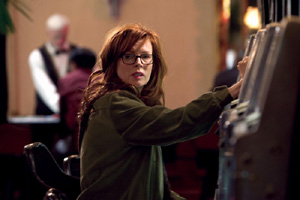
Alt text

Even Money:“Come on, baby! Mama needs a new career!”

Will had joined us at some point, and next we watched “Even Money,” an Afterschool Special sort of melodrama that explains why Gambling Is Bad. Reason #1: It makes you lose money. Reason #2: It apparently makes you overact, too, though it’s possible you’re only susceptible to that if you’re Kim Basinger, who plays a casino-addicted wife. Kelsey Grammer wears a fake nose and plays a hard-boiled homicide detective. You should probably see the movie just for that, actually, and for no other reason.

The director, Mark Rydell, was sitting just across the aisle from us, which made it very awkward when we laughed at the unintentionally funny parts of his movie. It also makes it awkward when, as everyone’s leaving the theater, we’re walking past him saying, “HOLY CRAP WAS THAT BAD!!”

It was then time for, yes, another party. Three nights, three parties. This one was at Maggie Mae’s again, but on the ground floor. Apparently the upper level was reserved for some magical special party for special people only, and scum like SXSW passholders weren’t allowed. But on the plus side, we ran into our new best friends Amber and Greg, as well as their friend (and our third new best friend) Kristina. This time we took some pictures, in case you didn’t believe us that we have new best friends.

Rumors were spreading that Wednesday’s to-be-announced slot would be a screening of “A Scanner Darkly,” Richard Linklater’s new film based on a Philip K. Dick story. This makes the third time at SXSW that I have had to mention a celebrity with the last name Dick. The rumor couldn’t be confirmed, but it seemed reasonable, especially considering Linklater is a Texan.

This party was sponsored by the movie “Darkon,” which I have not seen but which Scott says is fantastic. The subject matter didn’t interest me: It’s a documentary about a group that engages in live-action role-playing games. In other words, rather than just sitting around playing Dungeons & Dragons, they actually put on homemade costumes and pretend to fight with homemade weapons.

I should choose my words carefully here, I think, but let me just say that I think role-playing games are stupid and the people who play them are losers. Wait, wait, that totally came out wrong. What I mean is, I hate those people. No. Shoot. I’m sorry. I don’t have a point. But I wasn’t planning to see the movie until I went to this party, which made the film seem fun and which was heavily attended by people who had already seen it and were raving about it. Does it count as “buzz” if the only place I’ve heard it is at a party sponsored by the film being buzzed about? Or is that more like propaganda? Eh, whatever. I decided I’ll see “Darkon” tomorrow. It’s playing during the slot where I was going to see “Summercamp,” a documentary about kids’ summer camps, but forget that. Those kids can all go to hell.

Day 4 (Monday, March 13):

In all my years at Sundance, I’ve never seen more than five movies in one day. Four is typical, and five is occasional. But six? Madness.

But today was it. Today I accomplished the elusive six-movie day.

It actually wasn’t that hard. Screenings were at 11 a.m., 1:30, 3:45, 6:15, 9:15 and midnight. There was enough time between them to get from one venue to the next, and occasionally enough time to eat food. And I didn’t have to force it, either: All six movies were ones I was actually interested in seeing.

Which isn’t to say they were all good. First was “Live Free or Die” at the Alamo Drafthouse, which is fast becoming my favorite place in the world. (Our new best friend Greg mentioned that Entertainment Weekly named it the best movie theater experience in America. I recall the feature where they listed their top 10, but I had forgotten that an Austin landmark was at the top.) The movie started late due to a random press screening for “The Notorious Bettie Page” (which I’ve already seen) being held at 9:30. Why they didn’t foresee a 9:30 press screening interfering with an 11:00 public screening, I don’t know. Maybe they thought “Bettie Page” was only 60 minutes long.

Anyway, while we were outside (in beautiful weather, the first nice, pleasant day we’ve had in Austin), a festival volunteer came by to inform us that it would be an extra 20 minutes or so before we were allowed in. He said if we wanted to, we might mosey over to a nearby coffeehouse and grab a snack. That suggestion led to this conversation between a man and his female friend, in line behind me:

WOMAN: I want a cupcake, but I don’t want to walk three blocks to Starbucks.
MAN: Lady, if you won’t walk three blocks for a cupcake, you don’t deserve to eat.

Truer words were never spoken.

“Live Free or Die,” as it turns out, is a lukewarm comedy set in New Hampshire, where a cowardly wannabe nicknamed Rugged (played by Aaron Stanford) tries to maintain a reputation as a hardcore gangster criminal without actually committing any significant crimes. Paul Schneider is funny as Rugged’s dumb sidekick/goon, but the film never rises above average.

I exited the Drafthouse and got right back in line for “Darkon.” I wasn’t alone. Apparently the buzz had spread beyond the confines of that “Darkon”-sponsored party, because the line was already stretched around the corner. Erik joined me in line — no one has any compunction about letting one or two or 12 of their friends join them, regardless of where they are in line — and we got to see the much-discussed “Darkon.”
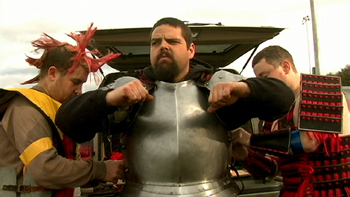
Alt text

Darkon:“I feel pretty… Oh so pretty… I feel pretty and witty and armor-plated!”

These live-action role-playing guys (and girls, though they are much less plentiful) are about the way you’d expect them to be. In the documentary interviews, several of them state plainly that the fantasy game is appealing because it gives them a chance to be something they never are in real life: powerful and successful and not living in their parents’ basement.

How does it work? It’s a cross between Dungeons & Dragons and those guys who re-enact Civil War battles in meticulous detail. The players make their own armor and weapons (soft, round-edged representations of swords, cudgels and maces), and there are color codes to determine what kind of injury you suffer if you are hit during a battle. There are a lot of off-battlefield negotiations between rulers, too. When the documentary was being shot, the imperialistic kingdom of Mordom was being challenged by the smaller, more peaceful Laconia, because the Laconians didn’t like how Mordom was always throwing its weight around, the big jerks.

The best line in “Darkon” comes when a man whose character is that of a dark elf is trying to buy potions from someone. He buys a couple — agony, paralysis, etc. — and then says, very seriously, with great intensity, “One thing I do need, and will pay greatly for, is a supernatural death poison.” Don’t we all, dark elf. Don’t we all.

“Darkon” turns out to be pretty fun, though by no means revolutionary or particularly insightful. The filmmakers don’t exactly make fun of the subjects, but they don’t exactly take them as seriously as they take themselves, either. I suppose you could either laugh at or laugh with the participants, depending on your opinion of fantasy role-playing games. I laughed at. But then, this is coming from someone who watches 350 movies a year, so maybe I’m not one to talk about moderation.

Erik headed up to the Dobie for something next, while I went to the Paramount to join Will, Scott and Laura for “95 Miles to Go,” a documentary that follows Ray Romano on a stand-up tour through Florida and Georgia. He hates to fly, so after his initial trip to Miami, he drove a minivan to all his destinations, accompanied by long-time friend and opening act Tom Caltabiano and an “Everybody Loves Raymond” intern named Roger. Roger’s in charge of filming their every move, and while the film has maybe 15 minutes of total footage of Ray’s shows, it’s mostly about everything else: the driving, Ray’s petty neuroses, and his pleasantly bickersome relationship with Tom. It’s a very funny movie, again serving no greater purpose or offering insight into anything, but providing many hearty laughs.
Alt text

95 Miles to Go:Tom and Ray await service at a Chinese restaurant. The whole movie is pretty much just like this.

Ray and Tom were on hand for Q-and-A afterward, so we stuck around. They continued to be very funny, and they were soon joined by “surprise” guest Brad Garrett, Ray’s “Everybody Loves Raymond” co-star. He harassed Ray, made fun of his ego, and provided general merriment. It was a most enjoyable Q-and-A.

They don’t let you bring outside food into the Paramount, though they are more than happy to sell you candy bars for $2. Not the movie-theater-sized candy bars, either, but the regular ones you can get in a vending machine for 65 cents. You expect to pay a dollar for those at film festival venues, but TWO dollars? No sir. Because I don’t like The Man telling me what I can and can’t bring into theaters, I was more than happy to hide Scott’s leftover stromboli in my backpack, which the people at the door were going to make him discard. After the Ray Romano thing, he stood in line for the next film and ate his stromboli while I dashed across the street to a restaurant called Hickory Street, where our new best friends Amber, Greg and Kristina were dining. I ate Greg’s french fries and bought a cookie and called that dinner. I’m thinking of writing a book called “The Film Festival Diet,” if only because I’m reasonably sure it’s no less healthy than Atkins.

The next movie, for which we were joined by our new best friends, was “The Oh in Ohio,” starring Parker Posey as a woman who, despite all the efforts of her husband Paul Rudd, can’t seem to achieve the, um, ultimate, er, destination in their marital collaborations. (The “O” in Ohio is the Big O.) (Not Oprah, the other one.) The movie’s pretty dirty (or “sexy,” as they say in Hollywood), and while it’s funny for a while, it takes an odd detour in its last act. This detour involves Danny DeVito, so I guess I don’t need to tell you that “sexy” is not the word people should be using to describe it.

Alt text

The hat was one of Bickford Shmeckler’s less cool ideas.

It was then time for me and Scott to join Amber and Kristina in piling into Greg’s bird-crap-covered car and driving to the other Alamo Drafthouse. This one’s new, has two screens, and is on the south side of town. We were to see “Bickford Shmeckler’s Cool Ideas,” and maybe it was “The Oh in Ohio” influencing us, but we thought “Shmeckler” sounded like an obscene job description. (“What do you do?” “Oh, I’m a shmeckler. I’m in charge of all the shmeckling.”)

The movie is an up-and-down comedy about a brainy college student (Patrick Fugit) whose notebook of Stephen Hawking-style brilliance goes missing. I like certain elements of the film — it was shot in a very nice-looking high-definition digital video, for example, and Fugit is almost always a fun actor to watch — but it’s not as amusing or entertaining as it wants to be, nor are Bickford Shmeckler’s cool ideas actually all that cool.

That’s five, if you’re counting, and one to go. We drove back downtown to the original Alamo Drafthouse, and actually had an hour to kill before we needed to get in line. (We killed it by sitting in the sports bar next door and drinking Coke. Don’t let anyone tell you Austin isn’t a party town.) The midnight movie was “Population 436,” a washed-over “Twilight Zone” story about a weird little town where the population is always exactly 436. We realize within the first couple minutes that every time someone is born, someone else dies, so the question I have is why the filmmaker decided to drag it out for so long. How do you make a film like this and not realize how unoriginal the idea is? Have we forgotten Shirley Jackson’s classic short story “The Lottery”? Or any of the various TV episodes and movies about strange burgs with ancient superstitions that involve human sacrifice? I mean come on.

Alt text

Population 436: “What do you mean you wish you knew how to quit me?”

When Scott and I got back to the hotel, we found our HBS.com pall Chris “Oz” Parry had arrived from Vancouver. That’s four people sharing this hotel room, if you’re counting, and fortunately none to go. We called for another roll-away bed to be sent up, and we wondered how many times we could do that before they started asking questions.

We also showed Oz a DVD of our favorite short film, an animated music video called “Washington.” It’s a slow-grooved hip-hoppy song about the Father of Our Country, with his achievements exaggerated to Paul Bunyan proportions. “He ate opponents’ brains / he invented cocaine” is one couplet; “He has a wig for his wig and a brain for his heart” is another. We’ve watched it two or three times every night since getting it.

After the nightly “Washington” screenings, Erik wanted to sleep, Oz and I wanted to write, and Scott wanted to watch a screener of something. What we settled on was ordering room service. It was the first time I had ever had room service, actually. Every time I’ve stayed at a hotel, it’s always been the cheap kind that doesn’t have room service, or the expensive kind where I’m spending so much on the room that I can’t afford to spend $15 for chicken fingers. But it was 3 a.m., we were starving, and so I forked over $9 for a club sandwich. The sandwich wasn’t worth $9, of course — the only way a club sandwich would be worth $9 is if it came with fries and four dollars. But what could I do? You watch six movies in one day, you deserve a treat.

Day 5 (Tuesday, March 14):

None of us went to bed until 4 a.m., so we slept in until 11. Then there was a lot of lingering and loitering and farting (mostly Oz), and finally Oz and I headed to the convention center so that he could pick up his credentials and so that I could finally get some serious writing done. And by “serious writing,” I mean blog entries with juvenile shmeckler-related jokes.

There was a massage therapist on hand in the press lounge again, a cool young gal named Jennifer. I forced myself to get some work done and then allowed myself the treat of a complimentary 15-minute massage. It was heavenly. Jennifer said she’s moving to Portland soon, and that’s where I live, so we’re totally best friends now. Later, after I left the press lounge, I realized I should have tipped her, and I cursed my stupidity.

My first film of the day wasn’t until 4:30, and it was “Patriot Act,” by comedian Jeffrey Ross. He joined Drew Carey’s USO tour to Iraq in 2003 — just after the fall of Baghdad and before Saddam was found — and videotaped the trip with his camcorder. Afterward, he thought the footage might make for an entertaining and/or informative movie.

Turns out he was right. There’s a few minutes of footage of him and the other comics performing for crowds of enthusiastic soldiers, the way Bob Hope used to do. But like the Ray Romano film, this one focuses on the behind-the-scenes experiences, not on the gigs themselves. Ross and his buddies are funny, awestruck, frightened and humbled as they meet soldiers, hear harrowing stories, and crack jokes about the war-torn areas they visit. Humor is how people deal with tragedy, after all, and it’s genuinely touching to see how delighted the troops are to have some entertainment.

I was very impressed with the film. Ross is a scathingly funny comedian, known as one of the most hilarious contributors at the Friars Club celebrity roasts. (“Drew Carey is to comedy what Mariah Carey is to comedy,” he once said. He is also fond of making references to Bea Arthur’s penis.) But the film shows him and his compatriots as regular Americans who, whatever their attitude toward Bush’s Iraq policies, are grateful for the dedicated men and women in the military who are doing the tough jobs over there.

Ross was on hand to introduce the film and to take questions afterward. He was in fine form. I’ve never seen his act live, but apparently one of his skills is making quick-witted, off-hand references to audience members, particularly those coming in late or leaving early. During his intro, he interrupted himself several times to acknowledge people just coming in, often noticing them before we did. “Are you a natural two-tone?” he said to a woman with multi-colored hair. “Good, my pot dealer, Joe-Joe, is here,” he said of a guy who looked the part. “You got some good s*** for me? We’re seeing the Strokes tonight.” When a very heavyset woman with a butch haircut entered, he said she was his high school gym teacher.

He was funny in the Q-and-A, too, but given the serious undertones of the film (which is also uproariously funny, I should add), some of the Q’s led to more somber A’s. Still, I like what he said when someone asked him whether he’d seen the other Iraq documentaries playing at the festival, including one called “My Country, My Country”: “I thought that one was about Garth Brooks, so I didn’t go.” He explained that since he’s been over there (and has since returned on another USO tour), it’s difficult for him emotionally to watch movies about the crisis. “I couldn’t (even) watch Lauren Bacall make her Oscar speech,” he said.

I had to skip out of his Q-and-A a little early, though I managed to escape being commented on as I did so. (When one woman got up, Ross instantly said, “Ma’am, I’m going to have to ask you to leave.” So simple, but so funny.) I had to get to the other Alamo Drafthouse, the one down the road a couple miles, and that meant taking a taxi. I had hoped to share the cab with Scott, but I couldn’t find him at our designated meeting place, and he doesn’t have a cell phone (yes, he’s the one; you probably read about him), so I had to shell out the $10 myself.

The movie I was seeing was “The Lost,” and it was an atrocious piece of crap, without question the worst thing I’ve seen at the festival so far. It’s a horror film, sort of, about a young sociopath in the style of “American Psycho’s” Patrick Bateman who kills a couple women and then, four years later, flips out again. But in the meantime, there’s a whole lot of nothing. The film keeps introducing characters and spending scenes with them for no reason, and the lead psycho’s psyche is given only a cursory glance. (He hates his mother, obviously, and has to help her run a Bates-esque motel.) Also, with his cowboy boots, big belt buckle, sleeveless T-shirt, and slick black hair, he looks like k.d. lang, which you’ll probably agree is never a good thing for a lead actor.

I didn’t want to pay another 10 bucks for a cab, so I walked back downtown after the film, a distance of probably a mile and a half. I was good and exhausted by the time I reached the Paramount, where there was no one checking passes at the door, which means anyone could have walked in. Good to know: As the week goes on, security gets more lax. Maybe next time I’ll sneak some friends in.

Alt text

The King:“Gael Garcia Bernal, you smell funny.”

The film: “The King,” starring Gael Garcia Bernal as a young man who shows up in Corpus Christi, Texas (though the film was actually filmed in Austin), to find the father he never knew. The father in question is a holy-roller minister played by William Hurt, and the tryst he had with the young man’s mother was before he became a Christian, so he wants nothing to do with the fruit of that relationship. Behind his back, the kid starts dating the minister’s teenage daughter — and yes, I mean the teenage daughter who is the guy’s half-sister. It gets even yuckier from there, but it’s an intriguing film. There comes a point where everyone has so many lies and secrets floating around that it’s only a matter of time before they’re all going to be revealed and the stuff’s gonna hit the fan. And hit the fan the stuff does!

It was nearly 11:30 when “The King” ended, and the SXSW closing party was already in full swing. Why have the closing party on Tuesday when the film festival runs through Saturday? I dunno. Beat the rush, I guess. No, it’s because the conference part of the festival (with a trade show, panel discussions, etc.) ended today, and the music part of the festival begins tomorrow. The party is a way to bid farewell to one group while welcoming the other.

For some reason, this party was held outside of a meat-packing plant on the east side of town, I guess because maybe the paper mill and the oil refinery were booked. Scott, Erik, Oz and our new best friends Greg, Amber and Kristina were already there when I arrived, and we had a joyful reunion. For some reason Oz has taken it upon himself to find a girlfriend for Erik, who is a decent enough fellow that he ought to have no trouble finding a girlfriend without the help of a flatulent Australian. But Oz got married recently, and getting married is like becoming a zombie: You stumble around in a daze, you’re sort of the same person you were before but not really, your looks go downhill, and all you ever do is try to get people to join you. Married people look at single people the way zombies do at the living: fresh meat waiting to be converted.

The band Sleater-Kinney was playing, very loudly, at the party. I text-messaged this fact to a friend who I thought would be impressed, and he responded, “kewl.”

I told Greg I’d been to the Jeffrey Ross movie, and he was jealous, because he loves the guy. Alas, Greg had been busy helping to run a panel that Charlize Theron (who produced a documentary) was involved with, so he was stuck looking at her porcelain beauty all afternoon.

Alt text

Jeffrey Ross and me in a Schick advertisement “before” picture.

A few minutes after learning of Greg’s fondness for Ross, whom should I see across the way but Ross himself! Greg was conversing with someone, so Amber and I scurried over to Ross to say hello and get a picture with my digital camera. I then showed that picture to Greg, who became enraged with jealousy, which was exactly my plan. Luckily, Ross was still around, and we were able to get a picture of Greg with him, too. All the celebrities here — the stars at night really ARE big and bright deep in the heart of Texas — and the one I get my picture with is Jeffrey Ross. But hey, you take what you can get. And sometimes what you get is a schlubby-looking Jew.

Speaking of schlubby-looking Jews, Scott got us all invited to an after-party with the “Darkon” guys back at their hotel, and if there’s anyone who knows how to party, it’s people who dress up like Renaissance Faire soldiers and roll 12-sided dice. With the SXSW party ending at 1 a.m. (it had begun at 9, right after the awards ceremony), we still had an hour before our customary bedtime, so we figured we’d go. Unfortunately, we got the location wrong, and by the time we found out the correct locale, we were back in our hotel room and it was 2:30. Scott still went, though, and returned at some unholy hour, just in time to throw things at me to make me stop snoring.

SXSW, like most major film festivals, has a jury to choose awards for best documentary and best narrative films, and there are audience-voted awards in the same areas. They hand out ballots at screenings of eligible films, and you can rate the film on a scale of 1 to 5. I never vote, though, because I feel like since I got in free, I shouldn’t be allowed to have the same input as people who paid for their tickets. Also, not voting takes less effort than voting, as my generation proved in the last presidential election.

For documentaries, “Maxed Out” won a Special Jury Prize (whatever that means), and “Jam,” about 1970s roller derby competitors, took the main prize. “Darkon,” predictably, won the audience award.

Among fiction films, the jury gave an award for Outstanding Ensemble Cast to “Americanese” (which I hope to see tomorrow), and another one for Outstanding Visual Achievement to “Inner Circle Line” (which I know nothing about). The main jury prize went to “Live Free or Die,” which astounds me, considering how average it was. The audience chose “Americanese.” Luckily, “Crash” didn’t win anything.

Day 6 (Wednesday, March 15):

This was it, folks. My last day at SXSW (or South By, as the kids abbreviate it in conversation). The films continue through Saturday, but Erik and Scott were leaving today, and thus my hotel gravy train was ending. (Note: The hotel contained no actual gravy. Or Internet access, for that matter, unless you paid $10 a day.)

Alt text

No wonder Robert Carmichael is so ecstatic. He’s smoking pot with his loser friends while sitting on a cement barricade next to the sea!

After checking out of the hotel, I ran into Will and we went to the Alamo Drafthouse for an 11 a.m. showing of “The Great Ecstasy of Robert Carmichael.” The people who made “The Lost” should be grateful for this movie: Because of it, “The Lost” is no longer the worst thing I saw at SXSW.

“The Great Ecstasy” has a large cast of characters in a series of plot-less fly-on-the-wall scenes. It seems to be going in no particular direction, with no point whatsoever, but only for 80 minutes. In the last 10 minutes, it suddenly becomes shockingly violent and exploitative, moving from the realm of the merely boring to the genuinely deplorable. I suspect filmmaker Thomas Clay would say that if he provoked a strong response, then he considers himself to have succeeded. But I say it’s easy to do something shocking or taboo. What’s hard is to do it in a way that is thematically, artistically and cinematically justified — in a way that doesn’t seem to be doing it just for the sake of doing it, in other words.

Will and I both hated this movie, and we raged about our hatred for it as we walked back to Congress Avenue to a cafe called the Hideout, which had caught my attention earlier with its promise of free wi-fi and gigantic cookies. (It delivered on both promises in splendid fashion.) Will eventually left me to my writing as he went to stand in line at the Paramount for the 4 p.m. “surprise” screening of “A Scanner Darkly.” If there was ever an official announcement of the title, like a press release or an e-mail, I didn’t see it. Yet somehow everyone knew about it, and we anticipated that the lines to see it would be lengthy.

We were right. Everyone with a SXSW pass congregated in that line, but before any of us were let in, the 400 people on the “guest list” (i.e., Austin film industry types, their friends and families, and people tangentially connected with the film) were admitted. Thanks to Will staking out a spot early, we were at the front of the pass-holder line — and still, by the time we got inside, the theater’s main level was two-thirds full, with only the back rows and the balcony still open.

Nearly all of our crew was there. Erik had flown back to Chicago and Laura was goodness-knows-where, but Scott, Oz, Will and I snagged a row, and our new best friends Greg, Amber and Kristina joined us, as did a girl I didn’t know. We made her sit on the end, next to Oz.

The movie is the latest from Richard Linklater, whose previous films include such diverse fare as “Dazed and Confused,” “Waking Life,” “School of Rock” and “The Newton Boys.” “A Scanner Darkly,” based on a Philip K. Dick novel, is animated the same way “Waking Life” was: Scenes were shot in the usual fashion, and then artists colored over the frames. There’s no particular reason for this except that it looks cool, and therein lies the rub. Without the rotoscoping (as it’s called), the film would be completely undistinguished. The story, a futuristic thing about surveillance and identity, is nothing special, and neither is the acting (though it’s always fun to see Robert Downey Jr. play a crazy person).

My friend Michael arrived from Houston not long after “A Scanner Darkly” ended. After checking in at the Motel 6 where we’re staying tonight, we searched downtown for a place to park so we could eat dinner. We found a spot, and at the very moment we saw it, a homeless man pointed it out to us. I was unfamiliar with this scenario, but Michael was experienced. Apparently you have to tip the homeless man for his unnecessary service or else run the risk of having your car vandalized. Michael forked over a dollar and thanked the gentleman for his keen work in gesturing at a huge empty parking space, and I counted myself grateful to live in Portland, where our gigantic homeless population has not yet become so industrious.

Michael and I ate at 6th Street’s Iron Cactus, a decent restaurant that was ridiculously busy and probably understaffed. The music part of SXSW was now in full swing, and the streets, pubs, tattoo parlors and restrooms of Austin were thronged with people. At 31, I was older than almost all of them. Every time we walked past a bar from which loud live music was emanating, Michael worried whether he should have brought earplugs. No, he’s not an old man; he’s just a wuss.

It had been my hope that we would see the 9:30 screening of “V for Vendetta,” but the more I examined the situation, the more I realized the idea was futile. I would have no problem getting in with my pass, but Michael would have to stand in the regular-people line, and those losers only get in if there are still seats left once the pass-holders are in. At 8:30, the pass-holder line was already lengthy, and the regular-people queue was stretching around the block, too. So we said goodbye to Scott (who was already in line), abandoned the “V for Vendetta” plan, and joined Greg, Kristina and the new girl at a watering hole several blocks away. Amber had ditched us for a party to which she was invited but we were not. (Is Amber a snob???????? You decide.)

At around 11, Michael, Greg, Kristina and I, now joined by a different new girl — Greg has lived in Austin long enough to have acquaintances everywhere he goes, and I’ve started making a conscious effort not to bother learning their names — went to the ATX Magazine party, being held in a gravel parking lot on the southeast edge of downtown. Bands were doing their sound checks when we arrived, and about 30 people were milling around waiting for something to happen.

After a few minutes, the event’s organizer approached a group of would-be revelers and said we all had to go out the gate, have our IDs checked, and then be re-admitted before they could begin the festivities (and by “festivities,” as with most SXSW-related things, I mean the serving of complimentary alcohol). For some reason, he was looking directly at me when he made this announcement, like somehow it was my fault the party hadn’t started yet, or my fault that they had left the gates open and let people wander in before they were ready for them. Accepting my apparent position as ringleader, I led us out of the gate, where our IDs were checked and we walked back in.

Unfortunately, we five were the only people to do this. So 10 minutes later, the organizer made the announcement AGAIN, and about 20 people — us included — exited, got carded, and re-entered. That still wasn’t everyone, but at this point the organizer gave up and returned his attention to getting the kegs tapped, a process with which I confess utter unfamiliarity. (It’s a big barrel of beer. Can’t you just drill a hole in it and let it pour out?)

It was a tragically lame party, probably the lamest party in America after Ralph Nader’s Green Party. The gravel parking lot didn’t exactly exude elegance, there were no restrooms, and the only beverage available was beer. Don’t drink beer? Too bad. They didn’t even have water. The weather turned drizzly, too, which I guess wasn’t ATX Magazine’s fault, but they didn’t really do anything to stop it, either.

I realized it was time to say goodbye to SXSW. Michael and I are heading to Houston tomorrow, where I’ll spend a couple post-film-festival days before returning to Portland. With heavy heart I bade farewell to my new best friends, and Michael and I found our way back to his car, pleased to see his payment of $1 had been enough to prevent the bum/extortionist from keying it.

Alt text

Clockwise from left: Amber, Greg, me and Kristina. Kristina would have been in the picture more, but she’s very, very short.

Sundance is legendary for its parties, but my experience has shown that reputation to be undeserved. There are raging parties, no doubt — but they are exclusive and secretive. The official, Sundance-sponsored ones are always worthless, poorly attended and mostly ignored by the regular festival-goers. At SXSW, the official parties were great — in fact, the only bad one I went to was an off-the-record one — and everyone from filmmakers to actors to film critics to regular pass-holders attends.

This turned out to be an important distinction between Sundance and SXSW. At Sundance, if the movies are mediocre, you really feel it. At SXSW, the films were occasionally sub-par, yet I didn’t notice. Why? Because I was having fun anyway. Eating at the Drafthouse, going to SXSW parties, watching “Washington” back in the hotel room, getting caught up in one another’s personal dramas, making fun of Harry Knowles — these six days were outrageously entertaining whether the movies were any good or not. And several of them were very good, of course.

My thanks to Matt Dentler, the suave “conference and festival producer” who is the de facto face of the fest. He introduces almost every screening, using some kind of time-space portal to travel all over Austin, and has been good to the HBS.com crew. Elizabeth Derczo is the festival’s publicist, and she was instrumental in getting me credentialed and making sure members of the press had what they needed. My friends and colleagues Scott and Erik were lovely to let me occupy space in their hotel room, and it was good to see them again so soon after Sundance. Nice to see Oz again, too, and to meet Will and Laura in person for the first time. The Internet makes it possible for us to be friends, but I’m glad we have occasional chances to hang out in real life, too, if only to see what one another smell like.

I don’t think I could live in Austin. It’s too sprawled out for my tastes, and I’m not sure how much fun it is without the festival. I know I don’t want to be here in July, when it’s 110 degrees and there are armies of scorpions patrolling the streets. But I’ll definitely be back next March for SXSW, even if I have to sleep in the street and disturb all of downtown with my snoring.

Angry Letter: PETA

1

I used to make fun of PETA somewhat regularly in “Snide Remarks,” a fact which evidently came to the attention of someone named Rebecca (becs_x_b@hotmail.com), who submitted this scathing rebuke. It basically boils down to “blah blah blah, I disagree with you; therefore, you are a bad writer, blah blah blah.”

Dear “D. Snider” if thats what you call yourself. [Um, no, I don’t.]
After thoroughly reading your aritcles on PETA I concluded that you are an idiot. [Really? Most people figure it out a lot sooner.]You also seem incapable of writing a humour column, and would recommend that you don’t call it that because really you are a disgrace to the world of writers. In my small amount of years upon this planet I have achieved a greater intellectual standard than you could ever hope to achieve throughout your hopefully short life. I really should eat that hat of yours [You should, or I should? Who’s eating the hat here?] not just because you are wrong but because I hope it sticks in your throat and chokes you to death. Your “writing” [Like it or not, it WAS writing, so the sarcastic quotation marks don’t make any sense] makes you sound like an old fat man who has no actual clue as to what is really happening and uses information he scrounges off the internet to write his “articles”. [Which is odd, because all the information in my PETA columns comes directly from the PETA Web site.] Feel free to email me if you ever do come up with a decent argument against PETA. They do so much good for animal welfare worldwide and deserve to be congratulated not insulted. However I do not agree with some of their principles, for instance I am not a vegetarian but you would not find a piece of battery chicken on my plate. [Battery chicken? Is that a chicken made from batteries? Or is it battery-powered chicken?] If you feel happy eating a chicken that could easily have been scalded alive then you are more inhumane then i thought possible. I suppose with these views you also find hunting acceptable. [And I suppose with your spelling and grammar errors, you are retarded. See?! Sometimes supposing things isn’t logical!] If this is true I quite agree with you! I would be perfectly happy to ride out and hound you until you can run no more before skinning you alive. [You want me to choke to death on a hat and/or to be pursued and skinned alive. and I’m the inhumane one?] If this was legal I would not hesitate to do the honours.
Please do email me I would be happy to hear with any disagreements you have with my opinion.
Oh and please take some lessons in writing, because it really is atrocious

Four minutes later, she sent this addendum:

I also suggest you use your articles as bog roll because that is all they are useful for

It took her four minutes to come up with that. “Bog roll” is British slang for toilet paper, by the way. How I would use my Internet-only columns as toilet paper, she did not explain. Instead, I shall continue to use toilet paper made from the skins of baby seals.

By the way, if you want to read my PETA columns, you can find them here:

I PETA the Fool
PETA’s Dragon
Milking It
Pet Peeves

Take My Eyes (Spanish)

0

Icí­ar Bollaí­n’s searing Spanish drama “Take My Eyes” does what few films before it have managed: It depicts domestic violence without making the abuser a one-dimensional monster and without becoming a suspense-thriller.

Reflect a moment on other films that have dealt with this topic. The elements are usually sensationalized: The husband isn’t just angry that his wife has left him; he hunts her down, and she generally winds up being obligated to kill him in self-defense. It is usually unclear what she ever saw in him to begin with, and there seems to be nothing drawing her to him now. He is a tyrant, an ogre, often an adulterer, and when she insists she loves him, we can’t for the life of us imagine why.

Now consider “Take My Eyes,” which brings everything back to reality. Antonio (Luis Tosar), an appliance salesman, suffers from profoundly low self-esteem (one scene between him and his brother explains a lot), and his first thought when his wife doesn’t answer her cellphone is “that she’s forgotten me.” In a sincere effort to keep Pilar (Laia Marull) from divorcing him, he attends anger-management therapy and sees a counselor.

Pilar, for her part, leaves Antonio and takes their young son Juan (Nicolás Fernández Luna) with her to her sister Ana’s (Candela Peña) house. Ana is engaged to a loving Scotsman, providing contrast to Pilar and Antonio’s failed marriage, and making Pilar long for happier days. Ana and Pilar’s mother, a traditionalist, wants a huge church wedding for Ana and tells Pilar, “A woman is never better off alone.” Under these circumstances, you can see why Pilar would be tempted to give Antonio another chance.

The genius of this film is so obvious it’s a wonder more filmmakers don’t try it: It’s realistic, and thus more compelling, because we don’t know how it’s going to end. Real people often reconcile, and they often reconcile even when they shouldn’t. People don’t do that in Hollywood films dealing with this subject, because Hollywood films, for all their color, are still pretty black and white. Real life, you may have noticed, has a lot of gray areas.

And so Pilar does accept Antonio’s apologies and does try living together again, even as she knows, deep down, that it’s not going to work. Laia Marull, a lovely actress with sad eyes, perfectly enacts the behavior of a woman in an unhealthy relationship — the shame that makes you keep it a secret, the anger at friends who “don’t understand.”

Luis Tosar is equally powerful as Antonio, a hairy, brutish man whose faults can be traced and whose desire to make Pilar love him is genuine. What we feel for him is not sympathy, exactly; more like recognition. His abusive actions are the outgrowth of psychological and emotional problems that we’ve encountered. He has traits that we’ve seen in ourselves.

Eventually, there is a turning point, when it becomes clear the marriage either will or will not work. (I wouldn’t dream of spoiling it for you.) Even as that moment is dizzying in its intensity, it remains grounded in human nature. There’s no melodrama anywhere in the film, only drama, with every single moment superbly acted and startlingly believable.

Don’t Come Knocking

0

When big-shot Hollywood actor Howard Spence is on location somewhere, he puts up a sign on his trailer that says: “Don’t come knocking if the trailer’s rocking.” But the “Don’t come knocking” part applies generally. Howard wants to be left alone. How can he repress his feelings and self-medicate if people are always bugging him?

Howard is played in “Don’t Come Knocking” by Sam Shepard, who also wrote the screenplay from an idea he conceived with Wim Wenders, who directed. Howard Spence doesn’t represent any particular modern-day actor — he’s famous for making Westerns, which doesn’t describe anyone currently working — but he does embody the type of spoiled Hollywood millionaire we read about in the tabs. Booze, drugs and loose women are his idea of a good time, and he erratic behavior is well-known among those who work with him.

He’s shooting a Western in the hills of Utah when he finally decides he’s had enough and, like one of his characters, rides off toward the horizon. Once he’s miles from the set, leaving the cast and crew baffled as to his whereabouts, he trades his horse and cowboy costume for other clothes and hops on a bus bound for Elko, Nev.

Howard grew up in Elko, and his mother (Eva Marie Saint) still lives there. They haven’t spoken in nearly 30 years, though, not since Howard became rich and famous. She barely recognizes him when he arrives, but she doesn’t seem to hold a grudge at having been neglected all these years. She’s still his mom, after all, complete with milk and cookies.

Meanwhile, back on the movie set, the studio enlists a nattily dressed, no-nonsense investigator named Sutter (Tim Roth) to find Howard and drag him back to work. Also meanwhile, we meet a woman named Sky (Sarah Polley), who is traveling the West with an urn containing the ashes of her recently departed mother. She figures into the story a bit later.

Howard winds up in Butte, Mont., where he shot a movie 20 years earlier and had a happy affair with a local woman named Doreen (Jessica Lange), whose son Earl (Gabriel Mann) is the product of that liaison. Howard has rarely been happy since Butte, and he seems to hope that returning to the scene will spark something in him now.

Shepard’s screenplay and his performance both suggest a character who is wistful but not melancholy. From the very beginning, the film is sunny (literally and figuratively), and set in beautiful, wide-open Old West locales like Elko and Butte. Howard is unhappy with life, but the movie isn’t sad. It’s upbeat and optimistic, actually, buoyed by warm performances by Shepard, Saint and Lange. This is lightweight drama, sure, but it’s a charming example of it.

V for Vendetta

0

Is it possible to agree with a movie’s ideas so much that you feel like you’re being pandered to? “V for Vendetta” uses futuristic fear-mongering to delineate liberal America’s worries about the power of the right wing, and the specific details of the fictional oppressive society read like Michael Moore’s checklist of complaints about George Bush: forfeiture of civil rights, using a national emergency for political gain, counting on a terrified populace to offer blind obedience, and so on.

The parallels between this Orwellian dystopia and the left wing’s fears about present-day America are so plain, in fact, that it feels like the film, faithfully adapted from a 1980s graphic novel by Alan Moore and David Lloyd, is stating the obvious rather than presenting a radical new line of thinking. Liberal newspaper columnists express the same ideas as this film every day.

Ah, but the columnists don’t do it with Natalie Portman, Hugo Weaving, and an abundance of magnificent fight scenes.

Adapted by Andy and Larry Wachowski (creators of the “Matrix” movies) and directed by their frequent collaborator and first-time director James McTeigue, “V for Vendetta” delivers on its promise to entertain while it makes you think, even if what it’s making you think about isn’t exactly revolutionary. (“People should not be afraid of their governments; governments should be afraid of their people” is one of the more trite platitudes expressed in an otherwise articulate screenplay.)

As V, the otherwise nameless masked freedom fighter who seeks to bring down the fascist regime ruling England, Hugo Weaving uses swords, knives and poisons to thrilling effect. Very much a Phantom of the Opera figure (with some Scarlet Pimpernel and Count of Monte Cristo thrown in), V has personal reasons for vengeance that cloud his for-the-greater-good philosophies, but that’s part of the film’s brainy appeal. As much as we might agree that the corrupt totalitarianism headed by Chancellor Adam Sutler (John Hurt) needs to be brought down, how much murder and mayhem can we countenance in the doing of it? You have to break a few eggs to make an omelette, sure — but isn’t that probably the same rationalization Sutler used during his rise to power?

Natalie Portman, who famously shaved her head for part of the film, plays Evey, a young woman who comes to be V’s accomplice and sometime prisoner. Her parents were revolutionaries who were eliminated by Sutler’s camp years ago, and her own run-ins with the police have made her somewhat sympathetic to V’s cause. Seeking to remind people of what Guy Fawkes attempted on Nov. 5, 1605, V blows up a London landmark one Nov. 5, then urges citizens to join him in another act of extremism 365 days later. In the interim, V carries out his own agenda and works on persuading Evey to join him whole-heartedly, while the government desperately searches for the mysterious terrorist.

Is he a terrorist? Not in the traditional sense, no. He’s terrorizing the government, not the citizens. In fact, his stated goal is to help the common man be LESS afraid, by destroying the governing bodies that currently terrify them. Is America going down the same path that England is depicted as having traveled? Will the world look like this someday soon? And if so, is it necessary to blow things up in order to prevent it? “V for Vendetta” provides fodder for conversation and is a literate treatise, to be sure. It may go a little overboard in its desire to convince us of both its coolness and its insightfulness, but it’s fast-paced and smart enough to keep us onboard anyway.

Thank You for Smoking

0

“Thank You for Smoking” was directed by Jason Reitman, the 29-year-old son of director Ivan Reitman. The old man should be proud, and maybe a little jealous. “Thank You for Smoking” is better than anything he’s done since “Ghostbusters.”

Based on Christopher Buckley’s scathing 1994 novel, “Thank You for Smoking” (which the younger Reitman adapted, too) is a straight-faced dark satire about the all-American pastimes of spin-doctoring, lying and bullying your opponent with so much rhetoric that people start to think HE’S the liar. It’s a confident, razor-sharp comedy.

The place is Washington, D.C., the time is now. Nick Naylor (Aaron Eckhart) is the top spokesman at the Academy of Tobacco Studies, which is really just a fancy name for the lobbyists for Big Tobacco. Nick’s job is to contradict every study from the American Lung Association with a barrage of counter-studies, half-truths and double-talk. His job is to help Big Tobacco sell their cigarettes, to keep politicians from passing anti-smoking laws, and to get positive depictions of smoking included in the media wherever he can. His job is to sell death.

He does it remarkably well. A born shmoozer, Nick is suave, square-jawed and ever-smiling. (From a physical standpoint, this is the part Aaron Eckhart was born to play.) He is utterly shameless as a tobacco lobbyist, an expert at using his charisma to get people on his side — even though his side is the one that wants to encourage more smoking, especially among teen-agers (get ’em while they’re young and you’ve got a customer for life). When his 12-year-old son Joey (Cameron Bright) asks him about debating someone even though he is patently wrong, Nick responds, “If you argue correctly, you’re never wrong.” In other words, having the truth on your side doesn’t make you a winner; being a better debater does.

Nick meets for lunch once a week with his fellow members in the “M.O.D. (Merchants of Death) Squad”: Polly Bailey (Maria Bello), who is Nick’s equivalent in the alcohol lobby, and firearm lobbyist Bobby Jay Bliss (David Koechner). They compare notes and commiserate on how the world is turning against all three of their products. In their souls they know most of what they spew are blatant lies, but that’s beside the point. They have mortgages to pay, and their jobs are certainly challenging, to say the least.

Nick’s becomes more challenging when Vermont Sen. Ortolan Finistirre (William H. Macy) introduces a bill that would put a new warning label on cigarettes: the word “POISON” in black, accompanied by a skull and crossbones. Meanwhile, Nick is trying to get some cigarette product placement in a huge new Hollywood film (Rob Lowe has a couple of hilarious scenes as the producer arranging the deal), and he’s also begun dating a newspaper reporter, Heather Holloway (Katie Holmes, back when she was allowed to have fun), who is working on a story about him.

Having read the book (to which the film is mostly faithful, though a couple of characters have been eliminated), I am perhaps mostly impressed by the pitch-perfect casting of the film. J.K. Simmons, who plays Peter Parker’s blustery boss in the “Spider-Man” movies, is similarly boisterous but much more weaselly as B.R., Nick’s boss at the Academy of Tobacco Studies, barking out pep talks like this: “We don’t sell Tic Tacs, we sell cigarettes. They’re cool and available and addictive. The job is almost done for you!”

Sam Elliott, the quintessential modern cowboy type (he was The Stranger in “The Big Lebowski”), has one fantastic scene as a one-time Marlboro man who is now dying of cancer and speaking out against his former employers. I can’t think of anyone better to play the role.

And what about William H. Macy as a persnickety senator, or David Koechner as an unhinged gun fanatic, or Robert Duvall as a North Carolina tobacco company billionaire? (“Tobacco takes care of its own,” he drawls to his new protege Nick while sipping a mint julep.) To paraphrase B.R., when you have a cast this good, and everyone’s in roles to which they are so genuinely suited, the job is almost done for you.

Reitman handles the film’s eventful narrative (I didn’t even tell you about the attempt on Nick’s life) with smooth, even-handed precision. If it slows down in the middle, it’s only so Reitman can reload and fire some more shots in the finale. Everything about the film is as slick and sure as Nick Naylor himself, right down to our hero’s character arc as a good guy who eventually learns how to actually be good.

She’s the Man

0

The main character in “She’s the Man” is so stupid that I’m amazed she’s able to take a shower without drowning. Her stupidity is a powerful, brutish force, a fog that hangs over the entire film like a stench.

I dislike my fair share of movies, but I don’t recall the last time a film made me clench my fists or pull my hair in frustration and exasperation. If “She’s the Man” had not been a public screening, I’d have yelled at it on several occasions, urging that dumb cow of a protagonist to fight her instincts and do something un-stupid for once.

“Inspired” by Shakespeare’s “Twelfth Night” (in the same way that “From Justin to Kelly” was inspired by “Much Ado About Nothing”), “She’s the Man” tells the stupid story of a stupid girl named Viola (Amanda Bynes). Viola’s girls’ soccer team at her fancy Cornwall Prep Academy is disbanded due to lack of funding, and the boys’ team — captained by her jackface boyfriend Justin (Robert Hoffman) — says girls aren’t good enough to play on their team.

So Viola gets a brilliant idea, and by brilliant I mean really, really stupid. Her twin brother Sebastian (James Kirk) has been kicked out of Cornwall and is supposed to start his senior year at rival school Illyria in two weeks. But since he’s going to sneak off to London to play with his band instead, Viola figures she’ll pose as him, take his place at Illyria, get on the soccer team, and beat those Cornwall jerks at the season opener!

All the ways a girl can get revenge on her boyfriend, and Viola chooses the one that’s most complicated, most elaborate, and most likely to fail. Granted, a lot of people in movies arrive at cross-dressing as a solution to their problems much sooner than you or I would, and I accept this as a time-honored comedy device. But in the GOOD movies where that device is used — and that’s about 1 percent of the 2,832 movies per year that use it — the characters at least TRY to pass as the opposite sex.

Viola doesn’t try. Well, I should say she tries, but since she’s so paralyzingly stupid, she can’t try very hard. I guess my dog “tries” to answer the telephone, too, but it doesn’t amount to much. When she remembers, Viola — clad in a short wig, fake sideburns and mannish eyebrows — speaks in a slightly deeper voice that, for some reason, often (but not always) involves a Texas accent. But that’s only when she remembers. She usually forgets and speaks in her normal voice and says normal girl things, then goes, “I mean, um, (clears throat), what’s up ‘DUDE’?” Her goal is to pass as a boy, but every five seconds or so she completely forgets that that’s her goal and reverts to acting like a girl.

As you have already predicted, Viola/Sebastian develops a crush on her Illyria roommate (it’s a prep school, so the kids live away from home), a hunky soccer player named Duke (Channing Tatum). Most of their exchanges follow this formula:

DUKE: I have trouble meeting girls.
VIOLA/SEBASTIAN: Why?! You’re hot!
DUKE: What?!?
VIOLA/SEBASTIAN: I mean — um — (Texas voice) you’re a cool dude.

I’m serious, it’s that formulaic: a girly statement, followed by “What?!?,” followed by a fumbling backpedal. Over and over again. Several times throughout the film. And Duke never suspects anything is amiss. There’s even a scene where “Sebastian” helps Duke role-play how he’ll talk to the girl he likes, with Sebastian playing the girl part. Duke remarks that Sebastian is waaaaay too good at impersonating a girl’s voice. Yet at the end of the film, when the truth is revealed, Duke is ONE HUNDRED PERCENT FLABBERGASTED to learn Sebastian is really Viola. HE’S NEVER BEEN MORE STUNNED IN HIS ENTIRE LIFE! This outcome was COMPLETELY UNFORESEEABLE!!

During the occasional brief moments when Viola is remembering that she’s supposed to be a guy, her behavior is so bug-eyed and jittery that there’s no way anyone would buy it. The reason is that the director, Andy Fickman (making his theatrical feature debut), thinks that kind of overdone reaction will be funnier, so he’s instructed Bynes — who is no comic genius to begin with, I hasten to point out — to play everything up big-time. “Don’t just stammer ‘er, uh,'” I hear him telling her. “Make a panicked face and flail your hands a little when you say it! Yes! Just like that! Only BIGGER! More ridiculous! Yes! Now do that over and over again for 100 minutes! Now go out into the audience and STAB ERIC D. SNIDER IN THE FACE WITH A FORK!!” Then I wake up, cold and sweaty and unable to sleep for hours.

Duke’s crush is on a pretty girl named Olivia (Laura Ramsey), but Olivia thinks he’s just a dumb jock. (She’s right.) Instead, Olivia likes “Sebastian,” mostly because Sebastian is sensitive and doesn’t stare at her boobs and seems to know exactly how a girl thinks. Meanwhile, Duke meets the real Viola (he thinks she’s “Sebastian’s” sister) at a carnival, shares a moment with her, and thereafter considers her a good second choice if the Olivia thing doesn’t pan out. This leads to Viola-as-Sebastian trying to get Duke to forget about Olivia and go for Viola. Why it doesn’t lead to Duke realizing that Viola and Sebastian look even more identical than twins usually do, I don’t know. (See previous: dumb jock.)

My stars, I could go on all day. I hated this movie with an angry, fiery passion. I laughed exactly three times in 100 minutes: once at something David Cross said as the Illyria principal, once at a line from Viola’s father, and once at Viola/Sebastian’s reaction to being struck in the groin with a soccer ball. (“It burns!” is her best guess at why it’s supposed to hurt so bad.) And when even the brilliant David Cross can’t improve a movie, you know the movie is unsalvageable.

Church Ball

0

One of the most admirable things about “Church Ball,” Mormon filmmaker Kurt Hale’s fourth slap-happy contribution, is that you don’t have to be Mormon to appreciate the premise. This is a switch from Hale’s previous films (“The Singles Ward,” “The R.M.” and “The Home Teachers”), which relied heavily on things so intrinsically Mormon that had any non-Mormons accidentally wandered into the theaters where the films were being shown, they’d have been completely baffled (not to mention curious as to how someone’s home movies came to be exhibited in a commercial cinema).

“Church Ball” is about church basketball leagues, and how the men get so competitive and violent that you start to forget it was devotion to God that brought them together in the first place. I don’t know if other faiths have basketball leagues, or if other religions build gymnasiums into all their meetinghouses the way Mormons do, but it doesn’t matter. Even if you have no experience with these things, you can easily accept that they exist and enjoy the upbeat tone and occasional chuckle that make “Church Ball” a mildly entertaining experience.

The characters in the film are Mormon — their ecclesiastical leader is called “bishop,” and a Book of Mormon verse is quoted at one point — but the word “Mormon” and its synonyms are noticeably absent from the dialogue. In fact, all of the language has been scrubbed clean of any overt references to The Church of Jesus Christ of Latter-day Saints, all the better to give the film mass-market appeal. For example, Mormon congregations are called wards (the equivalent to what Catholics call parishes). But here, the term “ward” has been replaced with the more generic, all-inclusive “congregation.”

Whatever we’re calling it, the Mud Lake team is a rag-tag group of lousy players who are defeated every year by the rock-solid team from Crystal Hills. This is the last year the church will have officially organized leagues, and Bishop Linderman (Fred Willard) — a church ball veteran with an eye patch and other injuries to prove it — wants to make it a good one. So he replaces Mud Lake’s doddering old coach with Dennis Buckstead (Andrew Wilson), a mediocre player who must now coach his uncoordinated teammates to victory.

Hale, working from a screenplay that he wrote with Paul Eagleston and Stephen Rose, leaves no sports-movie cliché unturned, right down to the last-second play that decides the game and a serious overuse of music-accompanied montages. (I counted four montages, which is probably three too many for a 90-minute comedy.) Dennis and his teammates recruit new players, endure practice drills, and suffer the kind of humiliations and setbacks you expect from an underdog team, and since it’s a sports comedy (rather than an inspiring sports drama), you can count on there being a grossly out-of-shape player and one from a foreign country, too.

For some reason, Gary Coleman shows up as a diminutive new neighbor who is recruited for the team. He has three very tall sons, though. Why can’t they play? The movie doesn’t tell us. I assume it’s because it’s funnier for Gary Coleman to play basketball than it is for three tall guys to do so.

But there are many legitimately funny moments, too, often thanks to the contributions of the brilliant Fred Willard as the jovial, semi-insane bishop. Curt Doussett and Larry Bagby are great as two of Crystal Hills’ arrogant players, a pair of lawyer brothers with a signature frat-boy laugh. And Ross Brockley has a wry, understated delivery as Mickey, a Mud Lake player with a potty mouth. His profanity is bleeped every time, which, as “Arrested Development” has taught us, only makes it funnier.

On a whole, the acting is a step up from previous Hale efforts, no doubt due to the company having hired mostly professional actors rather than the filmmakers’ buddies. (In fact, the two most obviously amateur contributors are the basketball referees, played by Hale regulars: Salt Lake radio tool Jimmy Chunga and over-the-top Utah comedian Michael Birkeland.) It’s a wonder what committed, experienced actors can do for a mediocre script.

Unfortunately, there’s a lot of the usual Hale time-wasting, too. There’s a running gag with Dennis’ daughter preparing themed dinners — apparently just an excuse to make the actors wear silly hats — that isn’t funny enough to justify its randomness. Two scenes involving Dennis’ day job are completely irrelevant, and so is the sequence where the Mud Lake team has to go door-to-door selling meat. And the subplot where a nerdy Mud Lake player finds love is as pointless as it is bizarre.

Did I laugh? Yes, several times. Even with the just-mentioned tangents it’s still a more cohesive, streamlined story than, say, “The Singles Ward,” and the production values are getting better each time.

HaleStorm, the production company that distributes Kurt Hale’s films (among others), has said it will shift its focus to mainstream family comedies instead of Mormon-specific ones, and “Church Ball” is an indication that the metamorphosis has already begun. Will the gambit pay off? Will non-Mormons start noticing HaleStorm’s productions? I wouldn’t bet the tithing money on it yet, but they’re heading in the right direction.

An eBay Transaction Goes Awry

0

TO: pookyface739
FROM: soapluvver811

Dear eBay trader pookyface739,

I recently purchased a DVD box set from you, “All My Children: The Complete Series,” containing 9,014 episodes on 1,803 discs. The shipment arrived in a timely fashion; however, upon opening the package, I was disheartened to discover that instead of the “AMC:TCS” set, the box contained a sandwich, by all appearances a turkey club, uneaten and, given the rigors of shipping it had endured, well-preserved.

Nonetheless, edible or not, the sandwich was not what I paid for. I believe there must have been a mistake at your end of things. If you would kindly send the DVD set, I would appreciate it. I would be happy to return the sandwich to you at my own expense.

Sincerely,
George Kretzler
“soapluvver811”

• • •

TO: soapluvver811
FROM: pookyface739

HEY SORRY NO REFUNDS CHEK LISTNG ALL SAILS FINALE SORY U WERNT HAPPY SANDWHICH SHOUD BE GOOD.
POOKY

• • •

TO: pookyface739
FROM: soapluvver811

Dear Sir,

I am in receipt of your reply, for which I thank you, but I believe you may have misunderstood the intention of my correspondence. I am not asking for the $18,454 I paid for the “AMC:TCS” set to be refunded to me. I merely request — insist, in fact — that the item I bought be sent. I did not purchase a sandwich from you; the sandwich’s quality is irrelevant. Even if it were the tastiest sandwich ever made, it still would not be what I ordered (nor would it be worth $18,454 plus shipping, unless it were a mighty fine sandwich indeed, but that is beside the point). I purchased the “AMC:TCS” set, and that is what I want to have sent to me, right away, if you please.

Sincerely,
George

• • •

TO: soapluvver811
FROM: pookyface739

HEY EBAY LISTING SAID TURKEY CLUB SANDWHICH THAT IS WHAT U BOT SORY IF SANDWHICH WASNT GOOD NO REFUNDS ALL SAILS FINALE

• • •

TO: pookyface739
FROM: soapluvver811

Sir,

I’m looking at your eBay listing right now, and it reads: “DVD SET: ‘ALL MY CHILDREN: THE COMPLETE SERIES,’ all 9,014 episodes on 1,803 discs, brand-new, unopened!” There is also a picture of the set, which occupies a space of about 27 cubic feet, by the looks of it. Standing next to the set in the picture is a person I presume to be you, holding up a sign that reads, “If you win this auction, this is the exact set I will send you!,” with an arrow pointing to the DVDs. The inclusion of a turkey club sandwich in the transaction is neither stated nor implied, and in fact is precluded by your hand-lettered sign, which I assume someone else hand-lettered for you.

I must insist with the utmost severity that you send me the correct item or refund my money at once.

George

• • •

TO: soapluvver811
FROM: pookyface739

HEY GJKDLS OWOIE JSOV MAJSJS EBAY DJJDJSJ OEUFOV OS VOSOM MELWO SANDWHICH OWOEOEJ SODOJS SO QQQ OAOA OA ;;;;;;;;;;;;;

• • •

TO: pookyface739
FROM: soapluvver811

Sir,

Now I believe you are being intractable merely for the sake of it. I believe you are fully aware of your mistake and are trifling with me only because you find it amusing. Well, sir, I am not amused. I am $18,454 and 9,014 episodes of “All My Children” poorer, thank you, and I shall not endure this sort of tomfoolery where my money or DVDs is or are concerned. If you do not send a rational reply within 24 hours, I shall report you to eBay and leave you negative feedback.

George

• • •

TO: soapluvver811
FROM: pookyface739

HEYYYYYYYYYYYYYYYYYYYYYYYYYYYYYYY MACARENA

• • •

TO: pookyface739
FROM: soapluvver811

Well. I am baffled, frankly. You clearly do not take the situation seriously, and that is fine. I have reported you to eBay, and I have retained the services of a lawyer. I shall see you in court.

George

• • •

TO: George Kretzler
FROM: Law offices of Morton Hilltop

HEY WE FILLED SUITE AGINST DVD GUY FOR U, HIS LAWWER IS TOTALL DUMBAS, WE’LL TOTALY WIN SUITE, JUDGE IS AWSOME!!!!!!!!!!!!!!!!!1111

Cruel and Unusual (documentary)

0

Here’s a problem I bet you never thought about before: When someone is transsexual, maybe a man in the process of becoming a woman, which prison does he/she go to? The men’s or the women’s?

Filmmakers Janet Baus, Dan Hunt and Reid Williams have thought about the problem, though, and they spent three years making a movie about it “Cruel and Unusual” tells the stories of several male-to-female transsexuals who were placed in men’s facilities even though they identify themselves — and often have most of the outward appearances of — women.

The title of the film suggests the way prisons deal with the problem: They don’t. It doesn’t matter if your hormone treatments have given you a women’s voice, face and breasts, looking for all the world like a complete woman. If your equipment down south is still male — meaning you haven’t had the big surgery yet — you’re a man, as far as prison is concerned, and you go in with the men.

According to the film, 10 percent of male prisoners are raped at some point. Statistics on transsexuals specifically aren’t available, but it’s seems logical that if men are being raped by their fellow inmates, someone who actually looks like a woman would be an even greater target for assault.

Yolanda Valentin (born Daniel Valentin) looks and sounds so much like a woman that you’d never know she’d been born a man. But because of that damning bit of evidence below the beltline, she was put in a men’s prison. Ophelia De’Lonta and Ashley (with no last name given) also appear almost entirely female.

Even worse for some inmates than being placed with men is that most prisons don’t consider hormone treatments necessary medication. Thus the transsexuals are forced to suffer the withdrawals of being without something that their bodies have come to depend on. When a man starts taking estrogen, his body stops producing hormones naturally. Taking him off the medication, then, is like denying hormones to a woman after she’s had a hysterectomy.

Two other transsexuals are featured who are not quite so feminine. Linda Thompson and Anna Connelly both still have manly faces and voices (and genitals), but have long hair and breasts and identify themselves as women. (Linda and Ann weren’t the names they grew up with, obviously; they don’t even mention what their old names were.)

Linda, an oil-rigger by trade, can’t find work looking like a cross-dresser, and is often denied access to shelters and rescue missions. This led her to steal to survive, which led to prison. While in prison, unable to get her hormone treatments, she castrated herself. Lawyers observe that the taxpayers could have shelled out $20 a month for generic hormone therapy, but instead they had to pay tens of thousands of dollars for two trips to the emergency room.

Anna’s story involves her son, whom her ex-wife wouldn’t let her have any contact with after she went to prison. Though the story is sad, it doesn’t relate to the film’s main point, which is what it’s like for transsexuals in prison. As such, it feels like a tangent.

Focus is a problem throughout the film, actually. Though it has the makings of a serious and socially important documentary, and though it has been well-shot and professionally assembled, it often goes down paths like Anna’s that don’t feel relevant to the topic at hand. More about the horrors of life on the inside would serve the film’s purposes better, especially in terms of stirring public outrage. As it is, it’s a good but not great documentary that scratches the surface of a legitimate social problem without going very deep.

Lifelike (documentary)

0

Because every subject will eventually have a quirky documentary made about it, here’s the one about taxidermy, called “Lifelike.”

Insubstantial but pleasant, “Lifelike” is a brief (52-minute) look at the art of taxidermy, focusing on a few practitioners in Canada as they gear up for a major competition. Director Tally Abecassis takes us into the workshops of several congenial, altogether Canadian men — it’s always men who hunt animals and then turn them into trophies — and gives just a little peek into the process.

Dave Gibson is young and optimistic, a relative newcomer to taxidermy who has big dreams of placing high in the competition and who can say things like, “I love working with wildlife” without irony. (His wildlife is all dead, after all.) His mentor — his Obi-Wan Kenobi, if you will — is Ray Robinson, an articulate and philosophical older man who observes that taxidermists “are like animal morticians.”

Meanwhile, Jeff Brain has his own taxidermy shop, where a man named Calvin is his apprentice. Jeff made me laugh early on when he referred to his mother as “Mother” — not “my mother,” just “Mother,” as in, “When I was in high school, I spent all my Friday nights in Mother’s basement.” His mom is known as “Mother” and he’s into taxidermy? Norman Bates, anyone? Creeeepy.

Anyway, Calvin is enthusiastically making a trophy out of a buck he shot some years back, using a commercially available deer mannequin over which he will stretch the deer’s actually hide. I had no idea it could be done that way. I always just assumed it was the actual deer head, bones and all.

Bones-and-all is how Chris Kemp is making a keepsake for Janie Rumm. Janie’s dog Wonder died a while back, you see, and she wants a stuffed version of him to live with her forever. Chris specializes in this sort of thing — i.e., creepy mementos for pet-owners — and Janie is on hand to help him arrange the carcass in just the right pose.

Finally, there is Benoit Brossard, an insane old Quebecer who has an enormous collection of animals that he personally shot while on safari in Africa. One of his trophies, on display in his home, is the entire front half of a giraffe.

While “Lifelike” doesn’t quite make fun of its subjects, it doesn’t take them entirely seriously, either. Abecassis seems aware of these people’s value as entertainment in addition to being genuinely fascinated by their obsessions. They all come across as likably odd people, even if they are have their dead pets freeze-dried for posterity.

Bondage

0

Instead of “based on a true story” or “inspired by actual events,” “Bondage” begins with this notice: “This s*** really happened.” So I guess we’re all laid-back and kickin’ it old-school, dawg.

The s*** really happened to Eric Allen, the film’s writer/director, who has named the character representing himself Charlie Edwards and cast Michael Angarano to play him. Charlie and his younger brother Mark (Evan Ellingson) are high school students in a well-to-do Orange County neighborhood, the adopted children of parents Bob (Eric Lange) and Elaine (Illeana Douglas). Mom and Dad are both overly pious church organists, though Dad is a nudist in his spare time and possibly worse than that.

Charlie and Mark enjoy drinking beer, smoking pot and perpetrating minor incidents of vandalism. However, when one of those minor incidents turns unexpectedly major, Charlie finds himself in the Orange County Juvenile Hall, a sort of jail for teens with most of the types of no-account bums you find in TV and movie prisons, only shrunk down to teen size.

A warden named Willie (Michael K. Williams) constantly threatens Charlie with a worse fate: being sent to the California Youth Authority, the big-time facility for incorrigible minors. You don’t want to go to the California Youth Authority, and Charlie tries a number of methods — including pretending to be crazy — to avoid it.

Charlie is performed confidently by Angarano (best known as Jack’s son on “Will & Grace”), who seems to have potential as a strong leading man and who made a smart choice taking a role as meaty as this one. But all the other characters in the film are thin, and even Charlie himself doesn’t have much of an arc, turning out in the end approximately the same as he was in the beginning.

If the film is meant as an indictment of the careless way we deal with our troubled youth — and I suspect that is the idea — it needs to omit the extraneous material (like the scene with Charlie and Mark’s deaf friend: why?) and overcome its tendency to be melodramatic. The danger of writing and directing a film based on your own life is that it’s hard to tell whether you’re conveying the story in an interesting way, or whether it’s only interesting in your head.

S&Man

0

J.T. Petty loves horror films, and he’s made a couple of them himself. His third feature, “S&Man,” is a documentary about the creepy world of underground filmmaking, and he’s done something fiendish. You’ll enjoy it more if I don’t tell you what, exactly, but think about this as you watch it: Are some elements of this documentary too bizarre to be true? Or are they so bizarre they must be true?

Normal people like you and me don’t know much about the sub-genre of filmmaking that is Petty’s focus, these direct-to-video movies that are shot cheaply and feature gruesome scenes of torture and murder. Many of them are meant to look like snuff films — i.e., like the person being killed on the screen is ACTUALLY being killed. You’d never suspect that was true of something you saw at the multiplex, of course. But something made by people you’ve never heard of, that you bought on VHS at a horror convention? Now it starts to seem plausible that the camera has captured actual murders.

The sick fantasy that the death is real is part of the attraction for some fans, and filmmakers like Fred Vogel (“August Underground”) and Bill Zebub (“Kill the Scream Queen”) are interviewed at length about their methods. Vogel talks about making fetish films for highly specific demographics, like men who enjoy seeing violence done to a woman’s navel, or who have a big thing for shoes. Contact Vogel with your fetish and pony up some bucks, and maybe he’ll make one for you.

Then we meet Eric Rost, a schlubby Mom’s-basement-dweller who is up to No. 11 in his series of films called “S&Man” (pronounced “Sandman”; get it?). In these, he stalks a woman without her knowledge, gleans extremely creepy information about her, then eventually lures her somewhere and kills her. The M.O. is the same every time. The films are identified by the name of the victim, her hair color, and how she is killed, to aid connoisseurs in finding the volume that suits their needs.

Petty and his crew are unsettled when they converse with Rost. Surely he’s not REALLY stalking and killing these women, or at least not really killing them. (The stalking seems believable.) But why is he so squirrelly when Petty asks him questions? What makes him so shifty about everything?

Berkeley professor Carol J. Clover adds a little insight into sadistic movies as she discusses her book, “Men, Women, and Chain Saws: Gender in the Modern Horror Film,” and Petty meets some devotees at a convention who fit the type you’d expect them to: nerds who feel rejected by pretty girls. The psychology of these movies is hinted at — Rost points out, “I don’t think there’s much market for (movies with) male victims” — but Petty has more devious things in mind.

His film is graphic at times, owing to his inclusion of clips from the movies being discussed, but most of its creepiness comes from its ideas. Do snuff films exist? And with trick photography and sleight-of-hand available to even the most cash-poor filmmakers, could you spot a “real” murder even if you saw it? How hard do you really want to look?

Motorcycle

0

“My girlfriend dumped me, so I bought a motorcycle” is the title of the first chapter in “Motorcycle,” an offbeat low-budget slacker comedy in which the motorcycle in question is owned by a series of discontented 20-somethings.

Chris (Chris Pratt) is the spurned lover who buys the bike to soothe his damaged emotions. Sweet but slightly desperate, Chris hopes the motorcycle will give him a good excuse to hang out with girls. (“Want to go for a ride?”) At the very least, he wants to look cool when he runs into his ex-girlfriend.

Alas, the motorcycle is stolen and winds up in the hands of Ingrid (Paula Rester), a misanthropic bicycle messenger who’s trying yoga and affirmations to achieve happiness. She winds up giving the motorcycle to Brandi (Brandi Perkins), a mildly white-trash girl who works at a barbecue restaurant.

The three main characters, whose paths and stories overlap and occupy the same period of time, are bored, listless youth, each of them slightly uncool and prone to having quirky, low-key conversations, “Napoleon Dynamite”-style (or, if you prefer, “Clerks”-style). They are unambitious, and they live in an unnamed medium-sized city with no distinguishing features — Anytown, U.S.A., where the nation’s youth have nothing to do.

Writer/director Paul Gordon shot the film on grainy black-and-white, which suits the low energy of the slackers in the story. The characters are amusing, and the film is likable, but it’s not quite funny enough to sustain itself, even at the short running time of 81 minutes. There needs to be a little bit more of something — humor? depth? plot? — for it to feel complete.

That said, it’s not a bad film, and it has the makings of a potential cult classic. After all, everyone likes a movie about nothing every now and then.

Danny Roane: First Time Director

0

In “Danny Roane: First Time Director,” the title character is a former sitcom star who is now in the process of botching his first attempt at filmmaking by relapsing into alcoholism. “Danny Roane: First Time Director” is the work of Andy Dick, a former sitcom star who has botched his first attempt at filmmaking with a weak screenplay and an over-reliance on poop and puke jokes. So art imitates life yet again.

Dick wrote and directed the film and plays Danny Roane, one-time star of “Don’t Quit Your Day Job” and a perpetual drunk. He bottomed out a few years and disappeared from public view while he went to rehab. Now clean and sober, Danny has written a screenplay called “Dead Dream” that tells the story of his descent into, and triumphant return from, addiction. The movie we’re watching — “Danny Roane: First Time Director” — is a behind-the-scenes documentary about the making of “Dead Dream,” starting with Danny’s pitch to studio executives and ending with the premiere screening.

I needn’t tell you, I’m sure, that Danny’s filmmaking efforts are disastrous. His production designer (Michael Hitchcock) is a masochist who keeps working for Danny despite the abuse he receives. His assistant director (Kevin P. Farley) is gung-ho and eager to please, but also obsessed with shaving all the male actors’ body hair.

For his part, Danny casts James Van Der Beek in the leading role and wants Ben Stiller to play a horse (both actors very gamely appear, no doubt owing favors to Andy Dick for one reason or another). And only a few days into production, Danny starts drinking again, goes on a bender, and comes back deciding the film should now be a musical.

All of this is funny for the first 20 minutes or so as Dick puts his talented group of comedic actors and improvisers to work lampooning Hollywood foolishness. But as Danny Roane’s movie spirals madly out of control, so does Dick’s. It quickly loses focus and becomes an endless series of scenes in which Danny’s drunkenness creates on-the-set mayhem, and never in a creative, clever or satirical way. It’s alarming how often bodily functions play into the jokes, and it gets old fast.

By the end, Dick has resorted to the last refuge of a desperate would-be shock comedian: Hitler jokes. And not even jokes, really, just Danny running around yelling, “Hitler! Hitler!” “Danny Roane: First Time Director” is a chance to watch two filmmakers, one real and one fictional, screw up their movies at the same time.

Gretchen

0

About 15 minutes into “Gretchen,” I thought: I’m watching this year’s “Napoleon Dynamite.” It has the same quirky vibe, the same small-town characters, quiet tone and semi-absurdist view of high school. The program for the South By Southwest Film Festival compares the title character to a cross between Dawn Wiener from “Welcome to the Dollhouse” and Deb from “Napoleon Dynamite,” and that’s such an accurate description that I won’t even try to come up with a better one.

Gretchen Finkle (Courtney Davis) is a high school misfit. With her long pigtails, pastel sweaters and child’s backpack, she looks like an adult woman playing a little girl playing a high school student. She is ruled by her mother (Becky Ann Baker), never knew her father, and quietly, awkwardly shuffles through her teenage years with cluelessness and pent-up frustration.

When we meet her, she is dating a classmate named Ricky Marichino (John Merriman), a doofy, trashy guy with a mullet and a pot belly who romances her by making obscene sculptures in pottery class. He wants to get to second base with her (at least!), but Gretchen is preserving her chastity. When a slutty girl replaces Gretchen in Ricky’s heart (and pants), Gretchen reacts in a way that gets her sent to the Shady Acres Center for Emotional Growth.

Among the amusing sociopaths and other troubled youths at Shady Acres, Gretchen meets Nick Rangoon (Macon Blair), a bad boy loser who appeals to her the same way Ricky did. When that relationship ends in a similarly alarming fashion, Gretchen goes off in search of her father, Herb (Stephen Root), whom she eventually finds working as a manager in a burger joint.

“Gretchen,” which began life as a short film, is writer/director Steve Collins’ first feature, but it’s a smooth debut, a very confident and funny piece of filmmaking. There’s some Alexander Payne in here (“Election,” “About Schmidt”), notably in the way Collins often shoots Gretchen in close-up, her dim, cow-like features aimed directly at the camera as she contemplates her fate. He achieves some ingenious visual jokes, too, using framing, camera movement and other basic elements to earn laughs that more mundane directors only dream of.

The central performance by Courtney Davis is brilliantly funny, one of those characters who get laughs just by BEING. With her deadpan, perpetually worried face, she looks like a timid version of “24’s” Chloe, always one step behind the rest of the world and slightly off-center.

Gretchen has a very satisfying character arc (which no one in “Napoleon Dynamite” did) as she comes to realize she doesn’t need to settle for jerky men, a decision her mother made long ago. So under all the low-key comedy there’s a little bit of a Girl Power message, too. And if any girl needs to find some power, it’s the lovable weirdo Gretchen Finkle.

The Cassidy Kids

0

In the movie “The Cassidy Kids,” there was a TV show in the ’80s called “The Cassidy Kids Mysteries.” It was a Saturday-morning sitcom in which a group of precocious pre-teens solved small-town whodunits, and it was inspired by a real case (real within the movie, that is). Now, 20 years later, the real-life kids who solved that murder are reuniting to record bonus features for the upcoming “Cassidy Kids Mysteries” DVD set. What was it like having a TV show made out of something you did? Was it weird to watch TV and see a character based on you?

This is a great idea for a movie, and half of the movie is great. We get to see over-the-top cheesy clips from “The Cassidy Kids Mysteries,” and there are some good laughs at how the show’s writers took liberties with the real-life kids they were basing it on, going so far as to turn one of them into an Asian purely for diversity purposes.

Then a question emerges: What about that murder they solved, the one that inspired the TV show? What if that murder wasn’t actually solved after all? Never mind what that does for the show’s “based on a true story” credibility; what does it do for the five kids who have lived with it all this time?

Of the five, only Dennis (Kadeem Hardison) is reluctant to participate in the reunion. He was traumatized more than the others when the police raided the home of the murderer, because he was there to see what went down. He never watched “The Cassidy Kids Mysteries,” and he has no interest in memorializing it.

He does, however, want to see Rebecca (Anne Ramsay), with whom he had a pre-teen romance back in the day. Rebecca has an unusual connection with the TV show: Her father insisted she get to play herself. She wasn’t any good, and she never wanted to be an actress, but it’s what Daddy wanted, and he wouldn’t sign the papers releasing the story to the network unless the producers cast Rebecca in the role of Rebecca.

The real-life Max Cassidy (Judah Friedlander), a bully back then and a loser now, has spent the last 20 years riding the success of the show, the way Kenny Kramer has capitalized on being the inspiration for “Seinfeld’s” Kramer. But even he knows that some of the “facts” of the original case weren’t entirely true.

And that’s where the film goes awry, as what might have been a perfectly good Hollywood spoof or character study instead becomes an absurd mystery. Tasca Shadix and Tom Willett’s screenplay is too ambitious, trying to weave a complicated tapestry out of what is really a very basic and implausible “Law & Order”-style murder story.

Director Jacob Vaughan does an admirable job with the frequent jumps in time — back to the original incident, forward to the present day — and the actors are up for anything, no matter how nonsensical. But it amounts to an uneven blend of comedy and intrigue in which the mystery element is ridiculously handled, the sort of puzzle where the revelation of whodunit makes you laugh instead of gasp.

Bickford Shmeckler’s Cool Ideas

0

As a screenwriter, if you want to get right to the point, you give your characters names that telegraph their personalities. Fat women are named Bertha; nerds are named Marvin; middle-aged moms are named Susan or Debbie; average joes are named Dave (and, yes, occasionally Joe).

The protagonist in “Bickford Shmeckler’s Cool Ideas” is, of course, a super-smart, socially awkward geek, and in this uneven comedy about him, he has written a very brainy treatise on quantum physics that he calls a “unified theory of everything.” (Think Stephen Hawking, then take away some of the brilliance.) When the book goes missing, evidently taken by a gorgeous girl named Sarah (Olivia Wilde) during a toga party hosted by his roommates, Bickford (Patrick Fugit) flies into a panic.

There’s your movie right there: life’s work stolen; protagonist must reclaim it (or, in a more complex film, come to realize he doesn’t need it). “Cool Ideas” tries to go further, though. It reunites Bickford with his precious book in the second act; act three then flounders without a conflict as Bickford learns Important Lessons About Life (including the one where you shouldn’t over-think everything).

The frustrations Bickford faces in finding his lost book are many. A deranged janitor (Matthew Lillard) says he found the book in the garbage, but he won’t give it up until Bickford helps him quiet the alien voices in his head. Somehow the book’s now-anonymous text makes its way to a Dungeons & Dragons geek squad in the back of a comic book shop, where they worship its brilliance and publish its tenets among the students like religious tracts. Soon Bickford Schmeckler’s cool ideas are all the rage on campus — except that no one knows who wrote them, and Bickford is too caught up in his search to realize the annoying pamphlet he keeps seeing is actually his work.

There is some fun to be had in all of this, and Patrick Fugit is almost always an enjoyable actor to watch. Bickford has a troubled past and a high-anxiety present, but Fugit plays him with enough of a light touch that he comes as across as more funny than sad, an endearing mess of a guy.

And as a side note, writer/director Scott Lew and cinematographer Lowell Peterson shot the film in high-definition digital video, and it looks fantastically clear and crisp, with vivid, rich colors.

But there is too much ambivalence in the movie’s last section, particularly with the Bickford/Sarah relationship (they become close in the course of his search for the book that she stole and lost). Like Hamlet, Bickford spends an inordinate amount of time inside himself, fretting over his ideas, fretting over his interpersonal relationships, and fretting over how much he frets. The consequence is that the film’s early momentum wears off, and we realize the movie’s not as amusing or entertaining as it wants to be, nor are Bickford’s cool ideas actually all that cool.

Population 436

0

“Population 436” is about a U.S. census taker who visits the Midwestern town of Rockwell Falls to investigate an anomaly: For more than 100 years, the town’s population has always been exactly 436. What could be the reason for this strange– what’s that? You’ve already figured it out? Aw, crap.

You’re smarter than the movie, a weak mystery thriller written by Michael Kingston and directed by “X-Files” veteran Michelle Maxwell MacLaren. The movie is just POSITIVE you’re going to be in the dark for a long time, even though there are only two possible scenarios: Either no one ever dies or has offspring, or else there’s some ritual killin’ going to keep the head count steady. And since in the first couple minutes we see a baby being born simultaneous with a man dying, the first scenario is immediately ruled out. Murder it is!

The census taker, Steve Kady (Jeremy Sisto), has trouble finding the town at all. When he asks for directions at a dusty old gas station, he is ignored. (He has evidently never seen the dozens of horror films in which last-chance gas stations are harbingers of doom.) When he finally stumbles onto Rockwell Falls, he is greeted with guarded pleasantness and a Stepford-esque sense of hospitality. That this fails to alarm him means he has never seen the dozens of horror films about weird little towns whose simple, plain-dressed residents don’t welcome outsiders.

Steve gets to work examining old town records and archives, and befriends local girl Courtney (Charlotte Sullivan), who wants to get out of the town but can’t seem to find a way. In fact, no one ever seems to leave. In fact, everyone’s really obsessed with numbers and numerology. In fact, there’s a mysterious public festival coming up for which a king or queen must be chosen via random drawing. In fact, there’s a curious “fever” that overtakes certain citizens now and then, too.

And I’m reminded of another truism about movies: No movie character is ever shown engaging in target practice unless he or she will later have to fire a gun for real.

The specifics of the town’s cultishness confuse me. On the one hand, they don’t want strangers coming to visit. But on the other hand, when a stranger DOES enter, they force him to stay forever — even though that throws off the count and requires adjustments to be made. Wouldn’t it be easier to just make outsiders leave as soon as possible, to avoid the population fluctuation?

Lost in the dragged-out, super-obvious, suspense-free story (remember Shirley Jackson’s “The Lottery”?) is an interesting analogy about how people imprison themselves with religion and superstition. I would like to see that theme expanded in a more intriguing setting than this one. Here, the census taker counts the citizens while the viewer counts the minutes.

Patriot Act (documentary)

0

In 2003, Drew Carey led a group of comedians on a USO tour of the newly liberated Iraq, entertaining the troops like Bob Hope used to do. Among the comics was Jeffrey Ross, who brought along his camcorder and thought the resulting footage might make for an entertaining and/or informative movie. Turns out he was right.

With nothing more than this home-movie footage and some narration, Ross has created a film that’s both stirringly patriotic and screamingly funny. Only a few minutes of the guys’ onstage acts are presented; the bulk of the film is behind the scenes as Ross, Carey and their fellow comedians meet soldiers, hear harrowing stories, and crack jokes about the war-torn areas they visit. Humor is how people deal with tragedy, after all, and it’s genuinely touching to see how delighted the troops are to have some entertainment, not to mention the effect it has on the performers themselves.

Ross is known for his scathing appearances at the Friars Club celebrity roasts. (“Drew Carey is to comedy what Mariah Carey is to comedy,” he once said. He is also fond of making references to Bea Arthur’s penis.) He’s a shlubby, ordinary-looking guy who maintains a persona typical of many modern comedians: deadpan and cynical. He admits that while he’s always admired what Bob Hope did for the troops, he’d never done anything patriotic himself. He had never even voted.

Then the USO opportunity comes up and his friend Larry Gelbart, a veteran comedy writer, gives Ross some advice: “You have to be a standup person before you can be a standup comedian.” Do something worthwhile, he says. Go to Iraq and entertain the troops.

Ross and the others are humbled and awestruck to see the aftermath of the war — this was after Baghdad was liberated but before Saddam was captured — and often frightened by the violence and destruction that surrounds them. You can tell that a comedian has been blindsided by the true weight of a situation when he can’t come up with a joke to crack. There are several such moments here.

There are plenty of moments where the jokes do come, too, where Ross and his compatriots — all regular Americans who, whatever their attitude toward Bush’s Iraq policies, are grateful for the military men and women who are doing the tough jobs — riff on one another, on the wretched living conditions, on the things they normally make jokes about. Like “The Aristocrats,” “Patriot Act” often derives laughs simply by letting comedians hang out together and crack each other up.

One of the performers is Blake Clark, an Army veteran who fought in Vietnam and now works as a comedian and actor. He has a grizzled, familiar-looking face; you’ve seen him before. His reaction to the Iraq trip is different from the others’ because he’s seen war before. He gets choked up while flying over some of the hard-hit areas, then in other scenes makes jokes, as when he visits an Army mess hall and says, “This is where I fought some of my toughest battles.”

But the overarching story is Ross’ personal development as a citizen. By the end his perspective has changed, and the film has a hopeful, positive message about the soldiers, and even somewhat about the war effort itself. Ross said in a Q&A following a screening of the film in Austin that he has since embarked on additional USO tours, and that yes, he now votes. So there is some good news coming out of Iraq these days.

Failure to Launch

0

In some cultures, it’s perfectly normal for men to live at home until they get married, no matter how old they are when that finally occurs. Tripp wishes he lived in one of those places.

Tripp (Matthew McConaughey) is the happy-go-lucky 35-year-old at the center of “Failure to Launch,” an occasionally very funny but also very sloppy quasi-romantic-comedy from director Tom Dey (“Showtime,” “Shanghai Noon”). Apart from being named “Tripp” and still living with his doting parents (Kathy Bates and Terry Bradshaw), Tripp has no strikes against him. He has a decent job as a boat broker (like a Realtor, except for boats), he’s physically fit, he dates often, and he has normal hobbies.

He knows it’s considered dorky to live at home when you’re 35, but he doesn’t care. In fact uses it to his advantage: Anytime a woman starts to get too close and commitment-oriented, he chases her away by revealing his living situation. Works every time. His best friends Ace (Justin Bartha) and Demo (Bradley Cooper), also 30-something home-dwellers with no other major social flaws, have pointed out that Tripp sabotages every relationship he has, but since when do men take relationship advice from other men?

Tripp’s parents, love him though they do, want him to spread his wings and get the hell out. To that end, they hire a woman named Paula (Sarah Jessica Parker), a sort of relationship hooker whose specialty is getting men to move out of their parents’ houses. Seems like a narrow niche to me, but I guess she knows what she’s doing.

What Paula does is “accidentally” meet the guy you’ve hired her to deal with, charm him, date him, then boost his self-esteem to the point where he decides to move out of Mom’s house and get a place of his own. (All these guys really need is a little self-confidence, Paula theorizes.) Once that’s accomplished, Paula remorsefully breaks things off, lets him down gently, and everyone’s happy.

And there’s your premise. It goes without saying that Paula will ACTUALLY fall in love with Tripp, that Tripp will eventually learn of her initial deceit, and that at least one pivotal scene will take place in the rain. The screenplay, by TV writers Tom J. Astle and Matt Ember, clings to the romantic-comedy formula at all costs, and sometimes with ridiculous results. You know how the big reconciliation scene at the end of these things always takes place in public, usually at an airport or on live TV? Well, Tripp and Paula’s happens in a private room with no witnesses; luckily, Ace has installed hidden cameras and microphones so that he and the other interested parties can watch it on the big screen at a local coffeehouse. After all, if the scene didn’t occur in public, the movie would be in big trouble with the Romantic Comedy Police.

What’s surprising is the film’s dialogue, which is peppered with snappy exchanges. The MVP is Zooey Deschanel, who plays Paula’s bitter lush of a roommate, Kit. In a truly kooky subplot, Kit is tormented for much of the film by a mockingbird that lives outside her window. Her efforts to get rid of it lead to this exchange with a sales clerk at a gun shop:

“You can’t kill a mockingbird!”
“Why not?”
“Well, for one thing, there’s that book, ‘To Kill a Mockingbird’!”
“OK, I’ll take a copy, right here.”
“No, it’s not an instruction manual…. How do you not know the book ‘To Kill a Mockingbird’?”
“I know other things.”

Kit’s interaction with Paula is also very funny, as when Paula comes home to find her drinking and Kit explains:

“It’s champagne Thursday.”
“But today is Friday.”
“Champagne Thursday came twice this week.”
“Ah, for the third week in a row.”
“Yeah, they’re thinking of making it permanent.”

That’s good stuff, people! The average rom-com doesn’t usually bother with such glib, quotable dialogue.

But there are problems, too. The film doesn’t let anyone have any real emotions, because they’re always being jerked around. Tripp likes Paula, then fears she’s getting too close, then is angry when he finds out she was hired to date him; Paula considers Tripp just a client, then really likes him, then must make amends. No one is ever in the same emotional place long enough for us to relate to them, and half the time we know they’re being lied to anyway.

I take issue with the film’s curiously high number of “When Animals Attack” scenarios, too, with Tripp running afoul of everything from chipmunks to dolphins. Why, movie? Why?

But it’s fun stuff, overall, inconsequential and fluffy and not too cheesy until the end. Among the 13,782 romantic comedies that will be released this year, surely this one is among the top 5,000 or so.

Ask the Dust

0

It feels like “Ask the Dust” has scenes, or perhaps just key lines of dialogue, missing from it. The two central characters’ actions seem unmotivated much of the time. They get angry over odd things, and they love each other yet sometimes engage in precipitate cruelty and racial slurring. They might understand each other, but I do not understand them.

Based on a semi-autobiographical novel by John Fante, “Ask the Dust” is a romantic drama set in a sepia-toned Depression-era Los Angeles, where Arturo Bandini (Colin Farrell) has come to make his fortune as a writer. Arturo was born in Colorado, but his parents emigrated from Italy, and he endures the scorn sometimes heaped upon immigrants by white Americans. He doesn’t look Italian to me — he looks like Colin Farrell — but perhaps people in the 1930s had keener ethnicity-detecting abilities.

Being kept barely afloat with money and encouragement from magazine editor H.L. Mencken (represented by a voice-over by Richard Schickel), Arturo lives in a small, sweaty hotel room and spends evenings at a diner, where he soon falls in love/hate with the waitress, Camilla (Salma Hayek). She is from Mexico and hopes to earn her U.S. citizenship one day. Like Arturo, she wants to be “white.” They resent each other’s non-caucasian background and fight against falling in love. What good would it do Camilla to marry another non-white, after all? And how will dating a Mexican help Arturo to be accepted into Los Angeles society?

The film was written and directed by Robert Towne, who wrote “Chinatown,” hailed by many as The Perfect Screenplay. But “Ask the Dust” is a long way from “Chinatown.” Maybe some of the flaws were inherent in the source material, but the present film is full of odd, out-of-nowhere developments. There’s Arturo’s calm, deliberate anger over being served a bad cup of coffee; the sudden appearance in his hotel room of a loony woman named Vera (Idina Menzel), who goes on to be a love interest and tragic figure; and the seemingly purposeless character of Hellfrick (Donald Sutherland), a dotty old man who lives down the hall from Arturo.

It is also very disappointing to see the film engage in one of the oldest of clichés: If a movie character coughs, it is the first symptom that he or she has a fatal illness. Like so many other elements in the movie, that one drops out of the clear blue sky. The details add up to a story, but it’s not cohesive and fluid enough to be engaging. How are we supposed to love the characters when we never understand their behavior?

The Hills Have Eyes

0

Most remakes are unnecessary, but “The Hills Have Eyes” seems especially so. The plot remains virtually unchanged. The only update is that the characters have non-functioning cell phones now. If Wes Craven wants a whole new generation to appreciate his 1977 gorefest, why not just re-release it? It’s not like he’s got any big names in the remake to bring crowds in.

Craven is a producer on the remake, with Alexandre Aja and Gregory Levasseur adapting the screenplay and Aja directing. This is the same duo behind last year’s “High Tension,” the French horror flick that was half-decent until its “twist” ending that didn’t make any sense.

No twists in “The Hills Have Eyes,” don’t worry. Even without having seen the original, you can get a strong sense for who will live and who will die, and when the deaths will occur.

The all-American Carter family is traveling with an Airstream trailer through the New Mexico desert on the way to California when a shifty redneck gas station attendant (Tom Bower) — standard in these films — leads them off the beaten path and into the clutches of a coven of deformed hillbillies. These people are the result of 1940s and ’50s nuclear testing, and for some reason, they’re big fans of torturing, killing and even eating regular folk like the Carters.

What Aja does well — maybe too well, for reasons I’ll explain in a moment — is make us feel some affinity for the characters. Bob (Ted Levine) and Ethel (Kathleen Quinlan) are a likable middle-aged couple celebrating their 25th wedding anniversary. Their teenage son Bobby (Dan Byrd) seems normal enough, their daughter Brenda (Emilie de Ravin) is beautiful and kindly, and their other daughter Lynne (Vinessa Shaw) has recently married a decent man named Doug (Aaron Stanford). Lynne and Doug have a baby daughter. Heck, the Carters even have two fine-looking German shepherds, Beauty and Beast, along for the trip.

The interaction among the characters — Bob and his son-in-law’s philosophical differences, Bobby and Brenda’s hassling of one another, Ethel’s endearing matronly cluelessness (“What’s ‘chronic’?”) — feels realistic. Which makes it all the more upsetting when they are ambushed out in the desert and some of them start dying.

The mutants are relentless in their pursuits, operating with savage, well-organized brutality against the family. The special-effects makeup renders them ghastly (but believable!) in their appearance. Just waking up to find one of them leering over you would be terrifying enough. Imagine if he then tried to rape you and steal your baby.

The appeal of these movies is that they depress you with a feeling of horror and loss, only to revive you with a cathartic finale in which the evil-doers are punished and the embattled heroes emerge victorious. The reason some of these movies fail (“The Devil’s Rejects” comes to mind) is that they emphasize the lows and omit the highs. They’re all terror with no relief.

“The Hills Have Eyes” makes its low points devastating. We feel true grief for the dead characters and the anguish of the survivors. But the revenge — this is really a revenge picture, after all — isn’t sweet enough, in my opinion. Yeah, those murdering monsters from the hills get what’s coming to them, but not in ways that are sufficiently painful or violent enough to be satisfying.

One of the reasons people like intense, blood-soaked thrillers such as this one is that they often demonstrate creativity in the way they devise their scenarios or dispatch their victims. (The “Final Destination” series makes that its focal point.) Others keep the deaths themselves fairly basic but enliven the action with snappy dialogue or darkly comic situations (or, let’s be honest, with gratuitous nudity). “The Hills Have Eyes” has none of that (or of that). It has a no-nonsense agenda: Terrorize the family, kill some of them, and let the survivors get their revenge. But at some point, it stops being fun and just becomes grueling.

The Shaggy Dog

0

Among the previous credits of the five people who wrote “The Shaggy Dog” are such films as “Daddy Day Care,” “The Prince & Me,” “Bad Boys II,” “I Spy” and “Charlie’s Angels: Full Throttle.” The director, Brian Robbins, gave us “Varsity Blues,” “The Perfect Score” and the Keanu Reeves melodrama “Hardball.” That the unholy collaboration of these six people could produce a movie that is merely “bad” and not a whirling vortex of suckitude is cause to praise your higher power.

Disney has had mixed success with its remakes — hooray for “Freaky Friday”; boo for “Herbie: Fully Loaded” — and “The Shaggy Dog” falls on the bland, sloppily executed end of the spectrum. That gang of writers came up with generic plot points, then wrote the most obvious dialogue they could think of to get from one point to the next. They were probably working under the philosophy of “Why bother with intelligence? It’s just a kids’ movie!,” though that doesn’t explain the dim-witted work on their previous films.

Anyway, Tim Allen stars as Dave Douglas, a Los Angeles assistant district attorney who, we learn within 60 seconds of meeting him, dislikes dogs and doesn’t spend enough time with his family. (Pop quiz: What important event does he miss as an indication of his workaholism? The parent-teacher conference, of course.) His hot wife, Rebecca (Kristin Davis, 12 years younger than Allen), is growing exasperated by his long hours at the office; his teenage daughter Carly (Zena Grey) is caught up in animal-rights activism and objects to his prosecuting an activism-related case; and his middle-school-aged son Josh (Spencer Breslin) feel obligated by Dad to play football even though he doesn’t want to. Why, it’s a dog’s life!!

Then a magic dog bites Dave, and he turns into one.

Oh, it’s more complicated than that — TOO complicated, in fact — but that’s the gist of it. (It has to do with a research facility that’s found a Tibetan dog that is more than 300 years old and that might actually be a reincarnated person, or something.) Dave begins exhibiting canine symptoms immediately — increased scent-detection skills, lapping water instead of drinking it, and so forth — and the next day turns into a bona fide dog.

He switches back and forth, getting all doggy when his canine senses are stimulated and turning back into a human when he sleeps. When he’s a dog, he’s constantly trying to find a way of telling his kids that it’s HIM, Dad. So I wondered why he doesn’t write an explanatory note while he’s human, put it somewhere safe, then retrieve it when he’s a dog and show it to the kids. That’s what I would do, if I were Dave. I’m just sayin’.

Robert Downey Jr., Jane Curtin, Philip Baker Hall and Danny Glover, all talented actors, are wasted in small roles, but I guess you gotta pay the bills somehow. In the end, Dave the dog helps thwart evil scientists who test products on animals, and somehow that helps make Dave the human a shoo-in for district attorney in the coming election. That part isn’t really explained.

With its unimaginative jokes and heavily orchestrated “family bonding” moments (as a dog, Dave can be around the kids and hear what’s REALLY going on in their lives), “The Shaggy Dog” is quintessential Disney cannibalization, with no wit or energy to justify its existence. The sight of a grown man behaving like a dog is funny for a minute; unfortunately, the film lasts 98. And one of those minutes features the song “Who Let the Dogs Out?” — a hip, savvy cultural reference indeed, assuming this is still October 2000.

Duck Season (Spanish)

0

Sunday is Flama and Moko’s day to hang out and do what 14-year-old boys do best: nothing. Oh, and play Xbox.

Flama (Daniel Miranda) and Moko (Diego Cataño) are average Mexican kids in “Duck Season,” Fernando Eimbcke’s subdued slacker comedy, and their Sundays are in jeopardy. Flama’s parents are divorcing, and he might go live with his dad in another city. The film chronicles what could be their last Sunday together. Sentimental? Um, not in a movie about early-adolescent teenage boys, no.

With Flama’s mother gone for the day, the boys pour themselves giant glasses of Coke, order pizza, and then challenge the delivery guy (Enrique Arreola) to an Xbox duel in lieu of payment. A 16-year-old girl from a neighboring apartment (Danny Perea) comes by to use the oven, ruins a cake, and winds up making narcotic brownies. The electricity keeps shutting off, leaving the boys with nothing to do but sit on the couch, bored and silent.

Discussion of the impending divorce eventually works its way into the dialogue, but Eimbcke doesn’t let it become melodramatic. Flama points out a painting of a duck hunt hanging on the wall. It is one of about a million things whose ownership his parents have been arguing about. He figures if they can’t decide who gets to keep the stupid duck painting, how are they going to figure out who gets HIM? It will probably be up to him to decide, and though like all boys he prizes his independence, he instinctively knows that 14 is too young to be making such an important choice. He feels what so many children of divorced parents feel: that his childhood is being taken away from him.

Eimbcke, working with an almost dreary black-and-white film stock, shoots everything either head-on or in profile, with few skewed angles or three-quarter shots — a “straightforward” visual style that matches his matter-of-fact attitude toward the material. This is life for these kids. It is what it is. It’s funny, angst-ridden, sometimes a little boring, and often frustrating. Because we like the characters, we feel these emotions along with them. But because we’re detached from them, too — there aren’t many tight close-ups, either; we’re always kept at a distance — we can chuckle when the kids are listless, and laugh when they’re annoyed.

This bemused sympathy is brought about by both young actors doing a fine job with the minimalist material. We can relate to being kids stuck in a world where too many things are out of our control, where if the choice is to sit around and contemplate the meaning of life or play video games, we’ll choose the latter, thank you very much.

Moko and Flama’s friendship is ultimately very affecting, so amusingly realistic and genuinely sweet. They love each other, of course, like all best friends do, and the thought of living in different cities has their poor emotional centers overwhelmed. There’s a moment near the end where their feelings are expressed poignantly and succinctly, and it’s very touching. Of course, in a way, the whole movie is an expression of their friendship. What better way to show you love someone than to hang out with them all day doing nothing?

Game 6

0

Red Sox fans remember Oct. 25, 1986, of course. It’s the day their beloved Boston snatched defeat from the jaws of victory as first baseman Bill Buckner let a ball go through his legs, costing them the game and, ultimately, the World Series. It would have been their first championship in 70 years.

Sox devotees may have mixed emotions about “Game 6,” a dramatic comedy set on that fateful day. It may dredge up old pains that have since healed, aided by time and by Boston’s 2004 World Series victory. But the film also serves up a philosophy that hardcore baseball fans would do well to observe: Some things are just out of your control.

Written by the postmodern novelist Don DeLillo, “Game 6” narrows its focus to one man, a playwright named Nicky Rogan (Michael Keaton), who, despite living in New York, is a lifelong Red Sox fan. His career has been financially successful but artistically shallow, with the title and catchphrase of his last big hit — “Yessiree, Bob!” — now uttered every time a fan meets him on the street.

His personal life is a shambles, as is often the case with successful characters in movies. His wife (Catherine O’Hara) is divorcing him, and their teenage daughter, Laurel (Ari Graynor), has taken Mom’s side. His new play is opening tonight, the leading man (Harris Yulin) has a brain tumor that prevents him from remembering his lines, and New York’s harshest, most feared theater critic Steven Schwimmer (Robert Downey Jr.) — a man so despised that he lives in hiding and attends plays in disguise — is going to review it.

Nicky usually claims to be above fretting over such things, but this particular play of his is personal and serious, the sort of thing he actually cares about. He can’t bear to watch his magnum opus fail at its premiere, so he goes someplace where there’s a chance of success: a tavern, to watch the game.

The Sox are up 3-2 in the series, and a win tonight is possible, even likely. A tie sends them into extra innings, but Nicky is confident a victory is in the offing. He’s certain of it. Nothing can go wrong. He has allowed himself to do one thing a Red Sox fan should know better than to do: hope.

We know, like witnesses to an accident that we’re unable to prevent, that something WILL go wrong, and that Nicky’s faith will be shattered. A cab driver who serves as a Greek chorus to Nicky’s indecisive musings observes, “You want to lose…. You’re afraid to believe in something.” She means the Red Sox, but she means his career and his personal life, too.

Hit-or-miss director Michael Hoffman (“Soapdish,” “The Emperor’s Club”) has his hands full with DeLillo’s fanciful, semi-absurdist dialogue and plot developments — including an asbestos leak in midtown Manhattan and a traffic reporter on the radio who waxes philosophical rather than report the traffic — but he keeps the film down to earth with his star, Michael Keaton. Keaton can deliver DeLillo’s dense sentences so they sound believable and writerly (which, after all, Keaton’s character is supposed to be).

Several actors only get one scene apiece but make lasting impressions with them, including Bebe Neuwirth as Nicky’s mistress, Catherine O’Hara as his wife, and Griffin Dunne as a burned-out fellow playwright. I’d be happy to watch a movie with any one of them as the main character.

In a film where everyone’s a philosopher, it’s possible to become too heavy and pretentious, but “Game 6” is neither. It’s ultimately a very nice and simple film, with clear messages and sparklingly witty dialogue, smart enough to be worth contemplating but not so brainy it becomes a chore to watch.

Before the Fall (German)

0

For a German boy in 1942, there were few greater honors than being invited to attend one of the National Political Institutes of Learning (NaPoLA was the German acronym), which were essentially military schools designed to turn teenagers into soldiers. Hitler was on the march throughout Europe, and the Fuhrer needed all the able Aryan bodies he could get.

“Before the Fall,” a touching and beautiful film, takes us into one of those schools through the eyes of Friedrich Weimer (Max Riemelt), a ridiculously handsome blond-haired boy who, were he American, would be described as “all-American.” He’s athletic, humble, easy-going and friendly, the sort of mythical figure who would be both captain of the football team and star of the school play.

Friedrich’s family is far from elite, but he’s invited to attend the academy on the strength of his prowess in the boxing ring. (Hitler loves a guy who can beat the crap out of someone.) Against the wishes of his father, who quietly disagrees against Hitler’s youth program in general, Friedrich runs away to school and quickly adjusts to the rigorous life of a Nazi soldier-in-training.

Having a less easy time of it is Albrecht Stein (Tom Schilling), a quieter, more sensitive lad who would rather write poetry than fight. He’s there because his father (Justus von Dohnanyi) is the governor and because Dad wants to turn Albrecht into a respectable German soldier.

Friedrich and Albrecht become best friends. The pairing seems unlikely, except that Friedrich is the sort of smiling, broad-faced guy who can be friends with anyone, and Albrecht is the type to cling to a friend he perceives as superior to himself.

Both boys are alarmed by the way boxing is handled at the school: You keep fighting until someone is unconscious, even if it means hitting your opponent when he’s already on the ground. Still, the brutality of their leaders (and, by extension, their government) doesn’t fully dawn on them until a group of cadets is recruited to search for escaped Russian POWs in a forest and ordered to shoot them on sight.

Perhaps you are wondering: How much similarity does “Before the Fall” (directed by Dennis Gansel from a screenplay he wrote with Maggie Peren) bear to “Dead Poets Society” and “A Separate Peace” and all the other dramatic stories about all-boys boarding schools? The answer is: a lot, but it’s not a problem. The problem is in some of the plot details, most notably the way certain characters place such incredible significance on Friedrich’s final boxing match. It feels contrived, as do several other story elements that pop up here and there.

I’m not going to quibble about that, though, because the two lead performances are endearingly natural, and the relationship between Friedrich and Albrecht rings remarkably true. You can see homo-eroticism in it if you want to, and there’s no denying that idea is played up by the movie’s gaytastic poster. (The original German poster did no such thing.) But that sullies the real point, which is that the boys have a pure, fraternal love for each other, a genuine friendship, and it’s the only thing keeping them alive as the realize the full horror of their nightmarish circumstances.

German filmmakers have been open about their nation’s infamous past, perhaps surprisingly so, and “Before the Fall” is the latest no-holds-barred look at that shameful period. Gansel is to be commended for finding a way to tell a beautiful story simultaneous with indicting his countrymen for their ugliness.

Eric’s Sack of Mail: Atomic bombs, non-sensual sexuality

0

We have two letters to discuss in this installment of Eric’s Sack of Mail. First, a reader named Carl wrote in response to my review of “Madea’s Family Reunion,” which ends: “‘Madea’s Family Reunion’ is better than its predecessor, but only in the same way that the bomb on Nagasaki was better than the one on Hiroshima.” Carl writes:

While I’ve generally agreed with your movie reviews for the last seven years, this is the first time I’ve wondered enough about your choice of imagery to write an email. Specifically, I wonder how appropriate is the comparison of the two atomic bombs and two crappy movies? Seems like the death toll from the movies is smaller. It also seems like the mention of a nuclear bomb is a little strong for the average person; especially when it’s the only nuclear bomb ever used against another country. I just think it’s a little strong even as a joke. Of course, I did read your review of The Aristocrats so maybe I’m a little off the mark as to what makes a good joke. I don’t know for sure, I never majored in journalism or film, so maybe my thoughts on a choice of words doesn’t mean much.

The question of whether the mention of an atomic bomb in a joke is too much for the average person is a fair one. I can say that yours is the only e-mail I’ve gotten so far.

The thing about jokes is that everyone has an internal list of things that they consider off-limits — and everyone’s list is different. What offends one person might not bother someone else at all. That’s why I rely on my readers to let me know if they feel like I’ve crossed a line, and so I thank you for letting me know that for you, I did.

Next, Sara has a question about my review of “Tristram Shandy: A Cock and Bull Story” — specifically, the part at the end where I explain the film’s potentially objectionable content: “Rated R, a fair amount of harsh profanity, some strong (but comic and non-sensual) sexuality, brief nudity.” Sara says:

I’m curious as to what “some strong (but comic and non-sensual) sexuality” means. I get the “comic” part, but am a little fuzzy on “non-sensual sexuality.”

Well, it’s a man and his wife in bed, having marital relations under the covers, but no naked bits are visible, and it’s happening very mechanically and dully. It’s very obviously being done out of duty, with neither of them enjoying it. That makes it not only funny, but very non-sexy, in my book. I meant for “non-sensual” to suggest that there’s no way anyone would find it arousing or lascivious.

That’s all for this edition of Eric’s Sack of Mail. Keep those cards and letters coming!

Oscar wrap-up

0

First of all, Jon Stewart was great. His jokes were consistently funny and smart, the pre-recorded bits were hilarious, and his responses to the evening’s events were all on the mark. He was everything a host should be: funny, charming, respectful of the Oscar legacy, but not too serious about it.

Now then. The huge shock of “Crash” winning Best Picture was the night’s only real surprise, but it was a doozy. “Brokeback Mountain” was a lock. The polls of Academy insiders and Hollywood types had everyone 100 percent sure it would win.

But when you look at the night, it makes sense. It’s not like “Brokeback” was sweeping the Oscars up until the end. It had lost Cinematography (which was a surprise), and it had lost its three acting nods (which wasn’t).

However, “Brokeback” HAD won Best Director. Best Picture and Best Director usually match up. Tonight’s split marks only the 21st time out of 78 that that’s happened. (It happened a lot more frequently in the early days of the Oscars, at a time when directors were still viewed mostly as studio employees rather than artists who put their own imprimatur on their work. During the period of 1968-1980, considered to be a golden age of great directors and great films, it happened only once.)

When all was said and done, “Brokeback” had three Oscars — which is also how many Best Picture “Crash” had. And “King Kong.” And “Memoirs of a Geisha,” which everyone HATED.

That’s right, folks. No sweeps at all. The most Oscars anything won was THREE, and four movies did it. That’s the smallest haul for the “big winner” of the night since 1949. A 56-year streak of the most-awarded film always having at least four wins, and tonight we broke it. (Five is the average “most wins” number.)

(This year really was a return to old-fashioned Hollywood, as they kept telling us. Before 1949, there were six separate years where nothing won more than three awards. In 1940, no film won more than two Oscars, and five films got that many. And the second year the Oscars were given out, for films from 1928-29 [they went August-July in those days], the awards were completely even in their distribution: Seven awards were given, and they each went to a different film.)

What this big distribution of awards says to me is that while there were many excellent films last year, there was nothing that jumped out as being the clear-cut most awesome blow-you-away best picture. I noticed that when I compiled my top 10 list. My top three or four films could have gone in any order, really.

Some big shut-outs this year. “Munich” had five nominations and got nothing. “Good Night, and Good Luck” had SIX and also got nothing.

All four acting awards were their films’ only wins, despite multiple nominations for each of them.

Thanks to my 11th-hour decision to change my prediction for Best Supporting Actor, I correctly guessed 16 out of 24 awards. (It would have been 15 if I’d stuck with Matt Dillon.) My friend Chris Clark, who beats me every year, got 21 — a truly impressive figure. He and I only differed in seven categories, and in six of those instances, he was right. (We both missed the pimp number winning Best Song. I mean, who saw THAT coming?)

In the 17 categories where our predictions were identical, we both missed two. We had “Brokeback” for Cinematography and Best Picture; it won neither. But I think everyone mis-called Best Picture, so I don’t feel too bad about it.

For the record, here is the list of winners:

Best Picture: “Crash”
Actor: Philip Seymour Hoffman, “Capote”
Actress: Reese Witherspoon, “Walk the Line”
Supporting Actor: George Clooney, “Syriana”
Supporting Actress: Rachel Weisz, “The Constant Gardener”
Director: Ang Lee, “Brokeback Mountain”
Foreign Film: “Tsotsi,” South Africa
Adapted Screenplay: “Brokeback Mountain”
Original Screenplay: “Crash”
Animated Feature Film: “Wallace & Gromit: The Curse of the Were-Rabbit”
Art Direction: “Memoirs of a Geisha”
Cinematography: “Memoirs of a Geisha”
Sound Mixing: “King Kong”
Sound Editing: “King Kong”
Original Score: “Brokeback Mountain”
Original Song: “It’s Hard out Here for a Pimp,” from “Hustle & Flow”
Costume Design: “Memoirs of a Geisha”
Documentary Feature: “March of the Penguins”
Documentary Short: “A Note of Triumph: The Golden Age of Norman Corwin”
Film Editing: “Crash”
Makeup: “The Chronicles of Narnia: The Lion, the Witch and the Wardrobe”
Animated Short: “The Moon and the Sun”
Live Action Short: “Six Shooter”
Visual Effects: “King Kong”

The High Goss of Living

0

If you ever want to doubt the goodness of humanity, I recommend you pick up a gossip magazine and look at how cruelly we treat celebrities, our greatest natural resource.

Now, most of us find at least a little fascination in some of the more unusual celebrity stories — the Katie Holmes Scientology indoctrination, Britney Spears driving with her baby on her lap, Michael Jackson in general, etc. But magazines like Us Weekly, In Touch and Life & Style take it to a higher, creepier level. These publications are page after glossy page of celebrity pics that were snapped not on the red carpet or at charity events, but while the celebs were grocery shopping or playing in the park with their children — times when they would probably rather be left alone, in other words.

Not that I feel all that bad for the stars, mind you. The trials and tribulations of being Brad Pitt are more than adequately balanced by the paychecks you get for being Brad Pitt. But honestly, what kind of people buy these magazines every week? Whose life is THAT sad and lonely, to where they have to read intrusive gossip about strangers for entertainment?

Anyway, while I was reading the magazines last week, I noticed that they tend to use a very specialized jargon, and they tend to skip over the more pertinent facts. So in the interest of public service, and to maintain my status as a non-profit tax-exempt 501c3 charitable organization, I thought I’d reprint some excerpts and offer my translations. All of these are actual quotes from the March 6 issues of Us Weekly and In Touch.

What they say: “It was ‘Sin City’ as Jessica Alba grabbed a parking ticket from her windshield after spending a little too much time at Jamba Juice and a newsstand in Beverly Hills.”
What they mean: “Jessica Alba can read? And drive?!”

What they say: “Rapper Eve kept the mood light [at an AIDS awareness campaign photo shoot], laughing with her crew and listening to UB40. ‘We’re doing something positive, so it’s important to have some fun too!'”
What they mean: “Rapper Eve thinks AIDS is boring.”

What they say: “Long lunches and lingering hugs make Hilary Swank and Chad Lowe look like a couple again.”
What they mean: “Unfortunately, her giant mouth and narrow head make her look like a horse again.”

What they say: “Leonardo DiCaprio has been dating Israeli model Bar Rafaeli since early December.”
What they mean: “Remember Leonardo DiCaprio? No, not that guy. The other one. The one from ‘Titanic.’ Yeah, him. Anyway, he’s been dating someone you’ve never heard of. Sorry. Not much of a story. I don’t know why I brought it up.”

What they say: “Luckily, Jessica Simpson still has the one thing she has relied on most: family.”
What they mean: “Luckily, Jessica Simpson still has the one thing she has relied on most: her breast. And also her other breast.”

What they say: “Are Heath Ledger and Michelle Williams’s hands glued together? They can’t keep their hands off each other!”
What they mean: “A spurned Jake Gyllenhaal could not be reached for comment.”

What they say: “Pamela Anderson was chosen to be M&M candy’s new ambassador because company execs thought the sexy star was a perfect match for the supposed aphrodisiac qualities of the melt-in-your-mouth candy.”
What they mean: “Pamela Anderson, who would endorse the Ebola virus if you gave her $10, was chosen to represent M&Ms because, like the candy, she’s artificially made and coated in a thin candy shell.”

What they say: “Soaking up the sun in Los Cabos, Mexico, a gloriously pregnant Gwyneth Paltrow showed off her growing belly while lounging around the pool.”
What they mean: “Look how FAT this woman is! Holy crap! We’ve never seen anyone so FAT!!”

What they say: “The divorce between Jessica Simpson and Nick Lachey is not going to be as easy as she first hoped.”
What they mean: “There will be some math involved.”

What they say: “As Paris Hilton raised her glass of Dom Perignon at Pure nightclub in Las Vegas, all eyes were on the birthday girl.”
What they mean: “As Paris Hilton raised her glass of Dom Perignon at Pure nightclub in Las Vegas, all the fawning toadies she pays to encircle her and shower her with praise at all times were looking at her and secretly praying for death, either hers or their own.”

What they say: “Seven months pregnant, Katie Holmes travels 7,500 miles across the world to stand by her man.”
What they mean: “Neither Katie Holmes nor Tom Cruise cares about the health of their sham baby, which is why she took a 15-hour plane ride despite being seven months pregnant.”

What they say: “Eva Longoria is having a love affair — not just with basketball beau Tony Parker, but with J&Company jeans!”
What they mean: “A sex tape of Eva and the jeans has been released on the Internet.”

What they say: “Ben Affleck’s worst date ended on a sour note: ‘She went over to her car and started throwing up,’ Ben remembers. ‘I never saw her again!'”
What they mean: “Sadly, ‘she’ was Matt Damon.”

What they say: “After making her date laugh all night, ‘The View’s’ Joy Behar learned that being funny is not the same as getting the guy to call back.”
What they mean: “And being Joy Behar is not the same as being funny.”

What they say: “Jon Bon Jovi turned 40 in true rock ‘n’ roll style: He blew out candles on his cake in L.A., and then flew to NYC for a party where he sang for his guests!”
What they mean: “Jon Bon Jovi’s career is so over, the only time he gets to sing for an audience anymore is at his own birthday party.”

What they say: “Self-confessed shopaholic Nicole Richie admits that she has between 150 and 200 purses.”
What they mean: “All the money you’ll ever make in your entire life? Nicole Richie has spent that much on purses.”

Ultraviolet

0

One of the things that recurs in the repetitive, bombastic dialogue of “Ultraviolet” is the title character telling us: “I was born into a world you might not understand.” She’s not kidding, either. And we’re going to continue not understanding as long as the movie continues to avoid explaining it to us. In the meantime, I guess we’ll just look at the pretty pictures.

The place is: I don’t know. The time is: THE FUTURE!! It’s one of those pristine, litter-free futures, where everyone wears white and there are no homeless people. A plague spread among the people some time ago, leading to fear and chaos and a concerted effort by the semi-fascist government — led by the obviously evil Daxus (Nick Chinlund) to wipe out all its carriers. But the carriers don’t necessarily see themselves as victims, and they’ve banded together underground to fight against their oppressors.

People who have been infected are called Hemophages — “blood eaters,” literally, though the movie doesn’t tell you that — and they have super-strength and other powers. They are casually referred to a few times as “vampires,” which surprised me, since the movie hadn’t mentioned that before and since none of them ever does anything vampire-y. I guess it makes sense, being known as “Hemophages,” but I didn’t remember what “-phage” meant, only “hemo-.” My Greek isn’t what it should be.

Anywhich, a Hemophage freedom fighter named Violet (Milla Jovovich) steals a government weapon that turns out to be a young boy (Cameron Bright). Contained in this boy’s blood is an antigen that will either kill all the Hemophages, or possibly all the humans. (There is some confusion among the characters on who the weapon is meant to harm.) Either way, it’s slowly killing the boy, so Violet has to act fast to … um … figure out … how to … um … something.

In order to do whatever it is she’s doing — saving the boy? Curing her people of hemophagia? Killing Daxus? — Violet must kill a lot of soldiers, security guards, police and secret agents. Once it is established that she always emerges victorious no matter how many opponents she faces in a given battle, the fight scenes take on a certain irrelevance. There’s no suspense, no chance she’ll even be captured, let alone killed. At one point she seems to be killed, and then her friend Garth (William Fichtner) is shown waking her up, explaining that … um … she was … I guess … sleeping? … or something? I didn’t catch it.

The movie was written and directed by Kurt Wimmer, whose “Equilibrium” (2002) had a little cult following. With “Ultraviolet,” it would seem he wrote a coherent, plausible script, then went through and removed every other line. How else to explain this confusing jumble of sci-fi jargon and random plot twists, where the characters know perfectly well what’s going on but the audience doesn’t?

I said the characters know what’s going on. The actors, I think, don’t. The line readings are all flat and bland, except from a few minor characters who, apparently never having acted professionally before, chose to speak their lines in an exaggerated, comical fashion.

What I like is the film’s “look,” with sets that emphasize primary colors (hinted at by the comic-book opening credit sequence) and a style of photography (and perhaps makeup) that makes characters’ faces look waxy and mannequin-like, almost otherworldly. Many sequences look like a combination of live-action and CGI, and the effect is dazzling to behold. Like I said, if we can’t figure out what’s going on, at least we have pretty pictures to look at.

Merry Christmas (French)

0

In “Merry Christmas” (or “Joyeux Noel” as it’s known in its native France), German, Scottish and French soldiers lay down their arms in the middle of World War I to celebrate Christmas together. It’s a stunning act of pacifism and humanity, made all the more moving because it really happened, on a battlefield in France in 1914.

The film does the incident justice, and then writer/director Christian Carion adds needless embellishments and fictionalizations, I guess because even French movies need to be Hollywoodized. But the underlying story is still a poignant one.

We meet Nikolaus Sprink (Benno Furmann), an acclaimed German opera singer who is called up to military service when war is declared. His girlfriend, Danish soprano Anna Sorensen (Diane Kruger), is left behind. On the front, Sprink’s commanding officer, the efficient and calculating Lt. Horstmayer (Daniel Bruhl), thinks Sprink is soft and useless.

In Scotland, two brothers (Steven Robertson and Robin Laing) in a small village are thrilled to go to war, if only to leave their tiny town. Their village priest, Palmer (Gary Lewis), goes to the front with them as a chaplain.

And in the French section, fighting alongside the Scots, Lt. Audebert (Guillaume Canet) is in charge, literally sick to his stomach over the impossible task set before them. He must send his men out to fight the German in trenches not 200 feet away. He tells them they might be home for Christmas, unable to see how prolonged and devastating the war would prove to be.

On Christmas Eve, Anna pulls some strings to get permission for her beloved Sprink to perform a concert with her at a hotel in German-occupied France. From there, she further wrangles permission to accompany him back to the front, where there is more singing. This attracts the attention of the French and Scottish soldiers, who join in from the safety of their own trenches. Soon all three groups are in No Man’s Land, brokering a temporary truce and enjoying Christmas Eve together.

Well, it’s hard to call it quits after Christmas Eve, so the cease-fire spreads to Christmas Day, too. Men from all three countries play soccer, share chocolate, drink champagne, show off pictures of their wives, and practice speaking one another’s languages. It’s a genuinely heartwarming sequence, all schmaltzy and sappy and feel-good-y in an uncynical way.

In real life, the soldiers’ commanding officers were not happy to hear about the day-long tra-la-la-ing with the enemy, and eventually everyone had to be moved from the front and replaced with fresh soldiers who were more willing to kill one another. Those facts are addressed here, but just barely, almost in passing. It’s kind of a downer, after all, and what “Merry Christmas” wants is to make you feel happy. That it does, proficiently and sweetly.

Aquamarine

0

If your best friend were about to move to Australia, and you only had a few days left together, you would try to lend assistance to a mermaid, knowing that anyone who helps a mermaid is granted a wish, right? I thought so.

(That doesn’t always work, by the way. When my grandma was sick, I helped a mermaid study for her GED and my grandma still died. Stupid mermaid.)

“Aquamarine” is a cutesy little comedy aimed at tweener girls, people who have never seen “Splash,” and people who don’t remember “The Little Mermaid” very well. It’s set at a Florida beach club, where 13-year-old best friends Claire (Emma Roberts) and Hailey (Joanna “JoJo” Levesque) are about to be separated when Hailey’s mom moves them Down Under for a job. The girls are on the brink of adolescence and are mocked by the prettier, slightly older girls who populate the beach around them. Splitting them up will be tragic.

Well, then, wouldn’t you know it, a hurricane (the small, fun kind, not the deadly kind) tosses a mermaid into the beach club’s swimming pool, which to my mind means that swimming pool was waaaaay too close to the shore. Hailey and Claire find her and learn her name is Aquamarine (Sara Paxton), and I wonder if the merfolk aren’t severely limiting themselves if they’ll only use names with watery connotations. Aqua is a pretty ordinary teenage girl (except for being half-fish) and has swum away from home because her dad was going to make her marry some undersea doofus.

“What’s that?” you ask. “The past participle of ‘swim’ is ‘swum’?” Yes indeed. I swim, I swam, I have swum. Doesn’t sound right, does it? But it’s true.

Anyway, Aqua tells us the merfolk think the concept of “love” is just a myth, which is pretty ironic coming from merfolk. But her dad is a reasonable merman (Ethel Merman?), and he says if Aqua can show him proof of true love before the wedding, he’ll let her out of it. That gives Hailey and Claire three days to help Aqua get a guy to fall in love with her, and for their efforts they’ll be rewarded with whatever wish they choose (“as long as it doesn’t violate the laws of nature,” Aqua says cheerily, which immediately makes you start thinking of things you could wish for that DO violate the laws of nature).

“But wait!” you say. “How can Aqua meet a guy if she can’t leave the swimming pool? And how can she even live in a chlorinated freshwater environment after being raised in the sea?” And to that I respond: You are so stupid. I mean come on. OF COURSE Aqua can leave the pool. All she has to do is dry off her fin and it turns into legs! Don’t you know anything about mermaids?!

Aqua immediately spots as her potential love interest a hunky lifeguard named Raymond (Jake McDorman), whom Hailey and Claire have admired gigglingly for ages. At 18-ish, he’s a little too old for them, but for Aqua he’s just right. And so the girls, aided by all the latest magazines, teach their new fish friend the fine art of chasing boys and making them like you.

Based on Alice Hoffman’s young-adult novel, adapted by John Quaintance (TV’s “Good Morning, Miami”) and Jessica Bendinger (“Bring It on”), and directed by first-time Elizabeth Allen, the film makes no attempts to appeal to anyone other than its primary demographic. But Hailey and Claire are good role models for young female viewers — they’re modest, honest and loyal — and Aqua’s confidence, glamour and otherworldliness fills the need for a princess/fantasy figure. The movie does it what it does well enough, and without condescension or egregious illogic, to be simple, boy-crazy fun.

16 Blocks

0
16 Blocks

Most high-intensity films (action and horror in particular) have a scene just before the final battle where things are calm for a minute and the main characters talk grimly and philosophically about what they’ll do when this is all over, or what it’s all meant to them so far. Sometimes they use the opportunity to reconcile their differences. And then they go out, guns blazin’, to face their opponents for the last time.

“16 Blocks,” which is an action movie, has about 10 of those scenes. Taking place in almost real time over the course of two hours means there’s a lot of down time, comparatively speaking. Yes, the heroes are being pursued through the streets of Manhattan by ruthless killers, but it’s not 120 minutes of non-stop running and shooting. You can only run and shoot for five or 10 minutes, tops, before a) you get tired, or b) the conflict ends decisively one way or the other.

Most movies, faced with this realization, simply eliminate most of the non-action elements, leaving behind only the exposition at the beginning, a few shouted lines of important dialogue along the way, and that last pre-battle, calm-before-the-storm scene. “16 Blocks,” dead set on occupying no more than two hours of time — 8-10 a.m. on a busy Manhattan morning — has to leave everything in. If they cut it down to the usual action-flick scenes, the film would only be 60 minutes long.

So a large chunk of the film consists of talking. Jack Mosley (Bruce Willis), a weary, alcoholic detective with the standard-issue law-enforcement mustache, has been assigned to transport an important witness named Eddie Bunker (Mos Def) from city lock-up to the courthouse, 16 blocks away. It’s 8 a.m. now, and the grand jury is only impaneled until 10. If Eddie isn’t there by then, the district attorney won’t have enough evidence and the indictments won’t happen.

Trouble is, those indictments are against a gang of crooked cops, led by the smooth and arrogant Frank Nugent (David Morse). Eddie is the only direct witness to their crimes (aside from their fellow dirty cops), and they intend to stop him from testifying at all costs. Thus a simple 16-block trip is interrupted and Jack and Eddie go on the run, hiding, resting, waiting and scheming often enough to allow for all those chatty scenes, where Eddie talks about moving to Seattle and opening a bakery and Jack cynically says that people never change.

Mos Def has emerged as one of the better rapper-turned-actors, and his performance as Eddie, while too high-pitched and affected to be tolerable for a full 105 minutes, indicates his talent for playing real characters with real motivations. In a better film, this kind of performance would make him a star.

Bruce Willis, meanwhile, is still as reliable as a grizzled, exhausted cop as he was in “Die Hard.” That crinkly, smirky face of his seems naturally predisposed to expressing frustration, defeat and bitterness. If he weren’t at least a little jaded and world-weary, he would cease to be Bruce Willis.

But director Richard Donner (the “Lethal Weapon” films, “Superman”), working from a script by Richard Wenk, is in a bind from the get-go. People who go to action movies want to see action, while people who go to character dramas want the characters to be deeper and more interesting than Jack and Eddie — who, good performances aside, are more or less stock characters from the action movie handbook. The film straddles the line between action and drama, and if you’ve ever sat on a fence, you know how after a while the desire to choose one side or the other becomes all-encompassing.

Dave Chappelle’s Block Party (documentary)

0

On Sept. 18, 2004, Dave Chappelle used his own money to put on a concert at the intersection of Downing and Quincy streets in the Bed-Stuy neighborhood of Brooklyn. He gave out tickets to 5,000 people, including a few busloads he brought in from his hometown of Dayton, Ohio. The show featured his comedy along with hours of rap and R&B performances by everyone from Kanye West to Erykah Badu. The Fugees, broken up since 1997, reunited and did a set. It was a day of bliss for Chappelle’s fans.

In a year that has already suffered from the embarrassing shuckin’ and jivin’ of Martin Lawrence and Tyler Perry in “Big Momma’s House 2” and “Madea’s Family Reunion,” it’s exhilarating to see a film that celebrates black culture without turning it into a minstrel show. “Dave Chappelle’s Block Party” captures the energy and fun of that 2004 event in a way that few documentaries do, enough to make a white guy with a general disdain for rap music stop and think: Huh. These people are really having a good time.

Watching the movie, directed by Michel Gondry (“Eternal Sunshine of the Spotless Mind”), is a good time, too. Footage is divided about equally between the onstage performances and Chappelle’s pre-show shenanigans, which include walking around Dayton giving out tickets and inviting the entire Central State University marching band and drumline to come perform. We see him bantering with musicians during rehearsals and touring the Bed-Stuy neighborhood, always cracking jokes, always seemingly in disbelief at his own good fortune. (This was before he went off the deep end and fled his Comedy Central show.)

The musical performances are tight, Chappelle’s comedy is funny, and the crowd response is ecstatic. They love the rappers, they LOVE Dave Chappelle, and Chappelle loves everybody in return. There must have been a strong security presence there, with all those big stars performing, but in the film we catch only a glimpse of a couple bouncers. Maybe they remained incognito, or maybe Gondry just avoided filming them. Either way, it adds to the sensation that the concert was indeed nothing more high-falutin’ than a neighborhood block party, where everyone is welcome and all they want to do is enjoy themselves.

Eric’s 2006 Oscar predictions

0

Here are my predictions for the Oscars, which commence live at 8 p.m. Eastern/5 p.m. Pacific this Sunday on ABC.

Best Picture:
Nominees: “Brokeback Mountain,” “Capote,” “Crash,” “Good Night, and Good Luck,” “Munich”
Should win: Except for “Crash,” of which I’m not a fan, I think all the nominees would make worthy winners. Forced to choose, however, I would go with “Brokeback Mountain,” which is a more resonant and haunting story than the others.
Will win: The film with the most nominations usually wins Best Picture, and despite some last-minute momentum from “Crash,” I believe it’s going to be a “Brokeback” night. (Take that as you will.)

Actor:
Nominees: Philip Seymour Hoffman, “Capote”; Terrence Howard, “Hustle & Flow”; Heath Ledger, “Brokeback Mountain”; Joaquin Phoenix, “Walk the Line”; David Strathairn, “Good Night, and Good Luck”
Should win: Strathairn, Ledger and Hoffman are all phenomenal, but I’d give my vote to Strathairn, perhaps because his work as a fearless journalist hits so close to home, being a craven pseudo-journalist myself.
Will win: One of the few almost-sure bets tonight is Hoffman. Ledger starred in the more famous film, but Hoffman’s performance was showier and more attention-grabbing. Plus, he’s been around longer and has racked up more honorable performances. This is Ledger’s first, because we’re not counting “10 Things I Hate About You.”

Actress:
Nominees: Judi Dench, “Mrs. Henderson Presents”; Felicity Huffman, “Transamerica”; Keira Knightley, “Pride & Prejudice”; Charlize Theron, “North Country”; Reese Witherspoon, “Walk the Line”
Should win: Felicity Huffman, no question. Her work in “Transamerica” is the very picture of honest, professional, emotional acting.
Will win: Unfortunately, “Transamerica” doesn’t have much support generally, and it’s not a great film. “Walk the Line,” on the other hand, has an actress everybody loves in a simple, mainstream story. The Oscar goes to Reese Witherspoon. (Nobody cares about “North Country”; Knightley should be stunned at even being nominated; and Judi Dench only got nominated because someone called the Academy and said, “Um, excuse me? Dame Judi Dench was in a movie, so … you’ll probably want to be nominating her, I guess?”)

Supporting Actor:
Nominees: George Clooney, “Syriana”; Matt Dillon, “Crash”; Paul Giamatti, “Cinderella Man”; Jake Gyllenhaal, “Brokeback Mountain”; William Hurt, “A History of Violence”
Should win: Of those five, I’d probably give it to Giamatti just so everyone can quit talking about how he keeps being overlooked.
Will win: Gyllenhaal is overshadowed by Ledger, Giamatti’s role isn’t meaty enough, and Hurt is only onscreen for 10 minutes and is goofy/weird for all of it. That leaves Dillon and Clooney. I was thinking Clooney would be skipped because he’s nominated in other categories, but as of Sunday afternoon, I’ve changed my mind no that. So now my prediction is a win for Clooney.

Supporting Actress:
Nominees: Amy Adams, “Junebug”; Catherine Keener, “Capote”; Frances McDormand, “North Country”; Rachel Weisz, “The Constant Gardener”; Michelle Williams, “Brokeback Mountain”
Should win: If you haven’t seen “Junebug,” I urge you to do so at once. Amy Adams is absolutely captivating. She gets my vote in a heartbeat.
Will win: Adams has a chance. This is a very unpredictable category, and often one that rewards performances in otherwise-unnominated movies. But the buzz seems to be for Weisz as the murdered wife seen in flashbacks throughout “The Constant Gardener.” So I predict Weisz.

Director:
Nominees: Ang Lee, “Brokeback Mountain”; Bennett Miller, “Capote”; Paul Haggis, “Crash”; George Clooney, “Good Night, and Good Luck”; Steven Spielberg, “Munich”
Should win: All are worthy, but Ang Lee is worthiest for making a story that can be summarized in two words — “gay cowboys” — feel so universal, powerful and dramatic.
Will win: The Oscar voters agree with me here, I can feel it. Haggis and Miller don’t stand a chance (too new), Spielberg’s film never got a strong enough following, and while Clooney may one day be respected as a director, this won’t be the year he starts winning. Look how long it took Opie.

Foreign Film:
Nominees: “Don’t Tell,” Italy; “Joyeux Noel,” France; “Paradise Now,” Palestine; “Sophie Scholl – The Final Days,” Germany; “Tsotsi,” South Africa.
Should win: I’ve only seen “Joyeux Noel” and “Tsotsi,” so I can’t really judge.
Will win: The buzz is for “Tsotsi,” a South African story about a gangster who kidnaps (and is tamed by) a baby. “Paradise Now” is the best film, by most accounts, but it’s too controversial to win, especially with Jewish groups protesting its nomination because Palestine isn’t officially a country, yada yada yada. If there’s an upset, it could be from “Sophie Scholl,” which is, after all, about the Holocaust.

Adapted Screenplay:
Nominees: Larry McMurtry & Diana Ossana, “Brokeback Mountain”; Dan Futterman, “Capote”; Jeffrey Caine, “The Constant Gardener”; Josh Olson, “A History of Violence”; Tony Kushner and Eric Roth, “Munich”
Should win: For me it’s a toss-up between “Brokeback Mountain” and “A History of Violence,” both of which are lean, efficient, exquisitely well-structured stories.
Will win: McMurtry and Ossana probably deserve an award for taking a sparse short story called “Brokeback Mountain” and working it into a beautiful full-length screenplay.

Original Screenplay:
Nominees: Paul Haggis & Bobby Moresco, “Crash”; George Clooney & Grant Heslov, “Good Night, and Good Luck”; Woody Allen, “Match Point”; Noah Baumbach, “The Squid and the Whale”; Stephen Gaghan, “Syriana”
Should win: “Match Point” is Woody Allen’s best script in, I don’t know, 15 years. Considering he writes about one a year, that’s pretty impressive.
Will win: “Crash” all the way. Voters want to reward this movie.

Animated Feature Film:
Nominees: “Howl’s Moving Castle,” “Tim Burton’s Corpse Bride,” “Wallace & Gromit: The Curse of the Were-Rabbit”
Should win: “Howl” and “Corpse Bride” have their charms, but come on. How can you not love — and I mean LOOOOVE — the Wallace & Gromit movie?
Will win: W&G earn the cheese.

Art Direction:
Nominees: “Good Night, and Good Luck,” “Harry Potter and the Goblet of Fire,” “King Kong,” “Memoirs of a Geisha,” “Pride & Prejudice”
Should win: The others are great, but nothing matches the magical world of Harry Potter for imagination and detail.
Will win: I think this is where things start to look up for “King Kong,” which so many people wanted to love — before it came out, people thought it would be a major Oscar contender — and which certainly deserves SOME recognition.

Cinematography:
Nominees: “Batman Begins,” “Brokeback Mountain,” “Good Night, and Good Luck,” “Memoirs of a Geisha,” “The New World”
Should win: The landscapes of the West have seldom looked so beautiful as in “Brokeback Mountain.”
Will win: “Batman Begins” isn’t a serious contender amongst these prestige films, the black-and-white of “Good Night” is hard to appreciate, “The New World” has been entirely forgotten by every one living in the new world, and people hated “Memoirs.” That leaves everyone’s favorite: “Brokeback Mountain.”

Sound Mixing:
Nominees: “The Chronicles of Narnia: The Lion, the Witch and the Wardrobe,” “King Kong,” “Memoirs of a Geisha,” “Walk the Line,” “War of the Worlds”
Should win: The difference between this and Sound Editing is this: Sound Mixing is for the actual sounds actually recorded by the AV geeks on the set and in the lab afterward, while Sound Editing is for the way the sound effects and made-up sounds are combined with the dialogue and music. That said, the Sound Mixing award should go to “Walk the Line,” which seamlessly blends music and dialogue and makes them part of one musical story.
Will win: “Walk the Line” really is an Oscar kind of movie, and here’s another chance for the Academy to vote for it.

Sound Editing:
Nominees: “King Kong,” “Memoirs of a Geisha,” “War of the Worlds”
Should win: “King Kong,” for its many fictitious and frightening sound effects deployed so realistically.
Will win: “King Kong.”

Original Score:
Nominees: Gustavo Santaolalla, “Brokeback Mountain”; Alberto Iglesias, “The Constant Gardener”; John Williams, “Memoirs of a Geisha”; John Williams, “Munich”; Dario Marianelli, “Pride & Prejudice”
Should win: Having recently re-watched parts of “Pride & Prejudice,” I’m smitten again with Marianelli’s lush, romantic score.
Will win: John Williams cancels himself out, nobody remembers the music in “Constant Gardener,” and “Pride & Prejudice” ain’t goin’ nowhere. It’s a “Brokeback” night, remember?

Original Song:
Nominees: “In the Deep” from “Crash,” Kathleen ‘Bird’ York and Michael Becker; “It’s Hard Out Here for a Pimp” from “Hustle & Flow,” Jordan Houston, Cedric Coleman and Paul Beauregard; “Travelin’ Thru” from “Transamerica,” Dolly Parton
Should win: I have no particular feelings about any of these songs.
Will win: There isn’t enough overall love for “Transamerica,” so count Dolly out. And while “Hustle & Flow” is beloved, and while Eminem did win an Oscar for a rap song a few years ago, I really don’t think the Academy is quite ready to give an Oscar to a song called “It’s Hard Out Here for a Pimp.” That leaves “In the Deep,” from “Crash,” which is even more beloved.

Costume:
Nominees: “Charlie and the Chocolate Factory,” “Memoirs of a Geisha,” “Mrs. Henderson Presents,” “Pride & Prejudice,” “Walk the Line”
Should win: Just to be crazy, I’d vote for “Charlie and the Chocolate Factory.” The costumes really are very whimsical.
Will win: It’s a tough one. Nobody’s going to vote for “Charlie” for anything, “Mrs. Henderson Presents” is more about the ABSENCE of costumes, and everyone hates “Geisha.” Considering all they had to do for “Walk the Line” was put people in clothes from the 1950s and ’60s — ooh, real hard — that’s probably what the Academy will vote for, the big sillies.

Documentary Feature:
Nominees: “Darwin’s Nightmare,” “Enron: The Smartest Guys in the Room,” “March of the Penguins,” “Murderball,” “Street Fight”
Should win: “Murderball” is by far the strongest entry here.
Will win: On the rare occasions that a documentary does anything interesting at the box office, it usually portends Oscar victory, too. So bring on the penguins!

Documentary (short subject):
Nominees: “The Death of Kevin Carter: Casualty of the Bang Bang Club,” “God Sleeps in Rwanda,” “The Mushroom Club,” “A Note of Triumph: The Golden Age of Norman Corwin”
Should win: Haven’t seen ’em.
Will win: Entertainment Weekly is calling for “The Death of Kevin Carter,” and who am I to argue with scripture?

Film Editing:
Nominees: “Cinderella Man,” “The Constant Gardener,” “Crash,” “Munich,” “Walk the Line”
Should win: “Munich” boasts some extraordinarily suspenseful scenes, and suspense is all about the editing.
Will win: “Crash” probably takes home the gold for interweaving its separate stories.

Makeup:
Nominees: “The Chronicles of Narnia: The Lion, the Witch and the Wardrobe,” “Cinderella Man,” “Star Wars Episode III: Revenge of the Sith”
Should win: Of these three boring choices, I guess it’s the “Chronic(what?)cles of Narnia.” (Seriously, “Cinderella Man”? What, for making a boxer’s eye look bruised? Geez!)
Will win: Yeah, “Narnia,” sure, why not.

Animated Short Film:
Nominees: “Badgered,” “The Moon and the Son: An Imagined Conversation,” “The Mysterious Geographic Explorations of Jasper Morello,” “9,” “One Man Band”
Should win: Haven’t seen ’em.
Will win: “One Man Band” is from Pixar. Enough said.

Live Action Short Film:
Nominees: “Ausreisser (The Runaway),” “Cashback,” “The Last Farm,” “Our Time Is Up,” “Six Shooter”
Should win: Haven’t seen ’em.
Will win: I’ll defer to scripture again: EW says “Ausreisser.”

Visual Effects:
Nominees: “The Chronicles of Narnia: The Lion, the Witch and the Wardrobe,” “King Kong,” “War of the Worlds”
Should win: For me, it’s down to “King Kong” and “War of the Worlds.” Both looked fantastic, but there are moments in “King Kong” that look fake. I don’t recall a single fake-looking shot in “War of the Worlds,” though, and that includes some very impressive long takes that required a lot of post-production to make them look right.
Will win: But nobody’s thinking about “War of the Worlds,” from way back in May. “King Kong” gets it.

For an alternate view, I refer you to my friend Chris Clark. He makes predictions every year, and every year he gets more right than I do — BUT JUST BARELY! Usually one or two. I’m confident, however, that this is the year I overtake him. Look at his picks anyway, though, if you want a second opinion. But I’m telling you: I’m right this time.

Once again, among Utah’s finest

0

Little did I know when The Daily Herald fired me in August 2003 that I would continue to be one of their readers’ favorite writers and that I would keep winning their reader surveys every year, beating out people who actually write for them. It’s sort of like how Elvis Presley continues to be one of the top-selling recording artists every year even though he hasn’t released anything new. It’s embarrassing, really. Stop, people of Provo! Stop telling me I’m better than the people who actually live and work there!

In case you forgot, last year I was voted Best Local Print Journalist by readers of The Daily Herald. This year, the results of the Herald’s 2005 Reader’s Choice Awards are in, and we have these results:

Best Local Print Journalist
1. Becky Beaton
2. Chance Cook
3. Eric Snider

Most Controversial Print Journalist
1. Eric Snider
2. Gordon Monson
3. Robert Kirby

Gordon Monson is a sports columnist and Robert Kirby is a humor columnist, both for the Salt Lake Tribune. I had never heard of Becky Beaton or Chance Cook, so I did some googling. Cook is mostly known as a TV news reporter, though apparently he has written some outdoor/sports articles for various Utah publications. He doesn’t seem to be a staff writer at the Herald, the Tribune or the Deseret Morning News, as far as I can tell.

I couldn’t find Becky Beaton anywhere at first, and then I stumbled across her name on the Daily Herald’s Web site. She’s a sports reporter for them — but her name is actually spelled BEKY, not Becky. That’s right, folks: The Herald misspelled their own reporter’s name when they honored her in the “Best of Utah County” special section. (They did the same thing to me when I worked there. The special sections are mostly overseen by the advertising department, who are hired based on skills other than spelling and fact-checking. And, to be fair, Beky kinda threw them off by misspelling her own name in the first place.)

Anyway, I’m a little disappointed to have only placed third in the Best Local Print Journalist category, coming in behind two people who actually ARE local print journalists, and one of them only sort of. I mean, what’s up with that?

But first place in Most Controversial Print Journalist! That’s like a Pulitzer. So what if I haven’t written for a Utah County publication in 2 1/2 years, haven’t lived in Utah County for 1 1/2 years, and haven’t lived in Utah at all for almost a year? The fact that the voters remember me — or that the voters haven’t actually picked up a Daily Herald since 2003, whichever — makes me tingly inside.