Home Blog Page 44

Ratings vs. grades

0

Over the years I’ve been accused a few times of favoring R-rated movies over squeaky-clean wholesome ones. This accusation is always from people who are upset that I have failed to enjoy some crappy (but clean!) movie or theatrical production, and it’s a charge that only takes about 10 seconds of browsing to disprove.

I posted a blog entry about the most recent incident, in which a fan of the mediocre (but clean!) “Suits on the Loose” said, “I imagine you are R-rated movies or nothing!” This prompted a faithful reader and EricDSnider.com message board regular named Matt to do some calculating, to determine what my average grades are for each rating.

Not surprisingly, he found little variance among the ratings. (The message board thread where he posted his findings is here.) But Reed Price, another reader and expert Excel user, wondered about the results and did some calculating of his own. He sent me the Excel spreadsheet with the results that I believe are conclusive.

Like Matt, he first translated my grades (A-, B+, etc.) into numbers. The system he used was as follows:

A = 4.000
A- = 3.666
B+ = 3.333
B = 3.000
B- = 2.666
C+ = 2.333
C = 2.000
C- = 1.666
D+ = 1.333
D = 1.000
D- = .666
F = 0.000

(Matt had used .700 and .400 instead of .666 and .333, which accounts for some of the variance in his and Reed’s findings. I think .666 and .333 make more mathematical sense.)

Then he applied those numbers to the 1,617 reviews on EricDSnider.com and came up with the averages grades for each rating:

G: 2.67 (B-)
PG: 2.40 (C+/B-)
PG-13: 2.30 (C+)
R: 2.61 (B-)
NC-17: 2.08 (C)
Not rated: 2.59 (B-)
All movies: 2.48 (C+/B-)

As you can see, G-rated movies actually get the highest average grade from me, though it’s neck-and-neck with the R-rated ones. But the difference between the highest (G) and lowest (NC-17) rating is only 0.59 — about two-thirds of a letter grade.

In other words, a film’s rating has no influence on how highly I rank it. It’s the movie’s merit as entertainment and art that matters. This is obvious to most people, of course, but it’s fun to have some math to back it up.

Mrs. Movie Lady’s Oscar Picks

0

Francine Pickens here, aka Mrs. Movie Lady, the lady who “tells it like it is” at MrsMovieLady.com and on Topeka radio station KPZX-FM! It’s Oscar season, which means it’s time for me to make my patented Mrs. Movie Lady Oscar Predictions. If you follow my predictions and win your office pool, be sure to cut me in on your winnings! (Just kidding. I would never accept money earned from gambling.)

I’ll be honest with you, I was disappointed with this year’s nominations. There were so many blockbusters in 2005 that were simply overlooked! Four example, where are the nominations for “Fantastic Four”? That film should have had at least four fantastic nominations! A movie grosses $158 million yet isn’t worthy of awards? Unlikely! Ditto “Hitch,” a movie that went off without one (a hitch, that is) and that should have earned a nod for Will Smith as Best Actor. Will Smith ever get his due from the Academy? That would be “fresh” indeed!

Instead, this year’s Oscar nominations are all obscure “arthouse” movies that the average person hasn’t even HEARD of! I mean, look at the Best Picture nominees. Combined, they haven’t made as much money as “War of the Worlds” did by itself. (Total nominations for “War of the Worlds”: ZERO. Unless it’s for one of the little categories that I don’t pay attention to.) How good can “Good Night, and Good Luck” be if no one has seen it?

I’m disappointed in some of the other choices, too. “Munich” and “Brokeback Mountain” are both terrible films, just awful. “Munich” teaches that the Israelis were murderers and the Palestinian terrorists were victims, while “Brokeback Mountain” teaches that being “gay” (I don’t accept that word as meaning what people today think it means) is perfectly normal and will lead to a happy life of fulfillment and pleasure! Now, I haven’t seen these films, but I’ve read articles that say that’s what they’re about. So it’s pretty appalling! Usually Hollywood has its finger on the pulse of middle America, so I don’t know why they’re so off-base this year.

Anyway, here are my predictions for Sunday’s ceremony.

BEST PICTURE
Will win: “Capote.” What a delightful little movie about a delightful little man! I tell you tru, man — that Capote was quite a character! It’s a shame he never married. He’d have made a great dad!
Should have been nominated: “Rent.” This is a throwback to the old Technicolor musicals of the 1940s, complete with singing and dancing and talking that sounds like singing. Don’t rent it. Buy it!!

BEST ACTOR
Will win: Joaquin Phoenix, “Walk the Line.” I’ll tell you one thing about this handsome actor: If ‘e nicks himself shaving, he can joaquin to my bathroom for a piece of toilet paper any time!
Should have been nominated: I know the Academy is too stuffy to honor comedic actors, but would it have killed them to give Adam Sandler his due for “The Longest Yard”? This was one remake that made me totally forget the original, which I’d only first heard of the day before anyway.

BEST ACTRESS
Will win: Charlize Theron, “North Country.” The Academy members are sure to give Charlize this award — unless ther on crack, that is! “North Country” is a stirring drama about the power of one woman to fight against dozens of one-dimensional, cartoonish men. And it’s just as inspiring if you live in the South Country! (i.e., Mexico.)
Should have been nominated: Come on, Academy? No nod for Jodie Foster in “Flightplan”? What happened? ‘dja O.D. on anti-Foster pills?

BEST SUPPORTING ACTOR
Will win: There’s one actor Hollywood has been dying to reward for years now: Matt Dillon. Ever since “The Outsiders” and “The Flamingo Kid,” people have been wheelin’ and dillon’ to get him an Oscar. And now’s their chance, dammatt! I’m just sorry he was nominated for that awful “Crash” (which I haven’t seen, but which I understand contains racial slurs) instead of his stellar work in “Herbie: Fully Loaded.”
Should have been nominated: I know the Academy hardly ever nominates animated characters, but honestly, what about David Schwimmer as the neurotic giraffe in “Madagascar”? I gir-laffed my head off at this old “friend” of mine. (Full disclosure: I don’t mean he’s really my friend. I mean he was on a show called “Friends” where he was one of the friends in the title.)

BEST SUPPORTING ACTRESS
Will win: Frances McDormand, “North Country.” Go around your dorm and tell everyone: She’s France’s (OK, America’s) greatest actress! Well, greatest supporting actress.
Should have been nominated: How did Jane Fonda’s great work in “Monster-in-Law” go unnoticed?! Me Tarzan, you great actress! I’m quite fonda you!

BEST DIRECTOR
Will win: George Clooney, “Good Night, and Good Luck.” Get a cloo and don’t be looney: George is Hollywood’s golden boy. You don’t have to be devastatingly handsome to win a Best Director Oscar — but it sure helps!!
Should have been nominated: Nora Ephron, for her calculated, thought-provoking update of “Bewitched.” The TV show made you think while it made you laugh, too, but the movie made me do both even more. You might say I was “entranced” by it!

The other categories have to do with technical things like “art direction” and “screenplay,” so I’m leaving them out. Have fun at your Oscar parties, and I’ll see you at the movies! (Unless it’s a Thursday; that’s when I play bridge.)

‘Brokeback’ and ‘bravery’

0

I’m getting tired of people lavishing praise on Heath Ledger and Jake Gyllenhaal for being “brave” enough to star in “Brokeback Mountain,” like it was the acting equivalent of rescuing a crippled child from a burning building.

It’s a great film, don’t get me wrong. Ledger’s and Gyllenhaal’s performances are both fantastic, and I don’t deny it must have been difficult to shoot the more intimate scenes. But a brave performance — being vulnerable, doing something outlandish or unusual in front of the camera, etc. — is not the same thing as being “brave” for taking the role in the first place.

What’s “brave” about it? I keep reading, “Oh, so many people didn’t want to touch it, it’s so risky, even in 2005 it’s still controversial to play a gay character, blah blah blah.” But that line of thinking doesn’t hold up to scrutiny.

I think there are two fears that are supposedly being overcome when actors go gay for the movies. One is that audiences will start to believe the actor is gay in real life. The other is that playing a homosexual character will somehow damage the actor’s career.

But here’s the thing: If the actor is famous, people don’t believe he’s gay just because he played a gay character. (In some cases, if it’s a new, unknown actor in a gay role, audiences might assume it, simply because they don’t know anything about him.) And as for the second fear, I can’t think of a single actor whose career has been hurt by playing a gay character in a film. Can you?

Here’s a list of some (presumably) straight actors who have played gay, bisexual or transsexual characters in films. (There are more than these; this list is more or less off the top of my head.) See anyone who suffered because of it? See anyone you now believe is gay in real life because of it? I didn’t think so.

Antonio Banderas (“Philadelphia”)
Matthew Broderick (“Torch Song Trilogy”)
Steve Buscemi (“Parting Glances”)
Michael Caine (“Deathtrap”)
Matt Damon (“The Talented Mr. Ripley”)
Jeff Daniels (“The Hours”)
Colin Farrell (“A Home at the End of the World”; “Alexander”)
Colin Firth (“Where the Truth Lies”)
*Tom Hanks (“Philadelphia”)
*Ed Harris (“The Hours”)
*William Hurt (“Kiss of the Spider Woman”)
*Greg Kinnear (“As Good As It Gets”)
Jude Law (“Wilde”)
John Leguizamo (“To Wong Foo Thanks for Everything, Julie Newmar”)
*John Lithgow (“The World According to Garp”)
*Al Pacino (“Dog Day Afternoon”)
Guy Pearce (“The Adventures of Priscilla, Queen of the Desert”)
River Phoenix (“My Own Private Idaho”)
Dennis Quaid (“Far from Heaven”)
Christopher Reeve (“Deathtrap”)
Keanu Reeves (“My Own Private Idaho”)
Paul Rudd (“The Object of My Affection”)
Wesley Snipes (“To Wong Foo Thanks for Everything, Julie Newmar”)
Terence Stamp (“The Adventures of Priscilla, Queen of the Desert”)
Patrick Swayze (“To Wong Foo Thanks for Everything, Julie Newmar”)
Hugo Weaving (“The Adventures of Priscilla, Queen of the Desert”)
Robin Williams (“The Birdcage”)

* Indicates the actor got at least an Oscar nomination for this role. So yeah Heath and Jake are brave — brave like a fox!

Madea’s Family Reunion

0

When “Diary of a Mad Black Woman” came out of nowhere last year and earned a $50 million return on its $5 million budget, Hollywood executives immediately asked: Has Tyler Perry written any other stage plays that we can turn into crappy, moralizing films that preach and talk down to the underserved African-American audience? Lucky for them, the answer was YES!

So here is “Madea’s Family Reunion,” a sequel to “Diary” with most of the same cast, a lot of the same characters, and all of Perry’s earnest but unsubtle attempts at entertainment and inspiration. He directed the movie himself this time, thus bringing his uniquely bad vision of family drama to the screen unfiltered. It’s not a pretty sight.

Perry returns (in drag) as Madea Simmons, a giant no-nonsense grandmother who governs her Atlanta family with equal parts wisdom, insults and beatings. Her brand of broad, unlikely humor — “I shot Tupac!” she declares during one of her don’t-mess-with-me rants — is funnier and less embarrassing than I remember it being in “Diary,” but it still seems only a few steps ahead of Amos & Andy. Why African-American audiences like the character anyway is a puzzle for the sociologists to solve, though, not me.

Madea becomes a foster mother to Nikki (Keke Palmer), a belligerent girl in her early teens who is desperately in need of Madea’s tough love and matriarchal encouragement. When Madea learns that the kids on Nikki’s school bus pick on her, she marches onto the bus, delivers a stern warning, and then slaps a boy upside the head for talking back to her. This is played for laughs.

Later, Madea learns that Nikki has skipped school and takes a belt to her backside. This, too, is done in an exaggerated way meant to be funny. But what’s playing on the TV in the background while Madea whips Nikki is a drama about an abusive mother who burns her daughter with an iron. Why is one funny while the other isn’t?

Hitting children on school buses and flogging foster children with belts may be the very height of hilarity, but Perry is clear on another point: A man beating his fiancee is NOT FUNNY. The bulk of the film is devoted to this plot, in which Madea’s grandniece Lisa (Rochelle Aytes) is engaged to a wealthy investment banker named Carlos (Blair Underwood) who slaps her around regularly. Lisa’s mother, a “Dynasty”-style social climber named Victoria (Lynn Whitfield), tells her, “Be a good wife and do what the man says.” She is not going to let this lucrative marriage be prevented just because the man is beating her daughter!

All of the characters in a Tyler Perry script are flat, but the villains are especially one-dimensional. Shades of gray would just get in the way of the easy sermonizing, you see. When someone tells Victoria, “You are so wicked! You’re gonna rot in hell,” the vixen’s cold response is, “I vacation there.” (Meow!) Later, Carlos tells a cowering Lisa, “If you’re thinking about leaving me, I’ll love you to death — and I mean that.” That kind of dialogue, not to mention Victoria and Carlos’ elaborate back-room scheming, belongs in a soap opera, not in a movie.

Surely this kind of simple-mindedness is an insult to people who face these problems in real life. Carlos is made to seem so unilaterally evil — he “apologizes” briefly, but the scene ends with him trying to throw Lisa off a building — that Lisa’s slowness to leave him appears downright stupid. In real life, things are more complex, and the abused woman’s reluctance to leave her man, while unwise, often has mitigating factors that make it understandable.

The other main story involves Lisa’s sister Vanessa (Lisa Arrindell Anderson), a single mother of two who is dating a near-perfect single father named Frank (Boris Kodjoe). She has a hard time opening up, for reasons eventually disclosed in another of the film’s outrageously melodramatic soap opera moments, and doesn’t want to be intimate with Frank until they are married. This leads to what you might call a montage of celibacy, where a smooth R&B song plays over several brief clips of Frank and Vanessa refraining from sex. If you think it sounds dull to show people NOT doing something, you have a good point.

Just as “Diary” did, “Family Reunion” awkwardly mixes slapstick humor with weepy melodrama, the reality-based (though unrealistically presented) crises of Lisa and Vanessa butting up against the flatulence comedy of Madea’s irascible brother Uncle Joe (also played by Perry). But most of the movie is devoted to the didactic melodrama and speechifying — look, it’s Cicely Tyson, here just in time to deliver the film’s 1,000th monologue! — rather than comedy anyway.

How influential has this franchise become in the black community? Maya Angelou, the highly esteemed African-American poet and writer, appears in a few scenes. I fully expect the next sequel will feature Toni Morrison and Desmond Tutu. In the meantime, “Madea’s Family Reunion” is better than its predecessor, but only in the same way that the bomb on Nagasaki was better than the one on Hiroshima.

Running Scared

0

The first things we hear in “Running Scared” are a gunshot and the F-word. Let it not be said that “Running Scared” misleads the audience about its tone.

In the first real surprise of 2006, writer/director Wayne Kramer (“The Cooler”) delivers a curiously entertaining film that’s elaborately plotted, unflaggingly violent and at times jaw-droppingly bizarre — and that stars Paul Walker to boot.

How Walker managed to wander into an original, interesting movie, I have no idea, but he acquits himself very well. Armed with a New Jersey accent — which eliminates his usual surfer-boy dumb-guy dialect — he plays Joey Gazelle, a low-level mobster whose job is to dispose of guns after they’ve been used in crimes. His wife, Teresa (Vera Farmiga), with whom he has a crude sexual relationship, either doesn’t know or doesn’t care what he does for a living, and the two live with Joey’s aged father and their 10-year-old son Nick (Alex Neuberger) in the Jersey suburbs.

Next door to them is a boy named Oleg (Cameron Bright), an American-born Russian kid who is Nick’s best friend. Oleg’s father, Ivan (John Noble), is an abusive, meth-crazed lunatic with John Wayne’s face tattooed on his back. Oleg’s mother (Ivana Milecevic) was a Moscow hooker before Ivan brought her here. One night when the abuse becomes too much, Oleg takes the gun he found in the Gazelle family’s basement and shoots his dad in the shoulder.

Problem A is that rather than disposing of these guns, Joey has been keeping them hidden (not well enough, apparently) in his basement. Problem B is that this particular gun was used to kill a bunch of crooked cops, which means the police will be looking for it. Problem C is that Ivan is tied up with the Russian mob, which makes his being shot newsworthy in certain circles, which means there will be inquiries … which means for his own sake, Joey needs to get that gun back from Oleg and dispose of it for real.

For the rest of the night, he searches for Oleg, ducks his mob associates (who want assurance that the gun used to shoot Ivan was not one of theirs), and tries to steer clear of a dirty cop named Rydell (Chazz Palminteri), who suspects Joey was involved in the shooting and who has ties to both mob groups.

But the more intriguing story is Oleg’s. Frightened and on the run, he scrambles through a bizarre urban fairy tale, bouncing from one nightmarish situation to another. He rescues a whore from her abusive pimp, is briefly held hostage by city-park drug dealers, and, in the film’s most out-of-nowhere, what the HELL?!? sequence, encounters a husband-and-wife pair of pedophiles. If Quentin Tarantino and David Fincher shared a brain, developed a fever, then read “Hansel and Gretel” and “Oliver Twist” before falling asleep, they might dream of something like “Running Scared.”

The plot is a patchwork of coincidences and connections, some of which are truly ludicrous. But that seems to be the idea. The shadowy underworld characters are larger than life and intentionally unrealistic; the pimp wears a full-length fur coat, for example, and behaves like the Big Bad Wolf. The pedophiles’ shadows appear monstrous when seen through a beveled glass window, with elongated, claw-like fingers — clearly modern-day stand-ins for witches or ogres. And Oleg, like a figure in a Grimm fairy tale, is scared of what’s happening, but still resourceful enough to evade serious harm, and he’s never so terrified as to distress the audience.

Contrasting the otherworldliness of the story is the cinematography (by Jim Whitaker), which is starkly realistic and harshly lit. The colors are desaturated so that everything appears cool blue, steel gray or washed-out altogether. The camerawork and editing — the latter courtesy of Arthur Coburn, a frequent Sam Raimi collaborator — complement the gritty, violent content of the film, with emphasis on skewed angles, quick cuts and impossible tracking shots (like moving through a window, across a yard and through another window) that suggest an unseen omniscient storyteller.

The film is consistently intense, never dull, yet rarely what you’d call “exciting.” There are times when it appears to have lost its way in the woods of its own devising, getting further and further away from its original path. But you keep watching because you want to see what’s around the bend. Is a hockey puck used as a torture device? Absolutely. Does someone blow up a house with a gas leak and a cigarette lighter? Of course they do. Does everyone live happily ever after? Well not everyone, no. But someone has to. It is a fairy tale, after all.

Doogal

0

The new Weinstein Company has certainly ushered in a new golden age of animation. First came the negligible misfire “Hoodwinked,” and now here’s “Doogal,” a dazzlingly incomprehensible American re-dub of a British film — because, you know, American kids wouldn’t have understood what those British cartoon characters were saying.

Doogal (voice of Daniel Tay) is a too-hairy, rather ugly dog who lives in a picturesque village with a carousel in the middle of town. Apparently this carousel was being used as a prison of some sort, as Doogal one day accidentally frees a villain named Zeebad (Jon Stewart) from it. Zeebad has a spring for a lower half and has the goal of freezing the entire world into ice, heaven knows why. He bounces off to gather three magical diamonds that, when brought together, will enable him to bring about his nefarious plan.

Then another spring-man named Zebedee (Ian McKellen) hops in to tell Doogal and his friends — which include a cow (Whoopie Goldberg), a snail (William H. Macy) and a rabbit (Jimmy Fallon) — that they have to go find the diamonds before Zeebad does. Zebedee might have explained why he couldn’t do it himself, but I think the movie forgot to include that part. Anyway, he has a map of the gems’ locations, and he conjures up a magic talking train (Chevy Chase) to transport them, and I’m thinking I would not want to be on a long trip with Chevy Chase, Whoopi Goldberg and Jimmy Fallon.

I gather a lot of the dialogue was rewritten for the American version. Obviously the train in the British version didn’t introduce himself by saying, “I’m a train and you’re not” — and yes, that’s the quality you can expect from “Doogal’s” pop-culture references. Seldom have I heard such lame jokes and pseudo-savvy dialogue. It’s an obvious attempt to amuse the adults in the audience with jokes that will go over the kids’ heads, but that only works if the jokes are actually funny, you know? Jimmy Fallon’s rabbit character saying of Zeebad, “That guy is totally villainous! What’s up with that?! Did he not get enough structure as a child?” is embarrassing.

The story itself seems randomly assembled, with events happening not as the result of cause and effect but because someone drew them out of a hat or something. The cow, an opera singer, begins a concert with something from “Carmen,” only to interrupt herself and break into The Kinks’ “You Really Got Me.” The adventurers use magic to make a boat, only to realize they can’t use a boat on molten lava (duh), so they use their tents to make a hot-air balloon to carry themselves and the boat (and the train) to safety. So why’d they make the boat in the first place? Why not wait until they were somewhere near water? WHAT IS THE MATTER WITH YOU, YOU STUPID MOVIE?!

Part of me wants to consider whether the film’s target audience of very young children would find it entertaining. But most of me says that regardless of how much THEY might like it, there’s no way YOU, their parents, could stand it. It’s a pale wreck of a cartoon, in any language.

Neil Young: Heart of Gold (documentary)

0

One of the major names in the soundtrack of my childhood is Neil Young. I never paid much attention to him, but my dad is an avid fan, and Young’s records were played often when I was growing up. So his music is familiar to me. I can hear something and say, “Oh, that’s Neil Young,” even if I can’t tell you anything else about it.

The movie “Neil Young: Heart of Gold” is a concert film that captures why Young’s career has lasted four decades, why so many performers who came after him consider him a godfather, why he is revered in every musical circle from country to grunge. The reason? Because he’s GOOD.

Directed with masterful understatement by Jonathan Demme (whose “Talking Heads: Stop Making Sense” is widely regarded as almost peerless in its genre), “Heart of Gold” takes us to the Ryman Auditorium in Nashville and lets us see Young and his band in action, unadorned and without fanfare. There are no tricky camera angles or cool editing tricks, just long, unbroken takes and plenty of close-ups. Demme’s idea is to let the songs speak for themselves, and to give us a fly-on-the-wall view of Young’s intimate performance.

And what songs they are! Young performs tunes from his recent “Prairie Wind” album in the first half, old favorites in the second, with musical performances that are world-class but not showy. There are protest songs and love songs, some songs that are angry, some sad, some wistful, one about an old hound dog he used to have. With country-inspired instrumentation and a rocker’s edge in his voice, Young sings songs that are often poetic but rarely pretentious, and he delivers them all with conviction and heart.

He is joined onstage by anywhere from zero to 30 musicians and backup singers. Between songs, the screen simply fades to black before opening on the next number. Young, notoriously shy and reclusive, tells a few simple anecdotes now and then, confiding in the audience on matters such as his recent brain aneurysm and the death of his father. The details enhance the songs. You can feel the gravity in the heavier numbers, the urgency in the socially conscious songs.

In “The Painter,” Young sings, “It’s a long road behind me,” and the gnarled wisdom in his voice indicates he means it. He sings to his 21-year-old daughter about being an empty-nester, “Yes, I miss you, but I never want to hold you down / You might say I’m here for you,” and the love and tenderness in those simple lyrics are palpable. His song “When God Made Me” is a stirring, thoughtful rumination on humanity: “Was he thinking about my country or the color of my skin? / Was he thinking about my religion and the way I worshipped him? / Did he create just me in his image, or every living thing?”

And so while the music is often upbeat, toe-tapping and fun, it feels important, too. Demme doesn’t just record the concert; he almost captures Young’s soul. “Heart of Gold” will go down as one of the best concert films ever made.

Tsotsi (Tsotsitaal)

0

The sky over the ramshackle ghetto in “Tsotsi” is a dirty brown. Beneath it are shacks made of flimsy wood and tin. There’s smoke and filth everywhere. It’s hell on earth. What better setting for a tale of redemption?

“Tsotsi” is a slang term for a thug in Johannesburg, and it’s the only name the film’s protagonist (played by Presley Chweneyagae) goes by. So long has the young man been parentless, directionless and given to delinquency that no one knows his real name. He’s a tsotsi, nothing more.

With his fellow hoodlums and devoted followers Boston (Mothusi Magano), Butcher (Zenzo Ngqobe) and Aap (Kenneth Nkosi), Tsotsi makes his living through theft. Boston, who was supposedly once a teacher, is horrified when a simple robbery on a subway train turns into murder; for voicing his objection, Tsotsi beats him savagely.

One night Tsotsi steals a woman’s car only to find her baby boy in the backseat. He leaves the car on the roadside — when police find it the next day, it has been completely stripped as if by a swarm of locusts — and takes the baby home. He has no idea what to do with a wailing infant, but fashions a diaper out of newspapers and gives him some condensed milk. When his gang members come by, he hides the kid under the bed and feigns illness to get out of hanging out with them. He has to figure out how to deal with the baby.

If there’s one thing that can take the beastliness out of a brute like Tsotsi, it’s fatherhood, which of course is where the movie’s theme of redemption come in. Unable to handle the baby on his own, Tsotsi accosts a neighbor woman who has a baby, too, and forces her at gunpoint to nurse little David (as the stolen baby comes to be called). She would do it willingly, but the only way Tsotsi knows how to get what he wants is by force. Soon he and the woman, Miriam (Terry Pheto), bond over the child, with Tsotsi beginning to realize the need for reform in his life.

Director Gavin Hood, who adapted the film from Athol Fugard’s novel, makes his points subtly, without the underlining that usually goes on in movies about characters in need of change. Tsotsi is a thug of few words, and newcomer Presley Chweneyagae portrays him in simple terms: He’s a cold-hearted villain, and over time he gradually becomes less so. No epiphanies, no one moment that changes his life, just a gradual learning process.

Together with cinematographer Lancer Gewer, Hood paints the shantytown and nearby Johannesburg in stark, grim colors, occasionally lightened to accompany an instruction from Miriam on the purpose of art or a tender moment involving the babies. You can feel the oppressive and dark amorality of Tsotsi’s life, just as clearly as you can feel his eventual reformation. This is an uncommonly moving film, with almost no fireworks to highlight the parts that are supposed to be moving.

Unknown White Male (documentary)

0

On July 2, 2003, New York resident Doug Bruce entered what’s known as a “fugue state,” in which the victim loses awareness of what he or she is doing, and got on a subway. He snapped out of it several hours later and realized he had no idea who or where he was. He had amnesia.

He had no identification on him and wasn’t dressed for the chilly morning weather. Terrified, he went to the police, who didn’t find his fingerprints in any database and turned him over to a hospital, where they could find no evidence of any physical trauma that would cause amnesia. Eventually, a phone number scrawled on a scrap of paper in Doug’s pocket led to someone who could identify him. He knew his name now, but little else.

Doug is the subject of “Unknown White Male,” a thought-provoking and highly compelling documentary made by his long-time friend Rupert Murray. Doug, a handsome and slightly cocky British man in his early 30s, was a successful stock broker before quitting the rat race to become a photographer. He and his mates always had a video camera around, so filming the process of helping Doug rediscover himself was a natural idea for Murray. It seemed to come naturally to Doug, too, even when he didn’t remember who he was: Once he was claimed from the hospital by Nadine, a woman he dated briefly whose mother’s phone number was in his pocket, it wasn’t long before he had a video camera in his hands.

Murray narrates the film, which combines new interview footage with material shot in 2003 and 2004 by Murray and by Mr. Forgetful himself. He begins by asking the question that will provide the film’s central theme: “How much of our personality is determined by our experiences … and how much is already there — pure ‘us’?”

Doug is reunited first with his father and sisters, then with his old group of friends in England. Think of the psychology involved here. His loved ones have fond memories of Doug and strong attachments to him. But Doug feels nothing for them. You’re stuck with your family, I suppose, but you remain close to your friends largely because of shared experiences and common memories. Without those, what reason is there to be friends?

They notice changes in Doug, too. Home video footage of the group of friends when they were affluent 20-somethings carousing through Europe shows Doug to be, well, kind of a jerk. With his memory gone, he doesn’t have the same edge he once had, in both good and bad ways. He seems different somehow — Doug, but not quite Doug.

Murray is not an expert filmmaker, but he tells his friend’s (and his own) very personal story with a skill that goes beyond the basic “film him doin’ stuff and see what happens.” Through interviews with friends and family, Murray paints an absorbing, even haunting picture of one life wiped away and a new one begun. What if you had to start over? Could you create a new world for yourself? And once you had done it, would you even want the old one back?

Eric’s Sack of Mail: OMG, Damascus

0

In Eric’s Sack of Mail, we answer letters that warrant polite replies (i.e., letters that aren’t angry or stupid). So here are a couple non-angry e-mails that need answered. (That sentence included foreshadowing, by the way.)

First, a long-time reader named Ian writes:

May I ask a frivolous language-related question? In your review of “Firewall” a line reads “OMG, she’s even working for another Jack!” I’m wondering where you first ran across that “OMG” usage; I have it in my mind that it is a Pacific Northwestism, but I could be wrong. I lived in Portland until just recently and the first time I ever heard it used was by my boss there last year — she kind of dragged it out as follows: “O…M…G…” (as “Friends” star Matthew Perry does with the actual words). For some reason I found it extremely funny and at the same time I wanted to know where it got started.

You may have noticed the Northwest has its own, sometimes quaint, vernacular. For example:

“My car needs washed.”
“My house needs cleaned.”
“The baby wants picked up.”

I believe the latter is a fairly common (though not universal) speech pattern up there — at least I heard it enough to make me think so.

See the foreshadowing now? DO YOU???

To answer Ian’s question, I’ve actually never heard ANYONE say “O.M.G.,” in Portland or elsewhere. I just liked the idea of incorporating chat room slang into more formal writing, and it seemed like a situation that called for an OMG.

I guess I did hear Jack on “Will & Grace” say “BTW” the other night, so maybe that sort of thing is catching on.

As for “My car needs washed,” etc., I’m familiar with that construction, though I haven’t heard it in Portland yet. I do believe it’s a regionalism found in all of the Western/cowboy/frontier states, Oregon included. I can’t imagine ever using it myself, though I do like this murder defense that I’ve seen quoted here and there: “He needed killing.” If someone ever actually used that as his defense, that’s awesome.

Next comes this correction from Marianne:

Thought I’d let you know that, although I liked your review [of “The Three Burials of Melquiades Estrada”], you made a factual error in your comments regarding what someone might be capable of regarding his own redemption. Saul had his conversion experience on the road to Damascus, not Tarsus. Saul is known sometimes as Saul of Tarsus because that is where he was from.

Doh! Marianne is right, of course, and I’ve corrected the error in my review. What’s funny about this is that when I first posted the review, it said Saul had his conversion on the road to “Tarses.” A helpful reader wrote to tell me it was actually spelled “Tarsus,” and she and I both overlooked the fact that I had the wrong town altogether. It reminds me of a dumb joke from my childhood:

Q: How do you pronounce the capital of Louisiana: “New OR-leans” or “New Or-LEANS?”
A: Neither. I pronounce it “Baton Rouge.”

Link: Ultimate Showdown of Ultimate Destiny

0

Lemon Demon has a very funny song called “The Ultimate Showdown of Ultimate Destiny,” and someone has put together an animated video for it. Get thee here and watch it. (Contains a bit of PG-rated language and some cartoon violence.) I recommend turning the subtitles on, as some of the lyrics are sung very quickly.

Jihad to Be You

0

As you know, there is no greater issue facing the world today than the matter of cartoons. Who draws them? Are the cartoons funny? Do they depict images of holy personages and thus prompt violent reprisals? Why does Garfield like lasagna so much? All of these questions are important.

I’ve always thought cartoons were a serious matter, certainly worth committing murder and setting fires, and I’m glad the rest of the world has finally caught up with me. In recent weeks, European newspapers have been taken to task for publishing political cartoons that included drawings of Mohammed and which suggested modern Islam is sometimes a wee bit violent and radical. Outraged by these allegations, Muslims have responded by killing people.

Man, you know the world is crazy when even a straight summary of the news sounds like a joke. (See also: “The vice-president shot a lawyer.”) Technically, what the Muslims — and not all of them, just the crazy ones — have been rioting about is that in their view, ANY depiction of Mohammed, even a flattering one, even taken from his good side with him smiling like a matinee idol, is blasphemy. They seem to have ignored the actual CONTENT of these cartoons, missing the fact that by lashing out, they’re proving the cartoons’ point. That, or they’re oblivious to irony.

Some moderate Muslim writers have observed that while the Koran might forbid drawings of the Prophet, that rule doesn’t apply to non-Muslims any more than the rule against eating pork applies to non-Jews. But others say that since Muslims consider the likeness of the Prophet to be sacred, non-Muslims should refrain from depicting him out of respect.

Westerners are thus caught in a difficult position. On the one hand, we agree with the idea of respecting other people’s religions. But on the other hand, we think the policy against showing pictures of Mohammed is stupid. (You can’t even draw a PICTURE of your guy?! Why the freak not?!) We can’t just come out and say that, though. The newspaper editorialists can’t say, “We uphold the Danish papers’ right to publish those cartoons, largely because we think the ‘no drawings of the Prophet’ rule is silly.” That would just fan the flames.

There’s even some debate over whether depictions of Mohammed really ARE forbidden by the Koran, and I have no way of finding out a definitive answer. Even if I read the Koran — which is unlikely, given that I’m still working on “The Five People You Meet in Heaven” — I suspect that if it’s anything like the other works of scripture I’m familiar with, there are many passages that can be interpreted in a variety of ways. For all I know, the part about Mohammed pictures could also be interpreted to mean, “Kill anyone who DOESN’T draw pictures of the Prophet.” I’m no Islam scholar.

If drawings of the Prophet are forbidden, though, how good a drawing does it have to be for it to count? Does it have to really look like Mohammed? How does anyone even know what he looks like, considering there weren’t cameras when he was alive and no one’s allowed to draw him? Does this cartoon, which I drew and which has an all-star cast of religious figures, qualify as blasphemy, even though it’s just stick figures?

Alt text

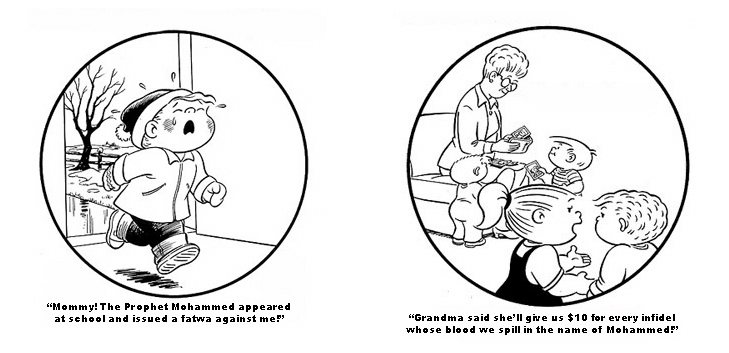
What if a lazy cartoonist merely SAYS a character is Mohammed, and puts forth no effort to achieve a good likeness, as in the following “Ziggy” comic?

Alt text

Theologians may discuss these questions for years, or until they are murdered by extremists, whichever comes first. In the meantime, let’s enjoy two “Family Circus” cartoons that parody radical Islam without using the Prophet’s image. Leave it to Bil Keane (and occasionally his son Billy, who fills in some weeks) to show us the way.

Alt text

Those are the actual cartoons, by the way, the way they originally appeared in newspapers, completely unaltered by me. You can trust me on that. The Koran forbids lying. (I think.)

Angry Letter: ‘Suits on the Loose’

0

The recent Mormon Cinema entry “Suits on the Loose” — about two juvenile delinquents who hide out by posing as Mormon missionaries in a small desert town — did nothing to help the genre, but it did inspire this angry letter from a woman named Elaine. I urge you to read the review in question first, as it will make the letter that much more enjoyable.

Eric,
So, who died and made you the know it all in scripts and movies??? [Gene Siskel.] You were way off the bat when you made your comment about the name of the movie! [What I said was that “Suits on the Loose” was obviously inspired by films like “Nuns on the Run,” including in the title. There’s no way a movie has the same plot as “Nuns on the Run” and a title similar to “Nuns on the Run” by coincidence.]

You need to give the writer a break, after all he is trying to bring the level of Mormon moveis up. This is not a million dollar project. [The production quality is much better than some previous Mormon films, despite the low budget. But all the money in the world won’t save a bad script.]

The movie is great for good clean fun. As far as the violence and vulgarity go, wow… have you seen the latest movies, even the G rated ones are laden with real vulgarity, homosexuality, drugs, violence. [I didn’t say anything about the film’s vulgarity or violence, except that it’s there. I didn’t say it was extreme or unpleasant or irresponsible. In fact, I only said there’s “a little” vulgarity. Are you saying there ISN’T a fistfight in the movie? Are you saying the word “pissed” ISN’T a vulgarity? I issued no judgments; I merely said the movie was rated PG, and explained why. The MPAA (which doles out the ratings) gave the same reason: “some language and brief violence.” And for the record, G-rated movies are NOT laden with vulgarity, homosexuality, drugs and violence (except for cartoon violence, though even that has to be kept to a minimum). If movies become laden with those things, they become PG or higher. If you disagree, I urge you to point out a G-rated movie that supports your point of view.]

You should be singing Mr. Hensons praised for trying to make a movie that families can go to. [If he were the only one doing it, and if “Suits on the Loose” were the only family-friendly movie available, I would. But other people are also making family-friendly movies, and some of them are actually making GOOD ones! So Henson gets credit for trying, but in the end, all the matters is whether the movie is any good or not, and his is mediocre.]

As I said, where did you get your training and expertise, so I know how serious to take your cute opinion? [And if I told you I had a doctorate in film studies from Harvard, all of a sudden you’d change your mind and agree with me?]

I imagine you are R rated movies or nothing! No wonder the world is getting so much more vulgar and unhappy. [Here’s a fun game you can play. Take 10 seconds to browse my site. You will find R-rated movies with poor grades, some with high grades, some PG-rated movies with high grades, and some with low grades. A movie’s rating has nothing to do with its entertainment or artistic quality. There are good and bad movies of all ratings.]

Get a clue, Mr. Eric. I disagree with you so much, I am sorry I can’t get my opinion published as you have. [Ah, but you can!] Hope you feel good about the things you say. [As long as I’m telling the truth about my opinion of a movie, then yes, I feel good about what I say. You should feel good about your opinions, too, as long as they are how you honestly feel, and as long as you have presented them calmly and rationally.]

So that was fun.

Date Movie

0

I don’t want to deliver a dissertation on what constitutes satire or parody, but I will say this: “Date Movie” isn’t it.

This would-be spoof of romantic comedies, written and directed by two of the “Scary Movie” writers (Jason Friedberg and Aaron Seltzer), falls prey to the misconception — common in modern American humor — that to make reference to something is the same thing as parodying it.

For example, there’s a scene where two women, rivals for the same man’s affections, appear in costumes from “Kill Bill,” with the same music playing in the background. They threaten each other with swords while eyeing one other angrily. Finally their swords clank together and break, and the scene ends.

Now, I’m guessing Friedberg and Seltzer referred to that scene around the set as “the ‘Kill Bill’ parody.” But it’s not a parody. A parody imitates the style of something for comedic effect, usually through exaggeration. The only “Kill Bill” element that is exaggerated here is that we keep flashing back to images of why the women hate each other, over and over again. So are they suggesting “Kill Bill” over-used the flashback device, and to make that satiric point, they OVER-over-use it? That’s valid satire, except I don’t think “Kill Bill” DID over-use flashbacks, and if it did, it wasn’t predominant enough to make me think, three years later when I see “Date Movie,” “Oh yeah! ‘Kill Bill’ DID do the flashback thing too often! Good call, ‘Date Movie’!”

I think what they were ACTUALLY going for — and the other half-hearted, dim-witted, misguided non-parodies in the film bear this out — is that we’ll laugh simply because we recognize what they’re imitating. “Hey!” we’re supposed to think. “That’s a duplication of something I saw in another movie, only with different actors! So it must be funny! Ha ha!”

Here’s a woman meant as a J-Lo parody whose butt is outrageously big. Here’s a guy playing a song on a ghetto blaster outside his girlfriend’s window, like in “Say Anything.” (It’s not even a funny song choice, like “Baby Got Back” or something. It’s just some average classic rock “I miss you” song.) Here’s a “Pretty Woman” flashback where boy meets girl when one of them is a prostitute — only it’s the boy who’s the hooker, decked out in a miniskirt and high heels cruising Rodeo Drive. See, it’s just like in “Pretty Woman,” only they SWITCHED THE ROLES!! Get it?!

No, because there’s nothing to get. These aren’t jokes. They’re references. Sometimes a surprising or well-done reference can earn a laugh of recognition, but it’s nothing to hang your entire movie on. “Date Movie” is “satire” without bite, a rant without an actual agenda.

Why, in a parody of romantic comedies, would you have so much of the story line parallel “Meet the Parents” and “Meet the Fockers” — two movies that are NOT romantic comedies? In fact, I counted 20 films directly referenced or spoofed in “Date Movie,” and eight of them have nothing to do with the genre allegedly being mocked. (“Lord of the Rings”? “King Kong”? Seriously, you’re just throwin’ stuff at the wall here, aren’t you?) That’s a focus problem, that is.

And why spoof minor, specific details of movies, like the father’s affection for Windex in “My Big Fat Greek Wedding”? (Here, his counterpart is always spraying a bottle of hummus.) Do you think we just watched “My Big Fat Greek Wedding” yesterday? Do you think a movie that’s four years old is so ingrained in our memories that we’ll instantly appreciate your lackluster spoofs of its elements?

Anyway, Alyson Hannigan plays Julia Jones, a fat girl who gets made-over and liposuctioned and bags a handsome English guy named Grant (Adam Campbell). She feels jealous of Grant’s ex-girlfriend, though, a babelicious blonde named Andy (Sophie Monk). Interspersed are references to “Hitch,” “What Women Want,” “Mr. & Mrs. Smith,” “My Best Friend’s Wedding” and several others. See if you can count ’em all! (You’ll probably miss the reference to “Rize.” Why is there a reference to “Rize”? Again, throwin’ stuff at walls.)

Alyson Hannigan is a joy to watch in anything, and the opening scene, in which she exuberantly dances around Manhattan in her latex fatsuit to the strains of “My Milkshake,” may not be terribly funny, but it is energetic and oddly endearing. This is an actress richly deserving of a leading role in an actual date movie, not “Date Movie.”

Freedomland

0

Turn on “Law & Order: SVU” any night of the week and you’ll see a story that’s better-told and more smartly structured than “Freedomland,” which is a wreck of a film that has no idea where it’s going.

Where it starts is the housing projects of Dempsy, N.J., in 1999. (Why 1999? No reason.) A white woman named Brenda (Julianne Moore) says she was carjacked by a black man near the projects, and that her 4-year-old son was in the vehicle at the time. Detective Lorenzo Council (Samuel L. Jackson), having just returned from accepting his Stupidest Movie Character Name award, catches the case. He knows the people in the projects and insists he can ferret out the evil-doer.

If there even is an evil-doer, that is. Brenda has a history of drug addiction and even now seems dangerously unstable. The city splits down the racial divide: The whites insist she must be telling the truth and that now is no time to blame the victim, while the blacks are tired of being blamed for everything and are resentful that the mostly white police force has put the projects on lockdown until the culprit is found.

Complicating matters is Brenda’s brother Danny (Ron Eldard), a police detective whose personal attachment to the case mars his judgment. There is also a group of women who have lost children, headed by Karen Collucci (Edie Falco), who thrust themselves into the situation.

Julianne Moore is reprising her role as Distraught Mother Who Weeps a Lot from “The Forgotten,” and as fine an actress she is, she can’t overcome Brenda’s one-note characterization as written in Richard Price’s screenplay (which he adapted from his own novel). For 100 minutes, all Brenda is called upon to do is be hysterical and inconsolable. Moore conveys that, sure enough, but often at a level that is over-the-top.

Samuel L. Jackson, meanwhile, is reprising his role as Badass Mofo Who Yells a Lot from every film he’s ever been in. Oh, the attitude! Oh, the swearing! Oh, how I wish he would do something different.

Director Joe Roth, perpetrator of such misdeeds as “Revenge of the Nerds II” and “Christmas with the Kranks,” has too many disparate elements to deal with in Price’s screenplay, and he can’t seem to wrangle them. Racial issues are explored briefly, as when a resident of the projects observes that the neighborhood’s murders barely elicit a response while a missing white kid draws out the cavalry. But only briefly. Themes of parenthood and loss emerge occasionally, particularly in Edie Falco’s understated performance as the missing-child advocate. But again, only briefly.

What Roth — whose real job is working as a movie producer, not a movie director — can’t handle is the film’s inherent gravity. A community about to explode into race riots is serious business, and Roth’s reaction is to become over-serious, over-wrought and over-done, with rampant zooms, cuts and pans. (“Look how serious and edgy this is!” is the translation of that kind of filmic language.) He winds up making a mockery of the weighty topics through his ham-fisted mistreatment of them, and he never manages to make any kind of point. “SVU” handles this kind of plot so much better.

Eight Below

0

We’ve known for years that Disney is out of new ideas, what with the straight-to-video sequels and the constant remakes. “Eight Below” is another remake, this time of a 1983 Japanese film, but it’s more than that. It’s also a cross between Disney’s “Snow Dogs” and “The Incredible Journey.” In fact, if you’ve seen those movies, or even if you’ve ever read an inspiring article in Reader’s Digest that involved animals, I dare say there is no reason to watch “Eight Below.”

It doesn’t help that it stars Paul Walker, who in nearly every film appearance manages to be out-acted by whatever surrounds him. In this case, it’s snow and ice. Yes, the snow and ice deliver a more compelling performance than Paul Walker does. See, they’re Greenlandic snow and ice, but they’re pretending to be Antarctic — and I totally believe them! Paul Walker, though, I never believe he’s anything other than a surfer.

Walker plays Gerry Shepherd, an American outdoorsman who works as an expedition guide in Antarctica, taking scientists around the continent so they can perform their research. He works with a few people at the research base, but they don’t matter to the story, not even the one played by Jason Biggs of “American Pie” fame.

What matters is that Gerry’s primary means of transportation is a sled pulled by eight tiny reindeer, and by tiny reindeer I mean big dogs. These dogs have names, and they almost have personalities; thankfully, though this is a Disney movie, they do not speak.

While on an expedition with a no-nonsense but good-natured scientist named McClaren (Bruce Greenwood), a medical emergency and a subsequent storm force Gerry and all the other humans to helicopter to safety. Gerry promises the dogs he’ll be back to collect them in a matter of hours, but conditions worsen and those hours turn into days, weeks and months. Gerry is forced to pick up his life back in the States, wavering between getting funding for a rescue trip and simply giving up the dogs for lost.

Meanwhile, the dogs are like, “WTF?” Forced to fend for themselves, they search for food on the frozen landscape, wandering around with no destination in mind (making this more “The Incredible Meandering” than “The Incredible Journey”) and occasionally encountering dangers like treacherous cliffs, angry CGI seals and freezer-burned orca meat.

Dave DiGilio’s screenplay spends too much time with Gerry back in the U.S., though. He meets with McClaren; he meets with the breeder who sold him the sled dogs; he is pursued by Katie (Moon Bloodgood), the helicopter pilot who was once his girlfriend — and through it all, he vacillates. Raise the money to return to Antarctica and see if the dogs, by some miracle, are still alive? Or move on with his life? One or two scenes of that uncertainty is reasonable, as are one or two rousing speeches from his friends. But the film keeps coming back to it. Make up your mind, Ger. We’re not that interested.

The scenes with the dogs occasionally produce some excitement, and director Frank Marshall (“Congo,” “Alive”) makes full use of the breathtaking scenery. One thing Disney has always excelled at, even in the studio’s lousiest films, is nature footage. “Eight Below” isn’t quite on the lousy end of the spectrum, but it is forgettable.

Tristram Shandy: A Cock and Bull Story

0

I gather that a reading of Laurence Sterne’s 18th-century novel “The Life and Opinions of Tristram Shandy, Gentleman” might enhance one’s perception of the film version, which is called “Tristram Shandy: A Cock and Bull Story.” However, not having read the book, and feeling confident that most viewers have not read it either, I offer this assurance: The movie is a self-referential, keenly absurd comedy with several layers of humor. Reading the novel might help you get at some of the deeper layers, but the top few are accessible to anyone.

The novel itself is rendered more or less unfilmable by its wandering, stream-of-consciousness narration and near absence of plot. The main character starts out telling us about his conception and birth, then gets so distracted by tangents and afterthoughts that by the time the novel ends, he’s just barely been born.

The movie meanders in the same way. Just as the novel is partly about the author’s attempts to write the novel, the movie is about some people’s attempts to make the movie. Comparisons to “Adaptation” are highly appropriate.

We begin with Steve Coogan and Rob Brydon in the makeup room, preparing for their scenes. Coogan will play Tristram Shandy as well as Tristram’s father Walter; Brydon plays Walter’s brother Toby. Coogan is the star, but Brydon wants to be billed as a co-star rather than a supporting actor. Throughout the film — the film we’re watching, I mean, not the film they’re making — Coogan is paranoid about Brydon’s attempts to gain more status, going so far as to insist that Brydon’s shoes have their heels sawed off so that he won’t appear taller than Coogan.

The fact that Brydon is fond of doing a vocal impersonation of Coogan to the amusement of the other cast members does not help their relationship any.

The film then sets out to show Tristram Shandy’s birth, narrated by Tristram, who, as in the novel, becomes distracted by other things. He wants to tell us about his father and mother’s opposing views on childbirth, for example (doctor vs. midwife), and on the doctor’s exciting new medical instrument known as “forceps.”

It is during that childbirth scene that the cameras pull back to reveal … cameras. Cameras, sound guys, tech crew and a director, Mark (Jeremy Northam), a surrogate for the film’s real director, Michael Winterbottom. (Why didn’t Winterbottom appear as himself?) We’ve been watching the filming of a movie, we realize.

Coogan and the other actors take a break, and the rest of the film follows a beleaguered Coogan as he hustles to script meetings, to interludes with his girlfriend Jenny (Kelly Macdonald), to costume fittings, to interviews with members of the press. Coogan hasn’t actually read “The Life and Opinions of Tristram Shandy, Gentleman,” but he’s picked up enough jargon to tell an interviewer that it was “postmodern before there was any modern to be post about.”

That makes the film postmodern, too, and Winterbottom has toyed with this kind of fractured storytelling before, notably in “24 Hour Party People.” That film, about the New Wave pop music of the 1970s and ’80s, also had Coogan in the leading role as a protagonist and talk-to-the-camera narrator who sometimes gets ahead of himself and sometimes forgets to tell us things. (The real-life person Coogan was playing, record exec Tony Wilson, has a brief cameo in “Tristram Shandy.”)

The screenplay is attributed to Martin Hardy, a pseudonym for Winterbottom’s long-time collaborator Frank Cottrell Boyce, who felt that since so much of the dialogue was improvised, he shouldn’t take full credit for the script under his own name. Coogan and Brydon do most of the imrovising, it seems; both British comics, they have often worked together before and have an easy chemistry. While in character, they regularly insult each other in a most amusing, most British fashion, and they engage in dueling Al Pacino impressions over the closing credits. What that has to do with Tristram Shandy, I have no idea.

Coogan is a brilliant comedian, under-appreciated in America but highly prized in England. The version of himself that he plays here is arrogant and ornery, masked by a false layer of humility and friendliness. He’s the sort of character you would hate in real life but love to watch in a movie, where people other than yourself are the recipients of his scorn.

But the entire ensemble is good, including Naomie Harris as Coogan’s long-suffering assistant, Gillian Anderson as herself (flown in at the last minute to play a character who had been removed from the adaptation and has now been put back in), and Ian Hart as the film-within-a-film’s writer.

Winterbottom has achieved a Robert Altman kind of feel, with a large ensemble of characters talking over each other as the camera floats around unobtrusively. Parallels between the Tristram Shandy story and the present-day one emerge subtly, and the hassles of filmmaking are slyly and often hilariously addressed. I love the scene where cast members gather to watch footage from their movie and ruthlessly mock it, “Mystery Science Theater”-style (complete with their silhouettes against the screen, in some shots).

In fact, “Tristram Shandy: A Cock and Bull Story” comments on its own editing, adaptation and casting — indeed, on its very existence — right up to the end. It’s a movie about the making of a movie about a book that’s about the writing of a book. It’s extremely unfaithful to the content of the novel, obviously (since the novel wasn’t about making a movie), but very loyal to its deconstructionist, anything-goes spirit. I bet Laurence Sterne would be pleased with the film. Maybe someday I’ll get around to reading his book.

Winter Passing

0

Stand in the middle of a film festival and swing a stick and you’re bound to hit a movie just like “Winter Passing,” a moody, character-driven, mostly plot-free drama about a broken family trying to reconnect. It’s nicely acted, for the most part, but it doesn’t do anything you haven’t seen done before.

Reese Holdin (Zooey Deschanel), a struggling actress in New York City, is approached by a book editor (Amy Madigan) who wants to publish the love letters Reese’s parents — both acclaimed novelists — wrote to each other during their courtship. Reese’s mother died not long ago, and her father, Don (Ed Harris), an oddball recluse, hasn’t published anything in 20 years. The love letters of their youth would be huge, and the editor offers Reese $100,000 for them.

For Reese, the decision to hand the letters over to the publishing world is a financial one. She’s broke, the show she’s in is about to close, and she has way too much meaningless, drug-fueled sex with castmates and acquaintances. (Such is the life of a struggling New York City actress, or so I’m told.)

Unfortunately, getting the letters means returning to her childhood home in rural Michigan. She hasn’t communicated with her father since she left at 18; she didn’t come to Mom’s funeral. Her childhood, we gradually learn, had her competing with her parents’ typewriters for their attention.

Can you feel the angst?

Upon arriving in Michigan, Reese finds that Dad, now creaky and long-haired, is for some reason living in his garage, while an attractive former student of his named Shelly (Amelia Warner) and a bodyguard/disciple named Corbit (Will Ferrell) live in the house. Shelly and Corbit are devoted to Don, in awe of his genius and taking it in stride that he has chosen to live in the garage. Rather than stand aside while Reese and Don work out their complicated relationship, Corbit befriends Reese and Shelly psychoanalyzes her. They are a foursome now.

Writer/director Adam Rapp (brother of “Rent” star Anthony Rapp, who appears in one scene) has compiled a lot of details here, but many of them don’t go anywhere. So Reese rescued an ailing kitten in New York. So Corbit is a would-be rock guitarist who is also, we learn in one startlingly out-of-left-field announcement, a religious Christian. So some elements of Reese’s mother’s later life were kept secret from her. So Reese has a guy friend in New York who might move to Colorado. So what? So what to all of that. What we’ve got here are a lot of brush strokes without any picture.

You may wonder what Will Ferrell is doing in a serious drama. I’m wondering the same thing. He may have it in him to play a dramatic role, but this film doesn’t give him the chance. Corbit is written as a strange, idiosyncratic character, almost comic relief but not quite, and Ferrell comes off as just goofy enough to be out of place.

Amelia Warner does solid work as Shelly, Ed Harris is just killing time between real gigs as the nutty old Don, and Zooey Deschanel (Ferrell’s “Elf” co-star, you’ll recall) grows more appealing every time I see her. Someone give this talented, soulful, intelligent actress a good leading role in a major film. Use “Winter Passing” as her audition tape if you want to.

The Second Chance

0

Depending on which poll you look at, anywhere from 20 to 45 percent of Americans attend church services regularly, a vast majority of them Christian. That’s a big chunk of the population active in church, yet few movies are made specifically for that audience. What gives?

There are a lot of possible reasons for it — for example, the assumption that many regular churchgoers don’t go to the movies as often as some other demographic groups — but “The Second Chance” is evidence that quality films can be made to serve this audience. (Unfortunately, the film did poorly at the box office, suggesting more strategic marketing and advertising are needed. Or, perhaps, that Christians just don’t GO to movies. But I don’t think that’s the case.)

“The Second Chance” is a Christian film, but it’s not a missionary tool. It has no specific message for non-Christians, though they might find it interesting enough. It’s meant for people who are already Christians, as a call to them to get their priorities straight. It achieves this elegantly, intelligently, without the pandering or over-sentimentalization that have plagued many other Christian films.

It is set in an unnamed large city in which there are two churches begun long ago by the same man, the aging Jeremiah Jenkins (J. Don Ferguson). The Rock is the huge, mostly white church with televised services and wealthy parishioners. The Second Chance, on the other hand, is the older of the two, in a part of town that’s now a little rundown and surrounded by crime. Jeremiah years ago turned his pastoral duties at Second Chance over to Jake Sanders (Jeff Obafemi Carr), a fiery preacher who, like most of his congregation, is black. But the same board of directors still governs both churches.

Jeremiah will retire soon and wants to turn The Rock over to his son, Ethan (Michael W. Smith), a musician/author/superstar minister who stops to sign autographs while gliding into services every Sunday. Ethan and Jake are about the same age, and Jake has nothing but respect for Ethan’s dad — but Ethan himself, it seems to Jake, is losing sight of what church is supposed to be all about. The Gucci shoes, expensive ties and state-of-the-art house that he and his fiancee are buying suggest Ethan has let the money and notoriety go to his head.

Ethan’s dad agrees, and he sends Ethan over to Second Chance for a few weeks to watch how Jake performs his day-to-day duties ministering to his flock. Maybe some time among the downtrodden and troubled will wake him up.

Maybe none of this sounds very interesting so far, but I find the examination of churches’ behind-the-scenes workings fascinating, mostly true to life and highly complex. The board of directors in the film, while in need of a refocusing, is not an evil bunch of corporate types who only love money. Rather, they legitimately want to do God’s work and consider themselves stewards over the money that God’s followers have donated.

Ethan and the board of directors are not the only ones in need of change, though. Jake is hotheaded and inconsistent, berating one lapsed Christian while enabling another. But you get the sense, through Steve Taylor’s direction and Carr’s performance, that this is more or less what an inner-city pastor’s life is like, warts and all.

The film falls prey to at least one dreadful movie cliché, the one where the simpleton shows everyone the right path. (Simpleton characters usually exist in movies solely for that purpose.) But in general, the performances are strong and the production values are high, making it a film Christians can be proud of as a source of both inspiration and quality drama.

Night Watch (Russian)

0

The Others walk among us, you know. People who seem like you or me but who are actually wizards, shapeshifters, sorcerers and other types of supernatural beings. There are Light Others and Dark Others, categorized not by skin tone but by degree of evilness, with each group keeping watch over the other to make sure they don’t use undue influence over the mortals whose world they inhabit.

This is big, meaty fantasy mythology, energetically splashed onto the screen in “Night Watch” (“Nochnoi Dozor”), one of the most Hollywoodized Russian films I’ve ever seen. There are no dreary Siberian wastelands in Timur Bekmambetov’s vision, no stilted, depressed dialogue. “Night Watch” pops with visual momentum, so much that by the end it’s chaotic, and finally just insane. Even the subtitles get into the action, moving with the characters or being wiped off the screen as someone walks in front of them.

All of this is in the service of a story that begins well but ultimately becomes confusing and inexplicable. When it’s hoppin’, though, it’s really hoppin’.

Based on a novel by Sergei Lukyanenko and adapted by Bekmambetov and Laeta Kalogridis, “Night Watch” begins in 1992 with a man named Anton (Konstantin Khabensky) discovering that he is an Other, with the specific abilities of a seer. Armed with this new knowledge of his powers, he joins the Night Watch, the group of Light Others who keep an eye on the Dark ones (who operate at night, of course), enforcing the laws of the two groups’ centuries-old truce. Now, in the present, he’s called upon to protect a young boy named Yegor (Dmitri Martynov), who is being summoned telepathically by a vampire.

Yes, there are vampires involved. Apparently, many (or perhaps all) of the Others, both Light and Dark, are vampires. The good ones refrain from drinking human blood, and the bad ones are supposed to do the same, but you know how it is with rogue nations.

Anyway, the boy plays a part in the grand scheme of things, with all the Others awaiting fulfillment of a prophecy in which a Great Other will come and choose between good and evil once and for all. Meanwhile, a tornado is heading for Moscow, and it’s somehow related to all this. Also, there’s a woman who is sometimes an owl.

Somewhere in all of this are several fairly deep ideas, including an elaborate anti-abortion message, no kidding. So what does it all mean when you put it together? Heaven only knows. But with resemblances to “X-Men,” “Blade” and a host of other action-packed American stories, “Night Watch” — with its jaunty attitude and sly sense of humor — feels familiar enough overall to make me overlook the incomprehensible parts.

Sophie Scholl: The Final Days (German)

0

On Feb. 18, 1943, Sophie Scholl and her brother Hans, students at Munich University, were arrested for distributing anti-Nazi propaganda on campus. Considering what the Nazis were doing at that time to people whose only crime was being Jewish, you can imagine how they treated people who actually broke the law. This was not an administration that responded well to criticism.

“Sophie Scholl: The Final Days” uses transcripts and testimonies to recreate those events, centering around Sophie’s interrogation by Nazi officials and her stay in a strangely hospitable German prison. One has a sinking feeling about how it’s going to turn out, but there is still suspense, and the intrigue in those interviews is strong.

Sophie (Julia Jentsch) and Hans (Fabian Hinrichs) are part of an underground resistance movement called the White Rose, responsible for printing fliers that decry the ongoing war. Their group believes German soldiers are dying needlessly, and that the only reasonable answer is for Hitler to surrender and end the war. That’s not to mention the atrocities being commit by the Germans against the civilians in lands they have conquered.

You can’t help but notice how some of these charges parallel the current mood in America — especially when Germans who oppose the war are said to be “giving terrorist aid to the enemy” — though whether “Sophie Scholl” director Marc Rothemund or writer Fred Breinersdorfer intended the similarities, I don’t know. It is enlightening to see a side of wartime Germany not often explored in film, though. Civilian Germans are usually depicted as wearily resigned to Nazism at best, supportive of Hitler at worst. Groups like the White Rose are usually underrepresented.

A significant chunk of the film is devoted to Sophie’s conversations with Robert Mohr (Gerald Alexander Held), an austere German official who interrogates over the course of several hours. The first time, she has plausible alibis that would remove her as a suspect in the distribution of the anti-Nazi flier. The second time, the tide has turned and Sophie is on the defensive.

Rothemund films these scenes like a tennis match: medium close-up of Mohr as he asks, medium close-up of Sophie as she answers, back and forth, rhythmically building to crescendos and then calming down again. It’s risky to include so much talking without plot advancement in a film, but it provides the heart and soul of “Sophie Scholl.”

Nominated for a Foreign Language Oscar this year (it lost to “Tsotsi”), the film has a serious, urgent tone, but not a preachy or strident one. Like most good movies on this subject, it puts human faces on the casualties of war and touchingly reminds us of the mistakes we mustn’t ever make again.

CSA: The Confederate States of America

0

The idea behind “CSA: The Confederate States of America” is such a good one that I wish a more talented filmmaker than Kevin Willmott, and one with better resources, had come up with it.

Imagine we live in an alternate reality where the South won the Civil War. Now imagine you’re watching a local TV station one evening as it airs a British-made documentary about American history. “CSA: The Confederate States of America” is that documentary, complete with commercials that reflect the culture of modern Confederate America.

With a satiric eye, Willmott uses “historians” and faked news footage to show the last 143 years of American history. We see Lincoln’s exile to Canada, an early D.W. Griffith silent film depicting his capture, and clips from the 1955 thriller “I Married an Abolitionist” (abolitionists where the big boogeymen in the ’50s, rather than Communists). A commercial advertises daily reruns of “Leave It to Beulah,” about a sassy slave in a white household. Before the documentary begins, viewers are warned that, due to its controversial nature (it was made by anti-slavery Brits, after all), it may not be suitable “for children or servants.”

Willmott’s imagination about how history would have changed with a Southern victory is perceptive and sharp. The Confederacy actually did have plans to colonize Latin America, so Willmott uses that. The anti-Negro philosophies of the day, made law by the new Confederate States of America, evolve into anti-everything, putting the C.S.A. right in line with Hitler when he comes along.

Some of the faked stock footage and newsreels are remarkably well done, notably the aforementioned D.W. Griffith short, which is also raucously funny. But others are obviously low-budget and shoddily made, and few of the actors are convincing. One of the keys to success here is making this faux documentary and its accompanying TV commercials look legit, and much of the material just doesn’t cut it.

Another problem is the project itself: I think Willmott bit off more than he could chew. Retooling all of post-bellum American history is a huge project, and telling it in its entirety means making a film that feels too long. The jokes and satire would need to be more incisive than they are in order for the idea to sustain itself for 91 minutes.

This is dangerous territory. When we see a commercial for an outrageously racist restaurant, accompanied by undignified portrayals of happy slaves with their “yes, massa” dialect, do we laugh? And if we do, are we laughing at how absurd racism is, or are we laughing because happy slaves with their “yes, massa” dialect are funny? Are we laughing AT the blacks, or WITH them? There is much potential for misunderstanding here, and Willmott’s work, while notable in some regards, doesn’t measure up.

Strangers on a Train

0

Just in time for Valentine’s Day, I want to share this very special love connection that I witnessed on MAX, Portland’s light rail public transportation system, several weeks ago.

The scene is as follows: A man in his late 40s, dressed in a sharp business suit, sits on the train, accompanied by a similar-looking man who is clearly a business associate of some kind. On the other side of him sits a skanky, smokey-voiced woman, probably 15 years younger but weather-beaten and shopworn. She is not homeless — she has no belongings with her, and her dress and grooming have not quite fallen to that level — but she is definitely a woman of low character, as they say. A crack whore, maybe. In fact, sure, let’s say she was definitely a crack whore.

Anyway, seeing an earpiece affixed to the man’s head, the woman struck up a conversation. During the conversation, the man did not turn to look at her, and he grew increasingly uncomfortable as it progressed. She initiated:

SKANKY WOMAN: Is that a cell phone?
BUSINESSMAN: Yes. Well, this (indicating the phone in his pocket) is the cell phone. This (indicating the earpiece) is just the earpiece.
SKANKY WOMAN: You look like Spock.
BUSINESSMAN: Ha ha. Yeah.

(Pause.)

SKANKY WOMAN: Because Spock had that thing in his ear.
BUSINESSMAN: Yeah.

(Pause.)

SKANKY WOMAN: Could I have a cigarette? Just one?
BUSINESSMAN: I don’t have any. I don’t smoke.
SKANKY WOMAN: Oh, I’m sorry. I thought you smelled like — I’m sorry.
BUSINESSMAN: No problem.

(Pause.)

(Pause.)

SKANKY WOMAN: You’re a very handsome man.

(Man’s cell phone rings; he instantly answers it; the conversation is over.)

Questions immediately sprang to my mind. “You’re a very handsome man”?!? What did she hope to gain by that? What was she hoping his reaction would be? What if his cell phone hadn’t rung? How would the conversation have gone? I suspect something like this:

SKANKY WOMAN: You’re a very handsome man.
BUSINESMAN: Oh. Thank you.

(Man gets up, moves to opposite end of the train.)

But perhaps she was hoping for this:

SKANKY WOMAN: You’re a very handsome man.
BUSINESSMAN: No! You flatter me. But you, my dear — you are an enchantress. (Kisses her hand.)
SKANKY WOMAN: Oh! Such a gentleman you are!
BUSINESSMAN: My good lady, at the next stop, shall we disembark and find an alleyway or public restroom in which to revel?
SKANKY WOMAN: Why, sir! I should like that very much. But first we must stop and buy me some cigarettes.
BUSINESSMAN: But of course, my dear! Of course.

(They skip merrily off together.)

Perhaps she was hoping her flirtations would lead eventually to marriage, and they would tell their children their charming “how we met” story: “Well, I was on the train one day, and your mother sat down next to me and said I smelled like cigarettes! How could I resist?”

Alas, it was not to be. The man’s cell phone rang, and he got off at the next stop. But I like to think that in an alternate universe, she’s already moving her stuff into his house and he’s getting a full work-up of shots at the health clinic.

In parting, in honor of the season, let me mention this Yahoo! news headline from last week, where a California judge ordered Paris Hilton to keep away from a particular man she’s allegedly been harassing. The headline reads:

Paris Hilton Ordered to Stay away from Man.

And on behalf of man, let me just say thank you.

No matter how much you write to it, symone.raven@gmail.com will NEVER BE Raven-Symone’s e-mail address

3

A while back, I got tired of kids writing to me asking for Raven-Symone’s e-mail address. I had to keep telling them that I didn’t have it, and that there is no reason to think I WOULD have it. Yet some of these kids, who are just kids, and who aren’t necessarily very smart, kept pestering me.

So in a previous blog entry, I gave this address — symone.raven@gmail.com — and announced in plain language that it is NOT Raven-Symone’s e-mail address, and that it is in fact an address I registered through Gmail. I figured if people were going to keep harassing me for information I didn’t have, I might as well just make up some information and give it to them.

Sure enough, that fake address spread quickly within the Raven-Symone community, and I have received nearly 100 e-mails from devoted Raven-Symone fans, most of whom begin with, “Is this really your e-mail?????,” even though I clearly stated before that it is not.

Anyway, to repeat: symone.raven@gmail.com still is NOT Raven-Symone’s e-mail address. If you write to that address, your e-mail will be read by me, Eric D. Snider. If anyone replies, it will be me, Eric D. Snider, pretending to be Raven-Symone. The real Raven-Symone has no idea who I am and has no knowledge of this e-mail address.

I’m making this very plain because I think a lot of you will read it, see the words “raven-symone” and “e-mail address,” and write to the address regardless of what I’ve said about it. And later, when I publish your e-mails on this site, we will all have a good laugh at the sort of things people say when they write letters to Raven-Symone.

The Sun (Japanese)

0

Japan’s symbolic rising sun is in the process of setting in “The Sun” (“Solntse”), Russian filmmaker Aleksandr Sokurov’s haunting, hypnotic account of Emperor Hirohito’s actions in the final days of World War II.

What an anxious, contemplative movie this is! Sokurov, with a screenplay by Yuri Arabov, relates the story in a dreamlike fashion, focusing on Hirohito (Issei Ogata) as he continues to shuffle around his palace while his nation slowly loses its foothold in the war. With long, unbroken takes, Sokurov shows the emperor’s shrinking manservants — who, like all of Japan, deify Hirohito — waiting on his whims, eager to serve him and utterly fearful of his powers. His military advisers are more frightened of him than of the Allies.

The man himself is certainly not imposing, though. Ogata plays Hirohito as twitchy and preoccupied, a calm, almost bemused old figure who is starting to give in to despair and who holds out little hope for a Japanese victory. He moves slowly, just as all the other Japanese characters in the film do, as if under water. If this were a cartoon, they would all be portrayed as turtles.

While Hirohito’s people revere him as a literal descendant of the Sun Goddess, the American soldiers standing around outside the palace see him as a curiosity, something to be photographed on the rare occasions that he emerges. He reminds them of Charlie Chaplin, and he does exude a certain comical befuddlement.

When he meets with Gen. Douglas MacArthur (Robert Dawson) to discuss a possible outcome to the war — MacArthur wants him to renounce his godhood and accept the U.S.’s terms — he is by now too defeated to be offended by the general’s cavalier attitude. (“What’s it like being a living god?”)

Struggling to retain his dignity in the face of such monstrous humiliations, Hirohito is a poignant and tragic figure. This is a man with a scholar’s grasp of science and politics, yet who can’t (or won’t) dress himself or even open a door for himself. He has been treated like a god his entire life, and now he must not only admit military defeat, but “step down” as a divine being? Even as removed from such things as Western viewers are, we can see in Ogata’s performance the shame and abasement inherent in such a submission.

Sokurov keeps the film quiet, often dialogue-free, maintaining an ethereal mood throughout. He has also manipulated the film’s colors and lighting (he acts as his own cinematographer) to underscore his themes. The interiors appear brown and flat, and even the white exterior of the palace looks dingy. The film grows progressively darker and murkier as it goes, so that by the end you wonder if the theater’s projector bulb is burning out and causing an unintended dimness.

But no; it’s by design. (The fact that the closing credits are in bright white lettering is proof, if you need some.) As the sun sets on Japan’s glory and as its emperor sees his fortunes fade away, the film itself seems to sympathize. By the end, just like the emperor is metaphorically, we’re in a literal state of twilight, unable to see what lies ahead.

C.R.A.Z.Y. (French)

0

The main character in “C.R.A.Z.Y.” is a teenager who thinks he might be gay, yet the film doesn’t make that its central point. In fact, it’s almost an afterthought to what is really a charming, richly entertaining story about a family trying to love and understand each other.

Told with visual flair and humor by director Jean-Marc Vallee from a screenplay by himself and Francois Boulay, our story begins with Zachary Beaulieu, a French-Canadian lad who was born on Christmas Day 1960 and has thus always hated the holiday. (People who share their birthdays with Christmas might understand his bitterness.) He’s the youngest of four boys (a fifth is born a few years later), and it’s through his eyes that the film unfolds.

As a child, Zachary (Emile Vallee) idolizes his father, Gervais (Michel Cote), a “cool,” fun dad who makes sure to have plenty of one-on-one time with each of his children, or maybe just with Zac. He wants his son to turn out normal, after all, and the boy’s fondness for pushing baby carriages and wearing Mom’s (Danielle Proulx) jewelry isn’t doing much to allay Dad’s fears.

As a teenager, Zac (now played by Marc-Andre Grondin) and his father are still close, but emerging quirks in Zac’s personality threaten to divide them. Though the family is devotedly Catholic, Zac has come to wonder if he might be a) gay and b) atheist. He prays fervently that a) won’t turn out to be true, and the lack of response leads him toward b). But faith is ingrained in him, and he wavers back and forth on matters of God and religion as much as he does on his sexuality.

(Religion plays a significant role in the film, both literally and symbolically. When Zac is hit by a car, he tells us he was clinically dead for three seconds, which makes his subsequent life a sort of rebirth.)

Zac’s older brother Raymond (Pierre-Luc Brillant), meanwhile, is a source of angst for his parents, having sex and doing drugs with girls in his basement bedroom until finally Zac rats him out — a means of deflecting attention from himself — and Raymond is evicted.

Which problem is more manageable for the Beaulieu parents? Raymond’s addictions and wantonness, or Zac’s possible homosexuality? If this were a coming-of-age (or coming-out) drama, the answer would be a heavy-handed “Zac’s homosexuality,” and the parents would be shown as intolerant rubes.

But “C.R.A.Z.Y.” is not that kind of film. Gervais and Laurianne Beaulieu are fully developed characters in themselves, their love and concern for their children apparent in all their actions. Dad has an obsessive love for Patsy Cline records (including, of course, “Crazy”), and Mom has the rather odd belief that Zac has the power to heal sick people just by thinking about them. (The fact that he might actually have this power is one of the things that keeps him from fully renouncing his faith.) They are not villainous fuddy-duddy parents, but compassionate, honest souls who genuinely want the best for their children. They’re good parents, in other words, and they’re believable.

In fact, “compassionate” is a good word for the film as a whole. Vallee shows affection for all of his characters (though he lets Zac and Raymond’s other three brothers go neglected), and for the looks and sounds of the 1970s, when most of the film is set. He doesn’t mock the era, as many films do, nor does he mock the family’s religious devotion, Zac’s sexual confusion, or Raymond’s self-destruction. But he doesn’t over-dramatize them, either. Instead, he treats the characters and their foibles with grace and humor.

Most noteworthy is Marc-Andre Grondin as the teenage Zac. His earnest struggle between his identity and his faith is seldom explored as tenderly as it is here, and Grondin’s performance is funny and heartbreaking. “I want to be like everyone else,” he pleads with a family friend. “Thank God you never will be,” she wisely replies.

With an infectious ’70s soundtrack and a lot of enthusiasm for telling a rich, poignant story, Vallee has made a wonderful film. It addresses weighty issues without being bogged down by them, and maintains, apart from rough language and a brief sex scene, the sort of behavior that mainstream audiences can embrace. Zac might be gay, but we never see him in a sexual encounter. His sexuality isn’t the point, after all. It’s all about a family’s love for one another.

Final Destination 3

0

You tell the audience which characters are going to die. You even tell them in what order. And then they sit back and enjoy the mayhem.

That’s how the “Final Destination” films work, and if it seems counterintuitive to give away so much up front, the series has made it work with macabre humor and devilishly clever setups. There’s not much suspense over who will die, but you can thrill in trying to guess how.

“Final Destination 3” is a return to form for the series. Part 2 was a pale imitation of the original, done by newcomers who clearly missed the subtle touches that had made the first one work. Part 3 has the original filmmakers back onboard — director/writer James Wong and his co-writer Glen Morgan, both formerly of “The X-Files” — as well as much of the original sense of humor and more of those elaborate deathtraps that result in such unexpectedly entertaining demises.

The premise: Fate dictates when you die, and if you somehow cheat Death and miss your time, Death will come back around for you, presumably the next time he’s in your neighborhood. (Or maybe he makes special trips, I don’t know.)

This chapter begins with a Pennsylvania high school’s “Grad Nite” trip to an amusement park, where a responsible, controlling senior named Wendy (Mary Elizabeth Winstead) has a premonition about a roller coaster accident. She is freaked out enough to make a scene and get herself and nine others bounced from the ride. The roller coaster takes off, and sure enough, derailments and carnage ensue.

As if it’s not eerie enough to survive such an accident, now Wendy and the others have this to contend with: Death is going to swing by and kill them all anyway, in the same order they would have died if they had stayed on the ride.

Wendy’s friend Kevin (Ryan Merriman) notices the trend after the first few survivors are bumped off in bizarre accidents, and finds an account of similar events that occurred six years earlier — in the first “Final Destination” movie, of course. (Part 2 is never referred to.) What’s more, Wendy was taking pictures for the yearbook during Grad Nite, and she happens to have snaps of all the survivors — photos that seem to presage the manner of their impending doom. (Two bimbos were photographed at the amusement park in lighting that made them appear darker than they are; sure enough, they die in a tanning-bed mishap.)

It would seem there’s no way to outsmart Death, and that is indeed part of the film’s very dark philosophy. Where most horror films have a specific killer, monster, force or virus, the “Final Destination” franchise has only Death itself. You can barricade your house against zombies, or take a vaccine for a plague, or simply run fast to escape Jason Voorhees. But how do you escape Death — which is merely an idea, a concept — and especially when Death is so good at turning ordinary events into unforeseeably fatal accidents?

The Rube Goldberg factor is the film’s must eye-catching element. It’s never anything as simple as a car swerving across the line and hitting you, or even a regular ol’ heart attack. No, for these grudge deaths, the Grim Reaper prefers something a little more elegant. We watch as several elements are established — that stereo is too close to that puddle, those decorative swords are not tightly affixed to that wall, and so forth — and then watch as one minor incident triggers a chain reaction among all these unrelated circumstances, culminating in someone’s head being smashed.

Wong and Morgan are smart to inject the film with gallows humor, which keeps it from becoming oppressively dark. They don’t dwell on the gore, either. The deaths happen, and they happen spectacularly — but they also usually happen quickly, without any lingering on the aftermath.

Speaking of lingering, the opening sequence at the amusement park runs 20 minutes, which feels long for a movie whose focus is what happens AFTER that. And there is a formulaic feel to it: Wendy and Kevin go to the next survivor on the list to warn him or her; the person doesn’t believe them; by the end of the scene, the person’s blood is spattered on Wendy’s face. I think that while this entry is suitably creepy and outrageous, it should probably be the last one. As these three films have proven, the last thing you want to do is try to extend your life past its expiration date.

The Pink Panther

0

Steve Martin’s remake of “The Pink Panther” is an ill-conceived attempt at creating a hybrid of his past successes. It has the loopy slapstick comedy of something like “The Jerk” or “Three Amigos,” combined with the family-friendly warm-and-fuzzies of, say, “Parenthood” or “Father of the Bride.”

The result is hideous and malformed, and it sweats and wheezes as it lurches through the countryside in search of someone who will laugh at it. Someone? Anyone? Please? I’ll fall down again! I’ll mispronounce some more words! Can’t anyone love a monster?

This is sad business for those of us who love Steve Martin. Last week he hosted “Saturday Night Live,” a show badly in need of repair (as it is every two or three years). Martin didn’t fix it, but he did rejuvenate it, a little, just for one night. He’s a brilliant writer and comedic actor, with an amazing gift for absurdity. When he’s careful, he can spin surreal comic gold.

You see some of that in “The Pink Panther,” in which he steps into Peter Sellers’ shoes — what the hell, Sellers wasn’t using them, being dead and all — to play the legendary Inspector Jacques Clouseau, a character whom it is impossible to describe without using the word “bumbling.” There are certain lines of dialogue that feel vibrantly Martin-esque — he does have co-screenplay credit, under Len Blum (“Meatballs”) — and a few moments that have the mark of inspired lunacy about them. (In a montage of some of Clouseau’s past failures as a cop, there’s a shot of him being pursued through a village square by a herd of goats. What could a police officer have done to make so many goats that angry? I think I’m adding goats to the list of animals that are always funny.)

But the other 95 percent of the film is unbelievable tedium, an endless procession of forced shtick and cartoon-style anarchy that’s been watered down into bland, tasteless froth. The director is Shawn Levy, whose previous comedies, “Just Married” and “Cheaper by the Dozen,” got by on their charm and their human characters. But Levy’s in farce territory now, and that calls for a different set of skills, skills which he does not appear to have. In more than one instance, I noted that the IDEA for a sight gag was much funnier than the execution of it — in other words, that it wasn’t shot and edited properly.

The story has a famed soccer coach being murdered at a game, and a ginormous diamond called the Pink Panther being stolen from his finger at the same time. For reasons I don’t exactly understand, the French Chief Inspector Dreyfus (Kevin Kline) intentionally chooses the most idiotic cop he knows to work the case, and that of course is Inspector Clouseau.

Teamed with a more competent cop named Ponton (Jean Reno) and armed with nothing but enthusiasm, Clouseau sets out to find the diamond, uncover the murderer, and bring honor to France. This means surveilling the pop star (Beyonce Knowles) who was the victim’s girlfriend and who may be a suspect. But the important question is, will Beyonce get to sing a song in the movie??!?!??!?!?!?!!

There are people who are outraged by the mere idea of this movie, saying Peter Sellers was a genius whose work shouldn’t be reenacted by others. They may have a point, but look at it this way: If a remake HAD to happen — and it really was inevitable, this being Hollywood — Steve Martin was truly the best option. Like Sellers, he has a knack for both controlled physical lunacy and silly verbal shenanigans. It’s been a while since it’s happened, but when Martin’s material and his support staff (e.g., his director) are good, there’s no one funnier.

You can sense that here. And if nothing else, you can appreciate how fully committed Martin is to the mediocrity he’s dealing with. Someday, perhaps the stars will align and he will once again make us laugh as hard as he did in “The Man with Two Brains” or “Dirty Rotten Scoundrels.” Until then, well, at least he hasn’t given up.

Firewall

0

It’s been nine long years since Harrison Ford starred in something he belonged in — and that was “Air Force One,” which was certainly no masterpiece. His output since then — “Random Hearts,” “K-19: The Widowmaker,” “Six Days Seven Nights,” etc. — has been shaky at best, often embarrassing in its attempt to re-create Ford as something other than what he is. Some actors have range; others have a “type,” a persona they play well and stick to. With “Firewall,” Ford seems to have accepted that he falls into the latter group, and he’s stopped horsing around with romantic comedies and dour dramas and whatever the hell “K-19: The Widowmaker” was.

Ford is at his best when he’s a hero saving the world/his family/his airplane, and it’s essential that it be under these circumstances: He must be reluctantly drawn into action, rather than out looking for it; he must be weary and grizzled, perhaps even cynical; and he must speak in a growly whisper.

“Firewall” lets him do all of that, albeit a little more slowly and cautiously than before, and in the service of a plot that is ludicrous and predictable (if still blandly diverting). Ford plays Jack Stanfield, the head of security for a bank headquartered in Seattle, where he lives with his wife Beth (Virginia Madsen) and their two generic children, 14-year-old Sarah (Carly Schroeder) and 8-year-old Andrew (Jimmy Bennett).

Aside from having to live in a city of hipster posers and professional hobos, the Stanfields have a fine life, a fine life indeed, all apricots and junebugs and maypoles. But then, wouldn’t you know it, bad guys take Beth and the kids hostage and threaten to kill them unless Jack steals $100 million for them from his bank’s customers. Isn’t that always the way?

The chief baddie is Bill Cox (Paul Bettany). His motive appears to be simple greed; he’s not one of those tiresome “I have a grudge” or “I want to make a political statement” villains that you see in some of your more ambitious action thrillers. He’s assisted by four goons, one to follow Jack to work and make sure he’s following his instructions, and three to stay home with the hostages. Lest there be any confusion, director Richard Loncraine ham-fistedly hints pretty early on which goon is incompetent, which is crazy, and which is sympathetic.

So Jack’s at work, making his co-workers think it’s business as usual while his strings are being pulled by unseen evil forces, and while he’s trying to devise a way out of this mess. Jack’s tasks for Bill Cox are the usual high-tech feats — copy this, download that, encrypt those, and so forth — and a lot of Joe Forte’s from-the-template screenplay sounds like senseless techno-jargon. But Chloe from TV’s “24” (Mary Lynn Rajskub) is here, still a little sour and odd as Jack’s secretary — OMG, she’s even working for another Jack! — and if you can listen to people spout nonsense about vectors and protocols and admins once a week on TV, I guess you can handle it here.

Jack Stanfield is no Jack Bauer, though. Harrison Ford is going to be 64 this year, and let’s just say “Firewall” doesn’t bode well for that new Indiana Jones movie. “Firewall” occasionally eschews the gadgetry for low-tech, old-fashioned things like whacking a guy in the head with a blender, and while Ford manages THAT OK, seeing him run, or clamber across rooftops, or grapple with evil-doers does not inspire confidence. You get the sense he’s only winning because the script has it that way. Heck, I wonder what action sequences were rejiggered or scrapped because they knew we’d never believe it was really Ford doing them.

You can’t fault a guy for getting old, of course. I think I’ll probably always like Harrison Ford, regardless of what he does. It’s just too bad he wasted those years doing irrelevant piffle when he could have been doing — well, this is still piffle. But at least it’s the right kind of piffle.

Imagine Me & You

0

To the people who fear “Brokeback Mountain” has a gay-lifestyle-promoting agenda, or that it gives its two main characters a free pass on breaking up their marriages: Well, you’re wrong, first of all; the movie doesn’t do that. But a movie that does is “Imagine Me & You.” That’s the one you should be angry about.

On her wedding day, a Londoner named Rachel (Piper Perabo) meets the florist who decorated the reception, a pretty, feminine lesbian named Luce (Lena Headey). Rachel is drawn to Luce as a friend, even trying to set her up with a buddy of her husband’s before learning Luce doesn’t care so much for the menfolk, romance-wise.

A friendship very naturally evolves, with Rachel and hubby Heck (Matthew Goode) having Luce over for dinner, running into each other at the grocery store, going to soccer games together, and so forth. Luce knows that though there might be some attraction between her and Rachel, she should not make a move on her. Rachel knows that though she has feelings for Luce that she can’t entirely understand, they ought to be repressed. She loves her husband dearly. Besides, she’s straight, isn’t she?

Where it goes from there is not surprising or revolutionary; it’s a sunny comedy, not a tragic-romance weepy, and its “love yourself for who you are” message is unmistakable. It’s often funny, nearly always appealing — and yet I feel like Ol Parker, who wrote and directed it, has gotten some of her wires crossed.

Rachel’s parents, frosty Tessa (Celia Imrie) and the henpecked, defeated Ned (Anthony Head), start as comic relief, representing everything that can go wrong in a marriage. Yet ultimately even this one-joke couple gets a bit of depth as they make an attempt at understanding and reconciliation. The message? Marriage is good, and even bad ones may be salvageable.

But that CAN’T be the movie’s point, not with the way things turn out for Luce and Rachel. Is that tacked on? Is it to provide a little heart-warming without regard for what signal it sends?

I pity poor Heck, the decent, likable fellow who’s married to Rachel. Parker goes out of her way to show us what a great guy he is, with two scenes set at his soul-crushing corporate job that demonstrate his integrity. Why go to such trouble to prove the saintliness of a character who’s only going to get screwed over? Because, alas, those scenes also underscore what I believe is the film’s central theme: Just as Heck must be true to himself at work, Rachel must ultimately be true to herself in matters of the heart. Sorry, Heck. The fact that you’re such a great guy is the very reason why you should understand Rachel’s decision to leave you.

That’s the part I can’t quite get onboard with. Not that Rachel ought to stay in a marriage that’s hopeless, of course, nor that Luce might not be better for her than Heck. But Rachel’s decision feels rushed, like we are supposed to accept that she’s a full-fledged lesbian now simply because the movie tells us she is. What it LOOKS like is that she has a crush on a girl and impulsively decides to run off with her. That might be romantic, but it seldom goes well in the real world, and it’s not fair to the ones you leave behind. A little more thought into the characters’ motives and the consequences of their actions might have made the film more resonant, instead of fluffy and mildly puzzling the way it is.

Through the Fire (documentary)

0

You know a filmmaker has done his job when his movie appeals even to people who couldn’t care less about the subject. That’s “Through the Fire,” a generically titled but sincerely compelling documentary about basketball phenom Sebastian Telfair, a Coney Island kid who went straight from high school to the NBA in 2004.

I don’t follow basketball at all. I live two miles from the Portland arena where Telfair now plays and had still never heard of him. (Apparently the Trail Blazers suck. Or so say my sources.) I spent most of the movie not knowing whether he would be drafted at the end, something that’s common knowledge among most of the film’s viewers. So I’m not the target audience, but I found Jonathan Hock’s documentary engaging and robust anyway, even if I sort of zoned out sometimes during the clips of basketball games (which, I hasten to add, are very well-shot and edited).

The film starts in 2003, with Sebastian going into his senior year at Abraham Lincoln High School in Brooklyn. Clean-cut, boyishly good-looking and ever-smiling, he’s already a local superstar. By October he has signed a letter of intent with the University of Louisville. But Louisville coach Rick Pitino isn’t stupid. He sees the NBA scouts circling like sharks around Sebastian, eager to have him skip college and go right to the pros.

Over the course of the season, Sebastian becomes New York City’s all-time top scorer; takes his team to Louisville for an exhibition game against the university team; becomes the first player in history to win three PSAL (Public School Athletic League) titles; and gets a Sports Illustrated cover story speculating on whether he’ll go pro.

Sebastian’s mother is seen in the periphery. Her heart was broken in 1999, when her older son Jamel Thomas was snubbed in the NBA draft. She doesn’t want to get her hopes up again, and rarely attends Sebastian’s games. For his part, Sebastian has the same goal cited by so many urban kids with big dreams: to buy his momma a house and get her out of the projects. After two crucial victories in the film, the first thing Sebastian wants to do is hug his mom.

Sebastian has another older brother, Daniel, who’s an assistant coach on Sebastian’s high school team and keenly aware of how important the boy’s future is for the financially strapped family. When Jamel didn’t make the NBA, he opted to support the family by playing professionally overseas. And a little brother, Ethan, all of 8 years old, is already being trained by Daniel to give it a try if Sebastian fails, too.

The film doesn’t spend a lot of time on the family dynamics, but it devotes just enough to show the love and loyalty that keep them together. After deciding to go pro, Sebastian goes to Greece to train with Jamel and clear his head, while the media back in the U.S. — the same people who kept baiting Sebastian in the hopes he would join the draft — now say it was a bad move, that he’ll never make it. (You can see why I was in suspense over the outcome.)

Hock, who has years of experience as a sports filmmaker, captures the excitement of Sebastian’s games more than adequately. But he also conveys real emotion with the off-court stories. Sebastian’s fame and success do start to go to his head, and Hock wisely avoids having friends and family comment on it — all the better to let the viewer notice it, you know? The finale, when the NBA draft picks are announced on ESPN, is a supremely joyful event. Seeing Sebastian and his loved ones crying with happiness is a marvelously satisfying way to end the film.

Telfair hasn’t exactly been a breakout star with the Blazers, and a recent gun charge isn’t helping his image (which was very important to him when he was in high school). So the film is a time capsule of sorts, showing the promise and hopefulness of a young man whose whole career still lay ahead of him. It’s an excellent behind-the-scenes documentary as well as an above-average sports film.

Four Things Muslims Cannot Take

1

Four Things Muslims Cannot Take

1. A joke
2. Criticism
3. Their land being divided and their people slaughtered, time and time again over the course of centuries
4. Advil (allergies)

From my deathbed

0

Just wanted to let you know that I’m dying again. I came home Friday night from an evening of frivolity with my friend Rob, and I was feeling just a tickle of a sore throat. I said, “Hmm. I hope I’m not coming down with something.”

Well, coming down with something I most certainly was. It hit me like a ton of crap while I was sleeping Friday night: sore throat, headache, fever, chills, despair, sense of impending doom, freaky dreams you only have when you’re sick, the whole nine yards.

I spent most of the weekend in bed, though I was able to get up now and then to shuffle around the house and perform a few non-labor-intensive tasks like checking my e-mail and watching TV. Today (Monday) I believe I am on the mend, and I have been tended to by my friend Luscious Malone, who brought me some of that magic soup where you just microwave the little can it comes in and sip it, no spoon required.

Do you find that no matter how old you are, or how far away you live, your first instinct when you get sick is to call your mom? Mine is. I usually don’t call, though, because then she’ll just feel sorry for me and worry about me, and who needs that? But if we lived in the same city, I can assure you, I’d be at her house, lying on her couch, making her wait on me hand and foot until I was better.

Long, Dark Night of the Soul

0
Long, Dark Night of the Soul

It is time for another episode of “Eric Does Something Stupid Just Because He Thinks It Will Make for a Good Story.”

Picture it: Portland. 2006. I was browsing the candy aisle when an elegant-looking wrapper caught my eye. It was a candy bar called “Hershey’s Extra Dark Pure Dark Chocolate.” Now, I was familiar with Special Dark, though it occurred to me that I’d never seen it in bar form, only as a miniature in those bags of tiny candy bars you pass out on Halloween. But this was full-sized, a little bigger than a regular Hershey bar, and it wasn’t just Special Dark; it was EXTRA DARK and PURE DARK.

On the back was this paragraph:

“The natural antioxidants found in tea and certain fruits like berries and grapes can also be found in Hershey’s Extra Dark. This is good news; however, like most indulgent treats, Hershey’s Extra Dark should be enjoyed in moderation. A serving of Hershey’s Extra Dark Pure Dark Chocolate is 3 blocks (37 g) and has 210 calories and 13 g of fat.”

This was unusual for two reasons. First, I had never seen a candy bar make a claim at being healthy before. Second, I had never seen a candy bar that came with a WARNING LABEL!

I bought one, obviously; I’ve been thinking I should start eating healthier. Plus, I like my chocolate the way I like my women: extra-dark and potentially deadly.

They said a “serving” was three blocks, or 3/8 of the entire bar, but the serving sizes on junk food are always ridiculous. A pint of Ben & Jerry’s is allegedly four servings, but I’ve often eaten the entire thing in one sitting, usually while watching TV and sometimes while crying.

I did some calculations: The entire bar of Hershey’s Extra Dark Pure Dark Chocolate had 560 calories and 35 grams of fat. That’s almost exactly the same amount of fat and calories in Burger King’s Bacon Double Cheeseburger, which I’ve eaten numerous times, often accompanied by fries and a soda and several Altoids. And here Hershey is trying to tell me to eat no more than 3/8 of that amount at one time! I think I know how much extra dark pure dark chocolate I can handle, Mr. Hershey, THANK YOU VERY MUCH!

Later, when I was throwing up, I began to doubt my ability to discern how much chocolate I ought to eat in one sitting.

The chocolate tastes delicious, that much is clear. It’s smooth and mildly bitter and very sweet. One square of it is perfect. Two squares and you think, “OK, that’s probably about enough.” On the third square, your mouth tastes like you’ve been eating spoonfuls of cocoa straight out of the canister. Square four makes you headachy and over-stimulated and a little sick to your stomach. That’s when you take a break and watch “Veronica Mars” for a while. Then, when you return to the chocolate, the fifth square is pleasant again but with an aftertaste of lake mud. The sixth square makes you question the existence of goodness in the world. Square seven? You don’t even want to know about square seven. While eating the eighth and final square, you realize that this plan to eat the entire candy bar at once had absolutely no positive attributes and that your stomach is roiling like a washing machine agitator. Then you lie down for a while and moan and wonder which will be worse: throwing up, which you hate more than anything but which will make the badness go away, or dying, which is more permanent but at least won’t involve throwing up.

In the end, the choice was not mine to make. My stomach took charge and issued an eviction notice to the offending chocolate. “Closing time,” my stomach announced in a stern voice. “You don’t have to go home, but you can’t stay here.” The chocolate, seeking to avoid a bum’s rush, dashed out willingly and speedily.

If you think Hershey’s Extra Dark Pure Dark Chocolate is dark in bar form, you should see it after it has been in your stomach!

What I want to know is, where did the corn come from? I hadn’t eaten corn in days. Does it just sit there in your gut, waiting for a chance to make a cameo appearance in some other production? Do you suppose the Indians warned the Pilgrims about that when they introduced corn to them? “Our maize is delicious and nutritious, but it will hide in your belly for many moons.”

Anyway. It is now my considered opinion that you CAN have too much of a good thing, and that when Hershey’s tells you not to eat more than three squares at a time, they’re not kidding around. Still, I think I’ll sue them.


[ Coincidentally, my friend Ken posted a blog entry about his love of sweets at the same time I was conducting my experiment. See, we’re such good friends, we’re even on the same candy cycle.
Also coincidentally (probably), a few days after the experiment described in this column, I got sick for real, some kind of cold/flu thing that laid me up in bed for a couple days. So whatever those antioxidants found in the candy bar were, they didn’t work. Or maybe I overdosed on them and that’s why I got sick a few days later.
The “Picture it: Portland. 2006” intro is reminiscent of the way Sophia would introduce her stories on “The Golden Girls,” except it was usually Sicily in about 1920. I find myself beginning a lot of stories this way. ]


Eric’s Sack of Mail: film vs. theater, ‘The Producers,’ gynecologists

1

It’s time to open Eric’s Sack of Mail again, to respond to e-mails I’ve received that were neither angry nor stupid, but that merit some response nonetheless.

First is this question, sent anonymously to the “Ask Eric Stuff” feature of “Snide Remarks.” Questions sent there are meant to be fodder for jokes and aren’t usually real questions that the person expects a real answer to. But this one is interesting, and it’s one I’ve been asked several times in seriousness, so I thought I’d give a reply. It is:

Do you prefer live theatre or films and why? Which is easier to review?

For me, films are easier to review for the simple fact that they are the same every time you watch them (assuming there are no problems with the projector or sound system). When there are flaws in a play, you have to consider: Is this an “opening night” problem that will be fixed by tomorrow? Was that a choice the actor made, or was it a one-time mistake? Is the entire cast having an “off” night, and if so, does it seem likely they will repair themselves for future performances, or is this probably as good as they get? All of that makes live theater trickier to review.

There’s also the fact that when you are reviewing theater, it is generally in the city where you live, and so there is the likelihood of meeting the actors and directors personally. Movie critics are generally much more distanced from their subjects, which helps them to be impartial. It’s very hard to be completely honest, either in positive or negative terms, when you have had personal communication with the participants.

As for which medium I personally prefer, it’s hard to say. I would choose movies, but only for logistical reasons: Movie theater seats are about 10 times more comfortable than most playhouse seats, and usually with more legroom. If you’re going to be seeing a lot of something, the physical comfort of the experience is not an irrelevant factor.

But the experiences tend to be very different. Live theater can have an energy that film can’t. On the other hand, movies can provide a sense of visual wonder that a play could only hint at. Maybe this tells you something: The times that I have seen a play and then seen a movie based on it, I have almost always thought the play was better.

Speaking of plays and movies, here is an e-mail from a reader named Chris. He writes:

ive been reading other reviews of “the producers” and they have all given it terrible ratings! And in my view it is one of the best films i have ever seen and it is probably the best film on offer at the moment! i was shocked at other critics views of the film and your the only one to appreciate the brilliant twisted humor of mel brooks bravo! other critics dared to call the timing and directing bad! i could of screamed! This film did not only dazel me but inspire me to see it and others on stage, if it can do it for me and other teenagers then that is surely worth a round of applause for just that! If you could see to the other critics getting some sort of verbal attack for there remarks this would also be greatly apprectaited!…..maybe not even verbal!!!!

Well, I’m probably not going to beat up any of my colleagues, but I’m glad you liked my review and the film. Stay in school and pay more attention in English class.

Finally, a reader named Alisha noticed the opening paragraph to a recent “Snide Remarks” column, which went like this: “I am a big fan of planning things. Telling TiVo to record a show as soon as it appears on the schedule, mapping out which films I’ll see at Sundance, making an appointment with my gynecologist as soon as the six-month reminder card arrives — this is like crack for me, my friends. Hot, buttered crack!”

Alisha makes this observation:

I saw the opening blurb for the most recent Snide Remarks, “French Kiss Off.” I liked the joke about a six-month exam reminder card from the gynecologist. I especially appreciated the unintentional humor, as gynecological exams are annual.

Ha! Maybe for you they are. But I like to get mine every six months, whether I need it or not.

When a Stranger Calls

0

There’s one creepy twist in “When a Stranger Calls,” but you already know what it is. You know it from seeing the 1979 film this is a remake of, or from hearing the oft-told campfire story that uses it, or from watching the film’s trailer or TV commercials that give it away. The calls, it seems, are coming from inside the house!!

With that spine-tingling bit of information already common knowledge among viewers, you’d assume the movie has more to offer beyond that one “surprise.” And you would be wrong. Indeed, that revelation comes 60 minutes into the 86-minute movie, and all that follows it is the obligatory running and chasing and screaming. No further twists, no additional scenarios for the heroine to escape from, not even the post-trauma scenes that the 1979 version had. This is a film with one idea, and everyone has already heard it.

It is the tale of a babysitter named Jill (Camilla Belle) who is tormented by menacing phone calls while she tends two nameless children in a huge lakeside house. You can tell the entire story in about five minutes, which means the additional screen time is padding: Jill’s best friend was caught kissing Jill’s boyfriend; Jill is in trouble with her dad for going over on her cell phone minutes; Jill is missing out on a big bonfire party tonight.

Director Simon West (“Lara Croft: Tomb Raider”) lays everything out systematically. Jill gets a tour of the house early on, so we know its secrets: It has lights that turn on automatically when you enter a room, a remote-control fireplace, and several other features that will surely prove useful later on, wink wink. The screenplay (by Jake Wade Wall) spins its wheels for a while, interspersing the phone calls from the stranger with calls from the boyfriend and the best friend, and the ominous musical score works overtime to convince us that we’re being terrified even though (technically) nothing is happening.

When the truth finally comes out, the film kicks into high gear, and the climax is admirably exciting and suspenseful. For that matter, hearing a stranger ask “Have you checked the children?” over the phone is pretty creepy, too, even when you know it’s coming.

But the bare-bones story simply can’t survive being stretched to a feature-length running time, and Camilla Belle is not nearly as charismatic an actress as she would need to be to carry this movie by herself. She’s in almost every frame, yet she never registers as a real person whose safety we should fear for. There might be terror out there, but it’s not coming from inside the movie.

Something New

0

Here’s a bit of trivia that a publicist pointed out to me: “Something New” was written, directed and produced by three African-American women. Considering Hollywood is run mostly by white men, and that you can count the black female directors on two hands and still have fingers left over, a film being made entirely by women of color is noteworthy.

Unfortunately, the movie itself is not. “Something New” is a rather ironic title, given that the film is as stale as last year’s canceled UPN sitcoms. Its characters are drawn with broad strokes, and its protagonist — in a fatal move — is frigid and unrelatable.

Still, director Sanaa Hamri (working from a script by TV writer Kriss Turner) manages some warmth and the occasional laugh in this story of a Los Angeles corporate accountant named Kenya (Sanaa Lathan) who finds, loses, and regains love in classic romantic-comedy fashion.

In the movie’s typical shorthand style, we know Kenya is tamped-down and uptight because she wears her hair in a bun and dresses in severe black suits. Also, she gets up at 6 a.m. each morning to go power-walking. She’s an accountant. This is all movie code for Serious, Intelligent Woman. All of these traits are listed in the Handbook of Generic Characters.

Kenya tells her friends — all successful black women like her — that what she wants in a guy is that he be “taller than me, college-educated and not crazy.” He also needs to be black. We discover this when she is set up on a blind date with a man named Brian (Simon Baker), a landscaper who is perfectly charming and decent but who has the misfortune of being white. Kenya rejects him, then is reintroduced to him, then hires him to take care of her backyard, and then lets him take care of her front yard, too, if you know what I mean. (Since everything in the film happens generically, when do you suppose their first kiss occurs? That’s right: after being caught in the rain.)

Soon they are dating, which appalls Kenya’s snooty, hyper-educated family. Does such blatant racism exist in the world? No doubt. But the film fails to make it seem believable, resorting instead to crazy-sounding declarations from mom (Alfre Woodard) and brother (Donald Faison).

Furthermore, while Kenya eventually comes around to realizing that prejudice against whites is a lousy attitude, the movie never indicts such racism nearly as strongly as it does the opposite, i.e., where whites discriminate against blacks. Kenya’s brand of bigotry is cute and good for a few chuckles — but when her white clients don’t trust her to handle their finances, THAT kind of racism is SERIOUS BUSINESS.

Such glaring faults in the movie’s world-view indicate carelessness on the part of the filmmakers. But the more relevant problem is that the movie just isn’t very funny. You’ve seen all of this before, with more charming actors in more intelligent films.

It’s a shame, because Hamri shows promise as a director. She has a respectable knowledge of what one calls “the language of film.” I note that some scenes are lit so that Brian and Kenya’s skin tones appear almost identical — surely an intentional, subtle commentary on the characters’ situation, and a nicely accomplished one.

Finally, Sanaa Lathan’s performance as Kenya is too frosty for its own good. Kenya exhibits a lack of humor and a too-serious focus on the racial divide between her and Brian. You wonder why a jovial fellow like him would stay with a woman like her. It must be true love.

Suits on the Loose

0

“Suits on the Loose” inspires more commentary from the Faint Praise Department: These low-budget, low-impact Mormon comedies still aren’t very funny, but at least they’re looking more and more like real movies.

This one, the debut from writer/director Rodney Henson, has professional actors (i.e., ones who aren’t awkwardly amateurish), and has been directed, shot and edited by people who evidently know how to do those things. It looks like something that could have come from Hollywood. Mormons need not be embarrassed, as they have been in some past instances, by the film’s laughable production values.

Of course, they need not see it, either. This is as benign and forgettable a film as you can imagine, neither good nor bad but simply competent. It’s not funny, but it’s not irritatingly unfunny, either. It’s not badly written, but it’s not especially well-written. It’s just … there.

Clearly inspired by films like “Nuns on the Run” (even in the title), “Suits on the Loose” offers this standard Hollywood formula: Two people come to town posing as something they are not. They live an elaborate deception, wackily trying to impersonate whoever they’re pretending to be. They do a terrible job of it, prompting someone to say, “You’re not like any (fill in the blank) I’ve ever met!” — yet still no one suspects they’re fakes, either.

One of the fakers develops a crush on a local resident, a crush that would be requited under normal circumstances but that cannot be in this case because she thinks he’s a woman, or a priest, or whatever. Eventually the truth comes out, the locals are angry at having been deceived, and the impostors go away forlornly. But they’ve come to love the life they were pretending to live, and the locals loved them, especially that one who had the crush. So they come back, humbly apologize, and everyone lives happily ever after.

(I’m sorry if any of that constitutes a “spoiler” for this movie — not sorry I spoiled it, but sorry that you’ve never seen a movie before.)

In this case, the impostors are Justin (Brandon Beemer) and Tyler (Eric “Ty” Hodges II), two juvenile delinquents who escape from a military-style detention center in the Mojave Desert, steal a car belonging to two Mormon missionaries, and take those elders’ spots in a town called New Harmony, Calif. (The real missionaries spend most of the film walking along desert roads, evidently never encountering another vehicle, a Highway Patrol officer, or a telephone.)

Now known as Elder Johnson and Elder Talbot, Justin and Tyler fall in with the local bishop (Robert Prosky) and spend many a morning at the local diner, where Sarah (Allison Lange) is the waitress and the love interest for Justin. Tyler, being the sidekick, is not allowed to have a love interest. Instead, he reads the missionary handbook for research purposes and slowly has his heart softened by the good people in the town.

The boys’ plan is to steal some money and another car as soon as they can and hightail it out of New Harmony, but the kindly old bishop (shouldn’t these missionaries have a district leader or something?) keeps sidetracking them with, well, missionary work. So there are scenes of the guys fumbling their way through a discussion, being forced into doing service work for a local non-Mormon (Reginald VelJohnson), having to bear their testimony in church, and so forth.

In those scenes, the film takes a few weak swings at comedy, usually missing, occasionally catching a piece of it, but never working up a sweat. Even if the jokes connected, they wouldn’t be home runs. It’s like the movie is determined to be congenial and pleasant rather than laugh-out-loud funny.

I did get a few chuckles out of the real missionaries, played by Shaun Weiss and Jason Winer, whose scenes of increasing desperation out in the desert are loopy and demonstrate a lot of comedic chemistry. I wish I could say the same for Beemer and Hodges, whose performances as Justin and Tyler are solid but unremarkable, both separately and as a team.

As a whole, the movie simply never takes advantage of its farcical premise. A certain level of mania is required to pull off something like this, and “Suits on the Loose” seriously needs to loosen its tie.

Angry Letters: ‘Big Momma’s House 2’

0

My review of “Big Momma’s House 2” begins with this statement: “If you thought ‘Big Momma’s House’ was funny, then two things are probably true: 1) You are stupid. 2) You will also think ‘Big Momma’s House 2’ is funny.”

I don’t take that approach very often. Usually I can allow for the possibility that someone will disagree with me about a movie yet still be a perfectly intelligent person. In this case, however, I couldn’t. I can’t imagine the person who is both smart and a “Big Momma’s House” fan. I don’t think that person exists.

Anyway, that quote was the one used to represent the review at RottenTomatoes.com, and the review therefore got a little more attention than an innocuous quote would have.

For example, I got this e-mail on Friday from someone identifying himself only as “Pj,” presumably not the same PJ who is the youngest child in “The Family Circus”:

Mr. Snider —

Wow… aren’t you just an ass. [Yes.]

I could not care less about “Big Momma’s House” or it’s sequel … but to personally insult someone based on their taste in movies is pretty [swear word] thing to do.

Just because someone’s opinion of what’s funny differs from yours… doesn’t mean they are “stupid”. A “professional film critic” should know
that.

What’s next?

“If you thought Brokeback Mountain was a compelling film, then you are probably a faggot.”

or perhaps….

“If you thought Munich was intense, then you’re probably a filthy jew lover.”

I wrote back to assure Pj that no, such generalizations will not be forthcoming. I urged him to watch “Big Momma’s House” and see if he still disagrees with me about the mental caliber of the people who like it.

Then I got this e-mail, from one Jackie Hatfield:

I saw where you said { If you like big mommas house your and idiot} Well it’s dumb a**** like you that make me sick. You give some stupid movie like King Kong a great review then put down a movie like Big Mommas House. I went and saw it and it was nearly packed. Whats wrong with something funny. [Nothing. If this movie were funny, there would be nothing wrong with it.] Get a real job and shut up about what you know nothing about. [Be careful, Jackie. The “shut up about what you know nothing about” sword cuts both ways.]

I responded: “King Kong was packed when I saw it, too. Does that mean it’s not stupid after all?” Jackie responded with the following e-mail, a classic in the annals of Angry Letters:

I agree King Kong was very stupid, [Wait, what?!] but every movie reviewer I saw gave it 4 stars. Then when Big mommas house comes out they put it down by giving it 1 star. I also saw where most loved that stupid movie about the two faggot cowboys. When I saw Big mommas House it had a bunch of children in it and they were constantly laughing. I would much rather take my children to see a movie like Big Mommas House then to take them to a fag movie and try to explain why two men would choose to want each other like that. { dont tell me they were born like that, thats bull}

She kind of goes off the rails there, doesn’t she? I didn’t even know where to begin explaining the things wrong with that e-mail, so I just sent her this reply: “Ah. Well, thanks for demonstrating to me and my readers that you’re not stupid after all.”

Much ado about ‘Much Ado About Nothing’

0

If you should walk outside between now and Feb. 25 and find yourself in Provo, Utah, do two things: First, fire your travel agent; then, go see “Much Ado About Nothing” at Provo Theatre Company.

Yes, the director and some of the cast are friends of mine. But irregardlessly, this is one of the most enjoyable Shakespeare productions I’ve seen, inventive and funny and clever from beginning to end.

Christopher Clark, the director, knows his Shakespeare, believe me. Many is the time I have been edified and/or bored by Chris’ elucidations. He even lived in England for a year so he could study the art of directing Shakespeare — a good thing to learn, but such a sacrifice to learn it. (Have you ever tried to find a good restaurant in England? Forget about it.)

The cast includes such noted comedic actors as Brett Merritt, Hailey Smith and Jake Suazo. They make me laugh every time I look at them. The mark of a good Shakespeare production is whether it’s easy for a modern audience to follow the tricky language, which in turn depends on whether the actors understand their lines and deliver them in a way that conveys meaning. This entire cast speaks Bill’s dialogue as though it were their native tongue, and so the audience has no trouble following it.

I assure you, the show is hilarious. If you don’t agree, I’ll refund your money, provided you can find me, and provided I have enough cash on me, which I never do. But still, trust me, it’s funny.

Shows are at 7:30 p.m. Mondays, Thursdays, Fridays and Saturdays through Feb. 25. Tickets are $15, or $12.50 for students and seniors. Call (801) 379-0600 or visit the Web site for more info.

The Oscar nominees

0

Here are this year’s Academy Award nominations. Discussion follows.

Best Picture:
“Brokeback Mountain”
“Capote”
“Crash”
“Good Night, and Good Luck”
“Munich”

Actor:
Philip Seymour Hoffman, “Capote”
Terrence Howard, “Hustle & Flow”
Heath Ledger, “Brokeback Mountain”
Joaquin Phoenix, “Walk the Line”
David Strathairn, “Good Night, and Good Luck”

Actress:
Judi Dench, “Mrs. Henderson Presents”
Felicity Huffman, “Transamerica”
Keira Knightley, “Pride & Prejudice”
Charlize Theron, “North Country”
Reese Witherspoon, “Walk the Line”

Supporting Actor:
George Clooney, “Syriana”
Matt Dillon, “Crash”
Paul Giamatti, “Cinderella Man”
Jake Gyllenhaal, “Brokeback Mountain”
William Hurt, “A History of Violence”

Supporting Actress:
Amy Adams, “Junebug”
Catherine Keener, “Capote”
Frances McDormand, “North Country”
Rachel Weisz, “The Constant Gardener”
Michelle Williams, “Brokeback Mountain”

Director:
Ang Lee, “Brokeback Mountain”
Bennett Miller, “Capote”
Paul Haggis, “Crash”
George Clooney, “Good Night, and Good Luck”
Steven Spielberg, “Munich”

Foreign Film:
“Don’t Tell,” Italy
“Joyeux Noel,” France
“Paradise Now,” Palestine
“Sophie Scholl – The Final Days,” Germany
“Tsotsi,” South Africa.

Adapted Screenplay:
Larry McMurtry & Diana Ossana, “Brokeback Mountain”
Dan Futterman, “Capote”
Jeffrey Caine, “The Constant Gardener”
Josh Olson, “A History of Violence”
Tony Kushner and Eric Roth, “Munich”

Original Screenplay:
Paul Haggis & Bobby Moresco, “Crash”
George Clooney & Grant Heslov, “Good Night, and Good Luck”
Woody Allen, “Match Point”
Noah Baumbach, “The Squid and the Whale”
Stephen Gaghan, “Syriana”

Animated Feature Film:
“Howl’s Moving Castle”
“Tim Burton’s Corpse Bride”
“Wallace & Gromit: The Curse of the Were-Rabbit”

Art Direction:
“Good Night, and Good Luck”
“Harry Potter and the Goblet of Fire”
“King Kong”
“Memoirs of a Geisha”
“Pride & Prejudice”

Cinematography:
“Batman Begins”
“Brokeback Mountain”
“Good Night, and Good Luck”
“Memoirs of a Geisha”
“The New World”

Sound Mixing:
“The Chronicles of Narnia: The Lion, the Witch and the Wardrobe”
“King Kong”
“Memoirs of a Geisha”
“Walk the Line”
“War of the Worlds”

Sound Editing:
“King Kong”
“Memoirs of a Geisha”
“War of the Worlds”

Original Score:
Gustavo Santaolalla, “Brokeback Mountain”
Alberto Iglesias, “The Constant Gardener”
John Williams, “Memoirs of a Geisha”
John Williams, “Munich”
Dario Marianelli, “Pride & Prejudice”

Original Song:
“In the Deep” from “Crash,” Kathleen ‘Bird’ York and Michael Becker
“It’s Hard Out Here for a Pimp” from “Hustle & Flow,” Jordan Houston, Cedric Coleman and Paul Beauregard
“Travelin’ Thru” from “Transamerica,” Dolly Parton

Costume:
“Charlie and the Chocolate Factory”
“Memoirs of a Geisha”
“Mrs. Henderson Presents”
“Pride & Prejudice”
“Walk the Line”

Documentary Feature:
“Darwin’s Nightmare”
“Enron: The Smartest Guys in the Room”
“March of the Penguins”
“Murderball”
“Street Fight”

Documentary (short subject):
“The Death of Kevin Carter: Casualty of the Bang Bang Club”
“God Sleeps in Rwanda”
“The Mushroom Club”
“A Note of Triumph: The Golden Age of Norman Corwin”

Film Editing:
“Cinderella Man”
“The Constant Gardener”
“Crash”
“Munich”
“Walk the Line”

Makeup:
“The Chronicles of Narnia: The Lion, the Witch and the Wardrobe”
“Cinderella Man”
“Star Wars Episode III: Revenge of the Sith”

Animated Short Film:
“Badgered”
“The Moon and the Son: An Imagined Conversation”
“The Mysterious Geographic Explorations of Jasper Morello”
“9”
“One Man Band”

Live Action Short Film:
“Ausreisser (The Runaway)”
“Cashback”
“The Last Farm”
“Our Time Is Up”
“Six Shooter”

Visual Effects:
“The Chronicles of Narnia: The Lion, the Witch and the Wardrobe”
“King Kong”
“War of the Worlds”

There are a few disappointments here, and a few surprises, but nothing that makes me cry or scream or despair. “Brokeback Mountain” tops the list with eight nominations, which is a fairly average number for the top film to have. The five Best Picture nominees match up with the five Best Director nominees (for the first time since 1981), meaning there were no Best Pictures that somehow directed themselves, or Best Directors whose movies somehow failed to be among the best pictures.

In other words, this is a pretty ordinary, unsurprising list of Oscar nominations.

Nonetheless, some observations:

Among the feature documentaries, I have only seen three; the other two are obscure. “Street Fight,” about a 2002 mayoral campaign in which an upstart tried to unseat a long-time leader, has only played in a few cities, none of them L.A. or New York (except its premiere at the Tribeca Film Festival). “Darwin’s Nightmare” has been shown only slightly more extensively. And what about “Grizzly Man”? Not even an option. The documentary wing of the Academy made its list of 15 films that it considered good enough to be possible nominees, and “Grizzly Man” wasn’t on it.

Only a makeup nomination for “Revenge of the Sith”? The “Star Wars” films don’t generally get acting nods, but their technical achievements usually get noticed. Strange to omit it this year, when it’s finally the last one.

Like last year, the five Best Picture nominees are not box-office blockbusters. The most lucrative so far is “Crash” at $53 million, though “Brokeback Mountain” will pass that mark this weekend. The five top grossers for 2005 were, in order, “Star Wars: Episode III – Revenge of the Sith,” “Harry Potter and the Goblet of Fire,” “The Chronicles of Narnia: The Lion, the Witch and the Wardrobe,” “War of the Worlds” and “King Kong.” Those are mostly good films, but the only people who would consider them the five BEST films of the year are people who haven’t seen “Munich” or “Brokeback Mountain” or “A History of Violence” (to name a few).

The top-grossing film of the year often gets nominated for Best Picture, but it seldom wins. “Titanic” (1997), “Forrest Gump” (1994) and “Rain Man” (1988) are the only three to accomplish that double-dip — top-grosser and Best Picture winner — since 1980.

The Paul Giamatti nomination is clearly an apology for NOT nominating him for “Sideways” or “American Splendor.” His performance in “Cinderella Man” is fine, but it never would have been noticed were it not for the prior snubs.

Keira Knightley? She’s pretty good in “Pride & Prejudice” — far better than anyone ever expected — but it’s a shame Joan Allen couldn’t have gotten that spot for “The Upside of Anger” instead. For that matter, it’s a shame Judi Dench got ANOTHER nomination, this time for an unremarkable movie in which her performance is equally unremarkable.

It’s nice to see the choices for Animated Film, none of which were computer-animated or called “Madagascar.”

This is the first year since I began reviewing films (1999) that I have seen NONE of the Foreign Language nominees. (A few are playing at the Portland International Film Festival in February, so perhaps I’ll see them before the Oscars.) But it’s hardly my fault: The only one that’s played in the United States at all so far is “Paradise Now.” So I guess it’s my fault for not seeing that one, but the other four, I take no responsibility for.

Finally, my friend and colleague Erik Childress has compiled a lot of interesting trivia about this year’s nominees at EFilmCritic.com. I recommend his article to you if you are interested in this sort of thing.

Ask Eric Stuff 22

0

What’s that you say? If you don’t see another installment of “Ask Eric Stuff,” the frighteningly popular international feature where people ask Eric stuff and he answers them, you’ll start throwing out bodies, one every 15 minutes until your demands are met? Well, this administration does not negotiate with terrorists! As it happens, we were going to do an “Ask Eric Stuff” column ANYWAY. So there.

If you have questions you want Eric to answer in a snarky, unhelpful manner, we urge you to make use of this link — this one right here — and then sit quietly and patiently to see if they are answered in a future column. If they aren’t, try taking some hostages and making demands until they are. That usually works.

Dear Eric: Which of the three next-generation consoles do you recommend I buy? — Gamer in Georgia
Dear Gamey: The one that can best approximate what it’s like to have a real life.

Dear Eric: Is there a way to stop hating everyone in the world? — Misanthropic in Minnesota
Dear Missy: Not that I’m aware of, stupid.

Dear Eric: My husband seems to have gone on strike from changing our daughter’s poopy diapers. We share almost all other responsibilities. Any idea why he doesn’t want to share this one? — Up to My Ears in Poopy Diapers
Dear Poopy Ears: So there are bags of excrement attached to your daughter’s lower half, and you can’t figure out why your husband doesn’t want to involve himself in their disposal? His lack of interest strikes you as unusual somehow? Because, what, he usually LOVES handling feces? I’m not sure I understand the question here.

Dear Eric: What’s the best muscle relaxant? — Hurtin’ in Hampshire
Dear Hamper: Death.

Dear Eric: My car’s on its last legs. Should I fork over the money to fix it or just give up and buy a new one? — Car Quandary in Quebec
Dear Canuck: If your car is on its last legs, you should definitely get a new one. Many of the latest models come with wheels.

Dear Eric: Is your hair grey yet? — Stylist
Dear Stylin’: Yes, but only on my back.

Dear Eric: How many feet in a mile? — Stumped by Trivia
Dear Trivial: 5,280.

Dear Eric: You are hot. Will you go out with me? — Crazy for You
Dear Crazy Person: How did you know I was hot? I was just this minute thinking of taking off my sweater! It’s not as chilly today as it has been, and this coffeeshop always has the heat cranked up. I love this place, though, because they have awesome coffee cake, huge pieces for only $1.75. Starbucks will charge you $3 for a piece half this size. I’m just sayin’. Anyway, no.

Dear Eric: I once met someone famous who was in a movie. How can I tastefully allude to the incident when I am with other friends? — Name Dropper
Dear Dropsy: You just have to be casual about it. Pretend the celebrity was Phyllis Diller. While having lunch with your friends, you might say, “Oh heavenly days, I do love the tuna salad at this restaurant! It reminds me of my childhood. Also, I once met Phyllis Diller.”

Dear Eric: Why is it that Marine recruits can only enter boot camp with the clothes on their back and $20? — Recruit’s Sister
Dear Sista: If they had more than one pair of clothes and more than $20, why did they resort to joining the Marines?

Dear Eric: Wedding planning has left me frazzled. Is it better to just elope? — Bride to Be
Dear Bridie: Couldn’t you just have a small, uncomplicated wedding that doesn’t require so much planning? Ha ha! Just kidding! Of course you can’t. Elope.

Dear Eric: My coworker plays his awful country music all day. How can I ask him to turn it down without hurting his feelings? — Deaf in Decatur
Dear Deafie: If you use words of more than two syllables, he won’t even know what you’re talking about. Then, while he’s looking confused and scratching his head, remove the batteries from his radio and tell him Garth Brooks and all his friends died in a truck accident and took all their songs with them. He’ll mourn for a few days, and then he’ll forget all about it.

Dear Eric: Why does my little girl think 5:30 a.m. is a good time to get up? — Sleepless in Seattle
Dear Sleepy: Maybe she just moved here from another country and hasn’t adjusted to the time change yet. Check her passport.

Annapolis

0

There are so many ways to criticize “Annapolis” that I hardly know where to start. You could write a thesis paper on the things wrong with this movie.

People more knowledgeable on the subject than I am have already ripped the movie apart for its flagrant inaccuracies regarding life at the Annapolis Naval Academy. I know almost nothing about it, yet even I smelled something fishy when the officer kissed the underclassman, I don’t care if it WAS summer break.

Personally, I’m depressed by the movie. It was directed by Justin Lin, whose first feature was “Better Luck Tomorrow,” a crackling 2002 Sundance entry and one of the most auspicious debuts from a young director I’ve ever seen. That movie was alive with bright ideas, dark humor and wry social commentary, and stylishly filmed to boot.

Now comes “Annapolis,” Lin’s disappointingly ordinary and lifeless follow-up. The movie is mediocre by any standards, but knowing it came from a talented director makes it sadder.

Written by “Family Guy” scribe David Collard, who has apparently had his sense of humor removed since working for that show, “Annapolis” is a dream-comes-true story about Jake Huard (James Franco), a kid from the wrong side of the tracks who manages to get accepted into the Naval Academy. Once he’s there, he bucks the system, stands up for himself, makes everyone realize how wise and strong he is, makes his working-class dad utter clichés like “I know I haven’t been the best father,” punches a superior officer in the face but avoids expulsion by being semi-justified in doing it, and blah blah blah. BLAH BLAH BLAH, I tell you.

There’s the commanding officer (McCaleb Burnett) who’s racist and gives both the Puerto Rican Estrada (Wilmer Calderon) and the overweight Nance (Vicellous Reon Shannon) a hard time. There’s the other commanding officer, Lt. Cole (Tyrese Gibson), who is tough on the new recruits but treats them fairly, like a surrogate father. There’s the hot lady officer (Jordana Brewster), whom Jake flirts with in a bar the night before he enters the Academy, only to discover the next morning that she’s one of his superiors!!!!!!!!!!!! (If I were a movie character, I would just assume that any stranger I had an embarrassing or confrontational encounter with would turn out to be my boss and/or love interest.)

The scenes of basic training are “Full Metal Jacket” Lite, all half-hearted yelling and struggling, and Jake’s growth as a character is minimal. In fact, the whole point is that he was fine the way he was — it’s Annapolis that ought to change to be more like him.

Jake’s dream since childhood has been to attend the Academy and join the Navy, but I’m not sure why. He rebels against the precision, rigidity and order of it, so what, then, does he love about the Navy? The hats?

One thing he does love is boxing. He loved it when he worked at his dad’s Maryland shipyard, and he continues to excel when he participates in the Academy’s boxing program, which culminates each year in a tournament called the Brigades. Here the movie does a curious thing. It stops being a by-the-numbers underdog-beats-the-odds story and becomes a generic boxing story instead. You get two mediocre movies for the price of one.

Every now and then, there’s a camera movement or a shot composition that reminds me that Lin is a savvy director. Did his supervisors at Disney (a soul-sucking corporation if ever there was one) make him take out the artful shots for fear the film wouldn’t be commercial enough? Or did he simply lose the desire to make them somewhere between hitting it big with “Better Luck Tomorrow” and signing a deal with the devils at Disney?

Ugh. I just noticed what his next project is: a “Fast and the Furious” sequel. Maybe the Justin Lin of “Better Luck Tomorrow” is gone forever. Like I said, “Annapolis” is a bad movie anyway, cliché-ridden and shopworn, but as a document of a once-promising director slowly sliding into mainstream banality, it’s even worse.

Big Momma’s House 2

0

If you thought “Big Momma’s House” was funny, then two things are probably true: 1) You are stupid. 2) You will also think “Big Momma’s House 2” is funny.

I’m sorry, that was harsh. I hope you’ll forgive my rudeness. Not that it’s any excuse, but I’ve been going through a bit of a rough patch in my life lately, and that’s probably what caused that outburst.

What sort of rough patch, you ask? Oh, nothing. I don’t want to burden you with it.

Well, OK, if you insist.

I JUST WATCHED “BIG MOMMA’S HOUSE 2,” THAT’S WHAT!

Man, what a pile of garbage this thing is. I normally only fill one page of my notebook during a movie, but this one required two, because I decided to write down every major plot point that was illogical, irrational or ludicrous.

Martin Lawrence returns as FBI agent Malcolm Turner, who has taken a desk job while his wife Sherry (Nia Long) is pregnant (with perhaps the most hilariously fake belly I have ever seen). But when an agent is killed while working undercover, Malcolm wants back in the field so he can finish the case. Obviously, this will require him to dress up like an old fat woman.

You remember from “Big Momma’s House” how Malcolm used a latex body suit to impersonate an obese old widow for a sting operation. For some reason, though six years have passed, he still has the Momma outfit in his closet, and he gets a brilliant idea: The FBI is about to send an agent into a suspect’s home, posing as his children’s nanny. If “Momma” shows up at the house and takes the job instead, Malcolm can work the case himself!

Now, why does Malcolm have to do this? Why not let a field agent handle it? Because then there wouldn’t be a movie, silly.

Big Momma shows up at the home of the Fullers, plays the race card to ensure she gets an interview, then somehow gets hired over three other applicants despite having neither a resume nor references. Then, in the tradition of bad comedies about law enforcement officers, once Malcolm is successfully undercover, he makes no effort whatsoever to fit in. A good agent would try to do a GOOD job as a nanny, of course, to avoid suspicion. But Malcolm as Big Momma throws the laundry in the garbage and gives the dog tequila. Why? Because there’s no humor in being a good nanny, duh.

Malcolm tells his wife he’s going to a conference in Phoenix. Why not tell her the truth, that he’s going undercover? Because then we wouldn’t have the stupid subplot where she thinks he’s having an affair — a subplot the movie forgets about after 45 minutes anyway.

The Fullers have three children. The 2-year-old doesn’t speak yet, which means Big Momma will eventually coax some words out of him. The 12-year-old girl wants to be a cheerleader, which means Big Momma will help her out with some funky dance moves and perhaps save the day at the big cheer competition. The teenage girl is going through a rebellious phase, which means Big Momma will be her friend and confidante and set her straight. And the mother is an over-achiever who keeps the kids on a tight schedule, which means Big Momma will teach her to lighten up.

In other words, Big Momma is a Messiah figure, a guardian who can do no wrong, a benevolent creature whose every action, no matter how unorthodox, illegal or senseless, turns out to be exactly the right thing to have done. In the end, we are meant to be awed by Malcolm/Momma’s resourcefulness, insight and overall coolness.

It didn’t work on me, though. I kept thinking: This movie isn’t funny. These situations are old and tired and obvious. The only reason any of it is supposed to be humorous is that Big Momma doesn’t act like an old lady; she acts like Martin Lawrence.

There’s a scene where Mrs. Fuller takes Big Momma to a day spa, and Big Momma gets a massage. And I thought: What is that masseuse rubbing, exactly? The latex-covered foam padding that feels nothing like human skin? Does the masseuse not have any feeling in her fingers?

In another scene, Big Momma goes to the beach and wears a swimsuit. And I thought: Why would Malcolm bother to get a full-body latex fatsuit? Wouldn’t it have been about a thousand times easier to just get enough for his arms and lower legs, knowing the rest of him would always be covered by a dress? Did he ANTICIPATE that Big Momma would go to the beach? (He must have, I guess; he had a giant swimsuit on hand, too.)

In another scene, Big Momma uses the 2-year-old’s dirty diaper as an excuse to get past Fuller’s secretary and into his private office, because he has a bathroom in there. But it’s a big corporation in a fancy office building; surely there’s a restroom for general employees somewhere else on the floor. Surely the secretary didn’t need to let Big Momma use the boss’s personal one.

Later, the FBI, now aware of Malcolm’s participation as Big Momma, brings in an expert hacker to get past Fuller’s computer password. The hacker’s contribution is to feed Big Momma personal questions for her to ask Fuller, in the hopes that knowing where he was born, where he went to college, etc., will help them guess his password. For this they needed a hacker? To make guesses? Geez, I could do that, and probably for less than the hacker was charging.

With a by-the-numbers screenplay by Don Rhymer (writer of the first film, too) and charmless direction by John Whitesell (“See Spot Run”), the movie takes an unconvincing premise, applies untenable logic to it, and then strews idiocy through every simple-minded scene. It’s actually impressive how bad it is.

Nanny McPhee

0

When a nanny runs screaming from an old English house and the narrator says it’s because the children are brats, you think: I don’t care how naughty the kids are, the nanny’s not going to run screaming from the house. She may fume and sputter, and she may certainly quit her job. But she’s not going to sprint out the door and down the street. That’s not realistic.

Then you see the distraught woman arrive at the children’s father’s place of employment. She breathlessly reports that the children have eaten the baby. Suddenly her terrified flight from the home seems more believable. And what’s that? They ATE the baby? Now, this is a kids’ movie I can get behind!

“Nanny McPhee” is that kind of film, a delightful family comedy that has magic and charm and even a food fight. The kids are miscreants, no question, but they learn to behave. I don’t just think kids would enjoy watching the movie. I think they should be REQUIRED to watch it.

The little monsters are the Brown children, four girls and three boys, all under the age of about 13, the youngest still in diapers (and safely hidden while the others ate a roasted chicken disguised in the baby’s clothes as a means of freaking out the nanny). The kids aren’t inherently rotten, but they have never properly dealt with the death of their mother some months ago, and their father (Colin Firth) — a gentle, loving man — isn’t coping, either. He leaves her sitting-room chair unoccupied and often speaks to it as a stand-in for her. In his daze, he has not kept careful tabs on the children’s emotional needs.

Whatever the reason, the kids need discipline, and fast. Enter Nanny McPhee. Comparisons to Mary Poppins are inevitable: She arrives unbidden by descending from the sky, uses magic and cleverness to deal with misbehaving British children, and departs when she is no longer needed. She even helps them fly kites! (I believe that’s an intentional homage to Mary Poppins.)

Where Nanny McPhee differs from Ms. Poppins, however, is that Nanny McPhee is horrifically ugly. She has a single bucktooth, a bulbous, radishy nose, Tommy Lee Jones eyebrows and two giant, hairy warts. For a moment I thought Gerard Depardieu had wandered into the film.

She has a mild, tranquil personality, seems unconcerned about her appearance (and people’s reaction to it), and immediately sets to work on the children. The oldest boy, Simon (Thomas Sangster), is the most articulate of the bunch and perhaps the most stubborn. Behind him is Eric (Raphael Coleman), a mad genius who can build pudding-throwing devices and make bombs out of common household items. The girls are a bit quieter, but no less gleeful in their destruction of property and defiance of authority.

Nanny McPhee uses a bit of magic, not to mention the children’s own strong wills, to help them see the consequences of bad behavior. When they fake illnesses to avoid getting up in the morning, she casts a spell that KEEPS them in bed, no matter how hard they try to sit up.

But there are other pressing matters at hand, too. Mr. Brown works as the village undertaker, but he can’t support his children and his household staff on that salary. (Nanny McPhee seems to work without charging a McFee, but there’s also the lovely scullery maid played by Kelly Macdonald and the bitter cook played by Imelda Staunton.) So Mr. Brown is reliant on dreadful Aunt Adelaide (Angela Lansbury) for financial support, and the old bat has insisted she will cut him off if he is not re-married within a month. But the only eligible woman in town is Selma Quickly (Celia Imrie), a dreadful, garish widow who hates children. Do you think the Brown kids will allow their father to marry such a beast? But will Nanny McPhee let them stop him?

The film was directed by Kirk Jones, his first effort since 1998’s “Waking Ned Devine.” It benefits greatly from Michael Howells’ cartoony production design — lots of solid greens, blues and reds — and Henry Braham’s fairy tale-ish photography. The story loses steam a bit in its second half, when Nanny McPhee moves to the background and the marriage thread takes center stage, but it never gets dull.

All of the children give witty, precocious performances, and the adults play with a genuine sense of enthusiasm. Some kids’ movies don’t bother getting good actors to play the grown-ups, and some grown-up actors don’t take kid flicks seriously, phoning in their performances and cashing their paychecks. “Nanny McPhee” shows what a difference it can make, with seasoned thespians Colin Firth, Angela Lansbury, Emma Thompson and Imelda Staunton infusing their characters not just with wackiness but with real personality. A good actor is fully committed to every role, even the goofy ones that require prosthetic noses.

Emma Thompson herself wrote the screenplay (based on the “Nurse Matilda” books by Christianna Brand), so it should be no surprise that it’s smart and funny. But I was surprised anyway. What could have been just a middling kids’ movie turns out to be sweet and humorous, the first truly joyful film of 2006.

My 2006 Sundance Film Festival Diary

0
My 2006 Sundance Film Festival Diary

Day 1 (Thursday, Jan. 19):

For some people, Sundance begins on a Thursday. Those people are called suckas. Day 1’s activities are limited to one (1) screening of a specially selected “opening night” movie, in a big gala whoop-de-doo usually hosted by leathery Sundance founder Robert Redford. It’s an ordeal to get into the event, and the movie is seldom one of the fest’s better offerings. So why bother?

I couldn’t have attended the opening-night festivities this year even if I’d wanted to, because my presence was required for a meeting of Salt Lake City Weekly’s festival coverage team. For the first time, City Weekly is printing three special editions during the festival, and they’ve asked me to provide some content, mostly in the form of these daily diary things. (You may know that I always come to Sundance and do these diaries anyway, for free. So whatever City Weekly is paying me, it’s a waste of money.)

City Weekly has put us up in a charming condo near The Canyons ski resort. It has four beds, which is only two less than the number of people staying there. “Roughing it” is always part of the Sundance experience, though. Many Hollywood bigwigs spend the entire week in Park City without once snorting cocaine off a hooker’s chest. (OK, that’s not true.)

The necessary introductions were made, and the full-time staffers accepted me and the other freelancers with far more graciousness than freelancers usually get, considering most of us want to steal their jobs. Once we were settled, everyone retired to bed (or couch) before midnight. We had a big day ahead of us. It was literally the earliest I have gone to bed since I had the flu.

Day 2 (Friday, Jan. 20):

Contrary to my usual modus operandi, I not only INTENDED to get up early this morning and catch a 9 a.m. screening, but I actually DID it. Park City was beginning to buzz with activity as I shuttled to the Yarrow Hotel for the first press screening of the day. People’s eyes were bright, and their tails, as far as I could discern, were bushy. It was the first real day of Sundance! The air was cold, but the skies were blue and clear. Everywhere you turned, you could smell independent film. (It smells like Steve Buscemi.)

The driver on this shuttle bus had a serious case of the perkies. She chattered nonstop throughout the 10 minutes I was aboard her vehicle, giving a running commentary on traffic conditions, on the difficulty of a particular turn, on the proximity of the festival venues to each other. She did this regardless of whether anyone was sitting close enough to be listening to her.

Alt text

The sign, post-surgery.

Alt text

The offending punctuation mark.

The Yarrow Hotel is home to two venues, both of which are used almost exclusively for press screenings. In the lobby this morning was a sign that said “CONCESSION’S,” pointing to a maintenance closet that magically becomes a snack bar when Sundance is in town. Yes, “CONCESSION’S.” As a writer, I am more offended by the misuse of apostrophes than I am by reports of genocide in faraway lands. Unable to bear seeing this sign every day for the next week, I peeled off the errant punctuation mark and kept it as a trophy.

The 9 a.m. film was “Lucky Number Slevin,” a stylish gangster flick about a man mistaken by two different bosses for the guy who owes them money. It’s put together well, and it has a cast that includes Bruce Willis, Morgan Freeman and Sir Ben Kingsley — the “Sir” is right there in the onscreen credits — but it doesn’t add up to much. I think it’s too impressed with its own cleverness. But I guess we’ve all been there.

After “Lucky Number Slevin,” I had just enough time to grab a slice of pizza from the concession’s stand before the next film. I asked the woman for a receipt, and she acted like it was the most bizarre suggestion anyone had ever made to her, like I had asked her to give me the receipt in the form of an interpretive dance. Now, I agree it’s silly to get a receipt for a slice of pizza. But when it costs $2.50, and when you’re being reimbursed for your expenses, you have to admit there’s a certain logic to it.

Anyway, the next film, in the same venue as the last one, was “Kinky Boots.” It’s about a guy whose father dies, leaving him to try to save the family’s factory — so it’s a total rip-off of “Tommy Boy,” only with shoes instead of auto parts. They wind up specializing in thigh-high boots designed for drag queens and transvestites, which is fairly unusual, I’ll grant you. But the movie is still one cliché after another, culminating in (of course) a fashion show/performance that aaaaalmost doesn’t happen, and then the star performer arrives at the last minute and saves the day!!!!!!!! I liked it better the first time I saw it, when it was called “Every Movie I’ve Ever Seen.”

Sitting behind me for this film was Roger “Three Stars” Ebert, the dean of modern film criticism and bestower of more thumbs up than a Palm Beach proctologist. (Thank you! I’ll be here all week.) I always enjoy listening to Ebert, a world-class raconteur, regale his seatmates with stories before screenings. Unfortunately, when the film began and everyone was quiet, Ebert said something out loud in regards to one of the characters onscreen: “She was in ‘Lovely & Amazing’!” And I thought: Am I going to have to shush Roger Ebert?! Because that would be awesome. I would regale listeners with THAT story for years to come. Alas, he was well-behaved for the rest of the film.

After “Kinky Boots,” I hopped over to the Holiday Village Cinemas, where the third press-screening venue is. In the doorway to the facility was a melee, an absolute brouhaha, a veritable donnybrook. You see, members of the press are supposed to sign in at these press screenings so that the films’ publicists know who saw their film, so they can track you down later and try to extract positive feedback from you. But instead of having a festival volunteer jot down your name and affiliation as you enter the theater single-file (as they do at the Yarrow), they were making everyone sign the list themselves, which led to this massive group of journalists clamoring around the table, scribbling their signatures illegibly. Some people were just skipping the sign-in process and walking in. Apparently the volunteers had held a meeting and had chosen the most inefficient means for sign-in that they could conceive.

Once we were signed in, we still couldn’t enter the theater because a movie was still playing there. Someone had scheduled a 164-minute film for a slot that only had 150 minutes in it, and now those additional 14 minutes were spilling over into our film’s slot. So we loitered in the hall, grumbling and swearing like an angry mob. Then, finally, we were allowed to watch the documentary about “Sesame Street.”

Alt text

The World According to Sesame Street: “We are all puppets of the fascist regime!”

“The World According to Sesame Street” sure sounds nice, but it sure is too long and kind of boring. It should actually be called “Sesame Street According to the World,” because it’s about how “Sesame Street” is altered when other nations produce their local versions of it, like having a drug-lord Muppet in the Colombian edition, or whatever.

Now, I’m not usually in favor of teaching foreign children to read, but the “Sesame Street” people have their hearts in the right place. I just wish the film had focused less on the boring producers who conceive the shows and more on the local performers who spend their days with their arms up the plush backsides of monsters (which reminds me of another Palm Beach joke, but never mind).

There were some irritations during this screening unrelated to the film itself. I was sitting in the back row of the theater, and next to me were three a-holes. They were men in their early 30s who are in the film industry somehow and who were so important that they couldn’t be expected to just sit and watch the movie. No, these a-holes were so important they had to fiddle with their BlackBerrys during the film, and talk to each other during the film, and just generally behave like the a-holes they were.

The light that emanates from a BlackBerry or other personal electronic device is very distracting in a darkened theater, as I’m sure you know. In fact, I’m sure everyone knows that — everyone except for a-holes, of course. They’re too important to know things like that. They have interns and assistants to know that sort of thing for them.

One of the a-holes left 30 minutes into the film, but only after much consulting with his BlackBerry and important chatting with his companions. This left the two remaining a-holes to ignore the movie and behave boorishly.

When the film ended, the a-hole immediately to my left stood up and, in the process, dropped his BlackBerry. It clattered on the floor and fell into the recess beneath the seats in front of us, whence nothing can return without a struggle. So be aware that the laws of karma are strictly enforced in Park City.

I had some time before my next film, so I went to festival headquarters for the first time this year. I recognized many staff members from previous years, and even some publicists, with whom I generally try not to make eye contact. I bought a deli sandwich for $4.50 — a ridiculous price given its teeny size, but one doesn’t worry about such trivial matters when one’s expenses are being reimbursed.

Then it was up to Main Street for me, to get a taste of festival flavor amid the throngs of gawkers, onlookers and posers. I saw a man whose festival badge indicated his name was Ham Tram, and another whose first name was allegedly “Stash,” though I am skeptical of that one.

I stopped in at the Sundance House, which is a place for passholders to lounge, relax and revitalize. While I was clacking away on my laptop (which technically is neither lounging, relaxing nor revitalizing), I was accosted by my old friend Jamal, who has somehow risen to a level of some responsibility on the Sundance Film Festival staff and was helping to oversee the goings-on at the Sundance House. He indicated that boozemaker Stella Artois was hosting a party where I could find free food and drink; alas, Jamal’s intel proved faulty as ever. There was no food, and the only beverage was, um, Stella Artois beer. So it was Burger King for me!

My last film of the day was back at the Holiday Village, where they’d seen the error of their ways and had a much smoother sign-in process in place. The movie was “Wide Awake,” a rather fascinating documentary about a guy who can’t sleep for crap. I mean he’s actually a bad sleeper. You’d think it would come naturally, but apparently not. Anyway, it’s dangerous to show a movie about sleep deprivation to a theater full of people who are sleep-deprived, but this guy pulled it off, so my figurative hat is off to him. And speaking of sleep, it was now time to return to the condo and get me some o’ that.

Day 3 (Saturday, Jan. 21):

For some reason, I had it in my head that I would get up in time to catch an 8:30 a.m. screening today. Part of me knew this was sheer folly, but it wasn’t until my alarm went off at 7:30 that the rest of me was convinced too. If it had been a film I was particularly eager to see, I’d have managed it, but it was only a press screening of “Friends with Money,” which was the opening night film and which, according to custom, is probably only so-so.

It was a cold, snowy day, not good festival weather at all. But though the weather outside was frightful, the films were so delightful, like a shot of hot chocolate delivered directly into a moviegoer’s veins.

Alt text

Eve & the Fire Horse: “It’s fun playing with you guys, Jesus and Buddha. Sigh. I wish Mohammed were here….”

First up, at 11 a.m., was “Eve & the Fire Horse.” This is the kind of movie that reinvigorates a festival attendee, especially after the mediocrity of yesterday. I saw it not because the description looked interesting (it didn’t), but because the other films playing at the same time were distinctly UN-appealing. And what a swell surprise it was! Set in Vancouver in the 1970s, it’s about three generations of a Chinese family, the older ones born in China, the younger ones in Canada, all of them mixing their Eastern superstitions and traditions with Western ones as they search for happiness. The story is told with humor and grace, with enough characters to provide fodder for several inter-related subplots and tangents. So hooray for Eve and her fire horse!

While waiting in the Yarrow Hotel lobby afterward, I overheard two industry types discussing the festival. One of them said Sundance was like “Groundhog Day,” in that you wake up each day and do more or less what you did the day before. The other one said, “I love ‘Groundhog Day.’ Harold is a good friend of mine.” She meant Harold Ramis, of course, the film’s director. This led to a discussion of Harold’s other films, including 1996’s “Multiplicity,” which one of them felt was an overlooked gem but which neither of them could remember the name of. (I was going to interject and tell them, but I didn’t want them to know I was eavesdropping. Sometimes you have to make sacrifices like that.)

Thereafter, I met up with my pals from HollywoodB****slap.com — Erik “The Movieman” Childress, Scott “The Angry Jew” Weinberg, and Collin “No Nickname” Souter — for a press screening of a Beastie Boys concert film. The Boys handed out video cameras to 50 audience members, and those frat boys and stoners provide most of the movie’s footage — hence the film’s title: “Awesome; I F*****’ Shot That!” I braced myself. When there’s a curse word right there in the title, you know the movie itself is bound to be effing full of it.

Alt text

Awesome! Our f***in’ shirts match!

But the Beastie Boys put on a pretty lively show. Their beats are funky, their rhymes are fresh, their style is fly. What more do you want? Intelligible lyrics? Professional cinematography? That’s whack, yo.

It was snowing persistently after the film ended, which made it all the more pleasant when Scott and Erik spent the next 1,000,000,000,000 minutes arguing over whether the movie sucked or not. (Erik: sucked. Scott: did not suck.)

I left Siskel and Jewbert and wedged myself into an overcrowded shuttle bus bound for Main Street. I had my butt in some woman’s face, and my face was two inches from another man’s neck. So it was a typical Saturday, I guess. KA-ZING!

It turned out the narrow avenues of the Main Street district were as crowded as the bus was. If you had poured out a bucket of water inside the bus and then opened the doors, the water wouldn’t have spilled out, because the pressure outside was greater than the pressure inside. Since I am not water, however, I went against the path of least resistance, exited the bus, and inched my way down Main Street. This concludes the physics portion of today’s lecture.

There were no celebrities about, but there were hundreds of people milling around looking for them. The thing about Main Street is that the sidewalks are narrow, so walking arm-in-arm with your sweetheart, while cute, is also selfish and stupid, because it means no one can get past you. Let go of her for two minutes, for crying out loud! She’s not going to escape!

At the Sundance House, I saw famed marijuana addict and former actor Dennis Hopper. He was flanked by handlers and assistants, and they were escorting him somewhere important. This marks the second time in six months that I have been next to Dennis Hopper, the other time being at the CineVegas Film Festival last June. Who besides his Narcotics Anonymous sponsor can say that?

I eventually made my way back to the Yarrow, where the 5:30 p.m. screening of “Wordplay” was being delayed. It seems a panel discussion on film technology had run long, allegedly because it had started 20 minutes late, allegedly because they couldn’t find a phone book for Robert Redford to stand on so he could see over the podium. (Because he’s short, you see. Ahem. Is this thing on?)
Alt text

Wordplay: Who’d have guessed a man this suave and debonair would be a crossword puzzle editor?

Anyway, we eventually got in and watched “Wordplay,” a funny and upbeat documentary about the New York Times crossword puzzle’s legendary status among casual solvers and professional puzzlers alike. Like “Spellbound” (spelling bees) and “Word Wars” (Scrabble) before it, “Wordplay” culminates in a tournament, where victory and heartbreak for the crossword solvers are doled out in equal measure. What’s a 20-letter word for “nerds”? Thepeopleinthismovie.

Sitting next to me in this screening was Edge Publications’ Jason Salzenstein, who was wearing a designer yarmulke with a little Izod alligator on it. I note on Edge’s Web site that Jason is the style and travel editor, so if he’s wearing a designer yarmulke, it’s apparently OK, at least from a fashion standpoint.

After a short break, many of the same people were back in the screening room again, this time for “Somebodies.” Every year there is one film in the Dramatic Competition category that is so bad, you wonder if the festival programmers even watched it. “Somebodies” is that film for 2006. (At least, I hope it’s that film. I shudder to think there’s one that’s worse.) It actually starts out well, with a lot of laughs as we follow a slacker African-American college student through his days of drunkenness and womanizing. But 20 minutes in, the film loses steam and becomes an endless series of pointless, unfunny scenes and subplots. Rarely have I seen a film turn from good to evil so rapidly.

As a side note, I caught these two names in the credits: IronE Singleton and Nard Holston. IronE? Nard? Come on, people. If you’re going to be in a movie, you need to have a name. (I’m looking at you, too, The Rock.)

And that was it for the day: four movies today, eight total, about 40 to go. I caught a shuttle back to my car and, as I opened the door, broke the handle off in my hand. Apparently I don’t know my own strength! I felt like Ben Grimm in “Fantastic Four,” only without the shame of knowing I was in a terrible movie that had conned millions of people out of their hard-earned money. Of course, it’s possible the car’s age (10 years) and Park City’s temperature (well below freezing) had something to do with it, but I’m not going to question my superpowers.

Day 4 (Sunday, Jan. 22):

The skies were sunny and clear today, but the temperature was only in the upper teens, making it one of the coldest festival days I’ve experienced. It was so cold that photographers’ lips were actually freezing to Gwyneth Paltrow’s butt.

Alt text

The wretched aftermath of Eric’s super-strength.

Prior to today, all the films I’d seen had been at press screenings, which are convenient and efficient but also rather sterile. If you want to truly experience Sundance, you need to attend public screenings, where industry types and Hollywood shmoozers and regular movie-lovers gather together. So I spent several hours today at the Eccles Theatre, where the high-profile movies screen and where there’s always something interesting happening.

Before the first film, though, I used the restroom at the Eccles and once again demonstrated my newfound super-strength. (See yesterday’s report.) When I pulled toilet paper from the industrial-size dispenser, the entire dispenser broke off the wall and clattered to the floor. As hack writers say, “As Dave Barry would say, ‘I am not making this up.'”

My first film, at the dreadful hour of 9:15 a.m., was “Steel City,” a sturdy, well-made drama (sturdier and better-made than that toilet paper dispenser) by first-time filmmaker Brian Jun. It deals with a young man whose father is in jail for vehicular manslaughter, whose older brother is a low-life adulterer, and whose job washing dishes at a restaurant is in jeopardy. So, you know, it’s really fun.

Alt text

Steel City: Finally behind bars, the Hamburglar shares a tender moment with his son.

To gain access to public screenings at the larger venues (including the Eccles), members of the press need only show up an hour before show time and get a ticket. As luck would have it, they had just started handing out tickets for the next film when “Steel City” ended. So I nabbed one and dashed over to headquarters for a few minutes before returning to the Eccles for the noon film.

The noon film was “Come Early Morning,” the writing and directorial debut from actress Joey Lauren Adams, who you may remember from such films as “Bride of Chucky” and “The Haunted Mansion,” until you realize that that’s Jennifer Tilly you’re thinking of. Then you give up on Joey Lauren Adams and consult the Internet Movie Database to find out she was in a bunch of Kevin Smith movies and Adam Sandler’s “Big Daddy,” which you totally saw but have little memory of.

Anyway, while “Steel City,” lacking any big-name actors (and showing at 9:15 a.m.), had played to quite a few empty seats, the Ashley Judd-oriented “Come Early Morning” was packed to the rafters. I sighed. Why would you go to Sundance just to watch an Ashley Judd movie? That’s like going to Monte Carlo and eating at McDonald’s.

Ashley Judd is OK in the film, which is another drama about another screwed-up character trying to make another change in her life. My City Weekly pal Scott Renshaw said something about “Sherrybaby” (another festival film) that applies to “Come Early Morning,” too: When it comes to these 90-minute dramas, you always know that at the 65-minute mark, the main character is going to backslide, relapse or fall off the wagon. And sure enough, Judd’s character, a reformed alcoholic skank, returns to her life of alcoholic skankery at an hour and five minutes into the movie, only to (spoiler!) triumph once and for all by the end.

Alt text

Ms. Judd answers questions in this especially badly taken photographed.

Joey Lauren Adams was on hand for a Q-and-A after the screening, and she brought several cast and crew members onstage with her, including Judd. When someone asked her how she crafted her performance as the slutty barfly, Judd responded with an answer that included the words “vibrations,” “energy” and “organic.” So maybe she belongs at Sundance after all.

I should mention that before the film started, someone in the audience had a laser pointer that he kept shining at the screen. I thought: A laser pointer? Where does this guy live? 1998?

I should also mention that while the press screenings, attended by 300 people at the most, routinely start as much as 10 minutes late, both of these Eccles screenings — with crowds of 1,300 to wrangle — started only five minutes late. I’m just sayin’.

Immediately after the Q-and-A, I picked up a ticket for the NEXT Eccles film, due to start at 3 p.m. With another hour to kill, I hung out in the Eccles lobby, where two women asked a man I did not recognize if they could get a picture with him. They were excited, and I heard one of them use the word “celebrity.” But despite watching a lot of movies and a lot of TV, I had no idea who this man was. He didn’t look the least bit familiar. Yet these women, who surely cannot be more pop-culturally savvy than myself, knew him. What’s up with that? Am I slipping?

(It is times like that when I wish my cell phone took pictures, so I could run the guy’s face through one of those magic databases like they have on “24” and identify him. My digital camera would have been too obvious and tacky, I think.)

The 3 p.m. film was “Everyone Stares: The Police Inside Out,” a documentary about 1970s and ’80s rock band The Police, culled from footage shot during those years by drummer Stewart Copeland. Predictably, this screening was packed, too; the ones about rock bands always are, even when the only band member scheduled to appear in person is the drummer.

After claiming a seat, I left the theater to use the bathroom, and on the way I noticed that three entire rows had been roped off for Copeland, his guests, and people connected to the film. I pointed out to one of the volunteers that it seemed like a larger number of seats than usual — typical, I guessed, of movies about rock stars, even former rock stars, who cling to their glory days by continuing to travel with large entourages. But the volunteer said that in fact this was FEWER seats than are usually reserved for the filmmakers and their guests. And just like that, the situation went from amusing to sad.

The girls who sat next to me, trendily dressed Californians, hooted like banshees when Stewart Copeland came onstage to introduce his movie. They also ululated through the first few minutes of the film, until they realized, as did the rest of us, that it was kinda boring. Turns out Stewart Copeland’s home movies are as dull as everyone else’s. Who knew?

I could not stay for the Q-and-A, as I needed to get to the Yarrow in time to eat some dinner before my 5:30 press screening. I ate at The Corner Cafe, the Yarrow’s little restaurant. I used to eat there frequently during the festival but for some reason had not in recent years. Now I remember why: 10 dollars for a hamburger and inattentive service. Up yours, The Corner Cafe. That’s the last $10 you’ll get from me, to be reimbursed later by City Weekly!

Alt text

All Aboard! Rosie’s Family Cruise: “Mommy, why is that mailbox singing?”

The 5:30 screening was “All Aboard! Rosie’s Family Cruise,” a harrowing documentary about the time in 2004 that a couple thousand people were trapped on a boat with Rosie O’Donnell. Hundreds were devoured.

But I kid the bleating she-moose! The movie is an account of the seven-day cruise Rosie and her partner sponsored that was aimed specifically at gay couples and their children. There are gay cruises all the time, of course, as recounted in the Cuba Gooding horror film “Boat Trip,” but gay cruises designed for families (i.e., without rampant sex and booze) are rare.

This documentary suffered from the same problem as Stewart Copeland’s: Just because you have filmed an event doesn’t mean you have made a movie. Movies, even documentaries, have stories for an audience to follow. Showing random vignettes of people on a cruise ship is not a movie. That is surveillance footage.

Alt text

The Proposition: “Explain ‘Memento’ to me or I’ll blow your head off.”

My fifth (fifth!) movie of the day was “The Proposition,” written by creepy musician Nick Cave. If you love brutal violence and the buzzing of flies, I urge you to seek out “The Proposition,” which is set in Australia circa 1900 and features ample servings of both. It also has Guy Pearce and his 24-inch waist. I bet I could break that guy in half, even without my super-strength.

Day 5 (Monday, Jan. 23):

I began the day with being ripped off by a bagel salesman.

In the Eccles Theatre lobby, there is a makeshift franchise location for Park City Coffee Roasters, at which coffee, pastries and other goodies are sold during the film festival. I bought a bagel there yesterday morning for the posted price of $1.50.

Today, I bought the same kind of bagel from the same counter, though it was a different employee, an old man with a mustache. I handed him a $5 bill and he gave me back $2.50.

I said, “Isn’t it $1.50?”

“It’s $2.50 with cream cheese.”

“No, this one’s plain.”

“Oh, OK. Two dollars, then.”

“The sign says $1.50.”

“No, it’s $2.

“Then why does the sign say $1.50?”

“The sign is wrong.”

“I paid $1.50 yesterday.”

“Oh, no. No, it’s $2.” He said that as though he didn’t believe me that I had paid $1.50 yesterday, as if it were some preposterous lie I had made up.

“No, I really did pay $1.50 yesterday,” I said. “That shouldn’t surprise you, considering that’s the price on the sign.”

“No, it’s $2.”

In retrospect, I should have refused to buy the bagel for anything above the posted price of $1.50. But by this time, I was already handling the bagel with my sweaty mitts, and there were people in line behind me, and the man was so clearly uninterested in making his customers happy that I felt I had no choice but to pay $2 for the $1.50 bagel. Never again, though!

Alt text

An amusing hat, with Bobcat Goldthwait underneath it.

It’s kind of a hassle keeping track of all the establishments I won’t patronize because of their shoddy business practices.

The first movie of the day, again at 9:15 a.m. and again at the Eccles Theatre, was “Stay,” written and directed by Bobcat Goldthwait. About 10 years ago, there was a trend for performers to remove all references to wild cats from their names, perhaps due to the feline AIDS epidemic (which is the number one killer of domestic cats in America). So we had the de-cougarization of John Mellencamp, and Mr. Goldthwait started going by just Bob. He was introduced as Bob, and his festival pass said Bob, but the credits for his movie said Bobcat. So he’s still Bobcat as far as I’m concerned.

His movie is an attempt at randy sexual humor in which a woman has an embarrassing secret in her past that she believes will cause those she loves to shun her if they ever learn of it. (It involves a dog. That’s all I’m sayin’.) The movie is often raucously funny, but it’s really a one-joke affair. Imagine if “There’s Something About Mary” had been centered entirely around the hair-gel scene, rather than just including it as one component in a larger story.

Bobcat introduced the film very graciously and warmly, apparently genuinely humbled at being invited to the festival. “I once rappelled nude from the roof of the Oakland Coliseum during a Nirvana concert,” he said. “I’m more nervous today.”

Afterward, he told several amusing stories about the production, including finding his cinematographer on Craigslist, and breaking into an unoccupied home’s garage to film a scene. He’s a funny guy, that Bobcat.
Alt text

The Descent: “I am so turned on right now.”

Next I joined HollywoodB****slap.com pals Erik and Scott at the Yarrow for a press screening of “The Descent,” a horror film that premiered in England last year and is due out in the States in a few months. It bears an unfortunate (and coincidental) similarity to “The Cave” — unfortunate because it’s a thousand times better, but will probably be thought of as a copycat.

It’s about six hot women who go spelunking and encounter danger and/or death. It’s a terrifying movie, I kid you not. Just like “Super Size Me” made some people stop eating fast food, “The Descent” will surely make people stop exploring uncharted caves where there are monsters.

I had a few hours before my next screening — which is to say, there were press screenings right away, but nothing I was particularly interested in seeing. You have to pace yourself at Sundance; it’s a marathon, not a sprint. If you watch movies for 12 hours straight without a break, you’ll burn out in a few days, no matter how much you love movies. I have learned this from experience.

So I headed up to Main Street. With the weekend over, the crowds had thinned somewhat; people do have jobs to go to, I guess, even during the Sundance season. I stopped at the Sundance House for a while and as I was clacking away on my laptop, a pretty blond woman stopped next to me and said, “Hello.” I returned the greeting, skeptical as to her intentions, as it is not often that pretty blondes speak to me without provocation.

Sure enough, she wanted me for my Internet: She needed to find out the name of some contact of hers, and she wondered if I would be so kind as to go to the company’s Web site. I was glad to be of service. I retrieved the necessary info for her, and to thank me, she gave me a yo-yo emblazoned with her organization’s logo: Animal Content in Entertainment (www.ace-tvfilm.com), a group that apparently wants to see more TV shows and movies about animals. They’re not PETA or anything crazy like that; their Web site says, “We hope that as writers, producers, and directors you will be inspired to find creative and compelling ways to portray animal issues in your story-lines, or to consider exploring a subject for a documentary.” In other words, they like animals, they like how animals are connected to all aspects of human life, and they want to help filmmakers tell stories relating to that. I wondered if the woman knew about Bobcat Goldthwaite’s movie, where a lady has a one-night stand with her dog.

Anyway, I have a yo-yo now.

After I’d spent some time writing, I realized I was hungry, tired, creatively exhausted, and a little out-of-sorts after having run into someone I once dated. (In a perfect world, of course, people would cease to exist once you broke up.) Sundance wears you out both physically and mentally, even when you pace yourself. And when you’re in your seventh year of covering it, there’s plenty of nostalgia when you’re in the mood for it.

I was in the mood for it. Hunger and weariness will do that to you. I walked up and down Main Street and thought about past festivals, about the pals I’d met here, about the friends from Salt Lake and Provo who had come to Park City to visit me while I worked. I have so many fond memories tied up in Sundance — in the movies, sure, but mostly in the experiences. “Sundance” isn’t just about movies any more than “college” is just about classes.

I wanted to eat dinner at Burgie’s, a hamburger place on Main Street that I discovered a few years back and have enjoyed every year since. It’s part of the Sundance experience for me. But I couldn’t find it. A subsequent Internet search revealed that it closed sometime in the last 12 months.

Now, if I were making a film, and if the protagonist’s discovery that his favorite restaurant was gone came at a time when he was already feeling nostalgic and melancholic, critics would say I was being too obvious in my symbolism. The only thing the scene lacked was for it to start raining.

Anyway, I ate dinner somewhere else and read a book for a while. Feeling much rejuvenated and refreshed, and no longer in my funky mood, I headed back to the Yarrow for a press screening of “Stephanie Daley.” This is a movie about a teenage girl who has a baby and either kills it or lets it die, and the pregnant psychologist assigned by the district attorney to evaluate her. It’s not nearly as funny as it sounds.

From there I went to the Eccles Theatre, home of the two-dollar dollar-fifty bagels, to get a ticket for the evening’s big event: “Neil Young: Heart of Gold,” a concert film directed by Jonathan Demme. Some members of the press were already in line for their tickets, some two hours before the screening. Civilians were queued up, too, eager to see the movie and Neil Young himself, since the old guy was scheduled to be in attendance.
Alt text

A view of alllllllllll the seats reserved for Neil Young and his disciples.

You should know that in the soundtrack of my childhood, Neil Young plays a significant part. I’ve never paid him much attention, but he’s my dad’s favorite performer, and so his records were played often when I was growing up. In fact, my dad knew about this film already and has indicated his eagerness to see it when it’s released in theaters next month (after having its world premiere at Sundance).

So it was mainly for my dad that I wanted to see it tonight. There’s a press screening later in the week, but Neil Young won’t be there in person. I figured if Dad can’t be here tonight to be in the same auditorium as one of his idols, I can do it for him, as his proxy.

The theater was packed. Some 140 seats were reserved for Young and his people. (Now THERE’S an entourage worthy of a rock star.) The volunteer ushers were strict about not letting people save seats unless their friends were actually already on the premises somewhere, and a woman in front of me became very agitated. I didn’t get all the details, but I did hear her shout, “I can’t sit in two seats at the same time!” I thought: Well, not with that attitude you can’t.

Alt text

He’s no matinee idol, is he?

Demme introduced his film by thanking about a hundred people by name, which was boring and a little pretentious. Then he brought Neil Young to the stage, to an enthusiastic standing ovation. Neil said a few simple “thank yous” and returned to his seat so we could all watch the movie.

Turns out it’s a pretty fantastic film. Demme’s style is unobtrusive: He lets Young and his band do their thing, and he stays out of the way. There are no tricky camera angles or cool editing tricks. It’s mostly long, unbroken takes and plenty of close-ups. The movie lets Young’s songs speak for themselves.

And what songs they are! How have I not paid attention to this before? Some of the songs are angry; some are sad; some are wistful; one is even about an old hound dog he used to have. But he sings all of them with conviction and heart. The lyrics are often poetic but rarely pretentious. The musical performances are world-class but not showy.

He sings one that he calls an “empty-nester song,” about his daughter being away at college and living her own life. He tells her the door is always open for her to come home and visit: “Yes, I miss you, but I never want to hold you down / You might say I’m here for you.” It’s so simple and sweet, and through the whole film, but particularly that song, I couldn’t help but think about my dad. I thought about how even if everything keeps changing, and even if Burgie’s isn’t there anymore, and even if what cost $1.50 yesterday costs $2 today — well, Dad and Mom are still there, at home, constant and unchanging.

Will the film make everyone want to call their dads afterward so they can talk about Neil Young? Probably not. I can only tell you how it affected me. After five exhausting Sundance days, it was nice to be reminded that movies can be more than just movies. They can be total experiences.

Day 6 (Tuesday, Jan. 24):

I’ve been averaging something like 5 1/2 hours of sleep each night, generally nodding off at 2 a.m. and getting up at 7:30. They don’t call it “beauty sleep” for nothing: I am now exceedingly ugly. While I slept last night I developed some kind of weird pimple/sore hybrid just above my left eyebrow, red and inflamed and unsightly. At this rate, by the end of the festival I’ll look like Quasimodo, or Tommy Lee Jones.

Today’s weather was beautiful. Temperatures were only in the upper 20s, but the sun shone brightly and made it feel much warmer than that. I bounced into the Yarrow just in time for a press screening of “Wristcutters: A Love Story,” which is one of those movies that you see just because of the title.

It’s an imaginative, whimsical film about an afterlife populated solely by people who committed suicide. (If you die some other way, you go somewhere else.) The suicide world looks like regular Earth life, with cities and cars and jobs and everything, and everyone bears the scars of how they died. One young man who offed himself when his girlfriend dumped him is stunned to learn that she arrived about a month after he did — surely out of sadness over his death, he reasons. So he and two of his friends embark on a “Wizard of Oz”-style journey to find her, and to find answers about this strange afterlife. I liked the film a lot.

Up next: “This Film Is Not Yet Rated,” a documentary about the rating system, and the movie I was most interested in seeing at this festival. It did not disappoint me.

Documentarian Kirby Dick basically takes the Motion Picture Association of America (MPAA) apart, showing the contradictions, inconsistencies and blatant lies that exist as part of its secretive, totalitarian way of rating movies.

Here’s how it works: A board of nine people watch every movie submitted to them and give it a rating of G, PG, PG-13, R or NC-17. The board is anonymous; the MPAA flatly refuses to give their names. All they’ll say is that they’re all parents of children between the ages of 5 and 17.

But you can choose any three films at random and find wild inconsistencies in the way ratings are given. One fantastic sequence in “This Film Is Not Yet Rated” does a side-by-side comparison of films, showing scenes that are nearly identical to each other in content — often even with identical camera angles and lighting — but that got different ratings.

Dick also shows how violence is much, much more acceptable in movies than sex is. “Sin City,” for example, is rife with outrageous bloody violence and gets an R. “The Cooler,” meanwhile, gets an NC-17 solely because Maria Bello’s pubic hair is briefly visible in a sex scene — and yes, that’s the reason the MPAA gave the filmmaker.

There’s a clip of former MPAA head Jack Valenti (the founder of the ratings system) saying that far more movies are given the NC-17 rating because of violence than because of sex. Then Dick gives the REAL statistics: It’s the other way around, by a margin of 4 to 1. Valenti is either lying or has no idea how his own system works.

But the BEST part of the movie is when Kirby Dick hires a team of private investigators to find out who the anonymous members of the ratings board are! And guess what? Contrary to what the MPAA tells people, one of the board members has NO children, while several others have children who are much older than 17. I guess you can make up whatever lies you want about your hiring practices when you don’t think anyone will ever find out who you’ve hired.
Alt text

I forgot to mention it, but at some point I saw a woman wearing a coat with polar bears on it.

If you don’t like the rating the board gives your movie, you can appeal. The appeal goes to an entirely separate board, which is also anonymous — EVEN THOUGH YOU’RE MEETING WITH THEM FACE-TO-FACE. That’s right: You sit in a room with them and discuss your movie with them, but you are not allowed to know their names. Everyone, the filmmaker included, wears a number instead. (Dick unmasks the appeals board, too, by the way, and puts all their names on the screen. He tells us their day jobs, too, mostly as heads of theater chains and other film-related corporations.)

Oh, and in that appeal, you are NOT ALLOWED to cite precedent. You can’t say, “Such-and-such film included a scene that was exactly like mine, but you only gave it an R, while you gave mine an NC-17.” If you bring up other films, the MPAA lawyer will cut you off and make you stop talking. Dick learns all this when he submits an early version of his own film — “This Film Is Not Yet Rated” — to the MPAA board and gets, predictably, an NC-17. (Which means that “This Film Is Not Yet Rated” is, in fact, rated.)

I would love to have been in the room when the ratings board watched a movie about themselves — a movie that discloses their identities and shows the hypocrisy of their organization. I’m surprised they didn’t make up a new, even stricter rating just for the occasion.

The MPAA’s defense of its outrageously unfair system is that you don’t HAVE to get your movie rated at all. You can release it with no rating if you want to. Of course, they know good and well that many theater chains refuse to show unrated films, and that being “unrated” is almost as poisonous as being NC-17. But they don’t care, obviously. They have their insular little system, they’re the only game in town, and filmmakers have absolutely no recourse, no way of fighting to change the system. As one interviewee observes, it might be better if it were the government doing it, because at least then all of its practices would be subject to judicial review. The MPAA doesn’t have to answer to anyone.

One more stupid Jack Valenti statement. He says: “If you make a movie that a lot of people want to see, no rating will hurt you. And if you make a movie that nobody wants to see, no rating will help you.” He goes on to say that a movie’s rating has no effect on its box office — which is complete and utter crap, of course. Everyone in the industry knows PG-13 is the most lucrative rating. It lets teenagers watch it without a parent or guardian, but it doesn’t have the “only for kids” stigma of PG and G. When studios want a film to be a huge hit, they ensure that it gets a PG-13 rating. Is Jack Valenti a liar or merely an idiot?

As one who has often being amazed by the MPAA’s outrageously arbitrary system, I was stunned to see just how screwed up the organization is. I mean, I knew ratings were given inconsistently; you need only compare the raunchiness of a PG-13 Austin Powers film with the tameness of, say, the R-rated “Hide and Seek” (that Robert DeNiro/Dakota Fanning thriller) to see how draconian and pharisaical the MPAA is.

What I didn’t realize was how secretive they are, how they break their own rules constantly, how they treat different types of films differently. A lesbian teenager masturbating while fully clothed in “But I’m a Cheerleader” warrants an NC-17 rating, while Jason Biggs violating a pastry with his naked butt visible in “American Pie” gets an R. Why? Because at least the Jason Biggs character was fantasizing about the OPPOSITE sex. What kind of sense does that make?

Anyway, maybe you don’t care about all of this. But the movie was fascinating to me, an almost perfect exposé of one of America’s most influential yet mysterious groups.

Scott from HBS.com and I went to Burger King afterward, where there was more ranting and raving. When it comes to ranting and raving, Scott is much better at it than I am, not to mention louder. They don’t call him The Angry Jew for nothing.
Alt text

Cargo: “What, you’ve never seen two guys making chicken before?”

I went to festival headquarters after that to write for a while, and thence to the Eccles for a public screening of “Cargo.” There I ran into my pal Shawn Levy, film critic for The Oregonian, and we chatted until the movie began. It was a shame we couldn’t continue chatting during the movie, or instead of the movie, or in a way that would set the movie on fire, because the movie sucked.

It’s set aboard a cargo ship whereon a young man has stowed away and, upon being discovered, is witness to all manner of odd occurrences. But the movie is obtuse and obscure, leaving some things unexplained and others not explained well. It was dreadfully unsatisfying, like pulling apart an Oreo to discover not creme but mayonnaise. (Actually, that sounds kind of good. Never mind.)

When I left “Cargo,” it was about 7:40 p.m. and I was hedging my bets. It was a few hours before I had any specific obligation, but I wasn’t sure I felt like seeing a movie in the meantime. The alternative was to find a place to sit and write for a while; the problem is, my laptop is five years old (or 8,000,000 in computer years), and its battery runs out after 15 minutes of use. Hence, I needed a place with an electrical outlet to plug the charger into, and you’d be surprised how many coffeeshops, restaurants and other places of leisure don’t have outlets readily available, and festival headquarters and the Sundance House were closed by now.

So on a whim, I got off the shuttle bus at the Yarrow and wandered into an 8 p.m. press screening of something called “Son of Man.” The description looked interesting: the biblical story of Jesus, set in modern-day Africa. It sounded crazy — just crazy enough to work.

It’s not a great movie, as it turns out — there is almost no characterization or emotional connection — but it’s worth watching just to see how the story of the Gospels is adapted for modern Africa. A lot of things translate perfectly: Africa has plenty of poor people, plenty of sick people, and plenty of political and social upheaval, just as Judea did in Christ’s time. And in a land of warlords and dictators, it’s easy to see why Jesus’ message of pacifism and non-violence would strike a chord with so many listeners. So it’s an interesting concept for a film, if nothing else.

It was 9:30 now, and I was hungry. I got my car from near headquarters and drove to Pier 49 Pizza, which it turns out closes at 9. I wound up at Taco Maker, just managing to sneak in before it closed at 10. I forget sometimes that Park City is actually a small, quiet place, where everything closes early, even during Sundance, except for Main Street establishments.

I was supposed to meet some Portland-area friends at a particular Main Street restaurant at 11, so I headed up there after finishing my Taco Maker crispy bean burritos. Alas, the restaurant in question was closed — not permanently, like Burgie’s, but just tonight. (Why do you close your restaurant in the middle of the city’s busiest week?) I had some more time to kill anyway, so I walked up and down Main Street, watching the lines of well-dressed young people trying to gain access to parties and concerts, seeing how everyone constantly scans the crowds for famous faces, noticing how as soon as I recognize that a person is fat or has bad hair, I automatically eliminate them from the “possibly famous” category, feeling bad about that because it means Rosie O’Donnell could walk past me and I wouldn’t even know it.

I was looking for an alternate meeting place for my Portland friends, and I was surprised to see how many restaurants, even on Main Street, were closed after 10. All the closed businesses were especially distressing to me now, as the Taco Maker crispy bean burritos, while delicious, had performed an act of terrorism upon me, giving me an immediate and non-negotiable desire to use a bathroom.

As luck would have it, I passed a clothing store that was still open. (Why do restaurants close at 10 while clothing stores stay open until midnight? What kind of backward place is this?) From the window I could see they had a public restroom (which is also unusual for a clothing store, but I wasn’t going to question it). I didn’t want to be uncool or crass by barging in JUST to use the restroom, but I figured if I feigned interest in their merchandise for a few minutes, I could then casually say, “Oh, I think I’ll use your restroom as long as I’m here.”

This was a very trendy, very hip kind of store. The shirts, which look no different in style or quality from the $25 ones at Old Navy, cost $90. The blue jeans were upwards of $100. There was a handmade leather jacket for $1,150, which is more than I paid for my car. Even if I could afford a $1,150 jacket, I wouldn’t be cool enough to wear it. They probably wouldn’t even sell it to me, the way stores won’t sell belly-exposing shirts to girls who will look awful in them (unless it’s only in my perfect fantasy world where stores do that).

My plan went off without a hitch. I pretended to be legitimately interested in blowing hundreds of dollars on clothes — or at least open to the possibility — before nonchalantly moseying to the restroom, where an episode of alarming fury was unleashed on the facilities. I made a hasty retreat thereafter, wanting to flee the scene before my crime was discovered.

It was too late to meet my Portland friends now, as I was seeing a midnight movie with Scott the Angry Jew at the Egyptian Theatre on Main Street, and also because no new meeting place had been established. As I walked toward the theater, whom should I run into but my friend Adam Johnson, an occasional actor, a frequent Sundance visitor, and an excellent Christopher Walken impersonator. He was working for the festival, driving people around in Volkswagens (the official car of Sundance). At present, he was waiting for someone named Quentin to emerge from a restaurant, one of the few eateries open past 10, apparently. We don’t think it was Tarantino, but we couldn’t think of any other Quentins who would be getting limousine services from Sundance.

While I was chatting with Adam, a friend of his who is also driving VWs all week showed up to collect Maggie Gyllenhaal and Peter Sarsgaard, who arrived momentarily and walked right past me, accompanied by an unidentified woman. Maggie looked skeletal, as is the custom in Hollywood. Peter looked like Peter. And who was the third person? Chaperone? Third wheel? Anyway, they all got into Adam’s friend’s VW and sped away, and I left Adam to wait for the unfamous Quentin, whoever he was.

Scott and I watched “Salvage,” a very low-budget, low-impact, low-quality horror film about a girl who keeps imagining she’s being stalked and killed by a maniac. It becomes apparent early on that little or none of what’s happening to her is real, and so the question is: Why should we be scared for her?

Approximately half the shots in the movie are of the girl backing away slowly from something. The other half are of her walking slowly down stairs or around corners, saying, “Hello? Is someone there?” Scott and I hightailed it as soon as the movie was over, cursing ourselves at having stayed out so late for something so useless. I hurried back to the condo and fell asleep, though not necessarily in that order.

Day 7 (Wednesday, Jan. 25):

Since I didn’t get to bed until nearly 3 a.m., I slept in a bit — all the way until 9! — and then went to the Yarrow to do some writing before the 11 a.m. screening. After writing for about 15 minutes, I fell asleep for a half-hour. Apparently, my prose is so dull, I fall asleep just WRITING it.

I kid, of course; my prose is lively and effervescent. But despite getting slightly more sleep last night than I had been, I was still one tired son of a gun. I was dragging all day, sometimes literally.
Alt text

Subject Two: Oh, sure, you can bring him back from the dead, but you can’t cure his dandruff? Typical.

It was all I could do to stay awake during “Subject Two,” the 11 a.m. press screening. The film is a modern take on “Frankenstein,” with a hermitic doctor repeatedly killing and reviving his assistant in an attempt to discover immortality. That sounds bad, being murdered and resurrected by your boss, but really, I’ve had worse jobs.

Scott the Angry Jew and Erik Childress and I went to Burger King for lunch, where Scott pointed out our physical flaws and did an unflattering impersonation of Erik. You would sense the irony in this if you ever saw Scott or heard him speak.

I spent some time at Sundance headquarters after that, writing and gathering press kits and socializing and whatnot. Then it was back to the Yarrow for “Little Miss Sunshine,” the hit of the festival.

This film was purchased earlier in the week for $10 million. The only other Sundance film to be bought for that much was “Happy, Texas,” the 1999 comedy that went on to gross … less than $2 million. It was such a big Sundance hit, and the Weinsteins figured they could make a fortune off it, and then it tanked. A typical price for a Sundance hit is more like 2 or 3 million. I’m just sayin’.
Alt text

Little Miss Sunshine: “That waitress is NEVER coming back.”

Anyway, “Little Miss Sunshine” was a big hit with Sundance audiences in its public screenings, and now the press had a chance to see it, too. The screening was packed — it was this year’s “Hustle & Flow” or “Napoleon Dynamite” — and the room was too warm, but I believe most of us enjoyed the film.

It’s a comedy about angst and dysfunction in an Albuquerque family, one of those groups that puts the “querque” in “Albuquerque.” The son has taken a vow of silence, the little girl wants to be in beauty pageants, the uncle is gay and suicidal, the dad is a failed motivational speaker, and so forth. Steve Carell is the uncle, Greg Kinnear is the dad, Toni Collette is the mom. It’s funny stuff, overall, the kind of thing that could certainly have mass appeal if it’s marketed correctly (which I don’t think “Happy, Texas” was).
Alt text

Right at Your Door: “Honey, you’re not getting in as long as you have the cooties.”

Next up: a press screening of “Right at Your Door,” a quasi-thriller set in Los Angeles on the day that terrorists have detonated a series of chemical bombs. Citizens are urged to stay inside and seal off their houses, which our hero finally does — and then his wife stumbles home, contaminated by the poison and highly contagious. If hubby lets her in, he’ll die, too. What’s a guy to do?

I liked the film if only for its successful portrayal of the panic and intensity that would surely follow such a disaster in real life. The first 20 minutes or so reminded me quite a bit of “24,” actually, which is a good thing. It doesn’t quite hold up, though, and it wound up reminding me of “Open Water” in that it involves a husband and wife in a stressful situation where the wife annoys me and I hope she gets eaten by a shark.

I had one more movie before I could call it a day and get some sleep, and it was a public screening at the Park City Racquet Club. Now, I don’t like this venue. It was added just last year, and I resent it because it’s not really “on the way” to anyplace, and so it screwed up all the shuttle-bus routes. (They’re still working out the kinks in the shuttle system, apparently: Each time I have gotten on the “Theater Loop” bus this week, it has taken a different route. It’s like the drivers are randomly deciding which order to take the stops.)

This was my first visit to the Racquet Club this year, and I was delighted to find they had introduced stadium seating! Bear in mind, the “theater” part of the venue is usually a basketball court. Everything Sundance-y is temporary. So making it stadium seating must have required an enormous amount of extra effort, and I applaud the festival organizers for doing it. Now if they can just get the bus drivers to quit improvising, they festival will be nearly perfect.

The movie was “A Guide to Recognizing Your Saints,” a slice-of-life coming-of-age drama set in Queens in 1986. It’s a good film, very artfully made, and it reminded me of “Raising Victor Vargas,” a Sundance entry from a few years ago that just as vividly and authentically recreated the streets of New York. It’s just like being there, only less smelly.

Day 8 (Thursday, Jan. 26):

At some point today, I lost my little pocket notebook where I jot down miscellaneous data and observations. It’s not the book I take notes in during movies, thank goodness, or I’d never be able to review all the movies I saw this week. But it was still kind of important, because it’s where I wrote down things that I wanted to talk about in this report. So I’m relying on my memory, which is erratic.

City Weekly’s coverage of Sundance ended yesterday, and so did our residence at the swanky condo. Last night, then, I slept on the couch at my friend Smacky’s place in Salt Lake City. But the real news is that I got eight hours of sleep — down at 1 a.m., up at 9. I faced the day with new vigor, aided by the brightly shining sun and the warmer temperatures and an extra dose of heroin with my morning Slim-Fast.

Contrary to custom, the festival showed few signs of slowing down today. Press screenings were still full, the public screening I attended was jam-packed, and traffic on Main Street was still horrific. (Why anyone actually attempts to drive on Main Street during Sundance, instead of parking and using a shuttle bus, is beyond me.)

Another reason it didn’t seem as late in the festival as it actually is: I haven’t walked out of anything yet. Thursday is usually the day I lose patience with movies that aren’t going anywhere, that clearly aren’t going to get any better, and stop wasting my time with them. Yet here we are, at the end of Thursday, and I’ve finished everything I’ve started. Am I growing more tolerant of mediocrity? That seems unlikely. (See my review of “Big Momma’s House 2”.)

My HBS.com pals were gone, though — Erik back to Chicago and Scott to Philly — and that’s how I can tell the festival is almost over, when Erik and Scott are no longer around to joke and laugh and rant and rave with me. I kid them in this diary sometimes, but I tease because I love. (Except with Rosie O’Donnell. I tease her because she’s annoying.)
Alt text

The Night Listener: Actor Bobby Cannavale, right, takes time out to buy a homeless man a cup of coffee.

First up today was “The Night Listener,” in which Robin Williams plays a public radio personality who initiates an ongoing telephone friendship with a 14-year-old boy who is dying of AIDS. There’s something fishy about the boy, though, and especially with his foster mother (played by Toni Collette), and the radio guy sets out to determine the truth, even though it means going to Wisconsin, which I’m sure would deter many of us.

It’s not a bad film, and its prestigious cast virtually ensures it will be picked up for theatrical release at some point. I noticed something odd, though: It was the first non-documentary I’d seen at the festival this year that had homosexuals as its central characters and homosexuality as a central theme. (Williams plays one, and part of the film deals with his recently failed long-term relationship.) Meanwhile, I’ve seen three movies — “Somebodies,” “Come Early Morning” and “Eve & the Fire Horse” — that depict church-going and religious faith as positive, commendable things, a theme that is unusual in ANY movie today, let alone one playing at Sundance. Whether all of this is representative of the 120 features showing at the festival, or whether it’s a coincidence, I don’t know. It’s an interesting trend, though: less gay, more church. Not that there’s anything wrong with that.

It was lunchtime next, and though Burger King has been a regular festival destination, I considered giving the Chinese buffet next to the Holiday Village Theatre a try. I ate there a few years ago and was not pleased, but those places are always changing cooks, managers, selections and so forth, so I thought it might be worth checking out again. But when I walked in the door, whom should I see greeting me and offering me a table but the inattentive waiter/manager at the Yarrow Hotel’s Corner Cafe! Apparently he has two jobs. His presence here struck me as a bad omen, so I skedaddled and headed for Burger King, where I belong.

I was planning to attend a 10 p.m. press screening of “The Darwin Awards,” but after lunch a crazy idea struck me: There was a public screening at the Library at 2:30. Could I catch that and still make it back to Holiday Village in time for the 4:30 press screening of “Art School Confidential”? It might be tight, but I thought I could do it. The Holiday Village isn’t far from the Library; I could walk it in 10 minutes if I had to, though of course I hoped it didn’t come to that.

“The Darwin Awards” premiered at the Eccles last night and has been highly anticipated, if only because of its subject matter. You know the Darwin Awards, of course — people who are “praised” for dying as the result of their own stupid actions, because it means they have removed their inferior genes from the gene pool. The movie is about an insurance adjuster who seeks to find common risk factors among people who died in a Darwinian fashion. It stars Joseph Fiennes and Winona Ryder and features comedic re-enactments of some famous Darwin deaths (like the guy who strapped a rocket to his car and smashed into the side of a mountain).
Alt text

Darwin Awards: Guns, cigarettes and David Arquette: the trifecta of stupid.

The Library screening was packed, with many would-be wait-listers being turned away. The director, Finn Taylor (who also made “Cherish,” a highlight of the 2002 festival), and his group sat behind me. I told him before the screening that I had enjoyed his last film and was looking forward to this one. He seemed very gracious and humble. I overheard him amazedly telling his companions that he’d heard about a pair of tickets to last night’s premiere being scalped for $1,000. I doubt that actually happened, but it was charming to hear a filmmaker be so genuinely surprised and awestruck by his own popularity.

Unfortunately, “The Darwin Awards” is not a very good movie at all. For one thing, it focuses not on the actual news stories that become Darwin Awards, but on the urban legends that never really happened (like the guy who strapped a rocket to his car and smashed into the side of a mountain). For another thing, if you’ve heard the stories before, the surprise — and therefore the humor — is ruined.

More importantly, though, it’s just kind of a mess of a film. For no reason, the main character is being followed around by a film student doing a documentary. (The kid is often clearly not in the car with them, yet he always seems to wind up where they’re going.) Also for no reason, the two main characters fall in love with each other, in a development that is the very definition of “obligatory.” There’s an absurd subplot involving a serial killer who eluded the insurance investigator back when he was a cop — eluded the entire police force, in fact, even though his face and voice were caught on camera and he therefore ought to be pretty easy to find.

Disappointed in the film, I scurried out of the venue, onto a shuttle bus, and down to Holiday Village for “Art School Confidential.” Were we just speaking of disappointments? Yes, yes we were. Directed by Terry Zwigoff, of “Ghost World” and “Bad Santa,” I had been warned that “Art School Confidential” is funny for 45 minutes and then falls apart, but I didn’t even think the first 45 minutes were very funny. It’s set at a liberal arts college, and it makes fun of the types of students — vulgar filmmakers, gay fashion designers, vegan hippie artists, etc. — to surprisingly little comedic effect, considering how easy those targets are. And then the movie is like, “Whoops, we have this subplot, where there’s a killer bumping off students. I guess we’d better deal with that. Shoot.”

That was it for me today. Only three movies, which is a rather light load for Sundance. The other press screenings either didn’t interest me or were for movies I’d already seen. The public screenings were similarly unappealing. So maybe the festival is winding down after all. Soon it will stop altogether, and all the movie people will have to go back to their real lives, which luckily aren’t very realistic anyway.

Day 9 (Friday, Jan. 27):

The weather was cold and ugly today, with several periods of precipitation that was somewhere between snow and rain — snain, as it’s known in meteorological circles. It was hideous and freezing, like Angelica Huston.

Yet the festival still showed no signs of slowing down. Press screenings are often desolate by this time, but three of the four I attended today were packed full. It may be because, unlike previous years, there are no press screenings at all on Saturday, so the journalists have to make hay while the sun is shining, as the old Koranic saying goes.

It may also be because so far the festival has been lackluster, and everyone’s still holding out hope of seeing something spectacular. My feelings mirror what a lot of others have said: I’ve seen a couple that were great, a lot that were OK, and several that were mediocre. Usually there’s something that just blows you away, but this year, not so much.

Several press screenings that I was interested were lined up in a row today, so I didn’t take in any public screenings. First up: “The Science of Sleep,” the latest from Michel Gondry, whose “Eternal Sunshine of the Spotless Mind” was one of the best films of 2004. It’s a good companion piece to “Eternal Sunshine,” focusing on a Mexican-born France-dwelling young man (Gael Garcia Bernal) whose dream life is constantly intruding on his waking life. We are given intimate access to the strange workings of his mind, and I can’t think of a better director to stage such trips than Gondry. It’s a playful, wistfully funny movie, and one of my favorites of the festival (though it still didn’t blow me away).

Sitting next to me was a fellow member of the press whose name I didn’t get who was a chatty, friendly seatmate before the film began. We talked about what we’d seen, what we liked, what we didn’t like, and so forth. He seemed the very picture of amiable professionalism. Then, 20 minutes into the film, he got his phone out and checked his voice mail, which I could hear, too. Twenty minutes after that, he left.

I have to say, I’m rather appalled at the way some of my colleagues conduct themselves in these screenings. I mentioned the BlackBerry situation earlier in the week. These devices (and other text-messaging gadgets) have become so prominent in the last 12 months that while they were never mentioned last year, this year they are included in the pre-screening “turn off your cell phones” announcement. At both press and public shows, people are admonished to turn off anything that makes noise, and to please keep those texting devices put away, because the light from them is distracting. Those in attendance nod their heads and issue grunts of agreement at that last part, yet people continue to use their BlackBerrys during movies, too.

I wonder if it’s ever the same people. I wonder if there’s someone who thinks, “Oh, my, yes, those things are annoying. I’m glad they made an announcement before the movie started,” and then lights up his own BlackBerry midway through the picture. I bet it happens that way. I know for a fact that there are some people who think certain rules apply to other people but not to them. I’d love to have a sense of self-importance that was that inflated. It must feel great.

After “The Science of Sleep,” I needed lunch but I didn’t have time to stray very far. My options were limited. I refuse to eat at The Corner Cafe in the Yarrow, and I was really, really tired of Burger King. The only other place within easy walking distance was China Panda Buffet, which I once ate at, didn’t enjoy, and didn’t like the looks of when I peeked in yesterday. But I knew they had wi-fi, and I had Internet things to do. So I took a chance.

When the hostess seated me, I asked if there was a table near an electric outlet that I could plug my laptop charger into. She very gracious said of course there was, and pointed me to an appropriate table. I was impressed by her willingness to help me out. Things were looking up.

Then I sampled the buffet. It was 3:20, a good 40 minutes before it officially ended, yet already the buffet had lost its will to live. Several items were gone altogether; others had just a little bit left, sticky and heat-lamp-damaged. There was no indication that anything was going to be replenished. Obviously the kitchen staff had decided that since they were ahead in the score, they might as well just run out the clock. But hey, at least they had wi-fi. For this I paid $8.

I trouped back to the Holiday Village Theatre then, where I found another packed press screening. My friend David Walker, film critic for Portland’s Willamette Week (to which I am an occasional contributor), was there. It was the first time I’d seen him since he arrived on Tuesday, so I was glad to have confirmation that he was actually here and not just pretending to be.

The movie was “Thank You for Smoking,” another one I’d been looking forward to, having just read the Christopher Buckley novel on which it is based and finding it quite enjoyable. The movie, adapted and directed by Ivan Reitman’s son Jason Reitman, is a dark satire about a lobbyist for the tobacco industry, a man whose best friends are his counterparts for the alcohol and firearms industries — the Merchants of Death, they self-deprecatingly call themselves. The film is a razor-sharp satire of modern American politics and spin-doctoring, and another great entry in the festival.

There was a brief break, and then I was back in the same theater again for “Moonshine.” The film guide description raised several red flags: The film was made by a 20-year-old kid for $9,200 and featuring all local actors from his hometown in Connecticut. (Did you catch all the warning signs? Twenty years old; ultra-low budget; local actors; Connecticut.) My buddy Scott Renshaw of Salt Lake City Weekly said that since it was his last Park City screening of the festival, he wouldn’t be shy about leaving the film early if necessary.

Turns out it was necessary. I think he lasted 30 minutes. “Moonshine” is a very bad film, but it’s a very particular kind of bad. It’s dull, too serious and peculiar. It’s set in what must be the most depressing town on Earth, where everyone speaks without inflection or enthusiasm. A kid gets a job at a convenience store run by a drunken, nicotine-addicted floozy who wears leopard-print tops. The kid has a crush on the other employee, a girl his own age, but she’s getting married soon. After almost an hour of talking and wasting time and not doing anything, there are vampires. The end. Rarely have I longed so much for two robot companions to watch a bad movie with me.

It was after 9 p.m., and I had to eat dinner. Sigh. I had to go to Burger King. It was fine. I probably won’t eat at Burger King again for another 355 days.
Alt text

The Illusionist: “No, I will NOT eat that red rubber ball for a dollar!”

The last movie of the day was “The Illusionist,” starring Edward Norton as a Viennese magician circa 1900. He’s in love with a duchess, but she’s engaged to a prince, and you know how that always goes (i.e., not well). Paul Giamatti is excellent as the police inspector assigned by the prince to uncover the illusionist’s secrets, but Norton is disappointingly bad as the magician. His accent is somewhere between British and Austrian — Braustrian, as it’s known in dialectical circles.

Day 10 (Saturday, Jan. 28):

This entry is kind of a sham, since I didn’t do anything Sundance-related today. The festival officially ends tomorrow, but it was really done yesterday. There were no press screenings today, and no public screenings I was particularly interested in attending. (I had other obligations tonight anyway. I do have a life outside this festival, you know.)

The awards were announced tonight. I note that I saw very few of the films that won them. I hardly saw any of the documentaries in competition, so it doesn’t surprise me that I didn’t see the winners. Among the dramatic films, I saw several, but not “Quinceañera,” which won the Grand Jury Prize AND the Audience Award (which is a rare double-dip, at least according to my memory). It’s sort of my own fault: I heard buzz that it would win, yet I still failed to see it.

Most of the very best films I saw — “Neil Young: Heart of Gold,” “This Film Is Not Yet Rated,” “The Science of Sleep,” etc. — were not in competition but were in the “Premieres” category, where they are showcased but not judged. Among the films eligible for jury awards that I saw, I would have been hard-pressed to choose a winner. None of them seemed great enough. But again, I didn’t see everything.

I saw 33 movies during the festival. [Well, 34. See below.] I feared that figure would be much lower than usual because of the pre-festival screenings I used to attend that I missed this year due to not living in Utah anymore. (That’s the one drawback to not living in Utah anymore, by the way.) But by the end of last year’s festival, I had seen 43 films, only 10 [nine] more than this year — and I only saw 32 of those DURING the festival. So in fact 33 during the festival itself is pretty good. I feel good about 33. It’s a respectable total. So shut up.

Another different thing about this year’s festival is that I didn’t walk out of anything. I saw a few bad films, to be sure, but nothing SO bad or SO useless that I lost all patience with it. No F-grade movies this year.

Unfortunately, A-grade movies were in short supply, too. Yet even a so-so Sundance Film Festival offers more entertainment, illumination and imagination than any 10-day period at the local multiplex. Talking about a “mediocre festival” is like talking about a mediocre episode of “Arrested Development”: It’s still better than most of the alternatives.

My thanks to Scott Renshaw of Salt Lake City Weekly for including me in his paper’s Sundance coverage, and for the posh accommodations the first few days. My hat is also off to the energetic, hard-working people in the press office who keep things running. The volunteers are to be commended as well, flying in from all over the country for 10 days in exchange for nothing more than the chance to see a few free movies. The festival absolutely wouldn’t happen if it weren’t for them. This was my seventh year at the festival, and I’m already looking forward to No. 8. See you in 2007!

Postscript: I actually managed to see one more film (making a total of 34), on the final day of the festival (Sunday, Jan. 29). It was “Alpha Dog,” directed by Nick Cassavetes and starring people like Justin Timberlake and Emile Hirsch as effed-up teens involved with drugs and partyin’ and stuff, and then someone gets killed. I saw it at the Rose Wagner Center in Salt Lake City — a new venue for the festival this year, and coincidentally located across the street from my old apartment. If I still lived there, parking to see the film would have been free. As it was, it cost me $5. But still.
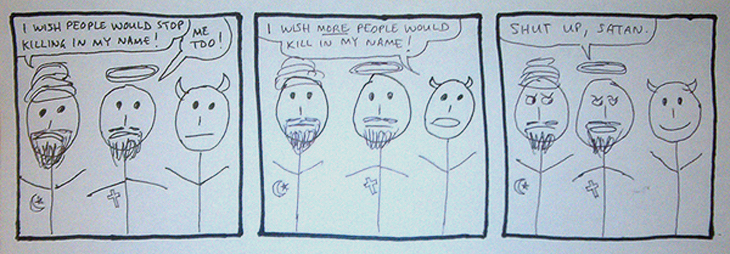

Total Bumper, Man

0

You know what I’ve seen a lot of since moving to Portland, more than I saw in Salt Lake City? Hippies. Strip clubs. Homeless people under the age of 30. Minorities. But you know what else? Bumper stickers.

Seems like every other car has at least one, and many have several. Everybody’s got something to say. Everybody wants to make sure you know what they think.

It makes sense that Portland would have more bumper stickers than Salt Lake does. Bumper stickers tend to be ideologically liberal, and Portland is a liberal place. In some ways, the very act of putting a bumper sticker on your car is radical and non-conservative. I mean really, you’re defacing your own property. Conservatives don’t usually do that. They don’t cut holes in their jeans or pierce their eyebrows, either.

Besides, with conservatives leading the government right now, the liberals have more to protest than ever. (What do liberals do when liberals are in power? Complain about conservatives trying to take away their power?) Even if a conservative wanted to put a bumper sticker on his car, what would it say? “Everythin’ Is Peachy!”? “I Like the Way Things Are!”?

Anyway, I don’t fully grasp the rationale behind plastering bumper stickers all over your vehicle. First of all, bumper stickers are too small to say anything truly meaningful or thought-provoking. Pithy, sure. Clever, absolutely. But an entire personal thesis? A summation of what you believe as a citizen? Doubtful. If your philosophy can be expressed in a bumper sticker, your philosophy is stupid — an axiom which, ironically, would make a good bumper sticker.

And what’s the point anyway? To make sure the other drivers know what your opinions are? Like I’m driving and you cut me off and I’ll say, “Hey! Watch where you’re going, you stupid — oh, you’re opposed to the war, too? OK, then. Go ahead. Let me slow down for you.”

Or is it meant to change my mind? Are people supposed to see your bumper sticker and say, “Hmm. ‘Nobody died when Clinton lied’? Why, I suppose that’s true. Excellent point, Toyota Camry! I like the way you think! I’m changing political parties at once!”?

I don’t think so. Let me tell you something: Nobody cares what you think. People care what their friends think, and what their parents think, and sometimes what their religious leaders think. But nobody cares what strangers think. Those opinion pieces that sometimes run in the paper, the ones by ordinary citizens called “guest columnists”? Nobody reads them. Newspapers might as well run 15 inches of profanity for all the attention those articles get.

But even less sensible to my way of thinking are the “funny” bumper stickers. These are the ones that aren’t meant to provide political or social commentary, but are simply jovial and witty. Who buys these? How funny does a joke have to be for you to permanently affix it to your car? Sure, it gives you a chuckle when you see it in the novelty store, or the truck stop, or wherever you buy bumper stickers. But will it still make you laugh when you’re seeing it every single day for as long as you own the car? I mean, there are some “Far Side” cartoons that are pretty hilarious. But I don’t think I’d ever tattoo one of them onto my body. Not even the one where a bunch of vultures are standing around a cowboy’s dead body and one vulture has put the cowboy’s hat on and is saying, “Look, everybody! I’m a cowboy! Howdy howdy!”

And you have to figure: If YOU bought the bumper sticker at some kind of store, then doesn’t that mean maybe hundreds of OTHER people have also bought it? Won’t the joke’s impact be lessened when there are thousands of other cars out there telling it?

Many of these stickers have funny concepts, but they deploy them haphazardly and without regard for the elements of comedy. One common abuse is capital letters, as in: “Insanity is hereditary. YOU GET IT FROM YOUR KIDS!!”

Now, come on. That punch line is reasonably funny, but not when it’s being shouted. Imagine if I walked up to you on the street and delivered the joke that way. You wouldn’t laugh. You would push me down and run away.

Another common way that bumper stickers ruin their own jokes is with kooky, wacky fonts that oversell the joke. For example, “Just because I’m paranoid doesn’t mean they’re not out to get me” is OK as a one-liner. But it’s a lot less funny when it’s blared like this:

Hardy har har! Yuk yuk yuk! Please kill me.

The World According to Sesame Street (documentary)

0

Everyone knows “Sesame Street” is a quiet, stalwart part of American culture. But what of its influence abroad? Do other countries find it as useful as we do?

The answer, as found in the over-long and under-focused documentary “The World According to Sesame Street,” is: sort of. Directors Linda Goldstein Knowlton and Linda Hawkins Costigan dash between Bangladesh, South Africa and Kosovo, showing how foreign, localized versions of “Sesame Street” are created.

It’s a fascinating process, actually, though Knowlton and Costigan’s way of presenting it doesn’t do it justice. They don’t just dub over the American bits in a new language (though there is a little of that). Mostly they create characters and stories specific to the area, with Children’s Television Workshop representatives working closely with the local producers. So most of the content in each incarnation of “Sesame Street” is locally made, speaking directly to the children in that region.

In the South African version, for example, an HIV-positive Muppet was introduced a few years ago, reflecting that country’s massive AIDS epidemic. The few minutes spent discussing the controversy that ensued back here in the States comprise one of the film’s livelier segments.

The film is also fascinating when it shows clips from the foreign versions of “Sesame Street.” The Bangladesh edition is eager to include a tiger character, since that’s the national animal. In Kosovo, two different versions must be made, one for Serbs and one for Albanians, since the two groups hate each other. (The original goal was to have one show that would teach children of both cultures that everyone is the same — but the grownups on both sides apparently didn’t want to send that message to their kids.)

Overall, though, a more accurate title for the film would be “Sesame Street According to the World.” It’s not about how “Sesame Street” views the world, or how it has impacted society. There are glimpses of Jim Henson’s 1968 tapes pitching the show to TV executives, but the focus is primarily on the people who produce the foreign versions today — and let’s face it, they’re not very interesting. Since first-time directors Knowlton and Costigan have both worked extensively as producers, maybe they think the behind-the-scenes negotiations are more engaging than they are.

Another more telling angle might have been to show how “Sesame Street” affects children in other countries, or how local levels of literacy or health epidemics make something like “Sesame Street” a necessity. It’s frustrating to see a film so doggedly focused on the people who simply should not be the focus. “Sesame Street” should be about the kids, remember?

Wide Awake (documentary)

0

“Self-indulgent” isn’t usually a compliment, but I mean it that way for “Wide Awake,” a fascinatingly self-indulgent look at one man’s battle with insomnia.

Alan Berliner is a New York filmmaker whose previous documentaries have mostly been about himself and his family, too. How a person makes money at this, I have no idea. But he and his wife Shari live comfortably, if modestly, and are plagued by only one problem: Alan can’t sleep.

He tells us he’s been this way for years, unable to turn his active mind off at night, tossing and turning before finally getting only a few hours of restless sleep. He’s tried every usual remedy, and the only one with any efficacy is sleeping pills — and even those only grant him a little respite.

Berliner narrates the film himself, sometimes on camera, sometimes as a voice-over, and the movie works as a personal record of his own search for answers. He takes us with him on visits to sleep experts and psychologists, who struggle to find the roots of his problem or a solution to it. He films kitchen-table discussions between him, Shari, his sister Lynn and his mother Regina, all of whom exhibit more exasperation than sympathy. Their unspoken opinion seems to be: Just go to sleep! How hard could it be?

One thing we learn is that Berliner is obsessive to an alarming degree. For years, he has cut out newspaper photos and cataloged them extensively by topic. As a photographer and artist, his interest in such things might be understandable. But it’s hard to think that when you see him sitting on the floor surrounded by dozens of stacks of clippings, all piled according to subject matter. What you think instead is that this guy is not normal.

He also collects old film footage, much of it from ancient industrial shorts and educational films, all of it impressively well-organized. This works to his advantage in “Wide Awake,” where he can illustrate a point with a quick montage of clips — a series of people turning off their bedroom lights, for example, or of roosters crowing to announce the new day. It gives the movie a quirky, lively feel, and prevents it from being too dry.

Indeed, if there’s one thing Berliner has, it’s a sense of humor. He is wearied and defeated by his insomnia, but he maintains a grim smile and a sharp sense of irony through it all. “Wide Awake” addresses some broader issues, like the effect that poor sleep habits have on American society, but it’s at its best when it stays with Berliner and his own plight, which is very human and very intriguing. The whole thing makes you want to get some sleep — but again, I mean that in a good way.

Somebodies

0

“Somebodies” may set the land speed record for going downhill fast. I laughed quite a bit in the first 20 minutes. And then I sat in mystified silence for most of the rest of the film, wondering what had happened to the promising movie I’d been watching.

This is the work of single-named writer/director/actor Hadjii, who wanted to make a movie about African-American men who aren’t gangsters, rappers, athletes or criminals, but just ordinary men. He has accomplished that, I suppose, but not much else.

Hadjii plays Scottie, a Georgia college student who, with his passel of like-minded roommates, spends his time chasing girls, drinking beer, smoking pot and getting into mischief — more or less typical university behavior.

But Scottie drags himself to church on Sundays, too, often half-asleep but still making the effort. The fiery preacher, Rev. Hill (Tyler Craig) — one of the few consistently funny characters in the film — speaks in what you might call random plurals: “I knows somebodies who can make all things possibles!” He keeps Scottie alert to the fact that he must figure out who he is and what he’s going to do with his life.

The film progresses more or less plot-free, episodically depicting Scottie and his friends on their quest for fulfillment. Scottie’s cousin Janoah (Irone Singleton) is just out of prison and may be a bad influence. Scottie starts dating a woman named Diva (Kaira Whitehead), a freaky gal who becomes born again and wants to be celibate until marriage. Scottie’s eccentric family members offers advice and commentary about race and gender issues, most of which is sub-“Barbershop” and sub-“Diary of a Man Black Woman” in terms of humor and relevance. Heck, it’s even sub-“Nutty Professor II: The Klumps.”

There are several lengthy scenes that are utterly pointless. They don’t advance the story, which means they were included because Hadjii thought they were funny. BUT THEY’RE NOT FUNNY, EITHER. They’re woeful, amateurish skits centered on lame premises, like Scottie’s buddy getting a job watching surveillance cameras at an apartment building and using his omniscience to scare elevator passengers.

The irony is that while Scottie’s big goal is to get his life in order, the film never lets him do it. He’s no different at the end of the film from the way he was at the beginning. And yet the movie seems satisfied with itself, like it has successfully shown a young man’s journey from Point A to Point B, despite the fact that there is no Point B. This might make a good rough draft for a screenplay, but it needs a lot more work before it’s fit for the silver screen.

Everyone Stares: The Police Inside Out (documentary)

0

Before you watch “Everyone Stares: The Police Inside Out,” which is basically 75 minutes of Stewart Copeland’s home movies of the seminal ’70s and ’80s rock band, consider this question: Do you REALLY want to watch 75 minutes of Stewart Copeland’s home movies? Do you want to watch 75 minutes of ANYONE’S home movies?

Because it turns out Copeland’s home movies are as boring as everyone else’s. Sure, Copeland was drummer for the Police, and he filmed lots of stuff between the time he got his Super 8 camera in 1978 and the time the band broke up amicably in 1985. Yeah, the footage shows Copeland, Andy Summers and Sting in their natural habitat, backstage at shows and in tour buses on the road. But understand this: Just because you have filmed something doesn’t mean you have made a movie. The surveillance camera at 7-Eleven films things, too.

“Everyone Stares” sounds like a good idea, but it isn’t one. Copeland, a folksy, sincere-sounding man now in his 50s, narrates the footage, which very loosely tells the story (from Copeland’s point of view) of the group’s rise to prominence. No new interviews were conducted; the film consists entirely of the stuff Copeland shot back in the day.

The problem is, Copeland didn’t know he was making a movie when he shot it. He wasn’t careful to make sure key moments were documented; he was just fooling around. So the Police’s most successful, most legendary album “Synchronicity” barely gets a mention, simply because Copeland didn’t happen to film much that related to it. At another juncture, someone says, “We’re starting to not support each other. It’s getting lonely in this band.” The band is apparently on the verge of breaking up — yet there is no footage to document that. No fights, no arguments, no tension. Just Copeland telling us about it, 20 years after the fact.

The film is a disappointment, plain and simple. Hardcore fans of the band will be delighted to see ANY footage, of course, coherent, revealing or otherwise. The rest of us are left to feel like the screaming fans pounding on the tinted limousine windows: We catch a few glimpses of what’s going on inside, but mostly we’re left out.

Cargo

0

“Cargo” is a movie that confuses obscurity with mystery. It thinks it is being cryptic in the way it reveals — or, more often, does not reveal — details, when in fact it is being impenetrable and dispassionate. It’s a hard movie to like, and I’m not sure it would be worth the effort anyway.

It’s set aboard The Gull, a cargo ship from North Africa bound for Marseilles, onto which a rootless German youth named Chris (Daniel Bruhl) has stowed away. Once he is discovered, the stern Capt. Brookes (Peter Mullan) puts him to work as a crew member.

But there are strange things afoot on The Gull. One night Chris sees three people being thrown overboard, unable to tell who they are or why they’ve been sentenced to drown in the Mediterranean. Soon after, crew members begin to disappear, leaving only their boots behind. Clearly this is no Love Boat.

Through hushed, stilted conversations with other crewmen, Chris learns that stowaways are common, and that sometimes the way to get rid of them is to throw them overboard, a method that is surely illegal even in international waters. He’s horrified by the news — but it still doesn’t explain what’s happening to the disappearing sailors.

Written by Paul Laverty and directed by documentarian Clive Gordon in his feature-film debut, “Cargo” is a big, serious movie, very grandly shot, scored and edited but utterly obtuse in its presentation. Put simply, we never have any idea what the heck’s going on, and when it’s over, too many questions are left unresolved.

Why does one crewman go crazy and climb to the crow’s nest buck naked? Why are the boots always left behind when men disappear? Who’s actually taking the men away? If it’s who we’re supposed to think it is … come on. That one person against those big, strong men? Please. The film is a frustrating and unsatisfying mystery, a complete waste of the cool old ship it was shot on.

Son of Man (Xhosa)

0

If the biblical story of the life of Jesus Christ seems timeless to you, here’s more evidence that you’re right. It’s “Son of Man,” a film in the South African Xhosa language in which the New Testament story of Jesus is adapted to modern-day Africa. It translates surprisingly well.

Director Mark Dornford-May (whose last film was an African adaptation of “Carmen”) finds a lot of parallels between the Gospels and 21st-century Africa. The setting is a fictional sub-Saharan nation called Judea where warlords, dictators and famine are the rule. Herod (Sibusiso Ziqubu), the ruler, oversees a near-fascist militia and is paranoid about insurgents and rebels, so the common people are ready to listen when Jesus (Andile Kosi) preaches a gospel of peace and pacifism. Just as in the Bible, the African Jesus finds no shortage of people who are poor and hungry and eager to hear a message of hope.

The story is basically the same as you remember from Sunday School, with no room at the inn and water to wine and a death and resurrection. Africa is depicted as being caught between traditionalism and modernism; news of Jesus’ miracles spreads through video footage as well as via colorful murals that the villagers paint on the walls. In the story of the woman caught in adultery, the townspeople who would execute her object not to her immorality, as they do in the Gospels, but to the fact that in the modern world, promiscuity spreads disease.

Jesus’ apostles are former insurgents and warriors whom he has asked to lay down their weapons. A couple of them are women, which is a logical change from the original material. It’s interesting that Dornford-May (who co-wrote the screenplay with his “Carmen” cohorts Andiswa Kedama and Pauline Malefane) doesn’t emphasize Jesus’ divinity so much as his leadership, good sense and compassion.

There is no question of Jesus’ godhood in the film, though. Traditional African tribal music, dance and costumes are employed in the worship of him, and it’s a poignant contrast to the death and mayhem that rule the people’s daily lives.

The film is worth watching just to see how the story is adapted, and for the native elements just mentioned that give it a National Geographic flair. However, just as in the Bible, there is no characterization to speak of. The figures perform their roles in the pageant, but we never get beneath the surface of their characters. The exercise wears thin before we’re finished, and you hate to walk out early on a movie about Jesus.

Salvage

0

What a good short film “Salvage” would have made, and what a bad long film it is. It’s a low-budget, low-impact, low-quality horror flick with a cool idea that simply doesn’t withstand being stretched over 90 minutes. Chop it down to about 20 and you’d have something.

It begins with Claire (Lauren Currie Lewis), a 19-year-old college student, leaving her graveyard shift at a convenience store and waiting for her boyfriend, Jimmy, to pick her up. But arriving instead, in Jimmy’s truck, is Duke (Chris Ferry), a friend of Jimmy’s from the salvage yard where he works. Allegedly, Jimmy asked Duke to give Claire a ride home.

Scary-movie things happen at that point, and then Claire wakes up. She’s back at the convenience store, apparently having dozed off on the job. The whole thing was a dream. OR WAS IT?!?!?!??!

Back in reality now, the film spins its wheels for a good long time. Claire’s mom (Maureen Olander) is behaving strangely in the basement. Jimmy (Cody Darbe) says he had a sexy dream about Claire and a friend of hers. Claire experiences deja vu in class and sees the killer from her dream stalking her elsewhere. OR DOES SHE?!?!?!?!?!??!

We realize early on that very little, if any, of what’s happening is real, that most of it is in Claire’s head. When the film goes into “Groundhog Day” mode (albeit with variations each time Claire is attacked), the relevant question becomes: Why should we be scared for Claire when we know she’s just going to wake up any minute anyway?

I also wonder: How many times can one character back away slowly from something while shaking her head in horror and saying, “No … no …”? It seems like half the shots in the film are of Claire doing that. The other half are of her walking slowly down stairs or around corners, saying, “Hello? Is someone there?”

Jeff and Josh Crook, the brothers who wrote and directed “Salvage,” have made three little-seen films before this one, all available on DVD. There are encouraging reviews of those movies on the Internet. “Salvage,” the Crooks’ first foray into horror, is likely a downturn in quality for them. It’s a film that will probably nowhere and do nothing.

The Darwin Awards

0

Of course you know what the Darwin Awards are. They’re sarcastic honors given to people who die because of their own stupidity, thus taking themselves out of the gene pool and strengthening the human race. Curiously, the movie “The Darwin Awards” will probably deserve a Darwin Award itself after dying quietly at the box office and thus strengthening the art of filmmaking in general.

Writer/director Finn Taylor (whose “Cherish” was one of the highlights of the 2002 Sundance Film Festival) started with an amusing idea: He wanted to re-create some of the more famous Darwin Award stories, like the guy who died when he toppled a vending machine over on himself, or the guy who attached a rocket to his car and blasted into the side of a mountain, or the dumb woman who thought “cruise control” meant the RV would drive itself. (None of those events actually happened, by the way. Just because someone sent it to you in an e-mail doesn’t mean it’s true. In fact, the opposite is usually the case.)

True or not, the incidents make for amusing stories (unless you’ve heard them before and already know how they end), but Taylor has folded them into a very dull plot starring the very dull Joseph Fiennes as Michael Burrows, a profiler for the San Francisco Police Department who loses his job after letting a bad guy get away in a rather embarrassing fashion.

In need of new employment, Michael, who follows the Darwin Awards as a hobby, gets the idea that perhaps certain characteristics of Darwin candidates can be predicted, and that if insurance companies knew what the risk factors were, they could avoid insuring those people and save millions in settlements. He convinces an insurance company to back him, and he sets out to interview Darwinian types to find out what, if anything, they all have in common.

Now, if I were the head of that insurance company, I’d have said: “But aren’t most of the Darwin Awards for apocryphal events that never happened? Aren’t 90 percent of them just urban legends?” And then I would have called security to escort Mr. Burrows out of the building.

Anyway, Michael is sent out into the field, accompanied by the insurance company’s top claims investigator, Siri Tyler (Winona Ryder). Where Michael is overly cautious, safety minded and afraid to do anything unusual, Siri is spontaneous and fun. In a development that is the very definition of “obligatory,” they fall in love.

Taylor’s script goes so wrong in so many places that it should be studied in film schools. For example, Michael is constantly being shadowed by a documentary filmmaker (Wilmer Valderrama). Why? It never figures into the story; he’s always just there. For most of the movie, Taylor very clearly goes out of his way not to show us the filmmaker’s face. And then finally we see it … without fanfare, without a pay-off, as if he’d never been hiding it in the first place.

There’s also the fact that in some cases, Michael and Siri are obviously traveling alone, with no one else in the car, yet somehow when they arrive, the filmmaker is with them.

And what about that serial killer, the one Michael accidentally let go at the beginning? Despite his face having been caught on tape, no one in the SFPD has been able to find him. Yet when Michael finally locates him, it’s right there in San Francisco, in the same neighborhood as all the crimes were committed. The guy never left town. So, um, why wasn’t he arrested months ago?

In closing, let us mention Metallica. One of the Darwin stories re-created is of two dim bulbs trying to climb over a wall to sneak into an outdoor concert. To tell the story, you don’t need to show the band in question. You don’t even have to tell us which band it is. But since Taylor managed to get Metallica to appear in the film, he keeps cutting to shots of them performing, interrupting the flow of the semi-amusing Darwin story he’s trying to tell.

The band appears offstage, too, after the concert, probably because their contracts demanded a certain amount of screen time and Taylor — willing to shoot his movie in the foot if it would get a big name like Metallica involved — went along with it.

I liked “Cherish” a lot, Taylor, so I’m giving you a pass on “The Darwin Awards.” But if you keep tying rockets to the roofs of your movies, you’re going to find them splattered against the side of a mountain. I’m just sayin’.

Moonshine

0

You watch enough “Mystery Science Theater 3000,” you get a feel for what kind of movie best lends itself to being heckled. It needs to be bad, obviously, but it helps if it’s also self-serious, either over- or under-acted, and rife with peculiar details.

It’s during movies like “Moonshine,” an ultra-low-budget horror (?) film from Connecticut, that I miss the MST3K gang the most. Surely Mike (or Joel) and the robots would know how to deal with the teenage protagonist’s elderly, decrepit parents. (Did they conceive him when they were 80?) They would certainly have plenty to say about the fact that though “Moonshine” is billed as a horror film, it contains nothing even resembling horror until the last 15 minutes. And the character of Pat (Ginny Fitzpatrick), a buxom, chain-smoking convenience-store owner who wears leopard-print tops and and too much makeup and flirts dirtily with her teenage employee — why, she’s right out of a Roger Corman film.

Alas, “Moonshine” only exists by itself, with no running commentary from a man and two wise-cracking robots to make it tolerable. Directed by Roger Ingraham from a script he co-wrote with Lori Isbell, “Moonshine” takes place in what appears to be the most depressing town in the world, a sleepy, dreary little place where everyone speaks without inflection or enthusiasm. Peter (Brian Greer) takes a job at Pat’s convenience store in order to support his ancient, ailing parents, and finds himself smitten with his co-worker, a girl named Danny (Sarah Ingraham, the director’s sister).

Danny is engaged to be married, however, so Peter’s relationship with her is limited to standing around the store (which barely gets enough business to sustain one employee, let alone two) and occasionally smoking pot in the storeroom.

I should mention that a few nights before Peter started working there, Danny wrecked her car, was set upon by some kind of thing, and now occasionally passes out.

The film is only an hour and 17 minutes long, and nothing happens for a solid hour of that. Peter and Danny stand around; there are cutaway scenes of police finding dead bodies and wondering who the killer is; Peter and Danny stand around some more. But in that last 15 minutes, Ingraham begins to tell an atmospheric, almost wordless story, and to do so very stylishly. It would be an intriguingly dark, well-shot finale if only the story preceding it had been any good. Or heck, if there had even BEEN a story.

Why We Fight (documentary)

0

“Why We Fight” purports to be about why America has gone to war historically, but let’s be honest here: It’s all about Bush and Iraq. Previous engagements like Korea and Vietnam are given only cursory treatment, the real thrust being that the current Iraq conflagration is wrong and that Bush is a bad president. This is just a Michael Moore film without Michael Moore — without the ego and the bombast and the cheap theatrics. It’s “Fahrenheit 9/11” that’s had a shave and a shower.

I see any removal of Michael Moore as a step in the right direction, and surely filmmaker Eugene Jarecki recognizes, as do many other liberals, that Moore sometimes hurts his side more than he helps. An anti-Bush, anti-war documentary that remains calm and non-melodramatic might be in order, to rinse away the negative feelings caused by “Fahrenheit 9/11.”

Dichotomously, “Why We Fight” suffers from being unoriginal. Like it or not, we DID already have a “Fahrenheit 9/11,” and it covered much of the same ground as “Why We Fight.” Do we need another one, even if it’s a more palatable version? You can go to another restaurant if you don’t like what you had at this one, but that fact remains, you already ate.

“Why We Fight” begins with Dwight D. Eisenhower’s farewell address, in which he warned against letting the military industrial complex get too big, and against the United States becoming imperial. That was in 1961. Forty-four years later, the military industrial complex is huge — the film says $750 billion is spent on defense every year, “and profits are up” — and some view our foreign policies as reeking of imperialism.

It all boils down to money, Jarecki says, and he brings up Dick Cheney’s connections to defense contractor Halliburton, as well as various other economic factors that he says play a part in modern America’s foreign policies. He does not focus on making Bush look foolish, the way Moore did. Instead, he presents the facts — which surely someone will call into question if the film is released nationally — and largely lets them speak for themselves (though he does have interviews with the likes of John McCain, Gore Vidal and Eisenhower’s son).

Some of the data is sobering, even frightening. A mention is made of Dick Cheney’s 1992 directive (when he was Secretary of Defense) that the U.S. do all it can to keep itself as the world’s only “superpower,” including acting unilaterally, if necessary, to preserve America’s “interests” — a philosophy that is at the core of the Bush doctrine and that sounds scary when you put it in those terms.

It is hard to remain neutral in today’s heated political environment, and maybe neutrality isn’t a worthwhile aim anyway. My role as a film critic is to describe the movie’s merits as a movie — how well it does what it’s trying to do, in other words — and not to say whether its ideas are good. The film is shrewd to keep its leftist tendencies subtle at first, so that even conservative-thinking viewers may be drawn into it and perhaps wind up giving the liberal ideas some thought. If you’re a hard-core conservative, I suppose that’s sneaky, tantamount to propagandism. As always, a film being well-made and intelligently laid-out will be trumped by the viewer’s pre-conceived notions, just as, in the case of “Fahrenheit 9/11,” a film’s occasional shoddiness will be ignored by those who support its ideas.

Underworld: Evolution

0
Underworld: Evolution

“Underworld: Evolution” is a true just-for-fans sequel. It has a simple plot, but it’s told so complicatedly that anyone without a working knowledge of the first film would be completely lost. And I can tell you with some authority that if you haven’t given the first film a moment’s thought since reviewing it 2 1/2 years ago, when you gave it a C- and dismissed it as dull and useless, the flashbacks and recaps in the sequel will provide little help.

We begin in 1202 A.D., where two brothers have met with equally unfortunate fates. Markus (Tony Curran) was bitten by a bat and is now a vampire; William (Brian Steele) was bitten by a wolf and is now a werewolf (or lycan, as they prefer to be called). Are the boys in this family just accident-prone, or are they reckless and stupid? Is this a bloodline that should probably be cut off now, before they breed?

Anyway, William the wolf is out of control, as indicated by this line of dialogue, spoken upon discovering a village that has been massacred by him: “Yet again we arrive to witness this monster’s aftermath,” with “aftermath” pronounced “offtermath.” Markus is a vampire, sure; yeah, he survives by drinking the blood of humans. But his brother is a total psycho about it. Just look at this offtermath!

William gets captured and locked away somewhere, and now it’s modern times again. Markus, 800 years older but still spry, is seeking certain keys and amulets and pendants that he believes will help him free William from his prison. Meanwhile, Selene (Kate Beckinsale), a good vampire, is trying to protect her boyfriend Michael (Scott Speedman), a human who in the first film was established as a hybrid — part lycan, part vamp.

The Underworld series:

“Underworld” (2003) C-
“Underworld: Evolution” (2006) C-
“Underworld: Rise of the Lycans” (2009) C-
“Underworld: Awakening” (2012)
“Underworld: Blood Wars” (2017) C

Through it all, the war between vampires and werewolves continues, fought in the countrysides and villages of, what, Romania? Someplace like that. Once again directed by Len Wiseman and written by him and Danny McBride, this “Underworld” film generally keeps the supernatural beings separate from the ordinary humans, making it less a horror film (where you’re supposed to be scared of monsters attacking people) than a fantasy film (where unreal creatures interact in a world all their own).

Some of the action is entertaining enough, I suppose, with numerous impalements, stabbings and beheadings splattering the screen with blood (which appears not red but black, as does almost everything in the film’s black-and-blue color palette). The movie isn’t funny or campy or terribly exciting or very interesting, but it’s not egregiously dimwitted or insulting, either. “Underworld” fans — and there are Internet message boards to prove such passionate individuals exist — will surely find it satisfying. The rest of us should look elsewhere for bloody tales of the supernatural.

Looking for Comedy in the Muslim World

0

“Looking for Comedy in the Muslim World” is a great title for a movie. The movie’s concept is great, too; it would even be great if it were employed in real life. And yet, despite all this greatness, the movie is not great. It is merely good. Good is good, but it would have been nice to see something great.

The idea is that the U.S. government, in an attempt to understand Muslims better, sends an American humorist to a Muslim nation to find out what makes them laugh. I think that plan is marvelously insightful (which is probably why the real U.S. government would never think of it). After all, if you know what makes someone laugh, you know what makes them tick. What you find funny says a lot about your values, your background, your philosophy and your life experience.

In the film, the government chooses Albert Brooks, who plays himself and who also wrote and directed the film. (It’s the first time he’s worn those hats since 1999’s “The Muse,” and only the seventh time total.) Brooks was a successful comedian in the 1970s, gradually becoming an actor known for his congenial, worried characters, a sort of Woody Allen-lite. In “Looking for Comedy,” he is well aware of his career’s slump, and of the fact that most people now know him best as the voice of Marlin in “Finding Nemo.” His self-deprecation is endearing, as always, as when he wonders if the government meant to contact Mel Brooks instead of him.

He is soon in India, where he will spend a few weeks interviewing the locals before moving to Pakistan to do the same thing. Why India, you ask? Isn’t that nation mostly Hindu? It is indeed. Some 150 million of its people are Muslim, but that’s only 15 percent. The same percentage of Americans are Baptists, but no one calls the U.S. a “Baptist nation.” So I wonder why the fictional government would send Brooks to India to learn about Muslims, and I wonder why the real Brooks wrote his movie that way. Why not Saudi Arabia?

At any rate, he is in New Delhi, aided by two State Department suits (John Carroll Lynch and Jon Tenney) and a local girl named Maya (Sheetal Sheth), a beautiful journalism grad student who can take dictation and shorthand and can also provide insight into the Eastern sense of humor. Maya and Albert travel the city, asking passersby, “What makes you laugh?” Eventually, their findings are supposed to comprise a 500-page report.

When the street interviews are slow-going, Albert hits on the idea of performing a comedy show himself. Seeing what a local audience responds to will surely be very instructive.

That’s where the film loses steam. Frustratingly, every time Albert Brooks the movie character seems on the verge of gaining insight into the Muslim sense of humor, Albert Brooks the filmmaker prevents it. Albert meets with some Pakistani comedians, but gets roped into performing for them rather than letting them perform for him. His show in New Delhi bombs — but all that suggests is that the Indian sensibility is different from the American one. It tells him (and us) nothing about what Muslims DO laugh at.

Eventually, Brooks’ point is that separate nations barely speak to each other at all, let alone get to know each other well enough to understand their divergent senses of humor. It’s a good point, and Brooks makes it without being aggressive or agitative. The film’s humor is buoyant, wry, and affectionate; if anything, it’s slightly TOO gentle, providing laughs in its first half before petering out into a somewhat belabored whimsy.

You’d think a film with this topic would be more controversial. Heck, the title alone scared Sony Pictures away from it. (Warner Independent is distributing it instead.) I have to wonder if Sony even watched it, because it’s awfully innocuous, a pleasant, occasionally hilarious movie that misses some opportunities but is still a success.

End of the Spear

0

The amazing true story behind “End of the Spear” is ripe with dramatic possibilities. Reading it at the film’s Web site, I thought: This is fantastic. So why isn’t the movie better?

The movie is a respectable effort, well put together with production values that look better than its paltry budget. Its religious origin — it’s about Christian missionaries and was produced by a Christian organization — isn’t permitted to intrude on the story or turn it into a sermon.

Yet as directed by Jim Hanon and written by Hanon, Bill Ewing and Bart Gavigan — all more or less newcomers to the movie industry — “End of the Spear” feels only marginally uplifting and just passably enjoyable as a film. I know in my mind that these experiences were extraordinary for the people involved, but I never really feel it.

It is set mostly in 1953 in Ecuador, where a few young American couples have moved, with their small children, to serve as Christian missionaries to the native tribes. Of particular concern are the Waodani, a fearsome, warring indigenous group infamous for killing foreigners and each other almost without provocation.

Nate Saint (Chad Allen) — and yes, that was really his name — leads the group as they make their first friendly contact with the Waodani. As it happens, one of their people, Dayumae (Christina Souza), left the tribe years ago and now lives with Nate’s sister Rachel (Sara Kathryn Bakker) in nearby Quito. There’s a huge language barrier between Nate and the Waodani, but he wants to express to them that Dayumae is alive and well.

He also wants to help them. They’ve become so murderous that the Ecuadorian government is threatening to send troops into the jungles to quell them. The missionaries have begged for one last chance to get the Waodani to calm down by peaceful means.

(What the movie doesn’t address is that the Waodani weren’t just killing each other, but outsiders, too — outsiders like people from Shell Oil, who wanted to drill on their land.)

Nate also, let us not forget, wants to teach the Waodani Christianity. Here the movie occasionally lapses into just a bit of white man hubris, where the solution to all the poor benighted natives’ problems is to simply accept Jesus. (“We can’t shoot the Waodani,” Nate tells his son. “They’re not ready for heaven.”) Even as a Christian, I wince sometimes when I see things presented that way. But to the movie’s credit, it doesn’t fall into that trap very often — and besides, the Waodani are in fact murdering one another capriciously. I don’t think it’s culturally insensitive to say that they need to cut it out.

After the Waodani, led by a man named Mincayani (Louie Leonardo), turn on the missionaries, the Christians’ wives and children — including young Steve Saint (Chase Ellison), who narrates the film — move to the jungle to pick up where their husbands and fathers left off. Mincayani begins to feel guilt for his barbaric actions, and some of the tribe start to accept the simplified form of Christianity being taught. (“God” and “Jesus” are not named; instead, the missionaries speak in Waodani terms.)

But as I said, the film doesn’t feel like a religious tract. It focuses instead on people’s internal struggles with morality and rightness, and has an air of sincerity about it. The acting is credible, though the film’s shift in protagonists from Nate Saint to Mincayani to a grownup Steve Saint prevents us from getting too attached to any of them. It’s a positive movie with a positive message — and I suspect the documentary “Beyond the Gates of Splendor,” which tells the same story, is probably even better.

French Kiss-Off

0

I am a big fan of planning things. Telling TiVo to record a show as soon as it appears on the schedule, mapping out which films I’ll see at Sundance, making an appointment with my gynecologist as soon as the six-month reminder card arrives — this is like crack for me, my friends. Hot, buttered crack!

Needless to say, I am not thrilled when my plans go awry. What is the use of scheduling something if it’s just going to change at the last minute, that’s what I say, often and angrily. So I was a little unnerved last week when I found my class schedule at Portland State University unraveling before my very eyes.

If you haven’t been keeping up, I’ve gone back to school to do Film Studies, in the hopes that it will make me a more better writer. As befits my fondness for planning, I registered for my Winter Term classes as soon as I was allowed to, back in November. My selections were: Writing on Film (I wanted to see if I’ve been doing it right) and French Cinema (I’m interested in art from all nations, even stinky ones).

These classes were a good complement to each other. One meets from 12-2 on Tuesdays and Thursdays; the other from 2-4. They’re even in the same building. I was pleased with my efficient, economical class schedule.

Imagine my surprise, then, when I showed up for the first day of French Cinema and discovered that the class was being taught in, um, French. Every Tuesday the class will watch a French movie, and then on Thursday the class will discuss it. In French. As a way of practicing their French.

Now, I don’t speak French. You will notice it is absent from the following list of languages I have mastered:

LANGUAGES I HAVE MASTERED:
• English (questionable)

So as the movie (“Le Retour de Martin Guerre”) began to play, and as I examined the syllabus and realized what was happening, I contemplated my options.

The sitcom option, of course, would be to take the class anyway. I wouldn’t be able to participate in the class discussions on Thursdays, but it’s not like EVERYONE in a class talks every day. As long as I seemed to be listening and occasionally nodded thoughtfully and said, “Oui … oui,” I could probably get away with it.

Then, when it was my turn to give a 15-minute presentation on that week’s film, I could find someone who speaks French, have him write out my presentation, and memorize it before class. Or I could wear a wire and have my French-speaking friend stand just outside the classroom door and feed me the lines through an earpiece.

Ultimately, my plan would come crashing down, of course, probably on the last day of the term. The professor would find out what I had done, and we’d have a hearty laugh about it and then there would be hugging.

The problem with the sitcom option is that the whole point in taking the class hadn’t been just to watch French movies, but to discuss them with others, and to learn about French cinema in general. Obviously this would not be accomplished if everyone was speaking some crazy foreign language.

My only other option, then, was to drop the class and disrupt my brilliant schedule. I combed the course catalog for appropriate classes meeting before or after Writing on Film, but found none. Then I found an appealing alternative: Danish Cinema, meeting Monday/Wednesday/Friday at 10:15 a.m. And the course catalog said specifically that this class was taught not in “Danish,” if that’s even a language, but in English! And I speak English! (Refer to list.)

I was momentarily delighted. Danish cinema! Why, we’ll probably examine the films of Ingmar Bergman! No, wait, he was Swedish. Danish. Danes. Denmark. Hmm. The only Danish director I can think of is Lars von Trier, whose “Dancer in the Dark” and “Dogville” are not among my favorites, and whose general attitude toward cinema is pretentious. Are there other Danish filmmakers? There must be, clearly, if there’s a whole class devoted to them. Surely taking it will enlighten me and help me appreciate them better!

This being Tuesday, I had already missed the first class, but I was prepared to attend the second one on Wednesday. Naturally, when Wednesday arrived, I slept through my alarm and did not wake up until 10:45, thus missing the second class, too. Knowing I would miss even MORE classes because of the upcoming Sundance Film Festival, and already being two behind, I dropped Danish Cinema and signed up for Film History II, which meets on Thursdays and which I hadn’t missed any of yet.

Having taken Film History I last term, I already had a textbook, which I assumed Film History II would simply use the second half of. Obviously this wouldn’t work, though. Obviously Film History II would need to use the second half of an entirely different film history textbook. Obviously an art form that is barely a century old and is ridiculously well-documented will have a wide variety of conflicting interpretations of its history, thus requiring AT LEAST two different textbooks to cover them all.

I kid, of course. The textbooks are virtually identical to each other in format, structure, organization and dullness. (How you can write dully on a topic as inherently entertaining as cinema, I have no idea.) I’d like to write a textbook someday. It will cost $5 a copy to print, we’ll sell it for $75, and every two years we’ll add a couple commas, reprint the thing, call it a “new edition,” and make previous editions obsolete, thus preventing students from getting anything when they try to sell their used copies.

Anyway, now that my schedule was settled, I was able to relax and enjoy school, to fill my head with knowledge and expand my horizons. Most importantly, with my schedule determined, I could start coming up with excuses for missing class. Tres bon!

Olympics vs. ‘Arrested Development’

0

I believe the Fox Network loved “Arrested Development” at one time. But when that love was not shared by millions upon millions of viewers, Fox’s love turned to resentment and bitterness.

Here are the most recent developments:

– Lowering the order from 22 episodes to only 13, the subtext being: “After these 13 episodes, you’re canceled.”

– After airing nine episodes, suddenly taking the show off the schedule altogether.

– Refusing to OFFICIALLY cancel the show, thus preventing any other interested parties (like Showtime or ABC, reportedly) from picking it up. Fox isn’t obligated to make it official until May, and they have no reason to do it any sooner, other than basic human decency.

And now here’s the very latest word:

Fox WILL air the final four episodes, and they’ll do it in one two-hour block — 8-10 p.m., Friday, Feb. 10.

You’ll notice I said Friday. Curiously, this is the night of the week “Arrested Development” should have aired this season anyway. Overall viewership is much lower on Fridays, and thus so are networks’ expectations. On Friday, a paltry 3 million viewers for “Arrested Development” would have been just fine. On Mondays, though, Fox expected a lot more and were disappointed when they didn’t get it.

Anyway, here’s the real kicker. Guess what is ALSO airing on Friday, Feb. 10? That’s right, NBC’s coverage of the Opening Ceremonies of the 2006 Winter Olympics!

So Fox is doing the right thing by airing those last four episodes — but they’re dumping them against what will be one of the highest-rated programs of the entire year. (In 2002, the only thing that got more viewers than the Opening Ceremonies was the Super Bowl.) That way, when nobody watches “Arrested Development,” Fox can say, “See?! We were right! Nobody watches this show!”

Luckily, fans of “Arrested Development” tend to have DVRs (or at least VCRs, for heaven’s sake), so they can record it even if they’re watching something else. But honestly, Fox. Why you gotta be such jerks about it?

Angry Letter: Nielsen ratings

1

I got one of my strangest angry letters yet the other day, from a man named Tom (accident55@hotmail.com) who took issue with my blog entry about the Nielsen ratings and TiVo users. Evidently, he feels very strongly about the matter. His passion for the subject, combined with failing to take his medication, resulted in the following foaming, frothy e-mail:

Lots and lots of inaccuracies in your latest “diary” entry. (As that is what a blog is. A 12 year old girl’s diary.) [And yet somehow I manage to be neither 12 years old nor a girl.]

Where did you pull the number 9000 from? Out of your [swear word]? There are 5000 national Nielsen boxes distributed, and another 23000+ locally. So, you were only off by about 66%. Nice.

[Well, it is nice to receive constructive criticism, but in fact there is some confusion about the number. It was 5,000 for several years, but one of the things the newest Nielsen CEO, Susan Whiting, did was increase it. You will find the number 9,000 reported in a variety of sources. Google Nielsen ratings 9000 and see. Unfortunately, the Nielsen company’s own Web site still lists the number as 5,000 in one of its apparently out-of-date FAQ pages.]

The rest of your rant sounds like the typical cry baby whose shows are not doing well, so they blame it on the faulty Nielsen rating. “Nielsen claims they are pretty darned accurate”? So, you’ve never taken a statistics class before? Or you don’t beleive in the science of mathematics and statistics?

[Sure, I trust the mathematics behind the idea that a sample of only 9,000 can represent all 300,000,000 Americans — but that ONLY works if those 9,000 people are a proper cross-section. If all 9,000 were white, for example, with no minorities, then it wouldn’t be accurate, and it would have nothing to do with the math.

The sample would need to reflect different viewing habits, too. Not everyone sits down to watch a show at 8 p.m. every night with their spouse and 2.3 children. People tape shows, TiVo them, watch them in places other than home, etc. So the 9,000 would need to include some representation of those other types of people to remain accurate, too. And again, it has nothing to do with the math.]

The rest of just pure specualtion. You say that cetain shows will do better than otehrs when DVRs are reportewd. You are very ignornat on this entier subject. [Few things in this world delight me more than someone calling me ignorant and misspelling the word. So thanks for that.] Because while Nielsen didn’t use DVR figures, TIVO DID report their viewer’s habits. And guess what? There was NO significant difference between TVIO users and Nielsen families.

[The word “NO” probably should not have been capitalized so emphatically, since in fact there are some differences. Each week, TiVo lists the top 25 most TiVoed shows, based on a random sampling of 20,000 TiVo users’ “Season Pass” lists. (That’s the thing where you tell TiVo to record a particular show every week, automatically.) The top shows look about like the Nielsen top shows — except there’s “Family Guy,” for example, as the No. 8 most-TiVoed show last week, while Nielsen ranks it at No. 56. And “My Name Is Earl” is only 35 on Nielsen’s list, but 10 on TiVo’s. Or “The West Wing” at 63 in the Nielsens, 11 on TiVo. Or “Will & Grace,” also much higher on TiVo than Nielsen. But yes, other than that, there is NO significant difference.]

And that is logical to someone that has a brain. (Maybe some day medical science will help your qualify.) [Will help my qualify what?] If a show has such loyal viewers, they will be absolutely SURE to watch it as soon as possible, rather han lat TIVO record it. Whereas a casual fan will not care if he/she sees an episode of a show a few days later. A casual fan is MORE likely to let TIVO handle their viewing habits.

[See, and that’s highly illogical to me. Saying that people who use TiVo must not care about TV is like saying people with day-planners must not care about their appointments. Just because you write it down, or have a machine set to get it for you, doesn’t mean you don’t care. Quite the opposite! Someone who didn’t care wouldn’t bother to use a day-planner to keep track of his appointments; he’d just trust his memory. Similarly, someone who cares about his TV shows would be glad to have a reliable device to record them for him, so he doesn’t have to worry about forgetting, or being away from home, or whatever.

Watching an episode a few days later has nothing to do with being casual or devoted, either. Sure, people without TiVo watch shows the very minute they air. Why? Because they don’t have any choice. They don’t have TiVo! Many people with TiVo do watch them the same night, but later, after the kids have gone to bed, or whatever. It doesn’t mean they don’t care about the shows. If anything, it means they want to fully enjoy them without interruptions or distractions.]

Besides, your last comment shows how clueless you are. You ask Aren’t the loyal fans (what you consider the TIVO fans) the ones that the networks want?

The sanswer is obviously NO. [Um, I think you mean, “The sanswer is sobviously no.”] Do you really not understnad the whole concept behind the ratings system? It is used for ADVERTISING. Nothing else. People who TIVO don’t watch commercials. So networks really don’t care about them, nor should they. [I wrote a subsequent blog entry on that aspect, though no doubt you were busy uninstalling your Spellcheck program and failed to notice it.]

Why do you think the Nielsen ratings are the ONLY ratings used? They have no monopoly or anything. Other companies are free to compete with them if they came up with a better system. But they don’t. Becuase other companies know it is pointless. The Nielsen ratings ARE accurate. The best proof of this is that advertisers STILL use them. [Or maybe the only reason advertisers still use them is that they don’t have any choice, because no one has come up with a better system.] People far smarter than you (which is easy) do studies. And htey know that when they advertise on a show with a high rating, they see a larger increase in sales than when they advertise on a show with a low rating. Ifthey didn’t find this to be the case, then advertisers would stop paying the Nielsen company MILLIONS of dollars to use their survey results.

[Here’s where he goes off the rails altogether….]

It is clear you are just a crybaby who actually rthink that Letterman is even 1/10000th as funny as he used to be. You must have the mentality that you laugh at watching something float in water. (The kind of crap Letterman used to mock on his old show.) Or maybe you are brainwashed by the fact that his audience cheers and applauds at every little thing Letterman says and does. (Something in which Letterman used to respond with “you people are STARVED for entertainment”) You think that Family Guy is popular, despite it getting low ratings STILL, even with ridiculous amountf os hype for its return. (Ifyou are a fan, sorry to say that it is in danger of being cancelled AGAIN, and this time for good. Which is a good thing since pop culture references are NOT the samr ting as comedy.)

As TIVO is counted, Desperate Housewives ratings will not go down. Arrested Development’s ratings will NOT got up. War at Home’s ratings will not go down. Not significantly anyway. Everything will stay pretty much the same.

Seriously, I know this is nothing more than a sissy little diary written by someone with the mentality of 12 year old girl, but shouldn’t you at least get SOME facts before ranting?

I’m always amazed at the amount of anger people are able to work up on the most trivial subjects. I mean, my blog about the flawed rating system was impassioned, I suppose, but I don’t think any of it was ANGRY. Yet here’s this e-mail from someone who is MAD!! He apparently hates TiVo, he apparently loves the Nielsen company, and he apparently types with three fingers and doesn’t use Spellcheck.

For the record, here are some statistics:

Number of times he accuses me of having my facts wrong: 6
Number of facts I actually got wrong: 0
Number of times he insults me on a personal level: 6
Number of times I insulted him on a personal level in my original blog: 0
Number of words misspelled in his e-mail: 20
Number of words misspelled in my original blog entry: 0

Hoodwinked

0

Here’s a fun idea: Tell the “Little Red Riding Hood” fairy tale “Rashomon” style, with each participant — Red, Granny, the wolf and the woodsman — giving his or her version.

Now here’s a stupid idea: Do that, and then drag the story out for an additional half-hour by including an elaborate backstory that requires a complicated resolution.

“Hoodwinked” takes the stupid path through the forest, doing serious damage to what was otherwise a fairly amusing animated film. Written and directed by Cory and Todd Edwards, brothers who are making their big-time debut with this Weinstein Co. release, the film will probably provide adequate delight to the youngsters, but it overstays its welcome too much for more discerning viewers.

It begins at the climax of the familiar Red Riding Hood story, with Red (voice of Anne Hathaway) questioning the Wolf (Patrick Warburton) about the size of his hands, teeth and ears (“All the better to hear your many criticisms”), and the subsequent rescue by the Woodsman (James Belushi). Granny (Glenn Close) was tied up in the closet all along.

The forest police arrive and cordon off the crime scene. The cops and detectives are animals; the Three Little Pigs are uniform cops, while a bear is chief of police. Inspector Nicky Flippers (David Ogden Stiers), a frog, shows up and says all of this could be part of a larger case. Granny runs a highly profitable “goody” business (cookies, pies, etc.), and many of her competitors have recently had their recipes stolen by the so-called Goody Bandit. Is Red, the Wolf, Granny or the Woodsman the culprit? Or is it someone else altogether?

As each character gives his or her account of the facts, the film cleverly doubles back and weaves the story into the bigger picture. For example, we wonder why Granny appears in a “vision” in Red’s story; later, when Granny’s story is told, we see why. It’s a fun device, and the movie’s happy-go-lucky attitude keeps everything light and frivolous.

Then there’s a problem. All four characters have testified, and we still don’t know who the Goody Bandit is. Another act is required to tie things up, and that’s where the story becomes burdened with details and subplots. Red has a lame conflict with Granny when Granny’s secret life as an extreme-sports enthusiast is revealed. (Is the idea of a sweet old lady doing “young” things even funny anymore?) The upside is that Red gets a song, and it’s performed by the marvelous Ben Folds. (In fact, the film’s catchy pop-rock soundtrack is generally above-average.) The downside is that the film keeps going, far longer than it ought to before finally ending.

The computer animation is not exactly state-of-the-art. The characters are drawn puffy and bulbous, and they move the way video-game characters did in the late ’80s. It all seems too mechanical, not at all realistic the way we’ve come to expect from computer-animated films.

The technical deficiencies could be overlooked if the story were great, but it’s merely average. It has laughs, and smiles, and a couple memorable characters (Twitchy the hyperactive squirrel and Japeth the singing mountain goat, specifically). But it doesn’t have enough of any of those things. And that drawn-out finale…! Can’t we just let these people live happily ever after?!

Last Holiday

0

What Queen Latifah has going for her is an outsized, likable personality. Beware of any movie that wants her to pretend to be something else.

For example, beware of “Last Holiday.” Here she plays a quiet, timid Louisiana woman who lives a solitary life of little importance. When this woman, Georgia Byrd, learns she has three weeks to live, she moves to a luxury hotel in Europe to spend her final days doing all the fun things she only dreamed about before. There she touches the hearts of the hotel staff and wins over all who encounter her with her down-home wisdom and aw-shucks humility.

Ugh. Ugh, I say. Latifah simply is not believable as a shy, mousy creature. It’s too fundamentally opposite of who she is. It’s like asking Yao Ming to play a dwarf. And the hotel staff falling in love with her? I can buy that if it’s Queen Latifah they adore, but not Georgia Byrd. Georgia is drab and ordinary. (It was Alec Guinness in the 1950 film on which this one is based; he was certainly better suited to such a role.)

The Grandhotel Pupp in Prague is Georgia’s destination, and it turns out to be a “Fantasy Island” retreat for her. Guess who runs the kitchen? Her favorite celebrity chef (played by Gerard Depardieu). Guess who’s staying at the hotel at the same time? Her Louisiana congressman (Giancarlo Esposito) and the heartless businessman, Kragen (Timothy Hutton), who owns the department store Georgia works at.

Because she’s at the Pupp, everyone assumes Georgia is a millionaire. (Indeed, one does wonder how a New Orleans salesclerk managed to save the $100,000 or so necessary to pull off this multi-week vacation.) So they cater to her every whim, while being charmed by her down-to-earth sensibilities. “She’s the most amazing person who ever came to this hotel!” gushes one employee in some of the straight-faced hyperbole at which the film excels.

One employee, a prickly German valet named Gunther (Susan Kellerman), is not impressed, however. She searches Georgia’s room for clues about her identity, and when she discovers who she really is, she says — out loud, though there is no one else in the room — “I wonder if your new friends would be so impressed if they knew the truth!” That’s the dialogue, folks. Read it and weep.

The screenplay, by Jeffrey Price and Peter S. Seaman (the duo behind “Who Framed Roger Rabbit” and “Wild Wild West”), is simple-minded and amateurish, reducing the story to one easy-to-remember maxim: Everything Georgia does is right; everyone who opposes her is evil. Following this thesis to its logical conclusion leads the film to some surprisingly stupid scenarios, as when Georgia, a novice skier, makes it down a mountain unscathed while Kragen, an expert, falls down constantly. Why does he fall? Because he doesn’t like Georgia, and therefore must be punished. The movie wants you to applaud wildly to see Georgia’s oppressor so humiliated.

By the end, when Georgia is winning at roulette — (Why does she always win? Because everything Georgia does is right, remember?) — and her secret crush (LL Cool J) is flying to Prague to profess his love for her, and Georgia is talking a suicide jumper down off a ledge — that’s when the movie completely falls apart. It doesn’t make any sense, you see, any of it. Director Wayne Wang is powerless to stop it, although given his recent track record of treacly, senseless comedies like “Maid in Manhattan” and “Because of Winn-Dixie,” I’m not even sure he wants to.

Glory Road

0

Audience response has little to do with a film’s quality, much less my opinion of it — certainly I’ve disagreed with the people sitting around me many times — but I think the reaction of the crowd with whom I saw “Glory Road” is instructive.

The man in front of me, a sharply dressed African-American gentleman, chatted amiably with his girlfriend and others before the film started. He said he doesn’t go to movies very often because they’re all the same, and I thought: Uh-oh. He’s not going to like “Glory Road,” then. Surely this film is just like the other based-on-a-true-story sports movies where an underdog team comes out of nowhere to upset its favored opponents.

Then the movie began. It’s set in 1965-66, when it was unheard of for a college basketball team to be composed primarily of black players. Today, of course, it’s honestly funny to hear people say, “A team full of Negroes?! How are they going to win basketball games!,” and lines like that earned big laughs from the mostly African-American audience.

The new coach at El Paso’s Texas Western College is Don Haskins (Josh Lucas), and he’s determined to produce a winning team. To that end, he heads north and recruits black players from Detroit, Indiana and New York, offering them scholarships if they’ll leave street ball behind and come play for him.

The boosters are stunned to learn that when Haskins is finished, only five of his 12 players are white. Ross Moore (Red West), an old-timer who serves as the coach’s assistant, says college teams never use a lot of black players. “One on the road, two at home, three if you’re losing,” he says. But to start the game with four on the court? Or even FIVE?! Madness!

To these remarks, and to the much more blatant and appalling racism that followed, the audience reacted negatively and vocally, as African-American audiences are wont to do. When the team did well, the audience applauded them. Yes, it’s silly to applaud filmed images of actors pretending to re-create a game that was played 40 years ago, but no matter. The audience was INTO this movie. It was telling a story that mattered to them, the story of the first team in history to play an NCAA championship game with an all-black starting lineup. And it happened in 1966, in the era of Martin Luther King Jr., Malcolm X and Rosa Parks. This is a “black” movie as much as it is a sports movie.

But is it a GOOD movie? See, that’s the thing. I don’t think it is. It’s predictable at every turn, and it can’t seem to go five minutes without someone making an impassioned speech about one thing or another. When someone wants to quit the team, Coach Haskins says, “If you quit now, you quit every day for the rest of your life!” I thought about how I’d heard that line, or something like it, in 95 percent of all the sports movies I’d ever seen, but the man in front of me, the one who doesn’t like movies because they’re all the same, nodded and said, “Mm-hmm, that’s right.”

The title must have been chosen randomly; the words “glory” and “road” are never spoken, separately or together, in Chris Cleveland and Gregory Allen Howard’s screenplay. Only a few of the 12 players are given enough personality traits to tell them apart. Haskins’ wife might as well be played by a stagehand holding up a drawing of a woman’s head attached to a stick, for all the screen time she gets. (Her two main scenes, of course, are the one where she worries about her husband getting involved in the town’s racism, and the one at the end where she tells him how much she loves him.) Aside from some sharp editing and suspenseful storytelling in the climactic game scene, first-time director James Gartner’s work is as average as the script.

But it’s hard to discount that audience reaction, which culminated in wild applause at the end. (Contrary to what you might think, that doesn’t happen at every advance screening.) Even the guy in front of me who thinks all movies are the same loved it — and if any movie was ever the same as every other movie, it was this one.

So this is my recommendation: If you have some vested interest in the story — black history, the Civil Rights movement, or college basketball in general — or if you have not already seen “Remember the Titans” or “Miracle” or “The Rookie” or “Hoosiers” or “Coach Carter” or “Rudy” or “The Bad News Bears” or “The Mighty Ducks,” then perhaps you will love “Glory Road.” Otherwise, I don’t think you will be impressed.

Tristan & Isolde

0

Purists are already complaining about how the ancient legend of Tristan and Isolde has been mutilated for its new screen adaptation, and of course by “purists” I mean “nerds.” I wasn’t aware this ancient legend existed until the film’s trailer informed me that “before ‘Romeo & Juliet’ there was ‘Tristan & Isolde.'” (Take THAT, Shakespeare! You suck!!)

Still, those nerds have a point. Many elements of the story, set in the Dark Ages in England, have been removed to make it more relatable to a modern audience. The star-crossed lovers don’t fall for each other because of a love potion anymore, for example; now it’s for the regular old-fashioned reasons, i.e., his angular, brooding face and her pert bosoms. But even among the original elements that remain, much of the drama has been sucked out of them by a tired screenplay and underachieving direction.

It is a time of war and discontent in stinky olde England. Not only are the various tribes — your Anglos, your Saxons, your Jutes, etc. — at odds with each other, but those darn Irish keep sailing over to burn down villages and take Britons back as slaves. (Why they think pasty, weak-kneed Brits would be good workers, I don’t know. Don’t they see Italy just across the way?)

Tristan (James Franco) is a British youth and an excellent military strategist. Orphaned as a child, he has grown up under the care of Lord Marke (Rufus Sewell), the man who would be king if the bickering tribes could ever agree on a unification plan. And Tristan would be his No. 2.

Alas, Tristan is killed in battle and, according to custom, his body is put on a boat and sent floating away. But whoops! One, he’s not dead; two, he lands on the Irish coast, where the beautiful Isolde (Sophia Myles), daughter of King Donnchadh (David O’Hara), secretly nurses him back to health and falls in love with him.

(A side note: Do you suppose maybe the reason the Irish hate the English so much is that the English are always sending their corpses to them on boats? I mean, you set a body adrift in the Irish Sea, where do you think it’s going to wind up? Singapore?)

Anyway, Tristan and Isolde can’t be together, and they realize it, as demonstrated by very obvious dialogue such as, “We both know this can’t be. We’ve known it from the start.” (Yawn.) Tristan heads back to England and they vow never to see each other again. But then! Through a very odd bit of strategy by her father, Isolde winds up married to a prominent Briton, and she and Tristan are once again living in proximity to one another. They don’t have Motel 6, but they sure have old stone dugouts and abandoned cellars.

Director Kevin Reynolds has made period pieces before, notably “Robin Hood: Prince of Thieves” and “The Count of Monte Cristo” (and, less notably, “Waterworld”), but I don’t recall the past being as murky and overcast as this one. He’s directed plenty of fight sequences, too, yet all the action in “Tristan & Isolde” is shot mostly in rapidly cut close-ups, making it chaotic and confusing (not to mention cheap, since you don’t actually have to teach any actors how to sword-fight).

More damaging, though, is the general WB-ification of the story, in a screenplay by Dean Georgaris (“Lara Croft Tomb Raider: The Cradle of Life”). The pretty young leads, scrubbed fresh and clean in a most anachronistic fashion, exhibit only teen-drama emotions, nothing approaching the real depth hinted at by the story’s classic themes. Sophia Myles is just bland, and James Franco’s one facial expression is that of someone whose feelings have just been hurt.

There are serious ideas at work here. Greed, jealousy, love, betrayal — you can make a powerful film out of those raw materials. But in these hands, it’s as shallow and glossed-over as Franco’s English accent.

Film Geek

0

You know the guy who works at the video store who’s super-nerdy about movies and recommends obscure foreign classics and babbles endlessly about movie trivia? You don’t? Then don’t see “Film Geek.” You won’t get it.

For those who know such people — or, better, who ARE such people — “Film Geek” is an agreeable, occasionally very funny low-budget movie that is at least partly autobiographical for its writer/director, James Westby.

His alter ego is Scotty Pelk (Melik Malkasian), a baby-faced, high-voiced man in his early 20s who works at Video Connections, a Blockbuster-type rental house. His passionate, dorky love for film is off-putting to customers and even to fellow employees, who are teenagers who couldn’t care less about cinema as art.

He is fired because of this, though that doesn’t stop him from wearing his Video Connections shirt and nametag everywhere. The film follows him as he wanders through Portland, Ore. (hometown to Westby), trying to make points with a hip girl named Niko (Tyler Gannon), enduring his new job in an auto-parts shipping warehouse, and promoting his Web site.

You can see Westby venting some of his long-held frustrations about what philistines video-store customers are. They don’t care if a movie is letterboxed or not, and they love “Patch Adams” but hate “Memento” for being “confusing.” If you chuckle knowingly at the scenes depicting those customers, you are the target audience for “Film Geek.”

There’s a “Napoleon Dynamite” vibe to the film, particularly in that its main character is odd yet pathetically endearing. (Both films have only a passing interest in their own plots, too.) The difference, and it’s a key one, is that while Napoleon’s entire world was quirky — it’s not just himself, but all the other characters, too — Scotty exists in a normal, down-to-earth world. He’s the only weirdo in the movie, and so some of what he says is a little TOO bizarre. I kept thinking: “How could he be THAT oblivious to the way people perceive him, and the way normal people behave?”

He couldn’t, of course, not in real life. Nonetheless, his slacker’s journey from obscurity to fame registers as a movie geek’s ultimate fantasy.

Chatrooms of the 1950s

0

iluvloosey: did u see lucy last nite???
rickynelsonfan3: omg
lvt2bvr: so funny
iluvloosey: “vita-meeta-vegamin!”
hounddog: rofl
iluvloosey: i was rofl
rickynelsonfan3: haha
lvt2bvr: pretty racey
paulstanka: ya
lvt2bvr: i didnt no they could show people being drunk on tv
paulstanka: ya my dad was mad
paulstanka: he was gonna call cbs and complane
paulstanka: i was like “shut up and have a drink dad” 🙂
mousketear: lol
rok&rollll: OMG!!
rok&rollll: i just heard evlis is gonna be on ed sullivan!!
rok&rollll: elvis
hounddog: ya
hounddog: you didn’t know?
hounddog: we were talking about it last nite
rok&rollll: oh
rok&rollll: i was at a sock hop last night
hotrodder: a suck hop?
mousketear: lol
iluvloosey: ??
rok&rollll: what duz that mean?
hotrodder: i dunno
hotrodder: sock just sounds like suck
iluvloosey: ya but what does suck have to do with a sock hop?
hotrodder: nothing
hotrodder: forget it
hotrodder: rolls eyes
rok&rollll: you cant just make up new slang, hotrodder
rickynelsonfan3: elvis on sullivan will be so swell!!
rok&rollll: ya that is totally keen
hotrodder: paulstanka, will ur dad be mad about it? 😉
paulstanka: hehe
paulstanka: ya, prolly
beetnick: elvis is squaresville
hounddog: shut up!!!
rok&rollll: he is not!
iluvloosey: ur just jelous of him
beetnick: elvis is a fairy
iluvloosey: ???
hounddog: like tinkerbell?
beetnick: no i mean queer
hounddog: well hes kind of strange
beetnick: NO
beetnick: i mean he”s a homosexual
hounddog: wtf?
rok&rollll: a waht?
iluvloosey: what is that?
hounddog: oh i heard my dad say that word
hounddog: about my uncle
beetnick: ya
rok&rollll: elvis isnt a fairy!!
hounddog: u think all boy singers r fairies
beetnick: duh
beetnick: cuz they are
iluvloosey: troll
iluvloosey: beetnick just likes to make people mad
mousketear: omg you guys
mousketear: did u see my school on the news?????????
rickynelsonfan3: no
hounddog: no
iluvloosey: no
beetnick: on
beetnick: er, no
hotrodder: no
hounddog: what happened?
mousketear: omg
mousketear: the police came
rok&rollll: y???
mousketear: a student had chewing gum!
rok&rollll: omg
iluvloosey: :-O
rickynelsonfan3: *hugs mousekeater*
hounddog: ((((((mouseketear))))))
rok&rollll: are u ok?
mousketear: ya
mousketear: it was scary tho
mousketear: the cops came
mousketear: and took the gum
mousketear: and the kid went to jail
rok&rollll: omg
hotrodder: that is crazy
mousketear: you here about that kind of thing in new york but i wuldnt think it wuld happen here
hotrodder: paulstanka, ur dad should call cbs and complane
hotrodder: 🙂
paulstanka: shut up about my dad!!
hotrodder: lol
rickynelsonfan3: ur dad is []’sville
rickynelsonfan3: square
rickynelsonfan3: get it?
hotrodder: ya we get it

‘Brokeback’ and Utah:

0

I am delighted by the comedy of errors surrounding “Brokeback Mountain” and the Jordan Commons theater in Sandy, Utah.

As locals know, Jordan Commons is owned by Larry Miller, a car-dealership tycoon who also owns the Utah Jazz. A devoted Mormon, he has also financed production of some LDS-themed films such as “The Work and the Glory” and “States of Grace.”

Well, “Brokeback Mountain” was scheduled to open at Jordan Commons this past Friday. It was already playing to record-setting crowds at the Broadway Centre in downtown Salt Lake City (Sandy is a suburb 20 minutes south), and was set to open in two other area theaters on Friday, too.

On Thursday, Miller was being interviewed by KCPW-FM reporter Jonathan Brown, who brought up the imminent showing of “Brokeback Mountain.” I haven’t heard the interview, which aired on the NPR affiliate Friday, but I gather from Miller’s quoted response that Brown was expressing surprise that Jordan Commons, which has occasionally shied away from controversial movies, was showing it.

Miller said, “It’s something that I have to let the market speak to some degree…. I don’t think I’m qualified to be the community censor.”

But here’s the thing: Turns out Miller didn’t actually know what “Brokeback Mountain” was about until Brown told him.

Two hours after the interview was conducted, Jordan Commons told the local papers to pull “Brokeback Mountain” from its Friday ads, because they weren’t going to show it after all.

Now, if Jordan Commons doesn’t want to show “Brokeback Mountain,” that’s fine. Theaters are entitled to show or not show whatever films they want, and they’re not beholden to anyone to explain or justify their actions. We went through this two years ago, when nobody in Salt Lake wanted to show the gay missionary drama “Latter Days.” (The Broadway Centre eventually did show it.) Whatever your reasons — political, social, moral, financial — if you own the theater, you can drop a film.

Of course, you should probably do the dropping sometime BEFORE it’s too late, not after. In Miller’s case, it was too late to change the ads in Friday’s paper, and patrons showed up at Jordan Commons on Friday expecting to see the movie.

But here’s the funny part: Larry Miller, who owns not just Jordan Commons but the Gateway Megaplex downtown, DIDN’T KNOW what “Brokeback Mountain” was about?! What kind of bubble do you live in to not have heard AT LEAST the basic two-word summary that everyone uses to describe the film? (It’s the “gay cowboy” movie.) Even your everyday citizens have surely heard about the film, but this guy — who OWNS MOVIE THEATERS — hasn’t? I think that’s hilarious.

Naturally, Utah’s Eagle Forum was quick to applaud the decision. The Eagle Forum is run locally by Gayle Ruzicka, an ultra-conservative activist who wields enormous influence over Utah politicians despite holding no elected office. She speaks quickly and harshly against anything that cannot be squeezed into her very narrow, very black-and-white, very religious worldview. (Being religious is not a problem, of course. But expecting everyone around you to follow the same rules is.) She’s so conservative — and so outspoken about it — that even some of the conservative Mormons around her say, “Dang, she’s really conservative.”

One of the better examples of her hyperbole and fear-mongering was during the 2002 Winter Olympics, when she spoke out against the Salt Lake Organizing Committee’s having condoms available to athletes, free for the asking, at the Olympic Village health center. “Where are the athletes … getting their sex partners?” she asked. “Are they bringing their own with them … or are they going out on the streets of Salt Lake City looking for our sons and daughters? Are we giving them permission to do this with the distribution of condoms?!?!?!?!??!?!??!?!” [extra hysterical punctuation added; see this column for more background])

Anyway, here’s what Gayle said about the decision not to show “Brokeback Mountain” at Jordan Commons:

“I think it sets an example for all the people in Utah and, like I said before, he’s my new hero…. It’s such a terrible show, and it is such a horrible message. I just think (pulling it) tells the young people especially that maybe there is something wrong with this show.”

Some points:

POINT NO. 1: It’s not a “show,” Gayle, it’s a movie. Shows are on TV or in live theatrical or concert venues. If it’s been filmed and is now being projected on a screen, it’s a movie.

POINT NO. 2: How do you know it’s such a terrible movie, Gayle? Have you seen it? I would bet money that you have not. I suspect you’re relying on your legions of flying monkeys to report back to you on its content — “It has men in love with each other!” — and that’s as far as you went. You can dislike a film’s message, as gleaned from outside sources, but don’t call a movie “terrible” unless you’ve actually seen it.

POINT NO. 3: If you HAVE seen it, shame on you. It’s rated R.

POINT NO. 4: Gayle, you hypocritical gargoyle, do you know what movies DID open at Jordan Commons on Friday? “Grandma’s Boy” and “Hostel.” If we’re talking just about content, and not dealing with matters of artistic or entertainment merit, both films are far more graphic and potentially damaging to the community than “Brokeback Mountain.” Unlike “Brokeback Mountain,” which has one brief, fully clothed sex scene between two men and a few brief scenes of heterosexual married sex later on, “Grandma’s Boy” and “Hostel” feature wall-to-wall profanity, sexual vulgarity, nudity, very graphic illicit sexual activity, and rampant drug use. On top of that, “Hostel” also has gruesome, horrific violence and gore.

And that’s just the onscreen content! If we get into the ideas or “themes” of the films, it’s much more disturbing. We have premarital sex being encouraged, promiscuous young people being lionized, drug use being championed, and sadistic torturers of human beings being granted a free pass.

But don’t worry, Gayle! “Grandma’s Boy” and “Hostel” may be depraved, degrading and salacious — but at least don’t have any implications of adult men being in love with each other! So they’re totally fine, and Larry Miller can still be your new hero even though he’s showing them. I wonder, though. If pulling “Brokeback Mountain” tells young people that there’s something wrong with the movie, does NOT pulling “Hostel” or “Grandma’s Boy” tell young people that there’s NOT something wrong with them? If one move is a condemnation, then the other, logically, has to be an endorsement.

(By the way, last weekend the Broadway Centre’s box office for “Brokeback Mountain” was 12th-highest among the 300-plus theaters that were showing it. I’m sure the folks at the Broadway are happy to have Jordan Commons cancel it, because it means more audiences for them.)

Sources:
The Salt Lake Tribune
Deseret Morning News

Grandma’s Boy

0

One thing almost all movies have is a plot. Good movies, bad movies, average movies, most of them have stories of some kind. They may be bad stories, or illogical ones, or boring ones, but they are stories. Why, a story is such a basic element of filmmaking that one would almost consider it a prerequisite.

Yet here is “Grandma’s Boy,” a movie that does not have a story. Oh, things happen in the movie, sure. Most of the scenes serve to advance one of several threads — the ongoing rivalry between this character and that one, this guy’s unusual living situation, that guy’s weird fondness for jungle animals, and so forth. But none of these can really be called a plot, let alone THE plot of the movie. It’s just random stuff happening.

Written and directed by Adam Sandler’s buddies and starring a few more of them, the film is about a 35-year-old video-game tester named Alex (Allen Covert, one of the writers) who gets evicted from his house and moves in with his grandmother (Doris Roberts) and her two housemates, senile Bea (Shirley Knight) and randy Grace (Shirley Jones). He tells his buddies at the office that he’s staying with three hot chicks, and implies he’s having sex with them, when the real reason he’s tired every day is that Grandma wakes him up at 6 a.m. to do chores.

A young-ish pot-smoking bachelor who has to live with his nana? I’ve seen good movies with worse premises than that one. Yet for some reason, it’s ignored. The movie isn’t “about” Alex’s uncomfortable living arrangement. In fact, apart from having to do chores, it’s only occasionally an annoyance.

So what IS the movie’s conflict? I mean, all movies need a conflict, some obstacle that’s preventing the protagonist from achieving what he wants. But that would require the protagonist to want something, and “Grandma’s Boy” is above that. Alex doesn’t want anything, and thus there are no conflicts. I’d call this defiance of basic movie conventions “experimental” if I didn’t know it was actually due to sheer incompetence.

Alex has a friend and co-worker named Jeff (Nick Swardson, another co-writer) who lives with his parents (whom he calls his “roommates”) and wears footy pajamas when he sleeps in his racecar-shaped bed. Alex and Jeff have a pot dealer named Dante (Peter Dante) who is really tan and walks around naked sometimes. Alex and Jeff get a new supervisor at work, Samantha (Linda Cardellini), who has flown in to make sure the new video game gets done on time. The game creator, J.P. (Joel David Moore), is a Matrix-dressed nerd who sometimes talks like a robot. The vice president of the company (Kevin Nealon) does yoga and talks about the “energy” in the room.

All of these are perfectly reasonable elements to add to your quirky stoner comedy. But you don’t want them to be the focus. No, no, sweetie, you want them to be interesting flavors to complement the overall taste of your story. But what’s that? There IS no story? You’ve put all these ingredients into the stew pot but neglected to add a broth to keep them together? Well, then you’ve wasted everyone’s time. I hope you’re proud of yourself.

There’s a bit of obligatory gross-out humor near the beginning, but then the movie settles into a fairly affable routine of slacker jokes and juvenile put-downs. Since there is no central storyline to progress, I assume each scene is in the movie simply because someone thought it was funny — which is puzzling, because most of them aren’t. There are funny moments, yes, and I laughed several times over the course of the film. But as I look back, I can’t think of any entire SCENES that are funny, only individual lines or events in them. It’s a movie of supporting paragraphs but no thesis.

(Warning: This film contains Rob Schneider and David Spade.)

Hostel

0

Eli Roth became a cult hero in 2003, when his “Cabin Fever” hit theaters and was hailed as a rebirth of the old-school style of blood-and-laughs as found in movies like “Evil Dead II” and “The Texas Chainsaw Massacre.” Funny one minute, horrific and graphic the next, “Cabin Fever” was soon an underground hit.

Now comes his follow-up, “Hostel,” which is a little lighter on the humor and a little heavier on the torture. It’s a good movie, as these things go, occasionally painful to endure and quite fiendishly devised. If that doesn’t sound like your idea of a good time at the movies, you’re excused from watching it.

The premise, or as much of it as I can tell you without ruining any surprises, is a time-honored classic: attractive young people go someplace unfamiliar and are slaughtered. A few gore flicks let the kids get killed at home (notably the “Halloween” and “Nightmare on Elm Street” series), but it’s usually when they’re away: camping, on a road trip, or on vacation somewhere. In this case, it’s backpacking through Europe.

Strangely, there are no girls among the potential victims, at least not readily. In fact, the group is small: just Paxton (Jay Hernandez), his best bud Josh (Derek Richardson), and the Icelandic freak they picked up in Paris, Oli (Eythor Gudjonsson). Paxton and Josh have just finished college, we gather, and are in Europe to see how much sex they can have. Paxton is the more gregarious of the two; Josh is hesitant and still nursing his wounds after being recently dumped back home. And Oli is a goofball who will do anything.

While looking for debauchery in Amsterdam, the trio learns of a hostel in Slovakia that is legendary for its nubile young women and its general acceptance of all things licentious. And if someone in AMSTERDAM is saying this, then the place must really be swingin’. The boys set out for Slovakia immediately and sure enough, the hostel is everything they dreamed it would be: nude women in the spas, loose women in the discos, liquor and pot flowing through the streets like water.

Then, 45 minutes into the film, the terror starts. There are abductions, and there is torture. It’s interesting to note that the recent release “Wolf Creek” followed the same pattern: 45 minutes of set-up and stalling, followed by 50 minutes of mayhem. The first half of “Wolf Creek” felt repetitive to me, but “Hostel” loads up on frat-boy humor, visual stimulation (in the form of lovely European ladies) and unanticipated plot devices, enough to hold our interest before we really get down to business.

The business, when it is gotten down to, is suitably gruesome and intense, the product of a twisted imagination and a firm grasp of the horror language. Some of the details are more inventive than you would think. Indeed, where most films would be satisfied to have a lunatic with a torture chamber in his basement, Roth goes above and beyond that.

Roth counts Quentin Tarantino among his mentors (and fans), and it would be unfair to dismiss “Hostel” as nothing but a competent delivery system for slash-and-smash yuks. Like Tarantino, Roth composes shots stylishly, amps up the shrieking musical score when the action goes over-the-top, and lets humor emerge from the extremeness of the onscreen scenarios. Even if this type of entertainment doesn’t entertain you, ya gotta admit, it’s pretty slickly done.

BloodRayne

0

As one of the worst directors currently working, German half-wit Uwe Boll is under a lot of pressure. Sure, “House of the Dead” was a harmlessly stupid zombiefest, and yeah, “Alone in the Dark” was an even stupider, less harmless rehash of creature/sci-fi cliches. But can “BloodRayne,” his latest, continue to lower the bar? Can he continue to make each movie worse than the last one, or will he eventually bottom out?

I am pleased to announce that “BloodRayne” (which, like the other two, was based on a video game) is, in fact, worse than “Alone in the Dark.” It’s dumb, incoherent, and demonstrates Boll’s remarkable knack for getting even good actors to give bad performances.

The Internet Movie Database says the film is set in the 1700s in Romania, but neither of those details is apparent in the film. It could be medieval times, but it could also be a timeless “Lord of the Rings” kind of fantasy land. And Romania? Well, OK. Not sure why the accents range from American to British, then, including a hilarious one from noted non-Brit Michelle Rodriguez, but whatever you say, movie.

Anyway, wherever it is, and whenever it is, it’s about a carnival freak named Rayne (Kristann Loken) who is half-vampire, half-human, or “dhampir,” as such people are known. Her father, Kagan (Ben Kingsley), has long, girly hair and looks like Dame Maggie Smith and is also the most powerful vampire in all the land. I guess he’d have to be, to get away with having long, girly hair and looking like Dame Maggie Smith. Since Rayne was the product of rape, and since Kagan eventually killed Rayne’s mother, she is not keen on the old man and wants to destroy him. In fact, she wants all vampires dead, despite being half of one herself.

Also in the vampire-destroying business is a society, or maybe it’s more like a club, called Brimstone. A trio of their representatives — rugged Vladimir (Michael Madsen), pretty-boy Sebastian (Matt Davis) and not-English Katarin (Michelle Rodriguez) — meets up with Rayne, and after some initial skepticism on both sides, the four join forces to take down Kagan, and also to allow Rayne and Sebastian to have a comically inept sex scene.

Kagan is looking for three artifacts left over from some old vampire from centuries ago, and if he gets them, he’ll be super-magical-powerful or something. So Rayne and her posse are trying to find the artifacts first, even as Kagan’s armies are pursuing them, and so forth.

Much of the film’s unintentional humor comes from the fact that every lame line in Guinevere Turner’s screenplay is spoken with either complete apathy (as with Michael Madsen) or over-the-top melodrama (e.g., Ben Kingsley). Only Billy Zane, as Katarin’s father, tries to breathe life into his dialogue — and he’s only in the film for a couple scenes and serves no purpose anyway.

It goes without saying that the movie is neither exciting nor suspenseful (nor even interesting), but I think the chief flaw is that we feel nothing for any of the characters. They’re one-dimensional movie buffoons, not people, and their problems and crises — so confusingly conveyed by the ramshackle film — bounce off a viewer’s mind like ping pong balls. It never occurs to you to think of the film as anything other than a silly swords-and-castles tale, and a particularly ineffective one at that.

Possible Names for Rock Bands, as Suggested by News Stories in 2005

0
Possible Names for Rock Bands, as Suggested by News Stories in 2005

Possible Names for Rock Bands, as Suggested by News Stories in 2005

Schiavo & the Feeding Tubes
Papal Deathwatch
The Filibusters
Interregnum & the Congress of Cardinals
TomKat
Box Office Slump
Oprah’s Couch
Senate Confirmation
Heckuva Job Brownie
Michael Jackson’s Pajamas
Katrina and the Waves

Provo First Night

0

I thought I had spent my last New Year’s Eve in Provo, Utah, but somehow I was there again this year. And by “somehow” I mean “they paid me.”

Provo is one of many cities to hold a big celebration on New Year’s Eve called First Night. (Why “First Night” when it’s actually the last night of the year? Shouldn’t it be called “First Morning”?) The intersection of Center Street and University Avenue — the exact center of town — is closed off, and so are the streets one block in each direction. A fair-like atmosphere is created, with booths, food, games, and live entertainment. The businesses in that sector offer discounts to First Night revelers.

I was honored to be invited as one of five performers on the mainstage. Before and after me were your customary rock, pop and swing bands — and then there was me, playing the piano and singing funny songs.

The weather was cold and rainy, as you’d expect it to be on New Year’s Eve in Utah, but still there were many families out and about. I was given a very warm reception by the large-ish group of First Nighters who stood in front of the stage to watch me, and it was all around an enjoyable (not to mention lucrative) experience.

Only one thing marred the event for me. Every day that week, Provo’s newspaper, The Daily Herald — where I was a writer from 1996-2003 — ran a full-page ad listing the performers scheduled for First Night. Here is the ad:

You will notice, as I did, that my name is misspelled. In big letters. In a full-page ad. That ran every day for a week. In a newspaper I worked at for seven years.

Here’s to you, Daily Herald! Keep stupiding your way to the top!

Eric’s Sack of Mail: ‘King Kong,’ ‘The Ringer,’ ‘Narnia’

1

It’s time once again to open Eric’s Sack of Mail and answer some e-mails I’ve gotten that aren’t insane or stupid enough to qualify as Angry Letters, but that do merit some discussion.

First, a reader named Don has this to say about my review of “King Kong”:

I take exception (you have never read an email that started with those words) with your comment at the bottom of your review indicating that the film contained only “mild profanity”. Multiple uses of the name of deity is not mild in my book or I hope in yours. I was very disappointed that the film, which I otherwise would have enjoyed, contained profane language.

You are correct, the film does contain profane references to deity. Alas, such language is common enough that to most viewers, it qualifies as “mild profanity” — i.e., it’s not the F-word, or any of the other “big” swear words that you can’t say on TV. I do apologize if you felt misled by my description.

Of course, everyone has different thresholds. Some people have no problem with the F-bomb, but if you take the Lord’s name in vain, they cringe. Others are the other way around. Others don’t care either way. My calling something “mild profanity” has little to do with my own personal preferences, and more to do with how it’s generally regarded by society as a whole.

Then a reader named Linda takes issue with something I said in my review of “The Ringer,” the new Johnny Knoxville movie where he pretends to be mentally handicapped. (He prepared for this role by living as a retarded person for 30 years.)

Linda cites this portion of the review —

“And it’s an interesting thing about those friends. You know how in movies, blind people are always supernaturally good at getting around and knowing their surroundings? And deaf people can always read lips phenomenally well? The retarded characters in this movie are the same way. They’re savvy, quick-witted, sagacious and full of insightful wisdom. The only thing “mentally handicapped” about them is the funny way they talk and dress and shuffle around!”

— and then says this:

Your comments of this movie tell me that you truly don’t know anything about the topic that you are reviewing. [Actually, the topic I’m reviewing is the movie, and I do know a thing or two about it, since I, you know, watched it.] I have not yet seen the movie, so I have no idea how well or poorly it is put together. However your comment I quoted above shows me that you haven’t any clue about “retarted” people as you say. [I assure you, I never said “retarted.”] Many developmentally delayed people are exactly as you described if people were to let them get close enough to know them even just a little. They just have to do this while over coming many things that “normal” people such as yourself would probably never be able to handle. -and usually lump into a weird category because they walk a bit differently, talk a bit differently. Do you have even an inkling why? No you could probably care less – right.

Being a person with intellectual disability, the new term being thrown around out there, or as people who have no time for anyone in this category usually says retarded people, doesn’t mean they are empty and witless. Come on before you become the expert on a topic at least know a tiny bit about the subject you are talking about and don’t just base is on the stereotype that the world holds.

Give me a break.

“Before you become the expert on a topic at least know a tiny bit about the subject you are talking about” is very good advice. Therefore, I urge Linda to get back to me once she has actually seen the movie.

Yes, of course there are many mentally handicapped people who are highly functional and who are barely different from anyone else. But they still aren’t like the characters in this movie. The only way we know these characters are retarded is from the way they dress, walk and talk — the stereotypes that Linda probably doesn’t like. They are not like real-life mentally handicapped people; they’re not like real-life people of any kind!

As for my use of the word “retarded” in the review, it was an aesthetic choice. I had to use something to describe the characters several times, and saying “mentally handicapped” each time would have been unwieldy. So I varied it between “mentally handicapped,” “mentally challenged” and “retarded.” I did not use “intellectually disabled” or “developmentally delayed” because 1) I had never heard those terms before, and 2) they are outrageously P.C.

Next is my review of “The Chronicles of Narnia,” which has prompted several e-mails. First, “The Slackerman” disagrees with my criticism of the scene where Santa Claus shows up and gives everybody weapons:

If you’re going to gripe about something, you should try to be correct.

Go read the Lion, the Witch, and the Wardrobe, again, and you’ll see that the children were visited by Santa Claus!!!

Oh, I know it’s in the book. But that’s more an explanation than an excuse. It’s weird in the book, and it’s even weirder when it happens, in full living color, in the movie.

Someone named Terry had a similar complaint:

The story would not have gone far without the gifts from Santa. Did you expect an x-box?

Read and understand the book.

I did both a) read and b) understand the book, and I get that the gifts prove to be useful later in the story. But again, that doesn’t make it not weird.

What’s Santa doing in the story anyway? The whole thing is a Christian allegory, with Aslan representing Christ. Yet the characters celebrate Christmas, which means Jesus existed in their world, too. Yet they never MENTION Jesus or Christianity, nor do they notice how directly their experiences parallel the story of Jesus. When Aslan sacrifices himself for Edmund’s sins and then is resurrected, nobody says, “Hey! That’s just like what Jesus did! You know, Jesus, whose birthday we celebrated a couple days ago when Santa Claus showed up and gave us crossbows.”

But back to my point: Just because something was “in the book” doesn’t mean one is not valid in criticizing its presence in the movie. Many films omit troublesome or puzzling aspects of their source material, particularly when it would be difficult to successfully translate those elements to film. Whether Santa’s visit is inherently weird or whether the filmmakers just didn’t do a good enough job de-weirding it, I couldn’t say.

Finally, we have this very special e-mail from a reader named Kirsten. She writes:

Hi! I think you could of rated~ The Chronicles of Narnia-The Lion,The Witch and the Wardrobe higher. I dont know about your reviews but i think it could of been much higher. It is a beautiful story that represents christ. It is about 4 children that are sent off to the professor’s home because of the Blitz in WWll. There they find themselvees in a wonderful world led by a wardrobe. Narnia. The land is full of action. While Aslan, the great lion, creates spring. He takes winter away that is powered by the white witch. This story is full of action, love, and a great sacrifice. I don’t know about you, but i would rate it much higher.

I do know about me, and I would rate it much lower. But thank you for the recap nonetheless. I think Kirsten is probably a very young person, so I will remark only that she seems very sweet, and good for her for sharing her opinion with others.

That does it for Eric’s Sack of Mail. Keep those cards and letters coming! And don’t forget your friend Mr. Spellcheck!

To Air Is Human

0

Prior to the advent of modern air travel, if someone wanted to experience the sensation of flight he had to hurl himself from a great height and enjoy the feeling until he hit the ground and died. And yet this was still more enjoyable than flying on Southwest.

But I kid Southwest! Kid them and hate them. They’re actually one of the few airlines to avoid filing for bankruptcy in recent years, for financial-planning reasons that I won’t go into because I do not understand them. The only obvious difference between Southwest and other airlines is that while other airlines assign each passenger a specific seat, Southwest prefers to let customers fight amongst themselves for prime seating, thus making Southwest more like a city bus than an airline. Why this appeals to people, I have no idea.

Anyway, so much of what makes air travel unappealing these days has little to do with the airlines specifically. It’s the general climate of fear and loathing that permeates the industry. For example, you usually have to take your shoes off at the airport security checkpoint nowadays. Do you recall why this is? It’s because that one guy actually tried to blow up a plane with explosives hidden in his shoe a couple years ago. It’s so demeaning and ridiculous to have to un-shoe yourself, but at the same time, it makes sense. If that idiot can get explosives onboard that way, anyone can. He ruined it for everyone.

Next a guy will try to blow up a plane with explosives hidden in his pants. After that, when you go through security, you’ll have to drop your pants and prove there’s nothing there that shouldn’t be, and we won’t really complain because we’ll be used to it. People will take it in stride: You put your cell phone and keys in the plastic tray; you take off your shoes and put them on the conveyor belt; you drop your trousers and bend over so the security personnel can examine you.

After the pants bomb, someone will probably sneak explosives onboard by hiding them in his chest cavity. Subsequently, at the security checkpoint, they’ll apply a bone saw to every passenger’s sternum, crack the halves apart like a lobster shell and inspect the chest cavity. If there are no explosives, then they’ll suture you up and you’re good to go. (You will be required to provide your own anesthetic.)

Here is a transcript of the conversation I had with the woman at the metal detector at the commencement of my holiday travels two weeks ago:

HER: [before I walk through the metal detector] Are you wearing a large belt?
ME: No.
[I pass through; the buzzer goes off]
HER: [wearily and condescendingly] Are you wearing a large belt?
ME: [not appreciating her tone] I said no.
HER: But the alarm sounded, sir.
ME: Well, I’m still not wearing a large belt. I’m wearing a normal-sized belt.
HER: Try taking it off.
ME: [as I take it off, grumbling] You didn’t ask if I was wearing a normal-sized belt. You asked if I was wearing a large belt.
[I pass through, belt-less; the alarm sounds again; it turns out it’s because I forgot I had change in my pocket; I am stupid. But it still wasn’t the belt’s fault. Quit blaming the belt.]

One aspect of flying in which I have been lucky is that I have rarely had to sit next to anyone horrible. Amusing, yes. Horrible, no. Probably the most annoying was an elderly couple I sat next to on a recent trip. I was on the aisle, the wife was in the middle, and her husband was next to the window. The wife was reading a James Patterson novel and being quiet about it, but her husband was fiddling with a portable DVD player on which he was trying to watch “Phantom of the Opera.”

Now, I know what you’re thinking: Old people dealing with modern technology? You might as well try to teach a bucket of paint to play the pipe organ. Old Man was very frustrated with the device, and Old Woman kept trying to help him. She remained calm, but Old Man, owing to the fact that he was wearing headphones, and the fact that he was aggravated, and the fact that he was very, very old, shouted everything he said. As best as I can reproduce it, their conversation went as follows, interspersed with a lot of fumbling and bumbling:

OLD WOMAN: Did you press OSD?
OLD MAN: I KEEP PRESSING IT.
OLD WOMAN: Here, let me try it.
OLD MAN: IT’S SUPPOSED TO PLAY.
OLD WOMAN: I think you have to press this one.
OLD MAN: THAT DOESN’T WORK.
OLD WOMAN: Press this one, then —
OLD MAN: I THINK IT’S —
OLD WOMAN: What if we —
OLD MAN: YOU HAVE TO PRESS —
OLD WOMAN: That one doesn’t —
OLD MAN: [EXPLETIVE]
OLD WOMAN: Shh!

They went in this fashion for 10 minutes before they finally got it to work. (Of course, the tragic part of the story is that they went to all that effort just to watch “Phantom of the Opera.”) Could I have leaned over and helped them figure out how to operate the DVD player? Probably. But what fun would that have been? Besides, it’s possible my giant belt would have prevented me from leaning over at all.

Nielsen ratings and commercials

0

My blog entry about the Nielsen ratings and DVR users prompted several readers to point out an angle I did not address: Not only will Nielsen be reporting on the viewing habits of DVR users, but it will also report whether those users are watching commercials or skipping them.

That, obviously, is what the networks are REALLY interested in finding out. If many viewers are, in fact, zapping ads, the advertisers will surely demand lower rates, and the networks will have little choice but to comply.

It’s not a slam-dunk, though. Some polls suggest that a lot of DVR users don’t skip commercials. As a devoted, highly trained TiVo user, I can’t imagine such a thing, but to each his own, I guess. The generally accepted statistic for ad-skippers is 90 percent, but the networks think that’s high. (They HOPE it’s high.) Nielsen will hopefully shed some light on it.

Surveys also indicate that even among the DVR users who skip ads, they often stop to watch if one catches their eye. To attract those people, advertisers will simply need to make commercials that are more eye-catching.

But what the networks and advertisers who are starting to panic are forgetting is that even among non-DVR users, most people don’t really “watch” commercials. When commercials come on, people channel-surf, go to the bathroom, get a snack, or chat with whoever is in the room with them. Yet advertisers still adhere to the fallacy that because 20 million people watched a show from 8:30-9:00, that means 20 million people saw their ad that ran at 8:43. Unfortunately, there’s not really a way to gauge how many people ACTUALLY watched the commercial and how many ignored it or were out of the room when it aired.

What everyone fears is that as more and more people use DVRs and skip commercials, advertisers will start finding new ways to get our attention, probably through product placement within the TV shows themselves. We envision a future where networks say, “Rather than paying $250,000 for a commercial that many viewers are going to skip, why don’t you pay $300,000 and we’ll make sure the desperate housewives mention your product by name? For another $100,000, we’ll include a shot of one of them actually using it.”

People who make TV shows cringe at the thought. They don’t generally like the networks interfering with the scripts at all, let alone to make crass suggestions like product placement.

Viewers don’t mind in principle, as long as it feels like an organic part of the story. After all, “Want a Coke?” is just as realistic and natural-sounding as “Want a drink?”

But as advertisers become increasingly aggressive in plugging their wares, and as TV networks find their ad revenue dropping because of DVRs, the combined desperation will probably lead to a lot of sloppy product-placement that will impact the quality of the shows, with characters saying things that sound like … well, commercials. (“Want a crisp, refreshing 7-Up?”) Then people will start using their DVRs to skip through the shows altogether, and then where are we?

The Best and Worst Movies of 2005

0
The Best and Worst Movies of 2005

This is the seventh year I’ve done a Top 10 list, and I’ve never had such difficulty choosing a No. 1. There were many good films this year, but nothing that stands out as the clear-cut winner. So while I’m happy with my No. 1 choice, the films in the second and third positions, and maybe even the fourth, could just as easily have been at the top.

The 10 films on this list are all excellent, running the gamut from political thrillers to social commentaries, from genre satires to sex comedies. The ones that have “points” or “messages” express them in ways that are not heavy-handed; you’re always able to enjoy the movie first, consider the meaning second.

A common theme among most of the films is that they can be described as belonging to particular genres, yet they redefine them, too. “Brokeback Mountain” is a Western, but it’s unlike most other Westerns. “A History of Violence” is a revenge thriller that actually examines the ramifications of violence, which most films of that type do not. “Kiss Kiss Bang Bang” is a buddy action flick that skewers the conventions of that genre. Even “Murderball” blurs genre lines by being as good a sports movie as it is a documentary.

In other words, these are 10 movies that think outside the box. From Spielberg making a film that’s different from everything he’s ever done, to the sex comedy that actually makes a strong case for chastity (!), here are 10 films that made 2005 a little brighter.

The Best Movies of 2005:

1. “A History of Violence” The closing line from my review: “This is a movie where things don’t happen the way they do in the movies.” A small-town man kills two murderers who seek to do harm in his diner, dispatching them with remarkable precision and efficiency. We think nothing of it, because that’s what happens all the time in movies: Ordinary people spontaneously become action heroes when the situation calls for it; men who have never held guns have perfect aim; people who have never thrown a punch are excellent fighters. But “A History of Violence” won’t leave it at that. It wants to know why violence happens, and more to the point, what its ramifications are. You don’t bump off two villains in one exhilarating moment and call it a day. Even righteous violence has consequences, and once the door is open, it is hard to close it. David Cronenberg directs stylishly, coolly, calmly, very methodically showing the dissolution of this Everyman’s peaceful existence. Real-life violence is not easily resolved or cleaned up. The film has secrets, surprises, twists and turns — all the requisites of a jolly good time at the movies — but leaves you with something to ponder, too.

2. “Brokeback Mountain” Most thoughtful reviews of this film have commented on what it is not as much as what it is — so that while much of America still hasn’t seen this poignant, heartfelt love story, at least there’s not much confusion about what it is. (Calling it a “gay cowboy movie” is like calling “The Godfather” an “Italian-American movie”: technically accurate, but useless in describing its actual content.) The story of two ranch hands who fall in love, and their subsequent relationship of loneliness, doubt and tragedy, makes no political statements. It is very much the tale of these two specific men, and their specific sad story — but it also conveys universal themes and emotions. Most viewers will not have found themselves in the exact same situation as the characters, but nearly everyone has experienced a doomed love affair, has felt uncomfortable in his own skin, or has wondered whether he belongs on the path he has chosen for himself.

3. “Munich” What’s this? Moral ambiguity? Heroes who are unsure of their deeds’ rightness — and audiences who are just as torn? Moderately graphic sexuality (between a married couple, but still)? This is the grown-up Steven Spielberg, using all his skills as a master storyteller and consummate filmmaker to tell the compelling saga of Israel’s response to the 1972 terrorist attacks on the Munich Olympics. After more than 30 years in the business, Spielberg is still at the top of his craft. He remembers that even when telling serious stories, a director need not be plain or stodgy: “Munich” is as much a crackerjack suspense thriller as it is a thought-provoking political rumination.

4. “Sin City” If I compiled this list based solely on films’ visual appeal, “Sin City” would be No. 1 this year, and probably for the last five years too. Robert Rodriguez and Frank Miller’s adaptation of Miller’s graphic novels is a faithful re-creation of the books’ stark visual style and color scheme. It’s also a pulpy, dark-toned story of shadowy underworld figures and vengeful hookers, a veritable masterpiece of gritty, audacious entertainment.

5. “Kung Fu Hustle” Stephen Chow’s deliriously energetic martial arts comedy features a gang of nattily dressed villains who sometimes break into dance; a chain-smoking, roller-haired landlady who was once a kung fu master; and a flagrant disregard for the laws of physics, gravity and movie-making. It’s a relentlessly fast-paced and enjoyable flick.

6. “Good Night, and Good Luck” George Clooney’s account of Edward R. Murrow standing up to Sen. Joseph McCarthy’s unfair communist-hunting practices is a stirring bit of history. David Strathairn’s performance as Murrow is one of the year’s best.

7. “Kiss Kiss Bang Bang” Shane Black, the man who helped define the loud-and-fast buddy-cop action-comedy in the ’80s and ’90s (he wrote “Lethal Weapon”), reworks, parodies and improves the genre with this very funny, very self-referential modern film noir. All the things wrong with, say, “Bad Boys II” (to cite just one terrible film that Black’s earlier work inspired) are right with this one.

8. “Wallace & Gromit: The Curse of the Were-Rabbit” Nothing more purely delightful and whimsical was released in 2005 than this sly, inventive family comedy. Pre-fab mediocrities like “Madagascar” pale in comparison.

9. “The 40-Year-Old Virgin” This is a sex comedy, yes. But stop comparing it to “Porky’s” and “American Pie.” Not only is this film (about a late bloomer whose friends try to help him score) funnier than those, it’s also smarter and more culturally insightful. For all its crude humor and sexual innuendo, the film ultimately points out the positive qualities in chastity. What sex comedy ever did that?

10. “Murderball” When it came to documentaries this year, everyone wanted to see those penguins instead of these quadriplegic rugby players. Here’s what they were missing out on: buoyant humor, sports-related thrills, and an energetic, uplifting story. You hear “quadriplegic documentary” and you think it’ll depress you or make you feel guilty, but no. I swear, “Murderball” is FUN.

Honorable mentions:

11. “Millions”
12. “Caché”
13. “New York Doll”
14. “States of Grace”
15. “Shopgirl”
16. “Mysterious Skin”
17. “Serenity”
18. “Mad Hot Ballroom”
19. “Jarhead”
20. “In Her Shoes”

The Worst Movies of 2005:

1. “The Devil’s Rejects” I hated this movie a lot, but only because it hated me first. A more unpleasant, irredeemable time at the movies was not to be had in all of 2005…

2. “Diary of a Mad Black Woman” … although this trainwreck gave it a run for its money. The fact that it was so beloved by so many African-American audiences is proof of how under-served that demographic is.

3. “The Pacifier” Do you like movies where a duck bites Vin Diesel in the crotch? Then you’re the reason Hollywood keeps making crappy movies like this one. I hope you’re proud of yourself.

4. “Supercross” Imagine porn, but with all the sex scenes replaced with motorcycle-racing scenes.

5. “Dirty Love” Remember Jenny McCarthy? See this movie and you’ll long for the days when you didn’t!

6. “Down and Derby” Why include, on this list, a film that almost nobody saw? Because I had to see it, that’s why. I want you to share in my pain.

7. “The Perfect Man” Heather Locklear is having trouble finding a man? OK, you lost me already, you stupid, stupid movie.

8. “King’s Ransom” This is the kind of mean-spirited comedy where you wish every single character would be killed in some gruesome fashion — and then when they aren’t, that’s just part of the film’s disappointment.

9. “Venom” After getting bit by magic snakes, a tow-truck driver comes back to life and kills people! Based on a true story.

10. “Alone in the Dark” And alone in the dark is what you were if you saw it. (Also: bored in the dark; wanting a refund in the dark.)

Miscellaneous data:

Longest movie: “King Kong” (187 min.)

Shortest movie: “Sarah Silverman: Jesus Is Magic” (72 min.)

Most enjoyable bad movie: “Cry_Wolf”

Least enjoyable good movie: “Mysterious Skin”

Best performance in a bad movie: Bonnie Hunt, “Cheaper by the Dozen 2”

Worst performance in a good movie: Jessica Alba, “Sin City”

Good movies (well, reasonably good) that did poorly with critics (besides myself) and at the box office: “The Thing About My Folks,” “Hostage,” “Bewitched,” “Lords of Dogtown,” “Prime,” “An Unfinished Life,” “The Chumscrubber”

Movies in which an exorcism is performed: “The Exorcism of Emily Rose,” “Just Like Heaven”

Movies involving voodoo in Louisiana: “Skeleton Key,” “Venom”

Movies about characters who are steadfastly holding onto their virginity: “The 40-Year-Old Virgin,” “Echoes of Innocence”

Movies that, based on their titles, could have been about characters who are steadfastly holding onto their virginity: “Waiting…,” “Valiant,” “An Unfinished Life,” “Alone in the Dark”

Movies in which an old person blames the death of a child on that child’s spouse: “An Unfinished Life,” “In Her Shoes”

Movies focusing on a murder or murders at a snotty private school: “Underclassman,” “Cry_Wolf”

Movies that include zombies (defined as dead humans whose corpses become reanimated), regardless of whether the movie calls them “zombies” or not: “Land of the Dead,” “Undead,” “Dead and Breakfast,” “Venom,” “Corpse Bride,” “Doom,” “The Fog”

The Un-Movies: “Uncle Nino,” “Undead,” “Underclassman,” “Undiscovered,” “An Unfinished Life,” “Unleashed”

Movies that, based on their titles, could have been about pizza delivery guys: “Transporter 2,” “Domino,” “Waiting…”

Movies that, based on their titles, could have been about Amtrak: “Crash,” “Derailed”

Movies with central characters with the last name Grimm: “Fantastic Four” (Ben Grimm), “Doom” (John and Sam Grimm), “The Brothers Grimm” (duh)

Movies whose titles I get mixed up: “The Chumscrubber” and “Thumbsucker” (both played at Sundance, feature Lou Pucci, and deal with teen angst, making it even harder to tell them apart); “Prime,” “Proof” and “Pure”; “Sky Blue” and “Sky High”; “Red Eye” and “Flightplan”

Movies with titles of four or fewer letters: “Doom,” “Stay,” “Yes,” “Pure,” “Rent,” “D.E.B.S.”

Movies in which Eugene Levy reminds us that he has overstayed his welcome: “The Man,” “Cheaper by the Dozen 2”

Movies that demonstrate the hazard of referring to other movies: “Rent,” set in 1989, referencing “Thelma & Louise,” which didn’t come out until 1991; “Rumor Has It…,” set in January 1997, referencing “Titanic,” which wasn’t released until December 1997.

Remakes: “Assault on Precinct 13,” “The Amityville Horror,” “Fun with Dick and Jane,” “The Fog,” “Bad News Bears,” “Charlie and the Chocolate Factory,” “Oliver Twist,” “Pride and Prejudice,” “House of Wax,” “War of the Worlds,” “The Producers,” “King Kong,” “Yours, Mine & Ours”

Sequels: “Be Cool,” “Deuce Bigalow: European Gigolo,” “Harry Potter and the Goblet of Fire,” “Herbie: Fully Loaded,” “Miss Congeniality 2: Armed and Fabulous,” “The Ring Two,” “Saw II,” “Son of the Mask,” “Star Wars: Episode III — Revenge of the Sith,” “States of Grace,” “Transporter 2,” “The Work and the Glory: American Zion,” “XXX: State of the Union, “ “Cheaper by the Dozen 2”

* * * * *
Past “Best/Worst” lists:
2004
2003
2002
2001
2000
1999

Media Inventory: What I Watched and Read in 2005

0
Media Inventory: What I Watched and Read in 2005

For the second year in a row, I kept a “media diary” in 2005: a list of every TV show and movie I watched, every play I attended, and every book I read. This enables me to look back on my media diet and see what I was consuming. (The answer: “Jeopardy!”!)

Here is a wrap-up of what I watched and read this year. Perhaps it is only of interest to me, or to those who stalk me. Or perhaps it will correspond with some of what YOU watched and read this year, too. Let us stroll down memory lane, shall we?

MOVIES

Last year, I set a goal of seeing 366 movies, one for every day in 2004. I fell short of that goal, missing the mark by just six movies. I was so angry, I tampered with the brakes in a school bus and watched it go over a cliff. No wait, that was on “Veronica Mars.” I don’t remember what I did.

In 2005, I made the same goal, except that without Leap Year, I only had to watch 365. And I did it! Achieving your goals is awesome. You should totally try it.

The year started off well, as it usually does, because January is Sundance Film Festival month. I saw 55 movies in January this year, then settled into a more ordinary pattern of 21 in February, 28 in March, 20 in April, and 26 in May. At that point, I was almost exactly on target: I had watched 150 movies, and there had been 151 days.

It was June that put me over the top. I attended the CineVegas Film Festival in Las Vegas and watched 13 movies in five days. After that, I moved to Portland and immediately began to take advantage of the city’s bustling arthouse scene. In all, I saw 37 movies in June.

July and August were normal (30 and 28), and then I had 40 in September. This was partly due to there being so many new theatrical releases that month, and partly because classes at Portland State didn’t begin until the end of the month, leaving me with a fair amount of free time before that.

That’s right, Portland State. I’m taking some Film Studies classes there, to make me more smarter. One of them was called Hollywood in the 1970s, and it involved watching two assigned movies a week. My October total was 40 and my November total was 28. At the end of November, I’d watched 353 movies for the year — 19 more than I needed to. (That class had accounted for 15 of those; my other class, Film History I, accounted for the other four. In other words, had I not taken the classes, I’d have been exactly on target with no wiggle room.)

So going into December, I only needed to watch 12 movies. I accomplished that on Dec. 13 (Woody Allen’s “Match Point”), and everything after that was gravy. My total? A lovely 380, 15 over my goal. Success!

Of course, while quantity is nice, quality is important, too, and among the non-new movies that I saw for the first time this year, there were some real treats. Several of them were for class; a few were TiVoed from Turner Classic Movies (THE best place for movies on cable or satellite); a few were even through Comcast’s “On Demand” system, from when I was staying with friends who didn’t have TiVo or satellite or running water.

I’m a huge fan of the Coen brothers (“Raising Arizona,” “O Brother, Where Art Thou?,” etc.), yet had never seen their first film, “Blood Simple.” Portland’s Laurelhurst Theatre, one of the city’s coolest cinemas, showed it for a week this fall, so I took advantage of the low admission price ($3!) and the availability of good pizza at the concession stand and watched it. It’s one of the best film noir crime dramas I’ve ever seen.

“Adam’s Rib” is one of the classic Katharine Hepburn/Spencer Tracy comedies, and it probably made me laugh almost as much in 2005 as it made people laugh in 1949. It was delightful to see that on my own, and also to see several old films in my Film History class. Among them: “The Jazz Singer,” which everyone knows was the first “talkie” but which few people today have actually seen, and which I doubt I’d have rented on my own. I’m glad I saw it. It’s not a great film, but it’s an important one.

That class also introduced me to “The Passion of Joan of Arc,” a French film from the silent era that is unlike any silent movie you’ve ever seen. The editing, the acting, the staging — everything is much more advanced and “modern” than its contemporaries. You see some critics with “The Passion of Joan of Arc” on their list of all-time greatest movies and you figure those critics are just being snooty, but man alive, what a great film. I was astonished at how much I liked it.

Even better than seeing quality films is seeing quality films with friends. Even if you say nothing during the entire film, it’s still a shared experience. As ever, I had good company for some of my fondest movie memories this year.

In January, I got to see all my movie critic pals at the Sundance Film Festival. The gang from HollywoodB****slap.com are always good for a heated debate over the merits of some film or other, and this year my friend Monty from Provo was in attendance for several movies, too, having received a pass as a gift from someone. When you’re weary from seeing four or five movies a day for nine days straight, the sight of a good friend can be a real boost, especially if that friend has brought you a candy bar.

Another friend, Michael, is famous for not fully understanding what’s going on in movies, often raising his hand politely so that he can ask questions of the rest of us. This spring, when he wanted to borrow my DVD of “Memento” and watch it on his own, I refused, saying he wouldn’t survive 10 minutes in that convoluted movie without a guide. So he and I and my roommate Greg watched it. This is one of my favorite films, and it was gratifying to introduce it to two new viewers, to see them engrossed by its fiendishly non-linear storyline.

When my friend Brett came to Portland to visit in September, we saw a couple of movies. One of them was “The Aristocrats,” which I had already seen but which I was eager to see his reaction to. (He was paralyzed with laughter.) The other was “The 400 Blows,” a film from the French New Wave cinema movement of the late ’50s and ’60s that was a huge influence on American cinema of the late ’60s and ’70s (which in turn influenced American cinema of today, of course). Since he and I are both films buffs, and since it was on my TiVo, it seemed like a good thing to watch. Turns out it’s pretty enjoyable.

Good ol’ Luscious Malone attended the “King Kong” screening with me, and she found it necessary to use a death grip on my hand during several sequences. She and I and her little brother went to a midnight screening of the new Harry Potter film, too, where we were afraid all the teenage girls around us would be chattering through the whole movie. But nope, turns out the only one talking was Luscious Malone.

Finally, a few family members and I spent three evenings at the very end of the year watching “Mystery Science Theater 3000” — the films were “Bloodlust,” “The Creeping Terror” and “The Skydivers.” My dad and my brother Chris will probably never tire of telling people just HOW BAD “The Creeping Terror” was. And even I, the jaded and hard-to-shock movie critic, have to admit it’s one of the worst things I’ve ever seen. Thank goodness for Mike and the robots making it tolerable.

Here are the 380 movies I saw this year. This is just the list of EVERYTHING. If you want to know what the best and worst ones were, read this other article.

2005 releases that I saw and reviewed:
You can go here if you want to see all 303 of the 2005 releases that I reviewed. (Some of them are technically 2004 releases that didn’t open in my city of residence until early 2005, hence the 2005 release dates.)

2005 releases that I saw but did not review:
“2046”
“Breakfast on Pluto” (I did review it eventually, after seeing it a second time.)

2005 releases that I reviewed and subsequently watched a second time:
“The Aristocrats”
“Fun with Dick and Jane”
“A History of Violence”
“Mobsters and Mormons”
“Ong-Bak: The Thai Warrior”
“Sin City”
“States of Grace”
“Star Wars: Episode III — Revenge of the Sith”
“Thumbsucker”
“Tony Takitani”
“Transamerica”

Pre-2005 releases that I had seen before, and reviewed, that I re-watched this year:
“About a Boy”
“Anchorman”
“Beauty and the Beast”
“Before Sunset”
“The Chorus”
“Meet the Fockers”
“Memento”
“Red Dragon”
“Signs”

Pre-2005 releases that I had seen before but did not review, that I re-watched this year:
“Apocalypse Now”
“Bambi”
“Bloodlust”
“Casablanca”
“Chinatown”
“A Clockwork Orange”
“The Creeping Terror”
“The Deer Hunter”
“Dog Day Afternoon”
“La Dolce Vita”
“The Godfather”
“Mary Poppins”
“Monty Python and the Holy Grail”
“Reservoir Dogs”
“Rocky”
“The Skydivers”
“Soylent Green”
“Taxi Driver”
“The Usual Suspects”

Pre-2005 releases that I saw for the first time this year:
“The 400 Blows”
“5 Card Stud”
“Ace in the Hole”
“Adam’s Rib”
“Best Laid Plans”
“Billy Jack”
“Blood Simple”
“The Cabinet of Dr. Caligari”
“Caligula” (edited version)
“Carrie”
“Celluloid Closet”
“Clueless”
“Duel”
“Every Which Way But Loose”
“Flatliners”
“Fresh”
“Full Metal Jacket”
“Get Shorty”
“Goodfellas”
“Ichi the Killer”
“Infernal Affairs”
“The Jazz Singer” (1927)
“Kids”
“Less Than Zero”
“The Man with the Movie Camera”
“Nashville”
“The Passion of Joan of Arc”
“Poison”
“Marathon Man”
“Saturday Night Fever”
“Shaft”
“What’s Up Doc?”

TELEVISION

Ah, television. How I love you. I watched 539 hours of TV this year, although with TiVo and commercial-skipping, I watched those 538 hours of programming in only 404 hours. That’s an average of 1 hour and 6 minutes spent in front of the TV every day — which seems amazingly low, considering how much TV it SEEMS like I watch. I guess it really would be a lot if every show were on every week.

My highest month was May, of course — season finale month! New episodes of everything! I watched 70.5 hours of TV that month.

A more typical month was around 50 hours. My lowest was July, when I only watched 12 hours of TV. That’s when I was staying with friends who didn’t have satellite or TiVo or indoor plumbing. (I read nine books that month, too, which is far more than usual for me.) June and August were low, too, because I spent part of those months in that same situation.

Here are the shows I watched regularly this year. For fun, I tallied the number of episodes that I consumed of each one, just to remind myself that though I might watch a show “all year,” it’s really only 13-24 episodes at the most (since I don’t watch reruns). Not, you know, 52.

24 (24)
Alias (23)
American Idol (15) (But this was the LAST YEAR for me. I swear!)
Arrested Development (18)
Cold Case (12) (through May; I lost interest at some point after that)
Deadwood (12)
Desperate Housewives (13) (I quit watching after the first season)
Everybody Hates Chris (8)
Family Guy (17)
Harvey Birdman (10)
It’s Always Sunny in Philadelphia (7)
Law & Order (22)
Law & Order: SVU (20)
Law & Order: Trial by Jury (12) (until its sad, sad death)
Little Britain (8)
Lost (22)
Malcolm in the Middle (20)
My Name Is Earl (9)
NYPD Blue (9) (until it ended)
The Office (16)
Point Pleasant (6) (until its untimely death)
Prison Break (13)
Reno 911 (13)
Saturday Night Live (19)
Scrubs (13)
The Shield (13)
The Simpsons (22)
Six Feet Under (12)
South Park (13)
Stella (10)
Supernatural (7)
Threshold (7) (until its cancellation)
Veronica Mars (22)
Will & Grace (22)
Wonder Showzen (7)

And of course,
Jeopardy! (153)

My favorites? It’s hard to choose — unlike movies, where I see everything, I don’t generally watch a show regularly unless I’m quite fond of it. To compile my Top 10, I thought: What shows do I not just watch, but actively LOOK FORWARD to? And here they are:

1. “Arrested Development” (Fox): Everything you’ve heard about this show is true, too. It’s the most brilliantly written and performed sitcom IN THE HISTORY OF TELEVISION. Yet you won’t watch it. And now Fox is canceling it. I hope you’re happy.

2. “Veronica Mars” (UPN): Everything you’ve heard about this show is true: It’s funny, smart and surprising, a combination detective show and high school drama that is far superior to pretty much everything else on TV. Every week I laugh out loud and often gasp just as audibly at the plot twists.

3. The short-run comedies: “Wonder Showzen” (MTV2), “It’s Always Sunny in Philadelphia” (FX) and “Stella” (Comedy Central): At 10 episodes, “Stella” was the most prolific of these three very funny series. “Wonder Showzen” is a demented “Sesame Street” parody that uses children and puppets to shatter taboos; “It’s Always Funny” mines comedy from “unfunny” things too (Nazis, abortion, racism, etc.), in the format of a “Seinfeld”-style group of friends; and “Stella” is a delightfully absurd take on the sitcom genre, with three suit-wearing roommates engaging in all manner of shenanigans. “Stella’s” fate is undecided, but the other two series have been renewed for more episodes.

4. “Deadwood” (HBO): A more literate, poetically written series than this Old West drama does not currently exist. The erudite dialogue, profane though it is, has an almost Shakespearean quality to it, and the stories and characters are as rich as anything.

5. “24” (Fox): So preposterous. So outrageous. And so exciting! Season 4 rivaled Season 2 for sheer drama and intensity, in my opinion, and Season 5 looks promising, what with Jack having faked his death and now having to come back to save the world again.

6. “Family Guy” (Fox): I hate that “Family Guy” is funnier than “The Simpsons” now. I really do. But it is. It’s sometimes infuriatingly random, and the characters aren’t nearly as endearing … but man do they ever make me laugh.

7. “Scrubs” (NBC): “My Name Is Earl” is getting all the love these days (and is a fine series, sure), but “Scrubs” has been NBC’s best no-laugh-track sitcom for four years. With sharp dialogue, bizarre fantasy sequences and genuinely lovable characters, this show keeps getting more whimsical and silly and juvenile, and I love it.

8. “The Office” (NBC): The American remake of the stellar British series doesn’t suck! It’s actually rather brilliant, a superbly constructed examination of lame bosses and desk jockey ennui.

9. “Law & Order: SVU” (NBC): I find the strict formula of the original “Law & Order” soothing, but the stories and acting on “SVU” are more compelling. Which victims are the most awesome? The special victims.

10. “Malcolm in the Middle” (Fox): Everyone has forgotten this show, especially now that it’s moved to Friday nights (where it gets fewer viewers than “Arrested Development” … yet Fox hasn’t canceled it … hmm). But it’s consistently laugh-out-loud funny, its characters now so firmly rooted in their individual niches that the show runs like a well-oiled machine of family craziness.

BOOKS

No Top 10 list, because I only read 21 of them. Most of those were this summer, when I was staying with those friends who didn’t have satellite or TiVo or electricity. I also tackled a few very lengthy books this year, one of which I didn’t even finish, costing me a month of time with no finished product to show for it.

Here are the books I read, with brief synposes. The links provided are to Amazon.com, where if you buy any of these books (or any product there, actually), I receive a very small kickback. These little proceeds help cover the costs of maintaining my Web site — the Web hosting service, the Laotian children who work in my sweatshop, etc. — so if you’re going to be buying stuff from Amazon ANYWAY, it would be super if you’d get to Amazon.com by clicking to it from a link on my site.

Anyway, here’s the list, arranged by topic, sort of. Books that I particularly recommend are starred, though a brief skimming of the summaries will show that I was fond of nearly all of them.

PESSIMISTIC MODERN FICTION

“Less Than Zero,” by Bret Easton Ellis. This was Ellis’ first novel, and it was subsequently the source for a crappy Robert Downey Jr. movie (in which he plays an addict whose life is nearly destroyed by drugs!). Ellis captures the nothingness and despondency of a privileged Los Angeles teen lifestyle, but to be honest, his style — pessimistic, stream-of-consciousness and dreary — wears thin for me after a while.

“Diary,” by Chuck Palahniuk. Palahniuk is one of my favorite authors. Maybe that’s why I moved to Portland, where he’s from. Anyway, “Diary” is about a woman who marries a man and moves with him to his hometown, a little island off the coast of Washington where all the quaint folks are just-so and where they have many bizarre traditions and where things are soon awry. As always, the story is outrageously dark, funny and wickedly twisted.

**”Haunted,” by Chuck Palahniuk. I’d like to go for a walk in Chuck Palahniuk’s brain sometime. I bet it’s an odd place. This time, he has a group of would-be writers on a “retreat” together, which winds up with them locked inside an old theater with no way out and no communication with the outside world. The chapters alternate between the events inside the theater and the short stories that each of them has written about his or her own bizarre life. For fans of Palahniuk, the book is a marvel: Any one of these mini-stories could have been expanded into a full novel. It’s like a huge buffet of marvelously demented Palahniuk ideas.

HUMOROUS NON-FICTION AND ABSURDISM

“Dress Your Family in Denim and Corduroy,” by David Sedaris. Sedaris, one of the modern masters of the humorous essay, exposes more family skeletons in this very funny, occasionally very poignant work. It is akin to his previous efforts: acerbic, observant and very smartly written.

**”A Portrait of Yo Mama As a Young Man,” by Andrew Barlow and Kent Roberts. This is one of the funniest things I’ve ever read in my entire life. I weep with laughter every time I pick it up. It is, simply, a treatise on yo mama, and all the things wrong with her. It’s absurdist, surreal humor, by two writers from The Onion. I urge you to read this blog entry I wrote about it, and then I urge you to buy a copy of the book.

“The Underminer,” by Mike Albo and Virginia Heffernan. This hilarious book is written in the form of a series of monologues by a person who is allegedly your friend, but who is pretentious, self-absorbed, and is always subtly tearing you down. (The subtitle is: “The Best Friend Who Casually Destroys Your Life.”) Over the course of a few years, you keep running into him or her (the character is careful not to use any pronouns to refer to himself/herself, so it can be anyone; “you” are never identified, either), and each time he/she has plenty to say about his/her most recent successes, and lots of backhanded compliments to pay you. Much of the humor, of course, comes in realizing how this character is exactly like someone you know.

**”Et Tu, Babe?,” by Mark Leyner. I scarcely know how to describe this book. It’s absurd and surreal, purporting to be a first-person account of the author’s wealthy, fabulous lifestyle, and his attempts to write the book in spite of shifting tides of loyalty among his staff. The narrative is barely linear. The writing is hilarious, though, careening from one obscure metaphor to another, making you laugh out loud at the sheer strangeness of it all. It’s one of the most satisfyingly bizarre books I’ve ever read.

HUMOROUS FICTION

“Frankland,” by James Whorton. No Pulitzers for this slim volume, a jolly, lightweight little comedy about a 28-year-old historian with few social skills heading to rural Tennessee to find long-lost documents pertaining to President Andrew Johnson. He encounters many odd locals and much small-town weirdness on the way, of course. Much of the humor is derived from the protagonist’s formal, polite way of speaking, juxtaposed with the informality of the rural South. I love Whorton’s way with words, too. (Upon encountering a sweaty, loathsome man who has recently infuriated him, our hero says, “If there had been a way to slap his face without touching his face, I would have done it.”)

**”Approximately Heaven,” by James Whorton. Having read his second book first, I went back and read James Whorton’s first book second, and liked it even more than “Frankland.” It’s just as funny (albeit in a different way), but it also has just a little bit of weight to it, which “Frankland” does not. This one is still set in the rural South, but it is written from the point of view of one of the locals, and Whorton thoroughly captures his voice, his matter-of-fact way of describing things, his countryfied mannerisms. Beer is a constant bittersweet theme, providing humor as well as pathos, as the protagonist and a buddy of his go on a road trip while the former’s wife is threatening to leave. I heartily recommend this very funny, very endearing novel.

“Carry on, Jeeves,” by P.G. Wodehouse. When I was a kid, my grandmother was always reading some Jeeves book or other. Jeeves is the butler; Wooster is the wealthy layabout bachelor who’s always getting into scrapes and needing Jeeves’ help. This book is a collection of Jeeves-and-Wooster stories, and though there’s a certain sameness about them, they are cleverly written and a good deal of fun to read. Now I know what Grandma was laughing about all those times.

“About a Boy,” by Nick Hornby. This is one of my favorite movies, so I finally got around to reading the book it’s based on. I like Hornby’s style quite a bit, and the book is as funny and warmhearted as the film.

“Thank You for Smoking,” by Christopher Buckley. Hearing that a movie of this book was going to premiere at Sundance, I had a looksee and found it quite entertaining. It’s a satire about a spokesman for the tobacco industry, whose job is to lie, obfuscate, distract and manipulate. (His best friends are his counterparts for the alcohol and firearm industries.) The outrageousness of his ideas are hilarious — and alarmingly close to real life — and it’s a breezy, enjoyable read.

BRITISH FANTASY

“Harry Potter and the Half-Blood Prince,” J.K. Rowling. It’s a book about a boy wizard. Maybe you’ve heard of it. I enjoy these books very much, but I never re-read them, nor do I spend a lot of time analyzing or discussing them. I was utterly engrossed by it, and I eagerly await the next volume. There.

“The Lion, the Witch and the Wardrobe,” by C.S. Lewis. With the movie coming up, I figured I ought to read the book. My reaction? Meh. It’s fanciful and everything, but since it’s a direct allegory for the life of Christ, and since I’ve read the New Testament a few times, it actually became disappointingly predictable after a while. I always knew what was going to happen next simply be remembering what happened next in the Bible. If only I hadn’t read the Gospels all those times!

GREAT MODERN WRITERS

**”Middlesex,” by Jeffrey Eugenides. Now here’s a book for you. This Pulitzer Prize-winner tells the story of a Detroit man who was born and raised, until age 14, a girl — an actual hermaphrodite (not like Jamie Lee Curtis, who is only alleged to be one). The writing is fluid and beautiful, and the story — which begins with the subject’s grandparents in Greece — is affecting, funny, harrowing and completely absorbing.

**”The Light of Falling Stars,” by J. Robert Lennon. This astonishingly good first novel (from 1997) begins with a small plane crashing in the woods in Montana. From there it follows several threads: the young married couple who live in the house near those woods, who saw the whole thing, and whose marriage was in trouble; the boyfriend of one of the victims; the ex-wife of one of the victims; and a survivor. Lennon’s writing is rich with metaphors, each of them perfectly worded so as to be exactly evocative. You feel what the characters feel — which in this case means sadness, grief, love and hope. It’s truly a beautiful novel.

“On the Night Plain,” by J. Robert Lennon. This one is nearly as beautiful as “The Light of Falling Stars.” It’s set just after World War II and follows a man who leaves his family’s sheep farm to find himself in the world, only to eventually return and inherit the sheep business with his brother. Like the just-mentioned book, it is highly internal and introspective, again brimming with well-constructed similes and metaphors. You think you could never care about a character who runs a sheep farm, but then you read “On the Night Plain” and you care deeply.

**”The Final Solution,” by Michael Chabon. The Pulitzer Prize-winning author of “The Adventures of Kavalier and Clay” wrote this novella about an old man in the 1940s who used to be a big-time detective, is now retired, and becomes involved in solving a case. His name is never given, but we understand: It’s Sherlock Holmes. As always, Chabon writes with a tenderness and eloquence that few other modern writers can match. The story is engaging and satisfying, a great joy to read — and a pretty good Sherlock Holmes story, too!

“Spies,” by Michael Frayn. Michael Frayn is the genius who wrote the plays “Noises Off” and “Copenhagen” (among others), as well as the very smart/funny novel “Headlong.” This one is more nostalgic than funny, and tells of two young boys in wartime England who play a game where they pretend the mother of one of them is a German spy. But is she up to something for real? Frayn evokes a very powerful image of childhood and game-playing, even if you didn’t grow up in wartime England.

**”Oryx and Crake,” by Margaret Atwood. I had this one read to me on CD by actor Campbell Scott on a road trip. It’s a fine novel, set at some point in the near future, where most of humanity has apparently been wiped out and one man, called Snowman, now lives near the beach and is the only connection the new breed of people — strange, peaceful, childlike adults — have to the old world. Through flashback, we learn how it all happened, and how the evil genius behind it was a friend of Snowman’s. It’s a great story, well told by Atwood.

ODDLY TRANSLATED FRENCH THRILLERS

“Out of My Head,” by Didier Van Cauwelaert. This pulpy thriller was written in French and translated, rather awkwardly, into English. The story itself is OK: A man wakes up from a coma to find his wife claims not to know him, and in fact has another husband instead of him. No one else knows him either. Is he crazy? Is it an elaborate conspiracy? As is often the case, the answer to the problem is not as interesting as the problem itself. But a larger drawback is that the translation, while probably technically correct, has people saying things that do not resemble the way people actually talk. It reads like, well, a translation. It’s a quick read, though, and not altogether unpraiseworthy.

THEATER

Live theater isn’t as big a part of my life as it was when I was reviewing it — well, duh — but I still love it when I get a chance to see it. That amounted to 11 times this year, six of which were when I was still living in Salt Lake City and doing some freelance work for City Weekly.

Those shows (links to reviews are included, if you’re curious) were: “Steel Magnolias” and “West Side Story” at Pioneer Theatre Company (Utah’s finest fully professional theater), “Dust Eaters” at Salt Lake Acting Company (Utah’s finest non-mainstream theater), “Angels in America” (part one) at the University of Utah, and “Cakewalk” and “Maiden’s Prayer” at a smaller, fringe theater.

The national tour of “Thoroughly Modern Millie” came through Salt Lake in April, and since seeing it on Broadway was one of my most enjoyable theater experiences, I made sure to get tickets for the tour. Not as funny as it had been in New York, but what can you do?

I even made it to the opera twice this year, thanks to a friend of mine being involved with Utah Opera Company and scoring free tickets. “Jenufa” was a handsome production of a Czech opera of tragedy and whatnot; “A Midsummer Night’s Dream” by Benjamin Britten sets Shakespeare’s text to music that I found not the least bit enjoyable. I like my music to have a melody. That’s just me. (I wrote a column mentioning these two operas in Salt Lake City Weekly; you may read it here.)

I also saw a theatrical production of “Midsummer,” produced at Provo Theatre Company, directed by my good friend Chris Clark and starring several of my other friends. It was an absolute delight. Many of the same people are doing “Much Ado About Nothing” at that theater in January 2006, so if you are in the Provo area, I highly recommend it.

Another friend of mine directed a production of “Romeo and Juliet” at a high school in Utah County, and she invited us to come see it. Turns out it was a musical, sort of, in the style of “Moulin Rouge” (i.e., with existing songs worked into the action). It was far more effective than you might think, and a very fine production of the play. This friend of mine, Lindsay Adamson Livingston, is some kind of genius.

Portland has a thriving theater scene, but I’ve only been able to get to one show here so far: “Dirty Story,” an odd comedy that’s an allegory for Middle East politics, with one character representing Israel, one for Palestine, one for the U.S. (a cowboy, obviously) and one for England. Once you realize who everybody signifies, and what their relationships are, it’s a highly entertaining, very unusual show. I saw it on Sept. 11, which seems fitting.

* * * * *

Past Media Inventories:
2004

The Matador

0

It has seemed for a while now that Pierce Brosnan is going to keep playing variations of James Bond until he dies. Even when he’s on the opposite side of the law, as in “The Thomas Crown Affair” or “After the Sunset,” he’s always the suave, dashing playboy type — essentially 007, but without the killing license. It feels desperate, often, like he’s clinging to the one thing that ever really worked for him.

Not until now, though, with his masterful turn in “The Matador,” does his apparent inability to escape his Bonds work for him, rather than against. His performance as a once-smooth hitman who has lost his mojo is as funny and as fearlessly absurd as anything he’s ever done. The quintessential moment in the film is the one in which Brosnan, hungover and dressed only in a Speedo and a pair of boots, walks into a hotel swimming pool. It’s delightfully wacky, an indication Brosnan is willing to go the distance to create a memorable character. And the dedication pays off.

He plays Julian Noble, an assassin, unrepentant philanderer, and heavy drinker. But he is slipping. He is depressed, he can maintain only a loose air of suavity anymore, and he is not above trading insults with 10-year-old boys on playgrounds. He hates that he is alone in Mexico City on his birthday, hired to kill someone like it was any other day of the year. This hitman is sad.

Along comes Danny Wright (Greg Kinnear), an ordinary Joe from Colorado with a lovely, supportive wife named Carolyn (Hope Davis). Danny is in Mexico City to pitch a business proposal that he hopes will save his floundering career. He and Julian meet in the hotel bar and Julian latches onto him like he’s his only friend in the world, which maybe he is. Danny doesn’t know what to make of this odd fellow at first, but once he learns what he does for a living, he is morbidly fascinated. And thus a friendship is born, one relying on the other for his stability and calmness, one intrigued by the other’s close association with death and the underworld. Surely men have based friendships on much shallower foundations than that.

The writer/director is Richard Shepard, whose previous efforts have mostly been straight-to-video affairs. I note that one of them, from 2001, was called “Mexico City” and depicted the place as gritty, ugly and depressed. Interesting that in “The Matador,” he should go the other direction, using bright primary colors to paint Mexico City as a vibrant, picturesque metropolis, the sort of sunny place you might actually want to visit.

Danny and Carolyn’s loving marriage is played nicely by Kinnear and Davis, and their interaction with Julian when he comes to visit six months after the Mexico City incident is just one of the film’s many well-oiled comedic sequences. But Julian himself steals the show, a hopeless man with a vulgar sense of humor whose crass remarks (“I look like a Bangkok hooker on a Sunday morning after the Navy leaves”) seem more pitiful than offensive. He’s like a once-powerful man who’s doing his best to convince you he’s still “got it,” when in fact “it” left him some time ago.

Could such a description apply to Brosnan himself? Yes, maybe so — which is why his performance here is all the more daring and outrageous. Sometimes you have to shed all traces of dignity and simply start over, rebuilding yourself from the ground up. That’s what Julian does, and “The Matador” may be a sign that Brosnan will do it, too. In both cases, it bodes well for the future.

End of the year stuff

0

I’ve posted my annual “Best and Worst Movies” article, as well as “Eric’s Media Inventory: What I Watched and Read in 2005.” The articles speak for themselves, I reckon. I wanted to say a few words about the movies, though.

There were 363 movies released in 2005 that I “should” have reviewed — that is, 363 new films that played for at least a week apiece in the markets I lived in.

I did not see all 363 of them. To the best of my knowledge, there is no film critic who reviews EVERY movie that opens in his market, not even when there’s a newspaper paying him to do so. There’s always vacation time, or a scheduling conflict, or something. Roger Ebert is widely praised (and rightly so) for seeing even the crappy stuff that surely a man of his status and influence could avoid, yet even he misses some. He reviewed 284 movies this year. Something like 250 is typical for the average critic at the average metropolitan daily newspaper, though some big-city critics split their duties with another reviewer, which considerably reduces each person’s total.

I reviewed 303 of those 363 movies. That’s 60 that I missed. Of those, nearly all were “arthouse” movies, the kind that play on a few screens at a time, slowly moving from city to city. The only wide releases I missed were “In the Mix” (starring Usher) and “The Gospel” (starring no one; it was about a gospel choir; remember it?).

The markets I lived in were Salt Lake City through June, Portland thereafter. Both cities have thriving arthouse scenes, though Portland’s is a little more extensive. It’s not for the reason you’d think, though. Portland is a more liberal, cosmopolitan city than Salt Lake — but the bigger factor is simply that it has more people. If Salt Lake had the same size population as Portland, I suspect its number of arthouse screens would be about the same, too.

Match Point

0

“Everybody’s afraid to admit what a big part luck plays in life,” says Chris Wilton (Jonathan Rhys Meyers) in Woody Allen’s delicious new drama “Match Point.” For a tennis player like Chris, luck is pivotal. Sometimes it’s all that determines whether the ball falls on your side of the net or your opponent’s. Sometimes it’s how you get a plum job giving tennis lessons at a snooty London country club. Why, with luck on your side, you can do just about anything.

Chris, a good but not brilliant player, gives up professional tennis to work at the country club, where one of his students is Tom Hewett (Matthew Goode), son of a local business tycoon. Both in their mid-20s and sharing a common interest in opera — opera will provide an undercurrent of commentary throughout the film — Tom and Chris become friends off the court, too.

Despite the appearance so far that at least one of the men is gay, such is not the case. Tom Hewett is engaged to Nola Rice (Scarlett Johansson), an American girl in London trying to make it as an actress, whom his imperious mother (Penelope Wilton) doesn’t approve of. And Chris is soon dating Tom’s sister, the refined Chloe (Emily Mortimer).

The Hewett family patriarch, Alec (Brian Cox), who runs a corporation of some kind, is delighted to have Chris as a potential member of the family. He admires how the lad has come from a hardscrabble existence and fought his way to the top.

What he doesn’t know, nor anyone else, is that while Chris is dating Chloe, he is strongly drawn to Nola — yes, the fiancee of his best friend. There is an incident between them. Later, when the way is somewhat more clear for them to be together, a relationship develops. But Chris is trapped between her and another woman, and he can no longer rely on luck to get out of it. He must take action.

Woody Allen is best known for his comedies, but his dramas have earned him nearly as much critical praise. At this point, when his last few comedies have been weak, a solid drama seems the way to go. And what a change it is from his usual fare! The long takes and elegantly simple shot compositions remind us that it’s a Woody Allen movie, but the content, while not totally without precedent (see “Crimes and Misdemeanors,” in particular), is certainly not typical.

Significantly, this is Allen’s first movie to be shot entirely outside the United States, and one of only a few not set in New York City. You can see him experimenting with what London has to offer, working in a shot of Big Ben here, the Houses of Parliament there. But more importantly, London offers fresh subject matter, particularly in the divide between the haves and the have-nots. We have a class system in America too, of course, but it’s not nearly as pronounced, nor is crossing between classes nearly as big a deal as it is among the London upper crust.

Scarlett Johansson’s performance as Nola, a woman increasingly on the verge of desperation and craziness, is remarkable, especially considering her age (she just turned 21). There’s also something to be said for Jonathan Rhys Meyers, the Irish actor who has barely elicited notice before but who is alarmingly in control as the unflappable, methodical Chris Wilton. The actor manipulates the film as well as the character manipulates people: precisely, and almost without trying.

Nielsen ratings, TiVo, and ‘Arrested Development’

12

How might changes in the Nielsen ratings system help shows like “Arrested Development”? And how do the Nielsens work, anyway? Here’s how.

Some background. The Nielsen Media Research company has about 9,000 “Nielsen families” whose TV habits are monitored from week to week. Nielsen tries to get an accurate cross-section of different types of households so that from those 9,000 they can extrapolate what the entire nation is watching. For example, since African-Americans make up 12 percent of the population, they make up 12 percent of the Nielsen families.

So when they say “Lost” was viewed by 10 million households last week, they don’t actually know that. What they know is that “Lost” was viewed by 900 Nielsen households, and Nielsen extrapolated that to guess roughly how many American households watched it.

Basically, the formula works like this: There are approximately 109,000,000 households with TV in America. Since there are 9,000 Nielsen families, that means each of those families is representing 12,111 other American households — 109,000,000 divided by 9,000. So if 900 Nielsen families watch something, they take that to mean 10,899,900 households in America watched it — 900 x 12,111. Got it?

Of course, they often report not the number of households, but the number of VIEWERS. That requires even more approximating. Nielsen knows how many people live in each of its 9,000 households — but it DOESN’T know exactly how many people live in each of America’s 109,000,000 households. All it has are averages. So while reports of households might be fairly accurate (assuming Nielsen’s sample group is a representative sample), reports of total viewers are always going to be somewhat guess-y.

Nielsen claims that its sampling is a pretty darned accurate reflection of what America is watching. Every February, May, July and November — “sweeps” months — it augments its regular 9,000 families by sending out additional surveys to thousands of other households, in all 210 of the nation’s TV markets. This is to get a more detailed, more accurate sample — and Nielsen says it usually resembles its regular 9,000-family sampling very, very closely. How closely, they won’t say.

In theory, of course, a show could be watched by all 9,000 Nielsen households, and NO other households in all of America. Nielsen would report it as a phenomenal hit, even though it was actually only watched by 9,000 families (which makes it actually a huge flop). Statistically, it’s possible, but of course it’s astronomically unlikely. (Maybe if a network aired a sitcom ABOUT Nielsen families, one where ONLY Nielsen families would get the jokes….)

But what about the reverse? What if there were a show that was watched by a lot of average Americans, but for some reason NOT by Nielsen families?

UPN had some trouble with that in early 2005 when all of a sudden its shows’ ratings dropped. Why had viewers suddenly abandoned them? Turns out they hadn’t. Nielsen had merely changed its reporting methods in some major cities, and the new methods were under-representing African-Americans — UPN’s key demographic. To its credit, Nielsen took measures to improve the situation. I do think Nielsen WANTS to be accurate.

Yet until recently, a significant and fast-growing portion of American society — almost 7 percent of all TV households — was not represented by the 9,000 Nielsen families. Not represented AT ALL — as in, if you belonged to this group, Nielsen wouldn’t let you be one of its families.

The group? People with TiVo or other Digital Video Recorders (DVRs).

Nielsen’s information-gathering device, the PeopleMeter, was not equipped to handle DVRs, it said. People with DVRs were still included in the “sweeps” surveys — the forms Nielsen mailed out had a column to indicate that you had watched the show on DVR rather than “live” — but if you had a DVR, you could not be one of those 9,000 families who comprise the bulk of Nielsen’s research. Nielsen wouldn’t let you.

This is kind of a big deal. Nielsen strives to get an accurate sampling of American households, yet leaves out 7.4 million. (That’s how many have DVRs as of August 2005 — and the number is rising fast.) Added to Nielsen’s notorious lack of representation for TV viewing in non-home settings — at bars, in dorm rooms, etc. — we start to see a lot of cracks in Nielsen’s system.

Because here’s the thing: Nielsen and the networks should be paying particular attention to DVR viewers, not ignoring them. Not only are DVRs the way of the future — that 7 percent of American households is expected to rise to 35 percent within the next four years — but DVR users are also the people who CARE about TV. They’re the ones who are passionate about it, who choose their shows intentionally, who don’t watch something just because it happens to be on when they’re flipping channels.

They’re loyal, too. A non-DVR fan of “Desperate Housewives” might miss the occasional episode due to forgetfulness or being out of the house, but a DVR user never will, because the DVR records it each week automatically. Isn’t that the audience you’d want to cater to?

Nielsen has finally alleviated the problem and has done whatever was necessary to make the PeopleMeters DVR-compatible. As of this week (Dec. 26), 60 of its 9,000 families are DVR households. Nielsen will increase the number 100 per month until the percentage of Nielsen families matches the percentage of DVR households nationwide. That means it will be another six months before Nielsen is accurately reflecting DVR usage. (Seven percent of 9,000 is 630.)

It will be interesting to see how this affects the ratings. Are there shows that are watched more by DVR viewers than regular viewers? I suspect we will see these changes:

– Ratings for “The War at Home” will decline. The Fox sitcom, a wretched exercise in forced “outrageousness,” currently has a cushy slot between “The Simpsons” and “Family Guy.” I suspect many of the people who watch it do so simply because they like the shows before and after it, and there’s no particular reason to change the channel (or turn the TV off) for that half-hour in between. DVR users, however, don’t watch shows accidentally. They record what they want to see, period — which in this case probably means “The Simpsons” and “Family Guy,” but NOT “The War at Home.”

– The lead-in effect in general will be minimized. Many, many shows remain “popular” (that is to say, they are watched by a lot of people) simply because they come on immediately after shows that are genuinely popular. Fox used this to its advantage with “House,” which struggled on its own, then became a hit when it followed “American Idol.” After gaining an audience in that time slot, the show was sent out on its own — and did just fine, thanks to all those people discovering it and becoming fans when they saw it after “American Idol.” Had Fox not taken advantage of people’s apathy — they don’t change the channel or turn off the TV when their show ends; they just sit there and look at whatever comes on next — “House” would have continued to struggle.

This phenomenon will fall off once DVR usage is accurately reported, and especially as it becomes more prominent over the next few years. Like I said, DVR people generally don’t watch shows accidentally. They record them and watch them later. At the very least, they start watching a show half-way through, so they can skip the commercials.

– Ratings for Letterman and Leno will even out. At present, Letterman’s ratings tend to go up when CBS has a strong prime-time lineup leading into it, apparently because people watch the 10 p.m. show, then keep it on CBS for their local news, then keep it on for Letterman. Leno receives a similar boost when NBC is strong. Again, this is not generally how DVR people watch TV. I don’t expect Letterman to start matching Leno — Leno has a lot of people who watch him regardless of what they were watching earlier in the evening — but I do expect the gap to lessen somewhat, being no longer influenced as heavily by lead-ins.

– Ratings for some middle-of-the-road shows will go down. I’m thinking of CBS’ Monday night sitcom lineup here, particularly the 9 p.m. hour: “Two and a Half Men” and “Out of Practice.” Both are highly rated, regularly winning their time slot and charting among the top 20 shows of the week. But does anyone LOVE those shows? Do people look forward to them? Does anyone have their DVR set to record them each week? I suspect not. These aren’t “appointment” shows. They air on a night when people are very likely to be home, at a time when there’s not much else on. Plus, they’re on right before “CSI: Miami,” which is a much more “legitimately” popular show (as in, people actually anticipate it). Some viewers, with nothing else to do, will turn to a station early just to make sure they don’t forget to watch their show. Honestly, I suspect DVR households don’t watch middling shows like that nearly as much as other people.

A show I DO think DVR people watch in greater percentages than non-DVR people is “Arrested Development.” The show is densely packed with jokes, subtle references, and even fleeting visual gags. You almost HAVE to have a DVR (or at least have recorded the show with your VCR) to fully appreciate it.

It’s also, frankly, a show that is more likely to be watched regularly by people who are willing to commit to a TV show. It requires a viewer’s careful attention, and it requires faithful viewing, each and every week. (It also rewards it immeasurably with brilliantly funny writing and performances, but that’s another article.) What kind of viewer is most likely to give a show that kind of attention? The kind of viewer who is also passionate enough about TV to have a DVR.

I don’t mean to say that ALL DVR users are passionate, selective viewers, nor that ALL people without DVRs will indiscriminately watch anything that happens to land in front of their eyes. But there is certainly a trend, particularly in the attention DVR users will pay to a show.

It might be too late for “Arrested Development,” since Fox has all but canceled it. But other shows with devoted cult followings might find their ratings improving once the Nielsen ratings start accurately reflecting DVR usage. And maybe some of those crappy shows — the ones no one cares about, but that they sometimes watch anyway — maybe those will go away. Here’s hopin’.

The Best of ‘Snide Remarks’: 2005

0

Another year is drawing to a close, as years tend to do, and I have compiled a list of highlights from the last 12 months of columns, as I tend to do. Enjoy this little stroll down memory lane, won’t us?

On the kittens that were wandering the halls of my apartment building:
How did the kittens get into the building? Even if they knew the security code to access the main door, they wouldn’t have been able to reach the keypad to type it in. Why, it’s four feet off the ground, and these kittens were no more than six inches tall! (January 10)

On noisy neighbors:
Dear Eric: The people who live directly upstairs from us stomp around constantly and it drives us crazy. What can we do to stop the insanity? — Tested to the Limits
Dear Teste: Get a set of earplugs. These will be very useful for when you go upstairs and shoot your neighbors. (January 24)

On the weather:
My friends who live in Las Vegas told me it was snowing there a few weeks ago. Snow in Las Vegas! Hell had literally frozen over. Do you realize how many things had to happen now? I was going to have to pay my BYU parking tickets, eat at Arby’s and set foot in Florida again. (January 27)

On “Racing Stripes”:
Dustin Hoffman, who is the voice of a Shetland pony in the movie, was being interviewed about his character and about the film in general. He said, “There’s a subtle message in this piece,” and I was startled. Did he just refer to “Racing Stripes” as a “piece”? Like it’s art or something? As in: “Last weekend we listened to the symphony perform a piece by Mozart, then we went to the museum to see some exquisite Picasso pieces, then we went to the movies to watch the piece about the talking zebra”? I thought “Racing Stripes” was a “piece,” too, but probably not in the same sense that Hoffman meant it. (February 7)

On the royal family:
It was announced last week that the stork-like Prince Charles will marry his horse-faced girlfriend and adultery partner Camilla Parker-Bowles as soon as he returns from delivering babies and she has finished running the Kentucky Derby. They hope to produce many beaked and hooved children. Charles’ ancient, inbred mother, Queen Elizabeth II, issued a statement indicating her approval of the marriage, then went outside to dance on the grave of Princess Diana, which caused her to fall and break a hip, which caused all of England to weep like little snaggle-toothed girls. It was indeed a sorry spectacle. (February 14)

On a report of an incident in England:
The news story says the woman pleaded guilty to “unlawful wounding,” which implies that in England there is such a thing as “lawful wounding.” I suspect things like beating up a mime or stabbing a hippie would fall under that category. (February 14)

On advertising tactics:
I often hear radio commercials for auto dealerships where we are told the proprietor has “gone crazy” and is slashing prices right and left, and we should hurry on down before he regains his senses. But to me, suggesting that car salesmen are mentally unstable is not a selling point. Sure, their insanity may be manifesting itself in low, low prices right now. But what if by the time I arrive their insanity has switched to the kind that involves high, high prices and killing people? What if they get tired of slashing prices and begin slashing throats? Where does that leave me? Dead and without a new car, that’s where. (February 21)

On metaphors:
I think “I’m crazy about you” is one of those figures of speech that is best not to think about literally, like “she broke my heart” or “he beat the crap out of me.” (February 21)

On basketball:
To me basketball is like a vasectomy. I understand how it’s done, and I can appreciate the skill involved, but I have no interest in watching it performed, much less participating. (February 24)

On manliness:
I’m not much of a guy. I don’t say “dude,” I can’t build anything, I don’t know what “torque” is, and I’ve never measured anything in horsepower. (Except, one time, a horse.) (February 24)

On university “honor codes”:
Even party schools like San Diego State and UNLV have honor codes. (“Students shall refrain from pilfering other guys’ chicks, because dude, that’s not cool.”) (February 28)

On a news story about a big manure fire:
No one knows how the fire started, but the prevailing theory is that heat from the decomposing manure deep within the pile simply ignited of its own accord. I think you will agree that when enormous mounds of dung are spontaneously combusting, it is time for all of us to start making our peace with God. (March 7)

On movie warnings:
I feel audiences should be alerted ahead of time if a movie contains Rob Schneider. His starring vehicles are clearly marked, of course, according to government regulations. But what about his cameos? There is currently no system in place to protect viewers from those brief, upsetting appearances. (March 7)

On our thirst for celebrity justice:
Martha Stewart actually did jail time! Do you know what that did just for the careers of people who make lame jokes for a living, people like editorial cartoonists and Jay Leno? The goddess of domesticity in prison—why, the jokes about using pine cones and potpourri to decorate her cell practically write themselves! (In Jay Leno’s case, they actually do write themselves, with the computer program HackComedianPro 4.0.) (March 24)

On the new pope:
Cardinal Joseph Ratzinger is the new pope. He was chosen by an enclave of cardinals, who managed to elect him decisively in only two days. The annoying part was how Ryan Seacrest stalled for an entire hour before finally announcing it. (April 25)

On how the new pope is chosen:
Then the college of cardinals meets in what’s called a “conclave” to choose a successor. The race is technically open to any baptized male member of the Catholic church. Which means this is one more election that John Kerry lost. (April 25)

On the litigious history of the woman who “found” a finger in her chili at Wendy’s:
Ayala says she once successfully sued El Pollo Loco for $30,000 after her daughter got food poisoning there, though El Pollo Loco says they haven’t paid her anything. Nor should they. I say you eat at a place called The Crazy Chicken, you take your chances. (May 2)

On the copying and cross-promoting that TV networks do:
Game Show Network’s “Match Game: Special Victims Unit” Contestants try to match answers to fill-in-the-blank excerpts from sex-related police reports with a panel of C-list celebrities. For example: “The witness said she knew the man was a flasher because she could see his BLANK.” (Winning answer: “mother-in-law.”) (May 9)

On the “Runaway Bride” and her claim that she’d been kidnapped:
After only an hour of questioning, Jennifer caved like a French soldier and admitted the abductors did not exist, which probably explains how she escaped them so easily. It turns out she had simply fled Georgia, and not for the reasons you would expect someone to flee Georgia — the oppressive humidity, the racist underpinnings, the pervasive stench of peaches — but because she was overwhelmed by the upcoming wedding. (May 16)

On how even bad movies like “The Pacifier” take time to make:
Then there’s the actual shooting schedule, which takes several weeks. Even simple shots require technicians to set up the lights, load the film into the cameras, put the makeup on the actors, and train Vin Diesel where to stand and how to approximate human speech. (His trainer is just off-camera, issuing commands, a tranquilizer gun at the ready in case he snaps his tether and begins mauling crew members.) (May 23)

On watching “Jeopardy!” with my friends:
We each had our strengths in “Jeopardy!” Greg excelled at the science and sports categories; I did well on entertainment and vocabulary; Michael focused on finding double-entendres in every clue and on yelling obscenities at Alex Trebek. (June 6)

On attending a game against the Cubs at Dodger Stadium:
We were in the cheap seats, too, amid the rabble, the drunks and the rowdies. There were many Cubs fans around us, openly taunting Dodgers fans. To be a Cubs fan is sad enough, but to go to other people’s stadiums just to harass them? There are some deep psychological issues at play there. (June 13)

On losing weight:
Dear Eric: Why can’t I lose the rest the weight I gained from pregnancy? The “baby” is almost two! — Chubby and Crying
Dear Chubby: Well, maybe you should finally give birth to the poor thing! (June 20)

On pop music:
I love music. When life seems complicated and impossible, I like to turn on the radio. The top hits of the day always remind me that, no matter what troubles I may have, at least I ain’t no holla back girl. (July 4)

On accidentally using the wrong public restroom:
The person in the stall next to me left about then, and two new people entered the bathroom together, chatting. They had women’s voices. I thought, “Dear me, what have I done?!” I realized that at that very moment, I was voiding my bowels in feminine territory. The shock of this realization was so great that it was a good thing I was sitting down, and on a toilet. (July 11)

On apartment hunting:
It’s so hard finding the right apartment. You find one that’s a great price, but it’s too small. Or it’s the perfect size, but it’s in the wrong part of town. Or it’s in a great location, but it’s built on an ancient Indian burial ground. (August 1)

The exam you have to take to become a notary public:
Question 1: Can you see?
Question 2: If someone were signing his or her name on a piece of paper in front of you, would you be able to watch this without turning away, being distracted, eating a banana, etc.?
Question 3: Do you have religious or personal beliefs that prevent you from applying rubber-stamped messages to documents?
Question 4: Do you want to be a notary public?
Question 5: Really? Why? (August 8)

On the federal government’s response to Hurricane Katrina:
Once President Bush had seen the destruction from the sky, he immediately swung into inaction. Despite having proven with the Terri Schiavo case that he is perfectly capable of providing swift aid to people who are already dead, Bush was curiously slow to get adequate military and medical support to the Katrina disaster zone. The official word was that the roads were impassable — but Harry Connick Jr. was able to get to there, so why not the National Guard? And why Harry Connick Jr.? Hadn’t those people suffered enough? (September 12)

On seeing “The Price Is Right” for the first time in many years:
I note that Bob looks positively ANCIENT. He is over-tanned and white-haired, gaunt and desiccated like a particularly white-toothed corpse. I foresee his death: His sternum is crushed by an enthusiastic contestant, and a rib punctures his heart. He is dead in a matter of moments, and contestants immediately place bids on his corpse. (September 26)

On going back to school, after already obtaining one degree, to study film:
I figure if I have a bachelor’s in journalism, followed by a minor in film studies, reviewing movies will be the only job I’m qualified for, and people will stop asking me why I do it. Also, when people e-mail me questions like, “How culd you hate Rob Zombie movies????? What r ur creedentials 2 B a movie critic anyway??????,” I’ll be able to respond with: “This diploma right here, jackface.” (October 10)

On my new apartment:
My apartment is one of eight units in a little horseshoe-shaped complex that was built in 1940, which means this year it reached retirement age. Officially, the apartment is “quaint,” in that it is made of brick and has hardwood floors and high ceilings. In practical terms, it is a lot like a 65-year-old person, in that it’s always cold and has a peculiar odor. (October 17)

On the Katie Holmes/Tom Cruise pregnancy:
What will a Cruise/Holmes baby be like? Will it have a million-dollar smile and earn Oscar nominations? Will it achieve worldwide fame and stardom? Will it be the worst thing in “Batman Begins”? (October 24)

On not socializing with my neighbors:
We Americans lead pretty independent lives nowadays. It’s not like I need to run next door to ask old Mr. McGillicuddy to help me get the livestock inside when there’s a twister a-comin’, or to get my mule out of a ditch after a carting mishap. Even the proverbial cup of sugar is no longer passed between neighbors, what with the fact that no one bakes anymore, and that “sugar” could be a code word that undercover cops use for drugs. (November 28)

On Alabama:
Do you like making fun of Alabama? Sure, we all do. That’s why we have Alabama. That’s why they kept it intact when they were making America. You know how there’s one person in every group whom the others mock when he’s not around? That’s Alabama. His 49 friends secretly think he’s a moron. (OK, not secretly.) (December 5)

On social movements:
It’s not often that I find myself leading a revolution of the oppressed working class. Usually I look at the oppressed working class and think: Meh. I’m not the one oppressing you. Quit whining and make my McNuggets. (December 12)

On the “holiday tree” in downtown Portland:
It’s not a Christmas tree, obviously, because that would drive all the people who don’t celebrate Christmas to suicide, mass bloody hari-kari right there in the middle of downtown. It’s a Holiday Tree, meant to represent not just Christmas, but all the other December holidays that have trees as their central icons. When you think of Hanukkah, you think of a tree, right? And when you think of Kwanzaa, you think of a holiday that somebody made up out of thin air in 1966 that no one actually celebrates. And then you think of a tree, right? (December 19)

Wolf Creek

0

When applied to a horror film, the words “based on actual events” usually just mean that someone, somewhere killed somebody at some point. “The Texas Chainsaw Massacre” was billed that way, yet bore only passing resemblance to the real-life Ed Gein. And now here is “Wolf Creek,” an Australian film that probably follows “The Texas Chainsaw Massacre” more closely than it follows the “actual events” it is “based on.”

Either way, it’s a fairly effective slasher movie, equal parts tense set-up and horrific prolonged climax, focusing on three attractive young people who are tormented in the Australian outback by a murderous, perverse lunatic (who is based loosely on several real-life Australian killers).

It begins at the culmination of a Spring Break-like bacchanal, with a few of the nubile young folks deciding to take an extended vacation together and hike the remote Wolf Creek Meteorite Crater. They are Ben (Nathan Phillips), a smiling frat-boy type who claims to have a girlfriend in Sydney; Lizzie (Cassandra Magrath), a smart, pretty English girl with whom Ben develops a rapport; and Kristy (Kestie Morassi), Lizzie’s friend, who hopes to find another guy somewhere along the trip so she won’t be the third wheel anymore.

The three have conversations about UFOs and unexplained phenomena, and also stop at that standard fixture in these movies: the remote gas station, replete with odd denizens, that is the last outpost of civilization. Why don’t they see that something strange is going on and take it as an omen not to proceed?!

Alas, they do proceed, and when their car breaks down in the middle of nowhere, they are rescued by a chatty, down-home outbacker named Mick (John Jarratt). He’s full of folksy dialogue like “Lucky you sheilas are traveling with a bloke!,” and he offers to tow them back to his place, where he can fix their car and have them back on the road in two jibbles of a roo’s whisker, or something like that.

I note this, however: Beware of any stranger who tells you that he is an expert marksman. That skill will never be used to your betterment.

The film, ambitiously written and directed by new-comer Greg McLean, spends 45 minutes on establishing the situation and the atmosphere, and it feels too long. We have to rely on our outside knowledge of the film to even know that it’s a horror movie, as there is no direct foreshadowing of such things until the film is half-over. Someone who knew absolutely nothing about it would probably get bored after 30 minutes and give up.

But once it kicks into gear and becomes a horror movie, it proceeds relentlessly and punishingly down that path. It doesn’t begin with creaking floorboards or flickering lights; it begins with sheer terror, and we are immediately thrown into the middle of a nightmarish situation. We don’t get any more advance warning of it than the characters do.

The story is ultimately no more original than the stories that have filled the innumerable other films of this genre, and McLean knows that. He doesn’t try to reinvent the wheel here; he is content merely to spin it in clever ways. His filming technique is sparse and the dialogue is believable. He wants it to feel real, and it often does.

McLean also does a splendid job focusing on first one protagonist and then the next, thus preventing us from guessing in advance who will survive and who won’t, as the film never seems to favor anyone. The showdowns between the three figures and their enemy are suspenseful, frightening and often surprising, even for viewers who have seen their share of these movies. There will be, I suspect, not a dry seat in the house.

Casanova

0

Lasse Hallstrom makes trifling, negligible movies that are often good but seldom of any consequence. (This doesn’t stop them from being treated by some people as if they were consequential, but that’s another matter.) “The Cider House Rules,” “Chocolat,” “The Shipping News” and 2005’s “An Unfinished Life” are all competent, enjoyable films with a smattering of emotion and a dash of soft-focus romance.

But now comes “Casanova,” in which Hallstrom leaves mere lightness behind and goes into full-fledged farce. Written by Jeffrey Hatcher and Kimberly Simi, this isn’t so much a biography of the legendary Italian lover as a fictionalized episode of something that could have happened (but didn’t) one winter in Venice.

Casanova (Heath Ledger) is a nobleman known throughout Europe as an expert seducer of ladies. This does not sit well with the Catholic Church, which in 1753 is still allowed to execute people for committing sins like fornication. The doge of Venice is a friend to Casanova, and warns him he’ll either have to leave the city or clean up his act. Casanova doesn’t want to leave Venice (he’s still waiting for the mother who ditched him when he was young to show up and reclaim him) so he proposes marriage to a virgin named Victoria Donato (Natalie Dormer).

Problem is, Victoria is loved deeply by Giovanni Bruni (Charlie Cox), the lad who lives across the canal from the Donatos. And Casanova, as soon as he spies Giovanni’s feminist sister Francesca (Sienna Miller), knows he settled on virgin Victoria too quickly. But Francesca couldn’t be wooed by Casanova even if she didn’t think he was a cad — she has a fiance (whom she has never met) in Genoa due to arrive any day.

And thus the stage is set for disguises, mistaken identities, women dressing up as men, double-entendres, and those conversations where the people are talking about different things but think they’re talking about the same thing. It’s a merry circus with the cross-dressing and high stakes of a Shakespeare play (Casanova almost gets hanged!) and the lowbrow plots of a French farce.

You can see why Ledger chose this role after “Brokeback Mountain”: Nobody is more famously heterosexual than Casanova. And Ledger gives the libertine an agreeably rakish air, less a serial lady-killer than a naughty little boy (albeit one in his 20s).

Yet something is amiss. Despite the scene-stealing charms of Oliver Platt as the Genoese fiance (he’s a businessman who’s made his fortune in lard), and the scenery-chewing over-the-topness of Jeremy Irons as the villain Bishop Pucci, not to mention Lena Olin (Hallstrom’s wife) as Giovanni and Francesca’s mother, the whole thing feels too mindlessly cheerful. It has an “all’s well that ends well” sort of finale, with every eligible character finding love and fulfillment while the bad guys are thwarted. It’s pleasant, but it’s predictable, far too airy to be remembered.

Rumor Has It…

0

“Rumor Has It…” is a high-concept comedy whose high concept is the most interesting thing about it. Once that’s out of the way, it’s just your basic relationship melodrama.

But it is a great concept. A Pasadena woman named Sarah Huttinger (Jennifer Aniston) comes to realize that her grandmother and mother both slept with the same man, and that their story was subsequently fictionalized into the book and film “The Graduate.” What’s more, she thinks she might be the offspring of the affair between her mother and the man in question.

The film is set in January 1997 (which makes one character’s reference to “Titanic,” released 11 months later, a bad idea), with Sarah newly engaged to her adoring boyfriend Jeff (Mark Ruffalo). They have flown home to Pasadena for the wedding of Sarah’s younger sister, Annie (Mena Suvari), and thus Sarah finds herself once again immersed in the insular, gossipy world of the Pasadena elite. (“That’s what happens when you give people everything they want and leave them alone for 100 years,” someone says by way of explaining the place. Incidentally, the film’s screenwriter, Ted Griffin, was born in Pasadena.)

Sarah, fast developing cold feet about her own engagement, seeks advice from Katharine (Shirley MacLaine), her saucy, hard-drinking, “don’t call me Grandma, it makes me feel old” grandmother. Sarah learns that her now-deceased mother ran off to Mexico a week before her wedding and was discovered to be pregnant just days afterward. Sarah has a father, Earl (Richard Jenkins), whom she loves but has nothing in common with. Is it possible this other guy — the one Mom met in Mexico, the one Grandma also had a fling with, the one played by Dustin Hoffman in “The Graduate” — is her real father?

There’s one way to find out: Spontaneously fly to San Francisco, where the man himself, a technology mogul named Beau Burroughs (Kevin Costner), lives and works. If he’s her father, there are new avenues to be explored. If he isn’t her father, well, he does find her attractive, despite being old enough to be her father. (More or less. In real life, Costner is only 16 years older than Aniston.)

It goes downhill from there. Sarah’s fiancé Jeff grows concerned over her hesitation and possible infidelity, Sarah herself falls into a pit of self-doubt and despair, and Annie — remember Annie? — has an anxiety attack on her honeymoon. It becomes a sullen mess of soap opera emotions, no longer a comedy but some kind of gangly hybrid.

Rob Reiner has directed smooth comedies, from “This Is Spinal Tap” to “The American President,” but this is not one of them. Indeed, while there are high points here and there — Shirley MacLaine spruces up every scene she’s in — in general the film moves ploddingly, with individual scenes that don’t “build,” and an overall story that doesn’t, either. There’s a lot of wasted potential here. And what, Dustin Hoffman couldn’t do a cameo? Come on!

The New World

0

“The New World” is the sort of film that, left to its own devices, can completely engulf you. On a big screen with a modern sound system, undisturbed by a noisy audience or other distractions, it’s a mesmerizing, nearly unique piece of work. It will hold a lot less power on DVD, I think, unless you’ve got top-of-the-line equipment. It needs to be big to be effective.

That being said, it’s easier to admire the film than to love it. It’s transcendently poetic and philosophical, focused more on characters’ thoughts than on their actions, and such introspection can be trying to a viewer’s patience. I like it better thinking about it than I did while I was watching it. It is very much what they call an “art film.”

It’s from writer/director Terrence Malick, the beloved, reclusive filmmaker who has made only three films before this one over the course of more than 30 years. “Badlands” (1973), “Days of Heaven” (1978) and “The Thin Red Line” (1998) are all classics in their way, and “The New World” is what you might call vintage Malick: contemplative, unusual, and the very opposite of a Hollywood blockbuster.

It begins in 1607 with John Smith’s arrival in Virginia and ends some 10 years later, with Pocahontas in England, stuffed into a proper British dress and going by the name Rebecca. It’s a far more accurate telling of the story than most previous films have managed, though it’s interesting that historical authenticity doesn’t seem like it was Malick’s chief interest, but was merely part of the framework. That is, when it’s over, you’re not supposed to think, “Wow, that was accurate” until after you’ve thought several other things first.

John Smith (Colin Farrell), a romantic adventure-seeker and occasional scoundrel, finds the natives living an idyllic life, devoid of guile or hostility. In Pocahontas (Q’Orianka Kilcher) — whose name we never actually hear uttered — he sees unspoiled beauty and innocence, a personification of the land and people around her.

Their friendship (and perhaps more) sealed, Pocahontas helps John’s fellow colonists survive a bad winter and is treated with respect by the English when circumstances at home force her to come live with them. When she goes to England with John Rolfe (Christian Bale), the settler she marries after John Smith departs, she is treated like a princess.

Malick pays Farrell as John Smith plenty of attention, both on screen and in his eloquent voice-overs, but the character ranks third in importance, coming in after Pocahontas — so tenderly portrayed by 14-year-old newcomer Kilcher — and nature itself. The rivers, trees and grasses of virginal Virginia take center stage throughout the film, gorgeously photographed by cinematographer Emmanuel Lubezki in mostly natural light. The sound design, full of rushing water and chirping birds, reflects this emphasis, and Malick makes superb use of Mozart and Wagner (along with a score by James Horner) to let music play a significant part in painting the picture, too.

No doubt a film as non-plot-centric and ruminative as this one will strike some viewers as self-indulgent, and I probably wouldn’t argue with them. Malick’s technique doesn’t strike me as pretentious — or at least not enough to bother me — but it’s such an unusual film, with its deceptively simple narrative and its basic, naturalistic presentation, that any number of interpretations of it are valid. My interpretation? It’s a beautiful and difficult work of art.

Munich

0

In “Munich,” Steven Spielberg has made his most grown-up film so far. The director best known for his wide-eyed adventure movies has dealt with mature themes before, as in “Schindler’s List” and “Saving Private Ryan,” but never has the web of values been as tangled as it is here. The rights and wrongs are not clearly delineated, nor are we sure that the “heroes” are doing good.

But straying from his usual paradigm hasn’t hurt Spielberg: “Munich” is still one of his best films, a riveting political thriller that’s as thought-provoking as it is exciting. It’s different from nearly everything he’s ever done, but it still bears the mark of a master storyteller.

In the first 10 minutes, we see, through actual footage and re-creations, what happened at the 1972 Summer Olympics in Munich, Germany, when a group of Palestinian terrorists took hostage — and eventually killed — 11 Israeli athletes. Most of the terrorists died, too, though three survived and were taken into custody. As the world watched, the Olympics turned horrific and deadly. (For an above-average documentary on the subject, see “One Day in September.”)

“Munich” picks up the story in the aftermath: Israeli Prime Minister Golda Meir (Lynn Cohen) and her staff, lacking trust in the more above-ground methods of justice, and wanting to show Palestine a quick and strong retaliation, designate an assassin to track down and kill the 11 men responsible for organizing the Munich attack. It will be done without the Israeli government’s official knowledge, entirely off the books and plausibly deniable. But it WILL be done. Justice will be dispensed. “I want to show them that killing Jews is expensive,” Meir says.

Whether such a course of action is morally correct is what the film and its characters grapple with for the next 2 1/2 hours. Meir acknowledges the grayness of the territory immediately, saying, “Every nation finds it necessary to negotiate compromises with its values.”

The Mossad agent (Israel’s version of the CIA) assigned to the mission is Avner (Eric Bana), who leaves his pregnant wife to serve his country, unable to tell even her what he’s doing. He has unlimited cash resources from the Israeli government (delivered discreetly in American currency to a safety deposit box) and selects a team of four men to assist him. Carl (Ciaran Hinds), older than the rest, cleans up crime scenes and is the group’s moralist; Robert (Mathieu Kassovitz) is the explosives expert; Hans (Hanns Zischler) forges documents; and Steve (Daniel Craig) is dashing and young (and handsomer than the rest, which in movie terms means his chances of survival are better).

This band of contract killers, a sort of vengeful Israeli “A-Team,” traipses through Western Europe, relying on paid-for tips and shifty informants to learn the whereabouts of their targets. To kill someone on the list with a gun is acceptable, but a bomb is preferable. Bombs attract more attention. They send a more unmistakable message.

Bombs are also more difficult to predict, however; you can’t tell for sure whether anyone besides the target will be killed. In one white-knuckle suspense scene, the squad tries desperately to prevent a terrorist’s young daughter from becoming collateral damage.

Working from a screenplay by Tony Kushner (“Angels in America”), adapted from George Jonas’ book “Vengeance,” Spielberg gives us little exposition or explanation, preferring to let us catch up on the details as we go along. (It’s easier than with some political thrillers, where you can pay attention constantly and still be lost. And yes, I’m looking at you, “Syriana.”) He doesn’t pander to us, and in fact might treat us a little too roughly, failing to put forth any characters for us to feel an affinity for. We’re interested in what happens to Avner, for example, but I don’t know if we’re really concerned.

Spielberg’s cinematographer of choice, Janusz Kaminski (an Oscar-winner for “Schindler” and “Private Ryan”), works wonders in giving the film a distinct 1972 appearance. The skies are nearly always gray and bleak, giving the film a coldness that parallels the merciless mission Avner and his teammates are on. Sometimes the film actually looks like it was shot in 1972 — especially when the camera suddenly zooms in on a subject, a technique common then but not as popular anymore.

Through it all, from one city to another, checking names off the list, Avner’s mind is plagued with questions and doubts. His partners feel the same.

“It’s weird to think of yourself as an assassin,” says one team member.

“Think of yourself as something else, then,” replies Avner.

“A soldier in a war,” offers someone else.

It’s technically not a war, of course, unless it’s a “war on terror.” But that term wouldn’t be coined for another 30 years, and even then its implications would be troubling. If you’re fighting “terror,” how do you know when you’re through? Avner’s squad kills terrorist leaders, but new ones take their places almost immediately.

Carl points out that the Palestinians didn’t exactly invent bloodshed anyway. “How do you think we got the land from them in the first place?” he asks. For suggesting that Israel is not entirely without fault in the matter, he is accused of not being Jewish — a startling parallel to modern politics, where saying America might be to blame for some of its own problems will get you branded “unpatriotic.”

Meir wanted to show that killing Jews was expensive, “but killing Palestinians isn’t exactly cheap,” says Hans, in reference to the hundreds of thousands of dollars spent by Avner’s team, as well as to the inevitable collateral damage. How will the cycle of violence ever end? Avner says, “There’s no peace at the end of this.” He means the mission he’s on, but he also means the Israel-Palestine conflict in general. If there’s peace somewhere down the road, you can’t see it from here.

The Ringer

0

“The Ringer” isn’t a bad movie because it makes fun of retarded people. It’s a bad movie because it makes fun of retarded people, then tries to tell us that making fun of retarded people is bad. Yet the only laughs in the movie come from the mentally challenged characters, most of whom aren’t actually retarded, but are merely regular actors impersonating mentally handicapped people — impersonating them in a way that makes us want to laugh at them.

The film is a twist on the old romantic comedy formula where Man and Woman meet and like each other, but one of them has lied to the other about himself or herself. The truth is eventually revealed, the lied-to party feels betrayed and breaks up with the liar, and they subsequently reconcile. In this case, the lie is that Steve Barker (Johnny Knoxville) is not actually retarded. He has been pretending to be so he could play in the Special Olympics, handily defeat all the other athletes, and win a fortune by gambling on the events.

Imagine you are the woman he’s lied to. Your name is Lynn (Katherine Heigl), and you’re a heart-of-gold Special Olympics volunteer. You find out the man you’ve grown to have feelings for is not actually retarded; he’s just Johnny Knoxville. How do you recover from that?

Through a very convoluted, illogical series of events, Steve comes to be responsible for raising $28,000 so his friend can have the three fingers he lost reattached. Meanwhile, Steve’s Uncle Gary (Brian Cox) owes a loan shark $40,000. Uncle Gary gets the idea for fixing the Special Olympics, figuring that an able-bodied former track star like Steve can easily beat the gimps who play in those games, right?

Steve thinks it’s wrong, and since he’s the protagonist, we’re meant to agree with him. But he goes along with the plan anyway, and then practices different “retarded” characters in the mirror, complete with hilarious retarded catchphrases. (“Can I have a slice of your doody?”) The movie wants us to laugh at the way he makes fun of retarded people. It also wants us to laugh at the persona he eventually chooses, a lad named Jeffy who has the same speech patterns as Gollum. (“Jeffy is glad to meet Lynn. Jeffy want Lynn be happy.”)

But later in the movie, we’re told in no uncertain terms that mocking the handicapped is wrong. Does that mean we were wrong for laughing earlier? Should we feel chastised by the very movie that made us do it in the first place? I don’t know about you, but I refuse to have my emotions trifled with by Johnny Knoxville.

Upon entering the Special Olympics, Jeffy meets his fellow mentally challenged athletes. One of them, Glen (Jed Rees), is always telling the same joke and rambles a lot. It’s awkward: Are we supposed to laugh at this? If the character were just some doofus, of course we’d laugh. But the character isn’t just some doofus; he has a mental handicap. It seems like the actor is actually retarded, too — should we admire the bravery of casting real Special Olympians?

Whew. Turns out that particular actor is a regular ol’ actor, as are some of the others who play Jeffy’s “special” friends. But a few other actors really are mentally challenged, playing mentally challenged characters. How much of what they’re doing is “acting” and how much is just them being their everyday mentally challenged selves? And if it’s the latter, is it OK to be laughing at them? The sloppy screenplay, by “Family Guy” writer Ricky Blitt, isn’t sure what its tone should be, and director Barry W. Blaustein, in his feature debut, certainly doesn’t know, either.

I’ll tell where I’m not laughing: at Johnny Knoxville. Though he engages in some of his trademark jackassery — getting hit in the crotch with water balloons, landing the wrong way on high-jump bars, and so forth — he is largely the straight man to his mentally challenged friends.

And it’s an interesting thing about those friends. You know how in movies, blind people are always supernaturally good at getting around and knowing their surroundings? And deaf people can always read lips phenomenally well? The retarded characters in this movie are the same way. They’re savvy, quick-witted, sagacious and full of insightful wisdom. The only thing “mentally handicapped” about them is the funny way they talk and dress and shuffle around!

I got a few chuckles out of the film, early on when it was just flat-out making fun of retarded people — hey, I can laugh at “taboo” things as well as the next guy — and later, when some of the athletes cracked a few solid one-liners. But mostly I sat in awe at the film’s wrong-headedness, at its inability to convey even its very basic message about all people being worthy of respect. Sorry, “The Ringer.” This isn’t the Special Olympics. You don’t get a medal just for playing.

Cache (French)

0

When “Caché” (“Hidden”) begins, the camera is fixed on an ordinary alleyway in an ordinary French city. The shot is stationary, but it’s cluttered, full of walls, balconies, cars and other objects, arranged asymmetrically. We get the impression we should be examining the shot carefully, like a “Where’s Waldo?” puzzle, looking for something important.

We’re not the only ones. It turns out what we’re seeing is video footage shot by an anonymous person and left on the doorstep of the Laurent family, the people whose front door is at the center of the shot. It’s two hours’ worth of surveillance in which nothing unusual happens; just the usual Laurent comings and goings. All it shows is that someone, for some reason, is videotaping them. The Laurents view the tape intensely, looking for clues to the identity of its cinematographer, and to his reasons for filming them.

The Laurents are unnerved, obviously. They don’t have any major secrets to keep, but such voyeurism intrudes on their upper-class sense of justice. You don’t go around videotaping people’s apartments for two hours, even if it’s from the outside and therefore perfectly legal. That sort of thing just isn’t done.

Georges Laurent (Daniel Auteuil) hosts a literary talk show on French television. His wife Anne (Juliette Binoche) is a publisher. They have a 12-year-old son, Pierrot (Lester Makedonsky), who is beginning to endure some of the moodier aspects of adolescence. Georges wonders if maybe one of Pierrot’s friends made the tape as a joke.

Then a second tape arrives, with additional footage shot from the same vantage point, this time accompanied by a crayon drawing of a boy with a bloody mouth. Then there’s a third tape, this time shot on location at Georges’ childhood home, with a more graphic crayon drawing accompanying it. The level of alarm progresses from there. Who is sending these tapes? What message does he or she intend to convey?

“Caché,” from Austrian-born writer/director Michael Haneke (whose last film, “The Piano Teacher,” was disturbing for different reasons), is a film about chickens coming home to roost, about arrogant people refusing to accept responsibility for their past sins. As the Laurents conduct a search for their videographer, they reopen old wounds and uncover prior offenses they had forgotten about.

And through it all, we are watching closely, examining every frame, feeling the tension and suspense the Laurents feel. We get the sense that something is lurking in the shadows, waiting to pounce. Haneke stages many scenes so that they unfold in one long take, without the camera having to move or cut away. All movies are voyeuristic, of course — we’re watching people who don’t know they’re being watched — but Haneke ratchets that sensation up a bit by conspicuously avoiding fast editing and close-ups. In one scene, we follow Georges and Anne to their car. They get in, but the camera does not, and neither does the microphone. We keep listening to the conversation, only now it’s muffled. We feel like we’re intruding.

I’m reminded of another stellar foreign-language thriller from this year, the Korean “Oldboy.” It was also about a man with a mysterious tormentor bent on punishing him for past offenses. Where “Oldboy” had a more traditional “reveal,” where everything is spelled out and the mystery is solved, “Caché” lives up to its title by leaving a few things hidden. Yet the clues seem to be there. The very last shot is the exterior of a location we have seen before. There are a lot of people in the shot. Watch it closely. Does it explain anything?

Two signs I saw

1

Sign No. 1: A preacher from some church is standing on the street corner in downtown Portland, ringing a bell and collecting money for some cause. Next to the bucket where you’re supposed to donate your change, there is a sign:

“HELPING PEOPLE HELP THEIR SELF”

Obviously, I want no part in an organization that would construct such a poorly grammared sign, so I declined to donate.

Sign No. 2: At the Rite-Aid drug store, the motto is as follows:

“For your life, Rite Aid’s there.”

Do you really want the word “AIDS” in your slogan? Yeah, it’s “Aid’s,” not “AIDS,” but still. I’m just sayin’.

Fun with Dick and Jane

0

It’s the year 2000, and Dick Harper (Jim Carrey) has a cozy suburban existence, living in a well-to-do subdivision with his travel-agent wife Jane (Tea Leoni) and their little boy Billy (Jacob Davich). Dick works for the Globodyne Corporation, one of those companies where you’re not sure what they actually “do,” and where the employee parking lot has row after row of identical BMWs. They’re in Southern California, and it’s always sunny. Life is good.

“Fun with Dick and Jane” catches up with the Harpers on the day that Dick is made Vice President of Communications — just in time to be the fall guy when the company goes belly-up due to some Enron-style malfeasance on the part of CEO Jack McCallister (Alec Baldwin) and CFO Frank Bascombe (Richard Jenkins). Jane has quit her job at the travel agency in anticipation of Dick’s promotion, and now Dick doesn’t have a job, either. Oh, and he might be indicted.

The “fun” in the title would be seen as ironic by Dick and Jane themselves, but for us as onlookers, what transpires next is a jolly good time indeed. The one-line summary of the movie (a remake of a 1977 George Segal/Jane Fonda comedy) says that Dick and Jane turn to convenience-store robbery to pay the bills. But that doesn’t happen until halfway through; the movie is actually about a decent couple who are driven to extremes by a lousy economy and bad luck. “We followed the rules and we got screwed,” Dick says.

As much fun as the comedy is, it is tinged by some poignancy as Dick and Jane endure one humiliation after another in their attempts to make an honest living. Dick gets a job at a Kost-Mart greeter at a salary that would be impossible to feed a family on; Jane signs up for pharmaceutical trials; in one particularly pathetic sequence, Dick joins the illegal immigrants on the street corner to get work as a day laborer. They gradually sell their furniture and other belongings. They take showers in their neighbors’ lawn sprinklers, because their own lawn was repossessed. (“I didn’t even know they could DO that!” Jane says in bewilderment.)

It is no surprise that the film mixes comedy and pathos so well, considering the screenplay is by Judd Apatow and Nicholas Stoller, the former the creator of the painfully true TV comedies “Freaks and Geeks” and “Undeclared,” the latter one of his collaborators. It would be easy to show a suburban couple turning to a life of a crime; it takes finesse to make us truly believe, as Dick and Jane do, that life has given them no other choice.

Directed by Dean Parisot (“Galaxy Quest”) with a satirical eye for exaggeration — note the scene where Dick competes like a gladiator for a job interview against 100 men all dressed just like him — “Fun with Dick and Jane” would have been better if it had stuck to its convictions. Rather than Dick and Jane getting menial jobs and losing them for silly reasons, it would have made for more insightful commentary if they had kept the jobs but still been unable to make ends meet on $7-an-hour salaries. Likewise, the movie lets Dick and Jane chicken out in the last act, when they suddenly become Robin Hood instead of just robbers.

Yet it’s hard to find too much fault with a movie as cheerfully twisted as this one, with giddy jokes like young Billy, having been raised mostly by the immigrant maid, speaking with a Mexican accent, or the general delight in hearing yuppies use terms like “caper” and “vault job” even though they have no legitimate experience in either. Carrey does too much of his trademark self-indulgent mugging and cavorting, but maybe it’s a given that in any film role, Carrey is going to do too much of that. For the most part, it’s a team effort, him and Leoni, out there like Bonnie and Clyde.

Cheaper by the Dozen 2

0

When Adam Shankman went to Bad Filmmaker school to learn how to make bad movies, he picked up some important skills. He learned that when it comes to comedy, there’s nothing more sure-fire than people doing a lot of bumbling, falling, exaggerating, over-acting, stammering, stumbling and tripping. He also learned that if your movie does not include, at some point, a misbehaving dog — preferably biting a man’s crotch, though humping someone’s leg is allowable — then your movie cannot truly be considered “funny.”

Shankman has used his Bad Filmmaker skills in directing such bad films as “The Wedding Planner,” “Bringing Down the House” and “The Pacifier,” but his new “Cheaper by the Dozen 2” is worse than most of them. It’s bad enough to be his master’s thesis, should he ever choose to return to Bad Filmmaker University and continue his studies.

And I liked the first movie! “Cheaper by the Dozen,” I thought, was a warm, rather funny family comedy. It had a different director, though, and three writers, two of whom — the good ones, apparently — did not return for the sequel.

It’s still the Baker family, of course, with Tom (Steve Martin) and Kate (Bonnie Hunt) still the proud parents of 12 children, ranging in age from just-married Nora (Piper Perabo) to a pair of 4-year-old twin boys. As Part Deux begins, Lorraine (a skeletal Hilary Duff) is graduating from high school. Her parents throw her a huge backyard party that is attended only by adults, no fellow graduates, and where there is an open bar. So already you know we’re dealing with a film grounded in reality.

With Lorraine headed to New York in the fall, and Nora and her uptight husband Bud (Jonathan Bennett) about to move away, Tom and Kate decide to take the entire brood to Lake Winnetka for one last summer vacation. Though it was once a regular destination, it’s been a few years since the Bakers were there. Tom just hopes they don’t run into Jimmy Murtaugh, his lifelong rival and also a father of many children. That guy is so competitive! Every time he and Tom meet, the families wind up in hotly contested lakeside sports and games. So let’s just hope the Murtaughs don’t happen to be there the same week as the Bakers!

Oh, but heavens to Betsy, the Murtaughs ARE there!! Jimmy, an over-tanned business tycoon played by Eugene Levy, has bought the palatial home on the opposite side of the lake from the dilapidated cabin the Bakers have borrowed. (Maybe if they hadn’t dropped so much money on that enormous booze-fueled graduation party they’d have been able to afford better vacation accommodations. I’m just sayin’.) Jimmy has a new trophy wife named Sarina (Carmen Electra) and is only too proud to boast of his eight perfect children’s academic and sporting achievements. The best Tom can do is hope none of his kids set anything on fire while anyone is watching.

It is much to Tom’s chagrin, then, that his kids actually LIKE the over-achieving Murtaugh children. They like their toys, too, of course; the Murtaughs have jet skis and trampolines and plasma TVs and stuff. Here Tom wanted to spend a week with his kids, and the kids just want to play with the Murtaughs.

Well, suck it up, Tom. Here I wanted to watch one of the great comic geniuses of the last 50 years make me laugh, and I got stuck watching Steve Martin in a wetsuit being dragged behind a boat. Life’s full of disappointments, isn’t it?

It was hard enough to keep track of 12 kids, and now there are 20. There are three or four who I honestly believe don’t have any lines in the whole film, and a few more who only say a few words. The only kid we get something close to a “character arc” with is the tomboyish Baker girl Sarah (Alyson Stoner), who is about 12 and develops a crush on her male counterpart in the Murtaugh clan. She’s got a “daddy’s little girl” thing going on, and Tom has to come to terms with the idea of her growing up. It would be sweet, if it were in a movie that knew how to do “sweet” without a blaring string section on the soundtrack and an endless, endless series of hugs and tearful declarations. (The loud, sappy music is something Shankman learned at Bad Filmmaker school, too.)

Jimmy Murtaugh is an insufferable jerk. He’s insulting, rude and condescending. I think he’s supposed to be those things in a “funny” way, but boy, that canoe sure left the dock without a paddle.

For what it’s worth, Martin and Hunt are charming together as the Baker parents, and they deserve a better movie to be in. Hunt, in particular, seems to be having her own kind of fun in her own little world, while Martin is unfortunately required to commit whole-heartedly to the buffoonery at hand. Such great talents, Martin and Hunt. Such a waste of them in this, a movie where the emotional climax comes when the kids discover a huge trove of artifacts that a rat has dragged into its nest over the years. Items found in a rat’s nest: priceless.

‘Hollywood of the ’70s’ syllabus

0

Some Great Movies That Were Not Required Viewing for the “Hollywood of the ’70s” Class I Took at Portland State University, Followed By One That Was

Not required:
Patton
Annie Hall
Jaws
Close Encounters of the Third Kind
All the President’s Men
One Flew over the Cuckoo’s Nest
Network
The Godfather, Part II
The Sting
The Exorcist
Cabaret
The French Connection
The Last Picture Show
M*A*S*H
Dirty Harry

Required:
Every Which Way But Loose

I’ll Bemoan for Christmas

0

Christmastime is here! Or, in the words of “Christmastime Is Here” from “A Charlie Brown Christmas”:

“Christmastime is here.”

I feel it when I walk around downtown Portland, with the stores decorated festively, the shoppers dashing from sale to sale, Christmas carols ringing through the air at every turn, and the giant Holiday Tree in the middle of Pioneer Courthouse Square reminding everyone of the true meaning of Holiday. It’s not a Christmas tree, obviously, because that would drive all the people who don’t celebrate Christmas to suicide, mass bloody hari-kari right there in the middle of downtown. It’s a Holiday Tree, meant to represent not just Christmas, but all the other December holidays that have trees as their central icons. When you think of Hanukkah, you think of a tree, right? And when you think of Kwanzaa, you think of a holiday that somebody made up out of thin air in 1966 that no one actually celebrates. And then you think of a tree, right?

Anyway, it’s a happy, joyous season in the big city, complete with the Salvation Army at every corner, ringing bells and collecting donations to help whoever it is the Salvation Army helps. The whole scene makes me think of that song “Silver Bells”:

“City sidewalks, busy sidewalks dressed in holiday style;
I’m about to grab the bell out of that guy’s hand and cram it down his throat.”

I think the idea is that if they annoy you enough, you will give them money. The sound of bells ring-a-linging is quaint and merry and puts us in the Christmas spirit, sure. But only for about five seconds. Then it’s like a thousand scissor blades being scraped on a thousand blackboards. Heaven help you if you’re stuck in line or waiting for the crosswalk signal while one of these guys jingles away next to you. If I were a rich man, I would ask each jingler how much he usually collects in a day, and then donate twice that much to make him stop jingling. (I would confiscate the bells, too, just to be sure.)

Speaking of Christmas carols (weren’t we?), “Rudolph the Red-Nosed Reindeer” has been stuck in my head lately, especially the beginning part:

“You know Dasher and Dancer and Prancer and Vixen,
Comet and Cupid and Donner and Blitzen.
But do you recall
The most famous reindeer of all?”

Well, if he’s the most famous reindeer of all, how would we NOT recall him? Like we’re well-acquainted with B-list reindeer, but we’ve completely overlooked the most famous one? That’s stupid. Do you think we’re stupid?

“Hey, you’ve heard of Lou Diamond Phillips, Kathy Najimy, William H. Macy, Kirk Cameron and Steve Guttenberg, right? Well, have you ever heard of a little actor by the name of TOM CRUISE?!”

I don’t like “Rudolph the Red-Nosed Reindeer” anyway. It suggests that people with physical deformities should be treated with dignity and respect, and I don’t agree with that. What’s wrong with mockery and persecution? I hate when Christmas songs try to push their political agendas on me.

But let us also consider the song “I’ll Be Home for Christmas,” probably the cruelest, most hateful yuletide carol. The lyrics are:

“I’ll be home for Christmas, you can count on me.
Please have snow and mistletoe and presents on the tree.
Christmas Eve will find me where the lovelight gleams.
I’ll be home for Christmas, if only in my dreams.”

Here is a line-by-line analysis.

I’ll be home for Christmas, you can count on me.
Please have snow

This is a rather bold request. Wherever “home” is, I doubt the people there are capable of controlling the weather. Either it will snow or it won’t. Don’t put additional pressure on your poor parents by requesting it.

and mistletoe and presents on the tree.

ON the tree? Another strange request. Most people put presents UNDER the tree. Did you say “on” because “under” is two syllables and you only had room in that line for a one-syllable preposition? Well, maybe you should spend a little more time working on your scansion and less time demanding that your parents produce snow for you.

Christmas Eve will find me where the lovelight gleams.

What? Or in other words: What the hell? “Where the lovelight gleams”? What is a “lovelight”? So now your folks are expected to come up with some kind of “lovelight” to have gleaming when you arrive? Is it like a searchlight? Help us out here. We want to make your trip home a memorable one, O Prodigal Son.

I’ll be home for Christmas, if only in my dreams.

Oh good, you’ll be home for — wait, WHAT?! That last line is like a knife in the heart. Here you’ve got your parents and siblings all excited that you’re coming home for Christmas. They’ve contracted with Lucifer to produce the requested weather; they’ve affixed all the gifts onto the tree itself, causing structural damage to the branches and making the whole thing perilously lopsided; they even found a floodlight at Home Depot and put an outline of a heart around it, to function as a “lovelight.” And now you drop the bomb: Oh, by the way, I might only be there in a dream. I might actually be somewhere else. But have all that stuff ready for me anyway! I want my dream to be AWESOME!!

But we mustn’t let songs full of black-hearted emotional manipulation ruin the holiday season for us. It’s Christmastime, the most wonderful time of the year! Or, in the words of the Andy Williams classic “It’s The Most Wonderful Time of the Year”:

“It’s the most wonderful time of the year!”

And God bless us, everyone!

The Family Stone

0

The world of “The Family Stone” is so bizarrely idealized that you have to wonder: Is writer/director Thomas Bezucha so insulated from the real world that this is what he thinks life is like? Or is he familiar with reality and putting forth this fantasy as a suggestion of how he thinks life OUGHT to be?

Here is the world of the movie. The Stones are an upscale, well-educated liberal family (one of the daughters carries an NPR tote bag) who live in a picturesque New England town, where they sit around in nice sweaters drinking hot cocoa in front of roaring fireplaces in their charming Victorian living room. One grown son is gay, a fact which his parents have never had the slightest problem with, welcoming his partner like one of the family and vehemently defending him when an evil non-liberal person questions whether life would have been easier for him if he had been straight. Another son brings his fiancee home for the holidays, and Mom is bemused when the girl doesn’t think it appropriate to share a bedroom with him. (“Are you trying to tell me you don’t [have sex]?!” Mom asks.) Dad and another son smoke pot together, and it’s considered just one of those silly “guy things,” like watching football or taking apart cars. Somewhere, Sean Hannity’s head is exploding. (Not that that’s a bad thing.)

What’s interesting is that none of this dreamy liberalism figures into the story at all. The film isn’t “about” liberalism; the family’s moral values are presented as minor establishing details, the same as you might mention So-and-So went to Penn State or Such-and-Such works as a pediatrician. Yet it’s hard NOT to notice how idealized it is, and how the story would not have worked if it had been put in a more realistic setting.

As it is, the story does work, and the film is a sweet, Christmas-y kind of comedy where everybody eventually finds love and acceptance. I suppose if you’re going to create an imaginary “perfect” world, where better than in a Christmas movie?

The Stones are a tight-knit family of grownups, save for one teenage daughter still living at home. One of the sons, Everett (Dermot Mulroney), is attempting to bring an outsider into this world: his fiancee, Meredith (Sarah Jessica Parker), a businesslike woman with her hair in a bun and her cell phone affixed to her ear. The teenage daughter, Amy (Rachel McAdams), met Meredith once, and she has reported her findings back to the family. Those findings? WE DON’T LIKE HER.

Meredith faces an uphill battle anyway, trying to worm her way into a closed community. Her frigidity and shyness don’t help matters, nor does her general conservatism. But Everett thinks he loves her, and he wants his family to love her, and really, there’s no reason not to. For a family of liberals, the Stones sure are unaccepting of newcomers.

But anyway. We get the usual “Meet the Parents” shenanigans where Meredith says or does just the wrong thing and manages to annoy everyone. In some cases, this is due to sabotage by Amy, who during a game of charades manipulates events so that Meredith will appear to be a racist. In other cases, it’s due to the family’s powerhouse matriarch Sybil (Diane Keaton) having a specific idea of what Everett’s fiancee should be like and refusing to relinquish that vision. (Sybil’s husband, played by Craig T. Nelson, is a much weaker force in the family.)

Things heat up when another son, Ben (Luke Wilson), the hippiest of the family, shows up and is actually NICE to the stiff, formal Meredith. She relaxes a bit when Ben takes her to a bar and gets her drunk (on that most low-falutin’ of drinks, beer). He tells her, “You have a freak flag. You just don’t wave it.” The point? Loosen up. The real point? Be more like us.

Things heat up even more when Meredith calls her sister Julie (Claire Danes) for support and Julie drops everything and comes to town, where the Stones immediately adore her. (I guess it helps not to be engaged to one of their sons.) Entanglements both romantic and ideological ensue.

This is by and large a merry comedy, though Bezucha (whose only prior film was 2001’s little-seen “Big Eden”) gives it a melancholy life-or-death subplot whose value I’m not convinced of. The repartee among the family members is warm and witty, and surprisingly believable. It’s particularly interesting how, when in the presence of their deaf brother (Tyrone Giordano, who is deaf in real life), they speak in a mix of dialogue and sign language. It reminds me of films about immigrant families where the children combine English and their native tongue, often in the same sentence.

Bezucha also makes poignant use of Judy Garland singing “Have Yourself a Merry Little Christmas,” watched by two characters on TV and used as a theme to connect all the characters as the film prepares to launch into its last act. Where most romantic comedies (which “The Family Stone” is, in a way) use a modern pop song for the we-broke-up-and-we-miss-each-other montage, here we get something from 1944.

There’s an unnecessary “one year later” epilogue that detracts somewhat from the swelling emotions of the film’s finale, tying things up far too neatly. But the performances are uniformly solid and intelligent — always funny, never silly — and while some may roll their eyes at the outrageous fantasyland the Stones live in, others will look at it with wistfulness. Either way, it’s a fun place.

The Producers

0

“The Producers” is a movie based on a play that was based on a movie ABOUT a play. But don’t worry: Mel Brooks wrote it, so you know it’s not going to be TOO thinky.

Brooks’ 1968 film about a schlocky Broadway producer who sets out to stage the worst play he can find was Brooks’ first feature and still one of his best. It wasn’t a musical, but it featured one legendary song: “Springtime for Hitler,” the title number from the pro-Fuhrer play that the producer believes fits the bill as “worst ever.”

From there, Brooks expanded his story into the full-fledged 2001 Broadway musical that starred Nathan Lane and Matthew Broderick and earned a record 12 Tony Awards. Now director Susan Stroman recreates her stage version for the big screen, retaining most (but not all) of the comedic mayhem that slew thousands of theatergoers. (I was lucky enough to be in New York just after the show opened, and to have bought a ticket months earlier, when you could still get one. It was worth whatever outrageous amount of money I paid for it.)

Lane plays Max Bialystock, a down-on-his luck producer whose “Funny Boy” (a musical version of “Hamlet”) has just closed after one performance. One performance is about his average lately; the audience and critical reactions are usually savage enough to prevent any further exhibitions of his theatrical mediocrities. Yet he remains afloat by wooing little old ladies and getting them to back his plays, since they’re old and wealthy and lonely enough not to care if their investments are ever returned. To make matters easy when it comes to writing out checks, he tells them the show is called “Cash.”

Leo Bloom (Broderick) is the mousy accountant assigned to go over Max’s books, and while thinking aloud, he notices something: If you don’t mind breaking the law, you could make more money with a flop than with a hit. Say the show will cost $100,000 to mount. Simply collect far more than that — say, $2 million — from investors, promising them each, I don’t know, 50 percent of the returns. If the show bombs, there are no returns, and thus no need to pay anyone back, and you pocket the $1.9 million difference (and flee to Rio, of course). Now, if the show is a hit, then you have to pay back several thousand percent to a lot of angry backers, and you go to jail for fraud.

But if anyone can stage a flop, it’s Max Bialystock. Playing on Leo’s lifelong affection for the theater, he convinces him to help pull the con, which of course will require a play that is BOUND to fail. The play they choose is a musical called “Springtime for Hitler,” written by an affirmed pigeon-raising Nazi named Franz Liebkind (Will Ferrell), who is thrilled that someone wants to produce his love letter to Der Fuhrer. Since he’s so at-one with Hitler, in fact, he’s cast to play him.

What else do you need? A bad director, of course. Max and Leo locate Roger De Bris (Gary Beach), a flamboyant purveyor of fluffy mass entertainment who is aided, in matters theatrical and personal, by his “common law assistant” Carmen Ghia (Roger Bart). Roger’s philosophy is that audiences don’t want anything serious: “Keep it light, keep it bright, keep it gay,” he sings, in a song full of that broad Brooksian double-entendre and gleeful political incorrectness.

The big joke of “The Producers” is that “Springtime for Hitler,” despite all efforts to the contrary, is a huge hit. Audiences see it as an ironic spoof of Nazism, not as the celebration of it that Franz Liebkind intended. This element of the film is even more relevant now, in the Age of Irony, than it was in 1968. At that time, the audience in the film taking “Springtime for Hitler” as a parody was a crazy, unforeseeable outcome. Today, we see things ironically all the time. (Just this year, Showtime aired a remake of the old film “Reefer Madness,” no longer a cautionary tale against marijuana but a SPOOF of cautionary tales against marijuana.)

Stroman, in her debut as a film director, captures most of the frenetic energy of the stage show. It’s impossible to do it exactly, of course, especially when so much of the performance depends on playing off the audience. But the fact that Lane and Broderick worked opposite each other for several hundred performances is evident. They operate like a finely crafted old-time comedy duo, perfectly in tune with each other and both intently focused on being not just funny, but funny in a big, madcap way.

Lane is the standout, just as he was on Broadway. He embodies Max with a mad, farcical zeal. It was dazzling to contemplate how much energy he expended onstage. Even knowing the film was shot over the course of weeks, it’s still exhausting to watch him as he launches from song to song and joke to joke like a chubby little laugh-seeking missile. His mid-show song “Betrayed” — in which he summarizes the entire show thus far in one crazed musical number — is a showstopper.

Their praises are not as widely sung, but Gary Beach and Roger Bart as Roger and Carmen must be cited for their hysterical performances as well. They’re also from the Broadway cast, and their scenes together are just as rife with comic genius as Broderick and Lane’s, every inflection and every movement just as silly and goofy as you please. (It’s not a spoiler to mention that Roger De Bris winds up playing Hitler onstage, and his big number — “Heil Myself” — is a Liza-inspired tour-de-force of parody and physical comedy.)

Ferrell acquits himself well enough as Franz, and Uma Thurman does a surprisingly good job as Ulla, Max and Leo’s buxom Swedish receptionist. In fact, Stroman directs the entire cast to a uniform style of over-the-top, setup/punchline acting that benefits the material immensely. Like most good movie musicals, there is no attempt to make it seem “real.” Such an effort would be useless, because no scene that involves people spontaneous breaking into song is ever going to be “real.” Instead, Stroman’s cast uses a stylized delivery — not “realistic,” exactly, but believable within its own bizarre world. You don’t believe a regular person would ever say or do this stuff, but you believe that characters in a musical would, and more specifically that THESE characters would.

The text of the film (written by Brooks and Thomas Meehan from their Broadway script) offers no clues about when it is set. But Stroman has done a very wise thing, which is to give it the look and feel of the mid-60s. Not only does that match the time period of the original film — and Stroman even stages some of the comedy to resemble the way Zero Mostel and Gene Wilder played it in ’68 — but it’s also when movie musicals were far more common than they are today. Watching “The Producers,” then, is not as jarring as watching musicals can sometimes be (though it does take a few minutes to warm up before it really kicks into high gear). Stroman’s vision favors long takes, is filmed with vibrant colors, and features costumes, sets and music reminiscent of the old-style widescreen Technicolor musicals.

The humor is large, loud and fast-paced, rarely subtle. Watching it is like watching an old movie — a raucous, randy, delightful old movie.

Choosing my path at the movie theater

0

The Laurelhurst Theatre in Portland plays second-run films and usually has an old classic playing for a week at a time, too. The other night as I approached two of the Laurelhurst’s cinemas on opposite sides of the same hallway, I saw these two choices, like signposts at a fork in the road:

IT’S A WONDERFUL LIFE

A HISTORY OF VIOLENCE

I felt like I was choosing my destiny! (So is it bad that I chose “A History of Violence”?)