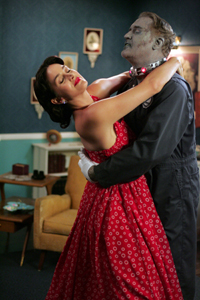
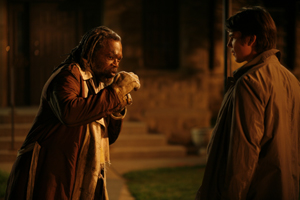
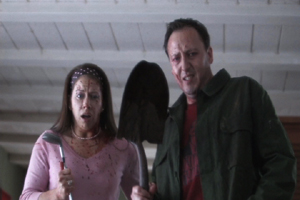
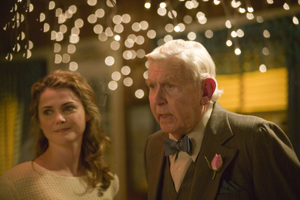
The problem with the “Reno 911!” movie is the same as the problem with the “Reno 911” TV show: They’re out of ideas. Moving it to a different city and putting it on the big screen doesn’t cure that problem. If anything, it exacerbates it. When a joke fails now, it’s failing on a grand scale, in a large theater full of non-laughing people.
I had such affection for this show, Comedy Central’s parody of “COPS,” when it premiered in 2003. The mostly improvised dialogue was snarky, the characters delightfully daft, and the police work hilariously incompetent. I laughed heartily at every episode.
Yet somewhere around the third season (the show’s now taking a break in the middle of season 4), it became apparent that the inventiveness had worn off. More and more gags centered on Reno’s bumbling cops encountering bizarre citizens, and those citizens’ quirks started to seem more and more forced. Then there are the gags in which the cops inadvertently destroy something or blow something up. How many of those do we need?
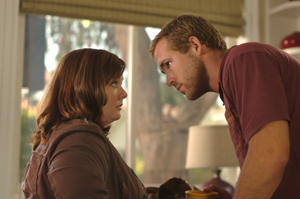
“Reno 911!: Miami,” the oddly punctuated big-screen foray, is the equivalent of about four 20-minute episodes of the series, beefed up in terms of profanity, nudity, sex, and violence, but not in any other measurable way. It has scattered laughs, but it has more places where you want to laugh and merely smile (or shrug).
The premise is that they’ve gone to Miami for a law-enforcement convention, only to be put in charge of the city’s actual police force when all the other cops in town are quarantined in the convention center after a chemical attack. What this means for us is that it’s the usual “Reno 911” shenanigans, only larger and in a different city. Where once the idiot cops would run afoul of mean neighborhood dogs, now they can deal with an alligator in a swimming pool. It used to be finding a dead body on the street; now it’s a dead whale on a beach.
You can see how that’s not really an improvement if the show was already running out of creative steam. I notice that the real plot of the film is resolved at about the 60-minute mark; everything occurring after that is filler.
There are high points, however. Dep. Trudy Wiegel (Kerry Kenney-Silver) is always a loopy, unbalanced treat, as when she tells us, “I became a cop because my doctors thought it would be good for me to get out of the house.” Early scenes back in Reno have the crew firing several dozen shots while attempting to wrangle a chicken, and that’s always a good time. A vulgar desk clerk in Miami earns a few laughs, and Paul Rudd’s cameo as a drug lord has a very funny payoff.
There are eight deputies in the squad, all with distinct personalities, though the film is so busy with other things that some of them get the short shrift. Lt. Jim Dangle (Thomas Lennon), the flamboyant commanding officer in hot pants, still has a thing for Dep. Jones (Cedric Yarbrough), while Wiegel has a thing for Dangle. Raineesha Williams (Niecy Nash) is a trash-talking single mom; she and Clementine Johnson (Wendi McLendon-Covey) spend their time either pursuing men or talking about sex. Junior (Ben Garant, also the film’s director) and Garcia (Carlos Alazraqui) are vaguely redneck and occasionally racist. Cherisha Kimball (Mary Birdsong), the newest member of the team, is widely presumed to be a lesbian.
The interplay among the actors is still the show’s best asset. As a comedy troupe, these men and women are top-notch, and when you give them a good situation, they can improvise something merrily, stupidly funny out of it. Trouble is, they’ve run out of good situations. The several quality bits that come out of the film don’t outweigh the many other sequences that are just so-so.
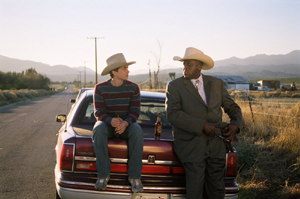
I kept looking at “The Astronaut Farmer” to see if there was more to it than meets the eye. What meets the eye isn’t very encouraging: a simple, mildly uplifting story with little nuance to it. But it was written and directed by twin brothers Mark and Michael Polish, whose previous films (“Twin Falls Idaho,” “Jackpot,” “Northfork”) have often employed symbolism and other literary devices. Perhaps “The Astronaut Farmer” is deeper than it appears?
Alas, I don’t think that’s the case. All the evidence suggests it really is just an ordinary, noncomplex film, something agreeable enough to spend 104 minutes on but not anything you’d want to hurry to see. The plot is the very picture of simplicity: Man wants something; man suffers setbacks; man resolves his problems in a way that allows for a happy ending. If you mapped out the events graphically, it would comprise a straight line, with no branches, detours, or subplots of any kind.
None of which is bad, necessarily; certainly we’ve seen more than our share of movies that were needlessly complicated. But “The Astronaut Farmer” is brought up short by its simplicity. The performances are nothing special, the dialogue is not particularly memorable, and the direction is merely competent. That leaves the plot as the possible saving grace … and it’s unchallenging and one-dimensional.
It sure sounds good, though: It’s about a Texas man who has built a functional rocket in his barn and wants to launch it into space.
The man is Charles Farmer (Billy Bob Thonton), a former NASA pilot who had to retire when his father’s death left him with crippling debts. He never got a chance to go into space, but he has somehow — the film is cagey on the details — built a real live rocket that can be his transportation to the stars, provided he can get enough fuel to launch it.
The Farmers live on a dusty ranch in Story, Texas. Charles’ wife, Audie (Virginia Madsen), is thoroughly supportive of her dreamer husband, and so are their three kids. Teenage Shepard (Max Thieriot) is training to be Charles’ ground control when the launch finally occurs. Even Audie’s aged father (Bruce Dern), whose lack of bloodline or romantic ties to Charles should make him the voice of reason, admires the way Charles has gotten his family not just to live together, but to dream together, too.
Of course, seeking to buy 10,000 pounds of rocket fuel sends up a lot of red flags in post-9/11 America. The FBI shows up, and so do the reporters. Soon the Farmers are at the center of a nationwide media circus, with regular folks hoping he’ll launch the rocket while the FAA looks for reasons to stop him.
Launching yourself into space should be left to the professionals, they say, “they” being led by an FAA official named Jacobson (J.K. Simmons). The government doesn’t own the air or the atmosphere, say Charles and his lawyer/friend (Tim Blake Nelson).
“How do we know you aren’t constructing a WMD?” they ask.
“If I was building a weapon of mass destruction, you wouldn’t be able to find it,” Charles says, in one of the handful of political statements that have been awkwardly wedged into the screenplay.
The movie is about taking control of your own destiny, and about chasing your dreams. Those are fine things for a movie to be about. This movie just feels like it needs to be about something more, too. It has heart and soul but no depth.
British schoolchildren probably know the name William Wilberforce better than American adults do (myself included), but the earnest and upright new film “Amazing Grace” suggests we would all do well to remember the fellow. He did, after all, bring about the end of the British slave trade.
England was never a slave-holding nation nearly as much as the United States was, probably due to the fact that England’s class system ensured plenty of people were poor enough to work for near-slave wages without having to make it official. But the empire had a tremendous stake in the overseas trade, shipping slaves from Africa to Jamaica and other British colonies until the early 1800s.
“Amazing Grace” covers two periods of time, commencing in 1797 with Wilberforce (Ioan Gruffudd) in poor health both physically and emotionally. He has just spent the previous 15 years as a member of the House of Commons, trying to get Parliament to end the slave trade. While everyone is sympathetic to the horror stories of slave ships and the treatment of slaves in the West Indies, no one wants to see what will happen to the British economy when slavery is gone. It would ruin the empire, they say, and so Wilberforce has been shouted down every time. He is a defeated man.
We flashback then to 15 years earlier, at the start of his crusade, when Wilberforce has had a religious epiphany and must decide whether he should remain in politics or quit and do the Lord’s work. His friend John Newton (Albert Finney), a former slave-trader who is now a repentant monk and the author of the title hymn, helps him realize he can do both. Surely the Lord’s work would include the abolition of slavery. Wilberforce opts to stay in Parliament and try to do some good there.
Written by Steven Knight (“Dirty Pretty Things”) and directed by the multitalented Michael Apted (“The World Is Not Enough,” the “Up” documentary series, HBO’s “Rome”), this strikes me as an honest, decent film, yet it doesn’t ride merely on its noble intentions. As a period piece, it’s remarkably detailed, smartly written, and likably acted. The jumps back and forth between circa 1785 and circa 1800 aren’t jarring, and it’s nice to see two different eras of Wilberforce’s career dovetailing with one another, all leading to the stirring and satisfying conclusion.
What’s especially notable about the movie is that it’s overtly religious, yet not overbearing or preachy. (I bet I can count the movies I’ve seen that match that description on two hands.) The point is to present a legitimate historical event, and the events portrayed were inextricably connected with religion. There is no agenda here. The film is being marketed to church-going Christians, but by no means is it only for them.
Brian Jackson always wanted to be “clever,” which is how they say “intelligent” in England. As a boy he faithfully watched “University Challenge” (which is how they say “College Bowl” in England; it’s the no-frills TV quiz show for students), eager to learn as much as he could and to answer as many questions as his little brain would allow.
In “Starter for 10,” a pleasant and funny coming-of-age film that takes its title from a “University Challenge” catchphrase, Brian (James McAvoy) is a working-class boy lucky enough to be accepted into the University of Bristol in the fall of 1985. Other students have money or connections, but Brian has gotten in solely on his initiative and academic performance. What will a humble lad from a seaside town learn about himself when he’s out on his own for the first time?
Meek, inquisitive, and not a little nerdy with his shaggy hair and oversize glasses, Brian has hometown friends with low ambitions who wonder what will become of their pal once he’s college-educated. “You’re not gonna get all poncey, start saying ‘One does,’ wearing a cloak, talking Latin, are you?” asks Tone (James Corden), the heavy-metallist. The other, Spencer (Dominic Cooper), Brian’s best mate, eventually comes to Bristol for a fateful visit, to see for himself whether Brian has changed for better or worse.
Brian immediately tries out for the school’s “University Challenge” team, captained by officious prat Patrick (a very funny Benedict Cumberbatch), who remains in charge despite having led the team to ruin in recent years. Brian is smitten with Alice (Alice Eve), a lovely blond girl who makes the team only by cribbing answers from Brian during the qualifying exam. Brian doesn’t mind, though, for Alice is beautiful, and nice to him, and apparently not all that hard to sleep with.
Elsewhere, he meets Rebecca (Rebecca Hall), an avid political and social activist who is bemused by Brian’s awkwardness and timidity. She becomes a recurring theme in his life, somehow present for most of his triumphs and failures, and always a witness to his most embarrassing moments.
It becomes clear about halfway through which girl he’ll wind up with (both seem like good candidates at first), but Brian continues to make the wrong choices concerning them — all to our nodding, smiling amusement. We have been there ourselves: new to adulthood, eager to prove ourselves, and completely incompetent when it comes to love.
With a vintage mid-’80s Cure and Morrissey soundtrack and upbeat direction by Tom Vaughan (working from a script by David Nicholls, adapting his own novel), “Starter for 10” feels like the British version of a John Hughes teen comedy, with James McAvoy (recently of “The Last King of Scotland”) giving a much deeper performance than you’d expect. There’s nothing particularly insightful or brilliant about the film, but its charm and good humor take it a long way.
It’s a crazy, wide-open year for the Oscars. Usually the film with the most nominations is the frontrunner for Best Picture — except that this year, for the first time in history, the film with the most nominations, “Dreamgirls,” didn’t get a Best Picture nomination.
Furthermore: The total number of nominations for the five Best Picture contenders (26) is the lowest in decades. For the first time since the very first Oscars, none of the Best Actor nominees are from Best Picture films. None of the Best Picture films have Best Cinematography nods.
So it’s difficult to predict an overall winner. As Entertainment Weekly pointed out, if “Pirates of the Caribbean: Dead Man’s Chest” wins the four technical Oscars it’s nominated for, that could easily be more than any other film gets. A situation where no film gets more than one Oscar is not impossible, too.
Here are my predictions. I usually do fairly well, although that whole “Crash” thing last year upset everybody.
BEST PICTURE
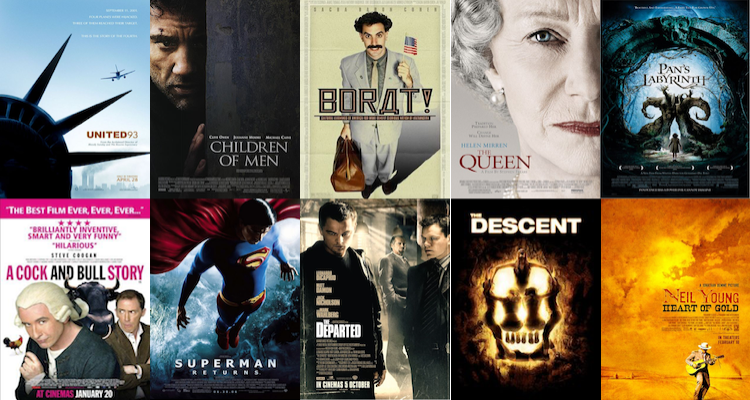
Nominees:“Babel,”“The Departed,”“Letters from Iwo Jima,”“Little Miss Sunshine,”“The Queen” Should win: Of these five, “The Queen” is the best film, though “The Departed” is right up there. Will win: No film that is wholly or largely in a foreign language has ever won Best Picture, so “Babel” and “Letters from Iwo Jima” are out. No film whose only acting nomination is for Best Actress has ever won Best Picture, so “The Queen” is out. Only once has a remake ever won Best Picture (“Ben-Hur”), so “The Departed” has the odds against it. Of course, so does “Little Miss Sunshine,” since it’s very rare for a film to win Best Picture without being nominated for Best Director. My point? If we let history be our guide, none of these films are likely winners, but obviously one of ’em has to win. I think it’s going to be “The Departed,” due largely to the Academy’s affection for Martin Scorsese.
(My friend Chris Clark, who routinely out-guesses me, is calling for “Little Miss Sunshine” in an upset. If he turns out to be right, then I will officially start tailoring all my predictions to match his from now on.)
BEST DIRECTOR
Nominees: Clint Eastwood, “Letters from Iwo Jima”; Stephen Frears, “The Queen”; Alejandro Gonzalez Inarritu, “Babel”; Paul Greengrass, “United 93”; Martin Scorsese, “The Departed” Should win: Paul Greengrass did the most impressive work with the haunting “United 93” — but I suspect if I were an Academy voter, I’d probably vote for Scorsese anyway. Will win: Whether they think he deserves it for “The Departed” or not, everyone in Hollywood wants Martin Scorsese to be an Oscar winner. It’s just how the world should be.
BEST ACTOR
Nominees: Leonardo DiCaprio, “Blood Diamond”; Ryan Gosling, “Half Nelson”; Peter O’Toole, “Venus”; Will Smith, “The Pursuit of Happyness”; Forest Whitaker, “The Last King of Scotland” Should win: Whitaker’s work as Ugandan dictator Idi Amin truly is outstanding. O’Toole got an honorary Oscar two years ago, so it’s not like he’ll die empty-handed if “Venus” turns out to be his last worthy performance. My sentimentality only goes so far. Will win: While O’Toole is a more beloved Hollywood figure than Whitaker, I think quality will win out and Whitaker will take home the prize.
BEST ACTRESS
Nominees: Penelope Cruz, “Volver”; Judi Dench, “Notes on a Scandal”; Helen Mirren, “The Queen”; Meryl Streep, “The Devil Wears Prada”; Kate Winslet, “Little Children” Should win: Mirren, no question. The others are good, even great in some cases, but none of them accomplish as much as Mirren. Will win: This is the only real lock of the night. Mirren has been the front-runner since Day One, and no one is coming close to defeating her.
BEST SUPPORTING ACTOR
Nominees: Alan Arkin, “Little Miss Sunshine”; Jackie Earle Haley, “Little Children”; Djimon Hounsou, “Blood Diamond”; Eddie Murphy, “Dreamgirls”; Mark Wahlberg, “The Departed” Should win: Hounsou’s performance is one-note, and his movie isn’t very good. Apart from that, all the nominees are worthy of the award. I’d give it to Murphy, though, who showed a dramatic new side of himself in “Dreamgirls.” Will win: The horrible ads for the horrible “Norbit” certainly haven’t endeared Murphy to voters in the last few weeks, but I think his momentum is such that he’ll win anyway. He’s the one people have been talking about for months.
BEST SUPPORTING ACTRESS
Nominees: Adriana Barraza, “Babel”; Cate Blanchett, “Notes on a Scandal”; Abigail Breslin, “Little Miss Sunshine”; Jennifer Hudson, “Dreamgirls”; Rinko Kikuchi, “Babel” Should win: Hudson blows the roof off with her show-stopping number in “Dreamgirls,” but let’s be honest: In the rest of the movie, she’s nothing special. Blanchett is the best of the lot. Will win: Voters love Blanchett, but they’re used to loving her, so her performance in “Notes on a Scandal,” while excellent, doesn’t stand out. The “Babel” actresses cancel each other out. Breslin is too young. Hudson it is.
BEST FOREIGN-LANGUAGE FILM
Nominees: “After the Wedding,” “Days of Glory,” “The Lives of Others,” “Pan’s Labyrinth,”“Water” Should win: I’ve only seen the last two, but “Pan’s Labyrinth” made my overall top 10 list for the year, so I’d be surprised if any of the others are better than it. Will win: “Pan’s Labyrinth” is the favorite, especially since it has nominations in other categories, too, which helps reinforce it in voters’ memories.
BEST CINEMATOGRAPHY
Nominees:“The Black Dahlia,”“Children of Men,”“The Illusionist,”“Pan’s Labyrinth,”“The Prestige” Should win: “The Black Dahlia” is impressive, but “Children of Men” is downright stunning with its lengthy tracking shots and various other effective uses of the camera. Will win: The Academy seems to share my thinking on “Children of Men.”
BEST ORIGINAL SCREENPLAY
Nominees:“Babel,”“Letters from Iwo Jima,”“Little Miss Sunshine,”“Pan’s Labyrinth,”“The Queen” Should win: The sharp, funny screenplay is really the best thing about “Little Miss Sunshine.” Will win: It’s rare for a foreign-language screenplay to win, so that eliminates two of these (three, if you count “Babel”). “Little Miss Sunshine” is a lovable movie that a lot of voters do indeed love, its witty dialogue especially.
BEST ADAPTED SCREENPLAY
Nominees:“Borat,”“Children of Men,”“The Departed,”“Little Children,”“Notes on a Scandal” Should win: “Borat” was this year’s WTF? nominee, as the mostly improvised film is neither adapted nor a screenplay. (Academy rules say films based on previously used characters must be “adapted,” even if the actual film is brand-new. Hence, any sequel, or anything based on a TV show, as “Borat” is, is “adapted.”) Anyway, “Little Children” has a tight, literate screenplay that covers multiple characters in a smooth, entertaining way. Will win: I’m going with a general “Departed” theme for the night and predicting it will win here, too.
BEST DOCUMENTARY
Nominees:“Deliver Us from Evil,”“An Inconvenient Truth,” “Iraq in Fragments,” “Jesus Camp,” “My Country, My Country” Should win: “Deliver Us from Evil” is a devastating expose of the Catholic Church’s cover-ups of sexual abuse, and is beautifully filmed and composed, too. Will win: Doesn’t matter. “An Inconvenient Truth” has been the Hollywood favorite since it was released.
BEST ANIMATED FILM
Nominees:“Cars,”“Happy Feet,”“Monster House” Should win: I didn’t dig “Cars” all that much. It’s a step down for Pixar. “Happy Feet” is better. I’m sorry, but it’s true. Will win: Be that as it may, “Cars” is the favorite.
BEST FILM EDITING
Nominees:“Babel,”“Blood Diamond,”“Children of Men,”“The Departed,”“United 93” Should win: “United 93” is one of the most intense films I’ve ever seen, and it’s largely due to the careful editing. It’s really a masterpiece in that regard. Will win: The editor of “The Departed,” Thelma Schoonmaker, has won twice before, also for Scorsese films. Seems only appropriate that she should win again on the night her boss finally gets one for himself, too.
BEST MAKEUP
Nominees:“Apocalypto,”“Click,”“Pan’s Labyrinth” Should win: “Pan’s Labyrinth” has amazing makeup effects. “Click” is a crap movie in which Adam Sandler looks old for a couple scenes. And I don’t even remember there BEING makeup in “Apocalypto.” Will win: Entertainment Weekly summed it up perfectly: No one in the Academy has seen “Click,” and no one in the Academy is gonna vote for a Mel Gibson film. “Pan’s Labyrinth” it is!
BEST ART DIRECTION
Nominees:“Dreamgirls,”“The Good Shepherd,”“Pan’s Labyrinth,”“Pirates of the Caribbean: Dead Man’s Chest,” “The Prestige” Should win: “Pan’s Labyrinth” is fanciful and ornate, but also very often darkly lit. “Pirates,” on the other hand, is sumptuous, detailed, and sparklingly photographed, highlighting every buckling swash. Will win: “Dreamgirls” will have to win some technical awards, and this will probably be one.
BEST COSTUME DESIGN
Nominees: “Curse of the Golden Flower,” “The Devil Wears Prada,”“Dreamgirls,”“Marie Antoinette,”“The Queen” Should win: It almost seems obvious that “The Devil Wears Prada” should win the costume award, right? But I have to say, the one thing “Marie Antoinette” had going for it was its fabulous, fabulous costumes. Will win: “Dreamgirls” is the more Oscar-y movie, and that’s what generally takes this award.
BEST ORIGINAL SCORE
Nominees: Gustavo Santaolalla, “Babel”; Thomas Newman, “The Good German”; Philip Glass, “Notes on a Scandal”; Javier Navarrete, “Pan’s Labyrinth”; Alexandre Desplat, “The Queen” Should win: Philip Glass is a love-him-or-hate-him guy, and I love him. Will win: Desplat’s “Queen” score seems to be the favorite here.
BEST ORIGINAL SONG
Nominees: “I Need to Wake Up,” by Melissa Etheridge, from “An Inconvenient Truth”; “Listen,” by Henry Krieger, Scott Cutler, and Anne Preven, from “Dreamgirls”; “Love You I Do,” by Henry Krieger and Siedah Garrett, from “Dreamgirls”; “Our Town,” by Randy Newman, from “Cars”; “Patience,” by Henry Krieger and Willie Reale, from “Dreamgirls” Should win: I’m not a fan of a lot of the music from “Dreamgirls,” these three new songs included. I would probably vote for Randy Newman just because I love Randy Newman. I’d be selfish like that. Will win: Does “Dreamgirls” split the vote? Probably not: The other two times a film has had three nominations in this category (“Beauty and the Beast” and “The Lion King”), they’ve won something. But which “Dreamgirls” tune takes it? The one sung by Beyonce, of course, “Listen.”
BEST ANIMATED SHORT FILM
Nominees: “The Danish Poet,” “Lifted,” “The Little Matchgirl,” “Maestro,” “No Time for Nuts” Should win: Haven’t seen any of them. Will win: “The Little Matchgirl.” Total guess.
BEST LIVE-ACTION SHORT FILM
Nominees: “Binta and the Great Ideas,” “Eramos Pocos,” “Helmer & Son,” “The Saviour,” “West Bank Story” Should win: Haven’t seen ’em. Will win: Let’s go with the singing-and-dancing “West Bank Story.”
BEST DOCUMENTARY SHORT FILM
Nominees: “The Blood of Yingzhou District,” “Recycled Life,” “Rehearsing a Dream,” “Two Hands” Should win: Dunno. Will win: “Two Hands” is about a guy who lost the use of one of his hands — and he was a piano player. Inspiring!
The Oscars will air LIVE at 5:30 p.m. PST (8:30 p.m. EST) Sunday on ABC.
The Daily Universe, student newspaper at good ol’ Brigham Young University, ran a letter to the editor on Feb. 9 that read as follows:
Bad moon pricing
Recently, there was an article about a man selling an acre on the moon for $20. I must say, I am opposed to buying a plot of land on the moon for such a price. Don’t get me wrong, I love the moon, but I just don’t think $20 for land is viable for a college student these days. The main reason: opportunity cost.
With $20, you could supply yourself with food for an entire week, unless you’re a freshman with dining plus, in which case it is only two days. You may say, “but the moon is made out of cheese, and that’s way more food.”
However, I’ve learned through some secret sources, that it is primarily made out of oxygen, silicon and iron, which have nothing to do with cheese.
With $20, you can support a homeless child for months. As advertised on TV, it costs only 39 cents per day to help Pablo have shoes on his feet and corn in his mouth. You could help him for 51 days.
Finally with $20, you can find out whether someone likes you. Simply hand them $20 and ask “Do you like me?” If they say yes, you win. If they say no, you’ll actually save money by avoiding the costs of taking them out on dates. Combine that with all the time you’ll save, and you’ll notice $20 is too much to give up.
Jon Harmon
Portland, Ore.
A few readers brought this letter to my attention because of the remarkable similarity between the final paragraph and the closing paragraphs of this old “Snide Remarks” column.
Obviously Jon Harmon was familiar with the column and appropriated it for use in his I’m-trying-to-be-funny letter. I was flattered, bemused, and a little annoyed, but not much. And before I could decide what kind of response, if any, I should give, someone else wrote to The Daily Universe complaining about Jon’s letter, only for different reasons. It was published on Feb. 12:
Narrow-minded moon
In the recent letter, “Bad moon pricing,” (Feb. 9) the author steps outside the bounds of humor and into the realm of offensiveness. He turned the ads that run on TV asking for our help in fighting poverty by providing needy people with the basic necessities of life into a joke by stereotypically giving the name Pablo to all who suffer in such a way and minimizing the relief such organizations bring. In an effort to be comical, he has offended countless readers who don’t think it’s funny to make fun of the terrible living conditions of some of our less fortunate brothers and sisters.
It’s just inherently wrong to take the pleas for help that bring sorrow to our hearts and turn them into a quick laugh. Stereotyping is one of the great ills that plague our society, and it shames me to see that it is still very much alive.
What is one to think after seeing such an outrageous letter in the readers’ forum? I might begin to wonder if BYU really is the kind of place where I would want my children to study, after seeing the way that some people make such discriminating jokes at the expense of others’ suffering. As we “Enter to Learn” I certainly hope this mentality does not reflect the manner in which we will “Go Forth to Serve.” The author owes us all an apology, and I’ll be waiting for it.
Hyrum Hemingway
Menomonie, Wis.
Now, I didn’t think Jon Harmon’s letter was funny, either (though not for lack of good material to steal from!), but Hyrum Hemingway’s response was so … well, typical. Read any day’s letters in The Daily Universe and you’ll see at least one like that.
So at last I wrote a response and submitted it as a letter to the editor. Alas, several issues of the paper have been published since then, and my letter has not seen the light of day, so I am forced to conclude they won’t be printing it. So here it is for you:
Two recent letters in The Daily Universe caused me great alarm. First, “Narrow-minded moon” (Feb. 12) criticized a previous letter-writer (“Bad moon pricing,” Feb. 9) for making light of a serious situation: He had joked about the TV ads in which viewers are encouraged to donate money to help starving children.
Now, the writer of “Narrow-minded moon” makes a good point, and he doesn’t seem at all sanctimonious or humorless, nor does he make me roll my eyes. But he missed the REALLY offensive thing about the “Bad moon pricing” letter: The part about giving a potential date $20 to find out in advance whether she likes you was blatantly ripped off from an old “Snide Remarks” column published ON THESE VERY PAGES in November 1997!
What’s that, writer of “Bad moon pricing”? You figured there was no one left at BYU who remembered “Snide Remarks,” or who bought the “Snide Remarks” book in which that column was reprinted, or who had browsed at www.ericdsnider.com/snide/how-to-do-stuff-better and read that column? Figure again, my friend! You’re busted. I might begin to wonder if BYU really is the kind of place where I would want my children to study, after seeing the way that some people at BYU steal other people’s jokes. For shame, sir. FOR SHAME.
Eric D. Snider
Portland, Ore.
The fact that Jon Harmon is from Portland and I now live in Portland is probably a coincidence. Jon Harmon, are you reading this? (I assume Hyrum Hemingway isn’t.)
In the fall of 1998, a new mall opened in Provo. It was called Provo Towne Centre. Surely you remember this historic event as though it were yesterday. To celebrate, I hung out in the mall for a couple hours and wrote a column about it: “Mall in a Day’s Work,” which I present as this week’s “Snide Remarks” Classic. (We’re doing the Classics every Wednesday to celebrate 2007 as the 10th anniversary of “Snide Remarks,” don’t you know.)
It’s a pretty funny column, in my humble opinion, and it was the only one (#55, published Nov. 16, 1998, in The Daily Universe) for which I had a double byline. My friend Phil Stahle joined me on my mall tour and helped with some of the writing, at least indirectly. Last I knew, Phil was married and working in the public relations department for Disney World. I know this because in 2002, he got me free tickets into the park. Woo-hoo! Phil, wherever you are now, this one’s for you.
I received an e-mail with the subject line “[biblical word for ‘donkey’] faces.” Naturally, I was intrigued. There was no name, and the return address bounced when I tried to reply, giving further evidence that people who write e-mails like this are cowards.
Anyway, here is what it said:
val kilmeris the best freakin actor and who are you to judge when you don’t even act yourself biotch
Of course, if being an actor oneself is a prerequisite for judging acting talent, then this person shouldn’t be judging Kilmer, either. (Saying someone is good is judging, too.) But why introduce logic into a matter such as this?(By the way, I have no idea which review, if any, this person was responding to. I can’t recall dissing Val Kilmer too harshly, but maybe I did.)
Next, if you’ve sent me an e-mail, you’ve seen the warning, in red letters, indicating that I don’t have contact info for any famous people, and that if you ask for such information anyway, I will write back to tell you how stupid you are. Amazingly, despite this warning, in red letters above the e-mail form, I still sometimes get e-mails from idiots who noticed a celebrity’s name on my Web site and concluded that I must therefore know that celebrity personally. And when I do, true to my word, I write back to tell that person how stupid he or she is.
For example, I got this e-mail the other day:
I am currently an Associate Publisher at the Forest Hills Celebrity Magazine. It is a very popular magazine about Queens lifestyle ( New York), a nice fine four color magazine. At any rate I am dying to contact Jon for an inetrview to appear in my magazine. I went to school with him at Queens College and hung out with him at CUPB, a social club. I beleive this would be so fitting because it is a local community publication, it will also help him promote his new movie… Cover story material I am sensing… any help would be appreciated.
Thank you,
Marty.
The “From” field in the e-mail said Martha Tucker. I responded to Martha with the form letter I have prepared:
[This is a form letter.]
You are very stupid.
The page you just e-mailed me from said this:
“STOP: If you are going to ask Eric how to contact a celebrity, DON’T. Eric has no such information for ANY famous person. If you ask him anyway, despite this warning, Eric will write back and tell you how stupid you are. And he’ll be right to do so.”
And yet, you went ahead and asked me for someone’s contact information anyway. So this is your reply, letting you know, if you weren’t already aware, that you are stupid. Very, very stupid.
Best wishes,
Eric D. Snider
Martha responded, only now her e-mail “From” name was Marty Sunflower. She said this:
Dear whoever you are, [“Whoever you are”? I signed my name to my e-mail, the “From” line says “Eric D. Snider,” and the site she wrote to me from was called EricDSnider.com. And she’s not sure who I am? This, from the woman who used two names in as many e-mails.]
I must say that you are the stupid one. In my years of researching information, I have never met anyone as arrogant as yourself figures, this is the trash that Myspace is composed of… [What MySpace has to do with anything, I have no idea.] Pity and to think there was hope for the journalistic wannabes…
Thanks for you time and for nothing. a simple I am sorry I cannot help you would have sufficed but know you reduced your self to name calling what are you twelve???? Would that have been to much and to think that you actually made this a form letter?????/ again a very sad representation of journalism.
Marty
Funny, the phrases “stupid,” “journalistic wannabes,” “what are you twelve,” and “very sad representation of journalism” all occurred to me while reading her letter, too….
Finally, my review of Eddie Murphy’s “Norbit” prompted this scathing reply:
I read your review of ‘Norbit’ and terribly disagree. [True to his word, he does disagree in a terrible fashion. Keep reading!] it is on of the main reason’s i don’t trust white movie critics reviews when it come to black films. norbit is the story of relationship, and if you have been anywhere close to this type of personality in one you can identify. with white critics you jugde your expectattion of the character instead of the overall movie itself. you will call a great movie lame and a lame movie great based on how you see it. [Well, yeah. Judging a movie based on how you see it is sort of what film criticism is. That’s sort of the definition.] but being number on in the box office speaks for itself. i bet you’ll love ghost rider, or hanabal lechter. movies that i would never pay to go see. [Too bad, because “Ghost Rider” is apparently a great movie, judging by the fact that it’s No. 1 at the box office.] i am a pretty good critic when it comes down to movies. and i don’t let my color get in the way of deciding what to see or not see. i also won’t let a actors personal life fuel my judgement of him on the screen. a good actor is a good actor, and the list of movies that you can questionable in eddie’s career some of which i actually enjoyed are not all flops. they may not have sold out box offices but check out the rental store and cable showing see how much money he’s mad from that. and i noticed that you didn’t mention shreck 1,2, or upcoming 3. [Actually, I did mention them, when I said that Murphy’s movies “apart from the mostly harmless family flicks” tend to be bad.] i guess you didn’t want to insult mike myere hey?
Most of the outrageously poor logic in this letter should be apparent, but I want to point out something special. He makes the classic argument that being No. 1 at the box office means a movie is great, and then also says that just because a movie flops at the box office, that doesn’t mean it’s bad. He’s right about the last part, of course, but you can’t have it both ways. If being No. 1 is PROOF — irrefutable, case-closed PROOF — that a movie is good, then being No. 100 would have to be proof that a movie is bad.
Also, I should point out that “Norbit” is not a “black film.” Most of its characters are black, but the film has nothing to do with race. Race is never mentioned. There is nothing about the characters that would only apply to black people. They could just as easily have been white, with maybe Ben Stiller playing the two leads. (Wow, imagine how bad THAT would have been.)
Here is this week’s “Snide Remarks” (the conclusion [at last!] to the road-trip story), here is the podcast version of it, and — just for good measure — here is my review of “Ghost Rider.”
Our story so far: I had an overnight delay in Limon, Colo., finally made it to Wyoming, and then found Interstate 80 closed at Laramie.
OK, now it was just funny. Getting stuck in Limon had been traumatic, simply because it was unexpected and chaotic. But being stranded AGAIN the VERY NEXT NIGHT … well, there’s nothing you can do about that except laugh.
Granted, the fact that it was Wyoming made it slightly less funny. My previous experience with Wyoming was limited to an overnight visit I had made seven years earlier, when I rang in New Year Y2K with a friend in Evanston. (My thinking was that if all technology was going to fail at the stroke of midnight, I should be someplace where you wouldn’t notice any difference.) Evanston wasn’t particularly thrilling, and what little else I knew about the state — lots of cowboys; home to Old Faithful; sometimes they murder Matthew Shepard — didn’t appeal to me.
But more to the point: How can the FREEWAY be CLOSED?! And a 400-mile stretch of freeway at that, and the only way to get across the state of Wyoming! There were no explanations or phone numbers to call for more information. It was just, “Sorry! Wyoming’s closed today.” I mean, this wasn’t Honduras or someplace, where the only road between Tegucigalpa and Comayagua gets closed because someone dropped a truckful of goats on it. This was the Interstate Highway System, in the United States of America! Haven’t we achieved dominance over such mundane things as weather?
In a fog of disbelief and shock, I turned around and headed back east, toward Cheyenne. My thought process, such as it was, was that I would go back to Ft. Collins and stay the night with the friend I had missed seeing the night before because of the Limon detour. But I couldn’t reach him on the phone now, and I didn’t want to get all the way back to Ft. Collins and still not have a place to sleep, so I gave up and stopped in Cheyenne.
“I gave up and stopped in Cheynne” is probably how a lot of sad, depressing stories begin. I momentarily considered driving past it, maybe going all the way back to Ohio, where I’d started my trip 7,000,000 days earlier. I still wasn’t sure what was going on — for all I knew, I-80 would be closed forever; for all I knew, this was the only way Wyoming could get new people to move there — so when I got into Cheyenne, I stopped at one of those “travel center” places. I knew those places were popular with truckers, and while I normally don’t like hanging out with truckers because they say things like “he don’t” when they mean “he doesn’t,” in this case I thought they might be useful. Truckers, of all people, should know what’s up with Wyoming’s freeway closures.
This particular establishment was one of many places I’d seen throughout my trip that had large signs reading, “Truckers Welcome!” I always wondered if that was necessary, i.e., if there are places where truckers are not welcome. For example, if you go to a museum or an opera, are there signs that say, “Non-Truckers Only” or “Truckers Must Use Other Facilities”? Is that even legal? If not, why not?
The place was brimming with truckers, walking around in their Levi’s and flannel shirts, drinking coffee, quoting Larry the Cable Guy, misconjugating verbs, that sort of thing. The freeway closure was the major topic of conversation, of course, and I quickly ascertained that it was not a terribly uncommon occurrence round these parts, and that in all likelihood the road would open again first thing in the morning.
Lying here at the truck stop were several copies of a newspaper called The Trucker, aimed at, well, truckers. The paper’s slogan is, “Where the NEWS is first,” with “NEWS” underlined. This very precise emphasis seems to imply that there are other trucker publications that, at least in The Trucker’s estimation, do not focus enough attention on trucker news, perhaps instead filling their pages with trucker gossip and trucker fashion. (“The trucker hat: in again this year!”) None of that kind of nonsense at The Trucker, though. The NEWS is first over there, I’ll have you know.
After refueling my car and buying some snacks, I went off in search of a place to stay for the night. I wound up at a Super 8 Motel next to the freeway, where a room could be had for a reasonably low price, and where I was lucky to get one before they were all snatched up by stranded motorists. It was 12 degrees outside that night, and winds were coming out of the west at an average of 22 mph, with gusts as high as 55 mph, making for a wind chill temperature of about -15. It was under those conditions that I drove two blocks to Village Inn to eat dinner. It is wasteful to drive two blocks rather than walking, but it is also wasteful to freeze to death on the arctic tundra of Wyoming while walking.
I got up at 8:30 the next morning and went to the hotel lobby, where the current weather conditions and road closures were posted. The interstate was open again, so there was no reason to linger in Cheyenne. I checked out of the hotel and hit the road.
It wasn’t over yet, though. The roads were a bit icy, and there was still a persistent, nagging wind, blowing not at all fitfully, but rather unceasingly, continually trying to blow my car off the road. This meant I had to drive slower than usual, and it meant driving was a chore rather than a pleasure. How am I supposed to fiddle with the CD player with one hand, while I eat a chalupa with the other hand, while I drive with my knee, if the wind is forcing me to use both hands to steer?!
It didn’t help that the landscape of Wyoming is what cartographers refer to as “boring.” Approximately 500,000 people live in the state, but apparently none of them live within sight of the freeway, because all you can see from the freeway are hills, plains, and the occasional trucker-welcoming gas station. Even when you’re passing an alleged city, with a name you’ve heard before — Rawlins, Rock Springs, Evanston — there are no major signs of life. Are Wyomingans timid creatures who hide from visitors? Do their cities have magical force fields that render them invisible to everyone except true Wyomingans?
It took seven hours from the time I left Cheyenne, but I finally crossed the border into Utah. I was out of Wyoming; everything was going to be fine now. In fact, that’s the motto of several of Wyoming’s border states:
Utah was familiar territory, and I’d driven from Utah to Portland several times, including during the winter. There couldn’t possibly be any surprises in store for me now. But just to make sure, I drove straight through, not stopping until I was home in Portland, 18 hours after I had left Cheyenne. Sure, 18 hours is a long time to drive without stopping. But I was afraid if I dawdled anywhere, Mother Nature would come up with some new way of harassing me.
All told, my free 1994 Geo Prizm cost me approximately $800 and caused untold emotional scarring. Yet I can look back on the trip now and recall certain elements with fondness. For example, I love that I saw a newspaper in Richmond, Ind., called the Palladium-Item. Usually, hyphenated newspaper names are the result of two papers merging: The Chicago Sun-Times used to be the Chicago Sun and the Chicago Times, for instance. So did there used to be two competing papers in Richmond, one called The Palladium, and one called The Item, and they both realized their names were stupid, so they merged into one paper with one awesomely stupid name? Apparently so.
I love that when you’re driving across the country, sometimes in the middle of nowhere there will be a sign on the freeway saying “Point of Interest, next right.” The signs never tell you what the thing is, only that you’ll find it interesting. That’s very savvy of them, especially considering most of the points they’re talking about — dead squirrel exhibits, piano bench museums, and so forth — are not, in fact, interesting. But the signs really sell it. “Point of interest! We don’t want to give it away, but trust us: This point is very, VERY interesting!”
Above all, I came to appreciate that though we live in a modern world with many modern conveniences, we are still in many ways at the mercy of Mother Nature. And Mother Nature is a stinky whore.
I was all set to see “Ghost Rider” at the last-minute, let’s-hide-this-from-the-critics screening last night … and then I arrived (on time, i.e., 30 minutes early) to find that there were no seats left in the theater, because they had a) let the crowd in earlier than they’re supposed to, and b) not saved enough seats for press. So no “Ghost Rider” for me (not that Columbia really wanted any critics to see it anyway). I’ll try to go watch Nicolas Cage run around with his head on fire sometime this weekend.
Of the films I did see this week, “Breach” is quite good, and “Music and Lyrics” is more than sufficiently entertaining, too.
Check out the e-zine version of “In the Dark” for more, and listen to the podcast here.
You know, I’ve often remarked to myself that Nicolas Cage’s over-the-top acting style is like that of a man whose head is on fire. And now here he is in “Ghost Rider,” playing a man whose head is actually on fire. What’s next? Keanu Reeves actually playing a block of wood?
Cage plays Johnny Blaze, which is the sort of name that can only be a comic book character or a porn actor, and Johnny is the former. He’s a daredevil motorcyclist who, in the movie version of the story, sells his soul to the devil in order to save his father’s life. He kind of signs the contract accidentally, though, and then his dad dies anyway, so it’s really a bummer of a deal. The devil is played by Peter Fonda, but it’s a cheesy enough role that Christopher Walken probably should have done it.
Anyway, ol’ Mephistopheles keeps Johnny alive for many years (despite Johnny’s frequent bike wrecks) and then comes a-callin’ one day with a task. Seems the devil’s son, Blackheart (Wes Bentley), and his three demonic cronies are looking for a particular contract for a particular batch of souls, and Dad doesn’t want them to find it. So Johnny is transformed into Ghost Rider and sent to stop them.
When Johnny is Ghost Rider, his head becomes a burning skull, his torso becomes far more muscular than Nicolas Cage’s torso has ever been, and his motorcycle is made of flames. He can crack burning chains like whips, and he can look into a bad guy’s eyes and deliver such delightful pronouncements as “Your soul is stained by the blood of the innocent.” You show me a man who can say that with a straight face, and I’ll show you a man who has burning skull instead of a face.
Johnny doesn’t really like having to do the devil’s bidding, but his real enemy now is Blackheart, who wears a fitted black trenchcoat and smiles in a sinister fashion and generally behaves like the Goth kids you knew in high school, only gayer.
To complicate matters even further, Johnny is unexpectedly reunited with Roxanne (Eva Mendes), his girlfriend from long ago. She is now a TV news reporter for, I assume, The Cleavage Channel, and she still pines a little for the Johnny Blaze she knew all those years ago, the one whose head didn’t catch on fire every night.
The film was written and directed by Mark Steven Johnson, who did a similarly lame job with “Daredevil” a few years ago. That debacle had some amusing supporting characters, though; “Ghost Rider” is superficial and ridiculous in every way, with only Sam Elliott as a grizzled old cemetery caretaker doing anything memorable.
Cage seems to be enjoying himself, I’ll say that much for him. The first time Johnny transforms into Ghost Rider, a process that involves being consumed with fire, Johnny is for some reason cackling like a maniac. Soon I was laughing, too, because who laughs when their head catches on fire? What actor would even think that having his character laugh in that situation would be a good idea? Nicolas Cage, ladies and gentlemen. Gotta love him.
But then the dialogue is full of garbage like this, spoken when Johnny encounters a demon made of wind: “Time to clear the air.” Factor in Eva Mendes’ hilariously unconvincing performance as the TV reporter, the convoluted and muddy storyline, and the general lack of thrills or excitement, and you’ve got yourself a big, silly comic book movie. Whoever the inept Mark Steven Johnson had to sell his soul to in order to get put in charge of two big comic book adaptations, I hope it was worth it.
To establish its based-on-a-true-story-ness, “Breach” begins with actual footage from February 2001 of then-Attorney General John Ashcroft announcing that FBI Agent Robert Hanssen has been arrested for selling U.S. secrets to the Russians. We move into the realm of fictionalization then, with actors and scripts re-creating the events that led to Ashcroft’s announcement, but the admirable thing about “Breach” is that it remains realistic and understated even when it is fictional.
This is a movie about spies, yet there is not a single car chase or onscreen murder. The only explosions are of the emotional variety, and even those are few in number. It may be the quietest spy movie ever made.
It’s a riveting one, too, thanks in large part to Chris Cooper, who plays Hanssen as a multi-faceted, enigmatic man. Cooper — an Oscar winner for his supporting role in “Adaptation,” and notable as Kevin Spacey’s homophobic neighbor in “American Beauty” — gives his best performance yet as a man who is prickly at work, stern but loving with his family, devoted to his Catholic faith (he attends mass every day), fervently patriotic … yet who also conducts sleazy affairs on the Internet and trades state secrets to the Russkies. Such contradictions would be unbelievable if they weren’t a) true and b) acted so convincingly by Cooper, whose craggy face and clipped Midwestern twang suggest a no-nonsense drill instructor. I was only in the audience, and I was terrified of having him for a boss.
The unlucky soul actually required to work for him is Eric O’Neill (Ryan Phillippe), an FBI up-and-comer who’s told by his superior, Burroughs (Laura Linney) that while Hanssen thinks O’Neill is just his clerk, his real task is to spy on him. She only indicates the Internet perversion, but O’Neill is smart enough to realize quickly that the Bureau must have more reasons than that for eyeing Hanssen. Why worry so much about the extracurricular activities of a man who will be turning 57 and mandatorily retiring in two months anyway?
The director is Billy Ray (he wrote the screenplay with first-timers Adam Mazer and William Rotko), whose first film was the excellent “Shattered Glass,” the true story of a New Republic reporter who went down in flames when it was discovered he’d fabricated many of his news stories. “Breach” has several obvious parallels to that film, but with a shift in perspective: “Shattered Glass” was told through the eyes of the wrongdoer, while “Breach” is from O’Neill’s perspective, not Hanssen’s. He’s trying to unravel Hanssen’s web of deceit, and we’re along for the ride.
Hanssen is a staunch Catholic and a genuinely good-hearted man. He looks up information on Parkinson’s disease after O’Neill says his mother has it, and when he’s not belittling O’Neill or blustering about inefficiency in the office, he’s trying to bolster O’Neill’s own semi-lapsed Catholic faith. While most religious characters in movies turn out to be insane hypocrites, Hanssen, through Cooper’s honest performance, comes across as a good man who earnestly believes everything he says.
You could want the film to delve deeper into the whys and wherefores of Hanssen’s deeds, and I just noticed that I made the same comment about “Shattered Glass,” too. But “Breach” succeeds without a lot of psychological evaluation of its characters. (It succeeds less when it gets into O’Neill’s obligatory “your job is tearing us apart” arguments with his wife, played by Caroline Dhavernas. The pursuit of Hanssen should be the focus, not O’Neill’s home life.) As a film, it’s smart, it doesn’t pander, and it keeps us intrigued from start to finish.
In the interest of full disclosure, I should tell you that I wept like a baby at the end of “Bridge to Terabithia.” If a movie’s quality were judged solely on the basis of how many tears it elicited, I’d have to give this one an A+.
Thank goodness there are other factors to consider. Based on the beloved 1977 young adult novel by Katherine Paterson, the film is sometimes as gawky and awkward as its adolescent characters, occasionally a little ungraceful in the way it handles itself. Yet like so many films of its genre, it redeems itself by being good-natured and sincere, and by touching the viewer’s heart without manhandling it.
It’s set in an anonymous rural town in an unnamed state, and it depicts children of an uncertain age. (They’re fifth-graders in the book, but they seem more mature than that here.) Jesse (Josh Hutcherson) is the middle of five children in a poor family, and the only boy. His dad (Robert Patrick) works at a hardware store; Mom (Kate Butler) is a homemaker. With his hand-me-down shoes and his family’s financial situation, Jesse is often the target of bullies at school, where he has a secret schoolboy crush on the pretty music teacher (Zooey Deschanel) who visits the class weekly.
Then he becomes friends with a new girl, Leslie (AnnaSophia Robb), whose family has moved in next door. She’s a bit of an outcast, too, being the new kid in school, and her vivid imagination makes her seem like a loony. Soon Leslie and Jesse are traipsing through the woods near their homes, spending their afternoons imagining magical kingdoms and living in their harmless fantasies.
Their relationship is platonic and without any major hurdles. The conflicts are elsewhere: They’re both frequently harassed by bullies, including a troll-like girl named Janice (Lauren Clinton), and Jesse, a budding artist, can’t relate to his no-nonsense father. Widening that gap is the way Dad dotes on Jesse’s pesky little sister, May Belle (Bailee Madison). Why can’t he be that close to Jesse?
Around the halfway mark, the film suddenly shoehorns some Christianity into the story, with the revelation that Jesse’s family are regular churchgoers (first we’ve heard of it), and with Leslie accompanying them one Sunday. This leads to a post-church conversation between Leslie, Jesse, and May Belle about heaven and hell and who’s going where.
How is all this relevant? It isn’t, really. A tragic event later in the film causes two characters to talk about heaven and hell again, but it still feels like it was wedged forcibly into the story. Same with Leslie’s kooky home life, where she’s the only child of two free-spirited novelists who won’t let her watch TV: Why?
And then there’s that tragic event I mentioned. It might be TOO tragic for a film aimed at such young audiences, but the movie (directed by animator Gabor Csupo in his first live-action feature) handles it realistically and with great tenderness. Josh Hutcherson and AnnaSophia Robb give winning performances as Jesse and Leslie, too, which makes the sadness more palatable.
Not that it’s a sad movie, really; it’s a poignant, hopeful movie with a couple sad turns. Kids above the age of about 10 can probably appreciate its mature themes of love and family, and I can attest to the film’s effectiveness on certain adults, too.
The “Work and the Glory” movie trilogy has proved to be a noble near-failure, and the third chapter, subtitled “A House Divided,” is as noble and near-failing as the series. It’s very nicely produced and beautifully shot, and engaging for most of its running time, but it ends things on a remarkably unsatisfying note.
With no recap to help newcomers — you really need to have seen the first two films — Part 3 picks up where after Part 2 left off, in 1836, with the Mormons split between Missouri and Ohio. The Kirtland temple has been dedicated, Mormon prophet Joseph Smith (Jonathan Scarfe) is learning Hebrew to help him understand the Bible better, and he’s about to launch a bank specifically for the Saints. There is opposition to the Mormons’ presence in Missouri, though not so much so far as to be worrisome.
The fictional Joshua Steed (Eric Johnson), who parted ways with his family after all but his dad became Mormons, runs a freight company in Independence, Mo., and is on business in Georgia when he meets a bosomy young widow named Caroline (Meredith Salenger). He does not mention to Caroline that he has a failed marriage and a child in his past, nor that his family (including his wife) are Mormons now. He wants to leave it all behind.
Of course, if you want to leave your old life behind, you probably shouldn’t bring your new wife home to the state where a lot of your old life lives. Joshua, the new Mrs. Steed, and Caroline’s precocious young son Will (Connor Chavarria) return to Independence just as Joshua’s ex, Jessica (Emily Podleski), arrives there with a band of Saints from Ohio.
The film (adapted by Matt Whitaker from Gerald N. Lund’s novel, and directed by Sterling Van Wagenen) focuses its attention on two central dramas, one historical and one fictional. The historical one deals with Joseph Smith’s attempts to make the church financially solvent — a tricky proposition given that, for all his other talents, Joseph is not a very good businessman. His problems are compounded by some of his followers’ weak faith and very human pettiness when it comes to matters of money.
The fictional drama has the local anti-Mormons eager to keep Joshua Steed involved in their kill-or-expel-all-the-Mormons campaign, going so far as to create a false “manifesto” that the Saints supposedly wrote declaring war on the non-Mormons, just to make Joshua worried. Meanwhile, his new wife slowly learns about his past, while his estranged parents and siblings — including Joshua’s arch-rival, his brother Nathan (Alexander Carroll) — go through their own mini-trials associated with their new faith.
Where the first film in this series was somewhat uncompelling and the second one was a marked improvement, the third falls somewhere in between. The period costumes and sets are still sumptuous, the acting earnest and smart. I’ve come to like a lot of these characters — Jonathan Scarfe continues to be the best Joseph Smith ever put on film — but “A House Divided” frustratingly refuses to tie up most of its loose ends. There are still six more books in the series, you see, and the storylines continue through them. Unfortunately, the handwriting was on the wall long ago as far as the movies are concerned: Part 3 is the last one that’s going to be made. So why leave everything dangling? Followers of the series deserve better payoff than this.
One of my favorite sketches back in the Garrens Comedy Troupe days was “Dinner at Denny’s,” in which a man exhausted from making decisions all day at work goes to dinner and finds even more decisions to be made. We performed it several times back in 1996 (HOLY CRAP, that was a long time ago), and it appeared on the now-out-of-print Garrens CD.
Recently, a British university student by the name of Rob Shiels performed the sketch with his own comedy group and filmed it for posterity. The audio quality isn’t great, and the British accents might give you a run for your money (you can follow along with the script here), but it’s a fun little artifact that can now be viewed on YouTube or right here:
Back in the summer of 1998, the Baptists held a convention in Utah. There was much local discussion beforehand about what would happen when the Baptists came to town, would they try to convert the Mormons, would the Mormons try to convert them, and so forth. So I wrote a column called “Immersed in Baptists” in which I gave “tips” on how to deal with the Baptists when they arrived. I patterned it after the anti-Mormon literature I’d encountered when I was a missionary (all missionaries encounter it), which is usually based on nit-picking and ax-grinding. It proved to be a ticklish, satiric little column.
I present it to you as this week’s “Snide Remarks” Classic. It’s column #40, and it was published in The Daily Universe on May 27, 1998. Do enjoy, won’t you?
Hugh Grant has starred in a few clunkers in his day, but his track record with romantic comedies is surprisingly solid. I suspect this is because he seldom deviates from the characters he’s best at: smart, self-deprecating, a little bumbling, and endlessly charming. He can rattle off a sardonic aside so quickly that the other characters don’t even notice he’s made a joke.
It’s no surprise, then, that “Music and Lyrics” is a frothy, funny, frivolous affair, largely because of Grant’s contributions. His costar is Drew Barrymore, whose positive qualities I have never been able to ascertain, and while her character is (typically) loopy and off-kilter in a movie-character sort of way, she’s rather endearing, too. They’re a better pair than you’d expect them to be, especially given the 15-year age difference between them.
Grant plays Alex Fletcher, keyboardist for the fictional ’80s pop band Pop! and now generally referred to as “the other guy from Pop!” (see also: Andrew Ridgeley, “the other guy from Wham!”). The lead singer went on to solo fame and fortune, while Alex now does state fairs and Knott’s Berry Farm and other medium-paying, semi-demeaning gigs. And he’s content to do so. He makes a decent living, no one expects much of him, and the whole “retro” thing means a lot of 40-year-old women are thrilled to see him shake his booty when he performs at their 20-year class reunions. He’s perfectly fine with being a has-been.
His manager, Chris (Brad Garrett), gets him a new opportunity, though: to write a song for Cora (Haley Bennett), the vapid, faux-Buddhist hoochie mama currently outselling Britney and Xtina and showing up in all the kids’ ringtones. (Her most recent hit: “Entering Bootytown.”) Cora likes Pop!’s old sound and wants Alex to pen something new for her. Alex is glad to try, but he was never a lyricist, only a composer. Where will he ever find someone to write the words?
The answer, as you have probably already guessed, is that the woman who comes by to water his plants every day can spout awesome lyrics extemporaneously. (You can hire someone to come by and water your plants every day, even when you’re home? Why can’t you water them yourself?) Her name is Sophie; she is played with the usual dose of free-spirited whimsy by Ms. Barrymore; she pricks her finger on a cactus and insists upon immediate Band-Aids and antibacterial cream; la la la, Sophie is so adorably peculiar.
Anyway, they endeavor to write Cora’s song together, with Alex’s fastidiousness bumping up against Sophie’s neuroses and his commercial instincts battling her artistic integrity. It’s all amusingly written and directed by Marc Lawrence (of “Two Weeks Notice,” which also starred Grant), and I appreciate that the plot doesn’t follow the template usually laid out for romantic comedies. While the romance here does seem inevitable, it’s not like we’re looking at our watches, sighing impatiently, waiting for it to happen. The film is enjoyable enough on its own, just as a comedy.
That said, the plot does go off in strange directions occasionally. Sophie has a hang-up concerning a former writing professor (Campbell Scott) who based a character in his novel on her, and there’s a seemingly unnecessary conflict between Sophie and Alex about Cora’s sexed-up presentation of their song. For that matter, you could argue that everything occurring after the song is written is pure filler. Once that primary goal is accomplished, what else do we need to do?
Ah, but no matter. The opening credit sequence features a Pop! video from 1984, and it’s devilishly accurate, down to the last wispy strand of feathered hair and the “futuristic” synthesized instruments. Kristen Johnston earns a few laughs as Sophie’s Pop!-obsessed older sister, and the songs featured throughout the film — many of them supposedly from the ’80s — aren’t half-bad, if you like that sort of thing (which I do).
Romantic comedies are often nothing more than variations of each other, and after seeing too many, one starts to approach them with a certain wariness. “Music and Lyrics” is a pleasant surprise — or, as Pop! put it more poetically in 1984, “I wasn’t gonna fall in love again, but then pop goes my heart.”
Looks like I stepped in it just a little bit in my last blog entry. On the subject of gays vs. straights, I said this:
Religious people, meanwhile, often want the gay community to understand that they (they religious people) have every right to consider gay conduct sinful. And they do have that right. But when those beliefs are being used to champion secular laws restricting gays’ rights, then a line has been crossed. Preach what you want in your churches, but leave the laws out of it. [Emphasis added.]
This led some people, knowing my LDS background, to wonder: Am I saying I think the LDS Church is wrong when it urges its members to vote against legislation that would legalize gay marriage?
My thoughts can be summed up thus: Doh!
The line originally read, “But when those beliefs are being used to champion secular laws restricting gays’ rights, then maybe a line has been crossed.” Note the word “maybe.” I was covering both sides of the argument in that post, and this paragraph was addressing the gay community’s point of view. I didn’t necessarily mean for it to be a statement of my own feelings, but simply a summary of one argument: that maybe, in some people’s view, a line has been crossed.
Late in the writing process, I took out the “maybe.” It’s an old journalism-school habit, where weasel words like “maybe” and “I think” and “in my opinion” should be used sparingly, and only when necessary. I removed this “maybe” carelessly, though, without stopping to consider how it changed the tone of the sentence.
My own opinions on this topic are evolving, not to mention irrelevant to what this Web site is all about. It’s a complicated, thorny issue. Even if one opposes gay marriage, should one campaign for legislation against it? Even if one supports the church leadership generally, must one agree with every single point? If one believes gay marriage should be banned, does that mean one is anti-homosexual or bigoted? Where is the line, discussed in that Larry Miller blog entry, between “understanding” and “tolerance”?
Finally: Gay marriage is a controversial subject, with good arguments on both sides. Unfortunately, the same good arguments (as well as the stupid ones) keep getting repeated back and forth, to where you could make a template of what Every Gay-Marriage Discussion sounds like. It’s always rancorous and headache-inducing, and I don’t like it. And thus, since this is my blog and I can do whatever I want, I’m not going to allow this or any other thread to turn into a debate on the pros and cons of gay marriage. Any comments submitted that do address the pros or cons of the issue will be deleted. Trust me, this is a necessary preemptive measure. If I let it, these threads would become overloaded with posts debating gay marriage, and it would make me irritable.
In lieu of that, please read these previous message board discussions. Whatever your feeling is, I can almost guarantee someone expressed it in one of these threads, and hence there is no need to reiterate it here. If you’re reading along, and you think of a great rebuttal, keep reading: I promise, somebody else made the same rebuttal.
Many readers, especially in Utah, will remember the uproar when local businessman Larry Miller pulled “Brokeback Mountain” from one of his movie theaters in January 2006. The problem wasn’t that he wouldn’t show the movie (it’s his theater; he can do whatever he wants), but that he pulled it at the last minute because of its content, yet failed to pull movies like “Hostel” and “Grandma’s Boy” that were much, much more vulgar, violent, and sexual.
Last week, Miller did a very big thing: He publicly admitted that canceling “Brokeback Mountain” was a mistake.
“Not because I got beaten up over it, but because it was a knee-jerk reaction,” he said in last Thursday’s Salt Lake Tribune. “You have to choose your spots to draw your lines and I didn’t choose a very good one.”
The reason the subject came up now is that Miller owns the Utah Jazz, and a former Jazz player, John Amaechi, has recently come out of the closet, making him the first NBA player, active or retired, to publicly acknowledge being gay. Miller was being interviewed to get his reaction to Amaechi’s announcement, and naturally the “Brokeback Mountain” controversy was addressed.
I think this is remarkable. The incident is a year old and could be considered a moot point now, yet Miller takes the opportunity in the Amaechi interview to admit that he made a mistake. That shows real class and character, I think.
Miller is a devout Mormon and was praised by some in the LDS community for rejecting “Brokeback Mountain,” but I don’t think anyone sensible would turn against him now for admitting his error. He does an excellent job in the Salt Lake Tribune interview at maintaining his religious convictions while expressing understanding:
“It was good for me in a couple of ways,” he said [in regards to a meeting he had last April with a gay and lesbian group at the University of Utah]. “I learned a lot about them with some open and honest dialogue. It didn’t change my way of thinking or theirs, but we all realized after talking with each other we have a better understanding of each other.
“I’m still outspoken on issues, but I know I have to look at people’s feelings and lives. I’d like to say I’m more understanding now. To say I’m tolerant would be less accurate, but I am more understanding.”
The fight between the gay community and religion is ongoing, and I think Miller’s sentiments are the closest anyone’s going to get to a truce.
The gay community wants religious people to be “tolerant,” but to them “tolerant” often means “not considering homosexual conduct sinful.” And most religious people simply aren’t going to reach that level of “tolerance” (if that’s even a legitimate definition of that word).
The gay community often sees this as a slap in the face: Anything short of embracing, encouraging, and welcoming homosexuality is considered “intolerant.” But it’s arrogant to try to tell any religion what they ought to believe, especially if you’re not even a member of that religion. (And if you ARE a member, wouldn’t you rather your church’s leadership base its core doctrines on what they believe is God’s will, not on member voting? If my church suddenly started changing policies based solely on what I wanted, I’d have to conclude that that church was not divinely inspired, and leave it.)
Religious people, meanwhile, often want the gay community to understand that they (they religious people) have every right to consider gay conduct sinful. And they do have that right. But when those beliefs are being used to champion secular laws restricting gays’ rights, then a line has been crossed. Preach what you want in your churches, but leave the laws out of it.
So I think Miller’s statement is excellent, and it’s what religious people should strive for. “Tolerant”? Not in the sense of having changed his mind about homosexuality, no. He still believes homosexual conduct is sinful. But “understanding”? Yes. Understanding someone means you can relate to him in some ways, you have common ground, you can see his point of view — whether you agree with it or not. You can be understanding of someone’s circumstances, proclivities, and personal affairs without having to believe that what that person does is right in the sight of God.
And NO, believing that someone is sinning is NOT the same thing as judging him, or believing yourself to be better than him, or looking down at him. Some people act that way, but they shouldn’t: Haughtiness and judgmentalism are sins, too. True Christians remain humbled by the fact that they, too, have sinned, and realize that rather than scorning or condemning homosexuals, they should be grateful that they haven’t had to face a struggle like that. If Miller’s statements accurately reflect his beliefs, then he strikes me as a good man and a true Christian.
Our story so far: I flew to Ohio, collected my free 1994 Geo Prizm, headed west, and got a flat tire in Colorado.
It is a very alarming thing to not know where you are. I wasn’t “lost,” exactly; it’s not like I was on some unmarked hiking trail in Bolivia or something. I was on I-70, about 100 miles east of Denver. But that information wasn’t exact enough to be very useful. Those of us who live in populated areas forget sometimes that there are places in the United States where NO ONE LIVES. It always seems like such a waste to me: All this pristine, unused land, and not a single Wendy’s?
I was in such a place now, with a flat tire that wouldn’t come off its axle, and with the temperature hovering around zero, and without a clue what town, if any, I was near. My plans had been thrown into chaos, and so had my financial situation: I was going to need a tow truck, and my experience with tow trucks is that they do not operate free of charge. I was helpless and frustrated, my nerves frazzled from the perilous road conditions and the recalcitrant tire. The only option I could think of was to call 911 like a big baby and say, “I can’t change my tire, and I need help, and I don’t know where I am,” and then to start sobbing. So that’s exactly what I did.
The nice lady at 911 helped me figure out where I was: under the overpass at the Bovina exit, “Bovina” being not a town or hamlet or village but merely an exit, with no services or population of any kind. Of course, knowing that, you have to wonder why they even bothered naming it. “This here? Oh, that’s Bovina. Nobody lives there, and there’s no reason to stop. We just call it Bovina because it sounds pretty. That over there? Oh, that’s a cubic foot of water in the middle of the Pacific Ocean, 1,500 miles from the nearest speck of land, 1,274 feet beneath the surface. We named it Marjorie.”
The 911 lady told me to stay in my car with the heat on — well, duh — and she’d send a tow truck as soon as one was free, but I should keep in mind it was a busy night, what with the icy roads and people’s tendency to slip off them into ditches. I’d gotten off lucky with just a flat tire, though it soon occurred to me that if I HAD gone into a ditch, at least I’d have become more of a priority with regard to sending a tow truck.
So I sat in my car for the next 90 minutes, pondering my fate, periodically getting out to try removing the tire again (no luck), and shivering. Finally lights appeared in my rearview mirror, courtesy of a state trooper who had pulled up. I told him I was waiting for a tow truck, and he delivered this news: He’d ordered all tow trucks off the roads for the night. The roads were too perilous, he said, and a tow truck driver had been killed in similar conditions a week earlier. Unfortunately, hearing this made me imagine a tow truck driver’s funeral: All the tow truck drivers have their pants at half-mast, and they use a winch chain to drag the coffin into the grave. And that makes me a bad person.
The trooper said he’d give me a ride into town (Limon, about 15 miles away) where I could stay at a motel for the night and deal with my car in the morning. He said this like it was a common thing that people do all the time, abandoning their cars on icy highways and booking motel rooms, as if cars and hotel-room money just grow on trees! “You don’t understand!” I wanted to blurt out. “I’m supposed to be in Ft. Collins tonight! I’m supposed to change the flat tire, proceed in the direction I was traveling, and experience no further delays or detours! I can’t stay at a HOTEL in LIMON, COLORADO, tonight! What, are you insane?!” But I didn’t blurt out that, or anything else. I sat in the back of his police car, numb and unbelieving and defeated.
We stopped about a mile down the freeway to pick up another stranded motorist, one whose car was in a ditch. He was from Saudi Arabia, in the U.S. to attend Colorado State University, and had been driving back to Ft. Collins when he slid off the road. Between him and me and our duffel bags, the backseat was stuffed full, so when the trooper pulled over a motorist a few miles further on, I said to the student, “If he arrests him, he’s going to have to sit in the trunk.” But no arrests were made. The motorist was merely cited for driving at a speed that was unsafe for the current freeway conditions. He was going 40 mph.
* * *
The trooper deposited me and the Saudi, whose name was Oskar, at Limon’s EconoLodge. The town has a population of just 2,000, yet it has a dozen motels and quite a few restaurants. It also has two automotive-repair shops and at least two tow companies. The town exists solely as a place for people to break down, in other words.
It was about 10 p.m. when I checked into a room for the sum of $62.80. I couldn’t help but wonder if the price when you call ahead and reserve a room casually is much lower than when you stumble in from a state trooper’s car and say, “I need a room or else I’ll have to sleep outside in the snow.” But I was in no position to haggle, obviously, and the trooper had already indicated EconoLodge was the cheapest place in town, aside from a non-chain establishment we had passed that he referred to as “a bit rough.” (How can a town of 2,000 people have a bad side of town?)
After going up to my room and recuperating for a few minutes, I headed across the street to the Denny’s. I was not the only patron in the restaurant who had been stranded in Limon by the treacherous road conditions, and I overheard some of their stories. I began to consider the possibility that Divine Intervention had flattened my tire and prevented me from changing it. If I had continued as planned, maybe I’d have slid off the road, or worse. There were, all things considered, worse things than being stuck in Limon, Colo., for a night.
At the moment, however, I couldn’t think of any. In movies and TV shows, big-city types often get marooned in tiny, backwards towns, and it’s always quaint and amusing. First they can’t believe how ridiculously small the town is, and how different it is from city life, but then they warm up to it. By the end of the movie (or the first episode, if it’s a TV show), they’ve come to love Mayberry or Springdale or Grover’s Corners or whatever, and they decide to stay there permanently.
But in real life, which is where I was located, the attitude of a person kept against his will in a small town is this: Get me the hell out of this small town. It was unfair of me to resent Limon for the road conditions, which surely were not Limon’s fault, but I wasn’t in a fair mood.
I slept fitfully, fitfully enough for me to notice that the word “fitfully” is only ever used to describe sleep. It’s a perfectly good adverb, meaning “occurring intermittently; not regular or steady,” but you never hear anyone say, “I went to class fitfully when I was in college, and that’s why I didn’t graduate” or “Anna Nicole Smith died as she lived: fitfully coherent and in the act of vomiting.” I made a mental note to say “fitfully” more often.
I arose at 8 a.m., eager to get my tire replaced and be on my way. I called the first tow company in the yellow pages, and the lady said it would probably be about an hour and a half before a driver was free; it was, of course, a busy morning, rescuing all the cars that had been abandoned the night before.
While I waited in the EconoLodge lobby, I observed a young mother, no more than 25, grappling with two young children, a runny-nosed boy of about 6, and a little girl around 4. The mom had a Britney Spears Southern accent, and she told me their U-Haul had broken down here last night while en route from Denver to Memphis, their homeland, where they were returning to escape the snow.
Mom went out to talk to her tow truck driver, and when she came back inside, the little girl said, “Mama, is that my daddy?”
“No!” she said. “Your daddy doesn’t drive a tow truck; he flies an airplane!”
“He has a hat like my daddy.”
“No, y’all, that is not your daddy!”
The girl asked at least four more times whether the tow truck driver was her daddy. I got the impression she was not particularly close to her father, if the only means she had of identifying him was by his hat.
And, again, I realized my situation could be worse. I could be driving cross-country in a U-Haul with two illegitimate children. I could be so estranged from my father that the only thing I knew about him was what kind of headwear he favored. I could be from Tennessee.
It was a beautiful, sunny morning, with crystal-blue skies and no wind, which was good, since it was only 15 degrees out. My tow truck arrived, driven by a young, clean-cut, friendly man named Doug. He was a credit to his profession, which as you know is sometimes represented by filthy, slovenly men who wear the same hats as Tennessee baby daddies. Not Doug, though. Doug could have been a Mormon missionary.
Coincidentally, Oskar had called Doug’s company, too, and Doug was going to handle both our cars at once. Oskar’s car only had to be dragged out of the snow bank into which he had lodged it, and wouldn’t require any actual towing, so we drove to that location first. On the way, we surveyed the damage caused by the previous night’s iciness. The freeway shoulders and medians were littered with cars, the way seedy apartments are covered with roach carcasses after a Raid fogger is deployed. Some of the cars were upside-down, which made us wince. Any story ending with “… and when it was over, the car was upside-down” is not a pleasant one.
Oskar’s car got winched out of the snow easily enough, and he was on his way. Doug and I went to my car next, still sitting where I’d left it under the Bovina overpass. Doug loaded it up and drove us back into Limon, to Witt Boys Napa Auto Parts. Doug knew all the guys who worked there; I assume they all went to high school together. They joked like old friends. “Hey, make sure he doesn’t try to charge you the night rate!” one of them said to me, and while my previous experience with tow truck drivers would have put me on the lookout for that kind of price inflation, Doug had been professional and trustworthy all morning. The fact that his buddy would make a joke like that right in front of the customer is proof enough that the idea was absurd to them both. (That, or Doug had been planning to gouge me, and now he couldn’t.)
After making sure the shop had what I needed, Doug deposited my free 1994 Geo Prizm — which was becoming less free all the time — and called in my credit card number for confirmation. The going rate for what he’d done would have been $110, but he knocked it down to an even $100. He wished me good luck, shook my hand, and headed out to drag some more stalled cars out of ditches.
The Witt boys and their compatriots, meanwhile, went to work on my car. I’d decided that since all four tires were bad, and since I still had 1,200 miles to cover before I was through, we might as well replace them all now. I watched the guys elevate my car, unscrew the lug nuts, and whack each tire from behind with a sledgehammer to pry the wheels loose. One of the guys told me this happens back East especially, because of the salt they use on the roads. It rusts the tires in place and you gotta whack ’em with a hammer to get ’em off. I was duly impressed.
About 45 minutes later, my four new tires were in place and one of the Witt boys rang me up at the register. Having noticed the family resemblance between him and some of the others, I said, “So are some of you guys brothers?”
“Yep, three of us, and my old man’s around here somewhere,” he said. (He actually referred to his dad as “my old man”!)
“What if one of you had grown up not liking cars?” I asked.
“I guess we didn’t have that problem,” he laughed. “And there weren’t any sisters.”
The four brand-new tires, mounted and everything, came to $204.70. Including the money I’d spent at Denny’s the night before and the McDonald’s I grabbed on my way out of town, I had pumped $386.65 into the local economy. There’s no reason to ever go to Limon on purpose, but if your car should break down on I-70 100 miles east of Denver, by all means, take advantage of the local hospitality.
* * *
As I resumed my route from the night before, now confidently riding on four good tires and with the sun gradually melting the ice, I called the family and friends I’d talked to the night before to let them know things were back on course. With this detour taken care of, everything should be smooth sailing from here on out.
Originally, my plan had been to drive from Ft. Collins to Boise today, a distance of 730 miles, or about 10 hours of driving. I’d have to tack on three hours to account for the fact that I was leaving from Limon, not Ft. Collins, but that was OK. Thirteen hours instead of 10. Of course, my plan had been to leave Ft. Collins at 10 a.m., not Limon at 1 p.m., so instead of getting to Boise at 8 p.m., I’d be getting there at 2 a.m. But still! It was doable.
I made it to Denver, hooked up with the I-25 north to Cheyenne, Wyo., then hit I-80 west. This took about four hours, and now it was late afternoon. Somewhere near the Wyoming state line, the wind began to pick up, blowing flurries of snow across the road. This wasn’t new snow, falling from the sky; it was a sunny, clear day. No, apparently it snowed once like five years ago in Wyoming, and now the wind just blows those same piles of snow back and forth across the highway. It became impossible to see more than a few feet ahead, and when the snow was blowing straight toward me, it produced the disconcerting effect of making it feel like I wasn’t moving at all, when in fact I was going 40 mph.
And then 30 mph. And then slower. Would this fiendish wind never cease? I had never driven across Wyoming before, but I assumed the wind would HAVE to stop blowing at some point. I mean, it’s a big state. It can’t be windy like this all the time. How would people get around?
After about an hour of this, I reached Laramie. Conditions had improved slightly, but not much, and now it was getting dark again. Would the roads ice up like they had in Colorado, or is that just a Colorado thing?
Up ahead was a sign: “Interstate 80 CLOSED.” They had gates stretched across the freeway. People were driving across the median to turn around and head back the other way.
The freeway — the only reasonable way to get across Wyoming and on to Boise — was closed.
Oh, what poor tidings Hollywood has brought us this week! Of the two new wide releases, one is mediocre, while the other is abysmal.
“Hannibal Rising” is the former, a wan, pointless examination of the famous villain’s early days. It stars no one and was directed by no one.
Meanwhile, “Norbit,” starring Eddie Murphy, is probably the worst film of the year so far. I skipped January, but I don’t see anything on that list that looks like it could have been worse than this. Bleh.
This week’s “In the Dark” also has reviews of “Breaking and Entering” and “Miss Potter,” and if you have not already subscribed to this free weekly e-mailing (which also includes all manner of other groovy movie-related stuff), you should do so at once.
The “In the Dark” podcast can be found here, while the URL to subscribe to it through your iTunes or whatever is here.
And let me take a moment to pimp a couple of new paid advertisers here on EricDSnider.com!
Survey Monkey doesn’t want your money; they only want your opinion on a couple things. Click over there and give ’em what they want, will you? Gosh!
Meanwhile, Karen Hardy’s PhotoMax does want your money — but in exchange for your money, you can have all manner of photo-related services done. They’ll help you convert old photos into digital, convert digital photos into photo albums, make DVDs out of old videotapes, and much more. So click over there and give them what they want, too.
If you would like to advertise on EricDSnider.com — it’s really cheap, I swear — check out this page.
It may have classier roots, but “Hannibal Rising” suffers from the same problem that doomed “The Texas Chainsaw Massacre: The Beginning.” Both prequels purport to show the ghastly psychological underpinnings of their respective killers — Hannibal Lecter here, Leatherface in the “Chainsaw” films — yet both are hamstrung by the fact that monsters like that are born, not made. Traumatic early-life experiences can only go so far, can only prove so much. Lots of people have horrible childhoods and still manage not to become flesh-eating serial killers.
There have been a few films that have accurately and effectively conveyed a character’s psychological transformation from good to evil, but “Hannibal Rising” is not one of them. Film is a visual medium, and it’s hard to demonstrate through outward action what is happening to someone inwardly. It’s even harder to show WHY it’s happening.
The reason Hannibal Lecter became the slithering psychopath of “Silence of the Lambs” and its companion stories is, of course, that novelist Thomas Harris willed him to do so. That is, Lecter was already fully grown and killing people when we first met him, in Harris’ 1981 novel “Red Dragon.” We have no reason to suspect that Harris had a backstory in mind at the time. Surely the subsequent explorations into Hannibal’s past have been afterthoughts.
“Hannibal Rising” smells of afterthought, among other things. Based once again on a Harris novel (and for the first time screenwritten by him, too), the film obviously was not made because Harris had a fantastic idea for a Hannibal Lecter origin story. It was made because someone backed a dumptruck full of money up to Harris’ house and said, “If we pour this money into your living room, do you think you can come up with something?” And Harris said, “Yes. Yes I can.”
What he came up with is that Lecter Castle in Lithuania was evacuated in 1944 as Russia-vs-Germany warfare tore the region apart, and li’l Hannibal (played at age 10-ish by Aaron Thomas) and his sister Mischa (Helena Lia Tachovska) were left to fend for themselves after their parents were killed. They’re stuck in an isolated cabin through the dead of winter, menaced by Russian mercenary soldiers who eventually commit an act that is unspeakable — almost literally so, as the movie knows that if anyone ever says it out loud, it will sound ludicrous and funny. (Someone finally does say it, much later, and sure enough: funny. That’s the nature of cannibalism, I suppose — creepy to think about, funny to talk about.)
Hannibal goes to an orphanage — conveniently located in what used to be his family’s castle, certain key heirlooms still intact!! — and grows up to become a handsome, snake-faced medical student played by Gaspard Ulliel. He lives with his hot, widowed, Japanese aunt, Lady Shikibu (Gong Li), and defends her honor by butchering a butcher who insulted her. The provenance of his people-eating predilection is obvious enough, but that’s only a start. Why is he smarter and more perceptive than everyone around him? How does he understand human nature so thoroughly? He must have been born with that kind of genius. So, tell me again: Why are we watching a movie that’s supposed to explain Hannibal Lecter if the only real explanation is that, well, he’s just always been like that?
It’s a case of bait-and-switch. It lures us in with a promise to uncover all of Hannibal’s psychological secrets, and then all it actually does is show him killing people — same as the other movies, only now he’s younger.
As far as movies about psycho killers go, and laying aside the expectations created by the film’s better predecessors, “Hannibal Rising” isn’t particularly bad. Peter Webber (“Girl with a Pearl Earring”) directs it as a gray, somber story, occasionally tense and not without its interesting passages. And while Ulliel is no Anthony Hopkins — well, who is? Ulliel is malevolent and articulate enough as Hannibal.
But the film can’t escape the weakness of Harris’ melodramatic screenplay. The point keeps being made that many people lost everything during the war — Hannibal, Lady Shikibu, even the French inspector Popil (Dominic West), a character the film includes with such halfheartedness that you wonder why they even bothered. So how come Hannibal’s the only one who got screwed up by it? Wasn’t the movie supposed to be explaining that?
Instead, the movie is busy doing stupid things like having Hannibal find an Eastern ceremonial mask that bears a striking resemblance to the famous one he’ll wear years later. He puts it on, and it’s supposed to feel like Batman putting on his cowl for the first time. But it doesn’t make any sense: When Hannibal wears that mask in “Silence of the Lambs,” it’s not an affectation; it’s a precaution set in place by the federal authorities to prevent him from EATING ANYONE WHILE BEING TRANSPORTED. If he’s getting his jollies from wearing it now, as a young man, are we to assume he likes it as an old man, too? Does he find the straitjacket comfortable as well? Good thing he chose a profession — incarcerated serial killer — that allows him to wear the costume he’d have chosen anyway!
To enjoy the film, you’ll need to disregard its Oscar-winning precursors, and especially forget the true psychological tension that “Manhunter” and “Silence” had. It’s gory, gruesome kill-for-thrills stuff, not unlike certain chainsaw-based shockers I could name. Hannibal might just as well be another garden-variety psycho, and maybe that’s enough to titillate some viewers.
It’s really sad about Eddie Murphy. Here he gets nominated for an Oscar (and deservedly so, one could argue) for “Dreamgirls” — and then people will see “Norbit” and not vote for him purely out of spite. Surely the man responsible for this appalling disaster doesn’t deserve an Academy Award for ANYTHING, they’ll reason.
They may have a point. “Norbit” reminds us that “Dreamgirls” was a fluke for Murphy — not in terms of his performance, which is typically laudable, but in terms of his choice of material, which (apart from the mostly harmless family flicks) has been questionable for most of his career. “I Spy”? “The Adventures of Pluto Nash”? “Showtime”? “Life”? “Holy Man”? “Vampire in Brooklyn”? When it comes to spectacularly unfunny comedy, the supposedly very funny Eddie Murphy sure knows how to pick ’em.
He and his brother Charles conceived the story, with the actual writing credited to Jay Scherick and David Ronn, the duo behind such unpleasantries as “National Security,” “I Spy,” and “Serving Sara.” To ensure the film’s failure, Brian Robbins was brought on board as director. You may know his work: “Varsity Blues,” “Hardball,”“The Perfect Score,” and last year’s “Shaggy Dog” remake, to name a few. He’s a bad director who makes bad movies. And so, with the lame premise, the dull script, and the untalented director all in place, “Norbit” was ready for action!!
Eddie Murphy returns to his “Nutty Professor” shtick, playing three roles: Norbit, a quiet nerd; Mr. Wong, the Chinese man who runs the orphanage where Norbit grew up; and Rasputia, the obese, domineering woman who has bullied Norbit into marrying her. They live in a small Tennessee town, where Rasputia’s thuggish brothers comprise the local mafia, and where everyone knows and pities poor Norbit.
Norbit is resigned to his sad lot in life until he runs into Kate (Thandie Newton), his childhood girlfriend who’s now all grown up … and engaged. Her fiance is Deion (Cuba Gooding Jr., speaking of Oscar winners who embarrass us), who, in the film’s lazy shorthand, is required to be a gold-digging scoundrel. Why? Because otherwise there might be, like, a DILEMMA when Kate eventually dumps him for Norbit (which of course is the film’s only possible outcome).
Back to Rasputia, though. Yes, she’s hugely fat and thus ripe for ridicule; Murphy is hardly the first comedian to dress up like a fat lady and stomp around for the sake of comedy. (For that matter, it’s not even the first time Murphy himself has done it.) But Rasputia isn’t just fat: She’s also a total beeyotch, as the kids say, jealous, controlling, mean-spirited, and vicious — oh, and unfaithful, which is necessary because it justifies Norbit’s eventual infidelity to her.
The few times I laughed during the film (and it was very few), it was because of Rasputia. Some of the sight gags involving her girth are funny, aided in no small part by the amazing special-effects work of the legendary Rick Baker. (Further, while Robbins may be incompetent as a director, at least he had smart FX advisers on this project: The scenes involving multiple Murphys are astonishingly well done from a technical standpoint.) Murphy’s portrayal of the shrill harpie is occasionally so outsize and repulsive that it’s hard not to be amused by her ghetto-rat cluelessness, as when she squeezes herself into her tiny car and, every time, accuses Norbit of moving the seat up as an explanation for why she can’t fit.
Then again, the character is still troubling. She’s irredeemable. She’s not a horrible person whose horribleness is explained by her low self-esteem, or by the cruel taunts she suffered as a child, or by a chemical imbalance. She’s just a nasty human being, end of story. But where’s the sport in mocking a creature such as that? From a comedic standpoint, it’s too easy. From a storytelling standpoint, it’s too lazy. Even the Wicked Witch of the West had some motivation for her evil (the whole house-on-my-sister thing) — and she was an actual WITCH! Rasputia is supposed to exist in the real world.
As for Norbit, Murphy’s task was nearly impossible. It’s hard to carry a movie in which you spend the whole time making a “funny” face and doing a “funny” voice. With his grimacing smile and inexplicable New York accent, Norbit would be fine in a five-minute sketch — but not as the central character in a movie. You can’t be a fully realized, three-dimensional character when you’re doing this kind of clowning, and you can’t expect people to be interested in your character’s problems if he’s not a fully realized, three-dimensional character. Moreover, Norbit is the straightman in the film — the gentle figure around whom the insanity takes place — yet Murphy plays him big, as if he’s supposed to be getting laughs.
Some of these shortcomings would be irrelevant if the movie were funny, of course; funny covers a multitude of sins. But it isn’t funny, and these fatal flaws in the story, premise, and execution are part of the reason. The cast members who are not Eddie Murphy (including Terry Crews, Eddie Griffin, and Marlon Wayans as various pimps and reprobates) are left to flounder, with no material and no direction to save them from the awfulness that surrounds them. Timing is everything in comedy, and releasing “Norbit” into theaters at a moment when people are beginning to respect Eddie Murphy again is an example of some seriously screwed-up timing.
In considering the outstanding performance of Ulrich Muhe in “The Lives of Others,” I’m reminded of Helen Mirren in “The Queen.” Both play characters defined by their stone-faced emotionlessness, and yet we come away knowing so much about their thoughts and feelings anyway. Anyone can make an impression by crying or yelling; it takes enormous skill to convey so much with so little.
Muhe, who died at 54 just as “The Lives of Others” was becoming an international success, is the star of this multi-layered and surprisingly touching dramatic thriller, the winner of the 2007 Academy Award for best foreign-language film. He plays Wiesler, an East German secret police agent in the mid-1980s, an expert interrogator and wiretapper and a man wholeheartedly devoted to his work. The top button of his shirt is always buttoned, even when he is not wearing a necktie, even when he is having sex. He has sex once in the film, with a prostitute, and his primary concern afterward is that she will be late for her next appointment. Punctuality is a big thing with him.
Wiesler is perhaps what you would expect from an East German Stasi man: cold, stoic, and humorless. He is loyal to his government and believes in the system. His old friend and former schoolmate Grubitz (Ulrich Tukur) sees it all as just a job, and he treats his duties somewhat lightly. When an underling tells a joke in the employee commissary about a government official, Grubitz laughs. The look on Wiesler’s face — disappointment in Grubitz, disdain for the joke-teller — says it all.
Wiesler is in many ways the opposite of the man he is now spying on, a playwright named Georg Dreyman (Sebastian Koch). Dreyman is sensitive and artistic, occasionally a rabble-rouser and known to be a friend of theater director Albert Jerska (Volkmar Kleinart), whose criticisms of East Germany have gotten him banned from his profession. Wiesler is assigned by his supervisor, Hempf (Thomas Thieme), to wiretap Dreyman’s home, urged to find any evidence, no matter how small, that Dreyman is a dissident. He’s somewhat disillusioned to discover that the actual reason Hempf wants Dreyman exposed is that Hempf is having an affair with Dreyman’s girlfriend and wants him out of the way.
The girlfriend is Christa-Maria Sieland (Martina Gedeck), a beautiful and talented stage actress. Wiesler views her and Dreyman haughtily at first, nothing more than misbehaving subjects whose deeds it is his duty to report. Soon he is playing God, manipulating events so that Dreyman will learn of Christa’s infidelity. It’s the punishment these weak fools deserve.
But soon after that, he begins to change, subtly and by degrees. Hours of listening to the goings-on at Dreyman and Christa’s apartment have exposed him to beautiful music, to exciting art, and to ideas he had not considered before. He begins to come to life.
He also becomes privy to information about Dreyman’s plans, which are radical and forbidden. Yet Wiesler no longer automatically believes that they are wrong. What’s “right” and “wrong” in an authoritarian system like this? And where’s the line between courage and stupidity, between acting bravely and acting foolishly, when the government’s unforgiving harshness is supposed to go unquestioned? In short, how can Wiesler — how can anyone — continue to live like this?
Written and directed with extraordinary compassion and proficiency by first-time feature filmmaker Florian Henckel von Donnersmarck, “The Lives of Others” spends a good deal of time with Dreyman and Christa, both conflicted about their actions, both in love in an environment that places little value on emotions. They are the “others” whose lives are referred to in the title, and it’s easy to see how Wiesler could become so entangled with them. It is also easy to become caught up in the tension created by their secret actions, and the director smartly plays up the suspense without overdoing it.
But the movie is chiefly about Wiesler’s gradual transformation from automaton to human being. This change is conveyed expertly by Muhe, who can speak volumes with just a slight raise of the eyebrow here or a hint of a half-smile there. Histrionics aren’t needed when an actor can show you so much with understatement. Wiesler starts as an unlikable (but fascinating) villain; by the time the film reaches its gently poignant and uplifting resolution, you may be surprised at how much you love him — and how much he has demonstrated his worthiness of love.
To celebrate the 10th anniversary of “Snide Remarks,” we’re spotlighting a classic column every Wednesday throughout 2007. This week’s is #33, “Boy Scouting: Be Repaired,” published in The Daily Universe on March 30, 1998. It has some nostalgia for people my age, and then it goes on to make fun of Mormon culture’s attachment to Boy Scouting, which can sometimes reach ridiculous proportions. It has a couple lines that made me laugh all these years later, because I’d forgotten I’d written them. Enjoy!
In Portland, Maine, a Baptist minister gave a sermon about how Christians should support Jews and the nation of Israel. The sermon’s point was to express love and admiration for the Jews. The sermon’s title: “The Only Way to Destroy the Jewish Race.”
The title was published in the church’s ad in the local paper the day before he preached the sermon. When people freaked out, the minister said he “never expected” the title to elicit a negative response.
Really? You didn’t think calling your sermon “The Only Way to Destroy the Jewish Race” might cause people to think you were delivering an anti-Semitic speech? Really? Huh.
Since I was late in posting this week’s “Snide Remarks,” and later still at doing the podcast for it, I give you this unrelated item to ponder. This is a conversation I overheard on the Portland State University campus. First speaker is a wispy Asian hipster boy with bleached hair. He is talking to his female friend. They are both about 18 years old.
WISPY ASIAN BOY: I don’t have style.
FEMALE FRIEND: How are you going to make a clothing line if you don’t have style?!
WISPY ASIAN BOY: I’m just kidding. I’m all about style.
Our story so far: I wrecked my car, Progressive is a lousy insurance company, and Auntie Karen offered to give me her 1994 Geo Prizm — if I came to Ohio to get it.
* * *
The plan sounded simple enough. I would fly to Columbus, pick up my free car, and drive back to Portland. It was early January — not the best time of year to be driving cross-country — but I figured if I took a more southern route (I-70 instead of I-80) the weather would be better. Gas should cost about $175 (those Geos get good mileage), I would need a couple nights in a Motel 6 (another $100), and the plane ticket should be reasonable. All told, my free car should cost me about $400.
The first indication of trouble came when I tried to buy a plane ticket: Apparently no one in Portland had ever wanted to go to Columbus before, because none of the airlines flew there. They had to scramble and improvise. “Um, wow, OK, Columbus,” they said. “Um … Let’s see… Um… Well, we can fly you to Newark, and then back to Columbus! How’s that?” It was the best I could do, and the ticket was only $115.
It was a red-eye flight from Portland to Newark. The flight was fine, with the only odd thing being that some woman had brought her cat with her, right there on the plane. Do you know how weird it is to be in an airplane, hearing only the normal airplane noises, and then suddenly to hear a “meow”? Your brain tells you it’s the sound of a cat, but then another part of your brain punches the first part of your brain in the arm and says, “Moron! Why would there be a cat on an airplane?” And the first part rubs its arm and says, “Sorry! Geez! It sounded like a cat!” And then you hear it again, and your ears are like, “Guys, that is definitely a cat,” and the first part of your brain is like, “See! I told you!,” and the second part is all, “What the H? Why would someone bring a cat on an airplane?!” And you look around and see that other passengers’ brains and ears are having similar conversations, and everyone’s glancing about furtively to see where the cat sounds are coming from.
So yeah, some woman brought her cat on the plane. Hooray for kitty! I’m sure he’d always wanted to see the East Coast. And those people in the confined space with the recirculated air who are allergic to cats? Who cares about them! It’s called the “red-eye” flight for a reason. That cat has just as much right to fly as everyone else does!
Oh, and even though it was 1 in the morning, the lady next to me ordered a vodka and tonic from the stewardess, then downed the vodka straight. Then she was out like a light. I liked her style.
The layover in Newark was less than an hour, and then it was on to Columbus. Immediately upon stepping off the plane, I knew I was in Ohio. People looked wholesome and corn-fed. I was definitely in the Midwest — not geographically, perhaps, but anthropologically. (I pointed out last week that Ohio is NOT in the midwestern part of the United States, and it was pointed out in response that while that may be true, it’s definitely part of the Midwest “mindset.” In other words, people in Ohio are nerdy, and hence Midwestern. I can live with that.)
Auntie Karen and Uncle Tom picked me up at the airport then whisked me back to their cozy house in the quaint Ohio town of What’s-It-Called. The town has a memorial library dedicated to Wagnalls, of Funk & Wagnalls, because What’s-It-Called was Wagnalls’ hometown. (Funk, of course, was from Funkytown.) I napped for a few hours, we had lunch, and then I was sent off in my brand-new free 1994 Geo Prizm!
The car had recently had engine work done, so everything was in top shape in that regard. Its only defect was that its four tires were showing the same signs of age that humans do: they’d become bald, wobbly, and prone to expelling their air. Still: free car. Even if I had to replace the tires soon, that’s only a couple hundred bucks. Still a bargain.
I had planned my route using maps I’d found online, and that in itself had been a revelation. My specific knowledge of U.S. geography was shaky at best. If you’d asked me to draw a map of the United States entirely from memory, this is what I’d have come up with:
Seeing the interstate maps online, and then flipping through the road atlas Auntie Karen gave me, I was astonished. For example, you know how Cincinnati is in Ohio? Well, guess what’s right next to Cincinnati, just across the Ohio River? Kentucky! KENTUCKY!! What’s Kentucky doing next to Cincinnati? That makes no sense at all.
My route on I-70 would take me west out of Ohio and across the southern portions of Indiana and Illinois, then across the entire widths of Missouri and Kansas, into Colorado. In Denver, I would take I-25 north up to Cheyenne, Wyo., where I’d catch I-80 and proceed west into Utah. From there I’d be on familiar ground, having driven from Salt Lake City to Portland several times in the past.
I’d carefully determined the distances between major cities, approximating how long each leg of the trip would take. On that first day, Thursday, everything was fine. I zipped through Indianapolis and St. Louis, then decided to press on to Kansas City (another 250 miles) before calling it a night. I accomplished that and stopped at the Kansas City EconoLodge at around midnight. Thursday had been a success.
* * *
On Friday, I slept in a bit (I had not fully recovered from the mostly non-restful red-eye flight two nights earlier), then headed west again. I was supposed to meet up with a friend in Ft. Collins, Colo., Friday night. I had 600 miles to cover, but I reasoned that should only take about 8 1/2 hours, factoring in momentary stops for gasoline and food. The weather was clear. Conditions were good. The car was functioning properly.
As I drove across the state of Kansas, one thing I saw in abundance was anti-abortion signs. Not full billboards, but those half-sized or quarter-sized billboards that people put up unofficially on the side of the highway sometimes. I saw no fewer than eight of them on the subject of abortion. They produced these thoughts:
– What, has there been an epidemic of abortions in Kansas lately?! Good grief! I suspect Kansas probably has a rather low abortion rate. So either those signs are unnecessary, or they’re working.
– I assume this is how it’s supposed to work on the average motorist:
MOTORIST:(driving along) La-de-da… Here I am, driving along…. I have no opinion whatsoever regarding abortion…. (sees sign) Hmm. I never thought of that. Now I am opposed to it! (drives steadfastly forward)
Something else crazy about Kansas was that part of the freeway — the only way to traverse the state — is a toll road. A toll road! I guess they figure that if you’re driving across Kansas, you’re probably willing to do whatever it takes to finish the process. Pay a toll? Get out and push? Sever an artery? Yeah, yeah, whatever you want. Just get me out of here.
The maximum toll on this stretch of freeway (though it’s not really a “free” way, is it?) is only $2. When I paid it, I remarked to the woman in the booth that I had never heard of there being tolls on the U.S. interstate highway system before. She said that it was a toll road first, before it became part of the interstate. She seemed a little defensive about it, actually. But I had noticed that the funds were being put to good use: On that stretch of the interstate only, there were three lanes in each direction, the pavement was smooth and well-maintained, and there were barricades on the side of the road to block motorists’ views of any unsightly Kansans who might wander too close to the highway.
I reached the Colorado state line late in the afternoon. You may recall that Colorado was hit with a couple major snowstorms, one right before Christmas and one a couple weeks later. I was there in between them. The skies were clear, but there was evidence all around that Lady Winter had spread her beautiful wrath upon all the land’s inhabitants. Also, it was frakking cold. As the altitude slowly rose, and as it got later in the evening, the temperature steadily dropped.
The roads started getting very slick, too. Slick with ice, that is, which my knowledge of science told me was the byproduct of the sub-freezing temperature. People were driving very, very slowly, myself included, yet even with those precautions, I kept seeing cars that had slid off the road.
So what do you suppose happens to me? A flat tire, obviously.
I was in the middle of nowhere, a couple miles past a rest stop but many miles from any real sign of civilization. No towns nearby, nothing. Luckily, one of the few things I know about cars is how to change a tire. In high school I had a 1978 Ford Granada named Felipe who was the frequent victim of flat tires — not because I drove him over dangerous terrain, particularly, but because each time he did get a flat, we would replace the bad tire with a used one bought for a few dollars at a junkyard. Felipe hadn’t known the touch of brand-new tires since about 1978, I would guess, and you get what you pay for: Each time we put a cheap used tire on him, he’d get a flat a few months later. So I became well-practiced at changing tires.
I had retained this knowledge over the years, and now, though I was loath to leave my warm Prizm, I had no choice but to brave the elements. (I checked later: At this point, 8 p.m., it was close to zero degrees in this part of Colorado.) The Prizm had a temporary “doughnut” spare tire and all the implements necessary to change it. I jacked up the car, took the lug nuts off the faulty tire — and found the tire wouldn’t come off the axle. Wouldn’t budge. The wheel would spin, sure. But actually PULLING the wheel off its mount, no. Not even a fraction of an inch.
I beat on it, kicked it, pried it, swore at it, reasoned with it, read to it from the owner’s manual, cuddled with it, argued with it, insulted it, berated it, apologized to it, bought it flowers, yelled at it, and finally gave up on it. I was Ike, and the tire was Tina. At one point a Good Samaritan stopped to help. (Well, I know he was good; I don’t know that he was from Samaria. Probably not, actually, now that I think about it.) He wasn’t like me. He was a real man, with a pickup truck and a cigarette and everything. He used a 2×4 to whack and pry the tire — real men always have 2x4s handy — but to no avail. He couldn’t make it budge, either, and he was baffled as to the cause. Finally he wished me good luck and departed.
The realization dawned on me that I would have to call a tow truck. I was still hours from Ft. Collins. I was numb with cold. I had enough money for the trip, but I didn’t have enough for unforeseen expenses like tow trucks and hotels and new tires.
Furthermore, and most alarmingly: I had no idea where I was.
Allow me to welcome myself back! I was on hiatus for January, not seeing new releases, taking a break from reviewing, but now it is February and everything is back to normal. This is especially true if you consider a plethora of lousy movies to be normal, because that’s what we have today.
“Because I Said So” is an utterly rancid comedy starring Diane Keaton and Mandy Moore. We were stunned first by its badness, and second by the hyenas behind us who laughed from beginning to end as though the film were the funniest thing ever produced by humans. Stunned, I tell you.
The other wide release today is “The Messengers,” which is yet another PG-13-rated un-scary horror film about a creepy house. It’s better than some, but that’s not saying much.
“In the Dark” is the weekly e-mail that summarizes all this stuff (and much, much more), and if you prefer to use your ears instead of your eyes, you can listen to the podcast version here.
I took a hiatus in January and didn’t see any new films. Returning to the trenches now, I feel like a man waking up after being in a coma for 10 years. Did movies get really, really bad while I was gone?
The source of my alarm is “Because I Said So,” an utterly rancid comedy from the writers of (urp) “Stepmom” and the director of (blech) “Hudson Hawk” and “My Giant.” (Michael Lehmann’s directorial debut was the dark-comedy classic “Heathers.” He has done nothing productive for society since then.) The film contains no laughs, no purpose, and no entertainment. What’s more, it forces movie-lovers to cringe at the sight of classy legend Diane Keaton behaving in a most un-classy, un-legendlike manner. This movie is an affront to decency.
It is the story of an overbearing mother named Daphne (Keaton) who has three grown daughters played by Mandy Moore, Lauren Graham, and Piper Perabo, though Perabo serves no purpose in the film whatsoever and might as well have been omitted. The youngest, Milly (Moore), has been unlucky in love and is tired of her mother’s incessant meddling and fixing-up and passive-aggressive comments. Recognizing this, Mom does the only sensible thing: She posts a personals ad on the Internet requesting potential suitors to meet with her so she can find the perfect one for her daughter.
The respondents are mostly losers, of course, paraded before us in a montage of broad sight gags and superficial stereotypes. Finally Daphne finds Mr. Right, a handsome architect named Jason (Tom Everett Scott). The auditions are being held in a hotel bar, though, and one of the lounge musicians, Johnny (Gabriel Macht), submits himself for approval, too. Daphne does not approve. He’s a guitarist, for crying out loud, and he has a tattoo.
As fate and screenplay contrivances would have it, Milly meets BOTH men, unaware that her mother has already pre-screened them (and, in Johnny’s case, issued a rejection). Before you know it, she’s dating both of them, each unaware of the other’s place in her life, and Milly still unaware that her mother had a hand in this.
When I say “before you know it,” I mean that literally. There was a point in the film where I honestly, truly thought the projectionist had skipped a reel. All of a sudden Milly and Johnny were kissing and speaking of their relationship as though it had been going on for some time — when the last time we saw them, three scenes earlier, it had only been their first date. But nope, no reels were skipped. The movie just doesn’t know how to tell a story.
Not that there’s much story to tell. On paper, I suspect there were two “arcs” for the film: Daphne must learn to relax and quit micromanaging her daughter’s life, and Milly must choose between her two boyfriends. Both of these things happen, but the events leading to them are random and unconvincing. No one behaves like this in real life. No one says these things, no one does these things, no one thinks these things. These characters are entirely unrelated to reality.
Case in point: When Daphne accidentally dials up some loud porn on her computer, she instantly becomes a klutzy stumblebum. It’s as if her hands have turned into flippers. She can’t turn it off, she can’t close the browser, she can’t turn down the sound. All she can do is flail her arms — Keaton does a good deal of flailing in this movie — and make spazzy noises. If you put 1,000,000 people in that situation, all 1,000,000 of them would do something other than what Daphne does.
There’s another series of scenes in which Daphne has laryngitis and must communicate by scribbling notes. Now, I’m not complaining about the temporary respite from her shrill histrionics; indeed, it would be nice if EVERYONE in the movie shut up for a while. But my question is: Why does she have laryngitis? Being unable to speak for a few scenes doesn’t factor into the plot, doesn’t teach her character anything, doesn’t provide the setting for any good jokes. It’s completely random. The only logical explanation would be if Keaton actually had laryngitis and they wrote it into the script to prevent production delays.
Mandy Moore could turn out to be the most talented of that crop of teen queens she used to be lumped in with (Lindsay Lohan, Amanda Bynes, Hilary Duff, etc.) She’s certainly chosen some of the more interesting projects lately, with last year’s “American Dreamz” and her excellent guest stint on TV’s “Scrubs.” “Because I Said So” is a step backward, and I hope it’s temporary.
Diane Keaton, meanwhile… What happened? Look at the great films she was in: The “Godfather” series, “Reds,” several Woody Allen pictures — even “Father of the Bride” and “The First Wives Club” were respectable, glossy comedies. Now she’s in farcical garbage like this, having cakes smashed in her face, discussing her underwear choices with her daughters, doing one humiliating thing after another, all in the service of a screenplay that is neither witty nor intelligent.
In the prologue to “The Messengers,” creepy things happen to a family on a dark night long ago. Then, in the present, a family moves to a huge, forlorn house in the middle of nowhere, and strange things start to happen. Why, it’s as if an evil presence still lurks there….
The story follows the Solomon family as they move into a dilapidated North Dakota farmhouse and start raising a crop of sunflowers. Roy (Dylan McDermott) has been out of work for a while, Denise (Penelope Ann Miller) is at odds with their sullen teenage daughter, Jess (Kristen Stewart), and li’l toddler Ben (Evan and Theodore Turner) … well, he’s fine. Except he doesn’t speak. But hey, a silent toddler, who’s complaining?
Anyway, Roy wants to be a sunflower farmer, going so far as to hire an itinerant laborer named Burwell (John Corbett) to live on the property and help him cultivate the land. Meanwhile, Jess and Ben start seeing strange apparitions and hearing eerie noises — the standard supernatural phenomena you find in old houses in scary movies. Oh, and there are a lot of crows outside, and they’re agitated about something. And so forth.
Apart from being completely derivative and lacking even one original idea, it’s not a bad movie. “Unnecessary” is more the word I would use. Directed by brothers Danny Pang and Oxide Pang, the Hong Kong duo behind 2002’s effectively creepy “The Eye” (watch for a bad American remake next year), “The Messengers” achieves a few genuinely spooky moments, often by eliminating all but the ambient sound, making us feel the silence of the house. Of course, for this to be effective, the cinema audience will have to be quiet, too, which is unlikely. Still, it’s a nice try.
Note: The title “The Messengers” is not explained. If there are entities in the film that are trying to convey a message, they are doing a poor job of it.
This week’s “Snide Remarks” Classic column is a delightful one indeed: #30, “Grandma II: Margrit’s Revenge,” published on March 2, 1998, in The Daily Universe. It’s the account of my grandfather’s marriage to an old lady in December 1997, and it’s a family favorite to this day.
If “Room 314” were a student film, which is what it feels like, it would get high marks for its technical proficiency and general competence. But since it is not the work of a degree-seeking college student, but rather a theatrical film that people are being asked to pay money to see, things like that don’t count as much. It’s the movie’s generic dialogue and weak acting that stand as its most noticeable attributes, and the main reasons not to bother seeing it.
The film comprises five unrelated vignettes that are all set in the same hotel room. Shot documentary-style with hand-held cameras, it makes us the fly on the wall, eavesdropping on the private lives of five pairs of men and women.
First up are Nick (Matthew Del Negro) and Stacey (Joelle Carter), a man about to be married and the woman he hooked up with at his bachelor party. Next is Harry (Michael Laurence), bedraggled and suicidal, and his wife, Gretchen (Sarah Jenkins), come to investigate his recent suspicious behavior. Then: a go-getting, womanizing salesman named Jack (Michael Knowles, also the film’s writer and director) and Kathy (Robyn Myhr), the coworker he is in the process of seducing. Fourth are Matt (Todd Swenson) and Tracey (Monique Vukovic), whose relationship is not explained, but I think maybe she’s a hooker. And finally it’s David (Michael Mosley) and Caly (Jennifer Marlowe), friends and former lovers who are in town for a wedding.
Most of these people are interesting only in the sense that we don’t know who they are and we’re initially curious to find out. Once their situations are laid out, there’s little to hold our attention, as what we find is mostly standard relationship drama, with dialogue like this:
GRETCHEN: I demand an explanation!
HARRY: You can demand all you want, but that doesn’t mean I’m going to tell you, now does it?!
Can’t you just see the high-school drama kids practicing the scene to get the intensity of this very unimaginative melodrama just right?
Michael Mosley and Matthew Del Negro’s performances are the standouts, while most of the women suffer from the script’s negligence of them. The film is an actor’s showcase, yet the actors aren’t given a lot to work with. If the scenes were deeper, more engaging, or more original, these 10 performers would have at least had something good to show casting agents at their next auditions.
The nice thing about wrecking your car right in front of your apartment is that you don’t have to call a tow truck. You can just roll it back to the curb where you normally park it!
That’s me, always looking for the silver lining on the radioactive cloud that threatens to extinguish all life on Earth. Another silver lining in wrecking my car is that since I work from home, I didn’t have to worry about how I would get to work the next day! Which is a good thing, since I’d be doing a lot of extra work in the coming weeks to pay for the car’s replacement! Huzzah and good fortune!
The car in question was a 1995 Toyota Tercel, previously wrecked when it belonged to my brother Lane. Its back end was crunched then, and the trunk was being held closed and the back bumper affixed to the body through the miracle of duct tape, but it ran perfectly. It was a good thing the BMW that hit me did so in the front. If it had hit the back of my car, already tender from its prior accident, the entire Tercel probably would have disintegrated like a vampire being staked on “Buffy.”
So the front of my car is now smashed beyond repair. Since the accident was technically mostly my fault, and since there were no witnesses to verify that the BMW had plenty of time to move or slow down without hitting me (if only the driver had been paying attention instead of talking on his cell phone), I was hosed. I only had liability coverage on my car, so absent any proof that the other driver was at least partially at fault, I get nothin’.
Most of this I deduced on my own. My insurance company, Progressive, was of little help, which I guess is to be expected. I mean, you start an insurance company on the assumption that for the most part, people will be giving you money in exchange for nothing whatsoever. Ideally, the motorist sends you a payment every month, and in return, you ignore him. You spend his money, and he leaves you alone. The crazy part is, that’s what the motorist wants, too! If you ever have to actually deal with him, or give him money, it means something terrible has happened. The driver would prefer that his monthly payments to you be the only contact he has with you.
So I totally screwed up the system by actually CALLING Progressive and reporting an accident. This was the first time in several years that I’d had to report an accident to an insurance company, so I wasn’t sure exactly how it would go. The woman I spoke to took down the basic information and expressed perky, corporate-mandated delight that no one had been hurt. She then said a local claims agent would call me “between 8 and 10 a.m. tomorrow.”
Now, I don’t work in the insurance industry. I’m not familiar with a lot of the jargon, with terms like “deductible” and “actuarial tables” and “between 8 and 10 a.m. tomorrow.” It turns out “someone will call you between 8 and 10 a.m. tomorrow” actually means, in layman’s terms, “someone will call you never.”
A few days later, I called my local Progressive office and learned who had been assigned to my case. I left her a message, which she (presumably) listened to and (apparently) deleted. Then I left her another message, and then finally she called me back. In the meantime, the other driver’s insurance company had already called me and gotten my statement. In other words, I’d been in touch with someone else’s insurance company more than I’d been in touch with mine. So we were off to a good start.
As I write this, more than a month has passed and I still don’t know what’s going on. I call the insurance woman occasionally, and for every three times I call, she’ll call me back once, always at a time when I cannot answer my phone. I’ve gleaned from the messages she’s left that the other driver denies any fault whatsoever, which provides some insight into why Progressive isn’t particularly interested in dealing with me: They’re going to have to pay the other guy’s insurance company, and they won’t be getting anything in return — well, except for all that money I’ve been paying them month after month after month. But I assume they’ve already spent that.
Meanwhile: I didn’t know what I was supposed to be doing with my old, smashed car, but I knew I needed a new one. Portland has a fantastic public transportation system, but it can only do so much, and my experience with riding the buses has led me to conclude that only crazy and/or smelly people ride the buses, and if I wanted smelly and/or crazy, I’d go to the public library and/or a county fair.
But as luck would have it, a friend of the family by the name of Auntie Karen said she had a 1994 Geo Prizm just lying around that I could HAVE, for free. There was just one condition: In order to get the car, I would have to spend the night in a haunted house!!!
Just kidding. It was worse than that: I’d have to fly to Ohio and drive the car back to Oregon. Now, I don’t know if you’ve taken a gander at the ol’ U.S. map lately, but Ohio is not where you think it is. You’re thinking it’s in the Midwest somewhere, maybe next to Nebraska or something. BUT NO SIR! It is way the hell east, past the Mississippi River, into the Eastern Time Zone, nowhere NEAR the Midwest. It’s practically in Europe. Anyone who is from Ohio who claims to be from the Midwest is a liar. You should punch that person right in his corn-fed pie-hole.
Nonetheless, Ohio is where the car was, and the car was free, and I needed a car, and so flying to Ohio seemed like the only option. And the nice thing about having to drive a car from Ohio to Oregon in the middle of January is that you get to see so much of this great country of ours!
Plenty of movies deal with death and its aftermath. “Catch and Release” has the distinction of addressing death in the manner of a slightly subdued romantic-comedy. We begin with tears, but the overall effect is supposed to be frilly and fun.
What’s surprising is that it actually works, kind of. The morbid elements don’t overpower the movie’s good-naturedness, and the lighter aspects don’t turn the death into a triviality. Susannah Grant, who wrote “Erin Brockovich” and adapted “In Her Shoes,” makes her directorial debut walking a delicate balance between comedy and tragedy, and she handles it reasonably well.
The death that sets the film in motion is of a young man named Grady, who perished in an accident just days before he was to be married. His fiancee, Gray (Jennifer Garner), is devastated, of course. She seems to have no family or friends of her own (which is odd) and relies on Grady’s friends and housemates, slacker Sam (Kevin Smith) and sensitive Dennis (Sam Jaeger), for support. In fact, because she cannot afford the house she and Grady were going to rent without his help, she moves into Sam and Dennis’ place, taking Grady’s old room.
That arrangement is a little contrived, and so is the introduction of another character: Fritz (Timothy Olyphant), a fairly sleazy Hollywood type who was also Grady’s friend and confidante. He and Gray don’t get along well at first, which in Movieland can only mean that a romance is in the offing.
If it seems forced for Gray to find a new love so quickly, not to mention disrespectful to her much-mourned dead fiance, well, it is. The budding romance is treated like a cliche, too, including the scene where she goes to slap his face, he catches her hand, she tries to slap him with her other hand, he catches that one, now he has both her hands, and they kiss. How old is that?
The movie doesn’t dwell on Gray and Fritz, though. Their mess is but one of several subplots related to the aftermath of Grady’s death. One of them involves a New Age-y massage therapist from L.A. named Maureen (Juliette Lewis) whose connection to Grady I won’t spoil. Another concerns Gray’s friendship with Dennis. There is also the matter of Grady’s wealthy, imperious mother (Fiona Shaw), who is uncertain how to deal with Gray now that her son is dead. How does one treat one’s almost-daughter-in-law?
Grant keeps the film lighter than you’d expect, and does so in a mostly realistic fashion. Most of the humor is gentle, and consistent with friends gingerly regaining their composure after a tragedy. Movies often make it seem like all happiness dies with the deceased, but in real life, people are still people. If you had a sense of humor before your friend died, you’ll probably still make jokes afterward — not about his death, of course (at least not right away), but about other things. It’s how people cope after a loss, and it’s a sign that life will still go on.
I like the casual, Joey-and-Chandler friendship between Sam and Dennis, and the way they make Gray part of their bachelor lifestyle, the way Grady would have wanted it. I don’t like the Celestial Seasonings product placement (Sam works for the company and is constantly reciting quotes he’s read on their packaging), nor is there much cause for Dennis’ unrequited crush on Gray.
I chuckled at the film more than I thought I would, and rolled my eyes less frequently. The multiple story threads make it a little unfocused from a thematic standpoint, but it’s a generally well-executed lark, neither too serious nor too silly for its subject matter.
When you love pulpy, bullet-ridden stories as much as Joe Carnahan apparently does, a film like “Smokin’ Aces” is the natural expression of that love. It’s loud, funny, and intentionally overdone, a bloody crime caper that feels like the offspring of “Reservoir Dogs,” “Ocean’s Eleven,” and last year’s “Running Scared.”
The smokin’ ace of the title is Buddy “Aces” Israel (Jeremy Piven), a successful Las Vegas magician and showman who, like so many of his ilk, got to be pals with mobsters and became a sort of court jester for the goodfellas. His affection for the Mafia led him to commit some crimes of his own, and now to avoid prosecution he’s considering making a deal with the FBI in which he’ll name names and bring down most of organized crime.
Primo Sparazza (Joseph Ruskin), the aging and sickly godfather, doesn’t want that to happen, obviously, and he’s put out a hit on Israel, offering a million dollars for his death and his heart as a trophy. Our heroes, FBI agents Carruthers (Ray Liotta) and Messner (Ryan Reynolds), are tasked with extracting Israel from his penthouse suite in a Lake Tahoe casino and getting him into protective custody before anyone can carry out Sparazza’s wishes.
Considering the lofty cash prize, it’s no wonder that a slew of assassins have come out of the woodworks, eager to kill Israel and earn the money. Sykes (Alicia Keys) and Watters (Taraji P. Henson) are a pair of black lesbian feminist hitwomen with high-powered weaponry and stealth skills; the Tremors (Chris Pine, Kevin Durand, Maury Sterling) are insane Nazi heavy-metal brothers who are as likely to use chainsaws as guns; Acosta (Nestor Carbonell), well-known for his prowess with torture; and Lazlo Soot (Tommy Flanagan), master of disguise.
Oh, and just for good measure? A bounty hunter (Ben Affleck, sporting a goozy Wisconsin accent) and two of his associates are looking for Israel, too. They were sent by Rip Reed (Jason Bateman), an alcoholic, self-deprecating lawyer who has a bunny suit in his hotel room and occasionally wears women’s undergarments.
All of these people converge on the Nomad hotel and casino, everyone aware that they’re not the only ones looking for Israel but no one sure who else, exactly, is on the case. It gets complicated and bloody.
Carnahan’s previous film, “Narc” (also starring Liotta), was violent enough but barely hinted at his devilishly dark sense of humor. He lets it all hang out here, with audacious, obnoxious dialogue and over-the-top gun battles. To dismiss the film as nothing but gratuitous pulp fiction would be accurate, but it would be missing the point. Carnahan has gone overboard on purpose, reveling in the testosterone-fueled madness. It’s never boring for a minute, and it’s a ridiculous, fun waste of time.
“Seraphim Falls” begins in what appears to be mid-story, with a man (Pierce Brosnan) being pursued through snowy, mountainous terrain by a posse of men on horseback. We don’t know anyone’s names. We hear the man being pursued as he grunts and wheezes, tired from the chase, but since he’s alone and trying to avoid detection, he has no reason to speak. An onscreen title tells us it’s the Ruby Mountains, 1868, and nothing more.
Our central question as we’re thrust into this riveting, high-tension situation is this: Is the man being hunted the good guy or the bad guy? We have seen posses of righteous frontiersmen chase scoundrels before, but we’ve seen gangs of evildoers pursue heroes, too.
It’s no accident that “Seraphim Falls” makes that question occur to us first. It turns out to be the central question of the film. What did the man, whose name turns out to be Gideon, do to earn the wrath of these other men, led by a guy named Carver (Liam Neeson)? Who’s right and who’s wrong?
Directed by TV cop-show veteran David Von Ancken and written by him and Abby Everett Jaques, the film starts out much better than it finishes, but the start makes it worth watching. Through Gideon’s eyes we see glimpses of memory — a fire, a woman, chaos — and he is haunted by it. Through Carver’s conversations with his men, we gather that he is in charge, that he is paying these men to help him hunt Gideon, and that he will not rest until Gideon is dead.
Gideon proves to be an effective commando-style woodsman, with knife and one-man-army skills that would make Rambo envious, and he survives more than one harrowing setback in the mountains. He was a leader of some sort in the Civil War, though neither his nor Carver’s accent gives us any clue which side they were on. (Amusing that this distinctly American film, with themes of the Civil War, the Old West, and frontier justice, stars two Irishmen.)
The last 20 minutes are a little bizarre, as Von Ancken introduces characters who a) serve metaphorical purpose, b) are imaginary, or c) both. The aphorism-spouting Indian by the watering hole makes some kind of logical sense; the vanishing snake-oil saleswoman played by Anjelica Huston is mystical enough to be weird, and not really in line with the film’s theretofore realistic, earthbound attitude.
It’s an old Hollywood convention that no matter how elaborate or action-packed a movie is, no matter how many people are involved in the conflict, in the end it all comes down to just two guys shooting at each other. “Seraphim Falls” follows that format at a basic, bare-bones level: This is truly a movie about two guys shooting each other. It has themes of revenge and forgiveness and so forth — “You men, always choosing a gun over a remedy!” says one scornful woman — and they resonate well enough. Still, a movie with a story this thin probably shouldn’t be as long as this one is.
There’s a new “Snide Remarks” column available for your perusal today. It was published yesterday in Salt Lake City Weekly as part of that paper’s special daily coverage of the festival, so if you happened to be wandering the streets of Park City yesterday and picked up a copy of the paper, maybe you already read it.
And I recorded a podcast version before I left home, too, for your listening enjoyment.
Park City, Utah, is a beautiful, pristine land that brims with wildlife during all the seasons of the year. But it is only during the Sundance Film Festival that it is home to Earth’s rarest, most valuable creatures: celebrities.
Not many celebrities are indigenous to Utah. The air is too thin, the liquor too inaccessible. They prefer to live in the more fertile climes of California. The few celebrities that are native to the Beehive State tend to be lesser sub-species, like Wilford Brimley. And the types rarely mix: If Wilford Brimley were to try to join a pack of Hollywood celebrities, they would tear his ample, walrusy flesh from his bones.
But once a year, California celebrities converge on Park City like elephants returning to their ancestral burial grounds. And that is when you, the novice celebrity-spotter, can see them up close, in all their splendor, grooming their feathers, preening for observers, or smoking cigarettes.
The best place for a celebrity sighting is at a screening of a movie in which that celebrity appears. Most celebrities love nothing more than to see themselves — in a mirror if that’s all that’s available, but ideally, projected onto a 30-foot screen. In general, if the film’s stars are in town, they’ll be at the public showings. This is particularly true during the first weekend of the festival, and at the first showing of the movie. By mid-week, and by the third or fourth screening, they’ve begun to lose interest even in themselves and have wandered off in search of alcohol.
Main Street is also a fine spot for celebrity-watching, though most of the time it is clogged not with celebrities, but with people who are looking for celebrities. Still, actual celebrities do wander its sidewalks during the festival.
How do you know a celebrity when you see one? First of all, be aware that all celebrities are short. Take your own height, then subtract nine inches. That is how tall celebrities are. If you see a man who is taller than 6 feet, or a woman above 5 foot 4, that person is not a celebrity.
Most Sundance-goers wear their passes on lanyards around their necks. Celebrities do not. Anyone wearing such an item is not a celebrity. Ignore such people. They can do you no good.
What should you do if you come in contact with an actual celebrity? You’ve probably heard the adage that “they’re as scared of you as you are of them.” But that theory is usually applied to bears, not celebrities. It’s not true of celebrities, and it’s probably not true of bears, either. Celebrities are not frightened of you in the least. They are insecure and emotionally needy, but they have those itches scratched by their entourages and by “Entertainment Tonight” reporters, not by the likes of you.
Celebrities are in a tough spot at Sundance. They want to relax and have a good time and lick the sweat off Harvey Weinstein’s feet, but they’re also aware that by roaming the streets of Park City in late January, they are practically begging to be harassed by star-struck moviegoers. It’s not like you’ve barged into their houses and demanded autographs, in other words.
That said, don’t ask for autographs. It’s silly and provincial. Instead, if you find yourself in close proximity to a celebrity you recognize, and if you have sincere things to say to him or her, do so casually and without making a fuss. “Hey, I really liked you in ‘Road House'” would be a perfectly appropriate thing to say to Patrick Swayze, assuming you actually did like him in “Road House.” “HOLY CRAP, IT’S PATRICK SWAYZE!!! YOU ARE SO AWESOME!!!” would be wholly inappropriate.
What if you can identify a celebrity but can’t remember what you’ve seen him in? Say nothing. Under no circumstances should you say, “Hey, you’re Sam Elliott, right? What do I recognize you from?” It would make Sam Elliott feel awkward, especially since he was in “Road House,” too, and he saw the way you fawned over Patrick Swayze.
By the same token, do not say, “Hey, I know you! I’ve seen you in stuff! What’s your name again?” It makes you look foolish, it makes the celebrity feel foolish, and it brings shame and degradation upon the whole Sundance community.
Above all, don’t point and gawk and stare. Be cool, you know? Act like you’ve been somewhere. Sundance is a laidback sort of place. Mingle with the celebrities as if they were ordinary animals, not the holy, blameless creatures we know them to be.
Onscreen titles at the beginning of “The Hitcher” tell us that 42,000 people are killed on American highways each year. That information, while probably accurate, is irrelevant to the content of the movie. Unless those 42,000 are all killed not by traffic accidents but by homicidal maniacs. Which seems a little high to me.
The maniac in “The Hitcher” (a remake of a fondly remembered 1986 cult hit) calls himself John Ryder (Sean Bean), and his reasons for killing are not disclosed. He terrorizes a young couple named Grace (Sophia Bush) and Jim (Zachary Knighton), who are driving from Texas to Lake Havasu for Spring Break when they nearly run John over as he stands in the middle of the road, his car apparently broken down. He winds up as their passenger, just as far as the next motel on this lonely stretch of New Mexico highway, only to be forcibly removed after he starts to behave in a threatening manner.
Thus begins a game of cat and mouse, with John as the cat, and Grace and Jim as the stupid, stupid mice. The scene with John in the car is a suitably tense encounter, and it gives one hope that the rest of the film (by music video director Dave Meyers) will be just as suspenseful. But when we’re talking about horror flicks of this genre, the primary difference between good ones and bad ones is how believably the heroes act. Jim and Grace soon prove themselves to be frustratingly dumb in their behavior, to the point that to watch the film, one must be prepared to do a lot of angry yelling at the screen.
One idiotic turn of events that is not their fault comes when they are arrested by local police for slashing up a station wagon full of innocents. They didn’t do it, of course — in fact, they were in the act of frantically administering first aid when the cops arrived — but that doesn’t stop the fiercely dunderheaded police from hauling them in and locking them up, refusing to even listen to their claims that a man named John Ryder did it.
More shenanigans, and then Jim and Grace are on the run again, with both the law and John Ryder in pursuit, the latter continuing to spread mayhem while remaining out of sight, effectively framing the couple for everything he does.
He’s an interesting case, that John. He’s rational enough to be elusive and wily, yet at the same time completely unhinged. I don’t know how often you get that combination in real life — seems like most mass murderers are either completely evasive or totally, publicly out of control — but John certainly makes it work for him.
The script is credited to Eric Red (who wrote the original, too) and two others, yet shows all the signs of being absurdly padded to fill out the running time. There are only so many different ways that a non-supernatural killer can keep catching up with the same pair of people, so the story runs dry at about the 60-minute mark. The last 15 minutes are an obvious and desperate attempt to make the film long enough to count as a real movie, and Jim and Grace’s actions become more and more ridiculous as it goes.
It’s too bad. The film begins promisingly enough, and the cast (including Neal McDonough as a state trooper) is strong. If only they had a good story and enough solid thrills to sustain it for longer than a half-hour.
It was my intention to record podcasts for today’s and next week’s “In the Dark” before I left for the Sundance Film Festival. I was all excited about being ahead of the game, and being able to post podcasts even though I was away from my home base. But alas: There was TOO much work to be done before I could leave Portland, and I wanted to get a move on to avoid running into bad weather, so the podcasts had to be sacrificed. The e-mail version still went out, though, as will next week’s.
The only new wide release is a remake of the 1986 horror flick “The Hitcher,” which wasn’t screened for critics anyway. In lieu of that, you should take advantage of the fact that “The Queen” is expanding into a lot more theaters today, and “Letters from Iwo Jima” is spreading out a bit, too.
I’ll be posting my daily reports from Sundance, as has become tradition, so watch for those in this space starting Saturday.
Oh, Crispin Glover. How hard you work at appearing to be crazy! How tired you must be at the end of each day, having spent so many hours acting weird so that people would notice you! How attention-starved you are!
Well, here is the attention you requested: Your new movie, “It Is Fine! Everything Is Fine,” is complete crap, bad in nearly every possible way. But rather than repeat the word “bad” over and over again, I will express my feelings via a mathematical equation:
bad (acting + directing + dialogue + story + editing)
Be sure to multiply the term outside the parentheses by each of the terms inside. Add them all up and you get “It Is Fine! Everything Is Fine,” a movie that is crap! Everything is crap.
Imagine porn. You with me so far? OK, now imagine snuff porn, i.e., porn where after the sex, the woman is murdered. Now imagine snuff porn as produced by the Special Olympics. That is the vision of Crispin Glover.
Glover has a fascination with mentally and physically handicapped people, as demonstrated in his Downsploitation film “What Is It?,” and as further evidenced here. The protagonist is Paul, a 50-something man with severe cerebral palsy that renders him unable to walk and incomprehensible when he speaks. Paul is played by Steven C. Stewart, who had cerebral palsy in real life and who wrote the screenplay, too. (He died after filming.)
Paul has a vivid fantasy life in which he has sex with and subsequently murders beautiful longhaired women. But is it really fantasy? Or is Paul really a killer?
If any of the performers in the film are professional actors, it doesn’t show. Their dialogue is uniformly ridiculous, their performances flat and monotonous. Making a film inexpensively is fine — but there are plenty of filmmakers who spend very little money yet still manage to create films that look to have been made by professionals.
The biggest problem with the film is a logistical one: Paul talks a lot, but we can’t understand 98 percent of what he says due to his impeded speech. Not to be pedantic, but it’s hard to enjoy — or even follow — a film in which the main character is incomprehensible.
Glover seems to be daring us to be put off by his extremely off-putting movie: If we find it uncomfortable to watch dull, unsexy porn, or if we’re annoyed by the protagonist’s indecipherable dialogue, we must be hatin’ on the handicapped. But I love the handicapped. It’s boring, laughably acted movies I hate.
The opening shot of “Weapons” is of a young man enjoying a hamburger at a fast-food joint, facing the camera, clearly having a pleasant day. The scene is in slow-motion, peaceful, almost dreamlike. Then an act of alarming violence occurs, shocking the audience and setting the tone of the film. The reverie is over.
There are many things to like about “Weapons,” from 27-year-old writer-director Adam Bhala Lough, but unfortunately, there are just as many things to dislike. I could dismiss it as yet another exploitative, trying-to-be-significant urban drama about messed-up teens, and a bad one at that — but I can’t ignore that shockingly effective opening shot, the naturalistic acting that renders most of the characters so believable, and the fascinating racial undertones.
Everything in the film takes place before the opening shot, showing the cycle of violence that led to it. It’s a hot summer day in an unnamed Southern city, and Sean (Mark Webber) is back from his first year at college. His loser friends — swaggering alpha male Jason (Riley Smith) and pimply amateur filmmaker Chris (Paul Dano) — are right where he left them, smoking pot on the couch and talking vulgarly about sexual conquests both real and imagined.
Later, while playing basketball in the park, Jason is shot. The story leaps backward then, showing the same afternoon from the perspective of the three black teens responsible for it: responsible job-seeker Reggie (Nick Cannon), his friend Mikey (Jade Yorker) and Mikey’s little brother James (Brandon Smith). It seems Jason raped Reggie’s sister, and her brother and his friends wanted vengeance.
But there is more to the story than that, which we discover as we go further back in time, to the party the night before. One of the nifty tricks Bhala Lough pulls off is shifting the point of view regularly, replaying events from other angles and offering more insight into the complex world of these directionless, angry teenagers. The wandering, documentary-style camerawork enhances the effect.
It is also very interesting how racially integrated the characters are. The violence is generally white-vs-black or black-vs-white, but that is incidental: Race is never the reason for the tension. Reggie didn’t care that his sister was dating a white guy, and the reason Jason was embarrassed to tell people he was seeing her wasn’t that she was black, but that he already had a girlfriend. In fact, race is never mentioned at all. The characters, white and black, are all equally loathsome and trashy, and Bhala Lough goes to some lengths to establish parallels between them that transcend color.
So much for the film’s praiseworthy elements. Much of what transpires is vile and unpleasant, a litany of offenses with no attempt to explain what has made these kids this way. Some of the scenes feel honest and real, but most are full of false macho-teen bravado, with dialogue that sounds like what happens when high school drama students improvise scenes about Important Issues.
It is a shame, because some of these young actors are talented. There just isn’t any point to all this. It reminds me a lot of “Alpha Dog,” only less artful and less meaningful. (If you thought “Alpha Dog” was useless, as many did, “Weapons” will displease you even more.) The filmmaker and his actors have skill. What they don’t have is something to say.
Do not be alarmed! The powerful smell coming from the mountains of Park City, Utah, is not biochemical or toxic in nature. It is merely the vigorous scent of independent film! (Yes, it smells like profanity and lesbians.)
The 2007 Sundance Film Festival began tonight and kicks off for realsies tomorrow. The opening night screening was a docudrama called “Chicago 10,” which is not the ninth sequel to the Oscar-winning musical “Chicago”; in fact, that’s not even a very good joke to make. It’s the story of the protesters who were arrested at the 1968 Democratic Convention, and the courtroom circus that ensued. Surely the events of that tumultuous period in American history remain fresh in our memories, even though we were not born until 1974.
I maintained my policy of not going to the opening night screening — too hectic, too many long lines — and instead met with my fellow Salt Lake City Weekly correspondents at the cozy digs reserved for us near The Canyons ski resort. It had been a wearying day of travel, and we all wanted to get to bed early. (Not with each other. It’s not THAT kind of place.)
Day 2 (Friday, Jan. 19):
I arose at 7 o’clock this morning. Seven a.m.! Maybe you’re not as impressed by that as I am, but trust me, 7 a.m. is a praiseworthy feat. But such superhuman measures — do I brag to call myself superhuman? I leave that for history to decide — were necessary today, for word on the street was that there might be some delay in getting my press credentials, and I didn’t want to miss any screenings because of it.
You see, press passes are supposed to have photos on them, presumably to prevent people from lending them out, unless they lend them to someone who looks just like them; I guess you could probably get away with that. But somehow, the good folks at Sundance lost a bunch of pictures, and so when some members of the press were showing up to collect their passes, they were instead being ushered into a long line to have their photos re-taken so that new credentials could be issued. It was apparently quite a grumbly debacle yesterday, when early-bird journalists thought they were getting ahead of the game by arriving on Thursday, only to be delayed.
Simply issuing the passes without photos, and maybe requiring people to show photo ID when using them, would of course be pure folly.
Having been tipped off that my photo was among the lost ones, I got to the press office as soon as it opened today, at 7:50 a.m., hoping to be first in line. I managed second place, behind an Australian freelance journalist who is notorious for being prickly and diva-esque, and who was in fine form when he discovered his press pass was not ready for him. When the tirelessly good-natured Sundance press coordinator Patrick Hubley walked past to say good morning, this fellow greeted him with a bellowing, “There are problems already!” Patrick ushered him straightaway to the photo booth, treating him with far more courtesy than the jerkwad deserved.
The staff member in charge of taking the photos and printing out new credentials, Amberly, couldn’t have been nicer. Considering how many grumpy journalists she had to deal with yesterday, and considering Aussie McPrimadonna was her first customer this morning, I was amazed by her friendliness. Turns out my photo was still in the system after all, and I was soon on my way.
Up first was a 9 a.m. press screening of “Once,” a lovely Irish film about a street musician who befriends a pianist, whereupon the two make beautiful music together. The film is a musical of sorts (lots of singing, though not of the walking-down-the-street-and-we-burst-into-song variety), and I particularly liked that when characters in the film raved about how good the duo’s songs were, the songs had actually been good. I hate when movies or TV shows feature entertainers performing material that’s supposed to be great but isn’t. (“Studio 60,” I’m looking at you.) (For about two more episodes, that is, and then I quit you.)
The screening was marred only by the reappearance of the latest festival plague: the BlackBerry-using a-hole who doesn’t care that his BlackBerry lights up the entire theater when he uses it during the movie. I feel bad for these people, first for being so boorish that surely no one will ever love them, and second for having to suffer through the constant intrusion of movies upon their very important BlackBerrying. If the projectionist would just turn up the lights and turn off the film, they’d be able to play with their BlackBerrys in peace.
“Quit being such a stubborn cripple and get in the wheelchair!”
There wasn’t much time to kill after “Once” before my next press screening, “The Savages.” This proved to be a solid, mature film about two adult siblings (Laura Linney and Philip Seymour Hoffman) dealing with their aging father as he becomes unable to care for himself. It’s sharply funny at times — Linney and Hoffman are both great at that — and sadly poignant other times. Good stuff.
Two movies, two thumbs up, right out of the gate! The festival was off to a good start, movie-wise. Insufferable a-hole-wise (Australian and non-), not so much.
My eFilmCritic pals Scott Weinberg and Erik Childress were at “The Savages” with me, and we three, accompanied by Cinematical‘s Kim Voynar, went in search of lunch immediately thereafter. It is curious that while the entire Western United States, Utah included, is growing by leaps and bounds, populations expanding rapidly with each passing year, Park City remains unchanged. Burger King is still the only fast food place near the festival hub; the semi-grody Chinese buffet is still right there in the same shopping center; the only real change is that the burrito place next to it is now a pizza place. We opted for the Chinese buffet, and it was $8.13 (with tax) well-spent, I guess. Unlike the movies, I have no firm opinions on the Chinese buffet.
With a few hours before my next screening, I headed up to Main Street to see what was shakin’. The sun was warm, the sky was blue, the mountain air was fresh and invigorating. As I got off the shuttle bus at Main Street, comedian David Wain was attempting to get on. If you don’t know David Wain, you should rent the DVDs of the TV series “Stella” that he did with Michael Ian Black and Michael Showalter, and bask in the absurdity. Alas, there was not enough time for me to express geeky fondness for Mr. Wain before he and a lady friend were on the bus and whisked away.
I went to the Sundance House, which is normally the Kimball Art Center but which becomes a lounge for Sundance pass-holders during the fest. I intended to get some writing done, but I encountered a strange complication: There were no electrical outlets to plug my laptop into. There’s a lounge full of laptops that we can use, but those laptops occupy all the outlets in the room. If you brought your own laptop, and if that laptop should require plugging in, you are out of luck. Is it some sort of conspiracy to force people to leave their computers at home and use the Sundance-provided ones? Or am I the only journalist in attendance whose laptop needs to be charged regularly?
I ought to have asked someone in charge (har!) if maybe there was a power strip we could plug into one of the outlets to expand its usefulness, but I didn’t think of that until later. What I thought of at the moment was that, David Wain sighting aside, my trip to Main Street had been a waste of time. It didn’t help that the bus back to the Yarrow Hotel (where all the press screening action is) took one hundred years to get down the hill. ONE HUNDRED YEARS.
The next screening was “Weapons,” a “gritty” (read: violent) drama about teens having sex with and/or killing one another, rather reminiscent of the current theatrical release (and 2006 Sundance selection) “Alpha Dog.” There are a lot of things I liked about “Weapons,” but an equal number of things I hated. There were many walkouts during the press screening, which does not bode well. In the second half of the festival, the hardy journalists are more apt to lose patience with bad movies. But on the first day? Yikes. That’s gotta sting, if you’re the people who made “Weapons.”
Did they learn nothing from my de-apostrophication of last year’s sign?
Weinberg and I hit Burger King next, having resigned ourselves to eating there every day for the next week, as we always do. Then it was back to the Yarrow, where I noticed the concessions stand had a large sign reading: “CONCESSION’S.” Attentive readers may recall that they had the same sign last year, and that I removed the offending apostrophe. Now the sign was back, the apostrophe reinstated — and the sign was hung high up on the wall, out of reach. Was this done to keep it from prying, correcting hands? It’s probably a coincidence, but I’ve found that life is more interesting when you smell conspiracy in everything.
Speaking of odd punctuation, my fourth and final film of the day was “It Is Fine! Everything Is Fine.,” with that period officially part of the title. (The film guide and other printed materials even yell the second part — “EVERYTHING IS FINE.” — but the actual on-screen title uses its indoor voice.)
This is the work of Crispin Glover, the actor/director/musician who played George McFly in “Back to the Future,” almost kicked David Letterman in the head in 1987, and directed the 2005 Sundance entry “What Is It?,” which is one of the most bizarre films I’ve ever watched. Glover is, if I may quote the Bible, as crazy as a craphouse rat.
And whom should I see strolling down the hallway outside the room where “It Is Fine!” was to be screened? Mr. Glover himself, sharply dressed as always, placid-looking, by all appearances quite normal and not at all the type of person who would make a movie about mentally challenged people killing snails and having sex.
It turns out he was there to introduce his film — something directors never do at press screenings. He mentioned he’d be back afterward for a Q&A, which is also normally reserved for public screenings. I say it’s bad form to show up at the press screening of your own movie. It makes the critics nervous, even when you’re not insane. Thank goodness he didn’t actually sit there at watch it with us. Maybe he finds it unbearable to watch, too, just as I did.
“I’m sorry — did the agency not tell you to bring a winch and a pulley?”
The central character is a man with severe cerebral palsy, played by a man with severe cerebral palsy. Ninety-eight percent of the things he says are unintelligible. Kudos for including handicapped people in a movie, but a film in which the audience can’t understand what the protagonist is saying is awkward at best, boring at worst. And the explicit sexuality and universally laughable acting certainly didn’t help matters. It was like watching porn as produced by the Special Olympics.
I did not stay for the Q&A. The only Q’s I was interested in seeing A’ed were:
1. What’s the matter with you?
2. What were you thinking?
3. Seriously, what’s the matter with you?
And I didn’t think anyone would ask him those questions, for fear of being kicked in the head.
So we wound up batting .500 today: two good movies, two bad ones. But at least the bad ones were bad in interesting ways. Seems like the festival is off to a good start, BlackBerrys and errant apostrophes notwithstanding.
Day 3 (Saturday, January 20):
The plan was, I would get up at 7:15 this morning and make the 8:30 press screening of “Snow Angels,” the new film from David Gordon Green, whose “All the Pretty Girls” I loved, whose “Undertow” I liked, and whose “George Washington” is on my TiVo awaiting my perusal. That was the plan.
But apparently, I really needed sleep. Despite going to bed early — only midnight — last night, when my alarm went off at 7:15 this morning, I … did nothing, apparently. I did not hear it. I have no memory of it. City Weekly arts editor Scott Renshaw says he tried to wake me, knowing I wanted to see the 8:30 movie, but to no avail. I assume he stopped short of throwing me off the bed, or setting my hair on fire, but I suppose those are not really the duties of an arts editor. Those are the duties of my mother, which Renshaw is not.
At any rate, it was 8:25 when I did wake up — thank goodness for my bladder! — so “Snow Angels” was out of the question. Still, it could have been worse. I could have slept until noon. I’ve done it before, and I will do it again.
With nothing now until 11, I got to press headquarters at about 9:15 to do some work. The scarcity of electrical outlets there rivals that of the Sundance House, but I managed to find one behind a display table that I could access if I shimmied behind the table. Work was accomplished; complimentary bottled water was drunk; the passive voice was used.
At 11 a.m. was a press screening that proved to be a hot ticket. Now, this early in the festival, there’s no legitimate “buzz” around anything, because no one’s actually seen anything yet. There is only curiosity: People have read the description in the film guide, and it sounds interesting.
The description of “Teeth,” the 11 a.m. film, is that it’s a horror-comedy-parody about a teenage girl who discovers her vagina has sharp, fang-like teeth in it, ready to bite down like a Venus flytrap on any foreign object they encounter. Who wouldn’t want to see a movie like that?!
It turns out to be a funny, gross, multi-layered movie, structured like a horror film (we never see the “monster”), satirical like a spoof of B-movie creature features, and even a little thought-provoking. The subject of evolution is brought up. A development like this (assuming the woman could control whom she admitted and whom she “bit”) would effectively put a stop to rape, wouldn’t it? Or if it didn’t, at least the rapist would leave plenty of evidence at the scene. And by evidence, I mean his wiener.
By the way, the film isn’t shy about showing the wounds created by the heroine’s vengeful vagina (vengina?). Guys, this movie is harder to watch than the torture scene in “Casino Royale.” As Weinberg put it, “‘Teeth’ will do for vaginas what ‘Jaws’ did for the ocean.” We’re guessing Lions Gate will pick it up, cut out the best parts to get a better rating, totally screw up the marketing, and the film will never be heard from again. But that’s just a guess.
She’s tied up in the basement, and that’s why she can’t shower. What’s your excuse, Catherine Keener?
Next up was another must-see film, playing to another packed screening room (well, the same screening room, repacked). It was “An American Crime,” and I suspect much of the reason for the attention is that during last night’s public screening of it, someone passed out. Apparently the incident occurred just as something climactic or alarming was happening onscreen, which freaked out the audience even more. They stopped the film, turned up the lights, and got medical attention for the unlucky filmgoer.
I heard the account from a few different sources today, hearing “fainted” a couple times and “had a seizure” another time. I’d like to think it was the film’s alarming subject matter caused it — it’s the true story of an Indiana woman who locked up and abused a teenage girl in the 1960s — but let’s be honest here: There are a lot of reasons you might pass out at Sundance. Fatigue, sleep deprivation, drunkenness, the high altitude, and consumption of pharmaceuticals all spring to mind. Being shocked by a woman burning a girl with cigarettes would be a little farther down the list, especially considering there is also a movie about a girl with man-eating lady parts.
“An American Crime” is not, unfortunately, a very good movie. The subject matter is harrowing, but the film doesn’t know what to do with it other than simply recreate it the way court transcripts suggest it happened. It’s grim and horrifying for no good reason, like sleeping with Lindsay Lohan.
After the screening, I remembered a card I’d been handed earlier. The Yarrow, where most of the press screenings are held, is a frumpy (I’m sorry, “rustic”) hotel that has finally decided to make use of its Sundance connections by hosting cool, hip, with-it events during the fest. So I’d gotten this card advertising “Dreamland Village at Yarrow,” which is set up in an indoor courtyard and features some of the following:
“Rainforest Eco Tent.” (I don’t know.)
“Free Massage.”
“Free Internet Lounge.”
“Tsonga Shoe Gifting Lounge.” (I’m pretty sure “gifting lounge” means “store.”)
So my pal Childress and I wandered in to see what the deal was. The area has been made to look like a spa, with therapeutic crystals, and people lying on tables, and so forth. The sound of running water could be heard. What could not be heard was anyone coming over and saying, “Can I help you?” or “Were you interested in a free massage?” or “Welcome to the Dreamland Village” or anything. As far as I could tell, Childress and I were completely invisible to the dozen or so people milling around. So, I guess they succeeded in making the Yarrow hip, as I’m pretty sure I would be ignored like this if I walked into a trendy spa in L.A., too.
I had a couple hours before my next film, so I tried the pizza place that used to be a burrito place. I never went in there when it was a burrito place. I think it was one of those froofy burrito places — not a Mexican restaurant, but a restaurant where they’re like, “Oh, here’s some sun-dried tomatoes and chicken salad, wrapped up in an organic spinach tortilla!” and call it a burrito. That’s not a burrito; that’s a wrap. It’s totally different. Anyway, it’s a pizza place now, and they serve legitimate pizza — not that California Pizza Kitchen crap, where it’s like, “Oh, here’s a flat piece of bread, and we’ve put some pesto and cauliflower on it!” Californians ruin everything. And I say that as a Californian.
Anyway, properly fed, I went back to press headquarters to use that electrical outlet I’d found earlier. (If you’re wondering why my laptop must be charged so frequently, it’s because my laptop — which I use only when I travel; I have a good computer at home — was made in 1973 and is powered by coal.) Patrick Hubley, Sundance’s press coordinator and the world’s friendliest Canadian, stopped to ask me how things were going, and I mentioned the dearth of electrical outlets — I may have actually used the word “dearth” — and he said he would get his top people right on it. Of course, having seen the way he placated the Australian jerkwad yesterday, it’s entirely possible he was just humoring me, too.
Patrick asked if I’d checked out any of Sundance’s online stuff. I said, “No, I’ve been too busy watching movies on actual movie screens!” He said I should check out the online stuff and then write about it, so that people who read me would check it out too.
So apparently Sundance has some online stuff. Maybe some short films or something that you can watch. Oh, I do know you can watch some of the shorts on iTunes! So yeah, do that. That’ll be awesome.
Back to the press screenings next, with “Everything’s Cool,” a light documentary about global warming — or, specifically, about scientists’ efforts to overcome the misinformation campaign that has resulted in many people thinking global warming is a hoax. One lady in the movie pointed out that soon enough we’ll all “be with Jesus” and “all this won’t matter anymore,” which I guess is as good a reason as any to pretend global warming is a myth. If you’re pretty sure Jesus is returning REALLY soon, you could probably stop paying your rent, too.
The centerfold from this month’s Drunk, Bony Chicks magazine.
After that screening, I had just enough time to grab another slice of pizza from Used To Be a Burrito Place before I had to dash across the shopping center to the Yarrow for my fourth and final film of the day, a cute-enough relationship comedy called “Broken English.” Parker Posey plays a New Yorker who is unlucky in love; hilarity ensues.
It was only 9-ish now, and awfully early to be going back to the condo, especially on the first Saturday of Sundance, when surely there would be frivolity and merriment up on Main Street, but dang it, there were deadlines to be met. Moreover, it was about 2 degrees outside, and the wind chill factor made it feel even more arctic, so I headed home. Where’s global warming when you need it?!
Day 4 (Sunday, January 21):
AOL has a presence at this year’s Sundance Film Festival, which is probably surprising to you because you didn’t realize AOL was still in business. But still in business AOL is! (Apparently.) AOL owns MovieFone, which is apparently also still in business, and together they have sponsored the AOL Cyberlodge on Main Street.
We know about the AOL Cyberlodge because AOL put notepads and pens with the AOL logo in everyone’s mailboxes at the press office. I went to the cyberlodge first thing this morning, figuring that since its whole purpose is to provide people with a place to use the Internet, surely they would have an electrical outlet into which I could plug my ancient laptop.
A sign from Sundance Headquarters reminding us about the AOL Cyberlodge. Note that it offers: free wifi, warmth, and “whatever,” apparently defined as “sitting down.”
Sometimes I wonder how I manage to remain so optimistic despite enduring one failure after another. Surely I should be the subject of one of those inspirational billboards.
The AOL Cyberlodge is decorated with modern furniture and flat-screen TVs (showing MovieFone film-pimping features), and adorned with 19 laptops, free to be used by anyone. Within moments, I located four unused electrical outlets! But do not be excited, dear reader, and please disregard the premature exclamation point. For all of these electrical outlets had been covered up with electrician’s tape, to prevent anyone from using them.
I asked the sultry blonde managing the place if there was an outlet I could use. She said there was not, but that the coffee shop two doors down had outlets, and I’d be able to access AOL’s free wifi server there. I said, as if seeing them for the first time, “Oh, I see you’ve even covered up these empty outlets.” She said yes, that was a necessary precaution, because if people plugged into them, it would overload the system.
I admit that my knowledge of electricity is rudimentary at best, but I find it hard to believe that the AOL Cyberlodge has EXACTLY enough power to handle the 19 laptops, and that if even one more laptop were to be plugged in, it would blow a fuse and plunge all of Main Street into darkness. But I am not one to argue with sultry blondes, especially nice ones who offer viable alternatives, so I thanked her and walked to the adjacent cafe.
The cafe was your basic coffee shop, with tasty pastries and hot beverages and several electrical outlets near the tables. The fact that the AOL Cyberlodge’s wifi server does not, in fact, actually reach to the cafe seemed irrelevant, what with the delectable hot chocolate I drank there.
Strangely, this zombie exhibits more life than her “Matrix” costar did.
I headed down to the Yarrow/Holiday Village area next, for an 11:30 a.m. press screening of “Fido.” This is another movie with a great-sounding premise: It’s the 1950s, and the nation has been overrun by zombies, but scientists have devised a restraint collar that, when placed on a zombie’s neck, renders him docile and harmless. People keep them in their homes as domestic help, and the film’s protagonist, a little boy named Timmy, finds that his zombie is soon a friend, a playmate, a protector, and a confidante.
While it has some solid laughs and a fantastic production design (cheery ’50s colors abound), it’s ultimately not a great movie. Its fun premise wears thin halfway through. Turns out zombies-as-pets isn’t quite enough to sustain a whole film. Who’d have thought?
Very shortly after “Fido” was another film with an intriguing premise. It’s called “Zoo,” and it’s a documentary about the Washington man who died in 2005 as the result of injuries suffered while having intimate relations with a horse. Predictably, the screening room was packed. Who doesn’t like to watch the anatomy of a trainwreck?
Alternate titles for the film were flying fast and furious among the assembled members of the press. The best one I heard was “Horseback Mountain” (or perhaps “Mountin'”), though I liked what The Oregonian’s Shawn Levy said, too: “… And the Horse You Rode in On.”
Once again, however, we were let down. The filmmakers treated the subject with a disappointing amount of seriousness. What’s more, they turned it into an ethereal, experimental sort of doc, with reenactments, voice overs from some of the man’s friends, and a strange interview with the police officer hired to play a police officer in the reenactment. Double-you tee eff? All in all, it was a snoozer — not nearly as interesting as you expect a movie to be when it’s about a man being horsed to death.
Afterward, Weinberg, Kim Voynar, and I ate at Burger King (well, Weinberg and I ate; Kim eschews fast food), discussing the film as we did so. (If you are wondering whether the topic makes for appetizing lunch conversation, the answer is no.) We talked about the things the movie SHOULD have addressed: What constitutes “animal abuse”? Was the horse actually harmed? What’s up with the people — “zoophiles” — who have what they consider to be romantic relationships with animals, and where on the Internet can we find video footage of them?
“Wait, was he just talking about having sex with horses?”
Next up was “On the Road with Judas,” which just might beat out Crispin Glover’s ludicrous “It Is Fine! Everything Is Fine.” for worst film of the festival (so far, anyway; it’s only Sunday). It’s about a guy who writes a novel about a young man and a young woman’s relationship. In his mind, these characters really exist. Then the book is made into a movie, so actors are hired to play the characters. Then a talk show interviews the “real” people (who only exist in the writer’s head, mind you), as well as the actors playing them, and we see the whole story, sometimes with the actors doing the scenes, sometimes with the “real” people doing them.
The whole thing’s an insufferable wankfest, the kind of crap where the filmmaker thinks he’s being all clever and postmodern by actually mentioning the fact that nothing happens in his story. But guess what, Hector: Acknowledging the fact that you suck as a storyteller doesn’t excuse the fact that you suck as a storyteller.
Samuel L. Jackson demonstrates how he fought the snakes.
My fourth film of the day proved to be the best: “Resurrecting the Champ,” in which a sports journalist played by Josh Hartnett finds a former professional boxer, played by Samuel L. Jackson, living on the streets. The film is more about journalism than you’d expect, and more about fathers and sons than you’d think, too, and Hartnett is surprisingly good in the role. He still has that unibrow, though, which you’d think some makeup technician would have dealt with by now.
Having thus far spent three full days at Sundance without going to a party, event, shindig, soiree, or even a to-do, I really wanted to attend the affair being sponsored by Film.com. The slave-drivers at Salt Lake City Weekly insisted I file reviews and reports, however, but I figured I could fart that stuff out pretty quick and then get to partyin’. Writing was easy enough once I found an electrical outlet (in the middle of the Yarrow Hotel lobby, on the floor), and filing the reports was OK once I located some wifi (in the lobby outside the closed-for-the-day Sundance press office).
Film.com is a great domain name, of course, and it was a decent Web site until 2001, when it went defunct. Now it is being relaunched, and the party was in celebration of that fact. The guy who invited me, curiously enough, was on the junket with me that resulted in my “I Was a Junket Whore” article last August. He is not a junket whore (it was only his second one ever), which is how we are able to be pals now.
The party was at the Star Bar, Sundance’s official music venue, located way the hell up at the very top of Main Street. You get off the shuttle bus, and then you walk straight uphill for several blocks in the 10-degree cold, taking a sherpa with you if necessary, though often even the sherpas will say, “I cannot go any farther, sir! I urge you to return to the base camp!” The frozen bodies of previous explorers litter the sidewalks.
I trekked up the hill, however, and into the party, which was in full swing. A series of indie bands were performing — first West Indian something, and then Apples of something something — and many young hipsters were milling around, enjoying the open bar and the dim lighting. The classiest part of the evening for me was when I finished my Coke beverage and, believing the drinking vessel to be a disposable plastic cup, dropped it into a garbage can, only to realize after I’d let go of it that it was a regular glass-glass. It shattered when it hit the bottom of the can. Whoops. Put it on Film.com’s tab, I guess.
I ran into a few Utah friends, along with the non-whore who had invited me, chatted for a while, and then headed back to the condo. It turns out I like the idea of partying more than actual partying, but I guess that’s true of a lot of things.
Day 5 (Monday, January 22):
I had been assigned to cover an 8:30 a.m. screening today, but City Weekly honcho Scott Renshaw generously swapped my schedule with someone else’s, knowing as he does my tendency to not always wake up in time for 8:30 a.m. screenings. Part of me was offended, but most of me was glad.
So after sleeping in a bit (9 a.m.), I went to press headquarters to check on some stuff and do a little writing. Ran into Weinberg there, and we headed over to the Yarrow together. As we were exiting the Park City Marriott (home of Sundance headquarters during the festival), we saw Ryan Reynolds coming in. He is taller and not as pretty as he looks in movies.
Weinberg and I then had this conversation:
ME: What’s he doing here? Is he in a movie?
WEINBERG: He’s in “The Nines.”
ME: Ah.
WEINBERG: What, he couldn’t just be here? Maybe he’s just a lover of good films!
ME: You’d think he’d be in better ones, then.
My first press screening of the day was “Expired,” in the festival’s “Spectrum” category. Everything is divided into categories here. There’s Premieres, which is for films that already have distributors lined up, or that are in some other way not entirely “independent” movies. That’s often where the big-name celebrities appear. Then there are the competition categories: U.S. Dramatic (meaning fictional, not necessarily “dramatic”) and U.S. Documentary, with corresponding categories for foreign films, too. Park City at Midnight is the category for films that are frivolous, loud, gory and/or otherwise aimed at a “midnight” type of audience. And then Spectrum is for movies that don’t really fit anywhere else.
The trouble is, Spectrum usually winds up being movies that aren’t quite good enough to be in competition but that have recognizable celebrities in them, so they get included. That, or someone at Sundance owes someone a favor, or the filmmaker has had stuff here before. (Honestly, if I had made that Crispin Glover movie, Sundance wouldn’t have even bothered to send me a rejection letter. But since it’s Glover, whose last film played here two years ago, it’s grandfathered in.)
“Expired” certainly fits the mold of sub-par Spectrum movies. Samantha Morton and Jason Patric star as L.A. meter maids, she a quiet, mousy woman, he an insecure, arrogant jerk who treats her poorly. You know there are two possible outcomes: Either she will summon the fortitude to stop putting up with his crap and tell him to get out, or she will soften him and he will become a better person. Then it’s two hours of waiting for one of those to happen, enduring his insults and ludicrous behavior in the meantime.
The problem is, he’s not a jerk in a realistic way. He’s a jerk in a movie sort of way, where the things he says are designed to get laughs from the audience, not to represent his character. It rings false.
Sitting in front of me during the film was yet another a-hole with a BlackBerry habit. He got it out and used it at least a dozen times. I had decided I was going to start writing down the names of people who do this — everyone wears their press or industry badge on a lanyard — and post them here, but he left before the movie was over. (Typical industry a-hole behavior: diddle on your BlackBerry the whole time, then leave early. Why’d you show up at all, schmucko?)
Molly Shannon is somewhere in this picture. Can you spot her?
Next up was “Year of the Dog,” written and directed by Mike White, who wrote previous Sundance entries “Chuck & Buck” and “The Good Girl.” This one’s about a California woman who loves dogs and who starts to become a Crazy Dog Lady as her passion for animal rights grows. She is played by Molly Shannon, which probably explains the presence of several people from Advocate magazine sitting behind me: The gays love Molly Shannon. Not a bad film, overall.
There were two BlackBerry offenders during this screening, one over my right shoulder and down a few seats (so I could see it in my peripheral vision every time it lit up), and one just in front of me. The guy behind me, a youngish fellow of South American or perhaps Mediterranean descent, left before I could see his nametag. The one in front of me, a thin, dark-haired woman, exited with me … but her badge had flipped around so I could only see the back of it. Curses! My plan to expose BlackBerry abusers was being foiled at every turn!
I had lunch with a couple people at Used To Be a Burrito Place, and then went up to Main Street for some wandering around and writing. I wanted to give the Sundance House — noted in a previous entry for having a lack of places to plug things in — another try. Maybe it would be less busy today, as a lot of people leave the festival after the opening weekend.
Things were much slower, to be sure: The Internet lounge was closed for a private function of some kind. I didn’t need their laptops, but I did need a place to sit down and use some wifi. What’s the point, dear Sundance friends, of telling us how cool the Sundance House is, and how we should totally stop by and chill whenever we feel like it, if it’s going to be randomly closed sometimes?
I asked a young woman at the front desk if there had been a notice at the press office that I’d missed, though I suspected the answer was that there had been no notice, and that we were supposed to know about the closure via ESP. The young woman actually works for the Kimball Art Center (which is what the Sundance House is the other 50 weeks of the year), so she wasn’t sure what Sundance’s deal was. I told her I just needed a place to sit down and use some wifi. She saw my press badge and said, “You work for City Weekly?” I told her I did. She smiled in an “I’m cool; I’ll do you a favor” kind of way and led me to the back office, where she set me up with a desk and a chair and a phone line and everything! I don’t know what City Weekly ever did to curry the Kimball Art Center’s favor, but I’m glad they did.
The helpful girl’s name is Annie Kennedy, and she is an artist her own self. I bet if you went to www.AnnieKennedy.net [dead link], you would find some representations of some of her work.
I still had time before my next screening, so I headed back down the hill and parked myself at a Starbucks for a while, enjoying some hot chocolate and a piece of crumb cake while I wrote, read, and relaxed. I can’t think of anything funny to say about that, so maybe I’ll just omit this paragraph.
Back at the Yarrow at 7:30 was “Padre Nuestro,” an American-made but Spanish-language drama about two teenage boys from Mexico, one honest and one dishonest, who go to New York. One is looking for his father; the other is looking for easy money. There was lying, deception, manipulation, fraud, and prostitution — and that was just in the lobby before the film started! (That joke is so stupid I’ll probably cut it out before I post this.) Great performances, but the film is too bleak for its own good.
Afterward, Weinberg and some of his Internet movie buddies were congregating in the Yarrow’s bar-and-grill. It’s normally called Charlie’s Place, but during the festival it’s Rocket 88 Burning Man Bar, whatever that means. It sounds like what happens when Japanese products are translated into English, though there is no Japanese influence detectable in the decor or menu.
Anyway, I joined Weinberg and the gang — folks from Rotten Tomatoes and Film Threat — for some junk food, and was about to call it a night when Weinberg mentioned he was going to a midnight public screening of a horror flick called “The Signal,” and did I want to go?
In previous years, there might be as many as six or seven horror films among Sundance’s 120-ish offerings. Gems like “The Blair Witch Project,” “28 Days Later,” and the first “Saw” premiered here. But this year, “The Signal” is the only true out-and-out horror flick on the docket, at least as far as we’re able to determine by reading the film guide. There’s a press screening later in the week, but it conflicts with something else I want to see — and besides, a midnight public screening is almost always going to be more fun than a midday press-only affair, if only for the absence of BlackBerrying a-holes.
So Weinberg and I set out for Main Street. We waited for the shuttle bus for a few minutes, but time was of the essence, and the shuttles are only dependable up to a point, so we opted for a cab instead. There were a bunch of other young movie-goers at the shuttle stop, too, so we asked if any of them wanted to split the cab with us. Four did. The six of us crammed in, split the cost, and paid about a dollar apiece. From an economic standpoint, it was a brilliant maneuver.
The screening was at the Egyptian Theatre, a charming old playhouse near the top of Main Street that can serve as a movie theater when called upon to do so. Weinberg and I got seats up front (there’s a good distance between the screen and the front row) with a couple of Weinberg’s buddies from Ain’t It Cool News, and I went to the bathroom.
In the bathroom, whom should I run into but Hubbel Palmer, an old acquaintance from my Brigham Young University days who appeared in “The Sasquatch Dumpling Gang” (an audience favorite at last year’s Slamdance festival) and who this year has written and starred in a Slamdance comedy called “American Fork.” I’d heard about the existence of this film and was curious to see it. American Fork is a small city in Utah, near Provo, and having lived in that area for several years, I am well aware of the heights of comedy that can come from examining such a place.
Hubbel invited me to a screening of “American Fork” on Wednesday. He was at “The Signal” with “American Fork” (and “Napoleon Dynamite”) producer Jeremy Coon and “American Fork” director Chris Bowman. These guys were all in BYU’s film department around the same time, along with “Napoleon Dynamite” director Jared Hess and star Jon Heder, and I sort of knew some of them back in those days. I was at least familiar with a lot of the short films they made; Bowman’s “The Wrong Brother,” about Orville and Wilbur Wright’s less famous younger brother, is still one of my favorite shorts ever. (I looked for it on YouTube, but it’s not there. You’ll have to take my word for it, I guess.)
This is clearly the worst funeral they’ve ever attended.
But back to the matter at hand: “The Signal.” It’s about a city where suddenly all the TVs, radios, and phones start producing a strange signal that causes people to lose their minds and become murderous. That sounds a bit like Stephen King’s novel “The Cell,” but to be fair, when you write 100,000 novels, people are bound to duplicate some of your ideas at some point. It’s just the law of averages.
“The Signal” is great. It’s divided into three chapters, all following the same story but from different points of view. The first chapter is tense and frightening, the second has a lot of great comedy, and the third wraps things up, but all three are thrilling and terrifying and fun. It’s definitely R-rated (so what were all those BYU alumni doing there?!?!?!!?!?!?!?!??!?!), but if it were marketed correctly, it could easily make millions from the horror fans.
I would like to have stayed for the Q&A afterward, but I was parked in an area that says no parking after 2 a.m., and it was now 1:50. Having been towed in Park City before, I wasn’t eager to repeat the experience, so Weinberg and I dashed out to the shuttle, which luckily was running quickly and smoothly at that time of night, and made it back to where I was parked at 2:05. Success! Except now I’m a little afraid to turn on the TV.
Day 6 (Tuesday, January 23):
I felt justified in sleeping in this morning, since I’d been out until after 2 a.m. Plus, yesterday was the last day of City Weekly’s coverage, so I had no more specific assignments for that organization. Plus, I don’t have to explain myself to you, so get off my back.
I was actually awakened at 9:30 by the gentle, soothing hand of City Weekly overlord Scott Renshaw, who told me I needed to move my car because I was blocking another CW correspondent who had to leave. I completed that task and then heard refreshing news from Renshaw: The Oscar nominations had come in (that part wasn’t news; I was expecting them), and “Dreamgirls” had NOT been nominated for Best Picture!
The reason this is refreshing is that certain pundits and observers have been declaring this film a front-runner, even a shoo-in, for MONTHS, even before they saw it. And while it’s a perfectly good movie, it’s not the Best Picture of 2006. Seeing it not even get nominated meant we could breathe a sigh of relief, for if it had gotten a nod, there would have been the chance it would actually win. Now the only one we have to worry about winning is the mediocre “Babel” — which, considering its similarities both in content and quality to “Crash,” might pull it off, since apparently the Academy loves crappy, obvious “message” films about ridiculous coincidences and plot contrivances.
But none of this has to do with Sundance, so I will get back to the point.
None of the morning press screenings appealed to me, so I went to press headquarters to check on some public screenings. They’ve changed this process this year, and not for the better. It used to be that at the Eccles and Library venues (the two largest), members of the press could show up an hour before a public screening and they’d have some tickets to give out, about 50 at the Eccles, and 10 at the Library. For other venues, you had to request a ticket 24 hours in advance, but it usually wasn’t a problem.
As of this year, ALL tickets for public screenings must be requested a day in advance. The general impression we’re getting is that they want the press to stay at press screenings only, and leave the public screenings for the public.
At any rate, I requested a ticket for tomorrow’s public screening of “Joshua,” which I’ve heard great things about. The personnel handling ticket requests said immediately that all the available press tickets had already been given out for that showing, “before we even opened this morning.”
I said, “Can I request a ticket to the other public screening, then, two days from now?”
“No, you can only request tickets the day before.”
I knew this, but I had asked so that I could make my next point: “Then how could all of tomorrow’s ‘Joshua’ tickets have been given out before you even opened today, if today was the earliest anyone could have requested them?” You can see that I have learned cross-examination from the master, Assistant District Attorney Jack McCoy on “Law & Order.”
The answer to my question required calling over another ticket person, who explained that perhaps it hadn’t been meant LITERALLY, but that as soon as they opened today, the few tickets set aside for tomorrow’s “Joshua” were snatched up. The point is, there had only been a few tickets to begin with — not the 50 there would have been in years past — and they were gone within minutes of the press office opening this morning.
(I should also point out that the Sundance press office personnel are unfailingly polite, informed, friendly, and tireless. I was frustrated, but I don’t think I was short with them. At least I hope I wasn’t. Don’t get on the bad side of people who control your access to tickets, that’s my policy.)
I had a couple options for this afternoon. There was a press screening of something called “Son of Rambow” at 1:30, but there was also a public screening of “The Ten,” written and directed by David Wain (whom I saw earlier in the week, you’ll recall) at 2. I’d been interested in seeing “The Ten” anyway, and my curiosity grew when I overheard a woman say it was among the worst films she’d ever seen. Whenever I hear such superlative statements about a comedy — especially one I think is likely to be good — I think, “Well, maybe you just didn’t get it.” (Please note: This does not apply to movies by the Wayans Brothers. Those actually ARE terrible.)
Since “Son of Rambow” and “The Ten” were playing at adjacent venues, I figured I could see what the wait-list situation looked like for “The Ten,” and if it didn’t look promising, I’d have “Son of Rambow” to fall back on.
My question was soon answered: Outside of where “The Ten” would be playing, a sign had been posted saying there was NO HOPE for wait-list tickets, so don’t even bother getting in line. So much for that.
“Son of Rambow”: Or, “The Village People: The Early Years.”
As it happens, I’m glad I couldn’t get into “The Ten.” A press screening will probably be scheduled for one of the still to-be-announced slots later in the week, and “Son of Rambow” turned out to be my favorite film of the festival so far. It’s a hilarious, imaginative, and touching comedy about two young boys in England in the mid-1980s. One is a troublemaker and rabble-rouser, while the other is from a strict family that won’t let him watch TV or go to the movies. The two lads bond when they are exposed to “First Blood” (aka “Rambo I”), and their fondness for it drives them to make their own version using their home videocamera. The film perfectly captures the whimsy of little boys’ imaginations, as well as the tenuous friendships kids have. I laughed more during the movie than I have all week — pure, childlike laughter, not the dirty kind of laughter I had during the movie about the killer hoo-hah.
Before the screening began, the theater staff made a special announcement to the effect of “Don’t use your BlackBerrys during the movie; the light is really bright, and it annoys everyone around you.” (It is possible they made this announcement specifically because I asked them to.)
Of course, if you’re self-absorbed enough to use your BlackBerry during a movie, then you’re probably also self-absorbed enough to think that you’re the exception to the announcement telling people not to. And sure enough, right in front of me: a-hole BlackBerry user, female, slender, laughing and enjoying the film when she was paying attention to it, but otherwise heavily engaged in communicating with the outside world.
I started leaning way over so I could see what she was writing, and she didn’t seem to notice. One of her messages read: “Can you call HD Net to get me Jason’s cell number?”
When I read that, I started to feel bad. I’d been judgmental, assuming that anyone using a BlackBerry during a movie was ill-mannered and self-important, and that their correspondence was frivolous. It never occurred to me that someone might need Jason’s cell number! Jason was probably frantic with worry, wondering why this woman hadn’t called him, not realizing she didn’t have his number. And the people at HD Net were going through their day tragically unaware that they were in possession of a valuable piece of information. If only someone could be told to call HD Net to get Jason’s number! All this senseless chaos could be eliminated.
“Fine! I’ll just go out and get raped, then!”
After “Son of Rambow” was another hotly debated, highly anticipated press screening: “Hounddog,” aka “The Movie Where Dakota Fanning Gets Raped.” I first heard about this movie last August, when production began, and it’s recently been the topic of discussion all over the media. Everyone wants to know: Is it exploitative? Even if the rape scene is discreet, does the very IDEA of it exploit the 12-year-old Dakota Fanning? And how discreet is it? Do we see any of South Dakota? (I am deeply, deeply sorry for that joke.)
Members of the press were lined up an hour early, and some wound up being turned away because the venue was filled to capacity. The other press screening this packed was “Zoo,” a few days ago. Basically, if your movie includes sex with a horse or sex with Dakota Fanning, WE ARE ALL OVER THAT.
They let us into the screening room quite early, and as is my custom, I went to the bathroom a few minutes before the movie started. You have to sign in at the press screenings (so the publicists will know who saw the film), and if you leave they stamp your hand so that you don’t have to sign in again when you return. You can stack up a few ink stains over the course of a day, and as I was exiting, a fellow journalist remarked on that by saying, “You end up looking like Queequeg in ‘Moby Dick.'” I laughed heartily, despite not getting the joke.
The verdict on “Hounddog”: “Hounddog” is a hound dog. Fanning’s performance as a backwoods Southern girl with a creepy, worthless father and a religious-zealot grandmother is fantastic, but everything else about the movie is wrong. It’s loaded with symbolism so obvious it might as well be subtitled (“THIS SNAKE REPRESENTS EVIL!!”), and it has what Spike Lee calls a “magical negro” character, i.e., the wise old black man whose every line of dialogue is instructional in some way and who has vaguely mystical powers. Bleh.
The rape scene is brief — under 30 seconds — and is discreet indeed. What’s not discreet is the way Fanning is sexualized throughout the film, frequently cavorting in the swimmin’ hole in wet clothes, or being bathed and de-loused by her grandmother, or gyrating while she sings Elvis Presley’s “Hound Dog” for the amusement and titillation of grown-ups. Does Fanning not have parents? Oh, right, she has a mother who is also her manager, and who has said she thinks this will be a good chance for her daughter to win an Oscar. Be sure to get your Mother of the Year nominations in early!
Following the “Hounddog” debacle (and this was one where we critics seemed united in disliking it), Cinematical’s Kim and I ate dinner at the Yarrow Hotel’s cafe. Predictably, the conversation was lively and the service was lousy.
I wrote for a couple hours after that before joining Weinberg and Childress for a 10:30 p.m. press screening of “Chapter 27,” in which a fattened-up Jared Leto plays John Lennon assassin Mark David Chapman in the three days leading up to the murder. He speaks in a high-pitched Southern drawl that sounds like a cross between the creepy old-man pedophile on “Family Guy,” and Winnie-the-Pooh.
Basically, it boils down to this: John Lennon gets shot to death in “Chapter 27.” If you try to sit through the movie, you’ll envy him. It’s one of the most utterly plot-free films I’ve ever seen. Chapman shows up in New York, hangs around for a couple days, then kills Lennon. That’s it. I have told you the entirety of the story, and yet I have spoiled nothing. There’s no insight, no analysis, nothing. Just Jared Leto talking to himself for 90 minutes. Folks, if I wanted that, I would invite Jared Leto over to my house and listen to him there.
There’s a scene about 45 loooong minutes into it where Chapman is talking about movies with a fellow Beatles fan he’s met, played by Lindsay Lohan. She says she didn’t like “Rosemary’s Baby” because “it’s slow-moving, and nothing happens till the end.” At that the screening audience snorted with derisive laughter.
A corrected sign means all the world can sleep in peace.Another trophy for my collection.
It was about midnight when it ended — though it felt like midnight several days later — and Weinberg, Childress, and I walked over to the Yarrow to see if anyone was hanging around there. It was pretty dead, even at Rocket 88 Lucky Bar Good-Time Table Place. I took this opportunity to go out in the hall, stand on a chair, and remove the offending punctuation from the “CONCESSION’S” sign, another trophy for my collection. I did it quickly, easily, and without talking to myself in an effeminate Georgia accent for three days beforehand. I’m more efficient than Mark David Chapman, is my point. I definitely would have taken out Yoko, too.
Day 7 (Wednesday, January 24):
With City Weekly’s festival coverage finished, we were no longer justified in staying in our cozy condo, and this morning was check-out time. So sad. We’ve stayed there two years in a row now, and I’ve still never used the hot tub.
Went to press headquarters to write for a bit, then walked over to the Holiday Village Cinemas for my first screening, “Fay Grim.” It’s from veteran indie filmmaker Hal Hartley, who is loved by many but whose only film I’ve seen is “The Girl from Monday,” and it was one of the worst entries in the 2005 Sundance Film Festival. So while I was entirely in favor of giving Hartley another chance — we all have our “off” days, after all — I was wary of “Fay Grim.”
It’s a sequel to a previous film, “Henry Fool,” but seeing it doesn’t seem to be a prerequisite to understanding the new one. (I guess when 99.9 percent of the American public has never heard of you or your movies, you can’t really get away with making sequels that demand familiarity with their predecessors.) It stars Parker Posey as Fay Grim, a New York woman who is enlisted by the CIA to retrieve some of her dead husband’s notebooks, as they are believed to contain state secrets. It’s a comedy to begin with, then it gets kind of bogged down in its espionage stuff, but it’s fairly entertaining overall. I’ll have to see another Hartley film sometime and do a best-two-out-of-three sort of thing.
Sitting behind me at “Fay Grim” was none other than Leonard Maltin, who I don’t recall ever seeing at Sundance before. He and a couple other critics were chatting about what they’d seen, and one of the fun things about Sundance is that it’s not considered rude to join a conversation if you have something relevant to add. (Well, a movie-related conversation, anyway. I guess if people were talking about their colonoscopies, it would be rude to butt in and talk about yours, just as it would be anywhere else.)
Surely this is not the first time Jeff Goldblum has found ladies’ underpants in his luggage.
After a few minutes, the others left, and Maltin formally introduced himself. I told him I was familiar with his work, and we chatted about movie reviewing and so forth. Somehow we got to the topic of quote whores (the lousy critics who will claim to like anything as long as it gets them quoted in the ads), and he made some amusing comments about that practice, and how TV commercials will say “The critics are raving!” when in fact they only have quotes from one critic. Maltin is plenty famous and plenty rich, but I was impressed by how friendly and chatty he was. Nice guy.
I had a bit of Burger King for lunch before heading up to the top of Main Street, where I was to see a Slamdance film at 3:30. Slamdance, if you’re not familiar, was launched several years ago as an alternative to Sundance. Sundance used to be cool, man, then it got all bogus and corporate. Slamdance is what Sundance USED to be, dude, before it sold out. Or so they say. Whatever.
Thus far, the only film to be launched at Slamdance that has gone on to significant notoriety is “Mad Hot Ballroom” — and even then, the national media were so surprised that many reports mistakenly said it had debuted at Sundance. Doh! Poor Slamdance. It’s like Sundance’s stoned little brother, tryin’ to make it in this big, crazy world, but never being taken seriously.
As I mentioned in a previous report, I’d been invited to a screening of “American Fork,” made by some of my fellow BYU alumni and playing as part of the Slamdance festival. I knew some of the people involved to be very talented, and there wasn’t anything happening at Sundance this afternoon that needed to take priority, so I went a-Slamdancin’.
The small, uncomfortable screening room was packed with friends, family, and regular Slamdance-goers, and many of the cast and crew were on hand for questions afterward. The film, about an overweight loser living in a medium-sized Utah town (American Fork, presumably, though the name is never mentioned), has a lot of good laughs and some nice dramatic turns, too. Much of the humor is character-based, similar to “Napoleon Dynamite” (also made by BYU alumni, and sharing a producer, Jeremy Coon, with this film), and the plot is similarly thin and meandering. “American Fork” is a thematically richer movie, though, with characters actually learning and changing. It’s not brilliant work, but it’s good. It deserves to be seen.
My problem all week, as you know, has been finding an electrical outlet and some wifi. I can usually find one or the other, but not both. Imagine my Christmas-like surprise, then, when I wandered into the galleria on Main Street after seeing “American Fork” and found 1) a place to sit down, 2) an electrical outlet, and 3) wifi! I nearly wept with joy.
There’s a movie playing at Sundance called “Chasing Ghosts,” a documentary about the Pac-Man craze of the early 1980s. To promote it, they’ve rented out a space in the galleria and filled it with arcade games that you can play for free. I didn’t have time to indulge, but I was amused to see someone come out of the place dressed in a Pac-Man costume. He was walking around the mall, cheerfully saying to people, “Hey guys! I’m Pac-Man!” I thought: When you’re dressed in a big yellow Pac-Man costume, do you really need to tell people who you are? Seems like if they don’t immediately recognize you, telling them your name isn’t going to help.
“I wish I could say this is the first time I’ve seen Don Knotts drunk and naked at a party, but….”
I headed back down the mountain next for a press screening of “Waitress” at the Holiday Village Cinemas. The film was written and directed by Adrienne Shelly, an actress whose name you might recognize because she was murdered on Nov. 1, 2006. (The story was noteworthy because the guy who killed her had arranged the body to make it look like a suicide, initially fooling investigators.) It’s already been picked up by a distributor, but some of us wondered whether that was because it’s good, or because of the backstory. (“See the film she was working on when she died!”)
I loved it. Weinberg, Childress, and several of our other Sundance buddies were in attendance, and we all absolutely loved this movie. It’s a comedy about a Southern small-town diner waitress (played by Keri Russell) who’s stuck in a loveless marriage to a possessive jerk. Her plan to leave him is complicated when she gets pregnant. Further complications arise when she starts having an affair with her doctor (Nathan Fillion, from “Firefly” and “Serenity”).
So, um, yeah, it doesn’t sound funny. But it is! Trust me! Nathan Fillion and Keri Russell are both wonderfully funny and charming, and guess who turns up in a pivotal supporting role as the owner of the diner? Andy Griffith, ladies and gentlemen.
Griffith has very seldom appeared in theatrical films over the course of his career, and nothing since his bit part in 1996’s “Spy Hard.” Why he chose to do this little independent movie, of all things, I have no idea. But thank goodness he did! His character is an ornery, demanding old man, but thoroughly lovable and good-hearted.
The film is about finding happiness. It doesn’t judge its characters for their somewhat questionable behavior (there’s more than one adulterous affair in the story), but it doesn’t condone them, either. It just lets them be who they are — flawed, beautiful, and funny. It’s one of the sweetest, most delightful films I’ve seen in a long time.
Day 8 (Thursday, January 25):
I slept on the floor of Childress and Weinberg’s hotel room last night, until 7 a.m., when Childress left for the airport and I took over his bed. Weinberg had to leave a few hours later, and I went about my day.
Actually, before he left, Weinberg and I and several other press people sat around at press headquarters talking about the movies and what the pluses and minuses of the festival had been. It was a jovial, pleasant conversation, with people agreeing and disagreeing good-naturedly, the way professionals do. And then Robert Koehler from Variety showed up and started arguing with everyone, bluntly and tactlessly.
It’s one thing to disagree, of course. We’re critics; we often have strong opinions, and those opinions often differ from our colleagues’. But Koehler was abrasive about it. Perhaps he is defensive about the fact that, since Variety’s main purpose is to report on the business of movies and not on their artistic merit, no one cares what a Variety critic thinks.
After he was gone, I got into a conversation with a fellow writer about the BlackBerry a-holes (or BerryHoles, as my mom has taken to calling them). His position was that it’s OK to BlackBerry during a movie at Sundance! His reasoning was that these are press-and-industry screenings, which means they’re for work, not play, and that sometimes work must be done. People who represent studios that might want to buy these films may need to conduct business while the film is being screened.
I countered that if these screenings are business functions, why not go ahead and make phone calls during them, too? He said the BlackBerry is a concession, a way to find middle ground between making phone calls and doing nothing at all.
He has a point about the screenings being for work and not recreation, but I still see no reason why, if business must be conducted, a person couldn’t go out into the hall to conduct it. He said he never notices the light from BlackBerrys because he’s concentrating on the screen — and furthermore, if one does get distracted, it’s one’s own fault for allowing it to distract one.
It will not surprise you to learn that this individual is himself a BlackBerry user. He prefers it to pen and paper when it comes to note-taking. He said he always sits in the back corner of the theater, though, to avoid bothering anyone … which is very generous of him, considering it would be the person’s own fault if he or she were bothered.
Anyway, he seemed like a nice guy, and I lent him my pen so he could do the crossword puzzle in the newspaper. We disagree on the BerryHole issue, but we had common ground in other areas, e.g., that Bob Koehler is obnoxious.
My first screening of the day, which I saw with my new Rotten Tomatoes and Film Threat pals, was “King of California,” in which Michael Douglas plays a crazy guy who becomes convinced there is Spanish treasure buried beneath a Costco. Evan Rachel Wood plays his daughter, marking a rare non-slutty-teenager role for her. The film was not pleasing to us, but not for that reason.
Kim from Cinematical talked me into going to the Chinese buffet after that, even though it’s more expensive than it ought to be and even though the item I like best, sweet and sour chicken, is always in short supply. Nonetheless, when eateries are in short supply, and when time is of the essence, you do what you have to.
This looks like Picture #2 in one of those kids’ puzzles where you have to spot the differences between this and Picture #1, and in Picture #1, they’re not wearing cowboy hats.
I saw “The Go-Getter” next, starring Lou Taylor Pucci (from “Thumbsucker”) as an Oregon teen who steals a car and goes on a road trip. We sure love Pucci and his co-star, Zooey Deschanel, but we sure got tired of this moody, introspective movie. Too much moping, not enough doin’ stuff — and too typical of an indie Sundance drama.
We were 0-for-2 so far today, but I had high hopes (that’s a pun; you’ll get it in a moment) for the films still on the agenda. Up next was “Smiley Face,” a Midnight section comedy about a pothead girl trying to get through a day while particularly stoned. Anna Faris plays the girl, and as viewers of the “Scary Movie” series can tell you, she’s a genuinely talented comedic actress. If someone would give her a truly great script, she could be a superstar.
“Smiley Face” is funny enough, probably more so if you have personal experience with marijuana and can relate to Faris’ behavior. One very interesting point: Her character is high for the ENTIRE film. It’s hard to sustain the audience’s attention for 90 minutes when the protagonist is in an altered state the whole time, but the movie does an OK job of it.
Everyone was tired today. There was some partying last night that went into the wee hours, and besides, we’ve been at this for a week. You could see people walking around with weak smiles on their faces, languidly shuffling from one screening to another. You could also overhear a lot of cell phone conversations between festival-goers and their travel agents/secretaries/editors, trying to bump up their flight plans. Even when you’re having a good time, all the commotion, not to mention the emotional roller-coaster of seeing four or five movies a day, can take its toll.
I had a break after “Smiley Face,” and I took advantage of something I’d discovered earlier in the week. The Yarrow has wifi available in the lobby if you pay $7 for it — or, alternatively, if you befriend someone who has paid $7 for it and that person tells you the password. Woo-hoo!
“Don’t worry. It happens to every guy now and then.”
My final film of the night was “The Ten,” another Midnight selection (screening at 10:30, thank goodness). You may recall that earlier, I heard someone say it was one of the worst things she’d ever seen. Turns out my suspicions were correct: She just didn’t get it. Or, more fairly, perhaps it just wasn’t her kind of humor. It’s definitely absurd, surreal, and silly, with things as sophisticated as wordplay and things as lowbrow as flowers growing out of rhino poop.
It’s basically a series of sketches, each one related to one of the Ten Commandments. Some of the characters recur, and there’s a storyteller (Paul Rudd) who introduces each one and who winds up being the subject of the adultery story. The “don’t steal” story has Winona Ryder falling in love with a ventriloquist’s dummy and stealing it. For “don’t covet your neighbor’s stuff,” a suburban husband gets jealous when his neighbor buys a CAT-scan machine, so he buys one for himself. For “keep the sabbath holy,” a guy doesn’t feel like going to church, so he fakes illness to his wife and runs around the house naked for three hours, eventually inviting all his friends to come over and do the same. And so on. Goofy, goofy stuff.
That was the end of the day for me, and my eyes were a-droopin’ as I drove to Salt Lake, where I crashed at a friend’s house. Or where I slept, that is. No crashing, fortunately.
Day 9 (Friday, January 26):
Aw! It’s like the last day of summer camp! Except that it’s 35 degrees and more people have hangovers. The festival officially ends Sunday, but the awards are announced Saturday, and the press screenings stopped tonight. Many writers, reporters, and critics left yesterday and today, so we’ve all been saying goodbye to each other, promising to write (well, MySpace) and hoping to see each other in Austin in March for South By Southwest.
Most of the press screenings today were of films that had already screened earlier but that warranted another look, either because they’d been the subject of much discussion (e.g., “Zoo”), or because they’d been picked up for millions of dollars and will appear in theaters later this year (e.g., “Son of Rambow”).
Consequently, the friends who were still in town had already seen the films I was seeing today, and I had already seen theirs, so I had to sit by myself at my three screenings. Fortunately, I am a grown-up and a professional, and I go to movies by myself all the time.
First up was “Snow Angels,” whose earlier screening I missed due to oversleeping. It’s a beautifully photographed drama about several characters in a small town. There are many fractured marriages and relationships, and then a community tragedy occurs that tests everyone’s strength. It’s a film I’ll have to think about for a while. I know I liked it, but I haven’t yet been able to analyze what, exactly, I admired.
All three films showing in the next time slot were ones I’d seen, so I had a three-hour break during which to write, doze, and eat lunch. There’s a taco-and-burger place between festival headquarters and the Yarrow, and while I don’t usually trust places that try two ethnicities at once — specialization is where it’s at — I was lured in by the thought of an Oreo shake. It went well with my burger and fries.
Movie No. 2 today was “Joshua,” a psychological thriller about a wealthy New York couple (Vera Farmiga and Sam Rockwell) whose 9-year-old son doesn’t respond well to the arrival of a new baby. Or does he? Part of the fun is not being sure what’s going on. We know something isn’t right, but the source of our unease could be the son, the mother, the father, or someone else entirely. Any film like this runs the risk of being ridiculous, and “Joshua” has its ludicrous moments, but I think it works overall. It’s one of the films that got bought for big bucks, and if it’s marketed correctly, it could do very well when it’s released.
Several writers from Entertainment Weekly sat behind me at the screening. Before it started, they were chatting and laughing, talking shop, and browsing through the new issue. I was overwhelmed with jealousy — first because they still had friends in town when all mine were gone, and second because they work for Entertainment Weekly. It didn’t help that at least one of them was younger than I am. I hate when people younger than myself have better jobs than I do. Although, for all I know, EW could be a terrible place to work, with asbestos in the ceilings and cruel editors. I know the magazine displays an over-fondness for puns in its pages. Maybe it’s a nonstop pun-fest at the office. That would drive me crazy after a while. “Hey, boss, did you read my article?” I would ask, and my editor would reply, “Which article? ‘A,’ ‘an,’ or ‘the’?” And I’d have to chuckle if I wanted to keep my job, even though she’d made the same joke every day for the past year, and even though at this point, I wasn’t even sure I DID want to keep my job. Are the competitive salary and generous stock options and good health coverage worth it for the daily punning I’d be forced to endure? I’m beginning to think not. Man, I hate those bastards at Entertainment Weekly.
Sookie and Van Wilder battle it out for Staring Contest supremacy.
There was just a short break after that film before my third and final screening. It was “The Nines,” written and directed by John August, who wrote “Go” (one of my favorite indie films of the ’90s), “Big Fish,” and “Corpse Bride.” “The Nines” stars Ryan Reynolds as an actor who has a breakdown, rolls his car, and winds up under house arrest. Everything’s very funny at first — John August writes great pop-cultural dialogue — and then weird things start happening. Next thing you know, Ryan Reynolds is playing a character who is entirely separate from, but sort of connected to, the actor.
It’s one of those “What is reality?” movies, with kooky twists and stuff. August seems to be exploring what it means to be an artist, where you can create worlds and people, and then destroy them on a whim. It’s a pretty cool movie, and Reynolds is a better actor than you’d have thought.
That did it for me, Sundance-wise. They’ve scheduled two last-minute press screenings for Saturday morning, but they’re both bound for theatrical release at some point, so I don’t necessarily need to see them now. It will be nice to get a long night of sleep, with visions of horses and Dakota Fanning and Rambo and Andy Griffith dancing in my head. I’ll check in Saturday or Sunday to report on the awards and wrap things up.
Day 10 (Saturday, January 27):
I did nothing Sundance-related today, unless you count going to a matinee of “Blood and Chocolate” — which you shouldn’t, since it’s a stupid movie about werewolves, not a smart movie about blood-thirsty girl-parts.
Sundance used to do a full complement of press screenings on the final Saturday, but they stopped a couple years ago. The awards ceremony was held tonight, and while I didn’t attend, I do have the winners to list, if you’re interested. In fact, I will list them even if you are not.
Jury Prizes (chosen by a panel of filmmakers, writers, and VIPs):
Grand Jury Prize, Documentary: “Manda Bala (Send a Bullet),” a Brazilian film about the violence and corruption in that country.
Grand Jury Prize, Dramatic: “Padre Nuestro,” an American-made (but mostly Spanish-language) drama about two Mexican teens arriving in New York. This award surprises me. I never heard anyone talk about the film, and my own impression of it wasn’t particularly favorable.
World Cinema Jury Prize, Documentary: “Enemies of Happiness,” about Afghanistan’s 2005 parliamentary elections — its first such election in more than 30 years.
World Cinema Jury Prize, Dramatic: “Sweet Mud,” an Israeli film about a boy growing up in a closed community called a kibbutz in the 1970s.
Directing, Documentary: Sean Fine and Andrea Nix Fine for “War Dance,” about the ongoing war in northern Uganda.
Directing, Dramatic: Jeffrey Blitz, for “Rocket Science,” a comedy about a stuttering teenage boy who joins the debate team.
Cinematography, Documentary: Heloisa Passos, “Manda Bala (Send a Bullet).”
Cinematography, Dramatic: Benoit Debie, “Joshua,” the creepy-little-kid thriller.
Waldo Salt Screenwriting Awards: James C. Strouse, “Grace Is Gone.”
Special Jury Prize: “No End in Sight,” a documentary about the Iraq war, “in recognition of the film as timely work that clearly illuminates the misguided policy decisions that have led to the catastrophic quagmire of the U.S. invasion and occupation of Iraq.”
Special Jury Prizes for Acting: Jess Weixler in “Teeth,” the comedy/horror about vagina dentata; and Tamara Podemski in “Four Sheets to the Wind,” set on an Indian reservation in Oklahoma.
Audience Awards (chosen by ballot at the public screenings):
Documentary: “Hear and Now,” in which the filmmaker shows her aged deaf parents deciding, after 65 years of silence, to have cochlear implant surgery.
Dramatic: “Grace Is Gone,” starring John Cusack as a man whose wife is killed in Iraq, forcing him to find a way to tell their young daughters. The film was picked up by The Weinstein Company, and Harvey Weinstein has already said he’s going to push for an Oscar nomination for Cusack. In discussing the film with people who saw it, I gather that Harvey is not being hyperbolic: Cusack is really, really good. Expect the film to be released theatrically this fall.
World Cinema, Documentary: “In the Shadow of the Moon,” about the Apollo Space Program.
World Cinema, Dramatic: “Once,” the charming Irish musical about two street performers. Not surprised here: I liked it a lot, and so did many of the people I heard talking about it.
You may notice I didn’t see a lot of the winners. It’s the luck of the draw. There were 123 new films playing at Sundance this year, and I only saw 28 of them. Plus, the juries only consider films playing in competition, so entries in the Premieres, Spectrum, and Midnight categories — which account for 17 of the movies I saw — aren’t eligible.
Just for fun, I’m going to figure out how many films it’s possible to see at the festival. There are six press screening slots for eight days (Friday through Friday), the first one at 8:30 a.m. and the last at 10 p.m. So that’s 48 movies. Then I suppose you could also catch a public screening at midnight on each of those nights, for a total of 56, and then do another six public screenings on the concluding Saturday (62), and four more on Sunday (66). Of course, that’s assuming the press and public screening schedules work out so that you’re not repeating yourself, and that you’re able to get all the public screening tickets you need, both of which scenarios are unlikely. Plus, you’d be getting no more than five hours of sleep each night, and you’d never have time for real meals, only junk food snacks between screenings.
Anyway, I’m happy with the 28 I saw. I like to aim for about 35, but you can’t overdo it. It’s a marathon, not a sprint.
Day 11 (Sunday, January 28):
I’m just gonna say it: Sundance wasn’t as much fun this year as it used to be. I’m not the only one to make that observation, either. Several of us in the press corps had conversations about it, starting around Day 4. The quality of the movies was typical — some great, some bad, a lot in the middle — so that’s not it. It’s something in the atmosphere, in the overall vibe of Park City. I can’t really put my finger on it.
I can name a few things, though. Changing the public-screening-ticket rules makes us less able to attend public screenings, which is where the directors and stars are often on-hand for Q&A, and where you can share the energy of the audience. Press screenings are more convenient, certainly, but not as much “fun” as public ones.
The press office also used to have screener copies (on VHS or DVD) of some films, which we could borrow for 24 hours at a time and watch at home or in our hotel rooms. As of this year, the screeners can’t leave the building: You have to sit in a little cubicle with headphones on and watch the movie that way. What fun is that?
Don’t worry: They’re only going to tow one violator, so everyone after that should be fine.
Then there’s the fact that some of the parking lots that used to be free for festival-goers now cost $10 or $15 for the day. It used to be one of my favorite Sundance secrets that you could park at the Yarrow Hotel and no one cared; this year, they’ve started caring, and by “caring” I mean “cordoning off the entrances and charging $15 to park.”
As more and more people come to the festival, the crowding becomes a more urgent problem. Even if you use the shuttle buses instead of driving, you’re still caught in the insane gridlock that takes over Main Street every day during the festival, especially in the 4-7 p.m. hours. The streets are narrow, steep, and clotted. It’s a madhouse.
It all makes the festival feel a little too much like, well, work. And of course it is a job for most of us, and there is work that we’re required to do, and no one’s complaining about that. But in years past, it’s been a lot of fun, too. It was invigorating, exciting work, where you’re exhausted by the end but it’s a good kind of exhausted. This year, I’m just plain tired.
The changes in the festival are attributable to growing pains. The festival gets bigger each year in every way: more press, more industry, more audience members, more movies, more screenings, more venues. Yet Park City remains the same size. The venues that Sundance uses only have so many seats, and there are only so many hours in the day to show movies. The more press and industry people who attend, the greater the likelihood that someone will make copies of the screeners (surely the reason for not letting them out of the building anymore). Festival officials have to do what they can to keep things under control. We all know that the bigger something gets, the less room there is for horsin’ around and havin’ fun.
(I should also point out that the parking lot situation is the doing of Park City and the various owners of the lots, not the Sundance Institute.)
So what will happen? Eventually, if it keeps being too big and not enjoyable enough, fewer press and industry will attend. As it is, there are very few of us who “have” to go. We go because we enjoy it, and because we’re able to convince our employers to pay our expenses or to buy stories from us. If the hassle starts to outweigh the enjoyability, maybe some of us will stop bothering with it.
The same goes for the public — the regular movie-lovers who visit Utah to enjoy the festival, and the locals who like to take in a screening or two when Sundance comes to town. Individual ticket prices went up from $10 to $15 this year, a move Sundance defends as economically necessary but that caused grumbling among patrons and may have kept some people away. Those no-longer-free parking lots are bound to be a factor, too, especially for locals.
Of course, if fewer people go to Sundance, that will reduce the crowds, which will help make it more enjoyable for the people who do go. But is that really what Sundance wants? I doubt it. The idea behind the festival is that it’s movie-making by the people and for the people. Allowing the fest to become such an ordeal that people abandon it doesn’t exactly jibe with the fest’s populist ideals.
All of which demands the question: What should be done? The way I see it, there are three possible courses of action:
1. Extend the duration of the festival. It runs for 11 days currently; expanding to 15 days would let them decrease the number of screenings per day, thus easing the crowds and traffic somewhat. You’d still have press and industry in town for the duration, but at least the crowds of locals would be thinned out.
2. Reduce the number of films and screenings. Nobody wants this. Festivals are supposed to grow, not shrink.
3. Move the festival to someplace that can accommodate the huge crowds. Someplace like, say, Salt Lake City.
I’m voting for No. 3. Salt Lake is just 30 miles from Park City, it’s infinitely more accessible, and it’s already where Sundance’s headquarters are. (The office personnel must pack up their stuff and move to temporary digs at the Park City Marriott every year.) There are numerous ski resorts within an hour of downtown, so the Sundance-goers who have gotten used to hitting the slopes during the fest could still do so.
Salt Lake already has five movie screens — in actual theaters, not hotel conference rooms! — that Sundance uses during the festival, and there are plenty more that could be rented or borrowed. There’s ample parking, the temperatures are usually 10 degrees warmer, there’s not as much ice and snow on the roads, there are more places to eat and sleep — the list of advantages Salt Lake has over Park City goes on and on.
The only thing Park City has going for it is that it’s quaint and picturesque. That was fine when the festival started, and the pristine mountain town of Park City was a good fit for the Robert Redford’s rootsy, idealistic film festival. But the festival has outgrown Park City. A town of 8,000 people simply cannot manage 40,000 visitors for 11 days every year. Moving to Salt Lake might take some of the natural beauty out of the festival, but I guarantee it would make the fest more enjoyable for everyone who attends.
It would also allow for more growth. Salt Lake can easily handle Sundance at its current size, and it could accommodate more films, more screenings, and more venues, too, as the festival continues to expand. Park City is absolutely at the breaking point. The Sundance Film Festival cannot grow any larger and stay in Park City.
Please understand that I make these criticisms and recommendations out of love. I’ve covered the festival full-time every year since 2000, and I have many, many happy memories of the movies, the people, and the overall experience. I’m one of those people who don’t “have” to go, but I do what I can to convince employers to send me. There were a couple years when I went entirely on my own dime because I just couldn’t bear to miss it. It’s a wonderful festival, and I want it to continue to be wonderful.
As always, I am in awe of Patrick Hubley, the world’s most cheerful Canadian, who handles the press-and-publicity side of Sundance with serenity and competence. He took a sabbatical for last year’s festival, and I missed him.
Thanks also to the personnel at the press office, who dole out press kits, tickets, and information smilingly and energetically, despite working long hours and getting little sleep. The volunteers who fly in from around the world to work in the cold and herd festival-goers around are amazing, too. The festival couldn’t function without them. They could maybe use a little more training on which shuttle buses go where, but in fairness, I think sometimes the drivers make up their routes on the fly, without regard for what the printed schedules say.
Finally, a shout-out to Renshaw, Weinberg, and Childress, who are friends as well as colleagues, and whom I look forward to seeing each year. They have each been extraordinarily helpful to me professionally and personally, and I’m grateful for it. I’m also glad to have made some new friends this year, or to have become better acquainted with people I’d met before, from various online outlets — Kim, James, Tim, Jen, Zack, Mark, and Jamie, I hope to see you all again soon. In the meantime, we’ll always have cyberspace.
Some of the best films I’ve seen in my life are films I first saw at Sundance. It’s a vibrant, important festival. I hope the tireless souls who run it can guide it through the growing pains and continue to make it a positive experience for those of us who look forward to it every year. I’ll see you in ’08!
The question I have for the makers of “An American Crime” is: why? What purpose does your film serve? For I have watched it, and I have contemplated it, and I can come up with no good reason for it to exist. It dredges up awful memories and conjures horrific images, and to what end? To inform us that such unpleasantness sometimes occurs in real life? Fine — but shouldn’t part of your agenda also be to show us WHY? Merely relating an awful story and saying, “This really happened” isn’t much of a raison d’etre. That’s what we have newspapers for.
The American crime of the title refers to an incident in 1965 in which a 16-year-old Indianapolis girl was confined, tortured, starved, and maliciously abused by the woman in whose care her parents had left her, as well as by the woman’s own children and by kids in the neighborhood. The woman went on trial, and the case sent shudders across America. It was a creepy story, especially coming from wholesome, Midwestern Indiana. California, sure. They’ll lock up and torture kids out there. But Indiana?!
Ellen Page, the young firecracker of an actress who played the vengeful would-be victim in “Hard Candy,” plays the victim here. She is Sylvia Likens, a smart, pretty, well-behaved girl with a younger sister, Jennie (Hayley McFarland). The girls’ parents travel with a booth on the county fair circuit and must often leave the girls with friends or relatives for weeks at a time. Gertrude Baniszewski (Catherine Keener) is neither friend nor relative, but she agrees to take the girls for $20 a week, figuring with six kids of her own, another two won’t matter much.
Gertie is divorced and in poor health, smokes constantly and drinks regularly, and can claim a much younger local man (James Franco) as the father of her latest baby. She needs the $20 a week badly; the rest of her income is from doing people’s ironing and from the part-time job her oldest daughter, Paula (Ari Graynor), holds.
Paula is secretly dating a young married man, Bradley (Brian Geraghty), and she confides in Sylvia — her new foster sister and gal-pal — that she’s pregnant. When rumors of this start to circulate, Gertie refuses to believe it, taking out her anger and jealousy on Sylvia instead. Sylvia is young and hopeful, brimming with potential. She is everything Gertie no longer is, and she represents what Gertie’s own children could have been, if they hadn’t had such a screw-up for a mother.
The abuse begins somewhat traditionally (belt whippings), becomes cruel (cigarette burns), and then advances into territory that is downright ghastly (I will provide no examples). Bizarrely, the other children take part in it, and soon their friends from school and church start coming over to beat on the girl in the basement, too. Sylvia’s sister, Jennie, is left untouched, too terrified to try to get help.
Director Tommy O’Haver, whose last film, “Ella Enchanted,” also centered on a young girl being forced to do things against her will, jumps back and forth between the 1966 trial and the 1965 events in question. The courtroom scenes (with a prosecutor played by Bradley Whitford) take all their dialogue from the actual trial transcripts, and that gives them a certain realistic thrill. We know this is what these people actually said, with the cadences and idiosyncrasies of real-life courtroom testimony intact.
The other scenes, on the other hand, written by O’Haver and Irene Turner, are obligated to take certain liberties, and to fictionalize things that weren’t on the public record. This is done believably enough, I guess, in that I can take the movie’s word for it that this is more or less what happened. What’s missing is the insight.
Why would people behave this way? Gertie gets her one scene to explain her twisted psyche (marvelously acted by Keener, a great actress when it comes to dark material, though it’s heretofore usually been comedy), and while one scene isn’t enough, it’s a start. But what about everyone else? What about the neighbor kids, many of whom, in scenes where they aren’t terrorizing Sylvia, seem perfectly normal? When they’re asked in court why they did it, each one says, “I don’t know, sir.” No doubt that’s really what they said. They probably couldn’t explain it. So shouldn’t that be the movie’s job, to explain, or at least shed some light on, what causes society to break down this way? And if the movie’s answer is, “We don’t know; that’s just how it is,” that simply begs the question, “Then why did you make the movie?”
I suspect O’Haver’s intention with the film was, indeed, to find meaning in the crime and to look for its causes; the press materials indicate as much. That’s good, because on face value alone, the film comes dangerously close to sensationalism, seeming to re-create the horror just for perversity’s sake. I’m glad O’Haver had nobler goals than that; I just wish he’d succeeded at accomplishing them.
Behold the curse of independent film: the self-referential insufferable wankfest. “On the Road with Judas,” written and directed by JJ Lask, is about a man named JJ Lask who has written a novel that has been made into a movie. The fictional characters from the book (who exist only in Lask’s head, of course) appear on a talk show (which is also only in Lask’s head), as do the actors hired to play them. As they discuss the film, they also retell the story, which we see in flashbacks — sometimes as scenes from the movie, and sometimes as actual flashbacks, featuring the “real” people, not the actors.
Yes, it is confusing, but that’s not the main problem with “On the Road with Judas.” The problem is that with all the meta-references and Charlie Kaufman-style fourth-wall-breaking, something has been omitted: a plot. The actual story — the one in the novel, the one being turned into a movie, the one the actors are re-creating — is almost non-existent. A guy named Judas meets a girl named Serra; they keep running into each other; they have a flat, introspective, uneventful relationship; the end. It’s not engaging, regardless of whether we’re seeing it played by actors, or whether we’re seeing it as the “real” people experienced it.
There are details that could have led to intriguing developments, but they get lost in the shuffle. For example, in the novel, Judas (Aaron Ruell) and Francis (Alex Burns) were best friends who also operated as thieves, stealing old Macintosh computers from colleges. Judas had some success as a New York entrepreneur, too, and now Francis is in prison because he refused to rat out his buddy. Both characters are interviewed extensively, Judas on the set of the “Let’s Do Drinks” talk show, and Francis in prison.
Then “Let’s Do Drinks” brings on the actors who have been hired to play these characters — Eddie Kaye Thomas as Judas, and Leo Fitzpatrick as Francis. We also meet both the “real” Serra (Eleanor Hutchins) and the actress playing her in the film, Amanda Loncar. We see the “real” people sitting next to the actors who will portray them, and we almost forget, for a minute, that NONE of it is actually real. Trippy, huh?
Unfortunately, all of the characters, both real and fictional, are uninteresting. They have the dull, navel-gazing crises typical of 20-somethings in movies, and they fail to elicit any sympathy or devotion from the viewer.
It seems that Lask was hoping his movie could get by on cuteness alone, that we’d be so dazzled by his self-awareness and the intricately mind-bending premise that we wouldn’t notice how empty it all is. This is the kind of movie where the filmmaker believes he’s being clever and postmodern by explicitly mentioning how meandering and plot-free the story is. But guess what, Hector: Acknowledging the fact that you’re a tedious, self-indulgent storyteller doesn’t excuse the fact that you’re a tedious, self-indulgent storyteller.
This week’s “Snide Remarks” Classic column is #23, published on Jan. 20, 1998 in The Daily Universe: “Just the Fats Ma’am.” It may strike you as just one of the many hundreds of columns I’ve written about dieting and/or getting in shape, but it isn’t: It’s the FIRST one I ever wrote on that subject. And I think it’s fairly amusing, even nine years later.
With commenting enabled on the movie reviews, people are able to post their angry diatribes directly, without having to send them to me. But a few hardy souls still spew their vitriol the old-fashioned way, via e-mail. I present two for your reading pleasure.
First, from someone named “yasemin,” whose attack-the-critic defense of the film “The Holiday” reminds me of the things people (read: teenage girls) said in defense of a certain other Kate Winslet film, back in the day:
Way too long and a little too cutesy…What did you mean with that…And you say :If it didn’t feel so long??? What a feeling haa…you know what…. I would prefer it longer…I really didn’t like your comment. Maybe you are in love with someone that doesn’t love you, so you couldn’t stand it… If you felt like you were stuck there watching that LONG movie, DON’T WATCH IT THEN….Oh yeah but you have to write your critics…you have to watch it…I am really sorry for you…poor you…watching that long movie, you had a hard time…maybe you are not as handsome as Jude Law maybe that’s why it was irresistible…. For the cutesy, people need cute films, at least for some minutes it makes you feel life is so beautiful and could be better anytime…but you are so hopeless that you don’ wanna believe this…”THE HOLIDAY” was smashing, and it puts a smile in your heart….What’s wrong with that…
So Yasemin is really smart and articulate and everything, and she knows the proper definitions of words like “irresistible.” She is joined by a fellow member of the literati, Jessica:
I think you should leave Larry the Cable guy alone. Is it so wrong to try to make people laugh? He is very amusing, and not just because of the “butt” jokes, but because he makes people stop being so up-tight about themselves and everyone else. He is just a funny man who spreads the funny out all over the world. And I don’t think that you need to discourage him for doing so. It is indeed true that some of his punch lines are a bit grody, but that is what makes them funny. The fact that he can take everyday abnormality’s and turn them into hysterical displays of humor should be rewarded, and not patronized. Maybe you should think about that before you keep discouraging movies.
I guess I knew Larry the Cable Guy’s horrendous movie must have fans, but I have to say, I’m surprised that one of them is a woman. Maybe Jessica is Mrs. The Cable Guy.
It’s time for everyone’s favorite/least favorite game, “Ask Eric Stuff”! This is an occasional feature in which ordinary citizens ask Eric stuff, and he answers them in as few words and with as little helpful advice as possible. The feature is wildly popular, except among the hundreds of people who hate it.
If you want to submit a question for a future edition of “Ask Eric Stuff,” you can do so here. Please note that if your question has a lot of misspelled words, or if you don’t capitalize the words that appear at the beginning of sentences, you will be mocked, and your home may be ransacked by grammar-wielding goons.
Dear Eric: My pet mouse recently died. She was very sweet and loving, and I miss her a lot. But I’m not getting any sympathy from my family. They all say that mice are gross and I’m stupid for grieving. How can I make them understand? — Sad in the South Dear Sadist: It sounds to me like they do understand: Mice are gross, and you’re stupid. Where’s the confusion?
Dear Eric: Why haven’t we captured Osama bin Laden? — Dan Rather (not my real name) Dear Tom Brokaw: “We”? I don’t know about YOU, but I haven’t captured Osama bin Laden because I’ve had a lot of TV to watch.
Dear Eric: How do I know when it’s time to have “the talk” with my son? — Birdie, Married to a Bee Dear Winged Creatures: There’s no time like the present. Just take him aside and gently say, “Son, there’s something I need to explain to you: You’re adopted.”
Dear Eric: What should I make for dinner tonight? — Starving in Salinas Dear Sally: Reservations.
Dear Eric: Why does my 34-year-old husband still watch Pokemon and play Yu-Gi-Oh? — Imnot Hismama Dear Hismama: Because his 34-year-old wife still lets him.
Dear Eric: Is Big Bird a boy or a girl? — Curious in Colorado Dear Curio: Neither. Big Bird is a MAN, baby!
Dear Eric: How long should I breastfeed my baby? — Mama in Montana Dear Monty: Pediatricians are somewhat divided on the subject, but the general consensus is that if the baby is sending you text messages from school asking for it, it’s time to stop.
Dear Eric: My fiance wants me to have a mole removed from my face, but I don’t know. What if I regret it? — Indecisive in Irvine Dear Indie: A mole on your face?! What are you going to tell me next, that there’s a gopher on your elbow?! You people and your silly, made-up questions!
Dear Eric: No matter how hard I try, I can’t seem to gain weight. All my female friends are upset with me because I weigh less than they do. What should I do? — Skin and Bones Dear Skinny: Find some friends who are as skinny as you are. Maybe a giraffe, or a coat hanger.
Dear Eric: Why are young drivers always in such a hurry? — Frustrated Driver Dear Old-timer: They’re probably trying to get out of your way as you barrel through a farmers’ market, you senile old fossil.
Dear Eric: My 17-year-old son has decided that he doesn’t need to obey curfew anymore. I’m at my wits’ end. How can I stick to my guns but still respect his independence? — Perplexed in Portland Dear Portly: I think you answered your own question. Next time he comes home late, be sitting there in the living room with a shotgun aimed at the door.
Dear Eric: Now that Britney Spears is available again, what do you think your chances are with her? — Eager for Eric Dear Eager: My chances of what? Of loathing the sight of her and wishing she’d take her pimply hillbilly arse back to the Ozarks and stay there? Pretty good, actually.
Dear Eric: Besides being against the law here, it’s dangerous when a passenger in my car doesn’t use his/her seatbelt. How can I get my friends to use their seatbelts when they simply refuse? — Seatbelt Nazi Der Fuhrer: All it takes is one little accident that sends them headlong through the windshield and skidding face-first across the asphalt to teach your friends a lesson. Arrange to have one the next time they’re in your car.
Dear Eric: Why did the guy I have a crush on decide to date my roommate instead of me? — Heartbroken in Huntsville Dear Hunts: Because your roommate is thinner and prettier than you. Seriously, people, do I have to explain everything?
You recall from previous weeks that I’m mostly taking January off from reviewing movies, so there’s not a lot to report.
I do have a review of “Alpha Dog,” though, which I saw at Sundance last year and which is actually quite good. One of the best performers in it? Justin Timberlake. Who knew?
The other three wide releases today are as follows:
“PRIMEVAL” (R for strong graphic violence, brutality, terror, and language). The honor of being the first of HOLLYWOOD’S SHAMEFUL SECRETS (movies not screened for critics) in 2007 goes to this horror film about a news team (including Dominic Purcell and Orlando Jones) searching for a “serial killer” in South Africa. Except the killer isn’t a person, it’s an animal. A big ol’ crocodile, I think, though the trailer is cagey on that point. Admit it, part of you thinks this movie sounds awesome.
“ARTHUR AND THE INVISIBLES” (1 hr., 42 min.; PG for fantasy action and brief suggestive material). From Luc Besson, crazy French director of “The Fifth Element” and “The Messenger: The Story of Joan of Arc,” comes this semi-animated fantasy about a little boy who encounters a race of tiny fairy-like creatures. Originally in French, but now dubbed into English by people like Mia Farrow, Robert De Niro, Harvey Keitel, Madonna, and … Jimmy Fallon? Reviews are mostly bad: Right now Rotten Tomatoes has it at 25 percent.
“STOMP THE YARD” (PG-13 for a scene of violence, some sexual material and language). Young street dancer from L.A. goes to a predominantly black university in Georgia, where two fraternities recruit him for his mad dancin skillz. Evidently features a lot of street dancing. A LOT. Rotten Tomatoes shows just 27 percent of critics giving it positive reviews.
Today’s podcast can be found at this link right here. May it please your ears.
“Alpha Dog” is in some ways a revelatory film. It was written and directed by Nick Cassavetes, whose previous output (“John Q” and “The Notebook,” particularly) has been proficient but strictly by-the-numbers. Furthermore, it features Justin Timberlake in a leading dramatic role. This thing has “mediocrity” written all over it.
Yet here it is, a gritty urban crime drama involving teenagers, guns, drugs and sex, all sharply acted, well-directed and astutely put together, with Timberlake’s performance as one of its greatest attributes. What happened to Cassavetes and Timberlake to make them go this direction, I don’t know, but I’m glad they did. (All due respect to fans of “The Notebook.”)
The film is a fictionalized account of a true story, set in Claremont, Calif., in 1999. The characters are kids with no ethics, no roots and no direction. To the extent that they have parents, the parents are ineffectual. And so their leader is another kid, a teenage drug lord — he can’t be more than 17 — named Johnny Truelove (Emile Hirsch). Johnny has a “Scarface” poster on his wall, and he emulates that character in his business decisions.
His fellow teens, meanwhile, emulate the gangsters they see in rap videos. They’re abusive, sexist kids who cruise from one drug-fueled party to another, always ready to follow orders from Johnny. One boy (Shawn Hatosy) is cleaning Johnny’s garage just because he was told to.
Meanwhile, we meet Jake Mazursky (Ben Foster), a profoundly unstable meth-head who owes Johnny a chunk of cash that he can’t seem to come up with at the moment. His father (David Thornton) and spiteful stepmother (Sharon Stone) won’t give it to him, and his 15-year-old half-brother Zack (Anton Yelchin) — who looks up to Jake like a demigod — doesn’t have it. This debt infuriates Johnny, and a feud ensues. Unable to find Jake, Johnny’s guys, led by a thug named Frankie (Timberlake), do the next best thing: They snatch young Zack up off the street and more or less hold him prisoner.
It’s an odd sort of kidnapping, though. They have no reason to hurt him, just hang onto him until Jake comes through with the money. Problem is, Jake is MIA, leaving Frankie with this hostage he doesn’t really want. Johnny doesn’t want him either, so Frankie is stuck with him.
Zack, for his part, a naive and inexperienced lad, is having a great time going from party to party, being hit on by girls and offered drinks. He becomes friends with Frankie and with Frankie’s associate Keith (Chris Marquette). Frankie takes care of him, brings him along to his dad’s house in Palm Springs, where there’s a swimming pool and a place to sleep. There’s a certain tenderness in the almost brotherly bond that develops between them. But Zack eventually becomes a liability rather than an asset as the spur-of-the-moment kidnapping drags on for days with no resolution in sight.
Timberlake’s performance as Frankie is a standout, emotionally complex and believably street-tough. Anton Yelchin, who starred in David Duchovny’s little-seen “House of D,” is given plenty to chew on as Zack, too, and his laudable performance suggests he may be one to watch.
It’s good to see two other interesting young actors here, too: Emile Hirsch and Ben Foster as the feuding juvenile delinquents. Hirsch (“The Girl Next Door,”“Lords of Dogtown”), whose baby face suggests vulnerability even when Johnny claims to be capable of handling every situation, is the opposite of Foster (TV’s “Six Feet Under”), who plays Jake as a larger-than-life lunatic. When Jake takes a dump on Johnny’s living room carpet as an act of defiance, I have no problem believing it’s something he would do.
Southern California is depicted not as a glamorous wonderland but as a barren wasteland, a desert of stucco-coated houses and ugly chain-link fences. (That’s more or less accurate, by the way.) Cassavetes shoots most of it with hand-held cameras in a documentary style, even framing the story with realistic-looking interviews with some of the figures (including Bruce Willis as Johnny’s uncooperative father). It’s a nightmare of a place, this SoCal, populated by vulgar kids who have seen plenty of crimes committed in movies but have no idea how to perpetrate one themselves.
To some extent, that may be true of Cassavetes, too. His depiction of all this squalor and depravity is vivid, but it doesn’t offer much insight into WHY the kids do what they do, and he drags the resolution out way too long. Still, the fact that the director of “The Notebook” had something this jarringly stone-faced and unflinching inside of him is intriguing. It’s a solid, tragic film about a group of kids whose fate was sealed long before we ever met them.
For as unoriginal as it is, there’s something pleasantly wholesome about “Stomp the Yard.” The movie thinks it’s better than it is, but that misapprehension comes across as enthusiasm, not pretension. It’s a movie about people dancing. They dance a lot, and they dance well. It can almost get by on that alone.
Our hero is DJ (Columbus Short), an extremely talented dancer in the urban street style who leaves Los Angeles after a tragedy to attend college in Atlanta. Working part-time for his uncle Nate (Harry J. Lennix) as a campus groundskeeper, DJ just wants to forget about dancing and focus on his studies. Well, OK, and also on wooing April (Meagan Good), a beautiful fellow student who catches his eye as soon as he arrives.
But as fate and contrived screenplays would have it, April is the girlfriend of a jerk named Grant (Darrin Henson), and Grant is part of the Mu Gamma Xi fraternity, which has taken the national stepping championship for the last several years. (Stepping, if you’re not aware — and I confess complete ignorance on the subject until seeing “Stomp the Yard” — is an African-American style of energetic dancing that looks to these untrained eyes like a combination of tap dancing, drill team, and popping.) DJ has already run afoul of Grant’s crew for other reasons, and now he’s after Grant’s woman, too.
The Mu Gamma Xis become aware of DJ’s dancing prowess after he is forced to prove himself at a local club one night, and they try to recruit him. But he is resistant, joining their chief rivals, Theta Nu Theta (TNT!), instead, after realizing that a fraternity can be so much more than just keg parties and dance competitions. Why, it can be a lifelong brotherhood!
It can also be a chance to win the girl, show up those snooty Mu Gamma Xis, and help TNT succeed by introducing street moves into the team’s stepping routine.
Every single element of Robert Adetuyi’s screenplay (a reworking of a previous draft by Gregory Ramon Anderson) is a cliche, and it goes off on a few useless tangents. It’s fine that April’s dad would prefer she date the well-connected law student Grant over the wrong-side-of-the-tracks DJ, but does her dad need to have a decades-old grudge against Uncle Nate, too? And why shoehorn a trumped-up ethics charge against DJ into the story? Sure, it gets him suspended. But no one really thinks he’s going to stay suspended and miss the climactic national championship dance-off, do they? Give us a little credit here.
There’s also the matter of one of Grant’s goons secretly filming DJ in rehearsal in order to steal his moves — and the fact that the scheme is never mentioned again. Maybe we’re supposed to notice DJ’s moves appearing in Grant’s routine later on and I’m just not observant enough.
I gotta tell you, though: I kind of like the movie. Columbus Short (seen recently on “Studio 60 on the Sunset Strip”), in addition to being a phenomenal dancer, is handsome and charismatic. He appears to have the acting chops necessary to carry a more substantial film, if he’s given the chance. Nothing about this movie is particularly compelling, yet he makes it OK, in that you’d-watch-it-if-it-were-on-cable kind of way.
And the dancing! Choreographed by Dave Scott (“You Got Served”) and Jesus Maldonado, the film’s many, many, many dance sequences are exuberant and flashy. Even when the final dance-off ends in a tie — an obvious ploy to give the movie an excuse to have another round — I don’t care, because the dancing is a joy to watch. Heck, have two more ties and three more run-offs! At least when they’re dancing you can forget about the silliness of the plot.
Director Sylvain White films the first couple numbers in a rough, jittery style (it’s set in the ‘hood, so it’s “gritty,” you know?), and then he calms down and delivers the goods in a much more straightforward and easy-to-watch fashion. It’s not a great movie, no, and maybe not even a particularly good one. But it’s likable and unassuming, and the dancing is off the hook, or whatever the kids are saying these days.
The Wikipedia entry on the African nation of Burundi is far more interesting than “Primeval,” which is a movie set there. As it tries to be two things at once — a gory monster movie and a dramatic social commentary — what it mostly succeeds at is being dull and repetitive.
The ads for this film tried to make us think it’s about a serial killer, but no, it’s not. It’s a crocodile, a big giant one that is the scourge of Burundi, regularly eating people in and near the country’s rivers and lakes. The locals have named him Gustave. (Apparently the crocodile is German.)
Gustave is for real, which is how the film can say it’s “inspired by true events.” In the movie, an American TV-news producer named Tim Manfrey (Dominic Purcell) is sent to Burundi to do a story about the croc, and to document the animal’s capture by conservationist Mathew Collins (Gideon Emery) — if he can actually capture it, that is, which is doubtful. A fluff-news reporter named Aviva (Brooke Langton) comes along, as does a wise-cracking cameraman, Steven (Orlando Jones), thus providing the comic-relief-black-guy character required in all horror films.
Burundi is in the midst of a civil war when the team arrives, with much of the nation cowering in fear of a warlord nicknamed Little Gustave. “He got his name from the crocodile. It’s hard to say whose blood is colder,” says a local official in one hilariously cheesy bit of dialogue.
Soon the team is on the hunt for Gustave while hoping not to run into Little Gustave’s militias. They find both Gustaves, actually, and find them both to be brutal and murderous. That’s where the film wants to pause and reflect: Who’s the real monster here? See? It’s totally deep.
TV veteran Michael Katleman directs the film with “Jaws” ambitions, but it never even comes close to that level of scariness, a couple of well-done tense moments notwithstanding. The characters are flat, and the dialogue, except for some of Orlando Jones’ quips, is wooden. The warlord subplot was clearly meant to pad out what is otherwise a pretty dry story (croc attacks; repeat), yet Little Gustave winds up being monotonous, too, and even less intriguing. People being eaten by crocodiles gets old after a while, sure, but it’s still more fun to watch than people shooting and stabbing each other.
As mentioned last week, we’re celebrating the 10th anniversary of “Snide Remarks” this year. So every Wednesday, we’ll post a link to a “classic” column from the archives, something that maybe hasn’t gotten much attention over the years but that is still good for a chuckle or two.
This week’s “Snide Remarks” Classic column is #21.5, “Crock of Ages,” intended for publication in The Daily Universe on Jan. 12, 1998 but never actually published (hence the .5 in the number). This one is very BYU-specific, and very Mormon-culture-specific, so it may not appeal to all readers. But if you fit the demographics, perhaps you will find it amusing. Perhaps you will also be mystified, as I was, that the communications department refused to let me publish it in the paper.
Despite Colorado and Wyoming’s best efforts, I did make it safely back to Portland very late Sunday night. I drove for 17 1/2 hours straight, which is a record for me and which actually wasn’t too bad. I guess I got in The Zone. Also, I was listening to a book-on-CD recording of “Bridget Jones’s Diary,” which was delightful.
Anyway, the long and short of it is that there’s no new “Snide Remarks” this week, what with the unexpected trip and the even more unexpected complications. But as a consolation prize, I do have a new podcast recording of last week’s column, for all interested parties. You can find it here.
This story will presumably one day be funny and thus worthy of inclusion in a “Snide Remarks” column, so I don’t want to spoil it by sharing too many potentially amusing details here. But this is the gist of the story so far:
– After I wrecked my car last month, a faithful reader and friend offered me her 1994 Geo Prizm for free. The only condition? I’d have to fly to Ohio to get it.
– This was unbelievably generous of her, and I am forever grateful. I hasten to point out that none of the problems I’ve had subsequently have been the car’s fault.
– I flew to Ohio late Wednesday night, arriving early Thursday morning. I recuperated a bit, then hit the road, staying in Kansas City, Mo., Thursday night.
– I planned to make it to Ft. Collins, Co., by Friday night, and stay with a friend there. Under good conditions, the drive from KC to Denver is about eight hours.
– As I progressed westward in Colorado, however, and the sun went down, the roads became icy, slick, and steep. (Well, I guess they were steep in the daytime, too.)
– I got a flat tire. (OK, maybe kind of the car’s fault, but keep reading.) In trying to change it — in the zero-degree weather on the side of the road on I-70 — I discovered that the rim was rusted on to the axle. It WOULD NOT COME OFF. I banged, pried, kicked, leveraged, yelled, and prayed, all to no avail.
– Eventually I gave up and called for a tow truck.
– After an hour or so, a state trooper pulled up and reported that he had ordered all tow trucks off the roads. They (the roads) were too perilous and icy, and it wasn’t worth it. He gave me a ride into the nearest town, Limon, about 15 miles away, and I stayed at the Econo Lodge Friday night.
– This morning, a tow truck hauled my vehicle into Limon. On the way out to where my car had been left, we saw about a dozen cars stuck on the median or off on the side, having skidded off the road last night. I’m convinced that NOT changing my tire was the best option for me. Had I changed it, I’d have gone on my merry way toward Denver and maybe wound up upside-down somewhere, like so many other drivers did. At least the recalcitrant tire got me off the road.
– I had four new tires put on the car (it needed them, and I didn’t want to press my luck) and went on my way.
– I took I-70 into Denver, then I-25 north to Cheyenne, Wyo., where I met I-80 and headed west through Wyoming.
– At Laramie, I-80 was closed. That’s it, just closed. Bad weather ahead, and the entire state of Wyoming is located in the middle of nowhere, so no driving.
– I headed back east, thinking I might go back to Ft. Collins to stay with the friend I had originally planned to stay with Friday night, only I couldn’t get a hold of him. Not wanting to drive all the way and be unable to find him, I stopped in Cheyenne, where I am now staying at the lovely Super 8 motel.
– With the cost of the tow, the tires, and the two unplanned nights at hotels, the trip has now cost about $500 more than I expected. Still quite a bargain for a perfectly functional car, of course, but nonetheless, $500 more than expected. So now would be an excellent time to buy that merchandise you’ve had your eye on all this time!
– Cheyenne has a lot of truckers, more so tonight because of the road closure, and I do not like truckers. They say “he don’t” when they mean “he doesn’t,” for example. Surely you can see how I would be unpleased to be here.
Thanks in advance for your well wishes, thoughts, and prayers. I look forward to being on Portland roads again, which though they may be rain-soaked, at least are not icy, closed, or in Wyoming.
As noted in a previous blog entry, I’m taking January off from reviewing new releases. There will be a few reviews trickling in for movies I saw in December that are now going wide, and perhaps a couple new ones that I’m assigned to review for Salt Lake City Weekly. But overall, the reviews will be scarce this month — though as I pointed out in the above-mentioned blog entry, January movies tend to stink anyway.
“Notes on a Scandal,” a December release, is opening in more cities today, and it’s a fun ‘n’ tawdry little gem. It stars Judi Dench and Cate Blanchett, but don’t worry, it’s not nearly as highfalutin as the presence of those actresses might suggest.
As far as wide releases go, we have three. Here’s what I said about them in this week’s “In the Dark”:
“CODE NAME: THE CLEANER” (1 hr., 31 min.; PG-13 for sexual content, crude humor and some violence) stars Cedric The Entertainer as a janitor who wakes up with amnesia and stumbles into a top-secret FBI investigation. I just watched the trailer, and it made me sterile. From the director of “Flubber,” “Blue Streak” and last year’s Eugene Levy/Samuel L. Jackson abortion, “The Man.”
“HAPPILY N’EVER AFTER” (1 hr., 27 min.; PG for some mild action and rude humor) is an animated comedy in which a wicked stepmother sets out to ruin all of fairy tale land. The trailer mentions it’s from the producers of “Shrek,” which is fortunate, as it means they can’t be sued by the producers of “Shrek” for ripping off “Shrek.” From a first-time director and first-time writer.
“FREEDOM WRITERS” (2 hrs., 3 min.; PG-13 for violent content, some thematic material and language) stars Hilary Swank as a teacher of tough inner-city high-school kids. Does she inspire them to greater heights through the use of unorthodox methods? One assumes so.
This week’s “In the Dark” podcast can be heard here.
There was a time when a film’s being comptuter-animated almost ensured it would be good. The process was so time-consuming that no one would bother putting the effort into it if they didn’t have a solid story in place. Unfortunately, as computer animation gets easier, the films are getting crappier. Witness “Happily N’Ever After,” a deeply lame attempt at fairy-tale spoofery in which the characters look and move like state-of-the-art video-game figures circa 1985.
It’s set in a place called Fairy Tale Land. “Corny, I know,” says the narrator, “but we had to call it something, and Canada was taken.”
That’s as funny as the jokes get, folks, so settle in.
In Fairy Tale Land dwell all the familiar fairy tale characters, their stories apparently repeating themselves over and over again, though they are not aware of this. Everything is monitored by a wizard (George Carlin) from the upper room of a castle, where he makes sure the good-and-evil scale (it’s an actual scale) remains balanced in such a way as to ensure happy endings every time. His two bumbling unclassified-mammal assistants, Munk (Wallace Shawn) and Mambo (Andy Dick), are on hand to, I don’t know, make sure stuff gets screwed up.
The wizard goes on vacation, whereupon Cinderella’s wicked stepmother, Frieda (Sigourney Weaver) immediately seizes control of the upper room from Munk and Mambo, tilts the scales to “evil,” and sits back and laughs as suddenly Cinderella’s godmother-enhanced ball gown turns into tattered rags several hours early, right in front of the prince, ruining all her chances with him.
Cinderella — they just call her Ella — is voiced by Sarah Michelle Gellar, whose husband Freddie Prinze Jr. provides the voice of … Rick. Who’s Rick? Rick is the prince’s royal dishwasher. The prince himself (Patrick Warburton) is a vain idiot, while Rick is the true gentleman who deserves Ella’s love, if only she could get the prince stars out of her eyes, blah blah blah. I think the message is that anyone can be a hero, regardless of their station in life, or some kind of crap like that.
Meanwhile, Frieda, not content with turning all the endings sour (“Happy endings are soooo yesterday!” she declares in one of her screenwriter-trying-to-sound-hip moments), also summons all the villains she can find. Ogres, giants, trolls, and wolves gather at the castle to take over the kingdom and do as they please.
None of the vocal performances are anything special, but they aren’t given anything interesting to say, either. The dialogue is painfully unfunny, the story the very picture of simple-minded thinking. (“What if the fairy tales DIDN’T end happily ever after?!! No one’s ever thought of that before!”)
About the only element of the film that I laughed at was the introduction of the seven dwarfs as Southern redneck weapons-stockpilers. And then that angle ran into a dead end fairly quickly, and the joy was lost.
Directed by third-tier animator Paul Bolger (“Cool World,” “The Land Before Time”) from Robert Moreland’s embarrassingly amateurish script, “Happily N’Ever After” is a perfect blend of strained jokes, unoriginal ideas, and cheap animation. Your children, no matter how awful they may be, deserve better than this.
2007 marks the 10th anniversary of “Snide Remarks,” the weekly humor column that appears on this website. In case you have not been paying attention for the past decade, “Snide Remarks” began at The Daily Universe, Brigham Young University’s campus newspaper, where I worked from 1997-1999. The column then followed me to the Daily Herald, Provo’s local paper, from 1999-2003. Since March 2004, it has been published here at EricDSnider.com.
The official 10-year anniversary date is difficult to determine, and scientists have debated it for years. The first column written under the title “Snide Remarks” was published Sept. 29, 1997. But if you look in the archives, you’ll see that one is listed as column #9. That’s because I wrote eight columns before it that, while not yet titled “Snide Remarks,” and not yet published on a regular weekly basis, obviously were in the “Snide Remarks” vein. Taking those into account, the first “Snide Remarks”-ish column was published Feb. 6, 1997.
In my mind, the September date is the more official one, so that’s mostly what I’m going by. Still, I figured, why not celebrate throughout 2007?
I’ve been making my way through the 500-plus columns in the archives, re-reading everything, fixing the odd punctuation or typographical error, reformatting things that got messed up during our various server changes, and updating the “Comments & Reaction” sections where appropriate. This will make them brighter and shinier for you, the casual browser and at-work time-waster.
I’ve also been taking notes. I’m compiling my personal lists of the best and worst columns, making note of my favorite angry letters, and other such lists. I’ll post them periodically over the course of the next few months.
And just for fun, every Wednesday in 2007, I’ll post a blog entry with a link to that week’s designated “Snide Remarks” Classic column. These will be columns that perhaps are not as well-remembered as some of their brethren but that are still funny and worth reading again (or, very likely for most of you, for the first time). If significant, memorable entries like the “Titanic” column and “I Was a Junket Whore” are the assassination of Lincoln and the Watergate scandal, then these lesser-known columns would be the Aldrich-Vreeland Act of 1908 and the election of William Henry Harrison. They are important, in their way, as they contribute to the larger tapestry of history, but not monumental.
Our first “Snide Remarks” Classic is #011, published in The Daily Universe on Oct. 13, 1997: “1800 Dumb Questions,” in which I call toll-free consumer-comment hotlines and say stupid things. Enjoy!
This week’s “Snide Remarks” is up now, a bit later than usual, but hey, it’s a holiday. There’s no podcast, though, because the same ailment that left me voiceless on Friday still persists. I’ll try to go back and record this one when my voice returns to me.
Speaking (ha ha!) of which, here is the conversation I had with my dad the other day:
ME: (scratchily) I don’t know what happened to my voice.
DAD: Maybe it went back up to Portland early.
ME: Well, I hope it’s behaving itself. It causes enough trouble for me even when I’m there to supervise it.
DAD: You supervise it?
My fat brother Jeff and his wife, non-fat Beth, are teaching my 2-year-old niece sign language. I think this shows remarkable foresight on their part, because you never know when you’re going to be deaf. You think Helen Keller saw it coming? I doubt it.
The teaching of sign language has become a popular trend among parents of young children, up there with naming them Madison and buying them DVD players. The idea is that before kids learn to talk, all they can do when they need something is cry. But if you teach them the signs for certain common feelings — “hungry,” “thirsty,” “pensive,” “wistful,” etc. — then they can express themselves without turning on the waterworks.
Young Lindsay learned all that before she could talk. Now she talks quite a bit, and while it’s often indecipherable, it’s at least recognizably English, putting her ahead of Bernie Mac. Still, Jeff and Beth continue to teach her sign language to use in addition to spoken English.
I should also point out that while she is only 2 years old, Lindsay is already being cute at a 7-year-old level. I mean it: You take the cutest 7-year-old you can find, and he or she will look monstrous and deformed next to Lindsay. You would light him or her on fire before being subjected to another moment of gazing at its ugliness. Lindsay is the most adorable creature on the face of the earth. In fact, she is probably more adorable than any creature dwelling not just on the earth’s face but in its core or caverns, too. She’s so cute I just want to chop her up and eat her, one piece every day, like an Advent calendar. Is that wrong? I cannot see how.
We were all at my parents’ house for Christmas Week, so I got to see Lindsay’s cuteness in action for extended periods of time. She loves all her uncles and aunts, though sometimes she gets us mixed up. About half the time, she called me Chris (“Tris”), which is the name of one of my brothers. And sometimes she called him Eric (“Ewic”). Chris and I look nothing alike, as demonstrated by these photos:
From left: me, Chris.
Nevertheless, it’s always cute, no matter what she calls us. (She calls herself “Zee Zee.”) By the end of the week she was getting it right about 90 percent of the time, which is better than many of my high school teachers, who pronounced my last name “Schneider” for four years.
One day around Christmas I was working at my computer when Lindsay toddled up and said, “Whassat?,” pointing to the mouse. I said, “It’s a mouse,” momentarily forgetting that Lindsay was probably already familiar with a creature by that name and might now become confused. I showed her the cursor on the screen and showed her how when I moved the mouse, the little arrow moved, too.
“Is there mouse in there?” she asked. Evidently she thought the cursor on the computer was a mouse, living inside the monitor. How delightfully stupid! Kids are so dumb. So I googled a picture of a mouse (the furry, living kind) and showed her. She was aglow with satisfaction. Then she demanded to see more animals.
“Birdies in there?”
“Ducks in there?”
“Horsey in there?”
Each time I googled the requested image and showed Lindsay an entire page of search results.
“Chicks in there?” She meant baby chickens. I googled the word “chicks” in Google’s image search and 1.3 seconds later learned something important: DO NOT GOOGLE THE WORD “CHICKS” IN GOOGLE’S IMAGE SEARCH.
“Towels in there?”
“Towels?” I said.
“Towes!” she said. I still didn’t know what she meant. Towels? Towers? What? So she made a sign involving her hand and her forehead, having been taught that if she wanted to make herself clear, all she had to do was use sign language. She’d always been able to depend on it when she was hungry or thirsty. She’d make the sign, and Mommy or Daddy would know what to do. Now here she was, desperately needing to see pictures of townhouses (???), and Uncle Eric was clueless. I was failing to understand her in two languages.
Luckily, Beth was nearby. “What does this mean?” I asked breathlessly, reproducing what Lindsay had done. “Cow” was the reply.
Cow! Of course! She wants to see cows. I googled her up some cows right quick, and she was duly pleased.
As adorable and precious and magical as the whole experience was, just me and my niece, enjoying some googling time together, what I have learned about 2-year-olds is that their attention span for certain activities is far longer than you would like it to be. The cuteness of it all wore off after a while; I wanted to get back to work, or at the very least to stop looking for pictures of animals on the Internet.
But how do you tell an adorable 2-year-old who wants to look at pictures of owls and penguins and tigers and monkeys and bears that you’ve grown weary of her and want her to go away? Because it’s not that you’ve grown tired of her, per se; it’s that you have work to do. A world where everyone caters endlessly to the whim of 2-year-olds is a world where nothing is accomplished and where the Wiggles are the president of the United States. We can’t have that, people. We must eventually put a stop to animal-googling and other such nonsense and get back to work. We must also see to it that the Wiggles are dealt with appropriately, not elected to the presidency but executed in the town square, their heads displayed on pikes outside the city walls as a warning to others.
So I told Lindsay that we had exhausted the Internet’s supply of animal photos, a rank and filthy lie. “No more animals,” I said. “They went bye-bye.” She got a pouty look on her face and stalked away, and I was sad. Luckily, one of the other things I’ve learned about 2-year-olds is that they don’t hold grudges. A couple hours later, she came toddling into view again, smiling like always. “Birdies in there?” she asked. I hoisted her up on to my lap, and we looked, and sure enough, there were birdies.
America has been the world’s film capital for nearly as long as there have been movies, definitely in terms of popularity and arguably in terms of quality, too. (Countries with smaller film industries might have a better ratio of good-to-bad simply because they have to be more careful with their money, but America rules when it comes to the sheer NUMBER of good movies.) Yet I notice something peculiar about my top 10 list this year: Only two of them are entirely American. The dominating nation turns out to be England, whose film legacy is actually rather weak.
“United 93” is about an American event, but was directed by a Brit. Likewise, “Borat” has America as its subject but was conceived and performed by an Englishman (though the director is American). “The Queen,” “Tristram Shandy,” and “The Descent” are entirely British; “Children of Men” is British with a Mexican director; “Pan’s Labyrinth” is Spanish with a Mexican director; “The Departed” has an all-American cast, director, and setting — yet is a remake of a Hong Kong film.
Only “Neil Young: Heart of Gold” and “Superman Returns,” then, are entirely the product of the United States. (We’ll ignore that Neil Young is Canadian, since his music, particularly that which he performs in “Heart of Gold,” is intrinsically American country-folk.) Both films are very much about America, too, nearly as much as “United 93” and “Borat” are. Young’s music is distinctly American, and the concert film was shot in that most down-home of music towns, Nashville. And as for “Superman Returns” … I don’t care if “the American way” was removed from the Man of Steel’s slogan in the film, what’s more American than Superman?
So what do we make of it? Maybe nothing. Maybe Hollywood had an off year for movies, and maybe England had a particularly good one. Or maybe as the world grows smaller, separating films by country of origin is becoming irrelevant. In terms of entertainment value and artistic merit, what difference does it make whether a movie came from America, Spain, England, Japan, Italy, or Brazil? All are developed nations with equal access to the technology and (more importantly) the talent necessary to make great movies. “The Queen” is inherently British, from its subject matter to its cast and crew. “Superman Returns” has America written all over it. The Spanish Civil War looms over “Pan’s Labyrinth.” What unites them is their excellence, and the language of excellence is spoken everywhere (except at the Wayans Brothers’ house).
The Best Movies of 2006:
1. “United 93” Paul Greengrass’ recreation of the doomed airliner on 9/11 is the most powerfully gripping film I’ve ever seen. It’s a masterpiece of craft, to be sure, and something would-be filmmakers should study shot by shot. But it’s also an emotional, visceral story, one that overwhelms and consumes the viewer, completely immersing us in the urgency of that day. It’s a sensitive, brilliant, uncynical re-creation, one that seeks not to exploit the dead but to commemorate them. It does this by telling the story as truthfully as possible, without Hollywood bombast, gratuitous violence or fake heroism. It doesn’t reek of self-importance or false humility, the way so many “important” films do. It speaks to us honestly, not mincing words and not shying away from the horrors inherent to the story. It’s a stunning piece of work.
2. “Children of Men” From a purely technical standpoint, Alfonso Cuaron is the best director of the year, hands down. He executes three very long, complicated scenes in one take each, and the logistics involved are mind-boggling. But even more important, the film — set in a future where women are universally infertile and the world is falling apart — is full of imagination, ideas, and intelligence, completely riveting from start to finish.
3. “Borat: Cultural Learnings of America for Make Benefit Glorious Nation of Kazakhstan” The things Sacha Baron Cohen does in this film in the name of comedy are astounding. You think it would be embarrassing to do something foolish on stage in a theater? How about doing it on the street, in front of innocent bystanders? At least the theater audience knows you’re only acting; the people who see Borat behaving outrageously think he’s for real. In the process, Baron Cohen satirizes racism, anti-Semitism, sexism, and homophobia, holding a very uncomfortable but very funny mirror up to American society.
4. “The Queen” Long live Helen Mirren as Elizabeth II! In this smart and sharp portrayal of the Royal Family’s activities after the death of Princess Diana in 1997, Mirren plays the queen to delightful perfection, every subtle facial expression and crisp bit of elocution bringing the old girl to life. That Mirren is able to convey so much emotion in the role of someone who doesn’t show much emotion is nothing short of miraculous. When it was over, I found myself adoring the queen and fairly worshipping Mirren.
5. “Pan’s Labyrinth” It’s a dark fairy tale, complete with a wicked stepparent, but by no means is it for children. Yet if it weren’t for the grim, sometimes shocking violence, it would be the sort of story children love, with a young hero encountering fantasy, mystery, and magic. Guillermo del Toro’s “Pan’s Labyrinth” is full of imagination and nuance, with a story set just after the Spanish Civil War as a young girl meets a faun who tells her she’s actually a princess from the underworld, and her people are waiting for her return. In contrast to this fanciful story is the girl’s stepfather, a brutal military captain who proves that no matter how horrible a thing your imagination can conjure, real people are capable of much worse. This morbid, visually stunning fairy tale gives you plenty to think about and plenty to be entertained by.
6. “Tristram Shandy: A Cock and Bull Story” “Borat” may have more laughs, but this platter of inspired British lunacy is more brilliantly constructed. It is a movie about people making a movie. The movie they’re making? An adaptation of Laurence Sterne’s 18th-century novel “Tristram Shandy” — which is a book about a man writing a book. So this is a movie about making a movie based on a book about writing a book. Got it? The self-referential, post-modern humor touches everything from casting to editing, with Steve Coogan and Rob Brydon as the leads, improvising much of their hysterical dialogue. It’s sophisticated one minute, lowbrow the next, and funny all the way through.
7. “Superman Returns” It was less action-oriented than many viewers expected, and thus was disappointing to some. But “Superman Returns” wins by humanizing the Man of Steel (quite a feat, considering he’s not human), focusing not on his physical battles, which have foregone conclusions, but on his inner struggles, which do not. Newcomer Brandon Routh is surprisingly deep as Superman, and director Bryan Singer conveys a simple, old-fashioned ideal: Even in this cynical age, the world still needs Superman. I didn’t realize how much I’d missed him until he came back.
8. “The Departed” “The Departed” is the rare Hollywood feature that appears to have been made by someone who actually understands the language of film, who can do things with light and shadows, with camera positioning, with sound and music, to create feelings. That’s to say nothing of director Martin Scorsese’s knack for drawing pitch-perfect performances from his actors: Leonardo DiCaprio, Matt Damon, Jack Nicholson, Martin Sheen, Mark Wahlberg, Alec Baldwin, all fantastic. This is an excellent film, a throwback to the grittier, more substantial crime dramas of the ’70s, and a reminder that movies can have weight to them and still be enjoyable as entertainment.
9. “The Descent” It’s been a few years since I was this pants-wettingly scared while watching a movie. From British filmmaker Neil Marshall, this is a truly terrifying horror flick — in which six young women go spelunking and are beset by sinister beings — with suspense, gore and grip-the-armrest thrills doled out in equal measure. In a year packed with really awful horror movies, this one stands out as being exactly what a fright-fest SHOULD be.
10. “Neil Young: Heart of Gold” Jonathan Demme directed “Talking Heads: Stop Making Sense” more than two decades ago and set the standard for the concert-film genre. With “Neil Young: Heart of Gold,” he raises the bar again. He doesn’t just record the concert; he almost captures Young’s soul, giving us an intimate fly-on-the-wall view of Young’s performance. Of course Young and his music are the stars, and it’s clear from watching “Heart of Gold” why Young’s career has lasted four decades and why he is revered by everyone from grunge rockers to country singers: Because he’s GOOD.
1. The teen-queen comedies: “She’s the Man” (Amanda Bynes), “Just My Luck” (Lindsay Lohan), “Material Girls” (Hilary and Haylie Duff). You know, it’s not just that I hate teens and their movies. I like teens in real life, and I often like the movies aimed at them. But these three comedies — as well as the next two on this list — all suffered from unworkable premises and one scene after another of implausible characters doing implausible things. They were made by people who evidently have no knowledge of comedy.
2. “Deck the Halls” The worst Christmas comedy in recent memory. And coming in the same decade as “Surviving Christmas” and “Christmas with the Kranks,” that’s saying something.
3. “Little Man” I’m a little disappointed the brain trust behind “White Chicks” made a movie that only climbed to No. 3 on the worst list. Here’s hoping their next effort can be No. 1 again!
4. “BloodRayne” It was about vampires. I swear to you, that’s all I can remember.
5. “Larry the Cable Guy: Health Inspector” Larry sure “got ‘r’ done”! Especially if “‘r'” refers to “irritating the audience with dim-witted fart jokes and redneck comedy”!
6. “Zoom” Tim Allen was in three movies this year: “The Shaggy Dog,”“The Santa Clause 3,” and “Zoom.” All of them stank like the back end of Larry the Cable Guy. When will we stop supporting Tim Allen in his stinky endeavors? When will we learn?
7. “Big Momma’s House 2” Martin Lawrence’s winning streak continues: Seven movies so far this decade, not one of them any good. I’m convinced Martin Lawrence couldn’t make a good movie if you gave him “Casablanca” and a video-duplicating machine.
9. “Date Movie” Note to everyone: Imitating a movie is not the same thing as parodying it.
10. The PG-13-rated horror flicks: “The Covenant,”“Pulse,”“The Return,”“Stay Alive” Simple-minded, un-scary, and worthless, every one of them. Films don’t have to be graphic or R-rated to be scary (see “The Ring”), but removing all the edgy content in order to secure a more teen-friendly PG-13 rating certainly doesn’t help, either.
Best performance in a bad movie: Alyson Hannigan, “Date Movie”
Worst performance in a good movie: Jack Valenti in “This Film Is not Yet Rated.” The head of the MPAA (which oversees the movie rating system) tells lie after lie, and not one of them is believable.
Animated films in which alumni from “A Mighty Wind” play parents who leave for vacation at the film’s outset:“Monster House” (Catherine O’Hara and Fred Willard) and “The Ant Bully” (Larry Miller)
2006 was a banner year for studios being so embarrassed by their films that they wouldn’t show them to critics before they opened. In some cases, as noted, a promotional screening was held the night before it opened, in an attempt to avoid the stigma of not screening it at all while still avoiding negative reviews in the newspapers on opening day. In many instances, critics aren’t even invited to those last-minute promo screenings; they’re for the general public only. Here are the movies that the studios were embarrassed of and didn’t want critics to see in 2006:
(In some cities, “Eragon” was held until Thursday night, too.)
*In fairness, “An American Haunting” was the first wide release from a new-ish distributor, Freestyle Releasing, and it’s possible they just couldn’t afford the cost of setting up screenings everywhere, rather than that they wanted to hide their movie from critics.
I love the end of the year! I love lists and best-ofs and recaps. So in that spirit, in 2004 I started keeping a daily log of what I watched and read, the better to facilitate a late-December summary of my media-consumption habits.
As I said in 2004 and 2005, it’s entirely possible that all this stuff is of interest only to me. Feel free to skip this article altogether; I will not be offended. Otherwise, join me now as I stumble bleary-eyed down 2006’s memory lane.
MOVIES
I made a goal in 2004 to watch as many movies as there are days in the year. (That’s 365 usually, although 2004 had an extra day thrown in randomly, nobody knows why.) This year I accomplished that goal without even breaking a sweat. The first half of the year was so front-loaded with movies — 222 by the end of June (181 days) — that in the second half I averaged only 26 a month (less than one a day) and still made the goal easily.
I hit the 365 mark on Dec. 13 (“We Are Marshall”). By year’s end, I had 374.
The Sundance Film Festival always fills January with movies (52 for January 2006), and the CineVegas Film Festival loads up June (33 this year). But I added two new festivals to my roster in 2006: the Portland International Film Festival in February, and South By Southwest in March. The latter helped make March my second-busiest month, with 43 movies in 30 days.
I watched the fewest movies in October and November, with 24 apiece, and then December, with just 22. I can’t determine any particular reason for this, other than some visits home for Thanksgiving and Christmas, during which time I didn’t see many movies, what with the family togetherness and all.
I took a few film classes at Portland State University in the early part of the year. One was useless, but two were fascinating, and gave me the opportunity to see films I’d never seen before.
Gangster Movies and Musicals addressed those two seemingly unrelated genres, and the instructor readily admitted they had been lumped together for the sole reason that she likes them both. (They do have something in common, though. Everyone knows the first “talkie” was a musical, Al Jolson’s “The Jazz Singer.” What most people don’t realize, however, is that it only had a few scenes with sound; the rest were silent. So what was the first all-sound feature film? “Lights of New York” — a gangster movie.)
Strangely, the one movie you’d assume we’d watch — “Guys and Dolls,” which is both a musical AND a gangster movie — was not on the agenda. We did, however, see “Love Me or Leave Me,” a biopic starring Doris Day and James Cagney. It’s a musical (Day plays an up-and-coming young songstress) and a gangster film (Cagney plays her boyfriend, who has shady underworld connections), and while it’s not a great movie, it is interesting for having elements of both genres.
The other good class I took was World Cinema, which overcame its broad-sounding title by focusing specifically on foreign films with political or social overtones. Lots of foreign films are on benign subjects like love affairs and circus clowns; we ignored those and examined films like “The Battle of Algiers” (the French occupation of Algeria), “Hyenas” (a comedy about the Westernization of Senegal), “Joint Security Area” (set on the border between North and South Korea), and “Paradise Now” (a 2005 Oscar nominee told from the point of view of a Muslim terrorist). I had seen plenty of foreign films before, of course, but it was stimulating to watch them and then discuss the context in which they were made, learning more about foreign politics in the process.
Since I’m a fan of numbers, the quantity of movies is important to me, but of course the quality is essential, too. Most of my movie-watching is somewhat rote: I go to a theater, sit in the taped-off section with the other critics, watch the film, write a review. You do that a couple hundred times over the course of a year and while the movies may often be excellent, the movie-going experience is often nothing special. So the unusual or memorable visits to the cinema are especially prized.
Most of my film festival experiences qualify, since they’re in unfamiliar venues and I’m often sitting with friends I only get to see at the festivals. (Film festivals are like summer camp for movie critics.) South By Southwest was an astonishingly fun week for me, seeing old friends, making new ones, and setting a new record for myself: On March 13, I watched six movies in one day.
When the remake of “The Omen” came out in June, my critic pals Dawn Taylor and Mike Russell and I first gathered at Dawn’s house to watch the original, which I had never seen and which they had not seen in some time. (Turns out we weren’t the only ones doing homework before the remake appeared: I had to go to six Blockbusters or Hollywoods before I found it in stock.) The movie wasn’t very good (and neither was the remake), but we had a fine time watching it and eating O-shaped snacks (M&Ms, Oreos, etc.).
Dawn and her husband, Patrick, were on hand a few months later, when “Snakes on a Plane” opened. There were no advance screenings for press, so we attended the first public screening: at 10 p.m. on a Thursday night. I’m not usually a fan of loud, vocal audiences, but “Snakes on a Plane” seemed to warrant the high spirits that were in evidence. The best part was early in the film, when a stewardess tries to calm a nervous little boy, flying alone for the first time, by telling him there’s a famous rapper on board. “You know who’s on the plane?” she said, and fully two-thirds of the audience yelled back: “SNAKES!” Awesome.
The CineVegas Film Festival had a tribute to Sylvester Stallone that included a screening of “Rocky.” I’d seen the film as recently as eight months earlier, but I’d never seen it on the big screen. I was sitting with my pal Erik Childress, of eFilmCritic.com, and we were both in tears at the end. Erik’s two friends, also sitting with us, were unmoved. Why? BECAUSE THEY ARE DEAD INSIDE.
Speaking of old movies on the big screen, Portland’s fabulous old arthouse Cinema 21 showed “Mary Poppins” for a week in November. But it wasn’t just any old print of “Mary Poppins”: It was the sing-along edition, with the lyrics subtitled so the audience can join in. My friend Luscious Malone and I attended one night, surrounded by couples and families and children, and we all had a jolly holiday indeed. (“Mary Poppins” is really a great film anyway. Whenever people ask me to name my favorite movies of all time, it’s among the first to come to mind.)
Portland’s Hollywood Theatre, another fine old arthouse, showed Terrence Malick’s “Days of Heaven” in July. This is significant because it was a newly restored print, and the thing the film is most famous for is its gorgeous cinematography. Nearly every scene was shot at the “magic hour,” the time between dusk and darkness when everything looks ethereal, and this spiffed-up print had it looking as magical as ever. I had never seen the film at all, and I suspect seeing it on DVD would yield a much less splendid experience.
On the small screen, Turner Classic Movies continues to be THE best source for films on all of cable. They show them unedited, uninterrupted, and (where applicable) in their original widescreen formats. Among the fine films I saw for the first time on TCM this year: “The Conversation,” “Miller’s Crossing,” “Hoosiers” (I know! I can’t believe I’d never seen it, either!), “The Magnificent Ambersons,” “Pink Flamingos” and “The Umbrellas of Cherbourg.” The latter is surely one of the most beautiful movies I’ve ever seen, both thematically and aesthetically. I would love to see it on the big screen.
(“Pink Flamingos,” on the other hand, earns its reputation for being lewd and repugnant, though most of the grimy stunts they pull — save the legendary scene in which a transvestite eats actual dog poop from an actual dog — have been surpassed by more recent films. What I did not expect, however, was that the film would have so many long, dull stretches where nothing happens. It is not a good movie. It’s not even very good at being a bad movie.)
Here are the 374 movies I watched this year. This is just the list of EVERYTHING; for the best and worst and other review-related details, read “The Best and Worst Movies of 2006.”
2006 releases that I saw and reviewed:
The list is here if you want to see every single film I actually reviewed this year. (Some of them were technically 2005 releases that didn’t open locally until 2006, hence the 2006 release dates.)
2006 releases that I saw but for some reason did not review:
“5 Up 2 Down” (CineVegas Film Festival)
“13 Tzameti” (CineVegas Film Festival)
“Apart from That” (CineVegas Film Festival)
“Danika” (CineVegas Film Festival)
“Full Grown Men” (CineVegas Film Festival)
“Garcon Stupide”
“G.I. Jesus” (CineVegas Film Festival)
“The Great Ecstasy of Robert Carmichael” (SXSW Film Festival)
“Heading South”
“House of Sand”
“Innocence” (Portland International Film Festival)
“The Lost” (SXSW Film Festival)
“Manderlay” (Portland International Film Festival)
“Mary” (CineVegas Film Festival)
“Park” (CineVegas Film Festival)
“Poster Boy”
“Skin City” (CineVegas Film Festival)
“Small Town Gay Bar”
“Thanks to Gravity” (CineVegas Film Festival)
“Wild Tigers I Have Known” (CineVegas Film Festival)
Pre-2006 releases that I had seen before but did not review, that I re-watched this year:
“The Atomic Brain” (on “Mystery Science Theater 3000”)
“Mary Poppins”
“Rocky”
Movies from various years that I saw for the first time and reviewed for DVD Talk:
“Bill’s Gun Shop”
“Bottoms Up” “Dorian Blues” “Down to the Bone”
“Fatwa” “The Miracle Match” (aka “The Game of Their Lives”)
“Mother and Son”
“My Brother’s War”
“The Next Step” “Searching for the Wrong-Eyed Jesus”
“Sin Destino”
“The Thing Called Love”
“Three Wise Guys”
“Waterborne”
“Who Made the Potatoe Salad?”
Pre-2006 releases that I saw for the first time this year:
“Army of Shadows”
“The Battle of Algiers”
“The Bicycle Thief”
“The Conversation”
“Days of Heaven”
“Dim Sum”
“Double Indemnity”
“Family Plot”
“Hoosiers”
“Hyenas”
“Joint Security Area” (twice)
“Little Caesar”
“Love Me or Leave Me”
“The Magnificent Ambersons”
“Maurice”
“Miller’s Crossing”
“The New World”
“The Omen” (1976)
“Paradise Now”
“Pink Flamingos”
“Scarface” (1931)
“Swing Time”
“Tank Girl”
“That’s Entertainment!”
“Thelma & Louise”
“To Catch a Thief”
“Top Hat”
“The Umbrellas of Cherbourg”
TELEVISION
I watched a total of 457 hours of TV in 2006, down from 539 hours last year and 767 hours (!!) in 2004. That’s an average of an hour and 15 minutes a day — which is amazing to me, because I always feel like I’m watching a TON of television, and 1.22 hours a day is way below the national average. (Even when it was 767 hours, that was still only 2.1 hours a day, which is still less than many households.) And considering I watch everything on TiVo and skip the commercials, that means I watched those 457 hours of programming in only 342 hours — or 56 minutes a day.
Boo-ya! My resolution for 2007 is to watch more TV. I want to get back up to those 2004 levels.
The month with the most TV-watching, predictably, was May: 67 hours’ worth, with all those delicious season finales. The lowest month, also predictably, was August, with 20 hours. Almost everything is in reruns, the new movies in theaters usually suck, it’s too hot — except for containing my birthday, August is pretty much worthless.
Shows I watched regularly (more than six episodes):
“24”
“30 Rock”
“Alias” (until its end)
“Arrested Development” (until its untimely demise)
“Campus Ladies”
“Deadwood”
“Family Guy”
“Friday Night Lights”
“Harvey Birdman”
“Help Me Help You”
“Heroes”
“It’s Always Sunny in Philadelphia”
“Jeopardy”
“Law & Order”
“Law & Order: SVU”
“The Loop”
“Lost”
“Lovespring International”
“Malcolm in the Middle” (until it ended)
“Meerkat Manor” (first season only; 12 episodes was enough to meet my meerkat needs, apparently)
“My Name Is Earl” (for a while; then I kind of quit watching it)
“The Office”
“Prison Break” (through the third or fourth episode of the new season; then I lost interest)
“Reno 911” (stopped sometime during the most recent season upon realizing every episode was starting to feel the same as every other episode)
“Saturday Night Live”
“Scrubs”
“The Shield”
“The Simpsons”
“The Sopranos”
“South Park”
“Studio 60 on the Sunset Strip”
“Supernatural”
“Veronica Mars”
“Will & Grace” (until its overdue demise)
“Wonder Showzen”
There were another couple dozen shows that I watched once or twice, plus some older series that I perused on DVD while writing DVD reviews. (Despite what you may remember, “The Jeffersons” is NOT funny.) Nothing worth mentioning, though.
My favorite shows in 2006:
1. “Arrested Development” (Fox): I know Fox held onto it as long as they could, and I know the series never got huge ratings. But the fact remains, it’s the funniest, cleverest, most deeply layered comedy series IN THE HISTORY OF TELEVISION. Thank goodness for the DVDs.
2. “The Office” (NBC): With “Arrested Development” sadly gone, “The Office” steps in as the funniest show currently on television. Like everyone who saw the British version, I was skeptical in the beginning, and the first few episodes made me fear it was a one-trick pony that would be hobbled soon. Yet somehow the show has gotten better and better, with the current season topping itself week after week.
3. “Heroes” (NBC): Tantalizing mysteries, satisfying answers that bring new questions, surprise twists, endearing characters, action, humor, romance — I wish I were talking about “Lost,” but no, I’m talking about “Heroes,” the show that realizes the potential that “Lost” once had. I am giddy with delight each week as the everyday superheroes discover their powers, try to understand them, and seek to thwart evil.
4. “24” (Fox): The only reason you are still conscious is that Jack Bauer does not want to carry you.
5. “The Shield” (FX): This year’s series of renegade cop Vic Mackey’s adventures was as good as any since the show began. Forest Whitaker was riveting as a detective investigating Mackey, and the last couple episodes — in which Mackey’s own crew started to turn against itself — were haunting.
6. “Deadwood” (HBO): HBO unceremoniously canceled this brilliant series before this last season even aired — but after it had been filmed, thus preventing mastermind David Milch from concluding the story. (We’re allegedly getting a few two-hour movies to wrap things up, but heaven knows when.) It’s a shame, because the dialogue on this Old West series, vulgarisms and all, is as finely tuned and expertly delivered as you’d find in a Shakespearean troupe. And the episode where Dan beat a guy to death was AWESOME.
7. “It’s Always Sunny in Philadelphia” (FX): There was no need to add Danny DeVito to the cast as the father of two of the characters — if it ain’t broke, don’t fix it — but he didn’t hurt things any. The quartet of young, good-looking hedonistic bastards (think “Seinfeld” meets “Friends”) continue to amuse with their nothing-is-sacred shenanigans and bottomless selfishness. Some of this year’s plots: Charlie pretends to be in a wheelchair; Dennis and Dee go on welfare; and Mac sleeps with Dennis’ mom. Caustically hilarious, every time.
8. “Scrubs” (NBC): Still as loopy, random, and funny as ever. Why don’t more people watch this show? Maybe it’s an acquired taste. Never mind how much you want to punch Zach Braff normally. You’ll like him on “Scrubs.”
9. “Veronica Mars” (UPN/CW): Season 3 has been not quite as stellar as its predecessors, but it’s still a solid show. And the first half of 2006 was still Season 2, which was fantastic. It continues to be a smart, “Buffy”-esque drama with gumshoe mysteries and teen angst all rolled into one.
10. “30 Rock” (NBC): Tina Fey has always made me laugh, but the real standout in this sitcom set behind the scenes at a “Saturday Night Live”-type comedy show is Alec Baldwin as the gruff, clueless network executive. Everything that falls out of his mouth is golden.
BOOKS
I read about two books a month on average. I enjoy almost everything I read, simply because if a book isn’t doing it for me within 50 pages, it gets the heave-ho and I try something else. Here’s what I read this year, with books that are particularly recommended asterisked.
YOUNG ADULT FICTION
** “Away Laughing on a Fast Camel,” by Louise Rennison. I do not care if this series of books is about a 14-year-old girl and is intended for that audience. Rennison’s style of writing is unbelievably funny and clever, and the Georgia Nicolson books (of which this is the fifth one) are great breezy fun.
“Then He Ate My Boy Entrancers,” by Louise Rennison. Part six in the ongoing tales of British tweener Georgia Nicolson. For real, this stuff makes me LOL.
“Twilight,” by Stephenie Meyer. A young adult vampire novel, thus making two vampire novels for me this year. That is about two more than usual, I think. This one is from the perspective of a teenage girl who falls in love with a boy who turns out to be a bloodsucker. The chapters dwelling on the moony teen romance didn’t do much for me, but the rest of the book — especially the breathless finale — was riveting.
** “King Dork,” by Frank Portman. Tenth grader Tom Henderson is a misfit and an outcast, forever coming up with band names for his would-be rock group (starring him and his one friend) and trying to stay under the bullies’ radar. He finds his dead father’s copy of “Catcher in the Rye” in the basement, and some notes scribbled in it send him on a search for clues about his old man’s life. The novel is hilariously written from Tom’s point of view, with trenchant observations about high school, rock ‘n’ roll and life in general. One of my favorite funny books of the year.
** “Fablehaven,” by Brandon Mull. With J.K. Rowling about to wrap up her Harry Potter series, the world needs a strong new children’s fantasy series, and I believe “Fablehaven” has every right to be it. Set on a Connecticut preserve for “whimsical creatures” (fairies and brownies, as well as less peaceful beasts), the first book in the series has two children, a brother and sister, visiting their grandparents, who are caretakers of this magical land. Naturally, there is trouble. Mull creates an exciting, imaginative new world, and writes with wit and intelligence. (For once the kids actually talk and act like KIDS.) It’s a few pages before the magic kicks in, but once it does, it’s a fantastic and thrilling read.
CONTEMPORARY ADULT FICTION
“The Historian,” by Elizabeth Kostova. This vampire novel was all the rave at the end of last year, and while I found much of it enjoyable, it has an anticlimactic ending, especially considering how many hundreds of pages one must read to get there.
“Long Way Down,” by Nick Hornby. The “About a Boy” author’s latest is about four strangers who meet on New Year’s Eve on the roof of a building known as a popular suicide spot — which is exactly what they were doing up there, only instead they talk each other out of it, sort of, and become this strange confederation of friends. Like all of Hornby’s work, it’s funny and melancholy simultaneously, a real spirit-lifting pleasure.
** “Flicker,” by Theodore Roszak. Here is a big, thick mystery for serious lovers of film, about a man who comes to realize that the works of an obscure B-movie director named Max Castle contain subliminal messages and are part of a larger conspiracy. The fictional Max Castle is folded into real-life film history (he’s said to have assisted Orson Welles on “Citizen Kane,” etc.), and the smartly written, deep-thinking novel demonstrates a genuine passion for the production and viewing of movies.
** “Extremely Loud and Incredibly Close,” by Jonathan Safran Foer. I hate Jonathan Safran Foer for being a successful novelist who is younger and a handsomer than me, but I sure enjoyed this, his second book, about a pleasantly strange 9-year-old boy in search of clues regarding his father’s death on 9/11. It’s a witty, poignant story about loss and sadness, and Foer does an amazing job conveying the voice of this precocious kid.
“The Brief History of the Dead,” by Kevin Brockmeier. The genius of a good book is in the intangibles, the deft turn of a phrase, the subtle but powerful command of the language. That’s what this intriguing, contemplative novel has going for it, along with a fantastic premise. The chapters alternate between two locations. One is the “city of the dead,” where everyone goes after they die to dwell for a time before finally moving on … to where, no one knows. The other locale is Antarctica, where a woman is on a research expedition and has thus missed out on the virus that has wiped out most of the world’s population. It’s a sweet, sometimes comical book about life and death and important stuff like that.
“Thanksgiving Night,” by Richard Bausch. This is a wonderfully written, marvelously redemptive piece of fiction about several characters in a small Virginia town whose lives intersect in the weeks before Thanksgiving. A married couple find their relationship in trouble; an elderly priest wonders if he’s right for the priesthood; two old ladies argue over the house they share; the man they’ve hired to do some work on it faces his own demons, and his grown-up daughter, a single mom, tentatively embarks on a new relationship. All of these people are looking for love and acceptance, and it’s quite lovely — not to mention sparklingly entertaining — to read.
MORE “CLASSIC” ADULT FICTION
** “A Confederacy of Dunces,” by John Kennedy Toole. Onto the short list of books I love the most jumps this hysterical masterpiece about a pretentious, over-educated, under-employed, lazy, hypocritical, pontificating, obese New Orleans man named Ignatius J. Reilly. He lives with his mother, avoids work at all costs, goes to movies just to be offended by the sleazy they contain, and is forever complaining about fictitious physical ailments. Toole paints a variety of memorable Louisiana characters whose paths cross Ignatius’, but none are as delightfully loathsome as the great fathead himself.
“The Great Gatsby,” by F. Scott Fitzgerald. One of those classic 20th century novels that everyone is supposed to have read; I finally got around to it this summer. It’s a smoothly written, deeply felt story about wealth and decadence in the 1920s, but rather than add to the pile of things that have been said about it in the 81 years since it was first published, I’ll just say that I agree with them and encourage you to read it.
MURDER MYSTERIES THAT ARE MUCH MORE THAN THAT
** “Special Topics in Calamity Physics,” by Marisha Pessl. The last book I read in 2006 is also just about the best. Part mystery, part coming-of-age novel, every page of “Special Topics” is a delight. Read my recent blog entry on it so I don’t have to reprint it here.
“Don’t I Know You?,” by Karen Shepard. This is an astutely written mystery centered on a woman’s death in New York in 1976. Part 1 has the victim’s young son as its protagonist; part 2 is set a year later, focusing on a schoolteacher whose fiance may have been involved with the victim; part 3 is 10 years later, as an old woman starts to wonder if her simple-minded son knows more about the murder than he said at the time. The mystery is eventually solved, satisfyingly, but more interesting is the way Shepard gets into the heads of her characters.
“The Cameraman,” by Bill Gaston. I’m pretty sure this is the first Canadian novel I’ve ever read. It’s the story of a cameraman who has worked for decades with a peculiar, idiosyncratic director who is now on trial for murder — a murder the cameraman may have filmed. The book isn’t a murder mystery, though; it’s about using film as an artistic expression, and about how people’s natural instincts aren’t that different from those of animals.
** “Slipping into Darkness,” by Peter Blauner. A girl is murdered in exactly the same manner as a girl killed 20 years ago — right after the man locked up for the first murder is released on a technicality. Does the second murder prove he must have done the first one? Or is he innocent altogether? Blauner alternates chapters, one from the point of view of the ex-con, the next inside the mind of the aging police detective who put him away 20 years ago and is pursuing him again now. What’s amazing is how real both characters feel, how thoroughly Blauner gets into their psyches. It’s a completely satisfying mystery that rises above the level of an ordinary whodunit.
NONFICTION
** “Manhunt: The 12-Day Chase for Lincoln’s Killer,” by James L. Swanson. This non-fiction account of Lincoln’s assassination and the subsequent pursuit of John Wilkes Booth is so well-researched and so craftily told that you’d think you were reading a novel. And yet it’s all true, with no speculative fiction involved: If it’s in quotation marks, someone actually said it. (Swanson used contemporary interviews, court transcripts, and so forth.) And if it’s in the book, it really happened (or at least it is the most reasonable and commonly accepted theory of what happened). Swanson tells an extraordinary story in a clear, accessible, exciting manner. I never would have thought a history book would be a page-turner, but this one is.
** “Consider the Lobster,” by David Foster Wallace. A very smart man, a writer’s writer, a lover of words and a lover of footnotes, that is David Foster Wallace. This collection of previously published essays covers a variety of topics, from the porn academy awards to a lobster festival, from a Los Angeles talk show host to a review of a new book on grammar and usage (a review which extends to the ongoing debate among traditionalists and modernists). His writing is always intelligent and very often hilarious. As a lover of words myself, I found this one of the most intellectually exciting books I’ve read in a while.
“A Heartbreaking Work of Staggering Genius,” by David Eggers. This book is nonfiction, Eggers’ memoir of how his parents died and he found himself, at the age of 22, caring for his 8-year-old brother. It’s the mid-90s when this happens, and Eggers is heavily into the ironic hipster culture, trying to start a Gen-X magazine, trying to meet women, trying to raise his little brother at the same time. The book is affectionate, funny, poignant, and perhaps more meaningful to people Eggers’ age (e.g., myself) than others. It’s undeniably well-written, however, even if you have little tolerance for 22-year-old hipsters who fancy themselves brilliant writers.
FICTION WITH A SATIRICAL BENT
** “The Areas of My Expertise,” by John Hodgman. This book is an exercise in absurd erudition, being a faux-intellectual compendium of such “facts” as which presidents had hooks for hands and which colonial jobs involved eels. Hodgman also gives a lot of information about hoboes, including a list of 700 hobo names. The book is extremely funny, though it may be too much of a good thing. Best to read it in small doses, not big chunks.
“The Catastrophist,” by Lawrence Douglas. Darkly amusing satire of academia and midlife crises, following a college professor’s series of personal and professional mistakes. The ending seems to fall off disappointingly, but it’s a solidly entertaining piece of work overall.
“Winkie,” by Clifford Chase. This is the story of a teddy bear who magically comes to life and is soon arrested and charged with multiple counts of terrorism. If that description doesn’t get your attention, I don’t know what will. The premise is surreal, obviously, but the book — often as heartbreaking as it is funny — satirizes our need for scapegoats and easy answers, and also examines the nature of memory as Winkie recalls the generations he’s spent with the Chase family. Bizarre, but fun.
THEATER
My theater attendance was sadly lacking this year. I only saw four plays and a circus, and I don’t think a circus really counts as theater. (It barely counts as entertainment.) I did see quite a variety in those four shows, though:
Provo Theatre Company’s production of “Much Ado About Nothing,” directed by one good friend and starring a few others, happened to coincide with the Sundance Film Festival, so I got to see it when I was in Utah. It was a riot. If you’re in Utah Valley and notice a show being directed by Christopher Clark, go see it, whatever it is. (He also directed “Footloose: The Musical” this year, so that should give you some idea of his range.) You won’t be sorry.
A great deal less fantastic was “Tales of the Lost Formicans,” produced by the Portland State University theater department. It’s a modern play in which aliens observe American suburban culture through the eyes of a particular family in crisis. Parts are supposed to be funny, I remember that much. I also remember being astonishingly bored by the flat production.
A local Portland company called Third Rail did Martin McDonagh’s “The Lonesome West,” a wonderfully dark and vulgar Irish comedy about two feuding brothers, their village priest, a local tramp, and the “accidental” death of the boys’ father. I saw this on Broadway back in 1999 and was glad to have another chance here in town. The local actors were flawless, and I was thoroughly impressed with Third Rail’s capabilities. Also, the theater is a block from my house, so THAT’S nice.
The national touring company of “Wicked” came through town in September, and a free ticket fell into my hands (score!). I was familiar with the soundtrack, which I love, but I didn’t know the story very well and was delighted to find it so trenchant, absorbing, and magical.
Oh, and I went to the Ringling Bros. and Barnum & Bailey Circus when it was in Portland. I wrote a column about it here.
This article was written on assignment for Irreantum, a literary journal published by the Association for Mormon Letters. It was never published, however, due to some managerial chaos that ensued after the journal’s editor died unexpectedly in 2006. Here it is, though. You can tell it’s scholarly because it has footnotes.
The Real World: Modern Mormonism as Found in ‘Mobsters and Mormons’ and ‘States of Grace’
By Eric D. Snider
[Author’s note: This essay considers themes in the films “States of Grace” and “Mobsters and Mormons,” and in so doing discusses plot elements in more detail than an ordinary review would. As much as possible, I have avoided mentioning more details than is necessary to make my point; however, in some cases, it is inevitable. Readers who have not seen these films and wish to do so “unspoiled” may therefore want to save this essay for later.]
The Mormon Cinema movement produced two films in the last quarter of 2005 — “States of Grace” (aka “God’s Army 2”) and “Mobsters and Mormons” — that were remarkable for one thing: honesty. Some of their story elements may fail the “Could that really happen?” test, but their themes ring true. These films depict Mormonism as existing in a real world — one where there are positive qualities to be found in other religions; where there are problems even within communities of saints; and where ALL people need redemption, not just the “bad guys.”
Latter-day Saints recognize these facts as being part of real life, yet they seldom make it into Mormon films. LDS movies tend to show glossy, idealized views of life, with clear-cut rights and wrongs, and the vast majority of the characters choosing the former. Only the movies’ villains ever do anything truly wrong. The “Work and the Glory” movies even make sure to give them all beards, so we’ll know which side they’re on.
This cinema of idealism is useful, of course, as a means of showing us what we strive for, as well as for pure escapism. (There are plenty of things in life that are “true” that we don’t find entertaining enough to include in our movies.) But in some ways, it does Mormon culture a disservice by failing to reflect who we really are as a people.
“States of Grace” and “Mobsters and Mormons” suggest that the Mormon Cinema movement is gaining maturity and beginning to treat Mormons as they really are. These films seek to show (in very different ways) how real Mormons exist in a real world.
Not Mormon? Not a Problem
Both films focus on characters who find themselves in clear-cut missionary situations, yet both films end with several non-Mormon characters remaining unconverted. Some belong to other religions, and while their Mormon friends would no doubt love to see them convert, the issue is not forced. The viewer gets the sense that seeds have been planted, and that perhaps over time the non-Mormon characters will embrace the gospel. In the meantime, the movies are content to let them be.[1]
“Mobsters and Mormons,” a comedy written and directed by John Moyer, is about a Mafioso who enters the Witness Relocation Program with his wife and son and moves to an unnamed Utah suburb. These hard-nosed New Jersey types being surrounded by Utah Mormons inspires much of the film’s fish-out-of-water comedy, and it also creates a scenario where one might expect to see a conversion and baptism in the end.
Yet the mobster, now going by the name George Cheeseman (played by Mark DeCarlo), has no such conversion. He and his wife Linda (Jeanette Puhich) and teenage son Rick (Clayton Taylor) are lapsed Catholics, and George initially rejects his Mormon neighbors’ invitation to attend church. (“I don’t go to my own church,” he says. “I’m gonna go to somebody else’s?”) In fact, he’s on his guard throughout the film, well aware of Mormonism’s fondness for proselytizing.
His best friend in Utah is Michael Jaymes (Scott Christopher), first counselor in the ward bishopric and a fairly accurate depiction of what you’d call an ordinary, everyday Mormon, neither overly pious nor crazily unorthodox. He befriends the Cheesemans like a good neighbor, not like someone salivating at the chance to convert the new heathens. When George is suspicious, Michael reassures him — quite sincerely — that he’s really just trying to be a good neighbor and friend.
This tactic is exactly what the situation calls for. While George would have rejected a hard-sell approach, he warms up to Michael as a friend, and even defends him as a good man and a good Mormon when some of Michael’s ward members doubt him later in the film. An aggressive missionary approach early on would have ended the relationship before it began.
Not only do George and his family members remain Catholics when the movie is over, but being Catholic — or at least being something other than LDS — is depicted in a positive light, as a worthwhile thing for a family to be. When George, befriended by Michael and gradually warming up to his new life in Utah, begins to feel more like a good husband and father, he suggests they go to church together as a family. And they do — the Catholic church. A lesser film (or one produced by the LDS Church as a proselyting tool) would have had them going to sacrament meeting when they felt the urge for religion, ignoring that they have backgrounds in a different faith and would probably go with what’s familiar.
In “States of Grace,” the missionary opportunities are even more obvious, since the main characters are, in fact, missionaries. They do have a conversion, an African-American gang member named Carl (Lamont Stephens) who has come to ponder his mortality after nearly dying in a shootout. But the seeds of religion were planted by his grandmother, a church-going old woman who read to him from the Bible and taught him to pray. He only turns to the Mormons because, as Fate would have it, it was they who administered first aid to him when he lay dying in the street.
The notable character the missionaries do not convert is Louis (Jo-sei Ikeda), a homeless man who once was a Pentecostal minister in Kentucky but lost it all through alcoholism and adultery. He now spends his days preaching to passersby on a Santa Monica beach. The elders, Lozano (Ignacio Serricchio) and Farrell (Lucas Fleischer), take him into their apartment for a few days when they find him lying ill behind a Dumpster — a parallel to how they met Carl, of course, but with different results. Louis isn’t looking for spiritual guidance. He’s already firm in his faith. But the missionaries’ fellowship of him renews his desire to get his life back in order, and to that end he finds a new church to preach in. When he does, the elders are happy for him. They make no overt attempt to dissuade him, to tell him his beliefs aren’t good enough, or to suggest that instead of being a Pentecostal he should be a Mormon. Louis is open to truth when he finds it, preaching King Benjamin’s sermon on the street after browsing through a Book of Mormon in the elders’ apartment. The elders, likewise, are happy to take things one step at a time with Louis.
“States of Grace,” the work of writer/director Richard Dutcher, strives for realism in its presentation of a Los Angeles where there are many religions, races and nationalities. Mormons are a minority: The only LDS people we spend any time with are the missionaries and their mission president. The live nativity scene that plays a crucial role in the film’s spiritual climax is sponsored by a Lutheran church, not by a Mormon ward. And when a non-member gives Elder Farrell a token of her esteem, it’s a crucifix — and the movie sees it as a genuine gesture of faith, not as a worthless icon of a false religion.
This acceptance of other religions doesn’t mean that Moyer and Dutcher are backing down from Mormonism’s assertion that it is the one true church. There is no “all paths lead to God” wishy-washiness going on here. The films merely accept that in the real world there are good people of other faiths who, realistically speaking, are not going to convert to Mormonism anytime soon. The films don’t see a need to cast all non-Mormons as villains, or all villains as non-Mormons.
Mormons, Heal Thyselves
Not only do “Mobsters and Mormons” and “States of Grace” depict other religions positively, but they have the nerve to depict some aspects of Mormon society negatively. The films indict us for our flaws in the hopes that the criticism will improve us.
“Mobsters and Mormons” does it with satire. The character of Louise Means (Jan Broberg Felt) represents judgmental, closed-minded Mormons, a class of people that all Latter-day Saints, unfortunately, are familiar with. The neighborhood busybody and ward chorister, Louise is appalled that a non-Mormon family has moved onto the street at all, let alone that people like Michael Jaymes and his family are befriending them. In one scene, she confronts Kate Jaymes (Britani Bateman), “concerned” that Kate’s sister-in-law Julie has been hanging out with Rick Cheeseman. “He’s not a member of the church,” Louise says. “Who knows what his values are?” (As if only Mormons have morals.) “I thought that you and your husband, what with him being in a position of leadership, would want to set the standard for the community.”
Kate puts her in her place. “We are setting a standard,” she says. “We had the Cheesemans over for dinner…. It’s called friendshipping. You should try it sometime.” Kate misses the point entirely, as self-righteous people are wont to do. She immediately calls her friends to spread the word that not only are the Jaymeses being nice to the Cheesemans, but that they fail to see the error in that course of action, too.
Moyer does not allow for the possibility that some of Louise’s objections might be reasonable. The Cheesemans, let us not forget, actually ARE mobsters, and there may be some wisdom to being cautious about letting your teenagers associate with newly arrived strangers. George even made eyes at Louise while she was singing a solo in church. But like all good satirists, Moyer leaves the gray shades out and paints his pictures with broad, black-and-white strokes. Louise is a self-righteous buffoon, pure and simple. The audience never thinks otherwise. Even people who are like Louise in real life probably watch her on the screen and think, “Wow, what a sanctimonious jerk she is.”
In another scene, as George is coming to realize Mormons don’t smoke or drink, Michael explains the Word of Wisdom, calling it “a health code that the church practices.” George responds: “I’ll tell you something about your ‘health code.’ I have seen some of the biggest, chunkiest people I have ever seen in my life waddling around Utah…. You’re givin’ up the smokes, you’re givin’ up the booze. Maybe you people should think about givin’ up the baked goods.”
The scene is played for laughs — Moyer is a stand-up comedian, so observational humor is his stock in trade — but it makes an incisive point. As a society, Mormons tend to focus on the “thou shalt nots” of the Word of Wisdom, and not enough on the “thou shalts” — hence the irony of people forsaking alcohol and tobacco for “health reasons” while scarfing down super-sized milkshakes and double-cheeseburgers (and not just in times of winter or famine, either).
George notices that people like Louise Means are shunning him, and he mentions it to Michael, who apologizes for the fact that “there are some Mormons who aren’t very good at being Mormons.” Among these is Michael’s own sister, teenager Julie (Olesya Rulin), who, like many teens, hasn’t yet realized for herself how enriching the gospel can be. She fakes a stomachache to get out of church, and tells Rick Cheeseman that she’s sorry he “had to suffer through it.” The kicker is that Rick actually enjoyed church. He likes the camaraderie of the other young men and is looking forward to playing paint ball with them. Julie doesn’t know how good she’s got it.
As an outsider, George can make observations about us that we are sometimes too close to the situation to recognize. He can also speak pointedly about our shortcomings when he has to, as in the film’s climax, where he defends Michael to some of his ward members: “I don’t know if the Mormon God is the one true God…. But I can tell you this: If there is one ounce of truth in the Mormon church, and I relied on the people in this room to find out about it, I’d never know! Some of [you] wouldn’t even give me and my family the time of day!”
Though he doesn’t know it, George is echoing the words of Elder M. Russell Ballard, whose landmark talk in the October 2001 General Conference urged saints in areas where they are the majority — Utah, in other words — to be good friends to their non-Mormon neighbors. (I will have to beg Elder Ballard’s pardon for going against his suggestion that we not even use terms like “non-Mormon” and “non-member.”) In fact, “Mobsters and Mormons” follows that talk so closely that it wouldn’t surprise me if Moyer had it next to him when he wrote the screenplay. Elder Ballard’s admonition to “get to know your neighbors … and do so without being pushy and without any ulterior motives” is exactly followed by Michael Jaymes, while his rebuke of “narrow-minded parents who tell children that they cannot play with a particular child in the neighborhood simply because his or her family does not belong to our church” is exactly contradicted by Louise.[2]
“States of Grace” is not set in a Mormon community, but we see an extension of such a community in Elder Farrell’s character. We don’t know much about him, except that he has been LDS all his life and seems to have led a fairly sheltered existence. His reaction upon seeing Elder Lozano’s tattoos, left over from before Lozano joined the church, suggests that Farrell has never seen a tattooed Mormon before, and he is genuinely alarmed by the introduction of Louis — an alcoholic homeless man — into his life.
Unfamiliarity with the grittiness of urban life is nothing to apologize for, of course. It’s Farrell’s narrow-minded attitudes that nearly do him in. After Farrell commits a grievous sin in the film’s second half, he tells Lozano that before he left home, his father told him, “I would rather you come home in a casket than have you come back dishonored.” Lozano recognizes the falseness of this philosophy and says, bluntly, “Your dad’s a jerk.” But Farrell idolizes his father. He believes that he really ought to come home dead rather than dishonored. This belief leads to his drastic actions later in the film.
That attitude — that it’s better to be dead than to have sinned — denies the power of the Atonement and the possibility for repentance, yet is not entirely unheard of in some Mormon families. Unfortunately, the teaching, plainly destructive in this fictional character’s case and surely in real life, too, has a source: The book “Mormon Doctrine.” Elder Bruce R. McConkie writes: “Loss of virtue is too great a price to pay even for the preservation of one’s life — better dead clean, than alive unclean. Many is the faithful Latter-day Saint parent who has sent a son or a daughter on a mission or otherwise out into the world with the direction: ‘I would rather have you come back in a pine box with your virtue than return alive without it.'” (p. 124)[3]
But Farrell’s dad’s dogmatic attitude has crept into Farrell’s behavior in other ways, too. He obeys every mission rule to the letter, even when logic and Christian charity would dictate otherwise. He’s built himself a shaky foundation, one where blind obedience substitutes for testimony of the truthfulness of the laws. When he and Lozano find the ailing Louis, Lozano wants to let him sleep in their apartment — a clear violation of mission rules. He asks Farrell, “What would Jesus do?” Farrell’s answer is honest: “I don’t know.” Jesus said to follow the rules, but he also said to help your neighbor. So what do you do when the two contradict each other? Farrell is baffled.
As a result of insulating himself from real-life decision-making, Farrell isn’t strong enough to resist the world when it finally forces its way in. In talking to his and Lozano’s neighbor, a struggling young actress named Holly (Rachel Emmers), he learns her sad history and feels the utmost sympathy for her. Feeling vulnerable, worthless and devastated, Holly reaches for his hand in comfort. He quickly pulls it away. We cut to her reaction: She is now more dejected than ever. The story she has just related is about low self-esteem and being mistreated by men, and now Farrell has compounded it by refusing to touch her. The mission rule says not to have physical contact with a woman beyond a simple handshake, but surely this particular situation calls for it. Surely Jesus would not avoid the simple kindness of taking this woman’s hand in friendship at a moment when she most needs it.
Elder Farrell has found a question where the answer is not “yes” or “no” but the more difficult “it depends.” He takes Holly’s hand after all, which was probably the right decision for the situation. Except now that the door is open to the possibility of occasionally saying “yes” where before he had said “no” — now that he has experienced the reality of color in what had previously been his black-and-white world — his system of right and wrong is thrown off balance. He might trace his eventual downfall to that pivotal moment, and curse himself for holding her hand when the mission rules said not to. But the question he should have steadfastly answered “no” to was the one that arose before that, the one he apparently violated without even thinking about it: He shouldn’t have been alone with her in the first place.
Elder Farrell’s world comes crashing down after that, and he reverts to his old ways, the ways of his austere, high-handed father. In that world, there is always right and always wrong and never any overlap of the two. His mother, come to take him home from his now-ended mission, embraces him and says, “It’s going to be all right.” His mournful reply is, “How?” In his misery, he has reverted to being so didactic that, having made an error, he can’t see any way of correcting it. Fortunately, he eventually does see the light at the end of the tunnel, as discussed in the next section.[4]
Everyone Needs Redemption
“Mobsters and Mormons” doesn’t deal much in matters of sin and repentance among Latter-day Saints. Louise Means never changes her mind about the Cheesemans, though Julie does come to appreciate the church more than she did before. Still, George’s transformation from crime boss to family man makes for a nice secular parallel to the journey of repentant sinners. Consider: He leaves behind his old friends, changes his habits and routines, and becomes more active in church, all to make a better life for him and his family. He even gets a new name in the process.
It’s a major theme in “States of Grace,” however, the idea that all people — “good” people, “bad” people and everyone in between — are in need of redemption. Elder Lozano has already been through it. Much like Carl, Lozano was a gang member before finding the gospel and reforming. As Carl lies on the street, pumped full of lead and thinking he’s about to die, he confesses, “I’ve done some bad things, man.” Lozano answers, “I’ve done some really bad things, too, in my time.” Yet here he is, serving a mission and saving a life. If he can change, so can Carl.
To hear such a dramatic story of a mighty change of heart, you’d expect Lozano to be an excellent missionary. But he’s not. In fact, at this point, with only a month left in his mission, he’s realizing — thanks to his brush with death in witnessing the shootout and attending to Carl — that he’s been a half-hearted, lazy emissary of the gospel. “I think I was a better convert than a missionary,” he tells Farrell, who is as obedient and hard-working as Lozano has been apathetic. But Lozano has a testimony of repentance. He regrets his lackluster efforts as a missionary so far and wants to redeem himself during his final days. By the end of the film, there’s no question he has done it.
Farrell’s personal experience with the Atonement is not as strong. A lifelong member of the church, and apparently active through all that time, he never had to undergo a major change in his lifestyle or behavior to gain a testimony. Faced with having made a huge mistake, he doesn’t have the prior experience, as Lozano does, of recovering from it. Plus, as mentioned earlier, his father more or less told him he’d be better off dead.
Yet Farrell clearly knows the principles of the Atonement, having taught them successfully over the course of his mission, including to Holly when she tells him about her past. She feels like God must consider her as worthless as her ashamed parents do, but Farrell reassures her otherwise. “He loves you just as much as he did when you were a baby,” he tells her. “You could never do anything, not anything, that would make him stop loving you.”
Holly says, “You think so?” He replies, “I know so.” There is conviction in his voice. He has a testimony of God’s love. But later, when his own relationship with God is tested, he is in need of a reminder. Holly repeats his words back to him, adding, “You don’t have to die for your sins. I think somebody already did that.” In his despondency over having made such a grievous error, Elder Farrell had forgotten something very basic, something he had preached every day for the previous two years: that Jesus Christ suffered and died so that we can be forgiven of our sins.
Holly’s words help somewhat, but he is still at a loss when his mother comes to take him home. It’s a living nativity scene that finally gets through to him, in the film’s emotional finale. The woman playing Mary lets the observers — more or less the entire cast of the film — hold what we assume is her own baby, a dark-haired infant with a beatific smile. When it is his turn to hold the child, Elder Farrell breaks down. Though he doesn’t say it, we realize what’s going through his mind. This baby represents the Savior and all the promises he has made to those who seek him and desire to be cleansed of sin. Furthermore, the baby itself is pure, innocent and clean — and Farrell realizes that he can be that way, too, through the miracle of repentance.
What It Means
Some of these themes have been addressed, at least in passing, in Moyer’s and Dutcher’s previous films. “The Singles Ward” (2002, which Moyer co-wrote with director Kurt Hale) had an inactive LDS character who faced a self-righteous, uptight fellow saint. And Dutcher’s “Brigham City” (2001) dealt with an “outsider” and the idea of insulating oneself (or one’s community) from “the world.” But it’s in their latest work that Moyer and Dutcher put the ideas to their best use. Indeed, “Mobsters and Mormons” and “States of Grace” represent the best work either filmmaker has done so far. (From a critic’s perspective, I would put “States of Grace” at the very top of the list of all Mormon Cinema films.)
The reason these films are significant is that they address issues not previously dealt with very thoroughly or very well. People being good citizens while never converting to Mormonism; our own people being flawed; all people, even good ones, making mistakes — these are often uncomfortable realities for us to face. We’re so fervent in our belief that ours is the only true church that we often don’t like to acknowledge the fact that many, many people will never join it. We are so comforted by thoughts of “gathering Zion” that we prefer not to think about the problems that still arise even when the saints are assembled. We don’t like to think of missionaries sinning — or if we do, we like them to have been bad missionaries anyway, like the apostate in “God’s Army,” not good ones like Elder Farrell.
These films challenge our complacency, while also being the most important thing a movie can be: engaging and entertaining to watch. Together, they set a new standard of honesty that subsequent LDS filmmakers will have to live up to.
—————————- Footnotes
[1]This multi-culturalism is comedically foreshadowed early in “Mobsters and Mormons,” in a scene set in New Jersey. A group of mobsters invades a convenience store run by a Muslim man in a turban. One of the hitmen says to the clerk, “As-salaam-alaikum.” At the puzzled look he gets from his colleagues, he explains, “I’m just doin’ my part to reach out.” Later, some of the film’s Mormon characters would exhibit the same “live and let live” philosophy.
[3]Curiously, on the preceding page, Elder McConkie quotes Isaiah’s summation of the Savior’s Atonement: “He was wounded for our transgressions, he was bruised for our iniquities: the chastisement of our peace was upon him; and with his stripes we are healed.” If Christ’s Atonement made forgiveness possible, then why would it be better to die than commit even a major sin?
[4]Farrell’s father, by the way, couldn’t bring himself to come to Los Angeles to face his sinful son, even though that son is also wounded, suffering and repentant. I say any father who wouldn’t move heaven and earth to rush to his son’s aid in such a crisis is exactly what Elder Lozano said he was: a jerk.
It’s that time of year again! (The end, specifically.) Time for the annual round-up of the best and worst movies of the year, and an accounting of what I did with myself for the last 12 months.
I reviewed 309 movies this year. That’s up from 298 last year and 264 the year before that. In fact, the number has gone up every year since I started doing this in mid-1999. The only wide releases I missed this year were “Garfield: A Tale of Two Kitties,” “Curious George,” and, just this week, “Black Christmas.”
I think 309 is a lot of movies to review in one year. I doubt the figure will ever get much higher than that. There are certainly more films being released — I count about 100 that I missed that played in Portland for at least a week in 2006 — but there aren’t enough hours in the day to watch and review them all (at least, not for this kind of money).
The main article today is “The Best and Worst Movies of 2006,” which expands on the lists I’m about to give and offers additional scintillating details about the movies of 2006, too.
But without further ado, here are:
THE BEST MOVIES OF 2006
1. United 93
2. Children of Men
3. Borat: Cultural Learnings of America for Make Benefit Glorious Nation of Kazakhstan
4. The Queen
5. Pan’s Labyrinth
6. Tristram Shandy: A Cock and Bull Story
7. Superman Returns
8. The Departed
9. The Descent
10. Neil Young: Heart of Gold
THE WORST MOVIES OF 2006
1. The teen-queen comedies: She’s the Man (Amanda Bynes), Just My Luck (Lindsay Lohan), Material Girls (Hilary and Haylie Duff)
2. Deck the Halls
3. Little Man
4. BloodRayne
5. Larry the Cable Guy: Health Inspector
6. Zoom
7. Big Momma’s House 2
8. Basic Instinct 2
9. Date Movie
10. The PG-13-rated horror flicks: The Covenant, Pulse, The Return, Stay Alive
I’ve also posted another new feature, “Eric’s Media Inventory: What I Watched and Read in 2006.” This may be of interest only to me, but it’s a wrap-up of all the movies I saw, all the TV I watched, all the theater I attended, and all the books I read. (You may find some good recommendations in that last category.)
As far as this weekend’s movies, there aren’t any. No wide releases, anyway. I would have done a podcast of my top 10, except that I have a cold and my voice is completely shot. I sound like Bea Arthur, for about a minute, and then I sound like someone who can’t speak at all. Helen Keller, maybe. Anyway, no podcast. Enjoy the Best/Worst and Inventory articles, and happy new year!
Dios mio, what a movie is “Pan’s Labyrinth”! It’s a dark fairy tale, complete with a wicked stepparent, but by no means is it for children. Yet if it weren’t for the grim, sometimes shocking violence, it would be the sort of story children love, with a young hero encountering fantasy, mystery, and magic.
Call it a fairy tale for grown-ups, then, written and directed by Mexican filmmaker Guillermo Del Toro (“Blade II,”“Hellboy”) and set in Spain in 1944. The Spanish Civil War has been over for five years, but Franco’s fascist armies are still rooting out resistance sympathizers hiding in the hills and fighting guerrilla warfare. A particular government-owned mill has been attacked by these freedom fighters, so Franco has sent military forces to guard it.
Into this dreary situation comes a little girl named Ofelia (Ivana Baquero) and her mother, Carmen (Ariadna Gil). Ofelia’s father was killed during the war and Carmen has since remarried and gotten pregnant. Her new husband is Capt. Vidal (Sergi Lopez), the commandant at the mill. He has sent for his new wife and stepdaughter to join him — primarily, it would seem, so that he can supervise the birth of his heir, to hell with the wife and stepdaughter.
We know immediately that Capt. Vidal is a stern, authoritarian man, different only in gender from the stepparents of the Grimms’ fairy tales. Soon we see he’s even worse than that: He’s also a cruel, vicious killer. His treatment of two men suspected of being resistance fighters is offered as proof.
While exploring the grounds surrounding the outpost, young Ofelia encounters a stone labyrinth in which she meets a faun — a goat-man, like Mr. Tumnus in “The Chronicles of Narnia,” except this one (played by Doug Jones) is more fantastic and ghastly looking, part nightmare and part children’s story. He’s extremely tall and walks on bent legs and cloven hooves that do not seem at all ergonomic. His voice is a deep growl that hovers between serene and menacing.
The faun tells Ofelia that she is the princess of the underworld. She left her home and her true father, the king, years ago, took human form, and forgot her past life. Her people have been eagerly awaiting her return via a portal in the center of the labyrinth. But before the portal can be opened, Ofelia must — you guessed it — complete three tasks. (There are always three tasks, aren’t there?)
Ofelia’s tasks involve collecting certain supernatural artifacts, guided in part by the faun’s instructions and by a magic book he gives her that reveals her instructions. Some of these sequences are spellbinding and frightening, scary enough to make you hide your face, but so macabrely imaginative that you’re compelled to watch. Why, there’s a monster whose eyes are on his hands! And looks what he does to those poor fairies! I can’t bear to watch/can’t resist watching!
Meanwhile, Del Toro balances this exciting fairy-tale world with the stark terrors of real life. Capt. Vidal continues to wage war on the resistance fighters in the hills, unaware that certain members of his household staff are sneaking food and medicine to them. Is fantasy the only escape from the treachery of the real world?
Del Toro is exploring deep themes here, with long, symbolic histories. The story of an innocent who comes to this world from a better one and longs to shake off the shackles of mortality and return to paradise is as old as time. And just as deeply entrenched in our consciousness is the sad fact that no matter how horrible a thing your imagination can conjure, real people are capable of much worse. The real monster in “Pan’s Labyrinth” isn’t the creature with eyes on its hands; it’s Capt. Vidal.
We also find an undercurrent of viva la revolucion in Del Toro’s curious fable. Unquestioning obedience to authority is depicted as a poor philosophy to go by … except in one sequence, where Ofelia’s failure to blindly obey instructions almost gets her killed. I’m not sure what message we should glean from that — follow the rules sometimes; other times, think for yourself? — but this morbid, visually stunning fairy tale gives you plenty to think about and plenty to be entertained by.
Do you know the word “twee”? It’s mostly British, and the only place I ever see it is in movie reviews, never in casual conversation. But it’s a great word — it means “affectedly or excessively dainty, delicate, cute, or quaint,” according to Webster’s — and it describes “Miss Potter” perfectly.
“Miss Potter” is twee. The characters are twee, the story is twee, the sets are twee, everything about it is twee. The film is only 92 minutes long, yet it’s more than an hour before anything resembling a conflict shows up. If the point was to make a biopic about Beatrix Potter that resembled, in all its cuteness and civility and modest whimsy, one of her bedtime stories, then I suppose that goal has been met. But honestly, even the extremely simple “Peter Rabbit” has more going on than this.
Renee Zellweger, looking even more pinched and scrunched than usual, plays Miss Potter, the 32-year-old daughter of social climbers in London circa 1900. Beatrix is unmarried, which embarrasses her mother (Barbara Flynn), and persists in writing and illustrating cute children’s stories, which embarrasses her mother even more. (Father, played by Bill Paterson, is a bit more supportive.) Beatrix succeeds in getting a publishing house to buy her “Peter Rabbit” book, and the man assigned to shepherd her through the process, Norman Warne (Ewan McGregor) — younger brother of the two Warnes who do all the real work at the firm — is delighted beyond all reason by Beatrix and her fanciful creations.
Norman and Beatrix become friends, too, after a fashion, and Norman’s sister, Millie (Emily Watson), also unmarried, becomes a confidante of Beatrix’s. Since she is unmarried, Beatrix must be chaperoned at all times by the ancient Miss Wiggin (Matyelok Gibbs), and everyone behaves with the utmost propriety. The less savory aspects of London life that existed in this period are disregarded in favor of Edwardian drawing rooms, sherry-sipping Christmas parties, and people being asked over for tea. Life is prim and decent and stiff-upper-lipped.
Oh, and boring. There is a certain charm in seeing everyone behave with such impeccable manners, and it’s nice that London is so taken with Beatrix’s delightsome drawings, but does it all have to be so stagnant and unmoving? Broadway lyricist and director Richard Maltby Jr. (“Miss Saigon,” “Ain’t Misbehavin’,” “Fosse”), writing his first screenplay, fills people’s mouths with dialogue that is ever-so-kind and congenial, yet utterly lacking in significance. It might as well be 90 minutes of people talking about the weather.
Well, 60 minutes. The plot does eventually arrive at a conflict of some kind, and there is fallout from that. Too little too late, though. Beatrix Potter is pleasant enough — hell, the whole thing is PLEASANT enough — but even when there is sadness, it’s a sort of glossy, pristine sadness, without any weight behind it.
This is the first film Chris Noonan has directed since “Babe,” and no, I’m not going to make the joke about how Renee Zellweger looks like a pig. (Give me a little credit.) “Miss Potter” isn’t bad; it’s lovely to look at it, and it has a certain whimsy that sustains it for the first 30 minutes or so. But it’s too lightweight and decorous to be very pleasurable. Who are these characters REALLY, and what makes them tick? Noonan managed to answer those questions when they applied to farm animals, so it’s shame he couldn’t pull it off with people.
The title character of “The Dead Girl” is introduced to us as a corpse, rotting in the sun in the hills near Los Angeles, and discovered by a woman who’s not feeling so great herself.
The dead girl’s identity is a mystery at first, eventually revealed to us, but the film is not a whodunit. It is, rather, an anthology of stories about various women’s connections to the body, both now and before the girl’s death. Characters from one segment do not overlap with those from another (with one crucial exception); the stories relate thematically instead, with mothers and daughters enduring fractured relationships, and with every female protagonist in desperate need of escaping a bad situation.
The body’s discoverer is Arden, who, played by Toni Collette, exemplifies the type of role Collette is expert at: mousey, self-conscious, and unsure. Arden is a full-time caretaker for her ailing mother (Piper Laurie), an emotionally abusive and mean-spirited old hag who has essentially made her daughter a prisoner in her own house. Arden finds the possibility of escape with a grocery bag-boy named Rudy (Giovanni Ribisi), and they embark on a rather twisted relationship.
Next is Leah (Rose Byrne), a medical student who examines the body of the dead girl and believes the victim is her sister, who disappeared 15 years earlier and hasn’t been seen since. Her parents (Mary Steenburgen and Bruce Davison) are unconvinced, but that’s irrelevant. The crucial thing is that Leah has spent 15 years in limbo with regard to her sister, and she wants to move on.
We then meet Ruth (Mary Beth Hurt), a cranky, elderly woman who runs a self-storage facility with her husband, Carl (Nick Searcy). Ruth is on her way to becoming as shrewish as Arden’s mother. She apparently hates her husband and is dissatisfied with her life, and is thrown a curveball when she discovers a secret Carl has been keeping.
Perhaps most effective, emotionally speaking, is the segment in which the dead girl’s mother, Melora (Marcia Gay Harden), seeks to find answers about her daughter’s life prior to her murder. She tracks down the seedy motel where she was living and talks to her best friend, a jaded prostitute named Rosetta (Kerry Washington). These two actresses, of different generations and with seemingly little in common, connect in a very real way. We’re used to it from Harden (who won an Oscar for “Pollock”); Washington, meanwhile, has been largely overlooked despite being a powerful actress and appearing in high-profile films such as “Ray” and “The Last King of Scotland.” Someone give her a lead in a strong drama and watch what she does with it.
The entire ensemble is strong, actually; we should also mention Brittany Murphy, doing fine work as a down-on-her-luck single mom in one of the segments. Writer/director Karen Moncrieff, whose “Blue Car” was a Sundance success in 2002, deserves praise first for even assembling such a great, diverse collection of actresses, and second for conducting them so well through a film that has an unconventional structure and no stand-out “lead” character.
As is often the case with anthology films in which the stories are connected thematically, some chapters are more useful than others. None of them would stand alone very well, and most of the stories’ resolutions are hinted at more than shown. Yet I’m not sure you could omit any of them, either, as each stroke provides a color that contributes to the overall picture.
“Special Topics in Calamity Physics,”by Marisha Pessl. Don’t be alarmed by the title, or think (as the man next to me on the train thought when he saw it and remarked, “That’s some heavy reading”) that this is a book about physics. No, it’s a novel, and one of the sassiest, smartest, most thoroughly engaging novels I’ve read all year.
It’s told from the point of view of a super-smart 16-year-old girl named Blue Van Meer who lives with her political-science professor dad. They generally bounce from one small-college town to the next every semester, but the book is set during Blue’s senior year of high school, when they’ve settled in one North Carolina town, allowing Blue to make some friends. Among them is one of her teachers, a beautiful, enigmatic woman named Hannah Schneider. Blue is telling us the story from Harvard a year later, and she informs us up front that Hannah dies during the course of it. How, why, and by whose hand are all mysteries to be explored later.
For the first couple hundred pages, I’d be hard-pressed to say what the book is “about,” as there is no distinct plot line. Things are occurring; it’s just not clear where they’re going. And then the last hundred pages are jam-packed with revelations, surprises, reversals, and a major falling-into-place of pieces.
Yet even before a distinct storyline had emerged, I was still delighted by every page. Pessl (as Blue) writes vividly, with a barrage of pop-cultural, literary and cinematic allusions. She is fond of descriptive metaphors and similes, as when she says a woman’s perfume “hung in the air like a battered piñata.” The writing is marvelously nuanced and careful, always perfectly phrased. People who love words will adore the way Pessl manipulates them.
It’s Pessl’s debut novel, which makes it all the more impressive, and, published in 2006, it is distinctly a product of its day. I don’t just mean because it refers to “The View” and the Internet and Jay Leno. I mean the way Pessl writes is the way young people — smart young people, I mean — actually write and talk in 2006. Just as you can look at “The Great Gatsby” and know by Fitzgerald’s syntax that he was writing in the 1920s, or read “Little Women” and recognize it as being typical of the mid-1800s, people will be able to know by reading “Special Topics in Calamity Physics” 100 years from now that it’s from circa 2000.
Pessl cheerfully turns nouns into verbs (the light “jack-o-lanterned their faces”) and refers casually to films and books that the reader may or may not be familiar with. She is also fond of likening characters to historical and fictional figures, then referring to them thereafter as if they ARE those people. An administrator at Blue’s school, Eva Brewster, is compared to Evita Peron early on; later, Blue figures the reason Ms. Brewster is so stoic is because of “her bastardized birth and impoverished Los Toldos upbringing, the trauma of seeing Augustin Magaldi naked at fifteen, shoving to great political heights the wide load of Colonel Juan, the twenty-four-hour workdays at the Secretaria de Trabajo and the Partido Peronista Feminino, looting the National Treasury, [and] stockpiling her closet with Dior.” A fellow student looks like 1950s actor Sal Mineo; he is forever referred to thus, his real name never mentioned.
If you associate with young people, you will notice that these are all typical of modern speech. Pessl writes in that Buffy/Veronica Mars/Gilmore Girls kind of patter — exaggerated, perhaps, from real life but nonetheless rooted in true speech patterns. It’s a genuine pleasure to read such sparkling, nifty writing.
It’s the 1760s, and the French have formed one of those angry mobs they’re so famous for. A thin, intense-looking young man is convicted of murder and condemned to death in the town square. The rabble are thrilled. Justice!
So begins “Perfume: The Story of a Murderer,” a most bizarre, bemusing, and beguiling quasi-thriller from German director Tom Tykwer (“Run Lola Run”) and based on Patrick Suskind’s novel. The condemned man is Jean-Baptiste Grenouille (Ben Whishaw), and the film, dispassionately narrated by John Hurt, leaps back to before the angry mob to tell his story.
We begin with his birth in the putrid streets of Paris, expelled from his impoverished mother’s womb into the fish guts and dog piles that mark this loud, unbelievably malodorous time in history. Raised in an orphanage and apprenticed at a tannery, young Grenouille (played as a boy by Franck Lefeuvre) discovers he has a unique gift: His sense of smell is more powerful than anyone else’s. He can detect the slightest hint of lilac a quarter-mile away, can tell you what you ate for breakfast yesterday, can discern which ingredient has been omitted from a cake batter. If the gift of super-smell were useful to mankind in any major way, he would be a superhero.
The quiet, forlorn Grenouille finds the one place his skills can benefit him when he becomes apprentice to a vivacious perfume-maker named Baldini (Dustin Hoffman). Able to smell everything perfectly, Grenouille can concoct the most appealing fragrances by using exactly the right measurements of all the ingredients. The perfumes he makes for Baldini are wildly successful.
Yet as often happens with mad geniuses — and that’s what Grenouille is, a mad genius — success is not enough. He is curious about scents and wants to distill them down to their most basic elements. Take a beautiful woman, for example. She probably smells lovely. But what does “beauty” actually smell like? Can you bottle it? Grenouille wants to.
And thus begins his descent. Unrestricted by factors of morality or decency, Grenouille views the world as nothing more than a laboratory in which to experiment. He begins murdering beautiful young women in order to distill the scents from their bodies, first in Baldini’s basement and later out in the countryside, all ingredients in his recipe for the most divine scent ever created.
Soon the streets of the little town of Grasse are thrown into chaos. Paranoia reigns supreme. A madman is killing our young virgins! What on earth could he be DOING with them?! If they only knew….
The British actor Ben Whishaw is magnetic as the taciturn, sociopathic Grenouille, with Dustin Hoffman doing slightly goofy work as his perfume mentor. Also on hand is Alan Rickman as the protective father of one of the young women Grenouille has in his sights. All parties are committed to the madness of the film, never winking at us to acknowledge the preposterousness, instead focused intently on the story, telling it as though it were real, as though it could happen today.
The film eventually works its way back to the beginning, with Grenouille arrested and charged with murder, and then you think it’s over but it isn’t. I feel confident in saying I have never seen a film like this one, and I’ve rarely seen anything as delightfully twisted. Its story is marvelously bizarre, its tone is coy and playful, and Tykwer directs it thrillingly. He’ll take close-up shots of noses, skin, and so forth, trying to convey in a visual medium what smells “look” like, giving us a story that’s as visually inventive as his late-’90s underground hit “Run Lola Run.”
A movie like this runs the risk of becoming too weird for its own good, and maybe Tykwer gets a little indulgent at times. But as I’ve said before, I’d rather have the problem of a filmmaker being too creative than not creative enough. “Perfume” is ghastly and horrific, entertaining and mesmerizing, and it smells fantastic.
I will be taking a hiatus from reviewing movies. But do not be alarmed! The hiatus will only last for the month of January.
You are still alarmed? Please do not be. I did some checking. Of all the films I’ve reviewed (almost 1,900 now), 42 percent have gotten a grade of B or better. But of all the films I’ve reviewed that premiered in January, only 11 percent have scored B or better — and not one has gotten an A or A-. (Many very good films open in December in select cities and then spread out in January, so you might think they are January premieres, but they are not. They are December premieres, and are usually reviewed in December.)
January is the dumping ground. Movie attendance is generally low anyway, what with the holidays over and the money gone and the sense of “now we have to get back to real life” taking over America. So the studios perpetuate the cycle by releasing their lamest films in January, and hence January is the optimal month to take a hiatus, if a hiatus must be taken.
And I do believe a hiatus must be taken. I’m not getting burnt-out, particularly, but I have been frustrated lately by another problem. There are many, many films I have never seen, including quite a few that by all rights I SHOULD have seen. I would love to watch these movies — but when I’m reviewing six or seven new releases a week (plus performing my various other gotta-pay-the-bills duties), when is there time to pop in a DVD and watch something just for pleasure?
So I’ll still be watching a lot of movies in January — they just won’t be the new releases invading your local theaters. I’ve made a list of movies I want to see, and I’ll be Netflixing them throughout the month, and then in smaller doses throughout the year. I’m really looking forward to it.
Will I write reviews of these older movies? Most likely not. I might blog about the process now and then. But one of the purposes of the hiatus is to give myself a break from writing movie reviews every day. Writing takes a lot of time, and the whole point here is to spend less time writing and more time watching movies. Besides, honestly, what could I possibly have to say about “MASH” (1970) that has not already been said?
“In the Dark” will continue to be published. It will have the DVD release info and box office scores and everything else, along with reviews of any new releases that I happened to have screened before Jan. 1, or that I was assigned to review by Salt Lake City Weekly, where I am a contributor. (That’s how the occasional January premiere might slip in.) And I’m going to the Sundance Film Festival (Jan. 18-28), as usual, and will do my customary daily reportage from there.
So all is not lost. On Friday, Feb. 2, everything will be back to normal. Not that February is much better for movies than January, but hey, I’m sure you’ll want to know what I think of “Ghost Rider,” i.e., how bad it is.
You’ve probably heard about the show-stopping number in “Dreamgirls,” the one called “And I Am Telling You I’m Not Going,” the one in which “American Idol” non-winner Jennifer Hudson assures herself a place in the pantheon of legendary vocalists. Since I dislike movie-related hyperbole, I would love to tell you that Hudson’s talent has been overstated and that her performance of the song is nothing special. But in this case, the hype is accurate. Hudson’s rendition of the song — an angry, desperate, pitiful declaration of resolve — is astonishingly powerful. It’s one of the most breathtaking tours de force in the history of movie musicals.
The rest of the movie? Eh, it’s fine. Director Bill Condon, who wrote the screen version of “Chicago” a few years back, has adapted this 1982 Tony winner with vigor, and the costumes and production design are every bit as fabulous as the show demands. Condon, also the consummate director of “Kinsey” and “Gods and Monsters,” knows his way around biopics, musicals, and show business behind-the-scenes stories, all of which apply to “Dreamgirls.” Yet for all its glitter and razzle-dazzle, this film version rarely connects on an emotional level. It feels superficial — though I admit it’s a pretty rousing and toe-tapping kind of superficiality.
Originally written by composer Henry Krieger (who has penned a few new tunes for the film) and the late lyricist Tom Eyen, “Dreamgirls” is a thinly veiled retelling of Diana Ross and the Supremes’ career. In the fictional version, the Dreamettes are a Detroit trio — uptight Deena (Beyonce Knowles), shy Lorell (Anika Noni Rose), and diva-in-training Effie (Jennifer Hudson) — who catch their first break in the mid-1960s when an enterprising talent manager and part-time car salesman named Curtis Taylor (Jamie Foxx) books them as backup singers for womanizing R&B sensation James Early (Eddie Murphy).
Soon Curtis is moving the Dreamettes out on their own, with one adjustment: Though Effie has the strongest, most dynamic voice, she is also chubby and difficult to work with, so Curtis makes pretty and pliable Deena the lead singer and keeps Effie in the background, singing doo-wops with Lorell.
The second half of the film leaps into the mid-’70s. Deena and the Dreams are a huge hit, James Early has had all the funk and grunty energy sucked out of his act by his mainstream-minded manager Curtis, and Effie — who was ultimately kicked out of the Dreamettes altogether — is a single mother and a has-been, though poverty doesn’t seem to have burned away her fiery temper or demanding attitude. Deena and Curtis are married, with him still acting as her manager, a combination that can only lead to trouble. And Lorell has been carrying on an illicit affair with James Early (a married man) for years.
The film subtly combines show business with personal business, the love of the crowd mingled with the love of a good man. Characters say “It’s over” a lot, referring to relationships, business deals, love affairs, concert tours, or all of the above. When Effie insists, in that magnificent song, that it’s NOT over, she means it two ways: She refuses to be kicked out of the group, and she refuses to let Curtis break up with her. Ironically, for as explosively powerful as the song is, in the end it’s useless: It IS over, and she IS going, whether she likes it or not.
An evaluation of the ups and downs of a show business career is hardly new to “Dreamgirls,” having once been the foundation for dozens of Golden Age Hollywood musicals. But the fact that “Dreamgirls” is about an African-American group, with musical accompaniment to match, is noteworthy, and one of Condon’s minor changes in the stage-to-screen adaptation is to set the Dreamettes’ story against the backdrop of the Civil Rights movement.
That gives it a little more weight, but it’s still a glossy story with glossy characters. Effie is a fireball, sure, but Hudson’s greatest acting is in that one number; her performance the rest of the time has a raw, natural feel to it (it’s Hudson’s first time acting), but it’s nothing remarkable. Beyonce Knowles and Anika Noni Rose have done plenty of acting, but Knowles can’t shake her bland pop-star roots, and Rose’s character is secondary, too infrequently used to give her any chance to stand out.
I’ll tell you who I like, though: Eddie Murphy. After floundering in poop-joke-centered family films for the last decade, he’s found a role here that lets him be funny, thoughtful, charismatic, and adult. The full story of James Early, an R&B singer who sells out to the white man before staging a comeback, would be a nice companion piece to “Dreamgirls,” and Murphy spruces up every minute of the film that includes him.
Mostly, “Dreamgirls” is a relief. Broadway adaptations have had mixed success since “Chicago,” so at this point even a stand-up double feels like a home run, if you’ll pardon my use of a sports metaphor. “Dreamgirls” isn’t the revelation “Chicago” was — it’s neither as fun nor as catchy — but it’s a step in the right direction.
“People have always trusted me with their secrets,” says Barbara Covett (Judi Dench) as “Notes on a Scandal” begins. “But who do I trust with mine? You, only you.” And who is her sole confidante? Her diary, of course. Barbara, of all people, knows you’d have to be crazy to trust another human being with secrets.
Based on Zoe Heller’s novel (shortlisted for the 2003 Booker Prize), “Notes on a Scandal” is a breezy and compact melodrama, with a portentous Philip Glass musical score that belies the film’s tabloid-headline juiciness. Affairs, gossip, scandal — there’s nothing too deep going on here, though the letter-perfect performances and the British accents are liable to make you think otherwise.
Barbara is a haughty, sour old spinster who teaches history at a lower-class secondary school in London. She views teaching as nothing more than “crowd control,” refers to another educator as “a pig in knickers,” and looks down her nose at colleagues and students alike. She’s desperately lonely and nakedly manipulative.
What’s fascinating is that even in her diary entries, which we hear through her narration, she makes no attempt to justify herself. She coldly calculates how to force people to be her friends and how to soothe her loneliness with human contact (no matter how awkward). When she learns a secret held by Sheba Hart (Cate Blanchett), the beautiful new art teacher, she tells her diary in no uncertain terms how she’ll use her knowledge to blackmail Sheba into friendship. Why, she’ll be Sheba’s most trusted adviser! Sheba will rely on her for guidance. She’ll have to: It would be a shame if Barbara had to let the secret slip out in public….
Sheba’s secret is that she is having an affair with a 15-year-old student named Steven (Andrew Simpson). There is no particular reason for her to have strayed from her faithful, somewhat older husband (Bill Nighy), with whom she has a teenage daughter and a son with Down Syndrome; the affair has just sort of happened, the way affairs sometimes do. (Note that Patrick Marber, adapted the screenplay, did the same for 2004’s “Closer,” which had similar characters in similarly adulterous situations.) She likes Barbara at first, is soon put off by her cynical elitism, yet realizes she can’t end the friendship without suffering certain consequences.
Richard Eyre (“Stage Beauty,”“Iris”) directs the story at a fiery tempo, and his cast makes the most of the salacious (but discreetly filmed) material. It often has the marks of a psychological thriller, where the viewer is dying to know what will happen to the characters not physically, but emotionally. By using just 92 minutes to tell a story that many films would drag out for 120, Eyre keeps the tension unflaggingly high.
Cate Blanchett’s performance as the conflicted art teacher — she of the chaotic-but-loving household, the starry-eyed idealism about the teaching profession — is wistful and sympathetic, while Bill Nighy can always be relied upon for some dark humor in the film’s margins. Seventeen-year-old newcomer Andrew Simpson, who lives the dream of many adolescent boys by making out with Cate Blanchett, has a surprisingly good turn as Steven, a cocky, emotional wreck.
Of course, the film belongs to Judi Dench, as do most films in which she appears. Barbara is a mesmerizing character to examine, obsessive to the point of being dangerous, self-serving in a way that is over-the-top yet chillingly recognizable. She sets up impossible tests of devotion just so she can be disappointed by her friends’ lack of commitment to her, thus fulfilling her most basic desire: to be miserable.
All the nooks and crannies of Dench’s refreshingly blunt and subtly sociopathic performance make the film a creepy, voyeuristic pleasure. Do not listen to the people who insist the film is brilliant, classy, or groundbreaking, for it is none of those things. It is, however, an awful lot of fun to watch.
One of the most technically brilliant and thematically layered films of the year, “Children of Men” is a stark, gray vision of a future without hope. How does a society respond when its outlook is irrefutably grim? And how quickly does joy return when hope re-emerges?
Based on the P.D. James novel, the film is set in the fall of 2027, when the world is in utter chaos. News reports refer to day 1,000 in “the siege of Seattle.” Governments have toppled. Anarchy reigns supreme. Only the United Kingdom has maintained some semblance of order, and that only shakily and dubiously, as the government relies on fascist tactics and a steady diet of misinformation to maintain even the slight control it has.
The cause of all this confusion? It has been 18 years since any woman on Earth has had a baby. For reasons unknown, humans have become universally infertile. First birthrates declined, then plummeted, and then, in 2009, ceased altogether. There is literally not a single child anywhere in the world. The youngest person is 18.
The link between this and the world’s chaos may seem tenuous, and the film never says specifically that the flatlined birthrate is what caused the breakdown in civilization. But the point is compellingly made nonetheless. Imagine a world without children. In the short-term, it means no schools, no playgrounds, no chance to hear the sound of children’s laughter or to watch their delight on Christmas morning. In the long-term, it means no no potential for growth, no chance for the next generation to make the world a better place. There’s truly no reason to care much about what you do when you know there will be no humans left on Earth in another 80 years anyway.
It is in this bleak situation that we meet Theo Faron (Clive Owen), an employee in the U.K.’s Ministry of Energy who is dragged into activism by Julian Taylor (Julianne Moore), his former lover and the mother of his now-deceased child. Julian disappeared years ago and now reappears as part of a radical group called the Fishes. The government has branded them as violent terrorists, and to prove the point, the government occasionally blows something up and blames it on the Fishes.
The group is actually non-violent and seeks to expose the British government’s appalling treatment of immigrants, among other things. With most other countries gone haywire, England has been flooded with refugees, but anti-immigration laws render them less than human. Illegals are hunted down aggressively and detained in Guantanamo-style barracks.
The Fishes need Theo’s help getting transport papers for a woman who needs to be taken someplace safe. Her name is Kee (Claire-Hope Ashitey). She is in her late teens. And she is pregnant.
I wish I could leave that detail unmentioned, but it would impossible to describe the urgency of the film’s second half without discussing it. (The movie’s trailer and all its advertising mention the pregnancy, as does the back cover of the book it’s based on.) Even knowing in advance that the girl is pregnant, however, it’s hard not to share in the stunned surprise when Theo discovers it. All the ramifications instantly become apparent. This girl and her baby must be protected at all costs. This birth could be the most pivotal event in mankind’s history since a certain other miraculous birth 2,027 years earlier.
The screenplay, adapted by director Alfonso Cuaron and Timothy J. Sexton, is packed with fascinating details and nuances of the dystopian future. The government encourages suicide (to keep the population down) and even provides kits to help people, yet marijuana remains illegal. Religious zealotry is on the rise. People no longer have any regard for artistic works, since the world is ending anyway.
That last point means “Children of Men” the movie would be of little interest to the people of 2027, because it’s an artistic marvel. There are at least three very complicated scenes that would take a normal director days to shoot, with multiple camera angles and careful editing; Cuaron shoots them each in one long, unbroken take. The most stunning is a lengthy sequence in which Theo rushes through several blocks of a war-torn neighborhood, dodging bullets and explosions as he goes. Blood gets spattered on the camera near the end, and you can imagine Cuaron saying, “We’re not re-doing the whole thing just for that.” The logistics of filming such a long, action-packed scene in one shot are mind-boggling.
“Children of Men” deserves praise for reasons other than technical ones, though. Clive Owen’s performance is stoic and steady, and Michael Caine is a breath of fresh air as a pothead friend of Theo’s. It’s a film full of imagination, ideas, and intelligence, completely riveting from start to finish.
What was once nothing more than a yearly ritual is now an annual tradition. The last week of the year is a time to reflect on the previous 12 months’ “Snide Remarks” columns and to reprint the best portions, if any.
Here’s what I had to say this year…
On college textbooks:
I’d like to write a textbook someday. It will cost $5 a copy to print, we’ll sell it for $75, and every two years we’ll add a couple commas, reprint the thing, call it a “new edition,” and make previous editions obsolete, thus preventing students from getting anything when they try to sell their used copies. (January 16)
On bumper stickers:
If your philosophy can be expressed in a bumper sticker, your philosophy is stupid — an axiom which, ironically, would make a good bumper sticker. (January 23)
On junk food:
The serving sizes on junk food are always ridiculous. A pint of Ben & Jerry’s is allegedly four servings, but I’ve often eaten the entire thing in one sitting, usually while watching TV and sometimes while crying. (February 6)
On eating too much chocolate:
My stomach took charge and issued an eviction notice to the offending chocolate. “Closing time,” my stomach announced in a stern voice. “You don’t have to go home, but you can’t stay here.” The chocolate, seeking to avoid a bum’s rush, dashed out willingly and speedily. If you think Hershey’s Extra Dark Pure Dark Chocolate is dark in bar form, you should see it after it has been in your stomach! (February 6)
On skin care:
Like most men, I don’t pay much attention to skin care. I wash my face with whatever’s handy, whether it’s bar soap, shampoo, or gravy. Sometimes I shave with the edge of a pair of scissors. And I figure if I’m going to put moisturizer on my face every night, I might as well wear a nightgown, argue with my grandfather, and in every other way become my grandmother. (April 3)
On having to help someone move:
They moved on a Saturday. It was a) 9 a.m. and b) raining and c) did I mention it was a SATURDAY when it was 9 a.m.? And that it was also d) raining? Well, it e) was. (April 17)
On the immigration debate:
I can see both sides of it, really. On the one hand, we want our country to be a beacon of hope for the world’s tired, poor and afflicted. But on the other hand, Mexicans are darker than us and speak a different language. So you can see our dilemma. (May 8)
On world cultures:
I find the world’s cultures fascinating, truly, and yet it’s comforting to see that people are essentially the same. “Flipping the bird” might mean nothing to a man in Zimbabwe or Shanghai. But you sleep with his wife and he’ll get angry, no matter where he’s from! It really is a small world after all, especially when you’re sleeping with foreigners’ wives. (May 8)
On the new Coca-Cola Blak drink:
What does it taste like? Oh, it tastes awful, obviously. It’s like licking the armpit of a coffee-soaked monkey. No one could drink it and think, “Mmm! Refreshing!” In fact, no one could drink it and think anything, because one sip causes your taste buds to beat your brain with a lead pipe. I have to assume that no one at Coke actually sampled the product before sending it out, the same way CBS never watched “Two and a Half Men” before airing it. (May 22)
On Kentucky Fried Chicken:
The company has been struggling for a while now, even changing its name to the initials “KFC” in order to seem healthier (no more “fried”), more humane (“chicken” gets the PETA people worked up), and less backwards (seriously, “Kentucky”?). (May 22)
On getting a colonic:
When I called to set up the appointment, the man said the only preparation I needed to do was to drink lots of fluids that day and not eat anything for a few hours beforehand. Nevertheless, being self-conscious and a little nervous about irrigating the ol’ back forty, I did what I could at home to clear things out — akin to tidying your house before the cleaning lady comes over because you don’t want her to see how messy it is, I suppose. (June 12)
On being asked to participate in a friend’s wedding:
He wanted me to be his groomsman. Not the best man, of course; his brother Jared would be the best man. I would be the second-best man, the groomsman, whose job is to stand next to the best man and be slightly less best than him. Honestly, I didn’t feel slighted. He’s closer to his brother than he is to me, and besides: It would be a truly sorry situation if, of all the men in his life, I were indeed the best one. (July 10)
On realizing I was getting fat:
I had already noticed some of the tell-tale signs: making fat-guy noises when getting in and out of low-riding automobiles; labored breathing from walking outside to get the paper, and more fat-guy noises when bending over to pick it up; being told at the Red Cross that I was an unfit donor because my blood had too much gravy in it; stretch marks on my fingers; etc. (July 17)
On the ban of liquids from airplane flights:
This wide, sweeping ban on non-solid and non-gaseous materials is in line with the Department of Homeland Security’s general policy on terrorist threats, which is that whenever the terrorists come up with a new strategy, Homeland Security will freak out and run around screaming like somebody tossed a snake into a slumber party. (August 14)
On summertime movies:
Ah, summer! The time when Hollywood excretes its most fragrant piles of entertainment, discharging them into theaters so that we may buzz around them and extract their nutrients. Summer! The season with the hottest, sweatiest movies, the kind of movies that when they stand up the backs of their legs stick to the sofa. (September 4)
On spiders:
My attitude toward spiders is similar to my attitude toward ballerinas: I am in awe of your natural beauty and flawless instincts, but if you come in my house I will kill you. (September 11)
On my apartment building’s basement:
My apartment is at least 65 years old, and the basement of our building is one of those dark, creepy places lit by a single bare bulb, much like one sees in horror movies. I would not be surprised if someone’s storage locker down there has a body in it, and it is the first place I will look if my apartment is ever beset with the spirits of pale Japanese children crawling out of the bathtub. (September 11)
On encountering PETA outside a circus:
Before we entered the venue, we were greeted by several representatives of PETA (People for the Ethical Treatment of McNuggets). And by “greeted,” of course I mean accosted. Accosting is PETA’s primary method of interacting with people. PETA’s problems with circuses are manifold, but the main thing is that circuses are fun, and PETA has a long-standing policy against fun. No one in PETA enjoys anything. If something is entertaining, amusing or delicious, PETA is against it. (October 2)
On fruity cereals:
Fruity Cheerios are little rings in several different colors. They look suspiciously familiar. The front of the box makes this declarative statement: “25% less sugar than the leading fruity cereal.” And I’m thinking: Oh, SNAP, Froot Loops! They totally just called you out! What a passive-aggressive slogan! It’s like, “We’re not naming any names here, but, um, we have 25 percent less sugar than a certain other fruity cereal we could mention. We’re just sayin’.” And the people at Kellogg’s are like, “B****es did NOT just diss us!” And General Mills is all, “Don’t be hatin’, we just keepin’ it real,” and Kellogg’s is like, “Whateva. Maybe if you put MORE sugar if yo nasty-a** fruity cereal, people might be BUYIN’ it,” and then Post is totally on the floor laughing, and General Mills is like, “Whatchoo laughin’ at, Fruity Pebbles? Ain’t you got some Flintstones to go be watchin’?,” and then Quaker Oats pulls out a gun. (October 23)
On engagement rings:
All engagement rings look exactly the same to me. This was often a problem when I was a student at Brigham Young University, which has more newly engaged women than it has Asians. Every other day some female acquaintance would be showing off her new engagement ring, and I’d have to admire it and remark on its beauty when in fact I thought it looked just like all the other rings I’d seen, including the ones she’d gotten the previous times she was engaged. (November 13)
On Thanksgiving:
It was a traditional Thanksgiving at the Snider house, very similar to the celebration the Pilgrims had in 1621. Almost the whole family was present, we had turkey with all the trimmings, and afterward we dropped off a load of smallpox-infected blankets at the Indian casino. (November 27)
Normally, of course, a column coming out on Dec. 25 would be Christmas-themed. However, today is also the last Monday of the year, which forces today’s column to be the annual “Best of ‘Snide Remarks'” retrospective.
The podcast version has a special treat because one part of it involves bleeping. Fun for the whole family!
(Also the podcast says it’s column #525, which is a lie. It’s 526. When you hear me say it’s 525, ignore me.)
And finally: Merry Christmas to one and all! I hope you’re with family and loved ones, experiencing the joy of giving and (especially!) receiving. If not, then I hope the Sizzler is open where you live so you can enjoy a nice holiday meal anyway.
As we skip merrily toward Christmas, here is an angry letter to bring warmth to your heart. It relates to my review of the movie “Eragon,” and I heartily recommend that you first read the review and the comments that have been posted after it. Some of them are as good as any ol’ angry letter, especially the guy who defended home-schoolers as being normal yet misspelled every other word in his post and got angry at public schools for teaching evolution.
Anyway, here is the e-mail I received from one Andrew:
Hey Snider, maybe you should read the book before you bash the author.(Concerning Eragon) The movie sucked [swear word] and thats all there is to it. You could tell the books were written by an adolescent, but they were not that bad.
Merry Christmas
I replied: “Agreed that the movie sucked. But unless the book had a completely different story and characters, it must bear at least partial responsibility for the movie’s suckiness, mustn’t it?”
And Andrew said:
Well the book had an almost completely different story line, and the only thing that was the same is the characters. The books were not the best but the movie made Paolini look
absolutely horrible. He deserves more credit thsn that.
Where were you at when you were 15.
Where was I (at) when I was 15? Same place as Paolini: writing really bad literature.
Oh, and I should clarify something else. I made a crack in the “Eragon” review about home-schooled kids, and some people posted comments criticizing me for that, while others came to my defense. I surely appreciate folks sticking up for me, but let me just say for the record: I do think home-schooled kids tend to be social misfits and weirdos who don’t know how to relate to regular people, and many of them have been indoctrinated with whatever peculiar beliefs their teacher-parents chose to emphasize, at the expense of the child’s well-roundedness and social well-being. There are exceptions, of course — and my experience is that every home-schooled person I’ve encountered, while acknowledging the tendency, believes he or she is just such an exception. So stuff that in your stocking!
‘Tis the season for a lot of movies. The podcast (link below) covers several of them, and the print version of “In the Dark” has even more. In no particular order, this week’s flicks are:
“Rocky Balboa,” in which Rocky fights his greatest opponent yet: the punk manager at the Sizzler who says that since he arrived after 4:30, it’s too late for the early-bird special.
“We Are Marshall,” another Inspiring Sports Drama about college football.
“Dreamgirls,” based on the Tony-winning Broadway musical of that name and in no way whatsoever similar to the real-life story of the Supremes.
“The Good Shepherd,” directed by Robert De Niro and starring Matt Damon as a CIA agent in the 1940-60s, even back before there was a CIA. That’s how old-school he is.
“Night at the Museum,” starring Ben Stiller as a security guard at a museum that goes all Jumanji every night.
The technical aspects of Steven Soderbergh’s “The Good German” have come to outweigh its actual content in most discussions of the film. Could it be that the way the movie was made is more interesting than the movie itself? We shall see.
For film geeks, it offers much to contemplate. Soderbergh sought to make it look as though it had been produced in the 1940s, and, not content to just shoot it in black-and-white, he also only used the camera lenses and sound-recording techniques that were available at the time. In addition, he reportedly instructed his actors to perform in the presentational, slightly melodramatic manner that was typical of Old Hollywood, and they had to enunciate and project their voices, too, as no wireless body microphones were used, just old-school boom mics.
All of which makes for an intriguing experiment, made more so by Soderbergh’s inclusion of some things that a film made in the ’40s certainly would NOT have had: profanity, sex, nudity, and violence. Why go to all that trouble to duplicate the Hollywood of yesteryear only to shatter the illusion with jarring reminders that the movie is, in fact, a product of modern times? Obviously it was a conscious decision, and the story could have been told without those elements, just as its 1940s predecessors were. What was Soderbergh’s point? Did he want to make an “old” movie but without the restrictions placed upon the actual old movies? Isn’t that a little self-indulgent?
Most experimental films are a little self-indulgent, though; you often get the sense that the movie is being made for the amusement of the filmmakers, unconcerned about whether anyone else will like it. “The Good German” feels that way to some extent — here’s Soderbergh, cavorting with his buddy George Clooney again — but not so much that the film is rendered useless. You can ignore the behind-the-scenes technicalities and enjoy the movie on face value: as a moderately entertaining nod to “Casablanca” and “The Third Man.”
Clooney plays Capt. Jake Geismer, a military journalist sent to Berlin in 1945 to cover the Potsdam Conference. He worked at the Associated Press bureau there before the war and has a lost love lurking around somewhere. She is Lena (Cate Blanchett), a gorgeous, smoky German who now works as a prostitute to stay alive and who has latched on to a U.S. Army soldier named Patrick Tully (Tobey Maguire) in the hopes that he can get her out of the country. Tully, for his part, is a conniving schemer who, coincidentally, has been assigned as Geismer’s driver while he’s in Berlin.
Then there is a murder, and while the local authorities aren’t particularly concerned about it — they have bigger things to worry about, what with Truman, Stalin, and Churchill arriving for the conference — Geismer takes it upon himself to find the culprit. Why he cares who killed this person is not clear, though we do know his attachment to Lena motivates him to do a lot of work on her behalf, including looking for a mysterious man named Emil Brandt who seems to be at the top of a lot of people’s “must find” list.
Adapted from Joseph Kanon’s novel by Paul Attanasio (“Quiz Show,” “Donnie Brasco”), the screenplay manages the neat trick of changing narrators a couple times, but it can’t quite maintain its momentum for the duration of the film. Eventually you’re watching out of complacency, not because the machinations of the plot continue to hold your interest.
Clooney may get beat up a lot like Bogart used to, but Geisler can’t hold a candle to the reluctant heroes Bogey played. It feels too much like a game to Clooney, an acting exercise you do in an improv class. (“You’re the hero in a post-war film noir! Aaaaand … GO!”) The enchanting Cate Blanchett makes for a pretty good reincarnation of Marlene Dietrich, though, and Tobey Maguire holds his own as the requisite weaselly third character. (There’s always a weaselly third character.)
Yet I found the film fascinating to watch even when the story had lost its zip. Why? Because I’m a film geek, and I think it’s nifty to see modern filmmakers replicate old styles. That’s enough to sustain me, though of course your own mileage may vary.
“The Good Shepherd” is solid, respectable filmmaking, egregiously overlong (a plague this time of year, it seems) but still highly watchable. It’s moody and complicated and tricky, a real movie for grown-ups, as they say.
It was directed by Robert De Niro, marking only his second time behind the camera (the first was 1993’s “A Bronx Tale”) and representing real maturity on his part. De Niro has acted for some of the best filmmakers in Hollywood, and it’s nice to see he’s learned from them. “The Good Shepherd” may wear out its welcome before it’s over, but it has atmosphere and subtext in spades.
It begins with the Bay of Pigs fiasco in 1961 before jumping back to 1939 and working its way forward. In the ’60s, our protagonist, Edward Wilson (Matt Damon), is a quiet, bespectacled CIA agent who is distressed to learn that when the U.S. landed at Cuba, the Soviets already knew their position: Someone within the CIA must have leaked the information.
Flashback 22 years. Edward is a student at Yale, adept at poetry, an occasional stage actor, sensitive and personable. He is newly accepted into the secretive Skull & Bones society and is thus familiar with covert groups and whispered plans. An FBI agent named Murach (Alec Baldwin) recruits him to spy on a professor believed to be a Nazi sympathizer, and thus begins Edward’s life-long association with information-gathering.
We follow him through World War II, where he works for the OSS (Office of Strategic Services), and afterward, when the OSS morphs into the CIA. The film, penned by prestigious non-fiction screenwriter Eric Roth (“Munich,”“Ali,”“The Insider”), is as much an examination of the CIA’s roots as it is a study of Edward’s character: a man with a life full of secrets and a devotion to his work.
Filling your life with secrets and being devoted to the government above all else means you have to tell a lot of lies, too, which Edward is good at without ever being used to it. He has a son (Eddie Redmayne) from his loveless marriage to a fellow blue-blood (Angelina Jolie), and his relationships with both of them are understandably strained. Edward has been doing his duty his entire life and has never had a chance to be himself. By now, he IS the CIA.
De Niro appears onscreen in a small role, as does his buddy Joe Pesci (the latter’s first film appearance in eight years). Billy Crudup, John Turturro, Michael Gambon, and William Hurt are here, too, all working seriously and on the film’s cloak-and-dagger “trust no one” mantra.
It’s one of Matt Damon’s more tamped-down roles, although it does fit with the brooding, enigmatic characters he’s been playing lately. Edward is confounded by the contradictory duties of job and family, and Damon displays the character’s psychological scars perfectly.
Despite the film’s occasionally too-complicated plot and rambly running time, I’m inclined to treat it charitably simply because of its class and intelligence. Its goal is to subtly draw parallels between the U.S. government then and the U.S. government now, to show us history in the hopes that we’ll learn from it — or, at the very least, be stirred to some thought about it.
“Night at the Museum” has a premise that sounds fantastic until you look closely at it. It’s about a security guard at a large museum who discovers his first night on the job that between sunset and sunrise, everything in the place comes to life. A little close to “Jumanji,” sure, but that’s workable.
The problem is, where can you go with such a premise? Any scenes set outside the museum, or set inside the museum during daylight hours, will seem irrelevant. Why waste our time with other stuff when there are living dioramas and T-rex skeletons to look at? And furthermore, what’s the actual story going to be? “A museum where the exhibits come to life” isn’t a plot; it’s a premise. You have to DO something with it to turn it into a plot.
The “Night at the Museum” writers — the hacktastic duo of Ben Garant and Thomas Lennon (both so funny as actors on “Reno 911,” and so bad as writers of family dreck like “The Pacifier” and “Herbie Fully Loaded”) — have fleshed out Milan Trenc’s children’s book to include a trio of retiring security guards (Dick Van Dyke, Mickey Rooney, and Bill Cobbs) who tell the new guy, Larry (Ben Stiller), the source of the museum’s mysterious power. They also provide conflict when they try to snag that power for themselves.
It’s the first special-effects-heavy comedy for star Ben Stiller or director Shawn Levy (“Cheaper by the Dozen,”“The Pink Panther”), but both adapt rather well. Perhaps because the many digital effects make rampant improvisation too expensive, Stiller is much more subdued than usual, with the resultant performance far more likable than when he’s sweatily trying to get laughs. Levy, for his part, keeps the pace brisk and the storytelling simple.
The museum has a wide range of exhibits, including dioramas with miniature Old West figures and ancient Roman warriors. When they come to life, the tiny li’l fellas — Jedediah (Owen Wilson) the cowboy and Octavius (Steve Coogan) the Roman — fight with each other rather amusingly and lead their Lilliputian forces to attack Larry.
On the life-size level, there are Huns, lots of ferocious African mammals, and a wax figure of Teddy Roosevelt (Robin Williams) who has long pined for the wax figure of Sacagawea (Mizuo Peck). Larry interacts with all of these and more, at first unable to control the chaos that ensues every time the sun sets, but soon taking command and governing his charges like a general.
Nearly everything else about the movie is negligible. That includes Larry’s scenes trying to make his young son Nick (Jake Cherry) look up to him, and his attempts to befriend and impress a docent (Carla Gugino). So, too, are the half-hearted attempts to make it look like Larry has taken control of the late-night chaos by learning and applying history. Who made the rule that “family movies” must be filled with treacly sentiment and life lessons? Can’t a guy just run around a museum being pursued by reanimated mastodons and wax-figure Neanderthals? When that’s the order of business, “Night at the Museum” is fine.
Coming in the wake of such Inspiring Sports Dramas as “Glory Road,”“Gridiron Gang” and “Invincible,” “We Are Marshall” has to convince an over-stimulated audience that it’s more deserving of their Inspiring Sports Drama dollars than its predecessors were. It gets my vote. It’s directed with surprising restraint and compassion by McG (whose work is usually as gimmicky as his name), earning our tears rather than jerking them.
It tells the true story of Marshall University, a small school in the small town of Huntington, W. Va., where a plane crash in 1970 took most of its football team, coaches, and several civilians. How does a community recover from that kind of disaster? Do you rebuild the football program in honor of those who died, or do you honor them by not rebuilding?
McG, with an earnest screenplay by first-timer Jamie Linden, shows the university grappling with these issues in the film’s first act. (The plane crash itself is harrowing enough to be effective but discreet enough to be PG.) Paul Griffen (Ian McShane), one of the town’s most prominent citizens, lost his star-quarterback son in the accident. He tells university president Don Dedmon (David Strathairn) not to rebuild. “It wouldn’t be a game anymore,” he says. “It would be a weekly reminder of what we’ve lost.”
Dedmon is inclined to agree. Besides, the logistics of starting a team essentially from scratch — all but four players were lost in the crash, and only one coach survived — are mind-boggling. Even if a new team were created, surely it would play badly for weeks, maybe years. What kind of tribute would that be, replacing the all-star dead team with a crappy new one?
But there is another mindset held by Nate Ruffin (Anthony Mackie), a Marshall player who would have been on that plane if an injury hadn’t kept him home. He thinks his fallen brothers would want Marshall to rebuild. To cancel the football program would be akin to giving up, and that’s something Marshall players never do.
Once the right people are convinced of Nate’s way of thinking, the film moves in to phase two: find a coach and find some players. The one remaining assistant coach, Red Dawson (Matthew Fox), wants no part in it. He’s racked with survivor’s guilt, tormented to think of all the high school students he recruited to come play football at Marshall, how they’re all gone now. Coaching makes you a surrogate parent, and Red can’t bear to think of losing any more sons.
Marshall finds an outsider who wants to coach, though, a loosy-goosy family man named Jack Lengyel (Matthew McConaughey). He finds some assistants and starts getting players however he can, including poaching from other Marshall sports and petitioning the NCAA to let freshmen play.
Of course the ultimate test is whether this newly assembled team can win a game as part of Marshall’s healing process, and you get no extra credit for deducing ahead of time what will happen. “Suspenseful” is not a word I would use to describe the film — not that it matters, mind you. A film like this is meant to be cathartic, not surprising, and this one hits all the right notes, from the inconceivable tragedy at the outset, through the grief and anger, into the rebirth and renewal.
There are cliches and cheesy lines sprinkled throughout, perhaps an unavoidable hazard in the Inspiring Sports Drama business. When mourning father Paul Griffen doesn’t want the team rebuilt, Pres. Dedmon says to him, “This isn’t about football, is it?” (Really? You think?) And some of the minor characters — a dead player’s fiancee, a surviving player who’s reticent about getting on the field again — are frankly uninteresting, their subplots inconsequential.
But most of the performances are heartfelt, from Strathairn’s noble university president to Fox and McConaughey’s tireless coaches, even to relative unknown Anthony Mackie’s soul-searching survivor. The film is sweet and graceful, a well-made production that can inspire audience rah-rahs with the best of them.
It’s been so long since Peter O’Toole did his greatest acting — decades, actually — that it’s easy to forget (or to never know in the first place) how good he is. He has the same kind of magnetism that Marlon Brando had, where even in a bad movie, you can’t take your eyes off him. What’s more, he makes it look effortless, like he’s just being himself, twinkling eyes and lilting British accent and all.
In “Venus,” he almost is just being himself, and what do you know, he excels at it. He plays Maurice, a frail old London actor who’s had a long life of bit parts and occasional leads, now content to play a comatose grandfather in a soap opera, or whatever other one-day parts he can get. Convivial and soft-spoken, he loiters at a neighborhood cafe each day with his friend Ian (Leslie Phillips), also an elderly actor, where the two trade pills and look forward to their afternoon drinks.
Soon Ian’s great-niece, Jessie (Jodie Whittaker), comes to live with and take care of him. Jessie is a sullen, slack-jawed 20-ish layabout with no interest in nursing the old man; she wants to be a model. Ian is terrified of her. Maurice finds her youth and honesty refreshing. Maurice and the girl become unlikely friends, with Jessie appreciating the attention Maurice pays her and Maurice enjoying the opportunity to wander around town with a pretty girl on his arm.
There isn’t much more to the film than that in terms of plot, though there are a couple of other angles worth mentioning. One is Maurice’s prostate-cancer scare. “I am about to die and I know nothing about myself,” he says with his usual articulate grace and gentle candor. The other is Maurice’s relationship with his ex-wife, Valerie (Vanessa Redgrave). After what we gather were some years of selfishness (on his part) and rancor (on her part), they’ve now settled in to a comfortable friendship that suits them both.
It’s elegantly written by Hanif Kureishi and smartly directed by Roger Michell (“Notting Hill,” “Changing Lanes”), and the supporting cast is effective, but the film is entirely O’Toole’s. Every adjective I can think of to describe the movie applies to O’Toole’s performance, too: funny, endearing, good-natured, classy, and erudite. Maurice (and, I suspect, O’Toole) is the sort of old-fashioned man who likes his whiskey, who calls women “my dear,” and who uses the word “shall” unselfconsciously. His indefatigability despite age and failing health is utterly charming, as in this exchange with Jessie while the two are out one day:
“Are you tired?” she asks.
“Oh, yes,” he replies.
“What should we do?”
“Carry on!”
Carry on, indeed! What else is there? To just stop and give up? Nonsense, my dear, nonsense. “Venus” isn’t terribly deep or complicated, but it does do one important thing: It sends you out of the theater smiling.
You have every reason to scoff at the idea of another “Rocky” movie. But consider how many stale franchises have recently been rejuvenated. Batman, Superman, and James Bond have found new life, so is it not reasonable to believe the same could happen for the Italian Stallion? Isn’t the whole ethos of the “Rocky” pictures the idea that the underdog can always come from behind to surprise you?
I’m pleased to report that “Rocky Balboa” does indeed serve as a fitting finale to Sylvester Stallone’s 30-year-old series. I don’t think it should be a restart, the way “Batman Begins” or “Superman Returns” or “Casino Royale” were for their respective characters. Those films were clearly meant to begin things anew, whereas “Rocky Balboa” is a means of finding closure.
Stallone and Rocky are both 60 now, and have both had some time out of the spotlight to reflect. In “Rocky Balboa,” the champ is pleasantly retired, running a neighborhood restaurant called Adrian’s, where he dons a sports coat and regales diners with glory-day stories. But he misses Adrian, who died a few years ago, and his relationship with their son, Rocky-but-call-me-Robert (Milo Ventimiglia), is fractured. With Dad known and beloved by everyone in Philadelphia, Junior feels stuck in his shadow.
Rocky visits Adrian’s grave regularly and thinks of her often. (We see Talia Shire in snippets of flashbacks from the earlier films.) He does chin-ups in the backyard of his simple Philly one-story. He and Adrian’s brother Paulie (Burt Young) are still close. Rocky’s life is serene enough, but he feels somehow incomplete. Here again, Rocky’s need for closure parallels Stallone’s.
So what’s that you say? An excuse to get in the ring again?! An ESPN “Then & Now” hypothetical match says a fight between Rocky and the current heavyweight champion, the unpopular and vain Mason “The Line” Dixon (Antonio Tarver), would end with Rocky victorious. Dixon disputes it, of course, and a for-charity exhibition match between the two is arranged.
While it sounds like nothing more than another bad “Rocky” sequel, it’s worth noting that this installment isn’t called “Rocky VI.” The absence of a Roman numeral is meant to indicate that this is something else, and it truly is. For the first time in years, Rocky isn’t fighting again just because Stallone wanted to make another sequel. He’s fighting because it’s what Rocky, the character, needs to do.
The film, directed and written by Stallone (he’s written them all and directed all but I and V), returns to the themes of the original 1976 Oscar-winner. Once again it is the story of a slightly downtrodden white man seeking to lift himself out of the doldrums by fighting an arrogant black champion, and once again Rocky is wooing, albeit much more tentatively this time, a reticent woman. She is Marie (Geraldine Hughes) this time, a been-around-the-block bartender with a teenage son named Steps (James Francis Kelly III). Rocky is good with the kid, and Marie and Rocky both warm up to the idea of being in each other’s lives.
In fact, this entry goes back to the roots of the character so extensively that “Rocky” and “Rocky Balboa” stand alone as a complete, well-balanced pair of movies. You could skip the intervening sequels and not lose any of the heart of the story. (If you haven’t seen the original in a while, you might be surprised how unlike the sequels it is.) The series misses Mickey, Adrian, and Apollo Creed, of course, but the fact of their deaths gives this final chapter more weight. Rocky is aware of his own mortality.
Stallone writes such vivid characters, people whose language is alive with the sounds of the streets. They make corny jokes, they mangle sentences; Rocky, in particular, can say things that look dumb on paper but have a certain charming wisdom to them when they come out of his unassuming, slightly slack-jawed mouth. He comes off here as a genuinely lovable, sometimes pitiable character, the sort of simple, decent man whom it would be heartless not to like.
The film’s only real weakness is that is feels drawn out in some places, rushed in others. Rocky’s rift with his son should be more fleshed out, for example, and Steps barely serves a function in the story at all. Rocky’s training sequence feels a little perfunctory, too, although I have to say Bill Conti’s legendary musical score still has a rousing quality no matter how many times you hear it. And the climactic boxing match is giddily suspenseful, the way it ought to be.
“Rocky V” was such a wreck that most fans hate it, and I can’t remember a single thing about it. (I’m sure I haven’t seen it since 1990, when it was released.) Here, then, is a replacement film, a more tender and emotional finale that stirs the soul almost as well as the first one did. Stallone knows it, too. When Rocky says, “Ain’t nothin’ over till it’s over,” Mason Dixon sneers, “What’s that from, the ’80s?” Rocky’s reply: “I think it’s probably the ’70s.” Mason Dixon doesn’t get the reference, but I do.
Clint Eastwood, at the age of 75, directed two movies this year, both of them shot in difficult locations, both addressing complicated issues, and both populated with large casts, with one of them acting in a foreign language. Making one such film in a year is a noteworthy achievement. Making two is genuinely impressive, and making two at the age of 75 is stunning, maybe even unprecedented. Eastwood deserves some kind of Special Jury Prize just for the effort, regardless of the films’ actual quality.
Which brings up a curious point. “Flags of Our Fathers” is a good movie, but not a great one. “Letters from Iwo Jima,” which gives the Japanese perspective on the World War II battle for that island, is a very, very good movie, though still not one for the ages. Yet taken together, the two films are resonant, refined, and remarkable, offering an intimate view of war and patriotism. They are much greater than the sum of their parts.
“Letters” was written by a Japanese woman, Iris Yamashita, and unfolds, for authenticity’s sake, in the language of the characters (subtitled, of course). It’s set in late 1944 and early 1945 as the Japanese military defends Iwo Jima, a Pacific island that represents Japan’s last stronghold against the Allied forces. The Japanese know it is a lost cause — “These are the holes we will fight in and die in,” says one leader, well aware that death is how it will end for nearly everyone present — and that it would be wiser to ditch the island and be spared the bloodshed. But there is never any question of giving up or disobeying. The mindset of the Japanese military is that when given the option of being killed or retreating, there is no option.
The film parallels the classic Hollywood war movies, using many of the same character types (naive young soldier, fatherly commanding officer, brutal enemies, etc.) and simply reversing the nationalities. Gen. Kuribayashi (Ken Watanabe) is a smart, unorthodox leader who has just arrived at Iwo Jima to help resist the impending American attack. Maj. Gen. Hayashi (Ken Kensei), more hardened and strict (he’s first seen whipping a shirking soldier) thinks Kuribayashi belongs behind a desk, not overseeing a major war skirmish, and he’s baffled by some of the general’s tactics. He’s also suspicious of the fact that Kuribayashi spent time in America in his youth. Could he be a sympathizer?
Kuribayashi soon befriends Baron Nishi (Tsuyoshi Ihara), an Olympic medal-winning equestrian and notorious ladies’ man who is now in charge of the Japanese tanks. The two men have a kinship as outsiders, as patriotic Japanese citizens who don’t quite belong here on Iwo Jima.
In the trenches (and caves and sandpits) is a private named Saigo (Kazunari Ninomiya) whose wife was pregnant when he was drafted and has since given birth to a baby he’s never seen. Saigo is not the stoic, passionless Japanese soldier we usually see in U.S.-centric World War II movies. He is terrified and lonely, occasionally brave but often desperate, motivated by very real human emotions. His friend, Nozaki (Yuki Matsuzaki), is a kindred spirit, occupying his time with being suspicious of the enigmatic new soldier, Shimizu (Ryo Kase), who has just been placed in their platoon. Nozaki thinks Shimizu is a snitch sent by their higher-ups to monitor their work.
Their work, at least at first, includes digging trenches on the beaches and establishing strongholds in the island’s hills and mountains. When the Americans arrive, the Japanese are virtually invisible and able to mow down dozens of Yankees before the latter can even spot them. But the tide turns soon enough, as you know — and as the Japanese are ominously aware of long before the fact — and the imperial forces are soon being killed at an alarming rate.
Eastwood directs the personal scenes with tenderness and the battle scenes with shocking frankness. His cinematographer, Tom Stern (a regular Eastwood collaborator), casts most of the picture in stark, metallic colors, almost black-and-white. Only the flags, explosions, and blood come through vividly. The occasional flashbacks to pre-war times — Saigo with his wife, Kuribayashi visiting America in the 1930s, etc. — are rendered more brightly, too, as befits their wistful tone.
The overall effect is to humanize the enemy. The fact that 60 years have passed and the “enemy” is now a close friend makes the war seem even more absurd, the monstrous casualties more futile. How could we have fought against such decent, ordinary people? How could they fight against us? The best war films are actually anti-war films, of course, condemning the brutality while honoring the courage and sacrifice that come from it. “Letters from Iwo Jima” fits that mold nicely. It has a false move here and there — as with “Flags of Our Fathers,” the present-day framing story feels superfluous — but the overall effect is powerful.
And it came to pass in those days, that there went out a decree from Caesar Augustus that all the world should be taxed…. And all went to be taxed, every one into his own city. And Joseph also went up from Galilee, out of the city of Nazareth, into Judaea, unto the city of David, which is called Bethlehem; (because he was of the house and lineage of David:) To be taxed with Mary his espoused wife, being great with child.
“Seriously, MORE taxes? Wasn’t one of Augustus’ promises that he wouldn’t raise taxes?”
“Yeah, but who’s going to call him on it? You?”
“No, I guess not. You comfortable on that donkey?”
“Not really. Is there another option?”
“Not really.”
And so it was, that, while they were there, the days were accomplished that she should be delivered. And she brought forth her firstborn son, and wrapped him in swaddling clothes, and laid him in a manger; because there was no room for them in the inn.
“You’re telling me you don’t have ANY rooms?”
“None, I’m sorry.”
“What if King Herod showed up wanting a room? Would you have a room for him?”
“Well, of course, we’d come up with something for King Herod.”
“Well, he’s not coming. Let us have his room.”
“I’m sorry, sir. Like I said before, you’re more than welcome to stay out in the stable.”
“I remember. You know that’s really not much of a consolation, right?”
“Well, yes. I was kind of being sarcastic when I said it.”
“Well, guess what. We’re going to stay in your stable. I’m going to take my hugely pregnant wife and we’re going to sleep in that stable, where she’ll probably deliver the baby, right there with the hay and the animals and the what-have-you.”
“OK.”
“Did I mention who this baby is?”
“Yes, sir. You were quite vivid about it.”
“King of the Jews, innkeeper. KING OF THE JEWS!!”
“Yes, sir.”
“He is NOT going to be happy with you.”
“Yes, sir.”
“Don’t think I won’t tell him!”
“Of course, sir.”
“Sigh. OK, we’ll be in the stable. Can we get a wake-up call for 8?”
And there were in the same country shepherds abiding in the field, keeping watch over their flock by night. And, lo, the angel of the Lord came upon them, and the glory of the Lord shone round about them: and they were sore afraid. And the angel said unto them, Fear not: for, behold, I bring you good tidings of great joy, which shall be to all people. For unto you is born this day in the city of David a Saviour, which is Christ the Lord. And this shall be a sign unto you; Ye shall find the babe wrapped in swaddling clothes, lying in a manger…. And it came to pass, as the angels were gone away from them into heaven, the shepherds said one to another, Let us now go even unto Bethlehem, and see this thing which is come to pass, which the Lord hath made known unto us.
“Is it safe to go into town? You know the locals don’t like us.”
“I know, but this is important! We need to go see the baby!”
“They’re always like, ‘Oh, you shepherds, you come into Jerusalem, you take our jobs, you don’t even speak Hebrew!'”
“I know, I know.”
“Like any of the locals want to lie in fields keeping sheep on a cold winter’s night that is so deep!”
“They wouldn’t last a week.”
“Not for this money, anyway.”
“So about the baby.”
“Yeah, all right, let’s go. I don’t have a gift to bring, though.”
“It’s OK. I think he likes us anyway. He doesn’t care what language we speak, either.”
“Because he loves everyone?”
“That, and because he’s a baby and can’t understand us anyway.”
“Hey, maybe I could play my drum for him!”
“Yeah, that’s a great idea. Go bang your drum in the middle of the night where the people just had a baby. They’ll LOVE that.”
“I’m just trying to help.”
“I know. You’re a good man, Pedro.”
Now when Jesus was born in Bethlehem of Judaea in the days of Herod the king, behold, there came wise men from the east to Jerusalem, Saying, Where is he that is born King of the Jews? for we have seen his star in the east, and are come to worship him.
“OK, hold on there, fellas. What’s the nature of your visit to Jerusalem?”
“Well, we’re, um, wise men, and we’re here to see the King of the Jews.”
“The King of the Jews? What does that mean? Herod is the king, but he’s not a Jew.”
“Yeah, I don’t think it’s him. We’re looking for somebody else.”
“Who?”
“We don’t know.”
“And how do you plan to find him?”
“Well, there’s a star, and we’re sort of following it.”
“Uh-huh. And do you have passports?”
“Um, no.”
“How long do you plan to stay?”
“We’re not really sure.”
“How many of you are there? Three?”
“Why does everyone think there’s going to be three of us? No, there are seven.”
“And you seven want to come into this country for an undetermined length of time, with one-way tickets, just to hang out and look for some ‘king’ of yours.”
“That’s right.”
“We’re going to need to search your bags.”
“That’s fine. We have nothing to hide.”
“OK, now this, what’s this?”
“That’s myrrh.”
“What’s myrrh?”
“I … don’t know, exactly.”
“Well, you’ve got more than three ounces of it, so it’s going in the trash.”
“See, I told you to bring gold.”
“I thought he might like some myrrh!”
“You just like the way it’s spelled.”
“I do like the way it’s spelled. It’s one of the few instances where ‘y’ functions as the only vowel. Not common at all.”
“Hey, hey, wise guys, listen: What’s this?”
“Frankincense.”
“Oh, man, here we go.”
“Frankenstein?”
“No, frankincense.”
“What’s frankenstein?”
“Is frankincense like myrrh?”
“I don’t think so.”
“Why are you guys bringing all this weird stuff?”
“For the king.”
“You think the king likes weird stuff?”
“It’s a gesture. We want to worship the king and bring him gifts showing that we honor and respect him.”
“And you don’t think he’d prefer a new horse, or a fine robe, or something?
“We were shopping at the last minute, and all the stores were closed.”
This has not been an easy week for reviewing movies.
On Monday, as I drove from my apartment to catch a screening of “We Are Marshall” (opening next week), a BMW smashed into me and totaled my car. Nobody was hurt, but I missed the movie.
Then last night, I arrived at the Lloyd Center Cinemas for a screening of “Eragon,” only to find that the theater was without electricity. A very windy and rainy storm had hit Portland and had knocked out their power. Unfortunately, “Eragon” requires electricity to be exhibited — it is not a gas-powered movie — and so the screening was off.
So I killed time elsewhere for a while before returning home to finish my other reviews and complete the print and podcast versions of “In the Dark.” I get home and discover the entire section of North Portland where I live is without power. About 2,600 customers, according to the automated message on Portland General Electric’s hotline. I couldn’t write the reviews (no computer, and not enough candlelight to write them longhand), couldn’t finish “In the Dark,” couldn’t watch TV, couldn’t do ANYTHING. I finally walked to a bar & grill down the street that still had power, where I ate a hamburger and read a book. They had wi-fi, but even if I’d used my laptop, it would have been to no avail, as everything I needed was on my desktop. I went to bed at about midnight, and the power came back on around 2, I think.
– “In the Dark” was late in being e-mailed to you.
– There is no “Eragon” review. I plan to catch it this afternoon and post a review this weekend. (Also, just so you know, I haven’t heard a single good thing about it. Not that this will prevent me from seeing it with an open mind, only that if you MUST run out and watch it today, you might think twice about it.)
– There is no “In the Dark” podcast this week. I got up early this morning to finish everything, but there just isn’t time to do a podcast, as I have to leave shortly for a press screening and hopefully an “Eragon.”
It is funny to realize that even in 2006, we are still subject to the whims of nature, and to BMWs.
This is Eric’s Fat Brother, Jeff. I just got a phone call from Eric informing me that a storm has knocked out the power in his entire neighborhood, which means he has no computerly way to post his normal movie reviews and “In the Dark” and whatever the crap else he normally posts on Fridays. Last he heard, the power company had no idea when the power would be back on; if you’re lucky, it will be back on and the stuff will be posted by the time you read this, and you will wonder what all the fuss was about. If you’re less lucky, it could be a day or two. If you’re more lucky … well, lots of things could happen for you if your luck increased, but let’s not waste time filling you with false hope while Eric’s milk is spoiling in his useless refrigerator.
If you took all the dragon-centered movies ever made, and counted the good ones on your fingers, I bet you’d still have enough fingers left over to flip off “Eragon” as you walked laughing from the theater.
I haven’t read the book, but I know this about it: It was written by a home-schooled, fantasy-obsessed teenager named Christopher Paolini and published when he was 19. And yet somehow — and this is stunning — somehow the story turns out to be geeky, simple-minded and shamelessly derivative of “Lord of the Rings” and “Star Wars.” Why, it’s almost as if … as if a home-schooled, fantasy-obsessed teenager wrote it!
The LOTR and SW rip-offs in the film are so obvious that a quick Googling shows them to have been mentioned by nearly everyone who has discussed the movie. The parallels are so plain that pointing them out isn’t even a matter of opinion. It’s like saying the movie is in color.
The story is set in the forested land of Alagaesia, where 17-year-old Eragon (Edward Speleers) discovers a big blue jelly bean that eventually hatches and produces a dragon. There used to be dragons all over the place here, in the old days, ridden by noble knight-warriors who used them to do good and spread peace. But then the evil Galbatorix (a campy John Malkovich) killed them all (kill a rider, his dragon dies too) and yoked the land under his oppressive rule.
So now Eragon has a dragon named Saphira whose thoughts he can hear in the voice of Rachel Weisz and who is loyal to him as her rider. Eragon finds the village crazy person, Brom (Jeremy Irons), who Obi-Wans him with training and backstory, and they set out to join the anti-Galbatorix resistance forces gathering in the mountains. But first Eragon wants to save Arya (Sienna Guillory), a woman with whom he has an unexplained psychic connection and who stole the dragon egg from the king in the first place, from the clutches of the king’s villainous henchman Durza (Robert Carlyle).
The book represents the first part of a planned trilogy (part two has been published already), and it shows, sloppily, in the way the film is assembled, with characters and subplots introduced or hinted at and then ignored, presumably to be completed in the next installments. Eragon has a cousin in the first scenes who then disappears for the duration; Eragon was abandoned by his mother years ago, yet that issue is not resolved; a new character shows up late in the game to fight on Eragon’s side, but his importance obviously won’t be realized until later chapters.
A good movie would deploy these foreshadowy elements more subtly, or meld them in more seamlessly with the central action — anything to keep them from sticking out like sore thumbs. This movie, adapted by Peter Buchman (“Jurassic Park III”) and directed by special-effects technician Stefen Fangmeier, just throws everything in. The result is a head-scratcher of a flick that looks like it had scenes deleted.
I suspect earnest fantasy buffs will be more disappointed in it than the average person, who will only be mildly disappointed. The story has the form of “Lord of the Rings” and “Star Wars” (oh, and Harry Potter), but it lacks the depth and the universal themes of those sagas. Those stories are about fantastical things but have underlying complexities that are down-to-earth and relatable. “Eragon” has no such weight. It’s a silly story about a teenager riding a dragon, and absolutely nothing more than that.
The year is 1981. The Rubik’s Cube is all the rage. Newly elected President Reagan is on TV talking about the lousy economy and what he plans to do about it. And Chris Gardner has to take his son to a daycare center where they let the kids watch TV all day and where the word “happiness” is misspelled in the window.
That errant “y” is a symbol of all things mediocre and unacceptable in “The Pursuit of Happyness,” a genuinely uplifting and appealing dramedy starring Will Smith as Chris Gardner and his real-life son Jaden Christopher Syre Smith as his little boy. The film was Based on a True Story, yet, as written by Steven Conrad (“The Weather Man”) and directed by Gabriele Muccino (whose excellent “L’Ultimo Bacio” was recently non-excellently remade as “The Last Kiss”), it avoids being heavy-handed or preachy like so many Based on a True Storys. The important life lessons aren’t overdone, nor are the Kleenex moments hammered incessantly.
Chris and his son, Chris Jr., live in San Francisco, initially with Chris’ wife (Thandie Newton), though she isn’t in the picture for very long. Chris thought he’d found a way to make a good living, selling bone-density scanners to doctors and hospitals, but it turns out the devices are expensive and their advantages over x-ray machines not terribly clear. More unfortunately, Chris has to lug one around with him all the time as a sample.
With almost no income being derived from the bone-density scanners, Chris suffers one setback after another, first with his wife, then with his apartment. One of the scanners — which Chris already paid for and must sell to recoup his investment — gets lost. Figuring he’s good with numbers and good with people, he works hard to get into a broker-trainee program with Dean Witter, only to discover it’s an unpaid internship. But if he can excel at that and become a stock broker for real, then maybe things will finally begin to go right.
What “The Pursuit of Happyness” does better than most by-your-bootstraps films is to make us root for the protagonist as if he were our own flesh and blood. Every situation Chris finds himself in could go either way, positive or negative, with no foregone conclusions, no obvious paths the story “has” to take. We see him nearing the end of his rope, still caring deeply for his son, trying to shield him from their complete poverty, spending some nights at a shelter and some nights on the floor of a train station bathroom, and through it all, we honestly WANT him to succeed.
This can be attributed to Will Smith’s famed likableness, of course, and to his refreshingly unaffected performance here. His action-star catchphrases (“Aw, HELL no!”) are absent, and so are the mugging and posturing that have often been part of his more larger-than-life characters. Chris Gardner is nothing more than a decent man — an astonishingly honest, decent man. (Smith’s son, 8-year-old Jaden, shows signs of becoming as charismatic as his old man when he grows up. But can he rap about growing up in West Philly?)
Part of me cringes a little to realize the film seems equate the pursuit of happiness (which Chris often refers to) with the pursuit of money. Chris is unhappy now; he’ll be happy when he starts collecting a paycheck. But I don’t think that’s really the point. Chris doesn’t want to be rich. He just wants to support himself and his son. I don’t think it’s too grossly capitalistic to suggest that it might be a source of happiness to have a place to live other than the train station bathroom.
The film, doggedly optimistic and upbeat, suggests that the American Dream really works sometimes. The fact that Chris is a minority (he’s black, of course, though the film never refers to it) doesn’t hinder him. He is never shown applying for welfare or food stamps, even though he would surely qualify for both. No, instead he just keeps trying. His stamina and determination are amazing, and the film is truly inspiring.
The special effects are so seamless in the new live-action version of “Charlotte’s Web” that you might overlook how flat some of the performances are, and how the story doesn’t quite come together the way it should, and how some of the secondary characters barely register. You really might!
Set in a vague, wholesome past resembling the 1950s (when E.B. White’s beloved children’s book was written), this is a faithful adaptation of the novel — or, at least, of the 1973 animated film version, which I confess is far more vivid in my memory, possibly because it had songs. The new one is song-free, but I definitely recognized some of the dialogue as identical. The only real concession to modernism is that two fart jokes have been introduced, in accordance with new laws stating that all children’s films must have fart jokes.
I will assume that you know the story and summarize it only briefly: A runt pig named Wilbur (voice of Dominic Scott Kay) fears he will not survive the winter on the farm, given the farmer’s fondness for pork products. To save his life, a kindly spider named Charlotte (Julia Roberts) spins words into her web, dazzling the humans and convincing them that Wilbur must be Some Pig indeed.
(I never got this, by the way. So the web says “Some Pig.” My reaction to that wouldn’t be to admire the pig being referenced, but to marvel at the spider who can speak and write English.)
Wilbur is the grateful recipient of Charlotte’s P.R. work, and so is Fern (Dakota Fanning), the little girl who befriended him when he was a piglet. The Fern character is not as useful here as she ought to be. Serious li’l thespian Dakota Fanning plays her waaaay too intense and sober, with no emotional connection to Wilbur at all. When later scenes try to show Fern becoming less of a tomboy and getting a crush on a boy, the only response I can muster is: I don’t care. Fern who?
There is curiously little reason for the barn’s supporting players, either. The geese, cows, sheep, and horse all crack a few jokes, exhibit disdain for the creepy spider, and ultimately express gratitude for the positive change Wilbur has brought to their lives — but there’s no support for that. Save for a couple lines about the animals never appreciating the sunset until Wilbur pointed it out, there’s no indication that he’s affected their lives at all. Were they sad and bitter before? Did they mope around the barnyard counting the days until their deaths? We have no idea. We just take the movie’s word for it that Wilbur is awesome and touches the lives of everyone he meets.
With the Wilbur/Fern and the Wilbur/other animals relationships void, that leaves the Wilbur/Charlotte connection to redeem the movie. It’s a little better, but Julia Roberts sounds flat and bored as the magnanimous arachnid, with stilted line readings and little warmth. You’d think an Oscar-winning actress could convey some vitality even in a voice-over project, but apparently not.
And yet, darn it, at the end of the movie — and you know what I’m talking about — well, picture a little girl. Now picture her crying. That’s me. Templeton the rat (Steve Buscemi, the only inspired casting choice in the film) plays a key role, and finally Charlotte and Wilbur’s friendship scores a direct hit. It’s the loveliness of the source material overpowering the mediocre way it’s being told.
This should have been a better film. The director (Gary Winick, “13 Going on 30,”“Tadpole”) knows what he’s doing, and get this: One screenwriter, Susannah Grant, has written chick flicks (“In Her Shoes,”“Erin Brockovich”), while the other, Karey Kirkpatrick, has written kids’ movies (“Over the Hedge,”“Chicken Run”). What better combination could you ask for in a “Charlotte’s Web” adaptation? It’s a beautiful story, rendered only semi-precious in this earnest but flawed re-creation.
“Breaking and Entering” is Anthony Minghella’s follow-up to his sophisticated and emotionally vibrant “Cold Mountain” and “The Talented Mr. Ripley.” Those films helped Minghella overcome the reputation he’d gotten from “The English Patient,” which was that he was a cold, passionless filmmaker. Unfortunately, “Breaking and Entering” is a return to that style, somber and nicely acted but wholly uncompelling.
The plot is actually rife with interesting possibilities. It involves a London architect named Will (Jude Law) whose office is burglarized by a crew of Bosnian thieves who use the gymnastic prowess of one of their younger members to get in through the skylight and shut off the alarm system. The Bosnians haul off the company’s expensive new computers, and the nimble youth, a 15-year-old named Miro (Rafi Gavron), begins to feel a connection to Will by seeing the photos he has on his laptop.
Miro lives in a crime-ridden sector of London with his mother, Amira (Juliette Binoche), who runs a small tailoring business out of their home. She wants Miro to stay away from his no-good uncle, whom she knows is a career criminal.
In a nicer part of town, Will has a depressed Swedish girlfriend, Liv (Robin Wright Penn). They’ve been together 10 years and show no signs of getting married; their therapy sessions show serious problems between them. Liv has a 13-year-old autistic daughter, Bea (Poppy Rogers), who excels at gymnastics and practices day and night in lieu of sleep.
After the office is robbed a second time, Will and his business partner Sandy (Martin Freeman) perform a late-night stakeout of the place, thus accomplishing two things. One, they find out who Miro is and where he lives. Two, they meet a Russian hooker (Vera Farmiga) who patrols the neighborhood nightly.
The story (written by Minghella, too, his first non-adapted screenplay in 15 years) brings all of these figures together in various ways, some of which strain believability. Also somewhat incredible (as in, not credible) is the film’s conclusion, which stretches the truth and the law. There comes a point where I do not believe these characters would do these things.
There is also a point where I just don’t care that much. Sadly, that point lasts for most of the film. Jude Law’s tidy politeness, Robin Wright Penn’s sadness, and Juliette Binoche’s vulnerability come through clearly — they are all talented actors — yet the whole thing is so dour and emotionally flat that it resists being liked. Minghella seems intent on making Merchant-Ivory films now, and I don’t mean that in a good way.
An update on the Amazon associates program, wherein I get a small kickback every time you buy something from Amazon after navigating there from EricDSnider.com: We’re having a banner quarter! Thanks to people doing their Christmas shopping (I assume) on Amazon, and thanks to them getting to Amazon by clicking on a link from this site, EricDSnider.com has made quite a bit more this quarter than in quarters past. It’s still a fairly modest sum — please don’t think I’m making a living off this, or even paying 1/3 of one month’s rent with it — but considering previous kickbacks have amounted to about $10 a month, this is a vast improvement.
So thank you, one and all, who have shopped at Amazon the past few weeks after coming here first! I won’t even make fun of the person who bought the “Material Girls” DVD, or the person who bought a book entitled “Chicken Soup for the Horse Lover’s Soul: Inspirational Stories About Horses and the People Who Love Them,” because combined, I made $1.95 from those purchases!
How do you support EricDSnider.com through Amazon? Easy! Before going to Amazon, come to EricDSnider.com and click on any Amazon link. To make it convenient, there’s one at the top of every single page, under the “Buy Stuff” tab. Then, everything you buy during that Amazon visit nets me a small percentage. You’re shopping at Amazon anyway, so why not funnel a little bit of your shopping dollar in the direction of one of your most cherished Web sites while you’re at it?
(By the way: Buying something super-expensive just so I can get the commission from the sale, and then returning the item, doesn’t work. They keep track of stuff that gets returned and deduct the commission. Otherwise, that would be a great scam.)
Oh, and to lend this post some entertainment value, here is a page where you can watch a video of two desert tortoises doin’ it. It’s more violent than you would expect. Be sure to have your sound turned up. Cheers!
UPDATE TO ADD SOMETHING I SHOULD HAVE SAID BEFORE: You don’t actually have to come here every time you want to shop at Amazon. You can just come here once, click an Amazon link, and then save that as a favorite in your browser. You’ll see in the Amazon URL that there’s some code indicating EricDSnider.com.
If you’re going to get into a car accident, as I did tonight, the best place to do it, as I did tonight, is in the street right outside your apartment. That way, even if your car is no longer drivable, as mine is not, at least you don’t have to call a tow truck. You can just push it back to the curb where you normally park it, and where it had been parked 13 seconds earlier.
(Answers to follow-up questions: No one was hurt, the airbags didn’t even deploy, I only have liability coverage for my clunker car, my car had much worse damage that the BMW that hit me, and I don’t know whose fault it will turn out to have been. I say it’s his, but he technically had the right-of-way, so who knows.)
Here is an e-mail I received in response to my review of “Apocalypto.” The writer did not sign his name, but his e-mail address says “xtopher.” Of course, when I replied to it, the e-mail bounced back as undeliverable, so perhaps it’s a fictitious address. Still, we’ll assume his name is Christopher, or Xtopher, if he prefers.
I read your review of ‘Apocalypto’ and wanted to let you know that the movie did quite well for it’s first weekend, $14.1 million from Friday to Sunday. [Even if $14.1 million really were a great opening-weekend score, which it isn’t, and even if financial success meant a film was good, which it doesn’t, it would still be a moot point for this e-mail, considering I LIKED the movie and gave it a B grade.]
I get the feeling you don’t like Mel Gibson at all. Am I wrong? I’m thinking your movie review is waaaay biased by your hatred toward the man. Are you Jewish? Did you hate him before the “tirade” earlier this year? Sounds like you hated Passion as well. Pretty obvoius that the way people went out to see Passion it was abviously well received by audiences. I suspect this one is pretty good too.
Let’s look at your personal attack comments:
It is the work of a crazy person, a raving lunatic whose name is Mel Gibson.
it’s hard not to become disgusted with Gibson’s arrogance and megalomania
As I said your waaaay too biased to review this movie.
Next!
Now, I have a policy of not debating the content of movies with people who have not seen them. But this letter is more about Mel Gibson than it is about “Apocalypto”; plus, Xtopher’s sentiments were echoed by a few people who posted comments on the review on this site. To wit:
Mercy, Eric. You seem to hate Mel like he does the Jews. I can’t help but compare you to mother who is excessively dissapointed in her boy’s work. Why all the references to what Mel likes? I did not see slapstick humor in the previous two movies you noted. Futhermore why on earth would you spend your opening lines on belittling the man instead of examining the movie. Why? I can’t help but think that this movie was reviewed with the blinders of prejudice on… Whatever they are. Okay, here it is. I dont know what to think of the movie because you just sound angry and nonprofessional. That’s all.
And:
Judge the film, not the character of the man who made the film, Eric. It is very obvious that you are biased and extremely emotional towards the man, hence, you lost you objectivity. Your feelings about Mel and your rational effort to analyze and critique the film are all mixed up. I find it unacceptable. You are consumed by the “mindless” words of a man in drunken stupor. So I feel sorry for you.
I guess I didn’t do a very good job expressing myself if this many readers got the wrong idea from the review, so I’ll elaborate now. Before seeing “Apocalypto,” I had no strong feelings about Mel Gibson one way or the other. I got that he was anti-Semitic from his now-legendary DUI incident, and I was amused by that whole trainwreck. But honestly and truly? No strong opinions about him. Just another celebrity, albeit a rather fascinating one in recent months.
And then I saw “Apocalypto.” My description of Gibson as crazy, arrogant, megalomaniacal, and loony is the result of THE MOVIE. It is not how I felt about him before; it’s how I felt about him after watching the movie, which makes it perfectly suitable fodder for a film review. Watching the movie, I thought: My goodness, this is the work of a crazy person! And I think if you watched “Apocalypto” without knowing who made it, you’d think the same thing: Whoever made this film is NUTS!
So “why all the references to what Mel likes”? Because it’s a review of a movie that Mel made, for crying out loud! Would it not be relevant in a review of a Michael Bay film to say that Michael Bay likes making stuff blow up? Or to mention in a Steven Spielberg review that Spielberg has often used fractured families and poor father-son relationships as fodder? When a director has themes that have recurred in his previous movies, it’s quite appropriate — expected, even — to point them out when they appear again. This is especially true if, as in “Apocalypto,” the director has wedged one of his favorite themes (i.e., slapstick comedy) into a place where it doesn’t fit, to the detriment of the movie.
No, there is no slapstick comedy in “Passion of the Christ” or “Braveheart,” nor did I say there was. (I cited those two films as examples of violence — and actually, it’s been too long since I saw “Braveheart” to recall if maybe there wasn’t some frat-brother type of jocularity among the Scottish in the early scenes.) But there is in many of the films Gibson has starred in, and he’s mentioned numerous times in interviews that he’s a fan of the Three Stooges and all that. I don’t think Gibson’s fondness for slapstick comedy is a matter of dispute, and since it’s so out-of-place in “Apocalypto,” it seemed useful to mention it. It’s in there not because it works, but because Gibson likes it.