Home Blog Page 38

Eric Recommends: ‘Apathy and Other Small Victories’

2

Alt text

I really need to start keeping track of who recommends which books to me, because I no longer have any idea why I read “Apathy and Other Small Victories,” and I want to thank the person who turned me on to it. So if that person is reading this, consider yourself thanked.

“Apathy and Other Small Victories,” by Paul Neilan, is a slim, sardonic novel about a shiftless man in his late 20s who, like so many of his generation, views the world with laziness, irony, scorn, and apathy. He has a lame job at an insurance company (though he mostly just sits in the bathroom and naps all day), and he drinks constantly. He’s currently having sex with his landlord’s wife to avoid having to pay rent. (He’s as puzzled by that arrangement as you are.) And then one day the deaf woman who works at his dentist’s office is killed, and the police seem to think he did it. He didn’t, of course, but can he muster the energy to care enough to prove it?

‘Snide Remarks’ Classic: ‘Meat the Press’

5

Alt text

It’s Wednesday, which means it’s time to spotlight another “Snide Remarks” Classic as part of our year-long celebration of the column’s 10th anniversary. This week’s entry is a carnivorous item called “Meat the Press” (#143, Jan. 12, 2001). It deals with the all-you-can-eat meat restaurant Rodizio Grill, along with mall food and other tantalizing subjects. I’m pretty sure none of the specific places mentioned are still there at University Mall, where they were six years ago, but the jokes are still are fresh and tasty as ever! Yum-yum!

Zoo (documentary)

0

“Zoo” is one of the more interesting failures to come out of the Sundance Film Festival this year. It’s a documentary on a highly unusual topic, and that topic is explored in an unusual way — to the detriment of the film, which would be of more interest if it were more straightforward.

The topic: sex with horses. Specifically, it is the story of a Washington man who died in 2005 as the result of injuries sustained while enjoying some adult time with a stallion. You are forgiven if you assume the film will be taking a less-than-serious, Darwin Awards sort of approach to this. Surely a man being horsed to death calls for levity.

But director Robinson Devor, making his first documentary after a couple of fictional features, has taken a different tack. “Zoo” explores the taboo world of animal lovers and takes a dreamy, ethereal tone. There are artful and evocative re-enactments — no, not of THAT, but of the dead man’s associations with fellow zoophiles and of their non-sexual interactions with horses. Interviews with his friends are conducted in moody lighting while meditative music provides the underscore. This is a SERIOUS movie.

The man himself is not named in the film; he is identified only by his Internet handle, Mr. Hands, out of respect for him and his family. (The man’s name was Kenneth Pinyan, and he was an engineer at Boeing.) He is not a sideshow attraction, you see. That’s what “Zoo” wants us to understand, and to that end, the film spends very little time on the actual events of the night on which Mr. Hands died. The focus instead is on his circle of friends, and what brought them together.

Does the film also want us to accept zoophiles and their animal-sexing ways? It at least wants us to understand them, and the mood of the film is often downright elegiac, as if we are mourning the loss of a way of life. Mr. Hands’ fellow horse-lovers’ deeds were exposed in the aftermath of his death, and their secretive friendship may be broken up. For Devor and his co-writer, a journalist named Charles Mudede, this is a cause for serious reflection on the nature of “taboos” and why sex with animals falls into that category.

Except that the movie doesn’t really discuss anything. It uses images and sounds to create impressions of ideas, leaving any actual, concrete assertions off the table. You will be more enlightened in discussing the film with friends afterward than you will be by the film itself.

Devor’s insistence that Mr. Hands’ death not be a laughing matter means he must treat all the interview subjects seriously, even when their statements beg to be giggled at. A man known only as H decries the shunning he received when his secret life came to light: “We were friends for all these years, and now all of a sudden I’m no good because I love the horse?” I’m sorry, but that’s funny.

Or this, dismissing someone’s lack of equine knowledge: “She doesn’t know her (butt) from a hole in the ground when it comes to a horse.” And you think: You know, if Mr. Hands had been confused about that, he’d be alive today.

I’m sorry, but that’s FUNNY.

It’s laudable that Devor went a different route with his documentary, and it’s beautifully photographed. But I think anyone wanting to see this story on film will be looking for a different kind of examination of it, something more straightforward and nitty-gritty. We don’t need to see Mr. Hands mocked, necessarily, but let’s talk in open, honest terms about what happened and what led to it. “Zoo” is unusually classy, but it’s also ponderous and boring — which is something I didn’t think a movie about a man who died from having sex with a horse could be.

Bad poetry, but it’s about a wedding, not 9/11

32
Alt text

“Did you really let your mom write our wedding announcement?” “I didn’t have a choice! Just keep smiling!”

Our series on Bad 9-11 Poetry is over (check the archives to relive the magic), but a faithful reader named Katie sent in this gem that is just as bad. It was a wedding announcement in The (Logan, Utah) Herald Journal for Kimi Wiser and Pete Harris, and for some reason it was written in rhyme. I don’t know what they were thinking, but it demands to be read by a wider audience.

* * * * *

If you want to hear of their fortune and fame
It all started when they met at a soccer game
He thought she was hot she thought so too
But after the first date it was through
He was scared she didn’t care
Being just high school seniors they didn’t dare.
Years later he went on a mission
All the way to Korea a far away nation

How indeed?

7

This is an item from Internet Movie Database’s film and TV news column from last Thursday. Is it wrong that the headline made me giggle?

Alt text

Monday update: Why is my Snider sense tingling?

14

Normally I agree with Garfield about hating Mondays, but not today! Today Garfield can stick it! We got us a new “Snide Remarks” column right here, with its accompanying podcast (which of course you can listen to directly on the page, if you wanna, thanks to futuristic SnideCast® technology). So that’s all well and good.

We do NOT have a review of “In the Land of Women,” because I failed to watch it this weekend, and that is awesome!

And finally, at 11 a.m. today I will be seeing a little movie called “Spider-Man 3”! Almost two weeks early! And it’s a press-only screening, so the usual assortment of bumpkins, hoboes, and jackasses won’t be there! Except for the ones who are members of the press! Why, it’s all enough to make one giddy, even on a Monday.

Cheney Roast

0

I kind of feel bad for Vice President Dick Cheney. First of all, the two things he is best known for are shooting an old man in the face and telling a senator “go f*** yourself” during an exchange on the senate floor. That’s Cheney’s legacy: almost killing a senior citizen, and hurling the F-bomb at a congressman.

The sad part is, most of us actually agree that more old people need to be put to death, and that more senators need to be verbally abused. If Clinton had done either of these things, people would be saying, “Good for him! I’m glad he’s sticking up for himself!” But since it’s Cheney, everyone jumps all over his case.

Another reason I feel bad for Cheney is that some people are talking about trying to impeach him and his supervisor, George W. Bush. That has got to be annoying, to have the people you work for wanting you fired. Not that there’s much chance of it happening, of course. The pro-impeachment people don’t really have a case, considering Cheney has never lied under oath about his sex life.

But the main reason I think it must suck to be Cheney right now is that he’s speaking at Brigham Young University’s graduation ceremony this Thursday, and many students and professors are protesting his appearance. Now, BYU (motto: “Keep Those Ankles Covered, Ladies!”) is in the heart of Utah, the most Republican-voting state in the country. Bush took 67 percent of the vote there in 2000, and 71 percent in 2004 — higher percentages than in any other state. Utah is overwhelmingly Mormon, and Mormons are overwhelmingly conservative and Republican. The Republican Party could put up a jar of angry bees as its presidential candidate and Utahns would still vote for it. If the Lord Himself came down from heaven and ran as a Democrat, He would not win in Utah. “What’s with all this ‘love thy neighbor’ business?” Utahns would say. “How are we going to win the War on Terror with that attitude?!”

So Cheney undoubtedly thought BYU would be a safe, receptive place for him to speak … and then, whoops, people are protesting. Man alive, when Dick Cheney gets the cold shoulder in PROVO, UTAH, that’s a sure sign of trouble. That’s like Gandalf getting booed in Hobbiton.

The protesters are in the minority, mind you. BYU is still quite conservative and quite Republican. The campus paper still publishes at least one letter per semester from a male student urging the females to dress more modestly so as not to tempt him. (I’m not making that up, either: “Be modest,” April 9.) But I was surprised, and I suspect Cheney was surprised, that the minority has been so vocal and adamant about not wanting him to speak at BYU. The reasons the dissenters give are as follows:

– Cheney is a politician, and graduation should not be a political affair.

– Cheney said the F-word once, and is therefore not a moral person.

– Cheney is evil, and therefore violates BYU’s anti-evil policies.

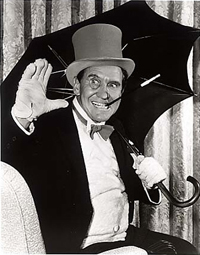
The LDS Church, which owns and operates BYU, has said that inviting Cheney should not be construed as an endorsement of his political views. “The invitation is seen by the university’s board of trustees as one extended to someone holding the high office of vice president of the United States rather than to a partisan political figure,” says a statement on the church’s Web site. In other words: Dude, it’s the VICE PRESIDENT! Who wouldn’t want someone that powerful and famous to speak at their graduation? So what if he supports torture and illegal wiretapping, and so what if he has the general demeanor of Burgess Meredith as the Penguin? He’s the VICE PRESIDENT!! Getting him is a coup!

Alt text

Vice President Dick Cheney.

You might wonder, with a minority of BYU students against Cheney’s appearance, how the majority are responding to their protests. As always, no matter how complex or multi-faceted an issue may be, you can count on BYU students to boil it down to a matter of “we’re right and you’re wrong.” The letters that have appeared this month in BYU’s campus paper, The Daily Universe, have been full of statements like this:

“I understand people may oppose Dick Cheney politically; they have spoken and have made their point. Isn’t it time to unite with the rest of the university and focus on the reason for commencement? Commencement is about the students. It was never a political statement until you made it one.” (“Why alternative?,” April 13.)

“What a great honor for such a position to come to the university. His address to graduates is not about politics. It’s about graduation and having an impact on the world. Surely this graduation is one instance in which we can look past bipartisan politics.” (“Misplaced concerns,” April 3)

“To me, the only thing that seems to be against ‘LDS beliefs’ is organizing angry protests to silence anyone with a different viewpoint than your own.” (“VP visit an honor,” March 26)

Keeping this in mind, let us imagine an alternate scenario. Let’s imagine BYU invited former president Bill Clinton to speak at graduation. I feel confident in saying that this would result in the greatest number of apoplectic, foaming-at-the-mouth, sputtering tirades that the world has ever seen. BYU students would be out of their minds with righteous indignation. Their heads would explode. The number of people boycotting the graduation ceremonies would be in the thousands, not the hundreds that Cheney has prompted. People wouldn’t talk about how the time for protest has passed, and now we need to be united, or how we need to look past “bipartisan politics.” They wouldn’t say that organizing angry protests is against LDS beliefs. They would stage protests every single day. And since it’s BYU, each protest would start 5 minutes late and with a prayer.

Just look at what happened in 2004, up the road at Utah Valley State College, when Michael Moore was invited to speak. Now, Moore isn’t an elected official, and it wasn’t a graduation — UVSC doesn’t have “graduations,” per se; it simply presents its students with a Chili’s gift certificate and a balloon — but I think the situation is similar enough to warrant examination. Moore’s invitation to speak at UVSC set off a firestorm of controversy. To use a clinical term, the locals freaked right the hell out. They protested; they marched; they withdrew their financial contributions to UVSC; they expressed shock and outrage that the college would stab them in the back by inviting such a non-conservative person to speak. The streets were filled with people screaming and sobbing, rending their clothes in anguish, praying for cleansing fire to fall from the sky and prevent the wicked man from entering their precincts. I doubt even Adolf Hitler would have created such a stir. “Well, let’s give him a chance,” Utahns would have said, had the Fuhrer been invited to speak. “He was duly elected by his country, and we ought to respect the office, if not the man himself.”

That philosophy has been expressed a lot lately at BYU: You may not agree with Cheney’s politics, but he does hold a high office, and that office deserves respect. That is what people say when they agree with a person’s politics and want people who disagree to shut up. When someone they don’t like holds a high office, they stop saying it.

I’ve been wondering what I would do if I were still a student at BYU. What if I were graduating this year, instead of back in 1999? Well, first of all, there would be a lot of questions, like why I needed an additional eight years just to get a bachelor’s degree, and why I had failed Biology 100 a total of eight times. (Answer: Because it’s boring, and I never went to class.) But what would I do about Cheney? I don’t like him much as a vice president, and he hasn’t given me much reason to like him as a person — not exactly the warm, grandfatherly type, ol’ Dick — but I’m pretty sure I wouldn’t get involved in the protests. Why? Too much work. I’m not interested in activism. I mean, the word “active” is right there in the name. Even if it’s something I have a strong opinion about, it’s too much hassle to do anything more than write about it, and even that usually requires a lot of pizza. Whenever people get pushy and say, “Be glad that others have fought so that you could have the freedoms you have!,” I always think: I AM glad! Better them than me! YIKES! Do you know how few freedoms we would have now if I’d been in charge of fighting for them? All we’d have is the right to not fight for stuff.

The fact is, no matter how many protests were held, BYU was never going to change its mind about Cheney’s appearance at graduation. The school wouldn’t change its mind in the hypothetical Bill Clinton scenario, either, even if 90 percent of the students were upset about it. BYU, like most large institutions, doesn’t change its mind very often about anything, and certainly not just because its constituents want it to (which I guess is something BYU and Dick Cheney have in common). Does that mean that, in the words of one student, “When all is said and done, [BYU College Democrats] fail to make any real difference”? (“Common Sense 101 Exam,” April 6) Maybe so, but since when does being in the minority mean you should just shut up and go along with what everyone else is doing? I seem to recall that BYU students are very big on Making Your Voice Heard, and Speaking Up for What You Believe In, and Taking a Stand Against the Things You Feel Are Wrong, regardless of whether your views are popular or not.

And how does Cheney feel about the whole thing? I’m sure he’s gotten used to the low approval ratings he and Bush have had for the last couple years, so I doubt he’s losing any sleep over dissenters in Utah. Who knows, maybe on graduation day he’ll tell the protesters what they should go do to themselves.

Friday movie roundup – April 20

18

Welcome to Friday! I hope it is to your liking. Myself, I am not happy with it, for I have a stuffy nose and other cold-like symptoms, and it makes me headachy and phlegmy. You have some good movies awaiting you, though!

“Hot Fuzz,” from the guys who brought you “Shaun of the Dead,” is a loving spoof to buddy-cop action movies like “Lethal Weapon,” with a by-the-book cop and his slobbish partner investigating a series of odd “accidents” in a sleepy British village. It’s a wonderfully clever and funny movie. Go see it at once, I insist.

In the legal thriller department, there is “Fracture,” in which Anthony Hopkins shoots his wife in the head, confesses to it, hands over the gun — yet is slippery enough to still evade the grasp of the district attorney’s office (represented by Ryan Gosling). Good fun here, with a particularly clever central mystery.

If you need a horror film, there’s “Vacancy,” which has Kate Beckinsale and Luke Wilson stopping at a creepy old roadside motel and having to fend off dudes who want to murder them. It sounds lousy, I know, but it’s actually quite efficient, non-gimmicky, and tense. It’s barely 80 minutes without the credits and doesn’t have any downtime.

Stephanie Daley

0

“Stephanie Daley” opens in confusion. A woozy teenage girl is put into an ambulance. Reporters swarm around a courthouse. Snippets of dialogue — “where’s the baby?” and “tried as an adult” — are identifiable. Something huge has happened in this quiet upstate New York town.

The title character, played by Amber Tamblyn (Joan of Arcadia herself), is a teenage girl who gave birth on a class ski trip, only to claim she never knew she was pregnant and that the child was stillborn. The district attorney’s office sees things differently.

Leading up to the trial, Stephanie is examined by Lydie Crane (Tilda Swinton), a forensic psychologist tasked with determining Stephanie’s state of mind at the time she gave birth, and whether she truly didn’t know she was pregnant. Lydie is pregnant herself right now, 29 weeks along (Stephanie was 26 weeks when she delivered), and still mentally scarred from having a stillborn baby of her own not long ago.

Written and directed by Hilary Brougher, “Stephanie Daley” is a self-serious exercise in screenwriting games. Stephanie and Lydie have numerous parallels in their lives, you see, including minor ones (they both love cats, for example) along with the significant ones already mentioned. So they’re a lot alike, you see, and their stories unfold in alternating flashbacks. All of which is supposed to illuminate some great truth about … what? Womanhood? Pregnancy? The circle of life? Whatever it is, I’m not seein’ it.

I do like some of the individual elements, however, including Swinton’s and Tamblyn’s concrete performances. And consider the hot-button issues addressed: Stephanie is a sheltered, ultra-conservative religious girl from a church-going family whose one sexual experience was a near-rape. How accountable is she? How much about sex and pregnancy did she know?

This may be a film that simply speaks more to women than to men, which is fine. But its forced parallels and over-dramatic tone don’t do it any favors.

Hot Fuzz

0

The clever Brits who merrily deconstructed zombie movie with “Shaun of the Dead” have now applied their considerable talents to “Hot Fuzz,” a loving and faithful comic homage to the Buddy-Cop Action Flick. Can I put in a request now for these guys to do this for every major film genre?

Parodies are a dime a dozen. Lame spoofs like “Epic Movie” and “Date Movie” pop up now and then, grab a couple cheap laughs, then evaporate as soon as their jokes become dated (usually in a matter of days). “Shaun of the Dead” and “Hot Fuzz” feature some satiric elements, but their central purpose is to express affection for the movies that inspired them, not derision. What’s more, these homages are funny, exciting, and shrewd. Just as “Shaun” was both a gentle spoof of zombie movies and a very good zombie movie, “Hot Fuzz” is equally adept at repurposing the elements of a “Lethal Weapon”-type flick while also being one in its own right.

Edgar Wright is the director again, and once more he has co-written the screenplay with Simon Pegg. Pegg stars as Sgt. Nicholas Angel, a no-nonsense London cop, a married-to-his-job type whose arrest rate is four times higher than anyone else’s in his precinct. For that reason — i.e., he’s making everyone else look bad — he’s sent to Sandford, a sleepy little country village where the greatest plague facing the citizenry is a street performer who poses as a statue for tip money. There is no crime. The local cops have little to do.

Nick resents the new assignment, but he vows to do his duty and make the most of it. He reminds me a lot of Dwight on “The Office.” He has no visible sense of humor, he takes his job and its rules very seriously, and he won’t abide any shenanigans. He’s not even in Sandford 12 hours before he’s chasing underage drinkers out of the pub and bringing a would-be drunk driver into the station to sleep it off in a cell.

That souse turns out to be his new partner, of course. His name is Danny Butterman, and he’s played by Nick Frost, Pegg’s buddy from “Shaun of the Dead.” Danny isn’t much of a cop, although, to be fair, Sandford doesn’t need much of a cop. His dad (Jim Broadbent) is the commanding officer at the precinct, and Danny went into the family business on a lark. The other cops in Sandford include a pair of grouchy detectives (Paddy Considine and Rafe Spall), a lady cop (Olivia Colman) who speaks only in double-entendres, and a couple other hangers-on. Discipline and paperwork are handled rather loosely, as you might imagine.

Danny may be a slacker, but he’s keen to learn. He’s in awe of the fact that his new partner got to see a lot of action in London, and he rather adorably mimics everything Nick teaches him about Real Police Work. Nick, for his part, starts to loosen up a bit, particularly when Danny exposes him to something he’s been missing out on all this time: super-awesome cop movies! “Point Break” and “Bad Boys II” are Danny’s particular favorites, and you can see Nick’s life change forever when he watches them for the first time.

But there’s serious business to attend to! There’s been a rash of strange fatal accidents in Sandford lately, and Nick suspects they are not accidental at all. We, the audience, know he is right, for we have seen a black-cloaked figure at the scene of every incident. Who is the culprit? The town is full of possible suspects, but the shadiest is Simon Skinner (Timothy Dalton!), manager of the local supermarket and a sly, villainous man if ever there was one.

Wright has lots of fun with the conventions of this genre, skewing them enough to be funny without turning into an all-out parody. He uses quick-cut editing and overdone sound effects to accompany Nick doing something mundane like filling out paperwork, and it gets a laugh every time. Just as in “Shaun of the Dead,” the screenplay is rife with throwaway references to other films, as well as set-ups for punchlines that come later. Nearly every line of dialogue is relevant, either as foreshadowing for something else or as a standalone joke. You can quibble about the value of certain scenes, but to my mind there’s not a wasted minute anywhere in the movie.

Nor is there a wasted actor. Pegg and Frost continue to be an outstanding comedy team, with perfect chemistry and delivery between them. But the supporting players are wonderfully dotty, too, including those who speak only one or two lines. Sandford is alive with odd little characters, from the hulking grocery store employee who mostly just says “yarp” (for “yes”) to the decrepit old woman who runs the boarding house where Nick is staying.

It’s hard to pin down the film’s humor as one particular type; wordplay, slapstick, and witty repartee are all used to equally great effect. The jokes can be broad one minute, subtle the next. The main thing is, they’re funny. From beginning to end, top to bottom, the movie is wonderfully funny.

And the resolution to the big mystery? Well, it’s ludicrous, but intentionally so … unlike “Bad Boys II,” which I’m pretty sure wanted us to take it seriously.

Vacancy

0

It is not wise to expect much from a film about a married couple who are forced to stay in a creepy, dilapidated motel after their car breaks down in the middle of nowhere. That sparse set-up is as old as time, the subject of campfire stories for as long as there have been campfires (or as long as there have been cars and motels, anyway).

Yet “Vacancy” uses the simplicity of that premise to its advantage, reducing the story to its purest elements and using them to scare the poop out of us. Written by newcomer Mark L. Smith and directed by relatively uncredited Hungarian filmmaker Nimrod Antal (yes, Nimrod), “Vacancy” is lean and efficient. It has only five speaking roles, it covers a span of just a few hours, and it runs barely 80 minutes without the credits. If it were on TV, I don’t even know where you’d put the commercials without interrupting something. It has no downtime.

It stars Luke Wilson and Kate Beckinsale as David and Amy Fox, a bickering, soon-to-be-divorced couple on a long car trip back from Amy’s parents’ anniversary party. Now their car has malfunctioned on the back roads of Podunk, and the only buildings in sight are a closed gas station and a motel that probably looked very sleek and modern in 1950.

With no choice other than sleeping in the car a mile down the road where they left it, the Foxes check in with Mason (Frank Whaley), the squirrelly, bespectacled hotel manager whose behavior is weird enough to warrant a double-take but not so bad that it requires fleeing the premises. He sets them up in room 4, where they are soon harassed by a pounding on their front door and on the wall in adjoining room 3.

Then there are the video tapes. The room has a VCR and a stack of homemade tapes in which people are ambushed and killed in hotel rooms that look … just … like … THIS ONE! David searches the room feverishly. Sure enough: cameras everywhere, in the air-conditioning vents and behind the baseboards. The tapes are a warning, or a threat, or something. Surely David and Amy will meet the same fate as the people in the videos unless they act quickly.

A sort of nervous tension has been building through all this, and now it kicks into high gear and lasts for most of the rest of the film. David and Amy are set upon by men in blank-faced masks, who try to get into the room while the terrified couple tries to find an escape route or a working phone line. (You get no cell phone reception out here, obviously. How will filmmakers isolate their characters 10 years from now, when there is literally no place in America where you can’t get a signal?)

Antal shoots everything in an energetic but restrained manner, eschewing the rapid-fire editing and over-zealous sound effects that many directors use nowadays in their thrillers. Anxiety and dread are created by the situations and by the characters’ responses to them, not by having bad guys jump out from behind doors while the soundtrack goes “CHWING!” Antal knows he has a good thing going here, and he doesn’t have to rely on gimmicks to sell it.

It’s hard to come up with a good ending for movies like this. If you throw in too many twists, you run the risk of seeming ludicrous. If you don’t throw in enough twists, the audience goes, “That’s it?” I won’t say which route “Vacancy” takes, only that, after a nearly flawless 75-minute routine, it doesn’t quite stick the landing. But it gets the ol’ heart pounding well enough before that, so maybe I should just be glad I survived it at all.

Fracture

0

Jennifer Crawford (Embeth Davidtz) has already had a long day of hotel sex with her illicit lover when her husband, an aeronautics engineer named Ted (Anthony Hopkins), corners her into a honey-we-need-to-talk discussion. “I don’t think I can do one of these tonight,” she says wearily, “one of these” apparently being an intense, unwinnable conversation relating to Ted’s emotional neediness. Ted says he loves her; she clearly does not love him back. She loves Rob Nunnally (Billy Burke), her cop boyfriend, and Ted knows about the affair. So Ted shoots her in the head.

Many a film has ended there, but “Fracture,” a tauntingly clever cat-and-mouse thriller, uses it as the jumping-off point. Ted the engineer has engineered an elaborate scheme. He knew it would be his wife’s lover who would come to the house to arrest him after the gardener heard shots fired, and he knew the fact that the arresting officer was sleeping with the victim would screw things up in court. He’s also worked out a very neat trick: Somehow, Ted’s gun, the one he shot Jennifer with, the one that was taken from him when he was arrested — somehow, ballistics reports indicate that gun has never been fired.

What at first appeared to be an open-and-shut case for a cocky, up-and-coming deputy district attorney named Willy Beachum (Ryan Gosling) has now turned into a headache. Jennifer is in a coma (an apparent snag in her husband’s plan; he wanted her dead) and can’t testify to what happened. The attempted-murder weapon was apparently not the weapon after all, but the cops can’t find any other guns in the house, and they know Ted never left after he fired the shots.

It’s a mystery worthy of Agatha Christie — WHERE THE HELL IS THE GUN?! — and my sleuthing cap is off to “Fracture” writers Daniel Pyne and Glenn Gers for eventually answering that maddening question with a resolution that’s simple, elegant, and relatively believable.

In the meantime, the focus is on Willy’s frustration with Ted — he insists you call him Ted — who’s representing himself at trial and behaving far more coyly than you want your attempted-murder suspects to be. Willy was supposed to be ditching the public sector for a cushy corporate-law gig (complete with a hot new boss played by Rosamund Pike), but now personal pride — and a little scorn from his current boss, district attorney Joe Lobruto (David Strathairn) — has forced him to stay put and see this thing through. No one makes a monkey out of the district attorney’s office, not on Willy Beachum’s watch!

Willy is played by recent Oscar-nominee Ryan Gosling with a dash of arrogance and a mild streak of Southern-gentleman charm. You can picture him 30 years from now, dressed in a white seersucker suit, holding onto his lapels while talkin’ all folksy to a jury about how he’s just a simple country boy, and then moving in for the kill. Willy is smart and crafty, and he’s annoyed to have encountered a criminal who’s just as sly.

Anthony Hopkins, meanwhile, channels Hannibal Lecter a little (Ted knows a lot about Willy’s personal life) but mostly casts off the shackles of playing a monster and just has fun. He’s playful, masterful, completely in control of his performance, with a wink or a slight smile all he needs to convey Ted’s sinister nature. Hopkins is most famous for playing someone who gives you the creeps; Ted Crawford, on the other hand, gives you the giggles, like the haunted house at a carnival.

Directed by Gregory Hoblit (2000’s under-appreciated “Frequency”), “Fracture” wisely shows us Ted’s initial actions from a neutral point of view. There is no question that he did, in fact, shoot his wife. Willy is certain of that, and we can share his certainty: We saw it happen. So what happened to the gun? And how will the D.A.’s office stop Ted from getting away with it all?

I have it on good authority — I asked my friend Mike, and he’s a lawyer — that some of the legal maneuvering in the last act is bogus, which is disappointing, considering the movie thinks it’s being very clever. I take issue, too, with the inclusion of the Rosamund Pike character at all, let alone the perfunctory fling she and Willy have. The film would be much leaner without her, and without that spurious Constitution-evading bit in the end. But the central mystery of how Ted managed to do something obvious and then make it look like he didn’t is a tidy piece of prestidigitation, and the movie that surrounds it is smart enough to be worth paying attention to.

In the Land of Women

0

Jon Kasdan is the son of Lawrence Kasdan, who is something like Hollywood royalty. He wrote and directed “The Big Chill,” “The Accidental Tourist,” and “Grand Canyon,” among others, and wrote the screenplays for “The Empire Strikes Back,” “Return of the Jedi,” and “Raiders of the Lost Ark.” So it’s no surprise that Jon would go into the family business. The question is why he would make his debut with something as average and unambitious as “In the Land of Women.”

Think about it. You grow up in a house with an multiple-Oscar-nominee and accomplished filmmaker for a father. Movies are a major staple in the family entertainment diet. The opportunity arises to make one of your own … and you choose to do an indie-style dramedy about a 20-something guy who has an emotional crisis in the Big City and flees to a small town to find himself? Instead of, you know, something original or different or creative?

The angst-ridden 25-year-old du jour is Carter Webb (Adam Brody), a mid-level TV writer who’s just been dumped by his girlfriend (Elena Anaya) and needs a break from L.A. His grandmother, Phyllis (Olympia Dukakis), in suburban Michigan, has gone a bit dotty, so Carter heads out there to take care of her, regroup, gather his thoughts, and get over his lost love.

Across the street from Phyllis is the Hardwicke family. Carter becomes dog-walking buddies with the mother, Sarah (Meg Ryan), who isn’t quite old enough to be his mother but is an Older Woman nonetheless. They offer each other sympathetic ears. She believes her husband is cheating on her, which comes at rather a bad time, since she’s just learned she has breast cancer. She’s also at odds with her teenage daughter, Lucy (Kristen Stewart), who’s going through a rebellious phase, with the smoking and the yelling and the sulking and the what-have-you.

Carter comes to be friends with Lucy, too. Being older than her but younger than her mother, he’s in a good position to see both women’s points of view. Lucy is at the age where all girls hate their moms, and where a crush on the unobtainable captain of the football team seems like the most important thing in the world. Carter is a little older. He can share his wisdom with Lucy.

All the wisdom-sharing in this movie gets really old, really fast. Carter helps the ladies, the ladies help Carter, and Lucy’s precocious little sister (Mackenzie Vega) is the wisest of them all. There are too many urgent, I-can’t-stop-myself-even-though-I-know-it’s-wrong kisses. There’s even one of those scenes where someone strides purposefully through a public place (airport, mall, office) toward his or her True Love so that a meaningful and passionate kiss can be shared, all to the great surprise of the True Love, who thought he or she had been tossed aside forever. Really, Jon Kasdan? In the thousand or so movies you’ve seen where the Purposeful Stride Toward the True Love has been deployed, it never occurred to you that it had become a cliché? Not actually showing us the kiss doesn’t make it any less so.

Adam Brody, of TV’s “The O.C.,” has an affable, sardonic charm that has served him well in small roles elsewhere (e.g., “Mr. & Mrs. Smith” and “Thank You for Smoking”) and could make him a good leading man, too, if he gets offered some decent scripts. He’s got that wounded puppy dog look down pat, and he’s edgier than Zach Braff (whose “Garden State” is the clear precursor to this film).

Likewise, it’s always nice to see Meg Ryan, even when she’s handed a role she can sleepwalk through, and Olympia Dukakis, who surely deserves better than this even in her advanced age.

In other words, “In the Land of Women” has a fine cast; it just doesn’t have anything worthwhile for them to do. It hits all the emotional cues right on schedule, pushing an audience’s buttons with dull factory precision. It’s the very definition of an average movie, one that will have exactly the same impact on you if you see it as it would if you didn’t see it.

Latest Dutchergate news: Richard Dutcher issues Official Declaration 2

14

With all of pop-culture-savvy Mormondom (that’s about 50 people) abuzz over news of filmmaker Richard Dutcher’s announcement that he has left both the Mormon cinema movement and the Mormon church, it was only a matter of time before the man himself stepped forward to offer some clarifications. And now he has done so, not by writing another commentary in the Daily Herald, but by posting a comment on a blog. (See, mainstream media? Blogs ARE important!)

The site is By Common Consent, and it’s a smart, Mormon-faithful group of thoughtful writers. One of them, Taryn Nelson-Seawright, wrote a stirring essay about Dutcher’s work, prompting a lively Dutchergate discussion. Then Dutcher himself piped up. His comment is #77, and this link should take you directly to it.

Humorous cereal: the gift that keeps on giving

9

Today the mailman brought me a package postmarked Orem, Utah. I know plenty of people there, but the name and address were unfamiliar. Was this the mail bomb I’ve been expecting for so long?

I opened the package to find a lovely card addressed to me, and a beautiful gift bag. I read the card. It said, in part:

I loved your “Muckoo for Mocoa Muffs” column. Imagine my delight when, that very day, I walked into Harmon’s grocery store and saw the best-named fake Cheerios ever on the end-cap of one of the health food aisles. I bought a box, intending to send it to you, but I have a little procrastination problem and am only just getting around to it.

‘Snide Remarks’ Classic: ‘A Bowl Full of Telly’

1
Alt text

We’re celebrating the 10th anniversary of “Snide Remarks” with a forgotten column being spotlighted every Wednesday, and this week’s “Snide Remarks” Classic is short, goofy, and Christmas-themed! Reading it today will be like having Christmas in whatever month this is!

It’s #139, “A Bowl Full of Telly,” published in the Daily Herald on Dec. 15, 2000. It has a few Utah-specific jokes, all of which are explained in the post-column comments … which makes the comments run longer than the column itself. But never you mind! Read it, and get yourself into the holiday spirit! Ho ho ho!

Don’t abandon Mormonism and Mormon cinema: It makes Kieth Merrill angry

26
Alt text

Kieth Merrill: You wouldn’t like him when he’s angry.

Richard Dutcher’s commentary in last Thursday’s edition of the (Provo, Utah) Daily Herald sent shockwaves throughout the Mormon blogging community. (Of course there’s a Mormon blogging community. There’s a blogging community for everything.) I recommend reading it in its entirety, but here are some key excerpts:

The church would never allow shoddy, inexperienced architects and builders to create one of its temples. In its sacred commitment to excellence, the church searches for and employs those with the necessary talents, non-Mormons and Mormons alike. Some day, church leaders also will understand the power and potential of film. The cinema of a movement as great as Mormonism must be directed by great artists, not by inexperienced committees. Imagine the potential of images to convey the deepest, most sacred doctrines of Mormonism.

Look at the movies that play on the screen of the theater in the Joseph Smith Memorial Building. These films are the introduction of Mormonism to hundreds of thousands of people from across the globe. Shouldn’t these be the most powerful films on the face of the earth? For whatever reason — nepotism, ignorance … who knows? — this opportunity is squandered. Why not share with visitors the beauty and power of Mormonism, rather than treating them to polite, remedial and not-so-factual recitations of Mormon History and scripture? Viewers should leave those films weak in the knees, their minds reeling, their spirits soaring. Film has the power to do that.

He also said he is no longer a practicing Mormon (a big shock to most readers), but he loves the church and its doctrines and has simply gone a different direction, spiritually.

On Saturday, the Herald ran a viewpoint by Chris Heimerdinger, a popular LDS novelist whose book “Passage to Zarahemla” is being made into a film to be released this summer. Heimerdinger’s comments don’t really interest me, so I’m not going to talk about them.

The real juicy response to Dutcher’s article was published right next to Heimerdinger’s, both covered by one central headline: “Answering Dutcher.” This one was by Kieth Merrill (misspelling of “Keith” is correct), who won a Best Documentary Feature Oscar in 1973 for “The Great American Cowboy.” He was a little annoyed by Dutcher’s dismissal of the films that play at the Joseph Smith Memorial Building. These movies, first “Legacy” and most recently “The Testaments,” are hour-long motion pictures that depict stories, dramatized but fact-based, pertaining to Mormonism. Dutcher described them as “polite, remedial and not-so-factual recitations of Mormon History and scripture.” This offended Merrill because, um, he wrote and directed them.

Watch this: ‘The Landlord’

9

More on the Richard Dutcher/Mormon cinema/Kieth Merrill brouhaha later — I’m doing some fact-checking that’s proving onerous — but in the meantime, you must, simply MUST, watch this 2 1/2-minute film called “The Landlord.” It features Will Ferrell, his longtime friend and collaborator Adam McKay, and McKay’s daughter, Pearl. It contains a bit of PG-rated language. It is incredibly funny.

(It’s on YouTube, too, but the video quality on its originating site, which I’ve linked to, is much better.)

Richard Dutcher leaves Mormon cinema and Mormonism

16
Alt text

Richard Dutcher in his upcoming film “Falling.”

Richard Dutcher, whose 2000 film “God’s Army” launched a new wave of Mormon-themed theatrical features, announced two things last week: that he’s leaving Mormon cinema, and that he’s leaving the Mormon church.

This is big news to followers of LDS cinema, and small news to people who didn’t realize there was such a thing as LDS cinema. But in Utah there has been no bigger film-related story in this decade than Mormon cinema — films made by, for, and about Mormons.

“God’s Army,” released March 10, 2000, was the first. Its $2.1 million gross showed Utah filmmakers that a movie with a niche audience (Mormons comprise only about 2 percent of the U.S. population) could be successful, provided they kept costs low and turned out a good product. Dutcher himself made the movement’s second entry, “Brigham City” (2001). By the end of 2003, 10 more non-Dutcher LDS films had been released, some good, some bad, some profitable, some not. As of this writing, another dozen or so entries have been filed, including Dutcher’s third film, “States of Grace” (2005), which is far and away the best of the lot and one of the best films of any kind of that year.

Most of these played only in Utah theaters. A few did well enough to move into other locations, mostly in the western U.S., where the highest concentration of Mormon audiences is. None ever managed to be the illusory “crossover success” that many directors were hoping for; in general, non-Mormons have shown no interest in watching movies they perceived as being for Mormons only.

Monday: ‘Snide Remarks’ and podcast; ‘Slow Burn’ and ‘Redline’ merriment

3
Alt text

Monday again? Already? Didn’t we just have one of these like a week ago?!

Because it is Monday, here is your “Snide Remarks,” with the podcast version embedded right there on the page. I was going to write about the Don Imus thing, but then I decided to just make a casual, careless reference to it instead.

ALSO! Here are reviews of Friday’s not-screened-for-critics “Slow Burn” and “Redline.” The reason they weren’t screened for critics, of course, is that they’re bad movies, but in this case I think that plan may have backfired. “Redline” made only $4 million this weekend, debuting in 11th place, while “Slow Burn” managed just $800,000 and about 19th place. Those numbers suggest a lack of public awareness. If they’d been screened for critics, there would have been reviews in all the papers and online on Friday. Yeah, most of the reviews would have been negative — but at least it would have increased the films’ visibility. Ultimately, all publicity is good publicity.

“Redline” has an amusing backstory. As reported by the Los Angeles Times, it is the brainchild of Daniel Sadek, a millionaire real estate mogul who wanted an excuse to show off his fancy cars, and also to give his actress girlfriend a starring role. He dreamed up the story and handed it over to an unknown screenwriter and director, appointing himself producer and financier. He put about $55 million of HIS OWN MONEY into the film’s production and marketing, and is distributing it himself, too. (Usually, people who produce movies independently sell them to studios to handle the distribution. That’s what Sundance is all about: “Here’s this movie we made; will you please use your money and resources to put it into theaters for us?”)

Ask Eric Stuff 27

0

All right, you nappy-headed hos! It’s time for another edition of “Ask Eric Stuff,” an occasional feature in which members of the general population ask Eric stuff, and he answers them sarcastically and with alleged humor. You can submit a question of your own here. Your questions may be used in a feature edition of “Ask Eric Stuff,” and if they are, boy howdy won’t you feel special!

Dear Eric: I had a baby girl this spring. Everyone I know is giving her pink: pink dress, pink hair bows, pink socks. As a staunch feminist, I think this is just wrong. How do I tell people to give her “gender-neutral” items? — Not a Pink Lady
Dear Lady: Just tell them the truth. Say, “I want beige coveralls for my child, because I don’t want her growing up feeling like being a girl means she’s special or pretty or anything.”

Dear Eric: Why should I listen to you? — Nora in Nevada
Dear Nory: You should never listen to me. Except right now, when I tell you not to listen to me. DID I JUST BLOW YOUR MIND??!?!

Dear Eric: Why do my parents hate my music so much? — Rockin’ in Rochester
Dear Rocky: Because you’re the lead singer for Nickelback.

Dear Eric: Should I brush my teeth and then floss, or floss and then brush my teeth? — Wondering in Wichita
Dear Witch: I don’t care, just quit breathing on me!

Dear Eric: Why can’t our president speak English as well as former presidents or most Americans? — Concerned Conservative
Dear Connie: MOST Americans? I think you’re giving most Americans too much credit. Or have you not been on the Internet lately?

Dear Eric: Why do female contestants on “The Price is Right” insist on running down the aisles with their arms raised, letting their more delicate female parts flop around their front side? — Wondering Why in Washington
Dear Wash: Bob Barker has that effect on the ladies. Dude’s a player.

Dear Eric: My husband and I both work full-time to help pay the rent. But when we get home at night, he expects me to do all the cooking and cleaning too. What should I do? — Cinderella
Dear Cindy: First the dishes, then the laundry.

Dear Eric: How do you know when you over- or under-tip someone? — Hapless in Houston
Dear Happy: You can tell you’ve over-tipped someone when they look surprised and grateful and say, “Thank you very much!” You can tell you’ve under-tipped someone when you’re from Utah.

Dear Eric: Nigerians keep attempting to scam me on eBay. What should I do? — Exasperated on eBay
Dear eBayer: I don’t know, but I don’t appreciate the racial slurs. “N****ians,” indeed!

Dear Eric: How come it’s OK to golf or watch TV all day, but it’s nerdy to play video games? — Mario in Milwaukee
Dear Mary: It’s not nerdy to play video games! It’s a fun, enjoyable pastime, and there’s no shame in it! (Wait. You’re no older than 14, right?)

Dear Eric: On weekdays I don’t have to be anywhere until noon. As a result I sleep late and waste most of the morning. How can I motivate myself to get up earlier? — Sleepy Head
Dear Head: Here’s a little trick I use. Set your alarm clock six hours ahead. Then, when it goes off at noon, it will actually be 6 a.m. You’ll get up thinking you’ve lost half the day, when really it’s still quite early! (Note: This will only work once.)

Dear Eric: Do you have any advice on what kind of car I should buy for my 16-year-old daughter? — Virginia
Dear Virgin: Car & Driver magazine has declared the Honda Civic the best car for spoiled teenagers four years running.

Dear Eric: We’re trying to get pregnant, but we’ve been unsuccessful thus far. What else can we do? — Need a Baby
Dear Needy: If by “we” you mean “you and me,” then I think I know what the problem is: I haven’t been trying very hard.

Dear Eric: Would you have executed Saddam Hussein? — Gotta Love a Hangin’
Dear Hangin’: Yes, I would have, but I was busy that week and they would NOT reschedule.

Dear Eric: We’re planning on getting our 3-year-old a kitten for her birthday, but I worry that she could be hard on the poor thing. What do you think? — Kitty Lover
Dear Kitty: Kittens are fragile, it’s true. Maybe you should start your daughter off with a more resilient and durable pet. I recommend a buffalo.

Dear Eric: If there were no computers or TV, what would you be doing right now? — Livin’ in the Past
Dear Past: Reading a book. A book about how to invent computers and TV.

Dear Eric: What’s the worst insult you’ve ever received? — Offended in Paris
Dear Parry: Someone once told me I speak English as well as the president.

Friday movie roundup – April 13

3

‘Tis a busy weekend at the movies, and none of the options are very good! It’s like going to an all-you-can-eat buffet at T.G.I. Friday’s!

The best of the new releases is “Disturbia,” and that’s only a C+. They get worse from there: the absurd Halle Berry thriller “Perfect Stranger”; the tiresome and padded-out “Aqua Teen Hunger Force” movie; and the laughable Vikings-vs-Indians epic “Pathfinder.”

Two more opened without being screened first, which suggests they may be as bad as the things they DID screen. “Redline” is about street-racing, and “Slow Burn” is a “Usual Suspects”-style thriller about a prosecutor who shoots a man she claims was trying to rape her. Look for reviews early next week, theoretically.

A note on the “Aqua Teen Hunger Force” movie. From a business standpoint, I’m perplexed that it even exists. The show it’s based on is a hit in Cartoon Network’s “Adult Swim” programming, but “hit” is a relative term when we’re talking about basic cable. The TV series averages about 380,000 viewers between the ages of 18 and 24. If every single one of them buys a ticket to the movie, with the average ticket price in America being $6.58, that’s a gross of only $2.5 million. I can’t imagine anyone who isn’t already a fan going to see it, and I doubt every single one of the fans will go, either. Granted, that 380,000 number is only for 18-24-year-olds, but even if there were an equal number of viewers older than 24 — which is doubtful — that’s still a MAXIMUM gross of only $5 million.

Basically, I’m wondering how they’re going to make any money on this film. Production costs, advertising, and so forth must have been at least $2 million. Then they had to pay another $2 million to the city of Boston over that ridiculous “bomb scare” in January (where little boxes meant as promotions for the movie were mistaken for explosive devices). That’s $4 million. On average, movie theaters keep about half of the box office gross, with the other half going to the distributor. So “Aqua Teen” has to gross at least $8 million for it to turn a profit, and I just don’t think that’s possible. I mean hey, good luck to them, but I’m glad it’s not my money they’re spending.

This week’s “In the Dark” podcast can be found here. If you do not know what “In the Dark” is, or if you know but have not yet subscribed to it, then you can remedy either situation here.

Redline

0

Do you love cars? I mean, do you love them so much that you could watch 95 minutes of footage of cars driving fast and occasionally colliding with things? Really? You could? Huh. Well, I guess you should go see “Redline,” then, because it has a lot of very expensive automobiles being driven at high rates of speed, and you could watch it with the sound off and the plot wouldn’t make any less sense than it does with it on.

Conceived, produced, and bankrolled by millionaire real estate mogul Daniel Sadek as a vanity project for his girlfriend, “Redline” is approximately as good as you would expect a movie to be when it was conceived, produced, and bankrolled by a millionaire real estate mogul as a vanity project for his girlfriend. It’s the same movie, more or less, as “The Fast and the Furious,” yet somehow — and this is the impressive part — somehow it is actually shallower.

Sadek’s muse is the lovely Nadia Bjorlin. She plays Natasha, a beautiful young woman whose dad was an auto racer before he died. Natasha herself is, in her own words, “the girl next door — if you live next to a racetrack!” (I don’t, so I guess she’s “the girl on the other side of town, over by the racetrack.”) She runs a repair shop for high-end super-cars, and she likes to race them occasionally, and in her spare time she is the lead singer for a rock group. The band’s songs are auto-themed, with lyrics such as these: “You turbo-charge me if you like it fast/’Cause I’m the kind of girl that’s built to last.”

She gets brought into the world of illegal street-racing through Infamous (Eddie Griffin), a rap producer whose car she repairs. Infamous likes to gamble on these races with a mildly psychotic, vaguely Scottish millionaire named Michael (Angus Macfadyen). Michael’s main driver is his nephew, Jason (Jesse Johnson, son of Don Johnson), who does whatever Crazy Uncle Michael tells him. Michael’s brother Carlo (Nathan Phillips), a Marine just back from a tour in Iraq, is disappointed to find Jason still involved in the corrupt family business (whatever that “business” is, we aren’t really told), and he wants to get them both far away from Uncle Mike. Then, coincidentally, Carlo meets Natasha (remember Natasha?) at a Las Vegas nightclub and falls in love with her. Unfortunately, Michael meets her, too, and is just as smitten — only Michael is obsessive and unstable, which makes his desire for her a bit more dangerous.

That may sound like an awful lot of plot for a movie that’s supposed to be all about cars, and it is. Yet director Andy Cheng and screenwriter Robert Foreman (using Sadek’s story outline) still manage to give the unwieldy story the short shrift and pay the most attention to fistfights, car racing, and scantily clad women being jiggly. Carlo gets into a fistfight the minute he gets off the Greyhound and engages in at least four more over the course of the movie; cars race constantly through the streets and occasionally on official racetracks; and wherever possible, women don’t wear much clothing. One scene has guys sitting around a table playing poker while all around them are women in bikinis. Why bikinis when they’re indoors? Why not! Elsewhere, there’s a shot of nearly nude girls washing a car and getting into a giggly soap fight — a shot that has no connection whatsoever to the shots before or after it. It could have been inserted anywhere in the film and made just as much sense.

Much of the racing takes place on the streets, with hapless bystander cars being smashed without regard for the innocent drivers’ safety. There’s an impromptu race on the Las Vegas Strip, with Jason and another driver exceeding 80 mph — never mind that the Las Vegas Strip is seldom uncrowded enough to go more than about 40. The big race in the finale brings in several drivers, including one — not previously seen, named, or referred to — who we’re told “killed” Natasha’s dad in that fateful auto race all those years ago. This is a laughable attempt to bring unneeded drama into the story, especially considering we’d assumed Nat’s dad’s death was an accident all this time. (Dudes, you have to set these things up! If you want Natasha to get revenge on the guy who killed her dad, you first have to TELL US that her dad had a killer!)

Oh, and this one time, Michael kidnaps Natasha and keeps her in his L.A. mansion, and she escapes because Carlo gets some guns and explosives from a character we’ve never seen before but who is apparently Carlo’s buddy, and Carlo uses the weapons to bust Natasha out.

Oh, and another time, Infamous is flying his private plane somewhere with his entourage of hos, and one of them gets jealous over his flirting with Natasha and demands that the plane “pull over” so she can get off, so the plane lands in the Nevada desert and she disembarks and walks along a two-lane highway hitchhiking.

With wooden acting, flat dialogue, and ludicrous plotting, the film might be enjoyably bad if it weren’t for one thing: It’s also boring. It’s tedious to watch all the interpersonal stuff, and even the racing gets old after a while. It’s your money, Daniel Sadek, but really: Shouldn’t you have outsourced this job to some professionals?

Disturbia

0

If Alfred Hitchcock were alive today, and if he wanted to remake one of his own films for an MTV audience, and if he wanted it to be kind of suspenseful but mostly silly … well, he still wouldn’t make “Disturbia,” but you see where I’m going with this.

This is a junior version of “Rear Window,” though it’s not credited as such. I think that’s why some people are so appalled by it (and believe me, the appalled people are burning up the Internets with their outrage). It’s not because someone had the audacity to remake a Hitchcock film; it’s because someone remade a Hitchcock film and DIDN’T EVEN ACKNOWLEDGE IT. Despite the film’s overwhelming similarity to the 1954 thriller, it’s being passed off as a wholly original work, with no credit given to the earlier story. Where I come from, that’s not a remake, or even an homage. That’s a rip-off.

But where I come from isn’t Hollywood, and they do things differently there. This amped-up, rock ‘n’ roll version stars teen-du-jour Shia LaBeouf as Kale, a suburban kid who’s misunderstood and angry, which results in his being placed on house arrest for the summer. While his uncomprehending mother (Carrie-Anne Moss) works, ennui-stricken Kale does what he can to amuse himself within the geographic area dictated by his ankle monitor. Mostly, this means spying on the neighbors.

Next door is a new family with a hot teenager daughter, Ashley (Sarah Roemer), who coyly befriends Kale and indulges him in his voyeurism. (Somewhat naively, Ashley doesn’t realize that she has probably been the subject of his spying, too.) Kale comes to believe that his other next-door neighbor, Mr. Turner (David Morse), is a serial killer, responsible for murders in his native Texas and more recently for a girl’s disappearance here in wherever-this-is. Ashley is somewhat skeptical; Kale’s horny, goofy friend Ronnie (Aaron Yoo) is far more eager to believe.

Capers ensue. Kale can’t go past a certain point in his yard, which means Ronnie and Ashley have to work reconnaissance and report back via cell phones, video cameras, and other high-techery. (“See?!” exclaim screenwriters Christopher Landon and Carl Ellsworth. “‘Rear Window’ didn’t have those!”) They find a number of ambiguous clues, all of which could either be utterly damning or completely benign, depending on how you look at them. Kale’s mom gets cozy with Turner, which weirds everyone out, partly because he might be a killer and partly because … well, killer or not, he’s awfully creepy.

There’s a lot of coincidence and even more not-calling-the-police-when-you-should, but you can overlook some of that, particularly when the finale is as enjoyably tense as this one is. Credit Morse’s professionalism (always give it your all, even when you’re just in it for the paycheck) and director D.J. Caruso (“Taking Lives”) for setting up high-tension situations and letting them play out more or less naturally. You don’t entirely believe that all of this could happen, but hey, you paid your eight bucks, why not go along with it?

On the other hand, the film is little better than an episode of a good cop show, with nothing new to add to the age-old premise. It’s a prime example of the You’ve Seen This Before Syndrome, where everything — as pleasantly thrilling as it may occasionally be — has been done before, better, and with less suspension of disbelief required.

LaBeouf is a likable young star who can do better than this. His two co-stars are mostly here as window-dressing, especially Aaron Yoo, whose Ronnie character talks like a 40-year-old Hollywood screenwriter trying to sound like a teenager.

So it’s a pretty useless movie, objectively speaking, but harmless in its innocent dumbness. It has a hot girl and some nobody-understands-me teen angst, and it will probably be OK as a Friday-night date for the PG-13 crowd. Anyone older than about 20 should rent “Rear Window” instead.

Perfect Stranger

0

If “Perfect Stranger” were the perfect title for your film, so totally appropriate that you couldn’t conceivably call it anything else, then I guess it would be OK to use it, even though it will remind people of a certain ABC sitcom from the ’80s. But when your film is basically a USA Network-style cheesy thriller that could have been called anything generic — “Deadly Intent,” “Undercover Murder,” “To Catch a Killer,” whatever — then why would you call it “Perfect Stranger”? Do they WANT people to make jokes about Balki and Cousin Larry? What’s next? “Growing Pain”? “Family Tie”?

Any of those would probably be better (though not funnier) than the deadly serious “Perfect Stranger.” It stars Halle Berry, making two weekends in a row in which recent Best Actress Oscar winners embarrass themselves for money. (Hilary Swank trudged through “The Reaping” last week.) Berry plays Rowena, a hard-nosed investigative reporter who takes down dishonest politicians and other scoundrels through her New York Courier column, which she writes under a male pseudonym. When a story gets nixed because of office politics, Rowena becomes drunk and indignant and quits.

That’s good, actually, because it gives her plenty of free time to look into a new case. Her friend Grace (Nicki Aycox) has been freshly murdered, and Rowena thinks the man she was sleeping with — a philandering advertising tycoon named Harrison Hill (Bruce Willis) — is the culprit. Rowena has Grace’s e-mails verifying she was having the affair, and Harrison is married, which might give him motive to kill his mistress. But she needs more proof, so she does the only sensible thing: She takes her findings to the police and has them investigate.

No, I’m kidding, of course. She creates a false identity and gets a temp job at Harrison’s ad agency, hoping she can cozy up to the boss and infiltrate his office for more evidence. She’s aided in this by Miles (Giovanni Ribisi), her tech-savvy friend at the Courier who secretly has the hots for her and is capable of all manner of techno-wizardry.

One of Miles’ accomplishments is so stupid, I just have to mention it. He helps Rowena set up an anonymous instant-messenger account so she can chat with Harrison Hill and lure him into incriminating himself. (Rowena, despite being 30 years old and a writer, has evidently never used an instant messenger program before.) Using a voice sample he recorded from Harrison, Miles rigs it so that when Harrison sends a message, Rowena’s computer reads it to her in Harrison’s voice. That’s ridiculous enough, of course; the only reason it’s being done is because otherwise, the movie audience would have to read the IMs off Rowena’s computer screen, and reading is boring when you’re at the movies. But making it even more preposterous: When the computer vocalizes Harrison’s messages, it does so with inflection, nuance, and emotion, rather than in the dispassionate computerized tones you’d expect. Why, it’s as though Harrison is right there, reading his messages in person! Stupid.

Anyway, Rowena succeeds in establishing a flirtatious relationship with her new boss, both in person and over the Internet. He coyly makes passes at her (with that trademarked Bruce Willis smirky smoothness), she kittenishly puts him off while roping him in. The screenplay (by Todd Komarnicki) overloads itself with so many seemingly irrelevant details — Rowena’s flashbacks to her troubled childhood, her ailing mother, the guy she and Grace both used to date, Harrison’s gorgeous wife, Harrison’s paranoia about corporate spies, the list goes on — that it’s exhausting trying to guess which are clues in solving the mystery and which are merely distractions. It’s a pointless endeavor; all you can do is wait for the movie to get around to explaining itself.

When the answers finally come … well, the less said about that, the better. Like so many lazy thrillers, the film lets its characters discover information through luck and coincidence, rather than through their own efforts. It’s bizarre that Miles would make a date with Rowena — whom we know he’s in love with — and then stand her up so he can implant some spyware in Harrison’s office. Did he forget he’d told Rowena to come over at that time? Of course no. But the movie needed to give Rowena a reason to be alone in Miles’ apartment (she knows where he keeps the spare key), and that was the best thing the movie could come up with.

Directed by James Foley (“Glengarry Glen Ross,” “The Chamber”), the film wants to be “Basic Instinct,” but it has neither the trashiness nor the boldness to come even close. Most of its thrills are on the order of “Will the JPG get e-mailed in time?” and “Can Rowena juggle several different IM conversations at once?” The result is a film that’s polished and smooth without ever being tense, or even interesting. And the finale? As Balki would say, don’t be ree-dee-culous.

Pathfinder

0

Has there ever been a good movie about Vikings? Or a good movie set circa 1000 A.D.? I’m hard-pressed to think of any. I guess that period wasn’t called the Dark Ages for nothing. Like a black hole, it was so dark, no film-worthy stories could escape!

This latest laugh-out-loud disaster is “Pathfinder,” a remake of a (supposedly very good) 1987 Norwegian film that’s been transferred to America and rendered hysterically bad by music-video director Marcus Nispel and screenwriter Laeta Kalogridis (“Alexander,” “Night Watch”). This is pure cheesy spectacle, as bad as anything you’d find on “Mystery Science Theater 3000,” and with plenty of absurd dialogue for the hecklers to ridicule.

The time is actually about 900 A.D. (600 years before Columbus, we’re told; I’ve done the math myself), and the place is somewhere on North America’s Atlantic coast, evidently fairly far up north, because sometimes there is snow. And I don’t mean sometimes during the year, I mean sometimes during the movie. They’ll be walking through snow in one scene, then suddenly they’re on dry land in the next. But anyway, a peaceful village of harmless natives adopts a Norse-looking boy who was left behind by his Viking relatives when they came over and tried to slaughter all the Indians. Now, why you would take your 10-year-old son with you on an Indian-slaughtering trip, I don’t know. Maybe babysitters were hard to come by in 10th-century Scandinavia. Anyway, point is, the kid grows up to be buff and smooth-chested and called Ghost (Karl Urban). His name is mentioned only once in the film, which is once more than anyone else’s name is ever used. Seriously, I watched the closing credits, and I’m like, “Starfire? Blackwing? Gunnar? Ulfar? What good does it do to tell us their names NOW, when the stupid thing is over with?”

AAAAAANYWAY, Ghost is grown up now and fully assimilated into the native village, and he has a crush on the pretty girl (Moon Bloodgood) who lives in the next village over, several miles away. Her dad is the Pathfinder (Russell Means, who was also in a 1996 TV movie called “The Pathfinder”), a title bestowed upon whoever … finds … the path … or something. He’s getting on in years, his best path-finding days now behind him, so they’re looking for his replacement. Ghost isn’t eligible, though, probably because he’s white, though that’s not the reason Pathfinder gives. Instead, he states the movie’s theme for us: “You are still haunted by the demons of your past. Until you face them, you will never know who you really are.” (Hey: At least he has a name. I’m just sayin’.)

So then the Vikings come back, some different ones this time, and they wipe out Ghost’s village. This makes him angry. He rushes to the other village, the one with the hot chick, to warn them. He shows them the metal sword he swiped from the intruders, and says the bad guys wear armor that make the natives’ arrows and rocks useless. Everyone is awe-struck by the sword, which Ghost wields as expertly as a trained fighter, despite his having been in America for 15 years and not having seen one in all that time.

Ghost and Hot Chick and various others realize they’ll have to use cunning, not weaponry, to defeat their hairy, armor-clad Norse invaders. To that end, they quickly devise elaborate booby-traps in the jungle, snares that would take days to create but that they manage to put together in a matter of an afternoon. The film then becomes part “Rambo,” part “Apocalypto,” as Ghost leads his tiny band of fighters to war against the Vikings.

The Vikings, who speak subtitled Norse while the natives speak English (naturally), keep referring to the Indians as “savages.” We are supposed to see the irony in this, given that the natives are actually quite civilized while it is the Vikings who are brutal and murderous. And sure enough, we DO see the irony, because the film beats us over the head with it constantly.

Two of the film’s most unintentionally funny moments happen when Ghost is asleep. First, when he’s a kid, and his adoptive mother gazes lovingly at him while he slumbers, she says, “Who are you, little one?” And then as an adult, when he’s sleeping off the effects of an injury he received in battle, the Hot Chick strokes his cheek and says ponderously, “What is it you dream of?” LOL.

The film clearly wants to be taken seriously as the story of a man searching for his identity, but I cannot see how anyone involved thought that was possible. The action sequences are cut in a frantic, incoherent fashion (which is a shame, since Daniel Pearl’s steel-gray cinematography is actually quite lovely at times). The dialogue is hilarious and shallow, and the graphic violence is dispensed casually, as if it doesn’t matter, which is seldom the hallmark of serious filmmaking. Karl Urban is as dull an action hero as ever there was, and his twice-shouted epiphanic declaration, “I know who I am!” is snicker-inducing, not stirring. It is a film to be laughed at, if it is to be watched at all.

Aqua Teen Hunger Force Colon Movie Film for Theaters

0

One of the pillars of Cartoon Network’s “Adult Swim” programming is “Aqua Teen Hunger Force,” an odd animated series about an order of fries, a milkshake, and a meatball who are friends and share a house in New Jersey. It’s an idea that can only have been conceived with the aid of marijuana, and I suspect it helps to have some on hand when you watch it, too.

Frylock, Master Shake, and Meatwad get into a variety of surreal adventures in their weekly 10-minute episodes (written and directed by the team of Matt Maiellaro and Dave Willis), and while the series offers a lot of goofy, hipster laughs, seldom are the hijinks so grand as to suggest a feature-length film should be made. Considering the show is almost about nothing to begin with, why stretch it out to eight times its normal length and throw it on a big screen?

The film, titled “Aqua Teen Hunger Force Colon Movie Film for Theaters” (ah, too bad “Borat” beat you to it on the unwieldy-title-with-awkward-syntax thing!), is almost as nothing-based as its TV counterpart, with no appreciable improvement in the low-rent, home-style animation. It is also, perhaps predictably, an exhausting and tiresome movie. For every minute spent laughing there are 10 more full of non-laughs, with jokes that are almost funny, gags that almost surprise you, bits that almost work. Almost.

Actually, the movie’s opening sequence — a parody of the old-fashioned “let’s go out to the lobby and buy a snack” promotions — is one of the funniest things I’ve ever seen, maybe worth the ticket price all by itself. Things look promising immediately thereafter, too, as Frylock (voice of Carey Means), Master Shake (Dana Snyder), and Meatwad (Dave Willis) encounter a magical-powered Abraham Lincoln (Fred Armisen) who has a rocket made out of wood and who helps them evade federal authorities. And then things start to get REALLY bizarre!

The plot, such as it is, pertains to a piece of exercise equipment called the Insanoflex, which has a missing component that for some reason a lot of different people want to get a hold of. Also, the Aqua Teens themselves want to know where they came from and who their parents (or manufacturers) are, a quest which dovetails with the Insanoflex mission. Figuring into all this are a mad scientist on the Jersey Shore named Dr. Weird (C. Martin Croker), as well as some amorphous Plutonians named Oglethorpe (Andy Merrill) and Emory (Mike Schatz), not to mention some aliens who looks like low-tech characters from an ’80s arcade game (visual representations of which were the cause of that bomb scare in Boston a couple months ago).

At one point there is a live chicken on fire, running around the room like, well, a chicken on fire, and that’s when I thought: They have no idea what they’re doing here. Having run out of the stories, jokes, and casual comedy pieces that comprise the TV show, they’ve started just tossing out random particles of strangeness, hoping an easy-going audience will laugh because it’s weird rather than because it’s funny. That tactic can work occasionally, but a little of it goes a long way. Eighty minutes is too long for this. The 10-minute versions we get on TV are about right.

Slow Burn

0

“The Usual Suspects” had Keyser Soze, the fearsome criminal whom no one had ever seen. “Slow Burn” has Danny Lewton, a gang lord who has become a multimillionaire by funneling his illegal activities through shell corporations, and whose face is unknown to the police who search for him.

In a week that already had an uncredited rip-off of an older film (“Disturbia,” redolent of “Rear Window”), I’m surprised we’d get something the same day whose thefts were even more outrageous, but here we are. “Slow Burn,” filmed in 2003 and just now deposited into theaters, is “The Usual Suspects” all over, with its police-station setting, its unreliable narrators, and its fabled kingpin. In fact, I hesitate to list all the ways it’s similar to “The Usual Suspects,” because doing so would spoil some of the twists in “Slow Burn.”

One way it is not similar is that “The Usual Suspects” was a very good movie, while “Slow Burn” is more or less useless. Its cavalcade of “twists” in the last 20 minutes come off the conveyor belt so quickly and haphazardly that they all wind up in a big pile on the floor, waiting to be snorted at by incredulous viewers. And everything before that is mildly interesting at best.

Set in an unnamed but rather New York-y metropolis, the film stars Ray Liotta as Ford Cole, district attorney and future mayoral candidate. His top prosecutor, Nora Timmer (Jolene Blalock), is biracial, giving her insights into the black community that Ford himself doesn’t have. She’s been instrumental in prosecuting gang- and drug-related crimes, boosting the D.A. office’s profile and increasing Ford’s chances of being elected mayor. Oh, and she’s had an affair with Ford.

Nora shows up at the police station late one night declaring she was nearly raped by a record-store clerk named Isaac Duperde (Mekhi Phifer), and that she shot and killed him in self-defense. Seems reasonable enough, until a man named Luther Pinks (James Todd Smith, aka LL Cool J) shows up claiming to be a friend of the deceased and offering a contradictory story. Nora says she only met Isaac a week ago and that he was essentially a stranger; Luther says Isaac and Nora go back four months, and that he was practically living at her house. Luther’s story is plausible, too: He knows about the tattoo Nora has on her booty.

How does all of this relate to the elusive Danny Lewton? Well, Nora has been trying to bring him down, and Isaac may have had information that could have helped her. It soon becomes apparent who’s telling the truth and who’s lying, and the only thing left for us is to wait patiently for the movie to give us the whole convoluted story. Who is Jeffrey Sykes (Taye Diggs), a low-level criminal currently in city lock-up? Why is there a newspaper reporter (Chiwetel Ejiofor) hanging around the police station, waiting for Ford Cole? How does the chief of police (Bruce McGill) figure into all this?

The answers are not as earth-shattering as writer/director Wayne Beach (writer of Wesley Snipes vehicles “Murder at 1600” and “The Art of War”) would like them to be. With the odd details (Luther describes everything in terms of smells; Danny Lewton has every episode of “Friends” on tape) and bluesy, smoky atmosphere, Beach has made either a very goofy tribute to film noir, or a very dull film noir. The tone is somewhere between “Chinatown” and a sultry made-for-Cinemax cheese-fest.

He does introduce a very intriguing idea, though, in his brief exploration into the politics of race. Nora has gotten ahead by being half-black, yet there’s some evidence that she’s not black at all. (“The closest her family’s been to Africa is ‘Whitney Houston’s Greatest Hits,'” someone says.) The question of why a white person would pretend to be black, and how that person could benefit from it, would make for a fascinating study. I would like to have seen that angle investigated more thoroughly, especially since nothing else in “Slow Burn” is particularly worth paying attention to.

Year of the Dog

0

As a writer, Mike White has created ironic, above-it-all comedies like “Chuck & Buck,” “School of Rock,” and “Nacho Libre” (which he co-wrote), all films whose protagonists are unusual and isolated in some way — losers, even, except that we like them. In “Year of the Dog,” he’s directing for the first time, and he brings that sense of detachment with him. The result is a film that can make you laugh without making you feel anything … except maybe a little weariness for self-consciously quirky movies about unusual loners.

The star is “SNL” alumna Molly Shannon, showing a genuinely impressive dramatic range as Peggy, a quiet single woman who loves her little beagle, Pencil. When Pencil dies unexpectedly, Peggy is thrown into an emotional tailspin (the sunny, playful kind of tailspin, not the sad kind) and starts looking for ways to fill the void.

Her relationships with humans are not particularly satisfying. Layla (Regina King), her best friend at her office job, won’t quit talking about her boyfriend, whose affections she is insecure about. When he finally proposes marriage, she ecstatically tells Peggy, “I guess all my whining paid off!”

Peggy’s family includes a brother, Pier (Thomas McCarthy), his uptight wife Bret (Laura Dern), and their young, overprotected daughter. Bret is the kind of mom who won’t let you bring toys with square corners into the house, and who spells out words like D-E-A-T-H around the little one. She and Pier offer only basic, patronizing sympathy over Pencil’s death.

Slightly more promising is Al (John C. Reilly), the gun-fanatic who lives next door to Peggy. He takes Peggy to dinner and expresses great sympathy for her loss, as he once lost a pet, too. “She was my right-hand bitch,” he says. “I’m sorry — I mean in the dog way of being a bitch.”

But Al isn’t all Peggy hoped he might be, and neither is Newt (Peter Sarsgaard), the probably-gay-but-maybe-just-asexual man who works at the animal shelter. No, what Peggy really needs in her life is a dog. Or, maybe, 15 dogs, which is what she winds up with while looking for a replacement Pencil and discovering a batch of pooches who are about to be euthanized.

Peggy becomes a vegan. She becomes an activist, secretly taking her young niece to a slaughterhouse in the hopes of impressing and/or horrifying her with the urgency of the cause. She tricks her boss (Josh Pais) into donating money to PETA-like organizations. In short, Peggy becomes a Crazy Dog Lady.

That’s the impression everyone around her has. It fits all the stereotypes: single, just past 40, and totally devoted to animals. Of course she’s crazy, right? White’s subversive, almost sweet message is that hey, if that’s what makes you happy, go for it. Who’s to say what’s “normal”? Let your freak flag fly, Peggy, with your many, many dogs!

White has a good thing going here, but he harms it with too much of his forced whimsy and a nagging feeling that he’s mocking these characters more than he’s admiring them. His characteristic visual style is to have the actors face the camera when they talk — even when they’re having conversations with other people. Cut to Regina King looking right at us as she talks to Molly Shannon; cut to Shannon facing us head-on for her reaction; cut back to King, still staring us down as she responds. These are usually medium-wide shots, too: We’re kept both literally and emotionally at arm’s length from everyone.

Shannon makes it worth seeing anyway, though, with her deft comic timing (far more subdued than on “SNL”) and her knack for making us like pathetic characters. Most of the supporting characters steal a scene or two as well — the supposedly normal people turn out to be just as nutty as the crazy dog lady! Get it?!!? — and I think if someone had stolen the screenplay away from White, we might have gotten something more humane.

Portland’s light rail, and grumps who oppose it

25
Alt text

The Oregonian published a letter to the editor on Monday that I want to address. First, though, a warning: This letter contains references to towns such as “Happy Valley” and “Boring.” Those are the real names of these places, not sarcastic nicknames.

And now, the letter:

Every time I sit in traffic on Interstate 205 through Clackamas into Portland, my blood begins to boil. You see, construction work has begun to bring light rail to Clackamas Town Center. Precious land is being wasted on something that will never reduce congestion on I-205 (just look at the Interstate 84 corridor through Portland).

The urban growth boundary expansion into Happy Valley, Damascus and Boring will add a significant amount of growth to an area that is primarily serviced by I-205. All of these cars will end up on I-205, creating another traffic nightmare like we see on Interstate 5 every day.

Light rail will cost hundred of millions of dollars for approximately seven miles of track. With that kind of money, I-205 could easily be expanded to four lanes in each direction. This would be smarter growth and money well spent.

People will never give up the comfort and freedom of their cars in favor of public transportation, especially in a climate where it rains seven months a year.

ALAN GROSSO
Happy Valley

‘Snide Remarks’ Classic: ‘Best and Worst’

1
Alt text

This week’s “Snide Remarks” Classic is called “Best and Worst” (#128; Oct. 6, 2000). It’s one of several columns I wrote during my time at the Daily Herald in which I made fun of the Daily Herald itself. In this case, it was for a reader survey they’d tried to do that had been a complete disaster and would have been embarrassing if anyone in upper management at the time had been capable of feeling shame.

I always wanted to make fun of the paper more than I did, of course. I should have kept track of all the silliness that went on so I could share it after I no longer worked there. As it is, I’m sure I have forgotten many hilarious anecdotes. Let that be a lesson to you: Wherever you’re working now, keep a journal of your workplace’s foibles so you can laugh about them later.

Children’s Letters to Raven-Symone VIII

28
Children’s Letters to Raven-Symone VIII

See the previous entries in this category (there’s a list in the right-hand column of this page) for details. Basically, these are people writing to an e-mail address that they mistakenly believe belongs to Raven-Symone. If you do not know who Raven-Symone is, then buddy, you haven’t lived.

The letters appear here just as they were sent. For easier browsing, I have put certain special passages in bold type.

My friends are amusing!

1
Alt text

Scott “The Angry Jew” Weinberg

My friend and colleague Scott Weinberg has a new blog called Adventures in Moviewatching that’s pretty good, as is everything he writes. Weinberg is an avid movie-watcher, an enthusiastic horror buff, and an often-enraged critic (his nom du net is “The Angry Jew”), and his observations are always worth checking out. As far as I can tell, and considering how many different places he writes for, the guy must never sleep. Someday that will catch up with him and he will die, but in the meantime, enjoy his comical semitic ramblings, and avoid making fun of the Philadelphia Eagles in his presence!

Alt text

Curt “The Placated Mormon” Doussett

In other friends-of-Eric news, Curt Doussett — Utah ComedySportz co-owner, TV and theater actor, all-around good guy — is the star of the new Discovery Channel series “Hazard Pay,” which premiered last Wednesday. The series follows Curt around as he tries various dangerous occupations (repo man, skyscraper window-washer, etc.) for a day to see what they’re like. It’s a fascinating program, and Curt makes for a funny, personable host. It airs Wednesdays on Discovery at 8 p.m. ET/PT; double-check with your cable or satellite system to find it.

In Which Laziness Does Not Pay After All

0

My old car got wrecked a few months ago, as you know, and I subsequently flew to Ohio to pick up a free 1994 Geo Prizm from Auntie Karen. But whatever became of that wrecked 1995 Toyota Tercel? That is the question that countless (i.e., no) people have asked me, and its story folds in nicely with the continuing saga of the ’94 Geo Prizm, which it turns out is the victim of a gypsy curse.

The Tercel was totaled, and the insurance company had told me they didn’t care what I did with it. (The general sense I got from Progressive was that they didn’t care about anything.) Two months had passed and the car was still parked in front of my apartment, all smashed and battered like the display at one of those “don’t drink and drive” assemblies we used to have in high school. I hadn’t felt like dealing with it. I knew from experience that it’s hard to just throw a car away. Most cars are too large to fit in your standard garbage cans. And you can’t just leave it on the curb for the trash collectors to take, because the curb is where ALL the cars are, and the trash collectors don’t know which ones are trash and which ones are just parked there.

I thought about doing what people do with old couches and bookcases they don’t want and just putting a sign on the car that said, “FREE CAR. RUNS GOOD.” I’d leave the keys in it, too, and just let someone come take it. Someone did that a few weeks ago with a TV, one of those old giant sets that weigh a thousand pounds and take up half the room. The sign they’d taped to it said, “FREE. WORKS. COLOR,” and they’d just left the thing on the grass next to the sidewalk. It sat there for a week, being rained on regularly, before it disappeared. My theory on why it finally got taken was that the “FREE” sign blew away, leading passersby to think it belonged to someone — maybe someone was moving in nearby, and they’d momentarily left it there — and so they “stole” it. Nobody wants to take something for nothing unless they think someone else wants it.

Finally I opened the Yellow Pages and started calling wrecking yards. I chose the ones whose ads said they paid $$$$ for cars, “$$$$” being how phonebook ads for wrecking yards spell “money.” I called three places. Two of them said they’d pay $75; the third said they’d pay $100. When I called that one back the next day to take them up on their offer, the man I spoke to said the going rate was $75. I said, “The guy I talked to yesterday said $100.” He replied, “Oh, OK, I’ll put down $100, then. The driver will have to look at the car when he gets there anyway.”

About 30 minutes later, a tow-truck driver showed up to take my car away. He looked it over, appearing to be very thoughtful and methodical in his approach, then said, “Looks like $75 is what we can give you for it.” As he said this, he pulled his hand out of his pants pocket and revealed it to contain a wad of bills totaling exactly $75. It was all the cash he’d brought with him. Good thing it turned out to be all the car was worth! What a lucky coincidence!

Before he got there, I’d removed everything I needed from the car. There wasn’t much: my spare eyeglasses, a CD or two, some Butterfinger wrappers I’d grown fond of. I thought about taking out the CD player. It was a fairly decent one, nothing special, but the Prizm had an even better one, so I didn’t need to transfer this one over. I thought about selling it at a pawn shop. But I knew all I’d get for it was maybe 20 bucks, and to remove it I’d have to get a screwdriver and hassle with the Tercel’s dashboard and console, and then I’d actually have to go to a pawn shop, which I try to avoid because those places always make me sad because it’s like seeing people’s dreams and ambitions on display in glass cases, and meh, it wasn’t worth it. Let the auto wreckers have the CD player. Let them play their Def Leppard and Nickelback albums on it before they do whatever it is they do to the cars they collect.

So the guy hauled the car away, and I moved the Prizm from around the corner where I’d been parking it to where the Tercel had been, my usual spot, there on the street in front of my apartment. Life continued as normal.

Then, two weeks later, someone broke into the Prizm and stole the stereo.

Now, it could have been worse. They just broke that little triangle-shaped window on the passenger side of the back seat, rather than one of the main windows. They didn’t tear apart the dashboard any more than was necessary to remove the stereo. They didn’t try to hot-wire the car or jimmy the locks or anything. I was actually pretty impressed with their efficiency. As roving bands of thieves go, these guys were highly skilled.

They apparently didn’t even open the glove compartment, which is good, because if they had they’d have seen that the spare ignition key was in there. I DON’T KNOW WHY it was there, it just was. Don’t worry, it’s not there anymore. Now I keep it in the trunk.

At first I didn’t believe anybody stole the stereo. I thought someone took it so they could return it to me. But then I realized I was thinking of that stupid clown story from last week, and my stereo really was gone for good.

If only I’d taken the stereo out of the Tercel before I junked it! I thought. I tried to console myself: Even if I had kept that stereo, I wouldn’t STILL have it; it would be in a pawn shop by now. But I knew that was a lie. In the parallel universe where I did keep the Tercel’s stereo, it was months, perhaps even years, before I got around to selling it. I know this about myself. One time when I moved apartments and was trying to consolidate my belongings, I had two car stereos and three VCRs waiting for the pawn shop, all of which had been sitting around, waiting for the pawn shop, since the LAST time I had moved apartments. So now, a mere two weeks after junking the Tercel, there’s no way I would have already sold the stereo. My laziness would have ensured that I still had it, and thus a replacement for when the Prizm’s stereo got ripped off. But instead, my laziness had prevented me from having a stereo at all. When will my laziness ever pay off?!?

‘Snide Remarks’ and podcast and announcement regarding same

3

I hope you enjoyed your Easter or Passover or Nothing weekend, whichever it was at your house. Here’s a big Cadbury Creme Egg full of Monday goodness: a new “Snide Remarks” here, and a podcast recording of it here.

Speaking of the “Snide Remarks” podcast, my fat brother Jeff and our tooly friend Jason have implemented a snazzy new feature allowing you to listen to the recorded version of a column from the column’s page itself. If there’s a recording available, you’ll see a “SnideCast” player in the infobox at the top of the page. Just click the “play” button and listen! You can even read along! I’ve retrofitted the older columns with this feature, too, where applicable.

Now the only way it could be easier for you to hear my voice is for you to actually become friends with me in real life! And that won’t happen, so this is as close as it’s going to get.

(And of course you still have the option of subscribing to the podcast through iTunes, if you prefer; the URL for that is here.)

Recording these podcasts is good for the column, actually. It’s always been a practice of mine to read the columns aloud while writing them, to make sure they flow naturally. And now I’m finding that sometimes as I’m recording the podcast, I’ll stumble upon a better way of phrasing something, and I’ll actually go back and change the text version to match the spoken version.

One last note on the podcasts: I know the recording quality is bad. I have good software; it’s the microphone and the general acoustics of my recording studio (i.e., my living room) that are subpar. Unfortunately, there’s not much I can do about either one right now. I’m going to try tweaking some things in the post-production to see if I can manipulate it into sounding better, and we’ll see what that yields. But bear in mind that I am always going to sound white and weaselly, no matter what.

Mom loves me at Easter!

7
Alt text

A box of Easter-themed love from Mom.

Well, she probably loves me the rest of the time, too. But it was made manifest yesterday when a box arrived in the mail containing the following items:

– several Reese’s Peanut Butter Eggs
– a Cadbury Creme Egg
– various jelly beans
– Hershey’s Truffle Kisses
– a batch of Mom’s legendary The Brownies

Friday movie roundup – April 6

2

Lots of movies this week, and I have anecdotes for almost all of them! I am an anecdote factory!

The big ticket is “Grindhouse,” Robert Rodriguez and Quentin Tarantino’s double-feature homage to the schlocky B-movies of the ’70s, complete with phony trailers during the intermission to enhance the experience.

Enhancing the experience for me was the fact that I had to sneak in to the screening. The film is distributed by Dimension, which (along with Weinstein Company and Miramax) is handled by Allied Advertising in Seattle. Allied, of course, was the agency that banned me from Paramount screenings several months ago, and they decided (or were strong-armed by Paramount) to take me off the invite list for the other studios they handle, too. That means I wasn’t invited to the “Grindhouse” screening this past Tuesday.

Well, not seeing “Grindhouse” wasn’t really an option for me, so I had to take drastic measures. I had to sneak in. The screening was at 7 p.m., and it was a promotional screening, meaning there would be screaming masses along with the press. I got to the multiplex at 5:50 and bought a ticket to “Premonition,” as that was the film that had started the most recently. It had started at 5, which made buying a ticket for it at 5:50 kind of weird, but the girl at the box office didn’t care.

Grindhouse

0

As an exercise in aging-movie-geek nostalgia, “Grindhouse” is a bloody good time. It’s an homage to the theaters of the 1960s and ’70s that would show double features or marathons of schlocky, exploitative films — kung fu flicks, blaxploitation, zombie movies, spaghetti Westerns — the kinds of films whose titles and posters were always more creative than the movies themselves. Gratuitous violence and nudity were the rule. The prints were usually scratchy and damaged, having been run through a thousand projectors a thousand times already.

My description comes from a purely historical, not personal, standpoint. For the most part, the grindhouse theaters died with the ’70s, and it’s a good bet that the vast majority of “Grindhouse’s” target audience has never actually been to one. We’ve seen some of the films, sure, but mostly on video or at midnight screenings at the local college theater. The whole grindhouse experience — the battered prints, the noisy projector, the salacious coming attractions — that’s all academic. We’re taking Robert Rodriguez and Quentin Tarantino’s word for it that this is how it was.

“Grindhouse,” with its faux trailers during the intermission and its intentionally rough edits, comes about as close to approximating the grindhouse double-feature experience as it can without actually handing out popcorn and marijuana to the audience. Rodriguez and Tarantino each wrote and directed a full-length film, got some horror buddies to make phony previews for others, scratched everything up, and packaged it into one three-hour hootenanny of blood ‘n’ mayhem.

Though the two directors — old friends and kindred spirits in the realm of raucous underground cinema — intended to complement one another, the finished product actually serves to highlight their differences: Robert Rodriguez can immerse himself in a concept and have fun, while Quentin Tarantino can’t lose his ego long enough to let go.

“Planet Terror” comes first, with direction (and screenplay and cinematography and editing and musical score!) by Rodriguez, he of the “Spy Kids” movies and (more germane to the topic at hand) “From Dusk Till Dawn” and “Sin City.” It belongs to the genre of Zombie B-Movies, being the story of a Texas town that is infected with a flesh-eating virus that turns its victims into flesh-eaters themselves. A rowdy band of locals — a mysterious gunman (Freddy Rodriguez), his stripper ex-girlfriend (Rose McGowan), a sadistic anesthesiologist (Marley Shelton), and so forth — fight off the ghouls while looking for an escape.

Rodriguez enthusiastically and skillfully re-creates a zombie flick circa 1970. It’s set in the present, but the muddled plot, the often incoherent editing, and the outrageous gore make it look authentically like something a no-name director would have churned out 35 years ago. The colors are washed out, the print has been made to look scratched — there’s even a reel missing, causing the story to suddenly lurch forward 15 minutes.

By making a movie that’s intentionally bad, Rodriguez has made a movie that’s very good. It’s genuinely entertaining and audacious even without the grindhouse gimmicks, with memorable characters and eye-popping morsels of action-hero coolness. (Who knew the junior mortician from “Six Feet Under” could kick so much butt?) The elements that are fun but that you’d be forced to consider “flaws,” technically, are there on purpose — which means you can enjoy, say, the ridiculous dialogue and the over-the-top violence without feeling guilty. Part of the pleasure in watching grindhouse-style films has always been laughing at the filmmakers’ ineptitude. This time, we can laugh WITH the movie, not AT it.

Tarantino’s contribution is significantly less enjoyable, though still proficient. It’s called “Death Proof,” and it’s a sort of slasher film in which the killer uses not a knife or a chainsaw to dispatch pretty young victims, but his car. His name is Stuntman Mike (Kurt Russell), and he’s a grizzled old veteran of the TV and movie stunt industry. Now retired, for fun uses his car as a weapon, killing his passengers or the people he runs into but leaving himself more or less unharmed, thanks to his expertise and to the modifications he’s made on the driver’s side of the vehicle.

Stuntman Mike meets his match, however, when he picks a fight with a car being driven by two women who are also stunt professionals. They’re Zoe (Zoe Bell, a real-life stuntwoman) and Kim (Tracie Thoms), out in the sticks for a film shoot and taking a super-powered old Dodge Charger out for a test drive on their day off. Their actress friend Abernathy (Rosario Dawson) is in the backseat, providing a non-stuntperson’s perspective on the day’s proceedings.

Because it’s a Tarantino film, there must be a lot of sitting around talking, and the dialogue must crackle with pop-cultural references and carefully worded snark. That’s all well and good (though it’s not exactly in keeping with the grindhouse formula), but there’s a snag: These characters aren’t nearly as engaging as the ones in Tarantino’s previous works, and the things they say aren’t nearly as clever as QT wants them to be. A lot of it is boring, frankly.

The film’s justification for its own existence is a marvelously terrifying car chase and a few other choice moments of action. Kurt Russell is hilarious and spooky at Stuntman Mike, too, particularly in the film’s final moments. As disappointed as I am in the overall product, I don’t want to tell you skip it, because then you’d be missing some sections that are pretty fantastic.

The old grindhouse films often had one or two very cool scenes that were obviously the whole reason the film got made at all, with everything else necessary just to pad it out to feature length. “Death Proof” follows that archetype to a T; the problem is, I’m not sure Tarantino was doing it on purpose. I get the feeling he thought everything in the film would be interesting and fun, when in fact much of it feels indeed like padding. What’s more, the old B movies may have been pretty thin, plot-wise, but at least they were short. Seventy or 80 minutes was a typical running time. “Death Proof”? Something like 95 minutes — and that’s with a jump forward accomplished through a “missing reel.”

Something else disappointing: Halfway through the film, Tarantino seems to forget about the grindhouse gimmicks. The picture stops being scratched up, the editing is no longer choppy, the colors look natural again. It becomes a fairly straightforward not-very-good movie, no longer associated with “Grindhouse” in any noticeable way.

If Tarantino wanted his film to evolve in such a way as to somehow comment on the grindhouse experience, or to subvert the slasher genre, that’s fine. But why do it in what was supposed to be a double-feature of straight-ahead homage? He comes off looking like a spoilsport, like he couldn’t forget his reputation long enough to go through with the stunt of making his product look delightfully bad. Rodriguez embraces the concept; Tarantino starts to and then chickens out.

As separate features, I’d give “Planet Terror” a B+ and “Death Proof” a B-. Together, accompanied by the fake trailers (directed by Rob Zombie, Eli Roth, and Edgar Wright, and each one astonishingly accurate and breathlessly funny in its own right), I give the whole experience a grade worthy of two B-movies.

The Hoax

0

It’s a shame we don’t still live in the days of Howard Hughes, the reclusive, obsessive-compulsive billionaire who once fascinated America with his bizarre behavior. No one really captures our attention in quite the same way for quite the same reasons anymore. In the early 1970s, he was iconic enough — and publicity-phobic enough — that novelist Clifford Irving almost got away with publishing a fake “autobiography” of the tycoon.

“The Hoax” is an account of that incident, and it’s as playful and buoyant a film as Lasse Hallstrom has ever made. The director’s penchant for dopey sentiment (“The Cider House Rules,” “Chocolat,” “The Shipping News,” etc.) has at last faded away, leaving him free to have fun without being bogged down by sappiness.

The year is 1971, and Clifford Irving (Richard Gere) has had his latest novel rejected by his usual publisher, McGraw-Hill. He’s familiar with fakery, having written the biography of notorious art forger Elmyr de Hory just two years earlier, and he has a certain admiration for con men. He’s dipped into that well himself now and then, notably in trying to keep his wife, Edith (Marcia Gay Harden), in the dark about his mistress, Nina (Julie Delpy).

Brainstorming with his historian buddy Dick Suskind (Alfred Molina) for something to write about, Cliff hits on the idea of penning Hughes’ life story. The old coot hasn’t appeared in public in years and turns down all publicity requests. That means it’s unlikely he’d allow an outsider to help him write his autobiography — but it also means he’s unlikely to come forward and denounce the book once it’s written. His silence on the matter will be seen as confirmation that Cliff’s book is legit. It’s a pretty brilliant plan, actually.

Dick is terrified and wants no part in Cliff’s crazy scheme; of course, in the grand tradition of terrified best friends who want no part in their buddies’ crazy schemes, he gets dragged into it anyway, the sweaty, nervous Barney Rubble to Cliff’s smooth-talking Fred Flintstone. Dick is termed Cliff’s “research assistant,” and the two successfully convince the McGraw-Hill bigwigs (Hope Davis and Stanley Tucci among them, both sharp as ever) that they’ve been meeting with Hughes regularly and gathering all the data necessary to ghost-write a compelling autobiography. McGraw-Hill eagerly snaps up the rights with a very large advance check.

Cliff and Dick are sort of stuck now; now they actually have to write the damn thing. They dig up all the Hughes-related interviews, articles, news stories, and books they can find. They pore over court transcripts and congressional hearings. Cliff learns how to imitate Hughes’ speaking voice and syntax, the better to manufacture tape-recorded “interviews” with him. He copies Hughes’ handwriting from letters reprinted in Newsweek and creates fake notes supposedly written to him by Hughes. He and Dick go all out to perpetrate a believable fraud, all in the interest of making a few hundred thousand dollars.

The film cleverly makes us feel constantly certain of two contradictory things: one, that Cliff is actually going to get away with it; and two, that Cliff’s house of cards is going to collapse at any moment. Cliff seems to live in that limbo-land, too, and Richard Gere (in his most exuberantly slick performance since “Chicago”) plays him with the panic-tinged euphoria that marks the life of a huckster. It’s incredibly entertaining to see him in a room full of publishing-house suits, about to be caught in his lies, yet still spinning the bullcrap with as much assurance and moral certainty as if he were Abraham Lincoln. He’ll be painted so far into a corner that you figure there’s NO WAY he can get out of it, that this is finally the moment he’ll have to come clean — and then he keeps going, boldly forging ahead. It’s a thing of beauty, to see a man tell lies that well.

Also a thing of beauty: Alfred Molina as Dick Suskind. Dick was not blessed with the gift of blarney the way Cliff was, and Molina’s skittish performance gives the film some much-needed heart. We admire (though we do not approve of) Cliff, but it’s Dick — flustered, uncertain, and morally grounded — that we actually relate to. He’s the one we would be, if we got into this situation.

It’s fascinating to see what happens to Cliff as he goes further and further past the point of no return. His paranoia and obsession over the project makes him start to resemble the man he’s writing about — a man he’s never met and probably never will meet. When he lies, he seldom manufactures details out of thin air. He generally uses elements from real life, conflating true events into new, fabricated ones, so that everything has a wisp of truth in it. That makes him all the more insidious, of course. Not only do his lies border closely on reality, but they’re true enough to him that he can justify his telling of them. Eventually, he’s so far gone into deception that the character becomes distasteful to us, a destructive man without conscience rather than a harmless, entertaining liar.

William Wheeler’s screenplay was adapted from Irving’s own account, and now Irving has publicly disapproved of the movie. That makes for a nice ironic meta-twist in the whole thing: The guy who faked someone’s autobiography isn’t happy with the liberties taken in adapting his own. Karma’s funny that way, isn’t it, Cliff?

The TV Set

0

What’s that old quip about how laws are like sausages? If you like them, you should never watch them being made? “The TV Set” demonstrates that it’s true of television programs, too. Sit back and enjoy the shows from your living room couch, but for heaven’s sake, don’t pull back the curtain and watch the brutal, creativity-stifling, focus-group-pleasing process of making them.

This black, sad, hilarious satire is probably a grade-A movie for people who work in the industry (the ones with a sense of humor, anyway). It has the ring of something that insiders will appreciate more than observers. But even as one who merely watches, enjoys, and adores TV, I get most of the film’s jokes — and as someone who’s tried to write entertaining items for mass audiences under an over-cautious leadership, I can relate to the soul-crushing nature of “creativity by committee.”

Our window into the insulated world of TV is Mike Klein (David Duchovny), a smart Everyman writer with a wife, Natalie (Justine Bateman), who is pregnant, which means a steady income is needed. Mike has toiled away on various TV series, and now he has a shot at getting his own project off the ground. It’s one of those guy-returns-to-his-small-hometown comedy-dramas, called “The Wexler Chronicles,” and when we meet Mike, he’s working with the fictional PDN network on casting the pilot.

Mike has a guy in mind for the lead (the character based on himself), a good young actor named T.J. (Simon Helberg). He’s brought in another guy, Zach (Fran Kranz), just because the network wants to have options, but he knows Zach won’t get it. He’s too inexperienced, too broad and unsubtle in his delivery. T.J. is much, much better.

The network likes Zach, of course; you saw that one coming. His braying, unfunny sitcom shtick at the audition has the suits in stitches, and he’s cuter than T.J., too. That last part’s especially important because Lenny (Sigourney Weaver), the ball-busting, married-to-her-job network president, shows all the pilots to her 14-year-old daughter before making any decisions. Lenny chooses one actress for a role because, as she puts it, “She doesn’t let her cuteness get in the way of her hotness.”

Mike’s on his way to an ulcer already, worried that the network interference will ruin his pure, personal script. His manager, Alice (Judy Greer), has the task of sugar-coating bad news for Mike. She begins every conversation with, “They love it! They have some concerns, but they love it!” And of course the “concerns” are minor things like, oh, you know, they want to change the entire premise of the show. But they love it!

On Mike’s side is Richard McAllister (Ioan Gruffudd), a new arrival from London, where he was a BBC programmer. He’s still getting used to the Hollywood way of doing TV, and after being inspired by an enthusiastic soccer mom who’s a wannabe TV writer (everyone in L.A. has a script they’re working on), he urges Mike to fight for what he thinks is best for his show.

We follow the pilot through the filming and test-marketing process, all of which is excruciating for Mike and hilarious for us. As expected, his leading man, Zach, is constantly trying to make the comedy “bigger,” and the show’s spineless director (Willie Garson) won’t rein him in. Zach is one of those young actors who think the key to being a successful, serious thespian is to behave erratically and ramble on about your “process” and “staying in character,” and to be difficult on the set. He’d like a romance with his co-star (Lindsay Sloane), too, but that ain’t happenin’.

Lenny, meanwhile, wants to shoot two versions, one with Mike’s idea for the central dramatic event, and one with a cheerier one. There’s a scene where Mike, his wife, and an editor are in the editing bay, cutting together both versions. They’ve intentionally made Lenny’s so bad, so cheesy, so manipulative, that there’s NO WAY the focus group will prefer it over Mike’s better-written, more intelligent original version. You can guess what happens with that.

The film was written and directed by Jake Kasdan (“Orange County”), and as you might suspect, Jake is venting his personal frustrations in “The TV Set.” He worked on “Freaks and Geeks” and “Undeclared,” both short-lived series that were too smart to survive on network television. Mike has back problems in “The TV Set,” just as “Freaks and Geeks” writer/creator Judd Apatow did during the run of that series. There are probably other inside references, too, that I didn’t catch.

David Duchovny, missing in action the last few years, is a welcome presence as Mike, an honest, good-natured man whose creative juices are being drained from him before our very eyes. The film suggests the reality of being an industry insider better than most Hollywood satires do. Mike faces the very real dilemma of sticking to his guns and losing the show (and his income), or giving in to the network’s preposterous demands and supporting his family. Would he be “selling out,” or would he just be doing what a man’s gotta do?

Also MIA lately is Sigourney Weaver, and her caustic performance as Lenny is indeed a sight for sore eyes. Lenny is the only character on record whose near-death experience made her more of a workaholic, not less, and Weaver acts with the authority of someone who knows what these Hollywood types are like, gleefully puncturing the stuffed shirts and inflated egos that she has undoubtedly dealt with throughout her career. (I have to say, too, that for a woman who will turn 58 this year, Sigourney Weaver looks fantastic.)

You can see why smart actors like Weaver and Duchovny (and the others; it’s really a strong, witty cast) would want to be in this film: It’s an intelligent script, and it gives them a chance to exorcise the Hollywood demons that have tormented them. It very astutely sends up the idiocy of focus groups, the absurdity of smooth-talking L.A. doublespeak, and the dog-eat-dog world of trying to get a show on the air. “The TV Set” is therapy for actors and writers, and other people’s therapy is almost always fun to watch.

(P.S. Be sure to stay through the credits to see a clip from the PDN reality series “Slut Wars”!)

The Reaping

0

Ads for “The Reaping” ask “What hath God wrought?,” but I don’t think it’s fair to pin this on Him. It was director Stephen Hopkins (TV’s “24”) and twin screenwriters Carey and Chad Hayes (the “House of Wax” remake) who wrought this goofy batch of religious-thriller hokum, which has been shoved from one release date to another before finally being dropped into theaters on a Thursday — right in the middle of Passover and the day before Good Friday. Classy.

Hilary Swank, desperate to prove her two Academy Awards were flukes, plays Katherine Winter, a former Christian missionary who lost her husband and daughter in Africa some years back and suffered a crisis of faith. She’s now an atheist, using her professorship at Louisiana State University as a platform to debunk supposed miracles and promote science over religion.

She and her still-believing buddy Ben (Idris Elba) are called to the little town of Haven to investigate what appears to be a plague of the biblical variety: A river has turned to blood. The rustic locals, particularly the Bible-thumping mayor (John McConnell), say it’s the work of an evil little girl named Loren (AnnaSophia Robb), whose brother died near the river just days ago. In fact, they sorta want to kill Loren. Katherine and Ben discourage this.

Their tour guide is Doug (David Morrissey), a handsome young widower who lives — as do all characters in movies set in Louisiana — in a decaying mansion near the bayou. His house is the kind where the windows slam open during thunderstorms so that the audience can be startled without the movie actually having to do anything.

A river of blood was the first of the Old Testament plagues, you’ll recall. Next were frogs, then maggots, then lice, and so on, all the way up to No. 10: the death of the firstborn. All of these start to occur, in order, shortly after Katherine and Ben’s arrival, and the two scientists are hard-pressed to find reasonable explanations for them.

Religious thrillers walk a fine line between scary and stupid. For every legitimately frightening story like “The Exorcist” there are 10 ridiculous ones like “End of Days” or the “Omen” remake (or, for that matter, the original “Omen”). Throw a potentially evil child into the mix and it’s even harder to get an audience to take you completely seriously. (And when that child’s menstrual blood causes a river to turn sanguinary, well, forget it.)

“The Reaping” falls more on the stupid side of things, with elements half-heartedly ripped off from other genre flicks (an ill-fated priest who tries to warn the hero; a lapsed Christian wrestling with her faith) and an apocalyptic finale that’s only mildly exciting. It’s all good for a few unintended laughs, but not much in the way of real goosebumps.

Snide Remarks Classic: ‘Clothes-Minded’

1
Alt text

Remember what the world was like in the year 2000? This week’s “Snide Remarks” Classic column might help you recall, as it makes reference to a couple of cultural items from that era. The column also predates the term “metrosexual,” which is too bad, because there’s a place where it would have gone nicely.

The column is called “Clothes-Minded,” and it is #124, published Sept. 8, 2000, in the Daily Herald. Do enjoy, won’t you?

Also: It occurred to me that you might want to see George W. Bush’s right-hand man Karl Rove rapping and dancing at the Radio-Television Correspondents’ Association Dinner. You can do that over here on the YouTubes.

[youtube:http://www.youtube.com/watch?v=hYZre8kEsuw]

Are We Done Yet?

0

The one positive thing I can say about “Are We There Yet?,” the 2005 family comedy in which Ice Cube is harassed by bratty kids, is that it came out in 2005 and I haven’t had to think about it since then. It exists only in the past, where it can’t hurt us.

So why the F-bomb is there now a sequel, called “Are We Done Yet?”? And why is it a remake of a perfectly good 1948 Cary Grant/Myrna Loy movie called “Mr. Blandings Builds His Dream House”? Who approved this? Who wanted this? Who will see this? Ice Cube’s legions of under-10 fans? People who love Cary Grant but always felt he should have been a little bit less expressive, a little bit more like a bumbling, thuggish bear? People who have sustained massive head injuries?

Mr. Cube reprises his role as Nick Persons, a Portland man who, after the events chronicled in “Are We There Yet?,” for some reason married Suzanne (Nia Long) and adopted her two dreadful children, 13-year-old Lindsey (Aleisha Allen) and less-than-13-year-old Kevin (Philip Bolden). They’ve been living in Nick’s cramped apartment, but now Suzanne is pregnant, and it’s time to buy a real house.

They find a beautiful old home out in the country and are charmed by the shmoozy realtor, Chuck (John C. McGinley, never more irritating), who convinces them of its merits. No sooner do they move in, however, than things start to fall apart. Turns out the house needs massive repairs, which would have been spotted if Nick had hired an inspector. Even without that, don’t you have legal recourses when you buy a seemingly OK house that turns out to be rotting from the inside, the way they have “lemon laws” for cars?

It doesn’t matter! Nick hires the local contractor, who also turns out to be Chuck. (Chuck is also a city inspector and a licensed midwife.) (And that’s not a joke. He really is.) Chuck brings in a team of baffling sub-characters to assist on the job, including some blind plumbers (WTF?) and a family of obese Hawaiians whose expertise lies in repairing dry rot.

Oh, dry rot. That reminds me of one of the many stupid quirks in the film’s dialogue. When somebody says something surprising to Nick, he’ll repeat the thing back to them but replace the second part of it with “what?!” For example: “You’ve got dry rot.” “Dry what?!” Also (as Chuck leans close to Suzanne’s pregnant belly): “I’m a baby whisperer.” “A baby what?!” Hey Nick, you’re a jackass. (A jack-what?!)

The dialogue also includes a lot of lines that are broad, obvious set-ups for disaster, the kind where as soon as you hear it, you know exactly what’s going to happen next. For example: The chandelier falls onto the dinner table, causing Lindsey to say, “At least the table is strong!” Instantly, of course, the table collapses. Later: “Isn’t it great to have the place to ourselves?,” followed immediately by pesky Chuck pulling up in the driveway. Also, while Nick takes the kids for a walk in the woods: “There’s nothing to be afraid of,” whereupon Nick sees a deer and is terrified. The deer’s eyes even bug out.

And that reminds me of two other bizarre animal-related incidents. First, after Nick’s pursuit of a raccoon causes him to fall off the roof (one of two times he falls off the roof in this movie), the raccoon looks down at Nick and says, “Sucker!” Later, when Nick falls into the pond and comes face to face with a huge fish, Nick screams, and so does the fish. Yes, the raccoon talks, and yes, the fish screams. What are we to make of this? Every other element of the film, while improbable, unrealistic, and frustratingly predictable, at least seems to occur in the real world (albeit a world in which the laws of gravity are not diligently enforced). So why the screaming fish and the talking raccoon and the bug-eyed deer?

I’ll tell you why: Because this movie is desperate. Its story is paper-thin (guy buys house; repairs drive guy insane), and so screenwriter Hank Nelken (“Saving Silverman”) and director Steve Carr (“Rebound,” “Daddy Day Care”) are forced into panic mode. They have to fill 90 minutes! They have to make Nick run around frantically and trip over things and get things stuck to him and have bats in the chimney and get into a fight with a guy who knows capoeira! When you’re desperate to make a comedy yet have no funny ideas to put in it, all you can do is throw everything at the wall and hope some of it sticks.

Almost none of it does. I chuckled twice during the movie, at two brief gags that were genuinely surprising and funny. The rest is a grotesque mass of comedy gone wrong. Some characters behave without motivation (I’m not sure why Suzanne gets mad at Nick and moves out; it’s not HIS fault the repair work is taking so long); others don’t need to be in the film at all (young Kevin gets about 90 seconds of screen time). When Suzanne goes into labor and Chuck the midwife’s car won’t start, he doesn’t call a cab or ask a friend for a ride or borrow a neighbor’s bicycle; he speed-walks. Why? Because he mentioned earlier that he was on the U.S. speed-walking team in the 1994 Goodwill Games, and it’s “funny” to see that fact come into play later in the movie.

Do you see what I’m talking about here? This is a stupid, unfunny movie made — I have to assume — by stupid, unfunny people. I’ve never even seen the old Cary Grant version, and yet I know that even if it was the worst film of 1948, it’s still 10,000,000,000,000,000,000,000,000 times better than “Are We Done Yet?”

Firehouse Dog

0

“Firehouse Dog” is a mess, but it’s a good-natured mess. It’s about a boy and his dog, and also about firefighters, and so I don’t see how it’s possible not to have warm feelings toward it. Kids? Dogs? Heroes? This movie was custom-made to make my mom cry.

It’s part feel-good family romp, part Hollywood satire, part kids-save-the-day mystery. Like I said, it’s a mess. It has too many dog farts, and by “too many,” I mean “more than zero.” It also has the dog taking a dump in the stew — BUT AT LEAST NO ONE SUBSEQUENTLY EATS THE STEW. That’s a small victory, but nowadays, with family films as poop-centric as they are, you take all the victories you can get.

So yeah, big jumbled mess of a film with way too many things going on, and it’s far too long for a kid flick. And yet I’m sort of casually recommending it, because a) it’s not boring, b) it’s sometimes kind of funny, and c) it’s heartwarming. Too many family films are idiotic and pointless and confuse chaos with comedy. “Firehouse Dog” is calm and assured. It doesn’t dance around like a monkey and honk its big clown nose to try to convince you to like it. It just does its thing, smoothly and somewhat intelligently, and lets you decide.

The boy is 12-year-old Shane (Josh Hutcherson, still in theaters in “Bridge to Terabithia”), the only son of single-dad Connor (Bruce Greenwood), captain at a local firehouse. Shane skips school a lot and doesn’t apply himself to his homework; he’s still reeling over the loss of Uncle Marc, Connor’s brother, who died while fighting a fire a year ago.

The dog is named Rexxx, and he was a pampered, superstar Hollywood dog before accidentally winding up in this town after an airplane stunt went awry. He’s wearing a prop nametag that says Dewey, so that’s what Shane calls him. Rexxx was apparently huge in the film industry, having starred in such capers as (bear with me here) “Jurassic Bark” and “The Fast and the Furriest.” He has his own trailer and wears a toupee. He recently had his doggie heart broken by a Dalmatian with hair extensions.

In the tradition of movies about big-city types who get stuck in middle America and wind up loving it, Rexxx/Dewey soon thrives on being a firehouse dog, and proves to be an able helper. Connor’s firehouse, Engine 55, is a squad of happy-go-lucky losers, but Dewey’s cheerful attitude and ship-shape discipline get them motivated to try harder. Shane even starts doing his homework again. The presence of the dog makes everything better, in other words, which doesn’t exactly make sense, logically, but whatever.

Meanwhile, there has been a string of arsons, and you can bet young Shane and Dewey will solve that mystery! (“… If it weren’t for you meddling kids and your pesky dog!”) Also meanwhile, we’re in for heartbreak when Dewey’s real owner shows up. (If Rexxx was such a big movie star, how come no one in town recognizes him when he suddenly appears, or sees the TV news stories about his disappearance?) And even more meanwhile, Shane and Connor need to fix their fractured relationship, and Shane needs to develop a crush on the daughter of a rival firefighter, and they need to prevent the underfunded Engine 55 from being closed down by the city, and whew! I seriously was not kidding when I said this movie is a mess.

The director is Todd Holland, best known for working extensively on “The Larry Sanders Show,” “Malcolm in the Middle” and the much-lamented, canceled-too-soon “Wonderfalls.” Before all that, alas, he directed the film “Krippendorf’s Tribe,” which is one of the worst things I’ve ever seen. That early transgression notwithstanding, he seems to have a knack for amusing, ever-so-sly humor. And while “Firehouse Dog” (with a screenplay by Claire-Dee Lim, Mike Werb, and Michael Colleary) isn’t exactly sophisticated, it’s more than passable as pleasant, likable family fare.

Black Book (Dutch; German)

0

What if Paul Verhoeven, director of tawdry fare such as “Basic Instinct” and “Showgirls,” had made “Schindler’s List”? It sounds like the premise of a “Saturday Night Live” sketch, but Verhoeven has beaten them to it. He has made a film called “Black Book,” which has the social significance of a Holocaust film while also featuring a Jewish woman revealing her breasts to a Nazi officer and saying, tauntingly, “Are THESE Jewish?”

This is a film that wants to be cheap and tawdry, but in a thoughtful, solemn way. It wants you to be moved and inspired, but it wants you to smack its butt and call it Susan, too. Paul Verhoeven wants us to treat his movie like a dirty whore all night, but respect it in the morning.

I’m afraid I’m not up to the challenge. There are many things I like about the film — it’s certainly the most accomplished and mature work that Verhoeven (who also made “Starship Troopers” and “Total Recall”) has done, and the lead performance is remarkably brave — but when all is said and done, it’s a cheap, gratuitous film about sex and the Holocaust. I found myself shaking my head and chuckling a lot. “Oh, Verhoeven!” I’d think. “You scamp, you!” And I don’t think that’s the reaction one should be having to a Holocaust movie.

It’s the rather epic story of Rachel Stein (Carice van Houten), a Dutch woman whom we first meet in September 1944, when she’s hiding Anne Frank-style in a house owned by a Christian family. To earn her breakfast every morning, she has to memorize a New Testament verse. I guess the Christians figure if they can convert her away from Judaism, she won’t have to hide in their back room anymore.

Her hiding place is soon taken out of commission, though, and Rachel’s on the run. Like a character in a Dickens novel, she bounces from one colorful situation to another, and every time we think we’ve reached the main thread of the story, there’s an unexpected death and a new scenario for Rachel to adjust to.

That’s when the film is good. It’s harsh and uncompromising, just like the war, and Verhoeven (who co-wrote the script with Gerard Soeteman) hints at the possibility of making a grand, serious World War II film, something utterly unlike anything he’s ever done.

But Verhoeven fights those urges and gives in to his shallow, voyeuristic tendencies instead. He has Rachel use her feminine wiles to cozy up to a German officer named Muntze (Sebastian Koch), hoping to get him to release some Resistance members currently being imprisoned. Rachel is working with the Resistance forces, of course, and they’ve sent her undercover as a non-Jewish typist named Ellis to infiltrate the Nazis’ offices in occupied The Hague. Her fellow freedom fighters await her reports back at their secret headquarters, and the ultimate goal is for her to plant a bug in Muntze’s office.

“Ellis” befriends Ronnie (Halina Reijn), a fellow secretary who has already learned how to use her mammary assets to her advantage: She’s sleeping with Franken (Waldemar Kobus), the evil, sniveling German officer who killed someone close to Rachel earlier in the film. It kills Rachel to work in the same offices as this villain, but she mustn’t blow her cover.

It isn’t long before Ellis’ true heritage is discovered — if there’s one thing the Nazis were good at, it was spotting a Jew — and so the question is what Muntze will do with the information. He’s painted as a decent man, basically, albeit one who’s on the wrong side of the war. Furthermore, he’s fallen in love with Rachel/Ellis, so there’s THAT to be dealt with.

This is not a romance film, however; it is war, and war is hell, and there is ample blood and mayhem as the Resistance efforts become more desperate and Rachel’s situation becomes more precarious. I can’t quite keep track of all the alliances and double-crosses in the end, but the general sense of it is visceral and thrilling.

Yet every time I start to respect the film’s tactics, Verhoeven does something exploitative like stripping his leading lady of all her clothes and dumping a bucket of human waste on her. Moments like that make me marvel at Carice van Houten’s steely, sexy performance while I simultaneously wonder what in the world Verhoeven was thinking. Rachel is a sexually liberated woman using her femininity as a weapon against the Nazis, flirting and steaming up the place like Lolita (or, if you prefer, like Sharon Stone in Verhoeven’s most famous film). It’s an intriguing concept, this idea of using whatever means you have available to survive the war, and it could be handled tastefully rather than crassly and bawdily. Verhoeven, obviously, did not go that route.

The director was born in Amsterdam in 1938 and lived through the occupation of his country as a young child. Obviously the war means something to him on a personal level. I suspect that “Black Book” — with all its gratuitous sex and nudity and its barrage of carnage and its naked women covered in poop — is as honestly respectful and meaningful a film as he, Paul Verhoeven, could make on the subject. In other words, I don’t think he’s being so Verhoeven-y on purpose; I think it’s just who he is. The director of “Hollow Man” and “Showgirls” made a movie about the Holocaust. You were expecting something classy?

Some Utah-related film items

0

Some very funny Utah-based filmmakers have created a mockumentary called “Stalking Santa,” in which a man sets out to prove the existence of Santa Claus. It’s in the style of “Best in Show,” “Waiting for Guffman,” and so forth, and it’s smart, clever, and Christmasy.

It’s played at a few film festivals so far (and gotten rave reactions), but it doesn’t have a firm theatrical release date yet. (I marked it Nov. 1 because our database requires that SOME date be entered, and I’m guessing that’s about when it will be.) I’m reviewing it now because I think it’s good and I want to add my small voice of support.

Also, as mentioned in the review, a lot of the people in the film are friends of mine. I tried to remove myself from that as much as possible when I watched it, and the review reflects what I honestly think. If I didn’t really feel the movie was good, I wouldn’t have reviewed it at all. My friends have certainly done a lot of projects in the past that I never mentioned here, for exactly that reason….

The film’s official site is here.

Meanwhile, “The Work and the Glory: A House Divided,” part 3 in the series of films based on Gerald N. Lund’s historical fiction series about the early days of the LDS Church, opened in Utah last November. I believe it’s actually still playing on a few screens there. It didn’t expand northward until last month, when it played for a couple weeks at a Portland theater, where I was finally able to see it. My review is here.

Clown-centric ‘Snide Remarks’ and podcast now available

0
Alt text

If you are afraid to look at pictures of clowns, then you should not read this week’s “Snide Remarks” column. You can safely listen to the podcast, however, as it contains no pictures.

Send in the Clowns … TO HELL!

0

What’s new in the world of clowns? Two are dead and one had his stupid tiny bicycle stolen, that’s what!

I’m sure you’ll agree that circus clowns are ghastly, nightmarish beings whose unfunny mirth destroys all the happiness it comes in contact with. Ironically, the only time they are ever funny is when they don’t intend to be — when a car full of them overturns on the highway, for example, and 30 sad-faced harlequins come crawling out, bleeding and wounded, their red noses honking as they collapse face-down on the pavement. Or when someone bursts into a Colombian circus and shoots two of them.

That’s what happened in February in the town of Cucuta, Colombia. The Circo del Sol de Cali (rough translation: “Circus of Clown Slaughter”) was performing to a crowd of a few dozen people when a gunman barged into the place, opened fire, and killed two clowns. Other clowns shot back, but their guns only spat out little signs that said “BANG!” when they fired them.

Ordinarily, I would not make jokes about someone’s death unless the death occurred in a particular amusing manner or unless the person was a heinous villain. (Ann Coulter, I am looking at you, albeit through protective goggles.) What makes the story of the two dead Colombian clowns funny is what local police chief Jose Humberto Henao told the press afterward:

“The killings had nothing to do with the show the victims were performing at the time of the incident,” he said.

In other words: “I know what you’re thinking. You’re thinking someone hated the clowns’ soul-sucking, joyless merriment SO MUCH that he shot them. But for real, it had nothing to do with that. I SWEAR.”

Alt text

Artist’s rendering of a typical, everyday circus clown, just before it feasts upon the blood of the living.

The police chief was well aware of people’s attitudes toward clowns, and he wanted to nip that theory in the bud. But I call bullcrap. I say the gunman had simply had enough of their clownery and put a stop to it with a little old-fashioned Colombian justice. He had the guts to do what the rest of us only fantasize about. I want to buy that man a drink, and tickets to Cirque du Soleil.

(Some news articles about the killings mention that another clown was shot and killed in Cucuta last year, too. As much as I would like to believe that someone is systematically killing all of the world’s clowns, I suspect the truth is much more mundane: It’s Colombia, and people get shot all the time.)

The other recent item in clown news does not, sadly, involve any clown murders. But the good news is that there was one less stupid tiny bicycle being ridden this weekend, after a Ringling Bros. and Barnum & Bailey Circus clown had his bike stolen in New York City.

According to the Associated Press, the circus was at Madison Square Garden on Friday when, before the show, Bello the clown was out walking the streets with some of his clown brethren. Then they ran into a gang of mimes, and “West Side Story” broke out!

No, just kidding. That would be awesome, though. (“When you’re a mime, you’re a mime all the way, from your first guy-in-a-glass-box to your last man-climbing-up-a-rope!”) What happened was that Bello and his buddies paused to do a little impromptu show on the street, just to annoy passersby. He had to set down his miniature bicycle in the process, and then he forgot it. When he realized he didn’t have it with him, he hurried back to the scene, but of course it was gone. You couldn’t leave a paper bag full of snot on a Manhattan sidewalk for 30 seconds without someone stealing it.

The AP article is disappointingly short on details of the incident. For example, when Bello and his comrades burst into their spontaneous street performance, were they already in full clown regalia? Do they look like that all the time, like Krusty the Clown? Or were they in street clothes? Which is sadder: clowns who walk around in full costume and makeup even when they’re not doing a show, or normal-looking people who suddenly start engaging in acts of clownery on city sidewalks?

Bello was heartbroken over his loss. The stupid tiny bicycle was built in Mexico City 12 years ago and was one-of-a-kind. (Except for all the other stupid tiny bicycles that clowns ride in circuses.) He loved that bike. Not enough to, you know, not leave it sitting unattended on a busy New York City sidewalk, but still. The circus offered a $1,000 reward for the bike’s safe return, and Bello was optimistic.

“I don’t believe anybody stole the bike,” he said at a news conference — and yes, a news conference was held to report the loss of the bike. “I think someone took it so they could return it to me.”

The sad postscript to this story is that, as lame as Bello’s optimism was, it turns out someone really DID find the bike and really DID return it to him. He was reunited with it on Sunday, two days after losing it. That means he had to do Friday and Saturday’s circuses bike-less. I wonder what that was like for him. How nerve-racking, to have to go on without your favorite prop. He might have had to resort to doing comedy.

Friday movie roundup – March 30

2

Three new wide releases this week, and I can recommend all of them, albeit some more heartily than others.

“The Lookout,” which you may recall played at South by Southwest a couple weeks ago, is an outstanding drama with some thriller elements about a young man with memory problems who gets drawn into a bank robbery. It’s a film that might easily go unnoticed, especially with two very big movies opening simultaneously, so I wanted to mention it first.

“Meet the Robinsons” is the latest from the Disney animation crew, and while it gets off to a slow start, it’s very funny once it kicks into high gear. Some theaters are showing it in 3-D, which is how I saw it, and it’s a visual treat, too.

Showing before “Meet the Robinsons” is a 1953 Donald Duck cartoon called “Working for Peanuts,” also in 3-D. It’s not particularly good, but it’s always nice to see Donald and the chipmunks on the big screen.

Finally, “Blades of Glory” would be better without Jon Heder, but Will Ferrell saves the day. This was the movie I saw when I was in Austin that I wasn’t allowed to tell you about. Technically, press weren’t invited to that screening, so we didn’t want to say anything about it until the film opened. And of course since it’s a Paramount release, I wasn’t invited to the Portland press screenings.

Today’s “In the Dark” podcast can be heard here. If you have not already subscribed to the e-mail version of “In the Dark,” you can do so (and see what a typical issue looks like) here. If you would like to see a bunny with a pancake on its head, look here.

I bid you good day!

Live Free or Die

0

In the small, quiet towns of New Hampshire, there’s not much a fellow can do to make a name for himself. John Rudgate knows this, but he doesn’t care. He wants people to remember him even if everything they remember is a lie.

“Live Free or Die,” New Hampshire’s rather dour state motto, is the film’s title and a perfect example of the hardcore, no-nonsense persona that Rudgate (Aaron Stanford) wants to establish. Going by the nickname Rugged, he commits minor frauds and negligible acts of vandalism, then exaggerates them into a vast criminal lifestyle when he brags to his fellow citizens. (He takes credit for the town’s one unsolved murder, though there’s no way he actually did it.) Rugged is a coward and a wimp, but he has the mouthy attitude of Al Capone.

Rugged partners himself with Lagrand (Paul Schneider), a goony, dim-witted admirer who is in many ways his opposite. Lagrand wants to commit some cool crimes because he’s too dumb to realize what the true consequences would be; Rugged is smart enough to know the repercussions and thus wants to avoid actually doing anything wrong. But both men want to be feared and admired. When they poison someone and the guy winds up dead, Lagrand thinks it’s awesome while Rugged is terrified that he may have actually killed someone. He thought it would just make the guy sick.

Lagrand’s sister Cheryl (Zooey Deschanel), who inherited their parents’ self-storage business, knows Rugged is a loser. The local police — Sheriff Monson (Kevin Dunn) and Lt. Putney (Michael Rapaport) — hear whisperings of some local idiot perpetrating some stupid scheme, but Putney is preoccupied with fears that his wife is cheating on him. Hesh (Judah Friedlander), a potty-mouthed hardware-store owner with whom Rugged has had some dealings, figures into everything somehow.

Written and directed by “Seinfeld” scribes Gregg Kavet and Andy Robin, the film is a lukewarm comedy that gets more mileage out of its rather simple premise — craven wannabe tries to maintain fearsome reputation without actually committing any crimes — than you’d think it would. Aaron Stanford doesn’t give Rugged depth, exactly, but the character doesn’t become tiresome, either. And Paul Schneider is enjoyably loopy as Lagrand, playing him somewhere between gay and Will Ferrell.

Nonetheless, the film never rises above average. There are many small laughs, two or three big ones, and a lot of wide open space in between where the film ambles along unremarkably, just like life in New Hampshire does.

Meet the Robinsons

0

Rare is the animated Disney film that doesn’t feature “Just be yourself” as a central lesson, but “Meet the Robinsons” adds a new one: “Be glad when you fail, because that’s how you learn.”

I love that motto. It’s much better than “Just be yourself,” the subtext of which is usually “… and you’ll always succeed.” In fact, “Meet the Robinsons” tries and fails a few times, too, before getting on track and delivering an hour of comedy that ranges from the slapstick to the surreal, accompanied by some good ol’ Disney sweetness.

Alive with sunny colors (and showing in some theaters in 3-D!), the film tells of 12-year-old Lewis (voice of Daniel Hansen and Jordan Fry), a family-less boy who lives at an orphanage run by the kindly Mildred (Angela Bassett). Lewis wants to be adopted more than anything, but his obsession with science and his imaginative inventions make him a little … intense. He scares off one potential couple when his peanut-butter-and-jelly-dispensing device malfunctions and sends the husband into anaphylactic shock. You can bet Annie never had that problem.

Lewis next sets his efforts on inventing a memory-scanning machine, hoping that he can find in his brain an image of his mother from before she left him on the orphanage steps when he was days old. If he knows what she looks like, maybe he can find her! He works day and night on the project, much to the dismay and sleep-deprivation of his dorky little roommate, Goob (Matthew Josten).

At the science fair where he will unveil his invention, Lewis is waylaid by a 13-year-old boy named Wilbur Robinson (Wesley Singerman), who is from the future and who warns Lewis about the Bowler Hat Guy (Stephen J. Anderson, also the film’s director). The Bowler Hat Guy is also from the future and wants to thwart Lewis’ plans for undisclosed reasons.

Soon enough, Lewis and Wilbur are at the Robinson mansion in The Future, repairing the time machine and meeting Wilbur’s bizarre collection of relatives. Mom teaches frogs to sing. A couple of uncles hide in the plants outside the front door, each urging visitors to ring his doorbell and not his brother’s. Another uncle is a giant fat man in a reclining chair; all we are told about him is, “He works out.”

What’s most entertaining about this sequence is how fast-paced and loopy it is. I thought of several things during it: “Alice in Wonderland,” the surreal “Porky in Wackyland” Warner Bros. cartoon, and the nightmarish story in the “Twilight Zone” movie about the omnipotent boy and his hostages/family members (the movie was scarier than the original TV episode). “Meet the Robinsons” is all comedy, no terror, but it’s just as bizarre and random as the works cited.

Prior to that, in the scenes set in the present, the film is somewhat disappointing. Many of the jokes are broad and simple, exaggerated even by cartoon standards and strained to the point of tedium. (The Bowler Hat Guy’s ill-fated attempt to impress bigwigs in a corporate boardroom is the worst offender.) Zipping into the future brings the story to life, though, and it’s smooth sailing from then on.

The eventual standout is, in fact, the Bowler Hat Guy. His bowler hat is sentient, named Doris, and can run errands for him. In fact, Doris might even have a mind of her own. (I don’t think I’m imagining the “2001: A Space Odyssey” reference that I saw.) BHG himself looks like the old Snidely Whiplash style of villains, complete with twirlable mustache and sinister grin. He is, however, gloriously incompetent, and hilariously so. His minions’ frequent reminders to him that his plans have not been thought out very well cracked me up every time.

William Joyce’s very simple book “A Day with the Wilbur Robinson” has been adapted and expanded by no fewer than seven screenwriters, but the many cooks have not spoiled the broth too badly. In fact, there are clever time-travel paradoxes and other pleasant surprises in the last act, and the film has a generally merry disposition that, coupled with its solid laughs, should make it enjoyable for all ages.

Blades of Glory

0
Blades of Glory

On “Saturday Night Live,” Will Ferrell was a utility player. He could play regular guys — fathers, businessmen, doctors — as well as bizarre characters, central or supporting. And in any case, he was nearly always funny. He improved almost every sketch he was in.

He’s now doing for movies what he did for “SNL”: He’s always funny, even if the films he’s in don’t quite cut it. In “Blades of Glory,” he plays Chazz Michael Michaels, a disgraced, bad-boy figure-skater (an “ice dancing sex tornado,” someone calls him) who returns to competition by teaming up with his former rival to create the first-ever same-sex figure-skating pair. Ferrell is a comedic workhorse, as usual, with his mix of physical awkwardness and verbal non sequiturs (“I could not love a human baby as much as I love this brush!” he says of his favorite hair-styling appliance), but the film is only slightly better than so-so. I think Ferrell is a genius, but there’s only so much even a genius can do.

He’s paired with Jon Heder as Jimmy MacElroy, a goody-two-shoes golden child who’s like Shirley Temple on the ice (his signature move: the Galloping Peacock). As a young orphan, Jimmy was hand-picked by a millionaire (William Fichtner) to receive state-of-the-art training and be turned into a perfect figure skater. Now Jimmy is a wholesome, non-threatening naif who’s appalled at the rogue behavior of his rival Chazz, and it’s a tussle with him that gets them both tossed out of the World Winter Sports Games.

Jimmy’s old coach (Craig T. Nelson) gets the idea of pairing Jimmy and Chazz. They’ve both been banned from singles competition, but not from pairs, and while there’s never been a same-sex pair on the ice before, there’s no rule against it. So why not! Especially when it will lead to giggly homoeroticism!

It’s a silly idea, of course, and it’s a silly movie, directed by Josh Gordon and Will Speck (short-film makers working on their first feature) and written by at least four guys (including a couple “King of the Hill” scribes). It feels small and short, with an extremely simple plot — the new Chazz/Jimmy pair faces competition from embittered sibling skaters Stranz (Will Arnett) and Fairchild (Amy Poehler) Van Waldenberg — and a throwaway subplot in which the Van Waldenbergs coerce their sister Katie (Jenna Fischer) into spying on the boys to learn their routine. Jimmy gets a crush on Katie, but I get the feeling that angle is included only to remind us that Jimmy isn’t gay. (For his part, Chazz is a sex addict. He goes to meetings and everything.)

There are plenty of laughs, mostly courtesy of Ferrell and the awesome husband-and-wife duo of Will Arnett and Amy Poehler. But a lot of potential laughs are ruined by something that strikes at the very heart of the movie’s conceit: Ferrell and Heder are not a good pair. Specifically, Heder, while legendary as Napoleon Dynamite, simply lacks the skills to be a good straight man, or even a good actor. All of his set-ups for Ferrell’s punch lines SOUND like set-ups, recited in an over-earnest way by an actor out of his depth. It’s reminiscent of when an athlete (or Robert De Niro) appears on “SNL” and none of his lines sound natural because they’re being read without nuance from cue cards.

Chazz is the type of character Ferrell excels at — a self-important idiot who believes he is sexier than he is — and I suspect Jimmy represents the apex of Heder’s acting skills. As likable as the guy is, he’s not in his league here. The film is modestly entertaining, but it would have been much funnier if Ferrell had had a more qualified partner to work with.

The Lookout

0

The phrase “quiet and contemplative” is not often used to describe bank-heist movies, but “The Lookout” is not an ordinary bank-heist movie. In fact, its misleading advertisements to the contrary, it’s not really a bank-heist movie at all. It’s a character study, and a rich, rewarding one at that. And yeah, OK, there’s a bank heist, too. But the movie is not ABOUT the bank heist! If you go in looking for an “Ocean’s Eleven”-style crime caper, you will be bored and disappointed, and that is not the effect “The Lookout” should have on you.

The place is Kansas City, the time is now. Four years ago, Chris Pratt (Joseph Gordon-Levitt), a talented high school hockey player, was in a car accident with three friends. Two of them were killed. Chris came out of it with some brain damage. He can walk and talk and function more or less normally, but he has episodes of forgetfulness, or he’ll get mental blocks: “I call tomatoes ‘lemons,’ even though I know that’s wrong.” He carries a card with him to let people know that he suffered a massive head injury and might, therefore, occasionally say inappropriate things, or begin crying for no reason, or forget where he parked his car.

Chris lives with a blind man named Lewis (Jeff Daniels), also an accident victim, and goes to therapy to help him with his mental acuity. He’s learning to get by on a system of “ritual, pattern, and repetition.” If you always do things the same way, then it won’t matter if you have occasional memory lapses because your subconscious will know what to do. His life is a series of habits, and that’s how he’s able to work 90 minutes away at a small-town bank, where he’s the night janitor. He wants to be a teller someday. The bank manager (David Huband) keeps saying he’ll think about it. He’s a kind man, but he’s cautious. Chris’ injuries have made him slightly unpredictable.

The bank manager isn’t the only one who is uncertain how to deal with Chris. Deputy Ted (Sergio Di Zio), the aw-shucks Midwestern cop who stops by each night to bring Chris doughnuts and chat for a few minutes, treats him as though he were mentally retarded. Chris’ wealthy parents (Bruce McGill and Alberta Watson) help him financially and love him as much as ever, yet they remain cautious around him. Dad still wants to play chess with him, unable to accept that Chris’ brain can’t handle the complexities of the game well enough to be a decent player. It’s a little heartbreaking.

Chris has been urged by his case worker (Carla Gugino) to try to meet women and develop more of a social life. He’s in a bar one night, trying to do just that, when he runs into Gary Spargo (Matthew Goode). Gary says he dated Chris’ older sister a few times and was a couple years ahead of him in school. Chris doesn’t remember, but that’s OK; Chris doesn’t remember a lot of things. Gary invites Chris to hang out with his crowd, a bunch of layabouts and slackers who associate with loose women and drink a lot of beer. One of the women, Luvlee (Isla Fisher), takes a particular liking to Chris.

After several days of Chris’ new friendship with Gary’s group, Gary lets him in on a secret: They’re going to rob Chris’ bank, and they want Chris to help. He says no, of course, but then Gary makes some good points. The bank doesn’t take Chris seriously. Chris has very little financial freedom himself, with his low-paying job and his small allowance from his parents. Whoever has money has power, Gary says. Chris was influential and popular before the accident; now he’s a nobody, pitied or avoided by most people. If he had money, he’d have power again.

That’s where the bank heist comes in, but trust me, the details of it aren’t the point. This is a film about choices and consequences, about dealing with the past while looking ahead to the future, and at the heart of it is an outstanding performance by Joseph Gordon-Levitt. Who knew the kid from “3rd Rock from the Sun,” now 26 years old, would turn out to be one of the best actors of his generation? “The Lookout” rests entirely on his ability to make us sympathize with Chris without pitying him, to make us like him even though that fatal car accident was the result of his own recklessness. Gordon-Levitt commands sympathy, affection, and understanding, perfectly executing the role without resorting to maudlin or sentimental tactics.

It’s the directorial debut from Scott Frank, a talented screenwriter who has penned such noteworthy titles as “Get Shorty,” “Minority Report,” and “Out of Sight” (for which he was Oscar-nominated). Those were all adaptations; “The Lookout” proves he can write marvelous material from scratch, too, and his smooth, confident direction suggests he was paying attention when his previous screenplays were directed by experts like Spielberg and Soderbergh.

“The Lookout” has many quiet moments, giving us space to think about what’s been said, and to realize that the screenplay has been carefully constructed so that nothing is irrelevant. There are no throwaway scenes or extraneous characters. Everything is part of the whole, contributing to the poignant melancholy and yearning that characterize the film. The more I think about it, the more I’m touched by it.

‘Snide Remarks’ Classic: ‘The Tragedy of Village Inn’

4
Alt text

This week’s “Snide Remarks” Classic is one of my favorites: “The Tragedy of Village Inn,” #112, published June 16, 2000, in the Daily Herald. It received some choice angry letters, too, so be sure to check those out.

For those of you just joining us, 2007 marks the 10th anniversary of “Snide Remarks,” so we’re marking the occasion by spotlighting a different good-but-often-overlooked column each Wednesday. See the “Snide Remarks 10th Anniversary” category in the right-hand column of this page for past entries.

Angry Letters: ‘Eragon,’ ‘Teenage Mutant Ninja Turtles,’ miscellaneous

12

With the advent of comment-posting technology, people don’t send me angry e-mails as often as they used to. Now they can just batter their flippers against the keyboard and post their ignorance directly to the site for all the world to see!

Luckily, a few old-fashioned souls still appreciate the warmth of a personal, private e-mail. For example, here is this one, from someone who hated the “Eragon” movie and for some reason thought I was the director of it:

Your a panzey!!!!!!!YOUR THE WORST DIRECTOR EVER!!!!!!!!!!!!!!!!!!!!!! I never thought a person can skrew up a movie that bad.

Why would someone read my very negative review of “Eragon” and conclude that I, Eric D. Snider, was also the director of “Eragon”? I mean, because he or she is stupid, obviously, but there must be more to it than that.

This next e-mail actually was intended for me personally. It comes from someone named Seth, at e-mail address godowar@aol.com. I’m including his address because when I responded to his concerns, he never replied, and I thought maybe we’d have better luck if some of you e-mailed him.

‘Snide Remarks’ podcast, and an observation

9

Here’s the podcast for this week’s “Snide Remarks,” right here. This column particularly lends itself to podcasting, since it’s in the form of a public speech. Note the use of music to produce more immature giggles, and note that my recording facilities still blow.

Oh, and while I have your attention, and speaking of mental handicaps, go to this Wikipedia page about Asperger syndrome (a form of autism) and read the 17 characteristics of the condition. Then notice how many of them describe Chloe on “24.” At last, the mystery is solved!

New ‘Snide Remarks’; new movie reviews; new everything!

7

Whichever one of you jokers ordered a Monday, here it is. The rest of us were enjoying Sunday just fine, thank you.

The new “Snide Remarks” is posted here. It will not be brief, and you will not enjoy it. The podcast version is forthcoming; I’m hoping the scratchy throat I have will clear up.

Meanwhile, as promised, I have reviews of the five movies that opened Friday that I didn’t already have reviews of. They are:

“The Last Mimzy” (YAY!)

“The Hills Have Eyes II” (BOO!)

“TMNT” (MEH!)

Pride” (DOUBLE MEH!)

“Shooter” (YAY, SORT OF!)

A Formal Apology

0
A Formal Apology

Thank you all for coming. I’ve never thrown a press conference before, so I’m not sure how it works. I’m just a comedian who managed to get his own TV show. But I understand I’ve caused some controversy, and I want to apologize for that.

As you know, my name is Artie Stein, and I’m the star of the Fox sitcom “Who Arted?,” which airs Thursdays at 8 (7 Central). And as you’re aware — in fact, it’s why we’re here today — last week I got into an argument with my friend and co-star, David Schwartz, on the set of our show, and in the heat of the moment, I called Dave something that has caused a huge uproar. I called him a “retard.”

I now deeply regret this. When I called Dave a retard, I was angry. We’d had an argument about some of the dialogue on the show, and I lost my temper. But I didn’t ACTUALLY mean that I thought Dave was retarded. Far from it! Dave is one of the least retarded people I know! He’s very smart, he doesn’t poop his pants, and I have never once seen him fall down a flight of stairs, apart from instances where it was in the script and he was doing it for comedic purposes.

I was using a metaphor. I didn’t mean that I REALLY thought Dave was retarded. It’s like when you call your buddy a “fag.” You don’t actually mean that you think your buddy is sexually attracted to other men. If that’s what you thought, you would say “queer,” not “fag.” You just mean that he’s acting all fag-like. And in my case, I thought Dave was behaving like a retard — not that he actually WAS one. I mean, it’s not like he had ridden a short yellow bus to work and had sat in the back licking the windows the whole way. He was just being stupid, that’s all.

Now, I understand the retard community has been very upset by my words, and I apologize for that. But to be honest, I’m perplexed. Why would retards be insulted to have David Schwartz called a retard? I would think you’d be honored to have such a talented, funny actor as one of your own! Were the retards upset because it turned out Dave isn’t actually retarded, so I got their hopes up for nothing? I guess I can see that. You retards don’t have any real big names to support your cause, and then you find out TV star David Schwartz is retarded, and you’re like, “Man, that’s gold! We’re lucky to have him on our side!” And then when you find out he’s not actually retarded, and he’s actually really smart and normal and everything, you’re probably let down and angry. I can appreciate that. And for causing that emotional turmoil among you retards, I apologize.

* * *

Thanks for coming. I’ll admit, it’s been a hectic week for me since my last press conference. Some of you were at that one, too, and you’ll recall that the point of it was to apologize for an unfortunate thing I’d said on the set to my co-star, David Schwartz. Well, apparently my apology has caused further distress, and I’m here to set the record straight again.

I got a lot of e-mails this week. Let me share one of them with you. It says,

Dear Artie:

You’re not supposed to call them “retards.” “Retard” is an offensive word to people with mental handicaps. You should be more careful.

Always a fan,

Pamela R.
Omaha, Neb.

I appreciate Pamela R. from Omaha, Nebraska, taking the time to write. Thousands of other letters I got expressed the same idea: that calling someone “retarded” is offensive. And ladies and gentlemen, that makes me sad. Why should anyone be insulted to be termed a retard, whether they are one or not? Retards are hard-working, honest members of society. Many of them are Olympic medalists! How many Olympic medals have YOU won? I know I haven’t won any! Honestly, I would be flattered if you called me a retard! (Although I’m not one.)

This is the kind of bigotry and prejudice that we need to overcome in this country. It’s really sad, when you think about it. Negroes have had equal rights for decades now, and racism is pretty much gone. Queers are able to get married in some places, and hardly anyone ever beats them to death on back roads anymore. That leaves retards as the last minority group that it’s still “acceptable” to persecute. And friends, that’s deplorable. I was raised not to discriminate against anyone, be they Negro, queer, or retard. “Retard” should not be considered a “slur,” and the world’s retards shouldn’t have to feel insulted or embarrassed to have that word used. Be proud, retards! Let your retard flag fly!

* * *

Wow. It’s been a pretty interesting week for me. Since my last press conference, I’ve had a lot of intense conversations with my publicist, my agent, and various community leaders and concerned fans. Here’s one of the e-mails I got:

Hey stupid,

Do you not get it? The word “retard” is offensive because people who are mentally challenged prefer to be called “mentally challenged,” not “retarded.” That’s why everyone got so upset.

Sincerely,
Richard M.
Fresno, Calif.

Thank you, Richard M. Your sentiments were echoed in countless other e-mails, letters, phone calls, faxes, notes tied to bricks, class-action lawsuits, and graffiti that I received over the last week. I feel safe in saying that I now “get it.” I understand why it was wrong to call my co-star what I called him, and I apologize for that. I also apologize for any offense I have caused people who are mentally challenged.

It was childish of me to call David Schwartz a “retard.” I understand that now. I should have said, “Dave, you’re acting like a mentally challenged person!” If he was still unclear, I could have elaborated. “Dave,” I could have said, “you exhibit signs of Down syndrome, and my inclination right now is to smile tightly at you, get uncomfortable, and then pretend I don’t see you anymore.” I think then he would have understood where I was coming from.

A few days ago, I met with leaders in the mentally challenged community. They wanted to help me understand them better. To blend in, I wore an ill-fitting suit that I got at a thrift store, and I didn’t brush my hair that day. I had a fine afternoon with the mentally challenged leaders. We drank punch and ate doughnuts, which one of my new friends said he invented! We all had a good laugh about that. Imagine, the inventor of doughnuts being mentally challenged!

But what I learned is that mentally challenged people can do anything. Maybe they can even invent doughnuts. I left the meeting with a newfound respect for mentally challenged people and all the good work they do in the community, from sweeping the floors at Burger King to sweeping the floors at Wal-Mart.

Unfortunately, I came away from the meeting still a little confused, too. The mentally challenged people at the meeting said I shouldn’t use the word “retard” — but I noticed they often used it with each other. One of them greeted another one by saying, “What’s up, retard?” And the other one said, “You know you my retard.” When I then said, “How are all you retards doin’?” the room grew quiet and awkward. Obviously I still have a lot to learn.

Another letter I got this week was from a very “special” person, and please note that I used quotation marks when I said “special,” indicating that this person is mentally challenged, or possibly even retarded. Here’s his letter:

Dear Artie,

My name is Chris Burke. I played Corky on the ABC series “Life Goes On” from 1989 to 1993. On our show we taught some very important lessons about how to treat one another. We tried to show that when you get past the outward differences, we’re all pretty much the same underneath — except for us retards, because we’re actually very different. We don’t just look different and act different and dress different; our DNA is different, too. There’s a whole genetic thing that’s out of whack. We’re different from other people on a deep, fundamental level.

So what’s the point? The point is that I haven’t worked since 1993. I would love to be a guest star on your show sometime. If you do not think that would be funny, then could I just have $50?

Sincerely,
Chris Burke
Famous Retard
Los Angeles, Calif.

It was a thrill for me to get Chris Burke’s letter, as I have always thought “Life Goes On” was a great show with important values, and Corky is my favorite “mentally challenged” or “retarded” character of all time. Number two is Blair’s cousin on “Facts of Life,” and number three is Paula Abdul. I feel like after meeting with the mentally-challenged-community leaders, and now after getting Chris’ letter, I’m helping to bridge the gap between mentally challenged people and normal, regular, smart people.

* * *

I’m sorry I can’t be here with you today. My publicist is reading you this statement, which I prepared myself.

After further meetings with community leaders, I have come to accept that I have a problem. For that reason, I have checked myself into a rehab facility, where I hope to overcome the anti-retard feelings that have taken control of me in recent weeks. I ask for your thoughts and prayers during this time, and I hope to come out of the process with a greater understanding and acceptance of our less-normal neighbors. The rehab facility is expensive, but I have every confidence that it will be worth it, that I will come out of it a better, more sensitive person. Plus, I was able to jew them down on the price a little bit.


[ The background here consisted of the recent scandals involving Mel Gibson and the Jews, “Grey’s Anatomy” star Isaiah Washington and the gays, and Michael Richards and the African Americans. It became trendy to publicly apologize and then go to rehab, and I started thinking about other possible victims of a celebrity’s insensitivity. In an early version, I went with a totally ridiculous group, like “night owls” versus “morning people.” Then I decided this route would be funnier and allow for more possible layers. And yes, I know I’m going to hell. ]


SXSW Q and A

3

Several people posted questions in the comments on my South by Southwest diaries last week, so I thought I’d answer them here. I don’t usually answer questions posted in the comments, because then I get involved in conversations and spend 10 hours a day on my own site. If you have a question you actually want an answer to, it’s always best to just e-mail me.

But since some of these may be of general interest, here they are, all in one stack.

Friday movie roundup – March 23

0

As someone who likes being on top of things and having work done on time and converting the chaos around me into neat, manageable boxes, I am very frustrated at how things developed this week. There are SIX new films opening in wide release today — the usual number is about three — and I only have a review of one of them.

But it’s not entirely my fault! “The Hills Have Eyes II” didn’t screen for critics, no doubt due to it being sucky. “Shooter” screened, but while I was out of town (and the same night as “Premonition,” so even if I’d been here, I couldn’t have seen them both). “TMNT” and “The Last Mimzy” both screened last weekend, when I was still traveling. And I don’t know what happened with “Pride.” Sort of fell through the cracks. That happens when there are six G.D. movies opening at the same time.

The Hills Have Eyes II

0

Huh. I said in my review of last year’s “The Hills Have Eyes” that among its problems was that its characters were too likable and genuine, making it almost unendurable to watch them tortured and slaughtered later in the film. Now the sequel has remedied that problem by making all the characters combative, stupid, and vulgar, and yet it’s STILL not a good movie.

The right combination, I suppose, would be to have the characters as loathsome as they are in “The Hills Have Eyes II,” then to dispatch them as horrifically and distastefully as the nice folks in the first movie were. That might give us some kind of creepy pleasure, seeing people we hate killed by other people we hate.

But this sequel, written by Wes Craven and his son Jonathan and directed by German music-video director Martin Weisz, lacks the ghoulish imagination that can make a slasher flick entertaining. These people get bumped off, sure, and the survivors get some revenge against their attackers, yeah. But there’s no fun in it. There’s no wit in the dialogue, no surprise in the methods of death (a disappointing number are simply shot), and there’s a rape scene that’s ugly and gratuitous.

The characters, morons even by slasher-flick standards, are National Guard trainees who stop to deliver supplies to the real Army in the New Mexico desert, only to find that the Army guys have all disappeared. They get a radio call from a survivor, and a rescue party is assembled. Two privates are left at the camp while the other six soldiers and their commanding officer head up into the hills to find the injured Army dude, and also to be killed, one at a time, by the mutants who live there. A lot of scenes are thus set in the dark caves, recalling the vastly superior thriller “The Descent.”

For reasons unknown, the National Guard trainees all hate each other. The exception is that there are two women among them, and the guys sometimes pretend not to hate them long enough to flirt with them. But mostly, it’s hate. Hate, aggression, and defensiveness. Witness this exchange of dialogue between two of the men:

ONE SOLDIER: You’re not Rambo resurrected! (Meaning: “You’re not the ultimate soldier you think you are!”)

ANOTHER SOLDIER: You can Rambo resurrect my b***s!

Now, come on. What does that even mean? It’s something a violent, stupid person would say just to be quarrelsome. The first half-hour of the movie is full of that kind of thing, up until they started getting killed, at which point they (mostly) stop fighting and start peeing their pants instead.

I am not going to tell you the characters’ names, or the names of the actors who play them.

More than anything, “The Hills Have Eyes II” feels like an exercise, not a real film. It’s a chance for a new director to go through the mechanics of making a torture-porn hackfest — where to put the camera, how to sever the limbs, when to show the killers’ faces — without bothering to fill in the details. Unfortunately, this dry run has been put into theaters, unrefined and unwatchable, and I have watched it. The good thing is, you don’t have to.

Reign Over Me

0

Charlie Fineman totally shut down after his wife and kids were killed on 9/11. He now spends his days living as a hermit in his New York City apartment and playing video games nonstop. Why video games? Because it allows him to fight monsters — but the real monsters are inside him!!!!!!

Those sarcastic exclamation points are to indicate my weariness with such leaden symbolism, the likes of which “Reign Over Me” is full of. It’s a step backward for writer/director Mike Binder, whose “The Upside of Anger” had real emotions and real people. “Reign Over Me” always feels like it’s TRYING to be a Meaningful Film, rather than just BEING one. It wears its earnestness on its sleeve, hoping you’ll notice.

Charlie (Adam Sandler, doing his Bob Dylan impression) was once the college roommate of Alan Johnson (Don Cheadle), who is now a successful dentist with a wife and kids. Alan hasn’t seen Charlie in years, then runs into him on the street one day, only to find that Charlie doesn’t recognize him at first. He’s blocked out nearly everything about his pre-9/11 life. It’s a serious case of post-traumatic stress disorder.

Alan and Charlie start hanging out again, Charlie keen on going to all-night movie marathons and playing the drums while Alan must constantly worry about how late it is and whether he should be getting home to his wife (Jada Pinkett Smith). Charlie has enough money to live on without working, and he favors a responsibility- and problem-free existence. Alan, in one of those generic midlife crises so often seen in movies, feels stifled by his wife and likes being carefree with Charlie. But he knows Charlie can’t go on like this forever, either. He needs to get his life back in order.

The question at the heart of the film is this: Can you force someone to fix himself, or is it sometimes better to let people behave however they want, no matter how unorthodox it may be? Alan succeeds in getting Charlie to see a psychiatrist (Liv Tyler) and to open up about his painful memories, but is that a step in the right direction or the wrong one? Is there a “normal” way that people should deal with grief?

To a lot of people, with his Regular Joe appearance and lowest-common-denominator sense of humor, Adam Sandler IS normal. You watch him and think, “This guy is just like a lot of guys I know.” That savvy bit of casting helps the film more than you’d think, as it makes Charlie — an improbable character behaving in an improbable way — seem somehow ordinary. Sandler’s performance, a mix of comedy and pathos, is mature and even poignant in places, once he gets comfortable with the character’s idiosyncrasies.

Though the film has a number of laughs, it’s mostly a drama, and a contrived one at that. Real people’s problems — which the movie wants us to believe it’s addressing — are more complicated than this, with less obvious solutions. Alan and Charlie are never convincing as friends; they seem more like actors performing Public Service Announcements together, or like the pals who populate beer commercials: always jocular, but jocular in a carefully orchestrated, focus-group-pleasing way. For a film that intends to be about the messiness of life and the unusual ways a person can find happiness, it’s very clean, neat, and usual.

Shooter

0

If I’ve got it straight, here’s what happens in “Shooter.” The government asks an expert marksman to come up with a what-if scenario for shooting the president from more than a mile away. Then someone tries to do just that, and they pin it on the marksman. After all, he was just seen in that area a few days earlier, scouting out locations! He’s the perfect patsy.

Except that he’s played by Mark Wahlberg, and his name is Bob Lee Swagger, and NOBODY MAKES A PATSY OUT OF MARK WAHLBERG AND/OR SOMEONE NAMED BOB LEE SWAGGER!!

Based on the novel “Point of Impact” by Washington Post film critic Stephen Hunter, “Shooter” involves elaborate conspiracies and highly improbable scenarios. Yet it does so with just enough straight-faced bravado that you can sort of buy it, the same way you swallow the addictive preposterousness of “24” every week.

Bob Lee Swagger is a retired Marine sharpshooter who lives with his guns and his dog in an isolated mountain cabin. He’s visited by Col. Isaac Johnson (Danny Glover, whispering everything for some reason) and persuaded to serve his country by coming up with an assassination scenario. Sources suggest someone is planning to do it for real at an upcoming presidential appearance in Philadelphia, and if Swagger can determine how it’s most likely to go down, the feds can stop the guy before he pulls the trigger.

When the assassination does happen, Johnson’s men try to kill Swagger, too, because dead scapegoats are more pliable than live ones. But Swagger escapes and goes on the lam like “The Fugitive,” trying to hide from the cops while finding proof of his innocence. Swagger is a resourceful, MacGyver-type man, making his way to Kentucky and the home of Sarah (Kate Mara), the widow of Swagger’s old Marine buddy. She has some nursing experience and can help Swagger lie low for a while.

Meanwhile, a rookie FBI agent named Nick Memphis (Michael Peña) looks carefully at the facts of the assassination and instantly determines Swagger is innocent. This involves finding some clues as the result of sheer luck or extreme coincidence. In other words, the movie helps him cheat a little.

The plan to kill someone and pin it on Swagger runs into the high branches of government, including an energetically wicked Southern senator played by Ned Beatty.

Director Antoine Fuqua has looked at crooked authority figures before, of course, in “Training Day,” and he has grown no less cynical in the meantime. The film’s politics are a weird jumble, though. There’s right-wingism: Swagger is a reclusive gun nut who lives in the woods, and Big Government is the bad guy. But there are also left-wing sentiments: Nick Memphis wears a Che Guevara T-shirt, and it’s hard not to take all the anti-government talk as being anti-the-current-administration. What does that make the movie? Libertarian?

But hey, who cares? The movie gets less plausible as it goes, but Wahlberg’s good as a tough, stoic type, the supporting cast is colorful (love Elias Koteas as a particularly nasty federal agent), and it’s an acceptable two hours of political-thriller fluff. Jack Bauer would probably get things done a little faster, but Bob Lee Swagger has the better name.

Pride

0

Sure, there’s a new based-on-a-true-story inspiring sports drama released every couple weeks. But how often are they about African American athletes who face racism as they try to prove themselves? About half the time? Oh. Well, how often are they about the sport of swimming? That’s right! Hardly ever!

Thankfully, we now have “Pride” to fill that need. Armed with a funky-cool vintage soundtrack and Terrence Howard’s sensitive-guy charisma, it tells the story of Jim Ellis (Howard), who swam in college and now, in 1974, has taken a job with the Philadelphia Department of Recreation. He’s supposed to be helping close down an underused facility, but he winds up keeping it open so that a handful of teenage boys can use the swimming pool.

Now, I don’t know how I feel about a strange man luring teenage boys away from the outdoor basketball court into swim trunks and a pool, but I suppose those were simpler times in 1974. The point is, Jim is pleased to be “coaching,” however unofficially, and Elston (Bernie Mac), the maintenance man who keeps an eye on the facility, is glad the place is staying open a bit longer.

Soon Jim has formed the kids into something approximating a team, and they enter themselves into meets against other rec centers and schools. Predictably, the first meet is against Main Line Academy, the snooty, all-white school where Jim applied for a job and was shooed away by the arrogant dean (Tom Arnold). Also predictably, Jim’s kids lose that meet, what with it being their first time and needing to learn a lesson and all. Don’t worry, though! There will be a rematch at the end of the film!

The kids fall under the usual categories: the hothead (Kevin Phillips), the younger, shy stutterer (Evan Ross), the kid whose guardian thinks he should focus on school instead of wasting his time swimming, and, I don’t know, a few others. One of them wears glasses, and one of them is a girl. There’s not a lot distinguishing them beyond that.

Despite being a cookie-cutter film with no surprises, the movie has been directed by newcomer Sunu Gonera with enthusiasm and, well, pride. If he was making a movie that has already been made a thousand times, no one told him that, and it’s hard to actively dislike a movie as uncynical and straightforward as this one. But as footage of the real Jim Ellis and captions describing his accomplishments were shown at the end, I couldn’t help thinking a documentary about the man would be so much more interesting than a watered-down, by-the-numbers dramatization.

The Last Mimzy

0

“The Last Mimzy” is science-fiction for kids, which means a couple things. First, I suspect a lot of it will go over some children’s heads. Second, since it’s a kids’ movie, it’s OK that the conflicts are resolved easily and that the young protagonists are never in any serious danger. You want a little more thrill in a regular sci-fi flick, but for kids, this one’s OK.

Based rather loosely on an old short story by Lewis Padgett (the pen name of husband-and-wife writers Henry Kuttner and C.L. Moore), this charming, intelligent adventure is about 10-year-old Noah (Chris O’Neil) and his little sister Emma (Rhiannon Leigh Wryn), Seattle kids who find a strange box on the shore while spending Spring Break on a small island off the Washington coast. The box looks alien in design and contains a few odd toys and a stuffed bunny rabbit that can, apparently, talk to Emma. What’s more, the toys look and sound different to the kids from the way they appear to everyone else.

Soon Noah and Emma are exhibiting unusual talents. Noah doodles patterns on the back of his school work that are identical to ancient Tibetan mystical schematics. Emma can communicate telepathically. Noah can control spiders. Emma can levitate. And they know, through the stuffed rabbit (called Mimzy), that someone, somewhere, needs their help with something.

The kids’ parents (Joely Richardson and Timothy Hutton) and Noah’s science teacher (Rainn Wilson) are eventually involved, as is the FBI: Evidently you can’t use the space toy you found at the beach to inadvertently cause a massive power outage without the feds thinking you’re a terrorist. Emma remains sublimely childlike through it all, wanting nothing more than to play with Mimzy, and as her big brother, Noah must evolve from nerd into protector.

It’s refreshing that the film doesn’t take the usual route of having the kids’ ideas and abilities doubted by the adults. I always get frustrated watching that kind of movie, knowing that the truth will inevitably come out and wishing the grown-ups would quit being so obtuse. “The Last Mimzy” lets the adults catch on fairly soon, and Emma is so delighted to have magic powers that she doesn’t even try to hide them. (Her brother is a bit more circumspect, at least at first. He’s old enough to know how adults usually react to strange or magical things.)

Li’l thespians Chris O’Neil and Rhiannon Leigh Wryn give sweet, unselfconscious performances as Noah and Emma, and the adults do more than just bumble around the fringes, the way grown-ups in kids’ movies often do. There are weak spots in the story — for example, the children’s father’s workaholism is established and then never addressed — but it’s such a fun story, and there’s so much warmth in the characters’ relationships with one another, that it hardly matters.

TMNT

0

It is my opinion that “TMNT” is as good a movie about teenage mutant ninja turtles as there can possibly be. The protagonists are mutated turtles who have learned martial arts, have grown to the size of adult humans, and have learned English. I really think B- is as good as you’re going to get with this premise.

“TMNT” is aimed at two audiences: 12-year-old boys, and grown men who loved the Teenage Mutant Ninja Turtles in the early 1990s, when they were 12-year-old boys. I did not pay attention to the TMNT phenomenon until much later, when I watched the 1990 feature film and was impressed with how bad it was. What I called “bad,” though — lame jokes, hole-filled plot, clownish acting, etc. — was apparently what many fans LIKED about it. So take it for what it’s worth when I say the new “TMNT” film is a lot like its predecessors.

One way it’s better, however, is that it’s animated. It never made sense to make live-action films about characters who never looked remotely convincing when played by actors in rubber suits. “Teenage Mutant Ninja Turtles” began life as a comic book, then became an animated TV series; it should have stayed animated. You accept a lot more simplicity, silliness, and just plain dumbness with a cartoon than you do with live-action.

The new film is computer animated, and it looks fantastic. The movement is sleek and fluid, nearly as much so as in a Pixar film. Writer/director Kevin Munroe (his first feature film) and his animators make full use of the technology to give “TMNT” action sequences and visual effects that would be expensive or impossible with real actors and sets.

The story picks up a few years after the last film left off, which means our heroes probably aren’t even teenagers anymore, though they’re definitely still mutant ninja turtles. They all look the same, so you have to memorize which one has which color headband. Leonardo (blue headband, voice of James Arnold Taylor) has been living in a jungle for a year, sent by Splinter (Mako Iwamatsu) for some training. Back home in New York, Donatello (purple, Mitchell Whitfield) and Michelangelo (orange, Mikey Kelley) are finding non-ninja ways of making a living, while Raphael (red, Nolan North) has assumed de facto leadership of the group and spends his nights as an anonymous crime-fighter called the Nightwatcher.

Then Leonardo comes home, and just in time: A sinister man named Max Winters (Patrick Stewart) is using magic to reanimate ancient statues, which he sends out to collect a batch of ugly monsters, for which he has additional nefarious purposes in mind. Do not trust a man who brings statues to life, and especially do not trust him if he uses the statues as monster-fetchers. You can take that one to the bank. But before the turtles can fight Max Winters and his evil horde, they must repair the rift that runs among themselves. Only as a united team can they save the day.

The action scenes are lively enough, and taken for what it is — a cartoon about crime-fighting reptiles — it’s fine as Saturday-matinee entertainment. The turtles still make corny semi-jokes like, “Why skate a half-pipe when you can skate a sewer pipe?!,” and human friends April (Sarah Michelle Gellar) and Casey (Chris Evans) are still on hand to get in the way. If you liked the previous TMNT films, then I can’t imagine why you wouldn’t like this one, too.

First Snow

0

“This road you’re on, you put yourself on this road.” It’s a pretty obvious metaphor, considering the speaker is driving a car when he says it, but it works as a summary of the central theme of “First Snow.” Here’s a film that takes a silly premise — a fortune teller predicts imminent doom! — and spins it into a thoughtful, intelligent story about fate vs. free will. Call it the thinking man’s “Final Destination.”

The narrator, the man who put himself on the road he’s on, is Jimmy (Guy Pearce), a less-than-honest Albuquerque salesman who’s stuck selling flooring right now but has a scheme to get rich selling old Wurlitzer jukeboxes to bars and restaurants. His car broken down somewhere in the high desert, he tries to earn a mechanic’s sympathy by telling him he has a pregnant wife waiting for him at home. The mechanic glances down at Jimmy’s left hand: no wedding ring. This guy isn’t married.

You get the feeling a lot of people see through Jimmy as easily as the mechanic does.

While waiting for his car to be repaired in this desolate little town, he wanders across the road to where a grizzled fellow named Vacaro (J.K. Simmons, always a sure bet) does psychic readings out of his motor home. Jimmy pays him a few bucks, eager for a laugh. Vacaro reads his palm, makes a couple of minor predictions, then recoils at something he’s foreseen. He won’t say what. He cuts the session short and dismisses Jimmy.

Soon back home in Albuquerque, Jimmy resumes his flat, passionless life. He has a girlfriend, Deirdre (Piper Perabo), whom he won’t commit to. A co-worker and protege (Rick Gonzalez) has been fired for padding his expense accounts the way Jimmy taught him, and Jimmy has distanced himself from all responsibility

Two events shake Jimmy out of his malaise. He learns his childhood friend Vincent (Shea Whigham) is out of prison and probably seeking to settle an old score with him. (It seems that co-worker wasn’t the first person Jimmy had hung out to dry.) He also learns, after an intense return trip to Vacaro the psychic, what his future holds: nothing. Vacaro says he doesn’t know how or when, exactly, but Jimmy’s going to die. “You’re safe until the first snow” is the only detail he can provide.

Deirdre, who’s generally fed up with Jimmy’s behavior, doesn’t put much stock in the psychic, and Jimmy’s friend Ed (William Fichtner) thinks he’s crazy, but Jimmy is convinced. The old man’s other little prophecies came true, so why not this one? And if he is going to die, will it be at the hand of Vincent, the lifelong chum who went to prison for him?

The script is by Mark Fergus and Hawk Ostby, two of the men responsible for the “Children of Men” adaptation last year; Fergus also directed “First Snow,” his debut in that capacity. Like “Children of Men,” this film takes a science-fictiony concept seriously, considering it in real-world rather than fantasy terms. Sure, predicting the future is ridiculous. But what if someone could do it? How would it affect you? What would you do differently? How would your personal relationships be impacted? The obscure, impossible specifics of the story feel universal.

Guy Pearce is compelling as the distasteful protagonist, though he might have ratcheted up the likability factor a little; our sympathy for a scoundrel like Jimmy can only go so far. Still, Pearce is in familiar territory. The man he played in “Memento” was also haunted, doomed to a particular fate, and not necessarily a good guy.

Though the film’s slow, contemplative pace suits its introspective themes, one wonders if it couldn’t have either moved a little faster or paid off a little better in the end. The story is satisfying intellectually more than emotionally — but satisfying nonetheless, and thought-provoking too.

Offside (Persian)

0

For Middle Eastern filmmakers, few things are more ripe for cinematic treatment than the status of women in their part of the world. In this decade alone we’ve seen Iranian women endure life in “The Circle” and Taliban-ruled Afghan women contemplate suicide in “Kandahar.” We’ve seen not one but two films (“Osama” and “Baran”) about young girls forced to dress like boys in order to find work. These tend to be somber films, obviously.

Now we come to “Offside,” from “The Circle” writer/director Jafar Panahi, and it’s the first film I’m aware of to treat the subject lightheartedly. It seems that under Iran’s strict Sharia law, women are not permitted to attend men’s sporting events. But in “Offside,” a handful of plucky gals try it anyway, disguising themselves as best they can so they can get into Tehran’s 100,000-seat soccer stadium for the World Cup qualifying match against Bahrain. The game — which really happened, by the way, in June 2005 — is far too important to stay home and watch it on TV.

The young women don’t get very far, though. There’s a strong military presence on duty, patting everyone down at the gates (to check for weapons, presumably, not breasts), and that’s where they get caught. Five offenders are herded into a holding area, five women who were strangers and who are now minor-league criminals together.

Except that no one’s taking it very seriously. The holding area is just a waist-high gate, the kind used to keep lines orderly at amusement parks, and the barely effectual soldiers in charge of guarding them are grumpy at being given such a boring task. The soldiers are about the same age as the girls, actually, fulfilling their obligations to the military and eager to get back to their regular lives.

The girls are being kept there until the vice squad can show up to take them downtown, or whatever; no one seems to think the punishment is going to be very severe, though a couple of the girls freak out a little over what their fathers will think. In the meantime, they pester the guards for game updates, talk amongst themselves, and occasionally try to escape.

It’s in bits and pieces that we come to understand the reasoning behind the no-girls-allowed rule. Early on, a ticket seller tells one of the women, “I’m not letting you go into a crowd full of men. I’m no bastard! You could be my sister!” What is he afraid will happen? Later we discover the reason: Men tend to curse and swear in a setting such as this, and such behavior is unfit for female ears. So in order to protect the sanctity of womanhood, women must be smothered by oppressive, absurd laws.

The film laughs at the absurdity of banning women from stadiums and tells a slight, droll story in the process. Perhaps unsurprisingly, it was banned in Iran (as were Panahi’s previous, more polemic films), and that overreaction seems like a good enough reason all by itself to support the film. It’s not an “important” movie, maybe, but it’s a pleasant and smart one.

Eric Recommends: ‘Lies My Teacher Told Me’

12

It’s only been a few years since I discovered I love American history, and one of the more interesting books I’ve read on the topic is “Lies My Teacher Told Me,” by James W. Loewen.

Now, I don’t like the title. The title is a turn-off. It makes you think this is going to be one of those liberal-guilt history-revisionist things, where all of a sudden the Civil War was fought over things other than slavery, and where every hero in American history was actually a bad guy.

What the book actually is, is an indictment of high school history textbooks. Loewen scrutinized a dozen of the most widely used ones and found they all have some things in common: They’re boring, they whitewash everything, and they get a lot of things wrong. The result is that most American students cite history as one of their least favorite subjects, and much of what the average American citizen “knows” about our country’s past isn’t true (or is true but is only the tip of the iceberg).

Late posting of last week’s movies: ‘Premonition,’ ‘Dead Silence,’ ‘I Think I Love My Wife’

4

Your reviews of last Friday’s new releases are finally up: “Premonition,” “Dead Silence,” and “I Think I Love My Wife.” Surprisingly, “Dead Silence” is the best of them. It wasn’t screened for critics, and certainly many of the late reviews have not been kind. But I think if you take it for what it is — an old-fashioned goofy ghost story — you’ll find it more than a little creepy and a fair amount of fun to watch.

“Dead Silence” and “Premonition” are both thrillers of sorts, and I compare them both to “The Twilight Zone” in my reviews — favorably in one case, unfavorably in the other. “Dead Silence” uses a specific “Twilight Zone” device (remember the episode called “The Dummy”? CREEPY!) and expands on it. “Premonition,” meanwhile, uses a “TZ”-style plot and simply drags it out for 90 minutes.

(Both films also feature actress Amber Valletta in supporting roles. Weird coincidence for Ms. Valletta!)

I saw all three films in a mini-marathon on Monday at the Edwards Greenway 24 in Houston. I was in town visiting friends for a few days after SXSW, and I had figured I wouldn’t see the movies until I got back to Portland, but then my host had to work for several hours on Monday and I had to kill time anyway. And what better way to occupy oneself for seven hours than by paying for one movie and watching three?

‘Snide Remarks’ Classic: ‘Resistance Is Futile’

1
Alt text

It’s still 2007, which means it’s still the 10th anniversary of “Snide Remarks,” which means we’re still celebrating by featuring forgotten gems from the dusty archives every Wednesday.

This week’s “Snide Remarks” Classic is #101, “Resistance Is Futile,” published in the Daily Herald on March 31, 2000. It deals with people who resist new technology just because it’s new; specifically, it mocks those people.

In other news, I’m home from my travels and will have more updates forthwith.

My 2007 SXSW Film Festival Diary

0
My 2007 SXSW Film Festival Diary

Day 1: Friday, March 9

Yee-haw! Throw a saddle on your cousin and paint a fence post! It’s time for Austin’s South by Southwest, the rootin’-est, tootin’-est film festival this side of the Mississippi!

Actually, as I discovered last year — and as the locals are quick to remind you — Austin is the least Texas-y city in Texas. It’s home to hipsters, musicians, college kids, and normal people, as opposed to cowboys, rednecks, and oil tycoons. In fact, apart from the heat and humidity and the unfortunate plight of being surrounded on all sides by Texas, Austin is very much like Portland, where I live.

I arrived late last night and was collected at the airport by Greg the Festival Volunteer, a local guy whom several of us made friends with last year and with whom we’ve kept in touch since then. He is volunteering again this year, and he was awesome enough to offer his apartment to me as a place to stay, complete with an air mattress laid out on the living-room floor. I readily accepted because, as you know if you know me, I’ll sleep anywhere, with anyone.

* * *

Today began in an unfortunate manner, with botched transportation arrangements, a bus ride, an aborted cab ride, a different cab ride brought to full term, and an almost-missed 11 a.m. screening. The details of this story would bore and frustrate you, so they are omitted.

The important thing is, I did not miss the screening. It was a press screening of “Disturbia,” which opens nationwide in April. As a general rule, and unlike most major film festivals, SXSW doesn’t do press screenings. It’s public screenings only, to which your press pass will grant you admittance. But an interview session with the cast of “Disturbia” was planned, and thus a press screening was set up for the press who were to be involved. And then the interviews were canceled for some reason, but the screening remained, and apparently any member of the press who happened to know about it was allowed to attend.

Anyway, it’s a not-very-good “Rear Window” rip-off (and I mean close enough to where royalties should be paid) starring Shia LeBeouf as a kid on house arrest who comes to believe his neighbor is a murderer. The finale is fairly suspenseful, but the whole thing’s just so derivative. Bleh.

At the screening with me was Scott Weinberg, longtime eFilmCritic.com friend and now a proud resident of Austin after living his entire life in Philadelphia. Jason Whyte, an eFilmCritic writer from Canada making his first trip to SXSW, was also on hand. Weinberg had a van for some reason — Weinberg is the type of person who might occasionally have a van for some reason — and he used it to take us to the airport to pick up fellow EFC’er Will Goss of Florida. Why Jason and I had to go with him to do that, and thereafter to pick up Laura Kyle, another Austin-resident EFC writer, was not sufficiently explained to me.

But the important thing was, we were all together! Well, almost. We went to the convention center, where SXSW headquarters are, and there met up with Chicago’s Erik Childress (a SXSW veteran) and Eugene Novikov, a buddy of Scott’s from Philadelphia who has recently joined the EFC team and is making his first trip to Austin. And NOW we were all together!

In case you weren’t counting: eFilmCritic.com (and its sister site, HollywoodB****slap.com) has seven writers covering SXSW. That is more than any other outlet, print or online, period. I’M JUST SAYIN’.

We all stood in a very long line to pick up our press badges, a line so long that when we finally reached the front, it was actually the 2008 film festival. Badges in hand, we then moved to a different, much shorter line to pick up our festival bags. These are nifty tote bags filled to the brim with festival-related paraphernalia: fliers, postcards, notices, magazines, advertisements, and the thick film guide. What you do is, you pick up your bag, then you stop at the nearest garbage can and throw away everything except the film guide. Maybe you keep a couple of the magazines, too, as they can be useful for browsing during downtime.

It was about 4 p.m. now, with the first official SXSW screening beginning at 6. We all congregated at a coffeeshop for a few minutes before Weinberg, Jason, Eugene and I headed to the Paramount Theatre for “Suffering Man’s Charity.”

The Paramount is a beautiful old movie house on Congress Avenue, which runs down the center of Austin and is the dividing line between west and east street addresses. The theater has a friendly staff of old-style ushers, complete with tuxedo shirts and red bow ties, and they very smilingly tell you that you cannot bring the slice of pizza and Diet Coke that you bought at the place across the street into the theater with you, which helps you remember that next time, you need to hide those things in your bag. And by you, I mean me.

Alt text

“Suffering Man’s Charity”: Gay geek fantasy: Nightcrawler menaces Angel!

“Suffering Man’s Charity” was directed by and stars Alan Cumming, the flamboyant Scottish actor who played Nightcrawler in the second “X-Men” movie. He was present to introduce the film, and actress Karen Black was in the audience. Co-star David Boreanaz (TV’s “Angel”) was supposed to be there in time for the Q-and-A afterward but was not there for the film.

Cumming earned appreciative laughs from the crowd in his introduction, and then he found the perfect way to make the laughter cease: He showed the movie. It’s a dark comedy about a gay cello teacher (Cumming) who’s been taken advantage of by a street hustler (Boreanaz), leading him to finally put his foot down and get rid of the guy. The idea has potential, and I think the script might actually be OK — but Cumming’s over-the-top campy performance doesn’t quite work, especially when he’s the only one in the film playing it that way.

As often happens at premiere screenings, the crowd applauded during the first couple of opening credits. Some of the producers and other behind-the-scenes crew were there, so they applauded at “a film by” and “written by,” as well as at the first few cast credits (Alan Cumming, David Boreanaz, Anne Heche, Karen Black, etc.) The amusing thing was that it became clear after a handful of credits that the audience was regretting its decision to applaud. How do you decide when to stop? If you clap for guy who did the music, can you just NOT clap when the costume designer’s name comes up next? How will that make the costume designer feel?! And so the applause grew weaker and less enthusiastic, until it was obvious that we were simply going through the motions out of politeness. It was some of the best awkwardness I’ve seen in a while.

So the movie blew, and we hightailed it out of there as soon as it was over, skipping the supposedly Angel-attended Q-and-A. (General rule: Stay for Q-and-A if you liked the movie; skip it if you didn’t, or if you don’t have time, or if you have to go to the bathroom.)

Jason and Eugene got in line immediately for the Paramount’s next film, while Weinberg and I met up with Laura and killed a few minutes before heading to the Alamo Drafthouse on South Lamar for a 9:30 screening.

The original Alamo Drafthouse in downtown Austin has been called America’s best movie theater in various polls, and I have no argument with that. It’s a bar and restaurant, too, with service directly to your seat; each row of seats has a long counter in front of it for food and beverage purposes. (That means plenty of legroom, too.) The waitstaff is careful to avoid disrupting the movie, quickly and quietly moving in with your food and to bring the check later.

The Drafthouse is especially prized by us festival-goers because we often don’t have time to eat between screenings. And the food is good! Salads, sandwiches, pizzas, appetizers, the whole works. If it sounds like I’m pimping the Drafthouse, that is because I am pimping the Drafthouse. If it were possible, physically or legally, to marry the Alamo Drafthouse, I would have proposed such a union a year ago.

The downtown Drafthouse has spawned a child (apparently without benefit of clergy), and that’s where we were actually headed at this point. It’s a couple miles south of downtown, and it’s a six-screen multiplex — still with the full Drafthouse food and drink service.

We were joined by Laura and Will for “Them,” a French thriller in which evil forces besiege a country house and terrorize the inhabitants. The movie appealed to us for these reasons:

– It is a horror movie, and we like horror movies.
– It is 77 minutes, and we like short movies.

It’s a pretty solid one-act movie with a very, very basic story: A married couple lives in this house; one night bad guys show up and cause mayhem. The idea of having your house invaded is scary, and the film does a nice job creating the tension and dread necessary.

Though the film is French, it is set in Bucharest. This was problematic for us, as we could not quite remember what country Bucharest is in. We settled on Hungary, but this proved to be wrong; it’s Romania. (We were thinking of Budapest. Come on, Europeans, enough with the confusingly similar capital cities! Am I right, folks?!)

Next we headed downtown to the original Drafthouse for a midnight screening of “Mulberry Street.” It’s another horror flick, this time about New York City rats that carry a virus that makes it so when they bite you, you start acting like a big ol’ rat, up to and including attacking and devouring other people (or, in one instance, a cat: How the tables have turned, kitty!).

While we stood in line outside the theater beforehand, a publicist came around and gave everybody little rubber rats, about two inches in length. I asked if they were edible, and she said no, don’t eat it. That made me want to eat it, but it turns out she was right, and they were not edible. So instead Eugene and I re-created the final shot of “The Departed,” where the rat runs across the balcony railing and there’s a church in the background; Eugene was the church. It was a pretty realistic re-creation.

It was 1:30 a.m. when the movie let out. The other six EFC’ers headed to their various hotels and lodgings, driven by Weinberg and his questionably acquired van, while I waited outside the Drafthouse for Greg the Volunteer to pick me up after finishing his official duties (which evidently included bathing in beer, by the smell of him). Unfortunately, Greg thought I was at the OTHER Drafthouse and went there first, thus bringing a certain symmetry of miscommunication to my day. I like symmetry.

Day 2: Saturday, March 10

My slumber at International House of Greg was blissful, and Greg reported not being awoken by my superhuman snoring, even though his bedroom is in a loft that is not really separated from the downstairs area in any significant way. The apartment’s only bathroom is upstairs, too, which means if you have to tinkle in the middle of the night, you have to creep silently up the steps and tiptoe past Greg and then try to hit the back of the porcelain rather than shooting the stream directly into the water, as a urine stream shot straight into the middle of a toilet bowl at 4 a.m. is the loudest sound known to man.

But enough about my urine! The weather was sunny and beautiful today as Greg and I headed to the convention center. He went off to volunteer headquarters while I sought out the press suite. I had the option of seeing a movie at 11 a.m., but I had a dilemma: There were four choices, and they were all documentaries, and the only one that interested me even mildly — the one about a guy who set a “Donkey Kong” record — was at the least convenient venue, the South Lamar Alamo Drafthouse. So I solved the problem by not seeing any of them.

Instead, I camped out in the press suite and got some writing done, though I first stopped at the booth on the main floor of the convention center where Starbucks products are sold. I acquired a cream cheese muffin and a hot chocolate beverage, all for the low, low price of only $7.25!

The press suite is on the second floor of the convention center and is a comfortable lounge for journalist types to work, relax, doze, and/or drink coffee. It is also, unfortunately, a place for publicists to scatter fliers and posters, and for people to promote their films. Front and center today was a kilt-clad Scotsman making balloon animals. This was in conjunction with the documentary “Twisted: A Balloonamentary,” playing at the festival and apparently addressing the controversial hot-button issue of balloon-animal-making. The Scotsman was behaving in a very jovial and Scottish fashion, to the alleged amusement of bystanders, which included the festival volunteers who had to sit at the front desk the whole time and were thus a captive audience.

The kilt wearing I have no problem with, since he was legitimately Scottish. That is the only good reason to wear a kilt, of course. The guys who wear kilts as a fashion choice are the same types of guys who rode unicycles across campus when they were in college: They want to play it cool like they’re just being themselves and they don’t care what anyone thinks, but really what they want is for people to notice them and say, “Wow! That guy’s different! Awesome!”

But that is an unnecessary tangent, and I will probably delete it before I publish this. The point is, there was a balloon-twister in the press suite, and his merry jokes and corny patter as he worked the crowd were like daggers on the chalkboard of my heart.

Within the first 10 minutes that I was sitting there, writing, Weinberg, Erik, and Jason each separately stopped by, said hello, and asked if I was going to the Bill Paxton panel. Apparently Bill Paxton was sitting on a panel across the hall. The topic: How to tell the difference between Bill Paxton and Bill Pullman. I kind of wish I’d gone, as that sort of information would be useful.

But no! There was work to do. No panels for me! Then a bit later, without warning, a press conference broke out. It was for the film “The Lookout,” which opens theatrically March 30 and played last night opposite “Them.” I have heard nothing but good things about it, so I’m eager to see it when it’s released, but for now I was eager not to accidentally overhear spoilers while the journalists asked the cast members questions. A question like, “Did you enjoy filming the scene where we find out Bruce Willis was dead the whole time?” can ruin your day.

I needn’t have worried. From what I did hear, the questions were on the order of, “What was the hardest scene to film?” and “How did you prepare for your role?” and generic crap like that.

Actors Joseph Gordon-Levitt, Isla Fisher, and Matthew Goode were there, along with writer/director Scott Frank. I remained in my spot on the couch across the room, but from my vantage point the press conference seemed to be successful enough, especially when measured in terms of how many pictures the photographers took.

Also, Joseph Gordon-Levitt (he was the kid on “3rd Rock from the Sun”) is approximately 4’8″ and weighs no more than 75 pounds.

Alt text

The don’t-buy-stuff brigade harasses people at Starbucks.

On the way over to the Paramount for my first screening of the day, I saw an amusing publicity spectacle happening. A red-robed gospel choir led by a white-suited preacher was dancing down the street singing about limiting our consumption and boycotting worker-unfriendly places like Starbucks. (The lyric/chant was catchier than that, but that was the idea.) They even had a live keyboard player, drummer, and horn section. They’re connected with “What Would Jesus Buy?,” a documentary playing here at the festival that I hope to see later in the week. I don’t always care for blatant attention-whoring (see prior comments), but what can I say, I’m a sucker for gospel music.

The first film was “When a Man Falls in the Forest.” Just before it began, Erik Childress said, “Is this movie about a family coming to terms with stuff?” He said it in a manner indicating weariness, which I share, though to feel that way on Day 2 of a film festival does not bode well. It’s like declaring you’re tired of childlike whimsy only five minutes after beginning a week-long stay at Disneyland.

I predicted, meanwhile, that the film would involve a car accident. This prophecy was based on experience: So far, “Disturbia,” “The Lookout,” and “Them” all had car wrecks, so it stood to reason.

“When a Man Falls in the Forest” is not about a family coming to terms with stuff; it is about three middle-aged men coming to terms with stuff. One of them is in a failing marriage, one has severe social anxiety, and one has never been the same since being involved in — yes! — a fatal car accident some years earlier.

Pretty good movie, really, with particularly good central performances by Dylan Baker as the socially messed-up guy and Timothy Hutton as the guy with the bad marriage (to Sharon Stone, so you can imagine the various ways it might be bad). The film is funny and melancholy simultaneously, and it’s a nice combination.

After that, Eugene and I headed south to the non-downtown Alamo Drafthouse. We had heard fanciful rumors of a city bus that goes past the original Drafthouse and takes you straight to the other one, and we had a few minutes to spare, so we thought we’d give it a try. Perhaps owing to our lack of scientific adventurousness, however, we gave up waiting after 15 minutes and took a cab instead.

Alt text

“Fall From Grace”: It was a busy day at the Christ-Mocking Hate-Mongers convention!

The film was “Fall from Grace,” a documentary about Fred Phelps, that horrible Kansas preacher who goes around protesting at gay people’s and soldiers’ funerals with the “God hates fags” signs and so forth. He’s a fascinating figure insofar as EVERYONE, conservative and liberal, religious and atheist, thinks he’s repulsive. Even people who believe homosexuality is sinful think it’s awful to march around saying “Matthew Shepard is in hell” AT Matthew Shepard’s funeral. (Dude, at least wait until the luncheon.) And Phelps’ logic with regard to soldiers’ funerals — America has embraced homosexuality; thus God hates America; thus killing soldiers and sending them to hell is God’s way of punishing us — is so twisted that it would be hilarious, if it weren’t so outrageously inhuman.

The filmmaker, a University of Kansas student named K. Ryan Jones, got a surprising level of access to Phelps and his 80-member congregation, which consists almost entirely of his numerous children and grandchildren. (In the post-film Q-and-A, Jones revealed that there are two non-Phelps families at Westboro Baptist Church: one has been associated with the Phelpses for decades; the other is headed by a documentary filmmaker who began researching the Phelps movement in 2000, decided Phelps was right, moved his family up from Florida, and joined them [!!!!!].) The Phelpses believe all publicity is good publicity, that the more they’re opposed the more it proves they’re right, and that even if the film were nothing but an anti-Phelps screed, if it contained just one shot of a “God hates fags” sign, then at least the message would be getting out there.

There are a couple clips in the film of Phelps’ daughter and main supporter, Shirley, appearing on Fox News. In one, a female anchor whose name I didn’t catch is seen introducing Shirley; we cut away to some other clip of something else; and then we cut back to mid-interview, where the anchor is SCREAMING at Shirley Phelps, just completely losing her mind. It’s hilarious and unprofessional how out-of-control she is, and yet at the same time, the audience applauded what she was saying: that the Phelps movement is despicable.

The other Fox News clip is Shirley Phelps on the Sean Hannity show, and it ends with a similar (though more reined-in) smackdown. Folks, when SEAN HANNITY tells you that your particular brand of self-righteous moral crusading is evil and hateful, then you know you’ve really accomplished something.

The movie itself isn’t particularly brilliant; it’s a case where the subject matter is shocking enough that all you have to do is set up a few cameras and let the people speak for themselves. But we liked it enough — and we had enough spare time — that we stayed for the Q-and-A afterward. It was enlightening if only for this reason: I had thought Jones might have been interested in the subject because he was gay, but it turns out he was interested because he’s a Christian and even considered going into the ministry before becoming a filmmaker instead.

Alt text

The reason all the boys love Mandy Lane is that she runs down the center of nicely composed 2.35:1 aspect ratio images.

We had an hour to kill before the next film, also at the South Lamar Alamo, but that part of town is sadly lacking in places to hang out or even sit down. Lots of tire shops, Jiffy Lubes, and brake-pad stores, but no coffeeshops. So Gene and I thought, what the heck, might as well be first in line for the next film.

And it’s a good thing we were! The next film, “All the Boys Love Mandy Lane,” proved to be a sellout, my first completely full, we’re-turning-people-away screening of the festival. It’s a teen horror film with a distinctly ’70s look to it and a very cool visual style, which helps it overcome its rather pedestrian story of good-looking teens being murdered while staying in an isolated ranch house.

There’s a scene very early on in which a guy attempts to dive into a backyard swimming pool and cracks his head on the cement instead. The impact happens off-camera, but the sound effect they used is genuinely brutal. It felt like the whole audience recoiled in horror; I know Gene and I did. I really think that to get that sound, they’d have to have actually cracked someone’s head against a sidewalk.

We stayed for that Q-and-A, too, but nothing interesting happened, so I’m not even going to mention that we stayed for it.

It was back downtown for us next, and this time we managed to catch the mythical bus, which proved to be quite real indeed, and convenient besides. I was heading for a 9:30 screening of something at the Downtown Alamo, but I wasn’t completely sold on it. I was itching to do something non-movie-related, and I knew Greg the Volunteer and Christina, another pal from last year, were party-hopping. So I went to my 9:30 film with the provision that if I wasn’t loving it, I could leave early without feeling guilty.

It was “Everything’s Gone Green,” a Canadian comedy about a slacker 29-year-old who gets a job working at the lottery office. It was mildly amusing, but it was also yet another movie in which slacker 29-year-olds whine about how all their friends got steady jobs and got married after college while they somehow got left behind, and while I sympathize with that position, and while I can even relate to some of the sentiments behind it, I’M TIRED OF MOVIES ABOUT IT. You’re not profound anymore, Generation Y. Go smoke some weed and play Xbox and quit your belly-aching.

Anyway. I left at about 10:15 and found Greg and Christina at a nearby dance club, chosen because it was going to be home to Alan Cumming’s party. Now, I disliked Alan Cumming’s movie (“Suffering Man’s Charity,” from yesterday), but disliking someone’s movie does not preclude me from enjoying someone’s free hors d’oeuvres and beverages. Alas, there were neither, at least not free, but what can you do?

I found Greg in a state of inebriation and Christina in a state of perky cuteness — exactly the way they were when I first met them last year, in other words. Before long, we met a couple of ladies named Jackie and Jen, a lawyer and law student, respectively, from Philadelphia, in Texas for Spring Break. There was chatting and laughing and carrying on, and then Greg discovered that Alan Cumming had arrived.

Before I knew what was happening, Greg had bounced over to him, introduced himself, professed his fondness for the actor’s work — and been kissed full on the lips by Alan Cumming. Evidently the part I didn’t hear was where Greg said his girlfriend would be really jealous that he was meeting Alan Cumming, and Alan Cumming replied that Greg was very cute and that his girlfriend would be even more jealous if he kissed him. And Greg either did not protest or did not protest quickly enough — or, as Eugene later put it, perhaps Alan Cumming exercised the Alan Cumming Provision, wherein Alan Cumming is allowed to kiss anyone he chooses, period. It’s in the Geneva Convention.

Greg, intoxicated with giddiness and vodka, was both delighted and horrified at what had transpired: delighted that he had a great story to tell, and horrified that he had kissed a guy. I hustled him out of there shortly afterward, and we went in search of another party, hopefully one where celebrities would not be snogging random strangers. As we left, Alan Cumming was beginning his Q-and-A with the rowdy crowd, and while I didn’t hear the question, his answer was that circumcision is a cruel and barbaric practice. So there you go. Straight (tee-hee!) from the mouth (tee-hee!) of Alan Cumming (tee-hee!).

We had a place in mind for our next stop, but we ran in to Weinberg on the way, and he led us to the James Blunt party instead. Yes, James Blunt the singer. People kept saying, “Who’s James Blunt?,” and I would sing, “You’re BEAUtiful! You’re BEAUtiful,” really shrieking the “BEAU” part, and they would go, “Oh, that guy? Meh.” But again, a free party is a free party, and Weinberg is pals with the publicists who were putting this one on.

James Blunt is here because he has a documentary in the festival called “James Blunt: Return to Kosovo,” in which he, I don’t know, fights terrorism through song or something. We all got into the party, held at a club with patios in the front and back, with a dance floor in the middle. A live band was playing out back, while inside the song the DJ was spinning was, I kid you not, “Whoomp, There It Is,” because apparently it was 1993 in there.

Partitioned off from the main dance floor was a little VIP area where only certain color wristbands could enter and thus be granted an audience with James Blunt and his buddies. We did not have that color of wristband, but they weren’t being diligent in checking them, either, so before I knew what was happening, Drunk Greg was in the VIP area, chatting up James Blunt.

When I arrived at his side two seconds later, Greg was telling James Blunt how he, Greg, does a great impression of him, James Blunt. Now, I had heard this impression earlier, and it was no great shakes. I think James Blunt, due to his distinct singing style, is like John Wayne and Jimmy Stewart: Anyone can do a half-decent impression of him without even trying very hard.

But Greg, bless his vodka-soaked heart, was saying, “My friends are always telling me I do a great impression of you!”

“Oh, really? I’ll have to hear it sometime,” James Blunt said, being very, very gracious.

“I’ll do it for you now!” Greg said.

“Well, it’s very loud in here, so I don’t know….”

“OK, here goes!” And then he did his James Blunt impression while I did my best to be embarrassed on his behalf. I was pretty sure Greg was not the first drunk guy ever to corner James Blunt somewhere and sing a James Blunt song for him, so I said, “I’m sure no one ever does that for you.” He said, “Well, not so beautifully, they don’t!” Very nice guy, that James Blunt.

I asked him what he thought of “Weird Al” Yankovic’s parody of his song (“You’re Pitiful”), and he said it was funny but there’s an even better one, by some Australian guy, in which the song is sung from the point of view of the girl’s new boyfriend. Sounds funny, and it’s James Blunt-approved, so I’ll have to look for it.

Greg and I left not long after that, as it was very late, we were losing an hour of sleep due to daylight-saving time, and Greg had to be at volunteer duty at 9:30 the next morning. After some stumbling around, we finally found where Greg had parked his car, and I drove us home, where Greg was sawing logs in a matter of seconds. The li’l guy had had a big night, and he was all tuckered out.

Day 3: Sunday, March 11

Eight-thirty came much too early this morning, even earlier than it usually does. It usually arrives at about 8:30. But today, due to daylight-saving time having begun, 8:30 arrived at 7:30. We’d had only five hours of sleep, and Greg was somewhat worse for the wear.

In discussing the events of last night, Greg was still giddy about the two things he should have been embarrassed about, i.e., being kissed by Alan Cumming and doing his James Blunt impression for James Blunt. On the latter topic, he enthused, “Can you believe it?! I said I did an impression of him, and he was like, ‘Cool! Let’s hear it!'”

“Um, I was there,” I said. “And that is not quite the way it happened.”

Downtown Austin was pretty deserted at 9:30 on a Sunday morning. Only the Starbucks at 6th and Congress was hoppin’, and that is where I had a steamy chocolate beverage and did some writing before heading over to the Alamo Drafthouse for an 11 a.m. screening. Eugene and Jason met me there. We were in line by 10:30, which is the advisable amount of earliness to arrive for a screening, and we were just about the only ones. I suspect many festival-goers were partying last night (it being Saturday and all) and now suffered from the loss of an hour’s sleep.

That, or maybe they just didn’t want to see “Frownland.” Had I known then what I know now, I would have joined them in that.

“Frownland” has several things going for it, actually, not the least of which is the charmingly crappy 16mm film stock it was shot on and the general ’70s vibe that it has going on. After that, though, you have to look pretty hard to find anything likable about the movie, which is the story of a spastic, incommunicative, stammering wimp of a man named Keith. It’s been a while since I’ve been as actively annoyed by a character as I was by this one. When he was called upon to communicate with someone, he would open and close his mouth a lot, grimace, look worried, and bob his head back and forth for about 30 seconds, and then finally sort of spit out something indecipherable. His roommate summed up my feelings toward the movie: “I don’t have the energy to meet you four-fifths of the way, just to decipher what you’re trying to say.”

Or as the great satirist Tom Lehrer once said: “If a person can’t communicate, the very least he can do is to shut up.”

But there was no time to dwell, for next up Jason and I were seeing “The Prisoner, Or: How I Planned to Kill Tony Blair” over at the convention center. Erik joined us. It is a documentary about an Iraqi journalist who was held with his brothers in Abu Ghraib for nine months for allegedly masterminding a plot to kill Tony Blair — a plot that, if it ever even existed, had nothing whatsoever to do with these guys. It’s a well-made doc, but it would be better if its scope were wider. An examination of the Iraqi prisons in general would be more compelling, I think, than the story of just one man.

But there was no time to dwell, for immediately after this film, all the eFilmCritic gang convened in an upstairs conference room for a panel discussion about the current state of horror movies. (That topic isn’t as depressing as it sounds. You might think current horror is nothing but crappy PG-13-rated remakes of old horror films, but there are some bright spots, too.) Our colleague Scott Weinberg was on the panel, which is the only reason most of us were going. Personally, I’m not interested in panels at film festivals. I’m here to do two things, to watch movies and to prevent my friends from embarrassing themselves in the company of celebrities. And the more I fail at the latter, the more I need to work on the former.

The panel was supposed to include Eli Roth, director of “Cabin Fever,” “Hostel,” and the upcoming “Hostel II,” but he had taken ill (flesh-eating virus that turns you into a zombie, we assume) and couldn’t attend. They replaced him with two people (it takes two people to replace Eli Roth): Zev Berman, director of “Borderland,” playing at the festival; and Rider Strong, the porn-star-named star of “Cabin Fever” and “Borderland.” Also on the panel were some film producer and Scott Glosserman, director of last year’s SXSW hit “Behind the Mask: The Rise of Leslie Vernon” (opening in select cities this week!).

The moderator of the panel was Harry Knowles, the Jabba-esque fanboy behind the Ain’t It Cool News Web site. He’s based in Austin — I believe the city was actually constructed around him — and his breathless early reviews of incomplete films, junket-whore excursions to film sets, and grotesquely under-edited, over exclamation-pointed writings have helped give online film critics a bad name.

Knowles was the moderator of the panel, but something we discovered is that it is difficult to be a good moderator when the thing you are most interested in is hearing yourself talk. Knowles is infuriating because, his embarrassing writing skills and garish Web site design aside, he makes some good points and has some interesting things to say now and then. The problem with him in a public setting such as this panel was that while he had a couple of worthwhile insights, they were lost in his constant name-dropping and self-promotion. In a 50-minute panel — which had five other people on it, mind you — he managed to mention that he’s friends with Bryan Singer, and that he (Knowles) had been offered a lucrative job helping remake old horror films but he turned it down for reasons of artistic integrity. He also related an anecdote about what happened when he watched “Behind the Mask,” in case you were curious. He was the moderator, not the star, yet we heard his voice more than anyone else’s.

But there was no time to dwell, for most of us had to scurry off immediately to the Paramount for “He Was a Quiet Man,” starring Christian Slater and Elisha Cuthbert (Kim Bauer on “24”). The line to get in was already very long when we arrived, and the screening was packed. Slater was there, and in fact he was being led into the theater just as I was coming out of the bathroom. We were standing right next to each other for a couple seconds, and he said “Hey” in a friendly manner. I think he thought I was part of the festival staff that was going to take him to his seat, when in fact I was part of the jabbering crowd that the festival staff was there to protect him from.

Wanting to seize the opportunity, I quickly scanned my mind for something useful to say to Christian Slater. I have things already planned for certain celebrities, should I ever meet them — for example, if I’m ever that close to Jim Carrey, I’ll just slap him in the face — but I had never taken the time to prepare anything for Christian Slater. As Jack Bauer would say, I had no protocols for this scenario, and there was no one back at headquarters to download the schematics to my PDA. I only had about two seconds to think anyway, and literally the only thing my brain came up with was, “Hey! You sound like Jack Nicholson when you talk!” Thank goodness the part of my brain that prevents me from saying inappropriate and/or stupid things was working today. (Its functionality is intermittent.)

Anyway, the movie. The first half is absolutely fantastic. It’s a satirical, unpredictable comedy-thriller-love story about a lowly office worker (Slater, looking like Milton in “Office Space”) who constantly yearns for the day when he’ll finally get the courage to go on a shooting spree and kill the co-workers who plague him. Then there’s a certain sequence of events, he winds up a hero, and he starts taking care of a pretty co-worker who has recently become paralyzed.

The second half of the movie isn’t as stellar, and I’m not sure the convoluted ending works, but I really liked the thing overall. It was the directorial debut of a screenwriter named Frank Cappello, and he mentioned beforehand that this was the world premiere of the film, the very first time it had ever been shown on a big screen for anyone. I can’t even imagine the terror that must go through a director’s mind in a situation like that; as you know, we can be brutal when a movie is no good. It must be very gratifying, then, when the movie is a success. Imagine sitting there in a packed theater, hearing the audience roar with appreciative laughter at the gags you weren’t even sure were funny anymore, all these months after writing, filming, and editing them. That must be very rewarding. And, again, it must really suck when the gags fail and the audience hates your movie. I am confident that the only way I could ever succeed as a filmmaker, emotionally speaking, would be if were a hardcore drug user.

We didn’t really have time for the Q-and-A, and as we left the theater after the film, we saw that Christian Slater apparently didn’t have time, either, because he exited just after we did. He smiled at us as he hurried past, and I wondered, if I figured out a way to get him to kiss me, would that be a better or worse story than Alan Cumming kissing Greg? Probably worse, I figured. So I didn’t bother.

I went to Starbucks next, mostly to recharge my laptop battery in one of their many electrical outlets. Gene and Jason went to the Alamo Drafthouse to get in line for the 7:15 showing of a lesbian comedy called “Itty Bitty Titty Committee.” You don’t usually think of lesbians and comedy going together, but there you go. This was another packed show, and by the time I got there (6:45), Gene and Jason were inside and it was questionable whether I’d make it in.

While I was waiting, I learned via the cellular telephone that Erik and Weinberg were both at a party at Maggie Mae’s, our favorite local club. It would make a good Plan B if I couldn’t get in to the film.

Well, I got in (barely), but while waiting for the movie to start, I made an executive decision: I didn’t feel compelled to see this film, but I did feel compelled to eat. Now, I could order food here, because it was the Alamo Drafthouse, but food at the Alamo Drafthouse, while reasonably priced, is not as reasonably priced as the free food at the party would be, as the free food at the party would be free. So I gave up my seat to someone and headed for Maggie Mae’s instead.

Erik had left by the time I got there, but Weinberg was on the upstairs patio with our friend James Rocchi, a Cinematical writer, a fine critic, and one of the politest men you will ever meet. (He’s Canadian.) We ate and were merry for a while, and then it started to rain, which did not please us.

Weinberg and I killed some time after that, then went to the Alamo for “Exiled,” a Hong Kong action flick about which we had heard mixed things: James Rocchi loved it, while Erik Childress hated it. Whom to believe? They are both so right about so many things, yet they are both also so wrong about so many things. (For example, James is Canadian.)

There were shenanigans aplenty as the film began. First, during the opening credits, I saw the name “Maylie Ho” and giggled inappropriately. “Maylie Ho!” I whispered to Gene and Weinberg, like the third-grader I am. Then more credits appeared for people with the same last name, and Weinberg said, “There sure are a lot of Hos in this movie.” And then I completely lost it. But the credit sequence was really quiet, so I couldn’t really laugh out loud the way I wanted to. I had to stifle myself, which only made it worse.

Once the movie got going, we realized they had the wrong lens on the projector. The image was elongated, with people looking really tall and skinny, and the subtitles were cut off. The projectionist was alerted to the error within a few moments and they turned the movie off while they changed lenses. (Modern multiplexes have projectors on which lenses can be changed in two seconds without stopping the show, but the Drafthouse does not.)

While we waited for things to get going again, Jason (who knows a lot about the technical side of exhibiting movies) said if he could, he would just kick in the door to the projection booth and fix the problem himself. This led to two very geeky jokes, and I am not going to explain them for non-geeks. First, I made reference to a superhero called Aspect Ratio Man (a mediocre joke at best), and then Gene topped it with that superhero’s tagline: “2.35 times the action!” Trust me, it’s hilarious. We laughed like the geeks we are.

(Sigh. OK, fine. The aspect ratio of a movie is the measurement of its width versus height. A basic TV set has an aspect ratio of 1.33:1, meaning it’s 1.33 inches wide for every 1 inch tall. Most movies [especially comedies and other films where the size isn’t particularly important] are 1.75:1, and most action flicks and other spectacle-oriented pictures are 2.35:1, meaning the picture is 2.35 times as wide as it is tall. Hence, “2.35 times the action” for Aspect Ratio Man. Get it?)

Weinberg, Gene, and I did not particularly care for “Exiled.” I had no idea what was going on most of the time, with these gangsters shooting each other one minute, decorating an apartment and cooking dinner the next. The action scenes were few and far between (though admittedly very cool when they did occur), and frequently featured people doing odd things for no apparent reason. At one point, in the middle of a shoot-out, they rolled a guy up in a sheet and slid him out of an upper-story window. When that happened, Gene sat bolt upright and said out loud, “What?! Why?!” The movie did not answer him, however.

The film had begun late and was going to end at about 11:30. However, we all wanted to see “Borderland” in the same venue at midnight, and we worried that not getting in line for it until 11:30 would put us at risk of not getting in. Bored with the film anyway, Weinberg and I left “Exiled” at 11:15 and got in line.

Alt text

“Borderland”: An angry Mexican satanist prepares to battle the Iron Chef.

It was pouring rain, and no one had an umbrella. Weinberg asked a passerby if these squalls usually end quickly, and the guy said, “I don’t know. It never rains here.” We were able to wait under an awning, though, and it wasn’t cold, so it wasn’t too bad. The others joined us when “Exiled” ended (with everyone shooting everyone else, came the report).

While we waited for “Borderland,” the director of it, whom Weinberg knew from the panel earlier, came by and thanked everyone for braving the elements to see the world premiere of his movie. He handed out coupons good for a free drink at the Drafthouse, and most of us readily accepted his token of gratitude, eager to be bribed in any way possible.

“Borderland” is based on the true story of some Texas teens who went to Mexico for a weekend of debauchery, only to fall into the hands of a satanic cult that practices human sacrifices, which is exactly the kind of satanic cult you do not want to fall into the hands of. A satanic cult that practices random acts of kindness, or aromatherapy, that would be OK. The basic set-up is reminiscent of “Hostel” and “Turistas,” though possibly better than the former and definitely better than the latter. I didn’t love it, but it’s OK. Lionsgate is releasing it later this year.

When we got out at 2 a.m., the rain had become a torrential downpour, narrowing the already-narrow list of ways that Portland and Austin are different. Weinberg no longer had his van, Jason and Eugene never had transportation to begin with, and my ride, Greg, had left me a voice mail to say he’d gone home early to avoid passing out from lack of sleep and collapsing in a heap in the middle of 6th Street. He said I could call him if I needed a ride, but I didn’t think that would be very cool of me, and I’m usually pretty cool.

While huddled under an awning, we called a cab company and told them to send two cars, as among the four of us, there were two general parts of town we needed to get to. Ten minutes later, a car arrived and Weinberg and Jason snagged it. Twenty minutes after that, another cab finally came by, and Gene and I were saved from a wet, shivery death. He went to his hotel, I to International House of Greg, and Day 3 ended with me falling comatose onto my air mattress at 3 a.m.

Day 4: Monday, March 12

Today began too early, just like yesterday, and once again I began it at the Starbucks on Congress Avenue. I’ve noticed some people hanging around the entrance, hipster college student types carrying three-ring binders. I don’t know what their agenda is, but my experience with 20-year-olds carrying binders on busy street corners is that they want you to donate money to something, and that they don’t take no for an answer. Thus far I have avoided any engagement with them, not because I don’t wish to sponsor starving orphans in far-off lands, but because I can barely afford to sponsor myself in this land, especially when I’ve apparently decided to eat at the Alamo Drafthouse twice a day.

Alt text

“Skills Like This”: “Jack in the Box, I wish I could quit you.”

My first film was at 1:30 at the Paramount, and it was a comedy called “Skills Like This.” It deals with an aimless 20-something who wants to be a writer, realizes he sucks at it, and robs a bank instead, on a whim. This gives his two friends, a corporate drone and an idiot, the confidence to take control of their own lives, and yada yada. It’s very funny, highly improbable, and so lightweight that I will probably have forgotten its existence before I’m even done writing this.

Jason, Gene, and Erik were with me, and apparently Will and Laura were there, too, though we hadn’t seen them. (Were they up in the balcony, necking????? No one knows for sure!) We all met up afterward to plan our next course of action. The decision we reached? To stand in line for several hours.

At 6:45 was to be a special screening of “Knocked Up,” the new comedy from the people who brought you “The 40-Year-Old Virgin,” due out June 1. This was the film everyone at SXSW wanted to see, and we knew we needed to stake out a place in line early to guarantee we’d get in. With nothing terribly interesting on the schedule for the 4 p.m. slot anyway, we figured we might as well start waiting outside the Paramount now.

Alt text

Clockwise from upper-left: Erik Childress, Laura Kyle, Scott Weinberg, Jason Whyte, Will Goss, Eric D. Snider, Eugene Novikov.

Gene, Laura, and I got in line (actually, we started the line), grateful that last night’s rain-predicting cab driver had turned out to be a false prophet and that today’s skies were sunny, warm, and beautiful. After a while Weinberg showed up, along with some other friends, and we began to take turns wandering off in various directions while someone stayed behind to keep our place at the head of the line.

Eventually, the entire eFilmCritic crew was there, the first time since we picked up our badges on Friday that all seven of us had been in the same place at the same time. Photos were taken to preserve the occasion, though I’m pretty sure that, since we were facing the sun, all seven of us look squinty.

Speaking of the sun, Congress Avenue runs north and south, with the Paramount on the east side, which means as the sun started setting, it began to shine directly at us as we lined up against the wall outside the theater. It didn’t help that as more of our acquaintances joined us (soon our volunteer friends Greg and Christina had arrived, along with a husband-and-wife publicist team we know), our cluster grew larger — but since we were at the front of the line, we didn’t have much room for growth, which means we basically just had to stand really close to each other and sweat.

Alt text

I love David Wain, and David Wain loves making goofy faces. Also loved by David Wain: alcohol.

At last we were admitted to the theater, which was eventually as packed as we thought it would be. I’m certain it was full; how many were turned away, I don’t know. The movie began at 7:00, and friends, let me tell you: “Knocked Up” is hysterically funny.

It’s the story of a woman who gets pregnant after a one-night stand with a guy who’s cuddly and lovable enough, but perfectly worthless as a provider, or even as a responsible adult. (He lives with three of his stoner buddies, and none of them have jobs.) The two are tied together now thanks to the pregnancy, but they have little in common. What’s a girl and her slacker baby daddy to do?

The woman is played by Katherine Heigl, with Seth Rogen as the guy. Leslie Mann (the hilarious drunk driver in “40-Year-Old Virgin,” and writer/director Judd Apatow’s wife) plays the woman’s sister, with Paul Rudd as her brother-in-law. The film’s humor is similar to that of “40-Year-Old Virgin,” particularly in the realistically vulgar way that adult male camaraderie is portrayed. Surprisingly, there is a lot of depth and truth in the battle-of-the-sexes angle, too, and it’s a movie that is not only wet-your-pants funny, but also effortlessly sweet. It will deservedly be a huge hit when it opens June 1.

Now, a slightly longer cut of the movie played at a private screening in Austin last December, and the one we saw tonight was 134 minutes — incredibly long for a comedy. We figured SURELY the studio will make them trim it down before it’s actually released. As we all left the theater and headed for the big party several blocks away, we raved about the greatness of the movie, admired its multi-layered characters, and wondered what they could cut without doing damage to the story.

Alt text

My giant, fat face, next to Paul Rudd’s perfect face.

The party, at a music venue called La Zona Rosa, was sponsored by the Austin Chronicle and was to include live performances by Loudon Wainwright III (who did some songs for “Knocked Up” and appears briefly in it) and bands called We Made Milwaukee Famous and Voxtrot. I know nothing about the former, but Greg and Eugene had both raved about Voxtrot and were eager to see them play.

A few hundred people were at the party, but it’s a big venue, with a large outdoor patio area away from the bandstand, so it didn’t feel crowded. Will is under 21 and couldn’t attend, and Jason went to a screening, but the other five of us from eFilmCritic were there, as were Greg and Christina and many of our other festival pals. There was ample free food and drink.

And there were celebrities! One of the things that makes SXSW infinitely cooler and more fun than Sundance (as much as it pains me, a longtime Sundance lover, to say that) is that in Austin, the people in the films actually go to the official festival parties. In Park City, the stars go to secret, special parties that only they know about, while the official Sundance parties are populated only by nobodies and posers.

Several “Knocked Up” cast members were there, including Paul Rudd and Jonah Hill. David Wain (from “Stella,” and one of my comedy idols) was around. I spoke to all of them, at least long enough to express affection and take pictures and make sure they didn’t kiss Greg. Various directors of various SXSW entries were on hand. It was a true party, with everyone mingling and chatting and drinking and smoking, and without a lot of pretension.

Alt text

Me and Jonah Hill. Jonah bought his glasses at the estate sale of that old lady who used to be in the Old Navy ads.

It wasn’t long before Weinberg had located Brent White, the editor on “Knocked Up” and thus a definitive source to answer our question regarding the film’s length. And Brent told us that what we saw was the theatrical cut that will appear in theaters June 1, all two hours and 14 minutes of it. He said the version that screened a couple months ago in Austin was about five or 10 minutes longer and didn’t really have any extra scenes; it was more a matter of the scenes being longer due to extra dialogue or alternate dialogue that occupies more time. They like to improvise a lot and shoot multiple takes and multiple punchlines, and some punchlines are wordier than others, you know?

If Brent hadn’t won us over already with his friendliness and good humor, he would have when we heard what other films he’s worked on: “The 40-Year-Old Virgin,” “Talladega Nights,” and “Anchorman,” to name a few. Now, consider the work of an editor on “Anchorman,” a movie with SO MANY deleted scenes that they constructed a straight-to-DVD sequel (of sorts) made entirely from them. Imagine the nightmare of taking hundreds of hours of footage and boiling it down to the best, funniest version you can come up with. How do you decide which of the 10 punchlines Will Ferrell tried will be most effective?

On that point, Brent said that for “Knocked Up,” they’d do test screenings of different versions of the film and record the audience laughter. Then, back in the editing room, he’d compare them: “This joke got this laugh, but when we used this other joke, it got THIS laugh,” and so forth. The science of comedy!

We had a million more questions for him about the process of film editing, and he seemed genuinely happy to talk to us. (It’s probably not very often that a film editor is greeted so enthusiastically.) At one point he excused himself because his cell phone was ringing. He held it up to me so I could see: Judd Apatow was calling, presumably to find out how the screening had gone. He took the call and came back several minutes later to report that Apatow was thrilled that the SXSW audience had loved “Knocked Up” so much.

There had been some talk of leaving the party in time for a midnight screening, but since Voxtrot wasn’t going on until 11:45 — and since we were having such a good time anyway — everyone wound up staying.

Voxtrot is one of those bands populated by really skinny, shaggy-haired 22-year-old guys. They look kind of emo, but their sound is upbeat and catchy, sort of pop-punk-retro, I think. I’m not very good at describing music. That’s why I don’t review CDs. You kids and your rock ‘n’ roll! Anyway, I liked them.

Day 5: Tuesday, March 13

The biggest problem I have at SXSW is finding time to write these updates. At Sundance, I’m usually doing coverage for Salt Lake City Weekly’s special daily issues and thus have a deadline of 11:30 or so each night. At SXSW, I have no such deadlines, and there’s a lot more fun stuff to do late at night, and so I wind up not getting back to Maison de la Casa del Greg until 2:30 or 3 a.m., at which point I’m too exhausted to do anything other than undress and fall into bed, and sometimes I can’t even manage that. Sometimes I remain fully clothed and just pass out in the doorway.

It was a festival of documentaries for me today, five of ’em, and not a bad one in the lot. It’s funny that just yesterday, I was commenting to someone that I hadn’t been in the mood for the docs this year, and then today I see five in a row. That’s what we in the writing profession call “dramatic irony,” especially if we are not very good writers.

I started at the South Lamar Alamo Drafthouse at 11 a.m. with “Steal a Pencil for Me.” The description in the film guide mentioned the word “Holocaust,” which is one of the reasons I hadn’t been that keen on seeing it at what has otherwise been a fun, upbeat festival. But then I overheard two different strangers in two different places say it was one of the best documentaries they’d ever seen in their lives, and I became intrigued. You gotta follow the buzz at film festivals. It’s how you find the hidden gems.

“Steal a Pencil for Me” is a love story, really, about a Dutch couple who survived the war together and have now been married for 60 years. At the time, however, the man was married to a bitter shrew, even as he was falling in love with this other woman, thus creating a romantic triangle in the Nazi concentration camps.

I concur with the strangers: This is one of the most extraordinarily lovely documentaries I’ve ever seen. It has the Holocaust stuff that will make you cry, and then the sweet, gentle love story on top of that. Is there anything dearer than two 90-year-olds who are still as much in love now as they were 60 years ago? It almost makes you not hate old people anymore, just for a few minutes. On top of that, the film has gorgeous cinematography and a beautiful musical score. It makes you cry big, happy tears over and over again, or at least it did me.

I had planned to go downtown for my next film, a documentary called “Helvetica” — yes, a documentary about fonts, and yes, I was nerdy enough to be excited about it. But I would have to come BACK to South Lamar after that, so rather than hassle with all that traveling, I elected to just stay at South Lamar. Besides, the next South Lamar film was a doc about Darfur, and I thought that between that and “Steal a Pencil for Me,” I’d have myself a nice genocide double feature.

“The Devil Came on Horseback” is the film, and it’s about an ex-Marine who went to Sudan in 2004 to help oversee the recently declared ceasefire that was supposed to end that country’s lengthy civil war. While there, a new problem emerged, as the country’s super-poor western region known as Darfur became the target of systematic torture, rape, and murder by squads backed by the central government. The mission then is to let the world know what’s going on, because the Geneva Convention says that if there’s genocide a-happenin’, everyone’s supposed to butt in and do something about it. We’re all for sovereign nations handling their own affairs, but you’re not allowed to slaughter your own people by the thousands, sorry.

It’s a horrific story and a harrowing film, and no one was more horrified and harrowed by it than the well-dressed, Upper West Side-style 50-year-old woman sitting next to me. She was an audible reactor: Whenever some particularly awful bit of information was presented in the film, she would say, out loud, “Oh my G–!” At one point, the Marine is talking about how all he could do was take pictures and send reports. This prompted the woman to say, loudly, “TO WHO?!” It was apparent that she was sickened and frustrated by what was going on, and that she wanted to make sure we all knew how sickened and frustrated she was. No sense in being socially conscious unless your neighbors know about it.

This was two movies in a row that I’d watched by myself (that is to say, with no friends next to me; I wasn’t alone in the theater), which I think is the first time I’d been alone all week. Fortunately, I was joined for the next one by Eugene, who had just come from watching movies by himself downtown. Apparently it was the day for that.

Documentary No. 3 was “Manufacturing Dissent,” in which a Canadian TV journalist stalks Michael Moore throughout 2004, attempting to get an interview with him. In the process, she tells us about Moore’s background, his life, and some of the shady ways he has manipulated facts in his films.

It’s not an anti-Moore film, really; it’s more of a “let’s pay closer attention to the way our messengers present their messages” thing. I got the feeling the woman feels the same way about Moore that most liberals do: She agrees with a lot of his positions, but she disagrees with his methods.

Of course, if you’re supposed to take Moore’s documentaries with a grain of salt, what are we supposed to do with “Manufacturing Dissent”? I guess next someone has to make a documentary exposing all the things “Manufacturing Dissent” got wrong, and so on and so forth. And the circle of life continues!

Next up: “Lost in Woonsocket,” a pretty solid doc about a good-deed-doing reality TV show that got much more involved with a particular case than they usually do. The case had two men who had lost their jobs and homes to alcoholism and were now living in a tent in Woonsocket, R.I. The do-gooders helped them get sober, then found they kept being drawn back into their lives as things progressed.

Elements of the film are stirring and inspiring, though there is just a bit too much self-congratulatory “look how much good we’re doing!” for my tastes. But only a bit. Mostly I really liked the film, and I was delighted that one of the alcoholics (now sober) was on hand to take questions afterward, as were some other people who appeared in the movie. And it’s only a little ironic that the screening was at the Alamo Drafthouse, where beer and wine are served in abundance and the drinking of them encouraged.

(A friend reported later seeing some of the people involved with the film’s production — but not the alcoholics — at a bar, buying drink after drink. In fact, they tried to use drinks to ply a good review from my friend. I guess it makes sense that after their experiences with the Woonsocket guys, the filmmakers would truly know the power of alcohol. Although I guess they were probably joking about the beer-for-review thing.)

Alt text

“Confessions of a Superhero”:Superman takes a supernap.

I finally left the South Lamar Alamo Drafthouse and went to the other one, the original, downtown. Movie No. 5 was “Confessions of a Superhero,” which tells the stories of four of the would-be actors who make their living dressing as superheroes on Hollywood Boulevard and posing for pictures with tourists. A Superman, Batman, Wonder Woman and Hulk were featured, but there are plenty of Spider-Men, SpongeBobs, Ghost Riders, Elvises, and Marilyn Monroes out there, too. Clearly they filmed more characters than they needed and chose the four most interesting ones for the film, and the ones that made the cut are hilarious and fascinating. They all want to be movie stars, the Batman guy has serious anger-management issues and claims to have committed murders in his past, and Superman is straight-up crazy. He also looks remarkably similar to Christopher Reeve and is the same height. His name is even Christopher. He’s not as buff and muscular as Superman was, but I guess he’s probably about as buff and muscular as Christopher Reeve is now.

I had a couple options for the midnight slot, neither of which particularly appealed to me. Besides, seeing one would have made this a six-movie day, and that sort of marathon should not be entered into lightly. There was a party at Maggie Mae’s celebrating the end of the film conference and the beginning of the music part of SXSW, and Maggie Mae’s is usually a good time, so I headed over there. Found Erik Childress, talked to him for a while.

Also ran into Spencer Berger, writer and star of “Skills Like This,” which won the audience award for best film in competition. That surprised me — I thought the film was really funny, but not all-time-favorite funny — and then I looked at the other movies in the category and thought, “Yeah, I guess that’s about right.” Anyway, Berger was cool, excited to have won the audience prize, optimistic about the film’s future. Nice guy, good to see him having success at the festival.

Then I saw Ryan Jones, director of “Fall from Grace,” the Fred Phelps documentary. I told him I’d enjoyed the film and asked if I could ask him a question that had occurred to me later. In the movie, Phelps never talks about love and heaven; he talks exclusively about what God hates (fags, and anyone who isn’t actively persecuting fags) and who’s going to hell (pretty much everyone). I asked Jones, “In the time you spent with him, did he EVER talk about God’s love, or who’s going to heaven, or was it only hate and hell?”

Jones said that was pretty much right. In Phelps’ view, his Westboro Baptist Church is the only one doing God’s will, and thus only they are going to heaven. They’re the only ones God loves. I was glad to have it confirmed that Phelps, consumed with hate, anger, and obsession, is probably the least Christ-like Christian I know of. Jones and I agreed that if heaven will be pretty much just the Phelps family, we probably don’t want to go there anyway. Hell’s where all the cool people are.

Day 6: Wednesday, March 14

The film festival continues through Saturday, but the film conference — the panels and booths and so forth, which I don’t pay attention to — ended Tuesday. Today is the start of the music festival and conference, so a lot of the filmgoers are filtering out of town, and they’re being replaced with music people. Austin’s streets are even more flooded than before, now with skinny, shaggy-haired guys and foul-mouthed chicks who have tattoos on their lower backs. Everyone is either in a band or looks like they should be in a band. At 32, I am now the oldest person in Austin.

My first film of the day was at 1:15, and it was “Orphans.” Weinberg met me there. It was in the convention center’s theater, which seats a few hundred and was maybe 20 percent full. I took a seat, went to the restroom, then came back to discover the Audible Reactor from yesterday now sitting in front of me. What social injustices might “Orphans” address that she would have to gasp loudly at in order to make sure we knew how appalled she was? I didn’t know what “Orphans” was about — orphans, I figured — so I moved several rows away, just to be safe.

The film quickly rose to the top of my list of Worst Films I’ve Seen at SXSW. It is the “story” of two sisters whose parents died when the girls were young (in a car accident, of course), and now the girls are grown and they sort of talk and sort of have fights and sort of passive-aggressively harass one another, but they really don’t do anything. The dialogue is stilted, badly written, and badly delivered, and the film is nothing but dialogue. It’s the longest 80 minutes ever captured on digital video.

Weinberg and I next found a city bus going to the Dobie Mall. I went to the Dobie once last year and found it grossly inconvenient, being located far north of downtown. This year, when I looked at the schedule of films, the first thing I did was cross out the ones I’d already seen at Sundance, and then the ones showing at the Dobie.

But we wanted to see “Cherry Valley,” which purported to be a thriller about a haunted house, and there wasn’t much else showing at this hour anyway. The bus proved to be reliable enough, and we ran into Greg and a buddy of his at the theater, along with Mike Cerda of The Film Lot, whom we met in Park City back in January. Lo and behold, Christina and her boyfriend were there, too. It was an impromptu party at the Dobie!

Too bad the movie totally blew. And you know, I might have guessed. It was playing in SXSW’s “Emerging Visions” category, which is the equivalent of Sundance’s “Frontier” or “Spectrum” groups, i.e., “movies that aren’t good enough to be in competition, but we have to pad out the schedule, so we dump them over here at the crappy venue in the crappy category.”

“Cherry Valley” is first and foremost a “Blair Witch Project” rip-off, except that I never actually believed it was a real documentary. What’s more, it’s not creepy, scary, interesting, or fun. Every single one of us loathed it, possibly even more than I loathed “Orphans,” a mere two hours earlier. This day had not begun well.

Mike had a rental car at the Dobie, so he transported me and Weinberg from there to our next destination, where the three of us saw something that I’m not allowed to tell you about. Sorry. It was really fun, though. Sorry. 🙁

[Edit: OK, now I can tell you. It was a promo screening for “Blades of Glory,” unconnected to the festival but showing in Austin. Press wasn’t invited, so we had to keep it hush-hush that we’d been there. Now that it’s opened, though, the coast is clear.]

Then I had to dash over to the Paramount for “Reign over Me,” which opens in a few weeks and stars Adam Sandler and Don Cheadle. Sandler plays a guy whose family died in 9/11, causing him to completely shut down and live like a hermit. Cheadle plays his college roommate who finds him after all these years and tries to help him.

It took me 45 minutes to get from where I had been back to the Paramount; lucky for me, the film started a half-hour late, so I arrived just as it was beginning. I had missed the live introduction by Cheadle and Sandler, but they would be back afterward for the Q-and-A. The stench of Sandler still hung heavy in the air.

Now, the problem with showing an Adam Sandler film at a film festival, apart from the damage that the Horsemen of the Apocalypse do to the theater carpeting, is that it causes Adam Sandler fans to attend the film festival too. There were several loud brayers in the audience, hyuk-hyuk-hyukking every time Sandler said or did anything intended to be funny, whether it actually succeeded or not. Someone brought their little kids, too, which is incredibly stupid, given a) the film’s R rating, and b) the film’s utterly non-kid-friendly subject matter.

The movie isn’t bad. Sandler seems like he’s auditioning for the lead in “The Bob Dylan Story” at first, all crazy-haired and mumbly, but he’s surprisingly good in his dramatic scenes later on.

More dashing next, and no time to stick around for the Q-and-A. The late start on “Reign over Me” had made me dangerously close to missing my midnight movie at the South Lamar Alamo Drafthouse, “Grimm Love.” (Actually, the film’s onscreen title is “Butterfly: A Grimm Love Story,” and I’m told it will have yet another title when it’s actually released.) It’s based on a true story from a few years ago in which a man killed and ate another man. The twist was that the entire thing was consensual: The “victim” WANTED to be eaten. Two facts of the case that probably go without saying are that they met on the Internet, and that this occurred in Germany.

The film is shot in a dark, beautiful way, with much attention focused on lights and shadows to create haunting images. Unfortunately, the story is not very well told in other respects. We never really do understand why the man wants to be eaten; we know he has guilt issues with his mother’s suicide, but that’s about it. Moreover, the whole story is told through the eyes of a grad student (Keri Russell) who’s investigating the incident years later, and she proves to be a completely superfluous character. You keep waiting for there to be some reason for her presence — maybe she’ll become obsessed with it; maybe she’ll become a cannibal herself; maybe someone from the cannibal community will eat her — but nope, nothin’.

It may seem a little perverse to be eating chicken strips and French fries while watching “Grimm Love,” but that’s what I did. It’s the Drafthouse. You gotta eat.

Day 7: Thursday, March 15

My last full day in Austin began with Greg and me running some errands, jump-starting a friend’s car, and finding a copy of Entertainment Weekly to keep me from going through withdrawal. You’d think this task would be easily accomplished by popping into a Barnes & Noble or some such, but finding a bookstore in Austin proved difficult. We passed shopping center after shopping center featuring such names as Chili’s, PetCo, Target, Office Deport, and Old Navy, yet with none of the accompanying Barnes & Nobles that one normally finds in those locales. Seriously, have you ever seen an Applebee’s where there wasn’t a Barnes & Noble within a quarter mile? (Corollary: There is always a Denny’s within walking distance of a Motel 6.)

We finally found a bookseller and then we made our way downtown, where traffic and parking were ridiculous, and to the Paramount Theatre for a 2 p.m. screening of “638 Ways to Kill Castro.” This is a tongue-in-cheek documentary about the various assassination plots against the Cuban dictator, and why all of them thus far have failed. I liked the light tone and the stock footage used to illustrate some of the would-be assassins’ stories. Also, I like the idea of Castro dying.

The whole gang was there except for Eugene and Erik, who both left on Wednesday. We scattered a bit during the break then returned to the Paramount for “A Lawyer Walks Into a Bar…,” another fun documentary, this time about America’s fascination with lawyers, and specifically following a handful of recent grads as they study for the bar exam. It comes from the director of “Word Wars,” the doc about Scrabble tournaments from a couple years ago that we all enjoyed.

And the movies just kept a-comin’! With only a slight break, we were at the convention center for “Helvetica,” a documentary about the world’s most ubiquitous font. Yes, fonts! How nerdy is the SXSW movie crowd? “Helvetica” was the first sold-out film I’d been to since “Knocked Up.”

It’s actually a pretty interesting movie about the Helvetica font specifically, and how its simplicity, neutrality and basicness make it appropriate for all sorts of things. I was surprised to realize how many corporations use it in their logos: American Airlines, Target, JC Penney, Jeep, American Apparel, the IRS tax forms, and countless others. Graphic designers in the film talk about the principles of design, and how it has evolved over the decades. It’s quite geekily fascinating.

Weinberg and I hung out after that, killing time and getting a little work done before our next appointment. We had to go to the Dobie again, and while our first plan was to take the bus, laziness finally won out and we took a cab instead.

Alt text

“Severance”: That’s why you gotta dust off your rifle a little more often.

I am glad we did, because our driver was a piece of work. He was a white, 40-ish, long-haired Texan who was blasting — I mean BLASTING — a CD when we got in the car. It was a song about doin’ it to you like a Texan should, whatever that means. (A subsequent Googling reveals it to be “Good Texan” by Stevie Ray Vaughan.) When the song ended, he said, “Gotta hear that again!” and replayed it, even louder than before. Midway through the second time he said, “Is it too loud for you guys?” Amused by how obviously stoned he was, we replied that it was not, and encouraged him to do whatever pleased him.

We met Greg at the Dobie, where we saw “Cashback,” a very good British comedy with melancholy fringes about a young man who gets dumped by a girl, develops insomnia, and takes a job working the graveyard shift at a supermarket. It’s like an artfully shot “Clerks.”

Greg had his car there, which was useful because we had to dash to the other side of town next for our last movie of the day and my last movie of the festival: a midnight screening of “Severance,” in which several office workers go on a “team building retreat” and are killed by maniacs in the woods. Its blend of comedy and horror is not always successful, but it’s a solid and gory entry in the genre.

And that’s it. Seven days, 30 movies, not enough sleep, and lots of fun stories. My thanks to the festival organizers and publicity personnel who keep things running smoothly, and my love to the friends new and old that I got to spend time with. It’s a testament to a thing’s funness when you find yourself saying, “This sure is fun!,” as if you can’t believe what a good time you’re having. And that’s the conversation that many of us had over and over again during the week. Eugene says he’ll definitely back next year, which is what I said after my first experience last year. Jason says he wants to move here. Weinberg DID move here.

I worry that as SXSW grows, it will of necessity become slightly more rigid and controlled. That’s what has happened to Sundance, to the point where many people don’t enjoy it as much as they used to. I hope SXSW can stay the way it is: well-organized but loose and free-spirited. As long as it does, I’ll be back every year.

Friday movie roundup – March 16

0

There are two major releases this weekend, both of which were duly screened for critics, but both of which I missed due to my being in Austin for the South by Southwest Film Festival. I will catch them and post reviews as soon as possible, but probably not before midweek. In the meantime, a brief description:

“PREMONITION” (1 hr., 50 min.; rated PG-13 for some violent content, disturbing images, thematic material and brief language) Sandra Bullock decides that since “The Lake House” went so well, she should do another time-bending drama. This time, she has a premonition that her husband will die, then sets out to stop it.

“I THINK I LOVE MY WIFE” (1 hr., 35 min.; rated R for pervasive language and some sexual content) Chris Rock wrote, directed, and stars in this allegedly sophisticated comedy about a man who is tempted to cheat on his wife, whom the title has already revealed he thinks he loves. The temptress is Kerry Washington. I would totally leave Chris Rock’s wife for her.

Also: One of Hollywood’s Shameful Secrets (films that don’t get screened for critics before they open, 99 percent of the time because they’re really bad) opens today. It’s called “DEAD SILENCE,” it’s from the director of the first “Saw” movie, and I believe it involves a ventriloquist’s dummy. I can’t imagine what else you’d need to know.

Meanwhile, I can recommend two excellent horror comedies, now in limited release: “THE HOST,” a monster movie from Korea; and “BEHIND THE MASK: THE RISE OF LESLIE VERNON,” a mockumentary about a guy who wants to be the next Jason Voorhees or Michael Myers. Both are funny and scary and worth seeking out.

You can listen to this week’s somewhat abbreviated edition of “In the Dark” here.

Behind the Mask: The Rise of Leslie Vernon

0

Jason Voorhees, Michael Myers and Freddy Krueger were so successful in their killing sprees that they were bound to inspire copycats. And sure enough, the town of Glen Echo is about to meet its worst nightmare: Leslie Vernon?

We meet Leslie Vernon (Nathan Baesel) as a 30-year-old, goofy and fun, the kind of guy who plays Xbox and smokes pot and probably made fun of frat boys when he was in college. He says that when he was a kid, the town suspected him of being evil and cast him into a waterfall to perish. Now, 20 years later, he’s an affable, likable guy who happens to be preparing a horrific revenge.

In “Behind the Mask: The Rise of Leslie Vernon,” a razor-sharp deconstruction of slasher films, he is the subject of a documentary being made by a grad student named Taylor (Angela Goethals) and her two cameramen, Todd (Britain Spellings) and Doug (Ben Pace). Leslie has allowed them to follow him in his preparations, and has even granted them unprecedented access on the night he actually embarks on his murderous rampage.

Taylor and the others probably don’t think he’ll really go through with it; they think he’s a nut. But they get a little nervous when he takes them to meet his mentor, Eugene (Scott Wilson), a retired psycho killer from the old days. He admires the work of these young kids like Jason and Freddy, who can kill for years on end and keep coming back from the dead. Why, in his day, a killer would attack one slumber party, wipe everyone out, and that was it! There were no sequels back then.

The first hour of the film is told through the lens of Taylor’s cameramen, documentary-style, as Leslie explains how one goes about setting up a “Friday the 13th”-style massacre. First you gotta create some lore, you see, in the form of an old town legend, and establish a house — maybe the maniac’s childhood home — as a focal point. There’s physical training, too, of course. Leslie does cardio every day, so he can effectively do “that thing of looking like you’re walking while everyone else is running their a**** off.”

Then there’s the matter of victim selection. Every psycho killer focuses on one virginal girl who might be The One — the one who ultimately survives the attack while all her friends are slaughtered. You stalk her a little bit beforehand, make her a little nervous, maybe plant a newspaper story that makes her think her great-uncle was an escaped mental patient, stuff like that.

The genius of “Behind the Mask” is the way it breaks down the elements of movies like “Halloween” and “Nightmare on Elm Street” into logical, practical pieces. Those films are told from the perspective of the victims, of course. By unmasking the killer and showing us his point of view, the logistics of his attacks, the advance preparation required, “Behind the Mask” shows how silly it all is. (How come the victims’ cars won’t start when they try to escape? Because the killer removed the spark plugs, duh. Not so scary anymore, is it?)

And yet there are some decent chills, too, in the film’s last act. Taylor and her crew stop filming, and the movie we’re watching switches from a mockumentary to a traditional style (i.e., where the characters don’t know they’re in a movie). We get to see Leslie’s plan play out as he designed, with some surprises influenced by Taylor’s presence — no longer as an impartial observer with a camera, but as an actual participant.

Writers Scott Glosserman (who also directed) and David J. Stieve have a wonderfully clever idea here, and it’s a treat for fans of slasher movies to see their beloved clichés and plot devices mocked affectionately. Comparable in theme to the “Scream” series, “Behind the Mask” both parodies slasher films and IS a slasher film. As an added treat, it has cameos by Robert “Freddy Krueger” Englund as a psychiatrist determined to stop Leslie (the Donald Pleasence role from the “Halloween” films, basically), and Zelda “the tiny psychic from ‘Poltergeist'” Rubinstein as a creepy librarian. Maybe they just needed the work, but maybe they also saw that “Behind the Mask” was a worthy project, both funny and creepy, just like the best entries in the genre it spoofs.

I Think I Love My Wife

0

The problem with Chris Rock writing, directing, and starring in a film is that every character winds up talking just like Chris Rock. This means, in “I Think I Love My Wife,” stuffy, middle-aged white men dropping the F-bomb, and everyone delivering comedy-club one-liners about how the black man is being kept down by whitey. I believe it coming from a character played by Rock; I believe it quite a bit less when it’s Steve Buscemi or Edward Herrmann (the grandfather on “Gilmore Girls”).

Rock finds the inspiration for his film (which he co-wrote with comedian Louis C.K.) in Eric Rohmer’s 1972 French adultery dramedy “Chloe in the Afternoon,” updating it for the ’00s and making it about African Americans instead of European Frenchies. Bland characterizations aside, Rock’s version offers a few chuckles but nothing substantive, and it has not a single insight into the mind of the married man that hasn’t already been explored elsewhere.

Rock plays Richard Cooper, a well-to-do Manhattan investment banker with a nice home in the suburbs. His wife, Brenda (Gina Torres), is a schoolteacher, and they have two adorable little girls. Richard and Brenda seldom have sex anymore, however, and as Richard intones in the narration, “The most dangerous time in a marriage is when you both accept that you’re not having sex.”

It is during this perilous time of daydreams and fantasies about women he sees on the street that Richard is visited by Nikki (Kerry Washington), the sultry, slutty, troublemaking ex-girlfriend of an old buddy of his. Nikki smokes cigarettes in a seductive manner and flirts subtly with every man she meets. She is a temptress, pure and simple, and is so bold about it that you’d think she was doing it on purpose, maybe having been sent by Brenda as a test of Richard’s willpower. In fact, that would be a much better movie. Maybe I’ll write that one.

In this one, Nikki is just being Nikki, and as she and Richard start occasionally having lunch together and hanging out after work, they both seem oblivious to how scandalous the whole thing looks. Only after this has gone on for weeks does Richard finally realize that everyone in his office thinks he’s having an affair with Nikki. Well, duh, Richard. You’re a moron.

Chris Rock has proven himself as a sharp social satirist, but when it comes to straight-ahead situational comedy, he’s as lame as most of the “SNL” alumni he graduated with. I was stunned to see him using two ancient, played-out gags in this film, one involving an unfortunate Viagra episode (seriously, Chris? Viagra jokes? Is it 1999 again?), the other concerning a loud pharmacist who embarrasses him when he requests a delicate item. If I were Rock, I’d be embarrassed to include those jokes in my movie.

The film wants to be a sophisticated, grown-up comedy about sophisticated, grown-up problems, but being about a man who considers cheating on his wife doesn’t automatically make a story sophisticated. The story must ring true to viewers and provide some insight into married life. Even as an unmarried man, I can tell that “I Think I Love My Wife” is generic and unsatisfying, loaded with lame comedy and insignificant commentary.

Premonition

0

One must strike a delicate balance in order for a film like “Premonition” — in which a housewife foresees her husband’s death and must act to prevent it — to be successful. The premise lends itself so readily to absurdity that unintended comedy is almost unavoidable.

Mennan Yapo, director of “Premonition,” is not able to avoid the pitfalls, and I’m not sure how hard he even tried. What use is there in having the husband’s severed head accidentally fall out of the coffin? That isn’t creepy or scary; it’s over-the-top and hilarious. How can we be expected to take the movie seriously when it’s behaving in such a fashion?

Sandra Bullock plays Linda Hanson, the housewife who becomes unstuck in time and keeps waking up on different days immediately preceding and following her husband Jim’s (Julian McMahon) death. She’s told on Thursday that he died on Wednesday; when she wakes up the next morning it’s Monday, and the car accident hasn’t happened yet. Next thing she knows it’s Saturday, the day of the funeral and the bumbling, head-dropping mortuary employees.

As Linda tries to figure out the timeline involved in saving Jim’s life, the film tosses in other mysteries to pad out the running time. The couple has two daughters, the older of whom (Courtney Taylor Burness) suddenly has recent injuries to her face. Linda finds a dead bird in the backyard and ominously smears some of its blood on the sliding glass door. An anonymous blonde (Amber Valletta) turns up at the funeral. These details, all of them underlined in some way, prove to be distractions from the central issue, and I found myself frequently wishing the movie would just get on with things. Either she can prevent Jim’s death, or she can’t. Let’s get to that point and find out which it is.

Even more wasteful is the way the film brings up deeper philosophical issues, then doesn’t do anything with them. “If I let Jim die, is that the same as killing him?” Linda wonders at one point. She even visits a priest (apparently she is a lapsed Catholic, though this is the first we’ve heard of it) to discuss fate and destiny. But is any point or conclusion ever derived from these brief forays into philosophy? Nope. Just a rehashed “Twilight Zone” plot stretched over 90 minutes while Sandra Bullock stumbles around working on her “baffled” face.

The Namesake

0
The Namesake

Now, who expected this? Kal Penn, best known for his roles in lowbrow comedies like the “Van Wilder” films, “Epic Movie,” and “Harold & Kumar Go to White Castle” (he played Kumar), shows surprising range and emotion in “The Namesake.” The film is often light, but it’s not a comedy, strictly speaking, and it’s nothing close to the broad farce Penn has been a party to in the past. And it doesn’t seem like he’s showing off, either: He’s really just a good, quiet actor.

The film is a respectable entry from Bollywood director Mira Nair (“Monsoon Wedding”), whose last film, “Vanity Fair,” was all about Westernism. “The Namesake” is a return to her roots, telling the story (adapted by Sooni Taraporevala from Jhumpa Lahiri’s novel ) of an American-born Indian man trying to connect with his family and their heritage. It’s about the clash between East and West, only the clash happens within a person rather than in a family or a community.

We begin in the late 1970s, with the traditional marriage of Ashoke Ganguli (Irfan Khan) and Ashima (single-named actress Tabu) in Calcutta. Ashoke has been living in New York and working on his Ph.D. in fiber optics, while Ashima — whom he has barely met before they are put together by their families — has never left India.

Ashima goes back to New York with her new husband, of course, and finds the city cold, bleak, and terrible. (Frederick Elmes’ dismal cinematography underscores Ashima’s loneliness to great effect.) But she adjusts, and she and Ashoke grow to love each other, and the marriage works.

Their first child, a boy, is given the temporary name of Gogol, after the Russian author Nikolai Gogol. Tradition dictates that Ashima’s grandmother choose the baby’s “good” name, though by the time she does, “Gogol” has taken root. It is only when Gogol the boy gets tired of people making fun of his name that he switches to Nick, an Americanized version of his “good” name, Nikhil.

Gogol isn’t a family name, of course, but it wasn’t given to him randomly, either. The author was Ashoke’s favorite, and an early inspiration to him when Ashoke was a young man, particularly in a flashback incident depicted at the beginning of the film. Gogol’s renouncement of it stings a little.

Gogol (played by Kal Penn as an adult) goes on to be a good student, and the focus of the film shifts to him as he navigates his way through adulthood. He has an all-American WASP girlfriend, Maxine (Jacinda Barrett), who doesn’t even try to respect his parents’ Old World ways, blithely and prettily acting like everyone she meets is bound to act just like her. Gogol’s parents’ attempts to foist on him an Indian girl, Moushumi (Zuleikha Robinson), fail — at least at first.

The film has a wonderful sequence in which Gogol’s family travels to India. He and his teenage sister, Sonia (Sahira Nair), are in awe at the country’s differences with America, and doubly in awe to realize that this is essentially who they are. Their parents have lived in both worlds and have a firm understanding of both cultures. The kids have only ever known Americanism, learning about Indian ways only secondhand.

It is unconventional, to say the least, for a film to switch protagonists the way this one does, moving its attention from Ashoke and Ashima in the first half to Gogol in the second. Yet the bold narrative move was clearly the right decision. Had the parents’ story been compressed into a few early scenes so that Gogol could take center stage for the bulk of the film, we wouldn’t have fully understood their influence on Gogol, or why their previous lives matter so much. By getting to know them not as “the hero’s parents” but as important characters in their own right, we’re able to feel their influence even when the film is no longer about them.

The Indian actors Irfan Khan and Tabu deliver sweet, tenderhearted performances as Gogol’s parents, fully justifying the attention paid to them in the first half. In particular, Ashima’s strength, inner peace, and dignity in adapting to American life and trying to instill values in her children is poignant. Tabu has appeared in some 60 films in India, but American audiences have been deprived of her radiant beauty until now.

And then we come back to Kal Penn. His performance isn’t breathtaking or anything, but it’s solid and deep and serious. I know little about the actor himself, except that he was born in the United States to Indian parents. I don’t know how much of his role he was able to base on personal feelings; for all I know, the performance is entirely fictional for him. Either way, it’s a good cornerstone to a good, worthwhile film.

Dead Silence

0

“Dead Silence” is a throwback to the matinee thrillers of yesteryear, right down to the outmoded Universal Pictures logo at the beginning. It’s set in the present, but characters use record players and old-timey cameras, and the premise is pure ’50s cheese: a malevolent ventriloquist’s dummy brings evil into a young couple’s life.

What’s impressive about the film is that it’s actually pretty spooky, regardless of how stupid that premise sounds. I went in expecting a howler and found myself genuinely rattled by some of the silent, dread-filled suspense scenes, once I had accepted the retro “Twilight Zone” plot. The fact that it comes from director James Wan and co-writer Leigh Wannell — the duo behind the gory, profane, torturous “Saw” — yet has no swearing, nudity, or serious onscreen violence is more surprising still.

You and I know that if a ventriloquist’s dummy is delivered under mysterious circumstances to our apartment, it is surely a thing of evil and should be burned in the nearest fire. But Jamie (Ryan Kwanten) and Lisa (Laura Regan) do not realize that until it is too late and Lisa is dead. At that point, Jamie returns to their hometown, Ravens Fair, now depressed and abandoned but once a thriving community in which a creepy stage ventriloquist named Mary Shaw (Judith Roberts, seen in flashbacks) regaled townsfolk with dummy-based entertainment before being suspiciously killed in 1941. Her death gave rise to local legends, and Jamie suspects the new dummy in his life might be connected to all that.

Jamie’s wealthy, estranged old father (Bob Gunton), now a stroke-addled invalid with a hot trophy wife (Amber Valletta), won’t talk about the town’s past, but the elderly mortician (Michael Fairman) with the insane, babbling wife (Joan Heney) is more than happy to. Jamie gets caught up on the local lore while dodging inquiries from Det. Lipton (Donnie Wahlberg), the wise-cracking cop who suspects Jamie in Lisa’s death and whose old-school patter is further evidence of the film’s pre-modern inspirations.

This is essentially a ghost story, and Wan shoots it with a mix of steel-gray atmosphere and goose-bumpy glee, like a Boy Scout with a really good cinematographer spinning a yarn at a campfire. There’s a gorgeous creepiness to the proceedings, and Wan is smart to treat his subject matter with grave seriousness rather than winking irony. The closest he gets to an inside joke is having Ravens Fair’s old theater called the Guignol, after Paris’ legendary shock-theater playhouse.

That all-kidding-aside attitude means that even when the movie reveals the most outrageous, laughable, ridiculous twist ending I’ve ever seen, Wan is still being serious. Surely he and Wannell know how ludicrous it is, but surely they don’t care: This is a movie about an evil puppet, remember? Plausibility was removed from the negotiations long ago.

The film is not without its genuinely illogical elements, like why Det. Lipton considers the dummy “evidence” if he’s convinced the dummy had nothing to do with Lisa’s murder, but it’s refreshingly free of extraneous characters or subplots. A straightforward, chilly ghost story like this is rare, and this one is good enough for a few scares and a few laughs.

Maxed Out (documentary)

0

James Scurlock saw “Super Size Me,” the fast-food exposé by the similarly named Morgan Spurlock, and was inspired to wage the same sort of all-out attack on the credit card industry. “Maxed Out” is the result, and like “Super Size Me,” it had a profound effect on me. I will never use my credit card at McDonald’s again.

What a ripe topic for investigation! Everyone has credit cards, and most people owe on them, too. Has any credit card customer NOT had a run-in with the lender at some point? Don’t we all secretly (or openly) hate the companies for their hidden fees and their arbitrary interest rates and their secretive methods?

Oh, but we’re addicted to credit. We count on it, we rely on it, we feel like we’re entitled to it. When a credit card application is denied, we feel humiliated and indignant. We DESERVE credit cards, darn it!

Scurlock recognized all this and looked into how the credit card companies do business, interviewing a variety of average citizens along the way. (I kind of hoped he would put himself through bankruptcy, the way Spurlock lived on McDonald’s for 30 days in “Super Size Me,” but no such luck. In fact, Scurlock doesn’t show himself at all in “Maxed Out,” using on-screen titles to relay narration instead of a voice-over.)

He interviews employees at a collection agency, where they’re proud of the sneaky ways they have of embarrassing you into paying on your overdue accounts. “We put people first,” says the agency’s top man with great sincerity, just before calling a target’s next-door neighbor in an attempt to reach — and humiliate — the target.

He interviews Liz Warren, a Harvard law professor with an expertise in bankruptcy laws, who describes the credit card industry as “obscenely profitable.” She says that when people file for personal bankruptcy, fully two-thirds of the money the credit agencies say they are owed is from fees and interest, NOT from the actual amount that the customer originally borrowed. Two-thirds!

He examines the way credit card companies go after new college students: kids who are just out of the house, eager to establish their adulthood, and not known for being particularly responsible. Obviously, a lender’s ideal customer is someone who WON’T pay his bill on time (thus racking up late fees), and who will keep it maxed out (thus racking up interest).

Some of Scurlock’s case histories are a little extreme, including a couple stories about people who committed suicide to escape debt, and one about a widow losing her house. The stories are touching, but they don’t represent the common American’s experience with credit card bills, and they start to tilt the documentary into the arena of propaganda.

Much more damning are tidbits like these:

– In 2005, President Bush signed a bill into law making it much harder for average citizens to file for bankruptcy (it’s still easy for corporations, though, thank goodness). The bill was written by MBNA, which, as the second-largest provider of credit in the country, obviously has a vested interest in not letting people off the hook for their credit card debt. Oh, and MBNA is also Bush’s greatest campaign contributor.

– In 2000, Providian paid a total of $400 million in settlements after being accused of shady business practices, including disposing of customers’ payment checks so the company could claim not to have gotten them and charge late fees. A member of Providian’s board of directors at that time, Larry Thompson, was selected to lead Bush’s white-collar crime task force in 2002 (which I guess is logical, considering he’s apparently an expert on it).

Scurlock’s agenda is to take lenders to task for predatory practices, but I do wish he had addressed the issue of personal responsibility — i.e., that if a grown-up racks up debts, he or she is obligated to pay them without expecting sympathy or a way out. There are two sides to that, of course; for some people, there is simply no way to repay their debts. But the film ought to have at least mentioned the idea that its subjects’ woes are their own fault, if only to dispute it. Better to show two sides of the “personal responsibility” factor than no sides at all.

But as to its major themes, of greedy credit card companies that will issue credit to anyone; that especially pursue people they KNOW are likely to go over their limits and fail to make payments; that sit there before congressional committees and say, with straight faces, that they have systems in place to make sure only good candidates are offered credit — well, anyone who’s ever tangled with a credit card company will come out of “Maxed Out” with boiling blood and a vow to get out from under their infernal thumbs once and for all. Credit card companies are only rich and powerful because we make them that way.

300

0

Knowledge of ancient Greek history won’t help you appreciate “300,” which tells the story of the Spartan army’s valiant fight against innumerable Persian forces in 480 B.C. The film, just like the Frank Miller graphic novel that inspired it, uses history merely as the canvas, covering it with surreal images and stylized violence that could only exist in the imagination.

What will help you appreciate “300” is a taste for stunning 21st-century digital effects, the kind that can create dreamscapes and nightmares at a state-of-the-art level. A fondness for chest-thumping bravery and machismo will help, too, as will a weakness for stoic proclamations such as “The world will know that free men stood against a tyrant!” Also, if you enjoy scenes of buff, sweaty men — Spartan military training evidently included doing a lot of crunches — going to battle clad only in tiny underpants and red capes, then you are in for a treat.

Miller drew the sleek, grim pictures that served as the basis for Robert Rodriguez’s “Sin City,” and now Zack Snyder (director of 2004’s fresh, scary “Dawn of the Dead” remake) has approached Miller’s “300” with similar enthusiasm. Like “Sin City,” “300” is often a panel-for-panel re-creation of the graphic novel. Nearly the entire film was shot on soundstages with bluescreen technology, rendering everything slightly unreal while remaining starkly earthbound, too. The night scenes are so metallic as to be almost black-and-white, while in the daytime scenes the spurts of blood and the Spartans’ crimson robes are deeply seen. The film looks like reality, but with hell creeping in at the fringes.

Our hero is Leonidas (Gerard Butler), the truly leonine king of Sparta, bearded and strapping and prone to speaking even his most casual dialogue in a ferocious tone. His kingdom is threatened by the warmongering Persians, who have bullied other city-states into compliance. But not Sparta! No sir. Leonidas will not back down.

Trouble is, Spartan law says the army cannot go to war without the blessing of the grotesque city elders called ephors, who take their cues from an oracle, and the oracle says no on the war. Leonidas, at the urging of his hot but unfortunately named wife Gorgo (Lena Headey), responds by taking not the entire army but a band of 300 soldiers. He plans to defeat the Persians through strategy rather than numbers.

The bulk of the film is the three-day battle that ensues: fighting, then scenes of calm regrouping, then more fighting, and so forth. These are marked by spectacularly excessive visuals, with warfare transformed into a beautiful ballet of blood. It’s astonishing, really: Think of everything that can make a picture or scene beautiful — color, symmetry, fluidity of motion — and you’ll see it’s been applied somehow to the Spartans and Persians killing each other. You’re in awe at the loveliness of the picture before you realize what it is you’re seeing.

We occasionally shift back to Sparta, where Gorgo is trying to drum up support for her husband’s plan, and where the treacherous Theron (Dominic West) seeks to use Leonidas’ brashness as an excuse to wrest power from him. These sequences are necessary, maybe, to break up what is otherwise a pretty basic story, but they don’t crackle with quite the same level of electricity that the battlefield scenes do.

That aside, the film is a feast for the eyes and ears. There is drama in the men’s devotion to one another (the son of a Spartan captain is on the battleground, too), there is villainy and traitorousness, there are monsters and freaks who fight for Persia, and there is Persian king Xerxes (Rodrigo Santoro) himself, a ruler who believes he is a god and who travels on a raised platform carried on the backs of slaves. The actor’s voice is manipulated to sound deep, sonorous, and otherworldly.

There are parallels to be found with the modern world, what with Sparta eschewing negotiations, defying its own laws, and going to war against Far Eastern religious fanatics who are bent on Sparta’s destruction. I don’t know if Miller intended this in his graphic novel (which was published in 1998) or if the parallels have been enhanced by Snyder, but it’s not the message you would expect from Hollywood right now: Sparta’s going to war against Persia is portrayed as a noble, brave, necessary thing, not a catastrophic error resulting in endless quagmire. Interesting to think about, but a lot more fun to just watch.

The Host (Korean)

0

“The Host” is a monster movie, but there’s a clear indication early on that it’s going to be more than that: We get a complete view of the monster within the first 15 minutes as it gallops along a river front, eating people.

If you know anything about monster movies, you know the good ones generally avoid showing the creature in full view until later in the film. It’s much scarier to give hints and glimpses at first, and save the big reveal for closer to the end. “Jaws” is one of the prime examples of doing this effectively; compare it with the later, inept chapters in the “Friday the 13th” series, where Jason is practically the main character and thus loses most of his scariness.

“The Host” is not inept, though, and its seemingly premature reveal of the monster is intentional. It signals our subconscious to be on the lookout for other elements. As terrifying as the creature is at first, we won’t be quite as alarmed by it later on, and that means the movie must have other surprises in store for us.

And my, does it! I hesitate to use the word “rollicking” for any reason, especially in the context of a horror film, but that’s what “The Host” is: rollicking, thrilling, scary, funny, and satirical. It juggles multiple characters in an ensemble cast and expertly shifts gears to take us from laughing to cringing and back again, always at just the right time.

At the center is the Park family, owners of a snack shop on the river front, a popular spot for sunbathers and picnickers. The patriarch, Hi-bong (Hie-bong Byeon), does most of the work while his lazy grown-up son Gang-du (Kang-ho Song) naps and watches TV. Gang-du’s brother Nam-il (Hae-il Park) is a drunk, and their sister, Nam-joo (Du-na Bae) is a champion archer who suffers from chronic hesitance. Think “The Royal Tenenbaums” mixed with “Arrested Development” for the family dynamics.

The apple of everyone’s eye is Hyun-seo (Ah-sung Ko), Gang-du’s sweet young teenage daughter. It is she who winds up swept away by the monster during its attack on the river front park, gone and presumed dead.

Ah yes, the monster. Seems the U.S. army leaked some toxic chemicals into the Han River a few years back, and now a gigantic amphibious fish-like beast with legs and a prehensile tail lives beneath the surface. Something makes it come ashore and wreak havoc on the city in a sequence that rivals Spielberg’s best terror scenes (in “Jurassic Park” and “War of the Worlds,” particularly) for style, audacity, and sheer thrills.

Popular Korean director Joon-ho Bong is responsible for this confectionery, with a jam-packed screenplay he wrote with Chul-hyun Baek and Jun-won Ha. He works multiple angles, too, first with the dysfunctional Park family called upon to join forces, quit hating each other, and rescue Hyun-seo from the monster; and second with Hyun-seo and a little boy she finds as they attempt to escape the monster’s lair.

Then there’s a third layer: sharp political satire. Bong cleverly mocks the botched, panicky response that governments often give to natural disasters, and the cover-ups that follow. The government insists the monster is spreading a virus and quarantines everyone who had contact with it, resulting in some amusing SARS-like paranoia and mask-wearing. Then, to kill the creature, the military decides on a tactic that will kill a lot of people, too — a cure that’s worse than the disease.

Rather brilliantly, Bong combines all of these elements in a way that allows the viewer to enjoy the movie on several levels. The political satire is genial enough to go down smoothly regardless of one’s affiliation, or it can be ignored altogether in favor of the well-staged scary-movie scenes of panic and terror, which are never gruesome or awful, but just fun. In fact, that’s the movie all over: just plain fun.

Friday movie roundup – March 9

1

Just one new release this week, but it’s a corker. It’s “300,” a highly entertaining film about the ancient Spartans fighting the ancient Persians. It’s based on a graphic novel by Frank Miller, as was “Sin City,” and it has that same graphic-novel look about it. Very cool and lots of fun.

This week’s “In the Dark” podcast is here. Listen, won’t we?

In other movie news, I’m in Austin now for the South by Southwest (SXSW) Film Festival, which commences tonight and runs through next weekend. I’ll be posting daily reports here in my blog starting tomorrow, so y’all come back now, y’hear? (That’s how they talk down here. It’s kind of annoying.)

Eric’s Sack of Mail: Baffling letters

8

Most of the non-spam e-mails I receive fall under two categories: angry letters (which are sadly infrequent) and interesting/useful/pertinent questions or comments. But lately I’ve had a few that fall into a third category: baffling.

First, a lad named Pedro writes to me with this:

Hey Eric Names Pedro and i live in california city of Gardena, well anyways i had an idea for another jackass i was thinking wat about a jackass jr. like teens almost 13-14 year-olds doin stunts but not as hard and more risk-life stunts so yeah please message me back at my email and if u hav any ideas for stunts then feel free to mail them to me and tell me if u can approve my idea film and well try to come bup with some stunts too ill check in about a week well thank you for your valueable time and i look fowrad to this movie bye

Pedro obviously thinks, for some reason, that I am involved in the production of the “Jackass” films. That is baffling in itself (note that we are using the word “baffling” as a euphemism for “stupid”), but more baffling is the notion that an actual “Jackass” producer would want to do a spin-off version featuring minors, thereby ensuring that, however many teens are currently injuring themselves imitating Johnny Knoxville and his brethren, that number (and its accompanying lawsuits) would increase tenfold.

Then someone named Savannah (with an e-mail address containing “1995,” implying she is turning 12 this year) wrote what was apparently a follow-up e-mail, though I don’t recall getting the first one:

you didn’t anwser me.Can i send vin diesel a Email.

You might assume this calls for the form letter indicating that it is foolish to think I have celebrities’ e-mail addresses, but look closely. She didn’t ask for Vin Diesel’s contact information. She asked if it was OK to send him an e-mail. I replied and told her it was fine with me.

Finally, and most baffling, the other day I got this from a reader named Mike:

Don’t know if you’ve reviewed the film Blades of Glory with Will Ferrell and Jon Heder (haven’t been to your site for awhile, and I can’t right now because my work blocks internet).

I would be interested in what you have to say about it.

At first blush, this would appear to be an e-mail from a friend of mine. “Hey, Eric, I can’t access your site because I’m at work, but I’m wondering what you thought of ‘Blades of Glory.'” My friends often call me on the phone to get the lowdown on a film, usually when they’re not near a computer and need to know quickly whether something is good or bad. I suspect that happens to all movie critics.

The thing is, I don’t know Mike. Mike is a complete stranger to me. So here’s what his e-mail says:

“I never read your site anymore, and I can’t right now because I’m at work, but I REALLY want to know what you thought of ‘Blades of Glory.’ Sure, I could wait until I gain access to the Internet — like when I get home from work tonight — but I want to know NOW, and I’m sure you’re not doing anything else. I know you write reviews and post them so that everyone can read them, but I’d prefer you give me some special treatment and just tell ME what you thought.”

When I replied to Mike, I simply pointed out that the movie won’t be released until March 30, and thus it’s still a good three weeks before I’ll have a chance to see it.

But then I got to thinking: What if the movie had already come out, and I had already reviewed it? Normally, if someone asks where they can find a particular review, I reply either with the link, or with the link to the page where all the movie reviews are listed alphabetically and let them find it their own damn selves because what am I, a human search engine?, depending on my mood. But in this case, giving Mike a link of any kind would have been cruel, given his no-Internet status. Was I supposed to copy and paste my review into an e-mail? Or would even that have been too much work for him? Should I have encapsulated my feelings into a sentence or two?

I kind of wish I’d had a review written already, just so I could find out what Mike expected of me.

‘Snide Remarks’ Classic: ‘Ad Nauseum’

0
Alt text

This week’s “Snide Remarks” Classic column is about TV commercials, which is a very cutting-edge thing to make fun of. There’s also a crack about gay marriage, which surprised me when I re-read it, as the column is from 1999 and I had forgotten that the issue was in the news that long ago.

It’s called “Ad Nauseum,” and it’s #79, originally published on Oct. 29, 1999, in the Daily Herald. I recall getting several comments at the time from readers who particularly enjoyed it, which was gratifying, as my column-writing stint at the Herald had been somewhat rocky up to that point. I was glad to be back on track.

Congratulate me! I am an uncle!

14
Alt text

Logan Ripken Snider, fresh from the womb.

Though fate and hygiene have thus far prevented me from spawning any offspring of my own, I am pleased to report that my brother has picked up some of the slack has produced a man-child!

Logan Ripken Snider was born last Friday, March 2, in Orem, Utah, the second child of Jeff and Beth Snider. He weighed 7 lbs., 9 oz., which is about 30 pounds less than his sister, Lindsay, weighed when she was born a couple years ago. Lindsay was huge. She was so big she had to be delivered not by C-section but by FedEx. We thought Jeff and Beth — both tall folks, and Jeff is not what you’d call svelte — were going to populate the earth with a race of giants, but Logan is a bit more average in size, though apparently his feet are big. So maybe he’ll just be really tall.

Your heapin’ helpin’ of Monday goodness

1

Today we bring you the rich, buttery taste of a new “Snide Remarks” column, which you will find at this Internet location. There is no accompanying podcast recording of it, not out of laziness on my part (though that’s a good guess), but because the column has visual aids and relies heavily on quotes, both of which are hard to convey accurately in audio form.

And I’ll warn you right now: There will be no “Snide Remarks” next week. But that is because I will be in Austin for the South By Southwest Film Festival, and you will have my daily reports to enjoy instead (here’s last year’s diary), thus rendering “Snide Remarks” unnecessary. In fact, a new “Snide Remarks” next week (and maybe the week after, too, because I’ll still be traveling) would just get in the way. It would be an irritant, a nuisance.

Meanwhile, my review of “Black Snake Moan” is up. It’s good. (The movie, I mean. The review is badly written as usual.)

Finally, you’ll recall that I reported a couple weeks ago that my crappy, unfunny books and CDs are almost gone. Well, their almost-gone-ness has become even more pronounced since then, and I’m now looking at the last six copies of “Will Make Jokes for Food” and the last FOUR copies of “Monkeys and Pirates Are Funny.” If ever there has been a time to buy these items (by going to the merchandise page), surely that time is now. Make haste! Buy before it is too late and all is lost!

[UPDATE: Wow, that didn’t take long. “Monkeys and Pirates Are Funny” is now sold out.]

Something Wiki This Way Comes

0

Did you know that Wikipedia is full of anti-Christian and anti-American bias? Well, it is! For example, if you go to the Wikipedia page for “United States of America,” you’ll find this as the very first sentence: “The United States of America is a country of the western hemisphere, comprising fifty states and numerous territories.” Oh, our territories are NUMEROUS, are they? We’re just big ol’ TERRITORY HOGS, aren’t we? Well, excuse us, Mr. Wikipedia!

And the anti-Christian bias is obvious: First sentence about America, and no mention of Christianity, the religion embraced by every single one of the Founding Fathers? Your atheist roots are showing, Mr. Wikipedia!

Luckily, we have an alternate source for fast, reliable information without having to wade through Wikipedia’s biases. That source? Books. Your library is full of them.

I am kidding, of course. If we go back to reading books instead of looking things up on the Internet, then the terrorists have won, just like the liberals always wanted them to. No, the alternate to Wikipedia that I refer to is a new project called Conservapedia. Conservapedia is, in its own words, “a much-needed alternative to Wikipedia, which is increasingly anti-Christian and anti-American.” As the first example of Wikipedia’s bias, the Conservapedia front page then says this: “On Wikipedia, many of the dates are provided in the anti-Christian ‘C.E.’ instead of ‘A.D.'” The horror!

Conservapedia does not claim to be unbiased. Instead, it openly admits its bias — “Conservapedia is an online resource and meeting place where we favor Christianity and America” — unlike Wikipedia, which claims to be striving for neutrality while still sometimes using Christian-hating abbreviations such as “C.E.” instead of “A.D.”

(For the record, Wikipedia has no official policy on which you should use. Most articles use the traditional “B.C.” and “A.D.,” but there are some that use “B.C.E.” and “C.E.” — “Before the Common Era” and “Common Era.” I agree that “B.C.E.” and “C.E.” are needless variants, and that it’s silly to remove a reference to Christ from the nomenclature when the dates themselves are still reckoned according to the year of his birth, i.e., 1492 A.D. is the same as 1492 C.E., for example. But I’m also pretty sure that, even as a Christian, I don’t care which one people use, and hardly anyone uses the non-Christian one anyway.)

And so Conservapedia offers up tasty articles such as the one on Richard Nixon, which is two paragraphs long and begins by calling him “the 37th President of the Christian United States.” (Coincidentally, he was also the 37th president of the regular United States. I guess “Christian United States” and “United States” use the same numbering system, like B.C. and B.C.E.) He was also, we are told, “the 36th Christian Vice President of the United States from 1953 to 1961, in the administration of Christian Dwight D. Eisenhower.” This is vital information. Watergate is barely mentioned, though at only two paragraphs, even Nixon himself is barely mentioned.

Or here’s the Bill Clinton entry, which begins: “William J. (‘Bill’) Clinton served as president of the United States from 1993-2001. Clinton never won a majority of the popular vote.” The entry on George W. Bush doesn’t mention that he didn’t win a majority of the popular vote in his first election, either, though it does mention that “in 2004, George W. Bush won reelection by a popular margin of millions of votes [3 million, specifically], including a landslide victory in the State of Florida where the outcome had been so close in 2000.” That “landslide” in Florida was 3,964,522 votes for Bush over 3,583,544 votes for John Kerry — a difference of 380,978, or 5 percent of the total votes cast. I suspect that if the outcome had been the other way around, Conservapedia would call it a narrow victory, not a landslide. But that’s just the liberal fact-monger in me talking.

The global warming page, as you might expect, is delightful. It acknowledges the recent international report from 113 countries asserting that global climate changes are very likely “not due to known natural causes alone” — but then it points out this fact, which may not have occurred to you: “These scientists are mostly liberal athiests, untroubled by the hubris that man can destroy the Earth which God gave him.”

Now, pointing out the misspelling of “atheists” would be petty, so we won’t. But even if it’s true that most scientists are liberal atheists — and no source for that is cited, despite Conservapedia’s frequent insistence that users cite sources — I’m not sure how it’s relevant. It’s hubristic (i.e., arrogant) to think that mankind can destroy the Earth that God gave them? That doesn’t make sense, logically or theologically. God gave us our physical bodies, too, yet we manage to destroy those pretty regularly. Are the Conservapedians saying that even if mankind joined together and TRIED to destroy the Earth, they wouldn’t be able to? Call me a liberal athiest, but I don’t think “it’s hubris to think man can destroy the Earth” constitutes a valid argument against global warming.

Conservapedia has a few sworn enemies. The first, of course, is Wikipedia. The Conservapedia homepage recommends you read the page called “Examples of Bias in Wikipedia.” There are 31 examples listed here. I counted eight that could actually be interpreted as evidence of bias (one of which has since been corrected at Wikipedia), 14 that simply refer to errors in fact in Wikipedia entries or limitations inherent to the Wikipedia system (and if we’re counting THOSE, we could find hundreds of similar examples at Conservapedia), and nine that are neither bias nor mistake but are simply irrelevant.

My favorite example in that last category is #7: “Wikipedia often uses foreign spelling of words, even though most English-speaking users are American.” If spelling words the British way (“colour, “humour,” etc.) constitutes an anti-American bias, just think how anti-American it would be to actually speak a foreign language!

But then, for some reason, Conservapedia also has a bizarre hatred for Merriam-Webster. Yes, the dictionary. Conservapedia has a page devoted to Merriam-Webster’s “errors and biases.” To wit:

“The date for ’eminent domain’ is incorrect: 1883. The term was used as early as 1125.” (No source for this is cited.) Now, actually, M-W says 1783, not 1883. But more to the point: There’s no way the term “eminent domain” was being used in 1125. The concept may have existed, and people may have had a term for it, but whatever that term was, it could have borne no more than a passing resembling to “eminent domain.” The English being spoken in 1125 was vastly different from the English of today (which would make it anti-American, of course). The words “eminent” and “domain” separately didn’t appear in English until the 1400s, so it’s not likely a combination of them popped up 300 years before that.

Or this example: “The definition of ‘group theory’ uses ‘group’ to define itself!” (“Group theory: A branch of mathematics concerned with finding all mathematical groups and determining their properties.”) That is bad form indeed. Of course, Conservapedia’s entry for group theory does the same thing: “Group theory is the study of mathematical groups, including their symmetries and permutations.”

What Conservapedians have against Merriam-Webster, I don’t know. It seems like an odd target, especially when that thesaurus bastard Roget gets off scot-free.

I’ve spent a lot of time this past week browsing Conservapedia, and I’ve narrowed down my favorite pages to these two. First, the page for Fox News, which reads as follows:

Fox News was started in 1996 in response to the other cable news channels which all had obvious liberal biases. Because of this, Rupert Murdoch decided to start a real new channel which would tell the truth. The success of Fox news over every other news channel is because it is fair and balanced. [1] It has many people on it who work to spread truth such as Sean Hannity who is a great American. [2]. Fox News is best because instead of just telling you what to think, they only report the news unbiased and then allow the viewer to decide. [3].

In 2005 the White House selected Tony Snow from Fox News to be the new White House press secretary which was a great honor for Fox because it showed how well it was presenting the real truth instead of the fake liberal version. [4]

You read that, and you think a lot of it is preposterous, and you’re stunned to think that any adult human actually thinks Fox News is “fair and balanced,” but then you see that there are footnotes. Surely these footnotes will cite sources. And they do! Footnote [1] takes you to a page on Fox’s site where you can apply for employment at Fox News; [2] takes you to a defunct General Motors contest called “The Sean Hannity You’re a Great American Car Giveaway”; [3] goes to an image of the Fox News logo; and [4] is the Fox News story about Tony Snow’s appointment. So everything in the Fox News Conservapedia article is well-documented and verifiable.

But my very favorite page on Conservapedia is the one on dinosaurs. Sadly, it was edited within the past couple days, so the version I fell in love with is no longer there. Luckily, I took a snapshot of it before it went away. It looks like this:

Alt text

No, your eyes do not deceive you. Yes, that is a picture of Jesus riding a dinosaur. He is also holding a baby alligator, or possibly an iguana, or possibly a baby dinosaur, which I guess would fit the theme more. My only question is how the artist got them all to pose for it.

Alt text

(By the way, when the page was edited, not only was the Jesus picture removed, but so was the quote from Pope John Paul II about evolution not being incompatible with Christianity. Apparently, though evolution may be compatible with Christianity, it is not compatible with Conservapedia.)

Conservapedia has begun to get some attention over the last several days, and they even got their own entry on Wikipedia. But the article was tagged for possible deletion due to Conservapedia being, so far, an un-noteworthy site with few outside media references to it. Hopefully this edition of “Snide Remarks” can be a drop in the Internet bucket as the Conservapedians seek notoriety.

Here’s the real problem with Conservapedia: It’s completely useless as an encyclopedia, i.e., a source of actual information. The idea of a compendium of knowledge having open, declared biases is oxymoronic. By definition, a compendium of knowledge should contain ALL available facts, not just the ones that make certain subjects look good. It is impossible to browse Conservapedia and learn anything you didn’t already know. Instead, it’s a way for conservative, home-schooling, fundamentalist Christians to find reinforcement of the things they already think. Bias may creep in to Wikipedia here and there, just as it will any time humans are involved in a project, but at least the governors of that site have neutrality as their goal. Conservapedia baldly announces its biases up front, thus guaranteeing that no one will ever be able to take it seriously as a reliable information source.

The scary thing is, there are a lot of people for whom that’s perfectly OK. As long as it doesn’t challenge their beliefs, bring up unpleasant facts, or suggest their heroes have flaws or their villains have merits, Conservapedia has all the truth they need. And really, what’s more American than that?

[Note: All the Wikipedia and Conservapedia quotes in this column were accurate when the column was posted. Owing to the nature of those sites, it’s entirely possible things have been changed since then. The point is, I didn’t make anything up.]

Oscar non-winner gets mad at Jerry Seinfeld

22

Jerry Seinfeld presented the Oscar for Best Documentary at the Academy Awards last week, and he used the opportunity to go off on a couple of Seinfeldian tangents. Here is a transcript:

A few years ago, I was the subject of a documentary called “Comedian,” which won nothing and made even less. But it was good, it was so good that as a direct result, I have been asked to be here tonight to present the award for outstanding documentary feature. And I love documentaries. I find them to have a very real quality.

And I know all the nominees are excited, because when you are nominated, you’re being told, “We think you might be the best. MIGHT. We won’t know definitely until you get all dressed up and get in a room together with all the other people, and on TV, because if by some chance it should turn out that you are not the best, we all want to see the look on your face when you get the news.”

I’m a huge fan of movies in general. I go all the time. I’ve noticed in theaters now they’re running some announcement trying to get you to pick up the garbage from around your seat. Oh, OK! Let me bring my orange jumpsuit and a wooden stick with a nail in it, too! Maybe I’ll work my way down the highway after the credits roll.

I’m not pickin’ nothin’ up! I’m the one that threw it down. How many different jobs do I have to do here?! There is an agreed-upon deal between us and the movie-theater people, it’s understood by every single person in this room. The deal is, YOU rip us off on overpriced, oversized crap that we shouldn’t be eating to begin with, and in exchange for that, when I’m done with something [holds out hand as if holding a soda cup], I open my hand [opens hand, letting the cup fall]. I’m not stickin’ my hand down into a dark hole to try and pry out three Goobers that have been soda-welded there since “The Shawshank Redemption” — which is not a nominee this evening, but these five incredibly depressing movies are. [Lists nominees; presents award.]

It was a good routine, typical Seinfeldian observational humor, and it got laughs. Not laughing, however, was John Sinno, producer of the nominated documentary “Iraq in Fragments.” On Friday, every movie critic and industry writer in the universe (even me) got this whiny e-mail from him:

An open letter to the Academy of Motion Picture Arts and Sciences

I had the great fortune of attending the 79th Academy Awards following my nomination as producer for a film in the Best Documentary Feature category. At the Awards ceremony, most categories featured an introduction that glorified the filmmakers’ craft and the role it plays for the film audience and industry. But when comedian Jerry Seinfeld introduced the award for Best Documentary Feature, he began by referring to a documentary that features himself as a subject, then proceeded to poke fun at it by saying it won no awards and made no money. He then revealed his love of documentaries, as they have a very “real” quality, while making a comically sour face. [I guess that’s open to interpretation. I didn’t take Seinfeld’s expression on that joke to be “sour,” merely deadpan.] This less-than-flattering beginning was followed by a lengthy digression that had nothing whatsoever to do with documentary films. [What?! An irrelevant tangent?! At the OSCARS?!?!] The clincher, however, came when he wrapped up his introduction by calling all five nominated films “incredibly depressing!”

While I appreciate the role of humor in our lives, [Do you really? Or are you just saying that?] Jerry Seinfeld’s remarks were made at the expense of thousands of documentary filmmakers and the entire documentary genre. [Then how come you’re the only one complaining about it?] Obviously we make films not for awards or money, although we are glad if we are fortunate enough to receive them. The important thing is to tell stories, whether of people who have been damaged by war, of humankind’s reckless attitude toward nature and the environment, or even of the lives and habits of penguins. With his lengthy, dismissive and digressive introduction, Jerry Seinfeld had no time left for any individual description of the five nominated films. And by labeling the documentaries “incredibly depressing,” he indirectly told millions of viewers not to bother seeing them because they’re nothing but downers. [Actually, I think what he did was make a joke that was funny because it reflected what most people think about documentaries. It was based on a generalization, like 90 percent of all humor.] He wasted a wonderful opportunity to excite viewers about the nominated films and about the documentary genre in general.

To have a presenter introduce a category with such disrespect for the nominees and their work is counter to the principles the Academy was founded upon. To be nominated for an Academy Award is one of the highest honors our peers can give us, and to have the films dismissed in such an offhand fashion was deeply insulting. The Academy owes all documentary filmmakers an apology.

Seinfeld’s introduction arrived on the heels of an announcement by the Academy that the number of cities where documentary films must screen to qualify for an Academy Award is being increased by 75%. This will make it much more difficult for independent filmmakers’ work to qualify for the Best Documentary Feature Award, while giving an advantage to films distributed by large studios. Fewer controversial films will qualify for Academy consideration, and my film Iraq in Fragments would have been disqualified this year. This announcement came as a great disappointment to me and to other documentary filmmakers. I hope the Academy will reconsider its decision.

On a final note, I would like to point out that there was no mention of the Iraq War during the Oscar telecast, though it was on the minds of many in the theatre and of millions of viewers. It is wonderful to see the Academy support the protection of the environment. Unfortunately there is more than just one inconvenient truth in this world. Having mention of the Iraq War avoided altogether was a painful reminder for many of us that our country is living in a state of denial. As filmmakers, it is the greatest professional crime we can commit not to speak out with the truth. We owe it to the public.

I hope what I have said is taken to heart. It comes from my concern for the cinematic art and its crucial role in the times we’re living in.

John Sinno
Academy Award Nominee, Iraq In Fragments
Co-Founder, Northwest Documentary Association

Sinno does make a good point in stating that most awards are prefaced with some kind of tribute to the craft involved (writing, editing, art direction, etc.). But that is not true of the “best picture” awards. When they present Best Picture, Best Animated Film, Best Foreign-Language Film, and Best Documentary, there’s usually just a little banter and then a list of the nominees. They don’t talk about how animation works, or how amazing it is that movies are being made in foreign languages. They just do some shtick and hand out the trophy. True, they don’t usually make fun of the category, either, but come on. Lighten up a little.

And Sinno completely loses me with his next-to-last paragraph, the one about how there was no mention of the Iraq War during the Oscars. Guess what, John: There was no mention of pedophile priests or fundamentalist Christians, either (the topics of the other nominated documentaries). And there wouldn’t have been any references to global warming (and I’ll grant you there were too many) were it not for the fact that “An Inconvenient Truth” had been discussed and debated extensively in the media for the past year and was now the frontrunner to win, with a former U.S. vice president in attendance to support it.

Mention of the Iraq War was not “avoided,” as you put it; it just didn’t come up. Do you really think liberal Hollywood has somehow magically forgotten about the Iraq War and how much they’re against it? That’s absurd! Believe me, everyone in that room (along with most of America) was just as opposed to the Iraq War as you are. The fact that they failed to turn the Oscars into an anti-war demonstration does not indicate that they have gone into a state of denial and are pretending Iraq doesn’t exist. Global warming didn’t get mentioned last year, but I assure you, lots of people were still concerned about it. The recurring themes of any given Oscar ceremony don’t necessarily indicate the Number One Thing People Are Thinking About. They mostly just reflect what’s “big” at the moment with regard to the nominees, and “An Inconvenient Truth” was the high-profile “message” film this year. That’s all it means, nothing more.

Also: I would bet money that if “Iraq in Fragments” had won, this letter would not have been written.

So I ask you, readers: Were you offended by Seinfeld’s appearance at the Oscars? (I’m talking about if you actually saw it. You can’t go by my transcript; it’s always funnier in the delivery.) Did you think, at the time, that he was out of line, or that it was inappropriate? Or did that viewpoint not even occur to you until you saw John Sinno’s letter? I was astonished at the idea of someone as mainstream and un-edgy as Jerry Seinfeld being considered offensive, but I’m curious what others think.

Friday movie roundup – March 2

8

One of the reasons the studios give for making critics watch comedies at public screenings instead of press-only affairs is that they think we’ll have a better impression of the movie if we see it with an audience. The thinking is that laughter is contagious, so if the audience is laughing — and they always are, because they’re giddy at seeing a movie for free before it opens — then so will we.

What the studios have not yet discovered is that it doesn’t work. If we’re sitting through an awful comedy, hearing the braying laughter of those around us does not sway our opinion. All it does is make us think, “What are these idiots laughing at?”

I was reminded of this phenomenon Monday night while enduring “Wild Hogs.” It stars Tim Allen, Martin Lawrence, AND John Travolta, which makes me wonder which of my nightmares will come true next. It also stars William H. Macy, who’s a really GOOD actor, and so it’s very sad to see him mired in this bog of awfulness.

The audience was vomiting on itself with laughter from start to finish. The more obscene, illogical, or juvenile the humor got, the more they howled. It was like someone set a monkey loose in a class full of retards.

Anyway, “Wild Hogs” is awful, but “Zodiac” is OK. It’s hampered by the uncooperative facts of the real-life case it’s based on, but it’s a well-made production.

“Black Snake Moan” opens today too, but I don’t have a review of it for reasons discussed in both the print edition of “In the Dark” (subscribe here) and the podcast version (listen here). I aim to have one posted by Monday, though.

Black Snake Moan

0

The thing that stands out the most in “Black Snake Moan” isn’t the highly charged sexuality that dominates the first half, or the curiously uplifting theme of redemption that takes over in the second. It’s the authentic dialogue that flows through the film, rich and alive, the kind of dialogue that makes novelists envious.

It’s not what the characters say that’s so dynamic, it’s the way they say it. The slang, the syntax, and the diction are all perfectly representative of a small, dusty Southern town. You can believe that Samuel L. Jackson and Christina Ricci and the rest really are these people, with the backgrounds and life stories the movie gives them.

So the dialogue is real. The story, not so much. It begins in exploitation land and winds up as a quasi-religious turn-your-life-around fable, and it’s audacious and outrageous all the way through. Yet part of the magic worked by writer/director Craig Brewer (whose “Hustle & Flow” I found contrived) is that even at its most ludicrous, “Black Snake Moan” stays somehow believable. You think, “I can’t believe I’m buying this,” but the fact remains, you’re buying it.

Jackson plays a man with the biblical name of Lazarus, though this time around it’s Lazarus who will be doing the raisin’, not bein’ raised. He’s a blues guitarist (the film’s title is from a song) and dirt-poor bean farmer who has every right to sing the blues. His woman done left him for another man, and that other man is Lazarus’ own brother. He’s filled with anger and indignation, and while his church attendance has lapsed, and though his words and deeds aren’t always entirely Christlike, he’s a God-fearing, Bible-believing man. I suspect he favors the retributive God of the Old Testament over the lovey-dovey one of the New Testament, though.

Meanwhile, we meet Rae (Ricci), an unbelievably trashy girl whose boyfriend Ronnie (Justin Timberlake) has just shipped off with the National Guard, leaving her to face life alone for the foreseeable future. The term “nymphomaniac” used to get thrown around a lot, usually undeservedly, as the women in question were often just slutty, not pathological. But Rae is a nympho in the truest sense. Her desire to have sex is a full-blown compulsion, and she wails and claws at herself when she’s denied. She also indulges in booze and pills at a near-professional level.

After a particularly ribald night (the first night of Ronnie’s absence), Rae winds up unconscious and injured on the dirt road near Lazarus’ house. He brings her inside and begins nursing the fevered, coughing girl back to health, and while she’s still unconscious, he goes into town and learns her story. Just like his wife, Rae has been out a-whorin’. Just like his wife, Rae needs to be brought back into righteousness.

And so, obviously, he chains her to the radiator as a sort of sex detox program. No leaving the house until all the sinfulness has worked its way out of your system! I’m pretty sure the Bible backs me up on this!

That’s the part of the film that got all the attention in the pre-release ads and news stories, but in truth it only comprises about half of the story. There’s more to it than just chaining the nympho to a radiator. Rae, Lazarus, and even Ronnie have obstacles to overcome before they can find happiness, and Rae must eventually stand on her own two feet, free of Lazarus’ well-meaning imprisonment, and take care of herself.

Jackson, one of the hardest-working men in Hollywood, gives another fine performance as Lazarus. He completely inhabits the man’s aging body, his bruised ego, and his wounded, fiery soul. Ricci, for her part, shows vulnerability as Rae, and fearlessness in her warts-and-all portrayal of her, while Justin Timberlake continues his surprising emergence as a much better actor than you’d expect him to be. S. Epatha Merkerson (the lieutenant on “Law & Order”) has a nice turn as Miss Angie, the kindly pharmacist who has a chaste crush on Lazarus, and John Cothran Jr. shines as Lazarus’ preacher friend R.L.

It’s hard to overlook the inherent wrongness in what Lazarus does to Rae, no matter how good his intentions are, and it would be easy to dismiss the film as nothing more than tawdry trash. Brewer certainly does amp up the sexual tension in the first 45 minutes, with Billy Fox’s editing and Scott Bomar’s musical score adding a sultry intensity to everything that happens. But it’s also hard to miss how different things are by the film’s end, how redemptive and hopeful and downright sweet it all seems. Lazarus and Brewer both have unorthodox methods, but the results are spot-on.

Wild Hogs

0

There are many things I could rant about with regard to the awful ineptitude that is “Wild Hogs.” I could weep that Brad Copeland, a screenwriter with multiple “My Name Is Earl” and “Arrested Development” credits could conceive something this brainless. I could express horror that John Travolta, Martin Lawrence, and Tim Allen — three of the least-funny, least-talented comic actors currently working — have been corralled into one film, comprising a supergroup of bad comedy. Or I could wonder why William H. Macy, an acclaimed actor of both comedy and drama and a master of subtlety, would even want to associate with these hams.

But instead, I am going to choose one of the film’s jokes and harp on it endlessly.

In the beginning, each character gets an introductory scene that explains in simple, no-gray-area terms what that character’s problems are. This is necessary so that later, after the four middle-aged guys have taken their motorcycles on a cross-country road trip, they can discover that the experience has magically solved all their crises. (The Tim Allen character actually says, exasperatedly, “What do I gotta do to relate to my son?!” Gee, d’ya suppose the road trip will provide the answer?!!!)

Macy’s scene has his character, a nerdy computer programmer named Dudley, sitting in a coffeeshop with his laptop. It has voice commands: When he says, “Open browser,” the computer does it and replies, “Browser open.” Dudley is awkward around women, and becomes flustered when a beautiful lady sits at a neighboring table. He says hello and smiles at her, and then says, “I’m researching some alternative specs.” The computer says, “Researching alternative sex,” and suddenly Web sites depicting old ladies and farm animals appear, each of them with streaming video and loud old-lady-and-horse sounds. The pretty woman is appalled, and an embarrassed Dudley tries to make the videos stop, but he can’t! He finally pries off the keyboard and starts yanking wires from circuits, and then he accidentally spills his coffee on it and everything blows up.

If you’re a sentient being, you’ve just identified at least a hundred things wrong with that comedy scenario, things that are illogical, impossible, or just plain unfunny. On the other hand, if you’re one of the howling morons who was in the “Wild Hogs” preview audience, you are probably wetting your pants anew at my summary of the hilarity you witnessed the other night.

Anyway, here’s a simple list, off the top of my head, of reasons that scene doesn’t work.

1. Even if Dudley had software with voice recognition (which is possible; he is a computer programmer), I doubt he’d use it in a noisy coffeehouse. Not only would its functionality be impaired by all the commotion, but Dudley is a shy man, too. Why would he draw attention to himself by talking to his computer?

2. Even if he did use voice-recognition software in public, why would he tell a complete stranger, apropos of nothing, that he was researching “alternative specs”? What does that even MEAN? “Alternative specs”? Alternative to what? What kind of specs? That’s utter nonsense! It’s something an idiot writer comes up with because he wants the end result to be “alternative sex,” and he has to think of something that sort of sounds like that.

3. Even if he did use voice-recognition software in public, and even if he did say “alternative specs” for no reason, and even if the computer did misunderstand him and search for “alternative sex” instead, the granny-and-animal sites wouldn’t just pop up by themselves. The search engine would present Dudley with a list of matches to his query, and Dudley would click the link for the one he wanted to look at. (I know this because I have used the Internet. Apparently the filmmakers have not.)

4. Even if he did use voice-recognition, and even if he did say “alternative specs,” and even if the computer did look for “alternative sex,” and even if the sites did pop up automatically, they wouldn’t just start playing videos. Almost all porn sites, seeking to avoid legal troubles, have a portal page first, reminding you that you’re about to access porn and giving you one last chance to go elsewhere. It’s those index pages that Dudley’s over-helpful search engine would have called up, not the actual videos themselves (which you usually can’t see unless you pay for them anyway) (I’m just sayin’).

5. Even if he did use voice-recognition, and even if he did say “alternative specs,” and even if the computer did look for “alternative sex,” and even if the sites did pop up automatically, why couldn’t he turn them off? HE’S A COMPUTER PROGRAMMER. I am merely a computer user, and yet I thought immediately of three possible solutions: close the browser windows; turn down the sound; or, if all else fails, close the laptop. You will note that none of my solutions involves ripping out circuit wires or spilling coffee.

Sometimes I get e-mails from lame people who demand to know, if I think the movie is so bad, could I do any better? Huh? HUH?? The answer is usually yes, I could do better, and so could most people, even children. But to prove that, here is my revision of this scene from “Wild Hogs”:

(DUDLEY sees PRETTY LADY and smiles at her.)
DUDLEY: My computer calls up porn at random, and I am powerless to stop it.
PRETTY LADY: I see.
DUDLEY: (takes gun from coat pocket, shoots self in head)

(Exeunt all.)

Dudley and his pals are Cincinnati men with uninteresting lives who ride motorcycles like wannabe tough guys on the weekends. Then they take a road trip to California, which the movie presents by showing them leaving Cincinnati, entering Missouri, and then, in a curious bit of geography, instantly entering New Mexico.

In New Mexico, they run afoul of a REAL biker gang, the Del Fuegos, run by Ray Liotta. One of the Cincinnati guys (John Travolta, specifically) burns down the Del Fuegos’ bar, and then the movie wants us to be supportive as the Ohio foursome flees responsibility for the act. This is an example of the Protagonists Are Blameless philosophy, wherein no matter what the main character does, it is always considered OK. You see it frequently in Disney movies, which this technically is. Later, when the Del Fuegos threaten to burn down a diner in retaliation, the idea is made to seem utterly reprehensible.

Travolta, Lawrence, and Allen all do plenty of their customary mugging, falling, blustering, and cavorting, and director Walt Becker — of “National Lampoon’s Van Wilder” fame — encourages them to be as big as possible with it, all the better to overplay the jokes and beat the gags to death. It is not enough that a state trooper should see the four men camping and erroneously believe them to be homosexuals; he should show up again in a later scene, too, and enthusiastically skinny-dip with them. Similarly, why include one hit to the groin in a movie when you can include 50? Furthermore, why watch this film at all when you could stay home and put your head in the oven instead?

Zodiac

0

Perhaps it’s fitting that “Zodiac,” David Fincher’s account of the notorious serial killer who eluded California police for more than two decades, should be as long and sprawling as the killer’s career. The frequent subtitles indicating how much time has passed since the previous scene (“2 weeks later,” “4 months later,” “3 years later,” etc.), combined with the film’s actual running time (more than 2 1/2 hours), give us a real sense of the size and scope of the investigation.

Perhaps it is also appropriate (and maybe even admirable) that we feel the same things the investigators do: excitement and curiosity at first, suspense about the killer’s identity … and then frustration over how much time is passing without any arrests being made. Fincher’s adherence to the facts of the case (as they’re presented in Robert Graysmith’s 1986 book, anyway) means that the film must end as unsatisfactorily as the real story did. We do get some closure — but it’s in the “what happened next” onscreen titles after the movie is technically over. It’s a terrible ending, both for the real story and the movie.

Yet it’s still a pretty watchable movie. Fincher’s usual frenetic editing and showy camerawork are absent — this movie looks nothing like “Fight Club” or “Panic Room” — leaving him to prove his worth as a storyteller in more mainstream ways. And he does it, too, handling multiple protagonists and 20 years of history with smooth, energetic confidence. If they’d ever actually arrested the killer, “Zodiac” would be a near-perfect genre film.

Jake Gyllenhaal plays Robert Graysmith, a clean-cut San Francisco Chronicle cartoonist in 1969, when the film begins. Two murders have just been committed in neighboring cities, and the Chronicle gets a handwritten letter from a man claiming to be the doer. He offers details that only the killer and the police would know, and he demands that a code he’s included be printed in the city papers the next day.

Graysmith is immediately fascinated by the case, even more so than the news reporter assigned to cover it, Paul Avery (Robert Downey Jr.), a drinker who’s every bit as loose as Graysmith is buttoned-down. They eventually become compatriots of sorts, though, with Graysmith offering insights that Avery hadn’t caught, eventually infecting him with his enthusiasm for the ongoing mystery.

Meanwhile, two San Francisco police inspectors, Toschi (Mark Ruffalo) and Armstrong (Anthony Edwards), are brought in when the killer — calling himself the Zodiac in his continuing series of letters to the papers — strikes again, this time in San Francisco itself. He appears to be murdering randomly, with different weapons and methodologies every time, which stymies the police force and terrifies the citizens. Toschi and Armstrong face not only the baffling nature of the case but also the bureaucratic headaches involved when a crime covers more than one jurisdiction: Vallejo police will give SFPD what they have in the way of fingerprints, but only if SFPD will turn over its handwriting analysis, which they’ll have to put in the mail because Vallejo doesn’t have a telefax machine, and so on and so forth. It’s a wonder any work ever gets done.

The film moves subtly from one central character to another, with Graysmith, Avery, and Toschi all taking the lead at various times. The transitions are accomplished so smoothly, in fact, that you don’t notice you haven’t seen Jake Gyllenhaal in a while until he’s been off the screen for a half-hour, and it always feels like they’re going to cut back to Robert Downey Jr. any minute now. It’s truly an ensemble film, with many characters appearing only once or twice before disappearing, their usefulness expended and there being no good reason to keep them around. Legendary lawyer Melvin Belli appears briefly, played by the great Brian Cox; later, Graysmith goes to Belli’s house to ask him a question, winds up getting what he needs from the housekeeper, and the scene is over before Cox can even show his face. A more ordinary director would have found a way to make that scene all about Belli, if only to give Cox more screen time.

Furthermore, James Vanderbilt’s dense screenplay deftly shows the nagging details that can throw a case off, the sort of details that are seldom included in fictional cop stories. We have a fingerprint left by the killer, except that maybe it was actually the doing of a clumsy cop at the crime scene. The handwriting expert (Philip Baker Hall) declares a prime suspect as not being a match, but there are some doubts regarding the expert’s reliability. Every piece of evidence that Graysmith brings up in his own research, Toschi can shoot it down, and vice versa. It’s maddening, and Graysmith in particular does start to go mad over it.

As a matter of fact, I daresay the film covers every major aspect of a crime spree such as this one: the effect on the investigators’ personal lives, the media coverage (“Dirty Harry” was directly inspired by Zodiac), the nutcases who come out of the woodworks, the copycats, the procession of false leads and near-arrests, the politics, the paperwork, the red tape, and the paranoia.

Which brings us back to the running time. To tell a story this far-reaching and complicated, you need a lot of time, and Fincher makes good use of it. But as an audience member, do you want to watch a film, even a good one, that runs 160 minutes yet finishes without a satisfying conclusion?

Basically, it comes down to this: This is probably the best movie that could be made about this case without completely fictionalizing it. The acting is unfailingly top-notch, and at various times the story is frightening, titillating, intriguing, and even comical. But it is never any of those things for very long, and when it’s over I can’t help feeling as disappointed as the cops must have been — which, again, might actually be a testament to the film’s proficiency. Maybe that’s the point, to make us feel exhausted along with Graysmith and Toschi. I admire the film, but I don’t love it.

Bad 9/11 poetry: ‘Liberty Will Prevail,’ ‘Let Us Unite’

9
Bad 9/11 poetry: ‘Liberty Will Prevail,’ ‘Let Us Unite’

This is it, kids: The last edition of “Bad 9/11 Poetry.” I thought there would be another one, but I realized the other two poems I have were written by fourth-graders, and I’m not going to mock the post-9/11 literary efforts of schoolchildren. Of grown adults who should have known better, yes. Of kids, no.

So here are the final two. (I’m sure there was more bad poetry that came out of 9/11, but this is all that fell into my hands.) As before (check the previous entries in this category for background), these were submitted to a Utah newspaper in the days following Sept. 11, 2001, in the apparent hopes that they would be published, despite the fact that the paper had never published poetry before.

Liberty Will Prevail

by Michele H. Mirabile

[Handwritten note accompanying poem] Please consider this poem for publication, I think it effectively portrays what we as Americans are feeling right now. Thank you.

A mighty nation trembles,
besot with pain and grief;
Old Glory flies at half-mast —
a mighty nation weeps

Evil gloats as Freedom cries,
Godless men rejoice;
death and sorrow resonate,
revenge and war decry.

Peace is interrupted
by hate and jealousy;
terror visits Freedom’s shore,
her heart by pain, besieged.

We’ve defended many nations
that we might have liberty;
now cowards strive to wound us —
justice is our decree.

Blood has drenched our soil,
reaffirming our resolve;
we will never lose our spirit,
we will always rise above.

We are a nation undivided,
a land of liberty;
we will never lose our courage,
and God will always be.

Terror cannot conquer,
and hate will never reign;
we will rebuild our nation,
our flag will soar again.

America is stalwart,
and freedom will live on;
we’ll pledge allegiance to her,
remembering when she cried.

[Does that last stanza freak anybody else out? The whole poem has been rhyming (sort of), and then all of a sudden there’s no rhyme. Not even a bad attempt at one, like with “resolve/above.”]

* * * * *

Let Us Unite

by Vanessa Anne Wright

[Handwritten note accompanying poem] Note: I’m very sorry for the World trade center and for it’s people. I was at work when I heard the news. I feel that there is alot more to come. I would enjoy giving a poam to those who would want to be comforted.

Being united as one
with candle after candle.
come follow the light and let
us not fear to fight.
We heard on that fearful day
of our dear loved ones on that
Sorrowful flight.
Know it’s the time to stand as
a united nation to band from
this evil day.

‘Snide Remarks’ Classic: ‘We All Scream’

1
Alt text

As we continue our weekly stroll down “Snide Remarks” memory lane (in celebration of the 10th anniversary of the column), we leave behind the BYU era and come now to the Daily Herald era.

Today’s “Snide Remarks” Classic, “We All Scream,” is an informal, chatty little column from Sept. 3, 1999. It was #71 total, but only the third official “Snide Remarks” I’d written for the Herald. I don’t recall how it was received, and I don’t think I’m still friends with anyone present for the activity mentioned in the column. But it’s a fun, quick read.

Wild Tigers I Have Known

0

What “Wild Tigers I Have Known” tries to do, it does very well. It sets out to be a languid, dreamy portrait of a middle-school boy beginning to deal with his burgeoning sexuality, which may be focused on members of the same rather than opposite sex. There isn’t a lot of dialogue, and much of what dialogue there is is meant to convey feelings rather than specific, vital information. The movie doesn’t tell a story so much as it tells a mood.

Which means, yes, that much of the film will feel like it’s not “going anywhere.” But if you allow yourself to be immersed in its often beautiful images and its reflective, ethereal atmosphere, it can be a memorable experience.

The boy is Logan (Malcolm Stumpf), a quiet, girlish outcast who’s frequently targeted by bullies for failing to be as masculine as they’d like him to be. Of course, he doesn’t do himself any favors wearing a sweater vest with hearts and a sheep embroidered on it, but still. Logan is harmless and introverted. He tells the school counselor he doesn’t mind being alone all the time — his flaky single mom (Fairuza Balk) isn’t much help — but then confides that he often daydreams of “being somewhere else, and not being alone.” Your heart goes out to the kid.

The object of his affection is Rodeo (Patrick White), a fellow middle-schooler who’s a year or two older and much more physically mature. Rodeo is also a class-skipper and a general troublemaker. He’s the exact opposite of Logan, which of course must be part of the appeal, that exotic, “unknown” quality.

The two become pals of a sort. Rodeo doesn’t seem to care enough what other people to think to have a problem hanging out with Logan (after school, off in the woods, of course — not on campus), and obviously Logan is delighted beyond measure. But what can a naive, inexperienced boy do to make the most of the situation, especially when he spends so much of his time off in dreamland?

A young filmmaker named Cam Archer has written, directed, edited, and produced the film, an expansion of a short film of his called “Bobbylove.” He got Gus Van Sant to executive produce it. Van Sant is a fitting mentor, in part because he’s gay, but more because “Wild Tigers” fits the contemplative, story-less mode of his recent films (“Last Days,” “Gerry,” “Elephant”).

Gorgeously photographed by Archer’s regular cinematographer Aaron Platt, “Wild Tigers” rests on its hypnotic images and sound design (lots of tinkling bells and roaring surf, even when no bells or beaches are in view), and on the heartrending performance by plucky young Malcolm Stumpf. It’s artistic without being pretentious (with maybe a few lapses here and there), and it suggests that Archer may be a talent to watch out for.

Children’s Letters to Raven-Symone VII

13
Children’s Letters to Raven-Symone VII

Click the “Children’s Letters to Raven-Symone” category at the right for previous entries, which give a fuller background. The basics: Kids and stupid adults think that if a Web site mentions a famous person, the site must somehow be connected to that celebrity, and they write in, asking for the famous person’s e-mail address. Tired of being pestered by inane requests, I made up a fake e-mail address for Raven-Symone and posted it here, with a clear disclaimer explaining that it was fake. Predictably, people used it anyway.

Now, of course, the e-mail address has spread. I suspect that most of the people who write to it now did not find it here on EricDSnider.com, but on some other site, perhaps on Raven-Symone message boards or chat rooms or wherever it is you kids hang out nowadays. Those people can be excused for thinking it’s a viable address, as they did not see the context in which I posted it. So we don’t mock their letters for being mis-sent. We mock them only for being illiterate and hilarious.

No ‘Snide Remarks’; a consolation prize

6

No “Snide Remarks” today, on account of I didn’t write one. But as consolation, let me offer you the hilarious shoulder of “Wondermark” to cry on. It is a comic strip in which the artwork comes from 19th-century book illustrations while the jokes are distinctly modern. And it is funny.

Thoughts on the 2007 Oscar ceremony

16

Wow, was everyone off on their Oscar predictions. Yeah, we got most of the big ones right (Scorsese, Mirren, Whitaker, Hudson, etc.), but everything else was all over the map.

“Pan’s Labyrinth” wins three — the second-highest total of the night — yet fails to win Best Foreign-Language Film, which seemed like its most obvious victory.

“Dreamgirls,” which led the Oscars with eight nominations, got only two wins. Three of the five Best Song nominees were from “Dreamgirls,” yet it still managed to lose that category.

“An Inconvenient Truth,” which everyone figured was a lock for Best Documentary, did indeed win that award. But it also won Best Song, thus putting it ahead of the much-ballyhooed “Babel,” which got only one prize all night long. Poor “Babel.” Poor, crappy “Babel.”

There were surprising upsets (Alan Arkin over Eddie Murphy for Best Supporting Actor; “Happy Feet” over “Cars” for Best Animated Feature), but there were some comforting sure things, too. Helen Mirren is gorgeous, classy, and supremely talented; we should give her awards any chance we get. Martin Scorsese has finally won an Oscar, which helps to right a lot of the unbalance in the universe.

And though “The Departed” wasn’t the best film of 2006 — I’m not even sure it was the best of the five Best Picture nominees — it’s likable enough that we can be happy with its winning the big prize. I know people who didn’t see “The Departed,” and I know people who weren’t blown away by it. But I don’t know anyone who actually disliked it, the way a lot of people have disliked certain past Best Pictures (“Crash,” “Titanic,” “American Beauty,” and “The English Patient,” to name a few). We can feel good about “The Departed.”

Most of all, I am happy about this: I correctly predicted 13 out of 24 awards. That’s not very good, but it’s better than my friend Chris Clark, who routinely outguesses me but who this year only got 11 right. SUCK IT, CLARK!

* * *

As for the show itself:

I’m browsing around the Interwebs, and I’m discovering that I seem to be in the minority for liking the show! In fact, I thought it was one of the most diverse and entertaining broadcasts of recent years. I liked the opening montage of nominees, I liked the dancers making silhouettes of movie images, I liked the medley of movie sound effects as created by a choir of humans, I liked the song by Will Ferrell, Jack Black, and John C. Reilly, and I liked carefully watching Jennifer Hudson’s breasts to see if they would fall out of her dress. (Beyonce, meet Be-ouncy.)

All that stuff was slightly different from the norm, a little creative, a little vaudeville-variety-show-Ed-Sullivan-y. I didn’t love everything about the show — still lots of dull tributes and special awards and so forth — but overall, I came away from it with positive feelings. Maybe it’s just me. Maybe it was the seven doughnuts and one liter of Diet Dr Pepper that I consumed over the course of the broadcast.
* * *

The winners:

Picture: “The Departed”
Director:
Martin Scorsese, “The Departed”
Actor: Forest Whitaker, “The Last King of Scotland”
Actress: Helen Mirren, “The Queen”
Supporting Actor: Alan Arkin, “Little Miss Sunshine”
Supporting Actress: Jennifer Hudson, “Dreamgirls”
Original Screenplay: “Little Miss Sunshine”
Adapted Screenplay: “The Departed”
Cinematography: “Pan’s Labyrinth”
Editing: “The Departed”
Foreign-Language Film:
“The Lives of Others”
Documentary: “An Inconvenient Truth”
Animated Film: “Happy Feet”
Makeup: “Pan’s Labyrinth”
Art Direction: “Pan’s Labyrinth”
Sound Mixing: “Dreamgirls”
Sound Editing: “Letters from Iwo Jima”
Visual Effects: “Pirates of the Caribbean: Dead Man’s Chest”
Costume Design: “Marie Antoinette”
Original Score: “Babel”
Original Song:
“I Need to Wake Up,” from “An Inconvenient Truth”
Animated Short: “The Danish Poet”
Documentary Short: “The Blood of Yingzhou District”
Live-Action Short: “West Bank Story”

Friday movie roundup – Feb. 23

3

What’s that you say? You’d like a week of great new movies! Sorry, bub. You’re out of luck. All we’ve got are these three mediocrities.

“The Number 23” is ridiculous and laughable — but to be fair, it’s probably no more ridiculous and laughable than you thought it was going to be.

“The Astronaut Farmer” is the first big-time mainstream film for twin filmmakers Michael and Mark Polish, and I’m sorry to say it’s not very noteworthy.

And finally, “Reno 911!: Miami,” whose punctuation gives me the vapors, is just like the TV show it’s based on: 25 percent hilarious, 75 percent tiresome.

More on these films, plus the new DVD releases and so forth, can be found in this week’s “In the Dark.” The podcast version of “In the Dark” (which you can hear right here)has an anecdote about one of the screenings that might inspire discussion.

Don’t forget the Oscars are this Sunday at 5:30 p.m. PST (8:30 p.m. EST) on ABC. My predictions are here; feel free to make your own, and have your friends make their own, and then you have a game! It’s fun!

And let me also remind you that the various Eric D. Snider merchandise is almost gone. I’m down to my last 10 copies or so of everything except the “Snide Remarks” book, of which I have about 50. The chances of reprinting any of the items are slim, so now’s the time to buy, if you’re going to.

The Number 23

0

There are a lot of unbelievable elements in the psychological thriller “The Number 23,” but most astounding is the idea that anyone could actually be psychologically thrilled by it. The story is melodramatic hooey. As a thriller, it’s funnier than “Norbit.” As a dramatic showcase for Jim Carrey, it’s shallower than “Dumb & Dumber.”

Under the bombastic, huge-and-goofy guidance of director Joel Schumacher (“Batman and Robin,” “Phone Booth”), “The Number 23” wants us to accept two opposing things. One, it wants us to agree that Walter Sparrow (Carrey) is crazy for becoming obsessed with the number 23. Two, it wants us to be scared of all the spooky 23-related coincidences that pop up, just like Walter is. Now, we can find the 23 stuff eerie, or we can think Walter is insane for finding it eerie, but we can’t do both. I know that, and I’m not even a logician.

Walter is a dog catcher in a medium-sized town who stumbles across a tattered, self-published book called “The Number 23” in a used-book store. His wife, Agatha (Virginia Madsen), had enough time while waiting for him one evening to read or skim the entire tome there in the shop; evidently Walter is a slower reader, as it takes him the next several days.

Granted, he gets sidetracked. The book is a pulpy detective story in which the P.I. sees a woman driven mad by the number 23’s frequent occurrence in everyday life. Soon the detective is obsessed, too — and so is Walter. For you see, the story seems to Walter like a slightly fictionalized version of his own real life.

So there are three mysteries afoot now. Is the number 23 truly a mystical, powerful number? Who wrote this novel? (The cover says “Topsy Kretts,” obviously a pseudonym.) And are the similarities to Walter’s life intentional or coincidental?

We see much of the book enacted through Walter’s eyes, narrated by him and featuring himself and other characters playing their counterparts (he’s the detective, Agatha is the femme fatale, etc.). It’s a far-flung story, and meant to be a little over-the-top, but it’s no more ridiculous than the movie we’re watching, which was meant to be taken seriously.

The “23” coincidences are along these lines: The terrorist attacks happened on 9/11/2001, and 9+11+2+0+0+1=23. The Titanic sank on 4/15/1912, and 4+1+5+1+9+1+2=23. “George Herbert Walker Bush” and “William Jefferson Clinton” each have 23 letters. There are 23 letters in the Latin alphabet. Walter and Agatha met when Walter was 23, and his birthday is Feb. 3 (2/3).

I apologize if I have terrified you.

Agatha is at first amused, then alarmed, by Walter’s obsession. Their adolescent son, Robin (Logan Lerman) — yes, his name is Robin Sparrow — thinks it’s cool to be obsessive-compulsive with his dad. Family friend Isaac (Danny Huston), a college professor of some kind, lends counseling. But Walter just becomes more and more frenzied in his attempts to unravel the mysteries.

It’s a pretty shaky premise to begin with, and the more Walter prattles on about the number 23, the more laughable it gets. Adding to the air of unintentional comedy are several loopy details in Fernley Phillips’ screenplay: A dog that keeps showing up everywhere; a chance meeting occurring the very moment someone leaves a mental hospital; an old man and a post office box and 23 empty boxes.

Were they TRYING to make a movie worthy of ridicule and derision? No, I think this is just how Joel Schumacher makes movies. Like many of the most enjoyable bad movies, I can say this for it: It’s never boring. But it’s never thrilling, sensible, or believable, either.