Home Blog Page 58

The Mystic Masseur

0

“The Mystic Masseur” is not as dull as you’d expect, coming as it does from Ismail Merchant, half of the Merchant/Ivory team of stuffy-film makers. At times, it is lively and entertaining.

But the rest of the time, it is stiff, meandering stuff. It has a lightweight story to tell, and it tells it in a hopelessly impenetrable manner, as if it couldn’t succumb to the temptation to just be enjoyable.

Set in Trinidad in 1943, the title character is Ganesh (Aasif Mandvi), a frustrated teacher who quits the school and heads out to a small village to become a writer. He is only mildly educated, but that’s more than can be said for anyone in the neighboring huts and shacks.

To support himself as he writes, he takes up massage, an art previously practiced with some notoriety by his deceased father. He marries a local girl, and so on.

Some of the performances are quite charming indeed. Aasif Mandvi is fine as the slightly befuddled writer who starts to think he’s as smart as everyone thinks he is.Om Puri, whom you will remember from 1999’s “East Is East” — and if you don’t, you ought to rent that very satisfying comedy and enjoy it — is more than capable here as Ganesh’s irrascible father-in-law.

It is 1 hour and 57 minutes long. It feels easily 30 minutes too long. So many shots could have been cut shorter, and many others could have been cut altogether. There is not a lot here, which is fine; frothy comedy is a perfectly acceptable genre. But Merchant and his screenwriter Caryl Phillips (working from V.S. Naipaul’s novel) won’t admit that frothy comedy is what they’re doing. Everything retains a patina of class and sophistication, and the pace never reaches the speed necessary to make comedy funny. It is a goofy comedy trapped in period piece’s body.

Sympathy for the Doofus

0

Occasionally, I feel sorry for strangers. I see something tragic, and my heart goes out to some nameless face in the crowd. And when my heart comes back, it’s got lint and dirt all over it. It sucks.

Anyway, I was at Albertson’s to buy a card for a friend who was graduating from college. You should know that nothing brings me greater delight in this world than giving cards that are not appropriate for the situation — condolence cards when someone has a birthday, graduation cards for an engagement, and so on. I figure, the “appropriate” cards never say what I actually feel (not enough swearing), so I might as well get something that’s completely wrong altogether. The more specific the card is, the better. “To my wife on our 20th anniversary”? Perfect for a friend’s promotion at work. “Wishing you the best in your new apartment”? Great for birthday greetings sent to distant relatives. “On the loss of your cocker spaniel”? Ideal for Easter. I’ve been known to spend a half-hour or more browsing in a Hallmark store, looking for exactly the wrong card.

Anyway, I was at Albertson’s, and it was 11 p.m. on April 15. A man came in, looking very rumpled and disheveled, and asked the clerk whether they had tax forms there.

To this man, my heart went out. I wanted to take him aside, maybe buy him a sandwich, and sit down and talk.

“Sir,” I would say, “are you able to figure out where, exactly, your life went so wrong that 1) you still needed tax forms at 11 p.m. on April 15, and 2) you thought Albertson’s would have them? Please share. Let’s work this out, you and I.”

But, distracted by a card intended for one’s grandfather (!) and written in Spanish (!!), I said nothing. Nothing except, “¡Que bueno!”

Someone else I feel sorry for is Sally Fosse Morikawa of Jamestown, N.D. She wrote a letter that was published in Heloise’s “Helpful Hints” column, which appears six days a week on the Daily Herald comics page. (This is a good place for it, because Heloise looks like “The Little Mermaid’s” Ursula the sea witch.)

Heloise’s column is full of household tips sent in by readers, designed to save time and resources and to make our lives easier and nerdier. I’m looking right now at a column where someone suggests alternate uses for Q-Tips. For example: “Use them to clean crevices in electronic equipment and radios.” No more filthy crevices in your equipment, thanks to Q-Tips!

Anyway, Sally Fosse Morikawa’s letter says, “I have a TV practice that friends admire and appreciate. [I suspect the terms “friends,” “admire” and “appreciate” are all relative.] We all set the VCR for programs we do not expect to be on hand to watch. I do better. I keep it set for my daily favorites, whether I expect to be there or not. [See how much better I am?]

“If I am just getting settled in front of the screen and the doorbell rings, I can quickly switch off the TV and greet my visitor with enthusiasm. [As opposed to greeting them with an axe.] I can always watch the program later…. [Or you could watch it not at all. I’m just sayin’.]

“You can face dozens of minor interruptions with serenity [instead of murderous rage], knowing that your favorite TV programs will be there waiting for you! [No TV = no serenity.]

“All this is a kindness to friends, who no longer must worry about whether or not they are interrupting Sally’s favorite programs!”

And apparently, Sally has about 500 favorite programs, and her basement is littered with the bodies of friends who interrupted her before she got a VCR. Good heavens, woman, how much TV do you watch? If you are getting “DOZENS of minor interruptions” during the day in the form of visitors and phone calls, you are obviously too busy and/or popular to be watching TV.

I feel sorry for Sally Fosse Morikawa, not because she has no life and has to watch TV all day, but because she apparently DOES have a life, and yet STILL watches TV all day. Perhaps I will send her a greeting card that expresses my thoughts: “Wishing you a joyous Rosh Hashanah.”

Green Dragon

0

“Green Dragon” falls prey to some threadbare Hollywood conventions, but otherwise maintains a high level of maturity and emotion as it examines the lives of Vietnamese refugees entering America in 1975.

At Camp Pendleton, Calif., Jim Lance (Patrick Swayze) is the Marine in charge of housing the refugees until sponsors can be found to help them assimilate into American life. Lance is a kind man, sympathetic to the visitors to the point of trying to learn Vietnamese so he can communicate with them. (Swayze’s Clark Gable mustache lends the actor more dignity than he has enjoyed in past roles, and he mostly lives up to it.)

The group of refugees make an interesting pastiche of characters and story lines. Lance chooses as his translator and assistant a man named Tai (Don Duong), whose niece and nephew are anxiously awaiting the arrival of their mother, who was left behind in Vietnam. The little boy, Minh (Long Nguyen), is befriended by Addy (Forest Whitaker), a rootless camp cook who paints in his spare time and has an affinity to the boy because he, too, is without parents. An entrepreneurial refugee named Duc (Billinjer Tran) is in love with Thuy (Hiep Thi Le), a “country whore” who is already the second wife of another refugee.

As sponsorship becomes available and the Vietnamese can leave the camps, it becomes apparent that life in America frightens them. Here in the camp, things are safe. But the fall of Saigon, as heard by everyone on the radio, has caused everyone to doubt whether the Americans really know how to help them at all, especially if they venture out into the world.

Directed by Timothy Linh Bui and co-written by Bui and his brother Tony Bui, “Green Dragon” is a poignantly hopeful film. It would be a highly original work, too, were it not for a few cheap tricks. The fact that Addy has no parents is a trite convenience to attach him to Minh (couldn’t they both have a love of art, or something?), as is the unnecessary detail that Lance’s brother died in the war “and it should have been me.” The worst, though, is when Addy starts coughing. We all know that movie characters only cough for one reason: They’re dying. Another manipulative stroke for the movie.

It is fairly easy to overlook these quibbles, though, when the finale is so stirring. It’s a sensitive movie, bolstered by solid performances from Duong, Nguyen and Whitaker (Addy and Minh have a particularly sweet friendship), and a heartening message.

To Bee in Dawlish

0

My friends Monty and Claire have been exiled to England. Monty is participating in a theater program at Exeter College, learning how to direct Shakespeare. (Shakespeare plays, I mean. Shakespeare himself is probably very unresponsive to direction.) Claire, meanwhile, stays at home with their two little boys — her and Monty’s, I mean, not her and Shakespeare’s — trying to keep them from being run over by the tiny Matchbox cars the Brits drive.

The young lads, Miles and Owen, are 4 and 2, respectively. Miles is inquisitive and smart. Owen, meanwhile, is a force of nature. He toddles around ferociously, raging and hollering like a madman. He appears to be speaking, but the words are not from any discernible language. If he weren’t so adorable, I’d assume he was evil. My best guess: He has bees in his head, and the bees are crazy.

Claire always insisted she would not be one of those mothers who put harnesses on their kids in public, but that was before she tried to navigate the tiny sidewalks of Dawlish, England, with mild-mannered Miles holding one hand and bee-headed Owen tugging at the other. And so Owen has a leash. He doesn’t mind it, but he does walk at a 45-degree angle, constantly pulling against the harness as hard as he can. Dawlish is a quaint sea-side town designed by elves for use in their postcards. Everything is small and picturesque. There is a fish-and-chips shop on every corner. And the place is CRAWLING with English people, most of whom are too reserved to be entertained by Owen the unmedicated lunatic toddler.

With Monty off at school, Claire and I took the boys for a walk to the center of town, where one finds a pond infested with ducks, two of which Miles has named Table and Singlepot. (You might wonder why, but you should remember that Miles is 4, and “Why?” is not a question he can answer with any degree of accuracy.) We fed the ducks and tried to kick the seagulls, because they are belligerent and demanding.

Claire and Monty find England amusing, but they are fed up with certain aspects of it. For example, over there, ugly people are allowed on television. This bothers Claire and Monty, who believe, as Americans, that only attractive people should be televised. (“If I wanted to see ugly people, I’d go outside!” Claire says.)

Also, there’s no real peanut butter in England. (Even if they did have it, they’d spell it peanut buttre.) Claire had me smuggle them a few jars from the States, along with some other American treats like Fruit Roll-ups, cinnamon candy and Ecstasy. I worried about getting it all through customs. This being my first visit to a foreign country, I didn’t realize customs works on the honor system: They ask if you have any food items, and you say no, regardless of what the true answer is. (Actually, in England, they put the people with the thickest, most unreasonable accents at the customs checkpoint as a means of frightening off foreigners. So what the woman said was, “D’yer ‘ave innithin t’ diclah?” And I said, “No,” as in, “No, that can’t really be how you talk.” But she took it to mean, “No, I don’t have anything to declare.”)

We found store signs confusing, too. One at a grocery store said, “Reduced to clear,” instead of the more common American terminology, “Cra-ZEE Sale!!!!!!” And the Dawlish post office — located in the back of the grocery store, I might add — had a sign reading, “Please note: As from Saturday 2nd March, we will be closing at 1:00 p.m. on Saturdays.” Why wasn’t it hand-written? Why didn’t it get the date wrong? Why were all the words spelled correctly? I missed America.

It was certainly good to see Monty, Claire and the kids in their elfin village of Dawlish. As Shakespeare would say, “I count myself in nothing else so happy as in a soul remembering my good friends” (Richard II). And as he might add, “That kid is nuts, yo” (Bill’s Party Mixx III).

Dogtown and Z-Boys (documentary)

0

Dogtown was a lower-income section of West Los Angeles in the ’60s and ’70s, and the birthplace of modern skateboarding. “Dogtown and Z-Boys” is a fine, interesting documentary about the group of youngsters who were the pioneers of the sport.

Directed by one of those youngsters, Stacy Peralta, and narrated by Sean Penn, “Dogtown and Z-Boys” begins where skateboarding began: with surfing. From the late ’50s until about 1965, skateboarding was the ultimate post-surfing activity for California kids. Then it fell out of fashion, to be revived again a few years later.

Helping the revival were three surfers who opened the Zephyr surfing shop in Dogtown. They became the “parents” of a dozen or so kids — street kids, mostly, from broken homes — who took up surfing and then skateboarding, duplicating the tricky maneuvers their heroes made on water and putting them on wheels.

Soon skateboarding was a full-blown phenomenon, and the Z-Boys were the crazy outcasts who, while responsible for its success, were considered “fringe” by the more conservative riders. They blew everyone away at the national championships in the early ’70s, doing skateboard stunts that had apparently never occurred to the other contestants. (“We were like a hockey team going to a figure-skating competition,” says one Z-Boy.)

Peralta does an admirable job telling us all about his personal favorite pastime without seeming too much like a gushing fan. Someone does say, “All we wanted to do was skate,” but triteness is otherwise avoided. There is some degree of objectivity in the documentary, though to be honest, covering both sides of the issue is not a major concern here; what’s important is hearing a lot of charismatic former skateboarders talking about the fun they had as kids. That, and lots of old home movies of the kids in action (the footage there is quite impressive).

Every member of the former team is consulted, except for one, whom we are told was “last seen in Mexico.” It seems unlikely he actually disappeared without a trace; probably, Peralta and company tried to find him, couldn’t, and gave up. A professional documentarian probably couldn’t get away with that, but we’ll forgive Peralta because everything else is so thorough. By quickly cutting from one Z-Boy to another, we get everyone’s two-cents’ worth on every aspect of the good old days. Peralta’s technique is sometimes overstylized, but the material being presented is fascinating all the way through.

Some Body

0

In “Some Body,” Samantha (Stephanie Bennett, also co-writer) is a 20-something kindergarten teacher who breaks up with her boyfriend of seven years so she can discover who she really is. Who she really is, it turns it, is someone who is always either crying or having sex. Seriously, that’s all this movie is: Samantha crying, or Samantha having sex. I remember two moments when she was neither crying nor having sex, and in both instances, she was sitting on the toilet. If they’d had her cry and have sex simultaneously, this utterly uninteresting tale of love and sex in the ’00s could have been over in half the time. It’s only 80 minutes as it is, but man, are those 80 minutes ever dull.

The actors improvised most of their dialogue, and the film is shot to look like a documentary (i.e., it’s cheap-looking), complete with faux interviews with the characters, “Real World”-style. This set-up could easily lead to some insightful, thought-provoking commentary on relationships, but in the hands of director Henry Barrial (also the other co-writer), it’s bland and tasteless. It’s like hearing your sister-in-law whine about all the ins and outs of her tempestuous love life: Who cares?

Anthony (Jeramy Guillory), Samantha’s boyfriend, doesn’t take well to getting the axe, and he’s soon living with a new gal, Eve (Laura Katz), who is quite a bit better for him than the dominating Samantha was. Samantha is devastated that her ex wants nothing to do with her, and she hops from guy to guy and bed to bed, sowing her wild oats while it’s still springtime.

She eventually winds up with Bobby (Sean Michael Allen), a sweet guy who really adores her, and who of course she trashes.

Why we’re supposed to feel sympathetic for Samantha, I don’t know. Perhaps audience members who identify with her position will like her more, but I found her completely unlikable. There’s a solid woman-finding-herself story somewhere in here, but you’d have to dig pretty deep to uncover it.

Life or Something Like It

0

“Life or Something Like It” is an example of synergy at work. There are myriad problems with the film — a pat, too-perfect ending, for example, and some pretty sloppy writing — but when seen as a whole, it has charm and grace. More than it should, certainly.

Chalk a lot of that up to Angelina Jolie, finally demonstrating that she does not have to be creepy and unsettling all the time. Here she plays Lanie Kerrigan, a Seattle TV news reporter who is just shallow enough to be believable, but disarmingly friendly enough to be likable.

Lanie has a great apartment, a handsome baseball-player boyfriend (Christian Kane) and a high-profile job. She works out every day and is the picture of health. She actually says these words: “My life is perfect.” This is akin to a slasher-film character saying, “I’ll be right back.”

While doing a human-interest story on a homeless psychic named Prophet Jack (Tony Shalhoub), Lanie gets her own future predicted, and it includes her impending death. She is only mildly freaked out, until Jack’s other prophecies (mostly dealing with the weather and sports scores) prove accurate. Will she die? How does one spend the final days of one’s life?

Since romantic comedies require the protagonist to give up one love interest in exchange for a better one, the baseball player is made to be on the road all the time and a little dumb. Lanie’s better option is her cameraman, Pete (Edward Burns), and since romantic comedies require the protagonist’s better option to be someone she initially despises, Pete is sloppy and carefree and spontaneous — the polar opposite of Lanie.

Stockard Channing has one fantastic scene as a Barbara Walters-type TV journalist whom Lanie interviews. It’s a quiet scene, subtly played, and Channing admirably overcomes the awkward way it’s written. (Basically, one simple question gets her to reveal secrets she’d never shared before.)

There is also a wonderfully silly scene in which all of Seattle, it seems, sings “I Can’t Get No Satisfaction.” Such an event is not believable, but when it’s perpetrated in a movie with the right style and attitude, it can work. It works here.

Early on, you ask yourself, “Is this going to be a movie about living life to the fullest and appreciating every moment?” I report somewhat wearily that the answer is yes. Unlike films that make you happy just to be alive, this one makes you feel like you’ve watched a slightly above-average, somewhat dawdly and meandering romantic comedy. You come out of it no worse for the wear, but not exactly invigorated, either.

Jason X

0

Consider now “Jason X,” the long-awaited sequel to Spike Lee’s “Malcolm X,” this time biographing the militant Muslim’s even more unreasonable brother.

I am kidding, of course. No one could be more unreasonable than Malcolm X.

In truth, “Jason X” is “Friday the 13th Part 10,” the 10th installment in the unending series of slasher films regarding one Jason Voorhees and his peculiar tendencies toward murder and antisocial behavior.

Part nine, which was called “Jason Goes to Hell” with the optimistic but false subtitle “The Final Friday,” ended with Jason being dragged down to the Hades by what appeared to be Freddy Krueger. This occurred after much elaborate explanation as to why Jason had not been successfully killed before, and how it could actually, finally be accomplished. Several people went to a lot of effort to arrange the situation properly so that Jason’s death would, indeed, be the end of things.

Imagine their disappointment, then, to find that in “Jason X,” he is alive and well, none the worse for having spent some time in the realm of Lucifer. In fact, he seems positively invigorated. If I were the blood relative who killed him with a special knife in Part 9, I would be very angry to see him up and running around now.

Anyway, Part 10 skips the part where Jason comes back to life, the filmmakers apparently realizing that 1) no explanation would be plausible and 2) it doesn’t matter. It is the year 2010, approximately, and Jason is being kept alive and studied by some scientists who are understandably impressed by his regenerative powers and seeming immortality. A hot young scientist named Rowan (Lexa Doig) warns them to simply destroy Jason before he breaks free and kills them all. They ignore her warning, and Jason immediately breaks free and kills them all.

Before he can kill her, though, Rowan leads him into a cryogenics chamber, where Jason and Rowan are both frozen solid. Next thing you know, it’s 2455, and a group of science students on a field trip (I’m not kidding) stumble across the Crystal Lake Research Facility and the two Popsicles.

Let us discuss the teens of the future. Neither time nor evolution has diminished their libido nor their dim-wittedness; if anything, they are hornier and stupider. They are not camping by lakes anymore, what with Earth being uninhabitable. Instead, they are conducting research — not in white lab coats, like real scientists, but in trashy teen clothing. Essentially, all we’ve done in 400 years is move from a summer camp to a spaceship laboratory.

Also, we’ve made some pretty life-like robots, including the fetching Kay-Em 14 (Lisa Ryder), who will prove to be Jason’s most formidable opponent yet. But we are getting ahead of ourselves, because Jason and Rowan are still frozen.

Rowan gets thawed and warns everyone on the spaceship not to thaw Jason, because he will just kill them all. Her warnings go unheeded, Jason gets thawed, and he kills them all. The end.

OK, OK. The students’ teacher, Professor Lowe (Jonathan Potts), wants to revive Jason and sell him on some kind of black market where unfrozen people from centuries ago are a hot commodity. (Apparently, once you’ve been frozen a few centuries, you become community property, free to be bought and sold by anyone who happens to stumble across you. The laws of the future are vague on the matter.) Professor Lowe is an amusing character in that his dialogue is limited to famous last words. He only says things like, “I’m sure everything will be fine” and “Finally, we can relax” and “There’s no way Jason can get in here and cut off my head.”

So Jason wakes up, and the big, dumb animal’s as cranky as ever. Honestly, the guy is like Godzilla: If you’d just let him SLEEP, he WOULDN’T KILL YOU. Geez, you people!

“Jason X” continues the “Friday the 13th” tradition of introducing characters who are so loathsome we wish they would die, and then killing them. Among the characters are people with the names Crutch, Kicker, Condor, Kinsa, Dallas and Geko. You get the feeling they were just thinking of words and yelling them at people. I expected to hear, “Badger! Sofa! Get in here! Bring Stuffing and Bookend with you!”

We learn that Jason was captured and executed in 2008, after having killed “more than 200” people. Actually, in the first nine movies, which span a period of about 15 years, he kills 133 people. It’s almost another 15 years before 2008, so either he slowed down his killing quite a bit, or else the person who said “more than 200” was not giving him the full credit he deserved. The number should be closer to 300, if not higher.

This is by far the most technically proficient movie in the series. It is not as hatefully grotesque as Part 9, and the screenplay shows evidence of having undergone some rewriting (as opposed to the previous movies, where they just filmed the first draft).

Still, you have to wonder what the point is anymore. They’ve given up on being scary or suspenseful — seriously, “Jason X” doesn’t even really try. And it’s not self-referential enough to be satirical. So what is it? It’s a movie where a guy in space kills some people. It’s “Friday the 13th Part 10.” What did you expect it to be?
The Cat’s Meow

0

“The Cat’s Meow” makes the point that Hollywood types look ridiculous, but they have so much fun doing it — and besides, if they didn’t look ridiculous, they wouldn’t be worth noticing at all.

The film is a little like that itself: it’s not a bad way to spend a couple hours, but it could have been something grand if it had just buckled down and tried a bit harder. That it bears many similarities to “Gosford Park” does not help it any; it lives in the shadow of that far-superior film.

It is based on a true incident, in which one of those Hollywood types died after a wild party on William Randolph Hearst’s yacht in 1924. The mystery of how he was killed and whether it was an accident was never solved; the film, written by Steven Peros and based on his play, purports to tell the version of things that is mostly commonly believed today.

It is an elite gathering on that boat, to be sure. Hearst (Edward Herrmann) is there, spying on his guests because he fears his mistress, the young actress Marion Davies (Kirsten Dunst), is cheating on him with none other than Charlie Chaplin (Eddie Izzard), who is also aboard. (Chaplin is beset by his own problems, of course, as one of his actresses has just come down with a severe case of pregnancy that she allegedly caught from Charlie.) Thomas Ince (Cary Elwes), a once-great film producer now fallen on hard times, is there, hoping to merge his interests with Hearst’s. One of Hearst’s newspaper columnists, Louella Parsons (Jennifer Tilly), is hanging around like a socially inept barnacle. Racy novelist Elinor Glyn (Joanna Lumley) is our narrator and commentator.

It is the Roaring ’20s, and decadence and frivolity are in full bloom aboard the ship. Marion, who is not having sex with Charlie Chaplin but who is not immune to his advances, either, is the quintessential flapper and the life of the party. If she cries out, “Charleston!,” then rest assured the band members will continue playing as they follow her and the other revelers out onto the deck for an impromptu moonlight dance. Bootlegged liquor flows freely.

And then someone gets killed. Lion’s Gate wants us not to mention who the victim is, which is curious, considering how relatively well-known the story is in the annals of Hollywood gossip. It’s sort of like asking us not to reveal whether the boat sinks or not in “Titanic.” Still, if the tale isn’t familiar to the reader, I will refrain from discussing it in detail.

As much as I love Kirsten Dunst, she is all wrong as Marion Davies. She’s too young, for one thing: Dunst was barely 19 when the film was shot, and Davies was 27 in 1924. At that age, that’s a huge difference, and the result is that Davies seems out-classed by the sophistication around her. (Louella Parsons is supposed to be the philistine, and Jennifer Tilly does a good job conveying that. But I kept thinking Davies was just as awkward.)

Turning in a fine performance, though, is Edward Herrmann as Hearst. The newspaper magnate is larger than life, the sort of man who shoots seagulls in flight just for the hell of it. But he also has heart and sensitivity, brought to bear when the murder occurs. (Sorry to spoil it for you if you thought Hearst would be the victim.)

The director is Peter Bogdanovich, and I can imagine him being very eager to tell this story. He is something of an authority on “Citizen Kane,” which of course was based loosely on Hearst’s life. (Bogdanovich, in fact, can be heard providing commentary on the “Citizen Kane” DVD, alongside Roger Ebert.)

He doesn’t allow his enthusiasm to overtake his storytelling, remaining instead very steady and calm. He employs, with cinematographer Bruno Delbonnel, a fly-on-the-wall style, allowing the camera to float through several scenes without cutting away, observing the rich and famous being themselves. (This visual style is one of several similarities to the aforementioned “Gosford Park.”)

But Bogdanovich does make the mistake of thinking the incident aboard the yacht will speak for itself, when in fact it could use a little life and personality infused into it. Not everyone, it must be remembered, is as fascinated with the story as he is. It’s a tale of intrigue and morality, but like the partiers it depicts, it refuses to acknowledge or deal with the weighty issues at hand. Instead, everybody just keeps on dancing.

Rain

0

Janey, the 13-year-old protagonist and occasional narrator in “Rain,” tells us her family’s summer home was right on the beach — well, with just a small patch between it and the beach. Also, “it was sunny … mostly.” In other words, things were nearly perfect, but not quite. But close!

In fact, things are bad and getting worse in this evocative, moody drama from first-time New Zealand director Christine Jeffs. Janey, played with extraordinary perception and sensitivity by new-comer Alicia Fulford-Wierzbicki, is caught between childhood and adulthood, romping in the surf with her little brother Jim (Aaron Murphy) one minute, serving drinks (and taking swigs herself) at her parents’ party the next.

It is set in the ’70s, which one gathers was quite a swingin’ time in New Zealand. The parents, Kate (Sarah Peirse) and Ed (Alistair Browning), have a failing marriage fueled by Kate’s alcoholism and her flirting with Cady (Marton Csokas), a nearby boat-owner/photographer. One suspects the many, many beach parties are to distract Mom and Dad from their problems, and from each other.

Janey, alas, has learned sexual aggression from Mom, and the consequences of her growing up while her parents grow apart are tragic indeed. Her post-encounter shower is quite different from her mother’s, seen earlier in the film, having been colored by heartbreak and turmoil.

Jeffs’ cinematographer John Toon has an eye for vivid composition, as in the memorable scene of Kate wading back to shore after visiting Cady’s boat. The entire film is awash in sepia tones, befitting a film set in the ’70s. Mood is key here, and the mood is strong.

Jeffs herself, who adapted the film from Kirsty Gunn’s novel, has a good way with actors, too, coaxing marvelous performances from all five lead actors. Alistair Browning’s weary, defeated father; Sarah Peirse’s in-denial mother; Marton Csokas’ caught-in-the-middle paramour; Aaron Murphy’s unsupervised little boy; and especially Fulford-Wierzbicki’s confused, self-assured adolescent — all rich portraits in a film that recognizes the importance of character and the powerful impact of imagery.

In Security

0

You have no alternative but to fly. It’s too far away to drive. You have to fly.

So you call the airline and find out the fare is outrageously inflated. Knowing that airlines operate on principles of random number selection, you call back five minutes later. The fare has dropped $300. You take a gamble. You call back five minutes later, and it’s down again. Pushing your luck, you call back in another five minutes, only to find it has gone back up again, higher than when you started 15 minutes ago. You should have quit while you were ahead. But that’s the chance you take when you enter the stock market-like world of airline ticketing.

The day of the trip arrives. You know how much you hate taking people to the airport — why do THEY get to go on a trip and you’re stuck being their shuttle service? — so you spare your friends this torment by driving yourself and leaving your car in long-term parking. You discover it is called long-term parking because of the amount of time it takes to find a parking space.

Eventually, you’re on a shuttle bus being whisked to the terminal, and it’s a “terminal” because it’s the last place you’d ever want to spend time. Friends in other cities brag about how nice their airports are, and you think: Yeah. But it’s an AIRPORT. It’s sterile and crowded and everything in all the shops costs twice what it ought to and every time you’re there you’re either apprehensive about flying or groggy from just having flown. Gussy it up with trees and fountains — heck, put in a circus, a Super Target and a slaughterhouse — and it’s still an airport.

After waiting in line long enough to have evolved a third foot, you get to the check-in counter. But actually, before you get to the actual counter, you have to meet with the people who are working triage for the counter, rubbing a weird wand over your hands and your luggage. The triage wand people have appallingly feathered hairstyles, you note; surely our first line of defense could avail itself of a stylist whose skills are not mired in 1986.

The weird wanding complete, you advance to the check-in counter, where you are asked whether you’ve had your baggage shackled to your neck since the moment you packed it, or whether there’s a chance terrorists stopped by this morning and dropped a missile into your duffel bag while you weren’t looking. While you were having breakfast, perhaps.

You proceed to the security checkpoint. The going is slow. People trudge wearily, longing for the sweet release of death. The line is never-ending. People have been randomly pulled aside and are being searched, probed and molested. Men and women dressed in snappy business-travel clothes have been reduced to sitting on metal folding chairs and taking off their shoes so that minimum-waged people in ill-fitting uniforms can look for fuses. You used to stare at people who were being harassed by airport security, but now it’s become so commonplace that you barely give it a second thought. It’s all part of living under the regime.

At last it is your turn to pass through the metal detector. Your carry-on baggage goes on the conveyor belt, as does your jacket, due to the high number of jackets these days that are made entirely of explosive, deadly cotton. You put your keys and cell phone in the plastic bin and walk through the detector. It beeps. The look on the attendant’s face says, “You and I both know you’re hiding some metal. You should just confess now.” You consider making a joke about how it must be your stainless-steel kidney, but you stop yourself, remembering that jokes are not funny anymore.

You are prodded, fondled, investigated, caressed and groped. The findings? No metal. They eye you suspiciously, but they reluctantly let you proceed. You stumble away, feeling slightly dirty and disheartened to realize your journey technically has not even started yet.

You wish you could have driven.

The Devil’s in the Cottontails

0

Enough diddling around! We have important civic issues to discuss, such as Satanism and rabbits. We will address the more vital issue first, so Satanists, wait your turn.

The rabbits became news a couple weeks ago, when The Daily Herald reported on a Provo family whose neighbors turned them in for having a pet rabbit. It turns out — and who knew? — that you can’t keep a rabbit as a pet in Provo. This is in keeping with Provo’s ongoing effort to be the dumbest city in the world.

No, actually, it’s due to a city ordinance. Well, allegedly, anyway. Rabbits are not mentioned anywhere in the Provo City Code, which is called a “code” for a very good reason. Title 8 discusses animals, and chapter 8.02.010 defines what a “pet” is: “A domesticated animal kept for pleasure rather than utility, including, but not limited to, birds, cats, dogs, fish, hamsters, mice, and other animals associated with man’s environment.” (I disagree with the notion that cats are kept for “pleasure,” but that is not the issue here.)

Note that rabbits are not mentioned — but the phrase “including but not limited to” is. So there might be other perfectly reasonable pets that simply didn’t get mentioned. Pet rabbits seem pretty domesticated to me, and they are associated with man’s environment. Why not consider them pets?

Well, someone doesn’t, and whether the code says so or not, rabbits have become de facto non-allowable animals. The anti-rabbit faction points out that rabbits, if let loose, may destroy neighbors’ gardens. They point to the horrifying cautionary tale “Peter Rabbit” as an example. But children will destroy property, too, if you let them loose, and children carry a lot more diseases and are noisier and smellier than rabbits. Yet, the city lets people keep children as pets.

Well, not as pets, I guess, but as children. Still.

Anyway, if rabbits are outlawed, only outlaws will have rabbits. Thank you. The other hot issue is Springville High School’s mascot, the Red Devil. Though the school has had this mascot for decades, it recently came to the attention of one of Utah County’s busybodies, of which we have several million, that the devil — and who knew? — is a figure normally associated with evil. If the students use the devil as their mascot, the logic goes, then surely one day they will begin worshipping said mascot.

Already you, as a clear-thinking individual with all your own teeth, have recognized the absurdity of this notion. Schools have mascots like tigers, bears and raccoons, and no one worships them. Some schools are Vikings, and the real Vikings raped and pillaged a lot. At my high school, we were the Hitlers, and nothing bad ever came of that. Your high school mascot has little bearing on how you behave in real life. In fact, high school in general has little bearing on real life.

Some people have pointed out that Springville High School got the name not from the Satan of the Bible, but from the a cement company called Red Devil. I think this is actually more offensive than if they’d named themselves after Lucifer. Since when do we name our high school mascots after businesses? What’s next, the Orem Burger Kings? The Timpview Reeboks? The Payson Percocets? I would say Springville should change its mascot to the rabbit, but that would only be a transparent attempt to tie together two unrelated topics.

World Traveler

0

“World Traveler” is a character study about a man who seems to have everything but for some reason wants more. Perhaps because Cal has a lovely family, nice home and good job that he leaves behind in order to explore the open road, it is difficult to sympathize with him. That one cares about him at all is a credit to the charisma of Billy Crudup, who plays him.

At first, we don’t know why Cal has suddenly left on the eve of his little boy’s birthday. All we know is that he’s hopped in the car and headed west, leaving New York behind. He meets a variety of people along the way, ultimately leaving all of them, too. He is searching for something, but if he knows what, he’s not saying.

He accumulates a drinking buddy, Carl (Cleavon Derricks); picks up a hitchhiker (Liane Balaban); sleeps with a waitress (Karen Allen); and winds up with a mother in search of her child (Julianne Moore).

James LeGros plays an old classmate named Jack, whom Cal encounters in an airport. He is funny, and he also serves an important narrative function: He lets us know that the way Cal is now is the way he’s always been. If he doesn’t learn something about life, and soon, he’s going to self-destruct.

It should be noted that Cal drinks a lot — A LOT — and cares little about anyone other than himself. People in the movie seem to like him — he’s always being told “I’m glad I met you” or “I’m glad I ran into you” — but I can’t say I share their sentiments. He is a protagonist who doesn’t say or do much, and while Billy Crudup is a fine actor, especially when playing tortured, introverted characters (see “Jesus’ Son” or “Waking the Dead”), he’s not good enough to bring this guy to life.

Written and directed by Bart Freundlich, “World Traveler” acutely taps into the psyche of dissatisfied 30-year-olds, and the “road trip” type of movie fits nicely with the theme of the personal journey. Nonetheless, there should be more zest, more spark and more life to a film as rich in character and internal struggles as this one.

Murder by Numbers

0

There are two movies going on in “Murder by Numbers.” One is a fairly interesting thriller about two bored, privileged teens who plan a perfect murder because they have nothing else to do. The other is a generic crime flick about a police detective battling personal demons. In the end, the two films devour each other, and we are left with bland leftovers. It’s not pretty.

The teens are Justin Pendleton (Michael Pitt) and Richard Haywood (Ryan Gosling). Justin is quiet and forlorn and looks like he could be Leonardo DiCaprio’s younger sister. Richard is a major player at their northern California high school. Together, they have an ambiguous, secretive friendship, and with Justin’s brains and Richard’s looks, they add up to one Talented Mr. Ripley.

Through careful planning and manipulating, they commit a crime. Called upon to solve it is the protagonist in the second movie I referred to, one Cassie Mayweather (Sandra Bullock). She has a nickname — “The Hyena” — as well as a blustery boss, a loose-cannon reputation and a cloudy past. Just a few weeks ago, the cop parody “Showtime” joked that police detectives in movies always live someplace strange, like a houseboat. Cassie Mayweather lives in a houseboat. In other words, she is a factory-direct, fresh-off-the-line Movie Cop. (There’s even a scene where she lusts after Krispy Kreme Donuts.)

Cassie suffered some kind of trauma a while back, and now she dominates the men she works with — including when she’s seducing them, which she very quickly does to her partner, Sam (Ben Chaplin). Meanwhile, they investigate the murder and are puzzled by the apparent lack of clues.

Sandra Bullock has made a career out of making bad career choices. Look at her resume of bad movies: “Speed 2,” “Hope Floats,” “Gun Shy,” “Two If by Sea,” “28 Days.” Then there are the mediocre films: “Miss Congeniality,” “The Net.” Then there are the good ones: “Speed” and “A Time to Kill.” And those were in 1994 and 1996, respectively. The woman has clearly lost her mind, to keep appearing in moronic fare like “Murder by Numbers,” in which she plays the sort of tough-as-nails lady cop we like but are tired of seeing.

Ryan Gosling is a talented young actor, as demonstrated in last year’s Sundance success “The Believer.” His whining, mumbly delivery makes him look innocent when he’s guilty. Michael Pitt isn’t bad, either, as his partner in crime.

We know up front that Justin and Richard committed the murder; where, then, is the suspense? The psychological aspects of wealthy teens who turn to murder because they have nothing else to do are intriguing, but the film barely mentions them. It belongs to the genre of movies like “The Skulls” and “The In Crowd” — ridiculous trifles about murderous teens that are enjoyable to watch because they make so little sense and take themselves so seriously. But “Murder by Numbers” has delusions of grandeur. It thinks it is original and incisive, when really it’s the same warmed-over movie-of-the-week stuff we’ve been enduring for years.

The Scorpion King

0

The question isn’t whether “The Scorpion King” is bad, because of course it is. The question is whether it’s the enjoyable kind of bad, or the tedious kind. For me, it’s the latter.

There are battles, yes, but most of the hand-to-hand combat suspiciously resembles the sort of thing you see in professional wrestling — which you can watch for free, and in the comfort of your own home. There are no witty lines of dialogue or interesting plot twists; instead, everything occurs in a depressingly predictable manner, with no imagination or style. In the genre of movies about swarthy men killing each other, it is passable.

Wrestling star Dwayne “The Rock” Johnson plays the Scorpion King, who at this point in his career is merely a hired assassin named Mathayus. At some point, he will become the Scorpion King — and evil, too, you will recall — and torment Brendan Fraser in “The Mummy Returns.”

Anyway, for now, he has been hired to kill an evil king named Memnon (Steven Brand). When Memnon kills his brother, that makes it personal. Mathayus is saddled with a comedic sidekick (Grant Heslov) who, it probably goes without saying, is not funny. The two of them head for Memnon’s camp, meanwhile meeting up with Memnon’s sorceress, Cassandra (Kelly Hu), who is hot indeed.

There’s also a rival of Mathayus who becomes his ally. His name is Balthazar, he is played by Michael Clarke Duncan, and he looks like he has caterpillars glued to his face. Perhaps this was a coming-of-age ritual in those days.

The Rock is a surprisingly bad actor, even in a role that doesn’t require much acting. He never looks like a man who is angry, surprised, determined, or whatever. He looks like a man who is PRETENDING to be angry, surprised, etc. Even his facial expressions ring false; his actual dialogue sounds even faker.

It’s an unbelievably stupid film, though occasionally fun enough to make you forget its absurdity. So intent is it on being a generic action film that someone in it actually invents gunpowder, just to ensure there’s an explosion. What would a summer blockbuster be without stuff blowin’ up?

My Big Fat Greek Wedding

0

The humor in “My Big Fat Greek Wedding” boils down to this: Aren’t Greek people funny? Fortunately, the answer is yes, and this is one of the funniest, most joyous movies to come along since the Greeks invented comedy.

It was written by Nia Vardalos, who also stars as Toula Portokalos, an unattractive second-generation Greek girl whose destiny is to marry a Greek man and make Greek babies. Her parents, Gus (Michael Constantine) and Maria (Lainie Kazan), have this hope for her; she, however, lacks self-confidence. She works at the family restaurant (Dancing Zorba’s) and has dreams of attending college, but old-fashioned Greek Dad is generally opposed to educating women.

She goes for it, though, and learns some makeup tips and visits a hairstylist. She also meets an English-teacher dreamboat named Ian Miller (John Corbett), who adores her. They date. They fall in love. But how far can it go, with him being a non-Greek?

With this sort of movie, you know the plot almost as soon as it begins. Toula’s parents — especially Dad — will object to the relationship, and object even more to the marriage, and then they will get over it and embrace Ian. Some things turn out a lot messier in real life, but in the sunny world of “My Big Fat Greek Wedding,” conflicts are handled with yelling, emotion and love. And then everybody eats and dances. The movie lives in a world that makes the rest of us envious.

The performances are dazzling, from Vardalos as the self-deprecating Toula, to Corbett’s romantic Ian, to Louis Mandylor as Toula’s sweet younger brother, to Andrea Martin as a sharp, nosy aunt. (“I could snap you like chicken!” she yells in regards to Toula’s perceived thinness.)

And let’s not overlook Kazan and Constantine as Toula’s parents, Gia Carides as her trashy cousin, and Fiona Reid and Bruce Gray as Ian’s ultra-white, thoroughly confused parents. The cast is huge — Greek families are huge — and there is character and humor on every face.

It might be accurate to say many of the characters are stereotypes, but it is fair to point out that stereotypical people exist in real life, too. (That’s how we GET stereotypes.) I don’t see the lack of depth in Toula’s parents, for example, as a flaw in the writing. I see those characters as being real people who happen to be of the “what you see is what you get” variety. Not everyone has complicated motives for their actions. Everything Gus Portokalos does everything out of love for his family, and out of tradition. (Well, he also believes Windex can cure any physical ailment. I don’t know where THAT comes from.)

There is a moment at the wedding when, for me, the movie passes the level of Very Funny Comedy and becomes a Great Film. As Toula walks down the aisle, we notice the groom’s side of the church has five or six people in it, while the bride’s side has dozens. Aunts, uncles, cousins, grandparents — everyone is there for Toula’s special day. They’re all there for family dinners and other events, too, special or not. They’re a huge, loud, obnoxious, wonderful family that lives life with passion and enthusiasm. Anyone who comes from a large family will tell you that it’s reassuring to be surrounded by so many people who love you, no matter how crazy they are. “My Big Fat Greek Wedding” doesn’t just celebrate the ideas of family, tradition and love; it worships them.

Nine Queens (Spanish)

0

Most foreign films that make their way to the United States gained the acclaim necessary to achieve distribution by being high-minded, ambitious or artsy. The French equivalent of “Joe Somebody,” for example, would never be shown outside its native land.

So it is sometimes refreshing to see a foreign film that has nothing on its mind higher than entertaining and surprising us. “Nine Queens,” from Argentine writer/director Fabian Bielinsky, is that sort of movie. It is “The Sting” multiplied by David Mamet, with an addition of a twisty plot and a satisfying ending that makes perfect sense — in retrospect. Perhaps the strongest urge you will have at the end is to watch it again, to verify that yes, it all makes sense.

The less you know about the plot, the more you will enjoy the film. I will give you the basics. Juan (Gaston Pauls) is a reluctant con man, having taken up the game only because his father, at whose knee he learned the tricks, needs $70,000 in a hurry. Juan is taken under the wing of Marcos (Ricardo Darin), a cynical veteran trickster who has no qualms about robbing old ladies or newspaper vendors. He observes that Juan’s nice-guy face will work to his advantage, if only he can get over his pesky conscience.

They stumble across a scheme involving a sheet of rare stamps, known as the Nine Queens. They can sell the stamps — or, even better, counterfeit ones — for a ton of money to a wealthy businessman named Vidal (Ignasi Abadal). But then there are complications. Hoo boy, are there ever complications.

Some caper films insist on one twist after another, often stretching the limits of probability; we’re asked to believe that some pretty elaborate schemes were set up and some major coincidences relied upon. “Nine Queens,” though, is content to pull the rug out from under us only a few times, and when it’s over, there is no ambiguity. We know exactly who everyone is, and what everyone was up to all along — and it makes perfect sense. In fact, once we see the conclusion, we realize it’s the only outcome that COULD make sense, given what we already know.

I am hesitant even to discuss the acting, because I don’t want to give anything away by indicating this person is good at this emotion, or that one is good at this other one. I’ll just say that the performances are good all around, and that the actors are as adept at pretending as the characters are.

The film is witty, exciting and entertaining. Juan and Marcos have a sharp banter between them, with Juan appalled at Marcos’ inhumanity and Marcos amused by Juan’s naivete. If this were in English, it would play on 3,000 screens and make $150 million. As it is, it will have to settle for being one of the greatest foreign films of the year.

Humid Nature

0

With an average humidity index of 150,000 percent, Florida is by far our sweatiest state. That is why it is so attractive to old people, as the elderly, much like the dolphins they sound like, need to be kept moist in order to survive.

And there is no shortage of moistness in Florida. Sweet deadly monkeys in the fiery heavens above me, Florida is a moist, moist place. Immediately upon stepping off the airplane, one is engulfed in moistness. Even your retinas sweat. The driest a Floridian ever gets is when he is under water.

Fortunately, Florida is almost completely surrounded by oceans, gulfs and bays. This allows humans some respite from the relentless and punishing heat and dampness that permeate the air, tormenting the damned souls who find it their lot to live in that weather-forsaken wasteland.

But my point is, I had fun in Florida. I was in Clearwater, adjacent to Tampa Bay. If you drive around Clearwater for 10 minutes, you will find yourself unsurprised when you learn that it is the site of the first Hooters restaurant. It’s that kind of place. It is also home to a strip club called Mugs ‘n’ Jugs, which I initially wanted to visit only so I could tell people I’d been to a place called Mugs ‘n’ Jugs. (Fortunately, I learned after eating at Pancho & Lefty’s in St. George, Utah, that I should not patronize businesses simply because I think their names are funny. Besides, telling people I had been to Mugs ‘n’ Jugs probably would have raised more questions than it answered.)

The stereotype about Florida is that it is full of senior citizens. Having spent a few happy days in The Moistness State, I would now like to shed some light on this myth: It’s true. My friends and I were the youngest people there, by a good five decades. Everything in Florida is designed to be convenient for use by old people. For example, all the street signs are in large print, and city ordinances require that for every one T.G.I. Friday’s, there must be 11 Sizzlers. Clerks and salespersons have nametags that read “Honey” or “Young Man,” and the cars’ speedometers don’t go above 45.

I did not personally see any alligators in Florida, though I’m told they abound. In fact, it is not uncommon for them to dwell in small ponds near people’s houses, and old ladies’ pet dogs are often eaten by them. This makes me think of what will surely be a chapter title in my autobiography: “Alligators Eating Old Ladies’ Dogs: HOW GREAT IS THAT??!!” There is no amount of money I would not pay to see this happen. In fact, note to Mom (if she still reads this column): Next time I visit Florida, I’m taking your imbecilic chihuahuas with me.

At the opposite end of the things-I-want-to-see spectrum, we went to the beach. (I don’t mean “we” as in “the chihuahuas and I.” I mean it as in “my friends and I.”) It was a warm, moist day, so the beach was packed with people who, like me, were practicing the theory of attractiveness relativism. Basically, this means that no matter how unattractive you are in a swimsuit, you may feel comfortable as long as there is someone nearby who looks worse.

Now, since my shirtless torso looks like a hairy, jaundiced marshmallow, I tend to be self-conscious when surrounded by toned, tanned individuals. Fortunately, such were not to be found at the beach that day. It was Hairy Jaundiced Marshmallow Day, apparently, and many of the participants were in far worse condition than I. Thus, I strolled around proudly, confident in the knowledge that relatively speaking, I was gorgeous. (I’m not sure how the person who actually IS the worst-looking person on the beach feels. I wanted to ask her — she was the pot-bellied, gelatinous woman who wore a string bikini, thus bringing shame and degradation to all mankind — but I couldn’t work up the nerve.)

So for dank, sultry fun in the sun, visit the retirement community of Florida. Don’t forget to bring your towel and your gator-beatin’ stick.

It’s Funny Because It’s True

0

From the makers of “The Singles Ward” comes a hilarious new Mormon comedy called “It’s Funny Because It’s True.” We have obtained a top-secret copy of the script, which we thought was strange, since “The Singles Ward” didn’t even HAVE a script.

SCENE: BYU CAMPUS

McKAY: Hey, Spencer, want some Jell-O?
SPENCER: Only if it’s green and has shredded carrots in it.
McKAY: We Mormons sure eat a lot of Jell-O!
SPENCER: It’s funny because it’s true!
GORDON JUMP: I played a child molester on “Diff’rent Strokes.”
McKAY: Hey, here comes that girl I like.
SPENCER: She sure is pretty. She’s an eight-cow woman, for sure.
McKAY: I’ll say! Her friend, though, is not as pretty.
SPENCER: You might say she has a “sweet spirit”!
McKAY: Ha ha!
SPENCER: It’s funny because it’s true!
PORTER ROCKWELL: I do not approve of violence.
CLOWN: (honks nose as he cartwheels past) PRETTY GIRL: Hello, guys.
UGLY GIRL: Hi!
SPENCER: Hey.
McKAY: The four of us ought to go on a double date. We should hike the Y, or go to Hogi Yogi, or eat Jell-O.
SPENCER: Dude, you already talked about Jell-O.
McKAY: Fetch!
J. GOLDEN KIMBALL: I wish you would watch your language.
McKAY: Well, let’s go watch a show at one of the many community theaters, then.
DONNY OSMOND: I don’t like musical theater.
PRETTY GIRL: Yeah, that would be totally fun.
UGLY GIRL: Yes, let’s go on the double date! I’m unattractive, and I think of nothing but getting a husband!
FRESHMAN: (in puberty voice) Hi, guys. I just got my mission call! I’m going someplace bland and unexciting, but I’m pretending it’s awesome.
McKAY: It’s funny because it’s true!
SPENCER: People really do that!
ORRIN HATCH: I’m a famous Mormon politician.
PRETTY GIRL: He’s right! He is!
SPENCER: It’s funny because it’s true!
McKAY: Hey, we’d better take off. It’s almost time for Family Home Evening. (to camera) Get it? Family Home Evening?
SPENCER: It’s funny because you mentioned a thing I’ve heard of!
FRESHMAN: I’m going to buy some suits, and then I’ll enter the MTC.
McKAY: Once you’re there, you can’t date girls anymore.
SPENCER: It’s funny because it’s true!
MERLIN OLSEN: Anyone remember me? Anyone at all? Hello?
UGLY GIRL: Young children go to Primary!
PRETTY GIRL: And sing songs!
SPENCER: My oh my, that is funny.
McKAY: Funny because it’s true.
PRETTY GIRL: I went to Relief Society, and the sister teaching the lesson put a centerpiece on the table.
UGLY GIRL: That’s what always happens!
SPENCER: Your mentioning it is a funny thing!
ORSON SCOTT CARD: Why aren’t there any good LDS writers?
McKAY: It’s funny because it’s true!

Human Nature

0

Charlie Kaufman wrote the whacked-out script for “Being John Malkovich” and has followed it up with “Human Nature,” a story just as daft and surreal, though not quite as funny.

Rhys Ifans — the odd roommate in “Notting Hill,” the reprobate soccer player in “The Replacements,” one of the weird townsfolk in “The Shipping News” — delivers a breakthrough performance as Puff, a boy who was raised not by apes, but by his insane father, who THOUGHT he was an ape. Puff lives in the forest, alone since the death of his father, until one day he is discovered by nerdy scientist Nathan (Tim Robbins) and his nature-loving girlfriend Lila (Patricia Arquette). Nathan’s plan, a la “Greystoke: The Legend of Tarzan” (and, more than a little, “Young Frankenstein”), is to take Puff back to the city and civilize him.

Nathan and Lila come with their own baggage, though. Nathan is obsessed with table manners, having been bred that way by his ridiculously anal retentive parents. Lila is cursed with more body hair than Robin Williams, and alternates between embracing her differences and trying to shave them off. Both are socially awkward and prone to embarrassing behavior.

It should not be a surprise that in “civilizing” Puff, Nathan takes the humanity right out of him. The film is about accepting who we are — hirsute, chimp-like or sloppy, we’re all in this crazy world together, my brother. Let it be.

Fortunately, this message is driven home precisely but not overbearingly. This is a comedy, and a funny (though seldom hilarious) one. Director Michel Gondry has an appealing visual style that perfectly complements Kaufman’s outrageous script; it is pleasant to note that Spike Jonze, who directed “Being John Malkovich,” serves here as a producer. Gondry, Kaufman and Jonze should always work together, as their minds seem to be from the same very, very odd universe.

Robbins and Arquette are perfectly good in their roles, taking a backseat to the inspired madness of Ifans. Praise be that Ifans knows when to be restrained and subtle; can you imagine the forced lunacy that would occur if Jim Carrey were to play a jungle man?

This is a trippy, enjoyable social satire with enough goofiness to please audiences without so much oddness that it freaks them out.

Changing Lanes

0

Though the advertising suggests it’s a suspense thriller, “Changing Lanes” is really a moral fable. It has as much character as it does plot, and far more introspection than explosions.

It’s about men with too much pride, and it’s about what revenge can do to a person. But it’s REALLY about contrasts, opposites and dichotomies. One of the protagonists is black and one is white, but the film’s point is that people are usually made up of various shades of gray.

An insurance salesman named Doyle Gipson (Samuel L. Jackson) is buying a house in a desperate attempt to stop his wife and kids from leaving him. On his way to a court hearing, he has a car accident with Gavin Banek (Ben Affleck), a high-powered lawyer with a wife and a mistress who is on his way to a different court hearing.

Gavin — selfish and cold but not yet as morally bankrupt as his corrupt bosses — doesn’t have time to deal with trading insurance information; he has to get to court so he can cheat a charitable foundation out of its money. He flees, and as a result of the accident, Doyle is late to his hearing. All is lost for him — except that in his haste, Gavin left an important file behind. It doesn’t occur to Doyle to use it as a bargaining chip — his mind doesn’t work that way — until Gavin contacts him later, panicked about the file and hoping Doyle has a good enough heart to return it.

Whether Doyle’s heart is good is not immediately at question. He attends Alcoholics Anonymous meetings (the moral opposite of the ethical wasteland Gavin works in) and truly regrets having been a bad husband. Still, good men can be driven to do bad things. The film thought-provokingly reminds us of this while also demonstrating that the opposite is true: Gavin, a decent guy who has been guided down the wrong path, might be able to turn his life around and become one of the good ones.

The suspense of the film, written in a sure-footed and engaging manner by Michael Tolkin (“The Player,” “Deep Impact”) and first-timer Chap Taylor, is not in whether Gavin will get the file back, because we know his intentions with it are not good anyway. The suspense is in what choices Gavin and Doyle will make, and how those choices reflect who they are. Ethical quandaries do not normally make for riveting viewing, but Roger Michell (“Notting Hill”) directs with finesse and compassion, using hand-held cameras for intimacy while maintaining an appealing slickness.

Jackson and Affleck both could use a little more conviction in their performances. Affleck, in particular, is not entirely convincing in the last 20 minutes: His character flip-flops about seven times, but Affleck maintains the same tortured-soul facial expression.

Sydney Pollack and Richard Jenkins are excellent as Gavin’s bosses, and Toni Collette connects as Gavin’s secretary/girlfriend.

In the end, the film gives its characters a few too many shots at redemption, and it strains believability, particular since the rest of the movie rings so true. One accepts that in real life, it is never too late to do the right thing as a means of healing one’s soul — but a change of heart doesn’t usually wipe out the natural consequences of what you’ve already done. Still, that a high-profile movie with big-name actors could inspire such philosophical reflection is impressive.

The Sweetest Thing

0

The plot of “The Sweetest Thing” is as follows: A woman meets a man whom she dismisses, then wonders, “What if?” On a romantic whim, she acts on what little information she has about him and attempts to track him down.

It is possible this sounds familiar to you. Not six months ago, it was John Cusack pursuing Kate Beckinsale this way in “Serendipity,” and just before that, Lance Bass was stalking Emmanuelle Chriqui in “On the Line.” It’s an old romantic-comedy plot, and believe me, it has not been improved any in “The Sweetest Thing,” which is altogether a rather rancid film.

For “The Sweetest Thing” has attempted to mix its genres. It takes the predictability of the romantic comedy, mixes it with the contrived highway mayhem of the road-trip movie, and throws in the people-who-unwittingly-ingest-disgusting-things of the teen gross-out flick. It is a goulash made of leftovers that weren’t good to begin with.

This is a shame, for its two female stars, Cameron Diaz and Christina Applegate, make a believable, likable pair of friends. Applegate apparently learned a few things about comedy while in the purgatory of “Married … with Children,” for she has flair and timing. Diaz has neither of those things, but she is cute and cuddly, and folks seem to like her, what with her puckish blue eyes and gargantuan mouth. Together, they have the familiarity and banter of old friends.

They play Christina and Courtney, two San Francisco gals who like to play around with guys and dump them when things get serious. They have a third friend, Jane (Selma Blair), who is in the movie only to pad out the running time. Her plotline — she meets a guy and has sex with him — is separate from the main thread, and her scenes are limited to one bad “Saturday Night Live”-style sketch after another.

Anyway, it’s Christina (Diaz) who meets a handsome fellow named Peter (Thomas Jane) at a club and then decides to chase him, with Courtney along for moral support. On the way, the women endure much humiliation in a public restroom and at a wedding, among other places. It is all accompanied by awkward physical comedy and worn-out jokes such as exploding toilets and foul-mouthed old people (courtesy of an elderly man who looks like Elmer Fudd).

Former TV star Jason Bateman (“The Hogan Family,” “Silver Spoons”) appears in this film, but he gets puked on, so it’s OK.

It is stunning that a film of only 84 minutes can be so grotesquely padded. Scenes dealing with the central plot occupy maybe 30 minutes; scenes of Jane and her sexual hijinks take another 15 or so. The rest is pure, unadulterated tangent — fine for a farcical spoof like “Airplane!,” but not for a romantic comedy, or whatever this thing thinks it is. The little skits and self-referential asides are startlingly out-of-place in a film of this nature.

It is written by Nancy M. Pimental, who used to work on “South Park,” and directed by Roger Kumble, who gave us “Cruel Intentions” and its direct-to-video sequel. It will do nothing for either of their careers, for it displays all the worst tendencies of bad writers as well as of bad directors. Only the charisma of the actresses saves it, and even that just barely.

Frailty

0
Frailty

“Frailty” is a disturbing and deeply flawed movie that, despite its faults, I cannot stop thinking about. It gets by on the power of its ideas, rather than on their often-weak execution.

Those ideas, though, are enough to keep you creeped out for a month.

“Frailty” begins in the Dallas FBI office, where a man identifying himself as Fenton Meiks (Matthew McConaughey) tells Agent Wesley Doyle (Powers Boothe) that he knows the identity of a serial killer responsible for six murders: It is his brother, Adam (Levi Kreis).

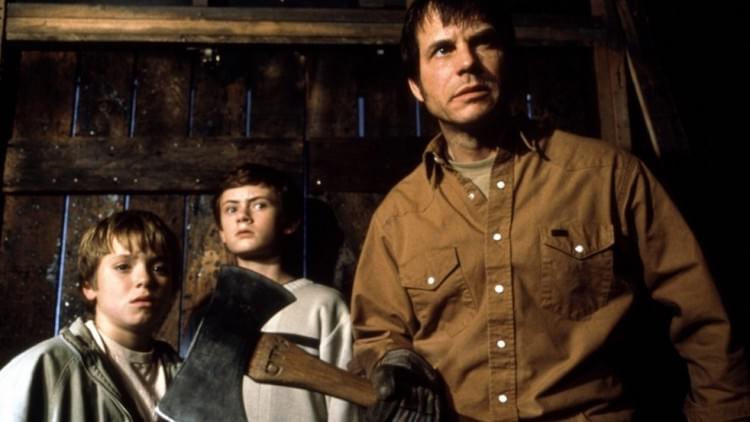
Fenton tells Doyle the story, which we see in flashback. When Fenton and Adam were young, their father (Bill Paxton, who also directed) claimed to have visions from God instructing him to find certain “demons” — who look like regular people to you and me — and “destroy” them — which looks like killing them with an ax to you and me. God gave him a list of names, and Dad began his righteous work. He involved his sons in every aspect of it, encouraging them to have the necessary faith to see the same visions he had.

Young Fenton (Matt O’Leary) believes his father is insane, but lacks the gumption to turn him in. Aside from the killing, he’s a good father, and who’s to say God ISN’T speaking to him? Young Adam (Jeremy Sumpter), meanwhile, is wide-eyed and faithful, and is only disappointed at not being privy to the same sort of manifestations as his father. Now, it would seem, he is continuing Dad’s life’s work.

Hearing it described, or even reading some of the script, you could mistake this for a dark comedy. The ideas are that extreme. But it is deathly serious work, and it’s an impressive directorial debut for the actor Bill Paxton. The atmosphere is creepy and horrific, and the idea of children being witness to such dreadful murders will stick with you long after the film is over.

But what does it add up to? Religious fervor can cause people to do unbelievable things, yes, but that idea is not developed beyond the summary I just gave you. The script, by first-time writer Brent Hanley, stumbles in the final act — in real life, cops always call for back-up — and the twists become easy to predict. One of those turns is an outright cheat, as we learn a character has lied only to mess with OUR minds, and not the mind of the person he lied to. Movie characters shouldn’t do things for the audience’s benefit; they should do them because they are appropriate for the fictional situation they are in.

Mr. Meiks says that when he touches the demons, he can see their sins. This concept was just used in 2000’s “Unbreakable,” which I’m hesitant to complain about — except that “Frailty” uses a surprise twist that is almost identical to the one in that film. (It was more believable in “Unbreakable,” by the way; in “Frailty,” it is awkwardy set up and badly realized.)

So there are problems with the movie … and yet, here I am, continuing to think deeply about it. Its method of storytelling is so straightforward, so awash with campfire-story eeriness, that it comes across as far less outrageous than it should. You believe what’s going on, even as you’re shaking your head in disbelief that a movie is actually daring enough to suggest such a thing. It may take a second viewing to fully appreciate the not-just-a-horror-flick subtleties of it — but who really wants another run-through of kids learning how to murder at their father’s knee?

The Upchuck of Western Civilization

0

While watching TV at the gym — and could there be a better combination of laziness and health? — I was alarmed by something I saw on MTV. I get alarmed every time I watch MTV these days, which is a sure sign that I am growing very, very old.

It shouldn’t surprise anyone that if civilization is declining, MTV is at the head of the line, smoking pot, flashing its breasts, and yelling, “Wooo!” It’s interesting that when MTV first came around, people who didn’t know what they were talking about declared it “evil” because it played music videos, which someone arbitrarily decided were bad. And now, 20 years later, MTV actually IS evil — not because of the videos, which it doesn’t play anymore, but for other reasons.

What caught my attention at the gym was the vomiting. It was on one of MTV’s many, many “spring break” programs, most of which center around people cavorting on beaches while not wearing much clothing. This particular show was dare-oriented, with a cool-dude host offering shirtless men about $40 in exchange for doing stupid things. I’m not certain what the stupid thing was when I tuned in, but it had led to all the participants throwing up. The person to hold everything down the longest won the $40.

Perhaps my horror at this was due to the phobia I have of vomiting. I haven’t thrown up since I was 13, and in the ensuing years, I have built it up in my mind to be a more dreadful process than it is. I mean, I know it’s not pleasant. But now I’m imagining it to be the worst thing that could ever happen to a person, like I might not survive if it ever happened to me again. I’ll hear a friend talk about puking and then continuing with his life normally, and I’m amazed, because I’m sure I would have to be hospitalized.

(By the way, doesn’t it seem like kids throw up all the time, but grown-ups hardly ever do? Maybe it’s because kids’ bodies are still new, and they haven’t gotten used to things yet. Also, maybe it’s because kids eat things like crayons.)

But the next stunt, after the don’t-throw-up contest, had a guy being dipped in molasses, after which prizes were stuck to his body, after which he was hung upside-down by his ankles, after which blindfolded spring break girls whacked him with bats like he was a piñata. For this he received $40 (he talked the host up from the original offer of $5).

Let us pause a moment to acknowledge that only men would volunteer to participate in such stupid behavior. Women have a thing about appearing foolish in public, while men seem to thrive on it. If you told a man you would pay him $40 if he would allow himself to be videotaped while undergoing a lobotomy performed by a robot, his only question would be whether he could be naked during the procedure.

Anyway, I realized I was more saddened than disgusted by the show. So many TV shows and movies, like those spring break girls with the bats, exist only to hit us in the gut. Telling a story or introducing characters is a hassle. Why bother, when you can just film regular people being morons? Instant entertainment, cheap and in the can.

I’m all for the occasional bit of mindless entertainment, but I think we’re in trouble when it becomes the rule instead of the exception. Either way, I’m not going to the gym anymore.

Harvey

0

Mary Chase’s “Harvey” has been around for 58 years now, lumbering across the American theatrical landscape with its message of “We’re all a little crazy, aren’t we?”

That’s a good message, and the beloved play makes the point softly and without force. The play is disguised as a comedy, though, and it’s not very funny. It is a relic from a gentler era, when a few mild laughs over the course of an evening were enough to make an audience feel like it had been riotously entertained.

Give the Hale Centre Theatre West Valley cast credit, though: There is energy and vigor to spare in the current production, directed by David Nieman. Michelle Linn Hall and Linda Jean Stephenson play, respectively, Myrtle Mae Simmons and her mother Veta Louise, who are mortified at the behavior of Veta’s brother Elwood, who claims to have a 6-foot invisible rabbit as a friend. Hall and Stephenson are eager and committed, as are the actors in the supporting roles.

Elwood is played by Andrew R. Looney, and a more pleasant Elwood could not be imagined. What makes the play work, when it works, is the endearing nature of this character, and Looney is nearly perfect. When Elwood invites a telemarketer over for lunch, you believe he’s sincere.

He is, however, the only realistic character on the stage. Aside from him, it’s a tableau of caricatures — funny ones, at times, but caricatures still. They don’t react the way real people would react. That’s fine, in moderation, but not stretched out over a three-act play that’s supposed to be meaningful. So much of the dialogue is tangential to the matter at hand — Nurse Kelly (Melissa M. McCune) and Dr. Sanderson’s (Cody K. Carlson) romance, for example — and there’s no compelling reason to pay attention to it.

“Harvey” holds a place near many people’s hearts, and far be it from me to discourage that. Such sentimentalists will find the production nostalgic and adequately played. Others may wonder why it’s still being performed, 58 years later.

Should you go? The cast is enthusiastic, but breathing life into this too-gentle old script is difficult work.

The Incident of the Shoes

0

“The Incident of the Shoes”
A Light Comedy

by Eric D. Snider
Based on a true story
Cast of characters:
ERIC, a noted author and humanitarian
LUSCIOUS MALONE, a female lady friend
TANNY TANTAN, a friend of the non-female variety
SALESGIRL, a non-speaking role

Act I: A casual lunch

ERIC: I must write a humorous funny column today, yet I am without ideas.
LUSCIOUS: You should write about shoes.
ERIC: A column about shoes? Whatever would I say about shoes?
LUSCIOUS: I do not know; that is for you to determine. You are the funny humor column writer.
ERIC: I do not wish to cast dark shadows across our friendship, but your idea is stupid.
LUSCIOUS: I tell you, it would be a fine column. Shoes? Hello, SHOES?!
ERIC: The merits of your idea escape me. I shall ignore the suggestion, and henceforth nevermore ask you for help. A column about shoes I will never write!
LUSCIOUS: Shoes.
ERIC: Do not push it, Luscious Malone.

Act II: While driving, some time later

TANNY: Luscious has given me an excellent idea for a book which I shall write.
ERIC: How grand for you. Her ideas for me tend toward the pedestrian.
TANNY: Meaning…?
ERIC: She suggested I write a column about shoes. Every time I see her, she tells me again to write about shoes.
TANNY: Shoes? What about them?
ERIC: That was my question.
TANNY: That Luscious Malone is one crazy bag of bottlecaps.

(ERIC‘s cellphone rings)

ERIC: Hello?
LUSCIOUS: Shoes!

Act III: While shopping at Nordstrom, some time later

TANNY: It is a game! Luscious and I will each select shoes for Eric to try on, and he will select a pair, too. Then, upon trying each, he will choose his favorite!
LUSCIOUS: Huzzah!
ERIC: I don’t need any shoes.
LUSCIOUS: I said, huzzah!

(Shoes are chosen. SALESGIRL crams ERIC‘s grotesque, bunionous feet into one pair of them.)

ERIC: These dress shoes have the look of class about them; however they are slick. Look and marvel upon the slickness of them! (He slides around the floor. Only with great effort does he not fall. He is as if ice-skating.)
LUSCIOUS: The antics caused by those shoes are hilarious! You should indeed write a column about them.
ERIC: It is an amusing situation….
LUSCIOUS: You’re going to write a column about shoes! It is just as I suggested many weeks ago, and now it will finally come to fruition!
ERIC: But it will not work. The humor of the slick shoes is visual in nature, and the column is in text only.
LUSCIOUS: ‘Twill be funny! Write it and see how funny a column about shoes can be! Write it, write it, write it, write it! (She prances madly about the store.)
TANNY: (shaking his head sadly) One crazy bag of bottlecaps.

(Exeunt. End of the play.)

Phantom of the Opera

0

“Phantom of the Opera,” that venerable old workhorse of Broadway, is spoofed with characteristic broadness and likability at Desert Star Playhouse, that venerable old workhorse of melodramatic theater.

The people in Desert Star Playhouse parodies live in a vaudevillian world of double-meanings and absurd conclusions. When someone says, “Are you choking?,” it is entirely possible for the other person to respond, “No, I’m serious,” and mean it.

Once you get used to the style, the shows tend to be a real hoot, and “Phantom” is more or less typical of them. The story is not altered much from that of the musical it parodies. The Paris Opera House is plagued by a Phantom (Jack Drayton), who grows fond of the ingenue Christine (Kerstin Anderson) and teaches her to sing. This enrages the diva Carlotta (Arika Schockmel) and attracts the attention of Christine’s childhood acquaintance Raoul (Paul Thomas Murphy).

Along for the ride are Madame Giry (Mary Parker Williams), a mysterious Persian (Scott Holman, understudied by Christopher Glade), Carlotta’s co-star Signor Sorelli (Spencer Ashby) and wealthy patron Poligny (Holly Braithwaite).

Jack Drayton is a rugged sort of fellow with a deep leading-man voice that lends itself well to the Phantom. As the object of his obsession, Kerstin Anderson has the requisite strong singing voice, but is unafraid to look ridiculous, which Christine is often called on to do. Spencer Ashby, always a treat, gives the outrageous Sorelli a spark, and Arika Schockmel very humorously deviates from the script at every opportunity.

Perhaps the most consistently funny character is a supporting one, the ridiculously old Madame Giry, played by a much younger Mary Parker Williams. The character works because she’s recognizable, but slightly exaggerated from reality.

It’s an unfortunate bit of casting that the female Holly Braithwaite is playing the male Monsieur Poligny. This allows the characters to make jokes every five or six seconds about how Poligny looks like a woman, but it has little value beyond that. Braithwaite, perhaps self-conscious about being miscast, overplays the role to the extreme, none of it grounded in reality — which, it should be remembered, is the essence of comedy.

The second half of the show has more energy and wit than the first half does, and it’s all followed by an amusing olio spotlighting high school proms and the music associated with them.

Should you go? Desert Star regulars will find this offering up to par, and first-timers should be amused by the proceedings.

Footloose: The Musical

0

A musical set in the 1980s must not take itself too seriously. In 2002, we don’t laugh with the ’80s; we laugh at them.

The very enjoyable SCERA production of “Footloose: The Musical,” directed by Andrew Hunsaker, has the right attitude. Legwarmers, breakdancing and oh! those terrible hairstyles are found in abundance, and we smirk as we recognize them. Besides, how can you take a musical seriously that uses the ultra-cheesy ’80s ballad “Almost Paradise” as its love theme?

With all due respect to the energetic and mostly talented cast, the star of the show is the choreographer, Melissa Aaron. Most of the songs — several from the 1984 film and more added for the stage version — are forgettable. But when accompanied by witty, athletic dancing, one can’t help but be caught up in the enthusiasm of it. Numbers like “Let’s Hear It for the Boy” and the final shouting of the title song are so giddily exuberant that only the most uncool of observers will fail to be entertained.

Chad Mortensen plays Ren McCormick, a blithely sarcastic high school student who is uprooted from his Chicago home after his parents’ divorce and moved to the tiny hick town of Beaumont. To his horror, he learns there is no dancing permitted in the town, due to the city council being overly concerned about “raves,” which weren’t occurring in the city anyway.

No, sorry, I was thinking of Provo. In Beaumont, the inciting incident was when several teens died on their way home from a dance — ergo, dancing is bad, according to Rev. Shaw Moore (Scott Aaron), who rules Beaumont with an iron, Bible-clutching fist. (What if those teens had been on their way home from church, eh, Rev. Moore?)

So it’s Ren vs. the Rev — or open-mindedness vs. narrow-mindedness, if we’re going to see as much depth in the show as its authors would like us to.

There are some surprising standouts in the cast. Steve Aaron (this a three-Aaron show) impresses as Ren’s new cowboy friend Willard; as the boy in “Let’s Hear It for the Boy,” he’s an easy crowd favorite. As Rusty, the girl who pines for Willard, Jennifer Dandy is, well, dandy, with a voice and an attitude that make her a star.

I also am fond of Laurel Asay as Ariel, the Reverend’s rebellious daughter who falls in love with Ren. Asay and Mortensen are a good pair, and Asay gives Ariel more intelligence than musical heroines often get.

Sometimes there are distractions. In “I’m Free,” for example, should we be watching Ren sing at center stage, or should our attention be focused on Willard making a jackass of himself off to the side? There is focus-pulling in a few of the other full-cast numbers, too.

Is it a winking acknowledgement of Beaumont’s similarity to Provo that seemingly every married woman in Beaumont is pregnant? Maybe not, but it makes me smile, as does most of the show.

Should you go? If you are young or can remember what being young is like, the show will surely entertain you.

30 Years to Life

0

Thirty years to life is approximately how long it takes to watch “30 Years to Life,” an embarrassingly amateurish and cloying comedy about a group of urban blacks coming to terms with being grown-ups.

Rarely have so many bad ideas been sloshed together into one film. Casting “Saturday Night Live” cast member Tracy Morgan as a lead character was the first and biggest mistake. Morgan has his moments on “SNL,” where an inability to act is not necessariliy a liability. In a film, though, where he’s playing an actual role with motivation and depth and stuff, his community-theater-quality hamminess just makes you uncomfortable, like watching an especially bad number at the high school talent show.

Morgan’s character is a hip-hop comedian named Troy, who seemed on the verge of major success a few years ago but is now disappointed to realize he hasn’t made it yet. He’s a moocher, a slacker and not a very funny comedian (though the movie seems to think he’s hysterical), and his agent, Generic Jewish White Guy Agent, keeps getting him auditions to stupid pseudo-joke films like “The Colonial Williamsburg Project” (where he and two other blacks would wander around the woods with video cameras, in search of the modern-day slave-owners who legendarily still live there. Are you laughing yet?).

Meanwhile, there’s Natalie (Melissa De Sousa), whose recent 30th birthday has made her desperate. She takes up with Troy’s doctor friend, Bruce (Kadeem Hardison), a six-toed man who expects her to fill “traditional” female roles — which she is initially willing to do, even though she’s usually a strong-willed career woman.

Meanwhile, generically commitment-phobic Leland (T.E. Russell) is worried about Joy (Erika Alexander), whom he’s been living with for a few years and is showing signs of getting comfortable — i.e., she’s stopped caring about always trying to look gorgeous when she’s around him. In one of several thousand sitcom-like plot turns in the film, Leland buys her a bracelet but accidentally winds up with an engagement ring instead; when she opens it, he has no choice but to propose to her. The wackiness!

Meanwhile, everyone’s fat friend Stephanie (Paula Jai Parker) loses weight and no one recognizes her. (The weight loss should come as no surprise to the viewer, as the fat suit on the actress in the first scenes looks ridiculous.)

Meanwhile, Maleek (Allen Payne) has given up his high-power corporate life to become a model.

Fine. You know, whatever. None of these stories is particularly original, but they’re certainly issues worth exploring in what could have been a pleasant ensemble film. The problem, not to put too fine a point on it, is writer/director Vanessa Middleton. This is a hack of the highest order, make no mistake. Her screenplay is terrible, with two-dimensional sitcom characters, lame set-up/punchline gags, and plot twists that any viewer of “Seinfeld” should immediately recognize: Natalie’s revulsion at Bruce’s six toes, Stephanie almost losing a real estate sale because her fat legs make swishy noises when she walks, the whole bracelet/ring switcheroo, the scenes of Troy’s life-reflecting stand-up that are stitched in occasionally, the many scenes in which charcters sit around and talk about nothing, etc., etc., etc.

As a director, she’s no better. Many scenes are framed as if by a blind person, with characters half-way out of the shot. The sound mix is porn-like, as people’s voices keep getting louder and quieter, obviously due to the boom mic being moved around. Time passes indistinguishably, with no change in the weather, characters’ dress patterns, or anything else. There are even moments when actors have clearly flubbed their lines (stumbling over words and the like), yet there those moments are, still in the movie. Was the whole film shot in one take? Couldn’t someone have stopped this mess from reaching the public?

There are two or three good scenes, ones where some actual insight on the Battle of the Sexes is offered. The rest are awkward and lame. You’ve seen this movie before, and I bet you didn’t like it then, either.

Paradox Lake

0

“Paradox Lake” combines the “it’s real, so it doesn’t have to be interesting” attitude of bad documentaries with the oversimplified plots and stock characters of bad fiction. It’s the worst of both worlds, together in one stupefyingly dull and pretentious movie.

It is a curious blend of reality and fiction, as the main character (who is not real) goes to work at a summer camp for autistic kids (who are). There he encounters generic problems like a counselor who’s hard to get along with, and a female counselor on whom he develops a crush. He gets attached to some of the kids. There is a late-breaking plot point that would probably touch us, if we cared at all about the protagonist.

Where director Przemyslaw Shemie Reut goes wrong is not just in refusing to buy some vowels for his name, but in assuming because these are ACTUAL AUTISTIC KIDS, that we will automatically be interested. This simply is not so. Movies need characters, not objects of sympathy. The blend of fact and fiction is uncomfortable; everyone seems like they’re being themselves when they’re acting, and like they’re acting when they’re being themselves.

A good movie about autism needs to be made. This is not it. This is a trainwreck.

Kissing Jessica Stein

0

While “Kissing Jessica Stein” will be viewed by some as a “lesbian” movie, that unfairly narrows its scope. It addresses issues of sexuality, yes, but it’s also an extremely funny story about dating in the modern world, the pressure to conform to society, and the differences between a friendship and a relationship.

It was written by Heather Juergensen and Jennifer Westfeldt, who also are its stars, Helen Cooper and Jessica Stein. Helen runs an art gallery in the Chelsea district of Manhattan and is bored with the dating scene. Jessica is a newspaper copy editor who finds men increasingly tiresome.

Deciding to give lesbianism a try — and guided by her gay friends at the gallery — Helen places a personals ad in the Village Voice. On a whim, Jessica answers it. They hit it off, become friends, and develop a romantic relationship — far too slowly for Helen’s tastes, but only as quickly as Jessica can deal with it.

Jessica, after all, has outside forces to contend with. Her ultra-Jewish mother, Judy (Tovah Feldshuh), is less a mom than a force of nature, powerfully and comically manipulating every element of her surroundings, including Jessica’s life. (This will be a key point later on, when Feldshuh delivers the film’s best emotional moment. If there were any justice, she’d have a Best Supporting Actress nomination.)

Jessica also must deal with Josh Myers (Scott Cohen), who is her boss, ex-boyfriend and an old family friend. He, of all people, would be most skeptical of her new relationship. She hides Helen from everyone.

What is most delightful is that these people are part of the New York intelligentsia, and the witty script is appropriately literate, using its words well without being snobby about it. It is the very picture of “smart” writing. When one of Jessica’s loser dates tries to sound intelligent and winds up creating words like “narcistic” and “endorphmins,” we are expected to empathize with Jessica’s disgust and horror. We are given credit for being at least as smart as the movie is.

Where the film becomes most daring is also, alas, what keeps it from being brilliant. It would be typical (and even acceptable, if not original) to have this be a film about two women discovering their true sexuality. Instead, we are given a surprise. Both of the women started the movie straight, and it’s possible that’s how they’re “meant” to be. This is infinitely more thought-provoking than a simple coming-out story. Unfortunately, the unraveling of that thread is forced into a five-minute space of time. It feels rushed, like the movie was done and they decided to tack on a few twists at the last minute.

But you forgive a misstep like that because of dialogue like this, where Jessica is reminding her mother that every guy she gets set up with is a dud:

JUDY: How was I to know he was a heroin addict?
JESSICA: Wan, pale, track marks…?
JUDY: I thought he had diabetes!

The comedy is at times abrasively sexual, but always funny, and it is particularly well-played by the principal cast. Romantic comedies have needed a dose of intelligence and depth for quite a while, and “Kissing Jessica Stein” has just the thing.

Big Trouble

0

One of the most pleasant things about “Big Trouble,” which is a very pleasant movie, is that it has no exposition. We leap right into the action, and the narrator gets us up-to-speed as we go. The movie drives up next to us, screeches to a halt, pulls us inside, and says, “Get in the car. I’ll explain on the way.”

To the extent that anyone is really the protagonist in this ensemble comedy, it is Eliot Arnold (Tim Allen), a former Miami Herald columnist who is now divorced and running an unsuccessful ad agency. His teen-age son, Matt (Ben Foster), has no respect for his loser father, much less his loser father’s GEO Metro. (“How many clowns does it hold?” he asks the dealer during a test drive.)

As part of a high school game, Matt has to sneak up on classmate Jenny Herk (Zooey Deschanel) and soak her with a squirt gun. Jenny lives with her mom, Anna (Rene Russo), and her jerk stepfather Arthur (Stanley Tucci) — “one of the few Floridians who was not confused when he voted for Pat Buchanan,” we’re told, succinctly telling us everything we need to know about the guy. Arthur has enraged his employers by embezzling from them, and on the same night that Matt is approaching the house to surprise Jenny, two hitmen (Dennis Farina and Jack Kehler) are approaching it to kill Arthur.

But that’s not all. Two low-rent criminals (Tom Sizemore and Johnny Knoxville) are causing trouble at a local bar owned by Russians who are really illegal weapons dealers. Two FBI agents (Heavy D and Omar Epps) get involved, as do two police officers (Janeane Garofalo and Patrick Warburton), and a homeless man named Puggy (Jason Lee) is a witness to it all. Puggy lives in a treehouse outside the Herk home, by the way, and falls in love with Herk housekeeper Nina (Sofia Vergara).

Based on the novel by humor columnist Dave Barry (and adapted for the screen by Robert Ramsey and Matthew Stone), “Big Trouble” is one of those wiggy comedies where a lot of strangers are brought together by external forces, and where you can be sure a lot of animals will wind up involved. (This time it’s goats.) Unusual coincidences are amusing rather than tiring, because they’re integral to the plot. It’s not like the writer got lazy and used a coincidence as an escape; the whole thing is based on them. Accept it and enjoy, or kick against it and be bothered.

The dialogue is often snappy and quotable (Herk family mongrel Roger was the result of “generations of hasty, unplanned dog sex”), and the running jokes — Gators fans and Martha Stewart being two of them — add to the mirthfulness.

Director Barry Sonnenfeld is on familiar ground, as this film closely resembles his “Get Shorty” in terms of subject matter and attitude. The pace is quick, the movie is short, the jokes are fast and the timing is sharp. Everyone who deserves to lives happily ever after, and love is found in the most unlikely of places. A comedy this merry is almost life-affirming.

High Crimes

0

The people in “High Crimes” keep making the point that military courts don’t follow the same rules as civilian ones. Unfortunately, movies about either topic follow the same rules, with the same cliches and fake-outs. This is a lazy, perfunctory movie.

It begins with idyllic scenes of San Francisco lawyer Claire Kubik (Ashley Judd) shopping with her darling husband Tom (Jim Caviezel), having dinner with him, trying to make a baby with him — in other words, making it clear, if you are at all familiar with movies, that he will soon be taken away from her.

Sure enough, Tom the ex-Marine is charged with murdering nine villagers during a U.S. mission in El Salvador in 1988. His name isn’t really even Tom. Everything Claire knows about him may be a lie — but he insists he is not guilty of this crime. He says he was framed, and that his commanding officer, Major Hernandez (Juan Carlos Hernandez), is the true murderer.

The Marines have assigned the undefeatable Major Waldron (Michael Gaston) as prosecutor, and wimpy new guy Lt. Embry (Adam Scott) as defender. That’s not good enough for Claire, so she decides to defend her husband herself. She enlists the help of Charlie Grimes (Morgan Freeman), who was once a military lawyer but — you guessed it — is now a washed-up alcoholic who initially refuses to help Claire because “you can’t beat these guys.”

Did I mention Claire has a trashy sister played by Amanda Peet? Well, she does. She doesn’t do anything, but there she is.

Director Carl Franklin, perhaps lacking confidence in the script (which is based on a novel by Joseph Finder), engages in cheating to convince the audience it’s being thrilled. Take note of every time the music, sound effects and ominous camerawork combine to make us think Claire is in peril, only to have it turn out to be nothing. I counted four instances of this deception — often enough that it becomes unintentionally funny.

But there are more desperate attempts to please the crowd without really surprising or entertaining it. The script continually sets up Claire to say cool things like, “I’ve already survived you once. The question is, can you survive me?” (Audience cheers.) It gives us a character who can act as deus ex machina and save the day. (Audience cheers.) It lets someone discover an important clue because someone else’s personal daily calendar from THREE YEARS AGO is still on his computer. (Audience cheers, then stops and says, “Wait, what?”)

Morgan Freeman has been nominated for three Oscars, so he shouldn’t have to do by-the-numbers material like this. Ashley Judd — well, this seems about right for the woman who gave us “Double Jeopardy.” It also seems about right for the audiences who loved “Double Jeopardy,” or for anyone else who doesn’t see enough movies to know that “High Crimes” doesn’t have an original thought in its head.

National Lampoon’s Van Wilder

0

“National Lampoon’s Van Wilder” belongs to the genre of movies in which someone ingests something not meant to be ingested, usually a bodily fluid of some kind. (In this case, I will tell you only that it came from a dog.)

It is also the kind of movie in which the bad guy winds up with severe gastro-intestinal problems and has to relieve himself in an office wastebasket — an idea that I find funny on paper, and even when reflecting upon it, but not when I was forced to watch it happen on the silver screen in brilliant color and Dolby sound.

The attachment of “National Lampoon’s” to the title suggests this might be a parody of some kind, as was the case with the last several movies with that moniker. But “Van Wilder” is not exaggerated enough to be a parody of gross-out flicks, college flicks, or even flicks in general. It merely indulges in the worst elements of all of them. Just as “Not Another Teen Movie” was so clueless in its parodies that it became just another teen movie, “Van Wilder” is just a pale, crude imitation of movies like “Animal House” (the first “National Lampoon” movie, and one of the few not to do the name a disservice).

Van Wilder (Ryan Reynolds) has been at Coolidge College for seven years and has no intention of graduating. He likes it there, and he is the biggest of the big men on campus, giving advice to freshmen, pumping up the basketball team, helping sick students and only very, very occasionally going to class. His father (Tim Matheson) finally cuts him off, leaving Van to figure out his own way to raise enough money to stay in school.

Meanwhile, an ambitious journalism student named Gwen (Tara Reid) has been assigned to do a profile on the enigmatic Van Wilder, much to the dismay of her uptight pre-med boyfriend Richard (Daniel Cosgrove). Somewhere between Gwen and Richard’s seriousness and Van’s carefree attitude there is probably a happy medium, but darned if the movie is going to try very hard to find it.

Ryan Reynolds, who starred in TV’s “Two Guys and a Girl,” which I never saw, would appear to have talent. He’s definitely charismatic, and if he can stop delivering every line like he thinks he’s Jim Carrey, not to mention get some better material, he could be good. Tara Reid, meanwhile, gets another “couldn’t be less believable as …” notch on her belt, this time for her role as a hard-nosed investigative journalist, which she couldn’t be less believable as.

I gave it another chance:

3/21/2012: Re-Views: ‘National Lampoon’s Van Wilder’ (2002)

Van appears naked in this movie three different times, at least one of which is for absolutely no reason other than to be random. The movie specializes in that kind of non-sequitur, but rarely does it succeed in creating laughs. The hearing-impaired basketball coach saying, “I have never been glad I was deaf until now, so I can’t hear them booing!” made me laugh, because physical handicaps are among the few remaining taboos in comedy. But I thought better of it later: “Van Wilder” wasn’t being brave; it was being puerilely scattershot, throwing as many jokes at the wall as it could and hoping a few might stick. “There’s Something About Mary” played handicaps for laughs respectably; this movie’s too dumb to even recognize the taboo was there.

Witness the rest of the depravity, aimed at shocking an audience that, for heaven’s sake, really can’t be shocked anymore. We’ve seen every part of the human body, internal and external, be used for everything it can possibly be used for. All the bodily functions have been exploited, all the sexual vulgarisms have been uttered. Old people have had sex with young people. Foreigners have been used as comic foils. The more I think of it, the more this movie just seems like a retread of “American Pie,” “There’s Something About Mary” and “Dumb and Dumber.” It brings out the occasional chuckle amidst a sea of disgust and boredom, but it is not worth wading through that sea to find those few laughs.

NASTYCAR

0

(Note: To save online readers the trouble of posting derisive comments after this column, we have inserted within the column itself the sort of things the hecklers are likely to say. So go ahead and take the day off, you troublemakers, you.)

Since NASCAR is the fastest-growing sport in America and has hundreds of thousands of fans, the day will probably come when I will have to take it seriously. That day has not yet arrived. (When will the day arrive that you can write?)

I have no idea what the NASCAR craze is all about. (That’s because you’re stupid and you can’t write!) These are rednecks who drive cars really fast in a big circle, right? Is that it? Have I missed something? Have I unfairly minimized all that NASCAR entails?

There will be complaints over my calling NASCAR drivers “rednecks,” and someone will point out that many drivers have college degrees and like to cure cancer in their spare time, and therefore cannot be rednecks. You will see that my logic is airtight, however, for I define a redneck as anyone who drives for NASCAR. (How dare you call NASCAR drivers rednecks! Many of them have college degrees, you know.)

I recall attending an auto race when I was young, but I don’t remember anything about it. In fact, I will probably delete this paragraph before the column is published. (Ha ha, you dummy, you said you were going to delete the paragraph, but then you forgot to do it! Doesn’t anybody edit this column?)

The odd thing about my skepticism toward NASCAR is that in actual practice, I am strongly in favor of driving fast. Nearly every day, I wish our freeways were like the autobahn in Germany, where there is no speed limit. (Nearly every day we wish you were IN Germany, so we wouldn’t have to read your stupid column!) Would there be more accidents? Probably. Would I personally be involved in more than one a year? Probably not. So the impact is negligible. (Maybe we’d get lucky and you’d die in the first accident so we wouldn’t have to read your stupid column anymore!)

I also wish all cars were equipped with phones, and that the licence plate number were the phone number. That way, you could call people and say, “Hi, I’m right behind you. I noticed you’re only going 55 and you’re in the fast lane. Is everything all right? Do you need me to summon help?” Old people, it goes without saying, would have 1-800 numbers. (More rudeness from the guy with the stupid column that we have to read!)

But I have drifted far afield of my main point, which is that NASCAR perplexes me. (It perplexes me how someone could write such a terrible column!) Or perhaps I am not so far off the point after all: I enjoy driving fast, and I do it often. Where, then, is the “sport” in watching others do it? I think if a feat can be accomplished by me — the least athletic person in the world — then it is probably not going to be very entertaining to watch, since by definition it is something easy and probably involves sitting down. (It’s true: You write this stupid column, and we have to read it, and it’s not very entertaining to read.)

You know what would make NASCAR more interesting? I mean aside from the obvious solution, which is to have more crashes. (The solution is to have more crashes, but for YOU to be in them!) They should make the driving conditions more like real life. Sure, they’re driving 200 mph, which probably takes concentration. But the track is predictable. Put in some potholes, some construction barriers, some old people driving really slow — no more than 110 mph — in the fast lane. That, my friends, is entertainment. (Maybe, but this column isn’t! Why does the Herald keep printing it? Does anyone even read it?)

The Issue of Stink

0

There is no greater issue dividing the American classes than the issue of smell. Race, religion, politics — these are trifling matters you wouldn’t even bother to sneeze upon, if they were tangible, Kleenex-like matters, when compared to the subject of stinkiness.

I base this on mail I have received recently. Within the past seven months, I have on three occasions decried the odor of a person or group of people. And in each case, I have subsequently received letters from people who said, “You are right, stinky people are terrible,” and other letters from other people who said, “How dare you make fun of the way someone smells?” (Some people are more smell-tolerant than others.)

First, in October, I talked about a man who barged into the Daily Herald office saying the U.S. should kill every single person in Afghanistan. As befitting someone with that political philosophy, he smelled starkly of urine. I called him Urine Man.

At www.harktheherald.com, where people who can’t spell or write are encouraged to try their hand at both, we had many angry responses to this column. Some examples, reprinted exactly as they were written:

“I will NEVER read you articles again.”

“HEY SNIDE, ARE YOU SURE IT WASN’T YOUR BREATH BLOWING BACK IN YOUR FACE???”

Then, in January, I said that if tow truck drivers believe there’s no such thing as a wrongly towed vehicle, then I have to believe there’s no such thing as a tow truck driver who doesn’t smell bad. Someone read this column to a lot of tow truck drivers, and many of them pounded their fists on computer keyboards long enough to create responses such as these:

“Just remember if you get stuck at 2:00 in the morning who is going TOW your Car for you get you gas or unlock your car or even better rescue your wife or family member.”

“People like you disgust me as well as the rest of the industry that I can speak upon.”

“Your pretty classy. NOT!”

And just last week, I told the story of the Stinky Fat Black French Girl who followed me around in London. Many people were bothered that I would describe her as “stinky”; these people, clearly, have not smelled her, or they would think “stinky” was being charitable. “Apocalyptically foul” would be more accurate.

A few others took my including the girl’s race to mean I was suggesting the two were related. I didn’t mean to imply anything of the kind; I only wanted to help the reader visualize the girl. Nonetheless, there was an e-mail from someone who described himself as “an black Utahn,” who called me an “IGNORANT RASCIST JERK!!!” (I think if you’re going to call someone a racist — and I got the impression this was someone who calls a lot of people racist — you should learn how to spell the word. It reminds me of the people at www.harktheherald.com who like to accuse other people of whining, but they spell it “whinning,” or who are always labeling one another as “hipocrits.” I’m not saying you need to know how to spell EVERY word, but you should at least learn your favorites.)

Anyway, I do want to apologize to those who misunderstood my point, such as it was, in the stinky girl column. I said “Stinky Fat Black French Girl” was a listing of her traits in the order of importance; I should have said they were in order of how noticeable they were — i.e., her smell could kill you, but you might miss her gender altogether. I definitely didn’t mean it to be a race thing. Race relations are at an all-time high right now, thanks to someone who’s occasionally sort of black winning a Best Actress Oscar, and far be it from me to louse that up.

But I stand by the observations of stinkiness. Is it juvenile to talk about such things? Perhaps. And by perhaps, I mean yes. But is it something everyone can relate to? Yes, if they have noses.

“How dair you make funn of peple who dont have noses!!!”

Time Out (French)

0

Vincent is a man who grew up but didn’t acquire the sense of responsibility that comes with adulthood. His parents live nearby and dote on him, his dad willing to lend him large sums of money almost without discussion. Vincent is more interested in being a pal to his son than in being a husband to his wife. Oh, and work: Vincent won’t do it.

His reasons for this are at the heart of “Time Out,” a French film that takes a farcical plot and zeroes in on the humanity in it.

Vincent (Aurelian Recoing) has already been fired from his office job when the film begins, but he has not told anyone. He still leaves the house every morning and fabricates work-related stories to tell his loving wife, Muriel (Karin Viard). He even takes business trips. Few have ever worked harder at not working.

So far, it is an old “Brady Bunch” plot, and an undistinguished one at that. But it slowly changes. Vincent tells Muriel he may soon be “transferring” to a new job in Switzerland, but we see this, too, is a lie. Soon, he has created an entirely new job — with the United Nations, even! — out of thin air, though he does go to Switzerland during the week for appearance’s sake.

When friends offer genuine help in getting him a new job, he refuses them. Instead, he takes money from friends to “invest” in some vague new market, secretly spending the money himself. Here is a man who, though more than 40 years old, is unprepared for the consequences of adult life. He cannot plan or strategize; all he can do is react, in the moment, and then cope with the aftermath. His greatest marketable skill is that he is quietly manipulative — so quiet he probably doesn’t even realize how good he is at it.

But in fairness to Vincent, what good was his job anyway? We are never clear on what he did before he was fired, and his fake new job with the U.N. is just as nebulous. Does ANYONE actually work anymore, or do we just manage each other?

The director, Laurent Cantet (who co-wrote the film with Robin Campillo), maintains intimacy by keeping the cameras close and unobtrusive, and the music barely noticeable. His focus is on the people who inhabit the story, not the story itself. As such, “Time Out” may move too slowly for some, and the payoff is more psychological than visceral. It is an effective, even haunting, character study, though, and Aurelien Recoing plays Vincent with great claustrophobic, slow-boiling panic.

The Piano Teacher (French)

0

The only way to discuss “The Piano Teacher” is in terms of one’s own reaction to it. Matters of camera angles, acting styles and story structure are almost irrelevant when your protagonist uses a razor blade to cut herself in very personal places. Self-mutilation — and that is just one of the bizarre things going on in this picture — trumps nearly any technical competence you could name.

And so my reaction to it is that I was bored for a good deal of the time, and frankly repulsed by a lot of the rest of it. There are movies whose content is disturbing in a “good” way, where the events of the film are in some measure redeemed by being thrilling, thought-provoking, well-acted, or whatever. Then there are movies like “The Piano Teacher” that are just unsettling, where your soul needs a bath afterward.

The story is of a frigid, cruel piano teacher named Erika Kohut (Isabelle Huppert), who works for a great Viennese conservatory and who is known for belittling her pupils to the point of tears. At home, she has a horrific relationship with her exacting old mother (Annie Girardot); the very first scene is of an argument between them that leads to fisticuffs.

Erika does not have emotions; she does, however, have urges. Twenty-five minutes into the film, we get a glimpse of them, when she visits a pornography store and behaves in a fashion that may be understatedly described as unhygienic. Later, she corners a hunky and arrogant pupil, Walter (Benoit Magimel), and demonstrates that she is just as dominating in the bedroom — well, in the public bathroom — as she is in the rehearsal hall.

But no, we eventually learn, what she REALLY wants is for someone ELSE to be in control. Or does she? Her lengthy written manifesto to the contrary, Erika has little idea what will really make her happy. She is so shut off from her emotions — she honestly claims not to have any — that everything now is merely a desperate attempt to find something that will make her feel again.

Some scenes are repugnant and gross; others, truly, are dull. Director Michael Haneke (who adapted the screenplay from Elfriede Jelinek’s novel), is fond of using one camera to film an entire lengthy scene, and also of letting the scene drag on for several minutes longer than it needs to. The total time spent looking at Erika as she watches her surroundings with cold, passionless eyes is probably upwards of 10 minutes. More judicious editing would have helped this film considerably.

Where Haneke shows skill is in the way he handles Erika’s strange sexual proclivities. He does not draw attention to them in any way; they simply manifest themselves, and we are surprised not only at what they are but at how suddenly they appeared on the screen.

One gives Isabelle Huppert credit for a genuinely fearless performance. Her co-stars are serviceable.

From one point of view, “The Piano Teacher” is thoroughly successful. Haneke set out to shock the audience, and he certainly achieved that. But to what end? There is not enough merit within the film to justify its usefulness beyond that of high-class, slow-moving French porn, which may be what it is after all.

Clockstoppers

0

Who hasn’t wished they could stop time? Just think: You could leave your house 30 seconds before you were supposed to be at work, stop time, drive to the office, and then start time again. It would be great!

Another use would be if you’ve just begun watching a movie that you HAVE to watch and you realize it’s very dull. You could stop time, go get something interesting to read or take some drugs, then come back and let the movie run its course while you entertain yourself.

That is the case with “Clockstoppers,” and if I’m the only critic to make the point about time seeming to move really slowly during the film — both onscreen and off — then I’ll eat my hat. (It’s one of those hats with the “press” card in the band, like in cartoons.)

It is from Nickelodeon, which can manufacture entertaining kids’ stuff when it wants to, but which apparently didn’t want to here.

“Clockstoppers” tells of Zak Gibbs (Jesse Bradford, from “Bring It On”), a high school student whose dad is a brilliant scientist who has no time for his kids. Somehow Zak gets a hold of a watch sent to his dad by one of Dad’s former students, Dr. Earl Dopler (French Stewart). This watch has the ability to slow down time — or, more accurately, to speed up the wearer’s molecules so that he moves really fast, while the world around him slows to an imperceptible crawl.

There are bad guys who want this watch for purposes not explained very well — presuambly to take over the world, I guess, though I think the government’s involved. Zak and his love interest, foreign girl Francesca (Paula Garces), must flee, save Zak’s dad, and save the world (I guess).

The premise lends itself to numerous fun possibilities, few of which are explored. The special effects are nifty, but it’s all done so dully, as if no one had any fun, except Jesse Bradford, who gets to do bicycle tricks and kiss a pretty girl. The direction, by “Star Trek’s” Jonathan Frakes, is uninspired, and the script — attributed to three people, with the story by those three and a fourth — is witless. Such a fine idea for a film, and such a stultifying, lifeless execution.

Death to Smoochy

0

Give “Death to Smoochy” 20 minutes or so to get its wheels on the tracks, and then sit back and enjoy as the proceedings turn dark, macabre and hilarious (if you can bring yourself to laugh at such things as murder and revenge, anyway).

It is the story of children’s TV star Smoochy the Rhino — think Barney the Dinosaur — whose alter ego is Sheldon Mopes (Edward Norton), an endlessly polite vegetarian who has no idea what a dork he is. He wouldn’t appreciate you using words like “dork” in his presence anyway, thank you.

He rockets to TV stardom when he’s hired to replace Rainbow Randolph (Robin Williams), a vaguely homosexual song-and-dance man whose show was canceled after he was caught in a public scandal. He’s a bitter, foul-mouthed guy — think Krusty the Clown when he’s not on camera — who generally refers to himself as “Rainbow [expletive] Randolph.”

Randolph is angry over the success of his successor and plots revenge. Meanwhile, Sheldon, who has a “fetish for ethics,” is struggling with the realities of the TV business. His boss, Nora (Catherine Keener), is cynical and hardened and wants the show to be nothing more than a commercial for Smoochy products. His agent, who is played by Danny DeVito, is exactly what you’d expect an agent played by Danny DeVito to be like.

Sheldon gets tangled up with the Irish Mafia, too — presumably because the Irish Mafia is funnier than the Italian one — when one of their members, a brain-damaged former boxer named Spinner (Michael Rispoli), joins the ranks of Smoochy fandom.

The script, by Adam Resnick (a former David Letterman scribe and Chris Elliott compatriot), is peppered with witty dialogue and dark twists on congenial themes. Children’s TV is a vicious underworld here, and the non-profit “for the kids” organizations that support it are just as bad. (One such group, Parade of Hope, run by an evil Harvey Fierstein, is described as “the roughest of all the charities.”)

Some of the best dialogue cannot be printed in polite company (though we will mention Smoochy’s wonderful educational song, “My Stepdad’s Not Mean, He’s Just Adjusting”). This is the rare film where the profanity is necessary. Half the fun is in hearing people use outrageously crass language in front of Sheldon/Smoochy, who is appalled but too polite to rebuke the offender.

Robin Williams has not had this much fun in years; it is a relief to see him genuinely funny again, and not sanctimonious or righteous. Edward Norton loses himself in the role of Sheldon, and Catherine Keener is a good sport, too. (Let us also not forget Jon Stewart as a whimpering TV yes-man, and Pam Ferris as the Momma of the Irish mob.)

DeVito directed the film, and it recalls the dark sense of humor he employed in “The War of the Roses” and “Throw Momma from the Train.” Yet for as dark as it gets — and there is death in “Death to Smoochy” — it has the aura of giddy, good-natured cartoonishness about it. And besides: Beating up a guy in a foam-rubber rhino suit is just plain funny.

Panic Room

0

David Fincher is four for four. His three previous films, “Seven,” “The Game” and “Fight Club,” were brilliantly plotted, ingeniously realized suspense-thrillers; his new “Panic Room” is right up there with them. It’s possible that as a director, Fincher is only getting better.

(We are overlooking, by the way, the fact that he also directed “Alien3.” It’s unfair to count a franchise sequel as Fincher’s own work.)

“Panic Room” has the simplest of plots. Newly divorced Meg Altman (Jodie Foster) and her androgynous young daughter Sarah (Kristen Stewart), whom I honestly thought was a boy for half the movie, move into a gorgeous old house in Manhattan. It’s a brownstone/townhouse combination — a “townstone,” the realtor calls it — with three stories, an elevator, and a “panic room.”

The panic room is a private bunker accessible from the master bedroom, to be used in the event of intruders or other threats. Once closed, its thick steel walls prevent anyone from getting in. It has its own private phone line to call the police, and surveillance monitors that show “nearly every corner of the house.” (Note the word “nearly.”)

Naturally, immediately upon moving in, Meg and Sarah are beset by a trio of burglars (Forest Whitaker, Jared Leto, Dwight Yoakam), who mistakenly believed the house was still unoccupied. These three men — who run the gamut from conflicted to psychopathic — are after something valuable left by the previous owner — something, as fate would have it, that is being hidden in the panic room itself.

It’s “Wait Until Dark,” but thematically darker, scarier and more intense. The sound mix is crisp and vivid. The camerawork is exquisite, taking us through every nook and cranny of the house — through bannisters, keyholes, walls and floors. All the elements of filmmaking combine to put us in that house, and in that panic room, with the heroines. When everything is eventually resolved, we are as relieved to have survived as anyone. (And since Fincher is the man who gave us the relentlessly bleak “Seven,” there’s no guarantee all the people we like are necessarily going to make it.)

It is not deep beyond the level of being thrilling, but the screenplay by Dave Koepp (“Jurassic Park,” “Stir of Echoes”) does have a few deft touches of character. They are small details, but at least they are details. How many thrillers try to get away with presenting a tense scenario and no characterization whatsoever? The more we know these people — even the villains — the more we can be scared for them.

“Panic Room” is a top-notch piece of filmmaking, and will be far more palatable to mainstream audiences than “Seven” and “Fight Club” were. It’s unlikely we’ll see a better thriller this year. I sort of hope we don’t. I’m not sure my heart could take it.

The Rookie

0

“The Rookie” is an unabashedly sentimental film in which a gruff father tells his son, “There are more important things in life than baseball,” and then the rest of the movie is devoted to proving that statement false.

The son is Jimmy Morris, and the grown-up version of him is played by Dennis Quaid, his squinting, smiling face inviting us into this old-fashioned “you can do it” story like a favorite uncle telling a campfire story.

Jimmy is a high school science teacher and baseball coach in the small town of Big Lake, Texas, having years ago failed his one serious attempt to be a professional ballplayer. He is not bitter, though. He loves his wife (Rachel Griffiths) and three adorable young children, and he’s well-liked at school and in the community.

His baseball team, though, lives in the shadow of the school football team — football is the real men’s sport in these parts, thank you — and no one tries very hard. Exasperated, Jimmy makes a wager with his players: If they win the district championship, he’ll follow their encouragement and try out for a professional baseball club. His pitching arm is still the cannon it was 20 years ago, so it’s not hopeless — but he doesn’t really think they’ll win the championship anyway.

Do they win? Does he try out? Does he make it? Well, duh.

This is not a genre known for surprising its audiences. You know approximately how it will end from the very beginning, and so the question becomes: Do you enjoy the journey? Do you like these people, and do you like watching their lives, even if the outcome is predictable?

In this case, my answer is yes. It’s a quintessential “feel-good” flick in that it, well, makes you feel good. But it’s not sappy or absurd. Nothing happens that is beyond the realm of normal human behavior or probability — no slow clapping by one person that evolves into a thunderous standing ovation, no sudden appearance in the stands by a person who inspires the hero to hit a miraculous last-minute home run. Jimmy’s little boy Hunter (Angus T. Jones) is cute and funny, but in a realistic way — the way kids actually are.

It is not manipulative, at least not in the bad sense. Manipulative movies yank emotions out of us that they don’t deserve. “The Rookie” earns the tears that may come at the end; it has shown us honest, sympathetic characters who deserve our compassion.

I do have some reservations. It is geared toward families, but it is more than 2 hours long, which will surely tax the patience of many children.

Even by adult standards, it is too long. It tries to tell too many stories — the team vying for the championship, Jimmy trying out, Jimmy’s strained relationship with his father, other events that would be spoiling it to mention here. They’re interesting stories, but it’s too much for one film.

Still, “The Rookie” is old-fashioned and friendly, and at times captivating. Anything we can do to encourage more filmmaking like this is a good idea.

Hostel Takeover

0

I stayed at a hostel when I was in London. If you are on a tight budget and want to truly experience the flavor and adventure of a European city, you should definitely, um, sleep in the park. No one should ever stay in a hostel.

Hostels are like hotels, but with an extra “s” in them, and the “s” stands for “scary.” They are meant for irresponsible youth backpacking through Europe to flop for a night or two, but they can also be used by regular people who would rather save money than sleep comfortably, and who don’t mind sharing space with multitudinous bacteria, many of which speak English.

I thought it would be an interesting (and by “interesting” I mean “costing only 11 pounds a night”) sociological experience. How better to examine a cross-section of world cultures and enjoy a variety of smells than to share a room with seven strangers? It was bound to be exactly like MTV’s “The Real World.”

Here was our cast:

• Dumle, a Nigerian-born Londoner who believes himself to be the most fascinating conversationalist in the world, particularly if what fascinates you are guys who never shut up. He had something to say about everything, whether any of us expressed interest in chatting or not. We looked forward to his falling asleep, only to discover that when he sleeps, he snores like a freight train. (Do freight trains snore? Discuss.) This kept us awake until 2 or so. Were it not for my unfamiliarity with the English laws governing justifiable homicide, Dumle would surely have found himself smothered with a pillow before night’s end.

• Loud Drunk Guy. I’m not sure of his nationality, as I only saw him in the darkness in the wee hours of the morning. He would burst into the room every night at 3 a.m., loudly proclaiming that he was either a) drunk or b) totally drunk. He would stumble around and bump into things for a few minutes, then slam himself into bed, where he would loudly open a bag of loud chips and loudly eat them. He was also fond of talking (loudly) to anyone who was still awake or who had been awakened by him.

• The Korean-born American girl who learned I was visiting from Utah and who then said, in a very disgusted manner, “You’re not a Mormon, are you?” Telling her I WAS a Mormon shut her up in a hurry, though unfortunately it also gave Dumle something to talk about. Having seen BYU’s Julie Stoffer on “The Real World,” I knew precisely how to deal with awkward circumstances like this one: I crawled into a cupboard and wept.

• The French girls who talk. These French girls smelled pretty good, as French girls go, but they talked incessantly, including when people were trying to sleep. This pitfall should have been foreseeable; after all, if you put two girls in a room together, they are GOING to talk, forever, no matter what. If you duct-taped their mouths shut, they would still talk muffledly through the tape and probably still understand each other, to the extent they even listen. Oh, and they were speaking French, so it was impossible to understand them. (Well, unless you speak French.)

• Two other people, known as the Mystery Guests, who arrived long after we’d all gone to bed, and who left before we got up. I believe one of them was Scottish.

Reading this, you’d think my strongest memory of England was people talking a lot and hindering my sleep. But this is not so. My strongest memory of England is the following names of places, which are real: Sheepwash, Tooting Bec, Cockfosters, and Elephant & Castle. It’s worth traveling that far, and getting so little sleep, to hear someone on a train say, “I’ll be getting off at Cockfosters.”

Annie Get Your Gun

0

The program for “Annie Get Your Gun” at Hale Center Theater Orem says the show is “so full of hoopin’ hollerin’ shootin’ and smoochin’ that you’ll be plum tuckered out by the time it’s done!” I don’t know what any of that gobbledygook means, but this is a festive, funny show, extremely well-played by its lead actors.

It is based on the true story of sharpshooter Annie Oakley, who toured the world with Buffalo Bill Cody’s Wild West show, developing a rivalry and romance with co-star Frank Butler.

Written by Herbert and Dorothy Fields with songs by Irving Berlin, the show’s structure is not particularly good ‹ it has a secondary romance that goes nowhere and an overlong American Indian ceremony taking up space ‹ but the songs are glorious and the dialogue is snappy and clever.

Richard Losee is a stern and sober Frank Butler, providing perfect contrast to Heather Ferguson’s loosy-goosy Annie. What a natural star Ferguson is! She owns the stage ‹ not by stealing scenes, but by performing with such confidence that she makes it look easy. She has a sweet, vibrating voice and an obvious flair for comedy. Not to put undue pressure on her, but she is the single greatest reason for you to see the show.

The aforementioned irrelevant secondary romance is no less irrelevant here, but it is played with great charm by Rachel Woodward and Jacob Widmar as Winnie and Tommy, two of Annie and Frank’s fellow performers. Their songs, “I’ll Share It All with You” and “Who Do You Love, I Hope,” are among the most agreeable in the show.

And though that Indian segment adds little, it’s hard to find fault when Sitting Bull is played by the endlessly affable Jerry Elison.

Annie’s backwoods brothers and sisters are played by Carynn Groves, Riley Groves, MaKenna Tinny and Caleb Tinny ‹ collectively, the most adorable children on the face of the earth.

Syd Riggs is director, with Cindy Winkel as music director and choreography by Sara Marie Crabb. Crabb continues the Hale tradition of making the tiny stage seem big; I assume front-row audience members have been kicked by dancers at some point in the theater’s history, but I’ve never seen it happen.

Yes, there is much to like in this show and little to complain about. It’s an old musical, and even an old-fashioned one, but it seems as fresh and enjoyable as ever.

Should you go? Certainly, unless your condition is such that getting “plum tuckered out” would be detrimental to your health.

French Stench

0

I shall now tell you the story of “The Stinky Fat Black French Girl Who Was Omnipresent in London.” It is a true story, and it happened to me. (I was not the title character.)

Upon arriving in London, I was delighted to find a place that would allow me access to the Internet for only one “pound” for 15 minutes. Now, since English money is very colorful and festive, I had a hard time treating it like real money. “You want one of these pink ones in exchange for that doughnut?” I would say to a shopkeeper. “Fine! Here, have a yellow one, too!” So paying a “pound” for 15 minutes of Internet time seemed like quite a bargain.

It was while I was checking my e-mail that I first encountered Stinky Fat Black French Girl. Note that I have arranged those descriptors in order of importance: That she smelled bad was the most noticeable thing about her; that she was female, I almost overlooked altogether.

I smelled her before I saw her. I was bombarded by a sudden blast of body odor powerful enough to curdle milk, and I turned to see whence it came. I assumed I would find a flaming bag of dog excrement sitting next to me, or perhaps Satan smoking a cigar made out of Dom DeLuise’s underpants. But instead, I saw this person. She was stinky, yes; she was also quite large, and black, and she was speaking and writing in French.

(Pardon me if “black” is not the term I ought to have used. “African-American” doesn’t apply, obviously, since she wasn’t American, and “African-French” doesn’t sound right at all. Plus, I think we can agree that the title I have given her is already long and unwieldy enough without attempting to add an ill-fitting bit of political correctness to it.)

So she was all of those things, but first and foremost, she was stinky. She was knocking birds out of the sky — and we were indoors! She smelled so bad, she had wavy lines coming off her like cartoon characters do.

I finished my business and fled as quickly as possible, stripping my clothes off in horror and stuffing them into the nearest rubbish bin as I dashed out into the night. The next day, when I returned to the same Internal terminal, I found Stinky Fat Black French Girl there again (still?), typing e-mails and being stinky. Two nights later, she was there again (still?), stinky and e-maily as ever. Was there no end to her stinkiness? Was there no end to her being there?

A few nights later, I was in London’s theater district, which they call “the West End,” taking in some shows, which they call “shows.” As I emerged from the subway station, which they call a “tube stop,” I noticed a commotion of some kind, which they call a “brouhaha,” and a small crowd gathering, which they don’t have a word for. I figured they were watching a street performer. I elbowed my way to the front and found the source of the commotion was that someone had passed out and was lying on the sidewalk, unconscious.

I tossed him 50 pence — it was more interesting than “Fame: The Musical,” which I had paid 18 “pounds” for — and I was on my way. But as I turned around, whom should I see in the crowd but Stinky Fat Black French Girl! She, too, had noticed the ruckus and was now on her cell phone, apparently summoning medical help, which is more than I was doing.

A thought occurred to me: What if she’s a superhero whose super power is that she smells bad? If you were an evil-doer, you’d consider a foul-smelling defender of justice a formidable opponent indeed. I know I wouldn’t fight her, or touch her, or get near her. And as a Fresh-Smelling Thin White American Guy, I’m probably her arch-enemy. Good thing I made the connection and launched a devastating can of Speed Stick at her before she saw me.

Magnificence” and “Everyman

0

“Magnificence” and “Everyman” are two medieval one-act “morality plays” that offer a lesson in theater history and a bit of old-style, common-man entertainment.

They’re the sort of plays only a university would stage: unusual, esoteric and unlikely to sell a million tickets. Hooray for a university in town that, while definitely repressed and stodgy in a lot of ways, manages to keep us guessing when it comes to its theater productions.

Both plays are from the early 1500s and offer characters who are personifications of abstract ideas, with names like Felicity, Liberty, Knowledge, Folly and Poverty. “Magnificence,” by John Skelton and adapted by BYU’s Eric Samuelsen, is about a prince named Magnificence (Joshua Long) who is advised by several parties to ignore Measure (Hannah Stum) — as in moderation or prudence — and live high on the hog.

Leading the charge against Measure is Counterfeit Countenance (Laura Reyna), a leather-clad riot girl who makes her minions — including Crafty Conveyance (Aaron Spjute) and Cloaked Collusion (Matt McLane) — cower in fear.

In the end, Magnificence learns the dangers of listening to worldly advice when it comes to matters of salvation.

“Everyman” was written anonymously and is far more serious than “Magnificence.” In it, Everyman (Allyson Everitt) is contacted by Death (Stum) and told to find one companion for her journey to the next world. But whom should she take? Her Goods (Melissa Pearl Burk)? Her Knowledge (Spjute)? Her Good Deeds (Matthew Cloward)?

In both plays, the language has been somewhat modernized. (“Let me catch y’all up on the gossip,” Counterfeit Countenance says, just before rapping.) But despite that, the stories are difficult to follow. It’s the sort of flowery speech where you can pay rapt attention and still occasionally realize you have no idea what the last 10 lines were about.

But the cast deserves praise for using all manner of body language and facial expressions to convey their meanings. We may not always know what they’re saying, but we know their type.

Long is good as the whiny, Pippin-like prince Magnificence, and Everitt carries “Everyman” admirably. As Death, Stum scared me, but in a good way.

Director Loraine Edwards has put some of “Magnificence” to music, allowing certain characters to sing their personas rather than just speak them. Thus we have Reyna rapping with startling aplomb, and Burk belting out a fabulous number as Courtly Abuse. There is fun to be had, even when being subtly preached to by a morality play.

Should you go? It is probably more enjoyable for theater connoisseurs than for Everyman, so make your decision accordingly.

Stolen Summer

0

“Stolen Summer” has already attracted attention through the HBO series “Project Greenlight,” which documents the making of the film. Viewing the TV show, one gets the impression the film will turn out awful. It’s like watching the planning sessions for New Coke.

It is with great pleasure, then, that I announce “Stolen Summer” is a lovely movie, a whimsical, heartfelt ode to family and God. I realize most things that are heartfelt odes to family and God tend to be sanctimonious — long on good intentions and short on quality storytelling. But while the entire film is about religion, the actual faith-affirming fuzziness sneaks up on you, thus coming off as endearing, not preachy. This is a movie whose good intentions pay off.

The story is of the Irish-Catholic O’Malley family of 1976 Chicago. Specifically, 8-year-old Peter, told by his Catholic-school teacher he’s on the highway to hell, decides to spend the summer on a quest to do something good. Someone reminds him of the missionary duties of St. Paul — converting Jews and Romans — and he elects to do the same.

He locates the local synagogue, run by the avuncular Rabbi Jacobsen (Kevin Pollak), and says he wants to help Jews get to heaven by “converting” them, though he has little idea what that actually entails. Jacobsen doesn’t take any particular offense at the notion that Jews will go to hell without the Catholics’ help; in fact, he welcomes the open dialogue and friendliness between the faiths. He and Peter become friends.

Later, Peter finds his project: Jacobsen’s son, Danny (Mike Weinberg). He’s a year younger than Peter, and he has leukemia, currently in remission. He wants to go to heaven and doesn’t understand the contradictory dogmas any better than Peter does. We mentioned good intentions earlier. The two boys have them.

Pete Jones shows more skill as a writer than as a director. He manages to employ the dreaded Kid With Cancer plot device without getting emotionally manipulative; at the same time, though, he sometimes seems detached from his film. Directorially, he is unambitious, content to let the story go and just stay out of the way. As a result, no matter how personal this story may have been for him, it doesn’t come across that way.

The casting, however, is pitch-perfect. The O’Malley parents are played by Aidan Quinn and Bonnie Hunt, and I hereby request more Bonnie Hunt in more movies, if you please. Jones’ slice-of-life touches are very good: The O’Malleys have eight children, and the scene of Mom trying to drag everyone to Sunday Mass is by itself worth whatever it costs you to see the movie. Aidan Quinn is remarkable, too, as the proud, stubborn father.

Kevin Pollak delivers a funny and powerful performance as the Rabbi. He is wry and wonderful. When Peter says, “You should think about putting a cross in here,” he replies, “I’ll give that some thought.” And his delivery is such that the exchange is twice as funny as it looks on paper.

And of course Adiel Stein as Peter: Here’s a delightful young actor, very natural and honest. I am curious to see what he grows up to be.

“Stolen Summer” is an innocent look at some very serious topics; it has to be innocent, or it could easily be offensive. It is not offensive, though. It’s as pleasant as a summer’s day and just as likely to fill you with fond memories.

Blade II

0

“Blade II” opens at a blood bank in Prague, where evil forces begin making premature withdrawals and liquidating the assets.

Of course, it wouldn’t be a vampire movie without blood. And it wouldn’t be a post-1990s vampire movie without buckets of it, not to mention plenty of other instances of dreadful, gratuitous violence.

This sequel to the 1998 hit, which was based on a comic book, spends its first 45 minutes being generically violent and establishing, through its reams and reams of internal mythology, who all the characters are and why they want each other dead.

At the center is Blade (Wesley Snipes), who speaks in a low, throaty voice, which in movie terms means he must be really cool. Blade was born half-human/half-vampire, and has dedicated his life to destroying the bloodsuckers.

He is assisted by a big-mouthed pot-head named Scud (Norman Reedus), and by a cootish old fellow named Whistler (Kris Kristofferson), who it turns out didn’t die when he got killed at the end of the first “Blade.”

They are contacted by emissaries from the vampire nation, who seek Blade’s help in defeating a common enemy. He is Nomak (Luke Goss), another half-breed who is even worse for vampires than Blade is. Whereas Blade just kills them, Nomak turns them into “reapers,” zombie-like creatures that go around biting more vampires and creating more reapers. Blade’s just a one-man killing machine; Nomak is creating an army of vampire slayers. And when he’s done, he will almost certainly turn to the human race.

So Blade and the vampires team up to battle Nomak and his legions, all of which makes for pretty solid entertainment in the style of some of your darker comic books. It sets up enemies and allies, then lets them kill each other. What more do you want?

Some of the dialogue, written by David S. Goyer, is surprisingly entertaining, mostly coming from Kris Kristofferson’s hillbilly-deadpan delivery as Whistler. Blade himself doesn’t do much but fight bad guys and look cool; he’s a reluctant, taciturn hero who probably has a lot going on in his head but who chooses to express himself with fists and weapons.

Several of the fight scenes, directed by Guillermo Del Toro, are tedious and unoriginal, while others are spectacular. The better ones are in the second half of the film, where the good guys’ quest is more clear and the paramaters of the battle are better established.

It’s not altogether a great movie, even within its genre. The mythology is sometimes too thick to wade through, and it’s hard to get past some of the more outrageous violence. Subplots are introduced and forgotten. But it culminates in some pretty amazing fights and plot twists, and you may rest assured that good eventually triumphs, none the worse for wear except being drenched in blood.

Sorority Boys

0

There is so much to hate about “Sorority Boys” that I scarcely know where to begin. I’m at sixes and sevens anyway, because despite the film’s many, many flaws, I also laughed quite a bit during it. Except during the times when I was silently awestruck by its incompetence, that is.

We will tell the plot, and maybe that will help us get a grip on how to deal with the film as a whole. At some fictional college is a fraternity called Kappa Omicron Kappa, featuring slacker studs Dave (Barry Watson) and Adam (Michael Rosenbaum) and their piggish friend Doofer (Harland Williams). (You are supposed to be remembering John Belushi in “Animal House” when you think of Doofer, by the way.) All three are kicked out when president Pete (Greg Coolidge) steals the frat’s money and frames them for it. They know of a videotape that will exonerate them, but how to get back into the house to retrieve it? They elect to dress up as women and sneak in during one of the house’s many wild parties.

This already makes very little sense, of course; surely putting on a wig and some makeup will not prevent their former frat brothers from recognizing them. But somehow, they also decide they need to join a sorority. I don’t understand why this is, but it is, so we will accept it.

Delta Omicron Gamma (D.O.G.) is the only one desperate enough to take a trio as ugly as they are — they look like Teri Garr, Kirstie Alley and Kathy Griffin — which is fortunate, because their leader, Leah (Melissa Sagemiller), is very pretty (so why is she in the ugly sorority?) and Dave is attracted to her. Leah meets Dave in class and thinks he’s a jerk, but she adores “Daisy” back at the sorority house. She even starts to become a little attracted to Daisy, NEVER REALIZING she looks exactly like Dave from class.

Doofer, meanwhile, adopts the name Roberta and becomes a confidante to all the ugly and misshapen girls of D.O.G. Adam becomes Adina and becomes outraged at the way men treat women. Everyone learns a valuable lesson, I guess, and all’s well that ends well, or whatever.

It’s one thing for a comedy to be light-hearted and simple and not rely on intricate plotting. It’s quite another to be full of plot yet to have every single element of the plot run contrary to common sense, logic, reality and intelligence. Nothing that happens in this movie could or would happen in real life. It’s not like you can suspend your disbelief about the guys posing as women and living in a sorority; even if that happened in real life, what would happen from there is nothing like what happens here.

Why would the guys continue to wear their female garb outside the house? Why would Leah agree to study with Dave when she hates him? How does living in a sorority house — as opposed to, say, anywhere else in the world — help the guys get any closer to getting the video? How is it that the guys can play football without their wigs coming off, but then it just takes a simple tug to remove them when the time comes? These questions plague me, even as I’m laughing at Michael Rosenbaum.

Of the three leads, only Rosenbaum is worth watching. He has a flair for comedy and a keen sense of the absurd. He plays the role with enthusiasm and maybe even intelligence. Watson, meanwhile, is too self-serious to let himself be funny, and Williams is not half as funny as he seems to think he is.

It’s all appalling and crass and sometimes I laughed at it. I don’t know what else to say, except that if this is your kind of movie, maybe you’ll like it. Maybe.

Son of the Bride (Spanish)

0

A character in “Son of the Bride,” a movie from Argentina, says he never watches Argentine films. Even in its homeland, Argentine cinema gets no respect.

That may be difficult to understand for those of us whose only exposure to films from that country include the recent “Nine Queens” and “Son of the Bride,” two fantastic movies that put a lot of Hollywood productions to shame. We have to assume either that these are the exceptions and not the rule, or that the Argentines are extraordinarily picky about what movies they like.

“Son of the Bride” was nominated for the Best Foreign-Language Film Oscar this year, and it is fairly typical of movies appearing in that category: whimsical, touching and sensitive, if not especially life-altering.

It is about Rafael Belvedere (Ricardo Darin, who also starred in “Nine Queens”), whose cellphone is permanently attached to his head, who runs the Italian restaurant his father opened decades ago, and whose every relationship suffers due to the stress that flows through his veins. His wife (Claudia Fontan) divorced him a while back. Even when he gets to see his daughter Victoria (Gimena Nobile), he winds up neglecting her due to work-related crises. His current girlfriend, Naty (Natalia Verbeke), gets the short shrift, too.

Rafael, we learn, drove himself to distraction in trying to please his mother — and now that he’s successful, his mother (Norma Aleandro) has Alzheimer’s and barely recognizes him.

But the story is also about Rafael’s father, Nino (Hector Alterio), who has been a devoted husband to the ailing Norma for 44 years. She once served as hostess in the restaurant, and every man, woman and child in the place felt special when she talked to them. The one thing Nino never did for his beloved Norma was give her the old-fashioned church wedding she had grown up wanting; he was not religious, so they were married civilly.

Now, though she may not fully understand the gesture in her diminished capacity, he wants to have the wedding she wanted 44 years ago. Money is no object. He doesn’t want Norma to die without his having fulfilled her every wish.

Here is an unabashedly sweet relationship, a tribute to monogamous love and a celebration of marriage. Alterio and Aleandro are stellar in their roles as the perfectly matched old couple. (It is the fourth movie they have appeared in together, by the way, and the second time they’ve played husband and wife. The first was in 1985’s Oscar-winning “The Official History.”)

Rafael has a near-fatal heart attack that forces him to reevaluate his life. Constantly being on the cellphone is one major movie cliche; the near-fatal heart attack is another one. You overlook it, though, because Darin is such an astute actor, giving his character humor, pathos and frustration all at once.

Rafael’s pal Juan Carlos (Eduardo Blanco) is full of silliness that is forced and Roberto Benigni-esque. There is, however, one wonderfully funny bit in which the two appear as extras in a film, a joke that plays out like a comedy sketch and is completely out of place, but darn it, it’s funny.

Director/writer Juan Jose Campanella doesn’t keep the tone completely even, nor does he keep the film from falling into a small rut half-way through. But he brings it all together for a beautiful finale, and engenders much good will all along with his gentle touch and richly drawn characters.

St. Appalling

0

It is easy to recognize that England is very different from America. Why, simply examining the Brits’ teeth is enough to show that England is separate from every other nation on Earth, and also to show that a nation of dentists ought to invade England and wage an aggressive campaign of orthodontia.

But while recently vacationing in London — and get used to that phrase, because I plan to write 78 columns about it — I observed that some of the most fundamental differences between us and them are exemplified in one place: St. Paul’s Cathedral.

First of all, the fact that a cathedral is a major tourist attraction separates the Brits from us, since here in America, we like to pretend religion has no connection with our nation’s history.

My friend Monty, touring the cathedral with me, had to be asked three times to take off his hat, since St. Paul’s is still a functioning church. The reason he kept putting it back on was not disrespect, but habit: Monty is very bald, and his head looks absolutely awful. Seriously, you can hardly stand to look at him when he’s hatless. His own children cry when they see him. So he always wears a hat, including when he showers.

Anyway, the Brits always sound polite, no matter what. The last time Monty was asked to remove his hat, it was by an elderly man who said, “Sir, I wonder if I might encourage you to uncover your head.” In America, the request would have been accompanied by profanity and the cocking of rifles.

No, wait. In America, they wouldn’t care if you wore a hat. In fact, they would be SELLING hats AT the cathedral, and the hats would say, “St. Paul’s ROCKS!!!!!”

If we had anything this old and beautiful in America, surely we would have stripped it of its dignity by now. We would have a college kid in a St. Paul costume dancing around the chapel, and an animated Christopher Wren (the architect who designed it) greeting visitors with a toothy smile and architecture-related puns. (“ARCH you glad you came?!! Don’t let the flying buttress hit you in the apse!!”)

There is much beauty to observe from the floor of the cathedral, but you can also go to the top of the dome and look out over the city. To do this, you must hike up 47 million steps. It is long and difficult, even for someone in good shape such as not myself. Near the top, the passageway becomes short and narrow; anyone exceptionally tall and/or fat would not be able to squeeze through. (This means King Henry VIII never saw the gorgeous view of London from atop St. Paul’s, because he was fatter than two Oprahs; also, because he died 250 years before it was finished.)

In America, there would be signs at the bottom, in four languages, warning that expectant mothers, people with heart conditions, and the elderly should not climb the steps. This would be to avoid lawsuits, which otherwise would have been issued within five minutes of the cathedral’s opening. Also, government regulations would by now have mandated reworking the whole thing to make it wheelchair accessible. We would provide helicopters, if necessary, to avoid looking like we were discriminating against anyone, and we would rewrite history to say Christopher Wren was a bigot who hated fat people, thus explaining his “oversight.”

None of this means I prefer England over America, of course. The very idea of having a king or queen is very silly to me, and if I lived under one (governmentally speaking), I fear I would never stop giggling. But in some ways, maybe they’ve surpassed us. Their dental hygiene is funnier than ours, that’s for sure.

Phantom

0

“The Phantom of the Opera” — that hugely successful Andrew Lloyd Webber spectacle — is a fine show, and worth seeing if you get the chance. But the better story, characters, dialogue, music and lyrics are to be found in the “other” musical based on the Gaston Leroux novel, called simply “Phantom.”

This one, by Arthur Kopit and Maury Yeston and playing at Pioneer Theatre Company through April 6, is the one that should have become a worldwide phenomenon.

The story is somewhat different from the other show, but with most of the same basic elements: A disfigured “phantom” who lives below the Paris Opera House, a young new singer named Christine who takes private lessons from him, accidents and pranks perpetrated by the Phantom, and eventually some deaths.

Here, the Phantom (Ron Bohmer) is more than a blindly evil villain. He has a name — Erik — and even a friend, in the person of opera manager Gerard Carriere (Robert Peterson). He also has a sense of humor: When he hears Carlotta’s terrible singing, he observes, “I think her voice is worse than my face.”

The first act is generally light — thematically, anyway, if not in terms of actual illumination — with humorous turns by Victoria Mallory as the pretentious diva Carlotta and fantastic, sunny solos by Sandra Joseph as Christine.

It is in Act II that things turn more treacherous; indeed, that is when the Phantom first shows signs of madness. It is also, however, the place where the most beautiful music is sung. Robert Peterson telling the story of the Phantom, Christine urging Erik to take off his mask, Erik relating the woe and misery of unrequited love — these are magnificent, poetic songs, delivered with aching emotion by the talented cast. It is breathtaking, at times, how gorgeous it all is.

The director is Gary Gisselman, with the excellent live orchestra conducted by James Prigmore and choreography by Jayne Luke.

The Gothic, operatic finale is marred somewhat by some stiff fight choreography, but is otherwise completely effective. It’s a show that will be new to most viewers, and it’s a welcome mixture of song, spectacle and story.

Should you go? Yes, especially if you’ve seen “Phantom of the Opera” and want to see how it’s REALLY done.

Cross Words at JFK

0

Don’t you hate when you’re struck with an uncontrollable desire to do a crossword puzzle, only to discover the newsstand at JFK International Airport doesn’t sell crossword puzzle books? Well, they do, but only PennyPress brand, and not the far-superior Dell?

Perhaps my experience is too specific to spark a smile of recognition in the reader. You will have to take my word for it, then, that the scenario described is indeed a frustrating one. It is perhaps as frustrating as when you just barely got your windshield repaired, and then you got another chip in it from a rock that flew out of a gravel truck when you were driving to Salt Lake City with your friends Josh and Chanel.

The crossword puzzle incident occurred because I had missed a connecting flight and had to sit at JFK (the airport, not the person) for nine hours. I had nothing to do, of course; airports are not exactly bustling with diverting activities. In the end, though, it was an enlightening experience. It gave me time to ponder: Is God punishing me, or blessing me?

I don’t think it’s presumptuous to assume God had something to do with it, one way or the other. This wasn’t as light a matter as the waiter bringing you the prime rib instead of the sirloin, or a basketball game pushing the local news back to 10:30 instead of 10. Missing a flight by 10 minutes and thus losing half a day of your vacation seems too major a thing to have happened simply by pure, random chance. It’s the sort of convergence of events that can only happen on purpose. So the question is, was it for good or for bad?

I kept one eye on CNN all day to see whether the plane I should have been on had plummeted headlong into the ocean or something like that. I was mildly resentful when it didn’t.

So maybe sitting in the airport all day was a punishment. But for what? The mind boggles at the wide range of things I might have done that deserved punishing. But what sin could I have committed for which a nine-hour layover would be the appropriate punishment? Buying gasoline on a Sunday seems more like the “your car breaks down” kind of sin than the “sit in a stinky airport all day” kind.

Unable to work out the nature of my predicament, I did what I always do I’m when faced with a difficult theological question: I took a nap. I curled up on a bench in the terminal, put my coat over my torso, and closed my eyes. That’s right, I became one of those people. The people who sleep in airports. I learned, however, that it’s impossible to sleep in an airport, due to the prerecorded lady telling you every 10 minutes over the loudspeaker (there’s a reason they call it that) that you are not allowed to smoke in the terminal — which it seems to me everyone already knows. You can’t even bring nail clippers into an airport anymore; does anyone really think you can have fire?

Not having showered, now, in 24 hours, I went into a restroom to try to freshen up a bit. I was optimistic. I had my toilet kit with me, so I could apply fresh deodorant, wash my face — heck, I could even shampoo my hair in the sink, if I was really ambitious. Life had handed me lemons; I was going to whip up a big batch of Uncle Eric’s Old-Fashioned Down Home Country Time Lemonade.

This was naive and stupid of me, of course. You cannot “freshen up” in an airport bathroom. No matter how long you wash, you will come out filthier than you went in. It’s the nature of the bathroom.

I decided that instead of making lemonade, I was going to start throwing the lemons at people. Alas, they were figurative lemons, and I was forced to return to considering my fate. Blessed or cursed? I didn’t arrive at a definitive answer, but I do know this: My failure to show up for the first flight means someone had an empty seat next to him, and thus more elbow and leg room. I hope he appreciates how blessed he is for that.

The Execution of Wanda Jean (documentary)

0

“Exciting” is not a word normally attributed to documentaries, but darned if “The Execution of Wanda Jean” isn’t just that. Even if you already know the outcome, the manner in which everything unfolds is thrilling. We’ve seen fictional movies — where they can make stuff up to suit their purposes — that were not nearly this taut and well-told.

Wanda Jean Allen shot her girlfriend, Gloria Leathers, in front of an Oklahoma City police station in 1988. She was subsequently convicted of murder and sentenced to die by lethal injection. This film chronicles her attempts to get off death row in December 2000 — a month before her scheduled execution.

There’s no question she’s guilty; what’s at issue is whether she’s mentally competent. Due to a childhood injury, she’s borderline retarded, particularly when it comes to controlling herself in times of stress. Her lawyer, David Bisson, works doggedly to arrange a clemency hearing, at which her trial lawyer admits to having botched things: Incredibly, evidence of her mental problems was never shown to the jury. And as if that weren’t enough to warrant postponing the execution, it then comes to light that the clemency board was given some misinformation by the prosecution.

Bisson is tireless in his efforts to save Wanda Jean’s life. For her part, Wanda Jean is unfailingly high-spirited, regularly asking Bisson whether he had breakfast that day. Their relationship is sweet and unlikely, she an uneducated black lesbian and he a straight white attorney.

Director Liz Garbus clearly is on Wanda Jean’s side, which makes her filmmaking all the more human and passionate. She shows us Wanda Jean’s family, too, vividly portraying them as the colorful people they are. (Wanda Jean’s brother is both a preacher and a licensed embalmer.)

Regardless of one’s feelings about the death penalty, one can’t help but feel that this execution needs to be delayed pending further investigation. In fact, it’s so obvious, it’s ridiculous. Prepare to be frustrated by our American legal system, and to be touched by the harrowing story of Wanda Jean.

Ice Age

0

“Ice Age” is a mild, well-intentioned movie. You want to like it simply because it obviously is trying so hard to be liked. It doesn’t have all the necessary tools to be up there with its computer-animated brethren “Toy Story” or “Shrek,” but if earnestness were a category, it would win an Oscar.

It is pretty entertaining, too, with occasional bursts of outright hilarity but mostly just a general sense of amusement. It is set at the dawn of a new ice age, with all the mammals migrating to warmer climes. A sullen mammoth named Manfred (voice of Ray Romano) meets a dunderheaded sloth named Sid (John Leguizamo, who apparently went to the Adam Sandler school of speech impediments), who insists on being his travel partner. The two of them find a human baby that has been separated from its tribe and reluctantly set out to find its parents.

The saber-toothed tigers, however, want the baby for their own purposes: revenge. The humans have killed most of the tigers, and it’s an eye for an eye in these primitive times. Diego (Denis Leary) the tiger embarks on the journey with Manfred and Sid, ostensibly helping them find the humans but really leading them toward his own band of hungry saber-tooths.

There’s a marvelous sequence in which the principal characters all shoot down an ice slide, showing the wonders of computer animation. There’s also a funny bit about the dodos, who are a doomsday cult.

I wonder if the film is fast-paced or visual enough to capture the attention of young children, but perhaps it’s been too long since I was a kid to remember what interested me. There is humor and good will to spare, and that’s enough to make it a worthwhile endeavor.

Resident Evil

0

No one has conversations in “Resident Evil.” They make declarations — “We have to get out of here!” — and they issue commands — “Pull me back inside!” — but they never listen to each other or exchange information. It is based on a video game, and as such, it exists merely to go from one life-or-death scenario to the next.

But it is less appealing than a video game. The blood and gore here — which is plentiful and gruesome — is too realistic and relentless to be enjoyable. In the spirit of the film “Lara Croft: Tomb Raider,” the people in “Resident Evil” are even less dynamic than their two-dimensional computerized counterparts. The music is loud. This movie has Excedrin written all over it.

I like the story. It is set in the “early 21st century,” which I believe is right around now. The supercomputer that runs an underground laboratory has gone nuts and killed all the employees, and now a special military task force heads down to unplug her. Oh, and all those dead employees are zombies now, and not the nice kind, either. They lurch around like zombies do — apparently, becoming undead strips you of coordination and speed — and they can be killed (re-killed?) by the usual means, such as bullets and twisting their heads off.

The task force includes a passionless Milla Jovovich as a woman with amnesia who doesn’t remember she’s an unstoppable killing machine, and a fierce Michelle Rodriguez as a woman who remembers very clearly that she is an unstoppable killing machine. There are some men in the group, too, but they all look the same and are played by actors whose names you won’t recognize.

The director is Paul Anderson, who also gave us “Mortal Kombat” and “Event Horizon.” He wrote “Resident Evil,” too, but it is based on an earlier work called “That Time Paul Anderson Smoked Crack and Watched ‘Dawn of the Dead.'” In his directorial vision, everything that happens needs to be accompanied by a loud, jarring, metallic “SHOOOONK!” This is to ensure that you jump when, say, someone opens a drawer with T-shirts in it. If it weren’t for the “SHOOOONK!,” you would probably just think it was someone opening a drawer with T-shirts in it. You wouldn’t immediately grasp the urgency of the situation. Thank goodness for the “SHOOOONK!” and for Paul Anderson, who with any luck will fall into a mine shaft (“SHOOOONK!”) and never work again.

Showtime

0

At some point, “Showtime” stops being a parody of generic buddy-cop movies and starts being a generic buddy-cop movie. Once things get difficult, it retreats hastily to the safety of familiarity.

While the good times last, they are good indeed, and the film is even entertaining (if forgettable) when it’s being lazy. It’s about an L.A. cop named Trey (Eddie Murphy) who wants desperately to be an actor. It’s also about an L.A. police detective named Mitch (Robert DeNiro) who wants nothing to do with the limelight. TV producer Chase Renzi (Rene Russo) wants to create a reality series in which a camera crew follows Mitch around and catches him being surly and angry — he is the L.A. version of “NYPD Blue’s” Sipowicz — and thanks to some particularly volatile behavior from Mitch, he either has to agree to be filmed or else get sued.

Naturally, the most interesting partner for him on his new reality show would be someone completely opposite, and so Trey gets his 15 minutes of fame. The case they’re working has to do with an especially deadly new gun being passed around on the black market, but that sort of detail couldn’t be more irrelevant.

What’s fun, allegedly, is the opposites-attract interaction between Trey and Mitch, except that we’ve seen this exact situation before. So what’s fun is how they’re mocking that kind of set-up, except they don’t mock it enough. “Showtime” is too much of one thing and not enough of the other.

But there are high points. William Shatner, who is wise enough now to realize his best work will be in parodying himself, plays himself as the director of the show, giving Mitch and Trey acting tips. There is a world of subtextual comedy in hearing Shatner say, in regards to DeNiro’s character, “This guy is a terrible actor.”

And admit it, the casting couldn’t be better. Eddie Murphy invented the fast-talking cool black guy persona that has since been abused by the likes of Chris Tucker and Martin Lawrence; casting anyone other than him in the role of Trey would have been a crime. Ditto for DeNiro as the tough cop.

There is no particular reason to see this film, but there’s no reason to avoid it, either. It provides a few laughs and a bit of worthless amusement — not exactly a ringing endorsement, but fairly charitable, given how badly it squanders its opportunities for greatness.

Pauline and Paulette (Flemish/French)

0

What I like most about “Pauline and Paulette” is that the retarded character is not played for pathos or cheap sympathy, as is usually the case when retarded characters appear in American films. You don’t get the sense that Dora van der Groen, the Belgian actress who plays her, is begging for an Oscar. You get the sense she’s honestly trying to portray a character. It works.

This is a lovely little film, a simple and sweet story that reads like a fable. It is about Pauline (van der Groen), a 60-ish woman who is simple and sweet, too. She is cared for by her patient sister, Martha (Julinne De Bruyn), who knows how to deal with her and does not seem to mind her peculiarities. Martha understands Pauline.

Pauline, though, is fixated on another one of her sisters, Paulette (Ann Petersen). Paulette lives in town, owns a dress shop, and is the top diva at the local amateur operahouse. She tolerates Pauline, sort of, but is embarrassed by her. She would prefer Martha take care of her and keep her out of the shop, and certainly keep her away from the opera.

Then Martha dies. It is sudden, and Pauline does not understand. All she knows is, she hopes she can live with Paulette now.

The fourth sister, the upwardly mobile Cecile (Rosemarie Bergmans), comes in from Brussels for the funeral and she and Paulette argue over what’s to become of Pauline. Martha’s will stipulates that if Pauline is sent to an institution, only she will get all the money their parents left them. If one of the remaining sisters takes her in, they split it evenly.

Paulette takes Pauline for a while, then tries to pawn her off on Cecile and her unsympathetic French boyfriend (Idwig Stephane). But slowly, Paulette comes to appreciate Pauline’s simplicity — but like I said, it is not the classic Enlightened Retard who comes to the rescue of all humanity and teaches us valuable lessons, like you find in Hollywood films. Van der Groen’s performance is natural and sincere, as is Petersen’s as Paulette.

The plot is threadbare and resembles, in basic terms, movies like “Rain Man” that are familiar to us. Director Lieven Debrauwer, who co-wrote the film with Jaak Boon, is not interested in breaking new ground. His concern is to touch hearts and charm viewers, and he does that well enough indeed.

Sin Destino (Spanish)

0

Mexican filmmaker Leopoldo Laborde says his “Sin Destino” (“Without Destiny”) was inspired by Luis Buñuel’s 1950 Neorealist classic “Los Olvidados.” While I haven’t seen Buñuel’s film, I know enough about it to see the similarities between it and “Sin Destino,” both in plot and style. I also know enough about it to know it’s 10 times better than “Sin Destino.”

Set in the filthy underbelly of metropolitan Mexico, “Sin Destino” is about a 15-year-old boy named Francisco (Francisco Rey) who has a ferocious cocaine habit that he finances by prostituting himself to men. Francisco is not gay, though, and not just “not gay” in the way that street hustlers always say they’re “not gay.” He finds the sex unenjoyable and loathsome, and in fact longs to be with the blond-haired girl who lives in the building across the street from his buddy David (David Valdez). But women don’t pay 15-year-old boys for sex (apparently); men do (also apparently).

David is a drug dealer, which is a good sort of friend to have when you’re a coke addict like Francisco. David also helps Francisco arrange his first heterosexual encounter, which goes awry when Francisco is haunted by an episode from his past that involved a creepy pedophile named Sebastian (Roberto Cobo, who starred in “Los Olvidados,” by the way).

Sebastian re-appears in Francisco’s life, offering the cash he so desperately needs but in exchange for things he so desperately doesn’t want to do. Meanwhile, Francisco’s drug habit is spiraling out of control, and a happy ending for all involved seems unlikely.

Where Laborde found the young actors Francisco Rey and David Valdez, I don’t know. There are several scenes that look like nothing more than two high school drama students performing a scene for class, complete with awkward, unnatural blocking and one-level delivery. Rey’s few moments of high intensity ring false, again with the sense that they are just an exercise, with no real emotion behind them. (Roberto Cobo, a seasoned professional on stage and screen, fares a lot better as the old pervert.)

Laborde clearly admires the old surrealist and Neorealist films that Buñuel and others made in the 1930s, ’40s and ’50s. He has shot “Sin Destino” in stark black-and-white (save for a few nightmarishly debauched dream and hallucination sequences appearing in full color); favors hand-held cameras, rakish angles and natural lighting; and often uses spacey, otherworldly sound effects instead of music. The film is a real trip sometimes, tarrying on Francisco’s drugged-out face or some other detail for moments at a time.

Unfortunately, the effect is not that “Sin Destino” seems like a smart homage to a classic style, but rather like a film student’s attempt to duplicate what he learned in class. The bad acting is part of it; the go-nowhere story and repetitive dialogue are additional factors.

There is something salacious about the way Laborde tells the story, too. The young leads are frequently shown fully nude, as are several female characters, and there is a lot of sex among them. (I’ll assume the actors were of legal age when the film was shot, though they don’t look it. I’m not sure what the rules are south of the border anyway.) If he’s trying to show the horrors of underage prostitution, why linger so much on their naked bodies? Why show the film at gay film festivals, and subsequently have gay-oriented TLA Releasing distribute the DVD, if your intent is NOT to let people lust after lithe nude teenagers?

In short, there is a disconnect between the film’s apparent goal (which Laborde spells out in the DVD extras) and the way it’s presented. And questionable storytelling methods aside, it’s just not a very good movie anyway.

The Laramie Project

0

The film version of “The Laramie Project” sidesteps the same pitfalls the play also managed to avoid. It does not come off as preachy or self-righteous, instead letting its extraordinary story speak for itself.

It’s a complicated project. The film is based on a play, and the play is at least partially about six people trying to write a play. It is one of the few dramatic works that successfully tells of its own inception, while also telling its actual story. (“Hamlet” doesn’t discuss the labors Shakespeare went through in writing “Hamlet,” for example, and “Citizen Kane” is completely silent on the making of “Citizen Kane.”)

It is also an emotional project, and a highly emotional and moving film, though it clearly worked better as a play. After the 1998 murder of gay Wyoming student Matthew Shepard, Moises Kaufman sent his group of writers to Laramie, Wyo., to interview townspeople. From 250 such interviews was culled “The Laramie Project,” in which nearly all the dialogue is directly from residents and court transcripts. It is a documentary piece of work, even if it is reenacted here by actors.

And what a group of actors! An ensemble of 53 is present, including Christina Ricci, Steve Buscemi, Laura Linney, Peter Fonda, Janeane Garofalo, Dylan Baker, Joshua Jackson, Amy Madigan, Camryn Manheim and Frances Sternhagen, to name only a few. The performances are earnest and heartfelt; it is reminiscent of a celebrity benefit concert, where dozens of egos take a backseat, momentarily, to do something charitable — though you can’t shake the feeling they’re all aware of the good P.R. points they’re picking up along the way, too. In fact, the familiarity of the faces sometimes is counterproductive for a movie meant to show ordinary people living in an ordinary town.

Moises Kaufman, making his debut as a film director, translates his abstract play very well into the more concrete form of film. It is not terribly cinematic — it often has made-for-TV stamped on it, particularly with the overbearing musical score — but this is not a film you look at. It’s a film you listen to.

And all the right emotions are there. The inhuman, unspeakable crimes committed, the evil of the Christian minister who protested at Shepard’s funeral, the sorrow of an entire nation — all are driven home.

None of the performances is flashy or overwrought. Instead, the actors let the words of the Laramie residents stand on their own. It is telling that the film is least effective when it portrays the interviewers’ reactions to their work. They are affected, of course, as was all of America. But their feelings should not be the centerpiece, because they pale in comparison to the feelings of the people more directly associated with the tragedy.

Kaufman’s idea of documenting a town in turmoil was a daring one, and he pulled it off admirably well. His film adaptation of that work is inferior to the stage version, but it is still a poignant piece of American history.

All About the Benjamins

0

It’s billed as an “action/comedy,” but “All About the Benjamins” suffers from the worst of those two genres: action sequences that are dull and familiar, and comedy bits that are strained and unfunny.

Not helping the situation any are the film’s stars. Ice Cube plays Miami bounty hunter Bucum Jackson, and Mike Epps plays Reggie Wright, the loud-mouthed deadbeat Bucum is currently pursuing. Both wind up the targets of murderous jewel thieves, and they must work together to get what they want: Bucum wants to bag the thieves and earn some respect; Reggie wants to get his wallet back from them (they’re wallet thieves, too, I guess), because it has a winning lottery ticket in it.

Mr. Cube is certainly a fine rapper, but an actor he is not. He exudes attitude, but no personality. Epps, meanwhile, is the latest in a series of Jamie Foxxes/Martin Lawrences/Chris Tuckers who believe being black and talking fast is all it takes to achieve humor.

Bucum has a co-worker named Pam (Valarie Rae Miller), and Reggie has a girlfriend named Gina (Eva Mendes), both of whom get involved in the film’s final sequence. I kept imaging the Ricardos and Mertzes playing the roles instead — confronting jewel thieves, shooting people, etc. It made it a lot funnier.

In fact, though it makes some half-hearted stabs at it, “All About the Benjamins” is not a comedy at all. It has too much mean-spirited and cruel violence to be balanced out merely by glib one-liners. It’s the same awkward mix that sort of worked in “Blue Streak” and did not work in “Bait,” and here it plays like a by-the-numbers action flick that happens to have a few funny lines in it. It is barely watchable.

The Time Machine

0

The space-time continuum is tweaked considerably in “The Time Machine,” as two or three minutes of exciting action are stretched out over an hour and a half. How did those science wizards pull off such a feat?!

Actually, there’s very little science in this science-fiction story, based on H.G. Wells’ classic novel. Absent-minded professor Alexander Hartdegen (Guy Pearce) becomes obsessed with time travel after the death of his fiancee in 1899, and subsequently invents a machine that allows him to go back and try to save her. She dies anyway, though, and so he heads for the future with a question on his mind: “Why can’t I change the past?”

The time machine itself is a spherical chamber with a comfortable-looking chair (though it lacks a cupholder). It apparently travels through the corridors of time via machinery parts that spin and whirl; exactly zero seconds are spent on the details of it.

This seems an error. In films like “Kate & Leopold” or “Austin Powers: The Spy Who Shagged Me” that use time travel, it is permissible to skip the science because it is secondary to what those films are actually about (Meg Ryan being cute and Mike Myers being funny, respectively). But in a movie CALLED “The Time Machine” — a movie ABOUT time travel — perhaps you ought to take a moment to explain the theories behind the machine, and why it actually works.

One applauds the filmmakers’ efforts to keep the running time short, but one’s admiration is diminished upon viewing the rest of the film, which runs only 96 minutes but feels a lot longer. How can a movie about time travel have so much of nothing going on?

Alexander eventually winds up in the year 802701, when Earth civilization is more or less starting over and has been divided into two races. The Eloi are a happy, peace-loving aboriginal tribe with no word for “steal” in their language; the Morlocks are fearsome beasts who live underground.

Simon Wells — great-grandson of H.G. Wells — directed most of the film, with Gore Verbinski (“The Mexican,” “Mouse Hunt”) taking over for the last couple weeks of shooting. Without knowing who directed which scenes, it’s difficult to tell whether the spotty outbursts of excitement are due to an uneven script or directors with different styles. There are outbursts, though: nifty time-lapse shots of New York City changing and evolving, the tragically beautiful sight of a crumbled moon orbiting the Earth, a Morlock attack on the Eloi — all well-photographed (or computer animated), all thrilling in their way.

But it amounts to nothing, strangely. Guy Pearce should be representing all of us, wishing we could change the past, but instead he’s just a cold, distant movie character: As much as you want to like him, there’s just nothing to latch onto. The science of the film is skipped, and the human elements are downplayed. A few pieces of the film buzz and whir; very little of it actually clicks. The thing just never gets off the ground.

The Vegetable War

0

The 2002 session of the Utah state legislature ended this week with a raging debate over the Official State Vegetable: Should it be the Spanish sweet onion or the sugar beet? (Not in the running: Gayle Ruzicka.)

Debate probably raged over other, weightier matters during the session, too, but I didn’t notice because that kind of news bores me. I am easily distracted, and I prefer news that caters to my short attention span. Legislature headlines always have verbs like “considers” and “discusses.” I want verbs like “explodes” and “devours.”

Anyway, our representatives initially chose the Spanish sweet onion to be our state vegetable, but then they were bombarded with complaints from the state’s sugar beet supporters, who are the powerful, dark overlords of the vegetable world. But that made the Spanish sweet onion people mad, because they HATE the sugar beet people — they always have to be seated separately at vegetable functions (like, I don’t know, salads I guess), and the groups are always talking smack about each other and getting into rumbles on the street. So the legislature couldn’t just cave in to the sugar beet people, but neither could they ignore the Spanish sweet onion contingency.

Eventually, the legislature amended the bill to designate the Spanish sweet onion as the state vegetable, and the sugar beet as the “historic state vegetable.” What this essentially means, of course, is that the sugar beet USED to be the state vegetable, but has been dethroned by a better, mightier vegetable, the Spanish sweet onion. “Historic” is a nice way of saying “you used to be big, but now you’re a has-been. You stink, sugar beet.” Why the fearsome sugar beet lobby was placated by such a derisive backhanded compliment is beyond me, but the fact is, they are happy.

Why Utahns would accept an onion apparently from a foreign country as their official state vegetable puzzles me, too. Once the John Birch Society, all beady-eyed and frothy-mouthed, finally achieves its goal of overthrowing the government and thrusting a gun into the trembling hand of every man, woman and child in America, let me assure you, the borders will slam shut and you can kiss the Spanish sweet onion goodbye! Then the weak-willed Utah state legislature will be forced to reckon with its mollycoddling of the Spanish sweet onion lobby.

But for the time being, yes, everyone is happy about the vegetable compromise, especially those of us who take pleasure in seeing people act serious about silly things.

You may wonder what some of Utah’s other Official State Things are. Conveniently, there is a list here. You will notice that they use legal jargon to clarify things. For example, the state folk dance is the square dance. Foreseeing that a lot of people would engage in passionate arguments about what, exactly, constitutes a “square dance,” and that many would be killed in the ensuing melee, the lawmakers have defined it: “The folk dance that is called, cued, or prompted to the dancers and includes squares, rounds, clogging, contra, line and heritage dances.” So don’t go trying to sneak in a non-official dance move and still hope to be considered part of the official state folk dance, buster!

Utah does not have a state primate, so I nominate the roller-skating monkey. The matter is not open for debate, so other primates, worthy as they may be, will need to accept this and move on.

A Spring to Remember

0

“A Spring to Remember” is much more lively and jovial than its misty-eyed title would suggest. It’s about roughneck lumberjacks who swear and fight and spit, and about a newlywed couple learning how to fit in.

Ruth and Nathan Hale wrote the play based on their experiences in the Targhee National Forest in 1934, and Sally Dietlein later added songs. It’s a vivid and (one assumes) accurate depiction of those difficult, happy times, and the Hales’ fond memories of them shine through.

The Hales wrote themselves as Dave (Sanford Porter) and Linda (Natalie Empey), a young couple living in a dilapidated shack during the Depression. Dave is doing lumber work while Linda — a city girl unaccustomed to such primitive surroundings — stays home and tries to keep rat droppings from falling in the food. She used to be high-falutin’ — evidenced by her over-pronunciation of all the t’s and d’s in her words — but she’s slowly adjusting to the natural life.

There’s a host of colorful characters around, of course, including Dave’s gruff co-workers, an amusing old coot, and a flirtatious single gal. Most of them are two-fisted drinkers who love a good Saturday night brawl.

Trouble arises from a number of sources, including a visit from the game warden (Boydell Bown) and the reappearance of one of Dave’s old flames (Ashlee LaPine).

The hummable, down-home songs are often very good, depicting the grand adventure of working in the Targhee — and then it’s made commonplace by the pedestrian sitcom-style dialogue and weak plot. (One thinks of sitcoms a lot during a Hale-written play.) It has the mismatched couple and the wacky neighbors; add some cute kids and you could put it on Fridays on ABC.

Which is not necessarily a bad thing, if that’s what you go for. The performances are as earnest and pleasant as the play itself, and it’s hard to fault a show where a character describes someone as “slower than a ruptured duck,” whatever that means.

Should you go? It is harmless and mostly pretty fun — a little watered-down for some tastes, but very palatable.

TV Gets Dumber

0

A friend called in a panic last Saturday. He said VH1 was showing a program called “Pup Stars,” which consisted only of music videos being shown on a TV set while Dalmatian puppies frolicked in front of it. I told him he was delusional and should never call me again.

A TV show in which dogs watch TV? That’s ridiculous. Next you’ll tell me there’s a show about seven strangers forced to live in a house together.

“Pup Stars” was over by the time my friend called, so I couldn’t see it for myself, if it existed. So I checked out the programming schedule at VH1’s Web site and sure enough: They don’t show videos anymore. The original “Buffy the Vampire Slayer” movie is on several times this week, as is “Little Shop of Horrors.” Also, you can see a special about Latin pop star Shakira, whose song titles I’m sure are rolling off your tongue right now. But you can’t watch videos unless there are dogs watching them, too, which is apparently the premise of “Pup Stars” — which, it turns out, does exist.

I envision this conversation as having taken place at VH1 headquarters:

EXECUTIVE #1: People always complain that we don’t show enough videos. But when we do show them, nobody watches them.
EXECUTIVE #2: Maybe it’s because our videos are all for uninteresting, 40-year-old soft-rock stars.
PHIL COLLINS: (appearing in a flash of lightning and smoke) I am the God of VH1, and I sentence you to an eternity of torment for your blasphemy. Sussudio!
EXECUTIVE #2: No, Lord Phil, please forgive me!
PHIL COLLINS: I am merciful. Mend your ways, or know endless suffering.
EXECUTIVE #1: Lord Phil, please tell us how to solve our problem.
PHIL COLLINS: I shall. People like puppies. Go with it. Sussudio! (He is gone in another puff of smoke.)
EXECUTIVE #2: (shaken) Puppies?

And “Pup Stars” was born.

This is not the first dumb idea for a TV show, of course. It’s not even the first dumb idea for a TV show involving animals. There were two in 1983, when I was young enough not to notice how stupid they were, or care that they were both on NBC, and I am not making up either of them. One was “Mr. Smith,” about a talking orangutan who was heavily involved in politics; this show is believed to have inspired Paramount Pictures’ fictional “Arnold Schwarzenegger” character. The other was “Manimal,” about a guy who could turn into any animal, which I guess helped him solve crimes, don’t ask me how. Seems like you’d be LESS effective at questioning suspects if you were, say, a hedgehog.

More recently, we’ve seen a lot of reality shows based on things that would never happen in reality. For example, in reality, if you were on a desert island, there would not be anyone there to “tempt” you into leaving your spouse. There would be monkeys, maybe, and perhaps cannibals, but you’d have to be a pretty hard-core “grass is always greener” person to think any of these would be better than your current partner. (“Mbutu might be a savage, but I bet he doesn’t leave the toilet seat up.”)

The nice thing about TV is that while some entertainment media started out smart and got dumb, TV just started out dumb. The shows of the ’50s were every bit as stupid as the shows of today; they just had fewer commercials. Soap operas — easily the lamest things in all of television — have been a staple from day one.

None of which, fortunately, means the shows aren’t fun to watch. Smart or dumb, TV is relaxing. So VH1, if the only way you’ll show videos is with puppies watching them, so be it. Just don’t tell MTV. They might start doing the same thing with “The Real World,” and then we’d have to contact the Humane Society.

40 Days and 40 Nights

0

For the 40 days of Lent, a young single guy decides to give up sex and everything like unto it. It’s a struggle that no one thinks he can win, and indeed, it proves to be enormously difficult.

Can you imagine this movie being made in the 1950s, or even the early ’60s? As far as movies in those days were concerned, unmarried 20-somethings didn’t HAVE sex, or at least not so often that going without it for 40 days would be such a hardship. And the issue of, um, self-gratification was not broached at all in polite company.

But today’s adolescent and post-adolescent audiences — at whom this film is directly aimed — can hardly be called “polite company,” and philsophizing about how the times they are a-changin’ aside, “40 Days and 40 Nights” is an entertaining sex farce. It even manages to express some morally acceptable ideas here and there, amidst the jokes that you can imagine would be included in a movie about a sexually frustrated young man.

It’s a bad break-up that causes our hero, Matt (Josh Hartnett), to embark on this journey. Alas, the moment he sets the goal, he meets a woman named Erica (Shannyn Sossamon) whom he really likes, which will make the next 40 days even more difficult than he’d thought.

Protagonists in movies like this always have a best friend or roommate to tag along and make sardonic remarks, and this film has several people filling that role. Ryan (Paulo Costanzo) is the roommate, but Matt also has some co-workers who, with Ryan’s help, are monitoring Matt’s progress and betting on which day of the 40 he’ll finally cave in. What’s remarkable is that these “friends” are actually pretty funny, and not just the annoying frat-boy types who fall out of uncreative screenwriters’ word processors. Costanzo has some very amusing lines as the extremely unsupportive Ryan, and Glenn Fitzgerald and Michael Maronna steal a few moments as the betting pool coordinator and the bagel delivery guy, respectively.

Josh Hartnett has not done a lot of comedy before, but he shows a natural ability for it. His delivery is consistently deadpan and perplexed, like he has no idea what’s happening to him — a style that is markedly superior to many of his contemporaries, who prefer to overplay everything and bounce around like clowns.

The film, written by first-timer Robert Perez and directed by Michael Lehmann (“The Truth About Cats and Dogs”), hits some wrong notes here and there, notably with Matt’s boss (Griffin Dunne), who is frustrated in his own way. There is also trouble in the fact that Erica breaks up with Matt three times in the movie, and in each instance, she is blaming him for something that is either minor or not his fault. If that’s how the relationship is starting — with her pouting and him being a doormat — then it’s doomed for failure. But hey, if the kids are happy, who am I to judge?

It is not as funny as it could have been. Those wrong notes just mentioned are sour ones indeed, and they stand out precisely because the movie around them is generally so clever.

We Were Soldiers

0

If “We Were Soldiers” were the first war movie ever made, it would be a great one. All those men from different walks of life, thrown together in an inhuman war, while their wives wait for them back home — such drama and pathos!

If the two men who say “Tell my wife I love her” as they die were the first men to do so in a movie, “We Were Soldiers” would be incredible. If we had never seen a soldier wear a necklace or bracelet to remind him of his wife, or if “We Were Soldiers” were the first film to show that keepsake subsequently being delivered to his widow, then this would be a fantastic film.

If we’d never seen images of yellow telegrams being delivered to women whose husbands had died in combat; if no little girl in a movie had ever asked, “What’s a war, Daddy?”; if a soldier’s dying words on a movie battlefield had never been, “I’m glad I could die for my country”; indeed, if no one had ever made a war movie before, then “We Were Soldiers” would be Oscar material.

But people have made war movies before. Lots of them. We know war is hell; we knew that long before movies started telling us. “We Were Soliders” offers no new insight on the matter, nor do its characters exactly spring to life (though it is better on that count than “Black Hawk Down,” to which it bears the most similarity).

The battle here is a bloody three-day skirmish at the Ia Drang Valley in 1965. It was the first major confrontation of the Vietnam War, and one of the nastiest, later documented by Lt. Gen. Harold Moore and reporter Joseph L. Galloway in the book “We Were Soldiers Once … and Young,” and adapted for the screen and directed by Randall Wallace, who also wrote “Pearl Harbor” and “Braveheart.”

Mel Gibson plays Moore, a paternal sort of commander who dispenses homespun wisdom to his men at every turn. The film’s first 45 minutes establish him and his wife (Madeleine Stowe), as well as some other characters, most of whom will die. Sgt.-Maj. Plumley (Sam Elliott) is a gruff old veteran who assists Moore; Geoghegan (Chris Klein) is an idealistic young fellow with a new wife and baby; Crandall (Greg Kinnear) is a hotshot chopper pilot; Galloway (Barry Pepper) is a photojournalist who wants to document the war in order to help people back home understand it; there are others not worth mentioning.

At times, the film is almost light-hearted, particularly in the affable relationship between Moore and Plumley — one of the better things about the movie. At other times, however, it is ridiculously gruesome, often gratuitously so. (When a man has been burned, it is not necessary to show the flesh stripping off his legs as men try to pick him up. That’s the easy way of getting a gut reaction from an audience, to be used only when you can’t find a better way of doing it. War is hell, yes, but the movie doesn’t have to be.)

The film attempts, rather unsuccessfully, to humanize the enemy; it is to be commended for even trying such a thing, though. And it is hard to fault a movie that lists, over the closing credits, the names and hometowns of the men who died in the real-life battle.

I do not doubt the sincerity of the filmmakers or of the men on whose account it is based, nor do I doubt the ghastliness of the Vietnam War. But a movie must do more than just recreate the facts, particularly if it is going to add so many Hollywood clichés to them in the process.

The Whole Sac Shimmies

0

Post-Olympics Salt Lake City is eerily quiet. It’s like Europe just after World War II, when the Nazis were gone, but there were still signs of the occupation. A few flags here and there, maybe a few hardliners who insist it’s not over yet, and a bunch of cattle-people standing outside the Roots stores, waiting for permission to buy hats.

I was with my friends Luscious Malone and Tanny Tantan (names have been changed) at the Gateway Plaza the other night, partially to make fun of people who would stand in line for four hours to buy a hat — a hat advertising an event that is OVER now, I might add — partially to see if we still enjoy Salt Lake when the Olympics aren’t there (we do), but also to convince me to buy a Love Sac.

What is a Love Sac? The Love Sac is a little old place where we can get together. No, sorry, that’s the Love Shack. The Love Sac looks like a huge bean-bag chair, but instead of beans inside, it has the soft foam you’d find in a La-Z-Boy recliner, or in Archie Bunker’s easy chair (or in Archie Bunker himself, for that matter). As such, the Love Sac retains its softness for decades instead of minutes, which is how long bean-bag chairs used to last, back in the ’70s, when they were cool. (Well, as cool as anything could be in the ’70s.)

I’m starting to sound like a commercial now, so let me point out something commercials never tell you: The Love Sac is EXPENSIVE. (Wouldn’t it be great if commercials did tell you that? “You’ll love the Love Sac. If you can afford it. Which you can’t.”) Fortunately, I had Luscious and Tanny with me, and it’s impossible not to spend money when you’re with them. They don’t always exert direct pressure on you, but the influence is there. And if you waver in your decision to spend money, they’ll remind you of the time you spent $200 on a ceramic dog at RC Willey.

What happened was, I was buying furniture for my condo, and Tanny was with me to make sure I didn’t buy anything hideous just because it was cheap. When it came time to buy a bed (I’d been living in a furnished apartment up to then), I wanted to buy a full-size one, not a queen. Queen is too big for one person. If I get married or start sleeping around, I could always upgrade. Tanny insisted it was ridiculous to buy a full when a queen was just $50 more. I was talked into the queen.

Later, I still had money left on my newly opened RC Willey credit card, but I had bought all the furniture I needed. I spotted a realistic-looking, life-size ceramic dog that I thought would make a swell addition to the decor. The dog cost $200. Tanny insisted I should not buy this dog, but buy it I did. His name is Junko, and he’s a good friend. He doesn’t criticize my stupid financial decisions, anyway.

Those are the facts of the story. But whenever Tanny tells it — which is every time I’m considering not buying something — the price difference between the two beds gets smaller, and the cost of Junko the fake dog gets larger. Currently, Junko was priced at $5,000, and the queen-size bed was only a nickel more than the full-size. “You’ll spend $5,000 on a fake dog, but you won’t spend a few hundred on the Love Sac?!” was the general tone of Tanny’s remarks in the Love Sac store.

So I have a Love Sac now. It occupies most of the living room, between the couch and Junko. It’s so comfortable, I could sleep on it — which means the bed I was talked into buying was a waste of money. Who’s the dumb one now, Tanny?!!

Words of Inspiration: Maybe

0

In these trying times, I have found that you can get people to listen to anything you say just by introducing it with “in these trying times.” (Also: “In light of recent events.”) But in the interest of providing hope and comfort, I offer the following bits of inspiration, directly from my heart and adjacent organs.

“MAYBE…”

MAYBE when God closes a door before us, he opens a window. Maybe he was just opening the window to let in some fresh air, though, so be cautious about just climbing in like you own the place.

MAYBE a lost love is a love that was never meant to be. The only way to know for sure is to keep stalking until there’s a restraining order.

MAYBE the best kind of friend is the kind with whom you can sit on a porch swing, drink lemonade, never say a word, and then walk away feeling like you had a great conversation, except for the not-saying-anything part, and now you have to use the bathroom because you drank too much lemonade.

MAYBE we usually don’t know what we have until it’s gone, but that’s not the case with the flu.

MAYBE it takes only a minute to get a crush on someone, an hour to like someone, and a day to fall in love with someone, but it takes forever to convince her she looks FINE in that outfit, and can we just GO already, for crying out loud?

MAYBE the reason there is strife and turmoil in your life is that you did something wrong. Did you ever think of that, Complainy McWhine?

MAYBE it is impossible to have a bright future while still clinging to sorrows of the past. So draw a map to where the bodies are buried, give it to the authorities, and let all those negative energies flow right out of you.

MAYBE it’s wrong to marry someone based on something as superficial as good looks or money, but maybe ugly, poor people don’t need love anyway.

MAYBE being surrounded by friends and loved ones is the best way to avoid sniper fire.

MAYBE I’m crazy, but does this look infected to you?

MAYBE our world is just a single cell in a huge monster the size of the whole universe. And maybe that monster has gas, so look out!

MAYBE there will never be complete peace on Earth, but that doesn’t mean you can’t have peace in your own little part of it. Start by putting up a big barbed-wired fence and hiring a security guard.

MAYBE the way to happiness is not to have a lot of worldly possessions, but simply to make sure you have more worldly possessions than everyone else does.

MAYBE you should not judge a man until you have walked a mile in his shoes, but that argument probably will not make a very good courtroom defense.

Olympics Report: The Summary Games

0

A summary of the Olympics, in case you missed something:

Day 1: The 2002 Olympic Winter Games officially begin with an Opening Ceremony so elaborate, it requires the efforts of literally dozens of different LDS ward activities committees to put it together.

Day 2: The U.S. wins its first medal of 2002 when Shannon Bahrke takes the silver in women’s moguls. Utah Porn Czar Paula Houston immediately begins investigating whether women’s moguls ought to be shown in public.

Day 3: The IOC announces racism is OK as long as it is Olympic-related, as in statements like, “Those lazy Frenchies never win anything” and “The Irish sure do drink a lot, even here at the Olympics.”

Day 4: In a controversial decision that would go on to taint the entire Games, the French judge in the pairs figure skating declares Al Gore the winner of the 2000 presidential election.

Day 5: After finishing 16th in the women’s downhill, one-time Olympic star Picabo Street changes her name to Has-Been Avenue.

Day 6: Denver Post writer Woody Paige runs a column in which he implies that Utahns are religious zealots. Utahns respond by murdering him.

Day 7: NBC reports that its TV ratings are so strong, no one even noticed when, over on ABC, Hugh Downs and Barbara Walters smoked crack on the air.

Day 8: Canadian figure skaters David Pelletier and Jamie Sale upgrade their silver medals for gold. The Russian skaters who originally were given the gold are unable to return theirs, because they have already traded them for a loaf of bread and a winter coat.

Day 9: The speedskaters’ freakishly large thighs cause the men to crash into each other and fall down. By a fluke, the French judge declares King Louis XIV (1643-1715) winner of the race.

Day 10: The IOC admits that, OK, they don’t know what curling is, either, and we all might as well stop making jokes about it.

Day 11: French ice dancers Marina Anissina and Gwendal Peizerat win the gold medal for their routine, but it is taken away when judges realize they are unable to determine the gender of either participant.

Day 12: Vonetta Flowers becomes the first black athlete, male or female, from any country, to win a gold medal in the Winter Olympics. Hitler’s bunker in hell gets just a little hotter.

Day 13: Third-generation Olympian Jim Shea wins the gold medal in men’s skeleton. He also takes the bronze in men’s intestine and the silver in men’s circulatory system.

Day 14: America assures Michelle Kwan that it loves her, but for crying out loud, will she please STOP SMILING? Seriously, that grin of hers is knocking satellites out of orbit.

Day 15: The U.S. and Russian men’s hockey teams face each other. The Russians, now choosing to play or boycott games on a case-by-case basis, decide to have it both ways by playing the game, but playing badly.

Day 16: A somber mood settles upon the Games when, following the men’s speedskating finale, newspaper headline writers realize they have used the Apolo Anton Ohno/”Oh, no!” pun for the last time.

Day 17: The Games come to a finale with a dazzling Closing Ceremony. Following the benediction, refreshments are served in the cultural hall.

Olympics Report: Not Our Fault

0

Utahns, we should be proud. The Games are nearly over, and while they’ve been plagued with one problem after another, it’s important to note that NOT ONE OF THEM WAS OUR FAULT!

The French judge screwed up the figure skating: Not our fault. Woody Paige wrote a mean column: Not our fault. Speedskaters fell down, favored teams lost, Picabo Street blew it: not our fault, not our fault, not our fault.

The things we thought WOULD be our fault — horrific traffic jams, overbearing Mormons and unprepared venues — didn’t happen. Do you even remember the details of the SLOC bribery scandal? Neither do I!

As I write this, the Games are brewing up a new scandal on which to end things, and it is once again NOT OUR FAULT. It involves the Russians, who feel they have been treated badly by the Olympic judges. I would invoke the Utah state motto — “If you don’t like it here, then why don’t you leave?!” — but the Russians have already thought of that. They’re threatening to go home early and not come back.

Now, the going home early part is a little silly, since the Games are practically over anyway. You’re not making much of a statement when you walk out of a play during the curtain call.

But they’re threatening not to participate in future Olympics, either — 2004 in Athens, 2006 in Torino, 2008 in the Evil Empire of China, 2010 at the South Pole — no more Olympics, ever.

In response to this, IOC vice president Vitaly Smirnov, who is Russian, said — and this is a real quote that I didn’t make up — “Without Russia, the Olympic Games would be lost.”

That sounds like a challenge to me. Let’s have some Olympics with no Russians and see what happens. When they boycotted in 1984, the only consequence was that the United States won about 400,000 medals. We recovered from that devastating blow, and I imagine we can persevere if the Russians pull out again, although I will miss having skaters with names like Slutskaya.

South Korea is also threatening to leave, angry over Kim Dong-Sung’s disqualification in the short-track speedskating final. The IOC’s response was: “South Korea is here? Who invited them? We need to beef up security.”

Anyway, none of this is Utah’s fault. We’ve been good hosts. The whole world thinks so. Utah is no longer an obscure, backward American state that no one would ever visit; it’s now an obscure, backward American state that no one would ever visit, that has hosted the Olympics!

Now it’s time to bid our visitors farewell and get back to normal. Tell the polygamists they can come out of the cellar as soon as company’s gone.

Big Bad Love

0

The protagonist in “Big Bad Love” is clearly one of those characters we’re supposed to love in spite of his faults, and that love propels our enjoyment of the film. What’s odd is that his faults are so numerous that it’s hard to even like him, let alone adore him. So it goes without saying that the film isn’t exactly a picnic to watch, either.

It’s a colorful film, though, figuratively speaking, and director/star Arliss Howard has a keen eye for visuals that are both playful and deadpan. “Ally McBeal”-style imaginings are frequent, to where the film resembles the protagonist’s ongoing drunken stupor.

Which is appropriate, because drinking is his major activity. His name is Barlow, and he lives in Mississippi, and he’s a writer of fiction. Unfortunately, so far, no one is a buyer of fiction, or at least not of his. He papers his bathroom walls with rejection letters and voices angry, profane responses that he never sends.

He was married once, though you can see why he’s not anymore. The marriage was to Marilyn, played with a soulful grace by Debra Winger, and two children were the product of it. When he can muster up a little sobriety, he enjoys being a two-weekends-a-month father to them.

So Barlow lives alone and drinks and smokes and occasionally does some housepainting for a little cash with his buddy Monroe (Paul Le Mat). He worries his mother (Angie Dickinson) and frustrates his ex-wife. His demeanor is taciturn and thoughtful, though his actions are often quite thoughtless.

The trouble is that nothing happens for a good hour. Then, there’s a tragedy or two and Barlow has to deal with reality, which is entirely against his philosophy. But before that, we see nothing more than scenes from Barlow’s odd little life, punctuated with narrated clips of his flowery, image-heavy prose, often accompanied by the appropriate images. (I recall clowns working on a railroad car, I believe.)

But it all comes back to Barlow, who, as played by a rather vacant Arliss Howard, is not a compelling enough person to override his worthlessness. Spending so much plot-free time with him is irritating, and all the interesting things to watch and look at are for naught.

Dragonfly

0

I’m not sure which half of “Dragonfly” is worse: The part where nothing’s happening, or the part where something’s happening, but it’s stupid.

Kevin Costner, proving again that his good performances in the early ’90s were the exceptions and not the rule, plays emergency room doctor Joe Darrow. His wife, Emily, has just perished in a Venezuelan bus accident while doing humanitarian work, and now Joe cannot seem to get his life back in order.

Emily had a thing for dragonflies, and now Joe sees them everywhere. In fact, after the very first sign of a dragonfly, he begins to assume supernatural involvement — a leap of logic that would be out of place in a more sensible movie, but which seems quite reasonable in this sloppily written slab.

It gets worse for Joe, though: Emily’s former patients — kids with cancer — start having near-death experiences in which Emily tells them to send Joe a message. What is the message? Well, they’re not clear on that. Instead of just speaking her mind, dead Emily prefers to give cryptic clues and symbols, suggesting she does not want Joe to find spiritual enlightenment so much as she wants him to go on a scavenger hunt.

The script is by first-timers Brandon Camp and Mike Thompson, and by David Selzer, whose only significant credit is “The Omen,” (a movie whose faint, dim influence can be felt here). Its dialogue is leaden and awkward; I will cite one example. Joe tells a suicidal patient that her heart must want her to live, because it is beating very strongly. She says, tearfully, “No one knows my heart.” Joe replies, “Maybe that’s why it’s still beating — to give someone a chance to.”

There are also several instances in which a character’s profession is revealed through clumsy dialogue: “As an eye surgeon, I can tell you…”; “She’s a grief counselor”; “Emily was more than just a doctor”; “You’d think a professor of law would know…” (and, from the same character: “I’m a lawyer!”). Lazy, lazy writing.

Foreshadowing also is not the forte of Mssrs. Camp, Thompson and Selzer. Anytime something is mentioned that will be important later, you can count on it being mentioned over and over, to ensure we still remember it when it turns up again. The rafting trip! The pregnancy! The dragonfly! The number of times people sit around discussing Joe’s pet parrot in casual conversation, you’d think it was the reincarnated Dalai Lama.

The final sequence of events is ludicrous beyond all imagining. If Costner had acted with any level of competence, or if director Tom Shadyac (“Patch Adams,” “Ace Ventura: Pet Detective”) had exhibited any finesse or style, then the finale might be an emotional release for an audience wrapped up in the sorry plight of Dr. Joe Darrow. As it is, though, Joe is a nobody surrounded by nobodies who say nothing worthwhile, and the finale is just silly.

Queen of the Damned

0

Are Anne Rice’s novels as dull and weird as they appear on screen, or does something get lost in the translation?

“Interview with the Vampire” may have had Tom Cruise to blame, for being such a bland bloodsucker, and “Queen of the Damned” alleviates that problem by getting Stuart Townsend to play Lestat. But it doesn’t help much: “Queen of the Damned” is still a terminally downbeat affair.

This time, Lestat has been asleep for 100 years due to being bored. But now that the kids are worshipping rock ‘n’ roll, it seems like an amusing time for a vampire to come out of hiding and take in the scenery. And so he does, and he becomes a rock star, and he tells everyone he’s a vampire.

This violates the code of secrecy, of course, but that’s part of the plan: He’s trying to lure out his nemesis, the vampire Marius (Vincent Perez), who years ago did him wrong and now it’s payback time, or something. Lestat also awakens Queen Akasha (Aaliyah, in her last film role before dying), an all-powerful vampire who can set folks on fire just by looking at them. They make quite a pair, let me tell you, he with his pale, bloody-toothed leer and she with her chronic firestarting.

Director Michael Rymer uses wall-to-wall atmosphere and a soundtrack loud enough to keep you from dozing. There’s also an attempt at a point, something about today’s godless youth somehow deserving to be killed by the walking dead, which I confess I have also considered at times.

But darn it, it’s all just a big mess of a movie, full of images and events, but no tension or surprise. There’s very little wit, and not a bit of interesting characterization. It’s a vampire movie, yes, but all the life has been sucked out of it.

Olympics Report: It’s a Bud, Bud, Bud, Bud World

0

Quick, now, you only have a few days left to experience downtown Salt Lake City as an Olympics site. After Sunday, ownership of the city reverts back to the LDS Church, and I suspect they will not permit Bud World to remain.

Bud World is brought to you by Budweiser, which is an Official Sponsor of 2002 Alcoholism. It’s an outdoor plaza at the Gallivan Center, and it has all sorts of merriment that the whole family will tolerate. For example, you may have heard that the famous Budweiser Clydesdale horses are there. If you have always been awestruck at the beauty of those majestic animals as they gallop across the prairie, then you will certainly want to go to Bud World, where they are locked in cages.

Bud World also boasts a Panasonic exhibit, whose major theme is that Panasonic is a company whose products you may purchase.

But downtown has more than just Bud World. Downtown also has the Medals Plaza, where every night thousands of rock ‘n’ roll fans turn up and are heard to say, “Brooks and Dunn? What the FETCH?!” But if a band you like is playing, and you were not able to get free tickets when they were distributed a few weeks ago, you should not fret, as dozens of helpful scalpers are on hand to assist you. Last week, we were approached by a man selling Sheryl Crow tickets. He said he would sell a pair for $60. I pointed out that he was crazy. He said, “I can sell them for $50, but I can’t go lower than that.” I said, “Well, let’s see, you got them for free … so, yeah, anything less than $50 and you’re taking a major loss.”

I had to take my sarcasm elsewhere, though, as there were many more Olympic-themed sights to see on the streets of Salt Lake. We wanted to make sure we had a look at Temple Square, for example, because we’d heard they were using metal detectors now and we thought that was a cool idea. (“Sir, you’ll have to let us check those gold plates.”)

And across from Temple Square is the Church Office Building, which, like many downtown buildings, has an enormous Olympian plastered on its west-facing side. The Church Office Building’s Olympian is a giant lady skater, and we wondered if employees there refer to their offices in terms of which part of the lady is outside their window. “I have a nose office,” someone might say, or, “I’m in the cleavage section of the building.”

We could not dwell on such prurient matters, however, because we still had the issue of finding our way back to the TRAX station to deal with. Everyone’s encouraged to take the train into downtown, and then, helpfully, the downtown station closes after 7 p.m. I think those Clydesdales should be used to haul people to the next station, but I guess they can’t, what with being locked up in cages and all.

Hancock County

0

“Sometimes hurt and the will of the Lord do travel the same road,” says Brigham Young in Tim Slover’s* new “Hancock County.” Brother Brigham is a minor figure in the play, but that statement reverberates throughout it as a reminder that no matter how much we might want something, God usually has more information on the matter than we do.

“Hancock County” sets up a familiar theatrical and cinematic situation: the legal trial of a bad guy everyone wants to see punished. It’s the real-life 1845 trial of five men accused of conspiring to kill Mormon Prophet Joseph Smith. (No one knew which of the 100 mobbers actually fired the bullets that killed him, so “conspiracy to murder” was the best the state of Illinois could do.)

It sets up a fine array of historical characters, too: a menacing newspaper owner (Robert Gibbs) among the defendants; a disgraced former attorney general (Marvin Payne) trying to regain some credibility by prosecuting the case; a deviously pious snake in the grass (R. Jeremy Selim) as defense attorney; a conflicted judge (Bob Nelson); a lapsed Mormon (Stephanie Foster Breinholt) too nervous to testify; her battered-wife relative (Anna McKeown); and, lurking along the sidelines weighing sadness with frustration, Brigham Young (J. Scott Bronson).

After setting up this tantalizing blend of situations and characters, though, Slover must stick to historical fact, which does not allow for as much justice as the viewer will want to see. It’s a difficult dilemma for a playwright: You want the action to be satisfying, but you don’t want to betray history. To an extent, though, the frustration felt by a sympathetic audience is part of the point; we feel a bit of what Brigham and the Saints felt, and the cast, directed by Tim Threlfall, gives it their all in conveying the bittersweet emotions of the day.

Like Slover’s “Joyful Noise,” seen and loved by thousands a few years ago, “Hancock County” moves swiftly from one scene to another, using and re-using minimal set pieces and props. It also employs the occasional dose of dry humor, such as when the prosecuting attorney says he hopes he isn’t arrested for contempt of court, because “I don’t like my chances for surviving the night in Carthage Jail.”

The cast is top-notch on all sides, from Payne’s alcoholic attorney to Selim’s offensively smarmy defense lawyer; from Bronson’s reluctant but powerful prophet to Breinholt’s cowering witness. It is a clear, rich drama that is satisfying even when it doesn’t go the way we want it to.

Should you go? Whether LDS Church history is your thing or not, “Hancock County” is an engrossing depiction of it.

*Tim Slover was pressured to resign from BYU after having an affair with a fellow professor’s wife, an affair with a student, and at least one attempted affair with a student that was rebuffed and reported. The BYU Theatre Department shamefully kept all of this quiet and allowed false alternate explanations for Slover’s departure to spread. Slover never suffered professional consequences for his actions and continued to teach at the university level for many years.  


[ I got so tired of the whining I hear when I go to one of the “preview” performances that, starting with this show, I waited until the official opening night. This meant the review couldn’t appear in the paper until halfway through the run, but oh well. ]

Olympics Report: Roots Stir

0

If you do not yet have a Roots(TM)-brand beret that says “USA” on it, then you are completely devoid of Olympic spirit and are not fit to call yourself an American who follows every single stupid trend that comes along. The bandwagon is here, America. GET ON IT!

Roots(TM) is a Canadian (?!) company and the “official outfitter” of the 2002 U.S. Olympic team. Any Olympic hats you see the athletes wearing, they were probably made by Roots(TM). But Roots(TM) has been kind enough to make some of this stuff available to the general public, too, which is why if you walk through downtown Salt Lake City, you will see a Roots(TM) “USA” beret on the head of every living creature, including birds and French people.

What is it about the Roots(TM) beret that makes it such a hot commodity? For one thing, if you wear one, it’s sort of like being on the U.S. Olympic team, regardless of how fat or uncoordinated you might be.

For another thing, the hat is hard to get. There are two Roots(TM) stores at The Gateway plaza in Salt Lake, and there is a perpetual four-hour wait just to get INSIDE one of the stores, let alone to buy something. I’m not exaggerating on this point: The stores open at 10 a.m., and at 9:50 on a recent morning, the people at the front of the line — which at that point contained well over 200 people — said they had been waiting since 6. These appeared to be ordinary people with no serious defects, and yet they were waiting in the pre-dawn hours to purchase headwear.

I cannot imagine needing a hat so bad that I would be willing to wait four hours to get one. In every possible scenario I can think of, there is a way for my hat needs to be met in under an hour. In most scenarios, it’s under 15 minutes. (Go to Wal-Mart; buy a hat.)

But, I thought, maybe I’m missing something about the Roots(TM) hats. Maybe I should stand in line and buy one and see what–

Ah, screw it. I can’t even wait 10 minutes for a table at a restaurant. There’s no way I’m waiting four hours to buy a hat. Instead, let’s look at Olympic fashion through the ages:

776 B.C.: The first Olympic Games, held in Athens. Predominant fashion: nudity.

774 B.C.: The first Olympic Winter Games, held in the mountains of Athens: Predominant fashion: nudity and frostbite.

1896: The first modern Olympic Games, held in Athens again. Predominant fashion for female athletes: corset, slip, brassiere, under-corset, top-corset, secondary brassiere, skirt, top-skirt, dress, overcoat. American Myrtle Gammey won a gold medal for running the mile in just under 7 hours.

Olympics Report: There Is Nothing Like a Dane

0

One of the perks of covering the Olympics is that I’m granted access to luminaries such as gold medalist Casey FitzRandolph, who was signing autographs at a store at The Gateway on Monday (I didn’t go), and to a bunch of Danish non-athletes at a breakfast.

The breakfast occurred Monday morning, the same day as the Casey FitzRandolph appearance I didn’t go to. A friend of mine named Jjudy (names have been changed) lives in a neighborhood of Salt Lake City where the Danish delegation is being housed, and Jjudy’s house serves as Daily Breakfast Headquarters. She invited me along to enjoy some free food and to be chummy with the Danes.

A bit of history of Denmark may be in order. Located in Norway, Denmark is a country with a monarchy, currently headed by a queen named Queen. The unit of currency is the Dane; a 100-Dane bill is often called a “Great Dane,” and that is where the dog name comes from. Famous Danes include Hamlet, Scooby-Doo, Dane Judi Dench and the Broadway musical “Dane Yankees.” The population of the country is such that if you were to count every person in Denmark, you would know the population.

What I learned about the Danes is that 1) their Winter Olympic teams always stink, and 2) they don’t care. For example, as of Monday morning, the Danish teams had done so poorly, their only chance for a medal would be if they bribed the French judge AND made everyone else in the race fall down.

As a result, the 20 or so diplomats, officials and consuls general who tagged along are spending their time skiing and buying peanut butter. (Apparently, peanut butter is rare in Europe, probably because of the Nazis.) They were chatty and friendly over breakfast, and they spoke better English than the Utah native I ran into at SmithTix, who pronounced “February twelfth” as “Feb-uh-ary twalth.”

The Danes were met with a dilemma this particular morning, as they were going to a hockey game between Germany and Sweden. They were unsure whom to root for, because if there’s anyone the Danes hate more than the Swedes, it’s the Germans. (“What about the French?” I asked. “Oh, yeah, of course we hate them,” was the casual answer, as if I were silly to even ask the question.) The reason for their dislike of Swedes is that the Swedes tend to act superior, and of course the Germans had that World War II thing. (The Swedes wound up winning the hockey game, so take THAT, Adolf!)

To my disappointment, the breakfast included many nice bagels and English muffins, but no Danishes. The Danes told me they really don’t eat that many of them back home, which means some of my information on Denmark might be a little off. I’ll contact Queen and ask her.

Olympics Report: Condomnation

0

When the Olympic Games are over, approximately 17,000 weeks from now, I believe my favorite scandal will still be the uproar over the Great Condom Giveaway, wherein helicopters are dropping hundreds of thousands of condoms over the Olympic Village, accompanied by fliers encouraging the athletes to have sex with anything that will stand still.

No, wait. That’s not what’s happening. That’s only what the ultra-conservatives who oppose it THINK is happening. What’s actually going on is that condoms are available to athletes at the Olympic Village clinic, as part of SLOC’s commitment to provide free health care to the athletes.

Now, I recognize some problems with this line of thinking, such as SLOC’s alleged dedication to health while allowing major non-healthy sponsors like Budweiser and McDonald’s to play a greater part in the Games than snow.

Also, reports say 12,000 condoms have been donated, for use by the 2,400 athletes. By my calculations, that’s 5.3 condoms per athlete over the course of 17 days, or one condom per athlete every 3.2 days. But have you SEEN some of those hockey players? Five condoms in 17 days should be about four too many. (That was rude, and I demand the firing of whoever said it.)

Now, you probably knew you’d see raving lunatic Gayle Ruzicka’s name somewhere in all this, and here it comes. Utah Eagle Forum leader Gayle Ruzicka has posted a letter on her Web site (www.utaheagleforum.org) in which she says this:

“Where are the athletes … getting their sex partners? Are they bringing their own with them … or are they going out on the streets of Salt Lake City looking for our sons and daughters? Are we giving them permission to do this with the distribution of condoms?”

Yes, Gayle. That’s EXACTLY what we’re doing. By giving out free condoms, we are telling the athletes they have our permission to roam the streets and have sex with our sons and daughters. Young people of Utah, if you find yourself engaging in any illicit sexual behavior this week, feel free to say your partner was an Olympic athlete, and that it was your parents’ fault for giving them permission.

I agree maybe the athletes should have brought their own condoms. But I also think Picabo Street’s parents shouldn’t have smoked so much weed before they named her. Things go awry, and what can you do? Not offering any assistance — Picabo, I’ll send you the form you need to legally change your name — can only make the situation worse.

And Gayle, did you know some of these Games are taking place on Sunday? Quick, send your legions of flying monkeys out to conquer THAT evil!

Olympics Report: The Peaks

0

I don’t know if you’ve heard, but there’s an Olympics venue RIGHT HERE in Provo. It’s called The Peaks Ice Arena, and if you haven’t seen how lovely it is, you should definitely head downtown and look at it through a pair of binoculars from four blocks away, which is the closest you’re allowed to get.

The neighborhood around The Peaks is closed to all traffic. This is to prevent people from, I don’t know, going there. Olympic security is so tight, the only chance a troublemaker has of causing a ruckus and getting the world’s attention is if he or she is a French figure-skating judge. (Thank you! I’ll be here all week.)

So you can’t drive to The Peaks, but you can go inside, if you park at LaVell Edwards Stadium and take the shuttle bus over. Then you’re allowed to go inside and even purchase a $5 bottle of beer, if you so choose. In the great tented city of The Peaks, there are numerous places to buy beer. You may recall that this subject caused much consternation among Provoans when it was raised a couple years ago. Some people felt it was sending the wrong message for The Peaks to sell beer, since the majority of Utahns belong to a religion that prohibits attending a sporting event where other people besides you are drinking, or something like that.

People also got mad when it was announced that you couldn’t bring your gun to The Peaks. Apparently, Provoans would rather the guy next to them have a pistol in his hand than a beer.

Anyway, The Peaks got its beer permit, and now beer flows down the aisles like the canals of Venice. But if someone gets drunk and violent and all of the 30,000,000 uniformed security officers are unable to control him, you’ll have to just say your prayers and hope for the best, because you still can’t bring your gun. So there.

It’s worth not being able to pack heat, though, for the privilege of enjoying the Peaks atmosphere. It’s quite festive in there. On Tuesday, the BYU Jazz Legacy Dixieland band was performing (because when you think of hockey, you think of Dixieland), adding a “Mardi Gras” sort of feel, which makes sense, since Tuesday was Mardi Gras.

Food is for sale, too, and bank representatives are on hand to help you fill out the loan documents necessary to buy some.

There’s also a scary clown who makes balloon animals, although in fairness, he is probably just an ordinary clown, and it’s my own clown issues that cause me to attach the word “scary” to him.

Tickets are still available to some hockey matches at The Peaks. Take advantage of this once-in-a-lifetime opportunity, if you like hockey. If you don’t like hockey, well, at least there’s beer.

Olympics Report: Ice Sage

0

There is fun and excitement for all ages at the Nu Skin World of Ice. This is especially true if you believe it is fun and exciting to be cold.

I have long maintained that the only problem with the Winter Olympics is that it is held during the winter, when it’s far too cold to be doing anything outside. Ideally, Winter Olympic sports would involve relaxing by a crackling fireplace, drinking hot chocolate, and reading a John Grisham novel. But does International Olympic Committee president Jacques Rogge listen to me? No, and I have the restraining order to prove it.

So it’s very cold outside these days, and outside is where the Nu Skin World of Ice takes place, right at the intersection of University Avenue and Center Street in Provo. If you’re bundled up properly, and perhaps actively on fire, it actually is a pleasant winter wonderland sort of place, all kidding aside. You’ll find live music, food vendors, ice skating in the world’s smallest ice-skating rink, and some seriously impressive ice sculptures. These ice sculptures represent each of the continents of the world, except for Antarctica, because those lazy S.O.B.’s never bother to send any athletes to the Olympics. (You’d think they’d be really good at winter sports, too.) (If it weren’t for this parenthetical remark here, I would surely get at least one e-mail from someone who thinks I actually don’t know that there are no people in Antarctica.)

There’s also an ice sculpture in the shape of a castle, complete with an ice throne that you can sit on, though I don’t know why you’d want to. I sat on it, and it was cold. Also: wet and slippery. Also: The ice tastes funny. (I didn’t ask first if you were allowed to lick the ice, because I was afraid the lady would say no.)

There’s also an enormous inflatable Ronald McDonald, sitting there looking like Buddha, which is ironic, given the Buddhists’ strict code against clowns. Isn’t it funny how the biggest Olympic sponsors — McDonald’s and Budweiser — are companies that make really, really unhealthy things that no athlete should eat or drink? It’s not funny? Then why did I mention it?

Anyway, there’s a McDonald’s mini-tent, plus some other booths with other food, plus a tent with propane heaters and nothing else. We found this tent the most enjoyable.

There is an ice-carving competition today, with judging this afternoon. People from 30 different countries will use chainsaws, picks and chisels to carve ice into stuff, assuming they can get those implements past the security checkpoints, which is doubtful. The ice-carving competition is an official Olympic contest, which means my crackling fireplace idea can’t be far behind.

Scratch (documentary)

0

Doug Pray’s “Scratch” is a documentary with about a million interviews and several interesting insights. After that, it’s a wonderland for fans of DJs and their fancy turntable-scratching acrobatics; it will no doubt quickly lose appeal for casual observers who aren’t interested in how Mix Master Mike learned to scratch, for example.

Scratching was done by the DJs, which led to MCs and rap artists, who would create rhymes to lay on top of the work being done by the DJs. Soon, of course, the rappers were in the forefront, with DJs and their work being all but ignored. (Admit it, you never knew what DJ Jazzy Jeff actually DID; you were just interested in what the Fresh Prince had to say.)

But their work was truly virtuoso, displaying incredible precision and dexterity in spinning the records backward or forward for just the right length of time, letting them go again, and switching back and forth between turntables for mix effects we all take for granted now. There’s plenty of footage here of some of the world’s best DJs at work, and it’s impressive, even for someone uninterested in the genre.

We see the roots well enough: Herbie Hancock’s “Rockit” inspired nearly everyone. One question that goes unanswered, however, is how the scratching movement led to the hip-hop and rap of the 2000s. Modern music clearly evolved from it (though scratching still exists and is generally free of the violence and drugs that permeate those other genres); it would be interesting to know how.

Some interesting insights are given, though. DJ Qbert, regraded as one of the best in the world, is described by someone else as being one of the few role models that Filipino-Americans have. There aren’t any Filipino actors or athletes; “we have our parents, and we have Qbert,” the man says. It provokes some thought. The rest of the film provokes awe at these guys’ talents.

Crossroads

0

“Crossroads” begins with Britney Spears dancing around in her underwear. Later, she sings some songs. What more review do you want?

Not that any non-Britney fans were considering seeing this anyway, but it’s not as awful as it might have been. A non-Britney person might survive a screening with little harm done, except maybe for the last 15 minutes, which are as maudlin as any after-school special you can imagine.

Britney plays Lucy, a Georgia girl who is about to graduate from high school without ever having had much fun. Her over-protective father (Dan Aykroyd) wants her to become a doctor, but she wants to be a singer.

So does Mimi (Taryn Manning), Lucy’s one-time friend who has lately gone a separate path, insofar as she’s trailer trash and is several months pregnant. After graduation, Mimi’s heading for L.A. to audition for a record label, and she convinces Lucy and their other one-time friend, the snobby Kit (Zoe Saldana), to go with her.

To recap: These three former friends who hardly know each other anymore decide, at the drop of a hat, to travel cross-country. They do it in a car driven by Ben (Anson Mount), a hunky man they’ve just met who is rumored to have once killed someone. Not the brightest trio of femmes, but OK. The trip will give them a chance to bond, and for Lucy and Ben to fall in love.

It’s a road movie, then, and a juggulicious one at that, what with Britney wearing her skimpy outfits, and almost having sex a couple times, and wearing only a towel another time. You may think I’m a pervert for mentioning it, but trust me, these scenes appear in the film for no other reason than to get people’s attention. Obviously, it worked.

Britney’s not a bad actress; in fact, the times when she sings are the least enjoyable parts of the film. (One especially uncreative one has her singing karaoke while Kit and Mimi provide suspiciously well-choreographed unplanned dance moves.) Part of what’s made her so successful as a performer is that she knows how to put on a show. She has charm, as do most of her castmates.

The film’s major problem is that it doesn’t go anywhere. It’s allegedly about chasing your dreams, but that point isn’t made with much finesse, and there are far too many uninteresting detours along the way. Very little of what happens is the least bit probable, including the aforementioned finale, which very nearly derails the whole thing.

It’s not a terrible movie, though. Britney fans are probably the right demographic for it, though their parents should be aware that there is teen sex and drinking in it. Allegedly, there are Britney fans who don’t have to ask their parents before seeing a movie, and I guess those people will like it, too.

Hart’s War

0

“Hart’s War” boasts solid performances against a bricolage of ideas, of which the more interesting are underused and the less interesting are overused.

It’s an unusual logical paradox that one of the best threads in the film is one in which the hero chickens out and does something cowardly — which is the same thing the movie does, addressing an interesting idea like cowardice among heroes, then getting scared and retreating to the safety of such well-worn war-movie themes as “honor” and “bravery.”

I’m all for film heroes being honorable and brave, but do those ideas have to be the central focus of every single military movie?

“Hart’s War” is about a lot of things for a while, before finally settling on the honor thing. Colin Farrell plays Lt. Tommy Hart, a Yale-educated senator’s son who, when captured by the Germans in 1944, behaves with something less than valor. He then winds up in a POW camp, where the commanding American officer is Col. William McNamara (Bruce Willis).

It’s a bit like “Hogan’s Heroes” from there, except not as funny, with the U.S. soldiers not subjected to any particularly cruel treatment, and the German officers more or less letting them do what they want. It’s like summer camp, but in the winter, and with a strict curfew.

A couple of black American officers arrive before long, and the racism in the ranks starts to emerge in all its ugliness. Soon there is an execution, and then a murder, and then a court martial. Hart, who was studying to be a lawyer, has to defend a black man — which, it is pointed out, wouldn’t even be necessary if he were back in Alabama, because the man would have been lynched without trial.

So are we focusing on racism here, or on Hart’s momentary cowardice and its effects? The former is the subject of some platitudes but ultimately little substance; the latter goes nowhere. (This is indeed too bad. In the movies, whenever the Germans capture the G.I.s and say, “Ve half vays of making you talk,” the G.Is always refuse to talk. But what if one of them finally did?)

Farrell is winning in his role, and Willis is fine, though with maybe a little too much teeth-gritting for my tastes. Also very good is Marcel Iures as the German commandant Visser, who conveys evil and humanity by turns and avoids caricature.

The manner in which director Gregory Hoblit (“Frequency,” “Primal Fear”) portrays the lifestyle within the POW camp is interesting, and certainly good prisoner-of-war movies have been made before. This one becomes utterly unbelievable in its last 15 minutes, betraying what to that point had been a decent, if rather pedestrian, war picture.

John Q

0

One man against an H.M.O! Ooh, the evil bureaucrats! Ooh, all that paperwork!

“John Q” is the latest re-tread of “Dog Day Afternoon,” but this time it’s a heavy-handed tract from the anti-H.M.O. missionaries. It provides more unintentional laughs than anything else.

Denzel Washington IS John Q. Archibald, a hard-working but down-on-his-luck Chicago man with a wife, Denise (Kimberly Elise), and little boy, Mike (Daniel E. Smith). Then Mike comes up needing a heart transplant to survive, and John’s insurance won’t cover the operation, and the hospital needs a cash down payment.

With no alternatives left, John barges into the emergency room with a gun, demanding that his son be given the transplant. Dr. Turner (James Woods) the cardiologist and several innocent bystanders are taken as hostages while the police, headed by Frank Grimes (Robert Duvall), try to keep John from doing anything crazy (well, crazier).

Director Nick Cassavetes makes everything big, big, big. Every emotion is overblown, and every conversation is tense. When someone hangs up the phone, there is a huge crashing chord on the soundtrack. If everything that happens weren’t so unbelievable, you’d think it was the most important film ever made.

Aside from the melodrama, the film shoots itself in the foot time after time. Eddie Griffin plays a Stereotypical Black Guy stuck in the emegency room with everyone else, and anytime something remotely serious happens, he makes a stupid comment, thus ruining any chance the film had of earning our emotions.

There’s a curiously ham-fisted attempt at media satire, too, with a bloodthirsty TV news reporter (Paul Johansson) who will stop at nothing to get the story, not even allowing the laws of Illinois or physics to get in his way. It’s very obviously out of place in the film.

And need we mention that Robert Duvall’s Stereotypical Gruff Cop is named Frank Grimes — the same name as Homer’s office rival in a classic episode of “The Simpsons”? Or that Larry King and Jay Leno — the two biggest whores in TV (nearly 30 movies credits among them in the past 10 years) — have cameos here, too?

Denzel Washington, Kimberly Elise and Daniel E. Smith are all very good in their roles as the Archibald family. They have a natural chemistry together, and a scene in which Washington must bid his son farewell is surprisingly tender, given the ineptitude of the surrounding scenes. It’s just a reminder that Washington is a great actor, and he can rise above most mediocrity.

This is sappy, unrealistic stuff with hardly a true moment anywhere in it. It preaches and practically begs you to agree with it. If a man fighting an H.M.O. doesn’t sound like a very interesting movie, well, you’re right.

Out of Step

0

The first moments may scare you. That cheesy music, that enlightened-sounding voice-over: This is a church video! It’s “Together Forever” or “Our Heavenly Father’s Plan,” or something! What are we in for?

Fortunately, two or three minutes into “Out of Step,” the newest LDS-themed motion picture, the seminary stuff gives way to teen pop music and images of New York City, and what you thought was going to be preachy or stiff turns out to be a sweet-natured, highly watchable spiritual drama.

Jenny Thomas (Alison Akin Clark) is a life-long Mormon from Salt Lake City who has just left home for NYU, where she hopes to study dance. Alas, she has not gotten a much-needed scholarship, leaving her with her work cut out for her: Get that scholarship in the spring, or she’ll have to head home.

She quickly makes friends with another Mormon, Paul (Michael Buster), a fun-loving film student who chooses her as the subject of his documentary. She also develops strong feelings for Dave (Jeremy Elliot), a non-LDS singer/songwriter who is just as attracted to her as she is to him.

Her dilemma is how attached she should get to Dave. Her well-meaning parents (Tayva Patch, Ricky Macy) don’t want her to marry outside the faith, and Jenny realizes the problems such an arrangement would bring. But as she says in a heartbreaking bit of soul-searching, if she’s not meant to be with Dave, then “why would God let me feel this way for him?” When it comes to matters of religion, can love conquer all?

This is a smart, thoughtful story, acted with intelligence and sincerity by an above-average cast. Clark’s weepier moments are not her best, but she otherwise handles the lead role with grace and confidence. Michael Buster and Jeremy Elliot are very likable as her leading men; David Morgan is effective as a tough-minded philosophy professor, and Nicolle Robledo is charming as Jenny’s friend Keisha.

It certainly is not a perfect movie. There are numerous technical flaws, no doubt due to the shoestring budget (reportedly around $200,000). There are continuity issues, too, such as references to conversations we never heard. And yes, there is a bit of awkward dialogue, particularly in Jenny’s kitchen-sink confrontation with her parents.

But the film engenders such good will with its honest characters and believable romance that you’re inclined to forgive readily. It may wear its heart on its sleeve, but all that does is show us what a good heart it is.

Return to Never Land

0

The Walt Disney company has mined several of its classic films for direct-to-video sequels, including follow-ups to “Beauty and the Beast,” “Lady and the Tramp” and “The Little Mermaid.” “Toy Story 2,” famously, was also to be direct-to-video, until Disney realized how good it was and put it in cineplexes, where it belonged.

So one hopes “Return to Never Land” — the sequel to 1953’s animated “Peter Pan” — is being released in theaters for the same reason “Toy Story 2” was: It’s just SO GOOD, it would be a shame to waste it on video. Turns out if you believe that, you’re smoking pixie dust.

Money was the major factor here. “Return to Never Land” clearly cost a lot to make — the animation is much better than most video sequels — and if you put it in theaters first, you can charge people twice, once at the box office and again when it comes out on tape.

“Return to Never Land” is not egregiously bad; it’s more of a disappointment. “Peter Pan” was a witty, imaginative adventure, but little of that has leaked onto the sequel, which has no major laughs, no compelling characters and no memorable moments. It’s a non-classic if ever there was one, sure to be forgotten in five years’ time.

It takes place during World War II, with Wendy (voice of Kath Soucie) now grown up, married, and a mother to two children. Her husband has gone off to fight, and times are tough. Little Jane (Harriet Owen), though young, is hardened by the war and doesn’t believe in the ridiculous Peter Pan stories that Wendy regales toddler Danny (Andrew McDonough) with.

This changes when Capt. Hook (Corey Burton), thinking Jane is Wendy, kidnaps her to use as bait for Peter Pan (Blayne Weaver). Peter shows up and saves her, but Jane can’t return home unless she can work up enough faith and trust to fly there. What’s a precocious, unbelieving child to do?

Smee, the Lost Boys and Tinkerbell are all back, and instead of the ticking crocodile, now there’s an octopus who blinks his eyes rhythmically, imitating the sound of a clock. (This is done more for the audience’s benefit than for Hook’s, as he doesn’t seem to notice the parallel between this and his old foe.)

What the whole thing lacks is inspiration. It’s obvious the movie wasn’t made because someone said, “I’ve got a killer idea for a ‘Peter Pan’ sequel!” It was made because someone said, “We could probably make some money with a ‘Peter Pan’ sequel. Someone come up with a story, quick.” It doesn’t do the original any particular dishonor, but neither does it exude any charm or personality. It may entertain some of the tiny tots, though, which fact alone makes it marginally worthwhile as a film.

Super Troopers

0

The comedy troupe Broken Lizard may not be Monty Python, but they’re just as amused by the sight of each other naked, and their delight in the absurd and juvenile is almost as fine-tuned.

“Super Troopers,” written, directed and performed by the five men of Broken Lizard, is an outrageously funny film about Vermont state troopers and their ongoing war with the local police department. There is a plot, and the film admirably resists the urge to be nothing more than a series of sketches, but heaven knows the story’s irrelevant. If you’re going to watch this, you’re going to watch it for the staunchly sophomoric humor and high jinks.

There is never any attempt to be satirical or to provide social commentary; this is a movie where state troopers engage in syrup-chugging contests (“What’s the matter, your mama didn’t teach you how to chug?” one of them taunts another) simply because it’s funny to watch state troopers engage in syrup-chugging contests. Ditto scenes involving whipped cream, a radar gun and a bear costume.

The leader of the pack is Thorny (Jay Chandrasekhar, who also officially directed), a relatively smart man with a go-nowhere subplot about his girlfriend and son. He’s training a rookie, Rabbit (Erik Stolhanske), with Mac (Steve Lemme) and Foster (Paul Soter) serving as the other companionship in a rustic part of the state. The belligerent and crude Farva (Kevin Heffernan) — think Stifler from “American Pie,” but dumber and meaner — is stuck working dispatch back at the station, punishment for a previous crime involving a school bus. (You’ll have to stay through the credits to see what happened, but it’s worth it.)

Their commander is John O’Hagan (Brian Cox), who loves his officers like sons and generally tolerates their shenanigans. (“Our shenanigans are cheeky and fun,” one of them explains, adding that someone else’s are “cruel and tragic, which makes them not shenanigans at all.”) They’re all at odds with the local cops, led by Chief Grady (Daniel von Bargen), which frequently leads to pranks and fistfights.

Most of the film’s humor stems from the fact that the troopers are not just childish and irresponsible, but gleefully so. They generally get the job done and arrest the right bad guys, but you’d never guess that was anywhere near one of their priorities.

The comedy is laden with profanity and frequently vulgar, sometimes in a sexual way. These guys are bright and creative, with just the right amount of 13-year-old boy left in them. Let your inner juvenile delinquent out for a while and you’ll find yourself giggling right along with them.

Olympics Report: A Sorry State of Affairs

0

The IOC couldn’t have chosen a worse city to host the Olympics than Salt Lake, where, for crying out loud, you can’t even buy a caffeinated soda without 1) showing I.D. and 2) calling it “pop.” It’s a provincial, ridiculous little city with no clue how to host a major event.

I would like to apologize for that last paragraph. Since writing it, I have received thousands of e-mails from people who were upset with what I said. My weak attempt at humor failed. I was wrong to write what I did. I am totally responsible and regretful for it.

From a completely impartial standpoint, though, the Games have to be considered an abysmal failure. Foreigners are winning medals right and left, right here on American soil! American athletes, how can you allow such a travesty to occur? You should be ashamed of yourselves.

That paragraph was not intended to be a vicious, hostile attack, but, upon reflection and rereading what I wrote, it went over the line of propriety. Foreigners, I love you. I’m sorry I hurt you.

The athletes are not to blame, after all; it’s the Mormon Church, which has been kidnapping and brainwashing journalists from around the globe and forcing them to write positive articles in their various news outlets, often under threat of death. This sort of abomination has got to stop, or it will forever ruin the Olympic Games.

I apologize to the Mormons who have written to tell me they were enraged at the preceding paragraph. Obviously, it was satire that didn’t work. I asked to speak with church president Gordon Hinckley, but he was on the other line, which I totally understand and respect. I am a complete and utter freak, and I realize that now.

Not all Utahns are Mormons, after all. Many of them are lapsed Mormons or inactive Mormons or anti-Mormons. And they’re certainly a friendly bunch of smiling, robotic, unthinking, Jell-O-eating weirdos who have single-handedly ruined all that the Games stand for, what with their horrific traffic snarls and unsafe venues. No wonder the whole world is criticizing the Winter Games!

It is with humble heart that I retract my last statement. Upon actually leaving my hotel room, I have discovered that everything I said was false. I have no worth as a human being. I should have been tied up in a sack and dropped down a well immediately after my birth, like the doctors recommended. I wouldn’t know quality writing if my fleas stood up and shaved it in my back hair. I am not writing this under duress or threat, though I am writing it under heavy anesthesia.

I love you, Utah, Mormons, athletes, foreigners and Olympics. Can I buy you a drink?

Arsenic and Old Lace

0

The New York Times review of the original 1941 production of “Arsenic and Old Lace” noted that it was “swift, dry, satirical and exciting,” and that it “kept the first-night audience roaring with laughter.” The play’s been watched a few times since then, so not all of the jokes sound as fresh as they did the first time. But the new Hale Center Theater Orem staging demonstrates why the play deserves its designation as a comedy classic. After six decades, it’s still a darn funny show.

It is the story, of course, of the two aging Brewster sisters, Abby (Maureen Eastwood) and Martha (Claudine Booth). As an act of kindness, they have recently been finding lonely men who have no one to care for them, poisoning them, and burying them in the basement of their old Brooklyn manor.

Their nephew, Mortimer (Brinton Wilkins), is understandably alarmed when he discovers this. He has a brother named Teddy (Merrill Dodge) who thinks he’s Roosevelt, and another one named Jonathan (John Lundwall) who’s a homicidal maniac ‹ but THIS takes the cake. Mortimer has recently become engaged to the minister’s daughter Elaine (Lisa Piorczynski), but he has second thoughts when he realizes just how crazy his family is. (In a line that never fails to make me laugh, he tells Elaine, “Insanity runs in my family. It practically gallops.”)

We do not wish to play favorites among a cast as well assembled as this one ‹ it also includes Elwon Bakly as Jonathan’s hunched henchman and Mike Dodge as a talkative policeman ‹ but this old play is made new again by some inspired performances.

Brinton Wilkins, who might be the funniest of Hale’s regular group of actors, plays Mortimer to perfection. His reactions are natural and funny, and it is amusing to watch him collapse deeper and deeper into high-strung, wobbly-voiced exasperation.

As the two old murderesses, it would be hard to find a more entertaining duo than Maureen Eastwood (who also directed) and Claudine Booth. Eastwood has played the role before, and she’s gotten even better at it. Short and ample, she toddles around cutely, as if on wheels, with the ganglier Booth mincing behind her. I don’t know if Booth has played Martha before, but she takes on the role as if she has lived in it forever. The sight of the two of them gliding out of the kitchen is alone enough to inspire giggles. The fact that Abby has a rather British accent and Martha sounds altogether American bothered me for exactly one second, and then stopped. It’s too funny a play to be caught up on such anomalies.

Should you go? Everyone’s fully committed to the lunacy of the script, which makes for a jolly old time.

Olympics Report: Canadian Beggin’

0

That’s it! I’m moving to Russia! Because apparently, that’s where the world’s best figure skaters are (hardy-har-har), and I don’t want to live on a continent that doesn’t have the best figure skaters!

The Canadians were robbed — of the gold, of their dignity, of several pounds of back bacon — by communist Nazi fascist judges who were prejudiced against them! If I were Canadian, I would be so outraged, I would drive to the prime minister’s shack right now, not caring how many moose or penguins I hit along the way, and demand that he (or she) take immediate action against the Olympic judges!

OK. I am calm now. It’s just, I get so worked up when it comes to figure skating. After all, it’s the sport of kings, if your kings are lithe young men and women flinging each other around an ice rink. Figure skating has a long, noble tradition in the Olympics, and how dare the judges go against that tradition by letting the Russians win!

OK, now I’ve just been informed the Russians ALWAYS win, so it actually was in keeping with tradition that they won this time. But still! I’m angry! In fact, I’m so angry, I’m bangry and fangry! (That’s where you bang stuff around and your fangs are showing.) This is the greatest miscarriage of justice ever to occur in the history of mankind, and a tragedy like none the world has ever seen.

As you know if you watched Monday’s competition, the Russian pairs team, consisting of Elena Berezhnaya and Anton Sikharulidze, won the gold medal, despite the fact that when they did their routine, not only did they fall down a lot, but Berezhnaya was drunk and Sikharulidze wasn’t even wearing pants.

The Canadian team, meanwhile, comprising Jamie Sale and David Pelletier, performed a flawless routine that culminated in Pelletier putting both legs behind his head, and Sale turning herself inside-out. And for that the judges rewarded them with a shameful, shameful silver medal.

I fear this may be the last snub the proud Canadian people are able to take. For too long they have withstood our ridicule, the sub-freezing summer weather, the daily polar bear rampages in their town squares, currency cut out of comic books, and a now-epidemic level of French influence. I fear the Olympic judges have roused a sleeping giant. It is well-known that Canada has stockpiled nuclear weapons in the completely uninhabited territory of Saskatchewan for decades, and this latest insult may be the last straw. I urge President Bush — either the one we have now, or the old one — to take action immediately to prevent war. May heaven have mercy on us all.

Olympics Report: Women’s Hockey Is Finnished

0

So women are playing hockey now, apparently. I know because I watched them do it at The Peaks on Tuesday. What will come next in the women’s movement? Why, soon they’ll be voting!

I had no idea what to expect from a women’s hockey game. Would there be hair-pulling slap-fights? Instead of going to the penalty box, would the players sit in the powder room and sulk? Would the ladies refuse to knock the puck into the net until someone put the seat down? How many gender-based stereotypes could I think of before the game started?

There was also the matter of which team to root for. I’ve never been to China or Finland, so I had no pre-existing favorite. I figured the Finnish women would be of Viking stock, with the horns and yellow braids and everything, and that sounded promising. But of course the Chinese gals might be able to fly, like in “Crouching Tiger, Hidden Dragon,” and that would surely be an asset.

I settled on Finland, because I know people who have been there and they say it’s nice. Also, there was a Finnish family sitting next to me, and they were very adamant about the superiority of their nation’s team. I feared for my safety if I cheered for China.

The near-capacity crowd at The Peaks was in high spirits, having enjoyed a boisterous round of strip-searches and background checks. Every patron seemed to have chosen a team to root for, probably for reasons as arbitrary as mine. We were, as the kids say, pumped.

And the game began! I was impressed with how quickly I got bored. In all the excitement of going to the Olympics and being part of a historical event and being proud of my adopted homeland of Utah, I had forgotten I don’t like hockey. I appreciate the level of skill required to skate and not fall down, and how it takes a lot of physical stamina to play an entire game without throwing up. It’s just not a sport that interests me.

Surely there are others in my shoes, getting all giddy about the Olympics and buying tickets they don’t actually want. It’s a shame organizers don’t take stronger measures to prevent that. There should be a sign at SmithTix that says, “Please note: You don’t like hockey.”

Turns out the Fins slaughtered the Chinese, 4-0. (I knew my gals would pull through! Fin-LAND! Fin-LAND! Fin-LAND!) And in a stroke of good fortune, the entire game was played without anyone breaking a nail. As the women’s hockey team of Finland would say, “Näyttääkö minun takapuoli iso näissä housuissa?” (“Does my butt look big in these pants?”)

Olympics Report: Smokin’ the Half-Pipe

0

They keep adding events to the Olympics. This is to ensure that no matter how closely you follow the Games, there will always be something unusual to baffle you, similar to how the Utah Department of Transportation likes to close freeway offramps for no discernible reason. It keeps an air of unpredictability about the proceedings.

At the 1998 Winter Olympics we were introduced to curling, an allegedly ancient sport that was invented a few years ago by Canadian senior citizens who wanted a way to play shuffleboard on ice. It narrowly beat out “listening to talk radio” and “standing in line at the DMV” to become an Olympic sport.

During that same Olympics, snowboarding was made official. That’s right, the irresponsible, pot-smoking little brother of skiing has its own Olympic event now, in the company of such well-respected contests as table tennis, trampoline and ski-for-a-while-then-shoot-a-gun (whatever that thing is called).

It’s entertaining to hear the sports announcers try to maintain a sense of dignity and professionalism even while spouting snowboarding terminology.

ANNOUNCER: Well, he may be riding “goofy-footed,” but he certainly pulled a nice “fakie” as he “pumped the tranny” and ended with a “gnarly McTwist”!
OTHER ANNOUNCER: And now he just “slayed” a flawless “crippler”!
ANNOUNCER: If only he’d taken that “doobie” out of his mouth first!
OTHER ANNOUNCER: The “judge from Jamaica” sure loves him!

(Perhaps I am being hasty in my generalization that snowboarding is synonymous with smoking marijuana. To be fair, I’m sure many snowboarders also take other drugs.)

On Sunday, Kelly Clark became the first American ever to win a gold medal in this event, and three more Americans won medals on Monday. They all did it on something called a “half-pipe,” which makes me think of even more marijuana jokes.

With snowboarding becoming an established Olympic event, it’s clear we are entering an era of youth in the Games. I know we’ve had medal-winning gymnasts who were no more than 2 or 3 years old — we all remember the steely determination of Keri Strug and the indelible image of her limping off the mat into the arms of her coach, who then changed her diaper and fed her a bottle — but in the snow sports, it seems like they’ve usually at least burned off the baby fat before they compete. Clark is only 18, and most of her competitors are not much older.

Snowboarding appeals to younger viewers, too, involving as it does a lot of weird lingo and the high possibility of death. When the mosh pit becomes an Olympic event, that’s when we’ll know we’ve gone too far.

Olympics Report: How Much Does Bob Costas?

0

Ah, the Olympic Opening Ceremony! Such pageantry! Such spectacle! Such coyotes on ice skates!

Yes, a sizable portion of Friday night’s extravaganza was devoted to the heritage of the Old West, and 5,000 performers enacted it. It is rare to see so many dancing cowboys outside of a Village People concert.

I don’t blame them for dancing, though, as it was very cold in Salt Lake City that night. I happen to know it was in the 20s, because Bob Costas said so. Three times. One of those times was during the very stirring moment when the tattered American flag from the World Trade Center was being carried in. If you were lucky enough to be one of the millionaires who could afford tickets to the event itself, then you probably noted how reverent the crowd became. If you were watching on TV, as I was, then you heard a lot of respectful silence, and then Bob Costas interrupting it to say, “The temperature here is in the 20s.” Apparently, that was the most profound thing he could think to say during such a time. I would like to see him during a funeral procession. (“I had pudding for lunch. Back to you, Katie.”)

I also enjoyed the moment when, as we saw soldiers standing up with the words “Kandahar, Afghanistan” across the bottom of the screen, Bob Costas said, “They’re standing in Kandahar, Afghanistan.” Also: During the Parade of Nations, when Katie Couric observed that even though “Lord of the Rings” was filmed in New Zealand, “there are no Hobbits marching tonight.” Thanks, Katie.

There were oodles of ice skaters in the proceedings, telling the story of a little boy who skated around the world looking for someone to light his fire within (if you know what I mean). At one point, he was chased by giant skating icicles who were dressed like Klansmen, probably unintentionally. The Klancicles frightened the boy away; as Bob Costas noted, “It’s never good when you’re being pursued by giant icicles who are up to no good.” That is especially true when the icicles look like white supremacists.

Later, there were Indians. Not the ones from India; that country, despite having 1.1 billion people, only managed to send one athlete, which makes me wonder WHERE THE HECK THEIR PRIORITIES ARE!!!!

No, these were the American Indians, with each of Utah’s five tribes represented. I guess we did kill a lot of them and steal their land, so it’s only fair we let them play flutes at the Olympics. I say we call it even.

It was indeed an extravagant extravaganza, and a spectacular spectacle — a fitting beginning to what will surely be 17 days of thrilling Olympic hoedowning action. The temperature of my fire within is hot.

She Loves Me

0

There is a feeling of tightness and comraderie with the cast of “She Loves Me” at the SCERA. I have no idea what actually went on behind the scenes, but on stage, it looks like a close-knit group of performers doing a show they love.

That atmosphere can an endear an audience to a show, and compensate for a multitude of sins. Not that this production, directed by Jerry Elison, has a lot of sins to compensate for, but whatever complaints you might have — the botched sound cues that plagued opening night, the occasional sluggish pace in the dialogue scenes, the lead actor’s name being left off the program, and so on — you disregard them because everything is just so darn fun.

It’s as charming a show as you could want, with a plot that is familiar to modern audiences from the film “You’ve Got Mail.” (Both trace their roots to the same play.) This production has been moved from Hungary in the ’30s to New York City in the ’00s, which makes the “You’ve Got Mail” connection even stronger.

At Maraczek’s Parfumerie is Georg Nowack (John Preator), head salesman and a conscientious, if frequently exasperated, employee. He is at odds with the new saleswoman, the youthful Amalia Balash (Kapri Monet Merrill), which naturally means they will fall in love.

The twist is, they already have fallen in love, without realizing it, through anonymous letters. Months ago, she responded to his personals ad, and they’ve been corresponding ever since — unaware that in everyday life, they already know and despise each other.

There are subplots among the other employees at the shop, most centering around love and its accompanying aches and pains. The sleazy Steven Kodaly (Kevin Goertzen) and his sometime girlfriend Ilona (Kirbi Mason) have an amusingly choreographed number together, and Ilona shines on her own in her “Trip to the Library” song. Both Goertzen and Mason know how to sell a song, that’s for sure.

Clayton Vance and Derek Cullimore very earnestly and enthusiastically play Sipos and Arpad, two shop employees who add color to the proceedings. Spencer Hall gets only one scene and one song as a snooty waiter, but it’s a good one.

Kapri Monet Merrill is sympathetic (not to mention gorgeous) as Amalia, a headstrong but unconfident working woman. She and John Preator, as Georg, are a lovely couple, and Preator carries the show well. He is particularly good when singing the exuberant title song.

Musical direction is by Marcie Jacobsen, with choreography by Erin Wilson. The skewed set, designed by Eric Fielding, was bought after BYU’s production (what, they had a yard sale?) and perfectly matches the show’s whimsical outlook.

Should you go? Yes! It’s lighthearted, happy stuff.

She Loves Me

0

A show like the 1963 musical “She Loves Me” doesn’t get performed very often. And while it’s nice to see something other than “Harvey,” “Joseph and the Amazing Technicolor Dreamcoat” and “Forever Plaid” being performed in Utah, there’s also a certain amount of trepidation associated with seeing a relatively obscure play like this.

Is there a REASON no one ever performs it? Maybe it’s GOOD that I’ve never heard of it….

Such fears can be laid to rest, though. “She Loves Me,” being performed through Dec. 19 at Salt Lake Community College’s Grand Theatre, is the very definition of “pleasant surprise.” Rarely have I seen a show that was so unabashedly happy, upbeat, and downright perky without also being annoying.

The show’s innocence and merriment works to its advantage, as it makes the huge plot contrivances and weird turns of events easily forgivable. Pointing them out would be like kicking a puppy.

Set, for no discernible reason, in Europe in the ’30s, the musical is about a group of employees at Maraczek’s Parfumerie (that’s a shop that sells perfume, soap and other beauty products, by the way). Georg Nowack (Dan Larrinaga) has been having a romantic pen-pal relationship with a gal he’s never seen, whom he met through a personals ad. They don’t even know each other’s names — and so imagine our surprise when we discover, before they do, that the woman is Amalia Balash (Kristine Jorgensen), the new employee at the shop. As you might surmise, Amalia and Georg hate each other, not realizing that they actually love each other (at least through the mail).

It’s an interesting ’30s twist on the ’90s online romance phenomenon, and it’s remarkably similar to the upcoming Tom Hanks/Meg Ryan film “You’ve Got Mail.”

Anyway, while all this is going on, we see the lives of the other employees. Steven Kodaly (Jared Brubaker) and Ilona Ritter (Brenda Cowley) have been dating, though Steven’s a jerk who has been cheating on her. Arpad Laszlo (Jason Zambos) is a delivery boy who wants to become a sales clerk. And Mr. Maraczek (Jonathan Klint) has troubles at home. The plots don’t ever tie in together, nor do they really work toward a common theme — nor does there even seem to BE a theme — but that’s all OK. The show, directed by Toni Byrd, is funny, entertaining, sweet and good-natured. It’s not mindless entertainment, but neither is it particularly significant. It’s just THERE, an enjoyable diversion, a pleasant way to spend an evening.

The music, conducted by Anne Puzey, is catchy and lively, and there’s lots of it — nearly everything is sung, and sung well by the talented cast. One song has three salesclerks helping three female customers, and we hear snippets of each of the conversations amusingly juxtaposed: “I would like an eyebrow / Under my / Chin,” for example. There are no major show-stoppers — even the musical’s title song doesn’t get much fanfare — but everything is hummable and will get your toes tapping. Even if you can’t remember any particular tunes, I guarantee you’ll walk out of the theater with a spring in your step.

Solid performances, a breezy storyline and whimsical music make “She Loves Me” one of the better theatrical productions this month.

Olympics Report: Tired of Trademarks

0

The International Olympic Committee closely guards the use of its trademarks and licenses, and it has trademarked and licensed pretty much everything. In fact, you are no longer allowed to use the word “bribe” without putting a little “TM” after it.

How vigorously do the various Olympics committees defend their properties? On officially licensed merchandise, the three adorable mascots, Copper, Powder and Coal, have “TM” after their names. That’s right, the Salt Lake Organizing Committee has copyrighted the words “copper,” “powder” and “coal.” Don’t go around saying these words casually, as you have been, because they belong to SLOC now.

Presumably, this also means you cannot name your child “Copper” without permission. Of course, if you’re in Utah, you would probably spell it “CopPer,” and that might be different enough to avoid a lawsuit. So knock yourself out.

The height of Olympic hypersensitivity came last month, when the U.S. Olympic Committee — the third committee we’ve mentioned so far, if you’re keeping track — filed a lawsuit against Discount Tire Co. because of its billboard that showed five car tires arranged in the same fashion as the Olympic rings. Since Discount Tire has no official connection with the Olympics, it is not allowed to use the Olympics — or, in this case, bring the Olympics to mind — in its advertising.

Which is all well and good, I suppose, and I have no problem with protecting one’s logos and trademarks. What I found amusing, however, is the language of the lawsuit, as reported by the Associated Press.

“Discount Tire’s actions not only deceive the public, but also are irreparably harming the USOC,” the lawsuit said.

So in the USOC’s mind, the intent of the billboard was to make passing motorists think, “Hey, Discount Tire must be affiliated with the United States Olympic Committee! We should spend our money at that tire location, not at one of the non-Olympic-affiliated ones.” Discount Tire didn’t want to sell tires; it wanted to trick people.

In fact, I suspect Discount Tire’s intent was merely to be clever. When I saw the ad, I thought it was cute. I didn’t remember which tire company it was for until I read about the lawsuit.

I also like the “irreparably harming the USOC” part, because it makes me think of some entertaining conversations that would have to take place for that to be true.

“What should we do tonight, honey? Should we go to the Olympics, or should we buy some tires?”

Or:

“I had a bad experience at Discount Tire. So you United States Olympic Committee missionaries, get off my porch!”

Now if you’ll excuse me, I have to go powder™ my nose.

Scotland, Pa.

0

It’s tempting to say “Scotland, Pa.,” Billy Morrissette’s retelling of “Macbeth,” is “a tale told by an idiot, full of sound and fury and signifying nothing.” But in fact, Morrissette is clearly not an idiot, there’s not a lot of sound and fury about the low-key indie flick, and signifying nothing … well, duh. It’s a dark comedy.

No, the problem with “Scotland, Pa.” is that its clever concept is almost all it has going for it — and Morrissette seems a little too impressed with himself about the whole thing.

It’s the same story as Shakespeare’s “Macbeth,” set in early-1970s suburbia. Joe “Mac” McBeth (James LeGros) and his wife, Pat (Maura Tierney), work at Duncan’s, a small-town fast food joint. The friendly owner, Norm Duncan (James Rebhorn) is about to make co-worker Anthony “Banko” Banconi (Kevin Corrigan) the new manager; Pat, getting more and more dissatisfied with their white-trash little existence, urges Mac to kill Duncan and steal his revolutionary idea for a drive-thru window.

Weak-willed Mac goes along with it, and Pat gets a nasty burn from the deep-fryer on her hand. Since neither of Duncan’s sons is interested in the business, it goes to the McBeths, who turn it into a huge success. Police lieutenant Ernie McDuff (show-stealer Christopher Walken) is on the case, though, trying to figure out who killed Duncan. Anyone who took high school English knows how it will turn out.

The modernizations of Shakespeare’s plot are always droll, occasionally ingenious. The three “witches” (they’re hippies now) greet Mac by name — not because they’re mind-readers, but because “Hey, Mac” is a customary way of getting a stranger’s attention. Pat’s burn becomes her “damn spot,” which she insists is still there even after it’s gone. The film is rife with jokes like that, jokes you’ll appreciate a lot more if you’re familiar with “Macbeth.” Trouble is, after a while, Morrissette’s focus switches from humor (which he does pretty well) to suspense and intrigue (which are necessarily limited, since we know how it’s going to end and who’s going to die). The reason this is problematic is that the characters have all been set up as nothing but whimsical shlubs. When we’re suddenly asked to care about their dire circumstances, we can’t. They’re one-note caricatures, not tragic Shakespearean heroes. The fun is great while it lasts; one only wishes it would last throughout the entire film.

Charlotte Gray

0

It’s rare that using the protagonist’s name for the movie’s title is the best choice. Usually, it just seems like a cop-out, like you were too lazy to come up with a title that actually describes the movie. With “Charlotte Gray,” however, it works perfectly. The movie is as detached and unmemorable as its title. What does the title tell you? Nothing. What does the movie tell you? Nothing.

It is, alas, very well-acted, by Cate Blanchett in the title role first and foremost, but among the supporting roles, too. Charlotte is a Scottish woman who speaks perfect French and works in London during World War II. She meets and falls in love with a polite soldier named Peter (Rupert Penry-Jones), and she is devastated to learn, a few weeks later, that his plane has gone down over France.

Eager to help the war effort as well as to find her sweetheart, she volunteers to join the Resistance. She’s given a secret identity and a job as a courier for the good guys, then parachuted into France. She meets Julien (Billy Crudup), an idealistic communist, and lives with Julien’s gruff father (Michael Gambon). She also comes to be acting nanny for two Jewish children whose parents have been sent to the camps.

In the midst of all this, she occasionally looks for Peter, though considering how pivotal that point was in getting her to France, it’s strange how little attention is paid to it once she’s there. Instead, she helps Julien with various missions and tries to convince the Jewish kids that their parents are still alive.

As mentioned, the acting is fluent on all sides. The director, Gillian Armstrong, assembled a fine cast, and her cinematographer, Dion Beebe, does beautiful work with the pastoral French countrysides.

It is the script, then, by Jeremy Brock (based on Sebastian Faulks’ novel), that is the problem. Very little of the story is believable, but it’s told the same way that based-on-true-story war movies are. In other words, it doesn’t seem to know how ridiculous it is — a fatal flaw for such a serious movie.

There is also curiously little emotion. The movie doesn’t exactly plod, but it’s clearly in no hurry to get where it’s going, either. An hour or so in, I was unsure why I was still watching. If the film doesn’t have any sense of urgency about accomplishing its goals, why should I?

Big Fat Liar

0

Even when you factor in the shameless cross-promotion for Universal Studios that permeates every frame of “Big Fat Liar,” it’s still a pretty decent kid-pleasing, tolerable-to-adults lark of a movie.

14-year-old Jason Shepherd (Frankie Muniz, of TV’s “Malcolm in the Middle”) is a chronic liar and storyteller; why, he tells three fibs before the movie’s even 30 seconds old. He’s in the middle of the school food chain, picked on by bigger bullies, but respected by his peers who are not as adept at spinning a yarn as he is.

Due to a series of misfortunes, his English creative writing story — a somewhat autobiographical fantasy called “Big Fat Liar” — winds up in the hands of bigshot Hollywood producer Marty Wolf (Paul Giamatti). Next thing you know, Jason and his platonic girl friend Kaylee (Amanda Bynes) are watching a movie trailer for a film that looks suspciously like that story he wrote, lost and never found.

Would a Hollywood producer stoop so low as to steal a story idea from an innocent 14-year-old kid?

Are you at ALL familiar with how Hollywood works?

No one believes Jason, of course, so he and Kaylee head to L.A. to prove it. When Wolf won’t cooperate, the kids launch a series of pranks and shenanigans in an attempt to break him down, and to stop production of the movie.

If you’re bothered by the fact that Jason and Kaylee see a trailer, featuring scenes from the movie, when shooting hasn’t even begun yet, then “Big Fat Liar” is not for you. It’s a kid-empowerment flick, and a pretty innocent and simple one. Where it could introduce dozens of Hollywood inside jokes about the making of a movie, it instead keeps it on a level that is accessible to young people.

Another telling moment is the way the kids distract Wolf’s secretary so they can sneak past her: They know she’s a dog lover, so they phone her and say she has accidentally parked her car on a dog’s tail, and could she please come move it. Aren’t there a million more plausible things they could have said to get her away from the desk? Yes. But this movie eschews realism for kid-friendly cartoonishness.

Muniz, Bynes and Giamatti all perform with great enthusiasm and conviction — a must for a young movie like this one, as kids can tell when the performers don’t care anymore. I say it’s a bad idea to have a villain named Wolf when your protagonist consistently mispronounces that word as “woof,” but again, this movie wasn’t meant for me.

The message of the film is a little muddy. Allegedly, it’s that you shouldn’t lie, and Wolf gets punished for doing so. But in the course of bringing him to justice, Jason tells at least as many lies (not the least of which is sneaking off to L.A. in the first place). As educational fare, it’s lousy, but as entertainment, the kids will eat it up. Their parents won’t mind it, either.