Home Blog Page 7

Other People

0
Other People
"Cancer?!"

There’s a tendency among first-time filmmakers to assume that being autobiographical makes a movie unique, even when it addresses subjects and situations that have been covered a thousand times before. You can see the logic. Sure, indie films about a slightly directionless young man returning to his hometown to deal with family strife are a dime a dozen. But mine is different: it’s based on the time that I returned to MY hometown to deal with MY family!

“Other People,” from “SNL” writer Chris Kelly, is packed with so many Sundance-friendly tropes that you’d think there was a mixup at the factory. It has a gay son, a disapproving dad, a mother with cancer, a return to a hometown that feels provincial after spending time in the big city, and patience-trying encounters with well-meaning but clueless relatives. On paper, it’s a little too familiar. In execution, it’s also a little too familiar, but Kelly’s direction is humble, and he captures some wonderful performances that convey the sincerity of his script. The whole thing works better than it should, even if it still might be better as therapy than as a movie.

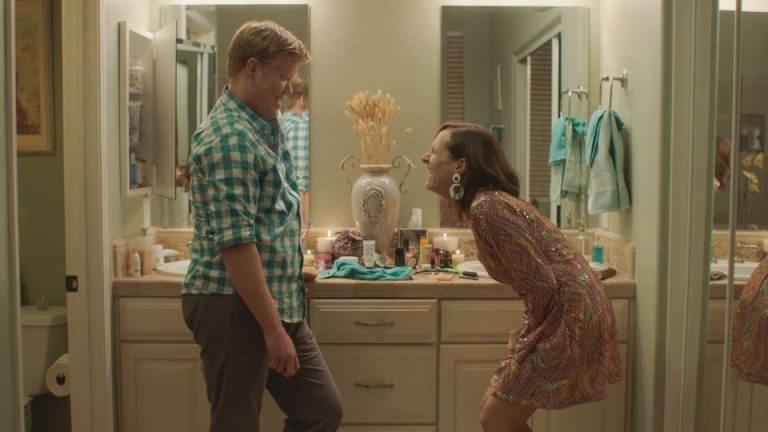
Kelly’s avatar is David Mulcahy (Jesse Plemons), a gay comedy writer who has returned to Sacramento to be with his family as his mother, Joanne (Molly Shannon), dies of cancer. His father, Norman (Bradley Whitford), never accepted David’s sexuality and won’t even acknowledge that he has a long-term boyfriend (Zach Woods) back in New York. That relationship is ending, by the way, and David has just suffered a professional setback as well. He has one gay friend from childhood (John Early) who’s in Sacramento occasionally, but otherwise no support system to help him deal with his crumbling life.

These other details notwithstanding, the real focus of the movie is Joanne’s cancer and David’s reaction to it. After opening with her death, we jump back a year and follow the process month by month, occasionally with patches of morbid humor but largely in a serious vein. In fact, except for the opening sequence, in which Joanne’s death is immediately followed by a phone message from a hilariously oblivious well-wisher, the film’s comedy and drama are kept in separate compartments. Jesse Plemons and Molly Shannon excel in both areas, though, with Shannon’s strong dramatic work especially worth noting, not least for its unexpectedness.

As played out dying parents are in movies, this one would be better if it had stuck to that, even if it meant omitting or changing certain elements that feel like they were included just because they’re autobiographical (I presume). David has two sisters who are present but don’t figure into the story, just filling out the background. Give ’em something to do, or cut ’em out! His gay friend has a little brother (J.J. Totah) who’s amusingly flamboyant but, again, unnecessary. Even major threads like David’s romantic woes and his issues with his dad, instead of supporting the main story, distract from it. What does Mom’s impending death have to do with Dad’s acceptance or David’s love life, other than that they all involve David? You keep waiting for it to tie together thematically, and it doesn’t.

And yet there are sublime stretches of quiet drama, some really lovely moments between Plemons and Shannon, and those periodic bits of welcome humor that carry the film along. One almost feels bad criticizing such a personal, heartfelt story, but hey, it’s one’s job. This is a good first film from a smart writer.
Sully

0
Sully

Today on “Why Is This a Movie?,” we’re talking about “Sully,” Clint Eastwood’s dramatization of the January 2009 incident where Capt. Chesley Sullenberger (not a fake name) landed a plane full of passengers on the Hudson River without anyone being hurt. So not only is this a story everyone already knows, but the whole reason everyone knows it — the thing it’s famous for — is that nothing happens in it. An excellent choice for your 357th movie, Mr. Eastwood! A story defined by its lack of drama!

Saving the film from total uselessness, however, is Tom Hanks, national treasure. Just as Sully landed a dead plane smoothly on the river, Hanks grabs the controls from disinterested director Eastwood and flightless screenwriter Todd Komarnicki and brings the whole leaden affair safely to land with minimal carnage. Thanks to Hanks’ gift for Everyman heroism, what might have been a bad movie is instead merely a not-very-good one. (The moment Sully receives confirmation that all 155 people on the plane are safe and accounted for is the moment Hanks earns his salary.)

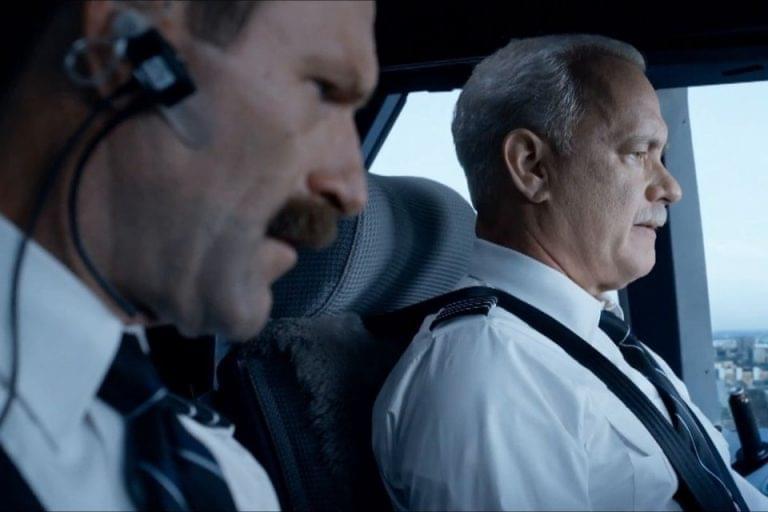
The Miracle on the Hudson has already occurred when the film begins, and Sully is having nightmares and flashbacks. He and his faithful, severely mustached co-pilot, Jeff Skiles (Aaron Eckhart), have been detained in New York for hearings with the National Transportation Safety Board. Landing in the Hudson (“on the Hudson,” Sully corrects) is frowned upon, even when done successfully, and the NTSB wants to make sure Sully didn’t have other, safer options. Computer simulations suggest he could have made it back to LaGuardia Airport. Sully says no way. Who are you going to believe, your precious computers, or the pilot with 40 years of experience who was THERE in the cockpit and looks like TOM HANKS??

Obviously, the film is about the aftermath as much as the incident itself. Not until 30 minutes in do we backtrack to Jan. 15 to see it play out in detail, from pre-takeoff to water landing. Eastwood handles this sequence with characteristic humble competence, but it would take a far better filmmaker (and maybe an actual wizard) to wring suspense, tension, or fear out of a perilous situation whose outcome — whose happy, casualty-free outcome — has already been reported. The film mechanically introduces us to a handful of passengers, too, like a disaster movie would, but it’s laughable to suggest we feel any connection to them.

Our review of “Sully” from the Movie B.S. with Bayer and Snider podcast:

Download audio

And there isn’t anything of note in the aftermath, either. The NTSB people (including Mike O’Malley and Anna Gunn) are superficially stern and skeptical in the face of Sully’s unerring righteousness, but we know they’ll eventually come around to agreeing he did the right thing. Back in whatever Sully’s hometown is (the movie doesn’t say), Laura Linney plays the crucial role of Concerned Wife on Phone, reassuring her husband when the NTSB makes him second-guess himself. There are two flashbacks to Sully’s youth, both of which show his love of flying, neither of which offers additional insight into his character.

And so I ask again: Why is this a movie? What part of the exceedingly familiar, recent true story does it purport to reveal to us? On what aspect of the human condition does it attempt to shed light? The answer, amazingly, is none. I don’t just mean “Sully” fails to convey anything deeper than the basic facts of the event. I mean it doesn’t even TRY to. Eastwood seems to have thought his assignment was to deliver a bare-bones, no-frills, two-dimensional account of something that happened, with no commentary or analysis. Hearing it in the voice of Tom Hanks certainly helps, but it’s still just a dry news story.

Friday movie roundup – Sept. 2

0

And just like that, summer is gone. Life is fleeting. We should make the most of it by seeing as many movies as we can. Here are my most recent reviews:

— “Don’t Breathe” (R) B+
— “Free to Run” (NR) B- [Crooked Scoreboard]
— “Morgan” (R) C+
— “Southside with You” (PG-13) B-

This week on Movie B.S. with Bayer and Snider, we also have reviews of “The Light Between Oceans” (B) and “Complete Unknown” (B), written reviews to come. More soon!

These reviews are mostly funded by readers like YOU, via Patreon. A dollar a month is all it takes to keep ’em coming. To get reviews and recommendations emailed to you each week, sign up for In the Dark. Thanks!

Morgan

0
Morgan

Arrogant scientists create something unnatural and underestimate how powerful it is in … well, in a lot of movies, now that we think about it. Maybe two-thirds of all science fiction? But “Morgan” is the one we’re talking about today, the eager but lukewarm feature debut from director Luke Scott, whose father, Ridley, already holds a place of honor in the genre.

Livelier than its dull title yet still derivative of similar movies, “Morgan” is a sci-fi thriller in which an all-business risk-management consultant named Lee Weathers (Kate Mara) is sent by her corporation to a remote research facility where an experiment has gone awry — specifically, a lab-grown artificial-intelligence creation called Morgan (Anya Taylor-Joy) has turned violent, endangering its potential as a consumer product.

As explained in the exposition-rich video that head researcher Dr. Ziegler (Toby Jones) shows to Lee Weathers (who must already know all of the information it contains), Morgan is the latest iteration in a years-long project involving artificial DNA and genetic manipulation — “the next step in evolution,” yada yada. She — or “it,” as Lee insists — has the alien-like appearance of a sickly teenage girl and vast, unspecified mental acuity, perhaps even telekinetic powers. They designed her to be super-intelligent; the problem is that she might be TOO smart, and lacking in empathy to boot.

Morgan’s scientist caretakers have grown attached to her, with married researchers Darren (Chris Sullivan) and Brenda (Vinette Robinson) Finch viewing themselves as her surrogate parents. The others (including an underused Jennifer Jason Leigh) seek to downplay Morgan’s occasional sociopathic outbursts as anomalies, lest Lee Weathers determine that Morgan must be “deactivated” (or whatever euphemism you prefer).

Our review of “Morgan” from the Movie B.S. with Bayer and Snider podcast:

Download audio

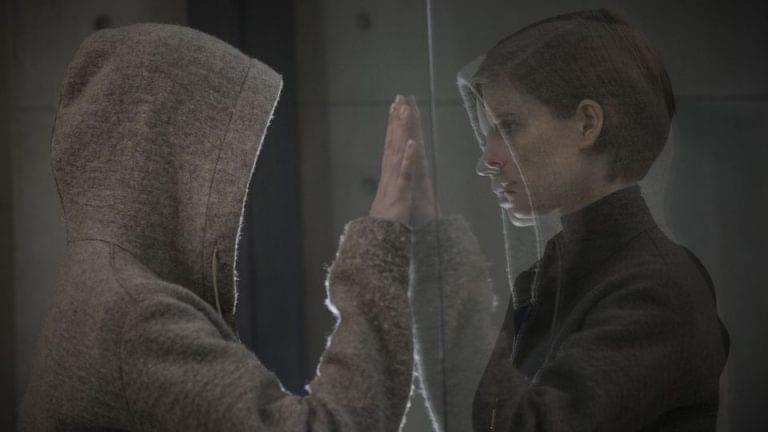
As is often the case with mediocre films, this one hinges on a question whose answer is obvious: Can Morgan be controlled, or at least contained? (No. No, she can’t.) There are moments of tension and even horror, but there’s only so much excitement to be found in watching brilliant scientists discover for themselves something that we knew the minute we walked in. That’s why the indispensable Paul Giamatti’s mid-film appearance as a doctor doing a psychological evaluation of Morgan is so crucial: he’s as skeptical as we are about the idea of unleashing Morgan on the world, pointing out that any subject who must be separated from her interviewers by a wall of protective glass has clearly already failed her psych eval.

Written by Seth W. Owen, the screenplay is blandly reminiscent of films like “Ex Machina” (artificial intelligence asking hard existential questions) and “Hanna” (deadly teen girls), only not as thoughtful or as elegantly executed. It is also laden with unnecessary characters (four more besides the ones already mentioned), yet somehow manages not to have a protagonist.

Still, even when it clumsily telegraphs its intentions, the film does have a zippy energy that keeps it from being stagnant. Unoriginal it may be, but boring it isn’t, and Kate Mara is good as a steely-eyed, no-nonsense corporate drone, unmoved by the staff’s touchy-feeliness about Morgan. Will movie scientists ever learn?

Yoga Hosers

0
Yoga Hosers

It’s bad form to spoil a movie’s best joke in a review, but “Yoga Hosers” only has one joke, so we don’t have much choice. Here’s the joke: Canada, am I right?? From what’s left of the mind of Kevin Smith comes this lazy, insular horror-comedy aimed at his most loyal followers and absolutely no one else, starring Harley Quinn Smith (his daughter) and Lily-Rose Depp (Johnny’s girl) as Winnipeg convenience store clerks and yoga enthusiasts who end up fighting “Bratzis”: anthropomorphic Nazi sausages that jump up people’s butts. The girls’ store is called Eh-2-Zed (get it? Canada!), and Smith was so proud of his Canadian cereal — Pucky Charms (hockey, get it?) — that he made sure the box was visible in every other scene. The film is nothing but inside jokes and celebrities indulgences (Johnny Depp reprises his nutty Quebecois character from Smith’s Tusk; Harley Quinn and Lily-Rose sing a song), and is the sort of thing you’d show to friends for a lark, not exhibit in theaters for money.


Complete Unknown

0
Complete Unknown
Michael Shannon: too tall for the movie.

“Complete Unknown” begins with fractured clips of the same woman — or at least the same actress (Rachel Weisz) — in multiple professions, going by multiple names. Are these fantasies? Past lives? Something else? It’s a discombobulated start for what turns out to be a straightforward, bluesy drama about the identities and life-paths we choose for ourselves.

The always interesting Michael Shannon stars as Tom, a New York academic hosting his birthday party at a time of stress and uncertainty. His cake calls him “Tony.” More importantly, his Iranian wife, Ramina (Azita Ghanizada), is contemplating a career-related move to California, and Tom isn’t sure he’ll go with her.
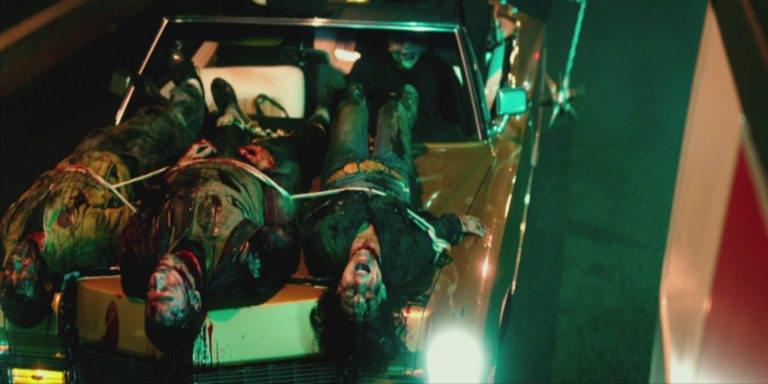
One of their friends brings a date to the party, one Alice Manning (Weisz), a self-assured woman whom Tom recognizes from his past — except her name wasn’t Alice then. Through much engrossing walk-and-talk action (shades of the “Before Sunrise” trilogy), director Joshua Marston (“Maria Full of Grace”) has Tom — and us — come to see the appeal in Alice’s untethered way of life, her liberating gift for reinventing herself and becoming whomever she pleases. When the two stumble into a situation where they can help an older neighbor couple (the delightful Kathy Bates and Danny Glover), Alice goads Tom into trying it out. Pretend to be a doctor, why not? Make up a backstory! It’s fun!

The simple question at the center of the film is for Tom. Would he like to live free of obligation, with no attachments? Or should he follow the path he’s on, predictable and in some ways predestined, but stable? Weisz plays Alice as a determinedly free-spirited polymath, not a careless flake, while Shannon’s Tom is bemused, annoyed, and fascinated by her. It might be better as a conversation-starter than as cinema, but the film’s astute central performances elevate it.
Mechanic: Resurrection

0
Mechanic: Resurrection
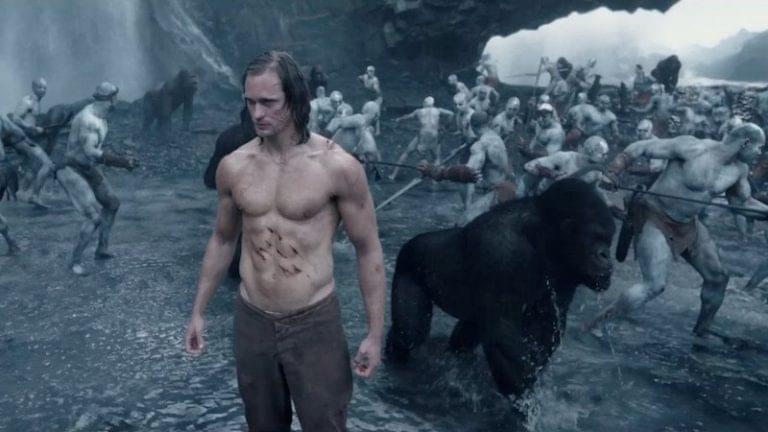
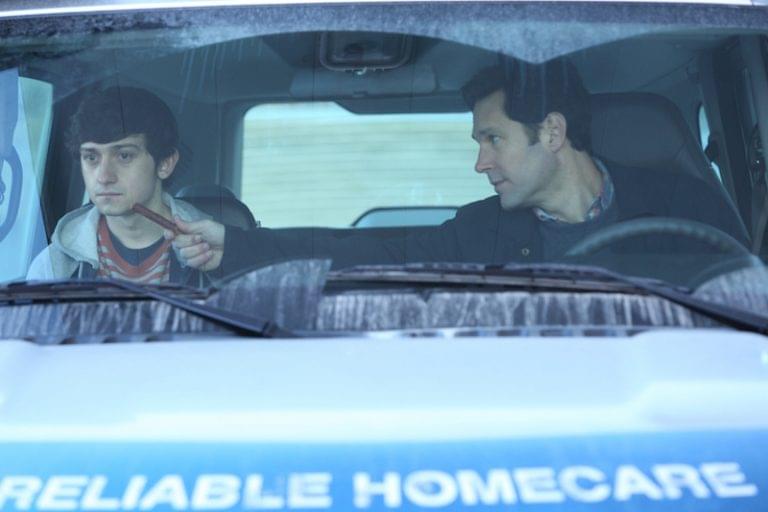
Warning: This image gives away the whole plot.

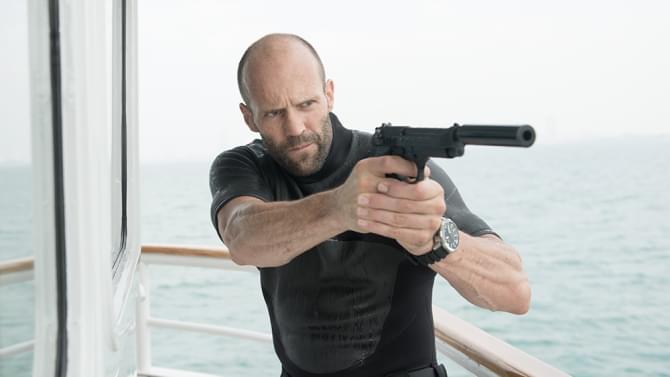
Reader, I’m not going to demean us both by pretending to remember anything about “The Mechanic” (2011) except for the fact that I saw it. (I already looked to see if I wrote a review. I didn’t.) It was during that period where every January there was a new movie about Jason Statham getting into fights and killing people, but it wasn’t one of the good movies from that batch. Or else I’d remember it, duh.

How it got a sequel is a mystery whose solution doesn’t interest me, but “Mechanic: Resurrection” (I guess he died in the first one?) isn’t bad when it focuses on Statham’s character, elite hitman Arthur Bishop, doing what he does best: planning and carrying out assassinations that must look like accidents. Whether suction-cupping his way up a skyscraper or getting himself thrown in prison to get close to a target — and then escaping from the island fortress with the aid of shark-repellant cream — Statham’s hard-edged persona and willingness to do whatever ridiculous thing is required of him make him an appealing action hero.

The problem, of course, is that there’s a plot surrounding those scenes, and the plot is garden-variety action trash. (The screenplay is by first-timers Philip Shelby and Tony Mosher; the director is Dennis Gansel, way off course from his touching Nazi youth drama “Before the Fall.”) Bishop, retired and hiding in Rio, is dragged back into murder-for-hire by an arms dealer, Craine (Sam Hazeldine), who’s trying to eliminate his competition. Craine plants a pretty girl named Gina (Jessica Alba) as bait for Bishop, waiting for him to get attached to her so Craine can use her as leverage. Bishop and Gina realize what Craine’s plan is, pretend to fall in love so his spies will see it … and then actually fall in love, defeating the purpose and making it easy for Craine to kidnap her and threaten to kill her if Bishop doesn’t do his bidding.

At the 70-minute mark, Tommy Lee Jones appears as one of Craine’s rival arms dealers, giving false hope that now, at last, things are going to get exciting. But don’t fall for it. Jones is just slumming here, perhaps fulfilling court-ordered community service, while Statham pays the bills however he can. May they both be put to better use soon.

Don’t Breathe

0
Don’t Breathe
Silent but deadly.

“Don’t Breathe” is satisfying, meat-and-potatoes horror, the kind that takes a simple premise, adds a couple of flourishes, makes the most of it for 85 minutes, then gets out before it can overstay its welcome. We would all do well to emulate “Don’t Breathe.”

It’s set in miserable Detroit, where three young burglars have a range of motives for their choice of profession. Rocky (Jane Levy) is doing it so she can take her little sister out of here and away from their useless mother. Good-hearted Alex (Dylan Minnette), whose father owns the home security company from which Alex is stealing alarm codes, is doing it to help Rocky, partly (but not entirely) because he wants her. The third is Rocky’s boyfriend, Money (Daniel Zovatto), a corn-rowed wannabe thug who just wants, uh, money.

I’m not saying the relative altruism of each person’s motives determines how that person fares in the story, or that this is in keeping with the standards of morality long established in the horror genre. But I’m not not saying it, either.

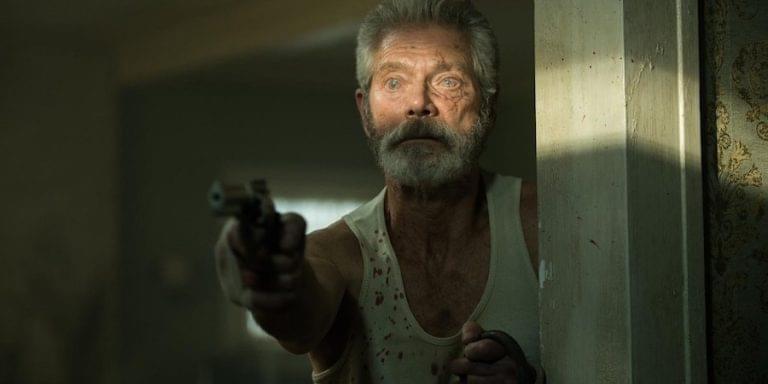
Anyway, the three set out to rob a blind Army veteran (Stephen Lang) who’s rumored to have bundles of cash hidden in his dilapidated but well-secured home, the result of some legal settlement a while back. When Alex expresses reluctance at robbing a blind man, Money says, “Just ’cause he’s blind don’t mean he’s a saint, bro.” Good point, Money.

Things go awry (as they generally do) when the blind combat veteran proves to be a more formidable opponent than our intruders anticipated, resulting in a chilling “Wait Until Dark” scenario of tiptoeing around and trying to remain silent. But unlike the Audrey Hepburn classic, our rooting interest remains with the thieves — there’s another layer to the story that I won’t mention — as they learn that a house that’s hard to break into can be just as hard to get out of.

The director is Fede Alvarez, of the 2013 “Evil Dead” remake, again co-writing with Rodo Sayagues. Alvarez delivers several hold-your-breath moments in this tight, expertly paced thriller, exploiting such classic suspense tropes as “Will the blind person hear this small noise?” and “Is the glass going to break?” and “Wait, what about the dog?” (The overall effectiveness makes it easy to overlook narrative problems like the character who ought to be dead several times yet persists in living.)

Jane Levy (who was also in “Evil Dead”) is a strong heroine, and despite a few feints in that direction, the film isn’t the sort to pile on the abuse of its women. I don’t have much to say about Dylan Minnette, who came from the same factory that made Logan Lerman (and, before that, Shia LaBeouf), or Daniel Zovatto, though both serve their purposes. Most impressive is how Alvarez keeps things interesting despite the limited geography and small cast of characters. Just when you think you know where it’s going, there’s another icky turn to make you smile and wince.

Southside with You

0
Southside with You
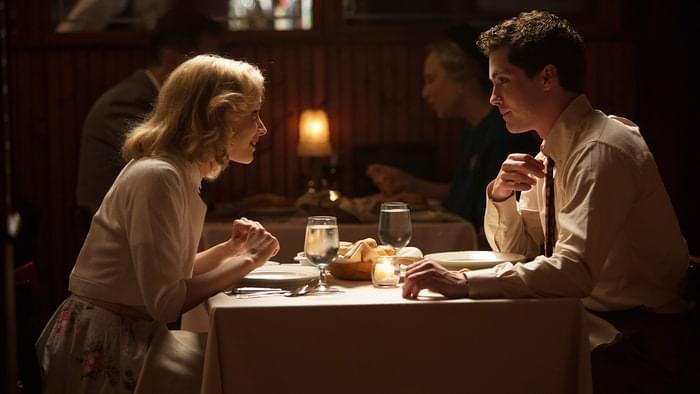
Allow me to introduce my date, a man named BARACK OBAMA!

Whatever you think of Barack Obama as a president, his loving, affectionate relationship with Michelle sets a good example for all married people, and might be the most unassailable aspect of his legacy. So it makes a certain kind of sense that the first major Obama biopic would actually be a romantic dramedy about Barack and Michelle’s first date, in Chicago, one fateful day in the summer of 1989.

Still, Richard Tanne’s “Southside with You,” though often charming and clearly well-intentioned, feels a bit awkward. Maybe it’s because this kind of myth-making about historical figures rarely happens while they’re still in office, so the movie feels premature. Maybe it’s because the story is simultaneously trivial and momentous: what happens on the date is ordinary, it could happen to anyone; yet at the same time, it’s a very specific situation — the future leader of the free world beginning the courtship of his wife — that’s only interesting because of who the participants are. It is therefore of limited appeal, being not for fans of the Obama administration but fans of the Obamas as personalities.

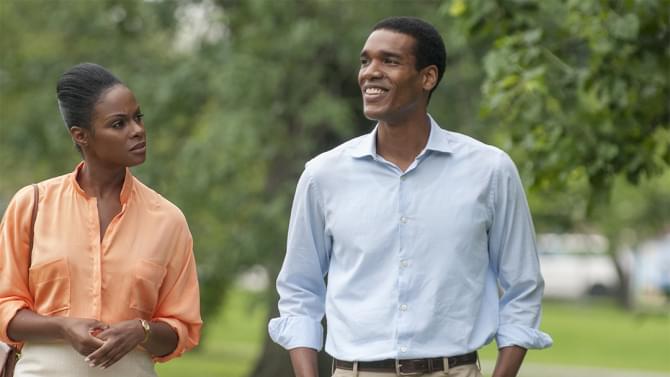
Using the Obamas’ public comments about their first date as a starting point and filling in the details with creative license, Tanne has young lawyer Michelle Robinson (Tika Sumpter) getting ready to attend a work-related function with a colleague, Barack (Parker Sawyers), a Harvard student interning in Chicago for the summer. In the manner of rom-coms, Michelle insists to her prying parents that it isn’t a date, though her time in front of the mirror suggests otherwise. Indeed, it seems to have begun as a professional event, but Barack has added some date-like elements to it, including a stroll through a museum exhibit of black art and a stop at a community meeting where he happens to be a guest of honor. Amusingly (and smoothly), he’s already running for the office of Michelle’s boyfriend.

Sumpter and Sawyers are irresistible as young Michelle and Barack (who smokes like a chimney), two intelligent, strong-willed people as well-matched as sparring partners as they eventually will be as a married couple. Their conversations are lively and thoughtful. Glimpses of their biographies emerge — Barack is angry about his deadbeat father; Michelle is questioning her role at the law firm in light of the more important work she wants to do — but Tanne avoids overdoing the nudge-nudge we sometimes get with before-they-were-famous movies.

Perhaps inevitably, and despite Tanne’s efforts to play it cool, the whole thing has an air of worshipfulness about it. The movie’s very existence implies that minutiae concerning the Obamas’ personal history is worth examining, an assumption in need of support that the film doesn’t offer. Though we do get a sense of Barack’s skill as a community organizer and pragmatic leader, nothing here suggests future greatness (or even relevance). We’re only watching because we know something the characters don’t: that later, after the movie ends, they will have interesting lives.

(P.S. The film is set in the summer of 1989. A radio DJ says Janet Jackson’s “Miss You Much” is the No. 1 song in the land, but that song didn’t earn that distinction until early October. WILL OBAMA’S LIES NEVER END??!)

Hands of Stone

0
Hands of Stone
A good corner man knows the value of a well-timed boob massage.

The life of Panamanian boxer Roberto Duran has featured enough drama, setbacks, and victories to make for a terrific movie. Maybe someday someone will make one. In the meantime, here’s “Hands of Stone,” another well-intentioned but feckless snooze.

If it seems like about 75 percent of sports biopics could be described in equally weary terms, well, yeah. Tell me about it. Believe me, critics are as tired of being disappointed by generic biographies as you are of hearing about them.

Based on Christian Giudice’s biography of Duran, adapted and directed by Venezuelan filmmaker Jonathan Jakubowicz, “Hands of Stone” begins in the usual fashion: a scene somewhere in the middle of the person’s career to establish what he would become — in this case the Benny Huertas fight at Madison Square Garden in 1971 — before jumping back in time to see how he got there. In 1964, Roberto is a 13-year-old scamp in the slums of Panama, learning boxing from portly Plomo Quiñones (Pedro Perez) and street smarts from Chaflan (Oscar Jaenada), a clownish Pied Piper figure. Later, these two mentors will be among the people that the successful, prideful Roberto turns his back on.

In the ’70s, Duran (played by Edgar Ramirez) comes to be trained by Ray Arcel (Robert De Niro), one of the great old-school boxing coaches. Ray, an elderly Jew whose insults are sprinkled with Yiddish words, also narrates the film, and includes a flashback to 1953, when he’s forced out of the professional boxing world by the Mafia (represented by John Turturro), who gives him a simple choice: if he ever makes money as a trainer again, the Mob will kill him. He therefore coaches Duran for free.

That backstory with the Mafia is an interesting detail, but it muddies the water. Whose biography is this, Duran’s or Arcel’s? We’re presented with other irrelevant aspects of Arcel’s life, too, including an estranged daughter who appears in two scenes and serves no thematic function. It’s symptomatic of Jakubowicz’s larger problem, one that plagues so many biopics: instead of sorting through the facts to find the clearest, most direct story, he tries to cover everything.

As for Duran, he gets rich and famous in the ’70s (cue the montage of victories mingled with the births of his children), then challenges Sugar Ray Leonard (Usher Raymond) in 1980, hoping to score a symbolic victory for Panama.

You know what happens next. Even if you’ve never heard of Roberto Duran, you know what happens next, because you’ve seen these movies before. He’ll get wealthy and complacent; he’ll gain weight; he’ll be a jerk to his wife (Ana de Armas); he’ll forget the little people; at last he’ll be humbled and stage a comeback. Once we get to a good stopping point, the movie will show us photographs of the real Duran, Arcel, et al., accompanied by title cards telling us what happened next. You know the drill.

Following a template isn’t necessarily wrong. We’ve seen formulaic movies that were riveting and well-told. But “Hands of Stone” is a tedious, mechanical bore that offers no insight into Duran’s character and can’t even seem to figure out what story it’s telling. Not only are there tangents exploring Ray Arcel’s life, there are a few scenes about Sugar Ray Leonard and his wife (Jurnee Smollett-Bell). Even when the film stays focused on Duran, it gets sidetracked, with pointless scenes like the one where he meets his deadbeat father, previously unmentioned and never seen again thereafter.

For what it’s worth, the boxing sequences are competently staged, though nothing special. You’d definitely learn more about Roberto Duran by watching YouTube clips of his fights.

— Crooked Scoreboard

The Hollars

0
The Hollars

Stop me if you’ve heard this one before. “The Hollars” is a Sundance dramedy about a mope who returns from the big city to his hometown to deal with family issues, and finds both the hometown and the family issues unchanged (depressingly so) yet somehow alien to him now. Alas, directed by John Krasinski (who also stars), this thing is as generic as it sounds, right down to the indie-folk soundtrack full of “hey ho” guitar songs. I know for a fact that Krasinski has been to Sundance before. Did he not watch any movies there? THEY WERE LIKE THIS.

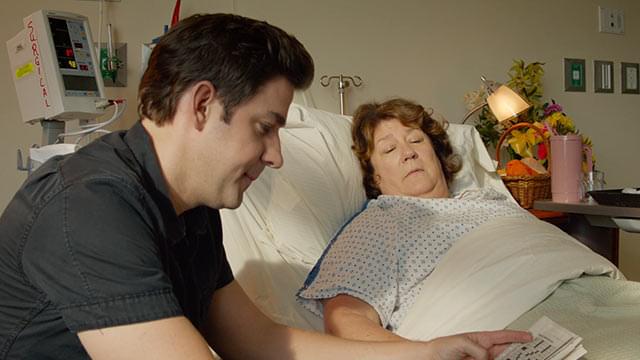
Krasinski plays John Hollar, a New York City publishing-company drone with artistic ambitions who rushes back to Ohio when his mother (Margo Martindale) is diagnosed with a tumor. The Hollar family is mostly loving but barely functional; Dad (Richard Jenkins) and John’s trainwreck brother, Ron (Sharlto Copley), get into a slap-fight in Mom’s hospital room within minutes of John’s arrival. John’s pregnant girlfriend, Rebecca (Anna Kendrick), shows up soon to offer support, and to subtly remind John that he needs to figure himself out and work through his family’s craziness.

The cliches pile up. John, it goes without saying, doesn’t call or visit often enough. Dad is having money problems and might lose his business. Ron, who’s just moved back in with the parents, can’t let his ex-wife go, keeps sitting in his car outside her house. (Granted, she’s married to Josh Groban now. That would infuriate anyone.) There’s contrived wackiness around John’s old girlfriend (Mary Elizabeth Winstead) still having the hots for him, despite being married to another high school acquaintance, Jason (Charlie Day), who happens to be Mom’s nurse.

Written by James C. Strouse (whose first Sundance script, “Lonesome Jim,” was cut from the same template), the film’s humor is often silly and broad — a slap-fight here, Ron assuming an Asian doctor knows martial arts there — and is at odds with the down-to-earth, “realistic” tone of the drama. The drama, meanwhile, is rudimentary and weightless, with banal epiphanies (“It’s terrifying to find out this late in your life what you should have done”) and useless subplots (everything not directly involving John), eventually demanding emotions that it absolutely has not earned. And just when the story is over, whoops, don’t forget Chekhov’s Uterus: a pregnant woman introduced in the first act must give birth in the last act.

The real pity is that Martindale and Jenkins give endearingly authentic performances as the parents, two good souls who regret certain things in the past but have stuck together and love their screwed-up kids. They’re far better than a by-the-numbers film like this deserves. They almost trick you into thinking it’s a good movie, the way a tasty complimentary breakfast muffin can color your memories of a cheap motel. But it’s not gonna work, “The Hollars”! I can show you the bites I got from your cinematic bedbugs.

Friday movie roundup – Aug. 19

0

My, what a busy week! A busy two weeks, actually — I was away on fambly bidness last weekend and didn’t update you. I have a whole bunch of new reviews, listed here alphabetically:

— “Ben-Hur” (PG-13) C
— “Florence Foster Jenkins” (PG-13) B+ [Oregon ArtsWatch]
— “Hell or High Water” (R) B+
— “Kubo and the Two Strings” (PG) B
— “Morris from America” (R) B
— “Nine Lives” (PG) C-
— “Our Little Sister” (PG) B
— “Pete’s Dragon” (PG) A-
— “Sausage Party” (R) B
— “War Dogs” (R) C

Over at Mental Floss, I wrote a fun piece about the 1907 version of “Ben-Hur” that changed the movie business forever (really!). I especially enjoy the old-timey court language.

These reviews are mostly funded by readers like YOU, via Patreon. A dollar a month is all it takes to keep ’em coming. To get reviews and recommendations emailed to you each week, sign up for In the Dark. Thanks!

Morris from America

0
Morris from America

As you may recall from when it happened to you or from the many movies you’ve seen on the subject, growing up is hard. That’s especially true for kids with single parents, and for minorities, and for kids living in a foreign country. The boy in “Morris from America” is all of those things, but don’t expect a lot of high drama. This is a slight, pleasant coming-of-age comedy, offering smiles and warm fuzzies and two charming central performances.

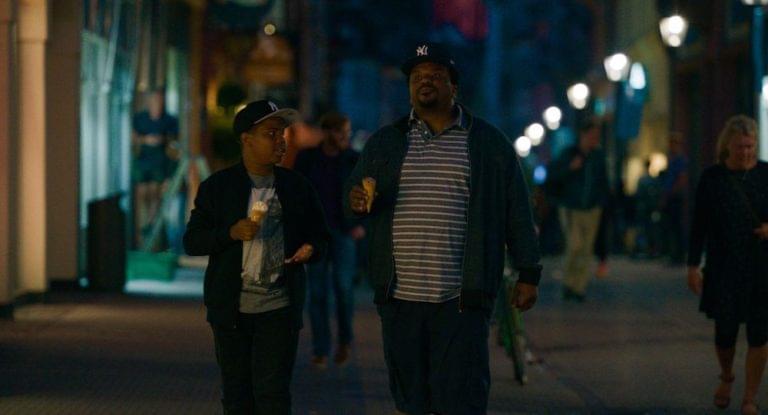
Morris Gentry (Markees Christmas) is a stout, 13-year-old African American boy living with his dad, Curtis (Craig Robinson), in Heidelberg, Germany, a city not known for its ethnic diversity. Curtis, a former soccer player from New York, has taken a job on a coaching staff here, uprooting Morris from their home. (It’s just the two of them since Mom died.) Morris takes German lessons from a college student named Inka (Carla Juri), and he communicates well enough with his peers (who tend to speak English), but he hasn’t made much effort to make friends here. He and his pop mostly just hang out together, listening to old-school hip-hop.

As a dad, Curtis walks the line between being a good, responsible father and being Morris’ pal. He generally comes down on the right side of it, and their spirited, loving, expletive-laced relationship is the heart of the film. When Inka finds a notebook in which Morris has transcribed some profane rap lyrics, Curtis isn’t bothered by the sexuality or the misogyny so much as the fact that Morris isn’t writing from his own experiences. Earlier, Curtis grounded Morris for having poor taste in hip-hop, then un-grounded him five minutes later because he was bored.

What makes Morris start to interact with the German kids is, of course, a girl. Katrin (Lina Keller) is a wispy, trouble-seeking 15-year-old blonde who takes an amused, flirtatious interest in Morris, which Morris interprets as romance. He falls in with Katrin’s crew at the youth recreation center, a bunch of snotty, privileged mid-teens who call him “Kobe Bryant” until they find out he doesn’t play basketball.

All of them, Katrin included, see Morris as something of a novelty, and not just because he’s from America. But the movie rarely mentions race directly (though one notable exception is an uncomfortable scene where Katrin asks whether certain stereotypes are true). It’s mostly insinuations, like an administrator going straight to Morris when he finds the remains of a joint behind the school. How does being black affect the already difficult experience of being a 13-year-old boy in a strange land? The movie, written and directed by Chad Hartigan, who is not black, seems reluctant to get into it but unable to completely ignore it. I sympathize.

Anyway, it’s not the point. Hartigan, whose fondly received “This Is Martin Bonner” premiered at Sundance 2013, has a way with likable, unassuming characters, and what he’s really interested in here is the father-and-son dynamic. Newcomer Markees Christmas is a real find as Morris, giving a natural, all-too-relatable performance as a boy who’s trying to grow up as fast as he can. His explicit rap lyrics notwithstanding, Morris is an innocent babe. He pores over a nudie magazine that he finds, but he doesn’t know what to do with it. When he puts Katrin’s sweater on a pillow and pretends it’s her, the moment is sort of adorably naughty, not dirty. Christmas plays the role with believable innocence, frustration, and curiosity.

Craig Robinson, a familiar, funny actor from “The Office” and “Hot Tub Time Machine,” does breakout work as Curtis Gentry, adding a dramatic, emotional layer to what we’ve seen him do before. He and Christmas have a fun chemistry; more importantly, they ring true, one of the infinite variations of the parent-child model.

Let me point out, though, that while the movie is nice and amenable, it’s also completely insubstantial. The insights and character arcs are small. You’ll laugh, you’ll smile, you’ll have a good time, but in a week you’ll probably forget you ever saw it. So enjoy it while it lasts!

Kubo and the Two Strings

0
Kubo and the Two Strings
Not pictured: the two strings.

There’s something broken in my head that causes me to like and respect Laika’s stop-motion animated films without falling in love with them, some emotional circuit that’s not being completed. “Coraline” was brilliantly twisted enough for it not to matter that it didn’t have much heart. But then came “ParaNorman” (fine), “The Boxtrolls” (same), and now “Kubo and the Two Strings,” an ambitious, beautiful, imaginative creation of painstaking detail … that left me cold. Admiring, but cold.

I’m the worst. You shouldn’t listen to me.

Created with models, miniatures, and puppets (with some CGI for the backgrounds), the film, set in feudal Japan, features a young boy named Kubo (voice of Art Parkinson), an eye-patched li’l scamp who spends his days delighting villagers in the public square with his storytelling. (“If you must blink, do it now” is how the story always begins — a masterful opening line.) Kubo’s got some magic in him: when he plays his shamisen, scraps of paper fold themselves into intricate origami figures that act out the tale as he narrates it.

His bereft mother, who sits forlorn in a cave, reports that his father was a brave samurai, and that her own father and sisters are the ones who took Kubo’s missing eye. Kubo’s grandfather, it turns out, is a vengeful god called the Moon King (Ralph Fiennes), and his aunts are kabuki-faced witches who speak in unison (with Rooney Mara’s voice). To defeat them and save the universe, Kubo must find three mystical pieces of armor that belonged to his father, as described in the stories he’s been telling every day.

Brave young Kubo makes two new friends on his quest. First is a wooden monkey charm he’s had his whole life that now becomes a real, talking Monkey (Charlize Theron). For a monkey, she is very serious, and concerned about Kubo’s safety. His other helper is Beetle (Matthew McConaughey), an amnesia-stricken but courageous samurai who has been turned halfway into a man-sized beetle, and whose somewhat looser attitude causes amusing friction with Monkey. Providing silent comedy is a very expressive origami samurai brought to life by Kubo’s innate magic.

Our review of “Kubo and the Two Strings” from the Movie B.S. with Bayer and Snider podcast:

Download audio

The original screenplay is credited to Marc Haimes and “ParaNorman” director Chris Butler, and was directed by Laika CEO Travis Knight, an animator taking his first turn at the helm. Creating such an elaborate, fanciful world from scratch is an impressive feat — you’d assume the film was based on a preexisting fictional mythology, but nope — and it speaks to the Laika group’s commitment to detail and precision. Laika displays the same attitude Pixar used to have: since it takes years to make one of these suckers, there’s no excuse not to get it right.

And there’s nothing I don’t like about “Kubo and the Two Strings.” The story, which is about stories, and how we believe the stories we’re told, is tight and well-structured. It offers moments of outstanding humor, scary action, and intense conflict. Visually, it’s a stunning piece of work.

So what’s missing? Something I can’t put my finger on — some last bit of spark or oomph or magic that would make it connect on a personal level. It just needs electricity to bring it to life.

For me, anyway. Like I said, you shouldn’t listen to me. Many of my friends and colleagues report being enraptured with everything Laika has produced, including this. All I can tell you is my own experience with the film, which left me amazed at the artistry involved, entertained by the story, but emotionally unmoved. I respect the heck out of it, though.

Ben-Hur (2016)

0
Ben-Hur (2016)
Cowabunga!

Here’s a fascinating bit of trivia about the 1880 novel “Ben-Hur” that you would never guess from watching Timur Bekmambetov’s pedestrian new movie version: it was subtitled “A Tale of the Christ,” and it made Judah Ben-Hur’s conversion a significant part of the story. In the movie, everything Jesus-related feels like an afterthought, like they forgot it was supposed to be a religious drama and wedged some Christianity into it at the last minute. This is a movie about Jesus the same way “Jaws” is a movie about the Fourth of July.

Which would be fine, except that what it IS about isn’t compelling, either. The central narrative, about enslaved Jewish prince Judah Ben-Hur (Jack Huston) seeking revenge against his treacherous Roman best friend Messala (Toby Kebbell), is a rote recitation of plot points without energy or humanity, muddled by an odd change that writers Keith R. Clarke (“The Way Back”) and John Ridley (“12 Years a Slave”) made to the story.

In the original (the book as well as the 1959 Charlton Heston movie), Judah is enslaved and his family imprisoned because a tile fell from their roof and spooked the governor’s horse — an accident, cruelly punished by Messala as a show of strength to the Jews. This time, it’s not a loose tile but an arrow intentionally fired at Pontius Pilate by a Jewish insurgent angry at the Roman occupation. Judah had previously admonished the lad and his fellow zealots to stand up to Rome peaceably, so it makes no sense for him to help him escape and then take the blame for his assassination attempt. It also deflates his motive for wanting revenge against Messala — you know, the whole CRUX OF THE STORY.

Our review of “Ben-Hur” from the Movie B.S. with Bayer and Snider podcast:

Download audio

Bekmambetov, who’s made mostly vampire movies before now, handles the sea battle and the chariot race with aplomb (though the latter sequence pales in comparison with the legendary 1959 version), and Morgan Freeman is a welcome presence as Ilderim, the African who bets on Judah’s charioteering. Indeed, it’s Ilderim’s counsel that gets Judah to a place of “forgive and forget,” not the influence of peripheral Brazilian Jesus (Rodrigo Santoro).

The dialogue is all shallow, modern glibness, performed without distinction by dull actors. “Don’t they teach subtlety in Caesar’s army?” Judah’s sister (Sofia Black-D’Elia) asks the flirtatious Messala. (Why would they teach subtlety in the army?!) At the prospect of racing in the Roman circus (that’s what the arena was called), Judah is gravely informed, “In the circus, there is no law.” How seriously can you take a movie that says “In the circus, there is no law”? How seriously does such a movie even WANT to be taken? In the end, this plodding remake never gives a valid reason for its own existence.

War Dogs

0
War Dogs
These idiots.

In “War Dogs,” the title epithet is a derogatory term for dishonest, bottom-feeding greed-monsters who profit from war by selling weapons to the Pentagon. The fact that the bros to whom the term is applied wear it as a badge of honor tells you a lot about them, and goes a long way toward explaining why “War Dogs” had an uphill battle that director Todd Phillips (“The Hangover”) was ill-equipped to win.

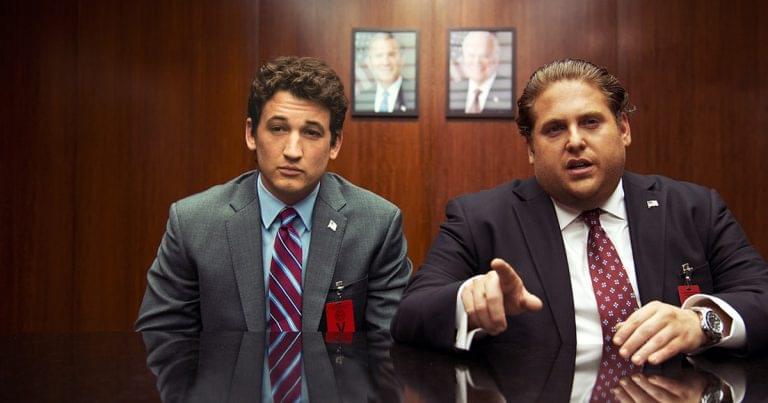
‘Tis based on a true story, adapted from a Rolling Stone article called “Arms and the Dudes” (they should have kept that title), about two twentysomething Florida stoners who came out of nowhere to become international arms dealers during Bush’s second term. Our narrator, and the one who still has vestiges of a conscience, is David Packouz (Miles Teller), who explains that he was restless and unfulfilled working as a massage therapist for $75 an hour when his troublemaking best friend from middle school, Efraim Diveroli (Jonah Hill), moved back to Miami with a new scheme.

Efraim, a boisterous, tubby boor with an obnoxious laugh who we are supposed to believe is good at charming people, has been buying seized guns at government auctions and reselling them on the Internet. He has visions of expanding this practice, taking advantage of post-Halliburton rules requiring the Pentagon to let any and all contractors bid on jobs for outfitting our military in Iraq and Afghanistan. David comes along as a business partner, and a wealthy dry-cleaner (Kevin Pollak) invests start-up capital to help them get going.

What they’re doing is legal, though Efraim is intent on doing it illegally: cutting corners, falsifying documents, buying weapons from countries that America isn’t allowed to do business with. David, who naturally has a concerned and pregnant girlfriend at home (the reluctant criminal in these stories always has a concerned, pregnant girlfriend), lies to said girlfriend (played by Ana de Armas) about what he and Efraim are doing. The lies get bigger when, for example, a shipment of guns is held up at the Iraqi border and he and Efraim must fly to Jordan to smuggle them in themselves. Eventually, with the help of a shady arms dealer named Henry Girard (Bradley Cooper), they stumble into a massive, multi-million-dollar Pentagon contract involving a warehouse full of unused Albanian weapons.

Our review of “War Dogs” from the Movie B.S. with Bayer and Snider podcast:

Download audio

Phillips, making his equivalent of Adam McKay’s “The Big Short” mixed with Michael Bay’s “Pain & Gain” (and hoping, wishing, praying it could be his equivalent of Scorsese’s “Wolf of Wall Street”), conveys the complicated story by regularly freeze-framing the action and having David narrate. It is therefore not hard to follow; if anything, it’s over-explained, told rather than shown. Co-writing with Stephen Chin and Jason Smilovic (“Lucky Number Slevin”), Phillips wants the story to be one of those fascinating, so-crazy-it-must-be-true capers, but as it unfolds, we realize that apart from a few choice moments, the events really aren’t outrageous enough to justify the detailed, step-by-step retelling. A couple of “Scarface”-worshipping dudes got in over their heads while bilking the government. So?

Nor is the movie sufficiently amusing to compensate for the awfulness of its main characters. Efraim is the quintessential ugly American, even using that term to describe himself before referring to a foreign language as “gibberish.” He has no scruples, not even when dealing with friends, and he prides himself on his ability to lie, cheat, and swindle. Yet his caustic vulgarity isn’t funny enough to make him a “love to hate” figure. David is less despicable as a human being, but the film still lets him off easy by positioning him as the “moral compass.” (This was one of the problems with “Pain & Gain,” too: the characters are 8’s or 9’s on a 1-10 scale of loathsomeness, but the movie thinks they’re only 6’s.)

It isn’t a total bust; Phillips and the actors are competent, and there are standalone instances of sharp comedy. There are also 75,000,000 uses of the word “bro.” When telling a story about repugnant people who are motivated by nothing but naked greed, it’s tough to find a tone that will make them palatable as entertainment, whether as figures of scorn, mockery, pity, or amusement. Phillips doesn’t have the finesse to manage it.

Pete’s Dragon

0
Pete’s Dragon
IT'S RIGHT BEHIND YOU!

Released any time of the year, Disney’s in-name-only remake of “Pete’s Dragon” would be a delicate and refreshing treat. But it’s especially welcome as it comes near the end of a loudly disappointing summer, a soothing balm after so many seething bombs.

First, though, you have to forget the 1977 version. The new one, assigned to writer-director David Lowery on the strength of his wistful 2013 indie drama “Ain’t Them Bodies Saints,” is set in a different time and place (the Pacific Northwest in about the 1980s) and has a different storyline. It’s not a musical, and it doesn’t have hillbillies singing about how they’re going to murder the orphan they bought.

More noticeable is the change in tone: gentle, dreamy, and understated, rather than sappy and slapstick-y. It’s wholly separate from the original, a complete reimagining.

Pete (Oakes Fegley), about 10 years old, has been living as a feral child in the forest ever since his parents were killed in a car accident six years earlier. (This and other tragic elements are depicted discreetly, to avoid upsetting the young children who are the target audience. I don’t think the word “dead” or its cognates is ever used.) Pete’s lone companion and protector is Elliot, a school-bus-sized dragon with powers of invisibility. When he’s visible, he’s mammalian in appearance — he has fur (green) — with cat-like features and a dog-like demeanor.

Folklore about dragons has sprung up in the nearby logging town of Millhaven, and a few people — including old man Meacham (Robert Redford) — claim to have seen the dragon and felt its magic. Meacham’s daughter, Grace (Bryce Dallas Howard), a forest ranger, humors her dad and the children he tells tales to, but doesn’t believe in things she can’t see. (Theme alert!) When loggers stumble upon Pete and bring him to town, Grace, her logger fiancé Jack (Wes Bentley), and Jack’s daughter Natalie (Oona Laurence) are fascinated by his matter-of-fact description of what they assume is an imaginary friend.

Lowery, co-writing with Toby Halbrooks (who produced some of his earlier films), gives the story the conflict it needs to be driven forward, but not at the expense of the sweet serenity that lies at the center of it. Yes, nobody believes Pete at first; yes, child protective services wants to take Pete away; yes, as soon as Elliot’s existence is confirmed, Jack’s greedy brother (Karl Urban) wants to capture him. Lowery doesn’t whip us into a frenzy over any of these complications, and he doesn’t let them drag on longer than necessary.

Nor is he interested in raucous, rude action. Apart from a couple of wet dragon sneezes, there’s very little in the way of rowdiness or clowning; though the film has humorous moments (and they work well), it’s more a tender, dramatic adventure than a comedy.

The emotional element is likewise muted, with no histrionics or “big moments.” Pete and Elliot’s friendship is enchantingly simple (the dragon doesn’t talk), and the new connections Pete forms with Grace and Natalie are pure and uncomplicated. This light touch pays off in the end, when the tears are earned rather than jerked. It shows respect for the young audience, not beating them over the head with the emotions they’re supposed to feel.

Above all, this “Pete’s Dragon” is humble and unassuming, as if unaware of its quiet power. Free of the flamboyance that marks so many kids’ movies, and of the winking references to the past that plague so many remakes, Lowery’s vision is wonderful and big-hearted, beautiful inside and out.

Sausage Party

0
Sausage Party
Right??!

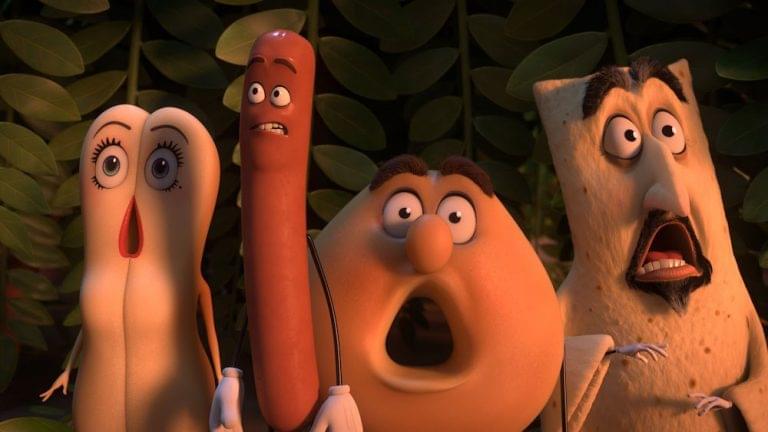
The most surprising thing about “Sausage Party” — a hard-R-rated cartoon conceived as a filthy version of “Toy Story” with food instead of playthings — is that it’s not a one-joke movie. Yes, it has sexual puns about hot dogs (all male) and buns (all female) yearning to be together, and numerous other food-related jokes of the it-practically-writes-itself variety. But it also has a story, an honest-to-goodness plot with themes and obstacles and character arcs and everything.

The least surprising thing about “Sausage Party” — which was conceived by Seth Rogen, Evan Goldberg, and Jonah Hill, then written by Rogen, Goldberg, and the team of Kyle Hunter and Ariel Shaffir (“The Night Before”) — is that it relies too much on unmotivated obscenity and has an ending that screams We couldn’t think of a good ending. It’s consistently sophomoric, periodically hilarious, and peppered with minor stoner insights. (Dude, Israelis and Palestinians both love hummus! They should build on that common ground!)

Every morning at the grocery store, all of the food items greet the day by singing a song — a hymn, really — about the Great Beyond, the glorious place where food goes after “the gods” (humans) take it from the supermarket shelves. Every piece of food longs to be deemed worthy for selection, and as the song (written by Disney stalwarts Alan Menken and Glenn Slater) attests, they’re pretty sure nothing bad happens once the gods get them home.

Well — a story about sentient food that doesn’t know what humans do with food: I’m sold. Making it a commentary on religious faith ups the ante. For when a jar of honey mustard (voice of Danny McBride) is returned to the store and put back on the shelf, he brings with him a horrifying tale of what actually occurs in the Great Beyond. No one believes him, though; after all, they’ve been singing this song every day for who-knows-how-long. How could their whole religion be based on a lie?

Our hero is a hot dog named (obviously) Frank (Seth Rogen). He and his hot dog brethren (inexplicably called “sausages” even though they are hot dogs and nobody in real life calls hot dogs “sausages”) sit on a display next to packages of buns, whom they lust after. Frank has his eye on a particular bun, Brenda (Kristen Wiig), and they long for the prophesied day when he’ll be slid inside of her. (Again, what happens after that is a mystery to them.) They know, however, that they must not commingle before the appointed time, or the gods will be angry.

Once they’re chosen, with honey mustard’s newfound atheism ringing in their ears and causing doubts, the story splits into three threads. In one, Frank and Brenda are removed from their packages and must traverse the supermarket in search of their home aisle, accompanied by two mortal enemies: a very Jewish bagel (Edward Norton, doing Woody Allen) and a very Arab lavash (David Krumholtz), who hate that they’ve been forced to share aisle space. (Elsewhere, a Native American bottle of “firewater” complains about his people being pushed off their shelves by “crackers” — meaning saltines and such, of course.)

Meanwhile, Frank’s malformed frankfurter friend Barry (Michael Cera) sees for himself what gruesome terrors befall his kind in the gods’ kitchens, and subsequently ends up out in the world, where he’s surrounded by corpses (i.e., discarded, half-eaten food). Finally, there’s an angry douche (Nick Kroll) — it’s not just food that’s alive, apparently, but any item sold in a grocery store — who wants revenge against Frank and Brenda for damaging his nozzle during a tragic shopping cart wreck.

That wreck, a morbidly funny “Saving Private Ryan” sequence, is where the film explicitly spells out its physical logic: not only is the food alive, but it feels pain when it’s crushed, sliced, or trampled. There is no end to the perverse delight the movie takes in exploring this idea.

On the other hand, whenever the movie bumps up against an aspect of the “food is alive” concept for which the writers cannot work out a logical explanation, they just ignore it. Similarly, when a line of dialogue needs to be funny and they can’t think of a way to phrase it that will achieve that effect, they often phrase it normally and just pepper it with obscenities, hoping that will make up the difference.

The screenplay is clever and ingenious, in other words, but only until cleverness and ingenuity stop coming easily. When it gets tricky, you can feel Rogen and company falling back on, “Eh, it’s just a stupid movie, don’t think too much about it.” The villain is weak (funny though it may be to see a douche walking around acting like, y’know, a douche), and the story’s self-referential resolution is the very definition of “the easy way out.”

But when it works, it works with dizzying, anarchic glee, making jokes at the expense of every ethnicity, nationality, religion, and sexuality that it can reasonably connect to a food item. Like “South Park: Bigger, Longer & Uncut” (the best R-rated cartoon ever made, by the way), “Sausage Party” is notable for being more thoughtful than you’d expect and filthier than you ever imagined possible.

Florence Foster Jenkins

0
Florence Foster Jenkins

Florence Foster Jenkins (the person) was a 1940s Manhattan socialite and arts patron whose desire to be a professional singer, shall we say, outpaced her abilities. “Florence Foster Jenkins” (the movie), on the other hand, is quite competent, a cheerful ode to the values of loyalty and determination that hopes you’ll overlook (or agree with?) the dubious “everyone gets a trophy” philosophy that it tacitly endorses.

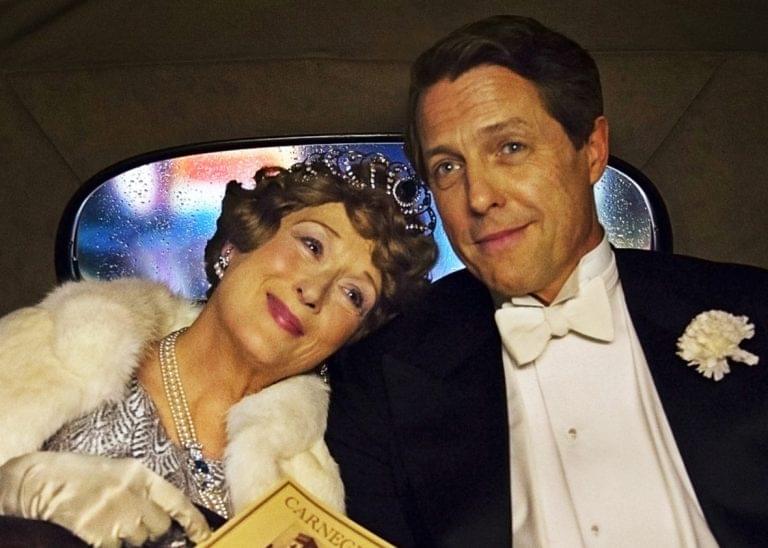
It was directed by Stephen Frears, an old hand with stories about matronly patricians based on real people; see “The Queen” and “Philomena,” for example. Here he has Meryl Streep in the warm, daffy title role, with the action set in 1944. Madame Florence and her doting, platonic husband/manager, St Clair Bayfield (Hugh Grant), are regular sponsors of artistic programs appealing to New York’s upper crust. Like many such patrons, they fancy themselves amateur performers (St Clair was once a small-time actor) and yearn to be more directly involved. Florence muses that she’d like to sing again, maybe give a recital.

Our review of “Florence Foster Jenkins” from the Movie B.S. with Bayer and Snider podcast:

Download audio

Well, the nice thing about being rich and surrounded by enablers is that you don’t necessarily need to be talented to succeed. And to be clear, Florence cannot sing. We discover this when she rehearses with a new pianist, a bow-tied little pixie named Cosme McMoon (Simon Helberg, showing off his real piano skills), whose face on hearing her caterwaul that first time is alone worth the price of admission. Not only is Florence apparently tone-deaf, her enunciation of opera’s many foreign words is incomprehensible, and she tries to sing passages that would be difficult even for an experienced soprano. Cosme is bemused when St Clair shows no visible sign of realizing how bad Florence sounds, and astonished when her voice teacher placates her with non-praise like “There is no one like you” and “You’ll never be more ready.” Why is no one telling her the truth?

The more we learn about Florence and her sad history, the more we see just how much truth is being kept from her. She knows St Clair has his own apartment, but she’s unaware of his relationship with a younger woman, Kathleen (Rebecca Ferguson). Indeed, St Clair has dedicated his life to shielding Florence from unhappy realities. He ensures that the recital is only attended by “true music lovers,” meaning their friends, people who won’t laugh at her. He bribes the music critics, and denies entry to the un-bribable ones. Frears, working from a screenplay by British TV writer Nicholas Martin, plays all of this sneaking around like a P.G. Wodehouse farce, with Grant and Helberg nimbly tiptoeing through the social minefields.

St Clair’s deception comes from his devotion to Florence, not because she demands it — and that’s an important distinction. This isn’t a story of unchecked ego, of a rich lady ignoring reality in favor of creating her own. A character like that would be mockable. But Florence, sweet and generous (she writes Cosme into her will), is genuinely unaware of her shortcomings because everyone keeps lying to her about them. This makes her an object of pity, not derision. As bad as she is, we find ourselves not wanting her to find out, especially not the hard way. Let the old do-gooder have her delusions. What’s the harm?

The critical part of me — the part that has endured enough bad art, thank you very much, and that doesn’t believe in giving insincere praise — grows uncomfortable in the latter stages of the film, when people begin to acknowledge Florence’s ineptitude yet applaud her anyway. Even granting that the very act of getting onstage takes courage, it feels wrong — even cruel — to foster a performer’s erroneous view of herself. Seeing people do exactly that in the film’s climax is depressing, not inspiring.

But the part of me susceptible to cheerful, funny movies about colorful characters, especially characters who act out of love (mostly) rather than self-interest — that part can’t resist “Florence Foster Jenkins,” wrong-headed though it may be in some respects. Near the end, when Madame Florence starts to become self-aware, she remarks, “People may say I couldn’t sing. But no one can say I DIDN’T sing.” The 110 charming minutes we’ve spent with her and her associates make it hard to argue with her logic.

— Oregon ArtsWatch

Hell or High Water

0
Hell or High Water
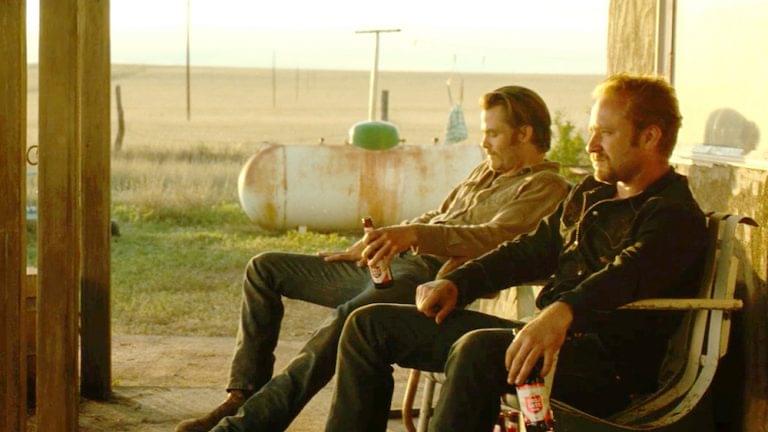
Well, they don't look so dangerous here.

Most Westerns made in the last 50 years, whether set in the past or the present, have been at least partially about how the West has changed from how it was in the Westerns made in the previous 50 years. “Hell or High Water” is no exception. Set in a present-day West Texas where citizens still boast of their fondness for frontier justice (that is, vigilantism) and readily form posses to pursue outlaws (in SUVs instead of on horseback), the film is a crackling example of the New Western, mixing familiar archetypes into an entertaining genre exercise.

Directed by David Mackenzie (“Mister Foe,” “Starred Up”) from a screenplay by “Sicario” writer Taylor Sheridan, “Hell or High Water” gives some good actors an opportunity to play to their strengths. Chris Pine and Ben Foster are Toby and Tanner Howard, brothers committing a series of small-time bank robberies; Jeff Bridges is Marcus Hamilton, a grizzled Ranger nearing the age of mandatory retirement who doggedly tracks them. You get a sense of the brothers’ temperaments after their first robbery, during which Tanner pistol-whipped the bank manager:

TOBY: Did you have to do that?
TANNER: [whoops] [End of conversation.]

Tanner (Foster) is a lifelong criminal with erratic behavior, the black sheep of the family. Toby (Pine) is the good son, a law-abiding man who’s been forced into these desperate acts by a sense of duty. Like Butch and Sundance before them, the Howard brothers’ real enemies are the very banks they’re robbing. This land was stolen from the Indians by the white man; now it’s being stolen from the white man by the banks. In this barren, depressed part of the country (no country for old men, to be sure), there’s little local sympathy for financial institutions.

Our review of “Hell or High Water” from the Movie B.S. with Bayer and Snider podcast:

Download audio

That includes Ranger Marcus Hamilton, who identifies one bank’s manager with, “You look like a man who could foreclose on a house.” But Marcus, a folksy version of a Tommy Lee Jones character (“You got bopped on the schnozzola!” he says cheerily to a victim), is a dedicated law-and-order man, ably assisted by Ranger Alberto Parker (Gil Birmingham), whose ethnicity — half-Comanche, half-Mexican — is a never-ending source of jokes from Marcus. Alberto clearly doesn’t have much patience left for the slurs, but it’s just as clear that Marcus means them to be affectionate and playful. He’s a flawed old man, and the film eventually finds great poignance in this.

Pine and Foster have a believable fraternal chemistry, and both actors give performances that are more emotionally complex than many Westerns have. That’s especially significant coming from Foster, playing a man who easily could have been a two-dimensional psycho but instead shows the regrets of a life misspent. Mackenzie moves the story along at a good pace, balancing tight action with effective (often humorous) dialogue, occasionally using sudden violence to remind us that a story of cops and robbers isn’t all fun and games. The West has different now than it was in the frontier days, but some things never change.

Friday movie roundup – Aug. 5

0

August is busting out all over, just like in the first draft of the old song. The movie pickin’s are slim this week:

— “Suicide Squad” (PG-13) D
— “Cafe Society” (PG-13) B- [Oregon ArtsWatch]

There’s also “Nine Lives,” with Kevin Spacey as a talking cat!?!, which wasn’t screened for critics. I have now seen it, though, and a review is forthcoming. (It’s bad but benign.) (The movie, not the review.)

We talked about “Suicide Squad” a lot on this week’s Movie B.S. with Bayer and Snider.

Elsewhere, you can read what I wrote about these movies:

— “Metropolis” (1926) [Mental Floss]
— “American Graffiti” (1973) [Mental Floss]
— “Howard the Duck” (1986) [Movies.com]

To get reviews and recommendations emailed to you each week, sign up for In the Dark. And please consider throwing a dollar a month into the Patreon tip jar to keep the reviews flowing like precious lifeblood. Thanks!

Suicide Squad

0
Suicide Squad
And these are just two of them.

“Suicide Squad” is the equivalent of a band releasing a “greatest hits” album that’s all new songs and covers, and not very good ones. The same cart-before-the-horse mentality that leads to Part Twos being announced before the Part Ones are finished has led to this: a rogue’s gallery of supervillains we’ve never heard of but whom the movie treats like household names.

Look out, everybody! It’s BOOMERANG! Yes, Boomerang (Jai Courtney), the nefarious Australian criminal who plagued, I don’t know, probably Gotham? Australian Gotham? He’s teamed up with hitman Deadshot (Will Smith), who of course you know from the time he infamously, uh, did some crimes in another story, which you didn’t read but which the movie assumes you loved.

One bad guy you are familiar with, the Joker (Jared Leto), is present. But he’s not part of the Suicide Squad, and he has maybe five minutes of screen time that feel like four minutes too many. You will wonder about — perhaps be actively angry at — the fact that Leto’s “Method acting” shenanigans have dominated the pre-release discussion of the film, even though he’s barely in it and has no scenes with any major characters except Harley Quinn (Margot Robbie), a psychologist who was treating the Joker before she became his disciple. (You won’t blame the movie for this, though. That’s the marketing. Not the movie’s fault. The movie being bad — that’s the movie’s fault.)

Anyway, it’s all the better to focus on the characters moviegoers have REALLY been clamoring to see! Characters like Diablo (Jay Hernandez), a tattoo-faced Los Angeles gangbanger who can make fire but doesn’t want to! Or Killer Croc (Adewale Akinnuoye-Agbaje), some kind of man-crocodile monster who asks for the BET Channel in his prison cell to remind us that the actor who plays him is black!

And don’t forget the ladies! We already mentioned Harley Quinn, whose major character traits are dressing like a creepy old man’s idea of jailbait and not having a convincing American accent. There’s also June Moone (Cara Delevingne), the archeologist who’s possessed by a witch named Enchantress and whose military boyfriend, Rick Flag (Joel Kinnaman), wants to save her; and Katana (Karen Fukuhara), who has a sword that collects people’s souls after it kills them.

Most hilariously, don’t overlook Slipknot (Adam Beach), who is introduced after all the other villains, like maybe the movie forgot about him, only to be immediately (SPOILER ALERT) killed.

The DC Extended Universe:

“Man of Steel” (2013) B-
“Batman v Superman: Dawn of Justice” (2016) C-
“Suicide Squad” (2017) D
“Wonder Woman” (2017) B+

This thick, swampy mess was written and directed by hit-or-miss David Ayer (“End of Watch,” “Sabotage”), then evidently manhandled to within an inch of its life by studio notes and reshoots. The story is that a government agent named Amanda Waller (Viola Davis, tolerating no shenanigans) wants to assemble a secret team of supervillains to be deployed in case a malevolent creature with Superman-like powers ever shows up. The villains, all guilty of multiple murders, are recruited from a secret prison, offered reduced sentences for their cooperation, and fitted with a device that will kill them if they go rogue.

It’s genuinely, though not intentionally, funny how certain Amanda Waller is that nothing will go wrong with this plan. It becomes funnier when the Suicide Squad’s first mission is to stop a rogue member of the Suicide Squad. Seems the Enchantress has freed her brother from a genie bottle and the two of them are wreaking havoc on Midway City (Gotham and Metropolis are presumably both still in ruins after “Batman v Superman”). Also, the Joker and his goons have taken over a science lab, possibly in conjunction with the Enchantress siblings’ plan, maybe separately — maybe in a different movie entirely — and now the Enchantress has an army of easily killed lumpy black soldier-monsters.

The Squad is assembled and given instructions (which must take several hours just in terms of transportation), all while the attack on Midway City is still happening. Neither the police nor the military seem to have responded; Midway City has put all its eggs in the Suicide Squad basket. So the bad guys half-heartedly work together to defeat the other bad guys, frequently pausing to have conversations about how bad they all are, and how doing bad things is just what they DO, man.

Our review of “Suicide Squad” from the Movie B.S. with Bayer and Snider podcast:

Download audio

These cursory attempts at characterization and their accompanying brief flashbacks are supposed to compensate for all the backstory we missed by not seeing these people introduced in other films: since they couldn’t show us, they have to tell us. (Ayer also uses on-the-nose song cues as shorthand, including “Sympathy for the Devil,” “You Don’t Own Me,” “Super Freak,” and “Dirty Deeds Done Dirt Cheap.”) But the effect is to make us wish we could have seen THOSE stories, not this weak goulash of characters with interesting pasts and dull presents. Diablo and Katana both have tragic origins that mean nothing here; Rick Flag and June Moone’s love affair is said to be epic yet scarcely registers. (For what it’s worth, Will Smith and Margot Robbie do their best to infuse their shoddily written roles with personality.)

Now, this is the reaction of someone who hasn’t read the comic books that spawned the Suicide Squad and is unfamiliar with the dramatis personae. Someone more versed in the material — someone who is not me, in other words — will undoubtedly have a different experience, possibly better, maybe worse. For me, the filmmaker and studio’s inexplicable decision to construct a building without first laying a foundation was self-evidently a bad one.

Nine Lives (2016)

0
Nine Lives (2016)
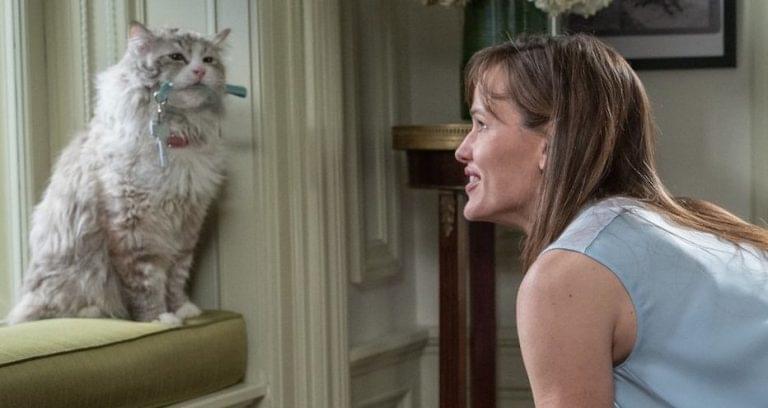
Even the cat is embarrassed.

Wow, what a mixup! “Nine Lives” — a benign, cheap-looking family comedy about a workaholic dad who learns What’s Really Important when he becomes trapped in the body of a house cat — was clearly supposed to be a Disney Channel movie. It carefully avoids profanity, it’s the perfect length to fill a two-hour time slot with commercials, and the visual effects (even basic ones like green-screen backgrounds) were designed under the assumption that they’d never be seen by anyone who would care that they’re terrible. There’s no way this was intended to play in theaters.

And yet here it is, not on the Disney Channel, and not even from Disney! Somehow it accidentally stars Kevin Spacey, too, and was inadvertently directed by semi-respected filmmaker Barry Sonnenfeld (“Men in Black,” “The Addams Family”). I don’t know how all these mistakes happened, but man oh man, is someone ever going to get fired for it.

Spacey plays Tom Brand, a Manhattan real estate tycoon on the verge of opening what will be the tallest skyscraper in North America. His adult son, David (Robbie Amell), works for the company but doesn’t have Dad’s respect because he’s afraid to go skydiving with him. (This is the only reason the movie gives.) Tom’s younger second wife, Lara (Jennifer Garner), and their daughter, Rebecca (Malina Weissman), are used to Tom being at work all the time and ignoring them.

For Rebecca’s 11th birthday, Tom, an inveterate hater of cats, finally caves in and gets her one. He gets it from a mysterious shop in an alleyway run by one Felix Perkins (Christopher Walken), which ought to be a red flag. After the scene between the two Oscar-winning actors is finished and Tom has departed, before the sadness of knowing these two might never be in a real movie together hits you, Perkins says to the pets in his shop, “OK, cats. Let’s do this!”

“This,” as it turns out, is a curse or something (the movie doesn’t even pretend to provide details). Later that day, at the moment that Tom is seriously injured in an accident and his body falls into a coma, his soul is transferred to the cat. Lara and Rebecca take Mr. Fuzzypants home, and it only takes them a day to remember that cats need food, water, and a litter box, so everything’s probably going to be fine. Tom has to reevaluate his priorities, connect with his wife and daughter, let David know he’s proud of him, AND save his company from an unscrupulous board member (Mark Consuelos), all while being a cat. And he must do this before his comatose body dies, or he’ll be feline forever.

You’re familiar with how this whole “talking animal” business works. We hear Kevin Spacey’s voice, but the other characters just hear meowing. (Except for Perkins, the cat whisperer. He hears Mr. Fuzzypants in plain English. I would not be surprised if this is an actual skill possessed by Christopher Walken.) It’s funny, though: we only hear meowing to represent Tom’s efforts to speak when the cat’s mouth is not visible. When we can see the cat’s mouth, the cat is silent — even when we hear Spacey’s voice. Is it that hard to train a cat to meow on command? (I mean, I’m surprised anyone can train a cat to do anything. But I’m not the one who made a movie about a talking cat.)

A few things in the film, which was written by five (5) people, help it come close to not being awful. Cheryl Hines appears as Tom’s first wife (David’s mother), a martini-guzzling socialite whose brief scenes with Tom’s current wife are jovially catty (ha!). Scenes of Tom-as-Mr.-Fuzzypants trying to write a note or stumbling around the kitchen drunk after getting into the liquor cabinet are amusing, especially the shots that involve an actual cat and no CGI (it’s mostly CGI, and not the expensive kind).

But most of the physical comedy is clumsily cartoonish, the Apple product placement is overdone, and the story (perhaps needless to say) fails to connect on anything approaching the emotional level it aims for. (Just wait till they come back to the skydiving thing!) It’s ultimately not even a pro-cat movie, either: the lesson Tom learns is that cats are selfish and mean, and he needs to not be like that.

It’s also best that you not contemplate the reality the film establishes: Perkins is an omnipotent wizard who can magic you into a cat’s body to teach you a lesson, and keep you there forever if you fail to learn it. He alone decides. The cats in his shop are the damned souls of the people he’s done this to before — making him exactly like Ursula the sea witch, except that Ursula’s victims willingly made bargains with her. Perkins just sucker-punches you.

Anyway. The movie is bad, but it’s bland enough not to be excruciating. It’s not something you’d pay money to see, though. The theatrical release was almost certainly the result of an embarrassing bookkeeping error, and it would be indelicate to compound it by purchasing tickets.

Friday movie roundup – July 29

0

It’s the end of July, which means the summer blockbuster season is 3/4 over. Only a month to go! Here are this week’s movies, in order of quality:

— “Bad Moms” (R) B-
— “Nerve” (PG-13) C+
— “Jason Bourne” (PG-13) C

We talk about those movies plus “Star Trek Beyond” on this week’s episode of Movie B.S. with Bayer and Snider.

To get reviews and recommendations emailed to you each week, sign up for In the Dark. And please consider throwing a dollar a month into the Patreon tip jar to keep the reviews flowing like precious lifeblood. Thanks!

Jason Bourne

0
Jason Bourne
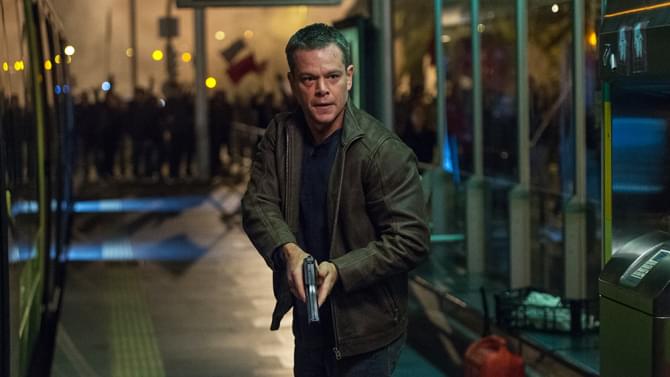
Oh, look who remembers how to use a gun.

Maybe too much time has passed since we last saw Jason Bourne, in “The Bourne Ultimatum,” in 2007. Maybe his quest for answers went as far as it needed to go and didn’t require an extension. Maybe the serviceable “Bourne Legacy,” with Jeremy Renner as a substitute, made it clear that Bourne himself was unnecessary. Whatever the problem is, the fifth entry in the franchise, is a flat, affectless, misfire.

It’s simply called “Jason Bourne”; it features the return of Matt Damon and “Supremacy” and “Ultimatum” director Paul Greengrass — and I was disappointed at how little I cared, how uninvested I was in Bourne’s mission. He reemerges this time because he has learned yet another wrinkle in his increasingly convoluted backstory: the CIA was watching him before they recruited him, and his father (Gregg Henry) may have been involved. Meanwhile, the CIA has been hacked again, and Nicky Parsons (Julia Stiles), Bourne’s old Agency accomplice, is implicated.

But never mind Jason Bourne. The film’s main concern is CIA director Robert Dewey (Tommy Lee Jones), a Tommy Lee Jones-faced man who’s secretly in cahoots with a Silicon Valley tech whiz (Riz Ahmed) to spy on everyone with a new piece of software and a new black-ops program (or maybe the same black-ops program as before but with a new name). Fearing exposure, Dewey wants Bourne dead and summons an unnamed asset called The Asset (Vincent Cassel) to do the job. But Heather Lee (Alicia Vikander), a new CIA analyst, asks Dewey to give her once chance to bring Bourne in alive, maybe even re-convert him to their side.

(Heather’s job is to be the person back at HQ who, when a CIA team is pursuing Bourne, watches the surveillance feeds and shouts directions like “He’s going into the alley!” and “Left at the top of the hill!”)

There’s a fine chase through Athens at the top of the film, another good one in Las Vegas at the end, and a whole lot of nothing in between. Where Bourne’s pursuit of the truth once engendered sympathy — what did those CIA monsters do to him?? — now it seems rote, as if Bourne himself is hardly interested. Greengrass, who co-wrote the film with its editor, Christopher Rouse, assumes we’re desperate to learn more about Bourne but makes no effort to show us — or remind us — why the character or the quest is compelling. Like I said, maybe it’s been too long since the handsome amnesiac last captivated us. Fittingly, I’m having trouble remembering why he ever did.

Bad Moms

0
Bad Moms
Hey, back in the kitchen with those drinks, ladies!

“Hangover” scribes Jon Lucas and Scott Moore have certainly found their niche. Their debut as writer-directors, “21 & Over,” transferred “Hangover”-style debauchery to a college setting, and their latest, “Bad Moms,” gives us the Moms Gone Wild version. If you want to see people drunkenly misbehave in an often funny but sloppily written raunch-com, Lucas & Moore are your guys!

In this one, Mila Kunis stars as Amy, an “average” frazzled suburban mom of two middle-schoolers who has a useless husband (David Walton). Amy gets fed up with the impossible standards of perfection set by Gwendolyn (Christina Applegate), the mean-girl PTA president — this is one of those movies where the local PTA is more powerful than the federal government — and decides to cut loose with her like-minded new friends: Carla (Kathryn Hahn), a promiscuous and irresponsible single mother; and Kiki (Kristen Bell), a modest and subservient stay-at-home wife.

The film is frequently hilarious when it focuses on Amy, Carla, and Kiki, the three of them harmoniously representing three distinct types (or stereotypes) of modern moms whose love for their children is not diminished by the fact that they’re overwhelmed and tired all the time. (Says the decidedly un-sentimental Carla, “Every time I think about that big, dumb motherf*****” — that is, her son — “going to college, I want to cry like a baby.”) They interact with crackling energy, the different personalities balancing one another, and their “crazy” adventures of sleeping in, having brunch, and going to the movies during the day are pure wish-fulfillment for the harried moms in the audience. (They do some legitimately rowdy things, too, including a drunken trip to the supermarket that’s an instant classic.)

The film is less successful when it focuses on Amy specifically: her dying marriage, the new guy she likes (Jay Hernandez), her kids’ various problems, her weirdly under-explained job. This stuff just isn’t as funny or relatable, largely because Lucas and Moore are so careless with the details (enough that you wonder if they have any experience with parenting, jobs, or relationships). Gwendolyn’s minions, played by Jada Pinkett Smith and Annie Mumolo (who co-wrote “Bridesmaids”), are underused, and the plot is wrapped up with astonishingly lazy tidiness. (Hooray for public speeches!)

But it’s worth it for MVP Kathryn Hahn, a devastating comedy force whose powers Hollywood is just beginning to comprehend. Ever since she told Veronica Corningstone that Ron Burgundy “will read anything that is put on that teleprompter — and when I say anything, I mean a-ny-thi-ng,” Hahn has been a bright spot in numerous small-scale comedies, with a particularly robust stint as a ruthless political adviser on “Parks and Recreation.” Meaner than Kristen Wiig, less clownish than Melissa McCarthy, she could take the lead in a dark comedy and knock it out of the park. In the meantime, she shines as a supporting player in this bumpy, scathing, and ultimately kind of sweet (I said KIND OF) confection.

Indignation

0
Indignation
She seems nice.

“Indignation” is the story of a headstrong Jewish atheist from New Jersey who goes to college in Ohio in 1951, feels repressed religiously and romantically, then receives a first-date sexual favor that derails his life. Ah, college! Tawdry though it may sound, it’s a prudent, old-fashioned movie, based on a Philip Roth novel and directed by James Schamus, writer/producer of several of Ang Lee’s highest-brow films. Logan Lerman (the once and future Percy Jackson) excels in his first mature role — notably in an erudite showdown with the college dean (Tracy Letts) — and is a sympathetic figure in this coming-of-age story about the consequences of youthful pride (and BJs).

Nerve

0
Nerve

Henry Joost and Ariel Schulman, the directing team behind “Catfish,” “Paranormal Activity 3” and “4,” and the new teen-oriented cyber-thriller “Nerve,” know how to affect coolness and currency without seeming to try too hard — a rarity in Hollywood. Their films show young people using computers and social media the way actual youths do (more or less; Emma Roberts’ Macbook does turn into a touchscreen a couple of times here), with slang that’s topical but not forced.

But all the street cred in the world can’t un-dumb “Nerve,” a ludicrous, self-serious semi-thriller about the dangers of peer pressure, online anonymity, and cyberbullying. It’s what you’d get if a socially conscious Millennial made an Afterschool Special, and though it’s fitfully engaging and periodically watchable, it can’t overcome its inherent weakness: it’s about idiots doing stupid things for no good reason. Show a woman risking her life to save her children, I’m interested. Show her risking her life for a couple hundred dollars, I’m out.

It stars Emma Roberts as Vee, a mildly timid Staten Island high-schooler whose brazen best friend, Sydney (Emily Meade), cajoles her into participating in a smartphone game of public dares called Nerve. The people watching your livestream suggest dares, and there are cash prizes for accomplishing them. The riskier the stunt, and the more watchers you have, the more the payout. Apart from the massive liability issues, it’s actually a great idea for a game.

Vee’s first dare (to kiss a stranger) introduces her to Ian (Dave Franco), who turns out to be a fellow Nerve participant. As the online audience finds Vee and Ian to be a cute couple, their dares are interconnected for the rest of the night. But maybe there is more to Ian and the game than Vee realizes?? Vee’s platonic-but-thirsty guy friend Tommy (Miles Heizer), who happens to be an expert computer hacker (this will come in handy later), watches nervously from the sidelines, and Sydney gets jealous over the size of Vee’s audience. Vee’s mother (Juliette Lewis), oblivious to everything, appears now and then because the movie (adapted by Jessica Sharzer from Jeanne Ryan’s novel) figured at least one of these kids needed to have a parent.

The watchers are right about Roberts and Franco being a cute couple, and “Nerve” gets by for a while on the characters’ naive enthusiasm. But as the dares get increasingly dangerous (blindfolded motorcycling, etc.), and as everyone’s motives become clearer, the story collapses into absurdity, then adds some heavy-handed moralizing for good measure. And what lessons do we learn? Oh, just obvious ones like DON’T DO LIFE-OR-DEATH STUNTS JUST BECAUSE ANONYMOUS STRANGERS TOLD YOU TO, YOU MORON.

Friday movie roundup – July 22

0

The Laotian kids who work in my sweatshop neglected to post a roundup last week, so we have a fortnight’s worth of reviews to catch up on. They are:

— “Ghostbusters (2016)” (PG-13) B-
— “Star Trek Beyond” (PG-13) B-
— “The Infiltrator” (R) B
— “The Phenom” (NR) B
— “Captain Fantastic” (R) B
— “Lights Out” (PG-13) C
— “Ice Age: Collision Course” (PG) C-

This week’s episode of Movie B.S. with Bayer and Snider also has a review of “Absolutely Fabulous: The Movie” (C), while last week’s had “Hunt for the Wilderpeople” (B+).

If you missed it, there are new rewards and milestone goals for my Patreon, including the potential return of Eric’s Bad Movies. More details about it here.

Star Trek Beyond

0
Star Trek Beyond

As attested by the four “Fast and the Furious” movies he made before this, “Star Trek Beyond” director Justin Lin was never a big fan of gravity. Here, at last, he can abuse it with impunity, and some of the most exhilarating moments in this amiable, low-stakes sequel involve upended starships and artificial atmospheres, people running up walls and sliding down corridors as the camera zips around to show us every angle. It may be the most intimate look we’ve had at the structure and geography of the U.S.S. Enterprise, and it’s fun to feel the ground fall out from under you in those moments — especially since everything else about the movie is so steady and unsurprising, with a villain-of-the-week ordinariness to it.

That villain is Krall (Idris Elba), a fearsome warlord who attacks the Enterprise in search of (what else?) an ancient artifact with which he can (what else?) conquer the galaxy. Krall and his very cool fleet of swarming, synchronized warships do significant damage to the most molested spaceship in the annals of fiction and take most of the crew — including Uhura (Zoe Saldana) and Sulu (John Cho) — back to headquarters on a remote planet. It thus befalls Capt. Kirk (Chris Pine), et al., to rescue them, aided by a fierce new character, Jaylah (Sofia Boutella), who lives in the wreckage of a Federation starship that crashed on the planet a century earlier. Jaylah, working first with the marooned Scotty (Simon Pegg) and then with the rest of the Enterprise officers, may remind you of a certain Rey in a certain other recent Star-related sequel.

This all comes at a pivotal juncture for the Enterprise crew. As Kirk explains in his opening log, they’ve been in space for a few years, and the loneliness and repetition are taking their toll. The mission has begun to feel “episodic,” Kirk says, no doubt an intentional reference on the part of screenwriters Simon Pegg (who plays Scotty) and Doug Jung (who appears briefly as Sulu’s partner) to the saga’s TV origins. But that’s just the thing. Though the film glides merrily through its paces, it has no more urgency than a mid-season episode of a Trek TV show, no risks for anyone but the unnamed crew members.

It’s even lighter on character development — which is a shame, because we’ve really come to enjoy these new versions of the iconic characters. The actors are comfortable in the roles — Bones (Karl Urban) and Spock (Zachary Quinto) get some quality odd-couple time together; Chekov (Anton Yelchin) gets to hang out with Kirk — but everybody’s the same at the end of the film as they were when it started. (Except, that is, for the resolved mini-crisis over whether Kirk and/or Spock might leave the Enterprise for other assignments. Of course they won’t.) The personal lives of the Enterprise officers are on hold this week. And it’s too bad, because if Lin’s keen visual sense were paired with a weightier, meatier story, he’d really be able to soar.

Ice Age: Collision Course

0
Ice Age: Collision Course

After three harmless, amusing adventures and a fourth movie that I didn’t see, the “Ice Age” franchise becomes a burden to society with its fifth entry, “Collision Course,” a dismal animated sitcom that exhausts any remaining goodwill toward the series and its bland, dopey characters.

In this episode, Manny the mammoth (voiced by Ray Romano) is so mopey about his daughter Peaches’ (Keke Palmer) impending marriage to a nice mammoth named Julian (Adam Devine) that he has forgotten his own wedding anniversary with Ellie (Queen Latifah)! Also, less importantly, there is a giant meteor heading for Earth that will kill them all.

So the mammoths and their entourage — Sid the sloth (John Leguizamo), Granny sloth (Wanda Sykes), Diego the tiger (Denis Leary), those weasels or possums or whatever (Seann William Scott, Josh Peck) — head for safety, led by Buck the one-eyed weasel or possum or whatever (Simon Pegg), who has read the prophecies (there are prophecies now) and thinks he knows how to divert the meteor’s course. Meanwhile, Manny and Ellie conspire to scare Peaches out of getting married and moving away, because they will miss her and are selfish.

Also meanwhile, a fearsome dino-parrot (Nick Offerman) and his two offspring (Max Greenfield, Stephanie Beatriz) are in pursuit of Buck, primarily to add one more element of conflict to the story. The behind-the-scenes conflict is that new characters keep being added and then immediately turned into dead weight. Poor Diego has nothing to do, and his new mate, Shira (Jennifer Lopez), has even less.

These films have always leaned toward corny sitcom humor, but in the past, they’ve been at least partially redeemed by strong physical gags, especially involving Scrat the squirrel. Not this time. This time, Scrat spends the whole movie in space (seriously), traveling in an alien spaceship he found frozen in the ice, ricocheting off planets and inadvertently causing the meteor showers. And on terra firma, the trio of returning screenwriters (Michael J. Wilson, Michael Berg, Yoni Brenner) offer up only the lamest, most perfunctory zingers and one-liners before wrapping things up in a nice bow: “Change isn’t easy, but it’s part of life.” Then everybody hugs and the studio audience says, “Awwww.”

Lights Out

0
Lights Out

“Lights Out,” David F. Sandberg’s 81-minute expansion of his 3-minute short, has a fine premise for a 3-minute short. Heck, you could even flesh it out to 10 or 15. This feature-length version, though, has a rushed, half-baked air to it, long enough to qualify as a feature yet somehow still short on story, character, and detail.

It’s small in scale, with only three major roles and a couple of hangers-on. Sophie (Maria Bello) is a depressed, bedraggled recluse whose troubling behavior — she talks to an invisible friend named “Diana” — has begun to take its toll on her young son, Martin (Gabriel Bateman). Sophie’s semi-estranged twentysomething daughter, Rebecca (Teresa Palmer), intervenes to protect her brother, recalling her own scary dealings with “Diana” when she was his age.

Diana is real, by the way. We learn that in the first five minutes. She’s a spindly, wraith-like shadow-creature who can inflict actual physical harm in the dark but disappears in the light. No lights, there she is. Turn the lights on, she’s gone. Turn the lights off again, she’s back, only now she’s closer. Sandberg gets a lot of mileage out of this spooky trick, but it’s the only one he’s got.

When it comes time for Rebecca to learn Diana’s origins, the movie gets especially lazy: Mom has a box of evidence in her house, complete with psychiatrists’ tape recordings and photos, spelling everything out. This convenient box o’ evidence isn’t even hidden; it’s just sitting in the study, a well-lit room that Sophie clearly uses regularly. (Later, Sophie demands to know where Rebecca found a particular photograph — one that was pinned to the wall in that very room.)

The screenplay is by Eric Heisserer, who has several lackluster sequels and remakes under his belt, including “The Thing,” “A Nightmare on Elm Street,” and “Final Destination 5.” What he delivers here feels like a first draft; you can practically hear the typos. Now and then the film makes a feint at being a metaphor for depression or abusive relationships, but neither idea is explored meaningfully. Likewise, the “rules” governing Diana and her powers are unclear and inconsistent. Other details, like Rebecca’s aversion to commitment with her boyfriend (Alexander DiPersia), are similarly distracting and undercooked.

But is the movie scary? A little bit, a few times. Not much. Like about 75% of PG-13 horror films, it seems destined to play at teenage slumber parties and other gatherings of low-expectation viewers. That’s not a recommendation, but it’s not a condemnation, either. I’ve seen worse.

Absolutely Fabulous: The Movie

0
Absolutely Fabulous: The Movie

Sweetie, darling! That’s how you begin any story about “Absolutely Fabulous,” the British sitcom best known to Americans through its endless repeats on Comedy Central in the second half of the ’90s. I never got into it, but I know how to say “Sweetie, darling!” The movie rejoins hedonist celebrity publicist Edina (Jennifer Saunders) and fashion editor Patsy (Joanna Lumley) just as we left them: drinking heavily, popping pills, living off of Edina’s daughter (Julia Sawalha), and avoiding work. Nothing has changed except that they are older, which makes them sadder, more desperate, and potentially funnier as they pursue beauty, youth, and money.

The plot has the gals fleeing to the French Riviera after they’re implicated in Kate Moss’ disappearance and presumed death (the hysterical public reaction to which is quite funny). Strapped for cash, Edina and Patsy scheme for one of them to marry a tycoon in Cannes, only slightly slowed down when the most eligible billionaire turns out to be a woman.

Written by Saunders and directed by Mandie Fletcher, the film plays like a farce at half-speed, setting up amusing scenarios but lacking the energy needed to really crackle. For every caustic put-down or ludicrous visual gag (Lumley dressed as a man), there are five moments where everything grinds to a halt for a cameo, often from the fashion world. Aimed at its TV fans and no one else, “Ab Fab: The Movie” slides right down the middle, probably appeasing the people who’ve waited more than a decade for it but doing little to add to its legacy.

Ghostbusters (2016)

0
Ghostbusters (2016)

“Ghostbusters,” the reboot of an obscure Harold Ramis/Ernie Hudson comedy from the 1980s, is about three scientists and a subway worker who learn that New York City is on the verge of being overrun by mean ghosts and must take action to prevent this. Like almost every reboot or remake of a good movie, it pales in comparison to the original. Unlike many, it’s funny and high-spirited enough to stand on its own. Indeed, it does best when it’s not using forced cameos or callbacks to remind us of the first movie, but instead letting these four new characters do their thing.

The new Ghostbusters don’t have exact counterparts to the original bunch — a wise choice, since no one is Bill Murray. (Even Bill Murray is no longer Bill Murray, if his dire cameo in this is any indication.) Erin Gilbert (Kristen Wiig) is a prim, respectable science professor at Columbia University who disavows the ghost book she once wrote with a colleague. That colleague, Abby Yates (Melissa McCarthy), is still investigating paranormal phenomena, and is now teamed up with Jillian Holtzmann (Kate McKinnon), a genius-level science nerd who reminds you of Egon Spengler for but a moment before she establishes her own ultra-weird manner and persona. A haunting at a museum brings the three together, soon joined by Patty Tolan (Leslie Jones), an MTA employee with an extensive knowledge of New York history who saw something strange in the subway tunnel.

After following many of the original’s story beats in the setup, the new one — directed by Paul Feig (“Bridesmaids,” “Spy”) and written by Katie Dippold (“The Heat”) and Feig — takes its own path. Notably, there is no Sigourney Weaver character. Where the ironically detached Peter Venkman needed a potential romance to motivate him to bust ghosts, the new ‘busters are earnest self-starters. The film is thus able to focus on their friendship and teamwork, a theme that is helped by introducing the fourth member of their group much earlier (and for less obvious reasons of tokenism) than poor Winston Zeddmore was.

The central quartet are all funny, separately and together, with Holtzmann the standout and McKinnon the only one of the actresses playing a character we haven’t seen her do before. They’re ably assisted by Chris Hemsworth as Kevin, the dumb hunk they hire as their receptionist, whose enthusiastic idiocy is good for several laughs and whose face inspires a spazzy crush from Wiig’s character, Erin. Zach Woods, Ed Begley Jr., Charles Dance, and Steve Higgins all have brief but funny turns. The film zips along smoothly enough, occasionally hilarious but more often just amusing.

The problem, I suspect, is interference from Sony. You can smell the studio notes hindering Feig’s usual looseness and spontaneity, mandating references to the ’84 film, and focus-grouping everything to death. More than any film in the studio’s recent history, everything in “Ghostbusters” has been scrutinized and second-guessed, a process that rarely makes anything funnier. Good ideas emerge — the ghosts turning New York into a past version of itself; Patty’s expertise in local lore; the battle between the Ghostbusters and the mayor (Andy Garcia) who wants to keep things hushed up — but fade away without being developed. Bill Murray’s bizarre cameo doesn’t even have a payoff: we literally do not see what happens to his character. (Dan Aykroyd’s bit will just make you roll your eyes.) On the bright side, the DVD must be loaded with deleted scenes.

There’s a wee bit of “girl power” to the proceedings, though not as much as was forebodingly prophesied in the dank corners of the Internet where anything with a female cast is presumed to be a militant feminist screed. Erin, Abby, Jillian, and Patty support each other as friends and as women, letting what little overt sexism they encounter pass without being hindered by it. When a villain (Neil Casey) excuses his actions with something to the effect of, “You don’t know what it’s like to be bullied,” the Ghostbusters — who have been ridiculed in the scientific community as well as on the Internet — respond with: Uh, yeah we do. People crap on us all the time. So what? Get over it. Let it make you more determined, not more bitter. The only agenda here is to have fun. I suspect there will be even more of it once everybody relaxes and lets Feig & co. do their thing. If nothing else, the next “Ghostbusters II” is bound to be better than the last “Ghostbusters II.”

Cafe Society

0
Cafe Society

For his 45th movie, Woody Allen has once again retreated to the safety of yesteryear, a simpler time when a man could have a girlfriend 20 years his junior without anyone noticing. “Cafe Society,” set mostly in Hollywood in the late 1930s, is typical 21st-century Woody: pleasant, though not particularly funny; a bit melancholic, though not emotionally affecting; likable though not memorable. Woody Allen is now our most prolific producer of cinematic shrugs.

Allen serves as narrator this time, using Jesse Eisenberg as his onscreen avatar, at least at first. Eisenberg plays Bobby Dorfman, a Bronx kid who comes to L.A. hoping to get a job with his uncle Phil Stern (Steve Carell), a self-important, high-powered Hollywood agent. Uncle Phil has his secretary, Vonnie (Kristen Stewart), show Bobby around town, and the two become friendly. But Vonnie says she has a boyfriend, a journalist who travels frequently, leaving Bobby to pine for her.

Eisenberg has been a stand-in for Allen before (in “To Rome with Love”), and he’s well-suited for the job, with the right mixture of nervous intelligence and fussiness. An amusing early scene, in which Bobby has a disastrous encounter with a first-time hooker (Anna Camp), could have been plucked from something Allen wrote in the ’70s. But the filmmaker eventually lets Eisenberg do his own thing, establishing a character who’s more polished and pro-active than the usual Woody surrogate.

In keeping with the old Hollywood theme, Allen and cinematographer Vittorio Storaro often photograph Kristen Stewart in the gauzy, soft-focus style once used on starlets and screen queens. (Tellingly, when another woman, played by Blake Lively, enters Bobby’s life in the second half of the film, she doesn’t get the same treatment.) Allen revels in the nostalgia, packing as many Rodgers and Hart tunes into the soundtrack as he can, and he gives us a glimpse of marital happiness in the form of Rad (Parker Posey) and Steve Taylor (Paul Schneider), a peppy New York couple transplanted to L.A.

The matter of Bobby, Uncle Phil, and Vonnie is the film’s main concern … until it isn’t. Allen pads it out, to bemusing effect, with an ongoing story about Bobby’s family. His brother, Ben (Corey Stoll), is a gangster back in New York, though their good Jewish parents (Jeannie Berlin and Ken Stott) are in denial about it. Bobby and Ben also have a sister, Evelyn (Sari Lennick), with a philosophizing husband (Stephen Kunken), both of whom come in handy later in the story.

Except that it doesn’t feel like a “story” so much as a series of events involving related characters. These extraneous vignettes dilute the potency of the Bobby-and-Vonnie arc, as if Allen were deliberately trying to dull his film’s impact. As with much of his work in the last couple decades, you get a strong sense that Allen simply doesn’t care whether his movies appeal to anyone but him, and that even he’s lukewarm on them. This time, thanks mostly to charming performances by Eisenberg and Stewart, the movie happened to turn out OK.

— Oregon ArtsWatch

Free to Run (documentary)

0
Free to Run (documentary)

With the sport of running now being enjoyed (if that’s the right word) by millions of people worldwide, it’s easy to forget that until about 1970, it was rare and bizarre, a pastime for “masochistic weirdos.” That’s the phrase used by one enthusiast in the enjoyably informative documentary “Free to Run,” which traces the sport’s history over the last few decades and includes details that may surprise you.

The “masochistic weirdos” guy says that when he’d go for a run around Central Park in the 1960s, he’d see maybe five or six other runners the entire time. In those days, people who ran on the streets (as opposed to tracks designed for that purpose) were targets of suspicion, occasionally stopped by police who assumed they were running from something. By the late ’70s, Central Park was jammed with them, hundreds of people running shoulder to shoulder every weekend. What happened in the meantime? How did America’s attitude toward running change so fast?

The film, by Swiss director Pierre Morath, tells that story — the story of how running caught on as a pastime — while also covering the events that changed running as a competitive sport. Did you know that sexism was a factor? Well, of course it was.

With an impressive amount of archival footage at his disposal, Morath and his narrator, Jerome Di Giacomo, explain how antiquated attitudes toward femininity left women out of the race for decades. While the Olympics had men’s races up to 10,000 meters, women couldn’t race any longer than 800 meters, and even that didn’t start until 1928. When a few of the women collapsed in exhaustion at the end of that first 800-meter — you know, the way runners often do at the end of races — the IOC dropped the event on the grounds that it was too taxing on the female body. From then until 1960, the longest race for women in the Olympics was the 400-meter.

Women were likewise shut out of marathon running, even at the non-Olympic level. Kathrine Switzer, now an elegant, well-spoken woman of 69, gives an account of how her college track team had no place for women and assigned her an elderly coach to train her separately from the men. She entered the Boston Marathon in 1967, registering as “K.V. Switzer.” When a marathon official discovered mid-race that there was a woman running it, he tried to physically stop her, photos of which ran in newspapers worldwide.

Meanwhile, as women were gradually becoming accepted into the world of running, the world of running was gradually becoming accepted by society at large. It was at the 1972 Munich Olympics that the tide began to turn, when Frank Shorter won the gold medal. He was the first American to do so in 64 years, but more importantly, he changed the marathon’s image. Where it had previously been viewed as a grueling endurance challenge, Shorter, in the words of one commentator, “made it look like poetry,” smiling and exuberant at the race’s end, not collapsing in agony.

The film takes us from there to the New York City Marathon, which in 1976 was expanded to cover all five boroughs. In so doing, it brought the race to the people, uniting the city during a time of high crime rates and economic depression. The film is at its best when it focuses on moments like that, helping to explain why non-runners find the sport compelling. Heroes like Steve Prefontaine, who rebelled against stuffy rules requiring runners to be amateur (i.e., unpaid) and made running a spectator sport, are given screen time, too.

The movie’s only deficits are technical ones. The narration was originally in French, and the translation is sometimes amusingly clunky, especially when it has Americans supposedly citing figures in kilometers rather than miles. The video footage of old city marathons and other events is great, but Morath mostly uses re-created (that is to say, fake) voice-overs for it, perhaps because the original audio wasn’t available. So we often hear what sounds like a news report, only it’s an actor reciting lines that might be authentic and might have been written for the movie. The fact that these manipulations are not clearly indicated up front is a bit of a journalistic no-no.

But hey, why quibble? “Free to Run” makes a strong case for taking running seriously as a sport (something it still struggles with), armed with an abundance of anecdotes, first-person accounts, and historical footage. It covers more than I’m able to list here, and does it without being dry or academic. It almost makes running look appealing even if you’re not a masochistic weirdo (he said with affection).

— Crooked Scoreboard

The Infiltrator

0
The Infiltrator

Bryan Cranston is winning America’s hearts and minds one drug at a time — first as a self-made meth kingpin in “Breaking Bad,” now as a U.S. Customs agent going after a Colombian cocaine cartel in “The Infiltrator,” a sturdy crime drama based on Robert Mazur’s “Miami Vice”-era memoir.

Cranston plays Mazur, a veteran undercover agent in 1985 Tampa who gets paired with a somewhat reckless agent, Emir Abreu (John Leguizamo), who suggests that instead of following the drugs to bring down the cartel, they follow the money. (Is “follow the money” not the obvious strategy for everything? I thought it was.) So Bob Mazur becomes Bob Musella, a Mafia-connected businessman who can launder money for — and thus learn the inner workings of — Pablo Escobar’s coke empire.

He’s good at it. One of the pleasures here is how natural an actor Bob is, how thoroughly he adopts a character and adapts to changing situations. There’s a fantastic scene where he’s out to dinner with his wife, Evelyn (Juliet Aubrey), who knows his line of work and worries about him. When they run into one of the drug bosses Bob works with, he has to switch from Mazur to Musella in a heartbeat and behave the way a Mob-affiliated money-launderer would behave. It’s horrifying and thrilling.

Bob is focused and very competent, but not to the extent that his work is easy for him. He’s no James Bond. Staying in character as Musella, developing friendships with high-living drug lords (including one played by Benjamin Bratt), having a fellow Customs agent (Diane Kruger) play his fiancee — all while gathering intel and recording conversations — is exhausting. He is constantly aware that he’s “one wrong word, one slip” from being exposed. He does his job well, but he’s sweaty the whole time. It’s immensely satisfying (and suspenseful) to see him roll with the punches, improvising like a regular Walter White to maintain his cover.

The story requires a lot of characters on both sides of the law, and while many of them are colorful and unpredictable (like the lecherous gay drug lord played by Yul Vazquez), it almost can’t help getting bogged down in the details. That’s why director Brad Furman (“The Lincoln Lawyer”) is smart to focus on Bob — on Cranston, really — whose skill and decency keep us invested even when the story gets murky. Which drug will Cranston work with next? I can’t wait to find out!

Friday movie roundup (and Patreon update) – July 8

0

Greetings, friends who can read! (I have some who can’t. They aren’t reading this.) Here’s what we have this week: two new wide releases and a couple of catching-up reviews from before:

— “Mike and Dave Need Wedding Dates” (R) B-
— “The Secret Life of Pets” (PG) C-
— “The Shallows” (PG-13) B
— “The Purge: Election Year” (R) C+

This week’s episode of Movie B.S. with Bayer and Snider also has talk of “Swiss Army Man” (B+), which I’ll write up shortly.

In other news, I’ve made some changes to the Patreon campaign. There used to be two reward levels, $10 and $15. For $10, you could demand that I review a specific movie from the last 365 days that I haven’t already reviewed. For $15, you got that plus Eric’s Personalized Movie Recommendation Service, where you can text me for advice and I’ll tell you what to watch.

Those are still the rewards, but I’ve lowered the amounts. The $10 is now $5, and the $15 is now $10. (If you pledged $15 just to get that reward, feel free to drop it down to $10.) I’m still just asking for $1 a month from everyone (on the premise that it’s such a small amount you won’t notice it missing), but I want to have incentives for those willing and able to pay more.

Finally, there’s a new Patreon goal. The old goal was to reach $1,000 a month, at which point I’d be able to guarantee reviews of every single wide release. Now that’s been lowered to $800 (we’re at just over $600 now), with a new milestone for when we break $1,000: the return of Eric’s Bad Movies!

Some of you who don’t care that much about current films but enjoy a good mocking of an old, bad one have asked for this. I’ve been itching to revive it, too, but it’s time-consuming, much more taxing than a straightforward movie review. So we have that to look forward to once we get to $1,000 a month. Thanks to those who have already become patrons and who will exert pressure on friends and family to do likewise!

The Secret Life of Pets

0
The Secret Life of Pets

It was a clever trick for Universal to call its new animated offering “The Secret Life of Pets,” and to market it in a way that suggests it’s all about what our pets REALLY do while we’re out of the house. That sounds like a fun concept, right? There’s plenty of comedy potential in dogs, cats, and goldfish throwing daytime house parties while their owners are at work.

But that’s not what “The Secret Life of Pets” is about. There’s a brief montage of mischief near the beginning of the movie (as seen in the ads), but otherwise it’s a generic cartoon about talking animals having adventures in the big city, one of only three or four thousand cartoons ever made with that premise. Without the “what pets do while we’re out” hook, it’s children’s entertainment at its blandest and most creatively bereft.

Max (voice of Louis C.K.) is a happy terrier who lives with a nice human named Katie (Ellie Kemper) in a New York City apartment. Thanks to windows, air ducts, and doors that are apparently never locked, all the pets in the building have access to one another’s apartments, and they mingle freely during business hours. One, a white pooch named Gidget (Jenny Slate), has a crush on Max. There’s also a cat (Lake Bell), a pug (Bobby Moynihan), and a dachshund (Hannibal Buress), but we’re not going to pretend they have personalities. (I do like the sleek, cat-like character design of the dachshund, though.)

Max’s life is disrupted when Katie adopts another dog, a giant, shaggy thing named Duke (Eric Stonestreet). Duke is a jerk to Max; Max responds with jerkiness of his own. On their first day together, while out with the dog-walker, they get lost and end up with a consortium of abandoned pets who live in the sewers and spend their days liberating captive animals. This resistance movement is run by Snowball (Kevin Hart), an adorable but ruthless bunny, and its members don’t like animals that are happy being pets. In fact, they’re in favor of pets killing their owners. As Max and Duke try to get away from these extremists and find their way home, Gidget and the others set out to find them.

Does it remind you an awful lot of “Toy Story”? It sure does! Although judging by the joke about the hot new trend of hipsters moving to Brooklyn, the “Secret Life of Pets” script might actually be older than “Toy Story.” (I kid. It was written, sometime in the last 10 years, by “Despicable Me” duo Ken Daurio and Cinco Paul and “Minions” scribe Brian Lynch; the director is Chris Renaud, also of the “Despicable Me” series.)

But where Woody and Buzz clicked as well-meaning rivals with different philosophies who are forced to work together in a crisis, Max and Duke are ill-defined nobodies who merit very little attention separately, let alone as a duo. There’s no spark in their banter, largely because neither dog has any clearly defined character traits. I’ve seen the whole movie and I still couldn’t describe either of them beyond their physical appearance. The other characters are even flimsier, though a few are mildly funny: Snowball the motor-mouthed rabbit; Pops, an elderly basset hound voiced by Dana Carvey as his “SNL” Grumpy Old Man character; and Tiberius (Albert Brooks), a hawk who’s enlisted to search for Max and Duke from the air.

This is uninspired tripe cobbled together from the shards of other animated films. It’s full of energy but has no life. Full disclosure, though: it is a cartoon with bright colors and talking animals, so your kids will like it.

Mike and Dave Need Wedding Dates

0
Mike and Dave Need Wedding Dates

The premise of “Mike and Dave Need Wedding Dates” is that the two rowdy brothers have a history of ruining family gatherings and are begged by their parents to get dates (babysitters, really) for their sister’s upcoming nuptials. It’s a destination wedding, so Mike and Dave put an ad on Craigslist to find suitable companions who will trade a week in Hawaii for a little wink wink nudge nudge.

You brace yourself for a fratty meathead movie about dudes treating women as trophies, but it turns out not nearly as grossly sexist as the true story it’s partly based on was. That’s because the movie was written by Andrew Jay Cohen and Brendan O’Brien, the enlightened bros behind both “Neighbors” films, and they came up with something to balance Mike and Dave’s idiocy: the women they choose are (in the words of one character) “self-absorbed, co-dependent weirdos” just like they are.

Mike and Dave Stangle are played by Adam Devine (Comedy Central’s “Workaholics”) and Zac Efron (Disney Channel’s “High School Musical 2”), who look like brothers and have a funny way of egging each other into greater states of agitation. Flashbacks show us the wreckage from past weddings, when the boys’ zealous, drunken exploits embarrassed people or caused property damage. They’re not terrible people; they’re just dopes who get carried away sometimes, living life like an ongoing frat party. Their parents (Stephen Root and Stephanie Faracy) are exasperated, with Mom asking the question that’s at the center of about half of all comedies released today: “When are the two of you going to grow up?”

Lots of women respond to their Craigslist ad wanting a free Hawaiian vacation, but the two they end up with are especially crafty and self-aware about it. They are Alice (Anna Kendrick) and Tatiana (Aubrey Plaza), a pair of hard-partying trainwrecks who feed on one another’s narcissism. Alice, the gentler of the two, is a panicky liar who has wedding-related PTSD after being left at the altar. She connects with Dave (that’s Efron), while Tatiana — bolder, more conniving, less interested in finding love than in taking advantage of these well-monied suckers — pairs with Mike, who is approximately her equal.

Once they’re all in Hawaii, the joke becomes that the girls are as troublesome as the boys are reputed to be. Kind of, anyway. After a loudly funny first act, the middle part of the film (directed by Jake Szymanski) loses its footing, seemingly unsure where it wants to go. The girls derail the boys’ plans for normalcy and respectability by insisting on choosing the activities themselves — ATV riding instead of volleyball, for example — but there’s no motive for it other than general obstinance (for which there is also no motive).

Eventually, both pairs come to regret how they’ve screwed things up and set out to make amends. And here the movie finds its way again, fully exploiting the humor value in two sets of clueless hedonists doing their sincere best to improve themselves. Unintentionally destroying things through carelessness is funny; unintentionally destroying things through trying to make them better is even funnier.

Much of your enjoyment of the film will depend on how amused you are by the particular comedy styles of Efron, Devine, Kendrick, and Plaza. I find them all very funny here, and I continue to be amazed at Efron’s transformation into a legitimately talented comic actor. (Devine might have deployed his high-pitched scream a few too many times for my tastes.) They’re supported by the likes of Kumail Nanjiani as an accommodating masseuse and Alice Wetterlund as a bisexual cousin who aggressively hits on Tatiana. The humor is often overtly sexual, and the four central characters are buffoons, yet the film isn’t sleazy or mean. The buffoons are likable, even sympathetic, and the time spent with them passes like a cool Hawaiian breeze.

Captain Fantastic

0
Captain Fantastic
Yep, these kids are homeschooled.

It says something about the charm of “Captain Fantastic” that I was able to enjoy it despite either rolling my eyes or frowning in disapproval at most of the main character’s parenting choices. I think he’s wrong a lot, but most (not all) of his wrongness comes from love for his children, not from self-interest. You can understand him even if you disagree with him.

He is Ben (Viggo Mortensen), a well-educated off-the-grid survivalist who lives in the Pacific Northwest woods with his wife and their six children, ages 5-ish to 18-ish, who have the following made-up names: Bodevan, Kielyr, Vespyr, Rellian, Zaja, and Nai. You’d assume they are Mormons from Idaho, but no: these are the anti-religion, anti-medicine, anti-capitalism types of rugged home-schoolers, not the religious-fundamentalist kind.

Ben teaches them combat skills and gives them weapons as gifts (bows, arrows, knives — no guns), while also providing a thorough education in philosophy, literature, and language. Self-reliance is the goal. When Rellian (Nicholas Hamilton), who must be about 14, injures himself while rock-climbing, Ben refuses to help him to safety, to teach the lesson that you can’t assume someone will always be there to assist you. Ben isn’t wrong about that, but yeesh.

Anyway, we never meet Ben’s wife. Her parents (Frank Langella and Ann Dowd) have already whisked her away to a hospital when the film begins, Ben having relented on his distrust of doctors this one time, and she dies soon thereafter. Her parents resent Ben for taking their daughter and grandchildren into the boonies, and now they want custody of the kids, deeming Ben an unfit parent. (Their names alone are evidence of this.)

On top of that, Ben must grapple with his children’s emerging sense of independence. The very principles he’s taught them means they might choose not to live this way anymore once they come of age. Rellian is already leaning toward wanting to rejoin society. The oldest, Bodevan (George MacKay), generally supports Ben, but he wants to go to college. When the family road-trips to see Ben’s sister (Kathryn Hahn), her husband (Steve Zahn), and their two couch-potato sons, Ben’s children see firsthand how he reacts to people whose lifestyles are different from his: with smug condescension and open hostility. This, while he excuses his own bad acts — like teaching the kids how to shoplift — through his “father knows best” rationalization.

Writer-director Matt Ross (who plays tech guru Gavin Belson on HBO’s “Silicon Valley”) shows the good and bad of Ben’s parenting philosophy without judgment (unlike me). There are areas where the kids are objectively healthier and smarter than their suburbanite cousins, and other areas where their isolation from the world has made them worse off. The key to the film’s success is that Ben begins to realize this. As Ross sympathetically depicts Ben’s regrets, fears, and learning process, Viggo Mortensen gives a fully developed performance as a man whose certainty that he’s always right is beginning to crumble.

In the end, Ben finds a middle ground where the family can live by certain principles while still functioning in the real world. It’s a thoughtful conclusion to a multi-layered, gently (and not-so-gently) humorous film that forces us as viewers to consider our own beliefs.

Our Little Sister (Japanese)

0
Our Little Sister (Japanese)

There’s a lot of heartache and yearning under the surface of “Our Little Sister” — a strange thing to say about a movie so outwardly congenial and nearly conflict-free, but that’s the pleasure (maybe) of this understated Japanese family drama from director Hirokazu Koreeda.

Three sisters — responsible Sachi (Haruka Ayase), slightly wild Yoshino (Masami Nagasawa), and teenager Chika (one-named Kaho) — learn upon the death of their estranged father that they have a half-sister, 14-year-old Suzu (Suzu Hirose), who comes to live with them in the house they’ve shared since their flighty mother abandoned them years ago. All four sisters get along swimmingly (the new one isn’t evil or anything) as they go to their jobs or school, find or lose boyfriends, and live their tranquil lives.

Remarkably, without much overt drama, Koreeda and the actresses establish richly drawn characters whose lives feel authentically lived-in. We understand their individual struggles and insecurities without having them spelled out melodramatically: Sachi is seeing a married man; Suzu is aware that her very existence (she’s the product of adultery) is a source of pain. Koreeda’s restrained style and gentle pace may try some viewers’ patience, but if you can roll with it, it’s a lovely, poignant slice of life.

Friday movie roundup – July 1

0

July 1, y’all. The year is half-over. If you’re scoring along at home, I’ve posted 73 reviews so far in 2016, up from 46 at the same point last year. Here are the latest ones:

— “The BFG” (PG) C+
— “The Legend of Tarzan” (PG-13) C
— “Central Intelligence” (PG-13) B

I’m still catching up from my recent quasi-vacation, but you can also be on the lookout for: “The Purge: Election Day” (C+), “Independence Day: Resurgence” (C), “The Shallows” (B), “Free State of Jones” (C), “Tickled” (A-), “The Neon Demon” (B), and “De Palma” (B+). We discussed a few of those on Movie B.S. with Bayer and Snider this week and last week.

Thanks again to the Patreon supporters who make the reviews possible. If you’re thinking of becoming a patron, $1 a month is all it costs, and Patreon charges you on the first of the month — so if you sign up now, you won’t be charged till August, by which time you’ll probably have forgotten about it and won’t even notice the missing dollar. So everybody wins.

And don’t forget In the Dark, which doesn’t cost anything and sends you my reviews and recommendations every week.

And don’t forget it’s America’s birthday on Monday. She’s super old, but she’s still got it. Send her something nice.

The BFG

0
The BFG

“The BFG,” based on a Roald Dahl book and directed by Steven Spielberg, has childlike wonderment and whimsy out the wazoo. The title character, a Big Friendly Giant who’s made of computers, motion-capture, and Mark Rylance’s charming voice, speaks in the gentle West Country accent of a kindly old British pensioner and has colloquial names for everything. (Farting is “whizz-popping,” for example.) He befriends a precocious orphan named Sophie (Ruby Barnhill) and takes her to Giant Country, where he’s actually at the small end of the spectrum and is the only giant who doesn’t subsist on human flesh. He spends his nights mixing dreams to deliver to Londoners. So, yes, whimsy, etc.

What “The BFG” doesn’t have is enough story to sustain itself for two hours, or any real purpose to speak of. Once Sophie is at the BFG’s cottage, the film (adapted by the late, great Melissa Mathison, who wrote “E.T.”) spins its wheels for too long, neither advancing the plot nor building the characters. Marvelous though it is to look at, this lengthy, aimless sequence becomes frustrating. What’s the story here? Where are we going with this? It reminded me of the first part of the first “Hobbit” movie, where they horse around in the kitchen for 45 minutes instead of going out to have adventures.

Eventually, the idea is for Sophie and the BFG to enlist the help of the Queen of England (Penelope Wilton) to stop the bad giants from eating children. This seems like an afterthought, though. It’s not clearly explained why the eating of children has only now become an issue, and the movie underplays the BFG’s facility with dream-mixing (which my 9-year-old nephew Logan, who accompanied me to the film and liked it more than I did, tells me gets more attention in the book). Everything with the Queen and her associates (played by Rebecca Hall and Rafe Spall) feels half-considered: quaint and mildly amusing but insubstantial, like they brainstormed ideas, scribbled them down, and chose one at random.

The visual effects are effortlessly amazing, of course. Nobody is better at making high-tech wizardry look casual and easy than Spielberg. I like Rylance’s humble performance as the BFG, whose friendship with young Sophie is sweet, and there are moments of great discovery in their journey together. That journey just needs to be nimbler and better focused, because some of the magic has seeped out.

The Purge: Election Year

0
The Purge: Election Year

As you know, the Purge is an annual event during which all crime is legal for 12 hours, enabling people to burn off some steam so they can be law-abiding citizens the other 364.5 days of the year. As of this writing, the Purge is fictional, and the logic behind it doesn’t make sense. But check back in 2017. Trickle-down economics didn’t make sense, either, and we tried that for a while.

“The Purge: Election Year,” the third film in writer-director James DeMonaco’s unexpectedly hardy pro-violence franchise, finds the premise running out of steam even as DeMonaco brings up (and inadequately addresses) new ideas. This time, Sen. Charlotte “Charlie” Roan (Elizabeth Mitchell) is running for president on an anti-Purge platform, rallying voters who’ve realized the Purge is just a way for elitists to get poor people and minorities to kill each other. The New Founding Fathers, the overwhelmingly caucasian party that started the Purge and currently controls the government, seeks to eliminate Roan by rescinding the Purge’s protections for high-ranking elected officials and hiring a squad of white supremacists to assassinate her on Purge night, which falls two months before the election.

You know what that means: Leo Barnes to the rescue! Wait, you don’t know who that is yet. He’s the tough ex-military guy played by Frank Grillo in “The Purge: Anarchy,” where he was just called the Sergeant. Now he has a name and is Sen. Roan’s head of security, taking her on the run after her home is inevitably breached. Meanwhile, in what might be a different city or a different movie altogether, deli owner Joe (Mykelti Williamson) is guarding his business against Purgers with the help of loyal Mexican employee Marcos (Joseph Julian Soria) — “Every day in Juarez is like the Purge,” he says soberly — and Laney (Betty Gabriel), a Purge avenger who drives around helping the injured. The threads merge at around the film’s halfway point, when Joe and Marcos spontaneously appear to save Leo and Roan from attackers, and they all join forces.

DeMonaco’s new angle is to examine how white nationalism intersects with the twisted interpretation of Christianity that allows for it. Roan’s political opponent, Edwidge Owens (Kyle Secor), is a pastor who endorses the Purge’s cleansing qualities, especially when they are applied to addicts, poor people, and other sinners. But DeMonaco does what he always done with this franchise’s sociopolitical commentary: bring it up, get us interested in exploring it, and then fail to do so. It’s like he’s hesitant to let his summer slaughterfests dig past the surface, lest they be accused of something damning like smartness. But without anything to chew on, and with barely enough story to fill an hour (let alone 105 minutes), “Election Year” becomes tedious and dispirited, much like the actual election year.

The Legend of Tarzan

0
The Legend of Tarzan
Everyone get ready to poop in your hand...

“The Legend of Tarzan” begins with the title swinger (played by Alexander Skarsgard) already back in London society after having spent his formative years in the African jungle. He and Jane (Margot Robbie) are married; he’s a world-famous celebrity; and he’s still getting used to things like sticking out his pinkie when he drinks tea (which is the kind of hogwash he didn’t have to put up with when he was an ape, I’m just sayin’). Oh, and don’t call him Tarzan. He’s John Clayton now.

So the filmmakers have chosen to skip the customary origin story, a laudable impulse in the Age of Reboots. (We do see flashback snippets of Tarzan’s jungle upbringing.) But the story they tell instead is a dull, lumbering thing that presumes familiarity with — and fondness for — the Tarzan mythos and doesn’t bother trying to earn it. Written by Adam Cozad (“Jack Ryan: Shadow Recruit”) and Craig Brewer (“Black Snake Moan”), directed by David Yates (who made the last four Harry Potters), this version squanders an excellent cast and even manages to make a shirtless Alexander Skarsgard boring.

Tarzan returns to the jungle at the request of an American diplomat named George Washington Williams (Samuel L. Jackson) who’s concerned about possible slave labor in the Belgian Congo. As it happens, a snide Belgian supervillain named Leon Rom (Christoph Waltz), who carries a string of weaponized rosary beads, has been deployed by an angry Congolese tribesman to lure Tarzan back anyway. He does this, naturally, by abducting Jane, who’s every bit the superhero’s spouse (i.e., damsel in distress) despite having more personality than Tarzan does. Samuel L. Jackson’s job, as comic relief, is to accompany Tarzan into the jungle and say things like, “I ain’t eating no damn ants!” Jackson does this with characteristic zeal, albeit with fewer uses of the M-F word.

When Tarzan does the things that make him Tarzan — swinging from vines, punching gorillas, bossing animals around — the film works just fine. The problem is that those moments are scarce, replaced with scenes of interminable jungle travel and Christoph Waltz twirling his mustache as he tries to raise an army of mercenaries. A viewer who didn’t already know and like Tarzan would have a hard time explaining, after seeing the movie, what the character’s appeal is. Warner Bros. has been trying to make a Tarzan movie since at least 2003. The fact that no one came up with a good idea for a story in all that time suggests that maybe telling a good story wasn’t one of the primary motives.

Friday movie roundup – June 24

0

Hello! I’ve been on the road this last week, seeing family and friends in Utah, so the full complement of reviews will be late. In the meantime, here’s the rundown:

– “The Shallows,” in which Blake Lively is pestered by a shark, is a solid, tight genre thriller. Bare-bones story, no frills, done quite well.

– “Free State of Jones” has Civil War-era Southern farmer Matthew McConaughey rebelling against the Rebels. Well-intentioned (probably … it’s not clear what the movie’s purpose is), but it feels like a miniseries crammed into one overlong movie.

– “Independence Day: Resurgence” was not screened for critics in the U.S. As far as I can recall, this is the most expensive, highest-profile movie to be released cold like that. Not a good sign, but who knows? I’ll catch it over the weekend.

The Fundamentals of Caring

0
The Fundamentals of Caring

The first half of “The Fundamentals of Caring” is a breathlessly witty, almost flawlessly executed comedy starring two very funny men with excellent rapport. If the film had stopped at the 45-minute mark, and if the rest of it had then ceased to exist for some reason (gypsy curse?), forcing me to review only the first half, well, that would have been a glowing review, let me tell you.

The second half is still funny, but it’s hindered by some baffling, disappointing story choices that threaten to upend the whole thing. What began as an appealing two-character story gets loaded with extraneous, wacky side characters who bring their own subplots with them, cluttering up our perfectly good comedy. (One of them is a pregnant woman. You know what happens when you add an unnecessary pregnant woman to your movie? You also add an unnecessary childbirth scene!)

Based on Jonathan Evison’s novel (“The Revised Fundamentals of Caregiving”) and written and directed by long-time David Letterman producer Rob Burnett, the film stars Paul Rudd as Ben, a newly licensed professional caregiver seeking his first full-time client as he tries to escape the painful memories of his failed marriage. He gets Trevor (Craig Roberts), a horny, sarcastic 18-year-old with a rare form of muscular dystrophy and a tendency to treat caregivers like substitute teachers. Ben gets the job because he manages to answer with professionalism and aplomb Trevor’s questions about how he (Ben) will go about wiping his (Trevor’s) butt.

Trevor lives with his mother, Elsa (Jennifer Ehle), with whom he has a snarky, affectionate relationship; his father left 15 years ago, when Trevor was diagnosed. Trevor is bright but bitter. He doesn’t like to leave the house, doesn’t like to do anything but watch TV and make a map of lame roadside attractions that he’d semi-ironically like to visit. He gives Ben a hard time, but Ben is easy-going and unflappable. He’s Paul Rudd! He can’t be flapped. In one tight montage, Burnett shows Ben and Trevor bonding over their shared activities, and over their shared willingness to make jokes about Trevor’s disability. (This openness is both funny and endearing.)

With this semi-personal professional relationship established (Trevor often reminds Ben that the state’s paying him $9 an hour), the movie gets to its main point: ROAD TRIP! Seeking to shake Trevor out of his funk and quit wasting his life, Ben goads him into actually visiting some of those roadside attractions. This is no small undertaking: Trevor requires medication throughout the day and a CPAP machine when he sleeps. There’s also the bathroom situation, which is difficult enough at home, even trickier in public settings. Elsa is fretful, but she trusts Ben as a caregiver (and wants phone calls every three hours). If anything, she’s concerned that Ben will get TOO attached to her son, a constant risk in Ben’s profession.

Out in the world, Rudd and Roberts have even more opportunities to play off each other. Rudd is given freedom to riff in his inimitable Ruddian way, turning something as simple as trying to get finicky Trevor to eat a Slim Jim into a playfully irritating routine. And Roberts — star of “Submarine” (which you should see) and featured in “Neighbors” and “22 Jump Street” — shows devastating comic timing in every scene.

The trouble begins when Ben and Trevor meet Dot (Selena Gomez), a self-consciously tough-talking teenage runaway who’s hitchhiking to Denver. The duo could use a foil, and Trevor needs a potential love interest, but Gomez is out of her league, constantly trying too hard at playing a character who is trying too hard. Not one profanity out of her mouth sounds like it came naturally.

She doesn’t detract much, though, and in Gomez’s defense, the character is not well-written. The detracting comes when, having already added one person to the road trip, Ben and Trevor collect a ditzy pregnant woman named Peaches (Megan Ferguson). Her only purpose in the film is a dubious one: to give Ben a sense of redemption when he heroically delivers her baby. His need for redemption is already a weak point in the story, and the specifics of this climactic scene are cringe-worthy. That’s not to mention the other characters from Dot’s and Peaches’ lives who get dragged into things, further diluting the Ben-and-Trevor story. How did something that began with such a sharp, unsentimental edge get so treacly? I’m not mad at you, movie, just disappointed.

Still, the constant hilarity of the first half and the less frequent but still potent hilarity of the second half are enough to outweigh the contrived, groan-inducing missteps. It’s further proof of the old adage that any film is made 50 percent better by casting Paul Rudd and someone who works well with him. Which is pretty much anyone. He’s Paul Rudd!

The Phenom

0
The Phenom

As “The Phenom” demonstrates, pitching is all about focus. So is filmmaking, for that matter, a fact also demonstrated by this mature, sure-footed drama about a hot young pitcher trying not to crack under the pressure. Writer-director Noah Buschel isn’t a rookie — this is his sixth feature, though almost certainly the first one you’ve heard of — but he brings both a youthful passion and a veteran’s control to the story.

We meet rookie phenom Hopper Gibson (Johnny Simmons) during his first session with Dr. Mobley (Paul Giamatti), a sports psychologist who was brought in after Hopper, once the nation’s top pitching prospect, inexplicably threw five wild pitches in a single inning and was sent back to the minors. Through extended flashbacks and a dreamy, often disorienting attitude toward chronology, Buschel follows Dr. Mobley into Hopper’s past to find out what’s holding him back.

The prime suspect is Hopper’s dad, Hopper Sr. (Ethan Hawke), himself a former baseball star who flamed out in high school when drugs and girls became more appealing than self-discipline. Now a heavily tattooed, buzzcut-wearing ex-con, schemer, and general layabout, Senior wanders back into his son’s life when the latter is in his final year of high school. Hopper’s teacher, Ms. Epland (Elizabeth Marvel), who knew Senior when they were both students at this same school, urges Junior to keep studying and warns him not to fall into his dad’s habit of cutting corners.

What Ms. Epland doesn’t understand, and what Hopper’s girlfriend, Dorothy (Sophie Kennedy Clark), can’t grasp is that Hopper is different. Dorothy asks if he thinks being able to throw a ball a hundred miles an hour really makes him special, and while her question is rhetorical, Hopper’s answer is basically: Well, yeah. How can he concentrate on school when he has scouts recruiting him, urging him to skip college and go right to the big leagues? How can he be a sensitive boyfriend when he’s under so much pressure to perform on the field? How can he do any of it with his dad, an emotional bully who’s unhealthily invested in his son’s success, breathing down his neck all the time? He’s beaten it into Hopper’s head that you never show emotion on the mound — and that you’re always on the mound.

It’s probably obvious that this story of a pitcher working out his issues with a sports psychologist is more about psychology than sports. But while Buschel only shows Hopper on the mound a few times, he doesn’t skimp on the element of baseball that many people find most satisfying: talking about baseball. It’s a very conversation-oriented film, actually, almost theatrical in the way it favors discussion over physical action. Never in a hurry, Buschel lets each scene play out casually, for as long as it needs to. He’s also shrewd enough to employ a few cinematic tricks like point-of-view shots and unbroken takes to keep things interesting visually. Each shot seems to have been composed carefully, even when there’s no movement in it, drawing us in to the drama.

It helps to have good actors, of course. Paul Giamatti (whose father was MLB commissioner in 1989) is a welcome, calming presence as the shrink, especially when the story moves into its “Good Will Hunting” section. Ethan Hawke plays against type as a damaged, pathetic wreck who serves as a cautionary tale for his son. And Johnny Simmons acquits himself very well, too, summoning raw emotion as the vulnerable Hopper. This is a thoughtful, introspective sports drama that suggests Noah Buschel, like Hopper, may have greatness in him.

— Crooked Scoreboard

The Shallows

0
The Shallows

Any film about a killer shark will inevitably be compared to “Jaws” (usually unfavorably, which is probably why we don’t see many of them). But “The Shallows,” in which Blake Lively is pestered by a shark near a picturesque Mexican beach, dares to invoke the sacred memory of Hollywood’s first summer blockbuster and comes away from it looking pretty good. Stripped to its bare essentials by screenwriter Anthony Jaswinski and directed with tense efficiency by Jaume Collet-Serra (“Run All Night,” “Orphan”), it’s a no-frills woman-vs.-nature thriller that renews our national fear of sharks while making a strong case for Blake Lively as an action heroine.

Lively plays Nancy, a Texas surfer (yes, they have them) who has come to Mexico to find a secluded beach spoken of by her late mother. With her traveling companion hungover back at the hotel, Nancy makes her way alone to the beach, which not one but two locals refuse to tell her the name of. (This should be a red flag.) While surfing, Nancy suffers a serious but non-life-threatening injury, takes refuge on a tiny rock island, and realizes she’s in even worse trouble: between her rock and the shore are a couple hundred feet of ocean and at least one very hungry shark.

And that’s about it, storywise. Other elements include a few other humans, a seagull, some jellyfish, stinging coral, a floating whale carcass, and a GoPro camera attached to the shark-bitten remains of a surfer’s helmet, but the film refuses to be distracted by any of them. Laser-focused on building suspense and fear, the film is barely interested in the backstory or character attributes of its protagonist, let alone secondary details. No, it’s essentially a one-woman show, and Lively carries it off with grit, resourcefulness (Nancy is a medical student, thank goodness), emotion, and the appropriate amount of being terrified. Collet-Serra expertly keeps us breathless through it all, delivering a B movie that can swim competitively with the main attractions.

Free State of Jones

0
Free State of Jones

Gary Ross, writer-director of such sermonizing entertainments as “Pleasantville” and “Seabiscuit,” has returned with another didactic drama, “Free State of Jones,” starring an appropriately unhygienic Matthew McConaughey as Newton Knight, a Mississippi man who rebelled against the Rebels during the Civil War and gathered a small army to fight conscription. (There’s also a completely irrelevant subplot, set 85 years later, about Mississippi’s legacy of segregation.)

Ross’ intentions are probably good, whatever they are, but in covering not just the war but Reconstruction, he tries to cram an eight-hour miniseries’ worth of material into one overlong movie. The result is an airless history lesson whose educational value (Reconstruction doesn’t get enough attention in movies) doesn’t outweigh its aimlessness.

Hunt for the Wilderpeople

0
Hunt for the Wilderpeople

Roald Dahl never wrote a chaptered storybook called “Hunt for the Wilderpeople” — in which a rebellious orphan and a rugged hermit bond while hiding in the bush country to evade child protective services — but the movie by that title has the dark humor, imperiled children, and in-spite-of-itself sentimentality that the author of “Charlie and the Chocolate Factory” and “Danny, the Champion of the World” would have appreciated.

It’s actually based on a book called “Wild Pork and Watercress,” by New Zealand comic-adventure novelist Barry Crump, but it’s been freely adapted and directed by Taika Waititi, the “Flight of the Conchords” cohort who made the hilarious “What We Do in the Shadows.” In Waititi’s telling, 13-year-old Ricky Baker (Julian Dennison) is a chubby miscreant with crimes on the order of “spitting, running away, throwing rocks, kicking stuff, loitering, and graffiti.” He’s placed in a foster home with loving “auntie” Bella (Rima Te Wiata) and indifferent “uncle” Hec (Sam Neill), a rugged off-the-grid survivalist with vaguely nutty views. When Bella dies, Ricky runs away, pursued by Hec, and the two end up living in the wilderness. Meanwhile, believing irascible Hec to have kidnapped the boy, police and social workers conduct a search.

The gruff old man partnered with the hip-hop-loving, haiku-inventing adolescent makes for good friction-based comedy as they try (and sometimes don’t try) to get along, each needing the other — Hec has broken his foot; Ricky has no idea how to live off the land — while stubbornly insisting he’s independent. There’s joy in their irresponsible behavior and their cavalier attitude toward civilization, and the film captures the feeling you get when you’re a kid and an adult helps you stay out late or sneak a second dessert — the exhilarating sensation of not only having fun, but having fun that you’re not supposed to have.

Waititi’s humor can be brusque, almost mean, and he’s weirdly preoccupied with the cartoonishly villainous social worker (Rachel House) leading the manhunt. But he also gives us Rhys Darby as Psycho Sam, a truly crazy denizen of the wilderness whose daffiness reminds us that this is the same devilish Waititi responsible for “What We Do in the Shadows.” (Neither Psycho Sam nor the haikus are in the book, by the way.) He pulls off a neat trick, too, when the movie ends up being sweet and affecting despite its characters’ disdain for mushy stuff. The wilderpeople? They were in our hearts all along.

Swiss Army Man

0
Swiss Army Man
Christmas card photo.

You may have heard about “Swiss Army Man” as the movie where Paul Dano rides Daniel Radcliffe’s fart-propelled corpse around like a jet-ski. What’s amazing is that this happens in the first five minutes, yet the movie — a surreal, philosophical comedy about what it means to be alive — still has many surprising and delightful things in store.

Written and directed by Dan Kwan and Daniel Scheinert (“a film by Daniels,” say the opening credits), this is the story of Hank (Dano), alone on a desert island and ready to give up on life when a flatulent corpse (Radcliffe) washes ashore. How Hank came to be on this island, and where it is in relation to the rest of the world, and where the corpse came from, are all examples of practical questions that the Daniels have no interest in answering and which you must disregard if you are to enjoy the film.

Dubbing him Manny, Hank starts talking to the corpse, which revives and talks back. Manny has no memory of his life, or of “life” in general; he’s like an alien creature wholly unfamiliar with Earth culture, requiring Hank to explain it to him — which forces Hank to examine fundamental questions about existence himself. The corpse is multi-functional, not just as a gas-powered watercraft but in a variety of other fanciful ways (including his post-mortem erection acting as a compass), and Hank uses Manny — a regular “multi-purpose tool guy,” he calls him — to make his way back to civilization.

The Daniels’ mixture of highbrow existential questions, lowbrow bodily function humor, and twee indie-comedy tropes (why, yes, there’s a girl back home that Hank is hung up on) is a marvel unto itself, an invigoratingly original concoction that almost could have gotten by on its unorthodoxy alone. That the story is executed with such heart, intelligence, and infectious joy, with three-dimensional performances by Dano and Radcliffe, is a bonus.

Still, as entertaining and inventive as it is, the film never quite coalesces into anything resonant. I was bemused, baffled, intrigued, and surprised … but I didn’t fall in love. I think its overt absurdity keeps it at arm’s length, making it an affable curiosity more than a close friend. Surely it is the best farting-corpse movie of 2016, though.

Independence Day: Resurgence

0
Independence Day: Resurgence

The ads for “Independence Day: Resurgence” say, speaking of the aliens, “We had twenty years to prepare. So did they.” But that’s not a good thing to remind us of as we watch this dopey, cheesy, SyFy Channel-ish sequel to the 1996 blockbuster. I kept thinking: Roland Emmerich had twenty years to prepare. And THIS is what he came up with?

Two decades after we repelled the alien invasion, the ships they left behind now begin to reawaken, summoning a new horde. This time, the alien ship is the size of a continent, straddling the Atlantic Ocean and causing the natural (well, “natural”) disasters whose destructive images are the films’ raison d’etre. Meanwhile, a screenplay that is 90 percent exposition keeps telling us about things that happened after the last movie ended, some of which sound interesting, but too bad, we missed ’em.

The military is represented by hotshot pilot Jake Morrison (Liam Hemsworth), who’s engaged to ex-president Bill Pullman’s daughter, Patricia (Maika Monroe), who works in the current president’s (Sela Ward) White House, because the movie needs a reason for all of the old characters to be reunited again. This becomes absurd later, when everyone ends up at Area 51 together — Pres. Pullman, Jeff Goldblum (who’s head of the Earth Space Defense, the global equivalent of Homeland Security), his father Judd Hirsch (who’s flung many miles inland by the tsunami, unharmed), scientist Brent Spiner (who’s been in a coma the whole time), and Dylan Hiller (Jessie T. Usher), son of the Will Smith character, who’s dead. Vivica A. Fox has a pitiful cameo as Dylan’s mother, propped against green-screen effects that are surprisingly cheap-looking, given how expensive the movie is.

With so many of the returning characters unnecessary, it’s strange that most of the new ones are extraneous, too: Jake Morrison’s hero-worshipping co-pilot Charlie (Travis Tope); the lady pilot Charlie’s interested in (Angelababy); a doofy underling named Floyd (Nicolas Wright) who’s assigned to shadow Goldblum and ends up fighting aliens alongside an African warlord; et cetera.

The film is nonsensical and simple-minded, often amusingly so (not on purpose), but rarely in a way that’s irritating. It’s stupid but harmless — too good-naturedly dumb to sink to the level of awfulness, though certainly not worth the two hours of your fleeting mortality required to view it.

Xanadu: a benefit production for Chris Clark

0

IMG_1604This is a picture I took the other night of Lisa Valentine Clark, myself, and Chris Clark, Lisa’s husband. They’re two of my best friends. Lisa and I met 21 years ago in the Garrens Comedy Troupe at BYU. We became close friends, which Chris accepted because I am romantically nonthreatening. Then Chris and I got to be good friends, too, which Lisa accepted because I am romantically nonthreatening.

Chris was recently diagnosed with ALS, or Lou Gehrig’s disease. The one from the Ice Bucket Challenge. Which didn’t work, because Chris Clark has it. As diseases go, ALS is a bastard. It will gradually destroy Chris’ nervous system, his ability to move, and his speech. Eventually, barring a cure or other miracle, it will kill him.

Chris and Lisa have five children, ages 8 to 18. I used to write about the Clarks in Snide Remarks sometimes.

ALS is devastating and horrible. It’s also expensive, even with health insurance. To help the Clarks, some of their friends are remounting a production of “Xanadu” that Chris directed in 2012 at the Hale Center Theater in Orem, Utah. Shows are at 10:30 p.m. this Thursday through Saturday, June 23-25, and next week on the same nights. There are also 11 a.m. shows on the Saturdays. Ticket price is a donation of at least $25. All the money will go to the Clarks. The actors and technicians are working for free, and the Hale Center Theater is generously lending its stage.

If you’re in the area, please consider seeing “Xanadu.” If you’re not in the area, or if you cannot be compelled to see “Xanadu” (totally understandable), please visit Xanadu Benefit to see about buying some merchandise or just making a cash donation.

It’s no surprise to people who know the Clarks that they’re facing this challenge with humor and strength. But they need all the support they can get, emotionally as well as financially. Please contribute if you can. If you had ALS, they would totally do it for you.

Finding Dory

0
Finding Dory

Like most Pixar movies, “Finding Dory” is a kind-hearted and funny film about psychologically damaged characters seeking happiness in the face of impermanence and death. To fully appreciate it, adults should consider that most of the children in the audience around them were not alive when “Finding Nemo” came out. The adults should despair of this fact and embrace their loved ones tighter, before time runs out.

Again written and directed by Andrew Stanton (“WALL-E”), this time with Angus MacLane as co-director, “Dory” picks up a year after “Nemo” left off, with Dory (Ellen DeGeneres) the forgetful blue tang living happily as a neighbor to clownfish Marlin (Albert Brooks) and his son Nemo (Hayden Rolence). (Alexander Gould, the kid who voiced Nemo the first time, is 22 years old now. We will all die someday.) But Dory has begun having flashbacks to her childhood, where she had parents (Eugene Levy and Diane Keaton, for some reason) who loved her dearly and helped her cope with her “short-term remembery loss,” as the adorable baby Dory (Sloane Murray) pronounced it. Suddenly, Dory remembers enough about where she came from to head back there in search of her parents, with Marlin and Nemo right behind.

And so the bulk of the film is set at a seaside California marine institute — assuredly NOT a Sea World type of place, but a facility that rescues and rehabilitates sick or wounded sea creatures and releases them back into the wild, or gives them safe places to live out their days if independence is not an option. Dory, Marlin, and Nemo search the vast premises — tide pools, exhibits, medical labs, all conveniently connected by pipes and attached to the open ocean — for clues.

They meet a variety of colorful new characters, of course, including some bound to become audience favorites. Most important is Hank (Ed O’Neill), a scheming, stealthy octopus who helps Dory in her quest on the condition that she help him avoid being returned to the ocean. His reasons for not wanting to go back are curiously under-explored, but as a single-minded, no-nonsense fellow, he’s a great foil for the absent-minded, all-nonsense Dory. There’s also a near-sighted whale shark (Kaitlin Olson), an echolocation-challenged beluga whale (Ty Burrell), and a couple of cockney sea lions (Idris Elba and Dominic West — “The Wire” reunion!) who are inexplicably and hilariously rude to a third one.

Without spoiling anything, I can assure you that things end happily and satisfyingly for all concerned. Dory, who blames herself for losing her parents in the first place, struggles with her memory impairment but ultimately comes to terms with it. Marlin and Nemo are a secondary concern; for their part, they come to appreciate how Dory-like thinking can be useful and sometimes even better than Marlin’s over-caution.

It’s all lovely and sweet, gentle and humane — very “on-brand” for Pixar. But it doesn’t rise to the creative or emotional heights of its predecessor, and it wavers between being studiously educational on matters of biology (octopuses have three hearts!) and taking liberties with them (these ocean fish all do fine in freshwater, and often in no water at all). Of course, fish shouldn’t be able to speak or read English, either, so I don’t know.

Central Intelligence

0
Central Intelligence
Copy that.

Given their individual popularity and wildly contrasting physical sizes, it was only a matter of time before Dwayne Johnson and Kevin Hart appeared in a movie together. That movie is “Central Intelligence,” a good-natured, low-decibel action comedy from “The Mindy Project” writers Ike Barinholtz and David Stassen and “Dodgeball” director Rawson Marshall Thurber.

In 1996, the unfortunately named Robbie Weirdicht (Johnson) is a fat, bullied doofus at a Baltimore high school. When he’s the subject of a cruel prank, football star and all-around most popular kid in school Calvin Joyner (Hart) shows kindness. Twenty years later, Cal is a bored accountant who feels like he peaked in high school, while Robbie Weirdicht has rechristened himself Bob Stone, lost a lot of weight, and become a hulking, muscle-bound CIA agent.

He’s still a nerdy, guileless dork, though (“I’m big-time into ‘corns,” he says, meaning unicorns), dressed in jorts and a fanny-pack. When Bob reappears in Cal’s life, on the eve of their 20-year reunion, it’s to borrow his accounting skills to track an arms dealer. Adding to the mystery? Bob might actually be a rogue CIA agent, on the run from his superior, Agent Harris (Amy Ryan).

The scenario of Kevin Hart playing a regular guy who’s dragged into something dangerous is a familiar one (“Ride Along 2” came out just six months ago), and “Central Intelligence” eventually becomes a very familiar action comedy, the kind that ends with multiple CIA agents and villains shooting hundreds of bullets at close range but almost never hitting anyone. The film lingers too long after the story’s climax, too, moseying when it should be dashing to the finish line.

Never mind that, though. The film is easy-going and often very funny — and when it’s not funny, at least it’s not irritating or stupid. (It’s amazing how many comedies screw that part up.) Bob Stone might be the most interesting character Johnson has played, and he and Hart play well against each other, bringing the self-assured humor of the screenplay to life without hamming it up or relying on cheap gags. There’s something to be said for amiable, (mostly) inoffensive comedies that make you laugh, even the ones that flit from your memory as soon as you see them.

Tickled (documentary)

0
Tickled (documentary)

“Tickled” is not a documentary about the strange world of “competitive endurance tickling,” whatever that may be. It is, rather, a documentary about one man’s efforts to learn about the strange world of competitive endurance tickling, his curiosity (and ours) growing stronger each time he is rebuffed. Who’s behind this weird pastime? And why are they so secretive?

In this highly entertaining, you-gotta-see-it-to-believe-it documentary, New Zealand entertainment journalist David Farrier stumbles across a corner of the Internet where there are videos of young men being restrained while one or more other young men tickle them. That’s it. The videos aren’t sexual – nothing happens beyond the tickling (though the guys do tend to be handsome, athletic, shirtless, and straddling each other), and the videos are framed earnestly as footage of legitimate contests of some kind.

But when Farrier reaches out to the people behind the website, seeking to do a lifestyle story about competitive tickling, he’s baffled by the dismissive, homophobic response he gets from “Debbie,” the woman in charge. Debbie says they want nothing to do with Farrier because HE’S gay, and these tickling videos aren’t. Endurance tickling is just a wholesome competition, nothing sleazy about it, sicko. It’s a weird response, considering Farrier had implied no such thing.

Well, if you want to pique a journalist’s curiosity, the best way to do it is to refuse to answer basic, polite questions about your perfectly legal, non-pornographic business. And if you really want to get him riled up, do what these people did: threaten legal action if he doesn’t drop the subject. Farrier goes down the rabbit hole, seeks out men who’ve been in the videos, meets some individuals tangentially connected to the business side of it, all while getting the runaround from the mysterious proprietors of the main website. His questions are the questions anyone would have: Who’s producing these videos? Is “competitive tickling” real? If it’s erotic, why not just say so? And seriously: who’s making the videos, and where are they finding their ticklers?

I won’t tell you anything more about what unfolds. Much of the film’s magic lies in its surprises, in letting us accompany Farrier on his investigation and learn things as he learns them. Farrier, an amiable onscreen presence, co-directed the movie with Dylan Reeve, and they tell the story expertly, with the right mix of humor and fascination. Farrier meets liars, crazy people, and people whose lives were ruined by crazy people, but he doesn’t ridicule anyone – this isn’t a “look at the freaks” documentary. Instead, it’s an unforgettable examination of online anonymity, cyber-bullying, and the glorious, unsettling weirdness of the Internet.

Friday movie roundup – June 10

0

Hey hey! Three new wide releases this week, plus reviews of the ones from last week that I didn’t see till they opened.

— “The Conjuring 2” (R) B+
— “Now You See Me 2” (PG-13) C-
— “Warcraft” (PG-13) R
— “Teenage Mutant Ninja Turtles: Out of the Shadows” (PG-13) B
— “Me Before You” (PG-13) C

The R rating for “The Conjuring 2,” like the one for “The Conjuring,” is for one reason: it’s scary. There’s no sex, nudity, strong violence, or profanity. (There are several violent images.) In both cases, it’s a rare instance of the R rating being applied sensibly: these movies are for adults, or for mature kids accompanied by their parents. But since the ratings are usually inconsistent, it’s annoying.

For example, “Warcraft” is chock-full of slicing, slashing, crushing, beheading, and other gruesome violence. Sometimes blood spatters on the camera lens. But it’s usually green blood, you see. From orcs. The human characters curiously don’t bleed very much when they are slaughtered. Hence, the movie is rated PG-13, sending the message that horrific violence is fine for kids to see as long as they don’t see the consequences of it. But if “The Conjuring 2” is R, “Warcraft” should be too.

ANYWAY. We reviewed this week’s releases on Movie B.S. with Bayer and Snider, if you’d like to listen to me talk rather than read my words.

To get reviews and recommendations emailed to you each week, sign up for In the Dark. And please consider throwing a dollar a month into the Patreon tip jar to keep the reviews flowing like precious lifeblood. Thanks!

The Conjuring 2

0
The Conjuring 2

“The Conjuring 2,” a sequel to the scariest movie of 2013, covers a lot of the same ground — but it wets a lot of the same pants, too, if you know what I mean. Maybe not as thoroughly, but enough. It takes skill to make something interesting out of the same ingredients you used last time, and director James Wan (“Insidious,” “Saw”) has that skill.

Here, Wan and writers Chad and Carey W. Hayes deliver another smooth, confident, meat-and-potatoes horror film based on the files of real-life paranormal investigators Ed and Lorraine Warren, played with surprising tenderness by Patrick Wilson and Vera Farmiga. This story could be told with the Warrens as supporting characters, but Wan and the Hayes brothers (plus David Johnson as the fourth credited writer) make them the protagonists, with their relationship at the center. This unexpected bit of depth and loveliness adds a layer that most films of this genre don’t have.

It’s 1977, and an impoverished north London family called the Hodgsons — divorced Peggy (Frances O’Connor) and her four children — suddenly find themselves bedeviled by a malevolent force in the dingy, gray house they’ve lived in for years without incident. This entity does the usual things these entities do (including hiding the remote control — truly devilish), but takes particular interest in 11-year-old Janet (Madison Wolfe), possessing her and speaking through her to say spooky things.

Since we know up front that this is a movie about a supernatural haunting, Wan skips the formalities and gets right to scaring us with unambiguously paranormal events. No “maybe there’s another explanation” or “maybe it’s all in her head.” There’s not even much “it’s definitely real but nobody believes her” wheel-spinning. In almost no time at all, everyone in the Hodgson family (and more) is 110% convinced that something demonic is afoot, leaving Wan free to blast us with it.

And blast us he does. Wan, an expert with the camera, makes frightening use of the story’s familiar haunted-house tropes, taking care to frame each shot so it’s as creepy as possible. The camera moves smoothly; even when it’s handheld, it’s not jittery. Wan knows that what’s not visible in the frame is as important as what is, and he wants us to be able to see his compositions. He is serious about scaring us, and serious about having fun while doing it.

At 133 minutes, the movie is longer than it should be, and doesn’t earn the extra time. It’s half over before the Warrens even get to England, and once they arrive, their daughter back home, seen earlier, is never mentioned again. (Similarly, there’s no story-related need for the Hodgsons to have four children. But they did in real life, so here they are, even if a couple of them have nothing to do.) Good as he is, Wan can’t sustain the tension and chills for such a long runtime, and the sequel’s not quite as scary as the first one.

That being said, if there’s a treasure trove of Warren files just waiting for Wan to turn them into movies, and if those movies can be as consistently unnerving and well-made as these two are … well, the idea is very appealing. And terrifying.

Now You See Me 2

0
Now You See Me 2
Where's your magic now, you smug nerds??

Since everything that was wrong with “Now You See Me” is also wrong with its sequel, the blandly titled “Now You See Me 2” (not “Now You Don’t”? Not even “Now You See Me, Too”?), I’m just going to repeat what I said then:

When you see a magician do something in a live show that seems impossible, you know there’s a trick to it. Either he didn’t actually do the thing he pretended to do, or he did it by some method other than the impossible method he pretended to use. You may not be able to figure out how the trick works, but there’s no question that it IS a trick.

When you see a movie about a magician who seems to do the impossible, the explanation is much simpler: it’s a movie. They have editing, camera tricks, and special effects at their disposal. That’s why movies about magicians, if they want to be credible, have to stay within the realm of illusions that can (or could theoretically) be performed in real life. Otherwise, our default reaction is to assume that filmmaking fakery was used instead of sleight-of-hand or misdirection, and the fun of the trick is gone.

That’s if the movies are credible. “Now You See Me [2]” is incredible, in the old-fashioned sense of that word, a frustrating missed opportunity that squanders a fine premise and a great cast with a story that gets more preposterous the longer it goes.

Nice work there, Snider. Really solid review.

In the sequel, our renegade magician-heroes are in hiding while Thaddeus Bradley (Morgan Freeman) sits in jail, having unwillingly taken the fall for what they did last time. While he plots revenge, the Horsemen — street magician Atlas (Jesse Eisenberg), mentalist Merritt (Woody Harrelson), and jack-of-all-trades Jack (Dave Franco) — collect a new fourth member, Lula (Lizzy Caplan), to replace the one who left. (Isla Fisher got to bow out because she was pregnant, so extra congrats to her on that blessed event.) Aided by FBI mole Dylan Rhodes (Mark Ruffalo), the Horsemen set out to use their skills to expose and thwart a tech company’s plan to sell everyone’s privacy. But there is a switcheroo, and the game is afoot!

Michael Caine is back as Arthur Tressler, the tycoon who turned out to be the bad guy the first time. He’s joined by Daniel Radcliffe as Walter Mabry, a tech guy who faked his own death and now hides in Macau. Which brings the Horsemen to Macau. Which happens to be home to the world’s oldest magic shop. Which happens to be staffed by people who are connected to everything else that’s going on. Et cetera.

I quote myself again:

The more we learn about the Four Horsemen’s meticulously detailed endgame, the more ludicrous it is. For it to work, hundreds of events, large and small, some completely beyond their control, must happen flawlessly and in the right sequence.

Moreover, some of the things the magicians do simply aren’t possible under the laws of time and space currently known to man. Merritt McKinney hypnotizes unwilling participants in a matter of seconds, then controls them with post-hypnotic suggestions so thoroughly that I suspect the writers learned everything they know about hypnosis from sitcoms and cartoons. Atlas is a sorcerer-level pickpocket; Jack can open any lock in the blink of an eye.

To this we can add that they are all experts at throwing cards with stunning precision, such that they can steal a card-shaped computer chip and pass it back and forth to each other — in a room where they are surrounded by security guards — without anyone seeing it, and without the chip ever being tossed amiss. (This is after the movie establishes that Merritt is terrible at throwing cards and always has been, by the way. Everybody practiced for a couple hours and became masters.)

With no earthly limit to their skills, they’re more like superheroes than magicians. The problem is that the movie keeps insisting they’re mere mortals. The movie wants us to believe that four talented conjurers could really do these things.

A bit of dumbness that’s new to the sequel is the introduction of Merritt’s twin brother, played by Harrelson in a curly wig, funny voice, and frighteningly white teeth. Not only is it a bad performance, there’s no reason for the characters to be identical twins … unless it’s a setup for part 3, which I suspect it is. In this and several other details, you can see the film (written by Ed Solomon, the only one of the three original screenwriters to return) desperately trying to establish a franchise-ready world, one where characters have previously unmentioned connections to one another, long-simmering backstories, and so forth. The director, John M. Chu (who previously took over the “Step Up” and “G.I. Joe” series after their directors didn’t return), is already signed for “Now You 3 Me,” should it come to that.

It shouldn’t come to that. As dunderheaded as the first film’s finale was, this one’s is even dumber and more anticlimactic, involving a series of illusions performed in London on (for no reason) New Year’s Eve (which means it was Christmas earlier in the movie, though there was no sign of it). Magicians pulling heists is a great idea for a movie. Now that the premise has been botched twice, let’s cut our losses and forget about it.

Warcraft

0
Warcraft

Full disclosure: I’ve never played Warcraft. I was going to read the Wikipedia page so I’d have an idea of the characters and gameplay, but eh, life is short. Everyone knows video games peaked with Frogger anyway.

As a movie, “Warcraft” is an incomprehensible special-effects sizzle reel — as Shakespeare said, full of sound and fury and stunningly realized orcs, and signifying nothing. It’s about a race of giant-fisted monsters who open a portal to the human realm for purposes of destroying all humans, and the humans who fight back against this proposal. Besides the main conflict between orcs and humans, there are also internecine squabbles on both sides. Not since the cursed “Hobbit” trilogy have I experienced such a bad case of Who are these people and why are they fighting?

Loosely, there’s a pretty decent orc chieftain named Durotan (voiced and motion-captured by Toby Kebbell) who needs to move his clan to a new home, and a fairly noble human named Lothar (Travis Fimmel) whose brother-in-law, Llane Wrynn (Dominic Cooper), is the king in the human realm of Azeroth. There’s also a “half-breed” slave, Garona (Paula Patton), who’s part orc and, I thought, part human, except the movie tells us orcs and humans haven’t had contact before now, so I don’t know what the other half of her is. She’s green, though.

There is also a doughy-faced magician boy, Khadgar (Ben Schnetzer) — and magicians are not welcome in Azeroth, for reasons not explained, but Khadgar swears he’s cool — who discovers that a misty green evil magic called the Fell (?) has been introduced into the land. This makes everyone nervous, so they call for a Guardian (it’s a job title) named Medivh (Ben Foster). Well, Khadgar suggests it, but someone says, “Only a king summons a Guardian!” So the king has to do it. I picture dice being rolled at this point, though I know Warcraft does not involve dice.

Glenn Close shows up for a minute. Literally, a minute.

Also: somebody throws a horse.

This chaotic, thundering, dull fantasy mess was directed by Duncan Jones, a talented sci-fi filmmaker (“Moon,” “Source Code”) whose father was David Bowie, so let’s be nice to him. He wrote the screenplay with Charles Leavitt (“Seventh Son”), evidently unconcerned whether it made sense or had characters we could follow and sympathize with. The film is neither campy nor interesting — but to its credit, it doesn’t seem like it’s based on a video game, either. It seems like it’s based on second-hand descriptions of poorly remembered scenes from “Lord of the Rings” or “Game of Thrones.”

Genius

0
Genius

The biography from which “Genius” is adapted is called “Max Perkins: Editor of Genius” (by A. Scott Berg), and it’s about the literary publisher who worked with such legends as F. Scott Fitzgerald, Ernest Hemingway, and Thomas Wolfe. How fascinating his life must have been — a non-artist intimately involved in fine-tuning works of art. Or maybe it’s fair to call him an artist, too. As the title suggests, he edited geniuses, but to do so effectively, he must have been a man of some genius himself.

That’s the book, though. The movie, adapted by John Logan (“Gladiator”) and helmed by acclaimed theater director Michael Grandage (his movie debut), reduces the title to one word, focuses almost exclusively on Perkins’ work with Wolfe, and is indeed more a biopic of Wolfe than of Perkins. Unsurprisingly, it falls short on both fronts, offering no insight into (or even evidence of) Wolfe’s brilliance, much less his editor’s. Whose story is it, Wolfe’s or Perkins’? Neither. And both. That’s the problem.

We begin in 1929, with Perkins (played by Colin Firth in an American accent) already at the top of his field, the celebrated editor who discovered Fitzgerald and nurtured Hemingway. He’s humble, though, in that Colin Firthy way, and lives a respectable life with his wife Louise (Laura Linney) and four doting daughters.

Then a flamboyant, loquacious Southerner named Thomas Wolfe (Jude Law in a jaunty North Carolina accent) comes waltzing into his life. Wolfe’s novel, a sprawling, auto-autobiographical coming-of-age tentatively titled “O Lost,” has been rejected by every other publisher in New York, but Max reads it and is struck. He declares his intention to publish it, making a fast friend of Tom, who becomes an amusing (if sometimes embarrassing) fixture in his life. “O Lost” becomes “Look Homeward, Angel,” and it’s a bestseller.

Tom’s second novel is a 5,000-page monstrosity that he and Max spend the next two years editing into something publishable. It’s during some of these scenes that Grandage occasionally captures the synergistic thrill of author and editor chiseling prose together, a process that is admittedly difficult to portray on film. His greater focus, though, is the friendship between Perkins, who always wanted a son, and Wolfe, 16 years his junior, who needs a father figure. This aspect of the film feels rote, but it’s buoyed by Firth and Law’s charisma.

Max is also drawn into Tom’s personal affairs, which are far more colorful than his own. Tom has a stormy relationship with his mildly nuts mistress, Aline Bernstein (Nicole Kidman), a married stage designer who’s weirdly jealous of all the time he spends with Max. In one scene, she barges into Max’s office during a meeting with Tom and dramatically crams a fistful of pills into her mouth. (“You’re over-writing the scene, Mrs. Bernstein,” Max tells her on another occasion.) So she’s fun.

In the periphery are Fitzgerald (Guy Pearce), whose wife Zelda (Vanessa Kirby) is headed for the sanitarium, and Hemingway (Dominic West), who’s headed for Spain. (You’ll wish they both had more screen time.) Almost as peripheral, unfortunately, is Laura Linney as Max’s wife, who doesn’t get much to do beyond the “Why do you spend so much time working?” routine that is a cliche of biopics.

Through it all, what fails to emerge is the word we started with: genius. The film tells us that Wolfe is one, but doesn’t back it up. For all the time we spend with him, we don’t understand what makes him tick — or what makes him special. Max Perkins, meanwhile, feels like a supporting character in his own story. Both roles are acted well enough; it’s the writing that’s bland and shallow, hinting at greatness but not doing the work to get there. It isn’t bad; it’s just profoundly mediocre.

— Oregon ArtsWatch

De Palma (documentary)

0
De Palma (documentary)

Brian De Palma, the eager New Hollywood director who emerged with Spielberg and Scorsese in the 1970s, whose 29 features include “Carrie,” “Scarface,” and “The Untouchables,” is often dismissed as a hack (albeit a talented one) who copies Hitchcock and is overly fond of over-the-top sensationalism. “De Palma,” a new talking-head documentary covering the man’s entire career, reveals those charges to be true but irrelevant in the face of such creativity, and serves as an irresistible peek behind the curtain at how movies get made.

Interviewed by unseen directors Noah Baumbach and Jake Paltrow, who take him chronologically through each of his films, De Palma is a garrulous bear of a man, an enthusiastic film lover whose exclamation of choice is “Holy mackerel!” Far from the potty-mouthed pervert you might expect after watching, say, “Dressed to Kill” or “Femme Fatale,” De Palma proves an engaging and humble storyteller, speaking frankly about his successes, his failures, and his inspirations. (Yeah, he steals from Hitchcock. Why wouldn’t you? Hitchcock is the best.) De Palma fan or not, anyone who loves the movie business will find his anecdotes, revelations, and observations both enlightening and entertaining. Believe me, De Palma loves movies as much as you do.

Friday movie roundup – June 3

0

Whoa, whoa — what’s busting out all over? Is that … June? Son of a gun. Here are this week’s new reviews:

— “Popstar: Never Stop Never Stopping” (R) B-
— “Dark Horse” (PG) B+
— “The Wait” (“L’attesa”) (NR) B+

Press screenings for “Teenage Mutant Ninja Turtles: Out of the Shadows” and “Me Before You” conflicted with press screenings of other things (don’t get me started), but I saw them both Thursday night and will have reviews soon. Briefly, “TMNT” is the first “TMNT” movie I’ve enjoyed. It’s made for 13-year-olds but not in a bad way. And “Me Before You” doesn’t earn its emotions but has a charming lead performance by Emilia Clark. Reviews to come.

On Movie B.S. with Bayer and Snider, we reviewed “Popstar” and the Mark Strong-in-space film “Approaching the Unknown” (B-).

To get reviews and recommendations emailed to you each week, sign up for In the Dark. And please consider throwing a dollar a month into the Patreon tip jar to keep the reviews flowing like precious lifeblood. Thanks!

Teenage Mutant Ninja Turtles: Out of the Shadows

0
Teenage Mutant Ninja Turtles: Out of the Shadows

Well, it took 26 years and six attempts, but they finally made a “Teenage Mutant Ninja Turtles” movie that I enjoyed! Which is magnanimous of them, since I wasn’t the target audience and never expressed any interest in being part of it. But “Out of the Shadows,” the sequel to 2014’s loud, dumb reboot, at last achieves the goal the franchise has been reaching for all along: It’s made for 12-year-olds without “made for 12-year-olds” being meant as an insult.

Often, that designation means a movie is shallow and lazy, or that it panders to a juvenile sense of humor, or that it’s full of plot holes and incoherence that the filmmakers assume kids won’t notice or care about. In truth, “12-year-olds” is often shorthand for “idiots.” This film, on the other hand, is jocular, easy-going, and occasionally funny. Everyone has clear motives and goals, and the conflicts (and zippy action scenes) make logical sense, arising out of character and not out of contrivance. The Turtles are glib, but not annoyingly or mindlessly so, and they’re capable of serious conversations about important things. Like a good comic-book sequel, the story brings back old villains, introduces news ones, and expands on the established mythology. It’s a better, more lucid superhero movie than “Batman v Superman” was, not that that’s saying much.

You notice almost immediately that the film wants to be straightforward and un-confusing, like the Saturday morning cartoon it should have been. Right at the top, the four Turtles are reintroduced by name, along with their chief character traits — Leonardo (Pete Ploszek) the leader, Raphael (Alan Ritchson) the muscles, Donatello (Jeremy Howard) the brains, and Michelangelo (Noel Fisher) the goofball. Later in the film, they introduce themselves to a new ally, corrections officer Casey Jones (Stephen Amell), effectively reiterating the lineup for viewers who may otherwise have trouble telling the almost-identical Turtles apart.

Key dialogue and plot points are reiterated frequently. When the Turtles get word that associates of Shredder (Tohoru Masamune), the murderous villain they captured in the last movie, are planning to help him escape from prison, Donny declares, “They’re gonna break him out! He’ll be free again!” In the next scene, Donny repeats the message almost verbatim to Splinter (voice of Tony Shalhoub), who then says it again in different words, adding something along the lines of how Shredder will be able to resume his reign of terror. Most of the dialogue is declarative like that, a quality that makes me roll my eyes or sigh with boredom when it’s in an adult movie, but which is perfectly suitable for one intended for kids. (An even better movie would do this without being obvious about it, but we’re taking baby steps here.)

The villains, too, keep restating their mission in simple terms. (Like 37% of all films, this one is about an effort to collect the mystical artifacts required to open a portal to somewhere.) Besides Shredder, there’s Krang (Brad Garrett), an intelligent, slimy alien who looks like a cross between an octopus and a brain and who resides in the chest cavity of a powerful robot that does not always obey his instructions. Krang seems like something out of “Futurama,” which is fine with me. When he enlists Shredder to retrieve the artifacts so that he (Krang) can invade Earth, he also gives him a purple ooze that can turn people into mutated animals. Shredder uses it on two unwilling fellow convicts, Bebop (Gary Anthony Williams) and Rocksteady (Stephen Farrelly), who become an oversized warthog and rhino, respectively — and they love it. Bebop and Rocksteady (the movie makes sure to repeatedly say their names together like that, “Bebop and Rocksteady”) LOVE being powerful mutants who wreck things. Their enthusiasm is delightful.

Donny figures out (well, he actually just guesses) that the purple ooze could also make the Turtles look human. Then they wouldn’t have to hide in the sewers and let vain photographer Vern Fenwick (Will Arnett) take all the credit for their heroics. The Turtles disagree among themselves on the merits of this idea, leading to a schism — a major no-no for a group that relies on unity and teamwork. When Splinter tells Leo that “it’s the different points of view that make the team strong,” I realized with astonishment that his statement makes sense because the Turtles are actually four distinct individuals this time, rather than being interchangeable. Leo’s on a bit of a power trip as the squad’s leader, Raphael is a hothead sometimes, Donny has a crush on April O’Neil (Megan Fox, gradually getting better at this whole “acting” thing), and Mikey is kind of a sweet, carefree little brother.

All of this is at odds with the film’s chaotic, brainless predecessor. There’s a new director (Dave Green, who made “Earth to Echo”), but two of the three screenwriters, Josh Appelbaum and Andre Nemec, are the same. Maybe we should blame the 2014 film’s badness on its third writer, Evan Daugherty, who wasn’t involved this time? Let’s see, Daugherty’s credits also include “Snow White and the Huntsman” and “Divergent.” So yeah, I’m comfortable with that.

I don’t mean to suggest that “Out of the Shadows” is excellent. None of the humans are very interesting (though Tyler Perry’s mad scientist, clearly inspired by Neil DeGrasse Tyson, is close), and everything to do with Casey Jones and police chief Laura Linney is wasted energy. (She doesn’t believe his story about shadowy ninjas trying to thwart Shredder’s escape, even though it happened during a high-speed freeway chase that must have been witnessed by hundreds of people.) It’s also yet another film where the climax has parts of New York City being destroyed by a massive weaponized planetoid hovering overhead. But it treats its ridiculous heroes and premise just seriously enough for us to buy into it without getting TOO serious, which makes a huge amount of difference.

Look, maybe the rest of you learned how to tell the Teenage Mutant Ninja Turtles apart years ago. Maybe the cheerful, slightly off-beat tone of the movie is how the comics or TV cartoon always were. Or maybe it’s a betrayal of those things! Maybe true TMNT fans will hate this. Don’t know, don’t care. I had fun with it.

(NOTE: Research indicates I also kind of enjoyed the animated one from 2007, the one called “TMNT.” I don’t recall this, but I’ll take my word for it.)

Popstar: Never Stop Never Stopping

0
Popstar: Never Stop Never Stopping

After several years of viral success making some of SNL’s most popular “digital shorts,” The Lonely Island — aka Andy Samberg, Akiva Schaffer, and Jorma Taccone — have now expanded their musical parody ambitions to fill a feature film, the Justin Bieber-inspired mockumentary “Popstar: Never Stop Never Stopping.” Written by the three of them and directed by Schaffer and Taccone, it’s a Lonely Island film through and through: very funny, with slickly produced music, and it runs out of steam before it’s over.

Samberg plays Conner4Real, a teen pop-rapper formerly with the group Style Boyz, now enjoying a wave of fame as a solo artist. His fellow Style Boyz, lifelong friends Owen (Taccone) and Lawrence (Schaffer), had opposite reactions to the breakup, with Owen staying on as Conner’s DJ while Lawrence, embittered by Conner’s glory-hogging, has gone into seclusion on a Colorado ranch.

The film takes the form of a documentary following Conner on a concert tour in support of his second solo album, so it’s interspersed with footage of his comically over-produced live show and clips from his music videos. These snippets are brief, spot-on parodies of modern pop music, complete with overly sexual lyrics and guest performers (Adam Levine, Pink, etc.) who gamely play along with Lonely Island’s goofing.

There are also talking-head comments by an impressively huge array of real musicians (everyone from Questlove to Ringo Starr) and behind-the-scenes action where Conner enjoys the excesses of a bratty pop star’s lifestyle, guided by his stalwart manager (Tim Meadows) and cynical publicist (Sarah Silverman), who observes that Conner’s music “may not be what I would listen to in my spare time, but it seems to make so many people money.” Imogen Poots appears as Conner’s girlfriend, to whom he proposes in a public gesture involving wolves and Seal. (It is my unequivocal opinion that Seal’s work in this film represents the best thing he’s ever done.)

Most of this is fairly toothless as satire, though it’s funny as far as it goes (and it goes far enough to earn the “outrageous” label, thanks to the guys’ obsession with penises, the funniest of all genitalia). The one scathing element is a parody of the TMZ gossip show (featuring Will Arnett, Mike Birbiglia, and Chelsea Peretti) that brutally mocks TMZ’s insane, vicious pursuit of celebrities and casts the paparazzi as soulless, self-hating jackals.

Where the film goes awry is in the plot, which has Conner getting too big for his britches, being humbled, and reconnecting with the Style Boyz. That arc is predictable, but the larger problem is that it’s not executed with as much sharp, goofy humor as the rest of the movie. Adding to the disappointment is the fact that people like Maya Rudolph, Bill Hader, and Joan Cusack are in the cast yet are given only one or two brief scenes apiece. This suggests to me that there’s a lot of deleted material, some of it probably omitted in favor of scenes more directly related to the story.

And so despite being short (86 minutes), the film doesn’t feel tight or well-structured, but loose, even haphazard. It almost falls prey to Adam Sandler Syndrome, where it’s just a bunch of friends getting together and sort of making a movie. ALMOST. The key difference is that “Popstar” actually does have a lot of laughs. It just isn’t disciplined enough to make the most of all the talent it has at its disposal.

Me Before You

0
Me Before You
Me before you, except after C.

When it comes to romance movies, the only thing better than a happy ending is an ending where one of the beautiful young lovers dies (but not of something gross). Knowing this, “Me Before You” dangles both possible outcomes in front of us, turning the question from “Will they or won’t they (have sex)?” to “Will he or won’t he (die)?” The answer isn’t obvious, like it usually is in romantic dramas — it really could go either way — but the film suffers by bringing up deep issues that it can’t address satisfyingly.

Points for chemistry, though. Emilia Clarke (from “Game of Thrones”) plays Louisa “Lou” Clark, a kindly, quirky-dressing working-class girl who takes a job caring for Will Traynor (Sam Claflin), a wealthy and handsome young man who was paralyzed in an accident two years ago and now sits embittered and embearded at his family’s estate in the English countryside. Lou’s vaguely defined duties boil down to keeping Will company and cheering him up (he has a nurse to handle his physical needs), and she’s well-suited to the work — chatty, effervescent, with eyebrows that are more expressive than many actors’ entire faces.

Will doesn’t want to be cheered up, though. He wants to be grumpy and sullen, especially when his former girlfriend gets engaged to someone else (Will’s best friend, the movie tells us after the fact). Lou has a boyfriend of her own, a boring, insensitive runner named Patrick (Matthew Lewis), who’s jealous that she spends so much time with Will (i.e., that she has a job) and who obviously will be out of the picture eventually. (But not soon enough. The obviously-wrong boyfriends never leave these movies soon enough.) The question is, can Lou help Will regain his will to live?

Written by Jojo Moyes from her own novel and directed by first-timer Thea Sharrock, the movie ambles through its formulaic tropes well enough not to be an embarrassment, anyway. Clarke and Claflin are sweet together (you will not be surprised to learn that he warms up to her) — which, in a romantic drama, is about half the work done right there. It falls apart in the third act, when Will’s potential interest in assisted suicide becomes the focus. Such a weighty, intimate subject, with strong arguments on both sides, merits discussion and contemplation, and the film hardly gives it any. (One suspects the book is more thoughtful.) Thus, when the characters arrive at the film’s emotional climax, we’re not there with them, having been left behind in the emotional journey some ways back. Is there anything more frustrating than a movie that wants to make you cry but fails to finish the job?

Friday movie roundup – May 27

0

It’s a holiday weekend, y’all! To help you enjoy it, most of the new movies aren’t very good so you don’t need to see them. Here’s what we have:

— “X-Men: Apocalypse” (PG-13) C+
— “Alice Through the Looking Glass” (PG) D
— “The Ones Below” (R) B
— “Pelé” (PG) C

That’s more or less what we talked about on this week’s episode of Movie B.S. with Bayer and Snider. We also played a game of Character Casserole, the sensation that’s sweeping the nation.

“Pearl Harbor” came out 15 years ago this week. I did a time capsule thing for Movies.com. (Here’s my original review, and here’s where I reconsidered it 10 years later.) (Side note on that last link: I wrote for Film.com, not MTV. MTV’s parent company bought Film.com and its catalog of content, shut down the site, and ported the old material over to the MTV site. I am not cool enough to write for MTV.)

I also wrote about “Grosse Pointe Blank” for Mental Floss.

Have a great weekend, if you want to.

X-Men: Apocalypse

0
X-Men: Apocalypse

After the first trilogy of X-Men movies (and that standalone Wolverine movie that nobody liked), they launched a new series that went back in time to show the X-Men as children. Now we arrive at “X-Men: Apocalypse,” the third film in the second trilogy (there was another Wolverine in there somewhere too) — and it still feels like they’re setting up for whatever the real story is going to be. STILL. After three of them. All that work, and Michael Fassbender still isn’t Ian McKellen yet. When will he be Ian McKellen?!

Once again directed by Bryan Singer and written by Simon Kinberg, “Apocalypse” is set in 1983, 10 years after the timeline-rebooting events of “Days of Future Past” made the world aware of the existence of mutants. Charles Xavier (James McAvoy, still not Patrick Stewart) is running his School for Weirdos in New York state. Shape-shifting Raven (Jennifer Lawrence) brings young teleporting Nightcrawler (Kodi Smit-McPhee) there, and laser-chested Alex Summers (Lucas Till) brings his own little brother, laser-eyed Scott (Tye Sherian), as well. Scott gets a crush on Jean Grey (Sophie Turner), a telepathic/telekinetic girl who has trouble controlling her powers. And Magneto? Incognito, hiding in Poland since the 1973 incident.

So who’s the villain? That’d be Apocalypse (Oscar Isaac, though it could be anyone under the makeup, CGI, and voice modulation), an ancient Egyptian who was the first mutant and has all the mutant powers and is going to destroy the human race. To assist in this (I don’t know why someone with all the mutant powers needs assistance), Apocalypse is recruiting four “horsemen”: winged Angel (Ben Hardy), weather-fondling Storm (Alexandra Shipp), Jean Grey-ish Psylocke (Olivia Munn), and, hopefully, Magneto, if Apocalypse can offer an attractive benefits package.

CIA agent Moira MacTaggert (Rose Byrne), a pivotal part of “First Class” before her memory was wiped, is back as a potential love interest for Charles. So is Quicksilver (Evan Peters), the super-fast, very funny scene-stealer from “Days of Future Past,” back again to steal more scenes and generally be the best thing about the movie.

The film moseys along well enough for a while, neither creative enough to be engaging nor dull enough to be boring. It has some bright spots, a few laughs, the usual quota of action scenes. But then the climax takes place largely inside someone’s head — a conceptual mess that’s hard to follow, let alone feel invested in — leading to a meager, unsatisfying resolution. It seems to hint that the next film will be the REALLY good one, but who knows? Maybe this will turn into a franchise of nothing but middle entries, forever setting the table and snacking but never sitting down to eat.

Alice Through the Looking Glass

0
Alice Through the Looking Glass
Alice (Mia Wasikowska) returns to the whimsical world of Underland and travels back in time to save the Mad Hatter (Johnny Depp) in Disney's ALICE THROUGH THE LOOKING GLASS, an all-new adventure featuring the unforgettable characters from Lewis Carroll's beloved stories.

“Alice Through the Looking Glass” is the stagnant, mirthless sequel to “Alice in Wonderland,” the garish live-action Disney film that was itself a sequel to, um, “Alice in Wonderland.” (It’s been six years and I’m still annoyed by that.) Obviously, the new sequel is about the Mad Hatter’s and the Queen of Hearts’ childhoods, as Hollywood inches toward its goal of exploring the backstory of every fictional character ever invented.

“ATTLG,” as the kids probably call it, has Alice (Mia Wasikowska) pausing in her career as a sea captain (?) to return to Wonderland again, this time via a mirror in a random room of the house of the doofus she was supposed to marry in the last film (but didn’t). She’s needed because the Mad Hatter (ugh, Johnny Depp) has become the Sad Hatter, depressed over the death of his family at the claws of the Jabberwocky some years ago.

Well, no: actually, he’s depressed because he has found a piece of evidence suggesting his family is still alive, but no one believes it. Alice doesn’t believe it, either, so instead of setting out to find the missing hatter family like the Hatter wants her to, she sets out to steal a time machine from Time himself (Sacha Baron Cohen) so she can go back in time and prevent their deaths.

But THEN, while she’s working on that mission, she decides she needs to go back FURTHER in time and prevent the incident that turned the Red Queen (Helena Bonham Carter) wicked and drove a wedge between her and her sister (Anne Hathaway). (It involves tarts, and the Red Queen is the victim, so you have to feel sorry for her now.) The whole time, Time is chasing Alice through time, lest she screw something up permanently. This is a real and valid fear, and one Alice didn’t really consider because all she wanted to do is help the Mad Hatter. “Hatter is my truest friend!” she says, either lying or delusional. Her TRUEST FRIEND? She hung out with him for a couple days a few years ago, and once many years before that in what she thought was a dream. I grant you that the life of a sea captain (?) is a lonely one, but come on.

Anyway, the whole exhausting thing is predicated on the baseless assumption that the Mad Hatter is not thoroughly irritating, and that “Alice in Wonderland” fans are interested in seeing melodramatic vignettes in which younger versions of the story’s ancillary characters disappoint their families. Speaking of non-Alice characters, several other Wonderland denizens return for this outing — the Tweedle twins, the Cheshire cat, the White Rabbit, the mouse from the teapot, a dog I don’t remember — but none of them have anything to do, so they just hang around the movie like they’re its entourage.

The director this time is James Bobin (“The Muppets”), with the screenplay again credited to Disney veteran Linda Woolverton. It’s packed with double-talk, rhymes, and other nonsense meant to conjure Lewis Carroll, but it’s witless, unfunny nonsense, not the clever stuff. And it’s set in a hollow world of such elaborate, soulless whimsy that the silliness soon becomes a tedious nightmare. Sure, it’s marvelous to look at. Good thing, since you’re looking at it for what feels like an eternity.

The Ones Below

0
The Ones Below

For all its miraculous beauty, there is also something eerie and alien about pregnancy, even when you know how the baby got there and how it’s going to get out. Films have exploited the fears of expectant parents for as long as movies have been allowed to say the word “pregnant” (so, like, the ’50s), so there isn’t much new ground to be explored. But “The Ones Below,” a taut thriller from first-time British filmmaker David Farr, covers some of the familiar fears with a cold, unsettling efficiency.

This is a roundabout way of saying that there should a Surgeon General’s warning on this film: Do not watch this movie if you are pregnant or expecting to become pregnant, ever.

Kate (Clemence Poesy) and Justin (Stephen Campbell Moore) are a comfortable white-collar couple in suburban London who are expecting their first baby in a few months. They live in the upstairs portion of a spacious duplex; below are new neighbors, just moved in, who are equally pregnant. Theresa (Laura Birn) is Finnish, gorgeous, and very open about her body. Her husband, Jon (David Morrissey), is several years older, imposing, somber. As a couple, they are almost unnervingly intense about their desire to have a child. It is impossible to observe them and their mannerisms and not think: What’s the deal with these two?

Nonetheless, Kate and Theresa bond over their shared delicate condition until there is shocking incident, followed by a ferocious argument, that divides the two couples. (The searing drama on display in these scenes is palpable.) The downstairs neighbors move out. Time passes, and Kate and Justin’s baby is born. It seems like everything will be OK. But will it? (It will not.)

Farr, a TV scribe making his directorial debut (he also co-wrote “Hanna”), gets sidetracked by a handful of details that turn into loose ends — Kate’s mother (Deborah Findlay) is weirdly aloof; there’s a repetition of sexual imagery that doesn’t add up to anything — but he handles the meat of the story effectively, playing on the worries that afflict all new parents. He makes shrewd use of the accoutrements of parenthood, like baby monitors, milk bottles, and sleep deprivation, and Poesy and Moore are fine as frazzled, dedicated parents.

The fears that Farr preys upon include both rational and irrational ones — and of course, part of the suspense in a movie like this comes from not knowing which category each concern belongs to. Farr deliberately reveals some information that partially settles the question, and the film might have been better if he’d limited himself to Kate’s point of view, letting us, like her, wonder how much she’s imagining or misinterpreting. But plenty remains hidden, too, right up to the chilling final moments. This isn’t one of those scary stories meant as cautionary tales. It’s just meant to make you nervous. Have fun!

— Oregon ArtsWatch

Friday movie roundup – May 20

0

Sup, bros and sisses? I baked up a big pot of reviews for you. Here they are, listed in order of the age of their top-billed star, from oldest to youngest:

— “The Meddler” (PG-13) B+
— “A Bigger Splash” (R) B
— “The Nice Guys” (R) B+
— “The Angry Birds Movie” (PG) D-
— “Neighbors 2: Sorority Rising” (R) B+

This week’s episode of Movie B.S. with Bayer and Snider covers those same films (except “The Meddler,” which we hit last week), plus listeners’ ideas for other app-based movies.

At Mental Floss, I wrote about “Pan’s Labyrinth.” Did you know that movie freaked Stephen King out? Well, it did. Read the article and find out more things, if you want.

As always, subscribe to In the Dark to have new reviews and recommendations emailed to you each week (one email a week, no spam). And please also consider my Patreon campaign, whence comes the funds to support my movie-reviewing habit. Thank you!

The Angry Birds Movie

0
The Angry Birds Movie

Think about what an awful assignment it would be to write a screenplay based on a video game — and not one of the complex games full of characters and stories, either, but a smartphone game like Angry Birds, where you just have to knock stuff over. The game has provided what must be the story’s climax; it’s up to you, the hapless writer, to come up with a plot that gets us to that point.

The hapless writer of “The Angry Birds Movie” is Jon Vitti, a veteran of “The Simpsons” (including the movie) and other respectable productions, as well as the first two “Alvin and the Chipmunks” movies. A job’s a job, and I’m sure he was well paid for it, but I pity Vitti for having to tackle such a doomed, creatively bankrupt project. I picture him pinching the bridge of his nose as he takes clueless notes from the Finnish game developers who also produced the movie, biting his tongue and counting his money as he’s obligated to turn an assortment of random noise into a story.

What he came up with is total garbage, a complete failure of a movie, devoid of merit as art or entertainment. Directed by two experienced animators taking their first turn at the helm (Clay Kaytis and Fergal Reilly), “The Angry Birds Movie” is pointless, crass, and derivative. The story has no message, lesson, theme, or moral; the protagonist learns nothing and changes nothing about himself. He’s better liked by his neighbors at the end than he was at the beginning, but only because he did something useful for them. It’s Rudolph the Red-Nosed Reindeer Syndrome, played out with maximum artistic indifference.

(By the way, if the very idea of an Angry Birds movie feels about four years too late, know that it also has a joke about gluten.)

The setting is Bird Island, home to a variety of avian species, none of which can fly. Our “hero,” Red (Jason Sudeikis), is an irresponsible snark machine who behaves like an undisciplined child. After a particularly violent outburst, he’s sentenced to an anger management course, where fellow students Chuck (Josh Gad) and Bomb (Danny McBride) insist on becoming his friends. Chuck is sleek, yellow, and hyper (and also not angry, but whatever), while Bomb is black and bomb-shaped and literally explodes when he gets upset. (Asked to demonstrate, he demurs, explaining, “I just went boom-boom before class.”)

Then Bird Island is visited by a ship containing green pigs, who have come from Pig Island. The birds didn’t know anyone other than themselves existed in the world, and they’re excited and curious to meet the visitors. Except Red, that is. He’s suspicious of them — rightly, as it turns out, because the pigs (led by Bill Hader) plan to steal the birds’ eggs. In the meantime, the pigs ingratiate themselves with the birds by showing them such clever contraptions as the trampoline and the slingshot.

For help, Red, Chuck, and Bomb search for Mighty Eagle (Peter Dinklage), a folkloric protector of Bird Island who can actually fly. Some birds think Mighty Eagle is mythical, but he isn’t, and it’s not clear why anyone thought he was. Our heroes meet him at the top of a mountain when he emerges from a cave to take a whizz in the pristine lake they’ve been swimming in. The film shows this in astonishing detail, with a shot from behind Mighty Eagle, looking between his legs at a thick, ropey stream of yellow urine cascading into the lake from his … well, it should be a cloaca, but I think the movie thinks he has a penis. Anyway, children’s cartoons have for years refused to depict the act of urination in such vivid detail, but “The Angry Birds Movie” doesn’t play by the rules. You and your kids may also enjoy hearing Red say, “Pluck my life!” when misfortune befalls him, or the way he refers to his crotch area as his “giblets.” (It’s possible none of the people involved have ever seen a real bird before.)

You’d expect a movie like this to be full of celebrity and brand names that have been cleverly altered to fit a bird-centric universe, but most of what we see in that department is pretty uninspired. There’s very little “world building” in general, and what there is doesn’t make much sense. And why should it? The only goal, narratively speaking, is to get to a point where birds are slingshotting each other at pigs’ houses. People playing the game don’t care what led up to that, or who the individual birds are, or what their personalities are like, or how they interact with each other. The filmmakers foolishly (or cynically) think moviegoers won’t care either, that we’re OK with paying 3D prices to watch a tacky, unimaginative, 90-minute adaptation of a smartphone app that offers nothing the app doesn’t already have. I hope they’re wrong.

Neighbors 2: Sorority Rising

0
Neighbors 2: Sorority Rising

It’s been two years since we were delightfully surprised by “Neighbors,” a raunchy comedy about new parents vs. the fraternity next door that was lean, well-written, and funny, not loose and sloppy like raunchy comedies often are. The sequel, “Neighbors 2: Sorority Rising,” is another improbable achievement: it’s as funny as the first one, the characters continue to grow, and it’s not sleazy or sexist even though it’s about sorority girls.

Again directed by Nicholas Stoller, with returning screenwriters Andrew Jay Cohen and Brendan O’Brien sharing credit with Stoller, Seth Rogen, and Evan Goldberg, the film finds Mac (Seth Rogen) and Kelly (Rose Byrne) preparing for a second child and selling their home. The house next door has been empty since the frat got kicked out — but wouldn’t you know it, just as Mac and Kelly go into escrow, a sorority moves in and starts partying, threatening to scuttle their sale.

This sequel was probably conceived around that pitch — “This time, a sorority lives next door!” — but they reverse-engineered it into a reasonably plausible scenario. You see, three freshman girls at the local college — stoner Shelby (Chloe Grace Moretz), pretty Beth (Kiersey Clemons), and wild Nora (Beanie Feldstein) — were crestfallen to learn that only fraternity houses are allowed to host parties, not sororities. (This is actually true.) And frat parties are … you know … rapey. And often ho-themed.

So the girls have started their own sorority, one that’s not part of the official Greek system and can set its own rules and throw all the parties it wants to. (One is feminist icon themed, with girls dressed as Joan of Arc, Hillary Clinton, and Oprah Winfrey, all drinking beer and smoking pot.) Mac and Kelly gird their loins for another war with rowdy neighbors, this time getting assistance from Teddy (Zac Efron), the now-graduated ringleader of the frat from the first movie. Now out in the world, Teddy has become a sensitive, wandering soul. His bros have careers and lovers, but Teddy remains unfulfilled — “unvalued,” to use his word. He’s on the girls’ side briefly, until he realizes he’s just another “old person” to them and switches sides.

The back-and-forth shenanigans between the sorority and the neighbors are good for some raucous, boundary-pushing laughs, culminating in a scheme to steal the girls’ huge supply of marijuana. (Pot figures heavily into the plot, but it’s not a stoner comedy.) The girls, meanwhile, try to drive a wedge between Mac and Kelly by causing a miscommunication, and this sequence is the film’s only real misfire. The specific method the screenwriters came up with doesn’t land, humorwise, and is stretched past believability.

It’s a fun variation to see Mac and Teddy, the schlub and the frat boy, working together instead of against each other. But it’s Mac and Kelly who remain the heart of these movies, a passionately in-love married couple who work as equal partners and are equally clueless about things like what escrow is and how “sorority” is spelled. Their panic over whether they’ll sell their house, whether they’re good parents, whether they can even handle a second child, is funny and relatable.

The compassion that the film has for Mac and Kelly is extended to everyone, including their opponents. The sorority girls aren’t villains deliberately screwing up their neighbors’ lives, nor are they brainless party animals. They’re smart college students who are frustrated by the restrictions placed upon them and by the dangers they face as women in a Greek system fueled by booze and roofies. Nor are Teddy and his frat bros (Dave Franco and Jerrod Carmichael have a few scenes) the targets of ridicule. They, too, are treated as three-dimensional characters who have evolved past their Neanderthal ways while remaining themselves, and their relationships with each other are adorably hilarious. The only stereotypical “frat boys” in the movie are a couple of unnamed doofuses who serve as representations of the bad behavior that often goes on at their parties.

It’s that rare movie that’s unabashedly vulgar — boy howdy, is it — yet humane and affectionate rather than abrasive. These characters say and do filthy things, but they’re not nasty people, any of them. The humor is never mean. That’s not to mention the casually empowering message to girls, which comes without tearing down boys or sacrificing laughs. It’s a deeply funny, hard-R-rated comedy that doesn’t leave you feeling like you need a shower afterward.

The Nice Guys

0
The Nice Guys

First of all, if you haven’t seen “Kiss Kiss Bang Bang,” Shane Black’s giddy deconstruction of action movies and detective fiction starring Robert Downey Jr. and Val Kilmer, stop what you’re doing immediately and watch it. Not only is it a pithy delight that you’ll be glad you saw anyway, it’s a perfect appetizer for Black’s latest film, “The Nice Guys,” a sort of spiritual sequel that shares its snappy humor and penchant for comic violence.

Or spiritual prequel, I guess, since it’s set in 1977. We meet two Los Angeles investigators, both narrating the film until they meet each other. Jackson Healy (Russell Crowe), a bloated divorcé (“Marriage is buying a house for someone you hate”) who looks like he drinks a lot but actually doesn’t, is not a licensed P.I. but a fist-for-hire. He specializes in delivering brass-knuckle messages to men who are paying undue attention to women and girls. A young lady named Amelia (Margaret Qualley) has hired him to deal with just such a man who has been following her.

Across town, there’s Holland March (Ryan Gosling): widowed father of 13-year-old Holly (Angourie Rice), licensed private investigator, and actual alcoholic. (Holly is his chauffeur a lot of the time. No one really questions it.) He’s been hired by a woman (Lois Smith) who’s looking for her niece, a porn star named Misty Mountains (Murielle Telio) who died in a car crash but who the aunt thinks is still alive. This has led March to follow someone Misty knew, a young lady named Amelia…

Once Healy and March realize they share a common interest, they work together to get to the bottom of the mystery, which unfolds with the twists of a classic noir but with more swearing, more violence, and more boobs than, say, “The Maltese Falcon.” Black’s story (he shares screenplay credit with Anthony Bagarozzi) involves a lavish party at a porn producer’s house, a missing canister of film, a high-ranking Justice Department official (Kim Basinger), a couple of thugs-for-hire (Beau Knapp and Keith David), and an assortment of colorful L.A. types.

But most importantly, it involves Healy and March — Crowe and Gosling, together at last, the comedy team we didn’t know we needed and, honestly, wouldn’t have thought would work if you’d suggested it. Out of the 40+ films Crowe has starred in, you can count the comedies on one hand. Same with Gosling, though he did some comedy in his Canadian TV days and has been funny on “SNL” and in interviews. Here, Gosling is a tornado of silliness, with a high-pitched scream, an occasional Lou Costello impersonation, and a drunkard’s sense of logic. Crowe, disheveled and paunchy without a hint of vanity, plays straight man a lot of the time, but also kills every punch line he delivers.

March’s daughter adds another interesting wrinkle to the dynamic. Smartly played by Angourie Rice in a breakout performance, Holly is March’s caretaker and protector as much as he is hers, and they’re an oddly affecting father-daughter couple. (The backstory on Mom’s absence is disappointingly underdeveloped and doesn’t amount to anything.) Holly even has rapport with her dad’s new buddy, who, like March, benefits from the influence of a precocious, uncynical child.

Like almost all of Black’s work (he wrote the original “Lethal Weapon,” you know), enjoying this requires a willingness to laugh at some dark jokes and grim violence. But it’s mixed with plenty of general-interest slapstick, wordplay, and buffoonery too, adding up to a loopy, well-assembled lark.

Friday movie roundup – May 13

0

Hey hey! What’s cookin’, Smokey? Here are this week’s reviews (and last week’s, since somebody forgot to post this last week):

— “Captain America: Civil War” (PG-13) B
— “The Man Who Knew Infinity” (PG-13) C+
— “Money Monster” (R) C
— “The Darkness” (PG-13) D+

On this week’s Movie B.S. with Bayer and Snider, we review “Money Monster,” “Being Charlie,” (C) and “The Meddler” (B+). Written review of that last one soon to come. We also revealed the stakes of this year’s Summer Box Office Challenge, and talked about incidents from our lives that would make good movies. (And monkeys. There was some talk of monkeys.)

At Mental Floss, I wrote a piece on “My Own Private Idaho,” plus a feature on 10 past Cannes winners that you can watch online right now.

Subscribe to In the Dark to have new reviews and recommendations emailed to you each week. And please consider my Patreon campaign, which is the oil that greases the review-writing machine. Thanks to one and all, but especially to YOU.

The Darkness

0
The Darkness

It must be 30 years now since those aliens delivered the PG-13 Horror Movie Template to the Hollywood studios, and here they are, still getting regular use out of it. Say what you will about liberal, godless Hollywood, at least they’re into recycling.

The latest Template-made product is “The Darkness” (they even used the do-it-yourself title generator!), with Kevin Bacon and Radha Mitchell as Peter and Bronny, parents of an autistic boy, Mikey (David Mazouz), who starts talking to an imaginary friend shortly after the family — which also includes a resentful teenage daughter, Stephanie (Lucy Fry) — visits the Grand Canyon and stumbles across some Indian artifacts. This invisible friend of Mikey’s, called Jenny, lives in the walls of the family’s house and makes strange noises, leaves ominous handprints, drives the neighbor’s dog crazy — your basic haunting, in other words, as described in Section II (a) of the Template.

Bronny (her name is not explained) googles* conveniently helpful articles that perfectly summarize what’s happening, as if the creators of the websites were writing specifically for her. Meanwhile, Peter insists there’s a logical explanation and throws himself into his work. (Like most white-collar men in movies, he’s an architect. A lot of filmmakers look at the Template’s alphabetical list of permissible occupations and just grab the one at the top.)

Eventually, around the prescribed 60-minute mark (see Section III (b) of the Template), Peter sees what Bronny and Stephanie have been seeing and starts taking the threat seriously. Having already checked off “googling” from the Plot Outline, the film now brings in an expert to 1) explain in more detail what’s happening and why, and 2) recite the incantations necessary to send the [blank] back to [blank].

Even at 92 minutes, this formulaic castoff, directed and co-written by Greg McLean (“Wolf Creek”), is mind-numbingly protracted, without a moment of originality. Dead-end tangents like Stephanie’s health problems, Peter’s potential infidelity, and Bronny’s secret alcoholism go nowhere, doing nothing except to pad out the runtime. All “scary” moments are accompanied by a musical sting to let you know you’ve been scared, and the film contains one (1) F-word to let you know it’s not for little kids. The only way the movie works at all is if you’ve never seen a Template movie before, but that’s not likely.

*She does not use Google, of course, as the Template forbids the depiction of real search engines or websites. Bronny instead goes to ewebsearch.com.

Money Monster

0
Money Monster

In “Money Monster,” a mildly ridiculous thriller with a bafflingly impressive pedigree, a brash financial guru’s live TV show is interrupted by a desperate gun- and bomb-wielding man who followed his stock advice and lost everything. He doesn’t want his money back, though; he just wants answers, man. And he’s threatening to blow the place up if he doesn’t get them. It’s a terrorist act, sure, but it’s also the first time a financial show has been interesting.

This is middlebrow, populist wish fulfillment, of course: Let’s get all those Wall Street fat cats in a room and demand some answers! But despite many opportunities to explore America’s financial systems, its class divisions, and the ever-changing definition of its “pursuit of happiness,” the film — somehow directed by Jodie Foster, inexplicably starring George Clooney and Julia Roberts — stays at surface level, eschewing insight for uninspired hostage-crisis tropes and wan platitudes. (“You believe in money, you don’t believe in people.”) It comes out too hammy to be taken seriously, not outrageous enough to be satirical.

Patreon

Lee Gates (Clooney), the host of the (fictional) Financial News Network’s “Money Monster” program, is a loose, improvisational grandstander who tends to drive his producer/director, Patty (Roberts), crazy with his off-the-cuff on-the-air remarks. Today he was supposed to interview Walt Camby (Dominic West), the CEO of an investment firm whose trading algorithm went haywire last week, sending the stock crashing and losing $800 million of investors’ money. That includes $60,000 belonging to one Kyle Budwell (Jack O’Connell), a Queens-accented deliveryman who barges onto the set and puts a bomb vest on Lee Gates and has another one for Camby. But Camby canceled the interview at the last minute and is currently, suspiciously incommunicado.

As the cameras roll and Lee and Kyle debate the ins and outs of stock trading, Patty and her team in the booth scramble to find answers to placate Kyle, while the police (led by Giancarlo Esposito in a small, thankless role) work on an extraction plan. We learn that Kyle is a hard-working striver, kind of a screw-up, who got that $60,000 from the sale of his mother’s house after she died. We learn that Lee is a cad with three ex-wives, a child he has no contact with, a dinner date every night of the week, and all the money he needs. But who’s really better off, huh? Makes you think.

Or it might, anyway, in a movie that actually wanted to provoke thought. “Money Monster” wants to look like it’s trying to provoke thought without investing the effort. The screenplay, by Jamie Linden (“We Are Marshall”) and “Grimm” writers Alan DiFiore and Jim Kouf, is blessedly short and breezily paced, and Foster finds a few moments of tension in the standoff scenario. There’s also Clooney’s charm (muted somewhat by his character’s smugness), Roberts’ movie-star wattage, and O’Connell’s earnestness in the movie’s favor. But these can’t compensate for the story’s shallowness — and, eventually, absurdity. Whatever indictment of Wall Street greed that it might have made is undercut by a plot that unravels to reveal not a rigged system but a guy who cheated. What could have been a universal message becomes specific and, thus, irrelevant. Without Clooney, Roberts, and Foster’s names on it, artificially inflating the value, this stock would have been dumped and forgotten.

A Bigger Splash

0
A Bigger Splash

Once you get past the initial disappointment of “A Bigger Splash” not being the long-awaited sequel to “Splash,” it’s a well-crafted piece of understated adult drama. Directed by Luca Guadagnino (“I Am Love”) as a loose remake of the 1969 French film “La Piscine,” it’s built around a steamy mixture of jealousy and miscommunication among lovers and former lovers, all set on a picturesque Italian island that is a playground for attractive, wealthy people. As is often the case with movies about the upper crust, we grow increasingly less envious of them as the story progresses.

We meet Marianne Lane (Tilda Swinton), an international rock star who has come to a villa here with her photographer boyfriend, Paul (Matthias Schoenaerts), to spend a couple weeks recovering from a voice-related surgery. Marianne can’t (or shouldn’t) talk except for an occasional whisper, so it’s a peaceful vacation, marked by nude poolside lounging and frequent doin’ it.

But they are soon joined by Harry Hawkes (Ralph Fiennes), a glad-handing rake of a music producer who was Marianne’s lover for several years, who in fact introduced her to Paul after their own affair was over. (“He doesn’t believe in limits,” Marianne says of Harry.) Harry’s accompanied by Penelope (Dakota Johnson), his gorgeous 22-year-old daughter whose existence he learned of only recently. She’s a bit reserved — aloof, maybe? Or disapproving? — but Harry is boisterous and gregarious enough for both of them. Marianne and Paul graciously accept their visitors, then quietly make fun of them in the privacy of their own bedroom, as couples do.

Guadagnino, working from a screenplay by David Kajganich (“True Story,” “The Invasion”), smoothly provides enough details, including brief flashbacks, to give us a sense of the well-established relationships between Marianne, Paul, and Harry. With this foundation in place, we can appreciate the nuances of how they all interact now, both as a group and in one-on-one situations, as they lounge around the island, eating, drinking, and swimming. Harry clearly still has feelings for Marianne that he hides under a veneer of jokes and stories. Paul doesn’t feel threatened, though; he’s secure in the knowledge that Marianne loves only him. Penelope is the wild card, an unknown element who flirts with Paul, earns Marianne’s mistrust, and seems to attract the gaze of her own father (not that this is her fault, mind you).

This low-simmering drama — flirtations, rebukes, reminiscences, and accusations — lasts for about two-thirds of the movie, progressing at an unhurried (but not “slow”) pace, gradually getting warmer as we enjoy the beautiful scenery and the scintillating conversation. Marianne’s temporary muteness is a literal manifestation of the larger theme: each of these people is unable or unwilling to communicate honestly with at least one other person, leading to all sorts of trouble. When it eventually comes to a head, the story takes a melodramatic turn that is something of a mixed blessing. On one hand, it’s a rather tawdry shift from the internal conflict we’ve been witnessing. On the other hand, a burst of action and intrigue can be welcome in a movie that’s otherwise mostly talk.

Tilda Swinton, a mystical creature who in a better world would play the lead in a David Bowie biopic, is well cast as an aging but vibrant rock star, captivating even without speaking. Matthias Schoenaerts, a Belgian actor last seen in “The Danish Girl,” has a quiet confidence that suits Paul, especially in contrast to Ralph Fiennes’ giddy, cavorting, frequently nude Harry. And Dakota Johnson continues to prove she’s better than the film that made her famous (“Fifty Shades of Grey”), giving a playful, enigmatic performance as Penelope. It’s sturdy, steamy entertainment for grown-ups, and not a mermaid in sight.

— Oregon Arts Watch

Pelé

0
Pelé

Warm up your cringe muscles, everyone. Brazilian soccer legend Pelé is at last the subject of a biographical sports drama, called “Pelé: Birth of a Legend” on the poster but just “Pelé” in the movie itself. No one would argue against Pelé’s worthiness of the biopic treatment, but there’s a snag: the man himself is the executive producer. So when the movie is only 22 minutes old the first time it depicts a crowd chanting Pelé’s name, be glad it showed some restraint and waited that long.

Written and directed by Jeff and Mike Zimbalist, brothers with two of ESPN’s “30 for 30” films under their belts, Pelé lays it on thick from the get-go, with announcers at the 1958 World Cup urgently telling us that 17-year-old Pelé (Kevin De Paula Rosa) is a phenom, the youngest player in Cup history, an emerging force of nature, etc., as the crowd looks on in awe. (Crowds looking on in awe are a big part of the film.)

With that settled, we jump back to 1950, when 9-year-old Pelé (Leonardo Lima Carvalho) — nicknamed Dico at this stage of his life — is a dirt-poor favela kid whose football prowess is almost magical. His father (Seu Jorge), a former footballer who now works as a hospital janitor, encourages the boy, while his mother (Mariana Nunes) wants him to focus on learning more practical skills. Dico and his barefoot friends, all hammy, precocious youngsters straight out of the Little Rascals, play a football game against the snobby rich kids (on teams called the Kings and the Shoeless Ones) with a talent scout in the crowd. Mouths are soon agape at Dico’s fancy footwork and his exotic style of play, “ginga,” a capoeira-rooted method common among Brazilians of African descent.

The film does well in explaining where ginga comes from and its significance in modern football. Among the elites (including those in charge of Brazil’s football program), the European style of play is preferred, and in fact the national team’s heartbreaking loss in the 1950 World Cup is blamed on the haphazard, misapplied use of ginga — which, to the untrained eye, can look a lot like horsin’ around. Part of Pelé’s legacy is that he brought ginga to the mainstream and proved its vitality, and the film dives into the conflict this presented as he worked his way up the ranks.

What the film does poorly is just about everything else. It hits the biographical points — a childhood tragedy, the source of the nickname Pelé, his joining a professional team at age 15 — with earnest but lifeless fidelity. The acting is wildly uneven, and the accents are a mess, with half the cast speaking English with Brazilian accents and the other half just speaking English. Vincent D’Onofrio shows up as a Brazilian coach who shouts some sports clichés at his new recruit. The training and gameplay sequences are always uninspired, cheesy, or both. By the time we get to Pelé’s inevitable cameo — grinning and obvious, the camera lingering on him too long like it’s nudging us in the ribs (“Look! It’s the real Pelé!”) — it’s just one more quaint embarrassment.

So it’s not a very good movie. Should you see it anyway? Yes, if you’re an enthusiastic fan of Pelé or “the beautiful game” (a term he popularized). More than anything, “Pelé” has the artless sincerity of a mildly inspiring educational film. So if you’re looking to be educated and/or mildly inspired — and you have a preexisting fondness for the subject — it might help you achieve that goal.

— Crooked Scoreboard

Captain America: Civil War

0
Captain America: Civil War

Episode 13 of the very popular show “Marvel Cinematic Universe” is titled “Captain America: Civil War,” but it’s really more of an Avengers episode than a Cap episode, except that Thor and Hulk aren’t around. The rest of your favorites are here, though, plus the guy with the arrows.

The internecine conflict within the Avengers arises from the world’s reaction to the collateral damage that occurs every time the Avengers save the world. Those climactic, destructive battles that have felt kind of repetitive and exhausting in some of these movies? Well, the people in the movies are starting to get tired of them, too. After what happened in Sokovia at the end of “Avengers: Age of Ultron,” the United Nations has drafted the Sokovia Accords, under which the Avengers would need U.N. approval before doing anything. And if the Avengers don’t agree to these terms? Then the Avengers are criminals.

Somewhat surprisingly, Tony Iron Stark Man (Robert Downey Jr.) is onboard with this. He feels guilty about the death toll in Sokovia, especially after being confronted by the mother (Alfre Woodard) of one of the victims, and he believes the team needs oversight to maintain the public trust. Capt. Steve America Rogers (Chris Evans), on the other hand, believes the Avengers should remain independent. What if the U.N. sends them on a mission they don’t agree with? Or refuses to send them on one they feel is urgent? “We may not be perfect, but the safest hands are still our own,” says Capt. Rogers.

The whole thing blows up when a meeting of the U.N., uh, blows up. The culprit appears to be Steve Rogers’ old friend Bucky Barnes (Sebastian Stan), aka Winter Soldier, brainwashed and reprogrammed as an assassin. But Capt. Rogers thinks Bucky is innocent (of this, anyway) and wants to find him before the authorities do, as the authorities intend to kill him. That’s exactly the kind of off-mission endeavor the U.N. was talking about, and Tony Stark leads the faction that aims to stop Steve Rogers and HIS faction from circumventing the law.

And that’s basically it: a team of good people is split by an ideological disagreement. It’s a smooth, simple conflict, easy to understand and succinctly explained by Christopher Markus and Stephen McFeely’s screenplay. Of course, like a soap opera, the movie must also address some of the individual characters’ story lines, and it has to set the table for the big Avenger-on-Avenger battle that will inevitably be its climax. That’s how a movie with such a smooth, simple conflict grows to be 146 minutes long, with the first 45 minutes serving as prologue.

So it takes a while to get going, but once it does, it’s a blast. On Captain America’s side are Sam Falcon Wilson (Anthony Mackie), Wanda Scarlet Maximoff Witch (Elizabeth Olsen), the guy with the arrows (Jeremy Renner), and Ant-Man (Paul Rudd), fresh from his successful solo debut and starstruck to be working with Captain America et al. Over on Iron Man’s side, he’s got Lt. War Machine (Don Cheadle), Natasha the Black Widow (Scarlett Johansson), the thing that sounds like J.A.R.V.I.S. but is called Vision and is an all-knowing sidekick butler (Paul Bettany), and two newcomers: Black Panther (Chadwick Boseman), an African prince whose father was killed at the U.N. bombing and who dresses like Catwoman; and Spider-Man (Tom Holland), a high school kid that Tony Stark picked up somewhere.

When the two sides finally come to blows, it’s every bit as fun as you’d like a war between superheroes to be. Directors Anthony and Joe Russo shoot the action logically and coherently (i.e., you can tell what’s going on), and they make good use of the variety of personalities and superpowers involved. Since the combatants only want to thwart each other’s plans and not KILL each other, we’re able to enjoy the action as pure physical spectacle. It’s not a battle so much as a scrimmage — and scrimmages are fun.

The new Spider-Man (who “Marvel Cinematic Universe” is pretending is the first Spider-Man because those other five Spider-Man episodes were in a different series) is a much-needed breath of fresh air, an eager, outgoing kid who’s delighted to be playing in his first match. (Ant-Man is similarly enthusiastic, proving yet again that Paul Rudd makes everything better.) Spidey is integrated seamlessly into the group — would that the missing characters’ absences could be explained as un-awkwardly as Spider-Man’s presence — and the Russos do an excellent job hinting at a rich backstory for Black Panther despite his limited screen time.

Captain America doesn’t get as much attention as you might wish from a movie with his name in the title. He’s part of a team now, and not arrogant enough (coughIronMan) to turn the focus on himself unnecessarily. What I’m saying is that I think Captain America would be OK with being a co-lead in his own movie. He’s a good guy like that. We’ll see what the rest of this season of “Marvel Cinematic Universe” has in store for him.

Dark Horse (documentary)

0
Dark Horse (documentary)

If you wanted to engineer a documentary for maximum appeal to the widest possible audience, you could hardly do better than “Dark Horse.” It’s a sports movie (insofar as horse-racing is a sport), but it hits most of the sweet spots for people who don’t particularly care about sports or documentaries: colorful characters, a lovable animal, an informative but not stuffy tone, a story you probably don’t already know, and a short running time. If you could breed movies like horses, this one could sire many champions.

An accomplished British filmmaker named Louise Osmond brings us to a quaint coal-mining village in Wales, where Jan, a twinkly-eyed, middle-aged barmaid, decided she wanted to breed a racehorse. She’d trained pigeons and whippets before, so it wasn’t a completely random whim … but it was close. Still, her husband, an affable, semi-toothless fellow named Brian, reports fondly that when Jan gets an idea into her head, you’d better stay out of her way.

Jan and Brian bought a broodmare (Brian’s haggling helped), paid for stud service, and soon found themselves the proud owners of a bouncing baby foal. Then came the real problem: horses are expensive to keep and train. That’s why racing is the domain of the wealthy and high-born, which of course is just fine with the wealthy and high-born. “They like to keep us commoners out, I think,” Jan says with a smile.

Assisted by a pub customer who worked as a tax adviser and had a weakness for horse-racing, Jan sold “shares” — £10 a week for the horse’s training and upkeep — to a couple dozen villagers, mostly older, working-class folks like herself. They named the horse Dream Alliance. Several of them appear on camera to tell the story of what happened next, their weathered faces and lilting Welsh accents contributing significantly to the story’s charm. They also play themselves in the reenactments that Osmond uses to fill in the gaps where no actual footage was available. (These reenactments are unobtrusive, fortunately, and don’t require anyone to do any real “acting.”)

Working-class stiffs co-owning a gangly, working-class horse is a situation with the potential to be a comical disaster or a rousing underdog success. You can probably guess how it turned out (I’ll give you a hint: they made a movie about it), but the specifics of Dream Alliance’s racing career make for an utterly beguiling story, full of dramatic tension, setbacks, victories, and surprises. Dream Alliance isn’t terribly fast at first, but he’s a scrapper. The hoity-toity people in the racing community view him with the same snobbery they view his owners with, which of course makes it all the more satisfying when they realize they’ve underestimated them.

“Dark Horse” digs into racing as a sport only a little bit — enough to convey the thrill of victory and the agony of defeat, and to give the uninitiated sufficient background to understand the British horse-racing system. The film’s broader goal is more sentimental: Jan, Brian, and the rest of the owners really love this horse. Hearing these humble, unpretentious villagers, some of them gruff in appearance, describe their affection for Dream Alliance is bound to put a smile on anyone’s face.

— Crooked Scoreboard

Friday movie roundup – April 29

0

Reviews! Piping hot reviews! Get ’em while they’re piping and/or hot! I will list them in order from best to worst:

— “Sing Street” (PG-13) A-
— “Keanu” (R) B-
— “The Huntsman: Winter’s War” (PG-13) D
— “Mother’s Day” (PG-13) F

On Movie B.S. with Bayer and Snider, we reviewed those movies (except “The Huntsman,” that was last week) and made our selections for the 2016 Summer Box Office Challenge. It’s our sixth year doing this contest, and Bayer is ahead, 3-2. I think I’ve got it this time, though.

At Mental Floss, I wrote about “Gangs of New York” (2002) and “The Philadelphia Story” (1940).

Be sure to subscribe to In the Dark, and check out my Patreon. A dollar a month is all we ask. A dollar! That’s barely even a dollar.

Keanu

0
Keanu

Fans of Keegan-Michael Key and Jordan Peele’s eponymous sketch show will not be surprised to learn that their movie, “Keanu,” feels like a sketch — a funny one, sure, but less and less so the longer it goes on.

The basic comedic premise is solid, and let’s be clear on what that is. It’s that two ordinary men, Rell (Peele) and Clarence (Key), pretend to be hardcore gangstas in order to retrieve something stolen from Rell by a mid-level drug lord named Cheddar (Method Man). If it’s a one-joke movie (and it kind of is), that’s the one joke, these two fakers in over their heads among thugs.

The joke on top of that joke is that the stolen item is a kitten. Now, li’l Keanu is awfully adorable, and it’s not NOT funny to see grown men (especially violent criminals) cooing over a kitten. But the cat isn’t what drives the humor or the plot. Keanu is little more than a McGuffin — he could be a computer disk or a bag of money and the plot would barely change from the action-comedy template employed here. (The screenplay is credited to Peele and “K&P” TV show writer Alex Rubens. It was directed by the show’s Peter Atencio.)

No, the real thrust of the humor is timid househusband Clarence and irresponsible-but-generally-law-abiding Rell acting like tough, experienced drug slingers while making the rounds with Cheddar’s crew. Most of it works well enough. In one section, Rell and Hi-C (Tiffany Haddish) deliver drugs to a celebrity (Anna Faris) while Clarence waits in the van with the other three crew members (Jason Mitchell, Jamar Malachi Neighbors, and Darrell Britt-Gibson), introducing them to George Michael’s “Faith” album. (It holds up.)

These two being in over their heads is funny, but the returns on the gag diminish as it’s repeated without many new wrinkles being added. Yet it’s kept afloat by Key and Peele’s chemistry together and their skill at playing funny satirical versions of black stereotypes. As soon as they hit on an idea that will sustain itself for the length of a feature, I have no doubt they’ll make a hilarious movie.

Mother’s Day

0
Mother’s Day

The Internet doesn’t have enough space for me to describe all the ways that “Mother’s Day” is bad, so I will have to be selective about what I include. Note that this already makes me better than the movie, which included everything.

It’s directed (to use the term loosely) by Garry Marshall, who died 15 years ago but whose body has continued to make movies as an autonomic response, like how a chicken will keep crapping after you cut its head off. You may recall his previous holiday-themed large-ensemble romantic comedies, “Valentine’s Day” and “New Year’s Eve.” “Mother’s Day” is a sort of spiritual sequel to those, in that it is also a cheap, lazy, derivative, bloated monstrosity that feels like it’s four hours long yet somehow also feels like it was shot in one weekend at Garry Marshall’s house.

As always, there are a thousand characters, five hundred plots borrowed from two hundred sitcoms, and not enough time (even in a four-hour movie) to develop any of them. To wit:

– Sandy (Jennifer Aniston) is a mother of two boys whose ex-husband, Henry (Timothy Olyphant), has unexpectedly married a young tart named Tina (Shay Mitchell), knocking poor Sandy for a loop. In the first scene, Sandy has just gotten out of the shower and is wearing only a towel as she interacts in her kitchen with Henry, their sons, and their sons’ school friends. (Never mind how improbable it is that this character would be comfortable with that.) Later, Sandy stops by Henry’s house and sees Tina dressed in something revealing and bosomy. She mentions it to Henry — along the lines of, “Hey, tell your wife to put on some clothes around the boys and their friends!” — and you see where this is going. BUT HENRY DOESN’T CALL HER OUT. He doesn’t say, “What about the other morning, when you were parading around in a towel in front of these same boys and their same friends?” The movie clearly, deliberately sets up a parallel situation, then doesn’t pay it off.

– Jesse (Kate Hudson) lives next door to her sister Gabi (Sarah Chalke). (A sample line of dialogue that I am not making up: “I’m your sister, and I live next door!”) They are both keeping secrets from their racist, homophobic parents: Jesse has an Indian-American husband, Russell (Aasif Mandvi), and Gabi has a wife, Max (Cameron Esposito). The parents are outrageous rednecks from a cartoon who are played by Margo Martindale and Robert Pine. When they show up for a surprise visit and Gabi makes the inevitable “This is my wife” revelation, Mom’s actual response is a big, exaggerated, “HUUNH??” Like she’s never even HEARD of the idea of lesbians before. I don’t remember how Mom gets over the homophobia, but she gets over the racism by Skyping with Russell’s mother. (Dad gets over it because Mom does, I guess.)

– Bradley (Jason Sudeikis) is a widower with two daughters. His wife (Jennifer Garner) was a Marine — if the movie can’t drag a sentimental tear out of you with the mom stuff, it’ll get you with the patriotism. One of the daughters has just started getting her period, so Bradley has to buy tampons at the grocery store. (Is there an “I NEED A PRICE CHECK ON THESE EMBARRASSING TAMPONS” gag? Of course there is.) Later, Bradley is at a backyard birthday party, and he karaokes “The Humpty Dance” in front of the assembled parents and children before falling backwards over the patio railing and breaking his ankle.

– Miranda (Julia Roberts) is a very famous jewelry designer on the Home Shopping Network. She has never had time for a family (or, evidently, to select a flattering hairstyle). She has nothing to do with anything else in the movie. OR DOES SHE?

– Zack (Jack Whitehall) and Kristen (Britt Robertson) are a cute young couple with a cute baby. Both partners work at a tavern, and Zack is an up-and-coming stand-up comedian who eventually achieves success by taking the baby onstage with him and winning the crowd over with some half-hearted, semi-improvised baby-related jokes. Meanwhile, Kristen is reluctant to get married because she has abandonment issues. We know this because she says, in a line of dialogue that I am not making up, “I have abandonment issues!” And THAT’S because she was put up for adoption as a baby and has never met her real mother. Who could it be?? It is a mystery.

Composed primarily of declarative sentences and plot exposition, the screenplay is credited to Anya Kochoff Romano (“Monster-in-Law”), Matt Walker (nothing), and Tom Hines (also nothing), but Lily Hollander (still nothing) and Marshall himself also get “story by” credit. That’s a total of five writers claiming responsibility — and yet there are lesser crimes, like the murder of Jimmy Hoffa, that remain unsolved. The universe is unjust, is my point.

One thing I didn’t mention because it doesn’t actually affect the story is that all of this is taking place on Mother’s Day weekend. To justify the film’s existence, the people in the movie talk about Mother’s Day like it’s Christmas, using phrases like “this time of year” (you know — Mother’s Day season) and giving elaborate thought to their plans for the day. There’s even a Mother’s Day parade; the lesbians are making a float for it. Is there really a Mother’s Day parade in Atlanta, where the film is set? I don’t know. Is Atlanta really 99.9% white, like it is in the movie? I don’t know, but I don’t think so.

Also included are Garry Marshall’s trademark random edits, confusing insert shots, and weird moments where the camera lingers too long on a scene because Marshall wants to give screen time to his friends. There’s a ridiculous amount of ADR (where dialogue is re-recorded in post-production because the on-set recording wasn’t good enough or the line was rewritten); that and the numerous setups without payoffs suggest there was a lot of tinkering in the editing room. Which is baffling, because it also feels like Marshall used the first take on everything, keeping fumbled line readings and other sloppy imperfections. In fact, I suspect the only reason he included outtakes over the closing credits was to prove that there were some.

To summarize, my mom is great and I love her. Her birthday is actually on Valentine’s Day, which means Garry Marshall has now tried twice to make me hate her. And it hasn’t worked! Even the worst filmmaking cannot break the bond between mother and child. Unless she makes me take her to one of these movies sometime, in which case all bets are off.

The Man Who Knew Infinity

0
The Man Who Knew Infinity

Biopics in general have fallen into a rut of rote storytelling and a textbook-like recitation of facts, but the direst subsection has got to be biopics about scientists and mathematicians. Movies about athletes, actors, musicians, and statesmen at least have their public performances, political victories, or personal sordidness with which to entertain us. But scientists, unless they were totally bonkers or otherwise fascinating, tend to have precious little in their biographies to inspire anything more than admiration.

Case in point: “The Man Who Knew Infinity,” a serviceable but unremarkable movie about a mathematician who undoubtedly deserves to be honored (especially since racism and colonialism prevented him from being well-known in his lifetime), but whose career simply doesn’t make for stimulating cinema — or at least not in this telling of it, by writer-director Matthew Brown, adapting Robert Kanigel’s book. It has the feel of a term paper submitted by a student who’s a smart writer but only covered the topic because it was assigned to him.

Set in the 1910s, the film follows Srinivasa Ramanujan (“Slumdog Millionaire’s” Dev Patel), a resilient, religiously devout Indian math whiz who’s invited by Professor G.H. Hardy (Jeremy Irons) to Cambridge, where he dazzles everyone but faces opposition because of his ethnicity, social class, and lack of formal education. He has some more legitimate obstacles, too. For example, his genius is such that he has no patience for the lengthy, painstaking proofs that professional mathematics requires, preferring to just publish the formulas, never mind how he came up with them. This doesn’t fly at methodical, stodgy Cambridge, especially when half the faculty are looking for reasons to dismiss him anyway.

He’s also homesick. Back in India, Ramanujan has a loving wife, Janaki (Devika Bhise), and a jealous mother (Arundathi Nag), who hides the couple’s letters to and from each other out of vaguely defined spite. (In accordance with movie law, Mom doesn’t destroy these letters but keeps them neatly wrapped in a bundle and hidden away so that Janaki can eventually find them and be furious with her.) Ramanujan was separated from his wife for most of his short life, but that tragic fact seems to be included here merely out of biographical obligation. Brown never finds a way to make it hit home emotionally or connect to the story thematically.

Indeed, Brown’s dramatization of Ramanujan’s career and personal struggles is overly respectful and ordinary — a sterile examination with no personality. And that’s despite Patel’s earnest performance, helpful supporting turns by the likes of Irons, Toby Jones, Stephen Fry, and Jeremy Northam, and the period details that Brown and his crew recreate so well. It ends, of course, with photos of the real Ramanujan and onscreen captions telling us what happened next, lest the story of a mathematician be anything other than by-the-numbers.

— Oregon ArtsWatch

The Wait (Italian/French)

0
The Wait (Italian/French)

True to its title, “The Wait” (“L’attesa”) is about people waiting for others to arrive or return, and it begins with an image of one of history’s most eagerly anticipated figures: Jesus Christ, in the form of a large crucifix displayed in a Sicilian church where a funeral is being held. Easter is just days away, so death and resurrection are already on the minds of the mourners in this very Catholic country.

Slowly, dreamily, first-time director Piero Messina moves the camera to reveal not who’s in the casket but who’s standing off to the side, dazed, clearly the mourner who has suffered the greatest loss. She is Anna (Juliette Binoche), a Frenchwoman who married (and eventually divorced) a Sicilian man and has an adult son named Giuseppe. Not long after the funeral, the mirrors still covered in black cloth and Anna still near-catatonic with grief, she receives a guest: Jeanne (Lou de Laâge), Giuseppe’s girlfriend, arriving for a pre-arranged visit. But where, Jeanne wants to know, is Giuseppe?

Tender and subdued, this is the kind of movie that doesn’t spell things out, using silence, well-placed music, and Juliette Binoche’s wonderful face to convey emotion. This reticence is what fuels the story, actually: if the characters were blunt with each other and didn’t tolerate enigmatic or incomplete answers, the film would be over in 20 minutes. It’s not quite what Roger Ebert used to call an Idiot Plot, https://en.wikipedia.org/wiki/Idiot_plot but it may be a stumbling-block for viewers unless they go in prepared to accept it.) Instead, Anna says that her brother has just died, and that Giuseppe will be back in time for Easter. (She doesn’t say how these two facts, if they are facts, are related.) Jeanne, perceiving that Anna is out of sorts but not wanting to press the issue, accepts the answer, or forces herself to pretend to accept it. Now the two women have some time to get to know each other.

We pick up a few details about Jeanne and Giuseppe’s history together: that they had a temporary falling-out last summer, that they hadn’t seen each other in several weeks when he invited her to make this visit. Lou de Laâge, a winsome French actress who has not yet appeared much on American movie screens, has an open, expressive face that brings light and cheer to Anna’s forlorn household. She both contrasts and complements Binoche’s wounded, care-worn performance, itself a masterpiece of understatement. And Messina, who worked as an assistant director to Paolo Sorrentino (“The Great Beauty”), directs the melancholic story with artful delicacy, turning sorrow and pity into something sublime, right down to the heartbreaking final shot.

— Oregon ArtsWatch

Friday movie roundup – April 22

0

The only new wide release this weekend is “The Huntsman: Winter’s War” (D), an unsolicited sequel to “Snow White and the Huntsman.” It’s bad — uninspired, bland, pointless. We reviewed it on Movie B.S. with Bayer and Snider, and I’ll write a review soon, but in the meantime, there you go.

But there are other movies to see! To wit:

— “Green Room” (R) A- (Only on about 30 screens nationwide right now, but watch for it, it’ll come around. Also, we interviewed the director and star on Movie B.S.)
— “Elvis & Nixon” (R) B+ (Playing in almost-wide release. And the R rating is for five uses of the F-word and nothing else, so maybe ignore that.) 
— “The Invitation” (NR) B+ (In a few theaters and also VOD through Amazon, iTunes, etc.) 
— “Standing Tall” (R) B (Warning: French.)

Over at Mental Floss, I wrote:

— 14 Up-Tempo Facts About “Saturday Night Fever”

Sign up for In the Dark, my weekly email of new reviews and movie recommendations, here. And don’t forget Patreon, the magic that makes it all possible. Thanks, everybody!

The Huntsman: Winter’s War

0
The Huntsman: Winter’s War

“The Huntsman: Winter’s War” is one of THOSE movies, the kind that are very trendy right now, where we start with a narrator saying, “You think you know this story, BUT YOU DON’T! There is a whole different story that you’ve never seen, because we just made it up!” And then you watch, and it actually is like a lot of stories that you’ve seen before, and you think: Why is life so full of deception and despair?

Three-quarters of the movie is an unsolicited sequel to “Snow White and the Huntsman,” which ended with the titular princess destroying the wicked queen and returning the kingdom to peace and prosperity. But the first 30 minutes are an unsolicited prequel to that movie, setting the stage for the sequel, which it turns out doesn’t involve Snow White. Got it?

You see, years ago, wicked queen Ravenna (Charlize Theron) had a sister, Freya (Emily Blunt), who was betrayed by her secret boyfriend and became an ice queen, shooting ice out of her fingertips and turning a whole section of the kingdom into a cold, forbidding realm. (See? Totally unlike any story you’ve heard before!) Soured on love forever, Freya decided to become a warlord (warlady), raising an army of orphans (or possibly children she has stolen from their parents; it’s unclear which) to become huntsmen and huntswomen. Two of these children grew up to be Eric (Chris Hemsworth) and Sara (Jessica Chastain). They fell in love, even though love was forbidden in Queen Freya’s Bittertopia, and Sara got killed, the end.

Now, several years after the events of “Snow White and the Huntsman,” it is discovered that the Magic Mirror isn’t just Magic, it is also Evil. Queen Snow White tried to get rid of it, but somehow it fell into the hands of goblins. (Since Kristen Stewart did not return for the film, this information is delivered to us by her friend William, played by Sam Claflin, who returned for the film for two minutes then went home.) Eric the Huntsman and his dwarf friends, Nion (Nick Frost) and Gryff (Rob Brydon), must find the mirror before Queen Freya does, as surely she would use its evil for her own evil purposes of evil.

And hey, guess what? Ravenna is back! Not dead after all! She was hanging out in the mirror or something. You may recall that she had a brother in the first movie, gentleman by the name of Finn, who helped her out a lot and never mentioned that he had another sister. Well, you should stop recalling that, because Finn doesn’t exist anymore. Anyway, Ravenna is back.

And hey, guess what also? Sara is back, too! Not dead after all! Eric is overjoyed beyond words to learn this, but Ravenna played tricks with their minds and made Sara blame Eric for “abandoning” her. Even after Sara learns the truth, she refuses to love Eric again, but then suddenly she does after all, the end.

This dispirited, portentous goulash of mediocrity was written by Evan Spiliotopoulos (a veteran of many bad straight-to-video Disney sequels) and Craig Mazin (who wrote the “Hangover” films), directed by first-timer Cedric Nicolas-Troyan (who was in charge of visual effects on “Snow White and the Huntsman”). It has the aura of a movie that was very expensive but poorly thought-out, full of sequences that don’t advance the plot or in any other way justify their existence.

Chris Hemsworth is plenty charming, but it feels like he’s working alone most of the time. His dwarf sidekicks are loathsome, the she-dwarfs they recruit (Sheridan Smith and Alexandra Roach) are merely sidekick-sidekicks, and Jessica Chastain is stuck playing a character whose actions and motivations rarely make sense. Our villainesses, despite being played by two more sensational actresses, barely register. Who’d have thought we’d miss Kristen Stewart so much?

Elvis & Nixon

0
Elvis & Nixon

No doubt you’ve seen the famous 1970 photo of President Richard M. Nixon and Elvis Presley shaking hands in the Oval Office, which was just about as incongruous a coupling of rock ‘n’ roll and the Establishment as anyone could have imagined at the time. What on earth did they have to talk about? Who arranged the meeting? And why?

Some of the answers to those questions are known, and the ones that aren’t, well, “Elvis & Nixon” — a jaunty, silly movie about a trivial event — makes ’em up, then has Kevin Spacey (Nixon) and Michael Shannon (Elvis) act them out. The casting alone is a delight. Were you even aware that you needed Michael Shannon’s Elvis impersonation in your life? Most likely not, and yet once you see it, you cannot live without it.

Breezily directed by Liza Johnson from a slight screenplay by Joey Sagal, Hanala Sagal, and Cary Elwes (yes, that Cary Elwes), the film has no pretenses about providing insight into either man’s character, much less their brief, off-the-record encounter. (Nixon hadn’t installed his infamous recording system yet.) Look no further than each man’s introduction in the film: Nixon says something vulgar (“Who the f*** set this up?”), and Elvis shoots out a TV screen. Clearly we’re dealing with the stereotyped versions of these notable men, not three-dimensional ones. Which is fine. We can get our penetrating biographies elsewhere, thank you.

As portrayed here, Elvis is a lovable, irresponsible kook who must be supervised at all times lest he get into mischief. He thinks nothing of showing up at the airport carrying several guns, for example, because he’s been given honorary law-enforcement badges by the sheriffs of various podunk municipalities. Does he genuinely think these gestures give him actual rights and privileges? Who knows? (In the movie, yes, he seems to.) Either way, he’s a sincere patriot who wants to help America fight the crime, drugs, and riots that have marked the last few tumultuous years.

And so it is that on Dec. 21, 1970, he and his friend Jerry Schilling (Alex Pettyfer) show up at the White House with a letter that Elvis has hand-written for the president. In this letter (which you can read at the National Archives https://www.archives.gov/exhibits/nixon-met-elvis/main.php ), Elvis offers his services as an undercover narcotics officer, asking Nixon to make him a Federal Agent-at-Large. He’d like to meet personally to discuss it. Could the most popular entertainer in the world be an effective narc? Elvis points out that he’s been in 31 movies. “That makes me an expert on costume and disguise,” he says.

Two of Nixon’s staffers, Bud Krogh (Colin Hanks) and Dwight Chapin (Evan Peters), think a meeting with Elvis could be just the photo op the president needs to boost his popularity among young people and in the South. Nixon adopts his usual attitude of paranoid skepticism, but he gets a pleading phone call from his daughter, Julie, thanks to some meddling from Krogh and Chapin.

Did Julie Nixon really play a part in this? Seems unlikely. Yet it’s such an appealing, sitcom-y moment — the notoriously gruff leader of the free world being begged to get a rock star’s autograph for his baby girl — that we have no problem accepting it as entertainment, if not as truth. And when it comes time for the actual meeting (preceded by each man’s staff giving careful instructions to the other about the proper protocols to follow), it’s immensely satisfying and deeply funny: two men who are used to being the center of the universe engaging with someone from completely beyond their frame of reference. Nixon is envious of Elvis’ youth and beauty, and there’s some oneupmanship over the size of their houses, but they soon find common ground: they’re both dangerously paranoid.

The down-to-earth figure in the whole goofy affair is Elvis’ pal Jerry. (Johnny Knoxville also appears as Sonny, another of Elvis’ caretakers, but he doesn’t do much.) Jerry loves his friend and is willing to endure all manner of nonsense in his service — but he also has a girlfriend to get back to, a life to live. Pettyfer and Hanks have a nice scene where Jerry and Krogh commiserate on what it’s like to work for a powerful boss who doesn’t have a lot of regard for his underlings’ personal lives.

Spacey is amusing as Nixon, doing a hunchbacked, gorilla-like impersonation that’s slightly better than you’d get in a comedy sketch. Shannon’s Elvis is even better: not a great impersonation but a great character, a capricious, mega-rich grown-up kid without a malicious bone in his body who says and does whatever pops into his head. Again, I have no idea whether the real King of Rock ‘n’ Roll was as nutty as he’s portrayed here. All I know is that if Michael Shannon were to star in a spin-off TV show called “Undercover Elvis,” where Federal Agent-At-Large Elvis Presley goes around the country posing as a narc, I would watch it.

— Oregon ArtsWatch

The Meddler

0
The Meddler

The first line of dialogue in “The Meddler” is “Anyway.” It’s the title character speaking, Marnie (Susan Sarandon), a recently widowed Mom from New Jersey with nothing to do with her time now but leave long, discursive voice mails for her daughter, Lori (Rose Byrne). Well-meaning, generous, and interested in everyone she meets, Marnie is the kind of lovably garrulous person who starts conversations with “anyway,” as if she’s been talking to you forever and was merely distracted, momentarily, by something else.

This is a big, happy smile of a movie, written and directed by Lorene Scafaria (“Seeking a Friend for the End of the World”) with autobiographical affection and a wonderful sense of humor. Though the title and scenario may suggest a broad comedy about a cartoonishly overbearing mother, it’s actually a tender, sympathetic portrait. To the extent that the film reflects Scafaria’s own life (like Lori, she’s a New Jersey native whose father was an Italian immigrant), it suggests she loves her mom, lengthy voice mails and all.

A year or so after her husband’s death, Marnie has followed her daughter out to Los Angeles. Lori is here to become a television writer; Marnie is here because she has no family back East beside in-laws, her husband left her plenty of money, and she might as well live near her daughter. Besides, as she says more than once, Southern California is “like living on Main Street in Disneyland!”

This proximity means not just multiple pointless phone calls from a worrying mother (“Did you get my message about the serial killer?”), but actual drop-in visits, too. Lori, busy with work and nursing her wounds after being dumped by a TV star (Jason Ritter), doesn’t have the time or patience for it. Mom needs a hobby. Or a boyfriend. Or both.

Potential suitors include a fellow Brooklynite (Michael McKean) and a retired cop named Zipper (J.K. Simmons, doing a Sam Elliott impersonation), both respectful and age-appropriate. But Marnie — and this is the key to the whole thing — hasn’t fully processed her husband’s death. The headstone that she’s been discussing with her husband’s rowdy Italian brothers hasn’t been ordered yet, nor have his ashes been distributed. Marnie avoids anything that hints of moving on, and instead throws herself into Lori’s life and the lives of the people around her.

She helps Lori’s lesbian friend, Jillian (Cecily Strong), plan and pay for her wedding, despite hardly knowing her. She encourages Freddy (Jerrod Carmichael), the nice young man who works at the Apple Store, to go to community college, and gives him a ride to class when he takes her advice. Meanwhile, she meets with a therapist (whose comments are a little on-the-nose) … mostly to talk about Lori, not herself.

Sarandon and Byrne make for a relatable mother-daughter combo, perfectly capturing the dynamic between a parent and an adult child, fraught with impatience and exhaustion but ultimately full of love. The supporting cast is good too, but it’s really Marnie’s journey we’re following, and Sarandon is so endearingly funny and authentic that only an ardent mother-hater could fail to be moved by her. This should have been the year’s big Mother’s Day film, and “Mother’s Day” should have been incinerated.

Friday movie roundup: April 15

0

BAM! Three new wide releases this week, and I have reviews of all of them! Just like the old days.

— “Barbershop: The Next Cut” (PG-13) B-
— “Criminal” (R) C+
— “The Jungle Book” (PG) B-

I mean, I wish the movies were better, but you can’t have everything.

On Movie B.S. with Bayer and Snider, we talked about those three, plus “Everybody Wants Some!!” (B-) and “The Invitation” (B+). I’ll definitely be writing a review of “The Invitation,” which is in limited release and VOD.

The Jungle Book

0
The Jungle Book

Disney’s new live-action version of “The Jungle Book” has the same basic plot and many of the same details as the 1967 animated one, so let’s not kid ourselves about why it exists. It’s not because the Disney braintrust wanted to improve upon their previous work; it’s because they wanted to copy their previous work and sell it again.

And hey, more power to ’em! If people are buying, you might as well sell. The new “Jungle Book,” directed by Jon Favreau (“Elf,” “Iron Man”) and written by Justin Marks (“Street Fighter: The Legend of Chun-Li”), adds a few characters (including some from the Kipling stories), fleshes out some story elements, and fills almost every frame of its 105-minute runtime with lush, realistic-looking flora and fauna, nearly all of it computer-generated. That’s right: despite being live-action, “The Jungle Book” is still largely animated.

What it doesn’t add, unfortunately, is heart. Again narrated by Bagheera the panther (voice of Ben Kingsley), the simple tale of a man-cub named Mowgli (Neel Sethi) who must return to the human village after being raised by jungle animals doesn’t elicit much emotion, even when emotional things are happening. Like too many big-budget, family-oriented spectacles, it’s a rather hollow affair, more “impressive” than, say, “entertaining.”

Oh, but it is impressive. Despite being shot entirely on sound stages with no actual living animals, it passes remarkably for the real thing. The cats, especially — Bagheera, and Shere Khan the tiger (Idris Elba) — move with astonishing accuracy. Kaa the python (Scarlett Johansson) is enormous, seductive, and sinister. (Too bad she’s only in one scene and adds nothing to the story.) There are scenes set at a watering hole, visited by dozens of species at once, that you could probably convince your parents featured nothing but live, trained animals.

And it’s fitfully entertaining, too. The glossy quasi-authenticity means, for example, that when Mowgli runs from Shere Khan, it’s not just a piece of action but a piece of thrilling action. You can sense the danger involved. It’s no longer a cute story about talking animals, but a genuine adventure — one that may terrify young children, I might add. (That’s a real boy being fiercely menaced by what looks like a real dang tiger!)

The voice work is all top-notch (especially Lupita Nyong’o as Mowgli’s wolf mother), and Neel Sethi is fine as Mowgli, but the dialogue they’re given to perform is mostly pedestrian. Serviceable. Not bad, and sometimes funny, but rarely clever. That’s disappointing when Baloo the bear is voiced by Bill Murray — perfect casting, and an opportunity to recapture the most charming aspect of the animated version, but Marks’ screenplay doesn’t take advantage of it. Apart from a few good lines (“Excuse me, am I in the right monkey temple?” is a perfect thing for Bill Murray to say), Murray-as-Baloo doesn’t sparkle. What’s more, the friendship between Baloo and Mowgli — the whole middle of the movie — never feels quite true. It doesn’t have the casual flow of palling around. It feels forced and unnatural, and not just because it’s a boy hanging out with a bear.

That’s the movie’s problem overall: it just doesn’t have a soul. Mowgli has close associations with Baloo, with Bagheera, and with his wolf family, but none of these relationships strike an emotional chord. And the problem isn’t the technology. Visually, Mowgli and the other live-action elements interact seamlessly with the computer-generated ones. The animals seem to have weight and mass, and their faces can express every human emotion. With a screenplay that actually added dimension to the familiar characters instead of just giving them more things to say, this could have been a massive achievement instead of just a good one.

Barbershop: The Next Cut

0
Barbershop: The Next Cut

Spike Lee’s most recent movie, “Chi-Raq,” was a satirical comedy about efforts to curb gang violence in Chicago’s black neighborhoods. Not many people saw it (though it’s great — it made my top 10 list last year); like a lot of Spike Lee films, its anger makes it a tough sell. But by sheer coincidence, here comes “Barbershop: The Next Cut,” a mildly funny but wholly sincere comedy from Lee’s cousin, Malcolm D. Lee, that covers a lot of the same ground, but in a congenial, non-confrontational, we-don’t-have-the-answers-but-let’s-talk-about-it kind of way. Less effective, maybe, but certainly more palatable.

It’s a sequel to the “Barbershop” films from 2002 and 2004, though you don’t need to be familiar with them to enjoy the new one. (I was positive there hadn’t already been a sequel … until I stumbled across my review of it.) Calvin (Ice Cube) still runs his neighborhood barbershop, with old-timer Eddie (Cedric the Entertainer) cutting hair alongside him. Calvin has also added some new barbers — his old friend Rashad (Common), wry commentator Jerrod (Lamorne Morris), token non-African-American Raja (Utkarsh Ambudkar), and jack-of-all-trades hustler One-Stop (J.B. Smoove) — and expanded the business to include services for women’s hair, handled by responsible Angie (Regina Hall), slutty Draya (Nicki Minaj), and intelligent Bree (Margot Bingham).

The plot is a rambling, loose-knit thing, but the meat of it is that gun violence has gotten worse lately, and Calvin’s teenage son Jalen (Michael Rainey Jr.) and Rashad’s boy Kenny (Diallo Thompson) are starting to have contact with gang members in their everyday lives. As a symbolic gesture, Calvin makes his shop neutral ground for a 48-hour gang ceasefire, offering free haircuts to anyone who comes in, be they Blood, Crip, or unaffiliated. There are also subplots about Draya hitting on Rashad in front of Rashad’s wife (Eve), a local scammer (Anthony Anderson) trying to capitalize on the ceasefire, and Calvin’s internal conflict over whether to move the shop to a safer neighborhood.

Most of that is negligible. What makes the film work is the same thing that worked for the original “Barbershop”: colorful characters cracking on each other, telling stories, and discussing the problems of the black community and America in general. They talk about guns, racism, and the police, name-checking the men and boys who have sadly become symbols (Trayvon Martin, Tamir Rice, etc.). The women offer their perspective on the ongoing battle between “the good girls and the hoes” (some of which plays out right there in the barbershop), and about hair weaves and fake butts. Eddie earns some dark laughs joking about how much worse things used to be, claiming to have almost been lynched on two occasions: the first time, they couldn’t tie the knot; the second time, the tree wasn’t tall enough.

Written by Kenya Barris (creator of TV’s “Black-ish”) and Tracy Oliver, the film raises tough questions honestly, but of course it can only address them as deeply as its formula (Inoffensive Mainstream African-American Comedy) allows, yielding little insight. As well-meaning but insubstantial “issues” movies go, though, it’s a pleasant one, with a large, likable cast and a palpable respect for the community it represents. Filmmakers using cinema to explore humanity’s problems, even lightly, is what separates us from the animals, y’all.

Criminal (2016)

0
Criminal (2016)

There’s no shortage of ludicrous action movies for teenagers, but let us sing the praises, however mildly and briefly, of far-fetched thrillers meant for adults — like “Criminal,” a sober-minded (but nonsensical) piece of espionage fluff from the writers of “Double Jeopardy” and “The Rock” (which should give you some idea of what to expect here). The line between youth-oriented hogwash and adult-oriented hogwash is hard to define, but in this case, it means the film is a little smarter and heavier than its PG-13 summer blockbuster counterpart would be. But only a little!

CIA spy Bill Pope (Ryan Reynolds), stationed in London with his adoring wife Jill (Gal Gadot) and their little girl Emma (Lara Decaro), is laying a trap for Dutch cyber-terrorist Jan Stroop (Michael Pitt) when he (that is, Bill) is killed by another terrorist, Spanish anarchist Xavier Heimdahl (Jordi Molla). The is sad, but the real problem is that Bill died before he could relay crucial information. So his stop-at-nothing CIA boss, Quaker Wells (Gary Oldman) (yes, Quaker Wells), persuades scientist Dr. Franks (Tommy Lee Jones) to try something that has so far only been successfully tested on animals: transferring the electrical impulses that constitute Bill’s “memories” to the brain of a living person so that they can be remembered.

The unlucky, unwilling recipient of this data transfer is prisoner Jericho Stewart (Kevin Costner), a murderous sociopath whose frontal lobe is sufficiently underdeveloped to allow for such interpolation. (You can’t move memories to a normal, healthy brain. That would be absurd.) Costner’s Jericho is a hoot, a growling id with no concept of right or wrong, or even of how people are supposed to behave in a society. Think Sophia from “The Golden Girls,” only deadly and slightly younger.

Giving a CIA spook’s training and know-how to a psycho goes wrong, of course (he escapes from police custody, obviously), though not as outrageously wrong as you’d hope. Post-surgery, Jericho has flashes of Bill’s memories, leading him to visit the widow and daughter at home, but his brain sends him conflicting messages. The entertainment value is in Costner’s loose performance, especially when Jericho starts Jekyll-and-Hyding between his own impulses and the influence of the good guy whose memories he inherited. He’ll be going about his psycho business when he’ll have a flash of decency and be like, “What the hell? Are these those human ’emotions’ I’ve heard so much about?”

The story gets stretched out longer than it needs to be, and director Ariel Vromen (“The Iceman”) lets the pace drag. Ideally, your dumb-but-entertaining movies with absurd premises should run around 90, 95 minutes. And I will allow that even for an unbelievable movie, almost everything with the wife and daughter is TOO unbelievable. You shouldn’t go out of your way to see it, but someday you’ll catch it on cable and think, “Hey, this isn’t bad!”

(P.S. “Criminal” reminds me of an important rule: if the title you’ve come up with for your movie could also apply to a thousand other movies you could name off the top of your head, it’s probably not a good title. “Criminal”? Geez, how many movies AREN’T about criminals?)

Green Room

0
Green Room

One of the occupational hazards of being a young, struggling punk band is that sometimes the roadhouse where you’ve booked a gig turns out to be a den of Nazi skinheads. “Green Room” starts with that uncomfortable arrangement (“Don’t talk politics,” advises the guy who set it up) and descends from there into expertly crafted cold-sweat terror. The first time I saw it, I hardly breathed. The second time I saw it, I was alarmed to discover that already knowing what was going to happen didn’t help.

It’s from writer-director Jeremy Saulnier, whose contemplative revenge drama “Blue Ruin” was more of a simmering boil than this intense, explosive nightmare. Though it’s primarily a siege scenario — the band members barricade themselves in the venue’s dressing room after witnessing something the skinheads wish they hadn’t — the story goes in more directions (figuratively and geographically) than you’d expect, and Saulnier never lets it get stagnant. Every time the film seems on the verge of getting repetitive or claustrophobic, there’s a new development.

It helps that the plot doesn’t depend on anyone being an idiot. The band, called the Ain’t Rights, comprises four college-age kids — Pat (Anton Yelchin), Sam (Alia Shawkat), Reece (Joe Cole), and Tiger (Callum Turner) — who exhibit the usual youthful naiveté and punk-rock recklessness. They’re very serious about the purity of their art, like experienced adults might be; but they also siphon gas from parked cars when they don’t have enough money to fill up their van, like dumb kids might do. Yet in a crisis, they react rationally, almost always doing what we (from our safe, objective vantage point) figure we would have done, too.

Unnervingly, the bad guys are just as rational. The owner of the venue and leader of the white supremacists is a sensible businessman who pays his taxes and enforces the fire codes. His name is Darcy, and he’s played by Patrick Stewart, a model of pragmatism. (One of the occupational hazards of being a bald white actor is that at some point you’ll be hired to play a skinhead.) With his sonorous, authoritative voice, Darcy calls to the Ain’t Rights in the green room from out in the corridor, pleading for a peaceful resolution to the standoff, which has one of his bouncers, Big Justin (Eric Edelstein), locked in with them. Amber (Imogen Poots), a club regular who witnessed the same bad thing the band saw, is also involved. The band just wants to leave; understandably, they don’t trust Darcy when he says his squad of jackbooted thugs doesn’t want to “silence” them.

I spoil nothing when I say that violence ensues. BOY, DOES IT. It’s brutal, but it’s not constant or gratuitous. (My hunch: people will remember the film having more acts of onscreen violence than it actually does.) One of Saulnier’s savviest touches, in fact, is creating a scarcity of guns and ammo, forcing everyone on both sides of the battle to get resourceful. This can lead to symbolic choices like the skinheads sending in pit bulls (which, like people, are only hateful and vicious if they’re taught to be), and the Ain’t Rights repelling them with amplifier feedback — music as a weapon, a literal manifestation of the essence of punk rock. The kids’ other strategies vary in effectiveness, and Saulnier exploits their fear and panic to great effect. He shows us the skinheads’ machinations, too, giving us information that the band doesn’t have so that we can see the level of organization involved and tremble accordingly.

My only real issue with the film is one that you’d think would be an asset: Patrick Stewart. As great an actor as he is, I just don’t buy him as a murderous white supremacist. He’s too upright, too decent — especially that comforting, paternal voice of his — to be menacing, or at least this kind of menacing. (I can’t help but think Darcy’s one late-in-the-game use of the N-word is only there to keep us from forgetting that, oh yeah, this guy is evil.)

But that’s a relatively minor issue. The story doesn’t need a strong, singular bad guy; the “villain” is the situation itself, where innocents stumble into a mess they’re ill-equipped to handle. The young cast is uniformly good (including Mark Webber and Saulnier regular Macon Blair as low-level skinheads), with everyone traumatized and terrorized in believable ways. They aren’t pathetic slasher victims, but they aren’t superheroes, either. Whoever makes it out alive is going to play some seriously haunted punk rock from now on.

Sing Street

0
Sing Street

Boy meets girl; boy likes girl; boy starts band to impress girl. It’s a story as old as time, and “Sing Street” — an exuberant musical from “Once” writer-director John Carney — tells it gracefully, with warm humor and a touch of bittersweet nostalgia. Music makes life better, the movie says. And if it doesn’t, it at least makes life SEEM better, and maybe that’s good enough.

In Dublin in 1985 there is an apple-cheeked 15-year-old boy, Conor (Ferdia Walsh-Peelo), whose life is being disrupted. His parents (Aidan Gillen, Maria Doyle Kennedy) are on the verge of splitting up, and money problems have forced them to move Conor from a posh Jesuit school to the working-class Synge Street school (a real place) run by the Christian Brothers. Here Conor is hassled by a bully (Ian Kenny) and an officious priest (Don Wycherley) before being taken in by Darren (Ben Carolan), an entrepreneurial red-headed weakling who knows how to operate at the low end of the totem pole. (Darren passes out business cards that don’t have a phone number because his family doesn’t have a phone.)

At home, Conor dabbles on the guitar and eagerly watches “Top of the Pops” every week, absorbing his college-dropout brother Brendan’s (Jack Reynor) opinions on Duran Duran, Joe Jackson, and the like. This comes in handy when Conor notices Raphina (Lucy Boynton), a cool 16-year-old who lives in a girls’ home near the school and says she’s a model. Conor invites her to be in his band’s new music video. Then he tells Darren, “We need to form a band!”

In the time-honored tradition of movie musicals, Conor and Darren have no trouble assembling a group of classmates who can play instruments well enough to perform as a band, and the songs they write are catchy and literate. They call themselves Sing Street (get it?). What’s charming is that instead of being cool, the band members are all scrawny, early-adolescent dorks. One of them, Eamon (Mark McKenna), raises rabbits as a hobby; his mother, clad entirely in acid-washed denim, totters around the kitchen pouring tea for the boys as they plan their careers as rock stars. Another boy (Percy Chamburuka) is recruited only because he’s black, which Conor and Darren innocently assume means he knows music.

Their casual, culturally ingrained racism (which pops up only briefly) is a reflection of their naiveté, harmless in context. But it’s also a reminder that Dublin in 1985 is a dead-end backwater from which young people with any gumption want to escape. Brendan, Conor’s role model, used to strive for that, before his ambition was lost in a cloud of hashish. Raphina, who’s only a year older than Conor but seems so worldly and mature — which she isn’t, actually, but Conor doesn’t have the perspective to see that — talks about running off to London with her sort-of boyfriend, who’s older and has a car and everything.

Certain details of the plot are worked out too tidily and improbably (though it’s fair to mention that that’s often the case in this genre), and in the film’s attempt to be both a shiny musical and a kitchen-sink drama, some serious issues are glossed over. Carney makes it work by tapping into two potent forms of cinematic emotional weaponry: nostalgia and music. Seeing Conor walk into school each week with new hair, makeup, and clothes inspired by whichever band he has most recently discovered is universally relatable, regardless of which era you grew up in or whether you ever imitated a pop star yourself. Likewise, Conor and his bandmates’ blind zeal and childish ambition must put a smile on the face of anyone who was ever young with big dreams.

And the music? Perfect. Along with vintage tracks by The Cure, Duran Duran, and so forth are Sing Street’s original tunes (written by Carney and Gary Clark), all of them spot-on facsimiles of songs that boys like this would have written in 1985. The film’s high point is a rehearsal of a boppy follow-your-dreams anthem called “Drive It Like You Stole It,” during which Conor imagines the band performing at a 1950s American prom where his parents reunite, Brendan deals with Raphina’s abusive boyfriend, and the stuffy priest dazzles the crowd with his dance moves.

In that fantasy, Conor’s problems are easily solved (by music, no less), and we laugh wistfully at the simplicity of it all while secretly clinging to the hope that Conor is right. Kids make cheerful optimism seem so easy. The movie, with its sweet, honest performances and toe-tapping soundtrack, does the same.

— Oregon ArtsWatch

Friday movie roundup: April 8

0

Happy springtime, everyone! Here are the reviews I’ve posted since the last time I rounded them up, listed from longest title to shortest:

— “Batman v Superman: Dawn of Justice” (PG-13) C-
— “My Big Fat Greek Wedding 2” (PG-13) C
— “Pee-wee’s Big Holiday” (Netflix) (TV-PG) B-
— “Midnight Special” (PG-13) B
— “Meet the Blacks” (R) D+
— “Hardcore Henry” (R) D
— “The Boss” (R) C
— “Hush” (Netflix) (R) B+

You’ll notice two of those are on Netflix, not in theaters. This is the new world we live in, where “straight to video” or “straight to Netflix” no longer means the movie is bad (necessarily). I reviewed “Pee-wee’s Big Holiday” specifically because one of my Patrons asked me to, hint hint.

Over at Mental Floss, I’ve cobbled together some interesting facts about the following classic movies, for your edification:

— “All the President’s Men” (1976)
— “Bonnie and Clyde” (1967)
— “La Dolce Vita” (1960)
— “North by Northwest” (1959)
— “The Wild Bunch” (1969)

This week on Movie B.S. with Bayer and Snider, we review “The Boss,” “Hardcore Henry,” “Demolition” (C+), and “Mr. Right” (C-).

The Boss

0
The Boss

Let us stipulate that Melissa McCarthy is funny. She just is. She has brilliant instincts, she can play sweet just as convincingly as vulgar, and her character work is always fully committed and fundamentally amusing, even in material that isn’t very good.

That includes “The Boss,” unfortunately, a flat, careless comedy and a real disappointment. And it pains me to say it because McCarthy and her husband, Ben Falcone, both of whom are funny, wrote the screenplay, which largely isn’t. (Falcone directed, too, as he did with the couple’s previous film, “Tammy.”) How can someone so funny be responsible for such mediocrity?

McCarthy plays Michelle Darnell, a ballsy, self-made tycoon and media celebrity who gives business seminars that are like rock concerts. She’s ruthless in business and doesn’t have any personal relationships, the result of growing up hard and unloved in an orphanage. Then she goes to prison for a few months for insider trading, comes out home- and penniless, and ends up on the couch of her ex-assistant, Claire (Kristen Bell), who lives in a humble apartment with her 10-year-old daughter, Rachel (Ella Anderson).

So far, so good. McCarthy nails it as a mean, confident entrepreneur, and Kristen Bell’s earthy sweetness is a fine counterpart. Then we come to the center of the premise, and it’s full of potential: Michelle starts rebuilding her empire by turning young Rachel’s girl scout troop into a brownie-selling army. (Claire has a killer recipe, conveniently. And there aren’t, like, health codes or anything, I guess. Anyway.)

But somehow this perfectly good setup gets botched in the execution. The villain of the piece is Renault (Peter Dinklage), Michelle’s rival and ex-lover who now wants to destroy anything she does. Renault is obsessed with Japanese samurai culture, though the film never really makes anything of that. Dinklage flounders embarrassingly. His comic strengths lie in playing the straight man, not over-the-top, unmotivated weirdness. Renault’s climactic showdown with Michelle fizzles both narratively and comedically, but that’s the screenplay’s fault, not Dinklage’s.

There’s an over-reliance on slapstick, including a strangely cartoonish gag where a hide-a-bed launches McCarthy as if it were spring-loaded. (It’s strange because it’s the only joke in the movie that’s physically impossible.) There’s also — you can see it coming, and you groan, and you’re right to groan — the obligatory part of the plot where Michelle’s stony heart is softened by being part of Claire and Rachel’s family, but not before she does something that hurts their feelings, which makes her feel remorse for the first time. Even if we accept that this arc is required in a mainstream comedy, people as clever as McCarthy and Falcone should have been able to find a way to liven it up.

Then there are the things that make me wonder if a whole bunch of material was cut from the film, or if the screenplay is just sloppy. To wit:

Kathy Bates is introduced as Michelle’s old mentor, who now hates her but has grudging respect for her. She does Michelle a minor favor, in a scene with no punchline, and is then never seen again. Why include her at all? Why have Kathy Bates play her?

Beloved character actress Margo Martindale plays the nun at the orphanage where Michelle grew up, seen in a series of flashbacks at the beginning of the film. She only has a couple of throwaway lines in those scenes; surely we’re coming back to her later, maybe in the context of Michelle returning to the orphanage for guidance. Right? Nope. The nun is never seen again.

“SNL’s” Cecily Strong is similarly wasted in a couple of brief scenes as Claire’s new boss. And there’s Tyler Labine as Claire’s co-worker, tacked on as an unnecessary and unconvincing romantic interest for her.

Which isn’t to say the movie is never funny. It has its moments, and even at its worst, it’s not grating. Just flat. And disappointing. Sigh.

P.S. At no point in this movie do we see Melissa McCarthy’s neck. Every outfit she wears — and she wears many — covers her entire neck up to the jawline. Even when Michelle is sitting around the house, watching TV, no part of her neck is visible. You don’t realize how weird it is to never see someone’s neck until you watch an entire movie where it’s covered up.