Home Blog Page 17

Hugo

0

So here’s Martin Scorsese, almost 70 years old, one of the best directors in the history of cinema, and what does he do? He makes the first family film of his career. Why? For fun. For a change. Oh, and he does it in 3D, and not just in 3D, but in some of the most vivid and engaging 3D we’ve seen so far. There are directors who ONLY make family films who’ve never made one as good as this, Scorsese’s first.

This is “Hugo,” based on Brian Selznick’s book “The Invention of Hugo Cabret,” being the splendidly charming story of a young orphan boy who lives in a train station and has peculiar adventures, as young orphan boys in splendidly charming stories often do. Hugo (Asa Butterfield) came to live in the hidden passages of the ornate train station as apprentice to his boozy uncle Claude (Ray Winstone), who maintained the building’s many large clocks before wandering off. A born tinkerer, Hugo now passes the lonely hours repairing a small mechanical man that his late father (Jude Law) found among a museum’s discarded possessions.

Hugo generally keeps out of sight of the station’s employees, which include a humorously humorless policeman (Sacha Baron Cohen), a winsome flower girl (Emily Mortimer), an older cafe owner (Frances de la Tour), and a rotund newspaper seller (Richard Griffiths). But the lad can’t resist sneaking up to the toy booth, operated by a man named Georges (Ben Kingsley), to swipe mechanical playthings from which to salvage parts for his automaton. When he’s caught at it, and subsequently meets the stern Georges’ young goddaughter, Isabelle (Chloe Grace Moretz), and wife (Helen McCrory), he discovers that the family is mysteriously connected to his past. They’re also connected to something else Hugo loves: movies.

As it turns out, “Hugo” is specifically about the love of cinema, but it’s more broadly about the importance of remembering your history, even the painful parts. The station policeman, wounded in the Great War, is reminded of it whenever the metal brace on his leg seizes up, usually to comical effect. Hugo longs to unlock the mystery of the automaton because it’s his last connection to his father. Georges, on the other hand, resists his memories, and only reluctantly reveals them to us in a few extended flashbacks. These vignettes, like everything else in the film, are sumptuously photographed (by cinematographer Robert Richardson, a favorite of Scorsese and Quentin Tarantino) and presented with a sense of wonder and curiosity. They also happen to be laden with many true facts about the early days of film — nuggets of joy for budding cinephiles.

Ever an enthusiastic cinephile himself, Scorsese frolics through “Hugo” like a kid in a candy shop. All the skills he has exhibited elsewhere, including his mastery of camera movement and shot composition, are on display here, applied to a new genre but no less appealing than they were in, say, “Taxi Driver” or “Goodfellas.” He uses 3D to take us buzzing in and out of the train station’s nooks and crannies, into the mechanisms of clocks, back in time to Georges’ previous career, even into Hugo’s dreams. I don’t think I’ve seen a movie this year that was more visually delightful.

The only significant problem I have with it is that despite perfectly good performances by everyone involved, and despite a story that seems like it should tug the ol’ heartstrings, the film doesn’t strike an emotional chord with me at all. It isn’t cold or mechanical, but it’s not as warm and human as it ought to be, either. Even with all the genuine whimsy and imagination and colorful details being presented, there’s something almost perfunctory about the way the orphan-looks-for-his-place-in-the-world story comes together. Still, I’m excited to see where Scorsese will go next, now that he’s gotten back in touch with his inner child.

My Rejected ‘Breaking Dawn — Part 1’ Screenplay

0
My Rejected ‘Breaking Dawn — Part 1’ Screenplay

I’m getting discouraged. This is the fourth time I’ve submitted a screenplay adaptation of a “Twilight” book, and the fourth time I’ve been rejected — and not just rejected, but ignored! Totally ignored! I put my script in an envelope addressed to Twilight movies, Hollywood, California, mailed it, and heard nothing back. I’m starting to take it personally. Anyway, here’s what I submitted for the first of the two “Breaking Dawn” movies.

MY SCREENPLAY ADAPTATION OF STEPHENIE MEYER’S “BREAKING DAWN”
By Eric D. Snider
Scene 1

EDWARD: There you are! I’ve been lurking in your bedroom for hours, like some kind of creep. Where have you been?
BELLA: Getting ready for the wedding. Alice was helping me practice walking in high heels. I’ve never done it before!
EDWARD: Better she should help you practice smiling, but one thing at a time, I guess.
BELLA: I’m so glad we’re finally getting married and having sex, Edward. We’ve known each other for almost a year and a half! And I’m practically 19!
EDWARD: Are you sure you want to go through with this?
BELLA: With having sex? Absolutely.
EDWARD: I mean the wedding.
BELLA: Hey, whatever it takes to have sex.
EDWARD: It’s just … there’s something I never told you.
BELLA: Edward, I know about the vampire thing, and I’m OK with it.
EDWARD: No, there’s something else.
BELLA: You’re not one of those guys who get married and then keep playing video games all the time, are you?
EDWARD: No! Nothing like that.
BELLA: Then what is it?
EDWARD: Well, several decades ago, I went through a bit of a “Dexter” phase, where I would kill bad people and drink their blood.
BELLA: Just bad people?
EDWARD: Yes.
BELLA: And just to survive?
EDWARD: Yes.
BELLA: So your big dark secret is that you, a vampire, have a history of drinking people’s blood?
EDWARD: Well, yes. But I’m worried that after I convert you, you won’t be able to control yourself. It’s pretty hard not to slaughter humans and guzzle their sweet, sweet blood! I don’t want you to do anything you’ll feel guilty about. I want you to be able to look at yourself in the mirror a year from now.
BELLA: But a year from now I’ll be a vampire, and vampires don’t cast reflections.
EDWARD: [blank stare]
BELLA: Oh, right, I forgot. You guys are the kind of vampires that don’t have any of the characteristics of vampires.
EDWARD: It’s how we blend in!

* * * * *

Scene 2

[The wedding. A sappy acoustic guitar pop song plays on the soundtrack, drowning out whatever meaningless words the minister is saying. EDWARD and BELLA kiss. The camera swirls around them while the sappy acoustic guitar pop song continues to play. The soundtrack CD is available for purchase at Amazon.com.]

* * * * *

Scene 3

BELLA: Jacob! Thanks for coming to the reception, but you missed the wedding!
JACOB: Yeah, believe it or not, watching you get married to someone else and thus breaking my heart permanently and forever would have been difficult for me.
BELLA: Oh, Jacob. You say the cutest things! Who’s a good boy??
JACOB: I just wanted to see you one last time before Edward turns you from a cold, soulless human into a cold, soulless vampire.
BELLA: We’ve decided to wait on the vampire thing until after the honeymoon.
JACOB: What? You mean you’re going to make sexytimes with him while you’re still human?
BELLA: Yes! Jealous??
JACOB: Bella, he’ll kill you! He’ll kill you with sex! Vampires are incredibly strong, and their whiz-wangs are covered with barbed, venomous spikes!
BELLA: Oh, Jacob. You say the cutest things! Such a good boy!
EDWARD: What’s going on here?
JACOB: You’re gonna do sex to her before she converts? You monster!
EDWARD: Yes! Jealous??
BELLA: Stop it, you two! I’m so tired slash turned on by you guys fighting over me! You’re tearing me apart slash fulfilling my fantasies! Please don’t put me in the middle slash ever stop putting me in the middle!

* * * * *

Scene 4

EDWARD: Well, here we are. Our own private honeymoon island off the coast of Brazil! We’re in a good neighborhood, too. Next door is the island of Dr. Moreau, and next to that is the “Most Dangerous Game” island.
BELLA: Wow! It’s beautiful! Is there wi-fi?
EDWARD: Nope! It’ll be just the two of us for weeks and weeks!
BELLA: Is it wise for us to be the only two characters on-screen for one-fourth of the movie? Even I think that sounds boring, and I’m in love with myself and you.
EDWARD: Look, if there’s no chemistry between us by now, there’s never going to be. Besides, the teenage girls and middle-aged women in the audience came to this movie for one reason, and that’s to see us do it.
BELLA: In a tasteful, PG-13 way, though. Nothing too erotic.
EDWARD: Right. We don’t want to ruin the idea of sex with actual sex.

* * * * *

Scene 5

BELLA: Last night was amazing. I felt so much pleasure I nearly smiled.
EDWARD: Now, now. There’s no need to exaggerate. Hey, what are those bruises all over your body??
BELLA: Oh, those? Nothing. They’re nothing! I … I’m such a klutz, I ran into a doorknob.
EDWARD: No you didn’t! I did that to you!
BELLA: No, no, I … I fell down some stairs. It was my own fault.
EDWARD: I’m so sorry I hurt you, Bella.
BELLA: No, I shouldn’t have made you do it. I take full responsibility for the injuries you caused me.
EDWARD: Oh, Bella. You’re so empowered.

* * * * *

Scene 6

BELLA: Uh-oh, Edward. I think we should have used protection.
EDWARD: You mean a helmet and shin guards?
BELLA: No, the other kind. I’m pregnant.
EDWARD: What?! That’s impossible for several reasons! One, vampires are infertile. Two, it’s only been a couple weeks. Three, you can’t get pregnant on an island.
BELLA: But it’s — wait, what?
EDWARD: Sorry, the last time I took a high school health class was in 1932. Some of my information might be outdated.
BELLA: Well, I’m definitely pregnant, and the fetus is definitely growing rapidly, and you are definitely the father. If it’s a boy, we’ll name him Edward Edward Jacob Jacob Edward Cullen.
EDWARD: I’m not sure about that —
BELLA: If it’s a girl, I want to combine our mothers’ names into one dumb, embarrassing, made-up name, the way immature girls who get pregnant at 18 usually do. Let’s see, your mother was Samantha, and mine is Tania, so …
EDWARD: Satan! I love it!

* * * * *

Scene 7

JACOB: Bella, you can’t keep that baby. It will destroy you from the inside, like a 7-Eleven burrito! Edward didn’t succeed in killing you with sex, so now he’s going to kill you with a vampire baby!
BELLA: No! I’m not aborting my unholy demon fetus! Unholy demon fetuses have rights, too!
JACOB: Bella, listen to reason!
BELLA: It’s an unholy demon fetus, not a choice!
JACOB: OK, but my werewolf friends are going to destroy it as soon as it’s born. Vampires they can tolerate. But things that are half-vampire, half-human, and therefore probably only half as dangerous as vampires? Those are worse, for some reason.
EDWARD: What are you even doing here? Bella, why is he in my house? Why does he keep hanging around even though you constantly treat him like a dog–? Oh.
JACOB: Listen, Cedric Diggory. I love her more than you do. At least I didn’t beat her up with sex and put a devil baby in her!
EDWARD: Whatever, Sharkboy! You’re just jealous that you CAN’T do those things because you’re all smooth and plastic down there, like a Ken doll.
JACOB: You don’t know my life!

* * * * *

Scene 8

BELLA: This is it! I’m in labor! This full-term pregnancy has been the longest month of my life!
EDWARD: You’re so pale, fragile, bony, and sickly! You look like Keira Knightley, if she put on some weight.
CARLISLE: OK, everyone, calm down! I’m a doctor! Remember? I’m totally a doctor. I know what to do. Jacob, you boil some water and get some towels! Edward, you chew through Bella’s swollen gut and yank the baby out with your vampire teeth!
BELLA: The pain is unbearable! It’s excruciating!
EDWARD: Is it worse than those hundred pages in the first book where all you did was talk about how handsome I was?
BELLA: Yes! Worse than that!!
EDWARD: Wow.
CARLISLE: Congratulations, it’s a girl! She doesn’t have hooves or a tail, either, so I guess Justin Bieber is off the hook.
JACOB: Your hell-spawned abomination is an affront to nature, AND the most beautiful thing I’ve ever seen. I just “imprinted” on her, if you know what I mean. I know she’s a newborn and all, but is it OK if I ask her out?
EDWARD: This couldn’t get any weirder.
BELLA: Wait’ll she latches her vampire fangs onto my teat and starts drinking blood!
EDWARD: I stand corrected.


[ A Year of Snide Remarks was funded by a Kickstarter campaign. This week’s column was sponsored by Tried and Tru: The Latest and Greatest in Gear. Sponsor had no editorial control over the column, and the author alone is responsible for its content. ]
triedandtru

The Net

0
The Net

One of the things Hollywood is really good at is rushing movies into production to capitalize on hot new trends. In the late 1970s, for example, there were tons of movies about disco. The 1950s had a lot of movies about teenagers, who had recently been discovered. And in the 1940s, Hollywood just couldn’t get enough of the new “World War II” fad that was sweeping the nation.

It was this line of thinking that brought us “The Net,” a 1995 thriller about the dangers of the “Internet.” The timing was perfect. People in 1995 were familiar enough with the Internet to understand the basic concepts involved, but not so familiar with it that they’d realize how far-fetched the movie was. We were in that sweet spot between knowledge and ignorance, which is another thing Hollywood is good at exploiting.

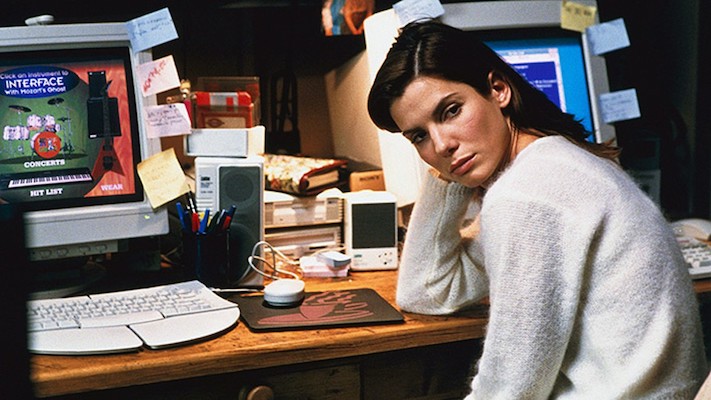
“The Net” stars Sandra Bullock, who was fresh off her “Speed” success and hadn’t yet moved into the phase of her career where all she does is snort-laugh and spill things on herself. Here she plays Angela Bennett, a computer whiz who works for a San Francisco software company but telecommutes from her home in Southern California. She spends her non-working hours in chat rooms and has the computer read the messages out loud to her. This would be chaotic in real life, and not even possible in real life in 1995, and pointless when you’re sitting in front of the computer anyway, but it’s what she does.

The movie is very pleased with itself for showcasing the amazing powers of the Internet. It lingers for a moment every time Angela and her dial-up modem do something high-tech like confirm her airline reservations or track a FedEx package. Why, she even orders pizza online, making her the one person in 1995 who did that!

Angela’s co-worker, Dale, sends her a weird computer program that he stumbled across, one that seems to grant the user backdoor access to all manner of private databases and such. It is such a big deal that Dale hops in his private plane to fly down from San Francisco and discuss it with Angela in person, but on the way his navigation equipment fails and he crashes. How could such a thing happen? I’ll give you a hint: his navigation system relied on COMPUTERS.

Angela then goes on vacation to Cancun, where she is shmoozed on the beach by a charming Englishman named Jack Devlin (Jeremy Northam). Since he is a) charming, b) English, c) named “Jack Devlin,” and d) played by Jeremy Northam, it is safe to assume he is the bad guy. But Angela, unaccustomed to interacting with live human beings rather than hearing their chat room messages read aloud by a computerized voice, doesn’t realize that Jack is evil, and has sex with him on his yacht. She discovers, post-sex, that Jack only wants the computer disk, which for some reason Angela has with her, right now. She not only brought it with her on vacation, she walks around with it in her purse all the time, in case it becomes necessary for the plot. Jack intends to kill Angela after getting the disk, so she knocks him unconscious, escapes from the yacht in a dinghy, and immediately crashes into some rocks.

She wakes up three days later in a Mexican hospital. Very few stories with happy endings begin that way. The disk is destroyed, and everything from her purse is gone. What’s more, her identity has been changed — changed with COMPUTERS! And the INTERNET! The U.S. embassy issuing her temporary replacement passport says her name is Ruth Marx — same photo, same birthdate, same Social Security number, but different name. She returns to her hotel to find that Angela Bennett already checked out. When she gets back to L.A., her car is no longer at the airport. When she gets home, her house is for sale. The only ID she has is the temporary passport that says Ruth Marx, and while she’s trying to explain everything to the police, Jack Devlin is sitting outside in a parked car with his laptop, manually entering fake arrest warrants for Ruth Marx into the LAPD’s database. This is totally a thing that a person can do. At every turn, Angela is told a variation of the same thing: “That’s what the computer says, so there’s no point in discussing it further, with anyone, ever, because of COMPUTERS, and also THE INTERNET.”

Obviously, Angela just needs to get some of her friends and acquaintances to vouch for her identity. The movie has thought of this possible solution, however, and cleverly thwarts it by announcing that Angela doesn’t know anyone. She’s never met any of her co-workers in person. None of her neighbors has ever seen her. She has no local friends, nor apparently any friends in other cities where she has previously lived. Her only family is her mother, who conveniently has Alzheimer’s and doesn’t recognize her. (Tip for screenwriters: If the choice is between giving a character no family at all and giving her a mother whose only function in the story is to not recognize her, go with option A. It’s less tacky.)

The one person Angela actually knows is her former therapist/boyfriend, Alan Champion (Dennis Miller). He tries to help her, but this makes him a target, too. The bad guys, whoever they are, use COMPUTERS to change his prescription medication to something that will kill him, and then I guess they just hope that he gets his prescription refilled soon. He does, today! The bad guys are able to do all of these things because all computers are connected to the Internet at all times, and all of their security measures can be bypassed with one all-powerful computer program. You can see how this scenario might seem alarming and plausible to someone who doesn’t really know how the Internet works — a regular person in 1995, for example, or John McCain today.

Even Angela buys it, and she works in the computer industry. Her reaction should be, “Wait, this literally isn’t possible, given the current infrastructure and developed technology.” But instead her reaction is panic and exasperation: “Our whole lives are on the computer!” That’s really what she says. She even reiterates it: “Our whole world is sitting there in a computer! It’s all on the computer!” It’s hard to take a sexy young heroine seriously when she talks like your AOL-using aunt.

Anyway, when Angela tells the LAPD that their system must have been hacked, the LAPD says that’s not possible, because they’ve been using the fancy new Gatekeeper security program for the last six months. Ah, Gatekeeper! The movie has been mentioning Gatekeeper and its billionaire developer every few minutes, so it was only a matter of time before we’d figure out that the company is evil and is using their security software as a Trojan horse to steal everyone’s information. And once we’ve figured it out, it should only be another half-hour or so before Angela figures it out, too. Forty minutes, tops. The whole dumb movie feels like an extended warning to old people to be afraid of technology, like that “SNL” commercial for robot insurance. I saw this movie in 1995, and I’ve stayed away from the Internet ever since.

— Film.com

Weekly link roundup – Nov. 12-18

0

NEW MOVIE REVIEWS:

“Happy Feet Two” (B-)
“Breaking Dawn — Part 1” (B-)
“The Descendants” (B+) [Film.com]
“Like Crazy” (A-) [Film.com]
“Immortals” (C)
“The Lie” (B+)

* * * * *

MOVIE COLUMNS:

Eric’s Bad Movies: “Body of Evidence” (1993), starring Madonna as a woman who may or may not have killed her boyfriend with sex. [Film.com]

What’s the Big Deal?: “Aguirre, the Wrath of God” (1972), by and about crazy people. [Film.com]

Re-Views: “All About My Mother” (1999), Pedro Almodovar’s breakout hit. [Film.com]

One Year Ago: Catching up with “Deathly Hallows Part 1,” “The Next Three Days,” and more. [Movies.com]

* * * * *

MY OTHER STUFF:

Snide Remarks: had the week off.

Movie B.S. with Bayer and Snider: This was our final show for Cascadia.fm, as the Portland-based Internet radio station has been sold. (Here’s mastermind Robert Wagner explaining it, if you’re interested.) But do not worry! Our podcast will continue! If you subscribe through iTunes, you won’t even notice a difference. If you’ve been listening by going to our page at Cascadia.fm and clicking the “play” button every week, you’ll have to go to MovieBS.com instead, but otherwise nothing will change. Bayer and I want to thank Robert Wagner for giving us a place to do our show for 86 weeks, and to congratulate him on the sale! May he spare our lives when he becomes ruler of all Portland. [Cascadia.fm] or [iTunes]

In the Dark: Subscribe to this weekly e-mail and get all the latest movie reviews, DVD releases, and other pertinent info delivered to your electronic mailbox. [Eric D. Snider’s In the Dark]

Twitter: @EricDSnider

* * * * *

MISCELLANEOUS MERRIMENT:

A former employer of mine made the Failblog. How proud they must be! [Failblog]

From the nation of Ghana comes this 30-second trailer for what can only be the most amazing action film of all time. [YouTube]

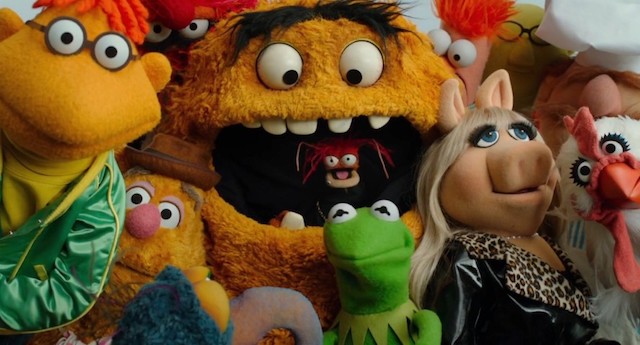
Film journalist Drew McWeeny had his little boy, Toshi, interview Kermit and Miss Puggy. It’s even more adorable than you can possibly imagine. And kudos to my friend Drew for finding a way to be a cool dad even though he’s a nerd who writes for the Internet! [HitFix]

Here’s a little girl becoming a supervillain. They start so young these days. [YouTube]

The Lie

0

“The Lie” begins with a premise based in darkest comedy, like something “Seinfeld” would have addressed — it would have been George who told this particular lie — and then subverts our expectations by contemplating the deeper issues that led to the deception. The result isn’t as funny as an all-out black farce might have been, but it’s a richer film experience. Besides, it’s very likely that the two-dimensional approach, stretched out to feature length, would have become unbearable anyway. This mix of laughs and drama is a good one.

Our premise is this. Lonnie (Joshua Leonard) is an anxious, thirty-ish Los Angeles hipster with a well-matched wife, Clover (Jess Weixler), and a baby daughter named Xana. When people ask Lonnie what he does for a living, he says he’s in a band. In truth, he has a drudgery-filled day job at a film-editing house, and his band has been dormant for ages (and has never been profitable), but he’s loath to acknowledge that he has, by his own standards, “sold out.”

That isn’t The Lie, though. That’s just a regular ol’ lower-case lie. The Lie is what Lonnie, in a fit of frustration and depression, tells his boss to get out of work one day. It is the sort of lie from which there is no return. It is huge and terrible and will have dire consequences, far beyond this one day of freedom. I’m not going to tell you what it is.

Once the fabrication is uttered, you can instantly see the potential for squirmy comedy. Lonnie must keep up the lie for the sake of his concerned co-workers, but prevent word of it from reaching Clover, who doesn’t know what he’s done and wouldn’t approve if she did. He has more time to hang out with his bandmate, Tank (Mark Webber), a slacker who lives in a trailer on the beach, but he can’t tell Tank why he’s not at work. And so it goes.

But it wasn’t just a desire to get out of work that made Lonnie tell the lie. There are more complicated issues at play: his reluctance to face adulthood, his disappointment at not being what he thought he was going to be, his dissatisfaction with a life (family, job, house, car) that 90 percent of the world’s population would be thrilled to have. These issues are familiar in low-budget comedy-dramas — Sundance is rife with them — and Joshua Leonard, who plays Lonnie and also directed the film, was last seen in one of them, 2009’s “Humpday.” So it isn’t the material in “The Lie” that’s fresh; it’s the way this point of view has been applied to a basic comedy premise.

The script is based on a short story by T. Coraghessan Boyle, and was adapted by Leonard, co-stars Jess Weixler and Mark Webber, and Jeff Feuerzeig — a collaborative effort, it would seem. The tone is naturalistic and low-key, the characters believable. The complications that arise from Lonnie’s lie are exactly what they’d be in real life, and the resolution is plausible, if not as packed with fireworks as you might have hoped.

Leonard has a laid-back and disheveled, Owen Wilson-y vibe that works for him in the role, reassuring us that Lonnie is a good person who has simply had a momentary lapse of judgment. The real MVP, though, is Weixler (from “Teeth”), as his wife. Two stand-out scenes focus on Clover’s reaction to Lonnie, the camera lingering on Weixler’s face as she hilariously runs the gamut of emotions. We see man-child characters like Lonnie in movies all the time. Less common is the presence of someone who will respond to his nonsense the way we would if we were there. To put it another way, every George needs an Elaine.

Happy Feet Two

0

“Happy Feet Two” is such a messy, giddy collage of undisciplined storytelling and half-developed subplots that I’m amazed I enjoyed it as much as I did. Like its predecessor, also directed and co-written by George Miller (“Babe: Pig in the City,” the “Mad Max” series), the sequel gets by largely on goofy energy and good-naturedness, not quote-unquote “strong writing” or “clear ideas.”

As we recall from re-reading our review of the first movie, the emperor penguins of Antarctica used to express themselves primarily through song, and frowned upon dancing, until one of them, a kid named Mumble (voice of Elijah Wood), taught them the power of dance, or something. The sequel commences with Mumble now happily married to Gloria (Alecia Moore, aka Pink), and the whole tribe cheerfully singin’ and dancin’ all the live-long day. Now, wouldn’t you know it, because it’s a sequel and history must repeat itself, Mumble and Gloria’s shy little hatchling, Erik (Ava Acres), doesn’t dance. He feels like an outcast because of it. It’s a classic reverse “Billy Elliot” scenario.

Meanwhile, in the part of Antarctica where the penguins have Latino accents, our feisty friend Ramon (Robin Williams, using an exaggerated accent) is trying to woo a sexy new female, Carmen (Sofia Vergara, using her regular speaking voice). Also, an exotic new penguin named Sven (Hank Azaria) has arrived. He has a Scandinavian accent and can fly! A penguin who can fly! He looks suspiciously like a puffin, not a penguin, but maybe that’s a spoiler? Anyway, Ramon is jealous of the attention received by the glad-handing, Harold Hill-like Sven.

Meanwhile, in the ocean are two tiny krill named Will (Brad Pitt) and Bill (Matt Damon). Will wants to leave the massive krill swarm and move up the food chain — really live a little, you know? He and Bill flit in and out of the rest of the film, occasionally intersecting with whatever the main plot happens to be at the moment, and sometimes seeming like they’re in their own movie altogether.

Meanwhile — there is a lot of meanwhile in this movie — a shifting ice formation has trapped all the emperor penguins in a giant valley, preventing them from accessing the sea and thus food. (Climate change is apparently the cause, though that point isn’t underscored.) It’s up to the handful of their kind who weren’t home when it happened to help them get out and find a new site for their colony.

Whew! That’s a lot for one movie. (I didn’t even mention the flashbacks to Sven’s encounter with humans, or the intimidating elephant seal that harasses Mumble.) The trapped penguins are the real story; everything else is included for funsies, and to give the characters from the last movie something to do. It is clear that “Happy Feet Two” is not one of those sequels that are rushed into production because someone had a really, really good idea for a story.

That being said, it’s consistently amusing, sometimes deliriously fun, with slick and vibrant animation. It has upbeat messages about helping one another and the value of every individual. The musical numbers, primarily existing pop songs but some written for the film, are made even catchier than before by the addition of choreography. One of the original songs is, I kid you not, an operatic aria — characteristic of the film’s likably weird, try-everything-and-see-what-sticks mentality. It won’t be the best cartoon of the year; thanks to “Rango,” it won’t even be the most eccentric. But it’ll do, penguin. It’ll do.

Breaking Dawn — Part 1

0

If “Breaking Dawn — Part 1” is any indication, there was no need to split the final “Twilight” episode into two films. There’s a lot of inactivity here, with pregnant Bella (Kristen Stewart) immobilized while Edward (Robert Pattinson) and Jacob (Taylor Lautner) sit around waiting for Jacob’s lupine brethren to attack. That’s the middle section of the movie, though. The wedding and honeymoon sequences at the beginning are charming in a teen soap opera sort of way, and the bat-poop-crazy finale is shocking — the first hint of actual horror that the franchise has seen. Director Bill Condon (“Gods and Monsters,” “Dreamgirls”) does the best job so far of making the insane mix of fantasy and melodrama feel natural, but he’s hindered by his wooden actors and the artificially lengthened story. Still, I’m curious to find out what happens next, if only to see if it’s as bafflingly weird as “Part 1” suggests.

All About My Mother (1999)

0
All About My Mother (1999)

“All About My Mother” was Pedro Almodóvar’s biggest international hit, winning an Oscar for best foreign-language film and topping the moderate success he’d had with “Women on the Verge of a Nervous Breakdown” (1988) and “Tie Me Up! Tie Me Down!” (1990). It was also the first Almodóvar movie that I’d seen, and I loved it, apparently. But as I was watching his latest, “The Skin I Live In,” I realized that for as acclaimed as he is, and for as much as I’ve praised his films from the last decade, very little about them has stuck with me. If I were making a list of my favorite current directors — even non-American ones — I don’t think it would occur to me to include Almodóvar.

And that got me wondering about “All About My Mother.” Did I really love it as much as I thought I did twelve years ago? There was one way to find out. To the Re-Viewmobile!

What I said then:

“Pedro Almodóvar wrote and directed ‘All About My Mother’ with apparently one thing in mind: to show the us the minds and feelings of women…. Cecilia Roth is incredibly strong as Manuela, easily carrying the movie on her shoulders. Manuela’s sadness … permeates the film, giving it an aching quality that resonates deeply. There is humor through the tears, though, and ‘All About My Mother’ — through all its vulgarity and surprising intelligence — succeeds in a number of gentle, gratifying ways.” Grade: A [the complete review]

First of all, let me point out that this is a terrible review. The parts I just quoted come from the first and last paragraphs, and they’re the only parts that actually express an opinion on the film’s merits. Everything in between is just me citing details from the movie and expounding on how they reflect Almodóvar’s themes, as if my main goal was to show you how smart I was and how well I “got” the movie.

Don’t get me wrong, I am smart, and I did get the movie. But I should have been more subtle about conveying that information. This reads less like a review and more like an essay for a film class. Maybe my excitement over finding meaning in the film made me praise it more effusively than it deserved? That seemed like a possibility.

The timing contributed to my doubts. “All About My Mother” had started making its way around the U.S. art-house circuit in November 1999, but it wasn’t until late February 2000 that I saw it. By that time, it had been praised by numerous critics, had appeared on some best-of-1999 lists, and had, as of Feb. 15, been nominated for the Oscar. I can’t remember exactly what my thoughts were back then, when I was still a new and impressionable critic, but it’s possible I was subconsciously influenced by the acclaim circling the film.

The re-viewing:

By the way, there’s literally nothing worse in the entire world than when you go to watch a Netflix DVD and discover the disc is cracked and won’t play, and so you have to pay $2.99 to watch the movie over Amazon Instant Video instead. Literally. In the entire world.

For a movie that’s supposedly set in the real world, this one has some unbelievable “only in the movies” plot devices. Manuela stepping in for Nina at the last minute to play Stella in “A Streetcar Named Desire” — and doing so flawlessly, without rehearsal — is a fantasy. So is Agrado’s ability to hold an audience with an improvised one-woman show when they came to the theater to see “Streetcar.” (For that matter, there’s no way they’d wait until the audience was seated to announce that the performance was canceled.) The rest of the story isn’t torn from everyday life, obviously, but at least it’s plausible.

I enjoyed noticing the little details Almodóvar throws in that parallel the femme-centric “All About Eve” and “A Streetcar Named Desire.” Whether the parallels are meaningful or just playful, they contribute texture — texture that would be missed entirely by a viewer who was unfamiliar with those other works. “All About My Mother” feels like it has something on its mind, which is more than you can say for a lot of films.

But what are we supposed to do with the plot threads that don’t go anywhere? The nun’s mother makes a reference to her career as an art forger; why? Manuela tracks down the man who received her dead son’s heart; also why? These elements sound important, yet nothing is done with them.

Cecilia Roth’s performance still stands out on second viewing. So does Marisa Paredes’ work as Huma Rojo, the force-of-nature theater actress. I would not complain if the same two characters appeared in another film, perhaps in a “Thelma and Louise” scenario, though I’d probably prefer a different ending. (Spoiler: Thelma and Louise die.)

Do I still love this movie?

Not quite, but I do like it a lot. There’s no lack of entertainment value or creativity; the story is engaging, the characters are colorful. If I didn’t know that it had won the Oscar for best foreign-language film, and you informed me of this, I think I would be surprised. I would say, “What? Really? Huh.” Still no explanation for why I tend to enjoy Almodóvar’s films and subsequently forget all about them, though. Just part of the mystique, I guess. Grade: B

— Film.com

The Descendants

0

“The Descendants” is Alexander Payne’s first movie since 2004’s “Sideways,” his first not to have Jim Taylor as his co-writer, and his first to take place somewhere other than the U.S. mainland. But that doesn’t mean he’s reinventing himself. The new film — set in Hawaii and co-written by Nat Faxon and Jim Rash, based on Kaui Hart Hemmings’ 2007 novel — has many of the same darkly comic themes as “Election” and “About Schmidt,” and Payne continues to live up to his name as a wry observer of modern American crises.

The poor saps this time around are at least lucky enough to be unlucky in a temperate climate. Matt King (George Clooney) lives prosperously on the laid-back island of Oahu, where every day is casual Friday and “some of the most powerful people look like bums and stuntmen.” Matt had a real Hawaiian princess in his lineage 150 years ago, and his family still owns some 25,000 acres of paradise on Kauai that he and his numerous cousins will soon be obligated to sell. Matt is the trustee. All of Hawaii awaits his decision.

In the midst of this headache comes a more serious one. Matt’s thrill-seeking wife, Elizabeth (Patricia Hastie), was critically injured in a speedboat accident three weeks earlier, and has remained comatose ever since. Her living will stipulates that she not be kept on life support if doctors conclude she won’t recover. Matt and his daughters, 10-year-old Scottie (Amara Miller) and 17-year-old Alex (Shailene Woodley), must prepare themselves to say goodbye.

And in the midst of THAT headache comes, if not a bigger one, then at least one that complicates things: Matt learns that Elizabeth was cheating on him. Their marriage had been on the rocks as Matt traveled between islands on business, but he had no clue it was this bad. Alex, a rebellious girl who’s been attending a strict boarding school, learned Mom’s secret some months ago and has been resentful ever since.

The movie explores the fine line between grief and anger, a line that’s even more treacherous when you’re angry at the person you’re grieving. Do people like Elizabeth’s father (Robert Forster), who idolizes his daughter and blames Matt for her accident, need to know the whole truth? Does young Scottie? Should Alex disregard this and remember only the positive things about Elizabeth? Should Matt?

Such somber material could be the basis for a piercing drama, and Payne doesn’t treat it lightly. He does let the comedy seep in, though, in a natural, rewarding way, without turning the King family’s problems into farce. George Clooney, anchoring the film with his customary rock-solid charm, is also our emotional bellwether: We look to him to know whether we should be laughing or crying. Characters like Mark (Rob Huebel) and Kai (Mary Birdsong), a married couple Matt and Elizabeth are friends with, are there essentially for comic relief; others, like Alex’s idiot boyfriend (Nick Krause), seem to have a similar function at first, then reveal themselves to be more complex than we thought. (Some of the boyfriend’s early moments are almost implausibly dopey, though.) When Matt finally meets the man Elizabeth was seeing, the confrontation is hilarious, uncomfortable, and electric. Matthew Lillard and the unsung Judy Greer give terrific supporting performances that perfectly balance humor with pathos.

Payne likes to put his characters through the wringer but have them come out of it with a hard-won happy (or at least hopeful) ending. That holds true for “The Descendants,” so you don’t need to worry that the sadness of the story will leave you depressed. You might wish the conclusion arrived sooner, though — the film is a tad overlong — or that Payne and his co-writers had found a better way to provide exposition than to have Matt serve as narrator. But overall, this mature, well-acted dramatic comedy is deeply satisfying, maybe even cathartic.

Body of Evidence

0
Body of Evidence

Pop superstar Madonna has always been more interested in maintaining a provocative image than in singing songs or using her real accent, but her emphasis on sex became especially pronounced in the early 1990s. That’s when she made her “Truth or Dare” documentary, recorded an album called “Erotica,” put out a book of dirty pictures called “Sex,” and starred in the movie “Body of Evidence,” in which she plays a woman accused of being so awesome at sex that she killed a guy. It had never been difficult to get Madonna to take off her clothes — you just had to promise there would be cameras present — and now she was taking her sex campaign to the next level. As a result, the three things that people of my generation will always remember about the early ’90s are the Rodney King riots and Madonna’s breasts.

“Body of Evidence” is the kind of trashy, cheesy “erotic thriller” that Cinemax was once known for, the only difference being that at least some of the women in those films could act. Madonna plays Rebecca Carlson, a gallery owner and amateur sexpot whose boyfriend, Andrew Marsh — a rich guy much older than herself — is found dead one morning, naked in bed, his lifeless eyes fixed on the TV, where a homemade sex tape starring himself and Rebecca is playing on a loop. All signs point to a heart attack: the man just couldn’t take the shock of learning he’d had sex with Madonna. But Marsh’s secretary, Joanne (Anne Archer), points to Rebecca on the videotape and tells the police, “She killed him.” Then she turns around and walks away, which is great for dramatic effect but not if you’re actually trying to be helpful.

The district attorney, a Joe Mantegna sort of guy who happens to be played by Joe Mantegna, puts together a convincing case. Rebecca had recently been named sole heir of Andrew Marsh’s fortune, so she had a motive to kill him. She admits to having had sex with him the night he died, so she had opportunity. And as for the murder weapon, well, have you seen her body? VA-VA-VOOM! Marsh, who had a heart condition, had cocaine in his system when he died. He’d also had a stuffy nose, and next to the bed was a bottle of nasal decongestant spray that had been laced with cocaine. The D.A. figures Rebecca secretly dosed him with coke and then sexed him up real good in the hopes it would make his heart explode. It’s the perfect crime … the perfect SEXY crime, that is!

The thing that the D.A. and everyone else keeps mentioning — indeed, the only thing the movie cares about at all — is that Rebecca and Marsh were into KINKY sex. KINKY sex because they were NAUGHTY! They used handcuffs and ropes and candle wax! And surely it was slutty Rebecca who introduced Marsh to these extreme practices, thus making her guilty not just of murder but of the more serious crime of enjoying sex.

Rebecca’s attorney, Frank Dulaney (Willem Dafoe), is dedicated to his job and will do everything in his power to make sure he gets paid (and also defend Rebecca, time permitting). He has a reputation for being a shrewd, aggressive lawyer, though every decision he makes with regard to this particular case is stupid and/or wrong. When the secretary testifies she once saw Rebecca snorting what she assumed was cocaine, Rebecca takes Frank to an herbalist’s shop and shows him the white powder she buys there regularly. Frank puts some of the stuff on his tongue and then says, “What is it?,” which is backwards from the order you’re supposed to follow when being handed foreign substances. (It’s powdered Chinese goat horn or whatever, and it’s for Rebecca’s menstrual cramps, and aren’t you glad you asked?)

Even though Frank has a perfectly good wife at home (played by Julianne Moore, no less!), and even though it would be unethical and unwise for him to have sex with a client who’s accused of murdering someone with sex, we know it is only a matter of time before Frank has sex with Rebecca. And he does. As it turns out, he is also interested in KINKY things! Rebecca pours hot candle wax on him and grinds his naked back against shards of broken glass, and then Frank thinks he can go home with burns and scrapes all over his torso without raising his wife’s suspicions. The reason for this, as implied earlier, is that Frank is a moron.

Meanwhile, Rebecca’s trial is taking place in a courtroom presided over by a judge who glares disapprovingly whenever something sexual in the testimony makes the gallery titter, which occurs every three seconds. Since there’s no way to prove that Rebecca intentionally used sex as a weapon, the D.A. sets out to prove that Rebecca has had a lot of sex in her life and is therefore the type of person who would use sex as a weapon. The trial becomes very sleazy, very quickly, like a really salacious episode of “Law & Order,” or a regular episode of “Law & Order: SVU.” The prosecution’s key witness is a man who testifies that he, too, was a rich guy with a heart problem, and that Rebecca dated him until he got a heart transplant, whereupon she dumped him because now she wouldn’t be able to carry out her plan to kill him with sex and take his money. See?? That woman’s hoo-ha has a rap sheet as long as your arm!

Part of what makes Rebecca so maddening as a character is her refusal to think about anything other than sex. She’s on trial for murder, not to mention supposedly grief-stricken by her boyfriend’s death, but after a grueling day of testimony she grabs her lawyer’s crotch in the elevator and then has sex with him in the parking garage. I submit that these are not the actions of a person who is taking her murder trial very seriously.

Madonna’s performance only makes it worse, as a Madonna performance is wont to do. She delivers all of Rebecca’s lines, even innocuous ones, in a breathy, seductive voice, her face locked in a lewdly playful expression, as if she’s always two seconds away from asking, “What’s your safe word?” The kicker is that the role was clearly written for her, and yet she’s terrible in it. How bad an actress must Madonna be if she can’t even play an oversexed woman who’s obsessed with money? She should quit her day job and take up singing or something.

— Film.com

Weekly link roundup – Nov. 5-11

3

NEW MOVIE REVIEWS:

“Jack and Jill” (D) [Film.com]
“J. Edgar” (C-) [Film.com]
“Martha Marcy May Marlene” (B+)
“The Skin I Live In” (C+)

* * * * *

MOVIE COLUMNS:

Eric’s Bad Movies: “Roller Boogie” (1979), starring Linda Blair and a real live artistic roller skater! [Film.com]

What’s the Big Deal?: “Midnight Cowboy” (1969), the only X-rated Best Picture winner — but there should be several asterisks next to that record. Here’s why. [Film.com]

Re-Views: “Little Nicky” (2000), which proves the theory that Adam Sandler’s movies were as bad eleven years ago as they are today. [Film.com]

One Year Ago: Catching up with “Unstoppable,” “Skyline,” and “Morning Glory.” [Movies.com]

Monday Morning Review: “Tower Heist,” full of spoilers and dissections, so don’t read it unless you’ve seen the movie and/or don’t care. [Movies.com]

Could “Shame” be the First NC-17 Best Picture Nominee?: And what would that mean for the notorious rating? [Film.com]

Logical Problems with a Horse That Goes to War: The flaws that could bring down “War Horse”! [Film.com]

* * * * *

MY OTHER STUFF:

Snide Remarks: “The Frog Days of Summer” — Marketing strategies for “The Muppets.”

Movie B.S. with Bayer and Snider: Reviews of “Jack and Jill,” “J. Edgar,” “Immortals,” and “Like Crazy,” plus a round of Pitch Me and other happy fun-time shenanigans. [Cascadia.fm] or [iTunes]

In the Dark: Subscribe to this weekly e-mail and get all the latest movie reviews, DVD releases, and other pertinent info delivered to your electronic mailbox. [Eric D. Snider’s In the Dark]

Twitter: Once I’ve gotten 10,000 followers, I’ll start implementing my plan for world domination. Believe me, you’ll want to be for us, not against us. [Twitter]

* * * * *

MISCELLANEOUS MERRIMENT:

As you buy things from Amazon this holiday season, kindly remember your friends at EricDSnider.com, won’t you? [Eric’s Blog]

I wrote new lyrics for the “Parks and Recreation” theme song, because why not? (Special thanks to my pal Raffi Asdourian for the video rejiggering.) [YouTube]

Brett Ratner’s apology video, as performed by Adam Pally (whom you should know as Max on “Happy Endings”). [Funny or Die]

The truth behind Disney’s “Aladdin” is finally explained! If anyone knows the original source for this, please let me know. In the meantime, here’s a screenshot. [imgur]

Bill Hader’s portrayal of Rick Perry in this “Weekend Update” segment isn’t “accurate,” exactly — but it is hilarious. This is the kind of devastating takedown that supporters would point to as being responsible for ruining Perry in the polls, if he hadn’t been ruined before this anyway. [Hulu]

In honor of Andy Rooney’s sudden and untimely death at the age of 117, here’s a montage of out-of-context quotations. [YouTube]

A critic said a particular comic book was “as bad as Shakespeare,” and started his review with this statement: “As an English major at the University of Vermont, I prided myself on completing the degree without having ever touched Shakespeare. There’s simply way too much overwrought dialogue for my interest.” Then he was put in his place by commenters, which was pretty awesome. [Bleeding Cool]

J. Edgar

0

The impression I get from watching “J. Edgar” is that Leonardo DiCaprio likes the character, screenwriter Dustin Lance Black doesn’t, and director Clint Eastwood couldn’t care less either way as long as he can finish making the movie before suppertime. So here you go. Here’s that J. Edgar Hoover biopic you asked for, or at least something that meets all the technical requirements to be considered one.

Hoover served as director of the Federal Bureau of Investigation from 1924 (when it was just the Bureau of Investigation) until his death in 1972, worked under eight different presidents, defined and expanded the nature of American law enforcement, and was considered by some to be the second most powerful man in the country. His life and career could be the stuff of interesting cinema — as evidenced by the sequences in the movie that actually are interesting — but not without shaping the material into a cohesive story and committing to a vision. Eastwood seems content to spread a bunch of facts, rumors, and innuendos on the table and leave it at that.

The film moves back and forth between two general time periods in Hoover’s life: the 1920s and ’30s, when he’s making a name for himself, and the 1960s, when he’s recounting his life’s work to a series of FBI underlings tasked with transcribing his memoirs. (DiCaprio’s old-age makeup is pretty impressive, as these things go; the other few actors appearing in both eras do not fare quite as well.) A zealous pursuer of criminals and a strict believer in moral uprightness, Hoover lives with his mother (Judi Dench) and does not have friends or lovers. With his typical eagerness he clumsily proposes to a Bureau typist, Helen Gandy (Naomi Watts), who politely refuses him and instead becomes his secretary for the next 40 years.

The kidnapping of Charles Lindbergh’s young son in 1932 motivates Hoover to seek greater powers for the Bureau of Investigation, and more resources to examine forensic evidence. He’s gung-ho about fingerprinting, which many others in law enforcement consider “speculative science.” His efforts to solve the case and prove his department’s worth lead to other high-profile victories, including the capture of prominent bank robbers like John Dillinger and Machine Gun Kelly. In 1935, the department’s powers are expanded and the organization is renamed the Federal Bureau of Investigation. Hoover is its first director.

BUT WHAT ABOUT THE GAY STUFF?? you are asking. Funny, I was going to ask Eastwood the same question. Rumors about Hoover’s sexuality were commonplace throughout his life and especially afterward, when his money and estate went to longtime friend and fellow FBI agent Clyde Tolson. (Tolson also accepted the U.S. flag draped on Hoover’s coffin and was later buried near him.) The movie, perhaps not wanting to offend people on either side of the issue, hedges its bets. Tolson is played in the film by Armie Hammer, the tall, strapping Winklevoss from last year’s “The Social Network,” and his relationship with Hoover looks less like “Brokeback Mountain” and more like Burns and Smithers. Tolson clearly has eyes only for Hoover; whether (or how much) his affections are reciprocated is where the movie wants to have it both ways. In the movie’s view, Hoover was gay but celibate, in love with Tolson but unwilling to act on it or seek love elsewhere. Such a lifestyle is not unheard of, but does anyone really think it was J. Edgar Hoover’s?

And so we have a movie that keeps referencing the subject without really addressing it. Black’s screenplay, a mishmash of corny, overwrought dialogue, conveys that Hoover and Tolson are less-than-hetero by having them gossip cattily about common acquaintances, or by showing Hoover comically flustered when Ginger Rogers’ mother hits on him. The characters have one scene in which to tackle the issue head-on, and it turns into a farce of shouting and throwing things. (“Pick up that glass!” Hoover yells after Tolson smashes one against the wall. Tolson yells back, “I have no reason to do that!”) They fight, they make up, Hoover whispers “I love you” after Tolman has already left the room — it’s a masterpiece of melodramatic hack work. As controversial as it would have been to ignore Hoover’s personal life altogether and focus only on his work, that might have been better than what this film does, which is to focus on his personal life without actually saying anything about it.

The FBI material is more intriguing, and conveyed with much less ambiguity. The movie might avoid taking a position on Hoover’s sexuality, but it has no problem painting a clear picture of him as head of the FBI: paranoid, vindictive, narcissistic, and self-aggrandizing. He’ll start a “file” on anyone he doesn’t like, without even bothering to come up with a pretense. He does some despicable things to his enemies, and is only slightly less awful to those he loves. DiCaprio does his best to make the character human, but it’s an uphill battle against a screenplay that hates the guy. Add Eastwood’s apathy to that and you’ve got a long, pointless slog of a film.

Immortals

0

It is very difficult for me not to get some enjoyment out of a movie that starts with a stentorian narrator providing exposition in grandiose language that begins with clauses like these: “When this world was still young, long before man or beast roamed these lands…” Such verbiage signals the imminent arrival of swords, myths, and nonsense, of men with hilarious names doing adventuresome things with serious looks on their faces, of fair maidens assisting in the retrieval of magic artifacts needed to prevent an evil force from ruining mankind. Movies like that, even when they aren’t exactly “good,” can be a lot of fun.

“Immortals” is almost that kind of movie, and might have been one if it had removed the dull parts and gotten the running time down from a ponderous 110 minutes to a more vigorous 90 or so. It feels bloated and pretentious in its current form, and those are not good attributes for a movie about an ancient Greek dude who mingles with gods and fights with titans and Mickey Rourke.

Rourke plays the villain, Hyperion, a brutal and cruel warrior-king who wants to rule all of Greece (it’s 1228 B.C.; Greece is still worth ruling). He and his army are going from village to village in search of a legendary bow that will enable Hyperion to unleash the titans from their prison, which I guess will help him somehow, although the movie isn’t clear on specifics. It seems like the newly freed titans would just kill everyone, including Hyperion. Anyway, he’s especially interested in locating the Virgin Oracles, a quartet of comely maidens with visionary powers who can tell him where the bow is.

Our hero is Theseus (Henry Cavill), a wholesome peasant boy who’s been trained in the fighting arts by a weird old man (John Hurt). After being taken as a slave by Hyperion’s army, Theseus encounters the aforementioned Virgins, enchantingly led by Phaedra (Frieda Pinto), who has had visions about Theseus. It seems he may be the Chosen One who is destined to thwart Hyperion. That’s a pretty big assignment! Good thing he worked on his abs!

Meanwhile, on Mt. Olympus, some of your various gods are debating whether to interfere and help the mortals. Good points are made on those sides, but Zeus (Luke Evans) comes down firmly against interfering, and his vote is final, because he’s the goddiest god.

The trouble with “Immortals” is that it dilutes these simple, cheesy pleasures with a dry tone and far too much self-seriousness. Between action scenes, the flat, uninteresting characters discuss their religious doubts and personal goals the way real characters in a real movie would, without giving us any reason to sympathize with them. The screenplay (by brothers Charley Parlapanides and Vlas Parlapanides) is Saturday matinee hokum with a plot that seldom makes logical sense, but director Tarsem Singh treats it like “The Odyssey.” “Immortals” doesn’t suffer because it’s cheesy; it suffers because it thinks it isn’t.

This is Singh’s third movie, and it’s a gorgeous-looking mess, and anyone who saw his other two won’t be surprised to hear that. I remember almost nothing about “The Cell,” Singh’s freaky mind-bender from 2000, except that it took place largely inside the mind of a serial killer, and that at one point we saw a horse being vivisected. His other movie, “The Fall,” had story issues but was one of the most visually arresting things I’ve ever seen, full of beautiful location shooting (no CGI or green screens) and brilliant colors.

When there is physical movement in “Immortals,” it’s framed and shot like a work of art. The cinematography (by Brendan Galvin) and production design (by Tom Foden) are captivating. Singh presents Phaedra’s visions as madly surreal dreams that border on nightmares. The man has clear talent as an artist, but he needs a better story than this to convey it.

Jack and Jill

0

Rule number one is that you go into every movie with an open mind. No matter how bad the trailer makes it look; no matter how imbecilic the premise is; no matter how terrible the previous films made by the same people have been; you always allow for the possibility that the movie will be good. In fact, you do more than that: you HOPE it will be good. If you find yourself going into theaters WANTING to hate the movies, you should probably stop going into theaters.

I mention this up front so you will know that even though “Jack and Jill” — in which Adam Sandler plays both a regular guy and that guy’s annoying twin sister — has a trailer that makes it look awful, and has an unworkable premise, and was made by people who have made an abundance of stupid movies in the past, I went into it hoping for the best. I didn’t pre-judge it based on how miserable it seemed like it was probably going to be. And now, having seen the film, I can tell you that it is indeed every bit as lousy as it looks.

So kudos to the marketing department, I guess. They nailed this one.

Sandler plays Jack Sadelstein, a TV commercial director with a wife who for some reason is Katie Holmes, a son who for some reason is Indian, and a daughter who doesn’t do anything of note. Jack grew up in the Bronx, where his twin sister still lives and evidently kept developing her Bronx accent after Jack moved to California. Everyone hates Jill because she’s loud, crass, clueless, obnoxious, needy, unreasonable, unhygienic, and ugly. Her poor social skills are probably the consequence of her dreadful physical appearance — she looks like Adam Sandler in drag, after all, and Adam Sandler ain’t exactly a “Gossip Girl” extra to begin with. Whatever the reason, she’s dreadful and she should die, the end.

Anyway, Jill comes to visit for Thanksgiving and stays indefinitely, during which time Jack tries to find her a boyfriend through some online dating sites. She goes on a date with Norm Macdonald, who is astonished by her physical appearance even though her picture was included in her profile. (The people who made the movie don’t care. Ugly girls are funny!) She also goes for a pony ride and breaks the pony’s legs. She’s so “fat” she literally collapses a pony. She’s pony-collapsingly fat. Of course, she’s actually not fat at all, and doesn’t weigh any more than her brother, but hey, ugly girls are supposed to be fat, so there.

Meanwhile, Jack is going to lose the Dunkin Donuts account unless he can get Al Pacino to appear in the commercial. There’s no way Pacino would do it, though, because a TV commercial would be beneath him. The movie gets a lot of mileage out of this premise, never realizing that it is negated by Pacino’s appearance in this very movie. Jack stalks Pacino at a Lakers game, Pacino meets Jill and is smitten with her, maybe Jack can use his sister to get Pacino to do the commercial, Jill rebuffs Pacino and Jack has to put on a dress and a wig and pretend to be her, yada yada, the rest writes itself, David Spade has a cameo, everybody goes home and weeps.

The director is named Dennis Dugan. This is the seventh Sandler movie he has directed, so he’s gotten pretty good at letting everybody do whatever they want and not caring whether it’s funny. He’s gotten pretty good at showing up on the set, turning on the cameras, then taking a nap on the floor, is what I mean. The screenplay is credited to Steve Koren (“Click,” “A Night at the Roxbury”) and Sandler, from a “story” by Ben Zook. In Hollywood parlance, that probably means Zook wrote the original screenplay, then Sandler bought it and Sandlered it up, i.e., added broad physical comedy and bit parts for his friends. As in most of Sandler’s lazier films, characters behave without motivation and make changes in their lives only because they’ve arrived at the point in the movie where characters are supposed to make changes in their lives. (Should you be unfortunate enough to see this film, I defy you to tell me why Jack changes his mind about Jill at the end.)

I don’t know what Pacino is doing here, but he’s having fun with it. The guy’s insane. Does he know how bad the movie is? He must. But he fully commits to every stupid thing he’s required to do, which goes a long way toward making some of those stupid things bearable. His Dunkin Donuts commercial (spoiler alert: he winds up doing it) is genuinely funny as a parody of awful, embarrassing ads. The sad part is that the rest of the movie is every bit as bad as that intentionally bad commercial.

Melancholia

0

Lars von Trier has suffered from clinical depression. This will not surprise anyone who sees “Melancholia,” his latest film and his first in a while to feature relatable human emotions, with Kirsten Dunst giving a career-best performance as a young woman barely surviving in a fog of depression. Because he is Lars von Trier, he has weirded the story up considerably, putting the woman’s struggle against the backdrop of a newly discovered planet hurtling toward Earth, possibly on a collision course — a rather on-the-nose metaphor for a depressive’s gloomy state of mind, but an effective one.

After an artful and evocative Wagner-scored prologue depicting slow-motion catastrophe, we meet Dunst’s character, Justine, on what should be a joyful occasion: her wedding day. She seems chipper enough when she and her new husband, Michael (Alexander Skarsgard), arrive at the reception being held in their honor at the lavish country manor owned by her sister, Claire (Charlotte Gainsbourg), and Claire’s rich husband, John (Kiefer Sutherland). The girls’ mother, Gaby (Charlotte Rampling), a furious woman who hates marriage, makes icy remarks to their father, Dexter (John Hurt), whom she long ago divorced. Dexter is as twinkly-eyed and vivacious as his ex-wife is cold, and you can see how Justine has inherited aspects of both.

Things gradually fall apart for Justine over the course of the evening as she tries to control a flood of conflicting, often irrational emotions. Michael is aware of her history with depression and is sympathetic, while her parents, sister, and brother-in-law seem unsure. John, remarking on how expensive the elaborate party was for him to host, tells her, “You’d better be G–d— happy.” Justine replies: Yes. I should be. I really should be.

That’s the thing with depression, of course. You feel miserable even when there is no logical reason for it. The second half of the film reinforces this by focusing more on Claire, who’s terrified that the new planet will hit the Earth even though all the scientists have said it won’t. (That includes John, the movie’s voice of logic and reason — and, ultimately, the one least capable of dealing with truly stressful situations.) Claire understands her fears aren’t rational but can’t shake them. Justine, still in a heavy-lidded daze of melancholy, is calm. The end of the world is nothing new for her.

Von Trier gives us several light moments during the wedding reception, even a few laughs here and there. But yes, as you would suppose, the film is mostly a somber affair. Like “Another Earth,” the other 2011 film about a rogue planet, this one is less interested in sci-fi tropes and scientific accuracy than in people’s feelings, and the key actresses’ performances are piercing. Even for an introspective, not-at-all-science-fiction movie, though, “Melancholia” is glacially paced and overlong. There’s giving us time to experience and appreciate the moods of the characters, and there’s dragging things out interminably. Von Trier doesn’t always believe that there is a difference, which is one of the reasons he’s such a maddening director. “Melancholia” is more accessible than “Antichrist” or any of his Dogme projects, but it’s still a challenging piece of work whose rewards only barely justify the effort.

Little Nicky (2000)

0
Little Nicky (2000)

Adam Sandler’s stint on “Saturday Night Live” began midway through the 1990-91 season, only a few months after my high school friends and I had started watching the show with a fervent intensity. We spent every Monday discussing the highlights of Saturday’s episode (which we had usually watched together anyway), followed by repeat viewings enabled by the magic of VHS, followed by constant references in our conversation, followed by none of us ever going on dates, ever.

I was a bigger fan of Chris Farley and David Spade, who were also new that season, but Adam Sandler made me laugh a lot too. It was mostly his “Weekend Update” appearances: Opera Man, Cajun Man, the guy who showed us cheap Halloween costumes, the guy who sang songs about red-hooded sweatshirts and Thanksgiving. Those were funny in short, absurd bursts. When Sandler started making movies, he wisely avoided one-joke characters like those and played people like Billy Madison and Happy Gilmore, guys who weren’t “ordinary,” but who at least spoke and thought like regular human beings.

Then, for some reason, he reverted back to “Weekend Update” mode, playing characters in “The Waterboy” and “Little Nicky” that were nothing more than infantile voices and dumb babbling. The mystery of why he thought such grating, thinly defined characters would be fun to watch for 90 minutes is exceeded only by the mystery of how many people agreed with him. “The Waterboy” made $161 million! It is the highest-grossing sports comedy of all time!

“Little Nicky,” released Nov. 10, 2000, was the first Sandler vehicle I reviewed in my official capacity as Grown-Up Movie Critic With A Job And Everything. I, uh, didn’t care for it.

What I said then:

“‘Little Nicky’ is almost 100 percent laugh-free. It’s like a frat party where the boys make lots of jokes … that they think are funny, but only because they’re stoned…. There are a number of things that make ‘Little Nicky’ a painful ordeal. First, it’s nearly impossible to even tolerate the title character, let alone like him, with Sandler playing him as a hoarsely whispering simp who elicits no sympathy. Second, many of the gags are old…. Third, the few jokes that are clever, subversive or original are ruined by over-playing them…. What can you say about a movie in which Jon Lovitz actually RAISES the level of class by playing a peeping Tom?… Reese Witherspoon out-performs everyone in her bit part near the end, and I seem to recall Dad’s assiduous assistant demon (Salvatore Cavaliere) being amusing. But the rest is just so abominably unfunny and unengaging that I wouldn’t be surprised if the movie receives the official endorsement of hell itself.” Grade: D- [the complete review]

Though it wasn’t a box-office hit (it made less than $40 million), “Little Nicky” became a treasured gem among Sandler enthusiasts. I’ve disliked most of what he’s done since then — but not everything. Maybe another visit with “Little Nicky,” eleven years later, would strike a different chord with me.

The re-viewing:

Casting Harvey Keitel as the devil and Rodney Dangerfield as his father is a fine thing to do. The joke with Dan Marino trying to make a deal with Satan to win a championship isn’t bad. I chuckled a little when Nicky produced deep-voiced demon sounds in his sleep.

But I cannot overstate how annoying Nicky is. Sandler’s breathy, whispery, palsy-faced performance might well have worked in a single five-minute comedy sketch. As the protagonist in a feature-length movie, it’s excruciating.

The movie’s larger problem is that its screenplay reads like a first draft. The story doesn’t make any sense or adhere to its own rules. Worse, the details in the dialogue — the actual jokes — are embarrassingly pedestrian. It’s like they kept saying, “We need to put a joke here,” and then never got around to doing it.

A perfect example of the film’s lazy writing is the running joke where Nicky’s dirtbag friend thinks Nicky’s roommate, Todd, is gay. Here are the lines:

TODD: You guys can crash here if you want. I have an extra futon in the bedroom.
NICKY’S DIRTBAG FRIEND: Uh, that’s a big pass, Elton John.

And this:

TODD: Did she hurt you? Do you need to cry on my shoulder?
NICKY’S DIRTBAG FRIEND: Easy, Liberace.

And this:

TODD: I was in love once, but she said I wasn’t financially reliable, and she needed that.
NICKY’S DIRTBAG FRIEND: Now, by “she,” do you mean “he”?

In other words, the joke consists entirely of saying, “I think you are gay.” That’s it. Not “I think you are gay, and here are some amusing details that have led me to that conclusion.” Not even “I think you are gay, and here’s a colorful way of describing how gross I find it.” Just: “I think you are gay.” Period. Compare that to Paul Rudd and Seth Rogen’s “You know how I know you’re gay?” routine in “The 40-Year-Old Virgin.” “I saw you make spinach dip in a loaf of sourdough bread” may not be brilliant, but at least it’s an actual joke.

“Little Nicky,” which Sandler wrote with regular collaborator Tim Herlihy and director Steven Brill, is defined by that level of laziness. After Todd tells Nicky he can’t have a dog in the apartment, the dog (who can talk; never mind why) stands on Todd’s “I LOVE ACTING” doormat and says, “You love acting? I love pissing,” and pees on it. The reason for this, ostensibly, is that the dog is angry at not being allowed inside. But it’s clear that the real reason is simply that Sandler and friends think the sight of a dog peeing is funny. It would be a waste to have a dog as a major character and NOT see him urinate! And if you can’t come up with a natural way of working that into the story, eh, don’t worry about it. Just do it.

Here are the two things that made me laugh out loud during this second viewing:

– When the angels tell Nicky that they can see all of Earth’s activities through their magic viewer, and what comes up first is an episode of “Felicity.” “Oh, that’s ‘Felicity.’ I love that show. Do you watch?” “I haven’t seen it, but I hear good things.”

– When Nicky’s brother demonstrates how evil he is by conjuring a celebrity: “I bring you a dear, sweet man, Mr. Henry Winkler. [pause] Covered in bees.” (Like a dog urinating, a person covered in bees is inherently a funny image. The difference is that here, it’s supposed to happen out of the blue, for no logical reason.)

That’s it. Goodbye, “Little Nicky.” Back to hell with you!

Do I still hate this movie?

Yes. In fact, now that I’m better able to explain the mechanics of why it’s not funny, I hate it even more. Grade: F

— Film.com

Logical Problems with a Horse That Goes to War

0
Logical Problems with a Horse That Goes to War

Sure, this new “War Horse” movie seems to have the makings of a champion. It’s based on a highly acclaimed stage play, it’s about a boy and a horse, and it’s directed by Steven Spielberg. That’s a potent combination. But we are skeptical! We have certain issues with the premise, which we will enumerate below.

Logical Problems with a Horse That Goes to War

How can a horse fire a gun? Horses don’t even have fingers. This seems obvious.

A horse would take up a lot of room in the transport vehicles. On the other hand, being a horse, it could just run alongside the vehicle. But the other soldiers don’t have to do that. Why should the horse soldier have to work harder just because it’s a horse? I guess the real issue here is equality.

And what about saluting? Their legs don’t really even bend that way.

If you think regular soldiers are rowdy when they get a weekend furlough in a port city, wait till you see horses.

A regular soldier gets hurt, you can patch him up and put him back to work. A horse gets one measly broken leg and you have to kill it.

Very few horses would be able to pass the written exam.

It is unlikely that the standard food rations given to combat soldiers would have the right nutrients for a horse, and where are you going to find hay and oats on a battlefield? Unless we go to war against Kansas, I mean. Is it worth going to war against Kansas just so our horse-soldiers will have food to eat? Maybe, maybe not.

Most horses would refuse to trim their manes to meet military regulations. Also, the military has a longstanding policy against pony tails.

It’s hard for a platoon to keep a low profile in enemy territory when one of its members weighs a thousand pounds and sleeps standing up. That’s just not good strategy.

When you ask a horse how many enemy soldiers are approaching, you have to wait while it stomps its foot the right number of times.

There’s bound to be controversy when, next thing you know, zebras want in.

— Film.com 

The Frog Days of Summer

0
The Frog Days of Summer

From: Marketing department, socks and ping pong balls division
Subject: Marketing strategy for upcoming film “The Muppets”
Date: February 1, 2011
To: Senior vice presidents of marketing, Walt Disney Pictures

Dear senior vice presidents:

Our department has concluded its study into the matter of how best to promote the Company’s upcoming film “The Muppets,” which as you know is scheduled for release this Thanksgiving. Here are our recommendations.

First of all, we note that much of the groundwork has already been laid for us by the original Muppet writers and performers, who did everything long before we bought the product and slapped the Disney name on it. The film’s target audience is not children, who will enjoy anything as long as it is brightly colored and makes fart noises, but adults who grew up with the Muppets. This audience is savvy and cynical, but they have a reverence for the Muppets that is pure and undefiled. So it will be easy for us to exploit it.

The news that the Disney Company is reviving a dormant property is normally met with terror and apprehension, given the Company’s record of ruining its brands with cheap sequels, straight-to-DVD spinoffs, and Tim Allen. But we believe the Muppets are exempt from this — not because the audience doesn’t care about them, but because the audience cares so much about them. Any initial concerns they have about the new film will quickly be replaced by self-generated reassurances that it will be awesome, because the alternative — that the Disney Company might betray them by making a Muppet movie that is tacky and lame — will be too horrible to contemplate. The Muppets are so beloved by 25-to-40-year-olds that their minds will not even permit them to entertain the possibility that the movie might be anything less than magnificent.

This unwavering support, which has been achieved merely by the film’s existence, completely separate from any actual details about its story or production, puts us in a unique position. We recommend an aggressive, multi-platform advertising campaign, one that shoves the Muppets down the gullet of every American 24 hours a day from now until the film’s release.

We recommend a series of trailers that are parodies of other upcoming movies, insofar as a “parody” is when you imitate something and just replace the characters with Muppets. These need not be funny; they need only refer to other films and contain Muppets.

We recommend a barrage of Muppet appearances. Let them appear in viral Internet videos, TV talk shows, “Entertainment Tonight”, red carpet galas, professional wrestling events, commercials for Alamo Rent-a-Car, commercials for pistachios, New York Fashion Week, music videos by cool indie bands, the thing they play before the movie that tells you not to talk during it — anything that will be filmed and shown to people is a good thing for the Muppets to appear in. If the film’s release date arrives and there are people in America who have not seen at least one Muppet per day for the previous six months, then we will have failed in our mission.

Normally this strategy carries with it the risk of over-saturation. There are documented cases of audiences being so deluged with promotional materials that by the time the product became available, they were already tired of it. (This is known as the Johnny Depp Effect.) However, there is no such risk with the Muppets. The target audience has an innate fondness for the Muppets that is so firmly hardwired into their culture that it is impossible for them to get sick of the characters.

Furthermore, our research suggests that in the unlikely event that someone in the target audience does grow weary of the Muppets, he or she will refrain from saying so in order to avoid stigmatization by his or her peers. We believe we can create an environment wherein the opinion that the Muppets are wonderful but are being overexposed and over-promoted — normally a reasonable point of view — will be met with hostility and scorn, as if the person stating that position had called for the exhumation and desecration of Jim Henson’s corpse.

(Please note that this in no way reflects upon the Company’s plan to exhume and desecrate Jim Henson’s corpse, currently scheduled for third quarter 2012.)

In short, it is our opinion that the best way to market the upcoming film is to ceaselessly remind people that the Muppets exist, that they love the Muppets unconditionally, and that anyone who feels overwhelmed by Muppets is a joyless scold whose soul is black and cankered.

Sincerely,
The marketing department

Roller Boogie

0
Roller Boogie

In the past, when people have asked for suggestions of movies they should watch to satisfy their cravings for roller-skating, disco, bony teenagers, and the girl from “The Exorcist,” I’ve been at a loss for answers. But now I have one! “Roller Boogie” meets all of those criteria, with the added bonus of feeling twice as long as it is. When you’re done watching it, only 103 minutes have passed — but it feels like three hours! That’s a bargain.

The reason this perspiring chunk of late-1970s cheese overstays its welcome is that its plot could easily be contained in a single 45-minute episode of a TV drama, yet is padded out to an hour and 43 minutes by the obscene overuse of roller-skating musical numbers. This, in turn, is because the filmmakers hired an actual competitive artistic roller-skater — which is totally a thing — to play the male lead opposite Linda Blair, and they wanted to get their money’s worth. Competitive artistic roller-skaters don’t work cheap! I mean, they do, but still, there’s no reason to waste money.

rollerboogie

“Roller Boogie” is set in Venice Beach, Calif., where the teens are all emaciated and spend their summer days cruising around on their roller skates, clad in tank tops and those tiny, loose-fitting shorts that people wore in the late ’70s. Seriously, the shorts are barely even there, and everybody’s hopping around, doing the splits and stuff. I bet a lot of the footage they shot for these scenes was unusable because guys’ junk kept falling out.

rollerboogie

Anyway, the best skater in town is Bobby, a toothy, feathery-haired dimwit played by competitive artistic roller-skater Jim Bray in his only film appearance. Bobby and his pals live a life of constant skating, either on the boardwalk near the beach or at their favorite indoor skating rink, called Jammer’s, but Bobby has greater aspirations: He wants to compete in the Olympics. The fact that there are no roller-skating events in the Olympics does not dissuade him, nor does the movie acknowledge it. If you dream hard enough, you can make it happen!

One night at Jammer’s, Bobby meets Terry Barkley (Linda Blair), a rich girl from Beverly Hills whose parents want to send her to Juilliard to play the flute but who really just wants to roller skate. When Terry sees how good Bobby is at skating, she offers to pay him for lessons, leading to a flirtatious relationship marked by dialogue such as this:

TERRY: The Olympics? That’s a lot to bite off.
BOBBY: I’ve got a big appetite.
TERRY: I guess you do!

WHAT DOES THAT EVEN MEAN??

rollerboogie

Terry and Bobby skate a lot, accompanied by dozens of extras performing intricately choreographed maneuvers, all of it set to disco songs, many of them written specifically for the movie — because if there’s one thing better than disco music, it’s homemade disco music. It’s difficult to imagine that there was ever a time when audiences craved disco-oriented roller-skating sequences, and yet “Roller Boogie” stands as a testament that they did, or at least that someone thought they did. The movie tries to make it look like it has other things on its mind by making Terry and Bobby have lovers’ quarrels, but you can tell the movie’s heart’s not in it. “Just let them keep roller skating!” is what I imagine the director would have said, if the movie had had a director.

rollerboogie

After ten or eleven hours of nonstop roller-skating footage, the movie stumbles accidentally into a plot. Jammer, the curly-mustached owner of the hangout that bears his name, is being shaken down by goons who want him to sell the place to a developer. Bobby, Terry, and their friend Phones (Stoney Jackson) overhear the conversation, and Phones — whose defining characteristic is that he’s always wearing headphones and carrying around a tape recorder — accidentally records it. For real, accidentally! Just happens to lean on the “record” and “play” buttons at the right time, and later the “stop” button, without noticing what he’s done, like Nixon’s secretary with the Watergate tapes. Jammer sells to the goons and is sad, so Bobby performs a solo artistic-roller-skating number for him to cheer him up. It doesn’t work, though, because the only thing sadder than being forced to sell your business to goons is being forced to watch a skinny teenager do interpretative dance on roller skates. This has been verified by mental health professionals.

Then Terry’s snobby, neglectful parents make her do a flute recital at their swanky backyard party, and Terry invites her new roller-skating friends, who naturally stick out like sore thumbs among the upper-crust types, and somehow everyone falls into the swimming pool, for hilarity. To make matters worse, when Terry asks her lawyer dad to help Jammer avoid selling the skating rink, he must refuse because he is the goons’ attorney. But the kids eventually discover the tape recording that Phones accidentally made, the deal is declared invalid, and Jammer’s stays open! Hooray! The end!

BUT NOT SO FAST! The movie is over, really, but then it remembers that there was going to be a “roller boogie” contest, and now that Jammer’s is saved, the contest can go on. Can’t it go on without us, though? Like, after we leave? Terry and Bobby are going to win, right? We already know that. We don’t need to see it. We’ve seen plenty of roller skating, thank you. Let’s just make it clear the contest is going to be held, and run the closing credits, and let us imagine how it turned out– ugh, OK, fine, now they’re having the contest and making us watch. By the time the movie is actually over, the ’70s have ended, thus canceling out every possible reason for the movie to exist.

— Film.com

The annual Amazon.com reminder

6

With the Unspecified Holiday Season having descended upon us, you have perhaps wondered, “How can my gift shopping benefit Eric D. Snider?” And the answer lies in the Amazon affiliate program.

It’s simple. Every time you plan to buy something on Amazon.com, come here to EricDSnider.com first. Under the “Buy Stuff” tab at the top of the page is an option to “Shop on Amazon.com.” Click that, and it takes you to Amazon’s home page, just like normal — except that now there is code hidden in it that will result in a small commission for me on everything you buy in that session.

It’s not a huge amount of money, but it helps cover the web-hosting fees, and it pays the salaries of the Laotian children who work in my sweatshop. And hey, you’re shopping at Amazon anyway, so why not? It doesn’t affect anything at all in your shopping experience. It only produces a warm glow in your heart. And that’s really what this season is all about: redirecting incremental portions of holiday-based capitalism to me, Eric D. Snider.

P.S. If you have Amazon bookmarked in your browser, replace the bookmarked URL with this one: http://www.amazon.com/gp/redirect.html?ie=UTF8&location=http%3A%2F%2Fwww.amazon.com%2F&tag=thelandoferic&linkCode=ur2&camp=1789&creative=9325  Then you won’t have to come here first every time.

P.P.S. It only works for Amazon.com, not Amazon.ca or Amazon.co.uk or any of the other crazy foreign Amazons. If you shop with one of those non-American Amazons, I don’t want your filthy money.

P.P.P.S. I don’t think there’s a way to use my code if you do your Amazon shopping through an iPhone or iPad app, so obviously you shouldn’t shop that way.

Weekly link roundup – Oct. 29-Nov. 4

1

NEW MOVIE REVIEWS:

“Tower Heist” (B-) [Film.com]
“A Very Harold & Kumar 3D Christmas” (B-)
“Anonymous” (C+)

* * * * *

MOVIE COLUMNS:

Eric’s Bad Movies: “The Gate” (1987), about a backyard portal to hell. [Film.com]

What’s the Big Deal?: “The Sound of Music” (1965), in which the hills come alive and terrify the villagers. [Film.com]

Re-Views: “Pokemon The Movie 2000” (2000), a garish animated turd that has not gotten any better with time. [Film.com]

One Year Ago: Catching up with “Megamind,” “Due Date,” and more. [Movies.com]

Pitch Meeting: How “New Year’s Eve” came to be. [Film.com]

* * * * *

MY OTHER STUFF:

Snide Remarks: “Infant Jest” — The many sights and sounds of babies.

Movie B.S. with Bayer and Snider: “Tower Heist,” “Harold & Kumar,” a round of Interquel, Question of the Week, and more. Much more! [Cascadia.fm] or [iTunes]

In the Dark: Subscribe to this weekly e-mail and get all the latest movie reviews, DVD releases, and other pertinent info delivered to your electronic mailbox. [Eric D. Snider’s In the Dark]

Twitter: This is where you can “follow” me, metaphorically. [Twitter]

* * * * *

MISCELLANEOUS MERRIMENT:

Cecil Adams addresses an important scientific question: Would the very smell of massed zombies be toxic? [The Straight Dope]

Steve Jobs’ sister composes a lovely eulogy. Bonus: Her name is Mona Simpson, same as Homer’s mother. [The New York Times]

This fond “remembrance” of the movie “Halloween” is funny and weird. (Contains adult language.) [Badass Digest]

Here are Jon Huntsman’s daughters making fun of that weird Herman Cain ad. [YouTube]

Simple pleasures: making Siri say something funny. [Slacktory]

Stephen Colbert has a hard time keeping it together during a particularly juvenile bit. Seeing a comedian crack up gets old when it happens regularly, but this is a great clip. [YouTube]

I love the song “A Real Hero” from “Drive,” but apart from the refrain, I couldn’t make out much of the lyrics. Now that I know what they’re about, I kind of wish I didn’t. Because it’s kind of dumb. [New York Magazine]

Spend the next 80 seconds watching this video, being delighted, and not knowing why. It’s a splendid example of carefully composed “randomness.” [YouTube]

Tower Heist

0

Brett Ratner is basically Michael Bay without the ambition. Both specialize in frat-boy-oriented movies full of noise, explosions, and references to testicles. But while Bay wants to make GIGANTIC movies that often wind up being awful, Ratner just wants to make BIG movies that usually end up mediocre. If you have a lot of resources but maybe not a ton of talent, Ratner’s path is the one to take. People will tend to ignore your films rather than hate them, and every now and then you’ll come up with something modestly enjoyable, like “Tower Heist.”

Ben Stiller and Eddie Murphy are billed as the stars, but don’t be misled: Stiller has the lead role, followed by an ensemble that includes Murphy. Stiller plays Josh Kovacs, the dedicated building manager of a luxury Manhattan apartment building called The Tower (modeled after Trump Tower, where the exteriors were filmed), home to wealthy people who rely on people like Josh to open doors for them, run their errands, and bring them room service. The residents are friendly to “the help,” though one should not mistake them for actual friends.

In the penthouse is Arthur Shaw (Alan Alda), a congenial Wall Street type who, it turns out, is also a Bernie Madoff type being investigated for securities fraud. Among the people he allegedly bilked are Josh and the other Tower employees: as a favor to the Tower, Shaw had agreed to handle their pension funds. Now Shaw is under house arrest, his penthouse treated like a prison, guarded by FBI agents while the agent in charge of the case, Claire Denham (Tea Leoni), tries to figure out where all the money went.

Josh thinks a significant chunk of it might be hidden in Shaw’s apartment, so to reclaim what is rightfully theirs, he and some of his fellow Tower employees plan a heist. Nobody knows the building’s nooks and crannies and lapses in security like they do. As Josh puts it, “We’ve been casing the place for a decade, we just didn’t know it!” Among his cohorts are the building’s concierge, Charlie (Casey Affleck), who’s also his brother-in-law; Enrique (Michael Peña), the new elevator operator; Odessa (Gabourey Sidibe) the maid; and a resident, Fitzhugh (Matthew Broderick), who worked for Merrill Lynch up until the crash and is now penniless. Since none of them have ever committed a burglary before, they enlist the aid of Slide (Eddie Murphy), a petty criminal from Josh’s neighborhood.

Looking at the skeleton of the story, you must admit it’s not a bad idea for an action comedy, and though the movie has been in various stages of development since 2005, it couldn’t have been released at a better time than now, when anger toward the unscrupulous segment of the 1% is at a fever pitch. Leave it to a goofball like Ratner to accidentally stumble into relevance.

Not that the movie has a lot of Big Ideas to express, of course; it’s a story about scrappy underdogs getting revenge first, a commentary on our current economic woes second (maybe even third). Stiller, Affleck, Broderick, and Peña have a lively rapport, alternating between fussing over the “Ocean’s Eleven”-ish details of the heist and being afraid of it. Tea Leoni has some funny moments as the FBI agent, including a fine bit of drunkenness. Sidibe, in her first role since the astonishing “Precious,” gets to have some fun for once, though the less said about her Jamaican accent, the better.

And what about Eddie Murphy? There are a few scenes where his fast-talking hoodlum character is funny, sharp, and interesting enough that you think, “Wow, Eddie Murphy is back!” The story doesn’t give Slide enough of the focus to allow Murphy to really stretch his atrophied comedy muscles — the character basically becomes expendable — but it’s a relief just to get a taste of the old magic again.

All of this being said, we can’t overlook the many, many things wrong with the film, most of which probably stem from its convoluted path into production. Written first by Adam Cooper and Bill Collage, reworked by almost a dozen others, and ultimately credited to Ted Griffin (“Best Laid Plans”) and Ratner regular Jeff Nathanson, the screenplay bears all the scars and bruises that such a process would suggest. You can see the remnants of discarded plot devices. The fact that Josh, Slide, and Shaw all grew up in Astoria, Queens, is mentioned as if something is being set up, but there’s no pay off. A romance between Josh and the FBI agent is hinted at and disregarded. There are clearly scenes missing, like the one that would have explained how a particular ruse involving a rescheduled court date was perpetrated.

That’s not to mention the huge holes in the details of the story, the things that just don’t make sense or are literally impossible. Without giving anything away, I’m talking about heavy things that must be moved, and which are surely much heavier than the movie would have us believe, and whose very existence opens a whole new range of questions. The movie goes through the paces of a twisty heist caper, often letting us think something has gone awry only to reveal it was all part of the plan. What it misses, though, is the part where it goes back and explains how it was part of the plan, and how Thing X got moved to Location Y while the cops were chasing Person Z.

I’ll go ahead and blame Ratner for that, just because. But I also have to give him credit for overseeing a film that made me laugh and held my interest more than it should have, given how sloppy it is. Call it an acceptable bit of B- work from a C student.

A Very Harold & Kumar 3D Christmas

0

Like the holiday season or a pot brownie, “A Very Harold & Kumar 3D Christmas” takes a while to kick in, but once it does it’s cheerful, merry, and ultimately rather exhausting. And once a year feels like plenty.

The third entry in this absurdly raucous stoner franchise, again written by Jon Hurwitz and Hayden Schlossberg, finds once-inseparable pals Harold (John Cho) and Kumar (Kal Penn) separated. Harold has given up weed, taken a job on Wall Street, and moved into a comfortable suburban home with his wife, Maria (Paula Garces). Harold is happily domesticated now, with no place in his life for Kumar, who remains perpetually stoned, unambitious, and a magnet for trouble. When his ex-girlfriend, Vanessa (Danneel Harris), stops by with urgent news, it’s all Kumar can do to talk to her AND watch TV at the same time.

Circumstances reunite Harold and Kumar on Christmas Eve, and once again they are thrust into an improbable adventure that veers between hilarious and tiring: more tiring in the first half, hilarious in the second. They’re accompanied by the guys they’ve chosen as replacement friends. Harold has Todd (Tom Lennon), a dweeby house-husband with a man-crush on Harold, and Kumar has Adrian (Amir Blumenfeld), a horndog trying to score with a girl he met online. The four of them — plus Todd’s 2-year-old daughter — get involved in a quest to find a Christmas tree, which naturally leads to a run-in with a Russian mob boss (Elias Koteas), which inevitably leads to being mistaken for chorus members in a Christmas show at Radio City Music Hall, which predictably leads to a tripped-out hallucination sequence where everything is in Claymation. You know the routine!

It is something of a “routine” by now. This entry (directed by first-timer Todd Strauss-Schulson) improves on the road-trip shenanigans of “Harold & Kumar Escape from Guantanamo Bay” and is probably comparable with the original “Harold & Kumar Go to White Castle” — which is to say it’s sporadically hilarious but not consistently so. They’ve gone all out to incorporate Christmas into the story, adding sex ‘n’ drugs to holidays traditions both religious and secular — everything from “A Christmas Story” to Jesus — all as part of the series’ ongoing mission to be offensive to everyone and therefore not really offensive to anyone. The characters are still casually racist, so absurdly and in so many directions that there’s no reason not to laugh.

As usual, the high point is the arrival of Neil Patrick Harris, reprising his role as an obscene, drug-addled version of himself. There’s now an extra layer of comedy subtext when he riffs on his public image as a lovable, self-aware, multi-talented showman, because it’s his appearance in the first “Harold & Kumar” that helped establish that cultural cachet in the first place. Then he was joking about his descent into post-adolescent-fame oblivion; now he’s joking about how popular he is. One hesitates to say that NPH can do no wrong … but if he can, I haven’t seen him do it. In terms of delivery and timing, his work in this movie constitutes one of the sharpest comic performances of the year.

The rest of the supporting cast isn’t nearly as useful. Adding a secondary pair of hapless boobs merely takes time away from Harold and Kumar — who, truth be told, aren’t as much fun to be around this time. (Maybe it was a mistake to have them giving each other the cold shoulder for such a significant portion of the movie.) Everything involving Harold’s protective father-in-law (Danny Trejo) is disappointingly bland and sitcom-y, like it wandered in from a Tim Allen movie. On the other hand, there are inspiringly whacked-out ideas like the WaffleBot, a hot holiday gift item that factors bizarrely into the story. I remember the good parts of the movie more than the bad parts — which might be something else it has in common with the Christmas season.

Pokemon The Movie 2000 (2000)

0
Pokemon The Movie 2000 (2000)

Reviewing children’s movies is difficult for a couple reasons. For one thing, most movie critics are not children and therefore aren’t the intended audience anyway. We can recall back to when we were children, and try to imagine whether the movie would have entertained us then, but that leads us to the second problem: little kids are entertained by everything.

Sure, this particular bit of kiddie fluff might amuse 5-year-olds. But you know what else would amuse 5-year-olds? A kaleidoscope. A video loop of a dog walking on its hind legs. Making a fort out of the couch cushions. You can generally assume that any movie made with the intention of delighting young children will more or less succeed at it. After seeing “Cars 2,” my 6-year-old niece said it was better than the first one “because it’s ‘Cars,’ but it’s new!” You can’t argue with that.

So for movie critics, the question isn’t “Will kids like it?” (because the answer is always yes), but “Should you, their parents, take them to see it?” Is it quality kids’ entertainment, or is it cheap crap that you can get for free on TV? Will it rot their brains? As the adult who has to sit through it with them, will you be able to endure the experience, or will it drive you crazy?

“Pokemon The Movie 2000” was released in the United States on July 21, 2000, a full year after it had played in its native Japan. It was the second theatrical Pokemon film; the first had opened in the U.S. in November 1999. (I saw it and wrote a capsule review that sadly no longer exists, but it made my “worst of 1999” list.) If you weren’t a big fan of the Pokemon TV series that had been airing in the U.S. since 1998, it was way too much Pokemon, way too fast.

What I said then:

“‘Pokemon: The Movie 2000’ is a shameless attempt to cash in on the Pokemon craze…. It’s dull, sloppy, poorly dubbed and incomprehensible, and appears to have been animated by, well, no one. I’m guessing the animation department took the week off…. Of course, it wasn’t meant to entertain me, or anyone else above the age of 8…. Let’s face it, anything with bright, colorful objects that sort of move around is liable to entertain a 5-year-old…. This is not a movie ‘for the whole family.’ It’s for little kids. Parents should avoid it, opting instead to stay in the car and stick their heads in the glove compartment for 90 minutes, as that will surely be a more tolerable experience for them than sitting through the movie. In fact, find something better to take your kids to, something you can enjoy with them…. But for the love of all that is holy, don’t see ‘Pokemon.’ We don’t need to encourage this kind of cynical, soulless, assembly-line crap factory.” Grade: F [my complete review]

Hoo boy! That was a scorcher. Though all memories of the previous Pokemon film have now been wiped from my memory, I have to assume I was still feeling bruised by it when I saw its follow-up, a mere nine months later. In the process of ridiculing it, I also vented my feelings about anime in general, which feelings were as follows: I don’t like it. I called it “this characteristically crappy Japanese ‘style’ of animation in which nothing moves, which really stretches the definition of ‘animation’ for me, but I won’t belabor that point.”

This, coupled with my hatred of “Pokemon The Movie 2000,” earned me the wrath of some very devoted anime fans. They posted many angry comments on my website. They challenged me to watch other anime series, which I did. You can see the whole brouhaha archived here. (Bonus: You can see what my website looked like in 2000. I’m still convinced that shade of blue is quite lovely.)

Reflecting on it now, I wondered if some of my distaste for Pokemon back then was at least partly influenced by the backlash it was getting in American culture. Sometimes when we are in our 20s we have this tendency to automatically hate anything that tweens love, regardless of its actual quality. I wondered if I might have carried some of that baggage into the Pokemon movies with me. Now that I am old and mature and wise, perhaps I could enjoy the simple pleasures of this brightly colored children’s adventure.

The re-viewing:

Nope! Still terrible.

It begins with a 22-minute short called “Pikachu’s Rescue Adventure,” in which the title character and some of his fellow Pokemon either rescue or are rescued by someone or something. I honestly don’t know what’s really happening here. There is only one character who speaks actual words, a cat-like thing that Wikipedia tells me is named Meowth, and who talks with a Bronx, listen-to-this-wise-guy comedy accent. Super annoying. All the other Pokemon speak in a combination of gibberish and a repetition of their own names (which are also gibberish). This is also super annoying, but in a different way.

Then the feature begins. It’s called “The Power of One,” which sounds like a very inspiring title until you realize that the One being referred to probably isn’t you. It’s actually Ash Ketchum, a boy who’s a Pokemon “trainer,” i.e., he owns many Pokemon and makes them fight with other people’s Pokemon. There is no discernible difference between this and cockfighting. Anyway, Ash might be the Chosen One who can prevent an evil man with no name from collecting three rare Pokemon and using them to control “the Beast of the Sea,” which in turn would lead to catastrophic weather conditions. The Pokemon are aware that this is happening because, as we are told, “Pokemon are more in tune with nature than we are.” We’re also told, via song, “We all live in a Pokemon world,” a very sobering thought indeed.

I stand by my original assertion that the animation is lousy. The art itself isn’t bad, but the movement is choppy and repetitive, barely ahead of “South Park.” Whether it’s a choice or a necessity, it looks cheap. Of course, that wouldn’t matter if the story made up for it. No one watches “South Park” for the visuals. But the screenplay on this thing is barely coherent, filled with genuinely dumb writing and awful jokes, and a story that barely makes logical sense.

More surprising to me is how amateurish the voice acting is. Even when an animated film is poorly written, you can usually count on the actors to perform their terrible lines with flair. Not so in this case. There are line readings that are simply wrong, with the wrong words emphasized, or the delivery not matching the feelings being expressed, or the inflection screwed up. Were they performing this live? Did they only get one take? Or were they just trying to get it done as quickly as possible so they could ship it over here and make money from American Pokemon fans before the moment passed?

Do I still hate this movie?

Quite so. On second viewing, I found it just about as garish, pointless, and irritating as before. I wouldn’t let my kids watch this. I wouldn’t even let YOUR kids watch this. I wouldn’t even let kids I don’t like watch this. Grade: F

— Film.com

The Pitch Meeting for ‘New Year’s Eve’

0
The Pitch Meeting for ‘New Year’s Eve’

[Scene: A conference room at a movie studio sometime in 2010.]

GARRY MARSHALL: Good afternoon, gentlemen! Thanks for seeing me!

STUDIO EXEC #1: Are you kidding? You’re Garry Marshall, director of such classic films as “Pretty Woman,” “Beaches,” “Dear God,” and “The Princess Diaries”!

STUDIO EXEC #2: Any studio in town would be delighted to see you!

STUDIO EXEC #3: I’ve always said, the day Garry Marshall can’t get a meeting in Hollywood is the day I leave Hollywood, and kill myself!

STUDIO EXEC #2: He does always say that.

GARRY MARSHALL: Oh, you’re all very sweet, thank you. I have something in mind that I think you’re going to like…

STUDIO EXEC #1: Is it something that’s exactly like another thing we’ve already seen?

GARRY MARSHALL: It is.

STUDIO EXEC #1: Sold!

GARRY MARSHALL: Ha ha, you guys are great!

STUDIO EXEC #2: Which specific thing that we’ve already seen will it be exactly like?

GARRY MARSHALL: Well, did you see my last picture, “Valentine’s Day”?

STUDIO EXEC #3: See it? I memorized it!

STUDIO EXEC #1: See it? I made love to it!

STUDIO EXEC #2: See it? I used the futuristic technology depicted in “Avatar” to live in it!

STUDIO EXEC #3: Oh — please tell me you want to do a sequel.

STUDIO EXEC #1: “Valentine’s Day 2”!

STUDIO EXEC #2: “Valentine’s Night”!

STUDIO EXEC #3: “February 15th”!

GARRY MARSHALL: Not exactly a sequel, but close. I really liked the concept of “Valentine’s Day,” where we crammed a dozen storylines and two dozen characters into one movie, thus preventing any of them from being fully developed.

STUDIO EXEC #1: Agreed. If there’s one thing audiences like more than superficiality, it’s a LOT of superficiality.

GARRY MARSHALL: That’s what I’m thinking. So what if we used the same concept as “Valentine’s Day” but applied it to a different holiday?

STUDIO EXEC #2: That’s ingenious!

STUDIO EXEC #3: How do you come up with these brilliant ideas?

STUDIO EXEC #2: What holiday do you want to use?

GARRY MARSHALL: Well, I want to stay in the romantic comedy genre, so I was thinking about other holidays that lend themselves to dating and falling in love.

STUDIO EXEC #1: Labor Day?

STUDIO EXEC #2: Rosh Hashanah?

STUDIO EXEC #3: Mother’s Day?

GARRY MARSHALL: All good ideas, but no. New Year’s Eve!

STUDIO EXEC #1: Even better!

STUDIO EXEC #2: We all want somebody to kiss on the stroke of midnight!

STUDIO EXEC #1: Or on the lips!

GARRY MARSHALL: Ha ha, that’s terrific. Can I use that?

STUDIO EXEC #1: Sure! Hey, guys, look at me! I’m a screenwriter now! [dances a merry jig]

GARRY MARSHALL: The screenplay is almost finished, but it still needs some work. I took the “Valentine’s Day” script and found all the places where it says “Valentine’s Day” and replaced them with “New Year’s Eve.” I could use a few more ideas, though. You fellas care to do some brainstorming?

STUDIO EXEC #3: Which celebrities do you have lined up to star in it?

GARRY MARSHALL: I started with the regulars: Jessica Biel, Ashton Kutcher, Josh Duhamel, Sarah Jessica Parker, Zac Efron. Katherine Heigl, of course.

STUDIO EXEC #1: Oh, sure. Just TRY and make a movie like this without Katherine Heigl!

STUDIO EXEC #2: She hears there’s a romantic comedy in the works and it’s like chum to a shark, only bloodier.

STUDIO EXEC #3: Good thing everyone in America loves her!

GARRY MARSHALL: I have a few others lined up, too: Carla Gugino, Michelle Pfeiffer, Abigail Breslin, Ludacris, Halle Berry, Hilary Swank, the girl from “Glee” that everyone hates…

STUDIO EXEC #1: You’d have to narrow that down.

GARRY MARSHALL: Oh! And Robert De Niro!

STUDIO EXEC #2: You got De Niro??

STUDIO EXEC #3: From the “Fockers” movies??

STUDIO EXEC #1: That’s amazing. We’ll have to promote the heck out of that!

GARRY MARSHALL: Um, actually, I was only able to get him on the condition that the trailers and TV spots don’t show his face for more than two seconds.

STUDIO EXEC #2: Oh, sure. We’ve had arrangements like that before.

STUDIO EXEC #3: We weren’t allowed to tell anyone that Nicole Kidman was in “Just Go with It” until after it hit DVD.

STUDIO EXEC #1: People STILL don’t know that Ben Kingsley was in “Prince of Persia”!

GARRY MARSHALL: So it’s New Year’s Eve, everyone’s scrambling to get to their parties and everything, it’s very stressful…

STUDIO EXEC #2: … and two strangers get stuck in an elevator!

GARRY MARSHALL: Oh, yes, that’s great! I was also thinking that Katherine Heigl should slap somebody.

STUDIO EXEC #3: Jon Bon Jovi?

GARRY MARSHALL: Sure, why not?

STUDIO EXEC #1: What is Hilary Swank doing?

GARRY MARSHALL: She’s an important career woman with an important job, so at some point she says…

STUDIO EXEC #3: “This is the biggest night of my career!”

GARRY MARSHALL: Exactly.

STUDIO EXEC #2: OK, I’m sure the movie will be terrific. I have confidence that when Garry Marshall makes a film, it comes out looking like a film that Garry Marshall made.

GARRY MARSHALL: Thank you.

STUDIO EXEC #2: But let’s talk about what really matters: the marketing.

STUDIO EXEC #3: It’s gonna be hard to make a trailer for a movie with this many celebrities AND tell people what the movie is about.

STUDIO EXEC #1: Yeah, I think an ordinary two-and-a-half-minute trailer can do one or the other. Either we can list the names of all the people who are in it, or we can give the audience a sense of what the storylines are.

GARRY MARSHALL: Well, I think the choice is clear.

STUDIO EXEC #2: I agree.

STUDIO EXEC #3: Coming soon: “Long List of Names: The Movie!”

— Film.com

Infant Jest

0
Infant Jest

Styles change, and fads come and go, but you know what’s always popular? Babies! People love babies! Not all babies, because some are ugly, and not all the time, because sometimes they stink or make noise, but in general. You show up with a cute, happy baby dressed in an adorable li’l outfit, and you’ll make even the mudgiest curmudgeon drool in adulation.

Some people love babies all the time, no matter what. These people are known as “the parents of those babies.” The rest of us have our limits. My two sisters-in-law had baby boys within a week of each other this past June, and I was pleased to be able to visit them over the Fourth of July and Labor Day weekends. (The births occurred, as do most births, in Utah.) The babies, named Mack and Ryan, are gorgeous, fine specimens of babyhood, and it was with great avuncular pride that I engaged in the traditional cooing and dandling and so forth. But no matter how much I love the little creatures that my brothers have spawned, the minute those creatures poop, I am no longer interested. (To be fair, this is my policy with most people.) I can’t even watch when a diaper is being changed, because I know there’s a chance I’ll catch sight of some vile substance that will make me never want to come near that baby again.

Their doting parents, meanwhile, are enthralled. First-time parents Lane and Kelly can’t get enough of Mack’s excrement, and though this is the third child for Jeff and Beth, they too find utter delight in everything that issues forth from Ryan’s anus. Which is good, I guess, because babies poop all the time — frequently, vociferously, and prodigiously. I was at Lane and Kelly’s house for dinner one evening, and Mack pooped twice just in the time I was there. This led me to write a song about Mack, which goes as follows:

Poopy McPoopsalot;
He’s the baby who poops!

At the end you can make a little poop noise, if you want to. That part is optional.

But we don’t have time to talk about baby poop forever, because I also want to talk about the lady who got kicked off a bus because her baby was crying. This happened in Portland, where I live, and it gets right to the heart of the matter. We’ve all been in situations in public where a crying baby was driving us crazy. If you’re a parent yourself, you regard the baby’s caregiver with sympathy, recalling times that you have been unable to soothe your own child no matter how hard you tried, and how stressful and embarrassing it was for you. If you’re not a parent, you assume that the baby’s parents are negligent and don’t know anything about raising children, and you smugly remind yourself how much better you’ll be when YOU have kids. (It’s common knowledge that the people who know the most about how to raise children are the people who do not have children.) Perhaps we’ve even thought, while on a miserable airplane trip, that it would be wonderful if the offending baby and its parents were suddenly sucked out of the cabin and into the night sky, never to be heard from again. But we don’t REALLY want that to happen, do we?

The bus incident was a test case. Seems the No. 57 bus was on its usual route one night a few weeks ago, taking passengers to wherever it is that people who ride buses have to go. (The county fair? The check-cashing place? I don’t know.) A 2-year-old girl started crying and wouldn’t stop, no matter what her mother did. Other passengers say the mom tried all the usual things — feeding her, singing to her, rocking her, administering NyQuil to her, moving to another seat and pretending the baby wasn’t hers — all to no avail. Finally the driver got on the loudspeaker and told the lady she either needed to shut that kid up or get off the bus, because she couldn’t keep driving under these conditions. She didn’t quite threaten to turn this bus around and go right back home, but pretty close. Unable to quiet the child, the mother took her baby and got off the bus — as did all the other passengers, in solidarity with her.

As it turns out, this particular driver has had three dozen customer-service-related complaints filed against her in the last 12 months alone. I suspect the only reason she still has a job is that she hasn’t run anybody over. Honestly, that’s all a public transportation agency wants in a bus driver. They don’t care how rude or surly you are, as long as you’re not killing pedestrians.

And to some extent, we’re OK with that. You get on a city bus, you’re not expecting to be treated with dignity and politeness. You’re expecting to be jostled and shoved; to be alternately exasperated by how slow the bus is going and terrified by how fast it’s going; to arrive at your destination disheveled; and to discover in the process what a lot of different strangers smell like. It’s not like taking a plane, where you’ve spent hundreds of dollars for a seat, and the employees go out of their way to at least pretend that they want you to be comfortable. What’d you pay to get on the bus? A dollar seventy-five? Yeah, you’re entitled to not die, and that’s pretty much it. You might not even get a seat.

If an airline pilot were rude, you’d be shocked. When it’s a bus driver, you think, “Well, yeah, of course. It’s a bus driver.” What if you had to maneuver that loud, cumbersome thing around town all day, that hellish motorized prison in which it’s always either too hot or too cold, surrounded by the dirtiest, craziest people your city has to offer, who are only there because they can’t find any other way to get where they’re going? That’s gotta be depressing. Imagine being in charge of the thing that people use as a last resort. Imagine having a customer base consisting entirely of people who exhausted every other resource before giving up and coming to you. I’m surprised when I see a bus driver who DOESN’T hate all of mankind.

So nobody wanted to be on that bus. Not the baby, not her mother, not the other passengers, certainly not the driver. When the baby started crying, the regular passengers — the ones who have resigned themselves to this life — probably just sighed and thought, “Oh, sure, Satan, throw another coal on the fire. What difference does it make now?” There are things that may distract a driver and pose a genuine safety hazard, but a crying baby is insignificant compared to the general level of bedlam that prevails on the average city bus. How did the driver even hear the baby over the sound of meth addicts stabbing one another?

At any rate, it is heartening to realize that while there’s a limit to how much nonsense we’ll tolerate from other people’s babies, we draw the line at kicking them off buses. The other passengers exited with the poor mother and her child, a major uproar ensued, and the driver has been disciplined. How you punish someone who’s already a bus driver, I don’t know, but may I recommend something involving poop?


A Year of Snide Remarks was funded by a Kickstarter campaign. This week’s column was sponsored by Eric Herman. Sponsor had no editorial control over the column, and the author alone is responsible for its content.

ericherman


[ If you’d care to read the details of this stirring saga, The Oregonian has a page devoted to its extensive news coverage. The end of it, presumably, came in July 2012, when the driver — who’d had 112 complaints against her since 2009 — quit before she could be fired.
Also, I have nothing but respect for the many bus drivers who go about their business in a professional and courteous manner and have not yet snapped and murdered their passengers. ]

The Gate

0
The Gate

One of the reasons for those “call before you dig” signs is to keep people from inadvertently cutting through power lines, but the main reason is to keep people from accidentally opening portals to hell, as depicted in the haunting cautionary tale “The Gate,” starring the haunting cautionary tale Stephen Dorff.

Dorff was only 14 years old when he took the lead role in the movie that would launch his film career and make him a household name (eventually, I mean. He’s still working on it). His character, Glen, is an ordinary suburban kid with dog, a big sister, and a portal to (SPOILER ALERT) hell (END SPOILER) in the backyard, except that we don’t know about the portal at first because it is blocked by a tree that evidently sprouted up out of it. This appears to be a perfectly good tree, with a treehouse and everything, and there is no logical reason to cut it down, so Glen’s dad cuts it down. This prepares us for the movie’s overall sense of logic, i.e., it does not have one.

Glen and his nerdy little friend Terry (Louis Tripp) are playing around in the leftover roots and stuff when a plume of toxic-looking smoke leaks out of the hole. This is our first indication that removing the tree has led to a hell portal being opened, apart from the fact that the movie’s poster and DVD case explicitly state as much. Glen and Terry disregard the plume of toxic-looking smoke because, hey, if you’re going to obsess over every single supernatural thing that happens to you, you’re not going to have time for anything else.

Glen’s parents go out of town for a few days, leaving him in the care of his not-quite-16-year-old sister, Alexandra (Christa Denton), who immediately throws a party for all her dumb teenage friends. The party is PG-13, though: nobody’s drinking or fooling around; they’re just dancing and, when things quiet down, telling ghost stories. They play a spooky game where you can supposedly make someone levitate by touching them and concentrating, with Glen as their subject … and he actually levitates several feet in the air before falling to the floor and freaking out. The teens think this is hilarious. Nobody other than Glen is at all curious about the fact that he just did something that isn’t possible.

Now we know for sure that something is amiss. Not with the house, with the movie. Any movie that has demons disrupt the laws of physics in a room full of people, only to have all those people not notice or care, is a movie that has some serious problems. What’s your deal, movie? You need to tell us WHY they ignored the levitation. Here, I’ll help you come up with some explanations. Maybe the demons messed with their minds so they didn’t see it. Maybe it only happened in Glen’s imagination. Maybe all the teens are tripping on acid. I’m just spitballing here, movie. Meet me halfway.

At any rate, still freaked out about the levitation thing, Glen has Terry sleep over. (Terry wasn’t in the room when Glen levitated. You’re in the clear there, movie.) In the middle of the night, Terry is beckoned downstairs by the ghost of his dead mother, but when he embraces her, she turns out to be Glen’s dead dog, which is why experts advise that you should never hug a ghost without seeing some ID first. Glen’s dead dog was alive earlier that night, by the way, but it was very old, so its death is not a surprise. Terry hugging its corpse would be surprising, if the bar for “things that surprise these characters” had not been set so high.

Glen and Alexandra don’t know what to do with the dead dog, so they give it to the boy Alexandra has a crush on and ask him to drop it off at the animal control office. But the office is closed, so the boy dumps it in the hell portal in the backyard, because why not? Meanwhile, Glen and Terry use their knowledge of heavy metal music and a book of demonology Terry has lying around to figure out that the weird events of the past 24 hours are associated with the hole in the backyard — you know, the hole that expelled a plume of toxic-looking smoke at them. They further deduce that the dog’s death is a “sacrifice” that has activated the hell portal, even though the dog died of natural causes. This either means that someone killed the dog, or that Terry and Glen don’t know what a “sacrifice” is. Either is possible. The movie, you will not be surprised to learn, does not follow up on this subject.

Then we start seeing some actual demons. They’re little troll-like things, about the size of monkeys, made out of clay and stop-motion animation. They scamper around the house trying to kill the kids, who are now legitimately surprised and terrified (FINALLY). More random weird things happen, like Glen being touched by a demon and coming away with a functioning eye on the palm of his hand, which he stabs out with a pair of scissors, even though it would be pretty useful to have an eye there. Like if you wanted to see if something was on a top shelf, you could just reach your hand up there and look. Anyway, the kids try shouting random Bible verses at the demons, but this has no effect. Then a really big demon emerges from the pit, and Glen kills it by launching a toy rocket into its chest. Then everything is back to normal, and the dog is alive again, and none of the neighbors heard any of the terrible commotion going on at all hours of the night.

“The Gate” is aimed at kids who are about the same age as the characters. This is presumably why the filmmakers focused on the special effects, which are pretty good, rather than the story, which is terrible. Sometimes you slack off when the only people you’re trying to impress are 12 years old. Then again, maybe it’s not fair of me to make assumptions. For all I know, these guys would have been just as lazy if they were making a movie for adults.

— Film.com

Weekly link roundup – Oct. 22-28

1

NEW MOVIE REVIEWS:

“Puss in Boots” (B)
“The Rum Diary” (C+) [Film.com]

* * * * *

MOVIE COLUMNS:

Eric’s Bad Movies: “Teenage Mutant Ninja Turtles III” (1993), the glorious conclusion to the groundbreaking trilogy. [Film.com]

What’s the Big Deal?: “Frankenstein” (1931), about a nice man who only wanted to make a friend. [Film.com]

Re-Views: “Monster’s Ball” (2001), which despite its title is not a Halloween movie. [Film.com]

* * * * *

MY OTHER STUFF:

Snide Remarks: “Soda Speak” — What the new Dr Pepper means to you.

Movie B.S. with Bayer and Snider: Reviews of “Puss in Boots,” “The Rum Diary,” and “Anonymous,” plus other fun and/or games. [Cascadia.fm] or [iTunes]

In the Dark: Subscribe to this weekly e-mail and get all the latest movie reviews, DVD releases, and other pertinent info delivered to your electronic mailbox. [Eric D. Snider’s In the Dark]

Twitter: This is a new thing that was just invented. [Twitter]

* * * * *

MISCELLANEOUS MERRIMENT:

Darrell Hammond was on “SNL” for 14 years, but often only appeared in one sketch per show. Maybe this is because he was ADDICTED TO CRACK. [The Hollywood Reporter]

If it’s wrong to laugh at someone’s pain, then I was wrong a lot during this: tough guy terrified of puppies. [Buzzfeed]

Joe Piccirillo takes a very funny look at the differences between fiction and reality with regard to “Weird Science.” [Movies.com]

Drew McWeeny is showing the “Star Wars” films to his young sons and writing about the experience in a marvelously poignant manner. He’s showing them in this order: “Star Wars,” “The Empire Strikes Back,” then the prequels, and finally “Return of the Jedi.” (That’s brilliant, by the way. We find out Darth Vader is Luke’s father, flashback to Vader’s story, then go to the finale.) Here’s the latest entry, on “Revenge of the Sith.” Links to the previous ones are at the end. [Hitfix]

Mississippi’s Oxford Film Festival, of which I’ve been a guest a few times, needs sponsors! Couldn’t you throw ’em a few bucks? This is a terrific cultural event for the region, and the people are nice, and they cook good food. [Oxford Film Festival]

Johnny Depp meets with Ricky Gervais to settle an old Golden Globes score. [YouTube]

The Rum Diary

0

Upon learning that there was a gap in his schedule during which he would not be shooting any Tim Burton movies, Johnny Depp returned to his second-favorite subject: Hunter S. Thompson. Depp played the gonzo journalist’s alter ego in “Fear and Loathing in Las Vegas,” and has now both produced and starred in an adaptation of Thompson’s “The Rum Diary,” once again playing a character who is a lightly fictionalized version of Thompson himself. It’s probably only a matter of time before Depp stars in an actual biopic of Thompson, or changes his name to Johnny Hunter S. Thompson Depp.

I wish I could say his enthusiasm for Thompson’s work translated into a movie that makes us love the writer as much as Depp does, but “The Rum Diary” doesn’t capture it. What we have instead is a jaunty, aimless series of mini-adventures about boozed-soaked writers in Puerto Rico in 1960 — a promising subject, to be sure, but one that needs some focus and discipline to make it work on the screen. We have some fun with it, but you can tell the actors (not to mention the characters) are having a lot more fun than we are.

Thompson wrote the novel in the early 1960s (though it wasn’t published until 1998), basing it on his own experiences writing for English-language newspapers in San Juan during Puerto Rico’s industrialization and tourism boom. His avatar, Paul Kemp (Depp), arrives at the offices of the San Juan Star with the promise of a reporting job. Kemp is unkempt, a heavy drinker and frequent sufferer of hangovers, but that’s OK: the once-noble Star is a fluff rag aimed at American tourists, staffed by personnel at least as dysfunctional as Kemp, and run by an unscrupulous editor named Lotterman (the always-watchable Richard Jenkins), who chomps a cigar and wears a boldly unconvincing toupee. Kemp fits right in.

He becomes friends and roommates with the paper’s photo editor, Bob Salas (Michael Rispoli), the sort of friendly lug who was born to be someone’s sidekick. The two drink potent moonshine concocted from materials stolen from the Bacardi distillery and take in some underground cockfights, all the while traveling in Salas’ comically decrepit automobile. They are at times abetted by Moburg (Giovanni Ribisi), a fellow writer so permanently drunk, stoned, and delirious that he can literally barely stand up. Moburg is what rowdy-but-functioning alcoholics like Kemp eventually become if they aren’t careful.

Kemp also falls in with Hal Sanderson (Aaron Eckhart), a rich entrepreneur looking to push some of the local poor people out of the way so he can build hotels on their land. Sanderson has a hot, dangerous girlfriend, Chenault (Amber Heard), who likes to flirt and isn’t completely on board with Sanderson’s aggressive policy of exploitation and opportunism.

You can smell trouble brewing in every corner, and the film is largely composed of sequences in which Kemp and one or more of his associates get into scrapes, often narrowly cheating death and/or the police. Some of these incidents are funny enough, the way drunken shenanigans tend to be. But while everyone in the cast is lively, the only characters who emerge as colorful are Lotterman and Moburg. The others are amiable but forgettable — and that includes Kemp, who benefits only slightly from Depp’s patented mischievous charm.

Depp is a fan of “Withnail and I,” the 1986 cult classic about a pair of underemployed drinkers in 1960s London, and he went so far as to hire that film’s writer/director, Bruce Robinson, to make “The Rum Diary.” That sounds like a good match. So why is the result a shambling, overlong near-miss? Johnny Depp, Hunter S. Thompson, Puerto Rico, a lot of booze: yeah, this deserves to be better than just mediocre.

Anonymous

0

One of the oldest and most enduring conspiracy theories is that the plays attributed to William Shakespeare were not actually written by him. The controversy first arose some 250 years after Shakespeare’s death, and it basically boils down to the notion that no one as uneducated and lowly in station as he could have written such masterful works. Like most conspiracy theories, it is favored by people who are less smart than they think they are, and can only be believed by ignoring the known facts in favor of convoluted speculation.

Still, it can make for an entertaining story. What if Shakespeare’s plays were written by someone else?? I mean, they weren’t, make no mistake there. But what if they were?? That is the basis of “Anonymous,” a dumb but amusingly told faux-historical drama by director Roland Emmerich, who’s best known for disaster movies like “Independence Day” and “2012.” It’s tempting to say “Anonymous” is a disaster of its own kind, but that’s not quite true. The costumes, production design, and cinematography are splendid, and the acting is respectable. The only problem is that it’s all in the service of such a goofy premise, further complicated by an Elizabethan soap opera story line that topples into ridiculousness.

We open on a modern theater stage, with an actor (Derek Jacobi) delivering the prologue much the same way that an actor in one of Shakespeare’s (or whoever’s) plays would. He informs us that we are about to see the story of the Bard, but that it’s not the one we’ve heard before. “Let me tell you a different story,” he says melodramatically. “A darker story — of quills and swords!” OK then!

From there we are transported to London circa 1600. Edward de Vere, the Earl of Oxford (played by Rhys Ifans), has a compulsion to write plays, yet cannot do so publicly because his puritanical father-in-law, William Cecil (David Thewlis), believes such artistic expression to be devilish. The two are at odds on political matters as well. Cecil, an adviser to Queen Elizabeth (Vanessa Redgrave), favors the choice of James of Scotland to be her successor; Edward is of the faction that favors the Earl of Essex (Sam Reid). The question is important, as Elizabeth has no natural heirs (OR DOES SHE??).

After seeing a play at the Globe Theatre that lightly satirizes Cecil, and observing how expertly it manipulates the crowd’s opinion, Edward decides he can wait no longer. He buttonholes playwright Ben Jonson (Sebastian Armesto), gives him a script he’s written, and persuades him to claim it as his own. Yet in a farcical series of events, credit for the play, “Henry V,” is taken by William Shakespeare (Rafe Spall), a crass, raucous actor who can read well enough to learn his lines but can’t write a word. He certainly couldn’t have written — couldn’t have even conceived — something as complex as “Henry V”! But he claimed credit publicly, so whaddaya gonna do? Edward is stuck with Shakespeare as his sock puppet, delivering plays to him that are designed to whip the public into a patriotic, pro-Essex fervor.

Mixed with all of this political intrigue and theatrical skulduggery are flashbacks to an earlier time, when a young Edward (Jamie Campbell Bower) had an affair with a young Elizabeth (Joely Richardson, who looks the part because she’s Vanessa Redgrave’s daughter). We learn the sordid details behind Edward’s arranged marriage to William Cecil’s daughter, Anne (Helen Baxendale), who doesn’t approve of his playwriting any more than her father does. Through it all, Edward writes anyway, hiding his plays and poems so that he has quite a stockpile by the time he hooks up with Shakespeare.

All of this would be fine if it were presented for what it is: an implausible, slightly campy alternate version of history. The screenplay, written by John Orloff (OR WAS IT??), who also wrote “A Mighty Heart” (OR DID HE??), throws a few bones to Shakespeare fans by showing incidents in Edward’s life that would later turn up in his plays: an eavesdropper being stabbed while hiding behind an arras, for example, as was Polonius. Orloff also comes up with some ludicrous plot twists that, under the right circumstances, would be laughable.

It’s hard to tell how Orloff intended his screenplay to be interpreted, but what sinks “Anonymous” is the pervading sense that Emmerich, the director, wants us to take it seriously. He doesn’t mean it as a lark — he really believes the Edward de Vere theory, and seems to have made the film as an earnest attempt to share the “truth” with people. As the movie goes on and on (and on and on), it starts to feel like a breathless harangue. I enjoy a fairy tale as much as the next person, but not when it’s presented as if it were actual history.

Puss in Boots

0

As soon as he appeared in “Shrek 2” and stole the show from the ogres and donkeys, Puss in Boots — the swashbuckling feline Lothario voiced to perfection by Antonio Banderas — was assured a spinoff. Whether it was going to be any good was an open question, but good or not, it was definitely going to happen. Now the movie is here, and you know? Turns out it’s not bad. Not bad at all. Instead of making a tacky cash-grab, they went ahead and made an actual movie. A good one!

“Puss in Boots” takes us back to the title cat’s early days, roaming the small towns of Old Mexico as an outlaw, a fighter, and a lover of lady cats. His current quest is to get some magic beans from a pair of raunchy murderers named Jack (Billy Bob Thornton) and Jill (Amy Sedaris), use them to grow a beanstalk, and obtain the goose that lays golden eggs. But Puss, as nimble and clever as he is, may be outmatched by Kitty Softpaws (Salma Hayek), a sexy she-cat who’s after the same thing.

Enter Humpty Dumpty (Zach Galifianakis), an anthropomorphic egg whose past is intertwined with Puss’, the two having been children together at the same orphanage. They were friends and compatriots until a falling out made each one feel betrayed by the other; now they are sworn enemies.

Though the film is apparently set in the same universe as “Shrek,” and directed by Chris Miller, a franchise veteran, its tone is different — and that’s good. Most of the characters are drawn from nursery rhymes rather than fairy tales; fittingly, the story is relatively simple, small, and compact. The humor isn’t as mature or snarky as in the “Shrek” movies, nor is it packed with pop-culture references. Instead of enchanted forests and castles, we have sagebrush and dust, with the accompanying Western trappings. (With “Rango,” this makes two Western-inspired cartoons in 2011.)

It’s funny, too, which is always a plus. The screenplay, credited to Tom Wheeler (creator of TV’s “The Cape”), with story credits for Brian Lynch (“Hop”) and Will Davies (“Johnny English Reborn”), makes great use of the main character’s dual nature: he’s a cat who does human things, but he’s also a cat. You can get a lot of mileage out of gags like Puss swaggering into a saloon full of tough guys, ordering a drink, then lapping it up like a kitten. Banderas’ smoldering, thickly accented delivery makes every line sound serious, which in turn makes the funny lines funnier. Hayek has some of that going on too — something about the way she says “Puss” (“Poose”) cracks me up every time — and Galifianakis is more restrained as the whiny Humpty than he might have been.

“Puss in Boots” doesn’t try to be anything more than sly fun and “Zorro”-esque action, and it does that well enough to be worth recommending. You might wish it were more ambitious than it is (there’s no emotional hook, really), but it’ll probably launch a new franchise, so maybe the next installments will aim a little higher. They’re off to a promising start.

Like Crazy

0

For every “Like Crazy,” which examines young love with aching authenticity and poignance, there are a dozen low-budget dramas on the subject that don’t work at all. Film festivals are littered with the carcasses of these failed attempts, which often seem to have been made because the director’s girlfriend dumped him and he thought an unembellished reenactment of the experience in front of a camera would make for a good movie. Everyone has been in love, after all; surely everyone will relate to a love story that is typical.

But it’s actually very difficult to get audiences to connect with an ordinary story, one that spends most of its time with two characters whose experiences aren’t magical, comedic, overtly tragic, or in any other obvious way “cinematic.” Getting audiences engaged in stories that follow traditional fictional patterns — i.e., that are more like movies and less like real life — is much easier.

“Like Crazy” is the rare example of an “ordinary love story” drama that works. Starring Anton Yelchin and Felicity Jones as a lovestruck couple in their early 20s, the film (directed by Drake Doremus and co-written by him and Ben York Jones) covers the ups and downs of their relationship with astonishing honesty and clarity. It would be enough for a movie to accurately convey the giddiness of young love, or the misery of long-distance relationships, or the deeply felt pangs of breaking up, or any of the other facets of a typical romance. This one covers them all, and does it succinctly. In barely 90 minutes, we feel like we’ve experienced an entire relationship.

Jacob and Anna, both college students in sunny Los Angeles, fall in love in the adorably giddy manner of young people, complete with note-writing and gift-giving and impulsive decisions to blow off deadlines in favor of more time together. Upon graduation, Anna must return to her native England according to the terms of her student visa and spend a few months there before getting the necessary paperwork to come back to L.A., but the thought of spending the summer apart is almost unbearable for them. And so because of their love, their exuberance, and their youthful inexperience, Jacob and Anna make some poor choices. Show me one person who has ever been in love who has not done the same!

When Anna does return to England, for a friend’s wedding, her visa infraction prevents her from coming back again, resulting in an even longer separation for her and Jacob than if she’d followed the rules in the first place. As keenly as we felt the joy of their idyllic early relationship, now we feel the agony of being apart. There are no grand, operatic reasons for it, either. His being in California while she’s in London sucks because the eight-hour time difference makes it hard to communicate, and because plane tickets to London are expensive. As doubts and fears creep in, what formerly seemed like a relationship destined to last forever now seems fragile.

Yelchin and Jones reportedly improvised a lot of their dialogue, which explains why it sounds so natural and unforced, the way real people talk. Their banter is playful but not cutesy or overwritten. When they are frustrated or angry, they speak from the heart, not from the screenwriters’ collection of clever retorts. The characters’ actions, though scripted, likewise ring true. You know those things that happen all the time in movies but almost never in reality? None of those things happen here. Instead, the couple’s story is related through small, true-to-life details that paint an unidealized portrait of love — the euphoria, the sadness, and everything in between.

Monster’s Ball (2001)

0
Monster’s Ball (2001)

I started writing this column because I was fascinated by the phenomenon of stumbling across a glowing review I’d written of a movie that I no longer remembered very well. It makes sense that some movies, even ones you think are terrific, are going to fade away as time passes — especially if you don’t re-watch them, and especially if your brain is constantly being filled with other movies. It’s just weird to realize that you’re on the record as having once been passionate about something that now barely registers.

As I’ve re-watched these movies for Re-Views, one of the pleasures has been the way they trigger my memory. Sometimes it’s tiny things that feel familiar, like a camera angle or a line of dialogue. Sometimes I’ll recall details about the screening itself — which theater it was, who I saw it with, a particularly witty remark that a fellow critic made afterward. Even when I’m re-watching something I hated the first time, it’s fun to take a trip down memory lane. It helps that I still have most of my notebooks, so I can read what I scribbled down at the time (or at least squint at it and try to read it).

But then we come to “Monster’s Ball.” I wrote an effusive and, if I may say so, rather eloquent review of it. I spoke of its beauty, its powerful acting, and its complexity.

And I do not remember a single thing about it.

I don’t have any memories of watching it. (Was it in a theater? On a screener at home? Alone? With friends?) I can’t find it in my notebooks from that period. I can recall the basic premise — corrections officer; lady whose husband got executed; steamy sex — but no details. None. Apparently I found it very moving and poignant at the time! And yet the only evidence I have that I even saw it is the fact that I wrote a review.

What I said then:

“‘Monster’s Ball’ is about very different strangers brought together by fate, though that time-worn plot device doesn’t begin to do justice to the complexity of this emotionally rich film. In fact, none of what the film is “about” can adequately be explained just by describing it…. Through Marc Forster’s slow, dreamily paced direction, Milo Addica and Will Rokos’ clear, simple script and — especially — Oscar-caliber acting from Billy Bob Thornton and Halle Berry, this film made of old parts seems as fresh and alive as if every one of its ideas were brand-new…. This is by and large a quiet movie, with very little musical underscoring and not a bit of flashiness. Forster is confident enough in his script and actors, as well he should be, and is content to let them shine…. When I think of the melodrama that could have resulted, and ponder how this film turned it into something beautiful and life-affirming instead, it makes me hopeful about the intelligence and depth motion pictures can convey.” Grade: A- [complete review]

The re-viewing:

I wrote the above paragraphs before my re-viewing of “Monster’s Ball,” which took place a few days ago. I assumed that watching it would bring back some memories. It did not. When a character died suddenly and shockingly, I didn’t think, “Oh, yeah, I remember being shocked by that before!” Until that moment, I didn’t even remember that the character was going to die. When another character became injured, I tried to recall whether he or she was going to survive. I couldn’t. And I still can’t remember any details about the circumstances under which I watched it the first time, ten years ago. The second viewing didn’t trigger anything.

Like I said, it’s not perplexing that I would forget a movie. That’s gonna happen. What’s strange is forgetting a movie that inspired such powerful emotions. Reading my old review now, I recognize that it describes a film that genuinely touched me. Yet I no longer have those feelings. It might as well have been written by someone else. THIS IS WEIRD!

I’m glad that I didn’t read the review before I re-watched the movie (I only looked at the grade), as this allowed me to compare my thoughts on it now with my thoughts on it then without worrying that 2001 me had influenced 2011 me. This time, I jotted in my notes that it was “languid, slow but steady” — very close to what I wrote then: “slow, dreamily paced.” It’s like when twins who are separated at birth meet later and find they have many things in common!

(Something else I jotted: “Heath bones a whore for 30 seconds.” Just FYI.)

But most of my 2001 review still felt foreign. I wrote then: “It’s about racism, yes, and breaking off from poisonous family traditions, and the death penalty, and a thousand other things.” It would not have occurred to me, after the second viewing, to write that the movie is “about” the death penalty. That’s part of the plot, obviously, but I don’t feel like the movie is making any particular statement about beyond the basic “executing a man is a serious thing.” It doesn’t strike me as integral enough to the movie’s themes to mention it in the review. Likewise, I described Sonny as being “as profoundly unhappy as any film character you’ll see,” and I said the movie “becomes the story of how two such coarse, flawed people can refine one another into something workable.” Neither of those assessments would have made it to the page if I were reviewing the movie now.

And here’s what fascinates me the most. (By the way, I’m aware that everything I’ve written here is probably more fascinating to me than anyone else. Please indulge me just this once.) It isn’t that my opinion of “Monster’s Ball” has changed after a second viewing ten years later. I don’t particularly disagree with anything I wrote back then; it’s just not what I would have chosen to emphasize now. I still like the movie — but I like it for different reasons.

Here’s where I circle back to something with universal application. Our reaction to a movie is always going to be influenced by factors beyond the movie itself: where we are in our lives, what we’ve experienced, what other entertainment we’ve consumed that addressed similar ideas, and so on. That’s the nature of art: it’s supposed to connect with us somehow. When you see a movie as a 40-year-old, you’re bound to respond to it differently than when you were 20. Even if you still have the same overall opinion, it’s likely that certain elements will jump out more than they did before, simply because of how much you have changed in the interim. Watching a film a second time with all memory of the first time wiped away, then comparing my reactions, allowed me to see this phenomenon in stark relief. So I guess I’m glad for the weird, unexplained memory loss, kind of.

Do I still love this movie?

I like it very much, though it didn’t pack as great an emotional wallop as it (evidently) did back then. Halle Berry won an Oscar for her performance, and while her reputation has dimmed since then (“Catwoman” will do that to a person), I can see why she got it. She and Billy Bob Thornton are both excellent, actually, delivering raw and unflinching portrayals of people who are deeply flawed. It doesn’t just take acting skill to do that effectively — it takes courage to do it without pulling any punches. Forster overplays some of the parallels between the characters, leans a little too hard on the symbolism here and there, but in general his touch is confident and careful, the work of a filmmaker who knows how to convey the deeply felt emotions of the story. Grade: B+

— Film.com

Soda Speak

0
Soda Speak

Attention men! Did you know that it is embarrassing for you to drink diet soda? Well, it is. Diet soda is for women. Do you have any idea how embarrassing it is for a man to do something that a woman also does? It is super embarrassing. In the Old Testament days, they’d have put you to death for that. “And a man shall not drink of the same reduced-calorie beverage which the woman drinketh, for this is abomination,” that’s what the Old Testament says.

So if you are a man who has been drinking diet soda without feeling ashamed, you need to start. You need to feel emasculated and inferior. Let that humiliation penetrate deep into your soul. And then, when you are at your lowest point, cast your eyes upward and find your redemption: Dr Pepper Ten.

This is a new version of Dr Pepper made exclusively for men. You see, some men are health-conscious and don’t want to drink regular Dr Pepper, but they can’t drink Diet Dr Pepper, either, because they know that drinking diet soda is the same as being a big old homo. It’s socially acceptable for men to reduce their caloric intake for the purpose of being healthier; they just aren’t supposed to broadcast that fact. The scientists at Dr Pepper laboratories pondered this paradox for many years before arriving at the ingenious solution of selling a diet soda that simply doesn’t have the word “diet” in its name.

Thus we have Dr Pepper Ten, which has the same flavor as regular Dr Pepper but only ten calories. Yes, yes, Diet Dr Pepper has ZERO calories, but it also says “diet,” so men won’t drink it. (Note: for now we are ignoring the fact that many men do drink it.) As you can see from the commercial, which I’ve posted below, Dr Pepper Ten is a manly soda for rugged men who are covered in hair and sweat and gunpowder. It is NOT for women.

(For the visually impaired or people who can’t watch videos at work, here is a transcript. It’s meant to look like a typical action scene in a typical “guy” movie, with a man running through a jungle blowing things up and hopping into jeeps. He says: “Hey, ladies. Enjoying the film? Of course not. Because this is OUR movie! And Dr Pepper Ten is our soda. It’s only ten manly calories, but with all 23 flavors of Dr Pepper. It’s what guys want — like this! [more explosions, etc.] Catchphrase! So you can keep the romantic comedies and lady drinks. We’re good. Dr Pepper Ten: It’s not for women.”)

Even though “It’s not for women” sounds like a parody slogan that you would make up for a fictional product, it is in fact the actual slogan for this actual product. “Dr Pepper Ten: It’s Not for Women!” Is this the first time a product has been marketed with a tagline that tells consumers who it’s NOT for? That seems risky. You’re counting on viewers to use process of elimination to determine whether they are the intended audience. “OK, it’s not for women. I am not a woman. Ergo, it is for me?” It seems counterintuitive to make people do logic problems just to figure out whether you even WANT them to buy your product. Because now I’m thinking, man, is drinking it gonna be this complicated?

To help untangle this thorny situation, I went right to the source: Dr. Francis J. Pepper, the medical doctor and research scientist who invented the soft drink, and who still makes the occasional batch himself in an old bathtub.

Q: Dr Pepper, thank you for taking the time to explain the new product. First of all, let me ask you this: If a man is already drinking Diet Dr Pepper, may he continue to do so? Or must he switch over to Dr Pepper Ten?
A: Well, as you know, men generally don’t drink any kind of diet soda. However, we’re aware that there does exist a small minority of men who do drink it; primarily transsexuals, men who have undergone castration, men whose wives boss them around, pedophiles, and men who don’t like sports. If these, uh, individuals — I hesitate to call them “men” — are satisfied with Diet Dr Pepper, they may continue to drink it with my blessing.

Q: And of course, if men are drinking the regular Dr Pepper, that’s OK, too?
A: Yes, yes, even better. Honestly, we’d rather everyone drink the regular stuff because it’s easier to make, and the profit margin is higher. It’s literally just sugar and prune juice. Dr Pepper Ten is for men who are currently not drinking anything with “Dr Pepper” in the name.

Q: Are women allowed to buy Dr Pepper Ten?
A: Well, of course they are! It is a free country. They just aren’t allowed to drink it.

Q: How will this be enforced?
A: Dr Pepper Ten is infused with an undetectable chemical that is harmless to men but will cause spontaneous nosebleeds in women.

Q: Do most men refuse to drink Diet Dr Pepper because they don’t like the taste?
A: Not at all. As you know from hearing it repeated constantly over the last ten years, Diet Dr Pepper tastes more like regular Dr Pepper. And everyone loves regular Dr Pepper! Men just don’t like the connotation of “diet” sodas.

Q: So why go to the trouble of producing a new formula when all you had to do was give Diet Dr Pepper a new name?
A: How do you know that’s not what we did?

Q: Well, the new stuff has ten calories, whereas Diet Dr Pepper has zero.
A: Ah, yes, of course. That’s what the labels say, don’t they? Yes. Yes, that’s undoubtedly correct, then. We certainly wouldn’t release the exact same product under two, or even three, different names! Goodness no! Why, if we did that, the only thing keeping us out of trouble would be the fact that the average consumer has neither the means nor the inclination to verify the information on the label!

Q: Is it true that it’s called “Dr Pepper” because when it first came out, you could only buy it with a prescription?
A: Yes. The thirst-quenching properties were too powerful for over-the-counter use.

Q: Do you know Mr. Pibb?
A: Tom Pibb? Sure! We were in med school together. Nice guy. Never graduated.

Q: Why not?
A: He had a bad Coke habit.


[ LATE BREAKING JOKE: You can tell Dr Pepper isn’t for women because it doesn’t have a period. ]

Teenage Mutant Ninja Turtles III

Teenage Mutant Ninja Turtles III

Within the category of adolescent reptilian comic book characters who are horrifying freaks of nature and skilled in ancient fighting arts, the Teenage Mutant Ninja Turtles are by far the most important, with an impact on pop culture much greater than, for example, the Pubescent Two-Headed Bullfrog Samurai, or the Cyclops Freshmen Salamanders Who Know Some Karate. Yet even the TMNTs, as respected as they are, have suffered indignities in the process of being adapted for TV, movies, lunchboxes, tattoos, folk songs, and religious texts. Among these misfires is the source of today’s discussion: “Teenage Mutant Ninja Turtles III.”

I must confess up front that I’m at a disadvantage here. It was a very long time ago that I saw the first “Teenage Mutant Ninja Turtles” movie, and I never saw the second one, “Teenage Mutant Ninja Turtles II: The Secret of the Ooze,” due to my longstanding policy of avoiding anything with the words “teenage” and “ooze” both in the title. It’s possible that these factors prevented me from truly connecting with the final chapter in the trilogy, whose nuances escaped me.

Whatever happened in Part 2, it apparently had a devastating effect on the turtles, and in particular on their ability to not look like they are wearing rented Halloween costumes. Splinter, the giant rat who is their trainer, father figure, and pet rat, has likewise suffered a tragedy, one that only allows him to be seen if he is standing behind a waist-high wall — as if he were nothing more than a cheap puppet!

In any event, part 3 begins with one of the turtles feeling melancholy over having to live hidden away in an abandoned subway station. The turtle in question is either Michelangelo, Leonardo, Donatello, or Raphael. I don’t know which one. They all look identical, and any differences that once existed in their personalities or behavior have long since faded, and so the only way to tell them apart is by the color of bandana they wear. I briefly considered memorizing which color goes with which turtle before it dawned on me that to accept this as one of my professional obligations would be to admit that I have chosen the wrong profession.

It doesn’t matter anyway, as soon enough they’re all in 17th century Japan. This is because their human friend April (Paige Turco) stops by their lair with a dusty old relic she picked up at an antiques store, and this relic turns out to be a magical Japanese scepter that will cause whoever is holding it to switch places with whoever is holding it in 1603 in Japan. This doesn’t happen EVERY time you pick up the scepter, though, only when it’s convenient for the story. So suddenly April has vanished, and in her place is a confused young man from feudal Japan named Kenshin (Henry Hayashi). The turtles, drawing on their intricate knowledge of insane plot devices, determine that they’ll have to go to ancient Japan and rescue April, which means bringing four ancient Japanese guys to the present to take their places. This switching-places business is necessary to maintain the balance of the cosmos or something, but it’s terribly unjust. Imagine how those poor Japanese dudes feel, just minding their own business when suddenly they’re dragged to 1993 just because some turtles wanted to go sightseeing.

The movie is very serious about maintaining this balance. The two people swapping places must weigh the same, and only their bodies are transported, not their clothes. The movie is quite strict on this point. Kenshin materializes not only in the spot where April was just standing, but also in her clothes, and April arrives in feudal Japan wearing Kenshin’s robes, with nothing else having been transported with her through the portals of time and space, nothing at all, except for her Walkman. What? Yes, her Walkman seems to have made the journey with her. The movie therefore amends its rules to say that only flesh and blood AND portable music-playing devices can travel through time, nothing else, not even clothes. Well, OK, maybe if you’re a warrior you can bring your sword with you, as the four Japanese guys do. But THAT’S IT! Nothing else!

Oh, and the turtles only have 60 hours to get April and come back, because after 60 hours the portal will close forever, because whoever wrote the movie read a book once that said screenplays are more exciting if they have deadlines.

It should be a pretty easy task, but of course it isn’t. Nothing is ever easy when you’re dealing with magic time-travel scepters and their arbitrary, loosely enforced rules! For one thing, as soon as the turtles arrive in feudal Japan, one of them gets separated from the group. Let’s say it’s Michelangelo. So now they have to find Michelangelo (or whoever), AND find April, AND find the scepter. They also have to help the local villagers fight a rebellion against their oppressive overlord. Eventually, anyway. First they have to hang around for a long time, befriending village children and bleating out dumb one-liners in those irritating surfer-dude voices of theirs. “Hey, dudes, check it out!” says a turtle, possibly Botticelli. “We’re in ‘Shogun’!” He is referring to the 1980 TV miniseries, with which the “Teenage Mutant Ninja Turtles III” audience is undoubtedly familiar.

At first the locals think the turtles are demons, an assessment that is not only fair but possibly even accurate. Then one of the turtles (Modigliani) rescues a kid from a burning house and saves his life by giving him CPR (and probably salmonella), and so now it doesn’t matter if the turtles are demons, because they are also heroes! This kind of stuff goes on for a while, and the turtles do precious little of their signature fighting. You get the impression that when the filmmakers learned they had to make the entire movie on a budget of seventy-five dollars, fight choreographers were the second expense they did away with, after costumes.

When it’s finally time to take April and return to the present, wouldn’t you know it, they can’t find the scepter. Not a problem, says the turtle named Caravaggio. He’ll just make another scepter! He goes ahead and does this, and nobody tells him it’s stupid to think that a scepter he made in shop class will have the same powers as the magic scepter. We have no choice but to assume that April, the other turtles, and the villagers all think it will work too, i.e., that they are just as dumb as the turtle who thought of it. I became genuinely curious to see if it WOULD work, as this would mean that the filmmakers were as dumb as the characters, and from what I’d seen so far there was a good chance of that. Alas, the homemade scepter falls into a well before it can be used — and then it turns out some moron villager had the real scepter all along anyway, making that whole sidetrack a complete waste of time.

Speaking of which, if you ever want to feel weary of your existence, contemplate what it means for something to be a waste of time in a movie that is already “Teenage Mutant Ninja Turtles III.” Even by the breathtakingly low standards of mindless movies aimed at undiscerning children, this one is a chore to watch. They really should have gone with the other comic book franchise, Underage Aberrant Kung Fu Iguanas.

— Film.com

Weekly link roundup – Oct. 15-21

0

NEW MOVIE REVIEWS:

“The Three Musketeers” (F) [Film.com]
“Johnny English Reborn” (C) [Film.com]
“Paranormal Activity 3” (B-)

* * * * *

MOVIE COLUMNS:

Eric’s Bad Movies: “The Allnighter” (1987), best known as the movie that launched Bangles lead singer Susanna Hoffs’ film career, and also un-launched it. [Film.com]

What’s the Big Deal?: “Sophie’s Choice” (1982), starring Meryl Streep and her huge acting muscles. [Film.com]

Re-Views: “Atlantis: The Lost Empire” (2001), a film whose praises I couldn’t sing loudly enough in 2001. And now? Um… [Film.com]

One Year Ago: Catching up with “Paranormal Activity 2,” “Hereafter,” and more. [Movies.com]

How the ‘Paranormal Activity’ Formula Would Work in Other Genres: Some scintillating possibilities are proposed! [Film.com]

The Timeline for Winning Best Picture: Pay heed, filmmakers, for this is your checklist. [Film.com]

* * * * *

MY OTHER STUFF:

Snide Remarks: “The Super Bowl of the Mind” — Taking part in some fantasy football

Movie B.S. with Bayer and Snider: We both really hated “The Three Musketeers,” I’ll tell you that much. [Cascadia.fm] or [iTunes]

In the Dark: Subscribe to this weekly e-mail and get all the latest movie reviews, DVD releases, and other pertinent info delivered to your electronic mailbox. [Eric D. Snider’s In the Dark]

Twitter: Actually, my last 100 tweets have been about “The Three Musketeers,” so maybe you don’t want to follow me after all. [Twitter]

* * * * *

MISCELLANEOUS MERRIMENT:

Here is a soundboard with the various noises one hears from a devoted audience member at an art-house movie. [Wonder-Tonic]

Jonathan Poritsky wrote about a frivolous lawsuit that someone filed against “Drive” for having a misleading trailer and for being anti-Semitic. The attorney representing the case — Martin H. Leaf — posted insane comments in response. It’s pretty awesome. [The Candler Blog]

Another good reason to read Kris Straub’s webcomic Chainsawsuit regularly. [Chainsawsuit]

This awkward “Wheel of Fortune” moment is the result of clever editing and didn’t really happen, but it’s funny. Timing is everything. [YouTube]

What an adorable baby cyclops albino shark! [Daily Mail]

Finally, here’s a montage of moments from Very Special Episodes of various ’80s and ’90s TV shows. “What is it, a potluck?!” [YouTube]

Paranormal Activity 3

0

Some of the known laws of physics are defied in “Paranormal Activity 3,” but the law of diminishing returns is in full effect. The problem of how to satisfy returning viewers without merely repeating what you’ve already done is a tough one to solve anyway (which is why most sequels don’t bother trying), and it’s especially tricky when, as with “Paranormal Activity,” there’s such a specific and narrowly defined style. If you break out of the central conceit of people using video cameras to capture spooky nocturnal proceedings in their house, then it’s not really a “Paranormal Activity” movie anymore. But what more is there to be done within those confines?

The answer, apparently, is that there isn’t much “more” to be done — and that it doesn’t really matter. “Paranormal Activity 3” shows that if coming up with new magic tricks isn’t an option, performing the old tricks with flair will suffice. For a while, anyway.

We learned over the course of the first two films that sisters Kristi and Katie had encounters with supernatural forces when they were children, and now part 3 shows those events to us, as they occurred back in 1988. This is feasible because, as it happens, the girls’ stepfather, Dennis (Christopher Nicholas Smith), was as diligent about videotaping weird phenomena as their future husbands would be.

Young Katie (Chloe Csengery) and Kristi (Jessica Tyler Brown) are about 8 and 6 when weird stuff starts happening in their normal, modern suburban home. Dennis accidentally captures something unusual on tape, and is further inspired by Kristi’s reports of having an invisible friend named Toby. He sets up cameras in the girls’ bedroom, plus one in the bedroom he shares with their mom, Julie (Lauren Bittner), who rolls her eyes at the whole thing but humors him.

This being 1988, video technology is expensive and not very sophisticated. (It is, curiously, in widescreen, though.) Dennis mounts a third camera on an oscillating fan so it can constantly move back and forth between the living room and kitchen. This eliminates the need for a fourth camera, and also gives the filmmakers a nifty device to creep us out with: the camera shows us the kitchen; pans slowly to the living room; pans slowly back again — AND NOW THERE’S SOMETHING IN THE KITCHEN! As in the previous installments, the special effects are low-tech and practical rather than computer-generated: hidden wires, sleight of hand, subtle editing tricks.

Christopher B. Landon (son of Michael Landon!) returns from co-writing part 2 to get sole credit on part 3. He’s joined by an inspired choice of directors: the team of Henry Joost and Ariel Schulman, who made “Catfish,” an alleged documentary that some people are convinced was fake. The “Paranormal Activity” films are the reverse of that — nobody’s actually trying to fool us into thinking this is real footage — but Joost and Schulman’s experience with straddling the line between fact and fiction comes in handy.

And they do a good enough job executing the scares, both subtle and overt, that are the franchise’s hallmarks. It’s just that they’re the same scares we’ve already seen, separated by the usual gaps of ordinary life that the series’ detractors find so boring. Mounting a camera on a fan is neat and all, but it shouldn’t be the primary innovation of your sequel. So even though the jump scares still got me, and even though the movie is goosebump-y enough to be recommendable, I suspect this is the last time it’s going to work unless they get some new ideas.

The Three Musketeers

0

Paul W.S. Anderson’s version of “The Three Musketeers” is a wicked parody of the dumbed-down, tarted-up literary adaptations that Hollywood is famous for. The modern dialogue, the superhero-like physical abilities, the utter abandonment of logic in favor of inane spectacle — what a hilarious exaggeration of Hollywood’s lowest-common-denominator mentality! The only way the joke could have been driven home any better is if the film were called “The Three Musketeers: To the Exxtreme!”

Ah, but you’ll have to forgive me, for I have employed sarcasm. In truth, “The Three Musketeers” is not a parody of terrible movies; it is an actual terrible movie, one that reinforces the stereotype that the way to get ahead in Hollywood is to come up with the stupidest ideas you can — or better yet, stupidize someone else’s smart ideas — and pour money on them. Picture a comedy sketch where some hack pitches his awful ideas to an eager studio executive: “It’s ‘The Three Musketeers,’ but with high-tech gadgets and a mid-air battle between two dirigibles!” It’s one of those fake bad movies that people joke about, except that someone actually made it. I’m genuinely surprised that none of the characters turns out to be a robot.

I hardly know where to begin. I almost want to recommend that you watch it just so you can see firsthand how dazzlingly moronic it is, how stupefyingly dumb. Unfortunately, one of its myriad flaws is that it ends with a transparently cynical attempt to set up a sequel, and I cannot in good conscience advise you to do anything that would encourage this. So if you want to see “The Three Musketeers” out of morbid curiosity or due to a chemical imbalance in your brain, please do not pay for it.

Using Alexandre Dumas’ novel the way a tobacco chewer uses a spittoon, screenwriters Alex Litvak (“Predators”) and Andrew Davies create a version of early 17th-century Paris that is remarkably similar to early 21st-century Los Angeles in terms of people’s vocabularies, accents, and attitudes. Our noble musketeers — romantic Athos (Matthew Macfadyen), clever Aramis (Luke Evans), and brawny Porthos (Ray Stevenson) — are out of work ever since the evil Cardinal Richelieu (Christoph Waltz) gained the trust of the king and put his own army in charge of keeping the peace. Adding insult to injury, the musketeers were double-crossed by the poisonous Milady de Winter (Milla Jovovich), who used them to break into Leonardo da Vinci’s secret vault and steal a design for a flying war machine, then sold the plans to England’s Duke of Buckingham (Orlando Bloom).

(Does Leonardo’s secret vault have ingenious locking mechanisms and elaborate booby traps that can only be thwarted by someone with the same physical powers as the woman from “Resident Evil”? You better believe it!)

Soon the lads are joined by D’Artagnan (Logan Lerman), a smart-mouthed little bastard from the sticks who has come to Paris to be a musketeer. This cocky, mannequin-headed punk immediately starts picking senseless fights with people like Rochefort (Mads Mikkelson), the head of Richelieu’s guard, as well as the musketeers themselves. He seemed like such a nice kid when he bade his parents farewell, but evidently the three-day journey to Paris turned him into an insufferable frat boy. He is the hero of the movie.

Richelieu wants to provoke a war with England so that he can usurp power over a destabilized France. To that end, he hires double agent Milady to plant evidence in London and Paris suggesting that France’s queen Anne (Juno Temple) is having an affair with Buckingham. Anne’s husband, King Louis XIII (Freddie Fox), is a vapid teenager whose primary concern is dressing more fashionably than Buckingham, and whose marriage to Anne was arranged for political reasons. Inexplicably, Louis becomes friends with D’Artagnan and seeks advice from him on how to gain the sincere affections of his queen. The entire film hinges on this one weird subplot.

Well, next thing you know, Buckingham has built one of those Leonardo war machines, and it’s a zeppelin, and King Louis thinks it’s really cool. Due to a complicated series of dumb events, D’Artagnan and the musketeers must go to England, break into the Tower of London, commandeer the airship, and have a fight with Rochefort’s troops, who it turns out ALSO have an airship, because they hurried up and built one, secretly, while the four musketeers were crossing the Channel. Rochefort’s zeppelin has been fashioned to look like a pirate ship, complete with an enormous skeleton carved on the prow.

And so on. Look, it’s not that I think “The Three Musketeers” shouldn’t be desecrated. It’s an old book, and it’s in French, and what do I care? You want to add grappling hooks and razor wire and secret passageways and chubby comic relief characters and people being pooped on by birds and ornate flying machines that can be built in less than a week, hey, be my guest. All I ask is that you do it well.

Paul W.S. Anderson, who possesses technical skill but is a terrible storyteller, doesn’t do it well. He flings everything he can at this pile of garbage in a doomed effort to shape it into something coherent, and fails utterly. It’s no surprise that he’s made a bad movie — he’s done it before (“Death Race,” “Mortal Kombat,” “Alien vs. Predator”) and will probably do it again — but it is a little surprising how this one manages to be bad in so many different ways. This pointless, ill-conceived, brain-dead train wreck might supplant “Battlefield Earth” as society’s favorite you-gotta-see-it-to-believe-it cinematic disaster. Nondescript characters, flat acting, bland dialogue, contradictory plot points, lethargic sword fights, illogical motivations, wasteful misuse of Christoph Waltz, that damnable airship battle — it’s all just so stupid, so very very stupid. And every time you think it can’t get any stupider, it gets right up in your face, calls you “bro,” and gets stupider. The only thing that makes it stop getting stupider is that it finally ends, and even then you can see it still struggling.

Johnny English Reborn

0

Upon hearing that a sequel to “Johnny English” is on its way, the average American will have one of two reactions: either “Why is that flop getting a sequel?” or “What is ‘Johnny English’?” Both responses are valid. The James Bond spoof, starring Rowan Atkinson as a bumbling British spy, only made $28 million in the U.S. in 2003 and was quickly forgotten. But it was a huge hit everywhere else, grossing more than $132 million in foreign territories, including $20 million in Germany alone. Germans loved “Johnny English”! It was their ninth highest-grossing film of 2003! (Really!) No doubt they and the rest of Europe have spent the last eight years pining for “Johnny English Reborn.”

Not having seen the first chapter, I can’t say whether its fans will be equally pleased with the sequel, which is a wearyingly unimaginative caper aimed at kids, but it looks like more of the same. Atkinson’s knack for comic timing and his gift for physical humor are almost without equal, as he’s demonstrated off and on for the last 30 years with Mr. Bean, “Black Adder,” and so forth. But he can only do so much without good material to work with, and “Johnny English Reborn” doesn’t provide it.

In the film, the title character, who was dismissed from MI7 after a botched mission in Mozambique five years ago, is called back into service to help prevent an assassination attempt against the Chinese premier. Gillian Anderson, Rosamund Pike, Dominic West, and Daniel Kaluuya play some of his colleagues, always either baffled or bedazzled by him. The joke, of course, is that Johnny English is clumsy, obtuse, and incompetent, in the manner of Inspector Clouseau and Mr. Magoo and all their compatriots in the Bumbling Morons Who Inadvertently Achieve Success hall of fame.

I don’t have a problem with the logic of it — hey, it’s a slapstick comedy, I’ll buy almost anything — but so much of Johnny’s imbecilic behavior is dragged out interminably, well past the point of being funny. For example, there’s an elderly Chinese double agent (Pik Sen Lim) trying to kill him, and he keeps mistaking other old women for her. He’ll grab some harmless lady from behind, get her in a headlock so we can’t see her face, and leap around claiming he’s captured the assassin for what feels like minutes before it’s finally “revealed” that he got the wrong person, which of course we picked up on ages ago. Another running gag has him constantly — and predictably, and unamusingly — misusing the high-tech spy gadgets issued to him by MI7. Yawn.

Some routines are better than others, and naturally, your mileage may vary. In every case, Atkinson is admirably committed to the action. Whether it’s funny or not, you can tell he believes in it and is striving to make it work. You might not think that would matter much, but it’s easy to spot the difference between someone who’s sincere about what he’s doing and someone who knows it isn’t funny and is only in it for the paycheck. Atkinson can do (and has done) better than this reheated, tiresome shtick.

Martha Marcy May Marlene

0

You may have heard that “Martha Marcy May Marlene” is a harrowing drama about a young woman trying to get away from a cult. One detail that hasn’t been highlighted very often but that I find interesting — one of many intriguing elements of the story — is that it’s not a religious cult. There are no references to God or spirituality. Quite the opposite, actually: the all-powerful figure at the center of these people’s devotion is a mortal man who professes no special powers or abilities, nor are any ascribed to him. To me, that makes the unchecked influence he has over his group all the more unsettling. Since there is no discernible reason for it, it follows that anyone could become as powerful as he is.

The man’s name is Patrick, and he’s played by John Hawkes, a distinctive character actor who’s fast becoming a director’s go-to guy for subtly terrifying sociopaths. (See also: “Winter’s Bone.”) Yet for as remarkable as Hawkes’ performance is, it’s a supporting role. The film is carried by Elizabeth Olsen, the 21-year-old sister of Mary Kate and Ashley who might have been lost in their shadow if it weren’t for this mesmerizing breakout performance. Where have they been hiding her?!

Olsen’s character, Martha, has spent two years with Patrick’s group, a peaceful-seeming commune of men, women, and children who live on a farm somewhere in New England. As the film begins, she seeks refuge with her sister, Lucy (Sarah Paulson), a well-to-do Manhattanite who shares a lakeside country house in Connecticut with her architect husband, Ted (Hugh Dancy). Lucy and Ted haven’t heard from Martha in two years, and are alarmed by the state she’s in. Though apparently physically healthy, Martha is timid, almost feral, lacking in social decorum and liable to crawl onto the kitchen counter and curl up into a ball. She won’t talk much about what happened in the commune, but it clearly damaged her.

Now the question is whether she can escape from Patrick, psychologically as well as geographically. First-time writer/director Sean Durkin, making an impressive debut, smoothly steps back and forth between the past and the present, revealing more about the insidious ways that life with Patrick affected Martha. Patrick is controlling, but subtly so. He’ll declare, “What’s mine is yours,” but then give you a new name, thus making you his. He and the other men rule the place — at mealtime, the women huddle silently in the kitchen until it’s their turn to eat — yet their dominance is usually expressed without violence. The women are raped, yet there are no handcuffs or barbed-wire fences keeping them there.

Part of what makes Patrick’s world unnerving is that Durkin doesn’t give us all the details of how, exactly, the women are brainwashed, what lies they are taught to believe. What’s more, we can see that some of Patrick’s “doctrine” is actually true. After spending two years living a simple life with few possessions, Martha doesn’t understand why Lucy and Ted need such a spacious house — a vacation house, no less — for just the two of them. Isn’t that wasteful? Martha has a point.

The conflict between Martha’s past and her present accounts for most of the film’s palpable tension. There are scenes of more dramatic, external conflict, but the prevailing concern is over intangible things: what might happen? What did happen? The conclusion doesn’t hold as much power for me as I think it’s supposed to (and I’ve watched it twice); still, there’s no denying that four-fifths of the movie is gripping.

Olsen’s performance is excellent in small but critical ways. We see Martha before she joins the group, during her stay, and afterward, and Olsen’s countenance is noticeably different in each time period, the character’s psychological condition written on her face. This was one of two starring vehicles for Olsen that premiered at Sundance this year, and she’s just as good in the other one, “Silent House,” which also spotlights her ability to play a mixture of vulnerability and strength. She’s the real deal. If she keeps this up, twenty years from now the Olsen twins will be footnotes to Elizabeth’s biography, not the other way around.

How the ‘Paranormal Activity’ Formula Would Work in Other Genres

0
How the ‘Paranormal Activity’ Formula Would Work in Other Genres

We’ve survived two “Paranormal Activity” films and are about to let a third one haunt our dreams, so we’re pretty familiar with the formula by now: people use surveillance cameras and camcorders to document what’s happening in their homes; terror and pants-wetting ensue. This same basic idea — a movie being filmed by the characters themselves — has worked well for horror flicks but has yet to be tried extensively in other genres. It’s time to remedy that.

Romantic comedy

In “Love Camera,” Chad and Sara have been dating for a couple years with no sign of getting married, and that’s starting to frustrate Sara. When her job requires her to attend a weeklong conference in Miami, she invites Chad — an unemployed filmmaker — to tag along and make a vacation out of it, hoping this will reignite the spark between them. Naturally, he brings his ubiquitous video camera, too, which is something else that frustrates Sara. To top it all off, Chad starts acting suspicious. Could he be cheating on Sara? Inspired by Chad, Sara gets a camera of her own — and secretly mounts it in the corner of their hotel suite so she can see what he’s up to while she’s at her conference all day. It turns out he’s being secretive because he’s planning to propose to her! “Love Camera” winds up being the movie that Chad and Sara show at their wedding reception.

Murder mystery

In the grand tradition of Agatha Christie, five couples are invited to a wealthy stranger’s house on a private island. A few of the guests, curious about the occasion and recognizing that the scenario reminds them of a murder mystery, have brought along video cameras; the movie consists entirely of what they shot. Sure enough, someone is killed — and the perpetrator must still be among them! By reviewing their own footage and carefully examining it for background clues, two of the guests are able to solve the mystery. But can they solve it in time to save their own lives?? (They can. That’s how there can be a sequel.) The movie is called “Ten Little Handycams.”

Spy thriller

It’s called “Kamera,” it’s set during the Cold War, and it consists of surveillance footage from CIA cameras planted in KGB headquarters, and from KGB cameras hidden at the CIA, as both sides plan stealth attacks on one another. The conceit is that the footage was found in vaults in Washington and Moscow and is being released now to show how close we came to nuclear war. (Hmm. This is actually kind of a good idea for a movie. Please do not steal it.)

Western

OK, stay with me here. The movie is set in the Old West, and it’s your basic story about a righteous sheriff trying to keep the peace after a gang of rowdies comes to town. The sheriff wants to document the trouble these guys are causing; unfortunately, video cameras do not exist, because it’s the Old West. So he hires an artist to follow him around and produce a continuous series of quick sketches. The movie is composed of those sketches, shown in a series that approximates animation, with sound added. Title: “Quick on the Draw.”

Heartwarming family film about animals

In “That Doggone Camera!” the Petersons have a new addition to their family: a huge, lovable Saint Bernard named Butterfield! The big fella is sweet, but he sure does make a mess! Loves to chew on things, too, though 8-year-old Timmy Peterson is trying to teach him proper manners. Butterfield is Timmy’s bestest friend! But when some of the family’s cherished heirlooms get torn to pieces, Butterfield is the obvious culprit, and Timmy is devastated. Eager to prove his faithful companion’s innocence, he puts up surveillance cameras around to house to see who’s REALLY causing all this destruction. And it turns out it’s Timmy’s 2-year-old sister, Sally! Everyone has a good laugh, Butterfield is off the hook, and Sally is sold to gypsies.

— Film.com

Atlantis: The Lost Empire (2001)

0
Atlantis: The Lost Empire (2001)

The Disney company’s success rate with animated features is unrivaled and undisputed. You can point to individual movies that didn’t work (“Treasure Planet”), and even an entire decade that’s best forgotten (the 1980s), but the overall quality — from 1937’s “Snow White and the Seven Dwarfs” to this year’s “Winnie the Pooh” — is sterling.

While I do count “Beauty and the Beast” as one of my favorite films of all time, I don’t think my general fondness for Disney’s animated output is any more fervent than the average person’s. We all like our cartoons, yo. Nonetheless, I do seem to have had some blind spots, instances where I gushed over a film that, in retrospect, did not warrant gushery. As a college student, I gave rave reviews to “Hercules,” “Mulan,” and “Tarzan”; subsequent viewings made me want to modify those raves to a more demure “recommended.” (Look, we all do crazy things when we’re in college.)

Then we come to “Atlantis: The Lost Empire,” which nearly became lost again when I buried it under a vast mountain of praise…

What I said then:

“Walt Disney Pictures made billions from its string of animated musical hits in the ’90s. Perhaps the dwindling returns on the last few … inspired the folks at the mouse house to change things up…. Whatever the impetus, Atlantis: The Lost Empire is nearly as great as Beauty and the Beast and Aladdin, but is also utterly and completely different from them. There are no songs and no talking animals…. When it moves, the film is wildly exciting, recalling the great adventure films of the past. When it’s funny, it’s outstandingly so. It doesn’t have the emotional punch of, say, Beauty and the Beast, but the overall combination of humor and thrills makes up for whatever it lacks in the gooey department…. Disney can still crank out a fine piece of work. Atlantis, to coin a phrase, blows everything else out of the water.” Grade: A [complete review]

Sweet fragrant flapjacks! I sound like a madman! Read the whole review, it’s a doozy. You’d think the movie had pulled me from a burning building. Only half the reviews it got were positive at all, and even the positive ones weren’t generally THAT positive.

And here’s a fair question: If I loved “Atlantis” so much, why did I never watch it again until ten years later (i.e., a few days ago)? My review reads like the manifesto of a person who has found a new religion, yet apparently my zeal fizzled rapidly.

The re-viewing:

I remembered having laughed a lot the first time I saw it, but I couldn’t recall many specifics. (One thing I did remember: the explosives expert, voiced by Don Novello — aka Father Guido Sarducci — nonchalantly listing the supplies in his kit: “Gunpowder, nitroglycerin, notepads….” The way he hit that last one just cracked me up.) It started coming back to me on the second viewing. There’s a good mix of vivid, fun characters on display here in the ragtag team assembled to search for Atlantis.

I wouldn’t go so far as to call the movie “hysterically funny,” however, like I did a decade ago. Funny, sure, but “hysterical”? What was I referring to? At what point in that initial viewing did I find myself in hysterics? I wish there were surveillance footage.

The adventure scenes, on the other hand, are about as good as I said they were. If they seem diminished, it’s only because there have been animated films since then (including some by Disney) that were just as adept with action. At the time, though, it must have been just about as visually thrilling a story as the Disney animators had ever told. “Atlantis” is still one of the few Disney cartoons to be produced in widescreen (2.35:1 aspect ratio), and you can tell that making it a rollicking, Jules Verne-esque adventure tale was a priority.

But the story — I don’t know why I was ever so smitten with the story. Oh, it’s a fine, sturdy one, to be sure, told efficiently and without many extraneous characters. There just isn’t anything to it. It’s strikingly similar to the generic plot line of “Avatar,” which means it’s pretty close to Disney’s own “Pocahontas,” which means it is simple and unremarkable.

Do I still love this movie?

No, and I’m mystified that I ever did. Apart from some rousing action scenes and humorous bursts of dialogue, the film is merely passable — I might even say mediocre. It’s interesting that my reaction to it on second viewing is about the same as my reaction on first viewing to Disney’s subsequent “Treasure Planet” and “Brother Bear.” Either I’d overcome my Disney blind spot by then … or else those movies are actually much, much worse than I thought. Grade: C+

— Film.com

The Timeline for Winning Best Picture

0
The Timeline for Winning Best Picture

Thousands of films have tried, but so far only 83 have succeeded in being named best picture of the year by the Academy of Motion Picture Arts and Sciences. This exclusive club includes quite a bit of diversity — everything from great films like “The Godfather” to hilarious films like “Crash” — but they all have one thing in common: they all managed to win the top prize at the Oscars. How can your film follow in their footsteps? Here is a handy timeline to assist you.

The Timeline for Winning Best Picture

Early in the year prior to your scheduled release: Buy the rights to an inspiring novel about someone overcoming a huge obstacle with dignity and determination. Alternatively, you may find a true story about such a person overcoming such an obstacle in such a fashion. The ideal story is one that is set in the past and involves someone who is English, disabled, or insane. The story should also appeal to old people. Movies about the Internet are risky; movies about old-timey things like Shakespeare and Nazis are better.

Spring of pre-release year: Get a director and some producers onboard who have previously been attached to Oscar-winning films, or who at least have been in the vicinity of Oscar-winning films. As long as their names were in the credits somewhere on something that won an Oscar, that’s good enough to brag that your film is “from the people who brought you…” whatever it was.

Spring of pre-release year: Get a lead actor or actress whose name produces a scent that makes people say, “Mmm, what’s that smell? Oh, it’s OSCAR!” Choose from this list: Russell Crowe, Tom Hanks, Colin Firth, Kate Winslet, Meryl Streep, Hilary Swank, Geoffrey Rush, Helen Mirren, Jack Nicholson, Julia Roberts, George Clooney. Do NOT choose anyone from this list: Jim Carrey, Kevin James, Anna Faris, Brendan Fraser, Shia LaBeouf, Skeet Ulrich, Jennifer Aniston, the monkey from “Hangover 2.”

Summer of pre-release year: In order to get Entertainment Weekly to acknowledge your movie’s existence, start the rumor that you might cast someone from “Twilight.”

Summer of pre-release year: Let everyone know how much preparation your star is going through to get ready for the role, whether it’s gaining or losing weight, learning to dance, mastering a foreign language, becoming a licensed airplane pilot, or living with an obscure jungle tribe for six weeks. Academy voters aren’t interested in movies that were easy to make, as such films are a reminder to them that their jobs are not very hard.

Fall of pre-release year: Shoot the film, ideally in some exotic or desolate location. Not only will this look beautiful on the big screen, it will also enhance your film’s reputation as one that was expensive and painstaking to produce.

December of pre-release year: Make sure the people who compile “movies we’re looking forward to next year” lists know about your film, and know that they should be looking forward to it. If you’ve followed all the steps so far, this should already be accomplished. If not, get your star or director on a couple talk shows to mention that he or she has a movie coming out “next December.” To Academy voters, “next December” is code for “Oscar contender.”

Spring of release year: If there were any complications that forced you to do reshoots or that involved firing someone, suppress those stories.

Early September: Have your world premiere at the Toronto International Film Festival, aka Oscar’s opening night party. If you’re feeling especially saucy, you might also play at the Telluride Film Festival a week earlier, though you’ll still claim Toronto as your premiere.

Mid-September: Start an ad campaign humbly touting the good reviews and audience buzz from Toronto, even if there was only one review and the “buzz” consisted of two studio interns who liked it. The key to getting Academy members to like your film is to make them think that other people already like it.

October: Host a few screenings for carefully selected audiences. By “carefully selected,” we mean “elderly.”

Late November: Send DVD screeners to members of critics’ organizations so they can consider your film for their awards and top 10 lists. Remind them that they’re not allowed to review the movie until it’s actually released, but that in the meantime they can feel free to give it prizes.

Approx. December 1: Buzz should be building as pundits begin compiling their end-of-the-year lists and Oscar predictions.

Approx. December 5: The backlash will begin. Your film, which the vast majority of people will not have seen yet, will be called “overrated” and “overhyped.” Relax. This is normal.

Approx. December 20: Release your film in New York and Los Angeles. Do NOT open it in other cities yet, as this would allow common people to see it.

Approx. December 23: After opening weekend in New York and Los Angeles, buy TV commercials declaring your film “the hit of the season,” “the most talked-about movie of the year,” or “the one that’s got everyone raving.” These ads should maintain that “critics and audiences agree” about your film, even though they don’t.

Approx. January 1: If any critic has written that your film is an “Oscar contender,” pull that quote out and run it in huge type in ads everywhere. If no critic has written any such thing, see if you can find someone who will. (Helpful hint: Peter Travers will.)

Early January: Having piqued everyone’s curiosity by appearing on end-of-the-year lists and so forth, now is the time to finally let regular people see your movie. Release it in 1,500 theaters with a massive publicity push. Academy voters will have mostly made up their minds by now, but a last-minute surge of popular acclaim might help push them into your camp. On the other hand, if your movie is unappealing to the average moviegoer, now is when that fact will be discovered. Brace yourself for that possibility and plunge ahead. In a perfect world, you’d be able to get your Best Picture Oscar without actually having to let anyone but the Academy see your movie, but we’re not there yet.

Approx. January 25: The Oscar nominations are announced. Your film is nominated for Best Picture. Have a drink or five!

Approx. February 2: The studios behind the other Best Picture nominees will try to create controversy by questioning the authenticity of your film. They will say it distorts historical facts or is insulting to one minority group or another. Dismiss these charges as baseless, and make sure your competitors have similar allegations made against them.

Approx. February 28: The Academy Awards are presented in a live telecast. If you’ve done your job correctly, there will be no suspense about who’s taking home the big prize. Congratulations! Your existence has been validated.

— Film.com

The Super Bowl of the Mind

0
The Super Bowl of the Mind

It’s no secret that I don’t follow sports. Sports don’t follow me, either. We have little to say to each other. Nonetheless, as a student of human nature and a person always eager to find new things to make jokes about, I was receptive when a friend asked if I wanted to participate in a fantasy football league. His assurance that I would not be obligated to watch any actual football was the selling point.

What is fantasy football? First, two things it is not. It is not a sport played by elves and hobbits and other fantasy creatures, as amazing as that would be. Fantasy football is also not where you sit around fantasizing about football all the time, because that would be weird. No, fantasy football is where you sit around fantasizing about football all the time — but so do your friends, and whoever does the best job of fantasizing wins.

Fantasy football is an outgrowth of many sports fans’ ardent belief that they would be better at coaching a team than any of the actual coaches. (If I knew enough about football, I would make a joke here about how that might actually be true in the case of Coach So-and-So. But I don’t, so go ahead and finish that joke yourself.) What you do is, you compile an imaginary team of your own from the ranks of the current real players, then award yourself points based on how those players perform in their weekly games. You get points when your guys score points, obviously, as well as when they accomplish other tasks: throwing a touchdown pass, recovering a fumble, “sacking” somebody (whatever that is), signing an endorsement deal, etc. The other people in your pretend league do the same, and whoever gets the most points is named King of Pretend Things.

You may ask why all of this is necessary. Is there not enough pleasure in watching football already, without having to contrive situations to make it more interesting? The answer is no, there is not. Men have gotten to the point where they feel compelled to watch football even though they no longer enjoy it. They resort to fantasy football leagues to rekindle the spark, to give themselves a vested interest in the games’ outcome and thereby force themselves to care about what happens. They are like the junkie who can neither give up heroin nor find satisfaction in it and must therefore shoot up in a public place, with the risk of getting caught, just to feel something, anything.

The fantasy season begins the same way as the real season: with the announcement that Brett Favre is returning for one more year. No, I kid, it begins with a draft. The draft is very serious business, as I learned when I joined my fellow imaginary league members one night at the end of August to conduct it. ESPN, the arbiter of all sports both real and fictional, has an elaborate system on its website to help you do your fantasy thing, and ESPN’s oracles had produced a list of all the current players, ranked according to desirability based on analysis of factors like past performance, current health, and pending court dates. When it is your turn to choose a player for your pretend team, if you’re not sure what to do, you can just take the highest-ranked guy still available. You know — if you’re LAZY.

Most people used ESPN’s rankings as a guide but ultimately preferred to rely on their own strategies, reasoning that they’re probably at least as good at predicting the future as ESPN is. My system went like this. When it was my turn to choose a player, I would look at the name at the top of ESPN’s list, and ask myself the following:

– Have I heard of this person?

If the answer was yes, I would draft him. If the answer was no, I skipped him and continued down the list until I found a name I recognized. The problem with this system, I soon discovered, was that most of the players famous enough for me to have heard of them (i.e., they’ve hosted “Saturday Night Live” or been accused of rape) are quarterbacks, and you can’t have a team of nothing but quarterbacks. So I switched to my back-up system of choosing the top-ranked player who had a funny name.

This was a treasure trove. Look at the hilarious names I got! Chad Ochocinco! Knowshon Moreno! Santonio Holmes! Marshawn Lynch! Marcedes Lewis! LaDainian Tomlinson! Plaxico Burress! Davone Bess! Montario Hardesty! Aren’t those fantastic?? If you made up those names for fictional characters in a movie about football, people would accuse you of being racist!

team

The other league members were far more serious in their draft selections, as befits the serious nature of the endeavor. They chattered zealously about the players’ assets and liabilities, growing louder and louder as they tried to convince everyone that their guesses were more accurate than everyone else’s. They were talking about football games that hadn’t been played yet, so it would have been ridiculous for the conversation to turn heated or angry, and I was pleased that it did not. In fact, everyone was quite happy, possibly more excited than they ever are while actually watching football (which, as noted, has become an act of drudgery). However, a passerby who happened to witness the scene would have been forgiven for thinking it was about to turn into a brawl, given the high-decibel fervor on display. For my part, I felt like Jane Goodall.

One of the things my friends had to take into account that didn’t apply to me, and which couldn’t be factored into ESPN’s ranking system, was that they didn’t want to draft anyone whose real-life team they didn’t like. For example, I heard someone reject a high-ranked player because he hates watching the 49ers. Fearing I had missed something, I said, “But just because someone’s on your team doesn’t mean you have to watch their games, right?” This was met with incredulity. No, you don’t HAVE to watch their games, but of course you’ll WANT to, because you’ll want to root for your players. I started to say that you can root for someone without watching him play, and that rooting won’t have any effect on his performance anyway, but I was here to observe the tribesmen’s way of life, not poke holes in their religion.

And so the 12 of us in my playtime pretend football league chose the fake squads of millionaires on whom our sad hopes would be pinned for the next four months. You get 14 players, which includes your main cast and some understudies. My decision to cast Michael Vick as my lead quarterback was controversial — not because he used to kill dogs for a living (I guess everybody got over that), but because it was unclear how well he would perform this season. The season is almost halfway over now, and it’s still unclear. To me, anyway, because I haven’t looked.

The only thing I have to do week to week is check in at ESPN.com and see if I need to pull replacements off the bench to sub for players who are injured or suspended or had a scheduling conflict, like maybe they have a doctor’s appointment at the same time as the game. The points are tabulated automatically. I thought it would be funny if my randomly chosen team wound up doing as well as some of the more carefully crafted ones, and while I was right that that would be funny, it hasn’t happened. My team has done quite poorly. Worst in the league. Maybe there’s more to this “rooting” business than I thought.


A Year of Snide Remarks was funded by a Kickstarter campaign. This week’s column was sponsored by VarsityQuarterback DVD Training Series. Sponsor had no editorial control over the column, and the author alone is responsible for its content.

The Allnighter

0
The Allnighter

I have nothing bad to say about The Bangles, the ’80s rock group that consisted entirely of women and wasn’t The Go-Go’s. “Walk Like an Egyptian,” “Manic Monday,” and “Eternal Flame” are perfectly acceptable pop songs. I will fight anyone who says otherwise!

But the group’s lead singer and songwriter, Susanna Hoffs, made the same mistake as a lot of popular musicians and concluded that since she was doing pretty well for herself as a rock star, she could probably be an actress, too. No doubt she was emboldened by Madonna’s success in that area. “If Madonna can do it, so can I!” Susanna Hoffs might have thought, falling victim to a logical fallacy that has also been the undoing of everyone who has tried to wear a conical brassiere or maintain a relationship with Sean Penn.

allnighter

Hoffs’ starring vehicle, called “The Allnighter,” was written and directed by her mother, which ought to have been a red flag. Generally speaking, if the only person willing to put you in a movie is your mom, there’s a strong chance you shouldn’t be in a movie. “The Allnighter” is set at a California beachside party school from which Hoffs’ character, Molly, is about to graduate with several of her friends. The place is called Pacifica College, but the students’ clothing, music, and behavior suggest it may have once been known as Eighties University. There is a lot of ’80s in this movie. In fact, the film used so much ’80s that the supply of ’80s had to be rationed for several months afterward.

Molly lives in a cool house with two other girls, Val (Dedee Pfeiffer) and Gina (Joan Cusack), and Gina is in the process of making a movie about their college days with her giant 1987 videocamera. (An amateur making a film that no one but the participants will ever want to watch? How meta.) A couple of dumb surfer dudes named C.J. (John Terlesky) and Killer (James Shanta) hang around a lot and say stupid things like “Love means never having to say you’re loaded” and “A babe in the kitchen is worth two on the beach.” Like the rest of the movie, and like surfers in general, those expressions are not nearly as clever as they think they are, and it would be nice if they would drown.

It is suggested that C.J. and Molly have dated, but Molly also complains that she is about to graduate without having had a proper love affair. So whatever she and C.J. were up to, it didn’t count. I can only imagine how this makes C.J. feel. While he and Killer spend their time surfing — this 96-minute movie somehow contains 45 hours of surfing footage — Val and Gina resolve to help Molly have a GREAT final night of college, if you know what I mean, wink wink. (SEX.) The college is throwing its annual graduation fiesta, and hey, if a girl can’t find some action at a school-sponsored on-campus cake-and-punch party, she’s not gonna find it anywhere.

I should mention that as an actress, Susanna Hoffs is blank-faced and lethargic, having apparently been directed by her mother to perform as though Molly were in the latter stages of a wasting disease. She wouldn’t be interesting to watch even if her character were doing something interesting, and her character isn’t doing something interesting. For as it turns out, “The Allnighter” doesn’t even do us the courtesy of being a shallow comedy about college students trying to have sex. If only! No, instead it’s all mopey and faux-introspective, like the final episode of a TV series on The CW.

While the girls are preparing for the party, guess who arrives at their house? You will never guess, because it doesn’t make sense. It is Mickey (Michael Ontkean), a famous rock star! An alumnus of this college, he once lived in the very house now inhabited by the girls and has stopped by for nostalgic purposes. Mickey is definitely a very cool and hip rock star because 1) his name is Mickey and 2) he has a diamond-stud earring. All the girls are big fans of his group, The Rhinos, and C.J. is jealous at the way Molly swoons over him. Whether Molly winds up with the surfer or the rock star, one thing is certain: her parents are going to be very, very disappointed.

The high point of the film’s plot, to the extent that the film can be said to have a plot rather than a loose series of incidents, is when Molly blows off the party and goes to Mickey’s hotel to seduce him. She is politely rebuffed, on account of Mickey has a girlfriend who is on her way over at this very minute. (The only way your final night of college could be sadder than being rejected for sex by a man 15 years older than you is if the college in question is Arizona State.) When the girlfriend arrives, Molly must hide on the terrace of Mickey’s hotel suite, potentially stuck there until morning. From one point of view, she’s trapped and alone. But from another point of view, she’s quarantined from society and unable to bore anyone.

Lucky for her, there is a telephone on the terrace (just go with it), and she calls Val and Gina to come rescue her. But before they can arrive, she escapes on her own through the ingenious method of tiptoeing quietly past Mickey and his girlfriend while they’re doin’ it, an idea that evidently had not occurred to her before. When Val and Gina show up in the hotel lobby, they are mistaken for hookers and are rounded up with a bunch of actual hookers and taken to jail, for comedy. Molly comes up with bail money, and in the meantime resigns herself to having sex with C.J. the surfer, in a scene that is erotic and steamy until you remember that it was directed by the actress’ mother, whereupon it is gross.

With a half-finished screenplay and a general tone of apathy, there’s clearly no reason for “The Allnighter” to exist except as a means of establishing Susanna Hoffs as an actress. This was her audition reel, something to be watched out of curiosity rather than a desire to be entertained. Hoffs’ acting career never materialized, but at least The Bangles are still going strong, probably, unless I’m thinking of Heart.

— Film.com

Eric D. Snider programming updates

13

Things are hoppin’ over here at Eric D. Snider headquarters! The Laotian kids who work in my sweatshop are barely able to keep up with the demand. This calls for some reorganization — but don’t worry, nothing is being discontinued. (A column being discontinued would be a weird thing for you to worry about anyway.)

My overlords at Film.com have requested that we rearrange my schedule with them, which I’d been contemplating on my own for a while. “Eric’s Bad Movies,” previously a Thursday feature, will now appear on Mondays, while “What’s the Big Deal?” moves from Tuesday to Thursday. “Re-Views” stays on Wednesday.

In conjunction with this, I’m moving “Snide Remarks” from Monday to Tuesday. Part of the reason is that “Eric’s Bad Movies” is on Monday now, and I’d rather not have the two jokey-joke ha-ha columns run on the same day, even though they’re on different websites. Another reason, as you might have noticed, is that I have trouble delivering “Snide Remarks” first thing Monday morning anyway. To do so requires me either to work on Sunday (which I want to avoid) or to have it done by Saturday night (which is generally not possible for a variety of mundane reasons). Moving it to Tuesday will enable me to start my workweek in a mode other than panic. This will be a refreshing change.

So here is the lineup for the new fall season of programming:

Monday: “Eric’s Bad Movies,” in which I make fun of a bad movie. Pretty straightforward, really. (Film.com)

Tuesday: “Snide Remarks,” in which I talk about whatever I want, theoretically with the intention of producing comedy. (EricDSnider.com)

Wednesday: “Re-Views,” in which I find a movie that I either loved or hated many years ago but never watched a second time, and watch it a second time. This is evolving into a column about how a film critic’s brain works, and might only be of interest to film critics. Luckily, there are at least a million film critics in the world, so I have plenty of potential readers. (Film.com)

Thursday: “What’s the Big Deal?,” in which I choose a “classic” movie and try to figure out what the big deal about it is. (Film.com)

Friday: “One Year Ago,” in which we reflect on what films opened exactly a year earlier, and what ever became of them. (Movies.com)

New movie reviews will continue to appear on Friday, of course, as specified in the Constitution. I also do a random free-floating column at Film.com every week that runs wherever there’s a slot. You can always check my blog over the weekend for a roundup of links to everything I wrote over the previous seven days, lest you miss even one precious word to drip from my Internet pen.

Thank you for your support! Feedback and baked goods are always welcome.

Weekly link roundup – Oct. 8-14

3

NEW MOVIE REVIEWS:

“The Thing” (C+) [Film.com]
“The Big Year” (C+)

Why no “Footloose” review? Because while the movie screened several times in Portland, the only screening critics were allowed to attend was the one that conflicted with the actual only screening of “The Thing.” Well, up yours, “Footloose,” I thought, and chose “The Thing.”

* * * * *

MOVIE COLUMNS:

What’s the Big Deal?: “Marty” (1955), starring Ernest Borgnine and his thick, meaty face. [Film.com]

Re-Views: “Amelie” (2001), a movie I adored ten years ago. Do I adore it still? That is the question. [Film.com]

Things Nicolas Cage Could Do That Would Theoretically still Shock Us: a comprehensive list. [Film.com]

* * * * *

MY OTHER STUFF:

Reject Radio: I was a guest on this fine podcast, joining Rob Hunter in a head-to-head movie news quiz and subsequent discussion of, I don’t know, something else. (The ‘cast includes a bit of naughty language.) [Film School Rejects]

Snide Remarks: “Open Mike Night” — Some observations about everyday life.

Movie B.S. with Bayer and Snider: We legitimately reviewed a couple movies, and we also semi-reviewed “Footloose,” based only on the trailer. [Cascadia.fm] or [iTunes]

In the Dark: Subscribe to this weekly e-mail and get all the latest movie reviews, DVD releases, and other pertinent info delivered to your electronic mailbox. [Eric D. Snider’s In the Dark]

Twitter: Twitter Twitter Twitter Twitter Twitter Twitter Twitter. [Twitter]

* * * * *

MISCELLANEOUS MERRIMENT:

Did you see last week’s “Breaking Bad” season finale? If you did — and ONLY if you did (or if you don’t mind huge spoilers) — here’s an animated GIF that is relevant to your interests. [Vulture]

Here’s a 22-year-old German weirdo who’s a champion arm wrestler thanks to his Popeye arm. [Mail Online]

The Big Year

0

“The Big Year” is a comedy about the competitive world of birdwatching. The best thing I can say about it is that it’s a lot better than you’d expect a comedy about the competitive world of birdwatching to be. It’s cheerful, unassuming, and congenial, rather than frenetic and wacky. Jack Black is in it, and he only falls down twice!

Based on Mark Obmascik’s book, which in turn was based on a true story, “The Big Year” fills us in on the annual friendly competition among birdwatchers to see who can spot the greatest number of different bird species in the wild in North America in one calendar year. Like birdwatching itself, the contest is relaxed and informal, and relies largely on the honor system. There is no prize. Still, you can see how certain personality types would take it very, very seriously and try very, very hard to win.

Jack Black does not play one of these types. His character, a cubicle-dwelling schlub named Brad Harris, is an amateur birder (they prefer that term over “birdwatcher,” thank you very much) who knows all the species and their calls. He doesn’t have the resources to spend the year traveling around looking for birds, so his Big Year is for fun, not necessarily with an eye toward winning.

Then there is Stu Preissler (Steve Martin), a wealthy, aging CEO who has always dreamed of doing a Big Year, and who would very much like to win. He particularly wants to break the record set a few years ago by one Kenny Bostick (Owen Wilson), a mouthy New Jersey contractor who’s as close to a swaggering rock star as can be found in this world of polite gentlemen and ladies. Kenny’s obsession with birding — and with winning — has motivated him to spend this year defending his record, to the annoyance of his wife (Rosamund Pike).

Boy, it really sounds like it’s going to be a “Mad, Mad, Mad, Mad World” kind of zany, slapstick comedy, doesn’t it? That’s the impression I get from reading that plot description, and I’ve actually seen the movie. But no, it’s quite gentle and unstrained, directed by David Frankel (“Marley & Me,” “The Devil Wears Prada”) as the sort of pleasant diversion you enjoy stumbling upon while channel surfing on a lazy weekend afternoon.

Notice I do not say you enjoy stumbling upon it after paying $10 for a movie ticket. Good-natured and amiable though it is, it’s not particularly funny, nor are its sunny elements enough to justify dragging yourself out of the house to see it. Howard Franklin’s screenplay is bafflingly messy, with characters and subplots coming and going all willy-nilly: a blogger journalist (Jim Parsons) who covers the world of birding has maybe a minute of screen time; a female birder (Rashida Jones) with whom Brad develops a friendship disappears for most of the film. Everyone learns the lesson you’d expect him to learn, in the way you’d expect.

Nor can we overlook the fact that a movie starring Steve Martin, Jack Black, and Owen Wilson ought to be about a thousand times funnier than this. I was pleased enough by the small chuckles I got, but I always had the nagging feeling that a tremendous opportunity had been wasted. That’s to say nothing of the unusually large number of recognizable, likable actors in tiny supporting roles: Kevin Pollak and Joel McHale as Stu’s business associates, JoBeth Williams as his wife, Dianne Wiest and Brian Dennehy as Brad’s parents, Anthony Anderson as his boss … Anjelica Huston piloting a sight-seeing boat, John Cleese narrating the history of the Big Year … Tim Blake Nelson, Steven Weber, Corbin Bernsen … What is going on here? How did all these people wander into the same movie? And why isn’t that movie better?

Finally, because this is a movie about birds, I would like to mention that birds have a single orifice through which they pee, poop, and reproduce, and it’s called a cloaca. Cloaca cloaca cloaca cloaca cloaca.

The Thing

0

Running a movie studio is very hard. Your job is to make as much money as possible without wasting any time coming up with new ideas. Ideally, you’d do nothing but produce remakes of movies that your studio already owns. Problem is, whenever you do this, fans of the original movie complain that you’re “ruining” it, or “being lazy,” or that you’ve “run out of ideas,” all of which is true but still hurtful.

I am deeply impressed, therefore, by the ingenuity demonstrated by the Universal Pictures executives responsible for “The Thing.” They have found a way around the usual dilemmas. They realized that to simply remake John Carpenter’s 1982 horror classic would be blasphemy. It would make too many people angry.

So they went ahead and did the remake — but they’re calling it a “prequel.”

See how brilliant that is? Fans don’t object to prequels as vehemently as they do remakes. A remake could supplant the original in the public consciousness, whereas there’s very little danger of a prequel doing that. A prequel takes place before the “real” movie and usually requires an entirely different set of actors. It’s easily ignored. A prequel won’t replace the original, not on the DVD shelf or in people’s hearts and minds. People don’t usually love the idea of a prequel, but they can tolerate it.

That’s how Universal managed to avoid being burned to the ground by angry Carpenter fans when this film was announced. “No, no, no, we’re not remaking ‘The Thing’!” they said. “We would never do that! Heaven forfend! No, we’re paying tribute to it by exploring its ideas and characters further in a prequel. A prequel! We promise!” This placated the mob, and they dispersed.

But the joke is on them! “The Thing,” while technically a prequel to “The Thing” — it ends with the events that lead to it — is clearly a remake. The characters have different names, but they fill the same functions, and they die in approximately the same order, and in approximately the same fashion. The plot is essentially the same. If this were labeled a “remake,” people would describe it as a relatively faithful one. If it were released under an entirely different title with no connection to “The Thing,” people would describe it as a complete rip-off of “The Thing.”

(Side note: We never should have fallen for this. The alleged prequel to “The Thing” is called … “The Thing”? Come on. Prequels don’t use the same exact titles as the movies they’re prequelling. A prequel would be called “The Arrival of The Thing,” or “The Thing: Beginnings.” You know what movies DO use the same titles? Remakes. Universal really pulled one over on us here. They remade a movie — they even gave it the SAME DAMN TITLE — and still convinced us it wasn’t a remake. Well played, boys.)

This version is about a paleontologist named Kate (Mary Elizabeth Winstead) who is recruited by Norwegians to come to Antarctica to check out something awesome they found frozen in the ice. The awesome thing appears to be an alien life form, and it appears to have arrived in a giant alien spacecraft a very long time ago. One thing it appears to be but is not is dead. Everyone discovers this when it hops out of the ice and starts killing them.

It does this in a particularly insidious manner, altering its physical appearance to imitate the life forms around it. So you think you’re talking to one of your fellow Antarctic researchers, until WHOOPS! A multi-tentacled CGI monster bursts out of his chest. Now everybody’s paranoid that whoever’s standing next to them might be an alien. You’ll agree that this is a terrific premise for a tense, atmospheric horror movie! John Carpenter sure thought so! (For the record, while Carpenter’s film has itself been called a remake of 1951’s “The Thing from Another World,” it was more accurately a new adaptation of the same source material, a novella called “Who Goes There?” by John W. Campbell.)

Are you interested in the names of the other actors who appear in this film? Some of those names are Joel Edgerton, Ulrich Thomsen, Eric Christian Olsen, Adewale Akinnuoye-Agbaje, Paul Braunstein, and Kim Bubbs. The director, in case you were wondering, is a newcomer named Matthijs van Heijningen Jr., and the screenplay was written by Eric Heisserer, whose other credits are “Final Destination 5” (a sequel) and “A Nightmare on Elm Street” (a remake).

But I haven’t addressed what will surely be the primary question on many moviegoers’ minds: regardless of how it relates to 1982’s “The Thing,” is this “The Thing” any good? And the answer is eh, not really. There are no scares in it, which is a serious drawback for a movie that’s supposed to be scary. None of the characters matter to us, so we aren’t terribly concerned over questions of who will survive and who’s already been infected by the alien. Some of the computer-generated creature effects are eye-catching, though, and there are a couple moments of sheer mayhem that allow us to get caught up in the horror of it all, albeit only fleetingly. For someone who’s never seen Carpenter’s version, this one might be passably entertaining, in a matinee-price, lower-your-expectations, I’ve-seen-everything-else-and-this-starts-in-10-minutes kind of way.

For anyone who has seen Carpenter’s “The Thing,” however, this “The Thing” is pretty useless. Prequel, remake, reimagining, reboot — whatever you want to call it, there isn’t any element of it that improves upon any element of Carpenter’s, nor does it enhance our understanding of the story’s themes. It’s the horror equivalent of one of those cheap, straight-to-video animated sequels that Disney’s always putting out: same title, same story, none of the inspiration.

The Skin I Live In (Spanish)

0

If you’re familiar with Pedro Almodovar’s previous movies, you shouldn’t be surprised when it turns out his latest, called “The Skin I Live In,” actually is about someone wearing new skin. Was it “Talk to Her” that had a fantasy sequence where someone crawls out of a wardrobe-sized vagina? Almodovar’s interest in anatomy is, shall we say, well-documented.

The new film, which Almodovar adapted from a novel by Thierry Jonquet, is essentially a horror movie, though it doesn’t always feel like one. It’s also a weird, campy soap opera, and what that has to do with the horror side of it is anybody’s guess. At the center is Robert Ledgard (Antonio Banderas), a brilliant plastic surgeon who has a private facility at his home where a beautiful patient named Vera (Elena Anaya) is testing the effectiveness of a synthetic skin Robert has designed. Vera is kept in a sterile environment, her food brought to her by Robert’s devoted old housekeeper, Marilia (Marisa Paredes).

I shouldn’t be allowed to tell you more about the story than that. All we know at first is that something creepy and medical is going on; from there Almodovar gradually reveals more about Robert’s past tragedies, which fuel his current obsessions, and about how Vera came to be here with him now. There are flashbacks to several years earlier, to Robert’s daughter (Blanca Suarez) meeting a young man, Vicente (Jan Cornet), who works at his mother’s dress shop. There is some business with Marilia’s criminal son, Zeca (Roberto Alamo)e. It isn’t until the last couple reels that we fully understand what the movie’s about, and the horror dawns on us in an effectively unsettling manner.

In the meantime, however, we get a buffet of various kinds of madness, both ghastly and amusing, as Almodovar indulges his gleefully bizarre sensibilities. The only consistency in the tone is that it’s inconsistent — a telenovela one minute, a mad-scientist creeper the next, a suspenseful “Vertigo” homage after that. This zigzagging is intentional, no doubt, but it may be more disconcerting and off-putting than Almodovar meant it to be. The frequent disorientation makes things drag; it’s hard to get a sense of the movie’s pace when you’re unsure how all these miscellaneous pieces fit together, or even whether they do.

Amelie (2001)

0
Amelie (2001)

For a span of several months at the end of 2001 and the beginning of 2002, the world was split into two camps: those who found “Amelie” utterly delightful, whimsical, pleasant, and enchanting; and those who were dead inside.

That was pretty much how the lines were drawn. The French art-house confection was America’s third highest-grossing foreign film up to that time; it was hugely popular with audiences, including those who didn’t usually go to the kinds of theaters that played subtitled movies. Critics loved it, too: 89% positive at Rotten Tomatoes.

If you already knew that it was a box-office hit, it’s not surprising to learn that it was also critically adored. Foreign films are the rare niche where critics actually make a difference: people don’t see subtitled movies in numbers that large unless they’ve been peppered with rave reviews. (The same does not hold true for wide-release American films, obviously.) But if you didn’t know anything else about it, you might be astonished to hear that so many critics had gushed about “Amelie,” because critics have a reputation for being curmudgeons who despise merriment. How was “Amelie” able to break through their defenses? It must have been PRETTY DAMNED CHARMING.

I sure thought so! Ten percent of my colleagues were naysayers, but I was not among them. In fact, I probably joined the rest of the world in suspecting there was something wrong with anyone who could fail to at least like the movie. And to flat-out hate it? Who could hate such a cheerful movie?!

What I said then:

“‘Amelie’ is a sunshiny movie that makes sunshininess seem cool. It’s ‘Pollyanna,’ but without the factor of making you want to smack the protagonist…. Audrey Tautou couldn’t be more impish, beguiling and innocently coquettish if she were part fairy. No matter what else she does with her career, she will always be Amelie in the minds of millions. [Director Jean-Pierre] Jeunet maintains a playful, optimistic tone, allowing some conflict to creep in only momentarily. When it does, it becomes clear just how much the movie’s whimsy has captured you, as you realize it’s impossible to feel any suspense. A movie like this can only end Happily Ever After.” Grade: A- [complete review]

The re-viewing:

I didn’t examine the negative reviews until now, for this column, but I’m intrigued by the running themes that connect them. The chief complaint, stated or implied by every detractor, is that the movie thrusts its whimsy upon us too vigorously, and as a result feels forced, fake, and hollow. A sampling:

“Features an aggressive, in-your-face romanticism that’s noticeably lacking in genuine warmth.” — Kenneth Turan, Los Angeles Times.

“It’s hard to be charmed … when you’re so conscious of how hard the filmmakers are working to make it charming.” — Charles Taylor, Salon.

“Afflicted with the terminal cutes.” — Harvey S. Kartan, Compuserve.

“A frenetic bore that insists on its audience’s adoration while making no demands upon their intelligence.” — Manohla Dargis, L.A. Weekly.

“Meant to be postcard-perfect, it rings false.” — Jeremiah Kipp, Matinee Magazine.

“It’s not every day that you see a film so enamored with its own quirkiness.” — Eugene Novikov, Film Blather.

“It is overwritten and overdirected for the quaint, simple feelings it attempts to project.” — Andrew Sarris, New York Observer.

I recognize these complaints. I’ve said the same thing about other films: “Eagle vs Shark,” “Running with Scissors,” “Jennifer’s Body,” “Kinky Boots,” “The Wackness,” “Bottle Shock,” “Miss Potter.” Now I was curious, even a little concerned. Might a second viewing of “Amelie” produce the same reaction in me that it did in ten percent of my colleagues ten years ago?

As it turns out, no. While the movie’s magic felt somewhat less potent this time, that’s only because I’ve seen the same magic used so often in other movies. A rabbit being pulled from a hat is less dazzling the hundredth time you see it than it was the first twenty times. But it’s always neat.

I was struck by Amelie’s motivation: “A surge of love, an urge to help mankind, came over her,” says the narrator. Unstated is the fact that nearly everyone else in the movie likewise interferes with other people’s lives, generally to make them better. Such altruism never fails to warm my heart, even in fictional characters, even in a movie specifically crafted for the purpose of warming my heart. And it’s done so stylishly here, with what feels like genuine whimsy, that I don’t feel manipulated.

I can see how Jeunet’s style of whimsy would feel forced and overdone to some people. I make no judgments against such people, nor against the blackness of their souls. Like I said, I’ve certainly felt that way about other movies. And if Amelie‘s whimsy doesn’t work for you, it makes complete sense that you’d find the movie boring: strictly speaking, it doesn’t have much of a plot, or a point.

But it works for me…

Do I still love this movie?

“Love” might be a strong term, but I do like it a lot. It’s superbly shiny and upbeat, with simple characters who have big personalities — like a fairy tale for grown-ups. As such, there isn’t much emotional depth to it, which is probably why it doesn’t resonate as a classic to me. As cotton candy goes, though, it’s the gourmet stuff. Grade: B+

— Film.com

Things Nicolas Cage Could Do That Would Theoretically Still Shock Us

0
Things Nicolas Cage Could Do That Would Theoretically Still Shock Us

Few celebrities are as consistently entertaining as Nicolas Cage, an Oscar-winning actor who has forsaken serious drama in favor of behaving like a lunatic both on and off the screen. The list of bizarre things he has said and done in real life is almost indiscernible from the list of bizarre things he has said and done in his movies. He named his son Kal-El. He used to own a haunted house. He outbid Leonardo DiCaprio for a dinosaur skull. He got arrested for drunkenly assaulting his wife, and was bailed out by Dog the Bounty Hunter. He was awakened in his home by a nude man eating a Fudgesicle. He went skydiving with a team of Elvis impersonators. He escaped from Alcatraz.

No! Whoops! See, it’s easy to get the lists mixed up.

You might think that at this point it’s impossible for Cage to do anything surprising. Not so! It took some digging, but we’ve compiled a list of…

Things Nicolas Cage Could Do That Would Theoretically Still Shock Us

Eat a baby on live television.

Allow himself to go bald naturally.

Chew off his own fingers, then regenerate them.

Offer irrefutable proof that Santa Claus exists, and that he is Nicolas Cage.

Raise Arizona.

Release a sex tape he made with Susan B. Anthony.

Become a professional wrestler under the name Steel Cage.

Shuffle his feet across a shag carpet, then touch us.

Ride into Comic-Con on a live dinosaur.

Leave Las Vegas.

Go six months without making a movie.

Assert that there is public interest in a “Ghost Rider” sequel and then make one.

Steal the Declaration of Independence.

Win an Oscar for best supporting actress.

Set a donkey on fire.

Become a tax attorney for the IRS.

Run a three-minute mile, then deny doing it.

Reveal that his hair plugs are made of people. PEOPLE!!

Deliver a performance that is nuanced, complex, restrained, and emotionally truthful.

— Film.com

Open Mike Night

0
Open Mike Night

Thank you! Thank you. My name is Ezekiel Dunlap. This is my first time at open mike night, so I’m a little nervous. I hope you’ll bear with me.

So I had a weird childhood. Anybody else have a weird childhood? Me and my family are fundamentalist Christians, and we live in a compound on 30 acres of wilderness. You know how it is: lots of prayin’, singin’ hymns, carryin’ picket signs at gay people’s funerals, all that.

Anybody else grow up on 30 acres of wilderness with fundamentalist Christians? No? Nobody?

OK. Uh, school was rough for me. I had trouble fittin’ in. I had thirteen brothers and sisters, and there wasn’t room for us all in the barn where our parents taught us. You know what I mean? You gotta stand in the doorway and crane your neck — and then you get in trouble for that, because craning your neck while standing up is a form of dancing! You can’t win, am I right? Don’t get me started!

Science class was hardest for me because of the textbook. I know it’s blasphemous, but I just don’t enjoy reading Genesis.

Sorry if I seem a little tired. Last night I did that thing where you stay up way too late and make things hard for yourself the next morning. You know what I mean? You tell yourself, “I’m going to be good! I’ll be in bed at 9 o’clock sharp!” But then you get wrapped up in a whittling project, and next thing you know it’s 10:30 and you’re like, “Oh, dang, 5 a.m. is gonna come early tomorrow!” And sure enough, when the rooster crowed this morning, I felt like Peter at the end of Luke chapter 22 — even more than usual!

I got lucky, though. My mother was busy with breakfast, and my father was already out on the perimeter of our land, fortifying the walls against the upcoming United Nations takeover. So the only person who saw that I’d slept in was my little sister, and she’s only seven. Don’t you love it when you get lucky like that? The only one who knows you did something wrong is the one who’s guaranteed not to tell anyone, because the Bible says she ain’t allowed to speak until she’s twelve?

You ever notice how when your father is beatin’ you with a strap, and he’s shoutin’ Bible verses at the same time, it’s always something from First Corinthians — but never Second Corinthians? You know what I mean?

This guy knows what I’m talkin’ about.

You know, it’s good to be here in the big city. I love my family and our compound and our giant marble statues of Jesus and Glenn Beck, but it’s nice to take a break now and then, you know? But what’s the deal with this phone number you’re supposed to call if you see something suspicious? I keep seein’ signs tellin’ me to be on the lookout. First of all, why do we even need that? What, the government’s cameras and wiretaps aren’t enough to keep them in the loop on what everybody’s doin’? Most folks here in the city don’t even wear their aluminum hats to keep out the electromagnetic mind-reading waves! So what do they need us for? Hey, if somebody at the Pentagon goes for a bathroom break and misses something big on one of the surveillance monitors, that’s your problem, Obama, not mine.

And anyway, calling that phone number when you see something suspicious doesn’t do any good. You ever notice that? I called up and told them I saw a woman driving a car, and they didn’t even care.

And what’s the deal with air travel? Seriously. I don’t understand how it works. I was taught that man cannot fly without the power of the devil, but apparently that is not the case.

Anybody here single? I’m single. I’m not very good at dating. It’s tough out there! Seems like every time I meet a nice girl from good breeding stock, turns out there’s something wrong with her, like she celebrated Halloween once, or she’s Jewish, or she went to college. And don’t get me started on girls with pierced ears!

And I go to social gatherings to meet women, but that’s nerve-racking. Like you know when you go to a book burning, and there’s that big stack of books that everybody takes one of to throw onto the fire? And supposedly you’re just taking them at random, but really you’re trying to grab a book that will impress everybody with what you chose? Like you’re making a statement? Like, “Oh, he’s burning ‘The Exorcist’! Nobody burns ‘The Exorcist’ anymore! That’s so cool and retro!” Or like, “Oh, what a hipster, he’s burning ‘Catcher in the Rye.'” You know what I mean? Everybody does it! Don’t pretend you don’t!

And it goes both ways. If I see a pretty girl at a book burning, and the book in her hand is Harry Potter, I’m like, oh, brother, just jump on the bandwagon, why don’t you? That’s a safe choice. That’s very safe and trendy. That girl’s not for me. But if she’s burning the Yellow Pages, then I think, “Well, now you’ve got my attention!” I want to meet a girl who brought a phone book to a book burning.

It’s funny how men and women are so different. You know what I mean? Like how men will do all the talking and make all the decisions and rule the household with a stern command, while women sit silently unless they are spoken to and defer to their husbands on everything. You know? It’s like, hey, ladies — really sucks to be you, doesn’t it? Really too bad your mother Eve ate the fruit and sentenced her gender to an eternity of subservience, am I right?

My time is up. You’ve been a great audience! I hope that many of you do not burn in hell! Good night!


A Year of Snide Remarks was funded by a Kickstarter campaign. This week’s column was sponsored by an anonymous donor on behalf of ASPCA. Sponsor had no editorial control over the column, and the author alone is responsible for its content.

aspca

Weekly link roundup – Oct. 1-7

1

NEW MOVIE REVIEWS:

“Real Steel” (C+) [Film.com]
“The Ides of March” (B+)
“Tucker and Dale vs Evil” (B+)
“The Human Centipede 2” (D)

* * * * *

MOVIE COLUMNS:

What’s the Big Deal?: “Sullivan’s Travels” (1941), an affectionate Hollywood satire that has barely aged a day. [Film.com]

Re-Views: “Dr. T and the Women” (2000), a film I hated the first time around. The second time around? You’ll have to read the column and find out! (Fine. I don’t have it anymore.) [Film.com]

One Year Ago: Catching up with “Life As We Know It,” “Secretariat,” and more. [Movies.com]

* * * * *

MY OTHER STUFF:

Snide Remarks: Didn’t run this week. Or the week before, I know. There have been some issues. It’ll be back Monday, I promise. PROMISE.

Movie B.S. with Bayer and Snider: Regular listeners will be thrilled to know that we debuted a new game on this week’s show! Somehow it ended up involving Batman, Santa Claus, and ’60s housemaids. [Cascadia.fm] or [iTunes]

In the Dark: Subscribe to this weekly e-mail and get all the latest movie reviews, DVD releases, and other pertinent info delivered to your electronic mailbox. [Eric D. Snider’s In the Dark]

Twitter: I have established a beachhead on this social networking blathering device. [Twitter]

* * * * *

MISCELLANEOUS MERRIMENT:

Marie Brian, aka The Cotton Floozy, is a talented maker of (according to her card) “subversive embroidery, crocheted oddities, custom orders, and anything else granny wackadoo.” She asked me for my favorite movie quote, and I told her, and she embroidered it! For reals! (It’s from “Anchorman.”) Then she mailed me the actual item in a lovely frame and everything! This is fantastic. I love it. [The Cotton Floozy] [Twitpic]

I tweeted this question a few days ago: Who did we use for hyperbolic comparisons before Hitler? “That Teddy Roosevelt, he’s worse than” … Genghis Khan? Jack the Ripper? Who? Almost simultaneously, Slate was publishing this column that addresses that very question. The answers include Judas Iscariot, the Egyptian Pharaoh of Exodus, and … Abraham Lincoln? Man, we were really hurting for evil icons. [Slate]

Here is a collection of movie posters where it looks like one or more of the characters is farting. [Uproxx]

The Human Centipede 2

0

To give credit where it’s due, Tom Six, the demented Dutchman behind the notorious “Human Centipede” movie, didn’t take the easy way out on the sequel. Once you’ve established the gross premise of a mad scientist surgically attaching three people so they share one long digestive tract, the obvious follow-up would be to have the mad scientist do it again, only this time with more people. And maybe this time it could also be personal.

But Six has not done this! “The Human Centipede 2” does increase the number of victims, but the evil doctor has not returned, nor has another like-minded brilliant-but-insane scientist taken his place. The perpetrator this time is a mouth-breathing imbecile with no medical training or scientific knowledge. How has he happened upon the idea of creating a human centipede? By watching the film “The Human Centipede” over and over again and taking it as an instruction manual.

Ah, yes. The old “turn the tables and indict the audience for loving the thing you’re giving them” routine. Does the devoted “Human Centipede” fan depicted here — a grunting, porcine loser who lives with his mother — represent Six’s view of the average “Human Centipede” fan? It would seem so. But if Six’s goal is to make the people who enjoyed “Human Centipede” do some soul-searching, he has overlooked a crucial point, which is that nobody enjoyed “Human Centipede.” Some viewers found it macabrely fascinating; some admired the creativity involved; some defended it as a well-made entry in the horror genre. But nobody LOVED it. Six is indicting an audience that doesn’t exist.

That’s if I’ve understood his point correctly, however, which may not be the case. We must allow for the possibility that he does not have a point, other than to wallow in depravity and filth and poop.

Our protagonist is Martin, played by a man named Laurence R. Harvey who does not have any previous acting credits. I don’t know where this spherical, bug-eyed dwarf came from, or what he will do next, but his performance here is never anything less than 100 percent committed, I’ll give him that. Martin, a lowly parking-garage attendant, whiles away the hours watching “Human Centipede” on his laptop and reveling in its obscenity. He has accumulated a scrapbook documenting his devotion to the film, which he hides under the mattress in his squalid bedroom so that his harpy mother (Vivien Bridson) won’t find it. Martin does not speak discernible words, might be mentally handicapped, and was sexually abused as a child by his father. A psychiatrist (Bill Hutchens) visits the home every week to help him work through his issues, but the shrink has sexual desires for Martin himself (which might be the single weirdest thing about the movie).

Desiring to emulate what he has seen in the film, Martin sets out to acquire not three but twelve victims to be sewn mouth-to-butt. He uses a crowbar to smash parking-garage customers in the head, then takes them to a warehouse, where they writhe naked on the floor, bound and gagged. One of them is a pregnant woman. One is Martin’s upstairs neighbor. Martin eventually gets around to connecting his victims, but lacking any surgical tools or common sense all he can do is jury-rig them using staples and duct tape.

You’re probably thinking that it would be fairly easy to escape from such a predicament. Yes, your mouth is stapled to the butt of the person in front of you, but at least it hasn’t been stitched there, like in the first movie. Just yank it free. Those staples will come right out. It’ll hurt like a mofo, but you’ll be free.

But the only reason you’re thinking about the logistics of the situation is that you’re not actually watching it. While in the act of viewing the film, one’s mind is occupied by other things: how senselessly unpleasant it is, for example; how curiously tedious the obscenity becomes after a while; how genuinely humorous some of Martin’s behavior is; how vile it is to realize that the film is entirely in black-and-white except for a few instances of color being used for particular materials. (The color is brown. I’ll leave it at that.)

Reviewing a movie usually boils down to a question of what the film was trying to achieve and whether or not it succeeded. Well, I don’t doubt that “HC 2” is exactly the movie Tom Six wanted to make, and it is approximately as grotesque and miserable as you would expect it to be. No bait and switch here!

But there’s another question, too. Whatever the filmmaker was trying to accomplish, and regardless of how well he did it, was it even worth doing? Here the answer is easier: no. To the extent that Six has anything to say at all, what he’s saying isn’t very interesting, and he doesn’t say it very well. Moreover, even if he had said it well, I doubt it would be worth wading through such an unreasonable amount of garbage to find that small nugget of artistic merit or entertainment value.

The Ides of March

0
The Ides of March

“The Ides of March” reaffirms what I already believed, which is that I would rather set myself on fire than go into politics. The conniving, the backstabbing, the spinning, the lying, all while under the constant scrutiny of the media and the public — no thank you. But watching fictional people go through it in enthralling political dramas like this one is an intoxicating pleasure.

George Clooney returns to the director’s chair and to the behind-the-scenes public-policy intrigue of his “Good Night, and Good Luck.” Clooney’s passion for this kind of thing is evident; the film he made between that one and this one, the screwball comedy “Leatherheads,” was fun but hollow, and you can tell how energized he is to be working on something meaty again. This is no “All the President’s Men” — nor does it mean to be — but it’s an intelligent and of-the-moment look at the political process.

The subject this time is the Democratic primary campaign in an unspecified election year. (The movie is adapted from Beau Willimon’s play “Farragut North,” which was loosely based on Howard Dean’s 2004 presidential run.) Working on the campaign of one of the frontrunners is a staffer named Stephen Myers (Ryan Gosling), an idealistic young go-getter who truly believes in his candidate, Gov. Mike Morris (Clooney). With the important Ohio primary looming, Stephen and the jaded campaign manager, Paul Zara (Philip Seymour Hoffman), oversee interns and volunteers while helping Gov. Morris shape his message. Among these interns is Molly Stearns (Evan Rachel Wood), a college student and the daughter of an important party leader.

Their opponent, a U.S. senator, is running neck-and-neck with Morris in the polls, and his campaign is managed by Tom Duffy (Paul Giamatti), who’s easily as jaded and exhausted as his counterpart in the Morris camp. (Having the opposing campaign managers be played by Philip Seymour Hoffman and Paul Giamatti, who complement one another as two sides of the same beleaguered coin, is a stroke of casting genius.) Tom makes overtures to Stephen, trying to lure him away from the Morris campaign, but Stephen is loyal. Meanwhile, both sides are trying to secure the endorsement of a senator (Jeffrey Wright) in the state where the next primary is to be held, and a news reporter (Marisa Tomei) is eager to sniff out scoops.

Once these pieces are in place, we’re treated to a twisty tale of political wonkery and human weakness in which Stephen is thrown head-first into the dirty business of office-seeking. Not for nothing does the title call to mind both Julius Caesar and Shakespeare: this is as much a dramatic tragedy as it is a political story. (The actual political positions of the characters hardly matter.) Stephen thinks he already knows how things work. “This is the big leagues,” he tells someone. “It’s mean. When you make a mistake, you lose the right to play.” But he doesn’t realize just how mean the game really is — if he did, he wouldn’t still be idealistic. Paul Zara and Tom Duffy, who’ve been through this before, they know.

With his stellar performance in “Drive” still fresh in our memories, Ryan Gosling continues to stake out his position as one of the most subtle, soulful, and interesting actors of his generation. He doesn’t do histrionics. On the rare occasion that he raises his voice slightly, it’s usually backed with such intensity that the effect is the same as if he’d screamed it. In “The Ides of March,” Gosling goes toe-to-toe with Giamatti, Hoffman, and Clooney — not a slouch among them, acting-wise — and each time, no matter what the configuration, the result is electric. Giamatti’s a shark, Hoffman’s a schemer, and Clooney puts a satisfying spin on the role of the liberal glad-hander. Any one of them could carry the film; it just happens to be Gosling’s job to do so.

It happens several times that this character or that is willing to sell someone out for his own gain one minute, indignant the next minute that he’s been sold out by someone else. The rules, such as they are in this muddy game, apply to everyone, but everyone seems to think they apply to everyone but him. That’s the tragedy of it — the inevitable but sad, exhilarating but devastating tragedy of it. Better it should happen to these fictional people than to me.

Real Steel

0

“Real Steel” takes place in the near future, maybe 15 years ahead, when everything is exactly the same as it is now except that the sport of robot boxing exists. Evidently we put all our innovation eggs in the robot-boxing basket and ignored everything else. See, this is what happens without Steve Jobs.

Robot boxing sounds like the kind of premise that can’t fail. There are robots; they fight each other; what more do you need? Examine it closely, though, and you see the problem. The bots in “Real Steel” don’t have personalities and aren’t autonomous. They must be controlled step by step, punch by punch, by their human owners. That makes them principally the same thing as video-game avatars. Watching them fight is, sure enough, as exciting as watching two people play a video game.

Fortunately, the movie is less about actual scenes of robot boxing and more about a father reconnecting with his little boy. It isn’t executed very well, but at least it’s relatable. Hugh Jackman stars as Charlie Kenton, a boozy, down-and-out former boxer (actual human division) who now makes a paltry living fixing up junked robots and fighting them against bulls at rodeos and county fairs. (It says a lot about us as a society that in this scenario we are more concerned for the well-being of the robot.) Charlie is desperate and shady, taking bets he can’t cover and skipping town when he loses. He owes money to everybody.

He also has an 11-year-old son, Max (Dakota Goyo), whom he abandoned at birth and wants nothing to do with. When Max’s mother dies, Charlie is fine with letting the boy’s Aunt Debra (Hope Davis) and her rich husband (James Rebhorn) take custody rather than exercise his paternal rights — until he learns that the rich husband would prefer to be free of the kid just for the summer so he and the missus can travel in Europe. Then Charlie decides he’d be glad to “babysit” for, oh, say, $100,000.

Yes, Charlie sells his son for a hundred grand. In his defense, he was originally going to give his son away for free, because he didn’t want him. But never mind that. We can’t dwell on what a miserable, dishonest human being Charlie is, not if we’re going to go on pretending he’s a sympathetic protagonist. Lucky for us, Max is a pip — savvy, circumspect, and sensible, everything his father is not. Played by 12-year-old Dakota Goyo (who also served as the juvenile version of “Thor’s” title character), Max has enthusiasm and screen presence. When he and Charlie rebuild a junked bot named Atom and take him on the fighting circuit — mostly following Max’s business sense, not Charlie’s — one of the first things Max does is teach the robot to dance. There is no good reason for this, narratively or thematically, but it’s fun to watch a little boy and a robot do the Robot.

That’s the movie in a nutshell: very simple ideas, very simple pleasures. The reigning champion of the World Robot Boxing league is a hulking, glimmering creation called Zeus who — get this — CANNOT BE BEATEN!! Like, it’s mathematically impossible, or something. He was designed by a haughty Japanese engineer named Tak Mashido (Karl Yune) and is owned by a haughty Russian hottie named Farra Lemkova (Olga Fonda); where will this underdog, rags-to-riches story lead us?? Charlie must find redemption by using his own boxing skills to guide Atom through fights. Evangeline Lilly fills the Talia Shire role as Charlie’s on-again/off-again girlfriend who’s waiting for him to make something of himself. And so on.

All of this is modestly entertaining, I suppose, though I’d have enjoyed the film a lot more if it had been cut down to about 90 minutes. I have no problem accepting the notion of mechanical cockfighting as a real sport, with breathless ESPN play-by-play coverage and everything. (“Kenton must have hardwired this bot with the will to go on!” screams one of the announcers, hilariously.) But surely a story as elementary and essentially derivative as this one could be told more efficiently. (The screenplay is by John Gatins, writer of generically inspiring sports films like “Hardball,” “Coach Carter,” and “Dreamer.” It was directed by Shawn Levy, of “Night at the Museum” and similar fare.)

And I’m still troubled by the boxing scenes, which seem like they should be fun but aren’t. Real boxing matches are thrilling because you can root for one fighter over the other, because strategy matters, and because each punch causes a physical reaction. But when the opponents don’t feel pain and can’t strategize, who are you rooting for? The guy off to the side shouting, “Left jab! Uppercut! Uppercut!” into his robot’s voice-command module? There’s no excitement in that. Say what you will about the “Transformers” movies, at least those robots had some skin in the game, as it were.

Dr. T and the Women (2000)

0
Dr. T and the Women (2000)

When movie critics get together, one of the topics we sometimes discuss, between junk-food binges and asthma attacks, is how much “homework” you need to do before reviewing a movie. If a film is based on a book, should you make a point of reading it first? If it’s a remake, should you watch the original? If it’s by a well-regarded director whom you’re not familiar with, must you seek out some of his earlier work?

The attitudes vary, and there’s no consensus, and only the most pretentious of critics would insist that their philosophies are the “right” ones that all must follow. You have to figure out what works best for you, sometimes on a case-by-case basis. And if anyone had told the 26-year-old me that my complete lack of experience with Robert Altman had hurt my review of his “Dr. T and the Women,” I’d have ridiculed that person for presuming to tell me how to do my job. But looking back on it now, I can see that this hypothetical person would have been right, and I would have to apologize, hypothetically.

I’d never seen a Robert Altman film before “Dr. T and the Women.” I was aware of his prestige for movies like “Nashville,” “MASH,” and “The Player,” but I hadn’t seen any of them, nor did I feel compelled to do any catching up before watching “Dr. T.” My attitude was, hey, something has to be my first Altman. Might as well start with his latest.

That attitude is fine. I stand by it. Where I made my mistake was in failing to acknowledge that being unfamiliar with Altman’s style was bound to affect my view of his new film, in the same way that my first trip to New York City was different from the subsequent ones. And I didn’t just fail to acknowledge this — I failed to realize it. I don’t think it ever occurred to me while I was ranting about how tedious and stupid and pointless “Dr. T” was that maybe I was missing something. Maybe it would make more sense in the context of Altman’s other work. Maybe the things about New York City that annoy or terrify you on your first visit become more tolerable — even charming! — thereafter.

To be clear, the opinion of someone who’s never seen an Altman film is as valid as anyone else’s. To readers who were also Altman novices, my review probably would have been more useful than one written by an expert. We’d have been coming from the same place. Trouble is, my review didn’t say what place I was coming from. When you’re reading a review of an acclaimed director’s new film, it’s reasonable to wonder about the critic’s stance on the director’s other work. If I’d mentioned at some point that this was my first Altman, the readers who were familiar with him and wanted to know how “Dr. T” fit with everything else would have known that I wasn’t going to be much help. But I didn’t give them that. I avoided saying anything that would give me away as a newbie.

What I said then:

“‘Dr. T and the Women’ takes the viewer through several emotions. First you wait patiently, perhaps smilingly, as things start to get underway and the general tone is one of humor and whimsy. Then you get bored when you realize you’re well into the film and still nothing has happened. Then you get angry at the thought that the movie seems to be doing this on purpose, intentionally taunting you with misogyny, sexism and sheer thundering dullness. Finally, you’re furious at the film’s stupid, nauseating ending, and you storm out of the theater with your fists clenched, hoping that director Robert Altman is making a surprise personal appearance at your local multiplex so you can punch him in the face…. The simple fact is, this is a movie where nothing happens. Altman allows his actors to improvise, which in this case was a bad idea…. Anne Rapp’s script … downplays the actual plot points and gives more time to people sitting around talking about boring things…. There is never anything in the film to make you want to keep watching it…. But the infuriating thing is, this pretentious piece of garbage actually thinks you WILL want to watch it! The movie is completely satisfied with itself, entirely confident in its merits, which aren’t there.” Grade: F [complete review]

Lest you think the issue of having seen or not having seen other Altman movies is irrelevant here, let me quote another part of my review:

“It’s one thing for a film to be bad and be quiet about it. But when it’s touted as a ROBERT ALTMAN FILM! with an ALL-STAR CAST!, it sets a higher standard for itself — a standard that, in this case, it utterly fails to live up to.”

Am I saying “Dr. T” doesn’t meet the standard of quality set by other Altman movies? A reader could definitely get that impression. But that can’t be what I meant. I hadn’t seen any others.

No, my point of view was even narrower than that. I knew Altman was supposed to be a great filmmaker, and I knew I hated “Dr. T.” Therefore I concluded that it was a disappointment — a disappointment in comparison to the brilliance of Altman as it had been described to me by other people. I was basically comparing “Dr. T” to the version of Robert Altman that existed in my head. I allowed for the possibility that his other films were better than this one, but I didn’t consider the possibility that not having seen any of them would put me at a disadvantage.

The re-viewing:

I’ve watched and written about several Altman films since then, some more than once. There are still gaps in my education, but I feel like I have a decent grasp of how Altman generally worked — generally — what his methods were, how he told stories.

And I’m not gonna lie to you: It generally isn’t my cup of tea. I usually find myself respecting Altman’s movies more than I enjoy them. “Gosford Park” was an exception — maybe because in addition to Altman’s trademark fly-on-the-wall scenes of overlapping dialogue, it also had a straightforward plot with a traditional resolution. Plenty of films with unconventional styles appeal to me; Altman’s just usually aren’t among them.

That being said, I have no idea where all that vitriol was coming from 11 years ago. Even Altman’s most ardent fans wouldn’t claim “Dr. T and the Women” was his best work, but man alive, I hated this thing. That review is full of fury and indignation! And my second viewing makes me wonder what the me of 2000 was talking about.

I called it misogynistic and sexist before, I guess because so many of the female characters in it are crazy or dumb? That’s true enough, but plenty of them are sane and smart, too. Apart from Richard Gere, there are no significant male characters (and very few insignificant ones, for that matter), so if anyone in the film is going to be crazy or dumb, it’s bound to be the women. Dr. T’s reverence for women seems genuine, his eventual exasperation with them born of love, not hate.

My former criticism of the film’s improvisation baffles me, too. I said: “Altman allows his actors to improvise, which in this case was a bad idea. Much of the dialogue SOUNDS improvised, and not in the ‘it sounds good because it’s natural’ kind of way. Quite the opposite: It’s uninteresting and stilted, sounding like the actors are trying really, really hard to improvise.” I felt nothing of the sort on the second viewing, and I’ve seen (and participated in) some genuinely bad improv since then.

Actually, my experience the second time around was remarkably pleasant, at least compared to what was evidently a very traumatic first experience. The chatty dialogue, whether trivial or important, felt comfortable, not tiresome. Gere’s performance engaged me. Even the graphic depiction of an actual childbirth, which so repulsed me 11 years ago, barely fazed me this time, maybe because I was expecting it, and because I’ve seen (and participated in) some genuinely bad childbirths since then.

Do I still hate this movie?

Nah, I’m more in the lukewarm camp now. I still don’t have any idea what Altman was going for with the bizarre ending, and the film’s comedy seldom inspires more than a gentle smile. But one of Altman’s talents was to create an authentic world of believable characters and let the audience live with them for a couple hours. That skill is on display here, and it works well enough. Grade: C+

— Film.com

Angry Letter: Don’t mock newspapers!

29

I got this email a few weeks ago from a Film.com reader. It will be relevant for you to know that my author bio at Film.com says this: “Eric has been a film critic since 1999, and a beard wearer since 2008. He holds a degree in journalism and used to work in ‘the newspaper industry,’ back when that was a thing.”

Hi Eric,

May I call you Eric? Ok, how about Mr. Snider? Mr. Mencken? Mr. Pulitzer?

I ask because it appears that you consider yourself a “journalist.” It appears that you seem to feel that writing movie reviews for a Web site puts you above those who write for newspapers — or, at least, when newspapers were actually “a thing.”

I mention this because, as a fairly recently retired sportswriter for a decent-sized paper in Massachusetts, I am fascinated by the cultural change I must face; a change marked by the total reliance on the electronic media by  teenagers.

And we all know that, as Al Capp said, “the only thing a teenager is better at than me is fixing cars and acne.”

I’m sure that Capp won’t mind your stealing his line and using it as your own, mostly because he quite dead. You may Google Al to find out who he is.

At any rate, after spending 40 years pounding keyboards — many that were part of … GASP … a typewriter — I am reasonably upset by your dismissal of words on actual paper. [Yeah, I don’t think “reasonably” is the word you’re looking for.]

Exactly what are you giving the world of journalism, other than your arrogant use of the word “journalist” to describe yourself?  Well, you are helping to prove that a world of limitless electronic “paper” anyone and everyone can find a publisher. You are giving us the letter “u” as a pronoun, and countless other bastardizations of what used to be a beautiful language — the language of Shakespere [sic], Keats, Shelley, Lardner, and, even in their own way, Woodward and Bernstein.

What used to be essays — some thought-provoking from people like Barnicle; some fantastically funny, from people like Buchwald and Woody Allen — have become “tweets, simple, rarely pithy, often moronic and mostly just another way from Sally to tell the rest of the teenage world that, in the last half-hour, she’s applied “vagina pink” to her fingernails, broken up with Jimmy, and taken an absolutely wonderful crap.

Yes, Eric, you are a 2011 journalist. Aren’t you proud?

M.B.
Agawam, Mass.

 [His email has this signature line at the end of it:]

A sense of humor is what takes a problem and whittles it down to a size where you can handle it. — Billy Clyde Puckett, Semi-Tough

My response:

I think there’s been some misunderstanding. I’m not a teenager; I’m 37 years old. I’ve only been an “online writer” since 2003. Before that, I wrote for newspapers for 18 years, starting when I was 10 and did a news column about my elementary school for the community paper. I earned a B.A. in journalism (print journalism) in 1999. Like you, I love the English language (particularly the word “pontoon”), and I haven’t done anything to bastardize it — nor can I imagine where in my writing you’ve found any indication that I have.

As far as I can tell from your email, your objection is not to anything in particular I’ve written but to the wording of my bio paragraph at Film.com. When I made light of the declining state of the newspaper industry, it was from the perspective of someone who loves newspapers and was part of that world for most of his life, not that of some 20-year-old brat snarking about his forefathers’ ancient means of communication. I’m sorry if your feelings on the subject are too sensitive to allow for jest, but as a wise man once said, a sense of humor is what takes a problem and whittles it down to a size where you can handle it.

In short, your assumptions about me are entirely incorrect. For a journalist, you sure jump to a lot of conclusions!

Best wishes,
Eric D. Snider

I didn’t get a reply.

Weekly link roundup – Sept. 17-30

0

My schedule has been all cattywampus lately because of getting ready for Fantastic Fest, and then going to Fantastic Fest, and then recovering from Fantastic Fest. Some columns haven’t been running on their regular schedule, which is normally the very model of precision and discipline. But things should be back to normal this week — so dry those tears, buckaroo!

Fantastic Fest was an absurd amount of fun. Most of the movies I saw were good or at least good-ish, and it was great to see so many friends and meet new people who used to exist only on the Internet.

NEW MOVIE REVIEWS:

“50/50” (A-)
“Take Shelter” (B+)
“Dream House” (D-) [Film.com]
“Archie’s Final Project” (B+)
“Dolphin Tale” (B-)
“Killer Elite” (C) [Film.com]
“Moneyball” (B)

* * * * *

MOVIE COLUMNS:

Eric’s Bad Movies: “Molly” (1999), starring Elisabeth Shue as a mentally retarded woman who gets smart(er). [Film.com]

What’s the Big Deal?: “Who’s Afraid of Virginia Woolf?” (1966), a masterpiece of marital loathing. [Film.com]

One Year Ago: Catching up with “Wall Street: Money Never Sleeps,” “The Owls of Ga’Hoole,” and more / Catching up with “The Social Network,” “Let Me In,” and more. [Movies.com] / [Movies.com]

Star Wars on Blu-ray: It’s time to move past anger and into acceptance. [Film.com]

My Fantastic Fest reviews. [Film.com]

A Proper Gentleman from 19th Century England Reacts to Seeing “Human Centipede 2” [Movies.com]

* * * * *

MY OTHER STUFF:

Snide Remarks: “Jews Your Words Carefully” — A dumb girl gets the wrong impression

Movie B.S. with Bayer and Snider: A weekly podcast hosted by Jeff Bayer and Eric D. Snider, one of whom is me. [Cascadia.fm] or [iTunes]

In the Dark: Subscribe to this weekly e-mail and get all the latest movie reviews, DVD releases, and other pertinent info delivered to your electronic mailbox. [Eric D. Snider’s In the Dark]

Where tweets come from. [Twitter]

2011 Fantastic Fest Review Round-up

0
2011 Fantastic Fest Review Round-up

When people ask what sort of movies are shown at Fantastic Fest, the easiest answer is that it’s any movie that can be described as “awesome.” In general terms, that means horror, sci-fi, and fantasy. In practice, Fantastic Fest also includes Asian martial-arts movies, obscene Danish comedies, crime thrillers of various nationalities, and even a wholesome Japanese family flick about a time-traveling samurai.

The festival, held at Austin’s Alamo Drafthouse, was created in 2005 by Drafthouse impresario Tim League and Ain’t It Cool News demigod Harry Knowles. Though I’d been to the Drafthouse many times during South by Southwest, and though SXSW has recently added a small “SXFantastic” section programmed by League, last year was my first experience with the fest itself. For a fan of movies like the ones described above, it’s a paradise full of like-minded film enthusiasts and marked by a laid-back attitude. (SXSW is known for its raucous atmosphere, but Fantastic Fest makes it look like a Passover seder.)

Here’s a quick rundown of everything I saw at this year’s fest (which ended Thursday), in order from best to worst. Some of these will turn up in American theaters eventually; some will make it to DVD; and some, like the guy who says “I’ll be right back” in a slasher movie, will never be heard from again.

“A Boy and His Samurai”

I knew it was possible that something at Fantastic Fest would make me cry, but I thought it would be the curled-up-in-the-fetal-position, rocking-quietly-in-the-corner kind of crying, not the kind where your heart is touched and you feel all warm and nice inside. “A Boy and His Samurai” is by Yoshihiro Nakamura, whose “Golden Slumber” and “Fish Story” are, if anything, even more beloved than this one. It’s the utterly charming and wholesome story of a single mom and her little boy who meet a 19th-century samurai who has inexplicably traveled to the present day. He becomes a friend to the woman and a guardian to the boy. He also becomes a dessert chef — one of several delightfully baffling details the film has to offer. Plot-wise, this is pure formula, a simple retelling of the basic “exotic outsider arrives and makes everyone better” scenario that we’ve seen in everything from “Mary Poppins” to “Elf.” Yet the performances by the boy (Fuku Suzuki), the mom (Rie Tomosaka), and the samurai (Ryo Nishikido) are so thoroughly likable, and the story told with such childlike sweetness, that I dare say it’s impossible not to be won over by the film’s simple pleasures. A-

“Clown”

There is evidently a TV series in Denmark called “Clown” (“Klovn”), starring comedians Frank Hvam and Casper Christensen as loutish fictional versions of themselves, not unlike Larry David in “Curb Your Enthusiasm.” If the long-awaited (in Denmark, anyway) big-screen version of “Clown” is any indication, the TV show must be astonishingly dirty, hilarious, and genuinely taboo-busting. In the film, Frank and Casper take a weekend away from their women in order to do drugs and have sex with other women. But Frank’s girlfriend’s 11-year-old nephew gets dragged along, too, complicating things in ways that you cannot even imagine, far beyond the shtick you’d expect it to lead to. The style of humor is appealing as a combination of several things: the selfish, awful main characters like “It’s Always Sunny in Philadelphia,” the incredibly awkward situations like “Curb Your Enthusiasm,” the debauchery and nonsense of “The Hangover.” There are a couple sight gags in Clown that would almost certainly have to be removed for the film to play in the United States without theater owners being arrested. But being arrested might be worth it, because the film is damn funny. A-

“You’re Next”

The hit of Fantastic Fest was this puckish horror comedy about a dysfunctional family whose vacation house comes under attack by masked assailants. Bloody, witty, and truly crowd-pleasing. My complete review is here. B+

“Underwater Love”

It’s possible that I have never seen a movie as bizarre as this one. Not surprisingly, it’s from Japan, part of the genre of low-budget soft-core erotica known as “pink films.” This particular pink film is also a musical and a fairy tale, being the story of a young woman who befriends a turtle-like folkloric creature called a kappa who is the reincarnation of a boy she knew in high school. She is engaged to be married to a bland businessman, but she falls for the kappa. Most of the movie is a dizzying array of camp, slapstick, and magical realism, all gorgeously photographed by cinematographer Christopher Doyle. Director Shinji Imaoka sets a tone of wholesome, simple-minded corniness — and then, occasionally, delivers an explicit sex scene, including one involving the kappa. Then it’s back to the whimsy! Pink films are supposed to have sex scenes, and Imaoka’s investors demanded that this one have musical numbers, but I assume the decision to have everything else be Disney-esque princess-and-the-frog merriment was Imaoka’s. What a wise choice it was, too, as much of the film’s baffling charm is in the way it veers so abruptly from G-rated to R-rated and back again. It’s sweet and frequently hilarious in its own weird way. B+

“Sleep Tight”

A suspenseful and entertaining stalker movie with some ingenious variations, shrewd direction, and a killer lead performance. My complete review is here. B+

“Headhunters”

With “Headhunters,” a whip-smart and stylishly entertaining entry from Norway, you get three movies in one: first it’s a heist caper; then it’s a domestic drama; and finally it’s a thrilling chase film. Our hero, Roger Brown (Aksel Hennie), is a pale, short man who compensates for his Napoleon complex by having a hot wife and living outrageously beyond his means. He makes a good living as a headhunter (i.e., a corporate recruiter), and to supplement it he’s also an accomplished art thief. When he meets a ruggedly handsome potential client named Clas Greve (Nikolaj Coster-Waldau, from “Game of Thrones”) and feels his masculinity threatened, Roger is unnerved. When he learns that Clas owns a very valuable painting, Roger sees his chance to assert his dominance by stealing it. Ah, but it turns out Clas is not the kind of man you want to steal from. One of the many pleasures in Morten Tyldum’s film (which was based on a novel) is the way he makes us root for Roger Brown even though Roger Brown is a con man and a thief. Seeing him wriggle out of danger in various ingenious ways is exhilarating and often comical. Like many multi-threaded caper films, the plot of this one ends up having some holes in it; the screening I attended was followed by several conversations on the order of “But wait, why did he…?” and “But wait, where did the…?” Those conversations were enthusiastic, though: Whether it makes complete sense or not, “Headhunters” is a fun ride. B+

“Kill Me Please”

From Belgium comes this dark comedy, shot in grainy black-and-white, about a luxurious hotel in the mountains where wealthy people go to be compassionately and sensitively killed. It is a euthanasia clinic. Part of the film’s creative team worked on “Man Bites Dog,” the 1992 mockumentary/satire that has the rare distinction of earning an NC-17 rating solely for violence. Other members of the “Kill Me Please” team are from “A Town Called Panic” (the movie, not the town), the crazy-brained children’s film from 2009. You can see influences from both types of humor at play in “Kill Me Please”: sometimes restrained, sometimes farcical, eventually bloody. The finale gets very dark indeed, more so than the rest of the movie, but it’s a fitting conclusion to the smart, twisted story. B

“Juan of the Dead”

This film might never be shown in public again, but I’m writing about it anyway for a couple of reasons. One, it’s a zombie movie from Cuba and it’s called “Juan of the Dead,” and that’s too perfect to be ignored. Two, it’s the first Cuban zombie movie ever made, and possibly the first Cuban horror movie of any kind. Three, the first-time filmmaker, Alejandro Brugues, applies the familiar zombie metaphors to his country’s particular situation, and in so doing lambastes communism and the Castro regime. Just as George Romero’s zombie flicks were commentaries on modern America, Brugues’ is uniquely Cuban. When “Juan of the Dead” played at Fantastic Fest, it had not yet been approved by the Cuban government’s official censorship committee. I can’t imagine it ever would be approved, unless the committee members are so dense they see it only as a horror comedy and miss all the barely concealed subtext. In short, the film could be politically important, perhaps even revolutionary. For that reason, I wish the bulk of its humor weren’t so corny and feeble, and that Brugues didn’t resort to cheap jokes as often as he does. I mean, if we’re going to the wall to defend his rights as an artist, it would be nice if he were a better artist. But on the splattery side of things, he does a terrific job with his limited resources, and he delivers a fast-paced, energetic account of the Cuban zombie apocalypse that’s easily worth watching at midnight sometime — assuming Castro doesn’t order all the copies destroyed, that is. B-

“Two Eyes Staring”

Though it’s not fair to reduce a movie to a simple equation, I will do just that with “Two Eyes Staring” and tell you it’s “The Sixth Sense” meets “Don’t Be Afraid of the Dark” — OR IS IT?? This effectively creepy thriller from the Netherlands is about a 9-year-old girl named Lisa (Isabelle Stokkel, terrific) who has moved with her parents to the marvelous old mansion her mother grew up in. Lisa’s ambitious and career-minded mom (Hadewych Minis) is distant, so Lisa is daddy’s little girl. You should see her eyes light up when he walks in the room! A 9-year-old needs more companionship than that, though, and Lisa has a history of creating imaginary friends. She “meets” one in the cellar of the old house, a young girl named Karen (Charlotte Arnoldy) who is fictional, dead, alive, or some combination of those. Further intrigue is added when Lisa finds her mother’s childhood diary, the contents of which may shed light on Mom’s current disposition. The film offers a couple of satisfying surprises but is otherwise nothing you haven’t seen before. It plays the familiar notes very well, though. And in case it never makes it to American theaters, Charlize Theron has already optioned the remake rights. B-

“The Devil’s Business”

Up-and-coming British horror maven Sean Hogan wrote and directed this slow-burning thriller about two hit men, one smooth and experienced (Billy Clarke), the other new and easily rattled (Jack Gordon), who are assigned by their ruthless boss (Harry Miller) to kill a business associate (Jonathan Hansler). Much of the film has the assassins talking as they wait for their target to arrive, learning more about the guy and why their boss wants him dead. Hogan got some attention earlier this year for his contribution to the nasty horror anthology “Little Deaths” which played at FrightFest and South by Southwest. (If you saw it, his was the first segment, the one about the religious couple taking in a homeless girl.) The most notable thing about “The Devil’s Business” is that it feels like it should have been another 30-minute short. Its small, “Twilight Zone”-ish story just doesn’t lend itself to feature length. That said, it’s still only 75 minutes, offers some eerie thrills, and has a mesmerizing lead performance by Billy Clarke. (Note: “The devil’s business” is my new euphemism for pooping.) C+

“Retreat”

More than anything, I think “Retreat” will be a useful calling card for its first-time writer/director, Carl Tibbetts. Potential collaborators or employers may watch it and be impressed by the promise he shows, the way he handles an eerie premise and works with a tiny cast. Give this guy something truly great to work with and he could indeed be truly great. All of which is a roundabout way of saying that “Retreat” itself is not particularly good. It’s overly melodramatic, and not nearly as tense as it wants to be — not nearly as tense as it needs to be, actually, to work as a paranoid thriller. The setup is perfectly workable, though. Cillian Murphy and Thandie Newton play a couple with a troubled marriage who visit a quaint cottage on a tiny island for a quiet getaway. Nobody else is around; even the caretaker is on the mainland, reachable only by CB radio. So it is surprising when another man (played by Jamie Bell) comes stumbling up to the cottage, bleeding profusely and jabbering about a viral outbreak back in civilization. But is he telling the truth? Is he crazy? Is he part of a conspiracy? If there’s a virus, why isn’t Steven Soderbergh guiding an all-star cast in a race to cure it? One of the indications that the film doesn’t quite work is that it’s 90 minutes long but feels like two hours. By the time things really heat up, it’s too late to get re-invested in the story. C

“The Human Centipede 2”

In a perverse twist worthy of a Fantastic Fest horror movie, the worst thing I saw at Fantastic Fest was the opening-night selection, this sequel to the notorious gross-out flick from two years ago. My complete review is here. D

— Film.com

Take Shelter

0

The plot of “Take Shelter” is straightforward enough: A man fears a catastrophe is coming and strives to protect his family from it. Yet the film’s meaning — what it’s really “about” — is open to interpretation. Is it about marital communication? The nature of fear? The line between mental illness and religious faith? Sure! All of that! And more, probably.

This sophomore effort by “Shotgun Stories” writer-director Jeff Nichols is a textbook example of how to use every element of a film — from the acting to the editing, from the camera placement to the sound design — to create a particular feeling. It’s ambiguous enough to allow for different readings, but engrossing as a drama regardless of interpretation.

The never-not-interesting Michael Shannon stars as Curtis, a Midwestern working-class man with a loving wife, Samantha (Jessica Chastain), and a 6-year-old daughter, Hannah (Tova Stewart), who is deaf. The plan is to get cochlear implants for her, though the procedure is expensive, and insurance coverage is a nightmare. In the meantime, the whole family is learning sign language (the film’s first indicator that communication is a key theme).

Seemingly out of the blue, Curtis starts to have vivid nightmares about him or his family being harmed. The weather plays a major part in these premonitions, and Curtis becomes obsessed with fortifying the backyard storm cellar, convinced that a devastating storm is imminent.

Crucially, Curtis doesn’t share the extent of his fears with Samantha. Their relationship suffers because of it, and his efforts to find help elsewhere fail. Painfully aware that his own mother (Kathy Baker) suffered from mental illness, Curtis recognizes that his obsession could be a sign of that, too. But whether the premonitions of doom are real or whether he’s just crazy, either way: it’s terrifying.

Nichols masterfully, patiently creates an aura of unease, the sense that we are experiencing the ominous calm before the storm, literally and figuratively. Dark skies and forlorn landscapes fill the frame; the camera often moves toward Curtis, isolating him, intensifying our empathy.

Shannon’s performance and Nichols’ direction are the film’s greatest assets. Together, they draw us in to Curtis’ mindset, letting us feel what he feels (which is usually dread). With its uncertain resolution and lack of concrete answers, this may be the kind of movie that’s easier to admire than enjoy. Whatever you make of it, though, it’s gripping.

50/50

0

Speaking of perilous odds, the chances of a film like “50/50” turning out to be anything better than awful were slim. It is a comedy about a young man stricken with cancer, first of all, and it costars Seth Rogen, not an actor known for his gentle touch, as the guy’s best friend. You could play it as a farce and go for the dark humor — but no, “50/50” keeps it realistic. How do you get laughs without being insensitive? How do you convey sensitivity without being mawkish? How do you bring an audience to laughter and tears without one or the other (or both) feeling forced? The task is so overwhelming that you’d be inclined to give up.

But then, miracle of miracles, “50/50” succeeds on every level. Written by Will Reiser, a cancer survivor and a friend of Rogen’s, the hilarious and poignant screenplay rings with authenticity as it addresses what happens when someone young and healthy contracts the Big C. People don’t react the same way they do when the patient is elderly, nor does the patient himself react the same way. It makes a certain amount of sense for a person who has lived a long, full life to deteriorate — sad, of course, but an inevitable part of mortality. It’s also far more common, so there are established methods of dealing with it. There’s no such logic when it’s a young person who gets sick. Young people, unaccustomed to pondering such weighty matters at this point in their lives, are far less prepared. And society in general doesn’t know what to do with a dying person who’s barely an adult.

These are all good reasons for a movie like “50/50” not to have existed before. I’m hesitant to say it’s completely unique, but if there have previously been any uproarious-yet-grounded comedies about cancer patients in their 20s, I don’t know what they are. There isn’t a “genre” tag for that on IMDb. At any rate, whether it’s a first or not, “50/50” is a wonderful, cathartic pleasure.

Joseph Gordon-Levitt stars as Adam, a 27-year-old Seattle man who learns early in the film that he has a malignant tumor on his spine. Our introduction to Adam tells us a lot about him: even though there’s no traffic in sight, he’s waiting for the “walk” sign to cross the street. Cautious, polite, and unassuming, he’s not even aware that his brittle girlfriend, Rachael (Bryce Dallas Howard), is using him for a doormat until his best friend points it out.

That best friend is Kyle, played by Seth Rogen as the sort of lovable, horny slacker that Seth Rogen usually plays. But Rogen rises to the occasion just like Kyle does. Rachael pledges her devotion to Adam after he’s diagnosed, then realizes she’s not cut out for such commitment. Kyle, on the other hand, stands by his friend as best he can, encouraging him to use his illness to pick up women and to take advantage of medical marijuana. Things like that play as comedy bits, but you sense the truth behind them. It’s believable that two not-particularly-serious twentysomething men facing this crisis would behave in approximately this way.

To help him cope as he begins his treatment, Adam is referred to a psychologist — or, rather, a grad student working on her doctorate. Her name is Katherine (Anna Kendrick), and she has had exactly two patients before Adam. He finds her eager, textbook-prescribed methodology useless at first, but over time begins to trust her. Adam’s mother (the wonderful Anjelica Huston), already caring for an ailing husband and a born worrier, wants to fuss over her son as much as he’ll let her. And through it all, there’s Kyle, helping in his way. “Fifty-fifty?!” he says optimistically of the survival chances Adam’s doctor gave him. “If you were a casino game you’d have the best odds!”

The film, directed by Jonathan Levine (“The Wackness”), goes mining for laughs in some tender areas without losing its humane point of view. Adam’s coworkers are supportive but perplexed; you get the impression that the series of well-intentioned but inane things they say to him came straight from the screenwriter’s own experience. When Adam starts chemotherapy, he finds that his fellow patients (played by Philip Baker Hall and Matt Frewer) have a dark sense of humor about everything. Again, it feels authentic.

Certain elements of the story that I won’t divulge are more contrived than that, allowing for some too-tidy resolutions of the smaller plot threads. But it’s easy to overlook them when the bulk of the film is so piercingly funny and emotionally honest, with the heartwarming friendship between Adam and Kyle at the center of it. Gordon-Levitt, who is 30, has a baby face that makes his 27-year-old character look about 22, and a slight frame that makes him look fragile even when he’s healthy. As demonstrated in movies like “The Lookout,” “Mysterious Skin,” and “500 Days of Summer,” he’s well-suited to playing characters who are vulnerable or damaged. Seth Rogen, meanwhile, is a big goof who looks older than he is (he’s 29), but who usually has an undercurrent of all-around-good-guy decency in his performances. You think he’s a frivolous lunkhead, and then he surprises you. That’s why it’s so sweet here when Kyle comes around and proves his worth as a real support to Adam.

If you want to get me all choked up at a movie, here are some tips. Show people being kind to one another in the spirit of true friendship. Show someone fighting against suffering he doesn’t deserve. Show a mother’s compassion for her son. Better yet, do all of that, and make it witty and wise to boot. Then call it “50/50” and watch me sob like a little girl.

Dream House

0

There are probably some fascinating behind-the-scenes stories that would explain why “Dream House” is such a ruined pile of nonsense. How does a movie directed by two-time Oscar nominee Jim Sheridan (“My Left Foot”) and starring Daniel Craig, Rachel Weisz, and Naomi Watts turn out this bad? Rumor has it Sheridan lost control of the picture to studio overlords, and that neither he nor the principal actors are at all happy with what is now being projected onto unsuspecting movie screens. Assuming that’s the case, wouldn’t you like to hear all the juicy anecdotes?

The story about “Dream House” is almost certainly more entertaining than the story in “Dream House,” which is pedestrian and stupid. It involves Will Atenton (Craig), a big-city book editor who has left his job to focus on his own writing, and to spend time with his family in the house they’ve just bought in a small Connecticut town. His loving wife, Libby (Weisz), and adorable little girls, Trish (Taylor Geare) and Dee Dee (Claire Geare), have been fixing up the place, just waiting for daddy to come home.

But the across-the-street neighbor, Ann (Watts), acts skittish toward Will, and her teenage daughter seems genuinely afraid. It turns out this is because — wouldn’t you know it? — the last people who lived in the house got murdered. A mother and her two kids were shot to death; the husband was a suspect but was never charged. All in the very house in which Will and his wife and two kids now live! Huh!

You see where this is going. If you don’t, you can watch the film’s trailer, which freely divulges where this is going. What the trailer tells us, and what we learn by the film’s halfway point, is that the people who were killed are Libby and the girls, and that Will has spent the last five years in a mental institution. His wife and children are not actually present in the house but are figments of his imagination (or ghosts, or something). Also, he doesn’t remember killing them and doesn’t think it sounds like something he would do.

Once this information is out in the open — after you’ve watched either 45 minutes of the movie or two minutes of the trailer — there isn’t much left for the film to do. Will accepts that his family is dead, and even tells Ann across the street that sometimes he sees them, an admission that Ann finds touching rather than terrifying. All that’s left is for him to remember why he murdered them, or else to discover who the real killer was. This process is dragged out for another 45 excruciating minutes. David Loucka’s tepid screenplay, already a constant stream of mediocrity, has painted itself into a corner: there is no resolution that can possibly ties up the loose ends AND be satisfying AND make sense. The resolution Loucka came up with (or who knows, maybe it was the studio, or Sheridan, or a Magic 8-Ball) is especially feeble. It’s the sort of laughable melodrama that would be embarrassing as a 10th-season episode of “Law & Order: SVU,” let alone as a motion picture from a major Hollywood studio.

Some of this doesn’t matter as long as the movie delivers chills and suspense like it’s supposed to. We don’t notice the hogwash if we’re too busy being scared. But that’s where “Dream House” fails the most. Not a single scare is contained within these 92 minutes, not one tense moment or burst of adrenaline-boosting action. To make a thriller as completely devoid of thrills and as blandly ludicrous as this is, you’d almost have to be doing it on purpose. And maybe that’s what they did! Wouldn’t you like to hear that story? I sure would!

Tucker and Dale vs Evil

0

The premise of “Tucker and Dale vs. Evil” is so simple, so elegant, it’s practically a thing of beauty. You know those horror movies where a bunch of college kids go camping in the woods and are attacked by psychotic hillbillies? This is one of those stories — told from the point of view of the hillbillies. Who are perfectly normal and never meant to hurt anybody. The director, first-timer Eli Craig, summed it up this way: “What if Leatherface was really just a good guy with an unwieldy chainsaw?”

Craig’s execution of the idea (from a screenplay he wrote with Morgan Jurgenson) isn’t quite as masterful as the idea itself, but “Tucker and Dale” is still just about as rip-roarin’ a horror comedy as we’ve seen in a while. It pushes all the required buttons — sharp wit, bloody demises, genre satire, mild social commentary — and pushes them with gusto.

Tucker (Alan Tudyk) and Dale (Tyler Labine), just two good ol’ boys from West Virginia, are headed to the woods to do some fishing and to fix up the dilapidated cabin they’ve just bought as their “vacation home.” They’re harmless and sweet, if a little slow on the uptake, and well aware of how backwoods-y and dumb they must seem to out-of-towners.

That includes the carload of college kids on its way to the same general area of the Appalachians. Made entirely of popped-collar frat boys and skanky hot chicks, the group stops at a general store for supplies, which is where Dale develops a crush on Allison (Katrina Bowden), the nicest and least skanky of the bunch. Tucker urges him to go say hi to her, and Dale, all nervous and flustered to be talkin’ to such a purty girl, winds up just laughing like a moron. Alas, he’s holding a scythe, too. The sight of a large-ish man in overalls wielding a sharp object and giggling maniacally has the effect on Allison and her friends that you would expect.

That’s essentially how the first half of the film operates, with Tucker and Dale doing innocent and ordinary things that are misconstrued by the college kids, resulting in misunderstandings and, soon enough, bloodshed. Allison hurts herself in the woods; Tucker and Dale happen to be nearby and tend to her; her friends see this and think she’s being abducted by deranged rednecks and must be rescued; hilarity ensues. Think “Three’s Company,” if at some point Mr. Roper had run at Jack with a knife and accidentally fallen headlong into a wood chipper.

Meanwhile, as she recuperates from her injury, Allison finds Dale to be a gentle caregiver, and not as ignorant or backwards as she initially thought. First impressions can be deceiving! (Well, except for the college kids. Most of them really are douchebags.) Dale partially blames himself for all the misunderstandings, telling Allison, “I should have known if a guy like me talked to a girl like you, somebody would wind up dead.”

The second half of the film is less comedy-oriented, and it becomes mired somewhat in the requirements of the plot. Tucker and Dale’s cabin used to belong to a serial killer, a massacre happened on this spot 20 years ago, yada yada — probably a more elaborate storyline than the film needed. But everything is helped by Labine and Tudyk’s breezy, funny performances, which dabble in caricature without becoming insincere. “Tucker and Dale” is a blissful, bloody surprise, and hopefully a sign of great things to come from filmmaker Eli Craig.

Archie’s Final Project

0

A recurring theme in my relationship with movies (which began when I was underage and has often been mutually abusive) is that it doesn’t matter if a film has the same basic ideas as a hundred other movies, as long as the filmmakers find new ways to express them. A movie is only generic if it doesn’t bring ANYTHING new to the table.

That’s why I like “Archie’s Final Project” (which was titled “My Suicide” when it debuted at SXSW in 2009), a bit of nobody-understands-me teen angst directed and co-written by video-game producer David Lee Miller. Its point of view is that of a disaffected 17-year-old movie buff who plans to kill himself on camera, so the talk of teen suicide calls to mind any number of similarly themed films. But “Archie’s Final Project” breaks out of the mold with an exhilarating use of stock footage, animations, reenactments, and other audio-visual tricks, vividly reflecting the thought process of today’s media-saturated young people who are under-supervised, over-privileged, and too plugged in. I can see this replacing “Donnie Darko” as the go-to film for alienated adolescents.

It stars Gabriel Sunday (who also gets a screenplay credit, along with Eric J. Adams) as Archie Williams, a lifelong movie freak and amateur filmmaker who has decided to make his own death the subject of his media class final project. His reasons for wanting to die are mundane: his parents don’t pay attention to him — Mom (Nora Dunn) was a lawyer who resented being forced to give up her career when she got pregnant; Dad (Robert Kurcz) is wrapped up in the chicken-based fast-food franchise he owns — he’s tragically still a virgin, everyone at school thinks he’s weird for always having a camera in his hand, yada yada. Archie casually announces his intentions in class, leading to an intervention from mental health officials and a three-day stay in the loony bin (where he pesters a doctor, played by Tony Hale, with a hilarious overuse of a certain vulgar slang term), followed by regular counseling with an Indian shrink (Joe Mantegna) who, like Archie, can speak solely in movie dialogue if he wants to.

Archie has long been in love with Sierra Silver (Brooke Nevin), a perfect girl with, predictably, a dark side, which Archie learns about after his suicidal intentions become public knowledge and Sierra suddenly finds him interesting. It turns out they both share an interest in a nihilistic poet and underground filmmaker named Vargas (David Carradine). The question at the center of the film is what effect Archie’s behavior will have on the students around him, Sierra included. He mocks the trite axiom, repeated by every “concerned” person he meets, that suicide is “a permanent solution to a temporary problem” — but the fact remains that suicide is nothing to be glib about. It really is permanent, and most problems really are temporary.

Much of “Archie’s Final Project” is presented as the film Archie is making to lead up to his death. He confesses, rants, and screams to the camera, splices in images that reflect his mood, and uses his artistic skills to create rotoscoped animation. It feels very much like something that would come from the mind of a typical 17-year-old boy (i.e., horny, obsessive, and worried). Gabriel Sunday and Jordan Miller (son of the film’s director) did the editing themselves, and it’s often dazzlingly experimental without being weird or inaccessible.

Sunday’s performance is key, of course, since he appears in almost every frame, and he’s charismatic enough to pull it off, with an expressive face and sharp wit. (How come the kids in movies who are supposed to be social outcasts are always good-looking and normal? The social outcasts I knew in school were ugly and weird.) But the familiarity of the film’s ultimately life-affirming message and the too-easy resolutions are somewhat disappointing, and the movie’s second half definitely is not as stimulating as its first. Still, it’s a compelling and cathartic film, a work of thoughtfulness and creativity that’s well worth checking out.

Dolphin Tale

0

Like the injured sea mammal at the center of it, “Dolphin Tale” is friendly, lighthearted, and not too graceful. It floats along amiably without any sense of urgency or purpose (or should I say porpoise??) (I should not). Also like a dolphin, the movie is sure to be beloved by kids and smiled at by adults, even though it isn’t really doing anything.

Here’s a movie so earnest and unassuming that it’s hard to work up the motivation to be snarky about it. It’s based on a true story about a real dolphin that really did get fitted with a prosthetic tail after being injured. They got the actual dolphin to “play” herself in the movie, for crying out loud! How can you resist that? No one can.

We meet the dolphin through an 11-year-old boy named Sawyer (Nathan Gamble), who’s bicycling past the Florida seashore one summer day when a fisherman calls him over. A dolphin is lying on the beach, tangled in a net, its tail bleeding. Sawyer gently untangles it and waits while the folks from the local marine animal hospital arrive. He later visits the poor creature, now named Winter, in rehab, and notices that she has an affinity for him. Sawyer, who has slacked off in school and doesn’t seem to have any friends, is suddenly passionate about something. He wants to help Winter!

Well, golly! Put a cute kid and a wounded animal in a movie together and the rest pretty much takes care of itself. Sawyer’s mom (Ashley Judd) supports his newfound interest in marine biology, as does the kindly dolphin doctor (Harry Connick Jr.), whose daughter, Hazel (Cozi Zuehlsdorff), is Sawyer’s age. Everyone is sad when Winter’s damaged tail must be amputated, but then Sawyer gets the idea for the prosthetic tail after meeting a doctor who designs fake limbs for injured war veterans. The doctor is played by Morgan Freeman, so there’s that. Cute kid, wounded dolphin, injured soldiers, Morgan Freeman? Well played, movie. Those are almost all the buttons. But I feel like there’s one you haven’t pressed…

Aha! The animal facility is running out of money, and the board of trustees might be forced to shut it down and sell it to land developers. Can Sawyer and Winter and Morgan Freeman and Harry Connick Jr. save the day?? I will not reveal the surprise ending!

Even for a kids-and-animals movie, this one is pretty uncomplicated, with dialogue (by Karen Janszen and Noam Dromi) designed for easy digestion. Someone tells Dr. Harry Connick Jr. that there’s no way Winter can be saved. “Every aquarium in the country says it’s hopeless,” she says. Dr. Harry Connick Jr.’s reply: “Then they haven’t met Winter.” A cherubic little girl who’s missing a leg herself comes to see Winter and is profoundly inspired. “Mommy, she’s just like me,” she says, in case we missed the point. I suppose there are standards under which such writing would be considered “bad,” but who would be surly enough to say so?

“Dolphin Tale” was directed by Charles Martin Smith, a character actor whose most famous work as a director was “Air Bud.” This movie’s more fact-based than that one, but you get the idea.

Note: For some reason Kris Kristofferson is in the movie for a few minutes as Dr. Harry Connick Jr.’s father. He’s the PG version of Nick Nolte.

Killer Elite

0

The only thing about “Killer Elite” that’s even remotely original is that it deals in part with the Arab nation of Oman, which rarely shows up in movies set in that part of the world. It’s always Iraq or Afghanistan or Saudi Arabia or Israel, never Oman. So that’s neat!

Everything else, eh. Jason Statham, Clive Owen, and Robert De Niro are the stars, and the movie feels like a vanilla-flavored smoothie of their previous efforts. Even the title is generic (and already used by Sam Peckinpah), watered down from the admittedly softer-sounding but definitely more interesting name of the book it’s based on, “The Feather Men.”

Statham plays Danny, an assassin for hire who declares, after a particularly troubling job, “I’m finished. I can’t do this anymore.” As he says this, we cut to a shot of his hands, which literally have blood on them. Then it’s a year later and — guess what? — Danny is drawn out of retirement. His mentor, Hunter (De Niro), has been captured by an Omani sheikh (Rodney Afif), to be released in exchange for Danny doing the sheikh a favor. The mission: to kill the British special-ops soldiers who killed the sheikh’s sons during a conflict several years earlier. (The movie is set in 1980-81.)

Danny recruits some of his old associates to assist in tracking down and eliminating the men in question, including a wound-up nut named Davies (Dominic Purcell). Meanwhile, middle-aged British men sit in a boardroom and fret about whether their dirty business from before is going to bite them in the arse, and a suave, collected officer named Spike (Clive Owen) sets out to stop Danny and his crew.

While a few individual action scenes are moderately diverting, most of the film (directed by first-timer Gary McKendry) is a rote repetition of the usual twists, double-crosses, and contrived crises. Danny has a girlfriend (Yvonne Strahovski) who doesn’t know about his past; my goodness, you don’t suppose her safety will become an issue, do you?

This is the kind of movie where the retired assassin says, “I’m done with killing,” and his former associate says, “Maybe killing isn’t done with you.” In other words, it’s the kind of movie that seems intended for steady rotation on TBS, not for theatrical viewing.

Moneyball

0

“Moneyball” lies at the intersection of math and baseball, where– wait, come back! It isn’t boring, I promise!

As it happens, the intersection of math and baseball is also the intersection of business and sports, two subjects that have often enthralled moviegoers with their tales of cutthroat competition and underdog victories. “Moneyball,” based on Michael Lewis’ book about the 2002 Oakland A’s, appears to be centered on statistics, but its real theme is good old-fashioned American resourcefulness.

Brad Pitt stars as Billy Beane, the general manager of the A’s at a frustrating time. The 2001 season ended with Oakland competing with the New York Yankees — or in other words, with $114 million competing with $439 million, the respective budgets of the teams. A rich franchise can afford to buy the best players in the league, to the detriment of the organizations with less available cash. “The game isn’t fair,” Billy says — and he doesn’t mean baseball.

The A’s are losing three key players going into the 2002 season. Billy’s front-office staff is trying to replace them the conventional way, looking to acquire players with the same skills, but they’re shopping for steak on a hamburger budget. The solution comes when Billy meets Peter Brand (Jonah Hill), a Yale graduate with a degree in economics who’s a proponent of a new theory in baseball analysis. He says many of the criteria used to pick “good” players are outdated or illogical, and that as a result a lot of guys with winning potential are undervalued. Even a low-budget team like the A’s can afford such players, who can theoretically be turned into a winning squad.

For example, there’s Scott Hatteberg (Chris Pratt), a catcher whose career is assumed to be over because his elbow is shot. As a batter, though, he has a great record of getting on base, and getting on base is how runs get scored. Billy, with Peter as his new adviser, proposes making Scott the first baseman. Has he played that position before? No. But the A’s need a new player there, and Scott needs to be in the lineup so he can bat and get on base.

Most of the film, which was directed by Bennett Miller (“Capote”), takes place during the 2002 season, with Billy doggedly trying to prove to his skeptical staff and the ever-harping sports commentators that his unconventional system will work. He faces the worst opposition from Art Howe (Philip Seymour Hoffman), the team manager, who makes the day-to-day lineup decisions and refuses to give Billy’s insane ideas a chance.

You can see how this could be a uniquely compelling sports drama, despite the importance of number-crunching in the story. The screenplay was written by Steven Zaillian (“Gangs of New York”), with an overhaul by Aaron Sorkin, who worked the same kind of how-could-this-be-entertaining? magic with last year’s “The Social Network.” I don’t know which writer is responsible for what, but Pitt, Hill, and the supporting players have plenty of zesty banter that more than adequately balances out the film’s drier aspects.

It’s hard to tell whether the movie was produced with baseball fans in mind. It’s not a traditional sports movie. Though it does have some rousing sequences of on-field action and suspense, it’s primarily a behind-the-scenes drama — and a good one, maybe a better one that you’d expect. I’m not a big fan of baseball (or math, for that matter), but I enjoyed “Moneyball” as an engaging story of outside-the-box thinking. Even when innovators don’t get the acclaim they deserve, it’s rewarding to see them put their ingenuity into action.

Kill Me Please (French)

0

In the old horror movies, a mad scientist would conduct his experiments in a secluded castle, earning suspicion and mistrust from the nearby villagers. In “Kill Me Please,” a deadpan black comedy from Belgium, the doctor isn’t insane, and there’s no experimenting. He still doesn’t get along with the locals, though, because of what goes on at his facility: it’s a euthanasia clinic.

This is the assisted-suicide comedy you’ve been waiting for! Some of the film’s creative team was involved in “Man Bites Dog,” a 1992 mockumentary about a serial killer, while others were associated with “A Town Called Panic,” the completely unhinged children’s story from a couple years ago. As demonstrated by those films and now by “Kill Me Please,” we need to keep our eyes on the Belgians. They are twisted.

The man who runs the euthanasia clinic is Dr. Krueger (Aurelien Recoing), an eminently sane and rational physician. He isn’t creepy like Dr. Kevorkian, or homicidal like a certain other movie Krueger. He does not help people commit suicide unless they are truly in need. Potential clients are screened carefully, and must submit “audition” videos in which they explain why they want to die and plead for Krueger’s help.

The facility itself resembles a comfortable spa. Clients are invited to stay there for several days leading up to The Event, creating a serene resort environment, like a pitch-black “Fawlty Towers.” A young patient named Virgile (Virgile Bramly, also one of the film’s writers) keeps asking for a violent death rather than the customary drug cocktail. An older woman, Rachel (Zazie De Paris), is a former operatic soprano eager to perform once more before the end. The clinic’s one English-speaking client, Breiman (Saul Rubinek), from Canada, told his wife he’s simply taking a vacation. Krueger encourages his staff of nurses and attendants not to get attached to the patients. “Compassion, yes,” he says. “Friendship, no.”

Also of note is Juliette Evrard (Virginie Efira), a government inspector who has come to the clinic to investigate. Her concern isn’t what Dr. Krueger is doing, though; her concern is whether he’s profiting illegally from it, perhaps by having his soon-to-be-dead clients amend their wills to include him. Help people kill themselves, fine. Just don’t steal from them.

“Kill Me Please” confronts some impressively controversial issues, obviously, and does it without getting sanctimonious. Though social satire plays a part, it isn’t a “message” movie. Directed by Olias Barco, who wrote the screenplay with Virgile Bramly and Stephane Malandrin, the film favors a semi-realistic approach to its not-that-absurd scenario. We don’t have facilities like this in the real world, but if one did open you can imagine people responding to it the way they do here.

Until the last act, that is, when things get bleaker and more violent. Here is where you understand why the film’s behind-the-scenes connection to “Man Bites Dog” is trumpeted on the marketing materials. The uneasy shift in tone doesn’t quite work — the movie has been surprisingly lighthearted up to this point, at least in relation to the subject matter. There’s no denying the conclusion fits thematically, though. You’ll laugh, and you’ll feel a little bad for laughing. If you enjoy that sensation, “Kill Me Please” is definitely worth considering.

Jews Your Words Carefully

0
Jews Your Words Carefully

You know how sometimes you’re not really paying attention when people are talking, and you wind up misunderstanding them? For example, there was the time I was at lunch with my mom, and I thought she told me I was born by cesarean, when what she actually said was that she was going to have a Caesar salad, and she wished she’d had an abortion. Totally different.

That type of miscommunication can lead to awkwardness, but it’s usually easy to resolve simply by asking for clarification. Unless you’re the type of person who refuses to admit being wrong, that is! Then it can lead to outrageous situations like almost getting a Jewish professor fired for being anti-Semitic.

This happened last week at York University in Toronto, in a class called Social Sciences 1140: “Self, Culture and Society.” The professor, Cameron Johnston, who’s taught at York for more than 30 years, was explaining to the students that the course would focus on facts rather than opinions. Not all opinions are equally valid, he said. Some opinions are foolish and dangerous. For example, he said, it would be unacceptable to hold the opinion that “all Jews should be sterilized.”

Among the 450 students in Johnston’s class was Sarah Grunfeld, a 22-year-old senior. For whatever reason, she didn’t hear the context of Johnston’s statement. The only part she caught was “all Jews should be sterilized.” She thought Johnston, who is Jewish, was giving his own opinion. According to the Toronto Star, she stormed out of the room — in a huff, one assumes, though the article doesn’t specify — and went straight to a campus Jewish advocacy group, which then sent press releases to the news media calling for Johnston to be fired.

Fortunately, once Johnston explained that Grunfeld had misunderstood him, everyone said, “Ahhh, OK, gotcha. That makes sense. Sorry about that!” Everyone except Grunfeld, I mean. Rather than acknowledge her mistake, Grunfeld took a page from Michele Bachmann’s playbook and doubled down on it. She said:

“The words, ‘Jews should be sterilized’ still came out of his mouth, so regardless of the context I still think that’s pretty serious.”

Well, guess what, stupid? The words “Jews should be sterilized” just came out of your mouth, too. If context doesn’t matter, then you’re as guilty as he is. And whoops! Now I’ve said it as well! It’s OK for me to say it, though, because I actually believe it. I hate the Jews so much!

Just kidding. I do hate the Jews, but I don’t think they should be sterilized. Then I wouldn’t have anyone left to hate!

Just kidding. There would still be the blacks.

Please note that no one blames Sarah Grunfeld for not paying attention to her college professor. Have you been to college? It is boring. This class, in particular, sounds deadly: “Social Sciences 1140: ‘Self, Culture and Society.'” It sounds like one of those bogus university courses that you take because it fills a general ed requirement and everyone says it’s an easy A, where all you do is watch clips from movies and write a couple papers about how “The Wire” reflects society’s changing views about the war on drugs, or whatever.

But the difference between Grunfeld and a normal person who isn’t paying attention is that if a normal person thought she heard a professor say that all Jews should be sterilized, she would pause to consider whether she had misunderstood, not run immediately to the news media. Here is the thought process a normal person would have.

– Did he really say the words “all Jews should be sterilized”? Could I have misheard? Maybe he said, “All juice should be pasteurized” or “All shoes could be weaponized.” Or maybe he was stressing the importance of saying “bless you” when someone sneezes: “Ah-choos should be recognized.”

– OK, so I’m positive he said “all Jews should be sterilized.” College professors have been known to say some crazy things — I once heard one say that William Faulkner can be read for entertainment — but this is uncommonly crazy. Was he quoting someone else? Was he giving an example of something you shouldn’t say? Is he having a stroke?

– There are 450 other students in this lecture hall. Do any of them appear to be bothered by what was just said? Is anyone else preparing to storm out of the room? Is there a general outcry against our professor’s flagrant anti-Semitism? No? I’m the only one? Hmm. I must have misunderstood somehow. I will investigate this after class.

Like I said, though, that’s a normal person. Sarah Grunfeld got to that last part and concluded that not only was her professor calling for the enforced sterilization of all Jews, but that she was the ONLY student among 450 — at a university with a large Jewish population, mind you — who was offended by it. She alone would have to stand against the tyranny of the professor she wasn’t listening to!

After the Internet learned of the story and made fun of Sarah Grunfeld for being an idiot, she got B’nai Brith Canada to release a statement reasserting her position. Quote:

“I stand by my initial concern brought to the University’s attention immediately after the incident that when Professor Cameron Johnston made the abhorrent statement in his class that all Jews should be sterilized, he failed to qualify the statement clearly as an unacceptable opinion held by others. His delivery of this statement, made in a class of 450 impressionable students, was offensive to me and to others in the room.”

It is interesting that none of these “others” who were offended said anything about it. You’d think Grunfeld would have asked some of them to back her up after her account was called into question, or that they’d have come forth on their own when they saw that their evil anti-Semitic Jewish teacher was getting away with being an evil anti-Semitic Jew. But no, they have remained silent, and nonexistent.

Sarah Grunfeld’s statement also makes it clear who the real victim is here: Sarah Grunfeld. She’s hurt by the fact that the university, after initially being on her side, has reneged on its promise to make Professor Johnston apologize. Sure, it’s because they learned the truth and realized no apology was necessary. But why should that matter? If there’s one thing Grunfeld is sure of, it’s that learning the facts is no reason to change your mind about something.

“It has been a very painful experience for me to see how the university has closed ranks and reneged on its assurances to me,” she said. “I understand that there may have been a miscommunication, but any miscommunication was on the part of the professor, not me.”

Grunfeld is a martyr for her cause. The fact that no one will defend her is chilling. We all remember this sobering statement:

First they came for the dumb students who fall asleep in class and make hilariously false accusations against professors, and I didn’t speak out because I wasn’t a dumb student who falls asleep in class and makes hilariously false accusations against professors. Then they came for the students who think that being in favor of marijuana legalization is the same thing as being politically active, and I didn’t speak out because I wasn’t a student who thinks that being in favor of marijuana legalization is the same thing as being politically active. Then they came for the students who consider themselves experts on economics and public policy because they have read “Atlas Shrugged,” and I didn’t speak out because I wasn’t a student who considers himself an expert on economics and public policy because he has read “Atlas Shrugged.” Then they came for me, and there was no one left to speak out for me, because everyone had been sterilized, by the Jews.


[ Back when this website allowed comments, my mom posted one that said something like, “That’s an outrageous lie! I would never order a Caesar salad.” Which is pretty great. ]

Weekly link roundup – Sept. 10-16

1

NEW MOVIE REVIEWS:

“Drive” (A-)
“I Don’t Know How She Does It” (D) [Film.com]
“Straw Dogs” (C+)
“Bucky Larson: Born to Be a Star” (F) [Film.com]

* * * * *

MOVIE COLUMNS:

Eric’s Bad Movies: The schedule on this column has been a little wacky lately, and will continue to be wacky for the rest of the month. Don’t fret, though.

What’s the Big Deal?: “Straw Dogs” (1971), on account of the new remake. [Film.com]

Re-Views: “Mulholland Drive” (2001). I took another look at the film, but I also took another long, hard look at MYSELF. [Film.com]

One Year Ago: Catching up with “The Town,” “Easy A,” and more. [Movies.com]

Monday Morning Review: I wrote a review of “Warrior” specifically aimed at people who have seen it or who don’t mind major spoilers. [Movies.com]

* * * * *

MY OTHER STUFF:

Snide Remarks: “Arachnophilia” — A farewell to arms (all eight of them).

Movie B.S. with Bayer and Snider: We review “Drive,” “I Don’t Know How She Does It,” and “Straw Dogs”; we also announce a new propaganda contest and play a rousing game of Interquel. [Cascadia.fm] or [iTunes]

In the Dark: Subscribe to this weekly e-mail and get all the latest movie reviews, DVD releases, and other pertinent info delivered to your electronic mailbox. [Eric D. Snider’s In the Dark]

Twitter: If you’re on Twitter, you should probably follow me. It just seems right. [Twitter]

* * * * *

MISCELLANEOUS MERRIMENT:

Gerry Carey breaks down a terrible joke told by Mandy Moore in the film “Love Wedding Marriage.” [Cinematic Method]

Jordan Hoffman jokingly suggests that, based on the trailer, “Twilight: Breaking Dawn” might have a radical leftist agenda. [UGO]

Hogwarts: Which house are you? [YouTube]

For “Breaking Bad” fans, here’s a timeline of the show’s major events, up through season 3. [Vulture]

Everyone grieves in his or her own way. For example, this is how morons grieve. [BuzzFeed]

A public service announcement on reckless driving. Watch the whole thing. Trust me. [YouTube]

Did you know there’s an index to describe the different kinds of pain you suffer when different insects sting you? And did you know that the descriptions are hilarious? [Wikipedia]

An old couple tries to figure out their webcam. Totally adorable. [YouTube]

If you’re in the Ojai, Calif., area and need some taxidermy done, here’s your guy. [YouTube]

Drive

0

Every individual element of “Drive” is familiar, but the combination is uniquely intoxicating — a fresh, lurid, melancholy neo-noir with a hint of existential crime thriller and, for some reason, an ’80s-ish techno-pop soundtrack. I was absorbed in the movie while I watched it, but it was afterward that I felt its full effect, like a moody, lingering dream. It’s stuck with me for days now.

The director is Nicolas Winding Refn, whose “Bronson,” starring Tom Hardy as a notorious English sociopath, earned some attention a couple years ago. Refn’s name, all Danish and hard to pronounce, is going to start popping up more frequently now, because “Drive” clearly demonstrates his talent for stylish storytelling, his eye for detail, and his ability to conjure images of subtle beauty and shocking brutality.

“Drive” follows an unnamed Los Angeles man, played by Ryan Gosling, who makes a living as a wheelman for small-time robbers and burglars. He’ll wait while you do your job, then get you away from the crime scene speedily and without being caught. Whatever happens during the heist itself or after he’s finished his job is none of his concern. He is not a man of many words, at least not initially. As the film progresses and certain aspects of his life start to get out of control, he’s obligated to talk more. That’s how you know something is wrong.

The Driver is associated with an auto mechanic named Shannon (Bryan Cranston), a luckless man with a limp who talks enough for the both of them. Shannon, in turn, is affiliated with Bernie Rose (Albert Brooks), a vicious Hollywood producer who may invest in stock car racing and employ the Driver as a driver. And Bernie Rose is connected to Nino (Ron Perlman), a pizzeria owner and mid-level mobster who literally swaggers when he walks.

Parallel to this unfolding action, the Driver becomes cautiously friendly with Irene (Carey Mulligan), a young mother in his apartment building whose husband (Oscar Isaac) is in prison. The nature of the Driver’s work requires him not to have a lot of personal relationships, a policy that blends well with the nature of the Driver himself. But Irene might be an exception. (As a side note, Mulligan’s performance as Irene isn’t bad, but it’s Christina Hendricks who makes an indelible impression in her few scenes as a professional criminal. Indelible is definitely the word I want to use.)

Our hero is meant to be somewhat inscrutable, and he is, but Gosling has enough soul to keep the Driver from being dull, even if we’re never quite given complete access to his emotions. In any event, he’s surrounded by fascinating characters like Cranston’s pitifully desperate mechanic, Perlman’s seething and barely controlled gangster, and Brooks’ vicious boss. (Get ready to be unnerved by Albert Brooks, a truly singular experience.) Every man in the film is angry and frustrated, giving rise to dark humor and outright sadness, as well as terror and bloodshed.

The brooding loner who lets his guard down, the job that goes wrong, the downward spiral into dangerous territory — you can see the familiar pieces of an underworld thriller starting to line up, and while “Drive” doesn’t try to hide its inner potboiler (it’s based on a pulp novel by James Sallis), it doesn’t lean on it, either. Only on paper does it resemble the formulaic crime dramas it sounds like it reminds you of. On the screen, spinning its uncommonly entertaining yarn out of perilous characters and nightmarish scenarios, it feels dazzlingly original.

I Don’t Know How She Does It

0

Even as a non-mother and an avoider of work, I realize that the life of a working mother is difficult. Juggling the demands of the children, husbands, and jobs competing for your attention must be complicated. Fortunately, there are movies like “I Don’t Know How She Does It” to boil it down to a few simplistic observations and dumb platitudes.

Any working mother is bound to see herself in this. Provided she is also a fictional character on a sitcom, that is. For example, Claire Huxtable might watch this and think, “Oh, yes, this is my life exactly!” Real people probably will not relate quite as closely. Based on Allison Pearson’s bestselling book and adapted by Aline Brosh McKenna (“The Devil Wears Prada,” “27 Dresses”), it examines modern motherhood in such a superficially generic way that you’d swear the movie thinks no one has ever brought up the subject before.

Hey, did you know that when you have a stressful job and a couple young children, you’ll often be too tired for sex? And that sometimes there’s a splotch of pancake batter on your blouse? And that it’s hard to schedule business meetings so they don’t conflict with your kids’ school events? All of these things are true! It’s about time a movie had the insight to make such astute observations!

Sarah Jessica Parker, sticking close to her “Sex and the City” roots, plays Kate Reddy, an allegedly frumpy but still obviously very stylish woman whose job as an investment banker has her traveling frequently. She narrates the film for us, Carrie Bradshaw-style, letting us know how much she misses her 6-year-old daughter and 2-year-old son when she’s away, not to mention her supportive and long-suffering husband, Richard (Greg Kinnear), who’s like an architect or something. (It doesn’t matter.) She’s grateful for the competent nanny, Paula (Jessica Szohr), but wishes she could be home more to spend time with the kids herself. But hey — those investments aren’t going to invest themselves!

Kate’s narration also allows her to give us the inside scoop on her friends and coworkers without the movie having to, you know, SHOW us what they’re like. The process is reduced to a series of painfully bland one-liners. For example, her assistant, Momo (Olivia Munn), “has the work ethic of a robot — and the warmth!” One of the judgmental, gym-going “supermoms” she knows “is in better shape than a Navy SEAL — tougher, too!” Kate’s best friend, Allison (Christina Hendricks), a single mom whose alleged child is never seen, gets in on the act with this: “The inside of a working woman’s head is like the control tower at O’Hare Airport!”

That’s as funny as it gets, folks. It gets no funnier.

Kate’s frantic lifestyle threatens to overwhelm her when she lands an assignment with suave colleague Jack Abelhammer (Pierce Brosnan) and must spend many nights and weekends working on a presentation to take to an investor. (Or something. The movie is as unclear on the details of high finance as it is on parenthood.) Once again, rather than being insightful or clever, the movie reduces everything to a series of contrivances, like the investor only being able to meet on the day after Thanksgiving, which is when Kate promised her daughter they’d build a snowman.

The movie periodically cuts to one of Kate’s acquaintances giving testimonials, like reality-show contestants. Mostly they express their amazement over her ability to handle it all, with variations of “I don’t know how she does it” repeated constantly. Her enemies, like a supermom played by Busy Philipps and a smarmy coworker played by Seth Meyers, make passive-aggressive remarks. So does her mother-in-law, played by Jane Curtin, who’s as underused and wasted in this as Philipps, Meyers, and Hendricks.

Allison, the best friend, makes one observation that struck me as relevant. She says that when a man leaves work to spend time with his sick child, he’s a hero, a caring dad. When a woman does it, she’s a slacker who’s not committed to her job. That rings true. Honestly, most of the double standards the movie brings up sound like they’re probably pretty accurate. The thing is, they’re also obvious, and the movie (which was directed by Douglas McGrath, who made “Emma”) doesn’t present them with any wit or originality. It’s all “men never notice when we’re out of toilet paper!” and “oh no, my daughter got head lice at school and now my scalp is itchy during this business meeting!” and similar wakka-wakka nonsense. All that’s missing is the braying laugh track.

Straw Dogs

0

While researching an article about Sam Peckinpah’s “Straw Dogs” recently, I was struck not just by how many commentaries have already been written, but by how many wildly different opinions and interpretations they contain. What one viewer saw as a tasteless endorsement of man’s violent nature was seen by another viewer as a condemnation of it. The nuances and implications of the movie’s infamous rape scene have been debated endlessly, as has the relationship between the two main characters and their complex motivations for behaving the way they do. Love it or hate it, the film merits discussion.

Let’s just say the remake won’t inspire the same range of viewpoints. Nearly everything that was ambiguous, nuanced, subtle, or subtextual in the original is the opposite of those things here. It hasn’t been dumbed down, exactly — just flattened, so that what was once a messy and uncomfortable assault on the viewer’s sensibilities is now a standard genre flick that will mean approximately the same thing to everyone who sees it. Which doesn’t make it bad, of course, except in comparison to its predecessor. On its own merits, it’s merely average.

Writer/director Rod Lurie (“The Contender”) has moved the setting from rural England to rural Mississippi, but the story is essentially the same, as are several chunks of dialogue. David Sumner (James Marsden) and his new wife, Amy (Kate Bosworth), have just moved to the backwater town Amy grew up in, where they’ll inhabit her late father’s rustic old house. James, a screenwriter and an intellectual, doesn’t know how to relate to the beer-drenched simpletons who populate this place. Amy, an actress who is not granted the luxury of a distinct personality, has mixed feelings about the town she couldn’t wait to get out of as a teenager.

The Sumners employ a handful of local guys to repair the house. One of them, Charlie (Alexander Skarsgard), an oily man with a charming smile, was Amy’s boyfriend in high school. The others are various combinations of lazy, boorish, and crass. They all leer at Amy and do everything they can to make a fool out of her wimpy, unmanly husband.

Also of interest: Tom Heddon (James Woods), a permanently soused local demigod (he used to be the coach of the high school football team); Jeremy Niles (Dominic Purcell), the village idiot, and Daniel, his protective brother (Walton Goggins); and John Burke (Laz Alonso), the town sheriff.

Even if you hadn’t seen the trailer and knew nothing about the original film, you’d be able to see that this is leading to some kind of showdown between David and the men, particularly Charlie. That is indeed where it’s leading, and when the time comes, Lurie delivers a suitably tense and bloody climax. A few sequences earlier on build suspense for the inevitable.

The trouble is that none of it means anything and, as a result, the movie feels overlong. Stripped of its character dynamics and queasy subtext, the story no longer merits a 110-minute running time. As a simple home-invasion thriller — which, let me be clear, is all this remake is — it’s a 90-minute movie, tops. In fact, may I be so bold as to recommend a home-invasion thriller that does everything Lurie’s “Straw Dogs” tries to do, only faster, better, and scarier? “Them,” a 77-minute French flick from 2007. You might check out the original “Straw Dogs,” too, while you’re at it.

Molly

Molly

After being nominated for an Oscar for her performance in “Leaving Las Vegas,” Elisabeth Shue called her agent and said, “Now is the time for me to play a retarded woman who falls in love with her brother.” This was a taller order than you might expect. Hollywood was brimming with unproduced screenplays about mentally disabled people, and incest scripts are always in fashion, of course. But they didn’t overlap. None of the retarded screenplays had incest, and none of the incest screenplays had retarded people. Elisabeth Shue had to wait a few years, until finally some scribe dipped his incest chocolate in the mentally disabled peanut butter and came up with “Molly.”

This miraculously ill-conceived debacle was released in 1999 to a flurry of apathy and a box office gross of $17,650. (Really!) Shue plays the title character, a 28-year-old woman who has lived in an institution since the death of her parents some years earlier. Molly is described as being mentally retarded with some autistic tendencies and a hint of savant — basically, whatever the movie needs her to be at any given moment. Shue’s idea of playing “mentally challenged” is to speak in the sort of slurry simpleton’s voice that has been getting elementary-school class clowns in trouble for generations. It’s OK here, though, because Shue isn’t making fun of anyone. She’s ACTING!

Before we meet Molly, we meet her brother, Buck, played by the chinful Aaron Eckhart. He’s a hotshot advertising executive who’s been ignoring his sister these last several years. But that’s about to change, because the state-run mental institution she’s in is being shut down. This is bad news, although it means you could probably get a pretty good deal on some used lab coats and clipboards. It also means Molly will have to live with Buck! The idea of simply transferring her to another institution is not mentioned, leaving us to assume this was the only mental-care facility there was, anywhere.

Buck is woefully unprepared to deal with Molly’s particular needs, and seems to have made no effort to get prepared. Not only was this the only mental-care facility in the world, but I guess it closed down with only a day’s notice! How can Buck care for his sister AND continue to be a hotshot adman? Luckily, his office building has a daycare center for the children of employees, so he figures he can drop Molly off there. Problem solved! He is astonished when the woman running the place tells him that a mentally disabled 28-year-old woman is not the same thing as a child. It had not occurred to Buck — who holds a college degree and functions capably in the professional world of intelligent grown-ups — that there might be any flaw in his plan to deposit Molly in daycare. Now thoroughly inconvenienced, he must take her with him to his office, where he tells the receptionist to keep an eye on her while he does his Big Presentation for the Big Client.
Now, unless you’ve never seen a movie before, you know that Molly is going to do something to disrupt the Big Presentation, and that hilarity will ensue. It’s the classic “Collision Course with Wackiness” setup. But I bet you won’t guess exactly how she disrupts it. Go ahead and make a guess. Take your time.

Finished? OK.

Here is what she does: She starts to feel too warm out in the lobby, so she strips off all her clothes and walks into the conference room stark naked. The Japanese businessmen hearing the Big Presentation — it’s always Japanese businessmen who hear Big Presentations — gawk and stare, and one of them says to the other, in subtitles, “Is this a great country, or what?” Yes, that’s America for you — nude handicapped women sauntering into business meetings, from sea to shining sea!

(Was that your answer? We’re on the honor system here, so please don’t cheat.)

Taking care of Molly is going to be harder than Buck thought! Which is only reasonable, since he didn’t think it would be hard at all. Fortunately, he is soon contacted by Dr. Susan Brookes (Jill Hennessy) of the Kerrans Institute for Neuropsychiatric Research, who thinks Molly might be a good candidate for one of their experiments in making people smarter. The details are sketchy, but the gist of it is that they’ll saw open her head and slap her brain like the side of a non-functioning computer monitor in the hopes of restarting it. Buck is mildly conflicted about letting them do this to his sister, so he has a half-hearted monologue with himself before deciding, after a full 30 seconds of inner struggle, that it’s OK, because he cares.

The brain-smacking surgery is a success, and Molly is almost instantly much, much smarter. It’s a lot like “Rise of the Planet of the Apes,” except that Caesar the chimp usually kept his clothes on. Molly starts reading novels and having normal conversations, and she starts speaking in Elisabeth Shue’s normal voice. She doesn’t know much about how the world works, though, having been out of the loop for so long, and that is why she sees no problem with her decision to marry her brother Buck.

And who can blame her?? Buck is dreamy! Aaron Eckhart’s actual sisters, if they’re being honest, would surely admit that they find him sexually attractive as well. So Molly cannot be faulted for her affections. Buck gently explains that brothers and sisters cannot get married in the United States, at least not this far North, and encourages her to focus on Sam (Thomas Jane), a friend of hers from the old institution who has a learning disability but is able to care for himself, hold down a job, remained clothed, etc. Molly goes along with this but is still jealous when Dr. Susan Brookes has a fling with Buck. You never forget your first love.

I should also mention that one of the perks of being an autistic-retarded-savant is that Molly has superhuman hearing. She and Buck go to a baseball game, where she’s able to make out what the umpire and manager are saying to each other even from the cheap seats, even surrounded by the din of the ballpark. This is because the screenwriter read that people with autism sometimes have an increased sensitivity to noise, and he decided that meant they can pinpoint specific conversations from far away, like Superman. “Why don’t we employ autistic people to help with FBI surveillance??” the screenwriter probably wondered. “We’re sitting on a goldmine here!”

(By the way, the screenwriter is Dick Christie, an actor best known for playing the dad who built a robot daughter on “Small Wonder.” So maybe that’s what he was thinking of? The “Small Wonder” robot daughter could probably hear sounds from far away.)

Anyway, it isn’t long before the process starts reversing and Molly starts losing her smarts. You know how it is when you smack the side of the computer monitor, and it clears up for a while, but then it goes out again? It’s like that. This leads to an interminable series of poignant adventures, including Molly interrupting a performance of “Romeo & Juliet” because she thinks it’s real and that Romeo is about to poison himself, and Molly freeing lobsters from a fancy restaurant. In the end, Molly teaches Buck a valuable lesson about life: Never take your sister anywhere.

No, the lesson Buck learns is that maybe we should all be as honest, as forthright, as spontaneous, as free-spirited, and as naked as Molly. She might have some glitches in her internal code, but she’s happy. Of course, she’s happy because she has no idea what’s going on, but that’s a small price to pay in exchange for being able to take your clothes off in public without being arrested.

— Film.com

Arachnophilia

0
Arachnophilia

I want to get a dog. Dogs provide companionship, loyalty, and someone to blame your farts on. But I’m not allowed to have a dog in my apartment. Cats are OK, but my landlady is racist against dogs.

So I’ve thought about getting a cat. I am hesitant, though, for several reasons. Among them is the fact that I’m sometimes vaguely allergic to cats, and I haven’t spent enough time around them to determine whether it’s only certain breeds or certain kinds of fur or just certain specific cats whose essence conflicts with me. I’d hate to get a cat and THEN discover we’re not compatible. What I should do is borrow a cat for a couple weeks and see what happens, but I have looked and there is no such thing as a cat library.

My other concern is that I would be resentful toward my cat for not being what I really wanted, like when you want to hang out with your friends but your mom makes you play with your little brother instead, and so you’re mean to him the whole time, even though it’s not HIS fault your landlady won’t let you have a dog. It would be unfair to my cat if I gave it a dog’s name, like Rover, instead of a cat’s name, like Susan, and treated it like a dog: walking it on a leash, trying to play fetch with it, expecting some kind of devotion or affection from it rather than disdainful stares, etc. This would be as frustrating and unfulfilling for both parties as John Travolta’s marriage.

Meanwhile, as my inner struggle continues, I must make do with the pets I never wanted in the first place: spiders. I live in Portland, where the relatively cool and shady climate makes it a great place for spiders to settle down and raise their families. That’s OK with me, because we are very welcoming and inclusive in Portland, but often these spiders attempt to inhabit dwellings that are already occupied, like my apartment, and I am forced to evict (i.e., smash) them. The soles of my shoes and the sides of my rolled-up magazines are smeared with reminders of my zero-tolerance policy toward squatters.

Snide Remarks about spiders:

9/11/2006: Spider Remarks
8/20/2007: The Adventures of Spider and Man
8/3/2009: How Sweat It Is
9/12/2011: Arachnophilia

I assume it is because of my vigilance in getting the message out that not as many spiders showed up in my apartment this summer as in summers past. No doubt the Yelp reviews of my place are now exceedingly negative. And so I turned my attention to the spider who lives in the basement, next to the coin-operated washer and dryer. The spider has had a web in this spot for several years. It appears to be his summer home, as he stays only from May to October and then vanishes to wherever it is that spiders go during the rainy season. Perhaps he is retired.

When the spider first built his web over the dryer, my initial reaction was to file a grievance over his decision to build so close to the appliance. As you know, spiders are permitted in basements through a centuries-old treaty designating as dual-use zones all manmade subterranean structures not continuously inhabited by humans — but a web directly above the dryer seemed unnecessarily close, like he was flaunting the shared space and daring someone to do something about it. But then I decided I liked this spider’s moxie, and since his web didn’t interfere with the laundry process per se, there was no reason to hassle him.

Besides, he had staked out a prime piece of real estate for himself. He was probably the envy of all the other spiders in the basement, which was already a pretty elite neighborhood, in spider terms. His web was partially affixed to the light just above the washer and dryer, giving him easy access to the many flying insects it attracts. The nearest human equivalent I can think of would be living next door to a doughnut shop that randomly tosses perfectly good doughnuts through your window every few minutes.

I would observe the spider whenever I did laundry, admiring his comfortable lifestyle and his endless supply of food and his ability to make productive tools from the stuff that came out of his butt. I marveled at something else, too: none of the building’s seven other tenants had disturbed his web. We all use that washer and dryer, and surely I’m not the only person who is initially uneasy about large arachnids living in such close proximity to the laundry facilities, but apparently we all had an unspoken agreement not to harass the spider.

We definitely never discussed it. I mean, I hardly talk to my neighbors at all, for anything, let alone to formulate a policy regarding basement spiders. So it was weird that everybody was going along with it. All it would take is for one person to go down there to do laundry one day and say, “Holy crap, there’s a huge spider web above the dryer!,” and knock it down with a broom. Why had this not happened? What sort of power did this spider have over us? Was he controlling our minds?

And then there was a new tenant.

Now, I cannot definitively put the blame on the new person, who of course I have not spoken to and probably never will, unless she parks in my spot. All I know is this: The spider was in his usual place the last time I did laundry; a new person moved in a couple days later; a couple days after that, the spider was gone without a trace. I know what you’re thinking, that the spider returned to his winter home several weeks early, maybe due to a family emergency. Believe me, I considered that. But his disappearance was so sudden and thorough that I suspect foul play. And then I thought, well, if this is the kind of disregard that people show for one another’s pets, maybe it’s a good thing I don’t have a dog.

Weekly link roundup – Aug. 27-Sept. 9

0

This is two weeks’ worth of stuff, actually, because I missed last week’s update, because of reasons.

NEW MOVIE REVIEWS:

“Contagion” (B)
“Warrior” (B)
“Apollo 18” (D) [Film.com]
“Beware the Gonzo” (B-)
“Attack the Block” (B+)
“A Good Old Fashioned Orgy” (B-)
“The Debt” (B)

* * * * *

MOVIE COLUMNS:

Eric’s Bad Movies: “Solar Crisis” (1990), a dull sci-fi adventure featuring Charlton Heston, Jack Palance, Peter Boyle, and many far less recognizable people. [Film.com]

What’s the Big Deal? (8/30): “Rosemary’s Baby” (1968), in which Rosemary has a (spoiler) baby. [Film.com]

What’s the Big Deal? (9/6): “The Jazz Singer” (1927), now with talking! [Film.com]

Re-Views: “The Last Samurai” (2003), starring Tom Cruise but not as the title character. [Film.com]

One Year Ago: Catching up with “Resident Evil: Afterlife” and more. [Movies.com]

A Fake Report from Our Fake Set Visit: This was fun to write. [Film.com]

Pitch Meeting: “I Don’t Know How She Does It”: I eavesdropped on the conversation that led to the movie. [Film.com]

* * * * *

MY OTHER STUFF:

Snide Remarks (8/29): “The Internet Reacts to the Upcoming Film Version of ‘The Wizard of Oz,’ 1939”

Snide Remarks (9/5): “Summery Judgment” — A recap of the 2011 blockbuster season

Movie B.S. with Bayer and Snider: This is my podcast. There are many others like it, but this one is mine (and Jeff Bayer’s). [Cascadia.fm] or [iTunes]

Not Just New Movies: I was a guest on this podcast, joining hosts Ben Pearson and Tyler to discuss “Timecop,” as one does. (Some PG-13 language.) [Not Just New Movies]

In the Dark: Subscribe to this weekly e-mail and get all the latest movie reviews, DVD releases, and other pertinent info delivered to your electronic mailbox. [Eric D. Snider’s In the Dark]

Twitter: If you’re on Twitter, you should probably follow me. It just seems right. [Twitter]

* * * * *

MISCELLANEOUS MERRIMENT:

A handy list of the 2011 fall TV premiere dates. [my blog]

“The Six Ways You’ll See Your Dad,” a funny and insightful mini-film. [College Humor]

A collection of images of George Lucas’ neck. [Tumblr]

Devin Faraci goes over the rules for found-footage movies (like “Apollo 18”), explaining what works and what doesn’t. [Badass Digest]

Beware the Gonzo

0

The Gonzo we are cautioned about in “Beware the Gonzo” is Eddie “Gonzo” Gilman, an intense prep-academy student who believes his school newspaper can right wrongs and fight injustice. It can’t, really, but he’s not the first student journalist to suffer from a surplus of idealism. He might be the first to single-handedly bring down a school cafeteria, though.

Gonzo is played by Ezra Miller, who looks like a Justin Long-Jimmy Fallon hybrid and has a smirking delivery reminiscent of Christian Slater in “Heathers.” A senior at Parker Prep, Gonzo intends to study journalism at Columbia next year, but he’s been beaten for the editor-in-chief position at the Parker Courier by Gavin Reilly (Jesse McCartney), a smug golden boy who excels at sports, academics, and date rape. When Reilly kills a story Gonzo wrote about bullying to protect his athlete buddies, Gonzo does what outraged high-school journalists have done since time immemorial: start an underground paper of his own.

He has a staff of misfits eager to shine a light on Parker Prep’s seedy underbelly, including Horny Rob (Griffin Newman), who has a thing for girls that the big studs reject; Ming Na (Stefanie Y. Hong), who wants to expose the awful secrets of the popular girls (“godless whores”); Schneeman (Edward Gelbinovich), whose wedgie-oriented abuse spurred Gonzo to anti-bully activism in the first place; and Evie (Zoe Kravitz), a once-popular girl who’s been relabeled a slut and wants revenge on Reilly.

This is the first feature film by writer/director Bryan Goluboff, who wrote “The Basketball Diaries,” a rather different examination of teens. “Beware the Gonzo” belongs to the genre of Indie Comedies About Precocious Kids Who Act Like Adults, and follows the usual trajectory. At first it’s darkly funny, with Gonzo and Reilly threatening each other as if the fate of the world rested on their actions, and with clever bursts of dialogue (as when Gonzo asserts that a particular image “grabs the eyes by the balls of the throat”). But eventually the tone shifts toward drama, the mock-seriousness of the situation turning into real seriousness. This happens so frequently, especially in teen comedies, that by now the way to be different would be to NOT get all somber in the end.

Miller, from TV’s “Californication” and “Royal Pains,” does the brooding anger thing well, believable but not too self-absorbed. (A lot of times, you just want to smack these angst-y kids. Not so much with Gonzo.) The rest of the young cast is likewise promising — Jesse McCartney may have a future as an oily villain in the James Spader tradition — and Amy Sedaris and Campbell Scott steal their handful of scenes as Gonzo’s concerned parents. “Beware the Gonzo” can make no claims on brilliance, or even originality, but it runs smoothly and earns its share of laughs. And I think Hunter S. Thompson, the journalist who inspired Gonzo’s nickname, would approve of his attitude. Fight the power, privileged teens!

Bucky Larson: Born to be a Star

0

“Bucky Larson: Born to Be a Star” is about a man who succeeds in the porn industry despite having none of the talents or assets required for the job. The movie was made by people who have succeeded in the comedy industry despite not being funny. Write what you know, I guess.

This awful thing, awful even by the usual standards of awful things, is the first starring vehicle for Nick Swardson, a once-promising stand-up comedian who has cast his lot with the Adam Sandler posse. After co-writing “Grandma’s Boy” and “The Benchwarmers,” he has written this awful thing, with Sandler and Allen Covert, and it has been, for want of a better word, “directed” by Tom Brady. This is the Tom Brady who made “The Hot Chick” and “The Comebacks,” not the Tom Brady who plays football, although who’s to say which of them is better at making movies? The football Tom Brady would probably have the good sense NOT to include a scene where a farmer applies peanut butter to his crotch and has goats lick it off, so he might have the advantage over filmmaker Tom Brady, who lacks such discretion.

Swardson plays the title character, a naive, sexless Iowa man-child with buck teeth and a pageboy haircut. I mention his teeth and hair because the movie also mentions them — constantly, in the form of other characters mocking them. (They teach that on the first day of Lazy Comedy Writing 101: for easy laughs, give a character an abnormality and just have everybody make jokes about it!) One night Bucky’s friends introduce him to pornography, which Bucky has never heard of, and masturbation, which Bucky has also never heard of. He is instantly a fan of both, even after also discovering, in the worst possible way, that his own square, nerdy parents (Edward Herrmann and Miriam Flynn) used to be popular porn stars.

Now that the cat’s out of the bag, the Larsons share with Bucky their fond memories of making porn, and he is inspired to go to Los Angeles to follow in their footsteps. I think we’re supposed to find it automatically funny that the conservative Iowans are proud of their work rather than embarrassed by it, and while that is indeed the germ of a good comedy premise (remember the “Mr. Show” sketch about a mom-and-pop sex store?), the movie doesn’t do anything to cultivate it. That’s typical of the whole awful thing, actually. You can spot individual moments or situations that could have been developed into funny scenes, only nobody bothered to develop them.

So Bucky leaves Iowa — a weird part of Iowa where everyone speaks in thick, exaggerated Minnesota accents, by the way — and sets out to find his destiny. The non-joke once he arrives in L.A. is that he is so clueless and borderline retarded (several people ask if he is) that he has no idea how life works. He sees a flier for an open audition and assumes it’s for a nudie film because he apparently thinks that’s the only kind of film there is? I guess? He’s never seen a regular movie before? Or something? Anyway, he goes to the audition, which is for a macaroni-and-cheese TV commercial, and takes off his pants. Again: great potential in the idea of an actor going into the wrong audition with the wrong thing in mind. But WHY does he have the wrong idea? What led to his misinterpretation?

He does eventually find his way into the actual porn industry, where the non-jokes are that he has a tiny penis and that he climaxes immediately simply by being in the same room as a naked woman. A third-tier porn director, Miles (Don Johnson), thinks there might be a niche market for this kind of incompetent sexuality, and he turns out to be right, and Bucky is a star. His one L.A. friend, a sweet waitress named Kathy (Christina Ricci) with a dumb dream of her own, encourages him, while the industry’s leading porn actor (Stephen Dorff) seethes with jealousy.

You might expect a film like this to makes jokes about porn stars, the porn industry, or show business in general. You’d expect it to at least make jokes about sexuality and its place in society. But you would be wrong. Swardson and his associates show no interest in … well, in anything, really. They give Bucky an L.A. roommate, played by Kevin Nealon, who’s mean to him, but no reason for the meanness, or any direction for it to go. That failure is repeated constantly, resulting in a movie that isn’t even a series of skits, but a series of vague ideas for skits that nobody fleshed out.

Contagion

0

Many horror films use scary sounds to unnerve us, and “Contagion” — a horror film disguised as a medical thriller — is no exception. As the film begins, before we even see anything, we hear a cough. An ordinary-sounding cough, maybe. But it’s rather ominous when it’s the first sound in a movie called “Contagion.”

Steven Soderbergh directed it, his first feature since 2009’s larkish “The Informant!” He’s back to his no-nonsense approach now, determined to alarm and entertain in equal measure. The huge cast of characters and the global story covered from multiple angles hearken back to “Traffic”; like that film, “Contagion” is startlingly realistic and immaculately assembled, but lacking in heart.

The premise is simple and eerie. What if a new deadly infectious disease sprang up? How would the world’s governments react? How would ordinary citizens react? How many people would die before a vaccine could be produced? How long will you want to wash your hands after seeing this movie, especially considering movie theaters are the filthiest places on Earth? (Going to a movie theater to watch a film about germs is like going to a public library to read a book about homeless people.)

Our entry point to the story is a businesswoman, played by Gwyneth Paltrow, who returns to Minnesota from a trip to Hong Kong with basic flu-like symptoms that quickly escalate into something worse. It’s contagious, too, which is pretty bad news. Her husband (Matt Damon) and stepdaughter (Anna Jacoby-Heron) are the film’s constants after that, but the story expands to address almost every conceivable aspect of the epidemic. At the Centers for Disease Control, Laurence Fishburne heads up the effort to identify and treat the virus, with Demetri Martin and Jennifer Ehle testing vaccines as they are formulated. The CDC’s Kate Winslet goes to Minnesota to investigate and is met with resistance by the state’s health department, mostly because of budgetary concerns and the sense that we’ve had false alarms before. (The recent H1N1 non-epidemic is mentioned.) The World Health Organization’s Marion Cotillard goes to Hong Kong to track down the disease’s origins.

Meanwhile, it is spreading. As more days go by without a vaccine, people begin to panic, hoard, and loot. Jude Law turns up as a muckraking blogger and conspiracy theorist pushing a holistic cure that he says the government doesn’t want you to know about; Elliott Gould plays a scientist assisting the CDC; there’s Bryan Cranston as a U.S. military official, Enrico Colantoni as a government official, many people with less recognizable names and faces playing a host of other necessary figures.

Through it all, Soderbergh keeps us nervous with constant, subtle reminders of where the danger lurks, i.e., everywhere. A bowl of peanuts at a bar, a credit card passed to a cashier, the door handle in a public building — everything is a potential threat, and Soderbergh (who serves as his own cinematographer) lingers over such images just long enough to make his point.

What’s scariest about “Contagion” is that every part of it could really happen. No suspension of disbelief is required here. Furthermore, while there are well-known protections against vampires and zombies (and easy ways to tell if somebody is one), the only way to avoid a deadly virus is to avoid all human contact. We must also grapple with the fact that if an outbreak like this occurred in real life, there would indeed be people seeking to cash in on it, and bureaucratic inefficiency causing delays, and fearmongers giving counterproductive advice. People would rely on the government to help them while simultaneously not trusting it to do so. In short, “Contagion” is effective because it plays not on our fears of fictional boogeymen and monsters, but on actual threats.

It’s far less effective when it tries to show the human side of things. The largely plot-driven screenplay, by Scott Z. Burns (who adapted “The Informant!”), makes an effort now and then to engage our emotions, but it seldom succeeds. Moments like Laurence Fishburne interacting with a lowly CDC janitor (John Hawkes) come off as trite, while Matt Damon’s efforts to protect his daughter don’t register as anything more than perfunctory. Some films have managed to tell a global story while maintaining an emotional center, but this isn’t one of them. Maybe it’s just as well, though. You don’t want to get attached to people in a movie that will make you never want to touch anyone again.

Warrior

0
Warrior

With mixed martial arts gaining popularity as a more violent alternative to the disappointingly genteel game of boxing, it was only a matter of time before the sport got the big-screen treatment. What’s surprising, though, is that the first big film to focus on MMA as an organized sport isn’t a cynical smash-and-grab affair but a rousing drama. Who’d have thought MMA would get its “Rocky” right out of the gate?

The film is called “Warrior” — and if that seems like a rather ambitious and all-encompassing title, consider that its director and co-writer, Gavin O’Connor, also made “Miracle,” about the 1980 U.S. Olympic hockey team. The present film, also credited to writers Cliff Dorfman (“Entourage”) and Anthony Tambakis, hints at several things that “warrior” can mean: military warfare, interpersonal disputes, battles with oneself, and so forth. Mostly, though, it focuses on the kind of warriors who get into hexagonal cages and beat each other up.

“Warrior” isn’t a true story, as its outrageous plot contrivances make clear, but it does ring true in the way it handles the proud, rough men at its center. Brendan Conlon (Joel Edgerton), a family man and high school teacher, is estranged from his brother, Tommy (Tom Hardy), a haunted brooder who left years ago to get away from their abusive, alcoholic father. The old man, Paddy (Nick Nolte), is sober and remorseful now, but neither brother wants anything to do with him or each other.

Brendan and Tommy, both wrestlers (and amateur brawlers) in their youth, now begin training as MMA fighters. Brendan reunites with his old trainer, a gym buddy named Frank (Frank Grillo), while Tommy reluctantly returns to his own former mentor: his dad. No relationship, though. Just business.

Each fighter needs the money that a major victory would bring, but there are more complex motivations as well, and it’s in examining these that the film really succeeds. Hardy and Edgerton give raw, heartfelt performances as their characters grapple with guilt, responsibility, familial love, and masculinity. They use brute force to punish themselves, each other, and the world, in the process addressing issues that other men might have taken to a therapist.

O’Connor stages some virtuoso MMA fights, delivering the red meat audiences crave and cementing his “Miracle”-earned reputation as a notable director of sports movies. A few people who I’m told will be recognizable to MMA fans turn up to lend authenticity. The movie is hurt by its simplistic storyline, though. It asks us to believe an awful lot of malarkey — two rookies getting into a high-profile tournament so easily, for example — without giving us much reason to.

Yet those corny elements are outweighed by the genuinely affecting nature of Brendan and Tommy’s personal struggles. O’Connor doesn’t just provide rah-rah fighting — he makes it mean something. It’s a pretty sneaky trick, giving us a testosterone-driven fight movie that also makes us cry.

2011 fall TV premiere dates

7

It’s the most wonderful time of the year! Fall TV! Here is a list of season premiere dates for the networks and a handful of cable outlets whose shows I think are noteworthy. New series are marked with an asterisk. Rev up your DVRs!

“30 Rock” and “Cougartown” will be back in January, by the way. Everything else you loved got canceled.

Tuesday 9/13
90210 – CW
*Ringer – CW
Parenthood – NBC

Wednesday 9/14
*H8R – CW
Survivor: South Pacific – CBS
America’s Next Top Model: All-Stars – CW
*Up All Night – NBC
*Free Agents – NBC

Thursday 9/15
The Vampire Diaries – CW
*The Secret Circle – CW
It’s Always Sunny in Philadelphia – FX

Monday 9/19
Dancing with the Stars – ABC
How I Met Your Mother – CBS
The Sing-Off – NBC
Two and a Half Men – CBS
*2 Broke Girls – CBS
Castle – ABC
Hawaii Five-0 – CBS
*The Playboy Club – NBC

The Pitch Meeting for ‘I Don’t Know How She Does It’

0
The Pitch Meeting for ‘I Don’t Know How She Does It’

Perhaps you saw the trailer for “I Don’t Know How She Does It,” recognized that it was based on a popular novel, and assumed the story of how it became a movie ended there. But no! There are always meetings, discussions, machinations, and schemes. Join us now as we peek behind the proverbial curtain and present…

The Pitch Meeting for ‘I Don’t Know How She Does It’

STUDIO EXEC #1: Listen up, fellas! This pretty li’l lady here has a movie pitch for us!

ALINE BROSH McKENNA: Good afternoon, gentlemen. This movie would be based on a book–

STUDIO EXEC #1: Whoa, whoa, slow down, egghead. A book?

STUDIO EXEC #2: Those usually don’t make good movies. They’re pretty wordy.

STUDIO EXEC #1: Unless you mean “comic book.”

STUDIO EXEC #3: Or unless it was written by J.K. Rowling, Stephenie Meyer, or someone that we can compare to J.K. Rowling or Stephenie Meyer in the marketing.

ALINE BROSH McKENNA: Actually, I don’t really like this term, but it’s a “chick lit” book.

STUDIO EXEC #2: Or unless it’s chick lit! I was just about to say that. Please, continue.

ALINE BROSH McKENNA: It’s called “I Don’t Know How She Does It,” and it was a huge bestseller in the U.K. and America.

STUDIO EXEC #1: Sold!

ALINE BROSH McKENNA: Don’t you want to know what it’s about?

STUDIO EXEC #1: What else is there to know? It was a bestseller, it’s chick lit, and it appeals to women.

STUDIO EXEC #3: It’s about a modern woman who lives in a big city, right? And she has hilarious adventures that the audience can sort of relate to but that are also wildly unrealistic and based on cliches?

ALINE BROSH McKENNA: Well, yes.

STUDIO EXEC #1: Sold!

STUDIO EXEC #2: As a general rule, we don’t make movies for women.

STUDIO EXEC #3: Women don’t go to the movies.

STUDIO EXEC #1: At least, they don’t go to the movies we make.

ALINE BROSH McKENNA: Maybe if you made movies they were interested in, they would–

STUDIO EXEC #3: Shh, quiet. The men are talking.

STUDIO EXEC #2: As I was saying, we don’t usually make lady movies — but we make an exception if they’re based on a book that a lot of women bought.

STUDIO EXEC #3: If there’s one thing women DO like, it’s movies that are based on things they’ve already read or watched!

STUDIO EXEC #1: Now, what’s your name, darlin’?

ALINE BROSH McKENNA: Uh, my name is Aline Brosh McKenna, and if you wouldn’t mind not calling me–

STUDIO EXEC #2: Aline Brosh McKenna! Why didn’t you say so?!

STUDIO EXEC #3: You wrote the screenplay adaptation for “The Devil Wears Prada,” the greatest girl movie in the history of film, at least in terms of box office, which are the only terms that matter!

STUDIO EXEC #1: You also wrote “27 Dresses,” starring America’s sweetheart, Katherine Heigl!

ALINE BROSH McKENNA: Yes, I did. Thank you.

STUDIO EXEC #1: If we’d known we were dealing with a true professional here, we would have taken you more seriously! Sorry about that!

ALINE BROSH McKENNA: It’s all right.

STUDIO EXEC #1: So this story, it’s about a woman who finds love in the big city?

ALINE BROSH McKENNA: No, she’s already happily married with two kids.

STUDIO EXEC #2: And then they die!

STUDIO EXEC #3: And she falls in love with the hunky mortician!

ALINE BROSH McKENNA: What? No! None of those things!

STUDIO EXEC #1: Then what?

ALINE BROSH McKENNA: She’s happily married with two kids, and she also has a high-pressure job. The movie is about how she juggles all of those things. It’s about what it’s like to be a modern mother. You know, “I don’t know how she does it.”

STUDIO EXEC #2: Hmm.

ALINE BROSH McKENNA: That’s the title.

STUDIO EXEC #2: Ah, right.

STUDIO EXEC #3: Is that all?

ALINE BROSH McKENNA: Well … basically.

STUDIO EXEC #1: Eh, it doesn’t matter, the ladies will flock to see it, especially if we put someone they love in the lead and have her wear nice shoes.

STUDIO EXEC #2: Katherine Heigl!

STUDIO EXEC #1: No, she’s booked for the next three years. Remember? We tried to get her for that romantic comedy about the supermodel who falls in love with the hunky DJ.

STUDIO EXEC #2: Oh yeah, “Beauty and the Beatz.”

ALINE BROSH McKENNA: Gentlemen, I don’t have a horse in this race, but I heard that Sarah Jessica Parker is looking to branch out from “Sex and the City.”

STUDIO EXEC #3: Really! Interesting!

STUDIO EXEC #1: I wonder if audiences will accept her in the role of someone who cares about anyone other than herself and anything other than social status.

STUDIO EXEC #2: It would be a stretch for her. But this wife-and-mother character, the one who we don’t know how she does it, she makes enough money to wear stylish clothing, right?

ALINE BROSH McKENNA: I would assume so, yes.

STUDIO EXEC #2: Good. That’s probably enough to get the “Sex and the City” fans into the theater, and then we can gently ease them into the idea of Sarah Jessica playing someone who isn’t an awful human being.

STUDIO EXEC #3: Just one other thing. Maybe this is a spoiler, but do we ever find out how she does it?

ALINE BROSH McKENNA: I beg your pardon?

STUDIO EXEC #3: “I Don’t Know How She Does It.” Do we ever find out?

ALINE BROSH McKENNA: Well … not really. I mean, there’s no magical formula for juggling a husband, kids, and a career. That’s the point.

STUDIO EXEC #3: I see. So we’re setting up a sequel, where we finally solve the mystery.

ALINE BROSH McKENNA: No, there’s no mystery–

STUDIO EXEC #1: A sequel! I like it!

STUDIO EXEC #2: It’ll be called “Here’s How She Does It”!

STUDIO EXEC #3: “The Secrets of How She Does It”!

STUDIO EXEC #1: “I Know How She Did It Last Summer”!

STUDIO EXEC #2: “Remember When I Didn’t Know How She Did It? Well, I Found Out”!

STUDIO EXEC #3: “Now I Know How She Does It, But I Don’t Know Why”!

STUDIO EXEC #1: We’ve got at least a trilogy here. And that’s not including the reboot! Well done, sweetheart!

ALINE BROSH McKENNA: (to herself) I don’t know how I do this.

STUDIO EXEC #1: Yes! That’s another good one! You’ll make it in this business yet!

— Film.com

Mulholland Drive (2001)

0
Mulholland Drive (2001)

One of the lamest things a critic can do is to play the “emperor’s new clothes” card. That’s where you assert that not only is the film bad, but that anyone who says otherwise is either deluding himself or pretending to like it because he thinks he’s supposed to. That is a terrible argument to make. And I say that as someone who has made it before.

It shows up in my review of David Lynch’s “Mulholland Drive,” which I called “a smug attempt by Lynch to see if people will proclaim him a genius just because they’re afraid to admit they didn’t get it.” See, that’s a jerky thing to say. You’re treading on dangerous ground any time you presume to interpret another person’s opinions (“You only like it because of X!”), and especially if you issue a broad, sweeping statement like this one. I was basically saying that anyone who claims to find meaning in “Mulholland Drive” is lying. What kind of a-hole says that?

In my defense, I was young(er), brasher, and more of a general know-it-all in those days. Also — and this is key — I grew out of it. Some of my colleagues have not. Let me tell you, there is no surer way to announce to your readers that you are either young and arrogant or old and befuddled than to say, “This movie makes no sense! If you like it, you must be a pretentious poser!” (For example, see Rex Reed’s hilariously dumb review of “Inception.”)

Let me be clear here. People do sometimes convince themselves that they like something more than they really do. It’s human nature to occasionally go along with the crowd because you don’t want to seem like the one who didn’t “get” it. That’s why there’s a famous story called “The Emperor’s New Clothes,” duh. But you can’t go around accusing people of that. The only civil thing to do when people offer their opinions is to take them at their word that they have arrived at those opinions honestly and for the reasons they give.

This becomes shockingly obvious when you’re on the other side of it — when you’re the one raving about how brilliant something is and people on the Internet are accusing you of exaggerating to seem hip. YOU know you’re telling the truth — you really did love “The Tree of Life”! Honestly! It moved you! — so HOW DARE these cretins impugn your integrity by suggesting otherwise??

All you can do is describe your opinion and try to explain what contributed to it. To psychoanalyze other people’s opinions by searching for hidden motives or unspoken biases is arrogant. Think about it: Just because you didn’t find any value in a particular movie doesn’t mean there is no value to be found. There obviously is value to be found, because people are finding it.

Now, you can certainly debate the specifics. You can say that the meaning someone has gotten from a film isn’t justified by what’s actually on the screen, or that the examples they cite don’t mean what they think they mean. You can question how valuable the “value” they’re finding really is. (“It has a ton of really cool explosions!” is not, by itself, a point in the plus column for me.) But what you can’t do — at least not with intellectual honesty — is say, “You don’t really think what you’re saying you think.”

What I said then:

“‘Mulholland Drive’ is a lot like a dream. It’s random, it makes very little sense, and it refuses to answer most of the questions a viewer might have…. Nonsense is fun for a few minutes, but not for 2 1/2 hours…. It’s a bait-and-switch, a frustrating lesson in movie tedium. You put a bunch of intriguing ideas on the screen to pique our interest … and then intentionally leave them unresolved!… [It’s] merely a smug attempt by Lynch to see if people will proclaim him a genius just because they’re afraid to admit they didn’t get it… The guy is self-indulgent to the point of irritation. For crying out loud, if nothing’s happening, quit showing it to us…. If I had any hope the movie could be unraveled by paying careful attention to it, I’d watch it again and try to figure it out…. [But] there’s no chance of understanding this one, no matter how hard you try. The movie doesn’t want anyone to understand it. To make sure of that, it removes several key pieces before it even hands us the puzzle.” Grade: C- 

Wow, I want to go back to 2001 and punch me. I’d like to go back to 2001 for a number of other reasons, too, but punching me would definitely be high on the list.

How could I claim after one viewing that it would be impossible to understand it after multiple viewings? That doesn’t even make logical sense. The only way to know would be to watch it multiple times.

The re-viewing:

I do like David Lynch (or at least the idea of David Lynch) in general, and I’ve heard people defend the film over the last decade, and I am not above admitting when I am wrong. This is what makes me a better person than so many of you.

It turns out I was right in a way. While “Mulholland Drive” is open to a variety of plausible interpretations, none of them is definitively the “correct” answer to the exclusion of all the others, and Lynch won’t elaborate. The prevailing theory (spoilers here) is that most of the film is Naomi Watts’ dream of being a plucky young actress, when in fact she’s a failed actress jealously in love with her brunette friend. That makes sense to me. Many of the film’s details support that theory, and I can’t think of anything that contradicts it.

But I’m not gonna lie to you: I don’t know how many times I’d have had to watch the movie to come up with that solution on my own.

Anyway, where I was wrong was in suggesting that the disregard for the usual conventions of storytelling makes it a bad film. Plenty of very good movies go against the grain — and so do plenty of bad ones, to be sure. But if it’s clear that the filmmaker is doing what he’s doing intentionally, that he has some purpose in mind, then there’s no reason to be a stickler about “rules.” My problem here was that it wasn’t clear to me that Lynch was doing anything other than being weird for weirdness’ sake.

What I should have done the first time around is give Lynch the benefit of the doubt. I should have at least entertained the possibility that if the movie didn’t make sense, it was because I was failing to get it, not because Lynch was incompetent. Of course, I could have been failing to get it because Lynch had failed to convey whatever it was he wanted me to get. It could have been his fault entirely. That happens often enough. But a humbler critic would have considered the notion that there was more to the film than he saw at first glance, rather than jumping to the conclusion that the whole thing was a pretentious and meaningless wankfest.

Do I still hate this movie?

It isn’t my cup of tea, and I’m in no hurry to watch it again anytime soon, and it feels painfully overlong to me. But I have a better sense of what it’s about — I “get” it more — so I’m no longer frustrated and angered by it. More importantly, I accept that there are people for whom it is genuinely enthralling and meaningful, even if I’m not one of them. I’d put it in the “respect but don’t particularly enjoy” category, next to Jane Austen books and sit-ups. Grade: B-

P.S. Rex Reed hated “Mulholland Drive,” too.

Summery Judgment

0
Summery Judgment

Did you have a great summer? You did if you are the Summer Blockbuster Season! (Which you are not. The Summer Blockbuster Season is an abstract concept and as such cannot read Internet columns.) We moviegoers had a decent summer too, especially if you measure in decibels.

As usual, and as mandated by a Hollywood city ordinance, summer began six weeks before the beginning of summer with a movie based on a comic book. “Thor” stretched the definition of the word “superhero” to include extra-terrestrial mythological Vikings. Later, the genre would be further tested by Captain America, a steroid-enhanced weakling who fights the Nazis through the power of song and dance; and the Green Lantern, a self-absorbed jerk who gets a magic ring with unlimited powers from a dying alien and uses it to bore people, which is also the story of Rupert Murdoch.

Many of yesteryear’s most beloved cartoon characters resurfaced this summer. All of them were in “Winnie the Pooh,” though. The soulless aberrations from “Cars” and the cloying pestilence known as the Smurfs also had movies, but only against the wishes of mankind and a direct injunction from the United Nations. Oh, and there was “Kung Fu Panda 2,” in which an overweight nuisance provides the voice of a panda.

Speaking of children’s films, the people who loved the first two “Transformers” movies were rewarded by being permitted to leave their continuation schools and group homes long enough to see the third one, “Dark of the Moon,” which told the thrilling story of a self-absorbed jerk who gets an unlimited budget from a dying movie studio and uses it to bore people.

3D was huge this summer, easily the most popular new gimmick in moviegoing since they invented the Girl Who Sits Behind You and Keeps Asking Her Boyfriend to Explain Things. Thanks to the wonders of 3D technology, audiences were able to see movies as they’d never seen them before: with dim, bleary pictures, and for fifteen dollars. Some viewers sought to replicate the 3D experience in their own homes by wearing dark sunglasses and hitting themselves in the head with a hammer, whereupon they were sued by the MPAA for piracy.

Speaking of piracy, Captain Jack Sparrow returned for the sixth or seventh time in “Pirates of the Caribbean: On Something Something,” a delightful romp showing that while pirates are mostly known as thieves, rapists, and murderers, they are also alcoholics. Strong drink also figured prominently in “The Hangover Part II,” as well as in whatever boardroom “Larry Crowne” got the green light in.

Interesting trivia fact: A fourth “Spy Kids” movie came out this summer! Really!

It was a big season for primates: the chimp in “Rise of the Planet of the Apes,” the gorilla in “Zookeeper,” Kevin James in “Zookeeper,” etc. Creatures from other planets were popular, too, with “Cowboys & Aliens,” “Super 8,” and “Glee: The 3D Concert Movie.” And poop! Don’t forget poop! Like Gary Busey after a holiday weekend, the summer was practically dripping with feces! We saw it squirted from cloacas in “Mr. Popper’s Penguins,” expelled from babies’ recta in “The Change-Up,” and used as a weapon of revenge in “The Help.” Thanks to the upsurge in popularity for this once-obscure bodily function, people all over America began producing their own bowel movements.

Snide Remarks summer wrap-up columns:
1999
June 2001
August 2001
2004
2006
2007
2008
2011
2012

Does it seem like all the movies were meant for guys? Well, quit your complaining, ladies, because you got TWO movies this summer! “Bridesmaids” and “Something Borrowed” were both aimed at you, and they both conveyed the message that your gender is shallow and terrible. YOU’RE WELCOME.

But the hottest trend at the box office this summer was nostalgia. When it comes to modern, state-of-the-art entertainment, we love nothing more than being reminded of things we already saw! “Super 8” was a love letter to the films of Steven Spielberg — his early films, mainly, but with an homage to his more recent work in the form of a botched ending. “Midnight in Paris” was Woody Allen’s love letter to the early films of Woody Allen, and also to the halcyon era of 1920s Paris, when an elderly man could marry his adopted daughter with impunity. There were also big-budget remakes of “Fright Night,” “Don’t Be Afraid of the Dark,” and “Conan the Barbarian,” the latter with Jason Momoa in the role made famous by Arnold Schwarzenegger. Jason Momoa and I actually have something in common, in that a year from now we both won’t be movie stars.

Sadly, the summer blockbuster season is over now, and we find ourselves navigating the treacherous waters of the Oscar-bait season. The threat of being forced to contemplate a weighty subject or to watch Philip Seymour Hoffman cry has moviegoers on high alert. But we will always remember the joyful films we watched these past few months — at least until next May, when we start watching their sequels.

Apollo 18

0

“Apollo 18” imagines two hypothetical scenarios. One, what if there’d been a secret mission to the Moon after the Apollo space program was officially discontinued? And two, what if the “found footage” genre of horror filmmaking were still fresh and original? Pretty hard to swallow, I know. I mean, “Blair Witch Project” was 12 years ago.

This entry, cheap in both budget and imagination, purports to be what the astronauts’ cameras picked up while they were documenting their hush-hush lunar expedition in the 1970s. Mission commander Nathan Walker (Lloyd Owen) and Capt. Ben Anderson (Warren Christie) take a probe to the Moon’s surface to gather samples and conduct tests, while their third wheel (Ryan Robbins) orbits, a little jealous that he came all this way but doesn’t get to set foot on the Moon.

But hey, guess what? THERE MIGHT BE SOMETHING DANGEROUS ON THE MOON!

There’s nothing wrong with the premise here. Horror movies in which explorers find something inhabiting a place thought to be uninhabited are a subgenre unto themselves, and the Moon is the most remote and desolate place humans have ever gone. Plus, it’s fun to contemplate alternate answers to the question of why we stopped going there. (“Budgetary concerns”? Pssh. You’re so naive.)

To succeed, however, a movie like this — with a tiny cast and a narrowly defined area of action — needs to keep the suspense constant and the thrills frequent, and give us interesting characters to hang out with during the downtime. “Apollo 18” does neither. Kind of directed by Gonzalo Lopez-Gallego and barely written by Brian Miller, it’s all slow-burn and no payoff. Apart from a few moments of mild tension, nothing about the story is compelling. The source of the creepy events, when it’s finally revealed, is profoundly dull, like a forgettable episode of “The X-Files” or “Fringe.” The characters, meanwhile, are so underwritten and so blandly performed that I can’t even muster the energy to be apathetic toward them. This is a disappointingly un-scary execution of a promising idea.

A Good Old Fashioned Orgy

0

R-rated comedies have grossed a combined $760 million this summer, outranking even the superhero movies in the contest for American moviegoers’ affections. So it’s fitting to end the summer with one last raunch-com, especially one whose plot revolves around trying to celebrate Labor Day with a bang. Spoiler alert: the title is “A Good Old Fashioned Orgy.”

A fine title it is, too — probably more clever than the movie, which is funny but unambitious, deserves. Written and directed by Emmy-nominated TV writers Alex Gregory and Peter Huyck, it is precisely a one-idea film: a group of eight Manhattan thirtysomethings decide to make their last bash of the summer a sex party. The details of who these people are and how the story gets to that point are barely sketched in. The writers’ first screenplay outline probably just said, “Something, something, something, then they have an orgy.”

But! It is funny, in that cheerfully crude, male-hormone-influenced way that’s been all the rage these last few months. Jason Sudeikis stars as Eric, a fun-loving man-child who commandeers his father’s beach house every summer weekend so he and his buddies can throw parties. (Sudeikis, who was in “Horrible Bosses” in July and “Hall Pass” in February, is fast becoming a seasoned pro at this.) When the old man announces he’s selling the place, Eric and his main amigo, Mike (Tyler Labine), come up with the idea for a final blowout, then have to convince the other two guys and four girls to go along with it.

Predictably, most of them have objections. Just as predictably, they work through their obstacles without making the screenwriters break a sweat. Adam (Nick Kroll) is neurotic and uptight — do you think he can relax?? Duquez (Martin Starr) is indecisive — do you think he can commit to something?? Alison (Lake Bell) has been clinging to a bad boyfriend; Sue (Michelle Borth) had a high school crush on Eric; Willow (Angela Sarafyan), who is Duquez’s girlfriend, wants to support him; Laura (Lindsay Sloane) … honestly, I don’t remember what her deal was, and then there’s also Kelly (Leslie Bibb), the realtor, who becomes Eric’s love interest and potential reason to back out of the festivities. Whew. Nine is probably a good number for an orgy, but it’s way too many characters for a movie this laid-back.

The immature recklessness of the over-educated 30-ish crowd is good for some laughs. The cast, game for anything, is energetic and likable; Sudeikis and Labine are downright gleeful, and it’s infectious. The movie’s one insight is that while the Baby Boomers had their swingin’ sex lives and today’s youth are sexual freaks, Generation X came of age under the new specter of AIDS and missed out on all that. Not much is done with that insight, but it’s there. The film is mostly an excuse to make bawdy, snarky jokes and revel in the joy of being a juvenile adult — not that there’s anything wrong with that, comedywise. It’s the movie equivalent of a one-night stand, that’s all: fun, but nothing special.

Solar Crisis

0
Solar Crisis

“Solar Crisis” bravely assigns itself a plot with the highest possible stakes — the destruction of every living thing on Earth! — and addresses it by having a lot of men stand around a spaceship bridge and talk. While I grant you that this is probably a realistic portrayal of how the world’s governments would actually respond to such a crisis, it does not make for a thrilling movie.

It makes for a pretty bad movie, in fact — so bad that it’s credited to “Alan Smithee,” which means the real director didn’t want his name on it. How bad does a movie have to be for the man who made it to disavow his association with it? I mean, “Solar Crisis” isn’t much worse than “Transformers: Revenge of the Fallen,” and Michael Bay proudly put his name on that. Although maybe “Michael Bay” is actually a pseudonym for Alan Smithee. Maybe when a movie is so bad even the fictional Alan Smithee wants nothing to do with it, it’s credited to Michael Bay. I bet that’s it. Prove me wrong.

Set in the year 2050 or thereabouts, “Solar Crisis” has all of planet Earth worried about the stupid Sun and its stupid solar flares. The scientists, who wear lab coats and bow ties so we know they’re scientists, report that soon there’s going to be a “mega flare” so large it could reach Earth’s orbit and cook us all. “The cremation of the planet is at hand!” is what the narrator says, again filling the viewer with false hopes of being excited. Mankind’s only chance is to drop a giant anti-matter bomb directly into the flare, thereby diverting it and making it burn up some other planet instead.

A ship called the Helios is on its way to complete this mission, staffed by a crew of men and women who are all really intense yet somehow also really boring. They UTTER! every LINE! with such CONVICTION!, but they never say anything interesting. It’s like if you crossed a Pentecostal preacher with a calculus professor. They have fervent but dull discussions about how to accomplish the mission, peppered with sci-fi jargon like “electromagnetic shields” and “radiation modulators” and “science.”

Back on Earth, a ruthless corporate billionaire named Teague (Peter Boyle) intends to stop the Helios from completing its mission. He wants to profit from people’s panic over the impending mega-flare, I guess by selling them air-conditioners or sunscreen or whatever, and if the Helios does its job, the panic will end and Teague’s profits will dry up. Of course, if the Helios fails, the mega-flare will bake the Earth, and Teague’s profits will dry up because they will be on fire, as will Teague himself. Never you mind, though. Teague has concluded that the mega-flare isn’t going to happen anyway. Sure, all the scientists say otherwise. But since when do scientists know more about science than corporate billionaires?? (That’s actually Exxon Mobil’s company motto.)

Back on the Helios, one of the crew members is a lady named Alex (Annabel Schofield) who’s actually a “biogenetically engineered human,” which is sort of like being a cyborg except it doesn’t require any special effects or makeup. Teague has one of his stooges reprogram Alex to sabotage the mission, after Alex takes a naked, sexy shower. But if Teague has a stooge on the Helios anyway, why doesn’t the stooge do the sabotaging himself? Most likely the stooge is trained for reprogramming biogenetically engineered humans but not for sabotaging, as those are two totally different specializations in the stooge field.

So things start malfunctioning on the ship, and mini-missions are required to repair them. All the characters seem to know what these crises are about, but darned if they explain them to us. “The cryogenic fuselage is warped!” “You’ll have to de-crank it manually!” “Be careful not to inveigle the denominator!” “Aaah! It’s killing me!” Then everybody is sad that this nameless crew member has died doing whatever this vague but clearly important task was, and then the next thing goes wrong and we repeat the cycle, a hundred times.

I think you’ll agree that what I’ve told you so far is PLENTY of story for one movie. The Sun wants to kill us; we have to stop it by throwing a bomb at it; somebody wants to thwart the plan; the end. Danny Boyle later made a film called “Sunshine” that used the same basic scenario, though he did add the important detail of not being terrible. But “Solar Crisis” is not content to bore us for 80 minutes with a turgid sci-fi adventure. “Solar Crisis” wants to bore us for 110 minutes with a turgid sci-fi adventure that also has a turgid sci-fi subplot!
The subplot is that the commander of the Helios, Steve Kelso (Tim Matheson), is at odds with his father, who is a space admiral played by Charlton Heston. Yes, that is Charlton Heston as Adm. “Skeet” Kelso, the part he was born to play. The source of Steve and Skeet’s friction is Steve’s teenage son, Mike (Corin Nemec), who’s gone AWOL from military academy. Back on Earth, we find Mike in the desert, where he meets a crazy desert lunatic played by Jack Palance who helps him get to a spaceport so he can go up to space and join his father and grandfather on the mission, because that’s fun and school is lame. Meanwhile, Grandpa Skeet is leaving space to come to Earth to look for his grandson! These two basically cancel each other out, in other words, and you could eliminate the whole dumb subplot without losing anything. Of course, then you’d lose Charlton Heston and Jack Palance, and I guess those are two actors you want to use however you can, whether it makes sense or not.

— Film.com

The Last Samurai (2003)

0
The Last Samurai (2003)

As we’ve seen in the conversations regarding “The Help” in recent weeks, making a film that’s about non-white people but has a white actor in the leading role is fraught with peril. On the one hand — or so the theory goes — it’s easier to get white audiences into theaters if there’s a central white character through whose eyes the story is told. On the other hand, that’s insulting to the people whose story it actually is. Back on the first hand, though, studios don’t like to make movies that don’t appeal to a wide audience. Studios like to make money.

Basically, I don’t know why anyone would ever make a movie that dealt with these issues, because you’re going to get hassled no matter what you do. This is why people tend to make movies about giant fighting robots instead.

lastsamurai

“The Last Samurai” left itself wide open to criticisms about its handling of a distinctly Japanese story. It’s clear from watching the film that the title refers to a Japanese character played by Ken Watanabe — but the poster said “Tom Cruise” and “The Last Samurai” and had a big ol’ picture of Tom Cruise in the middle. You could easily get the impression that this story about the ancient Japanese system of honorable warriors was going to be about Tom Cruise. Moreover, it was directed by Ed Zwick, who had a reputation for this sort of thing: his 1989 film Glory, about a Civil War Army regiment made up of black men, had been criticized for focusing too much on their white commanding officer.

I don’t remember whether I had any of that in mind when I saw the film in December 2003. My review doesn’t make any reference to it. Plenty of other reviews did, though. Some quotes, courtesy of Rotten Tomatoes: “A white guy’s politically correct lesson abroad” (Desson Thomson, Washington Post); “Yet another in a seemingly endless line of Hollywood extravaganzas about clashing cultures … filtering its drama through a star stand-in” (Carol Cling, Las Vegas Review-Journal); “The kind of obsequious, star-f***** glory-hole Cruise has been savvy enough to avoid for the past decade” (Sean Burns, Philadelphia Weekly); “The only ‘samurai’ that counts is the Hollywood top blade named Cruise” (Thomas Delapa, Boulder Weekly); “A pandering epic that’s as phony as it is condescending” (Lou Lumenick, New York Post); “Built on a foundation no firmer than Cruise’s superstar persona” (David Sterritt, Christian Science Monitor; “Another Hollywood epic that shows that nobody embodies the nobility of an exotic foreign culture like a visiting white guy” (John Beifuss, Memphis Commercial Appeal); “A vanity project that is more than a little bit silly when you think about it” (James Verniere, Boston Herald); “It’s wannabe-ism on a multimillion-dollar scale, with an icon of Japanese culture somehow crudely penetrated by an interloper and turned inside out” (Stephen Hunter, Washington Post).

Cruise casts a big shadow, obviously. And this was before he jumped on Oprah’s couch!

Nonetheless, 65% of the reviews were positive, and the film earned four Oscar nominations, including one for Ken Watanabe and none for Cruise. It made $111 million in the U.S. and another $345 million overseas — including $119 million in Japan, where it was the second highest-grossing film of 2003. Japanese critics generally responded favorably to it. You might ask, if the movie’s portrayal of Japanese culture and history didn’t bother the Japanese, why should it bother anyone else?

But the more important issue to most people is this: regardless of ideology, is it a good movie? I sure thought so!

What I said then:

“Tom Cruise barrels through ‘The Last Samurai’ with a level of physicality he hasn’t displayed on film in some time…. He is ferocious, unleashed and electrifyingly physical. Motion is no longer just motion; it’s an expression of emotion. Which is why some action films are more than just action films, and why this one in particular transcends the genre…. It’s an epic, to be sure, but it keeps a close eye on the humanity of its story and eschews needless spectacle…. A minor misstep here and there is easily overlooked in such a grand, penetrating film. The war scenes are at once thrilling and horrifying, while the major characters fighting in them … come passionately to life. It’s a film about honor, and it’s an honorable film.” Grade: A- [complete review]

The re-viewing:

Being much whiter and more liberal than I was eight years ago, I wondered if my second viewing would make me cringe at the stuff that bothered those other reviewers in 2003. The opening narration by Timothy Spall didn’t bode well:

“They say Japan was made by a sword. They say the old gods dipped a coral blade into the ocean, and when they pulled it out four perfect drops fell back into the sea, and those drops became the islands of Japan. I say Japan was made by a handful of brave men, warriors willing to give their lives for what seems to have become a forgotten word: honor.”

Layin’ it on a little thick there, aren’t we? Good heavens.

But I didn’t find Tom Cruise’s Tom Cruise-iness distracting, nor did the movie strike me as a vanity project for a global superstar. Yes, his character starts out at a low (but still photogenic) point, gradually learning important lessons about honor and respect before redeeming himself and finding peace, and it’s all presented in a safe, conventional, Hollywood sort of way. But the same goes for plenty of historical epics that don’t star iconic celebrities, and people don’t call them “vanity projects” or “ego trips.” Nothing about Cruise’s performance in this film is particularly self-serving, or at least no more so than any heroic lead performance in any big-budget film is going to be.

The other charge leveled at the film isn’t Cruise’s fault: Why is his character, an American Army officer, the central focus in a story about the end of Japan’s samurai era and difficult transition into modernity? That’s a fair question. The obvious answer goes back to what we talked about at the beginning. By and large, white American audiences simply don’t go to movies that are entirely about non-white cultures or problems unless there’s somebody famous and/or American and/or caucasian in it. To be exclusively a Japanese story and still succeed financially, The Last Samurai would have needed a Japanese actor in the same league as Tom Cruise in terms of box-office draw. That may not be fair, but it’s the reality of the American movie business. So you can either make a film that tells your story but is somewhat Americanized, or you can make a film that is true to your ideas but runs a serious risk of not being seen by many people, or you can not make the film at all.

In the case of “The Last Samurai,” though, while Watanabe’s character is not the protagonist, he is the movie’s soul. Very little of the praise I heaped on Cruise the first time around rang true this time. He seems engaged but not especially powerful, ferociously intense but shallow. Katsumoto the samurai, on the other hand — there’s a character with depth, personality, and humor. I think it comes through clearly enough that he, not Cruise, is the important one.

And guess what? It turns out none of this is very important after all, because “The Last Samurai” is overlong and only fitfully engaging. The massive battle near the end, sure. Most of the interaction between Cruise and Watanabe, yes. Timothy Spall’s fussy British guy, okay. But there are also lengthy stretches that do little to advance the story or develop the characters. It’s an epic-length film, but it doesn’t have an epic story — and that’s ultimately what matters most.

Do I still love this movie?

I do not. The issues that I thought might nag at me the second time turned out not to be factors at all; instead, the movie felt bloated and stuffy — more “honorable” than, you know, “entertaining.” It is beautifully photographed, though, and Watanabe’s supporting performance is worth watching. Grade: B-

— Film.com

The Debt

0
The Debt

“Truth is a luxury,” says Tom Wilkinson in “The Debt.” “Some people have to put other things first — their country, their family.” As far as justifications for lying go, that’s a pretty good one, and Wilkinson delivers it with his usual conviction. Some of us might even take his side with regard to the specific issue being discussed. The movie does not, however. Based on a 2007 Israeli film, “The Debt” doesn’t permit much wiggle room on matters of right and wrong, but it’s an intelligent, well-crafted, and grown-up espionage thriller.

We are introduced to two timelines. In 1966, a trio of Mossad operatives arrive at an Israeli military airport. One of them, a woman, has a bandage on her cheek. In 1997, a journalist is publishing a book about her mother, Rachel Singer (Helen Mirren), who is evidently famous for some reason and whose facial scar tells us who she is. Other tantalizing details are established: Rachel has had a frosty separation from her husband, Stephan Gold (Tom Wilkinson), who presumably was one of the men she worked with in 1966. He’s now in a wheelchair. A third operative, David Peretz (Ciaran Hinds), has been invited to the book-release luncheon, but has found a way to avoid it. We can see that a lot has happened in the intervening 30 years, and we want to find out what. We’re hooked.

I’ll let the film fill you in on the details, since that is what the film does best. Smoothly directed by John Madden (“Shakespeare in Love”) from a screenplay by Matthew Vaughn and Jane Goldman (the duo behind “Kick-Ass” and “X-Men: First Class”) and Peter Straughan (“The Men Who Stare at Goats”), “The Debt” jumps back and forth in time prudently and effectively, providing new information about 1965-66 that sheds light on the situation in 1997.

In general terms, though: The young Rachel (Jessica Chastain), Stephan (Marton Csokas), and David (Sam Worthington), are Mossad agents on an undercover mission in East Berlin. Rachel and David must pose as a married couple, and all three live together in close quarters. The mission, which involves an OB/GYN named Dr. Bernhardt (Jesper Christensen), requires patience and careful planning, and the mechanics of it are provided in scintillating detail.

In the meantime, Rachel adjusts to working with the passionate, hotheaded Stephan and the enigmatic David. She has a personal stake in the mission, too (it was inevitable that someone would) and must walk the line between steely Mossad agent and vulnerable human being. Jessica Chastain, already a breakout in “The Tree of Life” and “The Help,” conveys Rachel’s tension and emotion skillfully, supported by strong performances by Csokas and Worthington. The latter has been criticized (quite rightly) for being wooden and inscrutable, but here those traits are appropriate.

Mirren, Wilkinson, and Hinds have significantly less screen time than their younger counterparts, but they make the most of it like the seasoned professionals they are. Mirren even gets to deploy some of the old-lady-kicks-butt skills that were underused in last year’s “RED” — always a welcome sight. It may not be the deepest or most resonant action-drama of the year, but it’s respectable, solidly constructed entertainment.

A Fake Report from Our Fake Set Visit

0
A Fake Report from Our Fake Set Visit

As you know if you follow me on Twitter, I just got back from Tierra del Fuego, where I was visiting the amazing set of Brett Ratner’s upcoming remake of “Casablanca.” You couldn’t be there with me, but don’t worry, I filled my suitcases with SCOOPS!

Now, a lot of what happened during my amazing set visit is embargoed until the movie is released. That makes sense. The purpose of the set visit is to help the studio promote the film, and there’s no point promoting a film that hasn’t come out yet!

But there are a few things I can tell you right now. First and foremost, I want to put your minds at ease regarding one of the most controversial aspects of this remake: the decision to set it in space rather than Morocco. That had a lot of movie purists up in arms, to say the least! Heck, I was one of them.

But I’m man enough to admit when I was wrong — and I’ll tell you straight-up, now that I’ve been flown to Tierra del Fuego, put up in a nice hotel for a couple nights, given a per diem to cover my meals, and introduced to Anna Faris, I have changed my mind!

The special effects are amazing. It’ll mostly be CGI, of course, but I saw the huge warehouse where they’re shooting the live-action stuff, and it’s very impressive. They’ve built an amazing replica of Rick’s bar that looks just like the one from the 1942 movie, except it’s not in black-and-white and doesn’t smell like Humphrey Bogart. A few things have been modernized to reflect the fact that Rick’s bar is in a space port on the other side of the galaxy. For example, the “piano” that Sam plays-it-again on is now a synthesizer pad, and Sam is an alien. He’ll be CGI and have the voice of George Lopez. I saw Andy Serkis doing the motion-capture work, and it looks amazing.

By the way, if you’re worried that he’s going to be another Jar Jar Binks, you can relax. Ratner himself said that Alien Sam will be, and I quote, “amazing.”

I admit I was a little nervous when Ratner signed on to direct the project. I was also worried when he told Jay Leno that he was commissioning a hip-hop remake of the famous theme song, “As Time Goes By,” and that it would be called “As Your Booty Goes By” and be sung by Lil Jon. Talking to Ratner alleviated my fears, though.

“We know we have a big responsibility here,” he told me (and by “me” I mean me and the other twelve writers at the roundtable interview). “The original ‘Casablanca’ is an amazing film, from what I’ve heard. We want to be respectful of that while also providing something that modern audiences can appreciate. We don’t look at it as a remake so much as a ‘reimagining.’”

He added, “The 3D will definitely not be intrusive.”

Ratner promises he’s not taking too many liberties with the story. In fact, he gave explicit instructions to the six people writing the screenplay that they are NOT to deviate too far from the Wikipedia summary of the original plot. Ratner hasn’t seen a finished version of the screenplay yet, but he’s confident it will measure up to his standards, and that it will be done before shooting has wrapped.

I haven’t talked about the amazing cast yet. Well, move over Humphrey Bogart and Ingrid Bergman! Not only are you dead, but you have been replaced by Adam Sandler and Anna Faris! Both of them were amazing to talk to on the set. They’re total professionals. They were cracking everybody up with their pratfalls and funny voices — but then, as soon as the camera stopped rolling, they got serious and talked to us about their craft.

“It’s so amazing to be working with Adam,” said Faris. “He’s so amazing and hilarious. I’ve always wanted to work with him, so this is, like, an amazing experience for me.”

Sandler was complimentary about his costar, too. “Anna is amazing,” he said. “Beautiful and talented — the whole package! It’s a movie set, but it really feels like we’re a big family.”

They weren’t shy about sharing scoops, either! While most of the details are hush-hush, Sandler and Faris were both able to confirm, and I am able to report exclusively, that the movie will be “amazing” and that it will “cost something like $250 million.” Yowza! Clear a spot on the mantle for Oscars, everybody involved!

The set visit was over soon after that, and we had to leave. But they started shooting another scene just as we were on our way out, and we got to hear Sandler deliver Humphrey Bogart’s famous line: “Here’s lookin’ at you, motherf******!” Chills, you guys. CHILLS.

I got lots more details during my visit, but they’ll have to wait until we get closer to the film’s release date and the studio tells me it’s OK to share them. Rest assured, I’ll be posting dozens of news items about this movie right up until it comes out, and then immediately stop talking about it forever.

— Film.com

The Internet Reacts to the Upcoming Film Version of ‘The Wizard of Oz,’ 1939

0
The Internet Reacts to the Upcoming Film Version of ‘The Wizard of Oz,’ 1939

Meh.

I can’t believe they’re rebooting this franchise.

Ugh, they’re shooting some of it in color? So tired of that gimmick. It gives me a headache.

They changed Dorothy’s silver shoes to ruby slippers!! It’s like they’re TRYING to ruin my childhood!!

Oh, thanks, Variety, for the big fat spoiler. I guess now I don’t have to see the movie to know there’s a talking scarecrow in it.

L. Frank Baum is spinning in his grave over how fat Judy Garland is.

I don’t care what the haters say, TWOO looks epic. Judy Garland is hot, the action scenes look incredible. This is gonna be a favorite for decades, especially for heterosexual men.

The definitive motion picture adaptation of this novel is Chadwick Pictures’ 1925 silent version. I am doubtful that Metro-Goldwyn-Mayer will improve upon that, though I suspect the current generation of cinematic morons will think they have.

omg i love this book!!! i hope they dont ruin it!!! i bet it will be good because ray bolger is HOTTT!!

Toto is supposed to be a Yorkshire Terrier, not a Cairn Terrier! Did no one read the book??

Typical Hollywood political correctness, going out of their way to find jobs for a bunch of filthy midgets while regular-size people are unemployed.

I’m amazed MGM is releasing it with the tornado still looking that fake.

Whoever did the creature design on the flying monkeys should be fired. The wings are too small to lift them off the ground! Embarrassing.

Boycott this movie!! It is unfair in its portrayal of witches!! THEY DO NOT DIE FROM WATER, THAT IS STUPID!!

Lions and tigers and bears, oh meh.

I’m not interested in movies about people from Kansas, and this teaser-trailer isn’t changing my mind. Fail.

“Gone with the Wind” is gonna blow this lame book and its lame movie out of the water. Rhett Butler is way hotter than the stupid Tin Man anyway! #teamrhett

Weekly link roundup – Aug. 20-26

1

NEW MOVIE REVIEWS:

“Don’t Be Afraid of the Dark” (B)
“Colombiana” (C) [Film.com]
“Higher Ground” (A-)

* * * * *

MOVIE COLUMNS:

Eric’s Bad Movies: “Happy Birthday to Me” (1981), chosen entirely at random. [Film.com]

What’s the Big Deal?: “Some Like It Hot” (1959), starring two dudes dressed like ladies. Except it’s actually funny! [Film.com]

Re-Views: “Dude, Where’s My Car?” (2000), which turns out to be a little better now than it was then. [Film.com]

One Year Ago: Catching up with “Takers,” “The Last Exorcism,” and more. [Movies.com]

* * * * *

MY OTHER STUFF:

Snide Remarks: “Freedom of Depress” — Recovering from the Great Depression of two years ago.

Movie B.S. with Bayer and Snider: Reviews of “Don’t Be Afraid of the Dark” (we disagreed!), “Colombiana,” “Our Idiot Brother,” “The Interrupters,” and “Senna,” PLUS an interview with “Bellflower” writer/director/star Evan Glodell! [Cascadia.fm] or [iTunes]

In the Dark: Subscribe to this weekly e-mail and get all the latest movie reviews, DVD releases, and other pertinent info delivered to your electronic mailbox. [Eric D. Snider’s In the Dark]

Twitter: If you’re on Twitter, you should probably follow me. It just seems right. [Twitter]

* * * * *

MISCELLANEOUS MERRIMENT:

My colleague and pal Dustin Rowles HATED “One Day.” A lot. I don’t share his sentiments, but I like his review. [Pajiba]

My other colleague and pal Jeremy Kirk listened to Christopher Nolan’s commentary on “Memento” and brings us 35 fascinating tidbits from it. [Film School Rejects]

The cast of “Fright Night” recorded a No Talking PSA for the Alamo Drafthouse that might be counterproductive. Also, they might have all been really drunk. [YouTube]

This comic sums up clinical depression pretty well. [Akimbo]

James Rocchi is an excellent writer, a knowledgeable film critic, a good friend, and a fine human being. He is also quite skilled in the culinary arts! If you like food, you should read his food blog. [Cooking with Rocchi]

Do you want to watch two teenage girls dance embarrassingly to a catchy pop song while a giant monster baby flops around in the background? [YouTube]

Happy Birthday to Me

0
Happy Birthday to Me

Slasher films were all the rage in the early 1980s, probably because of the pent-up hostility left by Jimmy Carter and disco music. Some of the entries in the genre were scary and entertaining, like a carnival funhouse, but many were derivative and stupid, like a carnival employee. Among these is “Happy Birthday to Me,” a wheezing, tiresome load from 1981 that sought to capitalize on the white-hot popularity of TV’s “Little House on the Prairie” by casting one of its lead actresses as its heroine.

That would be Melissa Sue Anderson, who played the oldest Ingalls daughter, Mary, the one who went blind and had to go to a special school. In “Happy Birthday to Me,” Anderson’s first and pretty much only theatrical film, she plays a girl who also goes to a special school, only instead of being for blind kids it’s for rich kids. It’s the Crawford Academy, one of those snooty Rushmore-type places in New England or something, and Anderson’s character, Virginia Wainwright, is fortunate to be one of its most popular students. I hope all of her friends don’t start getting killed!

Sorry, that was a spoiler. All of her friends do start getting killed. The first one is Bernadette, filling the role of Sacrificial Victim Who Gets Murdered in the Movie’s Opening Scene. The movie goes out of its way to establish that Bernadette knows her killer, while also going out of its way to prevent us from seeing the killer’s face. That means the killer is one of the students, which narrows it down considerably, since there are only about 10 students at the Crawford Academy. And the suspect list will get even smaller as more potential suspects become victims! This movie will be over in 85 minutes, tops!

Sorry, that was a spoiler. This movie is 110 minutes long. But it doesn’t feel like 110 minutes! It feels like 110,000 minutes.

Virginia’s deal is that her mom died in an accident a while back, and Virginia was injured but can’t remember anything that happened. Sometimes she stops by her mom’s grave to chat, though her father (Lawrence Dane) discourages this because remembering loved ones is shameful, or something. She’s on a first-name basis with her psychiatrist, David (Glenn Ford), who’s helping her retrieve her painful memories so that she can forget them again, or something. “Or something” is one of the movie’s recurring motifs.

Among Virginia’s friends is a pervy French guy named Etienne (Michel Rene Labelle) who sneaks into her bedroom late one night and steals a pair of her panties. He shows them to her the next day, evidently thinking that this will make her interested in him sexually, but she slaps him in the face, which I guess does not conclusively disprove his theory. Witnessing this exchange is Alfred (Jack Blum), the school nerd and weirdo, who harbors a secret crush on Virginia and dabbles in taxidermy and general creepiness. Etienne gets killed in the next scene, and the movie tries very hard to make us suspect that Alfred is the culprit, which obviously means that he is not. This is not our first rodeo, movie!

Next to go is Greg (Richard Rebiere), a weightlifter who didn’t do anything wrong to Virginia but gets killed anyway, perhaps just for being a weightlifter. (They have been oppressed for centuries.) Once again, the movie conspicuously avoids showing us the killer’s face while making it clear that the victim knows the person. “Oh, it’s you!” the victims say. “You are an acquaintance of mine! I have no reason to fear you!”

Now that three students have gone missing, people at the Crawford Academy start to get mildly concerned. Virginia occasionally remembers more details about the accident, and about the surgery she had afterward, which for some reason involved sawing open her skull and fiddling with her brain. David the psychiatrist confesses that Virginia was indeed the subject of an experiment to see if damaged brain tissue could be regenerated. He is unable to confess what that has to do with anything, though, because that is a trick question.

After 75 minutes of dragging its feet and employing standard slasher-movie scares and having Virginia’s generic friends generically talk to each other, the film finally gives us something to chew on: Alfred the nerd approaches Virginia while she’s visiting her mother’s grave, and Virginia stabs him to death. Virginia is the killer! It makes sense, too, because she had that psychological trauma and lived for years in that little house on that damn prairie. Case closed! We can go home now!

Oh, but not so fast, person who’s bored and wants this movie to be over! We still have a half-hour to go. Having answered the one question that could possibly have aroused any feelings of suspense or intrigue, the film brazenly continues anyway. Virginia murders another one of her friends by stabbing him in the mouth with a shish kebab skewer. I don’t think the injury is severe enough to be deadly, but I admit it does look cool, and maybe the guy was allergic to skewers. Then she thinks she has killed her best friend, Ann (Tracy Bregman), but when David the psychiatrist arrives there is no corpse, and he concludes that it’s all in Virginia’s head, and so she kills him, too, because why not?

And now it is Virginia’s birthday. Remember the title of the movie? It matters now. Turns out she threw a party for herself on a previous birthday, only to have no one show up because they all went to a party Ann was having instead. It was while driving drunkenly and angrily in the rain after this fiasco that Virginia’s mother was killed; now, it seems, Virginia has been murdering everyone who snubbed her.

Or has she??? (She has not.) See, it actually turns out that every time we saw Virginia kill someone, it was actually her best friend Ann disguised as Virginia. Ann would chloroform Virginia, take her place, and commit the murders. Why? Because Ann secretly hates Virginia because Virginia’s mother broke up her parents’ marriage. She’s bumping off Virginia’s friends — who, I hasten to add, are her friends too — to get revenge, and she’s doing it disguised as Virginia so that the people she kills … will … think it’s Virginia killing them? I guess? It seems like if you’re going to go to the trouble of manufacturing an elaborate Melissa Sue Anderson disguise (complete with Mission: Impossible-style realistic face mask), you’d want to commit at least one murder in front of witnesses. You’re not really “framing” someone if you kill all the people who might think that person did it.

Anyway, that’s the completely nonsensical twist at the end of this paralyzingly dull slasher movie. I have spoiled it for you out of contempt and boredom, because I’m a jerk. Happy birthday to me!

— Film.com

Don’t Be Afraid of the Dark

0

As a general rule, I’m not fond of seeing children terrorized in movies (or in real life, for that matter), but I make an exception for something like “Don’t Be Afraid of the Dark,” where the intense scares are balanced by a feeling of fairy-tale enchantment. The Grimm brothers’ stories are notoriously cruel to children, after all, but their fantastical settings somehow soften the blow. The same effect holds true here.

Written and produced by modern fabulist Guillermo del Toro, who adapted the 1973 TV movie, this is the story of Sally (Bailee Madison), a solemn, cherub-faced little girl who has come to Rhode Island to live with her father (Guy Pearce) and his girlfriend (Katie Holmes) while they renovate a decaying mansion. An artist used to live here; it is possible that certain other things still do. A hidden basement is discovered. Sally, lonely and curious, starts to hear whispers. Scary stuff happens.

The movie, directed by first-timer Troy Nixey, spins its wheels a bit in the middle section, with an already-scared Sally putting up with far more additional provocation than is believable. Not many details about the house and its inhabitants are ever provided, and most of what is revealed doesn’t stand up to much scrutiny. But Nixey does an admirable job maintaining an ominous tone, and young Bailee Madison gives a natural, unaffected central performance. Any kid who sees this movie will be sleeping with the lights on for months, and the same probably goes for a lot of adults.

Colombiana

0

The title character in “Colombiana” is a girl from Bogota whose parents got killed by a drug kingpin, evidently because they were involved in the drug trade themselves and, well, that’s what happens. Not a lot of old, happily retired people in the Colombian drug cartels, you know? Anyway, the girl, Cataleya (played as a 9-year-old by a firecracker named Amandla Stenberg), makes her way to Chicago, where her uncle (Cliff Curtis) lives, and there she is trained in the ways of vengeance, assassination, and so forth.

All of which sounds like perfectly good fodder for a high-octane action thriller, does it not? Instead, “Colombiana” is disappointing Euro-cheese, written and produced by Euro-cheese aficionados Luc Besson and Robert Mark Kamen and directed by Besson’s protege, the comically pseudonymed Olivier Megaton (“Transporter 3”). These fellows would have done well to re-watch some of the stupid-cool action flicks that inspired them — including some of Besson’s — to remind themselves of the basics: go big or go home; maintain a fast pace; and keep things short.

We jump ahead 15 years. Cataleya, now played by the beautiful but emaciated Zoe Saldana, has been bumping off bad guys one at a time in an effort to draw out the guy she’s really after, who’s hiding in the U.S. under the CIA’s protection. Our introduction to her as an adult sets a precedent for the rest of the movie: she assassinates one of her targets by executing a plan — all by herself — that requires her to do several physically impossible things while relying on an intricate knowledge of floor plans, security measures, and schedules that she could not possibly know, some of which would in fact be impossible to predict.

When she isn’t performing superhuman feats of mind-reading and acrobatics, she’s carrying on a pointless relationship with a guy named Danny (Michael Vartan), who doesn’t know her real name or anything else about her but loves having sex with her. Somehow he thinks he has fallen in love with her for real, though this is unlikely, not to mention boring.

Meanwhile, an FBI agent (Lennie James) is hunting this mysterious assassin, eager to learn who’s killing all the bad guys so he can thank her, I guess. Dangerous game of cat-and-mouse, etc. You know the drill. You’ll know it really well by the time the movie is over, because it sticks to the formula without deviation.

If “Colombiana” were 25 minutes shorter, it would probably be an agreeably dumb action flick. But since we can’t possibly be expected to take any of it seriously — right? RIGHT?? — why try our patience by dragging things out for 107 minutes? We all love a steamy pile of frivolous nonsense now and then, but it has to move quickly or we lose interest, like a joke that stops being funny. Megaton and company do know it’s a joke, right? RIGHT??

Higher Ground

0

Not to get all “Hollywood is full of godless heathens” on you, but it’s rare to see religious faith addressed with sincerity in a studio production. Main characters in movies usually aren’t religious at all unless it’s central to the plot, while religious supporting characters are generally naive, intolerant, or nutty. Then you have the movies, usually independent productions, that are all about promoting religious devotion. These tend to be more well-intentioned than they are well-made.

Given these circumstances, it’s all the more impressive that “Higher Ground” exists. Based on Carolyn Briggs’ memoir “This Dark World,” it’s a refreshingly honest and uncynical examination of Christian faith, viewed through the eyes of a believer who’s as sincere about her faith as she is about her doubts. Rather than insist that people of faith either are or aren’t correct in their beliefs, the film takes the more nuanced view that a spiritual awakening can be valid for the person who experiences it even if he or she doesn’t adhere to any particular religious orthodoxy afterward. I believe in God, and I found the movie respectful of spirituality, even inspiring in its way. Sitting next to me was a friend and colleague who’s agnostic, and he thought the movie was fantastic. A movie that addresses religion head-on without alienating one side or the other is almost miraculous.

“Higher Ground” is the very assured directorial debut of actress Vera Farmiga, who stars as Corinne, the fictionalized version of the memoirist. As a young adult in about 1970, Corinne is baptized into a sect of Christian hippies. Led by the generically charismatic Pastor Bud (Bill Irwin), the congregation looks like a production of “Godspell” but is doctrinally much more conservative. Women are instructed to be obedient to their husbands in all things and aren’t allowed to preach in church. Corinne and her husband, a sweet but unserious rock musician named Ethan (Joshua Leonard), are born again after a sobering near-death experience, but flashbacks to Corinne’s childhood and teen years show that she has always been a believer, wise beyond her years. (The grade-school Corinne is played by McKenzie Turner, the teenage one by Taissa Farmiga, Vera’s sister.)

Corinne’s childhood is relevant. Her mother, Kathleen (Donna Murphy), is flirtatious and frivolous, constantly at odds with her father, CW (John Hawkes). Corinne’s sister, Wendy (played at different ages by Taylor Schwencke, Kaitlyn Rae King, and Nina Arianda), goes to Sunday School with her but is as cavalier about religion as their mother is. You got saved today, honey? That’s nice.

As an adult and a new member of Bud’s congregation, Corinne is content at first but gradually feels out of place. When she shares her testimony of the Lord in a church setting, one of the women afterward cautions her that she “came close to preaching!” Gotta be careful not to overstep your bounds, sister! Corinne finds a kindred spirit in Annika (Dagmara Dominczyk), a fellow congregant who loves art and literature, and who expresses her own artistic sensibilities by drawing pictures of her husband’s penis. Comforted to know that she’s not the only devout Christian who doesn’t fit the regular mold, Corinne is simultaneously discomforted to realize she may not fit in here. Her own husband, along with the rest of the congregation, is intellectually uncurious and not interested in anything other than Jesus.

Thanks to an efficient, well-crafted screenplay (written by Briggs and Tim Metcalfe), the film manages to cover nearly two decades of Corinne’s life without dragging, and still come in under two hours. Moreover, Farmiga’s restrained directorial style (which matches her acting style) lets the film make its points subtly, often metaphorically. Late in the film, we see that Corinne’s parents have split up, but we learn that fact organically, without it being spelled out. Most of the movie is like that: We spend time with the characters, we see them living their lives and practicing their faith, and we get to know them. Believers and non-believers alike will find much to appreciate in this insightful, engrossing drama.

Dude, Where’s My Car? (2000)

0
Dude, Where’s My Car? (2000)

The age of irony and the Internet has brought us many marvelous things, among them the genre of Movies That Sell Themselves Completely on Their Titles. “Hobo with a Shotgun,” “Snakes on a Plane,” “Cowboys & Aliens” — half the fun (in some cases, all the fun) of movies like those is thinking about how awesome the title makes them sound.

“Dude, Where’s My Car?” probably wasn’t the first of these, but it’s the first one I remember, and the first one I reviewed as a real live movie critic. In fact, my review was more a response to the title than to the film itself. I thought, “Here’s a movie whose title announces that it’s going to be dumb; what if I wrote a really sarcastic review in which I pretended to think it was brilliant?? What an amusing juxtaposition that would be!”

It’s kind of a jerky review. Not that it isn’t funny — don’t get me wrong, it’s HILARIOUS — it’s just more dismissive of the movie than the movie deserved. Plenty of films are worse than this one; I piled on “Dude, Where’s My Car?” mostly because it was begging for it.

What I said then:

“‘Dude, Where’s My Car?’ is a triumph in filmmaking, a masterful blend of brilliant characterization, engaging storytelling, and pure human emotion. Never have I seen such a penetrating examination of the intricate and fragile creation that is humanity, and never shall I see again the old shell of my psyche that was shattered and born anew upon viewing this elegant masterpiece…. Dude, where’s my car, indeed. Have all the philosophers in 6,000 years of human history asked a nobler question? Its answer is metaphorical of the answers to all of mankind’s queries. So much the better are we for having asked it.” Grade: D- [complete review]

The re-viewing:

Having seen far worse comedies in the intervening 10 1/2 years, and having found some value in even “Freddy Got Fingered” not long ago, I re-approached “Dude, Where’s My Car?” with enthusiasm. I’m not sure I really gave it a chance in 2000; now was potentially the time to rectify that.

I chuckled right off the bat: “The following story is based on actual events.” Well played, movie.

The laughs did not flow abundantly thereafter, but I found the movie to be harmless and rather charming nonetheless. The idiots at the center of it are good-natured and cheerful, in the style of Bill and Ted or the guys from “Dumb and Dumber,” that it’s hard not to root for them. Their stupidity is too exaggerated to be believable … but that makes them more endearing, like a couple of particularly imbecilic puppies.

Jesse (Ashton Kutcher) and Chester (Seann William Scott), though apparently in their twenties, could easily be 15-year-olds. Their attitude toward sex is decidedly adolescent: they claim to want it more than anything but are actually afraid of it and make no real efforts to get it. (They’ve been with their girlfriends for a year and haven’t slept with them.) They’re children, basically — children who smoke weed all the time.

Ah, but there’s an interesting thing about that. They are described by everyone around them as “stoners,” and we catch a glimpse of a pipe on their coffee table in one scene. But not once in the entire movie do we see them smoke, nor do they ever imply that they have just smoked, nor do they indicate that they are currently stoned, nor do they express plans to get stoned later. They talk about how “wasted” they were last night, but that could just as easily mean drunk (which is what “wasted” usually means anyway). Marijuana evidently plays a huge part in their lives, but doesn’t figure at all into their activities or conversation on this particular day. So not only are Jesse and Chester horndogs who never have sex, they’re potheads who never seem to smoke weed.

I was annoyed in 2000 by the way the movie took a thin but workable premise — the same basic premise as “The Hangover,” really — and botched it by introducing weird things like extra-terrestrials, cults, and a sadistic French sheep farmer. Are there not laughs to be had in the realistic scenario of two morons not remembering what they did last night? Why bring in all the surreal nonsense, especially when it isn’t very funny?

Most of that business still didn’t work for me this time around, but I wasn’t annoyed by it. The first time, I was resistant to the movie going in bizarre directions because it didn’t seem like the kind of movie that would do that. Now, having learned that apparently it is that kind of movie, I could accept it for what it is. Still not very funny, but I’ll take “not very funny” over “aggressively irritating” any day.

Do I still hate this movie?

Nah, come on. What’s to hate? I don’t think anyone involved had any grand schemes for creating something subversive or even clever; I think they wanted to make a dumb, fun comedy. It wound up more dumb than fun, and not terribly funny as far as comedies go, but the thing’s so pleasant and sunny that I can’t stay mad at it. Grade: C

— Film.com

Freedom of Depress

0
Freedom of Depress
Serving suggestion.

This week marks the second anniversary of the incident wherein my antidepressants quit working and I had a bit of what doctors call “cuckoo time.” Boy howdy, that was not pleasant! I did not enjoy that experience very much at all! You should try not to let that happen to you!

I wrote a long, boring column about it a few months later in which I said the incident had been the worst couple weeks of my life. And it wasn’t even a close contest. When the other nominees for Worst Couple Weeks of Eric’s Life saw my Great Depression unfolding, they were like, “Oh, man, forget about it,” like Oscar-hungry actresses watching a new Meryl Streep movie.

But as bad as the experience was, I realize I was lucky. The worst of it — the crippling, debilitating, I-cannot-possibly-endure-this misery — only lasted a couple weeks, followed by several weeks that were up and down but manageable as the new medication I’d been prescribed began to take effect. After this came four or five months of general okay-ness, marked by occasional flurries of emotional weirdness wherein I became unduly upset by nonsensical things, and one time I was at a party when this happened, and I wanted to go home but didn’t want everyone to know I was leaving early, so when nobody was looking I climbed out the back window.

Not to detract from my own pain or to diminish the amount of sympathy I want from you, but I’ve heard from other people whose struggle with clinical depression lasted longer than mine did, or who had less success finding effective treatment. There’s a shload of different antidepressants on the market — which is good because there’s not a standard drug and dosage that works for everyone and so it’s helpful to have options, but bad because the only way to find out what’s going to work for you is trial and error. I got lucky and found the right medication immediately: fluoxetine (aka Prozac), coupled with prescription-strength Ben & Jerry’s. We had to tinker with the dosage, but we eventually found it. Now every morning I take a fistful of pills, and every evening I take a half-pint of Peanut Butter Cup, administered orally. (The suppository had unpleasant side effects.)

Some people don’t believe in clinical depression as an actual diagnosable medical condition. They’ll say, “Drugs are a crutch! You just need to eat healthier, get more exercise, and think positive! It’s all in your head!” These people are known as “stupid jerks who should shut their stupid mouths.” Certainly there is potential for abuse and for over-reliance on drugs, and certainly factors like diet, lifestyle, and mindset play a significant role in treating depression. In some cases, that’s all it takes. But for most people suffering from clinical depression — not bein’ down in the dumps or feelin’ blue, but actual chemical-imbalance-in-the-brain depression — it will require a combination of behavioral changes AND medication.

No one who has not experienced the true darkness of real depression has any business telling someone who has that he or she doesn’t need medication, any more than you would say that someone with a broken arm doesn’t need a cast, or that someone wearing jean shorts doesn’t need to change clothes. Shame on anyone who considers it a sign of weakness to seek legitimate medical help for depression, especially when there are so many better reasons to look down on others.

I’m harping on this point for two reasons. One, I sought medical help for my own depression, which means it’s not a sign of weakness but a sign of awesomeness. Two, it’s still common for people to avoid getting help because they’re afraid it IS a sign of weakness, or that they’ll feel stigmatized, or that if they can’t snap out of it on their own they don’t deserve to snap out of it at all. That’s crazy talk, but it’s how some people feel. Because they are crazy. And they need to get help so they can stop being crazy. Thinking you don’t deserve to overcome depression is one of the clearest signs that you need to get help and overcome that depression!

Fortunately, there’s less stigma about this kind of thing than there used to be. If you’re hesitant to get help because you’re worried other people will think less of you, there’s a pretty good chance you’re wrong. (Dummy.) The naysayers I castigated so eloquently a couple paragraphs ago are a small minority. Most people today are sympathetic, if only because most people today know someone personally who has dealt with it. According to the National Institute of Mental Health, 20% of all American adults will suffer from clinical depression or one of its relatives (like bipolar disorder) at some point in their lives, and 9.5% suffer from it in any given 12-month period. In other words, assuming the people you associate with are American adults, there’s a pretty good chance that one-tenth of the people you associate with are dealing with depression or bipolar disorder right now. That’s about the same percentage of people who are left-handed, and nobody looks down on them anymore, not since the great Sinister Uprising that cast off the shackles of right-handed oppression and left thousands of righties stabbed to death with blunt, inefficient scissors.

I don’t mean to suggest that medication is a magic thing that will instantly heal your addled brain and have you skipping merrily out of your doctor’s office with rainbows beaming from your orifices. Though they are colloquially known as “happy pills,” antidepressants don’t make you feel happy; they make you feel normal. Being happy is still up to you. All the Prozac in the world isn’t going to make you happy if you’re living your life without purpose or direction, or if you’re selfish, or if you focus on the negative, or if you treat the people around you unkindly. If you’re suffering from depression AND you’re just a crappy person, you’re probably going to keep being miserable until you stop being a crappy person.

Those are generalities, though. Everybody’s different. For me, no amount of change to my behavior and thought patterns was going to fix me without some pharmaceutical assistance — and vice versa. But sometimes you can overcome it through therapy alone, or through prayer and meditation, or by following the guidance in self-help books, or by taking any of the herbs and vitamins that the hippies who shop at Whole Foods Market recommend to you. Hey, if it works for you, go for it. If it doesn’t work, try something else. The important thing to remember is that virtually every case of depression or bipolar disorder can be helped by something. Maybe not cured entirely, and maybe not forever, but helped. And since I don’t like to get all serious about stuff, pretend that this column ends with a fart noise.


[ Don’t let a lack of health insurance or disposable income stop you, either. Google something like free mental health clinic + your city to see what options are available where you live. ]