Home Blog Page 20

Fluke

Fluke

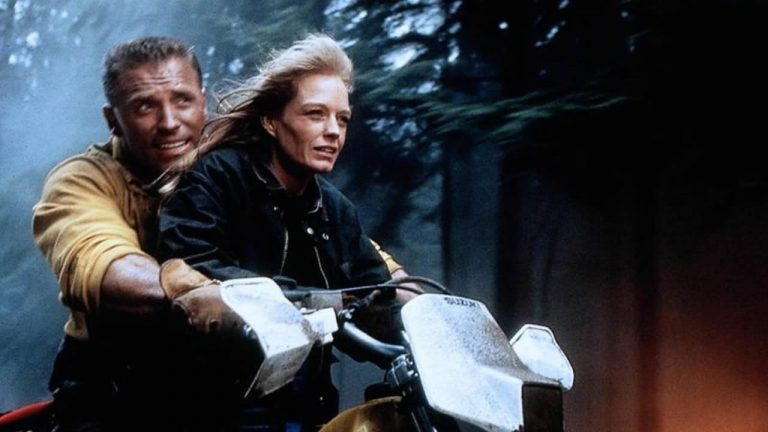
Parents of small children are often stymied as they search for a movie to watch with the kids. You want something with cute puppies, sure. But you also want something that has dogs being shot by cruel men. A film depicting the special bond between a boy and his pet can warm the heart — but it would be nice if the movie could also be a depressing account of death and regret, about a man’s failure to be a good father and husband, and the remorse he will feel forever. Ideally, this movie should also have a squirrel who speaks with the voice of Samuel L. Jackson.

Well, I have good news! You do not need to pool your resources and employ craftspeople to write and produce a film meeting all of the above criteria, because one already exists! It is called “Fluke”! It was released in 1995, apparently in the hopes that people would watch it and enjoy it. Such an outcome is unlikely, yet that was evidently the filmmakers’ hope.

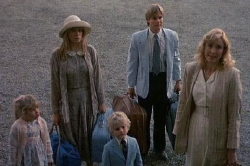
“Fluke” is the story of a man named Tom who dies in a car wreck and is reincarnated as a golden retriever. Being a dog is normally a step up from being a human, what with being able to sleep as much as you want and lick yourself, but the dog version of Tom is born to a stray that lives in an alley. Then again, when he was a human, he was Matthew Modine, so maybe it all balances out.

Dog Tom, who does not remember his former life yet, barely has time to enjoy his new situation (starving on the street) before he and his mother and siblings are captured by dog catchers and taken to an animal shelter. It’s not the good kind of shelter, either, but the kind where they murder you if you stay longer than a week. (Motel 6 has the same policy.) The animal shelter is a terribly sad place, full of forlorn-looking puppies and kitties in gloomy cages, yearning to share their love with someone. It’s like those Sarah McLachlan ASPCA commercials, except that at least the commercials end with an opportunity for you to feel better by donating money. All “Fluke” does is make you sad, for no reason. This will be a recurring theme.

Luckily, just as things are at their darkest, Dog Tom escapes from the pound and dashes out into the world, where he is adopted by an elderly homeless woman who names him Fluke before dying in an alley. If you are scoring along at home, Tom has now 1) died, 2) been reborn as a stray dog, 3) seen his dog family imprisoned, 4) lived on the streets again with a bag lady, and 5) watched his new companion die. Where will this children’s movie/festival of horrors take us next? Let us find out!

Alone and scared, Fluke (né Tom) is further alarmed by the arrival of a fellow stray dog, named Rumbo, who speaks to him with the voice of Samuel L. Jackson. What’s alarming is that Rumbo isn’t actually making a sound — Fluke is hearing his voice in his mind. “It’s a mental thing,” Rumbo says, rather nonchalantly.

So! Dogs can communicate telepathically, but only if another dog teaches them how. Suddenly Fluke’s remarkably traumatic afterlife in this delightful Saturday matinee of a film has taken a Lovecraftian turn.

Fluke and Rumbo are best pals now. They are ESP BFFs. They mooch food from a short-order cook named Bert (Bill Cobbs) and live at an auto-wrecking yard operated by a friendly fellow named Clyde (Jon Polito). No longer living in a constant state of panic and stress, Fluke is able to relax a little, and he starts to remember his life as a human. To be specific, he remembers that he was married to Nancy Travis, and he remembers their phone number. You might think a dog wouldn’t be able to do much with either of those pieces of information. You might think a dog wouldn’t even know who Nancy Travis is. But you don’t know Fluke! Fluke trots right into Clyde’s office, knocks the telephone handset off its cradle, and dials the number with his paw. When his wife answers, he … well, he breathes heavily at her, in a doglike fashion. Because he’s a dog. He can’t talk, you know, and he can only communicate telepathically with other dogs. Even if he could talk, what’s he going to tell Nancy Travis? “Honey, it’s me, Tom. After I died I became a dog, and my name is Fluke now, and I have called you on the telephone. I think we can still make this work.”

The phone call ends with neither party satisfied. Then, because it’s been a few minutes since something awful has happened, Fluke is captured by Ron Perlman and taken to a cosmetics laboratory that does animal testing. Fluke is on the verge of being permanently blinded by chemicals when Rumbo crashes through the window to save the day. All the animals in the lab are set free! In the escape, however, Rumbo is shot by Ron Perlman, who only appeared in the movie long enough to fire a bullet into a heroic dog. Just before Rumbo dies, he confides in Fluke that he, too, was once a human, and that he wishes he could smell the ocean again. He doesn’t get to smell the ocean again, though. He just dies, right there outside the cosmetics lab, murdered in cold blood by Ron Perlman while selflessly rescuing his friend from torture.

Thank you, movie! The nightmares will be much more vivid now.

His memory jarred by this latest incident of ineffable tragedy, Fluke now recalls where he lived when he was Tom. He remembers that he and Nancy Travis, whose name is Carol, had a young son, Brian (Max Pomeranc). He remembers that the car wreck that killed him was caused by his business partner, Jeff (Eric Stoltz). Fluke yearns to return home, to feel the warm embrace of his loving family, and to inflict harsh, pitiless vengeance upon his murderer. It is the archetypical hero’s journey.

Fluke travels via montage to his former city of residence and gets his wife and son, unaware of who he really is, to adopt him as a pet. He lifts their spirits and brings gladness to their hearts. He uses his dog mouth to tenderly pull the covers over his sleeping son, tucking him in as best he can. He gazes longingly at his sleeping wife, probably having thoughts the details of which we would do well not to consider.

Fluke-Tom’s supposedly evil business partner, Jeff, shows up at the house, all chummy with Carol and Brian, and Fluke cannot tolerate this, so he bites Jeff. Being able to bite people who bother you is another perk of being a dog. Hungry for more justice, Fluke follows Jeff to their old office (somehow), hides from him all day (somehow), sneaks into the backseat of Jeff’s car (somehow), then pops up suddenly while Jeff is driving, and attacks him. One hopes that Jeff can appreciate what an amusing anecdote this will make later on. (“So the next day, I’m driving home from work, and there in the backseat is the crazy dog that had bitten me the night before!”)

But now Fluke is starting to remember more details of his life as Tom. It turns out Jeff didn’t run him off the road that night — Tom was driving recklessly. In fact, Tom was kind of an a-hole, reducing the quality of their company’s product to save money and neglecting his wife and son. Fluke thought he was an innocent family man who’d been murdered; now he recalls that he was actually a douchebag who wrecked his car. It’s because of flawed memories like these that a dog’s testimony is inadmissible in court.

Well, now Fluke is pretty depressed. Just to recap: he died, came back as a stray dog, went to jail, watched a homeless lady die, had chemicals poured in his eyes, watched his best friend die, spent time with his family without them knowing it was him, realized he’d been a failure as a husband and father, and remembered that his tragic death had been his own fault. This is a lot for a dog to take in all at once. One minute you’re sniffing someone’s butt, the next minute you’re awash in existential guilt as you contemplate your failings in a past life.

Does the movie at least end with Fluke living out the remainder of his days as a faithful canine companion to his wife and son? No indeed! Aware that he will be miserable being so close to them yet so far away, Fluke leaves the family and sets out on his own. In the final scene, he meets a squirrel who it turns out is Rumbo, reincarnated yet again, and now the squirrel and the dog are going to be best friends. For some reason the movie thinks this is a happy ending. I guess it is, in a way, in the sense that it is infused with less soul-crushing despair than everything that preceded it. Compared to the excruciating cavalcade of misery that has come before it, an ending in which the dog spends the rest of his life with a squirrel is downright cheerful.

We end with Tom-Fluke delivering this monologue in voice-over narration:

“So this is my story. Perhaps I was made to remember so that I could share it with you. And perhaps there are many out there like me, hiding behind the eyes of simple creatures. Maybe even someone close to you.”

In other words: your dog might have the mind and memories of a dead person you loved, so be extra suspicious of everything it does, and don’t let it watch you when you’re in the shower, the end.

P.S. The trailer conveys none of the sadness.

— Film.com

A year of new ‘Snide Remarks’?

33

In a perfect world, I would be writing “Snide Remarks” every week, and you would be reading it, and all would be edified. Our world is imperfect — but together we can take a step toward remedying that!

I’m excited to officially announce a Kickstarter campaign for A Year of Snide Remarks. It launched just before Christmas, but I wanted to wait until after the holidays to start the big push. THIS IS NOW THE BIG PUSH.

Here are the basics. I love writing “Snide Remarks” but can’t justify the time and energy it requires if it’s not producing income, because I’m a freelance writer and not independently wealthy. And since no reputable publication will pay me to write “Snide Remarks,” I now come to YOU, the readers, to be my employers.

For $5,000, I will write “Snide Remarks” every week for a year. (Well, 50 columns. I get two weeks off.) It’s unseemly to discuss financial matters in such a public fashion, but there it is. That’s my price. Five grand for 50 columns. Now you people, you pitch in, pass the virtual hat around, and collect $5,000.

Kickstarter works on an all-or-nothing basis. We have until Feb. 1 to raise $5,000 in pledges. If that money is raised by Feb. 1, then I’ll write “Snide Remarks” every week for a year, starting March 7. If we don’t get $5,000 in pledges by Feb. 1, nobody pays anything, no columns are written, and everyone is sad.

Friday movie roundup – Dec. 31

0

Happy New Year! 2011, specifically, is the year that I hope will prove happy for you. As usual, no one bothered to release any big new movies over New Year’s weekend, but we have some other things to discuss.

Here are my two end-of-the-year features: “The Best and Worst Movies of 2010” and “Eric’s Media Inventory: What I Watched in 2010.” You may also be interested in the New Year’s Eve episode of “Movie B.S. with Bayer and Snider,” in which Bayer and I discuss our favorite films of the year.

Also related: here’s a list of all the wide-release films of 2010, and links to my least awful 2010 articles from Film.com and Cinematical.

At Cinematical, I wrote “10 Festival Favorites That Didn’t Make It to Theaters in 2010” and “The Lowest-Grossing Wide Release Movies of 2010.”

Over at Film.com, “What’s the Big Deal?” addresses “Sunset Boulevard,” and there are two editions of “Eric’s Bad Movies” for you to catch up on: “Fortress” and “Sssssss.”

Subscribe to “In the Dark,” a weekly e-mail with the latest movie reviews, DVD releases, and other pertinent info.

Listen to “Movie B.S. with Bayer and Snider,” a weekly Internet radio show featuring Jeff Bayer and Eric D. Snider, at Cascadia.fm. It’s live at 11 a.m. (Pacific) every Friday, then downloadable as a podcast. Ignore the iTunes “explicit” tag; we always keep it PG.

Blue Valentine

0

I believe the song “Breakfast at Tiffany’s,” by Deep Blue Something, said it best: “It’s plain to see we’re over/And I hate when things are over/When so much is left undone.” I also hate when things are over when so much is left undone, especially when the things that are over are relationships.

Which brings me to my point. “Blue Valentine,” a somber, quiet film that has nothing to do with Deep Blue Something, explores the tragedy of failed love affairs in heartbreaking detail. I’m being glib because the movie is sad. It’s how I cope. You try watching “Blue Valentine” and see if it doesn’t remind you of some melancholy episode from your romantic past.

The exceptionally well-acted film stars Michelle Williams and Ryan Gosling as Cindy and Dean, a twentysomething couple in Scranton, Penn., who have a young daughter, Frankie (Faith Wladyka). Cindy works at a doctor’s office and Dean is a house painter. They are decidedly blue-collar and unpretentious. In the present, they are about to take an overnight trip together, just the two of them, to try to rekindle their marriage.

But the film is not entirely set in the present. Instead, we get a non-linear look at Dean and Cindy’s relationship, including scenes that happened before they met, like a starkly dramatic version of “500 Days of Summer.” This narrative device lets us glean small details about their lives gradually, resulting in an experience that’s more satisfying than a more traditional story would have been. (That’s another way of saying that told in the proper sequence, Cindy and Dean’s story is fairly ordinary.)

Williams and Gosling give performances that are better than every other element of the film (which was directed by Derek Cianfrance, from a screenplay he wrote with Joey Curtis and Cami Delavigne). Gosling, an intense actor from the Daniel Day-Lewis school of self-seriousness, disappears into the character of Dean, giving him quirks and tics, bringing him to life believably as a working-class guy who can’t properly express his love for Cindy. Williams, meanwhile, gives Cindy a tremendous amount of sad, listless frustration, which makes more sense the more we learn about her.

As a character study, “Blue Valentine” is superb. By the time it’s over, you feel like you’ve known these people their whole lives. Yet for all the earnest, doleful pathos involved, it doesn’t give the kind of catharsis in the end that it should. It’s a sad tale, and it’s well told — but what does it amount to? I feel like there’s so much left undone.

Another Year

0

Mike Leigh, often a chronicler of hapless middle-class Londoners, went light with his last film, 2008’s “Happy-Go-Lucky,” which focused on a relentlessly chipper Pollyanna type. His new one, “Another Year,” heads back in the direction of somberness, but it carries a lot of mirth with it. In fact, for most of its running time it feels like a straightforward sophisticated comedy, one that might even have a happy ending…

What we have here is a solar system of messed-up people who orbit an older couple named Tom (Jim Broadbent) and Gerri (Ruth Sheen). Tom and Gerri are stable, rock-solid types, with professions to match: he’s a geologist, she’s a counselor. They’ve been married for more than 30 years and still adore one another. They are everyone’s ideal, all the more lovable for being slightly daft, like a favorite aunt and uncle. It’s no wonder they’re admired by the people who know them.

These include Mary (Lesley Manville), a secretary at the hospital where Gerri works, who’s been in one unsuccessful, ill-advised relationship after another. Mary is bubbly and sarcastic, a pleasant chatterbox and an enthusiastic drinker. She’s a bit lonely but seems optimistic. Until she drinks TOO much, that is, whereupon her bipolar pendulum swings the other direction and she becomes hilariously morose.

Tom and Gerri have a 30-year-old bachelor son named Joe (Oliver Maltman). Since they’re the perfect parents, they don’t nag Joe about settling down and producing grandchildren for them, though they clearly want that. Mary, whose age is somewhere between Joe’s and his parents’, behaves flirtatiously with him — maybe like a saucy family friend, maybe like a ravenous cougar. It’s hard to tell whether she REALLY wants to date him, or whether she just thinks she does.

Mary is a fascinating woman, exceptionally well played by Mike Leigh veteran Lesley Manville. She wears all her emotions on her sleeve, a whirlwind of energy and neuroses, and an authentic, believable character. Only a scene in which she expresses petty jealousy over Joe’s new girlfriend rings false and sitcom-y; everything else Mary does feels pulled from real life.

To further our examination of Mary, Leigh provides a few characters who are slight variations of her. There’s Ken (Peter Wight), a big, beery friend of Tom’s who is also single and gets emotional when he drinks too much, which is often. You might think the film is contriving to set Ken up with Mary, but no: she is repulsed by him. An older woman named Janet (Imelda Staunton), a patient at the hospital, is married with children, like Mary wants to be, but is deeply and bitterly depressed. Joe’s girlfriend, Katie (Karina Fernandez), makes some gestures and remarks that remind you of Mary, except that Katie is well-adjusted and happy. I think the suggestion is that Ken, Janet, and Katie are all visions of what Mary could become, depending on how she deals with her current crises.

Leigh presents all of this in his typical slice-of-life fashion, light on plot but heavy on characterization, full of effortlessly funny dialogue. “Another Year” comes across like an exceedingly well-acted stage play. Each performance is richly detailed, even when the character appears in only a few scenes. (David Bradley, familiar as Argus Filch in the Harry Potter films, is startlingly memorable as Tom’s brother, who doesn’t appear until the last quarter of the film.) With all their flaws, these are still perfectly delightful people. It’s a pleasure to spend a couple hours with them, even if it’s only in fiction.

The Best and Worst Movies of 2010

0
The Best and Worst Movies of 2010

In theory, it should be easy to figure out my 10 favorite movies of the year. I give them grades when I write the reviews. Come December, all I have to do is sort them from A to F and draw a line after the top 10, right? Simple math.

Unfortunately, as it often does, math fails us. How do you compare all the movies that got the same grade? What if a subsequent viewing of a movie has increased or diminished my opinion of it? What if I never got a chance to see “Marmaduke,” or that rom-com where Jennifer Aniston was handcuffed to Gerard Butler? How can I possibly issue a decree?

So it’s imperfect, and there are movies I didn’t see, and after the first two spots I could probably change the order around. But as far as I’m concerned, these are…

The Best Movies of 2010

1. “Toy Story 3.” What could have been a cash-grab sequel is instead a miraculous culmination of the series’ themes. How can any movie (we’re well past the stage of marveling at the fact that it’s a cartoon) address weighty existentialist themes in such a poignant fashion, without sacrificing humor, action, and all-ages entertainment? How is every emotion, high and low, conveyed so gracefully and organically, without a hint of contrivance? How does the third entry in a franchise not just match but in some cases exceed the accomplishments of its predecessors? I’m sure the Pixar people enjoy raking in cash as much as anyone, but never for a second does “Toy Story 3” feel like it was made specifically for that reason. From start to finish, in every last detail, it feels like a labor of love.

2. “Inception.” Here’s another miracle. “Inception” has a complicated premise that requires the viewer to pay attention constantly — and yet rather than being lauded by critics and fading into box-office obscurity, which would normally be such a movie’s fate, it was lauded by critics and made $825 million worldwide. Christopher Nolan’s trippy story is a technical marvel, almost as dazzlingly proficient (and emotionally disconnected) as anything Stanley Kubrick ever made. I hear he makes a pretty good Batman movie, too.

3. “Black Swan.” Natalie Portman makes stage fright truly terrifying in Darren Aronofsky’s exploration of what artists will do to achieve perfection. This movie is bizarre in such a variety of ways that it’s almost a spoiler to tell you in what type of bizarreness it mostly indulges.

4. “The Social Network.” Ostensibly about the founding of Facebook, this crackling techno-drama astutely observes the way the millennial generation communicates. This may well be what sociologists use a hundred years from now to try to make sense of the early 2000s.

5. “The King’s Speech.” The year’s most joyful picture. It’s a crowd-pleaser, a critic-pleaser, and an all-around hooray-for-life extravaganza. I nominate Colin Firth for king of everything.

6. “Rabbit Hole.” For emotional catharsis, it’s hard to beat this sensitive drama about a married couple coping with grief. Best Nicole Kidman and Aaron Eckhart performances ever? Maybe so.

7. “127 Hours.” A one-man show is hard to pull off. A one-man, one-handed show is even harder. Yet here’s James Franco, directed by Danny Boyle, doing exactly that.

8. “Mother.” I’m still haunted by this Korean mystery about a woman whose mentally handicapped son is accused of murder, leading her to do whatever it takes to clear his name. If this were an American film and the woman were played by Meryl Streep, her Oscar nomination would be in the bag.

9. “Animal Kingdom.” More mothers and sons in this harrowing tale of survival of the fittest in Australia’s criminal underground. The felonious life has rarely been so unglamorous.

10. “Four Lions.” This audacious British comedy treats terrorism seriously while mocking its practitioners. It’s amazing someone even had the guts to try this, let alone that they pulled it off so well.

Honorable mentions (in alphabetical order):
“Cyrus,” “How to Train Your Dragon,” “The Illusionist,” “Let Me In,” “Lovely, Still,” “Scott Pilgrim vs. the World,” “Splice,” “The Square,” “True Grit,” “Winter’s Bone.”

Films I didn’t see that might have been contenders, considering how many other critics have listed them: “Carlos,” “Dogtooth,” “I Am Love,” “Inside Job”

The Worst Movies of 2010

I have grown just as stingy with my F grades as I have with my A grades. Some of these got a D-minus (“a gentleman’s F,” as one reader called it) because they didn’t enrage me quite enough. Trust me, though. They’re all bad.

1. “Little Fockers.” Imagine some lazy actors improvising scenes as characters they last played six years ago. Imagine them being given no instruction on what should happen in the scene, only that it should involve these characters. Whatever you are imagining is 30 times funnier than “Little Fockers” and has fewer Viagra jokes.

2. “Trash Humpers.” Untalented provocateur Harmony Korine tries to see how tedious and genuinely irritating a movie can be. The answer? Very!

3. “Leap Year.” One of two awful romantic-comedies tied to a particular day of the year. In this one, Amy Adams proves that it is possible for her to be unlikable.

4. “Valentine’s Day.” Ancient Hollywood hack Garry Marshall relaxes his sphincter and releases 125 minutes of steaming rom-com cliches into your cinema-toilet.

5. “Vampires Suck.” The only good joke in the film was the one they stole from me.

6. “The Back-Up Plan.” Jennifer Lopez becomes artificially inseminated, THEN meets the man of her dreams! She’s on a collision course with wackiness!

7. “My Soul to Take.” Wes Craven has a reputation as a master of horror, and evidently he is tired of that.

8. “A Nightmare on Elm Street.” Yikes, bad year for Wes. This remake of his 1984 semi-classic is as worthless as the vast majority of copycats the original inspired.

9. “Yogi Bear.” They put off making this film until the people who grew up with the TV cartoon were old enough to get the senior discount at the theater.

10. “Clash of the Titans.” How can a movie with a kraken be boring? Tune in and find out.

Some likely contenders that I didn’t see:
“Alpha and Omega,” “The Bounty Hunter,” “Furry Vengeance,” “Marmaduke,” “Nutcracker in 3D,” “You Again”

Miscellaneous data

Shortest movie: (tie) “The Freebie,” “Trash Humpers,” both 78 minutes.

Longest movie: “Carlos.” The full version, shown in three parts, is 332 minutes long; the “condensed” version is 165 minutes.

Longest title: “The Chronicles of Narnia: The Voyage of the Dawn Treader”

Shortest title: “RED”

Least enjoyable good movie: “Blue Valentine”

Most enjoyable bad movie: “Skyline”

Low self-esteem titles: “The Losers,” “The Expendables,” “The Other Guys,” “Despicable Me,” “Diary of a Wimpy Kid,” “She’s Out of My League”

Do not get these movies mixed up: “The American” and “The Tourist”; “I Am Love” and “I’m Still Here”; “Never Let Me Go” and “Let Me In”; “The A-Team” and “Easy A”; “Eclipse” and “The Eclipse”; “Date Night,” “Knight and Day,” and “The Next Three Days”; “Frozen,” “Buried,” and “Winter’s Bone”; “The Last Airbender,” “The Last Exorcism,” and “The Last Song”; “Resident Evil: Afterlife,” “Shrek Forever After,” and “Hereafter”

Movies with animals in the title: “Black Swan,” “Catfish,” “Cats & Dogs: The Revenge of Kitty Galore,” “Dogtooth,” “Fish Tank,” “Four Lions,” “How to Train Your Dragon,” “The Human Centipede,” “Jackass 3D,” “Legend of the Guardians: The Owls of Ga’Hoole,” “Piranha,” “Rabbit Hole,” “The Wolfman,” “Yogi Bear,” and, of course, “Animal Kingdom.” (Honorable mentions: “Marmaduke,” “Secretariat.”)

Titles that mention specific cities: “From Paris with Love,” “When in Rome,” “Brooklyn’s Finest”

Titles that suggest cities in general: “Sex and the City 2,” “City Island,” “The Town,” “Skyline”

Violent titles: “The Fighter,” “The Warrior’s Way,” “Machete,” “Killers,” “Kick-Ass,” “Predators”

Colorful titles: “RED,” “Blue Valentine,” “Black Swan,” “Green Zone,” and, of course, “For Colored Girls”

The life cycle: “Inception,” “Due Date,” “Babies,” “The Kids Are All Right,” “Youth in Revolt,” “Grown Ups,” “Death at a Funeral,” “Hereafter”

Movies that sound like they could be about a honeymoon gone wrong: “Why Did I Get Married Too?,” “Let Me In,” “Enter the Void,” “Furry Vengeance,” “You Again,” “You Will Meet a Tall Dark Stranger,” “Dear John,” “The Back-Up Plan”

Family comedies in which former action stars play domesticated tough guys who must win over their girlfriends’ children while hiding their secret lives: Jackie Chan in “The Spy Next Door,” Dwayne Johnson in “Tooth Fairy”

Movies in which characters sprout wings (or at least appear to do so): “Tooth Fairy,” “Legion,”“Black Swan,”“Splice”

Hitchcockian suspense thrillers set primarily on islands off the coast of Massachusetts: “Shutter Island,” “The Ghost Writer”

Movies in which “30 Rock” cast members make a reference to strippers with C-section scars: Tina Fey in “Date Night,” Tracy Morgan in “Death at a Funeral”

Movies in which somebody gets poop on them: “Death at a Funeral,” “Babies,” “Life As We Know It,” “Jackass 3D,” “I’m Still Here”

Movies with gags about a woman breastfeeding a child who’s well past the normal age: “The Back-Up Plan,” “Grown Ups,” “Get Low” (he doesn’t do it, but he makes a joke about it)

Movies with extraordinarily misleading titles: “The Karate Kid” (it’s about kung fu), “Alice in Wonderland” (it’s a sequel to the familiar story, not a remake), “Robin Hood” (it’s a prequel to the familiar story, not a remake); “The Greatest” (it’s terrible).

Movies in which the Tooth Fairy truth is ruined for a little kid: “Tooth Fairy,” “Grown Ups”

Movies in which Chris Rock attends a funeral: “Death at a Funeral,” “Grown Ups”

Movies in which teeny-bopper idols take off their shirts and snuggle with frigid girls to keep them warm: Taylor Lautner in “Eclipse,” Zac Efron in “Charlie St. Cloud”

Two-and-a-half-hour movies directed by gay men, aimed at female audiences, in which privileged, vaguely horse-faced American women go overseas to get their groove back: “Sex and the City 2,” “Eat Pray Love”

Comedies about artificial insemination: “The Back-Up Plan,” “The Switch”

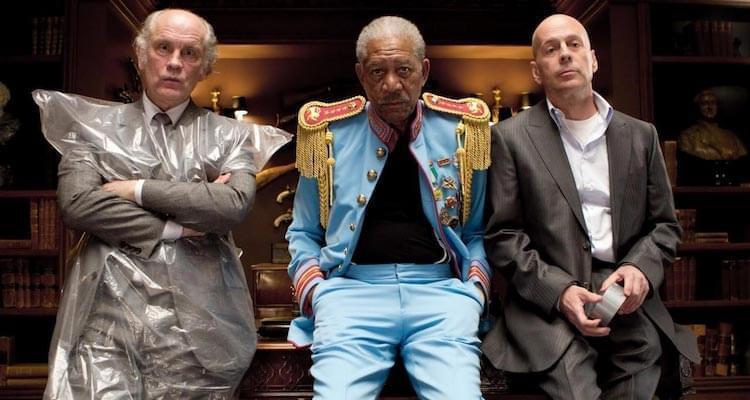
Globe-trotting action comedies in which a woman is abducted by a suitor who claims to be a government agent but might just be insane, and they fall in love, and she helps him with his mission, and she is frequently drugged or tied up: “Knight and Day,” “RED”

Documentaries in which children hope to be selected in education-based lotteries: “Freakonomics,” “Waiting for ‘Superman'”, “The Lottery”

Movies about people trapped in confined spaces: “Devil” (elevator), “Buried” (coffin), “127 Hours” (rock crevasse), “Frozen” (ski lift)

Movies in which a toy escapes from its owner: “Toy Story 3,” “Gulliver’s Travels”

Movies in which Josh Brolin’s face is scarred: “Jonah Hex,” “True Grit”

Movies in which an old team is reassembled: “The Losers,” “The Expendables,” “The A-Team,” “Grown Ups,” “RED,” “Macgruber”

Movies with thick Massachusetts accents: “Shutter Island,” “The Town,” “The Fighter,” “Conviction,” “The Company Men”

Movies that take place largely in the characters’ dreams or imaginations: “Inception,” “A Nightmare on Elm Street,” “Alice in Wonderland,” “Shrek Forever After,” perhaps others that would be spoiler-y to mention

Media Inventory: What I Watched in 2010

0
Media Inventory: What I Watched in 2010

This account of my media intake is slightly streamlined compared to previous years. I’ve always done the “Media Inventory” mostly for my own amusement; this reflects how much amusement I found in it this time.

MOVIES

I watched 349 movies in 2010 — the fewest since I started keeping track in 2004. I note, however, that 349 is still a lot.

Of the films released in 2010 (or that played at 2010 festivals), I saw 224 and reviewed 153 of them. The other 125 movies I watched were pre-2010 releases, some of which I saw for the first time and many of which were new to me.

2010 releases that I saw and reviewed:
To see the whole list, go to the Archives and filter the date to only include “2010.”

2010 releases that I saw but did not review (with probable grade, where my memory is sufficiently clear):

Sundance Film Festival:
Douchebag
Hesher (B)
The Killer Inside Me (B)
Louis C.K.: Hilarious (A-)
The Perfect Host (C-)
Tucker and Dale vs. Evil (B+)
The Violent Kind (D)

South By Southwest Film Festival:
American Grindhouse (B)
Barry Munday (B)
Brotherhood (C)
Cargo
Centurion
Cold Weather (B)
Crying with Laughter
Elektra Luxx (D)
Harry Brown (B)
The Loved Ones (A-)
Monsters (B-)
The Myth of the American Sleepover (C)
Saturday Night (B+)
Suck (D)

Tribeca Film Festival:
Cairo Time (B)
Sons of Perdition (B)
Soul Kitchen (B)

Telluride Film Festival
Chico and Rita (C+)
The First Grader (C+)
The Way Back (B)

Fantastic Fest:
Bedevilled
Heartless (B-)
A Horrible Way to Die (A-)
I Saw the Devil (B+)
Mother’s Day (D)
Outrage
Red, White & Blue
A Somewhat Gentle Man (B)
Stake Land (B-)
Undocumented (B+)
We Are What We Are (B+)

Elsewhere:
The Adults in the Room (B)
Bad Batch (B-)
D Tour (B-)
Exit Through the Gift Shop (B+)
For the Love of Movies (B)
Freakonomics (C+)
The Girl with the Dragon Tattoo (B)
Joan Rivers: A Piece of Work (B-)
Mother and Child (B-)
She’s Out of My League (B)
The Virginity Hit (C)
The White Ribbon

2010 releases that I watched twice:

127 Hours
Black Swan
Four Lions
Get Low
How to Train Your Dragon
Howl
Inception
Micmacs
The Social Network
Splice
The Square
Toy Story 3
True Grit (2010)
Winter’s Bone

Pre-2010 releases that I had seen before, and reviewed, that I re-watched this year:

1408
Billy Elliot
Brick
Elf
Godzilla (1998)
Saw
Taken
A Town Called Panic
Up

Pre-2010 releases that I had seen before but did not review, that I re-watched this year:

101 Dalmatians (animated)
12 Angry Men
2001: A Space Odyssey
400 Blows
All About Eve
Annie Hall
Apocalypse Now
Baby Geniuses
Battleship Potemkin
Beginning of the End*
Bonnie and Clyde
Breathless
A Bug’s Life
Chinatown
Citizen Kane
City Lights
Contact
Cool Hand Luke
Days of Heaven
Devil Doll*
Dogma
Dr. Strangelove
Drop Dead Gorgeous
Easy Rider
Fortress
Freddy’s Dead: The Final Nightmare
The Graduate
High Noon
Horror at Party Beach*
Independence Day
The Iron Giant
Jaws 3-D
Jurassic Park
La Dolce Vita
Life of Brian
M (1935)
Mr. Smith Goes to Washington
Nashville
National Lampoon’s Vacation
Night of the Blood Beast*
The Passion of Joan of Arc (twice!)
Prince of Space*
Psycho
Raging Bull
Rambo III
Rashomon
Rebel Without a Cause
Robin Hood (Disney)
Stagecoach
Sunset Boulevard
Superman III
The Third Man
TRON
Vertigo
Wing Commander

*watched via “Mystery Science Theater 3000”

Pre-2010 releases that I saw for the first time this year:

For “Eric’s Bad Movies” at Film.com:

3 Ninjas
976-EVIL
American Ninja
The Apple
At the Earth’s Core
Babylon A.D.
Bangkok Dangerous
Body Rock
Conan the Destroyer
Cool As Ice
Cool World
D-War: Dragon Wars
DOA Dead or Alive
Double Team
Exorcist II: The Heretic
Firestorm
Flowers in the Attic
Gooby
Heartbeeps
Hercules (1983)
House II: The Second Story
The Island of Dr. Moreau
In the Name of the King: A Dungeon Siege Tale
The Manitou
Mr. Nanny
Night of the Lepus
Only the Strong
The Pagemaster
Piranha II: The Spawning
Sgt. Pepper’s Lonely Hearts Club Band
Sleepwalkers
Sssssss
Texas Chainsaw Masscare: The Next Generation
Under Siege 2: Dark Territory
Virus
Wizards of the Demon Sword

For other reasons, or occasionally no reason:

Bicycle Thieves
The Big Chill
The Blues Brothers
Bronson
Company
Daylight
Dead Men Don’t Wear Plaid
Doctor Zhivago
Eddie Izzard: Circle
Eddie Izzard: Glorious
Footloose
The Good, the Bad and the Ugly
I Spit on Your Grave
Jackass 2.5
Jules and Jim
Last Year at Marienbad
M. Hulot’s Holiday
The Muppet Movie
Revenge of the Nerds
The Rules of the Games
Stand By Me
True Grit (1969)
The Wild Bunch
Witness
Z (1969)

TV

I really need to watch more TV. I watched 283 hours of television in 2010, almost all of it via DVR, which means I skipped the commercials, which means I watched those 283 hours in about 212 hours, which means I was only in front of the TV for about 35 minutes a day. That’s ridiculous.

For what it’s worth, here are the shows I watched regularly this year. I don’t watch any shows that I don’t like, so that means I like all of these.

30 Rock
Breaking Bad
Childrens Hospital
Community
Friday Night Lights
Fringe
Futurama
It’s Always Sunny in Philadelphia
Lost
Louie
Mad Men
Modern Family
The Office
Parks and Recreation
Raising Hope
Saturday Night Live
The Simpsons
South Park
Tim & Eric Awesome Show Great Job
The Walking Dead

Film.com and Cinematical: 2010 in review

0

The organizations that keep me most gainfully employed are Film.com and Cinematical. The editors I work with — Laremy Legel at the former, Erik Davis and Scott Weinberg at the latter — are a writer’s dream: supportive, professional, laid-back, and easily amused. I consider them friends in real life, too, and I always enjoy hanging out with them in person at film festivals. Sometimes they pretend to fight over me, which is nice.

My arrangement at Film.com has me writing four articles a week: “Eric’s Bad Movies,” “What’s the Big Deal?,” a review, and a miscellaneous other movie-related feature. We usually try to make those “other” pieces funny. Below is a list of the ones from 2010 that I like. In every instance, the idea for the column was Laremy’s. This is great, because I’m terrible at coming up with premises, and once someone tells you, “Explaining ‘Machete’ to Aliens Who Have Just Arrived from Outer Space,” half the work is done for you.

My Film.com highlights from 2010
(My author page at Film.com)

2/9: What to Expect from a George Lucas Musical
3/3: Circumstances Under Which I Would Willingly Watch ‘Little Fockers’
3/17: Pitch Meeting: ‘The Bounty Hunter’
4/19: ‘Furry Vengeance’ and ‘A Nightmare on Elm Street’: How to Tell the Difference
6/1: Pitch Meeting: ‘Killers’
6/2: Imagining ‘Marmaduke’ As an R-Rated Horror Film
6/21: Pitch Meeting: ‘Grown-Ups’
6/28: Our Idea for a Smurfs vs. Garfield vs. Marmaduke Film
8/4: And Now We Imagine a Meeting Between Nicolas Cage and His Agent

Sssssss

0
Sssssss

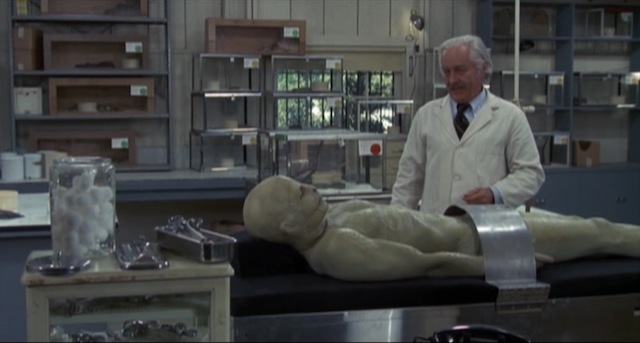
What is it with mad scientists and animals? It seems like most mad-scientist-based movies (which comprise about 75 percent of all movies) focus on the crazy doctor’s efforts to turn a person into an animal, or to transfer an animal’s characteristics to a human, or to create an animal-human hybrid. The thing is, these experiments never turn out well. Not once. At best, the mad scientist temporarily becomes whatever it is he was trying to become and then gets killed; at worst, he gets killed before he even gets that far. You’d think that by now the world’s mad scientists would have gotten the message that playing God is invariably fatal and usually gross.

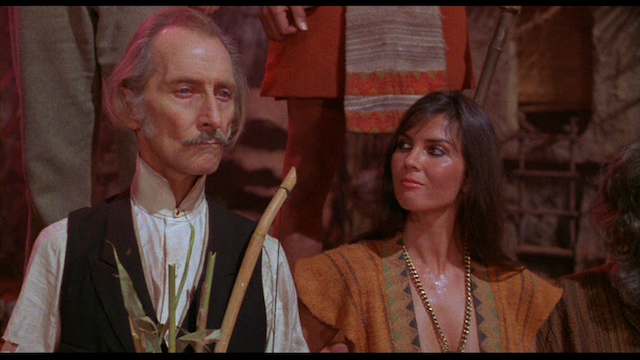
Such is the case in “Sssssss,” a 1973 Universal Pictures release about a weird herpetologist and his unsavory snake fixation. While we allow that “Sssssss” is a fantastic title — it looks AND sounds like a snake! — we do not understand why a person would want to fuse man and serpent into one creature. Snakes do not have arms or legs. Even their most ardent admirers will admit this is a deficiency, especially if one is accustomed to being fully limbed. Yes, if you were a snake you could use your venomous fangs to attack your enemies, but you know what you wouldn’t be able to do? Close your eyes. Being all sleek and slithery is kind of cool, but you know what isn’t? Eating rats.

Our mad scientist is named Dr. Carl Stoner, and he’s played by Strother Martin, who is perhaps best known for saying “What we’ve got here is failure to communicate” in “Cool Hand Luke.” What we’ve got in “Sssssss” is failure to not be insane. During the week, Dr. Stoner is a legitimate herpetologist with some kind of vague affiliation with a university. On Sundays, he operates a live-reptile sideshow out of his home, during which he removes deadly snakes from their enclosures and taunts them for the amusement of the assembled gawking hicks. There is not a lot of money in snake-centered entertainment, but Dr. Stoner doesn’t do it for money, he does it for love, and possibly sexual gratification.

The film begins with Dr. Stoner going to the university to find a new lab assistant. He says his old one, Tim McGraw (seriously), had to leave suddenly due to a family emergency, but we suspect Dr. Stoner is lying. Before the opening credits, we saw Dr. Stoner sell a crate to a shady-looking man, and whatever was inside the crate was doing a lot of moaning and protesting, and the shady-looking man said he thought Dr. Stoner would be hailed as a genius someday, which is what shady types always say about madmen in these movies, usually after the madmen have created some kind of unnatural abomination. We’re going to go out on a limb and guess that the moaning crate and the shady man have something to do with Tim’s disappearance.

sssssss

In any event, it is very easy, when you are vaguely affiliated with a university, to saunter down to campus now and then and collect a new assistant. They hand them out like course catalogs. Dr. Stoner picks up a dopey, fresh-faced grad student named David, played by Dirk Benedict, later of “A-Team” fame. David, who is eager, enthusiastic, and almost unbelievably dim-witted, hops in Dr. Stoner’s truck and heads back to his snake-infested lab without a second thought, like Bugs Bunny going to Dr. Jekyll’s place. Also in the truck is Dr. Stoner’s pet python, Harry. Dr. Stoner lets Harry drink bourbon, and talks to him as if they were old friends. Upon arriving at the lab, Dr. Stoner shows off his deadliest snakes, does some low-level taunting to get them riled up, milks some venom out of one, and describes the king cobra as “the most cunning, the most vicious, the most insolent of all God’s creatures.” Then he gives David an inoculation to protect against the snake bites he is certain to receive in the coming weeks. David’s reaction is that all of this seems pretty neat-o! A new job, a rambling doctor with an alcoholic snake, some cobra-harassment, and an inoculation, all in one day!

sssssss

It gets even better for David: Dr. Stoner has a college-aged daughter, Kristina (Heather Menzies), and she is beautiful! Or the 1973 equivalent of beautiful, anyway. She wears big, frumpy eyeglasses and has no idea her snake-charming father is a lunatic. She wonders what happened to his last assistant, Tim McGraw, but she doesn’t wonder hard enough to ask any real questions. Meanwhile, the inoculation Dr. Stoner administered to David was not an inoculation at all, but a serum that will slowly turn David into a snake, obviously.

So this is Dr. Stoner’s plan. Having failed in his efforts to turn Tim McGraw into a snake, and having sold whatever hideous mutant Tim McGraw became to a carnival, he’s now going to try it on poor dumb David. Once he perfects the serum, he will presumably turn himself into a snake, too, since he loves snakes sooooo much and is always carrying on about how awesome they are, and how noble they are, and if he were a snake then he and Harry could get married, they could get gay snake married, and live happily ever after, just the two of them, Dr. Stoner and Harry, the same-sex snake couple. Won’t that be grand, when Dr. Stoner is a snake?

In the meantime, he has to keep David from realizing what he’s doing to him. This is easy, as David is quite stupid. His skin starts flaking off after a couple days — the way it does after you get a sunburn, or when you are a snake — and Dr. Stoner convinces him this is just a minor reaction to the inoculation. When David’s body temperature starts dropping, he gets the same explanation. For the viewer, it becomes an experiment in gullibility: How much complete crap will David believe before he catches on? Will he EVER catch on? Or will he still be thinking “Huh, more side effects!” when he’s unhinging his jaw and swallow house cats?

sssssss

Dr. Stoner is always milking venom out of his snakes. Heaven only knows what he does with it. One day he tries to get some from a black mamba and gets bitten. A snakebite is but a minor nuisance to one whose bloodstream is filled with as much anti-venom as Dr. Stoner’s, but he quits harassing this particular snake for the day anyway, declaring, “I’ll milk you tomorrow, you African bastard!” You will agree that whatever faults this movie may have, making Strother Martin yell “I’ll milk you tomorrow, you African bastard!” at a snake is not among them.

Back to David. A jerk he knows from school picks a fight with him one night in town, and David bites him, because he’s sort of snake-like now. Then the guy, whose name is Steve (everyone was named Steve in 1973), comes to Dr. Stoner’s house to hit on Kristina, and maybe to fight with David some more, and he accidentally kills Harry the python. Devastated, Dr. Stoner sneaks over to Steve’s apartment afterward with a poisonous serpent, which bites Steve, and Steve dies. This is good news for Dr. Stoner, who can finally mark “YES” on the Academy of Mad Scientists application form where it asks, “Have you ever used whichever animal is the object of your obsession to carry out a vendetta against an enemy?”

But then there is bad news for Dr. Stoner. His daughter, Kristina, is becoming rather cozy with David. The young man would be a fine suitor — he’s polite, well-groomed, has no visible tattoos — were it not for the fact that he is days away from becoming a snake. As much as Dr. Stoner loooooves snakes, he evidently doesn’t want his daughter marrying one, because he is racist. As the snakification process near its completion, David is going to become rather poisonous (not to mention scaly), and exposure to his blood could be deadly. So Dr. Stoner, without explaining why, exactly, warns Kristina not to have sex with David. His error is in doing this approximately 10 minutes after she has sex with David. This is why parents should have the “birds and the bees and the snakes” conversation with their children when they’re still young.

Everything turns out more or less the way you’d expect. We learn the fate of Tim McGraw (carnival sideshow), David turns into a real live cobra, Dr. Stoner is fatally bitten by another cobra, the cops arrive, Kristina screams a lot, and so forth. (No word on whether Kristina is pregnant with David’s snakelings.) “Sssssss” is very proud of the fact that it used actual live snakes in almost every scene, which gives it an air of creepiness that can only be achieved by, um, putting a bunch of snakes in front of a camera and filming them.

— Film.com

All the wide releases of 2010

5

For people who like lists of things, here is a list of the 137 movies that opened in wide release in the United States in 2010. “Wide release” means it played in at least 1,000 theaters. Some movies started much smaller than that and expanded; this list includes those, as long as they eventually made it to 1,000. Missing are the 300+ movies that opened this year but didn’t go into wide release. That isn’t a judgment against those movies, just a way of sorting them. Information is according to Box Office Mojo. Links are to my reviews.

I saw 117 of them. How many did you see?

1/8 Daybreakers
1/8 Leap Year
1/8 Youth in Revolt
1/15 The Book of Eli
1/15 The Spy Next Door
1/22 Tooth Fairy
1/22 Extraordinary Measures
1/22 Legion
1/29 Edge of Darkness
1/29 When in Rome

2/5 From Paris with Love
2/5 Dear John
2/12 Valentine’s Day
2/12 Percy Jackson & The Olympians: The Lightning Thief
2/12 The Wolfman
2/19 Shutter Island
2/26 Cop Out
2/26 The Crazies

The Way Back

0

“The Way Back” begins with a spoiler: In 1941, three men trudged into India after walking 4,000 miles from Siberia. This is their story. Our question as we watch the movie: which three will it be?

The film is loosely based on Slawomir Rawicz’s 1956 book “The Long Walk,” a bestselling account of the author’s journey after escaping a Russian gulag. The story’s veracity has been rather strenuously questioned since then, and the film is only “inspired by” the book anyway, so it’s best not to keep thinking, “Wow, this really happened!,” because a lot of it probably didn’t. 

Fiction or not, though, it’s an amazing story of survival, directed by Peter Weir (“The Truman Show,” “Witness”) with his usual serious, workmanlike skill. It’s a good enough film, and what keeps it from being better might be endemic to the story. The tale of a 4,000-mile walk is almost unavoidably going to have some lag time. 

The benefits of putting a prison camp in Siberia are obvious, as summarized by one of the guards early on: “Nature is your jailer, and she is without mercy.” Even if inmates escape from the gulag itself, they have a few hundred miles of frozen wilderness to contend with.

Having established the stakes, “The Way Back” proceeds to tell about some people who do escape from the gulag and who do face the natural perils thereafter. They are an odd assortment of different types, including a Polish dissident (Jim Sturgess), a cryptic American (Ed Harris), an actual criminal (Colin Farrell) — most of the inmates are merely political prisoners — and a handful of others. (Sebastian Urzendowsky, Alexandru Potocean, Dragos Bucur, and Gustaf Skarsgard — a German, two Romanians, and a Swede — round out the multinational cast.) There are some fatalities that thin the ranks, and a teenage girl, played by Saoirse Ronan (“Atonement”), who joins the group mid-trek.

For a good long while the film’s depictions of hardship and deprivation are the kind that inspire awe and respect in audience members, who will feel very grateful to have warm places to sleep tonight. (If they do not have warm places to sleep tonight, at least they can take comfort in knowing they are not in Siberia. If they are in Siberia, then I don’t know what to tell them.) Weir, working from a screenplay he co-wrote with Keith R. Clarke, conveys the toll of such a journey — physically, mentally, hygienically — realistically without dwelling on the grosser aspects. He doesn’t pull punches, though. This isn’t the kind of long-distance movie trek where everyone arrives at their destination with smooth skin and healthy teeth. (Not for nothing was the film shortlisted for the Oscars’ makeup category.)

After a while, though, the journey grows repetitive. I know, I know — think how it must have felt for them. But from a storytelling standpoint, this is a problem. After conquering one obstacle, the group simply faces another one. We got past the freezing cold; now we’re in the boiling desert. Goodbye wolves, hello mosquitoes. There are new challenges, but no new developments or characterization. The dynamic within the group evolves the way you’d expect, tension giving way to camaraderie, and there are some nice, human moments with the band of refugees. The whole thing is beautifully photographed (on location, not in a studio) by Russell Boyd, who won an Oscar for his cinematography on Weir’s “Master and Commander.”

Eventually the film itself is something of an endurance test, and not as rewarding as it hopes to be. But it’s a worthy venture, earnest and well-produced and occasionally gripping.

Gulliver’s Travels

0

The word “yahoo,” meaning a crass or stupid person, comes from Jonathan Swift’s 1726 novel “Gulliver’s Travels,” where the Yahoos were a race of human-like brutes encountered by the title character. The dumb new “re-imagining” of the book, starring Jack Black as the dumb new version of Lemuel Gulliver, does not have any Yahoos in it. Not on the screen, anyway. I … I think you see where I’m going with this.

In this relentlessly mediocre retelling, Gulliver is an unambitious mailroom clerk at the New York Tribune who gets assigned to write a travel story about the Bermuda Triangle and winds up on the isle of Lilliput, where the people are one-twelfth the size of normal humans.

How does a mailroom clerk land such a plum assignment? I will tell you, but please bear in mind that we are only distracting ourselves from the real story.

OK, here goes. Desiring to speak with the beautiful travel editor, Darcy (Amanda Peet), Gulliver stumbles into her office and, to make it look like he’s there on business, blindly grabs a sheet of paper from her desk. This turns out to be an I’d-like-to-write-a-travel-piece-for-the-newspaper request form. (All travel editors have such forms sitting on their desks.) Darcy had no idea Gulliver was a writer, much less one who was interested in doing travel stories! She tells him to bring in a sample of his writing. Gulliver, who is not a writer at all, plagiarizes something from the Internet, Darcy is impressed by it, and she immediately — I mean immediately — sends him on a three-week trip to Bermuda, no questions asked, evidently ahead of all the actual travel writers who would probably have killed for the gig.

In Bermuda, Gulliver is given a boat that he must sail by himself to where the alleged story is. He has never operated a sea vessel before, but it is crucial that he pilot it alone, lest other characters wind up on Lilliput with him and throw off the movie’s mojo. So he takes the boat out into the ocean, alone, without any training, and does just fine, up until magic happens and strands him on the island.

And here we are.

The Lilliputians at first regard him as a threat, as one naturally would if a giant, eyebrow-waggling idiot suddenly appeared on one’s shores. Especially distrustful is Edward (Chris O’Dowd), the pompous general who commands the Lilliputian army and who is betrothed to the princess, Mary (Emily Blunt). But when Lilliput is attacked by its enemies, the similarly tiny Blefuscians, and Gulliver saves the day by being huge and picking up the li’l attackers and discarding them, and then puts out a devastating fire by urinating on it — seriously, he pees all over everything and everyone — he is hailed as a hero. He is the only hero I know of in all of history who achieved his status by showering a kingdom with his own urine.

Gulliver has never been a big-shot before! He wasn’t even very good at being a mailroom clerk. Now, suddenly, his slate is wiped clean. As far as the Lilliputians are concerned, he is whatever he tells them he is. He takes this opportunity to spout a bunch of lies about being the president of his home country, and a mighty warrior, and beloved by the princess Darcy. The delighted and grateful Lilliputians eat it up and work day and night to construct an appropriately sized home for their new hero. They stage pageants in his honor and turn downtown Lilliput into a Times Square-ish homage to all things Gulliver.

Edward still doesn’t trust him. I hasten to point out that he is correct in this assessment. Nonetheless, since Edward is the snotty bad guy, and since a cooler Lilliputian named Horatio (Jason Segel) wants to marry the princess, we are obliged to view Edward as a jerk. For the record, though, he is 100-percent right about Gulliver. I’m just sayin’.

Right about now is when Gulliver finds his iPhone and checks his voice mail. (He can’t get any reception to dial out, but he can get voice mail.) Darcy discovered his plagiarism and is furious with him! And now SHE has to cover the Bermuda story HERSELF, which means she will wind up here, too, and Gulliver will have to prove himself truly heroic, not just to her but to the Lilliputians, and so forth, yada yada.

Look, “Gulliver’s Travels” is old, but it’s not sacred. You want to modernize it, be my guest. Surely there are ways of doing this that are not moronic, though. Surely. Must all the supporting characters (including the king of Lilliput, played by Billy Connolly) be so unremarkable, the actors who play them so misused? Must our protagonist be such a one-dimensional, self-interested buffoon? Must he be so irredeemably smug and unlikable? And must we see his butt crack as he falls and sits on a Lilliputian, who then disappears, apparently into the cleavage of his ample buttocks, never to be seen again?? Must these things be?

The writers are Joe Stillman, who scripted last year’s awful “Planet 51,” and Nicholas Stoller (“Get Him to the Greek”). It’s the live-action debut for director Rob Letterman (“Shark Tale,” “Monsters vs. Aliens”), and what’s surprising is how unconvincing the special effects are. The year is 2010. The studio is Twentieth Century Fox. Using digital trickery to make actors appear tiny in relation to other actors should be among the most basic of tasks, and yet most of “Gulliver’s Travels” looks shoddy and slapdash. There is laziness at every turn — in the writing, in the acting, in the filmmaking. Don’t reward these yahoos.

The Illusionist (2010)

0

“The Illusionist,” about a magician, is itself the product of a magical collaboration. The screenplay was written by Jacques Tati, the great French mime and filmmaker, who died before he ever got a chance to film it. It’s now been adapted and animated by Sylvain Chomet, the great French cartoonist who made “The Triplets of Belleville.” Chomet never met Tati, but the old master would almost certainly approve of how Chomet has brought his story to life.

Tati and Chomet are a perfect match, as you might have guessed if you’ve seen “The Triplets of Belleville” (which includes footage from Tati’s first movie, “Jour de Fete”). Tati’s films, despite being made well after the advent of sound, featured little dialogue, emphasizing physical humor and sight gags instead. They often had a certain melancholy about them. All of that applies to “Triplets,” and especially to “The Illusionist,” which is simultaneously one of the most enchanting and most grown-up cartoons I’ve ever seen.

It’s set mostly in the U.K. in about 1960, where a fairly average stage magician named Tatischeff (that was Tati’s real name) performs wherever he can. We gather he was once successful on the music-hall circuit, but that phenomenon — live shows with a variety of acts, all on one ticket — is waning, being replaced by television, rock ‘n’ roll, and other more modern entertainment. Now Tatischeff is lucky to get a gig in a noisy pub or at a company picnic. He lives alone with his rabbit, a vicious thing that will bite you if you try to pull it out of a hat.

While performing for a small but appreciative crowd in a Scottish pub, Tatischeff meets Alice, a naive young chambermaid who believes his sleight-of-hand feats represent actual magic abilities. She joins Tatischeff when he returns to the city of Edinburgh, becoming something like a daughter to him as he keeps trying to make a living. They reside in a hotel populated by other crumbling vaudevillians: a trio of acrobats, a ventriloquist whose dummy is his Doppelganger, the world’s saddest clown, and so forth.

Tatischeff the magician, I should point out, looks very much like Tati, and in particular Mr. Hulot, the character Tati played in several of his films (including “Mr. Hulot’s Holiday” and “Mon Oncle”). Had Tati gotten around to making “The Illusionist,” he’d have played the magician. It’s easy to imagine it: Chomet’s version is animated, but it’s not “cartoonish.” The people are drawn as caricatures — I especially love the preening, prancing rock group Billy Boy & the Britoons — but their movements are essentially realistic and human. As in a Tati film, even the minor characters are distinctive-looking.

“The Illusionist” begins as a fairly jaunty story, filled with jokes and merriment, before evolving into something wistful and sad. It is the end of an era for the magician and his colleagues. The music halls are closing up. And the magician’s only real relationship is with Alice, this sweet girl who must eventually grow up and leave magic behind.

True to Tati’s intentions, there is almost no dialogue in the film. What there is, is spoken in the character’s native language (French, English, or thick Scottish brogue), with no subtitles. This adds to the story’s quiet simplicity, giving it a forlorn tone as it closely resembles the very type of old-fashioned entertainment whose extinction it chronicles.

Because it is a cartoon about a magician and a little girl, you might be tempted to take children to see “The Illusionist.” You should resist this temptation. While none of the content is objectionable, the story is too slow, the action too subtle, to hold a little kid’s interest. Even adults may be surprised at how poignantly understated it is, an elegant and emotional elegy for a bygone era.

Fortress

0
Fortress

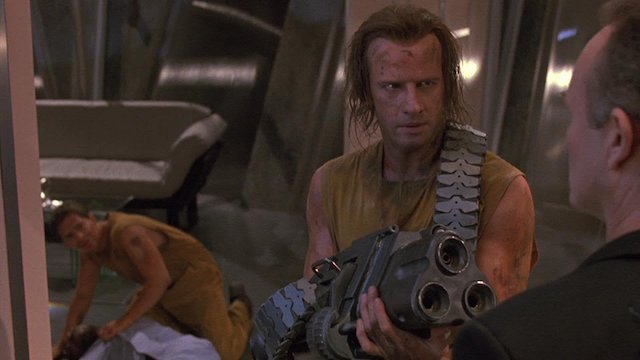
Christopher Lambert must lie awake at night and wonder, in French, why other men became action stars and he didn’t. He’s as stone-faced as Steven Seagal and as hard to understand as Jean-Claude Van Damme, yet even after the “Highlander” series he never achieved the level of fame those oily bags of meat did. Where’s the justice?

It certainly wasn’t a lack of hustle that doomed him. Lambert made more than 20 films in the 1990s alone, almost three of which weren’t too bad. Among the others is the boneheaded futuristic sci-fi thriller called “Fortress” that is the topic of today’s dissertation.

“Fortress” takes place in The Future, when it is against the law to have more than one child. This is probably due to overcrowding, though it is possible that lawmakers of the future just don’t like children. The one-per-customer rule is so strictly enforced that you are not allowed to have a second child even if the first one dies! They are hardcore in The Future.

That’s what happened to Lambert’s character, John Brennick, and his wife, Karen (Loryn Locklin), who is now illegally pregnant with a replacement child. When the Brennicks are caught trying to flee the United States for the more lenient and baby-friendly Mexico, John urges Karen to run on ahead while he lets the police dogs attack him. Then Karen gets caught anyway, so John’s efforts were in vain, but he doesn’t know that yet. He goes to prison believing Karen and their unborn child are safe in Mexico, which isn’t something you’d normally believe.

The prison is a privately run institution called The Fortress, located underground in the middle of the desert and run by a corporation called Men-Tel. Things are very high-tech at The Fortress. Instead of bars, the cells have grids of laser beams that prevent inmates from escaping, at least until there’s a power outage. A sentient computer system named Zed monitors everything from an omniscient point of view and will announce — in the standard Lady Computer Voice used by all movies set in The Future — when an infraction has occurred. They even monitor the inmates’ dreams, and punish them when they dream of something forbidden (usually sex). Furthermore, all prisoners are fitted with an Intestinator®, a walnut-sized device that tracks their whereabouts and can be activated to cause searing gut pain if they get out of line. In extreme cases, the Intestinator® can be detonated, causing the prisoner to explode. The people at Taco Bell will tell you they have never had plans for a menu item called the Intestinator®, but they are lying.

Brennick doesn’t want any trouble with his new cell mates, but when one of them tries to rape a young fellow who arrived the same time as Brennick, well, that’s where Brennick draws the line. (As you know if you have ever watched a prison movie, the only thing the meanest inmates ever think about is raping one another.) The young victim, Gomez (Clifton Collins Jr.), is rescued, and a fracas ensues between him, Brennick, and the perpetrator, Maddox (Vernon Wells), a giant with “187” tattooed on his forehead. The prison guards don’t know who started the fight, though, because I guess the omniscient Zed wasn’t paying attention. Sure, they can record your dreams, but they can’t keep track of every single sexual assault. Brennick says that he started the fight. He takes the blame to protect Gomez, and because he likes being a martyr and there aren’t any police dogs handy for him to get bitten by.

So here’s where we meet the prison warden. His name is Poe, and he is played by the dad from “That ’70s Show,” so it’s hard to think of him as menacing. I know this was before “That ’70s Show” started, but I stand by my assessment. Realizing that the audience doesn’t know anything about Brennick’s past, Poe helpfully mentions that Brennick was “the most decorated captain in the history of the Black Berets” before he lost a whole platoon of men, in case Brennick had forgotten this. “What did I used to do before I got married and had kids?” Brennick sometimes thinks. “Oh — that’s right. I was a highly esteemed military leader whose men got killed. Thanks, dad from ‘That ’70s Show.'”

Anyway, Poe assures Brennick that it’s impossible to escape from The Fortress, and that Karen — still illegally pregnant — was captured and is being held in this very prison! But don’t even THINK about trying to find her and escape, Brennick, because this is not possible. And hey, remember how you used to be in the Army but then all your guys got slaughtered? What was up with that?

Back among his fellow inmates, Brennick starts scheming. One of the guys in his cell, Abraham (Lincoln Kilpatrick), is a sort of errand boy for Poe, which makes him the only prisoner with regular access to Poe’s office. This is a very lucky coincidence indeed! Brennick persuades Abraham to do some reconnaissance work and help Brennick and Karen escape. In exchange for this, Abraham will probably be killed. Just sayin’.

Here is where things start to get very predictable. First, Poe brings Karen in to his office and says he’ll kill Brennick if she doesn’t agree to be his girlfriend. (YAWN.) Then, Karen agrees and is relieved to discover that there will be no sex involved, as Poe is not a regular human, but is instead a enhanced specimen that requires no food or water and doesn’t have normal body functions. (OF COURSE.) So not only won’t she have to sleep with him, she won’t have to put up with his farts, either. It is also revealed that when Karen has her illegal baby, the Men-Tel corporation will confiscate it and turn it into one of these enhanced specimens, like Poe. Perhaps Karen’s baby will also grow up to extort affection from people over whom he has power. A mother can dream, can’t she?

Then they do a “mind wipe” on Brennick, which turns him into a drooling idiot with no consciousness, but then he snaps out of it after a few months and is back to normal, which in his case just means less drooling. He and his cell mates are all pals now, so they figure out a way to remove the Intestinators® and stage a prison break, even though breaking out is impossible, et cetera. The film ends with a husband and wife and their newborn son fleeing the country due to a decree from the government, so I think that makes this a Christmas movie. Happy holidays!

— Film.com

Wednesday movie roundup – Dec. 22

3

It’s that magical time of year when movies come out on Wednesday instead of Friday! It is a Christmas miracle. 

Among new wide releases, your best option is “True Grit,” the Coen brothers’ rip-roarin’ new adaptation of the 1968 novel. Jeff Bridges plays the role made famous by John Wayne, while newcomer Hailee Steinfeld is terrific as the girl looking for the man who killed her dad. 

Under no circumstances should you see “Little Fockers” (review at Cinematical), unless you enjoy sadness and pain. 

But check out the excellent “The King’s Speech” (review at Film.com), in limited release now and going wider on Christmas Day. It’s one of the most joyful movies I’ve seen in a while. You will love Colin Firth and Geoffrey Rush, this I promise you. 

(Oh, Jack Black is in a version of “Gulliver’s Travels” that opens on Christmas, but they only screened it in a handful of markets, in which Portland was not included. So, whatever.)

Now let’s talk about how “The King’s Speech” and “Little Fockers” are perfect examples of how the MPAA rating system is screwed up. “The King’s Speech” is rated R while “Little Fockers” is PG-13. But I suspect any parent who had seen both films would rather their children see “The King’s Speech” than “Little Fockers.”

The MPAA’s official designation — always very, very helpful and clear — is that “The King’s Speech” is rated R “for some language.” Specifically, after the speech therapist realizes the king doesn’t stammer when he’s swearing, he has him fire off a string of profanities as a means of loosening himself up. So there’s this barrage of F-bombs in one scene, and four or five more in a later scene, for the same reason. 

If it weren’t for that, this would be a PG film. You could show it at church. But because of the F-words, it’s rated R. Restricted. No children under 17 admitted without parent or guardian. 

Meanwhile, “Little Fockers” is rated PG-13 “for mature sexual humor throughout, language and some drug content.”

This is one of the dirtiest PG-13 movies I’ve ever seen. It’s chock-full of vulgarity and sexual innuendo. An underwear-clad hot chick tries to seduce a married man. An old guy takes a Viagra-type pill and we see the evidence of it tenting his pajama pants. Then the old guy’s son-in-law, a nurse, gives him an injection in his penis to prevent permanent damage, just as the 5-year-old grandson walks in. A man and a woman give a hospital patient an enema, engaging in filthy double entendre all the while. 

But don’t worry! Nobody ever says the F-word! (Well, except for the million or so times that somebody says “Focker,” wink wink.) There are no actual naked bosoms or wieners, either. So it gets the PG-13, which “cautions” parents that some material might be inappropriate for preteens, but which doesn’t actually prevent children from seeing it. 

If you’re scoring along at home, “The King’s Speech” got the same rating as “Basic Instinct” and all seven “Saw” movies, while “Little Fockers” is under the same classification as “The Simpsons Movie” and “Harry Potter and the Goblet of Fire.” Merry Christmas!

Subscribe to “In the Dark,” a weekly e-mail with the latest movie reviews, DVD releases, and other pertinent info.

Listen to “Movie B.S. with Bayer and Snider,” a weekly Internet radio show featuring Jeff Bayer and Eric D. Snider, at Cascadia.fm. It’s live at 11 a.m. (Pacific) every Friday, then downloadable as a podcast. Ignore the iTunes “explicit” tag; we always keep it PG.

True Grit

0
True Grit

“I do not entertain hypotheticals,” says a man in “True Grit.” “The world as it is is vexing enough.” His world is the American frontier, circa 1875, and his sentiments are probably shared by most of his contemporaries. But life is about to become more vexing as old laws, customs, and means of communication are replaced by new ones. Like many Westerns of the last half-century, “True Grit” depicts a society on the verge of modernization. The new is represented by a headstrong 14-year-old girl named Mattie Ross; the old comes in the form of a drunken, one-eyed U.S. Marshal called Rooster Cogburn.

The 1969 version of this film is mostly famous now for being the source of John Wayne’s only Academy Award. What Joel and Ethan Coen have done is return to Charles Portis’ 1968 novel and create an adaptation that’s darker and more faithful to it. Like most of the Coen brothers’ work, “True Grit” is dryly funny and populated by odd characters, yet it has a shocking and violent undercurrent. Few filmmakers can make coarseness seem as eloquent (and vice versa) as the Coens.

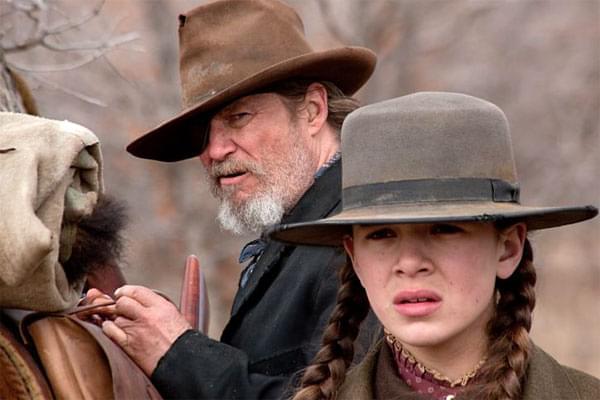
An astonishingly talented 13-year-old newcomer named Hailee Steinfeld plays Mattie Ross, the serious, precocious girl whose father was killed by a coward named Tom Chaney. She has come to Ft. Smith, Ark., to retrieve the body and to seek Chaney’s capture, but the villain has run off to the Indian territories and is thus under the jurisdiction of the U.S. Marshals, who are understaffed and have worse criminals to catch. Refusing to take no for an answer — this will be a running theme with her — Mattie roots out the meanest, most pitiless marshal she can find and offers him a personal reward for bringing Chaney to justice.

That marshal, of course, is Rooster Cogburn, played by Jeff Bridges. (Perhaps out of deference to the Duke, who wore the patch over his left eye, Bridges has it over his right.) Cogburn takes his job seriously and is very good at it. His heavy and frequent drinking does not seem to hinder his ability to capture or kill (usually kill) the bad guys, though certain members of the legal profession take a dim view of his kill-to-capture ratio.

Also in pursuit of Tom Chaney is one Mr. LaBoeuf (Matt Damon), a Texas Ranger tasked with bringing in the scoundrel for killing a state senator. Cogburn knows the territory and LaBoeuf knows Chaney, so the two are willing to put aside the amusing rivalry that apparently exists between U.S. Marshals and Texas Rangers. They both insist it would be foolish for Mattie to join them on their manhunt, but Mattie is unswayed.

The Coens use the characters’ communication styles to highlight their differences. Mattie speaks with impeccable grammar, never using contractions or debasing herself with vulgar slang. When threatened, she drops the name of a fancy lawyer she supposedly has on retainer back home. It seems absurd to use such a tactic on the frontier, and yet it always works. Cogburn, meanwhile, speaks in a guttural voice that often drifts into incomprehensibility, and is known to let his gun do the talking — almost literally at times, as he’ll fire a shot in the air to signal a compatriot, or shoot at targets to demonstrate his superiority. LaBoeuf can talk up a storm, especially when it comes to bragging about the Rangers, then finds himself at a loss when he bites his tongue during a fight and can’t express himself very well thereafter.

There is also some discussion about the difference between things that are inherently wrong and things that are only wrong because society says so. Cogburn, testifying in court about a fugitive he shot, is baffled that it should matter whether he killed the guy or brought him in alive. The idea that it could be “wrong” to gun down criminals is new to his society. Soon enough it will be lawyers, not posses, running everything, and it will no longer be acceptable for a man to do all his communicating with a six-shooter.

Much of the dialogue is straight from the book, yet the tics and idiosyncracies feel Coen-esque. (They did the same thing with Cormac McCarthy’s words in “No Country for Old Men.”) Steinfeld, Bridges, and Damon are all terrific, each one delivering an entertaining performance and seemingly having a great time. In addition, Josh Brolin and Barry Pepper have small but effective turns as the villains.

More than anything else, “True Grit” is fun, in the grand tradition of rip-roaring Westerns. The Coens have been known to treat their subjects with aloofness and ridicule, but not here. In fact, I’d guess they were having a blast putting their signature on a familiar genre with an uncomplicated story and colorful characters. This isn’t the deepest Western or the most thoughtful Coen brothers film, but dang if it isn’t a good time.

Country Strong

0

To prepare for her role as an alcoholic singer in “Country Strong,” Gwyneth Paltrow spent months learning how to play the guitar, and probably also drinking a lot. Seeing her on stage in the movie, strummin’ and singin’ like an old pro, you’d never know she wasn’t actually a country music star.

Too bad she went to such great lengths to prepare for such a lousy movie. “Country Strong,” written and directed by Shana Feste (whose debut, “The Greatest,” also had a weak script), is a dull mess of underdeveloped characters, unmotivated action, mawkish story lines, and Texans. To ponder its melodramatic nonsense is to be further baffled by it.

Paltrow — who is not the star of the film, by the way, but more on that later — plays Kelly Canter, a country sensation who has been in rehab ever since An Incident at a concert in Dallas a year ago. Kelly’s cold-fish husband and manager, James (Tim McGraw), takes her out of the facility a month ahead of schedule because he’s eager to put her on tour again, because he’s a creep.

While she was rehabilitating, Kelly became friends with Beau Hutton (Garrett Hedlund), a scruffy, smoldering young orderly and Heath-Ledger-in-“Brokeback-Mountain” lookalike with musical aspirations of his own. Kelly wants Beau to be her opening act for three big shows in Houston, Austin, and Dallas, but James would prefer to book Chiles Stanton (Leighton Meester), a beauty queen with paralyzing stage fright and, as far as we can tell, almost no actual experience as a performer.

Somehow, Beau and Chiles wind up both joining the tour.

Also, Chiles’ stage fright is pretty hit-or-miss. It seems to clear up when Beau sings with her, even though she hates Beau.

Also, for some reason Beau — who performs at local honky-tonks and wants to get ahead in the industry — has to be talked into going on tour with Kelly.

Well, Kelly starts drinking again, hilariously, just before the first show. Her career might not recover from this latest setback — but for the most part the movie isn’t interested in her anyway. The main character is actually Beau. No one has more screen time than he does. Poor Garrett Hedlund is billed third, after Paltrow and McGraw, but it’s his movie.

Once again, though: too bad it’s such a lousy one. Kelly, James, Beau, and Chiles are all Southern-fried jerks, a confederacy of a-holes who continually hurt one another. Beau has the hots for Kelly one minute but not the next; Chiles and Beau might have a thing, and then maybe not; James is flirting with Chiles, which upsets Kelly … until suddenly it doesn’t, and then maybe James has lost interest anyway. Kelly sees Chiles as a threat in one scene, warms up to her in another, disses her in the next. Kelly and James are on the verge of breaking up here, seething with resentment there, content to ignore each other for the sake of her career there, happily dancing here. Chiles and Beau are alternately friendly and cruel to each other, depending on how the coin toss went when Shana Feste sat down to write that particular scene.

In a nutshell, this is essentially a movie about relationships, and yet not one of the relationships rings true, or even makes sense.

I should also mention that Kelly has been caring for a helpless baby bird that lost its mother. THIS IS A METAPHOR.

“Country Strong” does feature some toe-tapping songs, and the performances are all solid (even if the characters being performed are awful). It just lacks coherence, that’s all. Oh, and a point. Oh, and any sense of fun. Oh, and a guy who looks like Heath Ledger in “Brokeback Mountain” — no, wait, it has that, never mind.

Little Fockers

0

“Little Fockers” would be a lot less painful to watch if its cast of victims didn’t include so many beloved actors. Replace De Niro, Stiller, and Hoffman with a bunch of D-listers and it would still be terrible — the screenplay is unsalvageable — but at least then it wouldn’t feel like a punch in the movie lover’s gut.

Arriving six years to the day after “Meet the Fockers,” this third film in the “Meet the Parents” saga is one of the dullest, laziest, unfunniest comedies I’ve ever seen that didn’t go straight to DVD and have the words “National Lampoon” attached to it. Most of the gags from the first two films are repeated, only now they’re broadly telegraphed so that you’ll never NOT see the joke coming before it arrives. Any character growth that occurred previously is forgotten so that we can revert back to the basics: De Niro doesn’t trust Stiller, Stiller keeps accidentally messing things up, and Stiller’s last name is Focker. (DO YOU GET IT??? 

In addition, you may be interested to know that “Little Fockers” includes many reminders that farts, vomit, and erections are funny. They are so funny, in fact, that you needn’t write actual jokes around them. Just toss ’em up there on the screen! A kid barfing on someone is comedy gold, period.

Not that these movies were ever exactly classy, but good grief, what happened? Everything in this disaster reeks of desperation. The screenplay, by franchise veteran John Hamburg and “Meet the Fockers” associate producer Larry Stuckey, is an embarrassing shambles, without a coherent story line or any clear reason for existing. The normally talented director Paul Weitz (“American Pie,” “About a Boy”), replacing Jay Roach, is helpless. The characters, many of them given nothing to do, just wander around, bumping into each other and doing their usual shtick.

I once saw a high school production of “Grease” where they had some technical difficulties and had to stall for time, so the director sent the main actors onstage, in character, to improvise a scene. “Little Fockers” feels like 98 minutes of that. 

We reunite with Greg (Ben Stiller) and Pam Focker (Teri Polo) as they prepare to celebrate their twins’ fifth birthday. Pam’s parents, Jack (Robert De Niro) and Dina Byrnes (Blythe Danner), come to Chicago several days in advance (the twins’ fifth birthday is a weeklong affair, like Lollapalooza), and Jack tells Greg that he must be the family patriarch after Jack is gone, which may happen sooner than later, as Jack has been having heart problems. For some reason, Greg takes all this to mean that he should put the twins in a snooty private kindergarten even though he can’t afford it.

(Pam is sick with the flu on the day Greg is visiting the school, so Jack goes with him. That scenario, plus some clueless dialogue, allows the school administrator to mistake Greg and Jack for a gay couple which = hilarity. The next day, Pam is up and around and the flu is never mentioned again. In other words, the writers needed her to be incapacitated just long enough to miss the school visit, but were too lazy to work it into the screenplay organically.)

To earn extra cash, Greg does some work for a pharmaceutical company represented by a hot chick named Andi (Jessica Alba), who’s pushing an erectile-dysfunction pill called Sustengo. Andi talks and flirts like a 16-year-old girl, flustering Greg. She helps him administer an enema to a patient (it is OK for pharmaceutical reps to do this), and the act is rife with double entendre. Barely 15 minutes in and already the film has moved below the waist, never to re-ascend.

Everything Andi does is designed to give the wrong impression. For example, when Greg is scheduled to speak for her company at a conference at the downtown Hilton, she sends this text message: “cant wait to see you at the hotel tonite!!!” That is not what a grown-up of any profession would write, of course, let alone a representative for a pharmaceutical company. But it gives Jack something to misinterpret when he looks at Greg’s cell phone. After the conference, Andi takes a photo of her harmlessly kissing Greg on the cheek, then posts it to her MySpace page with the caption “crazy night at the hotel!!” Again, utter nonsense. But just wait till Jack googles Andi and finds her MySpace page!! (Where does one find a MySpace page, anyway? An Internet museum?)

Greg’s parents, Bernie (Dustin Hoffman) and Roz (Barbra Streisand), will be in town shortly. They serve no function in the story, but hey, the producers convinced Hoffman and Streisand to come back, so they are GOING TO BE IN THE FILM. I thought there were a couple lines about Roz not supporting Bernie as he pursues his dream of becoming a flamenco dancer … but now that I think about it, I realize this cannot possibly be what the movie said, so let’s assume I was hallucinating.

I definitely was not hallucinating when Greg sliced his finger while carving a turkey and sent blood spraying all over the dining room, or when Jack took a Sustengo and Greg had to inject a needle into his erect penis to prevent lasting injury, an act witnessed by one of the Focker twins. I also was not imagining things when Jack’s beloved cat arrived at the birthday party, having been flown in from New York especially for the occasion by Pam’s old boyfriend Kevin (Owen Wilson). Why would Kevin go to that kind of trouble and expense when Jack and Dina could have brought the cat with them in the first place if they’d wanted to? So that the cat can eat the little Focker boy’s pet lizard, obviously. Like Hoffman, the cat was probably holding out for more money before agreeing to appear in the film, and once the papers were signed the producers were desperate to find an excuse to squeeze him into the story.

Elsewhere in the movie, in an act of unmotivated and implausible spite, Jack openly declares that Pam should dump Greg — her husband, the father of her children — and reconcile with Kevin. Jack says this because he thinks Greg is cheating on Pam — a completely false allegation that Greg makes no effort to disprove. Why? Because addressing it head-on would mean Jack couldn’t continue misunderstanding for the rest of the film.

The Fockers are renovating their house. The project is overseen by a contractor played by Harvey Keitel. Keitel and De Niro have one scene together, just so someone can say Keitel and De Niro had a scene together. Then Keitel disappears and is never mentioned again.

The point I’m trying to express is that this is not a “movie” in the way that term is normally understood. It is a garish collection of awful comedy sketches whose only connection to one another is that they involve characters we have seen before. The elements that made “Meet the Parents” a treat — the surprise, the novelty, the sharp banter — are long gone. This is a pale, sickly imitation of the original, so derivative and putrid that you’d think it was the fifth sequel, not the second.

Friday movie roundup – Dec. 17

1

Exactly one year — 52 Fridays ago — a movie called “Avatar” was released to much fanfare. It was universally admired for its amazing visual effects and stunningly realistic imaginary world, but criticized for its lackluster story. In honor of this anniversary, today we get “Tron: Legacy,” which can be described in exactly the same way.

“The Fighter,” which opened in limited release last week, goes wide today, and it’s a very entertaining underdog sports story with terrific performances by Mark Wahlberg, Christian Bale, and Melissa Leo. I was also a fan of “How Do You Know” (review at Film.com), starring the delightful Reese Witherspoon and Paul Rudd.

I was not so much a fan of “Yogi Bear” (review at Cinematical), but you might enjoy reading the review if you enjoy seeing grown men write angrily about cartoon bears. It is possible you will also enjoy this piece I wrote for Film.com, “A Scientific Breakdown of the Physical Comedy Presented in the ‘Yogi Bear’ Trailer.”

“What’s the Big Deal?” was about “The Wild Bunch.” And speaking of dudes who fight a lot, “Eric’s Bad Movies” addressed “Mr. Nanny,” starring Hulk Hogan. While I was writing the column, I discovered that Hulk Hogan got married this very week, suddenly making my commentary relevant (or at least topical)! This was a coincidence, and a sign that the gods of comedy were looking favorably upon us.

Subscribe to “In the Dark,” a weekly e-mail with the latest movie reviews, DVD releases, and other pertinent info.

Listen to “Movie B.S. with Bayer and Snider,” a weekly Internet radio show featuring Jeff Bayer and Eric D. Snider, at Cascadia.fm. It’s live at 11 a.m. (Pacific) every Friday, then downloadable as a podcast. Ignore the iTunes “explicit” tag; we always keep it PG.

How Do You Know

0

“How Do You Know” is only the start of the question. The rest of it is “… when you’re in love, and when the person you’re in love with is right for you?” Which, if you think about it, is the same question asked by every romantic comedy, not just this one. The answer is something like, “Well, first you stay with the wrong guy for a while even though it’s obviously wrong, while taking for granted the nicer, better option who keeps presenting himself to you, and then eventually you wise up.” It’s not exactly rocket science.

Indeed, “How Do You Know” doesn’t cover any new territory. Writer-director James L. Brooks (“Broadcast News,” “As Good As It Gets”) isn’t interested in subverting cliches or surprising his audience. He set out to make the sort of urbane rom-com that mildly upscale couples would go to see — something wittier than Nora Ephron but less cosmopolitan than Woody Allen. The result isn’t anything special, but Brooks did make the very wise decision to cast Paul Rudd and Reese Witherspoon in the lead roles.

I didn’t realize it had been two years since Witherspoon had appeared onscreen until Entertainment Weekly told me, but “How Do You Know” makes me realize I’ve missed her. As Lisa, a professional softball player recently cut from her team, Witherspoon draws on her twin strengths of pluckiness and determination, mixed with some cuteness (but not cutesy-ness) as Lisa tries to make the most of her new situation. Lisa is known among her associates as a pillar of strength, a make-lemonade-out-of-them-lemons kind of gal. She has multiple affirmations taped to her mirror, including this one: “Courage is mastery of fear, not absence of fear.”

Lisa has been casually dating Matty (Owen Wilson), a pitcher for the Washington Nationals who is defined by his promiscuity, carefree behavior, and good-natured insensitivity. He’s an idiot, but he’s the kind of idiot who will be just right for some girl. That girl is clearly not Lisa, however.

Meanwhile, there is George (Rudd), a thoroughly nice guy who works in high finance and is entirely too nice to be working in high finance. As a result of this, he has come under investigation by the Justice Department for stock fraud. He’s baffled by the allegations, certain that if he did anything wrong it was an honest mistake. Still, the company must distance itself from him, even though his father (Jack Nicholson) is the owner.

And so George and Lisa meet when both of their lives are in the process of changing dramatically. They’re unemployed now, though don’t think for a second that “How Do You Know” will address anything as distasteful as money problems. Instead, we’re treated to an amusing dissection of the ways people cope. Lisa is determined not to let her emotions get the best of her. George, dazed by the setbacks, remains optimistic and is eager to let Lisa be a ray of sunshine. She’s too independent and he’s too vulnerable, but they’re both insanely likable. How is it that nearly everything Paul Rudd does, here and elsewhere, is so utterly delightful?

On paper, much of this doesn’t work. There’s a scene where George’s former secretary, Annie (Kathryn Hahn), and her long-term non-committal boyfriend have a breakthrough, which is witnessed by George and Lisa, who take lessons of their own from it. The set-up couldn’t be more obvious, yet it comes across as sweet, not calculated. In another sequence, Lisa has a fight with Matty and winds up hanging out at George’s apartment. In the context of the story, it’s wholly implausible: she barely knows George, he lives outside the city, and so forth. And yet this turned out to be one of my favorite scenes because of Rudd and Witherspoon’s sparkling interaction.

Last week “The Tourist” reminded us that even the biggest stars can’t always elevate mediocre material. “How Do You Know” is an instance where it works. It’s glossy and entirely forgettable, but the friendly, funny cast makes it worth seeing.

Tron: Legacy

0

Was any movie from the 1980s more ripe for a sequel than “Tron”? Its digital graphics were state-of-the-art in 1982, and people wondered if someday in the far-distant future movies might be made entirely on computers. The movie’s plot addressed the idea of living in a purely digital world.

Twenty-eight years later, the Internet has made it so nearly everyone lives at least part of their lives on the grid, whether they want to or not. We’re not literally in our computers yet, but some of us might as well be. And almost every film produced in Hollywood uses digital trickery somewhere, even if it’s just to put some clouds in the sky or remove an anachronism from the background of a period piece. In short, the futuristic notions that “Tron” hinted at are now in many ways a reality. An upgrade to Tron 2.0 seems perfectly logical.

So how did we wind up with something as unimaginative and flat-out boring as “Tron: Legacy”? The special effects are, once again, state-of-the-art. Most of the cool stuff from the first movie has been recreated and modernized, hitting viewers’ “nostalgia” and “geek” buttons simultaneously. The light cycles are sleeker and more dangerous; the electro-Frisbees that you throw at your opponents and that also contain all your data (I never understood that) are more stylishly Apple-esque.

But all this technology is in the service of a story that’s decidedly retrograde and formulaic, with a bland main character. At 127 minutes, the film is a half-hour longer than its predecessor, and it drags the way your old PC did when you booted it up first thing in the morning.

Thanks to some convenient exposition and backstory-reciting, we’re filled in on what’s happened since the last movie. Kevin Flynn (Jeff Bridges) became head of the ENCOM tech company, had a son, then mysteriously disappeared in 1989. The son, Sam (Garrett Hedlund), now 27, is financially secure because he’s the biggest shareholder in ENCOM, but he stays away from the company that reminds him of his missing dad.

Circumstances bring Sam to the old video arcade once run by his father. He finds his dad’s office and, wouldn’t you know it, gets laser-beamed into the computer world in almost exactly the same fashion. The first half of the film is basically a repeat of the original “Tron,” with Sam taking Flynn’s place as the one forced to participate in real-life video games and seek the overthrow of the oppressive cyber-ruler. He eventually encounters his actual father, too, who’s been chillin’ in the grid for 20 years, unable to escape.

Jeff Bridges is a welcome sight. Whatever Kevin Flynn was like in 1982, he’s now evolved into … well, into Jeff Bridges, man. (Bridges also plays Clu, Flynn’s software avatar, with his face creepily CGI-ed to look younger, since computer programs don’t age.) Would that the film were centered on Bridges as Kevin Flynn, rather than Garrett Hedlund as Sam Flynn. Hedlund seems to be from the Ryan Phillippe/Paul Walker school of shallow intensity, where you stomp around looking Very Serious about whatever your Serious Business is. He’s no fun. I know Sam grew up without a father, but come on.

Michael Sheen briefly enlivens the proceedings as an Alan Cumming-esque nightclub owner in the grid, and Olivia Wilde’s enthusiasm as Quorra — a program who has never seen the real world — is another plus.

The screenplay, by “Lost” writers Edward Kitsis and Adam Horowitz, goes out of its way to reverence the original, beloved “Tron” (including a cameo by Bruce Boxleitner), and then runs out of ideas altogether. The good guys’ objective is disappointingly simple; you keep waiting for complications or twists that never come. First-time director Joseph Kosinski deserves credit for overseeing the creation of a computer-generated world that’s as fully realized as anything we’ve seen before. But his film feels as soulless and automatic as the computers that built it.

Roger Ebert, who loved the original “Tron,” ended his review of it with the observation that the film was all technology, no humanity. But, he said, “maybe it’s breaking ground for a generation of movies in which computer-generated universes will be the background for mind-generated stories about emotion-generated personalities.” His prediction was right, of course. Pixar makes a movie fitting that description almost every year. “Tron: Legacy,” however, suffers from the same lack of heart that Ebert observed in its predecessor. It creates an amazing world but doesn’t populate it with anyone or anything for us to care about.

Yogi Bear

0

Whenever they announce something like a Marmaduke movie, or a Smurfs movie, or a — sure, why not? — Yogi Bear movie, people’s reaction is always the same: “Who wanted THAT?!” Well, I hate to break it to you, but we’ve reached the point where it doesn’t matter if literally not one person on Earth wants to see a big-screen version of a fictional character. If someone in Hollywood owns the rights to that character, a movie will be made. That’s just how it is.

So here, inevitably, is “Yogi Bear,” which puts a computer-animated Yogi and Boo Boo in a live-action Jellystone Park and gives them the voices of Dan Aykroyd and Justin Timberlake. Turns out Aykroyd and Timberlake do really good impressions of these 50-year-old cartoon characters, which means there is one (and precisely one) aspect of the film worthy of praise.

As you are probably aware, Yogi is a binge-eating kleptomaniac with a particular fetish for picnic baskets. He rarely speaks of their edible contents — he seems to be more interested in the baskets themselves, regardless of what specific foodstuffs may be found therein. He is enabled by Boo Boo, an adult bear who is much smaller than Yogi, possibly due to a chromosomal condition such as dwarfism. Yogi and Boo Boo both wear neckties, but only Yogi wears a hat, because he is in charge.

Both bears are also capable of human speech — English, specifically, though it is conceivable that they could learn other languages, as their ability to read is also implied — and this fact is noted by the humans around them. It isn’t like in some movies, where the animals talk to each other but people only hear regular animal noises, or where they only talk when humans aren’t around, or where only certain humans can understand them. Yogi and Boo Boo converse openly with one and all. But Ranger Smith (Tom Cavanagh) and Ranger Jones (T.J. Miller), the only two employees at the enormous Jellystone Park, find Yogi’s habit of stealing visitors’ food far more noteworthy than his ability to speak. A nature photographer named Rachel (Anna Faris), who wants to make a documentary about Jellystone, is eager to meet the talking bears for novelty’s sake, but soon becomes blasé about it. Her interest in the park is related to the grandeur of its natural beauty, not the fact that talking bears live in it. Likewise, the local mayor (Andrew Daly) and his chief of staff (Nathan Corddry) acknowledge that Yogi and Boo Boo speak, yet find the fact unremarkable.

I mention all this because of the film’s plot, which is as follows. The unnamed town of which Jellystone Park is a part is going bankrupt, and the evil mayor plans to sell Jellystone to land developers. (You might think Jellystone is a national park, or at least a state park, given that it is thousands of acres in size and has rivers, waterfalls, and mountains. But no, it is entirely within the jurisdiction of one small town.) Ranger Smith, who loves Jellystone more than life itself, has only one week to come up with $30,000 to meet the park’s operating budget.

To recap, the plot of “Yogi Bear” is that Ranger Smith must raise $30,000 to save Jellystone Park. The park where talking bears live.

“Pardon me, Mr. Ranger, sir, I was wondering–”

“Don’t talk to me now, Yogi! I’m trying to think of ways to attract visitors to Jellystone!”

“What if I did my waterskiing act?”

“Be quiet, Yogi! How am I supposed to come up with fundraising ideas when I’m constantly being interrupted by a talking bear??”

“What if we held a bake sale?”

“Please, Yogi! Stop formulating thoughts in your highly evolved brain and using your miraculous vocal cords to express them in speech! I’m trying to think of a way for the park to raise money!”

Ranger Smith’s solution is to throw a party for the park’s 100th birthday, which happens to be next week, and which Ranger Smith didn’t realize was coming up, which may explain why he is so terrible at keeping the place running. Within 24 hours, he has spread the word and gathered thousands of people to come celebrate at Jellystone. Yogi does his waterskiing routine, which observers find entertaining but not especially noteworthy, and then Yogi accidentally sets off all the fireworks, which terrifies people into fleeing for their lives. And thus the bear that can talk and waterski has somehow COST the park money, a cruel irony.

Spoiler alert: The way the park is finally saved is that they realize the turtle that Boo Boo keeps as a pet is an endangered species, and so Jellystone must be federally protected. You know what else is an endangered species? Bears that can talk.

I’m dwelling on this aspect of the movie because all of its other aspects aren’t any fun to talk about. Three writers are credited. Among them, they came up with dialogue such as this, with regard to Boo Boo’s flatulence: “For a little bear, he sure makes a big stink!”

They also conceived this moment, when Yogi tells Ranger Smith how to woo Rachel: “Urinate on her to mark her as your territory.”

There is also the part where Rachel used tree bark as a postcard, and for ink used “bird poop and spit.”

I may have neglected to mention that there is a scene where Yogi and Boo Boo dance to “Baby Got Back.” Yes, reviewing what I have written so far, I find that I have indeed neglected to mention that. Please consider this a rectification of that oversight.

Late in the film, Ranger Smith and Rachel’s budding romance has apparently suffered a setback. He has “lost the girl” and must reconcile. I use the word “apparently” because the scene in which this break-up takes place is NOT IN THE MOVIE. One minute things are fine, the next minute Ranger Smith is sad because Rachel has left him. Bears dancing to “Baby Got Back,” sure, we have time for that. But a scene that actually relates to the story, sorry, no, cutting-room floor.

The director, Eric Brevig (“Journey to the Center of the Earth”), probably did everything he could with the simple-minded screenplay, the dumb jokes, and the general tedium. Studio heads probably instructed him to overdo the 3D gimmicks, too. Who knows, maybe they even told him to prevent Anna Faris from being funny, which I wouldn’t have thought was possible. In a way, though, the film is faithful to the old cartoons, in that it’s grating and tiresome and not suitable for anyone over the age of 4. The animation is better, though.

Rabbit Hole

0

“Rabbit Hole” is the movie equivalent of deep-tissue massage: painful but cathartic; exhausting but satisfying. It is also, like massage, more enjoyable if you disrobe first, but that’s true of most things.

We are making jokes because “Rabbit Hole” — adapted by David Lindsay-Abaire from his own Pulitzer-winning play, and directed by John Cameron Mitchell (“Hedwig and the Angry Inch”) — makes us sigh melancholically when we think of it, like a meaningful piece of art or a particularly sad song. Yet it does not induce despair. We come away from it feeling hope and optimism, reminded that while tragedy is inevitable, we need not be defeated by it.

The story will not sell you. I kind of don’t want to tell you what it is, because then you won’t want to see it. But here goes: “Rabbit Hole” is about a married couple who are grieving after the death of their young son.

I know! That was my reaction too! But there’s a lot of beauty to be mined from that depressing-sounding scenario, thanks to well-drawn characters, impeccable performances, and sensitive direction. Where most films of this nature would become maudlin and manipulative, “Rabbit Hole” stays honest and subtle, refusing to hit us over the head with clunky symbolism or blatant tear-jerking.

The married couple, Becca and Howie, are played by Nicole Kidman and Aaron Eckhart, both giving career-best performances. Becca is coping by gradually removing all traces of Danny from their home. Howie is reluctant to let go of anything, but would like to have another child someday, maybe soon. There is no “right” way to deal with grief. But what Becca and Howie are doing wrong is working separately instead of together. Turned off by all the “God talk” at the weekly support group for grieving parents, Becca stops attending, while Howie keeps going. Their lives diverge in other ways, too.

Kidman has gotten most of the attention — and perhaps rightfully so, as her character is the driving force of the story — but she and Eckhart are both heartbreakingly good. Becca and Howie do not merely represent different methods of coping with loss; they’re full-blown characters, each with a distinct history and personality.

Surrounding them are several crucial supporting characters. Gaby (Sandra Oh) is a fellow attendee of the support group who befriends Howie. Izzy (Tammy Blanchard), Becca’s reckless younger sister, is pregnant, which produces awkwardness for someone who has just lost a child. Becca and Izzy’s mother — no stranger to grief herself — is played with great tenderness and matronly wisdom by Dianne Wiest.

Most surprising, though, is a newcomer named Miles Teller, who plays a neighborhood teen with whom Becca develops a curious friendship. I don’t know this Teller kid’s story, but anyone who acts opposite Nicole Kidman without being outmatched — and in his first major role, no less — should have a bright future.

What Teller does right is the same thing everyone else in the cast does right. He doesn’t overplay it. The emotions involved in the story are intense, but that doesn’t mean the performances have to be grand. Lindsay-Abaire’s screenplay, despite having its origins on the theater stage, is neither theatrical nor stagy. It doesn’t rely on histrionics or “moments.” Instead, it builds naturally toward an emotional climax, then resolves just as naturally from there.

The director, John Cameron Mitchell, shows as much care with someone else’s writing as he did with his own in “Hedwig” and “Shortbus.” He lets the script’s darkly funny moments break the tension as necessary — I will always love drunk Dianne Wiest in the bowling alley — and coaxes sympathetic performances from the cast. (Anton Sanko’s lovely musical score is a perfect fit, too: gorgeous, sublime, never emphatic or intrusive.)

“Rabbit Hole,” easily one of the best dramas of 2010, is also one of the most uncluttered. It takes us through a dark tunnel, yes, but it reminds us, with graceful simplicity, that there’s light at the end of it.

Mr. Nanny

0
Mr. Nanny

We used to have something in the United States called “professional wrestling,” in which beefy men would fight each other publicly, using an array of fanciful maneuvers and following a scripted formula to ensure the right person won. These gladiators created colorful personas for themselves, and a team of writers devised elaborate backstage dramas — rivalries, grievances, jealousies — for them to enact. Professional wrestling was very, very popular. And then everyone grew up, and it went away.

Given the sport’s pageantry and flamboyance, it’s no wonder some of its most famous practitioners went on to pursue careers in the dramatic arts. Andre the Giant delighted audiences with his performance in “The Princess Bride.” Randy “Macho Man” Savage showed tremendous range in a series of 30-second mini-films, made for television, designed to teach young people the correct way to snap into a Slim Jim. On Broadway, Rowdy Roddy Piper won a Tony for his stirring portrayal of the title character in “Macbeth.” The Iron Sheik became the fat guy in “Borat.” The list goes on.

mr nanny

The greatest hero of pro wrestling in its 1980s heyday was Hulk Hogan, a long-haired bald man whose brave battle with degenerative hulkamania inspired millions. As a movie star, Hogan reached his zenith with his third film, “Mr. Nanny,” in which he plays a retired pro wrestler who becomes a bodyguard and must babysit an industrialist’s awful children. This is the sort of movie that tough guys star in after they have given up on being tough and have moved on to the portion of their career where they just make everyone sad. (See also: Vin Diesel in “The Pacifier,” Dwayne Johnson in “Tooth Fairy,” Arnold Schwarzenegger in politics.) Hogan clearly has no enthusiasm for the role. He seems embarrassed the whole time. For him, the entire movie is the equivalent of the scene in “Fame” where Coco has to take her top off.

Hogan’s character, Sean Armstrong, has been fishing in Florida since retiring but still has dreams about getting back into the ring and having men sit on his face. His old manager, Burt Wilson (Sherman Hemsley, aka George Jefferson), who now runs a bodyguard agency, persuades Sean to take a gig protecting a CEO who’s had death threats. This guy, Mason (Austin Pendleton), has invented a “computer chip” that will lead to world peace, or some such, and a lunatic wants to take it from him.

Ah, but Mason pulls the ol’ switcheroo, which sounds like a wrestling movie but isn’t. He has his own security guards to protect him. What he really needs is for someone to keep his two children safe, in case the lunatic comes after them. Sean protests that he hates children (a position that will seem more reasonable as the film continues), but he promised his old manager George Jefferson he’d do this job because George Jefferson once took a bullet for him. And so, once again, a movie’s protagonist is driven by a mixture of desperation and guilt, and we are supposed to find it delightful. Wheeee!


Mason’s children are Alex (Robert Gorman), who’s about 11, and Kate (Madeline Zima), who’s around 7. Their mother is dead, having succumbed to a tragic case of not being necessary to the plot. Mason, consumed with his work, allows them to be raised by a series of nannies, whom the children persecute maliciously in a transparent effort to gain their father’s attention. You might recognize this scenario from the seventy-five thousand other movies in which it has appeared. Mason has not seen those movies, though, because he continues to let his kids behave like monsters and doesn’t punish them.

mr nanny

Sean very quickly falls prey to Alex and Kate’s pranks and booby traps, some of which extend beyond the limits of japery and into the realm of attempted murder. Sean is variously electrocuted, crushed by heavy weights, hit in the head with a bowling ball, and knocked down a flight of stairs. From a physical standpoint, Hogan is able to pull off all of these stunts. Why, a bowling ball to the head is just another day at the office for a professional wrestler. From a slapstick-comedy standpoint, however, his technique is lacking. Contrary to what you might expect, there is a difference between pretending to get hurt in a wrestling ring and pretending to get hurt in a movie.

mr nanny

In one terrible moment, Sean goes to take a shower after exercising and is seen wearing the tiniest towel ever manufactured, perhaps as a novelty item. Not content to abuse its main character, now the movie has seen fit to abuse the viewer as well.

Over time, Sean comes to bond with the brats and to be a father-type figure to them. He helps Alex cope with the bullies at school. Kate shows him how to be graceful — because apparently he was klutzy (the movie does not mention this until it becomes relevant) — by teaching him ballet. The image of Hulk Hogan wearing a leotard and a tutu is supposed to be the height of hilarity. I wouldn’t be surprised if it’s the sole reason the movie was made. (“Here’s my pitch: Hulk Hogan wears a tutu!” “Sold!”) Because it’s pink and girly, you see. But is it really that different from what he wore as a wrestler? Where is the line between masculine and feminine, between rah-rah awesome and ha-ha ridiculous? And as long as we’re asking questions, why are Hulk Hogan’s hair and mustache bright yellow while his eyebrows are dark? If you’re going to bleach your hair and mustache, why not do your eyebrows, too?

mr nanny

Anyway, the kids eventually stop trying to murder Sean, and their dad sees the error of his ways and vows to pay more attention to them. The movie’s only about 55 minutes old here, and you’re thinking, Awesome, things are wrapping up early! But no, there’s still that lunatic who wants to steal Mason’s computer chip. His name is Thanatos, and he’s played by David Johansen, a musician also known as Buster Poindexter whose songs appear on the “Mr. Nanny” soundtrack, presumably in a “Producers”-style plot to make sure no one buys it. Thanatos, a loose parody of a James Bond villain, has a shiny metallic head and a crazy grudge against … wait for it … Sean Armstrong.

mr nanny

Hold on there, movie. Slow your roll. You’re telling us the guy who wants to get the computer chip from Mason (for reasons that are never explained) ALSO has a vendetta against the man Mason hires as his children’s bodyguard? A man whom Thanatos had no way of knowing Mason would hire? It is a complete COINCIDENCE that Thanatos’ former nemesis has reappeared in his life, in the midst of a scheme that is wholly unrelated to him? If that contrivance were any dumber and less plausible, it would be called “Crash” and win Best Picture.

mr nanny

Flashbacks fill us in on the story. During his wrestling days, Sean was ordered by Thanatos, who’s a gangster or something, to throw a match. Sean refused to do this, as to lose a professional wrestling match on purpose would be to violate the integrity of the sport. Thanatos got angry, fired a gun at Sean, and George Jefferson took the bullet for him. Then Sean chased Thanatos off a roof, and he landed on his head, and now he has a metal plate and a grudge. (Note: Thanatos’ shiny head is supposed to be funny. Hulk Hogan’s is not.)

Naturally, Thanatos’ goons succeed in kidnapping Mason, Kate, and Alex, and Sean succeeds in rescuing them, saving the computer chip, creating world peace, ending hunger and famine, etc. He gets to beat up some guys in the process, in accordance with the strict must-beat-up-some-guys clause in Hogan’s contract. Then, like Mary Poppins before him and Nanny McPhee after him, having solved the family’s problems, Sean bids them farewell. It is a bittersweet separation. The children fondly recall the times they nearly killed him; their father reflects on the oily, over-tanned stranger he hired to babysit them; and Sean rides away on his motorcycle, the humiliation at long last finished, his long, long hair flowing in the breeze behind his bald, bald head.

— Film.com

A Scientific Breakdown of the Physical Comedy Presented in the ‘Yogi Bear’ Trailer

0
A Scientific Breakdown of the Physical Comedy Presented in the ‘Yogi Bear’ Trailer

After seeing the trailer for the “Yogi Bear” movie (in theaters Dec. 17!), most people, once the weeping and despair have subsided, start to consider the scientific principles pertaining to the physical comedy contained therein. That is the subject we would like to examine in today’s lecture.

The trailer is embedded here for your viewing pleasure. Please watch it and take notes, then continue on to the article for our analysis.

A Scientific Breakdown of the Physical Comedy Presented in the ‘Yogi Bear’ Trailer

We disregard the first bit of physical action — Yogi waterskiing — because it does not seem to have been intended as comedy. We note, however, that Yogi is not only smarter than the average member of his species, but appears to be more agile and dexterous, too.

The first evidence of true slapstick comes when Yogi tries to steal a lunchpail by lowering a magnet down from the skylight. When the lunchpail is blocked by an obstacle, Yogi pulls too hard, breaking the magnetic bond and yanking the magnet back toward himself. The magnet acquires such momentum in its path upward that it knocks Yogi backward, off the roof and onto the ground, which is for some reason covered with scraps of paper that billow upward when Yogi lands. A fall from such a height, even one cushioned by an oddly but fortuitously placed bed of paper products, should injure Yogi, who, as an adult male bear, could weigh 400 pounds or more. While Yogi is quick to notify us that he is unhurt, the park’s veterinarian ought to examine him for internal injuries. Something should be done about the litter situation, too.

In the next scene, Yogi is catapulted by a rigged plank on a picnic table. Subsequent footage reveals this to have been a mechanism of his own devising, intended as a means of stealing picnic baskets. Surely Yogi could not have foreseen that a booby trap meant to launch simple picnic lunches would be powerful enough to send a full-grown adult male bear flying, too. Yogi will need to do some recalibrating after this test run, as a catapult that throws a 400-pound bear across a field would throw an ordinary 10-pound picnic basket much, much farther. Again, Yogi does not seem to have been injured by the stunt, despite being thrown spine-first against the trunk of a tree. It may be that, accustomed as he is to such misadventures, Yogi has trained himself to completely relax his body when injury is imminent, thus reducing the effect of the impact.

Next, Yogi performs a classic spit take, again proving himself more nimble than his fellow bears, who would lack the musculature and coordination to propel fluids from their mouths in such a Dick Van Dyke-ian fashion. Immediately after this, Yogi is smacked in the head by a tree branch that has been pulled back and let loose. Though the branch is not very thick, it strikes Yogi with such force that it flattens his skull. The bones in a bear’s head being thick and rigid, the only possibility here is that the tree branch has shattered them, no doubt causing serious brain injury and perhaps death.

We are then subjected to images of Yogi and Boo-Boo dancing all sexy-like with Ranger Smith. This being too horrible to contemplate, we shall purge the notion from our minds.

We return now to the booby-trapped picnic table. As our previous calculations predicted, the picnic basket flies way past its intended mark. Curiously, two seconds later, a pie arrives, hitting Yogi square in the face. This pie cannot have come from the same picnic basket that went off target, coming as it does so much later and to a different destination. Was a second plank on the picnic table likewise rigged, sending this additional projectile after the first one? On the other hand, it is possible that the pie was in the first payload but somehow became separated from the basket in mid-flight. Theoretically, the pie’s aerodynamic shape could have caused it to catch an air current that would both delay its arrival and change its course. We consider this to be unlikely, however, and we reject the theory until further facts become available.

Yogi and Boo-Boo then decide to entertain the park’s visitors with what Yogi calls “razzle-dazzle.” What form this “razzle-dazzle” was meant to take is unclear. We know, however, the plan did not allow for Yogi to set himself on fire while waterskiing, bounce off an inner tube, and soar over a fireworks display, as this chain of events causes Yogi to remark that “too much razzle” has been deployed. Whether the amount of dazzle, either too much or too little, was a factor, is unknown.

The bears’ next plan involves a makeshift hang-glider. Here, at last, there is some common sense being employed: Bears cannot fly on their own; ergo, if it is necessary to reach a great height or travel a great distance in a short amount of time, they must construct a flying machine out of the implements commonly found in national parks, including wood, pulleys, and wheels. The contraption fails to perform as intended, but we believe this is due not to any design flaws but rather to the aviators’ lack of flight experience.

The trailer’s final sequence has Boo-Boo and Yogi attempting to board a moving train, for reasons that our imagination is not fertile enough to conceive. Boo-Boo, the smaller and more agile of the two, has already gotten aboard. Yogi, running alongside the train, bashes his face against a sign; his skull, already soft and gelatinous from the tree-branch trauma, barely registers the injury. Yogi’s ample rump is then bounced along a fence made of wooden posts as Boo-Boo tries to pull him head-first into the car. We know from toilet-paper commercials that bears’ rear ends are surprisingly delicate and sensitive, so we assume the pain of this mishap is — pardon the pun — un-yogi-able.

— Film.com

Friday movie roundup – Dec. 10

1

Nothing but a big pile of meh for you this weekend. (Yes, it’s still Friday as I post this. Let’s agree to that.)

The “the”-heavy sequel “The Chronicles of Narnia: The Voyage of the Dawn Treader” (review at Film.com) is just good enough to be considered good enough. But “The Tourist” (review at Cinematical) is a great deal less good. And “The Warrior’s Way” (review at Film.com), one of Hollywood’s Shameful Secrets from last week, is likewise lackluster.

At Film.com, “The Big Chill” is a Big Deal, and “Only the Strong” is only a Bad Movie.

On Tuesday and Wednesday, I filled in for my friend Dawn Taylor as sidekick and newsreader on Rick Emerson’s “Legion of News” on Cascadia.fm. If you would like to hear me read and comment on important news stories of the day in a sarcastic fashion, you may listen to those episodes.

Finally, allow me to remind you of the existence of my page at iLike.com, where you will find many of the songs that I have written and recorded, for your listening pleasure, for free.

Subscribe to “In the Dark,” a weekly e-mail with the latest movie reviews, DVD releases, and other pertinent info.

Listen to “Movie B.S. with Bayer and Snider,” a weekly Internet radio show featuring Jeff Bayer and Eric D. Snider, at Cascadia.fm. It’s live at 11 a.m. (Pacific) every Friday, then downloadable as a podcast. Ignore the iTunes “explicit” tag; we always keep it PG.

The Fighter

0

It seems that as long as there continue to be boxers, there will continue to be movies based on their true stories. That so many of these stories are similar to one another hardly matters. He’s poor; he’s a nobody; he just needs a chance; someone is holding him back — it’s a formula. And we like it.

Micky Ward is the subject of “The Fighter,” and his story is as nondescript as the title. But in the capable hands of director David O. Russell (“Three Kings,” “I Heart Huckabees”), working from a screenplay by Scott Silver, Paul Tamasy, and Eric Johnson, Micky Ward’s hardscrabble rise to the top — OK, to the middle — makes for a compelling underdog sports drama.

Played with his usual earnestness by Mark Wahlberg, Micky is an amateur boxer in the mid-’90s in Lowell, Mass., an economically depressed dump 30 miles from Boston. His older half-brother, Dicky Eklund (Christian Bale), used to be a fighter too — his claim to fame is a 1978 match with Sugar Ray Leonard — but now he’s is a full-time crack addict. Dicky, self-described as being “squirrelly as f***,” hopes for a comeback, though the crack addiction makes this unlikely. In the meantime, he’s acting as Micky’s trainer, with their mother, Alice (Melissa Leo), serving as manager.

After a disastrous fight against an opponent who outweighs him, Micky hears of opportunities to train in real facilities, for real money. Alice’s reaction: “You can’t trust him, he ain’t family.” Also untrustworthy, in Alice’s view, is Micky’s new girlfriend, a sweet but trash-talking bartender named Charlene (Amy Adams). Alice believes no one who isn’t a blood relative should be allowed to influence Micky’s actions. It doesn’t matter that Alice is a poor manager and Dicky is too cracked-out to be a good trainer. They are right for their jobs by virtue of being Micky’s mother and brother.

Lowell is depicted as a town full of loud, sweaty white trash where everybody drinks and fights a lot. Alice bore Dicky and Micky plus seven — seven! — other children, all girls, each skankier than the last. (They hate Charlene because she is slightly less skanky than they are.) It’s hard not to mock characters like that, but “The Fighter” generally treats them seriously. Russell doesn’t downplay their lower-class foibles; he just uses naturalistic touches rather than big, broad strokes to depict them. It’s a tramp stamp here, a pair of gaudy earrings there, a ratty hairstyle on this one, a crack-smoker’s smile on that one.

Melissa Leo, who earned an Oscar nomination for “Frozen River” a few years ago, shines again here as Micky’s jealous, flawed mother. Familiar TV actor Jack McGee (“Rescue Me”) helps out as her second husband. For added authenticity, Micky’s trainer and mentor, a cop named Mickey O’Keefe, is played by the actual Mickey O’Keefe who trained Micky Ward.

It’s hard not to see shades of “Rocky” and “Raging Bull” in some of the story details, but by no means does “The Fighter” come off as a retread. By focusing on the volatile relationship between brothers Micky and Dicky, Russell finds a wealth of emotional material, not to mention human comedy. (“The Fighter” is much funnier than you might expect it to be.) Wahlberg, rock-solid in the lead, may be overshadowed by Bale, whose fully formed drug-addict character is astonishingly real. Yet in the end, I was surprised at how invested I was in Micky’s boxing career, not in Dicky’s personal demons. The film’s final match is terrifically exciting, in part because of the thrilling way Russell shoots it, but mostly because of how eager we are for Micky to succeed.

The Chronicles of Narnia: The Voyage of the Dawn Treader

0

After Disney gave up on distributing the “Chronicles of Narnia” films, disappointed that what should have been a gold-pooping goose had failed to poop sufficient piles of gold, Twentieth Century Fox stepped in to save the day. Not that you’ll be able to tell the difference. Part 3, “The Voyage of the Dawn Treader,” might be better than its predecessors, which were so-so, but only barely. Something about this series just isn’t connecting, though that apparently isn’t going to stop them from adapting all seven books.

World War II is still taking place in the real world, and the two youngest Pevensie children, Edmund (Skandar Keynes) and Lucy (Georgie Henley), are staying with relatives while their older siblings are in America. (Spoiler alert: If you, like me, have not read the C.S. Lewis book this is based on, and if you, like me, keep waiting for the big brother and sister to show up, then you, like me, will be disappointed.) It isn’t long before the two are whisked away to Narnia again, this time accompanied by their unwilling cousin, Eustace (Will Poulter), a sour-faced brat who does not believe in all this Narnia nonsense even when he is standing in it.

You will soon be deeply concerned that bringing a petulant, irritating fellow such as Eustace on this journey was a mistake, but do not fear. This problem is dealt with in a magical fashion.

Edmund and Lucy are reunited with Prince Caspian (Ben Barnes) on a ship, the Dawn Treader. Much of the film is set at sea, with appropriate swashbuckling and swordplay; if the first two films felt like “Lord of the Rings,” this one is more like “Master and Commander.” (Not “Pirates of the Caribbean.” Not silly enough.) The whole gang embarks on a mission to find out where legions of innocent Narnians have been taken, daring to sail where no one has sailed before, perhaps even to where Aslan the Christianity-lion lives!

Also: seven swords, seven lords, you have to put all the swords on a table, evil forces are after them, there’s a mouse that can talk and a dragon that can’t, et cetera.

The messages are basic and unobjectionable. Lucy, fast developing into a bright young lady, wishes she were prettier. Edmund, eager to prove his worth as a soldier, desires more power. Both are tempted by evil (Tilda Swinton makes a brief cameo as the White Witch) before learning to appreciate what they have and love themselves for who they are.

There’s a new director this time around, Michael Apted (“The World Is Not Enough”), and a new writer, Michael Petroni (with rewrites by former “Narnia” scribes Christopher Markus and Stephen McFeely). The film is a half-hour shorter than “The Lion, the Witch and the Wardrobe” and “Prince Caspian.” I doubt that’s an accident. What begins to feel sluggish and repetitive at 145 minutes can seem much zippier at 115. A few of the action sequences are fairly exciting and energetically produced.

What’s more, “Voyage of the Dawn Treader” isn’t as convinced of its own epic importance as the other two were. It is far more unassuming and direct, content with telling a good-enough story in a good-enough fashion. Where the others aimed for greatness and missed, this one aims for middle-of-the-road and basically hits it. I still don’t feel much connection to the characters, but maybe this is as good as we’re going to get in that department.

The Tourist

0

Even if we accept that Angelina Jolie and Johnny Depp are incredibly charismatic Tinseltown luminaries of the highest possible wattage, that doesn’t guarantee they’ll be any good together — especially if you just throw them into something generic and assume they’ll carry it by the sheer strength of their screen presence. That’s arrogant, that’s what that is. Maybe a little lazy, too. What, we’re supposed to love something as pale, weak, and one-dimensional as “The Tourist” just because it happens to feature two of the biggest movie stars in the world? No! We will not do this! We are better than that, movie.

German director Florian Henckel von Donnersmarck, whose debut feature, “The Lives of Others,” won the Oscar a few years ago, took the reins on this big-time showbiz project after scheduling and other difficulties bumped some other directors (and actors) out of it. I don’t think I hold it against him. The Academy Award opened a lot of doors for him. Who wouldn’t jump at the chance to direct Depp and Jolie in a faux-Hitchcockian you’ve-got-the-wrong-guy European adventure, no matter how unremarkable the screenplay was? Turning down a job like that is for people who’ve already made a dozen Hollywood films, or people who are dead inside, neither of which describes Florian Henckel von Donnersmarck.

I urge you to say his name aloud. Florian Henckel von Donnersmarck. Did you do it? There, you just had more fun than you would if you watched “The Tourist.”

Based on a 2005 French film called “Anthony Zimmer,” this is a story about how beautiful Angelina Jolie is. The bulk of the film is devoted to shots of her walking around seductively, often in slow-motion, looking glamorous and ravishing while all male humans in her vicinity gape. She plays Elise, an Englishwoman in Paris who’s being tailed by the police because her lover, one Alexander Pearce, is a master thief whose face has never been seen. The cops, led by Scotland Yard’s Inspector Acheson (Paul Bettany), hope that she will lead them to Pearce. So does Reginald Shaw (Steven Berkoff), a ruthless billionaire from whom Pearce stole a rather sizable amount of money.

This leads to Venice, where most of the movie is set. Here an ordinary American tourist, Frank Tupelo (Johnny Depp), is mistaken for Alexander Pearce — at least in part because Elise has let the police (who she knows are following her) think that’s who he is. He’s a decoy to distract the authorities while she rendezvouses with the real Alexander. But Frank, poor schmuck, baffled by the attention paid him by this beautiful stranger, starts to fall in love. You may well imagine the lighthearted chasing and abducting and explaining that ensues.

There are questions. Why does Elise, after having used Frank for her purposes, continue to care what happens to him? Why does Frank, who traveled to Italy on purpose and with some forethought, keep speaking Spanish? (The practical answer is that the screenwriters thought this would be a funny running gag. The only answer within the world of the movie, however, would have to be that Frank is impossibly dim.) Why were Elise and Alexander ever separated, and why can’t they communicate by normal means? Some of these puzzles are eventually answered; some are not. The story’s final twists, being completely nonsensical, raise even more questions.

Johnny Depp is simply miscast. The whole point of Frank is that he’s an average, ordinary guy — the one thing Johnny Depp is not good at playing. Misfits, oddballs, kooks, nuts, drunken pirates, tea-party-attending hat enthusiasts, sure. Regular guys, no. We have Jolie playing to her strengths (enigmatic beauty, vaguely sensual dialogue, some light gunplay) while Depp must play against his. It is a bad idea.

At no point did I ever buy that these two characters had any romantic feelings for one another. This is crucial, given that the film is supposed to be a romance. They spend too much time dealing in untruths and hidden motives to establish a believable connection. The action is not thrilling, the jokes are average at best, the dialogue has no zing. There are mediocre films that are elevated by their likable stars, but this isn’t one of them.

Only the Strong

Only the Strong

Almost every movie about martial arts has focused on karate or kung fu. Meanwhile, enthusiasts of capoeira, the graceful system of fight-dancing from Brazil, are frustrated. “When will our peculiar method of sort of beating each other up while also sort of dancing gain a foothold in Hollywood??” the capoeiristas cry. “Where is our Bruce Lee??”

They only say this because they did not see “Only the Strong,” a film from 1993 that is all about capoeira. I don’t know how they missed it. You’d think there would have been an announcement in the capoeira newsletter (Fight-Dancing Monthly). In any event, the movie is pretty stupid, but capoeira fans should take comfort in the knowledge that a lot of karate movies are stupid, too.

Capoeira’s Bruce Lee is Mark Dacascos, a kung fu and karate expert who had never done capoeira until he made “Only the Strong,” and who went on to appear in season 9 of “Dancing with the Stars.” Dacascos, a friendly-looking slab of meat with a broad smile, plays Louis Stevens, a Miami native who just spent four years in Brazil with the U.S. military. Since there weren’t any wars in Brazil while he was there, Louis had plenty of time to learn capoeira. The film’s opening scenes set the tone for what is to come: There’s going to be a lot of guys in loose-fitting white pants dancing and kicking the air around each other.

Released from his military service, Louis does what any other person would do: he goes back to his old high school. Not as a student, of course. That would be silly. He just kind of shows up and wanders around, like it’s the only possible place he might want to spend time, maybe to see if they need any odd jobs done. Louis is alarmed to find that his once-idyllic alma mater is now a seedy hotbed of graffiti, gang violence, and drug trafficking. Having spent four years in Brazil, he no longer has patience for any of those things.

While hangin’ out on campus, Louis breaks up a fight between a Jamaican drug dealer and a student, Shay (Roman Cardwell), who is evidently related to the Jamaican but is reluctant to carry on the family business of selling drugs at the high school. None of the school’s staff members seem to have considered calling the police or trying to get rid of the Jamaican themselves. Perhaps the Jamaican has an arrangement to sell his stuff on campus, like Pizza Hut does sometimes? Whatever the case may be, Louis fight-dances the crap out of the Jamaican, and suddenly the students are paying attention. It turns out that while the kids have no interest in learning or studying or behaving themselves, they respond enthusiastically to violence.

Since no teacher or administrator has ever accomplished anything at this school before, everybody wants to hire Louis to teach the kids self-discipline and motivation through capoeira. Everybody except for one jerky stick-in-the-mud teacher named Hector (John Fionte), that is. Hector says it would be insane to teach martial arts to kids who are already violent and ill-tempered. Hector has a pretty good point, actually. But the movie already decided he’s the bad guy — he’s even dating Louis’ high-school sweetheart who’s now a teacher at the school!!! — so he is shouted down in favor of the “let’s teach the bullies new ways of kicking people” system. It’s a lot like when Springfield bought the monorail.

So they round up the 12 biggest troublemakers at school, just the meanest bastards they can find, and send them with Louis to a dilapidated firehouse that’s been turned into a dojo. The kids don’t wanna learn no stupid dance-fighting, obviously; one of them, Orlando (Richard Coca), expresses this by pulling a knife on Shay. Louis disarms Orlando in a dazzling display of fight-dancing, then returns the knife to him after class. Why? To establish trust. It isn’t that Louis doesn’t think Orlando should have a knife at all. It’s that he doesn’t think he should try to stab other students with it during instruction time. Orlando respects this. He also respects being fight-danced into humiliation by the ex-soldier who used to go to school here and now teaches fight-dancing in an off-campus firehouse.

That is a common theme throughout the movie. Whenever someone is embarrassingly defeated with capoeira (which is the only way to be defeated by capoeira), that person is instantly humbled and grateful for the experience. For example, Louis spends a single afternoon teaching Shay some basic capoeira moves. The next day, Louis uses those moves to defeat Eddie (Christian Klemash), a meathead jock who’s been abusing Eddie regularly since forever. Eddie admires Shay after the hilarious defeat. He never retaliates or becomes embittered or grows hateful. To react in that manner would detract from the message of the movie, which is that most problems can be solved with violence, as long as it is carefully choreographed violence that involves backflips and Afro-Brazilian music. When will the quarrelsome nations of the Middle East learn this simple truth?

Now, Orlando the knife-fighter has a cousin, Silverio (Paco Christian Prieto), who does a lot of drug-dealing in this area. Silverio is displeased that Orlando is learning discipline and self-confidence when he should be spending his afternoon hours distributing poisons to children. Silverio’s hackles are particularly raised by the fact that Orlando is being instructed by someone who claims to be an expert in capoeira, when — you’ll never believe this — Silverio HIMSELF is ALSO a capoeira expert. What are the odds? What are the chances that a movie about a hero with a specific skill set would have a villain who turns out to have the exact same skill set? Silverio tells Orlando, in a highly menacing fashion, “We’re gonna find out real quick who’s the real capoeira “mestre” in this neighborhood!” You can tell that Silverio is serious because he uses the correct Portuguese term for “master.”

Silverio joins forces with the Jamaicans to overrun the high school, in retaliation for Louis trying to help the kids. They set some fires and kill a guy. The school board blames Louis for this, since he’s the one who suggested fighting back against the drug-dealers rather than simply letting them deal drugs on campus. Then, as the 11 surviving capoeira students watch, Louis fights Silverio and defeats him single-handedly. In accordance with the ancient capoeira principles that date back to the beginning of the movie, Silverio accepts his defeat and presumably agrees to stop selling drugs. He certainly does not retaliate with more violence, and the situation definitely does not escalate into a full-scale war.

By the way, those tough students are all really good at capoeira now, and somehow this also means that they are smart enough to graduate, and they graduate, and they demonstrate capoeira at the ceremony, and everyone loves it, and fight-dancing saves the day, again, just like in World War II.

— Film.com

Friday movie roundup – Dec. 3

0

Weep with sorrow, ye denizens of the multiplex, for Hollywood has forsaken you! Only one new film opens in wide release this week, and it wasn’t screened for critics, and it’s about ninjas and cowboys. It’s called “The Warrior’s Way.” Review to come.

In limited release, however, there is “Black Swan” (review at Cinematical), an insane psychological thriller starring Natalie Portman as a ballerina. Seeing this was the highlight of my first Telluride Film Festival a few months ago. Seeing it again last week confirmed that it wasn’t just the thin mountain air that made me love it the first time.

In other news, “Movie B.S. with Bayer and Snider” has been nominated for the Podcast Awards! We assume this is very prestigious. We’re calling them the Poddies. You can vote for us “American Idol”-style (i.e., multiple times), but only once per day. Please do so! Even if you don’t listen to our show! Bayer and I thank you for your support.

Over at Film.com, “What’s the Big Deal?” is about “Dr. Zhivago,” a very long movie about the Russian Revolution and the romances found therein. “Eric’s Bad Movies” covers the 1998 version of “Godzilla.” Not only is the movie bad, but so is my original review of it. Bad as in poorly written, I mean. Good critics don’t start a review by telling you what they were expecting when they walked into the movie. For one thing, it’s a lazy way to start an article. For another thing, it doesn’t MATTER what you were expecting. What matters is what you actually saw. Can you imagine how dull it would be if a critic regularly started out with, “When I went to see this movie, I was expecting this…”? Bleh.

Good critics also don’t use the audience’s reaction to bolster their own opinion. “See? It wasn’t just me who didn’t like it! Neither did the people I saw it with!!” That’s desperate and insecure. It suggests that you’re terrified of being the only person with that opinion. So take my original “Godzilla” piece as an example of how not to write a review, and take my “Eric’s Bad Movies” treatment as an example of how to exact revenge on a bad movie 12 years later.

Subscribe to “In the Dark,” a weekly e-mail with the latest movie reviews, DVD releases, and other pertinent info.

Listen to “Movie B.S. with Bayer and Snider,” a weekly Internet radio show featuring Jeff Bayer and Eric D. Snider, at PDX.fm. It’s live at 11 a.m. (Pacific) every Friday, then downloadable as a podcast. Ignore the iTunes “explicit” tag; we always keep it PG.

Black Swan

0

It’s fitting that Darren Aronofsky had to struggle for years to get “Black Swan” made. A movie about a ballerina’s agonizing quest for perfection might seem a little hollow if it were effortlessly cranked out on the Hollywood assembly line; “Black Swan,” on the other hand, has the marks of a passion project. You can practically see the metaphorical blood oozing from Aronofsky’s swollen directorial feet.

“Black Swan” is a wholly engrossing, almost unbearably tense drama about a fairly mundane thing: backstage anxiety in the performing arts. Countless movies have addressed the same subject, but I feel safe in saying none have addressed it in quite this way. Aronofsky, working from a screenplay by Mark Heyman and Andres Heinz, shows a knack for combining genres in a most unsettling fashion. Here you’ll find psychological thrills, body horror, sexual awakening, symbolic self-discovery, hallucinatory trickery, and the terrifying calf muscles of ballet dancers, all in one movie.

Natalie Portman stars as Nina Sayers, an up-and-coming ballerina who dreams of dancing the lead in “Swan Lake.” This is a double role, as you are no doubt well aware through your intimate knowledge of “Swan Lake,” with the same ballerina playing both the Swan Queen and her enchanted look-alike, the Black Swan. The director of Nina’s company, a very demanding, very French fellow named Thomas Leroy (Vincent Cassel), is sure Nina has the wholesome grace and technical proficiency to play the White Swan, but he doesn’t think she can be wild and passionate enough to pull off the seductive Black Swan. Thomas’ vision of the Black Swan calls for a dancer far looser and more sexually charged than the prim, almost virginal Nina.

Nina is alarmed to note that the ideal Black Swan would be the company’s newest dancer, Lilly (Mila Kunis), who comes late to rehearsals and smokes cigarettes in the studio, and who tends to dress in black anyway. Nina is also alarmed to note that Lilly looks a lot like her. Then again, as is pointed out by someone later in the film, ballerinas all tend to look alike anyway.

That isn’t just a trivial observation, either. Nina’s controlling mother (Barbara Hershey), Erica, had to end her own dancing career early and now lives vicariously through her daughter. Beth MacIntyre (Winona Ryder), who used to be Thomas’ prima ballerina, is likewise retiring against her will, with Nina replacing her. Nina, Lilly, Erica, and Beth represent different aspects of the female psyche, like one character split into four parts, so it’s appropriate that they bear a physical resemblance to one another. Aronofsky frequently exploits this to eerie effect by making us momentarily uncertain which of the other three women is in the room with Nina. Sometimes Nina isn’t entirely sure herself.

Speaking of resemblances, “Black Swan” has some with Aronofsky’s previous film, “The Wrestler.” In particular, both films show in excruciating detail how much physical pain some artists are willing to inflict upon themselves in the pursuit of perfection. Nina is at the start of her career while Randy “The Ram” Robinson was at the end of his — she is ambitious; he was desperate — but they share an all-consuming drive to be the best.

Nina is off-balance for most of the film, and we don’t know any more about what’s happening to her than she does. She has dreams and hallucinations that contribute to her disorientation, but the genuinely bizarre behavior of her mother, her director, and her colleagues adds to it. There seems to be madness around every corner. A sense of dread pervades the film, as if something awful could happen at any moment. The kicker is that since Aronofsky has avoided establishing the film as any particular genre, we never even know what KIND of awfulness we’re expecting. It feels just as likely that a dancer will suffer a gruesome natural injury as it is that one will be attacked by her doppelganger.

At the center of this psychological nightmare is Natalie Portman, giving the best performance of her career. (Yes, better than the “Star Wars” movies.) She’s in nearly every frame of the movie, often dancing, often in close-up, conveying a huge range of intense and complicated emotions. No matter how suspenseful, strange, or astonishing things get, we’re right there with her, feeling every bit of Nina’s fear, confusion, excitement, and eventual liberation.

Portman might be the perfect collaborator for Aronofsky. She tends to come across as intelligent, delicate, and refined, but she’s also capable of coarseness. His films can be graphic and harsh, yet beautiful in their way, filled with visual poetry. The actress and director are an especially good fit for “Black Swan,” which examines the dual nature of man, the good and evil we all have in us.

The Warrior’s Way

0

“The Warrior’s Way,” according to the narrator, is “the story of a sad flute, a laughing baby, and a weeping sword.” All of that is true, but the narrator has buried the lead! “The Warrior’s Way” is also the story of an Asian swordsman hiding in the Old West, where he helps the locals battle a badly scarred villain and a team of ninja assassins. It’s “Seven Samurai” meets “Deadwood”! It’s Kurosawa meets Leone, filtered through a dozen Tarantino imitators!

It’s also not nearly as fun as a movie with this premise ought to be. Written and directed by Sngmoo Lee, an instructor at New York Film School, “Warrior’s Way” uses “300”-style technology to produce handsome visuals and impossibly colorful sets. The first 20 minutes, with its whimsical backstory narration and unselfconscious oddness, reminded me of TV’s dear departed “Pushing Daisies.” Yet the film is hollow and soulless, its energy sapped by its dull characters and completely derivative screenplay.

The year is 1880-ish. Our hero, Yang (Dong-gun Jang), is a master swordsman from an unspecified Asian country who refuses to kill the last remaining member of the rival clan on the grounds that the last remaining member of the rival clan is a newborn baby. Instead, he takes the baby and flees to the West (though he gets there by traveling eastward), arriving in a dusty California settlement called Lode. Yang opens a laundry service and tells no one of his sword-wielding past.

Lode is home to a circus troupe led by Eight-Ball (Tony Cox), a midget with an “8” painted on his head. There’s also a town drunk (Geoffrey Rush) who used to be a marksman. And Lynne (Kate Bosworth) is a rootin’-tootin’, steel-hearted gal bent on revenge against the dastardly Colonel (Danny Huston), who was responsible for the death of her family some years ago. The Colonel’s hideous disfigurement, hidden by a mask, is courtesy of his previous run-in with Lynne.

Meanwhile, Yang’s old crew is searching the world to find him and punish him for his betrayal. For this reason, Yang cannot unsheathe his sword, as doing so will cause the sword to weep audibly (with the souls of everyone it has slain), which will serve as a homing device for his former compatriots. You know how it is.

The film’s greatest surprise is that it is not based on a graphic novel. The film’s second-greatest surprise is that, for as cheap and daffy as it sounds, it’s often beautiful to look at. Lee takes his visuals seriously, composing shots and staging action like someone who has taught such things to film students for several years.

But apart from the drunk and the villain — thanks, Rush and Huston! — none of the characters is remotely interesting, so the action never means anything. Yang is a blank page; Lynne is page with a lot of cliches written on it. ‘Tis a pity, because the film’s details suggest potential for a lively, bizarre, action-comedy cult classic. It just never comes together the way it needs to. Chalk up another win for style in the style-vs-substance rivalry.

Note: Contrary to regular industry practice, this film was not screened for critics before opening.

Godzilla (1998)

Godzilla (1998)

As far as I can tell, the 1998 American version of “Godzilla” is about a contest between the U.S. military and a giant monster to see who can destroy more of New York. And honestly, Godzilla is hardly even trying. In fact, he mostly just wants to be left alone. The military is ostensibly interested in killing Godzilla, and Godzilla occasionally shows mild interest in fighting with the military, but you can tell the real focus is on turning New York into a smoldering pile of debris.

Speaking of smoldering piles of debris, how about that 1998 American version of “Godzilla,” eh? Man alive, what an insufferable swamp of idiocy. “Look how BIG everything is!” the movie shouts. “Isn’t it HUGE?? AREN’T YOU IMPRESSED??” If this movie were a man, it would be driving a giant Hummer and making a lot of casual references to how much money it has.

The film’s opening footage suggests that nuclear testing in French Polynesia caused a Komodo dragon to turn into a Godzilla. Once it is fully grown, it attacks a Japanese cannery ship. (That’s it, Japan! That’s all the representation you get in this Godzilla movie!) The sole survivor, an elderly Japanese man, whispers the word “gojira” to investigators. This is something of an inside joke to Godzilla fans, who know that “Gojira” was the Japanese title of the original Godzilla film. But here’s the thing. “Gojira” is a combination of the Japanese words for “gorilla” and “whale.” Even if we accept that an old man who has been traumatized by a monster would spontaneously devise a portmanteau to describe it, why would he choose to reference two animals that the monster looks nothing like? Pardon me for saying so, but the film is starting to seem a little far-fetched.

The far-fetchedness increases when we are introduced to the hero of the movie, and he is played by Matthew Broderick. Matthew Broderick is a lot of things, but the star of an action movie he is not. In fact, now that I think about it, he isn’t really even a lot of things. He is one thing, and that thing is Ferris Bueller. In any event, here he plays a scientist named Nick who gets recruited by the U.S. government to help investigate the strange occurrences worldwide that would seem to suggest the existence of a very large animal. For example, giant footprints, and things being stomped, and cannery ships being sunk, and terrified Asian seniors talking about gorilla-whales. You definitely need to bring in a scientist to figure out what THAT all means.

Meanwhile, Godzilla swims to Manhattan and starts wrecking the place. He isn’t malevolent about it, though. Godzilla takes no delight in squishing people or knocking down buildings. He’s just so BIG, you know? You try being a hundred feet tall and having a giant tail and strolling through Midtown without jostling anything. I’m the size of a normal human and I still bump into a lot of people in New York. That place is crowded. Shoot, yo. So I feel bad for Godzilla, who gets a lot of blame even though he’s no more at fault than a Chris Farley character trapped in a small suit coat.

The sequences of Godzilla inadvertently smashing stuff are clearly the reason the movie was made — ME WANT SHOW THINGS BREAK! ME WANT BIG ANIMAL HURT CITY! — yet they demonstrate the difficult position that director Roland Emmerich is in. He apparently doesn’t want us to be frightened by Godzilla, because he keeps the tone light and glib and goofy. Like a guy will say, “I got a feeling something bad is gonna happen!” and then Godzilla’s foot smashes a car. Doh! But Emmerich apparently also doesn’t want us to be entertained or amused, because none of the action is funny or exciting. And with “scary” and “entertaining” off the table, Emmerich settles on merely being loud and big.

The military is summoned to deal with the Godzilla situation. Fighter jets pursue the beast through Manhattan’s streets, firing missiles and bombs willy-nilly, inflicting very little harm on Godzilla himself but obliterating numerous buildings. All of New York is what they call “collateral damage,” though usually that term refers to injury that befalls something in addition to the intended target, not instead of. Impartial observers could witness the spectacle and very reasonably surmise that the military is trying to tear down New York City and this giant lizard just keeps getting in the way.

Eventually Godzilla runs and hides somewhere. Lots of places in New York for a hundred-foot monster to lie low. The mayor orders all residents to evacuate the city and head to New Jersey, which they do in about an hour (New Yorkers are very efficient), so now they’re safe from Godzilla but they’re in New Jersey, so it’s really a lateral move.

While all of this is happening, there’s a woman named Audrey (Maria Pitillo) who works as an assistant for a fatuous TV news reporter but wants to be a journalist herself. Audrey also happens to be the ex-girlfriend of none other than Nick the scientist, who has arrived in New Jersey just in time to confirm that yes, indeed, there is a very large animal around here somewhere. Nick and Audrey have a pleasant reunion, reminiscing about old times and catching up on each other’s lives. You’d hardly know that just across the river was a Cthulhian monster that threatens to uproot all of civilization. Nick has a secret government tape of Godzilla wreaking havoc elsewhere in the world, incidents that have been hushed up and kept from the news media, which wouldn’t have been hard, as I believe at this point everyone was focused on talking about Bill Clinton’s sex life. Audrey steals this tape in order to get her “big break” in the news business, whereupon her fatuous boss steals the tape and the story from her, whereupon the military is angry that someone leaked the tape, whereupon Nick is blamed, whereupon Nick is hurt that his ex-girlfriend would betray him like that, whereupon everyone goes Wait a minute, isn’t there a &@*!@ DINOSAUR TRUNDLING AROUND NEW YORK?!

Somewhere in all this, Nick determines that Godzilla is asexual and has probably laid eggs in the city, even though Manhattan is no place to raise children. Of course, nobody in the government believes him about the eggs. The governments in these movies never believe the scientists, even when they specifically asked the scientists for help. “Scientist! You’re the only one who can explain it! What’s happening here?” “Well, this and this and this is happening.” “You’re crazy! Who asked you?” It’s the circle of life.

Now that Nick’s services are no longer required, the military goes back to its original plan of just blowing up as many things as possible, in the hopes that one of them will accidentally be Godzilla. They dump a bunch of fish in Central Park to lure the creature into firing range, but Godzilla — who is smarter than the military — figures out it’s a trap and doesn’t get too close. Their plan now thwarted, the Army figures, aw, hell, let’s start firing missiles and bombs anyway, and once again Godzilla is unscathed while the city is annihilated.

The Army does manage to chase Godzilla into the river, though, where submarines are waiting to shoot torpedoes at him. You may have already guessed that the submarines succeed primarily in torpedoing themselves. At this point the wisest choice would be to sit quietly and let Godzilla do whatever he wants. Nonetheless, the military officers think they’ve killed him. Crisis over! Even though there’s no trace of a Godzilla corpse or anything, they figure they’ve won, so New York is immediately un-evacuated, and life gets back to normal. All of this has happened in the course of one day. Ha ha, remember earlier today, when there was a gigantic mutant lizard rummaging through town? Glad THAT’S over!

But what about those alleged eggs that Godzilla allegedly deposited somewhere? The U.S. government doesn’t believe Nick, but some French dude named Philippe does! He’s played by Jean Reno, your go-to guy for French dudes named Philippe. The French are keenly interested in eradicating Godzilla and his offspring — not for noble humanitarian reasons, but because they’re the ones who created him with their nuclear testing and would like to keep that fact out of the papers. Philippe and Nick discover that Godzilla’s nest is in Madison Square Garden, and that even though Nick predicted Godzilla might have laid as many as a dozen eggs, it turns out there are HUNDREDS, because hundreds is bigger than a dozen. I bet Roland Emmerich had to be talked down from a million.

The eggs hatch immediately — wow, Godzilla must have laid them just in time — and out pop velociraptors, similar to those you might remember from such films as “Jurassic Park.” The building is now infested with them! Philippe’s French soldiers are being eaten right and left! It’s the worst disaster in Madison Square Garden since the 2002 Knicks, amirite?

Now that the li’l Godzillas are out and about, the U.S. military starts to believe that Nick may have been right about the whole egg thing. But how can they be killed? You’ll never guess what the Army comes up with. Ready? Missiles and bombs! To be fair, it actually works this time, and Madison Square Garden is turned into a crater in the process. All the babies are killed just as the unsurprisingly not-dead Godzilla shows up again, and now Godzilla is ANGRY, and sure, let’s have the heroes get in a car and drive through Manhattan while Godzilla chases them, why not? The people who paid money to see a Godzilla movie definitely want the film to include a car chase.

Yes, they finally manage to kill Godzilla for real. They destroy the Brooklyn Bridge, too, although now it seems like they’re just running up the score. But the thing that really had viewers on the edge of their seats was this: Will Audrey get her big break in the news business, and will she reconcile with Nick?? You may rest assured that the film spends many, many precious minutes establishing that yes, thank goodness, Audrey’s future in TV journalism is bright thanks to her coverage of Godzillapocalypse ’98, and that yes, she and Nick have ironed out their differences, praise Godzilla. The film ends leaving the door open for a sequel, though for some reason no one has gotten around to making one yet.

— Film.com

My ‘comedy’ ‘songs’ are on the Internet

7

One of the secrets from my past is that I recorded two CDs of live comedy. Mostly it’s me playing the piano and singing, though there is also some talking. (I am better at talking than singing.) “Will Make Jokes for Food” came out in 2003, with the follow-up, “Monkeys and Pirates Are Funny,” in 2006. Some of the songs were written during that time, but a lot of them were much older, having been written for the Garrens Comedy Troupe at BYU between 1993 and 2001.

The CDs were basically self-released, and I sold them through my website and when I would do live shows, which wasn’t very often. Now they’re out of print, so I have uploaded many of the songs to iLike.com, where you can listen to them or download them. For free, even!

Here’s my iLike page. I’ve divided the songs not by album but by category, “General Merriment” and “Merriment Specific to Utah and/or Mormon Culture.” (The Mormons may be interested to know that included in that batch is a brand-new updated version of “The General Authorities Song.”) If you’re not familiar with Utah and/or Mormon culture, you won’t get the jokes in those songs, but trust me, they are hilarious. The other songs should be equally amusing to all persons regardless of geography or creed.

Not everything from the CDs is on here. I might add some more over time. There are a few songs that I just don’t think are funny anymore. There are others that I like but where my performance on the recordings is subpar. I had a tendency to play things increasingly faster. I also had a tendency to play some wrong notes on the piano. That’s the trouble with someone who doesn’t do a lot of live shows recording live albums: I wasn’t practiced at getting things exactly right. I’ve toyed with the idea of re-recording some of these songs in the studio (i.e., my apartment, with my computer), but then of course we’d lose the audience reaction, which I think adds to the effect. So I don’t know.

Also, there are two songs, “Not Fooling Anyone” and “Mel Gibson,” that came after the CDs. The latter was after Mel’s drunk-driving anti-Jew tirade, but before the racist misogyny tirades.

(If you want liner notes on the songs, including the ones not online, here’s “Will Make Jokes for Food,” and here’s “Monkeys and Pirates Are Funny.”)

Friday movie roundup – Nov. 26

1

I hope that your Thanksgiving was suitably happy and gluttonous. Goodness knows mine was. The cold that I’ve been working on for a few days subsided long enough to enjoy the holiday, but now it is back and I am loopy. Loooooooopy. This is all stuff that I wrote before I got loopy, though.

“Tangled” is pretty OK. “Faster” (review at Film.com) is not. Didn’t see “Love and Other Drugs” or “Burlesque” due to scheduling conflicts.

“What’s the Big Deal?” is about “Battleship Potemkin.” “Eric’s Bad Movies” took the week off, on account of Thanksgiving.

And here’s another reminder to use my Amazon link if you buy stuff at Amazon this holiday season. Doing so will benefit all the children of the world, as far as you know.

Subscribe to “In the Dark,” a weekly e-mail with the latest movie reviews, DVD releases, and other pertinent info.

Listen to “Movie B.S. with Bayer and Snider,” a weekly Internet radio show featuring Jeff Bayer and Eric D. Snider, at PDX.fm. It’s live at 11 a.m. (Pacific) every Friday, then downloadable as a podcast. Ignore the iTunes “explicit” tag; we always keep it PG.

The King’s Speech

0

If there was any question about whether I loved Colin Firth’s performance as Prince Albert, Duke of York in “The King’s Speech,” it dissolved when Albert’s speech therapist asked if he could call him “Bertie.” Here is a commoner — an Australian, even — suggesting he address His Royal Highness The Duke of York by a nickname fit for a drinking buddy. Firth’s reaction is priceless, as the Duke’s face registers shock, indignation, outrage, and a hint of amusement. The actor neither overplays it nor underplays it. And why would he? He is Colin Firth.

“The King’s Speech” is an enormously entertaining picture that proves you can make an enormously entertaining picture out of familiar elements. Based on real events, it draws from the sports-movie formula (complete with training montage) as well as the romantic-comedy formula (transferring the break-up and reconciliation to a platonic friendship). Yet the film comes across not as a patchwork of cliches but as an intelligent and well-crafted story — an ordinary skeleton clothed in superb flesh. Firth and co-star Geoffrey Rush give it humor and humanity; director Tom Hooper (“The Damned United”) keeps things breezy but not glib, serious when necessary but never too serious. It’s the very definition of a movie with widespread grown-up appeal, perfect for snotty movie critics and regular people alike.

British subjects of a certain age (i.e., very, very old) may recall Albert’s radio speeches in the 1920s and ’30s, made painful for both speaker and listener by the Duke’s stammer. In Firth’s warm performance, Albert is embarrassed by the deficiency, for which his older brother, Edward (Guy Pearce), has mocked him since childhood. Their father, King George V (Michael Gambon), addresses the issue the way you’d expect a stern upper-class Englishman of the era to address it: by telling Albert to quit stuttering and spit it out already. This method has not proven helpful.

Albert’s wife, Elizabeth (Helena Bonham Carter), learns of a speech therapist named Lionel Logue (Geoffrey Rush) who has reportedly had success where others have failed. The Duchess meets with him discreetly, in an office far from the royal family’s normal stomping grounds, to discuss her husband’s plight. “Your methods are controversial and unorthodox,” she says, adding, “Those are not my favorite words.”

Lionel’s methods probably did seem unusual at the time, though they may strike the modern viewer as commonsensical. He insists on delving into Prince Albert’s private life and upbringing, trying to get at the psychological root of the stammer. Albert’s story is the sad, familiar tale of a prince: raised by nannies rather than parents, high expectations placed upon him as soon as he was born, unaccustomed to baring his soul to anyone, let alone an ordinary Australian. Lionel claims the only way he can help is if Albert will trust him. Essentially, the Duke has to let Lionel be his friend.

British subjects of a certain age will also recall that while Albert never expected to become king, that is exactly what happened, after his father died and Edward abdicated the throne. The timing could hardly have been worse; Albert — now called King George VI — had his coronation in May 1937, when England was on the verge of being dragged into another world war. The people needed a king who could speak confidently and reassuringly.

The scenes between Firth and Rush — which I’m happy to say occupy most of the film — are nuggets of delight. Lionel’s tactics require a certain amount of indignity (lying on the floor, reciting nonsense rhymes, etc.), and the Duke’s participation evolves gradually, often hilariously. Though it’s the first time Firth and Rush have starred in a movie together, they have the sharp, easy-to-watch rapport of old pros. The way the friendship develops between the characters is sublimely touching.

Small but colorful supporting performances abound, including Derek Jacobi as a disapproving archbishop and Timothy Spall, briefly, as Winston Churchill. For Bonham Carter, who usually plays nutballs, the refined Duchess is a refreshing change of pace.

The importance of Firth’s inherent likability can hardly be overstated. Many actors in the role would make Albert too aloof, too stuffy, or too stereotypically “royal.” But we enter the film with a certain amount of built-in fondness for Firth — or at least we do if we are not dead inside — and David Seidler’s screenplay lets him develop Albert as a fully formed, relatable character. We sympathize with Albert and are eager for him to succeed. It’s no exaggeration to say that his triumphs (spoiler alert: he has some) are as satisfying to watch as those in the great sports dramas.

On top of that, the reluctant king’s friendship with the speech therapist adds a pleasant, I-love-you-man vibe that’s a blend of old-fashioned sentimentality and modern masculinity. (They bond while building model airplanes.) This added dimension gives us an emotional connection without jerking our tears, as this king and this speech therapist start to seem like people we know.

Tangled

0

For their 50th feature-length cartoon, the Disney animators have returned to the genre that defined the studio: fairy-tale princesses. The nostalgia is a bit weird, though, since “Tangled” — based on the Rapunzel story — is computer-animated and in 3D. Visually, it’s “Snow White” meets “Shrek,” which is not a combination that’s liable to inspire a lot of wistful memories of one’s childhood.

The film itself isn’t particularly inspired, either, though it’s good enough not to embarrass ol’ Walt. It’s set in ye olden times, in a land where there are quaint cottages with thatched roofs, bawdy taverns where unsavory types gather, castles, towers, et cetera. Rapunzel (voice of Mandy Moore) is a golden-haired girl who was stolen from her royal parents when she was an infant. She has been raised by Mother Gothel (Donna Murphy), a vain old woman who uses the healing properties of Rapunzel’s magical hair to keep herself eternally young. If all of that so far sounds nothing like the Rapunzel fairy tale you’re familiar with, you may rest assured that this Rapunzel does indeed dwell alone in a tower and use her super-long tresses as a ladder for Mother Gothel to climb.

Along comes Flynn Ryder (Zachary Levi), a handsome rogue who has stolen a tiara from the king and queen. He stumbles upon Rapunzel’s tower while fleeing the royal guard and winds up being the sheltered girl’s escort out into the real world. Will Rapunzel learn that she is a princess? Will she discover an inner reserve of bravery and strength that she never knew she had? Will she and Flynn Ryder fall in love and live happily ever after?? I will not reveal the answer to any of these questions!

After a generic first act cobbled together from countless other fairy tales, “Tangled” finds its groove and starts to work as an affable tale of comedy, romance, and adventure. Nothing about it is what you’d call outstanding; as the 50th entry in a 70-year series, it’s overshadowed by films that have had more lovable heroines, more interesting heroes, scarier villains, funnier side characters, catchier songs, and more resonant stories. Everything it does has been done before, and better.

But there are still some fresh takes to be found. Mother Gothel, who looks like a cross between Cher and Julia Louis-Dreyfus might be a new kind of Disney villainess: the undermining, passive-aggressive, guilt-trip-inducing witch. She’s funny, but I can’t help but think she’d be more expressive (and funnier) if she were drawn with old-style cartoon eyes, rather than the large, oval-shaped ones that are the boring default on computer-animated characters.

Some of the best laughs are thanks to Maximus, a royal police horse with a no-nonsense attitude toward criminals like Flynn. Maximus belongs to the grand tradition of Disney creatures that are full of personality even though they don’t talk.

The songs, by Glenn Slater and Disney veteran Alan Menken, are serviceable but forgettable — save for “I’ve Got a Dream,” a rousing number sung by hook-handed thugs and old-timey gold prospectors. Touches like that remind you of the beloved Disney magic. It’s still alive, if not as spry as it used to be.

Faster

0

I’m going to explain what “Faster” is about, so pay attention and try to keep up. It’s about a man who gets out of prison and goes around killing the people responsible for putting him there. The end.

If it seems like I have glossed over some of the nuance, believe me, I have not. If anything, it’s less complex than I’m making it sound. And there’s nothing wrong with a movie being simple and to-the-point, even ludicrous — but shouldn’t a ludicrous movie about revenge and bloodlust be more fun than this?

The ex-con with the murderous agenda is identified only as Driver. He is played by Dwayne Johnson, who does not seem as excited to have escaped Disney’s family-friendly clutches as he ought to be. Driver helped a group of criminals, including his half-brother, pull off a Bakersfield bank heist a decade ago. (Driver drove the getaway car, duh.) Someone ratted them out, though, leading to Driver’s incarceration and everyone else’s death. The minute Driver gets out of prison — I mean the very minute — he heads to a wrecking yard, where a classic car, a gun, and a print-out of Google Map directions are waiting for him. He’s got killin’ to do!

Driver is brazen about his work. He does not seem to fear being caught. He’ll walk into an office and shoot a guy in broad daylight. He’s hardcore like that. (The prison warden, played by Tom Berenger, identified this trait in Driver: “It’s as if you were born to the darkness in this place.”) Driver’s activity draws the attention of the police, including a clean-cut homicide detective named Cicero (Carla Gugino) and a washed-up junkie detective only identified as Cop (the always-lively Billy Bob Thornton). In case you were wondering, Cop is a couple weeks away from retirement.

We are also introduced to Killer (Oliver Jackson-Cohen), an assassin hired by one of Driver’s targets to prevent Driver from finishing his to-do list. Killer is a millionaire, a software developer, a yoga enthusiast, and a thrill-seeker. Referring to the yoga position, Killer’s girlfriend (Maggie Grace) says, “Sometimes I’m afraid a real ‘corpse pose’ is the only thing that’s going to satisfy you.” Photos show that Killer couldn’t walk when he was a child, and scars on his legs indicate major surgery. Does any of this matter? Not a bit. But the movie seems intent on making sure we know it anyway. I wonder if there’s a half-hour of deleted scenes that flesh out all these backstories.

I have made allusions to the goofy dialogue, courtesy of screenwriters Tony Gayton (“The Salton Sea,” “Murder by Numbers”) and Joe Gayton (“Uncommon Valor”). Would that the film were aware of its goofiness, even a little! What should be a brainless but entertaining shoot-em-up flick is, in the hands of director George Tillman Jr. (“Men of Honor”), just moody and bleak. Dwayne Johnson tamps down his considerable charisma and makes Driver a blank slate. This character is supposed to be calculating and cool, but he isn’t. He’s boring. It’s great to have The Rock doing action movies again, but not if they’re going to be forgettable misfires like this.

Friday movie roundup – Nov. 19

0

In brief: “Harry Potter and the Deathly Hallows: Part 1” (review at Cinematical) is very good; “The Next Three Days” is pretty good; “Skyline” (from last week) is dumb.

Over at Film.com, I wrote a report from the year 2020, and also offered relationship advice from Severus Snape. “Eric’s Bad Movies” deals with “Flowers in the Attic,” while “What’s the Big Deal?” addresses “Seven Samurai.”

Some “In the Dark” subscribers may have noticed that it’s been showing up late, or not at all, in recent weeks. This is due to something technical that I only sort of understand. The computer monkeys are working on it.

Finally, let me remind you that if you do any shopping at Amazon.com during the Unspecified Winter Holiday season, it would benefit me tremendously if you’d shop via my Amazon links. That’s how we buy monkey chow for those computer monkeys.

Subscribe to “In the Dark,” a weekly e-mail with the latest movie reviews, DVD releases, and other pertinent info.

Listen to “Movie B.S. with Bayer and Snider,” a weekly Internet radio show featuring Jeff Bayer and Eric D. Snider, at PDX.fm. It’s live at 11 a.m. (Pacific) every Friday, then downloadable as a podcast. Ignore the iTunes “explicit” tag; we always keep it PG.

Harry Potter and the Deathly Hallows Part 1

0

Was “Harry Potter and the Deathly Hallows” split into two movies so that the franchise could make more money? Well, yes. But maybe not just for that reason. As it turns out, “Deathly Hallows: Part 1” is a quietly thrilling and artful chapter in the eight-part series. It doesn’t stand on its own, exactly, any more than the first half of a TV two-parter would, but it isn’t merely set-up, either. If you think of “Half-Blood Prince” and the two “Deathly Hallows” entries as a trilogy that concludes the Potter saga, “Part 1” is a terrific middle.

You will recall the somber way we left things at the end of “Half-Blood Prince.” Things aren’t any cheerier now. The director, David Yates — who will have made half of the eight films by the time it’s over — instantly revives the tension by starting on a tight close-up of Bill Nighy as Minister of Magic Rufus Scrimgeour, who is assuring his constituents that everything is fine, just fine. We know it isn’t true. And look at Scrimgeour’s eyes. Does he even believe it?

There’s a palpable sense of gloom as Harry (Daniel Radcliffe) and Hermione (Emma Watson) leave their homes, not bound for Hogwarts, but headed to war against Voldemort (Ralph Fiennes). Assisted by the members of the Order of the Phoenix, Harry and Hermione converge on the Weasley home, where there is to be a wedding between Bill Weasley and Fleur Delacour. Everyone is aware that this may be the last festive moment for a long time.

And boy, is it ever. The last one, I mean. Harry, Hermione, and Ron (Rupert Grint) are tasked with locating the remaining horcruxes while hiding from the newly fascist Ministry of Magic (“You have nothing to fear if you have nothing to hide!” the new minister declares), which has been infiltrated by Voldemort’s Death Eaters.

Those who have read the book will remember that ah, yes, this is the one with all the camping. A great deal of time passes (for the characters and for us) while the trio waits, desperate for clues, uncertain what to do next. Ron is frustrated that Dumbledore didn’t leave more explicit instructions, and disillusioned in Harry’s status as their leader. Harry, too, catches glimpses of his old mentor in shards of a broken mirror and pleads with him for help.

While this section of the movie isn’t exactly brimming with action, it’s impressive how Yates (working from Steve Kloves’ screenplay) fills it with internal meaning. “Half-Blood Prince” began to establish just how serious the stakes were for these characters, and the stark, wintry portions of “Deathly Hallows: Part 1” expand on it. The familiar warmth of Hogwarts has been stripped away: Harry, Ron, and Hermione are out in the world now. The feeling of cheerful fantasy that pervaded the first couple films has gradually given way to something closer to horror, especially as Voldemort and the insane Bellatrix (Helena Bonham Carter) rev up the torture and mayhem. Stuff just got real, yo.

Mind you, the tone isn’t oppressively gloomy. There are light moments here and there: Brendan Gleeson’s few scenes as the sentimental Mad-Eye Moody, several interludes with polyjuice potion, anything involving Luna Lovegood (Evanna Lynch). The story of the three deathly hallows is recounted in a delightfully inventive fashion, like something Tim Burton would do. Yates’ point isn’t to depress us, but to engage us in the seriousness of the situation. At every turn, he reminds us that this series is really about the friendship and love between its characters. There is more hugging (and kissing) than I remember there being in the previous films, along with the sense that such affection is more meaningful now.

We miss the characters who are absent, though I think that’s part of the point. Snape (Alan Rickman) and Hagrid (Robbie Coltrane) have barely any screen time; Miss McGonagall has none. But we know what’s coming — we know we’re headed for a spectacular finish. Those who have read the book will realize that with as much material as “Part 1” covers, “Part 2” must be focused almost entirely on battles. Consider our appetite whetted.

The Next Three Days

0

A few weeks ago, “Conviction” told us the true story of a woman who goes to law school and becomes an attorney just so she can defend her brother, who’s in prison for a murder she believes he didn’t commit. “The Next Three Days” begins in a similar manner, then goes off in other directions. Part of the satisfaction in watching it comes from not knowing where it’s going to go.

We’re not even entirely sure what genre it belongs to. We pass very quickly through the preliminaries: wife, mother, and businesswoman Lara Brennan (Elizabeth Banks) is convicted of murdering her boss; her husband, John (Russell Crowe), a community-college English teacher, now struggles through life without her. Will this be a somber drama about loss? A “find-the-real-killer” mystery? A prison-break caper? Something else? At various times the movie feels like it could be heading down any of those paths, and the haunting uncertainty adds to the suspense.

(This is a remake of a 2008 French film, by the way, called “Pour elle,” or “Anything for Her” in the English-speaking world. If you’ve seen it, you know what “The Next Three Days” is up to. But American viewers probably haven’t seen it, as it never played theatrically here.)

John is a quiet, tenderhearted man, wholly devoted to Lara even after she’s been in the big house for three years. It’s a good role for Russell Crowe, who’s adept at softness and sympathy when he’s not crammed into a meathead movie like “Robin Hood.” John and Lara’s son, Luke (Ty Simpkins), is 6 years old and barely feels a connection to his mother anymore, even though John takes him for regular visits. Lara’s despair — quite touchingly conveyed by the usually comedic Elizabeth Banks — is poignant.

With all their legal appeals exhausted, John wonders what else he can do to free his wife. He looks into the idea of breaking her out and fleeing the country. But John is not an action hero, nor is he cut out for a life of crime. When he’s caught trying to pull off a small, tentative step toward the possibility of planning a prison break, his reaction is to vomit.

From there the film is largely procedural: what is John going to do, and how, specifically, is he going to do it? He does a lot of skulking, spying, and observing. There is a useful deaf guy who reads lips, some highly educational YouTube videos, and a forthright criminal (Liam Neeson) who knows how to break out of jails. Writer-director Paul Haggis (“Crash,” “Million Dollar Baby”) keeps us intrigued by showing us every detail — by making us co-conspirators, almost. As John becomes more single-minded in his commitment to do whatever it takes, he becomes able to do more than he’d have thought possible.

More than we’d have thought possible, too: I’m not sure I buy that this man has gotten to the point, psychologically, where he can plausibly do everything he does. Frequently I was gobsmacked by how crazy the plot had gotten — mostly in a thrilling and surprising way, but occasionally in an “Oh, come on, really?” way.

But no matter how outlandish things get, Haggis keeps an air of realism about it. There are no histrionics or Oscar-bait speeches. As a result, there’s a constant feeling of sadness underneath it: A woman has been wrongfully convicted, and her husband and son are suffering. What makes great fodder for detective stories is inexpressibly heartbreaking when you think about in real terms. And Haggis keeps making us think about it in real terms — so much so that we feel like the bottom could drop out at any minute and everything could go terribly, terribly wrong. The suspense isn’t just dramatic. It’s emotional.

Flowers in the Attic

0
Flowers in the Attic

There was once a very popular young-adult novel called “Flowers in the Attic,” about a teenage brother and sister who get locked in their evil grandmother’s attic for three years and have sex. There’s more to the story than that, but the sex kind of overshadows it, or at least it did when all the girls in my middle school were talking about it. Their excitement is understandable. Fans of attic-based incest are an under-served market in popular fiction.

Naturally, a story like this would need to be turned into a film, and naturally the film would need to omit the part of the story that made it noteworthy. So the 1987 movie “Flowers in the Attic” does away with the sex but keeps hinting luridly at the idea that it might happen. The brother talks to his sister while she’s in the bathtub, the two of them innocently share a bed, they watch each other change clothes, and so forth. It’s “Flowers in the Attic,” y’all! There’s gonna be some controversial taboo-bustin’!

As it turns out, the only controversial thing about this movie is the filmmaker’s experimental use of untested boredom-creation devices, which caused audiences to endure disinterest and ennui far beyond the government-approved limits. (These same restrictions are the reason Lars von Trier can’t make movies in the United States.) As punishment from his crime, writer-director Jeffrey Bloom was forced to read the other books in the series.

flowers in the attic

“Flowers in the Attic” is about a very blond family consisting of parents Christopher and Corrine, teenage children Chris and Cathy, and young twins Carrie and Cory. Apart from the obscene alliteration of their names, they are a happy and normal family. But then terrible things occur! First, the dad dies. And on his birthday, no less. It is very sad for your family when you die on your birthday, though it does simplify things for the tombstone engraver. His blond widow and four blond children are heartbroken, and blond.

The mom, Corrine (Victoria Tennant), doesn’t know what to do. Without a husband, she has no way of supporting her family. Well, short of getting a job, I mean, but apparently that’s not an option, because the movie never once mentions the possibility of it. This is why women are always so sad when their husbands die, because they know that they are going to starve to death now.

Fortunately, Corrine is resourceful, if by “resourceful” we mean “the daughter of rich people.” Her parents disowned her when she married Christopher, probably because they knew that someone named Corrine marrying someone named Christopher greatly increased the chances of all the grandchildren having the same first initial. (This is a common birth defect.) Corrine hasn’t spoken to mom and dad since then, but now that the hated Christopher is gone, perhaps she can worm her way back into her father’s heart before he dies and get back into the will. “I’ll be the heiress to a fortune beyond your imaginations!” she tells her kids, having learned English from Victorian novels.

So Corrine and the children take a train to Foxworth Hall, where dying grandpa and mean grandma live, richer than crap. Grandmother is played by Louise Fletcher, who’s best known for her chilling, Oscar-winning turn as Nurse Ratched in “One Flew Over the Cuckoo’s Nest.” That’s how she got this role, of course. “Hey, who’s a stone-cold scary woman?” Jeffrey Bloom asked his producers. “One who really, really needs a job, I mean. Is the lady who played the Wicked Witch of the West still alive? What about the one from ‘Mommie Dearest’? No, not Joan Crawford, the one who played her. Faye Dunaway. Or hey, sure, Joan Crawford, why not? Dead? Eh, just get Nurse Ratched.”

flowers in the attic

Dressed in black, with her hair yanked into a severe bun, Grandmother carries a Bible with her everywhere, I guess so she doesn’t lose it. You know how slippery those things are. First thing Grandmother does when the grandchildren arrive is lock them in the attic and threaten them with eternal damnation. “God will see whatever evil you do behind my back, and he will punish you for it,” Grandmother says, factually but perhaps impolitely. She explains that the reason she’s hung up on this “sin” thing, and the reason she hates her grandchildren, is that their dead father was their mother’s uncle. That’s why their marriage was frowned upon. You are not supposed to marry your uncle, I don’t care how rich you are, unless you are so rich that you are in the British royal family. Corrine was disowned, and all her children are presumed to be hell-spawned incest-beasts. They can stay here now while Corrine does her penance, but they have to keep quiet and stay in the attic, with all the other hell-spawned incest-beasts.

There are only two beds in the attic, and Grandmother says the children must sleep separated by gender, which means the adorable li’l twins, Cory and Carrie, can’t share a bed. This actually seems like a sensible policy, given the family’s history. I mean, Grandmother is awful, don’t get me wrong. I’m just saying I can see where she’s coming from on this one.

With the four kids locked in the attic, Corrine goes to see her decrepit and bedridden father. The old vulture’s first item of business is to instruct Corinne to remove her blouse so that her mother can whip her naked back. She gets 17 lashes, one for every year of marriage to her husband-uncle. Then she’s supposed to go upstairs and show the children the wounds, so they’ll know how cruel and insane their grandparents are. Yikes! Over the cuckoo’s nest and through the woods to grandmother’s house we go!

flowers in the attic

And that’s the scenario. Corrine has moved in with her religious-psycho mother and dying father in order to make them like her again. I don’t know what she’s doing, exactly, to achieve this. Rubbing their feet? Running errands? Mowing the lawn? While she’s doing whatever she’s doing, her children are locked in the attic, unable to leave. Someone brings them a little food every day. To be fair, this attic is bigger than my apartment, and no one ever brings food to me. Then again, I’m allowed to leave my apartment. Then again, I never do. The point is, you don’t hear me complaining.

After a while, Corrine stops coming to visit the kids every day, and Grandmother stops bringing them food. Li’l Cory gets deathly ill from malnourishment and overblondness, so Chris — who wants to be a doctor when he grows up — cuts his own arm and feeds his little brother some of his blood. Chris probably learned this technique from the humanitarian group Vampires Without Borders. When food does start appearing again, it has arsenic in it, and it kills li’l Cory, as is the tendency of arsenic. In a normal movie, this would be sad. But this movie is so icky and weird and listless that you think Cory is kind of lucky. He ate a cookie, and he’s not in the attic anymore. That’s a win-win.

I think the movie ends differently from the book, unless the book also ends with me getting bored and turning off the DVD player.

— Film.com

Relationship Advice From Severus Snape

0
Relationship Advice From Severus Snape

Dear Professor Snape,

OK, I’m a 13-year-old girl, and I’m having a super-hard time with my friends. One of them, Britney, used to be BFFs with Mackenzie, but then Mackenzie made Britney mad and now they’re totally enemies. Now Britney wants me to hang around Mackenzie just to find out embarrassing gossip about her, and Mackenzie wants me to do the same thing with Britney. I want to be friends with both of them, but they’re not letting me. Help! — Choosing Sides

Dear Choosing,

Clearly, what you must do is act as spy for both girls. Tell Britney that you are associating with Mackenzie for the sole purpose of learning her weaknesses and flaws, and tell Mackenzie that you are associating with Britney for the same reason. Each girl’s circle of friends will suspect you of being loyal to the other side, and this will only increase your embitterment and jealousy. But that is a small price to pay in exchange for having two such powerful friends, Britney and Mackenzie. In the end only one of them will emerge victorious, and you will be in a good position to profit either way. — Snape

• • •

Dear Professor Snape,

I come from a mixed family: my mother is Methodist while my father is Episcopalian. I’m their only child. I identify as a Methodist, but I’m not ashamed of my Episcopalian roots. The problem is that there is a lot of tension at family gatherings, with the Methodist and Episcopalian sides always at each other’s throats. I feel like I’m the source of their conflict. How can I get them to “live and let live”? — In a Holy War

Dear Holy War,

Your real problem is that you’re not ashamed of your Episcopalian roots. It isn’t your fault that you’re of mixed blood, but it is your fault that you’re not doing everything in your power to hide this shameful fact, and to reject all that the non-Methodists stand for. Renounce that side of the family at once, and hereafter associate only with those of pure Methodist blood. — Snape

• • •

Dear Professor Snape,

I work in the accounting department at a medium-size business. I enjoy my job, but I’d like to advance in the company. I have an MBA and am well-qualified for greater responsibility. I have been a loyal and devoted employee. However, year after year, when it comes time for promotions, I am passed over. I don’t want to be pushy with my bosses, but I am getting more and more frustrated at being kept from the job I feel I deserve. What am I doing wrong? — Unfulfilled in Philadelphia

Dear Unfulfilled,

Assuming you are as deserving of career advancement as you claim to be, the only possible motive your bosses can have for denying your wishes is personal spite and jealousy. Continue to make it known — loudly, caustically, and to all who will listen — that you want the position. Sneer at whichever employee gets the job, and insinuate constantly that you would be better at it. In the meantime, work with surliness and cruelty at your present position, as this will get the point across that you were meant for better things. — Snape

Dear Professor Snape,

Years ago I was in love with a schoolmate of mine, but she went on to marry another man. I recently discovered that their teenage son is a sandwich artist at the Subway where I get lunch two or three times a week. I hate to admit it, but it breaks my heart to see my childhood sweetheart’s offspring blithely constructing five-dollar foot-longs, a constant reminder of the happiness I never had. What should I do to get over these feelings? — Brokenhearted in Boise

Dear Brokenhearted,

Your feelings are understandable. The wisest course for you would be to treat the lad with contempt. Bombard him with sarcastic remarks as he assembles your sandwich, deriding his pickle-distribution technique and his careless method of inquiring whether you want to add chips and a drink. No matter how much praise he receives from others — no matter how masterfully he handles meat and cheese, no matter how capably he toasts bread — you must continue to berate him. Just be careful not to gaze into his eyes, his beautiful, beautiful eyes. — Snape

— Film.com

Friday movie roundup – Nov. 12

1

The train in “Unstoppable” is, in fact, stoppable, and “127 Hours” is barely an hour and a half long. Otherwise, those movies are pretty good. Especially “127 Hours,” which is still in limited release but will soon be more widely available.

“Morning Glory” (review at Film.com) is a lot less good, failing to take advantage of its many comic possibilities. Woody Allen’s latest, “You Will Meet a Tall Dark Stranger,” is likewise subpar.

Also in limited release: “Tamara Drewe” (review at Film.com), a fun ‘n’ snappy British comedy of manners.

“Skyline” opened wide today as one of Hollywood’s Shameful Secrets®. Review to come.

“What’s the Big Deal?” and “Eric’s Bad Movies” took the week off. But I did transcribe the pitch meeting for the Justin Bieber 3D movie, so there’s that.

Subscribe to “In the Dark,” a weekly e-mail with the latest movie reviews, DVD releases, and other pertinent info.

Listen to “Movie B.S. with Bayer and Snider,” a weekly Internet radio show featuring Jeff Bayer and Eric D. Snider, at PDX.fm. It’s live at 11 a.m. (Pacific) every Friday, then downloadable as a podcast. Ignore the iTunes “explicit” tag; we always keep it PG.

Unstoppable

0

Look, nobody knows why Denzel Washington keeps starring in Tony Scott films, or why the pair of them would make two consecutive movies about runaway trains. It is pointless to speculate. The fact is, “Unstoppable” is here, 15 months to the day after “The Taking of Pelham 1 2 3,” and it’s as slick and entertaining as an action flick about a runaway train has any right to be.

Washington plays Frank Barnes, a veteran engineer for a railroad in Pennsylvania. On the day in question, he’s partnered with a rookie conductor named Will Colson (Chris Pine) on a routine trip pulling a couple dozen cars. Meanwhile, at another train yard, a bumbler (played by Ethan Suplee) has let loose a half-mile-long cargo train without a driver. By itself, that’s not a terrible crisis; if the train is coasting, you just have to catch up with it, jump aboard, and pull the brake. But it turns out this one is under power — not just coasting — and it’s also carrying like a million pounds of explosives. In 60 miles it’ll come to an S-curve in the tracks, where its unchecked speed will almost certainly cause it to derail, blow up, kill the whole town, etc.

The onscreen claim of “inspired by true events” is more accurate here than it often is. The basics of the story — the problem, the explosive potential, the eventual solution — are essentially true, though they happened in Ohio rather than Pennsylvania, and Denzel Washington was (allegedly) not involved. Scott, known for his whip-fast editing and abuse of hand-held cameras, shows some restraint here, comparatively speaking, and his penchant for eye-catching visuals actually comes in handy. The trains may be moving fast, but they are essentially unchanging, claustrophobic locations that would become dull if they weren’t shot from a variety of angles.

The screenplay, by Mark Bomback (“Godsend”), is packed with enough plausible-sounding rail jargon to convince me that it knows what it’s talking about. (Not that it would take much to convince me. I’ll be honest, I didn’t realize “engineer” and “conductor” were two different things until now.) Most of the “why don’t they try this?/what about that?” questions that a viewer will have are addressed. The film paints a picture of railway operations that feels authentic.

But the script is also stuffed with Hollywoodized details, which Scott is only too happy indulge. Frank is two weeks away from retirement; a train full of field-tripping kids is in harm’s way; the cranky old engineer who argues with Will is the one whose life is in peril later; volatile material is stored right next to where the train might derail; company bureaucrats butt heads with earnest technicians over profit losses; the runaway locomotive is “a missile the size of the Chrysler Building”; you get the idea. Frank’s worried daughters and Will’s estranged wife watch the news unfold on TV (and by the way, the TV news reporters have miraculously speedy access to everyone involved). Elements like these are emphasized more than they need to be, suggesting someone didn’t think the core story would be gripping enough if it weren’t tarted up.

That sort of nonsense doesn’t detract too much from the basics, though. Boiled down to its essential elements, it’s a story that almost can’t go wrong: clear objectives, clear obstacles, clear decisions. What makes it or breaks it is the skill with which the story is told. Washington has his well-established movie-star magnetism; Pine has that Capt. Kirk charisma; Rosario Dawson, Kevin Corrigan, and Lew Temple are all useful in supporting roles. The screenplay is intense and serious but not heavy-handed or preposterous; the direction is focused and confident. “Unstoppable” doesn’t transcend its genre — it isn’t a showcase for great acting; it doesn’t comment on the human condition; it isn’t a metaphor for anything — but it uses the tools of that genre effectively. Popcorn, yeah. But GOOD popcorn.

Skyline

0

Colin and Greg Strause are brothers who have worked together as visual-effects technicians on dozens of movies, so you’d think that a movie they co-directed would, if nothing else, have cool special effects. Yet here’s “Skyline,” a “Cloverfield”-meets-“Independence Day” dud with laughable early-’90s technology and an even more laughable screenplay (written by some other visual-effects guys). To get digital effects that are even passable, you have to spend more money than the Strauses had available to them. The lesson: If you’re on a shoestring budget, maybe you shouldn’t make a movie about alien invaders. Or at least not one where you actually have to show the aliens.

It’s set almost entirely in and around a swanky condo in Los Angeles. This is the home of Terry (Donald Faison), who is super-buff and super-wealthy and makes his living as … a visual effects artist! Obviously. At the time of the alien invasion, he’s being visited by his seahorse-faced childhood friend, Jarrod (Eric Balfour), and Jarrod’s girlfriend, Elaine (Scottie Thompson). Terry himself has a girlfriend, the very blond Candice (Brittany Daniel), and is secretly sleeping with his assistant, Denise (Crystal Reed). They all have a super-fun party with Terry’s showbiz friends, then fall asleep in the condo, then the aliens come, the end.

Well, not quite. The alien ships hover over L.A. and suck people up into them, presumably to eat them or enslave them or whatever.

“All those people,” someone muses. “What do they want with them?”

“I’m not lookin’ to find out!” comes the reply from one of the brave-talking idiots in the group. (There are several.)

Joshua Cordes and Liam O’Donnell wrote the screenplay — the first writing credit for both — and it’s packed with intensity! “Like it or not, this is happening!” says the condo’s building manager (David Zayas), slapping some sense into a fearful tenant. “You gotta be STRONG!” About two minutes later, someone — maybe even the same person — says, “It just doesn’t seem real,” to which the manager replies, “Well, it IS real. So you better wake up!” That is the manager’s job, to tell people that what is happening is indeed real. This is a valuable service.

As mentioned, the special effects are goofy. I don’t doubt they did the very best with the resources they had, but tell that to the guy who paid $10 to see it when he could have spent the same money on a film made by competent professionals. And anyway, the effects aren’t what sinks it. That would be the flat acting, the unintentionally campy dialogue, and the unlikelihood of any audience member wanting to spend 90 minutes trapped with these particular two-dimensional imbeciles.

On the other hand, maybe the Brothers Strause are to be admired for getting this cheesy trash into theaters instead of letting it be relegated to the SyFy Channel. They’ve got moxie, anyway. And “Skyline,” while dumb and derivative and populated with completely uninteresting and unbelievable characters, at least avoids the peril of becoming boring. If this were on TV, for free, you’d totally watch some of it.

Note: Contrary to regular industry practice, this film was not screened for critics before opening.

Morning Glory

0

Early-morning TV news shows like “Today” and “Good Morning America” tend to be a random mix of features, interviews, entertainment, and some bursts of actual hard news. Perhaps it’s fitting that “Morning Glory,” a comedy about one such program, should be just as scattered and unfocused, trying to be all things to all people and not doing any of those things particularly well. Like its subject matter, this is a movie to have on in the background while you’re getting ready for work, not one you sit down and savor every minute of.

The savvy, upbeat dynamo called Rachel McAdams plays the lead, Becky Fuller, a 28-year-old broadcast professional who, at the top of the film, is let go from her position as a producer on “Good Morning, New Jersey.” Her dream is to be the executive producer of “Today,” but in the meantime she gets the next-next-next-best thing: executive producer of “Daybreak,” the fourth-place network morning show on the fourth-place network, IBS. (In the category of fictional TV networks, IBS — which usually stands for irritable bowel syndrome — must be among the worst.) Having barely had time to mourn the loss of her New Jersey job and be told by her mother to stop chasing her dreams (?), Becky moves to Manhattan, finds a great apartment without even trying, and starts the new gig.

“Daybreak” is in trouble for a reason. Its lead anchor, Colleen Peck (Diane Keaton), is bitter at being stuck in this dead-end job for so many years, with new executive producers quitting or being fired on a regular basis. Her co-host, Paul McVee (Ty Burrell), is a vapid pervert. The network won’t spend any money on the show, and viewers won’t tune in. Becky’s boss, Jerry (Jeff Goldblum), has hired her — someone so young, with no executive-producer experience — as a last-ditch effort to shake things up.

The shaking begins in earnest when Becky gets rid of Paul McVee and replaces him with Mike Pomeroy (Harrison Ford), a venerated TV journalist in the Ted Koppel mode who was fired from anchoring the evening news two years ago but is still under contract with the network. Mike, a serious newsman, has no interest in being co-monkey on a fluffy morning show, of course. But his contract stipulates that he’ll lose the $6 million a year IBS is paying him if he doesn’t take whatever position he’s offered.

This is a marvelous scenario: A grumpy old Harrison Ford is put on TV next to a sunshiny (but inwardly angry) Diane Keaton. You wouldn’t want to watch “Daybreak,” but you’d sure want to watch the movie about it. Disappointingly, the two screen icons don’t get much time together — Keaton is a distant third in the billing, behind McAdams and Ford — and the scenes they do have merely reminded me of Ron Burgundy and Veronica Corningstone in “Anchorman,” only not as funny. (The film also underuses Jeff Goldblum, almost to a criminal degree.)

It’s not clear which story “Morning Glory” is trying to tell. Written by Aline Brosh McKenna (“The Devil Wears Prada,” “27 Dresses”) and directed by Roger Michell (“Notting Hill”), it flirts with a number of formulas, never fully committing to any of them. To use journalism jargon, it buries its lead. Is this the story of Becky Fuller achieving her dreams? Is it about everyone rallying to save “Daybreak” from cancellation? Is it about Becky Fuller and Mike Pomeroy, the young idealist helping the crusty cynic cast off his shell? Is it about a respected but fallen TV newsman finding his career’s second act? Is it about Becky avoiding the curse of the workaholic and finding time for a personal life?

At various points the movie is each of those things, and it’s occasionally rather funny about it. McAdams is a cheery presence, rising above the cliches of the work-obsessed female, or at least making those cliches tolerable. Still, there’s a weird moment when Becky freaks out on her boyfriend (Patrick Wilson) for no reason whatsoever, as far as I can tell, except that the movie had reached the point where the protagonist needs to have a romantic conflict. And while Ford’s grave, gravelly voice is the perfect means for delivering curmudgeonly one-liners, the dialogue he’s been given is seldom as funny as it feels like it ought to be.

And so we have a film that’s agreeable enough, as far as it goes, in the style of a “chick flick” without alienating non-chick viewers. What’s frustrating is that it never really explores any of the good ideas it has, preferring to go the easy route and keep things superficial. Everyone involved here is operating well below his or her skill level.

The Pitch Meeting for ‘Justin Bieber: Never Say Never’

0
The Pitch Meeting for ‘Justin Bieber: Never Say Never’

Though you’ve already marked Feb. 11, 2011, on your calendar as the day “Justin Bieber: Never Say Never” will be released, perhaps you’ll be interested in some behind-the-scenes details. How did such a film come to be? Join us as we eavesdrop on a meeting a few months ago in a Hollywood conference room.

The Pitch Meeting for ‘Justin Bieber: Never Say Never’


JON CHU:
Good afternoon, gentlemen! My name is Jon Chu.

STUDIO EXEC #1: The Jon Chu?

STUDIO EXEC #2: Director of “Step Up 2: The Streets” and “Step Up 3-D”?

JON CHU: Yes, that’s me. You’re familiar with my work?

STUDIO EXEC #3: Familiar with it? Your IMDb page is my screen saver!

STUDIO EXEC #1: You’re easily the most talented director currently working in the genre of movies about people stepping up!

STUDIO EXEC #2: I had your face tattooed on my buttock!

JON CHU: Well, thank you, I’m flattered. I hope you’ll be interested in the project I’d like to pitch to you today…

STUDIO EXEC #3: If it’s “Step Up 4,” the answer is YES!

JON CHU: No, it’s not that…

STUDIO EXEC #1: Oh! Jumping ahead to “Step Up 5,” are we? It’s unorthodox, but I like it.

JON CHU: No, no, it’s not a “Step Up” movie at all.

STUDIO EXEC #2: Hmm. Interesting angle.

STUDIO EXEC #3: We’re listening.

STUDIO EXEC #1: But not for long.

JON CHU: It’s a 3-D concert film. Starring Justin Bieber.

STUDIO EXEC #2: Oh my heck!

STUDIO EXEC #3: Brilliant!

STUDIO EXEC #1: Sweet hosannas in butter sauce!

STUDIO EXEC #2: Justin Bieber? In 3-D? It’s the perfect combination of things whose popularity will never fade!

JON CHU: I knew you’d like it! We can release it around Valentine’s Day, so that Justin Bieber’s fans can think of it as his gift to them.

STUDIO EXEC #3: Have you already made the necessary arrangements with Justin Bieber himself?

JON CHU: Yes. I’ve spoken with his handlers and trainers, and they assure me he’ll have learned all the new commands in time for the shoot.

STUDIO EXEC #1: Would it be presumptuous of me to ask whether Justin Bieber will do any stepping up in this film?

JON CHU: Oh, I’m certain of it.

STUDIO EXEC #2: Now, how broad do you think the film’s appeal will be?

JON CHU: Well, obviously, it will mostly appeal to people who are already Justin Bieber fans.

STUDIO EXEC #3: Right. But will it appeal to ALL of them?

JON CHU: Oh, I hope the film will be of interest to the entire spectrum of Justin Bieber fans, from the 8-year-old white girls all the way up to the 13-year-old white girls.

STUDIO EXEC #1: We don’t want to alienate any of them.

JON CHU: Absolutely not. Ideally, you’ll go into a movie theater on Valentine’s Day and see the place filled with people of every caucasian ethnicity, every female gender, and every age under 14.

STUDIO EXEC #2: A real melting pot.

JON CHU: Exactly.

STUDIO EXEC #3: Do you have a particular “theme” in mind for the movie? Or do you just want to put a camera on a tripod in front of a stage for 90 minutes and film whatever Justin Bieber does?

JON CHU: I do have a theme in mind.

STUDIO EXEC #2: OK. But just so you know, we’re cool with the camera-on-a-tripod thing, too.

STUDIO EXEC #3: We could probably just use the venue’s surveillance cameras.

JON CHU: I was thinking we’d call it “Justin Bieber: Never Say Never.”

STUDIO EXEC #1: Hmm. Kind of negative, don’t you think?

JON CHU: I beg your pardon?

STUDIO EXEC #2: Well, you’ve got the word “never” in there twice.

STUDIO EXEC #3: The title’s only three words long, and two of those words are “never.”

JON CHU: Yeah, but that’s…

STUDIO EXEC #1: What about “Always Say Never”? That’s much more positive-sounding.

STUDIO EXEC #2: Or “Never Say Sometimes”! See, that’s hopeful!

JON CHU: Well, I guess we can talk about it…

STUDIO EXEC #3: Sure, sure. Put a pin in that one. We’ll come back to it. So what’s the concept you’re going for?

JON CHU: As you know, Justin Bieber was raised by a single mother in Canada and never thought he would be a world-famous celebrity. But he worked tirelessly to hone his craft and improve his talents, dreaming that the day would come when he’d achieve success. And then — finally — after five or six months of striving, he got his big break.

STUDIO EXEC #1: Such an inspiring story. To think he worked all that time in obscurity and poverty…

STUDIO EXEC #2: For the better part of a year, wasn’t it?

STUDIO EXEC #3: And then finally accomplished the thing that he’d set his mind on 18 months earlier.

JON CHU: Right. It sends a positive message to the kids. If you want something bad enough, you can achieve it, within a year or so.

STUDIO EXEC #1: Yes! Never give up! Even if it takes you from the time you’re 10 all the way until the time you’re 12!

STUDIO EXEC #2: Will you be able to cover the entire depth and breadth of Justin Bieber’s career in one movie?

JON CHU: I hope so. Most of his fans want to hear his newest material, of course, but we’ll throw the old-school fans a bone, too, and include some songs from back in 2009.

STUDIO EXEC #3: The real fans will appreciate a trip down memory lane.

JON CHU: Exactly. Now, I hope we can get started on this right away, before his voice changes and his trainers have to put him down.

STUDIO EXEC #1: Yes. Strike while the iron is hot and the hormones haven’t kicked in and the product hasn’t had to be euthanized yet, that’s what I always say.

— Film.com

Friday movie roundup – Nov. 5

1

Citizens of Los Angeles, New York, Seattle, Austin, Philadelphia, Boston, and Washington D.C. should skip the big studio releases this weekend and see “Four Lions,” which is a very funny and dark British comedy about terrorism. Goodness knows we could use some more of those.

It’s been all the buzz ever since it premiered at Sundance in January, but none of the usual indie distributors were willing to take the risk of releasing it. Then, just in the nick of time, the folks behind Austin’s world-famous Alamo Drafthouse theaters started a new distribution wing, and “Four Lions” became their first product. This is good news for everybody, because the Drafthouse people have excellent taste, and “Four Lions” is hilarious. Go see it. The film’s website has a schedule of when it will open in additional cities.

As for wide releases, feh. “Megamind” is the best of the lot, and it’s barely on the “recommended” side. “Due Date” is weirdly unfunny. “For Colored Girls” wasn’t screened for critics, but I reviewed it for Cinematical as soon as it opened, and it ain’t pretty.

Also in limited release: “Fair Game” (review at Film.com), starring Naomi Watts as outed spy Valerie Plame and Sean Penn as her husband, Joe Wilson. Whatever sensation that sentence inspires in you is probably how you’ll feel about the movie, too.

For Film.com this week, “What’s the Big Deal?” is about “Apocalypse Now,” and “Eric’s Bad Movies” is “DOA: Dead or Alive,” which is definitely a bad movie, no matter what you may have heard. I also transcribed some of the messages left on Bill Murray’s voice mail.

Subscribe to “In the Dark,” a weekly e-mail with the latest movie reviews, DVD releases, and other pertinent info.

Listen to “Movie B.S. with Bayer and Snider,” a weekly Internet radio show featuring Jeff Bayer and Eric D. Snider, at PDX.fm. It’s live at 11 a.m. (Pacific) every Friday, then downloadable as a podcast. Ignore the iTunes “explicit” tag; we always keep it PG.

Four Lions

0

A lot of movies have been made about terrorism, but you have to admit that most of them haven’t been very funny. In fact, many of them have been real downers. This deficiency is rectified in “Four Lions,” a gutsy, hilarious comedy that turns terrorists into buffoons while still treating terrorism seriously.

How can such a balance be achieved? I dunno. Magic, probably. It helps to have a screenplay where three of the four credited writers also worked on “In the Loop,” one of the most scorchingly funny movies of 2009. The fourth writer, who is also the director, is Chris Morris, well known in England for his ability to smartly satirize even the most taboo subjects. It’s a good thing, too, because let’s be honest — if you’re going to make a terrorism comedy, you’d better know what you’re doing, comedy-wise. This is graduate-level course work here, not beginner’s stuff.

“Four Lions” employs the time-honored device of having one normal person surrounded by crazy people. The normal one is Omar (Riz Ahmed), a British Muslim who has decided to go the jihad route. Granted, that is not “normal,” per se, but Omar at least appears to be sane, if ideologically misguided. In establishing his own cell, the best he can do for recruits are Waj (Kayvan Novak), a cheerfully stupid sidekick; Faisal (Adeel Akhtar), who bought gallons of liquid peroxide at the drug store but was careful to use different voices every time he went in, to avoid suspicion; and Barry (Nigel Lindsay), the only Caucasian in the group, a convert to Islam, and easily the most belligerently zealous. He is ridiculously orthodox. “We got women talking back! We got people playing stringed instruments!”

The question that these four must answer is what form their terrorist attack should take. Barry says they ought to bomb a mosque. The mainstream Muslims would assume the infidels were responsible, and they’d be incensed into radicalization. Omar patiently explains why it’s not a good idea for an Islamic terrorist cell to bomb an Islamic place of worship. Omar and Waj are invited to train with real terrorists in Pakistan, but their incompetence screws it up for them. Various people get blown up while trying to do other things. And so it goes.

The format of the film is similar to “In the Loop,” in that it mostly consists of people sniping at each other, saying idiotic things, and then sniping about the idiotic things that have been said. Morris and his co-writers get the tone exactly right, making the would-be terrorists into bickering dopes, no different from any other squad of men who have to work together. Bringing terrorism down to the level of an office comedy takes the terror out of it, and it’s shocking how funny “Four Lions” often is, purely from the standpoint of well-written absurd one-liners and general snarkiness.

But, as if it weren’t daring enough to make a comedy about terrorists, Morris takes it a step further with Omar. Omar is no dummy, nor is he an unhinged lunatic. He has a wife and child who support him in his endeavors. He’s a decent family man — a decent family man who wants to be a suicide bomber. We briefly meet his brother, a faithful adherent of Islam who, like 99.9 percent of all Muslims, wants no part in terrorism, and this provides the contrast we need to remind us that, for as “normal” as Omar seems to be, he has still gone off the tracks. But there remains that haunting idea: Omar is a regular fellow. Son of a gun, that’s probably true of most terrorists. They’re all regular people, with regular people’s flaws and foibles.

What I appreciate most is that Morris isn’t doing this for shock value. It’s easy to think of things that are taboo and then find a way to make inappropriate jokes about them. I do it all the time, at home, just for fun. The tricky part is to make the jokes justified, to show that you have intentions beyond simply creating controversy. “Four Lions” never feels exploitative or obnoxious. It’s edgy, yet it never seems like it’s trying to be edgy. I admire anyone for having the nerve to try something like this, and I especially admire Morris for pulling it off in such a breathtakingly funny way.

Megamind

0

If I didn’t know better, I’d swear “Megamind” was the work of people who were making it up as they went along. The story doesn’t “build” so much as it meanders from one scene to the next. I picture a little kid improvising a story: “So THEN the bad guy beats the superhero, but THEN the bad guy is bored because he doesn’t have anyone to fight, so THEN he decides to make a new superhero for him to fight, but THEN….” Not bad, exactly, but not the kind of precision and craftsmanship you’d expect from something that takes three years to make.

Our protagonist, Megamind (voice of Will Ferrell), a bald, blue, eggheaded being, came to Earth as an infant, under circumstances very much like those that brought Superman here. Another alien baby arrived at the same time, though. That one landed in a wealthy home with loving parents and grew up to be the truly Superman-like Metro Man (Brad Pitt). Megamind, on the other hand, landed at the “prison for the criminally gifted,” where the inmates raised him as one of their own to become a supervillain.

As adults, Megamind and Metro Man battle regularly. The villain kidnaps TV reporter and Metro Man girlfriend Roxanne Ritchi (Tina Fey); Metro Man rescues her and puts Megamind in jail; Megamind breaks out and does something else dastardly; you know the routine. Just as Metro Man is being honored with a huge statue and museum in downtown Metro City, Megamind enacts his latest scheme and — what do you know — actually succeeds in getting rid of Metro Man. Huh. Well. What now?

What now indeed. Defeating the hero is every archenemy’s dream, but as the premise for an actual story it’s problematic. Are we to be consumed by the villain’s existential angst when he realizes he’s nothing without his enemy? Will he actually take over the world and enslave humanity? Is he really evil, or just cartoon-character-supervillain evil? How much realism, exactly, do we want to bring to this comic-book silliness? Surely not much — but what, then?

“Megamind,” written by first-timers Alan Schoolcraft and Brent Simons and directed by Tom McGrath (“Madagascar”), tries a bunch of things, some good, some not as good, some funny, some less funny. Megamind and his henchman, Minion (David Cross), are an amusingly goofy pair, but the plot thread where Megamind assumes a mild-mannered secret identity and woos Roxanne while one of her schlubby co-workers (voiced by Jonah Hill) pines for her is just convoluted.

But it’s considerably less aggressive and in-your-face than a lot of the DreamWorks animated films have been, maybe because Will Ferrell is a softer and more relaxed presence than, say, Ben Stiller (who almost took the part and serves as executive producer). As a character, Megamind is endearing, with his mispronunciations and hopeless plans, not to mention his secret crush on Roxanne Ritchi. At one point she observes that “Megamind would never run away from a fight, even when he knew he had absolutely no chance of winning.” Like Wile E. Coyote, he is persistent in the face of defeat. It’s kind of admirable, really, if you think about it.

And so “Megamind” winds up being a pleasant-enough story about redemption, about choosing to be the person you want to be regardless of what others expect of you. I’d like it a lot more if those Pixarian themes had been developed with greater care; as it is, they come across as an afterthought. The gags, meanwhile, range from the modestly humorous to the mildly dumb. It’s a harmless, inoffensive, moderately likable throwaway of a cartoon that you will probably start forgetting as soon as it’s over.

Due Date

0

Todd Phillips’ wildly uneven career as a comedy director takes another dive with “Due Date,” an oddly somber “Planes, Trains and Automobiles” rehash that cannot be saved even by the combined quirky talents of Robert Downey Jr. and Zach Galifianakis. They are only human, after all.

This will be a disappointment for viewers hoping for a repeat of last year’s “The Hangover,” a similarly raucous adventure that also co-starred Galifianakas and was directed by Phillips. You have to remember that for every “Hangover” and “Old School” on Phillips’ resume, there’s a “Road Trip” and “School for Scoundrels.” “Due Date” is one of those.

Downey plays Peter Highman, a business-y sort of businessman guy who’s in Atlanta on business and is heading home to L.A., where his wife (Michelle Monaghan) is about to give birth. But thanks to some implausible and maddeningly unfunny hijinks perpetrated by Ethan Tremblay (Galifianakis), a dumb, vaguely swishy would-be actor on Peter’s flight, both men are kicked off and put on the no-fly list. Having lost his wallet and with no other way to get home, Peter hitches a ride with Ethan Tremblay, who has rented a car.

You can well imagine the sort of shenanigans this odd couple gets in to on their cross-country trip! Peter is stiff, tightly wound, somewhat angry; Ethan is laid-back and carefree, sweating neither the small stuff nor the big stuff. “How have you survived?!” Peter asks him. “Mostly luck,” Ethan says. He is messy and ruins things! He falls down sometimes! Thus begins the Chris Farley-ization of Zach Galifianakis, somewhat earlier than scheduled.

What is especially peculiar about this alleged comedy — written by “King of the Hill” scribes Alan R. Cohen and Alan Freedland, with rewrites by Adam Sztykiel (“Made of Honor”) and Phillips — is how frequently it stops trying to be funny altogether and wants us to have actual feelings for these comic-strip characters. Ethan is mourning the recent death of his father and has a coffee can full of his ashes, while Peter has daddy issues of his own. Sometimes Ethan and Peter have moments that aren’t just not funny — they’re actually serious. It’s ineffective, though, because the film’s whole premise is silly. We’re only going along with it in the hopes of finding surface-level hilarity. If anything other than hilarity is on the menu, we’re not interested.

(Phillips makes some weirdly downbeat choices for the soundtrack, too, including contemplative numbers by Neil Young, Band of Horses, and Fleet Foxes. Seriously.)

Not that the film is entirely devoid of laughs, of course. Downey and Galifianakis have good comedic chemistry that occasionally hints at what could happen if they were given a better script. (I suspect the outtakes and ad-libs are funnier than what wound up on the screen.) What I noticed, though, is that while there are individual moments that earn a chuckle, there are no entire scenes that work. The laughs are sporadic at best, and downright scarce in the second half, as the film trudges from one mishap to the next.

Fair Game

0

Well, here’s a can of worms. “Fair Game” is a dramatization of the Valerie Plame scandal from a few years ago, in which a White House insider leaked the identity of an undercover CIA operative to the press, supposedly in retaliation for the agent’s husband’s public assertions that the Bush Administration had ignored intelligence refuting the idea that Iraq had weapons of mass destruction.

Many people reading reviews of this movie won’t actually be looking for reviews. They’ll be looking for a fact-check report. So let me save you some trouble. According to the credits, the movie is based on the books “Fair Game,” by Valerie Plame, and “The Politics of Truth,” by her husband, Joe Wilson. In other words, the story is entirely from their point of view. If their version of the facts includes any mistakes, lies, or obfuscations, those errors are perpetuated in the film.

The point is, I don’t know for sure what those errors are. (To be blunt, neither do you.) All I can do is tell you what happens in the movie, and tell you that the movie believes it happened more or less the same way in real life. “Fair Game” isn’t investigative journalism or a documentary. It’s Plame and Wilson’s side of the story, and, as such, operates on the assumption that their story is true, and worth telling.

We start in 2001. Valerie Plame (played by Naomi Watts) is a CIA spook working several counter-terrorism angles around the world while telling everyone back home in suburban D.C. that she has some boring job in finance. Her husband, Joe (Sean Penn), a retired U.S. diplomat, knows her real profession, though not the details of her day-to-day assignments.

When reports come in that Saddam Hussein has attempted to buy supplies from Niger that could be used to make nuclear weapons, the CIA needs someone to head to Niger and investigate. Joe, who has done consulting work for the CIA before and has an abundance of experience in Africa, gets the unpaid gig — woo-hoo, free vacation to Niger! — and returns saying it isn’t true. For a variety of reasons that the film lays out logically, Joe says it’s impossible that Saddam could have bought any such stuff from Niger.

A while later, the U.S. goes to war against Iraq on the grounds that Saddam has weapons of mass destruction, with Joe’s report used as supporting evidence — the exact opposite of what the report actually said. Joe writes an editorial in The New York Times calling out the White House; soon thereafter, a reporter reveals that Joe’s wife, Valerie Plame, is a CIA agent, having learned this from someone in the administration. Valerie’s cover is blown; the people working with her in the Middle East are in jeopardy; her career as a spy is over.

The ensuing controversy, with Joe and Valerie facing off against the White House, their marriage threatened by Joe’s loud-mouthed stubbornness and Valerie’s professional ability to lie convincingly, is riveting David-and-Goliath stuff. This would be so even if it were completely fictional, but let’s not kid ourselves. The film wants us to remember that this all really happened, that it happened very recently, and that it was very, very wrong when it happened. The director, Doug Liman (“The Bourne Identity,” “Mr. & Mrs. Smith”), working from a screenplay adapted by brothers Jez Butterworth and John-Henry Butterworth, means to convey a sense of outrage. Wherever possible, he uses actual news footage of people like Colin Powell and Condoleezza Rice, reminding us of the story’s basis in fact.

But even as someone who’s inclined to believe the Plame version of the story and who’s suspicious of the Fox News distractions (She worked for the CIA, but not undercover! She was undercover, but she wasn’t very good at it!), I find a lot of “Fair Game” strident and heavy-handed. Scooter Libby (David Andrews), the vice president’s chief of staff, is portrayed as some kind of Emperor Palpatine-esque mastermind, while Karl Rove (Adam LeFevre) is a nefarious schemer. Even if that’s how they act in real life, it doesn’t matter: in the film, they comes across as unbelievably cartoonish.

In a similar vein, there’s a scene early on where Joe Turner (Kristoffer Winters), a weaselly water-carrier for Dick Cheney, is meeting with the CIA, insisting that some metal tubes Saddam Hussein acquired are DEFINITELY to be used for building a nuclear device. He is certain of it. Others point out the errors in his reasoning, the facts he has gotten wrong. And that’s fine — but they do it, and the movie conveys it, with a self-righteousness that is smug and embarrassing. I thought of the quote attributed to Daniel Dennett: “There’s nothing I like less than bad arguments for a view that I hold dear.” The film is OK, but with more nuance and less message-hammering it could have been great.

For Colored Girls

0

For some people, learning that Tyler Perry was going to write and direct the movie version of “For Colored Girls Who Have Considered Suicide When the Rainbow Is Enuf” must have been like finding out Garry Marshall was going to film “Death of a Salesman.” Ntozake Shange’s 1975 theatrical piece was an acclaimed work of prose poetry that examined what it means to be a black woman. Tyler Perry makes hammy melodramas that turn the African-American experience into cliches and platitudes. Finesse would be required to convert the abstract “For Colored Girls” into something cinematic. There was some fear that Tyler Perry would … you know … Tyler Perry it up.

I take no pleasure in reporting that those fears were justified. Tyler Perry has Tyler Perried the hell out of this thing. Shange’s collection of poetic monologues chronicles all manner of traumas, from everyday things like broken relationships and infidelities to rape, domestic violence, and abortion. On the stage or the page, these things are recounted with mournful beauty. The movie, going by the shorter (but still awkward) title “For Colored Girls,” must flesh out the ideas into actual scenes — supply the characters who were previously only mentioned, give those characters dialogue, make the abstract concrete — and in the process cheapens them. Now it’s just a junky soap opera.

Or at least that’s the effect of Perry’s touch. To be fair, even a really talented writer and director might have found it impossible to make this material work on the big screen. But Perry doesn’t do himself any favors by amping up the melodrama and hysterics. For example, an incredibly shocking event that comes at the very end of the play — and even then is only described as having already happened, not depicted before our eyes — has been moved to the middle of the movie and is acted out in detail, for maximum effect. What was a harrowing tragedy in the play is a manipulative gimmick in the movie.

Perry’s version is set largely in a rundown Harlem apartment building. In one unit is Tangie (Thandie Newton), a bartender and freelance whore whose little sister, Nyla (Tessa Thompson), is starting to follow in her wanton footsteps. Across the hall lives Crystal (Kimberly Elise), whose alcoholic veteran boyfriend, Beau (Michael Ealy), beats on her and their two young children. Kelly (Kerry Washington) is a social worker who checks on Crystal’s kids. Crystal works as an assistant for Jo (Janet Jackson), a mega-rich fashion-magazine editor with nothing but disdain for poor people. Juanita (Loretta Devine) is a nurse who runs a non-profit organization helping inner-city women. Tangie and Nyla’s mother, Alice (Whoopi Goldberg), is a hellfire-and-brimstone religious fanatic. Yasmine (Anika Noni Rose) teaches dance to Nyla and other teenage girls. Gilda (Phylicia Rashad) manages the apartment building and tries to keep an eye on her tenants.

These characters cross each other’s paths in that “Crash,” rich-tapestry-of-life sort of way. While it’s occasionally contrived, it’s not a bad device for turning the unnamed archetypes of the play into actual characters. You can still have them give their monologues, even if parts of those speeches are now delivered to other characters while having dinner or walking down the street rather than simply addressed to the audience.

In fact, the film works rather well when the actresses are sticking to Shange’s original text. It doesn’t sound like dialogue; it sounds like highly theatrical and evocative poetry. The language sizzles with raw emotion and pain. Depending on the caliber of the performance — and they range from the fiery Loretta Devine to the dull Janet Jackson — some of these moments are genuinely effective.

The problem, to put it bluntly, is everything else. The mortar that Perry has used to assemble the bricks of Shange’s play is the cheapest, crappiest material available. The plot points that fill in the details are standard Lifetime Movie Channel fare: secretly gay husbands, nice guys who turn out to be rapists, infertility caused by STDs, back-alley abortions administered by a chain-smoking crone who sterilizes her instruments in bourbon, etc. Sometimes this banality can be saved by the matriarchal strength of Phylicia Rashad, or by Kimberly Elise’s unadorned sincerity. Usually, though, it’s just laughably trite. And I do mean laughably. When a rape victim sees her attacker dead in a morgue and her response is to slap his dead face as if challenging him to a duel, what reaction other than laughter can we possibly be expected to have?

Underneath Tyler Perry’s incompetence, buried but still visible, are the ideas that have made so many women respond so strongly to this play for 35 years. The idea that to love a man, especially sexually, means giving up part of yourself, relinquishing some of your power. The idea that to be a woman is difficult enough without having to contend with other women tearing you apart. But Perry’s version winds up emphasizing the same theme as all of his other films: men are dangerous and troublesome, and women would do well to steer clear of them. I don’t think that’s what Ntozake Shange intended for us to get out of her work — but I’d guess there’s a lot of stuff in this corpse-slapping, date-raping, incest-implying, child-defenestrating debacle that Ntozake Shange didn’t intend.

127 Hours

0

Do you recall the story of Aron Ralston, the man with the tragically misspelled name who also, somewhat tragically, got trapped between two rocks in Utah in 2003? If you do not recall the story, and if you can avoid having its details revealed to you beforehand, you are in for quite a time when you see “127 Hours.” You will probably think the film has taken outrageous liberties with the truth. But nope, this is really what happened.

Remarkably, the dramatization — directed by Danny Boyle (“Trainspotting,” “Slumdog Millionaire”), starring James Franco as Ralston — is completely enthralling even if you already know what happens in the end. Maybe more so, in fact, because now there is the anticipation and dread of what’s to come.

Well, now it sounds like a horror story, which I guess it kind of is. Aron is an enthusiastic and healthy Colorado man who spends all his free time skiing, rappelling, hiking, biking, and otherwise communing with the more adrenaline-oriented parts of nature. One April weekend he goes to southeastern Utah, where he has been many times before, to bike and climb and camp. He meets a couple of strangers (played by Kate Mara and Amber Tamblyn) in his journeys. Then, when he is alone, he falls into a crevice. His right arm is pinned between a boulder and the wall of the rock. He cannot get out.

How do you make a movie about someone trapped alone in the desert for 127 hours? As amazing as the story is when you hear it on CNN, it doesn’t seem to lend itself to cinematic retelling. But Boyle (working from a screenplay he co-wrote with “Slumdog Millionaire” writer Simon Beaufoy) makes the most of it, ingeniously. The early scenes emphasize Aron’s athletic exuberance, as he runs, leaps, almost prances through the great outdoors. The music and editing — not to mention James Franco’s impossibly joyful demeanor, which seems to come naturally — convey freedom and a celebration of life.

And then: abrupt silence. Terrifying aloneness. Boyle doesn’t waste a lot of time on preliminaries, and once Aron is trapped, Boyle and Franco explore every facet of his psyche, from fear and panic to delirium and depression. We see Aron’s dreams, memories, and premonitions. We share his hunger and thirst. (An experienced outdoorsman, Aron is smart enough to stave off immediate death by taking stock of his supplies, one-handed, and rationing what he has.) We feel his emotions and regrets. Franco’s performance is everything you could hope for in what is essentially a one-man show.

Boyle maintains an impressive degree of energy even though much of the story involves a character who is alone and immobile, and he does it without resorting to cheap gimmicks. In opposition to its protagonist’s endless hours of boredom, the movie has a breezy pace, and is strangely happy and optimistic, despite the bad things that happen.

Then there is the moment of truth. If you know the story, you know what it is. If you don’t know the story, good luck and godspeed. Boyle’s greatest feat here might be in taking something that certain genre movies have made commonplace and restoring its impact. Nothing is sensationalized. We’re invested in Aron’s survival, plain and simple. This is an exhilarating and triumphant story, told in gripping fashion. It is a testament to the human spirit, and a reminder of why you should never, ever go outdoors.

DOA: Dead or Alive

0
DOA: Dead or Alive

Do you like it when attractive young women fight each other while wearing clothing that does not cover very much of their bodies? Do you imagine you could watch 85 minutes of this without getting tired of it? If so, then I invite you to test that theory by watching “DOA: Dead or Alive.” I suspect that no matter how fond you are of hot, scantily-clad gladiatrixes, the limits of your appreciation will be reached and exceeded when the action is unconvincing, cartoonish, and reliant on invisible wires. Even the horniest devotee of quasi-nude lady pugilists will find himself sighing aloud and checking his watch when bombarded with video-game-style flesh-peddling such as this. Or at least that is my hope.

double team

Like 88 percent of all Hollywood films, “DOA: Dead or Alive” is based on a video game in which characters use their fists and feet to kill one another. (To be fair, those activities comprise a significant portion of real life, too.) In this particular instance, there is a martial-arts tournament called Dead or Alive held every year at a Buddhist temple on a private island in the Pacific. (As you know, kicking the crap out of people was one of Buddha’s favorite recreations.) This tournament is only open to the fighters with the keenest skills and highest cheekbones. Whoever wins gets $10 million. The losers, contrary to the tournament’s name, do not die. They simply lose. In fact, no one is supposed to die. In fact, when someone died last year, it was kind of a big deal. So the “Dead or Alive” moniker is a bit of a misnomer, and whoever’s funding this thing — I assume it’s Halliburton — should reconsider.

Among this year’s invitees is ninja Princess Kasumi (Devon Aoki), sister of the guy who died last year. Ninja Princess Kasumi lives in Japan and is not permitted to leave the palace grounds or else the royal guard will be honor-bound to kill her, because it is apparently the 1600s or thereabouts in the Japan where ninja Princess Kasumi lives. Eager to participate in the tournament and investigate her brother’s death, she escapes the guards by leaping over a wall and opening a collapsible hang-glider (note: she has a collapsible hang-glider) that safely conveys her to the ground far below.

double team

It’s all downhill from there, realism-wise. Next we meet Tina (Jaime Pressly), a professional wrestler, and Christie (Holly Valance), an assassin and safecracker. These ladies, like Kasumi, prefer to conduct their daily affairs unencumbered by clothing. They seek any excuse to put on a swimsuit, or to use a brassiere as a weapon. The girls are also resentful of the laws of gravity and seldom abide by them. If you’re one of those old fuddy-duddies who think people should wear clothing appropriate for the situation and plummet earthward at a rate of 9.81 meters per second squared when dropped from a height, Kasumi & Tina & Christie will not go out with you! They will point and giggle at you from across the bar while putting on Daisy Duke shorts and running up walls.

There are 16 competitors in DOA, 13 of whom are not Kasumi & Tina & Christie. One of them is Tina’s father, Bass (Kevin Nash), also a professional wrestler, and played by an actual professional wrestler. One of them is Zack (Brian White), a swaggering braggart with the hots for Tina. One of them is Max (Matthew Marsden), Christie’s suave safecracking partner, who has forged an invitation so that he can crack the island’s safe and make off with the cash reserved for the winner. One of them is Hayabusa (Kane Kosugi), Kasumi’s dead brother’s best friend, who is supposed to keep an eye on the princess, so I guess it’s lucky that he was invited.

double team

The other competitor with whom you need concern yourself is Helena (Sarah Carter), the blond, 21-year-old daughter of DOA’s founder. Her old man died not long ago, and never got to see his little girl live up to her potential as a hot chick who fights people. Running the program in his place is his associate, Donovan (Eric Roberts), who is clearly the bad guy, clearly killed Helena’s father, clearly has something nefarious in mind for the competitors, et cetera. I trust that when the mathematical proof ends with “Eric Roberts is the bad guy,” I do not need to show my work.

double team

Here is how this tournament operates. You hang around the island, which, apart from the skyscraper-size Buddha statue, resembles a beach resort. Play some volleyball, relax in the hot tub, have sex with the other competitors — do whatever you want to do, as long as it doesn’t require a lot of clothes. Eventually the cool wristwatch they gave you when you arrived will beep and show you the name of the person you’ve been scheduled to fight. You drop whatever you’re doing and fight that person, and whoever’s still conscious at the end goes to the next round. Participants are encouraged to conduct their fights wherever they happen to be when they get the announcement, so a lot of bedrooms and lobbies and dining halls suffer some serious property damage. I wonder if the tournament is always this destructive, or if this is just a particularly brutal bunch of fighters. I can’t imagine the board of directors approving the expenses to replace all the windows and furniture every single year, not when they’re already laying out $10 million for the winner and goodness knows how much in maintenance, property taxes, giant-Buddha-statue polish, etc.

double team

And so there is a lot of fighting. I know I’ve said this before about other movies, but I swear to you, this movie is 85 minutes long yet somehow contains well over 1,000 minutes of fighting. I’m sorry for the other times I’ve said it because THIS is the movie where there really is a lot more fighting than would seem to be mathematically possible. And yet it’s not real fighting. It’s people who have learned the basics but are then attached to wires and put in front of green screens and made to do things that are physically impossible, floating and flying and leaping like figures in a video game. It’s probably fun when you’re the one controlling them. When you’re watching actors do it, all you can think is, What kind of monster-human hybrid can cause a person to fly backward 30 feet with one punch? And: How does a person jump, do two flips, kick a guy in the head, and land, all before the sword she threw in the air hits the ground?

double team

I feel like I should mention the scene where Tina’s father walks into her room and finds her sharing a bed with Christie, which she is only doing because Christie’s own room was destroyed during a fight, and Tina’s dad thinks his daughter is a lesbian, and he is much more turned on by the idea than he ought to be. On second thought, I feel like I should not mention this scene at all.

Would it surprise you to learn that Kasumi’s brother isn’t dead after all, and that Donovan has been holding him prisoner? It would? Then don’t read that last sentence. It has a spoiler. Donovan has also injected each of the fighters with nanobots to harvest their data, and once he downloads this information into himself, he will be the single greatest fighter in the world, because that’s how that works. For some reason, this nanobot-harvested fighting prowess is passed to Donovan by way of a special pair of sunglasses, and so all you have to do to take Donovan’s power away is knock the sunglasses off his head, which turns out to be as easy as it sounds.

double team

Like most Buddhist temples and beach resorts, this one is equipped with a self-destruct button for the villain to push as a last-ditch effort. Like all 3-minute countdown timers, it takes about half an hour to count down. The place blows up; Donovan is killed; the main characters get away; and the other competitors who had already been eliminated from the tournament but had not yet left the island die, I guess, probably. Their fate is not mentioned, and who cares, anyway? The important thing is that the hot chicks escaped without ever appearing to be in any real danger, and they’ll be able to jiggle another day. This is a movie made by people who said, “Pretty ladies fighting! What else does a movie need?!” and didn’t realize the question was not rhetorical.

— Film.com

Messages Left on Bill Murray’s Voice Mail

0
Messages Left on Bill Murray’s Voice Mail

FACT: Bill Murray doesn’t have an agent or a publicist. Filmmakers who want to offer him a part in a movie must call him — if they can track down the phone number — and leave a voice mail. He’ll go for weeks at a time without listening to those messages, and even when he does there’s no guarantee he’ll get back to you. Bill Murray is rich and eccentric. He can work as much (or as little) as he wants to.

We can only imagine what Bill Murray’s voice-mail box must sound like. In fact, we will imagine it right now…

BEEP!

Hey, Billy, it’s Dan. Just wanted to follow up on our arrangement. Like we planned, I’ve been telling everyone that “Ghostbusters 3” is in the works, and that I’ve already written the screenplay. It’s been great so far. The blogs keep talking about it; the fans keep getting their hopes up; the names Aykroyd, Murray, and Ramis stay in the public consciousness — all without any of us actually having to do a lick of work. Now you might start hearing that you’re the only one stopping us from getting it made. I hope you don’t mind that I went with that story. It seemed plausible. I mean, you know how you are. I was afraid they were starting to catch on that we have no intention of ever making the movie, so I told them you were being stubborn, just to buy some more time. Hope you’re cool with that. Anyway, take care. Oh, and watch out for UFOs, because aliens are real.

BEEP!

Shh! I think I got his voice mail! Um, hello? Hey — um — “Cinderella story, out of nowhere, former greenskeeper, now about to become the Masters champion!” [snickering in the background] “Then I met the Dalai Lama. So I got that goin’ for me, which is nice.” [background whispering] Shut up, you guys! OK! “Uh, correct me if I’m wrong, Sandy, but if I kill all the golfers they’re gonna lock me up and throw away the key!” [more laughter, hangs up]

BEEP!

Hello, Bill, this is Bill Condon. You may recall we met at the Oscars a few years ago, when my film “Dreamgirls” was nominated. No nomination for best director, which was weird — what, it might be the best picture of the year but it directed itself?? — but anyway, that’s water under the bridge. The reason I’m calling is that, well, I’ve fallen on hard times, and now I’m directing the final two “Twilight” movies. I loved what you did in “Zombieland,” and I was wondering if you’d be open to the possibility of doing a similar cameo in “Breaking Dawn.” You’d play a vampire, or maybe just someone they think is a vampire. We’d play it for laughs, of course. Might bring in some viewers who wouldn’t normally see a “Twilight” movie. And I don’t know how many of your fans are teenage girls or sexually frustrated middle-aged women, but I bet you’d have a lot more of them after this! So give me a call if you’re interested.

BEEP!

Hey, Bill, it’s Jim Jarmusch calling. How have you been? It was so great working with you in “Coffee and Cigarettes,” and “Broken Flowers,” and of course your little cameo in “The Limits of Control.” Loved you in the Coppola girl’s “Lost in Translation,” too. But hey, listen, enough buttering you up. I’m wondering if you’d be interested in another one of those slower, thinky-er pieces. You’ve been doing a lot of funny stuff lately, which is great, don’t get me wrong. But I really feel like your strength is in staring forlornly into the middle distance and not saying anything, thus giving the impression that your character is wise, sad, and deep. This new thing I’m working on, it’s called “Catatonic,” and you’d be perfect for the lead. You’d play a guy who suffers a traumatic event and goes into a state of shock. That happens in the first 10 minutes. Then, for the rest of the movie, you just sit there with a blank look on your face. No other characters, just you, sitting there, catatonic. It’ll be great! What do you say?

BEEP!

Hello, Mr. Murray. This is Jim Davis calling. I wanted to be the first to tell you that “Garfield 3: The Kittening” has officially gotten the green light! You’ll be participating again, of course. I’m certain of it. Be a shame if these photos I have of you and the cocaine and the dead prostitutes went public. Be a real shame. We’ll be in touch.

— Film.com


Friday movie roundup – Oct. 29

2

Pardon the non-Fridayness of this Friday Movie Roundup. There was a technical issue with Eric’s brain on Friday that caused it to seize up and not do anything.

But there aren’t any movies anyway, so whatever. “Saw 3D” (review at Cinematical), one of Hollywood’s Shameful Secrets®, opened Thursday night for the paying public and went about the way these things usually do. Note that in addition to reviewing this entry, Eric composed a brief roundup of the entire franchise for Salt Lake City Weekly, an actual newspaper that is printed on trees and strewn through Utah’s streets, and somehow this is legal.

“Conviction” (review at Film.com) went into wide-ish release. It’s the average story of an average inspiring woman who does an average inspiring thing.

In limited release, there’s the Sundance docudrama “Howl,” about the Beat poet Allen Ginsberg and his fondness for howling.

At Film.com: “What’s the Big Deal?” is about “Dr. Strangelove,” a movie that makes Eric laugh very hard. “Eric’s Bad Movies” is about “Double Team,” starring Jean-Claude Van Damme, Dennis Rodman, and a jungle cat. Eric also came up with a list of things that could theoretically stop the train in “Unstoppable.”

At Cinematical: Word got out a couple weeks ago that the “Alien” prequel now in development has a scene where some dumb aliens use mind control to get their enslaved humans to breed, except the humans in question are both male, which the aliens didn’t realize would be a problem. Since this sounds less like a plot device for a sci-fi movie and more like a premise for a comedy sketch, Eric wrote a comedy sketch.

Subscribe to “In the Dark,” a weekly e-mail with the latest movie reviews, DVD releases, and other pertinent info.

Listen to “Movie B.S. with Bayer and Snider,” a weekly Internet radio show featuring Jeff Bayer and Eric D. Snider, at PDX.fm. It’s live at 11 a.m. (Pacific) every Friday, then downloadable as a podcast. Ignore the iTunes “explicit” tag; we always keep it PG.

Double Team

Double Team

When you’re an actor who’s not very good at acting, one strategy you can use to camouflage your deficiencies is to find co-stars who are even worse than you are. It appears that oily European kickboxing thespian Jean-Claude Van Damme tried to go that route with “Double Team,” only to discover that very few actors were bad enough. To find someone less skilled than himself, he had to leave Hollywood altogether and find an athlete.

Enter Dennis Rodman, the 1990s “bad boy” of the NBA, whose meteoric rise to fame meant following in the path of so many athlete-celebrities before him, i.e., sleeping with Madonna and making movies. It is not known when Rodman and Madonna first slept together (only that it destroyed an entire Malaysian village), but we do know when Rodman first starred in a film. It was 1997. The film was “Double Team.” It was one of the most dire things ever to befall humanity.

The film was not “written” in the traditional sense. There was no reason to waste effort conceiving dialogue that Rodman wouldn’t be able to say convincingly and that Van Damme wouldn’t be able to pronounce. Instead, the producers gathered a few dozen screenplays from other action movies, spread all the pages facedown on the floor, then chose them at random until they had a stack big enough to be a movie. Here’s what they came up with.

double team

Van Damme plays Jack Quinn, a CIA counter-terrorism agent who starts the film by retrieving a vehicle full of stolen plutonium, causing more property damage in the process than there would have been if he’d simply let the terrorists keep it. This was Jack’s last mission, though. Now it is three years later, and he lives in the south of France with his hot artist wife, Kathryn (Natacha Lindinger), who is pregnant with what is bound to be a very slippery and dimwitted baby.

Jack and Kathryn are frolicking in their swimming pool one afternoon when a man from the CIA appears on the deck. Jack says, “You don’t believe in front doors?” The man replies, “There’s a back door, too. You of all people should know that.” I don’t know what he’s insinuating, but Jack doesn’t seem offended.

This CIA guy, whose name is not mentioned, tells Jack in the most clichéd manner possible that his services are needed again. “You’re a hunter, Jack! You miss the game!” is one thing he says. Another thing he says is, “You want personal? I’ll give you personal: Stavros is back.” (Stavros is Jack’s old nemesis, you know.) “After all those years chasing him, you’re the only one who knows how he works, how he moves!” Jack reminds his visitor that he has retired, and that surely there are other CIA agents who were just as skilled at not capturing Stavros as he was, but the visitor is persistent in his recitation of action-movie catchphrases. “Face it, Jack. You can’t retire until he does.”

double team

Next thing you know, Jack’s in Antwerp, meeting with a CIA-approved weapons dealer named Yaz, played by Dennis Rodman. Yaz’s hair, piercings, and general demeanor mirror Rodman’s. He’s basically playing himself, which makes it even weirder that he’s so bad at it. To be fair, dialogue like this doesn’t make it easy:

JACK: Who does your hair? Siegfried or Roy?

YAZ: The last guy who made fun of my hair is still trying to pull his head out of his ass.

JACK: I don’t want to know about your sex life.

(That particular exchange came from a screenplay called Doody Head, written by seventh-grade boys.)

An informant has revealed that Stavros will be at a Belgian amusement park this evening, so Jack assembles a team of nameless government agents who are willing to be killed in the process of continuing to not capture Stavros. Jack warns that Stavros is dangerous: “He’s like a snake. If you look him in the eyes, he’ll get you in the back!” To the lengthy list of things that Jack does not understand we will add snakes.

Sure enough, Stavros shows up. Turns out he’s Mickey Rourke! We did not see this coming. Stavros is here to meet with his 6-year-old son. Seeing the tender family reunion from atop his sniper’s perch, Jack is hesitant to pull the trigger on Stavros. His hesitation gives Stavros and his goons the opportunity to open fire on the amusement park, engaging the good guys in a firefight that leaves pretty much everyone except Jack and Stavros dead. So, you know, nice going there, Jack. Well done. They called you out of retirement to do something that anyone could have done, and then you failed to do it.

Jack and Stavros end up in a gunfight in a hospital adjacent to the amusement park (which, if you think about it, is a smart place to put a hospital). Stavros succeeds in wounding Jack and once again escapes the clutches of the law, as he has consistently done for as long as he’s been an international terrorist. And Jack wakes up on a mysterious island called The Colony, where many CIA agents who are supposedly dead still live and work, fighting global terrorism by watching surveillance cameras and typing on computer keyboards. The world’s law-enforcement agencies often miss things, so it befalls the secret island of dead agents to double-check their work. You cannot prove that such an organization does not actually exist.

double team

Jack’s pregnant wife was told that Jack died in the battle with Stavros, which is certainly plausible, given Stavros’ success rate with that sort of thing. Jack is offered the choice to either die for real, or stay on this hidden island and fight crime the lazy way. He is not permitted to leave. All of this sounds very interesting. Shadowy groups of presumed-dead government officials, working in tandem on an uncharted island to stop terrorism? Neat! Luckily, the movie realizes that it is perilously close to being perceived as “creative” or “intriguing,” and it has Jack immediately escape from the island, never to return, the end.

He needs to escape because he learns that Stavros has kidnapped his pregnant wife. Sure, he could tell The Colony about it — catching people like Stavros who do things like kidnap pregnant women is sort of what they do — but no, Jack figures he’s better off going it alone. He may have failed to capture Stavros every single previous time he’s pursued him over the course of several years, but that only makes it a statistical probability that he’ll fail this time, not a certainty.

Remember that one time when Dennis Rodman was in this movie? Now the movie remembers, too! Jack goes to Yaz for help in getting to Stavros’ lair. “Can you fly a plane?” Jack asks. “Like a bird!” Yaz replies, unaware that birds are not very good at flying planes at all. Yaz agrees to help Jack save his wife, mostly so that he’ll have more screen time and be able to make a lot of winking references to basketball. “It’s time to get off the bench!” Yaz declares. When they jump out of their airplane, they have a basketball-shaped parachute (sure, why not?), and Yaz says, “Now that’s what I call hang time!” DO YOU GET IT? BECAUSE DENNIS RODMAN!

Well, Stavros knew Jack was coming, of course, and prepared an elaborate trap for him. The details of it aren’t important. OK, fine, it involves a fake baby and a grenade. What’s important is that it culminates in Jack leaping away from an explosion. If this film is 95 minutes long, Jack is probably airborne for a good 80 minutes of it. There’s hardly a scene that doesn’t end with Jack in the air, either leaping from or being propelled by an explosion. I wonder if most of those random script pages from which they culled “Double Team” had leaping-away-from-explosion moments, or if only a couple dozen did and they just happened to choose all of them. Now that’s what I call hang time! (Just kidding. I do not call it that.)

double team

As you have probably already predicted, the film’s climax takes place in an empty coliseum in Rome, where Stavros has placed several land mines around a basket containing Jack’s newborn son, challenging Jack to rescue his son without setting off one of the mines or being devoured by the tiger, because Stavros has also provided a tiger. Naturally, Yaz arrives on a motorcycle and saves the baby while Jack kicks the tiger in the face. I’ll be honest, I don’t know which movie they got this page from. If there are other films in which new fathers beat up jungle cats while their sidekicks rescue their babies from a mine-filled coliseum, I have not seen them.

Sadly, despite their utter failure in Double Team, and despite the wishes of societies and governments alike, Van Damme and Rodman both continued to appear in motion pictures after this, though not together, and not very many. Van Damme, when he can find someone bad enough to star opposite him, still occasionally wanders in front of camera and winds up in a movie. Rodman, on the other hand, has essentially disappeared altogether. It’s possible he existed only in the 1990s, and maybe not at all. This will come as good news to Madonna, who had trouble moving on.

— Film.com

Saw 3D

0

The people responsible for the “Saw” franchise have said that the seventh entry, “Saw 3D,” will be the last one. If that’s true — and there’s no reason to believe it is — then it’s a fitting conclusion. Part 7 takes us back to the beginning in many ways, wrapping up some loose ends and reminding us of how goofy the whole thing has become. Even better, you get to pay extra for your ticket and wear dark glasses while you watch it!

You will recall that Jigsaw (Tobin Bell) — the cancer-ridden sociopath with the God complex who tortures people until they appreciate life again — died, like, four movies ago. He lives on through the magic of flashbacks, though, and also thanks to the tireless efforts of a police detective named Hoffman (Costas Mandylor), who continues to find Jigsaw-worthy victims in need of a life lesson. Unmentioned but surely an integral part of Jigsaw’s operation are the engineers who design and build all of his devices, doing so in secret and in complete defiance of zoning laws and safety codes.

In part 7, “Saw 3D,” the final chapter, in 3D, Hoffman is still up to his (that is to say Jigsaw’s) old tricks, but now his fellow cops are on to him. Jigsaw’s widow, Jill (Betsy Russell), has told a detective named Gibson (Chad Donella) what she knows, which is plenty. In exchange for this, Hoffman will probably try to kill her. This is fair.

Meanwhile, Hoffman teaches valuable lessons to one Bobby Dagen (Sean Patrick Flanery), an ordinary man who has gotten rich writing a book about his experience as a Jigsaw survivor. Bobby has become an inspiration guru to many, in particular his fellow survivors, who meet in support groups to talk about their run-ins with Jigsaw. Many of them say that they genuinely felt reborn after they escaped their traps — that Jigsaw’s plan worked, in other words. All hail Jigsaw! For he is all-knowing and mighty to save!

See all the Saws:

“Saw” (2004) B+
“Saw II” (2005) C
“Saw III” (2006) B-
“Saw IV” (2007) C-
“Saw V” (2008) D
“Saw VI” (2009) C
“Saw 3D” (2010) C-
“Jigsaw” (2017) B-

If you’ve seen the last few films, you know the routine. Bobby has to get through a series of traps in which he or one of his loved ones could be killed or maimed, learning a new valuable life lesson with each step. He has only 60 minutes in which to accomplish all of this and save his wife (Gina Holden); naturally, having established that tight deadline, the movie shows many hours’ worth of police work happening within that time.

Jigsaw’s signature fiendish traps became the focus of the franchise at some point — you can rewatch the first “Saw” and see how NOT the focus they were — and that means the films get less titillating as the traps get less inventive. By now director Kevin Greutert and writers Patrick Melton and Marcus Dunstan are just going through the motions, only this time they try to compensate for a lack of ingenuity by having the guts splatter in three dimensions. A little of this goes a long way. “Saw 3D” contains a lot of it.

The other element of the series that the hardcore fans enjoy, I think, is the bizarre soap opera that it has become. And it really is a soap opera: The backstories for Jigsaw, Hoffman, and others have become elaborate, people believed to be dead keep coming back, the acting tends to be hammy and melodramatic, and the sets look cheap. Is that a selling point? Part 7 is more of the same, if that helps.

But of course most of the life has gone out of it, and this one culminates in Hoffman stalking around like Jason Voorhees, only a Jason Voorhees who talks and isn’t scary. When was the last time we felt any thrills or suspense in one of these? If we ever thought there was any profundity to Jigsaw’s philosophy, surely we long ago realized it was B.S. It seems like we’re watching now just because, well, we’ve watched this much, so we might as well finish. What reward is there for us? We can say we watched all seven of them. Jigsaw would be proud.

EXCLUSIVE: Script Pages from the ‘Alien’ Prequel Gay Sex Scene!

0
EXCLUSIVE: Script Pages from the ‘Alien’ Prequel Gay Sex Scene!

Last week word got around that an Australian website called What’s Playing had seen the script for Ridley Scott’s “Alien” prequel, and that it included a rather peculiar scene. Two human slaves, Fin and Karik, are terraforming under the command of some aliens called Growers. The Growers want their slaves to breed, so they use mind control to make them have sex. The problem is that Fin and Karik are both male. Seems the Growers are a single-gender species, so they don’t know how human reproduction works.

We didn’t know if these rumors about the script were true. All we knew was that Fox asked the site that first published them, What’s Playing, to take them down. (Here’s a screenshot of the original post, though, which is indeed real.) In honor of this story — and the way everyone (including the source site) went about covering it and exploiting it — we present our satire of the entire situation below in the form of script pages from the scene in question.

(FIN and KARIK, two brawny, handsome men in their twenties, are plowing a field under the sultry alien sun.)

FIN: Sure is hot out today on this space farm, doing this terraforming.
KARIK: I’ll say.
FIN: You mind if I take off my shirt?
KARIK: Not at all. In fact, I think I’ll do the same.

(They take off their shirts.)

FIN: Say, have you been working out, Karik?
KARIK: Me? Nah. Well, maybe a little.
FIN: You’re ripped, bro!
KARIK: Haha, thanks! You’re looking pretty fit yourself, dude!

(They continue working for a moment.)

FIN: (stretching) Man, I am sore from all this back-breaking slave labor under the harsh reign of our alien overlords.
KARIK: I hear ya, dude.
FIN: My shoulders are KILLING me!
KARIK: Hey, why don’t we take a break for a few minutes and I’ll give you a massage?
FIN: Yeah? You wouldn’t mind?
KARIK: No way, bro. I’ll do you, then you can do me.
FIN: Sweet, dude!

**[A few pages of the script are missing here.]**

(As if snapping out of a trance)

KARIK: WHOA!
FIN: HEY!
KARIK: What the–?
FIN: What just happened?!
KARIK: What was that all about??
FIN: Did we just–?
KARIK: Was my–?
FIN: Did you put your–?
KARIK: Whoa, whoa, whoa. Not cool, bro. Not cool.
FIN: What are you talking about? You started it!
KARIK: Me?!
FIN: Well, I’m sure as hell not–
KARIK: Neither am I!
FIN: Not that there’s–
KARIK: –anything wrong with that!
FIN: Right!
KARIK: But I’m not!
FIN: Me either!
KARIK: Then what were you doing putting your–
FIN: I don’t know! Why did you have your–
KARIK: It’s not like I wanted my–
FIN: You could have fooled me!
KARIK: Oh, you were loving it!
FIN: So were you!

(A beat.)

KARIK: Well, in the moment, yes.
FIN: Sure, me too, in the moment.
KARIK: I mean, right then, AS it was happening.
FIN: Yeah, totally.
KARIK: I mean, who wouldn’t?
FIN: Yeah.
KARIK: But NOW…
FIN: Ugh, disgusting.
KARIK: Why did we…?
FIN: I don’t know…

(ALIEN slavemaster comes galloping up on a space-horse.)

ALIEN: Human slaves! I have come to inquire as to the success of your breeding session.
FIN: Our what?
ALIEN: We must take tests to ensure that the reproduction process has been initiated.
KARIK: Reproduction? What is this guy talking about?
FIN: This alien is trippin’.
ALIEN: You have completed the reproductive act, is this correct?
KARIK: What, were you watching?
ALIEN: Naturally. We must monitor our slaves at all times to ensure that they breed successfully.

(FIN and KARIK look at each other.)

FIN: Uh, listen, buddy, if you somehow MADE us do that–
KARIK: With that weird mind-control crap of yours–
FIN: When we finally rise up in rebellion and cast off the chains of our oppression, I will personally beat the s*** out of you.
ALIEN: Please do not become hostile! Aggravated emotions may harm your unborn offspring!
KARIK: I don’t have any unborn offspring!
ALIEN: Not you, of course. The other one.
FIN: I don’t have any either! Wait, why do you assume it would be me?
KARIK: Were you … hoping that we would … make a baby?
ALIEN: Create new human offspring, yes.
FIN: You stupid, stupid aliens.
KARIK: That isn’t how it works!
ALIEN: If you failed to perform the act properly, you may attempt it again.
FIN: WE PERFORMED THE ACT PROPERLY.
KARIK: Damn right we did.
FIN: But we’re both dudes. Two dudes can’t make a baby.
ALIEN: Why not?
FIN: Because — seriously? — because you have to have a male and a female!
KARIK: One of each!
ALIEN: … I see.
KARIK: Did you seriously not know that?
FIN: I thought you were some kind of highly evolved race!
ALIEN: Our data on your race is incomplete.
KARIK: Obviously!
ALIEN: You’re quite certain…?
FIN: YES.
ALIEN: Giving it another try wouldn’t help?
KALIK: NO.
ALIEN: … Then I take my leave of you. GET BACK TO WORK, SLAVES!!

(ALIEN gallops off.)

FIN: So.
KALIK: There you go.
FIN: That explains it.
KALIK: Wasn’t our fault.
FIN: Right. No harm, no foul.
KALIK: Are we cool?
FIN: Yeah, bro. we’re cool.
KALIK: Cool.

(They return to their labors.)

FIN: My shoulders are still really killing me, though.

— Cinematical

Things That Could Theoretically Stop the Train from ‘Unstoppable’

0
Things That Could Theoretically Stop the Train from ‘Unstoppable’

“Unstoppable,” the latest collaboration between director Tony Scott and actor Denzel Washington, invites scrutiny with its title. We know it’s about an out-of-control train filled with explosives that will destroy a city if it crashes. But “unstoppable”? Is anything truly unstoppable? We beg to differ!

Things That Could Theoretically Stop the Train from ‘Unstoppable’

– Superman. Obviously.

– Running out of gas, or coal, or electricity, or whatever it is trains use for fuel.

– Crashing into an immovable object. Granted, this would cause the train to explode. But it would, technically, be stopped.

– A court order. You’d be surprised how many people and machines will respond promptly to an injunction by a local magistrate.

– Waiting until the Earth rotates on its axis enough that the train is now heading “up.” Then the train will roll backwards down the tracks. Unless I fundamentally misunderstand how gravity works.

– If all the people on the train cram into the caboose, thus weighing it down and producing an anchor effect.

– An anchor. The train probably doesn’t have an anchor already, but a helicopter could drop one off.

– Cranking the locomotive’s steering wheel really hard to the right or left so the train veers off the tracks. (May not be feasible if trains do not actually have steering wheels. Check on this.)

– Manipulating local weather so that temperature surrounding train drops to absolute zero, the point at which all motion stops.

– Applying the brakes. I assume somebody already tried this, but boy, will we ever feel dumb if it turns out no one did!

— Film.com


Friday movie roundup – Oct. 22

0

‘Tis the bewitching season, as ye well know. Clint Eastwood’s latest movie, “Hereafter,” is a very slow and boring rumination on the afterlife, while “Paranormal Activity 2” (review at Film.com) offers more of what “Paranormal Activity” offered, i.e., creepy things happening late at night in a house.

Those of you in Utah, it is at last your lucky day! “My Girlfriend’s Boyfriend,” a funny, surprising, and altogether pleasant romantic comedy written and directed by my old pal Daryn Tufts, is now playing at … I don’t know … a couple local theaters. Google it or something. I don’t have to do everything for you. Those of you outside Utah, it’ll be on Video On Demand later this year.

Also, what about our schools, and why are they terrible? That’s what “Waiting for ‘Superman'” wants to know, documentary-style.

This week at Cinematical: you got your mockery of new trailers, and you got your “What if David Mamet had written ‘RED’?” concept piece. The latter, being in the style of David Mamet, features much asterisked profanity. Which makes it not profanity at all, but merely a few letters and a lot of stars!

This week at Film.com: Are there still differences between print and online critics?; “What’s the Big Deal?” is about “Cool Hand Luke” (requested by many, many, many of you); and “Eric’s Bad Movies” is about “3 Ninjas” (also requested by many, many, many of you, and I will not soon forgive you).

Oh, and now “Movie B.S. with Bayer and Snider” has a Facebook page, I guess.

Subscribe to “In the Dark,” a weekly e-mail with the latest movie reviews, DVD releases, and other pertinent info.

Listen to “Movie B.S. with Bayer and Snider,” a weekly Internet radio show featuring Jeff Bayer and Eric D. Snider, at PDX.fm. It’s live at 11 a.m. (Pacific) every Friday, then downloadable as a podcast. Ignore the iTunes “explicit” tag; we keep it PG.

Paranormal Activity 2

0

When “Paranormal Activity” hit theaters a year ago, it was constantly compared to “The Blair Witch Project,” and not unfairly. Both were made on tiny budgets with small casts, and both purported to be “found footage” shot entirely by the characters. Fortunately, the similarities end there, for while the “Blair Witch” sequel was a notorious disaster, “Paranormal Activity 2” is a worthy follow-up to its pants-poopingly creepy predecessor.

And hey, guess what, it’s a prequel! Katie and Micah, the couple from the first film, are auxiliary characters, with the focus on Katie’s sister, Kristi (Sprague Grayden), and her family. Kristi’s husband, Dan (Brian Boland), has a teenage daughter, Ali (Molly Ephraim), from a previous marriage, and Kristi and Dan have an infant son together. After their house is ransacked, they install security cameras in every room, which is how the film gets most of its footage. (The rest is from Dan and the others using a handheld video camera, initially for no reason, eventually to document the unusual phenomena.)

I suppose it will not surprise you to learn that eerie things begin to happen around the house. They begin in baby Hunter’s room — alarming in and of itself. (The audience thinks: Movie, you had better not hurt that baby.) They are subtle at first, increasingly less so. The film builds slowly, takes its time, fakes you out here and there, and then delivers the goods. In the meantime, Dan scoffs at the idea of supernatural forces; Kristi is scared; and Ali thinks it would be cool if their house were haunted. The Mexican maid burns incense and crosses herself a lot.

Oren Peli, who wrote and directed the first film, is onboard as a producer this time, with Tod Williams (“The Door in the Floor”) directing. He has wisely followed Peli’s basic aesthetic. Just as before, there are no computer-generated special effects, or at least none that are apparent. Everything seems to have been done practically, as in a live stage show or a carnival spook-house. This has the unsettling effect of making it seem possible that these creepy things could happen at your house, too. Heck, after a while it starts to seem likely.

In addition to being tense and scary, the film actually complements the first one, enhancing the story without having to retrofit too many of the details. Katie’s backstory makes a little more sense now, but isn’t so over-explained that it loses its mystique.

In short, the way “Paranormal Activity 2” succeeds is by giving us another dose of what worked the first time. If you enjoyed “Paranormal Activity,” it seems likely you’ll also enjoy the second one. (By the same token, people who weren’t scared by the first one shouldn’t bother with part 2.) They’ve added a baby and a dog to the mix, but the basics are the same. Pleasant dreams!

My Girlfriend’s Boyfriend

0

Among my many failures as a movie critic is my overuse of the word “pleasant.” It’s because I have a limited vocabulary and to me, “pleasant” is one of the best things a movie can be. Sure, I love thrillers and horror movies and the occasional feel-bad classic like “Seven” or “Memento.” But there’s something very satisfying about a movie that’s sunny, friendly, and cheerful, one that you know will end happily.

The problem, of course, is that a lot of movies fitting that description are also stupid and irritating. But then there’s “My Girlfriend’s Boyfriend,” which is pleasant without sacrificing intelligence or wit. It was written and directed by first-timer Daryn Tufts (with whom I performed in a comedy troupe in the 1990s, full disclosure), who applies the familiar romantic-comedy tools in slightly new ways.

Oh, this is also the rare romantic comedy that’s actually romantic and actually funny. Not “Pride and Prejudice” romantic or “Airplane!” funny, but still. It’s pleasant, you know?

The girlfriend of the title is Jesse (Alyssa Milano), a broken-hearted coffee-shop waitress who meets two great guys on the same day. One is Ethan (Christopher Gorham), who wants to be a novelist but has been told by a publisher (Carol Kane, doing a Southern accent, I think, because why not?) that his writing isn’t good enough. The other is Troy (Michael Landes), a successful advertising exec. Where Ethan is hapless and slightly dorky, Troy is smooth and charming. Ethan is ready to give up on his dream of being a writer and doesn’t know what he’ll do instead. Troy is confident and secure.

You’re expecting Troy to be a jerk, but NO! In a shocking twist, both guys are perfectly decent, and they both treat Jesse with kindness. Either one would be a suitable partner for her. We find ourselves on Ethan’s side, though — maybe because he’s the underdog; maybe because he wears his heart on his sleeve; maybe because we met him first. (For a few minutes at the start, we thought he was going to be the film’s protagonist….) But Jesse will need to choose one or the other. At the very least, she’ll need to tell Ethan and Troy about one another’s existence. Won’t she?

What ensues is sweet, surprising, and clever, earnest without being sappy. This is due in large part to the natural rapport between Alyssa Milano and Christopher Gorham, who are very likable together. Tufts often lets them talk in long, unbroken takes, and the dynamic between the characters feels warmly authentic.

Tom Lenk (from “Buffy the Vampire Slayer”) adds support as Jesse’s brother, David, an amusingly weird introvert who’s famous for having appeared in a gum commercial. And Beau Bridges has a couple of nice scenes as Jesse and David’s uncle, gently urging Jesse to move on after her previous romantic woes.

The film is a modest production, made on what I assume was a shoestring budget, but it doesn’t look chintzy. It doesn’t have the glitz that nearly everything else in the multiplex has. What it does have, though, is a story with refreshing and unexpected turns, a handful of endearing performances, and a smart, optimistic attitude. As surprises go, this one is most pleasant indeed.

3 Ninjas

3 Ninjas

You know how sometimes when you’re a little kid you have a Japanese grandfather? And how sometimes he teaches you the art of ninja warfare, which you then use to defeat an international arms dealer? 3 Ninjas is a movie about that time in every boy’s life.

In fact, it is about that time in three boys’ lives. They are brothers, probably about 13, 11, and 9 years old, and they are spending the summer with their Japanese grandfather (Victor Wong) at his cabin. Grandpa’s Japaneseness is not adequately explained. Not that you need an excuse to be Japanese, obviously, but the grandsons are very clearly not Japanese, and neither are their parents, whom we meet later. It is suggested that Grandma, rest her soul, was American, but eh. The impression I’m getting here is that Disney wanted to make a version of The Karate Kid where the kids are related to their mentor, but didn’t want the entire cast to be Japanese because it wouldn’t really be a live-action Disney film unless 99 percent of the cast was American or British. Thus, random Japanese grandfather.

At any rate, these boys, I didn’t tell you their names because they’re about to change anyway. Having spent the summer learning karate and ninjutsu, it is now time for the lads to receive ninja names, bestowed upon them by Grandpa, so that they will feel connected to the world of ninja warfare. Grandpa also warns them to avoid fighting altogether if possible, which is kind of a conflicting message. “Here is a new name to identify you as someone who fights, which I hope you will never do!” The oldest boy becomes Rocky, because he is solid and strong; the middle one is Colt, due to his wild and carefree nature; and the youngest is Tum Tum, because he is ruled by his stomach, and also because Grandpa wants all the other ninjas to make fun of him.

Grandpa’s son-in-law, the boys’ father, is an FBI agent named Sam Douglas (Alan McRae). He hates martial arts and doesn’t want his wife’s father teaching it to his sons. Sam Douglas’ sons can solve their problems the same way Sam Douglas does, with a gun and a badge! Sam Douglas does not care for the boys’ new ninja names at all. Why, he goes so far as to suggest that acquiring new names after barely a decade of using the old ones is SILLY! Sam Douglas will need to learn some lessons by the end of this film, I can tell you that.

(Note: The oldest boy, now named Rocky, was originally named Samuel, after his father. This fact passes without remark.)

Sam’s current FBI job involves pursuing a weapons dealer named Snyder (Rand Kingsley), who is not related to me. (I come from the Snider clan; the Snyders, with their obscene “Y,” were an apostate group of incestuous hillbillies cast off from the main family centuries ago.) This Snyder fellow wears a white suit and has a ponytail, a combination of John Travolta in Saturday Night Fever and Steven Seagal in everything, which you’ll agree is not a combination you would trust with anything important.

Snyder very easily escapes from an FBI sting operation, using his private army of ninjas to fight the Feds. Because Snyder is also trained in ninjaism, you see. In fact, do you want to know who his teacher was? It was Japanese Grandpa!! They used to be business partners, back before Snyder turned evil and grew out the ponytail, and before Grandpa began devoting all his time to training and renaming boy-warriors. After ditching the FBI, Snyder visits Grandpa at his cabin and brings a squadron of ninjas with him, for reasons that are unclear. The boys, who have had minimal training and are half the size of their adult opponents, easily defeat Snyder’s goons in hand-to-hand combat. Sometimes there is a merry cartoon sound effect when one of the boys punches or kicks a ninja. Grandpa does just fine, too, though his blows are not synched with a Hanna-Barbera soundtrack.

Once everyone is vanquished, Snyder tells Grandpa that he has “passed” the “test,” and that all Snyder REALLY wanted was to ask Grandpa to keep his son-in-law off Snyder’s back for a few days so he can finish his illegal dealings. The ninjas were just for dramatic purposes. (The sequence also serves as a forerunner to the several thousand other sequences in the film in which the boys will fight grown-ups and easily defeat them.) Grandpa tells Snyder to get lost; Snyder makes vague threats and gets lost; the end.

No! It is not the end. It is barely the beginning. This movie has 25 minutes’ worth of story to tell, and only 95 minutes in which to tell it. So it has keep movin’. Snyder figures he should kidnap the three boys as a means of blackmailing their father into … just … letting him sell weapons. I guess Sam Douglas is the only FBI agent pursuing this particular case. Since Snyder is a mean professional criminal, he hires a trio of bumbling surfer dudes to handle the kidnapping.

Let me say a few things about these surfer dudes. First of all, I hate them. I cannot overstate this. If hate were quantifiable, the amount of hate I have for the surfer dudes would be off the charts. If hate were quantifiable, they would have to invent a new way of quantifying it just to accommodate how much I hate these surfer dudes. Is there a more annoying affectation than the California surfer accent? I ask you, in all the world, is there a more irritating manner of speaking? I would rather hear Fran Drescher recite love poetry through a megaphone than listen to even five minutes of “dude” and “brah” and “gnarly.”

The second thing I want to say about the three surfer dudes is that I don’t think the previous paragraph adequately expressed how irritating they are, so please read it again, but in an angrier tone of voice this time.

While the boys’ parents are out one night, the surfer dudes pose as pizza deliverymen (who always travel in packs of three, as you know, like the Magi), subdue the boys’ babysitter, and then … sit down and eat some pizza. Upstairs, the boys see what’s going on and now have plenty of time to prepare some Home Alone-style traps and pranks with which to thwart the kidnappers. At no point is any effort made to telephone the police. While precious little ninjaism is involved in putting marbles on the stairs and laxative in the bad guys’ soda, you needn’t fear that the film will shortchange you on martial arts. Once the torturing-the-bad-guys-in-a-whimsical-fashion sequence is concluded, the boys are finally actually kidnapped and taken to Snyder’s warehouse, where they have plenty of opportunities to punch and kick and whatnot.

And I do mean PLENTY of opportunities. Snyder must employ around a hundred full-time ninjas, not counting interns, freelancers, and human-resources personnel, and the three boys can defeat all of them. They’ll beat up a few guys, then move to the next room, then beat up a few more, then move to the next room, and so on. They do this until the movie decides enough time has passed and it’s OK to advance to the next plot point. It’s the cinematic equivalent of padding out an essay’s word count by saying “very” a lot.

Meanwhile, the boys are grappling with a troubling fact. Since Snyder came to see Grandpa the other day, and since Snyder is a bad guy, that means Grandpa must be a bad guy, too! Yes, the troubling fact the boys are dealing with is the fact that they are morons. When a man shows up with quarrelsome ninjas and has an argument with your grandfather, that does NOT mean the man and your grandfather are friends. Indeed, it probably means the exact opposite of that. Fortunately, Grandpa shows up to help rescue the boys, they are convinced of his loyalty, everybody punches and kicks some more, etc.

In the end, Sam Douglas comes to appreciate martial arts, and he is grateful that his father-in-law taught the boys how to use their fists and feet to hurt others. This is a skill that will come in handy if they’re going to insist on being called Rocky, Colt, and Tum Tum when they’re in high school. What’s remarkable about 3 Ninjas is that it features non-stop violence, yet also manages to be tame and PG-rated. This is accomplished by making all the violence weak and unconvincing, which is like setting out to make a pornographic film but telling the actors all they can do is hold hands. Listen, if I’m going to watch three ninja prodigies beat people up for an hour and a half, I want to hear some bones snapping. I want to see a surfer-dude kidnapper’s skull split open like a pomegranate. Don’t toy with me here. The film’s themes are as deeply layered and universal as ninja warfare itself, applicable to all boys with Japanese grandfathers and weirdly anti-karate fathers. Such material deserves graphic, unholy violence, not this weak stuff. FOR SHAME, 3 NINJAS. FOR SHAME.

— Film.com

‘RED,’ As Written by David Mamet

0
‘RED,’ As Written by David Mamet

One of the supporting roles in “RED” is played by Rebecca Pidgeon, who is married to David Mamet and primarily appears only in movies written and/or directed by him. When you see Rebecca Pidgeon in a film, you think David Mamet must be involved. As it happens, that’s not the case with “RED.” But it was enough of an excuse for us to imagine what “RED” would have been like if it had been written by David Mamet.

David Mamet’s “RED”

FRANK MOSES (Bruce Willis): F***ers shot up my house.
JOE MATHESON (Morgan Freeman): Your house?
FRANK: My house, the f***ers shot it up.
JOE: Those f***ers.
FRANK: Sons of b******.
JOE: Who were these f***ers?
FRANK: Dunno. The Company, maybe. Black ops? The hell do I know?
JOE: Did you get–
FRANK: Here, I got–
JOE: –I’m gonna need–
FRANK: –a manila envelope full of their fingers.
JOE: –Yeah. Good.
FRANK: Figured you’d want that.
JOE: Sure I do.
FRANK: Run their prints and such like.
JOE: Run those f***ers’ prints, see who they are.
FRANK: See who those f***ers are. The f***ers.
JOE: You get shot?
FRANK: Did I get shot?
JOE: Yeah, you get shot?
FRANK: The hell kind of a question is that? Did I get shot?
JOE: Calm down, man, it’s just a question.
FRANK: I know it’s a question. Your voice went up at the end of it, like a question.
JOE: OK.
FRANK: Plus I just identified it as a question when I said, “The hell kind of a question is that?,” remember?
JOE: Calm down, man.
FRANK: No, I didn’t get f*****’ shot. Do I look like I got f*****’ shot?
JOE: No.
FRANK: No, what?
JOE: No, you don’t look like you got f*****’ shot.
FRANK: That’s right, a**hole.
JOE: Shoot me in the f*****’ head for showing concern about my friend!
FRANK: Yeah, I need your concern like I need a f*****’ second mortgage on my shot-up-by-f***ers house!

***

FRANK MOSES: Relax, it’s me. Frank.
SARAH ROSS (Mary-Louise Parker): Frank?
FRANK: From the phone.
SARAH: Frank from the phone?
FRANK: Frank from the phone.
SARAH: In my apartment?
FRANK: Frank from the phone, now Frank in your apartment.
SARAH: Well, Frank from the phone, now Frank in my apartment, what the f*** are you doing in my apartment?
FRANK: There’s some trouble.
SARAH: Oh, some trouble, is there?
FRANK: Yeah. Some trouble. Yeah.
SARAH: Damn right there’s some trouble, you son of a b****.
FRANK: You gotta trust me.
SARAH: I don’t “gotta” do anything, Frank from the phone, you son of a b****. All I “gotta” do is call the police, you son of a b****.
FRANK: Some f***ers are trying to kill me, and they’ll be after you too.
SARAH: Some f***ers?
FRANK: Yeah.
SARAH: Trying to kill you, and now trying to kill me?
FRANK: Yeah. I’m sorry. Yeah.
SARAH: What is this, some kinda secret-agent super-spy bull****?
FRANK: It’s not bull****.
SARAH: I know bull**** when I smell it, and you reek of it, you son of a b****.
FRANK: You gotta trust me.
SARAH: Again with “you gotta trust me”? You are ten pounds of bull**** in a five-pound bag, my friend.

***

FRANK MOSES: Whoa, whoa! Marvin, don’t shoot!
MARVIN BOGGS (John Malkovich): How the–
FRANK: S***! You–
MARVIN: –f*** did you find me–
FRANK: –scared the s*** out of me!
MARVIN: –you son of a f***?!
FRANK: S***!
MARVIN: CIA, wasn’t it? They sent you?
FRANK: Nah, man.
MARVIN: F***ers watch me day and night.
FRANK: Nah, man.
MARVIN: Then what are you doing here? Just missed being shot at?
FRANK: We need your help, man. CIA’s after us.
MARVIN: Who’s this with you?
SARAH: Hello, psycho.
MARVIN: What’s your name?
SARAH: What’s my name? F*** you, that’s my name.
MARVIN: Well, Miss F***-You-That’s-My-Name, I hope you’re not too attached to this son of a f***, because if the CIA wants him dead, the CIA will most assuredly make him most assuredly dead.
SARAH: I’ll keep that in mind.
MARVIN: Most assuredly.
FRANK: Come on, Marvin. That’s why we need your help.
MARVIN: I look like a guy who can help you? Camouflaged up the ying-yang, residing in the swamps of Florida like some LSD-addled alli-f***ing-gator? This is who you want on your side?
FRANK: It’s either you or that old broad. What’s her name? Victoria.
MARVIN: Old broad Victoria has it goin’ on.

— Cinematical

See also:

Movie review: “RED” (2010) B-

Friday movie roundup – Oct. 15

2

This is the weekend of movies about people doing serious bodily harm to themselves and others. All hail pain!

“RED” is about some retired CIA people who are called back into action to do some killin’, and it’s OK, not great. Then “Jackass 3D” (review at Film.com) is more hilarious idiocy from the guys who brought you such films as “Jackass: The Movie” and “Jackass Number Two.”

Over at Film.com, this week’s “What’s the Big Deal?” is about “High Noon,” while “Eric’s Bad Movies” addresses “At the Earth’s Core.” Peter Cushing takes a journey to the center of the Earth! My thanks to whichever reader pointed me in the direction of this cheerfully stupid adventure film.

And at Cinematical, I’m doing a li’l roundup of new trailers every Friday, with the trailers selected based on how easy they are to make fun of. I think this will be a source of amusement for myself.

Subscribe to “In the Dark,” a weekly e-mail with the latest movie reviews, DVD releases, and other pertinent info.

Listen to “Movie B.S. with Bayer and Snider,” a weekly Internet radio show featuring Jeff Bayer and Eric D. Snider, at PDX.fm. It’s live at 11 a.m. (Pacific) every Friday, then downloadable as a podcast. Ignore the iTunes “explicit” tag; we always keep it PG.

Hereafter

0

Whatever lies beyond this life, let us hope it is more thoughtful and interesting than “Hereafter,” which is a lot of dull hooey about mankind’s search for answers. Mankind’s slow, interminable search for answers.

Directed by Clint Eastwood and written by Peter Morgan (“The Queen,” “Frost/Nixon”), “Hereafter” starts out promisingly, as a tsunami destroys a Southeast Asian island. Marie (Cecile De France), a Parisian newscaster, is vacationing there with her boss-slash-boyfriend, Didier (Thierry Neuvic), when the waves arrive, and she suffers a near-death experience.

Meanwhile, in San Francisco, a laconic loner named George Lonegan (Matt Damon) broods over his curse. It seems that he can establish a connection with people and communicate with their deceased loved ones. Such is the province of many frauds and impostors, but George is for real. His explanation of how he acquired this power, which comes much later, is so matter-of-fact as to be unintentionally comical.

Egged on by his brother (Jay Mohr), George made a handsome living as a psychic for a while, then quit and took a menial job at a factory. “A life that’s all about death is no life at all,” he says. He doesn’t do readings anymore, though sometimes he can be persuaded, reluctantly, to make an exception.

Meanwhile, in London, a pair of twins named Marcus and Jason (played by Frankie McLaren and George McLaren), about 12 years old, live with their junkie mother (Lindsey Marshal), soon to be divided by tragedy. (In discussing a movie about death, it’s no spoiler to say that there is a death.)

These three stories must eventually intertwine, but for now — for a very long time — they are three separate situations. George, downbeat and burdened, tries to have normal relationships despite being able to see the dead people weighing on the mind of whomever he’s addressing. Marie becomes obsessed with what she thought she saw when she nearly died, and is eager to discover whether others have had the same experience. Marcus wants desperately to make contact with the other side.

Any one of these threads could have been the basis for a very moving drama by itself; together, their emotional power could have been quite formidable. On paper, the whole enterprise sounds like it can’t miss. Yet in practice, “Hereafter” lies cool and flat, like a corpse, its spirit meandering somnolently between San Francisco, London, and Paris. There’s a slight twinge of interest when it becomes apparent how George, Marie, and Marcus’ lives will intersect, but that is short-lived. The three stories feel incomplete, unsatisfying. They don’t add up to whatever it is they were supposed to add up to.

RED (2010)

0

“RED” arrives at an inopportune moment, coming as it does on the heels of so many other action comedies about rogue groups of trained killers banding together for a mission. This one is better than “The Losers,” “The A-Team,” and “The Expendables,” and the faults it does have aren’t attributable to genre ennui. But the story, from a graphic novel by Warren Ellis and Cully Hamner, is a tired old formula, only barely enlivened by the dream-team cast.

Still, that cast! Oy gevalt, such a cast this is! Bruce Willis plays Frank Moses, a retired CIA operative living in peace and solitude in suburban Cleveland. He has an ongoing telephone flirtation with Sarah (Mary-Louise Parker), who works in the office that handles government pensions. When Frank is suddenly targeted for assassination — apparently by his former employers — he and Sarah must go on the run, figure out what’s happening, stop the bad guys, and so forth.

For Frank, that means reconnecting with some of his fellow ex-spies. Joe Matheson (Morgan Freeman) is in a nursing home but still spry. Marvin Boggs (John Malkovich) is a paranoid nutter who lives off the grid in the swamps of Florida and is certain the CIA still keeps an eye on him with satellites and helicopters. The elegant Victoria (Helen Mirren), former MI6, lives a life of quiet grace, but yearns for action. (She still does the occasional contract killing, just to stay sharp.) Ivan Simanov (Brian Cox), Frank’s Russian nemesis from the Cold War era, has the hookup on weapons and vodka. Rounding out the quorum of old-timers: Ernest Borgnine as the guardian of the CIA’s most secret files, and Richard Dreyfuss as an industrialist made rich by government contracts.

The current pop-cultural fondness for aged celebrities might work to “RED’s” advantage — what, no Betty White? — and there is a certain pure delight in seeing Helen Mirren wield a sniper rifle, for example. The movie gets by for a while on nothing more than exuberant overkill. Director Robert Schwentke (“Flightplan,” “The Time Traveler’s Wife”) favors smooth, stylized action over gritty, graphic violence, and he stages some cheerfully over-the-top scenarios. The screenplay, adapted by Jon Hoeber and Erich Hoeber (of last year’s “Whiteout”), is glib and breezy.

Everyone’s clearly having a blast. Willis and Parker’s snarky rapport is a hoot, never mind that their whole situation is just like Tom Cruise and Cameron Diaz’s in “Knight and Day.” It’s always a pleasure to see John Malkovich play an insane person, a petulant weirdo who makes comical faces and doesn’t seem to care what the movie’s about. (Is Malkovich the next Walken?) Rebecca Pidgeon and Karl Urban are good as the square, possibly villainous CIA agents currently running the show.

But after a while the film becomes too much of a fun thing, the amusement-park ride that never ends. There are no levels, really: Once it works its way up to a certain volume — jaunty, one-dimensional, unserious mayhem — it stays there, forever. As it turns out, it’s not just the cast. Nearly everything about the movie is kind of old.

(Note of trivia: This is the second film called “Red” that Brian Cox has appeared in.)

Jackass 3D

0

The “Jackass 3D” crew has been joking with mock pretension that their brand of frat-boy prankery and stunt-making is the reason 3D was invented, but that’s actually pretty close to the truth. The gimmick is most worthwhile when it’s being used to make us say “Cool!” because things are coming at us — when it’s being treated as a gimmick, in other words. If it’s entertaining to see a giant slingshot used to launch a medicine ball at someone, it stands to reason that it will be even more entertaining in three dimensions.

And so here is “Jackass 3D,” in which Johnny Knoxville, Bam Margera, Steve-O, Chris Pontius, and the usual gang of idiots devise new and frequently hilarious ways to hurt themselves. After 25 episodes of the MTV series, plus “Jackass: The Movie” and “Jackass Number Two,” it’s impressive that they’re still able to come up with so many creative ideas. Playing tetherball with a ball full of bees, for example. I wouldn’t want to try it, but I’d be proud if I were the one who thought of it.

It’s all about the presentation, you know. You could just put a guy behind a jet plane and let him be blasted by the force of the engine. But it’s much more aesthetically pleasing if instead you recreate the famous Memorex commercial where the man is blown away by his stereo speakers.

The Jackasses:

“Jackass: The Movie” (2002) B-
“Jackass: Number Two” (2006) B-
“Jackass 3D” (2010) B

Many of the stunts’ appeal stems from our fascination with the laws of physics, and in that regard this is no different from legitimate programs you see on the Discovery Channel. This is where the 3D comes in handy. A simple punch in the face, shown in slow-motion and 3D, provides a nifty demonstration of actions, equal and opposite reactions, and all that other Newtonian stuff.

Or you can just tie a guy’s wiener to a remote-control toy helicopter. Or have a gentleman with excellent control of his flatulence use it to “blow” into a party horn. Or have a blindfolded guy play pin the tail on the donkey with a real donkey. These are all excellent things that you can do.

Some horrible things involving poop happen in this film. You should know that up front. There’s one with some bungee cords and a porta-potty and Steve-O and … ugh. Sometimes things get so gross that the guys start puking. One of the crew’s cameramen is particularly susceptible to nausea, which is sort of like a doctor who faints at the sight of blood.

Look, I know there’s no reason for this to be a movie. It isn’t a movie, not really, not in the usual sense. It’s gleefully immature. It revels in destruction. And it made me laugh a lot, like it always does.

Conviction

0

The story in “Conviction” is indeed told with conviction. There isn’t much more to say about it than that. It’s a true story, it has underdogs fighting against the odds, and its message is noble and worthwhile. I found it to be generally engaging and well-acted. And I have no interest in ever watching it again.

Hilary Swank puts on her steeliest jaw and stiffest upper lip to play Betty Anne Waters, a working-class Massachusetts woman in the 1980s who grew up poor and often in foster homes. Her best friend since childhood has been her brother, Kenny (Sam Rockwell), a life-of-the-party screw-up whose youthful fondness for mischief and light felony has not diminished with time. (I can tell this is a true story because that description fits just about every real-life “Kenny” I’ve ever known.)

Kenny has had enough run-ins with the law to be on a first-name basis with many of the personnel at the town’s police station, but his offenses have typically been minor. UNTIL HE BRUTALLY STABS A LADY TO DEATH!! That’s what he’s charged with, anyway. He insists he didn’t do it but, in 1983, is convicted of “first-degree murder with extreme atrocity” (which makes it sound kind of awesome) and given a life sentence.

Betty Anne, convinced her brother is innocent but having exhausted her limited resources to hire lawyers to defend him, embarks on an incredible mission: She will become a lawyer and fight for Kenny herself. This means getting her GED, then earning a college degree, then graduating from law school, then passing the bar exam. This is a multi-year plan, obviously. If the film were fictional, you’d never believe that a character would do it.

Betty Anne is a single mother for much of the time, her marriage having failed as the result of her single-minded devotion to saving her brother. She’s supported by a law-school friend named Abra (Minnie Driver), who’s funny and grounded and helps keep Betty Anne sane.

The film makes smart use of childhood flashbacks to establish the bond between brother and sister (the young versions are played by Bailee Madison and Tobias Campbell), and to provide insight into how they came to be as messed-up as they are without being melodramatic about it. It’s all the usual reasons: absent dad, neglectful mother, not enough money, etc.

Betty Anne’s determination is based on her certainty that Kenny is innocent. She is sometimes the only person convinced of it. Even the audience is not always entirely sure Kenny didn’t kill that lady. He’s kind of a dirtbag — a likable one, thanks to Rockwell’s winning performance, but a dirtbag nonetheless — and we’ve seen that he has a violent streak. No one in town would have thought he’d commit murder, but no one seems terribly shocked by the idea either. Kenny himself says, “It doesn’t matter whether I killer [her] or not. I’m a piece of s*** anyway.”

The director is Tony Goldwyn, with from a screenplay by Pamela Gray (who also wrote Goldwyn’s directorial debut, “A Walk on the Moon”). Goldwyn is better known as an actor than a filmmaker, which may explain why “Conviction” feels more like an acting showcase than a film. Swank, Rockwell, and Driver each get a meaty scene or two, with Swank delivering a fine Massachusetts accent; Melissa Leo plays a grudge-minded cop; Peter Gallagher is a crusading lawyer who helps reexamine the old evidence; Clea DuVall and Juliette Lewis are memorable as trashy women from Kenny’s past who testify against him.

Taken separately, almost every element of the film is praiseworthy. But as a whole it feels perfunctory and flat, like some unquantifiable part of the movie-magic process just didn’t fire the way it’s supposed to. It’s an earnest and well-produced movie, though, even if it lacks that special spark.

At the Earth’s Core

0
At the Earth’s Core

You know what I like? A bad movie that’s cheerfully stupid. Well, maybe “like” is a strong word. I still prefer movies that aren’t stupid at all. But if a movie HAS to be stupid — and one could argue that a movie in which Victorian-era scientists drill to the center of the Earth and discover a race of English-speaking people does indeed HAVE to be stupid — the least it can do is be cheerful about it. I have no patience for a stupid movie that’s also sullen. “Crash,” for example.

“At the Earth’s Core” is bright and merry and as dumb as a basket of pinecones. It looks like it cost all of $75 to make. The action sequences are so dull and clunky they make “Our Town” look like “Transformers.” You get the feeling nobody involved had the slightest interest in making a quality film. They just wanted to make a film, period, something that could be projected against a screen in a darkened theater. And at that they succeeded! (I assume. I watched it on Netflix.)

earth's core

The film is based on a novel by Edgar Rice Burroughs, who created Tarzan and, apparently, other things. It’s sometime around the turn of the last century. An elderly British scientist named Dr. Perry (Peter Cushing) and his brash American assistant, David (Doug McClure), have invented a “high-calibration digging machine” known as the Iron Mole, which coincidentally was the name I used when I was professional wrestler. The Iron Mole is basically a giant drill bit with a cockpit that an elderly British scientist and his brash American assistant can sit in as they bore their way through rock and granite. Dr. Perry, who looks like one of the doddering bankers in “Mary Poppins,” or maybe the tuberculous brother of the Monopoly guy, has invented the Iron Mole for the purpose of digging tunnels through mountains. But in the device’s first demonstration, he and David accidentally dig all the way to the center of the Earth; whoops.

This takes surprisingly little time. Dr. Perry and David fall unconscious due to the extreme heat; when they wake up, they’re at the Earth’s core. The ol’ Iron Mole just kept on a-drillin’. Meanwhile, the scientists were seemingly unaware that they would be unable to stop the Iron Mole once it started, and that if they dug too far it would get hot. Could you be smart enough to build an Iron Mole but dumb enough not to know those other things? Sure. Albert Einstein always had trouble programming his VCR, and Stephen Hawking doesn’t even know how to walk.

earth's core

Perry and David’s reaction to finding themselves at the Earth’s core could best be described as “mild interest.” They act the way one does when one finds mushrooms growing on one’s lawn: “Huh. How about that.” They are not at all surprised to discover that the Earth’s core has plenty of breathable air and is remarkably well lit.

They weren’t expecting to find Chilean miners, though. That part threw them off.

No, I kid, there are no miners. We’ll remove that dated joke if we ever compile a book of these things. Instead of miners, Perry and David find a tall bird-like reptile — or possibly a tall reptilian bird — that appears to have been constructed by Sid and Marty Krofft for a children’s television show, except that instead of being intended as goofy and coming across as terrifying it is intended as terrifying and comes across as goofy. The beaked monster “pursues” (OK, lumbers slowly and cow-like toward) Perry and David, who run right into the clutches of the Sagoths, a race of dull-witted, pig-faced drones whose job is to gather slaves for the birdosaurs, who are called Mahars. Perry and David are shackled to a row of fellow slaves who are neither Sagoth nor Mahar but ordinary humans, or whatever the center-of-the-Earth equivalent of humans is. They’re dressed like cavepeople. Perry and David assume, quite reasonably, that they are savages who will not understand their language, so they point at themselves and say their names in loud, clear tones, the way one does when encountering a primitive subterranean race. Then the locals respond in what turns out to be perfect English — yet another surprising development that registers no surprise in Perry and David whatsoever.

earth's core

The pretty girl, named Dia (Caroline Munro), is destined to become David’s love interest. David is a Capt. Kirk sort of explorer, bold and thick-necked and heroic despite being kind of an idiot. You get the impression he falls in love with one of the locals wherever he goes, probably collecting all manner of exotic STDs along the way. Dia, meanwhile, is fending off advances from “Hoojah the sly one” and “Jubal the ugly one,” members of her tribe and co-slaves who are always referred to by their full appellations, which amuses me to no end. I mean, you name your kid “Jubal the ugly one,” he’s bound to turn out mean.

So the deal is that the Mahars, the big bird-like things, govern the dumb Sagoths via mind control. The Sagoths collect slaves from the local tribes and use those slaves to work in the Mahars’ caverns, digging and stuff. Also, occasionally the Mahars will eat one of the slaves, just to keep them on their toes. (Jefferson Davis used to do the same thing.) The local tribes, despite speaking English and not having to rely on mind control, have not been able to fight back against the Mahars. But that’s only because no daring men from the Earth’s surface have been here to do it for them! Things are bound to change for the better now that Perry the elderly one and David the beefy one have arrived.

earth's core

As expected, Perry and David are not particularly bothered by their enslavement. Perry gets to sift through the Mahars’ library (note: the Mahars have a library), figure out their written language and learn their history, while David promptly escapes. He meets up with a fellow named Ra (Cy Grant), a local tribesman who is at first David’s enemy and they fight, but then they become friends. David does the whole “I am called ‘David’ thing” again, but of course Ra speaks English anyway, like everybody else in (and, apparently, under) the world.

David and Perry rally the local tribes together to fight the Mahars. Perry even shows them how to use a bow and arrow, which they have never seen before. Naturally, this primitive tribe of hunter-gatherers needs a fussy, 70-year-old British scientist to teach them basic survival skills. No wonder they’re constantly being enslaved by bird-monsters.

earth's core

Oh, but first the bird-monsters capture David for a minute and make him fight a hippo-saurus. They give him a trident with which to defend himself, then seem very offended when he actually kills the beast with it, like no one had ever thought of that before. The bird-monsters themselves are not particularly adept warriors. They can fly, but not very well, what with special effects being expensive and all. You might think that a battle between a beefy man and a person in a rubber hippo-saurus costume would be entertaining, but it isn’t. It also isn’t very entertaining any of the other times that various prehistoric-looking creatures fight each other in this movie, because they’re all slow and clumsy and unconvincing, like a no-holds-barred wrestling match between Dom DeLuise and Jonah Hill. (Actually, that does sound intriguing, so never mind.)

Eventually the monsters are defeated, and the tribespeople have learned the important skills of archery and letting outsiders solve their problems for them. Having accomplished this, Perry and David hop back in the Iron Mole and head home. Like everything else momentous that occurs in the film, this is done without any apparent difficulty or effort. Therein lies the movie’s real weakness: Nearly everything in it ought to be thrilling, yet even the characters themselves react with mere bemusement. If Peter Cushing can’t be bothered to pretend to be scared when footage of a bird-monster is projected on a screen behind him, why should I?

— Film.com

Friday movie roundup – Oct. 8

1

Do you like horses who run very fast in comparison to other horses? Then the story of Secretariat is probably among your favorites! The movie “Secretariat” (review at Cinematical), however, pretty generic stuff.

Do you like romantic comedies in which a baby’s parents are killed and two people who dislike each other must raise the orphan? Really? You do? That is weird. Anyway, “Life As We Know It” is up your alley.

Do you like clinically depressed teenagers who address their problems with humor and warmth? Then may I present “It’s Kind of a Funny Story” (review at Film.com), which is indeed kind of a funny story.

There’s also a new horror film written and directed by Wes Craven, “My Soul to Take,” but it wasn’t screened for critics. In fact, there was a promotional screening Thursday night, and the studio representatives were specifically told not to let any critics in. Review to come.

In limited release, the documentary “Catfish” is one of the most intriguing and compelling true stories you’re likely to see, and a fine counterpart to “The Social Network.” You also have “Enter the Void” (review at Cinematical), a trippy and technically marvelous rumination on a drug addict’s journey through the afterlife.

Let’s see, what else happened? “What’s the Big Deal?” at Film.com is about “Stagecoach,” and “Eric’s Bad Movies” has “In the Name of the King: A Dungeon Siege Tale.” And at Cinematical, I made some jokes about Darren Aronofsky and Zack Snyder.

Subscribe to “In the Dark,” a weekly e-mail with the latest movie reviews, DVD releases, and other pertinent info.

Listen to “Movie B.S. with Bayer and Snider,” a weekly Internet radio show featuring Jeff Bayer and Eric D. Snider, at PDX.fm. It’s live at 11 a.m. (Pacific) every Friday, then downloadable as a podcast. Ignore the iTunes “explicit” tag; we always keep it PG.

My Soul to Take

0

A new horror film written and directed by Wes Craven should be a joyous event. The legendarily twisted mind behind “A Nightmare on Elm Street” hasn’t written a feature since 2007 (“The Hills Have Eyes II”), hasn’t directed one since 2005 (“Red Eye”), and hasn’t written AND directed one since 1994 (“New Nightmare”). Unfortunately, “My Soul to Take” is a train wreck, one of the most bafflingly awful horror movies I’ve ever seen. That would be true no matter who had made it. The words “written and directed by Wes Craven” only make the train wreck sadder.

The hilariously condensed prologue tells a story that could easily have been its own film. In it, a family man named Abel (Raul Esparza) discovers that one of the personalities in his multiple personality disorder is the town’s notorious serial killer. He’s as surprised by this as everyone else is. The cops shoot him a bunch of times, then the ambulance crashes on the way to the hospital, then Abel either falls in the lake and drowns or escapes into the woods and lives. Meanwhile, on this very night, seven babies are born at the local hospital.

Now it is 16 years later. The Riverton Ripper is the stuff of local legend, and the seven kids born the night he supposedly died are quasi-celebrities. Each year on their shared birthday they gather at the site of the ambulance crash to celebrate, like their own private Halloween. In some absurdly lazy exposition, the kids’ leader, date-rapey football quarterback Brandon (Nick Lashaway), recounts the whole story for the kids who are assembled, all of whom already know the whole story.
The most timid of the Riverton Seven goes by the nickname Bug (Max Thieriot). He’s a little dimwitted but harmless, and for some reason is obsessed with the California condor. (The movie is fixated on birds in general.) On his and the other kids’ 16th birthday, he starts having weird visions. He even seems to channel the thoughts of the other kids, as if they all share a consciousness.

This goes back to what an EMT said in the ambulance the night the Riverton Ripper did his thing. She said her Haitian relatives believed that “multiple personalities” really meant multiple souls, and that when the person died all those separate souls had to go somewhere, and hey, what if they enter the bodies of babies born at the same time? WHAT IF??

Unsurprisingly, the Riverton Seven start getting killed, one by one. Has the Ripper been alive all this time, planning his revenge? Or is one of the seven killing his or her fellows? Or is the killer somebody else entirely? Or do you not care very much?

Based on this description, there’s nothing terribly wrong with the movie. Goodness knows there have been better horror movies based on dumber ideas. What sinks it is Craven’s simplistic, ham-fisted writing and inert direction. The killer attacks are mundane, devoid of suspense or terror, and reveal too much about the culprit. Characters uncover secrets that apparently everyone else in town already knew, and that even the audience figured out a long time ago. The first half of the movie is devoted to the weird hierarchy at Bug’s high school, where a mean girl named Fang (Emily Meade) rules with an iron fist and doles out punishments to lesser students — none of which has anything to do with anything.

I am pleased to report, however, that while “My Soul to Take” is terrible, at least it is not the boring kind of terrible. You cannot be bored when watching Max Thieriot try to impersonate someone with multiple personalities, nor when Bug and his friend Alex (John Magaro) are eavesdropping on the girls’ restroom, or when a religious nut (Zena Grey) is praying with the principal’s pregnant daughter in an empty gymnasium, or any of the many, many times that someone is beating the crap out of Bug. Also, one of the characters says, “It is not OK for everyone to be killing each other all the time!,” and I think maybe that was funny on purpose. I think.

Life As We Know It

0

“Life As We Know It” stars Katherine Heigl and Josh Duhamel as two people who can’t stand each other but must raise a child together after the baby’s parents die. In the process of caring for the kid, they fall in love. What’s amazing is that despite everything I have just told you, “Life As We Know It” is NOT the single worst thing ever created by mankind.

I know! This astonishes me, too! I have seen a number of romantic comedies in my day (that number is 42,875), and about half of them have employed the “man and woman hate each other at first but fall in love when they are forced to interact” device. Usually it’s something simple, like they’re co-workers assigned to collaborate on a project. But forced to raise a child together? Surely that is the dumbest premise I’ve seen. Surely the people who made the film marveled every day that a major Hollywood studio was paying them to do it.

And yet if you can get past the premise — that is to say, if you can overlook the film’s inherent stupidity — it’s not an unpleasant experience. It has a few laughs. The baby is cute. Josh Duhamel is charming, and even Katherine Heigl is likable for a while. The movie still isn’t good, mind you. Not by a long shot. But it isn’t eye-gougingly bad, either. Where romantic comedies involving Katherine Heigl are concerned, we will take whatever small victories we can get.

Heigl plays Holly Berenson, a bakery proprietress, and Duhamel plays Eric Messer, a technical director for televised basketball games. They have friends in common, Peter (Hayes MacArthur) and Alison (Christina Hendricks), but nothing else. In fact, Peter and Alison set them up on a date once, and it was disastrous — not because Holly was a cold shrew, as you’d expect, but because Eric was an hour late, hadn’t made any plans, and used his cell phone to schedule a booty call right in front of Holly. Shrewd move, making Eric the jerk so that we’ll like Katherine Heigl by default!

(Having accomplished that, the movie immediately makes Eric a normal person, all signs of irresponsibility and carelessness wiped away.)

Then Peter and Alison die; whoops! Their will stipulates that if they should ever die together, they want Holly and Eric to raise little Sophie. This is because Holly and Eric are the child’s godparents, never mind that they hate each other and Peter and Alison know this. Oh, and since Peter and Alison’s house is paid off, it will be easier if Holly and Eric move in to it.

Well, there are baby-raising shenanigans, let me tell you. Upchuck is involved. So is poop. Surprisingly, though, these things do not comprise the bulk of the film’s humor. So yes, I am praising a film for NOT being nothing but wall-to-wall poop jokes. Congratulations on being fairly civilized and not altogether despicable, movie!

Holly and Eric try to have separate social lives at first, juggling their busy schedules and sharing the Sophie-related responsibilities. Eric’s thing is that he sleeps with dumb women every chance he gets; Holly’s thing is that she has a crush on the pediatrician (Josh Lucas). A couple scenes suggest that all the neighborhood housewives, as well as the local gays, have the hots for Eric, but that idea doesn’t go anywhere.

The movie was directed by Greg Berlanti, best known as the creator of TV’s “Everwood” and “Eli Stone,” and the screenplay — which has been floating around since 2001! — is by first-timers Ian Deitchman and Kristin Rusk Robinson. It eventually has a scene where someone rushes to the airport to stop the other person, only to find that the flight has just departed, only to find that the person didn’t get on the plane after all. Between that and the main premise, there’s clearly no reason to watch this movie, and I’m not suggesting you should. I was just glad it didn’t make geysers of blood spurt from my ears, that’s all.

Secretariat

0

Penny Chenery, the genteel Virginia-born owner of the title racehorse in “Secretariat,” might be the first movie character I’ve seen who is composed entirely of speeches. She has something stirring and passionate to say for every occasion, even occasions that do not call for stir or passion. Everything’s a dramatic moment for her.

“When I went off to college I felt like that colt — full of promise, full of adventure!” she declares upon seeing a young horse. When she learns that her teenage daughter is putting on a play to protest the Vietnam War, she says, apropos of nothing, “Our political beliefs can change, but our need to do what’s right doesn’t.” This is to remind you that the movie is about Doing What’s Right (or at least that it thinks it is), and that she, Penny Chenery, has done what’s right. A stranger asks her what time it is and you half-expect her to launch into a discourse on the fleeting nature of time while the music swells on the soundtrack.

“Secretariat” is so intent on being inspiring that it forgets nearly everything else, including story and character. Directed by Randall Wallace (“We Were Soldiers”) and written by Mick Rich (“Finding Forrester,” “The Rookie,” “Radio”), it recounts the true events of 1972-73, when a horse named Secretariat ran faster than some other horses and thereby won a lot of money for its owners. There’s a good chance you already know that Secretariat won the Triple Crown; if you don’t, the movie makes it clear early on that he’s going to, with characters constantly saying things like, “The Triple Crown? Why, no horse has done that in 25 years!” and “If he doesn’t win the Triple Crown, you’ll lose the family farm!” You get the idea. The movie makes SURE you get the idea.

The marvelous Diane Lane, looking Betty Draper-esque in a blond wig, plays Penny, who becomes the executrix of her family’s horse-breeding operation after her father lapses into senility. Living in Denver with her lawyer husband (Dylan Walsh) and children, Penny takes time to head back to Virginia and sort things out. The stables, badly mismanaged, are losing money. But a new colt has just been born, and the li’l fella is so eager to race that he started walking mere moments after being expelled from the womb!

Penny fires the farm’s current trainer, who is impolite and greedy, and hires Lucien Laurin, a flamboyant and mercurial French-Canadian played by John Malkovich. Discouraged by past losses, Lucien has threatened to quit the business and take up golf, but secretly he is passionate about winning again. (Well, he is passionate about training a horse that will win. Lucien himself is not required to race.) The groom, Eddie Sweat (Nelsan Ellis), is sensitive and gentle, beloved by all horses, a giant within the horse community.

The paint-by-numbers screenplay flirts half-heartedly with a number of cliches, never fully committing to any of them. Penny is away from home too much, upsetting her husband and kids; then the crisis passes and everything is apparently OK. Penny’s brother, Hollis (Dylan Baker), disagrees vehemently with Penny’s decision to leverage the farm against Secretariat’s success rather than just selling it; after a while Hollis isn’t even in the movie anymore. There is old-boys-clubs sexism against Penny, on account of she’s a WOMAN, and who ever heard of a WOMAN owning a racehorse?? — then all of that just sort of goes away.

Most crucially, it is alleged that Penny is something of a horse whisperer with Secretariat, that they can practically speak to one another because they are so close. But when did that happen? Whatever scenes would have established Penny bonding with the horse didn’t make it into the film. She continues to insist that she KNOWS Secretariat can win these races; how she came to be so in tune with her half-ton meal ticket is never demonstrated. It’s like this is the template of a generically inspiring movie without any of the details filled in.

The respectable cast, which also includes familiar character actress Margo Martindale as Penny’s dad’s secretary, does what it can to enliven things, and it’s not like the film is terrible. The film isn’t anything. That’s the problem. It’s a weak mediocrity that inspires no strong feelings one way or the other.

It’s Kind of a Funny Story

0

“Sometimes I wish I had an easy answer for why I’m depressed,” says Craig, the 16-year-old protagonist of “It’s Kind of a Funny Story.” The movie, which is indeed kind of a funny story and is based on a semi-autobiographical novel by Ned Vizzini, doesn’t provide an easy answer for what caused Craig’s depression. It comes dangerously close to providing an easy cure for it, but ultimately refrains from oversimplifying too much. You might call it a junior version of “One Flew Over the Cuckoo’s Nest” — if you’re glib and superficial, that is. Which I am.

Craig, played by Keir Gilchrist (from Showtime’s “The United States of Tara”), is a stressed-out Manhattanite who’s been pressured since day one to get the best grades so he can get into the best schools so he can have the best career. His best friend, Aaron (Thomas Mann), is dating their best girl friend, Nia (Zoe Kravitz), with whom Craig is madly in love. Craig often doesn’t want to get out of bed, preferring to sleep and to dream of suicide, which he always chickens out on because he feels bad for his family. (Craig’s mom and dad are played by Lauren Graham and Jim Gaffigan, both oozing sincere parental concern.) He has seen a shrink and has been on and off Zoloft. One Sunday morning it all gets to be too much and he walks into a hospital emergency room.

“I want to kill myself,” he says.

“Fill this out,” says a nurse, shoving a form at him.

The rest of this whimsical and poignant coming-of-age comedy is set in the psychiatric ward. The wing for teenagers is being renovated (conveniently), so Craig and a girl his age, Noelle (Emma Roberts), are housed with the adults. Many of them, Craig is alarmed to note, are … you know … crazy. There are schizophrenics wandering the halls muttering to themselves, people who won’t leave their rooms, guys who complain about non-existent noises, and Zach Galifianakis. This last one, a semi-functional depressive named Bobby who is quick with a deadpan non sequitur or a bit of crazy-person philosophy, becomes Craig’s mentor and guardian. He seems to be a composite of several characters from the book — which isn’t surprising, given that he comes across, most of all, like Zach Galifianakis.

Adapted and directed by the wonder duo of Anna Boden and Ryan Fleck (“Half Nelson”), the film addresses its serious issues with sensitivity and humor, refusing to become bogged down in somberness. Vizzini’s book reflects his own experiences and employs the kind of dark comedy that only a person who has dealt with the matter at hand can get away with. Boden and Fleck, realizing they have a highly creative main character on their hands, tell Craig’s story in a fitting manner, with fantasy sequences, animation, and a musical number. I think the filmmakers have seen enough self-consciously quirky independent movies to know when it’s too much, and they generally avoid going overboard with the eccentricity.

The story takes some disappointingly unlikely turns in the third act, with events so implausible I honestly thought we were watching one of Craig’s fantasy sequences. It’s too bad, since otherwise the film is resonant and relatable, with a standout performance by 17-year-old Gilchrist and a nice supporting turn by Emma Roberts. Bobby wonders why Craig is depressed at all: “You’re cool, you’re smart, you’re talented, you have a family that loves you.” Bobby knows it’s not that simple — clinical depression can affect people who have no reason to be sad — but his words are a heartening reminder to Craig to look for the good in life. A week in the psychiatric ward can provide perspective, even if it can’t fix everything. It’s a happy message for a funny and warm film.

Tamara Drewe

0

Don’t be misled by the title of “Tamara Drewe.” Though there is a character by that name who figures prominently in the story, the film is an ensemble piece. Tamara herself is not the most sympathetic or likable part of the group — though she’s hardly the worst, either. She has a lot of competition there.

Based on Posy Simmonds’ graphic novel, “Tamara Drewe” follows in the tradition of British comedies set in twee little countryside villages. It has the usual allotment of oddball characters, ranging from the merely daft to the comically malevolent, and gives them all something amusing to do. There’s no message, really, just whimsical comedy-of-manners nonsense.

The primary setting is a quaint, picturesque farm owned by a middle-aged couple named Nicholas and Beth Hardiment. Nicholas (Roger Allam), a bestselling writer of cheap, popular fiction, is a pretentious boor who cheats on Beth regularly. Beth (Tamsin Greig), oblivious to her husband’s philandering, helps him with every aspect of his writing career, like an unpaid intern.

The Hardiments host a writers’ retreat at their farm, attended by zealous would-be authors who want some peace and quiet and especially want to meet the famous Nicholas Hardiment. (Nicholas hates the writers but loves having a captive audience at dinner to regale with his pedantic musings on the art of writing.) One writer, an American named Glen (Bill Camp), has been struggling with a scholarly work about Thomas Hardy for years, but finds the farm — and Beth’s kind hospitality — refreshing.

Across the field from the Hardiments’ place is the old house where the wealthy Drewe family used to live. The daughter, Tamara Drewe (Gemma Arterton), now a journalist in London, has returned to get the house ready for sale after the death of her parents. Formerly an ugly duckling, she surprises everyone in town with her shapely, grown-up body and her surgery-reduced nose. Especially interested: Andy (Luke Evans), a childhood acquaintance who’s now a farm hand for the Hardiments.

Meanwhile, there are two bored schoolgirls, Jody (Jessica Barden) and Casey (Charlotte Christie), who serve as a kind of Greek chorus before eventually becoming part of the main story. These awful, piggish teenagers spend their time throwing eggs at cars and perusing gossip magazines, and Jody is obsessed with Ben Sergeant (Dominic Cooper), the drummer for a rock band called Swipe. She becomes unhinged when Swipe performs nearby, and more unhinged when Ben subsequently begins dating Tamara Drewe.

Well, it’s all scandals and shenanigans and secrets from there, most of it jolly good fun. The screenplay, by Moira Buffini, is relatively faithful to the source material, though the movie version seems broader and funnier than the book. The director, Stephen Frears (“The Queen,” “High Fidelity”), keeps a light tone without falling into zaniness, and the cast is game for anything. It’s missing some of the graphic novel’s literary depth — yes, literary depth — but by itself it’s a fine diversion filled with silly people following their silly desires.

In the Name of the King: A Dungeon Siege Tale

0
In the Name of the King: A Dungeon Siege Tale

Uwe Boll is a German filmmaker working almost exclusively in the fertile medium of terrible crap based on video games. Movie fans — who generally refer to him by his full name, “that damn Uwe Boll” — have learned to avoid anything touched by him, including the entire nation of Germany. This has become easier recently, as Boll’s movies have started going straight to DVD, but a few years ago he had a string of theatrically released abominations that innocent parties may have stumbled upon unawares.

One of these was In the Name of the King: A Dungeon Siege Tale, whose title menacingly suggests that there may be more Dungeon Siege tales in the future. (Dungeon Siege is a series of role-playing computer games. Like most things containing the word “dungeon,” it is for nerds.) Boll obviously had Lord of the Rings in mind when he made In the Name of the King — to the extent that he had anything in mind, anyway — and copied LOTR by making his film four hundred hours in length.

As you might expect, In the Name of the King: A Dungeon Siege Tale is the story of an evil magician named Ray Liotta who wants to dethrone a king named Burt Reynolds but is thwarted by a farmer named Jason Statham. It’s a story as old as time. Actually, I am kidding about the names. The evil magician is named Gallian, the king is named Konreid, and the farmer is named Farmer. I’m not kidding about that. He was born with a regular name, but when he grew up to be a farmer he decided to go by Farmer, because he “believes people become what they do.” If you work in farming long enough, your name just becomes Farmer. This opens the door for too many jokes, starting with one about the film being directed by Annoyer Boll, so we’re just going to leave it at that.

Anyway, Farmer and his wife, Solana (Claire Forlani), live happily with their young son in the kingdom of Ehb, which was named after a handful of Scrabble tiles. Everybody’s just minding their own business one day when a horde of Krugs come along and start slaughtering folk. The Krugs are like the Orcs in Lord of the Rings, or like the Oakland Raiders in real life, and you get the impression this is typical behavior for them. I mean, everyone is upset about the slaughter, sure, but no one’s very surprised, you know? Farmer’s son is killed and Solana is taken captive by the Krugs, who usually don’t take captives at all, so I guess it’s everyone’s lucky day, hurrah.

Farmer is pretty steamed about his son being murdered and his wife being abducted. Like most farmers, he always carries a machete and boomerang with him and is very, very good at hand-to-hand combat, so he’s able to dispatch a few Krugs while trying to save his family. Warrior-Fighter-Krug-Killer is what his name almost becomes, before he stops and does a little farming to balance it out. Then he and his friend Ron Perlman join up with Solana’s brother, Not Famous Enough For Me To Call Him By The Actor’s Name, to go in search of the Krug stronghold and rescue Solana.

Meanwhile, back at the castle, King Burt Reynolds is contending with his nephew, the stupid and cowardly Duke Matthew Lillard. Duke Matthew wants to usurp the throne from King Burt, and has enlisted Ray Liotta to help him. Ray Liotta used to be the king’s magus but is now exiled on account of being evil, which is against the rules in King Burt’s administration. Now all the royal magic duties are performed by John Rhys-Davies (who was actually in Lord of the Rings!), who is unaware that his daughter, Leelee Sobieski, is secretly sleeping with Ray Liotta. Leelee is doing this so that she can develop her own magic powers, which can apparently be acquired by having sex with someone who has them. That, or she misunderstood Ray Liotta’s “magic johnson” reference. At any rate, everybody’s scheming against everyone else, and it is a very good time for Ray Liotta, Matthew Lillard, and the Krugs to join forces in attacking the kingdom.

Ray Liotta, being magic and everything, can control the Krugs, who are otherwise mindless killing machines, like the Orcs in Lord of the Rings or Russell Crowe in real life. Ray Liotta can also project his consciousness into any Krug he chooses and see through that Krug’s eyes, thereby monitoring battlefield events from the safety of his lair, like a nerd in a role-playing game. “Honey, quit inhabiting Krugs and come up for dinner!” is what Ray Liotta’s mother says to him from the top of the basement stairs.

Back at Krug headquarters, Farmer, Ron Perlman, and Farmer’s brother-in-law are sneaking in to rescue the captives. They do this by disguising Ron Perlman as a Krug, a strategy that must have come at the end of an awkward conversation. (“Well, let’s see, which of the three of us most closely resembles a pig-faced monster…?”) This does not prove to be a successful rescue mission, insofar as it ends with two of the three being captured. Farmer escapes, changes his name to Escaper, and joins King Burt’s army, where he is known as Pvt. Army Joiner.

Then there is a very lengthy battle in the forest between the Krugs, the king’s army, Duke Matthew Lillard’s followers, and whoever else is nearby. People and Krugs shoot arrows at each other and hack at each other with swords, over and over again, forever. I don’t care what the time code on my DVD player says, this battle occupies at least three hours of screen time. Later in the film, by popular demand, there is another lengthy battle, filmed in even dimmer light and with less narrative cohesion. This second battle fills another several hours of screen time.

And it turns out Farmer, who thought he was an orphan, is King Burt Reynolds’ long-lost son!! Farmer dimly recalls the motto that King Burt used to recite to him as a toddler: “Wisdom is our hammer, prudence will be our nail.” Then we will use the hammer of wisdom to pound the nails of prudence into the two-by-fours of diplomacy, thereby constructing a house of knowledge on the street of understanding in the city of intelligence.

The only good part of this movie is during one of the battles, when the Krugs light a few of their fellow Krugs on fire and then catapult them into the enemy lines. The sight of a flaming Krug soaring through the sky like a comet is marvelous indeed. I would have no problem watching that for several hundred hours, should Uwe Boll decide to make an epic consisting solely of that image.

— Film.com

Friday movie roundup – Oct. 1

2

Welcome to the fourth quarter of the year, i.e., the one where the good movies are! Good day to you, late-summer-blahs! I said good day!

October brings two excellent films that could easily have been terrible. “The Social Network,” about the founding of Facebook, is whip-smart, funny, and riveting, despite being about geeks writing computer code. “Let Me In” (review at Film.com) is a remake of an acclaimed Swedish horror-drama that didn’t need remaking, but it proves to be outstanding in its own right.

Also opening in wide release is one of Hollywood’s Shameful Secrets®: “Case 39,” starring Renee Zellweger as a social worker (presumably a squinty one) dealing with evil parents and/or an evil child. It was shot four years ago and already released everywhere else in the world, and finally opens in the U.S. today without advanced screenings. Trailer doesn’t look too bad, so who knows? (Spoiler: I don’t.)

My Film.com columns didn’t run this week because I was at Fantastic Fest in Austin, which was a lot of fun but exhausting. I loved it, but I couldn’t have done the whole week. It would have killed me. Here are some li’l reviews I wrote:

Film.com: Dispatch #1, with “Heartless,” “Mother’s Day,” “A Somewhat Gentle Man,” “I Saw the Devil,” and “Bedevilled.”

Film.com: Dispatch #2, with “Undocumented,” “We Are What We Are,” “Outrage,” “A Horrible Way to Die,” and “Stake Land.” (By the way, the title “A Horrible Way to Die” could easily be the name of the film festival.)

Cinematical: “30 Days of Night: Dark Days.”

Also at Cinematical, I think I’m doing a regular feature now about the week’s new movie trailers. Here is the first entry.

Subscribe to “In the Dark,” a weekly e-mail with the latest movie reviews, DVD releases, and other pertinent info.

Listen to “Movie B.S. with Bayer and Snider,” a weekly Internet radio show featuring Jeff Bayer and Eric D. Snider, at PDX.fm. It’s live at 11 a.m. (Pacific) every Friday, then downloadable as a podcast. Ignore the iTunes “explicit” tag; we always keep it PG.

The Social Network

0

Whether “The Social Network” defines its generation I don’t know, but it isn’t a stretch to say that social networking itself does. People who came of age in the online era are accustomed to the Internet playing a significant role in almost every aspect of their social lives, to the extent that the way humans interact with each other is now vastly different from the way it was just 20 years ago. “The Social Network,” ostensibly about the founding of Facebook, is really about how the millennial generation functions.

Maybe anthropologists decades from now will use this movie to help them understand the generation of Americans born in the 1980s. If they do, I hope they’re as entertained by it as I was. With a crackling and sharp-witted screenplay by Aaron Sorkin (based on Ben Mezrich’s book “The Accidental Billionaires”) and fluid, energetic direction by David Fincher, “The Social Network” has all the stuff of a Shakespearean history play: the intrigue of professional backstabbing, the tragedy of broken friendships, and the exhilaration of changing history.

We begin in 2003, as Harvard sophomore Mark Zuckerberg (Jesse Eisenberg), an intense and ambitious computer nerd, is looking for a way to distinguish himself in a place where everyone got 1600 on their SATs. His girlfriend, Erica (Rooney Mara), can’t keep up with his nervous worrying, his constant plotting, the frantic pace of his thought process (“Dating you is like dating a Stairmaster,” she says), and the first scene of the movie culminates in their breaking up. “You’re going to go through life thinking that girls don’t like you because you’re a geek,” she tells him. “And I want you to know, from the bottom of my heart, that that won’t be true. It’ll be because you’re an a**hole.”

That about sums it up. Mark isn’t mean (no more so than the typical 19-year-old male, anyway), but he’s too smart, too jealous, and too insecure for his own good. After using his blog to lash out at Erica for dumping him, his mind returns to a subject that frequently occupies it: exclusivity. He already attends the country’s most elite university and wants to join one of the university’s most elite social clubs. Now he envisions a dating website specifically for Harvard students. Mark has an insatiable need to use whatever advantage he has to get ahead, and the “@harvard.edu” at the end of an e-mail address is awfully impressive to a lot of girls.

The film jumps back and forth between two time periods. One is 2003-2004, when Facebook is being created and becoming a phenomenon practically overnight. The other is a few years later, when Mark is the defendant in two separate lawsuits. His former best friend and business partner, Eduardo Saverin (Andrew Garfield), is suing for what he feels is his rightful share of Facebook. Identical twins Cameron and Tyler Winklevoss (both played by Armie Hammer, with help from a body double) and their friend Divya Narendra (Max Minghella) are suing because they claim they hired Mark to build something like Facebook and he stole their idea.

In the depositions, Mark is as precise and imperious as he is in daily life, speaking in the crisp tones of a man who believes he is not just the smartest person in the room but perhaps the only smart person in the room. Jesse Eisenberg may have been born to play this role, and Aaron Sorkin — of TV’s famously verbose “West Wing” — may have been born to write it. Mark comes across as an a**hole, definitely, and yet we understand him. We sense his insecurities, his Facebookian desire to be “liked” and to be someone’s “friend,” the way he is automatically defensive in the presence of the hulking and athletic Winklevoss twins. The tragedy is in how Mark lets these desires consume him, to the point where his need for acceptance causes him to act in ways that are bound to prevent it. He wants so badly to be liked that he becomes unlikable.

Mark and Eduardo first begin to clash over Sean Parker (an effortlessly smooth Justin Timberlake), the co-founder of Napster, who comes along to help them take Facebook to the next level. Sean is a mover and shaker, a paranoid businessman who, like many young people who suddenly achieve wealth, believes that nothing is ever his fault. Eduardo, meanwhile, is sensitive and soft-spoken, even naive. He’s not suited for the cutthroat world of entrepreneurs, and indeed had no idea that’s what he was in for when he agreed to help Mark fund Facebook.

David Fincher, with help from Sorkin’s fast-moving script and Trent Reznor’s pumped-up musical score, achieves the near-impossible by making countless scenes of people typing on computer keyboards riveting. You wouldn’t think a movie about the creation of a website could be so enthralling, insightful, funny, and complex, but here we are. And maybe it does makes sense. Shakespeare and the ancient tragedians wrote about kings because their world was greatly affected by them. Why shouldn’t the same tragic themes of loyalty, greed, and human frailty be applied to the new, Internet-dominated world?

Let Me In

0

Fans of atmospheric, Gothic horror were jubilant when “Let the Right One In” arrived from Sweden two years ago, a balm to soothe the pain left by so many lackluster monsters and sparkling teenage vampires. Many hearts sank when it was announced that an unnecessary American remake, retitled “Let Me In,” would be produced, but be of good cheer: As unnecessary American remakes go, “Let Me In” is outstanding. Whatever its genre is — horror? drama? coming-of-age story? — it’s one of the best of 2010.

Matt Reeves (“Cloverfield”) wrote and directed this adaptation, using the Swedish novel and its film (both written by John Ajvide Lindqvist) as source material. It’s been two years since I saw “Let the Right One In,” but I suspect a person who watched it and “Let Me In” back to back would find the remake very similar without being a photocopy. Reeves — unknown as a filmmaker apart from “Cloverfield” — must have remarkable range; “Let Me In” and “Cloverfield,” while both dealing with fantastical creatures, couldn’t be more different in terms of tone, style, and content. You’d never guess the same guy directed both of them.

“Let Me In” is set in 1983 in Los Alamos, N.M., where the winter weather is snowy and forlorn, the way I assume it is in Sweden year-round. Owen, a skinny 12-year-old played by Kodi Smit-McPhee (“The Road”), lives in an apartment building with his divorced mother (Cara Buono), who is so absent from his life that we never see her face clearly. Owen is bullied at school, lonely at home, left to fantasize about getting revenge on the mean kids and to spy on the neighbors.

Into the apartment next door moves a girl about Owen’s age, Abby (Chloe Grace Moretz, from “Kick-Ass”). She lives with a man one assumes is her father (Richard Jenkins), and she is always barefoot. Abby takes a liking to Owen, but she is cautious about becoming his friend, on account of she’s a vampire. You know how it is.

Their friendship develops anyway, two lost souls finding kinship. Owen is kept in the dark about Abby’s dietary habits, but Reeves shows them to us in stark, emotionless detail. (The carnage catches the attention of a police detective played by Elias Koteas.) The matter-of-factness of the vampire incidents, a tactic borrowed from “Let the Right One In” director Tomas Alfredson, increases their horror. Reeves’ attention to bloody realism may shock us at times, but he never seems to be trying to shock us. The violence somehow comes across as both graphic and understated, as if Reeves feels it’s vital to the story but doesn’t want to dwell on it.

But the horror elements, while effective and unsettling, aren’t the film’s central purpose, and the story has some clunky plotting near the end anyway. What’s liable to stick with you most are the somber, heartrending performances by Smit-McPhee and Moretz, two soulful young actors who perfectly convey the mournfulness of pre-adolescence. (Michael Giacchino’s haunting, elegiac score adds immeasurably to the film’s impact.) The plight of a teenage vampire is a sad one, but think also of the poor boy who grows attached to her. Owen is accustomed to seeing meanness that he’s too young to comprehend — his estranged parents’ disdain for one another, the behavior of the school bullies — and when he sees Abby’s monstrous desires in action he figures it’s just one more thing about this cruel world that he doesn’t understand. It’s heartbreaking. Rarely has a vampire story’s “loss of innocence” theme felt so profound.

Fantastic Fest 2010 Mini-Reviews

0
Fantastic Fest 2010 Mini-Reviews

Just about any major film festival will have a few selections that are controversially violent, graphic, or insane, or that address unserious topics like vampires and cannibals. These are often set aside in a “midnight madness” or “extreme” section, segregated from the more prestigious festival entries that go on to win Oscars.

But at Fantastic Fest, the bizarre is the norm. The films that play only late at night (or not at all) at other fests are the main attraction here. The emphasis is horror, sci-fi, and fantasy, but anything out of the ordinary — anything awesome — is embraced. Martial arts, anime, stoner comedies, future cult classics, and “There Will Be Blood” have all played here. This year’s opening-night film was “Let Me In.”

Founded in 2005 by Harry Knowles and Tim League, the fest is held at League’s legendary Alamo Drafthouse in Austin. I was familiar with the Drafthouse because it’s also a venue for the South By Southwest film festival, and I was familiar with the types of movies being showcased because SXSW has recently let League program a few titles, to give us a taste of what Fantastic Fest is all about.

But can a person handle a week devoted exclusively to the bizarre, outrageous, and effed-up stuff that he normally sees only in occasional doses? Will a viewer with a wide range of tastes enjoy pigging out on a single subsection of foods? That was the question facing me as someone who enjoys genre films but doesn’t specialize in them.

Here’s what I saw, and lived to tell about.

“Heartless,” a moody British thriller, stars Jim Sturgess as a withdrawn Londoner with a wine-stain birthmark covering much of his face and body. His working-class neighborhood is being ravaged by crime, desperation, and demons. Yes, demons, or at least it appears that way to our hero, whose mental acuity is under some question. Writer-director Philip Ridley juggles several creepy and disturbing ideas (including a Faustian deal with a terrifying man called Papa B), but in the end they don’t quite come together. It’s worth watching, though, and in fact is currently available On Demand through IFC Midnight.

“Mother’s Day” is a very loose remake of the 1980 cult classic, directed by Darren Lynn Bousman (“Saw II,” “III,” and “IV”). In this version, a small party in a suburban basement is interrupted by three bank-robbing brothers and their malevolent mother (Rebecca De Mornay, for some reason). The homeowners’ last name is Sohapi (so happy) and the bad guys are named Koffin, so that’s pretty imaginative and not the least bit stupid. Bousman introduced the film to the Fantastic Fest crowd by saying it didn’t bear any resemblance to his “Saw” movies. This is laughably false, as “Mother’s Day” is rife with the casual cruelty and psychotic you-can-save-yourself-but-only-if-you-hurt-this-other-person mind games that are “Saw‘s” hallmarks. Short on suspense and true horror, it’s a run-of-the-mill violence ‘n’ pain flick. Supposedly set for a theatrical release in 2011.

For everyone who enjoys Norwegian gangster comedies, here is “A Somewhat Gentle Man”! It stars Stellan Skarsgard (who is Swedish but can pass for Norwegian) as a rather placid fellow recently released from prison for killing his wife’s lover. He just wants to set up a normal, calm life for himself, but his former associates think he ought to punish the snitch who put him in prison. Oh, and a scabby old maid keeps wanting to have sex with him, and this is gross and hilarious. So it goes. The comedy may be dark, but it is comedy, and Skarsgard’s performance is terrifically understated and droll. Strand Releasing will distribute the film in the U.S.

I saw “I Saw the Devil” without knowing what it would be beforehand, as it was one of Fantastic Fest’s famous secret screenings. Like approximately 95% of all movies from South Korea these days, this one’s about revenge, with a man setting out to find and punish the psycho who killed his wife. That’s not all, though. He wants to play cat-and-mouse with the creep, tormenting and hurting him without killing him. This is unsettling stuff, directed by Kim Ji-woon (“The Good, the Bad, the Weird”) with an unflinching eye fixed on the seedy underside of humanity. The “hunter of psychos becomes a psycho himself” angle is a little past its freshness date, but Kim makes the most of it. Magnet Releasing has the film in the U.S.; no word yet on a release date.

Speaking of South Korean movies about revenge, “Bedevilled” is also a South Korean movie about revenge. A young woman from Seoul visits the small island where she spent time as a girl, reuniting with an old friend who’s now stuck in a subservient life with a rotten husband and unsupportive villagers. We wonder if either woman will take action — violent action, if necessary — to fix the situation. The fact that it’s playing at Fantastic Fest is a bit of a spoiler: If it were the kind of movie where people measure out justice peacefully, it wouldn’t have made the list. “Bedevilled” doesn’t have U.S. distribution yet, but it won the audience award at Fantastic Fest and was well received when it premiered at Cannes earlier this year, so it’s bound to show up sooner or later.

In a festival packed with films designed to elicit strong reactions, “Undocumented” got the biggest one out of me. I think I was genuinely outraged at one point, angry at how merciless the story had become. Yet for the most part, this torn-from-the-headlines horror flick, the first feature by writer-director Chris Peckover, isn’t shocking just for the sake of being shocking. Like a lot of good horror, it starts with a real-life scenario, then imagines what would happen if it went irredeemably awry. In this case, some illegal immigrants from Mexico — and the do-gooder documentary crew following them — are snared by a militia group whose anti-immigration enforcement tactics are, um, unorthodox. “Undocumented” achieves the social commentary that the “Saw” films often aspire to, but does it without getting heavy-handed. No distribution deal is in place yet, but a film like this — well-shot, with a few vaguely recognizable actors (Marshall from “Alias”! The guy from “Eurotrip”!) — is bound to at least make it to DVD.

Too bad the sadists in “Undocumented” didn’t apprehend the Mexican family of cannibals at the center of “We Are What We Are.” I’d pay a lot of money to see that movie. “We Are What We Are” is essentially a family drama — and a surprisingly relatable one at that — in which a widow and her three teenage children cope with the death of their patriarch. He wasn’t just their husband and father — he was also the one who procured the human component of their flesh-eating rituals. There are a million directions you could go with this premise; writer-director Jorge Michel Grau goes for low-key melodrama, with occasional pieces of dark humor, and uses the gore sparingly. He doesn’t take the easy route, in other words, and the movie is better for it. IFC will release it in 2011.

“Outrage” marks writer-director-star Takeshi Kitano’s return to the yakuza gangster drama that launched his career. I confess that this means almost nothing to me. Furthermore, while I usually find yakuza films very entertaining, I also usually have no idea what’s happening in them. “Outrage” is no exception on either front, and I found it a pleasantly baffling and cheerfully violent crime caper. Watch for a theatrical release sometime next year.

There was a film at Sundance this year called “Douchebag,” and I thought, wow, that title could apply to so many Sundance films. The same goes for Fantastic Fest and “A Horrible Way to Die.” How was such a perfect title not already taken? Cleverly constructed by screenwriter Simon Barrett and directed by Adam Wingard, the film is about a murderous psychopath named Garrick Turrell (AJ Bowen) who has escaped from prison, and about his former girlfriend, Sarah (Amy Seimetz), now a recovering alcoholic who’s trying to get over the fact that the man she loved turned out to be a monster. As the film hopscotches through time, we gradually learn more about Garrick and Sarah’s former life as a couple, Garrick’s incarceration, and the nice guy (Joe Swanberg) who’s now trying to get Sarah to come out of her shell. Wingard keeps the suspense ebbing and flowing like a pro, and Barrett’s story has some very satisfying surprises. Anchor Bay has bought distribution rights for the film, which won the Fantastic Fest awards for best horror screenplay, actor, and actress.

“Stake Land” is a road movie set after a vampire apocalypse has wiped out much of humanity. I heard several people complain that the vampires in the film more closely resemble zombies. That is a valid debate topic at Fantastic Fest. Whatever they are, they are dangerous, and a gruff man called Mister (Nick Damici, who co-wrote the film with director Jim Mickle) and an orphaned teen named Martin (Connor Paolo) have teamed up to seek a rumored sanctuary up north. That’s all pretty typical for post-apocalyptic road movies. What gives “Stake Land” a nice twist is that Mister and Martin also have to deal with religious fanatics who view the vampires as God’s avengers. OK, so “the humans are a bigger threat than the monsters” isn’t exactly original either. It doesn’t matter. “Stake Land” plays out like a moody frontier-set Western, focused more on characters than on viscera, and it mostly succeeds. Dark Sky Films will release it in 2011.

— Film.com

Top 10 Movies That I Am Thinking of Right Now

0
Top 10 Movies That I Am Thinking of Right Now

If you want to start a debate among movie fans, the easiest way is to ask, “What are the top 10 movies I’m thinking of right now?” Everyone’s going to have their own list of what movies I’m currently thinking of, and everyone’s going to defend that list passionately. So I know I’m wading into controversial waters here. But movie fandom is no place for cowards! So here is my definitive list.

Top 10 Movies That I Am Thinking of Right Now

10. “Anchorman: The Legend of Ron Burgundy”

This was a gimme. Some part of me is always thinking of Anchorman: The Legend of Ron Burgundy.

9. “Hell Comes to Frogtown”

See previous comment.

8. “Mean Streets”

I know, I know — these “top 10 movies that I’m thinking of right now” lists ALWAYS include something by Scorsese. But there’s a good reason for that. It’s because I’m usually thinking of a Scorsese movie right now.

7. “Moulin Rouge”

The one from 1952, not the other one. This is probably a controversial choice for this list. In fact, it often appears on “top 10 movies I would never think of in a million years” lists, and here I am saying the opposite. I promise I’m not including it just to stir up debate. I really am thinking of it right now! I stand by that statement.

6. “Stand and Deliver”

I was only thinking of this movie for a second before I realized I was actually thinking of…

5. “Lean on Me”

Or maybe it was Stand and Deliver after all. Whichever one has Edward James Olmos beating high school students with a baseball bat.

4. “Zapped!”

Scott Baio and Willie Aames were the Freddie Prinze Jr. and Matthew Lillard of their day. But who are the Freddie Prinze Jr. and Matthew Lillard of our day? This haunts me.

3. “Arrested Development: The Movie”

This one might have been tricky to guess, since it doesn’t actually exist yet and probably never will. Nonetheless, I am thinking of it right now.

2. “Jaws IV: The Revenge”

The tagline was “This time, it’s personal,” which is applicable to so many situations that I find myself saying it nearly every day, and every time I do I remember that it’s from “Jaws IV: The Revenge,” and I think that if the guy who came up with that tagline got royalties every time it was used, he would have made more money by now than the movie itself did.

1. “Schindler’s List”

Like many people, I am filled with a sense of sadness and remorse when I contemplate the fact that I’ve never seen this movie.

Agree? Disagree? What do YOU think are the top 10 movies I’m thinking of right now?

— Film.com

Friday movie roundup – Sept. 24

1

There is a movie about owls coming out today, so that should make you owl lovers happy. It’s called “Legend of the Guardians: The Owls of Ga’Hoole,” which sounds like the title of something I would not like but that turns out to be pretty entertaining. Owls!

In limited release before it goes wide next week is “Never Let Me Go,” based on the beloved novel that everyone’s been telling you to read the last couple years. The film very admirably translates the novel’s emotions,  and I think fans of the book will enjoy it.

Remember Gordon Gekko in “Wall Street”? Well, he is still alive! In “Wall Street: Money Never Sleeps” he gets tangled up with Shia LaBeouf, which seldom ends well for anyone.

Disney has a comedy called “You Again” out today, but only critics who write for print publications were invited to the screening. Actually, at first everyone was invited, but then the studio changed its mind and uninvited the onliners, telling them it had been canceled. Stay classy, Disney!

Other limited release goodness: the thrilling coffin-based drama “Buried,” Joaquin Phoenix’s waste of time “I’m Still Here,” and a wonderfully sweet senior-citizen romance called “Lovely, Still.”

At Film.com, “What’s the Big Deal?” is about “The Passion of Joan of Arc,” and “Eric’s Bad Movies” features “Firestorm.” It’s a fire and a storm all in one, for your convenience.

Enter the Void

0

Thanks to “Irreversible,” the notoriously graphic film that stirred up Cannes and Sundance audiences a few years ago, Gaspar Noé is already well known as a pusher of buttons and a churner of stomachs. His latest, “Enter the Void,” is certainly not a departure from that, but it is quite a bit more palatable, not to mention more thematically mature. From a technical standpoint, it is a marvel. From every other standpoint, it is totally jacked up. But I mean that in a good way. I think.

Noé revels in trying the viewer’s patience, and “Enter the Void” commences its assault in the opening credits, which are set to pounding techno music and bright flashing lights, and sped up so fast they’re impossible to read. It’s Noé’s little joke, rushing hilariously through the credits in order to leave more time for the film itself … which is 161 minutes long and is frequently, shall we say, unhurried.

The story is about a young American man named Oscar (Nathaniel Brown) who lives in Tokyo and spends his time taking drugs. (He is able to support this habit by also selling them.) His sister, Linda (Paz de la Huerta), works at a sex club. Orphaned as young children, Oscar and Linda have had to stick together, finding surrogates to fill the emotional and other needs normally filled by parents. Oscar and Linda have a lot of issues.

Oscar’s issues are complicated slightly by his death. This occurs early in the film and is foreshadowed by a conversation with a friend, Alex (Cyril Roy), about the Tibetan Book of the Dead. But death is not the end for Oscar. His spirit — or soul, or consciousness, or ghost — rises from his body and floats over the rest of the film, drifting from place to place, an omniscient observer of the aftermath of his death.

He also takes a trip down memory lane, death having freed him from the usual constraints of linear time. We join him in reliving past experiences — the accident that took his parents, his and Linda’s childhood, the events that happened just before the movie started — and all of these are presented as vignettes, dreamy snippets of memory, rather than fully formed “scenes.”

And I’m not kidding when I say we “join” Oscar in these experiences. We are in his head. The entire film is told from his perspective — often literally, with the camera as his eyes, and Oscar only visible to us if he looks in a mirror. (Those shots are pretty nifty, if you think about it. How did Noé hide the camera?) In other scenes, we see the back of Oscar’s head, following him around as if in a first-person-shooter video game. To show us Oscar’s uninhibited floating from one place to another, the camera is positioned over the set and pointed straight down; when we arrive at the new destination, we glide down to eye level and continue to observe. In some cases, Oscar appears to float right into someone, apparently accessing their consciousness and seeing through their eyes. The effect is unsettling: I suspect that the process of dying and then wandering around as a spirit would probably look, sound, and feel like this. At any rate, it’s the most effective representation of it I’ve ever seen.

If the film sounds like it must be visually astonishing, it is. How were these sets constructed to allow so much overhead photography? Where are the cuts being made in the shots that look continuous but must have involved multiple sets? How much digital trickery is used? Like David Fincher, Noé loves to make the camera do impossible things and access impossible locations, and it’s not just to show off. In this case, it’s the best possible way to make Oscar our avatar.

Also like David Fincher, Noé likes to examine the dark, distasteful sides of humanity. “Enter the Void” is about death, but that’s the least shocking of its themes. Incest, abortion, and the sexualization of children are also on the docket, not to mention the various sleazy dynamics between pimps and hookers, dealers and users, masters and slaves. Have you ever thought about how breast-feeding is a natural and wholesome thing between mother and child, but how most adult men are also sexually aroused by breasts? Gaspar Noé has! When a man sleeps with a woman old enough to be his mother, what does it mean? Noé has some theories (as did Sophocles and Freud).

There is plenty of sex on display, some of it titillating but most of it sad or angry or hollow. This, too, is one of Noé’s themes, the idea that sex can mean so many different things, can be good or bad, all depending on who’s involved and what the circumstances are. (See also: the dual nature of breasts.) Some of what Noé does is insanely over the top, though I admit he does take the first-person point of view to its logical extremes. Shocking though some of the events may be, everything fits with what came before. Nothing is gratuitous, nothing comes out of nowhere.

As usual for Noé, parts of “Enter the Void” are hard to watch — only it’s not because they’re graphic or violent but because they consist of nothing more than ethereal sound effects and trippy light displays. It’s how Noé conveys Oscar’s wandering mind, whether the wandering is caused by drugs or death. This sort of thing, logical though it may be in context, can be exasperating, and the film is unquestionably too long anyway. But it’s a powerfully bizarre movie, a psychedelic trip that must be experienced — not just seen and heard but experienced — to be believed.

Buried

0

To set your film entirely in one room is to risk being visually boring. How do you avoid stagnation when there’s a limited number of different angles to shoot from? Usually we’re obliged to focus on the story and dialogue and accept that there won’t be much to stimulate the eyes. When a filmmaker finds a way to keep it fresh in spite of the claustrophobia — like Sidney Lumet did in the jury room of “Twelve Angry Men” — it’s noteworthy.

So major kudos are in order for Spanish director Rodrigo Cortés, whose second feature, “Buried,” is set in a coffin — about as small a location as you could have for a movie about a normal-sized human. Yet Cortés and his cinematographer, Eduard Grau (who also did outstanding work on “A Single Man”), find an impressive number of ways to keep things fresh without resorting to gimmicks or tricks. It’s sheer technical skill at play here.

The coffin is occupied by Ryan Reynolds, essentially the only actor in the film and deserving of praise for holding our attention single-handedly. Not everyone can do that. He plays Paul Conroy, a civilian contractor in Iraq who was driving a supply truck when insurgents attacked and he lost consciousness. Now he wakes up in a coffin — a fairly roomy one, as coffins go, but a coffin nonetheless — apparently buried in the ground. He has a cigarette lighter, a pen, and a cell phone with him, the latter provided by his abductors, who use it to contact him and give him their ransom instructions.

And that’s basically it. To say more about the story — indeed, to say whether there even IS more to the story — would be unfair. Without giving anything away, I can report that the film stays on the road of the mostly plausible. If you can accept the outstanding cell phone reception Paul gets underground (he’s probably only a couple feet down) and the unlimited oxygen supply, the rest of what transpires is, pardon the expression, down to earth: no supernatural elements, no outrageous plot twists.

Now, whether that’s good or bad is a matter of opinion. I appreciate that the film takes the scenario of being buried alive and lets it play out logically, but part of me thinks the movie (which was written by Chris Sparling) might have been more satisfying if it had taken a more imaginative route — if it had been a little less realistic, in other words. When it’s done, you think, “That’s it?” But then you think, “Well, but what else COULD have happened?” This might be as good a movie as could have been made with this premise.

I can’t overstate the film’s technical merits — the camera angles, the lighting, the editing, the musical score, they all contribute to boosting the energy and suspense of what could easily have been a dull 90 minutes. Reynolds expertly conveys the frustration, fear, and anger of the situation, keeping us with him every step of the way. You probably have never seen a movie like this before, and if it’s not completely successful at least it makes a respectably entertaining attempt.

Legend of the Guardians: The Owls of Ga’Hoole

0

Have you ever gotten really stoned and hallucinated about owls? Neither have I! But I bet it would look like “Legend of the Guardians: The Owls of Ga’Hoole,” a beautifully animated and entirely goofy fantasy film directed by Zack Snyder (“300”) and based on Kathryn Lasky’s popular series of young-adult novels.

I assume the books were popular, anyway; there were 15 of them. And I gather they must have been approximately like the movie: straight-faced and earnest in telling a story that’s inherently silly but that you go with because, well, it’s about ethnic cleansing among owls. Either you’re into that or you’re not.

Our hero is a young owlet named Soren (voice of Jim Sturgess), a starry-eyed lad who loves hearing stories of legendary figures in owl lore. His competitive brother, Kludd (Ryan Kwanten), doesn’t believe in these legends, and lacks the confidence in his own flying abilities that Soren has.

This Cain and Abel duo are abducted by a cult of owls who prey upon orphaned owlets (which Soren and Kludd are not) and use them as slave labor in their nefarious operation. Led by the Vader-ish Metal Beak (Joel Edgerton) and his seductive mate Nyra (Helen Mirren), this group calls their breed of owl the “pure ones” and plans to exterminate all the owls that aren’t part of it. Soren and Kludd are pure ones, fortunately, but they go in different directions. Kludd is flattered by Nyra and becomes involved in the cause of the “pure ones,” while Soren escapes to find the guardians of the kingdom of Ga’Hoole and prevent the owlocaust.

The guardians of Ga’Hoole aren’t just a legend after all, which probably does not surprise you. A scarred, gnarly old warrior owl named Ezylryb (Geoffrey Rush) acts as Soren’s Obi-Wan, while a burrowing owl named Digger (David Wenham) and a pompous older owl named Twilight (Anthony LaPaglia) who plays the lute serve as sidekicks.

As a general rule, I don’t like fantasy stories about places with apostrophes in their names, or stories whose characters are called things like Ezylryb. Nothing against the genre; just not my thing. But “Owls of Ga’Hoole” is rooted in the basic elements of lively storytelling — the hero’s journey, brother vs. brother, saving one’s people — and it turns out Snyder’s trademark slow-motion close-ups of grappling warriors in mid-grapple are even cooler in computer-animated 3D, even when the actors are owls.

Audiences that fully appreciate a blisteringly choreographed fight between birds are probably older than the audiences that fully appreciate cartoons about owls, but that’s a problem for the marketing department, not me. This is strangely awesome stuff, in places, and it’s self-aware enough to include a song by pop act Owl City without turning into full-on irony.

Wall Street: Money Never Sleeps

0

Unlike most sequels, Oliver Stone’s “Wall Street: Money Never Sleeps,” has a legitimate reason to exist: to make us consider how different the world is now from the way it was in Gordon Gekko’s “greed is good” heyday. The financial malfeasance of the last few years puts that insider-trading scandals of the mid-’80s to shame. And the guys responsible for it? “I’m nothing compared to these crooks,” says Gekko.

“Money Never Sleeps” is set in 2008, just as the phrase “too big to fail” is about to enter the lexicon. Gekko (again played by Michael Douglas) is out of prison, seemingly repentant of his misdeeds, and making a living as an author and speaker. His daughter, Winnie (Carey Mulligan) can’t stand him. Winnie’s boyfriend, Jacob (Shia LaBeouf), a rising star at an investment firm, is in awe of his potential father-in-law’s capitalistic prowess and wants advice. Gekko has been around the block, though, and he knows this mortgage bubble is about to burst.

Stone overdoes some of the symbolism (including that involving bubbles), and at one point actually has the image of Jacob’s dead, honest mentor (Frank Langella) appear over Jacob’s shoulder, lest we fail to note that he is conflicted about the ethics of his actions. The pat ending reeks of afterthoughts and reshoots, too. Otherwise, this is a swift and engaging financial thriller (is that a thing?) that addresses matters of morality without too much moralizing. LaBeouf just about holds his own with powerhouses like Douglas and Josh Brolin (who plays a Wall Street scoundrel), and gives us an entry point into this cautionary fable for our day. Can the cycle be broken? Or are we simply living “Wall Street: The Next Generation”? Stone doesn’t have a lot of answers (thank goodness), but his film is generally entertaining to watch.

Waiting for ‘Superman’ (documentary)

0

For his latest documentary, “Waiting for ‘Superman,'” director Davis Guggenheim has chosen a subject far less controversial than that of his last major work, which was “An Inconvenient Truth.” There is much disagreement on the topic of global warming. (Or, rather, there is a little disagreement, but it is very loud.) This time, the premise is virtually inarguable: the U.S. public school system is screwed up; our students have fallen behind their counterparts in most other developed countries; and kids in poor neighborhoods are getting the worst of it.

You can’t say with a straight face that there isn’t a problem. The controversy, of course, is in deciding how to solve it. Guggenheim’s compelling documentary, a potent mixture of facts and figures and heart-tugging stories, spotlights some education reformers who have succeeded, thereby giving a glimmer of hope in what is otherwise a bleak situation. And viewers who are skeptical of Guggenheim because he’s the one who pointed the camera at Al Gore for “An Inconvenient Truth” may be surprised at how conservative “Waiting for ‘Superman'” is.

In 1999, Guggenheim made a TV documentary called “The First Year” that showed his admiration for teachers and public education. Narrating the new film (which he co-wrote with Billy Kimball), he comes back to the subject. “Each morning, wanting to believe in our schools, we take a leap of faith.” If we live in the suburbs, there’s only a so-so chance of our faith being rewarded and our children getting a decent public education. If we live in a metropolitan area or an economically depressed neighborhood, the odds are even worse.

Guggenheim presents the statistics with minimal flair (a “Simpsons” clip here, some stock footage there), but they’re sobering. The amount of money spent per pupil has doubled since 1971 (and that’s adjusting for inflation), yet our students’ test scores have fallen from the top almost to the very bottom compared to other first-world nations. We do worse than nearly everyone. We excel in confidence, though: most American students believe they get better test scores than other kids, even though they don’t.

The film focuses on a handful of students who are shining examples of youthful optimism, all good kids, mostly in impoverished neighborhoods: Anthony in D.C., Daisy in Los Angeles, Francisco in the Bronx, Bianca in Harlem. (Incongruously, there’s also Emily, who’s a little older and a lot whiter than the other subjects and lives in an affluent part of California.) The students want to succeed and have parental support, but the deck is stacked against them. At the high school Daisy will attend, for example, only 3 percent of students graduate with the credits required to enroll at a university.

Private schools are out of the question. Public-funded charter schools are an option, but only one in five of those is doing “awesome” according to Guggenheim (whatever “awesome” means), and students have to hope to win a random drawing to secure a spot at one.

We meet a few administrators who have had luck improving the schools where they are. Their stories, coupled with the kids’ case studies, are inspiring. The film’s suggestion seems to be that we should try doing what these administrators have done.

Teachers’ unions are the villains of the piece, and Guggenheim makes no effort to present their side of it. He acknowledges that they were originally needed because teachers were being taken advantage of — but what happened to turn them from a blessing into a burden? “Tenure,” which allows even awful teachers to keep their jobs, is partly to blame. One in 60 doctors loses his or her license, one in 100 lawyers is disbarred — but only one in 2,500 teachers ever has his or her credentials revoked. Surely that shouldn’t be. But the film would be improved if Guggenheim had taken a few minutes to report the unions’ perspective on the subject, even if he disagrees with it.

He also glosses over the crucial fact that it’s good teachers — not good administrators or good systems but good teachers — who really help the kids. How can we attract a greater number of quality teachers? That seems like the real question.

Still, if “Waiting for ‘Superman'” is a flawed call to action, it is nonetheless a rousing one. Its human stories stir the emotions, and its number-crunching produces outrage. I hope it will spark discussion, so that one day soon our children is more learned better.

Howl

0

For the hip and formerly hip among us, here is “Howl,” a colorful docudrama with three goals. One is to present a brief biography of beat poet Allen Ginsberg. The second is to bring his most famous work, called “Howl,” to life. The third is to dramatize the criminal trial that resulted when a San Francisco bookseller published “Howl.” Co-directors Rob Epstein (“The Life and Times of Harvey Milk”) and Jeffrey Friedman were wise to include all three angles instead of focusing on one, though in the end you may find yourself wishing for more time with Ginsberg.

That’s because he’s played by James Franco, who brings the poet to life so vividly that you feel like you could spend all afternoon listening to him talk. That’s what Ginsberg does in the movie: he talks. The conceit is that he’s conversing with an unseen interviewer; all of Ginsberg’s dialogue is taken from his writings and from actual interviews. Absent documentary footage of the real Ginsberg sitting in his apartment in 1957, chatting about his work, this is the next best thing.

“Howl” is the poem that begins, “I saw the best minds of my generation destroyed by madness, starving hysterical naked.” It goes on to describe, in language both coarse and poetic, the things young Ginsberg had observed among his peers. People called Ginsberg and his contemporaries (Jack Kerouac, William S. Burroughs, and so forth) the Beat Generation, but Ginsberg demurs. “There is no ‘Beat Generation,'” he says. “Just a bunch of guys trying to get published.”

Ginsberg got published, eventually, after toiling in bohemian obscurity the way many young artists do, with a dozen college-age kids sharing one apartment, an abundance of drugs, a dearth of consistent income. The film switches back and forth between Ginsberg recounting his biography and the court proceedings in which “Howl’s” publisher is charged with obscenity. All of the dialogue in these scenes is straight from the court transcripts, providing a fascinating glimpse into legal history.

It’s hard to believe that there was a time in America when you could be brought up on criminal charges for publishing “obscenity,” much less that this time was only half a century ago. But that’s what happened to Lawrence Ferlinghetti (played by Andrew Rogers), whose 1957 trial dazzled and titillated America. The question came down to this: Regardless of how “dirty” the poem might be, does it have any redeeming social value?

The prosecutor, Ralph McIntosh (David Strathairn), calls literary experts to testify about the poem’s lack of merit. One of them, a professor played smugly but not implausibly by Jeff Daniels, asserts that since the form of “Howl” is derivative of other works, it is therefore useless as literature. McIntosh acknowledges that he’s no scholar, not much of a poetry man, and humorously asks witnesses to explain what certain key phrases — most of them sexual in nature — mean. “Sir,” one of the witnesses protests, “you can’t translate poetry into prose. That’s why it is poetry.”

The defense attorney is played by Jon Hamm, who imbues the role with his customary tight-jawed righteousness. Other participants in the reenactment include Mary-Louise Parker, Alessandro Nivola, Treat Williams, and Bob Balaban (as the no-nonsense judge).

Interspersed with all this are scenes of Franco as Ginsberg reading “Howl” aloud at a gallery in San Francisco in 1955, to a crowd of appreciative young people. The directors use animations to illustrate the poem, and while purists may object to “Howl” being taken so literally, most of the animations are as abstract and ethereal — as jazz-like — as Ginsberg’s words are.

Since the film is doing several things at once, it’s almost inevitable that it will not do all of them excellently. The biographical sketch of Ginsberg is engaging enough to leave one wanting to see a fully formed biopic, preferably starring Franco; the court proceedings are interesting, but perhaps more as a historical artifact than as entertainment. What comes through loud and clear, though, is the power of words. For a movie — a visual medium — to convey the majesty and importance of language is no small feat.

Firestorm

0
Firestorm

At first I was hesitant to use “Firestorm” as a subject for this column because it stars former football player Howie Long, and I was pretty sure I already did a Howie Long movie, and I don’t want to overdo the minor sub-genre of Action Movies Starring People Who Used to Play Football, not when I still have so much untapped Van Damme to work through. But then I discovered that the movie I was thinking of, “Stone Cold,” starred Brian Bosworth, not Howie Long. Evidently they are two entirely different people. In my defense, all football players look alike to me.

So “Firestorm” it is! “Firestorm” is based on the premise that if two things are awesome separately, putting them together will be exponentially more awesome. That’s how they came up with the biathlon, where you ski for a while and then fire guns at things. In “Firestorm”, the combination is fighting fires (YEAH!) and skydiving (EFF YEAH!!). You see, sometimes there are blazes in remote parts of the forests where nature did not create roads on which to drive fire trucks, and the only way to get firemen there is to drop them from airplanes. The people who do this are called smokejumpers, and the movie tells us that in the U.S. there are only 300 men and women awesome enough to be trained in this art. Of course, firefighters who are delivered via parachute can only do so much once they arrive — it’s not like they can bring hoses and hydrants with them — so maybe that’s why there aren’t very many of them.

Howie Long (who I’m told played professional American football for many years with a troupe called “the Raiders”) stars as Jesse, one of these elite smokejumpers. He works in Wyoming, a state that is prone to catching fire because one, it’s made entirely of kindling, and two, nobody cares what happens to it. His grizzled mentor, Wynt Perkins (Scott Glenn), was injured in the line of duty a year ago, so now Jesse has taken over as commander of this squad of smokejumpers. The main team consists of himself, a guy called Cowboy, a woman called Monica, and a guy who isn’t called anything, I don’t think. Just some guy. He doesn’t matter. None of them matter.

Who matters is a psycho killer named Randall Alexander Shaye! You see, it is not enough for Smokejumper Jesse to combat fires while skydiving. That would be boring. Jesse must prove his heroism by fighting fires AND catching murderers AND skydiving! Played by the oil-based William Forsythe, Shaye is currently residing in the Wyoming State Penitentiary, but he has a plan for escape. The plan is not at all elaborate, complicated, implausible, or doomed to fail.

Here is Shaye’s plan:

He’s going to have someone on the outside start a fire in the nearby forest. How will that help? Well, when there’s a big fire and not enough money to pay people to put it out, they’ll use inmates as unpaid, untrained firefighters, because hey, why not? Only prisoners convicted of non-violent crimes are allowed this privilege; Shaye, having stolen several million dollars and killed a dozen people, is not permitted on fire duty. So what he’ll have to do, obviously, is kill one of the approved inmates and disguise himself to look like him enough to fool the guards. Once he’s out digging holes around the fire, or whatever it is that unpaid, untrained firefighters do, he can escape. THIS WILL BE EASY AS PIE.

If Shaye is really keen on the fire thing, why not have someone start a fire at the prison, then escape during the evacuation? That’s what I will do, when I’m in prison.

I kid Shaye for his plan’s complexity and the improbability of its success, but it actually works pretty well for him. Maybe Shaye has seen a lot of these movies, too. He has no trouble at all obtaining a razor and scissors with which to shave his beard and cut his hair, and dye with which to turn his hair the right shade of black. None of this is surprising, as men convicted of first-degree murder who are in solitary confinement in maximum-security facilities generally have ready access to implements of cosmetology. He also finds it very easy to get himself alone with his victim, stab him in the neck with a pen, hide his body, and steal his identity. One starts to wonder why an escape plan was needed at all when getting out of this prison is surely as easy as walking out the front door.

As planned, Shaye gets on a prison bus bound for the forest, helpfully set ablaze by Shaye’s accomplice. Several other convicts have been enlisted to help him escape, in exchange for getting a cut of the money he has stashed somewhere. Unlike Shaye, these men have NOT seen very many movies like this, or they would know that Shaye is going to kill them one at a time rather than split the cash with them. This, too, is what I will do when I find myself in this situation. I’m getting a lot of good ideas here.

Shaye and his soon-to-be-murdered cohorts succeed in seizing the guns from the guards who are overseeing their work. They lock the guards and the other prisoners in the prison bus, to be consumed by flames, then hightail it into the woods. They’re headed for a lake where there’s a boat waiting to take them to Canada. Evidently Shaye is so meticulous that he has even arranged for Montana to be moved out of the way.

Meanwhile, there is a birdwatcher named Jennifer who is watching birds in the forest when the fire starts. She runs into the four convicts, who are now dressed as firefighters, and joins them as they head for safety, unaware that they are convicts and that she is actually their hostage, which I guess makes the whole hostage experience a lot more pleasant. The men have decided, for some reason, to pose as Canadian firefighters, sent across the border into Wyoming (SUCK IT, MONTANA) to help with the blaze, and they even adopt Canadian accents to help with the ruse. What they don’t realize is that there is no such thing as a Canadian firefighter, on account of it is too cold for fires to start there. That is a fact.

But back to Jesse the smokejumper! Leaving Cowboy, Woman, and Other Guy at the station, he goes out with Helicopter Pilot to survey the scene. From the air, he uses a fireball-shooting gun (YEAH!) to start a separate fire that will somehow help them put out the main fire. It’s a good fire, you see, and it will thwart the bad fire, because they will fight with each other. This is basic science. Jesse enjoys setting fires, of course, as do all firemen, but you can tell he’s really itchin’ to do some smokejumping. He sees the four convicts and their oblivious hostage trudging through the woods and figures they’re lost. That’s all the excuse he needs, even though he’s supposed to smokejump from a special plane, not the surveillance helicopter.

“You are not jumping out of this helicopter!” declares Helicopter Pilot.

“You’re right,” Jesse says. “It’s more like falling.”

YEAH! Jesse is an inspiration to everyone who has ever struggled against the restrictions placed upon them by trained professionals concerned for their safety.

Jesse leads the faux-Canadians and the birdwatcher to an old ranger station where there’s a telephone that he can use to call Cowboy, Woman, and Other Guy and update them. This is where Shaye drops the facade and orders one of his cohorts to kill Jesse, which enables Howie Long to be in a fight, which is what Howie Long came here for in the first place. Howie Long has been stuck doing a lot of “acting” up to this point, and not enough butt-kicking. (He’s about as good an actor as Ian McKellen is a football player.)

Jesse evades the killer and escapes from the burning ranger station (Shaye set it on fire) by riding a motorcycle up a ramp and through the roof, for awesomeness, whereupon he rescues Jennifer and has her drive the motorcycle while he throws a chainsaw (Jesse has a chainsaw) at the bad guys, who are now chasing them in a van (the bad guys have a van), and then the motorcycle goes over a cliff, for more awesomeness, but it’s OK because Jesse is wearing a parachute and Jennifer, well, hopefully she’ll hang on to him or something.

Like most movies designed solely for the purpose of letting one person show off his action-star skills, “Firestorm” has no use for anyone who isn’t the star or the villain. It also has no use, apparently, for fire-related special effects in which the flames don’t appear to have been rendered using MS Paint. Howie Long, the good-natured lunk, bless his heart, wasn’t cut out for this, and it proved to be his only starring vehicle. He did go on to have a successful career standing next to Teri Hatcher in Radio Shack commercials, though, which is more than you can say for Brian Bosworth.

— Film.com

You Will Meet a Tall Dark Stranger

0

It is generally held that the Woody Allen comedies in which Allen does not appear tend to be inferior to the ones in which he does — maybe because there’s usually a character who represents him, and nobody plays Woody Allen better than Woody Allen. “You Will Meet a Tall Dark Stranger” provides more evidence for this theory. Allen is nowhere to be seen, and it’s the least amusing comedy he’s made in a decade.

The film begins with an unseen narrator reminding us that “Shakespeare said life was full of sound and fury and in the end signified nothing,” so I guess it shouldn’t be a surprise when the film winds up not meaning anything, either. Shot in London, it’s a drab, half-hearted story about people who are either cheating on their partners or seeking the opportunity to do so. The grass is always greener on the other side, etc. (Shakespeare didn’t say that.) There is much comedy to be had in such a scenario, but Allen just sort of bats it around lazily, like a cat with a ball of yarn.

A matronly old gal named Helena (Gemma Jones) is still reeling after being divorced by her husband of 40 years, Alfie (Anthony Hopkins), who’s having a “midlife” crisis. (“Midlife” is not accurate unless he’s going to live to 130.) Helena finds comfort in a fortune teller, Cristal (Pauline Collins), who tells her approximately what she wants to hear; she also finds comfort in liquor. Alfie, meanwhile, has taken up with Charmaine (Lucy Punch), a cockney tart at least 35 years his junior.

Helena and Alfie have a daughter, Sally (Naomi Watts), who lives nearby with her American husband, Roy (Josh Brolin). Sally works for an upscale art gallery, under the suave Greg (Antonio Banderas); Roy was once a doctor, quit to become a novelist, had great success with his first book, and is now stuck on the second. He becomes smitten with an exotic woman (Freida Pinto)across the alleyway, into whose living room window he can see from his study.

Roy, the frustrated novelist and would-be philanderer, appears to be the Woody Allen avatar. He refers to Charmaine as “a hot little number,” which is not something Roy would say but is something Woody Allen would say. There’s a promising subplot involving Roy’s theft of a book manuscript, but Allen drops it just as it’s getting interesting.

And that’s the movie in a nutshell. Everyone is seeking something that will supposedly make them happier, and nearly everyone fails to find it. Their failure isn’t instructive or entertaining, though; the film has a light, bemused tone, determined to signify nothing. Some moderately interesting characters occasionally do some mildly amusing things, but in the end no one is satisfied, least of all the audience.

Friday movie roundup – Sept. 17

2

Yeah, I don’t know why this didn’t go up on Friday. Goblins?

Ben Affleck’s “The Town” is wicked smaht. “Easy A” is a sharp, funny teen comedy. “Devil” (produced by M. Night Shyamalan), one of Hollywood’s Shameful Secrets®, is mediocre but not bad. Something called “Alpha and Omega,” about computer-animated wolves was screened for critics, but on a Sunday afternoon, and eff that.

At Film.com, “What’s the Big Deal?” is about “The 400 Blows,” one of them French movies from that New Wave they had over there.

Finally, “Eric’s Bad Movies” has at long last captured its white whale: “Cool As Ice,” starring Vanilla Ice. Every time I have asked for suggestions for this column, many people have said “Cool As Ice.” It’s a no-brainer. The problem has been that it was never released on DVD, and barely released on VHS (not that I would stoop to watching a videotape anyway). But now, in conjunction with its U.K. DVD release, it’s available in the U.S. through Netflix’s Watch Instantly, and so I was able to see it. What a blessed age we live in.

Subscribe to “In the Dark,” a weekly e-mail with the latest movie reviews, DVD releases, and other pertinent info.

Listen to “Movie B.S. with Bayer and Snider,” a weekly Internet radio show featuring Jeff Bayer and Eric D. Snider, at PDX.fm. It’s live at 11 a.m. (Pacific) every Friday, then downloadable as a podcast. Ignore the iTunes “explicit” tag; we always keep it PG.

The Freebie

0

Katie Aselton has turned up in a few indie films in recent years, including “The Puffy Chair,” where she played the girlfriend of Mark Duplass. Duplass is now her husband, and a fairly significant force in the indie film world himself, but he might have some competition at home. “The Freebie,” Aselton’s debut as a writer and director, is an honest, unadorned relationship drama that suggests a new talent on the horizon.

Somehow this very good drama stars Dax Shepard. I don’t think anyone saw that coming. He and Aselton play Darren and Annie, a married couple whose seven-year relationship is still full of love but lacking in lust. They adore spending every minute of every day with one another; they just can’t remember the last time they had sex. Neither partner feels frustrated by this, though — and the fact that they’re OK with near-celibacy is what starts to alarm them.

They wonder if one solution might be to have a “freebie,” a night where they each get to sleep with someone else, one time only, no questions asked, and let us never speak of it again. Perhaps this would reignite the spark in their own relationship. Annie’s sister (Leonora Gershman) tells her this is a terrible idea (which hardly needs saying), but the two proceed with the plan anyway.

The scenario reminds me a little of “Humpday,” which starred Aselton’s husband and Joshua Leonard, who makes a brief appearance here at a dinner party. Both films are insightful in their examination of a young marriage’s external influences, but where “Humpday” was mostly a comedy, “The Freebie” is mostly a drama. While it has its lighter moments, too, Aselton resists the urge to turn the premise into a wacky relationship comedy. The dialogue and performances are naturalistic, and Aselton’s cinematographer, Benjamin Kasulke — who also shot “Humpday” — has an informal, documentary-like style.

Many of the scenes take place in Darren and Annie’s bed, the two of them side by side, talking the way married couples talk. As such, the film lives or dies by the performances — even one dull actor would tank the whole thing. But Shepard and Aselton are both terrific: earnest, believable, and unforced. The press notes says Shepard was a last-minute replacement for an unnamed actor who wasn’t working out, but you’d never know it by what’s in the film. You’d think he and Aselton had worked together for years, so comfortable and natural is their rapport.

Also very natural are the reactions Darren and Annie have to each other’s words and actions. Men and women are bound to view a thing like this differently, and “The Freebie” makes no judgments on who’s right or wrong, or on the eternal question of whether monogamy is “natural” for humans. The film is so straightforward it almost feels slight — it’s only 78 minutes, too — but there’s an impressive emotional punch packed into it. Perhaps only a first-time filmmaker would be daring enough to make a movie this “small,” rather than dressing it up with extra characters or plot twists. Aselton keeps it simple, and in the process makes an astute, powerful film.

The Town

0

“The Town” proves that “Gone Baby Gone” was not just a Ben Affleck fluke (or a Ben Affluke, as the kids call it). The actor and erstwhile punchline has now directed two Boston-set crime dramas that demonstrate his confidence and skill as a filmmaker. Plenty of actors perform in dozens of movies without ever absorbing much expertise from their directors, but Affleck is not one of them.

He can still act, too! In “The Town,” based on Chuck Hogan’s novel “Prince of Thieves,” Affleck plays Doug MacRay, a lifelong criminal in the Charlestown area of Boston. This neighborhood is known for producing criminals — particularly robbers of banks and armored cars — at an alarming rate, skills passed from father to son as part of the local heritage. Doug’s mom disappeared when he was young; his father (Chris Cooper) is in prison.

Doug and his lifelong best friend Jim Coughlin (Jeremy Renner) have pulled several moderately successful heists, their crew rounded out by a couple of greasy-looking hoodlums named Albert (the one-named Slaine) and Desmond (Owen Burke). But while Jim is becoming increasingly violent and erratic, Doug is trying to scale it back. He attends Alcoholics Anonymous meetings. And after striking up a romance with a neighborhood girl named Claire (Rebecca Hall), he thinks he might want out of this lifestyle altogether.

The problem, as you know if you’ve seen the trailer — and which is revealed in the first few minutes of the film anyway — is that Claire was the manager at the last bank Doug & co. robbed. They wore masks and she never saw their faces, but still. This is the sort of romantic entanglement that makes hotheads like Jim nervous.

Adding to Jim’s jitters is FBI agent Frawley (Jon Hamm), a resolute, no-B.S. type who always, one gathers, gets his man. “The Town” keeps us in touch with both sides of the law, and there’s as much thrill in seeing Frawley track down clues in pursuit of the bank robbers as there is in seeing the bank robbers evade him. A fantastically staged car chase later in the film splits our allegiances even more, as we’re unsure whether we want the hunters to catch their prey or not. With a butt-kicking hero like Jon Hamm on one side and a rough but earnest Ben Affleck (plus and insane Jeremy Renner!) on the other, whom do you root for?

Just as he did in “Gone Baby Gone,” Affleck paints a real sense of place with Charlestown. Colorful characters played by the likes of Blake Lively (skanked up) and Pete Postlethwaite (who always looks like that) give it a gritty authenticity.

Stories about cops and robbers tend to fall back on clichés, and “The Town” is no exception. (The screenplay was written by Affleck, Peter Craig, and Aaron Stockard.) The crooks have unlimited access to police uniforms and other useful disguises; one guy’s recklessness threatens to sink the whole operation; another guy wants to do One Last Job before going straight; you know the routine. In terms of story, this really isn’t much different from the exceedingly generic “Takers” from a few weeks ago — except that “The Town” uses the tropes with greater finesse. It’s pulpy B-movie material, but it’s a well-acted and respectable grown-up version of it.

Easy A

0

Ten years from now, when Emma Stone is one of the most popular and respected comic actresses of her generation, “Easy A” will be a useful artifact showing when her talent first manifested itself. Sure, she was good in “Superbad” and “Zombieland,” but those were secondary roles. “Easy A” is all about her, and she shines like a sparkling, hilarious diamond made not out of carbon but out of sexiness and comic timing. How could you make a diamond out of those things? I don’t know! That is part of the magic.

“Easy A” is a little too rough around the edges to be an instant classic. Its satire grows unfocused, the plot threads wander off, the characters range from broadly satiric to just plain crazy. But darned if it isn’t a wickedly enjoyable and smart teen comedy anyway. Olive (Emma Stone), a California high-schooler, drolly narrates what has happened to her over the last few weeks, starting with this disclaimer: “The rumors of my promiscuity have been greatly exaggerated.” Well, now we’re listening.

It seems Olive, a virgin, let her chatty best friend Rhiannon (Aly Michalka) get the impression that she had a one-night stand with a college freshman. The high school grapevine being what it is, soon everyone “knows” that Olive is a saucy minx. And her reputation is improved. Where before no one thought about her at all, now she’s kind of cool. Moreover, if she lets certain desperate guys SAY that they’ve fooled around with her — without actually doing so — then it will help THEIR reputations. Everybody wins!

Surprisingly, there turn out to be some flaws in this careful plan. When it comes to sex in high school, you really can’t win. If you remain virginal, you’re a prude. If you fool around too much, you’re a tramp, and the definition of “too much” is ever-changing. Olive’s supposed loose morality makes things difficult with Todd (Penn Badgley), the boy she likes, and especially raises the ire of Marianne (Amanda Bynes), the hyperactively prim and judgmental president of the school’s Christian coalition. “We need to pray for her,” Marianne tells her club. “But we also need to get her the hell out of here.”

The script, by playwright Bert V. Royal, overtly references the John Hughes teen comedies of the ’80s, which Olive wants her life to be like. This self-awareness helps the movie tremendously: You can get away with a lot more cliches if you acknowledge them. You know how in high-school movies whichever book the students are reading in English class always winds up relating to what’s happening in the movie’s plot? Olive’s class is reading “The Scarlet Letter,” and Olive acknowledges, in her narration, how corny and coincidental this is.

The film’s director, Will Gluck, also made last year’s smarter-than-you’d-think “Fired Up!” and created Fox’s daft sitcom “The Loop.” His facility with loony, broadly satiric humor, almost at “Arrested Development” levels, is a perfect fit for Royal’s sharp and literate dialogue.

Also a perfect fit, as mentioned, is Emma Stone. She makes me think of Tina Fey here, with Olive sardonically responding to the insanity around her, apparently sensible despite her huge errors in judgment, and just a little pathetic underneath it all. Stone is self-effacing without having to suffer complete humiliation. She parries with Stanley Tucci and Patricia Clarkson as her bizarrely easygoing parents, Thomas Haden Church as her English teacher, Lisa Kudrow as her guidance counselor, and Malcolm McDowell as the principal. All of these actors are funny in their own right — I would pay $100 to watch a movie JUST about Tucci and Clarkson’s characters — and Stone handles every scene with breezy aplomb. “Easy A” is pretty good; I can’t wait to see her star in something truly great.

Devil

0

There’s nothing wrong with the premise of “Devil,” which is that five apparently random people are trapped in an elevator and one of them might be dangerous. In fact, there are several things right with that premise — notably that it involves strangers in a confined space who might kill each other. Many a fine Agatha Christie mystery (or Agathy Christery, as the kids call it) has been built around that simple, elegant scenario.

Agatha Christie’s stories had good dialogue, though, and “Devil” does not. With a screenplay Brian Nelson (“Hard Candy”) and a story by M. Night Shyamalan, the film is filled with clunky, lifeless language, some of it laughably hokey. What’s more, as creepy things start happening in the elevator, the plot fixates on the idea that one of the stuck passengers is the Devil, limiting the other possible explanations and losing a chance to really keep us off-balance.

But the film is campfire-story engaging for a while. The five characters in search of an exit are an oily salesman (Geoffrey Arend), a cranky old lady (Jenny O’Hara), a well-dressed younger woman (Bojana Novakovic), a quiet ex-soldier (Logan Marshall-Green), and one of the office building’s security guards (Bokeem Woodbine). Back in the control room, a police detective (Chris Messina) watches the elevator surveillance camera and tries to communicate with the passengers, while also trying to investigate who these people are and which of them is lethal.

The director, John Erick Dowdle, made good use of enclosed spaces in “Quarantine,” and does so again here. He also explores the vastness of the outside world, letting the cameras rove up and down skyscrapers and through vast lobbies. He achieves a certain suspenseful tone, not very strong or powerful, and certainly never scary, but not boring, either.

Then the goofy “fate” and “coincidence” factors in the story increase, moving it over the line from kind of creepy to kind of stupid. It never recovers, and the last act is sadly unsatisfying. Up to that point I’d generally been enjoying it, ready to give the film a lukewarm endorsement. Now it’s lukewarmer, and not really an endorsement: You could do worse, but you could also do a lot better.

Note: Contrary to regular industry practice, this film was not screened for critics before opening.