Home Blog Page 21

Catfish (documentary)

0

Considering that “Catfish” is a documentary about how you can use the Internet to lie about who you are, I suppose it’s only fitting that the film’s trailer grossly misrepresents what kind of movie it is. It’s not a thriller. It isn’t scary. It has mystery and intrigue, but not the kind that terrifies you. Your best bet is to not watch the trailer at all until after you’ve seen the movie, and then go back and watch it for laughs.

In the meantime, see “Catfish.” You’re unlikely to see a more riveting and surprising true-life tale anytime soon. The central figures in it embark on some Internet-assisted sleuthing, and much of the viewer’s pleasure is in figuring things out along with them. Therefore, it’s best if you don’t know too much about the movie going in. I’ll give you just this:

Nev Schulman is a 24-year-old photographer in New York who becomes Facebook friends with an 8-year-old Michigan girl named Abby who likes his work. Abby, an artist herself, flatters Nev by doing paintings of some of his photos. Through Facebook, Nev also becomes “friends” — I think “The Social Network” has reminded us to put that word in quotation marks when Facebook is concerned — with Abby’s mother, Angela, and her older half-sister, Megan. Nev’s brother, Ariel, and their friend Henry Joost are filmmakers who think the story of Abby the 8-year-old artist might be good documentary fodder, so they start chronicling Nev’s online interactions with her. Meanwhile, Nev forges a phone and e-mail relationship with Megan, the older sister. Eventually it is time for everyone to meet in person.

I’m not the first one to point out that “The Social Network” and “Catfish” would make an excellent double feature. The first is a fictionalized account of the founding of Facebook; the second is a cautionary tale about the world Facebook has helped to create. The Internet makes it easy to spread lies — but the Internet also makes it easy to debunk them. Phonies and plagiarists think the vastness of the Internet will keep them from being discovered. They forget that the Internet isn’t just vast — it’s also well indexed and highly searchable.

The story that unfolds in “Catfish” is sadly resonant, a reminder that being “connected” 24/7 doesn’t necessarily prevent loneliness, and that it may in fact increase it. My only qualms have to do with Nev and the filmmakers, whose attitude toward their subjects reeks of smugness and condescension. There’s the uneasy feeling that they’re mocking the rubes more derisively than the rubes deserve to be mocked. Basically, I don’t like them. They got tricked, sure, but they seem like the kind of people who need a little deflating now and then.

Note: Some have found the events of “Catfish” to be too astonishing to be true and have concluded that the whole thing is a hoax, performed by actors. But I don’t see how you can watch the footage of the Michigan people and think it’s fake. It’s too natural and heartfelt. If it’s acting, it’s the best acting of the year, performed by completely unknown and non-professional actors. What I do think is possible, though, is that Nev and his collaborators figured things out sooner than they let on in the film and continued to play along in order to get additional juicy footage — in other words, that they solved the mystery earlier than the film suggests. If that’s the case, the movie is only slightly less effective as a documentary and still entirely functional as a story.

Cool As Ice

0
Cool As Ice

Among the many obscure and demanding clauses in the typical recording contract is one that requires the performer, once he or she has sold a certain number of records, to star in an irredeemably crappy movie. It has ever been thus. Before movies and records were invented, popular opera singers were forced to star in bad circuses. In Elizabethan England, successful minstrels would try to get parts in Shakespeare’s famous plays, but usually wound up in one of the Bard’s lesser works, like “Forsooth! My Britches!” or “The Tragedy of King Fartsalot.”

In the modern era, everyone from The Bee Gees to Miley Cyrus has fallen victim to this practice. In some cases, the singers make movies because they have reached legitimate “star” status and are looking forward to long, prosperous careers. In other cases, there is Vanilla Ice.

cool as ice

As clueless as Ice may have been in 1990, he couldn’t have thought his fame would last forever. Yes, the manner in which he then rocked a mic was like that of a vandal. But surely he didn’t believe his chump-waxing prowess would retain its candle-like nature indefinitely. Surely he knew that 20 years later, children would doubt that such a thing as “Vanilla Ice” had ever existed outside their grocer’s freezer. And so, in 1991, Ice did the smart thing and demanded $2 million to star in a movie to document his fame. That movie is called “Cool As Ice.”

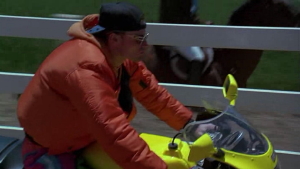
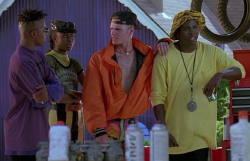
The lead character in “Cool As Ice” is Johnny, who is played by Vanilla Ice, who is played by Robert Van Winkle. Johnny is a very tough biker dude who, like most very tough biker dudes, rides a bright yellow motorcycle. Johnny travels in a posse consisting of himself, two African American dudes, and an African American girl, none of whom have names. In fact, Johnny himself does not have a name until the movie is half over. The filmmakers had finished 50 percent of their work before they realized their protagonist didn’t have a name, and then they just gave him the first one that popped into their heads.

cool as ice

Not-yet-named-Johnny and his anonymous friends are biking down a country lane one fine day when they see a pretty girl riding a horse in a pasture, separated from them by a wooden fence. Soon-to-be-called-Johnny wants to impress the equestrian with his suaveness, so he uses an invisible ramp to jump the fence on his motorcycle, landing directly in front of the terrified horse, which rears up on its hind legs and throws the girl to the ground. Exemplifying what will prove to be the film’s dominant theme, Johnny is surprised to discover that his actions have consequences. He cannot understand why the girl is angry with him. To be fair, though, the film’s second-most dominant theme is that no matter what Johnny does, the ladies love him. So you can see why he’d be confused here.

cool as ice

Johnny’s encounter with this girl contains the film’s first real dialogue and thus the first indication of what sort of movie we are dealing with. Here is what happens after Johnny makes her horse throw her off:

JOHNNY: Hey, you OK? (she punches him in the gut) Damn! What the hell’s wrong with you?

GIRL: What the hell’s wrong with YOU?

JOHNNY: Nothing, till now!

GIRL: Aww, did I hurt you?

JOHNNY: It’s all right, I’ll live. (she gets back on her horse) Yeah, you hit pretty good for a GIRL.

GIRL: Yeah? Well, coming from a big macho biker like yourself I’ll take that as a compliment. (she rides away)

Ah. It is THAT kind of movie. The kind of movie where the main character does something reckless that could have caused serious injury, then responds to the victim’s anger with childish belligerence, in dialogue evidently written by a ninth-grade drama student.

cool as ice

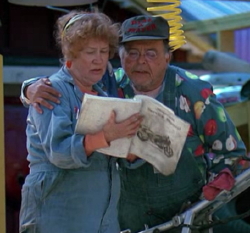
Later, Johnny and company are tooling through town when one of their motorcycles suffers a mishap. As luck would have it, they soon roll past a mom-and-pop motorcycle repair shop operated by Charley Cheswick from “One Flew Over the Cuckoo’s Nest” and Blanche the dippy secretary from “Grease.” Named Roscoe and Mae, they are comical, bumbling, rustic characters, providing a contrast to Johnny and his crew, who are neither comical, bumbling, rustic, nor characters. Somehow it transpires that the group will live with Mae and Roscoe, in their eccentrically decorated house-slash-garage, until the motorcycle is fixed. That’s right — this is one of those charming bed-and-breakfast-and-motorcycle-repair-shops you’ve read about in magazines.

cool as ice

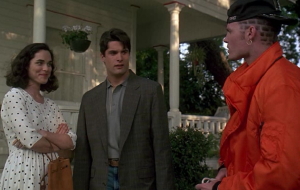
And guess who lives right across the street from Mae ‘n’ Roscoe’s Auto Repair and Youth Hostel? The girl that Johnny knocked off a horse earlier! Her name is Kathy (Kristin Minter), she’s a bright high-school senior with a promising college career ahead of her, and she has a preppy jerk boyfriend named Nick (John Haymes Newton). You might think a girl like this would want nothing to do with the smirking boob who spooked her horse, but that’s only because you’re fixated on outdated concepts like “reality” and “plausibility.” The fact is, Johnny’s garish wardrobe, his fake tough-guy dialect, and his inconsistent attitude toward shirt-wearing render all human females powerless to resist him. As if to prove this point, Johnny flirts with Kathy as she and Nick try to enter her house, and steals her day planner when she isn’t looking. Why, this Johnny fellow could charm the stink off a monkey!

Johnny returns to Kathy’s house later that evening to be suave some more, and possibly also to steal some more of her things, but she isn’t home. She and Nick have gone to “the Sugar Shack,” which is not a brothel but rather the local teen hangout. Kathy’s pesky little brother, Tommy (Victor DiMattia), thinks Johnny is the epitome of cool; Kathy’s dad — played by Michael Gross, also the dad on “Family Ties” — is not impressed. Rest assured, though, by the end of the film even “Family Ties” Dad will be singing Johnny’s praises. ALL HAIL JOHNNY AND HIS YELLOW MOTORCYCLE.

So Johnny and his nameless friends go to the Sugar Shack, where some lame “rock and roll” band is playing their “music” and boring everyone to death, and Johnny saves the day by having one of his friends scratch some records while Johnny freestyles some rap, as is the custom. Kathy flirts shamelessly and slow-dances with Johnny, right in front of Nick, then can’t understand why Nick is upset. Nick treats Kathy condescendingly, then can’t understand why Kathy thinks he’s a jerk. Robert Van Winkle changes his name to Vanilla Ice, then can’t understand why nobody takes him seriously. The cycle repeats itself.

cool as ice

Back at Kathy’s house, a couple of goons have shown up to shake down “Family Ties” Dad for $500,000, on account of something “Family Ties” Dad did in the past (other than “Family Ties”). FTD mistakenly believes that Johnny is associated with the goons, thus giving him one more reason to forbid Kathy from hanging out with him, as if more reasons were needed. Meanwhile, back at the Sugar Shack, Nick takes a baseball bat to Johnny’s friend’s motorcycle, and Johnny stands up to him.

Would it surprise you to learn that Johnny is a terrific fighter? As in, he doesn’t just hold his own and defend himself, but skillfully and methodically takes down Nick and his friends single-handedly? It would not surprise you to learn this? Good! Then you have been paying attention.

cool as ice

The next thing Johnny does that should be considered antisocial behavior but is instead received graciously is sneak into Kathy’s bedroom in the morning and wake her up by putting ice in her mouth. (Please note that I mean actual frozen water.) He gives Kathy her day planner back, and the two of them spend the day together, montage-style. Their primary activities are hanging around a construction site and riding Johnny’s motorcycle in the desert, which I guess is right next to the construction site, which I guess is right next to whatever town this all takes place in. They also have deep conversations like this one:

cool as ice

KATHY: What’s important to you?

JOHNNY: Being true to yourself.

Yes, it is important to Johnny that he be true to himself. One assumes this line is here as an act of self-parody, like when a character played by James Franco urges against marijuana use.

I have forgotten to mention that occasionally the film cuts back to Mae ‘n’ Roscoe’s Down-Home B&B Garage, where Johnny’s friends — who serve no purpose in the story — keep themselves occupied by dancing.

As you have probably predicted, the goons who are shaking down “Family Ties” Dad kidnap young Tommy, and FTD assumes Johnny is involved, which Kathy adamantly denies. Kathy has only known Johnny for a day and a half, during which time he has broken into her house, stolen her property, beaten up her boyfriend, frightened her horse, and demonstrated an appalling lack of fashion sense — but Kathy is sure nonetheless that Johnny could NOT be connected to anything illegal.

cool as ice

For his part, Johnny does nothing to clear up the misunderstanding, since he’s a rebel and being misunderstood is sort of his “thing.” Instead, he figures out where the kidnappers are holding Tommy, busts into the place on his motorcycle, saves the day, earns the respect of “Family Ties” Dad, sha-la-la-la. A celebratory rap number commences, which the FBI will tell you is how most kidnappings end.

cool as ice

“Cool As Ice” is 91 minutes long. But if you subtract the six-minute opening-credits sequence and the four-minute hip-hop number and four minutes of closing credits at the end, you’re left with 77 minutes of actual movie. And if you subtract from that the many, many scenes of people just dancing or rapping or riding around on fluorescent motorcycles, you’re left with about 65 minutes of movie. And if you subtract from THAT all the nonsensical dialogue, wooden acting, and extraneous characters, you’re left with -10 minutes of movie. That’s right, removing the bad parts from “Cool As Ice” actually results in a negative running time. If you leave this movie sitting next to another movie overnight, in the morning the other movie will be 10 minutes shorter than it was. That is science.

Vanilla Ice was unable to maintain his momentum, and he soon sank to Milli Vanilli levels of infamy. We should not be too quick to judge, though. To quote Shakespeare, let he among us who has never overestimated his own chump-waxing skills cast the first candle.

— Film.com

Never Let Me Go

0

Those who have read Kazuo Ishiguro’s novel “Never Let Me Go” already know what a sad, poignant story it is, and they have been careful not to say too much about it as they recommend it to others. But the superb film adaptation isn’t as concerned about revealing the secrets too early. The real power in Ishiguro’s story is in its emotions, not its surprises.

Kathy, a reserved young woman played by Carey Mulligan, is our narrator and guide in this alternate version of reality. Here, advances in medical science have increased life expectancy to 100 years. (This is the very first thing the movie tells us.) Kathy talks about “carers” and “donors,” and flashes back to her years growing up at a boarding house called Hailsham, where a kindly teacher named Miss Lucy (Sally Hawkins) explained the facts of life to Kathy and her fellow students.

The details of those facts are revealed to us before long. Hailsham students are “special,” with a special destiny. They have little contact with the outside world. Miss Lucy tells them in no uncertain terms: “None of you will do anything but live the life that’s already set out for you.”

The rest of the story is about Kathy and her friends’ efforts to disprove that.

Kathy’s lifelong best friend is Ruth (Keira Knightley), a beautiful and insecure girl who does whatever it takes to get whatever she wants. When they were younger, that meant nabbing Tommy (Andrew Garfield) as a boyfriend, even though he was better suited for Kathy. Memories of the cottages where they and other students lived after Hailsham show Ruth desperate to fit in with the older kids, eager to be accepted.

Tommy is far less socially capable, a victim of teasing in his young years, exceedingly vulnerable. The system under which he, Kathy, and Ruth live has conditioned them all to accept whatever fate has in store for them, but Tommy is especially pliant. He seems to have no will of his own. It’s heartbreaking.

The film has been adapted by Alex Garland (“The Beach,” “Sunshine”) and directed by Mark Romanek, a well-respected music-video guru who made a small splash in the indie world with 2002’s “One Hour Photo.” Like almost all adaptations, this isn’t as good as the book it’s based on, but Garland and Romanek have done an outstanding job of translating a unique story into the language of film. “Never Let Me Go” has science-fiction elements, yet suspension of disbelief is never an obstacle. In fact, I felt more connection to, and sympathy for, these characters in their far-fetched situation than I’ve felt for a lot of “normal” fictional people lately.

That’s what great fiction does, of course. It makes its characters’ feelings seem universal, no matter how unusual their circumstances are. We don’t have the same specific burdens as Kathy, Tommy, and Ruth, but we’ve all felt, at some point, like we were powerless to change our course in life. “Never Let Me Go” depicts this struggle with aching sensitivity.

‘What’s the Big Deal?’ needs big deals

80

Thank you all for your suggestions for “Eric’s Bad Movies” a few weeks ago, and feel free to continue contributing ideas by posting comments in that thread. Now I come to you again seeking suggestions for my other Film.com column, “What’s the Big Deal?”

The criteria are completely different for this column. The idea behind “What’s the Big Deal?” is that there are many films the average person has heard of that are supposed to be “classics,” but that maybe the average person hasn’t seen. And sometimes you’ll watch one of those movies, expecting a classic, and when it’s over you think, “Well, that was OK. But what’s the big deal?” This column is meant to lay out what the big deal is.

My experience has been that if I plop down and watch some “classic” film for the first time, without any advance preparation, often I’ll come away underwhelmed. There’s a good reason for this. A movie from, say, 1960 wasn’t made for me. It was made for people in 1960. I don’t have the same frame of reference that the film’s intended audience would have had. So then I’ll read what other people have written about the movie and I’ll realize, oh, it was the first film to do this, or a good example of that, or it came out while this trend was popular, or while this topic was in the news, or whatever. Once I have some context, it increases my enjoyment of, and my appreciation for, the film.

Friday movie roundup – Sept. 10

1

It’s time for the post-summer doldrums, with only one new wide release this weekend, and one aimed at a specific demographic. Everyone else can just stay home.

“Resident Evil: Afterlife” — one of Hollywood’s Shameful Secrets® in that it was not screened for critics prior to opening — is the fourth film in the series and easily better than parts two and three. (I think it’s better than the first one, too, but I’ve been told that I’m wrong about this.) It was filmed in legit 3D and looks pretty spiffy. A lot of what happens is silly, but at least you can see it.

I finally wrote my review of “The American.”

I spent last weekend in Telluride, Colo., attending the utterly charming Telluride Film Festival. I reviewed “Never Let Me Go” for Film.com. For Cinematical, I reviewed “Black Swan,” “Tabloid,” and “The First Movie,” and wrote a piece describing a first-timer’s impressions of Telluride.

This week’s edition of “Eric’s Bad Movies” at Film.com was about “Wing Commander,” a video-game-based turd from 1999. I wrote about my experience with this movie in my end-of-2009 inventory:

It was also during this time [when I was suffering from a major depressive episode] that I tried to do some work by watching “Wing Commander,” starring Freddie Prinze Jr., for Eric’s Bad Movies. I learned that I can’t do Eric’s Bad Movies in this frame of mind. “Wing Commander” is terrible, no question. But watching it, I couldn’t think of anything funny to say about it. All I could think about was how much I hated watching it. And if you’re going to watch a bad movie without being able to make fun of it, well, what’s the point? Rather than distract me from my depression, it added to it. I still want to do “Wing Commander” for Eric’s Bad Movies, but it will be a while before I can muster the strength to watch it again. In the meantime, you’ve won this round, Mr. Prinze Jr.

Eager to prove my victory over Mr. Prinze Jr., I watched “Wing Commander” again last week and this time succeeded in writing an “Eric’s Bad Movies” column about it. It’s not the best “Eric’s Bad Movies” I’ve ever written, but at least I did it. I WIN.

Subscribe to “In the Dark,” a weekly e-mail with the latest movie reviews, DVD releases, and other pertinent info.

Listen to “Movie B.S. with Bayer and Snider,” a weekly Internet radio show featuring Jeff Bayer and Eric D. Snider, at PDX.fm. It’s live at 11 a.m. (Pacific) every Friday, then downloadable as a podcast. Ignore the iTunes “explicit” tag; we always keep it PG.

Lovely, Still

0

I can’t imagine a more apt title for “Lovely, Still” than the one it has. This sweet, surprising story about romance between senior citizens is uncommonly lovely, and a serene stillness rests over most of it. Of course, the title works the other way, too: The process of falling in love is lovely, still, even after all these years.

It is Christmastime in an unnamed snowy town, and Robert Malone (Martin Landau) is a lonely old man. He lives by himself in a house that he has occupied for 48 years, a house with minimal furniture and no pictures on the walls. The only gift under his Christmas tree is one he wrapped himself, addressed to himself. He works part-time as a bagger at a grocery store, where the doofy, over-eager manager, Mike (Adam Scott), wants him to invest in the publication of a homemade book of Christmas recipes.

Across the street, a widow named Mary (Ellen Burstyn) and her daughter Alex (Elizabeth Banks) have just moved in. Mary, seemingly smitten upon first laying eyes on the old man, invites Robert to dinner. Delighted by his sudden great fortune, Robert seeks dating advice from everyone he encounters the following day. Has he never even been on a date? Or has it just been too long since the last time?

Soon the two are dating, with Mary taking charge and Robert awestruck by her attention. He cannot believe that love has finally found him, so late in life. For the first time, he will have someone to spend Christmas with.

I jotted in my notes that there did not seem to be any real conflict in the story, and I kept waiting for something to happen that would raise the dramatic stakes. Only two things stood out: Robert’s vague but unsettling recurring nightmares, and a scene where Mary is panicked over not being able to refill a prescription. Still, it was pleasant enough to see this sunny romance blossom between two such fully compatible people. If that was going to be the film’s whole purpose, so be it.

As it turns out, that is not the film’s whole purpose. The film, an astonishingly well-crafted debut from writer/director Nik Fackler, has something up its sleeve, and all the tiny, strange details you might notice but disregard eventually come into play. What has been a moving and warmhearted love story becomes poignant for different reasons — lovely, still, but deeper and more powerful. It’s icing on an already-delicious cake, but icing that, you come to realize, the cake couldn’t have worked without.

Martin Landau gives a genuinely heart-wrenching performance as Robert, a man who by all rights should be grandfather to many happy grandchildren but who for some reason is alone. The unfairness and injustice of that lingers at the back of your mind: This is a nice, decent man. He deserves someone to love and care for him — someone like Mary, played with characteristic elegance and charm by Ellen Burstyn.

At the moment, “Lovely, Still” does not have a deal in place for theatrical release. I hope someone remedies that. It won’t make $100 million at the multiplex — it would be lucky to make $10 million on the art-house circuit — but a movie as expertly made as this, and as tender and subtly beautiful as this, deserves to be seen.

[Note: I reviewed this film when it played at the Toronto International Film Festival in 2008. I’m it has been reedited for its theatrical release, but I haven’t seen that version and don’t know how different it is.]

Resident Evil: Afterlife

0

I remember having a lot of unanswered questions at the end of “Resident Evil: Extinction.” What did I just watch? Why did I watch it? Is it too late to change to a career that will not require me to watch things like this? None of those questions are answered in part 4 of the franchise, “Resident Evil: Afterlife,” but at least you get to hear a bad guy say, “Tell security to flood the main entrance with nerve gas.”

It’s been a few years since the events of the last film (whatever those might have been; re-reading my review did little to jog my memory), and Alice (Milla Jovovich) is still seeking revenge against the Umbrella Corporation, whose dangerous experimentation with viral weaponry turned most of the Earth’s population into flesh-eating zombies. Alice acquired super powers at some point, but an injection early in this film makes her an ordinary human again. Then she walks away from a plane crash that otherwise left nothing but smoldering wreckage. You know, like ordinary humans do.

Having sent her fellow survivors to a supposed safe zone in Alaska, Alice the warrior now endeavors to catch up with them. She manages to find Claire (Ali Larter) but no one else, and Claire has amnesia. Somehow they both wind up in what used to be a prison, holed up with a small band of other survivors hiding from the zombie horde outside the prison gates. Their compatriots include a professional athlete named Luther (Boris Kodjoe), a smug Hollywood producer named Bennett (Kim Coates), and an alleged killer named Chris (Wentworth Miller).

I’ll tell you one thing, this is not exactly a cavalcade of stellar acting. Everyone speaks in throaty whispers, with even casual lines given a menacing, tough-guy spin. This sounds particularly absurd when it’s Milla Jovovich and Ali Larter conversing, as these are two of the least expressive actresses currently working. They are rivaled by Shawn Roberts, who plays supervillain Albert Wesker (a role previously played by Jason O’Mara) as if he were a robot. (Spoiler alert: He is not a robot.)

But Paul W.S. Anderson, writer of all four films and director of the first one, is back in the driver’s seat here, and he pulls off some nifty visual effects. Shooting in 3D, he makes use of the gimmick without being too gimmicky, and he avoids letting the action scenes become chaotic or confusing. In fact, he tends to go the opposite way, showing everything in slow-motion so we won’t miss anything. What we’re seeing may be absurd half the time, but at least we can see it.

Oh, it’s silly stuff, sure. Chris and Claire turn out to have an extraordinarily coincidental connection to one another. A Goliath-size zombie with a burlap sack over his head shows up to cause trouble, with no explanation ever given for what he is or why he’s so powerful. (I assume he’s from one of the “Resident Evil” video games.) The subplot about Chris’ supposedly murderous tendencies adds nothing and goes nowhere. Like pretty much all of Anderson’s films (“Mortal Kombat,” “Event Horizon,” “Death Race”), this one is half-baked. The half that’s baked isn’t too bad, though.

I’m Still Here (shmocumentary)

0

Coincidentally, I saw “I’m Still Here” the night before it became official public knowledge that Joaquin Phoenix’s behavior in the film was an act. Nearly everyone suspected as much, but Casey Affleck, the film’s director (and Phoenix’s brother-in-law), had deflected questions about it for months until finally coming clean to The New York Times. And they say investigative journalism is dying!

Normally you’d argue that external factors shouldn’t have any bearing on your opinion of a movie. But “I’m Still Here” is all about external factors. In the film — supposedly an unstaged documentary — Joaquin Phoenix quits the acting business to pursue a hip-hop career, which he believes will let him be more honest, less phony. He grows a crazy-man beard, does a lot of drugs, consorts with prostitutes, acts like a space cadet on Letterman. All of this played out in public in 2008 and 2009, with people constantly wondering whether it was for real or all an act. The movie shows Phoenix getting upset at the suggestion he’s anything less than sincere about becoming a rap artist.

As I watched the film, suspecting it was a put-on but willing to believe it was legit, I arrived at this conclusion: Either way, the movie doesn’t work. If it’s truly a document of Phoenix’s actual behavior, it’s horrific, and Affleck is a loathsome exploiter for showing it. If it’s real, it shows a man falling apart at the seams, running headlong into insanity and self-destruction. If it’s real, we shouldn’t be watching it.

And if it’s all an act, some kind of meta-commentary on celebrity and public life? In that case, it’s just boring. Phoenix’s antics are amusing for a while, but without knowing what we’re watching, it’s hard to know how we’re supposed to react to it. It plays out like a parody that doesn’t want you to know it’s a parody, which limits its potential impact.

Now that we know it’s a performance, though, we can appreciate what an astonishing performance it is. Has anyone ever been so committed to a role? Phoenix didn’t just act like this in front of Affleck’s cameras. He played the part every time he went out in public for 18 months. Presumably his closest associates were in on it, but the rest of the world wasn’t. It takes some serious nerve to let people think the imbecile you’re portraying is actually you.

But now we have to ask: Why? Phoenix and Affleck perpetrated this prank for a couple years, and sure enough, they fooled a lot of people. To what end, though? Is the joke on us for being deceived? Is the joke on Hollywood for being so vapid that we’d believe this was a real depiction of a celebrity meltdown? Is there a joke at all? Or is this just a thing that rich people do when they’re bored?

Wing Commander

Wing Commander

There have now been a couple dozen terrible movies based on video games, but that wasn’t the case in the late 1990s. Back then, there had only been a few terrible movies based on video games, so the idea of making one that wasn’t terrible was not completely implausible.

The chances diminished rapidly, however, when Freddie Prinze Jr. was cast as the lead. Remember Freddie Prinze Jr.? He was the dullest heartthrob who ever throbbed a heart. He was like human Ambien. What ever happened to that guy? Eh, never mind, I don’t care, let’s just make fun of “Wing Commander.”

“Wing Commander” was based on a series of video games that one assumes involved wings and the commanding thereof, though one cannot be certain because one never played them. The movie is set in the far-distant year of 2654, when mankind has colonized the galaxy, and Betty White is thinking of retiring. Naturally, the humans are having a space war with some aliens, because this is what happens when you colonize the galaxy. You can’t make a galaxy-colonizing omelette without breaking a few space-war eggs! The enemy aliens are called the Kilrathi, as calling them the Murderangry would have been too on-the-nose.

At the beginning of the film, the Kilrathi destroy an Earth vessel in the Vega sector (which everyone knows is a pretty tough neighborhood after dark) and obtain its navigation-communication device. The nav-comm will show the Kilrathi where certain “quasar jump points” are, and they can use these “quasar jump points” to hop over to Earth’s solar system and kill us all. Without the “quasar jump points,” Earth is much too far away for the Kilrathi, who don’t like to travel and frankly aren’t that ambitious. It may also be that the Kilrathi, like me, do not believe that “quasar jump points” are actual things.

wing commander

Now somebody has to stop the Kilrathi from figuring out how to use the nav-comm. And that somebody is a guy named Chris!

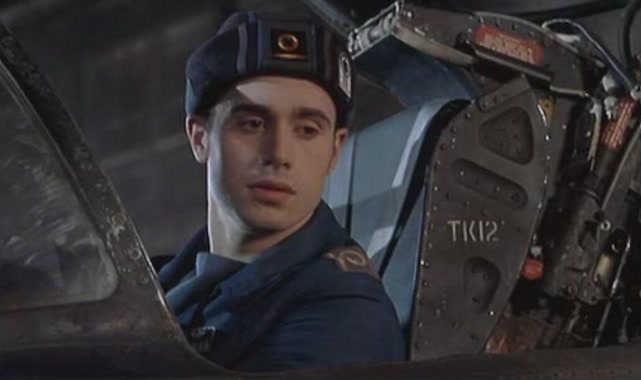
Chris is the cocky but boring space pilot played by Freddie Prinze Jr. He and his cocky but irritating friend, Todd (Matthew Lillard), have just gotten out of space academy and are on their way to the carrier ship Tiger Claw to replace a couple pilots who got killed, probably for not being cocky enough.

Chris balances out his cockiness by being a pretty good pilot, and by reading Homer’s “The Odyssey” in his spare time. The character is given this trait to counteract the viewer’s initial impression that any character played by Freddie Prinze Jr. must be a dope. Chris also says very complicated and smart-sounding technical things like, “Have we reached the entry vector’s PNR yet?” But despite Chris’ efforts, one of his superiors, Gerald (Jurgen Prochnow), doesn’t trust him. That’s because Chris’ mother was a “pilgrim” — and everybody hates pilgrims, what with their buckled shoes and their first Thanksgivings and their smallpox blankets. No, I kid. The “pilgrims” in “Wing Commander” lore were a group of people who rejected their emotions and became human computers. They also fought against the good guys hundreds of years ago before aligning with them, and there’s still some resentment toward pilgrims and half-pilgrims, similar to the way people in Boston still have a problem with Redcoats.

wing commander

Thanks to his half-pilgrim heritage, Chris can navigate a spaceship through a quasar or a black hole without the aid of a nav-comm computer, doing all the split-second calculations himself. This may sound impressive, but Chris works them out on a keypad with only 15 buttons on it, so I suspect we are not talking about graduate-level calculus here.

wing commander

The first thing Chris and Todd do as new arrivals on the Tiger Claw is act like hotshots and make their fellow pilots dislike them. That includes Angel (Saffron Burrows), the lieutenant commander, who is required to become Chris’ love interest once she gets over disliking him, which doesn’t take as long as you’d think. The tough-as-nails Angel explains that there’s no time for grief on the Tiger Claw. When someone dies, you pretend that person never existed. Those pilots that Chris and Todd are here to replace? What pilots? Angel doesn’t know what you’re talking about. What were their names? Nope, those names don’t sound familiar to Angel.

So it should be nothing but smooth sailing for the crew of the Tiger Claw, mental-health-wise.

Meanwhile, Todd gives all his fellow pilots some liquor. This makes them overlook his grating, grinning, self-assured idiocy — his Matthew Lillard-ness, in other words — and he hooks up with a lady pilot named Rosie (Ginny Holder), who finds his reckless disregard for caution sexy. After one particularly douchebaggy stunt, they have this exchange:

ROSIE: You’ve got big balls.
TODD: You should see ’em.
ROSIE: Mine are bigger.
TODD: I’ve been told size doesn’t matter.

Wait, what were we talking about? Rosie obviously meant “balls” metaphorically, referring to Todd’s braveness, but then Todd switched to the literal meaning, referring to his actual testicles, but then Rosie made reference to her own balls, which would have to be metaphorical again since she’s a woman, but then Todd goes back to the literal meaning. What we learn from this is either that double entendre doesn’t work on Todd, or that Rosie is a she-male.

wing commander

Everyone eventually gets around to having some space battles with the Kilrathi. You know what these battles look like if you’ve ever seen the end of “Star Wars,” especially if you saw the version that was made on an Apple IIe. Also, it turns out the Kilrathi look like kitty-cats! They speak an adorable guttural language that is subtitled for viewers. Cute!

In the course of the Lucas-esque feline war, Todd does something dangerous and foolhardy, with Rosie accompanying him because she also enjoys danger, except she’s not as good at it as Todd is, and she dies; whoops. Todd feels guilty about her death — which is appropriate, given that it was his fault — and Angel is very grumpy with him. Fortunately, Chris is able to talk Angel out of her grumpiness. You can’t be angry when you’re talking to Chris, as he is too boring to produce strong emotions of any kind. Chris also persuades Angel to quit pretending Rosie never existed. It never occurred to Angel until now that this was a stupid way to deal with death. Thank goodness Chris is here!

There is more thanking of goodness a little later, when they have to pilot their ship through a pulsar field or something, and Chris gets to use his half-pilgrim calculating skills to save the day. Perhaps it does not sound very exciting to watch Freddie Prinze Jr. stare intently at an instrument panel while doing math. It isn’t. But it’s better than his moments of high emotion, like when Angel is wounded and he says, “Don’t you die on me!,” or when Angel tells him, “You disobey my order and I’ll have you court-martialed” and he replies, “Like I care!”

I submit that there has never been a high-quality action movie in which the supposedly noble and brave lead character has said, “Like I care.” There has never been a high-quality action movie based on a video game, either, but at least that isn’t impossible.

— Film.com

Friday movie roundup – Sept. 3

1

Since Labor Day weekend is usually pretty slow at the box office, Hollywood tends to put out movies that aren’t particularly worth seeing anyway. Or maybe the mediocrity of the movies is why Labor Day weekend tends to be slow. Who knows/cares? Either way, the quality trend is bucked this weekend, as everything new is actually pretty good.

“Machete” (review at Film.com), a movie based on a trailer based on a type of movie that once played at a type of theater, is over-the-top exploitation fun. It’s what “The Expendables” was in some ways trying to be, right down to the presence of Steven Seagal.

“Going the Distance” is also surprisingly good, given that it’s a romantic comedy starring a real-life couple. (It’s Drew Barrymore and Justin Long. I think they’re “on again, off again.” I’m not on Facebook, so I can’t check their current status.) The movie is funny and realistic, but still romantically satisfying. It’s easily the best rom-com I’ve seen this year, though I admit that isn’t saying much.

“The American,” starring George Clooney as a hitman, is also quite engaging, though it is NOT an action movie. It’s a slow, contemplative character study. Do not be misled. Also, I haven’t written my review yet. But I liked it.

In limited release, the Sundance hit “Animal Kingdom” will make you fall in love with hardcore Australian criminals all over again.

At Film.com, I wrote an article explaining “Machete” to aliens who have just arrived from space, and I transcribed the pitch meeting for Shyamalan’s “Devil.” “What’s the Big Deal” was about the early German talkie “M.” “Eric’s Bad Movies” is off this week because…

…I’m at the Telluride Film Festival! This is my first visit to the small but important fest tucked away in the mountains of Colorado, and so far I love it. (Except for the dearth of wi-fi and vending machines in the hotel, though neither of those are the festival’s fault.) I don’t know if I’ve ever been anyplace that was more physically beautiful than Telluride. The weather is perfectly sunny and clear, too, which I’m told is not necessarily always the case.

Oh, and there are some movies here. More on that later.

Since I was going to be gone on Friday, Bayer and I pretaped “Movie B.S. with Bayer and Snider.” (We did that once before, too, but I’ll NEVER TELL which episode it was.) The pretaping led to some delightful time-travel shenanigans, as we had our old pal Dawn Taylor on as a guest, and also appeared on her show, “Ham-Fisted Radio,” which went out live after we taped “Movie B.S.” Enjoy, won’t you?

Subscribe to “In the Dark,” a weekly e-mail with the latest movie reviews, DVD releases, and other pertinent info.

Listen to “Movie B.S. with Bayer and Snider,” a weekly Internet radio show featuring Jeff Bayer and Eric D. Snider, at PDX.fm. It’s live at 11 a.m. (Pacific) every Friday, then downloadable as a podcast. Ignore the iTunes “explicit” tag; we always keep it PG.

Going the Distance

0

Long-distance relationships. Romantic comedies. Love stories starring real-life couples. Things Drew Barrymore does. All of these have a high rate of failure, so the success of “Going the Distance” isn’t just pleasing, it’s almost miraculous.

In director Nanette Burstein’s first fictional film (she made the highly entertaining documentaries “American Teen” and “The Kid Stays in the Picture”), Barrymore and on-again/off-again boyfriend Justin Long play Erin and Garrett, a fairly ordinary, fairly likable young pair who meet one beery evening in a New York pub. Garrett is an entry-level music industry guy in New York; Erin, a journalism grad student at Stanford, is just here for an internship and heads back to California in six weeks. Neither of them wants anything serious.

Wouldn’t you know it, things get serious anyway, and when Erin returns to the West Coast they gingerly try the long-distance-relationship thing. Characters in other movies wouldn’t see a problem here. Why, Garrett can just fly to San Francisco and Erin can fly to New York on alternating weekends! Or one of them can simply drop everything and make a permanent move to the other city! Love is all you need!

Not so. The most eye-opening thing about first-timer Geoff LaTulippe’s charmingly honest screenplay is how it deals with the realities of cross-country romances. Since you are not a movie character, you’re probably well aware of how expensive plane tickets are, and how complicated it is to get time off work regularly, and how there is a three-hour time difference between New York and California, and how this might impact telephone conversations first thing in the morning or late at night.

Erin and Garrett, despite being movie characters, are also aware of these problems. They grapple with them clumsily, humorously, and with a lot of trial and error, as do real people. Their interaction is neither too cute nor too angst-ridden. They aren’t one-dimensional rom-com characters (He’s afraid of commitment! She’s a career-driven shrew!), nor are they overly quirky. They seem, well, normal. Their problems are believable, and they handle them like normal people. When misunderstandings arise, or when half-truths are told, they get worked out. Characters in other movies would be awestruck by this strategy.

You’d be surprised how much difference this makes. Erin and Garrett are so well-established as grounded, real-world characters that it’s easy to overlook the few instances where things do start to get a little wacky and formulaic, a little too movie-ish. Most rom-coms are fairy tales from start to finish; this one shows that you can keep things down-to-earth and still have a completely satisfying resolution.

Oh, and it’s often raucously funny, too, earning its R rating with saucy, smart language that accurately reflects the comportment of today’s 30-ish urbanites. Barrymore and Long are surrounded by a terrific cast that includes Charlie Day (from “It’s Always Sunny in Philadelphia”), Jason Sudeikis, Christina Applegate, Jim Gaffigan, and Rob Riggle. At every turn there are sharp observations about all stages of relationships. When I wasn’t laughing I was nodding my head in agreement. I think this is how Tyler Perry’s audience feels all the time.

Machete

0

In some ways, “Machete” is what “The Expendables” would have been if “The Expendables” had been written and directed by someone with a sense of humor, i.e., not Sylvester Stallone. Both films are self-conscious throwbacks to bygone genres; part of the problem with Stallone’s movie is that it wasn’t self-conscious enough. I loved what Anthony Lane said about it in The New Yorker: “You might expect, given the title, a few shafts of irony or pathos to be leveled at this symposium of has-beens, but … Stallone seems genuinely to believe that he is dealing in still-cans.”

Robert Rodriguez is much more eager to embrace the camp value of the ultra-violent B-movies of yesteryear. “Machete,” which he co-wrote with his cousin Alvaro Rodriguez and co-directed with editor Ethan Maniquis, is an enthusiastic and affectionate exploitation flick, a movie that is fully aware of (and delighted by) its own absurdity. The story is updated for 2010, but the style and tone — minus the irony — would have been at home in a greasy Times Square-adjacent theater in the early ’70s.

“Machete” began as a fake trailer attached to Rodriguez and Quentin Tarantino’s “Grindhouse” double feature in 2007, advertising the sort of film you’d expect to see advertised at an actual grindhouse. (“If you’re going to hire Machete to kill the bad guy, you better make damn sure the bad guy isn’t you!” was a typically clunky line of narration.) The level of violence and sleaze promised by such movies was so ludicrously high that they either had to be works of pure innocence, made by earnest but clumsy filmmakers attempting to produce legitimate action dramas — or else works of pure calculation, designed to tap into, take advantage of, and perhaps even mock the audience’s lust for extremes.

Rodriguez’s movie is the calculated kind, of course, and he’s walking a line trod just two weeks ago by Alexandre Aja and “Piranha”: the line between reveling in irony as you make something deliberately “bad,” and using irony as an excuse to not have to make something better. “Machete” is much more successful at finding the balance. Plenty of the characters, dialogue, and performances are interesting in their own right, even outside the context. I suspect you could get a kick out of this even if you’ve never seen the type of movie it’s emulating.

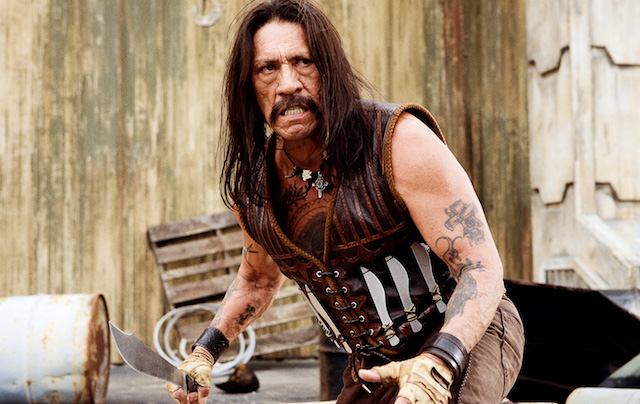
Danny Trejo, an actor whose distinctive face is most charitably described as “full of character,” plays Machete, a Mexican federal agent whose insistence on being the only Mexican federal agent who can’t be bribed has put him at odds with the leader of a drug cartel. (This drug lord, Torrez, is played by Steven Seagal, a felicitous bit of casting made even better by Seagal’s willingness to go along with the joke.) Now working as a common day-laborer in Texas, Machete is hired by a shady fellow (Jeff Fahey) to assassinate a state senator (Robert De Niro) running for reelection on an anti-immigrant platform. But Machete is double-crossed, framed for something he didn’t do, and must prove his innocence. This will require killing a lot of people.

With the United States currently embroiled in a heated immigration debate, “Machete” could hardly have come at a more opportune time. But like its exploitative forefathers, it has no interest in nuance or subtlety. The state senator and his militia-leading friend (played by Don Johnson) aren’t just racist crackers — they actually hunt Mexicans for sport. The lines are drawn very clearly in a movie like this. The bad guys are REALLY bad. Complex issues like immigration reform are, like everything else in the movie, outrageously oversimplified to maximize the entertainment value.

The cast also includes Jessica Alba as an immigration officer, Michelle Rodriguez as a taco-cart proprietor who helps a network of illegal aliens defend themselves against the vigilantes, and Lindsay Lohan as a drugged-up skank with ties to the senator. All three give laughably flat performances, just like many of the beautiful actresses in the B-movies Rodriguez is imitating. The only question is whether Rodriguez specifically directed them to act that way, or whether he cast them in the first place because he knew that’s what he would get. He also cast Cheech Marin as Machete’s priest brother, but Cheech clearly knows what he’s doing.

It’s impressive that Rodriguez and company keep this from turning into a one-joke affair. The outlandish violence is a constant (including an intestine-based stunt that I know I’ve seen in an “Itchy & Scratchy” cartoon), but that’s buoyed by political satire, politically incorrect satire, and general comic mania. Like last year’s tragically under-seen “Black Dynamite,” which it resembles, “Machete” is brimming with infectious energy — a well-made movie in the style of poorly made movies.

Explaining ‘Machete’ to Aliens Who Have Just Arrived from Outer Space

0
Explaining ‘Machete’ to Aliens Who Have Just Arrived from Outer Space

Welcome to Earth! Thank you for not killing us immediately. Ha ha, just a little joke there. We’ve made a lot of movies about what might happen if aliens came to visit us, and it usually doesn’t go well for us.

Oh, you’ve seen some of our movies? You know what I mean, then. I hope you didn’t find them offensive. Obviously, we had no way of knowing what actual extra-terrestrials would be like, and it is the human tendency to fear the unknown. Plus, it makes for good drama. As it turns out, you guys seem quite decent and nonthreatening. I guess we were wrong!

Good, good, I’m glad you understand. Now, you’ll probably want to meet our president and the other leaders of Earth, so — pardon me? Well, sure, we can talk about movies for a minute. You don’t have anything like that where you come from? Wow. Interesting. Movies are a pretty big part of our culture. You saw a — yes, that’s called a “trailer,” sort of like a long advertisement for a movie, that’s right.

For which movie? “Machete”? OK. Yes, it’s new. The movie is just now being shown to people. Um, what did you want to know about it?

“What’s the deal with this movie?”? Is that what you said? No, no, your English is great! Your accent doesn’t even give away which part of the galaxy you’re from. I just wanted to be sure I understood you.

Well, um, “Machete.” The deal with “Machete.” It’s … OK. So, there used to be places called “grindhouse theaters,” where they would show certain kinds of movies. Usually really violent, really bloody, or really full of sex and nudity. Or some combination. Movies that couldn’t be shown in regular theaters because of their disreputable content.

Hmm? If the movies were disreputable, why did people want to see them? Well, sometimes that’s the appeal, you know? Something is forbidden, and that makes it more interesting.

Is that just a human thing? Huh.

Anyway, there was a certain market for these movies, and they’d play at these grindhouse theaters. This lasted for a few years, and then VCRs made them obsolete because now you could watch whatever you wanted at home.

And then we found this guy called Quentin Tarantino. We’re not sure where he came from. Legend has it he was born in a video store in the San Fernando Valley and raised by a clan of feral projectionists. He started making movies that were full of allusions to other movies, and people really liked that, because when you’re watching something it’s fun to be reminded that you have watched other things previously. Then Quentin Tarantino started talking about how he loved the old grindhouse theaters, and most of his fans were too young to remember them, but that didn’t stop them from also claiming to have nostalgia for this thing that they had never experienced.

So then, to capitalize on this manufactured love of grindhouse movies, Quentin Tarantino and his buddy Robert Rodriguez made two grindhouse movies of their own. They were called “Death Proof” and “Planet Terror.” I’m sorry, I’ve lost you. Yes, the original grindhouse movies were pretty cheap and not particularly well-made, and they played at sleazy theaters in the 1970s. No, no Tarantino and Rodriguez had plenty of money and skill. They just chose to make movies that were in the style of those other movies. And they played at regular movie theaters, as a double feature, just like the old days of double features, which, again, most of their fans were too young to remember.

Right. Well, to recreate the grindhouse experience — or, rather, to create it for the first time, since the viewers had never been to a grindhouse — Tarantino and Rodriguez scratched up the prints of their movies to make them look like they were old and battered. They also had some of their friends make trailers for other grindhouse movies, movies that did not exist but that seemed like the kind of movies you would see at a grindhouse. They showed these trailers between “Planet Terror” and “Death Proof.”

Yes, exactly. They made advertisements for imaginary movies. And people who saw these trailers said, “Ha, that looks like fun.” One of these trailers was for a movie called “Machete,” which was in the style of movies about cops and bad guys and violence along the border between the United States and Mexico. “Machete” was very popular, as a fake trailer, so Robert Rodriguez went ahead and made an actual full-length “Machete” movie. He figured that if something was enjoyable when it was two minutes long, it would probably be 50 times as enjoyable when it was 100 minutes long.

Well, mathematically, yes, that’s accurate. That’s not really how human pleasure works, though. I was just making a joke.

So, anyway, they went backwards. Usually you make a movie first, THEN you make the trailer as a way of advertising it. In this case, they made a trailer, just for fun, and then decided to expand it into a real movie. The trailer you saw, though, that’s not the trailer that started it all. No. The one that started it all was a joke. They made that, then they made a movie, then they made a real trailer for that movie.

What you saw was a trailer for a movie that was based on a trailer that was based on a style of movie that wasn’t very good that played in a type of theater 35 years ago.

Ha ha, no, actually, that’s NOT the flimsiest premise we’ve ever had for a movie. I wish! No, they’re about to make one called “Battleship,” based on a children’s game. There have been a few based on amusement-park rides, too. Ha ha, yes, like “Ferris Wheel: The Movie.” Now you’re getting it!

What’s the appeal of “Machete”? From what I understand, it has a lot of naked breasts, and a lot of gory violence. No, we don’t like violence in real life. We abhor it. It makes us sad. We like it in movies, though. It’s entertaining when it’s not real. No, naked breasts are very popular in real life AND in movies. Well, yes, there are other places where people can see naked breasts and violence, if they want to, without someone having to make a movie specifically about them. There’s the Internet, for example –

What? You don’t know about the Internet? Wow. OK. Well, you see, it’s this series of tubes….

— Film.com

The American

0

George Clooney plays a professional assassin in “The American,” but please don’t take the words “George Clooney” and “assassin” to mean that this is an action thriller. Good heavens, no! It’s actually a quiet, contemplative, old-fashioned melodrama — and a highly engrossing one, too, if you can resist the urge to want it to be something else.

We begin with our hero, named Jack, on a mission in snowy Sweden. The job winds up having some messy complications, due in part to Jack’s failure to avoid making any personal connections. His employer, Pavel (Johan Leysen), has another job lined up for him in Italy; Jack, wanting a break, defers and cools his heels in a quaint Italian village.

It is here that he meets three important people. One is Father Benedetto (Paolo Bonacelli), a friendly priest. The second is Clara (Violante Placido), a friendly hooker. The third is Mathilde (Thekla Reuten), the client for whom Jack is supposed to be constructing a particularly awesome firearm. (Jack isn’t just good at killing people. He’s also good at making weapons for other people to use to kill people.)

Jack wants out of the business, and not just because aftermath from the Swedish affair is coming back to haunt him. The priest easily recognizes Jack’s problem. “You cannot doubt the existence of hell,” he says to the American. “You live in it. A place without love.”

A spy, assassin, secret agent or superhero whose life is filled with loneliness, who finds it increasingly difficult not to let anyone get close to him — this is not exactly a groundbreaking theme for a movie. (Nor was it new in 1990, when Martin Booth wrote “A Very Private Gentleman,” the novel this is based on.) But Clooney — a bona fide Movie Star who also happens to be very good at acting — draws us in to Jack’s weariness and sadness, expressing so much with nothing more than a look or a gesture. He does here what Jon Hamm has been doing lately on “Mad Men”: showing what a combination of masculinity and vulnerability looks like.

The director, Anton Corbijn, was a photographer and music-video guy before he made “Control,” the beautifully sad biopic about the lead singer of Joy Division. Corbijn seems to specialize in melancholy (several of the music videos he made were for Depeche Mode), and he gives the gorgeous Italian scenery in “The American” a wistful air. The film is more about mood and tone than it is about story. Its aim is not to thrill us but to make us feel something, and it pulls it off pretty well.

The Pitch Meeting for ‘Devil’

0
The Pitch Meeting for ‘Devil’

Thanks to the hidden cameras and recording equipment that we’ve stashed all over Hollywood, we’re able to bring you transcripts of the secret meetings that take place every day. We do this in the hopes that questions may be answered, that puzzles may be solved, and that movies we don’t think look very good may be made fun of. Here is:

The Pitch Meeting for ‘Devil’

STUDIO EXEC #1: Thanks for coming to the meeting, everyone. As you know, this is my first day back on the job after being in a coma for the last six years.

STUDIO EXEC #2: Welcome back!

STUDIO EXEC #3: We missed you!

STUDIO EXEC #4: Very little has changed!

STUDIO EXEC #1: Thank you, you’re very kind. I appreciate the bouquets of hundred-dollar bills you sent to my hospital room. I was able to light a lot of cigars with them. Now, what’s on the agenda today?

STUDIO EXEC #2: We’re going to hear a pitch from … let’s see … Oh. M. Night Shyamalan.

STUDIO EXEC #3: Ugh.

STUDIO EXEC #4: Oh, no.

STUDIO EXEC #1: Shyamalan? Terrific! That guy is hot! “Sixth Sense,” “Unbreakable,” “Signs” — the man is on fire!

STUDIO EXEC #2: Yeah, actually, about that…

STUDIO EXEC #1: Bring him in! Let’s do this!

(M. NIGHT SHYAMALAN enters, sitting on a golden throne carried on the backs of a dozen servants while harem girls fan the air before him with palm fronds and chant his name.)

SHYAMALAN: Good morning, gentlemen.

STUDIO EXEC #1: Hello, M. Night! It’s a pleasure to meet you!

SHYAMALAN: Indeed it is.

STUDIO EXEC #2: All right, let’s get this over with.

SHYAMALAN: Gentlemen, what I am about to present to you will change the course of history. Not just movie history, but the entire history of man.

STUDIO EXEC #3: Oh, brother…

STUDIO EXEC #1: Ooh! Did you hear that? The history of man!

STUDIO EXEC #4: (to STUDIO EXEC #1) Listen, we should explain what you missed while you were gone…

STUDIO EXEC #1: Not now! M. Night Shyamalan is about to dazzle us with another one of his fiendishly clever stories! Go ahead, M.N.!

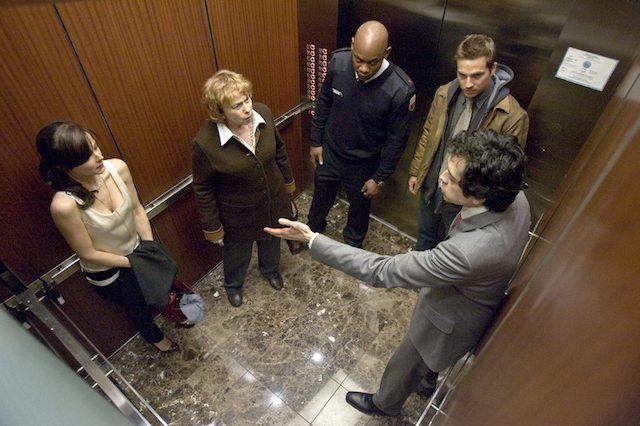
SHYAMALAN: Thank you. The film is called “Devil.” It is about a group of people who are trapped in an elevator, and one of them might be the devil.

STUDIO EXEC #3: Let me guess, the twist is that the elevator was actually an escalator the whole time.

STUDIO EXEC #4: No, no, the twist is the “close doors” button actually makes the doors open! Aahhh!

STUDIO EXEC #2: No, I’ve got it. In the end we discover that the aliens are allergic to water!

STUDIO EXEC #1: Hey! Knock it off! What’s going on here? How dare you people mock the films of M. Night Shyamalan! Oh, I suppose it’s become “cool” to make fun of this generation’s master of suspense? I guess that’s how we show that we’re “hip” nowadays? “Hey, everybody, I hate Orson Welles! He’s sooooo not very good at making the best movies that have ever been made, including ‘Citizen Kane’!” Is that how this works? Am I doing it right?

SHYAMALAN: I must say, I’m a bit perplexed at the hostile reception.

STUDIO EXEC #2: I — you are?

STUDIO EXEC #3: Really?

SHYAMALAN: Quite perplexed indeed. My films have garnered nothing but praise from audiences and critics alike.

STUDIO EXEC #4: Um…

STUDIO EXEC #1: Yeah, you guys! Come on!

STUDIO EXEC #2: Wait…

SHYAMALAN: Frankly, I find your cynical response completely out of touch with the moviegoing public.

STUDIO EXEC #3: “Nothing but praise—”

STUDIO EXEC #4: “—from audiences and critics alike”?

SHYAMALAN: If you don’t want “Devil,” I’m sure one of the other studios does.

STUDIO EXEC #1: Now, now, let’s not be hasty. I don’t know what these guys’ problem is. “Devil” sounds like — you’ll pardon the pun — one HECK of a great movie. I assume you’ll be writing and directing it?

SHYAMALAN: Actually, it’s only the story that’s mine. The actual screenplay was written by someone else, and someone else will direct it, too.

STUDIO EXEC #1: Aw, that’s a shame.

STUDIO EXEC #2: Hold on. It’s only the story that’s yours?

SHYAMALAN: That’s right.

STUDIO EXEC #2: Hmm…

STUDIO EXEC #3: I know what you’re thinking. The story itself isn’t bad.

STUDIO EXEC #4: Not at all. If you tell me “strangers trapped in an elevator, one of them is the devil,” I’m hooked.

STUDIO EXEC #2: Exactly. If this weren’t Shyamalan standing here but just some idiot off the street — some homeless person who wandered past security and told us his movie idea — we’d be all over this.

STUDIO EXEC #3: A story like that clears $150 million domestic, easy.

STUDIO EXEC #4: And it’ll be cheap to shoot.

STUDIO EXEC #2: If we’d heard this movie idea from a homeless person, we’d have already murdered him and hidden his body so we could take credit for the idea ourselves.

STUDIO EXEC #3: Like we did with “Paul Blart: Mall Cop.”

STUDIO EXEC #4: That homeless guy was CRAZY!!

STUDIO EXEC #1: See? I told you Shyamalan was a great idea man! Now, you’re sure you don’t want to write and direct it yourself…

STUDIO EXEC #2: No! No! Let the poor guy take a break!

STUDIO EXEC #3: Just a “story by” credit will be fine, I’m sure!

SHYAMALAN: Yes, I’m happy with that. Well, and I’d like to sign on as one of the film’s producers, too.

STUDIO EXEC #4: Sure, sure, whatever you want.

STUDIO EXEC #1: Let’s draw up these contracts!

STUDIO EXEC #2: Fantastic! This is a great idea for a story that just happens to be from M. Night Shyamalan—

STUDIO EXEC #3: —but written and directed by entirely different people!

STUDIO EXEC #4: People who are not named M. Night Shyamalan!

STUDIO EXEC #2: No one will even know he was involved!

SHYAMALAN: Oh, one other thing.

STUDIO EXEC #2: What is it?

SHYAMALAN: Obviously, when you make the film’s trailer…

STUDIO EXEC #2: Yes?

SHYAMALAN: You’ll want it to say…

STUDIO EXEC #2: Mmhmm?

SHYAMALAN: “FROM THE MIND OF M. NIGHT SHYAMALAN.”

STUDIO EXEC #2: Sure — wait, what?

SHYAMALAN: Very prominently, in big letters.

STUDIO EXEC #1: Yes, of course!

SHYAMALAN: You’ll sell more tickets that way.

STUDIO EXEC #1: Obviously!

STUDIO EXEC #2: Sweet merciful crap.

STUDIO EXEC #3: No…

STUDIO EXEC #1: What’s the matter?

STUDIO EXEC #4: Well … we usually just put the director’s name up there, not the “story by” guy…

STUDIO EXEC #1: Well, sure, usually. But if the film has a connection to M. Night Shyamalan, no matter how tangential, you better believe we’re gonna play that up!

SHYAMALAN: If I may boast somewhat, it would be foolish to promote this film without making sure everyone knows that it is “from the mind of M. Night Shyamalan.”

STUDIO EXEC #2: Do you really not know…?

STUDIO EXEC #3: I mean, he’s been in a coma, but you…

STUDIO EXEC #4: Why couldn’t you have been a crazy homeless man??

STUDIO EXEC #1: Oh, you guys! I don’t know what’s gotten into you today. M. Night, of course we’ll splash your name all over the trailer, all over the ads, all over the posters.

STUDIO EXEC #2: Ohhh…

STUDIO EXEC #1: We’ll cover the world in Shyamalan! We’ll have the average moviegoer thinking you’re the movie’s writer, director, star, and craft-services guy!

STUDIO EXEC #3: Son of a…

STUDIO EXEC #4: It’s all over.

SHYAMALAN: Wonderful! Now, can we talk about my idea for a sequel to “The Happening”?

STUDIO EXEC #1: “The Happening”? That must have been while I was gone. What’s it about?

STUDIO EXEC #2: (whispers plot summary to him)

STUDIO EXEC #1: Really?

STUDIO EXEC #2: Uh-huh.

STUDIO EXEC #1: The trees?

STUDIO EXEC #2: Uh-huh.

STUDIO EXEC #1: Shyamalan, you get the hell out of this office.

(End scene.)

— Film.com

2010 fall TV premiere dates

6

Culled from various generally reliable sources. All times are Pacific and Eastern. People in the flyover time zones probably already know that everything comes on an hour earlier there. Besides, you have DVRs, so what difference does it make what time it’s actually on? Asterisks (*) (that’s what an asterisk looks like) indicate new shows.

“Parks and Recreation” and “Greek” come back in January. “V” is sometime in November. “Friday Night Lights” will re-air on NBC next spring after premiering on DirecTV this fall. “Lost” got canceled.

Tuesday, Sept. 7
Sons of Anarchy (FX), 10 p.m.

Wednesday, Sept. 8
America’s Next Top Model (CW), 8 p.m.
*Hellcats (CW), 9 p.m.
*Terriers (FX), 10 p.m.

Thursday, Sept. 9
The Vampire Diaries (CW), 8 p.m.
*Nikita (CW), 9 p.m.

Friday movie roundup – Aug. 27

1

The end of summer is always a little sad, though it’s made merrier by my birthday (which was Thursday; thanks for the many tweets and e-mails!). Late-August movies tend to be kinda stinky, too, so it’s nice that this year’s batch isn’t bad.

“The Last Exorcism” (review at Film.com) is good ‘n’ creepy, the way movies about exorcisms are supposed to be. “Takers” (review at Cinematical), about bank robbers and the cops who pursue them, is only a C+, but even a C+ is welcome in the waning days of summer blockbuster season.

There’s an end-of-summer theme to my Film.com columns, too. “What’s the Big Deal?” is about “Mr. Hulot’s Holiday,” a French comedy set at a beachside resort. “Eric’s Bad Movies” has “Babylon A.D.,” which was one of the bad late-August movies two years ago. (I seem to recall that it opened without being screened first, which is why I didn’t review it at the time.)

At Cinematical, I delivered some potentially amusing thoughts on the trailer for “Life As We Know It.”

Subscribe to “In the Dark,” a weekly e-mail with the latest movie reviews, DVD releases, and other pertinent info.

Listen to “Movie B.S. with Bayer and Snider,” a weekly Internet radio show featuring Jeff Bayer and Eric D. Snider, at PDX.fm. It’s live at 11 a.m. (Pacific) every Friday, then downloadable as a podcast. Ignore the iTunes “explicit” tag; we always keep it PG.

Takers

0

“Takers” is the kind of movie where tough guys walk away from an explosion, in slow-motion, without looking behind them. But don’t worry! It is also the kind of movie where a man leaps sideways, in slow-motion, while firing two guns at the same time! And the kind of movie where that man is Hayden Christensen!

If you’re not hooked already, I don’t know what else I can tell you. Directed generically by John Luessenhop from a screenplay written blandly by him and three others, “Takers” is a buffet of Gritty Crime Drama cliches that offers no surprises but nothing egregiously stupid, either. Basically, you shouldn’t see it on purpose, but if you are abducted and required to see it, don’t feel like you need to struggle too hard to get away.

Our heroes (I think) are a group of suave, handsome bank robbers. Always dressed to the nines and prone to lounging in the finest nightclubs after a job, these are fancy thieves! And a good-looking bunch they are, too. Christensen plays A.J., who is a street-wise Ivy Leaguer, which means he has tattoos AND a stupid hat. Idris Elba is Gordon, a British cat with a drug-addled aunt (Marianne Jean-Baptiste) causing him problems. Michael Ealy and noted Rihanna-puncher Chris Brown play brothers Jake and Jesse, and Paul Walker is their leader, John.

What’s that you say? Paul Walker and Hayden Christensen in the same movie? That’s like having a movie with a plank of wood in it, and then also, in that same movie, having an identical plank of wood!

These guys, the takers, are the ones we’re supposed to sympathize with, of course, what with the natty clothing and general smoothness. But pursuing them are a couple of cops, Jack (Matt Dillon) and Eddie (Jay Hernandez). One is a loose cannon who doesn’t play by the rules, while the other is a family man with a sick kid.

The takers have just finished a job when their old associate, Ghost (Tip “T.I.” Harris), gets out of prison with info on a new heist they could pull. Ghost got caught during a robbery back in ’04, and the crew isn’t sure whether they can trust him or if he’s bitter about doing time. They’re also on edge because Jake is now dating Ghost’s ex-girlfriend (Zoe Saldana).

You see all these elements and you think: These spare parts could be fashioned into something reasonably entertaining. It’s not necessarily a bad thing for a movie to be formulaic. You do wish for just a hint of originality, though. Just a trace? Just one thing that we haven’t seen in every other Gritty Crime Drama? Alas, no, it’s the usual Internal Affairs breathing down a cop’s neck, and a squirrelly informant saying, “I don’t know nothin’ about that!,” and detectives using a hand gesture caught on a surveillance camera to determine who a masked bandit is.

Luessenhop (whose only other film, 2000’s “Lockdown,” was a violent prison drama) directs the action scenes chaotically, as is the style of the day, so that even a sequence where Chris Brown does parkour (!) is rendered less exciting than it should have been. Thematically, the story itself is just as jumbled: Whose side are we on? The question of who’s “right” and who’s “wrong” seems to have been decided randomly, or perhaps based on the relative fame of the cast members. You can’t take the movie as seriously as it wants to be taken, but it will not bore you when it shows up in heavy rotation on HBO in a few months.

The Last Exorcism

0

More than 35 years — half a lifetime! — have passed since “The Exorcist,” and horror movies about casting the devil out of people have become quaint. So it’s nice to see a little jolt put back in the old formula with “The Last Exorcism,” a tense and generally understated chiller that might creep you right the hell out.

It’s presented as a fake documentary (speaking of quaint movie premises) about a charismatic evangelical preacher named Cotton Marcus (Patrick Fabian), a second-generation preacher in Baton Rouge who’s as much of a showman as he is a minister. He’s made a comfortable living for himself and his family, supplemented by performing exorcisms for those in need. He doesn’t really believe in demonic possession, but his smoke-and-mirrors routine makes people feel like they’ve been exorcised, so what’s the harm?

Rev. Marcus has decided to call it quits, though, and has permitted the filmmaker, Iris Reisen (Iris Bahr), to document — wait for it — his last exorcism. Accompanied by a cameraman, they set out for an isolated farm in rural Louisiana, where a widower named Louis Sweetzer (Louis Herthum) lives with his teenage children, Nell (Ashley Bell) and Caleb (Caleb Landry Jones). One of the Sweetzers might currently be occupied by Beelzebub!

And I shall tell you no more of the plot. What I shall tell you instead is that screenwriters Huck Botko and Andrew Gurland (the duo behind another clever mockumentary, “Mail Order Wife”) have constructed a story full of suspense and mystery. It’s easy to predict that Rev. Marcus, who doesn’t believe in demonic possession, will come in contact with something that makes him reevaluate this position, but “The Last Exorcism” keeps us guessing on the particulars. Who or what is behind the unusual events at the Sweetzer farm? Is the explanation supernatural, human, or a combination of the two? The movie maintains its secrets right up until the end, without having to cheat or deceive us, and we’re genuinely interested in what becomes of these characters, too.

The director, Daniel Stamm, is another fake-doc veteran; his “A Necessary Death” purported to show a trio of young filmmakers searching for a suicidal person whose death they could document. “The Last Exorcism” isn’t quite that morbid, but it is marvelously creepy. Except for some musical scoring that may have been ill-advised, Stamm maintains a startlingly realistic approach, with nothing to ruin the illusion that this footage was shot by a real documentary crew. (Well, except that you might recognize a couple of the actors.)

You could claim that the story goes a bit off the rails at the end and I probably wouldn’t argue with you. But there are only so many ways this scenario can play out, and I admire the gutsiness of choosing this one, however outlandish it may be. For the most part, the scares are subtle: a look at the camera here, an unexpected appearance there, a strange sound from behind that door. Whatever is going on at the Sweetzer farm, I hope it stays there.

Babylon A.D.

0
Babylon A.D.

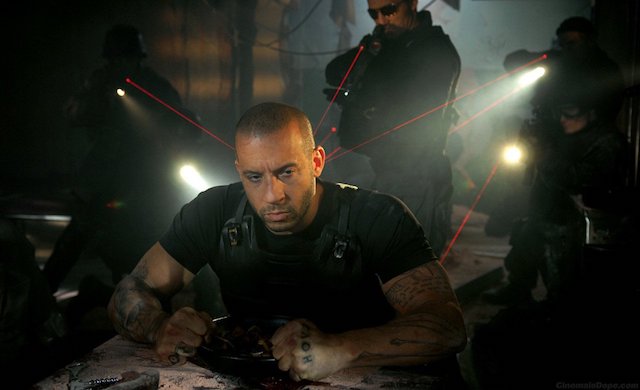
Readers of a certain age might recall a time when Vin Diesel was poised to become the next major action star. He had a deep voice, and it was usually hard to understand what he was saying, and those are traits that people like in action stars. His head was composed entirely of curves, with no sharp angles, which made him aerodynamic. Best of all, he had made up the tough-guy name “Vin Diesel” for himself. This was crucial, as audiences will not accept an action star with a nerdy name. That’s why there has never been an action star named Sylvester, or Arnold, or Jean-Claude.

So yes, after “Pitch Black,” “The Fast and the Furious,” and “xXx,” there was a time when it looked like Vin Diesel was going to be huge. The time was 2002, and it lasted a couple minutes. Then he played a nanny in “The Pacifier,” coping with pet ducks and pooping toddlers, and it was all over.

In keeping with the theme of things being all over, Diesel went on to star in “Babylon A.D.,” a pointless and incomprehensible science-fiction adventure that hints at what “Children of Men” might have been if “Children of Men” had been directed by Michael Bay instead of Alfonso Cuarón and had starred a shaved ape instead of Clive Owen and had gone straight to the Syfy Channel instead of theaters. It’s set in the near future, where everything is bleak and gray and steely all the time, and where mercenaries played by Vin Diesel are no longer allowed in America and have to live in Russia. Diesel’s character is named Toorop. Yes, Toorop. Most of the time it sounds like “Turo,” like maybe it’s short for “Arturo,” but no. It’s Toorop. Sorry, movie, but that’s strike one.

Toorop, who lives in a squalid apartment in a squalid city and eats rabbit for dinner (squalidly, no doubt), is interrupted one night by a former employer’s goons. The employer’s name is Gorsky, and at first I thought he was wearing a hilariously large fake nose, and then I realized it’s just Gerard Depardieu. (Filmmakers working under tight budgetary constraints would do well to note that when a large-nosed character is called for, it is probably cheaper to cast Gerard Depardieu than it is to hire a makeup artist and create a prosthetic.) Gorsky has summoned Toorop via goon squad because he has a job for him. What, Gorsky can’t pick up a phone? Gorsky has to get all dramatic and send goons? That’s why people make fun of your nose, Gorsky, because you’re OBNOXIOUS.

What Gorsky needs is for Toorop to transport a young woman to New York City. (Why can’t Gorsky just have his precious goons do it??) Toorop points out that he, Toorop, is not allowed in the U.S. because of some past misdeeds — probably “A Man Apart” — and Gorsky gives him a passport that will do the trick. In The Future, they use bio-identification, so getting a fake “passport” means injecting a liquid into your neck that, I don’t know, disguises your retinas or changes your fingerprints or something. It’s just The Future, OK? “Babylon A.D.” doesn’t have time to explain everything (i.e., anything).

The girl in need of a chaperone to the Big Apple is Aurora (Melanie Thierry), an orphan who’s spent her life in a convent for Noelite nuns, the Noelites being a religion that this movie made up. Specifics aren’t given, but I assume they worship the playwright Noel Coward, which I endorse. Aurora is to be accompanied by Sister Rebeka (Michelle Yeoh), a nun who you may assume knows how to kick butt because she is played by Michelle Yeoh. Rebeka tells Toorop his job is to keep the girl safe from harm, and then she asks him not to swear. Toorop’s response:

“Don’t f*** with me, or I’ll leave you standing in the middle of nowhere with nothing but your a** to sell to get back here.”

Toorop is a charmer with the ladies!

Well, Toorop’s journey to America with Aurora and Sister Rebeka is packed with adventure, that’s for sure, what with a lot of people apparently wanting them all dead. Who? And why? And why does Aurora seem to exhibit strange psychic powers, and why is she maybe schizophrenic, and what happened to her parents, and why does Sister Rebeka have to go everywhere with her, and do the Noelites get along with the Oscar Wildeans or are they considered heretics? So many questions, so little time for the movie to answer them, as the movie is preoccupied with doing anything BUT answer questions. The movie thinks that it can build suspense and intrigue by simply not telling us anything. The movie thinks the definition of “mystery” is “the absence of information.” By the same reasoning, a blank piece of paper is also very mysterious, though at least a blank piece of paper doesn’t make you watch Vin Diesel and a couple of nuns flee from bad guys on snowmobiles.

Despite the movie’s best efforts not to tell us anything, we eventually learn that Aurora is pregnant! With twins, no less! This is miraculous because she has never had sexytimes. The Noelites created her in a lab 20 years ago and then figured out how to make her conceive automatically at a certain point, in the hopes that this amazing virgin birth would bring the Noelites more followers. For reals, that was their plan. The Noelites’ high priestess (Charlotte Rampling) is intent on having more followers than anyone else, just like on Twitter. I don’t know why Aurora had to come to the U.S. to give birth, but I assume it was so we could make a topical joke about “anchor babies.”

The movie occasionally gets tired of being cryptic and starts saying things matter-of-factly. It turns out this is worse. For example, there is the moment when the bad guys (whoever they are) have launched a weapon at Toorop. “It’s a missile linked to my passport!” he says, referring to the thing he injected into his neck. “How can you stop it??” asks Aurora. “Only by death!” he replies. Then he dies, which is very accommodating of him, but the bad guys, or possibly the good guys, bring him back to life, because this is a thing that can be done in The Future. They need to know what Aurora told him after he fell unconscious but before he died, and retrieving this information is as simple as hooking him up to a machine (The Future, etc.). “We’ll guide your memory with our computer!” explains the scientist. Of course you will, scientist in The Future. Of course you will.

You might have noticed that this movie sure has a lot of stinkin’ French people in it! That’s because it was based on a French novel, and directed by French person Mathieu Kassovitz, who I should point out is French. Kassovitz fought with the studio quite a bit during the production, and basically disavowed the film as it was released in theaters. The director’s cut is allegedly more coherent and sensible, though the only way I could know that for sure would be to watch it, which seems unlikely to occur.

— Film.com

Piranha (2010)

0

If you’re going to see the cheesy, over-the-top, ’80s-style bloodbath that is “Piranha,” 3D is the way to go. I don’t care what the fancy-talking apologists say, THIS is what 3D was made for: in-your-face gore and nudity. “Piranha” plays up the third dimension with an abundance of things that pop, jiggle, or explode right at the viewer. Does it look “real”? No. It doesn’t look real in other 3D movies, either. 3D is a gimmick, and at least “Piranha” has the good sense to embrace that fact.

Paradoxically, however, “Piranha” is not worth 14 bucks, which is about what it costs to see a 3D movie these days. It’s a B-movie, and as such is worth (almost by definition) no more than the matinee price. But the only way to see it cheaper is in 2D. And if you’re going to see it in 2D, you might as well not bother seeing it at all.

Directed by the possibly insane Frenchman Alexandre Aja (“The Hills Have Eyes,” “Haute Tension”), “Piranha” was inspired by the “Jaws” rip-offs, including two piranha-based ones, that flourished in the late ’70s and early ’80s. The screenplay, by Peter Goldfinger and Josh Stolberg (“Sorority Row”), clearly used “Jaws” as a template, what with local law enforcement trying to close the beach on a warm-weather holiday after deadly fish are discovered. Stealing from “Jaws” is OK, though, because Richard Dreyfuss has a cameo in which he plays a guy named Matt Hooper, which was also his name in “Jaws,” so ha ha get it?

Yes, “Piranha” is self-aware, and thank goodness for that. It’s set at Lake Victoria (played by Lake Havasu) during Spring Break, a time for college-aged American youth to get drunk and rape each other and be torn apart by fish. An earthquake releases a swarm of prehistoric piranha that have been chillin’ in an underground cavern; killarity ensues.

On hand to witness and/or be part of the all-the-fish-can-eat buffet are Elisabeth Shue as the local sheriff, Ving Rhames as her deputy, Steven R. McQueen as her teenage son, Jessica Szohr as his crush, Adam Scott as a seismologist, Jerry O’Connell as a “Girls Gone Wild”-style video producer, and Christopher Lloyd as a crazy old ichthyologist. (The once and future Doc Brown, bless his heart, is at the stage where every character he plays will be both crazy and old.) The cast is fleshed out — yes, “fleshed out” is the term I’m looking for — with a bevy of attractive young women who generally eschew clothing prior to being slaughtered, which is to say they start out topless and end up legless.

Aja’s philosophy is that the boobs and blood are all you really want in a movie like this, so why not show them in great abundance? This logic leads to a sequence in which two nubile, naked women swim gracefully underwater for several minutes (it is not explained how they are able to breathe) while the guys watch them through the glass bottom of the boat. This is accompanied by a beautiful strain of opera music (Delibes’ “Flower Duet,” specifically).

As for the blood part of the boobs-and-blood method, Aja and his crew find an impressive number of ways to kill people gruesomely. Perhaps it is a blessing that the CGI gore seldom looks like anything approaching reality.

But Aja is only partly correct in his assumption that violence and nudity are all we’re after. We would welcome witty dialogue, interesting characters, and genuine suspense, too, if someone wanted to provide those things. It’s just that we’re so accustomed to not getting them in movies like this that we’ve stopped expecting them — to the point where it’s now somehow a violation of principle if a creature feature DOES contain actual, you know, quality.

The original B-movies were the way they were out of necessity. Producers lacked the time, money, and/or talent to make genre films that were truly excellent, so they made cheesy ones as best as they could. Alexandre Aja and The Weinstein Company, on the other hand, have all the resources they need, and it’s not like a movie about killer fish CAN’T be well-written, well-acted, and well-produced; see “Jaws,” for example. Aja and company simply didn’t WANT to make an excellent film. Why bother, when making a film that’s lousy but ironic is so much easier?

Even strictly as a B-movie, though — even by its own lowered standards — “Piranha” falls short. The first half is disappointingly slow and tame, the first few deaths tossed off carelessly, with very little set-up. But once the mayhem begins in earnest, you’ll get more or less what you wanted. Or, rather, more or less what you were expecting to settle for.

Friday movie roundup – Aug. 20

1

Five films opened in wide release this weekend. Only two of them were screened for critics — and here in Portland, the screenings were at the same time. Those would be “The Switch” (review at Film.com) and “Nanny McPhee Returns” (review nowhere, on account of I can’t be two places at once).

The three instances of Hollywood’s Shameful Secrets® are “Vampires Suck,” “Lottery Ticket,” and “Piranha 3-D,” whose actual onscreen title is just “Piranha.” I have a review of “Vampires Suck” already (it opened Wednesday); a review of “Piranha” is on its way.

Speaking of which, “Eric’s Bad Movies” at Film.com this week was about “Piranha II: The Spawning,” which was directed by James Cameron. “What’s the Big Deal?” is about “Z,” the French-Algerian film about Greek politics from 1969.

In limited release, “Get Low” — starring Robert Duvall and Bill Murray — is a pleasant little film indeed.

Subscribe to “In the Dark,” a weekly e-mail with the latest movie reviews, DVD releases, and other pertinent info.

Listen to “Movie B.S. with Bayer and Snider,” a weekly Internet radio show featuring Jeff Bayer and Eric D. Snider, at PDX.fm. It’s live at 11 a.m. (Pacific) every Friday, then downloadable as a podcast.

The Switch

0
The Switch

For a movie with such a distasteful premise, “The Switch” is refreshingly funny and surprisingly sweet. It’s about a man whose platonic lady friend is being artificially inseminated, who secretly replaces the donor’s contribution with his own, resulting in a child that is unmistakably his. Hmm. Now I begin to regret using the words “distasteful” and “sweet.”

Written by Allan Loeb (“21”) and based on a Jeffrey Eugenides short story called “The Baster” (ugh), it was going to be directed by Bobby and Peter Farrelly at one point, and goodness knows how they would have ratcheted up the ick factor. Instead, we get Josh Gordon and Will Speck, the duo behind the silly “Blades of Glory,” who make us squirm a bit with the biological details without overdoing it. At its heart, it’s really not that different from a regular romantic comedy. Well, except that it’s funny.

Jason Bateman and Jennifer Aniston, both sitcom veterans who have yet to achieve big-screen stardom, play New Yorkers named Wally and Kassie. Having dated several years ago, they are now best friends, Wally’s high-strung neuroticism balanced by Kassie’s easy-going calm. (To symbolize their differences, Wally has a career as an equities analyst, while Kassie does makeup for TV news.) Kassie announces that, well, she’s not getting any younger, and she really wants a baby, so it’s time to find a stranger to put one in her. Wally vocalizes his disappointment that she wouldn’t just have him be the donor, to which Kassie responds that 1) they’re best friends, so it might be weird, and 2) Wally is a pessimist and a hypochondriac, and what if those traits are inherited?

The chosen donor, Roland (Patrick Wilson), is bland and handsome, though you might have guessed that by seeing he’s played by Patrick Wilson. Here we arrive at the crucial juncture in the story: somehow, Roland’s donation must be replaced with Wally’s. Many questions are raised. How would Wally have access? Doesn’t fathering Kassie’s child without her permission make Wally an awful person? Or could he somehow do it unwittingly, absolving him from guilt? Could this be an accident somehow?

All of those questions are answered in a manner that is satisfactory, if not entirely plausible. (Let’s just say I’ve never heard of an “insemination party.”) From a story standpoint, the goal is to get past all of this fairly quickly and get to the real action, seven years later, when Kassie and her child move back to town and re-enter Wally’s life.

The kid’s name is Sebastian, played by newcomer Thomas Robinson. He has big, forlorn eyes and a Debbie Downer-like tendency to focus on things like overpopulated animal shelters and potential illnesses. Details both large and small hint that he might be Wally’s son, not Roland’s. If nothing else, Wally becomes something of a father figure to him.

And here we are with an improbable mix. The initial switcheroo premise is gross, and we see more of the, um, process than I would have thought possible in a PG-13 movie. Yet once the real story kicks in, it has a father-and-son, “About a Boy” kind of vibe that’s genuinely touching. And on top of all that, the rom-com elements of Wally and Kassie’s relationship, while formulaic, are nicely played. It would have been easy to use the outrageous “What if this crazy thing happened??” premise of Eugenides’ short story and take it no further than that. I’m impressed that “The Switch” is not content to rely on that lone gimmick.

Loeb’s screenplay is witty, especially in the early scenes, which establish Kassie and Wally’s friendship with quick, pitter-patter dialogue. Aniston and Bateman have a lively rapport that easily suggests a longstanding relationship. Also very useful is Jeff Goldblum as Wally’s coworker and friend, able to enliven any line reading with that Goldblumian delivery. And look, there’s Juliette Lewis as Kassie’s obligatory kooky friend! And li’l Thomas Robinson gives one of the most likable, believable child performances I’ve seen in a long time.

But the real winner here is Jason Bateman. Fans of TV’s “Arrested Development” have been waiting for him to find a movie that could really showcase his superhuman powers of comic timing and deadpan delivery. “The Switch” could be it. Wally is the protagonist of the story, a poignant (but funny) mess of a man who engenders sympathy despite his missteps. Bateman nails every scene he’s in, whether it calls for tenderness, sarcasm, paternal concern, or comic drunkenness, never milking a joke or mugging for the camera. He earns laughs by patiently, carefully working for them, while making it look easy. The guy’s a pro. By all rights he should be one of the most popular comic actors in the business. Let’s try to make that happen, OK?

“The Switch” becomes slightly bogged down by its desire to produce a happy ending, which is rushed at in the last 20 minutes, as if they forgot the story was going to require resolution at some point. There are inherent problems with the set-up, too, that perhaps viewers won’t be able to overlook. In all, though, this is a far better movie than it might have been, an August afterthought that can hold its head high among the other summer comedies.

Piranha II: The Spawning

0
Piranha II: The Spawning

Is there a more fearsome aquatic creature than the piranha? Yes! The shark. And also the killer whale. And Ursula the sea witch. But after those three, the piranha is definitely the most fearsome aquatic creature. That’s why it has been the subject of so many (well, four or five) movies, including one called “Piranha II: The Spawning” that was directed by James Cameron! This was his first feature film, long before he became the “king of the world” with such blockbusters as “The Abyss” and “Ghosts of the Abyss.”

Even Oscar winners have to start somewhere. Cameron started with this movie about man-eating fish, which was a sequel to another movie about man–eating fish (“Piranha”), which was a rip-off of another movie about man-eating fish (“Jaws”), which was based on a novel about man-eating fish (“Charlie and the Chocolate Factory”). But while the first “Piranha” had a self-aware tone and was partly intended as a parody, “Piranha II: The Spawning” is very serious, except for the parts that are obviously supposed to be comical, which are not funny. Already you can see James Cameron developing his style.

You might assume that a movie like this would begin with a randy couple having sex, and that they would be unable to complete the act because they would be eaten by piranha. You would be correct in this. However! Did you guess that they’d be having sex underwater, using scuba gear to breathe? And that they would choose to do this because doing it in the boat was “too uncomfortable”? I didn’t think so! This is known in slang as “deep-sea snorkeling.”

piranha

All of this takes place at a swanky beach resort called Club Elysium, located someplace tropical, possibly Florida, maybe Brazil. Employed as a diving instructor here is one Anne Kimbrough (Tricia O’Neil). We meet Anne when her teenage son, Chris (Ricky G. Paull), returns to their hotel suite carrying a freshly caught fish and deposits the thing in Anne’s bed, where she sleeps in the nude, barely covered by a sheet. Few things are more endearing than teen boys and naked mothers engaging in fish-related prankery! The boy’s dad, Steve (Lance Henriksen), from whom Anne is divorced, is here, too, working as a local cop. This is as narratively convenient and nonsensical as underwater scuba sex.

During Anne’s diving class, one of the students swims into a sunken shipwreck that he was specifically told not to go into, and piranhas kill him. (In his defense, piranhas weren’t the reason he was told not to go there.) As an experienced diving instructor, Anne has seen many varieties of fatal bite marks on a huge assortment of dead students, but she’s never seen anything like these. When she tells her cop ex-husband, Steve, that she wants to examine the body more closely, Steve points out that Anne’s credentials as a diving instructor do not give her jurisdiction over corpses. The local government actually has what’s known as a “coroner” who does that.

piranha

Anne does not like this answer, so she and her handsome new suitor, Tyler (Steve Marachuk), sneak into the morgue after hours to take a peek at what’s left of the dead guy. An attendant shoos them off. The attendant has a Jamaican accent, so perhaps Club Elysium is in the Caribbean? I’d really like to nail this down. Anyway, then a piranha pops out of the corpse’s chest, flies at the attendant’s neck, and kills her. Over the course of the film, another dozen or so people are dispatched in the same manner, i.e., a flying piranha to the neck. In each instance, the poor actor has to stand there like a schmuck, holding a rubber fish up to his or her throat and wiggling it around while screaming. They don’t prepare you for that at the Actors’ Studio. Which is irrelevant, since none of these people went to the Actors’ Studio. But you get my point.

How are these fish able to fly around on dry land, you ask? With wires. Duh. You can usually see them.

piranha

Oh, you mean in the story how do they do it? Well, back in the ’70s, the government spliced together genes from piranhas, grunions, and flying fish, trying to make a super-fish that it could set loose in the rivers of Vietnam to help win the war. (History has taught us that very few wars have ever been won without the assistance of mutant fish.) Some of the eggs from these devil fish got lost, and now here they are, adapted to saltwater and capable of living outside water altogether for hours at a time. We learn all this from Tyler, who it turns out is secretly a government biochemist sent to look for the missing monster-fish eggs. “Left ’em around here somewhere…” is what the guy who lost them said, before he was promoted and given a commendation by the president.

With a school of killer fish on the loose, surely the authorities will close the beaches, right? Don’t make me laugh. Seriously, I hate laughing. Club Elysium is about to hold one of its most popular events, where grunions come ashore to mate and Club Elysium guests catch them and eat them. (In horror movies, being a member of the animal kingdom does not protect you from being killed during sex.) They can’t cancel the grunion slaughter! People come to wherever Club Elysium is from wherever they are from just to capture and devour all the libidinous fish they can cram into their mouths!

Oh! Wikipedia informs me that grunions are found only in California and northern Mexico, so that is where Club Elysium is, whether anyone involved in making the film realized it or not. The grunion festival proceeds as planned, and the grunion seekers are astonished when, instead of grunions, dozens of huge, terrible piranha leap from the ocean and murder them. This is kind of sad, and yet at the same time completely hilarious and not at all sad.

Meanwhile, Anne, Tyler, and ex-husband Steve are planning to kill the evil piranhas by blowing them up. You may recall this strategy from its appearance in every other monster movie ever made. Whenever someone lazy makes a film like this, they think, “How do we defeat the creatures at the end?,” and then they immediately decide, sure, why not, let’s just blow them up.

It will be easy, since the piranhas all live in that sunken ship and never go anywhere. Real homebodies, those killer fish. They’re certainly not all currently on land killing Club Elysium patrons!

piranha

Before the plan to blow up the fish can be accomplished, a few more items of narrative convenience must be carried out. First, there is a local fisherman named Gabby (Ancil Gloudon) whose son was devoured by the piranha. Gabby has sworn revenge on the evil creatures, and it’s his idea to use dynamite. Don’t give him too much credit, though; he uses dynamite to catch fish on a daily basis, too. Dynamite is his answer for everything. He may have a career as a screenwriter ahead of him. Anyway, he gets killed by a piranha before he can execute his blow-them-all-up plan, thus allowing the film’s actual stars to do it instead. Heaven forbid a minor character should save the day.

The other requirement is that Tyler needs to die. He lied to Anne about his involvement with the government, and that sin is unforgivable. Also, killing him clears the way for Anne and Steve to reconcile without Anne having to make one of those pesky “decisions.” Basically, all the heavy lifting in the story is done by Gabby and the fish; Anne and Steve just have to react to it and be hailed as heroes. Nice work if you can get it.

I should mention that interspersed with all the action is a series of scenes depicting the whimsical antics of the Club Elysium guests. For example, there is a nerdy Jewish girl who desperately wants to catch herself a doctor. There is an aggressive older lady who flirts shamelessly with the young hotel staff. There is a stammering kitchen employee who gets taken advantage of by two hot ladies who use their naked breasts to get free stuff from men. All of this is intended as comic relief, but in fact it is neither comical nor a relief. It’s the opposite of comic relief. It’s tragic aggravation. The worst part is that most of the “funny” characters survive the piranhapocalypse. It would be a while yet before James Cameron would perfect the art of giving the audience what they want, though at least he had learned that you can never go wrong with breasts.

— Film.com

Vampires Suck

0

In “Vampires Suck,” the “Twilight” spoof by Jason Friedberg and Aaron Seltzer, the Bella character points out the Cullen family and asks a classmate about them. The classmate says:

Their skin is ice-cold, they feed on human flesh, and they all sleep in coffins. Maybe they’re Canadian.

In my own “Twilight” parody script, widely disseminated on the Internetz in 2008, the classmate in the same situation says:

They avoid direct sunlight, they don’t eat food, they sleep in coffins in a graveyard, and holy water burns them. I think they’re Canadians.

I am comforted to know that while Friedberg and Seltzer cannot produce actual humor themselves, at least they know a good joke when they see one.

It looked for a while like we’d seen the last of these two paralyzingly untalented writer-directors. After a 30-month span in which they released “Date Movie,” “Epic Movie,” “Meet the Spartans,” and “Disaster Movie”, they were silent. “Disaster Movie” made considerably less money than the others had. Perhaps the market for broad, derivative pop-culture spoofs had dried up.

Ah, but then along came “Twilight.” It’s almost as popular to hate that franchise as it is to love it, so Friedberg and Seltzer knew they’d have a built-in audience. Plus, it’s an audience that’s generally too young to remember (or know, or care) that this spoof comes from the same people who made some really, really awful comedies a few years ago. It’s making fun of “Twilight”? Sold!

“Vampires Suck” actually does represent a step forward for Friedberg and Seltzer. Their past atrocities have been embarrassing mishmashes of lame references to whatever was current. “Disaster Movie,” for example, was only barely a spoof of disaster movies; it also included “jokes” (under certain broad definitions of the term) about “Juno” and “Sex and the City,” plus “impersonations” (see previous parenthetical) of easy targets like Dr. Phil and Amy Winehouse. “Vampires Suck” is surprisingly restrained. Apart from momentary (and unfunny) references to “Alice in Wonderland” and “Dear John,” it focuses almost exclusively on parodying the plots of “Twilight” and “New Moon.”

In other words, it achieves the basic minimum level of narrative competence. Break out the champagne!

Still not funny, though. People have been cracking jokes about glittery vampires and shirtless werewolves for almost two years — eons in pop-culture time — and “Vampires Suck” doesn’t come up with any new ones. Much of the dialogue is written after the fashion of the old MAD Magazine movie satires, where the characters vocalize their thoughts matter-of-factly — a style that works when it appears in dialogue bubbles in comic books, not when it’s coming out of the mouths of real people. Many of the gags refer to specific elements of the “Twilight” films, to the extent that if you haven’t seen those movies (and have the people who hate “Twilight” the most actually seen them?) you won’t get the joke.

Also, an awful lot of the gags are related to punching someone. The only jokes that are lazier are the ones involving bodily functions, of which there are also several.

I will say this, though. Jenn Proske, who plays the Bella character, does a respectable job of mimicking Kristen Stewart’s mannerisms, like biting her lip and pushing a strand of hair behind her ear. Where Matt Lanter and Christopher N. Riggi, as the Edward and Jacob characters, merely try to pull off a physical resemblance, Proske actually does an impersonation of the character. Her performance is so close to what a real actor would do in a real spoof that I’m surprised Friedberg and Seltzer didn’t burst into flames when they saw it.

Eat Pray Love

0

Among Julia Roberts’ many talents is the ability to be likable even when she’s playing a character who isn’t. She’ll star in something dreadful like “Runaway Bride” or “Mona Lisa Smile,” and despite what a shrill stereotype the character is, Roberts herself will be infectiously pleasant.

This skill is taxed to its limits in “Eat Pray Love,” in which Roberts plays a privileged, self-absorbed narcissist who takes a year-long vacation to “find herself.” (You’re always in the last place you look, amirite?) This lady, Elizabeth Gilbert (also the name of the author from whose memoir the film was adapted), isn’t happy married, isn’t happy single, isn’t happy ever. She figures she needs to spend some time with no one but herself. Speaking as one who has spent 140 minutes with her, I would advise against that.

At the outset, she’s been married for several years to Stephen (Billy Crudup), a slightly goofy fellow who adores her. One night she reveals that she is not happy and wants a divorce. Stephen is stunned to hear this. Sharing his surprise: the audience. We knew Stephen was a little flighty with regard to choosing a career path, but that’s literally the only indication we’d been given that anything was awry. Whatever dissatisfaction had accumulated in Liz must have done so before we arrived. (Perhaps there’s a prequel? “Cook Kneel Like”?)

Stephen is hurt that Liz would suddenly call it quits without ever telling him that she was unhappy. He’s right, of course; amazingly, the film expects us to be on Liz’s side anyway. Stephen is painted as a doofus, a bit of a basket case who loses his cool in the divorce proceedings. Liz, on the other hand, prays very earnestly, asking God for direction, apologizing for never having prayed before. “But I do hope I have always expressed ample gratitude for all the blessings that you’ve given me in my life,” she says, in tears, oblivious to the fact that so far in the story her defining characteristic has been ingratitude.

This should be irony. The director, Ryan Murphy (“Running with Scissors,” TV’s “Glee”), who adapted the screenplay with Jennifer Salt, should be conveying that Liz is critically lacking in self-awareness. She thinks she is grateful when in fact she is not. But everything about the scene — the soft lighting, the gentle tone, the close-up on Roberts’ pain-stricken face — suggests that we’re meant to sympathize with her. Either we’re not supposed to have noticed that she’s a spoiled ingrate, or we’re not supposed to mind.

She is similarly unhappy with her rebound boyfriend, a bohemian actor named David (James Franco). She’s unable to articulate why she’s dissatisfied, just that she is. She finally concludes the only possible solution is to spend a year in a series of foreign countries, working out her vaguely defined issues. As she exits David’s apartment building for the last time, David says he wishes she would work out her issues here, with him. She says, “You never asked me to stay.” It’s supposed to be an “Oh, snap!” moment: In all Liz’s talk of leaving, David apparently never specifically asked her not to. David is supposed to spell everything out, while Liz is permitted to mope uncommunicatively. For about the tenth time in 30 minutes, the movie wants me to be on Liz’s side and I’m not.

This is the pattern for the rest of the movie.

Liz goes to Italy, then India, then Indonesia, in each locale learning personal lessons relating to one of the three title verbs. In Rome, she befriends a nice Swedish girl (Tuva Novotny) and a handsome young Italian tutor (Luca Argentero), learning the language while eating a lot of pasta. Her epiphany is to not care so much about whether she gains a few pounds, but to simply enjoy the food. She will embrace her muffin top! There’s a comical scene in which she tries to put on jeans that don’t fit because she’s “too fat,” i.e., she is now a size 4. She has really let herself go!!

In India, she meditates at an ashram, where a no-nonsense Texan (Richard Jenkins) gives her down-to-earth advice. And in Indonesia (the lush island of Bali, specifically), she faces the question of whether she can love again. (Javier Bardem is involved.) The answer she arrives at is disappointingly conventional. For a movie about a woman trotting the globe to find herself, its “you can’t last long without a man” message is a little odd.

“But Eric D. Snider!” you say, addressing me by my full name, out of respect. “You are not a woman! How could you possibly relate to Liz and her feelings?” I cop to the charge of not being a woman, and it’s true that some of Liz’s angst might be gender-specific. But the movie is also structurally unsound. The protagonist doesn’t have a clear-cut goal or obstacle to overcome. The vagueness of her problems makes it hard to know what the lessons are, or at what point she has learned them, or when the seemingly interminable film will, in fact, terminate. (Did I mention it’s 140 minutes long?) There isn’t a “story,” per se, with rising action and climaxes and all that; Liz just sort of goes around doin’ stuff for a while, until it’s time to go someplace else and do different stuff. We know she’s learned something only because the movie finally ends. This has the whiff of a film that believes it is 10 times more powerful and meaningful than it actually is.

The Expendables

0

It is true that 2010 has already seen two movies about soldiers of fortune, “The Losers” and “The A-Team,” and that neither of them was any good. But those movies didn’t star some of the biggest action heroes of the ’80s, ’90s, and today, all together in one awesome story of explosive awesomeness! Only “The Expendables” can boast such a cavalcade of stars! Yes sir, if a bunch of recognizable names were all it took to make a good movie, “The Expendables” would definitely have the advantage.

Sylvester Stallone, who directed, seems to have thought casting was everything. He put himself in the lead, and got fellow old-timey action stars Dolph Lundgren, Bruce Willis, and Arnold Schwarzenegger to make appearances. (Willis and the Governor just have cameos.) Joining them are modern-day tough guys Jason Statham, Jet Li, Steve Austin, and Randy Couture. Throw in some Mickey Rourke and some Eric Roberts and you’ve got a cast that hearkens back to the cheesy action flicks of the ’80s while also looking to the future.

That’s only the cast, though. The screenplay, written by Stallone and Dave Callaham (“Doom”), is bottom-of-the-barrel generic, a formulaic explosion parade about a team of mercenaries hired to take down a corrupt South American dictator. It isn’t the ironic, look-how-corny-these-movies-are kind of generic, either, but the kind of generic that would normally go straight to DVD (if it got made at all) if it weren’t for the big names in the cast. A few lines of dialogue suggest self-awareness, but they are precious and rare. Mostly the guys engage in banter that has the form of ’80s-action-movie repartee without the charm.

Stallone, Statham, Li, Lundgren, Couture, and Terry Crews play the title bunch. We meet them while they’re rescuing a hostage from Somali pirates. The tone is set when they open fire on the head pirate and literally blow the top half of his body off. It’s going to be that kind of movie. Then they kick Lundgren off the squad because, even for a group of trained killers, he’s too much of a loose cannon.

The remaining five Expendables are recruited for the South America job, targeting the despotic General Garza (David Zayas) and the deep-pocketed American businessman (Eric Roberts) pulling his puppet strings. A beautiful local woman, Sandra (Giselle Itié), is their informant. Back home, Rourke is a former compatriot who now runs a tattoo shop and delivers weird monologues that I suspect Rourke wrote himself.

Stallone has chosen to make the fight scenes as ridiculously violent and bloody as possible, a perverse parody of his own Rambo films. These sequences deliver on their promise to show bad guys being hilariously slaughtered. For example, it isn’t enough for a goon to be shot several times; Statham must also plunge a machete through his chest. It isn’t enough that one of Garza’s henchmen is set on fire; Couture needs to punch him, too.

By the end, though, Stallone has gone all shaky-cam on us, and the climactic battle is a monotonous frenzy of explosions and nonsense. All the old cliches are followed scrupulously, without being subverted or reconfigured. The only one who fully embraces the inherent cheesiness of it is Eric Roberts, whose suit-wearing villain character can shoot a duplicitous lackey in the head and say, “Now we can see inside of him. And I see lies” — and make it work.

Stallone also runs into the “Ocean’s Twelve” problem, where a terrific team is assembled but there isn’t enough for everyone to do. Statham has a girlfriend (Charisma Carpenter) who has moved on because he’s so distant … and that’s really the only info we get on any of them. Rourke is wasted. Couture and Crews serve almost no function. In fact, I could swear Couture disappears for half the movie.

“The Expendables” is occasionally fun in its over-the-top mindlessness; the fun just never lasts more than a couple minutes at a time. If Stallone had gathered this cast AND come up with a smart, exciting story, he’d have really achieved something. Instead, he wasted a golden opportunity. The man is 64 years old, for crying out loud. He doesn’t have a lot of these things left in him.

Scott Pilgrim vs. the World

0

If a movie that looked and sounded like “Scott Pilgrim vs. the World” had come out 40 years ago, people would have burned the director at the stake for witchcraft. Even by 2010 standards, the way it’s written, performed, shot, and edited is supremely unusual, an exuberant mixture of comic books, video games, and hipster romance by way of John Hughes. It uses an impressive number of unconventional filmmaking devices, most of which have been done before, but probably not all in the same movie. I bet ten years from now this will be the norm. For now, it’s almost revolutionary.

Based on Bryan Lee O’Malley’s series of graphic novels, this is the story of a 22-year-old Toronto slacker named Scott Pilgrim (Michael Cera) who plays bass in an indie band and is currently “between jobs.” He’s dating a high school student right now, Chinese-Canadian Knives Chau (Ellen Wong), for which he is razzed by his bandmates, his gay roommate Wallace (Kieran Culkin), and his mouthy sister Stacey (Anna Kendrick). Scott, like all Michael Cera characters, flits between meek acceptance of the ridicule and wimpy self-consciousness over it.

Then he meets Ramona Flowers (Mary Elizabeth Winstead), a girl his own age who has just arrived from New York, dazzling him with her ever-changing hair color and general nonchalance. She finds him amusing. If they are to date, however, Scott will have to defeat her seven evil exes, as if he were the hero in a video game.

You see, while the story is set in the real world, it’s a version of the real world in which some of the laws of video games apply. Scott’s confrontations with the exes are staged like rounds of Mortal Kombat. When foes are vanquished, they turn into coins, and the point value appears above them before floating away. It’s not that Scott has to defeat these exes philosophically. He literally has to fight them, both he and they endowed with video-game-like skills.

This is peculiar. More peculiar is that the characters don’t find it peculiar. Scott isn’t astonished at his sudden acquisition of superpowers. He’s nervous about having to fight the exes, but not in a “why are these people trying to kill me?!” kind of way. No one is surprised to see a Nintendo-style battle erupt in the middle of a dance club. This is apparently just how their world works. There’s no sense trying to come up with a logical explanation for why things are this way. Things just are this way.

But I’ve only described the peculiarity of the story. Now let me describe, if I can, how oddly the story is told, by director Edgar Wright (“Shaun of the Dead,” “Hot Fuzz”). Electronic sound effects accompany some of the action, of course, as befits a video-game story aimed at an audience of video-game players. Onscreen titles, like boxes in comic-book panels, introduce new characters. One scene is played out like a sitcom, complete with laugh track. There are sight gags like Scott talking about his shaggy hair, then cutting to someone’s reaction, then immediately cutting back to Scott, who’s now wearing a hat.

We recognize all these quirks as postmodern variations on the way movies normally speak to us. We aren’t meant to believe that there is suddenly a studio audience in Scott’s apartment, or that Scott can put on a hat in a fraction of a second. The usual rules of editing, storytelling, and the expectation of reality — the standard “grammar” of film — are out the window. We’re able to keep up because we know the grammar well enough to appreciate variations on it.

But now I’ve neglected another key element, which is that the movie is very, very funny. In addition to the laughs that arise from the surreal visual style, the screenplay (written by Wright and Michael Bacall) is packed with sharp dialogue that would be funny even in a more traditional setting. On paper, the whole thing isn’t much different from the savvy indie comedies that play at Sundance every year. Imagine one of those, filtered through the brain of someone who grew up devouring comic books and video games, and that’s about what we’ve got.

There’s been a lot of discussion about whether some people are too old to “get” “Scott Pilgrim vs. the World.” I can understand where that idea comes from. I’ll be 36 in a few weeks, and I spent much of the film agape in puzzled wonderment. I laughed plenty, but not as much as the twentysomethings in the audience did. Many of the gags struck me as baffling — pleasantly so, like a new kind of humor had been discovered — rather than laugh-out-loud funny.

Then again, I was never a hardcore video-gamer, nor have I read the “Scott Pilgrim” graphic novels, so maybe it’s not specifically a generational thing. I was impressed that despite how incredibly imaginative and energetic the film is, it never becomes exhausting. Wright seems perfectly in control of the kooky tricks in his arsenal, never deploying them just for the sake of being weird. The fact that I didn’t suffer from stimulation overload suggests that perhaps I am not too old just yet.

Or maybe I am. You see, for as clever and inventive as the movie’s style is, its lack of traditional “reality” makes it hard for me to feel any emotional investment when the John Hughes moments arrive. In a video game, you never die. Even when you’re out of lives, you can continue. When you think of it that way, the stakes actually aren’t very high at all. There are some aspects of the story that don’t resonate with me, that indeed I don’t “get,” possibly because I’m not fluent enough in the insane language of the film. Maybe a native speaker would feel Scott and Ramona’s story right in the ol’ heartstrings. Or maybe those strings don’t matter anymore, in our brave new world.

Animal Kingdom

0

In “Animal Kingdom,” 17-year-old Josh Cody is watching a TV game show when he calls his grandmother with this emotionless report: “Mom’s gone and OD’d and she’s died.” Mom’s body is on the couch next to him. What may sound like an almost sociopathic lack of empathy is actually Josh’s defense system, protecting him from the harsh realities of his life. His late mother, drug-addled though she was, tried to shield him from dangerous influences — particularly the low-life criminals who comprise her own family. Now that she’s gone, Josh has no other relatives to reach out to. He was better off with the heroin-addicted mom.

Written and directed by David Michod in his feature debut, “Animal Kingdom” is a top-notch Australian thriller about a fascinating, unsettling clan of Melbourne lowlifes. The question for Josh, sensitively played by newcomer James Frecheville, is whether he can resist losing his moral compass the way all of his relatives have, or whether he’ll continue to be part of the cycle. The question for us is how, after almost a century of movies about criminals, it’s still possible to find an approach that feels fresh and exciting, as Michod does.

The Cody family is headed by Josh’s grandma, called Smurf (Jacki Weaver), a saucy old gal who manages to be matronly and randy at the same time. She’ll fix you a cup of tea one minute, share a too-long kiss on the mouth with her son the next. Her three sons, Josh’s uncles, are involved in whatever criminal activities they can get their hands on, primarily drug-related. Darren (Luke Ford) is just a couple years older than Josh and not very useful yet. The tattoo-covered Craig (Sullivan Stapleton) is constantly wired on cocaine. Andrew (Ben Mendelsohn), nicknamed Pope, is in hiding. The boys’ friend, Baz Brown (Joel Edgerton), runs their operation (to the extent that it’s organized enough to be called an “operation”), which is currently being pursued with an extralegal, by-all-means-necessary vigor by local police.

Living with his grandmother and uncles, it’s impossible for Josh not to become part of their seedy dealings. At the very least, he knows what’s going on, which makes him a liability as a potential witness. He tries to continue a normal teenager’s life, including getting a girlfriend (Laura Wheelwright), but the call of the wild may be irresistible.

As the title suggests, “Animal Kingdom” is about survival of the fittest, the law of the jungle. It’s also about the thing that governs animal instincts: fear. Serving as narrator, Josh tells us, “Mum kept me away from her family because she was scared…. They were all scared, even if they didn’t show it.” Michod depicts the criminal life as an unglamorous, exhausting cycle of running, struggling, and panic — the sort of thing that ought to be easy for a clearheaded person to avoid, yet that somehow lures people in.

James Frecheville is a find as the brooding young Josh, and he’s supported by the steady, hardworking cast of Aussie actors. Chief among them, in a grimly funny turn, is Jacki Weaver as Granny Cody. Weaver has worked regularly in Australian theater, film, and television for 40 years, but “Animal Kingdom” marks the first time she’s aroused much international attention. It’s because of this kind of mesmerizing and chilling performance that movie awards have a Best Supporting Actress category.

Conan the Destroyer

0
Conan the Destroyer

I didn’t think that not having seen “Conan the Barbarian” would put me at a disadvantage when I watched its sequel, “Conan the Destroyer.” Surely any plot threads left over from the first film would be recapped for those of us just tuning in. And how much could there be to understand, really? Movies with important dialogue demanding careful attention usually star someone who can speak coherently, i.e., not Arnold Schwarzenegger.

But it turns out “Conan the Destoyer” is not self-explanatory. I was left with a number of questions that I can only assume would have been resolved if I’d seen the movie that came before it.

conan

For example, there is Mr. The Barbarian himself, played by the smooth, oily, seal-like Schwarzenegger. When we first meet him in “C. the D.”, he has stolen a bunch of stuff from some merchants, who have now tracked him down demanding justice. They don’t wish to kill him, merely to capture him. Conan uses his sword to slay every last one of them. He even punches a horse at one point. Here I thought: Ah, how fascinating! Conan is the villain in this piece, not the hero! We are to witness the tale of a murdering, thieving, horse-punching psychopath, a fugitive from justice who will perpetrate mass slaughter to avoid facing the consequences of his actions!

Yet further examination of the film led me to conclude that Conan was in fact meant to be the hero, and that we were expected to applaud his actions. The titles are literal: he is barbaric, and he destroys things. These, evidently, are his GOOD qualities.

I can only assume that the first film explains all this.

Conan is accompanied by a wacky sidekick. His name is Malak (Tracey Walter). He is cowardly and lazy and sounds like Peter Lorre. He is more of a hindrance than a help to Conan, or at least he would be if it were possible to hinder Conan’s unquenchable thirst for bloodshed, which it is not. Presumably, “Conan the Barbarian” explained why Conan was forced to associate with this buffoon, whom he clearly doesn’t like and who offers him no assistance. Was it mandated by a judge known for his unusual sentencing practices? Is it the result of a wizard’s curse? Is Malak Conan’s brother-in-law, and Conan’s wife asked him to please give the guy a job? It must be one of those things. It is unlikely that Malak would otherwise be tolerated by Conan, especially given Conan’s fondness for murder.

The local sovereign, Queen Taramis (Sarah Douglas), wants Conan to do some freelance work for her. As payment, she offers to bring Conan’s beloved Valeria back from the dead. Conan agrees that this would be a fantastic reward and agrees to take the job. He does not, however, bother to verify whether Queen Taramis actually possesses the ability to bring people back from the dead. Was there a sequence in “Conan the Barbarian” that explained how Conan came to be so stupid and gullible? A blow to the head? A chromosomal deficiency? The result of a wizard’s curse?

Anyway, if you were wondering whether this film set in ancient times would have a Chosen One, like all other films set in ancient times, the answer is yes. The prophecy is fulfilled. Queen Taramis’ niece, Princess Jehnna (Olivia D’Abo), is the Chosen One, and she has to go on a journey to get a thing from a place. I don’t remember. It’s one of those deals that they keep calling a “key” even though it’s actually a diamond or something. Jehnna is the only one who can get it, it is her destiny, yada yada. Queen Taramis needs Conan to accompany the young lady to ensure her safety and keep the paparazzi away. The queen also sends the captain of her guard, Bombaata, to protect Princess Jehnna’s virginity, as the queen intends to sacrifice Jehnna when she returns, and the gods only accept virgins, on account of FDA regulations. Princess Jehnna, like most teenage girls, has no idea her aunt wants her dead.

conan

By the way, Bombaata is portrayed by famed philanderer and part-time athlete Wilt Chamberlain. This was the only film he ever appeared in. Having him play a man charged with protecting a young lady’s virginity was probably an inside joke, like casting Mel Gibson as a rabbi.

So marble-mouthed dimwit Conan, irritating comic-relief Malak, promiscuous basketball player Bombaata, and naive virgin Jehnna set out on their quest. It’s like the beginning of a joke, one where the punchline is “Sorcerer? I never touched her!” In their travels, they come upon an old wizard named Akiro (played by veteran Japanese actor Mako), who is currently about to be killed by cannibals who think that they can gain his magic powers by eating him. Conan doesn’t necessarily dispute their reasoning, but he saves the wizard’s life anyway, because he’s an old friend, and because Conan doesn’t like it when people who aren’t Conan commit murder.

conan

So now it’s the five of them heading to the place to get the thing, and along the way they pick up ANOTHER cast member. She’s a fierce lady-warrior named Zula, played by Grace Jones, the flat-topped, flat-chested, Wesley Snipes-ish model-singer who was responsible for making a lot of boys terrified of women in the 1980s. Zula becomes loyal to Conan after he saves her life (evidently Conan saves people’s lives as often as he takes them), and now the Fellowship of Getting the Thing from the Place includes six people. They pile into Fozzie Bear’s Studebaker and sing “Movin’ Right Along,” unless I am thinking of another movie.

The thing that’s called a “key” but isn’t a key is located in a magic castle that’s guarded by a magic wizard whose face is half-melted, magically. Melty the wizard has a devious plan to kidnap Jehnna: wait until everyone else is asleep and then just take her. This proves to be remarkably easy. Conan and the others invade the castle to rescue Jehnna and retrieve the thing, and everyone else stands around and watches while Conan defeats the wizard. This sequence includes many, many shots where Conan’s leather-clad crotchular region is thrust directly at the camera, for the ladies.

conan

Having successfully retrieved the thing from the place, the gang moves on to Phase 2 of the operation, which involves putting the thing in a different place and obtaining a second thing. Some kind of temple, I guess, guarded by priests who have been waiting for the Chosen One to come along and unlock whatever it is. It’s a horn, from a rhino or something. (Look, this isn’t my religion. I don’t have to know the particulars.) Once they get the horn, Bombaata grabs Princess Jehnna and races back to Queen Taramis, leaving Conan and the others to catch up and, now that they realize Jehnna is going to be sacrificed, try to stop Jehnna from being sacrificed. At last, some actual heroism for Conan to perform, after being played like a patsy for 90 minutes.

conan

Turns out the reason Queen Taramis needed Princess Jehnna to retrieve these magic artifacts was so she could use them to awaken a demon-god named Dagoth. Show me a movie about wizards and guys with swords living in ancient times that DOESN’T involve awakening a demon-god, and I’ll show you a movie that does not exist. Awakening Dagoth is pretty easy; awakening him in a manner that does not result in the wholesale slaughter of your entire village is tricky. He’s a grumpy gus on being woken up, and the only thing that will appease him is killing a virgin. (Charlie Sheen is the same way.) But you gotta kill that virgin at the precise moment you wake him up, or else forget about it. If you were to wake him up and then, say, have your virgin sacrifice thwarted by a slick meathead in a loincloth, well, you’d have a very angry Dagoth on your hands. You’d probably then need that same musclebound clod to destroy Dagoth and save the world.

In the end, Conan the destroyer destroys more things than he preserves, so at least the film delivers what it advertises. I’m still perplexed as to how he got the way he is, and why anyone puts up with it, and why all these useless sidekicks are permitted to travel with him, and why he doesn’t wear pants. Maybe part three, “Conan the Mumbling Psychopath,” will explain it.

— Film.com

Stallone-a-Thon: Daylight (1996)

0
Stallone-a-Thon: Daylight (1996)

In honor of Friday’s release of “The Expendables,” we’re taking a week-long look at the action films of Sir Sylvester Stallone — which is to say we’re skipping his comedies. Out of respect.

Title: “Daylight”

Setting: A tunnel connecting Manhattan and New Jersey that is obviously the Holland Tunnel but is only ever referred to as “the tunnel.”

Our hero: Kit Latura, a disgraced Emergency Medical Services worker seeking redemption who happens to be nearby when the tunnel goes kabluey, and who happens to have intimate knowledge of the tunnel’s geography.

Our villains: The various laws governing our physical world, including those related to gravity, friction, combustion, torque, and redemption.

The stakes: About a dozen survivors will die if Kit Latura doesn’t get them out of the collapsed tunnel!! Possible means of death include fire, electrocution, asphyxiation, drowning, and hypothermia. Oh, and being crushed by falling debris after Kit Latura specifically warned you not to try what you’re trying, which is what happens to an arrogant outdoorsman played by Viggo Mortensen.

How long until our first confrontation? The explosion happens at the 15-minute mark. Kit Latura and science are at each other’s throats constantly thereafter.

Line of dialogue that nails it: (Kit Latura is yelling at the tunnel itself, which is in danger of collapsing completely. I repeat, Kit Latura is yelling at the tunnel.)

“Keep trying, you piece of s***! Keep trying! How many chances do you need? You killed everybody else, but you know what? You should have killed me! ‘Cause I found your heart! I found your heart, and I’ll blow it out of your body!”

Critics agree that this is the finest soliloquy ever delivered to a tunnel.

Line of dialogue that is inspiring but untrue: “Together, we can do it! We can do anything!”

Thing that is hilarious: A lady and her husband have treated their dog like a son ever since their actual son died, and then the dog drowns in the tunnel and the lady is heartbroken, and then the lady dies, and then it turns out the dog isn’t dead after all, which would have cheered the lady considerably had she not died, and then the husband has to leave his wife’s body behind, but at least he still has his dog-son.

Coolest display of might: Kit Latura rappels down a ventilation shaft after dropping from one giant exhaust fan to the next during the few seconds that each is stopped.

Oddest lack of consistency: There is a tendency for people to be submerged in water one minute, bone-dry the next. There is also a tendency for a dog to hold its breath underwater for like 10 minutes.

Moral of the story: Man was not meant to cross back and forth between New York and New Jersey.

Stallone Action Scale: 4 out of 10. He never shoots or punches anyone. In fact, he’s sad when people die. It’s like I don’t even know him anymore.

— Cinematical

Eric’s Bad Movies needs yet more bad movies

153

It is time once again for you to tell me the names of movies that I should cover in “Eric’s Bad Movies” at Film.com. Whenever I think I have run out of good (i.e., bad) options, I issue a request like this and you people come through with films I never would have discovered on my own.

The guidelines are below, along with a list of what I’ve already covered. I’m also posting a list of movies that, while probably suitable for the column, are off the table because they’re not available from Netflix. (I’m not gonna buy an out-of-print DVD from Amazon, or watch something on Hulu, or track down a VHS copy. I’m just not.)

Post your recommendations in the comments, or send me an e-mail or a tweet. As always, thank you for your suggestions! And thank you especially for the suggestions that follow the guidelines!

UPDATE: “The Room” is on my radar. Stop saying “The Room.”

Guidelines for Eric’s Bad Movies

1. It needs to be really bad. Films that are merely mediocre are a waste of time.

Friday movie roundup – Aug. 6

2

You may be aware that I have a soft spot for Will Ferrell, but “The Other Guys” really does feel like his best mainstream comedy since “Anchorman.” After the screening, I heard one of the other critics say, “This is the first time I’ve ever seen Will Ferrell actually be funny!” Obviously, this gentleman and I have little common ground on which to form a friendship, but I am glad Ferrell’s charms finally got to him.

The other wide release is “Step Up 3-D,” about people who dance in three dimensions. There was a press screening, but it was at the same time as The Other Guys,” which is the same as there not being a screening at all. (That’s how it was in Portland, anyway, where the two studios in question are handled by two different publicists who have no incentive to cooperate with each other. In markets where the same agency happens to handle both studios, I suspect the screenings did not conflict.)

In limited release, you’ll find “The Disappearance of Alice Creed” (review at Cinematical), a reasonably solid thriller about a kidnapping, etc.

This week at Cinematical I wrote about MGM getting desperate with “The Outer Limits” and Disney getting flaky with “Beauty and the Beast” in 3D. Be sure to read the comments on that second one, especially.

At Film.com, “What’s the Big Deal?” was about “The Third Man,” and “Eric’s Bad Movies” addressed “976-EVIL,” a horror movie about a malevolent phone number.

And, for some reason, I imagined a conversation between Nicolas Cage and his agent.

Subscribe to “In the Dark,” a weekly e-mail with the latest movie reviews, DVD releases, and other pertinent info.

Listen to “Movie B.S. with Bayer and Snider,” a weekly Internet radio show featuring Jeff Bayer and Eric D. Snider, at PDX.fm. It’s live at 11 a.m. (Pacific) every Friday, then downloadable as a podcast.

The Disappearance of Alice Creed

0

No matter how carefully you plan, no matter how efficiently you work, there’s always a chance you’ll be thwarted by that most treacherous of villains: your own emotions. That is the lesson of “The Disappearance of Alice Creed,” and of my experience watching it.

The rational part of me says this movie is ludicrous, pointing out that much of the audience laughed, and I winced, during the parts that were supposed to be tender. But the other part of me enjoyed it, preposterous story line and all. It doesn’t matter how implausible — heck, I’ll go with impossible — certain events are. The whole thing’s so straight-faced and tightly edited that you’d have a hard time not getting caught up in it.

The title character, played by Gemma Atherton, has not disappeared at all. Why, she’s right in front of us, the whole time! She has been abducted, though, by a pair of meticulous kidnappers. Vic (Eddie Marsan) is a little older than his partner, and clearly more experienced with this sort of thing. Danny (Martin Compston) follows instructions well but has yet to internalize the finer points of abducting girls and extorting ransom money from their rich fathers.

Vic and Danny have planned their scheme down to the last detail. Usually these movies (and the “Law & Order: SVU” episodes like them) depict the abductors as already having a soundproof bunker in which to guard their captives, like maybe it just came with the place when they bought it. (“Oh, yes,” says the landlord. “This room gets very little light and allows no sound to escape. It’s perfect for abductions.”) I like that “Alice Creed” shows Vic and Danny building it first. They are pros. They know what they’re doing.

And that’s about all I can tell you without spoiling anything. Alice is tied up, with no chance of escape, and her father is contacted for ransom purposes. If everything goes according to plan, Alice will be released unharmed and Vic and Danny will be 2 million pounds richer.

But all does not go according to plan, due to the aforementioned pesky human emotions. In the beginning, Alice is in hysterics, Danny is calm but troubled, and Vic is made of steel. Over time, though, each character shows new traits. Even the unflappable Vic proves flappable.

This is the first feature by writer-director J Blakeson (and there is no period after the “J,” because J Blakeson is cool like that). When you fear the movie will turn nasty and exploitative, it doesn’t. And while I freely admit the basic premise, once it’s all revealed, is ridiculous, I also freely admit that I don’t care. It’s executed in a taut, professional manner, with great suspense and dark humor, and the story is resolved in a satisfying way. It may not be brilliant, but it’s savvy and confident, and that counts for a lot.

The Other Guys

0

Goodness knows Will Ferrell has diluted his brand by starring in more movies than he should have, causing all but his most diehard fans to grow weary. But it’s important to note that when he sticks with Adam McKay, the results are solid. McKay was a “Saturday Night Live” writer who worked closely with Ferrell in those days, and who directed and co-wrote “Anchorman,” “Talladega Nights,” and “Step-Brothers.” It was McKay who partnered with Ferrell to launch the now-indispensable Funny or Die website. Now they’re together again for “The Other Guys,” and this could be Ferrell’s best mainstream showing since “Anchorman.”

It’s also — not to add insult to injury — what Kevin Smith’s “Cop Out” might have been if Kevin Smith’s “Cop Out” had contained humor.

Taking a cue from 1980s buddy-cop movies, “The Other Guys” is about the desk-jockey cops in those films who do the paperwork while the hotshots are out shooting bad guys and wrecking cars. In this case, the NYPD’s rock-star detectives are Danson and Highsmith, played by Dwayne Johnson and Samuel L. Jackson (a bit of perfect casting). Danson and Highsmith crack wise while pursuing drug dealers in an absurdly violent car chase, then are celebrated at a press conference on the steps of city hall. You get the feeling this is pretty common for them.

Back at the station, the back-up hotshots are Martin (Rob Riggle) and Fosse (Damon Wayans Jr.), already working on their trash-talking and property-destroying skills. And after them, you get to Allen Gamble (Ferrell) and Terry Hoitz (Mark Wahlberg). Hoitz was assigned to desk duty after accidentally shooting someone. He is bitter and frustrated and stir-crazy. Gamble, on the other hand, is a cheerful and soft-spoken forensic accountant who wants his days to contain nothing more exciting than long division. The last thing he wants is to leave his desk and go out on a case. Hoitz hates him.

When Danson and Highsmith are incapacitated, Martin and Fosse make a bid to replace them as the department alpha males by trying to solve a jewelry-store robbery. But Gamble and Hoitz are on the case, too, at Hoitz’s insistence. Also, Gamble has noticed that a high-powered financial investor, Ershon (Steve Coogan), has neglected to file the proper documents for construction-related scaffolding at some of the buildings he owns. That’s the kind of crime Gamble loves, and he takes it seriously.

The Ferrell/McKay films are rather notorious for not having much in the way of clearly defined stories, preferring instead to set up a basic scenario and let Ferrell and his co-stars goof around. In the other three films, the scenario was that Ferrell played a defiant and belligerently stupid man-child whose coddled existence was threatened by an interloper (a lady reporter, a French NASCAR driver, and a step-brother, respectively). This time, there’s an actual story line, mimicking the formula of the “Lethal Weapon”/”48 Hrs.” genre of action comedies, and Ferrell is playing an eager, polite, sensible man — more Buddy the elf than Ron Burgundy. It’s Hoitz, the Mark Wahlberg character, who’s angry and petulant, and cheers to Wahlberg for playing a role that spoofs his public persona.

Ferrell and Wahlberg are funny together, with a natural rapport that plays up Hoitz’s dislike for Gamble without getting too mean; above all, this is a light, silly film. Michael Keaton, in an increasingly rare funny live-action performance, shines as the guys’ blustery captain, fitting right in with the Ferrell/McKay sensibility. Eva Mendes also scores as Gamble’s impossibly hot wife, part of a running joke about gorgeous women finding Gamble irresistible, much to Hoitz’s amazement. In general, the film’s style of humor, which careens from absurdism to slapstick to satire, pushes all my buttons. It makes me laugh. A lot.

McKay, who wrote the screenplay with Funny or Die producer Chris Henchy, shows more directorial ambition here than he has before, ably handling action scenes, shoot-outs, and other genre necessities. But there’s a problem, and it’s the same problem I noticed with another ’80s-inspired action comedy released exactly two years ago: “Pineapple Express.” In both cases, the fact that there’s a real story line being laid out means the film becomes less funny as it has to pay more and more attention to it. “The Other Guys” is boisterously, magnificently, even brilliantly funny in its first hour; after that it’s in the good-but-not-great category, weighed down by the requirements of the plot.

Weirdly, the movie takes a curiously strident tone in, of all places, the closing credits, when the financial malfeasance of the movie’s plot extends into a Michael Moore-ish list of facts and figures regarding the bank bailouts, CEO salaries, and so forth. It’s interesting and (as far as I know) accurate, but it’s a baffling way to end an airy, mischievous comedy. You want a film like this to end on a lighter note — so stay until the credits are over for a random deleted scene that involves Mark Wahlberg telling a joke and Will Ferrell trying to speak Chinese. Now we’re talkin’.

976-EVIL

976-EVIL

Before scientists discovered the Internet, the easiest way to get a stranger to talk dirty to you was to dial a special phone number that started with 1-900 or 976. Your phone bill would be charged $2.99 a minute, and you would listen to the bored lady pretend to have sexy chat with you until you got embarrassed or heard your parents coming home and quickly hung up. There were similar premium phone lines for getting your horoscope, talking to a psychic, and accessing the powers of the dark lord Satan.

Apparently, anyway. That is the subject of “976-EVIL,” a film from 1988 directed by Robert Englund, who is best known for playing Freddy Krueger at horror conventions and also in some movies. “976-EVIL” is a pretty good name for a cheesy horror flick. You can tell the writers thought of the title first and figured they’d come up with the rest of the story later, and then forgot. Then everyone showed up on the set, and the writers were like, “Crap, we totally spaced on the screenplay!,” and they had to make it up as they went along.

evil

Given the rushed nature of the film, it’s no surprise that it seems to have two different protagonists, and that neither of them is likable. First there’s Spike (Patrick O’Bryan), a meathead biker dude who’s still in high school and has his hair pulled back into a ponytail knot, like a factory-irregular version of Steven Seagal. Spike lives with his religious-fanatic Aunt Lucy (Sandy Dennis) and his wimpy, dimwitted cousin, who for some reason is named Hoax (Stephen Geoffreys), probably as an inside joke. (“Do you think we can fool anyone into thinking this is a real movie??”)

To repay a poker debt to some of his fellow teen hoodlums, Spike steals money from Aunt Lucy, who catches him in the act and berates him, whereupon they go outside and it starts raining fish. And you think: “Raining fish! Huh! I am intrigued now!” How sad this is for you. No explanation is ever given for this piscine deluge, nor does it serve any purpose in the story. The story, you may recall, is supposed to be about someone calling Satan on the telephone.

pepper

This turns out to be Spike, our protagonist (for the time being). He sees a flier for 976-EVIL — “Get your horrorscope!” — and calls the number. At first the messages of these “horrorscopes” are not horrible at all, wasting a perfectly good pun. Like most horoscopes, they’re simply vague aphorisms that could apply to anyone and are only truly believed by the most gullible and stupid among us, including Spike. But then they start to get more specific. While waiting at a motorcycle repair shop, Spike gets bored and calls 976-EVIL on the pay phone — omitted is the part where he’d have to deposit about 30 quarters — and hears: “A real man has the nerves to take what he deserves.” Assuming this to be a reference to the leather gloves he was just admiring, Spike decides to shoplift them, on account of he deserves them and is a real man who has the nerves, and who is this stupid evil phone number to say otherwise??

pepper

He changes his mind, though, because stealing is wrong now, I guess? (Swiping cash from your aunt is one thing, but Spike draws the line at stealing $20 gloves from a small-businessman.) In retaliation for this disobedience, the evil phone number makes a car almost run Spike over. This reminds us of the film’s prologue, an otherwise nonsensical sequence in which a nameless man runs frantically through back alleys, answers a ringing pay phone, and immediately catches on fire. Now it all comes together: If you don’t do what 976-EVIL hints that you should do, 976-EVIL will get angry and punish you. 976-EVIL does not abide insubordination! It is one of the meanest phone numbers you will ever meet.

Fed up with his unfulfilling relationship with the phone number, Spike turns to the loving embrace of his girlfriend, Suzie (Lezlie Deane), who is obligated by the laws governing 1980s horror films to be skanky. They have sex in Spike’s room while Hoax watches through the window, because if Hoax is to take over as the main character in this film, he’ll need to be made as unappealing as possible. Hoax, a sort of generic-brand Mark Hamill, calls 976-EVIL and is instructed to take what he wants, so he sneaks into Spike’s room after the two are gone and absconds with Suzie’s underpants, which she left behind as a keepsake for Spike, in accordance with the aforementioned skankiness statutes. As with most of his underpants-related decisions, this choice will come back to haunt Hoax.

pepper

Spike and Suzie have gone to the local movie theater, where Spike abandons Suzie so he can play poker in the projection booth with his dirtbag friends. Accustomed to Spike’s neglect yet somehow still surprised by it, Suzie is emotionally vulnerable when Hoax comes walking by, acting sweet and naive and simple-minded, the very opposite of Spike, who is crude and cynical and simple-minded. They go to a pizza parlor and enjoy some laughs, whereupon some of the poker-playing bullies come in and harass Hoax, and they find Suzie’s panties in his back pocket, and Suzie is very, very disappointed to discover that the moron with whom she was starting to have a connection is as much of a pervert as the current boyfriend in whose face she flung those very lady-britches not two hours earlier.

pepper

Well, now Hoax is really steamed. Egged on by further consultation with 976-EVIL, he uses salt to draw a pentagram on his bedroom floor (as one does), then summons demonic powers to make spiders come out of Suzie’s microwave dinner and bite her. Then he goes to the movie theater and starts killing bullies, asking if he can join the poker game with a “pair of hearts” as he hands over the still-beating hearts of two of his victims. Poor Hoax doesn’t even know that a pair of hearts doesn’t count for anything in poker! Nothing sadder than when you kill two guys for the sake of a joke and then the joke doesn’t work.

Oh! But I forgot to tell you something! The day after it rained fish, a reporter for Modern Miracle Magazine came to talk to Aunt Lucy, who was delighted to tell him about how the Lord had blessed her with the miracle of dead sea creatures plummeting into her yard. Now the reporter, whose name is Marty (Jim Metzler), is also investigating the 976-EVIL thing. He seems to know something about it. Was the “Modern Miracle Magazine” story just a cover? Is he actually a detective or a cop or something? These are the kinds of questions that would have been addressed in a movie that had a screenplay rather than just a title.

pepper

So now Marty is teamed up with, why not, the assistant principal from Hoax and Spike’s high school, Miss Martinez (Maria Rubell), to examine what’s been going on. The movie takes care to assert that Miss Martinez is “hot,” in case Marty becomes the next main character and requires a love interest. This doesn’t wind up happening, but it’s good to be prepared. Spike, upset to learn that his now-evil cousin killed Suzie with spiders, joins Marty and Miss Martinez in trying to stop Hoax, who is now turning into a demon, with large rubber demon hands and everything, as is customary. Then a hellmouth opens in Aunt Lucy’s front yard and Hoax is dragged down to Satanland, leaving Spike to pay the humongous phone bill, which is only fair since he’s the one who started all this in the first place. But despite being slapped together at the last minute and not making any sense and having two loathsome protagonists and featuring unexplained fish-rain, “976-EVIL” is one of the better phone-number-based horror films I’ve seen. It beats the pants off “555-KILL”, “Call 867-5309 to Murder Jenny”, “1-800-DRACULA”, and most of the others that I made up.

— Film.com

And Now We Imagine a Meeting Between Nicolas Cage and His Agent

0
And Now We Imagine a Meeting Between Nicolas Cage and His Agent

AGENT: Hey, Nic, thanks for coming in. I — what the hell is that on your head?

CAGE: It’s a bird, man! Have you seen that Photoshop on the Internet where they turned my hair into a bird? I thought it looked cool, so I had it done for real.

AGENT: You … attached a bird to your head.

CAGE: Yes. Not a live one, though.

AGENT: OK.

CAGE: I mean, it was alive at one point, but not anymore. It stopped being alive before I sewed it to my head.

AGENT: Sure.

CAGE: I don’t want you to think I would sew a live bird to my head.

AGENT: Of course not.

CAGE: Do you like it?

AGENT: Uh, sure. But as your agent, I’m concerned that having a bird attached to your head might make it difficult for you to get certain roles.

CAGE: Like what roles?

AGENT: Well, like roles where you would be playing someone who does not have a bird attached to his head.

CAGE: Right. Right. I see what you’re getting at. There are pros and cons.

AGENT: Listen, that’s kind of what I wanted to talk to you about anyway. The roles you’ve been playing.

CAGE: Yeah, I’ve been trying to mix it up a little.

AGENT: I — what?

CAGE: You know, I played a crazy guy in “The Bad Lieutenant: Port of Call — New Orleans,” and a psychotic guy in “Kick-Ass,” and a somewhat unhinged fellow in “The Sorcerer’s Apprentice,” and a paranoid man in “Knowing,” and a dude who loses his mind in “The Wicker Man”…

AGENT: Uh-huh.

CAGE: Just trying to keep things loose. Variety is the spice of life, you know. That’s what my old sensei used to tell me when I was training to become a shaolin monk.

AGENT: You do realize that every role you just mentioned involved you being insane?

CAGE: Huh. Whoa. You know, now that you mention it, I do see a vague kind of running theme.

AGENT: It’s not vague. In every single movie you make, you are insane, even if the character isn’t supposed to be.

CAGE: Nah, really? No! That can’t be right.

AGENT: It is!

CAGE: Every single movie?

AGENT: Pretty much everything in the last several years, yeah.

CAGE: Even “Ghost Rider”?

AGENT: Especially “Ghost Rider.”

CAGE: What about the “National Treasures”?

AGENT: Yes.

CAGE: What about “Crank”?

AGENT: You weren’t in “Crank.”

CAGE: I’m pretty sure I was.

AGENT: I’m certain you were not.

CAGE: Let’s agree to disagree, amigo.

AGENT: The problem is that it’s getting harder and harder to find work for you. The only time directors are interested anymore is when they want to make something campy and outrageous. Nobody wants to put you in anything serious.

CAGE: What are you talking about? I did that Oliver Stone film about 9/11.

AGENT: OK, I’ll give you “World Trade Center.”

CAGE: There, see? I alternate. I do a crazy film, then I do a serious film. Crazy film, serious film. Back and forth like that.

AGENT: No, you’re not doing crazy, serious, crazy, serious. You’re doing crazy, crazy, crazy, crazy, crazy, crazy, crazy, crazy, serious, crazy, crazy, crazy, crazy, crazy.

CAGE: “The Ant Bully.”

AGENT: What?

CAGE: I was thinking of “The Ant Bully” before, when I said I was in “Crank.”

AGENT: Oh. Yeah. I can see how you’d get those confused. Yes, you did some voice work in “The Ant Bully.”

CAGE: I rocked that shiz! Wait, what do you mean voice work?

AGENT: It was a cartoon.

CAGE: What?! Then why did I spend two hours in the makeup chair every morning?!

AGENT: That’s what the rest of us were wondering.

CAGE: You know, I feel like I’m getting taken advantage of here. No one appreciates my skills. Every movie I do, I bring something unique to the table.

AGENT: I agree, absolutely.

CAGE: If you’re my agent, your job is to find parts that are suited to my skills. You don’t bring in Dame Judi Dench and tell her she’s supposed to play Evel Knievel. She wouldn’t be any good at that. Her hair’s the wrong color, and she can’t ride a motorcycle.

AGENT: Obviously.

CAGE: You wouldn’t try to shoehorn Dame Judi into the Evel Knievel biopic, would you?

AGENT: No.

CAGE: WOULD YOU??!

AGENT: No!

CAGE: So why do you keep trying to get me to play normal things like fathers, and husbands, and businessmen, and sane people, and people who aren’t alcoholics, and people who comb their hair? I’m terrible at those things!

AGENT: I see what you’re saying. You want to embrace your strengths.

CAGE: Yes!

AGENT: And your strengths include hamming it up, saying weird things, behaving erratically, making melodramatic proclamations about the whereabouts of historical documents, and playing thousand-year-old wizards who trained with Merlin.

CAGE: And ants. I was a kick-ass ant in “Crank.”

AGENT: You mean “The Ant Bully.”

CAGE: Sure, sure, whoever. Oh, and punching ladies! I did a lot of lady-punching in “The Wicker Man. Not that I condone that sort of thing in real life, mind you. That’s another thing my sensei taught me when I was in training to become a shaolin monk.

AGENT: I’m pretty sure that never happened, either.

CAGE: Whatever you say, compadre!

— Film.com

Friday movie roundup – July 30

8

In keeping with the official theme of summer 2010 — “Eh, Good Enough” — this week’s new wide releases are all B-minuses. They fall within the “good” range, but not very far into it. They’re good enough that I wouldn’t try to discourage anyone who was thinking of seeing them from doing so, but neither would I recommend them to anyone who wasn’t already considering them. Basically, whatever your plans were this weekend, go ahead.

“Dinner for Schmucks” is funny but not as funny as it should have been. “Charlie St. Cloud” (review at Film.com) is better than you’re expecting from a teen-focused weeper, but nothing special. “Cats & Dogs: The Revenge of Kitty Galore” (review at Film.com) has some laughs in it.

In limited release, “The Kids Are All Right” is all right. Well, better than that. It’s pretty good. But “‘The Kids Are All Right’ is all right” sounds better.

At Film.com, “Eric’s Bad Movies” is about “Sgt. Pepper’s Lonely Hearts Club Band,” an amazing 1978 failure featuring the songs of the Beatles but no Beatles. “What’s the Big Deal?” is about “Last Year at Marienbad,” a trippy 1961 French art film that’s come up recently in conversations about “Inception” (conversations with people prone to mentioning French art films, anyway). I also addressed the question of whether Kevin Smith — or anyone — is “relevant.”

At Cinematical, I cracked a few jokes about the trailer for “The Town.” This led an elderly gentleman at Vanity Fair to discover that there is a thing called the “Internet,” and that it has “blogs” on it, and that sometimes those blogs contain jokes. It also led to a commendation by Jeff Wells, which produced mixed feelings in me, to say the least.

Subscribe to “In the Dark,” a weekly e-mail with the latest movie reviews, DVD releases, and other pertinent info.

Listen to “Movie B.S. with Bayer and Snider,” a weekly Internet radio show featuring Jeff Bayer and Eric D. Snider, at PDX.fm. It’s live at 11 a.m. (Pacific) every Friday, then downloadable as a podcast.

Dinner for Schmucks

0

Hollywood rarely does farce right. A pure, all-out farce usually has something dark at the center (death and adultery are common favorites), broad physical gags, clever misunderstandings, and buffoons in need of comeuppance. Most importantly, a farce never takes anything seriously. Its characters are two-dimensional, and any lessons they happen to learn are basic.

The reason Hollywood tends to mess up farce is that Hollywood is inclined to water things down, to soften the blow, to make movies as appealing to as many people as possible. That’s the business. Given the choice between making a film that thousands of people love and one that millions of people like, studios will usually choose the second one.

I’m not telling you anything you don’t already know. I bring it up because I want to impress you with how insightful I am. Also, it’s why “Dinner for Schmucks” isn’t nearly as good as it ought to be. It’s a farce that can’t resist trying to make its characters lovable and sympathetic. It wants to have its cake and eat it, too, then get some of the icing all over its face in a comical fashion, and then make you reflect on the foibles of mankind while everybody hugs.

Based on the 80-minute French hit “Le d�ner de cons” (“The Dinner Game” in the U.S.), the 114-minute “Dinner for Schmucks” is about Tim (Paul Rudd), an analyst at a private equity firm trying to climb the ladder in his dog-eat-dog business. His boss (Bruce Greenwood) hints at a promotion but suggests it hinges on something the bigwigs do once a month: they host a dinner party where everyone is supposed to bring the biggest idiot they can find so the elitists can mock them. If Tim shows up with the most hilarious, delusional dimwit, Tim gets the job. Hey, in this economy you do what you need to to get ahead.

This is not a real thing that real people would do, nor is it likely that in real life a boss would use a game like this to determine whether he wants to promote an employee. Farce, you see. Nobody’s trying to convince you that this is plausible.

Tim’s girlfriend, Julie (Stephanie Szostak), discourages him from going along with the cruel prank, and Tim — a good guy, of course, since he’s played by perpetual good guy Paul Rudd — agrees. But then he stumbles across Barry (Steve Carell), an IRS agent who does taxidermy as a hobby and is the most clueless, clumsy, pathetic idiot Tim has ever met. It would be a waste not to take Barry to the party and win the promotion.

But before it gets to be dinnertime, Barry must inadvertently ruin every aspect of Tim’s life. That is how these things go. Barry is the type of character Steve Carell excels at, part Michael Scott from “The Office,” part Brick from “Anchorman,” part Andy from “The 40-Year-Old Virgin.” He is completely innocent, without guile, oblivious to sexual innuendo. You can’t hate him for screwing things up because he only has the best intentions. He’s just. Such. An. Idiot.

What he is not, however, is a real person. No one in real life is like Barry. He’s a combination of several different types of morons (and believe me, I know my morons). That isn’t a liability — Carell’s performance is frequently hilarious — until the moment arrives when we’re supposed to take his plight seriously and feel sorry for him.

No, movie! No! As viewers, we have different rules for different types of comedy. We’ll accept the outlandish, implausible things like the psycho stalker (Lucy Punch) who shows up at Tim’s apartment, and the cartoonishly pretentious artist (Jemaine Clement) working with Tim’s girlfriend, and the weird IRS guy (Zach Galifianakis) who believes he can control people’s minds, as long as 1) they’re funny and 2) it’s understood that this is all just for laughs. The minute you want us treat them like real people, our willing suspension of disbelief goes away. They AREN’T real people, movie. You went out of your way to make them as absurd and un-real as possible, for the sake of humor. You can’t change your mind. That’s bait and switch. THAT IS AGAINST THE LAW.

“Dinner for Schmucks” is fine as long as it sticks to its guns. Carell and Rudd, both immediately likable in almost everything they do, have worked together several times in the past, and it shows in their rapport and timing. The director, Jay Roach (“Meet the Parents,” the Austin Powers films), certainly knows his way around a sight gag. It’s the tone of the screenplay — by David Guion and Michael Handelman, whose other credit was the similarly uneven “The Ex” — that’s all over the place. This is a good movie that could have been terrific if it had being more single-minded. Millions will like it; few will love it.

Cats & Dogs: The Revenge of Kitty Galore

0

I don’t know why it took them nine years to make a sequel to “Cats & Dogs,” an amusing but largely forgettable family flick that had domestic canines and felines running a secret war against each other. I don’t know why they made a sequel at all, other than that the first one was profitable. But “Cats & Dogs: The Revenge of Kitty Galore,” while hit-or-miss in the joke department, is a reasonably clever spoof of spy movies, with all the elements translated to the animal world. It’s good fun.

The idea here is that cats and dogs are mortal enemies in a battle for supremacy among humans, and that both sides have secret organizations and technology at their disposal. In this adventure, a loose-cannon police dog named Diggs (voice of James Marsden) is recruited by his species’ equivalent of the CIA to help stop a psychotic hairless cat named Kitty Galore (Bette Midler). Kitty plans to deploy a weapon that will make all dogs go crazy, which will cause their owners to get rid of them, which will enable cats to take over their share of the pet market.

The feline intelligence agency wants to stop the rogue Kitty, too, as her actions would upset the balance of power and violate the rules of war, or something. This leads to a rare truce between cats and dogs so the two sides can work together and thwart their common enemy. Diggs and his gruff veteran partner, Butch (Nick Nolte), are teamed with Catherine (Christina Applegate), a top feline spy. They receive intel from a stool pigeon — really, he’s a pigeon; get it? — named Seamus (Katt Williams). They also descend into a “Silence of the Lambs”-ish prison to seek advice from Mr. Tinkles (Sean Hayes), the fiendish feline villain from the first “Cats & Dogs.”

Ron J. Friedman and Steve Bencich, a duo that also contributed to “Brother Bear,” “Chicken Little,” and “Open Season,” packed their rather short screenplay with as many pet-related jokes as they could. A good many of these are corny and forced, but more than a few made me laugh outright. Here’s Roger Moore as a cat named Tab Lazenby; here’s Neil Patrick Harris as the button-down beagle who runs the dogs’ intelligence office; here’s “Goldfinger” chanteuse Shirley Bassey delivering a 007-ish cover of Pink’s “Get the Party Started” over the opening credits. And of course here’s Bette Midler camping it up as pretty much only Bette Midler can as the villainous Kitty Galore.

The film is mostly live-action, the animals’ faces digitally manipulated to make them talk. Good old-fashioned puppetry and newfangled CGI are also employed as needed; directed by Brad Peyton (his feature debut), the movie is a visual hodgepodge — basically, whatever’ll work, they use it. This attitude — as slick as possible, yet still not very slick — adds to the movie’s underdog (sorry) charm. It’s not part of a major franchise; it’s not based on a TV show; it doesn’t have any huge stars in it. And yet, against these odds, it succeeds as a modestly funny midsummer diversion. STOP READING HERE. It ain’t doggone funny, but it ain’t a cat-astrophe either. I WARNED YOU.

Charlie St. Cloud

0

Zac Efron is too pretty and has starred in too many films with the words “High School Musical” in the title to be taken very seriously as an actor, but he’s getting there. He acquits himself fairly well as the title character in the sentimental, teen-focused melodrama “Charlie St. Cloud,” tackling a lot of grown-up-actor tricks like Crying and Mourning and Being Sad. If some unknown 22-year-old actor had given the same performance in the same movie, I think there’d be a lot less automatic scoffing from those outside the teen-girl demographic.

Well, and if the movie’s poster didn’t have him staring dreamily into space, his flawless skin aglow in the soft light. That’s not helping your “take me seriously” campaign, movie.

We begin with Charlie graduating from high school with plans to attend Stanford on a sailing scholarship. Sailing is a big deal in the seaside town of Quincy Harbor, Wash., and it’s Charlie’s primary interest. His secondary interest is Sam (Charlie Tahan), his 11-year-old brother. Sam loves baseball in general and the Red Sox specifically. Charlie and Sam play catch in the woods near their house. Sam looks up to his big brother. Charlie watches out for his little brother. Before the film is 15 minutes old, Sam is dead. Wheeee!

Sam’s death does not prevent him from playing catch with Charlie, though. Every day at sunset, Charlie hurries to the woods to meet his deceased brother for a few minutes. He pledges never to miss a day. He pledges never to let go of Sam, even if it means not going to Stanford, or even leaving town for more than a day at a time.

Then it is five years later. Charlie works as a caretaker at the cemetery, where he seems to be able to see other dead people, too, which I suppose comes in handy. (“What font did he want on his headstone? Never mind, I’ll just ask him,” etc.) Charlie has not sailed since Sam died, though his interest is rekindled somewhat when he runs into former classmate Tess Carroll (Amanda Crew), a fellow sailor who’s preparing for an around-the-world voyage.

It’s a poignant situation: the young man who has stopped living because his brother did. If we understand Sam’s daily appearances as manifestations of Charlie’s guilt and grief, it’s easy to be touched by the tragedy of it all. Director Burr Steers (who also made Efron’s “17 Again”) keeps things from getting too maudlin, and he creates a sweet, honest relationship between Efron and Tahan as the brothers. This could have been a sappy Hallmark story; instead it’s uplifting and thoughtful.

Things get a little murky if we take Sam’s visits literally, i.e., if we’re meant to believe his ghost is actually appearing to Charlie, rather than Charlie imagining it. But the movie seems to go in that direction (I gather it’s the same way in the Ben Sherwood novel it’s based on), and we’re forced to grapple with these convoluted spiritual ideas that don’t make any sense. It was better when everything was metaphorical. We can all relate to grief and loss. Most of us cannot relate to visitations from spirit personages.

Weirdly underused are Kim Basinger as Charlie and Sam’s mother, Donal Logue as Tess’ sailing coach, and Ray Liotta as the paramedic who saved Charlie’s life. Charlie’s mom leaves a message on his answering machine late in the film that I half-expected to include a plea for more scenes. (“Just wanted to let you know I’m still in the movie… Give me a call if you want to meet up, in person, so I can be visible…”)

Yes, the story’s climax is a little dopey. By that point, though, I’d been won over by the film’s basic sincerity and respectability. It addresses its mature ideas intelligently and doesn’t pander too shamelessly to its core audience. Why, Efron only appears shirtless in a couple scenes, and never once sings, dances, or plays basketball. This is progress!

Get Low

0

Robert Duvall was 30 years old when he played Boo Radley, the reclusive man who set all the townsfolk tongues a-waggin’ in “To Kill a Mockingbird.” Now, almost half a century later, he plays a similar role in “Get Low.” The two movies are perfect bookends for an extraordinary career — or would be, that is, if this were Duvall’s last movie, which it won’t be. I wouldn’t be surprised if he has a dozen more in him. He’ll probably outlive me.

In the utterly pleasant and charming “Get Low,” set in the South in the 1930s, Duvall plays an old recluse named Felix Bush. With a crazy old mountain-man beard and a shotgun at the ready, Felix is the kind of coot that the local kids tell stories about, daring one another to throw rocks at his windows. He is alleged to have done something awful many years ago, some unknown thing that has grown mythical with time. He lives alone and doesn’t want visitors. The sign he’s put at the edge of his property reads “NO DAMN TRESPASSING BEWARE OF MULE.”

Aware that his life is drawing to a close, Felix comes to town to buy a funeral. This is good news for the local mortician, Frank Quinn, whose business has been failing of late. (“What are the odds of a funeral home going broke?” he muses. “You have a business that everyone on Earth needs. If you can’t make that work, it’s you, right?”) Frank, played by Bill Murray, has the classic Bill Murray qualities of insincerity and impishness: the adorable huckster.

Felix Bush’s request is unusual. He wants to have his funeral now, while he’s still alive, and invite everyone in the county to come tell their scary stories about him. Frank believes that the customer is always right, especially when the customer drops a huge ball of cash (“hermit money”) on the desk. If Felix wants a funeral that most people in the area will be afraid to come to, that’s what Felix will get.

As the film moseys along, directed with sensitivity and wry humor by Aaron Schneider, it gradually reveals Felix’s past. He reunites with Mattie (Sissy Spacek), who was an old flame of his, back in the day. He spends time planning things with Buddy (Lucas Black), the young married fellow who is Frank Quinn’s only employee. We come to realize that Felix wants this “funeral” so that he can get some things off his chest that have been bothering him for some 40 years.

Though the story eventually addresses some serious topics, the film remains light, buoyed by Duvall’s twinkling energy and Murray’s blithe detachment. Lucas Black provides good-ol’-boy decency — there’s a lot of uplifting decency here — while Gerald McRaney and Bill Cobbs are on hand as a couple of reverends.

What makes this sweet tale of redemption so effective is that Felix Bush, who could have been nothing more than a hermit caricature, comes across as a genuine person. Felix’s mind is still sharp even if he’s gone a little dotty, and Duvall fleshes the character out with endearing tics and quirks. Duvall has graduated to the status of old coot, and “Get Low” is something like his 75th movie, yet he approaches the performance with the vigor and devotion of an eager young actor fresh out of drama school. That dedication makes this good film into a terrific one.

Sgt. Pepper’s Lonely Hearts Club Band

Sgt. Pepper’s Lonely Hearts Club Band

Do you love the music of The Beatles but wish you hated it? Then have I got the thing for you! The 1978 film “Sgt. Pepper’s Lonely Hearts Club Band” accomplishes what many scholars believed was impossible: it renders the Fab Four dull, grating, and unlistenable, just like your grandparents always said they were.

The man responsible for making senior citizens right about something for once was Robert Stigwood, the Australian impresario who managed The Bee Gees, produced “Saturday Night Fever,” and just generally made the 1970s excruciating. He figured that since everyone loved The Beatles, everyone would also love a movie where Beatles songs were strung together into a nonsensical plot and sung by non-Beatles. Which is sort of like saying that if you love peanut butter, you’ll also love a fistful of peanuts shoved up your nose, by The Bee Gees.

In “Sgt. Pepper’s Lonely Hearts Club Band,” Sgt. Pepper was a real soldier and musician whose band somehow helped win World War I. (History buffs will be annoyed at the suggestion that the Kaiser was defeated through the power of song, when in fact it was through the majesty of dance.) Sgt. Pepper and the boys return to their American hometown of Heartland as heroes. To pay tribute, the town puts a gold weather vane shaped like Sgt. Pepper on top of city hall, recognizing that immortalization in an archaic meteorological device is the greatest honor a society can bestow. Then Sgt. Pepper gets old and dies, as one does, and his bandmates, eh, who cares about them.

pepper

Then it’s the 1970s and Sgt. Pepper’s grandson, Billy Shears (Peter Frampton), clad in white overalls that say “Billy” on them, re-forms the band, declaring himself the new Sgt. Pepper. I guess “Sgt. Pepper” is a title, like Caesar. New Sgt. Pepper-for-life Billy chooses as his bandmates the Henderson brothers, played by Barry, Robin, and Maurice Gibb, aka The Bee Gees. The new band is a rousing success in Heartland, which is a quaint burg with a gazebo in the town square and only the vaguest hint of a meth problem. The mayor, Mr. Kite — played by George Burns, who in 1978 was only 132 years old — LOVES the new, slightly disco-fied sound of Sgt. Pepper’s Lonely Hearts Club Band, and so do all the townsfolk.

pepper

The band is immediately lured to Los Angeles by the promise of a record deal, and the four bony, long-haired goons are bedazzled by the sights and sounds of La-La-Land. They are particularly enchanted by a jewel-encrusted girl group called Lucy & the Diamonds (GET IT??)**.

So far, none of this is any dumber than your average musical story line, except insofar as the songs only loosely fit the action on account of having been written a decade earlier and not for a musical. But the same is true of “Mamma Mia!,” and “Mamma Mia!” turned out to be a rancid, festering, intolerable screechfest. So I don’t know what my point was.

pepper

But then things get very weird, even weirder than gold weather vanes and Peter Frampton wearing white overalls. Back in Heartland, the evil Mr. Mustard (Frankie Howerd) arrives to do the bidding of a mysterious villain whose motto is “We hate love; we hate joy; we love money.” The unnamed fiend — let’s assume it’s Rupert Murdoch — orders Mr. Mustard to replace Heartland’s wholesomeness with video arcades and hamburger stands. Mr. Mustard is also assigned to steal Sgt. Pepper’s original instruments from their display in city hall and deliver them to ill-defined villains played, for some reason, by Steve Martin, Alice Cooper, and Aerosmith.

pepper

In his spare time, Mr. Mustard takes an unsettling interest in Sgt. Pepper Billy’s girlfriend, a simple, small-town gal whose name, I regret to inform you, is Strawberry Fields. After Heartland is ruined, Strawberry heads to Hollywood to get Sgt. Pepper Billy’s help, followed by pervy Mr. Mustard, whose Mustardmobile is stolen by Billy, the Bee Gees, and Strawberry, who then go to retrieve the instruments from Steve Martin, Alice Cooper, and Aerosmith. It’s the classic “hero’s journey” found in all great literature that was written under the influence of LSD.

Billy is electrocuted during one of these capers, and the narrator tells us he can only be healed “by the power of true love,” though no source is cited for this diagnosis. Strawberry Fields weeps over Billy’s comatose body and sings “Strawberry Fields Forever,” a song that makes no sense whatsoever in this context:

“Let me take you down, ’cause I’m going to Strawberry Fields.
Nothing is real and nothing to get hung about.
Strawberry Fields forever.”

If you were dying, how helpful do you think it would be for me to sob next to you while singing a song whose primary lyrics were my own name?

“Let’s get in a car and drive down to Eric D. Snider
Nothing could be finer than Eric D. Snider.
Eric D. Snider forever.”

I submit that this would not be helpful in the least.

pepper

But it works in Sgt. Pepper Billy’s case, so what do I know? Then Strawberry Fields is killed by Aerosmith — kind of by accident, but you never know with Aerosmith — and no amount of singing “Golden Slumbers” to her glass-coffin-encased corpse can bring her back.

You know what can bring her back, though? You’ll never guess. Seriously, you won’t. I know sometimes I make fun of predictable movies by feigning surprise at their obvious plot turns, but this is not one of those times. You really will not guess what can resurrect Strawberry Fields.

Give up? The answer is that the gold weather vane comes to life, taking the form of Beatles collaborator Billy Preston, and sings “Get Back” while zapping all of Heartland’s problems away.

pepper


pepper

Mr. Mustard and his henchman are turned into a nun and friar; Strawberry is restored to life; and Sgt. Pepper Billy — who had just leapt from a building in despair over Strawberry’s death — is whisked back to safety. After this, the film’s title song is sung, “We Are the World”-style, by a chorus of several dozen famous people, including (why not?) Carol Channing and Tina Turner. The end.

This is the kind of movie that would be fascinatingly odd if it weren’t so bloody boring. I haven’t even mentioned Mr. Mustard’s black vinyl fembots, or the time he kidnaps Strawberry Fields and sings “When I’m 64” to her, or Billy’s jealous stepbrother who acts as the band’s manager and tries to steal all their money with Lucy (of Lucy and the Diamonds), or the fact that one of the film’s chase sequences involves a hot-air balloon. When you dump all the details into one pile like that, it sounds like the movie is wacky good fun. But no. It is neither wacky, good, nor fun. Like a Unabomber manifesto or a Scientology lecture, it manages to be both insane and tedious. That’s one of the worst possible combinations, right up there with The Bee Gees and Beatles music.

** “Lucy in the Sky with Diamonds” was a popular song by 1960s recording artists The Beatles.

— Film.com

Friday movie roundup – July 23

4

It’s a weekend of girl power at the moving-picture shows! The better of the two options is “Ramona and Beezus” (review at Film.com), a perfectly pleasant (if narratively jumbled) G-rated confection based on the beloved children’s books. Don’t see it if you don’t have kids with you, though, because that’s weird.

The other one is “Salt” (review at Cinematical), starring Angelina Jolie as a CIA spy named Evelyn Salt who is accused of being a Russian double agent. It has some fun action here and there, but overall it’s too serious and unsympathetic. (Just like my first marriage! HEY-O!)

At Film.com, “Eric’s Bad Movies” was about “Gooby,” a weird Canadian children’s movie from last year, and “What’s the Big Deal?” was about “2001: A Space Odyssey,” a weird sci-fi classic from 1968.

Subscribe to “In the Dark,” a weekly e-mail with the latest movie reviews, DVD releases, and other pertinent info.

Listen to “Movie B.S. with Bayer and Snider,” a weekly Internet radio show featuring Jeff Bayer and Eric D. Snider, at PDX.fm. It’s live at 11 a.m. (Pacific) every Friday, then downloadable as a podcast.

Ramona and Beezus

0

As you probably know if you were born anytime after 1950, Ramona Quimby is an imaginative, spunky little girl who’s always getting into trouble without meaning to. She was a central figure in eight novels written by Beverly Cleary between 1955 and 1999, yet somehow she has never been the subject of a movie until now. It’s a little disgraceful that Marmaduke got a movie before Ramona did.

But better late than never! “Ramona and Beezus,” a sunny and guileless G-rated confection, tries earnestly to make up for lost time by squeezing something from almost every one of those eight books into one movie. I get the feeling they were afraid they’d never get a chance to make another Ramona movie and crammed everything into this one. The resulting story is a jumble, and there are too many side characters, but golly if it isn’t pretty darned infectious.

Ramona began as a 4-year-old and was 9 in the last couple books; it’s this older Ramona that is presented here. Played by an absurdly adorable and expressive 10-year-old named Joey King, Ramona has a happy life on Clickitat Street in Portland, Oregon. Though her 15-year-old sister, Beezus (Selena Gomez), thinks she’s a pest, and her dad (John Corbett) and mom (Bridget Moynahan) are sometimes exasperated by her energy, they all love each other. It’s not Walton Mountain, maybe, but it’s close.

The crisis comes when Dad gets laid off and the family might lose the house. These are big problems, but the movie — written by Laurie Craig (“Ella Enchanted”) and Nick Pustay and directed by Elizabeth Allen (“Aquamarine”) — addresses them from a 9-year-old’s point of view. Ramona tries to help the family’s financial situation by selling lemonade, then by auditioning for a TV commercial. Through it all, Ramona remains optimistic and plucky, if accident-prone and often muddy.

Meanwhile, Beezus starts to feel a little more-than-friend-y around lifelong friend Henry Huggins (Hutch Dano). Also meanwhile, Beezus and Ramona’s Aunt Bea (Ginnifer Goodwin), who despite her name is very young, comes to visit. Also meanwhile — there is a lot of meanwhile in this movie — next-door neighbor Howie Kemp (Jason Spevack) is visited by his Uncle Hobart (Josh Duhamel), who used to have a romance with Aunt Bea.

Whew! There is a lot going on here. Though it’s ultimately all about Ramona, an effort has been made to turn it into an ensemble film, and the whole cast is single-minded about doing it right. You get the sense that they respect the material. It reminds me of when celebrities appear on “Sesame Street”: No matter what your usual public persona is, when you’re here you do things our way.

Some of the uncertainty about which characters to focus on might have been unavoidable. As the title of 1955’s “Beezus and Ramona” suggests, Ramona was originally a secondary character to her older sister. But Beezus herself started out as a secondary character in another series of books, which were actually about Henry Huggins. Ramona was the Fonzie of the bunch, breaking out as the fan favorite and, ultimately, the star. The film is called “Ramona and Beezus” to reflect that shift, but it tries to keep an eye on everyone else, too.

A glance at the Wikipedia pages for the novels shows that the movie borrows plot elements from “Ramona the Brave” (1975), “Ramona and Her Father” (1977), “Ramona and Her Mother” (1979), “Ramona Quimby, Age 8” (1981), and “Ramona Forever” (1984) — but not, as far as I can tell, from the very first one, “Beezus and Ramona.”

That’s probably more research than I needed to do. The film is sweet without being sappy, and gentle without being lame. There’s some real tenderness and honesty in the way Ramona and Beezus treat each other, allegations of peskiness aside. The target audience will like it, and the target audience’s parents will probably smile, too.

Salt

0

“Salt” has most of the ingredients for a tasty, Bourne-style espionage casserole. It just doesn’t have them in the right amounts. You need action sequences, of course, and a butt-kicking hero, and a certain degree of uncertainty about whether the good guys are all completely trustworthy. A nefarious plan to assassinate, oh, say, the president adds flavor. For a nice retro feel, it doesn’t hurt to bring back a favorite villain from yesteryear, like the Russians.

All of the above is to be found in “Salt.” What it lacks is motivation. Maybe that doesn’t seem very important, but you sure notice when it’s missing.

Our heroine, Evelyn Salt (Angelina Jolie), is a top CIA spy who’s accused of being a double agent. If this is true, it would be a fairly serious blemish on her employee evaluation. She says it isn’t true, but that’s what you’d expect a double agent to say. The film is about her efforts to prove her loyalties, protect her civilian husband (August Diehl), and prevent the real bad guys from carrying out their plot.

The problem — and I’m trying to avoid spoilers here — is that we’re never given any sign of WHY she does the things she does. In a story full of double- and triple-crossers, she seems to have been chosen to fill her particular role arbitrarily. The purpose she serves in the story could just as easily have been served by one of several other characters.

If your main character changes sides, from good to bad or bad to good, we need to know why and when. What sparks the decision? This movie, directed by Phillip Noyce (“Clear and Present Danger”) from a screenplay by Kurt Wimmer (“Law Abiding Citizen”), is so intent on keeping us guessing about what Salt is up to that it omits the decision-making altogether. We don’t know what choices she has made until after she carries them out, and we never know why.

It’s a shame we don’t care about any of these people, because parts of the film are robustly entertaining. Evelyn Salt is one of those super-spies who can escape from anything, make a bomb out of nothing, and never be killed by anyone. Her ingenuity and resourcefulness often make for breezy summertime viewing. The villains’ master plan, when it’s all unraveled, is delightfully complicated and nonsensical; they seem to have counted on a few things happening that did happen but that there’s no way they could have known would happen. And while the film is never quite intentionally campy, it does make me smile to see so many Cold War-era tropes — Russians! Sabotage! Nuclear launch codes! — deployed in a film set in 2011.

Also of note are Liev Schreiber as the gruff CIA agent who insists Salt is loyal and Chiwetel Ejiofor as the counter-intelligence official whose duty it is to investigate the claims against her. Schreiber, Ejiofor, and Jolie are all well-suited to the very serious business of being spies and counter-spies. But as we’ve learned from all the really good spy movies of recent years, it’s not enough to fill the screen with intrigue and car chases. We need to feel a connection to the hero. We need a reason to root for him or her, and “that’s whose name is in the title” doesn’t cut it.

[Originally published at Cinematical.]

Gooby

Gooby

Canada is a magical, faraway land that few people have ever seen. Some scholars believe is mythical, like Narnia. The “Canadians,” as they are known, have many fantastical customs, such as putting the letter “u” in words that don’t need it, and eating ketchup-flavored potato chips, and letting the queen be on their money. Things are so quaint and unusual in Canada, so it is said, that when someone up there makes a movie about an 11-year-old boy who is befriended by a talking bear with the voice of a grown man — whom he keeps hidden from his family, and with whom he is frequently alone — no one bats an eye. No one thinks, “Hmm, that’s creepy.” Instead they think, “What a jolly and charming family film for us to show to impressionable children, to teach them the value in making friends with weird, mysterious strangers!”

gooby

Ladies and gentlemen, I give you “Gooby,” a real movie that was really made by real Canadians, including a writer/director/producer named — for real — Wilson Coneybeare. “You are crapping us!” you say. “‘Wilson Coneybeare’ is a silly name that you made up because it sounds like the name of someone who would make a surreal movie about a boy and his bear friend!” But I am not crapping you. I don’t even know what that word means in that context. His name is Wilson Coneybeare, and he made “Gooby,” and he was serious when he did it.

The boy in “Gooby” is named Willy. (This does not help matters.) His parents and teachers say he has an overactive imagination — “but I just see things grown-ups don’t,” he tells us in the narration, because I guess having unwilling hallucinations is better than making things up on purpose. Among the things he sees that adults don’t see (because they don’t exist) are “hoonies,” which are large, blue, two-headed monsters that want to eat him. Willy hallucinates a lot of beasts like this, and consequently is afraid of everything all the time. (When you live in Canada, where nothing is scary, you have to make up things to be afraid of.) To ward off the evils of his own imagination, Willy has a bunch of good-luck charms and amulets, whose protection, being equally imaginary, cancels out the imaginary danger. Or something. Look, I don’t understand how this kid’s psychosis works.

gooby

Willy’s already-precarious mental health is further compromised when his parents move to a new house in a different neighborhood. For companionship, his mom suggests he take along Gooby, his old teddy bear, but Willy dismisses this option as too childish. He’d prefer to conjure up two-headed monsters that live under his bed, thank you very much, the way non-children do. Terrified of the new house and everything associated with it, Willy prays to one of his good-luck charms for help in not being afraid. This causes Gooby, abandoned at the old house, to come to life, grow to a height of six feet, and show up at the new house. Now, believe it or not, when Willy asked his amulet for protection from scary things, he was NOT expecting a discarded toy to become sentient and materialize before him. I don’t know how this fits in with his theology, or with Canadian Amuletism in general.

gooby

Gooby does not look like a real bear. Nor does he look like an enlarged teddy bear. He looks like a man in a bear costume, and not a bear costume that cost very much money, either. More specifically, he looks like the man in a bear costume who is briefly seen engaged in adult situations with another man in “The Shining.” He also looks like John Candy in “Spaceballs.” He also looks like Sen. Fred Thompson. He has an unnecessarily wide mouth and sparse, Chiclet-shaped teeth, like a hillbilly in a cartoon about moonshiners. He has the voice of Robbie Coltrane, who also plays Hagrid in the Harry Potter movies — who is also, now that we think about it, on the creepy end of the loner-who-lives-in-the-woods-and-spends-all-his-time-with-children scale.

Gooby is a friendly and playful sort, and after the initial shock wears off, Willy is happy to have him for a friend. Any port in a storm, I guess, even a port that is vaguely nightmarish and entirely nude except for a scarf. (YOU ARE NOT HELPING YOUR CASE, MOVIE.) Gooby and Willy scamper and play. In one scene, they throw hot dogs at each other, then burp and fart, as one does. Gooby is a fun playmate, though it turns out he’s afraid of even more things than Willy is, so he’s not much help in that department. Which you’ll recall is the specific department in which his services were requested. Gooby is like a prostitute who just makes you feel lonelier. Or maybe the Canadian Amulet deity who sent Gooby has done this on purpose, to teach Willy to be brave on his own. Who am I to question the wisdom of the Canadian Amulet deity?

gooby

Sensing the shame inherent in the situation, Willy assumes he should hide Gooby from everyone. He seems to know that his parents would not approve of his friendship with a living teddy bear. Perhaps they have already made their prejudices known. Perhaps that’s why they moved in the first place, because too many anthropomorphic playthings were moving into the old neighborhood. Whatever the reason, Gooby is kept hidden from the world. Except for when he isn’t. Like when Gooby and Willy ride a go-kart down a steep hill and soar across a busy highway, for example, causing passing motorists to stop and gape. Willy was afraid to try this, but he winds up enjoying it. “In the end, it was great because I’d been scared at first!” he says, one of several lines that will surely appear in the court transcript.

gooby

Among the people who saw Gooby and Willy fly over the street on a go-kart is Willy’s teacher. He is very nerdy, and his name is Mr. Nerdlinger. (“Excuse me, Mr. Coneybeare … Is that the final revision on the teacher’s name? Yeah? It is? OK.”) Mr. Nerdlinger is played by Eugene Levy, who, as a Canadian citizen, is compelled by birthright to appear in any Canadian film that requests him. Mr. Nerdlinger thinks that getting a photograph of this big bear-man would make him famous. After this, whenever Gooby wanders out in public — which is often — Mr. Nerdlinger always happens to be there, too, and always juuuust misses getting his camera out in time. Gooby even follows Willy and his mom to the supermarket one day, somehow managing to stay hidden from everyone in the place except for Willy and Mr. Nerdlinger.

gooby

The important thing about the supermarket scene is that it shows us what Cap’n Crunch is called in Canada: “Capitaine Crounche.”

Tiring of his half-hearted and unsuccessful efforts to keep Gooby hidden, Willy is relieved when Halloween arrives. Now Gooby can walk around freely and people will think it’s just someone in a costume! (Of course, we were already thinking that, but you know what I mean.) Gooby and Willy go to the movies, where Gooby helps Willy score points with the cool kids from school by pretending to be his dad so they can all get into an R-rated movie. Afterward, they have this conversation:

GOOBY: You know, I really kind of liked that.
WILLY: Liked what?
GOOBY: Being your dad.

Seriously, Gooby couldn’t be creepier if he were a bicycle-shop owner played by Gordon Jump.

gooby

The more unsettling the film becomes, the less aware it is that it’s unsettling at all. This is a rare skill. Soon Gooby leads Willy into the woods. “I’ve got to show you something!” he says excitedly. “It’s a secret. Do you trust me?” In narration, Willy says, “This was a journey that was going to change me forever,” and SWEET CANADIAN AMULET DEITY ALMIGHTY DID NO ONE READ THIS SCRIPT BEFORE THEY FILMED IT?!

What Gooby wants to show Willy is the ramshackle house Willy’s dad grew up in, which apparently is within walking distance of his current residence. Willy’s dad is a workaholic who must be taught a valuable lesson. He learns this lesson when Willy falls through the floorboards of his childhood home and gets stuck, and Gooby calls Dad on Willy’s cell phone, and Dad hurries over to free Willy. It turns out that the movie’s agenda all along was to encourage parents to spend more time with their children. Yes, it’s just another flagrant piece of “spend more time with your children” propaganda from Canadian Hollywood (Houlywooud).

Without changing the script at all, you could remake “Gooby” as a spine-tingling cautionary tale. An only child whose parents don’t have time for him cries desperately to pagan gods for help and is visited by a middle-aged man in a bear costume who wants to be his secret — and only — friend. A concerned school teacher tries to capture photographic evidence of the bear-man but is thwarted at every turn. At last the bear-man takes the boy to a condemned house, whereupon the boy is injured and his father must rescue him, finally repenting of his neglectful ways and banishing the bear-man from their lives forever … or at least until he returns, in “Gooby II: Electric Goobaloo.”

— Film.com

Friday movie roundup – July 16

6

Go see “Inception” (review at Cinematical) because it is good and trippy and smart and you will like it, the end.

And if you have to see “The Sorcerer’s Apprentice” — because you have children or something — eh, it won’t hurt.

For further reading material, “Eric’s Bad Movies” at Film.com is about “Bangkok Dangerous” (keeping with the Nicolas Cage theme), while “What’s the Big Deal?” is about “The Good, the Bad and the Ugly.” And perhaps you will also be interested in a Cinematical piece called “The Time I Got Obsessed with a ‘Raging Bull’ Inaccuracy.”

But go see “Inception,” and please do not speak to me until you have done so.

Subscribe to “In the Dark,” a weekly e-mail with the latest movie reviews, DVD releases, and other pertinent info.

Listen to “Movie B.S. with Bayer and Snider,” a weekly Internet radio show featuring Jeff Bayer and Eric D. Snider, at PDX.fm. It’s live at 11 a.m. (Pacific) every Friday, then downloadable as a podcast.

Inception

0

Not to sound like one of those super-cool hipsters, but I’ve been a Christopher Nolan fan since “Memento,” which I thought was the best film of 2001 and maybe the whole decade. You people who didn’t start loving him until he made some Batman movies … well, I’m better than you, is my point.

“Insomnia,” “The Prestige,” and the Batman films were all worthy followups, but it’s with “Inception” that Nolan re-achieves artistic greatness. Like “Memento,” it’s a fascinatingly complex story about memory, perception, and the untrustworthiness of our own minds. It’s also extremely inventive and entertaining; highly intelligent but not baffling or inaccessible. Like the other great film of the summer, “Toy Story 3,” it wins points for trying to convey difficult, ambitious themes, and even more points for actually succeeding. Many films try to do a lot less than this and still don’t meet their goals.

We learn in the first 10 minutes or so that people have developed technology allowing them to get inside your subconscious mind and poke around in your dreams. Ideas can be stolen this way, so it’s appealing to governments, militaries, and corporations that want to get a leg up on their competitors.

Cobb (Leonardo DiCaprio) and Arthur (Joseph Gordon-Levitt) are “extractors” for a company that undoubtedly charges a great deal of money for their services. It’s no easy thing, gaining access to someone when he’s asleep, plugging yourself into his brain, and so forth. (Think “Eternal Sunshine of the Spotless Mind,” dealing with dreams rather than memories.) And so far, you can only take a person’s existing ideas. You can’t plant a brand-new one, i.e., create “inception”: the person’s subconscious will realize it’s being messed with and evict you. Inception is impossible. OR IS IT????

The capital letters and extra question marks may have clued you in to “Inception’s” central plot line. It’s a lot like a heist film, except that instead of breaking into a bank, Cobb, Arthur, and their cohorts are breaking into someone’s mind. You wouldn’t think this would be as dangerous as a bank job — what’s the worst that can happen when you’re in a dream and nothing is real? — but you’d be surprised. Tom Hardy, Ellen Page, and Dileep Rao play members of the team with various areas of expertise; Ken Watanabe is the client who has hired them; and Cillian Murphy is the target.

Nolan, who also wrote the screenplay, lays out the rules of his world deftly. A ton of exposition is needed, yet it never feels like exposition. Things are explained plausibly, and in just enough detail for us to get it — the last thing Nolan wants to do is over-explain himself. The information is parceled out carefully, not all at once, but not in a way that’s maddening or cryptic, either. Again, I marvel at how many films with concepts far simpler than this one never make sense at all, or else only make sense because they repeat themselves clumsily.

The special effects are also noteworthy, in that they are 1) very good, and 2) related to the story. Nothing is done just to show off. (OK, maybe the low-gravity sequence, just a little. But holy crap, it’s cool.) Much of the film takes place in various people’s subconscious minds, and these dreamscapes are presented like real life, only weirder. The people and objects are familiar; they just behave in unusual ways. Manipulating reality like this can be more exciting than using CGI to create dragons or monsters, and it’s more in line with what our real dreams are like anyway.

There is an emotional side to all of this, too. Dreams can be therapeutic, our subconscious minds helping us heal our conscious wounds. DiCaprio’s character has grief issues that are at least superficially similar to those of his “Shutter Island” character. But the film’s flaw is that it doesn’t have the emotional impact that it ought to. Even though we spend a lot of time in these people’s heads — literally, almost — there’s still a certain detached coldness to it all.

Mind you, the overall excellence is more than enough to compensate for this shortcoming. It’s not a deal-breaker — not for me, not when it’s surrounded by such narrative agility and thrilling set pieces and ingenious plotting. I’m eager to see it again as soon as possible. I haven’t felt that way about a movie since … well, it was only “Toy Story 3,” a month ago. But still!

Bangkok Dangerous

Bangkok Dangerous

In 1999, a pair of Hong Kong-born twins, Danny and Oxide Pang, made a film called “Bangkok Dangerous,” about a deaf-mute Thai assassin. After the Pangs came to Hollywood, they remade “Bangkok Dangerous,” sticking very close to the original story except that now the deaf-mute Thai assassin is not deaf, mute, or Thai. Still an assassin, though!

And Bangkok? Still quite dangerous. Bangkok is so dangerous, in fact, that the word “is” isn’t needed in the title. “Bangkok Is Dangerous” would short-sell the extreme degree to which Bangkok is dangerous. “Bangkok Dangerous” conveys the point much more directly, and also helps conserve our nation’s dwindling supply of linking verbs.

The hitman who used to be a deaf-mute but is now a hearing-talker is Joe, played by Nicolas Cage. He tells us in voice-over that his life is a lonely one on account of he’s always on the road and it’s hard to meet people “when you live out of a suitcase.” Contributing to his difficulty in making new friends might be the fact that he kills people for a living. But he doesn’t mention this. It’s mostly the living-out-of-a-suitcase thing.

He’s in Bangkok for a month to carry out four hits. Even one night in Bangkok makes a hard man humble, so you can imagine what a month is like. Joe doesn’t like the city, describing it as “corrupt, dirty, and dense” (which, coincidentally, also describes most of Nicolas Cage’s toupees) — and when even cold-blooded murderers find your city unpleasant, it might be time for a new tourism board.

Joe’s employer this time is a local gangster named Surat (Nirattisai Kaljaruek), who no doubt has excellent reasons for needing these four individuals killed. The first thing Joe always does upon arriving in a new city is to hire a local criminal to serve as his messenger boy and go-between. When the mission is finished, Joe kills this person, though he has learned not to mention this fact when he posts the ad on Craigslist. (“Wanted: Self-starter hoodlum to run errands for assassin. Job ends in your death. Pay negotiable.”)

In Bangkok, Joe recruits Kong (Shahkrit Yamnarm), who, despite his name, is not a 50-foot ape but a human-sized pickpocket. Kong is eager to perform furtive deeds for a shady American in exchange for inappropriately large sums of money; who wouldn’t be? Since Joe and Surat are never supposed to meet each other — safer for both parties that way — Joe sends Kong to pick up the packages detailing who’s supposed to be killed, where, how, and so forth (e.g., Mr. Pornchardkul, in the pagoda, with the candlestick).

At first everything goes pretty smoothly. We have as our main character a sullen, depressed, unrepentant hitman, one who also kills his hirelings and interns. This is definitely a recipe for success, movie-wise. But the Pangs are not content to rest on their laurels, or on whatever the Thai equivalent of laurels are. To ratchet up the tension, they have Joe fall in love with — wait for it — a deaf-mute Thai girl!

Her name is Fon (Charlie Yeung), and she works at a pharmacy. Joe goes there after he gets a mild scrape on his arm during one of his assassinations. Apparently never having received a mild scrape before, he’s unfamiliar with how one goes about treating such an injury (i.e., Bactine and a Band-Aid), so he shows the cut to Fon and mimes “WHAT DO I DO?!?!” Fon gives him some pills and says to take one every morning and one every night. So either mild scrapes are more serious in Thailand than I had realized, or else Fon is a huckster who knows a rube when she sees one, like the mechanic who says your car needs a new engine when it’s really just out of gas.

Anyway, Joe is enchanted by Fon’s beauty, and Fon is enchanted by whatever it is about Nicolas Cage that a person might be enchanted by, even though she can’t hear or understand him. (This probably helps.) They start dating. Joe doesn’t tell her what he does for a living. He doesn’t tell her much of anything, really. He can’t. This relationship will clearly stand the test of time.

Meanwhile, Joe is impressed by Kong’s ability to follow basic instructions, complete tasks on time, knock biplanes out of the sky with his huge paws, etc. So when Kong, eager to learn a new trade, asks Joe to mentor him in the fine art of murder-for-hire, Joe agrees and takes him on as a pupil. The first thing he teaches him is how to fight. This is probably a surprise to Kong, since Joe has not fought anyone in the movie so far. Kong probably didn’t even know that Joe could fight, let alone that he would consider it Lesson #1 in How to Murder People. Or maybe Joe figures Kong could use some help, since Bangkok dangerous.

More meanwhile, Joe continues to occasionally kill people, one at a time, every few days or so. His murder schedule is very light. Also meanwhile, Surat is getting curious to know who Joe is, and he has goons tail him, and Joe has to kill a couple of them in Fon’s presence. Luckily, Fon’s back is turned at the moment, and of course she can’t hear the gunshots. It’s only when she notices the blood splattered on her shoulder that she turns around and sees Joe holding a smoking gun and standing over two dead bodies. Fon doesn’t seem alarmed that her boyfriend has killed two people; she seems more hurt that he didn’t share this part of his life with her sooner. They will have much to discuss in their next session of bilingual sign-language couples counseling.

Now that Joe has let someone into his cold, black heart, he starts to feel regrets about the occupation he has chosen. This is a surprising and unforeseeable twist. Another surprising and unforeseeable twist is that five seconds after Kong tells Joe that a particular politician is beloved by all the people because he fights crime and poverty, Joe finds out that this very same politician is his next target!!!!!!!!!!!

Let me also add: !!!!!!!!!!!!!!!!!!!!!!!!!!!!!!!

The Pang brothers are nothing if not stylish, and “Bangkok Dangerous” is a good-looking movie. It’s vacuous and empty-headed, sure, but so are a lot of good-looking things. John Edwards, for example. What’s perplexing is that it (the movie, not John Edwards) is also kind of boring, which takes a lot of work when the subject is PEOPLE WHO COMMIT MURDER FOR A LIVING. How do you make that come across as dull and ponderous? Ask the Pangs, they’ll tell you. Unless it’s a trade secret. Then they’ll tell you, but they’ll have to kill you. Filmmaking dangerous!

— Film.com

The Sorcerer’s Apprentice

0

“The Sorcerer’s Apprentice,” from Disney, has the same kind of all-ages appeal as ABC’s old “TGIF” Friday-night sitcom lineup. Parts of it are genuinely entertaining; it occasionally shows signs that it’s aware of how corny it is; and it’s agreeable enough that you don’t mind overlooking the generic plotting and weak writing. It’s just good enough to be considered “good enough.”

And it’s about wizards and sorcerers and magic spells and crap — right there in Disney’s wheelhouse! The dungeons-and-dragons prologue, set in Britain, 740 A.D., establishes that the great Merlin was betrayed by wizards named Morgana (Alice Krige) and Horvath (Alfred Molina), who were subsequently imprisoned in a set of nesting dolls, which I guess is where you put traitorous sorcerers. Faithful Balthazar (Nicolas Cage) is left to roam the Earth until he can find Merlin’s true successor, as this is the only person who can destroy Morgana and her followers permanently.

Then, in the year 2000, a 10-year-old boy named Dave (Jake Cherry) stumbles into Balthazar’s crazy emporium of mystical wonders, located in lower Manhattan (obviously). After some magic tests, Balthazar determines that he, Dave, is the long-awaited “prime Merlinian.” Dave is the Chosen One! Five seconds later, Chosen One Dave accidentally releases Horvath from the nesting-dolls prison, and now Horvath wants to spring his fellow villains, including Morgana, who wants to raise an undead army to destroy the world, et cetera. Gotta keep Horvath from getting the dolls, gotta keep him from releasing Morgana, et cetera. You know the drill.

Then, in 2010, Dave is played by Jay Baruchel, and he’s a nerdy physics student who thinks he imagined that crazy day a decade earlier — until Balthazar shows up again and says he needs his help. Apprenticeship occurs. Dave learns to harness his natural, God-given (Satan-given?) magical powers. He also tries to balance his new sorcery with wooing the girl of his dreams, Becky (Teresa Palmer).

This is ostensibly inspired by the “Sorcerer’s Apprentice” segment of Disney’s “Fantasia,” in which Mickey Mouse brought a bunch of brooms and mops to life and then lost control of them. One scene here is an homage to that, and it’s kind of cute — though if you’ve never seen “Fantasia” (have the kids today seen “Fantasia”?) you’d wonder what it’s doing in the movie.

The title notwithstanding, this is essentially brand-new stuff, and there are glimmers of fun mythology shining through here and there. Just as Balthazar has been continuing Merlin’s work all this time, Morgana has her followers, too, including a Criss Angel-esque stage magician (Toby Kebbell) whom Horvath enlists to help fight the good guys. The idea of imprisoning wizards in nesting dolls — and that they can only be released in the reverse order in which they were captured — leads to amusing possibilities. Most of the magic-related stuff is imaginative and clever in the best old-fashioned Disney way, and the special effects are seamless.

Where the film lags is, well, just about everywhere else. It was originally written by Lawrence Konner and Mark Rosenthal (“Mona Lisa Smile”; “Flicka”); then it was rewritten by Matt Lopez (“Race to Witch Mountain,” “Bedtime Stories”); then, at some point, it was rewritten again by Doug Miro and Carlo Bernard (“Prince of Persia: The Sands of Time”). Unsurprisingly, the finished screenplay bears the scars of this write-by-committee philosophy. Everything with Dave and Becky is rushed and forced. (“I could tell it was important to you,” he says of her college-radio show, which she never mentioned until five minutes earlier.) The magicians don’t want the Muggles to witness anything supernatural — so it’s a good thing all of Manhattan is deserted, apparently, when the huge climactic battle takes place in the middle of a public square. And wouldn’t you know it, even though it’s a movie about ancient magic and wizards and sorcery, somehow it still manages to have a car chase.

But I like that director Jon Turteltaub (the “National Treasure” movies) keeps a brisk pace and encourages Nicolas Cage and Alfred Molina to ham it up. The two of them, both wonderfully loopy, are in on the joke, well aware that they are playing thousand-year-old wizards in modern-day New York City and that this is, at its very core, deeply silly. “The Sorcerer’s Apprentice” only has fun on its mind, and it pulls that off reasonably well.

Winnebago Man (documentary)

0

At first glance, “Winnebago Man” seems to be based on the thinnest of premises: What if we found one of the poor souls whose embarrassing moments have made him a YouTube celebrity and learned more about him? Yet what sounds like a silly lark that’s better suited for a brief “Daily Show” segment turns out to be a hilarious and surprisingly touching profile of a fascinating character, as well as an examination of society’s love/hate relationship with celebrities.

The man in question is Jack Rebney, whose uproariously profane outtakes from a 1989 Winnebago sales video have been making the rounds for almost two decades, first on copied VHS tapes and now on YouTube. Here’s a compilation, but beware: He swears A LOT.

These outtakes have been watched millions of times by hundreds of thousands of people, but Ben Steinbauer, a University of Texas film instructor, got to wondering: Who is this guy? What ever became of him? Does he even know how famous he is?

“Winnebago Man” chronicles Steinbauer’s attempts to find Rebney and, after doing so, to convince him to risk further ridicule by being the subject of a documentary. Much of the film’s abundant pleasure lies in taking the journey with Steinbauer (an affable, clean-cut 30-year-old), in learning things when he does, and in seeing his befuddlement as he deals with Rebney, so I won’t reveal too much about what he finds. But here are some tidbits.

When Steinbauer locates him, Rebney is living a peaceful, Walden-like existence on a mountain in Northern California, working as a caretaker and enjoying his solitude. Though you might expect otherwise from a man most famous for his use of swear words, Rebney is highly intelligent, even pompous, using words like “effectuate” and “nextly” as he holds forth verbosely on all manner of subjects. He has disdain for the shallow frivolity of modern American culture (you should hear him say the words “Wal-Mart” and “YouTube”), and he especially hates Dick Cheney. He’s prickly about random things, easygoing and pleasant about others. He’s calm but easily enraged. He writes angry manifestos, but he has a dog named Buddha.

Rebney’s Winnebago outtakes have long been a popular part of the Found Footage Festival, a raucous celebration of irony that tours the country playing a program of videotaped oddities. YouTube now serves essentially the same function, but the FFF is still around, and “Winnebago Man” shows Steinbauer trying to get Rebney to make a personal appearance at one of the events. Rebney is reluctant. These hipsters are only going to make fun of him some more, aren’t they? Isn’t he just a target of mockery now?

I’ll let you discover the rest for yourself. Suffice it to say that whatever preconceived notions you have, forget ’em. Jack Rebney proves to be a complex, larger-than-life person whose whole existence cannot, as it turns out, be encapsulated in one video shot on a very bad day 20 years ago. Steinbauer, making his feature debut after some award-winning shorts, choice to make a first-person documentary — the kind where the filmmaker’s attempt to make the film is part of the story, too — is a wise one. The false starts and setbacks, and Steinbauer’s own shifting perceptions of who Rebney is, are all part of Rebney’s shot at redemption.

In the Internet age, when anyone can become a “celebrity” simply by doing something foolish while a camera is rolling, it’s refreshing to be reminded of our shared humanity. That might sound a little high-minded for a documentary about the guy who swears at Winnebagos, but that’s exactly the point: He’s not just that guy, not any more than any of us are defined by just one thing. The Internet gives us a safe distance from which to laugh at people, and goodness knows I take advantage of that every day. But “Winnebago Man” closes the distance a little … just a little … and shows how much more rewarding it is to learn the story behind the legend.

Predators

0

The 1987 Schwarzenegger semi-classic “Predator” spawned a sequel, called “Predator 2,” plus crossover films “Alien vs Predator” and “Aliens vs Predator: Requiem,” not to mention a comic book. The new sequel, simply called “Predators,” ignores all of those follow-ups and takes the story back to its jungle roots. This proves to be wise. I wouldn’t say “Predators” is a great movie, but it’s good enough, executing its simple premise with tension and testosterone to spare.

And what is that premise? Adrien Brody sums it up 30 minutes into the film: “This planet is a game preserve. And we’re the game.” BOO-YEAH! (That line’s in the trailer, too.) You see, while previous Predators — alien creatures with superior hunting skills — came to Earth and harassed military men in the jungles of Central America, the current Predators have instead abducted a handful of humans and dropped them on another planet, to be hunted for sport and entertainment.

There are eight of them. Hardly anyone’s name is used, so we’ll pretend they have the same names as the actors who play them. Adrien Brody, doing what sounds like an impression of an action hero, is the most famous person in the cast and is therefore the “protagonist,” though that term has very little relevant meaning here. He’s an ex-military mercenary. Alice Braga, also a soldier, is the requisite sexy hardass female. Oleg Taktarov and Mahershalalhashbaz Ali have military training as well. Then there’s Walton Goggins as a comically crude convict, Danny Trejo as an enforcer for a Mexican drug cartel, and Louis Ozawa Changchien as a yakuza gangster. Finally, Topher Grace is for some reason in this movie, and for some reason he plays a doctor.

These folks, all strangers to one another, find themselves dropped via parachute into a steaming jungle on what they soon realize is an alien planet. (They take this in stride.) Under Brody’s gruff, pompous leadership, they figure out what’s happening and begin the arduous process of defending themselves, striking back against their hunters, and being killed one at a time.

Robert Rodriguez conceived the basic story some 15 years ago but has only now been able to get it made. He serves as producer; the screenplay is by hotshot newcomers Alex Litvak and Michael Finch, who already have a handful of other scripts in development. Occupying the director’s chair is Nimrod Antal, a kindred spirit of Rodriguez’s whose “Vacancy” and “Armored” were genre films that turned out better than a lot of their genre-mates do — which describes “Predators,” too. It’s reasonably tense and creepy, if never outright “scary.” It’s intense without taking itself too seriously; at the same time, it has a sense of humor but doesn’t get too campy. Antal, who is 36, is part of the generation that grew up with movies like this, and he’s savvy about what makes them work without falling into self-parody.

For the most part, anyway. The stop-and-regroup scenes between action sequences, where the characters have hushed conversations about what they’ll do if they ever get back home, are strained and perfunctory. The film doesn’t know when to quit, either, reaching a perfectly good climax and then dragging itself along for another 10 minutes. You could make a strong case for the whole thing being more of a rehash of “Predator” than a sequel to it — and thus wholly unnecessary — but let’s not be churlish. In the wasteland that the summer of 2010 has turned out to be, we’ll take our breezy action pictures however we can get them.

Despicable Me

0

If computer animation were still an expensive and painstaking process, “Despicable Me” wouldn’t exist. It isn’t worth that kind of effort. But when it’s fairly cheap, fairly quick, fairly easy? Eh, sure, here you go, kids, here’s your cartoon about a comical villain with a funny voice. Knock yourselves out.

Steve Carell provides the voice of Gru, a pointy-nosed supervillain known the world over for his dastardly deeds, most of which deal with larceny and sabotage rather than, you know, murder. But Gru, whose accent suggests he was raised somewhere between Boratville and Yakovsmirnofftown, has fallen on hard times. A young new hotshot has stirred things up by stealing one of the Egyptian pyramids; the best Gru could do was to swipe the Statue of Liberty replica in Las Vegas. Thanks to this newcomer, Gru can’t get the Bank of Evil to finance his next venture. His villainy isn’t super enough anymore.

The new supervillain, Vector (Jason Segel), is a dweeb with plentiful gadgets and funding. He’s also in possession of a shrink ray that Gru would love to get his hands on, if only to impress the Bank of Evil. After seeing a trio of orphan girls gain access to Vector’s fortress by selling cookies, Gru hits on the obvious plan: adopt the girls as his own children, then accompany them when they return to deliver Vector’s cookies. Admit it, that’s what you would do, too.

The orphans, Margo (Miranda Cosgrove), Edith (Dana Gaier), and Agnes (Elsie Fisher), currently reside at Miss Hattie’s Home for Girls, an amusingly depressing place where Miss Hattie (Kristen Wiig) frequently reminds them they’ll never be adopted. Posing as a kindly dentist whose wife has passed away, Gru takes custody of the girls and brings them home to his lair, which is decidedly non-childproof. The movie is never funnier than when it veers into this darker territory, getting laughs out of child endangerment without ever really suggesting any peril. Unfortunately, the screenplay (by “Horton Hears a Who” duo Ken Daurio and Cinco Paul) only dabbles in the edgy stuff and mostly sticks to middle-of-the-road slapstick and toothless gags where the supposedly despicable Gru slowly grows to care for these urchins.

Yep, this is essentially a domestic sitcom about a curmudgeon who is softened by the presence of children in his life.

Despicable Us:

“Despicable Me” (2010) C
“Despicable Me 2” (2013) C-
“Minions” (2015)
“Despicable Me 3” (2017) C

Oh: Gru is assisted by a legion of Twinkie-shaped little creatures called Minions. They speak their own language and behave like cheerful, dimwitted Oompa-Loompas. One suspects they were created with Happy Meal toys in mind. (The film was directed by animators Pierre Coffin and Chris Renaud, their first feature.)

The word “lousy” may have escaped my lips when someone asked what I thought of “Despicable Me” immediately after it was over. Having considered it further, I’d like to change “lousy” to “mediocre.” It isn’t bad — it has its moments. But that’s all they are: moments. The story is formulaic and stale, and the gags aren’t good or plentiful enough to freshen it up. Too frequently the “funny” part is simply that Gru or one of the Minions is speaking in a silly voice, never mind what they’re actually saying. The cast also includes Russell Brand, Julie Andrews, Will Arnett, Jemaine Clement, Jack McBrayer, Danny McBride, and Mindy Kaling, yet nearly everyone is underused, misused, or otherwise wasted. (Were there any justice, a comedy with this cast would be the funniest thing you’d ever seen.) When someone launches a cable channel that plays mediocre animated features 24 hours a day, this one will be wedged between “Shark Tale” and “Planet 51.”

The Kids Are All Right

0

The relationship at the center of “The Kids Are All Right” is unorthodox — spoiler alert, they’re lesbians — but it’s depicted more realistically than most movie relationships are. It turns out you can be loving and committed and still have disagreements. There isn’t always one partner who’s immature and selfish while the other is saintly; sometimes both parties are flawed. Astonishing but true!

I do wish the conflicts in “The Kids Are All Right” were less formulaic, though. Directed by Lisa Cholodenko (“Laurel Canyon”) and written by her and Stuart Blumberg (“Keeping the Faith”), this relationship drama is sophisticated and funny, but once you get past the unusual premise and the fact that the main couple is realistically portrayed, there’s nothing surprising about it. Is it enough that it gets a few things right that most movies get wrong?

The lesbians in question are Nic (Annette Bening), a serious doctor who drinks too much wine, and Jules (Julianne Moore), a somewhat flighty landscape designer. They have two children, 18-year-old Joni (Mia Wasikowska) and 15-year-old Laser (Josh Hutcherson), conceived by artificial insemination from an anonymous sperm donor. It was the same donor both times; I guess they liked the way the first kid turned out. Personally, I’d be interested in a little variety, but that’s just me.

The kids, now curious to meet their biological father, track him down. His name is Paul (Mark Ruffalo), he was 19 when he made his donations, and now he’s the proprietor of a hippie-dippy organic-food restaurant. He’s the sort of self-absorbed charmer who charms people by pretending not to be self-absorbed. He is delighted to learn his contributions were put to good use by a lesbian couple. “I love lesbians!” he says.

This leads to a series of fascinating encounters, all of them slightly awkward and very funny, in a natural, unforced kind of way. First Joni and Laser meet their dad. They come away with very different impressions of him, which makes sense considering the different needs and expectations that teenage boys and girls have for their fathers. Then comes the inevitable dinner with the kids, the moms, and the dad, and once again Paul strikes everyone differently. Over time, everyone’s feelings shift, evolving subtly as they get to know Paul better and like or don’t like what they find.

Then there are complications in Nic and Jules’ marriage. Paul is the catalyst, but this is the sort of midlife crisis that many partnerships face at some point. It has caused polarizing reactions among viewers. The film either sets the gay rights movement back several years by indulging in negative stereotypes; or it moves it forward by asserting that to truly be treated equally means to sometimes be portrayed as weak and foolish, just like everyone else. For what it’s worth, Cholodenko is gay, partnered, and had a son by an anonymous sperm donor. If you want to get concerned about what the filmmaker’s “agenda” was, consider that she seems to have done her research.

But the film isn’t strident or political, except insofar as it suggests that a family situation like this one can be perfectly normal (i.e., with ups, downs, and frequent messiness). The kids haven’t been traumatized by having two moms. They are, as the title says, all right. It’s the grown-ups — Nic, Jules, and Paul — who have issues.

Bening and Moore have played a variety of roles in their careers, so it’s a testament to their abilities that they can portray a long-term lesbian couple as authentically as they do. We instantly accept that Jules and Nic have been together for two decades, that they love and respect one another, that each knows the other’s foibles and blind spots. The screenplay provides many subtle touches to paint the picture, describing the way spouses communicate, but it ultimately falls on Bening and Moore to make the characters seem real. And they are real enough for us to relate to, even if our own relationships are very different from this one.

My Rejected ‘Eclipse’ Screenplay

0
My Rejected ‘Eclipse’ Screenplay

Another “Twilight” movie, another crushing disappointment that they didn’t use the screenplay I submitted. I don’t know who this “Melissa Rosenberg” person is, but if she thinks her interpretation of Stephenie Meyer’s sacred prose is better than mine, she is mistaken. Here’s the script I wrote. You tell me which one is better.

MY SCREENPLAY ADAPTATION OF STEPHENIE MEYER’S “ECLIPSE”
By Eric D. Snider
Scene 1

EDWARD: Bella, I love you, and I want to go all the way with you. And by that I mean, I want to marry you.
BELLA: Ugh, you men are all alike. Don’t you ever think about anything other than monogamous commitment and eternal fidelity?
EDWARD: I’m sorry, it’s just how I am. Marry me!
BELLA: Change me!
EDWARD: … Change you? Listen, I don’t care how close we are, if you had an “accident,” you’re gonna have to–
BELLA: I meant change me into a vampire.
EDWARD: Oh. Well, I’ll only do that if you marry me.
BELLA: Why do we need a ceremony and a piece of paper to prove we love each other? Isn’t it enough that you stalk me day and night and that I once jumped off a cliff because you went to Italy?
EDWARD: Oh, Bella. So modern and liberated!

* * * * *

Scene 2

CHARLIE: Bella, I wish you’d spend less time with Edward and more time with anyone who isn’t Edward.
BELLA: Like who, Dad?
CHARLIE: Anyone. Seriously, ANYONE. What about that creepy guy who gave you a ride on his motorcycle in the last movie? Have you kept in touch with him?
BELLA: Oh, Dad.
CHARLIE: Or what about Jacob? He’s a good boy. Loyal, obedient, well-trained, house-broken. Such a good boy! He’s such a good boy!
BELLA: I promise I’ll spend less time with Edward, but only if I can continue to think about Edward when I’m not with him.
CHARLIE: It’s a deal.
BELLA: Mmm… Edward…
CHARLIE: Bella…
BELLA: Can’t talk. Thinking about Edward.

* * * * *

Scene 3

EDWARD: I don’t want you hanging out with Jacob. Werewolves are dangerous and unpredictable. You never know when he might rip you to shreds, or kiss you. Has he even had his shots?
BELLA: I’ll be fine. OK, there he is. I gotta go.
EDWARD: Ugh. Doesn’t he own a shirt?
BELLA: What are you talking about? This is the first time he’s been shirtless in this movie.
EDWARD: Well, I know, but he usually doesn’t wear one.
BELLA: Yeah, but he’s been wearing one every time you’ve seen him recently.
EDWARD: I’m just saying, he is frequently shirtless.
BELLA: And I’m just saying, that joke would have been better if you’d waited to use it until he’d been shirtless a few times in a row.
EDWARD: Forget it.
JACOB: Hi, Bella! Hello, Russell Brand with eyebrows.
EDWARD: Hello, Adam Lambert on steroids.
BELLA: Come on, you two! This fighting that goes on between you, that I’m the cause of, and that I work hard to perpetuate — I’m tired of it! From now on, I’m Switzerland: neutral, cold, remote, and undesirable.

* * * * *

Scene 4

BELLA: I had a lovely evening with you, Jacob, except for the part where you kissed me against my will. As you know, I only do things that I want to do, or that Edward tells me to do. Oh, hey, look, Edward is here, at my house!
EDWARD: Hi, Bella. Hello, “Gossip Girls” background extra.
JACOB: Hello, lead singer of Joy Division.
EDWARD: What’s this about you kissing her?
JACOB: I couldn’t help it! She smelled like Snausages!
EDWARD: That’s it, we’re having you neutered.
BELLA: Now, now. I think one asexual male around here is plenty.

(They move toward the house.)

EDWARD: Wait! Something’s wrong. (sniffs around) Another vampire was here. He was in your bedroom!
BELLA: What??
EDWARD: He’s been spying on you. Bella — have you been seeing another obsessive stalker behind my back? How could you?
BELLA: No! I promise! If another vampire is stalking me, it’s without my permission! Can you tell if he’s cute, though?
EDWARD: We have to protect you.
JACOB: Wait, how did a vampire get inside Bella’s house without being invited?

(Awkward silence.)

EDWARD: What, are you new here?

* * * * *

Scene 5

BELLA: I don’t want to wait until I’m a vampire. Let’s make sexytimes right here, right now!
EDWARD: Bella, you don’t know what you’re asking. If I make sweet, sweet vampire love to you — a human — the force and power of that sweet, sweet lovemaking will kill you. I will rip your arms off and beat you with them. Your organs will melt. Your marrow will boil and your bones will explode.
BELLA: You know that talking about all the ways I might die only turns me on, right?
EDWARD: OK, you win. You women are all alike, intent on having sex when all a man wants is celibacy. I promise that before I turn you into a vampire, we can play Vlad the Impaler once. But I insist that we be married first!
BELLA: Why?
EDWARD: So I can tell my friends I did it with a married chick.

* * * * *

Scene 6

CARLISLE: Strange things are happening. People from Seattle have been disappearing!
JASPER: Tell me about it. Alice in Chains hasn’t toured in forever, and when’s the last time anyone heard from Soundgarden?
CARLISLE: I mean kids! Young people! Victoria vampirized an Abercrombie & Fitch model named Riley, and she’s having him build an army of bloodsuckers.
BELLA: Ooh, is that who’s stalking me? This Riley fellow? What are his cheekbones like?
CARLISLE: Cool your jets, Juno. They’re trying to kill you.
BELLA: Sigh. Between Victoria wanting me dead, Edward stalking me, Riley stalking me, and Jacob making unwelcome sexual advances against me, I’m like my own episode of “Special Victims Unit.”
JASPER: Yeah, you’re “special,” all right.
CARLISLE: Our only choice is to team up with the werewolves and protect Bella.
JACOB: No matter how poorly Bella treats me, I will do anything to save her life.
BELLA: That’s a good boy! Who’s a good boy? Jacob’s a good boy!

* * * * *

Scene 7

BELLA: I’m freezing to death in this stupid tent on this stupid mountain, and whose stupid idea was this, anyway?
EDWARD: I wish I could help you, but I don’t produce body heat.
BELLA: Because you’re a vampire?
EDWARD: No, because I’m English.
JACOB: Not to worry! As a werewolf, I produce a shload of heat!
BELLA: Oh, heavens! In order to save my life, Jacob will have to take off his clothes and share a sleeping bag with me — right in front of my beloved Edward, who must pass the night consumed with jealousy!
JON LOVITZ AS SNL CHARACTER EVELYN QUINCE: Ooooohh! What a ribald tale! My face is crimson!

team

* * * * *

Scene 8

BELLA: Jacob, I’m sorry you had all your bones broken by vampires, and that I didn’t tell you I was engaged to Edward.
JACOB: It’s OK. My wounds heal quickly because I’m a werewolf, and I eagerly forgive people’s mistreatment of me because I’m a schmuck.
BELLA: I’m so glad you are those things.
EDWARD: We need to go, Bella. We have plans to make! We need to reserve a church for the wedding, a cheap motel for the sex, and a dark alley for the vampirizing!
BELLA: I can’t wait till I’m a vampire! It’ll be great to be a soulless monster with a ruthless, unquenchable thirst without also having to be a model.
EDWARD: Yes, it’s really terrific. I’ll change you as soon as we’re married.
BELLA: And then I’ll change you, too!
EDWARD: Uh, you will?
BELLA: Of course! We’ll start with all those hours you spend hanging out with your friends, and I really think you’re too close to the Cullens, and of course you need to find a job, and don’t even get me started on your hair. Then there’s the question of your workout regimen…
EDWARD: Somebody get me a stake!


[ This column was originally published at Cinematical, at a time when I wasn’t writing “Snide Remarks” regularly but wanted to continue the “Twilight” tradition.
Here’s the “SNL” sketch I couldn’t stop thinking about during the tent scene. Jon Lovitz did this character another time, too, when Tom Hanks was the host, but I prefer this Mel Gibson one. ]

Sleepwalkers

Sleepwalkers

You can tell Stephen King was losing his touch when he wrote “Sleepwalkers.” It’s a story about shapeshifting vampires who require the life force of young virgins to stay alive, and what does King call it? “Sleepwalkers.” Not “Shapeshifting Vampires,” not “Virgin Hunters,” not even “The Vampires Who Shapeshift and Prey Upon Virgins.” Nope: “Sleepwalkers,” which is not only dull but doesn’t reflect the movie’s content anyway. If you want your movie to sound scary, my advice would be not to give it a title that conjures images of people in their pajamas wandering around the living room half-consciously before getting back in bed. I should not have to spell this out.

Speaking of spelling things out, “Sleepwalkers” does that before it even gets started, with a title card that reads:

“Sleepwalker: Nomadic shape-shifting creatures with human and feline origins. Vulnerable to the deadly scratch of the cat, the sleepwalker feeds upon the life-force of virginal human females. Probable source of the vampire legend.”

Remember that. It will be important later, i.e., immediately.

In California, police are summoned to a house whose owners have disappeared, leaving behind a bunch of dead cats strung up around the porch. (Oh, what, now it’s against the law to hate cats and/or leave California?) The cops also find the desiccated corpse of a young girl in the closet. Since this is California, the corpse is tan and in the middle of writing a screenplay.

Who could have done this? Who would dislike cats so much, and who would kill a young virginal human female? The movie plays it cool, letting us wonder without revealing everything all at once (unless you read the title card at the beginning, in which case you know it’s sleepwalkers).

sleepwalkers

In Indiana, a shirtless teenage boy named Charles (Brian Krause) gazes dreamily at a yearbook and carves a “T” in his left bicep with a knife — you know, as one does. The object of his affection is a girl named Tanya, but the girl he REALLY has a thing for is lovely Mary (Alice Krige). Mary lives in Charles’ house and has traps set all around the property to kill stray cats, because she hates and fears them. (WHAT COULD THAT MEAN??) Mary has known Charles all his life. She is his lover. But in a way, she is also his “mother,” in that she cooks and cleans for him, and also in that she gave birth to him, physically, from out of her womb, 18 years ago.

sleepwalkers

That’s right, folks! Not only are Charles and Mary (spoiler alert) sleepwalkers, they are also (spoiled appetite alert) an incestuous mother/son combo! Charles’ interest in Tanya is strictly so he can feed on her life force and share it with Mom. We are not given the logistical details of how this works. Does Charles chew up the life force and regurgitate some of it into Mom’s mouth? And why can’t Mary go out and get her own life force? Why does Charles have to do it? What will she do if he disobeys, send him to her bed without dinner?

It doesn’t matter, because Charles is a dutiful son/boyfriend. He begins actively pursuing Tanya (Madchen Amick), a sweet and wholesome girl in his creative writing class. Charles is the new kid in school, having just moved to town (POSSIBLY FROM CALIFORNIA?????), and Tanya thinks he’s dreamy. She especially likes the completely fictional short story he wrote for class, called “Sleepwalkers.” (WHAT IS THAT ALL ABOUT??) She suggests they go to a local hangout called Homeland, which it turns out is a cemetery and, because this is a Stephen King story, also a make-out spot. (It is a well-known fact that Stephen King cannot become aroused unless he’s within 10 feet of a corpse.) They make a date for the next day.

sleepwalkers

In the meantime, Charles gets harassed by his pervy creative-writing teacher, Mr. Fallows (pronounced “Phallus”), who has figured out that Charles faked his school transcripts and wants sexual favors in exchange for his silence. Charles’ response to the extortion is to tear off Mr. Fallows’ hand, chase him into the woods, and murder him. As he does this, Charles’ face transforms from that of a handsome human to that of a Thundercat. Not counting the other thousand signs, this is the first sign that Charles is a sleepwalker. When he’s done killing Mr. Phallus, he drives his Trans Am at dangerous speeds on a country road, attracts the attention of a cop, and nearly runs over a little girl. The title card said sleepwalkers were “nomadic”; it failed to mention that this is because they’re lunatics who don’t know how to keep a low profile. They’re “nomads” the way Bonnie and Clyde were nomads.

sleepwalkers

The cop who chased Charles, named Andy (Dan Martin), has a pet cat called Clovis who accompanies him everywhere. Clovis is the Flash to Andy’s Roscoe P. Coltrane. When he gets back to the police station, Officer Andy tells his fellow cops that the speed demon he failed to catch might be an actual demon, on account of the guy got spooked and his face went blurry when he saw Clovis. Officer Andy didn’t bother to write down the car’s license plate number or anything like that, but he knows the guy is afraid of cats and has a face that is occasionally blurry, so he shouldn’t be too hard to find.

To update those who are just tuning in, this horror film is called “Sleepwalkers,” and its scary monster is a teenage boy who sleeps with his mother and can be killed by a common house cat.

sleepwalkers

The next afternoon, Charles and Tanya go on their date to the cemetery. They bring a picnic lunch, of course, and Tanya brings her camera along to take snapshots, and it’s just a pleasant day all around, up until Charles attacks her and tries to take her life force. No, it isn’t a sex thing. Come on. What kind of person do you take him for? Stealing a girl’s life force just means putting your mouth close to hers and sucking a green computer-animated laser out of it. You know, as one does.

Officer Andy drives past the cemetery just then and, recognizing Charles’ Trans Am parked out front, stops just in time to rush to Tanya’s aid and be killed by Charles, as was his destiny, being a small-town police officer in a Stephen King movie. Then Clovis the cat scratches Charles something fierce. Cats can spot sleepwalkers, as you know, and boy, I’ll tell you, if there’s one thing a cat hates, it’s Mondays, and also sleepwalkers!

sleepwalkers

A wounded Charles flees the scene and runs home to mommy so she can kiss his cat-inflicted boo-boos and make them better, and possibly also for some sex. Back at the cemetery, Tanya tells the cops and paramedics what happened. She gives them Charles’ full name and street address, and then remembers that she took pictures of him. If the cops develop the film in her camera, they’ll have a photo of him! Why do they need a photo when they already have his name, address, and description? Because if they don’t develop the film, we won’t get to see that sleepwalkers’ faces look blurry in photographs, DUH.

It’s around this time that Ron Perlman shows up. You saw his name in the opening credits — listed sixth, ahead of several people with larger roles — and you wondered where he was. Well, here he is, playing a state police officer who’s kind of a jerk and gets killed almost immediately. Ron Perlman, ladies and gentlemen! Ron Perlman.

sleepwalkers

Things get pretty stupid from there. This turns out to be one of those movies where firing a single bullet at a car makes it explode, and where you can stab someone in the back with a corncob and then say, “No vegetables, no dessert, that’s the rule,” which isn’t a joke, per se, but has the form of one, and serves to distract the audience from the fact that someone was just stabbed to death with one of the least-sharp objects in the world. (You know what was sitting next to the corncob? A knife.)

And I’m baffled by the mother/son situation. There is no reason for it in the story. I kept waiting for the movie to tell us that they merely pose as mother and son and aren’t actually related, but that never happened. Was King making some kind of commentary on the moral laxness of sleepwalker society? Why take such a vicious swipe at a culture that has never done anything to him? On behalf of sleepwalkers everywhere, I want to assure you that we do not carry on in such a fashion with our own mothers. The thing about hating cats is true, though.

— Film.com

The Last Airbender

0

The first chapter of M. Night Shyamalan’s career had the Indian-American filmmaker laboring in obscurity, writing and directing his own original stories without mainstream success. In the second chapter, his “Sixth Sense,” “Unbreakable,” and “Signs” — all quality films — made him a superstar. Chapter 3 was the downturn, where he used the same tricks as before but failed to produce much magic: “The Village,” “Lady in the Water,” “The Happening.”

Now, with “The Last Airbender,” he has moved on to the fourth chapter of his career, in which he writes and directs movies based on existing properties, leaves behind most of his trademarks … and produces something flat, inert, listless, and unengaging. But hey, at least it’s flat, inert, listless, and unengaging in new ways!

It was called “Avatar: The Last Airbender” when it was an animated series on Nickelodeon, but then I guess there was another movie called “Avatar”? Or something? So now it’s just “The Last Airbender.” Anyway, it takes place in a world divided into four nations, Air, Water, Earth, and Fire, and in each quadrant certain people are born with the ability to “bend” (i.e., manipulate, control) their native element. But there’s one dude who can bend all four elements, if you can imagine such a thing, and he’s known as the Avatar. He also has the ability to communicate with the Spirit World, which the movie assures me is important. He brings balance and peace to the four nations. Or at least he used to, until he disappeared a hundred years ago. Now the obnoxious Fire Nation, led by king Ozai (Cliff Curtis), is waging war against the other three lands, imprisoning or killing anyone who can bend anything other than fire.

Naturally, some children will save the day. Katara (Nicola Peltz), a tween girl who can bend water, and her older brother, Sokka (Jackson Rathbone), who can’t bend anything, are orphans living in the arctic part of the water country. Everyone else in their village appears to be Asian or Eskimo; perhaps they were adopted. They find a young boy named Aang (Noah Ringer) frozen in the ice, and you’ll never guess who he turns out to be. Hint: He’s the last airbender, and also the Avatar.

Aang, assisted by his new friends, must rally the people to fight against the Fire Nation, while the fire king’s son, Prince Zuko (Dev Patel), scours the earth looking for him. The king probably thought he was sending his son on a wild goose chase, looking for a guy no one has seen in a hundred years. When Zuko discovers that Aang is the Avatar — remember, that means he can control air, water, fire, and earth, and is pretty much the most powerful person on earth — Kuzo tries to capture him by force. Why did he think that would work? You can see why king Ozai wanted his dipstick son out of the way.

There seems to be a fine mythology somewhere in here, all Tolkien-y and Star Wars-y and Harry Potter-y. There are royal uncles (Shaun Toub), duplicitous military commanders (Aasif Mandvi), and many scenes of people fighting each other and bending things. A lot of the visuals are impressive (but don’t pay extra for the post-production 3D effects), and every now and then something happens to make you think, “Huh, I’ll bet this was pretty good as a cartoon.”

But the story is inherently silly. The act of bending an element requires dancing around as if doing tai chi, a sight that never stops being funny. To keep us from noticing the goofiness, Shyamalan goes full-speed in the opposite direction, treating everything with great solemnity and soberness. The result? It just seems MORE silly. Only now it’s dour and stone-faced, too.

The lead actor, Noah Ringer, is 13 years old and was plucked from obscurity after a talent search. A talent search that came up empty, apparently. No, that’s mean. The poor kid. I suspect a lot of the blame actually lies with Shyamalan not knowing how to bend a child actor in a special-effects-heavy production (see also: George Lucas). I hope Ringer gets another chance to act in a different kind of movie so he can show us our first impression was wrong. He’d do well to stay away from Shyamalan — which might be easy, since Shyamalan might not get to make another movie after this one. Time to say goodnight, Night.

Eclipse

0

Looks like the third time’s the charm with the young-adult fantasy franchises. It wasn’t until “Prisoner of Azkaban” that the Harry Potter films really came into their own, and now “Eclipse” brings the “Twilight” series into the big leagues. It still isn’t great, and there still isn’t much crossover appeal, but it’s easily the best of the three films so far, with a well-constructed story, suitable climaxes, and — at last! — a main character who occasionally thinks for herself rather than being defined by her monster boyfriends. The men who are coerced into seeing “Eclipse” with their ladyfolk will surely enjoy this one more than the last two.

Our story begins with vampire fetishist Bella Swann (Kristen Stewart) about to finish high school. She hopes her undead boyfriend Edward (Robert Pattinson) will give her immortality as a graduation gift; Edward hopes he can convince Bella to marry him before he vampirizes her, as he is old-fashioned and courtly. Meanwhile, Native American werewolf Jacob (Taylor Lautner), the poor sap, still hopes Bella will forget the blood-sucker and choose him.

But there are larger issues to deal with. The problems of three little people, or one little person and two monsters, don’t amount to a hill of beans in this crazy world. In nearby Seattle, young people are going missing in large numbers, apparently being converted by a rogue vampire named Riley (Xavier Samuel), who’s assembling an army of reckless and especially bloodthirsty new recruits. Bella and company still have Victoria to worry about, too. She might have shapeshifted from Rachelle Lefevre into Bryce Dallas Howard (a lateral move at best), but her goal of killing Bella remains intact.

As you know, the vampires and the werewolves don’t cotton to each other. They cotton to a lot of things, but each other is not one of them. But when it’s discovered that Riley is stalking Bella for an unknown but surely nefarious purpose, the wolfmen and the draculas resolve to join forces to keep her safe. This means a temporary truce between Edward and Jacob and their respective teams.

Oh, and the Volturi, the supreme vampire council: They are also in this movie. One of them is still Dakota Fanning.

Once again adapted by Melissa Rosenberg from Stephenie Meyer’s novel, “Eclipse” was directed by David Slade, who made the energetically creepy vampire flick “30 Days of Night” a few years ago, as well as the unsettling “Hard Candy” (which, like “Twilight,” is about a teenage girl being stalked by a much-older man). He turns out to have been a good fit for the material. “Eclipse” is a little darker and more violent than its predecessors, and it has quite a bit less brooding and general mushiness (though still enough, I suspect, to satisfy fans of the books). The climactic battles, though brief, are respectably thrilling. For the first time, I’m interested in ancillary characters like Jasper (Jackson Rathbone) and Rosalie (Nikki Reed), whose pre-vampire backstories we learn here — and not just for kicks, either, as the new information we get on them figures into the current crisis.

Some of this newfound storytelling sophistication might be in the novel, too (I haven’t read it), but it’s Slade, Rosenberg, and the actors who make it work on the screen. Bella is still saddled with eye-rolling lines like “There’s nothing I’m ever going to want more than Edward,” and she still narrates the film only occasionally (a sign of lazy screenwriting) — but she also has believable conflicts and makes actual decisions, almost like a real grown up would. Stewart, Pattinson, and Lautner are all getting better as they get older, gradually giving their characters more nuance than they started with.

The final book in the series, “Breaking Dawn,” will be split into two films, with yet another director, Bill Condon, taking over. I hope he can build on Slade’s momentum and continue the franchise’s upward progression. If they keep improving like this, the people who automatically hate the films just because they’re popular with teenage girls will be forced to reconsider.

Friday movie roundup – June 25

1

Here are your instructions. First, see “Toy Story 3,” if you haven’t already done so. If you have seen it, then you are permitted to see “Knight and Day,” a fairly good action comedy starring Tom Cruise as a crazy federal agent and Cameron Diaz as the civilian who gets tangled up with him.

If you’ve seen “Toy Story 3” and “Knight and Day,” and then “Toy Story 3” a second time, and then everything else that’s currently playing, then … you are still not permitted to see “Grown Ups.” I’m sorry, but we have to have rules. Adam Sandler and his pals put forth very little effort to make the film; there’s no reason to reward them for their laziness.

What you could do instead, though, is read the “Grown Ups” pitch meeting transcript I created for Film.com. It’s funnier than the movie, which isn’t even saying much.

Speaking of bad movies, “Eric’s Bad Movies” at Film.com is about “The Manitou.” What a treasure this is! It’s about a woman who has a tumor on her neck, and the tumor turns out to be a fetus, and not just any old fetus but that of an evil Indian shaman trying to reincarnate himself so he can wreak vengeance. I am forever grateful to whichever weird readers informed me of this movie’s existence, as it is the perfect “Eric’s Bad Movies” candidate: bad but not boring, insane but straight-faced, and featuring a couple of recognizable stars.

“What’s the Big Deal?” at Film.com is about “Casablanca.” I always thought the Big Dealness of “Casablanca” was self-evident, but then several people suggested it when I asked for ideas a few months back. Apparently it is possible to watch “Casablanca” and NOT adore it! How strange it is that people have experiences that are different from mine.

Subscribe to “In the Dark,” a weekly e-mail with the latest movie reviews, DVD releases, and other pertinent info.
Listen to “Movie B.S. with Bayer and Snider,” a weekly Internet radio show featuring Jeff Bayer and Eric D. Snider, at PDX.fm. It’s live at 11 a.m. (Pacific) every Friday, then downloadable as a podcast.

Grown Ups

0

There is one thing that “Grown Ups” does well, and that’s portraying the affectionate teasing that comprises a huge part of how male friends communicate. Watching these guys sit around and joke with each other, you can believe that they’re old friends, and that this comes naturally to them.

But that’s only because they ARE old friends. It’s Adam Sandler and his “SNL” buddies David Spade, Rob Schneider, and Chris Rock. (The role of Fat Guy is played by Kevin James. I miss Chris Farley, but I’m glad he’s not around to be dragged in to this.) Their camaraderie is believable not because of anything the movie does, but because we’re accustomed to seeing them perform together. If five random, unaffiliated men played these roles — and played them with the same lazy, uncommitted level of acting — you’d never buy that they were friends.

The guys played for a champion city-league basketball team in 1978, when they were all about 12, and have now reunited for the funeral of their coach. We gather that they’ve kept in touch over the years and have seen one another now and then, but this is the first time in ages that they’ve all been together at once. The characters are spelled out quickly and broadly: Lenny (Sandler) is a super-rich Hollywood agent whose children are spoiled, over-entitled brats; Kurt (Rock) is an emasculated house-husband who loves to cook; Marcus (Spade) is a swingin’ bachelor who loves alcohol and loose women; Rob (Schneider) is a touchy-feely New Age type with a thing for older ladies; Eric (James) is fat and falls down a lot.

In the grand sitcom tradition, these schlubby men have hot wives: Sandler gets Salma Hayek, Rock gets Maya Rudolph, and James gets Maria Bello. Rob Schneider has Joyce Van Patten, who is very old. That’s the joke. Rob digs old chicks! Get it?

The men, their wives, and their children use the coach’s death as an excuse to rent a lake house for the Fourth of July weekend. Here the men will reflect on their long friendship and engage in the type of immature behavior that grows less and less funny the older the participants get. The film, written by Sandler and frequent collaborator Fred Wolf and directed by Dennis Dugan (“Big Daddy”), captures the juvenility — it just doesn’t know what to do with it. So Rob is a soft-hearted vegan who makes pancakes out of dehydrated bananas. Marcus drinks constantly and falls face-first into a pile of manure. Lenny, trying to downplay his absurd wealth, tells everyone his kids’ nanny is a foreign exchange student rather than an employee. Kurt is henpecked by his mother-in-law (Ebony Jo-Ann) and says the type of things that usually the WIFE says, not the HUSBAND, ha ha. And Eric’s fatness destroys a swimming pool and prevents a motor boat from pulling him on a lake, because he is so fat, ha ha, etc.

(I hate to point this out, especially since “Grown Ups” spends so much time declaring otherwise, but Kevin James isn’t very fat. If you’re going to have a character whose sole trait is being obese, you need to cast an actor who is actually obese. I shouldn’t have to spell this out.)

There is great comic potential in seeing old friends react to how they’ve changed over the years, and how their families — friends-in-law, really — react to each other. “Grown Ups” gets a lot of mileage out of Rob having a much older wife, but its only other joke of this nature is that Eric’s wife still breastfeeds their 4-year-old son. You can tell the movie is proud of this joke, too, because it comes back to it over and over and over and over and over and over and over and over again, obliterating any measure of humor the gag might have once held.

Oh, and the basketball team they beat 30 years ago demands a rematch, and two of the team members are Colin Quinn and Tim Meadows, and ugh.

At some point in the process, someone obviously wanted this to have a “Big Chill” sort of introspective element. The men are supposed to learn something about themselves and their relationships on this trip. That’s why Lenny’s wife hollers at him, “Stop trying to manage everyone, and take some responsibility!” This would have been more effective if the movie had ever, prior to this point, established Lenny as a character who tries to manage everyone and refuses to take responsibility. There are similarly ham-fisted attempts to show the men discovering truths about love and marriage, none of them effective.

So yes, these fellows joke around a lot. They kid one another about their weight, their hair, and their height. It seems like it was probably very enjoyable for the four “SNL” alumni and their new hefty friend to sit around a beautiful lake and make this movie. To be fun for us, though, it would need to have more than a half-dozen scattered laughs, and to quit trying so desperately to squeeze hilarity out of old, tired, sophomoric set-ups. We’ve seen all of this before. In fact, we’ve outgrown it.

The Manitou

The Manitou

Another week, another cookie-cutter piece of junk from the Hollywood assembly line. Can’t they ever come up with anything new? No, of course not. Instead, we get “The Manitou,” about a woman who has a tumor on her neck that turns out to be a fetus, and the fetus turns out to be the reincarnation of an evil Indian shaman, and the evil Indian shaman pops out of the lady’s neck and tries to kill everyone. YES, THAT OLD PLOT AGAIN.

Mystical Native American stuff was big in the 1970s, when “The Manitou” came out. Also very big, apparently, was having your 53-year-old male lead wear tight jeans and other age-inappropriate clothing, as Tony Curtis does throughout “The Manitou.” The ’70s were a weird time all around. Let’s just move on.

manitou

Curtis plays Harry Erskine, a fraudulent San Francisco psychic who takes old ladies’ money in exchange for pretending to derive meaning from randomly shuffled tarot cards (which is actually a fairly legitimate job for San Francisco). Harry Erskine is the main character of this movie, but he is not the one with an Indian growing in his neck. That would be silly. The one with the neck-Indian is Karen Tandy (Susan Strasberg), Harry Erskine’s ex-girlfriend. We aren’t told why they broke up, but we are told that Karen is 29 years old, so I think I’ve found the answer. Unless Harry Erskine is supposed to be much younger than Tony Curtis is, in which case ha ha ha.

Anyway, Karen has just been informed by the doctor that the tennis-ball-sized tumor on the back of her neck is slightly larger than you want tumors in that part of the body to be, so they’re going to do a biopsy and see, in medical terminology, what the eff the deal is. Susan, who is worried and apparently has no friends, calls her ex-boyfriend, Harry Erskine, whose name sounds like “Hairier Skin” every time it is uttered, which is frequently. Mr. Skin assures her everything will be fine; duly comforted, Karen has sex with him.

manitou

Afterward, Karen starts chanting some gibberish in her sleep, something like “PANNA WITCHY SALAD TOO.” Harry finds this peculiar — and Harry is a fake fortune-teller who just hooked up with a much-younger ex-girlfriend on her way home from having a giant tumor on her neck examined, so his threshold for “peculiar” is pretty high. Even more peculiar: The next day, Harry is pretending to read an old lady’s fortune when suddenly she goes into a trance, shouts “PANNA WITCHY SALAD TOO!,” levitates down the hall, and throws herself down a flight of stairs, smashing through the banister as if it were made of cardboard (spoiler: it was). While this is happening, a surgeon at the hospital is trying to remove Karen’s tumor, but the tumor gets angry (?) and makes the surgeon slice his own arm with the scalpel. Karen has no idea what’s happening to her and goes catatonic for a while, when she’s not busy screaming.

Harry consults with Karen’s physician, Dr. Hughes (Jon Cedar), who was made out of leftover Steve McQueen and Ted Koppel parts. Dr. Hughes has no problem discussing Karen’s medical condition with her con-artist ex-boyfriend, and he reports that there’s something weird about this tumor. “You could almost describe it as a fetus,” he says.

manitou

Here is where any sane person thinking of producing this film would stop reading the screenplay and say, “Oh, never mind.” Once you’ve announced that your central female character’s neck is pregnant, it’s unlikely the audience will take anything else you say seriously. Too many questions arise. Would removing the tumor now technically be an abortion? If she carries it to term, will the baby be delivered through her mouth? How do you get neck-pregnant, anyway? When we were teenagers, and church youth-group leaders were warning us against the dangers of “necking,” is this what they were talking about? “You have a kink in your neck? Oh, that’s too bad. I have a BABY in mine.” Will there be a Judd Apatow comedy called “Knecked Up”?

manitou

But despite the obvious story problems, “The Manitou” boldly presses forward, secure in the knowledge that before it is over, a pregnant neck will not have been the weirdest thing about it.

Harry Erskine concludes that since Karen is neckxpecting and chanting gibberish in her sleep, someone must be controlling her mind. You might think his logic is missing a step, but I ask you: Have you ever heard of an instance of mind-control in which the victim did NOT also have a tumor-embryo growing in his or her body? I rest my case.

manitou

In order to contact whoever is controlling Karen’s mind, Harry Erskine rounds up some mediums and holds a seance, during which the head of an Indian man rises out of the table and moans, as would you if your head were rising out of a table. After that, it just takes a brief visit with a doddering anthropologist played by Burgess Meredith for Harry to figure the whole thing out: The head in the table was Misquamacus, a Native American shaman who died 500 years ago and is now trying to reincarnate himself by gestating in Karen’s neck-womb. Questions such as “Why?” and “Why Karen?” and “Why her neck?” and “What the hell?” are not addressed.

manitou

Meanwhile, back at the hospital, the neck-fetus is growing — it’s now more of an upper-back-fetus — and the doctors can’t remove it without killing Karen, an option they dismiss without even considering it. Their last hope is to use lasers to disintegrate the tumor-baby. Alas, the malevolent lump once again takes control, making the lasers shoot at the walls of the operating room, like in “Star Wars.” I’ve never seen surgical lasers up close. I’m fairly confident the filmmakers haven’t either.

All the x-rays and attempted surgeries have only succeeded in upsetting the Indian tumor-fetus. “We’ve created a monster,” Dr. Hughes says, though he didn’t create it, he just angered it, and a man of science should be more precise. Harry figures the best way to fight a medicine man is with another medicine man, so he heads to an Indian reservation in search of one John Singing Rock. When Harry finds him, he’s John Doing Some Yard Work, and he reluctantly agrees to use his shaman skills in fighting Misquamacus.

And not a moment too soon! When they get back to the hospital, Karen looks like Quasimodo, if Quasimodo’s hump had contained a reincarnated Native American mystic trying to claw his way out. Then, without so much as an epidural, out pops a dwarfish, evil-faced little Indian who we assume is Misquamacus. (I mean, who else would it be?) Mazel tov! Pass around the “It’s a shaman!” cigars.

Oh, and in case you were concerned, Karen somehow survived the process of a hundred-pound thing ripping itself out of her back. This is bad news for Misquamacus, because you just know Karen’s going to use the story to give him guilt trips forever.

manitou

Like all newborns, Misquamacus is tired and cranky and seeks the destruction of all that is good. John Singing Rock has taken the precaution of sprinkling magic sand in a circle around the hospital bed, and this will hold Misquamacus back, but not for long. John Singing Rock then becomes John Explaining Things and explains that everything on Earth has a “manitou,” or spirit, and that Misquamacus works his evil by controlling the manitous around him. John says that even manmade objects have manitous, and his plan is to get the hospital’s computers and machines to combine their manitous and destroy Misquamacus. He achieves this, more or less, and they all live happily ever after (except Misquamacus). The message: ancient Native American spirituality is powerful, but it’s no match for late-’70s computers.

manitou

The movie ends with a title card that reads:

“Fact: Tokyo, Japan 1969. A fifteen-year-old boy developed what doctors thought was a tumor in his chest. The larger it grew, the more uncharacteristic it appeared. Eventually, it proved to be a human fetus.”

So … I guess … now the movie was scary? In hindsight? Because a Japanese kid once had a fetus in his chest? Whatever you say, movie. Just keep your Harry Erskine away from me.

— Film.com

Knight and Day

0

The thing about Tom Cruise is that even though he’s kind of a nutjob in real life, put him in a movie that plays to his strengths and he’ll dazzle you the way he did 20 years ago. “Knight and Day” is a reminder that he still has his movie-star appeal, and maybe even more so than we realized. For while his career has mostly focused on action-hero and dramatic roles, here he handles comedy and secret-agent stuff with equal agility. Who knew?? I ask you, who knew?

Cruise plays Roy Miller, an FBI agent who may or may not have gone rogue and may or may not be trying to procure a super-powerful new energy device for his own purposes. We meet him through June Havens (Cameron Diaz), a woman he runs into at the Wichita airport who’s flying home to Boston for her sister’s wedding. There is some physical chemistry between them, mostly in the form of June becoming flustered and flighty (you know, the way all women always do in the presence of any attractive man). Soon they’re running from men who are trying to shoot Roy, who are either bad guys or good guys, and June is either his partner or his hostage. Involved in all of this is a spacey tech genius who needs to be protected, played by Paul Dano.

Roy tells June that if the other guys (led by Peter Sarsgaard as an FBI agent) get a hold of her, they’ll tell her that Roy is not to be trusted because he’s insane. Given what she has already seen of his behavior, this would be plausible. Nonetheless, she doesn’t know who’s telling the truth, Roy or the other guys, and sticking with Roy seems to provide her best hope for survival. Plus, as mentioned, she kind of has the hots for him.

Thus ensues a globe-trotting adventure not unlike those in the “Mission: Impossible” films, except that here Cruise is funny, and possibly out of his mind. Roy Miller is a terrifically engaging character, always confident and enthusiastic, even when things are going awry and he’s moving to plan B. He’s the kind of dynamically optimistic smooth-talker who can shoot you in the leg, then convince you he’s done you a favor. (That’s not a fanciful example. He really does that.)

June’s character is quite a bit less well written, though performed cheerfully — and non-gratingly — by Diaz. June talks to herself an awful lot, usually for the audience’s benefit (a sign of lazy writing), and flits randomly from one state of mind to another. One minute she’s panicking over the panic-worthy circumstances surrounding her; the next she’s taking it all in stride, as if to the manner born. One minute she thinks Roy is awful for basically kidnapping her; the next minute — and I mean literally one minute later — she’s melting in his arms, poised for a make-out session. The screenplay, originally by newcomer Patrick O’Neill, was subjected to multiple rewrites over the course of its five-year (!) journey to cinemas; it’s clear more attention was ultimately paid to Roy than to June.

The director, James Mangold, has previously dealt with crazy characters (“Girl, Interrupted”), romantic comedy (“Kate & Leopold”), and action (“3:10 to Yuma”), so “Knight and Day” seems to come fairly naturally. The special effects in the scenes that require them aren’t particularly convincing — I can’t believe there wasn’t a higher budget for that sort of thing — but at least they are shot well. Mangold maintains a light tone throughout, focusing the greatest tension on emotional issues like whether June can trust Roy, rather than on life-or-death ones. So it’s more comedy than action, which is fine, because the comedy is zesty and not overly quirky, and mostly pretty funny. More of this, Mr. Cruise! More of this.

(Note: The title is awful. The “Knight” part sort of comes into play, tangentially, but there’s no reason for the “Day” part. And as a whole, “Knight and Day” doesn’t mean anything. THIS ANGERS ME.)

The Pitch Meeting for ‘Grown Ups’

0
The Pitch Meeting for ‘Grown Ups’

Our spies have once again discovered raw, uncensored footage of a pitch meeting held in Los Angeles, the result of which was the movie “Grown Ups,” which opens June 25. Our spies are strangely prolific when it comes to finding this sort of thing.

DENNIS DUGAN: Good afternoon, gentlemen! I don’t know if you’re familiar with my work, but my name is Dennis Dugan, and I have made a career out of directing films in which “Saturday Night Live “alumni speak in funny voices and fall down.

STUDIO EXEC #1: Familiar with your work?! The only thing I’m more familiar with than your work is the sound of my laughter when I’m watching your work!

STUDIO EXEC #2: “Happy Gilmore,” “Beverly Hills Ninja,” “Big Daddy,” “The Benchwarmers”…

STUDIO EXEC #3: “What are the greatest movie comedies of all time, Alex?”

(All laugh merrily.)

DENNIS DUGAN: Well, thank you, I appreciate that. I’ve got a new project today that I hope you’ll be interested in. It would be a comedy starring Adam Sandler –

STUDIO EXEC #1: Sold!

STUDIO EXEC #2: Here’s 50 million dollars!

STUDIO EXEC #3: Have it ready by June!

DENNIS DUGAN: Don’t — don’t you want to know what it’s about?

STUDIO EXEC #1: Eh.

STUDIO EXEC #2: Does it matter?

STUDIO EXEC #3: We’ll listen, but only if you tell us a funny story about working with Adam Sandler first.

DENNIS DUGAN: Um, OK. Well, there was this one time, when we were making “Happy Gilmore,” and I was trying to tell Adam to lean toward the camera for a particular shot, but I accidentally said, “Clean toward the camera,” and Adam instantly broke into a baby-talk voice and said, “Shabbidy shoobidy me no speak English good yet!”

STUDIO EXEC #1: Ha ha!

STUDIO EXEC #2: Classic Sandler!

STUDIO EXEC #3: “Shabbidy shoobidy” is my yoga mantra!

STUDIO EXEC #1: OK, tell us about your movie, but only if it’s as funny as that.

DENNIS DUGAN: It would star Adam Sandler and some of his buddies as a group of men who are buddies, who get together for the Fourth of July weekend.

STUDIO EXEC #2: Whoa, whoa, slow down, “Gilmore Girls.”

STUDIO EXEC #3: That’s an awful lot of material for one film.

STUDIO EXEC #1: How will you cram all that into two hours?

STUDIO EXEC #2: We may have to film this and its sequel at the same time, like they did with those movies about the fantastical monsters obsessed with jewelry.

STUDIO EXEC #3: “Lord of the Rings”?

STUDIO EXEC #2: No, “Sex and the City.”

DRUMMER: (rimshot)

DENNIS DUGAN: I know it’s a lot, but I think we can fit it all into one movie if we leave out the plot and just have the guys stand around making wisecracks.

STUDIO EXEC #1: That strategy has never failed us before.

STUDIO EXEC #2: As long as the wisecracks are related to boobs, bodily functions, and the characters’ physical appearances.

DENNIS DUGAN: Oh, absolutely. One of the friends would be played by Kevin James.

STUDIO EXEC #3: He is overweight!

STUDIO EXEC #1: This is comical!

STUDIO EXEC #2: Especially if he falls down!

STUDIO EXEC #3: What do you mean, “if”? Mr. Dugan, I assume Paul Blart Mall Cop will be falling down regularly in this movie?

DENNIS DUGAN: He will seldom be upright.

STUDIO EXEC #1: Which of Adam Sandler’s other friends will play Adam Sandler’s other friends?

DENNIS DUGAN: We’re hoping to get some of the most brilliant “Saturday Night Live” cast members in the show’s history!

STUDIO EXEC #2: Ohh! Joe Piscopo?

STUDIO EXEC #3: Ellen Cleghorne?

STUDIO EXEC #1: A. Whitney Brown?

DENNIS DUGAN: Even better: David Spade, Rob Schneider, and Chris Rock!

STUDIO EXEC #2: Whoa, whoa, whoa. Those three, PLUS Adam Sandler, all in the same movie?

DENNIS DUGAN: That’s right.

STUDIO EXEC #3: This will be the funniest movie ever made!

STUDIO EXEC #1: Science proves it!

STUDIO EXEC #2: I’m gonna beat the rush and wet my pants now!

STUDIO EXEC #3: It may be against the law to produce something as funny as this will be, on account of the ruptured spleens and herniated disks it will cause.

STUDIO EXEC #1: I’ll run it past legal.

DENNIS DUGAN: Just to clarify, you guys realize the film has no plot, right? It’s just Sandler and his buddies sitting around acting like children?

STUDIO EXEC #2: Sure, what else would it be?

STUDIO EXEC #3: If we wanted a plot we’d hire Charles Dickens, not Dennis Dugan.

STUDIO EXEC #1: And I think you know how long it’s been since Charles Dickens got anything produced in this town.

STUDIO EXEC #2: I literally don’t know who or what that is.

— Film.com

Friday movie roundup – June 18

3

“Toy Story 3” is easily the best movie of the year so far. That isn’t saying much, given what a mediocre year it’s been, but still. Even in a good year it would have to be in the top 10. I look forward to everyone seeing it so that we can talk about certain scenes and say, “HOLY COW, CAN YOU BELIEVE THEY ACTUALLY TRIED THAT?? AND PULLED IT OFF??,” and probably weep a little.

Then there’s “Jonah Hex” (review at Film.com), which is lame.

In limited release is the terrific “Cyrus” (review at Cinematical), starring John C. Reilly as a man at odds with his girlfriend’s weird son (played by Jonah Hill). There’s also “Trash Humpers” (review at Cinematical), which I’m not even sure is actually a movie.

At Film.com, “Eric’s Bad Movies” is about Steven Seagal’s “Under Siege 2: Electric Boogaloo.” Funny thing about that. I originally planned to do “Wild Wild West,” on account of it seemed a perfect fit with “Jonah Hex.” But when I sat down to watch it last weekend, I discovered it wasn’t particularly bad. I wouldn’t call it “good,” sure, but 45 minutes into I had laughed at a few of the gags, I was generally interested in the silly story, and I liked Kenneth Branagh’s insane Confederate no-legged villain. I finally had to turn it off and choose something else. When it comes to “Eric’s Bad Movies,” I don’t have time for movies that are merely so-so!

It’s a shame, too, because it would have been really, really perfect in conjunction with “Jonah Hex.” They have about a dozen major things in common.

But “Under Siege 2” also meshes with “Jonah Hex”! In both cases, the villain faked his own death and then reappears on a train, and subsequently has a plan to destroy Washington D.C. with a weapon of mass destruction that doesn’t actually exist in the relevant time period. Serendipity!

“What’s the Big Deal?” is about “The Graduate,” that movie with the cougar lady who makes sexytimes with Dustin Hoffman, if you can imagine.

Subscribe to “In the Dark,” a weekly e-mail with the latest movie reviews, DVD releases, and other pertinent info.

Listen to “Movie B.S. with Bayer and Snider,” a weekly Internet radio show featuring Jeff Bayer and Eric D. Snider, at PDX.fm. It’s live at 11 a.m. (Pacific) every Friday, then downloadable as a podcast.

Cyrus

0

The Duplass brothers, Jay and Mark, helped establish the mumblecore sub-genre of independent film with “The Puffy Chair,” a low-key comedy that amused Sundance audiences in 2005. Their next joint effort, “Baghead,” cleverly satirized the very genre it was part of, demonstrating great self-awareness on the Duplasses’ part. Their third feature, “Cyrus,” shows even more growth, a warm, hilarious story that’s as smartly executed as anything I’ve seen in a while.

At first glance, you might think the Duplass boys had gone Hollywood. Instead of casting themselves or their indie friends as actors, they got bona fide celebrities: John C. Reilly, Marisa Tomei, Jonah Hill, Catherine Keener. Another pair of director brothers, Ridley and Tony Scott, served as producers. Gone are the charmingly low-budget production values and the handheld cameras.

But do not fear! The Duplasses have adapted extremely well, their sensibilities intact despite the Hollywood influences. “Cyrus” takes a broad comedic premise, gets laughs out of it, then somehow manages to treat it realistically, too. What could have been a silly farce is instead a down-to-earth, highly enjoyable film.

Reilly plays a fellow named John, a Los Angeles schlub who is, by all the usual standards, a loser — but since he’s played by Reilly, we like him anyway. (Is anyone better at being pathetic and lovable at the same time?) John has been divorced from Jamie (Keener) for seven years but has failed to get over her, and is now thrown into a more dramatic tailspin at the news she’s remarrying. At her insistence that he get out and meet some new people, he goes to a party, where he gets absurdly drunk and provides us with some almost unbearably awkward comedy. Then he meets a woman named Molly (Tomei), who stumbles across him while he’s in the back yard, peeing in the bushes.

Molly, who is beautiful and mature, is smitten with John, who is astonished and compares himself to Shrek. The beginnings of a relationship develop, hindered by one thing: Molly’s 21-year-old son, Cyrus (Hill), who lives with her, spends every waking hour with her, and is more than a little weird.

The rivalry between Cyrus and John provides plenty of great laughs. Hill and Reilly are old pros at this sort of thing, and they’re clearly comfortable with the Duplass brothers’ loose style of comedy. But at every turn, just when you think the film will become a generic son-doesn’t-like-the-new-boyfriend caper — or a dark comedy about a too-close mother and son — the Duplasses reign it in. Cyrus’ behavior is loony at first, like a satisfying but not very deep “SNL” character, and then he evolves into a more realistic, believable figure. Likewise, John, a one-dimensional loser in the beginning, becomes a real person, and the dynamic between him, Cyrus, and Molly starts to feel relatable.

It would have been easy for the filmmakers to go just for the laughs and leave the sentiment out of it. There’s nothing wrong with a movie like that, but adding some depth and nuance can make it a richer experience. Here the Duplass brothers have shown they can make a “mainstream” movie, with recognizable actors and a respectable budget, without forsaking the humanity and wit that make their work so distinct.

Jonah Hex

0

“Jonah Hex” is based on a comic book, but instead of a superhero it’s about a tortured soul who lost everything and now pursues justice by killing people. This puts it in the sorry company of movies like “Ghost Rider” and “The Punisher,” where grim humor and single-minded vengeance substitute for heroics. I’m not saying this kind of movie can’t be good, but it sure doesn’t happen very often, and it sure doesn’t happen with “Jonah Hex.”

Set in the 1870s, it stars Josh Brolin as Mr. Hex, a former Confederate soldier whose family was killed by the dastardly Quentin Turnbull (John Malkovich), a Confederate officer who went rogue and started committing war crimes on the order of burning hospitals. Turnbull disfigured Jonah’s face, then died before Jonah could get revenge on him. Left with no other outlet, Jonah Hex got a job that would allow him to vent his consuming hatred for all humanity: cable repairman. No, kidding, he became a bounty hunter.

Also, having almost died, he can now talk to the dead. That’s how it works. That is his super power. Also, he can get shot a lot of times and not die. Not sure how, or if, this relates to the talking-to-dead-people thing.

Anyway, turns out Turnbull faked his own death for reasons the movie doesn’t see fit to share with us, and now he’s back, working on a weapon of mass destruction that he plans to use on Washington D.C. as revenge for the Confederacy’s defeat in the war. (The Rebels were nothing if not sore losers.) Pres. Grant (Aidan Quinn) tells his top Army guys to enlist Jonah Hex in finding and stopping Turnbull. Hex is good at this sort of thing anyway, and he’ll be especially motivated when Turnbull is the target.

One of the Army guys, Lt. Grass, is played by Will Arnett. I don’t know why you would cast Will Arnett in a serious role. When Pres. Grant tells Lt. Grass to recruit Hex, Lt. Grass insists his own men can handle the job, saying, “Sir, as you know, my unit is the very best.” I don’t know why you would cast Will Arnett in a serious role and then ask him to say, “Sir, as you know, my unit is the very best.” Several poor decisions were made here.

So: Hex will help the Army capture Turnbull before it’s too late. You know the drill. And believe me, you do know it. Apart from Jonah’s corpse-whispering abilities (which don’t actually help the story much), this is a standard Old West shoot-em-up with the usual plot devices and little creativity. Hex has warm feelings for a prostitute named Lilah (Megan Fox), which allows Turnbull to use her as bait and leverage. There are gunfights and ambushes and brawls. And so on.

Megan Fox is given little to do as Lilah, and John Malkovich — who was born to play campy villains like Turnbull — is wasted, with minimal screen time and not enough scenery-chewing. But Josh Brolin, who has become newly beloved in recent years, does about all he can with his thinly written character, making the most of the comically menacing things he says to people who stare at his ground-beef face. “What happened to your face?” some jerk sneers. Hex shoots him, then says, “Cut myself shaving. What happened to yours?” Brolin gives moments like that the right mix of Old West stoicism and modern playfulness. It’s a small thing, but a movie as flat and uninspired as this one needs all the help it can get.

The director is Jimmy Hayward, an animator (“Horton Hears a Who”) making his live-action debut, and the screenplay is by Mark Neveldine and Brian Taylor, the writer-director duo behind the insane “Crank” movies. This could have been a good combination, but “Jonah Hex” turns out to be not as lively as a cartoon, nor as fully committed to its mayhem as “Crank.” At 80 minutes in length, it feels half-formed, with things like Jonah and Lilah’s back story and everyone’s access to advanced weaponry left unexplained. It’s a quintessential paycheck movie, made not because someone had a terrific vision for how to adapt the story but because a studio owned the rights and thought they could make some cash from it. Let’s prove them wrong, shall we?

Toy Story 3

0

I don’t want to oversell this. I waited a couple days after seeing the movie before writing the review, to give myself time to collect my thoughts and present them without hyperbole. If I talk it up too much, your expectations will be impossibly high, and you’ll wind up being disappointed.

So here goes: “Toy Story 3” is the greatest thing in the history of ever.

No, crap, that’s too much. Come on, Snider, there are things in this world that are better than “Toy Story 3.” A mother’s love for her child, for example. That’s hard to beat. And America. We have our problems, but America is overall pretty fantastic. If I had to choose between America existing and “Toy Story 3” existing, I would definitely choose America.

But if I had to choose between “Toy Story 3” existing and every other movie I’ve seen this year existing, I would choose “Toy Story 3.” In attempting to describe it, my skills as a writer fail me — AND I AM A VERY GOOD WRITER!!

The movie is funny, of course, but not just funny: hysterical, witty, clever, visual, verbal, highbrow, and lowbrow, employing slapstick, wordplay, spoof, and homage. It takes the first two movies’ themes of friendship, childhood, and imagination and builds on them, going to greater heights and profounder depths. It’s awe-inspiringly intelligent and complex, yet also light, exhilarating, and effortlessly entertaining. Movies sometimes make me cry, and they sometimes make me laugh till I cry, but I can’t remember the last time the same movie did both.

It’s been 11 years since “Toy Story 2,” and that’s about how much time has passed with our beloved anthropomorphic playthings. The toys’ owner, Andy (voice of John Morris), is about to leave for college. He hasn’t played with Woody, Buzz, and the gang in ages, but they’re still in his room, along with the other remnants of his youth. (Side note: Imagine the horrors those toys have witnessed while dwelling in the bedroom of a teenage boy.) And since he isn’t taking them with him to college, his mom (Laurie Metcalf) wants him to do something with them — put them in the attic, sell them on eBay, throw them out with the trash, anything.

This is what happens when you grow up. Your mom expresses astonishment at how quickly the time has passed, and you have to do something with your old stuff. The problem for the toys, of course, in this improbable yet somehow relatable universe, is that they don’t get older. They don’t outgrow their owners. What becomes of the childhood things when the child is gone?

In this case, instead of being safely stored away in the attic, the toys mistakenly wind up at a daycare center called Sunnyside. The silver lining is that Sunnyside looks like paradise. It’s full of kids who will play with them every day — a key to a toy’s happiness — and who are replaced by new kids when they age out of daycare. The toys will never have to worry about being abandoned again. Lots-O’-Huggin’ Bear (Ned Beatty), the strawberry-scented plush teddy who leads the playthings at Sunnyside, explains it thus: “No owner means no heartbreak.”

Oh, but something doesn’t sound right about that. Woody (Tom Hanks), forever loyal to his owner, thinks they need to get back to Andy’s house before he leaves for college. Buzz (Tim Allen), Jessie (Joan Cusack), Mr. and Mrs. Potato Head (Don Rickles and Estelle Harris), Slinky Dog (Blake Clark, replacing the late Jim Varney), Hamm (John Ratzenberger), and Rex (Wallace Shawn) think Andy doesn’t want them anymore — and besides, Sunnyside is fantastic. Barbie (Jodi Benson) has extra reason for wanting to stay, having already met a boy doll by the name of Ken (Michael Keaton).

Some elements of the plot are echoes of “Toy Story 2.” Woody is temporarily separated from the group; rescue missions are devised; the perilous climax recalls the dizzying airport sequence from the last film. It doesn’t feel like a retread, though. Quite the opposite — it feels like a culmination of the series’ themes, like the first two films were merely laying the groundwork for this final, epic adventure. If there isn’t a “Toy Story 4,” this will serve as a joyously satisfying conclusion.

The director is Lee Unkrich, his first solo flight after co-directing “Toy Story 2,” “Monsters Inc.,” and “Finding Nemo”; he and Pixar gurus John Lasseter and Andrew Stanton are credited with the story, with the actual screenplay by Michael Arndt (“Little Miss Sunshine”). Several of the new toy characters will be instant favorites. I already mentioned Ken, whose passion for Barbie is matched only by his passion for clothes; there’s also a Chatter Telephone (Teddy Newton), a clown doll (Bud Luckey), a unicorn (Jeff Garlin), a triceratops (Kristen Schaal), and a hedgehog, Mr. Pricklepants (Timothy Dalton), who fancies himself something of a thespian. There is also a cymbal-clanging monkey that made me laugh very, very hard.

That a movie about talking toys could be enjoyable is a no-brainer. That a movie about talking toys could address weighty existentialist themes in a poignant fashion, and that audiences could come to love these characters and sympathize with their plights — well, who told Pixar they could do that? To make action scenes that are genuinely thrilling and suspenseful, even though we know everything’s going to turn out OK in the end — who would have thought that was even possible? I see action movies all the time whose flesh-and-blood characters never convince me they’re in any real danger, and here I am wide-eyed with giddy tension over the fate of some toys — and not even actual toys, but cartoon drawings of toys!

How is every emotion, high and low, conveyed so gracefully and organically, without a hint of contrivance? How does a G-rated family film become a sophisticated combination of “The Great Escape” and “Animal Farm” without going over young people’s heads? How does a movie delight 5-year-olds as thoroughly as 35-year-olds? None of these things are possible! And yet here we are!

Pixar has pulled off this kind of feat so regularly that it shouldn’t be a surprise anymore — and yet somehow it still is, every time. That’s part of the magic, part of why I’m certain Pixar is staffed by warlocks and sorcerers who have access to all of humanity’s creative gifts. How else does the third entry in a franchise not just match but in some cases exceed the accomplishments of its predecessors? Part three is where you’re usually just in it for the money, where no one expects much. But while I’m sure the Pixar people enjoy raking in cash as much as anyone, never for a second does “Toy Story 3” feel like it was made specifically for that reason. From start to finish, in every last detail, it feels like a labor of love.

And that’s why it’s the single greatest thing mankind has ever produced.

Sorry, I went overboard again. But really. It’s very good.

Under Siege 2: Dark Territory

Under Siege 2: Dark Territory

After Steven Seagal’s first movie, “Above the Law,” was a hit, he quite reasonably assumed he could continue to make the same film over and over again without anyone getting tired of it. Even the titles stayed basically the same: “Above the Law” was followed by “Hard to Kill,” “Marked for Death,” and “Out for Justice.” Yet despite his box-office success, the whisper-voiced, squinty-eyed Michigander was unable to win over movie critics, who see too many movies to still be amused by taciturn violence-mongers who recite punny one-liners after shooting bad guys.

So for his fifth film, Seagal tried something new and extraordinary. Instead of giving it a generic, vaguely threatening three-word title, he gave it a generic, vaguely threatening TWO-word title: “Under Siege.” It was risky, but the gambit paid off. The film was a success with audiences and critics alike. Many called it the finest performance of Seagal’s career, which was like declaring a particular handful of oatmeal less bland and lumpy than the others.

When the next film, “On Deadly Ground,” flopped financially and critically, Seagal hurriedly returned to his moment of glory and made a sequel to “Under Siege.” It was called “Under Siege 2: Dark Territory,” and while it was as stupid and laughable as his other movies, at least it had the words “Under Siege” in the title. You have to admit that the logic is impeccable (because if you don’t admit it Steven Seagal will kick your face off).

“Under Siege” took place on a U.S. Navy battleship that was beset by mercenaries seeking to steal its nuclear missiles. Seagal’s character, Casey Ryback, was a former Navy SEAL and all-around butt-kicker who now worked in the battleship’s kitchen, where he also excelled, and for some reason it became his job to stop the terrorists. For the sequel, they figured it wouldn’t be plausible for Casey to be on another battleship that got taken over by bad guys — that’s really a once-in-a-lifetime sort of thing — so “Under Siege 2” has him on a train that is taken over by bad guys, which happens all the time, which is why no one ever rides trains anymore.

Casey is on the train with his niece, Sarah, played by 17-year-old Katherine Heigl, who wasn’t famous yet but had already developed her beloved “humorless shrew” persona. (Between her and Seagal, “Under Siege 2” is jam-packed with stone-faced party-poopers. You could bring in Ben Stein and liven up the place.) Casey and Sarah are traveling from Denver to Los Angeles so that Sarah can visit the graves of her parents, who died recently. Conveniently, they died in a plane crash, giving Casey and Sarah a good reason to be traveling by train. Otherwise, “Under Siege 2” would have been about an airplane hijacking, and those are BORING.

No sooner are they aboard the train than Sarah is accosted by Bobby (Morris Chestnut), a motormouthed porter who thinks she is beautiful and wants to make sexytimes with her, respectfully. She declines by showing him one of the self-defense moves she learned from her dad, who was also a Navy SEAL. Bobby is further chastened by Uncle Casey. Then, for some reason, Casey goes into the dining car’s kitchen and makes a cake, like he owns the place. In his daily life, Casey is both a popular chef in Denver and a specially trained killing machine who performs secret missions for the U.S. Navy, so perhaps in this instance he has conflated his two purposes and declared martial law on the train’s kitchen. The point is, Casey is awesome at everything he does, 100 percent of the time, including cake-making.

Then some bad guys board the train and take over. Why a train? Hoo-boy, you’re opening a can of worms there. Give me a second. OK, so the Department of Defense recently launched a spy satellite that is also a weapon, but shh, don’t tell anyone, because that part’s a secret. We saw it launched at the beginning of the movie, and some DOD personnel commented on how it’s too bad someone named “Dane” wasn’t here to see it, because he was one of its chief engineers, and it’s so sad that Dane is dead now, having recently driven his car into a lake, and it’s so sad that they never found his body, and OK, whoever he is, Dane is obviously still alive. Sure enough, Dane (Eric Bogosian) faked his death (I don’t know why) and is now leading the siege on the train. He’s going to hack into the satellite he designed, demonstrate its weapon capabilities by using it to shoot lasers at the Pentagon (or something), and then sell control of it to terrorists.

But why a train? Oh, because he has to keep his satellite-hacking device in constant motion to prevent the DOD from tracing it and finding him, and trains are famous for going several hours without stopping. It’s sort of their “thing.”

(Note: The train in this movie stops several times.)

Back at government headquarters, they are pretty alarmed to see their secret weapon being remote-controlled by a guy they thought was dead. Actually, they’re surprised to see it being remote-controlled at all, let alone by a dead person. It gets worse when the top brass shows up and learns that not only is this unauthorized deadly technology fully functional, but it has already fallen into the wrong hands. The most devastating new weaponry always falls into the wrong hands eventually, but this has got to be a record. It was barely out of the box!

Meanwhile, Casey is not going to stand for his new favorite cake-making train being taken by mercenaries. Luckily, he has an Apple Newton, which in 1995 was the very height of futuristic space-age technology, in that you could type a message on it and fax it to someone, provided that person could receive faxes, and provided you had a phone line to connect your Apple Newton to. It’s the rare piece of machinery that is of interest to Casey yet cannot kill anyone. He sends a fax to his restaurant in Denver to alert the authorities, then takes matters into his own hands, which is to say he kills every bad guy on the train.

Oh, I’ve collapsed some of the events, sure, and Bobby the porter helps out a little, but it really boils down to Casey shooting, stabbing, exploding, or crippling every villain he can get his hands on. And when Dane and his men — all ex-military guns-for-hire — learn that the legendary Casey Ryback is onboard, they practically soil themselves in terror. Hijacking a train and shooting lasers from space at the Pentagon is no job for sissies, but come on. It’s CASEY RYBACK! Everyone is afraid of Casey, always, in all situations. (Like all covert-ops secret agents, Casey is very, very famous.)

Two people in the film refer to Casey as a “hero,” even before he has done anything heroic. In two other instances, a scene ends with someone saying the word “hero,” and the next scene starts with a shot of Casey, thereby sending the message that Casey=hero. This is a pattern with Steven Seagal movies. They showcase Seagal doing customary heroic things like snapping bad guys’ necks and running faster than explosions, but they’re still afraid we won’t get the message, so they also have the characters tell us over and over again that Seagal is a hero. Really, though, we get it! You kill a man in the dining car and then say, in front of no one but the camera, “Nobody beats me in the kitchen,” you’re a hero! We understand how that works. But Seagal movies keep telling us anyway. They’re not films so much as affirmations. I picture Seagal alone, in his darkened basement, playing his movies on an old film projector, Norma Desmond-style, and whispering softly, “Yes, I am a hero. I am a hero.” It’s sad, if you think about it, which is why I keep thinking about it.

— Film.com

Cinemaligion: ‘Dogma’

Cinemaligion: ‘Dogma’

Kevin Smith nearly always adheres to the principle of “write what you know.” That’s why “Dogma,” his controversial 1999 comedy, is brimming with Catholicism, skepticism, profanity, poop jokes, movie references, and Ben Affleck. If you were to cut Kevin Smith’s head open — and I’m not suggesting you should do this — Dogma is probably what would spill out.

Do you remember the ruckus this caused near the end of the last millennium? After a version of the script leaked on to the Internet, the Catholic League, led by William Donohue, vehemently denounced the film as blasphemous. Smith got death threats, which he cheerfully posted on his website. Protesters exerted so much pressure that Disney, which was going to distribute the film through Miramax, got skittish and sold it to Lions Gate, which had not yet adopted its policy of only distributing movies with “Saw” or “Tyler Perry’s” in the title.

Protests continued once the film was actually released, on Nov. 12, 1999, with approximately the same effect that such protests usually have, i.e., drawing more attention to the movie. “Dogma” was Smith’s fourth film, and it easily out-grossed the previous three combined. In terms of tickets sold, it’s still his most successful movie (though this year’s “Cop Out” made more money, as did “Zack and Miri, barely”`).

Yep, nothing sells like controversy. But watching the film, I don’t get the impression that Smith set out to make trouble, or at least not any more than usual. As he observed repeatedly in interviews at the time, the film has a pro-faith message. The main character, Bethany (Linda Fiorentino), was raised Catholic and still goes to Mass every Sunday but has lost faith in God. In the course of the film, her faith is renewed, although I think once you actually see God face-to-face you have to stop calling it “faith” and start calling it “knowledge.”

The film asserts two basic Christian beliefs: that there is a God, and that Jesus Christ is the Savior. In fact, it doesn’t even really assert them — it ASSUMES that they are true, right from the beginning. Of course, it could simply be that the story takes place in a universe where God and Jesus are real, without reflecting on whether Smith actually believes it. But it seems like he does. Regardless of his personal beliefs, the film presents faith in God as a positive, laudable thing.

And it’s also filthy. Just relentlessly filthy. You know how Kevin Smith movies tend to be. I suspect this was at the root of many people’s opposition to it. To discuss matters of doctrine and spirituality in such a vulgar context is jarring, even if the doctrines themselves aren’t being mocked. And unlike” Monty Python’s Life of Brian,” where Jesus himself is treated reverently, both Father and Son are the object of some nasty language in Dogma. Smith is always fond of shock-value jokes; to him, these subjects were no more off-limits than anything else. (Or, to put it another way, it’s the fact that they’re supposed to be off-limits that makes them appealing as joke fodder.)

No doubt some of the more orthodox Catholics were bothered by the actual ideas expressed in the film, too. One character asserts that God is a woman. Another asserts that Jesus was black, and that he had 13 apostles. It’s suggested that the devotion many Christian faiths have to the image of Jesus dying on the cross is morbid and unsettling. (“Christ didn’t come to earth to give us the willies!” says the cardinal.) Since these ideas, and others, go against the standard teachings of the church, you can see why some people would be appalled to hear them bandied about so freely. There’s also the fact that the main character works in an abortion clinic. With that detail, I suspect Smith was trying to push people’s buttons.

Smith draws on a number of myths and traditions here, including some that go beyond Catholicism. Metatron, the messenger angel played by Alan Rickman, appears mostly in ancient Jewish literature, and fills essentially the role that’s described in the movie. Loki (Matt Damon) is from Norse mythology (except he was a god of mischief, not an angel of death), and Azrael (Jason Lee) is found in Islamic and non-canonical Christian writings (except he’s the angel of death, not a mid-level demon).

Smith falls prey to a misconception about Catholic belief, though, and it’s kind of major. In the film, Loki and Bartleby (Ben Affleck) are fallen angels who have been banished from heaven. They find a loophole: the cardinal is re-dedicating a particular church in New Jersey, and on that day anyone who passes through its arch will receive “plenary indulgence,” or a forgiveness of their sins. If Loki and Bartleby pass through the arch, they’ll be spotless, and then God will have to let them into heaven, assuming they hurry up and die before they break any commandments.

The problem is, while it’s a common misunderstanding, that’s not what plenary indulgence actually is. The actual teaching is that receiving an indulgence merely lets you skip the temporal punishment for your sins (where you have to pray, fast, perform works of mercy, and so forth). To be forgiven, you still have to go to confession and take communion. What’s more, you have to do those things BEFORE you can get a plenary indulgence. You’d think Loki and Bartleby would know this. Then again, you’d think the other characters in the movie would know it, too. Like I said, the movie came out of Kevin Smith’s head. It can only reflect what’s in there, rattling around next to images of hockey sticks and Stormtroopers.

— Cinematical 

The A-Team

0

Fans of the “A-Team” TV series will want to know whether the new movie version is faithful to it — which is to say they’re hoping the film is cheesy, preposterous, and brimming with catchphrases. And it is. Mission accomplished there. But while that kind of corny entertainment is fun when you’re 12 years old and it’s on TV, for free, we usually have different standards when it comes to movies, especially now that we are adults and movie tickets are expensive. We realize now that someone saying “I love it when a plan comes together” while chomping a cigar is not, by itself, automatically awesome.

“The A-Team” really hopes your feelings toward it will be heavily influenced by nostalgia. Directed by Joe Carnahan (“Smokin’ Aces”), it seems to have been packaged as a product, intended to hit certain points on a checklist, with the story, characters, and general coherence relegated to secondary importance. The screenplay is attributed to Carnahan, actor Brian Bloom (his first writing credit), and Skip Woods (“X-Men Origins: Wolverine”), but there were reportedly at least eight other men who wrote drafts during its long gestation period. They’ve been trying to make an “A-Team” movie for more than a decade — not THIS “A-Team” movie, but ANY “A-Team” movie.

And this is what they wound up with: a frenetic, mildly entertaining action flick whose only distinction from other frenetic, mildly entertaining action flicks is that this one is called “The A-Team.”

It’s an origin story, and then some. We see the guys framed for that famous “crime they didn’t commit”; but before that, we get to see how the foursome met up in the first place! (As with many foursomes, this one began in Mexico.) The action has been moved to the present — they’re Army Rangers in Iraq rather than Vietnam — but it’s essentially the same ol’ A-Team: Hannibal (Liam Neeson) is the leader, father figure, and cigar enthusiast; Face (Bradley Cooper) has specialized training in smooth talking and black-ops fornication; B.A. Baracus (Quinton ‘Rampage’ Jackson) is a skilled driver, nervous flier, and prolific pitier of fools; and Murdock (Sharlto Copley) is a clinically insane aircraft pilot who is a danger to himself and others.

The film, clearly intended to be the beginning of a franchise, has them trying to clear their names after escaping from federal prison after the frame job. Among the parties involved are the boys’ respected old commander, Gen. Morrison (Gerald McRaney), a weaselly CIA agent named Lynch (Patrick Wilson), a military officer (Jessica Biel) who can serve as Face’s love interest, and a devious security contractor named Pike (Brian Bloom, also one of the co-writers), whose company, Black Forest, is obviously a reference to Blackwater.

As you’d hope, the action is big and silly. People rappel down the walls of skyscrapers while firing guns. They drop a parachute-equipped tank from a plane and shoot at other planes with it while it falls. They execute perfectly timed, impeccably planned missions that involve knowing exactly where the enemy will be at exactly what time, down to the second. Face, representing the giddy viewer, frequently describes what’s happening as “awesome.” (Bradley Cooper and Sharlto Copley, both infectiously enthusiastic, are the MVPs. Liam Neeson’s Hannibal is devoid of personality. And Rampage Jackson … well, let’s just say he’s no Mr. T.)

Yes, the film knows it’s cartoonish. The problem might be that it isn’t cartoonish ENOUGH. In contrast with the flat-out insane action pics like “Crank,” “Shoot ’em Up,” and Carnahan’s own “Smokin’ Aces,” “The A-Team” occasionally wants us to take it seriously, to actually be invested in these characters’ futures. But if we are invested, it’s because we remember the TV show fondly, not because of anything Carnahan gives us here.

In fact, I’ll go this far: If this were called anything other than “The A-Team,” you wouldn’t put up with it. You’d want to know why the laws of physics don’t apply, or how federal fugitives can travel the world with access to unlimited resources, money, and weapons. You’d want to know exactly HOW these little capers — escaping from prison, obtaining top-secret documents — were achieved. Plenty of movies are all about ONE such caper. Here, they happen every five minutes. How do they do it? Well, they’re the A-Team, that’s how. They’re just awesome.

Now replace “A-Team” with the name of any other group of military dudes on a secret mission — “The Losers,” from two months ago, for example — and see how inclined you are to forgive the brainless, repetitious action. See how charitable you are toward the tough-guy dialogue — always glib but seldom actually funny — that sounds like something you and your 12-year-old buddies made up while playing with “A-Team” action figures in the back yard. “The A-Team” isn’t terrible, but it relies far too heavily on built-in goodwill toward the “A-Team” brand rather than standing on its own.

The Karate Kid

0

Look, I don’t want to be difficult here, but at no point in the new “Karate Kid” does anyone learn karate. It’s kung fu. The characters call it kung fu. The film is set in China, which is where kung fu is practiced. Except for a brief instance of the kid watching some karate instruction on television, “The Karate Kid” contains no karate whatsoever.

I don’t ask for a lot in life. The idea of remaking a beloved film doesn’t offend me. I’m not one of those geeks who insist that remakes somehow retroactively destroy the originals. But if you’re going to remake “The Karate Kid,” it had DAMN WELL BETTER HAVE KARATE IN IT.

You would think this would be non-negotiable. You would think that if the screenplay replaced karate with kung fu, someone would say, “Oh, we’d better change the title to ‘The Kung Fu Kid.'” And everyone would say, “Right, right, obviously.” There wouldn’t even be a discussion.

Yet somehow it went like this:

FIRST STUDIO EXECUTIVE: It’s a remake of “The Karate Kid,” but instead of a high school student learning karate from an old Japanese man in Southern California, it’s a 12-year-old boy learning kung fu from an old Chinese man in Beijing!

SECOND STUDIO EXECUTIVE: Brilliant! What’s it called?

FIRST STUDIO EXECUTIVE: “The Karate Kid”!

SECOND STUDIO EXECUTIVE: I see no flaws in this!

(Remove clothes; roll around naked in money; end scene.)

Apart from THAT, it’s a pretty faithful remake of the 1984 favorite. The original writer, Robert Mark Kamen, gets story credit, and the screenplay (by newcomer Christopher Murphey) hits most of the same plot points, even approximates some of the dialogue. I guess if they’d called it “The Kung Fu Kid,” people would have thought it was a rip-off of “The Karate Kid, rather than an authorized remake of it. Plus there’s the name recognition. People are predisposed to liking a movie called “The Karate Kid.” The fact that it DOESN’T HAVE ANY KARATE IN IT is beside the point.

Sorry. I’m trying to hold it together. Never mind the backstory. Let’s pretend you never heard of the original “Karate Kid” and went into this one cold. How is the movie itself? Eh, fine. Its greatest asset is Jaden Smith, son of Will Smith, who seems to have inherited his dad’s effortless charm and likability. He plays Dre Parker, a 12-year-old Detroit boy who’s uprooted when his mother (Taraji P. Henson) is transferred by her company to Beijing. Dre is soon set upon by a bully his age, Cheng (Zhenwei Wang), whose kung fu instructor preaches the “no mercy” method of fighting. Moving to another country is bad enough. Now he has to get beaten up by a jerk whose language he doesn’t even speak?

Along comes Mr. Han (Jackie Chan), the maintenance man at Dre’s apartment building. He is reclusive and taciturn and not at all Jackie Chan-like. He knows kung fu, though, and he offers to train Dre so that he can face off against Cheng in an official venue, a junior tournament being held some weeks hence.

There are no surprises from that point forward if you’ve seen the original “Karate Kid,” and probably even if you haven’t. Dre learns lessons about life and kung fu, bonds with Mr. Han (no mention is ever made of Dre’s absent father), and we all go home happy, if not exactly overwhelmed.

The film, directed by Harald Zwart (“The Pink Panther 2,” “Agent Cody Banks”), was shot in China and makes some genuine effort to make the location part of the story, rather than just a Generic Exotic Backdrop. Most of the Chinese characters speak Mandarin, not English, adding to Dre’s sense of alienation. Meiying (Wenwen Han), a sweet girl Dre’s age, is driven by her austere parents to practice the violin constantly, suggesting the high expectations placed upon modern Chinese youth.

The only real problem with the film, other than its utter lack of karate, is its length: almost two and a half hours! Meiying, pleasant though she is, adds nothing to the main story, and a scene explaining Mr. Han’s tragic past is maudlin and unconvincing. All of that should have been cut, and the whole movie tightened up, to prevent the rambling, lackadaisical tone it wound up with. If you must remake “The Karate Kid,” and if you must do it without including any karate, the least you can do is get us in and out of there in two hours.

Winter’s Bone

0

Perhaps the most significant accomplishment in Debra Granik’s “Winter’s Bone” is the way she conveys a sense of place. The film, a compelling story of steely determination, is set amid ramshackle houses and meth trailers in rural Missouri, and it practically takes you there. (Not that you’d want to go.) This authenticity doesn’t just come from shooting on location. It’s getting the details right: the way people look, talk, and dress; the kind of dogs they own, the type of vehicles they drive. Not having been to this part of the country, I can’t say for sure whether Granik has captured it accurately. The point is that it feels genuine. The palpable sense that this world exists makes it easier to be drawn into it.

Based on Daniel Woodrell’s novel and adapted by Granik and Anna Rosellini, “Winter’s Bone” transports a film noir plot to the Ozarks. Seventeen-year-old Ree Dolly (Jennifer Lawrence) takes care of her little brother and sister, ages 12 and 6, as well as their mother, who is incapacitated by an unspecified mental illness. Ree’s father, Jessup, is absent — which is usually for the best, since he’s a producer and enthusiast of meth, or “crank.”

At the moment, however, Jessup’s presence is required. He put up the family’s house as his bond the last time he was arrested, and now he’s disappeared, days before his court appearance. If he doesn’t show up, the family loses the house. It’s up to Ree to find him, dead or alive.

Like the private detectives of yore, Ree checks her daddy’s usual haunts, asking if anyone has seen him. Everyone in the region seems to be related to everyone else, though whatever kinship they once felt has been ruined by years of drug use, hard living, and poverty. Jessup’s brother, Ree’s uncle Teardrop (John Hawkes) — this is the sort of place where a man might be named Teardrop — is particularly menacing in his insistence that Ree drop the whole thing and stop investigating. When she says she wants to visit meth-cooker Little Arthur’s place to see what he knows, Teardrop says, “That’s a real good way to end up et by hogs, or wishin’ you was.”

But Ree must persist or her family will be homeless. Already accustomed to being the responsible adult in her home, she’s resourceful and methodical, but she’s still a 17-year-old girl. There are moments in Jennifer Lawrence’s impressive performance when she starts to show the cracks in Ree’s resilient facade, when the desperation starts to turn to panic. When rays of hope shine through — and they do — we’re as grateful as she is.

Granik’s first film, “Down to the Bone” (she has a thing for bones, I guess), was also bleak: It starred Vera Farmiga as a housewife addicted to cocaine. My review of it began:

“A film like ‘Down to the Bone,’ about the stark reality of drug addiction, couldn’t be set in spring or summer. To get the full impact, you need the desolation of winter: the barren trees, the bleak skies, the grayish slush on the sidewalks.”

There aren’t any sidewalks to speak of in “Winter’s Bone,” and drug addiction isn’t the central focus, but everything else applies. “Winter’s Bone” creates a mood, a tone, a feeling that’s hard to shake off. The particulars of Ree’s quest are intriguing enough to keep us interested in where the story will go, but the film’s real strength is its detail-perfect evocation of a particular time and place.

Virus

Virus

Ever since man first gazed heavenward and sought to explore the outer reaches of space, he has been troubled by one forbidding thought: What if an alien life form commandeers our spacecraft, uses our satellite system to transport itself to Earth, and then turns all the humans into cyborgs? WHAT THEN?? That is the question that kept early astronomers awake at night.

I’m sorry to report that this is exactly what occurs in “Virus,” a laughable and icky sci-fi horror film from 1999 that was based on a comic book series. Perhaps it made more sense in that format than it does as a movie. After all, most of the successful stories about super-intelligent electricity-based aliens that seek the destruction of mankind are found in comic books, or Dianetics.

The first part of the movie is about Russians, and they’re actually speaking Russian, and none of them are Jamie Lee Curtis, who you know darn well is in this movie, so you figure this is just the warm-up for the real movie. Sure enough, a bolt of space-lightning strikes the Mir space station. It zaps everyone onboard and then follows the satellite link down to the research ship in the Pacific Ocean that was communicating with the Mir. If I understand the science involved here, I believe what happened was the Mir faxed some lightning to a boat.

virus

The people that the movie is actually about are on a tugboat called the Sea Star. In accordance with maritime tradition, I will refer to all seagoing vessels as females, because this is quaint. The captain, named Everton (Donald Sutherland), is vaguely Irish, emphatically drunk, and occasionally suicidal. He’s a bearded old salt who looks like the sea captain on “The Simpsons” and loves nothing more than sailing the seven seas, unless it’s drinking the seven liquors. His navigator is Kit Foster, played by Jamie Lee Curtis, tolerating no nonsense from anyone, and wearing her manliest haircut. Everton’s first mate, or whatever it’s called on a tugboat — assistant tugger? — is Steve Baker, played by William Baldwin, best known for his failure to be Alec Baldwin. There are some other crew members, too, but eh.

The ol’ Sea Star, well, she gets caught in a typhoon while she’s tuggin’ a cargo ship (IF YOU KNOW WHAT I MEAN), and Baker urges Everton to cut her (the cargo ship) loose, lest she (still the cargo ship) sink the Sea Star. “That cargo goes down, we go down with it!” Baker declares. “That’s a chance I’ll take!” Everton declares back. This declaring, and all the declaring like it that occupies much of the film, is done in a growling-tough-guy-Clint-Eastwood-y voice. Then Everton pulls a gun on Baker, which surely violates workplace laws even on the open seas, and which leads to this manly exchange:

virus

BAKER: Let me tell you something, you ever put a gun in my face again…
EVERTON: Then what?
BAKER: You figure it out.

I’m too macho to make specific threats! I let my ellipses do the work for me!

The question of whether to cut the cargo ship loose is rendered moot when the typhoon breaks her loose herself (I’m assuming typhoons are ladies, too) and sends her to the bottom of the ocean. Now the Sea Star is unhindered by the added weight, but Capt. Everton is financially ruined and grumpier than before. But Fate, who I guess might as well also be a woman, smiles benevolently and femininely upon Everton and his crew, and she leads them to that Russian ship from before. With no one left alive on her, she’s considered abandoned property, free to be claimed by Everton and the crew and sold back to the Russians for millions of dollars. When Fate closes a door, she opens a window! Which probably defeats the purpose of closing the door. Come on, Fate, I’m not paying to air-condition the whole neighborhood.

virus

Anyhoo, the Russian ship, a research station full of laboratories and robotics and stuff, is now deserted and spooky, so Capt. Everton sends some secondary employees down to the engine room to investigate, unaware of how such strategies usually pan out. Squeaky (Julio Oscar Mechoso), the crew member who was friends with Baker, I think, sees a spider-like robot skittering around and follows it into a small, dark, confined space, whereupon Squeaky is murdered. Goodbye, Squeaky, the crew member who was friends with Baker, I think!

So: robot spiders. Apparently.

Back up top, the Sea Star folks find a jittery Russian named Nadia (Joanna Pacula), the only survivor of whatever attacked the ship, which latest reports indicate may have been robot spiders. Nadia declares helpful things like, “You’re all going to die!” She also spells out what’s going on: the space-lightning was a living thing, a life form that’s electricity-based rather than carbon-based. After it zapped itself down to the ship, it took up residence in the computers, learned everything about humans, and started making robot spiders out of parts of machinery it found in the robotics labs. This alien thing, being made out of electricity, can use electricity to control other mechanical things, probably because other mechanical things are wusses with no will of their own.

virus

Oh, and you know what else Electric Space Monster does? It captures humans and turns them into human-robot hybrids to do its bidding. That’s what it did to Squeaky, who shows up as a cyborg killing machine that can only be stopped by, um, shooting him. So they shoot him, and he’s dead (again). Not exactly terminators, these Electric Space Monster-designed cyborgs.

Everyone’s pretty worked up about the whole situation. People are scared, they’re trapped on this creepy Russian ship because the Sea Star sank — did I not mention that? Well, it did, because the ESM made the Russian ship drop her anchor on the Sea Star, smashing a hole in her. So the Sea Star crew is stuck here now, and panic sets in. Baker declares, “We gotta get to the computer if we want to kill this thing!” (THRILL to the breathless getting-to-the-computer action!)

virus

The plan is to type questions into the computer and hope the ESM answers them, because this makes sense. Turns out that as malevolent beings go, the ESM is fairly chatty. It helpfully explains that humans are a “virus” upon the Earth and are only good for spare parts in the construction of cyborgs. It’s your basic alien-disapproves-of-humans-and-wants-to-exterminate-them scenario, as found in such classic texts as “Independence Day” and the Old Testament.

Kit Foster, Steve Baker, and the others get to work figuring out a way to kill the ESM. But not Capt. Everton! Everton, for one, welcomes our new alien overlords, and he strikes a deal with the ESM. For his part, he promises to help the ESM make it to land, where it can dwell in our electrical infrastructure and kill us all. In exchange for his help, the ESM turns Everton into a cyborg … which I kind of suspect is what it was going to do anyway. So I don’t know what Everton is getting out of this, unless he always wanted to be a cyborg.

virus

The important thing is that even after he becomes a cyborg, he’s still wearing his captain’s hat. Inhuman killing machine or not, Everton’s first (possibly second) love will always be the sea. (No word on whether cyborgs can drink.)

It’s hard to believe someone thought it was a good idea to dress Donald Sutherland like a robot at all, let alone during the climax of a movie, when audience members are not supposed to be giggling. But it’s also hard to believe that this Electric Space Monster business was ever going to make sense. Sometimes it lives in the ship’s computer; sometimes it’s in the electrical system; either way, turning off the ship’s power doesn’t stop it, and it can control mechanical things that aren’t connected to any wires, apparently through some kind of ESM ESP. Is that scary? I dunno. The whole thing sounds like strident anti-electricity propaganda to me.

Note: Jamie Lee Curtis is supposed to be the lead, but her character doesn’t do anything except look stern. Also, it’s implied that she and William Baldwin are romantically involved, but come on, I can only suspend my disbelief so far.

— Film.com

Friday movie roundup – June 4

3

There are four new wide releases this weekend, none of which are going to make any money, and the summer is going to get sadder and sadder for the people in Hollywood whose jobs depend on making people go to the movies.

“Get Him to the Greek” is a fairly solid R-rated comedy from the director of “Forgetting Sarah Marshall,” focusing on the hedonistic rock star character from that movie. It’s a spin-off! Like on TV! It’s OK, not great.

“Splice,” which played at Sundance, is a squirmy, giddy, insane suspense-horror-dark-comedy thingee in which Adrian Brody and Sarah Polley are scientists who make a creature. Terrible things ensue. Most of the reviews have been positive, but those who don’t like it really, really don’t like it.

And hey, two of Hollywood’s Shameful Secrets®! It’s been a while! “Marmaduke,” based on the comic strip that no one has ever cared about, has Owen Wilson as the voice of the dog, who doesn’t talk in the comic strip, but who cares? “Killers” is about Katherine Heigl finding out her perfect husband, Ashton Kutcher, is a professional hitman who’s now being targeted himself. “Marmaduke” actually screened for press in a few major cities, but “Killers” was kept under lock and key until today. Review to come. In the meantime, at Film.com, I imagined an R-rated “Marmaduke” and speculated on the pitch meeting for “Killers.”

For “Eric’s Bad Movies” at Film.com, I hit “The Island of Dr. Moreau,” which is alarmingly similar in theme to “Splice,” although “Splice,” sadly, does not contain an obese Marlon Brando being followed by a tiny doppelgänger.

“What’s the Big Deal?” focused on “12 Angry Men,” from 1957. In the process of writing that column, I got to wondering how many directors have been nominated for Best Director Oscars for their first films, like Sidney Lumet was for “12 Angry Men.” So I compiled a list and wrote it up at Cinematical. Trivia is fun!

Subscribe to “In the Dark,” a weekly e-mail with the latest movie reviews, DVD releases, and other pertinent info.

Listen to “Movie B.S. with Bayer and Snider,” a weekly Internet radio show featuring Jeff Bayer and Eric D. Snider, at PDX.fm. It’s live at 11 a.m. (Pacific) every Friday, then downloadable as a podcast.

Splice

0

I’ve often wondered what Mary Shelley’s “Frankenstein” would have been like if it had been rewritten by Charles Darwin and turned into a movie by David Cronenberg. Now I do not have to wonder! It would probably be a lot like “Splice,” a delightfully twisted horror thriller from Vincenzo Natali, director of 1997’s sci-fi nightmare “Cube.”

Adrien Brody and Sarah Polley play Clive and Elsa, brilliant biochemists who have led the way in creating a new organism culled from the DNA of several existing species. This new animal produces nutrients that can be used to treat illnesses in livestock; if some human DNA were thrown into the mix, perhaps the resultant creature’s proteins could cure human diseases.

But it would be illegal, not to mention unethical, to use human DNA in this fashion. That is why Clive and Elsa — who are partners in romance as well as in the lab — do it secretly. “What’s the worst that could happen?” Elsa asks, practically daring us to tell her.

Sure enough, a new organism is produced, one with human and animal characteristics. It ages rapidly, allowing a horrified yet curious Clive and Elsa to learn about its entire life span. Oh, and “it” is actually a “she.” The monster baby has a gender. Elsa, who has never wanted to have a real child the normal way, treats this lab-manufactured aberration first as a pet and then almost as a daughter.

Part of the fun in a film like this is seeing what the characters do not see, i.e., that this cannot possibly end well for them. What they’re doing is outrageously stupid — but that’s OK, because we enjoy seeing what happens next. Like the ambitious but misguided scientists in the monster movies of yesteryear, Clive and Elsa have tampered in God’s domain, and for this there must be consequences.

I cannot begin to describe the creepy, giddy, squirm-inducing madness that Natali has conceived with co-screenwriters Antoinette Terry Bryant and Doug Taylor. There are certain things you would expect in a story like this, and most of those happen. But then there are other developments that I’m pleased to say my imagination is not demented enough to have conceived. (There is also an unfortunate tangent about Elsa’s unhappy childhood, which adds nothing and is under-explored.)

Through it all Natali maintains a gleeful tone, clearly enjoying the experience of telling a story that gets crazier and crazier as it goes. Even as events become more shocking, there’s the sense that that’s the point — that by defying the laws of nature from the very start, Clive and Elsa have put themselves outside the normal bounds of what’s “taboo.” In a world like that, no plot device is too grotesque. As viewers, we just have to embrace the insanity and enjoy the wild ride.

Get Him to the Greek

0

One of several scene-stealers in 2008’s “Forgetting Sarah Marshall” was Aldous Snow, the hedonistic, hard-partying rock star played by Russell Brand. It was the British comic’s first major exposure in the U.S., and it led to a regimen of MTV gigs and funny talk-show appearances, all of which seemed to reinforce the idea that Aldous Snow and Russell Brand are not very different from one another.

Now comes an Aldous Snow spinoff, called “Get Him to the Greek,” in which a hapless record-label employee must escort the libidinous, drug-addled rocker to L.A. in time for a comeback concert. The premise is ripe with potential, especially in the hands of uber-producer Judd Apatow and writer/director Nicholas Stoller (who directed “Forgetting Sarah Marshall), who have already demonstrated how far a comedic premise can be taken when you aren’t afraid of an R rating. Centering a movie on a character originally meant to be a one-dimensional sideliner is risky, and Aldous Snow doesn’t quite withstand the scrutiny. But Brand inhabits him so completely, so enthusiastically, that it’s hard not to be impressed by his commitment to the joke.

As the film opens, Aldous has fallen on hard times, his condescending “message” album “African Child” having been dubbed the third-worst thing to happen to Africa, after war and famine. He has split from his long-time partner Jackie Q (Rose Byrne), whose pop career continues to spiral upward. He has also gone off the wagon — spectacularly, in fact, devouring more booze and drugs than most mortals can survive.

His label, Pinnacle Records, schedules a gig at L.A.’s Greek Theatre, where 10 years ago he recorded a live album that went platinum. Assigned to get Aldous from London to the show is Aaron Green (Jonah Hill), an eager mid-level executive who genuinely loves Aldous’ work (except for “African Child,” which everyone hated). His boss, Pinnacle honcho Sergio Roma (Sean Combs), has dealt with petulant, irresponsible rock stars before, and warns Aaron that babysitting Aldous for 72 hours will not be easy. This is an understatement.

About an hour of solid, raucous comedy ensues, brutally mocking the fakeness of the modern music industry while treating us to an enjoyable series of Russell Brand/Jonah Hill sketches. Aaron drinks Aldous’ liquor and smokes his pot to keep it away from Aldous. Aldous makes unreasonable demands that must be met because he is the Talent and accustomed to getting whatever he wants. Aaron is required to procure heroin for Aldous. Aldous makes Aaron have sex with a stripper. You know, stuff like that.

But the film’s third act takes a weird turn. Aaron has been having problems with his girlfriend, Daphne (Elisabeth Moss), and somehow his three-day ordeal with Aldous is supposed to have taught him something. But Aaron is kind of a nothing character, and his relationship troubles aren’t interesting. Aldous, meanwhile, is an interesting character, but the movie starts to take his substance-abuse problems seriously — which is a real downer, comedy-wise. We’ve been laughing at his outrageously self-destructive behavior, and now suddenly it’s no laughing matter? Not fair.

Aldous is a fun train wreck to watch, though, thanks to Brand’s mischievous and mesmerizing screen presence. (Jonah Hill, while competent, doesn’t leave much of an impression.) Also surprisingly useful is Sean Combs as the foul-mouthed music-industry insider. Combs must have a lot of personal experience with this sort of thing, but he never lets the character become a winking self-reference, which could easily have been a temptation in a movie laced with celebrities-playing-themselves cameos. (Since when does Lars Ulrich have a sense of humor?)

As has often been the case with the Apatow-produced comedies, this one doesn’t quite know when to end, and it runs out of steam before it’s over. But it has enough bursts of hilarity sprinkled throughout it to be worth seeing, particularly if you enjoy ribald tales of rock ‘n’ roll excess. And don’t we all?

Killers

0

It’s a bad sign when the things you learn about a movie are more interesting than the things in the movie. But did you know that Ashton Kutcher and Katherine Heigl are the same age?? They were both born in 1978! This is interesting because Kutcher has a perpetually youthful, immature, carefree persona, while Heigl always seems so responsible, grown-up, and mature. I’d have guessed she was several years older than Kutcher. But no! She’s actually nine months younger!

Fascinating!

Their widely different styles and personalities are just one of several dozen reasons that “Killers” doesn’t work. Kutcher plays a smooth professional assassin (nope, not buyin’ it); Heigl plays a neurotic, stodgy woman who becomes a blithering bimbo when she encounters a handsome man (also not buyin’ it). Spencer and Jen, as they are named, meet while she’s vacationing in France after a break-up. They fall in love very quickly and are married.

Suddenly it’s three years later. (All of this has happened in the first 15 minutes.) Spencer gave up the hitman business to have an ordinary life with Jen and has never told her of his previous employment. She’s about to find out, though, because Spencer’s former boss (Martin Mull) contacts him, desiring a meeting. Soon bullets are flying: Someone has ordered a hit on Spencer the retired hitman!

Here is another fascinating thing I learned about this movie. When it was first announced in Variety, in September 2007, it was called “Five Killers,” it was written by Bob DeRosa, and it was described as an action-thriller, not an action-comedy. Also, the director was going to be Mark Helfrich, whose debut “Good Luck Chuck” was just about to come out.

About a year later, Variety reported that Ashton Kutcher was playing the lead, that Ted Griffin (“Ocean’s Eleven”) had been hired to rewrite the script, that it was still called “Five Killers,” but that Robert Luketic (“Legally Blonde,” “The Ugly Truth”) would direct it. And now it was described as an action-comedy.

Four months later, in its story on Heigl joining the project, Variety was back to calling the film a thriller.

Not having read Bob DeRosa’s original screenplay, I can’t say if it ever was an action-thriller, or if Variety just got it wrong the first and third times the movie was mentioned. I wouldn’t be surprised if the movie did completely change genres, though, because the finished product bears all the signs of a project that’s been re-written, re-edited, and manhandled to within an inch of its life.

Secondary characters show up without introduction, talking as if we already know who they are and what their deal is. In one scene, Jen is walking around the house clad only in a bra and slip, with no explanation. (Not that you need an excuse to show Katherine Heigl in her underwear, I guess.) I suspect there are deleted scenes that would have made all of this more sensible.

But are there any deleted scenes that would have made it funny? That, I doubt. Once Jen learns of Spencer’s past and the two of them go into run-for-your-lives mode, Jen becomes a flustered screwball type — a brand of comedy for which Heigl is simply not suited. In the midst of all this, she learns she’s pregnant, and goes through all the stereotypical things pregnant women do, in the space of about five minutes. For a while it seems like she and Spencer have forgotten that they are fleeing from people who want to kill them.

Jen’s parents are played by Tom Selleck and Catherine O’Hara, both of whom are a welcome sight in just about anything. The joke about Dad is that he’s a humorless worrier who’s always been suspicious of Spencer. The joke about Mom is that she drinks a lot. That is literally the only thing we’re told about her. Every time she appears, she’s guzzling from a cartoonishly large martini glass, or pouring more vodka into the Bloody Mary mix. A few secondary characters are likewise defined only by their drinking, their horniness, or both. These are the easiest possible jokes, employed only when you can’t be bothered to think of any other way to define a character. (“Hey, I know! Let’s say she drinks a lot! That’s gold!”)

The film’s one good idea is that Spencer doesn’t know who, exactly, wants him dead, or who’s been hired to do the deed. The assassin could be any of his friends or neighbors, embedded in his life all this time, just waiting for the order to come down that it’s time to kill him. Having a bunch of potential assassins come out of the woodwork sounds fun, but it doesn’t make any sense. Why hire spies to infiltrate Spencer’s life and wait patiently, rather than just kill him up front? Or if there’s some reason to let him live in quiet suburbia for three years, why employ a dozen trained killers to keep an eye on him? Why not just wait until the time comes, then hire a killer? And how does a highly competent spy like Spencer not detect that most of the people in his life are also spies?

When it’s revealed who put the hit out on Spencer, and why, and how, everything makes even less sense. This thing is a mess — as a comedy, as a thriller, as an action vehicle, as a movie.

The Island of Dr. Moreau

The Island of Dr. Moreau

“The Island of Dr. Moreau” begins with three men adrift on a life raft, dying of thirst. Two of them fight, stab each other, and fall into the ocean, where they continue fighting until a shark arrives and eats one of them. The other man resurfaces and tries to climb aboard the raft again, but the remaining occupant hits him in the face with an oar and he drowns.

It is astonishing to think that a movie could start with an underwater knife fight and a shark attack and STILL turn out awful. That never would have happened in the Golden Age of Hollywood. In those days, a talented filmmaker like John Ford or Frank Capra could begin a movie with an underwater knife fight and a shark attack, and follow it with a rousing tale of heroes and villains that entertained audiences while commenting on the nature of man. You better believe there’d be a few shots of Betty Grable’s gorgeous gams, too! Yes sir, in the Golden Age, if a movie opened with knives and sharks, it only got BETTER from there!

Not “The Island of Dr. Moreau,” though. Based on an H.G. Wells novel that had already been made into a movie twice, the film was probably doomed the minute the leading roles were assigned to Marlon Brando and Val Kilmer. Both actors were notoriously difficult to work with. (Kilmer has since mellowed out; Brando, however, has only become more intractable since his death.) One or the other could probably have been managed by a highly experienced director, or a child psychologist, or a dog whisperer. But both of them? In the same film? That’s too much. A movie set can only handle one mildly insane, Method-acting diva at a time.

The film’s behind-the-scenes problems are legendary. The director, Richard Stanley, was fired after three days of shooting, replaced with John Frankenheimer, who’d been making movies for 40 years yet somehow had never made one with grotesque animal-human hybrids or Marlon Brando. (But I repeat myself.) The screenplay was almost entirely rewritten while the film was being shot, as Frankenheimer felt Stanley’s original vision wasn’t baffling or incoherent enough. Kilmer and Frankenheimer bickered constantly, and Brando got bored and irritable. To make matters worse, the production was struck with fairuza balk, a tropical disease that affects– No. I’m being told “Fairuza Balk” is a person, and that she played one of the characters in this movie. That seems unlikely, but whatever.

The life-raft survivor is Edward Douglas (David Thewlis), though in H.G. Wells’ book he was called Edward Prendick, and I can’t imagine why they changed it (snicker). Douglas is a U.N. official whose plane crashed in the Java Sea en route to a peace negotiation. After his fellow survivors kill each other (with the assistance of a shark and an oar to the face), Douglas is rescued by a passing supply ship. Onboard is Montgomery (Val Kilmer), a weird doctor who nurses Douglas back to health as the ship returns to its headquarters.

Those headquarters are a tropical island that belongs, as you might have guessed, to one Dr. Moreau, whom we don’t see for a while, in order to build suspense, and to give Brando time to put on his makeup. In the meantime, Montgomery makes his guest comfortable by snapping a rabbit’s neck in front of him, then locking him in a room while saying, in a comically ominous tone, “It’s for your own good.” We wonder what he’s protecting Douglas from. Maybe there’s a smoke monster! Or, if you’d prefer a “Gilligan’s Island” reference over a “Lost” reference, maybe Mrs. Howell is angry because someone stole her jewelry! I hope no one votes him off the island! Ha ha I give up.

moreau

Douglas escapes from his room and goes snooping around, and you can predict what happens next: he stumbles into a rudimentary operating room in which a monster lady is giving birth, attended by a team of subhuman mammalian doctors. Laugh if you want, but THIS IS WHAT AWAITS US UNDER OBAMACARE®!!!1!11!! Douglas, now more alarmed by this kooky island than he already was, flees into the jungle, where he encounters a whole tribe of animal-people. They are friendly to him because he’s a full-on human, which is what they aspire to be, as do we all.

Turns out Dr. Moreau has been fusing human and animal genes together, trying to create an advanced species that has none of mankind’s evil tendencies but all of mankind’s housebroken tendencies. These monstrous aberrations are the result. Most of them are still more animal than human, resembling boars, goats, Danny DeVito, and the like. Dr. Moreau — whom they refer to as “the Father” — has trained them not to kill other living things. They’ve all been implanted with chips so that Moreau can shock them if they misbehave, just like a real father.

moreau

At last the good doctor himself arrives on the scene. He does not disappoint. He has the girth of a sumo wrestler and the pasty white coloring of a kabuki performer, the latter from the sunscreen he slathers on his body because he is obsessed with the heat. (Sure, move your ghastly animal-experimenting facility to a tropical island, then complain about the tropical weather.) He wears billowing, tent-like muumuus much like those worn by Homer Simpson in that episode where he got hugely fat — an episode that aired a year before this movie came out, by the way, so it wasn’t a parody. It was a prophecy.

moreau

One of many bizarre, extraneous details in this film is that Dr. Moreau is accompanied by a tiny man who dresses and acts like him. He’s named Majai, and he’s played by an actual tiny man who was in the Guinness Book of World Records for being so damn tiny. Moreau’s miniature doppelgänger was the inspiration for Dr. Evil’s Mini-Me, of course, making this the rare film in the Eric’s Bad Movies canon to have produced a positive effect on the world. (Compare that with “Star Trek V,” which caused there to be more “Star Trek” movies, or “Showgirls,” which gave audience members herpes.)

Dr. Moreau’s one successful creation so far is his “daughter,” Aissa, played by the alleged “Fairuza Balk,” whatever that is. We’re not told what kind of animal she used to be, but now she looks pretty much like a normal young lady, the kind that can flirt with Douglas and try to help him escape from this horrible island. Montgomery gives her regular doses of a serum to keep her from regressing back to her animal state; when she stops taking it, her teeth grow into fangs, overnight. Douglas finds the new dental condition off-putting, which is pretty rich, coming from an English guy.

moreau

So you’ve got a mad scientist making humanimals, an equally mad assistant throttling bunnies, and a herd of genetic mutants who are mildly resentful of their creator. All that remains in a situation like this is for all hell to break loose. And loose is what all hell most certainly does break! One of the manimals figures out how to remove his implant — well, he rips it out of his chest with his bare hands; I don’t know how much “figuring” was involved — so Moreau can’t give him electric shocks anymore. Once that secret is out, and once they learn how to use weapons, forget about it. The movie wants us to reflect soberly on the fact that these once-harmless animals have become “men,” i.e., they have guns and self-esteem issues.

Not to spoil anything, but this is the kind of movie where pretty much everyone except the main character dies. Unfortunately, the main character is Edward Douglas, who is boring, especially compared to the lunatics played by Brando and Kilmer. Say what you will about those actors, they certainly keep things lively, Kilmer with his occasional impersonations of Brando (he really does that), Brando with his wearing a hat full of ice on his head (he really does that). I was rather sad when some beastmen tore Dr. Moreau limb from limb, and when they shot Montgomery. Characters that nutty deserve to live. That’s why Courtney Love and Tyra Banks are still around.

But if you’re in the mood for a movie that contains a lot of grunting and squealing, and a lot of extras wearing animal costumes, and a disturbingly tiny man imitating one of the greatest actors of the 20th century, then “The Island of Dr. Moreau” will certainly meet those needs. If you’re in the mood for an underwater knife fight and a shark attack, it will also meet those needs, albeit only briefly.

— Film.com

Imagining ‘Marmaduke’ As an R-Rated Horror Film

0
Imagining ‘Marmaduke’ As an R-Rated Horror Film

Among the many crushing disappointments associated with the upcoming Marmaduke film — that it exists, that grown-ups spent money to create it, etc. — is the discovery that the MPAA has rated it PG “for some rude humor and language.” That’s pretty much how all children’s movies are rated these days: a couple fart jokes, maybe someone says “damn,” and that’s it. There’s your PG rating. Yawn.

The sensible people at Twentieth Century Fox didn’t pre-screen “Marmaduke” in the places where Film.com lives, so we can’t say for sure whether it’s really awful or just sort of terrible. But we can say with some certainty that we would love to see a “Marmaduke” that wasn’t so cautious and family friendly. Here are…

Our Ideas for Marmaduke As an R-Rated Horror

The Winslows are a normal suburban family, with a mom, a dad, and three kids. The only thing missing is a dog!

Burdened by this void in their lives, the Winslows go to an animal shelter that, unbeknownst to them, was constructed on an ancient Indian burial ground. There they adopt Marmaduke, a terrifyingly large Great Dane whose fearsome bark sends chills down the spine of any sentient creature within a five-block radius. Marmaduke is the size of a horse and has a voracious appetite. FOR BLOOD. And also for Snausages but MOSTLY FOR BLOOD.

At first the Winslow family is delighted by Marmaduke’s antics, to say nothing of his shenanigans and tomfoolery. Marmaduke knocked over a lamp! Doh! Marmaduke jumped up on the couch! Oh no! Marmaduke saw a squirrel in the park and pulled so hard on his leash that it ripped Mr. Winslow’s arm out of its socket! Ba-zoing!

But soon, neighborhood dogs and cats start to go missing, followed by neighborhood elderly people and neighborhood hobos. All the while, Marmaduke has what appears to be a limitless supply of bones to bury in the backyard. Any attempt to examine the bones is met with a sinister, guttural growl emanating from Marmaduke’s hellish maw. Marmaduke has been kind and gentle to the Winslows … so far. Who knows how long that will last?

One night, Mr. and Mrs. Winslow leave the children with a babysitter while they go out to dinner. When they return, they discover that Marmaduke has devoured the babysitter. All that remains of her is a smashed cell phone, a half-eaten mathematics textbook, and blood. So much blood. So, so much blood. Every square inch of the Winslows’ tasteful four-bedroom house is sodden with the blood of the devoured babysitter.

Oh, Marmaduke! You rascal!

Now the Winslows are in a pickle. They lock Marmaduke in the bathroom and try to calm the shrieking, panic-stricken children. Mr. Winslow, remembering an old contact from when he was involved in organized crime, places a telephone call to the Wolf. The Wolf is an actual wolf (Canis lupus) who possesses human-like powers of speech and reasoning, and who is an expert at cleaning up crime scenes and disposing of evidence. The Wolf descends on the Winslow home and has things taken care of in no time, whereupon he departs.

There’s just one problem left.

What to do about Marmaduke?

The malevolent canine has clearly gone to the dark side. Still locked in the bathroom, his vicious snarls echo off the tile in a cacophony of doom. The door will only hold him back for so long. The Winslows know that once he breaks free, he will tear apart anything in his path, viciously shredding it with his razor-sharp demon-teeth.

And that’s apart from the leg-humping.

My goodness, the leg-humping.

The Winslows do the only thing they can: They set the bathroom on fire. As Marmaduke howls in agony, flames searing his monstrous flesh in a preview of the eternal torment that awaits him in hell, the Winslows flee to safety and call the fire department. They hope the rest of the house can be salvaged. If not, that’s OK too. It’s a small price to pay to be rid of Marmaduke the hell-hound once and for all.

Little do they know that the dog next door was in heat last week, and Marmaduke “visited” her before he died….

THE END?

— Film.com

The Pitch Meeting for ‘Killers’

0
The Pitch Meeting for ‘Killers’

It’s time once again to take you behind the scenes at the sausage factory, where the “sausage” is movies, and the “factory” is a studio executive’s conference room somewhere in Los Angeles, and the “pork” being ground into “sausage” is the hopes and dreams of young actors and writers. Our subject today is “Killers,” an action comedy, due June 4, in which Katherine Heigl learns the man she has married, played by Ashton Kutcher, is a spy, and the target of assassination.


ROBERT LUKETIC: Good afternoon, gentlemen. My name is Robert Luketic, and I am a Hollywood director of some renown.

STUDIO EXEC #1: Indeed you are, sir! Your name is synonymous with quality entertainment!

STUDIO EXEC #2: You directed “The Ugly Truth,” starring Katherine Heigl and Gerard Butler, a film that was robbed not just at the Oscars but at the Nobel Prizes!

STUDIO EXEC #3: You also directed “Monster-in-Law,” starring Jane Fonda and Jennifer Lopez, a film so exhilarating that people were snorting frames from it to get high!

STUDIO EXEC #1: You also directed “21,” which was about counting cards in Las Vegas! I think! I didn’t see it. But everything I’ve heard leads me to believe it’s the greatest cinematic achievement in the history of man.

ROBERT LUKETIC: Thank you, you’re all too kind. I’ve got a new screenplay here that is going to knock your socks off, maybe literally.

STUDIO EXEC #2: I took the precaution of not wearing socks today.

ROBERT LUKETIC: That is wise. For here is the premise: A woman meets the man of her dreams, marries him, and then discovers he is a retired spy and many people are trying to kill him.

STUDIO EXEC #3: Sweet fancy magoo!

STUDIO EXEC #1: It’s brilliant!

STUDIO EXEC #2: By the gods, what marvels hast thou wrought??

STUDIO EXEC #3: It will be the most thrilling action film this studio has produced since the last time it produced a movie about someone who was secretly a spy, which is to say, since January.

ROBERT LUKETIC: I’m glad you agree. But I have not yet told you the best part.

STUDIO EXEC #1: It will be in 3-D??

STUDIO EXEC #2: It will star Betty White??

STUDIO EXEC #3: It will have giant alien robots that turn into cars??

ROBERT LUKETIC: No, even better. It’s not a thriller. It’s a COMEDY.

STUDIO EXEC #1: Sweet Hitler’s handbag!

STUDIO EXEC #2: It’s brilliant!

STUDIO EXEC #3: May thy name be praised forever!

ROBERT LUKETIC: The screenplay used to be an action thriller, and it was perfect, but I decided it needed some jokes, so I had a guy rewrite it completely.

STUDIO EXEC #1: We’ve found the best thing to do with something that is perfect is to alter it to the point that it is unrecognizable.

ROBERT LUKETIC: Quite so. Now, for the female lead, I was thinking we’d get someone who is beloved by all moviegoers, male and female alike. I was thinking Katherine Heigl.

STUDIO EXEC #2: Yes! Women do not find her shrill or annoying at all! And men likewise do not find her cold and off-putting!

STUDIO EXEC #3: Those are definitely opinions that people do not have of Katherine Heigl!

STUDIO EXEC #1: Just look at all the films she’s been in that have made more than $100 million! For example, “Knocked Up”!

STUDIO EXEC #2: And that is the end of the examples!

STUDIO EXEC #3: She’s money in the bank! Let us give you $70 million to make your movie!

ROBERT LUKETIC: I will gladly accept that ridiculous sum of money once I have finished explaining more about why I am a genius.

STUDIO EXEC #1: (to intercom) Matthew, please push back our next appointment so that we can spend more time listening to the director of “The Ugly Truth” tell us why we should give him $70 million to make something else with Katherine Heigl.

ROBERT LUKETIC: Thank you, I appreciate that.

STUDIO EXEC #1: Eh, don’t worry about it. It’s only Scorsese.

ROBERT LUKETIC: Psh. Whatever. How many of HIS movies have had Katherine Heigl??

STUDIO EXEC #1: Exactly.

STUDIO EXEC #2: So you were saying?

ROBERT LUKETIC: Ah, yes. Heigl’s character will be an ordinary woman, which is to say she’ll be flustered when she encounters an attractive man, and she’ll be a little ditzy, and she’ll have no idea how to hold a gun when the time comes.

STUDIO EXEC #3: I like it. I think the film should include no fewer than 200 instances of her screaming comically, and that all of those instances should be featured in the trailer.

STUDIO EXEC #1: And when she bumbles something, I bet her husband goes, “Oh, brother! Here we go again!”

ROBERT LUKETIC: Even better. He says, “It’s gonna be a long day!”

STUDIO EXEC #2: Brilliantly funny!

STUDIO EXEC #3: Funnily brilliant!

STUDIO EXEC #1: Who did you get to write the script? The reanimated corpse of Mark Twain??

ROBERT LUKETIC: I take that question to be rhetorical.

STUDIO EXEC #1: It was not.

ROBERT LUKETIC: Uh, no, the reanimated corpse of Mark Twain was not involved with this screenplay.

STUDIO EXEC #1: Is it too late to get him for rewrites?

STUDIO EXEC #2: I’ll look into it!

STUDIO EXEC #3: (to intercom) Matthew, please get our necromancer on the phone.

STUDIO EXEC #1: Now, obviously Katherine Heigl alone is beloved enough, with her charming personality and pleasant demeanor, to make this film a huge hit. But who will play her spy husband?

STUDIO EXEC #2: It should also be someone that men like.

ROBERT LUKETIC: Well, Ashton Kutcher, obviously.

STUDIO EXEC #3: Obviously!

STUDIO EXEC #1: Men don’t find him at all grating, imbecilic, or over-exposed!

STUDIO EXEC #2: They do not indeed!

STUDIO EXEC #3: Just look at all the movies he’s been in that have made more than $100 million! For example, “Valentine’s Day”!

STUDIO EXEC #1: And that is the end of the examples!

STUDIO EXEC #2: And when we are having this conversation, in what must be late 2008 or so, that movie does not yet exist!

STUDIO EXEC #3: In the future, he’s money in the bank!

ROBERT LUKETIC: It probably goes without saying that Ashton Kutcher will frequently be shirtless in the movie, and especially in the trailer.

STUDIO EXEC #1: Of course. It’s best to draw attention away from things like story and screenplay and toward things like pecs and nipples.

ROBERT LUKETIC: Just like Shakespeare used to say.

STUDIO EXEC #2: Who?

— Film.com

Cinemaligion: ‘Contact’

Cinemaligion: ‘Contact’

Thirteen years ago, there was a big-budget summer blockbuster that did something rare: it entertained people AND made them think about important philosophical issues. Its repercussions continue to be felt today. That movie, of course, was “Beverly Hills Ninja.”

No, I kid, it was “Contact,” starring Jodie Foster and Matthew McConaughey. This was 1997, when Jodie Foster still made movies regularly, and when the novelty of Matthew McConaughey hadn’t worn off yet. Robert Zemeckis, who had just won an Oscar for directing “Forrest Gump” — THAT IS A THING THAT REALLY HAPPENED — chose as his next project this story, based on a novel by Carl Sagan.

Sagan, who died eight months before the film was released, was next to Isaac Asimov and Stephen Hawking in the category of Super-Smart Guys Who Look at the Stars and Know Everything About Them. The stereotype would be that he was therefore an atheist, but Sagan always insisted he was agnostic. “An atheist has to know a lot more than I know,” he said. “An atheist is someone who knows there is no god. By some definitions atheism is very stupid.”

As a scientist, Sagan was interested in observable facts. Religious faith is more about intangibles. Yet science and faith are not mutually exclusive, despite what you may have heard from Richard Dawkins or Conservapedia. “Contact” acknowledges that sometimes even science requires a leap of faith. Sometimes you can know something without being able to prove it.

Zemeckis says in the DVD commentary that he meant for the film to portray science and religion as being compatible. But he doesn’t convey this as well as he thinks he does. Nearly all of the scientists in the movie are good people. The only exception is Drumlin (Tom Skerritt), who’s a soulless capitalist bureaucrat (“There’s no reason science shouldn’t be profitable!”), rather than a noble seeker of truth.

Meanwhile, nearly every religious person in the film is a loon. (From here on there be spoilers.) A Christian suicide-bomber destroys the device that would transport an astronaut to wherever the aliens are. A slick religionist with a Southern accent urges caution in responding to the aliens’ messages because “we know nothing of these creatures’ values. We don’t even know if they believe in God!” Drumlin gets himself appointed for the space mission by pandering to the committee members who want the job to go to someone who believes in God. And then the suicide bomber blows it all up anyway. See? Those God people ruin everything.

The exception to all of this is the McConaughey character, Palmer Joss, who’s quick to mention that he opted out of the priesthood because he didn’t want to be celibate, then drives his point home by sleeping with Foster’s character, Ellie Arroway, on their first date. Palmer describes his religious conversion as a deeply spiritual experience — but at no point in the film does he actually talk or act like a religious person. He’s the Hollywood version of “religious,” which means he believes in God but doesn’t practice any particular faith, for fear of alienating viewers who don’t belong to that religion.

In Sagan’s novel, it’s a team of five people sent to meet the aliens, and there’s no suicide bomber. The movie wants to have things both ways. First Arroway is denied the opportunity to hang out with aliens because she doesn’t believe in God. The selection committee’s rationale is that since 95 percent of Earthlings believe in a Supreme Being in one form or another, it wouldn’t be logical to send an atheist — a statistical outlier — to represent us to the aliens. That makes perfect sense, if you agree that the astronaut should be someone who is “typical” of humankind. But if we’re going that route, you couldn’t choose an American, because most Earthlings are from Asia, and you’d definitely have to send a woman, because they outnumber men, and obviously anyone left-handed would be out of the question. But I digress.

Anyway, Drumlin is a weasel for pretending to believe in God just to beat Arroway for the job. We are sad for Arroway. Then the thing goes kabluey, Drumlin with it, and we feel vindicated. And hey, guess what! There was ANOTHER transport device that was SECRETLY being built — not by the government, which is prone to meddling by religious do-gooders, but by a private citizen, billionaire scientist S.R. Hadden (John Hurt)! Since it’s his own project, he can send whoever he wants, atheists included. He could send a gay communist atheist Eskimo if he wanted to. (Why didn’t he do this??? We will never know.)

The big twist is that when Arroway comes back from communing with aliens, there’s no proof of it. None of her recording devices worked, and while the trip felt like 18 hours to her, to observers it looked like the transport pod simply fell straight into the ocean, a journey of two seconds. Everyone assumes she hallucinated the whole thing.

Here the religious people in the audience can smile. The tables have been turned on Arroway. She has no proof of what happened and must ask everyone to take it on faith. She freely admits that as a scientist, she wouldn’t believe her story either. Nonetheless, she knows it’s true. She says of the experience, “I wish that everyone, if only for one moment, could feel that awe, that humility, that hope.” Many people who have had deep religious experiences say the same thing.

But wait, the movie isn’t done having it both ways just yet. Having suggested that there could be times when scientists must take a leap of faith, just as religious people do, the movie declares that the recorders picked up 18 hours of static — exactly the amount of time Arroway thought she was gone. We’ve gone from “not everything you know to be true can be proven” to “oh wait, here’s proof after all.” Never mind!

“Contact” isn’t a bad film, of course. It’s not even particularly brazen in its anti-religion sentiments. But neither is it as even-handed and balanced as it pretends to be. It pays lip service to fairness without actually committing to it — which, I admit, is more than a lot of movies do. And still, it’s not nearly as offensive as the blatant anti-God message of “Beverly Hills Ninja.”

— Cinematical

Friday movie roundup – May 28

5

So there’s “Sex and the City 2” (review at Cinematical). That happened. It’s 2 1/2 hours long, which is just uncalled for, and even shallower and more superficial than before.

In slightly better news, “Prince of Persia: The Sands of Time” (review at Film.com) is a modestly entertaining adventure movie, along the lines of “Pirates of the Caribbean” and “The Mummy,” though not as good. It’s a C+ movie: don’t see it on purpose, but don’t actively avoid it either.

In “Eric’s Bad Movies” at Film.com, I covered “Exorcist II: The Heretic,” notorious for being one of the worst sequels to a good movie in all of Christendom. Some friends of mine that I hadn’t seen in a while said they wanted to hang out and watch a Bad Movie with me, so I obliged with this. I don’t know why they wanted to do that, but I bet they won’t make the same mistake again. One of them took the easy way out by falling asleep, like a coward.

Speaking of devil women, I addressed “All About Eve” in “What’s the Big Deal?” at Film.com, a really funny and sharp comedy from 1950. Bette Davis, whose face always looked like it was melting, is fantasgreat.

At Cinematical, my “Cinemaligion” column is about “Contact,” from 1997. This installment is a little looser than some of the previous ones. It might even have funny parts, kind of, under certain loose definitions of “funny.”

Also at Cinematical this week, I talked about why “MacGruber” tanked at the box office.

And at Film.com, I suggested four product ideas better than the Bella Swan “Twilight” engagement ring, which is a real thing that you can buy. I actually suggested five products, but one was deemed a little too harsh for Film.com. EricDSnider.com isn’t nearly as discerning, though, so here it is:

Baby Sucks-a-Lot, the Vampire Doll. Given the current limitations of biology, it is unlikely that you will ever be impregnated with a vampiric fetus and enjoy the experience of carrying it to term, letting it chew its way out of you, and so forth. But that doesn’t mean you can’t have a vampire baby, at least for pretendsies! Baby Sucks-a-Lot looks like a regular baby doll, except with fangs and sparkly vampire skin. Attach the fangs to the Baby Sucks-a-Lot Blood Bottle (sold separately) and watch her drink the precious fluid down, down, down! All babies slowly leech the life out of their parents, but Baby Sucks-a-Lot does it like a real vampire would: adorably! (Warning: Do not breastfeed Baby Sucks-a-Lot.)

What?

Subscribe to “In the Dark,” a weekly e-mail with the latest movie reviews, DVD releases, and other pertinent info.

Listen to “Movie B.S. with Bayer and Snider,” a weekly Internet radio show featuring Jeff Bayer and Eric D. Snider, at PDX.fm. It’s live at 11 a.m. (Pacific) every Friday, then downloadable as a podcast.

Prince of Persia: The Sands of Time

0

If nothing else, “Prince of Persia: The Sands of Time” can claim one achievement: It’s based on a video game, yet it is not terrible. This has never happened before.

Go ahead and argue! Go ahead and list the video-game-based movies that you think were pretty decent! I will respectfully disagree. Yes, including “Silent Hill” and the first “Resident Evil.” Yes, I’ve seen them all. No, I didn’t think any of them were any good.

Not that “Prince of Persia: The Sands of Time” — or POP: TSOT, as the kids are calling it — is anything great. You probably wouldn’t even guess it was based on a game. Set at the height of the Persian Empire and starring Jake Gyllenhaal as an urchin-turned-prince who must save the throne from a usurper, the film feels more like the offspring of “Pirates of the Caribbean” and “The Mummy.” It has that jaunty, good-natured vibe, where there’s a lot of adventure and the fate of the world is supposedly at stake, but no one’s ever too serious and the characters never seem to be in great peril. It’s the kind of roller-coaster movie where an army of assassins firing arrows at the hero is fun, not dangerous.

It’s also the kind of movie where all the Persians are white and have English accents. But that probably goes without saying.

Gyllenhaal plays Dastan, an Aladdin-ish orphan who was adopted by the king (Ronald Pickup) and now, as a young man, fights alongside his foster brothers, Tus (Richard Coyle) and Garsiv (Toby Kebbell), in expanding the empire. The boys’ uncle, Nizam (Ben Kingsley), is present in an advisory capacity.

Acting on information that the holy city of Alamut is providing weapons to Persia’s enemies, the king’s armies invade and take Alamut’s princess, Tamina (Gemma Arterton), captive. She insists her city is not conspiring against the empire, and that the intelligence that told them otherwise was faulty. Search all you want! You won’t find any WMDs! (That’s not a leap. The movie is pretty broad with its political parallels, though they’re mostly goofy and don’t add up to any particular ideology.)

One small weapon that Dastan finds is a dagger of curious workmanship, which Tamina seems especially keen on retrieving. She gets her chance when someone makes an attempt on the king’s life. Dastan is framed for it and must go on the run, accompanied by Tamina, who is already his verbal sparring partner and will therefore soon become his love interest. Whether she actually believes he’s innocent is beside the point. Mostly she wants that dagger back.

The dagger is magic. It does magic things. Again I am reminded of the “Pirates of the Caribbean” franchise (which, like this, was produced by Jerry Bruckheimer), where magic and fantasy exist alongside regular swashbuckling reality. The dagger turns out to be very important, with powers that relate to the reason someone wanted the king dead, and now it’s up to Dastan and Tamina to stop the villains, save the kingdom, et cetera.

Directed by Mike Newell (“Harry Potter and the Goblet of Fire”) and written by Boaz Yakin (“Dirty Dancing: Havana Nights”), Doug Miro, and Carlo Bernard (“The Uninvited”), POP: TSOT is a smiling, if dim-witted, throwback to the Saturday-matinee kicks of yesteryear. A few sequences are genuinely exciting, and the dialogue is always snappy, occasionally funny (on purpose). It’s big but not self-consciously HUGE like a lot of blockbusters are; it feels more like an end-of-summer throwaway than a Memorial Day Weekend tentpole.

Gemma Arterton makes for a feisty princess, and Ben Kingsley and Alfred Molina (as a government-hating mercenary) give droll, high-energy performances. But Gyllenhaal, more suited to quieter roles, lacks the charisma to play the roguish adventurer he’s supposed to be here. You remember the daring heroes from “Raiders of the Lost Ark,” and even from the subpar “Mummy” movies. Dastan, not so much.

The movie runs out of steam before it’s over, and the dagger’s magic powers remove much of the life-or-death tension in the story. (Basically, whatever happens can be fixed.) But it’s modestly entertaining as far as it goes, and would be suitable for a rainy afternoon when you’ve already seen everything else at the multiplex. The movie is too cheerful and earnest to motivate any active dislike toward it, but not good enough to warrant any strong praise. It’s the reason shrugs were invented.

Micmacs (French)

0

In “Micmacs,” a man seeks revenge on the soulless companies responsible for manufacturing the weapons that killed his father and left a bullet lodged in his own head. Dark stuff, no? Except “Micmacs” isn’t a gritty thriller but a whimsical comedy — which you might have guessed up front if I’d told you it was by “Amelie” artisan Jean-Pierre Jeunet.

It’s his first film since “A Very Long Engagement,” and he has once again written the screenplay with regular collaborator Guillaume Laurant. Luck and chance play significant roles, as usual. All the characters, even the bad guys, are creative and resourceful. Elaborate, fanciful schemes are the norm. I suspect this is what the world looks like in Jeunet’s head all the time.

Our hero is Bazil (Dany Boon), a Chaplin-esque man who doesn’t talk much but has an expressive face and a penchant for getting into droll adventures. Bazil’s dad, a soldier, was killed by a land mine when the boy was young. Thirty years later, while working in a video store, Bazil is hit by a stray, random bullet. Since removing the slug and leaving it in his skull would both be risky, the doctors flip a coin to decide what to do.

Bazil recovers from the injury but is now without a job or a place to live. Lucky for him, there’s a group of kind, quirky folks who live in a junkyard! Led by the matronly Mama Chow (Yolande Moreau), this band of misfits includes a woman called Calculator (Marie-Julie Baup), who is the offspring or a surveyor and a seamstress and can measure things just by looking at them; a contortionist named Tambouille (Julie Ferrier); a human cannonball (Dominique Pinon) intent on getting into the Guinness Book of Records; a fellow called Remington (Omar Sy) who speaks entirely in fractured idioms; Slammer (Jean-Pierre Marielle), a gruff but kindly ex-convict; and Tiny Pete (Michel Cremades), who looks like a French mouse and loves to devise new machines out of spare parts.

This odd assortment of castaways eagerly offers to help Bazil accomplish his goal, which is to make the two weapons manufacturers go to war against each other. The CEOs of both companies are loathsome, dishonest men who deserve comeuppance, of course. One, Fenouillet (Andre Dussollier), collects famous people’s body parts and has his eye on Mussolini’s eye. The other, Marconi (Nicolas Marie), brags to his little boy about how he compared himself to Rimbaud in a speech to shareholders. The men’s companies are located across the street from one another. Each is the other’s nemesis. Turning them against each other proves to be easy work indeed, though the fun of it is in how complicated and clever Bazil’s plans are.

The lead actor, Dany Boon, has been in a couple dozen French films in the last 15 years, but this is either the first one I’ve seen or the first one where he was memorable. He has a natural gift for gentle physical comedy and plays Bazin as a lovable, mischievous, slightly befuddled soul. He has the makings of a recurring character, like the Little Tramp, Mr. Hulot, or Mr. Bean.

No matter how serious the situations are, Jeunet treats everything like a cartoon, adamantly refusing to let real-world concerns kill the buzz. Bazil gets shot in the head, for crying out loud! Then, a few scenes later, he catches an old Tex Avery cartoon on TV in which someone also gets shot in the head, for laughs. “See?” Jeunet seems to be saying. “Anything is funny if you don’t take it seriously!” He invites us to spend 104 minutes in his kooky little world, and it’s a pleasure to do so.

Exorcist II: The Heretic

Exorcist II: The Heretic

“The Exorcist” contains one of the most chilling accounts of demonic possession in all of history, but there is another incident even more disturbing. It is reported that shortly after the film was released, certain men came under satanic influence and conspired to make a sequel to “The Exorcist.” Some call it urban legend, but it is true! “Exorcist II: The Heretic” is a real movie! I have seen it with my own eyes and lived to tell the tale.

It was released in June 1977, three and a half years after the original film terrified audiences and caused a spike in sales of split-pea soup. The story, cobbled together from several screenplays, is barely coherent. This should not have been a surprise, given that the director, John Boorman, had previously made “Zardoz,” which is one of the least coherent things ever produced by man or devil.

Regan MacNeil (Linda Blair), now 17 years old, is living in New York with her guardian, Sharon Spencer (Kitty Winn), while her mother is “away,” i.e., not in the movie, because Ellen Burstyn wanted nothing to do with it. Regan is seeing a counselor named Gene Tuskin (Louise Fletcher), who is very compassionate, despite being a woman saddled with a man’s name and being played by Nurse Ratched from “One Flew over the Cuckoo’s Nest.” Regan is perfectly happy and normal now and doesn’t remember the Bad Stuff that happened before. Dr. Tuskin doesn’t believe in nonsense like possession anyway. They must have a lot to talk about at their therapy sessions, discussing a thing the patient doesn’t remember that the doctor doesn’t believe in.

exorcist

Along comes Father Philip Lamont (Richard Burton), a priest who’s been assigned by the Vatican to investigate the death of Father Merrin (Max von Sydow), the old guy who had a heart attack while casting the devil out of Regan four years ago. The church, despite being, you know, THE CHURCH, doesn’t really believe in “the devil” as an actual entity that can possess people, and they’re hoping Father Merrin was just an old loon whose ticker exploded while he was pretending to un-devil Regan. A heretical priest would definitely be preferable to acknowledging the existence of Satan. Father Lamont does not want this assignment. He experienced the reality of Satan when he tried to exorcise a demon from a girl, only to have the girl end up on fire, which is not the way religious ordinances are supposed to end, the Holy Sacrament of Burning Joan of Arc at the Stake excepted.

exorcist

Father Lamont convinces Dr. Tuskin to hypnotize Regan in an effort to access the memories she has repressed. Tuskin goes along with it, and for some reason lets the priest hang out and watch. She uses a magical scientific device with a strobe light to synchronize her own mind with Regan’s, whereupon she can see Regan’s memories, because this is possible, with science. Then she lets Father Lamont try synching with Regan, because hey, why not? Surely Regan’s mother would not stand for this kind of exploitation if she weren’t “away.” And surely Regan’s guardian, Sharon, would not stand for it, either, if she weren’t an ineffectual guardian who’s only in the movie because the Regan character is too young to be plausibly living on her own.

Father Lamont sees Regan’s repressed memories of the exorcism, afterward describing them as “horrible, utterly horrible — and fascinating.” Ha ha, it would be funny to say that that’s a good description for this movie, too! Alas, it only works if Father Lamont revises his comments to say the exorcism was “horrible, utterly horrible — and boring, and not scary, and for some reason Ned Beatty was in it for one scene.”

exorcist

Regan still doesn’t remember the exorcism, even though Dr. Tuskin and Father Lamont have seen it in her mind. If you’re scoring along at home, this means everyone has access to Regan’s memories except Regan. She starts doing creepy things like drawing a picture of Father Lamont surrounded by flames. The priest takes this to mean that there is currently a fire somewhere in the hospital, right now, and hurries with Dr. Tuskin down to the basement, where, sure enough, a box of junk has ignited in the storage area. Father Lamont tries to beat out the flames with a nearby wooden crutch (?) while Dr. Tuskin grabs the extinguisher hanging on the wall five feet away and actually puts out the fire. It’s comforting to know that the guy assigned by the Vatican to investigate a priest’s death is a man who believes you can put out a fire by hitting it with wood.

But Regan’s extra-sensory skills are not limited to predicting small fires in hospital basements. She also gets an autistic girl to talk! When she does, she asks Regan why she’s here, at the clinic. “I was possessed by a demon,” Regan replies casually, adding, “Oh, it’s OK. He’s gone.” Whew! For a moment, we thought this thriller might contain some actual thrills! Thank goodness the danger has passed.

Since Regan doesn’t have her own memories anymore, she starts using dead Father Merrin’s, in the form of dreams. Years ago, Father Merrin was in Africa, where he encountered a demon called Pazuzu. We’re told that it was this same demon that occupied Regan four years ago. But in the original film, it was pretty clear that Regan was possessed by Lucifer himself, not one of his lackeys, and certainly not by some lame demon called “Pazuzu.” That’s how bad this sequel is: They couldn’t even get Satan to appear in it.

Anyway, Father Merrin once cast Pazuzu out of an African boy named Kokumo, and now Father Lamont — who’s tapping Merrin’s memories through Regan’s mind — thinks Kokumo will know how to destroy Pazuzu altogether. But it’s not like Pazuzu is currently trying to possess Regan, or anyone else for that matter. I say let sleeping demons lie. Besides, how much trouble could a demon really be when its name sounds like something Jerry Lewis would exclaim?

exorcist

Nonetheless, Father Lamont goes to Africa to find Kokumo. (He plans to get there fast and take it slow.) Kokumo has grown up to be James Earl Jones, so good for him. Ned Beatty is here, for some reason, as a pilot helping Father Lamont on his journey. Then Lamont upsets some villagers and they throw rocks at him. Meanwhile, back in New York, Regan is performing in a joyless, tap-dance-heavy production of “42nd Street” at her school, and since she’s psychically linked with Lamont — oh, by the way, Regan is psychically linked with Lamont now — she collapses when he gets stoned, right there in the middle of the show, several time zones away. “42nd Street” is not supposed to end like that, but hey, at least it ended early.

exorcist

Like any good priest, Father Lamont can handle a mild stoning, and he hurries back to New York so that he and Regan can rush to Washington D.C., to the house where the first possession happened. The movie’s climax takes place here in the hopes that viewers will remember having been frightened at this location once before and will therefore believe that they are being frightened again now. But guess who/what is at Regan’s old house? Pazuzu, that’s who/what! Pazuzu appears as a second Regan, a very sexy Regan who tries to seduce Father Lamont. Seventeen-year-old Regan has been dressing like Jodie Foster in “Taxi Driver” for most of the movie anyway, but this second Regan, the one who’s actually Pazuzu, takes it too far. See, Pazuzu? This is why we can’t have nice things.

exorcist

Fortunately, the Catholic priest has no interest in sexing up an adolescent girl — go ahead and make the joke, I’m not going to — and especially not one who is actually one of Satan’s minions. Instead, he fights with Demon Regan and yanks out its heart, while the real Regan looks on in horror, or perhaps fascination. Outside, Tuskin and Sharon (remember Sharon? Regan’s “guardian”?) show up just in time to wreck their car, thanks to Pazuzu’s interference, and then Sharon sets herself on fire, on account of it’s been a few minutes since anything in this movie has been on fire.

Where “The Exorcist” focused on exorcism, “Exorcist II: The Heretic” is entirely exorcism-free, focusing instead on psychic powers and visions of locusts and high school productions of “42nd Street.” And someone thought this would be a worthy follow-up to one of the scariest movies ever made. It would be interesting to access that person’s memories, and to punch those memories in the face.

— Film.com

Sex and the City 2

0

There’s nothing wrong with “Sex and the City 2” that couldn’t be fixed by shaving 45 minutes off the running time and replacing Carrie Bradshaw with a character who isn’t spoiled and unlikable. OK, I know “unlikable” isn’t the right word, because obviously many people DO like her. But why? Because we love to fantasize about being wealthy and fabulous in the big city, caring only about clothes and shoes and red carpets and glittery parties? I enjoy frivolity as much as the next person, but I can’t imagine finding the shallow world of “Sex and the City” entertaining for more than 30 minutes at a time. Once a week. On HBO. I’ve had friends who were like this. They’re EXHAUSTING.

This 146-minute behemoth, once again written and directed by Michael Patrick King, picks up two years after the last film. Carrie (Sarah Jessica Parker) is still happily married to Mr. Big (Chris Noth), though she’s disappointed to discover that married people don’t go out every night of the week. Carrie has apparently never paid attention to the lives of her married friends, which, given what I know about Carrie, seems plausible.

Speaking of which, Charlotte (Kristin Davis) is being driven crazy by her bratty children, and is paranoid that her husband (Evan Handler) has the hots for their bosomy nanny, an Irish lass who is named Erin for the sole purpose of someone making an “Erin Go Braless” joke. The other married friend, Miranda (Cynthia Nixon), is happy at home but unhappy at work, in a subplot that is abandoned almost before it begins. I would complain about poor Miranda not getting a story line, but giving her one would only have made the movie longer.

Rounding out the foursome is Samantha (Kim Cattrall), who is attempting to stave off menopause with creams and pills. Samantha’s policy toward sex is that she will have it, more or less with anyone, and when she isn’t having it she will talk about it, wryly. Always wryly, like that honey-voiced narrator on “Desperate Housewives.” Cattrall delivers every line of dialogue as if it were a double entendre, including the ones that are barely single entendres.

The four of them take a trip to Abu Dhabi, the extravagant and opulent capital city of the United Arab Emirates. All the expenses are being covered by some dude Samantha knows, and Samantha entices the girls by insisting that they deserve a vacation somewhere nice, what with the crappy economy we’ve had here lately. And with that one line, the movie pays lip service to the real world, ignoring the fact that not one of these characters has actually been, you know, AFFECTED by the recession. Hey, it’s enough that they’re aware of its existence. Remember, Carrie didn’t even know that married people often stay home in the evening. How could she be expected to know that some people don’t have money?

Anyway, Abu Dhabi, fabulous place, but the local women mostly wear veils and burkas. This makes our heroines, in their hilarious haute-couture costumes, stand out even more than usual, and it leads the film to its real purpose, which is to express Female Empowerment. Sure, these gals may be superficial, sex-obsessed clotheshorses. But they KNOW it. They embrace it. To drive the point home, they get up in an Abu Dhabi karaoke bar and sing “I Am Woman.” Later, when Samantha’s libido gets them in trouble with the local menfolk, they must don burkas as disguises in order to escape. You can see how outrageously daring they are being in their positive statements about Female Empowerment.

Oh, and Carrie’s old boyfriend Aidan (John Corbett) shows up, bringing with him the movie’s first actual dramatic conflict. And only 100 minutes in!

From a structural standpoint, “Sex and the City 2” is a lot better than its predecessor, which frantically tried to cover too many things at once. The sequel has its main story line — Carrie coming to terms with marriage not always being full of fun and whimsy — and a couple of side plots, and generally stays focused on what it’s doing.

The problem, not to put to fine a point on it, is that it’s lumbering and unfunny. It’s 146 minutes long and has, what, a dozen chuckles? (Most of those are in the first 15 minutes, when the gals attend a gay wedding. A very, very gay wedding.) Fans of the TV series may be interested to see what the ladies are up to now — but fans of the TV series don’t need a movie review to tell them that. For a casual observer, there is absolutely nothing of value here. And even for fans, it seems little effort has been made to explore the characters or expand on their world. Why bother, when you can just put some outlandish clothes on the ladies, give them some dirty puns to say, and point the cameras at them? This movie panders and condescends to its audience as blatantly as the “Transformers” movies do to theirs. It looks shallow and immaterial on the surface; digging deeper, you find it’s even less valuable than you thought.

Five Product Ideas Better Than Bella Swan’s Engagement Ring

0
Five Product Ideas Better Than Bella Swan’s Engagement Ring

Remember how you read “Eclipse” and wished that you were a teenage girl named Bella so that a vampire named Edward would give you a beautiful engagement ring like the one described in the book? I have good news! The people at Infinite Jewelry Co. — working with “Twilight” mastermind Stephenie Meyer — have designed a real ring to help you live that fantasy! It’s yours for the low price of $1,999, currently discounted to $1,979 if you order before the “Eclipse” movie comes out! Save up your babysitting money!

Yes, this is weird, and it’s not the only weird “Twilight”-related merchandise now available. Like Star Wars fans, Twilight fans have demonstrated that they will buy anything with the appropriate logo on it, no matter how stupid it is. So you can’t blame a capitalist for taking advantage of the situation. We think they can do better, though. Here are our ideas, which any enterprising company may use as long as they cut us in on the profits.

Edward Cullen Sunscreen. Let’s say you want to sparkle in the sun like a vampire (not a traditional vampire, but the special “Twilight” kind), but you don’t want to get a sunburn. You need Edward Cullen Sunscreen, which is embedded with tiny particles of glitter and also offers a protection level of SPF 2,000. Slather it on and stay outside all you want, shining and sparkling gloriously without burning. The best part is, no one will ever think you’re a vampire! Because if you were you couldn’t be in the sun at all. Just sayin’.

Jacob’s Nair-wolf Chest Ensmoothener. This is for all you male Twihards out there! What? Stop laughing. Seriously, maybe there are guys who have hairy chests but want to be as silky smooth as Jacob, and who want to look for excuses to take their shirts off, all the time, in public. From the makers of Nair comes this product, which gently removes hair at the roots and leaves you with a glass-like Jacobian shine. (Note: Abs not included.)

Bella Swan Pre-Written Edward Diary. How many times has this happened to you? You fall in love with a boy, you devote every waking thought to him, you reconfigure your life so that it revolves entirely around him — but you just don’t have time to fill your diary with descriptions of him. That’s where this handy product comes in. It’s a regular diary, but it’s been pre-filled with goopy thoughts, written in a teen girl’s handwriting, on every subject imaginable: what he was wearing today, what he smelled like today, whether any of his relatives attempted to eat you today, etc. There’s even a section for when he’s broken your heart, where his name is written over and over again, followed by several blank pages. Available in Edward or Jacob — or, for an additional fee, with the boy’s name of your choosing, in case you happen to be in love with an actual boy in your actual life.

Creepy Stalker Cut-Out. Every girl dreams of having a boyfriend who will peer through her window and stare at her while she sleeps, unaware of his presence. But few girls get to experience this unhealthy obsession firsthand. That’s why you need the life-sized Creepy Stalker Cut-Out, available in Edward or Jacob, which you can tape to your window to give the appearance of a watchful, mentally imbalanced boyfriend.

[My editor at Film.com let me do just about anything I wanted, but he declined to run this last item:]

Baby Sucks-a-Lot, the Vampire Doll. Given the current limitations of biology, it is unlikely that you will ever be impregnated with a vampiric fetus and enjoy the experience of carrying it to term, letting it chew its way out of you, and so forth. But that doesn’t mean you can’t have a vampire baby, at least for pretendsies! Baby Sucks-a-Lot looks like a regular baby doll, except with fangs and sparkly vampire skin. Attach the fangs to the Baby Sucks-a-Lot Blood Bottle (sold separately) and watch her drink the precious fluid down, down, down! All babies slowly leech the life out of their parents, but Baby Sucks-a-Lot does it like a real vampire would: adorably! (Warning: Do not breastfeed Baby Sucks-a-Lot.)

— Film.com

Friday movie roundup – May 21

7

The surprising thing about “MacGruber” (review at Cinematical) is that despite being based on a “Saturday Night Live” sketch, it’s not terrible. I know! Believe me, we were as astonished as you are, when we saw it at South By Southwest in March. The general consensus was that wow, this is actually pretty funny.

The less surprising thing about “Shrek Forever After” (review at Film.com) is that, eh, it’s all right. Not bad, not great. If it were an episode of a “Shrek” TV show, it would be fine. Doesn’t seem worthy of the big screen, though, unless you’re seeing it for free, maybe.

In limited release is “The Square,” a fiendishly bleak and gripping thriller from Australia about plans gone awry. You know the type: a couple ordinary people plan a crime of some kind, things go wrong, then more things go wrong when they try to fix the first things that went wrong, and then things go even more wrong, etc. It’s playing now in Portland and in Salt Lake City, to name two places where I know a lot of you people live.

Also in limited release: “The Human Centipede.” To me this title sounds like a jolly children’s book, but it is not. It’s an already-legendary “midnight” movie about a mad scientist who wants to sew three people together into a, um, human centipede. It’s pretty gross, although not nearly as gross as it could have been, given the circumstances.

Other movie things I wrote this week:

Eric’s Bad Movies at Film.com has “Rambo III,” in conjunction with “MacGruber,” which is sort of a parody of movies like “Rambo III.” “Rambo III” is big, loud, and stupid, and I stand by that. Also, I’m more pleased with the outcome of this edition of Eric’s Bad Movies than I have been in a few weeks. Sometimes you nail it, sometimes you don’t, you know?

Speaking of hilarious comedy jokes, I wrote a piece for Cinematical about why it’s a mistake to cut Megan Fox from “Transformers 3.” Be sure to read the comments people have left…

Then there was the “Hurt Locker” producer who managed to win a debate be on the right side of a debate while still being a jerk.

Were you wondering whose fault it is that “Robin Hood” turned out lousy? Turns out we’ve identified the culprits.

And What’s the Big Deal? at Film.com addresses “Chinatown,” a fantastic movie from  1974, a year that also brought us “Blazing Saddles,” “Young Frankenstein,” “The Godfather Part II,” “The Conversation,” and the birth of Eric D. Snider.

Two things you should subscribe to: “In the Dark,” my weekly e-mail collection of the latest reviews, DVD releases, and merriment; and “Movie B.S. with Bayer and Snider,” the weekly Internet-radio program in which Jeff Bayer and I talk about movies. You can also listen to that show live at 11 a.m. (PDT) every Friday. There’s no way to listen to “In the Dark” live, however, as it is an e-mail, not an audio program.

MacGruber

0

There isn’t much competition in this category, admittedly, but “MacGruber” is the funniest “Saturday Night Live”-based film since “Wayne’s World.” We’d have breathed a sigh of relief if it were merely not awful. The fact that it’s actually pretty good, a gleefully silly action parody that doesn’t run out of steam before it’s over, is just icing on the cake.

The recurring SNL sketch it’s based on is a spoof of the 1980s TV series “MacGyver,” famous for its resourceful, duct-tape-wielding protagonist. MacGruber, played by Will Forte, is ostensibly just like MacGyver, with the joke being that he’s actually dangerously inept. (Each sketch ends with him and his crew being blown up.) The movie version, written by Forte and SNL writers John Solomon and Jorma Taccone (Taccone also directed), expands MacGruber’s character to include several more traits: cowardly, petty, vain, homophobic, delusional, immature, and maybe sociopathic. Like many characters played by another SNL-bred Will — that’d be Mr. Ferrell — what’s so funny about MacGruber is that, despite being the hero, he’s an awful person who’s terrible at his job. I mean, people die because of him. Regularly.

Forte and company have logically put MacGruber into an ’80s action-movie scenario. A former Navy SEAL, Army Ranger, and Green Beret, MacGruber is retired now, Rambo-style, when his old Pentagon friend, Gen. Faith (Powers Boothe), recruits him for an important mission. It seems a nuclear warhead has been stolen and must be found before it is deployed. And who is the thief? None other than the same dastardly villain responsible for the death of MacGruber’s wife. The bad guy, played by Val Kilmer, is named Dieter Von Cunth, primarily so the movie can make its characters say “cunth” over and over again.

Through a series of events that’s both comical and completely predictable given what you know about the MacGruber SNL sketches, MacGruber winds up working with an old partner named Vicki St. Elmo (Kristen Wiig) and a rookie military officer named Lt. Dixon Piper (Ryan Phillippe) in his efforts to stop Von Cunth. MacGruber’s methods of surveillance and espionage are unorthodox — one involves celery being misused in a manner that you will not soon forget — but not in the way that gets results, even accidentally, like Agent 86 in “Get Smart.” MacGruber gets results only rarely, and most of those are technically someone else’s doing. In that way, the film’s central joke is self-referential: This is a movie about a completely useless character who should not be the main character in a movie.

Unlike MacGruber, Will Forte is extremely capable. A fearless comedian, he has no problem forsaking all vestiges of dignity for the purpose of comedy, and his hit-to-miss ratio in “MacGruber” is high. Kristen Wiig, part of the glue that holds SNL together from week to week, is indispensable as Vicki, while serious actors Kilmer, Boothe, and Phillippe play things straight — an important element in any comedy. (It’s refreshing to see Kilmer, especially, remind us that he has a sense of humor.) Maya Rudolph also has a couple of funny moments as MacGruber’s late wife, seen in flashbacks and spectral visitations.

Having acknowledged that “MacGruber” is very funny, by turns crude and subtle but mostly crude, I must also acknowledge that it ain’t exactly an instant classic. Nothing about the film is revelatory; none of the gags are particularly inspired; it doesn’t represent a breakthrough in ’80s nostalgia-parody. (It might make this summer’s “A Team” movie seem pretty redundant, though.) With only a few exceptions, I doubt any of the punch lines or sight gags will be quoted — or even remembered — for very long. As far as solid-but-disposable comedies go, however, it’s more than enough to satisfy moviegoers, especially fans who are hungry for something SNL-related to appear on the big screen without embarrassing everyone.

Shrek Forever After

0

Any movie franchise that reaches its fourth entry runs the risk of becoming too familiar, no longer a special event but merely another episode in a never-ending series. That’s how “Shrek Forever After” feels. If there were a “Shrek” TV show, this could be the two-part finale of, say, season 3. It isn’t bad. It just doesn’t belong on a movie screen.

Like a long-running TV series, “Shrek Forever After” assumes that we’re comfortable with the characters and will appreciate some twists. (In other words, if you’re not a regular viewer of the “Shrek” sitcom, now’s not the time to jump in.) Shrek (voice of Mike Myers) and Fiona (Cameron Diaz) are happily married with baby ogre triplets. Donkey (Eddie Murphy) and his family come to visit regularly. Life is pleasant and pleasant.

And, it turns out, a little boring. You may recall that when Shrek learned Fiona was pregnant, in the last movie, he worried about the drudgery and stress of fatherhood. Now he is indeed fully domesticated, stuck in a rut. He’s a local celebrity, beloved throughout the land. Life is good, but … well, one can’t help occasionally getting wistful for the old days, when one was a terrifying ogre with no responsibilities.

Along comes Rumpelstiltskin (Walt Dohrn), a nerdy, hyperactive little troll who grants magical wishes. He blames Shrek for ruining his chances at becoming king of Far Far Away (this is explained in a flashback), and offers him a sneaky deal. The result is that suddenly, Shrek was never born. And without him, the world is vastly different. Now old man Potter owns everything!

No, not really. I don’t know how they did this without making a single “It’s a Wonderful Life” reference, but they did. Rumpelstiltskin is king of Far Far Away, ruling with an iron fist and aided by an army of witches. Fiona and the other ogres comprise an underground resistance movement. Her pet cat, Puss-in-Boots (Antonio Banderas), is fat and lazy. Donkey pulls a cart for the royal palace. In this alternate universe, poor Gingerbread Man (Conrad Vernon) is a gladiator slave. Shrek must find the escape clause in his deal with Rumpelstiltskin, convince Fiona — who doesn’t like him in this reality!!! — that she’s supposed to be in love with him, and so forth.

The first animated film by director Mike Mitchell (he also made “Sky High,” “Surviving Christmas,” and TV’s “Greg the Bunny”), “Shrek Forever After” moves along jauntily enough; a chase sequence on flying broomsticks is rather exciting; the pace is suitable. The screenplay, by Joshua Klausner (“Date Night”) and Darren Lemke, offers a handful of laugh-out-loud gags and scattered chuckles. Puss-in-Boots continues to steal the show. (This bodes well for his spin-off sitcom — er, movie — scheduled for 2011.)

But where’s the edge? What’s the point in telling THIS story? “Shrek” was a no-holds-barred parody of Disney-fied fairy tales. “Shrek 2” expanded the heart and humanity of the characters. Even “Shrek the Third,” which wasn’t great, was packed with inspired jokes. “Shrek Forever After” feels like it’s been phoned in. Everyone’s having a good time, but no one’s really motivated to do anything special. It’s how I imagine the producers of a sitcom would feel midway through the third season: Eh, not every episode’s gonna be great, but they’re all at least OK. The difference, of course, is that a so-so episode of a TV show doesn’t cost ten bucks to watch.

Rambo III

Rambo III

After the success of “First Blood” and its sequel, “Rambo: First Blood Part II,” Sylvester Stallone was stymied. His character, monosyllabic killing machine John Rambo, had already defended himself against a small town’s police force and the National Guard, followed by a trip to Vietnam to rescue some POWs. What could he do next? It was the late 1980s, and America wasn’t at war, which was pretty inconsiderate. Luckily, America did have an enemy by the name of the Soviet Union, and the Soviet Union was at war with Afghanistan, and if Rambo helped Afghanistan fight against the Soviets, that would be sort of like helping America beat the Russians, which is what everyone wanted in those days, the 1980s.

Thus we have “Rambo III,” in which the taciturn butcher is persuaded to sneak into Afghanistan to save his old Army buddy, Col. Trautman (Richard Crenna), who went and got hisself captured by the Russkies whilst slipping missiles to the Afghans. Rambo has been chilling in Thailand since the last movie, mostly helping monks build stuff but occasionally canoeing into town to make a few bucks stick fighting. (That’s where the participants, um, fight each other with sticks. Apparently this is a thing.) Before Trautman gets captured, he and a U.S. diplomat named Griggs (Kurtwood Smith) take in a stick-fighting match, just to make sure Rambo is still as well-versed as ever in the art of hurting others. He is. So they ask him to help get those secret missiles to the Afghans.

rambo

No can do, Rambo says. He’s staying out of the Russia/Afghanistan/America love triangle. The Soviets are killing civilians? Well, yeah, you’re gonna have some of that. How is that Rambo’s problem? “My war is over,” he tells Trautman.

“But not the one inside you,” Trautman responds. (THIS IS VERY DEEP.) He explains that Rambo will never be happy until he accepts what he is, “a full-blooded combat soldier,” i.e., a human being who has been programmed to kill. Like Jack Bauer, a shark, or Betty White, Rambo is only at peace when he’s violently ending someone’s life. Rambo is loath to admit this. Despite having spent so much time with Buddhists, he is impervious to self-reflection. He doesn’t WANT to be a one-man murder factory! Too bad, Trautman says, because that’s what you are. Oh, and by sheer coincidence, right now Uncle Sam could REALLY USE a one-man murder factory. So, heh, it’s pretty lucky that that’s the one and only thing you’re good for, am I right, Rambo?

Rambo says he’s not getting involved; Trautman and Griggs go away; Trautman gets captured by the Soviets; Rambo immediately changes his mind. Helping the underdogs fight a just war and prevent civilian slaughter was not enough of an incentive. Getting his friend out of jail, now you’re talkin’. What Trautman should have realized is that Rambo only does something when he stands to gain personally by it. That’s how he’s different from, say, Justin Bieber, who kills for pleasure.

rambo

So Rambo heads to Pakistan, which allegedly borders Afghanistan, if you can believe anything the liberal left-wing map industry tells you. He meets up with Mousa (Sasson Gabai), a weapons dealer who works with the United States. Griggs already supplied Mousa with the usual things Rambo would need (guns, explosives, body wax, chest oil, etc.), so Mousa escorts our surly, guttural hero to an Afghan village where leaders of the resistance movement are camped. These rebels are called Mujahideen, a term you might remember because later, after the Soviets left and the U.S. stopped being interested in Afghanistan, they went to war with each other and became the Taliban. (Sound effect: sad trombone.)

The freedom fighters are in relatively good spirits, considering the Soviets have killed most of their families, and considering they live in the @&#*% desert. In their downtime, they play a sport that involves riding on horses and throwing around a dead sheep. Rambo is invited to play. Naturally, he turns out to be awesome at sheep polo, because Rambo is awesome at everything he tries, with the exception of public speaking. This also fits with the running theme of the Rambo films, which is that America is better than foreigners at everything, including the foreigners’ own sports.

rambo

Then some Soviet helicopters show up and shoot everybody at the camp, right in the middle of the sheep polo game. This makes Rambo angry, on account of he was starting to become friends with these guys, and also on account of he was winning.

Meanwhile, at the Soviet base not far from here, Col. Trautman is being moderately tortured by the evil Russian Col. Zaysen (Marc de Jonge), who wants to know where the U.S.-supplied missiles are. Trautman tells Zaysen that the missiles are up his, Zaysen’s, butt. This is demonstrably false, however; if it were so, Zaysen would not be attempting to ascertain their whereabouts, as he would be fully aware of it. It turns out Trautman was employing belligerence and sarcasm.

rambo

Trautman warns Zaysen that his buddy Rambo is coming to rescue him, and hoo boy, you do NOT want Rambo mad at you. Zaysen scoffs. Rambo, against the entire Soviet army?? “Who do you think this man is? God?” he says. Trautman replies, “No. God would have mercy.” Ha ha, Rambo will not have mercy, he will slaughter you and drink your blood, AND YOU WILL LIKE IT. Trautman also taunts Zaysen with the fact that the long, fruitless Afghanistan war is the Soviet Union’s Vietnam. But unlike our Vietnam, it doesn’t have any jaunty protest songs.

rambo

Rambo and Mousa sneak into the Soviet base, accompanied by a young boy named Hamid (Doudi Shoua), a junior Mujahideen who took a shine to Rambo back at the camp. The lad could have a promising career as a professional sheep polo player, but he’d rather fight the invading Russians. Makes Rambo’s heart swell with pride, it does. Then Hamid gets shot in the leg and Rambo makes Mousa take him back to the camp. Rambo kinda wanted to do this alone anyway. The film isn’t called “Rambo, Mousa & Hamid,” is it? Besides, what kind of wuss gets shot in the leg five minutes into a battle?

The movie has been pushing the basic Rambo buttons pretty consistently up to this point. First there was the stick-fighting, which reestablished Rambo as a tough guy who can hit people with sticks. Then there was the sheep polo, proving that Rambo is awesome even when he is engaged in recreation.

rambo

Now comes the time when Rambo has to do something so incredibly hardcore that the 13-year-old boys the film was made for will tell all their friends at school about it. And that thing is this: Rambo gets some wood shrapnel lodged in his side from an explosion, pulls the wood out, pours gunpowder on the wound, then lights it on fire to seal it. Any Boy Scout will tell you that this is exactly the procedure to follow if you are injured and do not have a first aid kid (but do have gunpowder and matches, and are Rambo).

From here on the movie consists mainly of things blowing up or being shot, usually by Rambo, occasionally by Col. Trautman. It’s those two versus the entire Soviet army. The Mujahideen lend a hand, but let’s be honest, you don’t need a scrappy and dedicated squad of freedom fighters when you have one psychologically disturbed Vietnam veteran with an unlimited supply of ammunition and a speech impediment. The film was conceived as an anti-Soviet rah-rah piece, which made sense at the time. Alas, it was released in May 1988, just as the Soviets were withdrawing from Afghanistan anyway, probably because they heard about this Rambo fellow and got scared. Their withdrawal the whole thing moot. I mean, it was a fairly moot movie to begin with, but that made it mooter. Twenty years passed before Stallone got around to making another Rambo film, and by then the only enemy left for him to fight was senility.

— Film.com

Why Cutting Megan Fox from ‘Transformers 3’ Is a Mistake

0
Why Cutting Megan Fox from ‘Transformers 3’ Is a Mistake

Nikke Finke, the reclusive and possibly fictional scoopmeister behind Deadline Hollywood, is reporting that Megan Fox will not be in “Transformers 3.” (CNN confirms it.) Paramount has passed on its option to hire her for the sequel, and Finke’s sources say the decision ultimately came from director Michael Bay, who has demonstrated in his body of work that he is very good at making poor choices.

The speculation, of course, is that this is Bay’s revenge for all the mean things Fox said about him in public — like, oh, for example, when she compared him to Hitler. (Hey, at least Hitler’s projects came in under budget.) Bay and Fox, both accustomed to being the center of attention wherever they go, clashed on the set of the Transformers movies and frequently sparred in the press. Bay talked about maybe killing off Fox’s character in the third movie. Now it would seem he’s opted to save himself the trouble by just not including her to begin with. Naturally, this will require a massive overhaul of the script, and screenwriter Ehren Kruger is now busily at work pressing Ctrl-F and replacing all the instances of “MIKAELA” with “NEW GIRL.”

Kidding aside, though, it’s risky for Bay to make such a huge decision this late in the game. (The film is supposed to start shooting right away, with a July 1, 2011, release date.) Shia LaBeouf’s character, Sam Witwicky, needs to have a more culturally acceptable love interest than Bumblebee, so someone will have to take Mikaela’s place.

But how is Michael Bay going to find another attractive young woman to objectify?

Bay plucked Fox out of obscurity and made her into a star. That sort of thing doesn’t happen all the time. It was magic, fate, luck, destiny, all of those things. Highly attractive 20-year-old girls who want to get into show business but aren’t very talented are hard to find. Especially in Los Angeles. What, does Michael Bay think there’s a line of would-be starlets whose breasts jiggle when they run just waiting outside his office? Does he think there’s an endless supply of pretty, starry-eyed girls in Hollywood who are willing to be lovingly photographed for a billion-dollar franchise? What, is he crazy??

Megan Fox wasn’t just a lovely face and smokin’ hot body. She was a lovely face and smokin’ hot body who could also deliver lines of dialogue, in English, while movie cameras were pointed at her. That combination of beauty and basic competence is rare. A filmmaker is lucky to find it once in a lifetime. And now Bay is tossing it aside, on the arrogant assumption that he’ll find someone ELSE capable of wearing revealing outfits while washing a motorcycle.

Oh, sure, Mike. I suppose you think you can find a girl like that by just opening any random issue of Playboy!

Then there’s the matter of the character herself, Mikaela. Sure, some people watched the films mainly for the giant alien robots and the comical 20-minute sequences of garden destruction. But I think most of us were there because we felt involved in the characters’ lives. Mikaela and Sam established a strong, mature, highly nuanced relationship over the course of Transformers and Transformers: Whatever the Second One Was Called. What explanation will we be given for her sudden absence? She and Sam broke up between the last movie and this one? OK, but we’ll need to know why. We need to see it happen. We need to accept that, as painful as it may be for us, it’s the only natural progression for these characters. We need closure.

One thing Bay absolutely CANNOT do is simply replace Mikaela with another gorgeous unknown semi-actress. It would be unfair to Mikaela’s legacy, and a betrayal of Sam’s feelings for her. Moreover, it would deny the underlying humanity of the whole franchise. If Bay thinks Transformers fans are going to tolerate any kind of illogical changes or lapses in continuity, he’d better think again.

In firing Megan Fox, he has made an irreparable error, one from which I fear he cannot recover. May 19, 2010: The day the Transformers series died.

Never forget.

— Cinematical

Cinemaligion: ‘Monty Python’s Life of Brian’

0
Cinemaligion: ‘Monty Python’s Life of Brian’

When you’re writing a column about how religion is portrayed in movies, “Monty Python’s Life of Brian” seems like an obvious choice. It is, after all, the satiric story of an ordinary fellow who happened to be born on the same night as Jesus, in the stable down the street, whose life runs parallel to his. But while the film has plenty of jokes that use Christianity as a starting point, what it actually has to say ABOUT religion is pretty simple.

Brian (played by Graham Chapman) is an average Jewish guy living in Roman-occupied Judea in A.D. 33. He has no religious aspirations. The closest thing he has to a “cause” is wanting the Romans to leave town, but that’s political. (In fact, the film’s most trenchant satire is political, not religious.) While Jesus is preaching the Sermon on the Mount, Brian and his mother are standing way in the back, unable to hear, and decide to attend a public stoning instead.

Brian becomes an unwilling messiah when, in an effort to hide from Roman soldiers trying to arrest him, he poses as a street preacher and spouts some nice-sounding platitudes. It’s just an act, but the gathering crowd likes it and decides he’s their savior. Everything he says or does from then on, no matter how insignificant, is perceived as doctrine. His shoe comes off while he’s running; that means his followers should likewise go shoeless.

His attempts to divest himself of followers are futile. “I’m not the Messiah!” he exclaims, exasperated. A disciple replies: “I say you are, Lord — and I should know, I’ve followed a few.”

So is the movie saying that religious devotees are mindless sheep who read too much into the words and deeds of someone who lived a very long time ago? Well, yes — or, at least, it’s saying that SOME are like that. The Pythons themselves had little regard for organized religion, and “Life of Brian” asserts that we should work things out for ourselves rather than blindly follow spiritual leaders.

But that doesn’t mean the movie is entirely opposed to organized religion (even if the writers and performers, in private, were). Taking into account strictly what’s there on the screen, you get a message that is perfectly in harmony with what most religions teach: that the matter of your salvation is ultimately between you and God. You might go to church. You might even believe that your church teaches God’s will more accurately than other churches. But it’s still up to YOU to determine how you think God wants you to live your life. You might be following a path described by preachers and prophets — but you should be following it because you truly believe in it, not because you’ve been taught to do whatever these guys tell you.

The Pythons have some fun with the fractious nature of organized religion. Brian’s followers argue over the meaning of his various meaningless actions, each thinking he or she has it figured out better than the others. The point of that satire is clear, and hard to argue with. How DO you know which interpretation of the Bible is most accurate? The words of Jesus, as recorded in the New Testament, are relatively few, but they often have multiple or obscure meanings. Brian’s followers had Brian right there in front of them and couldn’t suss out his intentions. What hope do we have, 2,000 years later, in understanding Jesus?

It’s important to note one thing about “Life of Brian”: At no point does it make fun of Jesus. Not once is Jesus, or any of his teachings, the butt of a joke. Never. This is significant because the film sparked huge protests and boycotts when it was released, in 1979. (Naturally, the added attention helped make it the fourth highest-grossing film of the year in the U.K., and the highest-grossing British film in the United States.) Religious leaders were shocked and appalled at the blasphemy on display. And yet … there isn’t any.

Jesus is seen only once in the film, preaching the Sermon on the Mount. His dialogue is directly from the Bible. In comedy terms, he’s played “straight.” The humor is in how people react to him — misunderstanding him, getting involved in petty arguments while he’s preaching forgiveness, and so forth. The words of Jesus are the SETTING for the humor, but the JOKES are about other things.

To use an analogy, let’s say I deliver this joke: A duck walks into a bar and asks for a beer. The bartender says, “How are you going to pay for it?” The duck says, “Put it on my bill.”

Now: Is that joke making fun of bars, or bartenders, or ducks, or beer? No. The joke is a simple pun on the multiple meanings of the word “bill.” If you hold bars, bartenders, ducks, or beer to be sacred — and I know some of you do — you should still have no problem appreciating that joke, except insofar as it is lame. It has not mocked anything sacred.

Likewise, in “Life of Brian,” when Jesus says, “Blessed are the peacemakers,” and someone mishears it as “cheesemakers,” that’s not a mockery of Jesus’ sermon. It’s not really a “mockery” of anything. It’s just a silly joke about certain words sounding alike. You could make the case that anything Jesus said is automatically sacred and thus should not even be tangentially related to a joke — shouldn’t even be in the vicinity of a joke — but that’s a hard position to defend. I mean, Jesus used a lot of words. Are they ALL off limits?

It is along those lines that many detractors have their biggest complaint against “Life of Brian”: the crucifixion scene, which ends in a lively musical number called “Always Look on the Bright Side of Life.” Even if you acknowledge that crucifixion was a common Roman punishment, that Jesus was just one of thousands killed that way, and that it’s not Jesus’ crucifixion being depicted in “Life of Brian” … well, isn’t it still taboo? Didn’t the fact of Jesus’ crucifixion, and what it symbolized for Christians, make it no longer just an ordinary Roman execution method but something sacred?

The Pythons bristled at that suggestion. “Any religion that makes a form of torture into an icon that they worship seems to me a pretty sick sort of religion, quite honestly,” said Terry Jones. But he’s dodging the issue. Of course the Pythons knew it was outrageous to make crucifixion into something jolly. That’s why they did it. That’s why it’s funny. If there weren’t widespread reverence for the cross, and for Jesus’ death on it, there would be no impetus to write that scene.

For Christians, “irreverent,” rather than “blasphemous,” might be the best way to describe “Life of Brian.” The members of Monty Python had a jaundiced view of organized religion, but not of Jesus himself. In interviews and commentaries, they’ve discussed how, in writing the film, they had no inclination to satirize Jesus. Some of his followers, sure. Some of the churches that have sprung up in his name, absolutely. But the man himself? As Eric Idle said in “The Pythons Autobiography by the Pythons,” Jesus was “definitely a good guy…. He’s not particularly funny, what he’s saying isn’t mockable, it’s very decent stuff.” John Cleese said, “Quite genuinely I don’t know how you could try to be funny about Jesus’ life, there would be no point in it. What is absurd is not the teachings of the founders of religion, it’s what followers subsequently make of it. And I was always astonished that people didn’t get it.”

— Cinematical

Letters to Juliet

0

The people who write the letters to Juliet in “Letters to Juliet” are lovelorn women who seek the fictional dead teenager’s counsel. Never mind that she is fictional, and dead, and a teenager. They don’t really expect a response anyway. They just want to pour their hearts out.

Apparently people really do send notes to Juliet in Verona, Italy, and apparently many of those notes really are answered by a squad of volunteers known as Juliet’s secretaries. Those aspects of “Letters to Juliet” are based in reality. All the film’s other aspects are based in Hollywood fantasy and teen-girl wish-fulfillment, with very little personality.

Sophie (Amanda Seyfried), a budding writer, is in Verona with her fiance, Victor (Gael Garcia Bernal), who’s about to open a restaurant back home in New York. They’re here partly as a pre-honeymoon, and partly so Victor can meet with suppliers. This seems like a reasonable arrangement, but the movie still wants us to be upset with Victor when he spends a lot of time meeting with suppliers. That is also the movie’s cue that Victor is WRONG for Sophie, lest there be any confusion or tension when she meets someone else.

The someone else she meets is Charlie (Christopher Egan), a stuffy young British man who arrives in Verona fumin’ mad at Sophie. You see, Sophie found the tourist spot where people leave letters for Juliet, then discovered the small band of ladies who write replies to the letters that have return addresses. Then Sophie found a 50-year-old letter stuck between some bricks in the Juliet wall, was deputized as an official Segretaria de Giulietta, and wrote a reply to the young woman — who is now a very old woman — telling her it’s never too late to follow your heart. The old woman, Claire (Vanessa Redgrave), who still lives at the same London address she had a half-century ago, has thus come to Verona to find the love she lost as a teenager. Charlie is her grandson, and he’s annoyed that Sophie — an American girl who says words like “awesome,” no less! — had the gall to send his gran on what he’s sure will be a wild-goose chase. All this “true love” nonsense is poppycock anyway! Poppycock and balderdash!

Sophie didn’t know Claire was going to drop everything and come to Italy, of course. She didn’t even know if Claire would get the letter. She certainly didn’t suspect the letter would arrive two days after she sent it, and that Claire and Charlie would be in Verona the very next day. The guy Claire is looking for — an Italian hunk named Lorenzo whom she met in the summer of 1957 — wasn’t even from Verona, so I don’t know why Claire showed up here.

For that matter, I don’t know why she showed up at all. Why now, after all this time? It’s not like she got a letter from Lorenzo. She got a letter from a stranger, acting as secretary for a fictional 16th-century character, telling her to follow her heart. Claire is alarmingly receptive to the power of suggestion.

Anyway, the husband she married instead of Lorenzo has long since died, leaving her free to drag her grandson on a trip to Italy, where she intends to scour the countryside looking for the right Lorenzo. And since Sophie’s fiance is busy WORKING (HE’S SO WRONG FOR HER!!), she has time to join the two. Claire is delighted to have the assistance of sweet young Sophie; Charlie is surly and brusque. Humbug! Folderol!

You may have gathered that I object to the alleged friction between Sophie and Charlie. I have used sarcasm to convey this point. It is necessary, in a film like this, for the attractive young male and female leads to be at odds with each other at the start, so that they can warm up to each other over time. Good screenwriters find natural, believable reasons for the two to clash. Lazy screenwriters — and this screenplay, by Jose Rivera (“The Motorcycle Diaires”) and Tim Sullivan, is exceedingly lazy — give up trying to think of an organic conflict and basically say, “Well, they dislike each other just because.” Charlie’s objections to Sophie are petty, like he’s grasping at straws. He thinks she’s too casual, too unsophisticated? That’s it? Their bickering is humorless and pointless.

The Italian scenery is awfully beautiful, and Vanessa Redgrave is a welcome addition to nearly anything. But director Gary Winick — who in seven years fell from indie gem “Tadpole” to studio monstrosity “Bride Wars” — is sleepwalking through this one, and who can blame him? Everything about the story suggests bland, watered-down pap. Why knock yourself out?

Just Wright

0

There is something to be said for a movie like “Just Wright,” where the protagonist is decent and noble and eventually has good things happen to her simply because she deserves them. There is something to be said for letting the character who would normally be the Best Friend in one of these movies take the lead and have her dreams come true, too, even though she isn’t “slender” or “beautiful.”

Alas, what there is to be said about “Just Wright” is that it’s earnest and well-intentioned but sloppy. The story is simple to the point of being simple-minded, the laughs meager, the pacing all wrong. It has, in Queen Latifah, about as instantly likable a lead as it could have. Then it ruins it by putting her opposite Common, a rapper whose nom de hip-hop is wearyingly appropriate.

Her Majesty plays Leslie Wright (GET IT?? JUST WRIGHT???), a physical therapist who’s constantly being put in the Friend Zone by the guys she dates. Her best friend, Morgan (Paula Patton) — the slender, beautiful girl who would usually be the main character here — is a vapid gold-digger intent on marrying an NBA star. Leslie rolls her eyes at what a shallow trollop her best friend is, and we wonder why they continue to be friends. We will continue to wonder this for the duration of the film.

By chance, Leslie meets Scott McKnight (Common), a star player for the New Jersey Nets (I’m told this is a basketball team) who is a perfect gentleman, involved in charities, beloved by one and all. He invites Leslie to his birthday party. When she arrives, with Morgan in tow, Scott McKnight, the perfect gentleman, blatantly disregards Leslie and hits on Morgan. Morgan, for her part, is a terrible, terrible friend who would push her own mother in front of a train if it would get her a date with an NBA star.

It is here that the movie sidelines its MVP and lets the awful Morgan play a couple quarters. (Am I doing this right?) While Scott and Morgan fall in love, poor Leslie has to sit and watch, waiting for her opportunity to shine. Since this is a Cinderella story, we already know how it’s going to end, more or less, so the journey needs to be livelier and more engaging than this is.

The paint-by-numbers screenplay, by Michael Elliot (“Brown Sugar,” “Like Mike”), gives us wasted characters like Scott’s generic, aphorism-spouting mother (Phylicia Rashad) and Leslie’s unsupportive mom (Pam Grier). But at least the director, Sanaa Hamri (“Something New,” “The Sisterhood of the Traveling Pants 2”), cast charismatic actresses in the roles. Making Common the male lead was a mistake. For as flat and boring as he is, they might just as well have cast an actual basketball player.

It befalls Queen Latifah to do most of the heavy lifting. She must be charming and humble, self-effacing but not a doormat, strong-willed but not bitchy. And she pulls it off! Leslie, like Latifah, is someone you’d want to hang out with. She deserves a better friend than Morgan, a better man than Scott, and a better movie than this.

Robin Hood

0

A great many thing are wrong with Ridley Scott’s “Robin Hood” — it’s too long, too drab, and too tedious, to name a few — but let’s start with its title. Just as Tim Burton’s “Alice in Wonderland” sounded like a remake but was actually a sequel, Scott’s “Robin Hood” is not a retelling of the jolly adventure story but a prequel to it. It’s “The Origins of Robin Hood.” The film is 140 minutes long, and it ends at the part where things are just starting to get interesting. The story that comes after this one — that sounds fun!

But not this one. Ugh, what a load this is. It came from a screenplay by Ethan Reiff and Cyrus Voris that retold the familiar story from the sheriff of Nottingham’s point of view. Naturally, once the screenplay was purchased, the Hollywood wizards completely changed everything about it that was original or unique and hired the prolific rewriter Brian Helgeland (“L.A. Confidential,” “Mystic River”) to turn it into “Gladiator.” Tellingly, the sheriff — originally the main character — is barely in the film.

Heck, even Robin Hood is barely in the film. Played by Russell Crowe, he’s Robin Longstride most of the time, and impersonating someone else the rest of the time. (This version of “Robin Hood” is like a version of “Batman” that ends with Bruce Wayne deciding to become Batman.) Having fought alongside King Richard (Danny Huston) in the Crusades for 10 years, he’s now on his way back to England, in A.D. 1199, when a fellow soldier named Robert Loxley (Douglas Hodge) is killed in a French ambush. Loxley’s dying wish is that Robin return his (Loxley’s) sword to his father back home in Nottingham.

Well, guess who Loxley’s wife (now widow) is? None other than Marian (Cate Blanchett), who is not a Maid but a Lady. And guess who Loxley’s father is? A blind old man — played by Max von Sydow, who played a soldier returning from the Crusades in Ingmar Bergman’s “The Seventh Seal” — who happens to have known Robin’s father before he (Robin’s father) abandoned him years ago.

For reasons too embarrassing and contrived to relate here, Robin Longstride is compelled to pretend to be Loxley’s son and Marian’s husband, to fool the sheriff (Matthew Macfadyen). Yes, this version of “Robin Hood” is like a romantic comedy where two people who don’t get along at first are forced to work together.

Meanwhile, Richard’s brother, Prince John (Oscar Isaac), is whoring it up with a French tart and embarrassing the Queen Mother (Eileen Atkins). In charge of the kingdom while Richard is off killing Muslims, John raises taxes, which is necessary because his brother’s Muslim-killing war is expensive. In Nottingham, there’s a new friar named Tuck (Mark Addy) who plays no significant role whatsoever but is here because the movie is called “Robin Hood” and there damn well better be a Friar Tuck in it.

And what of Robin’s merry men? Well, there are three of them — Little John (Kevin Durand), Will Scarlet (Scott Grimes), and Allan A’Dayle (Alan Doyle) — and they are generally convivial, if not merry, per se. But they’re the only ones. Oh, and Prince John, I guess. He’s pretty upbeat. He isn’t evil or greedy, though, like you were expecting. Just sort of weaselly and in-over-his-head, and keen to ignore the wise counsel of royal adviser William Marshal (William Hurt).

So if the sheriff is neutered and Prince John is merely inept, who are the bad guys? The French, duh. English-born turncoat Godfrey (Mark Strong) pretends to work with Prince John but secretly advises France’s King Philip (Jonathan Zaccai), who’s planning an invasion.

Such a crowded, busy movie! And so somber, except when it takes a moment, here and there, to pander to the lowest common denominator with a broad joke or two. Ridley Scott shoots the action scenes the way he always shoots action scenes — competently, energetically — but without any life. His frequent collaborator, Mr. Crowe, is likewise lifeless, as he often is in action roles. (Put him in something more character-based, like “The Insider,” or even last year’s “State of Play,” and you can’t take your eyes off him.) Cate Blanchett is luminous in a thankless role. And what’s up with the absurd finale, where suddenly everyone is a warrior? And what the eff does any of this have to do with Robin Hood?

This is a film with no distinguishing characteristics. If it mugged you in an alley, you would only be able to tell the police, “Well, it was two hours and 20 minutes long, and it had Russell Crowe, and there were a lot of bows and arrows, and I think the Prince John character was kind of fun, sometimes.” The police artist would do a composite sketch, and they’d show it on the news, and everyone would say, “Wow, that looks a lot like ‘Gladiator.’ Are you sure it wasn’t ‘Gladiator’ that mugged you? Has anyone seen ‘Gladiator’ lately?” And you’d say no, this was similar to “Gladiator,” only more average, less fun, and slightly shorter.

The Apple

The Apple

Menahem Golan and Yoram Globus are a pair of Israeli cousins who have turned up frequently in Eric’s Bad Movies, thanks to their uncanny ability to make awful films very cheaply and very quickly. They’ve produced more than 200 of them, including “Breakin’ 2: Electric Boogaloo,” “American Ninja,” “The Delta Force,” “Cobra,” “Firewalker,” “Allan Quatermain and the Lost City of Gold,” “Over the Top,” “Superman IV: The Quest for Peace,” “Masters of the Universe,” “The Forbidden Dance (… is Lambada),” the Lou Ferrigno “Hercules,” and “Death Wish V: The Face of Death.” In general, a Golan-Globus production is like a high school theater production. It doesn’t matter whether it’s any good, as long as it doesn’t go over budget and is finished by 10:30 so the janitors can come in.

The lone exception I’ve found so far is “The Apple,” an incomprehensible mind-trip that belongs to the genre of Biblical Allegories That Are Also Futuristic Disco Musicals. (See also: “Xanadu”; “Saving Private Ryan.”) Here, in one of their first American films, Golan and Globus seemed to be genuinely interested in producing something of quality. It almost doesn’t matter that they failed miserably in the attempt. The fact that they were even trying is remarkable. I mean, Roger Corman never tried, and he has an Oscar.

“The Apple” is set in The Future, specifically 1994. Like The Future in all chintzy, unimaginative movies, this future looks a lot like The Present (i.e., 1980), only with more matching jumpsuits. Although now that I think about it, there were a lot of matching jumpsuits in 1980, too. So our only real indication that it’s 1994 is that it is mentioned several hundred times in the lyrics and dialogue. “Here we are in 1994,” someone might say, nonchalantly. “My oh my, is it 1994 already? Land sakes, 1994!”

It’s the annual Worldvision Song Festival (which one? Why, the 1994 edition, of course!), an “American Idol”-ish band competition currently being dominated by a glittery duo called Dandi and Pandi. They sing a song about “BIM,” and the crowd loves it, even though what the hell is BIM? It turns out BIM is an acronym for Boogalow International Music, the talent agency that handles Dandi and Pandi. Like all major pop artists, these two are singing a song about the record label they work for. You will previous recall hits like Elvis Presley’s “RCA Victor Ain’t Nothin’ but a Hound Dog” and the Beatles’ “I Want to Hold Your Hand, Capitol Records.” But if anyone loves Boogalow International Music more than Dandi and Pandi, it’s the audience full of teenagers! Teens love talent agencies!

After this dynamic performance comes a quiet couple of Canadians named Alphie (George Gilmour) and Bibi (Cathering Mary Stewart), who sing a boring love song and are surely only here as a distraction until the film’s actual protagonists can arrive, and– what? Ugh, seriously? OK, I guess the film actually is about these two pasty-faced dullards. You’re not doing yourselves any favors here, Golan and Globus. (By the way, this is the one and only film credit for the guy who plays Alphie. He was evidently conjured out of the dust to play the role, then returned to the Earth again, like a golem. A Golem-Globus production.)

Alphie and Bibi are inexplicably very popular with the Worldvision Song Festival audience. Because this is The Future, crowd reaction is gauged by the audience’s heart rate. Dandi and Pandi scored 150 heartbeats per minute, and now, somehow, Alphie and Bibi are doing even better! Because if there’s one thing that increases a music-lover’s heart rate, it’s a slow, watery love ballad. The head of BIM, Mr. Boogalow himself, will not tolerate this, so he has one of his underlings play the mysterious Red Tape, which makes the audience hate the song, manifested by much booing and yelling, which you’d think would make their hearts beat even faster, but no, it slows them down, and Alphie and Bibi lose the competition, and why were the head of BIM and his underlings allowed in the venue’s control room in the first place? THIS WHOLE COMPETITION IS SHADY.

Despite the sabotage, Alphie and Bibi are eager to meet with Mr. Boogalow the next day in the hopes that he will sign them to his label. Boogalow — played by Polish character actor Vladek Sheybal, who played Kronsteen in “From Russia with Love” — is a fey impresario from the Vincent Price school, worshipped by performers of all stripes for his ability to catapult their careers into the stratosphere, here in 1994, which is what year it is. Boogalow, surrounded by oddly costumed assistants and sycophants, presents Alphie and Bibi with a contract that is obviously evil and will put them entirely under his control. Bibi, the vacuous, dimwitted cow, is eager to sign. But Alphie has a hallucination where Boogalow is the devil, and there’s a musical number in hell.

This is where the movie gets weird. (Yes, here.) In Alphie’s vision, the contract takes the form of an apple, which Bibi wants to eat but which Alphie is hesitant about. This is a Garden of Eden allegory, obviously, except that for some reason the person doing the singing — Dandi, who looks like Willie Aames and is wearing a loincloth — focuses his lyrics on vampires. “It’s a natural, natural, natural desire/To meet an actual, actual, actual vampire,” he sings. The Bible’s account of the Garden of Eden scarcely mentions vampires at all, much less “Rocky Horror Picture Show” ripoff novelty songs.

Alphie refuses to sign the contract. Bibi signs it and is instantly a superstar, touring the West Coast with Dandi and Pandi, who are delighted to turn their duo into a trio, as would any well-established performing team. You will recall previous hits by Simon & Garfunkel & Weinberg, and by the Jackson Six. Dandi and Pandi and Bibi sing a song about America, and power, and speed. “Everybody needs speed,” Bibi sings. I will not pretend to know what any of this is about.

While Bibi is living it up as a rock star, Alphie is penniless. What’s more, he realizes that BIM now controls America. The BIM dance is mandatory exercise. All citizens must wear BIM marks — triangle-shaped stickers — somewhere on their bodies. This developed more or less overnight. That’s how it always is with corporation-based fascism. One day you’re walking down the street, minding your own business; next thing you know, the jackbooted thugs from PepsiCo. are arresting you for not doing the Dew.

Alphie eventually barges into a party being thrown by Boogalow to demand that Bibi be released from her contract. In response, Pandi drugs Alphie and has sex with him, then sings a song, then sings another song about how she feels bad about the sex, and probably about the first song, too. Meanwhile, Alphie misses Bibi a lot and sings a song about how he’d rather be dead than live without her. He leans against a wall and sings, “My back is up against the wall.” That’s the kind of movie this is.

Obviously, the film ends with Alphie and Bibi running away together to a commune of hippies, where they get married and have a child, whereupon a gold Rolls Royce appears in the sky and a God figure named Mr. Topps descends and rescues all the hippies from BIM. You knew it was going that direction the minute it started. Futuristic disco musicals are so predictable.

— Film.com

Eric’s Bad Movies & What’s the Big Deal? – May 13

3

Last weekend I was on the phone with my friend and sidekick Jeff Bayer, of “Movie B.S. with Bayer and Snider,” trying to get him to help me watch “The Apple” for Eric’s Bad Movies at Film.com.

“What’s it about?” he asked.

I read from the Netflix sleeve the DVD had come in: “Two Canadians, Alphie and Bibi, travel to America in the future–”

“Stop. I’m sold.”

As it turns out, the Netflix sleeve was misleading. We thought it meant the Canadians travel through time to the America of the future. But no, they’re already in the future; they just travel to America. What’s interesting is that this movie is so bizarre, adding a time-travel element to it wouldn’t make it any weirder.

My other Film.com feature, What’s the Big Deal?, this week focuses on “Annie Hall.” It won the Best Picture Academy Award, you know — instead of “Star Wars,” if you can imagine such blasphemy.

The Swimsuit Issue (Swedish)

0

You may be familiar with the type of movie where a group of lovable losers get together to do something you wouldn’t expect people like them to do, and therein lies the comedy. You had out-of-shape men stripping in “The Full Monty,” and old ladies posing nude in “Calendar Girls,” and a retired gentleman swimming the English Channel in “On a Clear Day.” These movies always seem to be British, but you will be pleased to know that now the Swedes have gotten in on the act!

“The Swimsuit Issue” is about a group of ordinary men of varying ages and physiques who combine to create Sweden’s first all-male synchronized swimming team. You can see why that’s very funny: They’re MEN, but they’re doing SYNCHRONIZED SWIMMING! There really isn’t much to it beyond that. It’s a fairly generic film, but harmless and lighthearted. Hard to believe this and Ingmar Bergman came from the same place.

Our hero is Fredrik (Jonas Inde), currently unemployed and recently divorced, but not a bad guy. He’s the captain of his local floor hockey team, whose national championship in 1985 Fredrik is still very proud of. While his teammates consider the game nothing more than a larkish pastime, Fredrik is intense. His competitive nature even shows up in casual games with his teenage daughter, Sara (Amanda Davin).

No one at the community rec center takes floor hockey very seriously, either, and other groups are always being given preferential treatment when it comes to scheduling practice space. They can’t even take a relaxing dip in the pool without a synchronized swimming team kicking them out — and this, naturally, is what leads to forming a team of their own.

Well, that and alcohol. While celebrating a friend’s bachelor party one night, Fredrik’s floor hockey teammates get silly and make up a spoof synchronized-swimming routine. A video of it is played at the wedding reception to roars of laughter. A rich woman hires them to repeat the goofy performance at a party she’s throwing, and Fredrik sees an opportunity. If they can make some money with it, they can rent their own floor-hockey practice space.

Soon enough, the synchronized swimming stops being a means to an end and becomes an end unto itself. Much to their surprise, Fredrik and his pals are actually GOOD at it, and there’s a chance at going to Berlin for the European championship tournament. (All the other countries, it seems, already have all-male sync teams. Only Sweden lags behind.)

The expected shenanigans ensue. People assume the swimmers are all gay, which concerns one macho member, Victor (Peter Gardiner). A man who actually is gay (Ossi Niskala) sees them perform and wants to join the squad. A team member named Charles (Andreas Rothlin-Svensson), who is Fredrik’s best friend, isn’t as good as the others and is dragging them down. Will Fredrik’s competitive streak damage the friendship?

I ask the question rhetorically. Rest assured, all the conflicts are minor, the conclusions foregone. Director Mans Herngren, who wrote the screenplay with Jane Magnusson, didn’t aim very high here, and I’d say he hit his mark. “The Swimsuit Issue” (“Allt Flyter” in its native land) fills 102 minutes amiably; the performances are pleasant; the jokes are mild and un-provocative. A few more like this and Sweden might give England a run for its money in the Quirky Misfits Do Unusual Things genre.