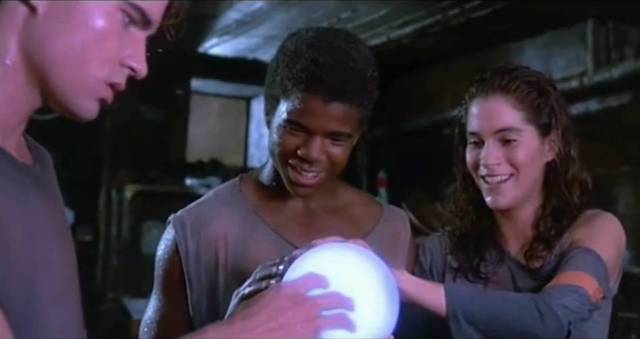
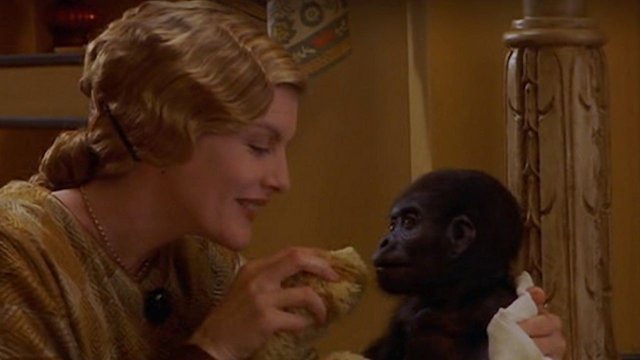
MOVIE COLUMNS: Eric’s Bad Movies: “Bats” (1999). Starring bats. As a personal challenge, I didn’t make any Batman jokes. [Film.com] What’s the Big Deal?: “Lawrence of Arabia” (1962). No Batman jokes in this one either, though it required less restraint in this case. [Film.com] What to Expect When You’re Expecting “Transformers: Dark of the Moon.” I had to make some educated guesses. [Film.com]
MISCELLANEOUS MERRIMENT:
Friend and fellow writer Erin McCarthy has a friend named Kate who freaks out a lot when she watches scary movies, and apparently talks a lot when she watches movies in general. Erin made a hilarious video called “Watch Kate Watching ‘The Thing.'” [Twitvid]
Friend and fellow writer “Cole Abaius” is a terrific interviewer. Here he is talking to legendary stuntman Vic Armstrong on this week’s edition of the Reject Radio podcast. [Film School Rejects]
Former friend and fellow writer Peter Hall stopped being my friend when he made me afraid to sit down anymore. Read this and be likewise afraid. [Daily Infographic]
Uh-oh! Looks like the contest to be Obama’s biggest fan has a new frontrunner! [Twitpic]
A Hoth realtor addresses some of the concerns being raised over his decision to turn Han Solo’s deceased tauntaun into a modest studio apartment. [McSweeney’s]
Speaking of which, Obi-Wan Kenobi is dead, Vader says. (The attention to detail on this parody is very impressive.) [Galactic Empire Times]
My old SLC pal Scott Renshaw wrote a highly entertaining and informative cover story about his first attempt to drink coffee. [City Weekly]
I enjoyed Tina Fey on “Saturday Night Live” last week. Here’s a sketch they cut after dress rehearsal, “Great Women Writers Throughout History.” [Hulu]
This article about David Eagleman’s research into the way we perceive time totally blew my mind. Then I read it again, and it blew my mind again. Fascinating! [The New Yorker]
Subscribe to “In the Dark,” a weekly e-mail with the latest movie reviews, DVD releases, and other pertinent info.
Listen to “Movie B.S. with Bayer and Snider,” a weekly Internet radio show featuring Jeff Bayer and Eric D. Snider, at Cascadia.fm. It’s live at 11 a.m. (Pacific) every Friday, then downloadable as a podcast. Ignore the iTunes “explicit” tag; we always keep it PG.
This week’s post-apocalyptic movie about the battle between humans and vampires is called “Priest.” It stars Paul Bettany as a priest who defies his religious superiors to prevent the slaughter of innocents. It is directed by Scott Stewart, whose last film, “Legion,” was completely different. It starred Paul Bettany as an angel who defies God to prevent the slaughter of innocents. Stewart and Bettany are the Scorsese and DeNiro of mediocre, CGI-laden supernatural thrillers.
Bettany plays a priest named Priest. I guess he was so priest-y there was nothing else he could be called. In this world, priests were once recruited based on their natural ability to fight vampires, which was evidently the church’s main concern. But now the war between man and vampire is over (we won!), and the remaining handful of vamps live on isolated reservations or in secret hives, so priests are no longer needed. In fact, even if a priest becomes aware of dangerous vampire activity, he is not allowed to use his priestly powers to get involved.
That is what happens to Priest. He lives in a big, Orwellian city full of high-tech gadgetry and surveillance equipment, while his brother, sister-in-law, and niece live out on the frontier. Priest gets word from the town sheriff, Hicks (Cam Gigandet), that his kinfolk were ambushed, and his niece, Lucy (Lily Collins), abducted by a herd of vampires and their human slaves, known as familiars. Priest wants to rescue her, but his boss, Monsignor Orelas (Christopher Plummer), says it is forbidden and should be left to the local civil authorities.
“To go against the church is to go against God!” the Monsignor declares, eight or nine hundred times. Well, guess what. PRIEST IS GONNA GO AGAINST GOD, THEN! AW HELLS YEAH!!
Priest and his fellow priests have some enhanced physical powers, including the ability to leap to great heights and to be good at throwing ninja stars. Hicks, a regular dude, has good aim with a six-shooter. Since he’s in love with Lucy, he’s determined to bring her back alive even if she’s been infected by the vampires. He and Priest stop every few minutes to have an argument over whether Priest will allow that, or whether Priest will have to put her down.
There’s a lot of stopping and arguing in this movie, plus a lot of stopping and having somber spiritual chats, and a lot of stopping and not doing anything. Basically, for a movie about a rogue priest and his sheriff friend fighting the forces of evil, “Priest” is exceptionally light on actual fighting. When it happens, it’s cool: slow-motion, “Matrix”-y stuff, creepy-looking vampires (they’re monsters, not humanoids), engaging action. But it’s in short supply, and the dialogue in between is generic, the film’s mythology poorly explained.
The film is based on Min-Woo Hyung’s graphic novels — based very, very loosely on them, from what I gather. Stewart’s emphasis is style rather than substance (a common problem in this genre), and he certainly creates some striking images, particularly in the sequences set in the stark wastelands. (The cinematographer, Don Burgess, gave a similar look to “The Book of Eli.”) Much about the story seems like it might have been interesting if it had been more fully explored: the parallels to the Western genre, the way society turned against the priests, the people’s false sense of security in their big cities. Instead, the story feels rushed, as if artificially squeezed into an 87-minute time limit. It’s too good-looking to be dismissed entirely, not bad enough to be worthy of outright scorn, but not good enough to watch, either.
“Bridesmaids” is so funny, and has so many It’s about time! qualities to it, that you can easily overlook the fact that it’s too long and has too many dangling, underdeveloped threads. It’s miraculous that the movie exists at all, never mind whether its execution is flawless.
The film is a starring vehicle for “Saturday Night Live’s” current funniest female, Kristen Wiig, a gifted comic actress who can play smart, dumb, ugly, and pretty with equal dexterity. She wrote the screenplay with her old sketch-and-improv pal Annie Mumolo (who plays her seatmate in the soon-to-be-famous airplane scene), having been urged to do so by Judd Apatow, who liked what Wiig did with her brief screen time in “Knocked Up.” Apatow, known for running a schlubby boys’ club, wanted to produce something with a female ensemble. Whether Wiig and Mumolo’s sensibilities naturally meshed with his or whether he wielded some creative influence as the film’s producer, I don’t know, but “Bridesmaids” feels very much like something from the Apatow factory: vulgar, hilarious, sweet, and more than two hours long.
Raunchy R-rated comedies have been popular off and on for more than 30 years, but almost none of them have been led by women. We’ll save the discussion about why that is for another day; for now let’s just say it’s about time someone got serious about breaking that trend! Girls like jokes about sex and poop, too, apparently! And it’s about time someone made a female-driven movie that explored the way women’s friendships actually work. Or that addressed the subject of a friend’s impending marriage with real humor and truth. Or that centered on a woman who’s supposedly going through a rough patch of life whose life actually IS pretty screwed up, and yet who isn’t an object of complete ridicule, either.
In “Bridesmaids,” Wiig plays Annie, a thirtysomething Milwaukee woman whose boyfriend dumped her after her business failed. In most movies, a woman in this situation would still live in a huge apartment in Manhattan and wear designer clothes, and her unluckiness at love would be fixed once she let her hair down and quit wearing eyeglasses. Not Annie. Annie’s forced to share a small apartment with a grotesque Englishman (Matt Lucas) and his even more grotesque sister (Rebel Wilson), while working part-time at a jewelry store owned by a family friend. Barely able to pay her bills, she may have to move back in with her mom (the late Jill Clayburgh, in her final film role). As for romance, she has a “sex buddy” arrangement with a smug jerk named Ted (Jon Hamm), whose booty calls she dutifully answers no matter how late the hour.
Then Annie’s best friend since childhood, Lillian (Maya Rudolph), gets engaged, and Annie is appointed maid of honor. Though she’s genuinely happy for her friend, the timing could hardly be worse. Annie can’t afford all the expensive nonsense that goes into being a maid of honor, and she’s not in the mood to have mushy, giddy love rubbed in her face. Things become more vexing when she meets Helen (Rose Byrne), the super-rich wife of Lillian’s fiance’s boss and one of Lillian’s bridesmaids. This Helen person has really latched on to Lillian in the few months she’s known her, and now Annie feels vulnerable and threatened.
There are laughs to be mined in the contest of wills between Annie and Helen: Who can be the better friend to Lillian while passive-aggressively dissing the other?? But where many wedding comedies dissolve into complete cattiness, this one stays fairly grounded. Annie and Lillian have a true, deep love for one another, the way best friends do. Helen will ultimately not be able to come between them — and hey, guess what? She’s not even really trying to. Funny though it may be to paint the beautiful rich snob as a one-dimensional villain, “Bridesmaids” acknowledges that Helen has a point of view, too, and isn’t just a cartoon. Maybe I’m still reeling from last week’s “Something Borrowed,” where the two “best friends” did nothing but tell lies and undermine each other the whole time, but it’s refreshing to see a movie in which the female leads aren’t completely psychotic b-words. That shouldn’t be too much to ask, especially in a movie aimed at female audiences, and yet….
Anyway, Annie must also now contend with the other bridesmaids: Rita (Wendi McLendon-Covey), a frazzled and burnt-out housewife; Becca (Ellie Kemper), a naive newlywed; and Megan (Melissa McCarthy), the butch and rowdy sister of Lillian’s husband-to-be. Rita and Becca, at opposite ends of the “wife” spectrum, provide balance to the ensemble but don’t get much to do in the story. Megan, though — played with all-out insane gusto by the ridiculously funny Melissa McCarthy — proves highly valuable in getting Annie out of her funk.
As all of this is going on, Annie meets a new man, a kindly police officer named Rhodes (Chris O’Dowd). Annie isn’t focused on him, though, and neither is the movie. The movie is most interested in showing Annie’s progress from sad-sack to new-lease-on-life. It is there — not in her romance, not even in her friendship with Lillian, but in her own personal journey — that the movie finds its greatest emotional resonance.
Oh, but never mind emotional resonance. Is it funny? Good heavens, yes. Wiig and Mumolo, both performers at heart, wrote a screenplay that gives the actresses ample opportunity to create vivid, loopy characters, and to explore some outrageously fun situations. There’s a scene of bathroom humor that’s funnier than most scenes of bathroom humor — and yes, that’s at least partly because it involves a gender not usually associated with that sort of thing. Comedy comes from juxtaposition, and there’s greater contrast between a toilet and a beautiful woman than between a toilet and Seth Rogen. There’s also a sequence aboard an airplane that has all the women cutting loose in one way or another, always in ways that are true to their characters. The director is Paul Feig, who knows a thing or two about character-based comedy and the humor of humiliation: He created “Freaks and Geeks” and has directed episodes of “Arrested Development,” “The Office,” “Bored to Death,” “Parks and Recreation,” and “Nurse Jackie.”
But now let us mention the problems. The film feels much longer than it needs to be (the Apatow curse), and there are remnants of what I assume are deleted plot threads that don’t go anywhere. The stuff with Annie’s weird roommates doesn’t really work; they’re absurd characters in a movie that is otherwise grounded in reality, and their style is at odds with everything else. The connection between Annie’s mom and Alcoholics Anonymous keeps getting mentioned without any purpose or payoff. Annie’s tendency to take out her frustrations on the customers at the jewelry store is belabored, and suffers from comedy-sketch-itis. More discipline is called for — tighter editing, more consistent choices, a clearer overall vision of what the movie’s tone should be. Those are the things that often separate a good, funny comedy from a truly great one.
Like I said, though, it’s stunning that an R-rated female-driven comedy has been made at all, let alone that it’s often uproariously funny and centers on believable characters. I hope it leads to better things. Curious thing about “SNL.” The show is well-known for its funny women — and yet it has never launched any of those women to a huge movie career. There’s been no female equivalent, so far, of Eddie Murphy or Will Ferrell or Mike Myers. If “Bridesmaids” does it for Wiig … well, it’s about time.
Though he has dabbled in light drama, Will Ferrell has yet to try the sort of intensely serious role that many of his comic peers have taken on. “Everything Must Go” still isn’t his grab for an Oscar (and I’m in no hurry to see him make one), but it is a confident transitional step in that direction, should he decide he wants to pull a Sandler or a Carrey.
Here he plays Nick Halsey, a competent and modestly successful salesman who, at the film’s outset, is fired. The cause isn’t the poor economy or corporate downsizing — it’s Nick’s alcoholism. It has caused trouble in the past, leading to rehab and even a period of sobriety. But now, after an incident on a business trip in Denver, it has finally sunk him.
Nick’s day gets worse when he arrives home to find that his wife has moved out of the house, changed the locks, canceled his credit cards, and put all of his belongings on the lawn. Whatever happened in Denver has proved to be the last straw for her, too.
Unsurprisingly, Nick’s response to these setbacks is to acquire as much Pabst Blue Ribbon as he can with his remaining cash, and to sit on the lawn and drink. His Alcoholics Anonymous sponsor, a cop named Frank Garcia (Michael Peña), stops by to check on him — and to tell him that city ordinances will only let him keep his stuff on the lawn if he’s having a yard sale, and only for five days. Nick doesn’t actually want to turn the incident into a yard sale, but he doesn’t have a lot of options.
That lack of options is a little strange, narratively speaking. Are we to understand that Nick has no one who will come to his aid? No friends, no family, no sympathetic former colleagues, no one but his neglectful AA sponsor? Nick isn’t the kind of drunk who alienates everyone — on the contrary, he’s a gregarious, entertaining fellow. He’s exactly the kind of guy you’d love to have a beer with. I don’t buy that he’s this destitute this suddenly.
Be that as it may, he’s living on his lawn now. Across the street is a pregnant woman named Samantha (Rebecca Hall) who has just moved to the neighborhood in advance of her husband being transferred for his job. She takes some pity on Nick, and so does Kenny (Christopher Jordan Wallace), a pudgy, outcast teenager from the block. As Nick gradually resigns himself to taking inventory of his belongings, he also takes inventory of his life.
This material could be the makings of an intense and sober drama about a broken man. It could also be an all-out farce about a hilarious drunken reprobate. Alcoholism goes both ways, as you know. Ferrell plays it closer to drama than you’d expect him to, but he’s also given plenty of funny moments. He conveys the seriousness of the character’s plight without wallowing in the sadness of it all.
Dan Rush, the first-time filmmaker who wrote and directed the project (adapting a short story by Raymond Carver), resists the urge to resolve Nick’s problems easily or stereotypically. His style isn’t showy, and Ferrell is likewise restrained. The result is a simple, unassuming movie that’s grounded in reality and is every bit as likable as Ferrell himself.
We have a sad, damaged family that is barely functional, with parental supervision at a minimum. A peculiar stranger with distinct musical tastes sweeps into the house, takes control, behaves in an unorthodox manner, and helps the family heal before moving on. You’re thinking “Mary Poppins,” but no — it’s “Hesher,” a dark, weird, and wholly unique comedy that uses a bucketful of obscenity to help the sweetness go down.
The Forney family has suffered a loss, leaving Paul (Rainn Wilson), the dad, depressed and couch-bound, and the 13-year-old son, T.J. (Devin Brochu), completely rudderless. They live with T.J.’s grandmother (Piper Laurie), who is descending into senility. The cast on T.J.’s arm and the wrecked car sitting outside the house are reminders of the accident that shattered their lives. At school, T.J. is bullied, but he hardly cares.
Into this gloomy scenario comes a ray of sunshine by the name of Hesher (Joseph Gordon-Levitt), a long-haired heavy-metal dirtbag who drives a van and is frequently shirtless and usually vulgar, who has on his chest a tattoo of a stick-figure man shooting himself in the head. Hesher may or may not be an older student at T.J.’s school, may or may not by a pyromaniac, may or may not be named Hesher. At first he appears randomly in T.J.’s life, suddenly materializing like a specter, accompanied by a distorted guitar riff on the soundtrack. Then he moves in to the Forney family’s garage, fixes himself a bowl of cereal, and strips down to his tighty-whiteys so he can do laundry. Grandma is too dotty to notice, Paul too morose to care, T.J. too terrified to object.
Who is this provocateur, this agent of chaos, this harbinger of doom? He is Hesher.
He does not bring doom, however, but peace, kind of. He becomes something of a guardian and big brother to T.J., albeit one who is without sentiment or inhibition. When he sees that T.J. has a crush on a frumpy young supermarket cashier, Nicole (Natalie Portman), his “romantic” advice to him is unrepeatable. In fact, much of what Hesher says should not be repeated in mixed company, nor his actions duplicated in any company. (Let us just say that Hesher is not opposed to senseless but satisfying vandalism.) His presence in the Forney home eventually prods T.J. and Paul into communicating with one another about their grief so that they can move beyond the tragedy.
Yes, Hesher teaches the Forneys how to love again. The story at the core of this often hilarious film is familiar, but it has been adorned in a bizarre, immensely pleasurable costume. It’s essentially “Mary Poppins,” as I said; it’s also every other story in which an outsider comes to town and stirs up the locals until they learn something valuable. First-time feature director Spencer Susser, who co-wrote the screenplay with David Michod (whose own “Animal Kingdom” was about a very different dysfunctional family), is confident enough in his material and in his actors not to overplay the situation’s “quirkiness.” Hesher is what he is and does what he does, without comment from the filmmaker — no “Get a load of this guy! Eh? Eh?” underscoring. Hesher doesn’t care what you think, and Susser has a lot of fun with that attitude.
So does Joseph Gordon-Levitt, whose list of interesting character choices continues to grow. Hesher is the sort of belligerent vulgarian that David Cross excelled at playing on “Mr. Show,” yet Gordon-Levitt expands him into someone we can watch for 90 minutes. Without betraying the character’s enigmatic charm — part of the fun is not knowing where the hell this guy came from — Gordon-Levitt gives him a few gentle touches of humanity, particularly in his scenes with Piper Laurie’s grandmother character.
The film’s protagonist is T.J., though, not Hesher, and young Devin Brochu is an outstanding find in that role. He astutely conveys the pain and frustration of a pre-adolescent boy, and more than holds his own against the more experienced actors who surround him.
“Hesher” is a comedy, mostly, and a loony, anarchic one at that. It revels in the flagrantly antisocial behavior of its title character and delights in appalling us. But it also has dramatic underpinnings that come through with surprising sensitivity. Don’t focus on what you’ve lost, Hesher says. Focus on what you still have! That’s an ennobling sentiment, and no less so for being conveyed through an anecdote that relates to Hesher’s genitalia.
A lot of people find bats creepy, not just because they turn into Draculas, but also because they are basically rats that learned how to fly. So it’s surprising that bats have been the subject of so few entries in the genre of Movies Where Swarms of Animals Attack People. You’d think filmmakers would go there before they resorted to killer rabbits, killer frogs, or killer laundry machines.
There is “Bats,” though. It came out in 1999 — and the fact that “Bats” was not already the title of a dozen other movies by 1999 shows you just how anti-bat Hollywood was. With its cheesy special effects and vaguely famous cast, “Bats” is the sort of movie you’d expect to see premiere on the SyFy Channel, accompanied by lots of movie-hipster hype about how “awesome” (i.e., terrible) it is. That’s a good place for movies like this, because everyone gets the SyFy Channel anyway and there’s no commitment to watch the entire movie. Yet for some reason Bats played in cinemas, where you could only see it if you gave money to the people who operated the theater. Not many people did this, but still, the fact that it was even an option.
“Bats” is an unapologetic rip-off of “The Birds,” “Jaws,” “Jurassic Park,” “Gremlins,” and all the other nature-runs-amok movies. It adheres so closely to the standard formula that one is tempted to believe it emerged fully formed from Roger Corman’s toilet bowl. (“Huh!” Corman might have said. “Must’ve had too much Spielberg last night!”)
We begin in the usual fashion, with a pair of randy teenagers being killed while they sit in a parked car late at night. They are attacked by something — it’s hard to tell what, exactly, because whatever it is also makes the camera whip around wildly, but we’re pretty sure it’s bats. This is in rural Texas, where nature and man have been battling one another for centuries, with most of the victories so far going to nature.
Then we hop over to nearby Arizona, where Dr. Sheila Casper (Dina Meyer), the world’s foremost bat scientist and adventurer, is clambering around in some caves, spying on bats and writing down all the cute things they do for her diary, or whatever. She is assisted by a fellow named Jimmy (Leon Robinson). Now, I’m going to tell you that Jimmy is black. Knowing this, and having seen a few of these movies in your day, can you guess what Jimmy is like? If you guessed that he cracks jokes and hates bats and is afraid of everything and generally behaves like a comical coward, you are correct!
Sheila and Jimmy are interrupted by the arrival of a helicopter carrying Dr. Hodge (Carlos Jacott), a Centers for Disease Control official who has come to get Sheila’s help on an important bat-related matter. The CDC may have a crisis on its hands, and Sheila is the only one who can help, and they need her NOW!! Hence the chopper ride out to the middle of the desert. What, the government can’t call first? They always just show up at the research site or the archeological dig or wherever the important scientist is and drag him or her away. What if Sheila can’t go right now? What if Sheila has other plans this afternoon? What if she has a doctor’s appointment, and if she doesn’t show up she’ll still be charged? Is the government going to pay for that?
My lifelong dream is to have my workday disrupted when a government helicopter lands outside and out pops a suit-wearing bureaucrat telling me that my country needs me.
Sheila and Jimmy join Dr. Hodge and head to the small town of Gallup, Texas, where those teenagers got ripped apart. (I don’t think the CDC really needs Jimmy, but I guess he wouldn’t have had a ride back if he didn’t hop on the helicopter when Sheila did.) A wormy scientist named McCabe (Bob Gunton) fills everybody in on the details, which are basically that he tampered in God’s domain and now nature is going to kill everybody. Seems McCabe imported a couple of large bats from Indonesia so he could do some experimentin’, then infected them with a virus that makes them smarter, aggressive, and carnivorous, and then lost them. Scientists are good at making things more dangerous, not as good at remembering where they put them. Sheila asks McCabe the obvious question, i.e., why he would intentionally make bats smarter, aggressive, and carnivorous. McCabe’s answer: “Because I’m a scientist! That’s what we do! We make things better!” It’s eventually revealed that there’s slightly more to it than that — the government wanted to turn the bats into weapons, or something — but McCabe’s answer is good enough for me.
Now these new and improved bats have apparently infected the local bat population with McCabe’s virus, and that’s why the teens got slaughtered and why there have been reports of mysteriously mangled livestock. If a person is bitten by one of these infected bats, will that person also become smarter, aggressive, and carnivorous? Because that sounds like a pretty rad horror movie. But, no, thank goodness, the virus can only be transmitted from bat to bat, and since bats are fairly easy to avoid — don’t go outside at night where there are bats — the movie is in no danger of becoming truly exciting.
Sheila’s duty is clear: She must find a way to cure or kill every bat in west Texas. She doesn’t want to be forced into committing mass baticide, though.
“The thought of killing one goes against everything I’ve come to believe,” she says.
Everything she’s come to believe? Her entire life’s philosophy can be summed up by “Don’t kill bats”? That is an unusually specific religious dogma.
Assisting her is Gallup’s town sheriff, Emmett (Lou Diamond Phillips), who loves his town and will not sit idly by while its inhabitants are murdered by flying rodents. McCabe and the CDC guy will help too, though it’s pretty clear that McCabe is loyal to bats over humans and cannot be trusted. Just as clear: McCabe will eventually die from bat-related causes, yet will be very surprised when it happens.
Sheila and Emmett soon discover that there are thousands upon thousands of bats in the caves nearby, all of them angry, belligerent, and hungry for meat — like a stadium full of Cowboys fans, only smarter. Jimmy does his “Aw, hell no!” and “Feets don’t fail me now!” routines. Emmett and the mayor try to evacuate Gallup, but everyone ignores the warnings and strolls through the town square at dusk as if it were an ordinary summer evening. “People in Texas think they know everything about everything!” the mayor says by way of explanation. Those maverick Texans, always disregarding evacuation orders when slaughter is imminent! You’ll recall the same thing happened at the Alamo.
As predicted, many Gallup residents perish when the bats descend on the town and bite lots of them to death. That’s all they’re doing, too, by the way, is biting people. Despite the claims that these bats are bloodthirsty carnivores, they aren’t completely devouring anybody, or even nibbling anybody beyond recognition. You’ll see a dead victim and think, Why, 90 percent of the meat is still on his body! The bats hardly touched him! For a species that has only recently converted to flesh-eating, they’re being awfully wasteful.
Once daylight comes and the bats go to sleep like the lazy bastards they are, the U.S. Army rolls into town and reveals that it has a plan. It’s the same plan the military always has in these movies, i.e., blow everything up. Drop some bombs on the cave where the bats live, blow ’em to smithereens. Sheila says the explosion would just make the bats scatter, and that most would escape and simply find a new home. The Army guys say it doesn’t matter if it’s not going to work, they’re going to do it anyway, because it’s the only plan they have. When all you’ve got is a hammer, everything looks like a nail; when all you’ve got is a bunch of bombs, everything looks like a cave full of bats.
But they give Sheila 48 hours to come up with a better plan, “better plan” in this case defined as “plan that does not have a 100 percent chance of failure.” She and Emmett and Jimmy brainstorm. “This is like a nightmare!” Jimmy says. “I’ll never sleep again!” And just like that, Sheila’s got it: “That’s it! We’ll put them to sleep!” The bats, she means, not the Army. Not the way you’d expect, either (bat lullabies), but with cold air. Sheila informs us that bats hibernate if it gets below 40 degrees, and freeze to death if it gets below 32. Basically, if you’re a bat, there’s only 8 degrees’ difference between napping and dying, which is why bats tend to spend most of their time in warm places like caves and people’s hair.
All Sheila and friends have to do is get a huge generator-powered air-conditioner down into the cave while the bats are having their morning siesta, crank that sucker up, and let the creepy things freeze. A huge generator-powered air-conditioner being near at hand thanks to the town’s proximity to the Acme Plot Convenience factory, this plan proves easy to execute; the movie ends, and we get to go home early. No word on whether Sheila feels remorse at how easily she renounced her “Don’t kill bats” religion, but in her defense, that was a pretty restrictive rule.
It is time once again to solicit suggestions for Eric’s Bad Movies! This is a weekly column that I write for Film.com, in case you didn’t know, and I rely upon you, the readers, to point me in the direction of terrible movies that deserve mockery. Truly, I do! A sizable chunk of the 144 movies I’ve covered so far were ones I hadn’t heard of or never would have thought of on my own.
Basically, here’s what I’m looking for in a Bad Movie:
– The more well-known it is, the better. I’m avoiding straight-to-video releases and TV movies. Movies that played in theaters and were backed by Hollywood studios and had stars in them are ideal.
– Comedies are extremely hard to make fun of because they already don’t take themselves seriously, so I tend to avoid those. Focus on action movies, dramas, and the like.
– It needs to be something whose badness is generally agreed upon, as opposed to something that YOU happen to hate but that is otherwise fairly well regarded. Remember, I need to think it’s bad, too. Don’t waste my time with movies that I think are OK!
– I don’t want to do movies that I reviewed in the normal movie-critic fashion when they came out in theaters. I’ve been reviewing movies since 1999, so in general, you can skip anything released since then.
After the jump, the list of what I’ve covered so far. Then it’s up to you to post suggestions in the comments. Thanks!
(If you’ve suggested a film in the past and I haven’t used it, you don’t need to suggest it again, I promise. Either I’ve considered it and rejected it, or it’s on my to-do list.)
The human body is amazing. Mine is, anyway. Have you seen it? It’s soft, lumpy, and hairy, like somebody dropped a big ball of bread dough in a pile of barbershop sweepings.
I take good care of my body, providing it with only the finest Hot Pockets and Frosted Mini-Wheats, with plenty of Oreo filling to keep the joints lubricated. But even a well-maintained machine occasionally malfunctions, and such was the case several weeks ago, when I suddenly found myself “sick at both ends,” as the saying goes. (The saying means that I was vomiting and pooping.) The expression “sick at both ends” sounds like it should indicate being ill at your head and your feet, but it turns out the butt also qualifies as an “end,” anatomically speaking, despite being located closer to the middle. As I said, the human body is amazing.
The illness was ill-timed. The best time to get sick, of course, is when it causes you to miss something you didn’t want to do anyway, such as attending a co-worker’s wedding reception or a friend’s poetry reading. But I was supposed to be flying to another state for the weekend for a friend’s 40th birthday party, and this was something I very much did want to do. But how could I get on an airplane in my current condition? Surely the change in cabin pressure would make me explode, and that’s if I even managed to get my volatile contents past airport security. Even if I made it to my friend’s house, I’d just be sick there instead of at home, and that wouldn’t help anybody. It was Well Eric who’d been invited to the party, not Sick Eric.
So I didn’t go — and then I was afraid I just had food poisoning, and that I was going to wake up the next morning feeling fine and wishing I’d gotten on the plane. Our bodies, as amazing as they are, can be real bastards like that sometimes. Luckily, I woke up the next morning still feeling barfy and poopy, and these conditions lasted for most of the weekend. My decision not to take the trip was vindicated. My decision to trade all my Pepto-Bismol for magic beans, less so.
I did have food poisoning several years ago. It caused a terrible thing to happen. I am about to describe that terrible thing to you so that you will understand. You know how sometimes the force of a sneeze can make you break wind at the same time? It was like that, but on a more, shall we say, colorful scale. I had hurried into my bathroom, urgently aware that two events of great magnitude were about to occur but uncertain which was more imminent, and doubtful of my ability to influence the timeline anyway. And then … and then. Imagine if you took a tube of toothpaste, cut the bottom off of it, removed the cap, then held the tube in the middle and squeezed. Yes, imagine that. Imagine that good and hard. That’s what it was like. Fortunately, I’d had the foresight, when I stumbled into the bathroom, to strip naked, my instincts having alerted me that whatever devastation was to occur would be easier to clean up if no clothes were involved. Afterward, my bathroom had to be cordoned off as a crime scene, but at least I didn’t have to do laundry. Now imagine that for a while. YOU’RE WELCOME.
Throwing up is terrible, even more so because there’s no good reason for it. The human body has a very effective everyday system for removing toxins and other undesirable elements. It’s called going No. 1 and No. 2. Vomiting is overkill. Oh, what, the stuff in your stomach is soooo bad it has to come out NOW, the same way it came in? It can’t wait its turn and be processed like everything else, or even request expedited shipping? Please. Vomiting is just your stomach’s way of being a drama queen. “Aaaah! Aaaahhh! Poison! Getitoutgetitoutgetitout!! Aaaaah!!” Get over yourself, stomach. It’s not all about you.
But it’s nice how life tends to provide highs to balance out the lows. For example, vomiting is an awful experience. But afterward, you get to rest your head against the cool, smooth bathroom floor — something you would never consider doing normally, because eww, bathroom floor, but right after throwing up it is exactly what you want to do. Those cold tiles against your fevered face are just what the doctor ordered. This is why the Torah says that bathrooms should never be carpeted.
Like most people, whenever I throw up, I think about my mom. It’s a holdover from childhood. You want your mom to fix you when you get sick as a kid, and you never really grow out of that. My parents had six children, so there was never a shortage of vile substances being spewed from one shrieking orifice or another. Looking back now, I don’t know how they put up with it. When one of us would get sick we’d do that thing where you’re moaning and saying “Mom” at the same time — “Mo-o-o-o-om!” — which must be music to a mother’s ears. Or even worse: “Mo-o-o-om, I’m gonna throw up!” Because she needs to be on alert, I guess? “Mo-o-o-om, just FYI, I’m about to vomit, OK? So be ready. Be ready for that.” It never occurred to me when I was a kid that my mom might not be interested in being present when I upchucked, nor in cleaning it up afterward. I just assumed it was part of her job as a mom. She loved being a mom; ergo, she loved dealing with puke. She must love changing diapers, too, I figured, or she wouldn’t have kept having babies.
At some point after I became an adult, the subject arose and my mom confessed that she always hated being witness to a yakking, or even the aftermath of yak. I was actually astonished to learn this. If I had ever paused to give the matter even cursory consideration, I’d have realized that of course she hated it, because it was gross and normal people hate gross things. But it had never occurred to me. She’d never shown anything other than motherly compassion and tenderness when my siblings and I were sick, never let on that certain aspects of her job were decidedly unappealing. And if you think about it, that’s one of the greatest gifts a mother can give her children: not letting them know how much they disgust her. Thanks, Mom!
Movie columns:
— Eric’s Bad Movies: “Above the Law” (1988). This is Steven Seagal’s first movie. I always assumed it must be at least sorta good, since he immediately got offers to make more movies, but this was not the case. [Film.com]
— What’s the Big Deal?: “Beauty and the Beast” (1946) — not the Disney cartoon (though I love that too), but the magical old French version. [Film.com]
My other stuff:
Snide Remarks: “A Matter of Control” — Video games reveal that I am elderly.
Miscellaneous merriment:
— You may have heard that Osama Bin Laden passed away quietly in his sleep last Sunday. Would you like to see how America’s dumb teenagers noted the occasion? [Facebook / FaceDumb on Twitter]
— This now-iconic picture of the White House situation room is mesmerizing to me. Click “Original” for the giant version and look at the faces, especially Obama’s and Clinton’s. There was some intense shiz going down. [Flickr]
— The night before Bin Laden bit the dust was the annual White House Correspondents Dinner. Obama had some pretty good jokes in his speech (though his delivery is still off), including some aimed at Donald Trump… [YouTube]
— …and then “SNL” head writer Seth Meyers annihilated Trump and cracked on just about everyone else, too, including 2008 Obama vs. 2011 Obama. Of particular import: At 2:05, Meyers makes a joke about C-SPAN’s lack of viewers that references the whereabouts of Bin Laden. Check out the reaction from Obama, who had signed off on the mission to kill or capture Bin Laden just hours earlier. [YouTube]
— I compiled some of the most amusing Bin Laden jokes from Twitter. [Eric’s Blog]
— Speaking of Bin Laden, right after 9/11, Elizabeth Taylor, Marlon Brando, and Michael Jackson went on a road trip. [Vanity Fair]
— My sister is taking a film class at a community college. This is a journal entry by one of her classmates. (We THINK she meant that the people who made “Disturbia” should have noticed they were copying “Rear Window.”) [Twitpic]
— My old pal Scott Weinberg, formerly managing editor at Cinematical, started a new gig at Movies.com this week. His first item: Dear 3D, Please Die Already (Again). [Movies.com]
— Matt Patches, whose name makes it sound like he should be a circus clown or an old-timey hobo, writes about the movies his ex-girlfriends made him watch and what he learned from them. [Film School Rejects]
— Drew McWeeny filmed his two little boys reciting the Green Lantern oath. It’s impossibly cute. [HitFix]
— In honor of the Beastie Boys’ new album, here are explanations for 170 of their previous lyrical references. [The AV Club]
— Forget about Twitter. The best political zingers still come in the form of letters to the editor. Man, this lady sure let Trump have it, am I right?! [The Salt Lake Tribune]
Subscribe to “In the Dark,” a weekly e-mail with the latest movie reviews, DVD releases, and other pertinent info.
Listen to “Movie B.S. with Bayer and Snider,” a weekly Internet radio show featuring Jeff Bayer and Eric D. Snider, at Cascadia.fm. It’s live at 11 a.m. (Pacific) every Friday, then downloadable as a podcast. Ignore the iTunes “explicit” tag; we always keep it PG.
“Hobo with a Shotgun” is everything you’d want a film called “Hobo with a Shotgun” to be, except that ideally you’d be watching it on a crusty VHS tape that you found in the back of an independent video store run by a weird guy with a ponytail.
In an era of too much campy self-awareness, too many grindhouse homages, and too much blood-for-blood’s-sake, “HWAS” is a breath of fresh, sleazy air. First-time director Jason Eisener, expanding on the fake trailer that he and writer John Davies made in 2007 as part of a contest, takes exactly the right tone, straddling the line between imitation and parody. “HWAS” both makes fun of Troma-style exploitation movies and is one itself.
The key is to play it with a straight face. Luckily, Eisener has Rutger Hauer, the iconic veteran actor who seems like he ought to have been in a movie called “Hobo with a Shotgun” already. Hauer shows in his performance that he knows what the joke is, but also that he knows not to let it show. He doesn’t wink at the audience, but he isn’t a clueless old man, either. He gets it.
Hauer plays an unnamed hobo (think Clint Eastwood in the Sergio Leone trilogy) who rides into a miserable Canadian town that has become a nightmare of crime, violence, and depravity. The chief perpetrator is The Drake (Brian Downey), a slick-haired sleazeball who runs a crime empire with his psychopath sons, Slick (Gregory Smith) and Ivan (Nick Bateman). The Drake does whatever he wants with impunity — the cops are useless or corrupt — and inspires every lowlife in town to do the same. The crimes are depicted unrealistically, over-the-top: a pedophile in a Santa Claus costume leers at children on a playground; a man is hung upside-down and beaten like a piñata by hot topless chicks. This lets us enjoy the madness without having to consider the unsettling real-world implications of such acts. It’s pure escapism, no reality.
After running afoul of The Drake and seeing so many others suffer too, the hobo finally takes matters into his own hands when thugs hold up a pawn shop where he is a customer, and where there is a shotgun on display. He starts dispensing justice throughout the city, punishing criminals quickly and bloodily. (“HOBO STOPS BEGGING, DEMANDS CHANGE,” screams a newspaper headline.) He also befriends Abby (Molly Dunsworth), a hooker with a heart of gold, and must eventually face off against The Drake to save the town once and for all.
Eisener obviously grew up watching the low-budget exploitation flicks of the ’70s and ’80s, and he recreates their style with an impressive attention to detail. He and cinematographer Karim Hussain shot the film in vivid Technicolor, the kind where caucasian flesh tones appear almost orange and the geysers of blood are deep red. The movie has the look of something made 30 years ago. The musical score, the vaguely ’80s-ish setting, and even the choice of font for the credits all contribute to the experience.
Davies’ screenplay is rife with pseudo-badass lines like “I’m gonna wash this blood off with your blood” and “They’re gonna make comic books out of my hate crimes.” That’s goofy stuff — but it’s only a half-step away from the cheesy things that people actually said, in all seriousness, in the movies that inspired this one. In a similar vein, the performances tend to be loud and clunky, just as you remember. Are these good actors convincingly pretending to be bad ones, or are they just bad? The fact that the answer is not obvious — and that it doesn’t matter either way — is a testament to the film’s success.
“Hobo with a Shotgun” works very well on that level. It summons the adrenaline-fueled pleasures of the grindhouse experience, but because its purpose is ultimately satiric, the abundant blood and debauchery come across as funny instead of vicious. The blend of homage and parody — of laughing at and laughing with — is nearly perfect.
I know very little about Norse mythology and even less about Thor as he’s depicted in Marvel comics, but that doesn’t seem to have hindered my enjoyment of the movie that bears his name. This is fun, straightforward stuff, closer in spirit to the earnest and enthusiastic Superman films than to the snarky, too-cool-for-school Iron Man films to which it is officially related. If the action sequences don’t have as much of the “wow” factor as they might, and if the whole thing has the anticlimactic feel of a movie whose real purpose is to set up another movie, those flaws are hardly significant enough to spoil the cheerful mood.
“Thor” is set in two primary locations. One is Asgard, the eternal realm that is dwelling place to the beings that the old Norwegians revered as gods. The other location is Earth, which I assume needs no introduction. Thor himself, played by Chris Hemsworth (James T. Kirk’s doomed father in the recent “Star Trek” reboot), is a mighty warrior, the son of Odin (Anthony Hopkins), and heir to the throne of Asgard. Due to his arrogance and over-fondness for war, Thor is stripped of his powers and banished to Earth. His big ol’ hammer, Mjolnir, which helps him fly around and wreck stuff, is likewise removed from his custody, hurled into the New Mexico desert where it made a cameo after the closing credits of “Iron Man 2.”
Now an ordinary mortal (albeit one with marvelous biceps and pectorals), Thor is befriended by Jane Foster (Natalie Portman), a wide-eyed astrophysicist investigating some kind of cosmic phenomenon in New Mexico. Her mentor, Erik Selvig (Stellan Skarsgard), grew up hearing legends about Thor, Odin, and the rest, and did not suppose that they were real. Their research assistant, Darcy (Kat Dennings), has absolutely no function in the story, but she’s good for comic relief early on.
The film has a lot of solid laughs, actually, without becoming a cartoon. (The screenplay is credited to Ashley Edward Miller and Zack Stentz, both from TV’s “Fringe,” and Don Payne, from “The Simpsons” and “Fantastic 4: Rise of the Silver Surfer.”) Thor is courtly and respectful of women — he is a prince, after all — yet also a mead-drinking, enemy-slaying hero once worshipped by Vikings. You will be amused, for example, by the way he responds to doctors trying to take his blood, or by the way he requests a second cup of coffee at breakfast.
As the movie version of the Marvel universe continues to expand, the creative overlords are getting better at establishing continuity between, say, this and “Iron Man” and the upcoming “Captain America.” Coulson (Clark Gregg), the SHIELD agent who keeps popping up in the Marvel films on his way to the big “Avengers” meet-up next year, is on hand, and there may or may not be a cameo by another “Avengers” character. That kind of thing is a treat for the hardcore fans, and there are other details — like the fake name Erik gives Thor when he’s arrested — that I didn’t realize meant anything until I looked them up later. Crucially, however, the movie remains accessible for novices, and doesn’t revel too much in for-nerds-only minutiae.
Have I failed to mention a villain? Ah, yes. In my defense, so did the movie, almost. Thor’s brother Loki (Tom Hiddleston), jealous at being passed over as Odin’s successor, causes trouble, though I never felt like the stakes were any higher than they’d be in an average issue of an average comic book. It’s hardly the grandeur you’d expect from what is theoretically the first entry in a franchise. Thor’s Asgardian warrior friends, Volstagg (Ray Stevenson), Hogun (Tadanobu Asano), Fandral (Josh Dallas), and Sif (Jaimie Alexander), contribute their energies in an early battle with Frost Giants and later with a very tall robot-looking thing, but their “Fellowship of the Ring”-style camaraderie doesn’t get enough screen time to really breathe. Rene Russo, playing Odin’s wife and Thor’s mother, has almost no lines.
The director is Kenneth Branagh, best known for his Shakespeare adaptations. You wouldn’t know he’d never made a movie this effects-heavy and expensive before, and maybe it’s not that different from Shakespeare anyway, what with its brothers fighting for the crown and its threats of war and its exiled princes and such. Branagh is surrounded by talented production designers, cinematographers, and editors, too, which certainly helps. The scenes in Asgard are beautifully rendered and quite convincing — no small feat, given the inter-dimensional travel and other potentially goofy elements involved.
There isn’t much gravitas to be found here, and that’s fine. Not everything needs to be “The Dark Knight.” “Thor” keeps things light and inconsequential. It’s perfect for 12-year-old boys, or for those of us who need to indulge our inner 12-year-old boys for a couple hours.
Mel Gibson’s latest troubles began just as “The Beaver” was finishing production, but if you didn’t know that you’d think the film was devised as a rehabilitation project. It turns out to be the perfect reintroduction for an audience that may be wary of the once-beloved actor.
Gibson plays Walter Black, a man in deep pain. He’s clinically depressed, prone to alcohol abuse, and filled with self-loathing. He has tried every kind of therapy and medication, orthodox and unorthodox, Western and Eastern, to no avail. He sleeps most of the time, can’t carry on a conversation when he’s awake. He’s on the verge of finally ending his life when he finds a beaver puppet in the trash and, on a whim, hangs onto it. Then the beaver starts speaking.
OK, not exactly. Walter doesn’t think the beaver is real or anything like that. He’s depressed, not crazy. (There is a fine line.) He controls the puppet and provides its avuncular, Michael Caine-ish voice, and is perfectly aware that he is doing this. But through this character, Walter can communicate with people. The Beaver speaks for Walter in ways that Walter couldn’t. The Beaver is therapeutic.
Walter’s wife, Meredith (Jodie Foster, who also directed), finds all of this rather insane, of course, but she can’t deny the short-term results. Their young son, Henry (Riley Thomas Stewart), readily accepts the Beaver as Dad’s kooky new character, and happily spends some much-needed father-son-puppet time with him (them?). On the other hand, Walter and Meredith’s older son, Porter (Anton Yelchin), a high-school senior, is making a concerted effort to be nothing like his father. As far as he’s concerned, this latest bit of madness is just another reason to stay focused on that goal.
The film, written by Kyle Killen, is remarkably poignant and heartfelt, using its ridiculous-sounding premise to explore serious issues with real tenderness. While it has light moments, it is not a comedy, and that might be the gutsiest thing about it. Movies have a notoriously hard time depicting depression realistically; “The Beaver” chooses a mechanism that works, and Foster directs it sensitively.
Porter, who earns money writing papers for fellow students by adeptly mimicking their writing voices, doesn’t want to be like his father. He hates his father — but Walter hated his father, too, which makes Porter and Walter alike. The movie is about Walter repairing himself so that he can repair his relationships with Porter, Meredith, and Henry, and about Porter doing the same. Puppet therapy might seem drastic, but why? According to the film, “Starting over isn’t crazy…. Crazy is pretending to be happy.” It’s hard to argue with that.
All of this is fine by itself. Another good actor could have played Walter and made a film that was just as effective. But Gibson’s presence gives it an added jolt: It’s impossible not to compare him to Walter, to note their similar self-destructive tendencies. We hear very little from Walter; nearly everything he says is in the film is through the Beaver — which means we’re seeing Gibson play a character who is playing a character. That extra degree of separation is extraordinarily useful at this point in Gibson’s career. Too many of us would find it hard to enjoy a movie that was all Gibson, all the time, all in your face. But in the role of a sad, damaged man who takes on the persona of a lovable fictional character, Gibson earns our sympathy.
Certain aspects of the story are perhaps over-simplified. The people in Walter’s life, including his employees (he’s CEO of a toy company), go along with the puppet business more readily than is plausible; even a brief scene or two of reticence and “the boss has lost his mind” whispers might have helped. Porter’s relationship with his class valedictorian (Jennifer Lawrence) is likewise underdeveloped, especially the parts dealing with her own troubled past. But, as always, I’d rather a movie be too short than too long. “The Beaver” navigates its tricky tone and subject matter in a sweet, memorable fashion.
The rule in romantic comedies is that if someone is eventually going to dump one romantic partner for another, it needs to be clear that the first partner wasn’t right for him or her anyway. If either partner would be a suitable mate and the choice between them is difficult, then there’s a chance the audience won’t like the decision that is ultimately makes, which will ruin the intended effect of the romantic comedy, which is to be light and cheerful.
The situation in “Something Borrowed” is very tricky indeed. Dex is already engaged to Darcy, you see, so leaving her for Rachel — the protagonist, the sympathetic main character — must be completely 100 percent justified. There cannot be even a smidgen of doubt that Darcy is all wrong for Dex, or else Dex will come off as a monstrous cad for eventually following his heart, and Rachel will seem like a cruel home-wrecker.
So what’s the solution? Make Darcy the worst human being ever to walk the face of the earth.
Darcy is played by Kate Hudson, who is finally pulling out all the stops in her decade-long campaign to make us loathe and despise her. Darcy is shallow, vain, self-absorbed, reckless, irresponsible, and narcissistic. She never thinks any further than five minutes into the future, except for when she practices crying so she’ll know how her mascara will hold up on the wedding day. She’s a drunk, a mooch, a show-off, and a flake. She is pure id, focused only of her own desires, oblivious to how her actions affect those around her. I am not an expert, but in clinical terms, she may be a sociopath.
Darcy is not the main character, thank goodness. That would be Rachel (Ginnifer Goodwin), her best friend since childhood. Rachel is kind, generous, meek, and good-hearted, and has spent her life feeling inferior to the prettier, more popular Darcy. She’s the one who introduced Darcy to Dex (Colin Egglesfield), back when she and Dex were study partners and platonic friends in law school. Rachel always had a crush on Dex, but she didn’t think someone as handsome and suave and perfect as he is would ever go for a frumpy gal like her — she wore glasses in law school!!!! — so she let Darcy take him.
But now, just two months before Darcy and Dex’s wedding, Rachel and Dex get a little drunk and have a little sex. (This happens in the first 10 minutes of the movie.) It is more than just a fling, too: They discover that they truly have feelings for each other, and always have. Dex’s love for Darcy is whatever it is — the movie makes no attempt to show what he, or anyone else, might possibly see in her — but his and Rachel’s love is true, deep, and mature. They’re practically soulmates. They clearly belong together. But how could Rachel break up her best friend’s relationship?
That is quite a pickle. Or at least it would be if real people were involved, or if it were addressed with any degree of intelligence. I don’t know what Emily Giffin’s novel is like, but the screenplay (by “Men in Trees” and “90210” scribe Jennie Snyder) is paralyzingly simple-minded. Rachel and Dex sneak around behind Darcy’s back. This would normally be controversial behavior for a protagonist, but since Darcy is such a rancid, infuriating bimbo, we never feel even a twinge of reproach for Rachel and Dex’s duplicity. All we feel is frustration over both parties’ refusal to face the issue head on and make the only possible decision, which of course is to dump Darcy and live happily ever after together. (There’s also the exasperation of scenes where Darcy says, “OK, you two, I know what’s going on here,” and of course it’s a false alarm; she talking about something else, something minor and trivial, and we roll our eyes and grit our teeth.)
The film’s central premise is that Rachel doesn’t want to hurt her best friend. And that’s exactly why the movie fails: because we don’t understand why Rachel likes Darcy in the first place. There’s not one instance in the entire film — not one! — of Darcy doing anything to show us why Rachel is devoted to her. Even when Darcy throws Rachel a birthday party, she hogs the spotlight for herself — a fact that Rachel notices and comments on. So it’s not like Rachel isn’t aware of what a terrible friend Darcy is. She’s aware. She just … loves her anyway? Apparently?
The one voice of reason is Ethan (John Krasinski), Rachel’s platonic best friend and her supposed confidante (though she hides the affair from him for a long time, too). Ethan says what the audience is thinking — Make up your mind already! And make Dex make up his! — and ameliorates the pain somewhat. But then he is saddled with his own completely stupid subplot, in which he’s stalked by a desperate, clingy psycho (Ashley Williams) with whom he had a one-night stand, and he determines the only way to get rid of her is to tell her he’s gay. And even THEN she wants to stand by him! Because she’s needy and crazy, ha ha!
John Krasinski has a few amusing moments as Ethan, and Steve Howey is fun as Dex’s goofy best friend Marcus. But as Dex, Colin Egglesfield, trained on “All My Children” and “Melrose Place,” is as blandly handsome and personality-free as you’d expect someone trained on “All My Children” and “Melrose Place” to be. He’s outmatched by Ginnifer Goodwin, who’s immensely likable and smart, and who we never believe for a second would have trouble meeting men or making friends.
Directed by Luke Greenfield (“The Girl Next Door”), the film seems to think that we will find something entertaining about Darcy just because she’s played by Kate Hudson. It’s hard to imagine a worse miscalculation. The character is maddening and loathsome, like a comedian’s parody of annoying party animals, except that she’s meant to be taken seriously. Why make us hate — hate hate HATE — a character to whom the protagonist is fiercely loyal? We can’t relate to anyone here, except maybe Ethan, who wants out of this fiasco as soon as he hears about it. I certainly know that feeling.
People who have watched Steven Seagal movies — “victims,” as they are known — have often wondered how the humorless, dough-faced goon managed to make so many films when nearly all of them were terrible. It was natural to assume that Seagal’s first movie must have been good, and that his continued employment was the result of leftover goodwill from that initial success, in the same way that we keep putting up with Kate Hudson just because of “Almost Famous,” or Texas just because of Austin.
But as it turns out, that’s not the case. Seagal’s first movie, “Above the Law,” is bad, too. Not as bad as “On Deadly Ground” or “Half Past Dead,” perhaps, but what is? And if the first Seagal movie was idiotic, how was he ever allowed to make a second one, let alone 50 more after that? The mystery endures, the answer as remote and unknowable and dense and smelly as Seagal himself.
“Above the Law” begins with Seagal’s character, Nico Toscani, bragging to us about how he went to the Far East to study martial arts with the masters when he was only 17, before being recruited by the CIA when he was only 22. Not that it’s a big deal or anything. He’s just telling us. Recruited by the CIA at 22?? Why, yes, I suppose that is a little young, ha ha — really, Nico is embarrassed to even talk about it, it was so long ago! Stop, Nico is blushing now!
As a new CIA recruit in 1973, Nico witnesses another CIA operative, Zagon (Henry Silva), torturing the crap out of some informant in Vietnam. Nico, trying to stop the savagery — Nico is anti-savagery; just go with it — gets into a fight with Zagon that ends with Nico backing down, outmatched. Nico cannot abide brutality. For as the movie will soon establish, the only time cruel violence against opponents is permissible is when Nico is the one perpetrating it. A government agent who is considering stabbing an opponent with a machete or smashing an innocent bystander’s head into a wall would do well to stop and consider this question: Am I Nico? If the answer is no, then he must not proceed.
Now it is 1988. (Well, not now now. Now at this point in the movie.) Nico is a Chicago police detective with a wife and baby daughter. What did the Vietnam/CIA/Zagon vignette have to do with anything? Possibly nothing! That wouldn’t surprise us. We’ve seen prologues even more elaborate than that turn out to be wholly irrelevant. At any rate, Nico’s partner is a hot lady cop named Delores “Jacks” Jackson, played by Pam Grier in an unflattering ’80s blazer. Jacks, who will soon take a job in the D.A.’s office, has only One Week Left on the police force. She keeps mentioning this, over and over again. It’s like she WANTS to get shot.
Nico and Jacks learn, as cops in these movies tend to do, that a shipment of drugs is coming in soon. Nico had to beat up a few guys in a bar to learn this, but it was worth it, because 1) he got the information and 2) he got to beat up a few guys in a bar. Nico then does some illegal wiretapping to find out where and when the delivery will take place, while Jacks frets about doing illegal things and mentions that she only has a few days left on the job. The bust on the shipment leads to a shoot-out in which Jacks is miraculously NOT wounded, followed by the obligatory scene wherein the villains try to get away and Nico clings to the roof of their speeding car and punches through the passenger-side window and nearly strangles one of the bad guys to death, all of which is taught at the police academy.
But guess what? That shipment of drugs? NOT DRUGS. It’s plastic explosives — C4, specifically, the most famous kind of plastic explosives, much more popular than C’s 1-3. And no sooner have Nico and Jacks arrested the villains and confiscated the C4 than the FBI shows up and orders them off the case. That’s fine with Jacks, who will be leaving the force in a few days anyway (did I mention that?), but not with Nico. Nico is steamed! You can tell because the vacant scowl that is always on Steven Seagal’s face looks especially scowly. He gets even angrier the next Sunday, when he’s at Mass and someone blows up the church, killing the priest and a couple others. Regardless of your feelings about organized religion, I think we can agree that blowing up a church is uncalled for (unless Nico does it, of course).
The movie’s nearly half-over at this point, and while Nico has been told to back off a particular case, that’s only part of the Generic Cop Movie requirement. The other part is that he needs to be suspended from the force and told to hand in his badge and gun. How else is he going to catch the bad guys? Everyone knows that the bulk of all effective police work in movies is accomplished by cops who are bending the rules, breaking the law, and/or not technically allowed to be doing police work at all. Fortunately, the FBI tells Nico’s bosses about his illegal wiretapping and such — the FBI apparently just knows about this stuff, I guess — and he’s suspended. Now, at last, he can get some work done!
Here is where the plot gets very complicated. No, complicated isn’t the word I’m looking for. It’s not that the plot is complex and layered and multifaceted in a manner suggesting a strong overall vision of the master plan. It’s that a lot of random details keep getting thrown on the pile, one after another, until there is just a tall, shapeless pile of details. For example, here are some things that are given screen time but aren’t ever relevant:
– Nico was born in Sicily and has relatives who are involved with the Mafia.
– Nico went to the Far East at 17 to learn martial arts.
– There are illegal immigrants hiding in the church basement while waiting to get their papers.
– Nico can get into a fight with six guys at once, some of them armed with weapons, and he will break every one of their necks with his bare hands without breaking a sweat or changing his expression or being likable.
So the plot is “complicated” in the same way that the junk drawer next to the silverware drawer is “complicated.”
Remember Zagon, the rogue CIA dude from the prologue? He’s behind all this. The Vietnam/CIA/Zagon vignette is relevant after all! He and his men are planning to kill a U.S. Senator who’s been investigating their nefarious deeds, and the bomb at the church was meant to kill a priest who found out about the assassination plot. Zagon still has a grudge against Nico, too, even though their one interaction was 15 years ago, lasted five minutes, and didn’t actually cause Zagon any harm. It is possible that Zagon has anger issues. Then again, you’d be pretty frustrated in his current situation too: He thought he was going to pull off a nice, easy assassination — and then he happens to get investigated by the same self-righteous meathead he once tangled with on the other side of the world, who’s now coincidentally a cop in the city where the crime is to take place. That’s some seriously bad luck.
So there’s a lot of scenes of FBI agents, drug dealers, dirty CIA agents, and cops shooting one another, and an equal number of scenes of Nico punching dudes or kicking dudes in the stomach, and finally Jacks gets shot, but she’s wearing her vest so she’ll be OK. At the end, Nico condescendingly lectures one of the bad agents about how no one is “above the law,” and the surprise twist is that Nico doesn’t see the irony in this. All along we assumed the title “Above the Law” referred to Nico, but it turns out it refers to the villains, i.e., the ones who break the law but have the misfortune of not being Nico. That twist would stop being surprising in Seagal’s later movies, but in “Above the Law” it was still fresh.
The best thing you can do with Twitter is use it to fire off one-liners seconds after a news event happens. We once had to wait until the next night’s talk show monologues or “Saturday Night Live’s” Weekend Update to get this kind of joke; now it’s there immediately.
Sunday night, as news spread that President Obama was going to make some kind of important announcement, and as word trickled out that it pertained to the death of Osama Bin Laden, snarkmeisters both professional and amateur took to the tweets to make with the ha-ha. The question of whether it’s ever appropriate to celebrate anyone’s death, even a mass murderer’s, is valid, and I will leave it for other people to talk about in other places. But I say if we can’t make jokes about the death of Osama Bin Laden, what can we make jokes about?
Here are the tweets that I saw Sunday night, in chronological order, that made me laugh. Note how they start out basic, making now-obvious connections, and then evolve as more news arrives. From a purely sociological standpoint, it’s fascinating. From a joke-writing standpoint, it is also fascinating.
@confessions123: Tea Party already denying the kill, demanding Osama’s longform death certificate.
@misterpatches: Yeah, but what about Carmen Sandiego?
@jerslater: Not to take all the credit, but I’ve been saying someone should kill bin Laden for like ten years now.
@BrianLynch: Cause of death: dynamite tied together to look like hot FEMALE terrorist.
@marklisanti: Let this serve as a lesson to future terrorists: When we finally kill you, we will mock your death with ten billion tweets. Not worth it.
@SmarmyJerkface: Man this was a REALLY long season of 24.
@Deadzero: President Obama doesn’t need to say a thing, he should just pull Bin Laden’s head out of a bag and throw it on a table.
@jennamgriffith: CIA just ousted Osama Bin Laden as mayor of Islamabad on @FourSquare
@jimmyfallon: Got Bin Laden AND interrupted Celebrity Apprentice? Win for Obama all around.
@ApocalypseHow: FOXNEWS REPORTS: Obama Administration Kills Homeless Religious Man with Kidney Disease
@natebargatze: It is pretty awkward in my cab right now
@irwinhandleman: President Obama is the worst Muslim sleeper agent I’ve ever seen
@ditzkoff: Weirdly, bin Laden also had a secretary named Hitler who warned him not to go to Pakistan that day.
@MattDentler: I hope the soldier that killed Bin Laden is an openly gay, Jewish woman.
@thesulk: I’m just glad it wasn’t the “there’s an asteroid we can’t stop” speech.
@nealbrennan: The Al-Queda guys are totally gonna have a Big Chill type weekend, I bet.
@astamate: I bet Osama will get the loudest applause during the “In Memoriam” portion of the Al Qaedies this year.
@MrBrandonMarcus: Bin Laden was killed while living in a huge mansion in Pakistan. Why does Obama hate rich people so much?!
@ThrashRuske: U.S terror alert upgraded to “Double Rainbow”.
@dontsitonart: Tonight was the night history was made, and a nation redefined the concept of Too Soon
@caissie: Whoa. That was huge. Guys, let’s not spoil it for the West Coast, though, okay?
@me_irl: Beloved character actor Osama bin Laden, star of TV’s “Fox News”, dies age 54
My parents, born in 1953, grew up as witnesses to the primitive early days of television. There were only a few channels, everything was in black-and-white, and you weren’t allowed to imply that anyone ever had sex or went to the bathroom. You’d think the people of that generation would be amazed at how far TV has come since then. Now there are hundreds of high-definition channels, they’re in full color, and plenty of programs show people not just having sex and going to the bathroom, but doing both at the same time. Poopin’ and doin’ it, that’s what TV is all about. But do the surviving members of that first TV generation appreciate it? No. All they watch is “Jeopardy!” and “Everybody Loves Raymond,” both of which were probably on in the ’50s anyway.
There is a parallel to my own life. My people, the latter part of Generation X, were the first ones to grow up with video games. I remember a lady at church in the early 1980s telling me and the other children that arcades were devilish places. I assume she held this view because arcades were dimly lit, though it also may have been because of Ms. Pac-Man’s feminist leanings. In any event, that church lady must have really flipped out when the Atari 2600 brought the arcade into our homes. The early games were primitive by modern standards, of course. The first big seller, Space Invaders, was just a single screen on which a blob vaguely shaped like a gun fired at blobs that were vaguely shaped like aliens. The whole thing was so lame it never even inspired a real-life shooting.
But as with TV, video games have since become more sophisticated, more deeply layered, and more poop-oriented. And while many of my contemporaries have grown along with the games, I have not. I was never more than a casual player, and I haven’t really played at all since the early ’90s. The snotty part of me wants to say that I lost interest in video games when I became a grown man, but the honest part of me acknowledges that the only reason I have not taken them up again is that I would almost certainly become addicted, and I have enough methods of wasting time at my disposal already.
My lack of expertise on the latest gaming technology came to light last week, when I found myself watching as two friends devoured the new game Portal 2. These friends are in their early 20s, which already makes them cooler than I am, and they live in New York, which exacerbates the situation. I didn’t know anything about Portal 2 (or Portal 1, for that matter), and so as I watched them play I turned into an inquisitive 5-year-old. “Is this the future? Are those aliens? Which guy are you? Will that thing kill you? Are you a robot? What kind of gun is that? Can you shoot each other? Where do the bad guys come from? Who’s winning?”
As it turns out, Portal 2 isn’t a killing game, it’s a puzzle game. If you’re playing by yourself, you’re a human trying to figure out how to escape from a facility that’s run by a verbally abusive lady computer. I don’t know what the computer’s beef is with the human, but she’s kind of a b-word. If you’re playing with a partner, you’re both robots who must work together to accomplish tasks, and the surly computer rewards you for your efficiency. Now, I don’t wish to be an alarmist, but if super-intelligent machines were trying to enslave humanity, they’d be off to a pretty good start if they got all of our young men hooked on a game whose purpose is to teach them how to be more obedient robots. I’m just saying.
So already I’m a doofus, sitting there feeling like an old man being dazzled by talkies, and then my friends ask if I want to play. I know instinctively that I will not be able to do this. They might as well ask a monkey to play the bagpipes. You have to remember, I grew up with the Atari 2600. The controller consisted of a joystick and one button — and a lot of games didn’t even use the button. The last game system with which I had any regular experience was the original Nintendo, which had two buttons, one for jumping and one for firing. The PlayStation controller, on the other hand, is festooned with dozens of buttons, joysticks, and triggers, and heaven only knows what they’re all for. It’s the sort of newfangled contraption that previously would have led me to mock people who described it as a “newfangled contraption.” I viewed it with the same sense of confusion and panic as a 13-year-old boy looking at a model of the female reproductive system, except that the PlayStation controller has more moving parts and a greater potential to produce feelings of emasculation. It was as if Columbus had just arrived in the New World and shown the Indians an iPad.
Nonetheless, I feebly offered to take a stab at it. We put away Portal 2 and switched to the new Mortal Kombat, which had also just been released. I was basically familiar with Mortal Kombat’s gameplay: two fighters beat the crap out of each other until one of them finally dies in a horrific and bloody fashion. It’s so simple a child could grasp it. It’s the same thing as Street Fighter. In fact, anyone trying to convince me that Mortal Kombat and Street Fighter are not the same game has got his work cut out for him. But while I understood the general concept, I had no idea which of the controller’s many knobs, levers, and switches applied to my mortal kombatant, and it seemed too pathetic to ask for instructions. (“Hey, guys, how do I make the man do a fight? I make fight now? I PUSH BUTTON TO MAKE FIGHT??”) We’re talking about the basic functionality of a basic video game. This is something that I, as a human male under the age of 40, ought to just know how to do.
“Fast Five” is a movie about two guys who steal expensive cars for a living and are forced to do this in Brazil because of America’s draconian anti-stealing policies. It is like when people moved to Canada to avoid the draft. These two guys are conscientious objectors to the notion of having jobs. One of them used to be an FBI agent, but he quit that job in order to steal expensive cars, which was always his true calling.
This is the fifth movie in the “Fast and the Furious” franchise. I believe street racing was a significant part of the story at some point. When did it start focusing on theft? Or was theft always a component? The only way to answer these questions would be to read my reviews of the previous four movies, and that seems like a lot of work, and I am a conscientious objector.
The two guys are Vin Diesel and Paul Walker. No doubt their characters have other names, but let’s not pretend that matters. The movie begins with Paul Walker and his buddies ambushing a prison bus in order to liberate the newly incarcerated Vin Diesel. This scene typifies the rest of the movie: it involves an elaborate plan that could not possibly work yet does anyway, it is moderately exciting to watch, it demonstrates a brazen disrespect for the laws of physics, and it miraculously fails to kill anyone. Vin Diesel, Paul Walker, and their associates are responsible for millions of dollars of property damage over the course of the movie, but not once do they take anyone’s life, even accidentally. That’s because they are the good guys, i.e., the car thieves. The bad guys (whose cars are sometimes stolen by the good guys) kill wantonly. That’s how you know they’re bad.
Anyway, everybody goes to Brazil, and in the process of very innocently stealing some expensive cars gets tangled in the web of Rio de Janeiro’s leading crime boss, Reyes (Joaquim de Almeida), who rules the favelas. Paul Walker and Vin Diesel decide to do One Last Job and steal all of Reyes’ ill-gotten money. They will use cars to do this, somehow. This “Ocean’s Eleven”-style heist requires a dream team of drivers, hackers, con artists, and rappers, and so suddenly it’s “Fast and/or Furious” franchise reunion time! Why, there’s Tyrese Gibson, Ludacris, and people with names like Jordana Brewster, Matt Schulze, Sung Kang, Gal Gadot, and Tego Calderon. The movie implies that we should know these characters because they were in previous chapters of the saga, but I’ll be honest, you could give me a list of a hundred people, fifty of whom had been in the “Fast and/or Furious” movies and fifty of whom had not, and I wouldn’t be able to tell you which was which.
New to the series, however, is Dwayne Johnson, the artist formerly known as The Rock, playing an American federal agent trying to arrest Vin Diesel and Paul Walker. I was intrigued to learn of The Rock’s participation in the movie, as I curious to see what kind of technology would be involved in making it look like he and Vin Diesel are two different people. The Rock has facial hair, which helps us tell them apart, and is a Tommy Lee Jones-style blowhard who barks orders at subordinates and will not rest until the criminals are apprehended.
The screenplay, by Chris Morgan (who also wrote parts 3 and 4, as well as “Cellular” and “Wanted”), is brimming with the usual idiotic macho dialogue and many opportunities for the actors to swagger, puff out their chests, and flare their nostrils. At one point Tyrese Gibson declares, “This job just went from ‘Mission: Impossible’ to ‘Mission: In-freakin’-sanity’!”; that is one of the movie’s better lines.
But the action scenes are marvelously energetic and well-choreographed, and — even on an IMAX screen — not so chaotic as to become incomprehensible. (Yes, we’re at the point where action scenes must be praised merely for being coherent.) We could sit here all day and discuss the plausibility of the things that Vin Diesel, Paul Walker, and co. do with their automobiles and bodies, but that would be a waste of our time.
As far as I can recall, “Fast Five” is one of the better entries in the series. That’s not to say it isn’t big and dumb, only that its big dumbness is executed with some degree of competence — one might even say flair — by director Justin Lin. We used to wish that Lin would return to the kind of savvy, stylish filmmaking that marked his first feature, the Sundance hit “Better Luck Tomorrow,” but now we have resigned ourselves to the idea that he will make “Fast and/or Furious” movies forever, and it’s OK. There are worse things a person could do than that, and worse movies a person could watch than this.
Though he’s also made children’s movies and period pieces, Takashi Miike is best known for bloody, twisted tales like “Ichi the Killer” and “Audition,” which are among the few of the Japanese director’s 70-plus movies to play in Western theaters. His latest, “13 Assassins,” continues the gory trend, combining it with an old-fashioned samurai story. The result feels way too long (and the first cut was even longer!), but it’s worth it for Miike’s masterful depiction of incredible violence.
In the very first scene, a man commits honorable suicide by stabbing himself in the gut. Many directors would show the fellow administering a single tasteful jab and let that be the end of it, but not Miike. Miike has the guy plunge the blade into his belly, then slice himself open some more, then fall forward into a pool of blood. That’s what seppuku looks like, pansies!
The setting is feudal Japan in the 1840s, the waning days of the samurai. The just-mentioned suicide was a response to the actions of the shogun’s brother, Lord Naritsugu (played with devilish bemusement by Japanese pop star Goro Inagaki), who is fond of raping, torturing, and murdering people, and can do so with impunity because of his status. Having finally had enough, shogun councilor Sir Doi (Mikijiro Hira) secretly hires the samurai Shinzaemon (Koji Yakusho) to kill Naritsugu.
One problem: Naritsugu is constantly surrounded by highly skilled warriors who will happily die in his defense. No lone swordsman can assassinate him. It will require Shinzaemon and, oh, let’s say, 12 others.
This is a remake of a 1963 film by Eiichi Kudo, which itself probably owes more than a little to Kurosawa’s “Seven Samurai.” You can see it in the structure: Shinzaemon recruits warriors to help him in his mission; one of these is a slightly crazy non-samurai; the final battle takes place in a small village where the heroes are outnumbered by the villains. Unlike its predecessors, “13 Assassins” ramps up the ick factor with details of Naritsugu’s heinous crimes, which include killing entire families for sport and amputating the limbs of his rape victims. As usual with Miike, it’s not clear whether we should be horrified or entertained by all this, and the imbalance is both exhilarating and unsettling.
The first 75 minutes are basically a long setup for a gonzo 45-minute finale in which the assassins take on Naritsugu’s army. Since we know we’re headed for a showdown, we get a little restless when the film takes forever to get there; the characterization and exposition are merely serviceable, and not good enough to justify the amount of screen time they get.
But when it does arrive, that epic battle is a thrilling, nightmarish — and, yes, awesome — bloodbath involving hand-to-hand combat, clever strategies, flaming livestock, and flat-out insanity. The number of participants and the amount of blood borders on the absurd, but all that means is that Miike is delivering what he promised. Naritsugu is bored by peace and loves war, the nastier the better. He’s obviously a psychopath. We probably shouldn’t dwell too much, then, on the fact that Miike seems to hold the same view.
So here’s the thing. Remember that one time when I had the Kickstarter campaign for a year of “Snide Remarks,” and the deal was that I’d do 50 columns in 52 weeks — basically every Monday, except that I’d get a couple weeks off? Well, do you know what I didn’t take into account when I made those plans? I didn’t take into account that when I’m at a film festival, I cannot accomplish any work that isn’t immediately related to the coverage of that film festival.
My plan was to have a column written before I left for Tribeca so that I wouldn’t have to work on it while I was in New York. Now, I could make some excuses for why that didn’t happen, but they all boil down to the fact that I just didn’t get it done. I just didn’t. Oh, I tried. I have some great bits assembled. So funny! But nothing resembling a coherent (even for me) “Snide Remarks.”
So I figured I could either publish something that I’m not entirely 100 percent proud of — and let’s pretend that I’ve never, ever done that before, and definitely not during a film festival — or I could own up to my mistake and plead for your mercy and not run a column this week and make it up to you later. I have chosen the latter option.
Technically, I’ve now used up both of my free weeks, and believe me, I feel dumb for using them already, like when people on “Who Wants to be a Millionaire” blow through their lifelines before they even get to the $100,000 question. You’ll still get your 50 columns, don’t worry — only 44 more to go! — even if I have to double up one week or something.
So that’s the story. I’m an idiot. Back on track next week, and then forever.
OK, so there are three new wide releases this week, and I didn’t see any of them. I am not to blame, however! I am blameless.
Tyler Perry’s “Madea’s Big Happy Family” wasn’t screened for critics at all. I caught it Friday afternoon and reviewed it for Film.com. Eh, it’s all right, whatever. The Disney nature documentary “African Cats” screened in the largest markets but not the mid-sized ones, goodness knows why.
“Water for Elephants” — starring R-Pattz and Reese With her spoon — screened everywhere, but I couldn’t attend the local screening due to the local publicist’s longstanding policy of being insane. I will probably catch it at some point, on account of I liked the book and I like old-timey circuses.
I’m at the Tribeca Film Festival for the week, so follow me on the Twitter for updates and stuff, if you want.
Movie columns:
— Eric’s Bad Movies: “Can’t Stop the Music” (1980), starring the Village People. I know it goes without saying, but wow, is this ever bad. Just embarrassing, baffling, what-were-they-thinking? incompetence. I actually had to turn it off halfway through and finish it the next day because it was becoming unbearable. It’s on Netflix Instant. You should watch the first few minutes of it, just to get the idea. [Film.com]
— What’s the Big Deal?: “Network” (1976). I’d been meaning to do this one for a while, but it took the death of the director, Sidney Lumet, to finally motivate me. I accept full responsibility for Mr. Lumet’s death. [Film.com]
— How “Gulliver’s Travels” could have been fixed.[Film.com]
— Why the “Don’t think about it!” argument is dumb.[Film.com]
Miscellaneous merriment:
— The venerable and cuddly online film journalist Drew McWeeny wrote what appears to be the first chapter in a fantastic superhero-oriented story. It’s really a fun read, and he says more is coming soon. [Mulholland Books]
— A very talented fellow named Terje Sorgjerd shot time-lapse photography on the Spanish mountain El Teide. This video compilation is breathtakingly beautiful. [Vimeo]
Subscribe to “In the Dark,” a weekly e-mail with the latest movie reviews, DVD releases, and other pertinent info.
Listen to “Movie B.S. with Bayer and Snider,” a weekly Internet radio show featuring Jeff Bayer and Eric D. Snider, at Cascadia.fm. It’s live at 11 a.m. (Pacific) every Friday, then downloadable as a podcast. Ignore the iTunes “explicit” tag; we always keep it PG.
Tyler Perry’s Madea character has been growing on me lately, to the point where I no longer dread the sassy old broad’s antics but actually kind of look forward to them. Part of the reason is that the character exists in her own sphere of reality, like a cartoon character surrounded by flesh-and-blood humans. Her rapid-fire dialogue runs the gamut from homespun wisdom to complete gibberish, making her an amusing curiosity if nothing else. Plus, she’s a grandmother who’s played by a 6-foot-5-inch, 42-year-old man in a wig and a dress. It is hard to go entirely wrong with that scenario, all of Martin Lawrence’s efforts notwithstanding.
The problem with the last couple movies to feature Madea, in fact, has been that they haven’t featured Madea enough. “Madea Goes to Jail” and “I Can Do Bad All By Myself” both relegated her to minor-character status; the latest, “Madea’s Big Happy Family,” does it too, once again focusing on simplistic melodrama. Many of the characters involved in these black-and-white lessons of good and evil are somehow even less believable as real people than Madea.
Except for Shirley, though. Played by Loretta Devine in what must be the best dramatic performance I’ve seen in a Tyler Perry film, Shirley is a sweet, weary woman whose faith in Jesus has gotten her through a rough life. She may now be at the end of that life; the cancer she has been fighting for several years has returned. Much of the film involves her efforts to get her adult children together long enough to break the news to them.
Shirley has two daughters, dumpy Tammy (Natalie Desselle Reid) and haughty Kimberly (Shannon Kane). They harp at each other, and at their henpecked husbands, Harold (Rodney Perry) and Calvin (Isaiah Mustafa, aka the Old Spice guy). The general rule in a Perry film is that men are either saintly or flat-out evil, while women are divided by age: older ladies are decent, younger ladies are hateful shrews. That is still his system. Shirley’s 18-year-old son, Byron (Shad “Bow Wow” Moss), is trying to stay out of trouble after a run-in with the law, but his life is complicated by two awful skanks, his current girlfriend, Renee (Lauren London), and his ex, Sabrina (Teyana Taylor), with whom he has a child.
Madea is somehow connected to this brood. She refers to Shirley as her “niece,” but I know from experience with this dynasty that that could also mean great-niece, and could also just be metaphorical. There’s another character called Aunt Bam (Cassi Davis) who smokes marijuana constantly and makes obscene advances on Shirley’s doctor, and heaven knows whose aunt, if anyone’s, she actually is. At any rate, Madea mostly stays on the sidelines of the film, dealing with her daughter, Cora (Tamela J. Mann), who is concerned that her father, Brown (David Mann) — Madea’s ex-husband, I guess? — is having health problems of his own. When called upon, however, Madea helps Shirley get her affairs together, and dispenses some much-needed slaps in the face (literal and figurative) to Shirley’s children and grandchildren.
As always in the Perryverse, the conflicts are enhanced by people behaving unreasonably or implausibly — they are contrived, in other words, because Perry wanted a certain thing to happen but couldn’t come up with a good way for the story to get there. As a result, the emotional scenes don’t often work: they’re just too awkwardly set up and executed to resonate. The exception, as I noted, is Loretta Devine, who somehow finds truth beneath the mawkishness.
The comedy, on the other hand, while decidedly hit-or-miss, is worthy of a few smiles. I’m fascinated by the free-wheeling manner in which Perry puts it all together. One scene will have serious conversations about cancer, followed by gallows humor about cancer, followed by fat jokes aimed at Madea, followed by tears over someone’s fractured marriage, all in the space of a couple minutes. It’s not an elegant construction, and I suspect that when it works it’s by chance rather than by design. In any event, it does work sometimes.
You probably know the Village People as a popular Halloween costume or the punchline to a joke, but there was a time in American history when they were an actual group of recording artists who performed songs that were purchased by millions of people, with money. This occurred in the 1970s, a shameful decade in which the perpetrators of music’s most heinous crimes were seldom punished. At the peak of the Village People’s popularity, it was determined that they should star in a film; that it should present a fictionalized account of how the band was formed; that it should be released while disco was still hot; and that it should be so unbearably painful to watch that it would tear the very fabric of space and time.
The result was “Can’t Stop the Music.” It achieved all of the above-mentioned goals except for the one about being timely. When it was released, in June 1980, disco had not only fallen out of favor but was on the receiving end of a mighty backlash. The movie was a year too late; even if it had been good, no one would have wanted to see it. America’s love affair with disco had proven to be more of a one-night stand, and the country was now stumbling, bleary-eyed and remorseful, out of disco’s apartment building and into the harsh morning light of Blondie and Queen.
What’s immediately notable about “Can’t Stop the Music” is that the Village People, who are not even actors, are not the worst actors in it. That honor is shared by professional actors Steve Guttenberg and Valerie Perrine and professional athlete Bruce Jenner, who for some reason decided to be a movie star just this one time and then never again. Guttenberg delivers every line with the goony over-exuberance of a precocious fifth-grader in a school play; Perrine — who’d been nominated for an Oscar six years earlier for “Lenny” — gives what feels like an infomercial performance at a time when infomercials did not exist; and Jenner reminds me of what happens when professional athletes host “Saturday Night Live,” including flubbing his lines.
[I had a YouTube clip here of one of the scenes where Jenner stumbles over a line, but it’s gone now and I don’t remember what the scene was. Please take my word for it.]
That happens several times in the movie. Note that the movie is not live. It was pre-taped. Which means these presumably “were” the best takes they could get. Also, I feel it is important to mention that the film was directed by actress Nancy Walker, best known for playing Rhoda’s mom on “The Mary Tyler Moore Show” and “Rhoda.” This was the only movie she ever directed. Someone said, “Hey, if we’re going to make a Village People movie, who would be the perfect choice to direct it?” And someone else said, “Probably Rhoda’s mom!” And then that happened.
The plot is as follows. Jack Morell (Steve Guttenberg) quits his job at a record store so that he can be the guest DJ at a discotheque, as somehow this will help him establish his career as a songwriter. (You will recall that Irving Berlin got started the same way.) First, though, he will need to roller-skate all over Manhattan while the opening credits play, as mandated by the Disco & Roller-Skating Act of 1978. According to these credits, the film stars “Village People” — not necessarily the Village People, just some Village People. This is good to know.
Jack meets up with his platonic friend Samantha Simpson (Valerie Perrine), a former fashion model and current vapid airhead who lives in a spacious house in Greenwich Village and lets Jack stay there because he is indolent. When they get home, they find an Indian in their house. He is Felipe, and he is dressed in full Village People Indian regalia. He is their neighbor, and sometimes he just comes over to watch TV or whatever, like Dennis the Menace does with Mr. Wilson. Why Felipe is always dressed in Daisy Duke shorts, a vest, and an Indian headdress is never explained, or even remarked upon, except by members of the audience, who now see the image when they try to sleep at night.
It comes out that Jack wants to make a demo tape of the awesome disco song he wrote, but he needs singers. To that end, Samantha recruits Felipe and a few of her other acquaintances, which include a guy dressed as a cowboy, a guy dressed as a construction worker, and a guy dressed as a police officer because he actually is a police officer. The construction worker, David, is a model who’s in costume for a photo shoot, and he gets his own musical number, a fantasy sequence wherein he sings something called “I Love You to Death” while being erotically (?) harassed by severe-looking women in red evening gowns. History does not record whether the other Village People were jealous of the extra screen time David got. The cowboy’s name is Randy, and there is no word on whether he actually rides a horse and associates with cattle.
So everyone comes over to Samantha and Jack’s house to record the song. Also present is Samantha’s friend Lulu (Marilyn Sokol), a mannish succubus who fills the role of Female Lead’s Throaty-Voiced Friend Who Stands Around Saying Smutty Things (or, as it’s known to casting directors, the Kim Cattrall). Lulu is the type who always wants to let you know when she finds a man sexually attractive, and who coincidentally also finds all men sexually attractive. She is particularly smitten by Felipe. This is what she tells Samantha:
“The Indian is hot! I go for exotic types, particularly when they’re half-naked! You tell him I’ll make up for all the indignities they suffered in ‘Roots’!”
I find myself at a loss for words here, so I’ll just repeat what she said:
“The Indian is hot! I go for exotic types, particularly when they’re half-naked! You tell him I’ll make up for all the indignities they suffered in ‘Roots’!”
Also joining the party is Ron (Bruce Jenner), an uptight tax attorney who knew Samantha’s sister when he lived in St. Louis and who shows up to deliver a cake on behalf of the sister. Evidently, when this sister learned that Ron was moving to New York, she said, “My sister Samantha lives there! When you arrive, will you please obtain a cake and deliver it to her?” The movie needed to introduce a new man into Samantha’s life, and instead of a “meet cute” chose the less common “meet lazy.” This page of the screenplay probably just read: “Stranger with cake enters, joins movie, becomes love interest.”
The cowboy, Indian, cop, and construction worker do a terrific job on the demo tape, with harmonies and choreography (note: choreography is not necessary for an audio tape) and everything. Still, there is the sense that the quartet ought to have even more members, in perhaps even more absurd and unexplained get-ups, like maybe a pirate or a hobo or a fairy princess or two guys inside of a horse costume. They will need to hold auditions! In the meantime, Ron and Samantha sleep together, on account of she accidentally spills lasagna on his pants and so he has to take them off, and whaddaya gonna do? (Trivia: This is also how Abraham Lincoln and Mary Todd first consummated their love.)
A lot of freaks come to the audition, including a biker and a military guy. Why you would make “Village People: Origins” and not even bring on the leather daddy and the soldier until the movie’s half over is beyond me, but there you go. Ron arranges for the newly formed sextet to rehearse at the YMCA, primarily to give the movie an excuse to feature the song by that name, “Newly Formed Sextet.” No, I kid, it’s “YMCA,” in which young men who are down on their luck and low on cash are encouraged to have sex in a locker room, or something.
To get the new Village People some exposure, Samantha returns to the world of modeling to do a milk commercial and arranges for them to be in it. For the commercial, they do an elaborate production number called “Milk Shake.” It’s three minutes long and pretty lewd for a milk commercial, and they are astonished when the Milk Council doesn’t want to use it. Samantha’s sleazy record-company friend won’t give them a recording contract, either. But not to worry, Ron’s socialite mother is doing a fundraiser in San Francisco, and somehow the Village People can perform at it, and then they will be famous? I guess? The group performs “Can’t Stop the Music,” which proves to be true.
Perhaps you are wondering why we have gone the entire column without mentioning the big gay elephant in the room. Well, it’s because the movie doesn’t mention it either. That’s right: one of the most flamboyantly gay motion pictures ever committed to celluloid, and it contains not a single gay character, nor even the suggestion that “gay” is even a thing that exists. It takes place in an entirely gay world in which no one is actually gay. How do you make a movie about the Village People and omit every reference to homosexuality? That’s like making a movie about the Beatles and never mentioning England.
And so we have bizarre moments like Lulu throwing herself at Felipe and no one telling her, hey, just FYI, you might be barking up the wrong tree. The “YMCA” number is a campy montage of athletic men wrestling and frolicking and having naked towel fights in the shower — but it’s totally straight, bro, because look, there’s Valerie Perrine’s boobs, too! They sing a song called “Liberation” that is clearly about gay rights; ironically, however, they’re singing it in a movie where no one is allowed to use the word “gay” or its synonyms, or make a reference to whom someone is dating or at what type of disco Felipe is a go-go dancer, or indicate why, exactly, they think San Francisco will be a good place for them to perform. It makes me think that the story of putting the movie together, with all the behind-the-scenes negotiations and studio worrying and script de-gayification, must be more interesting than the movie itself (which, admittedly, isn’t saying much). Someone should make a documentary called “Can’t Stop ‘Can’t Stop the Music’: The Straightening of the Village People.” I would totally watch that, as long as it didn’t have any Village People music in it.
It is popular everywhere in the world except the United States. Americans tend to make fun of it, though a growing number support it fervently and seek to convert others. It is impossible for someone who loves it and someone who hates it to discuss it without the person who loves it being condescending and the person who hates it being stubborn. The answer? Soccer, though we also would have accepted socialized medicine.
Everyone plays soccer as a kid, even Americans. It’s a good sport for kids because it combines their natural fondness for running around with their natural fondness for kicking things. You don’t have to be tall to be a good player (as in basketball), or burly (as in football), or Canadian (as in hockey). Unlike baseball, where the players just stand around a lot of the time and you can have someone else run for you if you don’t feel like it, soccer is a game of constant motion. In a typical 90-minute match, the players might run a combined total of as much as 130 miles and score as many as one goal. It is frequently called “the beautiful game,” though obviously only by people who have never seen Magic: The Gathering.
But as a spectator sport for grown-ups, soccer has never been as popular in the U.S. as other sports. Not consistently, anyway. It gets very popular whenever the World Cup is happening, and especially if the U.S. team is doing well, because we Americans like to pretend we are interested in things if we have a chance of winning them. Once we’re eliminated from the competition we go back to not caring. We did the same thing with the Stanley Cup finals, the Olympics, and Vietnam.
Professional soccer does have its fans in the United States, though, and they are a rabid, devoted bunch. I live in Portland, where soccer (and, for that matter, socialized medicine) has a particularly strong following. We had a minor-league team called the Timbers from 2001-2010, and it was so popular that it graduated to Major League Soccer. Not the players, mind you, just the name “the Timbers.” The players were all sent to other minor-league teams, or euthanized, and replaced with MLS players, who came from wherever big-league soccer players come from. (England? Brazil? I don’t know.) The new Portland Timbers play at Jeld-Wen Field, which used to be called PGE Park and was home to both the minor-league Timbers and a minor-league baseball team called the Beavers. But the Beavers don’t play there anymore. They now play at a stadium slightly south of Portland, in a place called Arizona.
There was a minor brouhaha about all this. The Timbers and Beavers used to share PGE Park just fine, I guess. Grounds crews would make the necessary adjustments to the field between game days, the way custodians turn school cafeterias into auditoriums when there’s an assembly. But that arrangement wasn’t going to work once the Timbers became an MLS team, because MLS has different guidelines. Among those guidelines: an MLS team may not share a field with a baseball team, especially not one called the Beavers. (“Don’t be ridiculous,” say the MLS guidelines. “Seriously, ‘Beavers’?”) There were also concerns about the park’s seating configuration and the field’s playing surface. The MLS commissioner told Portland that the league would not bring a Major League Soccer team to the city unless PGE Park was renovated and the Beavers evicted.
So. We had ourselves a good old-fashioned Mexican standoff. It didn’t last long, though, once it was pointed out that bringing Major League Soccer to Portland would be a boon to the city, and that no one cared about the Beavers anyway. It was sad but true. The Timbers had a huge army of loyal fans, like the European soccer teams do, where they chant and cheer and wear costumes and generally behave in a raucous, beer-enhanced manner. Timbers games were always well attended. It was this enthusiasm that had attracted the attention of the MLS in the first place. The Beavers, meanwhile, played their boring games in front of empty stands. Their mascot was some guy in a ratty old beaver costume, while the Timbers had an actual chainsaw-wielding lumberjack. There was no contest. None of the possibilities for a new Beavers stadium panned out, and the team was sold.
Last summer, after living in Portland for five years, I finally went to a Beavers game and a Timbers game. (They were different games. If they’d played against each other, now THAT would have been something.) It was the final season for both teams as we knew them, as well as for PGE Park as we knew it, and I wanted to be part of history, and also I had free tickets. I’m not generally a big sports fan, but I do enjoy sitting outside with friends on a pleasant summer evening, and if a sporting event should happen to break out in front of us, so be it.
The Beavers game was poorly attended. The Beavers played badly. My friend Kourtney got beaned by a foul ball. GOOD RIDDANCE, BEAVERS.
The Timbers game, a month or so later, was packed, and occupying a huge chunk of the stands was the aforementioned Timbers Army, a cult of ferocious fans who have sworn a sacred oath to cheer and support their squad of shinguarded heroes forever. The Timbers Army is like a religion, and game day is their sabbath, and their pope has a chainsaw. (Don’t you wish YOUR pope had a chainsaw?) If a member of the Timbers Army moves to another city that has a soccer team, and it is discovered that he has switched allegiances, the Timbers Army will murder him and bathe in his blood. (This is legal in Europe. It’s more of a gray area here.) Once you have heard the Timbers Army’s thunderous singing, drum-beating, and unison chanting for 90 solid minutes, you’ll never hear anything else like it. If you sat too close to them, you’ll never hear anything else at all.
Because of the World Cup fever that had recently swept the world like influenza, some people at the Timbers game had brought vuvuzelas. You will recall that a vuvuzela is a terrible thing from South Africa that makes loud, unnecessary noise, which is also a pretty good description of Charlize Theron. The Timbers Army did not approve of vuvuzelas, much less of the johnnies-come-lately who used them. Blowing a vuvuzela was a good way to let people know that you were a bandwagon-jumper and not a real soccer fan, and also that you were an obnoxious idiot. I don’t know why you would want to draw attention to these facts, but people did.
This was the first professional soccer game I’d ever attended, and I was curious to see how it compared to my expectations. For example, I knew that soccer had a reputation for being really boring. Why is that? Well, it turns out it’s because soccer is really boring. But I don’t see how it’s inherently any more boring than, say, NASCAR, which also has people moving around very fast while accomplishing very little, and also has wildly enthusiastic fans. The only difference between a soccer game in Argentina and a NASCAR race in America is that the fans at the soccer game probably speak better English.
And soccer keeps moving, without the constant stopping and starting you get in other sports. Ninety minutes of game time takes about 90 minutes. Compare that to football, where they have to stop the clock every few seconds to allow the players to renegotiate their contracts, appear in commercials, be served with subpoenas, etc. Soccer may not be a terribly exciting game, but neither is football, and at least soccer is over faster, so there.
Actually, the atmosphere at the Timbers game went electric every time the ball came within kicking distance of one of the goals. The crowd was always thrilled at the prospect of a goal being scored, even though we knew that the odds of such a thing actually occurring were microscopic. It was like when you play the lottery, and you have that little twinge of excitement when they read off the winning numbers. You’re almost certainly not going to win, but hey, what if?? In that sense, a soccer game represents everlasting hope in the face of probable disappointment. And what’s more American than that?
[ Was this originally published with the vuvuzela credited to South America, and Shakira in place of Charlize Theron? And was it quickly fixed after my brother pointed out my mistake? You cannot prove it. ]
The first problem here is that they have it backwards. It’s not that we analyzed it, found it lacking, and therefore refused to enjoy it. It’s that we didn’t enjoy it, so we analyzed it to figure out why. Those are the basics of grown-up critical thinking. Anyone who watches a movie, doesn’t like it, and doesn’t try to determine what went wrong is a sucker who will never learn from his mistakes and will keep watching movies that disappoint him.
The filmmaker Harold Ramis (“Groundhog Day,” “Ghostbusters”) put it more succinctly: “I can’t tell you how many people have told me, ‘When I go to the movies, I don’t want to think.’… Why wouldn’t you want to think? What does that mean? Why not just shoot yourself in the f****** head?”
But never mind that. How did we come up with the idea that some things can only be appreciated if you don’t think about them? While certain pleasures may diminish if you over-think them, the notion that some entertainments thrive only if they receive no attention is ridiculous. If you completely shut off your brain and don’t allow yourself to have any thoughts on whatever it is you’re looking at, you’re not being entertained. You’re just being pacified, or possibly stimulated.
And there’s nothing wrong with being pacified and/or stimulated! But looking through a kaleidoscope, or gazing at a picture of a beautiful naked person, or seeing a lovely photograph of a sunset — all activities that would seem to require no thought in order to be appreciated — well, none of that is entertainment, really, is it? Strictly speaking? And a movie that only works on the level of pacification and/or stimulation isn’t a good movie, is it, any more than a kaleidoscope is a good movie?
So then I got to wondering. What are some things that truly require no thought to be enjoyed — things that, indeed, might be ruined by applying any thought to them? Are there pleasures so fragile that they could be damaged merely by contemplation? I believe there are a few!
– Playing with a balloon. Either the kind you blow up with your mouth, or the kind you fill with helium.
– Using a flamethrower. Setting stuff on fire is terrific, especially if you can do it from several feet away. But pondering what happens next is a buzzkill.
– Being high on prescription painkillers.
– Petting a dog. (Or cat, I guess, if that’s your thing.)
– Watching goldfish swim around.
– Taking a nap. Thinking about how much you’re enjoying the nap will definitely ruin it, as it will require conscious thought, which will wake you up.
– Lemonade. You will not enjoy it as much if you think about how much sugar is in it.
– Watching YouTube clips of babies making funny noises. You could get into issues of pediatric psychology and examine why the babies make those noises, and what emotions they represent, but nobody will want to talk to you if you do.
This used to be the Friday Movie Roundup, a collection of links to my reviews and movie-related features from the previous week. But from now on it’s the Friday Roundup of Links to Many Types of Things (title still in development). It’ll still be the movie stuff, plus links to anything else I happen to have written that week (like “Snide Remarks”), plus links to things that aren’t mine but that I found amusing during the preceding seven days.
So if you don’t check the site hourly, or subscribe to the RSS feeds, or follow me on Twitter, you’ll still be in the loop as long as you remember to look at this blog once a week. If you can’t manage that, just give me your phone number and I’ll call you and tell you when there’s something I think you should read.
Movie columns:
— Eric’s Bad Movies: “Johnny Mnemonic” (1995). I was astonished to realize that despite Keanu Reeves’ well-deserved reputation as a terrible actor, I’d never featured one of his movies in this column. Finally rectified that situation with a movie that I can remember watching on VHS in late 1995 at my friend Nick’s house, but of which I had no actual memories. [Film.com]
— What’s the Big Deal?: “Eraserhead” (1977). Goodness knows I don’t like weirdness just for weirdness’ sake, but David Lynch’s debut is mesmerizing. [Film.com]
— Why a New Pee-wee Herman Movie Is a Bad Idea. Come, let us reason together. [Film.com]
Miscellaneous merriment:
— Someone on Twitter called this “the ‘Troll 2’ of websites.” [Yvette’s Bridal Formal]
— One of my all-time favorite stupid lines of dialogue is in “The Fast and the Furious.” It involves the term “sandwich crazy.” [YouTube]
— An image-based name-the-movie game called Clockbusters. The only one I couldn’t get was the one with the old man napping, the motorcycle, and the boy in the bow tie. [Veer]
— From “Saturday Night Live,” Kristen Wiig as a Southwest Airlines flight attendant. Great example of how so-so writing can be made hilarious by sterling delivery. [Hulu]
— Stephen Colbert can’t keep a straight face talking about pap smears at Walgreens. [Colbert Nation]
— How to fold a bandanna. Trust me, even if you don’t need to know how to fold a bandanna, you need to see this video. [YouTube]
Happy 146th anniversary, Abraham Lincoln’s assassination! In your honor we have prepared a didactic but not entirely unenjoyable historical drama called “The Conspirator”!
Everyone knows Lincoln was shot by John Wilkes Booth, a disgruntled Confederate actor who chose the worst possible manner in which to interrupt a play. What many of us may have forgotten since high school, however, is that the assassination was part of a larger conspiracy that included plans to kill the vice president and secretary of state at the same time. (Sec. of State William H. Seward was attacked but not killed, while the man assigned to murder Vice President Andrew Johnson got drunk and chickened out.) A woman named Mary Surratt was charged with participating in the plot. “The Conspirator” dramatizes her trial, and does so with approximately the same mix of potent courtroom bombshells and ham-fisted point-making as an episode of “Law & Order.”
Except for the costumes and speech patterns, this could be any big-screen legal thriller, right down to the reluctant lawyer who defends the indefensible out of principle. Mary Surratt (Robin Wright), a devout Catholic whose son was friends with Booth, is arrested along with seven other alleged conspirators, some more obviously guilty than she. She ran a boardinghouse, and parts of the conspiracy — with which her son was almost certainly involved — were hatched there. The question is whether Surratt knew about it.
Do not be misled, though — the story is really about the lawyers. Our hero is 28-year-old Frederick Aiken (James McAvoy), a former Union soldier who’s now working for a U.S. senator, Reverdy Johnson (Tom Wilkinson). Surratt and the others are to be tried in a military court, where there is no presumption of innocence, where the prosecution (i.e., the military) doesn’t have to supply the defense with a witness list, and where the defendant can be barred from testifying in his or her own defense. The judge and jury are Union soldiers. Sen. Johnson believes Surratt is entitled to a lawyer like anyone else (the Constitution backs him up on that), and assigns young Aiken to defend her.
Aiken isn’t a fan of the idea. In post-assassination Washington, there is vociferous hatred toward anyone even suspected of being a Confederate sympathizer. As far as many people are concerned, the fact that Surratt is on trial is proof enough of her guilt. Sen. Johnson comes under suspicion for insisting that the Constitution be followed. Why, come to think of it, he represents Maryland, a state that wasn’t 100% loyal to the Union during the war. Hmmm, say the people looking for things to be suspicious about. Aiken, just starting his career, faces a loss of social standing, and wonders what his fiancee, Sarah Weston (Alexis Bledel), will think of him for defending an anti-American monster like Surratt.
If the parallels between this situation and the treatment of post-9/11 terrorism suspects aren’t already obvious, the film ensures that they quickly become so. The government, represented by grim Secretary of War Edwin Stanton (Kevin Kline), considers the assassination plot to be an act of war, hence the military trial instead of a civil one. Stanton and his fellows keep the public riled up by reminding them that Surratt’s son, John Surratt (Jonny Simmons), is still on the loose, and could reappear at any moment to perpetrate as-yet-unknown heinous acts with any number of as-yet-unknown co-conspirators. Sen. Johnson calls it fear-mongering. “This is a frightened country!” he says. “You don’t need to frighten the people any more.”
The screenplay, written by John D. Solomon, produced by the newly formed American Film Company, and directed by Robert Redford with his usual glossy earnestness, is fraught with dialogue like that. When the Army is accused of mistreating the prisoners while they await trial, Judge Advocate General Joseph Holt (Danny Huston) is incensed. “How dare you accuse me of savagery!” he bellows. “Have you forgotten how our prisoners were treated by the Rebels?!” Those calling for calm and reason are considered unpatriotic for saying things like “In our grief let us not become an Inquisition.” Meanwhile, outside the fort where the trial is being held, hyper-patriotic citizens prove their loyalty by purchasing Lincoln memorabilia, the 1860s equivalent of flag decals for your pickup truck.
And in the meantime, Aiken starts to wonder if his client might actually be innocent, caught in a dragnet cast too wide in the scramble to find people to blame. Most of the evidence against Surratt is circumstantial, and the government doesn’t really want her anyway: they want her son, whose connection to Booth is beyond question. Surratt’s daughter, Anna (Evan Rachel Wood), may be useful as a witness in her mother’s defense. Others whose testimony would have helped exonerate her are intimidated into retracting their statements by the aggressive prosecution.
All of this may well be historically accurate. There might be more legitimate debate about Mary Surratt’s guilt or innocence than the movie suggests, but we can chalk that up to artistic license. The problem is that, accurate or not, it feels manipulated. Redford underlines his points so boldly that you start to wonder how much of the historical data has been massaged to make it fit. If the story of Mary Surratt can be instructive to our present situation, “The Conspirator” hurts its case by laying things on so thick. Once you get past the righteous indignation, though, it’s passable as entertainment: something like John Grisham by way of Harper Lee.
Like the city it’s named for, “Rio” is a brightly colored confection full of samba music, crime, and monkeys. An animated film intended primarily for kids, it also passes the grown-up test, with enough good-natured comedy and general intelligence to keep it from driving you crazy after your children have watched it on DVD a hundred times.
It was conceived and directed by Carlos Saldanha, who directed or co-directed all three “Ice Age” movies and “Robots” before returning to his native land for inspiration. Fittingly, it’s a story about someone coming home to Brazil: a blue macaw taken from the jungle as a hatchling who has lived all of his 15 years as a pet in Minnesota.
Blu, as he is named, is voiced by Jesse Eisenberg, which also tells you that he is neurotic, timid and nerdy. He loves his human companion, a bookish girl named Linda (Leslie Mann), and each is glad to have the other as a best (and only) friend. Not one to pine for the jungles he barely remembers anyway, Blu is content to be domesticated. He never even learned to fly.
Then comes word that Blu is the last male of his species, and a devoted Brazilian ornithologist named Tulio (Rodrigo Santoro) wants him and Linda to come to Rio so that Blu can be “introduced” to the one remaining female. Yes, Blu is headed to Rio de Janeiro for the sole purpose of having sex! He is hardly the first. (Don’t worry, parents, that aspect is treated with suitable discretion. There will be no need afterward for you to explain to your children what a cloaca is.)
Reluctant to leave the safety of her nerd-nest but knowing it’s the right thing to do, meek Linda takes wimpy Blu to Rio to do the deed. And just in time for Carnival! (Trivia: It is always Carnival in Brazil.) The lady bird, Jewel (Anne Hathaway), is more interested in escaping from captivity than in perpetuating her species, and looks on the domesticated, unflying Blu with disdain. Then both are abducted by exotic-bird smugglers and chained together at the foot, whereupon they escape and go on the lam, forced to travel together until they can find Linda and/or a hacksaw.
As you can see, the story is standard. The tame animal terrified to be in his natural habitat recalls “Madagascar”; everything else recalls most of your classic animal-based Disney films, not to mention the sub-genre of comedies in which two unwilling participants are physically bound together. All the story elements related to the humans feel tacked on out of obligation. Once the movie gets going, it doesn’t have a single unpredictable plot point.
Not to worry, though, because the specifics are much more imaginative and delightful. The animal smugglers are assisted by a turncoat, an imperious cockatoo named Nigel (Jemaine Clement, “Flight of the Conchords”) who is bitter at having lost his good looks. Nigel sings a song written by Clement, a cleverly rhymed and wickedly funny number called “Pretty Bird.” (Brazilian jazz legend Sergio Mendes is the film’s music supervisor.) There is a gang of monkeys who pick tourists’ pockets and are coerced into helping Nigel find Jewel and Blu, and their few minutes of screen time are some of the film’s funniest. There are various colorful birds who lend a hand, voiced by the likes of Jamie Foxx, Will.i.am, and George Lopez, as well as a slobbery bulldog played by Tracy Morgan.
It’s clear that Saldanha is proud of his homeland, favelas and all. Under his direction, the film’s panoramic views of Rio are stunningly rendered in gorgeous, vibrant detail. The characters are drawn to reflect the many combinations of ethnicities found in Brazil, and there are affectionate pokes at the country’s preoccupation with soccer and public revelry. As a love letter to Rio, the film has been made with such sunny enthusiasm that it’s easy to disregard its over-familiar story and just enjoy the samba.
(Note: Saldanha has “story by” credit, but the actual screenplay is attributed to Don Rhymer, Joshua Sternin, Jeffrey Ventimilia, and Sam Harper. Among them, those four men are responsible for “Surviving Christmas,”“Deck the Halls,”“Yogi Bear,”“Tooth Fairy,”“Cheaper by the Dozen 2,”“The Honeymooners,” and “Big Momma’s House” 1 and 2 — some of the worst comedies of the last decade, in other words. “Rio” is evidence that even repeat offenders can find redemption.)
There could be any number of reasons for the 11-year hiatus between “Scream 3” and “Scream 4,” but I hope one of them isn’t that they were trying to find just the right story. Because if they worked all that time and THIS is what they came up with, well, that would be sad.
The original film, written by Kevin Williamson and directed by Wes Craven, really was a game-changer. Released in 1996, it updated the slasher formula for the generation of kids who had grown up with it. It was seemingly the first time that the characters in a scary movie acknowledged having seen scary movies before, and acted accordingly. More impressively, “Scream” wasn’t just a self-aware spoof: It actually was scary. That famous prologue with Drew Barrymore is about as good a terror sequence as you’re going to find — suspenseful, unnerving, and, at last, horrifying.
“Scream 2” featured both a parody of “Scream” (in the form of “Stab,” the movie-within-a-movie based on the events of the first film) and a clever tweaking of horror sequels. It was jokier than its predecessor, but still delivered the horror goods. “Scream 3,” in 2000, was more overtly comedy-oriented and less scary. And then it seemed the franchise had run its course.
But when a series is constructed as a response to a genre, it makes sense to update the series once the genre has changed. The last decade has seen several new trends in horror movies, including remakes of Asian ghost stories, torture porn, and movies filmed by the characters themselves. All of the big slasher franchises that inspired “Scream” have been rebooted. Cell phones, webcams, and the Internet play a much larger role in teenagers’ lives — and in horror movies — than they did in 2000. So there are plenty of things for “Scream 4” to chew on.
Too bad Williamson and Craven are only half interested in pursuing them. The screenplay does its duty by referencing the “Saw” movies, iPhone apps that can make you sound like Ghostface, and the arrival of Facebook — all things that could serve as springboards for some interesting twists to the “Scream” formula. Then it does nothing with them, preferring to walk through the same old routine as before, only more tiredly. A couple scenes go through the motions of trying to recapture the “scary movie trivia” magic of the original film, but no one’s heart is in it.
After a prologue that’s clever enough to trick you into thinking the movie’s on the right track, things become mundane quickly. Ten years have passed since the events of the last movie, and Sidney Prescott (Neve Campbell) is returning to Woodsboro to promote her inspiring new book about living with the terrors of the past. Dewey Riley (David Arquette), the town sheriff, is married to former TV newsperson Gale Weathers (Courteney Cox), who’s trying to write a novel. Sidney’s high-schooler cousin, Jill (Emma Roberts), lives here, creeped out by her relative’s macabre notoriety and nervous about the fact that wherever Sidney goes, people get killed.
Well, sure enough. The minute Sidney gets off the plane there’s a new Ghostface in town, making menacing phone calls, stabbing people, and getting kicked down a lot of stairs. As always, his victims get close to him but never try to unmask him. But more than ever before, even as the characters claim familiarity with slasher movies, they behave just as stupidly as the people in them, as if “Scream” had never happened. Like idiots, they run into places they obviously ought to stay away from. The cops (including Anthony Anderson and Adam Brody) are comically inept. Everyone’s idea of keeping Sidney “safe” is to let her stay by herself in a big, dark house while a patrol car sits parked at the curb. Jill and her friends are attacked by the killer one minute, throw huge, unsupervised parties the next. In many ways, “Scream 4” is exactly the kind of dumb, mechanical slasher movie that “Scream” was talking about.
Sidney, who has always been pretty one-note as a character, is even less interesting now, thanks to dispassionate writing and Campbell’s sleepwalking performance. It’s a pleasure to see Arquette and Cox as Dewey and Gale again, but they, too, have lost their spunk. It’s up to the newbies to liven things up: Emma Roberts as the new terrorized girl, Nico Tortorella as her boyfriend, Hayden Panettiere and Marielle Jaffe as her girlfriends, Rory Culkin and Erik Knudsen as the school’s film geeks (which is to say, horror geeks), Alison Brie as Sidney’s publicist, Marley Shelton as a sheriff’s deputy with a crush on Dewey. You get a few bright moments here and there with this group, but nothing special. Besides, the movie is torn between loyalty to the old cast (which might not appeal to new viewers) and shining a spotlight on the new generation (to whom “Scream” fans have no connection).
Once the whole story is laid out (don’t worry, no spoilers here), it’s frustrating to see how intriguing the core ideas are in comparison to how lazily they’ve been developed. Instead of being a comment on slasher films, “Scream 4” simply is one, and not a particularly good one. The old gang has almost completely lost sight of what they were doing here in the first place.
“Johnny Mnemonic” presents a grim vision of the future. It is set in 2021, a time of unimaginable horrors in which corporations run America and people die in the streets while pharmaceutical companies make obscene profits. In other ways, though, it is very different from the present. For example, in the future, all of humanity depends on information that only one person has, and that person is Keanu Reeves. A sobering prophecy indeed!
It is fair, if perhaps a bit impolite, to ask how important something can be, really, if only Keanu Reeves knows it. The actor’s usual persona is that of someone who is constantly being surprised and confounded by everyday things: words, buildings, the sky, other people, etc. How could he possibly be convincing as a character who knows something that no one else knows?
It may help if you realize that the reason he has this information is not that he has learned it, but that it has been digitally implanted into his brain. You see, in “Johnny Mnemonic,” Keanu plays a man who’s had an 80GB hard drive installed in his skull. Not just for fun (although that would be a good reason); Johnny makes a living as a courier, uploading secret or dangerous information to his head-drive and delivering it to whoever’s supposed to have it. You can’t just send stuff like that over the Internet in the future because of the “LoTeks,” which are homeless people who are also computer hackers who like to sabotage things. Homeless people who are also computer hackers who like to sabotage things are a regular fixture in the “cyberpunk” genre. The LoTeks think society has been ruined by an over-reliance on technology (and, apparently, soap), so they rebel by, uh, using technology to mess with other people’s technology. Look, maybe it all makes sense to them. I haven’t read their manifesto. Their leader is named J-Bone and he’s played by Ice-T, so I should think their bona fides are beyond question.
Anyway, Johnny doesn’t want to be a courier anymore. Installing the hard drive meant removing some of his personal memories — including the acting lessons! Hey-o! — and he’d like them back now, please. So he will do One Last Job, quit the business, get his memories back (I guess they’re in a jar or something), and return to whatever his profession was before he started whoring out his brain.
His final job seems standard enough. He has to upload the data from some suit-wearing men in Beijing and take it to some other besuited men in Newark, N.J. Warned ahead of time that this file transfer is especially bulky, Johnny doubles his 80 gigs to 160 gigs with a device called a doubler, because I guess that’s a thing. But hey, you know what? The data is even larger than expected. It is THREE HUNDRED AND TWENTY GIGABYTES! That is double the doubled amount of storage capacity in Johnny’s brain! Today, of course, we have devices with 320GB of memory that we only use for playing Words With Friends, but it was a lot in 1995. The film assumed that it would still be a lot in 2021. The film also has people using pay phones and fax machines in 2021, and no cell phones. Basically, apart from the details central to the story — the brain implants, the techno-sabotage, and so forth — the film predicted that 2021 would be just like 1995. You have to admire a prediction that’s both bold AND lazy.
Now, it might seem like an insurmountable obstacle to have a 320GB file and only 160GB of storage space. You would expect that when Johnny plugs the computer into the port in his head, he would get an error message that says, “There is not enough memory to complete the operation.” But that is not what happens! What happens is that he transfers the whole file anyway. The “capacity” is evidently more a suggestion than a hard-and-fast rule.
To exceed the capacity is not without dangers, however. You know how drug mules swallow balloons full of heroin to smuggle it into the country, but there’s always the risk that one of the balloons will disintegrate before the mule can poop it out? That is what’s happening with Johnny. He’s experiencing “synaptic seepage” that will kill him in a couple days if he doesn’t download the data to its destination first. In other words, Keanu Reeves is playing a character whose problem is that he has too much intelligence. Now the movie is just messing with us.
Johnny’s other problem is that there are some bad guys who want the information in his brain, and they are willing — eager, even — to cut off his head to get it. He has several scrapes with these gentlemen, giving him the opportunity to deploy some Action Hero One-Liners! These are often the high point of an action movie. Let’s check in on Johnny now:
[SCENE: Johnny is hiding in a bathroom while the bad guys kill the Beijing businessmen. Then one of the assassins, who by chance does not have any hair, bursts in, and Johnny knocks him out.]
JOHNNY: Next time knock, Baldy.
[End scene.]
Ha ha, good one?
Johnny hooks up with a junkie named Jane (Dina Meyer) who’s good at fighting, and offers her money to help him get the data out of his head. She knows a dude named Spider (Henry Rollins) who used to be a legitimate doctor and now does back-alley brain implants, and maybe he can retrieve the data. He can’t, as it turns out, but he does determine what the data is: it’s the cure for a disease called Nerve Attenuation Syndrome, or NAS, which has been killing everybody lately and which also had a long-running feud with Jay-Z. This is a big deal! Spider tells Johnny, “You’re not walking out of here! Not with that cure in your head!”
Meanwhile, beloved Japanese actor Takeshi Kitano plays the head of a pharmaceutical company who makes more money treating NAS than he would if it were cured, so he hires a deranged street preacher to assassinate Johnny. (It is standard practice in the pharmaceutical industry to contract the services of a religious-zealot-turned-hitman.) The street preacher is played by Dolph Lundgren, which makes perfect sense. “Johnny Mnemonic” is the sort of movie where when it’s over you say, “It seems like Dolph Lundgren should have been in that,” and then you remember that he was. It’s also the sort of movie where you figure at some point Johnny and Jane will need J-Bone’s assistance, so they’ll go the junkyard where the LoTeks all live, Fat Albert-style, and they’ll meet Jones, who is the LoTeks’ wisest and most powerful cyber-warrior, and Jones will turn out to be a partially mechanized dolphin. Yep, it’s one of those movies: movies where the resistance leader is a sea mammal connected to some wires.
Why a dolphin? Why a deranged street preacher? Why a junkie? Why Takeshi Kitano, Dolph Lundgren, and Ice-T? Why is the deceased founder of the pharmaceutical company still somehow living in the computer and harassing the new CEO like a ghost? Why everything? The movie’s a big, sloppy mess that feels like it was put together by one of those weird American kids who are obsessed with Japanese culture and watch anime all the time but don’t really understand it. At least it has a happy ending, though. In the end Johnny succeeds at downloading those 320 gigs and returning his brain to its natural state, unencumbered by knowledge or information. This is something we all strive for in the future.
One thing you may not know about me is that I am a writer. More specifically, I’m a freelance writer. This means I can have several clients at once, work from home in my underwear, and set my own hours. It is basically like being a prostitute, but with less stringent hygiene requirements.
Up until last week, one of the places I wrote for was Cinematical, a fine website devoted to news and commentary related to the film world. But now Cinematical has essentially been run into the ground by its corporate overlords. The writers were let go on Wednesday. The editors had already quit. What happened to this once-thriving movie blog? Gather ’round and pay heed and I will tell the tale!
The background
Cinematical’s parent company, AOL, recently purchased the Huffington Post blog empire from its owner, suspicious foreign person Arianna Huffington. They paid $315 million, which AOL had lying around from all the old people who still pay for AOL dial-up access even though they have cable Internet. Thrilled by her windfall, Arianna Huffington immediately used the money to buy a closetful of pantsuits made from the skins of poor people.
At first glance, AOL buying HuffPo might look like a good thing. Huffington is well-known for not paying her writers, who contribute work for free because it gives them a platform from which to make their voices heard. Perhaps AOL, as the new owner, would make HuffPo start paying its writers. Say what you will about AOL, but when you perform work for them, they pay you. They’re old-fashioned like that.
But this is not what happened. As it turns out, not paying people is what had attracted AOL to Huffington in the first place. “Tell us more about this ‘not paying people’ system,” AOL said, intrigued. AOL liked the cut of Arianna Huffington’s jib, if you’ll pardon the unpleasant imagery. They put her in charge of all the properties AOL already had — Cinematical, Moviefone, Engadget, TechCrunch, PopEater, TV Squad, and a bunch of other blogs.
I did mention Moviefone in that list. This will be important later, so I’d better explain it. Moviefone is a site that is very popular for its ability to tell you what time a movie starts once you tell it your zip code. In fact, within the field of telling you what time a movie starts after it knows your zip code, Moviefone is virtually unrivaled. (Except for Fandango.) But you may not realize that Moviefone also produces content, in the form of celebrity profiles and movie previews and such — sort of a fluffier, glossier, shallower version of a news-and-reviews site like Cinematical. AOL has owned Moviefone since 1999, and Cinematical since 2005, but it wasn’t until 2010 that AOL slapped itself in the forehead and said, “Why the dickens do we own TWO movie websites?!” So they kind of — but not really — merged the two sites together, under Moviefone’s direction. Cinematical was still called Cinematical, but it was repositioned as Moviefone’s blog rather than its own site, and if you typed www.cinematical.com into your browser, it would take you to blog.moviefone.com. Cinematical continued to operate more or less as it had before, but now with an additional layer of bureaucracy and interference, and with readers being confused as to why we weren’t telling them what time the movies started.
I should stress that whatever problems we had, none of them were Moviefone’s fault. They were nice folks. They were tossed into an awkward situation just like we were. It was like Moviefone and Cinematical were stepsisters who’d been living in different wings of AOL’s house for years, until suddenly AOL made Cinematical move into Moviefone’s bedroom. And Moviefone, being older and more widely trafficked (I’ve lost the stepsisters analogy here), was put in charge. Where Cinematical used to be able to put up a poster on any wall it wanted to, now it had to check with Moviefone first, and Moviefone might say, “Well, I was gonna put something else there,” and there’d be some negotiating, and soon it got to where it was easier for Cinematical to just put up fewer posters.
The fiasco
So this is how things stood when, in early February, AOL bought Arianna Huffington. (Let’s make this easier and say they actually bought her.) Her blogs and AOL’s blogs were smushed together into a new thing called Huffington Post Media Group. The transition was going to be arduous and complicated. This was particularly true for the people who write AOL’s press releases, who had to work overtime issuing statements with business terms like “restructuring” (which means firing people), “streamlining” (which also means firing people), “re-branding” (which means making people forget all the negative associations they have with AOL and Arianna Huffington), and “synergy” (which doesn’t mean anything). In March, 200 of AOL’s full-time employees were laid off in the United States, plus another 400 in India. In other news, apparently AOL used to have 400 employees in India.
Arianna Huffington, photographed immediately prior to her ripping an ox apart with her teeth.
Next on the chopping block were all the freelance writers and editors who worked at the blogs — which was basically everyone. Huffington will no longer need these freelancers because she’s in the process of hiring full-time staffers to produce the content. Rather than pay independent contractors by the piece, it’s more cost-effective to have the work done in-house. That’s how newspapers operate, and goodness knows that industry is running smoothly.
What was to become of us freelancers? And when? For several weeks, AOL lived up to its reputation within the communications field by doing a terrific job of making it seem like they were communicating with us without actually conveying any information. Our only liaison with AOL was Moviefone’s editor-in-chief, and AOL wasn’t telling her much, either. We got occasional e-mails reassuring us that everything was going to be fine, that it was business as usual, that we should just keep on doin’ our thing. We were like stewardesses handing out peanuts on the Hindenburg.
Unhappy with the way things were heading, two of Cinematical’s editors, Scott Weinberg and Peter Hall, resigned. Then, on April 4, Erik Davis — the site’s top editor, the captain of the team — also quit. AOL had offered him a full-time position under the new structure, but he wouldn’t take it. He didn’t want to see all his writers get fired while he got a promotion. Plus, he’s a movie guy. He knows that when space aliens invade, and a weaselly human swears allegiance to them in exchange for not being killed, the weaselly human always winds up getting killed anyway. Erik Davis is no dummy.
The next day, we all got an e-mail from Moviefone’s editor-in-chief. It began:
Dear Moviefone/Cinematical Writers,
I know there’s been a lot of uncertainty regarding the future of freelancers and your status as a writer for the site. I personally apologize for the lack of communication, but I’ll tell you what I can.
We will, indeed, be moving away from a freelancer model and toward one relying on full-time staffers. Sometime soon — this week, I believe — many of you will be receiving an email informing you that your services as a freelancer will no longer be required. You will be invited to contribute as part of our non-paid blogger system; and though I know that for many of you this will not be an option financially, I strongly encourage you to consider it if you’d like to keep writing for us, because we value all of your voices and input.
The ways in which this is hilarious and outrageous need hardly be enumerated. Several of us tendered our resignations immediately, to spare them the trouble of firing us. Nobody was going to take them up on their offer to contribute to the “non-paid blogger system.” We were rather insulted, actually, at least to the extent that it is possible to insult someone whose job requires him to write about Shia LaBeouf. “Non-paid blogger system”? Please. We may be whores, but we are not sluts.
The substance of the e-mail was immediately all over Twitter, followed soon by the text of the e-mail itself. Within hours, several prominent websites had gleefully mocked AOL for its ham-fisted efforts. This was a story for the Digital Age: a story about the Internet, unfolding on the Internet, dealing with a company best known for being an outmoded provider of access to the Internet.
As far as I know, I was the first person to publicize the text of the e-mail. I posted a screenshot of it on Twitter, cropping out the name of the editor who’d written it because I didn’t want people unfamiliar with the organization to think she was the one to blame. She wasn’t, of course; none of these decisions had been hers to make. She was just passing along the information. In other words, she was just doing her job —
— a job which, 24 hours later, she no longer had, because AOL got embarrassed by the Internet backlash and fired her.
You’ve heard of “shooting the messenger”? AOL shot the messenger who delivered its own message. You’ve got fail.
Oh, but it wasn’t enough to fire her. AOL had to pull a “Mission: Impossible” and disavow all knowledge of what she’d said, and publicly shame her for saying it. My friend Kim Voynar has reliable sources who say that when this poor woman left the meeting in which her employment had been terminated, she saw her coworkers already reading about it on the Internet. AOL had leaked it to a writer for the Wall Street Journal, a publication that has never met a corporation whose B.S. it wouldn’t swallow, a publication that the very next day would run a fluffy piece about the awesome things Arianna Huffington was doing at AOL.
(Did you know that when she had her first meetings with the AOL staff, she brought them Greek cookies and regaled them with amusing personal anecdotes?? It’s true! Then she taught them traditional Greek folk songs! Then they all danced a tsamiko, drank ouzo, and ate gyros and baklava! Then Huffington emitted a bone-chilling shriek, unhinged her jaw, threw over the conference room table, and devoured everyone present.)
The AOL/Huffington people issued this statement:
The Huffington Post Media Group has provided freelancers with as much clarity as possible about our intention to build a great team of full-time editors, writers, and reporters, and we regret that [the] email misrepresents these efforts. In fact, we have been very forthcoming and transparent in our communication with freelancers through multiple calls and emails [note: that is not true] and have encouraged freelancers to apply for full-time positions. But we never asked freelancers to become unpaid bloggers — that is not how our group blog works. Our bloggers, many of whom are not professional writers, post on the HuffPost platform to expose their views to a wide audience, and to raise their profiles.
Now, that statement might be a little confusing. It might sound like they’re saying that the Huffington Post, which has built its brand by getting people to write for free, would never try to get people to write for free. But that’s not what the statement is saying. All those people who write for free at the Huffington Post? Those are not professional writers. Those are people who just want a platform for their voices. The Huffington Post Media Group would never try to get actual professional writers to write for free. Heaven forfend! Why, they wouldn’t be professional writers anymore then, would they? Not if they weren’t getting paid! They’d be … I don’t know … unpaid bloggers. And the Huffington Post Media Group does NOT want professional writers to become unpaid bloggers, no matter what that e-mail said. Well, I mean, unless they want to, of course. If they’re cool with not getting paid, hey, why not?
As I mentioned, the plan is to have the bulk of the Huffington Post Media Group’s content produced by a full-time staff of writers and editors. They’ll be working out of actual offices in New York, Los Angeles, and Dulles, Va. — again, like a newspaper, which is obviously a brilliant strategy that all businesses would do well to emulate. But those full-timers won’t be able to cover things like conventions, conferences, and film festivals in the extensive way that AOL’s blogs, including Cinematical, have done in the past. For on-the-ground coverage of those events, Huffington is going to need some freelancers. And when that time comes — well, AOL obviously didn’t buy Arianna Huffington so that she could NOT use her Greek cookies and black magic to amass an army of unpaid bloggers when the need arises.
A brief interlude
The publication of the e-mail led directly to that editor being fired. I was the one who first published the e-mail. Don’t think that has escaped my notice. If I’d thought that AOL would fire her for telling us what they had presumably told her to tell us, I wouldn’t have posted it, period. But there was no indication that this was secret stuff, nothing to suggest that the person who conveyed the message would get in trouble for conveying it. My intention was to expose what AOL and Huffington were doing — I had no idea they were capable of the kind of cowardice and sheer bastardry that would lead them to scapegoat a dedicated, honest employee who was just doing her job. I was heartbroken to know I’d unwittingly been party to it. I’ve defended her in other forums. So have many others. I’ve communicated with her privately to apologize for my role in it, but I wanted to go on the record here, too: I am sorry.
The dumb aftermath
That e-mail had gone out on April 5. The next morning, while plans were being laid to railroad the editor who sent it, most of AOL’s freelance writers got an e-mail officially terminating their contracts:
Hi there,
Thank you very much for your contributions to AOL. As we have discussed on calls and in emails, going forward our editorial direction is to build a great team of full-time editors, writers, and reporters. To that end, we are reducing the scope of AOL’s freelancer program.
Per the terms of your agreement with AOL, this note confirms the end of your engagement for content services effective Wednesday, April 6, 2011. Rest assured, you will be paid for your content and services through this date, disbursed to you per AOL’s regular payment schedule in late May.
We greatly appreciate your contributions [clearly!] and are available to answer any questions you may have. Please email freelancers@teamaol.com with any inquiries.
(You will note that, as with most professional communiques regarding the termination of a subcontractor’s services, this one begins with the traditional “Hi there.”)
This was Wednesday, April 6. It is marked as the date on which, for all intents and purposes, Cinematical died. Several writers had quit the day before, and now the rest of them were officially let go.
But wait! If AOL intends to keep Cinematical and all the other blogs operational, and if Arianna Huffington has not yet gathered her full-time staff into her gooey tentacles, how are they going to stay online until she does?
The answer to this question arrived on April 7, when several former Cinematical writers, myself included, received a very curious e-mail from another AOL employee. It was copied to about 25 people. The subject line was Moviefone “next steps”, and that was only the beginning of the specialized used of quotation marks:
Hi everyone. A few quick points —
1.) [Five names] and I will help guide Moviefone going forward. If you have questions, please feel free to ask us.
2.) If you have dedicated columns that you “own,” please continue to write them. If you usually “pitch” work to the eds, please continue to pitch those ideas to [five names], and me. In short: it’s “business as usual.”
3.) We are currently looking for the following stories to be written. If you’re interested, please let us know —
* “New ‘Arthur’ vs Old ‘Arthur'”
* “25th Anniversary of the Bad News Bears”
If you have questions, please let me know, and I will do my best to answer them. Thanks.
My “assumption” was that this had been sent from a parallel universe, one in which the entire writing staff had not been fired the day before. Yet this could not be so, for the e-mail seemed to acknowledge that there had been a disruption of some kind. Besides, it seemed unlikely that an e-mail message would reach me from a parallel universe, given that our universe and the parallel one would surely have different servers. So I replied:
I have to assume that the other Cinematical writers and I who got this e-mail were included by mistake, right? Yesterday we all got e-mails telling us our contracts were over, no more writing for AOL/Moviefone/Cinematical, etc. What’s going on?
There came this response:
Eric, you are not on my “remove” list. You are on my “keep” list. Did you get a termination notice for Moviefone this week?
Well, as a matter of fact, I hadn’t gotten the termination notice. I had assumed this was because I already resigned the day before, after that “we might ask you to write for free” e-mail. But it turns out the person who knew I had resigned, who knew that several others had resigned as well, was fired before she could pass that information up the pipeline.
So several of us had not been fired, and our resignations not recorded. For a company that wanted to get rid of everyone, AOL was making it difficult to leave. They wanted to keep us on as a skeleton crew, I guess, to keep Cinematical afloat until Huffington’s full-timers take over. It’s the old “I like you, I’ll kill you last” routine. I don’t know if we should be flattered that they still wanted us to work for them, or insulted that they thought we’d want to.
At any rate, while I was responding to the e-mail and tendering my resignation from AOL for the second time in 48 hours, something hilarious was going on. Several of the people who’d been copied on the e-mail were, in fact, still writing for Moviefone, and were continuing with “business as usual,” as instructed. And instead of replying to the person who’d sent the e-mail, they were doing “reply all.” Soon my fellow ex-Cinematical writers and I were caught up in this scintillating conversation:
Point of clarification: It’s the 35th anniversary of Bad News Bears. Also, I’ve written up a “Where Are They Now” as part of my “This Week in Movies” column going up later today. Someone should really investigate this proposed original-cast reunion movie, though. I have some links for whoever has time to do this.
Thanks for the clarification, [name]. Is anyone interested?
Hi [editor], I could do the Bad News Bears piece, unless you need it tomorrow.
And is [name of fired and publicly humiliated editor] still on board?
No, [she] is no longer with AOL.
I’m fairly certain that a substantial number of the people on this mailing list are no longer with AOL.
I can’t tell as all the mails to teamaol or corp.aol are bouncing back for me!
Is that happening to anyone else?
Yeah, I’m confused.
BY THE UNQUENCHABLE FIRES OF HADES, MAKE IT STOP! I wouldn’t have needed to be part of this discussion even if I still wrote for Cinematical. It was even less relevant to me now that I didn’t.
To my everlasting delight, one of my fellow ex-Cinematical writers then laid the smack down in this manner:
I’ve watched my fellow team members get unceremoniously dumped, a respected colleague and editor fired, and have no interest in watching AOL’s continued chaos and lazily scant information. I resigned two days ago, as did many people on this list.
Please stop replying to all.
I SAID GOOD DAY SIR!
Epilogue
Not that you were going to, but don’t worry about me. I have my eggs in a few other baskets, notably Film.com, whose basket is large and accommodating and not currently in danger of being restructured by Greek pirates. Financially speaking, the death of Cinematical won’t be a huge blow to me.
But it’s a big loss in other ways, for me and for the online film community. Cinematical was a quality site. They ran a wide variety of features covering every aspect of the movies, all produced by a couple dozen enthusiastic writers with distinct voices. Even if Huffington keeps it going with full-time staffers, it’s highly unlikely it’s going to have anything close to that level of passion and zeal. Part of what made the job rewarding is that it was more than just a job. It was something we genuinely enjoyed. We love writing about movies so much that if we didn’t have bills to pay, then yes: we’d do it for free.
“Gulliver’s Travels” wasn’t the worst film of 2010. With “Little Fockers” and “Yogi Bear” in the running, it wasn’t even the worst film of the second half of December. But it was bad enough, and its release on DVD and Blu-ray gives us an opportunity to examine how it could have better. It is only by learning from our past mistakes that we prevent future calamities.
Step 1: Write a screenplay that makes even a little bit of sense.
This should actually be the first step for any movie. I shouldn’t even have to spell it out, either. And I’m not talking about the fantasy element of the movie, wherein Lemuel Gulliver is whisked away to a magical land where the people are one-twelfth his size. No one has a problem with that. It’s the way he gets there: he convinces the editor of a newspaper that he’s a travel writer, and she immediately sends him on a three-week assignment to Bermuda, where he goes on a solo boat excursion (even though he’s never piloted a boat before) and is carried by a whirlwind to Lilliput.
Every element of that set-up is illogical and preposterous: fooling the editor, instantly being assigned, a three-week trip, solo boat ride, everything. There must be a thousand ideas that would make more sense. Here’s one, off the top of my head: he actually wants to be a travel writer, so he goes to Bermuda on his own dime to pursue a story and impress the editor, and while on a boat piloted by someone who knows what he’s doing he encounters a storm, the captain is knocked unconscious, and Gulliver is carried away by a whirlwind to Lilliput. There. You’re welcome.
Step 2: Get someone other than Jack Black to star.
I know, I’m sorry, I feel as bad about this as you do. There was a time when we found Jack Black’s eyebrow-waggling, irony-laden antics amusing. But now that we’ve seen “School of Rock” and “Nacho Libre” and “Envy” — heaven help us, we actually saw “Envy” — and “Tenacious D in The Pick of Destiny” and everything else… Well, we’ve had our fill, that’s all. Enough is enough. If Jack Black is going to carry a film, he needs to bring something new to the table. His “Tropic Thunder” performance, for example, was great: the Jack Black we used to like, with a hint of fresh material. “Gulliver’s Travels” is the kind of movie Jack Black makes as a warm-up for something he’s actually interested in.
Which leads us to…
Step 3: Make the main character more likable.
This used to be one of Jack Black’s selling points, actually: people liked him. He was a fun dude. But here his character is a one-dimensional buffoon who is irredeemably smug, self-interested, and manipulative. He lies and cheats constantly, and never really gets any comeuppance for it beyond an “aw, shucks, sorry.” We have no reason to root for him — and, what’s worse, the movie doesn’t seem to realize it. The movie thinks Gulliver is a regular old lovable scoundrel.
Step 4: Put some money into it, for crying out loud.
Making actors appear tiny in relation to other actors is one of the oldest and simplest tricks of filmmaking. On a basic level, it’s just forced perspective: you have the one you want to seem larger stand closer to the camera. Even the more elaborate and realistic-looking methods are not complicated. Yet “Gulliver’s Travels” looks shoddy and slapdash, like a low-budget indie that couldn’t afford to do a good job with the special effects, or like a movie made 60 years ago — when in fact it was made by Twentieth Century Fox in the year 2010.
Step 5: Don’t include the gag where giant Gulliver sits down on the ground, and we see his enormous butt crack as he does so, and he sits on a tiny Lilliputian, who then disappears, presumably lost forever in Gulliver’s butt cleavage (or worse).
If you follow me or any other movie-oriented people on Twitter, you probably know that the fine movie blog Cinematical was essentially shut down this week, with the last of the editors quitting and nearly all of the writers (including me) being dismissed. This is bad news for the online movie world, and it’s been encouraging to see the many, many R.I.P. tweets going out all week.
I’m lucky in that I have other freelancing teats from which to suckle, most importantly Film.com. Many of the other Cinematical folks were earning more of their livelihoods from Cinematical than I was and are thus further up a creek now than I am. I hope they’re able to find other gigs soon.
I’ll be writing more about what happened, and why, and who deserves the blame (spoiler alert: Arianna Huffington) in the next couple days.
In the meantime, here’s the roundup of this week’s reviews and such:
“Soul Surfer” had a screening, but it was the same time as “Arthur.” It’s about a surfer who gets her arm bitten off by a shark, though, so that’s cool.
And for some reason you can also hear me talk a lot this week, if you want to. I joined Jeremy Kirk and Tim Buel for the “Golden Briefcase” podcast. Then Chase Whale interviewed me for his “Whale of a Writer” series (GET IT?? He’s saying I’m fat). Then, after the Cinematical thing went down, I was invited to join Scott Weinberg and Erik Davis to discuss it on “Reject Radio,” hosted by “Cole Abaius.” Part of that involved participating in a game show, which was very exciting for me. (Listener advisories: there’s some cussin’ in the first one, none in the second one, a tiny bit in the third one.)
Subscribe to “In the Dark,” a weekly e-mail with the latest movie reviews, DVD releases, and other pertinent info.
Listen to “Movie B.S. with Bayer and Snider,” a weekly Internet radio show featuring Jeff Bayer and Eric D. Snider, at Cascadia.fm. It’s live at 11 a.m. (Pacific) every Friday, then downloadable as a podcast. Ignore the iTunes “explicit” tag; we always keep it PG.
Even Bill Hicks’ adoring mother wasn’t sure what to make of him. “Bill was — I don’t know — he was interesting,” she says, in “American: The Bill Hicks Story,” the documentary about her comedian son, who died of cancer in 1994 at the age of 32. This inability to put a label on Hicks, which came in part because his style changed so much over the course of his career, might have been what kept him from achieving the superstardom that his admirers always felt he deserved. “American,” a lively and polished effort by British filmmakers Matt Harlock and Paul Thomas, seeks to show the world what made Hicks so special.
This may be the most thorough analysis Hicks will ever get. Made with full cooperation from his mother and siblings and many of his closest friends, the film boasts ample new interviews, clips of Hicks’ performances, and a ton of family photos and home movies. (The photos have been semi-animated, to give them depth and movement — unnecessary, maybe, but it keeps the film’s visual side from getting too static.) We get about as clear a picture of Hicks’ personality as anyone who knew him ever got, and a taste of what his fans saw in him as a performer. His tragic, too-soon death — which came after he stopped drinking and doing drugs (a dark irony he would have appreciated) — probably enhanced his legacy, but it’s apparent he’d have been beloved even if he’d lived.
Hicks and his older brother and sister were brought up in a fairly strict but loving religious environment. “People say the Hickses were raised fundamentalist Christians, but no,” his brother, Steve, says. “We were raised Southern Baptist, and that’s much worse.” Hicks started doing stand-up comedy at the age of 16 at a club in Houston, working with a partner, his friend Dwight Slade. After Slade’s family moved away, Hicks struck out on his own. Clips of these early performances show him to be astonishingly self-assured, doing character-based routines and telling stories about his family and school life. The strident, profane Bill Hicks that most people know is nowhere to be seen.
He moved to Los Angeles at age 19, reuniting with Slade and trying for two years to break into the entertainment industry as writers. Oddly, it wasn’t until Hicks moved out of L.A. and back to Houston, at 21, that he get involved with drugs and alcohol. Once he got involved, though, he was committed. His friends remember him speaking very seriously about the potential of psychedelic mushrooms to expand one’s mind. His drinking and drug use found their way into his act, too, both in content (he had some funny observations about the way drugs are portrayed in the news media) and in form: It became a game for comedy-club audiences to see how much they could get him to drink while he was onstage.
Predictably, Hicks’ substance abuse got out of hand; he went from lovable drunk to unreliable alcoholic. He sobered up in 1988, and his stage persona evolved into the one most fans are familiar with. The footage shown here suggests he didn’t do many Seinfeld-type, “What’s the deal with everyday annoyances?” jokes, focusing instead on larger issues. He would rail against things like organized religion and consumerism, often expressing his opinions in a way that was both persuasive and funny. He was unabashedly patriotic but intensely critical of government. (On the military’s “Don’t Ask, Don’t Tell” policy: “We don’t want any gay people around while we’re killing kids.”)
Harlock and Thomas, who spent three years making “American,” include footage from Hicks’ later performances that shows him to be less funny and more angry. He was still making his points; he just wasn’t making them in a humorous way anymore. The filmmakers certainly know more about Hicks’ work than I do. Is this representative of his last couple years? Did he really lose sight of his original goal — being funny — in his quest to be heard? Or did his fans, Harlock and Thomas included, think this vitriolic, opinion-page stuff was funny too? That’s your discussion question for after the movie.
My only quibble with the film as a film is that we seldom see the people being interviewed — their voices are played over other images instead — and their names appear onscreen only once or twice. Consequently, we often can’t identify whose voice we’re hearing except by contextual clues. Is that Hicks’ brother? Dwight Slade? Someone else whose name we forgot? Help us out here.
Someone who’s been exposed to Hicks and simply didn’t care for his style probably will not be converted by this. Like many documentaries of this genre, it was made by fans, for fans. Even casual observers, though, can see that Hicks was talented, a conflicted young man who deserved more success than he ever got.
If it is mandatory that Hollywood make nothing but remakes and sequels — and this appears to be the case — you could do worse than choosing 1981’s “Arthur” for an upgrade. Well-remembered for Dudley Moore and John Gielgud’s droll performances, it’s a good but not great trifle with a premise that’s easily adapted for another performer: a wealthy drunk playboy engaged to a fellow socialite whom he doesn’t love meets the woman of his dreams. Russell Brand does the same sort of wild-living hedonist routine that Moore did (though he does it taller); the original isn’t an untouchable classic; heck, why not?
That’s basically how the remake — with Brand as Arthur and Helen Mirren in the Gielgud role of his valet/caretaker — has turned out: Heck, why not? Complain all you want that Russell Brand is no Dudley Moore (and you’ll get no argument here), but the lanky, skeletal comic can deliver a dry, exceptionally British line of dialogue with the best of them. The dialogue he’s given to work with by screenwriter Peter Baynham, who has written for subversive British comics Steve Coogan and Sacha Baron Cohen, isn’t always stellar, and the story is as dully conventional and trite as it was 30 years ago. But Brand and Mirren attack it with gusto, handing in near-perfect performances like the old pros they are. There’s no more reason to rush out and see it than there was for anyone to make it, but since the opportunity has presented itself — heck, why not?
Brand’s character, Arthur Bach, is heir to a billion-dollar fortune who spends his days and nights drinking, dressing up as Batman, carousing through New York, and generally living the high life. In all things he is supervised by Hobson (Mirren), his nanny since childhood and surrogate mother. His actual mother, Vivienne (Geraldine James), disapproves of his nonsense and threatens to cut him off from the money if he won’t marry Susan Johnson (Jennifer Garner), who comes from a wealthy family and can reassure investors that the Bach empire is in good hands. This is, in Arthur’s words, “a macabre conspiracy to inveigle me into a loveless marriage” — a good example of the eloquently humorous turns of phrase at which the film occasionally excels.
The plan is disrupted when Arthur meets Naomi (indie darling Greta Gerwig), an underemployed Brooklyn girl who — that’s right — is free-spirited and pixie-ish. (I’m pleased the movie doesn’t overdo this cliche, since Arthur is pretty laid-back himself.) He’d rather be with Naomi but will lose all his money if he does. It’s not like he can get a job, though he does try this, briefly, with predictably disastrous results.
The degree to which you find all of this entertaining will depend on how much you are generally fond of Brand, no question about that. But I give him credit for at least attempting to create a real character here, rather than just playing himself. Arthur is spoiled, but he’s big-hearted, and you can’t blame him for trying to solve every problem with money, not when it’s the only thing he’s ever been taught. Brand is amply supported — perhaps even overshadowed — by the ever-delightful Helen Mirren, a seasoned veteran who cares not one whit that the part she’s playing has been played before. She helps us see that for as frustrated as Hobson is with her exasperating charge, she genuinely loves the big moron. And can anyone tell a drunk party animal “Your safari into the pointless ends now” with more grace and authority than Helen Mirren?
As Naomi, Gerwig interacts well with her more famous costars. What could easily have been the Arthur & Hobson show — stand back and admire their hilarity! — is instead more inclusive; Naomi gets some good punchlines, too. Sadly, that’s about as far as the sharing of wealth goes. The amusing Luis Guzman is wasted as Arthur’s chauffeur, a dumb guy in a movie with no place for dumb guys; Nick Nolte is given nothing sensible to do as Susan’s brash, self-made-millionaire father; and Jennifer Garner has the thankless role of Arthur’s cartoonishly bottom-line-minded fiancee. The scene in which Susan shows up drunk at Arthur’s penthouse is nonsensical in the context of the story, and more than a little embarrassing for Garner, who doesn’t play that type of loosy-goosy stuff well.
This could be the kind of movie that gets remade every generation or so, plugging whoever the current Russell Brand type is into the lead and updating the details. This generation’s “Arthur” certainly won’t be as beloved as the last generation’s, but it’s no disservice, either. With a handful of solid laughs and a modicum of snappy dialogue, it’s liable to amuse, if not overwhelm, an audience seeking casual, forgettable entertainment.
There are almost as many different parenting styles as there are parents, and it’s difficult to say that one method is inherently better than another. The title character in “Hanna” is a teenage girl who’s been trained by her father to be a deadly assassin. You could argue that this is no way to raise a child — but hey, at least he’s spending time with her. So many fathers don’t.
This sure-footed action thriller, set to a Chemical Brothers techno score, has basic similarities to the Jason Bourne series, “The Professional,” and “Kick-Ass,” though it doesn’t feel derivative of anything in particular. It actually feels like something that would have been based on a graphic novel, but it wasn’t. (The original screenplay is by Seth Lochhead, with rewrites by David Farr.) It definitely doesn’t feel like something from Joe Wright, the director of genteel fare like “Pride & Prejudice” and “Atonement,” but it is. See? The world is full of surprises.
With a dark sense of humor and somewhat surprising confidence given his inexperience with the genre, Wright introduces us to Hanna, who is played by Wright’s marvelous “Atonement” discovery, 16-year-old Saoirse Ronan. Hanna lives someplace Nordic and desolate, with her father, Erik (Eric Bana), her only human companion. She has evidently lived here in the frozen forests most of her life; she’s never heard music, and what she knows of the world she’s learned from encyclopedias. But Erik, clearly a loving father, has taught his daughter well. In addition to the obviously necessary wilderness survival skills, he’s trained her in several foreign languages, plus hand-to-hand combat, weapons handling, and killin’. You don’t want to be on the wrong side of Hanna when she goes through her rebellious teen phase.
Erik warns Hanna about an American intelligence agent named Marissa Wiegler, played by Cate Blanchett in a red wig and a Clarice Starling accent. “She won’t stop until you’re dead. Or she is,” he tells her. Not much chance of running into her out here in the hinterlands, of course. But Erik has been training Hanna for a particular mission that will mean putting herself in danger. Soon she is in CIA custody. Soon after that, she is not.
Much of the film has Hanna making her way through North Africa and into Spain, trying to reach a rendezvous point with her dad while evading Marissa Wiegler’s goons. Since she is not Jason Bourne but rather a 16-year-old girl, she has to travel in a somewhat improvisational manner, tagging along with an English family on holiday. The parents (Olivia Williams and Jason Flemyng) are the hilariously liberated touchy-feely type, the kind who let their kids do whatever they want as a means of expressing themselves. Their daughter, Sophie (Jessica Barden), is Hanna’s age, and is about as spoiled and disrespectful as you’d expect a 16-year-old with no boundaries to be. Her little brother, Miles (Aldo Maland), is better.
Yet this family, for its peculiarities, is basically happy and functional. They’re on a long vacation together. This is certainly more warmth and affection and laughter than Hanna is used to. She loves her dad, but she’s never experienced moms or sisters or brothers. She’s like a wild animal being domesticated — and she likes it.
Don’t worry if this sounds too warm and fuzzy. Both “Hanna” the movie and Hanna the girl have butt-kicking as their primary objective. Similarities to the Bourne series end when you look at the way Wright shoots the fight scenes: with methodical camera movement, clear action, and tight editing. In principle, it’s the same way he shoots his lovely period pieces, that principle being to use movement and editing in the service of the story, to make the viewer have a particular emotional reaction. Wright can be showy at times, but the style is a welcome change from the handheld cameras and rapid-fire cutting that have been predominant in the action genre.
It also helps us appreciate Saoirse Ronan, whose skills as an actress — emotional and physical — are impressive indeed. Often photographed in close-up, she has ample opportunity to convey all the emotions of Hanna’s situation. Hanna is a trained killer, sure, and there are adrenaline-based pleasures in watching her handle people twice her age and size. But she’s also a scared, vulnerable girl. The movie’s best scene (unfortunately spoiled, somewhat, by the trailer) shows us both of these sides almost simultaneously. Ronan holds her own with Cate Blanchett and Eric Bana as well as Hanna does with her pursuers.
So the movie is good, and does more or less what it sets out to do. But it never quite jelled, for me, into anything more powerful or resonant than a cool, pulpy action flick. That isn’t a flaw, necessarily; it just means that instead of being eager to watch it again soon I’ll be eager to see what Saoirse Ronan and Joe Wright do next.
Wow, what a load this is. I’m not even entirely sure what it was supposed to be. It was supposed to be funny, I know that much. And it isn’t. Here’s Danny McBride, James Franco, Zooey Deschanel, Natalie Portman, and Justin Theroux — in a stoner comedy set in a sword-and-sandals fantasy tale — directed by David Gordon Green (“Pineapple Express”) and from the writers of “The Foot Fist Way” and HBO’s “Eastbound and Down” — and this is what they come up with? Ten thousand penis jokes?
“Your Highness” offers the same kind of disappointment as “Paul” (so much talent, such cheap jokes), yet it’s exceptionally lazier. Though clearly very expensive to make, it has the feel of something conceived and shot over the course of a weekend. If you watched a lot of fantasy movies in the early ’80s — “Conan the Barbarian,” “Krull,” “The Beastmaster,” and such — and got your buddies together, and got really stoned, and for some reason had access to $50 million of studio money, you would make this movie. And no one but you guys would want to watch yours, either.
It takes place on your typical fantasy planet, the kind that closely resembles medieval England but has witches, cyclopses, and other magical creatures. The noble Prince Fabious (James Franco) is handsome and brave, while his brother, Prince Thadeous (Danny McBride), is a coarse, useless pothead. When Fabious’ true love, Belladonna (Zooey Deschanel), is abducted by the evil warlock Leezar (Justin Theroux), Thadeous joins his brother on the epic quest to save her. Along they way they meet Isabel (Natalie Portman), a mighty forest warrior who also happens to be a hot chick. From there the plot follows the familiar pattern of perilous caves, magic riddles, mini-quests to obtain special swords, and the like.
You may be expecting a parody of the fantasy genre, but that’s not what this is. They play it pretty straight, without meta-references or satire. The joke is simply that even though it looks like a fantasy adventure, and everyone uses archaic words like “thou” and “hast,” they also speak in modern vulgarities. Basically, the joke is that it’s your usual sorcery movie, but with F-words and a juvenile obsession with sex and sex organs.
And goodness knows there’s nothing wrong with juvenile humor! But it has to be actual humor, you know? You have to actually make a joke. By itself, the idea of a guy dressed as a medieval knight smoking weed and dropping F-bombs is only funny for a couple seconds. A well-timed burst of anachronistic profanity, while occasionally good for a laugh, loses its potency when it’s the primary weapon in your arsenal.
The screenplay is credited to McBride and Ben Best, but they and the director have made it common knowledge that the bulk of the dialogue was improvised. Yeah, no kidding. Not improvised well, either. As naturally funny as Franco and McBride are separately, they have little comedic chemistry together. They never seem committed to what they’re doing, with (intentionally?) half-baked faux-English accents and a reliance on the aforementioned verbal crutches. They’re like two cool kids roped into being in the school play who don’t mind goofing around but don’t want to seem too serious about it. Everyone else is acting; Franco and McBride are pretending to act.
The movie’s fixation on phalluses (something else that “Paul” had) should be the subject of someone’s thesis paper. It’s astonishing how often the “punchline” of a joke boils down to: tee hee, wieners. Fabious’ mewling manservant, Julie (Toby Jones), gets stripped naked at one point, and it’s discovered that he lacks genitalia completely. And that’s it. It doesn’t affect the story — the detail is there only for humor purposes. It’s a fine set-up, too. Lots of humor potential in a pitiful character who for some reason has no genitals. Yet the movie doesn’t make any jokes about it, and we only see the area in question for a fleeting moment. Why go to the trouble of including this detail if all you’re going to do with it is have the other characters say, “Hey, Julie doesn’t have a d***!”? It’s like they set the ball on the tee and then didn’t even bother to swing at it.
That’s the movie in a nutshell: lots of effort spent creating a fun environment in which to explore a loopy premise, little effort spent on the actual execution. The supporting cast is better than the leads. Justin Theroux is just interesting enough to steal the show (not that anyone was guarding it); Portman and Deschanel are eager to play along. I won’t deny I laughed at a couple gags involving dwarfs and a minotaur. I’d probably laugh a couple times at the movie you and your stoned buddies made over the weekend, too, but that wouldn’t make it a real movie.
Bert I. Gordon is an American success story. He grew up during the Great Depression, and in Wisconsin, where everything is always a little more depressing. Then he made his way to Hollywood and became a prolific film director. Note that I do not say “good” or “skilled,” but prolific. He was best known for making movies about regular people or animals that grew to monstrous sizes, generally due to a nuclear mishap: “The Amazing Colossal Man,” “Earth vs. the Spider,” “Village of the Giants,” and so forth. What is interesting is that even though he worked in the genre of Giant Things, he possessed no talent whatsoever for making things appear to be giant. They always looked like regular-sized things that had been filmed up close and put next to other regular-sized things that were farther away.
It’s pretty impressive if you think about it. Bert I. Gordon wasn’t content to make any old kind of movie. He wanted to make a specific kind of movie — a kind of movie that would require a skill that he didn’t have. What’s more, he did it. He had a long, successful career doing something he was terrible at. (You want to make a joke about Nickelback, Arby’s, or Andie MacDowell here? I won’t stop you.)
Among the many bad movies he made was a bad movie called “Empire of the Ants.” It is about giant ants. If you have been paying attention so far, you will have inferred that the giant ants in “Empire of the Ants” do not look at all like giant ants. This is accurate. They are normal ants photographed crawling against small drawings of foliage and buildings. For scenes in which an ant attacks a person, Gordon painstakingly spent two or three minutes crafting a bunch of black rags into a shabby “giant ant” stuffed animal, then made sure to jiggle the camera a lot and do a lot of fast editing. The effect is clear: It looks like the person is being beaten with a stuffed animal by someone standing just off screen.
Does 90 minutes of this sound awful? Don’t worry, because “Empire of the Ants” isn’t all ants, all the time, until the end. Before that it’s primarily a dull soap opera punctuated by occasional ant attacks. The premise is that a horrible woman named Marilyn (Joan Collins, pre-“Dynasty”) is attempting to scam yokels into buying worthless property in Florida by convincing them it’s the future site of an upscale condominium village. Marilyn is renowned for being a major pain in the neck, if you know what I mean. (I mean she is a bitch.) She berates her employees, including Charlie (Edward Power), whom she’s also sleeping with. “You’re so terrific in the sack that it almost justifies the excessive salary that I have to pay you,” she says, because she is horrible.
What this horrible person doesn’t know is that some barrels of radioactive waste have washed up on the shore of her property, and that ants have eaten it (there’s nothing an ant loves more than radioactive waste) and have subsequently grown to the size of ponies. This has happened very quickly, too: We’re shown a bunch of ants nibbling on silver-colored radioactive waste on the same afternoon of Marilyn’s tour, and then giant ants attacking Marilyn’s potential clients later that day. You have to resist the urge to make an objection on the order of “Hey, I can accept ants becoming giant mutants, but in one afternoon??” because that way lies madness. Just close your eyes and think of England.
As luck would have it, a lot of the suckers on Marilyn’s real estate junket are also horrible, like her, and while maybe you wouldn’t say they deserve to be killed by giant ants, it would not fill you with consternation if you learned they had been. Most of these rubes have no intention of buying any property; they just want the free boat ride and refreshments. One married couple, Larry (Robert Pine) and Christine (Brooke Palance), are serious buyers, but they hate each other. Larry cheats on Christine constantly, and even tries to make time with a pretty blonde named Coreen (Pamela Shoop) who’s also on the tour. He gropes at her until she knees him in the groin. Traumatized by the assault, she immediately starts flirting with a different guy, Joe (John David Carson), who at least is single. There is also a cheap couple who mooch all the free food and booze they can, then complain about the quality of it. Ugh, never mind, they all deserve to die, by any means possible.
Oh, you know what? I will say this much for “Empire of the Ants”: All of the deaths are the result of ant attacks. No false advertising here. Not like that stupid “Frogs,” where not one person was actually killed by a frog. That was bogus.
Anyway, you know the routine: someone wanders away from the group, gets killed by ants, the others wonder what happened to the first person, they investigate, etc., etc. It’s a tale as old as time. Marilyn continues to be horrible through most of it, becoming slightly less horrible only after she sees her beloved employee/sexual partner Charlie murdered by ants. The property is not an island, but they did have to take a boat to get there — I guess it’s across a marina or harbor or something? What am I, a sailor? — and once the boat is destroyed they’re stuck. Oh, how did the boat get destroyed? Well, a couple of giant ants crawled aboard. Oh, and the ants damaged the boat beyond repair? No, no, nothing like that. They were just crawling around on it, and the captain decided the only viable option was to set it on fire. This act of stupidity is unfortunate, as the captain, Capt. Dan (Robert Lansing), was heretofore the only character who seemed to have a lick of sense and whose ant-based demise could possibly produce feelings of sadness. Now he’s in the same category as the rest of them.
So the people who have not yet been killed by ants have to trudge through the forest a couple miles to the nearest town. Along the way, some more of them get killed by ants. Obviously. For some reason — I say some reason, but I really mean no reason — the elderly couple, the Thompsons, split off from the others and go their own way, and are soon lost. They’re afraid that they might be attacked by huge ants, which is normally the kind of fear you attribute to the onset of dementia but which in this case is quite reasonable. They find an old shack that’s missing an entire wall, and the husband says, “We’ll be safe in here!,” even though they will clearly not be safe in there, on account of it’s missing an entire wall. They are slain.
Remember Larry the adulterer who hates his wife? They are being pursued by ants when Christine trips over a log and twists her ankle, as is customary in these situations. Larry leaves her to be destroyed by terrifying insects. This is terrible of him, and we do not condone it. That being said, Christine just kind of sits on the ground and lets the ants kill her. I mean, she only twisted one ankle. She can’t stand up and hop? I say someone too lazy to stand up and hop deserves what she gets.
Where the movie grows interesting is when the survivors make it to town and find that the town is run by — wait for it — giant ants. A narrator told us at the very beginning that ants secrete pheromones that cause their fellow ants to obey their will. The narrator didn’t tell us that this would be on the midterm, but we should have guessed. Now these giant ants are spraying their gases on the townspeople so that they (the townspeople, not the gases) will do what the ants want, which is to keep running the sugar refinery and providing the ants with sweet, delicious sugar. This all probably makes perfect sense as far as the narrator is concerned. My only complaint is that the town’s ant-based government seems to be well-established, yet the ants have only been this size for something like 24 hours. That doesn’t feel like enough time to invade a town, round up the citizens, administer mind-control farts, etc. I’m not one to criticize, but I suspect this film’s premise has some holes in it.
Frowny-faced old people on television keep complaining that nobody reads the news anymore, but I don’t think that’s true. Print journalism continues to flourish in the form of gossip magazines. OK!, In Touch, Us Weekly, and their competitors keep Americans abreast of all the latest developments in the lives of celebrities — who are, after all, our most precious natural resources and must be treasured. These magazines use a specialized lingo, however, that can be hard for a layperson to comprehend. There is often a layer of what’s known as “B.S.” between what they say and what they really mean. So as a public service, I have reprinted a handful of quotes — all from the April 4 issues of In Touch and OK! — and translated them into the vernacular, so that all may be edified.
What they say: “John Mayer sat with Sir Elton John at the Rock and Roll Hall of Fame Induction Ceremony.” What they mean: “There was a mixup in the seating arrangements at the Rock and Roll Hall of Fame Induction Ceremony.”
What they say: “[Mariah Carey] is constantly tired, she’s been confined to her bed often and she hasn’t been able to work.” What they mean: “Another reason she hasn’t been able to work: no one has offered her any work.”
What they say: “Sources close to Kate Hudson tell OK! the actress has endured ‘awful’ morning sickness well into her second trimester.” What they mean: “Kate Hudson is learning what it feels like to watch a Kate Hudson movie.”
What they say: “When Jennifer Aniston and Scarlett Johansson get the same haircut in one season, you know it’s THE look of the moment.” What they mean: “Or you know it’s 1996, and a 12-year-old Scarlett Johansson is getting a ‘Rachel.’
What they say: “Suri [Cruise] is growing up way too fast.” What they mean: “A 4-year-old girl who is constantly being photographed and scrutinized is somehow growing up way too fast.”
What they say: “Angelina [Jolie] looks bustier and fuller than she did in January. ‘It’s possible she’s pregnant,’ says Boston ob-gyn Dr. Dave David.” What they mean: “Sorry, but ‘Dr. Dave David’ was the best fake name we could come up with when we wanted an ‘expert’ to verify that it’s possible for a 35-year-old woman to be pregnant.”
What they say: “Talk about pressure! Just one month after giving birth to her first child, Penelope Cruz was scheduled to walk the red carpet at the Academy Awards.” What they mean: “Penelope Cruz was terrified into losing weight by the Academy’s strict ‘no fat chicks’ policy.”
What they say: “Lindsay Lohan likes NYC’s Beauty & Essex so much that she ate there twice last week.” What they mean: “Beauty & Essex is right around the corner from the alley where Lindsay Lohan likes to get high.”
What they say: “While filming ‘Breaking Dawn’ in Vancouver, Rob Pattinson and Kristen Stewart stay at the Sheraton Vancouver Wall Center. If you want to sleep under the same roof as the ‘Twilight’ hotties, rooms start at $220 per night.” What they mean: “The Sheraton Vancouver Wall Center did not offer us anything in exchange for this plug, and going to Vancouver just so you could stay in the same hotel where the ‘Twilight’ people once stayed would not be at all weird or creepy.”
What they say: “Kate Beckinsale is reprising her role as vengeful vamp Selene for ‘Underworld 4: New Dawn.'” What they mean: “If you were wondering what happened to Kate Beckinsale, she has apparently been making vampire movies.”
What they say: “An Australian honeymoon for William and Kate? Britain’s Prince William and his fiancee, Kate Middleton, may be traveling Down Under after their royal wedding.” What they mean: “We may have misunderstood what Prince William meant when he used the term ‘Down Under.'”
What they say: “Tiger Woods’ new girlfriend, Alyse Lahti Johnston, was arrested on suspicion of DUI last year. She pleaded no contest to a lesser charge.” What they mean: “She pleaded no contest to the lesser charge of being Tiger Woods’ girlfriend.”
What they say: “Justin Bieber amused a gaggle of photographers following him into a London toy store by grabbing a big toy gun and firing in their direction.” What they mean: “Haha, Justin Bieber ‘pretended’ that he wanted to murder the paparazzi.”
What they say: “Ryan Phillippe and Amanda Seyfried took a seemingly carefree hike in the Hollywood Hills, despite reports that Ryan’s former girlfriend is pregnant and due to give birth in June.” What they mean: “Amanda Seyfried returned from a hike in the Hollywood Hills pregnant.”
What they say: “Khloe Kardashian on losing her virginity: ‘I felt disgusted.'” What they mean: “Just think how the people watching must have felt.”
What they say: “Gorgeous Katherine Heigl was smart to slap on plenty of sunscreen in Miami on March 18: It was 82 and sunny!” What they mean: “Katherine Heigl is aware that the sun, like everything else in the universe, wants her dead.”
What they say: “Sandra Bullock says being a mom ‘has made me a better person. I’m more patient.'” What they mean: “Sandra Bullock might start waiting until she has read the script before she agrees to star in a movie.”
What they say: “Justin Bieber’s new haircut makes his Madame Tussauds wax figure a little out of date!” What they mean: “Luckily, they can repurpose the wax figure for their other exhibit, ‘The Lesbians of Hollywood.'”
What they say: “Now that he’s a superstar, Bradley Cooper wants to take advantage of his A-list perks — without girlfriend Renee Zellweger.” What they mean: “One of the perks of being a superstar is that you no longer have to date Renee Zellweger.”
What they say: “As Scientologists, Tom [Cruise] and Katie [Holmes] believe children should be allowed to make their own decisions.” What they mean: “Suri Cruise has announced that she would like to start seeing other parents.”
What they say: “Kourtney Kardashian’s ex-fiance, Scott Disick, pitched a reality show featuring them as married parents, and was upset to find out there were no takers — and that he and Kourtney would be less interesting to viewers if they were wed.” What they mean: “There is apparently a way for Kourtney Kardashian and Scott Disick to be less interesting to viewers.”
What they say: “Lady Gaga quit college her sophomore year to focus on her music.” What they mean: “Well, not her music. Madonna’s music.”
Five new reviews for you this week, four of which are not new at all because they’re movies that played at South By Southwest a few weeks ago. That makes things easier for me, which I like!
“Source Code,” starring Jake Gyllenhaal, was the SXSW opening night film. smart, entertaining, and sci-fi-ish. “Insidious,” a delightfully terrifying PG-13 horror movie, is also quite good. I have the wet pants to prove it.
You may also enjoy “Win Win” (in limited release), an upbeat, realistic comedy from the writer/director of “The Station Agent” and “The Visitor.” Somewhat less successful is “Super” (also in limited release), a dour satire (kind of?) starring Rainn Wilson as a costumed vigilante.
The other wide release this weekend is “Hop” (review at Cinematical), which unfortunately doesn’t have much to recommend it.
Over at Film.com, notice the facelift! The site’s all redesigned and stuff, and hopefully easier to navigate and interact with than it used to be. “Eric’s Bad Movies” tackles Chuck Norris’ “Invasion U.S.A.,” and “What’s the Big Deal?” addresses “Butch Cassidy and the Sundance Kid.” For the record, in terms of sheer idiocy and nonsensical storytelling, “Invasion U.S.A.” is one of the most breathtakingly incompetent movies I’ve ever seen. Nice going, Chuck!
Subscribe to “In the Dark,” a weekly e-mail with the latest movie reviews, DVD releases, and other pertinent info.
Listen to “Movie B.S. with Bayer and Snider,” a weekly Internet radio show featuring Jeff Bayer and Eric D. Snider, at Cascadia.fm. It’s live at 11 a.m. (Pacific) every Friday, then downloadable as a podcast. Ignore the iTunes “explicit” tag; we always keep it PG.
While the world’s desperate cries for more sequels to “The Santa Clause” go unanswered, Universal Pictures brings us the next best thing: the same basic concept, changed to the Easter Bunny, mixed with “Alvin and the Chipmunks,” and executed without distinction. This is “Hop,” a forgettable family comedy — live-action save for the animated talking animals — that will be tossed out in a few weeks with the plastic Easter-basket grass.
Since there isn’t nearly as much lore built up around the Easter Bunny as there is Santa Claus, “Hop” is free to invent some. (By which I mean “Hop” uses the Santa Claus mythology as a starting point and alters the details. They’ve got the Easter Bunny riding around on an “egg sleigh,” for crying out loud.) The current Easter Bunny, voiced by Hugh Laurie, is about to retire (or die? It is not clear), and has appointed his son to be his successor. This son, conveniently named E.B., is voiced by Russell Brand, and is carefree and irresponsible. He does not want to be the Easter Bunny. He wants to be a drummer for a rock band. To that end, he runs off to Los Angeles to seek his fortune.
Meanwhile, in L.A., a similar scenario is playing out between a human father and son. Fred O’Hare (James Marsden), an unemployed slacker, has been mooching off his parents (Gary Cole and Elizabeth Perkins) for far too long, lazily turning down job opportunities because he has no ambition, no skill, and no interest in doing anything. He runs into E.B., is initially terrified to have encountered a talking bunny, and then finds himself designated as guardian of the reckless rabbit.
Several subplots, side stories, and tangents soon emerge. E.B. wants to put his drumming skills to work at an audition for a David Hasselhoff-produced TV talent show (which means, yes, that Hasselhoff makes a cameo in the movie). Fred interviews for a job at a company that makes video games, where E.B. barges in on a recording session with the Blind Boys of Alabama, whose sightlessness explains why they don’t realize their impromptu drummer is a rabbit but not why this scene is in the movie to begin with. Fred tells E.B. not to talk in public or else people will freak out; E.B. talks in public and nobody notices or cares. Back at headquarters, E.B.’s dad sends a squad of bunny ninjas called the Pink Berets to retrieve his wayward son, while his chief of staff, a yellow baby chick named Carlos (Hank Azaria), plots a coup to install himself as the new Easter Bunny, which would be CRAZY, because he is not a bunny, he is a yellow baby chick.
By the way, it’s probably good that the current Easter Bunny is about to retire (or die?), as he doesn’t seem to grasp some of the fundamentals of the holiday he represents. He is mystified at not being beloved in China, evidently unaware that Easter is a Christian observance and the vast majority of Chinese are not Christian. He also tries to appeal to E.B.’s sense of duty by reminding him of the Easter Bunny’s “four thousand years of tradition” — which means they started delivering candy and eggs to commemorate the resurrection of Christ some two thousand years before the birth of Christ, which demonstrates remarkable foresight.
Anyway, like this review, the movie is rambling and unfocused and, for the most part, not very funny. It doesn’t define the “rules” of its fantasy world clearly, and therefore has trouble finding comedy in it. James Marsden, an under-appreciated comic talent, is enthusiastic and endearing; Russell Brand, meanwhile, does his Russell Brand thing, a thing that is fast wearing thin. Supporting cast like Chelsea Handler, Gary Cole, and Elizabeth Perkins are barely given a chance to do anything.
I was not surprised to realize, after the fact, that “Hop” was directed by Tim Hill, who also made “Alvin and the Chipmunks.” (Both films even have jokes about eating the central animal’s poop! Hooray!) And what do you know, two of the film’s screenwriters, Cinco Paul and Ken Daurio, also worked on “The Santa Clause 2”! The third writer, Brian Lynch, is responsible for the animated web series “Angry Naked Pat,” a single five-minute episode of which has more laughs than all of “Hop.” (Literally. I counted.)
Perhaps someday Easter will get the kind of classic family comedy that Christmas already has several of. “Hop,” affable and inoffensive though it may be, has very little wit or creativity. It’s disposable at best, vaguely dispiriting at worst. Better luck next time, Easter fans.
Oh, sure, “Insidious” gets a little hokey. It leans on the jump scares more often than it should. Dialogue is not its strong suit. Some of the details, rather than contributing to a cohesive whole, are simply random. I will grant you all of this.
But I will also grant you the chills — actual, literal chills — that I felt at a few of the creepier moments, and the general sense of terror and unease that permeates most of the movie. Whatever flaws it may have, “Insidious” scared the hell out of me.
It was written by Leigh Whannell and directed by James Wan, who previously collaborated on “Saw” and one of its sequels, though I don’t feel like that’s a selling point. People who despised those movies (or refused to see them based on descriptions of their content) would find that “Insidious” is a different animal altogether. There’s no torture or gore here, just good old-fashioned nightmares!
Suburban couple Josh (Patrick Wilson) and Renai (Rose Byrne) have just moved, with their three young children, into a charming old house that would seem to be a perfect fit except that it has a drafty attic infested with sound effects. (That’s the sort of thing you really ought to catch during the walk-through. “We love the house, but we’re concerned about the creepy sound effects. Have you called anyone about that?”) Josh is a loving and faithful husband, but somewhat oblivious about his tendency to leave the unpacking and child-rearing to Renai, who’s frazzled.
Contributing to Renai’s befrazzlement — or perhaps manifesting because of it? — is a series of events belonging to the category of Creepy Weird Stuff That Happens in Old Houses in Movies. Most of this is standard: doors that swing shut, mysterious creaking, unexplained sounds picked up by the baby monitor, glimpses of ghostly images. Wan isn’t the first pianist to play this tune, of course, but he pounds it out well enough.
Much of this eeriness is subjective, possibly hallucinatory. There’s no disputing the other unusual event, though, which is that Josh and Renai’s son Dalton (Ty Simpkins) falls into a coma and cannot be awakened. Whether this is connected to the other incidents is for you to find out. (Or you could just guess. You’d probably be right.) Josh’s mother (Barbara Hershey) worries about her grandchildren, and a friend of hers, Elise (Lin Shaye, intensely committed), arrives to offer assistance.
From there … well, let’s just say things get worse for this family before they get better. Part of the fun is not knowing what type of scariness we’re dealing with here, whether it’s supernatural, human-caused, imaginary, or something else altogether. There’s an admirably chaotic seance sequence that’s about five different kinds of terrifying.
Whannell’s screenplay does indulge in a few gimmicks that are creepy but meaningless in the bigger picture. That isn’t as satisfying as a film where all the details prove relevant in the end, where the answer to “Why did so-and-so do such-and-such?” isn’t just “Because it looked spooky.” Then again, it’s hard to argue details when your eyes are bugged out and you’re clutching the armrest of your chair.
And for his next act, Duncan Jones — writer/director of the art-house sci-fi hit “Moon” — presents “Source Code,” another confidently entertaining tale of identity-based angst. “Source Code” is less introspective and ambitious than Jones’ first film, but it’s also more mainstream and accessible, in all the best ways.
Jake Gyllenhaal stars as Colter Stevens, an Army pilot who wakes up after a crash in Afghanistan to find himself involved in a military experiment that allows the subject to see the last eight minutes of a recently deceased person’s life — to basically live as that person for those final moments. What is the advantage of this? Apart from being a cool thing to do, you could theoretically inhabit a murder victim’s mind and determine who murdered him.
That’s what Stevens is doing. A Chicago-bound commuter train was blown up by terrorists this morning; Stevens is reliving the final eight minutes of one passenger’s life, observing fellow passengers to see if he can figure out who planted the bomb. He can’t prevent it from exploding — he can’t change the past. He isn’t traveling through time, exactly. He’s just experiencing an event through someone else’s eyes, and with additional knowledge that that person didn’t have.
Each eight-minute attempt ends with everyone on the train dying, followed by Stevens waking up, safe and sound, “Avatar”-style, back in the military facility. An officer named Goodwin (Vera Farmiga) fills him in on what’s happening, but only gradually: Mostly her job is to sit in a chair and tell Stevens that everything except the mission at hand — learning who blew up the train so other attacks can be prevented — is irrelevant. Lumped into the “irrelevant” category are such details as what happened to Stevens in Afghanistan, the extent of his injuries, whether his family has been notified, how this bizarre technology was developed, and so forth.
On the train, Stevens finds that he — that is to say, the person whose mind he quantum-leaped into, whose reflection he sees in the mirror — is traveling with a friend, Christina (Michelle Monaghan). With shades of “Groundhog Day,” Stevens gets to know her pretty well over the course of those repeated eight minutes. Too bad there’s no way to change the explode-y outcome.
Gyllenhaal is well-cast as the tormented action hero, bringing sensitivity (if not great depth) to the role, while Farmiga and Monaghan do the best they can in their thankless roles. There’s also Jeffrey Wright as the vaguely sinister architect of the project, whose motivations could use further examination.
On its surface, “Source Code” is a high-energy, moderately intelligent thriller about righting wrongs and atoning for the past. (To that end, Stevens has issues with his father that need to be resolved.) The film might have deeper subtext that could be unpacked with additional viewings … but I suspect there’s an equal chance that the whole thing would fall apart under scrutiny. Where “Moon,” which Jones wrote, had a dazzling ingenuity to it, “Source Code” (written by Ben Ripley) is more workmanlike. Jones doesn’t apply much personality to the mind-bending ideas, and they could use a little gussying-up. It is fun to contemplate where he’ll go next, though.
How strange to think we live in a world where “ordinary person without super powers becomes a superhero” is so common as a plot device that it now has a “formula.” But that’s what “Super” is — formulaic. Though it does shake things up with a couple of surprises, it’s essentially the same movie that anyone would have made if you gave him this premise, and all too reminiscent of “Kick-Ass,” the Batman films, and others of their ilk.
It was written and directed by James Gunn, whose “Slither” was a terrific deconstruction of monster movies and probably closer in spirit to what “Super” wanted to be. Gunn introduces us, with caustic disregard, to Frank D’Arbo (Rainn Wilson), a pitiful man whose two greatest moments in life have been getting married to the lovely Sarah (Liv Tyler) and pointing a cop in the right direction after an escaping criminal ran past him. Much like Rainn Wilson’s character on “The Office” — too much like him, in fact — Frank is a humorless proponent of law and order who sees the world in black-and-white.
Early in the film, Sarah runs off with a drug dealer named Jacques (played by a impressively skeevy Kevin Bacon), leaving Frank devastated and, possibly, delusional. He has religious visions involving a Christian superhero he’s seen on TV, the Holy Avenger (Nathan Fillion), and comes away with this message: “Some of His children are chosen.” Frank comes to understand that he is among these chosen, and that it is his calling to eradicate evil himself.
Now, this is an interesting idea! We’ve seen self-styled superheroes motivated by everything from avenging a murder to impressing a girl, but have we seen one who puts on spandex and fights crime because he believes God wants him to? For a while, Gunn seems to be commenting on religious faith, with Frank going overboard in his zealous efforts to punish the wicked. But this idea, if it’s what Gunn ever intended anyway, doesn’t go anywhere. Instead, he lapses into formula: Frank has a disastrous first outing as the Crimson Bolt; he turns to comic books for inspiration; the girl at the comic shop, Libby (Ellen Page), insists on becoming his sidekick; police are at first annoyed by his actions, later grateful; there is a showdown with an archenemy and his henchmen.
The film does have a few dark laughs, notably from Ellen Page’s very energetic performance as Libby. Gunn succeeds at shocking us a couple times, too, by refusing to shy away from the bloody results of crime-fighting that most superhero stories gloss over.
But Gunn’s overall attitude is unclear. Frank is obviously a psychopath; so is Libby. Yet for some reason Libby is considered a loose-cannon liability while Frank is portrayed as the grown-up — a ludicrous proposition in the face of his insane behavior. (Drug-dealers and pedophiles might deserve a wrench to the skull. Someone who cuts in line at the movies, not so much.) Frank wants to get Sarah back, but we’re not rooting for him to do so — Sarah is unfaithful and awful. Even if she weren’t, Frank is too off-putting a character for us to sympathize with him. He’s a pitiful nutcase who takes away all the wrong lessons from his adventures.
This isn’t a lighthearted comedy about a goofball who tries to be a hero — and that’s perfectly fine. What’s not so fine is the movie’s dour outlook and unlikable protagonist. If this isn’t satire, what is it? A superhero needs a mission. “Super” needs a point.
You may have heard that “Rubber” is a movie about a sentient automobile tire that goes around killing people. If so, you have heard correctly! “Rubber” is indeed that.
It is also, however, a dementedly clever deconstruction of horror movies, not to mention a chunk of genuine capital-A Absurdism. Written and directed by Quentin Dupieux — who is also the French techno musician known as Mr. Oizo — “Rubber” has an ordinary tire becoming self-aware and rolling around the Southwest, using the power of its mind (?) to cause death. All of this is witnessed by an audience — not a movie audience sitting in a theater, but an actual live audience, standing in the desert and using binoculars to observe the tire’s rampage and the subsequent police investigation in real time.
The 82-minute film feels a bit stretched, but not as much as you’d expect with a premise this odd. The film’s trailer quotes CHUD.com’s Jacob Hall describing it as “Roger Corman by way of Samuel Beckett.” That’s an utterly perfect summary, so I won’t try to improve upon it.
One of our favorite pastimes in the 1980s was fantasizing about what would happen if Russia invaded us, and how awesome it would be to teach those Commie bastards a lesson. Thanks to hilarious comedies like “Red Dawn” and “Invasion U.S.A.,” we were secure in the knowledge that if it came down to it, America would be rescued by Chuck Norris, or some high school students, whoever was available. Either way, we felt safe.
The Russians who invade the USA in “Invasion U.S.A.” do so with a plan that is almost laughably naive. All they have is some weapons and a couple dozen guys. The weapons are just guns and rocket launchers, nothing nuclear or biological. And the guys are just random extras from Central Casting, not Iron Man or the Terminator. This is how they’re going to defeat one of the world’s superpowers? And on its own turf? Absurd! Almost as absurd as the fact that it almost works!
Like most films from the ’80s, this one stars Chuck Norris as a man who used to work for the government and is called back into action because he’s supposedly the only person who can do something. If the films of the ’80s are to be believed, the government is constantly allowing its few competent agents to retire, only to require their services again when something comes up. In this case, Norris’ character, named Matt Hunter, is a dumb Florida redneck who spends his days tying up alligators, because this is what dumb Florida rednecks do. He is needed because his old archenemy, Mikhail Rostov, is trying to perpetrate a deadly plan.
“We believe Rostov is in the country,” says the suit-wearing government man who paddles out to the malarial shack in the Everglades that Hunter calls home.
“You should have let me kill him when I had the chance,” Hunter replies. “Now he’s your problem.”
Well, that’s a fine attitude! Rostov wants to do goodness-knows-what to America, and Hunter doesn’t care because he’s mad that he wasn’t allowed to kill him before. Hunter just wants to spend his golden years tying up alligators and swatting at skeeters. The rest of you can all go straight to hell. Fortunately, Rostov soon kills Hunter’s friend, an old Indian guy named John Eagle, so now Hunter has a personal reason to get involved. Hunter never assists in the defense of his country out of patriotism, only out of spite or revenge.
But we are getting ahead of ourselves. This Rostov character, played by melty-faced movie baddie Richard Lynch, has a plan that is indeed dastardly, not to mention elaborate. It has to be elaborate! America is not an easy country to take over and/or destroy, regardless of what the success of “Jersey Shore” has implied. Rostov cannot focus on the mission, though, because he knows his old nemesis Hunter is still out there. Rostov literally has nightmares about Hunter catching him. That’s the sort of detail that is realistic — even ruthless murderers have subconscious fears, after all — but that most movies would omit because it is unintentionally hilarious for your fearsome villain to have bad dreams. Rostov tells his henchmen that Hunter must be killed before the mission can begin, and before he can start sleeping without a nightlight. Next thing you know, Rostov and friends are on little boats headed for Hunter’s swamp hovel, which I guess is listed in the phone book or something. They don’t get Hunter, but they do take out John Eagle, so now it’s personal, etc., etc.
“I’ll take the assignment,” Hunter now tells his government handler. “But remember — I work alone.” You may recall this line of dialogue from the time you heard it in every other movie made between 1980 and 1989.
Anyway, what is Rostov’s plan? It goes like this. First he and his crew impersonate the U.S. Coast Guard, slaughter a boat full of Cuban refugees, and steal the cocaine they were smuggling. (A few kilos of cocaine comes standard on all seagoing vessels manufactured in Cuba.) Then Rostov takes the cocaine to a Miami drug kingpin, trades it for a bunch of weapons, then kills the kingpin and his lackeys. For good measure, Rostov also jabs a cocaine straw through a woman’s nose mid-snort, then throws her through a window. I don’t mind telling you, Rostov is kind of an a-hole. He uses the weapons he has acquired to arm his private little military, which consists of about 30 guys who sneak into America by, um, sailing some boats right up to the shore of Miami Beach. Where did they sail from? Don’t know. Where and how did Rostov recruit them? Don’t know. How did they sail into American waters without being detected? Ah, that we do know. They waited until it was nighttime.
Take heed, enemies of America! If you are going to invade our country, you are going to have to stay up late!
The next step is for Rostov’s tiny band of mercenaries to do some random killing. They shoot up a suburban neighborhood, open fire on a block party, and blow up a shopping mall. It is Christmastime, by the way, so all of this seems even more despicable than it normally would, although I confess I’ve wanted to detonate a bomb every time I’ve been to a mall in December, too. Rostov’s idea is to send America into a state of anarchy by spreading pain and misery, which you may recall was also the idea behind Domino’s chicken wings.
Soon panic has gripped the streets of Miami — and, we are told, the rest of the country! Because apparently Rostov has teams everywhere else, too, perpetrating similar acts of mayhem! Apparently! The movie does not show this to us. “Just take our word for it,” the movie says. “This chaos and destruction you’re seeing in Miami is happening all over America, in scenes as dazzling and expensive to shoot as these! We mean it!”
What is Hunter doing during all this? Oh, he’s doing his best to stem the tide of mass slaughter. He actually does pretty well, considering he’s only one guy, and evidently the police and military aren’t interested in participating. Maybe they took his whole “I work alone” thing too literally. Hunter drives around in a pickup truck and somehow stumbles upon the scene of just about every Miami-based attack after the first few. The bad guys will put a bomb someplace comically inappropriate — on the side of a school bus or outside a church, to name two — and Hunter will retrieve it, bring it back to them, and blow them up with it. He learned this trick from his wise old sensei, Bugs Bunny.
Hunter eventually saves America by killing Rostov, which you’ll remember is what he wanted to do in the first place. Why the death of Rostov means his allegedly numerous armies will automatically cease their work of destruction is not explained. It’s not like he was a sorcerer and they were his creations. But we have taken the movie at its word so many times already that there’s no sense losing faith now. However it happened, Hunter saved America, so thank goodness he came out or retirement, because certainly nobody else could have fired a gun at Rostov.
But what is the movie trying to say? Are we supposed to think Rostov’s plan for defeating America is scarily plausible, and that Hunter is a brave hero for single-handedly stopping it? Or are we supposed to think America is so weak it can be brought to its knees by one nightmare-prone Russian and a handful of goons, and that Hunter is a bitter crank who’s willing to leverage his countrymen’s lives to settle an old score? Is the point that America has brought this threat upon itself by being weak in the past, i.e., by not letting Hunter kill Rostov years ago? Or is the point that we need to recruit more assassins so that we’re not always having to call the old ones out of retirement? These questions linger long after the eggy scent of the movie has dissipated.
This is the dark side of disposable pop culture. “Sucker Punch,” a female-driven action drama set in a dreamworld, feels like it was based on a graphic novel based on a video game based on a wet dream based on “One Flew Over the Cuckoo’s Nest” — a description that, under different circumstances, might be an endorsement. But this movie is interminably hollow and dispassionate. It’s mindless — and not in the good way (i.e., fun and frivolous) but in the bad way (i.e., tedious and repetitive).
Yeah, it feels like a video game. Unfortunately, the video game it feels like is Pong.
This is the work of Zack Snyder, the visually minded director of “Dawn of the Dead,”“300,”“Watchmen,” and “The Owls of Ga’Hoole,” movies that demonstrated (some more than others) how slickly entertaining a stylish, well-made chunk of nonsense can be. Perhaps it is significant that each of those films was based on preexisting material. “Sucker Punch” is all Snyder, from the story to the dialogue (he shares screenplay credit with Steve Shibuya) to the execution, and it’s remarkably lifeless.
In what appears to be the 1950s or so, a teenage girl called Baby Doll (Emily Browning) is put in a mental institution by her evil stepfather (Gerard Plunkett), who’s scheming to get the girl’s inheritance. Baby Doll and her fellow inmates — who are all hot chicks; the nuthouse has a strict hot-chicks-only policy — cope with their dreary surroundings by imagining that they live not in a prison-like institution but in a Moulin Rouge-like cabaret. The girls’ psychiatrist, Vera Gorski (Carla Gugino), is re-imagined as their choreographer. The cruel orderly who runs the hospital, named Blue (Oscar Isaac), is the pencil-mustached owner of the club. And the doctor (Jon Hamm) who will arrive in five days’ time to perform Baby Doll’s lobotomy? Why, that’s a “high roller” who’s going to watch Baby Doll dance and then take her virginity! It’s all very “Muppet Babies.”
So Baby Doll has five days to escape from the unescapable Lennox House for the Mentally Insane, assisted by her fellow troubled teens: Rocket (Jena Malone), her sister Sweet Pea (Abbie Cornish), non-blonde Blondie (Vanessa Hudgens), and Amber (Jamie Chung). (Personalities? Eh, they’re all more or less interchangeable.) Planning the escape means getting things like a map of the facility, a weapon, and a key, and each of those mini-missions is presented as a fantasy sequence — a fantasy in a fantasy, since they’re already pretending to live in a bordello. We see Baby Doll and the gang fighting dragons in a gloomy castle, but what’s really happening is Baby Doll is dancing for a cabaret patron to distract him while Amber steals his cigarette lighter … but the cabaret patron is actually just an orderly. I guess Amber really is picking his pocket, but I don’t know what the real-world equivalent of Baby Doll’s “dancing” is. Maybe she’s just standing there staring at him? Heck, maybe she is dancing. It’s a mental institution, after all. People do weird things.
Much of this is confusing and trippy and weird, but that isn’t what’s wrong with the movie. Be as surreal and dreamlike and allegorical as you want to, Snyder. Knock yourself out. But sweet merciful Vonnegut, you’ve got to give us some characters, man! The action has to mean something — if not to us then at least to the people in the movie.
Snyder’s action sequences, for all their kicking and fighting and fanciful backgrounds and smooth imagery, are completely without impact. Since they take place entirely in Baby Doll’s imagination (or possibly an imagination that she and the other girls share?), there are no stakes. We never feel like the girls are in any real danger — it’s all in their minds, after all. The real danger for them is whatever’s happening in the mental institution, but they (and the movie) have fled that world.
If you’re wondering how a bunch of hot chicks in scanty clothing fighting steam-powered zombies and flying World War I planes and defusing bombs on speeding trains could possibly be boring, that’s how. You want to make all that stuff boring? Slap it up there on the screen without any context, like Snyder has done here.
One action sequence grabbed me. It was the very first scene of the film, between Baby Doll and her stepfather. Why did it grab me? Because it took place in a world that felt real. The characters’ physical movements had consequences. I didn’t know the people yet, but I had a sense of who was good and who was bad, who I sympathized with. The stakes — what each character wanted, how they were opposed to one another — were clear.
Those are the basic materials of any worthwhile action scene. After that opening sequence, every minute of “Sucker Punch” is missing all of them.
There’s been a lot of discussion about whether the film is feminist or anti-feminist, what its view of female sexuality is. Now that I’ve seen it, I can say with some confidence that I don’t care. The larger concern is that it’s monotonous, vapid, and empty. It doesn’t matter how much technical skill is evident in the production — and there’s plenty here — if the story, characters, and action don’t produce any sensation in the viewer. This must be what a lobotomy feels like.
I don’t want to talk about “Diary of a Wimpy Kid: Rodrick Rules,” which is inane and exasperating and hard to watch, so let’s discuss the behind-the-scenes scandal instead!
The scandal — which might be a product of my imagination — is as follows. This sequel is directed by David Bowers, who previously made the animated films “Flushed Away” and “Astro Boy.” But the first “Diary of a Wimpy Kid,” from last year, was directed by “Hotel for Dogs” auteur Thor Freudenthal. The writers, producers, and cast members all returned for the sequel. So why didn’t Freudenthal?? What kind of backstage drama made him choose to leave a budding, potentially lucrative franchise? Or, if you prefer, what did he do to make the studio get rid of him?? Yes! I prefer that! What awful thing happened on the set?? The mind reels at the possibilities!
Ah, that was fun. It’s nice to imagine things, isn’t it? Now back to the matter at hand, which is this movie, which I have no use for. If your tween boys enjoyed the first “Diary of a Wimpy Kid” movie (unseen by me), they will probably also enjoy the sequel — that is, unless they have since grown too smart for cheap, unambitious comedies that seek easy laughs through contrived sitcom devices. I know it’s only been 12 months, but a lot can happen in a year. Look at the whole Freudenthal/Bowers feud, for example!
Titular wimp Greg (Zachary Gordon), now in seventh grade, continues to be tormented by his brother Rodrick (Devon Bostick), who is in high school. Their clueless, embarrassing mother (Rachael Harris) comes up with numerous stupid methods to help them get along, while their father (Steve Zahn, bless his soul) tries as much as possible to not be in the movie.
One of the punishments Mom devises is to leave Greg and Rodrick home alone while she and Dad take the 3-year-old to the water park for the weekend. As you know, there’s nothing adolescent boys hate more than being left unsupervised for two days. Naturally, they throw a house party, and I love the PG version of what a wild teenage party looks like: kids drinking Coca-Cola out of red plastic cups, forming a conga line, eating pretzels in the living room, etc.
While the purpose of the first film was apparently to explore the degradations of middle school, this one is more focused on Greg’s adversarial relationship with Rodrick. The scenes at school feel especially obligatory and pointless. Greg gets everyone to pretend that nerdy Chirag (Karan Barr) is invisible. Greg has a crush on a cute new girl (Peyton List) but keeps humiliating himself in front of her. Greg and his fat sidekick Rowley (Robert Capron) want to become YouTube sensations. I suspect these episodic diversions play out better in Jeff Kinney’s series of books. On the big screen, brought to life with so little humor or creativity, they’re just feel tedious.
I’m intrigued by the movie’s depiction of a 12-year-old boy’s life. The problems Greg faces are straight out of nightmares: sitting on chocolate so it looks like he pooped his pants, accidentally going into the women’s bathroom, that sort of thing. Yet these situations are, without fail, exaggerated so far beyond the realm of normal, recognizable behavior that the humor is lost. Your mom doing an embarrassing dance while your brother’s band performs at a talent show is an idea any kid can relate to. But Greg’s mom continues to dance for several minutes, oblivious to the fact that she has boogied her way out of the wings, where no one would see her, and on to the stage, in full view of the audience — something it would be impossible for her not to realize. We’ve all had panicky thoughts of being caught outdoors in our underwear. But when it happens to Greg, at his grandfather’s retirement community, Rodrick pops in a videotape and records the whole thing from the building’s security cameras — not impossible, maybe, but certainly a stretch.
Also intriguing is the movie’s unintended subtext. Greg hates being on the low end of the social ladder. Why he’s there isn’t explained — he isn’t geeky or ugly or obese or any of the other things that usually lead to middle-school ostracism — but OK, we’ll accept that that’s his station. Yet his response, at every turn, is to seek the humiliation of someone who’s even lower than he is. In other words, Greg (the hero) acts just like Rodrick (the villain), and the movie has no idea it’s happening. Greg’s actions are always portrayed as harmless mischief and merriment, while Rodrick is cast as a jerk — even when they’re doing the exact same thing. I guess the message is that even if you’re a wimpy kid, there’s always someone wimpier than you. So don’t let them hold you down, Thor Freudenthal! Show them who’s boss!!
South By Southwest was a blast, as always. The film lineup might have been the best since I started going (2006), and it was great to see so many old friends and colleagues and to meet several new ones.
Here are links to all my SXSW reviews and features, gathered in one handy place so you can ignore them all at once.
Here is a cautionary tale about alcohol, and how it should not be mixed with jackasses. I learned this last week at the South By Southwest film festival, where alcohol flows through the streets like water, and jackasses flow through the streets like alcohol.
The occasion was a midnight screening at the Alamo Drafthouse, a theater that is deservedly famous for its offbeat programming, its full menu of food and booze, and its general atmosphere of merriment and revelry. But the Drafthouse is also famous for its zero-tolerance policy toward talkers. Laugh, cheer, eat, drink, enjoy yourself — just don’t talk, all right? Save your “witty” comments for later, when you are at home, where nobody will have to hear you, because you live alone, loser.
Perhaps you have already observed the paradox here. It’s hard to encourage people to drink, at midnight, while watching a lively film, without also encouraging them to make noise. It is like opening a tattoo parlor and then wondering why you spend all day dealing with white trash. Yet somehow the Drafthouse has made it work, striking the perfect balance between “lots of fun” and “too much fun, please shut up now.”
On the night in question, the film to be screened was “The F.P.,” a raucous comedy that pays homage to ’80s movies like “Road Warrior” and “Escape from New York.” It is common at these late-night SXSW/Drafthouse events for the screening to be preceded by a drinking game of some kind, which helps the audience get into the proper spirit to enjoy the film, i.e., kind of tipsy and easily amused. In accordance with that tradition, a team of “F.P.” cast and crew members and a team of audience volunteers competed to see which side could guzzle four cans of Four Loko the fastest.
What is Four Loko, you may ask, if you are a hopeless square who doesn’t know things? Four Loko is a malt-liquor beverage that was in the news recently because it contained huge amounts of both alcohol and caffeine, and was being consumed fervently by college students, as those nutrients are critical to their survival. (For a college student, drinking a can of Four Loko was like taking a multi-vitamin.) The FDA has since made the Four Loko people take out the caffeine, because drinking a lot of alcohol is okay, but drinking a lot of alcohol AND a lot of caffeine is dangerous, and now that Four Loko only has alcohol, it will be impossible for people to combine the two, because there’s no way you could drink Four Loko AND a cup of coffee, don’t be silly. Anyway, even without the caffeine, one can of Four Loko still has the same amount of alcohol as four bottles of beer, so chugging one will mess you up.
(It should be noted, for the record, that Four Loko does not taste good. One evening several months ago, some acquaintances of mine were imbibing this product in the manner most common to Portlanders, i.e., ironically. Curious, I took one (1) sip. It was like drinking someone’s backwash after they’d been eating fruit-flavored candy. On the plus side, this is how I came up with my new stripper name, Candy Backwash.)
So a handful of people from “The F.P.” and a handful of moviegoers drank a lot of Four Loko very quickly. That may sound excessive, but come on, it’s Austin. The only thing in Austin that gets abused more than alcohol is food stamps.* It was a rambunctious event, and you can understand why it might take the audience a few minutes to settle down afterward.
The Drafthouse dude introducing the film seemed to be aware of the potential problem, ending his spiel with: “Please don’t talk or f****** text during the movie. And even if you’re the executive producer of the movie, don’t talk during the movie, G**d*** it. Ladies and gentlemen, please enjoy ‘The F.P.’!”
I thought: How curious that he would specifically warn the people who worked on the film not to heckle it. Surely that goes without saying! When an artist gets a show at a gallery, he does not need to be reminded not to shout obscenities at the patrons. When an author has a book signing, no one has to tell him not to befoul the pages with his excrement. Why would a filmmaker have to be told not to disrupt his own film? It runs counter to all reason!
The film began. The people affiliated with the production, who occupied an entire row of the theater, hooted appreciatively when they saw their names appear in the opening credits. This was fine. A little opening-credits hooting is normal in a situation like this. Why, you would hoot, too! Most of them quieted down once the movie got going, though they kept laughing at things that were not even intended to be funny, but which I guess reminded them of the fun times they had making the movie.
One member of the entourage took this a bit further and kept yelling things. I don’t want to single out any particular hair color or gender, but it was a blond woman. She would holler out phrases that sounded like non sequiturs but which were actually references to inside jokes between her and the other crew members.
Try to imagine how irritating it would be to encounter someone who does not understand that “inside jokes” aren’t funny unless everyone who hears them is on the inside. Her friends comprised a noisy and sizable chunk of the audience, but they were still outnumbered by regular moviegoers. If I were chatting with my friend Luscious Malone and she mentioned the Sonic chain of drive-in restaurants, and I said, “The blanket was still wrapped around the baby!,” she would laugh, and I would laugh, and we would enjoy a shared memory. That is how inside jokes work. But I wouldn’t dream of exclaiming “The blanket was still wrapped around the baby!” if a movie character mentioned Sonic, not unless Luscious Malone and I were the only people in the theater. The other audience members would think I was just shouting random collections of words. They would assume I was mentally ill.
That would have been my assumption here, too, if it weren’t obvious that the real culprit was not Tourette’s syndrome, but intoxication. The woman had not been on the official Four Loko team, but she had clearly participated in intramurals.
Perhaps you are wondering why I did not tell her to shut up. Perhaps you are aware that this is a thing that I have been known to do. The answer is complicated, but there were several factors. One, she was seated on the opposite side of the theater from me. To shush her, I’d have had to be as loud as she was, and I’d have run the risk of being as disruptive as she was. Two, I wasn’t entirely sure that she was annoying anyone but me. Nobody else was reacting to her, as far as I could tell. And three, “The F.P.” is an obnoxious, in-your-face kind of comedy. For all I knew, the rest of the audience considered the loud drunk lady’s behavior appropriate, given the circumstances, the way you’d expect to see a lot of self-cutting going on at a “Twilight” screening.
But when the movie was over, Twitter was deluged with tweets about how this loudmouth had ruined the screening. Nobody was talking about whether the movie was good or bad, only about the rowdiness of the crew. As it turns out, the woman HAD been shushed a couple times, but to no avail. She was at the level of inebriation where silence is impossible to achieve unless it is accompanied by unconsciousness. The reason the Alamo Drafthouse staff hadn’t taken action is that there was some uncertainty about whether they’re allowed to eject noisy patrons from a movie when the noisy patrons are the ones who made the movie. As I suggested earlier, this is not a problem that arises very often.
Accounts of the incident moved around the Internet with the virulence and speed of a speedy virus. It spread like whatever the online equivalent of wildfire is. My friend Jen Yamato, who writes for Movieline and participated in the Four Loko challenge, wrote twoposts about it. It showed up in other blogs, too. At a film festival that was about to host the world premiere of “The Beaver,” starring Mel Gibson as a man who has a mental breakdown and starts communicating through a hand puppet, “The F.P.” is what was creating a stir.
In response, Jason Trost, the film’s star, co-writer, and co-director, issued this tweet: “Apparently Twitter hated us tonight. F*** you twitter. The FP kicked your a**!” That thought-provoking assessment was soon deleted, however, and the filmmakers sent an apology to Tim League, founder of the Alamo Drafthouse and keeper of its mysteries. The next day, Tim said on his blog that yes, the filmmakers were out of line, and yes, they should have been kicked out of their own movie. If the Drafthouse were showing “Jaws,” and Steven Spielberg himself were in the audience, dangerously intoxicated and shouting at Lorraine Gary, “YOU’RE GONNA NEED A BIGGER BOOB!,” it would be Tim League’s recommendation that Mr. Spielberg be frogmarched out of there immediately.
Now remorseful, the once-belligerent “F.P.” guys issued a new tweet: “Shouldn’t have done a 12 hour shift at the dirty dog [that’s a local bar] before the show… apologies all around to those we bummed out. We love you, Alamo!”
And then a magical thing happened. Everyone got over it. Nobody held a grudge. Those of us who had been thinking these guys were coarse, unprofessional idiots now thought: Right on. You acted like jackasses, but then you felt bad and apologized for it. What more could anyone reasonably expect? We have all, at some point, behaved stupidly, either because we were drunk or angry or tired or stubborn or careless, or because we were actually, in point of fact, stupid. There’s no shame in screwing up. The only shame is in refusing to admit that you screwed up. I will gladly acknowledge my own errors, if I ever comit any.
[ Could I explain why “The blanket was still wrapped around the baby” is a funny thing to say when Sonic is mentioned? Yes, I could. But I will not. Because then it would no longer be an inside joke. Then it would be an outside joke.
*Alternate lines:
That may sound excessive, but come on, it’s Texas. The only thing in Texas that gets misused more than alcohol is the word “socialism.”
That may sound excessive, but come on, it’s a film festival. The only thing at a film festival that gets abused more than alcohol is voice-over narration.]
Imagine going to sleep in 1969 and waking up in 1986, unaware of how much time has passed. Plenty of former hippies walked around in the mid-’80s acting like that’s what had happened, but “The Music Never Stopped” tells the remarkable true story of someone for whom it was almost literally true. It might be the sweetest, kindest movie about a brain tumor you’ve ever seen.
The tumor belongs to Gabriel Sawyer (Lou Taylor Pucci), who left home in the late ’60s for the same reasons a lot of teenagers left home in the late ’60s: nobody understood him, Dad didn’t like his music or politics, his friends were going to Vietnam, etc. Now, nearly 20 years later, he has turned up in the hospital, his mind severely damaged by a long-untreated brain tumor. It’s the first time his parents have seen him since he stormed out of the house that night.
His parents, Henry (J.K. Simmons) and Helen (Cara Seymour), had no other children. Their lives have barely changed since Gabriel disappeared. Gabriel’s hasn’t either, albeit for a different reason: the tumor made it so he can’t form new memories, and hasn’t been able to since about 1970. Everything that has happened since then — to him, to the world — hasn’t registered.
This is a tragic way to be reunited with one’s only child, but it’s better than nothing. Gabriel is fully conscious and aware; he just can’t learn anything new. Living at a long-term care facility, he’s pleased to meet the beautiful cafeteria worker, Celia (Mia Maestro), for the first time every day. He knows Henry and Helen when they visit, but he can only talk about the past, which to him is very recent and to them is very far distant.
By chance, it is discovered that Gabriel really comes to life when he hears a song from his youth. When Gabriel was a little boy, he and Henry bonded over the music from Henry’s day. Gabriel’s growing up and choosing his own music — moving from Bing Crosby to the Grateful Dead — was one of the major conflicts in their relationship (a familiar scenario for Baby Boomers), and Henry has never quite gotten over it. But he wants to reconnect with his son. If that means listening to Bob Dylan records, so be it.
Henry finds a music therapist, Dianne Daley (Julia Ormond), who helps Gabriel use rock music to bring back old memories, working on the theory that perhaps music can help him form new ones, too. It’s easier to learn new information if it’s set to music, as the people at “Sesame Street” can tell you.
And so “The Music Never Stopped” is the story of a man reaching out to his son from across the generation gap. I readily admit that I am a sucker for such stories. The fact that this one is essentially true — it’s based on the book “The Last Hippie,” by Oliver Sacks (“Awakenings”) — gives it some additional weight.
But so does J.K. Simmons’ lead performance as Henry Sawyer. Remember how Richard Jenkins broke out a couple years ago in “The Visitor”? This should be that for Simmons. Everyone who has ever paid attention to him has loved his work as a character actor (he played Juno’s dad; he was the blustery newspaperman in the “Spider-Man” films), yet I believe this is the first time he’s had the leading role. And he nails it. His emotions are honest and unshowy, wholly believable, understated. Henry is not a terribly complicated character, but he’s real, and Simmons completely avoids the pitfall of playing a generic “you kids and your rock ‘n’ roll!” father. All fathers will see themselves in him.
Lou Taylor Pucci (“Thumbsucker,” “The Go-Getter”) is a familiar face in the indie world; in another life he might have been Joseph Gordon-Levitt. (In fact, Gordon-Levitt played a young man with a similar mental block in “The Lookout.”) Pucci is good, but he’s much more convincing in the ’60s flashback scenes than in the 1986 ones, where he’s supposed to be 35 years old and looks 20, and a beard is deployed to make up the difference.
The screenplay, by Gwyn Lurie and Gary Marks, is a little starry-eyed and over-simplified, and first-time director Jim Kohlberg can’t overcome those weaknesses. Yet part of me — most of me — thinks it doesn’t matter. This is the kind of warm, uncluttered, feel-good film that you take your parents to see, and I absolutely mean that in a good way.
The question we’re left with after watching “Paul” is this: How could Simon Pegg, one of the guys behind the astute satires “Shaun of the Dead” and “Hot Fuzz,” be responsible for something this lazy? With so much comedy potential in the premise of science-fiction nerds encountering an actual space alien, how did “Paul” turn out to be a setback in the search for signs of intelligent life?
Perhaps there were unforeseen compatibility issues. Pegg wrote the screenplay with Nick Frost, the portly fellow who co-starred with him in the just-mentioned films. But this is Frost’s first major writing credit — in the past, Pegg’s writing partner has been Edgar Wright, who has also been the duo’s director. “Paul” is directed by Greg Mottola, who made “Superbad” and “Adventureland.” As talented as Pegg, Frost, and Mottola are at various things, their collaboration on this particular project is disappointing. I get that a raunchy comedy about aliens is bound to include a couple jokes about anal probes, but “Paul” has about a hundred. “Paul” is obsessed with anal probes. Eight years from concept to finished product and that’s the best they can come up with?
Pegg and Frost are Graeme and Clive, Brit nerds who have made a pilgrimage to San Diego Comic-Con, i.e., geek Mecca. (This is where a fantasy author who goes by the name Adam Shadowchild can be called “the coolest guy in the world” without irony.) After the convention, Graeme and Clive drive an RV — which they rented? I guess? — on a tour of famous UFO spots in the American Southwest.
It is during this trek that they meet Paul (voiced by Seth Rogen), an honest-to-goodness little green man. In fact, he is the prototype for the “little green men” cliche, his image having leaked to the public numerous times since he crash-landed and was captured by the U.S. government in 1947. Though he’s spent the last 60-plus years locked away in a top-secret government facility, Paul is remarkably laid-back and friendly, not to mention well-versed in American pop culture. He smokes weed, too, though that may be the result of a stipulation in Seth Rogen’s contract.
Paul needs to get back to his home planet now, and Graeme and Clive are enlisted to help him. They are soon joined by Ruth Buggs (Kristen Wiig), a one-eyed fundamentalist Christian who doesn’t believe in evolution, much less extra-terrestrials. (Both views are quickly reformed.) The group is pursued by a federal agent named Zoil (Jason Bateman), two underling agents (Bill Hader and Joe Lo Truglio), Ruth’s gun-toting father (John Carroll Lynch), and a couple of angry rednecks (David Koechner and Jesse Plemons) — although I think the rednecks aren’t pursuing them so much as they’re coincidentally showing up at the same places, across several states.
That last point is emblematic of the movie’s lackadaisical attitude toward story, which is all the more disappointing when you recall how intricately “Hot Fuzz” and “Shaun of the Dead” were plotted. “Paul” is just as affectionate a tribute to its genre as those movies were to theirs; it just doesn’t have the ingenuity. It’s filled with references, both overt and subtle, to the alien movies that Generation X grew up with — Sigourney Weaver makes the obligatory cameo — but the references are seldom clever. (One exception: the suggestion that Paul was a secret consultant on Hollywood movies like “E.T.”) A lot of movie geeks will see themselves in Graeme and Clive, and apparently that’s all the movie was hoping to achieve: recognition.
In the right hands, this kind of spoof/homage can be nearly as iconic as the films it pays tribute to. (Think “Galaxy Quest.”) Pegg and Frost are an amiable onscreen pair, Wiig is sweetly dorky, Rogen is characteristically jovial as the voice of Paul. The raw materials are in place, and the film has some laughs. But it also has a million jokes about anal probes, alien genitalia, and people thinking Clive and Graeme are gay. These guys can do better than this.
Here’s what you should do. You should watch “The Station Agent,”“The Visitor,” and the new “Win Win” — three very good movies, unconnected save for being written and directed by Thomas McCarthy, that depict strangers being kind to one another and in the process becoming friends. Even as the least consequential part of the trilogy, “Win Win” is funny, humane, and uplifting, the sort of smart entertainment that makes you happier than you were when you started.
It stars Paul Giamatti as Mike Flaherty, a lawyer with a tiny practice in a medium-sized New Jersey town. Mike mostly handles unsexy things like wills and trusts, and he barely does enough of that to support his family. His wife, Jackie (the wonderful Amy Ryan), stays home with their two young daughters. Money is tight. The plumbing in his office needs repair. He moonlights as coach of the high school wrestling team and fears he might have to work part-time as a bartender, too.
He finds a solution, albeit an ethically shady one, when an elderly, almost senile client named Leo (Burt Young) is declared by the state to be incapacitated. Mike has himself appointed Leo’s guardian so he can get the monthly stipend from the state. To avoid actually having to do any guardianship, puts Leo in a cheery assisted-living facility. There you go, problem solved, everybody’s happy.
Ah, but Leo has a grown daughter in Ohio whom he hasn’t seen in 20 years, and that daughter has a 16-year-old son who suddenly shows up in New Jersey wanting to meet and spend time with his grandfather. The kid, Kyle (newcomer Alex Shaffer), has a fractured relationship with his deadbeat mom, and might be more like a runaway than a visitor. Since his grandfather is in a nursing home rather than his own house, Kyle has no place to stay. So Mike and Jackie take him in, just for now, just until they can figure things out. It’s the only decent thing to do.
Kyle is sullen the way many 16-year-old boys are, and he’s been in some trouble, but he’s essentially a good kid. As luck would have it, he is also a champion wrestler, and Mike’s team desperately needs someone good. And once again we encounter McCarthy’s favorite themes: flawed strangers cross paths, discover that they can help and be helped by one another, grapple with their natural tendencies toward selfishness and dishonesty, and ultimately do what’s right.
McCarthy employs a number of realistic touches, not least of which is the very believable marriage of Mike and Jackie. Giamatti excels at playing characters who are hapless and put-upon, while Ryan is great as scrappy, feisty women. Together, they’re a terrific combo: Mike wearyingly accepts that taking care of Kyle is simply what must be done; Jackie’s maternal instincts, steeped in New Jersey belligerence, make her want to claw out the eyes of anyone who would neglect a kid the way Kyle’s mother has done. Warts and all, these are a fine couple of parents.
Alex Shaffer, who plays Kyle, is not a professional actor, though he is a high school wrestler. His performance is amazingly unaffected and natural, delivering raw emotions when they are called for and hilarious indifference the rest of the time. Burt Young (who really ought to be cast as Paul Giamatti’s father sometime) has some nice moments as the senile Leo; Jeffrey Tambor is great as Mike’s caustic assistant coach; Bobby Cannavale earns laughs as Mike’s jogging buddy and over-enthusiastic wrestling booster; and the always reliable Margo Martindale (you’ll know her when you see her) shines in her few scenes as another attorney.
The film lets some of its characters off the hook a little too easily, maybe wraps things up a little too neatly, probably falls victim to a few cliches that it was trying to stay on top of. Mike’s anxiety attack at the beginning is never referred to again, having served its purpose in the movie by conveying to us that Mike was stressed. Kyle inspires his wrestling teammates in a predictable fashion. But the movie’s success rate is admirably high: the character-based comedy is perceptive and resonant (and funny), and the relationships between all the characters ring true, even if some details are indie-movie contrivances. It’s hard to resist the warmth of the film’s suggestion that there is cause for optimism as we muddle through our ordinary little lives. These characters are muddling through theirs, too, and they’re mostly doing okay.
You kids today and your hip-hop music. It’s gotten so immodest! In my day, rappers were puckishly boastful, perhaps, but not to such a flagrant degree. The Beastie Boys would talk about putting off sleep until they had reached Brooklyn, which was both practical and sensible given the lateness of the hour. MC Hammer offered public service announcements about what could and could not be touched. Yes, Vanilla Ice made bold claims about rocking microphones in the manner of a vandal, but no one took him literally. Regardless of what he said “in character,” there was no evidence in his real life of microphone-rocking, much less chump-waxing.
Contrast that with a 21st-century rapper like Eminem, whose numerous claims of girlfriend-murder are all verifiable in the public record!
Or Jay-Z, with his assertion that he has ninety-nine problems and a b-word isn’t among them. Poppycock! Statistics show that b-word-related problems are at an all-time high in the hip-hop community, and there is no reason to believe Jay-Z would be immune from their effects. And if the claim should happen to be true, then Jay-Z’s fervent public declarations of it reek of braggadocio and are distasteful.
I have recently taken notice of a young man who calls himself Flo Rida. His descriptions of his exploits are shockingly brazen. Here is what he says in his current hit, “Club Can’t Handle Me”:
“You know I know how
To make ’em stop and stare as I zone out
The club can’t even handle me right now
Watchin’ you watchin’ me I go all out
The club can’t even handle me right now”
This is perplexing and perhaps even frightening. Why wouldn’t the club be able to handle him? Is he wired with explosives? Taken in a certain light, this could be seen as a vague but menacing threat. “Everyone’s gonna stop and stare when they see what I do at that club! They’ll stop and stare, all right!” I’m not certain I’d want to let him into my club at all if that’s the way he’s talking. I think I would notify the authorities.
What is it he plans to do that he thinks is going to test the club’s limits? Is he accompanied by a troupe of circus lions? Is he currently on fire, or in imminent risk of being on fire? Is he strewing shards of glass everywhere he goes? Is he infected with a deadly contagious disease? Is he one hundred feet tall?
Such boasting! “The club can’t even handle me right now,” indeed. What are you doing in there, other than drinking and dancing? Because if you’re just drinking and dancing, I think the club is equipped to handle you. You can drink and dance an awful lot before club management will begin to fear for the club’s safety. Why, I’d go so far as to say that the things you’re doing — drinking and dancing — are the very purposes for which the club was built! So you needn’t worry.
On the other hand, maybe the problem is that the club is Costco. I could see Costco having an issue with Flo Rida’s behavior. If that is the case, then I rescind my statement and wish all parties good day and godspeed.
Remember how last weekend had a couple of great new movie options? Well, go see those. This weekend’s offerings are significantly less thrilling.
The best of the lot is “Battle Los Angeles,” a solid collection of war-movie cliches applied to an alien invasion. Nobody’s gonna LOVE this movie, but it’s sturdy, entertaining stuff.
Then there’s “Mars Needs Moms,” which is lifeless and uninteresting, and “Red Riding Hood,” which is a fairy tale filtered through a “Twilight” lens. Don’t see either of them unless someone makes you.
Subscribe to “In the Dark,” a weekly e-mail with the latest movie reviews, DVD releases, and other pertinent info.
Listen to “Movie B.S. with Bayer and Snider,” a weekly Internet radio show featuring Jeff Bayer and Eric D. Snider, at Cascadia.fm. It’s live at 11 a.m. (Pacific) every Friday, then downloadable as a podcast. Ignore the iTunes “explicit” tag; we always keep it PG.
“Redland” is an art film in the most literal and complimentary sense. Every frame of it looks like an Impressionist painting or an exquisite photograph, and the dialogue is overheard in snippets, the way you half-hear conversations when you’re drifting to sleep. The story is non-linear and dreamlike. The film’s substance, its actual content, is good, but its style is nothing short of astonishing.
Worse, the teenage daughter, Mary-Ann (Lucy Adden), has been having a sexual affair with Charlie Mills (Toben Seymour), a neighbor boy her age (“neighbor” means he lives a few miles away), and has been trying desperately to keep it hidden from her father (Mark Aaron) and mother (Bernadette Murray). Father suspects something is wrong with his daughter and asks her brothers — older Job (Sean Thomas) and younger Paul (Kathan Fors) — if they’ve noticed any visitors lurking around, but they say they haven’t.
When the family’s plight becomes truly life-threatening, with Mother on the brink of death from malnutrition, Father and Job set off on a dangerous trek across the river in search of wild game. Charlie Mills is invited to accompany them, though Father has already grown suspicious of him. (When you live in desolate isolation, the list of possible secret boyfriends for your daughter is short.)
The writer and director is Asiel Norton, who grew up in the isolated mountains of Northern California where the picture was shot and graduated from USC’s film program in 2004. (This is his first feature.) He tells the story as if he were eavesdropping on it, with characters half-obscured and camera angles that suggest the point of view of someone spying on them. As a result, some of the more shocking elements are diluted (you’ll often think, “Wait, did that really happen?”) — which makes it all the more powerful when something is presented straightforwardly.
This is not an action film. It is quiet, contemplative, and dreamy, reminding me of Terrence Malick’s “Days of Heaven” (or anything by Malick, really). The film is the equivalent of a lazy summer afternoon spent napping next to a slow-moving stream, except that the nap is occasionally interrupted by ghastly nightmares.
Norton’s characters are inextricably connected to Nature. For all intents and purposes, they live outdoors. They are at the mercy of the weather, and of the abundance or scarcity of wildlife. When the laws of nature are violated, Nature responds violently.
Fittingly, next to Mother Nature, the real star of the film is the cinematographer, Zoran Popovic. “Redland” features some of the most breathtaking photography I’ve ever seen in a movie: gauzy one moment, grainy the next, crystal-clear after that, with a wide range of colors and compositions that are always used for a particular effect, never just to be “artsy.” On the big screen, in vivid, widescreen glory, the film can be a completely immersive experience.
As film festival titles go, “Monogamy” doesn’t exactly grab you. A movie about two people in a committed relationship who don’t sleep with anyone else? Ooh, I’m on the edge of my seat. But when you hear “Monogamy” is the narrative feature debut from Dana Adam Shapiro, who co-directed the extraordinary documentary “Murderball,” you stop being sarcastic for a minute and pay attention. What kind of perspective will a journalist and documentarian bring to a fictional story about human relationships? And will there be a lot of sex?
“Monogamy” stars Chris Messina — last seen as Amy Adams’ husband in “Julie & Julia” — as Theo, a Brooklyn wedding photographer who runs a side business as a professional stalker. People hire him to take pictures of them, without their knowledge, when they’re out in public, as a way of finding out what they look like when they don’t think anyone is watching. (Shapiro says he got the idea from a newspaper story about a business that actually provides this service. This is what happens when people have too much money on their hands.) Theo has some voyeuristic tendencies, then, but that’s probably true of most photographers.
Theo is engaged to Nat (Rashida Jones), an aspiring singer-songwriter who finds Theo’s side business weird (which it is). They’re a good match, coming across as a believable, grown-up couple — Messina and Jones both have a “regular person” vibe about them — rather than a contrived movie couple. Theo seems to be horny all the time while Nat doesn’t seem to want sex very often, but that sitcom cliche feels authentic here.
Theo’s latest client is an anonymous woman (Meital Dohan) who does naughty things in public places. His customers know they’re going to be photographed at some point, of course, but they don’t know exactly when or where. That’s the whole idea. This lady, who calls herself Subgirl, gets off on knowing that there’s a chance she’s being watched RIGHT NOW. Theo is intrigued by her, and by the man he sees her with. He starts to play amateur detective, carefully examining his surveillance photos for clues. The conclusions he draws about Subgirl and her man friend lead him to be jealous and suspicious with Nat, too.
As the film dips its toe into the waters of erotic thrillers (with a nod to “Blow-Up” in particular), we’re left to consider Theo. Specifically: What is Theo’s deal? How does his obsession with Subgirl reflect on his insecurities about marriage and fidelity? Is his chosen career path turning him into a paranoid voyeur, or is it merely providing an outlet for the tendencies he already had? More to the point, what kind of dope messes up a relationship with someone as wonderful as Rashida Jones?
Though the screenplay (which Shapiro co-wrote with newcomer Evan M. Wiener) tends toward the introspective, that’s OK because Chris Messina turns out to be enough of an actor to make it work. His performance is impressively nuanced and sensitive. He isn’t afraid to let Theo be a jerk when necessary, and he conveys this jerkiness in a way that’s relatable and human. As a director and writer, Shapiro demonstrates a knack for authenticity — not surprising, given his background — that makes “Monogamy” a thoughtful and engrossing character study.
Let us say, hypothetically, that you took all the well-worn cliches of the war genre — especially movies from World War II — and Frankensteined them into one standard War Movie. Then let us say that “Independence Day” had physical relations with that movie. Their offspring (we will pretend that “Independence Day” and War Movie are not both male) would be “Battle Los Angeles,” a sturdy alien-invasion flick that focuses almost exclusively on the military response.
That’s an intriguing angle to take. The scientists, the President, the ordinary citizens, they’re all left out of it. Save their stories for another movie. “Battle Los Angeles” is about a small group of U.S. soldiers, mostly Marines, who stand as the last line of West Coast defense after the other major cities have fallen. If we lose L.A., the country is toast. (You can tell this movie was made by people who live in L.A.)
This combination means that while “Battle Los Angeles” is technically science-fiction, it feels more like a war movie, with its attendant strong-jawed soldiers and dialogue that’s mostly in the form of declarative statements (“Those are unmanned drones!” “They’re following our radio signals!” “It’s a suicide mission!”) and military cliches (“Tell my wife I love her!” “Go on without me!” “I won’t leave you!”). The characters include a staff sergeant (Aaron Eckhart) haunted by the loss of some men under his command in Afghanistan, a brassy female Air Force technical sergeant (Michelle Rodriguez) who “didn’t get this far on [her] good looks,” a scared Marine (Noel Fisher) fresh out of basic training, and so forth. Their backstories and names — both unnecessary, really — are given in cursory scenes before the aliens arrive.
Yet as derivative as all this is — and as much as I’m convinced screenwriter Christopher Bertolini doesn’t realize how derivative it all is — there’s something comforting about seeing the tropes of yesteryear adapted for the age of CGI aliens. This really is like every World War II movie you’ve ever seen, but with frightening extra-terrestrials instead of Germans. (You can argue about which is worse.) It’s like when your grandfather figures out how to use e-mail, but writes every message as if it were an old-fashioned letter. Some things never change, and sometimes that’s nice.
And while the screenplay may be a dialup AOL account, the action and special effects are state-of-the-art. The creature effects are wholly convincing, the destruction and mayhem believable. (And, for once, the movie doesn’t absolutely revel in showing stuff get wrecked.) If you’d told me that Jonathan Liebesman — who made the very bad horror/suspense films “Darkness Falls,”“The Texas Chainsaw Massacre: The Beginning,” and “The Killing Room” — would one day direct a solidly entertaining military procedural about an alien invasion, I would have ridiculed you without mercy. Now you can be the one ridiculing me, for enjoying a tense but unoriginal action flick.
Most of the battle is small in scale: Marines skulking through bombed-out streets, looking for civilians and having occasional firefights with the enemy as they travel a couple “clicks” to the “rendezvous point,” etc. This narrower focus helps — fewer characters means more time spent on each, which increases the chances we’ll be interested in at least one of them. We don’t remember their names, but at least we recognize them as the same people we’ve been with the whole movie.
But the film doesn’t really take advantage of this. While the action is often intense and sometimes rousing, it is still, when all is said and done, just a lot of kids playing war games in the backyard. There isn’t much in the way of humanity or emotions beyond the basics you find in most war movies. This is a good movie that could have been really good if it had tried a little harder to stand on its own without relying on its War Movie DNA.
Let’s see… Science-fiction themes… A flat, joyless story… Motion-capture animation that results in everyone having creepy robot faces… What are the chances “Mars Needs Moms” has Robert Zemeckis’ name on it?
Sure enough, the man behind “The Polar Express,”“Beowulf,” and the Jim Carrey “Christmas Carol” is the producer of “Mars Needs Moms,” a laborious affair based on Berkeley Breathed’s charming picture book. As with “Polar Express,” the source material was too scant to be a feature-length film, so it had to be “expanded,” i.e., robbed of its simplicity and dragged out for 90 minutes.
Basically, they took a small story, made it complicated and burdensome, filmed some actors performing it, turned those actors into affectless, mechanical cartoons, converted it to 3D, and dropped it in theaters. Wheeee!
Zemeckis shares the blame with director Simon Wells (“An American Tail: Fievel Goes West,” “The Time Machine”), who co-wrote the screenplay with his wife, Wendy Wells. The Wellses stick to Breathed’s original message — kids, be thankful for your moms — but clutter it up with a convoluted sci-fi adventure tale. With all the painstaking technical craftsmanship involved in making one of these movies, you’d think they’d start off with a better script. Otherwise you’re just wasting your time, aren’t you?
Milo is a typical little boy who doesn’t like to take out the trash or eat his broccoli. (His voice is provided by Seth Dursky, who is an actual child, but the motion-capture performance was Seth Green. Why not have the kid do the whole thing? Dunno.) Milo does not appreciate his mother (Joan Cusack), though you can bet he will after Martians abduct her and he has to (spoiler alert) rescue her!
The Martians need Milo’s mom because she exemplifies Earthling maternal instincts, and the Martians don’t have any. Martian women run Mars; the Martian males live in garbage dumps. When Martian babies are born — they hatch out of the ground, like potatoes; I do not know how (or even if) the men are involved in conception — they are raised by nanny-bots, which must be programmed with the right blend of love, discipline, and nurturing. Which, as I mentioned, the Martian women don’t know anything about. So they have to extract it from Earth ladies.
So anyway. Milo tags along when the Martian spacecraft takes his mom, then runs around Mars trying to get her back. He’s aided by Gribble (Dan Fogler), a jovial slob who came to Mars as a young boy when his own mother was taken, and who now resembles the sort of creature who would live in his mother’s basement. He calls Milo “bro” and says they’ll be “best buds”; his cheerfulness would be ingratiating if it weren’t delivered by Fogler (“Balls of Fury,”“Good Luck Chuck”) in his typical trying-too-hard, please-laugh-at-me style.
There is also assistance from Ki (Elisabeth Harnois), a free-thinking Martian girl who rejects the matriarchy’s ban on art and beauty and paints walls, Banksy-style, with psychedelic designs. Ki learned to speak English from 1960s American television, which is amusing for a little while.
Another nice thing: Milo experiences the joy of reduced gravity and bounces around the way a kid really would. I liked that.
Eh, and that’s it. “Mars Needs Moms” is never aggressively bad. It’s never aggressively anything. A film about a rambunctious boy who goes to Mars and saves his mom — produced by the guy who directed “Back to the Future”! — ought to be a magical adventure. It ought to be fun, anyway, which this isn’t. This is as cold and inert as a nanny-bot.
“Little Red Riding Hood,” like many fairy tales, is a dark and gruesome story that ought to traumatize children more than it does. If some savvy filmmaker wanted to emphasize that side of it, really bring out the horror, maybe even make the wolf into a werewolf, establish some Gothic romance to balance the supernatural elements — well, that would be a fine thing to do. Someone should do that.
Someone other than Catherine Hardwicke, I mean. This thing she made, called “Red Riding Hood,” is a dumb mess, stylish but ludicrous. Hamstrung from the outset by David Leslie Johnson’s (“Orphan”) cheesy screenplay, Hardwicke makes things worse with a self-serious tone that’s outrageously at odds with the material’s inherent frivolity. For you see, this is more than just a fantasy tale set in the Middle Ages in a tiny village near a dark forest. It’s also a soap opera! With forbidden passions and love triangles and everything! Hardwicke directed “Twilight,” you’ll recall, and would apparently like to continue directing it, over and over again.
Red Riding Hood ain’t little anymore, y’all! (I assume this is like when Li’l Bow Wow became just Bow Wow.) She’s not even Red Riding Hood. She has a NAME, you know. It’s Valerie. Played by the winsome Amanda Seyfried, Valerie is the daughter of a humble woodcutter (Billy Burke) and is betrothed to Henry (Max Irons), the son of a wealthy blacksmith. (Wealthy by 14th-century peasant standards, anyway. Everyone still lives in their own filth.) She is in love, however, with Peter (Shiloh Fernandez), a humble woodcutter who loves her dearly in return. Valerie’s mother (Virginia Madsen) tells her love is irrelevant, and that arranged marriages are the way to go. She wasn’t in love with Valerie’s father when she married him, either, and now they are very happy together, allegedly.
As if this weren’t enough drama for one teenage girl’s life, Valerie must also contend with the fact that her village is occasionally terrorized by a werewolf. The villagers have kept the peace for 20 years by following certain rules, but now the truce has been broken and the werewolf is a-killin’ folks again. The villagers will not stand for this! Devout Catholics, they bring in Father Solomon (Gary Oldman), a clergyman who has tangled with werewolves before. Arriving in a huge bronze elephant for some reason, Father Solomon informs these rubes that their werewolf doesn’t live out in the forest full-time, like some common wolf. Don’t be stupid. When the moon isn’t full, the beast is a regular man or woman. In all likelihood, it is someone WHO LIVES IN THIS VERY VILLAGE!!
Well, let me tell you. If you want to stir up a crowd of superstitious bumpkins, tell them one of their neighbors is a werewolf. Some scoff, some believe, some panic, some make accusations, and some get ripped apart when the werewolf comes charging through town that night. Oh, and it’s worse this time: According to Father Solomon, it’s currently a “blood moon,” so anyone the werewolf bites will become a werewolf too, instead of simply dying. So, you know, avoid the werewolf in general, but especially this week.
Two threads of conflict are thus established: Valerie must find a way to be with her true love, and the villagers must determine who the werewolf is and kill that person. Valerie gets accused of being a witch, too, after it’s discovered that for some reason she can understand the werewolf when it talks to her. Weird enough that the werewolf wants to pause from its slaughter of the innocent and have a conversation, let alone that a non-werewolf can comprehend its language. Did the werewolf know Valerie had this ability, or has it been going around trying to talk to everyone and just now finally got a response? I’m worried that this werewolf is lonely.
Oh, Valerie does have a grandmother (Julie Christie) who gives her a red riding hood, but that’s pretty insignificant compared to the other stuff that’s going on.
Speaking of Valerie’s grandmother, here is something that somebody says in this movie: “He thought the smell came from your grandmother!”
If you want to know another thing that somebody says in this movie, it is, “Lock him up! In the elephant!” Whereupon someone is indeed locked up in the bronze elephant that Solomon brought with him, providing an answer to the previously implied question of why Solomon brought a bronze elephant with him.
Valerie’s forbidden romance with the “bad boy” Peter is played for maximum melodrama, and Peter and Henry compete for Valerie’s affections as if they were characters in a Harlequin novel. In that respect, the movie knows which side its bread is buttered on, i.e., the teenage girl side. But the fantasy/horror elements hang over everything else like a fog, growing sillier and sillier as the plot unfolds, even as Hardwicke and her stone-faced cast continue to be very serious about everything. (If ever there was a time to camp it up, Gary Oldman, this would have been it.) The movie wants to feel like a romantic drama AND a supernatural thriller, but instead it feels like neither. What it probably needed was a vampire.
Last week I wrote something for Film.com about “Duck Soup,” the loony Marx Brothers movie from 1933. In discussing the influence the Marxes had on modern comedy, I mentioned the Zucker/Abrahams/Zucker team that made “Airplane!,” “Naked Gun,” and “Top Secret,” among other fine spoofs. To my great delight, David Zucker read the column and sent me an e-mail. With his permission, I reprint it here. Fans of comedy may find it instructive.
Eric,
I enjoyed reading your article on the Marx Bros.’ “Duck Soup.” I was particularly intrigued by the reasons you listed for the movie’s failure at the box office. But I can tell you from personal experience the most important reason:
I first saw “Duck Soup” in 1967 in a packed lecture hall at the University of Wisconsin where I was majoring in film. I loved it, the audience howled, but the Marxes and their writers made a critical mistake when they assumed a movie packed with great jokes would automatically gain box office success. What the movie lacked was a story grounded in reality, with real characters for the audience to root for.
After it flopped, Irving Thalberg told Chico Marx during a card game one night that he and his brothers could have twice the success with half the jokes. Bringing the brothers to MGM, Thalberg suggested a real ballet setting, and added Allen Jones and Kitty Carlisle to the mix — main characters that the audience could care about. “A Night at the Opera” opened to the Marxes biggest grosses ever. The ZAZ team went through the same process, (although in reverse) basing our “Airplane!” script on an Arthur Haley B movie, “Zero Hour.” Audiences actually cared about Bob Hays and Julie Haggerty, so the movie was quite satisfying in the last five minutes when Ted Striker actually lands the plane and wins the love of Elaine Dickinson.
Taking the wrong lessons from the success of “Airplane!” we then created “Top Secret!”, on the assumption that, like Duck soup, if we just filled 85 minutes with great jokes, we would have another big hit. We were wrong. Many people consider “Top Secret!” to be as good or better a movie than “Airplane!” but I know different. It was 85 minutes of jokes without a real plot, character, or situations. After it flopped at the box office, Michael Eisner and Jeffrey Katzenberg took us in (without the card game) to Disney to direct “Ruthless People,” a movie ABOUT plot and character. We learned the lesson, had another big hit, and subsequently applied it to all of our films after that.
While following the rule never guaranteed success, ignoring it certainly guaranteed failure.
You might think The Weinstein Company would be pleased with “The King’s Speech.” It’s been a critical darling ever since it premiered last September, and a success with audiences since its theatrical release at Thanksgiving. To date, the film has grossed more than $123 million in the United States, a healthy return on the Weinsteins’ investment. Oh, and it won the Oscar for Best Picture, too.
But the Weinsteins were deeply unsatisfied. For you see, “The King’s Speech” was rated R, thus depriving children of the opportunity to experience the inspiring story of a British king who stuttered and then didn’t. The cries of these millions of children filled the Weinsteins’ ears until they could stand it no longer. Children MUST be able to watch Colin Firth and Geoffrey Rush in a historical drama, and they MUST be able to do it without a parent or guardian! Sometimes a 14-year-old wants to a see a critically praised Oscar-winner and doesn’t have a parent or guardian handy.
So the Weinsteins bleeped out the movie’s F-words, got the new version rated PG-13, and will soon put it in theaters, swapping it out with the filthy, filthy R-rated one. Mind you, the scene where the king delivers a flurry of profanity — which he does as an exercise when he realizes he doesn’t stammer when he swears — is still in the movie. It’s just that now the sound is muted when he drops the F-bombs. Viewers will still see the whole drama, and see his lips move, and know what word he’s saying. They just won’t be able to hear him say it. This will presumably help the Weinsteins make an additional $400 million.
Since this is such a brilliant, uncynical, perfectly legitimate thing to do to one’s movie, we offer the following advice to other filmmakers who would like to emulate the Weinsteins.
Current rating: “R for language, some violence and disturbing images.” Suggested edits: In addition to bleeping the F-words, you’ll also need to remove a few brief but gory images. While you’re at it, go ahead and slap the title The Abyss on it. People loved that movie! New rating: PG-13 for some violence and incoherence.
Current rating: “R for strong sexual content, disturbing violent images, language and some drug use.” Suggested edits: The main character’s sexual awakening can be rendered more family-friendly by removing all references to it. Now it’s just the pleasant story of a nice girl who loves her mom and wants to be a ballerina. New rating: PG-13 for some intense discussion of whether little girls should do what their moms tell them.
Current rating: “R for strong graphic sexual content, language, and a beating.” Suggested edits: The whole “marital discord” thing is a downer. You expect kids to spend their video game money on that?? Lose it. New rating: PG for scenes of Oscar-baiting.
Current rating: “R for language and some disturbing violent content/bloody images.” Suggested edits: Come on. You know what you did wrong here. Leave out that one thing, give it a happier ending, and change the title to “126 Hours.” New rating: PG-13 for scenes of amputation contemplation.
Current rating: “R for sequences of grisly bloody violence and torture, and language.” Suggested edits: OK, this one’s going to be tougher. You’re going to be left with a 15-minute short about a man who plays hilarious pranks on people. (“Surprise! You’re chained to a buzz saw!”) On the bright side, theaters can play it more times per day than they could when it was 90 minutes, and more screenings = $$$$$! New rating: PG for mild horseplay and japery.
Current rating: “R for language throughout, drug content, some violence and sexuality.” Suggested edits: Do what the Weinsteins did with “The King’s Speech” and just mute the sound every time someone swears. Voila! More families in attendance AND you score the first top-grossing silent film in 80 years. New rating: PG for boxing.
Current rating: “R for strong action and bloody violence throughout, and for some language.” Suggested edits: Getting a PG-13 rating even though your film is a showcase of wall-to-wall violence is tricky, but it’s not impossible. The key is to have the violence involve fantasy creatures like orcs, hobbits, Narnians, and extra-terrestrials. The solution: use CGI to make Stallone and company look like inhuman monsters. (It won’t take much.) New rating: PG-13 for images of inhuman monsters.
Current rating: “R for strong bloody horror violence, disturbing images, terror and language.” Suggested edits: Take out the violence. Now it’s a gentle drama about a badly scarred burn victim who loves children and visits them in their dreams, where he uses his razor-fingers to help them unwrap their birthday presents. New rating: PG for smoking.
Current rating: “R for strong brutal violence throughout, pervasive language, sexual content, nudity, and some drug use — some involving children.” Suggested edits: Ugh, that title is a turn-off. The rest is fine. New rating: Same, but now it’s called “Kick-Face.”
Cockfighting is one of mankind’s most vicious and inhumane practices, up there with bear-baiting and karaoke. It’s a nasty, hideous thing that’s thousands of years old and has usually dwelt on the fringes of society, rarely tolerated by the mainstream. It’s like Joan Rivers, only quieter.
As with many horrible things, I’m intrigued by the thought process that must have led to cockfighting.
“Hey, it would be a lot of fun if we watched two roosters fight each other!” said one man.
“Granted,” said another, “but what if their beaks and talons prove insufficient to satisfy the bloodlust of the spectators?”
“Then we shall fasten razors to their legs!” said the first.
“Huzzah!” cried the second. “Each thrust of the gamecock’s be-razored leg will inflict serious injury on his opponent!”
“It shall be so!” agreed the first. Then the two men stomped on a lamb’s head and pushed a dog into a fire.
Or at least this is how I imagine it. Unfortunately, the sport’s history has not been chronicled very thoroughly, which is a shame, not to mention a wasted opportunity. Who wouldn’t watch a six-hour Ken Burns PBS documentary called “Cockfighting: Murder Most Fowl”?
The reason I bring it up is that now, suddenly, the roosters are turning on their masters! They are as mad as BA-CAW and they’re not going to take it anymore. In January, a fighting rooster in India slashed its owner’s throat, killing the man, and a guy in California died last month after his gamecock stabbed him in the leg. That second man’s friends probably thought he’d reached his lowest point when he took up cockfighting, but they had to reevaluate when they heard he’d died from being cut on the leg by a chicken.
It is hard to muster much sympathy for a man who is killed by an animal that wasn’t dangerous until he gave it weapons. That is the origin of the familiar expression, “If you don’t want your rooster to murder you, don’t tie a knife to its foot, stupid.” You’d think people would have learned, from the numerous movies in which villains are destroyed by their own abominable creations, that creating something abominable nearly always ends with you being destroyed. Yet these idiots, these professional cockfight organizers, didn’t see it coming. You might say they got a pullet surprise!!!!! Ha ha ha ha ha ha ha you wouldn’t say that because pullets are females.
News stories about the California incident don’t mention what became of the vigilante rooster, while the report on the one in India specifically says that authorities weren’t able to find the throat-slashing cockerel. According to the Daily Mail newspaper, “Villagers in Mohanpur, West Bengal, were warned not to approach what police described as ‘an unknown rooster with black and red feathers.'” I like to think both roosters now roam their respective countrysides as fugitives, protecting the defenseless, solving mysteries, and impregnating hens. That’s what I would do.
PETA (People for the Ethical Marinating of Steak) is opposed to cockfighting, obviously. It’s one of the few subjects on which PETA and sane people agree, proving the old adage that even a stopped clock is right twice a day (specifically, at a quarter past no-cockfighting). PETA seemed reasonable for a few minutes in February, too, when the organization offered to help preserve a historical landmark. Naturally, this turned out to be a characteristically tacky attempt by PETA to assert its primary agenda, which is to remind everyone that the people at PETA are crazy (possibly due to malnutrition).
The landmark is Baltimore’s Edgar Allan Poe House and Museum, which is in danger of being closed because they found some old dude’s bones under the floor. No, I’m kidding, it’s just budget cuts. The buried corpses are actually considered charming. PETA offered to donate a portion of the museum’s $80,000 operating budget, and all the group wanted in exchange for its generosity was to transform the museum into an advertisement for PETA, which seems fair.
PETA wanted to prominently display a poster encouraging people not to eat, wear, or smoke animals. The poster has a drawing of a man clutching his chest, accompanied by these words: “The Tell-Tale Heart of a Meat-Eater. Don’t Be Haunted by Bad Health: Go Vegan.” This is in reference to the well-established medical fact that 100 percent of meat-eaters have unhealthy hearts, while 100 percent of vegans live forever and make potpourri-scented poops. (Don’t look at me. That’s SCIENCE.) The committee that runs the museum declined PETA’s offer of vegan propaganda, however, because they don’t allow advertisements. In response, PETA angrily slaughtered one thousand ravens.
How does PETA have enough cash lying around to make philanthropic contributions anyway? I can’t imagine that being a humorless scold is very lucrative (correct me if I’m wrong, Keith Olbermann). I bet PETA gets its money from when eccentric old ladies leave their fortunes to their cats, and then the cats die too, before they get a chance to spend it. And speaking of fundraising, I have an idea for how the people at the Poe museum can make some cash. First, you need a rooster….
Well, lookee here! It’s the first really good movie weekend of the year! Our false gods in Hollywood have not forsaken us after all!
I love two of the new releases: “The Adjustment Bureau,” a smart ‘n’ twisty sci-fi romantic thriller (?) starring Matt Damon and Emily Blunt; and “Rango” (review at Cinematical), an endearingly bizarre cartoon starring Johnny Depp as a chameleon who goes to the Wild West. I would watch either of these movies again right now. MAYBE I WILL DO THAT VERY THING.
In limited release is “I Saw the Devil,” one o’ them bloody South Korean movies about revenge that are so popular right now in South Korea. I don’t have a review, but I saw “I Saw the Devil” at Fantastic Fest last September and was duly unsettled by its pursuit-of-evildoers-turns-you-evil story. Worth checking out, if that’s your thing.
Thus concludes the part where we talk about good movies. Also in wide release is “Take Me Home Tonight,” an ’80s-style (and ’80s-set) youth comedy starring Topher Grace, Dan Fogler, and Teresa Palmer. I got a few laughs out of it, but not enough to recommend it. They didn’t screen it until Thursday night; I may or may not write a full review.
I also got some laughs out of “Beastly” (review at Film.com), but those were unintentional. It is a stupid movie.
I will be at SXSW! It starts next Friday. If you are also there, and if you see me, you should say hello.
Subscribe to “In the Dark,” a weekly e-mail with the latest movie reviews, DVD releases, and other pertinent info.
Listen to “Movie B.S. with Bayer and Snider,” a weekly Internet radio show featuring Jeff Bayer and Eric D. Snider, at Cascadia.fm. It’s live at 11 a.m. (Pacific) every Friday, then downloadable as a podcast. Ignore the iTunes “explicit” tag; we always keep it PG.
In “The Adjustment Bureau,” clothes make the man. The gentlemen who work for the title organization wear matching uniforms of tailored suits and fedoras, suggesting seriousness and professionalism. David Norris (played by Matt Damon), the rakish New Yorker running for a seat in the U.S. Senate, is keenly aware of how important his appearance is to potential voters, and how the wrong image at the wrong time can change the outcome of an election. A crucial moment in the blueprint of his life relies on an observer’s knowledge that if David were to spill coffee on his tie just after leaving his apartment building, he would go back upstairs and change it, even if it meant being late for work. Not everyone would do that, you know.
Yes, appearances are important in “The Adjustment Bureau,” a shrewdly entertaining mind-bender with elements of sci-fi, conspiracy, and espionage. Even those hats are vital to the order of things. Based on a story by Philip K. Dick (“Minority Report,” “Total Recall”), the film was made by George Nolfi, a screenwriter (“The Bourne Ultimatum”) making his directorial debut. The story requires you to go along with a few details that seem silly, but such is the nature of science fiction. This is exciting, thoughtful stuff, overall, and at its core deeply romantic.
David Norris, a Brooklyn boy who pulled himself up by the ol’ bootstraps to become a respected political figure, is about to deliver a difficult speech one night when he meets Elise (Emily Blunt), a beautiful, uninhibited woman who reinvigorates his spirit. Their brief conversation is warm and unguarded, and surprisingly believable in the way it establishes that these two strangers have made a connection. (The dialogue is well-written, but Damon and Blunt’s chemistry must also be credited.) It is a chance meeting; they will probably never see each other again.
But then they do! On the bus! Purely by chance again! Fate must want them to be together.
Ah, but there’s the kicker. As it happens, “fate” actually wants to keep them apart. Four men from the adjustment bureau, led by a bemused-seeming man named Richardson (John Slattery), are compelled to explain it all to David, and to us. The gist is that each person’s life has a plan laid out for it, and the adjustment bureau’s job is to keep tabs on everyone and, when necessary, manipulate events around them to facilitate course corrections. Usually these manipulations are very small, relying on the ripple effect: you can’t find your car keys, so you’re delayed 10 minutes, so you miss some minor incident at work — and it was important for your life’s plan that you miss that incident, which is why the adjustment bureau hid your keys. We think we have free will, but that’s only because the adjustment bureau works hard to keep its constant control over us invisible.
It is rare for people to have direct interaction with the adjustors, and it has only happened in David’s case because one of the adjustors — a sympathetic underling named Harry (Anthony Mackie) — made a mistake. David becomes paranoid after this, constantly fearful that he’s being watched (which he is) and that the universe wants to keep him and Elise apart (which it does). His question is why. Why is it better for his “plan” that he not be with this woman for whom he has such affection? Why can’t he make the choice for himself? And if he’s determined to go rogue, can the adjustors — who are not omnipotent, and who are bound by certain metaphysical bureaucratic restrictions — really stop him?
Destiny vs. free will, the idea of a higher power that governs us, the suggestion that we would make different choices if we could see all the outcomes — that’s heady stuff for a flick at the multiplex. The filmmakers must have been relieved when “Inception” performed so well last year, demonstrating that a movie could be intelligent and complicated without giving up on being fun. (Like “Inception,” “The Adjustment Bureau” dabbles in mind-control.) The film wisely avoids specific talk of God or religion, speaking in terms that allow viewers to apply the ideas to their own beliefs, whatever they may be.
Once the rules are laid out, we have a great time following David in his efforts to thwart them. It’s David against the universe, and we’re on David’s side. Matt Damon is, as usual, a pillar of underdog decency, playing the sort of guy you root for because you think he’d be cool to hang out with. Emily Blunt plays Elise with sexy, endearing vulnerability, a strong woman who doesn’t understand why fate has dealt with her so cruelly. And for sheer awesomeness, it’s hard to beat John Slattery’s casual, sardonic manner (perfected on “Mad Men,” where he dresses a lot like he does here) and Terence Stamp’s magnetic presence as a higher-up in the adjustment bureau.
A movie like this — all savvy and grown-up and respectable, both as art and entertainment — is a refreshing jolt every now and then, especially as we’ve just come out of the January and February doldrums. It won’t change your life or anything, but it will offer some food for thought as it spins its clever and exhilarating story.
“Beastly” is a modernized version of “Beauty and the Beast” that has no idea how to tell a modernized version of “Beauty and the Beast.” You have to admire the bravery of the filmmakers, who went ahead and made a movie despite not understanding the subject matter. It’s also pretty impressive that anyone could miss the point of “Beauty and the Beast,” which was intended to be understood by children. So really, kudos all around.
This surprisingly stupid teen romance, based on a novel by Alex Flinn, is set among the “Gossip Girl” crowd at a snooty New York private school. Kyle (Alex Pettyfer), the big man on campus, is rich and attractive, and he unabashedly uses those gifts to his advantage. Why pretend looks don’t matter when it’s so obvious that they do? His inattentive father (Peter Krause), a TV anchorman, taught him everything he knows about vanity.
Alex behaves cruelly toward Kendra (Mary-Kate Olsen), a goth chick who everyone says is a witch, and finally does enough to earn her wrath. She curses him, and instantly he is transformed from a handsome young man into a beast! (That’ll certainly put the kibosh on those “Kendra’s a witch” rumors.) Tattoos and scars cover his face, his hair is gone, and there’s a boil-like blemish near his nose. He is “hideous”! Which is to say, he is less beautiful than he used to be.
Unwilling to be seen in public, Kyle lets his dad buy him an apartment where he can be isolated, attended only by a talking clock and candlestick. No! I wish! He’s attended by a Jamaican housekeeper, Zola (Lisa Gay Hamilton), and a blind tutor, Will (Neil Patrick Harris), both of whom talk plenty but do not sing or dance or invite anyone to be their guest. Kyle has one year to get someone to love him in spite of his appearance, or else his condition will be permanent.
The beauty to our beast is Lindy (Vanessa Hudgens), a nice girl from school. (Don’t worry, she’s not rich, i.e., awful! She’s there on scholarship!) The story’s template, familiar to one and all, requires her to spend an extended period of time at Kyle’s “castle,” learn to love his inner beauty, and so forth. The problem? There is no plausible reason for Lindy to move into Kyle’s apartment. The solution? Eh, have her move in anyway.
Lindy’s father, a drug addict, is involved in a tragic crime that puts him and Lindy at risk for retaliation. Kyle, who likes to put on a hoodie and prowl the neighborhood anonymously, happens upon the scene and extracts a promise from Lindy’s dad: He’ll send Lindy to live with Kyle, where she’ll be safe and hidden, until everything blows over. If he doesn’t do this, Kyle will rat him out. OK, so Kyle doesn’t extract a promise so much as he blackmails the guy. Tomato, tomahto. The point is, now Lindy is living with a teenage boy, his housekeeper, and his blind tutor.
Kyle calls himself Hunter. Though he and Lindy have gone to school together for three years, she does not recognize his voice. Or his face, for that matter, which looks the same as before except now it has tattoos, a couple scars, and a blister. Nor does she make the connection that this “Hunter” materialized not long after Kyle mysteriously dropped out of school and disappeared. My point is that Lindy is apparently very dumb.
The message of this story is supposed to be that beauty is only skin deep and it’s what’s on the inside that counts. The movie claims to have the same point, yet carries it out in a laughably hypocritical fashion. In the book, Kyle really is a hideous monster, with claws and fur and everything. The film, adapted and directed by Daniel Barnz (whose Sundance debut “Phoebe in Wonderland” showed such promise), couldn’t go that route. Rendering Kyle as a truly ghastly figure would drive away the teenage-girl demographic, which would defeat the whole purpose in making the movie, which is to take money from teenage girls. And so we have a story about inner beauty in which everyone — even the ugly monster — is fairly good-looking.
In the original story, the beast demonstrates his selfless love for the girl by setting her free when she misses her father. In “Beastly,” Kyle lets Lindy go when she learns her dad is in the hospital — but Lindy was never being held captive in the first place! She could have left any time after the initial danger had passed. Since Kyle isn’t “letting” her go, he also isn’t proving to us that he has become a better person. And becoming a better person is the whole @*#&% point of the $@&(*# story!
Then there are the problems inherent in modernizing a fairy tale. Some details translate easily: a castle becomes an apartment, a prince becomes a rich kid, a singing teapot becomes a Jamaican housekeeper. Other elements are trickier to adapt for the real world, and “Beastly” screws it up almost every time.
Kendra uses magic to curse Kyle. So magic exists in this world … yet no one comments on it. Kyle’s first reaction ought to be: Holy crap, this goth girl LITERALLY just cursed me! If this is the real world — as opposed to a magical faraway kingdom where witches and fairies live — the very fact that dark magic is being used by high school students to punish mean boys ought to be of greater interest to the characters than it is. Zola, Will, and Kyle’s dad all accept what happened without question.
Kyle’s deformities do have a real-world quality to them. They look like real injuries that a person could really sustain. (Facial tattoos surely count as injuries, in addition to being a sad cry for help.) Assuming that Kyle chose not to dwell on the fact that a Brothers Grimm-style witch goes to his school, his first thought would be to have a doctor repair the damage. Tattoos can be removed; gashes can be sewn up; boils can be lanced. Hilariously, the movie addresses this fairly significant point by having Kyle and his dad talk to one (1) doctor, who says, basically, “We’re baffled, no idea what caused this, no idea why we can’t fix it.”
That’s it. One scene. In fact, it’s not even a whole scene. We come in just as the doctor is giving his diagnosis. As far as the movie’s concerned, that’s the end of that.
I want to see the movie where the doctor examines the shocking case of a healthy teenage boy who spontaneously developed tattoos and scars, then goes on to win acclaim in his field by writing about it in a medical journal.
So why doesn’t “Beastly” address any of these fundamental flaws in the storytelling? Laziness, I assume. Why bother? The target audience will be pleased just to see the girl from “High School Musical” in a romance, not to mention Alex Pettyfer with his shirt off (a state in which Kyle finds himself regularly). Whether it’s cheesy explodotainment like “Transformers” or simple-minded trash like “Beastly,” nobody ever went broke pandering to the lowest common denominator.
With “Rango,” the only thing more astonishing than its subversive sense of humor and general anarchy is the fact that a studio is putting it in wide release. It’s a cartoon about talking animals, but I don’t know if kids will like it. I’m not even sure it’s intended for them. Some of the jokes are surprisingly grown-up. The story has direct references to “Chinatown,” “Blazing Saddles,” “Star Wars,” “Apocalypse Now,” and spaghetti Westerns. The humor is slapstick one minute, hallucinatory the next. The characters are deliberately un-cute in appearance, with great attention paid to the grimy details of their matted fur, unsightly scales, and physical imperfections. The whole thing feels like the Coen brothers made a Tex Avery cartoon set in the Old West, ran it through a Pixar filter, and then dipped it in LSD.
Rango, voiced by Johnny Depp, is a pet chameleon suffering from an existential crisis. A natural-born actor, he amuses himself by carrying out playlets with the props in his terrarium (headless Barbie doll, wind-up fish toy), until one day fate delivers him out into the world — the Mojave Desert, specifically. Advised by a wise, elderly armadillo (Alfred Molina), our lizard friend goes on a spiritual quest that takes him to the tiny town of Dirt, a saloon-and-mercantile outpost populated by desert animals.
It’s here that the chameleon realizes the opportunity to give himself an identity — not to start his life over, really, but to start it for the first time. (“Rango” is the name he chooses for himself, after the town of Durango.) He tells tall tales of his past adventures, dazzling the cactus-juice-besotted crowd at the saloon. He speaks quickly and engagingly, like George Clooney in “O Brother, Where Art Thou?”: erudite, but folksy. The residents of Dirt, who are experiencing a severe drought and use water as currency, love him, though the requisite brassy female, Beans (Isla Fisher), is skeptical. Soon Rango is the new sheriff.
Like all the towns in the formulaic Westerns of yesteryear, Dirt is regularly troubled by bandits. In this case, the residents live in fear of a hawk (or perhaps hawks in general) and a rattlesnake named Jake (Bill Nighy). The town is controlled by the mayor, a wheelchair-bound turtle with the voice of Ned Beatty who is clearly patterned after John Huston in “Chinatown.” There is also the matter of the moles, who can dig tunnels and perhaps steal what precious water is left in the Bank of Dirt. Oh, and the story is observed and commented on by a quartet of mariachi owls.
This is the first animated film directed by Gore Verbinski, whose track record includes everything from idiosyncratic, under-appreciated gems like “The Mexican” and “The Weather Man” to blockbusters like “The Ring” and the “Pirates of the Caribbean” trilogy. “Rango,” with its cheerfully off-the-wall style and twisted sense of humor, is closer to the first category. (Verbinski shares story credit with James Ward Byrkit and John Logan; Logan, who wrote “The Aviator” and “The Last Samurai,” is credited with the screenplay.) Energetically loony, the film is full of peculiar throwaway details, like the fact that Beans’ father died when he got drunk and fell down a mine shaft, or the grizzled Dirt resident who you can tell once got shot in the eye with an arrow because the arrow is still protruding from his head. There’s a vivid assortment of colorful characters populating the town, all animated to perfection and voiced with rootin’-tootin’ enthusiasm by actors both famous and not.
If the film has a flaw, it’s the same one a lot of smart-aleck animated comedies have: not much heart. Rango and company are fun, sure, but that’s all there is to them. Then again, who says a feature-length cartoon has to be emotionally rewarding? Maybe we’ve been spoiled by a certain other toon factory’s knack for touching our hearts and have come to take that miracle for granted.
“Rango” is memorable, to say the least. I’m not entirely sure what to make of it, except to say that it’s unusual, hilarious, and endearingly weird. I have no idea what age level it’s appropriate for, and I’m glad I don’t have to worry about it. You get the impression Verbinski and his cohorts did what they thought would be fun, without regard for how it would be marketed. I’d be surprised if there’s an animated film this year that proves to be more daring and inventive than this one.
Except for getting that Eddie Money song stuck in your head, “Take Me Home Tonight” doesn’t commit any egregious offenses.
Set, for no discernible reason, in 1988, it’s a simple, all-in-one-night youth comedy much like the ones they made in the actual ’80s. In the John Cusack role is Topher Grace as a recent MIT graduate who’s working at Suncoast Video and waiting for his life to begin. After bumping into an old crush (Teresa Palmer) who actually has a career in the financial industry, he and his raucous sidekick (Dan Fogler) join her at a wild party that feels like high school all over again. (Why are all their high school friends at this party four years later? Does everyone still live nearby? Have none of them gone anywhere?)
Though it’s formulaic and derivative and pales in comparison to other recent R-rated comedies, the film does find a handful of solid laughs in its bacchanalian adventures, and Grace and Palmer are cute together. Dan Fogler, who is normally supremely irritating (“Good Luck Chuck,”“Balls of Fury”), is even kind of funny. You’ll leave the theater mildly entertained and not too sleepy.
Note: The very funny Anna Faris is underused as Grace’s twin sister, and Chris Pratt (from “Parks and Recreation”), also very funny, is likewise underused as her boyfriend.
Today, South Korea is best known for two things: being the right answer when you’re trying to remember which of the two Koreas isn’t run by a lunatic, and producing bloody films about obsessed men seeking revenge against the people who killed their daughters. But our movie this week comes from a different time, a time when South Korea’s film industry was stagnant and depressed, a time when they were pleased to let any fly-by-night American production company roll into town, put a monkey suit on an actor, and film a “King Kong” ripoff. That time was the 1970s, of course — history’s most fruitful decade for pathetic things — and the movie was called “A*P*E.”
The asterisks are in the title to remind you of “M*A*S*H,” which was also set in Korea. Beyond that, “A*P*E” and “M*A*S*H” have nothing in common, except that they both have the same number of scenes in which a giant ape is portrayed in a convincing manner, i.e. zero. “A*P*E” was rushed into production when Dino de Laurentiis announced he was producing a remake of “King Kong.” As with many things that are hastily assembled, “A*P*E” is notable for its shoddy workmanship and reliance on inexpensive foreign labor.
We begin on a cargo ship in the Pacific Ocean. Two crew members discuss the 36-foot beast contained in the ship’s hold. Some movies would spend a lot of time showing us how the creature was captured, but “A*P*E” prefers to skip the excitement and get right to the part where it’s over and two guys are talking about it. One of them says he hopes the gas they used to render the animal unconscious does its job, and the other one says they have nothing to worry about, the beast should be asleep for another five days, whereupon the animal immediately bursts out of the hold and destroys the ship. It’s going to be that kind of movie.
We’re dealing with a giant gorilla, of course, much like “King Kong” in principle. In practice, our gorilla is a shameful imitation of the mighty Kong, insofar as our gorilla is very clearly nothing more than a man who is wearing an ape costume. It’s not even a very good ape costume, and the man inside it doesn’t bother to act in an ape-like manner. It wouldn’t have been any less convincing if they’d skipped the costume altogether and just written “APE” on a piece of paper with a Sharpie and taped it to the guy’s shirt.
The gorilla isn’t given a name. Names are for winners. This 36-foot loser is called “the gorilla” and “the monkey” by the people in the movie. We’re going to call him Ape, because we assume he is the title character. Ape wades through the ocean (which I guess is less than 36 feet deep in these parts), fights a shark that’s the same size he is (just for the fun of it), then walks ashore in South Korea and wrecks a village. All of this occurs matter-of-factly, without any fanfare or enthusiasm. “Yep, it’s a giant ape,” the movie seems to say. “He’s gonna smash some stuff. Yep, there he goes…. Might as well settle in, folks, he’s gonna be at it for a while.” Look, the producer’s nephew’s woodshop class went to the trouble of building some flimsy models that kind of look like houses, so whoever’s in that ape costume is damn well going to smash them all.
The next day, an American actress arrives in Seoul to shoot a film. Her name is Marilyn, and she’s the mom from “Growing Pains”! What a welcome surprise! We are so glad to see her that we do not stop to wonder why news of a seaside village being destroyed by a 36-foot gorilla the night before has failed to spread, even though you’d think that would be a pretty big deal. Anyway, Marilyn is greeted at the airport by a guy named Tom (Rod Arrants), a very smug, very 1970s, very turtleneck-wearing journalist who is also Marilyn’s occasional part-time boyfriend back in Los Angeles. She didn’t know he was going to be here! Turns out he got an assignment in Seoul so that he could be near Marilyn while she shoots her film, a surprise that Marilyn finds delightful rather than obsessive or controlling. Tom also hopes to have a lot of sex with Marilyn while she’s in town. To this idea she is alarmingly receptive.
Now we come to a crucial part of any monster movie: the scenes of ineffectual military leaders dithering in echoey paneled offices. Usually they refuse to believe the monster exists for a few scenes before shifting into the phase where they botch numerous attempts to destroy it. The beige men filling these roles in “A*P*E” are Col. Davis (Alex Nicol) and Lt. Smith (Jerry Harke), officers at the U.S. military base who specialize in arguing, smoking cigarettes, and yelling “What?!” and “Are you sure?!” into telephones. Most movies of this genre have scenes like this; you can tell how bad the movie is by how many of them it has. “A*P*E” is probably 49 percent guy in gorilla costume knocking over scenery pieces, and 49 percent oatmeal-colored Army men filibustering.
The other 2 percent is “Growing Pains” Mom and smug journalist boyfriend. We soon see Marilyn on the set of her movie, a seedy-looking enterprise that probably wasn’t intended to look this seedy. She and her co-star are rehearsing her rape scene. There’s a sweaty director, a camera guy, and a dude holding a boom mic — that’s it, no other crew whatsoever. That doesn’t say “Hollywood production shooting on location in Seoul.” That says “pornography being filmed in San Fernando.” Then again, this might be what the people who made “A*P*E” think a tasteful, professional production looks like, the same way people who read TMZ think People magazine is fancy.
In any event, an exceedingly horny Ape happens upon the set and abducts Marilyn, as expected. (She runs directly into his open palm.) Lacking an Empire State Building, Ape takes Marilyn out into a nondescript field and stashes the screaming “Growing Pains” mom in a cave while he fights with the military, which has finally swung into action. The soldiers fire bullet after useless bullet at Ape; Ape responds by smashing the tanks and killing a lot of soldiers. Marilyn, instead of using this distraction as an opportunity to flee, stays in the cave and screams. She does this until Tom the smarmy reporter “rescues” her, which he does by getting within earshot of her and calling her name, causing her to run toward him and thus to safety, as if she were a beagle.
Marilyn stays out of harm’s way for a while, during which time Col. Davis and Lt. Smith engage in additional bickering and telephone-yelling-into. Ape fights with the Army some more, too, but his heart’s not in it. He misses his girlfriend, “Growing Pains” mom. “Show me that smile again!” he seems to think. He smashes a helicopter into the wall of a canyon, then looks at the camera and — I swear this is true — flips us off. The giant ape gives us the finger. How such a deconstruction of the Ape character, not to mention the breaking of the fourth wall, fit into the filmmakers’ artistic vision I cannot imagine, but I applaud them for having the courage to pursue it in the face of what must have been strenuous objection from everyone they mentioned the idea to. (“We’re going to have the monkey flip off the camera!” “What? No. Come on.”) Sometimes you just have to go with your first instinct, no matter how stupid it is.
Speaking of instincts and stupid things, Ape lumbers into downtown Seoul and begins systematically tearing apart buildings looking for Marilyn, in a sequence as tedious and lifeless as the previous several destruction sequences. At long last he finds her and abducts her again, leading to more firefights with the military, leading us to fear that somehow the movie is stuck on a loop. But no, eventually Ape gets what all living creatures deserve, i.e., death. Rather spectacularly, too: a rocket to the chest finally does the trick (after a thousand others didn’t), and Ape spits out blood! More fantasy creatures in movies need to spit out blood when they’re dying. I mean it. Picture a unicorn doing that. It’s great, right?
Col. Davis has this to say upon the ape’s death: “Let’s see him dance for his organ grinder now!” As if all monkeys are employed by organ grinders. That’s such an offensive stereotype. But speaking of grinding organs, Tom is happy to have Marilyn in his arms again, as he hopes she can forget all the unpleasantness of the day and get back to the task of having sex with him. I’m not convinced she’s better off with this self-important tool than she was with Ape. The gorilla was intimidating, but at least he didn’t wear turtlenecks all the time.
And it came to pass that Redford did go up into a high mountain, and the Lord did speak to him, and did give unto him the 10 commandments of Sundance.
And behold, Redford did proclaim these commandments throughout the land, that makers of independent films might know which path they must take to enter into the gates of Sundance.
The 10 Commandments of Getting a Film into Sundance
1. Thou shalt remember thine editor, to keep him nourished with stimulants, so that he may edit thy film like unto a music video.
2. Thou shalt write thy teenage protagonists to be smart like unto adults; and behold, they shall call their parents and teachers by their first names, and observe strange hobbies, and listen to vinyl; yea, and all their ways shall be Quirky.
3. Thou shalt not depict a family that hath two parents which are married to each other unless it shall be that one despiseth the other, or that one is a pedophile, or that the mother decideth halfway through that lo, she is a lesbian.
4. Thou shalt not use a tripod.
5. Thy male characters between the ages of twenty and five and forty shall be without direction or purpose; and lo, unkempt shall be their beards, and frequent shall be their marijuana usage; and behold, they shall spend the film in search of direction and purpose; and behold, if they shall find it, it shall be with the help of a cute brunette.
6. Thou shalt honor Tilda Swinton and Patricia Clarkson and keep them employed.
7. Thou shalt tell inspiring stories of persons who overcome addictions, but thou shalt ordain and ensure that such persons experience a relapse at the 70-minute mark, for behold, this is good drama.
8. Thou shalt make documentaries which detaileth the most horrific of subjects, or else thou shalt make documentaries which are about “Sesame Street.” In the middle ground shalt thou not tread.
9. Thou shalt not feature religious characters in thy film, except it shall be that they are crazy.
10. Thou shalt mumble.
— Film.com
[ Some of the lines in this piece are recycled from a Snide Remarks column I wrote nine years earlier. I’m allowed to do that. ]
Jeff Bayer is not just my friend, colleague, and podcast co-host. He is also my rival and sworn enemy. So on this week’s “Movie B.S. with Bayer and Snider,” we wagered on who could correctly predict the most winners at Sunday’s Academy Awards. The loser has to watch and live-tweet an episode of “Two and a Half Men,” while the winner gets to not do that.
But Jeff doesn’t just like to wager! He likes to wager in a complicated fashion, hence the “confidence rankings” of our Oscar predictions. Here’s how it works: First you make your predictions for each of the 24 categories. Then you arrange them in order of how confident you are that you’re right. The one you’re most certain of will be worth 24 points if it actually wins; the one you were totally taking a wild guess on gets 1 point if it happens to prove correct. Whoever has the most points at the end of the show is the winner.
Here are my predictions, ranked in order of confidence. Jeff’s are here. Many of our predictions are the same, but we vary quite a bit in our levels of confidence. For example, if I’m right about the Best Makeup category, I’ll get 19 points, whereas Jeff will only get 3 if he’s right. And again, the loser has to live-tweet an episode of “Two and a Half Men,” so there’s a lot at stake.
24 – Animated Feature: “Toy Story 3”
23 – Actor: Colin Firth, “The King’s Speech”
22 – Supporting Actor: Christian Bale, “The Fighter”
21 – Screenplay, Adapted: “The Social Network”
20 – Cinematography: “True Grit”
19 – Makeup: “The Wolfman”
18 – Picture: “The King’s Speech”
17 – Director: David Fincher, “The Social Network”
16 – Actress: Natalie Portman, “Black Swan”
15 – Supporting Actress: Hailee Steinfeld, “True Grit”
14 – Screenplay, Original: “The King’s Speech”
13 – Documentary Feature: “Inside Job”
12 – Sound Editing: “Inception”
11 – Sound Mixing: “Inception”
10 – Visual Effects: “Inception”
9 – Film Editing: “The Social Network”
8 – Original Score: “The King’s Speech”
7 – Art Direction: “The King’s Speech”
6 – Costume Design: “Alice in Wonderland”
5 – Foreign-Language Film: “In a Better World”
4 – Animated Short: “The Gruffalo”
3 – Documentary Short: “Killing in the Name”
2 – Original Song: “We Belong Together,” from “Toy Story 3”
1 – Live-Action Short: “The Confession”
Two new wide releases this weekend, and they’re both super R-rated. But a couple weeks ago there were two G-rated releases at once (“Gnomeo and Juliet” and the Justin Bieber thing), so it balances out.
“Hall Pass” (review at Film.com) is a not-very-good comedy about some married men who get permission from their wives to have all the extramarital sex they can for a week. (You know, a “hall pass.” People totally do that.) “Drive Angry” is an insane work of grindhouse trash — note that this is not necessarily a bad thing — starring Nicolas Cage as a man determined to save a baby from a satanic cult.
Subscribe to “In the Dark,” a weekly e-mail with the latest movie reviews, DVD releases, and other pertinent info.
Listen to “Movie B.S. with Bayer and Snider,” a weekly Internet radio show featuring Jeff Bayer and Eric D. Snider, at Cascadia.fm. It’s live at 11 a.m. (Pacific) every Friday, then downloadable as a podcast. Ignore the iTunes “explicit” tag; we always keep it PG.
Are you in the market for some insane trash? Then allow me to recommend “Drive Angry,” which is insane trash of the highest order. More importantly, it’s insane trash that knows how ludicrous and disposable it is — pulpy, gleeful madness that tells its bizarre story with the efficiency and enthusiasm of a second-tier graphic novel.
Appropriately, it stars professional nutcase Nicolas Cage, who approaches this role the way he approaches every role, i.e., as if it were an explosive device that needs to be leapt upon and smothered. He plays John Milton (not the one who wrote “Paradise Lost,” but congrats on noticing the English 101 symbolism!), a disheveled and intense loner who’s passing through the American Southwest on his way to rescue somebody from some bad people. The first thing we see him do is shoot the crap out of some dudes; the next thing we see him do is order coffee in a roadside diner and then make out with the waitress. This man means business.
Milton is soon traveling with Piper (Amber Heard), a girl from a dusty Colorado town who needs to get away from her directionless life. Gradually we learn what Milton is after, which is straightforward enough but which I won’t spoil for you. In basic terms, he seeks to avenge one person’s death and prevent another’s. His target: a charismatic cult leader named Jonah King (Billy Burke).
There is also a man who calls himself the Accountant (William Fichtner) who is pursuing Milton, Jonah King, or perhaps both. The Accountant is readily identifiable because he is the only person in the movie wearing a suit and tie. His manner is prickly, his speech clipped, his patience thin. It’s apparent early on that there is something supernatural about him, and probably not the good kind of supernatural, either.
“Drive Angry” has significant otherworldly elements to it, but it’s more interested in earthly pleasures: naked ladies, fast cars, shotgun blasts to the limbs, and so forth. To observe that the film contains gratuitous violence and nudity would be to overlook that it has gratuitous everything else, too. From its devil-worshipers to its machete-wielding assassins, to the fact that every character swears like a sailor and talks like a badass, everything about the film is excessive.
For me, a lot of movies matching that description wind up being garish and unpleasant, often mean-spirited. The entire Rob Zombie canon comes (unfortunately) to mind, for example. But “Drive Angry” is cheerful about its gonzo, over-the-top approach, and limits most of its violent injuries to characters who deserve it. It was directed by Patrick Lussier and written by him and Todd Farmer; the two also worked together on 2009’s “My Bloody Valentine,” another genre confection that was smarter than you’d expect. “Drive Angry” has some cool, funny dialogue, and a bounty of magnetic characters, including the good-old-boy Oklahoma sheriff (played by schlock-horror veteran Tom Atkins), the malevolent cult leader, the nympho bar waitress (Charlotte Ross), and Piper’s abusive boyfriend (co-writer Todd Farmer). Milton is vintage Cage lunacy, and the ought-to-be-more-famous Amber Heard holds her own as Piper.
But the MVP? William Fichtner as the Accountant. The familiar actor has rarely been given this much freedom to have fun with a character, and he revels in it. The Accountant has that bounty-hunter, Hugo-Weaving-in-“The Matrix” swagger, mixed with the Tommy Lee Jones tenacity, mixed with the Joe Pesci polite-right-now-but-could-snap-at-any-moment unpredictability, mixed with the Christopher Walken peculiar diction and general oddness. (There’s a bit of the FBI agent Fichtner played in “Prison Break” as well.) It’s not uncommon in a film like this for the antagonist to be the most memorable, quotable character, and now the Accountant — thanks to Fichtner — joins that list.
The movie falls into a few brief ruts of particularly mindless action, but for the most part it’s light on its feet and intent on moving forward. Like the movies it emulates — grindhouse, Roger Corman, the recent “Crank” sub-genre — it doesn’t waste a lot of time. Well, except for the 104 minutes you spend watching it, technically. But you weren’t going to use that time for anything important anyway, were you? Sometimes insane trash is what you need.
Sports usually play a part in their films, so let’s put it this way: “Hall Pass” is another swing-and-a-miss for Bobby and Peter Farrelly. The effusive raunch-comedy brothers have never been able to recapture the success of their first hits, “Dumb and Dumber” and “There’s Something About Mary,” and “Hall Pass” is another strained, overreaching attempt at it. We keep wanting to like these guys’ movies, but they’re not making it easy for us.
The premise is straight out of the Farrelly/Apatow/Kevin Smith/adolescent male fantasy playbook. Rick (Owen Wilson) and Fred (Jason Sudeikis), two guys in their late 30s, are granted a “hall pass” by their wives that permits them to act as if they are unmarried for one week. The reasoning — as endorsed by their wives’ friend (Joy Behar), who’s a psychologist and therefore must know what she’s talking about — is that men are obsessive horndogs who are bound to cheat eventually; the hall pass lets them get it out of their systems without ruining the marriage. It’s the same principle as when parents let their teenagers drink at home, figuring it’s better to do it in a controlled environment than to be out sneaking around.
I guess this “hall pass” is really a thing? That people do? You tell your husband, “Go ahead and sleep with every woman you can for the next seven days, then come home and everything will go back to normal and there will never be any repercussions”? It’s one of those bad ideas that’s so obviously bad I can’t fathom why anyone would try it, except as an experiment to see how bad they can screw things up.
In any event, here it is. Rick’s wife, Maggie (Jenna Fischer), is the one who suggests it, after overhearing Rick joke with his friends about how much theoretical money they would hypothetically pay to have a week of freedom. (The sums were large.) Maggie takes the kids and heads to her parents’ place at Cape Cod. Fred’s wife, Grace (Christina Applegate), gives Fred the week off, too, and joins Maggie.
These guys, both total clods, cannot believe their good fortune. They are gonna get so much tail! Egged on by their jealous married buddies (every married man is constantly wishing he could have extramarital sex, as you know), they set out to conquer the town. The first joke is that their choice of hip, young places to seek out nubile sexual partners is Applebee’s. Maybe Olive Garden would be better? Or Chili’s? Don’t worry, the movie makes those jokes, too. The second joke is that they keep getting distracted by other things — eating junk food, playing golf, general horsing around — and neglecting to get down to business.
Yes, Rick and Fred are both buffoons with no sense of self-awareness. They try pick-up lines that, while funny, could not possibly work on anyone, ever. They aren’t too far removed from the Wild & Crazy Guys on the old “SNL” sketches. Rick thinks he has a shot with a scorchingly hot barista, Leigh (Nicky Whelan) — and since this is a movie made by men, for men, he actually DOES have a shot with her. Fred, in the sidekick role, sneaks off to a massage parlor, with predictably humiliating results.
Fortunately, while Rick and Fred are oblivious to their own idiocy, the movie is not. They’re married to Jenna Fischer and Christina Applegate, for crying out loud! The film invites us to laugh at the guys — not with them, but at them — as they shuffle from one misadventure to the next, before they eventually learn their lessons. A few of these laughs are hearty enough; like most Farrelly brothers movies, this one has its moments. (The Farrellys and Kevin Barnett modified a screenplay written by Pete Jones, from HBO’s “Project Greenlight,” that they bought in 2005.) Jason Sudeikis, from “SNL,” plays Fred as exuberantly libidinous without becoming a Jack Black-style caricature (a direction the role could easily have gone), and comes off better than the material. There a couple instances of shock humor — a Farrelly staple — that are entirely unjustified and shouldn’t have been funny, but I admit I laughed at them.
Occupying a great deal of space between those good moments, though, is a lot of dead air. The movie feels like it’s stalling a lot of the time, repeating the same gags, before finally going completely off the deep end with a crazy subplot involving a gun. Meanwhile, the wives are at Cape Cod, where it occurs to them that maybe they have hall passes, too. Without getting into spoilers, it strikes me as unnecessarily cruel that the women get a somber, dramatic sort of comeuppance while their moron husbands — the ones who started this in the first place — get the comical, clownish kind. The Farrellys hedged their bets on whether to take marital infidelity seriously, when what they ought to have done is go all-out with the vulgar, one-dimensional slapstick, and leave it at that.
You might think that stealing money for a living would be a fulfilling occupation, but no! No sir or madam! It is actually lonely and sad. Another thing that is lonely and sad is Val Kilmer. This is as true now as it was in 1997, when he starred in “The Saint,” about a professional thief who gets soured on the whole idea of stealing after he has to steal from somebody nice. You wonder how he managed to stay in the business for so long if his threshold for moral dilemmas is that low.
The character, Simon Templar, comes from a series of pulp novels that were turned into a 1960s TV series starring Roger Moore. Thirty years after that, some people spent a lot of money to turn it into a bad movie. Turning TV shows into bad movies was a very popular pastime in those days, practiced by nearly everyone in Hollywood. What cocaine was in the ’80s, turning TV shows into bad movies was in the ’90s.
“The Saint” begins with our hero as a young boy in a mean Catholic orphanage, where the surly priest won’t let you eat dinner unless you acknowledge that you’re a wretched bastard. It’s all very “Oliver!,” albeit with less singing, and no one named Oliver, and more actual bastards. That night, young Simon (who’s named John at this point; don’t worry about it) is preparing to run away, but first he wants to kiss Agnes, a fellow orphan on whom he has a crush. He is in the process of doing this when the surly priest shows up with angry dogs, startling Simon and Agnes and causing Agnes to fall over the balcony to her death a few stories below. As always, we are impressed when a movie manages to kill a little girl for no good reason within the first five minutes. It’s a way for the filmmakers to send a message to the audience: “We are tone-deaf hacks who don’t know how to tell a story.”
Then it’s many years later. Simon has grown up into Val Kilmer, so he has that to contend with. Simon is a whiz at picking locks, in addition to being a master of disguise. He uses these skills for good, by which I mean he gets paid millions of dollars by bad guys to steal things from other bad guys. Usually it’s things like microchips, and usually at least one person is Russian. Rare was the action film in the 1990s that did not involve a Russian and/or the theft of a microchip. A villain will hire Simon to swipe something from another villain, Simon will use his excellent disguises to complete the task, and the money will be wired to his Swiss bank account. You might think that this would be a fine lifestyle, but again, no sir or madam, lonely and sad, etc.
A few words on Simon’s disguises. They are elaborate. They involve wigs, fake teeth, putty noses, and crazy accents. He is so good at changing in and out of these costumes that he can do it in a matter of seconds, without any advance preparation, and without having to stash the makeup and costume pieces beforehand. The movie wants us to take this seriously even though it follows the internal logic of a Bugs Bunny cartoon. You know how Bugs could reach into the empty air behind him and pull out an anvil? Simon can do that with false mustaches. You hear “master of disguise” and you think you’re in for a fun romp — you know, like that movie, “Mission: Impossible.” But instead it’s grim and unwatchable, like that movie, “Master of Disguise.”*
Simon’s current task is to steal a microchip (duh) from a Russian (duh) — specifically a Soviet-turned-billionaire named Ivan Tretiak (Rade Serbedzija) who wants to become Russia’s new president, or czar, or whatever Russia had in 1997. Tretiak doesn’t like that his microchip was stolen, but he does like the moxie with which Simon stole it. Communists-turned-capitalists admire chutzpah; everyone knows that. So Tretiak hires Simon to do a job for him, and Simon figures there can’t possibly be any harm in working for the ruthless Russian billionaire whom he just robbed.
The thing Simon is hired to steal is a formula for cold fusion. This is a mythical science-y thing that would solve all the world’s energy problems because you’d be able to provide electricity for an entire city with just a squirt gun full of water, or something. Tretiak happens to know that a scientist at Oxford has recently come up with this formula, and that having it would help him control all of Russia and the world, crush his enemies under his feet, and so forth.
But guess what! The Oxford scientist with the formula is a female lady woman scientist of the opposite gender! Her name is Emma Russell (Elisabeth Shue), and she is a lovable and eccentric nerd. Simon breaks into her apartment to learn everything he can about her, all the better to woo her and discover where she’s keeping the formula. Turns out Emma is a hopeless romantic, a fan of poetry, and a bit insecure when it comes to interactions with menfolk. Seizing upon this knowledge, Simon disguises himself as a sensitive artist with long hair, and flirts with Emma on the Oxford campus. To seal the deal, he pretends to have been injured by muggers, going so far as to slice his forehead with a pocketknife so that Emma can tend to his wounds fuss over him.
You’re thinking it is not wise for a man who is wearing a wig as part of an elaborate costume to cut himself so close to the hairline, much less to invite a woman he’s in the process of deceiving to examine the injury in detail. That’s like robbing a bank and, while you’re there, having them cash a check for you. Your concerns are invalid, however. Emma puts a bandage on the cut, has sex with Simon, and never notices that his hair is fake. For a scientist who has discovered the holy grail of modern science, she is not very observant. On the other hand, when she is devising formulas she is not distracted by Val Kilmer’s dreamy eyes.
It is after breaking into Emma’s apartment and reading Emma’s diary and manipulating Emma’s emotions and sleeping with Emma that Simon starts to feel bad about the way he’s treating Emma. He can’t back out of the plan, though, or Tretiak will just kill him and get somebody else to steal the formula, so he continues to lie to Emma and make her fall in love with him. Once she is completely smitten, he runs off with the formula, leaving her heartbroken and devastated. That’s our hero, ladies and gentlemen, in what Neil LaBute calls the cheeriest romance of the summer!
Now we enter the Loud Nonsense portion of the film. Most of what has transpired so far has been nonsense, but it has not been especially noisy. This new section is very loud, and very, very lengthy, and is made up of scenes where the Russians chase Simon to get the formula, and Simon wears a disguise and escapes, and the Russians chase him some more, and he has a few more disguises, and Emma tracks him down to confront him about his deception and to get her formula back, and Simon sort of apologizes for being a fraud but continues to be a fraud, and the Russians chase them, and they escape, and so on. As I said, this goes on for quite some time, all of it conveyed in a manner best described as intensely generic. The film wanted to be busy — but it also wanted to be unimaginative. The entire second half looks like the sole reason for its existence was to keep a team of crew members employed for a few extra weeks.
This is punctuated by brief moments, slightly less loud than the other moments, in which Simon and Emma discuss their relationship, which is evidently a legitimate thing now. He isn’t very tender with her, but that isn’t because he’s a bad person; it’s because he’s the hero in an action movie, and heroes in action movies have be “cool” (i.e., douchey) toward women. Emma keeps asking him, “Who are you? What’s your real name?” (Typical chick, always wanting to know your name, am I right?) He won’t tell her — won’t tell her anything about himself — but she stays loyal to him. If this were a romantic comedy, and being told from Emma’s point of view, we’d be waiting for her to realize this jerk is all wrong for her and choose Gerard Butler instead.
But what about Agnes, the young maiden who took a header off the orphanage balcony? What does she have to do with anything? Surely the film would not have included that unpleasant detail unless it was going to be relevant later. The subject is finally addressed when Simon and Emma are on the run together. While being pursued, they almost take a route that would involve jumping from a high place, but Simon has a brief flashback of Agnes falling, and they go another way instead, and that is the end of the Agnes thing, sorry.
Perhaps the Agnes thing is what made Simon a little cold toward women. If it is, rest assured that Agnes did not die in vain. For Simon and Emma are in love — her more than him, but still — and they’re going to run off together, as soon as they thwart the Russians and give the world cold fusion. Simon has made $50 million as an international thief-for-hire, which he figures is juuuust enough to be able to afford retirement. He’ll never be lonely or sad again, thanks to his taking advantage of a vulnerable woman with low self-esteem who doesn’t mind if he keeps huge secrets from her. This is definitely a guy who deserves sainthood.
Many people have no use at all for Twitter, and good for them. But for people like myself, who are basically sitting at their computers all day, Twitter is an excellent way to stay connected to the world, to keep up with friends and colleagues, and to try out one-liners.
There are many different ways to use Twitter, however, and it’s disheartening when people expect everyone else to do it their way. Specifically, it’s aggravating when Twitter becomes just another tool, like Facebook, to apply social pressure to one another.
Here are my Twitter philosophies. I won’t say that this is how everyone should think, just that it’s how I think.
– I’m selective about who I follow. This is out of necessity. If I follow too many people, my Twitter feed becomes a torrent, and I can’t keep up with it. On Facebook, you can be “friends” with someone but make it so you don’t actually have to see all their updates. Twitter doesn’t have that feature. If you follow someone on Twitter, all their tweets will show up in your feed.* Therefore, I only follow people whose tweets I actually want to read.
I know not everyone does this! Some people follow hundreds and hundreds of people, apparently indiscriminately. Maybe they use the “lists” feature extensively to sort them all. I don’t know. I’m not that way. I only follow you if I want to read your tweets.
– This is not a reflection of how I view you as a person! Good grief, some people have made Twitter into a social minefield. They take it as a personal grievance if someone they know doesn’t follow them. You shouldn’t do this. It ain’t healthy. Don’t make it out to be more than it is.
I take back the part where I said I’m not going to tell you what to think. I am going to tell you what to think.
If you like mild, PG-13-rated adventures that are sort of good but not great, then this is your weekend!
In “Unknown” (review at Film.com), Liam Neeson wakes up from a coma to find that nobody knows who he is, and that maybe he isn’t who he thought he was. In “I Am Number Four,” a teenage boy is an alien trying to keep his identity a secret from the monsters that want to kill him. Both movies got a B- from me: modestly entertaining, certainly not bad, worth checking out if the subject matter interests you.
The same cannot be said for “Big Mommas: Like Father, Like Son” (review at Cinematical), the third entry in Martin Lawrence’s “Big Momma’s House” franchise. It was one of Hollywood’s Shameful Secrets® (i.e., not screened for critics before its release), yet it turns out to be even worse than that distinction normally implies.
Over at Film.com, “What’s the Big Deal?” takes on “The Grapes of Wrath,” while “Eric’s Bad Movies” deals with “Hocus Pocus.” I note with some pride that Sarah Jessica Parker appears in that movie, yet my column contains no direct mention of the fact that she looks like a horse. I did that as an exercise, like writing a story without using the word “the.”
Subscribe to “In the Dark,” a weekly e-mail with the latest movie reviews, DVD releases, and other pertinent info.
Listen to “Movie B.S. with Bayer and Snider,” a weekly Internet radio show featuring Jeff Bayer and Eric D. Snider, at Cascadia.fm. It’s live at 11 a.m. (Pacific) every Friday, then downloadable as a podcast. Ignore the iTunes “explicit” tag; we always keep it PG.
For many years, scientists believed that the sight of an ordinary man dressed as a fat woman was literally the funniest thing in the world. Countless films were produced based on this premise, each more side-splitting than the last, each delighting viewers with its surefire mixture of giant latex bosoms and farts. There was a feeling of euphoria throughout the land as mankind celebrated its arrival at the pinnacle of comedy.
But then, one day, a crazy, disheveled man burst into a scientists’ conference, ranting that he had found something EVEN FUNNIER. The scientists dismissed him as a harmless lunatic, of course, before realizing it was Martin Lawrence. Then they dismissed him as a dangerous lunatic. Still, they listened.
“I’ve found it!” the frothing maniac shouted. “I’ve found something funnier than an ordinary man dressed as a fat woman: TWO men dressed as TWO fat women!”
There was a moment of stunned silence in the auditorium, followed by a flurry of activity as the scientists performed calculations and double-checked complicated algorithms. “Great Fermat’s marginalia, he’s right!” one shouted. “That IS funnier!”
And that, my friends, is the origin of “Big Mommas: Like Father, Like Son” — the funniest film in the history of cinema.
The preceding sarcasm has been deployed as a coping device, made necessary by the absence of liquor or narcotics in the reviewer’s apartment. For in truth, this sequel to “Big Momma’s House” and “Big Momma’s House 2” is a rancid, unwatchable load, devoid of mirth and joy, and an enemy to all that is good. You expect a certain level of awfulness from this franchise — let’s be honest, you expect a certain level of awfulness from post-1995 Martin Lawrence — but the idiocy on display here is breathtaking.
Lawrence reprises his role as Malcolm Turner, an FBI agent who has gone undercover as a morbidly obese grandmother twice already and is evidently itching for another opportunity. He gets it when his 17-year-old stepson, Trent (Brandon T. Jackson), witnesses a murder, and the two of them must go into hiding. The only safe place, naturally, would be an all-girls school for the performing arts where one of the dorms needs a housemother. Luckily, there is just such an institution here in this very city! Also very luckily, this school is where an important flash drive full of evidence has been hidden. Malcolm and Trent can hide from the killers AND look for the flash drive AND dress up like fat women AND fall down a lot, all at once!
(The part where Malcolm has to convince his stepson to do this is omitted altogether. Malcolm says something like, “I have an idea,” and we cut to the two of them in costume. The movie doesn’t even TRY to do a scene where Malcolm talks him into it.)
Malcolm’s character is Big Momma, who is morbidly obese (i.e., HILARIOUS), and Trent’s is Charmaine, who is only a little chunky. Charmaine, claiming to be Big Momma’s niece — and evidently allowed to attend a prestigious school for the arts on that credential alone — blends in with the girls and quickly falls in love with Haley (Jessica Lucas), a winsome pianist. Big Momma, meanwhile, snoops around for the missing flash drive, fending off advances from a lovestruck custodian named Kurtis (Faizon Love).
Brandon T. Jackson (from “Tropic Thunder”) actually looks fairly convincing as Charmaine. Probably not up close, and probably not for an extended period of time, and certainly not once he fixes Haley up with his “cousin,” Trent, and starts dashing back and forth, changing in and out of his costume to be two people at once. (Yes, it’s one of THOSE movies.) But he looks all right. Lawrence, on the other hand, as Big Momma: yikes. If you saw this monstrosity in real life, you would not assume it was just a regular old lady. You would assume it had accidentally been brought here from another dimension by military testing. Big Momma’s head looks like someone tried to sculpt a bullfrog out of pudding, then let it melt.
Ah, if only the shoddiness of the disguises were the film’s only flaw! I guarantee that if you have seen even one cross-dressing comedy, you have seen every single device used here. The screenplay, by first-timer Matthew Fogel and “Big Momma” veteran Don Rhymer, is almost admirably lazy: It contains not one original idea. Trent is a horndog who can’t believe his good fortune at getting to live in a girls’ dorm. He sometimes forgets to speak in a high-pitched voice. He and Haley go clothes shopping; she sees no reason not to share a fitting room; he nearly passes out from excitement. Nowhere in this do you find even a spark of creativity, no solid one-liners, no twists on the formula. Nowhere in this do you find anything, in fact, that isn’t completely irritating, predictable, simple-minded, and insulting.
As if that weren’t enough, remember how this is a school for the performing arts? That means one thing: musical numbers! Trent is an amateur rapper, which means Charmaine is pretty good on the mike, too, yo. There’s an excruciating “spontaneous” performance in the cafeteria that ends with Big Momma dancing on a table (why not?) before it collapses under her weight. (I guess we’re supposed to assume Malcolm’s fat suit weighs as much as an actual fat person.) The climax of the film coincides with the school’s big talent show. If you love the sloppy, unfunny slapstick of the “Big Momma’s House” movies but always wished they were more like deleted scenes from “High School Musical,” this is definitely the movie that you should ask your caretaker to let you see the next time you’re permitted to leave the group home.
So much of the potential in “I Am Number Four” goes untapped that I hope the sequel that’s shamelessly set up at the end of it actually happens. There’s good material for an exciting franchise here, if only someone could figure out how to guide it in the right direction.
Based on a young-adult novel by Jobie Hughes and James Frey — which they published under the hilarious pseudonym “Pittacus Lore” — this is the story of John (Alex Pettyfer), a seemingly ordinary teenage boy who is, in fact, an alien. He’s one of nine who have been hiding here on Earth, the last of their kind, and the last line of defense between mankind and a race of malevolent aliens called Mogadorians who want to wipe us out and take over the planet (as is most malevolent aliens’ wont).
John lives with a guardian, Henri (Timothy Olyphant), who is of his species and is assigned to protect him. If they catch wind of the Mogadorians tracking them, or if their “we’re totally not aliens, we swear” cover is blown, Henri and John move to another town and come up with new identities. “This is the part I hate the most,” John says in voice-over. “The running. But it’s the only thing in my life that’s real.”
Does that sound brooding and angst-ridden? Buddy, you have no idea. John is so tired of running, so tired of having Henri as the only constant in his life, so eager to make an emotional connection with someone. They wind up in Paradise, Ohio, a quaint town where John strikes up a romance with Sarah (Dianna Agron), the beautiful, wholesome girl with the jerky football-player ex-boyfriend. The ex, Mark (Jake Abel), bullies smaller kids, doesn’t like the look of the new guy, et cetera, et cetera. Meanwhile, John starts to notice that he is developing certain superpowers, likely because he is a Chosen One, et cetera, et cetera.
At first glance, the whole affair appears to have been inspired by “Twilight.” It appears this way after several more glances, too: the mysterious loner with supernatural characteristics, the forbidden romance, the extra-powerful bonds of love that these mysterious creatures can form, the stylishly moody pop soundtrack, the way everyone stands around posing all the time like characters from some show on The CW — a lot of the film is glossy, dreamy wish-fulfillment, to be sure.
But “I Am Number Four” is better than you-know-what at avoiding the pitfalls of sap and melodrama, and much more adept at appealing to both genders. The film eventually becomes a fairly useful action flick, with chases and showdowns brawny enough to make young men stop feeling embarrassed for having accompanied their girlfriends to the theater. Sam (Callan McAuliffe), a twerpy science geek and UFO enthusiast from school who assists John, serves as a character that we can relate to better than the dauntingly pretty Dianna Agron and Alex Pettyfer. The Mogadorians (led by Kevin Durand), hideous in appearance, are fearsome as they relentlessly stalk their prey. An enigmatic hot chick played by Teresa Palmer does some butt-kicking as well. The director is D.J. Caruso, whose last two films, “Disturbia” and “Eagle Eye,” starred Shia LaBeouf; this feels like the kind of movie LaBeouf would be in, if he weren’t busy playing with Transformers.
There were times when the film reminded me of another youth-centric property with running themes of good-vs-evil and high-school-is-hell: “Buffy the Vampire Slayer.” No surprise, then, that one of the screenwriters is “Buffy” veteran Marti Noxon, and that the other two are “Smallville’s” Alfred Gough and Miles Millar.
Two things prevent “I Am Number Four” from being outstanding. One is its more than occasional use of rudimentary plot contrivances, coincidences, and other lamery. The other is its uncertainty over what it’s supposed to be. It’s unlikely that very many viewers will be fans of both the moony romance stuff AND the fights-and-explosions stuff, and there’s a lot of both. It has nothing to do with whether those things are done well — simply combining them is risky. Caruso and company almost pull it off. If there is a sequel, I bet it improves on the foundation laid here.
Well, yes, eventually “Unknown” becomes the kind of movie where an amnesiac tough guy tells an enemy, “I didn’t forget everything. I remember how to kill you, a**hole.” Which is too bad, because for a while it’s not that kind of movie at all.
The psychological thriller, directed by Jaume Collet-Serra (“Orphan”), stars Liam Neeson as an American botanist named Martin Harris — or “DOCTOR Martin Harris,” as he keeps emphasizing. Dr. Martin Harris and his icy wife, Liz (January Jones), are in Berlin for a biotech conference when Martin is injured in an accident. He wakes up in a hospital four days later to find that no one in his life has any idea who he is.
Even more perplexing: Liz has a husband named Dr. Martin Harris, but it’s not him. It’s some other guy (played by Aidan Quinn). This guy claims all the same biographical details as our Martin, and Liz says she’s never seen the Liam Neeson Martin before. Has our Martin suffered a brain injury that’s giving him delusions about his identity? Is he who he really thinks he is? Is this an elaborate conspiracy to make him think he’s crazy? What, if anything, the hell is going on here?
To suddenly find yourself uncertain of something as essential as your identity must be nightmarish, and “Unknown” has a few moments that exploit the eeriness of it. The “Twilight Zone”-ish premise is compelling, Collet-Serra doesn’t let things get too slow, and Oliver Butcher and Stephen Cornwell’s screenplay (loosely adapted from Dider Van Cauwelaert’s novel “Out of My Head”) has Martin finding small answers often enough to stave off total exasperation, both for him and the viewer. He gets help from a Bosnian cab driver (Diane Kruger) who was with him at the time of the accident, and from an investigator — a former Stasi officer — played by Bruno Ganz. (Ganz played Hitler in “Downfall,” scenes from which have been used in many Internet parodies and mashups.)
It was smart to set the film in Berlin. (The book wasn’t.) This is a city that seems cold and forbidding to outsiders, a city that’s famous for having a split personality and that would like to forget much of its own past. There’s a faint whiff of Cold War mystique that adds to the unease inherent in Martin’s situation. You automatically get more tension by shooting in Berlin than you do in, say, Paris.
But over time the plot grows increasingly preposterous, morphing from an intriguing, “Memento”-style mystery into a more mundane action vehicle. The explanation for Martin’s predicament is clever; the way everything goes after we get the explanation, not so much. (And the less said about January Jones’ blank, emotionless performance, the better.) Neeson is always magnetic, though, even when he’s just repeating his “Taken” performance and delivering cheesy one-liners, as he is eventually required to do here.
Children love Halloween! This has been proven by scientists. It stems from children’s natural fondness for candy and evil. And you know what else children love? Bette Midler! The li’l tykes can’t get enough of her! So the 1993 film “Hocus Pocus,” starring Midler as one of a trio of witches who are resurrected on Halloween and attempt to murder all the town’s children, is the perfect combination of campy horror and screeching divas that no youngster can resist!
(Note: “Hocus Pocus” is a Disney film, so you may rest assured that the attempts at child murder are depicted in a light-hearted manner, and by hammy actors, and with too much whimsical background music, and probably with two or three direct-to-video sequels.)
We begin in Salem, Mass., in 1693, when hardly a day went by without some alleged witch or other being put to death by superstitious townsfolk. The provincial rubes happen to be right this time, though: the Sanderson sisters really are witches. They’re played by Bette Midler, Kathy Najimy, and Sarah Jessica Parker, putting the film very high on the list of movies one is most likely to see reenacted by drag queens. Some witches are harmless, but not the Sandersons. They’re the wicked kind, the kind that cast dark spells and mix potions in cauldrons and do a lot of cackling. And I mean A LOT of cackling. My goodness, the cackling is nearly ceaseless. This movie comes in a five-pound bag, yet it contains ten pounds of cackling.
The Sandersons have evidently been a thorn in Salem’s side for a while now, occasionally pausing from their cackling long enough to suck the life force out of a local kid in order to retain their own (comparative) youthfulness. But now the Salemites have had enough! They construct a gallows and hang the Sanderson sisters from the neck — and not just until they shut up, which would have been sufficient, but until they are actually dead! Salem’s days of witch-coddling are over.
We jump ahead 300 years to Halloween 1993. You’d think, given its history, that Salem would be kind of uptight about witches, the way modern Germany is about you-know-who. But nope, all of Salem is surprisingly keen on witches, particularly on Halloween. The Sanderson sisters are folk legends, their old house was turned into a museum, and schoolteachers share the story during class time. Sadly, this veneration of the once-feared Sanderson sisters is typical of our culture, where we tend to turn villains into heroes once they’re dead. We did the same thing with Jack the Ripper, Jesse James, and the guy who directed Baby Geniuses.
Max Dennison (Omri Katz), a new kid at the high school, doesn’t believe in all this witch nonsense. This earns him a lot of mockery from his peers, who not only believe in it but think it’s super-awesome. That night, Max has to take his 8-year-old sister, Dani (Thora Birch), trick-or-treating. (If you think about it, trick-or-treating in Salem must be like Christmas caroling in Bethlehem.) They encounter Allison (Vinessa Shaw), a pretty girl from school for whom Max has a thing, and she says, hey, why don’t the three of us go over to the Sanderson sisters’ creepy old house? It used to be a museum, but then funding ran out or something, and now it’s boarded up and covered in cobwebs, which is probably more faithful to the Sandersons’ aesthetic anyway.
Unfortunately, we know that if they go to the Sanderson house, they’re going to raise the witches from the dead, and that the witches are going to have 300 years’ worth of cackling to make up for. Sure enough, that’s what happens. Just before they died, the Sandersons cast a spell promising that if a virgin lights a certain candle under a full moon on Halloween, the witches will live again. Yeesh. Not that I side with the witches here, but that is one complicated spell. It has to be a certain candle, AND a virgin, AND a full moon, AND Halloween? That seems like a spell you’d cast if you didn’t want to be resurrected.
As fate would have it, Max is indeed a virgin — this fact is mentioned several times — and he lights the candle to prove that the legend about the witches isn’t true, and then they come back to life and prove that it is. Ugh. The movie was so quiet without them. But now they’re back, jauntier than ever, doing their spastic Three Stooges routine. Midler’s witch, the leader, has giant rabbit teeth. Najimy is doing some kind of Bill-Murray-in-Caddyshack thing with her voice. Parker’s witch is a ditzy blonde. The three bicker, cackle, shriek, and joke with relentless energy. It’s like watching The View as enacted by caffeinated chickens.
The Sandersons only have until dawn to murder a child and take his or her life force; otherwise, they will die (again). But for some reason they can’t do this without their book of spells, and Max, Dani, and Allison have run off with it, and you just know those dumb witches are cursing themselves for not having memorized the single most important spell in their repertoire. Do you think Billy Joel has to get out the sheet music every time he plays “Piano Man”? I DO NOT THINK SO.
Now the film is split into two parallel threads. In one, the witches are wandering around town, looking for the spellbook, marveling at modern technology, generally doing a lot of braying, hooting, and whinnying. When they pass a spookily decorated house and are greeted by a man in a devil costume, the dumb witches think it actually is their lord and master Lucifer, and they engage in painfully unfunny banter with him. He’s played by Garry Marshall, so you can see where they’d mistake him for Satan. (Garry Marshall is such a terrible filmmaker that he even does cameos in other people’s terrible films, just to stay sharp.)
Meanwhile, Max and Allison are having a tasteful tween romance while babysitting Dani and hiding the spellbook. The fact that they inadvertently conjured three squawking murderesses does not seem to have traumatized them. They also adjust very quickly to the idea of a talking cat, whose name is Binx, and who used to be a boy, back in 1693, before the witches felinized him and gave him the curse of immortality. (You’re probably thinking that if the witches could make someone else live forever, they should have been able to do that to themselves. But of course the immortality spell only works if you turn the person into a cat first, duh.) Binx has been chillin’ at the museum all this time, guarding the candle to make sure no virgins light it on Halloween under a full moon. As a human he failed to stop the witches from killing his sister; as a cat he failed to prevent the one thing he sat around for 300 years waiting to prevent. Binx is a failure across two species.
At this point, several things happen that are unrelated but that the movie believes are part of a coherent story. First, the kids see a discarded oven in an alleyway and get an idea. (If there’s one thing that excites a kid, it’s a defunct appliance!) Next, the witches go to the local high school. The kids are already there, waiting for them. There is no indication that the kids did anything to lure them; the witches just sort of show up. There’s probably a deleted scene where the kids do some luring, and maybe where Binx fails at something else, maybe this time as a ferret. Anyway, now the witches are here, and the kids lock them in what I guess is a kiln? A big room-sized oven? For the ceramics class, I suppose, but it looks like a Holocaust oven, and for a moment I thought the film had taken a very dark turn.
The kids stupidly think they have killed the witches, even though the movie has only been on for an hour. They head home, immediately open the spellbook out of curiosity, and inadvertently summon the not-at-all-dead witches, whose escape from the kiln is not explained. The sisters abduct Dani for purposes of slaying her and consuming her life force, though the movie makes this sound far less horrifying than I just did. Max and Allison have to save her and then basically wait for sunrise, when the witches will turn to dust and the forces of good will win by default. That’s another thing children love: unearned victories. You give a kid a movie with The Divine Miss M, the attempted slaughter of children, and a primary conflict that is solved by the sun coming up, and you’ve got a hit on your hands.
Monday is Valentine’s Day, yet the closest thing to a romantic comedy opening this weekend is “Just Go with It,” starring Adam Sandler as a pathological liar who must create a fake soon-to-be-ex-wife in order to date the smokin’ hot babe he met at a party. And they say romance is dead! And they are right when they say that!
“Gnomeo & Juliet” sounds like it’s a romance, and I guess it is. But it’s also a cartoon, and it’s about garden gnomes that come to life when people aren’t around, “Toy Story”-style, and I didn’t see it, so never mind.
Before I saw “Just Go with It,” I wrote a piece for Film.com analyzing the logical problems presented by the trailer. I submit it now as a historical artifact, from the period of time before we saw “Just Go with It.”
What is “The Eagle” (review at Film.com)? It is a movie with Channing Tatum as a Roman centurion, and Jamie Bell as his slave/sidekick! It has swords and stuff.
Oh, and I saw “The Roommate” last weekend. I didn’t write a review, but it’s plenty stupid, believe me.
“Cedar Rapids” (review at Cinematical) opens today in limited release. It’s worth catching, especially if you’re a fan of Ed Helms, unsung hero from “The Office.”
Over at Film.com, “What’s the Big Deal?” dealt with “Last Tango in Paris,” while “Eric’s Bad Movies” addressed “Bolero,” starring Bo Derek and her many naked breasts. (She must have seven or eight.)
Subscribe to “In the Dark,” a weekly e-mail with the latest movie reviews, DVD releases, and other pertinent info.
Listen to “Movie B.S. with Bayer and Snider,” a weekly Internet radio show featuring Jeff Bayer and Eric D. Snider, at Cascadia.fm. It’s live at 11 a.m. (Pacific) every Friday, then downloadable as a podcast. Ignore the iTunes “explicit” tag; we always keep it PG.
If there is justice in the world, Ed Helms will soon be a comedy star whose name above the title sells a movie all by itself. A veteran of “The Daily Show,” “The Office,” and “The Hangover” (plus its impending sequel), Helms is a master of lovable, slightly square awkwardness, and there’s room for him at the top. “Cedar Rapids” probably is not the film that will do it for him, but it’s a step in the right direction, a reasonably successful attempt to capitalize on Helms’ skills.
He plays Tim Lippe, an insurance agent in a small Wisconsin town who must attend a convention in Cedar Rapids, Iowa, where a prestigious award will be bestowed upon a deserving member of the American Society of Mutual Insurers. The central joke of the film is that to Tim Lippe — a rube who wears Dockers and sweater vests and has never been on an airplane or even stayed in a hotel — Cedar Rapids is the BIG CITY.
At the convention he meets Ronald Wilkes (Isiah Whitlock Jr.), a jovial and harmless fellow, and Dean Ziegler (John C. Reilly), a notorious bad boy and troublemaker, at least as far as insurance agents go. Tim’s boss back home (Stephen Root) warned him about Ziegler’s reckless ways. Meanwhile, Joan (Anne Heche), a seasoned veteran of the insurance business and its annual conferences, takes a shine to Tim and helps him break out of his shell.
Much of the film’s plot concerns itself with Tim’s efforts to secure the award for his agency. For some reason this means he must kiss up to the president of the A.M.S.I. (played by Kurtwood Smith), who evidently determines the winner based on which insurance agency is the most decent, moral, and Christian. I don’t know what kind of sense that makes, but there it is.
The screenplay, by Phil Johnston (his first feature), was developed with Helms in mind for the lead role, and indeed with Helms’ participation in the brainstorming process. It’s no wonder, then, that it plays to Helms’ strengths. But the story takes Tim’s naivete to implausible extremes, and the comedy suffers. For example, he is unaware that the sultry young woman (Alia Shawkat) standing outside the hotel is a prostitute; in fact, he seems unaware of the very idea of prostitutes. He’s like a slightly smarter version of Forrest Gump sometimes, which isn’t nearly as funny as someone who’s gullible in believable ways. The director, Miguel Arteta, has overseen better protagonists, in films like “Chuck & Buck” and “Youth in Revolt.”
Nonetheless, Helms sells it with his earnestness and charm, and John C. Reilly is a good foil as the naughty Dean Ziegler. (Rare is the comedy that is not improved by the presence of John C. Reilly.) Sigourney Weaver is somewhat wasted in a small role as the older woman Tim’s been sleeping with back home, but in general the supporting cast (which also includes Thomas Lennon and Mike Birbiglia) is buoyant and colorful. This was probably pitched as “‘The Hangover’ goes to Iowa!’,” and while it doesn’t even approach that level of raucous, R-rated hilarity, it’s not a bad attempt.
“The Eagle” is a lot easier to swallow when you know that the book it’s based on — Rosemary Sutcliff’s “The Eagle of the Ninth,” from 1954 — was intended for young adult readers. That doesn’t give a story license to be dumb, but it does promote a certain leniency toward elements that might otherwise make you roll your eyes. For example, the hero, a Roman soldier looking for a long-lost platoon whose symbol was a bronze eagle, is named Marcus Aquila — and “Aquila” is Latin for “eagle.” His last name matches the thing he’s looking for. In a serious, grown-up historical drama, that would be dopey. Aimed at younger readers, though, it comes across as charmingly simple.
The film version, directed by Kevin Macdonald (“The Last King of Scotland”), has that laid-back, easy-to-watch vibe. It pretends half-heartedly to target adult audiences while keeping the violence toned down enough to stay in the teen-friendly PG-13 realm and letting the dialogue remain unapologetically anachronistic. (“Come on!” Marcus yells to a crowd, urging them to vote in favor of something. “Get your thumbs up!”) Less epic than “Gladiator,” less ridiculous than last year’s “Centurion,” less homoerotic than “Top Gun” (but just barely), this is perfectly acceptable matinee fodder.
Marcus Aquila is played by Channing Tatum, a man who dances well and looks good in a centurion’s costume but isn’t exactly overburdened with personality. It’s the middle of the second century A.D., and Marcus is the new commander of a Roman garrison in occupied Britain. He is a good leader, but he struggles to earn the respect of his men because of a certain family embarrassment: It was Marcus’ father who was leading the famed Ninth Legion when it disappeared, some 20 years ago, never to be heard from again. Look, nobody’s saying Mr. Aquila Senior was bad at his job. They’re just saying he happened to be the one in charge when 5,000 soldiers vanished in northern Britain, that’s all.
Heroically injured in battle, Marcus can no longer fight against the barbaric local tribes that are savagely trying to chase out the Romans, the big meanies. (Seriously, it’s getting to where an empire can’t even invade, conquer, and colonize whomever it pleases anymore!) But after being counseled by his wise old uncle (Donald Sutherland), Marcus hits on another way of serving Rome. He pronounces it thus: “If I can’t win back my family’s honor by being a soldier, then I’ll do it by finding the lost Eagle!” That means heading north, beyond Hadrian’s Wall, into what nowadays we’d call Scotland, in search of the Ninth Legion and/or its bronze emblem.
He is assisted in his quest by Esca (Jamie Bell), a slave boy of the local race whom he saves from being murdered in a gladiatorial arena because he admires his moxie, or possibly his spunk. Esca harbors ill will toward Marcus and the rest of the Romans (what with their being merciless conquerers of Esca’s people and all), but a deal’s a deal, so off they go. Esca can blend in with the locals up north — in fact, he’ll have to pretend that Marcus is his slave — and subtly search for clues about the missing eagle ornament and the men who once carried it.
Speaking of regaining one’s honor, Kevin Macdonald has made more valuable films than this one, notably the documentaries “Touching the Void” and “One Day in September.” Macdonald handles “The Eagle” like a pro, achieving some modest thrills in the action scenes. He is not one to slack off, even on frivolous projects. But you get the feeling he won’t be listing this one near the top of his resume. Tatum and Bell do the male-bonding thing just fine and kick the requisite amount of Scottish arse. You want a movie like this to entertain you without making you feel embarrassed to have bought a ticket, and that’s pretty much what it does.
What an interesting failure “Just Go with It” is! Plenty of comedies are doomed from the start by bad premises or bad screenplays, but this one actually could have been good — even with this script, and even with this cast. The material is simply mishandled. It’s written as a broad farce — which is a very specific style — but it’s performed as if it were a regular ol’ Adam Sandler-ized romantic comedy. Square peg, round hole, Dennis Dugan is a terrible director, etc.
It’s a remake of the 1969 hit film “Cactus Flower,” starring Walter Mattau, Ingrid Bergman, and Goldie Hawn (who won an Oscar). That film was an adaptation of a very successful Broadway play, which in turn had been adapted from the French play “Fleur de cactus.” All of these were farces: shallow characters tell outrageous lies, create fictions, perpetrate schemes, narrowly avoid detection, slam one door just as another one opens, enter a scene just in time to get the wrong impression, eventually get their comeuppance, and then everyone goes home happy.
“Just Go with It” follows the same basic premise as the previous versions. Danny Maccabee (Adam Sandler), a Los Angeles plastic surgeon, avoids commitment by telling his dates he’s a married man, which I guess some women go for. Then he meets someone he actually wants to be with, a too-young-for-him blonde named Palmer (Brooklyn Decker), but can’t date her seriously because he’s saddled with this fictional wife. His solution is to tell Palmer he and the missus are about to be divorced. Palmer wants to meet the soon-to-be-ex-wife; Danny recruits his receptionist, Katherine (Jennifer Aniston), to play the part for one evening; hilarity is intended to ensue.
Allan Loeb and Timothy Dowling’s screenplay adds quite a few more twists and turns to the plot, but these alterations are in the same light spirit as the original. While posing as Danny’s wife, Katherine accidentally mentions her children (she’s a single mom), which Palmer naturally assumes must be her and Danny’s kids. Now she wants to meet them, too, so Danny has to bribe Katherine’s son and daughter to go along with the charade for an afternoon. Somehow this is parlayed into a trip to Hawaii for everyone — Danny, Palmer, Katherine, the kids, and Danny’s cousin, Eddie (Nick Swardson), who’s pretending to be Katherine’s new boyfriend. In Hawaii, they run into an old college rival of Katherine’s, which requires a deception-within-a-deception, and the lies keep piling up.
(The rival is played by Nicole Kidman. Did you know Nicole Kidman was even in this movie? Well, she is.)
You can see how this is absurd, improbable stuff — which is just right for a silly farce. In a good farce, the humor comes from the characters’ very human and plausible reactions to the very ridiculous and implausible situations they find (or put) themselves in. This would never happen, we think. But if it did, that is indeed how a person would respond. And so we laugh, because we recognize the familiar human foibles in the midst of all this nonsense. (I hope you’re taking notes, because this will all be on the midterm.)
The trouble with “Just Go with It” is that the director, Dennis Dugan, a regular collaborator of Sandler’s, treats this like a straightforward Hollywood comedy, like it’s just another big-and-dumb Sandler production. He thinks he’s making “50 First Dates” or “The Wedding Singer,” when the script is more like “The Importance of Being Earnest” or “Charley’s Aunt.” Dugan fundamentally misunderstands the material.
I suspect Sandler does, too. One-dimensional buffoonery is what’s actually called for this time, and Sandler’s doing his Normal Guy routine. The character is a cad and a creep, a habitual liar who’s not even very good at lying. Sandler needs to embrace Danny for what he is; instead, he’s in denial, trying to make us think Danny is a regular fella.
Strangely, many of the others seem to get it. Jennifer Aniston is terrific in her first scene as the fake wife, playing up the absurdity of the character (as well as the character that the character is playing, if you follow me) with comic gusto. As Katherine’s children, young actors Bailee Madison and Griffin Gluck are likewise enthusiastic. Nicole Kidman gets it exactly right, playing Katherine’s old rival as a haughty, vain, cartoon. If everyone else in the cast played their characters as broadly and directly as Kidman does — and if Dugan resisted the urge to squeeze “emotions” and “feelings” out of it all — I swear, this movie would work.
Instead, it’s a colossal misfire. We sigh with exasperation at the stupidity of the characters and at the elaborateness of their schemes, when with just a little tweaking we’d be reveling in it, laughing as we waited for the house of cards to collapse. This is like a Beethoven sonata being performed with electric guitars. You get what the original intention must have been, but man, does it ever not work when you play it like that.
When you think of creepy old men, the name John Derek should spring obscenely to the top of your mental list, like a peeping Tom springs from the bushes when illuminated by a police officer’s flashlight. In the early 1970s, when he was 46, John Derek left his wife, a full-grown woman named Linda Evans, for a girl who was 16 years old, and who would soon be known as Bo Derek. This Bo Derek person was not an actress, though this did not stop her from acting, often in movies written and directed by John Derek, who loved nothing more than to film his jailbait bride in the nude. By which I mean she was in the nude, not him. Although maybe he was, too. Yeah, you know what? He was probably nude. I mean, if you’re making a movie where your hot young wife has naked sexytimes with some anonymous stud, you’d definitely slip out of your own clothes and get more comfortable.
One of the movies that John Derek nudely made of his nude wife while naked was “Bolero,” a film that boldly steps forward, thrusts its bosoms into the viewer’s face, and says, “Look at THESE!” The plot of this movie is that Bo Derek is a sexy minx who has just graduated from boarding school and now wants to lose her virginity. “Great!” you think. “This movie will be over quickly!” BUT NO INDEED IT WILL NOT. It will not be over quickly. It will not be over ever. Do not begin watching this movie unless you are prepared to watch it until the end of time, because that is how long it lasts.
Why would a sexy minx who has just graduated from boarding school and is played by Bo Derek have trouble losing her virginity? Does she live in a world populated exclusively by gay men? Is she afflicted with incurable body odor? Are her lady parts guarded by a fearsome troll who devours all who dare approach? It doesn’t matter. None of these conditions would prevent an 18-year-old blonde played by a 27-year-old Bo Derek from having sex if she wanted to. “Bolero” has already pushed its luck by asking us to accept Bo Derek in a role as anything other than a coma patient or a plank of wood. Suggesting that she has difficulty finding men willing to sleep with her is too much.
But that’s what we’re stuck with, so let’s make the most of it and get this over with. Bo’s character, an allegedly Scottish lass nicknamed Mac, gets a shload of money from her dead father the minute she graduates. To celebrate both the inheritance and the graduation, she cavorts topless on the school lawn. She is a free spirit! Also, she has breasts, and it makes her sad to think there are people in the world who have not seen them. Her father’s chauffeur, Cotton (played by George Kennedy), who I guess is obligated to be a servant to the family forever, shows up to be Mac’s chaperone for whatever she’s going to do now. And what she wants to do now is go someplace Arab and be deflowered by a sheik.
Why so specific? I am glad you asked! It’s the 1920s when this movie is happening, and Mac is a huge fan of Rudolph Valentino, the smolderingly handsome star of silent films who used to set ladies’ underpants afire in those days. Valentino’s most famous role was as a sheik in a movie called “The Sheik”; ergo, Mac wishes to have sex with a sheik, if not with Valentino himself. It is the same as when young women today yearn to lose their virginity to sparkly vampires (though less pathetic, since sheiks actually exist and are not lame).
So Mac heads off to the Sahara to find a sheik, with her best friend, Catalina (Ana Obregon), and Cotton the chauffeur serving as her wingmen. She locates a suitable sheik easily enough (the Sahara is crawling with them), and says these words to him: “I have come all this way to give you something you may not even want: my virginity!” She is not just being modest — heterosexual men are notoriously uninterested in going to bed with attractive virgins who have only recently graduated from high school, and Mac is well aware of this. But as luck would have it, this particular human male DOES want to have sex with her! The fates have smiled upon her!
Alas, what happens is that the sheik gets her naked, pours honey on her boobs, licks the honey off … then falls asleep. Poor guy was tuckered out from all that gross, gross foreplay. Mac figures, eh, so much for that guy. In fact, so much for that entire continent. Let’s try Spain!
In Spain is where the movie REALLY begins. The first seven hours were just for practice. Here Mac meets a bullfighter named Angel (Andrea Occhipinti), and he is very, how you say, sexy. Like the sheik, Angel is willing to have sex with Mac. (She is on a winning streak!) Angel is able to remain conscious long enough to perform the act, too, and at last Mac is unburdened of her virginity. This is where the star’s husband, writer-director John Derek, gets serious about his craft and films his wife having sex with this man for something like a hundred and seventy-five hours. It is the longest sex scene in the history of cinema, possibly in the history of the world, and also one of the dullest. Did you think it was not possible to get bored watching attractive people copulate? It turns out that it is! John Derek has seen to it! John Derek once heard someone say, “Well, at least the sight of good-looking adult humans fornicating will never grow tiresome,” and John Derek took that as a challenge, he did.
Well, now there is drama. You thought the movie would be over once Mac had sex, but that is only because you are accustomed to stories in which protagonists desire something, set out to attain it, face obstacles, achieve their goals, and then the story ends. “Bolero” follows a different structure, one in which the protagonist gets what she wants, and then dithers around for another nine hundred and thirty-eight hours. For no sooner have Angel and Mac completed their tedious assignation than Angel is gored by a bull. It is very sad, and depicted in slow-motion, for maximum sadness. One minute Angel is minding his own business, tormenting an animal for the amusement of others; the next minute he’s got a bull’s horn lodged in his upper thigh. Who could have guessed that a day of cruelty would end in tragedy?
The worst part is, now he can’t make with the sex anymore. This is not exactly explained. We are not led to believe that Li’l Angel itself was damaged, though the injury was definitely in that neighborhood. But for whatever reason, now Angel is impotent. The only solution is for Mac to become a bullfighter herself, thus inspiring Angel to quit being so impotent already and just have some more sex. This method of treatment for erectile dysfunction is controversial within the medical community, but Mac has always been on the cutting edge of science. For example, there is the moment when Angel asks her, “Do you know anything about opium?” and she replies, “Next to nothing — except that it sounds romantic!”
Mac, ladies and gentlemen! Mac.
While this ditz is trying to bullfight Angel back to bonerville, there’s some nonsense with her friend, Catalina, and a Scottish lawyer, who have sex and … well, I guess that’s really all there is to that subplot. Oh, but there’s also a 14-year-old gypsy girl named Paloma (Olivia d’Abo) who is betrothed to Angel? I guess? And she becomes friends with Mac and Catalina, even though Mac is stealing her man? Maybe? And John Derek films her taking a bath, fully nude, even though both the character and the actress are only 14? Yes, that part I’m sure of. The details of the plot are sometimes obscure, but Paloma and Olivia d’Abo are definitely 14, and they are definitely naked, and John Derek was definitely creepy, right up to the day he (creepily) died.
Still, you gotta hand it to the guy. He knew how to make his wife feel special. Ninety percent of the dialogue in “Bolero” consists of men telling Bo Derek how beautiful she is. (The other ten percent is moaning.) John Derek obviously believed his wife was gorgeous and a terrific actress, and he wanted to show the world how right he was, i.e., half.
In a rare lapse from the Happy Madison production company, it would seem that Adam Sandler’s latest work, “Just Go With It,” is riddled with logical flaws. This is the impression we get from watching the trailer, anyway. Please spend 150 seconds of your time reviewing the trailer for yourself and join us as we enumerate…
The Logical Problems Presented by ‘Just Go with It’
1. We are to understand that Adam Sandler’s character — we do not know his name, so we are going to call him Adam Sandler — gets hot chicks to sleep with him by pretending to be stuck in a terrible marriage. At the risk of sounding boastful, we are personally acquainted with several hot chicks, and not one of them would be more inclined to have non-committal sex with a man simply because the man was sad about his failed relationship. The likelihood becomes even more remote when you factor in that the man looks and behaves like Adam Sandler.
2. Our understanding is that when it comes to one-night stands, charm and good looks are your greatest assets. This is why George Clooney has one-night stands all the time and former “Saturday Night Live” cast members do not.
3. Except David Spade. We admit that this defies logic.
4. Adam Sandler’s plan backfires when he meets a woman he actually wants a relationship with, and he’s stuck with the lie that he’s married. Obvious solution: tell her he’s divorced. That’s why his wedding ring was in his pocket, not on his finger. There, we found a logical way out of it, and we’re not even serial liars. Why does Adam Sandler, who lies habitually, tell her he’s ABOUT to be divorced? That is abundantly more complicated.
5. Even if we grant that, in the sitcom world inhabited by Adam Sandler, the best solution is to have his platonic lady friend pretend to be his soon-to-be-ex-wife, we do not find it logical that his platonic lady friend would be Jennifer Aniston. We can envision no universe in which Adam Sandler and Jennifer Aniston are even acquainted, let alone one in which she is willing to do absurd favors for him.
6. You know who would participate in a shenanigan like this with Adam Sandler? Tara Reid. Anna Faris. Cameron Diaz. Any of the Jessicas.
7. Then the situation becomes even more complicated when the hot chick hears Jennifer Aniston refer to her children and naturally assumes that these are the children Jennifer Aniston and Adam Sandler have together, in their soon-to-be-dissolved marriage. Obvious solution: tell her they are foreign exchange students living here only temporarily, not part of the long-term plan, she doesn’t need to concern herself with them or meet them or anything like that. See, again, we are not even pathological prevaricators, and yet we have come up with an easy and plausible explanation that quashes the subject the moment it’s raised. Adam Sandler’s solution: Well, now Jennifer Aniston’s kids have to pretend to be HIS kids, just long enough for the hot chick to meet them.
8. Why in the blessed name of Jack Tripper does the hot chick want to meet Adam Sandler’s soon-to-be-ex-wife? If all she wants is verification that the marriage is over, a simple phone call or brief visit would suffice. We find it illogical that a hot chick would insist on spending an entire evening with the future ex-spouse of the man she’s considering dating.
9. These kids are terrible. They wouldn’t have been permitted to live this long in real life. They’d have been sold to gypsies. The one who smashes his head into Adam Sandler’s crotch, then yells, “That man put his pee-pee on my face!”? Ugh. Make us an offer, gypsies.
10. The trailer does not reveal how the film ends, but there is only one outcome that is logical: the hot chick learns of Adam Sandler’s deception and never speaks to him again, and Jennifer Aniston is humiliated by the caper and also never speaks to him again. (Let’s be honest, never speaking to him again is the only logical resolution for most Adam Sandler movies.) If “Just Go With It” has the courage to embrace that logical scenario, we rescind all our previous objections.
Do you love baked goods? Do you love helping Ukrainian orphans escape a life of poverty and Ukrainianism? Do you love seeing adorable 6-year-olds endeavor to bless the lives of others? Then this is your lucky day, Hector!
In Utah dwells one Gary Ceran, who had a wife and nine children. Two died at birth; three more died of brain cancer. Then his wife and two of the remaining children were killed by a drunk driver. On Christmas Eve. This left Gary Ceran and two children out of a family that originally had 11 members. Then Gary forgave the drunk driver and asked the court to show leniency on him, because Gary is a better person than you or me.
Gary eventually married a woman named Corrine, who had four children of her own, joining Gary’s two surviving teenagers. Do you think six children is enough for one household? You are mistaken! Gary and Corrine now seek to adopt three Ukrainian orphans, ages 11, 9, and 8, whom they hosted for a few weeks last fall. The process is expensive — $40,000. That is the going rate for Ukrainian orphans nowadays, because of inflation. But if the kids stay where they are, in the Ukraine, as orphans … well, forget about it. Even living in Utah would be preferable to that. They want to be a permanent part of the Ceran family, and the Cerans want them too.
Here’s where the adorable 6-year-old comes in. My niece, Lindsay, wanted to have a bake sale, primarily as an excuse to make brownies. Her parents steered her toward the idea of raising money to help someone in need and told her about the Cerans. Lindsay got excited and wanted to help that family. (Lindsay is pictured here with her 3-year-old brother, Logan, who is also adorable.)
So this Friday, Feb. 11, from 3-6 p.m., Lindsay will host a bake sale at her house in Pleasant Grove, Utah, assisted by her parents (my brother Jeff and his wife, Beth). I’m told that a variety of tasty homemade treats will be available for purchase. If you are in the vicinity and can figure out how to find something in Pleasant Grove (I always end up in American Fork), why not stop by, pick up some goodies, and help the Ceran family?
If you are not in the vicinity, you can still help Lindsay raise money by sending a donation through PayPal to Jeff Snider, snidog@JeffJSnider.com. (Mind the “J” in there. We like middle initials in our family.) Every penny will go directly to the Cerans’ adoption process. What’s more, Jeff and Beth have told Lindsay that they will match whatever she raises.
Lindsay, being young and uncynical, is awestruck to think that strangers — people she doesn’t even know! — would send her money on the Cerans’ behalf. Her face lights up whenever Jeff reports that a donation has come in.
You want to make a 6-year-old’s face light up, don’t you? And you want to help Ukrainian orphans, don’t you? WELL, DON’T YOU??
More details on the event, including the address for the bake sale, are here.
UPDATE: Holy crap, you guys! The bake sale raised $796.85! I don’t have the details. I don’t know if brownies were being sold at $50 apiece. I don’t know if sorcery was involved. But in addition to that money raised in person, another $971.00 was donated via PayPal, from all over the world. That’s $1,767.85 that my 6-year-old niece raised, to be matched by my brother and his wife, for a total of $3,535.70 that will go to an amazing family adopting three Ukrainian orphans. You have to go to the Ceran family’s site and read more about them. These people are unbelievably generous and good-hearted. Their actions are informed by their religious faith, and they are the epitome of what Christians are supposed to be.
And think how great little Lindsay must feel! She’s 6 years old, and she got to help organize this project that will directly bless the lives of others. I’m six times her age and I don’t know if I’ve ever done anything that useful. To all of you who contributed via PayPal or who showed up at the bake sale, thank you for helping a little girl experience the joy of helping others, and thank you for helping the Cerans bring their new kids home.
If you think it’s repetitive for film critics to keep bemoaning the awful state of teen-oriented PG-13 horror movies, imagine what it’s like to actually watch them.
The latest is “The Roommate,” a “Single White Female” rip-off set among college freshmen, with Minka Kelly (from TV’s “Friday Night Lights”) as the victim and Leighton Meester (from TV’s “Gossip Girl”) as the psycho. By revealing early on and in no uncertain terms that the roommate is crazy, the film avoids producing unpleasant sensations like “tension” or “suspense.” By making the other character a bland cipher (one who’s charmed by a would-be date-rapist, no less), the film ensures that we will not be emotionally invested.
This is perfect for the target audience: You can follow every dull detail and predictable plot device without ever glancing up from your cell phone.
Though his name is all over the advertising as the film’s executive producer, it’s not clear how much creative input James Cameron actually had on “Sanctum” beyond lending out his “Avatar” 3D technology. Sure, it’s the sort of story he’d go for, what with its many underwater scenes, and it is based on a harrowing incident that really happened to one of his frequent collaborators, Andrew Wight. But did Cameron have anything to do with the actual movie? If he did, he should downplay it.
“Sanctum” isn’t bad, but that’s not for lack of trying. Set in a vast New Zealand network of caves from which intrepid explorers must escape after flood waters threaten, it has interchangeable characters and template dialogue. The obligatory emotional hook is the reconciliation between a father and son who are among those trapped. The whole thing falls somewhere between the disaster genre and the horror genre … but it’s not campy enough for the former, and not scary enough for the latter.
Our hero, somehow, is Josh (Rhys Wakefield), a thin, willowy lad whose gruff father, Frank (Richard Roxburgh), is one of the foremost experts on cave diving. (That’s spelunking, but where some of the areas to be spelunked are under water). Josh has been dragged along on these excursions his whole life, yet can never seem to please his father, who runs a tight crew and does not abide foolishness.
This particular venture is being funded by Carl (Ioan Gruffudd), a millionaire playboy and adrenaline junkie who has come to check out the progress with his girlfriend, Victoria (Alice Parkinson). Josh greets them at the surface, and they all descend to where Frank and his team have been poking around for several days, a couple kilometers down, in an incredible labyrinth of caves and underground rivers.
Somebody dies in an accident, but that’s just to keep our attention. That’s a placeholder death. The real emergency arises when the exit is blocked and the group must find another way out, swimming and climbing through caves that have not been fully mapped.
I’ll say this much for “Sanctum”: a lot of the photography is gorgeous. Whether above water or below, director Alister Grierson and cinematographer Jules O’Loughlin capture some astonishing images of natural beauty. Whatever line there is between real locations and sound stages is imperceptible.
But Grierson has trouble staging the action scenes, which must have been a logistical nightmare. (This is Grierson’s second feature, the first to be seen outside his native Australia.) The geography — the spatial relationships between objects — is often unclear, and with so many characters in wetsuits and scuba gear, it’s frequently hard to tell who’s who, or who’s fighting with whom, or what has happened to put them in danger. Then again, even when we can see their faces distinctly, the characters are generally anonymous, save for Josh, Frank, Carl, Victoria, and a guy named George (Dany Wyllie) who has decompression sickness. (Yeah, that’s five people. There are like seven others, though not by the end, if you know what I mean.)
The screenplay is negligible. Credited to producer Andrew Wight and first-time writer John Garvin, it offers only the barest of character motivations, and no memorable lines —
OK, maybe one: “I am not wearing the wetsuit of a dead woman!” Not memorable for the right reasons, though.
OK, maybe two: “There is no God down here!” But ditto.
— and you get the feeling nobody thought it was necessary to flesh things out, that the basic scenario would be compelling enough to carry the film. There are moments of surprise and tension, but not many, and they aren’t surprising or tense enough to make the movie anything more than something you watch because nothing else is on.
Maybe it was just the luck of the draw, or maybe I’m getting better at selecting which movies I see, or maybe the high altitude is finally making me loopy, but the 2011 Sundance Film Festival seemed like one of the best in several years. Of the 24 movies I saw, only five were what I’d call “bad.” Everything else was at least OK, several were very good, and I didn’t even get to see “Win Win,” “How to Die in Oregon,” or “Being Elmo: A Puppeteer’s Journey,” to name just three that everybody said were fantastic. (Then again, I also didn’t see “The Ledge,” “Son of No One,” or “Margin Call,” which everybody said were terrible.)
Here’s what I did see, arranged approximately from best to worst. Links are to the reviews. If there’s no link, it’s on account of I didn’t write a review.
I didn’t write a daily diary as in years past. You’ll just have to take my word for it that I had a lot of fun, and that I saw Rutger Hauer at a party.
Just FYI, no one in Hollywood cares if you go to the movies this weekend.
The one wide release, “No Strings Attached” — in which Ashton Kutcher and Natalie Portman have non-committal sex until (I’m guessing?) one or the other falls in love — was screened for critics, but it was Wednesday night, and I was on my way to Utah for the Sundance Film Festival. So forget you, “No Strings Attached.”
In semi-wide release, there’s “The Way Back” (review at Film.com), a solid drama about some dudes who escaped from a Siberian gulag and walked to India, which is not exactly next door to Siberia.Â
My Film.com features from this week: “Eric’s Bad Movies” has “Solarbabies,” about roller-skating post-apocalyptic teenagers; “What’s the Big Deal?” has “The Last Picture Show,” which is full of teenagers but sadly lacking in roller skates or apocalypses.Â
Oh! Yeah! Sundance! I am there now. Reviews should be popping up at Film.com and Cinematical at some point. I don’t know about the daily diary this year. Then again, I say that every year. Then again, one of these years I really will decide not to do it. In any event, my Twitter feed (@EricDSnider) is a good way to keep abreast on my doings.Â
Subscribe to “In the Dark,” a weekly e-mail with the latest movie reviews, DVD releases, and other pertinent info.
Listen to “Movie B.S. with Bayer and Snider,” a weekly Internet radio show featuring Jeff Bayer and Eric D. Snider, at Cascadia.fm. It’s live at 11 a.m. (Pacific) every Friday, then downloadable as a podcast. Ignore the iTunes “explicit” tag; we always keep it PG.
“Solarbabies” takes place in a post-apocalyptic world in which water is a scarce commodity, but no one in the movie ever gets very thirsty, not even when they have to walk across vast deserts. From an evolutionary standpoint, this is good news: after the apocalypse, humans will apparently be able to adapt to arid conditions and survive on little or no water. From a movie standpoint, it’s bad news: I am not interested in a scenario where water is scarce if no one is thirsty. A shortage doesn’t matter if nobody needs it anyway. You don’t hear anyone complaining that there’s only one Carson Daly, for example.
This chewy chunk of “Mad Max” rip-off cheese is set 41 years after things went kabluey, with all the world a barren, desolate wasteland, much like Arizona is today, only still habitable. Our primary setting is an orphanage in the middle of the desert. This isn’t your typical orphanage, though. For one thing, the kids aren’t orphans. (Definition-wise, that might be a deal-breaker right there.) They were taken from their parents shortly after birth and raised to be soldiers for the fascist post-apocalyptic government, called the Protectorate. The “orphanage” is a cross between a military academy and a prison camp, with none of the cheerful urchins singing “The sun’ll come out tomorrow” like you normally find in an orphanage.
To amuse themselves, the prisoner-orphans — the prisonorphans, if you will — play a sport called skateball that is a blend of lacrosse and hockey and is played on roller skates. Whatever happened to destroy civilization and cause a permanent drought had no effect on the supply of roller skates, evidently. Mankind’s fervent desire to play lacrosse and hockey is likewise undiminished. The prisonorphans who are the main characters in the movie play on a team called the Solarbabies. The unusual choice in team names is not explained, but keep in mind that on the list of things in this movie that are not explained, why they’re called the Solarbabies isn’t even on the first page.
Pretty much everyone at the orphanage is a teenager, except for a random younger kid named Daniel (Lukas Haas). One day while the Solarbabies are playing skateball in a concrete arena near the orphanage, Daniel wanders into a cave and finds a glowing crystal ball. He picks it up and declares, “I can hear!” Oh! We forgot to mention that Daniel was deaf. This is because the movie forgot to mention it too, until now, when he isn’t anymore. Deaf-but-not-anymore Daniel asks the glowing ball what its name is, and the glowing ball responds with a hum that Daniel can for some reason understand. The ball’s name is Boh-dai. We kind of suspected we might encounter something called Boh-dai, on account of the narrator at the beginning of the movie told us that there was a legend about a thing called Boh-dai that would return to the earth someday and restore the water, and why would the narrator mention this legend if it wasn’t about to be fulfilled? The movie may be bad, but it knows what narrators are for.
Anyway, so here’s Boh-dai, the glowing crystal ball that can heal deaf boys and restore the Earth’s normal weather patterns. Daniel takes it to the Solarbabies — he’s kind of their mascot, I think — and they are intrigued, not least because Daniel can hear now. You don’t expect the deaf kid to come out of the cave hearing. Nobody expects that. The Solarbabies, by the way, are led by Jason (Jason Patric), who is brooding and angst-ridden, as is required of teenage leading men. His girlfriend is Terra (Jami Gertz). They also have a bookworm named Metron (James LeGros), a dumb jock named Tug (Peter DeLuise), and a wise-cracking African-American called Rabbit (Claude Brooks). These are your heroes, so get used to them. FYI, they are usually on roller skates.
While the Solarbabies are examining Boh-dai, the ball makes it rain inside their cabin. Bear in mind, it never rains in this world at all, let alone indoors, and hardly ever because a supernatural orb has caused it to do so. Everyone talks endlessly about how precious water is, and how they have to earn their water rations, and so forth, but you know what they do now that it’s pouring down on them? Scamper around in it like children. No effort is made to save or collect this allegedly rare staple of life. So I return to my original position of either assuming the people in this world don’t actually need water to live, or else not caring about them.
Meanwhile, there’s a teenager named Darstar (Adrian Pasdar) who is an outcast from the other kids because he’s very quiet and appears to have some kind of power over birds. Seriously, the birds do his bidding. It’s weird, and it’s — get this — never explained. Darstar skulks around spying on the Solarbabies and, having no ball of his own, plays with Boh-dai when they aren’t around. Then suddenly there is a scene where the Solarbabies can’t find Daniel. “I think he went looking for Boh-dai!” says Terra. “Boh-dai called to him!” Yes, that makes sense. Daniel probably went looking for Boh-dai, because Boh-dai– wait a minute, Boh-dai is missing?? This is news to us. You have to TELL us these things, movie. We can infer, now that you bring it up, that Darstar took Boh-dai, but still. You have GOT to keep us in the loop here.
Darstar wants to harness Boh-dai’s powers for himself, whether for good or evil the movie does not indicate. He figures the American Indians who tell the legend will know what to do now that their Messiahball has arrived. The orphanage overlords always warned the kids not to leave the compound lest they die in the desert, but now here’s Darstar walkin’ through it without so much as an Evian bottle. He finds himself some American Indians, who take him and Boh-dai to see a wise old man. This revered oracle examines the sphere and declares that it is the long-awaited Boh-dai, and that it is magical, both of which we already knew. Beyond that, he’s stumped. So, yeah, thanks, Andy Rooney, go back to sleep.
While Darstar is hanging out with the Indians, a platoon of Protectorate soldiers descends on the village and kills just about everyone. They’re looking for Boh-dai, which the Protectorate wants destroyed lest it bring back all the water and eliminate the stranglehold the government has on the people. (You wouldn’t know it, but apparently it is a great hardship for the people to have their water rationed.) Darstar and his purloined ball barely escape the massacre.
Meanwhile, remember the Solarbabies? They are still in this story. Daniel is indeed looking for Boh-dai, which is calling to him in a mystical, “E.T.”-like fashion. Daniel has followed the magic ball’s siren song out into the desert, where surely he will suffer under the punishing sun, especially without any water to– oh, never mind, he’s fine, and here come the Solarbabies looking for him, and they also don’t have any water, and they ROLLER SKATED halfway here, and everybody’s fine. Ugh, this movie.
They all arrive at the burned-out Indian village and find Darstar and Boh-dai. Darstar ballnapped Boh-dai from them, but that is forgiven, and now he is a friend to the Solarbabies, although they are still going to keep an eye on Boh-dai.
With the aid of some bounty hunters, the Protectorate snatches Boh-dai from the kids and sends them running. Back at Protectorate headquarters, a couple of campy villains intend to destroy the ball by blasting it with lasers. To their astonishment, the magical orb from the sky that brings rain is strong enough to withstand being blasted with lasers.
Now it’s up to the Solarbabies to rescue Boh-dai from its captors, inept though those captors may be. The kids are given assistance by the Eco Warriors, an underground group of freedom fighters who used to rebel against the Protectorate until, um, they got tired and quit. Now they live in some hidden, secret Eden where there’s lots of water and everything is beautiful and property taxes are low. Their leader is Terra’s long-lost father! Which is bizarre. Isn’t that a weird coincidence? Didn’t anyone making the movie think that was a weird coincidence? Is my threshold for weird coincidences too low?
In any event, they save Boh-dai, and the magic ball rewards them by allowing the deaths of the campy villains and then bringing rain. Boh-dai then dematerializes and flies away, and you think, well, if it could do that, why did it need to be rescued? Why couldn’t it rescue its own damn self? But forget it. That’s probably on page three of the list of things the movie doesn’t explain.
I don’t know why the Protectorate put all of its administrative focus on prolonging the water shortage in the first place, much less why they didn’t have a backup plan in case it finally rained and they lost their control over the people. They weren’t causing the drought, after all; they were just capitalizing on it. And apparently that’s the only tool they had. This is the only government I’ve ever seen that could be toppled by a thundershower. How was there no successful coup before now? Just how bad at fighting were those Eco Warriors that they couldn’t bring down a political regime based solely on the weather? This is the iron fist that you people have been afraid of all this time, giving them your children to put in fauxphanages, letting them wipe out your Native American villages in search of iridescent globes? These are the dictators you’ve bowed down to? And all because they controlled your supply of water — which by all evidence you don’t need anyway? Eh, I guess you get the government you deserve.
My sainted mother, known colloquially as Momma Snider, is having her knee replaced today! Wouldn’t you like to post a comment wishing her a speedy recovery and abundant health and happiness??
To answer some questions:
Yes, she is having it done professionally, by doctors.
Yes, the new knee will be made of Wolverine-patented adamantium, and will have super powers, including WiFi.
No, she doesn’t get to keep the old knee in a jar.
No, the knee did not have to be replaced due to a basketball injury.
Yes, one of the perks of having a knee made of metal is that now she will ALWAYS get an extra pat-down at the airport.
No, the knee was not shattered by a loan shark’s baseball bat.
Yes, she has Netflix Instant to keep her occupied while she’s couch-bound and recovering.
No, there isn’t anything Mom likes more in the world than sitting around anyway.
Yes, my dad and my sister Joy, who lives nearby, will wait on her hand and foot.
No, my brother Chris, who lives nearby, will not, because he’s a bastard.
Yes, my mom loves the word “bastard.”
Wouldn’t you like to post a comment wishing her a speedy recovery and abundant health and happiness??
Here is a transcript of everything Ricky Gervais said at the 2011 Golden Globes on Sunday night. This hardly does it justice, of course, since timing and delivery are so important. (You can see a video of the first four minutes — up through the Hugh Hefner bit — over here.) But you get the idea, and at least now it’s entered into the record. Also, except where it’s otherwise noted, everything that was supposed to get a laugh got one. You can watch the tape and see for yourself.
Everything Ricky Gervais said:
Hello, welcome to the 68th annual Golden Globe awards, live from the Beverly Hilton in Los Angeles. It’s gonna be a night of partying and heavy drinking. Or as Charlie Sheen calls it, breakfast.
Wow. Woo. So, let’s get this straight. What he did was, he picked up a porn star, paid her to have dinner with him, introduced her to his ex-wife — as you do — went to a hotel, got drunk, got naked, trashed the place while she was locked in a cupboard. And, uh, that was a Monday! What did he do New Year’s Eve?
Anyway, welcome. The Golden Globes is a celebration of the best in TV and movies over the last year, voted for by the Hollywood Foreign Press Association. It was a big year for 3D movies. “Toy Story,” “Despicable Me,” “Tron.” Seems like everything this year was three-dimensional. Except the characters in “The Tourist.”
[There is no immediate reaction from the crowd. It takes a second for it to sink in.]
Um…
[Now there are some groans.]
I feel bad about that joke. No, I’ll tell you why. I’m jumping on the bandwagon, ’cause I haven’t even SEEN “The Tourist.” Who has?
Well, “The Green Hornet” isn’t as bad as we thought it might be, given the problems in its production and its release date shift from primo December to dumping-ground January, and its starring Seth Rogen as a superhero. It’s not bad at all, actually, and parts of it are pretty good. Overall a typical C+ movie. (Do NOT pay extra for 3D.)
Meanwhile, “The Dilemma” (review at Cinematical) is bad: overlong, tonally awkward, mishandled.
“Eric’s Bad Movies” at Film.com is about “Buddy,” starring Rene Russo and various persons in gorilla costumes. Also at Film.com, I used a lot of puns to predict the movie marketing slogans of 2011.
At Cinematical, I’ll be live-blogging the Golden Globes on Sunday. My pal Goss is doing the first hour, my other pal Weinberg is taking the third hour, and I’m on the middle shift (6-7 p.m. Pacific, 9-10 p.m. Eastern). I guess if one has to work on a Sunday, spending an hour making snide remarks® about celebrities is probably the best option.
Subscribe to “In the Dark,” a weekly e-mail with the latest movie reviews, DVD releases, and other pertinent info.
Listen to “Movie B.S. with Bayer and Snider,” a weekly Internet radio show featuring Jeff Bayer and Eric D. Snider, at Cascadia.fm. It’s live at 11 a.m. (Pacific) every Friday, then downloadable as a podcast. Ignore the iTunes “explicit” tag; we always keep it PG.
At 118 minutes, “The Dilemma” is easily 30 minutes too long. It’s also one of the shortest films Ron Howard has ever directed, and his first comedy in over a decade. The man who grew up on sitcoms and then made agreeable diversions like “Splash” and “Parenthood” seems to have lost his comedic touch.
Then again, maybe it’s just a bad screenplay. “The Dilemma” was written by Allan Loeb, who’s had more practice at dramas (“Things We Lost in the Fire,”“21”) than comedies (“The Switch”) — which might explain why this thing is constantly uncertain of what it’s supposed to be. Its premise is pure farce: a man discovers his best friend’s wife is cheating on him, is blackmailed into silence, and has his own furtive behavior misinterpreted. Yet there are surprisingly few laughs in the film, and several scenes that were clearly intended to be straight-up serious, despite being built on a premise that only works if you don’t take it seriously.
The stars are Vince Vaughn and Kevin James, two formerly very different actors who are now starting to look alike, at least where hairlines and waistlines are concerned. They play Ronny Valentine and Nick Brannen, best friends since college who have started an automotive-design firm. Ronny is the tall, fast-talking pitch man who sells General Motors on their idea; Nick is the squat, anxious engineer who makes the cars go vroom.
Nick is married to Geneva (Winona Ryder), apparently happily. Ronny has been dating Beth (Jennifer Connelly) for some time and is considering popping the question. Ronny and Beth have endured tough times already: He used to have a gambling problem and had to seek treatment. (This is the movie’s way of saying, “Remember how fun Vince Vaughn was in ‘Swingers’? Yeah, not anymore.”)
It takes far too long to get there, but the story’s inciting incident is eventually that Ronny sees Geneva making out with some guy who is not Nick. The titular dilemma is that Nick is already a stress case over the engine he’s designing for GM, and Ronny fears telling him now that his wife is cheating would sink the project and ruin them both financially.
So far, so good. This should probably be a two-part episode of “Everybody Loves Raymond” and not a two-hour movie, but we won’t harp on that. The trouble is that Loeb doesn’t believe this is enough trouble. It isn’t sufficient that Geneva is secretly cheating on Nick, and that Ronny is keeping his knowledge of it secret from Nick. Ronny also stumbles upon information that makes him wonder about his own partner, Beth, but he keeps his suspicions secret from her. Meanwhile, Beth and Nick both wonder if Ronny is gambling again, but rather than discuss it with him, they jump to conclusions and stage an intervention. Ronny also learns something about Nick that Nick wants kept secret, and doesn’t tell him that he knows.
We’re in full-blown Idiot Plot territory here. All of the film’s many, many conflicts would solved immediately if the four parties would have some honest conversations and stop harboring secrets from one another. The movie is so intent on making everyone hide information from everyone else that it has Ronny refuse to even tell Beth — the woman he wants to marry — what he knows about Geneva. He’d rather let Beth break up with him than tell her that their friend is cheating on their other friend. Why? Dunno.
This parade of misunderstandings and miscommunications could work if it were treated like the two-dimensional, just-for-laughs farce that it clearly wants to be. So why you gotta get all serious, movie? Why you gotta make Geneva into a psycho — a stock comic character — and then, turning on a dime, ask us to treat her sympathetically? (Not that Winona Ryder doesn’t make a great psycho.) Either ignore the harsh realities of the whole scenario, or handle them legitimately. Don’t introduce a few of them haphazardly and disregard the rest. That’s bad. BAD MOVIE.
I’d still like to see Vaughn and James in a buddy comedy. They have chemistry that goes untapped here, hinted at now and then when Ronny and Nick start bantering. I’m a little curious about two other characters, too: Zip (Channing Tatum), the guy Geneva’s sleeping with; and Susan (Queen Latifah), the boys’ liaison at GM. They’re both oddball characters, composed mainly of quirks, the type of supporting players that can sometimes steal a film. But it feels like their funniest scenes — the ones that would have helped them break out — were deleted, leaving behind bizarre remnants of goofiness. You’d think there’d be room in a 118-minute semi-comedy for more comedy, but apparently not.
In films like “Eternal Sunshine of the Spotless Mind” and “The Science of Sleep,” beloved French crazy person Michel Gondry has demonstrated a directorial vision full of imagination. In “The Green Hornet” (Gondry’s first truly mainstream effort), you catch occasional glimpses of his genius, mostly in action scenes and montages — the parts that most often need sprucing up in a superhero film.
These are but glimpses, though; most of “The Green Hornet” is mundane and uninspired, as if it had been directed by, I don’t know, the guy who made the “Fantastic Four” movies. The jokey screenplay by “Superbad” and “Pineapple Express” duo Seth Rogen and Evan Goldberg could have been an interesting complement to Gondry’s tongue-in-cheek style. Instead, the film wavers uncomfortably between parody and homage, between deconstructing the excesses of the genre and simply indulging in them. The climactic showdown is ludicrously loud and senseless, but it doesn’t seem to be a self-aware commentary on ludicrously loud and senseless climaxes. It just IS one.
Rogen stars as Britt Reid, a reckless millionaire playboy who inherits a Los Angeles “media empire” (mostly just a newspaper) after the death of his disapproving father (Tom Wilkinson). Britt befriends Kato (Jay Chou), his dad’s faithful valet/barista/auto mechanic/gadget-maker, and discovers that the young man has been turning Mr. Reid’s vintage automobiles into Batmobiles (basically). No reason is given for this extracurricular work, nor is any reason given for Britt and Kato subsequently donning masks and going out to fight crime. They just DO.
The crime boss in L.A. is Chudnofsky (Christoph Waltz), an amusing man of vaguely foreign origin who is fixated on the idea of whether he’s scary enough (another example of the movie’s sporadic self-awareness). Chudnofsky thinks this mysterious “Green Hornet” character and his sidekick are rival criminals trying to muscle out the competition. That’s the perception in the news media, too, though nothing about Britt and Kato’s vigilantism would seem to suggest such motives.
The running gag is that Britt views himself as a Batman-style superhero, when in fact it is Kato who does all the real work. Kato has stunning martial-arts skills and is a genius with designing and building gadgets. Britt, who generally behaves like Seth Rogen (though without the marijuana), is buffoonishly oblivious to the facts of the matter. This is funny at first but eventually annoying as it starts figuring in to the actual plot. Wait, wait: Are Britt and Kato really having an argument over which of them is most useful? Are we to understand that Britt really thinks it’s him? Really?? Like the other wide release dude comedy this weekend, “The Dilemma,” “The Green Hornet” sometimes wants us to laugh at these dummies, sometimes wants us to take them seriously.
“The Green Hornet” is enjoyable in bursts, as long as it sticks to the off-kilter comedy and doesn’t try too hard to convince us that this is taking place in the real world. If you start thinking about logistics — how Kato makes all that stuff single-handedly, how criminal dealings are transacted via Hotmail accounts, how the Green Hornet dodges police and causes millions in property damage — well, just don’t think about it, OK? The movie’s problem is its wild shifts in tone. It’s a winking parody one minute, a straightforward superhero adventure the next, and it’s never either of those things long enough (or well enough) to really click.
P.S. Cameron Diaz is in this movie. She plays Britt Reid’s journalist assistant at the paper. There’s a dumb love triangle. You might forget she was in the movie at all.
“Buddy” is disappointing for a number of reasons, chief among them the fact that no one in it ever gets torn apart by an angry gorilla. Very few movies do feature such incidents, of course, and while that is lamentable, it’s understandable. A gorilla attack wouldn’t make any sense in, say, “The Social Network.” But “Buddy” actually HAS a gorilla as one of its main characters, and the gorilla is forced to wear clothes and use silverware and engage with human beings, and it would seem only a matter of time before it gets fed up and starts ripping the limbs off its captors.
And yet this never happens.
Listen, movie. Why would we sit down to watch a film about a delusional rich person who treats wild animals like playthings if not to see her suffer terribly for her arrogance? What other reason could you possibly have for existing if not to depict nature’s gruesome revenge? It’s time to take a long, hard look at yourself, movie, and consider whether you serve any purpose at all.
Loosely based on a true story, “Buddy” stars Rene Russo as Trudy Lintz, a super-rich lady in Brooklyn who amuses herself during the Great Depression by hoarding animals in her mansion. Periods of economic disaster are very boring for rich people, so they have to do something to pass the time. Trudy has a bunch of dogs, horses, birds, and other normal pets, along with a pair of chimpanzees that she considers her children. She makes them sit at the dinner table and eat with cutlery. She also dresses them up and takes them to the movies with her. When people look at her like she’s insane, and question the wisdom of bringing jungle primates into public cinemas, she laughs merrily at their concerns and goes right on ahead with her business. The film begins with her telling us that when she was a kid, she fantasized about being queen of the jungle. “I loved that world, where the creatures ran wild and only I could tame them,” she says.
In other words, “Buddy” is about a crazy idiot who foists her nutty worldview on everyone around her, and gets away with it because she’s rich. Next thing you know she’ll be starting her own network and giving away cars to everyone.
You might worry that an eccentric socialite wouldn’t be able to care for chimpanzees, but you can relax. Trudy has a cook and a butler, and they are well qualified. When the two chimps stand on the kitchen counters and throw a hatchet back and forth at one another, the household staff handles the situation with aplomb. It’s all in a day’s work at Lunatic Millionaire Manor!
Trudy is also enabled by her doctor husband, Bill, who finds her dangerous obsession with wildlife to be charming. (Bill is played by Robbie Coltrane, because for sure Rene Russo married Hagrid.) Every time you think it’s gone too far and Bill is surely going to talk some sense into his dotty wife, he doesn’t. And again, you feel like this movie really needs to end with Bill sobbing over the mangled remains of his gorilla-stomped wife.
Oh, right, the gorilla. One day Trudy gets word that the local zoo’s baby gorilla is about to die of pneumonia, so she takes it home and nurses it back to health. (I guess the zoo was going to just toss it out with the trash.) She names the gorilla Buddy. Buddy quickly grows from a creepy animatronic puppet to a person in a gorilla costume. While the movie’s chimpanzees are played by actual chimps, at no point do any real gorillas figure into the equation. They are an endangered species, and not many of them are professional actors (unlike chimpanzees, which by nature are total attention whores).
Scientists didn’t know a lot about gorillas in the early 1930s, as the “Gorillas in the Mist” lady wasn’t around yet to tell them. In the movie, Trudy decides that she might as well be a researcher her own self, even though her expertise is pretty much limited to knowing that gorillas and chimps are apes and not monkeys. This would make her better suited to be a “Jeopardy!” contestant than a primatologist, but “Jeopardy!” wasn’t around yet either.
When a real scientist asks what she intends to do with Buddy, Trudy replies, “To raise him as much as possible like a human child!” “Preposterous!” says the scientist, who unfortunately is played by Paul Reubens, which makes it hard to take him seriously. In addition to “preposterous” he might have added “irresponsible,” “reckless,” and “ill-advised,” but it wouldn’t have mattered. As far as the movie is concerned, since Trudy is the heroine, everything she says and does is right, and anyone who opposes her is a villain who gets arrested at disreputable theaters in Florida.
Ratcheting up the film’s discomfort level is the inescapable fact that Buddy is in love with Trudy. When she and Bill go out for an evening, Buddy escapes from his enclosure, goes to their bedroom, and dances around with one of Trudy’s dresses, his eyes closed blissfully as he inhales her scent. Decent people find this sort of behavior unsettling; Trudy finds it charming.
Trudy is invited to bring her chimps to the 1933 World’s Fair in Chicago, and against the advice of every sane person who has contact with her, she takes Buddy, too. Buddy has never been around more than four or five people at a time. How will he react to hundreds of them? Trudy is amused that anyone would even imagine there might be a problem, laughing blithely when Bill gently expresses his concerns. (Bill quickly backs down. Don’t get on the bad side of someone who controls a gorilla, I guess.) Then, when Buddy gets out of his cage and goes romping through the World’s Fair as crowds flee in panic, you think: FINALLY. Now we’re getting to the good stuff. Buddy is bound to hurt somebody, even if only accidentally, and Trudy will be forced to send him to a zoo or a wildlife preserve, or at the very least military school.
Alas, Buddy is recaptured without incident (except insofar as “terrifying hundreds of fairgoers” constitutes an “incident”), and Trudy’s lifelong effort to avoid learning from her mistakes continues unabated. But when they return to Brooklyn, Buddy is sullen and distant. He was traumatized by having all those people afraid of him at the fair. He’s damaged goods now, no longer the vibrant and charismatic gorilla he once was. One night he — well, there’s no better way to put it. He goes ape. He goes ape and starts wrecking Trudy and Bill’s house. Trudy has always been able to calm the beast before, but not this time. They call the police, who arrive with guns drawn.
“You mustn’t shoot!” Trudy cries.
“Only if we have to, Mrs. Lintz!” an officer responds.
“By my signal! Do you hear me? On my signal ONLY!”
This is emblematic of Trudy’s whole shtick, which is that she makes everyone adhere to her way of thinking at all times, even when her way of thinking means you shouldn’t use force to subdue a rampaging gorilla. “I am rich and eccentric!” she seems to say. “Bow to my every whim!” Whether you’re a scientist, a cop, or a movie-theater owner, she’ll tell you how to do your business, regardless of how much expertise she has. She’s like one of those college students who think they know how to fix the world’s political problems because they read “Atlas Shrugged.”
And anyway, she’s the one who called the police in the first place. What did she think they were going to do, threaten Buddy with arrest? Give him one of those “scared straight” lectures? You don’t want your primate boyfriend being shot by the cops, don’t call the cops when your primate boyfriend is tearing your house apart. Even the people on “Jerry Springer” know that.
Buddy calms down without being shot, though, and finally Trudy seems to grasp that it may be unwise to keep a gorilla, no matter how docile he normally is, in a fancy house. Things end on a bittersweet note. Trudy must say goodbye to her friend as he goes to live with other gorillas at a wildlife preserve, but she gives him her red dress as a souvenir, and I’m not even making that up. Won’t the other gorillas make fun of him for swanning around holding a dress and recalling his lost love? Yes, yes they will. And then, at last, maybe we’ll get to see some violence.
Hello, and welcome to January, the month where movies go to die!
The first sacrificial lamb of 2011 is “Season of the Witch” (review at Cinematical), a long-delayed medieval fantasy starring Nicolas Cage and Ron Perlman. It is stupid and corny, though at least it is not boring.
Or how about “Country Strong,” in which Gwyneth Paltrow is an alcoholic country singer? This one is stupid and corny AND boring, and nothing any of the characters do makes any sense. Enjoy!
“Country Strong” goes wide today, but it’s actually a 2010 release. It opened in New York and L.A. on Dec. 22 so it could qualify for 2010 awards consideration. Seems reasonable: Oscar-winning star, dramatic role about overcoming an obstacle, strong resemblance to last year’s Oscar-winning “Crazy Heart” — this has “awards season” written all over it. Yet now that people have actually seen it, you’ll notice it isn’t getting any awards consideration. Whoops.
Still in limited release are four very good end-of-2010 pictures. “Rabbit Hole” (review at Film.com) made my top 10 list. “The Illusionist” and “Another Year” were two of the highlights at the Telluride Film Festival. “Blue Valentine” has been percolating ever since its Sundance premiere last January. I note with some alarm that my reviews of “Rabbit Hole” and “Blue Valentine,” written nearly a year apart, are remarkably similar.
At Film.com, “Eric’s Bad Movies” addresses “Fluke,” about a man who dies and comes back as a dog. I don’t remember which of you devils brought this movie to my attention, but thank you, I guess. “What’s the Big Deal?” is about “Blowup,” from 1966. Hot photography action!
Subscribe to “In the Dark,” a weekly e-mail with the latest movie reviews, DVD releases, and other pertinent info.
Listen to “Movie B.S. with Bayer and Snider,” a weekly Internet radio show featuring Jeff Bayer and Eric D. Snider, at Cascadia.fm. It’s live at 11 a.m. (Pacific) every Friday, then downloadable as a podcast. Ignore the iTunes “explicit” tag; we always keep it PG.
After being kicked around for a while, “Season of the Witch” — originally scheduled as one of 2010’s dumbest cheesefests — will now be one of 2011’s. You expect that a movie starring Nicolas Cage and Ron Perlman as medieval knights seeking to destroy a witch would be a lively, dopey train wreck, and in that regard it does not disappoint.
This is the kind of movie that entrepreneurs had in mind when they started opening theaters that serve alcohol. It’s the kind of movie that “Mystery Science Theater” would heckle, and that the SyFy Channel would play constantly between showings of “Mystery Science Theater.” This is how “Monty Python and the Holy Grail” would have turned out if it had been funny unintentionally instead of intentionally.
Cage and Perlman star as Behmen and Felson, two 14th-century Crusaders who cheerfully administer death to infidels (i.e., non-Catholics) while trading one-liners, “Bad Boys”-style. After a long day of battle, the buddies like to unwind by drinking ale and cavorting with wenches. Sure, they’re knights on a holy errand from God. But they’re also just a couple of bros!
Behmen, the slightly more noble one, is suddenly appalled one day when he has to kill an infidel who is a woman. The wholesale slaughter of non-Catholic men is one thing, and that was definitely what God commanded. But ladies?? Behmen draws the line there, and he’s sure God agrees with him. Having had enough of these lame Crusades, Behmen and Felson go AWOL.
In their travels, they stumble upon a village whose population has been decimated by the Black Plague. The local Cardinal (Christopher Lee) and his top scientists have determined that the plague was caused by a witch, whom they have also managed to apprehend. Now all they have to do is transport her to an abbey where the monks have a special book from which certain incantations must be read in order to destroy the witch and end the plague. This abbey is far away, however, and the journey is perilous. Behmen and Felson, now working freelance not unlike the A-Team, get roped into taking the gig.
The supposed witch, played by Claire Foy, is a Kristen Stewart-y teen who glowers at her captors through the bars of a wheeled cage, like the kind circus tigers travel in. A local con artist named Hagamar (Stephen Graham) is assigned to lead Behmen and Felson to the abbey (he knows the way), while a priest named Debelzaq (Stephen Campbell Moore) and a soldier, Eckhart (Ulrich Thomsen), accompany them. Also along for the journey is Kay (Robert Sheehan), a young man who wants to become a knight and join the Crusades, which was very trendy in those days.
All the makings for a jaunty medieval road trip are here, including a rickety bridge over a deep canyon, CGI wolves that appear to have been summoned by teen witch, and disputes among the personnel over whether the girl is innocent, guilty, or just misunderstood. Cage remains very serious while Perlman serves as the jokier sidekick, one using formal diction while the other keeps it casual, both of them speaking almost entirely in anachronisms. (The screenplay, kicking around Hollywood for a decade, was written by Bragi Schut and feels like it ought to have been put in front of Brett Ratner at some point.)
Oh, it’s all pretty goofy, sure enough. The director, Dominic Sena (“Gone in 60 Seconds,”“Swordfish”), perhaps realizing the futility in treating the material seriously, doesn’t even try. A movie about 14th-century knights fighting the forces of evil could be exciting and scary — but not this one, not with these actors, not with this cornball script. Not with lines like “We must go. There is no hope here. Only the plague.” Not with Cage’s exclamation of “S**t!” when enemies descend upon him. Not, for that matter, with Cage being strangely less crazy than usual yet not sane, either. ‘Season of the Witch’ is, instead, perfectly harmless and reasonably enjoyable malarkey. It’s about as good as it tries to be, which isn’t very much at all.