Home Blog Page 22

Give a little money to the ‘Adults’

5

This is the part where I ask you to give $10 to an independent film that I honestly believe is worthwhile, and that also happens to include my huge fat face for about 90 seconds.

The film is called “The Adults in the Room,” and it was made by my friend Andy Blubaugh. If you listened to the April 23 edition of “Movie B.S. with Bayer and Snider,” you heard me and Andy talk about it.

It’s almost like two movies in one, a hybrid of a scripted film and a documentary. The scripted part is based on experiences Andy had as a teenager, when he dated a 30-year-old man named Peter. He hired actors to play his teenage self, Peter, his teachers, classmates, and so forth. But interspersed with that story are documentary scenes about the making of the very film that you are watching. In these scenes, Andy struggles with how to tell this very personal story, and reflects on whether he’s still, after all these years, somehow trying to impress Peter (who’s no longer in his life).

I’m in one of those scenes, talking to Andy about the problems he’s having with the production. I give him a pep talk full of wisdom and advice, as is my wont.

Now, you might be thinking the whole thing sounds rather salacious. I do not blame you! The description is provocative. So is the promotional photo that accompanies the film, a little bit. The film itself, however, is decidedly not salacious and not sensationalized. It has no sex or nudity. Andy’s point — which I think he pulls off pretty well — is to make us think about all this stuff. What makes 18 the magic age that a person is an adult? What really constitutes being an “adult,” anyway? When Andy was 16, he looked up to Peter as a grown-up. But Andy is now the same age that Peter was then, and being 30 doesn’t look so adult after all. Plus, Andy is now directing a film starring a 16-year-old actor, and he’s startled to realize how much influence he has over this kid simply by virtue of being an “adult” and a director. Lots of thought-provoking questions are raised. Certain elements of the based-on-a-true-story part might break your heart.

Some ‘lost’ editions of Eric’s Bad Movies

3

A while back someone suggested the first “Teenage Mutant Ninjas Turtles” for Eric’s Bad Movies, and I thought, “Didn’t I already do that one? I distinctly remember doing that one.” But I looked through the EBM archives and found no sign of it. Turns out what I had written was a “review,” but it was one of those “reviews” that was really more like an Eric’s Bad Movies column.

Then I remembered that I did a whole batch of those “reviews” of bad movies several years ago. It’s when I was writing for eFilmCritic, and we had a contest among the critics to see who could write the best review, as judged by our readers. We had to choose from a pre-selected list of films, and I went for the ones I knew would be terrible, since those were most likely to yield reviews that would entertain the readers. I don’t remember the outcome of the contest — it was done as a tournament — but I remember making it to the finals, at least.

Here are the reviews I wrote at that time. They’re all precursors to Eric’s Bad Movies and could be considered honorary entries in the EBM canon.

“Child’s Play”
“Cop and a Half”
“Krippendorf’s Tribe”
“Mortal Kombat”
“Richie Rich”
“Teenage Mutant Ninja Turtles”

It was around the same time that I took it upon myself to watch and review all of the “Friday the 13th” and “Halloween” movies. My friend Smacky assisted me in this. It became a tradition for us. When a new “Friday the 13th” movie came out in 2002, we had just finished watching the previous ones and were able to see it together. A year later, when “Freddy vs. Jason” was released, we went to EXTRAORDINARY lengths to make sure Smacky could attend the press screening with me. It was unthinkable that I should watch a “Friday the 13th” or “Halloween” film without him.

Here are those reviews. Like the others, they tend toward the funny and less toward the fair review-style appraisal.

“Halloween”
“Halloween II”
“Halloween III: Season of the Witch”
“Halloween 4: The Return of Michael Myers”
“Halloween 5”
“Halloween: The Curse of Michael Myers”
“Halloween H20: 20 Years Later”

“Friday the 13th”
“Friday the 13th Part 2”
“Friday the 13th Part III”
“Friday the 13th: The Final Chapter”
“Friday the 13th: A New Beginning”
“Jason Lives: Friday the 13th Part VI”
“Friday the 13th Part VII: The New Blood”
“Friday the 13th Part VIII: Jason Takes Manhattan”
“Jason Goes to Hell: The Final Friday”

(P.S. We talked about doing the “Nightmare on Elm Street” series, too, but then we got busy with other things, and I moved away, and he got married, and you know how it goes.)

Iron Man 2

0

“If it lacks a little oomph in the story department, or if you could wish for maybe one more action sequence, Robert Downey Jr.’s dynamo central performance makes overlooking those slight flaws an easy thing to do.”

That probably sounds familiar, because it’s what I said about the first “Iron Man,” and you memorize everything I say. I’ve quoted it here because it also applies to “Iron Man 2” — except that the flaws don’t seem as slight anymore, and aren’t as easy to overlook. The story is weaker and more scattershot. And while Downey’s performance is joined by a terrific one from Sam Rockwell, the novelty has worn off.

Still fun, though. The sequel, written by Justin Theroux (“Tropic Thunder”) and once again directed by Jon Favreau, picks up where Part 1 left off, with egomaniac billionaire Tony Stark (Downey) having told the world that he is Iron Man. (Secret identities are for superheroes who aren’t narcissists.) Thanks to the technology Stark developed, Iron Man has almost single-handedly solved all the world’s conflicts. “I’ve successfully privatized world peace!” he declares.

Naturally, a guy can’t have a powerful, peace-promoting metal suit without the government wanting to get its hands on it. A congressional committee, headed by Sen. Stern (Garry Shandling), considers it a “weapon” and wants Stark to hand it over. Justin Hammer (Sam Rockwell), a government-contracted weapons designer, would like to use the Iron Man suit to make, what else, super-soldiers. (Warmongers in these movies always want to make super-soldiers. How is that supposed to make our regular soldiers feel?)

Also on Tony Stark’s bad side: Ivan Vanko (Mickey Rourke), a fearsome Russian man who believes his father was wronged by Stark’s father. Vanko’s anger is troubling because he has access to almost the same technology that Stark does. Everyone superhero franchise needs a chapter where the villain has the same powers as the hero, so here you go.

Meanwhile, Stark’s palladium-fueled machinery is slowly killing him; he’s made his assistant, Pepper Potts (Gwyneth Paltrow), the new CEO of Stark Enterprises; his military pal James Rhodes (Don Cheadle, replacing Terrence Howard) fears he’s becoming too reckless as Iron Man; and there’s a new assistant, played by Scarlett Johansson, who probably isn’t what she claims to be, since why would they waste Scarlett Johansson on an unimportant role like that?

I like that the villain is a good old-fashioned Russian bad guy, complete with the thick accent and emotionless malevolence. But Mickey Rourke may have applied too much Method acting to the role of Vanko: He’s cold, inscrutable, uninteresting. Comic-book movies are often made or broken by their villains, and while the bland Vanko doesn’t break “Iron Man 2,” he doesn’t help it much.

There’s a lot going on here — I didn’t even mention Nick Fury (Samuel L. Jackson) trying to get Iron Man to join S.H.I.E.L.D. — and Favreau (who appears onscreen as Stark’s bodyguard) keeps a brisk pace, even when the story meanders into lesser things like Stark and Pepper’s relationship and Stark’s father issues. But there are only a few action sequences in the film, none of them spectacular, and the final one is downright anticlimactic. What happens in between is droll and lively, thanks mostly to Downey and Rockwell’s typically colorful performances; it just isn’t very super, you know?

Babies (documentary)

0

Babies! They’re adorable! What with their big eyes and their smooth skin and their happy smiles and their unrivaled feces-production capabilities. Babies! Am I right?

The documentary “Babies” asks the tough questions about human infants, questions such as: Aren’t they cute? Seriously, would you look at them? How cute are they? Couldn’t you just eat them up? The answers may surprise you.

Four infants from different corners of the globe are our entry points into the world of babydom. Ponijao, a boy, lives happily amid dirt and flies in the desert of Namibia. Bayarjargal, also a boy, is Mongolian. The fairer sex is represented by Mari, in Tokyo, and Hattie, in San Francisco. The filmmaker, Thomas Balmes, starts with their births (quite graphically, in one case), then observes them for about two years.

And, uh, that’s it. Balmes makes no attempt to shape the footage into “stories” or “plots.” He employs no narrator. When the babies’ parents and caretakers speak in their native tongues, no subtitles are provided. Balmes’ intent is not to interfere or interpret or direct, but merely to observe. That’s admirable when you’re documenting something dynamic or controversial. But without some nudging, babies don’t DO anything. They coo, cry, laugh, gurgle, crawl, and toddle. And while that’s pleasant to watch now and then, it gets tiresome when it lasts 80 minutes. The babies stay young, but the movie gets old fast.

Some of the cultural differences are interesting, though. There’s an amusing contrast between the upscale urban lives of Mari and Hattie and the rural, primitive way Ponijao and Bayar are brought up. While Hattie’s mother is at the pediatrician’s office asking about SIDS and the right position for Hattie to sleep in, Ponijao’s mother is squatting in the dirt, being pooped on by her naked baby, then wiping it off with a dry corncob. Mari is coddled by her mother at a play group, where jaunty baby songs are sung. Bayar is left unattended in a field of cattle.

Sure, the babies’ interactions with their siblings and pets are occasionally amusing. If you trained a camcorder on your own baby for several hours, you’d capture events very much like these, though perhaps with less corncobbing. In fact, there is almost literally no difference between watching “Babies” and just watching a baby. Alfred Hitchcock said drama is “life with the dull bits cut out.” “Babies” is life with the dull bits intact.

Trash Humpers

0

I told my brother I was reviewing a film called “Trash Humpers,” and he said, “Oh, they’re probably using ‘hump’ to mean carrying or hauling, like, ‘I gotta hump this trash out to the landfill.'” And I told him that knowing what I do about the filmmaker, no, it’s probably about people who literally hump trash. In fact, I said, I should be grateful if the trash humping is the least unpleasant thing that happens.

The filmmaker is Harmony Korine, who wrote Larry Clark’s “Kids” and “Ken Park” and made his own “Gummo,” “Julien Donkey-Boy,” and “Mister Lonely.” He’s a provocateur, a mix of John Waters, Werner Herzog, and Lars von Trier, only (in my opinion) not as talented as any of them. “Trash Humpers” is not only pointless but, it would seem, intentionally pointless, a tedious slog that appears to have been made for the express purpose of annoying the audience. It succeeds at that, so I guess I have to give it a good review.

The title characters are three, or sometimes four, elderly people who wander the streets of an unnamed city humping trash cans and screeching. It is unclear what, if any, sexual pleasure they derive from the humping. They don’t speak much. Mostly they just make screeching noises and destroy stuff (discarded electronics, an abandoned house, and so forth). Sometimes they peep through people’s windows. One of them videotapes their activities, and the movie is in the form of “found footage,” meant to look like a battered old VHS tape. (In that case, Korine shouldn’t have shot it in widescreen, but never mind.)

These senior citizens, by the way, are played by young actors in ghastly prosthetic makeup. I’m not sure we’re ever really meant to buy them as old people; they make no attempt to walk or move like anything other than young actors. As they wander the city, they encounter several other vaguely repulsive figures: a fat kid in a necktie and glasses whom they teach to beat up a baby doll; a pair of twins conjoined, sort of, at the head; a white-trash loudmouth who tells racist jokes. But don’t worry — despite these diversions, the film always comes back to its core message of trash humping. Korine has a vision, and that vision includes a lot of trash humping, and he does not fail to convey that vision. To add dialogue or a story or character names would only detract from the purity of Korine’s central conceit, i.e., that he wanted to make a movie where the only thing that ever happens is that some old people hump trash cans.

What’s disappointing, even a little surprising, is that “Trash Humpers” isn’t gross or obscene or shocking. It’s just BORING. When it got to the scene where some obese topless hookers are fondling an old man while one of them sings “Silent Night,” I thought, “Ah, yes. Here we go.” It’s distasteful, but at least it evokes a reaction. But it’s the only scene like that. The rest of the movie isn’t nearly as weird or interesting or repellent. Korine’s going for a different kind of provocation here, daring the audience to put up with his mindless idiocy. What he achieves is kind of a neat trick: The film is only 78 minutes long, yet it’s the longest movie I’ve ever seen.

Baby Geniuses

Baby Geniuses

Sometimes we gaze into the eyes of an infant and wonder what secrets lie in its precious, innocent little mind. Perhaps babies hold the keys to all life’s mysteries, if only we could become more child-like ourselves and understand their messages.

This usually only happens when we are stoned, though. When we are sober, we realize that babies are pretty stupid. They can’t even talk. They’re also quite selfish. Everything is me, me, me. They’re adorable, but the only thing on their mind is eating and pooping. They’re like dogs, except they don’t die when they’re teenagers, unless you’re lucky.

I used to have a soft spot for babies and their soft spots, until I saw “Baby Geniuses.” Many of the film’s details suggest its purpose was to foster greater appreciation for Infant-Americans, but in fact it has the opposite effect. The only thought you could have after watching “Baby Geniuses,” if you are still capable of thought at all, is that you are going to straight-up punch the next baby you see right in the fontanelle.

The film’s whimsical premise is that toddlers are being held captive in an underground laboratory and used for experiments. Wheee! The company, called BabyCo, makes toys and stuff, but the owner, baritone madwoman Elena Kinder (Kathleen Turner), also has theories about child-rearing. She thinks “baby talk” is an actual language that grown-ups simply can’t understand, and that if children are raised via the Kinder Method, the code can be cracked and we can learn all their secrets. This is insane, yet as far as the movie is concerned, it is also true. The gimmick is that when the babies talk to each other, we hear them in coherent English, their voices dubbed by actors and their lips electronically manipulated to vaguely match the words, like they did with the animals in “Babe,” or Courtney Love on talk shows.

To prove that the Kinder Method is best, Elena Kinder got her hands on a set of twins born to a surrogate nearly two years ago. One twin, Whit, is being raised normally, by Kinder’s niece and her husband. The other twin, Sly, is being raised in BabyCo’s secret habitat. When the boys are 6, Kinder will compare them and prove that her system was better. This is perfectly valid science.

It is not explained where the other babies in the lab came from. Adoption agencies? The black market? Babies ‘R’ Us? For that matter, where do babies in general come from? Seriously, I want to know.

babygeniuses

The way we learn all this exposition is that Kinder’s head scientist, Dr. Heep (Christopher Lloyd), tells the computer, “Review project in summary form,” and then the computer — who has a lady’s voice, like all computers in movies — recites it for him, because I guess he forgot. Computer lady adds: “It is imperative for the integrity of this experiment that no one ever discover that Sly and Whit are twins, especially the boys themselves.” Not to spoil anything, but do you suppose Sly and Whit will meet in this movie??????????????????

I fear my numerous sarcastic question marks may have given it away, but let us press forward. Thanks to the Kinder Method, Sly is now highly skilled at martial arts and escaping from traps. Sly is pretty much a ninja. (Remember, Sly is not yet 2 years old.) He’s also very brash and saucy. When Dr. Heep harasses him, Sly says, “If you’re gonna talk out your ass all the time, maybe you should wear a bow tie on your butt!” The other babies laugh at this, even though it doesn’t make any sense. Why would you wear a bow tie on the part of your body that you talk out of? You don’t wear a tie on your mouth. See what I mean about babies being idiots?

Meanwhile, Sly’s twin, Whit, is a normal boy, living with his adoptive parents, Robin (Kim Cattrall) and Dan (Peter MacNicol). Robin is Elena Kinder’s niece but thinks she’s evil; Dan is a children’s book author who’s also studying the way babies talk, albeit in a non-evil fashion. Robin and Dan run a daycare center, so Whit has lots of other babies to talk to. BABIES BABIES BABIES BABIES. Among the employees at the daycare center are Dom DeLuise and Ruby Dee, plus a surly teen named Dickie (Kyle Howard) who keeps trying to get fired by dyeing his hair a weird color or getting his nose pierced. They refuse to fire him, though, preferring to engage in snarky banter with him, in the manner of a T.G.I.F. sitcom. (Look, if you really want to get fired from a daycare center, there are certain surefire ways to go about it. I’m just saying.)

babygeniuses

In the midst of all this, BabyCo is launching a new venture: JoyWorld! It’s an indoor amusement park, located at BabyCo’s actual headquarters, which means the accountants and receptionists and human-resources personnel who run the company now have to walk through an amusement park to get to work every day. Also, the top-secret baby-experimenting facilities are directly beneath BabyCo and JoyWorld. Does it seem like a bad idea to open a public attraction immediately adjacent to something you don’t want anyone to know about? What if one of JoyWorld’s attractions is a giant, terrifying animatronic baby mascot called Baby Bunting? Now does it seem like a bad idea?

Let me say a few words about the babies in this movie. The voices that have been dubbed in do them a terrible disservice, as every single baby come across like a total a-hole. All of them — the BabyCo experimental tots, as well as the normal kids at the daycare center — are tart-tongued smart-alecks. It’s mildly cute, for a minute, to hear babies talking like the characters on “According to Jim.” But it gets old very quickly, and you go back to wishing babies couldn’t talk after all.

Not helping: the fact that Sly and Whit both have a throaty, malevolent giggle that emanates from their hell-spawned esophagi every time they cause misfortune to befall another human being. The devil himself could not laugh more demonically than these two.

Anyway, Sly escapes from his gulag by hiding in a enormous container of dirty diapers that’s being hauled away. This method allows him to express disgust at the diapers’ contents (which is sort of like a pastry chef being repulsed by cake) while referring to it as “diaper gravy.” Yes, “diaper gravy.” The term is used four times in this movie, which alone should have gotten it an NC-17 rating. Now Sly is free to roam the streets of Los Angeles, where at first no one notices a toddler in pajamas running around unattended. When passersby do start to notice him, he climbs into a passing stroller and asks the baby in it if he can switch clothes with her, to evade capture. (I do not know how this will help, unless the girl is wearing an invisibility cloak.) Sly says of the girl’s outfit, “Who designed this dress? Larry, Moe, and Curly?” Mind you, the dress looks nothing like anything remotely connected to the Three Stooges, and this “joke” is a complete non sequitur. Look, I get that Sly is a baby and thus incredibly dim-witted, but was the same true of the screenwriters?

Sly hides in a department store until closing time, whereupon he has the place to himself and is free to try on different outfits and do funny dances and stuff. Evidently, part of the Kinder Method is never requiring food or water, because Sly is fine without it. The next day, Whit happens to be at the same mall, and Sly and Whit happen to be wearing similar outfits, and Kinder’s goons nab Whit by mistake, while Sly gets taken home with Robin and Dan. (Robin does not notice that this is not her child.) Sly is delighted to be in a regular home, albeit one with a strong Dom DeLuise presence; Whit, meanwhile, is a terrified little boy who’s been taken from his mommy and locked in an underground lab, where he sobs piteously. Wheee!

babygeniuses

Hijinks and shenanigans ensue, the likes of which almost defy description. Once Kinder realizes the babies have been switched, she sends goons to Robin and Dan’s house to retrieve Sly, who executes “Home Alone”-style pranks on them. I need hardly tell you that the goons’ groins are the primary target. You can tell just by looking at “Baby Geniuses” that it’s the kind of movie where a lot of groins are going to be hit with this or that. Sly then somehow hypnotizes Dom DeLuise and Dickie into driving him and the other babies to BabyCo headquarters, to rescue Whit and his fellow prisoners, and the attractions at the JoyWorld amusement park get involved, and RUN FOR YOUR LIVES, IT’S THAT GIANT MONSTER BABY AGAIN! Sly says “Oh, behave, baby,” like Austin Powers, which alone should have gotten the film an NC-60 rating (no one with an I.Q. over 60 admitted). Elena Kinder’s crazy plan is exposed, and she goes to jail, and they all live happily ever after….

… until the very end of the movie, that is, when they have to watch this montage of adorable children, accompanied by a cheesy electric-piano ballad called “A Gift of Love,” sung by Randy Travis. Then things become dark for them, very dark indeed.

— Film.com

Eric’s Bad Movies & What’s the Big Deal – May 6

1

Since there’s that documentary called “Babies” coming out this week, now seemed like as good a time as any to cover “Baby Geniuses” for Eric’s Bad Movies.

Not that there is ever a good time for this. I had seen “Baby Geniuses” before, back in 1999, when I was a new film critic. It had escaped my notice when it was released, but in December, when my fellow reviewers were talking about the Worst Movies of the Year, “Baby Geniuses” kept coming up. I felt compelled to watch it, still tantalized, in those days, by the prospect of seeing something truly AWFUL. (Now it is old hat, of course.)

When I watched it again, last week, I’d forgotten many of the details, so it was sort of a fresh experience, like when you fall off your bike and get a big scab on your knee, and then it heals, and then you do it again.

Be sure to enjoy the audio component of the article, linked about two-thirds of the way down.

Whenever I ask for suggestions for Eric’s Bad Movies, I always say “no comedies, please.” When people ignore that and suggest comedies anyway, “Baby Geniuses” is one of the ones they suggest. The reason I don’t want comedies — as I’ve explained numerous times — is that it is very hard to make fun of a movie that already doesn’t take itself seriously. That’s all it is. Some columns are easy to write; others are hard. When the subject is a comedy, it’s hard, and the results are often not very funny. I will grant you that I have successfully done it on occasion — I think the “Baby Geniuses” thing came out OK — but it has nearly always been arduous and soul-sapping. Comedies with a fantasy or sci-fi hook to them, like this one, are a little easier to handle. Still, the appearance of a comedy in Eric’s Bad Movies is to be a rare exception, and only when I feel ambitious enough to struggle with a difficult writing assignment.

Also at Film.com this week is What’s the Big Deal?, about “Mr. Smith Goes to Washington.” A fine film, this is. It moves pretty swiftly and has a lot of funny parts, and it stars Jimmy Stewart at his most likable, which is really saying something.

(By the way, that thing I talked about on Monday, where I thought maybe I was pregnant, it turned out to be nothing. Not kidney stones, not appendicitis, not anything. The rest of the day was normal. Very weird. Still might be pregnant, though, so I’m not drinking anymore, just in case.)

Congratulate me on my blessed event

21

So here’s what happened to me this morning. I arose at my customary hour and went about my usual routine. The specifics of the hour and the routine are of no import. The only unusual thing was that my lower back was hurting when I got up, but even this is not entirely unheard of. Apart from that, an absolutely normal day.

Then, while at my desk, I was suddenly struck by a wave of nausea. Not the kind where you feel it creeping on gradually, but the kind where you suddenly realize, wow, I’m going to throw up RIGHT NOW.

I thought — and maybe even said aloud — “Huh. That’s weird.” For I had done nothing to cause nausea. I had consumed only what I usually consume in the morning: a glass of Slim-Fast and an apple. Not only are these things relatively healthy, they are what I consume every day. Even if I were starting each day with a glass of Jack Daniels and a pie, my body would be used to it by now.

Still, the evidence was incontrovertible. I was going to vomit. There being no reason for it didn’t change the fact that it was going to occur. I vomit so infrequently that this was, in itself, a momentous occasion. That it was to happen apparently unprovoked just made it more so.

I hurried to the bathroom and assumed the usual position, retched a couple times, and brought up only a couple small bits of apple. Nothing else. Yet I immediately felt relieved, though sweaty, and my day went back to normal.

So what happened? The only conclusion that makes any sense, given that I woke up with a sore lower back and had a sudden bout of nausea, is that I am pregnant. Neither of the two things normally required for pregnancy — i.e., being a woman and having recently had sex — apply to me, but what else could it be? And now that I look more closely at my gut, I do seem to be “showing.” Like I need another mouth to feed, in addition to my own, which obviously I am barely capable of feeding already.

2010 Tribeca Film Festival Report

0
2010 Tribeca Film Festival Report

Some film festivals seek to champion low-budget independent films. Then there’s Tribeca, where this year’s opening-night feature was “Shrek Forever After.”

In its 9th edition, Tribeca is still finding its identity, trying to strike a balance between commercially appealing titles like “Shrek” and under-the-radar indie gems. One type of movie brings money; the other type brings credibility. To be successful, a film festival needs both.

Of course, some movies are commercially viable and artistically worthwhile. That describes “Monogamy,” a relationship drama directed and co-written by Dana Adam Shapiro, who co-directed the Oscar-nominated documentary “Murderball.” “Monogamy” stars Chris Messina and Rashida Jones — both recognizable, likable actors — as an engaged couple whose relationship is threatened by Messina’s work as a surveillance photographer. The film is intelligent yet accessible, the kind of smart movie that audiences enjoy because it feels like an art-house movie without being, you know, an art-house movie.

Along those same lines is “Beware the Gonzo,” a comedy that’s set in a high school but has more in common with “Charlie Bartlett” and “Heathers” than, say, “Superbad.” Next-big-thing Ezra Miller plays an intense journalism student who starts an underground newspaper — remember those, Gen X-ers? — in order to combat injustice and speak up for the little guy. Hilarity ensues, accompanied in the end by a little too much seriousness. The writing and direction, by Bryan Goluboff (“The Basketball Diaries”), is sharp, and 17-year-old Miller carries the film impressively.

Then you get something like “Sex & Drugs & Rock & Roll,” a biopic about Ian Dury, one of the big names in the British New Wave punk scene of the late 1970s and early ’80s. You’d expect a film about an underground rock figure to have an independent feel to it, and this one does, thanks mostly to the stylish direction by Mat Whitecross (who, like the “Monogamy” guy, is a documentarian making his narrative feature debut). But it also follows the same template as all the other music biopics of the last several years: substance abuse, flashbacks to troubled childhood, rock ‘n’ roll excesses, temper tantrums, etc. As someone with little to no pre-existing interest in Dury, I can’t say the film did anything to change that. Andy Serkis’ performance in the lead role is pretty memorable, though. Did the real Ian Dury look like Mr. Bean and act like the emcee in “Cabaret”? Now I’m curious.

It wouldn’t be a film festival if Patricia Clarkson didn’t have a movie in it, so thank goodness the Tribeca programmers found “Cairo Time.” Like “Monogamy,” it’s about adult relationships. Unlike “Monogamy,” there is no chance this will ever be a box-office success, even by art-house standards — not because it isn’t good (it is), but because it’s a quiet, introspective film whose primary asset is Clarkson’s subtle performance. She plays a diplomat’s wife who has to spend a few days in Cairo while her husband tends to business elsewhere. She’s accompanied by her husband’s associate, Tareq (Alexander Siddig), and a somewhat complex friendship develops between them. The scenery is beautiful, the musical score is lovely, Clarkson and Siddig are good. But in terms of popular appeal, well, let’s just say it’s no “Shrek Forever After.”

Friday movie roundup and many other things – April 30

2

This week’s new films, plus Eric’s Bad Movies, What’s the Big Deal?, Cinemaligion, Tribeca, and more, all crammed into one tender, juicy blog post.

The remake of “A Nightmare on Elm Street” is fairly bad, mostly in the ways you’d expect: not scary, not funny, not original, not interesting. Its one saving grace is that I missed the screening and had to see it at the first public showing, last night at midnight, and a couple friends went with me, and we sat away from the (very sparse) audience in case we needed to whisper sarcastic things to each other about the movie, and it turns out we did indeed need to do this. Travis noted afterward that the cast consists entirely of people who are “discount beautiful” — almost good-looking, like movie stars, but not quite. BURN. Anyway, if you must see this movie, see it last night at midnight with me and Travis and Martha.

Also opening is “Furry Vengeance,” a family comedy about Brendan Fraser being punched in the nuts by animals. Missed this screening, too, for the same reason as the other one, which reason I haven’t told you yet. And there was no midnight premiere, alas.

In limited release, you’ll find the amusing and sophisticated “Please Give” (review at Cinematical) starring Catherine Keener.

The reason I missed stuff is that I was in New York for a few days for the Tribeca Film Festival. New York is always a blast, of course, but the festival itself doesn’t have much of a personality, and I didn’t see anything that totally blew me away. I didn’t have time (or money) to catch any Broadway shows, either, so it was kind of a strange NYC visit. But Scott Weinberg was there for a couple days, and you can never fail to have a good time when Weinberg’s around, as required by law.

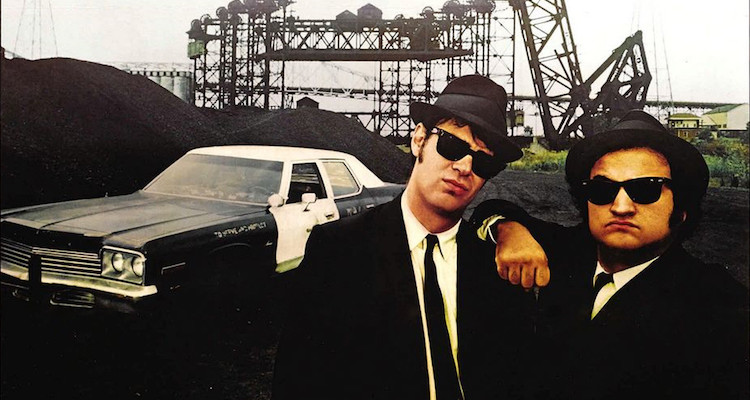
Cinemaligion: ‘The Blues Brothers’

0
Cinemaligion: ‘The Blues Brothers’

If Jake and Elwood Blues taught us anything — and I think you’ll agree they taught us many things — it’s that you can be religiously devout and still have a good time.

Now, “The Blues Brothers” is not a religious tract, and the Blues Brothers are not exactly saints. The film does have a slight smirk to it. But it’s also an exuberant and joyful movie in which the protagonists earnestly strive to do something selfless and good. They say they’re “on a mission from God,” and they truly believe it. They wear dark suits and ties, they always travel as a pair, and they don’t have time for women. Put them on bicycles and they could be Mormon missionaries.

John Belushi gets first billing in the movie, and it’s his character, ex-con Jake “Joliet” Blues, who has the religious epiphany that drives the action. We’re first introduced to him when he’s released from prison, emerging as if from a tomb, bathed in an ethereal glow of light. I don’t want to make too much of it — I suspect the main idea was to present the very popular John Belushi in an exaggeratedly portentous fashion — but I can’t be the only one who thinks of Easter here.

Having been picked up by his brother, Elwood (Dan Aykroyd), Jake’s first stop is to visit the Catholic orphanage where the brothers grew up. They have to see “the penguin,” as they call the head nun, Sister Mary Stigmata (Kathleen Freeman). They’re irreverent, yes, and more than a little clueless when they keep taking the Lord’s name in vain and can’t seem to figure out how this correlates with Sister Stigmata beating them with a ruler. Yet while the Blues brothers are what you’d call “lapsed Catholics,” they retain a certain respect for the traditions of their youth, and they are devastated to learn the orphanage will be shut down unless the nuns can come up with $5,000 in property taxes.

Sister Stigmata doesn’t want them to get the money in their usual fashion, i.e., by stealing it. In fact, she doesn’t want them there at all. “Get out!” she bellows. “And don’t come back until you’ve redeemed yourselves!” This is accompanied by the ominous sound of blowing winds, and the nun floats backwards into her office. The film is making a joke out of the fact that a character has so clearly stated the theme of the movie, and at the same time driving home that theme. Jake and Elwood must find redemption for their sins. And how can they do that? Perhaps some good deeds will help, as taught by Peter in the New Testament: “Above all have fervent charity among yourselves: for charity shall cover the multitude of sins” (1 Peter 4:8).

The Blues brothers are admonished by Curtis (Cab Calloway), the orphanage caretaker who taught them music, to go to church — not a Catholic church, as it turns out, but an evangelical one, led by a dynamic preacher played by James Brown. It is here, during a frenzied gospel number, that Jake sees a heavenly light and realizes they can raise the $5,000 by getting their band back together and doing a show. He shares his revelation with Elwood, who is likewise converted. They dance for joy, exhilarated to have felt God’s inspiration and to have a clear path outlined for their salvation. They have been born again, converted by — what else? — music.

There’s a deep logic to all this. The kind of music Jake and Elwood play is rhythm and blues, tinged with rock. Rock ‘n’ roll had its origins in rhythm and blues anyway; R&B was pioneered by black musicians (including Cab Calloway) in the first half of the 20th century; and R&B was descended from the folk songs sung by slaves as they worked in the fields. Many of those songs were spiritual in nature, with significant religious symbolism, often drawing parallels between the black slaves in America and the Hebrew slaves in ancient Egypt: “Swing Low, Sweet Chariot,” “Go Down Moses,” etc. In other words, the Blues brothers’ musical roots are religious. It makes perfect sense that they’d be converted at a black church during an energetic choir performance.

From here on they are single-minded in their devotion to the cause. Pursued by police, Elwood says, “They’re not gonna catch us. We’re on a mission from God!” But does Elwood sit back and wait for God save them? No indeed. He drives like a maniac through a shopping mall and successfully evades capture. As the apostle James said, “Faith without works is dead” (James 2:20). Even people on missions from God have to put forth their best effort.

The brothers work tirelessly to reunite the band and raise the $5,000. Failure is not an option. Note that while they believe God inspired them, at no point do they ask for his help. They seem to accept that performing this mission might endanger them. When they’re ultimately successful at doing what they set out to do and are thrown in prison for all the laws they broke in the process, they don’t get angry at God for failing to look out for them. They take it in stride. Jesus warned his disciples that they’d be persecuted while on his errand. The early apostles and other Christians were in and out of prison constantly, and that’s when they weren’t being fed to lions. Why should the Blues brothers be any different?

So in a way, Jake and Elwood are religious martyrs. They risk their lives and freedom to do what God asked of them — and not just to save their own souls, but out of a sincere desire to help the orphanage. Like the early apostles, they occasionally “preach” to an unreceptive audience. They make a lot of people angry, including the police, a country-and-western band, Illinois Nazis, and Carrie Fisher. But they never give up.

Would God approve of all their actions? Not according to most theologies, no. You tread on dangerous ground if you start to say that you’re justified in doing ANYTHING if it’s in God’s name. But Jake and Elwood have their hearts in the right place and earnestly strive to do good. Most religions would say that’s the most important thing anyway.

— Cinematical

Mercy

0

Stop me if you’ve heard this one before. A womanizing cad doesn’t believe in true love, even though he makes his living writing novels about it. He sleeps with one beautiful woman after another, never getting attached, always pleased when the women leave before he wakes up in the morning. But his whole world is turned upside-down when, out of nowhere, he actually falls in love with one of them.

Yes, it’s the ol’ “education of a douchebag” story, going by the title “Mercy” this time around and starring Scott Caan, who also wrote the screenplay. (It’s actually his third script; he directed the other two himself, and the first, “Dallas 362,” won the jury prize at CineVegas in 2003.) One is tempted to find autobiographical elements in Caan’s swaggering character, especially since his real-life father, James Caan, plays his dad in the movie, but I don’t know if that’s accurate. But it might be the more charitable interpretation, since without a personal connection there’s no reason to tell a story this generic.

It’s at the release party for his third novel that Johnny Ryan (Scott Caan) meets Mercy (Wendy Glenn), a gorgeous, slender brunette who, unlike most heterosexual women (or so we’re led to understand), is not instantly bowled over by Johnny’s smooth cocky charm. Nor, it turns out, does she like his writing. This wouldn’t normally bother Johnny — he prefers women who can barely read anyway — but in this case it’s troubling because she’s a New York Times book critic. Now with two reasons to pursue her (the usual one, and her negative opinion of his work), Johnny redoubles his efforts to get close to her.

Throughout this, he gives his lovesick friend Erik (John Boyd) the sort of tooly romantic advice you’d expect him to give: avoid commitment, be suave but jerky, etc. At one point, Johnny says, “Usually when women speak I can only hear the teacher’s voice from ‘Peanuts,'” an example not only of Johnny’s shallowness but of Caan’s idea of witty, clever dialogue.

The film is divided, along with Johnny’s life, into two sections: before he met Mercy, and after. The changes in him are obvious to all who know him, including his agent (Dylan McDermott), his married pal (Troy Garity), and his father, a literature professor from whom he is mostly estranged. What’s missing, though, is a point. Love changes a man? Love is fragile and fleeting? Sure, but (not to sound callous) so what? Romantic dramas may not be as plentiful as romantic comedies, but they can be just as formulaic and, without some spark of creativity, just as dull.

Caan was smart not to direct himself this time, handing the reins to first-timer Patrick Hoelck and thus avoiding the appearance of making a vanity project. Were he in the director’s chair himself, his meaty, emotional-rock-bottom scenes would have seemed particularly self-indulgent: “Just look at me ACT!” Instead, they are respectably performed and moderately effective — effective as anything else in the film, anyway. Caan’s past under-the-radar successes aside, “Mercy” never rises above the ordinary, with a bland story and average execution.

Please Give

0

By the looks of things, Nicole Holofcener’s muse must be Catherine Keener. The tart-tongued, throaty-voiced actress has appeared in all four of her feature films, “Walking and Talking,” “Lovely & Amazing,” “Friends with Money,” and the new “Please Give.” Keener, one of the most reliably entertaining actresses currently working, specializes in sardonic, flawed characters — a perfect fit for Holofcener’s image of the modern American woman.

“Please Give” has Keener playing Kate, a New Yorker who owns an antique-furniture shop with her husband, Alex (Oliver Platt). Kate is plagued with the guilt of the well-to-do. She’ll give $20 to a homeless man but won’t give her teenage daughter, Abby (Sarah Steele), the money to buy a pair of jeans. She looks for volunteer opportunities in the community, but everything just makes her feel sadder and guiltier.

Adding to Kate’s guilt is the way she and Alex stock their store: They buy furniture from the next of kin of recently deceased people. The grieving relatives are usually in a hurry to get rid of Mom’s old stuff, and they tend not to know whether it’s worth anything. Kate and Alex have taken this line of thinking into their personal lives, too, buying the apartment next to theirs, to take effect upon the death of the current tenant. They hope she will die soon so they can knock down the wall and combine the units. It’s every New Yorker’s dream.

The not-yet-dead tenant is Andra (Ann Morgan Guilbert), a 91-year-old crank. Her granddaughter, Rebecca (Rebecca Hall), a mammogram technician, takes care of her, which is the only interesting thing in Rebecca’s life. Rebecca’s sister, Mary (Amanda Peet), hates the old bat and does little to help, even though the old bat helped raise the sisters. Rebecca and Mary both think it’s a little ghoulish how Kate and Alex have pre-bought Grandma’s apartment.

This is the basic scenario for a story about imperfect people with self-esteem issues — which describes everyone on earth, of course, so it’s fun to laugh at these characters and think, “I’m not THAT neurotic, am I?” Abby is concerned about her acne and body type. Mary tans obsessively. Kate and Alex are getting older and flabbier. Rebecca is pretty and kind but makes no effort to date. If these people aren’t careful, they’ll wind up like Andra, who is ancient and bitter and long ago gave up on finding happiness in the world.

Holofcener uses blunt, caustic characters like Andra, Kate, and Mary to get laughs — the dinner scene with everyone together is an awkward, hilarious treasure — but she lets them and everyone else develop into relatable people, too. They are objects of laughter as well as of sympathy, though they don’t always deserve the latter.

It could be said that “Please Give” is simply a retread of Holofcener’s other movies, especially “Lovely & Amazing” — but, then, most people didn’t see those movies, so maybe it doesn’t matter. Still, while “Please Give” is often very funny, it feels a little perfunctory. It’s a movie you’ll like but probably not love. Don’t tell the characters that, though. Their sense of self-worth is fragile enough already.

A Nightmare on Elm Street

0

If you get right down to it, “A Nightmare on Elm Street” is a movie about people trying not to doze off. Having just watched it, I know how they feel. OH SNAP!

There was no reason to remake the 1985 slasher classic, of course, except that “Halloween” and “Friday the 13th” had already been remade, and why not finish the set? But surely it could have been done with greater care than is evident here. The idea of a villain who stalks you in your dreams is inherently creepy — or, rather, it ought to be. Leave it to the remake wizards to vacuum all the terror out of something as easy as that.

In the town of Springwood, Ohio, some of the local teens are plagued by nightmares in which a melty-faced, razor-fingered maniac named Freddy Krueger (Jackie Earle Haley) harasses them. It is established that whatever Freddy does to you in your dream happens in real life, too. So, for example, if Freddy gives you a wedgie, you’ll wake up with a wedgie. Or if he slices you in half with a machete, your sleeping body will be rent in twain by an invisible force.

Among the nondescript teens so tormented are Quentin (Kyle Gallner) and Nancy (Rooney Mara), who are both brooding and dark anyway. Somewhat lighter, though still morose, are Kris (Katie Cassidy) and Jesse (Thomas Dekker). Oh, and Dean (Kellan Lutz), but don’t get used to him being around.

Look, I’m not going to mince words. Some of these characters die. What’s disappointing is that not one of them dies in an interesting fashion. Freddy mostly employs traditional methods such as stabbing and slicing, and everyone’s dreamworld seems to be a boiler room, the kind where there’s always lots of clanging and steam and whatnot. Everything that happens, ever, to anyone, is accompanied by knife-sharpening sound effects and bursts of “scary” music. This is Scary Movie Making 101, and first-time director Samuel Bayer (he made music videos before this) may be required to repeat the course.

Does it need to be said that the screenplay — written by Wesley Strick (“Cape Fear,” “Arachnophobia”) and rewritten by Eric Heisserer (his first film credit) — has the characters speaking only the most generic dialogue? And that the characters themselves have no discernible personality traits? And that there are no real “protagonists,” per se, only characters who manage to not get killed? This does not need to be said? OK.

What the film does get right is Freddy Krueger. The later sequels in the original franchise turned him into a joke, a one-liner-dispensing fraud without an ounce of scariness. The new Freddy gets back to basics. Played with malevolent glee by Jackie Earle Haley, this Freddy is good and creepy, the way nature and Wes Craven intended. Too bad he’s trapped in a nightmare of his own: a movie devoid of wit, originality, inspiration, or suspense. Wake me up when they come out with something new.

The Human Centipede

0

You are familiar with the type of horror movie in which attractive young people get lost in a rural area and seek refuge at the only house they can find, where they learn, to their great dismay, that the occupants are homicidal maniacs. That is the template. Only the details — the crazies’ motives and methods; which, if any, of the attractive young people get to survive; etc. — differ from film to film.

“The Human Centipede” is one of these movies. It has become infamous for its ideas, which are weird and gross, but don’t be misled. It’s not ultra-violent. It’s not “torture porn.” There’s more pain and suffering in any of the “Saw” or “Hostel” movies than in this. “The Human Centipede” is basically an unremarkable innocents-captured-by-maniac thriller that happens to have one perverse idea as its central gimmick.

That one idea is pretty gross, though. We’ll get to that in a minute.

Two impossibly stupid American girls, Lindsay (Ashley C. Williams) and Jenny (Ashlynn Yennie), are vacationing in Germany. One night, while looking for a trendy dance club they’ve heard about, their rental car gets a flat tire in the middle of nowhere. Their only option is to walk through the thick forest, in the rain, in search of help. The viewer is reminded of all the horrible things that have happened in German forests, as documented by the Brothers Grimm. But instead of finding a gingerbread house occupied by a witch, Lindsay and Jenny find an ordinary ranch-style home occupied by Dr. Heiter (Dieter Laser).

Unlike most of the lunatics in these stories, Dr. Heiter makes no attempt to conceal his creepiness. “I don’t like human beings,” he says, matter-of-factly. (Speaking in my capacity as a human being, I’d say the feeling is mutual.) Soon enough, the girls are captive, and Dr. Heiter is using an overhead projector and diagrams to explain his plan.

Are you ready?

Alt textDr. Heiter wants to turn the two girls and a third victim into a human centipede. Person B’s mouth will be surgically attached to Person A’s anus, and Person C’s mouth will be surgically attached to Person B’s anus. You do not want to be Person B. Everyone’s knee ligaments will be severed so they can’t stand up, only crawl. One of Dr. Heiter’s helpful drawings is reproduced here.

Now, why Dr. Heiter wants to do this is beside the point. Is there a reason he could give that would make you say, “Oh, sure, that makes sense”? He’s an old-fashioned mad scientist, with a sterile, well-lit operating room in his basement. His methods are precise. He is not a slasher or torturer. When he finds it necessary to reject a centipede candidate, he kills the person via lethal injection. He uses anesthesia during the surgeries. He doesn’t wallow in pain, nor does the movie.

Well, except for that one central idea, which is painful, humiliating, and absurd to look at. It’s also disgusting, though thankfully the particulars of that are not shown in great detail. (Considering the subject matter, the film is actually pretty restrained.) Once you get used to the image, the movie stops being shocking. In fact, while the film’s marketing and word-of-mouth campaigns have touted its gross-out factor — see this movie if you dare!, that sort of thing — I don’t get the impression that that’s what the filmmaker, Dutch writer/director Tom Six, was going for. If that were his intent, he’d have amped up the surgical gore, the scenes of torment, the cruelty.

No, it seems to me that “The Human Centipede” was meant to be a horror story about young people held captive by a lunatic — and perhaps even a parody of such stories. Lindsay and Ashley are one-dimensionally dim, and the actresses who play them are not, shall we say, gifted in the dramatic arts. (That’s one thing that helps the movie go down more smoothly: The acting is so bad that you never really believe they’re in danger or pain.) The central idea is ludicrous, like an over-the-top spoof of the crazy things mad scientists used to do in old B-movies (keeping severed heads alive in jars, attaching animal parts to humans, etc.), only portrayed more realistically. When Dr. Heiter carries his third unconscious victim (Akihiro Kitamura) into the house, there’s still a tranquilizer dart sticking out of the guy’s rear end. And there’s the doctor’s flat refusal to even pretend not to be insane, even when trying to lure victims. All of that is funny, right? Maybe funny on purpose? Maybe?

I don’t know anything about the German actor Dieter Laser, except that he’s quite effective as Dr. Heiter. His severe face is composed entirely of sharp angles and treacherous valleys, and his demeanor seems to match. The character’s voice — I hope that’s not Laser’s normal speaking voice — is guttural and otherworldly. It could be the voice of Satan himself, if Satan is German. (Who am I kidding? Of course he’s German.)

Six achieves a fair amount of suspense with the standard trying-to-escape scenes, but the whole enterprise runs out of steam before it’s done. I mean, once you’ve made a human centipede, what else is there to do? Films of this genre tend to have one-note plots — get captured; try to escape — and I don’t think the, uh, unique elements of this one entirely compensate for the lack of originality elsewhere. Still, there is some measure of skill on display, and I’m not just saying that because I’m afraid Tom Six and Dieter Laser will come to my house and make me into an aberration, although I am somewhat afraid of that.

Freddy’s Dead: The Final Nightmare

Freddy’s Dead: The Final Nightmare

Unlike “Friday the 13th,” which was lousy from the beginning, the “Nightmare on Elm Street” franchise started out scary. Who wouldn’t be afraid of a prune-faced man who visits you in your dreams and makes terrible puns while killing you? But by the time the sixth “Nightmare” rolled around, the people responsible for the films had long since given up on being scary. They had also given up on being funny, original, entertaining, interesting, tolerable, or not stupid. One suspects they had given up on life itself.

The sixth “Elm Street” film is called “Freddy’s Dead: The Final Nightmare,” the rare instance of one title containing two lies. (Actually, if you want to get technical, Freddy has been dead since before the series started. But you do not want to get technical.) Onscreen titles tell us that it takes place 10 years from “now,” which was 1991, so it’s 2001, and all but one of the kids in Springwood, Ohio, have been murdered in their sleep by Freddy Krueger. So congrats on reaching your goal, Freddy! Say what you will about him, the guy is a self-starter.

The remaining unkilled youth is a teenager called John (Shon Greenblatt) who keeps having dreams and then waking up from them and then having more dreams because it turns out he didn’t really wake up the first time, and so on, in a most tedious fashion. At last Freddy lets John out of his dreamworld, depositing him on the side of the road a few miles from Springwood. Freddy has some kind of plan in mind and is using John for bait. The viewer cannot be 100 percent sure at this point, but we get the impression Freddy’s plan will involve the murder of additional children.

John has amnesia now, remembering only that he needs to avoid falling asleep, which, paradoxically, means he should not watch the film he is in. He winds up at a center for juvenile delinquents, run by Maggie (Lisa Zane), a harried but compassionate social worker. Everyone calls the place a “shelter,” which suggests people are free to come and go as they please, but then some of the kids appear to be there against their will. The whole thing seems shady to me. Maggie has tough conversations with troubled teens’ parents, as when a jerky man complains that his criminal son is still a criminal. “I expected to see some improvement!” the man says. “He’s not a Toyota!” Maggie snaps back, referring to the boy’s ability to stop when his brakes are applied.

Maggie soon discovers that she and John are having similar dreams, all of them connected to Springwood. She figures that if they visit the town, which is two miles away, something will trigger John’s memory and his amnesia will subside. This is a plot hole: Surely a trained clinician such as Maggie would be aware that the simplest cure for amnesia is to bonk the victim on the head in a comical fashion, a method pioneered by Dr. Jack Tripper.

So Maggie and John take the shelter’s van for a little drive to Springwood, but what’s this? They have stowaways! Spencer (Breckin Meyer), the boy who is not a Toyota, has hidden in the back of the van with tough girl Tracy (Lezlie Deane) and hard-of-hearing boy Carlos (Ricky Dean Logan), in an attempt to escape from the facility. Maggie is vaguely upset with the kids for doing this, but not upset enough to drive the two miles back to town to drop them off. Instead, she gives them the keys and orders them to drive “themselves” back while she and John look for clues in Springwood. How will she and John get home? Does she really expect the trio of delinquents whose stated goal is to escape juvie to voluntarily return to juvie? Those are just two of the questions that “Freddy’s Dead*: The Final* Nightmare” is assuming you will be too bored to ask.

Spencer, Tracy, and Carlos can’t find their way out of Springwood, on account of the town is bewitched, or something, so they stop at a dilapidated house on Elm Street, which I’m sure I don’t need to tell you is a street on which nightmares have been known to occur with some regularity. The kids, who are tough, use a lot of tough language, as conceived by clueless Hollywood writers who do not know what tough people sound like. “This place makes the shelter look like the Ritz!” one of the kids says, apparently having wandered in from a Marx Brothers movie.

Meanwhile, Maggie and John are poking around at the town carnival, which is more unsettling than your average town carnival because there are no children anywhere. Even worse, Maggie and John are accosted by a gross married couple played by Roseanne Barr and Tom Arnold. (Eerie how the filmmakers predicted in 1991 that 10 years later Roseanne and Tom would be carnies.) All the adults in Springwood have been traumatized by their children’s deaths at the hands of Freddy Krueger — who, I should remind you, is a character in this film, regardless of what you might think so far.

Maggie and John figure out that before Freddy was murdered by the townspeople in retaliation for murdering their children, he had a child of his own! One he did not murder! Maggie and John find a drawing this child made in school, signed “K. Krueger,” because 5-year-olds are famous for signing their crayon scribblings with a first initial and a surname. “K. Krueger?!” John says. “It could mean anything from Kevin to Kyle!” Having thus exhausted the entire range of names that begin with “K,” he and Maggie wonder where the missing Krueger offspring is now. Presumably he or she was adopted by another family and got a new name. Could it be John, who has amnesia and wouldn’t be able to remember if he was adopted at some point? Or could it be Maggie, who doesn’t remember being adopted or ever having a different name, but whose dreams tend to feature a pre-death, pre-burnt Freddy Krueger? I will give you three guesses! OK, it’s Maggie.

Back at the Elm Street house, the kids are just chillin’, waiting to fall asleep so Freddy can murder them. At last Freddy deigns to make a cameo in the film that bears his name, and he goes through his usual shtick: kid dozes off, has a dream, Freddy barges into the dream, kills the kid in an ironic fashion. For example, Carlos the hard-of-hearing boy is given super hearing in his dream, whereupon Freddy makes a very loud noise and causes Carlos’ head to explode. Ha ha! That’s what you get for wishing you could hear, ancillary character whose disability ensured he would die first!

And it goes on like that for a while. Turns out Freddy was using John to lure Maggie to Springwood, because Maggie is his long-lost daughter, and through her he can move to another town and start killing again. The movie is not clear on how this will happen, or why Freddy was previously confined to Springwood, or whether that confinement extended into unincorporated county land adjacent to Springwood — you know, where the residents have Springwood mailing addresses but don’t “technically” live in Springwood — or whether it was restricted to the city limits proper. I would like to see the minutes from the city council meeting where these matters were discussed.

Now that she understands her connection to Freddy, Maggie’s plan is to go to sleep and somehow access Freddy’s own memories. Did you know that you can enter your father’s subconscious mind? Well, you can, if you have a beeping machine that looks all science-y, like the doctor at the shelter does. Maggie goes strolling through Freddy’s childhood and discovers that he was a psychopath who hurt animals and was bullied by the other children, then finds him in the present and drags him out of the dreamworld and into real life, where he can be killed. I’m pretty sure this is what happens at the end of all the “Nightmare on Elm Street” movies, though, so I’m not optimistic about its longterm success here. Still, I’ll be OK as long as they don’t try to reboot the series and start over again with– what? Aw, crap.

— Film.com


Sex & Drugs & Rock & Roll

0

You may recall that “Sex & Drugs & Rock & Roll” was the name of a song by Ian Dury and the Blockheads, a British New Wave punk band from the late 1970s and early ’80s. If you don’t remember it, or if you’re not sure you’ve heard of Ian Dury, the film named after the song will do little to enlighten you. Dury may have been a colorful figure, and the film is stylishly directed, but it follows the same musical-biopic formula already used in countless other movies. There’s nothing here for someone who isn’t already an Ian Dury fan.

It might create some new Andy Serkis fans, though. The English actor, so far best known for playing Gollum in the “Lord of the Rings” films, gets to show his real face (it looks like Rowan Atkinson’s) and perform without digital enhancement. His lively performance has as much gusto as the real Ian Dury’s must have. The band’s concerts look like a cross between a rock show and a circus, with Ian, in gaudy costumes and burlesque makeup, acting the part of the carnival barker. Serkis clearly relishes the experience.

Offstage, he plays Ian as a temperamental S.O.B., as is common among rock stars, and especially among rock stars who have movies made about them. A childhood bout with polio left Ian with a bum leg, and flashbacks — yes, there are flashbacks — show his troubled relationship with his father (played by Ray Winstone) and the headmaster (Toby Jones) at the school for disabled children he was sent to. As an adult, Ian is stubbornly committed to living life on his own terms, which appears to mean doing pretty much whatever the hell he wants to. His wife, Betty (Olivia Williams), must come downstairs immediately after giving birth to their child to ask him and his bandmates to please keep the noise down.

The screenplay, by first-timer Paul Viragh, jumps around the timeline quite a bit, so it’s hard to know exactly when everything is occurring. But it would seem that at some point in the 1970s, Ian leaves Betty and shacks up with a groupie named Denise (Naomie Harris), who is younger and more carefree, what with not having to support Ian’s children. We should feel bad for Denise (or maybe for Naomie Harris), because later she will be required to utter the line, “My mistake is loving him.”

The trajectory will be familiar to anyone who has seen any movie of this genre: fame, success, wild times, setbacks, egomania, substance abuse, and so forth. Its only distinction, apart from Serkis’ engaging, rubber-faced performance, is the direction, by Mat Whitecross. Normally a documentarian (this is his first narrative feature), Whitecross has a flair for the visual that doesn’t overstay its welcome or become cute. He moves from real life to the stage fluidly, suggesting that Ian’s life is one big performance.

But what Whitecross fails to establish is why any of this matters. I had no particular interest in the music of Ray Charles before I saw “Ray”; afterward, I wanted to check him out. The same goes for Johnny Cash and “Walk the Line.” “Sex & Drugs & Rock & Roll,” on the other hand, does nothing to pique my curiosity about Ian Dury. He strikes me as just another rock star with the usual tumultuous lifestyle, given the run-of-the-mill biopic treatment. He probably deserves better.

Friday movie roundup – April 23

1

Bad news, everybody! Both of the new releases this weekend are bad. “The Losers,” which wants very much to be “The A-Team,” is the kind of bad that’s bearable. But “The Back-Up Plan,” starring Jennifer Lopez as a woman who gets artificially inseminated and THEN meets the man of her dreams, is the intolerable kind of bad. I will not tolerate it.

Oh, and there’s “Oceans,” a nature documentary, but it didn’t screen for critics in Portland, so it’s dead to me.

“Best Worst Movie,” a very fun documentary about terrible cult favorite “Troll 2,” opens today at the Alamo Drafthouse in Austin. It’ll hit New York and L.A. in a couple weeks and spread out from there. I’ll remind you about it later, but any Austinites within the sound of my e-voice should check it out immediately.

What was I up to over at Film.com this week? Golly, there was What’s the Big Deal?, focused on “La Dolce Vita,” a film I like very much. Then there was Eric’s Bad Movies, featuring “American Ninja,” about a ninja who is — wait for it — American. I also wrote a piece explaining the differences between the upcoming “Furry Vengeance” and the upcoming “Nightmare on Elm Street” remake.

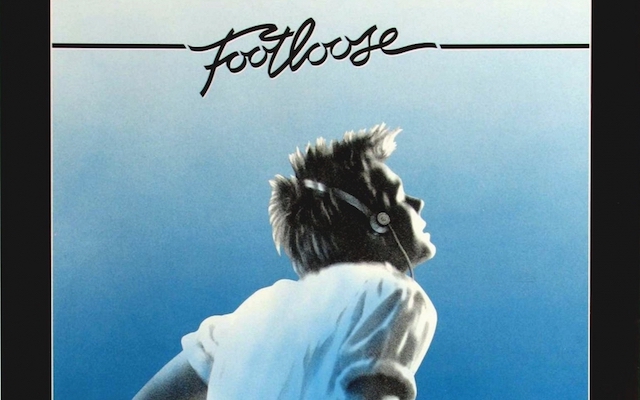
Last Friday, I debuted a new column at Cinematical about religion in film. It’s called Cinemaligion! I love that title because it’s terrible but memorable. Cinemaligion! You should say it out loud. Anyway, the first Cinemaligion column is about “Footloose.” The feature will run every two weeks.

Thanks to everyone who’s been listening to “Movie B.S. with Bayer and Snider” at PDX.fm! Remember, you can listen live at 11 a.m. (Pacific) every Friday at PDX.fm, or get the recording a couple hours later at the website or from iTunes. (Once again, ignore the “explicit” tag. We keep it PG.) Jeff is out of town this week, so I have a guest sidekick, Portland filmmaker and personal acquaintance Andy Blubaugh. Listen to us, won’t you? WON’T YOU? WHY WON’T YOU??

Subscribe to Eric D. Snider’s “In the Dark,” a weekly e-mail bringing you the latest movie reviews, DVD releases, and other pertinent info, here.

Best Worst Movie (documentary)

0

When Michael Stephenson was a young boy in Utah, he got the starring role in a film that was being shot locally by an eccentric Italian husband-and-wife team who knew how to crank out bad movies cheaply. This one, ostensibly a horror, was called “Goblins,” though by the time it was released — straight to video, in 1990 — it had been retitled “Troll 2” in order to capitalize on the marginal success of a 1986 monster flick called “Troll.” The so-called “Troll 2,” however, had no connection whatsoever to the earlier film. It also didn’t have any trolls in it. Here’s a movie that has failed before you even start watching it.

In the last several years, “Troll 2” has gained cult status as a bizarrely, hilariously, epically bad movie. Everything that goes into a film, from the acting to the costumes, from the writing to the hair and makeup, is badly done, making it a singular treat. Midnight screenings of the film play to packed audiences, with fans (who enjoy its badness, not who claim it’s good) reciting their favorite lines ala “Rocky Horror Picture Show.” People show it to their uninitiated friends, eager to bring them into the cult.

But back to that kid. All grown up now, Stephenson was fascinated by the phenomenon that this embarrassing blemish on his résumé had caused, and he set out to document it. “Best Worst Movie” is the result, a riotously funny look back at the behind-the-scenes madness of “Troll 2,” and at the unlikely success it has had in recent years.

Make no mistake: “Best Worst Movie” is not an attempt to explain why “Troll 2” is misunderstood, or to convince us that it’s some under-appreciated work of avant-garde genius. No, Stephenson is well aware that “Troll 2” is complete garbage. So are almost all of the cast members, most of whom cheerfully reunite with Stephenson to swap stories about the production and laugh at how bad it turned out. Some of them, like George Hardy — an Alabama dentist who played Stephenson’s father — have made personal appearances at “Troll 2” screenings to laugh at the film alongside everyone else.

The anecdotes that emerge as Stephenson reunites with his costars are raucous, good-natured tales about low-budget filmmaking at its goofiest. One actor, who played a milk salesman in the movie, was literally in a mental institution during the shoot and was allowed to come out for the days he was needed on the set. (He says he was stoned the whole time.) The actress who played Stephenson’s mother now takes care of her own mother in Salt Lake City and is, to put it delicately, almost certainly mentally ill. Stephenson treats her with respect, though it is hard not to laugh at her spacey ruminations on “Troll 2,” which she seems to think was a good movie.

Another actor, his character having been turned into a plant (that sort of thing happens in “Troll 2”), had to stand stock-still for hours at a time. When he complained, the director had the costume department rework his plant suit so it would cover his mouth.

Ah, yes. The director. His name is Claudio Fragasso (he used the name Drake Floyd in the credits), and he wrote the screenplay with his wife, Rossella Drudi. Both of them appear in “Best Worst Movie,” speaking very broken English and apparently not “getting” the whole thing. Apart from the aforementioned actress, they are just about the only people in the world who earnestly believe “Troll 2” is a quality picture that accurately represents their vision. Drudi defends it vigorously as a satire on vegetarianism. Fragasso attends one of the rowdy screenings and is puzzled by the audience’s response. “People laugh at the funny things, but they also laugh at the not-so-funny things.” The “not-so-funny things” that people laugh at, of course, are the things that Fragasso intended to be taken seriously. The “funny things” are funny for the wrong reasons.

Serving as the documentary’s protagonist, essentially, is George Hardy, an immensely likable, regular ol’ boy described by someone as “the rich man’s Craig T. Nelson.” He has no illusions about his work in “Troll 2.” His own mother, asked about his performance, laughs and says, “He’s no Cary Grant.” He maintains a dental practice in Alexander City, Ala., but is thrilled to go along for the ride as “Troll 2” enjoys its peculiar success.

But it’s a campy, ironic success — he’s famous because he’s a bad actor in a bad movie. People enjoy that sort of thing as far as it goes, but not with the same fervor and devotion that they enjoy, you know, GOOD things. Your 15 minutes run out pretty fast in a situation like that, an issue that “Best Worst Movie” addresses to some extent. The focus, though, is chronicling a strange pop-cultural phenomenon and sharing some laughs about the absurdity of it all. If you’ve ever loved something terrible — or, worse, produced something terrible — “Best Worst Movie” feels your pain.

[You may also be interested in my Cinematical report on watching “Troll 2” for the first time.]

The Back-Up Plan

0

It happens every time. The minute you get in the bathtub, the doorbell rings. As soon as you wash your car, it rains. And the very day you’re artificially inseminated so you can have a child on your own, you finally meet the man of your dreams. Whaddaya gonna do?

This is “The Back-Up Plan,” an aggressively unoriginal and unfunny romantic comedy starring Jennifer Lopez as Zoe, a gal who wants to have a baby but is tired of waiting for a mate. We’re not told why reproducing is so important to her, or why she hasn’t been able to land a fella so far. When we meet her, she’s already at the doctor’s office with her legs in the air, having the procedure done clinically. A few lines of voice-over as she talks to herself is all we get in the way of back story. “The Back-Up Plan” has to move fast, or it’ll never cover all the cliches in time!

Like all romantic-comedy characters, Zoe lives in New York City and has a cute job. (She owns a pet store!) She has a couple of snarky friends-slash-coworkers (Eric Christian Olsen and Noureen DeWulf) who appear at the beginning of the film, crack some jokes, then disappear until the end; and a snarky married-with-children friend (Michaela Watkins) who’s around the whole time. She has an ancient grandmother (Linda Lavin) who Tells It Like It Is, which means she gets to say “douchebag” and drop the movie’s only F-bomb, ha ha, because it’s funny when sweet old ladies say vulgar things, get it?

Just after leaving the doctor’s office, Zoe gets into a taxi at the same moment as a man named Stan (Alex O’Loughlin). They have stolen each other’s cab! This is wacky and unexpected. Now they must hate each other, then run into each other again, then fall in love. Stan also has a cute job: He owns a goat farm and makes cheese! My oh my will he ever be surprised to learn that his new girlfriend is already pregnant! KA-ZOING!

And did I mention it’s TWINS?? GA-GA-GA-ZOOEY!

I detect the inkling of a good premise in here somewhere. There is great potential in a single woman falling in love after having already gotten pregnant. “The Back-Up Plan” strenuously avoids mining the scenario for legitimate comedy, however, in favor of following the same checklist of plot points as every other rom-com. The pregnancy aspect — the thing that could make this different from most rom-coms — often takes a back seat so we can focus on dumb things like poop jokes and barfing dogs.

The screenplay, by TV scribe Kate Angelo, rushes through Zoe and Stan’s courtship. It’s on their third date that Zoe reveals she’s pregnant. Stan is furious that she didn’t tell him sooner, because rom-coms need people to get angry about a lie that someone has told them — never mind that at this point he’s only known Zoe two weeks and has seen her twice. Seconds later, they’ve reconciled, and are suddenly a long-term committed couple, just like that, having skipped the “dating” and “falling in love” part. Do they believe this is an all-or-nothing proposition, that either they’re together for life, or Stan leaves now and they never speak again? Can’t they just, you know, DATE, and see where it goes?

Apparently not. See, the movie, directed by first-timer Alan Poul and composed entirely of contrivances, needs it to be established that Zoe and Stan are in it for the long haul. Why? So that Zoe can fret about whether Stan is really in it for the long haul. But where it usually takes an entire film for two people to work through their problems and become a committed couple, here we have to get to that point in about 45 minutes, to leave time for the pregnancy shenanigans (she’s too fat for her clothes lol). So everything is sped up, hastily thrown together. It’s as if two movies are being crammed into one, and neither of them is any good, and both of them have J-Lo.

This is the kind of movie where you could stop the projector 30 seconds into any scene and accurately predict what’s going to happen next. Every joke is broadly telegraphed. I can’t imagine being surprised by any aspect of it. A couple of gags hit home, particularly in Anthony Anderson’s two scenes as a random father who tells Stan what it’s like to be a dad. J-Lo and Alex O’Loughlin, if not exactly cut out for comedy, are at least good-looking. At every turn, the movie takes the safest, most generic, most heavily trafficked path, as if determined to avoid standing out in any way. Mission accomplished! As soon as I type this last period, I will forget everything about this movie.

Ahhhh…

The Losers

0

“The Losers” is one of those jokey, comic-book-based action movies where things get blown up a lot and nobody takes anything seriously. That in itself is fine, but “The Losers” takes the nonchalance too much to heart and comes across as lazy. It’s big but not big enough to be over-the-top; it’s snarky but not actually funny; it mimics action-flick cliches but doesn’t subvert them enough to be parody. The movie is pointless, but not the fun kind of pointless.

The title characters are an A-Team-ish squad of Army special ops guys who have names like Pooch and Roque and are introduced according to their areas of expertise: Jensen (Chris Evans) is the computer hacker, Pooch (Columbus Short) handles transportation, Cougar (Oscar Jaenada) is a sniper, Roque (Idris Elba) is second in command and has a scar on his face, and Clay (Jeffrey Dean Morgan) is the team leader. They’re executing a mission in Bolivia when they’re targeted by a mysterious CIA figure named Max who wants them dead. They let him think he’s succeeded in blowing them up, then plot how to clear their names (they were accused of wrongdoing during the incident that “killed” them) and bring Max down.

Assisting them is Aisha (Zoe Saldana), a bewitching and athletic gal who has her own reasons for wanting to get to Max. Our introduction to Aisha is emblematic of the film’s wrongheadedness. She flirts with Clay in a bar and gets herself invited to his hotel room, whereupon she reveals that she knows who he is and has ulterior motives. This leads to a knock-down, drag-out fight, in which the room is destroyed and the hotel set afire. It’s only afterward that we learn Aisha wants to HELP Clay, not hurt him — which means the whole fracas was unnecessary, except as an excuse for the movie to show a sexy fight and destroy some stuff.

The problem isn’t that the sequence adds nothing to the story. A lot of action-movie sequences, when you break them down, don’t advance the plot. The problem is that “The Losers” makes no attempt to hide it. Clay and Aisha have a wholly useless fight just because it’s fun to watch attractive people beat each other up. Couldn’t the screenwriters — Peter Berg and James Vanderbilt, who collaborated on “The Rundown,” which did this kind of thing a lot better — have found a legitimate reason for it? Eh, why bother?

Max turns out to be played by Jason Patric as a James Bond sort of villain, complete with unexplained and unnecessary physical peculiarity (a withered hand usually covered by a glove). Max is cartoonishly cruel and frequently snide — but, as with most of the film’s elements, not enough to be a parody of such things. He straddles the line between hammy and menacing. The rest of the cast, though eager and photogenic, is left hanging by a script that doesn’t give them clear characters to play.

We’ve recently seen a lot of movies that deliberately overdo the frenzied action, taking it to absurd levels as a means of commenting on how absurd these movies are. “The Losers,” directed by Sylvain White (“Stomp the Yard”), keeps feeling like it wants to do that, but it never cuts loose enough to make it happen. It occupies the middle ground between sincerity and sarcasm, not exciting enough to be taken seriously and not funny enough to laugh at.

American Ninja

American Ninja

Everyone knows that ninjas were super-stealthy spies and assassins who operated in Japan hundreds of years ago. But what if there were ninjas TODAY? And what if one of them were — stay with me here — an AMERICAN?? The 1985 action film “American Ninja” imagines such a fantastical scenario, demonstrating in the process that while we might be better at making fast food and pornography, the Japanese have us beat when it comes to the production of ninjas.

“American Ninja” was originally supposed to star Chuck Norris, if that tells you anything, which it should. Instead, they got Michael Dudikoff, a James Dean-y fellow whose resume includes titles like “Avenging Force,” “Platoon Leader,” “River of Death,” “The Human Shield,” “Chain of Command,” “Moving Target,” and several “American Ninja” sequels. In a parallel universe, he IS Chuck Norris. (In that universe, Chuck Norris is a pacifist antiwar protestor who teaches women’s studies at Berkeley.)

Dudikoff plays Pvt. Joe Armstrong, an Army grunt stationed at a U.S. military base in the Philippines. Joe doesn’t use a lot of words — not a single line in the first 15 minutes of the movie — but his blank expression says plenty. (Specifically: “I have no idea what I’m doing.”) The other soldiers don’t know much about him because he’s new and didn’t participate in the get-to-know-you games during orientation.

american ninja

Joe is one of the soldiers escorting the colonel’s spoiled daughter, Patricia (Judy Aronson), from the Army base to the airport. Patricia needs an escort — an entire convoy, in fact — because there are local rebels who like to hijack military vehicles. Sure enough, the convoy is stopped by armed thugs who want to steal their equipment. The Army dudes (who I guess are not armed?) are cooperating until one of the bad guys punches Patricia in the face. Pvt. Joe Armstrong will not abide the punching of a lady, so he steps forward and starts a fracas. The Army dudes are now beating the crap out of the hijackers when suddenly a bunch of ninjas emerge from the jungle and attack. It’s not clear whether the ninjas are affiliated with the hijackers — if so, why didn’t they step in sooner? — or whether they’re just a freelance band of ninjas who happened to be passing by and saw a fight they could get involved in. At any rate, four American soldiers are killed while Joe and Patricia escape into the jungle.

Patricia does not appreciate having her life saved. She screams and complains a lot, like the women in adventure movies always do. Her apparent position is that she was doing just fine being punched by Filipino rebels, THANK YOU VERY MUCH, and she didn’t need Joe to get her out of harm’s way. When the ninjas pursue them through the jungle, a quick-thinking Joe — who still hasn’t spoken, by the way, probably because he couldn’t get a word in edgewise — breaks the heels off Patricia’s shoes and tears her dress into something resembling pants, all so she can move faster. In return, Patricia demands to know how Joe is going to pay for the clothes he’s ruined. You’d think she’d be impressed at his ability to MacGyver a dress into pants, but no. She hates him.

american ninja

Back at the scene of the hijacking, Army officers have arrived to find their convoy wiped out. Says one of them: “This massacre was the work of ninjas!” (What, did they leave a note?) Then Joe and Patricia get back to the base, where everyone is mad at Joe because four of their comrades got killed in the melee. The hijacking was going just fine when we were standing there peeing our pants and cooperating with the thugs, THANK YOU VERY MUCH. The colonel’s stupid daughter gets punched in her stupid face and suddenly Joe has to fight back? Absurd! The Army will not tolerate bravery in the face of danger, Pvt. Armstrong.

It may seem ludicrous that these men would believe Joe should have let Patricia keep getting punched in the face rather than intercede, but remember, that was Patricia’s opinion, too.

Surely her dad, the colonel, is grateful that Joe stepped in, right? NO SIR. “I suppose you think you’re some kind of hero because you brought my daughter back alive?” he snarls. Joe, viewing this as a trick question, does not answer. The colonel’s vote is the same as everyone else’s: When hijackers punch his daughter, the U.S. Army is expected to stand there and watch.

By the way, the colonel is played by an actor named Guich Koock, who played redneck cops in the sitcoms “Carter Country” and “She’s the Sheriff” His resume is of little importance, however, because his name is Guich Koock. Guich Koock. I don’t even know how to say “Guich.” Gwich? Gooch? Gooch Kook? Like the Beach Boys song, “Little Gooch Kook”? Though no longer working, the actor is still alive, and is still presumably named Guich Koock.

american ninja

Anyway. Everyone at the base is pretty steamed at Joe for being chivalrous and getting their buddies killed. One of the guys picks a fight with Joe and loses handily, whereupon they become best friends and everyone gets over that thing they were mad at Joe for, whatever it was. Patricia has suddenly changed her tune, too, and is now in love with Joe, whom she previously hated for saving her life. This transformation began right around the time that he had to take his shirt off in the jungle, when the camera lingered on his torso and Patricia salivated.

american ninja

The movie’s in a fix now, though. It presented a dumb conflict — everyone’s mad at Joe for saving Patricia — then resolved it quickly and also dumbly. What do we do now? Ah, yes: A wealthy local plantation owner named Ortega (Don Stewart), who has a Spanish name and a French accent, is ostensibly an honorable businessman but is secretly a weapons dealer. And what does Ortega grow on his plantation? Ninjas! Under the direction of the Black Star Ninja (Tadashi Yamashita), they train at the plantation and are at Ortega’s beck and call whenever a situation arises that requires ninjas. (You’d be surprised how often that is.) Also on hand is a mysterious Japanese gardener, Shinyuki (John Fujioka), who never says anything but seems to know his employer is shady and will probably become important later in the film.

Ortega, who is in cahoots with some of the top Army dudes, has the cigar-chomping Sgt. Rinaldo (John La Motta) send Joe on an “errand” that will actually be a trap, with the Black Star Ninja and his gang ready to pounce. Since a team of ninjas was unable to kill Joe earlier, it naturally follows that they’ll be able to do so now. I mean, law of averages, right? But no, somehow Joe single-handedly defeats them again, in a clunky and lethargic fight sequence that looks like a high-school production of “Enter the Dragon” The IMDb trivia for “American Ninja” notes that Michael Dudikoff had no martial arts training before this movie, and it is evident that he didn’t have much during it, either. Still, he’s no worse than the “ninjas,” whose fight skills are a disservice to the honorable ninja name. They should be called non-jas, am I right??

Also, they should try shooting him. The stories I read in the paper suggest that this is often an effective method for killing someone.

It’s revealed that Joe was an orphan child who lost his memory a few years ago, which is why he’s so enigmatic and brooding. It’s also revealed that after he was orphaned, he was trained in the ways of the ninja by none other than Shinyuki, the mysterious Japanese gardener who works on the ninja farm! Who would have guessed that Joe’s secret trainer would be the one Japanese character in the movie?!

But what about Patricia? Remember her, the one who started this whole mess by getting punched in the face? The one who hated Joe, then suddenly loved him once he took his shirt off? Well, during the brief moments when Joe isn’t walking into one ambush or another and fending off incompetent ninjas, Patricia goes on a date with him. The movie wants us to think they’ve fallen in love, but I’m not buying it.

Joe gets thrown in the brig for leaving the base, whereupon he is attacked by ninjas “again,” with the same results as the previous times, i.e., several ninjas are killed while Joe remains alive. When at long last Ortega himself fires a gun at Joe, we discover that Joe is one of those action heroes who simply cannot be hit by bullets, no matter how many are fired. The ninjas probably intuited this, so let’s go easy on them for not trying it sooner.

Everything turns out OK in the end for Pvt. Joe Armstrong, the American Ninja. He’ll never defend a woman’s honor or save her life again. He learned that lesson! As for Ortega, his weapon-smuggling and ninja-farming operations are shut down. The weapons are destroyed, and the ninjas are placed with good families who have big yards where they can run and play. Everyone lives happily ever after, I reckon, except for Guich Koock, who sources confirm is still named Guich Koock.

— Film.com

Zonad

0

The moment “Zonad” clicked for me was about halfway through, when Cinematical editor Erik Davis leaned over and whispered, “This is like a ‘Simpsons’ episode.” Yes! Exactly! I mean, you shouldn’t talk during the movie, but yes! The cheerfully implausible story line, the dimwitted but recognizable townsfolk, the cartoonish disregard for reality — if everyone were painted yellow and missing a finger on each hand, you’d swear Fox had commissioned an Irish translation of a season 10 episode.

“Zonad” is actually the work of brothers John and Kieran Carney. John wrote and directed the sweet indie hit “Once” a few years ago, but “Zonad,” based on an unreleased short film the Carneys made in 2003, couldn’t be more different from that. The Tribeca Film Festival program calls it a “zany romp,” which makes it sound awful — I think the same description appears each week in TV Guide next to “According to Jim” — but no, it really is a zany romp, in the best possible way.

A quaint Irish town called Ballymoran is the setting, where one night the Cassidy family comes home to find a visitor from space unconscious in their living room. They know he’s a visitor from space because he’s wearing a red vinyl suit and a helmet, and because everyone just came from a stargazing event that got them thinking about the possibility of life on other planets. The people of Springfie– er, Ballymoran are highly suggestible.

Zonad (Simon Delaney), as he calls himself, is not an alien. His name is Liam, and he escaped from a nearby alcoholism rehab center and got plastered on the Cassidys’ booze. But the alien thing is a useful fiction, so Liam runs with it, adopting an “alien” voice that’s somewhere between Capt. Kirk and Data. Now he has a place to stay and plenty of liquor to drink, and gets to be around the lovely Cassidy daughter, Jenny (Janice Byrne). The other Cassidys — Dad (Geoff Minogue), Mom (Donna Dent), and little Jimmy (Kevin Maher) — are hospitable and gracious hosts.

Soon Zonad is a town celebrity. What village wouldn’t be proud to have an extra-terrestrial in its midst? (The exception is Jenny’s prudish boyfriend, played by Rory Keenan, who doesn’t trust the guy.) Complication arrives in the form of Francis (David Pearse), who escaped from the rehab center with Liam and was briefly delayed. Now he shows up in Ballymoran, too, sees the scam Liam is pulling, and declares himself to be a fellow alien named Bonad. First one alien, now a second one! A BETTER one! It is the most exciting week in Ballymoran’s history.

The town and its people seem locked in a 1950s mentality: trusting, naive, old-fashioned. (I’m not familiar with the small towns of modern Ireland, so forgive me if they’re really like this.) This is necessary for the film’s story to work, but it also brings to mind the invaders-from-space B-movies of the ’50s that “Zonad” affectionately emulates.

I’m pleased to report that the film has no interest in teaching its characters valuable lessons. Any learning or growing that occurs is purely accidental, and comes after the ribald jokes and scattershot, anything-for-a-laugh plot line. (The showdown between Zonad and Bonad, held in the town square, somehow involves a “Raging Bull” reference.) Just 78 minutes in length, “Zonad” is short, slight, and not very substantive. But it’s infectiously upbeat and good-natured, which helps even the goofiest, most absurd jokes go down smoothly.

Friday movie roundup – April 16

5

Aside from a documentary a few years ago called “F***,” I think “Kick-Ass” is the first movie I’ve reviewed whose very title won’t appear in some newspapers. I know my mom certainly won’t say it! She’s OK with “Kick-Arse,” though, which I assume is what they’re calling it in England. Anyway, it’s outrageously funny and vulgar and violent and offensive, and those are its strong points.

Also new in wide release is “Death at a Funeral” (review at Film.com) a remake of a very old foreign farce, by which I mean a British movie from 2007. Same screenwriter, even. The original was nothing special, and the remake — starring Chris Rock, Martin Lawrence, and a large ensemble as mourners at a funeral that goes haywire — is even less special. Of note is the director, Neil La Bute, who somehow managed to make a movie that wasn’t entirely about his hatred of women.

In limited release there’s “The Joneses” (review at Cinematical) (as in “keeping up with”), a dark satire about consumerism starring David Duchovny and Demi Moore. And Gary Cole! Love that guy. Put Gary Cole in more movies, please, movie people.

Finally, what would you say to an insane Belgian movie based on a children’s TV show? You would say, “Yes, please!” It’s “A Town Called Panic,” and it’s one of the most delightfully, energetically weird things I’ve ever had the pleasure to witness. It’s been making the rounds the last few months, never playing on more than 10 screens at a time. Right now it’s in Portland and Eugene, Ore., Omaha, Neb., and Williamsburg, Va. I’m told it’s opening in Salt Lake City next week. Go watch it, OK?

And do not forget to listen to “Movie B.S. with Bayer and Snider,” the Internet’s only film-related audio program, LIVE at 11 a.m. (PDT) every Friday at PDX.fm! Why, yes, that includes today! If you can’t listen live, you can download the show a couple hours later from the “Movie B.S.” website or iTunes. (By the way, on the iTunes thing? Not to tell you how to live your life or anything, but some reviews and ratings suuuure would be awesome.) (Positive ones, I mean. That probably goes without saying.)

To sign up for the “In the Dark” e-zine, which brings you all the new movie reviews, DVD releases, and other pertinent info in one handy weekly e-mail, visit this page.

The Joneses

0

Do people still say “keeping up with the Joneses”? I know we still jealously observe our neighbors’ lifestyles and try to compete with them, but I think the expression has gone out of fashion. Here’s hoping “The Joneses,” a dark and funny satire about consumerism, brings it back.

The Joneses being kept up with here are a picture-perfect family, attractive and slim, with great teeth and apparent affection for one another. Steve (David Duchovny) and Kate (Demi Moore) are the parents; Jenn (Amber Heard) and Mick (Ben Hollingsworth) are their high-school-age children. They have just moved into a fabulous house in an upscale community and have become, almost instantly, the object of everyone’s admiration. They wear the latest in fashions, drive the most stylish cars, and have the coolest new gadgets. Soon everyone in town is emulating them.

Which, it turns out, was the whole idea. Twenty minutes into the film, we learn that the Joneses are professional trendsetters, employees of a company whose clients pay them to conspicuously consume their products. The reason Steve uses a certain new golf club, talking up its finer points to his buddies, is that the manufacturer has an arrangement with Steve’s employer for him to do exactly that. Ditto the food Kate serves at a dinner party, the clothes Jenn and Mick wear to school, everything. It’s real-life product placement.

They can’t tell anyone what they’re doing, of course. That would defeat the purpose. Instead, they must cultivate “friendships” with the people they’re subtly advertising to. That includes their next-door neighbors, Larry (Gary Cole) and Summer (Glenne Headly), a couple you feel sorry for immediately. Summer is a salesperson, too, the old-school kind who hosts parties to sell a line of beauty products. She’s not very good at it, but she’s so focused on it that she has no time for Larry, who adores her. Larry, following Steve’s lead — Steve and Kate seem so happy! — buys baubles for his wife.

The basic premise, if not entirely realistic, has a grain of plausibility to it. Companies really do pay people to casually promote their products in their daily lives. Taking it to this level, where the Joneses are full-time secret agents, opens the door to a wide number of possibilities, some satiric and some tragic. The Joneses aren’t even really related — they’re co-workers. What if the “husband” starts to develop actual feelings for his “wife”? How do they maintain a sense of who they really are? Are there ethical concerns involved in constantly sending the message that happiness can be bought? And what happens when friendly envy turns into jealous hatred?

The first feature by writer-director Derrick Borte, “The Joneses” hits most of its targets square in the face. The comedy of the situation is played down-to-earth, never farcical, with Duchovny and Moore giving funny, likable performances. Parody products like an alcoholic juice box obviously aimed at teenagers are almost believable. It helps that a host of real companies lent their names and logos to the film (despite its message!), giving everything an air of authenticity.

Impressively, Borte doesn’t shy away from the inevitable consequences of the scenario. Having set up this fictional world, he lets it play out naturally. Some of the results are morbid, including one image, involving a lawnmower and a pool, that reminds me of the dark laughs in “Heathers,” hilarious and tragic at the same time.

But there is heart here, too, and sunny optimism wins out over cynicism. I wonder if that was the right move, though. Without spoiling anything, the ending feels contrived and artificial. Where the rest of the film seems like the natural outgrowth of the elements Borte has put into play, the conclusion doesn’t. Furthermore, the teenage characters are given only miniature versions of the characters arcs that Kate and Steve get — a shame, since Amber Heard and Ben Hollingsworth, both charismatic, could have brought a lot more to the table.

Even with its small defects, though, “The Joneses” feels fresh and original, smart and tart. Its indictment of consumerism doesn’t get preachy — it’s a dark comedy, not a message film. I recommend it. Then again, how do you know the film’s distributor didn’t pay me to say that? (Full disclosure: They didn’t.)

(Addendum: The thing that pleases me most about “The Joneses” is that it reminds writers that the plural of Jones is not Jones’ or Jone’s but Joneses. Simple, elegant, satisfying.)

Death at a Funeral (2010)

0

Understand that I have no problem with “Death at a Funeral” being remade even though the original is only three years old and was already in English. While there are certain films that should be off-limits to remakes, “Death at a Funeral” — a passable but hardly brilliant British farce — is not one of them.

No, my objection to the new “Death at a Funeral” is that it’s not very funny. Oh, it’s pleasant enough (apart from a graphically disgusting poop scene), and it has a few good laughs. They are sporadic, though, spread over a 90-minute film that never builds any real momentum. A broad farce like this, with multiple characters and side plots, ought to whiz, not drag.

The setting is a large, beautiful home in Los Angeles, where today the patriarch of the Barnes family will be laid to rest. Edward Barnes’ widow, Cynthia (Loretta Devine), lives here with their son, Aaron (Chris Rock), and Aaron’s wife, Michelle (Regina Hall), who hope to buy a place of their own soon, if only to avoid Cynthia’s nagging about wanting grandchildren. Aaron’s brother, a hotshot novelist named Ryan (Martin Lawrence), is flying in from New York for the funeral. Everyone is disappointed that Aaron, being the oldest, is giving the eulogy, rather than Ryan, who cobbles words together for a living. Personally, I’d rather hear Chris Rock than Martin Lawrence any day.

Also in attendance is the deceased’s brother, an imperious doctor named Duncan (Ron Glass), and Duncan’s two grown children, Jeff (Columbus Short) and Elaine (Zoe Saldana). Jeff is a pharmacology student who makes and sells recreational drugs. One of these pills is ingested by Elaine’s boyfriend, Oscar (James Marsden), who thought it was Valium and needed to calm down because he gets nervous around Elaine’s dad. It wasn’t Valium, though, and Oscar spends the entire film on an acid trip.

Let’s see, who else? Ah, family friend Norman (Tracy Morgan) and his buddy Derek (Luke Wilson), who used to date Elaine and is favored by Elaine’s dad. Norman is tasked with picking up old Uncle Russell (Danny Glover), who is cranky and foul. “He’s always in a bad mood!” someone complains, to which the response is: “It’s not a ‘mood’ if he’s always in it.” A few lines of dialogue establish that Norman is NOT a member of the family, but it’s never clear how he’s connected, then, or how he’s affiliated with Derek, or why he, as a non-family-member, must take care of Uncle Russell. But I digress.

Lastly, we have Frank (Peter Dinklage), a dwarf who is a stranger to everyone except, apparently, the deceased. Turns out he’s there for blackmail purposes. The film’s trailer indicates what the dirt is, but I’ll omit it. Interestingly, Peter Dinklage was in the 2007 film, too, and is the only cast member to reprise his role. Evidently he is the only dwarf in show business.

So what happens at the funeral? Shenanigans, that’s what! Also: hijinks. You’ve got nervous Oscar on drugs, and Norman being a crazy hypochondriac, and grumpy Uncle Russell all grumpy, and Cynthia doesn’t like her daughter-in-law, and the mysterious dwarf wants money. You may rest assured that the casket gets knocked over. It causes the funeral to be delayed for well over an hour. Geez, how long does it take to put a guy back in a box?

Dean Craig, who wrote the 2007 original, has done the rewrite, too, keeping the story, changing much of the dialogue, and moving the action to California. (Chris Rock did uncredited rewrites.) The director is Neil La Bute, trying his hand at all-out wackiness for the first time (unless you count the unintentional hilarity of “Lakeside Terrace”). I’m not sure who’s to blame for the scarcity of laughs. Did it lose something in the translation from British to American?

Consider this. The humor lies in the juxtaposition between the somber, dignified event and the low tomfoolery that disrupts it. Upper-class Brits have a built-in reputation for refinement, making the juxtaposition that much stronger. But Americans are inherently casual. We don’t stand much on ceremony. We certainly don’t get a solemn or distinguished vibe from Chris Rock, Martin Lawrence, Tracy Morgan, and company. So it doesn’t feel quite as disastrous — and thus funny — when their funeral gets ruined.

A final note. I haven’t mentioned race at all. This is because, except for one throwaway line, the movie doesn’t mention it either. But to look at the message boards on IMDb — written by people who haven’t seen the movie — you’d think it was “Do the Right Thing.” People are outraged that the original film, with an all-white cast, has been remade with an almost all-black cast. But the movie itself registers a big “So what?” Nothing about the story has been changed to make it more “black.” The film hasn’t been African-Americanized. It’s simply been Americanized. Complain about THAT if you want, but follow the movie’s example by leaving race out of it.

Kick-Ass

0

We’ve all had daydreams about being a superhero, but how many of us have actually pursued that goal? I quote Dave Lizewski, the protagonist and narrator of “Kick-Ass”: “Like every serial killer already knows, eventually fantasizing just doesn’t do it anymore.”

Dave, a relatively normal, semi-geeky New York teenager played by Aaron Johnson, decides to do something about it. “Kick-Ass” is an account of his adventures, and it’s a bawdy, bone-crunching, often hilarious, somewhat uneven action comedy brimming with outrageously vulgar jokes. Imagine if Judd Apatow and Robert Rodriguez teamed up to make a Spider-Man movie.

Like many American teenage boys, Dave and his friends, Marty (Clark Duke) and Todd (Evan Peters), read comic books and talk about girls. But Dave wonders: Why has no one ever tried to re-create himself as a superhero? Batman proved that you don’t need supernatural powers to fight crime. All you really need is a mask, a name, some fighting skills, and maybe some of Bruce Wayne’s gadget-development funding. Lacking the money and most of the skills, Dave settles for a home-made costume and a name: Kick-Ass. Apparently he has forgotten the first rule of P.R.: Don’t call your product something that some news outlets won’t say on the air.

Vigilantism proves harder than Dave expected, but eventually Kick-Ass becomes a sensation, with video of his mildly impressive exploits burning up YouTube. The girl he’s in love with, Katie (Lyndsy Fonseca), is among those smitten with the masked avenger, but of course she doesn’t know it’s him. She’s only interested in Dave as a friend, and only because she thinks he’s gay — one of several odd, ill-fitting threads in the film. (The way it turns out is even more perplexing. Is the movie making fun of hastily resolved plot devices, or is it merely employing one?)

As Kick-Ass goes about helping people who have brought their plights to his attention through his MySpace page, he encounters other amateur heroes who are taking the whole thing a lot more seriously than he is, namely a 12-year-old assassin called Hit-Girl (Chloe Grace Moretz) and her father, Big Daddy (Nicolas Cage). These two are more of the Bruce Wayne stripe, right down to the vast financial resources and the personal vendetta. They are unlike Batman, however, in that the Caped Crusader is adamant about not killing anyone, while Hit-Girl and Big Daddy have no such compunction. Through them, Kick-Ass gets involved in a caper surrounding millionaire crime boss Frank D’Amico (Mark Strong) and his son, Chris (Christopher Mintz-Plasse), a schoolmate of Dave’s.

Director Matthew Vaughn (“Layer Cake,” “Stardust”), who wrote the screenplay with his “Stardust” collaborator Jane Goldman, seems to have faithfully followed the vision of Mark Millar and John Romita Jr.’s comic book. No attempt has been made to soften the violent, rowdy humor for the big screen, nor to sidestep the fact that one of the most lethal and foul-mouthed characters is a preteen girl. On the contrary, Vaughn has embraced these elements — not in a “Look how naughty I am!” way, but in an “It’s that kind of story; take it or leave it” way. You don’t want to see taboos busted for the sake of comedy, don’t go.

Johnson, Moretz, and Cage are clearly having a good time in their roles (especially Cage), and the film does not lack for big laughs and enjoyably bloody action. It needs more footage of Kick-Ass making a name for himself, though — as it is, his fame seems to be based on one YouTube video. It’s also not always clear what the movie’s attitude is. Sometimes it’s an homage to comic books that puts them in a real-world context; sometimes it feels more like a parody; sometimes the real world is abandoned altogether. Dave’s ability to withstand a lot of pain is referenced in just two lines of dialogue, as if someone felt an explanation was needed but didn’t want to spoil the image of Dave as an ordinary kid with no powers. (He does have powers; we just don’t want to dwell on it.) This mix of fantasy and reality often seems unintentional — but it’s not enough to detract from what is otherwise a raucous crowd-pleaser, one that indeed kicks sufficient ass.

Jaws 3-D

Jaws 3-D

“Jaws” is an entertaining and suspenseful blockbuster from 1975 about a shark that is punished for acting like a shark. The film is very scary. Afterward, many people were afraid to go anywhere near Richard Dreyfuss. This was around the time that Hollywood was getting into lazily titled numbered sequels, so “Jaws 2” came out a few years later. (In the old days, it would have been “The Revenge of Jaws” or “Return to Amity Island” or some such.) When “Jaws 2” proved a financial success, the next course of action was clear: “Jaws 3.” Why, it’s so simple, even a child, or a studio executive, could think of it!

But then something amazing happened. Between “Jaws 2” and “Jaws 3,” Hollywood became re-infatuated with 3-D, a headache-delivery system that requires moviegoers to wear wasteful, uncomfortable glasses in order to see murky images that look vaguely as if they are moving toward the viewer. It was the most popular cinematic gimmick since StabbyChair®, where theater seats were fitted with switchblades that plunged several inches into patrons’ thighs during climactic scenes. As fate would have it, 3-D came into vogue just as the “Jaws” franchise was heading for its third entry. 3-D… “Jaws 3″… a third movie… three dimensions…

OMG, “Jaws 3-D”!!!!!!!!!

Once you’ve got a title like that, the film practically writes itself. Which is what happened, actually. A producer at Universal Pictures set a piece of paper on a conference table with the words “shark attack eat water people 3-D!!!” written on it. When he returned two hours later, the script was finished, having literally written itself. The movie was apparently shot and edited in a similarly miraculous fashion, as no one listed in the credits has any memory of actually making it.

(The credits say the film was “suggested by the novel Jaws by Peter Benchley,” but I doubt Mr. Benchley’s novel made any such suggestion. How could a book “suggest” something, anyway? Books can’t talk! This is stupid.)

The main character in the first two movies, Martin Brody, was played by Roy Scheider, who wanted nothing to do with the third one (or the second one either, for that matter, but that’s another story). Obviously it wouldn’t make any sense for a shark to torment someone not named Brody, so “Jaws 3-D” makes Brody’s sons the targets. Or one of them, anyway. The movie introduces the other son but then forgets about him. The movie was never fully committed to the idea. This is what you get when movies write and produce themselves, unsupervised.

Anyway, we’re at SeaWorld in Orlando, where a new attraction called Undersea Kingdom is about to open. This state-of-the-art facility will take visitors 40 feet below the ocean’s surface and allow them to view sea animals up close from inside tunnels made of unbreakable glass, which will then be broken by a shark. (Spoiler alert.) This man-made lagoon connects to the actual ocean, thus permitting free, non-enslaved animals to come and go, which is obviously a brilliant idea that cannot possibly go wrong.

One of the construction engineers is Mike Brody (Dennis Quaid), who holds no grudge against aquatic animals for causing him so much childhood trauma. The same cannot be said for his brother, Sean (John Putch), who hates the ocean so much that he has moved to Colorado, a state known for its lack of oceans. But he has come to Florida to visit Mike, temporarily casting aside the reasons he has for avoiding the water, and the reasons everyone has for avoiding Florida in general. Upon arriving, Sean meets and hooks up with a SeaWorld water skier named Kelly (Lea Thompson), whereupon they disappear from the movie for a while, coming back near the end just long enough for Kelly to be mildly injured by a shark, whereupon they disappear for good, never to be seen or mentioned again. In fact, I believe this column marks the first time anyone has ever written about either of these characters.

But back to the characters who are important, at least under certain loose definitions of the word “important.” Mike’s girlfriend is Kate (Bess Armstrong), a marine biologist who trains the park’s dolphins. These dolphins are the gregarious, chattering kind that the media is always foisting upon us, the type that warn humans of danger and are lovable, perfect creatures. Frankly, I’m sick of this pro-dolphin propaganda being shoved down my throat everywhere I look, and I think Mike is, too. He’s jealous of the time Kate spends with her underwater friends, derisively calling them “fish” even though he knows they’re really reptiles.

So one of the employees gets killed by a shark that has somehow managed to swim into the lagoon. This fact is discovered when the man’s severed head floats past a window in the Undersea Kingdom tunnel. (As alarming as this is, you have to admit it’s less horrifying than It’s a Small World.) Immediately the other elements of the formulaic story fall into place. The park’s owner, Calvin Bouchard (Louis Gossett Jr.), fills the role of Rich Guy Who Doesn’t Understand Science or Nature, He Only Cares About His Bottom Line, Dammit. He has brought in Philip FitzRoyce (Simon MacCorkindale), a rakish European thrill-seeker whose plan is to find the shark and kill it, live on camera, for all the world to see. FitzRoyce thus occupies the role of Arrogant Adventurer Who Thinks He’s Smarter Than Nature and Will Eventually Be Eaten By It (Nature, I Mean).

Bouchard loves the idea of killing the shark on camera, as it will bring an enormous amount of publicity to SeaWorld. If you think about it, this is akin to a doctor intentionally letting a patient die because it will bring a lot of publicity to the hospital. But Bouchard doesn’t think about it. Slaughtering a giant fish on SeaWorld property is exactly what SeaWorld’s stockholders want to see! Fortunately, Kate talks him out of it, pointing out that they’d get even MORE publicity, and it would last longer, if they CAUGHT the shark, since there are no Great White Sharks in captivity. It’s like the old adage: kill a fish, feed the media for a day. Capture a fish and put it in a tank, feed the media until the fish dies.

They capture the Great White, which is about nine feet long, not particularly big as far as giant sharks in “Jaws” movies go. Kate, being a marine biologist, is very concerned about the shark’s well-being. “Let’s not do anything that’s going to traumatize him,” she says, evidently excluding being tranquilized and captured from the list of potential traumas. While the shark is recovering from the ordeal, Kate and one of her lackeys walk around with it in a shallow pool, keeping it moving so it doesn’t die. Mike thinks this looks fun, so he gets in, too, and then the shark wakes up and thrashes around and nearly bites everyone, ha ha. How does a kid who grew up seeing shark-related deaths every summer on Amity Island develop such a cavalier attitude toward sharks? He’s like the child of abusive alcoholics who now owns a bar.

Bouchard, eager to capitalize on the captive shark, puts it on display immediately, even though it’s still weak and hasn’t adjusted to captivity yet, and it promptly dies, right in front of a crowd of SeaWorld patrons. So Kate and FitzRoyce both got their wishes, I guess. Problem is, now the shark’s mother is VERY ANGRY. The shark’s mother is 35 feet long, the traditional size of monster sharks in movies, and she is STEAMED. She invades the lagoon and smashes into the unbreakable glass and floods the tunnel and scares customers and so forth. As foretold by ancient prophets, she succeeds in eating FitzRoyce, leaving his arm dangling out of her mouth, a grenade still clutched in his fingers. Mike — who it turns out is the hero? I guess? — pulls the pin, swims away with Kate, and the shark goes kabluey, in 3-D. Bits of the shark are propelled at the viewer in a way that probably looked pretty fake in 3-D but looks even worse on 2-D DVD.

That’s the drawback of movies that rely on visual effects to compensate for their weak stories, of course. When you watch them at home, those gimmicks are stripped away. You’re left with a dumb story about boring people who harass sharks, or blue monkey-cats who plug their tails into trees, or whatever. Still, “Jaws 3-D” is better than its sequel, “Jaws 4-D,” which required viewers to travel through time AND wear annoying glasses.

— Film.com

Eric’s Bad Movies: ‘Jaws 3-D’

14

This week’s edition of Eric’s Bad Movies at Film.com isn’t just another instance of me making fun of something terrible. It’s the 100th instance of me doing that. Yes, if I’d been paid $1 for each Eric’s Bad Movies column I wrote, I would now have enough singles to trade in for a crisp $100 bill!

And with 100 columns under my belt, could a book compilation be far behind?? Maybe one with a couple of new, never-before-published columns??*

I tried to think of a movie that would be fitting for such a milestone, but I couldn’t, so I went with “Jaws 3-D.”

Thanks for reading and loving all 100 of Eric’s Bad Movies so far! If you missed some, the entire archive is here.

*No such book is currently planned. BUT WHAT IF IT WERE??

‘Furry Vengeance’ and ‘A Nightmare on Elm Street’: How to Tell the Difference

0
‘Furry Vengeance’ and ‘A Nightmare on Elm Street’: How to Tell the Difference

Hollywood can be so confusing! Both “Furry Vengeance” and the new “Nightmare on Elm Street” are opening on the same day, April 30, and I can already see moviegoers buying tickets to one when they meant to buy tickets to the other. How can the average person keep them straight? We are here to help sort this mess out.

‘Furry Vengeance’ and ‘A Nightmare on Elm Street’: How to Tell the Difference

“Furry Vengeance” is a horrifying tale of nature gone mad, as a squadron of highly intelligent woodland creatures seeks to murder a land developer (Brendan Fraser); “A Nightmare on Elm Street” is a fantasy-comedy about Freddy (Jackie Earle Haley), a simple man who loved children in life, and now, after his death, visits them in their dreams.

“A Nightmare on Elm Street” is a remake of a 1984 film that spawned several sequels; “Furry Vengeance” is a remake of every family comedy you’ve ever seen in which people are injured by animals, primarily in the groin area.

In “Furry Vengeance,” the bad guys are the businessmen who want to turn a pristine nature preserve into a shopping mall; in “A Nightmare on Elm Street,” the bad guys are the ones who thought what the world needed was a remake of “A Nightmare on Elm Street.”

The “Furry Vengeance” trailer shows people being sprayed by a team of skunks, pursued by a bear, locked in a portable toilet and covered in feces, pooped on by a flock of birds, and hit in the crotch with a blast of water; the “Nightmare on Elm Street” trailer shows people trying not to fall asleep.

The star of “A Nightmare on Elm Street” is Jackie Earle Haley, an actor with a promising career who faded into obscurity before coming back to prominence a few years ago; the star of “Furry Vengeance” is Brendan Fraser, an actor with a promising career who faded into obscurity.

You won’t be able to rest easy when “A Nightmare on Elm Street” ends because you’ll know Freddy will be back in a sequel; you won’t be able to rest easy when “Furry Vengeance” ends because you’ll be adding up how much money you spent taking the kids to see what was obviously intended as a straight-to-DVD movie.

“Furry Vengeance” comes from Summit Entertainment, the studio that brought you “Twilight”; “A Nightmare on Elm Street” comes from Warner Bros. Pictures, the studio that brought you “Must Love Dogs.”

“Furry Vengeance” is Robin Williams‘ nickname for his lovemaking technique; “A Nightmare on Elm Street” is Paris Hilton‘s nickname for hers.

The main character in “Furry Vengeance” vaguely resembles Jon Hamm; the main character in “A Nightmare on Elm Street” vaguely resembles semi-digested ham.

The message of “Furry Vengeance”: Don’t mess with Mother Nature!; the message of “A Nightmare on Elm Street”: Your dreams will kill you. Never dream.

— Film.com

Date Night

0

We begin with the premise that Steve Carell and Tina Fey are funny. If you don’t accept this, then “Date Night” — in which they play a husband and wife who get mixed up in a crime caper while trying to enjoy a simple night out — has nothing for you. On the other hand, even fans of Carell and Fey might wonder if they belong together (they’ve never performed as a duo before), and especially in a comedy directed by middlebrow filmmaker Shawn Levy (“Night at the Museum,” “The Pink Panther”).

Happily, “Date Night” turns out to be a comfortable and good-natured effort, constantly enjoyable and frequently hilarious. Carell and Fey’s personas, already familiar to viewers of NBC’s Thursday night programming, mesh surprisingly well. I don’t think a “30 Rock”/”The Office” crossover is a good idea, but I’d certainly be in favor of more Fey/Carell collaborations.

They play Phil and Claire Foster, an ordinary New Jersey couple (he’s an accountant; she’s a Realtor) with two young kids and a pleasant, humdrum life. To keep the spark in their marriage, once a week they have a “date night,” where they leave the kids with the same babysitter and have the same dinner at the same steakhouse. Now it dawns on them that this attempt to keep things lively has simply become another rut. They need a REAL date night. Dinner in Manhattan! A nice restaurant! Something different!

It’s during this night on the town that they are mistaken for the Tripplehorns, a nefarious couple who have evidently run afoul of a local crime boss named Miletto (Ray Liotta). Two of his goons, Armstrong (Jimmi Simpson) and Collins (the rapper Common), accost Phil and Claire, demanding a flash drive that the Tripplehorns stole and which Phil and Claire of course have no knowledge of, but the goons don’t believe them, and so forth.

The expected shenanigans ensue: innocent people are caught up in the underworld; they have to run and scheme and use their ordinary-people powers to fix things. The formula is old hat. But if “Date Night” (written by erstwhile Farrelly Brothers collaborator Josh Klausner) doesn’t add anything to it, at least it doesn’t succumb to the worst tendencies of the genre. Phil and Claire, though they have their spats, especially under stress, are a team, both in their marriage and in outsmarting bad guys. They don’t become one of those couples who fight constantly. Nor do they instantly become action heroes, adept with guns and martial arts. Not that “Date Night” is realistic, exactly, but Phil and Claire react to their implausible situation more or less the way real people would.

Or maybe I should say they react the way Steve Carell and Tina Fey would. Phil isn’t obnoxious like Michael Scott, but he’s the same type of stammering, slightly inept schlub. And Claire basically is Liz Lemon: sardonic, somehow both resilient and hapless at the same time, adorably uncomfortable in her own skin. There’s even a joke about eating food off the ground, which is something Liz Lemon would totally do. (It’s also something you and I would do. That’s why we like her.)

This is the type of movie where the relationship between the main characters is supposed to be strengthened by all the peril. Usually you accept that that’s the outcome without really buying it. (Yeah, yeah, they learn and grow, whatever.) But I believe it this time. When the Fosters seek help from one of Claire’s real estate clients, and he’s a constantly shirtless, smolderingly handsome rich guy played by Mark Wahlberg, the way Claire lights up and Phil gets jealous (“Why do you need muscles on your shoulders??”) is good for some laughs. But it also leads to a conversation where they sound like real married people, with the kinds of frustrations that real married people have. That’s surprising in a flick like this, where you’re expecting the movie version of “real people,” not the real version. Later, they meet a gloriously trashy couple (played by James Franco and Mila Kunis) who seem like a parallel-universe version of themselves. The Fosters are alarmed at how sleazy these two are, but they’re also impressed by how devotedly in love they are. They learn from them. In the end, against all odds, Phil and Claire’s story actually turns out to be kind of sweet.

I could do without the action centerpiece, a loud, screeching thing in which two cars are stuck together and Fey, Carell, and a cabbie played by J.B. Smoove have to yell and defy the laws of physics a lot. It’s a prime example of deflating the comedy by becoming wholly untethered from reality. It’s also representative of the kind of bad movie this could have been, if sequences like this were the rule rather than the exception.

And while this could be seen as a flaw, I like that we never seriously doubt that everything will turn out OK in the end. We’re able to relax and enjoy the complications, secure in the knowledge that our friends Tina and Steve are just doin’ their thing, ad libbing snarky one-liners and being who we want them to be. At one point Phil and Claire have to try to be sexy at a strip club (don’t ask), and our well-established affection for them — for the actors, I mean — makes their doofy, middle-aged efforts that much more amusing. In short, we like these two. We relate to them. Phil and Claire, Steve and Tina, Michael Scott and Liz Lemon: they are us, only funnier. They make the movie work much better than it should have.

The Square

0

“The Square,” a fiendishly gripping thriller from Australia about non-criminals who get sucked into a life of crime, plays out like one of those nightmares where things keep getting worse no matter what you do. That doesn’t sound like much of a selling point, though. “Come experience a movie that feels like a terrifying dream!” No, the fun lies in the fact that, well, it’s only a movie, and these people aren’t real. Some of them kind of deserve it anyway.

For example, there’s our “hero,” Raymond (David Roberts), a stone-faced construction supervisor who takes kickbacks from contractors and is cheating on his wife (Lucy Bell) with a woman named Carla (Claire van der Boom). Carla’s in a relationship, too, with a domineering dirtbag named Greg (Anthony Hayes), who comes home one day acting skittish because he has somehow obtained a duffel bag full of cash, which he hides above the ceiling tiles, unaware that Carla has seen it.

Carla and Ray have been wanting to run off together, and now here’s their chance. All they have to do is steal Greg’s money — which Greg surely stole anyway, given that it’s in a duffel bag hidden above the ceiling tiles — and skip town. Ah, but Greg would immediately notice the money was gone, and he’d have a pretty good guess who took it, since Carla would also be gone.

Obviously, Carla and Ray will need to burn down the house and let Greg assume the money was lost in the fire. Ray hires a pair of experienced criminals, Billy (Joel Edgerton) and Lily (Hanna Mangan Lawrence), and everything goes wrong from there.

The ancient tragedies were usually about someone who was basically good but who fell victim to a fatal flaw like pride or greed. That’s what makes it a tragedy: the fact that this dude was just like you or me, and then he screwed up, which you and I could do just as easily. In that sense, “The Square” (the title refers to Ray’s current construction project) is not a tragedy, because Ray is corrupt to begin with. He’s a dishonest businessman and an adulterous husband. The sensation we get watching his life unravel isn’t pity, but more like glee, or righteous indignation.

The pity is reserved for the people who become collateral damage to Ray and Carla’s plans. There are many. The film’s bleak, cautionary message is that when you set out to do evil, you’re bound to bring people down with you. Like many movies of this genre (“A Simple Plan,” “Fargo,” etc.), there is a certain dark humor to it all, if only because the plans goes so relentlessly awry that it almost becomes comical. Yet there remains that nightmarish quality, enhanced by the grim, steely performances, where the desperate characters think maybe they can still salvage this mess if they can only do X. Then they attempt X, and that goes wrong too, and now the mess is even worse than before. But maybe it’s still reparable! They just need to do Z! And so on.

The film was written by Joel Edgerton (who plays Billy) and Matthew Dabner, and directed by Joel’s brother Nash Edgerton. The Edgertons have made several shorts together, but this is their first feature. It’s an impressive debut. In a story about things going wrong, it’s tempting to employ ironic coincidences or symbolic failures. But in “The Square,” just as in real life, the world turns on ordinary events: a missed phone call, a slip of the tongue, a wrong impression. How enthralling it is to watch everything fall apart — from a safe distance, anyway.

Heartbeeps

Heartbeeps

Today Andy Kaufman is best remembered as a stand-up comedian who specialized in finding ways to annoy or confuse his audience rather than amuse them. Evidently this was a lucrative career path. But the way most of America knew him in the late ’70s and early ’80s was from the sitcom “Taxi,” where he played a babbling foreigner named Latka. “Tank you berry much,” Latka would say in his baby-talk voice, and all of America would roar with laughter. There was nothing funnier in the world than Latka saying, “Tank you berry much.” He was the Urkel of his day.

Because of his immense popularity, both as a one-note sitcom character and an intentionally unfunny comedian, Kaufman wanted to break into movies. He had an alter ego, Tony Clifton, who was abusive and rude to audiences. Naturally, such a character would be perfect for a film. But there are no guarantees in showbiz, so Hollywood put Kaufman in something else first, to test the waters, to see if people would pay to watch a movie he starred in. The result was “Heartbeeps,” the answer was no, and the Tony Clifton movie never happened.

I bring you this bit of Hollywood lore to explain, as best as it can be explained, why “Heartbeeps” exists. Were it not for that piece of back story — ah, I see, they needed something to test Andy Kaufman’s marketability — you would assume the film had been sent here by malevolent forces, perhaps from another universe, that sought to harm us. Without any context, the “Heartbeeps” viewer is doomed to wonder why such an unbearable thing was even conceived, let alone produced, on purpose, by humans.

The film is called “Heartbeeps” because it is about two robots who fall in love, and robots make beeping sounds, and “Heartbeeps” sounds like “Heartbeats.” By a wide margin, that is the movie’s cleverest idea. The robots, Val and Aqua, are played by Kaufman and Bernadette Peters, both nearly unrecognizable underneath makeup, prosthetic face pieces, and their deep, deep shame. They’re called “companions,” these robots. Val is a valet, a sort of butler and confidant who is programmed with special knowledge of stocks and finances. Aqua is a hostess, programmed to make scintillating conversation at dinner parties. I assume she’s a sex robot. I mean, right? Come on. I’m not saying I would do it with a robot that looked vaguely like Bernadette Peters, but I’m pretty sure a lot of people would.

Val and Aqua meet when they are taken in for repairs at the factory that built them, which is owned by GM. Really! GM Robotics Inc., the sign says, and it’s the actual GM logo. The filmmakers would have to have gotten permission. It would appear that in 1981, General Motors didn’t mind giving the impression that they might someday start making robots. Sadly, if this had actually come to pass, it probably would have been just another way for GM to be outdone by the Japanese, whose dominance in the field of sex robots is unchallenged.

Anyway, Val and Aqua meet, and their first conversation demonstrates what is fundamentally wrong with this movie, which is that it consists of actors talking in singsong “robot voices” for 79 minutes, and NO ONE WANTS TO LISTEN TO THAT. It does not help that they say things like, “You took the words right out my speaker!” and “The same thought just crossed my grid!” Basically, every time either one of these characters speaks, it makes you want to punch something, preferably something Kaufman-shaped.

Val and Aqua decide to leave the factory and go exploring in the forest, which they can see through the window. They take another robot with them, one called Catskill (voice of Jack Carter), a Rodney Dangerfield-ish android whose function is to tell corny one-liners. (This is where we stop wondering how the robots are built and move into the why territory.) Though Val and Aqua don’t know much about the human world, they are aware, as if by intuition, that movies about romantic couples need a grating third wheel.

Back at the factory, the human employees are surprised that three robots programmed with human-like intelligence and given no supervision have “managed” to “escape.” One of these employees is played by Randy Quaid. They go out in search of the missing robots, though you can guess how that’s going to turn out, with Randy Quaid in charge. You don’t cast Randy Quaid in the role of a competent go-getter. And sure enough, he and the other GM employees have no luck locating the robots. They do find the van they drove out of the factory, though — oh yeah, the robots stole a van — abandoned in the woods.

Meanwhile, Val and Aqua are enjoying their field trip. They have even used parts from the van to make a new robot, called Phil, to help them carry supplies. This shows that Val and Aqua are even more human than we realized, because the first thing they did after obtaining their freedom was create a slave. Phil very strongly resembles WALL-E, but the thought of Pixar stealing a character from “Heartbeeps” is too depressing to consider, so let’s just call it a coincidence and never speak of it again.

Also: A robot called the Crimebuster Deluxe — which looks suspiciously like an automobile that someone has decorated to look sort of like a robot — has been dispatched to search for the wayward androids. Mostly the Crimebuster Deluxe runs over things while talking in a manly fashion about how it’s going to bust crime. This is a parody of macho action heroes, maybe?

The film’s most attractive feature is that it is only 79 minutes long. Yet even this comparatively short span of time feels endless when it is filled with idiot robots wandering around talking gibberish, avoiding anything that resembles a plot. A movie this relentlessly irritating, this aggressively nonsensical — you start to wonder if it was made this way on purpose, as another one of Andy Kaufman’s bizarre pranks. Joke’s on him, though, because I’m never going to give the film another thought, and he’s dead. Tank you berry much!

— Film.com

There Is Going to Be a Marmaduke Movie, And You Can’t Stop It

0
There Is Going to Be a Marmaduke Movie, And You Can’t Stop It

When you get the newspaper every morning and look at the comics page, surely one of your first stops is Marmaduke.

Whoops! I beg your pardon. Let me translate that sentence for readers under the age of 60.

Many news websites used to print their articles onto cheap, easily smudged paper and deliver these artifacts each day to people’s homes. Contained in these editions were “comic strips,” which were primitive, motionless versions of cartoons. And one of the regular comic strips was something called Marmaduke.

Marmaduke was launched in 1954, but, like most comics that have been around for more than a half-century, it stopped being funny decades ago. In fact, it’s unclear whether it ever was funny. The strip consists of one joke: Marmaduke is a huge Great Dane who is very large and is also of great size, and his vastness leads to hijinks surrounding the fact that he is much bigger than other dogs. Do you get it? You see, Marmaduke is very BIG. Bigger than his owners, even! And this leads to shenanigans. Because of how big he is. See?

This gag is repeated every day. For 56 years. That’s more than 20,000 variations on “Look at how big Marmaduke is!!”

The reason I bring it up here, on a movie website, is that someone decided it would be a good idea to make a Marmaduke movie. It’s called “Marmaduke.” It’s live-action. Marmaduke and the other animals have celebrity voices. It comes out June 4. Here is the trailer.

The whole idea is baffling for a number of reasons, a few of which I will share below.

1. There are nearly 7 billion people on Earth. If you were to ask each and every one of them which existing fictional character they would most like to see in a movie, I doubt you’d get more than eight or nine who said, “Oh, Marmaduke, for sure!” Even if you listed Marmaduke as one of the options, and all the other options were characters from a Proust novel, I doubt Marmaduke would rank very high in the survey. Yes, the two Garfield movies made money. But there was a time when Garfield was an insanely beloved and popular comic strip character. That time was 20 years ago, yes, but at least it happened. There has never been a Marmaduke craze. Ever. I doubt the artist’s mother even reads it.

2. In the comic strip, Marmaduke does not talk. Nor does he think, nor in any other way have words attributed to him. Yet in the movie, he not only speaks, but does so with the voice of Owen Wilson. So this isn’t just a movie based on a comic strip no one cares about. It’s a movie based on a comic strip no one cares about that isn’t even faithful to its source material. But if no one cares about the strip, then who cares if the movie is faithful to it, right? Ah, yes, but if we’re going to acknowledge that no one cares about Marmaduke, then we must ask WHY, then, we have made a Marmaduke movie. Why not just make a movie about a large dog and call it something else? Because there’s name recognition in Marmaduke? Yes. But not among the target audience, i.e., young children and the mentally infirm. Besides, we cannot simultaneously hope to capitalize on the name recognition while also betraying the things the name stands for. It is intellectually dishonest, and I expect more from my talking-dog movies.

3. This is a PG-rated family movie about talking animals who knock William H. Macy over and get into messes and cause their owners to yell their names in an exasperated fashion. How, then, the hell is it not a Disney film? It’s Twentieth Century Fox. How did they secure permission to make a movie like this? Doesn’t Disney own the copyright on talking animals who break things? (Of course, I’m not sure how Twentieth Century Fox is still making movies at all, of any kind, considering it stopped being the twentieth century, like, a decade ago.)

4. The movie was directed by the guy who made “Shanghai Noon,” “Showtime,” and “Failure to Launch.” The screenplay is by the guys who wrote “License to Wed.” Also, William H. Macy was once nominated for an Oscar. I just want to let all of this sink in.

5. He’s just a giant dog. Seriously, that’s the only joke, and it’s a 56-year-old joke. Do you suppose it will run out of steam in under 90 minutes?

— Film.com

How to listen to Movie B.S.

6

Jeff Bayer and I did the first edition of our new Internet show, “Movie B.S. with Bayer and Snider,” last Friday on PDX.fm. There were no reports of injuries or damages, and the studio was not on fire when we finished, so we consider it a success. At any rate, we’re doing another one this Friday at 11 a.m. (PDT), and every foreseeable Friday, until someone makes us stop.

There are several ways you can listen to this show!

– You can go to PDX.fm and listen live while it happens. This is the most funnest way, because you can send us instant messages that we might respond to on the air. (Correction: We’ll have that capability soon, maybe next week. We haven’t been entrusted with all the technical applications yet.)

– You can subscribe to the show at iTunes. Here’s a direct link. Or you can just search for “Movie B.S.” at iTunes. Ignore the “explicit” tag. Our show isn’t explicit. Apple requires that tag if you ever say more than the occasional “damn,” and we’re reserving the right to drop an S-word (Jeff said one last week!!) or maybe a B-word. We’re keeping it PG, anyway.

– You can go to our page at PDX.fm and listen to shows once they’re posted there, usually within a couple hours of broadcast.

Thanks to all who listened or downloaded last week! We had fun, and the show is bound to get better as we go. The pilot episode is never as good as the rest of the series, right? Maybe later in the season we’ll replace one of the characters (probably Jeff) with a sassy neighbor, or a talking donkey.

Cinemaligion: ‘Footloose’

0
Cinemaligion: ‘Footloose’

Nothing will turn a conversation awkward faster than bringing up religion. So let’s do that now! Then we can talk about politics!

It’s no exaggeration to say that the vast majority of people worldwide belong to one religion or another — about 84 percent, actually. That figure holds in the United States, too, where about 76 percent claim Christianity, another 7 percent identify with another faith, and just 16 percent are agnostic, atheist, or unaffiliated. (Another 1 percent either don’t know or didn’t answer the question. I assume they didn’t answer. I mean, if YOU don’t know what religion you are, who does?)

A vast majority of Americans also watch movies at least occasionally. And yet despite the huge role that religion and movies play in our lives, the two don’t overlap very much. Most movie characters aren’t religious unless it’s the central, defining aspect of their character, or unless they’re Irish or Italian and therefore obligated to be Catholic. Religious people in movies tend to be portrayed as kinda nutty, too — and make your jokes, but obviously that’s not true in real life. More than four-fifths of the people around you claim a religious affiliation. They can’t ALL be crazy.

This new biweekly column, Cinemaligion (Reel Religion was too played-out), will discuss the way matters of faith and spirituality are treated in movies. Let us begin by addressing that insightful study of small-town religion, “Footloose.” Kick off your Sunday shoes and let’s go!

Many of the details of this film, about a city boy who moves to a town where public dancing is outlawed, are vague. It’s not clear what state Bomont is in (the license plates say Utah, but that’s only because the movie was filmed there), and no particular Christian denomination is singled out, either. Rev. Shaw Moore (John Lithgow) preaches at First Christian Church, which is non-denominational, i.e., not Baptist, Lutheran, Methodist, etc., but simply “Christian.” About 4 percent of Americans belong to non-denominational Christian churches like this one. These churches are not affiliated with larger, centrally organized branches of Christianity, leaving them free to adhere to whatever specific doctrines they want. The basics are the same — Jesus, the New Testament, the crucifixion, and so forth — but they can make their own local rules.

For example, they can forbid dancing. I suspect that’s why the film doesn’t get more specific about what religion these people are: There isn’t really a major Christian sect where dancing is a straight-up sin. Traditional Seventh-Day Adventists frown upon it, but they don’t seem to be kicking people out over it. Some Southern Baptist churches ban the boogie among the faithful, but it’s not central to the Southern Baptist Convention. When you hear of certain Christians not being allowed to dance, they’re probably members of an Apostolic Pentecostal faith (“holy rollers,” they’re sometimes called), which means they’re also not supposed to go to movies or wear makeup. The real-life Oklahoma town that inspired “Footloose” was led by a Pentecostal minister. You can imagine how fun that place was.

Rev. Moore doesn’t believe dancing is inherently sinful. He opposes it because it’s usually accompanied by rock ‘n’ roll music (which he disapproves of) and is often associated with alcohol, hormones, and teenage naughtiness. Many churches host well-chaperoned youth dances, which cuts down on the dirty dancing and the presence of alcohol, but Moore doesn’t support that. His real sticking point, it turns out, is that his son was killed in a car accident while driving back from one of the raucous dances. Moore’s objection isn’t so much faith-based as grief-based.

The first several scenes of “Footloose” set up Bomont as a one-dimensional hick town (“police” is pronounced “PO-lice”), and we expect Moore to be a tyrant. The locals have a cartoonishly broad reaction to Ren’s (Kevin Bacon) assertion that “Slaughterhouse Five” is “a classic.” “Maybe in another town it’s a classic,” one of them says. But notice — it’s not Moore. It’s not Moore that organizes a book-burning later on, either. It’s his most devoted followers, the bow-tied Roger (Alan Haufrect) and his wife, Eleanor (Linda MacEwen). They’re the ones who take Moore’s teachings to an extreme, further than Moore intended. If Rev. Moore is “The Simpsons”‘ Rev. Lovejoy, then Roger and Eleanor are Ned and Maude Flanders.

Surprisingly, Moore is not an unreasonable zealot. In fact, he proves to be a fairly realistic depiction of a Christian minister with teenage children. When he spots his daughter, Ariel (Lori Singer), dancing while listening to rock music at a burger joint, he doesn’t freak out. Stunned and disappointed, he does what he came there to do — give Ariel some money to buy snacks — and walks away. He doesn’t lock Ariel in the basement or go all Piper-Laurie-in-“Carrie.” (Ohh, “Carrie.” We should do that one next.) He listens to his levelheaded wife (Dianne Wiest) when she reminds him that they used to dance when they were young, too. He ultimately listens to reason and relents on the issue of prom — something his overzealous followers do not.

Notice his words at the city council meeting, when he explains why he opposes the school having a dance. I’ve emphasized certain phrases. “Even if this was not a law — which it is — I’m afraid I would have a lot of difficulty endorsing an enterprise which is as fraught with genuine peril as I believe this one to be. Besides the liquor and the drugs which always seem to accompany such an event, the thing that distresses me even more is the spiritual corruption that can be involved. These dances, and this kind of music, can be destructive.”

I believe. Always seem to accompany. Can be destructive. Though Shaw might slip into some black-and-white, hellfire-and-brimstone rhetoric in church, he knows nothing is really that clear-cut. He feels responsible for the spiritual life of the town, and as such worries about moral dangers. His concern about school dances being a hotbed of illicit drinking and teenage sexytimes is perfectly valid, as you will recall if you ever attended a school dance. He has thrown the baby out with the bathwater by getting the town to ban dancing altogether, but his original intent was motivated by genuine compassion that simply got tangled up with his grief over his son’s death.

He comes to realize this, thanks to the noble outsider who loves to dance (and drink, and smoke, and, for some reason, do gymnastics). Rev. Moore’s conclusion is that once you’ve taught your children right from wrong as best as you can, it’s up to them. “Do I hold on, or do I trust you to yourselves? To let go and hope that you understood at least some of my lessons? If we don’t start trusting our children, how will they ever become trustworthy?” He says that if the students want to hold a dance, he won’t stop them. Instead, he asks the congregation to join him in praying that the Lord will watch over the young people. To my mind, that’s true Christianity: teach, love, set a good example, pray for others, and let people live their lives. If that means everybody cuts, everybody cuts footloose, so be it.

— Cinematical

The Greatest

0

Is there any emotion harder to portray on film than grief? Where other emotions generally have obvious physical manifestations, grief is often completely internalized, leaving it up to actors and filmmakers to find ways of conveying that a character is grieving even when he or she isn’t actively weeping. Sometimes it works; sometimes it doesn’t. And there are few things more cringe-inducing than watching an actor have a complete emotional breakdown while you, the viewer, feel nothing.

That was my experience with “The Greatest,” an uncomfortable misfire from first-time writer/director Shana Feste. She’s blessed with good intentions, a few good ideas, and a terrific cast, but the film — replete with clunky dialogue and questionable plot elements — feels like a first draft.

It begins with the tragic death of a teenager named Bennett Brewer (Aaron Johnson), a promising and popular young man who leaves behind an adoring younger brother, Ryan (Johnny Simmons), and parents Allen (Pierce Brosnan) and Grace (Susan Sarandon). He also leaves behind a girlfriend of sorts, Rose (Carey Mulligan), who happened to get pregnant on their last night together. Having no place to go (the movie makes vague references to an unsupportive mother), Rose moves in with the Brewers. It’s “Juno” meets “Ordinary People”!

Everyone is dealing with Bennett’s death in a different stereotypical way. Grace has gone a bit nutty, obsessing over the details of what happened between the car wreck and Bennett’s death, 17 minutes later. Allen refuses to talk about his son. Ryan is on drugs (he appears to have been doing that before his brother died, though) and attends a support group for those who have suffered losses. Here he meets Ashley (Zoe Kravitz), who lost a sister (but watch for the bafflingly out-of-nowhere twist in that unnecessary subplot!).

Pregnant Rose is doing OK, all things considered, but she didn’t actually know Bennett very well. In flashbacks, we see their last day together, while in the present she seeks information from Allen and Grace, neither of whom wants to talk. The idea of a pregnant girl being a family’s last link to their dead son is compelling, and the way Feste tells this part of the story is praiseworthy.

Surrounding it, however, is a lot of dialogue that’s too on-the-nose, too here’s-someone-spelling-out-exactly-what-the-movie’s-ideas-are. Conversations that ought to be delicate and nuanced — like the one where Rose shows up and tells Bennett’s dad that she’s pregnant — are instead boiled down to blunt sentences. It sounds like placeholder dialogue, the stuff a writer puts in to remind herself what points the scene needs to make, with the intention of prettying it up later … except Feste never got around to that. We’re left with the mechanical, obvious dialogue.

Things like Allen’s past infidelity and Ryan’s drug problem are thrown in to make the film more “real” and “gritty,” yet they serve no actual purpose. Meanwhile, the movie skips the part where Rose feels unwelcome and runs off, picking up with the Brewers begging her to come back and the audience wondering, “Wait, when did she leave?”

In the performance department, Carey Mulligan as Rose and Johnny Simmons as Ryan put their elders to shame. Mulligan, a British actress who hasn’t been seen much yet on this side of the pond, is bound to hit it big if she keeps giving sharp, honest performances like this one; Simmons, recently seen in “Hotel for Dogs,” is likewise genuine here.

Strangely, it’s the old pros Sarandon and Brosnan who are the most off-target. The weak screenplay doesn’t help, but neither do embarrassing moments like the one where Allen finally breaks down and sobs, or Sarandon’s crazy scene with the driver (Michael Shannon) of the other car from Bennett’s accident. Sarandon and Brosnan are doing too much capital-A Acting, rather than letting their emotions play out naturally.

Clash of the Titans

0

The first thing you should know about “Clash of the Titans” is that if you pay extra for a 3-D ticket you are being ripped off. The film wasn’t shot in 3-D; it was retrofitted for 3-D in post-production, when Warner Bros. decided people would think the studio was an old fuddy-duddy if it didn’t release every single film in 3-D. And it’s obvious that it was an afterthought. I watched most of the film without the glasses and barely noticed a difference. Certain elements of the picture were slightly blurry here and there, but not many, and not much. The 3-D on this film is a sham. Don’t pay for it.

The other thing you should know about “Clash of the Titans” is that you shouldn’t pay for it anyway, no matter how many D’s it has. Anemically directed by the usually energetic Louis Leterrier (“Transporter 2,” “The Incredible Hulk”), this remake of the 1981 cheesy classic is dull and serious, without an ounce of personality or flair. It feels prefabricated, factory-assembled. To put it bluntly, it just isn’t fun — the one thing you require a movie like this to be.

So you got your Greek gods, noble Zeus and his sniveling brother Hades. They are played, respectively, by Liam Neeson and Ralph Fiennes, which is pretty impressive, considering Liam Neeson and Ralph Fiennes are the same person. Zeus made sexy times with a mortal woman and fathered a baby, who wound up in the foster care of an old fisherman and his wife, who named him Perseus. Perseus grew up big and strong and is now Sam Worthington, who you will recall was also bland and forgettable when he was in “Avatar” and “Terminator Salvation.”

The people of Argos have declared war against the gods, which naturally hurts the gods’ feelings. “You have insulted powers beyond your comprehension!” says Hades, and I’m totally stealing that line. But it’s worse than that: the gods need the mortals’ prayers to fuel their immortality. To get the folks on their knees again, Hades suggests releasing the kraken, a terrifying monster that he made for the sole purpose of terrifying people. He tells everyone they have 10 days to prove their devotion by sacrificing the beautiful Andromeda (Alexa Davalos), or else it’s kraken time. Perseus, proudly wearing a short skirt and an Australian accent, has some god-blood in him, and he has a beef with Hades anyway, so he’s chosen as the hero to help thwart Hades’ plan.

How do you defeat a god? Ugh, you’d be amazed how many hoops you have to jump through. You have to ask some blind witches for advice, and deal with Medusa, and fight giant CGI scorpions that rise out of the sand, etc., etc. First, though, Perseus assembles a team of brave men. This group resembles the Fellowship of the Ring, except that you’re not sure what anyone’s name is, or why they joined, and there’s really only one character who matters (Perseus), and he’s pretty uninteresting. The others are played by actors with names like Mads Mikkelson, Liam Cunningham, and Nicholas Hoult. Along for guidance is Io (Gemma Arterton), who, like Perseus, is a demigod, and can give support and counsel when it’s needed (i.e., when the movie remembers she’s there).

Also, there’s a pair of brothers who are wacky adventurers looking for thrills, and they are eager to join the heroic quest to stop Hades, and they do approximately 1.5 useful things, and then they chicken out and leave, and you wonder what their names were, or why they were in the movie to begin with.

Meanwhile, there’s a weird skinny guy back in Argos (Jason Flemyng) who believes, quite reasonably, that the best way to prevent their city from being destroyed by the kraken is to just do as Hades requested and sacrifice Andromeda. He actually gets quite a little Hades-worshipping cult going. People always turn to a god during times of trial, especially when the source of the trial is a god threatening to let a monster eat them.

Where’s Zeus in all this? Isn’t he in charge? Yeah, but he kind of lets Hades run things. Zeus is a laissez-faire kind of god. He’s in charge of Hades’ pet kraken, though. Hades may NOT release the kraken unless/until Zeus says so!! If he does he’ll be in sooo much trouble.

Wow, this is stupid. But it’s not even the stupidity that bothers me. It’s the laziness. They wanted to cash in on the fond memories people have of the old “Clash of the Titans,” and so they made a remake that barely resembles it. Tens of millions of dollars in the budget, and the special effects still look cheap. (Medusa is embarrassingly unconvincing.) Gone is the charm of the stop-motion animation. There’s no wit in any of the dialogue. Even the kraken proves anticlimactic — and brother, if you can’t stick the landing when your movie has a damn KRAKEN in it, then you shouldn’t be making movies.

Why Did I Get Married Too?

0

Tyler Perry’s “Why Did I Get Married Too?” is a sequel, but you don’t need to have watched 2007’s “Why Did I Get Married?” to understand what’s going on. In fact, you barely need to watch THIS one to understand what’s going on. In accordance with his usual style, Perry spells things out very clearly: This character is Good, that one is Eeeee-vil, these events are Happy, these events are Sad. Picture three weeks of daytime soap opera episodes, crammed into two hours.

The premise is that four well-to-do Atlanta couples take a retreat once a year to evaluate their marriages and improve their relationships. Terry (Tyler Perry) and Dianne (Sharon Leal) are blissfully happy, with two little kids at home. Angela (Tasha Smith) and Marcus (Michael Jai White) fight constantly, probably because he’s a serial cheater and she’s a belligerent lush. Patricia (Janet Jackson), a bestselling self-help author, and her husband, Gavin (Malik Yoba), appear to be happy but are obviously concealing something. And Sheila (Jill Scott) is here with her new husband, Troy (Lamman Rucker), a decent man who’s a welcome replacement for her ex, the loathsome Mike (Richard T. Jones).

The four couples are in the Bahamas this year. (It was Colorado last time. In the winter. I don’t know what they were thinking.) But no sooner have they arrived at their luxurious beach house than Mike the loathsome ex-husband shows up! What is HE doing here?? He says he owns part of the time-share — apparently this is a time-share? — and for some reason he insists on using it NOW, staying in the same house as the four couples, even though all four women and at least one of the men hate him, and even though being around his ex-wife makes him miserable. It doesn’t make any sense. No one would do this. Mike wouldn’t try it, and the others wouldn’t stand for it. It’s as contrived and moronic as any plot device I’ve seen this year. (To be fair, I haven’t seen “The Bounty Hunter.”)

Comedy, or at least Perry’s broad, sloppy version of it, is the focus during the first half of the film. One running joke is that Marcus, a TV sports commentator, speaks only in football metaphors, baffling the other guys. When it’s clear that Mike will be staying, Marcus says, “We can run interference and keep Mike from scoring any points against the opposing team!” And the other men are like, “What the eff are you talking about?” First of all, I don’t follow football, and I still understand what he means. Second of all — what, NONE of these average, thirtysomething American men watch football? This joke keeps being repeated, and it never makes any sense.

The second half, when everyone’s back in Atlanta, is when we get to the melodrama. This one thinks that one is cheating on him! This one is certain that one is cheating on her! These two are splitting up! This one is insecure about not being able to find a job, and irritated that his wife’s ex-husband keeps hanging around! Here’s some cancer! Here’s some alcoholism! Would you care for a smattering of domestic violence? Don’t mind if I do!

There’s nothing inherently wrong with any of those story lines, of course. But Perry handles everything so amateurishly, with on-the-nose dialogue and a complete lack of subtlety or nuance. I marvel at the sheer lunacy of the scene where — spoilers ahead — a drunk Gavin harasses a weeping Patricia in the midst of their messy divorce, pours vodka on her, and then sets fire to the photo album containing the only remaining pictures of their dead child. In fact, someone should compile all of Gavin and Patricia’s scenes, because their entire story line is off-the-rails insane. I almost want to tell you how it ends, just so you’ll know how crazy it is.

OK, I will tell you. Big spoilers here. Skip this paragraph if you want to be surprised. With their divorce getting uglier and uglier, Patricia comes to Gavin’s office with a giant cake, the kind that strippers pop out of. She makes all of Gavin’s co-workers sing “Happy Birthday,” even though it isn’t his birthday. Then out of the cake comes a small, scantily clad gay man, singing “It’s Raining Men.” Patricia — who, I should point out, is wearing a suit and tie for some reason — has done this to humiliate her husband. Duly embarrassed, Gavin storms out of the office, pursued by a screeching Patricia, gets in his car, speeds out of the parking lot, smashes into a passing truck, and dies. In the epilogue, a year later, Patricia meets a new, awesome man played by Dwayne “The Rock” Johnson. The end. I AM NOT MAKING THIS UP.

Part of me wishes all of “Why Did I Get Married Too?” were as whacked-out as the Patricia/Gavin story, because then at least it would be campy fun. But most of the drama is much more tame and derivative than that (except for Angela and Marcus’ fighting, which tends toward the farcical and pointless). Perry seems to be going through the motions on this one, repeating the platitudes and relationship angst that he’s trotted out a half-dozen times already.

Hercules (1983)

Hercules (1983)

One of cinema’s most enduring characters is Hercules, the lovable Greek strongman who was the son of Zeus and had the special power of being able to lift heavy things and unscrew stubborn lids. He has appeared in dozens of movies over the years, sometimes as a supporting character, sometimes as the focus of the story. Why is this mythological musclehead so popular? Because he’s more than just a superhero. He’s a superhero who isn’t protected by copyright.

hercules

That’s how we got “Hercules,” a 1983 cheesefest starring Lou Ferrigno as the man himself. You may well ask: With dozens of other Hercules-based films already in existence, most of them terrible, why make another one? What does the 1983 “Hercules” bring to the table that its predecessors did not? The answer is simple. Nothing. It brings nothing. But Hercules movies are inexpensive to make. The characters are scantily clad, which reduces the costume budget, and the scripts can be produced by pulling words out of your butt, which reduces the writing budget. That’s pretty much it. I believe Ferrigno even provided his own chest oil.

hercules

The film begins by telling us how the universe was created. Not many films start this ambitiously. Usually the fact of the universe’s creation is accepted as a given. As it’s explained here, first there were the basic “elements”: night, day, matter, and air. (The ancient Greeks didn’t really believe “night” and “day” were elements, but the movie thinks they did, and we are not going to argue.) From these elements came Pandora’s jar, which is sometimes mistakenly called a box, and which the movie represents as a jug, floating in space. In Pandora’s space jug were all the “essences,” good and evil, but then it blew up, and planets formed from those fragments, and somehow the gods got created. You already know all this stuff from the Bible. But the movie spends three minutes going through it, trying to bore us into submission before we get to the REALLY boring parts, i.e., the parts with Hercules.

hercules

Then Zeus and Athena and another goddess whose name isn’t mentioned but we figured out it’s Hera are standing around on the moon. Yes, the moon. This is where the Greek gods are headquartered, perhaps temporarily while Mount Olympus is being fumigated. With Pandora’s jar having let loose all manner of wickedness, fake-bearded Zeus and looks-like-bimbo-celebrity-on-bottom-row-of-“Match-Game”-panel Athena are worried that mankind will fall prey to it. “Evil is dark and strong!” Athena says. Good point, sweetie! Zeus’ solution — the Zeusolution, if you will — is to make one human really, really strong so he can help the other humans fight the powers of darkness. While pontificating dully, Zeus sends a ball of light into the body of a newborn baby named Hercules, the prince of Thebes, and now Hercules is a super-baby.

hercules

So far, none of this matches the Greek myths you learned about in high school. In fact, it’s way off the mark. When the film was released, ancient Greeks protested outside the theaters, angry at how their religion was being misrepresented. This was their “Life of Brian.”

Anyway, no sooner does baby Prince Hercules power up than his royal parents are murdered by usurpers. Herc is narrowly rescued by a nurse, who puts him in a canoe on the river, whereupon Hera — who is on the side of evil in this story — sends snakes to bite him. But Hercules crushes those snakes like worms, Bamm-Bamm-style, and is safely adopted by a childless couple who always wanted a supernaturally powerful infant but didn’t want to call upon the forces of darkness to create one. Oh, and I guess baby Hercules was wearing a name tag or something, because his foster parents call him that.

hercules

He grows up to be Lou Ferrigno, the grotesquely muscled bodybuilder best known for playing the Incredible Hulk on TV. (No, we are not going to call him Hulkules. We are better than that.) Ferrigno is by all accounts a very nice man, but he’s no actor, or at least he wasn’t in 1983. His version of Hercules is a bearded guy who stares blankly a lot. About half the shots in the film are of Ferrigno looking dumbfounded. The other half are of him doing things like punching a bear in the face. He does this — not that you need a reason — because the bear was attacking his adoptive father. After Hercules has beaten up the bear, he picks it up and tosses it into space, where it becomes a constellation. Seriously, that’s what happens. That’s not the way I learned about the formation of the cosmos in school, but hey, teach the controversy.

hercules

There is eventually a story here, though that doesn’t seem to have been very high on the movie’s list of priorities. Bear-punching, yes. Storytelling, no. Remember how Hera is evil and wants Hercules to fail? Well, so does Minos, the usurper who killed baby Herc’s real parents. He consorts with a goddess (?) named Daedalus who’s in charge of science, which in this case means she creates mechanical creatures that fight with Hercules for a few minutes before being easily destroyed by him. One of them kills Herc’s mom. Now Hercules is on a quest to find out why the gods have given him super-strength, and why both his natural and adoptive parents have been killed right in front of him. You start to take that sort of thing personally after a while.

hercules

While on his quest, Hercules meets Cassiopea, the beautiful daughter of King Somebody. To prove his heroism, Hercules cleans out their horse stables by redirecting a river through it, which seems like more work than just cleaning them out the normal way, and besides, wouldn’t the horses drown? Then Cassiopea gets abducted by Minos’ busty daughter, Adriana, and Hercules is chained up and thrown into the sea. He’s rescued by a witch who lives alone on an island and turns out to be a beautiful young woman who was cursed with witchiness by Minos, or Hera, or gypsies, or someone. The witch, named Circe, makes Hercules take her to hell to retrieve her magic talisman, which she says will help him rescue Cassiopea, but this turns out to be a lie and she just wanted her talisman back. Hercules is a big sucker.

hercules

You may rest assured that Hercules saves Cassiopea anyway and is hailed as a mighty hero, but not before he faces more giant mechanical creatures — “It spits cosmic rays of deadly fire!” Daedalus says of one of them — and some really awful special effects. Just terrible effects. Even the basic stuff, trick shots like they used on “Bewitched,” are badly done here. The only place I’ve seen cheaper-looking visual effects is on Joan Rivers. Still, it’s better than the 3-D in the new “Clash of the Titans.”

This film and its sequel, “The Adventures of Hercules,” were pretty much the end of Lou Ferrigno’s movie career. Kind of sad, really. Now you see him only occasionally, appearing at a county fair to cover himself in green body paint or hurl a bear into space. That’s no way for a bastard child of Zeus to wind up. Curse you and your space jug, Pandora!

— Film.com

I’m co-hosting a new Internet show!

5

My friend and fellow critic Jeff Bayer and I are thrilled to announce a new Internet-radio program launching tomorrow, April 2: “Movie B.S. with Bayer and Snider.” (Do you get it???) For an hour every Friday, starting at 11 a.m. Pacific, we will broadcast live at PDX.fm, talking about movies, films, flicks, and cinema.

We’ll have reviews of the week’s new releases, of course, along with several other scintillating features. I like “Fixer & Defender,” where Jeff explains how a movie could be improved, and I defend it as is. (This will become a problem for me when the movie is, for example, “Leap Year.”) We’ll also rip on the Eric’s Bad Movies selection of the week, and tell you about the weird people we encounter at screenings, and make up new ideas for films off the top of our heads, and fun stuff like that.

You can listen live at PDX.fm at 11 a.m. Pacific every Friday. Each episode will also be available for free download after the fact, like a podcast. Or, to put it another way, we’re doing a weekly podcast that you can subscribe to, and you can also listen live as we record it.

Oh, and while the Internet allows us to swear more than actual radio does, we’re not going to. At least, not a lot. We’ll try to keep it PG at the most, since we know our damn mothers might be listening.

(P.S. Thanks to longtime devoted Eric D. Snider aficionado Jerilyn for designing our logo! You will not be paid.)

The Last Song

0

You guys, Miley Cyrus is totally growing up. As Ronnie Miller, the protagonist in “The Last Song” — her first big onscreen role since Hannah Montana — she does teenager-y things like act rebellious and kiss a boy. She even storms off in a huff. In fact, she does that a lot. Half the movie is her storming off in this huff or that huff.

She arrives in a huff, actually, angry at having to spend the summer with her father (Greg Kinnear) at his beachside home in Georgia instead of back with her mom in New York. Ronnie’s little brother, Jonah (Bobby Coleman), is here too, and he’s thrilled. He’s too young to appreciate, as Ronnie does, how lame and terrible their dad is for leaving them a few years ago.

Dad composes music on the piano. This might be his job; the movie is cagey on the details of Dad’s occupation. The movie, which is based on a Nicholas Sparks novel, is only interested in Ronnie. Everyone else is of secondary importance. Ronnie used to be a pianist herself but stopped playing after Dad left, and now hates the very sound of the instrument. Despite not having played in a while, she has been accepted at Juilliard in the fall — Juilliard is known for accepting students who did not apply and who don’t play an instrument anymore — but she’s not going. School is for losers. Or something. Can’t you see she’s BROODING??

While moping around the boardwalk in the quaint seaside town, all sullen-faced and slack-jawed, Ronnie bumps into Will (Liam Hemsworth), a studly volleyball player who during the school year is probably captain of the basketball team or class president or whatever. Ronnie and Will are destined to fall in love, of course. Since this is a Nicholas Sparks story, you’d assume one of them is destined to be dead before the movie’s over, too, but no spoilers here.

Will takes Ronnie on a date to the aquarium, where he works. Ronnie is enchanted, until Ashley (Melissa Ordway), one of Will’s ex-girlfriends, warns her not to be fooled: Will ALWAYS takes girls to the aquarium. That’s his shtick. Ronnie is furious to learn that Will dated other girls before she arrived in town, and she storms off in a huff. Then she gets over it and they kiss. This amuses and delights Ronnie’s dad, who JUST LAST NIGHT literally drew a line in the sand to warn Will not to get too frisky with his daughter while they were hanging out on the beach. Now, 24 hours later, he’s tickled pink to see Ronnie swapping spit with the local boy.

Ronnie gets to storm out in a huff a while later, when she learns that Will comes from a wealthy family and she immediately feels inferior and embittered. Another huff is stormed out of shortly thereafter, when Ronnie learns that Will’s sister is getting married and Ashley the ex-girlfriend is INVITED TO THE WEDDING!!

It goes on like that for a while. In one scene, Ronnie sings along with the radio (a Maroon 5 song) only so Will can tell her she has a beautiful voice, because what would be the point of Miley Cyrus being in a movie if someone couldn’t tell her she had a beautiful voice? In another scene, her little brother helps her choose a dress for a special occasion, which can only mean one thing: a montage of trying on lots of clothes!

But wait, what is the movie’s plot? That is a valid question. I do not blame you for asking. For a while it’s about Ronnie and Will’s rocky relationship (rocky because she’s a moody B-word). It’s also about Ronnie’s interactions with the local kids, including a delinquent named Blaze (Carly Chaikin). But in the last 20 minutes or so the movie decides it’s really about Ronnie’s relationship with her dad, and it focuses on that until the end. Huh. Well, whatever you say, movie.

This is the sixth time a Nicholas Sparks book has been turned into a film, but the first time he’s adapted the screenplay himself. (Another first-timer, Jeff Van Wie, is co-credited.) In fact, Sparks says he wrote the novel specifically so it could be turned into a Miley Cyrus movie, which seems like an odd thing to do on purpose, but there you go.

Is it bad? Yes, but in a way that’s mostly harmless. The target audience of 14-year-old girls will probably go for it, and they’ll be inspired to see a heroine who’s as emotional and irrational as they are. The characters behave without motivation, and the story meanders, and the direction (by Julie Anne Robinson, a TV veteran making her first theatrical feature) is slow and plodding, and the tears are jerked gracelessly and methodically. But this is what you want in a Nicholas Sparks movie starring Miley Cyrus, right?

Friday movie roundup – March 26

3

Those of you who subscribe to my weekly “In the Dark” e-mail — and those of you who don’t should — probably noticed that, as of today’s edition, it’s finally in HTML. That means instead of seeing an ugly URL for a link, you can simply click on the text, like you do when you’re looking at a website. (Some of you think it’s silly that I’m explaining what HTML does. The rest of you are confused because you still don’t understand what I’m talking about.) A plain text version will accompany the HTML version each week, so everything should look OK even if you have your e-mail client set to ignore HTML.

Now then. The movies! There are two big releases this weekend, one fantastic and one pretty OK. The former is “How to Train Your Dragon,” an animated adventure that stands above most of the snarky, ironic stuff DreamWorks has put out. The latter is “Hot Tub Time Machine,” an unfocused but funny R-rated comedy whose title tells you everything you need to know.

In limited release are two films I saw at the Tribeca Film Festival last year. “City Island” is a breezy and good-natured comedy about one of those Italian-American families who yell at each other a lot but still love one another. “The Eclipse” is an Irish drama with supernatural elements, about a widower who keeps seeing the ghost of his father-in-law — who isn’t dead yet.

To sign up for the “In the Dark” e-zine, which brings you all the new movie reviews, DVD releases, and other pertinent info in one handy weekly e-mail, visit this page.

The Eclipse

0

The press kits that accompany most films usually aren’t very useful beyond telling you how to spell the actors’ names, but the one for “The Eclipse” was insightful. The film is an unusual mixture of somber character drama and supernatural horror, and the statement from director Conor McPherson confirms something I’d suspected from watching it: the supernatural elements were wedged into the screenplay after everything else.

McPherson says he started with a screenplay based on a short story by Billy Roche but was stymied in his efforts to make it work as a film until he came up with the ghosty stuff. It’s a shame (or, rather, it’s a shame that it’s so obvious), because films that combine these two disparate genres successfully are rare. And “The Eclipse,” even with its flaws, is still a respectable effort, with sensitive performances and shrewd direction. It just doesn’t live up to its promise.

It is set in the quaint Irish town of Cobh, where a widowed schoolteacher named Michael Farr (Ciaran Hinds) lives with his two teenage children and still mourns the death of his wife two years ago. Michael writes fiction for a hobby and longs to do it professionally, a desire that is increased by his involvement with Cobh’s annual literary festival. Authors come to town from around the world to do readings and signings, and Michael is part of the volunteer staff, driving guests to their hotels, that sort of thing.

This year, he’s assisting Lena Morelle (Iben Hjejle, whose name is why press kits were invented), an author of ghost stories. Michael is particularly glad to be involved with her, not just because she is beautiful and unmarried but because he believes he has been seeing ghosts. Or, more exactly, one ghost. And of someone who isn’t dead yet: his ancient father-in-law (Jim Norton), who languishes in a nursing home on the other side of town and most certainly has not been showing up late at night in Michael’s living room, at least not physically. Lena writes about supernatural things because she honestly believes in them, so she’s sympathetic to Michael’s plight.

Also in town for the festival is Nicholas Holden (Aidan Quinn), an arrogant bestselling novelist with whom Lena has been having an affair. Nicholas is married but keeps saying he’s going to leave his wife, yada yada. (You know the type.) He’s disdainful of Michael for being a literary wannabe who lives in a backwards little town, and doesn’t even bother to seriously consider him a rival for Lena’s affections.

A widower dealing with grief, a romantic triangle, and an illicit affair are more than enough to fill one story. The addition of ghostly visions could have been a way to make the film stand out from its class; instead, those elements merely feel tacked on. Some of Michael’s visions are alarming, but only because things leap out suddenly and are accompanied by loud jolts in the musical score — scary-movie-making 101.

And yet it’s still a good film, mostly because of Ciaran Hinds’ emotionally heartfelt performance. Hinds, theater-trained and a former member of the Royal Shakespeare Company, is the kind of actor whose work is always praiseworthy but who seldom gets much recognition for it. He and Iben Hjejle (“High Fidelity”) give the film maturity and depth. (Aidan Quinn is fine as Nicholas, but the role is underwritten: a generic cad who richly deserves the comeuppance he’s destined to receive.)

As a title, “The Eclipse” seems to have been chosen rather arbitrarily. (It’s the name of one of Lena’s books.) But just as an eclipse means one celestial body has passed in front of another, blocking it from view, the two genres at play in the film — character drama and supernatural thriller — tend to get in each other’s way. You can’t really see either of them clearly.

Hot Tub Time Machine

0

When the movie-title hall of fame is built, surely “Hot Tub Time Machine” will be honored in the same wing as “Snakes on a Plane.” What is “Hot Tub Time Machine” about? It is about a hot tub that is also a time machine. The title gives you permission not to watch it if you think it sounds stupid. Then again, time travel in a hot tub is no dumber than time travel in a DeLorean or a phone booth, and at least “Hot Tub Time Machine” tells you up front.

‘Tis a comedy, of course, not a science-fiction adventure. The closest the film comes to “science” is mentioning that the hot tub became a time machine because someone spilled a can of Russian soda in the controls. As for the time-travel paradoxes, you get the feeling they made a list of all the ones in “Back to the Future” and then came up with ways to make them filthy. Encountering your parents before they conceived you? Normal. Encountering your parents while they’re conceiving you? “Hot Tub Time Machine.”

Adam (John Cusack), Lou (Rob Corddry), and Nick (Craig Robinson), best friends in high school, have grown apart now. Adam’s a sad-sack insurance agent whose girlfriend has just left him. Nick, once a musician, now works for a dog groomer. Lou is a dangerous alcoholic — if this is “The Hangover,” which in many ways it is, he’s Zach Galifianiakis — who lands in the hospital after what may have been a suicide attempt.

This is all the pretense the movie needs for Adam to suggest they take a trip to Kodiak Valley, a ski resort they visited in their youth that holds many good memories. Surely this will lift their spirits and rekindle their friendship. With Adam’s 20-year-old loser nephew, Jacob (Clark Duke), tagging along, the group returns to find the place rundown and seedy now, with a surly one-armed bellhop (Crispin Glover) and a malfunctioning hot tub. And when I say it’s malfunctioning, I mean that when they get in, it sends them back to 1986.

As 17-year-olds, they were at Kodiak Valley this particular 1986 weekend — well, not Jacob; he wasn’t born yet — but there’s no danger that they’ll run into themselves. For some reason Adam, Lou, and Nick actually become their younger selves. That’s what they see when they look in the mirror, and it’s what the people around them see. I assume this is because the filmmakers didn’t want to deal with the complications inherent in characters meeting past versions of themselves. I don’t blame them, though it does violate the rules of pretty much every time-travel story.

The guys remember this weekend well. To avoid screwing up the future, they vow to let everything happen as it originally did. At first, anyway. Then, as with most elements in this scattershot film, they change their minds and decide to make the future better. Lou is going to stand up to that preppie jerk Blaine (Sebastian Stan) this time around, Adam isn’t going to break up with his girlfriend (Lyndsy Fonseca), and Nick’s band is going to give the concert of their careers! Meanwhile, Jacob — who shouldn’t exist in 1986 at all — tries to get straight answers from a mysterious hot tub repairman (Chevy Chase) who only speaks in riddles.

The screenplay was originally written by first-timer Josh Heald, then underwent rewrites by Sean Anders and John Morris (“Sex Drive”). Anders and Morris were supposed to direct the film, too, but were replaced by Steve Pink, an old buddy of Cusack’s who wrote “High Fidelity” and “Grosse Pointe Blank.” (He also directed the under-appreciated 2006 comedy “Accepted.”) All that shuffling isn’t uncommon in Hollywood, but it might account for why “Hot Tub Time Machine” is so unfocused. Sometimes it’s a parody of ’80s comedies (the casting of Cusack and Glover is an inside joke by itself). Sometimes it’s a broad, look-at-how-silly-things-were-in-the-’80s spoof. Sometimes it’s surreal, as when a person in a bear costume makes random appearances; sometimes it’s a cheap gross-out comedy, with poop and barf and bodily fluids; sometimes it’s a straightforward raucous sex comedy, with naked breasts and an aggressive fear of homosexuality.

The plot meanders, feeling less like a story than a series of vignettes. Nick’s non-famous band is performing at the resort — but so is the ’80s mega-group Poison, at the very same time. (And outdoors, in what must be 30-degree weather.) Adam meets a girl (Lizzy Caplan) that he didn’t meet the first time, even though he’s retracing all his same steps. Lou is supposed to fight the preppies at midnight, but it’s a really long time — basically half the movie — before midnight arrives. Jacob is 20 in 2010 but was born nine months after this fateful weekend in 1986, which would make him more like 23. One of the preppy jerks mentions “21 Jump Street,” which didn’t premiere until 1987. (Look, if I can find that out in five seconds, so can the filmmakers.)

None of this sloppiness matters if the movie is funny, of course, and it is, for the most part. Corddry’s intensely focused ticking time bomb of a character is hilarious, and Robinson is quickly becoming one of the funniest deadpan actors in Hollywood. (I overheard someone ask a colleague if anything in the movie is funnier than the part in the trailer when Robinson says the title and then looks at the camera. The answer is no.) Cusack, for his part, mostly plays straight man. I suspect there’s a solid hour of deleted scenes, probably entire deleted subplots, that will appear on the DVD.

This kind of movie is perfect for DVD, actually. It’s not strong enough to warrant multiple theatrical viewings, but at home? Where you can skip the slower parts and go right to the gut-busting sequences? Or just leave the thing on in the background during a party? A hot tub party, perhaps? Now we’re talking.

How to Train Your Dragon

0

We’ve come to expect certain themes in our animated features, and “How to Train Your Dragon” has most of them: single-parent family, kid who’s weird or different, cute animal for a sidekick, message of individualism and follow your dreams and just be yourself, yada yada. But a heady, richly entertaining adventure has been created from within those familiar confines, with the kind of substance you rarely see in movies at all, let alone animated ones. It’s a flick full of adrenaline, and it rushes straight for the heart.

Based on a series of children’s books by Cressida Cowell, “How to Train Your Dragon” features the dweeby, Canadian voice of Jay Baruchel as Hiccup, a young Viking whose village is continually pestered by dragons. Every citizen’s primary concern is learning how to kill the beasts, which regularly raid the place for food. Why don’t the people move someplace where there aren’t dragons? “We’re Vikings,” Hiccup explains. “We have stubbornness issues.”

Hiccup is a disappointment to his father, the mighty Stoick (Gerard Butler), because he lacks the brawn and temperament necessary to hunt dragons. While dad is off on an expedition to find the dragons’ nest — which Vikings have sought for centuries and never found — Hiccup takes training courses from an eager old veteran named Gobber (Craig Ferguson). His classmates are a handful of other kids his age, who tease him for his weakness while bragging about their own dragon-killing prowess. (That prowess is all hypothetical at this point — only the adults have any real experience.)

But in a meadow outside the village, Hiccup comes across a smallish dragon, black and sleek and unable to fly because of a tail injury. Given the opportunity to kill the beast — his first! How proud his father will be! — Hiccup finds he cannot do it. The poor thing is as scared as he is. A bond develops. Hiccup and the dragon, dubbed Toothless, become friends.

What sounds like a sappy, Disneyfied boy-and-his-dragon story turns out to be much, much more than that, though I acknowledge a certain amount of well-executed sap, too. For what Hiccup discovers is that most of the Vikings’ information on dragons is wrong. Until now, no one has ever spent enough time with one to learn anything other than how to kill it. Perhaps there is a way for Vikings and dragons to co-exist peacefully? Perhaps this has all just been a big misunderstanding?

Oh, it’s warm and fuzzy all right, but it sure is exciting first, almost epic. Where most DreamWorks animated offerings have been glib and ironic, “Dragon” isn’t afraid to be serious when it needs to be. The stakes feel perilously high, the conflicts — between Hiccup and Stoick, between the Vikings and the dragons — human and relatable. The movie feels not like a mindless confection (not that there’s anything wrong with those) but like a meaningful, emotionally honest story. The story just happens to be about a goofy kid and his dragon, that’s all.

The film was written and directed by Dean DeBlois and Chris Sanders — the duo behind “Lilo & Stitch,” which is probably why Toothless looks so much like that destructive little rascal. There are plenty of laughs with Hiccup’s fellow dragon-slayers-in-training (voiced by the likes of Jonah Hill, Kristen Wiig, T.J. Miller, and Christopher Mintz-Plasse), and some witty mockery of the kill-’em-all-let-Thor-sort-’em-out mentality that has thus far pervaded Viking culture. (When handed a book about dragons, one of the kids says, “Why read words when you can just kill the stuff the words are telling you stuff about?”) Hiccup’s rivalry-turned-friendship with a tough girl named Astrid (America Ferrera) is also well handled.

The raw materials are here for an amusing but inconsequential lark, which is exactly what most animated films are. But DeBlois and Sanders take it further, treating the story with gravity, like an honest-to-goodness piece of literature, something with warmth and heart as well as humor and thrills. As a result, “Dragon” feels timeless, artful, and noteworthy. Entertaining? Absolutely — but so are a lot of things that you forget all about a week later. This one will stick. This one’s special.

Body Rock

Body Rock

September 1984 was an uneasy time in our nation’s history. The breakdancing movie “Breakin'” had been released, but its follow-up, “Breakin’ 2: Electric Boogaloo,” was still three months away. “Beat Street,” also about breakdancing, had come and gone. The multiplexes were full of films about other, lesser topics, including gremlins, ghostbusters, and temples of doom, but there was a scarcity of breakdancing, except in real life, where it was taking place everydamnwhere.

Then, just as America despaired of ever seeing another breakdancing movie, along came another breakdancing movie! It was called “Body Rock,” and it starred Lorenzo Lamas, from TV’s “Falcon Crest.” Lamas was not what you’d call an expert dancer or singer or actor, but this didn’t matter to the producers of “Body Rock,” who merely needed someone who was moderately good-looking and willing to appear in something with the title “Body Rock.” Lamas had these qualities in spades.

Lamas plays Chester, a swarthy, unemployed New Yorker who calls himself Chilly and spends his evenings installing art exhibits on city walls through the medium of spray paint. OK, he’s a graffitist who defaces private property. Tomato, to-mah-to. He and his buddies consider their work to be of the utmost artistic value — a view the film shares, by the way, as evidenced by the opening-credit sequence, in which Chilly and friends paint a train car to the accompaniment of a song with these lyrics:

Have you heard about Shakespeare?
He used to write a lot of good stuff.
In a funny kind of way, you could say
He was writing on the world!
[Note: No, you couldn’t.]
Brother Moses was all right
Went up the mountain in a big huff
Then he came down with the word, so I heard.
That was writing on the world!
[Note: No, it wasn’t.]

If you can’t get your name lights
In Hollywood or on those Broadway nights,
You can make your signature unfold
And your word or mark is told
By that writing on the wall!

Spray it on
Till every drop is gone!
Make it big
Make it bold
Get your story told!

In other words, if no one will listen to you, your best option is vandalism. This message is brought to you by Chilly, and the Unabomber.

bodyrock

After this credit sequence comes an ill-fated trip to the employment office, where Chilly half-heartedly looks for work while wearing a bandana, a denim jacket, and an unbuttoned shirt revealing a carpet of matted chest hair. The woman asks him if this is how he dresses for job interviews, and he says it is. “I like to look fresh,” he explains. This, coupled with his intense stupidity, might be why he’s unemployed.

But Chilly is not a deadbeat! He has ambition! You question how much ambition a person can have when he lacks the willpower to button his own shirt, but still. He tells his friend E-Z (Cameron Dye), “If we had management, we’d be riding around in limousines, wearing leather pants, buying condos.” Now, I’ve actually done all three of those things, and I did them without a manager, and none of them are really all that great, but more to the point: graffiti artists need managers? What? Is that for real? Is that a thing?

It turns out Chilly and E-Z do other things, too, besides spray-paint buildings. They also hang out at a club, where E-Z scratches records (in the musical way, not the vandalism way) and their buddies breakdance. A rapper is also involved. Chilly is the emcee of their little crew, so he doesn’t have to do anything except watch the breakdancing, of which there is plenty. Boy howdy, is there ever a lot of breakdancing in this movie. There’s 45 minutes of it in the first 20 minutes alone, don’t ask me how. Audiences starving for hot, loud breakdancing action must have felt great relief when they stumbled into “Body Rock,” their appetites sated until the next time they could see breakdancing, i.e., when they walked out of the theater and onto the sidewalk. Seriously, breakdancing in 1984 was like the Black Plague in 1348.

Chilly talks his way into the office of a talent manager named Terrence (Ray Sharkey), who actually has represented graffiti artists. So I wasn’t crazy, that really was why Chilly wanted a manager. Terrence isn’t interested in representing him and E-Z, no matter how colorful their illegal exhibits may be. But as it happens, Terrence is ALSO about to open a new nightclub, and Chilly convinces him to come check out his crew, called Body Rock, this Friday, to see if maybe he’d like to hire them to perform at his place. The graffiti thing, I guess, was just a hobby. What Chilly really wants to do is be an emcee! Yes, an emcee! You know the people who are performing? Chilly wants to stand adjacent to them.

bodyrock

Terrence and his entourage come to the show Friday night, and there’s a lot of breakdancing — I didn’t have my stopwatch, but it was probably another 75 minutes’ worth — and Terrence is duly impressed. He tells Chilly the next day that he wants to hire him — not the whole Body Rock crew, but him, Chilly. Not the DJ, not the rapper, not the dancers, but Chilly. The one who didn’t do anything. What happened is, the screenwriters remembered that the main character is supposed to achieve his goals, but forgot that he needs to achieve them by DOING something. It is a common mistake among people who have never written a movie before, or seen one.

In fairness to Chilly, I should mention that when he knew Terrence was coming to the show, he did spend half a day learning breakdancing moves from Magick (La Ron A. Smith), a genuinely talented junior member of the crew. Chilly didn’t use these moves in the show that Terrence saw. But at least he learned them, and at least the movie had an excuse to show us some more breakdancing, which up to this point had been in alarmingly scarce supply.

Chilly is conflicted about leaving the crew behind, but E-Z tells him to take the job. He reasons that once Chilly has established himself in Terrence’s operation, he can bring everyone else in. Chilly goes along with this, takes the job, and immediately forsakes his friends in favor of doing cocaine 24/7 with a trashy girl named Claire (Vicki Frederick) in her loft apartment. He even forgets about E-Z’s nice sister, Darlene (Michelle Nicastro), whom he was dating for a few minutes, but who suffered from a tragic lack of cocaine and loft apartments.

bodyrock

At this point, you would expect to see a montage of Chilly working at Terrence’s club, being an emcee, or spray-painting walls, or whatever Terrence has hired him to do. But the movie hides those details from us. All we need to know is that he works at Terrence’s club, and that he’s forgotten his old friends. And then, bam, he’s telling Terrence the next step is to cut a record, because I guess Chilly is a singer now? Apparently? So the natural progression is: graffiti artist, emcee, recording star? What comes after that? Unicyclist? Brick-layer? Pope?

Sure enough, Chilly is a singer! Well, insofar as he sings one song. It’s called “Smooth Talker,” and it contains these lyrics:

I’m gonna stalk you like an animal and eat you like a cannibal, and make your body pay.

Smooth talker indeed!

Anyway, having turned his back on his friends, Chilly is due for a humbling. This occurs when Terrence’s business partner, a creepy, sweaty bisexual dude named Donald (Joseph Whipp), makes a pass at Chilly, is rebuffed, and gets revenge by firing him. Donald also registers the name “Body Rock” so that Chilly’s old friends can’t use it professionally. Honestly. He really does that. It makes it seem like hiring Chilly in the first place was just part of an elaborate scheme to get the rights to the name “Body Rock.” Which makes as much sense as anything.

There’s an event called Rapstravaganza that Chilly’s old crew and the Donald-and-Terrence-owned Body Rock are competing in, enabling the film to fulfill its destiny — and the destiny of all dance movies — by ending with a dance contest. Chilly doesn’t apologize to his friends, but they forgive him and make him their leader again anyway. So maybe the relationship is abusive. Not my concern. A great deal more breakdancing occurs, more than you would have thought possible, and the movie finally ends. That’s when you realize the whole film is nothing but a dumber version of “Saturday Night Fever” — which is like being a trashier version of Wal-Mart — and you vow to never watch another Lorenzo Lamas movie (assuming there are others). Much like Chilly’s street paintings, “Body Rock” is more crime than art.

— Film.com

Eric’s Bad Movies & What’s the Big Deal? – March 25

2

For What’s the Big Deal? at Film.com this week, I figured I might as well tackle the big one, “Citizen Kane,” which even people who haven’t seen it know is “the best movie ever made.” Entire books have been written on the subject, so I just tried to summarize the basics of why the film is so widely praised.

For Eric’s Bad Movies, I addressed “Body Rock,” one of several hundred breakdancing movies released in 1984, starring Lorenzo Lamas. This is yet another film that I’d never heard of until someone suggested it for EBM, and boy, am I ever glad/angry they did.

2010 SXSW Reports

0
2010 SXSW Reports

[#1] They like to kick off the South by Southwest Film Festival with a kick-ass movie, so it’s fortunate that this year, someone actually made a movie called “Kick-Ass.” If ever a movie was designed for the SXSW crowd — mostly young, male, and slightly geeky — it was this, an action comedy based on a graphic novel, featuring superheroes, buckets of blood, and outrageously vulgar jokes. Imagine if Judd Apatow and Robert Rodriguez teamed up to make a Spider-Man movie.

“Kick-Ass” is about an ordinary teen named Dave (Aaron Johnson) who wonders why no one has ever tried to re-create themselves as a superhero. Bruce Wayne proved you don’t need supernatural powers, only ingenuity (and possibly a lot of money). Dave becomes the titular hero and soon encounters people who are taking the whole thing a lot more seriously than he is, including a father and daughter played by Nicolas Cage and the soon-to-be-infamous Chloe Moretz. (She played Joseph Gordon-Levitt’s little sister in “500 Days of Summer.”) Christopher Mintz-Plasse — aka McLovin — is on hand, too.

The film, scheduled for wide release on April 16, was crowned the Next Big Thing in December, when it played at Harry Knowles’ Butt-Numb-A-Thon and beat everything — including the sneak preview of “Avatar” — in terms of audience reaction. Directed by Matthew Vaughn (“Stardust,” “Layer Cake”), “Kick-Ass” certainly does not lack for big laughs and enjoyable action, though its mixture of comic book homage and comic book parody doesn’t always work. Is it the future of comic book movies? I don’t know about that, but it will probably be a big hit, and it deserves to be.

I hope a similar fate is in store for “Micmacs,” the latest whimsical delight from “Amelie” director Jean-Pierre Jeunet, which is also a repeat from Butt-Numb-A-Thon. (On the one hand, only a couple hundred people are able to attend BNAT. On the other hand, most of them live in Austin, so it’s kind of redundant when SXSW shows the same movies three months later.) At Saturday night’s screening, a very animated Jeunet said “micmacs” is a slang term for “shenanigans,” and added that he finds the word “shenanigans” hilarious, which I can definitely get onboard with.

“Micmacs” concerns a gentle movie buff named Bazil who sets out to get revenge on the weapons manufacturers whose products led to his father’s death and his own unrelated injury from a stray bullet. Revenge films tend to be nasty, but this one is exceedingly pleasant and merry, owing to Bazil’s good nature and the team of misfits who assist him, including a contortionist, a human cannonball, and other odd ducks. Jeunet demonstrates as much wit and energy as he did in the beloved “Amelie,” so here’s hoping “Micmacs” gets that kind of attention.

It’s not just the old pros delivering popular entertainment at SXSW. Will Canon, who has made four shorts since 2001, has expanded one of them into his first feature, “Brotherhood,” which is playing in competition here and winning over crowds with its fast-paced and energetically stupid story. It deals with a fraternity initiation prank that goes awry, and instead of all the pledges learning about the purpose of fraternities by enjoying some intense but socially acceptable homoeroticism, one of them gets shot. Whoops! Things get really dumb from there, mostly because the characters themselves are really dumb. But there’s no denying the 81-minute lark (which stars Jon Foster, Trevor Morgan, and Lou Taylor Pucci) is lively, never boring, a good example of what breezy direction and tight editing can do for a ludicrous screenplay.


[#2] The programmers at South by Southwest know that Austin audiences are in the mood for fun, so they tend to schedule a lot of comedies. But they take it a step further: They also schedule a lot of movies about comedy. Past fests have included a road-trip documentary with Ray Romano, an account of Jeffrey Ross entertaining the troops in the Middle East, and comedian Doug Benson experimenting with a month of marijuana withdrawal.

This year, the inner workings of comedy are explored in two films, “American: The Bill Hicks Story,” a biopic of the late comedian, and “Saturday Night,” a behind-the-scenes documentary about “Saturday Night Live.” Both movies, predictably, are funny, but they’re also insightful with regard to how humor is created and why it’s effective.

Bill Hicks struggled with drugs and alcohol before finally getting clean and starting to enjoy life — and that’s when he got cancer and died, in 1994, at the age of 32. It’s the kind of cruel irony the comedian would have appreciated. “American” uses interviews with friends and family, plus an abundance of home videos and still photos, to tell Hicks’ life story from beginning to end.

He started doing stand-up as a teenager in Houston, known for his perceptive character-driven routines and his PG-rated material. Later, he started to dabble in booze and drugs, and his stand-up act changed accordingly. He became vulgar. His routine got angrier — and, in the audience’s view, a lot funnier. He was less restrained, more outrageous, more of a spectacle. Then, of course, he started to drink TOO much, and he went from “outrageous” to “unreliable.”

If the clips in the film are any indication, Hicks became more strident and passionate after he sobered up, and less funny. Most of his post-teenage career was marked by a willingness to address serious subjects that most comedians skip. When he was on his game, he did a terrific job breaking things down to their basic, absurd elements. He could get laughs — not just shock laughs, but legitimate laughs — even when talking about things like social injustice and consumerism. But the later performances are short on laughs, long on haranguing: He seems to have become a “message” comedian. Or, at any rate, that’s the impression we get from the snippets included in the movie. It’s still a fascinating doc, though, well put together and continuously entertaining.

The current cast of “SNL” apparently is not quite as tormented as Hicks was (or as past “SNL” casts were), but that doesn’t change the fact that comedy ain’t easy. “Saturday Night,” directed by James Franco, has cameras documenting nearly every aspect of a typical show week, in this case the week of Dec. 6, 2008, when John Malkovich was the host. (Franco himself had hosted once and has since hosted again.) And if it sounds exhausting just to put on a live 90-minute show late on a Saturday night, wait till you see what the writing process looks like.

The comedy sausage factory is fascinating to watch. Given almost unlimited access, Franco takes us into the offices where the writers and cast members work on their material. With a premise established, they’ll shoot possible jokes back and forth, trying to find the one that will be funniest not just now, in the moment, but later, when it’s written down and rehearsed and televised. We see sketches practiced and then abandoned. We see a complete failure at the table read, a sketch that goes up in flames and is never heard from again.

As a big fan of “SNL” and TV production in general, I don’t know if there’s anything in Saturday Night that I hadn’t already learned from the various books that people have written on the subject. But it’s very cool to see a typical show from the pitch meeting to the live performance, if only to stand in awe at the sheer volume of physical and mental energy that goes into it.

Speaking of “SNL,” cast members Will Forte, Kristen Wiig, and Seth Meyers were in Austin for the premiere screening of “MacGruber,” based on Forte’s “MacGyver” parody from the show. (Forte and Wiig star in the film; Meyers was there for moral support.) You hear they’ve made another movie based on an “SNL” sketch and you think, “Good heavens, what have we done to deserve this?” For many of us, the memory of “Blues Brothers” and “Wayne’s World” has faded, while the scars of “A Night at the Roxbury” and “The Ladies Man” linger. But “MacGruber” is actually a really funny spoof of 1980s action comedies, expanding the SNL character enough to sustain a feature film — it’s not just 90 minutes of MacGruber blowing things up — without completely abandoning his roots.

Forte has always struck me as a fearless comedian, willing to go to any length necessary to get the laugh. I’ve often admired his “SNL” sketches, as well as his movie, “The Brothers Solomon,” for having the guts to keep doing a joke, over and over again, past the point where it’s funny, to the point where it becomes annoying, to the point where it becomes hilarious again. A lot of comics lose their nerve halfway through, but not Forte. “MacGruber” is based on the premise that the character himself is incompetent, craven, imbecilic, petty, and belligerent … and yet someone has made a movie about him anyway. The very idea goes against the basic rules of comedy — the main character usually needs to have some redeeming qualities — but “MacGruber,” while not brilliant by any means, succeeds anyway.


[#3] Austin’s Alamo Drafthouse, a paradise for local moviegoers and a South by Southwest screening venue, is owned by Tim League, who’s also one of the founders of the genre-centric Fantastic Fest. Since there’s plenty of natural overlap between the two fests’ sensibilities, last year SXSW introduced SX Fantastic, a section of midnight films programmed by League. You got your Fantastic Fest in my SXSW! No, you got your SXSW in my Fantastic Fest! Et cetera!

These films tend to be full of horror and shocks, often the weirdest of the weird, the most fantastic of the fantastic. So when word got out early in the week that one of the SX Fantastic titles, “A Serbian Film” (that’s actually the name), was among the most disturbing things League had ever seen, people were interested. Tim League has seen some crazy stuff. If there are things in “A Serbian Film” that bothered him, well….

League reiterated those sentiments in his introduction to “A Serbian Film” at its world premiere screening Sunday night. The audience was eager to endure whatever it was that had given him pause, if only so they could say they’d done it. And let me tell you, League didn’t oversell it. I can say without hesitation that some of the events depicted in “A Serbian Film” are the most disturbing things I’ve ever seen in a movie.

The film is about a retired male porn actor, now married with a young son, who is persuaded to make one more film that will pay so much he’ll be set for life. With his wife’s consent, he signs on, even though the producer won’t tell him what the film is about, or who his co-stars are, or what he’ll have to do. (Note: Do not agree to appear in porn films if they won’t tell you in advance whom you’ll be having sex with. That’s a red flag.) Needless to say, horrible, horrible things happen.

It’s not that the material in “A Serbian Film” is particularly graphic or realistic. In fact, the most infamous scene has one major component that looks pretty fake. But it doesn’t matter: It’s the idea of what’s happening that’s so unsettling. We’re talking about physical and sexual violence, perverse and twisted things being done to the wrong people, by people who should not be doing them. Think of your major taboos. They’re nearly all covered, plus some you probably couldn’t have thought of.

On the surface, “A Serbian Film” is about the psychological damage that can be caused by graphic images — which is a little disingenuous, since the movie is full of them. But the filmmakers say the title isn’t random: The film is a metaphor for what they, as Serbs, have experienced at the hands of their government. I freely admit that I don’t know enough about Serbian politics to say whether the analogy is valid. The only difference it would make is that it would help the viewer determine whether “A Serbian Film‘s” content is justified by the point it’s making. But it’s not like the images become less disturbing because you think, “Ah, yes, this brutal rape scene is making some insightful socio-political commentary.” It’s still a brutal rape scene.

Another SX Fantastic film, “Monsters,” was quite a bit less traumatic, as you’ll find out when Magnet Releasing distributes it theatrically. (Don’t hold your breath for “A Serbian Film.”) It has a terrific premise. Six years ago, a space probe crashed in Central America, releasing alien life forms into the jungle — life forms that the Earthlings haven’t been able to control or destroy. So basically, every now and then one of these alien things tromps into a coastal city and destroys stuff. In the midst of one of these attacks, a news photographer is hired by his boss to find the boss’ daughter and return her safely to the United States. Think “It Happened One Night,” only dramatic rather than comic, set against a backdrop of “Cloverfield.”

The film’s flaw, alas, is that the romantic drama is predictable and the characters aren’t all that interesting. It’s the monster stuff that’s fun, and while there’s plenty of it — well made, too, very suspenseful and convincing — it’s overshadowed by the lackluster non-monster stuff. I still think the movie’s worth watching, though, and I’m eager to see what writer-director Gareth Edwards does next.

Porn stars, monsters, and graphic violence come up a lot in “American Grindhouse,” a documentary about the history of exploitation films. (OK, “grindhouse” and “exploitation” are not always synonymous. In fact, the movie addresses that.) Written and directed by Elijah Drenner, the flick has interviews with a ton of relevant filmmakers, along with clips going back a hundred years. As you might have suspected, it was only a few minutes after the movie camera was invented that someone thought, “Hey, let’s have people get naked in front of this!”

Grindhouse isn’t exactly my forte, but I found the doc absolutely fascinating from a historical perspective. It puts the stages of film evolution in context, showing how they were influenced by each other and by external social and political factors. I’m a sucker for that kind of thing. Truth be told, I’d rather learn about grindhouse cinema than actually watch most of it. The same may be said of Serbian cinema as well.


[#4] One of the more unusual surprises at South by Southwest this year was “Barry Munday,” a comedy about a man who loses his testicles and then learns that a one-night stand he had before the incident has resulted in pregnancy. The fact that he was too drunk to remember the tryst is irrelevant, as is the fact that the woman hates him. What matters is that this is the only chance he’ll ever have to be a father.

What’s surprising about the film is that its loose, goofy central performance is by Patrick Wilson, who has nearly always come across in movies as stiff and flat. (The major exception was “Hard Candy,” in which he was threatened with castration. Apparently what you have to do to get a great performance out of Patrick Wilson is talk about cutting his junk off.) “Barry Munday” has some odd plot holes, but they are more than outweighed by Wilson’s character — a kind of horndog Michael Scott — and by Judy Greer‘s adorably snarky turn as the dowdy woman he knocks up.

Speaking of frustrated, emasculated men, “Cold Weather” is about a directionless young fellow named Doug (Cris Lankenau) who dropped out of college before finishing his criminal justice degree and now lives with his sister and works in an ice factory. What starts out looking like another one of those boring movies about a bored guy takes a turn for the delightful when Doug tries to solve a mystery surrounding his ex-girlfriend’s sudden reappearance in town. It’s a real mystery, too, with clues and stakeouts and surveillance and everything. Since Doug’s a hipster slacker (the film is set in Portland), his first step is to buy a Sherlock Holmes-style pipe. Oh, and he’ll need a ride to the pipe store, too, because he doesn’t have a car.

Directed by Aaron Katz (who made the mumblecore-ish “Quiet City” and “Dance Party, USA”), “Cold Weather” is ultimately about Doug reconnecting with his sister (played by Trieste Kelly Dunn). It uses the mystery and its accompanying film noir elements as a playful way of addressing the sibling relationship, infusing what could have been just another mopey indie drama with some real zest.

Speaking of solving mysteries and taking the law into your own hands, that’s what Michael Caine does in “Harry Brown,” a grim, unintentionally silly drama from England. Caine plays the title character, an old widower whose friend is killed by street punks in his crime-ridden neighborhood, leading him to seek justice on his own. If it sounds a lot like “Death Wish,” that’s probably because the filmmakers have made no attempt whatsoever to hide the fact that it’s a lot like “Death Wish.” Caine is good, as always, and the movie is modestly diverting if utterly unremarkable. But why do people keep making the exact same film?

Speaking of reusing old premises, “The Loved Ones” shows the right way to do it. In this outrageously creepy and entertaining horror flick from Australia, a handsome teenage boy declines an invitation to the school dance from a weird girl, so the girl abducts him and forces him to be her date at her own private prom in her house. This scenario has been used often, perhaps most famously in “The King of Comedy,” but “The Loved Ones” (the first feature by writer-director Sean Byrne) takes it places you never would have imagined. What’s more, the film has a terrific central performance by Robin McLeavy as the dangerously off-kilter girl. Whether you’re cutting off a guy’s junk or duct-taping him to a chair and forcing him to be your boyfriend, what you really need is ingenuity.

— Film.com

Friday movie roundup – March 19

6

I’m of no use to you this week on the wide releases, as all three of them screened while I was at South By Southwest. But one of them is “The Bounty Hunter,” which is surely terrible, so you don’t need my help there. The others, “Repo Men” and “Diary of a Wimpy Kid,” have gotten mixed reviews from my colleagues.

In limited release, you’ll find “The Runaways,” a by-the-number rock biopic about the ’70s all-girl rock group. Dakota Fanning and Kristen Stewart are the stars. There’s also “Mother” (review at Cinematical), a terrific Korean mystery-thriller about a woman trying to clear her son’s name after he’s arrested for murder.

SXSW was a lot of fun, as always, though more crowded this year than ever before, and not just because all the movie bloggers have gotten fatter. I’ll have more reports on the movies in the next few days. In the meantime, congratulations to my brother Lane for somehow getting married today, to a lady! Here is a photo proving it!

City Island

0

Just off the Bronx, in Long Island Sound, is a spit of land called City Island. It’s an obscure place, even to New Yorkers, which probably explains how it retains the look of a quaint New England fishing village despite being part of the biggest city in America.

The movie called “City Island” is set there, though it could have been called anything and set anywhere. Written and directed by Raymond De Felitta, it’s a merry comedy about one of those quarrelsome Italian-American families where everybody fights a lot but ultimately loves one another. In real life, I find relationships with loud, argumentative people exhausting. In the movies, though, they can be a lot of fun to watch.

There are four people in the Rizzo family, each with a handful of secrets ranging from deep and dark to shallow and merely opaque. The patriarch, Vince (Andy Garcia), is a prison guard who’s been taking acting classes in the hopes of becoming a movie star; he keeps it hidden from his wife, Joyce (Julianna Margulies), because he assumes she’d think it was a waste of time. Their teenage son, Vinnie (Ezra Miller), is developing a fetish for morbidly obese women, including the one across the street. His older sister, Vivian (Dominik Garcia-Lorido), supposedly away at college, is working part-time as a stripper. Everyone is a smoker, and everyone hides it from everyone else. Vince will be poking his head through the upstairs bathroom’s skylight to catch a few puffs while his son is 30 feet away doing the same thing on the balcony, each out of the other’s view.

Into this household comes Tony (Steven Strait), a young ex-con in need of a fresh start, whom Vince invites to stay in the unfinished boathouse in exchange for helping Vince finish it. In the grand tradition of TV sitcoms since time immemorial (OK, just since the ’50s), Vince doesn’t tell Joyce he’s bringing the guy home, and won’t tell her why after he does. In fact, the specter of sitcoms is raised near the end, too — I’m thinking “Three’s Company,” specifically — when the film’s comedically dizzying climax involves multiple misinterpretations and wrong impressions, with all the secrets coming out at once.

This is all nicely choreographed by De Felitta (who also made the similar “Two Family House”), though it does require some characters to behave more dumbly than is plausible. For example, Vince embarks on a friendship with a fellow acting student (Emily Mortimer) that could very reasonably be misconstrued by Joyce as an affair. It involves secrecy, mysterious phone calls, and alibis. Yet when Joyce accuses him, Vince is completely surprised, having never considered that his furtive behavior might arouse suspicion. Even by the usual standards of comedy, which assert that husbands are always clueless about their wives’ feelings, this is pretty obtuse.

But hey, whaddaya want? Underneath the intentionally convoluted plot, this is a pretty simple comedy with simple goals: make us laugh, make us leave the theater smiling. The cast members (including Alan Arkin as Vince’s acting coach) are energetic and funny, the tempo upbeat, the dialogue sparkling. See it with someone you love who drives you crazy.

The Runaways

0

In the mid 1970s, an all-girl rock band from L.A. called The Runaways briefly flourished before self-destructing for the usual reasons: drugs, jealousy, not being very good, etc. The group helped kick the door open for other female rock singers and bands, but today it’s mostly remembered for being where solo artists Lita Ford and Joan Jett came from.

The film entitled “The Runaways,” written and directed by Floria Sigismondi (her first feature), tells the band’s story in a way that is perhaps all too appropriate. A flamboyant record producer named Kim Fowley assembled the band because he thought a group of sexy-tough teenage girls would be a good gimmick, not because of their musical ability, which was average. The film is likewise focused on style rather than substance, and it does nothing to distinguish itself from every other rock biopic.

The chief difference, in fact, is that “The Runaways” stars 15-year-old Dakota Fanning as 15-year-old Cherie Currie, the group’s lead singer and primary sex object. Is it a little creepy to see a jailbait rocker played by an overly sexualized jailbait actress? No. It is a LOT creepy. Casting a legal-age actress would have helped, although then there’s still the awkwardness of an 18-year-old being hired because she LOOKS 15 and sexy. And you can’t just omit Cherie’s sex appeal from a movie about The Runaways. That would be like omitting John Lennon from a movie about The Beatles.

As the film begins, in 1975, Cherie is lip-synching David Bowie at the school talent show and painting her face like a glam-rocker. She has an older sister, Marie (Riley Keough), who takes care of her in the absence of their flighty, melodramatic mother. (Mom is played by Tatum O’Neal, speaking of sexy teen actresses. Shouldn’t Jodie Foster and Brooke Shields be in this movie, too?) Their father is an alcoholic.

Meanwhile, a girl named Joan Larkin (Kristen Stewart), calling herself Joan Jett, is dying her hair black, buying a leather jacket, and telling her music teacher she wants to play the electric guitar. (“Girls don’t play the electric guitar,” he says simply.) She teams up with a drummer named Sandy West (Stella Maeve), and the two get the attention of impresario Kim Fowley (Michael Shannon), who puts them with Cherie and a couple others — Lita Ford (Scout Taylor-Compton) and a fictional/composite bass player called Robin (Alia Shawkat), neither of whom has more than 10 lines of dialogue in the entire film — to become The Runaways.

Fowley suffers no delusions about the group’s abilities, nor does he hide his primary objective, which is to focus on the girls’ youth and beauty. He uses the word “jailbait,” and is overjoyed to have stumbled across such an edgy, marketable gimmick. He doesn’t care about breaking the rock ‘n’ roll glass ceiling. Quite the opposite: “This isn’t about women’s lib,” he says. “It’s about women’s libido.” Well said!

What follows is the usual story of some girls who could have used more parental supervision, who travel the world drinking and doing drugs, who engage in casual lesbianism, who change the face of rock music, kind of, at least in retrospect. But while Sigismondi recreates the era with the keen eye of a photographer and music-video director, she never conveys why The Runaways were important, or even why they were interesting. Their story appears to consist of nothing but the usual cycle of success followed by self-destruction. The band is jealous of the attention Cherie gets, they argue about everything, they do too many drugs, fame is too much for them, yada yada.

Fanning and Stewart, playing the two leads, are timid and lifeless much of the time, even during “intense” scenes. I kept thinking: Shouldn’t characters who take this many drugs be more interesting? But Michael Shannon livens up the place as Kim Fowley, the very picture of a movie character with presence. He steals every scene he’s in, deftly and with great humor — so much that I found myself wishing the movie were about him instead.

The Kind of Movie That Neil Marshall’s ‘Centurion’ Is

0
The Kind of Movie That Neil Marshall’s ‘Centurion’ Is

Last night about 150 lucky South By Southwesterners were the first audience in the world to see “Centurion,” the bloody new action flick written and directed by Neil Marshall (“The Descent,” “Doomsday”). It was one of SXSW’s famed “secret screenings,” though both Marshall and Alamo Drafthouse owner Tim League both acknowledged that it was pretty much one of the worst-kept secrets ever. Officially, the event was called “Neil Marshall Presents” — but since “Centurion” is the only movie he’s been working on lately, there weren’t a lot of other possibilities, unless his was going to present his home movies, or a slide show of his vacation, which, sure, probably would have also been awesome.

The movie is about Roman soldiers in the early 2nd century A.D., facing off against the Picts in Britain and trying to fight their way home. We’ll have an official review later, but in the meantime I wanted to give you a feel for what type of movie it is. Please note that the following comments are not intended to indicate whether the movie is “good” or “bad.” They are merely observations, designed to help the uninitiated viewer determine whether it is the kind of movie he or she would enjoy. I certainly had a good time with it.

“Centurion” is the kind of movie where a lot of people get shot with arrows.

“Centurion” is the kind of movie where people say things like, “You escaped the clutches of Gorlacon,” and “I owe allegiance to no man but whom I choose,” and “Now we are the prey.”

“Centurion” is also the kind of movie where people say things like, “When will people learn not to f*** with the Ninth [Legion]?”

“Centurion” is the kind of movie where the sword budget was higher than the pants budget.

“Centurion” is the kind of movie where a dude who’s been run through with a spear doesn’t pull it out but simply aims the point of it at his enemy and impales him with it, too, while it’s still stuck through his own body.

“Centurion” is the kind of movie that “Gladiator” would have been if “Gladiator” had been directed by Tony Scott instead of Ridley Scott.

“Centurion” is the kind of movie where you keep thinking there are going to be dragons, but then there aren’t.

“Centurion” is the kind of movie where the Romans speak English with British accents, while the people living in the British Isles speak a language that requires subtitles.

“Centurion” is the kind of movie where the characters are named things like Virilus, Thax, Vortix, Maximus, and Imogen Poots. (Correction: Imogen Poots is actually the name of one of the stars, not a character.)

— Cinematical

The Pitch Meeting for ‘The Bounty Hunter’

0
The Pitch Meeting for ‘The Bounty Hunter’

When you saw the trailer for “The Bounty Hunter,” your first thought was probably, “Why did the Oscars expand the Best Picture category to 10 nominees? They’re only gonna need one next year!!” But how does a movie this original and daring get made? We take you now to the pitch meeting, where all is revealed.

ANDY TENNANT: Good afternoon, ladies and gentlemen. My name is Andy Tennant, and I am the director of such films as “Hitch,” “Fools Rush In,” and “Sweet Home Alabama.”

STUDIO EXEC #1: Please, Mr. Tennant! Don’t debase yourself by reciting your qualifications! We are well aware of your impressive film résumé.

STUDIO EXEC #2: Indeed! We are eager to hear what innovative project you need money for next!

STUDIO EXEC #3: Yes! Will it involve a man and a woman who meet, perhaps initially disliking one another but eventually falling in love?

ANDY TENNANT: Actually, this one has a twist.

STUDIO EXEC #3: A twist?! I don’t wish to second-guess you, but is that wise?

STUDIO EXEC #2: Our experience has been that audiences don’t like to see movies in which things occur that they did not expect to occur.

STUDIO EXEC #1: It is ape law!

ANDY TENNANT: I know, and I agree. But bear with me here. The twist is that the man and woman who dislike each other but eventually fall in love ALREADY KNOW EACH OTHER when the movie starts. In fact, they used to be in love! They were married!

STUDIO EXEC #1: Shut the aitch up!

STUDIO EXEC #2: It’s brilliant!

STUDIO EXEC #3: You literally just made my brain explode!

ANDY TENNANT: I knew you’d like it. See, they’re divorced now, and they hate each other, and the woman skips out on a court hearing, and the man, who is a bounty hunter, is assigned to find her and bring her in.

STUDIO EXEC #1: Ah! So they’ll be traveling together?

ANDY TENNANT: Yes, absolutely, for a long time, giving them plenty of opportunities to argue and fight and hate being together.

STUDIO EXEC #2: It will be just like that other movie where the mismatched couple must travel together despite their differences! What was it called?

STUDIO EXEC #3: “It Happened One Night”?

STUDIO EXEC #2: No.

STUDIO EXEC #1: “Planes, Trains and Automobiles”?

STUDIO EXEC #2: No.

STUDIO EXEC #3: “The 39 Steps”?

STUDIO EXEC #2: No.

STUDIO EXEC #1: “The Sure Thing”?

STUDIO EXEC #2: No.

STUDIO EXEC #3: “Leap Year”?

STUDIO EXEC #2: No.

STUDIO EXEC #1: “Midnight Run”?

STUDIO EXEC #2: No.

STUDIO EXEC #3: “Nothing to Lose”?

STUDIO EXEC #2: No.

STUDIO EXEC #1: “Dutch”?

STUDIO EXEC #2: No.

STUDIO EXEC #3: “Romancing the Stone”?

STUDIO EXEC #2: No.

STUDIO EXEC #1: “French Kiss”?

STUDIO EXEC #2: No.

STUDIO EXEC #3: “Indiana Jones and the Temple of Doom”?

STUDIO EXEC #2: No.

STUDIO EXEC #1: “Tommy Boy”?

STUDIO EXEC #2: No.

STUDIO EXEC #3: “Up”?

STUDIO EXEC #2: No.

STUDIO EXEC #1: “Forces of Nature”?

STUDIO EXEC #2: No.

STUDIO EXEC #3: “Rain Man”?

STUDIO EXEC #2: No.

STUDIO EXEC #1: “The African Queen”?

STUDIO EXEC #2: No, the one we greenlighted this morning!

STUDIO EXEC #3: Oh, “Love on the Run,” where the woman’s last name is Love and she has to help her best friend’s handsome Danish cousin sneak across the U.S. border.

STUDIO EXEC #2: Yes! That’s the one. It will be exactly like that.

STUDIO EXEC #3: Mmm … The words “it will be exactly like that” make me feel warm inside.

STUDIO EXEC #1: Now, this is all well and good as an idea. But surely it will take years of toil to write a screenplay that lives up to the brilliant potential of the premise.

ANDY TENNANT: Not at all! It has already been written!

STUDIO EXEC #1: Son of a bee!

STUDIO EXEC #2: It isn’t possible!

STUDIO EXEC #3: You’re a sorcerer!

ANDY TENNANT: Not I, but another. Her name is Sarah Thorp. She previously wrote the screenplay for “Twisted,” an intense thriller starring Ashley Judd.

STUDIO EXEC #1: I remember it well. It was easily the most suspenseful and brilliant film of whatever year it was that it came out.

STUDIO EXEC #2: Agreed, unless the year was 1995, because that’s the year “The Net” came out, and “The Net” was slightly more suspenseful and brilliant.

STUDIO EXEC #3: Oh, yes. I’m terrified of the Internet to this day!

STUDIO EXEC #1: “Twisted” was fantastic, of course, should have won Oscars, but can Sarah Thorp write comedy? We need to make sure she’s hitting all the cliches, all the things that are always in romantic comedies, lest audiences become disoriented and confused. My understanding from people who have the ability to write is that comedy is more difficult to make up than other things.

STUDIO EXEC #2: Yes, I’ve heard that too, from people who are literate and possess the ability to arrange written words in a certain order so as to convey meaning.

STUDIO EXEC #3: Writer peoples I know too say this on comedy.

ANDY TENNANT: Believe me, I’ve read the screenplay–

STUDIO EXEC #1: You can read??

STUDIO EXEC #2: How is it done??

STUDIO EXEC #3: You’re a sorcerer!

ANDY TENNANT: I’ve read it, and it’s incredibly funny. Why, the man and the woman — get this — hate each other! Yet, despite the fact that they hate each other, they must travel a long distance together!

STUDIO EXEC #1: I’m literally laughing my butt off already!

STUDIO EXEC #2: Please tell me they are handcuffed together at one point.

ANDY TENNANT: At many points!

STUDIO EXEC #3: Please tell me they must pretend to be married in order to fool a hotel manager or something.

ANDY TENNANT: I can tell you this as well!

STUDIO EXEC #1: Please tell me the woman will be played by an actress who is well liked but has had little success in movies and desperately needs a hit, where everyone will be rooting for her to succeed even though they suspect she will not.

ANDY TENNANT: We’ve already signed Jennifer Aniston.

STUDIO EXEC #2: And the male lead: Maybe someone who’s better suited for action roles but persists in playing romantic parts, even though each one is more embarrassing than the last? And maybe he keeps insisting on doing an American accent even though he is European and his American accent is terrible?

ANDY TENNANT: Three words: Gerard Butler.

STUDIO EXEC #1: You possess the creative genius of a thousand Nora Ephrons!

STUDIO EXEC #2: I will drink your blood and acquire your brilliance!

STUDIO EXEC #3: You’re a sorcerer!

— Film.com

Mother (Korean)

0

Is there a sweeter word than “mother”? It (or a simplified version of it) is usually one of the first words a baby learns to say. In every language it suggests love and nurturing, as well as fierce protection. You do not get between a mother and her young. You do not threaten a mother’s children, nor do you threaten a child’s mother. You have no problem identifying your dad as something of a bastard if that’s the case, but your mom — she is revered and honored, no matter what faults she may have.

This natural respect for motherhood is at the root of “Mother” (“Madeo”), a fantastically unsettling mystery-thriller by Korean filmmaker Bong Joon-ho (whose “The Host,” from 2006, was one of the more entertaining monster movies of the decade). Bong starts with the basic premise that a mother will do anything to protect her child, then takes that premise to its logical — yet somehow also completely insane — conclusion.

The mother in question is Yoon Hye-ja (Kim Hye-ja), an herbalist and unlicensed acupuncturist who lives in a small South Korean town with her son, Do-joon (Won Bin), as her only companion. Do-joon, in his mid 20s, is somewhat developmentally disabled, probably about 7 years old in terms of emotional maturity. He’s able to get along OK, though, requiring just a little extra attention from his vigilant mother.

Mrs. Yoon is only too happy to provide it, too. Protective by nature, she has a worried, Meryl Streep-y face, and expresses concern about Do-joon’s friend, Jin-tae (Jin Goo), whom she considers a bad influence. Do-joon and Jin-tae get into a bit of trouble with some local rich dudes at the town’s country club after a minor hit-and-run accident … and then the movie kicks in to high gear.

A teenage girl is found murdered. The evidence points to Do-joon, who we know saw the girl before her death. A police detective, Je-moon (Yoon Je-moon), already acquainted with the Yoon family — it’s a small town — knows Do-joon is harmless. But facts are facts, and these facts are incriminating. Has Do-joon been framed? The cops can’t do much about that, not when whoever did the framing has done such a thoroughly convincing job of it. It’s up to Mom to find the real killer.

Yes, it’s Middle-Aged Korean Mother: Amateur Detective! What a kitschy premise, and what a bang-up job Bong does with it. (He wrote the screenplay with Park Eun-kyo.) The whodunit elements are superb, with just the right mixture of red herrings, twists, and unforeseen resolutions. As more facts about the murder victim come to light — think Laura Palmer in “Twin Peaks” — Mrs. Yoon is taken down a thorny path of clues and misdirections, searching for a missing cell phone, dealing with the girl’s lunatic grandmother. Through it all, her only goal is to clear her son’s name. She is single-minded about it. I recommend you do not get in her way.

I don’t know much about Kim Hye-ja, the actress who plays Mrs. Yoon. Asian Media Wiki reports that she was born in 1941, earned an award for her 1982 feature-film debut, and has a “warm and kind image” that has been represented in a long career in Korean TV. What I know is that if “Mother” were an American film, Kim Hye-ja would be nominated for an Oscar. Her performance is almost perfect: controlled, subtle, emotionally powerful, completely convincing. No matter what odd things the film requires her to do — and Bong starts the movie with her in a field, dancing sadly to a gentle strain of elevator music — Kim is up for it.

Bong’s direction is equally impressive. He surprises us without resorting to cheap tricks, reveals shocking information without cheating. As with most great mysteries, the outcome, when it is discovered, turns out to have been inevitable: Now that we know the facts, OF COURSE this is how it had to end. That un-gimmicky structure is what makes the delightfully dark and twisted journey so enjoyably satisfying.

Green Zone

0

You may have heard in history class that the United States led an invasion of Iraq in 2003, toppling Saddam Hussein’s government in order to stop him from using the weapons of mass destruction that he supposedly had access to. You may have also heard that no WMDs were ever found. But did you know that it was all a conspiracy?????

That is the premise of “Green Zone,” a fictionalized version of Rajiv Chandrasekaran’s non-fiction book “Imperial Life in the Emerald City: Inside Iraq’s Green Zone,” which evaluated America’s handling of Iraq after Saddam was kicked out. Since we already know that the search for WMDs came up empty, the source of suspense in the movie has shifted to why it came up empty — why the intelligence was faulty, and why we believed it. The real answers probably are not as scintillating as the ones given here — never ascribe to malevolence what could easily be explained by incompetence — but at least the real story, whatever it is, has the benefit of being real. A lot of what screenwriter Brian Helgeland (“A Knight’s Tale,” “L.A. Confidential”) comes up with is hooey. Mildly diverting hooey, perhaps, but still hooey.

Matt Damon stars as Roy Miller, a chief warrant officer in the Army who’s tasked with leading searches of facilities where WMDs are believed to be stored. When the film begins, a month after the invasion, Miller is already tired of coming up empty-handed, and doubts the credibility of the anonymous source who supposedly gave the U.S. all the intel. A C.I.A. official named Martin Brown (Brendan Gleeson) concurs: something fishy is going on here.

Meanwhile, Clark Poundstone (Greg Kinnear), a Pentagon bureaucrat, insists the informant, code-named Magellan, is reliable. Chief Miller’s job isn’t to determine whether the intel is solid; his job is to go where he’s told and see if there are any weapons there. A Wall Street Journal reporter (Amy Ryan), keenly interested in meeting this “Magellan” fellow, hits up Miller, Brown, and Poundstone for whatever information they can give her.

Though it may all sound like a political thriller or a war drama, “Green Zone” is closest in spirit to an espionage caper, with secret notebooks and dying confessions and hidden alliances and so forth. It takes a dim view of American leadership in post-Saddam Iraq, but that’s not exactly an unheard-of position. (For a more compelling analysis, see the documentary “No End in Sight.”) The political message of the film is that the WMDs were the major reason for going to war, and that it was troublesome when there turned out not to be any. Beyond that, it’s not interested in political statements. The weasels and turncoats involved could just as well have come from any other spy thriller.

The director is Paul Greengrass, who worked with Damon on the last two Jason Bourne films and has a vérité style that has usually served him well in his fact-based movies. “Sunday Bloody Sunday” and “United 93” benefited from Greengrass’ no-nonsense, documentary-like manner, but “Green Zone” comes across as too on-the-nose, too message-driven. Was the invasion of Iraq misguided and based on faulty intelligence? Sure, OK — but saying that over and over again is not the same thing as making a movie.

Miller, assisted by a well-meaning Iraqi named Freddy (Khalid Abdalla), becomes interested in Mohammed Al Rawi (Igal Naor), a high-ranking official in Saddam’s government who might hold the key to what went wrong with the WMD intel. Finding Al Rawi and attempting to learn what was being covered up and by whom is good thriller material; once that’s settled, though, there’s nowhere else to go. “Green Zone” is too earnest and safe for its own good. It treads dangerous ground without really taking any risks.

Our Family Wedding

0

The premise of “Our Family Wedding” makes it sound awful: Two young people are engaged to be married, but their fathers hate each other. There will be wackiness and sabotage and childish behavior! Ha ha! But you gotta hand it to them. They took this trite story and found a way to make it worse. How? Racial stereotypes! And Carlos Mencia! (Pardon the redundancy.)

In this good-natured but dimwitted comedy, directed and co-written by Rick Famuyiwa (“Brown Sugar,” “The Wood”), Lucia (America Ferrara), of Mexican descent, is engaged to Marcus (Lance Gross), who is black. She has not told her father that she even has a boyfriend, much less a fiancé; the implication is that her reluctance stems from Marcus’s failure to be Hispanic. Her dad, Miguel (Carlos Mencia), an auto-body repairman, is evidently a racist, though the movie avoids coming right out and saying it because it wants us to like him. Instead, we get things like this:

BLACK MAN: You know what they say, once you go black…
MIGUEL: (under his breath) … your credit goes bad.

I believe the accepted rule is that since Miguel is also a racial minority, it is OK for him to say racist things about other people. And his mother (Lupe Ontiveros), who is presented as nothing more than an exaggerated cartoon of a Mexican grandma, is more overtly racist: Upon being introduced to Marcus, she literally screams at the sight of him and falls to the ground. Ha ha, because the old Mexican lady is afraid of black people, get it?

Oh, but I’ve made this movie sound more daring and edgy than it is. Believe me, it’s as middle-of-the-road as it gets, the big-screen equivalent of a Larry The Cable Guy anecdote. Marcus’s father, Brad (Forest Whitaker), is a smooth-talking radio DJ and ladies’ man. He has no problem with Marcus’s fiancee being Latina, but he does have a beef with Miguel specifically: They met earlier, by coincidence, when Miguel towed Brad’s illegally parked car. Then there was racial tension when Miguel innocently called Brad “bro,” which made Brad call Miguel “homie,” and back and forth like that, because both men are juvenile idiots.

Once the fathers come to terms, more or less, with the idea of their children getting married, the movie can shift its focus to the matter at hand, i.e., both families getting too involved in the wedding plans and ruining it for the bride and groom. Lucia and her surly sister, Isabella (Anjelah Johnson) — the film’s only truly funny character — talk about Lucia’s desire not to become bored and domesticated like their mother, Sonia (Diana-Maria Riva), who has indeed lost the spark in her marriage, possibly because she is married to Carlos Mencia. And there are shenanigans with Brad’s palatial, ultra-modern house, which will be the wedding venue but has a lot of expensive things in it, including a high-tech bathroom sink for Miguel to somehow screw up and cause flooding, because ha ha.

What we have here, really, are two movies. One is a madcap farce in which someone brings a goat to the wedding — it is implied that all Mexican weddings have at least one goat — and the goat gets into the high-tech bathroom and eats some Viagra and then wants to hump everything. (Yes, Viagra jokes, a mere 12 years after they stopped being funny.) When Lucia serenades Marcus outside his house, her singing is so bad it makes coyotes howl. When Miguel and Brad get into an argument at a crowded restaurant, the soft background music suddenly hits an ugly chord, I guess because the pianist thought he was supposed to provide appropriate underscoring for this one table. Brad and his assistant, Angela (Regina King), who will need to become his love interest before the movie is over, get into a food fight at a bakery. These events are wacky but uninspired. They aren’t funny. There’s no cleverness, no pizzazz, just routine farce.

But the movie is also a melodrama, meant to be taken seriously as existing in the real world, about young love and unfulfilled dreams and family relationships. “The wedding is off!” Lucia cries at one pivotal moment, to which her panicked mother replies, “Our wedding is off??” Lucia corrects her: “Not OUR wedding, MY wedding!” Never mind that Mom wouldn’t have said “Our wedding is off??” as a reply to that anyway. Let’s consider how cliched and boring the whole idea is. Two people want to get married, their fathers have stupid reasons for not wanting them to, they do it anyway, the end. If you’re going to make a movie with a storyline that simple, you’d better make it funny, warm, human, and relatable. These are all supposed to be believable characters, but none of them are.

That’s especially true of Brad and Miguel, grown men with good careers who act like spiteful 13-year-olds. The movie goes for a “Meet the Parents” vibe (with a bit of “Guess Who” thrown in), but it misses the crucial part of that equation: Ben Stiller and Robert De Niro’s characters, while exaggerated for comic effect, nonetheless had their roots in recognizable types. Miguel and Brad are one-note buffoons, their personality traits varying from one scene to the next depending on the jokes. Forest Whitaker, a terrific dramatic actor, doesn’t belong in something like this — maybe not a comedy at all, and definitely not this one. On the other hand, this is about right for Carlos Mencia, who isn’t funny and therefore meshes very well with a movie that also isn’t funny.

House II: The Second Story

House II: The Second Story

In the 1980s there was this weird trend of making sequels that had nothing to do with the movies they were supposed to be sequels to. “Halloween III: Season of the Witch” was entirely separate from the “Halloween” series. “Troll 2” bore no resemblance to “Troll.” “Hello Mary Lou: Prom Night 2” wasn’t connected to “Prom Night.” “Rain Man” had none of the same characters as “Purple Rain.” The list goes on.

Among these sequels-in-name-only was “House II: The Second Story,” a title that I wish had a face so I could smack it. The first “House” was an R-rated horror comedy about an evil house. “House II” is a PG-13-rated adventure comedy with some supernatural elements but no horror, or any of the same characters, or even the same house. (You know a sequel is bad when even the sets refuse to come back.) The TV show “House” has more in common with “House” than “House II” does, and is eminently more watchable.

Besides the pun, another reason “House II: The Second Story” is a bad title is that the movie has nothing to do with any houses. I mean, yeah, there’s a house in it. The characters live in one, like most people. But it’s not an evil house or anything. So why bring it up? The characters in “Toy Story” and “Fight Club” live in houses, too, but no one tried to force the word “house” into those titles.

This movie is about a goofy man named Jesse (Arye Gross) who is too slight and unremarkable to be the protagonist in an adventure movie, and yet here he is, being the protagonist in an adventure movie. He and his girlfriend, Kate (Lar Park Lincoln), have just moved into an old mansion that’s been in Jesse’s family for generations. It was in this very house that Jesse’s parents were murdered when he was a baby, so you can see why he’d have a sentimental attachment to it.

The murder of Jesse’s parents occurred in the film’s prologue and was carried out by a zombie-ish demon-ish mummy-ish creature who demanded, “Give me the skull!” When they couldn’t produce the skull, on account of they didn’t know what he was talking about, the monster shot them with a pistol. Yes, a pistol. Apparently a fiend who can journey from the netherworld into the mortal realm in search of skulls does not necessarily possess any supernatural killing powers.

While looking through some family memorabilia, Jesse discovers that his great-great-grandfather was an explorer who found a crystal skull in some Aztec ruins. (The Aztecs made a lot of crystal skulls. It was kind of their “thing.” Not so special now, are you, Indiana Jones?) Legend has it that great-great-grandpa was buried with the artifact, so Jesse makes the obvious decision to dig up the grave and retrieve it. He is assisted in this by his wacky friend, Charlie (Jonathan Stark), who the movie thinks is very “quirky” and “wild and crazy,” possibly because the movie has suffered an aneurysm.

I don’t know how much grave-robbing Jesse and Charlie have done before, but they probably did not expect the person they were digging up to still be alive. That sort of thing is rare. It is much less common than, say, a movie in which the characters live in a house. But sure enough, great-great-grandpa, whose name is also Jesse, wakes up and hops out of the coffin, a little creaky but overall pretty spry for a man who is 170 years old and has been dead for half that time.

Grandpa Jesse (Royal Dano) is a friendly coot who looks and talks like an old-timey prospector, if that old-timey prospector had a face made of fruit leather. He is disappointed to discover that the crystal skull granted him immortality but did not restore his youthful appearance, a design flaw that the Aztecs ironed out in the later models, including the one they gave to Ryan Seacrest (who turns 138 this month). Grandpa Jesse is eager to get back to the family mansion and put the crystal skull back on the mantle over the fireplace, where it belongs, unaware that home-decorating tastes have changed since he was interred and crystal skulls are now more commonly placed in guest bathrooms.

The deal with the skull is that it’s powerful and everyone wants it. (This is as specific as the movie gets.) It was important enough for Grandpa Jesse to murder his business partner over it. It was that business partner, also immortal but ancient-looking, who traveled all the way from Hell to fire a gun at Jesse’s parents 25 years ago. So Grandpa Jesse must protect the skull, which he does by putting it on the mantle, out in plain sight, where anyone can walk off with it.

Someone does this almost immediately. First, though, there are shenanigans. Oy gevalt, such shenanigans there are. Jesse opts to hide Zombie Grandpa from Kate — most girlfriends aren’t cool with that kind of thing — so he and Charlie do a lot of bumbling to keep him out of sight. Then suddenly there is a Halloween party at Jesse and Kate’s house, and Zombie Grandpa is able to mingle with the guests without anyone suspecting he’s actually an undead 170-year-old and not just a guy in a Larry King costume. In the interest of full disclosure, you should know that Bill Maher is involved in all this, playing a record-label executive who works with Kate, who invited him over because Charlie’s girlfriend is in a rock band that Kate thinks should get a record deal. This has even less to do with the plot than the house does, though, so forget I brought it up.

It’s during the Halloween party that a hulking caveman-looking fellow barges in and takes the crystal skull from its carefully guarded position on the fireplace. He takes it to an upstairs room in the mansion, and next thing you know the room has become a prehistoric jungle, complete with dinosaurs and stuff. Jesse and Charlie are not as alarmed by this as you’d expect them to be. They continue to engage in moronic banter that would have been rejected by the writers of “Perfect Strangers” for being beneath Balki and Larry’s standards. I didn’t write down any of their specific dialogue while watching the film, as the rivulets of blood flowing from my eyes and nose prevented this. Just take my word for it.

The caveman gets killed by a dinosaur, leaving Jesse and Charlie to retrieve the crystal skull from a baby pterodactyl, which follows them back through the dimension portal into the present, don’t ask me how, or why, or if I care. Seconds after being put back on the mantle, the skull is stolen again, this time by Aztecs, which at least makes some kind of sense. Then an electrician arrives, played by Cliff Clavin from “Cheers,” and it turns out he’s not just an electrician but an adventurer, and he shows Jesse that, son of a gun, there’s a dimension portal in your wall. One of the code inspectors really should have caught that when you did the walk-through. All the Aztecs are in the wall, chillin’, about to use the skull as part of a ritual sacrifice. This is bad news because, as any exterminator will tell you, Aztecs are even harder to get rid of than termites, and once they’ve performed a sacrifice, forget it.

So there’s more fighting and adventuring and so forth, Jesse and Charlie constantly risking their lives to retrieve the stupid skull. And why? Because without it Zombie Grandpa will die. Again. After having already been dead for 70 years. This would be tragic, apparently. But for all the trouble they go to in preserving Zombie Grandpa’s unnatural, laws-of-God-defying life, it doesn’t matter when the business partner he murdered shows up and shoots him. The crystal skull can keep you alive forever, but it’s no match for bullets! (?)

To recap: Jesse dug up his great-great-grandfather’s grave to retrieve a priceless artifact, woke up the old man himself in the process, discovered the priceless artifact is the only thing keeping the newly alive old man alive, risked life and limb several times to protect it, then discovered that keeping old men alive was the skull’s only tangible power, and that this power can be canceled out by a gun anyway. Also, despite its questionable usefulness, the skull is very much in demand among time-traveling cavemen and wall-dwelling Aztecs, one of the few things those two cultures have in common.

Sometimes “House II: The Second Story” is a broad, cartoonish comedy seemingly aimed at children and the mentally enfeebled. Other times it feels more like an experiment to see how long a movie can be without containing a single moment of entertainment. You would think that over the course of 90 minutes something amusing would happen, if only accidentally, but “House II” painstakingly avoids this. Mostly I feel bad for the house, a fine-looking old mansion that should not have had its good name besmirched by this production. The house gives the best performance in the movie, but I bet it has quietly removed all references to the film from its résumé.

— Film.com

Eric’s Bad Movies & What’s the Big Deal? – March 11

4

Someone suggested the 1986 horror comedy “House” as a candidate for Eric’s Bad Movies, and while it looked promising — some fairly negative reviews, William Katt from “The Greatest American Hero” as its star — it wasn’t an obvious slam-dunk like some films are. So I called my friend Scott Weinberg, who has seen every horror film ever made, to get his expert opinion. He said it probably wasn’t bad enough for Eric’s Bad Movies, but if I wanted something REALLY awful I should check out the sequel, “House II: The Second Story.”

This I did. On the one hand, Weinberg’s advice proved to be highly useful, as “House II: The Second Story” — which has nothing whatsoever to do with the first “House” — is indeed terrible. But on the other hand, Weinberg advised me to watch “House II: The Second Story,” which is not something that a person should ever encourage a friend to do. It’s an excruciating movie, full of bad comedy done badly and a story that makes absolutely no sense. It caused much moaning and agony in the Eric D. Snider Memorial Screening Room. (Yes, I have named my screening room after myself, and in memory of me, even though I have not yet died.)

Meanwhile, for What’s the Big Deal? this week I covered “Rebel Without a Cause,” a noteworthy film from 1955. Several people mentioned it last week when I asked for suggestions for this column; coincidentally, it was already on my schedule anyway. We think alike, you people who suggested it and me.

These columns will not appear next week because of South By Southwest, which I will be at.

Friday movie roundup – March 5

1

Sorry if we made your RSS feeds go all kerfooey yesterday. We were doin’ something with the blog and the Twitters and so forth. This Friday Movie Roundup, now officially very late, is here for archival purposes, and for the benefit of those whose only way of knowing that I have reviewed something is when I link to it here. (Hi, Andy!)

There are two new releases this weekend. The biggest is “Alice in Wonderland,” Tim Burton’s sequel to — not an adaptation of — the classic story, in which a 19-year-old Alice returns to the place she dreamed about as a child, like the kids in “Chronicles of Narnia” or Peter Pan in “Hook.” It has awesome visuals but a mediocre screenplay, so I guess that means it’ll make $700 million and be nominated for Best Picture.

The other new one is “Brooklyn’s Finest” (review at Cinematical), a gritty cop drama by the director of “Training Day.” It premiered at Sundance last year (with a different ending, apparently) and is just now making it to theaters. It’s not great, but it’s good, probably enough to satisfy fans of the gritty-cop-drama genre.

To sign up for the “In the Dark” e-zine, which brings you all the new movie reviews, DVD releases, and other pertinent info in one handy weekly e-mail, visit this page.

Alice in Wonderland

0

Here are a few things that Tim Burton’s new film “Alice in Wonderland” is not:

– A remake of Disney’s animated “Alice in Wonderland.”

– An adaptation of Lewis Carroll’s novels, “Alice’s Adventures in Wonderland” and “Through the Looking Glass.”

– Very good.

Despite its title, “Alice in Wonderland” is a sequel to the Carroll novels, not a new iteration of them. “Return to Wonderland,” or “Alice’s Further Adventures in Wonderland,” or “Wonderland II: Electric Boogaloo” would have been more accurate titles. But then it would have been obvious that someone had written a sequel to a beloved pair of 140-year-old novels, and that might have upset purists, so I suppose the wise choice from a marketing standpoint was to give it a title that suggests it’s merely a remake.

I stress the non-remake nature of the film right off the bat because you should know what you’re in for. Screenwriter Linda Woolverton (“Beauty and the Beast,” “The Lion King”) has a 19-year-old Alice (Mia Wasikowska) returning to the place she dreamed about as a child, summoned because she must slay the Jobberwocky and in so doing — this part is not explained — dethrone the evil Red Queen (Helena Bonham Carter) and restore the White Queen (Anne Hathaway) to power. You would think slaying the Red Queen, not her pet dragon, would be the key there, but you would be mistaken.

Alice remembers visiting Wonderland before, though she thinks it was only in her dreams. In fact, she believes she’s dreaming again now, and that everything will end when she wakes up — a bad move, story-wise, because it means that instead of her mission being to Get Back Home or to Save The Day, the thing she desires most is merely to Wake Up. Frodo wanted to destroy the ring; Dorothy wanted to get back to Kansas; Alice just wants to regain consciousness.

Strangely, Alice doesn’t remember any of the characters she met last time, though they remember her. The Mad Hatter (Johnny Depp, doing another one of his thilly voithes) becomes her Tin Man, while Tweedledee and Tweedledum (both played by Matt Lucas), the Cheshire Cat (Stephen Fry), the Blue Caterpillar (Alan Rickman), and other familiar Wonderland residents assist in her reluctant quest to get the special sword that can kill the Jabberwocky. It’s all very “Chronicles of Narnia: Prince Caspian.”

It also reminds me a lot of “The Imaginarium of Doctor Parnassus,” in that it boasts gorgeous art direction, imaginative set design, and a surplus of whimsy, yet feels utterly hollow. Burton’s crew of craftspeople and CGI technicians imitate the look of the animated Disney version (Disney is releasing this one, too), vividly adapting it into a three-dimensional, fully inhabited place. They fill it with marvelous people and creatures: the March Hare (Paul Whitehouse), the Knave of Hearts (Crispin Glover), the White Rabbit (Michael Sheen), and so on, some of them real, some of them computer-animated, some of them a mixture of both. And then what do they all those seamless special effects and inspired visuals? They enact a generic, joyless adventure story. A hundred forty years to write a sequel and this is the best they could come up with?

Brooklyn’s Finest

0

According to the ads, the major selling point of “Brooklyn’s Finest” is that it’s from the director of “Training Day.” This is true! They are not lying about that. His name is Antoine Fuqua. He also directed “Tears of the Sun,” “King Arthur,” and “Shooter,” but never mind that. It’s “Training Day” that “Brooklyn’s Finest” most closely resembles, insofar as it’s about rogue cops driven by personal agendas, and Ethan Hawke is involved.

What it also resembles, though, is a lot of other movies about rogue cops driven by personal agendas. Written by first-timer Michael C. Martin as an entry in a screenplay contest (here’s a New York Times story about him), the film makes almost no effort to stand apart from its genre brethren, but it does benefit from solid casting and Fuqua’s gritty, no-nonsense style. It even benefits a little from Ethan Hawke, which is somewhat rare these days.

Hawke plays Sal, one of three Brooklyn police officers who walk separate paths before converging later in the film. Sal, a plainclothes detective, has a family to support, including a wife (Lili Taylor) who’s pregnant and in poor health. Sal has already reached the point of desperation when the movie starts, stealing money from drug busts and confessing to a priest, “I don’t want God’s forgiveness. I want his [expletive] help!” The priest is noncommittal on the subject of God’s assistance in the commission of felonies.

Working out of the same precinct is Tango (Don Cheadle), currently deep under cover to infiltrate a drug ring run by a smooth crime boss named Caz (Wesley Snipes). Like Sal, Tango is desperate, but for different reasons: He wants to be promoted to detective, get out of the undercover line of fire, and sit behind a desk for a while. He wants to be a good cop, but this assignment is killing him. It’s already ruined his marriage.

Our third subject is Eddie (Richard Gere), a uniform cop who’s worn out, cynical, and has — say it with me — one week left till retirement. While he may once have been energized and idealistic, now he’s just exhausted. He can’t even be bothered to stop an assault taking place on the sidewalk in front of him because the sidewalk is in a different precinct from the one he’s assigned to, and who needs the paperwork hassle?

At first, Sal, Tango, and Eddie are connected only thematically, in that each man has something he wants very, very badly. The screenplay examines the cops’ differing moral dilemmas: Is it right for Sal to break the law to help his family? Should Tango — whose job requires constant duplicity — be loyal to a criminal who saved his life? Does Eddie have an obligation to sprint to the finish line, or is it reasonable for him to coast during his last seven days on the job? Martin treats these questions rather superficially, with a reliance on shopworn cliches; I really don’t need to see another movie where a tormented cop yells at a priest in a confessional. But he also has a good ear for the jargon of cops and criminals, and he puts the characters in some life-or-death situations that are as jolting as a smack in the face.

While Cheadle, Hawke, and Gere have all been in better films than this, “Brooklyn’s Finest” gives them each the opportunity to play a meaty, serious role. Any one of these characters — the near-psychopath Sal, the weary Tango, the wounded and self-recriminating Eddie — could have been the protagonist in his own film. In a way, that might have been better, since putting them all in one makes for a movie that feels longer than it needs to be. On the other hand, the movie is richer for having the multiple angles, even ones that we’ve seen before.

Eric’s Bad Movies & What’s the Big Deal? – March 3

1

So a friend of mine, for reasons known only to him, watched “Texas Chainsaw Massacre II” not long ago, and told me it would be suitable for Eric’s Bad Movies. I believed him. However, I knew that there were two more theatrical sequels in that franchise, and that if I didn’t want to cover all of them (which I didn’t) I should probably choose the worst one. These things generally get worse as they go, so I went with the fourth and final installment, “Texas Chainsaw Massacre: The Next Generation.” If parts 2 and 3 are worse than this, they are very bad indeed. I know they don’t have the combination of Renee Zellweger and Matthew McConaughey, though.

For What’s the Big Deal?, I wrote about “Days of Heaven,” a 1978 film by Terrence Malick that’s well known for its gorgeous cinematography. It stars Richard Gere, who was 32 years younger when he appeared in that than he was when he appeared in “Brooklyn’s Finest,” which opens Friday. My point is that Richard Gere is now very old.

Texas Chainsaw Massacre: The Next Generation

Texas Chainsaw Massacre: The Next Generation

In discussing “Texas Chainsaw Massacre: The Next Generation,” it would be easy to dwell on the film’s failure to include even one chainsaw-related death. So let’s do that. Three people die in the movie, and each one of those deaths involves something other than a chainsaw. And come on — three deaths? That’s not a massacre. That’s barely a spree. Instead of “Texas Chainsaw Massacre” it should be called “Texas Various Weapons Handful of Murders.”

Actually, the working title was “The Return of the Texas Chainsaw Massacre,” which was kind of misleading because the Texas Chainsaw Massacre had already returned, twice, in “The Texas Chainsaw Massacre 2” and “Leatherface: Texas Chainsaw Massacre III.” But Kim Henkel, the man who co-wrote the 1974 original, returned to the series this time, again co-writing the screenplay with Tobe Hooper and actually directing it himself. Good for him! He had never directed a movie before. From the looks of things, I’m not sure he’d ever seen a movie before.

superman3

This sequel — which seeks to reboot the franchise, or perhaps function as a remake of the original, or perhaps just grab some cash by putting the words “Texas,” “Chainsaw,” and “Massacre” in the title — is notable for starring Renee Zellweger and Matthew McConaughey before they became famous, and well before we got tired of them. It’s amusing to see them in this light. Zellweger hadn’t yet adopted her practice of sucking a lemon before every close-up, and McConaughey is barely recognizable without his shirt off.

tcm

Zellweger is the main character, a virginal high school girl named Jenny who is “ugly” because she wears glasses. (Don’t worry, though — she loses them halfway through and gets to be “pretty” for the rest of the film. Whew!) She’s at the prom with her platonic guy pal, Sean (John Harrison), who has no interest in her, we are told, because he’s a geek. If the film were made now, he would be her gay best friend, but Texas did not yet have gays in 1994. Anyway, the two of them wind up with another couple, jerky Barry (Tyler Cone) and dimwitted Heather (Lisa Newmyer), because they happen to be in the back seat of Barry’s car when he and Heather leave prom. Why are they in the back seat of any car, let alone one belonging to a jerk who isn’t their friend? There’s the implication that they were smoking weed, though I don’t know why they couldn’t use Sean or Jenny’s car, or just go behind the gym like everyone else.

tcm

The real reason they’re in the back seat, of course, is that the movie needs them to be with spiteful Barry and spineless Heather, and Henkel couldn’t think of a good way to make that happen. The four of them wind up lost on a dirt road, apparently never having driven from their high school to their homes before, and manage to get into a fender-bender with the only other car on the road. The driver, a fellow teen, is unconscious, so Sean stays with him to be murdered while the others walk to the nearest house to call for help and then to be murdered.

They come across a trailer that serves as an office of some kind for a lady named Darla (Tonie Perensky), who is only too happy to call a tow truck for them. Sadly, we know from having seen too many of these movies that Darla is secretly in cahoots with the murderous rednecks who are going to turn up any minute now. (I don’t know what’s in it for her. Maybe she gets a commission on every slaying?) Jenny, Barry, and Heather have not seen those movies, though, so they just start walking back to the scene of the car accident to wait for the tow truck.

tcm

Unbeknownst to them but beknownst to us, the tow truck has already arrived, driven by a man named Vilmer, played by Matthew McConaughey (or “Matthew McConnaughey,” according to the closing credits). Whereas most tow-truck drivers will quote you a price on the phone then charge you twice that when they arrive, Vilmer quotes you a price on the phone and then, when he arrives, kills you. Sean and the unconscious teen are the two latest victims of his customer service skills. Sean and unconscious teen, we hardly knew you.

Anyway, belligerent Barry and doormat Heather get separated from Jenny while walking back to the car, leaving her to be picked up by Vilmer, who is verbally abusive and exceedingly hostile, even for a tow-truck driver. Once Jenny realizes that Vilmer intends to kill her — it only takes seven or eight minutes of one-on-one time with him — she leaps from the moving vehicle and runs into the woods, where she is promptly menaced by a chainsaw-wielding maniac. At last, a chainsaw! Its wielder is a hulking, brain-damaged monster who can’t speak coherently, so he’s either gotta be Leatherface or one of the Green Bay Packers. There’s no indication whether this is the same Leatherface as in the other “Texas Chainsaw Massacre” movies, though, or whether he’s a copycat. Maybe there are many Leatherfaces out there. Maybe the backwoods of Texas are littered with inbred maniacs who live in squalid shacks and murder teenagers. That would actually explain a lot about Texas, especially if those maniacs are registered voters.

tcm

Meanwhile, when pugnacious Barry and shallow Heather wandered off on their own, they stumbled across Leatherface’s house. Leatherface’s brothers, Vilmer and W. (Joe Stevens), live here, too, though it would appear they leave the housekeeping to Leatherface. W. likes to spout quotations from William Shakespeare and Franklin D. Roosevelt, which is the movie’s idea of being quirky. The whole family engages in a lot of filth hoarding and corpse stockpiling, which is the movie’s idea of the South. Leatherface captures Heather and puts her in a freezer, then whacks Barry on the head and drags him around for a minute, but then Barry gets up and runs away, never to be mentioned or heard from again, apparently having escaped from the movie entirely. This makes you hate Barry even more, which you didn’t think was possible.

After a lot of running around and screaming, Jenny ends up in the clutches of Darla, who reveals herself to be Vilmer’s girlfriend, and then gets taken back to Casa de Leatherface for further abuse. Vilmer, who is the brains (such as they are) behind this operation (such as it is), has convinced Darla that he’s in the Illuminati, though he does not explain why this means he and his brothers need to kill people. One suspects the Illuminati thing is just an excuse. Leatherface, who I kind of feel sorry for, is clearly very perturbed about something, but while he angrily swings a chainsaw around a lot of the time, he won’t ever commit to striking anything with it. His actions are probably nothing more than a cry for help. Also, he’s probably not allowed to hit things with the prop chainsaw, because it would break, and then the movie would go over budget.

tcm

Oh: At this point the movie decides Leatherface is a transvestite. Just FYI.

So Vilmer, W., Darla, and Leatherface (but mostly Vilmer) menace Jenny for a while, having been instructed to pad out the runtime because the screenplay forgot to give them anything specific to do. There were probably six or seven days of shooting where the actors arrived at the set and were given script pages that just said, “GENERAL ASININE LEWDNESS,” which they improvised for the cameras while Henkel and the producers went to a strip club. Then Vilmer bites off part of Heather’s face, then sets her on fire, then crushes her head with his bionic robotic leg. Oh, did I not mention that Vilmer has a bionic robotic leg? Well, he does. There, I’ve just told you as much about it as the movie does.

tcm

But then, just when the movie couldn’t get any more nonsensical or random or badly photographed or oddly edited, a man arrives at the Leatherface house in a limousine. We don’t know who the guy is, but he can tell he’s Vilmer’s superior. Well, clearly: almost anyone would be Vilmer’s superior. I mean he’s Vilmer’s boss or something. Whoever he is, he takes charge of the situation, licks Jenny’s face — because why not? — and reveals that he has a series of hooks implanted in the flesh of his belly. This is explained even less than the bionic robotic leg.

tcm

If it goes without saying that none of this is scary, then pretend I didn’t just say it. None of the violence is very graphic either, which defeats the purpose of a movie like this. I mean, what’s the point of having a guy with a bionic robotic leg crush a girl’s head if you’re not going to show it in gory detail? The fans ain’t exactly watching this for the Shakespeare quotes. What they are watching it for is to see multiple deaths, some of them chainsaw-oriented, with the gruesomest killings being administered to the most loathsome characters. I need hardly tell you that the film disappoints on all those levels, as well as on multiple other levels. Some of these levels were invented by the movie just so it could fail on them. That’s how ambitious it was.

— Film.com

What’s the Big Deal? needs big deals

65

About four months ago, I started a new weekly column at Film.com called What’s the Big Deal?, in which we examine a movie widely considered to be “great” or a “classic” and lay out what, exactly, the big deal about it is. Here’s the introduction I gave at the time, which explains the column’s premise in greater detail.

Since I’m in the mood for suggestions (don’t forget to help out with Eric’s Bad Movies!) I’d like to get your ideas for future editions of WTBD. It might help to draw from personal experience: What’s a “classic” movie you’ve watched that made you think, “Eh, that was OK, but what’s the big deal?” It could even be a film you actively hated. The point is that it’s supposed to be great but its greatness is not self-evident, at least not to you.

I think certain titles are bound to show up a lot. “2001: A Space Odyssey” — a movie that everyone either loves or doesn’t get at all — was built for this. “Citizen Kane” often gets the top spot on “best movies ever made” lists, leading many first-time viewers to check it out and come away wondering what they were supposed to have seen in it that they didn’t. Those are the kinds of movies I’m looking for.

There’s going to be a lot of subjectivity, of course. When I first introduced the column, someone suggested “Casablanca,” and I thought, “What’s the big deal about ‘Casablanca’?? It’s romantic and funny and entertaining! How could anyone watch it and not see that??” But then a friend of mine told me he finds “Citizen Kane” just as self-evidently fantastic, and that’s a movie that I think needs some explainin’.

Circumstances Under Which I Would Willingly Watch ‘Little Fockers’

0
Circumstances Under Which I Would Willingly Watch ‘Little Fockers’

The first question you have when faced with the reality of a second “Meet the Parents” sequel, called “Little Fockers,” is “Why?” But the second question is “Why now?” It’s due in theaters this December, six years after “Meet the Fockers” and 10 years after “Meet the Parents.”

Look, you know I don’t like to be critical, but even the most expensive, special-effects-laden superhero movies manage to come out no more than three years apart. What’s so difficult about a Fockers movie that it takes the better part of a decade to produce? Lots of extra time spent crafting the baby-says-cuss-words jokes? Weeks of deliberation on how swollen Ben Stiller‘s eye should get after a giraffe kicks him in the face? Is Robert De Niro stonewalling on the contract negotiations, waiting for the deal to get a little sweeter before he chooses this over starring with Billy Crystal in “Analyze the Other Thing”?

Whatever the reasons, “Little Fockers” is coming this Christmas, and there’s not a damn thing you can do about it. Having given the matter considerable thought, I present this list of…

Circumstances Under Which I Would Willingly Watch ‘Little Fockers’

– If it contains a scene where Ben Stiller actually milks a cat.

– If, instead of Dustin Hoffman and Barbra Streisand, Stiller’s parents are played by Sam the Eagle and Janice from the Muppets.

– Remember when Robert De Niro used to plays mobsters and tough guys, and then he started doing winking self-parodies of that image? And remember how now it seems like that’s ALL he does? In “Little Fockers,” I want to see the old De Niro, the one who isn’t a jokey comedy version of a terrifying psychopath but an ACTUAL terrifying psychopath. I want him to physically attack Stiller’s character and cause permanent damage. I want his family to live in constant fear that he will snap and harm them. I want him to have a gun in his waistband and shave his head like Travis Bickle. I want him to bite off part of someone’s face, like in “Cape Fear.” I want people to exit the theater severely traumatized.

– If the “Eternal Sunshine of the Spotless Mind” technology is perfected and I am able to forget most of the slapstick comedies I’ve see in the last decade, rendering me more easily amused at the sight of Ben Stiller’s groin being kicked.

– If someone in the movie — just one person — will actually mispronounce “Focker” the way we’ve been expecting them to, just to quit being coy about it. Ha ha, we get it, “Focker” sounds like “f*****.” This is the third movie you’ve made based on that joke. JUST SAY THE F****** WORD ALREADY.

– If the screenplay is written by the guys who wrote “In the Loop.” This would ensure the previous requirement was met, too.

– If a tornado is heading for my city, and I happen to be outside when authorities urge everyone to seek shelter immediately, and the nearest safe structure is a movie theater, and “Little Fockers” starts in five minutes, and I’ve seen everything else that’s playing, and my iPhone battery is dying so I can’t just sit in the lobby and play Tap Tap Revenge.

– “Tropic Thunder” was Stiller’s street-cred comeback vehicle, a reminder that he can be very, very funny. “Little Fockers” seems like a step backwards — unless Robert Downey Jr. appears in blackface. I demand this.

– If my friends tell me we’re going to see a newly restored 35mm print of “The Umbrellas of Cherbourg,” the heartbreakingly romantic, beautifully photographed jazz musical from 1964, but then it turns out my friends were tricking me and we’re really watching “Little Fockers,” and by the time I realize what’s going on I’ve already bought the movie theater nachos, the ones that cost like seven dollars, and eh, we might as well stay.

– If someone pays me to review it. Which someone probably will. So the whole thing is moot. Never mind.

— Film.com

Eric’s Bad Movies needs bad movies

134

Ever since Eric’s Bad Movies debuted at Film.com, almost two years ago, you guys have been extremely helpful in suggesting suitable films. In fact, of the 95 movies I’ve covered as of this week, probably 15 of them were ones I’d never even heard of until you recommended them. This puts me in the unusual position of being grateful to have discovered “Gymkata,” for example, a movie that I doubt had previously ever produced positive feelings of any kind.

It’s getting harder to find good material — especially as the list of films I’ve already covered grows and grows — and so I come to you again now for more suggestions. Post them in the comments, or feel free to send me an e-mail or a tweet. The guidelines are below, along with a list of what I’ve already covered (including tomorrow’s entry! See if you can spot it among the already-rans!).

Thanks for your help! Eric’s Bad Movies is really a community effort, except that I’m the only one who gets paid for it.

Guidelines for Eric’s Bad Movies

1. It needs to be really bad. Films that are merely mediocre are a waste of time.

2. The film should be considered bad by most people, not just you. I don’t want to have to convince the reader that the movie is bad; I want us to be on the same page from the get-go. I know it’s hard to gauge a consensus sometimes, but use common sense. No matter how much you happen to hate “Titanic” personally, surely you understand that yours is not the prevailing opinion.

Vote in the TSR Movie Awards

6

My friend Jeff Bayer’s site, The Scorecard Review, is hosting its 8th annual TSR Movie Awards, in which the films of 2009 are judged not by snooty, knowledgeable, well-informed members of the Academy, but by YOU, whoever you are. They’re arranged by categories: Funniest, Saddest, Scariest, etc. And it doesn’t matter how many movies you’ve seen, because you’re simply giving each nominee a score of 1 to 10, and you skip the ones you haven’t seen. So go vote here.

Funny story about the TSR Movie Awards. Jeff put up the nominees a couple weeks ago, and the “Twilight” sequel, “New Moon,” was mentioned a few times. This caught the attention of the Twilighters, who vigilantly scour the Internet for all references to their sparkle-monster franchise, and hundreds of them showed up to vote in the TSR Movie Awards. In one day, Jeff said he got twice as many votes as he’d gotten in last year’s entire contest. But the way these people “voted” was to give everything “Twilight”-related a 10 and everything else in the category a 1. In the Best Supporting Actress category, they gave Anna Kendrick high scores for her work in “Up in the Air” while giving her fellow nominees low scores. Why? Because Kendrick is also in “New Moon.”

That’s the mentality we’re talking about. “It’s a movie we love! We need to go stuff the ballot box so that it will win awards so that we can love it more!!” As punishment, Jeff deleted all those frivolous votes and removed most “New Moon” mentions from the ballot. You want to vote for “New Moon”? Too bad. Your loser friends ruined it for everyone.

The rest of you, go ahead and vote.

Friday movie roundup – Feb. 26

0

Our two new wide releases this weekend are both surprises, one good and one bad.

“Cop Out,” the first film to be directed by Kevin Smith without also being written by him, is the bad one. It’s a surprise because the trailers were pretty funny, and Smith has made some really good comedies before. I mean, not in a while, but he has done it. Just not this time.

But “The Crazies” (review at Film.com) — a horror film that’s a remake and has no big stars in it — turns out to be surprisingly tense, scary, and fun, the way movies about viral outbreaks that destroy towns ought to be. Good for “The Crazies”!

We also have reviews of three Oscar contenders playing in limited release. “Ajami” and “A Prophet” (reviews at Cinematical), from Israel and France, respectively, are both nominated in the foreign-language category. Coincidentally, both also have to do with the drug-fueled world of organized crime, particularly its effects on young people. Also coincidentally, they’re both very good.

The other Oscar film is “The Messenger,” (review at Film.com) nominated for its screenplay and for Woody Harrelson’s supporting performance. He and Ben Foster play Army officers given the duty of going to people’s houses and telling them their son or daughter or husband has just been killed in Iraq. So yeah, it’s pretty hilarious.

To sign up for the “In the Dark” e-zine, which brings you all the new movie reviews, DVD releases, and other pertinent info in one handy weekly e-mail, visit this page.

A Prophet (France/Arabic/Corsican)

0

In “A Prophet,” Malik El Djebena is a 19-year-old semi-delinquent who has just been sentenced to six years in prison for assaulting a police officer, an offense he vehemently denies at first, until he realizes no one cares whether he did it or not. Malik enters the prison nervous, quiet, scared, his eyes conveying his fear. When the film ends, 2 1/2 hours later, that fear is gone.

Directed by the highly regarded French filmmaker Jacques Audiard (“Read My Lips,” “The Beat That My Heart Skipped”), “A Prophet” might have been just another movie about what prison does to a person, were it not for the elements suggested by the title. Malik has what you might call a religious awakening while he’s incarcerated — not uncommon in itself, but Malik’s prophetic calling takes it a bit further.

Born in Morocco, Malik (played by Tahar Rahim) speaks French and Arabic. He’s not a practicing Muslim, but his Arab ethnicity leads people to assume otherwise, and he can pass between Muslim and non-Muslim groups in the prison. He doesn’t completely belong in either society, though, until he is claimed by the Corsicans.

Yes, Corsicans! From the island of Corsica, between France and Italy. In this case, the Corsicans are Mafiosi, led by Cesar Luciani (Niels Arestrup), who’s in prison with a couple dozen of his associates for goodness knows what crimes. Luciani needs to whack a witness who happens to be a fellow prisoner, and who also happens to be an Arab. The witness, Reyeb (Hichem Yacoubi), knows he’s a wanted man and has been very cautious, so Luciani recruits Malik to get close enough to him to do the job. Malik, heretofore a petty criminal at best, has no experience with witness-whacking, but Luciani doesn’t give him a lot of options. The scene in which Malik and Reyeb face off is alarmingly tense and horrific.

From there Malik is allied with the Corsicans as a gofer. (You’d be surprised how much business goes on even in prison.) Most of the Corsicans barely conceal their contempt for him and the Muslims, while the Muslims see him as an enemy. He doesn’t speak Corsican, but he learns, and shrewdly keeps it a secret. You have a distinct advantage over people who think you can’t understand what they’re saying to each other when you’re in the room.

This is the beginning of Malik’s transformation. We gather that before he came to prison, he was a shiftless, low-level criminal. Now that he’s on the inside, under Luciani’s guidance, he’s becoming a pro. Audiard, who co-wrote the screenplay with Thomas Bidegain, depicts Malik’s rise to power matter-of-factly, as if this is the natural progression of things for a man like Malik in a place like this, and he doesn’t flinch in showing the harsh, grim realities of prison life.

But there is more. Malik discovers he’s developing prophetic abilities, including having visions of Reyeb long after Reyeb is gone from the prison. Malik doesn’t know what to make of it all, but we might. His disappearance into solitary confinement for “forty days and forty nights” is a clue, as is his ascendency within the Muslim criminal community, which until now has been secondary in power to the Corsicans. Is this a metaphor? Is Malik a modern-day spiritual leader, sent to bring his people out of obscurity?

Audiard, to his credit, doesn’t hit us over the head with any of the symbolism. He leaves certain parts of the story open to interpretation without being frustratingly ambiguous. Maybe it’s not fair to hold all organized-crime movies up to “The Godfather,” but “A Prophet” — nominated for an Oscar in the foreign-language category and bolstered by Tahar Rahim’s sensitive, nuanced central performance — comes out OK in the comparison. It’s visceral, compelling, and satisfying, a fresh take on an old genre.

Cop Out

0

The best joke in “Cop Out” isn’t even in the movie, it’s in the title. The film was originally called “A Couple of Dicks,” using the old slang term for detectives, but Warner Bros. blanched at the thought of putting it on billboards and TV commercials. Party poopers, right? A change had to be made, and someone came up with “Cop Out,” which means nothing in the context of the film but makes for a nice meta-commentary on the behind-the-scenes controversy.

And yeah, that’s the best joke. In fact, it’s almost the only joke. “Cop Out” is a pointless homage to the cheesy buddy-cop action comedies of the 1980s, employing all the familiar tropes but failing to do anything with them. It’s not a parody of those movies, you see. It’s just … one of those movies. But why? You can turn on HBO or TBS any hour of the day and see something just like this, only it will actually be from the ’80s, not just in the style of it.

The dicks referenced in the former title are Jimmy Monroe (Bruce Willis) and Paul Hodges (Tracy Morgan), New York City cops who have been partners for nine years and have the kind of bickering rapport that comes from working together and from being fictional characters. Jimmy has an ex-wife with a rich new husband, and a daughter (Michelle Trachtenberg) who’s about to get married in a very expensive fashion. Paul has a current wife (Rashida Jones) who he thinks is cheating on him.

But never mind. None of that matters. What matters, sort of, is that there’s a drug cartel run by a loco Mexican dude named Po Boy (Guillermo Diaz), and a serial burglar named Dave (Seann William Scott), and a highly valuable baseball card that Jimmy wants to sell, and all these things intersect in the convoluted, high-octane manner of a “Lethal Weapon” or what-have-you.

That’s the plot. The plot doesn’t really matter, does it? A movie like this, you’re interested in the witty banter and the awesome action scenes. “Cop Out” doesn’t have those. What it has is Tracy Morgan delivering non sequiturs the way he does on “30 Rock,” only with a great deal more profanity. Some of them are funny. But Bruce Willis, who could do this kind of thing in his sleep, seems to be doing this kind of thing in his sleep, and the screenplay — by brothers Robb Cullen and Mark Cullen (TV’s “Las Vegas”) — gives him nothing to do anyway. Almost all of the film’s scattered laughs are Morgan’s doing.

Notably, this is the first film Kevin Smith (“Clerks,” etc.) has directed that he didn’t write himself. But they got it backwards. Smith is a far better writer than he is a director; if anything, someone else should be directing a screenplay he wrote, not the other way around.

It’s not clear what Smith was going for here. The usual plot devices are assembled: sexy female witness (Ana de la Reguera), blustery police captain (Sean Cullen), rival cops (Kevin Pollak and Adam Brody) who give our heroes a hard time, lots of shootouts. There’s even a musical score by Harold Faltermeyer, of “Beverly Hills Cop” soundtrack fame. But why recreate an ’80s action comedy if you’re not going to spoof it, or subvert it, or do something — anything — fun with it? What a curious misfire this is — and, as it turns out, an aptly named one.

The Crazies

0

There isn’t a lot for “The Crazies” to do that hasn’t already been done, and not just because it’s a remake. (The 1973 original was written and directed by zombie godfather George A. Romero.) As set-ups go, “a small town is hit by a virus that makes people homicidal” is only slightly less common than “a guy walks into a bar.” It’s what comes next that makes or breaks it, and “The Crazies,” directed by Breck Eisner (“Sahara”), mostly makes it.

The doomed town is Ogden Marsh, a Midwestern hamlet with a population of 1,260. Everyone knows everyone else, which is why it’s such a surprise when a local man walks onto the baseball field in the middle of a game carrying a loaded shotgun, a disquieting look in his eyes. The sheriff, David Dutten (Timothy Olyphant), handles the situation professionally, but the outcome is tragic. He did what he had to. The question is, why was the guy acting so loony?

David barely has time to ponder this question, though, before other residents’ behavior becomes erratic and dangerous too. I like the comparative restraint with which Eisner presents the infected people. Instead of foamy-mouthed ranters or flesh-tearing quasi-zombies, they’re just a little … off. Placid and calm, slightly catatonic, not too far from normal behavior, right up until they soak a house with gasoline and set it on fire. In this setting, that’s a lot creepier than a bunch of raving monsters. Makes it harder to know who’s infected and who isn’t.

Ah, yes, there’s an infection, or a contagion, or a virus, or whatever. Never mind what it is or where it came from. All you need to know is that Ogden Marsh comes under quarantine to prevent it spreading to other towns, leaving those who haven’t yet gone loony — David, his doctor wife, Judy (Radha Mitchell), his deputy, Russell (Joe Anderson), Judy’s teenage receptionist, Becca (Danielle Panabaker) — to escape before the crazies, the military, or the virus gets them.

The film is tense, exciting, and occasionally very scary — perhaps surprisingly so, given that it’s a remake and doesn’t have a particularly imaginative premise to begin with. Eisner lets the blood flow as needed without seeming to wallow or delight in it, and he executes two particularly memorable set pieces, one involving a car wash and the other a kitchen knife. (All I could jot in my notes was: “kitchen knife — yikes.”) There is suspense when it’s called for, comic relief at the right moments, and not a whiff of heavy-handed social or political commentary. Is the virus a metaphor for something? Don’t know, don’t care. The movie doesn’t either.

As is often the case with these things, the film’s middle section sags a bit, in that lull between the central action and the climax, which is anti-climactic anyway. (The screenplay is by Ray Wright and Scott Kosar, who between them had credits in “Pulse” and the “Amityville Horror” and “Texas Chainsaw Massacre” remakes.) But the cast runs through its paces with gusto, especially Olyphant, channeling his no-nonsense, decent-at-heart “Deadwood” lawman as he defends his town from evil. And I can overlook a saggy midsection when everything else is so solidly thrilling, so competently and unpretentiously made.

Superman III

0
Superman III

“Superman III” may be a terrible movie, but I admire the way the filmmakers stuck to their guns. Many of us, given the opportunity to make a Superman film, would be tempted to include some scenes of thrilling action and heroic derring-do. The “Superman III” people resisted this urge. The “Superman III” people — I will not tell you their names; it would only encourage them — boldly chose instead to cram their film with unfunny slapstick and inane story lines. To the casual observer, it might appear they had no idea they were making a Superman film at all, but rather believed the project was a vehicle for John Candy and Eugene Levy, and was perhaps going to be a cartoon.

In case your memory is faulty, this is not the one where Superman fights against a villain made out of nuclear energy (that’s “Superman IV”), nor is it the one where three Kryptonian villains travel to Earth in a mirror (that’s “Superman II”), nor is it the one where a turn-of-the-century matchmaker finds love (that’s “Hello Dolly”). “Superman III” is the one where Richard Pryor is a computer hacker helping an evil industrialist control the weather, and where Clark Kent goes to his high school reunion and almost kisses a girl. And there: I’ve just revealed the two most exciting things that happen in the movie.

Since the dynamic between Superman and Lois Lane was so successful in the first two films, “Superman III” cuts Lois out almost entirely, in accordance with the timeless principle that the things you should fix first are the things which are not broken. Poor Margot Kidder is relegated to just two scenes, one at the beginning and one at the end, with Lois Lane “on vacation” (my assumption: in rehab) in between. Her duties as alliteratively named love interest are taken over by Lana Lang (Annette O’Toole), who was the object of Clark’s affections back in high school and still lives in Smallville because, not to put too fine a point on it, she’s a loser.

superman3

Clark and Lana meet up again at their 15-year reunion in Smallville, where banners declare them the Class of 1965, making this 1980, even though it’s actually 1983. (This can be explained by Superman reversing the rotation of the Earth, or by the filmmakers simply not caring, take your pick). Clark is here because he told his boss, Perry White (Jackie Coogan), that attending his high school reunion would make for an interesting feature story, and for some reason, possibly the result of a stroke, Mr. White believed this. He sent along Jimmy Olsen (Marc McClure), too, even though Jimmy Olsen is evidently the Daily Planet’s only photographer and must surely be needed in Metropolis. This is why newspapers are dying, people.

superman3

Meanwhile, there’s a guy in Metropolis named Gus, played by Richard Pryor, who is here to provide comic relief — and thank goodness, since otherwise the movie would be nothing but nonstop mildness and inaction! Gus is a smooth-talking, unemployed fellow who sees an ad for a computer-programming school, takes one class, and, presto, is now a computer genius. Gus gets a low-level job at a huge corporation called Webscoe and immediately embezzles a lot of money by redirecting all the half-cents in people’s paychecks to his own account. It’s very clever the way he does this. He accesses the company’s payroll on the computer, enters his employee number, and then types: “CHANNEL HALF CENTS FROM ALL WEBSCOE SALARIES INTO ABOVE EXPENSES ACCOUNT.” What, no password required?? Don’t be silly. Before this, there was a screen that said “GIVE SECURITY CODE,” and Gus typed, “OVERIDE ALL SECURITY” (yes, misspelled). You have to admit, you never would have thought of this, since it’s stupid and would never work.

superman3

The embezzlement earns Gus the attention of the CEO, billionaire Ross Webster (Robert Vaughn). Impressed by Gus’s ability to make computers do complicated things merely by giving them rudimentary commands that require no special skills, Webster assigns him to a larger task. Webster wants to ruin Colombia’s coffee crop (never mind why; does he need a reason?), and he figures he can do it by having Gus access one of the satellites that currently monitor the weather and reprogram it to cause the weather instead.

You might have noticed that this plan has a serious flaw, i.e., it is impossible and doesn’t make sense. The movie does not see this as a hindrance. The movie, which is as gleefully stupid as a brain-damaged puppy, believes that computers — all computers, even the basic model that was in your office in 1983, or 1980, or whatever year this is — can literally do anything. When Gus uses a computer to tell the satellite to send a tornado to Colombia, it also causes a random ATM to spit out extra cash and a random traffic light to malfunction. The people who made “Superman III” — again, don’t worry about their names — had heard the term “computer programming” once and thought it could be used as an explanation for everything that happened in their movie. “How did you do that?” “Computers! I programmed them!” It was the 1980s equivalent of the 1950s B-movies where everything was solved by Science! or Radar!**

superman3

The dubiously created weather hits Colombia pretty hard, injuring a pair of tourists who were there on a vacation package they won in a Daily Planet-sponsored sweepstakes. The weather is not the newspaper’s fault, of course, but the tourists sue them for damages anyway. I mention it because the filing of a frivolous lawsuit is the most plausible event in the film.

And what about Clark Kent and Lana Lang, back in Smallville? Who cares! Who cares also about whatever Superman is up to, when he’s not being Clark Kent! Believe me, there is nothing of interest on either front. Oh, except that Superman saved the Colombian coffee crop by drying up all the extra rain with his magic water-drying powers, which he totally has. This sorely vexes Webster, who believed his plan of turning a data-gathering satellite into a tornado-producing machine was foolproof. Now he wants Gus to use Computers! to figure out what’s in kryptonite so they can make a fake batch of it and kill Superman with it. (The computer replies: “INSTRUCTIONS RECIEVED [sic].”)superman3 This plan, too, seems foolproof. Webster probably figures the only reason none of Superman’s other enemies ever did it was that they never thought of it — that, or they were sadly ignorant of the power of Computers! This is why it pays to be tech-savvy.

Somehow, despite the foolproof nature of this plan, the homemade kryptonite fails to kill Superman. It only makes him surly and apathetic, like a DMV employee, or Tommy Lee Jones. He arrives too late to a distress call, and later straightens the leaning tower of Pisa. Because of this — and I mean it, those are the only examples given — all the nations of the world join in censuring Superman for his awful behavior. After this, Superman blows out the Olympic torch and gets drunk in a bar. The movie suggests that what we have now is a “dark” Superman. The problem is that the movie is too sissy to show us what a dark Superman would really be like: breaking into bank vaults, using X-ray vision to see into women’s locker rooms, pulling bad guys’ heads off their bodies, throwing the moon into the sun, etc. The worst thing he’s allowed to do is get liquored up, and it’s not like he drives afterward.

superman3

What he does is fly to a junkyard and get into a fight with himself. Clark Kent, representing Superman’s good side, materializes, and the two entities have it out, supermano-a-supermano. This physical manifestation of Superman’s inner turmoil isn’t the worst idea I’ve ever heard, although it does end, unfortunately, with Good Clark strangling Bad Superman to death, making it a rather strange incident of autoerotic asphyxiation. (You might question the “erotic” part, but come on. One of them is wearing brightly colored tights.)

Superman is back to normal now, after like 10 minutes of being “bad.” Thank goodness the movie nipped that non-crisis in the bud before it developed into something interesting. Now Superman can get back to defeating Webster, who has forced Gus to build a giant supercomputer in a cave in the Grand Canyon and guard it with missiles. It should not surprise you to learn that building the giant supercomputer was very, very easy, and that installing it in the Grand Canyon was no problem either. Undertaking a major construction project in the middle of a national park is not a big deal at all. You have to fill out some forms at the ranger’s station, but that’s it.

Anyway, this supercomputer doesn’t kill Superman any better than the other Superman-killing devices did. The whole scheme is a big waste of time, or at least it would be if it had taken any time to execute in the first place. (The entire movie, from beginning to end — Gus’s embezzlement, the satellite, the supercomputer — happens during Lois Lane’s vacation, which we’re told lasted three weeks.) In the final analysis, Webster is a poor substitute for Lex Luthor, Lana Lang is a poor substitute for Lois Lane, and “Superman III” is a poor substitute for entertainment.

**To be fair, it’s now 2010, and this is still how my aunt thinks computers work.

— Film.com

Eric’s Bad Movies & What’s the Big Deal? – Feb. 25

1

One of the earliest subjects of Eric’s Bad Movies at Film.com was “Superman IV: The Quest for Peace.” I knew in my heart that “Superman III” was also a good candidate, but I resisted it because I had fond memories of it from my childhood. I was 9 when it came out, and I’m pretty sure I hadn’t seen it since then. I was concerned that it might not be bad enough for Eric’s Bad Movies. Then I watched it the other day and within five minutes realized I had nothing to worry about. Holy crap, what an awful thing this is. I didn’t even write about several significant bad elements of it, just because I didn’t want the piece to be 8,000 words long. Anyway, here’s “Superman III” at Film.com.

My other weekly column, What’s the Big Deal?, is about “Rashomon” (1950), which introduced Japanese cinema to the rest of the world. All those “Godzilla” movies? Totally “Rashomon’s” fault. YOU’RE WELCOME.

Friday movie roundup – Feb. 19

1

We have but one new wide release this weekend, but it’s a good one. ‘Tis Martin Scorsese’s “Shutter Island,” in which a Boston version of Leonardo DiCaprio thinks something sinister is afoot at an isolated hospital/prison for the criminally insane.

This was originally supposed to open last November but was pushed back till now for reasons that vary depending on whom you ask. The prevailing reasonable theory is that if it had come out in the fall, the studio would have been obligated to pimp it for Oscar consideration — what with it being Scorsese and DiCaprio and all — and they just didn’t feel like it was an Oscar kind of movie. It’s good, sure, but not Oscar material. By moving it to February, they effectively take it out of the running and don’t have to spend the extra money on an awards campaign (ads in Variety, screeners to Academy voters, etc.).

To sign up for the “In the Dark” e-zine, which brings you all the new movie reviews, DVD releases, and other pertinent info in one handy weekly e-mail, visit this page.

The Ghost Writer

0

It is very frustrating that Roman Polanski drugged and raped an adolescent girl and fled the U.S. justice system, yet still occasionally produces outstanding films. We don’t want a man guilty of his crimes to continue achieving professional success; we want him to be imprisoned. Alas, while it’s been many years since he’s made a truly great film, he’s had his share of very good ones, including his latest, “The Ghost Writer,” which emulates Hitchcock and demonstrates Polanski’s mastery of the medium. As annoying as it may be, the guy can tell a cracking good story when he wants to.

Based on a 2007 novel by Robert Harris, “The Ghost Writer” concerns a former British prime minister named Adam Lang (Pierce Brosnan), who definitely is not a slightly fictionalized version of Tony Blair, so don’t even think that. Lang is in the process of writing his memoirs, but his ghost writer has just died tragically while on a ferry between Lang’s vacation home on Martha’s Vineyard and the Massachusetts mainland. The dead man is replaced by another experienced ghost writer (played by Ewan McGregor), one whose agility at shaping a narrative without drawing attention from the credited author is suggested by the fact that we never learn his name. The credits just call him The Ghost. The Ghost has no experience, or interest, in politics — his last gig was helping a magician with his autobiography — but this makes him better for the job than an insider would be, as he’ll be thinking like an everyday reader.

From this outsider’s perspective, the Ghost is puzzled by the paranoid inner workings of Lang’s operation. The Martha’s Vineyard home is like a heavily fortified bunker, the dead writer’s draft of Lang’s book locked in a drawer in Lang’s office. Even the Ghost, who is supposed to be revising the draft, can’t take the manuscript out of the room, lest it fall into enemy hands and be published prematurely. And why all the secrecy over something that’s going to be public soon enough anyway? We get a hint at that answer when, early in the Ghost’s tenure as Lang’s new co-author, Lang is publicly accused of war crimes. It seems that during a certain war in the Middle East, Prime Minister Lang ordered the kidnapping of suspected terrorists and assisted the C.I.A. in torturing them.

Well, the Ghost is in it now. Such controversy is bound to boost sales when the book finally comes out, but how closely does he want to be associated with Lang? Like any good journalist, the Ghost wants to uncover the truth — the truth about the war crimes, the truth about what happened to his ghost-writing predecessor, the truth about Lang’s whole career. And what’s up with Lang’s ice-cold wife, Ruth (Olivia Williams)? What’s up with Lang’s over-sexy personal assistant, Amelia (Kim Cattrall)? What’s up with everything?

The war-crimes business is what Hitchcock would have called a MacGuffin, the thing that drives the plot but that, in and of itself, is irrelevant. (It could have been any major political scandal.) This is technically a political thriller, you see, but the politics, while topical, aren’t the focus. Nor are we meant to dwell too much on the fact that Lang must stay in the United States lest he be apprehended by the International Criminal Court, a not-too-subtle reference to Polanski’s real-life extradition woes.

Instead, the focus is the mystery, the sheer enjoyment of solving a puzzle. If Polanski’s “Chinatown” was a modern-day film noir, “The Ghost Writer” (which he co-adapted with the novelist) is his homage to Hitchcock’s suspense capers. Many of the similarities are subtle: the use of old-fashioned rear-projection in driving scenes, Alexandre Desplat’s very Bernard Hermann-y musical score, the presence of a blond femme fatale (Cattrall), the way we are prevented from learning anything faster than the Ghost himself does. More broadly, the way the Ghost, an ordinary man, becomes entangled in sinister affairs with far-reaching consequences is the kind of thing Hitchcock excelled at and that movie audiences have been eating up for decades.

Ewan McGregor is good for the part, a personable Everyman with whom we enjoy taking a dangerous journey. Pierce Brosnan does well with Lang’s empty-suit politician, and Olivia Williams is so utterly fantastic at playing frosty, ball-breaking women — you should have watched Joss Whedon’s “Dollhouse” series just for her — that it’s hard not to be mesmerized, if a little frightened, every time Ruth Lang is in a scene. Tom Wilkinson also has a lively few minutes as a reluctant professor who might have information about Lang’s past.

What does it all add up to? What’s the take-home message? I’m pleased to report that it is this: political mystery thrillers are fun. Sure, there are deeper implications in the details: the power of words to change the course of history, the manipulation of facts for personal gain, the way law and order are enforced among celebrities and politicians. Like Martin Scorsese’s “Shutter Island” — another Hitchcockian thriller set primarily on an island off the coast of Massachusetts — “The Ghost Writer” is the work of a skilled storyteller who can deliver commercial entertainment in a way that’s smarter and more polished than most commercial entertainment. Damn you for being so good, Polanski, you fugitive rapist you.

Shutter Island

0

Coming on the heels of his multiple-Oscar-winning “The Departed,” Martin Scorsese’s “Shutter Island” is bound to feel like a letdown, especially since the “Departed” recognition had such a strong whiff of “lifetime achievement” about it. Scorsese’s curse is that he’s his own toughest act to follow.

To his credit, he seems positively unconcerned about such things. “Shutter Island” just happens to be the next movie he made after “The Departed,” and if it’s not as weighty or memorable as his best work — well, what is? Scorsese’s technical proficiency and overall mastery of the cinematic language are virtually unrivaled, even when, as here, the project is “only” a goose-bumpy B-movie.

Based on a novel by Dennis Lehane (“Mystic River,” “Gone Baby Gone”), “Shutter Island” is set in 1954 at a high-security hospital for the criminally insane, conveniently located in Boston Harbor on the desolate title island. A federal marshal named Teddy Daniels (Leonardo DiCaprio) and his new partner, Chuck Aule (Mark Ruffalo), have come here by ferry to investigate a rather peculiar situation: one of the inmates has disappeared from her locked room, leaving no evidence of how she escaped (or “excaped,” as DiCaprio pronounces it). The woman, named Rachel Solando, was incarcerated for murdering her three children, so she’s not the type you want roaming free (assuming she could get off the island anyway) (which she couldn’t).

Teddy confides in Chuck that it’s no accident he was assigned to this case. Teddy’s been keeping an eye on Shutter Island for several years, ever since the man responsible for his wife’s death was imprisoned here, only to later be set free. Teddy is suspicious of the hospital’s practices, and perhaps with good reason. The cell block reserved for the most dangerous offenders is strictly off-limits to visitors, and an old lighthouse that is supposedly only used now as a waste-treatment facility has barbed wire around it. Mmhmm.

The facility’s administrators don’t do much to put Teddy’s mind at ease (Chuck is less skeptical). The top psychiatrist, Dr. Cawley (Ben Kingsley), insists on calling them “patients” rather than “inmates” and emphasizes his humane treatment of them — perhaps over-emphasizes, Teddy thinks. And leading the board of trustees is the Freud-resembling Dr. Naehring (Max von Sydow), who is German, the same nationality as the Nazis Chuck fought in World War II. He still has flashbacks and nightmares about the experience, and about his wife’s death (she’s played by Michelle Williams in these sequences). Teddy comes to believe there is something truly sinister going on here, and we’re apt to agree.

Scorsese sinks his teeth into the spookiness of it all, clearly relishing the chance to do genre work: other than “Cape Fear,” this is the closest he’s come to making a “horror film.” The forbidding island, the dark and stormy nights, the hurricane that shuts off the power, the creepy inmates, the mysterious vanishing woman, the presence of Ted Levine (the killer in “Silence of the Lambs”) as a warden and Jackie Earle Haley (the child molester in “Little Children”) as a prisoner — these are toys for Scorsese to play with in his inimitable virtuosic way. Our first glimpse of the island, after Teddy and Chuck have been discussing how notorious it is, is accompanied by a blast of ominous, “Jaws”-ish cello music. It’s played so loudly and prominently that you can picture Scorsese smiling at the operatic over-the-topness of it.

He’s assisted by two longtime collaborators, cinematographer Robert Richardson and editor Thelma Schoonmaker, who between them have won five Oscars, four of them for Scorsese films. (Richardson is currently nominated for “Inglourious Basterds,” too.) They bring Scorsese’s lush, Gothic vision to life with terrific confidence. I have to think even someone with only a passing interest in film could watch “Shutter Island” and, say, one of the “Saw” movies and easily see how one is more competently, professionally, skillfully made than the other, regardless of what you think of their entertainment value.

“Shutter Island’s” only significant problem is that its last 20 minutes are completely insane, story-wise. I gather the screenplay adaptation, by Laeta Kalogridis (“Alexander,” “Night Watch”), is faithful to Lehane’s book, so maybe there’s not much that could have been done — but wow, does it ever get goofy. Yet at the same time, there’s the sense that Scorsese enjoys and embraces the outrageousness of it. After all, without the glossy Scorsesean adornments, this would be a throwaway mystery-thriller, with barely a hint of depth. Don’t think of it as Scorsese making something that’s not as good as he’s capable of. Think of it as Scorsese taking a story that should have been no better than average and making it worth watching.

D-War: Dragon Wars

0
D-War: Dragon Wars

Every year, hundreds of low-budget films are released on DVD without having played in theaters first. This is usually due to theaters not wanting them. “Ew,” the theaters say. “A horror sequel with none of the same actors as the original? An action movie with a title that’s similar to a real film that’s currently in theaters? Anything involving the words ‘National Lampoon’? No thank you! BEGONE, VILE OFFENDERS!” (This is a direct quote.) The movies slink away, disappointed at not being allowed to play on cinema screens, and then turn up in video stores, where they are rented by inebriated college students.

I can only imagine how jealous those straight-to-DVD movies were when one of their own kind — a Korean-produced travesty called “D-War: Dragon Wars” — somehow sneaked into actual theaters. They must have been enraged at the injustice of it all. “I am every bit as incompetently made as ‘D-War: Dragon Wars’!” yelled “Jeepers Creepers 4: The Creepening.” “Why couldn’t I play on the big screen?”

“Yeah!” echoed “Teenage Werewolf Sex Seducers.” “Have you seen how nonsensical and unintentionally funny I am?? ‘D-War: Dragon Wars’ has nothing on me!”

lepus

“D-War: Dragon Wars” — which is the actual onscreen title — played in more than 2,000 American theaters in the fall of 2007, grossing almost $11 million. This means well over a million people paid eight or nine bucks apiece to see a film that, by all rights, they should have been able to see for three or four dollars, or whatever Blockbuster charged for new releases back then, in 2007, when Blockbuster still existed.

The plot of “D-W: DW” concerns an ancient Korean legend that the filmmakers made up, in which every 500 years a girl is born with the “spirit power” necessary to turn a serpent into a DRAGON! A good serpent will use its newfound dragonness to promote peace throughout the universe — it will become a wuss dragon, in other words — while a “bad” serpent will become a mean and angry dragon and do awesome stuff like set knights on fire with its breath.

Now, you might think there are no dragons in the 21st century, but “D-W: DW” will set you straight. “Everyone believes the time of dragons has passed,” says the narrator. “But the time of dragons has just begun!” There, see?

So there was this weird explosion in Los Angeles that happened before the movie started (filming one of those suckers is expensive!) and all we know is that now there’s a crater in the ground, and in this crater is a large reptilian scale, such as might have fallen off the back of, say, a very large lizard. OR MAYBE A DRAGON!!

lepusTV news reporter Ethan Kendrick (Jason Behr), a floppy-haired, college-intern-looking dope, arrives on the scene and notices that the scale looks just like this big, bulky pendant that he wears around his neck at all times. This realization causes a flashback to 15 years ago, when a weird man at an antiques store, played by Robert Forster — Forster plays the man, I mean, not the store — gives the pendant to a very young Ethan. The man, whose name is Jack, tells Ethan the story behind the pendant, resulting in another flashback, even though we weren’t finished with the first flashback yet.

lepus

In this second flashback, we’re in Korea in 1507, and a girl is born with a dragon-shaped birthmark on her shoulder. This can only mean one thing: She is impure and must be thrown down a well.

No, I kid. It means she has the Yuh Yi Joo inside her, the spiritual power that will ripen for 20 years and then turn a serpent into a dragon. This is when we learn what the movie means when it says “serpent.” It means GIANT SNAKE THAT IS 100 FEET LONG AND AS WIDE AS A HOUSE. A bad one of these “serpents,” called Buraki, wants to get the Yuh Yi Joo from the girl before the good serpent, Imoogi, does. The girl grows up and is protected by her boyfriend, and then the two of them commit suicide rather than let Buraki get the Yuh Yi Joo, as a Buraki with Yuh Yi Joo would be the most dangerous thing in the universe. (Obviously.)

lepus

Jack the antiques dealer says he’s the reincarnation of the old man who took care of the girl in the 1500s, and that Ethan is the reincarnation of the girl’s boyfriend. The girl herself has been reincarnated in the form of Sarah (Amanda Brooks), who luckily also lives in Los Angeles and is easily identified by her dragon birthmark, which everyone in the movie calls a “tattoo,” even though it isn’t. It’s a birthmark. She was born with it. Even the most disreputable tattoo artist wouldn’t etch a dragon on a fetus that was still in utero.

Anyway, after like 15 minutes of flashbacks to tell us what the story is going to be about when it finally starts, the story finally starts. To wit: Buraki, which used to be in Korea, is now in Los Angeles, and has awakened and is looking for Sarah. Ethan’s job is to find Sarah and protect her from Buraki. Buraki, you’ll recall, is a GIANT SNAKE. lepusBuraki first stops at the local zoo to eat the elephants, an event that is witnessed by a zookeeper who can’t get anyone to believe it happened. In fact, they put him in a straitjacket. Seriously. No one bothers to check the zoo for elephant carcasses, broken fences, huge swaths of broken trees and bushes from where the 100-foot snake slithered through, etc.

Having had its fill of elephants, Buraki gets down to its real task of locating Sarah and taking her Yuh Yi Joo by whatever means necessary. The film doesn’t even hint at what those means might be, or how one locates the Yuh Yi Joo inside of a person, or what the Yuh Yi Joo even looks like, but Buraki seems to know what it’s doing. The question I have is why a giant serpent that is apparently immortal and virtually indestructible wants to become a dragon anyway. What additional benefits are there? Is it worth this kind of trouble? Eh, I guess you get legs, which is probably a bonus.

Despite being a giant snake, Buraki seems to have no trouble getting around Los Angeles undetected. It even shows up at Sarah’s house and kills her roommate. Wait: unstoppable killing machine; ravages L.A.; looks for a woman named Sarah; murders her roommate. I’m pretty sure I’ve seen this movie before, and I’m pretty sure the Buraki character spoke with a thick Austrian accent.

lepus

Sorry if I seem to be focusing a lot on the giant snake, but it’s by far the most interesting character in the movie. Meanwhile, Ethan locates Sarah, who’s been having weird visions lately, and fills her in on what’s happening, i.e., that a giant snake wants to eat her Yuh Yi Joo. Sarah accepts this without argument. Also meanwhile, some FBI agents are investigating the weird destruction that’s been happening all over L.A. today, and are quickly coming to the very obvious conclusion that an ancient Korean dragon prophecy is being fulfilled. Also meanwhile, Darryl from “The Office” is Ethan’s co-worker and sidekick, and he usually shows up in a car just in time to rescue Ethan and Sarah from Buraki. Buraki can move pretty quickly (for a giant snake) and has no problem eating or smashing bystanders, but whenever it gets close to Sarah it slows down and allows her to escape, as if Buraki were a huge, hissing James Bond villain.

Oh, and apparently Buraki has an army of human followers, like the orcs in “Lord of the Rings.” I do not know where these soldiers materialize from, nor do I know why they have — wait for it — armor-wearing dinosaurs. But for whatever reason, Buraki’s warriors and their battlesaurs march through L.A. to fight off the U.S. military, which has finally gotten wind of the “giant snake destroying everything” situation and is taking action. Inexpensive, barely convincing CGI action.

lepus

Ethan and Sarah escape the mayhem but are captured by Buraki’s warriors and taken to Buraki’s temple. (Oh, apparently Buraki has a temple. This was news to me, too.) The movie literally gives no indication where this temple is. It’s surrounded by dark, ominous skies, and there are no recognizable landmarks. It could be another dimension; it could be France. Wherever it is, Buraki is present, despite having been knocking down buildings in downtown L.A. just moments ago. Ah! So Buraki’s temple must be close to downtown L.A. Maybe it’s in the Valley somewhere. Stay with me, we’ll figure this thing out yet!

The reason we’re at the temple is that, as it turns out, Buraki requires that Sarah be tied to an altar and sacrificed before it snatches her Yuh Yi Joo. Buraki is old-fashioned that way. All those times it was chasing her through the city and you thought it was about to devour her, well, it wasn’t. It was just going to … abduct her? I guess? It doesn’t have any legs or claws, though. Maybe pop her into its mouth and carefully transport her back to the temple?

OK, I don’t know what Buraki’s plan was, or why it took so long for its minions to arrive and do the actual capturing, or why Ethan’s life was spared when he’s of no use to Buraki, or what that pendant Ethan’s been wearing all this time has to do with anything. All I know is that now, at the temple, Imoogi the good serpent FINALLY shows up to fight with Buraki, after having been absent for the entire movie. I guess this is our “dragon war,” though Imoogi and Buraki are both specifically NOT dragons. The whole point is that they want to BECOME dragons, remember? Look, movie, if you’re not going to keep track of your own mythology, I’m not going to do it for you. You’re stupid and I hate you and I would rather watch “Hostel 3: Canceled Reservation” — which, for the record, probably has as many scenes of dragons at war as “D-War: Dragon Wars” does, i.e., none.

— Film.com

Eric’s Bad Movies: ‘D-War: Dragon Wars’ (2007)

5

This week’s edition of Eric’s Bad Movies at Film.com deals with the redundantly titled “D-War: Dragon Wars,” a direct-to-video movie that somehow finagled its way into actual theaters in 2007. This is the most recent film I’ve done in Eric’s Bad Movies — usually things from the 2000s are off-limits because I reviewed them when they came out. But “D-War: Dragon Wars” wasn’t screened for critics when it opened (big surprise), and I never got around to seeing it until now. It’s been sitting there, ripe, awaiting mockery all this time.

Then there is What’s the Big Deal? at Film.com, this week addressing Charlie Chaplin’s “City Lights” (1931), one of the best films from the silent era. (Actually, it came out after the silent era. That’s one of the interesting aspects covered in the article. Go read it.)

Friday movie roundup – Feb. 12

0

Just in time for Valentine’s Day comes “Valentine’s Day,” a movie about Valentine’s Day! It stars 143 famous actors and actresses and isn’t funny, but at least it’s too long.

Then there’s “The Wolfman” (review at Film.com), starring Benicio Del Toro as a fellow with a bit of werewolf problem. Despite the old-fashioned setting and story, the film is alarmingly gruesome and bloody.

“Percy Jackson & The Olympians: The Lightning Thief,” which looks very Harry Potter-y and was directed by the guy who made the first couple Harry Potter movies, wasn’t screened until Thursday night. And by the time it was announced — it was originally supposed to be Tuesday afternoon — I’d made other commitments. So no review.

Finally, I caught up with “Legion” a while back and reviewed it. It’s fairly harmless, if not exactly “good.”

To sign up for the “In the Dark” e-zine, which brings you all the new movie reviews, DVD releases, and other pertinent info in one handy weekly e-mail, visit this page.

Valentine’s Day

0

All of New Line Cinema’s careful planning has not been wasted on Douglas Young (“the-movie-guy”), an IMDb user who begins his review of “Valentine’s Day” with: “What timing! The producers are releasing ‘Valentine’s Day’ two days before the real event.” Yes! What a brilliant maneuver! Those producers are crafty — CRAFTY LIKE A FOX THAT PUTS OUT HOLIDAY-THEMED MOVIES AT THE APPROPRIATE TIME OF YEAR!

For the easily impressed, “Valentine’s Day” is indeed impressive. It boasts a huge cast of recognizable actors, most of them named either Taylor or Jessica, all playing Los Angelinos whose romantic lives intersect on the sacred holiday. And in just 125 minutes — or approximately two minutes per character — something like a thousand stories are told. Granted, each story by itself is drearily generic and uninspired, and the cumulative effect is that of watching 10 romantic comedies in one sitting. But still, in terms of sheer quantity … well, “Love, Actually” was a lot better. But in terms of sheer quantity where rip-offs of “Love, Actually” are concerned, “Valentine’s Day” is probably not absolutely as bad as it could have been!

The screenplay was written by Katherine Fugate (“The Prince & Me”), with rewrites by Abby Kohn and Marc Silverstein, the duo behind “Never Been Kissed” and “He’s Just Not That Into You.” And the director is Garry Marshall, of “Pretty Woman” and “Runaway Bride” and “The Other Sister” and “The Princess Diaries” and “Raising Helen” and “Georgia Rule” and “Dear God” and wow Garry Marshall has made a lot of bad movies. That’s not to say I prejudged “Valentine’s Day” — every movie has a chance of being good — only that when it turned out to be broad, unfunny, tiresome, overlong, and pointless, well, I wasn’t surprised. Those adjectives all appear on Garry Marshall’s business card.

Our central character, at least in terms of screen time, is Reed (Ashton Kutcher), a florist who has just proposed to his girlfriend, Morley (Jessica Alba). Everyone is surprised she said yes, though, leading us to believe she is not right for him. Reed’s lady friend Julia (Jennifer Garner), who is totally platonic and they are definitely not in love with each other, is certainly skeptical. Meanwhile, Julia is seeing a cardiologist (Patrick Dempsey) who, unbeknownst to her, is married with children. We see the doctor at home for a couple minutes, long enough for his daughter to ask if he “fixed all the broken hearts” today, and for his wife to observe, as he tosses some oranges around, that “Daddy is good at juggling.” Ha ha! Feel the blunt force trauma as the joke is hammered in to your skull!

But we’ll never get through this if we stop to make fun of everyone individually. Jason (Topher Grace), who works in the mailroom at a talent agency, has been dating a coworker named Liz (Anne Hathaway), who secretly moonlights as a phone-sex operator, generally with a Russian accent (because Russian accents are funny). She conducts these calls from her cell phone, often while standing on the sidewalk — not because any person would ever actually do this, but so Marshall can show us passersby being alarmed and surprised by her dirty talk.

Sorry, sidetracked again. Sean Jackson (Eric Dane) is an NFL star who has just become a free agent, both professionally and romantically. His publicist, Kara (Jessica Biel), is holding her annual I Hate Valentine’s Day dinner tonight and spending the day sobbing, because that’s what women do when they’re alone on Valentine’s Day, ha ha, those emotional retards. Sean’s brassy agent — Liz and Jason’s boss — is Queen Latifah, so she’s not interested in love. Neither is Kelvin Moore (Jamie Foxx), a TV sports reporter who’s being forced to do a fluffy Valentine’s Day story when he’d rather be covering the Sean Jackson thing. Kelvin’s boss is played by Kathy Bates. There will come a time late in the film when you will say, “Hey, didn’t Kathy Bates used to be in this movie?” And it will have been so.

Wait! There are even more characters! On an airplane bound for L.A. are Holden (Bradley Cooper) and Kate (Julia Roberts), strangers seated next to each other, Kate coming home from Iraq for a one-day leave, Holden being vague about what his deal is. Then there’s an old couple named Edgar and Estelle (Hector Elizondo and Shirley MacLaine) who take care of their 10-year-old grandson, Edison (Bryce Robinson), who has a crush on a girl in his class. We later learn that Estelle used to be a movie actress, and in fact appeared in “Hot Spell,” which is a real movie that Shirley MacLaine was really in, and we see footage of it. So either Edgar married Shirley MacLaine and she changed her name to Estelle, or Estelle just happens to look like MacLaine and also happened to star in a movie with the same title as one of MacLaine’s movies.

And there are teenagers! Alex (Carter Jenkins) and Grace (Emma Roberts) are thinking about doin’ it, sex-wise, in honor of Valentine’s Day. Their friends Willy (Taylor Lautner) and Felicia (Taylor Swift) have no such plans, and in fact serve even less purpose in the movie than everyone else does, though I admit I laughed a few times at Swift’s ditzy, scatterbrained character.

Which brings me to my point. After Kelvin abandons his fluffy Valentine’s Day story, his cameraman takes over (what? Why?) and interviews Willy and Felicia as a typical high-school couple. When they’ve finished blathering shallowly about why they love each other, the guy says, “Ah, young love. Full of promise, full of hope, ignorant of reality.” That gets a big laugh, but guess what — it describes every other character in the movie, too. The teenagers’ dialogue might be heavier on the words “like” and “awesome,” but their attitudes toward romance are no more naive than anyone else’s. If there was supposed to be some kind of contrast between the teens and the adults — you know, the ones who become emotional basket cases on Feb. 14, or who refuse to believe their boyfriends are already married, or who propose to girlfriends who have clearly lost interest in them — well, no such contrast emerged.

No, everyone’s pretty much the same here: one-dimensional, composed only of whatever character traits are needed to propel their hackneyed subplots. Most of their problems are the sort that could be fixed with one conversation. They do the things people in romantic comedies do — sprints through airports, lavish but ill-fated romantic gestures, etc. — but rarely the things actual people do.

There is also the matter of Garry Marshall’s directorial style. The only thing even approaching “subtlety” in his work is when something happens for absolutely no reason and you think, “Wait, what was that all about?” (Let’s pretend that being subtle and being incompetent are the same thing.) For example, when Sean Jackson the football player holds a press conference, there is a sign-language interpreter present. There are several shots of her. Clearly she’s going to figure in to a joke or something. But no — nothing ever comes of it. Was the sign-language gag deleted? If so, why not delete her altogether? When good directors make movies, they don’t keep shots that present unnecessary information, much less an entire unnecessary character.

Earlier, Sean is watching TV, then turns it off and tosses the remote control on his bed. Cut to a close-up of the remote control. In the grammar of film, a close-up like that indicates something important. We’re going to need to know where the remote control wound up. But again, no. There’s no reason for it. Just a random, unnecessary shot. And there are several more instances of this sort of thing scattered throughout the movie — random people and things that serve no purpose, not even as amusing tangents. If filmmaking is a language, then Garry Marshall has a stutter. You can make out what he’s saying, but it’s clumsy and embarrassing. And in this case, what he’s saying didn’t need to be said anyway.

(Note: Valentine’s Day is a Monday in this movie, so it must be set in 2011. I believe this technically makes it science fiction.)

The Wolfman

0

Universal Pictures is rightfully proud of its heritage as the Hollywood studio that first popularized horror films. Most of the iconic movie monsters of yesteryear — Dracula, the Mummy, Frankenstein’s monster, the Wolf Man, the Invisible Man — were Universal properties, and their impact is felt every time you leap in terror at the sudden appearance of a hockey-masked slasher or a chainsaw-wielding maniac.

Pride in your past work is one thing. Rehashing it just to make more money — without any new creative or artistic elements — is something else. We tolerated the “Mummy” remake because it was big and fun (the sequels and spin-offs less so), but we dismissed the chock-full-of-monsters “Van Helsing” for being ludicrous and silly. “The Wolfman,” the latest attempt to recapture the old spooky magic, is another misfire, a drearily self-serious bloodbath that can’t decide whether to be faithful to the original or try something new.

Also, it is my understanding that werewolves nowadays have incredible abs, and this Benicio Del Toro fellow is rather doughy.

The year is 1891. The place, England. The weather, foggy. Del Toro plays Lawrence Talbot (pronounced “tall butt”), an actor who left his privileged family years ago, moved to America, and adopted an American/Spanish/British accent. He has returned to Talbot Hall upon the news that his brother, Ben (Simon Merrells), has been killed in a ghastly attack by a beast of some kind. Ben’s fiancee, Gwen (Emily Blunt), is grief-stricken. Ben and Lawrence’s father, Sir John Talbot (Anthony Hopkins), is elderly, soft-spoken, and vaguely insane. He hasn’t been the same since his wife committed suicide when the boys were young. He apparently also has not employed a housekeeper since time, as Talbot Hall is now built primarily out of cobwebs.

Lawrence and Sir John never got along very well, and Ben’s death does not change this. Lawrence is committed to determining what happened to his brother. Some of the villagers think the local gypsies’ dancing bear got lose and mauled him. Others insist Talbot Hall is “cursed,” and that a monster roams the forest when the moon is full. Abberline (Hugo Weaving), the local law enforcement, thinks it’s just a regular ol’ human lunatic killing folks. (Remember, the word “lunatic” comes from the idea that the lunar cycle can cause insanity.)

Well, not to spoil anything, but there is a “wolf man” of sorts out there, and, what with one thing and another, Lawrence becomes one, too. During full moons — and the film basically omits the 28 days in between them — Lawrence sprouts fur, claws, and fangs, goes on a rampage, slaughters English people, the whole nine yards. Meanwhile, in his less lupine moments, he grows fond of Gwen, his dead brother’s fiancee, and tries to elude Abberline.

OK. So what now? Yes, that is the question. The screenplay, by Andrew Kevin Walker (“Seven,” “Sleepy Hollow”) with rewrites by David Self (“Road to Perdition”), puts itself in a tight jam. Lawrence the wolf man isn’t a misunderstood monster who only hurts people out of self-defense. He’s the other kind of monster, the kind that rips people’s heads off wantonly. That means there’s really only one way the story can end for him, and it’s just a question of how we spend our time waiting for that point to arrive.

The director, Joe Johnston (“Jumanji,” “Jurassic Park III”), has an idea. He will keep us amused by filling the picture with an almost comical amount of blood, gore, and dismemberment. Make no mistake, “The Wolfman” is gross and gruesome, a curious deviation from the tame violence of the old films, and even from most of the Universal remakes. This would seem to be a gesture toward modern realism — except that the story is still set in Victorian England and is inherently cheesy. It’s about a man who turns into a wolf during the full moon, for crying out loud. Either you can embrace the campiness of it (the way those old movies are fun to watch now), or you can go fully, terrifyingly realistic. Johnston is stuck in between. The violence is horrific, but it’s not scary. If anything, it just seems out of place.

Anthony Hopkins and Hugo Weaving appear to be having fun as Sir John and Abberline, the two roles that actually give an actor something to sink his teeth into. But speaking of teeth, Del Toro is a monotonous disappointment as Lawrence, giving a flat, emotionless performance when he ought to be tormented, anguished, and a lot of other things. Not that the script gives him much to work with. We never get a chance to know Lawrence before the terrible things start happening, so we don’t feel much sympathy for him as a person. And his romance with Gwen takes place entirely behind our backs, between scenes, as if the screenwriters knew we were expecting those two characters to fall in love but didn’t feel like actually writing it out.

Visually, there’s little to complain about. The legendary Rick Baker, who grew up watching the black-and-white monster movies and became a makeup artist because of them, does terrific work with the creature effects. The moments of transformation are creepy and visceral. But solid technical achievements can’t compensate for a weak story and a dull central performance. OK, maybe sometimes they can (coughAvatarcough), but not this time.

P.S. Benicio Del Toro as the son of Anthony Hopkins? What, were Will Smith and Peter O’Toole unavailable?

Eric’s Bad Movies: ‘Night of the Lepus’ (1972)

1
Man, you go out of town for 11 days, then come home for four, then leave again for four, and everything just piles up on you. Between Sundance and last weekend’s delightful experience at the Oxford Film Festival, I feel like I’m still recovering from traveling and eating and not sleeping (and then sleeping too much), and overdoing some things and underdoing other things. That is why this post is late, I guess.
Eric’s Bad Movies at Film.com is a famously lame monster film, “Night of the Lepus,” in which rabbits are enlarged and become carnivorous. I remember seeing part of this on TV once when I was young, and being practically giddy at the thought of a movie — an actual MOVIE, with famous actors and everything — being so terrible. It seemed inconceivable. Now, of course, I understand that this is commonplace. The dewy patina of my youth has washed away, leaving a cankered and gnarled soul.
What’s the Big Deal? at Film.com focuses on “Bicycle Thieves” (aka “The Bicycle Thief”), a beautiful Italian film from 1948. It’s one of the best films I’ve ever seen about the theft of a bicycle, next to “Pee-wee’s Big Adventure,” of course.

Man, you go out of town for 11 days, then come home for four, then leave again for four, and everything just piles up on you. Between Sundance and last weekend’s delightful experience at the Oxford Film Festival, I feel like I’m still recovering from traveling and eating and not sleeping (and then sleeping too much), and overdoing some things and underdoing other things. That is why this post is late, I guess.

Eric’s Bad Movies at Film.com is a famously lame monster film, “Night of the Lepus,” in which rabbits are enlarged and become carnivorous. I remember seeing part of this on TV once when I was young, and being practically giddy at the thought of a movie — an actual MOVIE, with famous actors and everything — being so terrible. It seemed inconceivable. Now, of course, I understand that this is commonplace. The dewy patina of my youth has washed away, revealing a cankered and gnarled soul.

What’s the Big Deal? at Film.com focuses on “Bicycle Thieves” (aka “The Bicycle Thief”), a beautiful Italian film from 1948. It’s one of the best films I’ve ever seen about the theft of a bicycle, next to “Pee-wee’s Big Adventure,” of course.

Night of the Lepus

0
Night of the Lepus

Ever since someone figured out that small things could be made to appear large by putting them closer to the camera, movies have featured giant animals. Audiences can’t get enough of oversized beasts wreaking havoc, whether it’s King Kong, Godzilla, or Chris Farley. But one must be reasonable about this. One cannot make a movie about, say, giant rabbits and expect to be taken seriously, especially if one cannot afford the special effects necessary to make it convincing.

And yet, someone did make a movie about giant rabbits. What’s more, it was based on a novel! An actual book, printed on paper and sold in stores! The book was called “The Year of the Angry Rabbit,” and I’m not making that up. The movie came to be called “Night of the Lepus.” Easily the best thing about it is that it’s based on a book called “The Year of the Angry Rabbit.”

Like all of the greatest films in the canon, “Night of the Lepus” begins with a boring newscaster giving us a lecture on the movie’s subject. What better way to grab the audience’s attention immediately than with dour intonations? “Rabbits — which can be so cuddly as pets — can become a menace,” the newscaster says, the first of several thousand lines of dialogue intended to convince us that bunnies are scary. The way rabbits become a menace is that they reproduce very quickly, and if there aren’t enough natural predators in the area to keep them in check they will become so numerous that they devastate the local ecology. The same is true of Jonas Brothers.

A surplus of rabbits is what has happened in a hot, dusty section of Arizona, where the film is set. (To get a realistic feel, the film was shot on Mercury.) A rancher named Cole Hillman (Rory Calhoun) is out riding his horse one day when it trips over a rabbit hole, breaks its leg, and must be shot. Or at least that’s what Cole tells everyone. We saw what happened, though — that horse tripped over nothing, and its legs were fine. And you think: If this film can’t even handle a simple effect like making a horse look injured, how is it going to manage giant killer rabbits?

lepus

But first things first. Cole has HAD it with these motherscratching rabbits on his motherscratching ranch, digging holes and making babies and delivering Easter candy and tormenting speech-impeded hunters, so he goes to a nearby university to ask the college president for help. When your ranch is plagued with an abundance of rabbits, what you need is an education administrator. This particular academician, named Elgin, is played by DeForest Kelley, better known as the guy who used to appear at sci-fi conventions because he used to play Dr. McCoy on “Star Trek.” Elgin doesn’t tell Cole that he’s a university president, dammit, not a scientist, but he does put him in touch with some people who are scientists, a married couple in town studying bats. Bats, rabbits, they’re all the same.

lepus

The husband-and-wife scientists are named Roy and Gerry. Gerry is played by Janet Leigh, who was famously stabbed to death in the shower, and who also starred in “Psycho.” Roy is played by Stuart Whitman, whose work I’m unfamiliar with but who seems quite capable, at least in this instance, of playing a pompous, know-it-all scientist. The pompous, know-it-all scientist is a key figure in movies about nature running amok. It is usually the scientist’s fault that amok is how nature has run, but he uses his powers of self-importance and pretension to make it sound like he is a noble seeker of truth who will save us from the problem, making us forget that he’s the one who caused it in the first place.

Cole wants Roy and Gerry to find a humane way to get rid of the rabbits, if possible, so they catch a few of them and run some experiments, basically to see what will happen. (In the ’70s, no one cared what you did to animals. An average day would find your typical scientist jabbing the eyes out of three or four monkeys before lunchtime.) Roy’s plan is to mess with the bunnies’ hormones so they’ll quit being so dang horny all the time. Somehow he thinks he can produce this effect with a serum, and that when the rabbits he gives it to are released back into the wild they will transmit it to the other rabbits — you know, like when you get a vaccination and then everyone you come in contact with also becomes immunized. Makes perfect sense.

One of the rabbits injected with the stuff gets loose and hightails it back to the warren before Roy has figured out what effect it will have. Turns out instead of lowering the rabbits’ libidos, it makes the rabbits grow to a hundred times their normal size, leaving their libidos the same, maybe even increased. So now the landscape isn’t just plagued with thousands of rabbits; it’s plagued with thousands of giant rabbits. Roy couldn’t have failed more at this if he’d been trying to.

lepus

Oh, and then his and Gerry’s little girl, Amanda (Melanie Fullerton), a cute, towheaded tyke, is the first person to stumble across the corpse of someone who has been mauled to death by a rabbit, with the bloodstained bunny still on the scene, ketchup-y gore dripping from its adorable buck teeth. I like this scene. I am in favor of the traumatization of children, both in cinema and in life, and I like seeing Roy compound his failure as a scientist by failing as a parent, too. But I don’t know where Gerry is during all this. Probably back at the lab, shooting rats with darts.

lepus

It is here that we come to the portion of the film known as Forty Minutes of Random People Being Killed by Rabbits. It is not nearly as interesting as it sounds. For the most part, the director, a veteran of TV and Westerns named William F. Claxton, conveys “scariness” simply by photographing the rabbits in slow-motion or in tight closeup, which merely has the effect of making them seem sluggish and nearby. They are ordinary rabbits, of course, hopping next to miniature houses and cars and stuff. In the shots where a rabbit and a person would need to appear together — for instance, when a rabbit is attacking a person — Claxton generally refuses to do it. Instead he cuts back and forth between rabbit and human, hoping that the ancient art of film editing will create the illusion of the bunny and person being in the same room at the same time. When it’s absolutely necessary, he puts a guy in a big rabbit costume, which is about as convincing as it sounds like it would be, possibly less.

lepus

The townspeople try to kill the mutant rabbits with dynamite, but this only makes them (the rabbits) angrier. Finally they (the townspeople) get the idea of herding the bunnies onto an electrified train track and frying them, as suggested by the folksy old axiom, “If you can’t blow them up, cook them.” Everyone in town is terrified of the rabbits, and I have to admit several of these actors really do make at least a halfhearted effort to appear somewhat frightened. In some cases, I almost vaguely believe it. Here’s Janet Leigh, comforting a rabbit victim after having dispatched the beast with a shotgun: “Calm down. It’s OK. He’s gone. The rabbit’s gone.” That is not a line that you expect to hear delivered with a straight face.

Is there anything good about “Night of the Lepus”? Other than being based on a book called “The Year of the Angry Rabbit” and having a scene where a little girl finds a mutilated body, no. But then, I doubt anyone involved in the production thought it would be any good anyway, so at least nobody was disappointed. Well, except for poor dumb Lenny, who never did get to live on that farm with George and raise rabbits, unless I’m thinking of another movie.

— Film.com

What to Expect from a George Lucas Musical

0
What to Expect from a George Lucas Musical

Out of George Lucas‘ Death Star-like headquarters comes word that the “Star Wars” creator/ruiner is producing a computer-animated musical, to be directed by Kevin Munroe (“TMNT”) and written by David Berenbaum (“Elf”). All anyone knows about the plot so far is that fairies are involved. We don’t even know for sure whether Lucas had anything to do with the story. But it would be unusual for him to be involved this heavily if the story hadn’t been conceived in his nerdy little brain, so let us predict…

What a George Lucas Musical Will Be Like

The singers won’t be very good. Think about it. When he needed actors, Lucas cast people like Jake Lloyd and Hayden Christensen. So when he needs singers, naturally he’ll find people who can’t sing. Look for someone kicked out in the first round of “American Idol.”

At least one character will be so annoying that you’ll long for the measured, restrained tastes of Michael Bay. There’s a pretty good chance this character will be racially offensive, too.

The first part of the movie will be done with puppets and models, but gradually everything will be replaced with computer animation. They’ll still make Kenny Baker sit in a trash can-size costume, though, just for fun.

The bad guys will have names that tell you they’re bad guys. Remember Darth Maul, Darth Sidious, and General Grievous? Get ready for Malicious Q. Terminate, King Maim of Dismemberia, and Killy Hitlerman!

When he tinkers with it later on, at least he’ll be in good company. It’s actually pretty common for writers of Broadway musicals to add and subtract songs as the show is workshopped. Sometimes a previously deleted number will turn up when the show is revived years later. Disney even did it with “Beauty and the Beast,” inserting the “Human Again” sequence when the movie was released in IMAX in 2002. Of course, in most of these cases, the alterations are for the better and don’t send the shows’ fans into hissy fits, but still. At least there’s a precedent.

John Williams will compose the music, which will be obvious as soon as it starts. Because it will sound just like “Star Wars,” “Raiders of the Lost Ark,” “Superman,” and the other 12,837 film scores he has composed.

The first DVD version of the film won’t have any of the songs. For that you’ll have to wait for the Special Edition, which will be in the wrong aspect ratio. To get the original film as it appeared in theaters, you’ll need to wait 30 years for the Ultra Special Deluxe Edition, during which time a dozen other versions will have been released, too, all of which you will have bought but complained about.

No matter how bad it is, it probably won’t be worse than “Nine.”

— Film.com


[ It ended up being “Strange Magic,” released almost exactly five years after this announcement was made. It got bad reviews and completely tanked at the box office. ]


A handy Sundance link dump

5

The Sundance Film Festival ran from Jan. 21-31; here, merely eight days later, is a summary of all the Sundance-related content I produced, gathered into one handy location.

My daily diary entries are gathered into one feature article here: Eric D. Snider’s 2010 Sundance Film Festival Diary

Here are my reviews, all currently hosted either at Film.com or Cinematical:

Blue Valentine B
Buried B
Cyrus A-
Enter the Void B+
Four Lions A-
The Freebie B+
Frozen B-
Please Give B
The Runaways C
Splice B+

Here’s a wrap-up piece I wrote for Cinematical: 10 Sundance Films to Watch For

For some reason, a reporter from Salt Lake City’s Deseret News wrote a profile piece about me that ran during the festival: Former BYU humorist returns as a Sundance film critic

David Chen of Slashfilm is a prolific and highly skilled podcaster, to the extent that he can sometimes record a couple episodes while you thought he was just having lunch. I appeared in three of his on-the-fly reports at Sundance:

We meet for the first time (note the scholarly photo).
We talk about the Sundance films I didn’t like.
We talk about public screenings vs. press screenings.

Finally, if you click the “Sundance Film Festival” link under the “Movie Reviews” tab at the top of EricDSnider.com, you’ll see where additional reviews will appear as they are produced.

http://www.film.com/features/story/review-splice-sundance-film-festival/31913255

Friday movie roundup – Feb. 5

5

Howdy, y’all! I say that because I’m in Oxford, Miss., which is in the South, and “howdy y’all” is a thing that people in the South say. Let me know if I’m over-explaining myself.

I’m here (for the third year!) for the Oxford Film Festival, serving as a juror in the short-film competition. I am a rural juror. The people here are incredibly nice, and the food — my goodness, the food. At SOME film festivals the only place to eat is Burger King. At Oxford, most of your food needs are taken care of by the festival-sponsored parties, where there is an abundance of meats and cheeses and spreads and sauces and dips and crackers and breads and desserts, all fresh-made by local artisans and caterers in enchanted kitchens and served on magical platters by fairy elves. The number one cause of death in Oxford is food coma.

Anyway, this week’s movies. Whatever. “From Paris with Love” (review at Cinematical) is an enjoyably insane action caper starring an unhinged John Travolta and a (for some reason) whiny-American-accented Jonathan Rhys Meyers as spies going after drug dealers in France. It was directed by the guy who made “District B13” and “Taken,” and produced by Luc Besson, the crazy French guy who makes crazy French things.

“Frozen” (review at Cinematical) played at Sundance and is now opening on about a hundred screens nationwide, including many in Utah, where it was filmed. It’s about a trio of skiers who get stuck on the chair lift after closing time, whereupon many terrible events befall them.

The other new wide release is “Dear John,” based on a novel by Nicholas Sparks. The screening was the same time as “From Paris with Love,” and I made an executive decision not to see “Dear John.”

There is some chance that I will still catch “Dear John,” along with last week’s “Edge of Darkness” and “When in Rome.” I did see “Legion” right after Sundance, but haven’t had time to write my review yet due to other pressing matters (i.e., the ones that pay money). Either I will review those films, or I won’t. I can promise that.

To sign up for the “In the Dark” e-zine, which brings you all the new movie reviews, DVD releases, and other pertinent info in one handy weekly e-mail, visit this page.

Frozen

0

You can picture Adam Green, the writer and director of “Frozen,” sitting on a ski lift one day, idly thinking, “What if I fell off? How high above the ground am I? No! What if the lift stopped moving and they couldn’t get it started? What if I was trapped here!” We all have our moments of morbid fantasizing, but what separates Adam Green from me and you is that he turns his dark “what if?” scenarios into movies. His “Hatchet” had tourists terrorized in the swamps of Louisiana; “Frozen” pits the heroes against Mother Nature herself, that wanton trollop.

The setting is a ski resort in New England, where three college students are trying to talk their way onto the lift without buying tickets. Dan (Kevin Zegers) and Joe (Shawn Ashmore), best friends since grade school, come skiing here regularly, but today Joe is miffed because Dan has brought along his girlfriend, Parker (Emma Bell), in a flagrant violation of the Bros Before Hoes policy.

No one likes being the third wheel; it doesn’t help that Joe and Parker don’t really get along, each jealous of the other’s relationship with Dan. It’s the same old story: “We haven’t seen you at Fezziwig’s for dollar pitcher night all semester!” Joe complains. What, Dan would rather spend time with his beautiful girlfriend than drink cheap beer? It’s like Joe doesn’t even know him anymore.

But who cares about any of this? Not you, that’s for sure, and especially not with the self-consciously hip banter that passes between the three. (I like Green’s ideas, but the dialogue is the movie’s weakness, and all three of these characters are jerks.) Soon enough, the film gets to the point, with the ski lift shutting down while Joe, Parker, and Dan are still on it. What’s more, it’s Sunday night, and the resort doesn’t open again until Friday. They’re too high above the slope to jump off. They’re trapped.

This is a simple variation on the familiar scenario of being accidentally locked in a store (or a vault, or an elevator, or whatever) overnight, with the added cruelty of being confined to a small, claustrophobic space — the chair lift — even though there is a world of open air around them. It’s like floating on a tiny raft in the middle of the ocean, dying of thirst in spite of all that water. (Speaking of which, “Frozen’s” premise recalls “Open Water,” where the married couple was accidentally left behind by their scuba-diving group. Someone in “Frozen” mentions shark attacks, which I assume is a reference to that.)

To an extent, things transpire according to the usual pattern. First there is irritation over the inconvenience, then fear and panic as they realize they’re trapped, then the morbid humor, the blaming, the turning on each other, and so forth. The scenes between the suspense sequences, where the three have nothing to do but talk, are passable but nothing special. When you have just three actors confined to one small location, their dialogue and their charisma have to sizzle to hold the audience’s attention. Bell, Ashmore, and Zegers are good, and admirably committed to what cannot have been a pleasant shoot (everything was filmed on location in Park City, Utah), but the film can’t survive with them alone.

Luckily, Green also has some excellent ideas about how to torment his characters. What can he do with three people stuck on a ski lift? You’d be surprised. Think about the possible means of escape. Then think about what could go wrong. Then think about it for a hundred years and I bet you don’t come up with the details Green does.

And that’s what makes “Frozen” work. Yes, the talking parts are only average; yes, the acting is solid but unremarkable; yes, the premise is simple. That’s why it’s all the more impressive that Green can spin it into a 90-minute film with several genuinely thrilling or horrific moments.

From Paris with Love

0

When you see that crazy French filmmaker Luc Besson is involved with a movie, you know you’re in for something giddy, energetic, over-the-top, completely ludicrous, crazy, and French. About 80 percent of the time — “The Fifth Element,” “The Transporter,” “District B13,” etc. — it’s highly entertaining, too.

“From Paris with Love” falls — nay, plummets, head first, screaming — into that category. Besson is only credited with the story (the screenplay is by Adi Hasak, who wrote the forgotten 1997 Charlie Sheen thriller “Shadow Conspiracy”), but the “story” is an insane conglomeration of twists and turns from a hundred espionage pictures. The film has Besson’s Euro-cheesy scent all over it: the gleefully wanton violence, the performances that are somewhere between campy and cool, the dialogue that sounds like it was written in another language and translated inexpertly into English. Besson, who is also the film’s producer, is like Michael Bay, only with style and wit.

The director is Pierre Morel, who made the Besson-scripted “District B13” and “Taken.” “From Paris with Love” isn’t as frenetic as the former or as thrilling as the latter, but it’s definitely cut from the same cloth. In Paris, a square, eager young man named Reece (Jonathan Rhys Meyers) works as an assistant to the U.S. ambassador (Richard Durden), but on the side he does low-level secret work for what I’m guessing is the CIA. He wants to graduate to special ops, and he gets his chance when he’s assigned as a temporary partner to an American spy named Charlie Wax.

Charlie Wax, ladies and gentlemen! Someone made a movie and thought one of the major characters should be named Charlie Wax!

What’s more, they thought he should be played by John Travolta, and that Travolta should be groomed to look like a leather daddy (think Mr. Slave on “South Park”), and that Travolta should be given free rein to do whatever the hell he wants. So Charlie Wax is a cheerfully profane, lascivious, and reckless nutjob, a cross between Mel Gibson in “Lethal Weapon” and Nicolas Cage in anything. He’s in Paris to investigate a drug ring run by the Chinese, though it’s hard to tell whether he’s for or against drugs. It’s clear that he loves shooting people, though.

Trailing behind him, learning the ropes and trying to stay alive, is Reece, whom the Irish Rhys Meyers plays with a nasally white American accent. Reece can’t believe what a loose cannon Wax is! Their forever-unseen boss actually tells Reece, on the telephone, “His playbook’s a little unorthodox, but he gets the job done!” That’s the kind of willfully generic dialogue we’re talking about, except with Wax, who has a colorful way of speaking all his own, one that involves a certain term beginning with “mother.”

The film’s basic system is to give Wax opportunities to beat guys up and make crude one-liners while Reece tries not to upset his saucy European girlfriend (Kasia Smutniak), who doesn’t know all the details of what he does for a living. But the crazy guy/normal guy partnership isn’t even close to being the main idea. The main idea is well-shot, flamboyantly acted scenes of mayhem and violence. It’s funny, a lot of it, but the movie isn’t parodying old-school action-movie excesses. It’s wallowing in them, with great enthusiasm. It’s a movie that knows what it is, and it does a pretty good job of being it.

Eric’s Bad Movies: ‘The Pagemaster’ (1994)

0

Want to see Macaulay Culkin turn into a cartoon and be harassed by sentient hardcover books? It’s actually not as good as it sounds. It’s “The Pagemaster,” and it’s the subject of this week’s edition of Eric’s Bad Movies at Film.com.

Hey, remember “Easy Rider”? That movie’s pretty highly regarded. But what’s the big deal? My new-ish column, What’s the Big Deal?, sets out to answer that very question this week.

The Pagemaster

The Pagemaster

Books can take you to magical, far-off places, to lands you’ve never dreamed of, allowing you to experience all manner of excitement and wonder. I guess movies can do that too, but you wouldn’t know it to watch “The Pagemaster,” an intolerable half-animated excretion that halfheartedly encourages young people to read without ever really committing to the idea. The movie never really commits to anything, in fact. Without credits, it’s only 68 minutes long. I’m not sure the filmmakers even realized they were making a movie.

I’m almost certain Macaulay Culkin didn’t know he was starring in it. It was released in 1994, between “The Good Son” and “Richie Rich.” I suspect Culkin’s parents-slash-handlers just dropped him off on the set one day at around 8, picked him up at 5, then deposited the check, never telling him he’d been in a movie. If you found Macaulay Culkin now — I don’t know how you’d go about doing that, but if you did — and mentioned “The Pagemaster” to him, he probably wouldn’t know what you were talking about. “You mean that time I went to daycare and played with Christopher Lloyd for a couple hours?” he would say. “They were filming that?”

pagemaster

Sporting Harry Potter glasses and removing all traces of personality or charm, Culkin plays Richard Tyler, a 10-year-old boy who is afraid of everything. When his dad (Ed Begley Jr.) builds him a treehouse, Richard refuses to go into it on account of how many accidents involve falling off ladders or out of trees. Richard knows these statistics because he is also a hopeless nerd. The other children in the neighborhood mock him for his timidity, for his armored bicycle, and for his general dweebishness. And they are right to do so. If there were any justice, Richard would be beaten up regularly.

Well, one day Dad sends Richard on an errand in town, and a sudden rainstorm sends the fearful boy running for cover in the nearest building, which happens to be the public library. You are thinking that the library is probably very familiar to a smart, introverted boy like Richard. Surely he reads all the time. But nope, he’s never been here before. His attitude toward books can best be described as indifferent. He’s barely aware of what a library even is.

pagemasterHe’s not the only one, either — the place is empty. Here this town has a huge, ornate public library, and nobody uses it, not even homeless people. The only person inside is the librarian, Mr. Dewey (Christopher Lloyd), who comes across like the owner of a magic-potion store, like the kind of guy who would sell you a monkey’s paw or some other cursed object. Maybe the library would have more patrons if the librarian weren’t creepy.

Richard says he doesn’t want any books, he just wants to use the phone. Mr. Dewey points him in the right direction, straight through the vast rotunda and past the fiction section, then ignores him. Left on his own, Richard slips on some water, hits his head, and wakes up as … a cartoon! He is animated now! For some reason! And Mr. Dewey reappears as a cartoon wizard called the Pagemaster, “keeper of the books, guardian of the written word.” Who knew literacy could be so terrifying?

“I’m a cartoon!” Richard declares. “No, you are an illustration,” the Pagemaster says. The Pagemaster is clinging desperately to the notion that this movie is trying to encourage kids to read books — which have illustrations — when what the movie is really doing is encouraging kids to watch cartoons. Whatever he is, Richard still wants to get out of this awful, awful place (that is, the library), so the Pagemaster points him toward the exit sign, now located far beyond a distant cartoon sea, then abandons him. Just takes off. Look, the Pagemaster doesn’t have time to help every single person who shows up and turns into a cartoon. The Pagemaster has books to keep and written words to guard.

pagemaster

As he walks down the yellow brick road — by which I mean the library corridor — Richard encounters a book that is alive and speaks to him. The book is about pirates; naturally, this means the book itself has an eyepatch and a wooden leg. So is this a world where all books physically resemble their content?? “The Grapes of Wrath” is covered in dust and sweat, and “Pride and Prejudice” is made out of frilly lace, and “The Da Vinci Code” is literally a pile of crap?? Fantastic!

Alas, no. Most of the books are normal books, sitting on the shelves the way books usually do. It’s only this one, the pirate book, that’s anthropomorphic. Perhaps it is possessed by the dark lord Satan? One assumes so. With the pirate-y voice of Patrick Stewart, the book says he’s Adventure — not, it turns out, a specific book, but an entire genre of books. Yet he is also clearly just one book: two covers, a spine, a bunch of pages. Does he not have a title? What do his pages say? He is sad because no one ever checks him out, but can you blame them? Who wants to read an entire genre? You have to specialize, Adventure. You’re a BOOK. How hard can this be?

pagemaster

Adventure says he’ll help Richard find the exit in exchange for Richard checking him out of the library. This is extortion, and harassment of a minor. Adventure will probably have to register as a sex offender. Then they run into another living book, this one called Fantasy and wearing fairy wings and stuff, and bearing the voice of Whoopi Goldberg, which is appropriate, since so many of us have had fantasies involving Whoopi Goldberg. Fantasy, like Adventure and my sister, never gets taken out, and she too demands that Richard take her home. Going from a musty library to the home of a boy who has no interest in reading — for a book, that is at best a lateral move.

Richard then meets a third ambivalent sidekick (“friend” is too strong a word), which is Horror, an Igor-looking monstrosity who’s actually very nice and pleasant. They find him near a house with a sign that says it’s occupied by Dr. Jekyll and Mr. Hyde, which leads Fantasy to speculate that it must be a duplex. Fantasy, like everyone else in the movie, has never read a book before. This is probably the most illiterate movie about reading that I’ve ever seen.

Now here’s where it gets weird. (It wasn’t weird before. HERE is where it gets weird.) Richard and his three books don’t encounter the book of “Dr. Jekyll and Mr. Hyde” — they encounter the actual Dr. Jekyll. So sometimes in this world the books are living things, and sometimes the living things come OUT of the books, which remain inanimate. What strange book god breathed life into Adventure, Fantasy, and Horror, yet left their shelf-mates insentient? And if characters can pop out of some books, why can’t they pop out of Adventure, Fantasy, and Horror? What are the rules in this bibliotheistic society?

pagemaster

Anyway, Jekyll turns into Hyde, and Richard and his books run away, and suddenly they’re at sea being harassed by Long John Silver from “Treasure Island,” and Capt. Ahab from “Moby Dick” is involved at one point, and Adventure and Fantasy fall in love and kiss, which is weird because they’re books, and then they think Horror has been killed and they’re relieved to find he hasn’t been. “Horror!” Richard declares. “You’re alive!” Yes, thank goodness Horror survived. I wouldn’t want to go on living without Horror in my life!

The point of all this nonsense is sort of that you should read books, but like I said, the movie isn’t prepared to fully commit to that. You need to do some serious thinking before you embrace a position as controversial as pro-literacy. Besides, with all the terrors Richard faced at the hands of these books, viewers aren’t liable to come away with a “hooray for books” message anyway. (“See how fun reading is?? It almost killed this kid!”)

No, the film’s actual point turns out to be that Richard is no longer afraid of every single thing in the world, now that he’s overcome a series of nightmarish obstacles in the company of three nameless, ambulatory books. This is stated by the other characters, who must tell Richard what he has learned in order for him to realize he has learned it. “You prevailed over evil!” one says. “You looked Moby Dick in the eye!” says another, somehow without giggling. Richard turns into a flesh-and-blood human again and, true to his word, takes the books home with him, where Adventure and Fantasy presumably make sweet, sweet book love while Richard looks on in horror and Horror looks on in disgust. The important thing we’ve learned is that libraries are evil places, full of despair and savagery. Teach your children this now, before it’s too late!

— Film.com

Ajami (Hebrew/Arabic)

0

The Middle East is such a powder keg that we’ve come to assume every film from that region will be ABOUT the fact that it’s a powder keg. “Ajami” is what you’d expect in that regard, but in nearly every other way it’s a surprise, a bold and serious film about the frail threads that keep — or fail to keep — a society from falling apart.

The title refers to a rather sketchy neighborhood in the Israeli city of Jaffa, where Muslims, Christians, and Jews live uneasily with each other. To begin with, a teenager is gunned down outside his house. Our narrator, a young boy named Nasri (Fouad Habash), lives next door and reports that the intended victim was his 19-year-old brother, Omar (Shahir Kabaha), a decent young man who became a target for a Bedouin group only because Omar’s uncle shot one of them. Sure, the guy was trying to rob Omar’s uncle’s restaurant, but that’s not considered a valid reason for shooting him. And so it goes.

Abu Elias (Youssef Sahwani), a powerful godfather type who controls much of the neighborhood, steps in as moderator between Omar’s family and the Bedouins, the result being that Omar is in debt to Abu Elias, and woe betide anyone who falls in debt to Abu Elias. Complicating matters for Omar: he and Abu Elias’ daughter, Hadir (Ranin Karim), want to get married but must keep their love a secret because Abu Elias forbids it.

But this is just the beginning of “Ajami’s” intricate web of characters and stories, all of them interrelated. Abu Elias employs a 16-year-old boy named Malek (Ibrahim Frege), an illegal immigrant from the West Bank trying to make money to help his ailing mother. Malek and Omar have an amiable pal, Binj (Scandar Copti, also one of the writer-directors), who might be in some drug-related trouble. A cop named Dando (Eran Naim) is searching for his brother.

All of this is what appears to be going on, anyway. The film — written and directed by Scandar Copti (an Israeli Arab) and Yaron Shani (a Jew), their first feature — presents its “chapters” out of chronological order, allowing the story to double back and present things from different points of view. We discover that many of our assumptions were wrong, and that having more of the facts lets us see things more clearly. The movie begins with an innocent bystander being shot because he was mistaken for Omar. That tragic error encapsulates the rest of the film, which is all about sad misunderstandings.

Comparisons to “Crash” are inevitable, as are observations that “Ajami” takes what “Crash” tried to do and does a much, much better job of it. Copti and Shani used mostly nonprofessional actors and let them improvise much of their dialogue, giving the film a vividly authentic feel. The coincidences that connect the characters are organic, not contrived, and seem representative of the way strangers’ lives really do intersect. “I know I can feel what is about to happen,” Nasri says in narration at the very beginning, and a sense of dread hangs over the entire film.

“Ajami,” nominated for an Oscar in the foreign-language category, is bleak, but not in a dreary, oppressive way — more in a suspenseful way, the way certain good movies can take us to dark places without leaving us there. Tel Aviv’s seedy underbelly resembles the ones all big cities have, but Copti and Shani’s personal connection to it makes it resonate more deeply. They don’t assign blame, either: Whether Muslim, Christian, or Jewish, all of these characters are flawed — and relatable — because they’re human.

Friday movie roundup – Jan. 22

0

This will be one of those very quick Friday Movie Roundups where I just list the movies and say yay or nay, no idle chit-chat, cuz I’m at Sundance and things is hoppin’! Specifically, the snow. The snow is hoppin’. The forecast calls for continued snow, nonstop, through Memorial Day.

“Extraordinary Measures”
stars Brendan Fraser and cranky old Harrison Ford and was filmed in Portland! Where I live! I recognized things! And it’s actually set in Portland, too, not just filmed there as it pretends to be someplace else. Yay Portland! The movie’s OK, not bad.

“Tooth Fairy” (review at Film.com), starring The Rock as an arrogant man who has to do a stint as the tooth fairy as penance for not believing in things, is not as awful as it sounds. It’s bad, yes, but only bad-bad, not claw-your-eyes-out-bad. Put that on your poster!

“Legion,” in which devils and angels battle for the souls of mankind, or something, is one of Hollywood’s Shameful Secrets, not screened for critics. Which is bogus. They screened “Tooth Fairy,” for crying out loud!

Finally, I reviewed “The Spy Next Door” — one of last week’s Shameful Secrets — for Film.com. Poor Jackie Chan. And poor audiences who watched the movie.

To sign up for the “In the Dark” e-zine, which brings you all the new movie reviews, DVD releases, and other pertinent info in one handy weekly e-mail, visit this page.

Extraordinary Measures

0

Three friends of mine pointed out, independently of one another, that the commercials for “Extraordinary Measures” make it look like a TV movie. This is partially explained by its being a production of CBS Films, the newly formed film branch of the network, but also by its movie-of-the-week subject matter: It’s a tearful melodrama about a father trying to find a cure for his children’s illness. Apart from a few swear words, this could easily air on CBS, warm a few hearts, then be forgotten.

I am pleased to report, though, that it’s not bad. While the genre often lends itself to shameless manipulation, this entry is decent and respectable, earning its tears rather than jerking them. The story — based on the real events chronicled in Geeta Anand’s book “The Cure” and fictionalized by screenwriter Robert Nelson Jacobs (“Chocolat,” “The Shipping News”) — eventually arrives at the usual destination, but it takes a few unexpected roads to get there. It’s a sappy film that you don’t have to feel too guilty for enjoying.

The father, John Crowley, a Portland pharmaceutical executive, is played by Brendan Fraser, an actor who bleeds sincerity. John and his wife, Aileen (Keri Russell), have three young children, two of whom have a deadly metabolic disorder called Pompe disease. There is no effective treatment, but John believes a university scientist has done the research necessary to develop one, if only he had enough funding. The university would rather put that money toward the football team, naturally.

The scientist is a cranky buzzard named Robert Stonehill, played by a cranky buzzard named Harrison Ford. Crowley’s partnership with him and their efforts to get the money needed to finish his work and concoct the cure comprise the bulk of the film. Crowley knows the business side of pharmaceuticals but not the science side; Stonehill can impress boards of directors with his knowledgeable use of phrases such as “usable enzymes” and “clinical trials,” if he can just keep his misanthropy in check.

No real explanation is ever given for Stonehill’s grumpiness. I get the impression he’s written that way either because movies are “supposed” to have odd couples, or because that’s just the way Harrison Ford showed up on the set. As far as the story is concerned, there’s no particular reason for Stonehill to be cantankerous, except to create false suspense over whether he’ll ruin things for Crowley. The thing is, we know he genuinely wants to help Crowley — the man’s kids’ lives are at stake, for crying out loud — so why doesn’t he tone down his intentionally obnoxious behavior? Blasting classic-rock music after being politely asked by fellow researchers to turn the volume down is unhelpful.

The film gives us a look behind the scenes at the pharmaceutical industry’s research and development levels, with the expected battle over profits versus people — or, as Crowley puts it, “This is not about a return on an investment! It’s about kids! Kids with names!” Crowley’s afflicted ones are named Megan (Meredith Droeger) and Patrick (Diego Velazquez). Megan, the older one, confined to a wheelchair as her muscles and organs fail, is the one assigned by the film to crack through Dr. Stonehill’s shell.

But here I’ve made the film sound more trite than it is. In truth, as directed by Tom Vaughan (“Starter for 10,” “What Happens in Vegas”), it comes across less heavy-handed and more earnest — not “subtle,” exactly, but within the range of mawkishness that is acceptable to humans. Its biggest problem, actually, isn’t its sentimental subject matter but the fact that its middle section drags due to a lull in the story. Other than that, there’s nothing terribly wrong with it, although I still think it would have fit better on TV.

Legion

0

In, “Legion,” the first thing Michael the archangel does when he arrives in Los Angeles two days before Christmas is slice off his wings and kill a couple of cops. If this behavior strikes you as decidedly un-angelic, wait’ll you learn that he’s actually the good guy!

This goofy slab of end-of-days hokum, the first feature by visual-effects technician Scott Stewart (he wrote the screenplay with film editor Peter Schink), isn’t “bad,” per se. It’s actually moderately enjoyable as far as these things go, except for a deadly dull middle section. You can forgive a lot of flaws in a movie about angels fighting for the future of humanity — you can even forgive the story not making a bit of sense, as this one doesn’t — but dullness will not be tolerated.

Michael (Paul Bettany) has come to earth with the rest of God’s angels to fulfill a rather dour mission. It seems God has lost faith in humanity and, having already played the flood card with Noah, opted for a straight-up extermination this time. But Michael disagrees with God on the subject of mankind’s worth, and has gone rogue to prevent the slaughter. Normally I’d say it’s a bad idea to side against God — he tends to win — but in this case, with God being uncharacteristically pessimistic, and with the complete annihilation of humanity seeming like an overreaction, I’m not sure what to think.

Then again, even if God is wrong, it’s not Michael’s place to say so. You’re an angel. Do what you’re told. If there’s one thing I can’t stand, it’s an uppity angel.

Anyway, the residents of a tiny Arizona crossroads called Paradise Falls are unaware of the impending apocalypse, much less of the role they will play in it. The town consists of a roadside diner and a garage, both owned by Bob Hanson (Dennis Quaid), whose grown son, Jeep (Lucas Black), fixes the cars while Bob runs the restaurant. The only impediment is that Jeep, despite his name, is not very good at his job, nor at much of anything, including thinking or making decisions or expressing himself. The diner’s waitress, Charlie (Adrianne Palicki), is eight months pregnant by some deadbeat guy and plans to give the baby up for adoption, though Jeep — at this point a platonic friend of hers — wants them to keep it, together. (And we’ll get a house on a farm with a picket fence, and we’ll have the baby, and we’ll live off the fat of the land and raise rabbits. Tell me about the rabbits, George!)

Mysterious things begin to happen at the diner. The phones and radios stop working, and the TV goes to a screen that says, “This is not a test.” One of the diner patrons says there’s no cause for alarm: “It’s one of those test things.” Someone else replies, “This don’t look like no test.” He is probably basing that assessment on the fact that the TV screen specifically says it is not a test. If this is how intelligent the humans are, then maybe I can see God’s point after all.

Michael arrives next, to warn them of what’s about to happen. (He drives up in a cop car from L.A., presumably the one belonging to the officers he killed. While he’s still a quarter-mile away on the dirt road, the Paradise Falls diner people identify it as an LAPD car. How they can see the LAPD logo from so far away, I do not know.) Why must Michael warn these people specifically? Well, remember how Charlie is pregnant? And there’s no father? And it’s almost Christmas? Can you connect those dots yourself, or do you need a chart?

Considering it’s about the potential death of all mankind, “Legion” is actually fairly small in scale. The destroying angels — who possess the bodies of ordinary humans, demon-style, then go about their work of death — descend on the diner, now heavily barricaded and fortified, and that’s where the bulk of the action takes place. From a story standpoint, it’s rather satisfying to have the fate of the world boiled down to one easy-to-manage location, rather than trying to show the entire apocalypse. I appreciate a film that knows what it’s capable of and doesn’t try to overreach.

Jeep is no good with a gun, of course; his character arc is that he must learn to shoot a person dead when the need arises, not sit there and vacillate. (Jeep is a chronic vacillator.) Also on hand are the cook, Percy (Charles S. Dutton), who has a hook for a hand (this is not explained); Kyle (Tyrese Gibson), who stopped for gas on his way to L.A.; and a bickering traveling couple (Jon Tenney and Kate Walsh) and their skanky teenage daughter (Willa Holland). Before the final battle, the film does the obligatory thing where there is calm for a few minutes and the characters talk to each other. Unfortunately, this portion of the movie goes on FOREVER, making it apparent that between this and the climactic battle, well, that’s all the filmmakers had.

The angel Gabriel (Kevin Durand), still carrying out God’s plan like an obedient seraph, shows up to argue with Michael, leading to some contradictory theology that it’s best not to think about. (Clearly the filmmakers didn’t.) If Michael and Gabriel have physical bodies, how come all the other angels have to possess people’s souls? What are their powers, exactly? Aren’t angels immortal? How do you kill one, then? And on and on.

Like I said, it’s not bad. It’s occasionally funny, sometimes on purpose. The action, when it arrives, is fairly satisfying. That flat middle chunk is the problem, the only thing keeping it from being a respectably stupid B-movie.

Tooth Fairy

0

“Tooth Fairy” stars Dwayne Johnson as an arrogant minor-league hockey player who is forced to serve a stint as the title character as penance for his disbelief in magic, or dreams, or something. The motivation for this scenario, obviously, is that someone thought it would be hilarious to see The Rock wearing wings and a tutu. Not that I dispute this, necessarily, but it’s hardly enough to hang a movie on.

The best that can be said for the film is that, despite its description, it is not unbearable. It can be borne. Indeed, there are actually some laughs in the early scenes, thanks to a supporting cast whose comedic skills are more finely tuned than those of the broad, hammy Dwayne Johnson. We will get to them in a moment, once I have filled you in on the stupid premise of the stupid plot.

It is as follows. Derek Thompson, whose name was probably chosen because it sounds a lot like Dwayne Johnson, is a smug, preening hockey player nicknamed the Tooth Fairy because of his penchant for knocking out opposing players’ teeth. He’s a big star, the Tooth Fairy; the crowds love him. Yet the film tries to tell us that, in addition to being a fan favorite, he is also a washed-up has-been who everyone thinks is too old to play. Why the movie thought it could pass him off as both of these things, I do not know, but here we are.
Derek doesn’t believe in fantasies and ambitions. “Dreams are bad,” he actually says, out loud. “They’re useless.” When a young fan seeks his autograph — and then tells him he’s an old has-been; remember, those two opposing ideas occupy the same space in this movie — Derek tells him that he, the kid, will never be a big hockey star, because there will always be someone better. Derek the Tooth Fairy is a dream killer.

Derek has a girlfriend named Carly (Ashley Judd) who has two children, 13-year-old Randy (Chase Ellison) and 7-year-old Tess (Destiny Grace Whitlock). Tess loses a tooth and puts it under her pillow, then is upset to find no cash there. This is because after putting some cash there, Derek sneaked into her room and stole it back because he needed it for the poker game he was playing with his buddies downstairs. (How much money had he put under her pillow to begin with?!) Derek decides now’s the time to tell Tess there’s no such thing as the Tooth Fairy, but Carly stops him and berates him and says that Tess is HER daughter,and she will continue to tell her lies about mythological dental figures as long as she pleases, THANK YOU VERY MUCH.

That’s when Derek gets a summons from the Department of Dissemination of Disbelief. Since he doesn’t believe in dreams, or magic, or imagination, or something — I was never really clear on what Derek’s deficiency was — he has to BE a tooth fairy for two weeks. He’s whisked away to Tooth Fairy Land and fitted with wings and tights. I doubt any of this is legal, but stay with me here. His case worker is a skinny, nerdy bureaucrat named Tracy (Stephen Merchant), and the whole operation is overseen by a fairy godmother named Lily, played by Julie Andrews. It is sad to see Julie Andrews reduced to this sort of thing, but there’s no denying she’s perfectly cast as a stern but loving authority figure.

She’s also funny. She is appalled that Derek would dare to interrupt her. You wouldn’t interrupt a police officer, she says, but put wings on someone and suddenly it’s OK to be rude to them. If anything, you should be MORE afraid of someone who has wings. She makes a good point.

Also funny is Stephen Merchant, the British actor and writer best known for co-writing “The Office” with Ricky Gervais. So is Billy Crystal, who turns up as a crusty old fairy who teaches Derek how to use the magical things tooth fairies need (invisibility spray, cat repellant, etc.). I wouldn’t be surprised if these old pros’ dialogue — Crystal’s vaudevillian patter, Merchant’s officious bluster — came from the actors themselves rather than any of the film’s five credited screenwriters. Goodness knows they didn’t write much for anyone else that was very funny.

The film’s only real laughs are there at Tooth Fairy headquarters. Back on Earth, it’s the sort of eye-rolling drudgery you’d expect. Derek can’t control when he’s about to sprout wings and turn into a fairy — it happens whenever he has an assignment — and so he must hide from Carly and the kids, make up dumb excuses, and so forth. He also has a young rival on his hockey team (Ryan Sheckler), although now that I think about it I have no idea what purpose that subplot serves, so I’m not going to mention it. And there’s some business with Derek trying to bond with Randy, who never likes his mom’s boyfriends, yada yada. You know, the typical heartwarming Disney crap.

(It’s actually not a Disney film, but it sure seems like one. Specifically, it seems like the 1997 “Wonderful World of Disney” TV production “Toothless,” starring Kirstie Alley as a dentist who must do time as the Tooth Fairy. It also seems a lot like the “Santa Clause” franchise. It is probably no coincidence that Michael Lembeck, who directed “Tooth Fairy,” also made the second and third movies in that series. I expect his next effort will be about a curmudgeonly man who is forced to fill in for the Easter bunny because he hates eggs.)

Late in the film, Tess loses another tooth and Derek is the fairy assigned to her case. She is sound asleep. Then Randy, who dropped out of the school talent show because of Derek, decides he wants to perform after all, so they all rush to the theater and get there just in time for him to go on. What time do school talent shows start? Midnight? Or did Tess go to bed at like 6:30? How’s this: Don’t put the tooth incident and the talent show on the same night, movie. This is a case of too many screenwriters trying to squeeze too many plot points into too few scenes, and of too many producers being too apathetic to say anything.

The premise is pretty thin, even for a throwaway family comedy. What is Derek supposed to be learning from all this? To be more … believing … in … things? I guess? Johnson has a lot of screen presence, and he can be silly, but a skilled comic actor he is not. He generally just bumbles around like a doofus, evidently confident that this will make small children laugh. Me, I kept wishing he’d get back to Tooth Fairy HQ, where the snark is.

Wizards of the Demon Sword

Wizards of the Demon Sword

I can’t find any evidence that “Wizards of the Demon Sword” was ever screened in an actual movie theater. It seems unlikely. That’s like wondering whether the answering-machine tape at your dentist’s office was played on the radio. Why would it be? What could be gained by sharing such a thing with a large audience?

And yet “Wizards of the Demon Sword” is a real movie that really exists, and it has some real actors in it, so why shouldn’t we make fun of it? It was made by the good people at Troma Entertainment, a company known for its ability to crank out cheap and trashy films that maybe aren’t very good but that at least are cheap and trashy. They often feature the naked bosoms of adult human females, which I understand are very appealing to a certain segment of the population.

wizards of the demon sword

The film is set in a distant time in a faraway place, though it looks suspiciously like San Bernardino in the early ’90s. We meet Melina (Heidi Paine), a sturdy woman who is being pursued through the desert by three men, one of whom is wearing a mask like the Gimp in “Pulp Fiction.” At first we don’t know why they’re chasing her, but we eventually come to realize that we don’t care, either. Once she is captured, she is rescued by a handsome stranger named Thane (Blake Bahner), who dresses like Aladdin and is moderately handy with a sword. Then he turns his back for five seconds and Melina is abducted again, only to be immediately re-rescued by Thane. The film is barely 10 minutes old and already it is stalling for time.

wizards of the demon sword

Melina tells Thane (and us) what the deal is. The deal is that the evil Lord Khoura (played by real actor Lyle Waggoner) has captured her father — being captured evidently runs in the family — and taken the Blade of Aktar from him. With the Blade of Aktar, one can allegedly unleash dark powers from another dimension, et cetera, as is generally the case with mystical swords that have names. But Lord Khoura can’t do the unleashing by himself: He needs the blood of a pure young virgin, a category from which he is triply disqualified.

Thane agrees to help Melina rescue her dad, whom Lord Khoura is holding captive, and who it turns out is played by Russ Tamblyn, who is a real actor. They can’t just barge into Khoura’s castle, though. First they need help from an ancient man called the seer of Roebuck (hardy har!), a crazy old coot who,wizards of the demon sword I don’t know, has a lot of experience with this sort of thing, I guess. I missed the part where the film explained what the seer’s credentials were. All I know is he has wild hair and looks like beloved director Robert Altman.

Also, Thane and Melina find the seer by going to a small town and asking at the local whorehouse. The madame of the place knows where the seer hangs out. This is preceded by hilariously stilted Olden Tymes dialogue such as this:

THANE: Perhaps we can partake of rest and nourishment in the town down below.
MELINA: And let us not forget to inquire about the seer.

wizards of the demon sword

Oh, I should also mention that there are dinosaurs in this movie, occasionally, though never in the same shots as any of the humans, and for no discernible reason as far as the plot is concerned.

wizards of the demon swordThe seer doesn’t tell Thane and Melina anything useful, causing me to wonder why he bothered to be in the film in the first place, and the two are on their way. Meanwhile, Lord Khoua, who is too tan and wears too much eye makeup, has procured a virgin by having his henchmen pick one up at the local slave auction. The auctioneer is played by Lawrence Tierney, who is a real actor. wizards of the demon swordHe makes the slave girls show their breasts to the bidders. The whole process is unsavory, even by the admittedly low standards of the slave trade.


Predictably, Melina is captured by Lord Khoura’s goons again, the idea being that maybe her father will help Lord Khoura use the Blade of Aktar if his daughter’s life is threatened. Now it befalls Thane to rescue her AND her dad, and let’s be honest, Thane was never really committed to this in the first place. He just happened to wander past when the goons and the Gimp were abducting Melina, acted like a good Samaritan, and now he’s knee-deep in someone else’s problems. This should be a lesson to us all.

Lucky for Thane, while he’s sitting around trying to figure out what to do, he is ambushed by some guy! Some guy named Damon (Dan Speaker) who wants to fight him! Damon does not give a reason for this, but fight they do, until finally they are exhausted and stop fighting and sit there like old pals, old pals who frequently get into fights in the desert for no reason. Impressed that Thane managed to avoid being killed by him, Damon says, “No man has ever resisted the punishment of my sword!” Upon learning that he has just fought with the famous Thane (oh: Thane is famous), Damon also says, “I’ve long awaited the day we could cross swords!” It is here that I determined the film wanted to be made fun of.

wizards of the demon sword

So Thane and his new sword-crossing buddy Damon attack the castle, have lots of sword fights with people, defeat Lord Khoura, and so forth, all without much fanfare or suspense or production value or even any more naked breasts. The specifics of the film’s plot are so generic they could have been copied from any number of cheesy sword–and-sandal flicks of yesteryear, with no innovations save for the addition of dinosaurs, which hardly counts. Apart from the real actors mentioned, no attempt was made to hire competent professionals to deliver the awful dialogue written for them. I suspect casting calls were held at renaissance fairs and Dungeons & Dragons tournaments. But what I find interesting about “Wizards of the Demon Sword” is that the people who made it evidently thought that someone would find it interesting in spite of all this. In a way, I guess they were right. Here we are, talking about it, even though it’s hardly even a real movie.

— Film.com

My 2010 Sundance Film Festival Diary

0
My 2010 Sundance Film Festival Diary

Day 1 (Thursday, Jan. 21)

Let us hie to Utah’s icy climes and the 2010 Sundance Film Festival, held each January in the frozen, picturesque wasteland of Park City and founded by a friend of Paul Newman’s named Robert Redford. This is one of the world’s premier festivals, and I’ve been lucky enough to cover it every year since 2000, when I was a young lad of 25. Now I am an old lad of 35, and while the festival has evolved in that time, one thing has remained constant: It is still very cold here in January. My efforts to increase global warming through massive overuse of styrofoam have been futile.

For the members of the press, a couple of changes at this year’s festival were evident immediately. There were no opening-night press screenings, for one thing, leaving those of us who couldn’t get into the public screening (i.e., most of us) with nothing to do, alone and unsupervised in Park City. The other change is that our beloved Yarrow Hotel, once home to two of the press screening rooms, is now home to zero of them. They’re using the space for public screenings now, and all the press screenings are across the parking lot at the Holiday Village, which is an actual movie theater, with actual movie theater seats and hilariously overpriced popcorn.

This year I’m staying at a rented condo with five other movie-website people, all of them strangers to me. It’s just like MTV’s “The Real World,” only fatter. From the aptly named site We Are Movie Geeks there’s Scott, A.J., and Jeremy. From Criterion Cast we have Travis and Rudie. Then there’s me, from all the places I’m from. Oh, and we have a seventh cast member, a female lady girl woman, who isn’t a critic or blogger but just wanted to come to Sundance to go to parties and movies and stuff. Since she’s of the opposite gender from the rest of us, she gets her own room. Scott and Jeremy are on the living room couches, and the other four of us are in bunk beds in the second bedroom. Long-time readers may recall that I’m something of a snore monger. Will sharing a room with three other people lead to controversy or murder? Find out!

Alt textThe condo has only one bathroom; luckily, the thing about movie bloggers is that they’re not really into showering anyway. Also, the bathroom door’s handle is jacked up, and the door will just pop open, so there’s a can of paint in there that you shove up against the door to keep it closed. The paint can actually has “Bath” written on it — it is the designated paint can for this bathroom, assigned by the owner in place of, you know, fixing the door.

Since there were no press screenings tonight, we made our own press screening. When Sundance hands you screening lemons, make screening lemonade! (That axiom needs work.) My old Salt Lake City buddy Scott Renshaw had a DVD of “Frozen,” one of the films playing in the Midnight section — which usually means it’s scary, gory, or best appreciated while stoned — and a few of my roommates and I joined him at his hotel room to watch it. Turns out it was shot here in Park City, and I recognized a local actor acquaintance of mine in a small role, which is always fun. The movie is about three college students who are accidentally left on a ski lift after the resort closes for the night, with no way to get down from the chair or call for rescue. Terrible things ensue. “Frozen” will do for skiing what “Open Water” did for scuba diving, i.e., make people say, “What’s it called again? No, never heard of it.”

Meanwhile, there was drama and adventure in the lives of several other critics and bloggers who are traveling to Utah. It seems Phoenix and Las Vegas were both smitten with weather, which rarely happens in those places, and the airports were shut down. My buddy Scott Weinberg, making a connection in Phoenix on his way from Philadelphia, was stranded. All flights were canceled; the next available flight for him wasn’t until Saturday. It was the same story in Las Vegas, affecting people traveling from L.A. Weather-related problems are typical this time of year, but it’s usually in places like Chicago and New York, not Phoenix and Vegas. The end-times are so kooky! Anyway, Weinberg has reportedly hooked up with three other Sundance-bound travelers and rented a car to drive here tonight. I cannot imagine this. Even among the people I love, there are very few with whom I would like to spend a 13-hour car ride. To do so with strangers — well, that must be like MTV’s “The Real World,” only Weinbergier.

Day 2 (Friday, Jan. 22)

Another thing that is different about Sundance this year is that it won’t stop snowing. We’re used to having a lot of snow on the ground, but there’s usually no new snowfall during the festival, apart from maybe one or two brief incidents where Mother Nature accidentally lets some out. But not this year! This year Mother Nature, that rancid trollop, has seen fit to plague us with unceasing snowfall, vexing walkers and drivers alike. And bear in mind that no one around here is very good at driving to begin with.

I left the condominiums — or, as the word is spelled on the sign outside, “condominiuims” — early enough to catch a 9:30 a.m. screening of “Get Low,” starring Robert Duvall as a crazy old hermit in the 1930s. He’s the kind of bearded lunatic that the local kids tell stories about. He wants to plan a funeral for himself, and the town’s mortician — played by Bill Murray — is only too happy to let him. (“Oooh, hermit money. That’s good.”) Not a great film, perhaps, but solid, with lots of good humor and gentle drama.

Alt text

Weinberg had arrived safely at around 5:30 this morning, exhausted from his travails but alive and basically conscious. There was no word on whether any of his fellow passengers survived.

At 1:30 was a film that many people were looking forward to, in the same way that when you have food poisoning you look forward to throwing up: it will be unpleasant while it’s happening, but you’ll be glad you did it. It was “Enter the Void,” written and directed by Gaspar No?©, whose graphically sexual and horrifically violent “Irreversible” traumatized Sundance audiences — not an easily traumatized group — in 2003. The printed film guide for the festival actually warns about the content of “Enter the Void,” which is nice; usually they just let it surprise you.

Perhaps because I had steeled myself for the worst, I didn’t find “Enter the Void” particularly unpleasant. The violence, which is what’s more likely to disturb me, is barely beyond PG-13 levels. It’s a trippy movie, though, and often a patience-trying one. A lot of people hated it.

This includes the man sitting next to me. And in his view, the fact that he hated the movie meant it was OK for him to loudly whisper disparaging things about it to the man on the other side of him, and also to continually get out his thousand-watt iPhone to send text messages. In his view, when you go out into a public place, you exist in an invisible bubble that prevents any of your actions from affecting those around you.

I would normally say something to someone who incessantly did this. Something like, “Put your phone away, jackass.” But he was doing it so flagrantly that he clearly believed there was nothing inappropriate about his behavior, and I was afraid his reaction would be indignant, even if I asked him politely, which was unlikely. And he was sitting RIGHT NEXT to me. And the movie was going to be 2 1/2 hours long. I didn’t want that awkwardness between us the whole time.

So instead I did nothing. Well, nothing except surreptitiously try to read whatever was on his iPhone screen. I figured it must be pretty interesting. But we had no direct interaction. When the movie was over and we filed out of the theater, I was able to see his press badge and his name, which of course I googled, which led me to his Twitter page. The most recent entry was from 10 minutes earlier — I had read it as he typed it on his theater-illuminating iPhone. It was about how much he hated the movie he was watching. In the most weaselly, passive-aggressive fashion, I now replied to the tweet, saying, “Still, constantly lighting up the theater with your iPhone is rude.” Then Weinberg made a similar tweet, and it was retweeted, and there you go. We’re cyberbullies!

Still, put your stupid iPhone away.

Scheduled for later was another much-buzzed-about film, “happythankyoumoreplease,” owner of this year’s mostannoyingtitle. It was written and directed by Josh Radnor, who’s on “How I Met Your Mother,” so I guess he’s funny. The public screening had gone over like gangbusters earlier this afternoon, so there was increased interest in the press screening. And here’s where we discovered the downside to having all our screenings at Holiday Village and not the Yarrow: the Yarrow seats 300 people; each Holiday Village theater only seats 160. That number is much less. And fewer seats means fewer people can watch the movie. And that means not everyone can get in. Am I over-explaining this?

The point is, where in olden times you could frequently stroll in 10 minutes early and be assured of a seat, now it appeared that anyone who wasn’t lined up 30 minutes ahead of time wasn’t getting in. The lobby of the theater is minuscule, so they have us wait outside in a giant heated tent. To avoid chaos, they were letting in only a few people at a time, waiting until they found seats, then sending for a few more people, etc. It was like getting a spot on the last helicopter out of Saigon. Critics who believed they needed to see the movie more than the rest of us did tried to wheedle favors from publicists (who are powerless in a situation like this) (which is nice). I was one of the last four to be allowed in, and I found that Erik Davis, my editor at Cinematical, had saved me a seat so I wasn’t stuck in the front row.

But as it happens, I DIDN’T particularly need to see the movie, and another Cinematical writer did, as he was scheduled to interview the cast, and it’s nice to be able to not sound like an idiot when you talk to famous people. (Note: Not everyone subscribes to this philosophy.) I’d seen him outside, pressing his face against the glass in a most forlorn manner, so I left and gave him my seat. This is what friends are for: to allow others the opportunity to see movies with twee titles.

As an alternative, I saw “His & Hers,” an adorably sweet Scottish documentary about men and women. Groundbreaking, right? No, shut up! Let me explain! They interviewed a few dozen females from age 2 to 90, and basically let them talk about the men in their lives: the little girls talk about their daddies; the young women talk about their fianc?©s, then their husbands; the middle-aged women describe their sons; and so forth. What emerges is a profound sense of respect for women, and for the influence they have on men’s lives from cradle to grave. It’s the kind of movie that makes you want to go hug your girlfriend, wife, or mother, whoever is closest and won’t mind being hugged.

Next up was “Hesher,” a dark, weird comedy starring Joseph Gordon-Levitt as a stringy-haired teenage dirtbag who befriends a 13-year-old boy grieving the death of his mother. Actually, maybe “befriends” isn’t the word. Hesher, as he’s called, moves into the boy’s house — his dad and grandmother don’t seem to mind — and essentially takes over, like a coarse, obscene, frequently shirtless Mary Poppins. Hesher seems like the kind of character David Cross would have played on “Mr. Show”; what’s impressive is that, for as funny and odd as the film is, it winds up being kind of moving, too.

“Hesher,” like “Enter the Void,” was polarizing. A lot of people disliked it immensely. Not me, though, and it is my opinions that matter here (“here” meaning America).

Day 3 (Saturday, Jan. 23)

The weather continued to be terrible today, but at least I got to see a movie about a monster baby. That balances the scales considerably.

But first we have to talk about “Douchebag.” This derogatory term has come into more common usage in the last few years, so it was probably inevitable that someday it would be a movie title. I can think of about a dozen Sundance movies I’ve seen that could have been called “Douchebag”; I guess it’s only surprising that no one used it sooner.

Unfortunately, the movie peaks at its title. It’s about a guy who’s about to get married who is forced to reconcile with his estranged brother. The man referenced in the title is a jerk, but he’s not really a douchebag, per se. Not frat-ish enough. Anyway, whatever he is, the movie is lazy and half-baked. In fact, at 70 minutes long, it’s barely a movie. It’s more like the outline for a movie, waiting for someone to fill in the blanks. Such a waste of a good title. (In Italy, the film will be called “Baggaduccio.”)

While I was waiting in line for the next press screening, Mother Nature sent another plague to afflict me: a bloody nose. I actually used to get bloody noses frequently during the second winter I lived in Utah, presumably due to the cold, dry air. But that was years ago. Is Park City colder and drier than usual? Did its altitude increase? This is unacceptable. Not wanting to lose my place in line, I just sort of tilted my head back and let the blood flow down my throat, which is gross and not very nourishing. About a minute later, we were admitted to the theater anyway, and I was able to get to the bathroom and stop the hemorrhaging.

The movie I was in line to see, which I now watched with slightly less than the normal amount of blood in my system, was “Please Give,” and I liked it. Catherine Keener and Oliver Platt are a New York couple who own an antique store, which they stock by purchasing furniture from newly deceased people’s next of kin. Keener’s character feels guilty about this, and about most things; she’s the type who gives too much money to panhandlers and is constantly searching for volunteer opportunities, all of which only make her sadder. It was written and directed by Nicole Holofcener, whose “Lovely & Amazing” and “Friends with Money” were also pretty good. She’s almost certainly the most talented Holofcener currently making movies.

A lot of my movie pals were excited for the 10:00 film, a horror flick called “Splice.” Covering Sundance is generally pretty fun anyway, but of course it’s always a little more enjoyable when you have your buddies with you. It also helps when the movie is crazy and awesome, like “Splice” is. It’s about Adrien Brody and Sarah Polley being scientists and making a monster baby. Then terrible things happen!! Which you wouldn’t have thought. In Japan, this movie will be called “Monster Baby.”

Afterward, several of us headed to someone’s hotel room at the Yarrow, the traditional location for post-movie revelry. You should see the way we function, we online writers. Most of us carry our laptops around, so while chatting with friends we sometimes suddenly sit down and do some writing for a few minutes. This is not considered impolite. Plenty of iPhones to go around, too, so no one’s ever very far from the Internet. At one point while we were hanging out tonight I checked Twitter and noted that of the nine people in the room, two had already tweeted about the gathering.

Speaking of Twitter, it was the source of pain and sorrow tonight, as usual. It seems John Lichman from Current.com hated “Splice” and figured that meant he should spoil the ending for his Twitter followers. When it was pointed out that this is a jerky thing to do, he came back with a variety of comically bad justifications for it, including:

“We didn’t spoil anything about Splice that the production photos … didn’t imply.” [Which isn’t true, by the way.]

And, from his own Twitter feed:

“Spoiling a film that has been making the festival circuit since September isn’t much of a spoiler.” [It’s been seen by maybe a thousand people so far.]

So that was neat.

Also neat: We discovered that our rented condo has no supply of toilet paper. Plenty of bath towels and blankets and pillows, but no toilet paper. As my good deed for the day, I liberated a roll from the Yarrow hotel and brought it home with me. Sundance’s theme this year is “REBEL,” so I took that to heart.

Day 4 (Sunday, Jan. 24)

I got another nosebleed today. Whenever I get a nosebleed I think I have cancer or a brain tumor, because in movies it’s always a surprise nosebleed that first alerts a character to such a condition. I’ve made a note to worry more about this when I get home.

You’ve probably been concerned about what I’m eating. Burger King is still the only fast food place within walking distance of the Yarrow and Holiday Village, unless you count the Quiznos, which I don’t, because Quiznos, eh. I had a dream a couple weeks ago that a Subway had opened next to Burger King. I literally dreamed of having more nearby food options.

A couple years ago, a place that used to be a burrito place turned into a place with pizza and sandwiches, and there was much rejoicing. We loved Used To Be A Burrito Place, as it was known. But then last year it was gone, its storefront empty, and there was sadness. This year it has reemerged as a Mexican place, and it’s fairly bueno. My Film.com editor, Laremy, and I had dinner there last night, and then he and I had lunch there today with Neil from Film School Rejects. So thumbs up for Used To Be A Pizza Place That Used To Be A Burrito Place.

Laremy, Neil, and I had just come from a screening of “Howl,” about Allen Ginsberg’s beatnik poem and the obscenity trial it prompted. In our modern age of sex tapes and “Hostel” movies and Larry King’s neck it’s hard to believe that anyone ever thought it was against the law to be obscene, but there you go. Previously, my familiarity with “Howl” was limited to not remembering whether it was by Allen Ginsberg or Jack Kerouac, and also not remembering whether those are possibly the same person. I enjoyed the movie quite a bit, though. It’s not a straightforward biopic, nor is it a courtroom drama, but a mixture of those. Very jazzy and moody, much like the work of Ginsberg or possibly Kerouac himself/themselves.

Up next was a British film about Muslim terrorists, called “Four Lions.” Oh, and it’s a comedy. A pretty funny one, too. You have to really know what you’re doing if you’re going to make a comedy about terrorism. It’s not for amateurs. The men referred to in the title include three Arabic Muslim extremists and one white wannabe named Barry, all Britons who are planning an attack of some kind. They are all idiots to one degree or another — except, daringly, for their ringleader, who’s portrayed as a smart, sincere family man. The point, of course, is to take the terror out of terrorists by reducing them to buffoons, the same way humorists did with Hitler and Jay Leno. “Four Lions” does a great job of it, though I don’t know how they’ll ever sell “terrorism comedy” to audiences.

With the press screenings as full as they’ve been, we’ve found it necessary to get in line as much as an hour early. That’s fine for people who haven’t covered Sundance before, as they don’t know any better. But for us veterans, it’s unacceptable. We are old and cranky. We remember the days of sauntering in five minutes before show time. So for the next film, the much-buzzed-about “Buried,” Weinberg, Drew McWeeny, and I told some of the newbies to stand in line for us. We saw this as having two positive effects: we get a place in line, and we haze the new guys. And they get the experience of being bossed around by critics who have been around longer than they have. It’s win-win.

“Buried” was a hot ticket because its public premiere the night before had been well received, and because news had just come that Lionsgate had bought the film for $3.2 million. Also, it’s about Ryan Reynolds being buried alive in a coffin, which is something many people want to see. (I’m apparently not the first person to call the film “D*** in a Box,” but I am pleased with myself for thinking of it.) The reaction from our group was generally positive, though a few didn’t think the film lived up to its potential. Their negative comments led some Twitterers to call it a “backlash” response to the film’s success (which was at this point less than 24 hours old), since why ELSE could someone possibly not love a movie they loved except pure knee-jerk contrarianism?? And so it goes.

Day 5 (Monday, Jan. 25)

The snow stopped falling yesterday, and my nose stopped bleeding, so I guess Mother Nature and I have reached d?©tente, at least until I offend her again, which is probably imminent, what with her being an odious slattern.

I was looking forward to today’s first film, “Cyrus,” written and directed by the Duplass brothers, Mark and Jay. Their other films, “The Puffy Chair” and “Baghead,” were smart, funny little gems, and this was what you might call their Hollywood debut: a real budget, with recognizable actors! John C. Reilly, Marisa Tomei, Jonah Hill, Catherine Keener!

I was not disappointed. What do you know, it’s another very smart and very funny comedy, and it has heart, too. The opening scenes establishing Reilly’s character as a pathetic but lovable loser reach wonderful heights of awkwardness.

Next was a film called “Lovers of Hate,” which, like “Douchebag,” is a terrific title for a bad movie. They have other things in common, too. Both are about two brothers and a woman, and both would be good titles for a Rush Limbaugh biopic. “Lovers of Hate” has some farcical situations that are played not for laughs but for … something else. I’m not sure what. Having spoken to a few people who loved the movie, I can see another interpretation of it that might make it more palatable. But even then, I wouldn’t be able to get past the banal dialogue and unlikable characters.

It is also, with “Frozen,” the second Sundance film this year to have been shot at least partially in Park City. Future Sundance hopefuls might want to take note of this strategy.

Many of us were planning to see a film called “Blue Valentine” next, as word from its public debut was glowing and effusive, and we movie critics love glowing and effusive things. “Lovers of Hate” ended at 6:30, giving us a half hour before “Blue Valentine” would start, and so far that had been enough of a window to get into the screenings. But not this time. My pal Erik Childress and I, having endured “Lovers of Hate” together, returned to the press tent to find way too many people already in line. The theater seats 164; Childress and I wound up being numbers 167 and 168. We used this as an excuse to dislike “Lovers of Hate” even more.

By the time they had filled the theater and determined unequivocally that there were no seats left, it was 7:20 — 20 minutes past the start time and 50 minutes since we’d gotten in line. There were about 30 more people in line behind me and Childress, but those people ought to have known they weren’t going to get in. The seating capacity is public knowledge, and it’s easy enough to count (or at least estimate) the number of people in line ahead of you. Why, it’s our old friend math, lending a hand!

Alt textI mention this because when the venue coordinator — a very patient and long-suffering fellow named James — announced that the theater was full and no one else was getting in, a crazy fiftysomething Italian woman flipped out. The rest of us were disappointed, of course, and there was a general groan of remorse when the proclamation was made. But this Italian lady LOST IT. She immediately begins yelling, “Thees ees the most unorganiz-ed thing! We have been waiting a long time in this-a line!” She was gesticulating wildly and speaking in heavily accented English, a living stereotype of batty Italian broads. While the rest of us were reacting maturely and rationally, she was frantic, like a peasant demanding food rations from Mussolini.

She then made a beeline for James so she could scream at him more directly. “I need-a to see this movie,” she screamed, presumably in the hopes that once he realized she NEEDED to see it, he would march into the theater, find a person who only WANTED to see it, and give her that person’s seat. She was yelling and being irrational, and I actually had a legitimate question I needed to ask James, and so I said to Crazy Italian Woman, “Yelling about it isn’t going to help.” I maintain that this is true. Few things are improved by yelling.

She paused a moment and began hollering again, repeating her assertion that she NEEDS to see this movie, and that the system is unorganized, and so forth. I interrupted her again to say, “Being loud doesn’t make you right.” Then Childress pointed out that we’d waited in line, too, and in fact had been ahead of her, which means we’d waited EVEN LONGER. Her reply to Childress was, “I don’t know-a what you are doing here, but I came here to work!” Apparently, the fact that we weren’t wailing and rending our clothes and demanding the blood sacrifice of our enemies in response to this minor setback was an indication to her that we don’t take our jobs seriously. If we were REAL film journalists, we’d be pock-marking James’ face with flecks of our spittle.

This hilarious tirade made up for missing “Blue Valentine.” Childress and I were delighted, and we screamed at each other in thick Italian accents for the rest of the night.

Missing “Blue Valentine” meant we’d have plenty of time to get in line for the next film, though. (Crazy Italian Woman was first in line. She was NOT going to miss this one.) It was another hot ticket, “The Runaways,” starring Kristen Stewart and Dakota Fanning as Joan Jett and Cherie Currie, the mid ’70s jailbait rockers. Most of the people who saw “Blue Valentine” wouldn’t get in to “The Runaways” unless they left early to get in line, which several people actually did. One such person, a fellow movie blogger, joined me in line and said he was starving and needed a snack, so I asked him if he wanted the little package of cheese and crackers I had in my backpack, and he said that would be great, so I gave it to him, and then I realized that I had turned into my mother. It always sneaks up on you, doesn’t it?

I didn’t care much for “The Runaways.” Once you get past the creepy sexualization of 15-year-old Dakota Fanning’s 15-year-old character, nobody’s very interesting. The story is the typical rise-and-fall-of-a-rock-band template, only it’s a band that wasn’t very good. Meh.

I did learn something from the film, though. I learned that in fact I can name more than one Joan Jett song. I thought “I Love Rock and Roll” was the only one, but then over the closing credits there’s “Crimson and Clover” and “Bad Reputation,” which I also recognized. Three songs! Good for Joan Jett! Still don’t care about The Runaways, though.

Day 6 (Tuesday, Jan. 26)

My experience sharing a one-bathroom condo with five other guys has so far been surprisingly hassle-free. What’s more, my snoring, which was once legendary, has reportedly failed to bother anyone. And believe me, I’ve asked. I’m very self-conscious about it. I even brought spare earplugs for anyone who needs them, and have authorized all interested parties to do whatever it takes to silence me if I disrupt their sleep. One time I shared a room with someone who made me stop snoring by plugging my nose. It also made me stop breathing, but that was none of his concern.

Alt textAnyway, the condo has been fine, except for one thing, which is probably an obvious thing, which is that when six men share a small living space for six days it becomes — in terms of debris, leftovers, and general untidiness — a scene of unspeakable horror. I am not a clean freak, but I am generally neat and uncluttered. My cinematic brethren do not share this tendency, or at least they don’t when they are renting a condo. Perhaps their own homes are immaculate. (I am pretending to give them the benefit of the doubt.) We have a lady girl female woman person staying with us, too, but so far the fabled “woman’s touch” has had no impact on the situation. Indeed, since she has her own bedroom, we’ve barely seen her. When we have, it has been so that she could share stories with us that all involve referring to celebrities by their first names and pretending to be very good friends with them. This is amusing, but it doesn’t make things cleaner. (That’s a real photo that someone took of the tabletop, by the way. And that photo was taken three days ago.)

I began the day by heading to festival headquarters at the Marriott, where I needed to pick up a few press kits. HQ used to have a sizable lounge area for journalists, with plenty of tables and chairs and complimentary soft drinks, but not any more. Last year the complimentary soft drinks were reduced from Coke and Pepsi to Shasta; now the recession has taken its toll by removing the lounge altogether. I assume money is also the reason there were no press screenings on opening night, and why the press screenings end Thursday this year instead of Friday. And I know money is the reason they moved all the press screenings to Holiday Village instead of the Yarrow: Now the public screenings that used to be at Holiday Village can be held at the Yarrow, which is twice the size and thus represents twice the possible income in ticket sales. Since Sundance is a not-for-profit organization, things like that matter.

While at HQ, I ran into Dave Chen, of Slashfilm, whom I’d spoken to many, many times — I’ve been a guest on his podcast — but only met in person for the first time here at Sundance. Dave is perpetually busy and industrious. To the best of my knowledge, he does not sleep. He asked if I wanted to go to lunch at the Marriott’s restaurant; I countered that I had been planning to go to Burger King, which is much cheaper than most hotel restaurants. He countered that Burger King is terrible and will kill me; I countered that I don’t care. Still, he convinced me to eat at the Marriott, and I had a fine club sandwich and a lively conversation, and we somehow recorded two mini-podcasts in the process. That’s what happens when you hang out with Dave Chen — you wind up producing work without even meaning to. He’s like a productivity talisman.

(This mini-podcast is about public screenings vs. press screenings; this one is about the Sundance movie I didn’t like. This one was recorded the first day, when Dave and I ran into each other at the press office.)

My first movie of the day was at 2:00, and it was “The Freebie.” This film is in a new category at Sundance, called Next, which is for super-low-budget movies. I’ve been wary of this category, since plenty of films in the competition, Premieres, and Spotlight categories have low budgets, too, and you gotta wonder why THESE ones were put in a separate group, like maybe they’re not good enough. Plus, the category is called Next, which makes me think of an impatient director watching auditioners: “Thank you, NEXT. Don’t call us, we’ll call you. NEXT!”

But several people who had seen “The Freebie” — several very different people, with very different tastes — had told me it was fantastic, so I bumped the movie that had been on my schedule and watched this instead. In football parlance, I called an audible, I think, if that is really what those people call it.

And I was glad I did, as “The Freebie” is indeed a fine, low-key drama about a married couple who wonder if a “freebie” — that is, one night where they each get to have sex with someone else — might help their stagnant relationship. (Hey, it worked wonders for John Edwards.) The most surprising thing is that the guy is Dax Shepard, who I would not have predicted would be a solid dramatic actor. He started on that MTV show “Punk’d,” which in my mind is the same as that MTV show “Jackass,” which in my mind is highly amusing but not what you’d call deep. Anyway, nice job, Dax.

Remember how last night was a crazy clustercuss in terms of long lines and packed theaters and middle-aged Italian lunatics? Well, welcome to Tuesday, the day when half the press corps has left town, leaving only us grizzled, hardcore festival-goers. Even a much-buzzed-about film like “The Freebie” attracted only half a theater’s worth of journalists. Many of us had missed the old days, when you could saunter into a screening five minutes before it starts. Now the days of sauntering were again upon us. It was a new era of sauntering!

Up next was “Tucker and Dale vs. Evil,” a horror comedy from the midnight section. The Midnight films tend to be either fantastically entertaining or complete train wrecks. There is very little middle ground. “T&DVE,” happily, falls into the former category. The scenario is this: Think of all those slasher movies where teenagers are murdered by depraved, backwoods hillbillies. Now imagine the story from the point of view of the hillbillies, who it turns out are harmless and innocent, and the whole thing is just a big misunderstanding. The hillbillies are played by Alan Tudyk and Tyler Labine, and the film is very, very funny, a cheerful and affectionate parody of the genre.

There was only a 30-minute gap between “T&DVE” and the next film. In the old days of last night, you’ll recall, this would not have been enough time. But in the Era of Sauntering, it was fine. Alas, the movie in question was terrible. I left after an hour, and I only stayed that long because I’m friends with one of the producers, and I’d been excited that his movie got into the festival, and I wanted to support him. But then I decided the my enduring the whole thing wasn’t going to help him, and would probably only make me hate the movie even more, so I left. If I didn’t have a friend involved in the production, I would tell you the title and make fun of all the things I disliked about the film. That is my usual “modus operandi” (Latin for “method of being a jerk”). But in this case, I will let tact take over and let it go. I’m not cruel. I’m not the violent kind.

Weinberg and Childress disliked it, too — that seemed to be the consensus among most viewers, unfortunately — and Weinberg and I couldn’t muster the fortitude to see another film after it. Instead, we ordered pizza to his hotel room and ate and wrote for many hours. This is the way many Sundance evenings end, by the way: parked at the Yarrow, eating junk food, writing reviews, general merriment. Drew McWeeny often joins us, writing his reviews in longhand (!) in a little notebook, I guess because he doesn’t like to carry his laptop around with him, or maybe because he’s a fancy lad, I don’t know. At any rate, these gatherings are fun, a good way to unwind and remain sane despite the madness and Chen-induced productivity of the day.

Day 7 (Wednesday, Jan. 27)

Travis and Rudie, the two fellows from Criterion Cast, left Monday, having loved their first Sundance experience. They were replaced at the condo by three guys from Paste Magazine. You will notice that three is more than two (thanks again, math!), and that we were already at capacity. As a consequence, two of the We Are Movie Geeks guys have had to share a bed. This is none of my concern. I have my own bed. I just wanted to mention it. The Paste guys seem cool. At least I’m not the oldest person in the house anymore.

Tomorrow is the last day of press screenings, and there are only two slots, 9 a.m. and 11:30 a.m., so today is the last full day. The festival doesn’t conclude until Sunday, though, and members of the press are allowed to request tickets to public screenings, one a day during the first few days of the fest, then two a day after that, and apparently four a day during the final weekend. I have requested zero. My policy this year was that if a movie didn’t have a press screening that I could attend, then your mom. Too much hassle: request the ticket, hope they can fill the request, return to HQ to pick up the ticket, go to the venue at the appropriate time, stand in line, find a seat, leave bag at seat while you go to the bathroom, wait in line at bathroom, use bathroom, look at snack bar options, marvel at extreme prices, wish you’d remembered to bring snacks to smuggle into theater, wait for movie to start (public screenings: always late), watch movie, shuffle out with massive audience afterward, wait for shuttle bus, go to next venue. BLEH. Press screenings are so much easier. No press screening? Your mom.

I allowed for the possibility of hitting some public screenings if there was something I was DYING to see and a press screening wasn’t an option. But as it turns out, nothing fell into that category for me this year. I saw just about everything I wanted to; the ones I missed were more of the, “Eh, I’ll catch it when it comes to theaters” variety.

Alt textThere was a bit of a panic at the Yarrow Hotel today — or, rather, apparently there was a panic last night. On the door of the hotel’s bar was a sign that read: “THERE WILL BE NO ALCOHOL SOLD UNTIL FURTHER NOTICE SORRY FOR THE INCONVIENCE,” which as you know is the standard misspelling of “inconvenience.” One assumes the Yarrow’s proprietors ran afoul of Utah’s liquor laws, which are notoriously easy to run afoul of.

I got to see “Blue Valentine” today, the film whose chaotic press screening on Monday led to an Italian uprising. They scheduled another one in today’s TBA slot, too late for the people who already left (including Crazy Italian Woman), but oh well. It is indeed a well-acted drama, with Ryan Gosling and Michelle Williams as a fractured married couple, and the performances are its best assets. The story and script didn’t do much for me. I also don’t care for the title. “Blue” means sad, and “Valentine” suggests love. So their love is sad right now. Well, duh. Just like “Douchebag,” I can name 10 other Sundance films that could appropriately have used this title. But this is petty of me, and I will stop complaining about it.

A film with a much better title than the terrible-titled “Blue Valentine” is “The Perfect Host,” which I saw next. It’s about a bad guy who takes a man hostage in his own home, only to find that his hostage is even crazier than he is. That is the danger with selecting hostages at random, without pre-screening them. Helen Reddy has a supporting role in the film, in honor of the fact that she is apparently still alive. Unfortunately, despite the good title, “The Perfect Host” isn’t a very good movie, going off the rails in its second half. I note that it’s based on a short film; it probably should have stayed one.

Immediately after this was a film many of us had been looking forward to, “Louis C.K.: Hilarious,” a concert film by the comedian. (If you’re not familiar, he was recently seen as Leslie’s policeman boyfriend in a few episodes of “Parks and Recreation.”) Louis C.K. is hilarious; the film’s title refers to a bit he does about how we use hyperbole so much — everything is “amazing” or “hilarious” — that the words don’t mean anything anymore. There was a good bit of laughter evident among the various members of the audience at the press screening. By which I mean we about peed ourselves.

Oh, and I saw Louis C.K. himself at Sundance headquarters yesterday, and had to say hi and tell him I think he’s funny. He’s also fairly tall, which I had not realized.

I have a friend who wrote and directed a movie that was submitted to Sundance and rejected. When I told him that Louis C.K. had a concert film in the festival, my friend said, “Oh, really? How nice. Did he turn the camera on all by himself?” You can kind of see his point. Then again, cinematic treasure or not, Louis C.K.’s film is much funnier than my friend’s. Then again, my friend’s isn’t a comedy. I don’t know what my point is.

Day 8 (Thursday, Jan. 28)

My final screening was at 11:30 a.m., “The Killer Inside Me,” which is another title that would work for a Rush Limbaugh biopic. It stars Casey Affleck as a small-town sheriff’s deputy with a dark side, that dark side being only slightly diminished by Affleck’s high-pitched, breathy whine of a speaking voice. Jessica Alba and Kate Hudson are among the actresses receiving physical abuse in the film, which Chris Brown calls the “feel-good hit of the year.”

And that was it. For me, Sundance had drawn to a close. Was it a little less hectic and bizarre than usual? Yes. That’s because I am not as young as I used to be. (But neither are you, so shut up.) Sundance has always been a marathon, not a sprint, and so it’s unwise to push yourself too much. I saw only 20 movies at the festival this year, compared to the 27-33 that I usually see. But I also enjoyed myself much more than I have in a while. I didn’t get the mid-festival burnout, nor did I wind up getting a cold, nor was I forced to contemplate whether I had really chosen the right career path, all of which are typical. I took it easy (comparatively speaking) and had a lot more fun.

There’s something else, too. While I’ve always been friendly with my fellow critics and bloggers, it really struck me this year how important that camaraderie is. It’s not that I’m close friends with all of them (although that’s true in a few cases). Mostly it just means that when we’re standing near each other in line, or sitting in a theater, or getting on the same shuttle bus, we can chat pleasantly for a few minutes. It has nothing to do with what I think of their websites, writing styles, or taste in movies. I just like THEM, as people. They’re fun to hang out with, and I always enjoy talking to them. Here’s a roll call of who I spent at least a few minutes with this year:

Old pals:
Scott Weinberg, Cinematical
Erik Childress, Cinematical
Scott Renshaw, City Weekly
James Rocchi, MSN Movies
Jeremy Mathews, The Same Dame
Shawn Levy, The Oregonian

Newer pals:
Drew McWeeny, HitFix
Neil Miller, Film School Rejects
Peter Sciretta, Slashfilm
David Chen, Slashfilm
Devin Faraci, CHUD
Laremy Legel, Film.com
Alex Billington, First Showing
Kevin Kelly, Cinematical
Kristoffer Aaron Morgan, Ain’t It Cool News
Eric Vespe, Ain’t It Cool News
Erik Davis, Cinematical
Mark Bell, Film Threat
Chris Bellamy, The Same Dame

Brand-new pals:
Brandon Lee Tenney, First Showing
Travis George, Criterion Cast
Rudie Obias, Criterion Cast
A.J. Meadows, We Are Movie Geeks
Jeremy Kirk, We Are Movie Geeks
Scott Hutcheson, We Are Movie Geeks

My apologies if I missed anyone. The point is, it’s these friends and colleagues and buddies who make the Sundance experience so enjoyable for me. Sure, the movies are usually pretty good. But I can watch good movies at home, by myself. I frequently do, in fact. But it’s not the same as seeing them in Park City, surrounded by friendly, familiar faces. Movie nerds need love too.

The First Movie (documentary)

0

When Mark Cousins was growing up in war-torn Belfast, he would escape the horrors of life by going to the movies. For a child, imagination can make all the difference. But what about kids in strife-ridden areas who don’t have the luxury of nearby movie theaters? How do they cope?

As it turns out, children who don’t watch movies are still capable of engaging in whimsy and fun. It’s true! Mark Cousins learns this in “The First Movie,” a documentary shot in the tiny, impoverished village of Goptapa, Iraq. The locals have never even seen a film before, much less been part of one, and Cousins gives them both opportunities. He screens “E.T.” and other gems for them, and gives video cameras to a few of the kids so they can record their own stories.

The subject of how children deal with the realities of war is potentially a very moving one, and “The First Movie” often addresses it with great sensitivity. Unfortunately, Cousins inserts himself into the story too much of the time, and what should be a movie about Goptapa turns into a movie about Mark Cousins’ trip to Goptapa. His intentions seem to have been pure, but by the end, he comes across as parochial and condescending.

And that’s a shame, because a lot of his material here is poignant. He narrates the film in his lilting Irish brogue, poetically describing how children see magic everywhere. His footage of Iraq’s landscape (which he shot himself) is hauntingly beautiful. Scenes of Iraqi kids out goofing around are heartening.

The adults can remember when things were much worse. “We get very sad when we remember the Anfal and the chemical rain on Goptapa,” says one. “The Anfal” refers to the gas attacks that Saddam Hussein made on the region in the late 1980s, part of his ethnic cleansing program. In the second half of the film, Cousins includes footage of the older villagers recounting what happened in those dark days. Much of this was filmed by the youngsters themselves, the cameras trained on their parents and grandparents, who are telling stories they might not have told before. They get choked up with emotion. It’s very powerful.

If only Cousins had let the material speak for itself! A certain amount of flowery narration to encapsulate the lessons of Goptapa is useful, but it eventually becomes too much. It starts to sound like Cousins is too impressed with his own humanitarian goodness — which, again, I don’t think he was. If he were to re-edit the film to give us more Goptapa and less Mark Cousins, he could make “The First Movie” into something truly beautiful instead of a missed opportunity.

His & Hers (documentary)

0

You know who’s great? Women. Seriously, they’re one of my favorite genders. And you know who agrees with me? Ken Wardrop, whose adorably sweet documentary “His & Hers” presents life through the eyes of about 70 different Irish women. I should caution you that if you watch this movie, you will be struck with an overwhelming desire to go hug your wife, sister, girlfriend, mother, or daughter, whichever beloved female is closest and will tolerate being hugged by you.

Wardrop’s concept is simplicity itself. Having rounded up all these Irish lasses, ranging in age from 4 to 90, he has each one talk to the camera and describe her relationships with the men in her life. The footage is arranged according to the age of the subject, starting with a toddler talking about her daddy, all the way up through a nonagenarian discussing her late husband. In between, teenagers talk about their boyfriends, young women describe their fiancés, middle-aged women tell us about their sons and husbands, and so forth.

While this may sound like an extremely chauvinistic concept — you give these women a forum, but all they’re allowed to talk about is MEN?? — it’s actually the exact opposite. What emerges is an appreciation for the clear and indisputable fact that women exercise incredible influence over the men around them. Starting in the womb, ending at death, and usually at several points in between, every man’s life is impacted significantly by his mom, his sisters, his grandma, his girlfriends, his wife. The women in the film represent a cross-section of those important females.

Wardrop’s participants, their Irish brogues ringing musically, gab about their men with great humor and humility. They love their husbands and sons, and it’s clear from hearing about their interactions that their husbands and sons adore them, too. Here’s an ancient widow telling us that her son — who must be in his 60s himself — still calls or visits regularly. Here’s a nervous expectant mother talking about the son she hopes to raise. Here’s a middle-aged mom who speaks proudly of the son who went to war. The Irish proverb that starts the film sums it up: “A man loves his sweetheart the most, his wife the best, but his mother the longest.”

All of the women are filmed in their homes, surrounded by their personal effects; no one is on camera for longer than a couple minutes; nothing is staged or re-created. Surprisingly, this doesn’t become visually stagnant. Wardrop and his cinematographers, Michael Lavelle and Kate McCullough — who won a prize at Sundance for their work — find artistically expressive ways to photograph the kitchens and living rooms, keeping things interesting without drawing attention to themselves. What could easily have been a dull-looking “talking heads” doc is instead pleasant to behold.

And of course the content is pleasant, too, albeit tinged occasionally with sadness and loss, as in life. I don’t see how anyone could watch “His & Hers” and not come out uplifted, with a newfound respect for members of the fairer sex. So don’t see it if you hate women and want to continue to do so.