Home Blog Page 35

TV reviews: ‘Reaper,’ ‘Bionic Woman’

6

“Reaper” (Tuesdays, The CW): The buzz surrounding this supernatural action comedy is true: It’s a winner. The premise is that a slacker’s parents sold his soul to the devil, payable when he turns 21, and now that the day has arrived, the devil has him on bounty-hunter duty, retrieving escaped demons and sending them back to hell. The first episode was much funnier than I expected; the emphasis seems to be comedy over action, which is fine with me. The devil is played with obvious glee by Ray Wise (Leland Palmer from “Twin Peaks”), and the hero is Bret Harrison, last seen in Fox’s prematurely canceled “The Loop.” They’re both strong, capable comic actors, and if the writing stays fresh like this, the show should be a hit. TiVo verdict: Hell yeah.

“Bionic Woman” (Wednesdays, NBC): And then there’s this piece of crap. An update of the ’70s series about a woman who gets some super-powered body parts, this version got off to a lazy start with a bland pilot. The top-secret government operation’s previous bionic woman, now gone rogue, pursues and fights with the new one — but no reason is given for her hatred of the new girl. (If anything, she should be going after the people who made her.) The new girl herself, Jamie, is played by an uncharismatic actress named Michelle Ryan, and she gives the character no personality whatsoever. Nothing about the first episode made me interested in watching it ever again. There just wasn’t anything to it. TiVo verdict: I have a bionic “delete this program now” thumb.

Friday movie roundup – Sept. 28

8
Alt text

Sign up for the “In the Dark” e-zine here.
Listen to this week’s podcast version here.
Subscribe to the podcast’s feed here.

The best new film this weekend is “The Kingdom,” starring Jamie Foxx as an FBI agent who leads a small team to investigate a terrorist attack against Americans in Riyadh, Saudi Arabia. It’s a great mix of entertainment and post-9/11 political commentary. ME LIKEY!

Our friends at Cinematical pointed out yesterday that the very informative and interesting opening credits of “The Kingdom” are being hosted at Yahoo. Go over and take a look.

(My review of “The Kingdom” is this week’s Film.com feature. As of this second, it’s not showing up over there for some reason, but I assume that problem will soon be remedied, and I will replace this text with text that has been stricken through to indicate it is no longer applicable.)

“The Game Plan” stars The Rock as a football player who suddenly has to take care of the 8-year-old daughter he never knew he had. It’s stupid and I didn’t like it. The end.

My review of “The Jane Austen Book Club” contains a joke I stole from a column I wrote last year. As always, I make no apologies for plagiarizing myself.

“Trade” is about the sex-slave industry. It (the movie as well as the industry) is grotesque. ME NO LIKEY!

Finally, there’s “Feast of Love,” which I just saw last night and did not feel compelled to bust my butt writing a review of. Look for it this weekend. (Hint: It’s probably in the C+ range.) The most interesting thing about the movie to me is that it was filmed here in Portland. In fact, the coffeehouse connecting all of the central characters is exactly one mile from my apartment! I used to go there a lot! It’s in my neighborhood! The good part of my neighborhood, not the bad part, where I live. It is the coffeehouse described in this “Snide Remarks” column.

The Kingdom

0

“The Kingdom” offers the satisfaction of a crowd-pleasing police procedural — the mystery is solved; the bad guys are caught — tempered with the uneasiness of a terrorism thriller. It suggests that evil-doers can be tracked down and punished, which is comforting. But it also suggests that if both sides are convinced they’re right and are willing to die to prove it, the battle might never end.

It begins with a devastating attack on a housing compound in Riyadh, Saudi Arabia, where American oil company employees and their families live. The Saudi government, after initially insisting that U.S. investigators stay out to avoid looking weak before the Saudi people, grudgingly allows a small team of FBI personnel into Riyadh, just for a few days, and only if they promise to follow instructions.

The team is led by Ronald Fluery (Jamie Foxx), a seasoned FBI commander and “CSI”-worthy detective, with medical doctor Janet Mayes (Jennifer Garner) and investigators Adam Leavitt (Jason Bateman) and Grant Sykes (Chris Cooper) rounding out the squad. Their Saudi contact is Col. Al-Ghazi (Ashraf Barhom), a military officer who is disgruntled at being saddled with babysitting the FBI. He’s more than happy to follow his orders, which are to prevent the FBI from actually doing anything.

His reluctance wears off, of course, and Al-Ghazi and Fluery establish a sort of friendship based on mutual respect as the investigation goes forward. Al-Ghazi is a good man and an observant Muslim who cares for his aging father and genuinely wants to root out the terrorists who have blemished his country’s (and his religion’s) reputation. His and Fluery’s relationship borders on being a buddy-cop odd-couple scenario, though fortunately it never quite succumbs to that cliche.

The prime suspect in the attack is Abu Hamza, an “Osama wannabe” whose whereabouts are difficult to ascertain but whose followers are numerous and devoted. After some clever clue-finding on the part of the Feds (marbles are a factor), the film shifts into its more suspenseful act, in which militants work to kill the FBI crew if possible, or to thwart their investigation at the least.

This is director Peter Berg’s fourth film, following “Very Bad Things,” the surprisingly entertaining “The Rundown,” and the mature sports drama “Friday Night Lights,” and he continues to defy expectations. “The Kingdom” is packed with information and characters, and features the you-are-there handheld camerawork that can be unnerving when it’s overused. It’s a smart film with deep themes. Yet Berg allows it to work as entertainment, too. Matthew Michael Carnahan’s script finds places for the lead actors to occasionally do what they’re best-known for, whether it’s Jamie Foxx cracking a joke, Jason Bateman being dryly sarcastic, or Chris Cooper giving someone a withering look that indicates he is not interested in any nonsense.

The entire film is effortlessly compelling, with a natural mix of lighter moments, white-knuckle tension, and crime-solving nitty-gritty, but it’s bookended by two unforgettable scenes. At the beginning is perhaps the most educational opening credit sequence I’ve ever seen, with swift graphics summarizing the last century of U.S.-Saudi relations. It’s not absolutely vital to know all of that before you watch the film, but it certainly enhances the experience.

And at the end of the film is an emotional, haunting denouement that resolves an earlier thread while perfectly encapsulating the film’s message. The last line of dialogue in a movie is almost never very important, so you notice it all the more when it is. This one stayed with me for days. So did the rest of the movie.

The Game Plan

0

Some reviews and summaries of “The Game Plan” will refer to Dwayne “The Rock” Johnson’s character as an NFL quarterback. This is incorrect. He plays for the Boston Rebels, which of course is not a real NFL team. (It seems to me that “Rebels” calls to mind the Southern states in the Civil War more than it does the American revolutionaries of 1776, but never mind.) The Rebels’ opponents are carefully referred to by their city, never by team name. And the big game at the end of January — which in real life would be the Super Bowl — is just called the “championship game.” In other words, the most likely scenario is that the NFL wouldn’t let Disney use any of its teams, logos, or trademarks.

I mention this because how bad does a movie have to be for an organization that employs mostly felons and miscreants, and which will put its name on just about anything, to want nothing to do with it?

This is the kind of movie that Disney used to make a lot of back in the day: live-action, simple-minded, aimed at children, and kind of stupid. The difference is that at least the old movies usually had a goofy supernatural element to them, like donkeys kicking field goals, or boys turning into dogs, or Tommy Kirk being interested in girls. “The Game Plan” is allegedly set in the real world, with the normal laws of physics and logic being applied … which makes it disappointing when nothing makes sense anyway.

Former wrestler/current Vin Diesel impersonator Dwayne “The Rock” Johnson plays star Rebels quarterback Joe Kingman, a narcissistic showboater who makes full use of his swingin’ bachelor pad and his millions of dollars of discretionary income. His life is turned upside-down, and he learns valuable lessons about What’s Really Important, when he finds out two things: 1) he has an 8-year-old daughter; 2) he has to take care of her for a month.

The girl is named Peyton (Madison Pettis), and since this is a Disney movie, Joe was actually married to her mother years ago: She was newly pregnant when the divorce became final, and she never told Joe about it. Now she’s run off to Africa on a humanitarian mission and dumped Peyton at his apartment, without notice, accompanied only by a letter informing him of her existence and asking him to take care of her for a month. If you see a lot of implausibilities in this situation and immediately start questioning things, then you are smarter than the characters in the movie, who just sort of go, “Really? Huh. That’s weird,” and then forget about it. That includes Joe’s conniving, no-nonsense agent (Kyra Sedgwick), who really should be smarter.

Peyton is a precocious 8-year-old (I believe “precocious” is the only style of 8-year-old that Disney produces) with a fondness for classical music, ballet, and TV shows about ponies. Needless to say, she totally wrecks super-manly Joe’s lifestyle! She puts a tutu on his dog! She takes a bubble bath that fills the whole bathroom with bubbles! She leaves her doll on the floor, and stepping on it causes Joe — the most athletically gifted football player in America — to slip frantically and land flat on his face!

Peyton demands that Joe enroll her in a local ballet class, led by a fiery Latina named Monique (Roselyn Sanchez) who has never heard of Joe and likes it that way. For some reason, Joe winds up being IN the ballet, presumably because it is automatically “funny” (note to self: check definition of that word) to see The Rock wearing tights.

In another scene, Peyton gives Joe a cookie she baked, a snickerdoodle. He eats the whole thing, noting as he does so that something doesn’t seem right. Afterward, he asks what was in it. Peyton says, “Well, milk, sugar, cinammon –” “Cinammon?!” he cries. “I’m allergic to cinnamon!!” Then why did you eat an entire cookie whose defining ingredient is cinnamon, jackass? Cinnamon is plainly visible in the texture of the cookie. Its flavor is not subtle. And yet you ate the whole thing.

(Don’t worry, though: The only way his cinnamon allergy manifests itself is that it makes him lisp — and on the day he’s recording a TV commercial, too! Oh, no!! What next?! This whole parenthood thing is harder than it looks!)

The derivative screenplay (by first-timers Nichole Millard and Kathryn Price) eventually gives way to mawkish, sappy sentiment as Joe and Peyton bond and Joe can’t imagine his life without her. Director Andy Fickman (of the unforgivably bad Amanda Bynes vehicle “She’s the Man”) accentuates the faux whimsy wherever possible and uses Nathan Wang’s overly precious musical score as a cudgel with which to beat viewers senseless.

To its credit, the film will probably be a reasonably entertaining diversion for children and their easily amused parents. Please understand, however, that this is not the same thing as being “good” or “well-made” or even “tolerable.” Making a fort out of the couch cushions is fun for kids, too, but I wouldn’t pay 10 bucks to watch them do it.

(Note: This movie contains a scene of Kyra Sedgwick farting.)

Feast of Love

0

Everyone in “Feast of Love” is messed up in some way, but none of those ways make them interesting. This is a movie that thinks having an “ensemble” cast means that there’s no need to have a straightforward story with a beginning, middle, and end. The film is all middle, and the characters just sort of wander around in it.

It was filmed in Portland, where I live, and much of the action centers around a coffeehouse at the corner of N. Shaver and N. Mississippi, a mile from my apartment. I used to go to this coffeehouse. It’s called Jitters in the movie, but it’s called A Fresh Pot in real life. One of the reasons I stopped going was that the people who worked there always played their background music too loud, to where it stopped being background music and started being like a nightclub. Plus, I found a better place, Albina Press, even closer to my apartment, with a much more work-conducive atmosphere.

Is any of this interesting to you? Well, the movie wasn’t interesting to me, so there. Based on Charles Baxter’s novel and adapted by Allison Burnett (“Resurrecting the Champ,” “Autumn in New York”), “Feast of Love” is narrated with characteristic wise bemusement by Morgan Freeman, who also plays a college professor named Harry Stevenson. Harry is on a leave of absence right now in the wake of a personal loss, and he spends his days at Jitters (where the music is at a reasonable volume), owned by Bradley Thomas (Greg Kinnear). Bradley’s wife has just left him for another woman, an inevitability that Bradley did not see coming despite having been sitting right there when the two women met and began flirting with each other.

Bradley’s problem is not just that he’s oblivious, but that he falls in love easily, believes strongly in the power of love, and lets that love turn him into a control freak. He gets so comfortable in the knowledge that he and his partner love each other that he forgets to do anything else to make the relationship work.

He soon meets a new woman, Diana (Radha Mitchell), a real estate agent who is currently sleeping with a married man, David (Billy Burke). Diana doesn’t really know what this “love” you speak of refers to. Despite the obvious mismatch, she and Bradley wind up together.

Meanwhile, Bradley’s coffeehouse employee Oscar (Toby Hemingway) eagerly recruits a new employee, Chloe (Alexa Davalos), because he thinks she’s pretty. This happens to be true, but Jitters needed a new barista anyway, since Oscar was apparently the only one. Oscar is a recovering drug addict from a broken home, and he and Chloe make wide-eyed plans for the future together the way underemployed, under-motivated 20-year-olds often do. In the shadows, Oscar’s abusive alcoholic father (Fred Ward) lurks menacingly.

What is noteworthy about the film is its frank depiction of casual nudity among lovers. People in movies usually cover up, or at the very least the camera covers up for them. Not here. Director Robert Benton (“Kramer vs. Kramer,” “Places in the Heart”) has them continue to talk, argue, and chit-chat in the buff, the way real couples do. This translates to an abundance of naked breasts in the film, which has already led to an abundance of pervy discussions on IMDB’s message boards.

And that’s truly the only noteworthy element in the movie. It’s an anemic production, full of characters who go through a lot but don’t seem to actually learn anything, or change from how they were in the beginning. I feel bad for Morgan Freeman, a genuinely gifted actor who must be getting tired of playing the Wise Old Aphorism-Spouting Black Guy, and for Greg Kinnear, whose talent for playing oblivious-but-sincere characters is wasted on a film as listless and forgettable as this one.

Trade

0

Every year thousands of young women and boys are smuggled illegally into the United States and pimped out or sold to perverts. Peter Landesman wrote an article about these sex slaves (“The Girls Next Door”) for the New York Times Magazine in 2004, and while some of the details of his account have been called into question, there’s no doubt that the basics are true.

That does not mean, however, that “Trade,” the grueling new film inspired by Landesman’s article, is automatically worthwhile. On the contrary, it is a grotesque movie about grotesque people who do grotesque things. Its alleged interest in calling attention to the atrocities of sex-slavery notwithstanding, it’s simply not a well-made movie.

The story is of Jorge (Cesar Ramos), a Mexico City teen who sets out to rescue his 13-year-old sister Adriana (Paulina Gaitan) from the Russian traffickers who have abducted her and sent her northward into the U.S. Kids are taken every day in Mexico City, just nabbed right off the streets. The bicycle Jorge gave Adriana for her birthday is still there on the asphalt where she was snatched, the crayon-drawn thank-you card she was taking to him lying next to it.

While tailing the abductors over the course of a few days, Jorge meets Ray (Kevin Kline), a Texas police officer who’s in Mexico on a search of his own. He eventually believes Jorge’s story and agrees to help him rescue Adriana, only to find the effort hampered by uncooperative or unsympathetic U.S. law enforcement agencies.

29-year-old German director Marco Kreuzpaintner, working from a screenplay by Jose Rivera (“The Motorcycle Diaries”), tells the story with gritty realism, but waters it down with laughable melodrama. A lingering shot of a rose that’s been trampled on the pavement. A villain holding up a photo of a woman’s young daughter, then slowly tearing it in half. So many ham-fisted tries at symbolism, which tends to lose its impact when it’s done so blatantly.

Eventually, the contrivances of the plot become too numerous to be ignored. “Trade” brings up an important issue, and maybe it will inspire people to take a greater interest in stopping this horrific practice. But by trivializing their experiences, it does a disservice to the real people whose lives have been destroyed by sex-trafficking. The subject deserves a good film, and this is not it.

The Jane Austen Book Club

0

I feel like Hollywood is conspiring to make me read a Jane Austen novel. There have been two adaptations of “Pride & Prejudice” in the last few years, the quasi-biopic “Becoming Jane” earlier this year, and now “The Jane Austen Book Club,” in which six modern-day readers discover how Austen’s stories are relevant to their lives.

I give up! I will read a Jane Austen book! I promise! Just leave me alone!

Based on Karen Joy Fowler’s bestseller, “The Jane Austen Book Club” is such a chick flick that when it was over, I had begun ovulating. But despite a shaky beginning where it seems doomed to mediocrity and blandness, the film ultimately emerges as an intelligent, witty production, with honest characters and likable performances. By the end its charms had won me over — though I definitely get the sense that it’s even better if you’ve read some Austen. (OK, OK! I’ll go to the library tomorrow!)

We begin with a quote from “Pride & Prejudice”: “Is not general incivility the very essence of love?” Accompanying this is a montage of modern-day rudeness and inconvenience: honking horns, malfunctioning ATMs, loud cell-phone-talkers, taxicab stealers, and so forth. Austen wrote in prim, proper era. Can her characters possibly be relevant in today’s hectic world?

Ah, but of course. We meet four Sacramento women who lead different lives but who all share an affection for Austen’s novels. Jocelyn (Maria Bello) has never married and avoids romantic entanglements, devoting all her attention to her dogs instead. Sylvia (Amy Brenneman) has just seen her husband of 25 years (Jimmy Smits) walk out on her. Their grown-up daughter, Allegra (Maggie Grace), is a lesbian who sells hippie jewelry and enjoys extreme sports. Bernadette (Kathy Baker), the oldest and a sort of bossy big sister to everyone else, treats marriage as an extreme sport of its own, and has engaged in it several times.

Bernadette brings a new woman to the circle, the aptly named Prudie (Emily Blunt), a young high school French teacher who fears she no longer relates to her boorish husband (Marc Blucas). Bernadette knows that Prudie will fit in with their Jane Austen book club because she finds her weeping outside a theater showing “Mansfield Park.”

Austen wrote six novels, though, and there are just five participants in the book club, with each taking responsibility to lead the discussion on a particular book. Who will fill the sixth slot?

Why, that’ll be Grigg (Hugh Dancy), who you will notice is a man. Jocelyn meets him and thinks he’d be a good distraction for the just-divorced Sylvia, so she invites him to join. Grigg thinks Jocelyn is interested in him for herself, though, and he’s keen on that idea. Grigg is financially secure due to some software-related deal, and he’s a sci-fi/fantasy nerd who keeps trying to get Jocelyn to break out of her comfort zone and read one of his favorite authors. After all, he’s doing something new by reading Austen.

What ensues is a pleasant and not-too-contrived story, spanning six months (one for each Austen novel) as these six friends deal with each other and with their own private affairs. There is ample discussion of Austen’s books, and their relevance to the characters’ current dilemmas is underlined. “What would Jane do?” is the mantra, although what they really mean is “What would Jane’s fictional heroines do?” Close enough, though.

All six of the leads are relatable in some way, from Sylvia’s heartbreak to Jocelyn’s fearfulness to Grigg’s eagerness. The story (which has been adapted and directed by Robin Swicord in her first feature) gives them room to interact with one another, their personalities coming through as they discuss their lives and the lives of Austen’s characters. Swicord expertly prevents the film from feeling like nothing but chit-chat, as each scene serves a story purpose beyond just letting the gals talk about Austen.

The film’s message, amusingly, is that Jane Austen isn’t just for girls! Why, even Prudie’s manly, sports-watching, wife-ignoring husband can fall prey to Austen’s considerable charms. Maybe they’re overstating the case a little, and certainly someone who has read Austen and not enjoyed the experience will scoff at the film’s pro-Austen propaganda. But the movie’s sunny demeanor and frivolous (but not dumb!) story make it a winner.

The Darjeeling Limited

0

I’ve often been tempted when reviewing sequels that do nothing more than mimic their predecessors to simply reprint what I wrote on the original film. “The Darjeeling Limited” marks the first time I’ve considered doing that for a non-sequel. Most of what I said about Wes Anderson’s last film, “The Life Aquatic with Steve Zissou,” applies to this one, too.

For example, in the following excerpt, replace “The Life Aquatic” with “The Darjeeling Limited”:

A Wes Anderson film is always a thing of inspired, calculated madness, so much like his other films that you’d think he made them all in the same month. His previous movies, “Bottle Rocket,” “Rushmore” and “The Royal Tenenbaums,” established his template, and now “The Life Aquatic with Steve Zissou” fills in the blanks again.

I say this as a Wes Anderson fan, but one who is becoming slightly less enamored of Anderson’s cinematic tricks as time goes on. “The Life Aquatic” is a delight, but it doesn’t feel as fresh and surprising as, say, “Rushmore” did. Still, I’ll take a filmmaker who keeps using the same interesting devices over one who doesn’t even know any.

Or this:

[Certain characters] are there (as are many elements in the film) mainly because Wes Anderson thought it would be amusing to put them there…. Anderson belongs to the same school of filmmaking as the Coen Brothers, where even the characters with only a couple lines are brimming with kooky personality.

Hmm, this applies, too:

Many viewers will be turned off by the film altogether, as it is surreal and stylized, with even ordinary conversations about ordinary things getting the Wes Anderson treatment.

And finally:

The film … is emotionally distant. You almost have to work at it to feel what [the characters] are feeling.

The characters in “Darjeeling” are the Whitman brothers, Francis (Owen Wilson), Peter (Adrien Brody), and Jack (Jason Schwartzman). They come from a wealthy family and have not communicated since their father’s funeral a year ago. Now Francis, the eldest and bossiest, has summoned them to India to embark on a spiritual journey. He wants to heal their fractured fraternal bonds.

As the brothers reunite on the titular train, it’s fun to see them slip back into the comfortable rhythms of brotherhood, with old jokes and grudges surfacing again. They haven’t been out of touch for a year because they were angry with each other. They simply needed time to go their separate ways and deal with their father’s death.

They’re still healing, and Anderson handicaps them all in some physical way to represent this. Francis’ head is bandaged up following a motorcycle accident. Peter has swiped a few of Dad’s minor, useless possessions, including his eyeglasses, which make Peter’s vision worse. Jack is almost always barefoot, a fact which is never explained or even referred to.

(Another bit of Anderson’s symbolism is even less subtle: The guys are using Dad’s Louis Vuitton luggage — carrying around their father’s baggage, get it?)

As always, there are many laughs to be had in the characters’ deadpan delivery of strange, intentionally stilted dialogue, as well as in the understated and decidedly non-wacky physical comedy. Everything in the film occurs without fanfare, without having attention drawn to it. When the camera moves, it’s fluid and unhurried, and it often forces the characters to catch up with it in order to stay in the frame. The impression is that we’re observing the brothers’ twee little world from the outside, and that it’s up to them to stay in our view if we happen to turn away.

The film take a more blatantly serious turn in the third act than most of Anderson’s previous stories have done, hinting at the emotions that are at the surface for the characters but that still feel deeply buried to us. I often found myself wanting to feel what the Whitman brothers were feeling, yearning to sympathize with them and to feel an emotional catharsis to compare with theirs. It never came.

Anderson isn’t a one-trick pony by any stretch. He’s a multi-talented pony whose tricks are endlessly amusing and entertaining, whose sense of visual style is particularly refreshing. The problem is, no matter how many tricks that pony has, if he keeps doing the same ones over and over again, they’re going to get stale. I think if you’ve never seen an Anderson film, this one will strike you as likably odd and unconventional. If you’ve seen the others, this will feel like a repeat. A good repeat, sure, but still a repeat.

Lust, Caution (Chinese)

0

Ang Lee’s “Lust, Caution” is heavy on both counts, to the detriment of what could have been an extraordinary film. Set primarily in Japanese-occupied Shanghai during the Sino-Japanese War that coincided with much of World War II, it’s a highly watchable film, even an admirable one. Yet it is strangely inert and passionless, with a running time that is far too long for a movie so devoid of compelling emotion.

The story is like something from a classic Hollywood noir: spy falls in love with the person he’s spying on. Except the spy is a woman, and I’m not sure it’s love. She is Wang Jiazhi (Wei Tang), a wallflower college student who has gotten involved with a resistance group dedicated to ending the Japanese occupation. A Chinese leader, Mr. Yee (Tony Leung Chiu Wai), is believed to be a traitor, claiming to have China’s interests at heart while selling out to the Japanese. The students’ plan is to infiltrate his inner circle, learn his secrets, and assassinate him.

Wang is the bait, posing as a Mrs. Mak and joining the regular mahjongg games hosted by Mr. Yee’s wife (Joan Chen). This makes her privy to the officers’ wives gossip and gives her a few brief encounters with Mr. Yee, who occasionally pops in to see what his wife and her flock of friends are up to before heading off to a dark meeting somewhere.

Mr. Yee and Wang eventually become lovers — though, again, “love” has little to do with it. Reserved and inscrutable in conversation, Yee proves to be a forceful, violent sex partner; Wang, meanwhile, has no experience at all other than the perfunctory encounters with a fellow resistance fighter that served as her dress rehearsal for Yee.

She is Yee’s mistress, his kept woman, and their sex scenes are fairly explicit. (Worthy of an NC-17 rating? Eh.) There is a progression in their rendezvous. He becomes somewhat more tender, and she develops an attachment to him that jeopardizes the mission (which, you’ll recall, was to kill him). What there is not, however, is any indication that their feelings go beyond physical attraction. If she is infatuated with him because he is her first lover, and if that clouds her judgment, Lee isn’t interested in exploring that.

That’s not the only facet of the story that is underdeveloped. The leader of Wang’s resistance group is Kuang (Lee-Hom Wang), typically idealistic and zealous for the cause but also harboring a crush on Wang. There comes a time when violence is called for, and Kuang answers the call — shockingly and grotesquely. Where did that come from? Who knew he had it in him? What does it mean? The subject is never addressed again.

The film is based on a short story by Chinese writer Eileen Chang — a short story, mind you, which has been adapted to its 158-minute movie length by regular Lee collaborators James Schamus and Hui-Ling Wang (“Crouching Tiger, Hidden Dragon”). It is too slow and glum to be an espionage thriller, save for two or three energetic sequences. It lacks the passion and emotion necessary to be a tragic romance. It is not interested in the details of the Sino-Japanese War, so it’s not a historical epic.

So what is it? It’s a feast for the senses, for one thing, with gorgeous, lush cinematography by Rodrigo Prieto (“Brokeback Mountain”) and a haunting musical score by Alexandre Desplat (“The Queen”). Joan Chen is a subtle strength as Mrs. Yee, always on the verge of being dangerous and catty, the kind of character you wish had more scenes in the movie. Does she know her husband is cheating on her with her mahjongg buddy? Does she care? We don’t know.

I keep thinking about the things I wish the film had done instead of the things it did do. Maybe that’s because the former list is so much longer than the latter.

TV reviews: ‘Chuck,’ ‘Journeyman’

0

NBC already has the best night of comedy on TV, with “My Name Is Earl,” “The Office,” “30 Rock,” and “Scrubs” on Thursdays. Now it looks like they’ve got the best block of sci-fi/fantasy, too, with “Chuck,” “Heroes,” and “Journeyman” on Mondays. We already know how great “Heroes” is, of course; let’s look at the newcomers.

“Chuck” (Mondays, NBC): This sci-fi comedy about an average computer geek who gets all of the NSA’s secret files downloaded into his brain (don’t ask), thus making him an invaluable tool in the war on terror, is very likable. It was co-created by Josh “The O.C.” Schwartz (which is probably why Chuck takes a date to see a cool indie band in the first episode), but the focus is on an “Alias”-meets-“Buffy” style of espionage and smart comedy. The star is Zachary Levi, who evidently was on a sitcom called “Less Than Perfect” from 2002-2006. In other news, apparently there was a sitcom called “Less Than Perfect” from 2002-2006. How do they slip these past me? Anyway, “Chuck” is intelligent and fun. TiVo verdict: Count me in.

“Journeyman” (Mondays, NBC): There’s not as much humor in this show about a San Francisco newspaper reporter who suddenly finds himself traveling through time at random intervals. The reason, of course, is to do good deeds; the show definitely owes a lot to “Early Edition,” “Quantum Leap,” and the bestseller “The Time-Traveler’s Wife.” The first episode established a lot of intriguing backstory: The guy was once engaged to a lawyer who died in a plane crash, and now he’s married to a fellow reporter … who was once his cop brother’s girlfriend. And there’s a nice twist, too, in that our hero isn’t the only person bouncing through time. It strikes me as a pleasant, comfortable show that you don’t have to watch every single week but that will probably be rewarding when you do. TiVo verdict: A low-priority season pass.

Film.com and Cinematical stories: a round-up

9
Alt text
Alt text

Since you can’t be expected to keep up everything I write — heck, even I don’t always read what the Laotian kids in my sweatshop crank out before I put my name on it and send it to the editors — I thought I’d list some of the more noteworthy entries from recent weeks at Film.com and Cinematical.

– “Predictions for Tyler Perry’s Next Five Movies”: This one might not do much for you if you’re not the least bit familiar with his films (“Diary of a Mad Black Woman,” etc.).

– “An Open Letter to Eugene Levy”: It’s an intervention, really.

– “Science Helps Us Predict When Acting Careers Will End”: A story detailing the mathematical formula used to predict when certain untalented and/or unnecessary celebrities will finally stop getting work. It comes complete with an editor’s note reminding the reader that, ha ha, we’re just kidding! This was deemed necessary in light of Keira Knightley’s tendency to sue people who point out the very obvious fact that she has anorexia.

TV review: ‘The Big Bang Theory’

16

“The Big Bang Theory” (Mondays, CBS): Despite being from the creator of “Two and a Half Men,” the pilot episode of this sitcom actually made me laugh quite a bit. It’s about two super-intelligent science nerds, Leonard and Sheldon, who share an L.A. apartment and hang out with like-minded geeks. A pretty blonde moves into the apartment across the hall, and Leonard instantly develops a crush. The first episode overplays some of the stereotypical elements a bit much, with the geeks unrealistically oblivious to the fact that most people aren’t as smart as they are and the blonde a little dumber than normal. But I really like the fact that Sheldon and Leonard play like a nerdy old married couple who argue with each other in highly intelligent geek-speak. TiVo verdict: Provisional season pass (i.e., I’m with you, but I will turn on you in a heartbeat if you betray me).

P.S. The show’s very first joke made me laugh. Here it is:

SHELDON: So if a photon is directed through a plane with two slits in it and either slit is observed, it will not go through both slits. If it’s unobserved, it will — however, if it’s observed after it’s left the plane but before it hits its target, it will not have gone through both slits.

LEONARD: Agreed. What’s your point?

SHELDON: No point, I just think it’s a good idea for a T-shirt.

Comedy!

An Open Letter to Eugene Levy

0
An Open Letter to Eugene Levy

Dear Eugene Levy,

First of all, understand that we love you. Ever since your days on “SCTV,” you’ve made us laugh with your nerdy, larger-than-life characters. Your performances in the Christopher Guest mockumentaries — “Waiting for Guffman” and “A Mighty Wind” in particular — are masterpieces of subtlety, wit, and brilliance. Why, your eyebrows alone are a source of comedy.

But we are concerned about the way things have been going lately. You were in “The Man,” that awful comedy about a guy who gets dragged into a police investigation, co-starring Samuel L. Jackson (who will also be getting a letter like this from us). You were in the Olsen twins debacle “New York Minute.” You did “Cheaper by the Dozen 2” and “Dumb and Dumberer: When Harry Met Lloyd,” for crying out loud.

The last straw, for us, was when we found out they’re doing another straight-to-video “American Pie” sequel, and that once again, you’re appearing as Jim’s dad. Jim himself bailed out of this franchise years ago, yet you remain. In fact, this is the sixth “American Pie” film — the third to go right to DVD — and you’re the ONLY cast member to appear in all six.

Do you derive some sense of pride from this dubious accomplishment? Do you somehow feel obligated to the “American Pie” series, like you owe it a favor? Believe us, you don’t owe “American Pie” anything. You are free to say no at any time. Films glorifying the deflowering of pastries and the oblivious drinking of bodily fluids do not need your assistance.

The point is this: You are a very funny man, and yet you continue to appear in terrible movies.

Have you no taste? Have you no decency?

Have you no manager to read these scripts before passing them along to you?

Granted, you’ve never exhibited particularly good taste in your choice of film roles. Apart from “Splash” and “National Lampoon’s Vacation,” your choices in the ’80s were mostly forgettable comedies like “Going Berserk” and “Armed and Dangerous.” (We confess we never really “got” John Candy.) The ’90s brought “Stay Tuned,” “Multiplicity,” and two “Father of the Bride” movies. Putting all of your bad movies in a pile next to a pile of your good movies would make the good pile appear small indeed.

But at least you didn’t do very many of them. A lot of your movies were lousy, but there were comparatively few of them. Now we come to the 2000s, in which you have appeared in 18 theatrical films already. Eighteen! And that’s not counting the TV appearances and straight-to-video films!

We admire your work ethic. We think it’s fantastic that you have so much energy, and that you apparently love acting so much that you will even do it in movies that are complete and utter crap. But good heavens, man — you’re 60 years old! Isn’t it time to slow down? Shouldn’t you be relaxing a little? Isn’t this when actors start being more selective about their work?

Look, if you want to keep appearing exclusively in bad comedies, that’s fine. We understand the appeal of such a strategy, as it frequently means that you are the funniest person in the movie. Surround yourself with idiots and you’ll always look like a genius. But can you do us a favor? Can you at least limit the number of bad comedies you do to a maximum of one per year? We love you, but our love is not unconditional. If you force us, we will turn on you. Just ask Robin Williams.

Signed,

With great admiration and concern,

the moviegoers of the United States and Canada

— Film.com

Where is the creepy Amanda Bynes guy?

4
Alt text

After I reviewed “Hairspray” in July, I got this e-mail from a reader named Jeff:

I can’t believe you made it through whole “Hairspray” review, even mentioning Amanda Bynes by name, without making reference to that 40+ year old creepy guy that hosts a fan website in her honor! Perhaps you didn’t want to detract from an otherwise glowing review….

Then, when I gave a much more negative review of the Bynes vehicle “Sydney White,” a commenter named “ClobberGirl” once again invoked Creepy Guy:

Where’s that creepy Amanda Bynes fan site guy? Someone should show him this review. I bet he’d say more hilariously crazy stuff for us if we did.

Alas, as subsequent commenters noted, his site is no more.

If you’re just joining us, Creepy Amanda Bynes guy, aka Robert Mackey, sent me three e-mails in 2006, each vigorously and angrily defending the object of his obsession, who was also the subject of his website, “Amanda Bynes NOW!”

Into the Wild

0

Knowing that “Into the Wild” was written and directed by Sean Penn and features songs by Eddie Vedder, you’d expect it to be the most self-serious film ever made, full of lectures and humorless scolding. And there is some of that. The film is certainly the brooding, contemplative type. But it’s also at times surprisingly emotional and unguarded, with a central performance that could be one of the year’s best.

Based on Jon Krakauer’s book, it’s the true story of Christopher McCandless, a privileged Virginia kid who at age 22 left his family and friends and set out on a two-year trek West, wandering from place to place before ending up in Alaska. He made reckless and foolhardy decisions and has become for today’s disaffected youth either a folk hero or a cautionary tale, depending on your perspective.

Penn seems to view McCandless as a tragic figure, and his film mixes the beautiful with the devastating. Nature is majestic, and communing with it can be rejuvenating; on the other hand, to be alone in the world is a terrible thing.

We meet McCandless, played by 22-year-old Emile Hirsch, as he graduates from Emory University in 1990. His parents, wealthy social climbers played by William Hurt and Marcia Gay Harden, want to buy him a new car as a present and an incentive to go to grad school. It’s implied that they’re also a little embarrassed by the clunker he drives now.

Christopher couldn’t care less. He hates the way his parents raised him, constantly bickering and abusive to one another but always prepared with a façade in public. His rejection of them and his love of Thoreau, Jack London, and other naturalists has tainted him. He wants to leave society entirely — not just the material trappings of it, but all of it — and commune with the rivers and forests.

He heads West without telling anyone, not even his beloved younger sister, Carine (Jena Malone), and the film cuts between two timelines. One follows him on his journey, kayaking down the Colorado River, meeting hippies and foreigners, working with a wheat harvester in South Dakota, all with the goal of reaching Alaska. The other is two years later, when he has arrived in Alaska and is living in an old bus he’s found in the woods. He’s reached his destination. Let the enlightenment and oneness with the universe commence!

Of course there’s more to inner peace than that, which Christopher — who renames himself Alexander Supertramp on his journey — learns the hard way, crushingly, heartbreakingly. Hirsch’s commitment to the role is impressive, both physically (he lost 45 pounds to play Christopher at his most emaciated) and emotionally. In his performance we see the anger Christopher feels toward his parents, which has led to a disillusionment with society in general — and yet he remains a stalwartly good and decent person himself, more disappointed than cynical. He’s enthusiastic and driven. He has an unshakable moral code, and its his parents’ failure to live up to it that has turned him off.

Penn’s treatment of all this is ambitious and respectable, but also overlong and occasionally overripe. He takes a lyrical, poetic approach that serves the film well from a visual standpoint, not quite as well when it comes to the dialogue. Carine’s periodic voice-over narration, presumably from her diary, leads to howlers like this: “The weight of Chris’ disappearance had begun to lay down on me full-length.”

But the performances are fantastic, starting with Hirsch’s mature portrayal of the immature Christopher. Vince Vaughn has a nice semi-serious turn as a grain harvester who gives Chris a job; also of note are Catherine Keener and Brian Dierker as Jan and Rainey, a hippie couple that Christopher runs into a couple times on his trek. They become replacement parents to him, in a way, and Jan has a conversation with Christopher late in the film that reminds him of the pain his real parents must be feeling after all these months of not knowing where he is.

Most significant, however, is Ron Franz, an old man Christopher meets in the California desert. He’s played by Hal Holbrook in a performance that gives the film the emotional weight it needs to finally come together as it heads into its final act. Ron has plenty of sage advice to give, but he’s more than just a serene Morgan Freeman-style Wise Old Man. Ron can see that a kid as idealistic, naive, and unprepared as Christopher isn’t going to make it in the harsh world without help, and he’s visibly saddened by this knowledge, practically pleading with Christopher to forgive his parents and return to real life. Holbrook’s work is a true embodiment of a great supporting performance.

Christopher resists the attempts of Ron, Jan, and others to love him, having stubbornly determined that such concerns are irrelevant to him. It’s not until it’s too late that he recognizes what they were subtly teaching him all along: that communing with nature can bring tranquility and joy, but it’s ultimately nothing if you don’t have someone to share it with.

‘Snide Remarks’: The 10 best columns of the last 10 years

0
Alt text

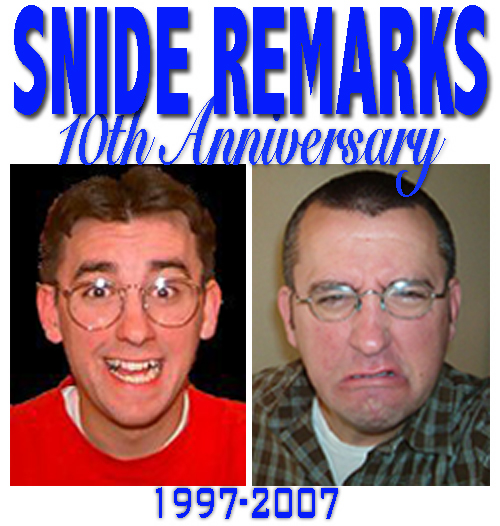
This week’s “Snide Remarks” features my favorite kind of indulgence: self-indulgence! It’s my top 10 list of what I consider to be the best “Snide Remarks” columns ever, in conjunction with the feature’s 10th anniversary — which is this Saturday, officially.

My little column is 10 years old! Seems like only yesterday that I was giving birth to it, right there on the floor at The Daily Universe.

I recorded SnideCasts for the top 10 columns, as I figured that would make them seem fresher to readers who have read them before. To my deaf readers, I have nothing new to offer, sorry.

The Best of ‘Snide Remarks’: 1997-2007

0

[The first “Snide Remarks” column was published Sept. 29, 1997 — 10 years ago this week. In honor of that, Eric has been going on and on about it all year, like it’s some kind of milestone or something.]

Earlier this year, I spent a few weeks re-reading every “Snide Remarks” column I’d ever written. You’re not supposed to laugh at your own jokes, of course, but in many cases I had completely forgotten the details of these columns, and the jokes were as fresh as if someone else had written them. In many instances, even after reading them anew I still had no recollection of having written them.

In other cases, the jokes didn’t make me laugh. Some made me wince. Some columns made me think, “What is this garbage?” I’ve already shared with you my candidates for the worst “Snide Remarks” columns ever.

And now I hope you will indulge me as I seize my own horn and toot it, fervently and at great length. As I re-read those 550-plus columns, I kept track of the ones that struck me as being particularly good: funny, memorable, inventive, clever, and well-constructed. Then I re-re-read them, and re-read them some more, and eventually whittled the list down to the 10 best. Plus 10 more than almost made the list. So … the 20 best.

I hope you like them. Feel free to post comments indicating which ones you would have included if you were making the list.

Oh! And there is also a special treat. I’ve recorded SnideCast audio versions of the top 10! That way, if you’ve read them before, now you can hear me read them to you, as if they were brand-new works. (The exception is #3, where the format made an audio recording unfeasible.)

THE 10 BEST “SNIDE REMARKS” COLUMNS OF THE LAST 10 YEARS

Alt text

1. “Letter to the Editor” (Nov. 10, 1997)

“I thought I was safe from such purveyors of smut….”

Many of you will not agree with this choice, I’m sure, because so many of the specifics of the column don’t hit home as well as they did when it was published. It is a parody of the letters to the editor we received at The Daily Universe, which were widely read by most students (along with Police Beat and, um, “Snide Remarks”) and hence familiar to the readers. What’s more, every single line of the column refers to something that had been discussed in recent actual letters, or else to the phraseology employed by letter writers. (“I thought I’d get away from _____ when I came to BYU from _____”; “I am ashamed to call myself a BYU student today”; etc.)

Plus, look at the different types of BYU students (and Mormons) that get made fun of here: The straight-up holier-than-thou types; the ones who quote obscure passages from general authorities; the ones who insist on applying religious doctrine to mundane, everyday things; the ones who discuss their unorthodox practices and beliefs while claiming to be perfectly orthodox; the ones who choose one specific doctrine to harp on constantly; the Utah-Mormons-vs-other-Mormons debaters; the ones who prefer the letter of the law over the spirit of it; and so forth.

If you read the letters published in the Universe now, a decade later, you’ll find the same types. Many of the specifics have changed — the column refers to a controversial Rodin exhibit and the doomed Provo strip club LeMar’s, for example — but the general tone remains the same. Take my word for it, this is a great column.

Alt text

2. “A Formal Apology” (March 26, 2007)

“You know you my retard.”

If you’re a creative type, perhaps you’ve had the experience of stepping back from something you’ve just made and realizing, “Wow. I’ve done something magical here.” Such was the case with me and the retard column. I don’t use the term “instant classic” very often (and especially not in reference to my own stuff), but I knew right away that this was a particularly good one. On one level, it deconstructs the recent trend of celebrity meltdowns and apologies. On another level, it mocks the “let’s pretend we’re all the same even though some of us are obviously different” platitudes. And on a third level, it makes jokes about retarded people — even as it scolds society for making jokes about retarded people. I’m very proud of it. It’s a very strange thing to be proud of, but there you go.

Alt text

3. “The Blog Cabin” (Aug. 15, 2005)

“The south is bein a bunch of secessionist biznatches.”

The only “Snide Remarks” that required creating a separate webpage to make the joke work! I made an actual Blogspot page for Abraham Lincoln’s blog, complete with teenage-girl-like colors and links. (I’m sorry, linkz.) I’ve always wanted to write more entries for Abe’s blog and update his site, but I haven’t gotten around to it. In the meantime, enjoy this sampling — all of which is based in historical accuracy, by the way.

Alt text

4. “The Stupid Agenda” (June 14, 2002)

“…spreading stupid-people diseases like dyslexia and rickets…”

Like the “gay agenda,” but replace “gay” with “stupid.” We’re all tired of stupid people taking over society, aren’t we? For a glimpse into the future, when stupidity is the norm, see the excellent Mike Judge film “Idiocracy.” In the meantime, read this column, and marvel at the many various ways people could fail to understand it.

Alt text

5. “How to Do Stuff Better” (Nov. 24, 1997)

“Kill the monster!”

This was the quintessential “Snide Remarks” from the Daily Universe era: jokes that my 18-25-year-old audience of Mormon BYU students could relate to, and a few beloved tangents. Also, I stand by both of the solutions proposed in this column. If they were implemented, they would revolutionize the world.

Alt text

6. “The Rainbow Correction” (May 30, 2005)

“…newly deceased mothers can barge into heaven and start flinging rainbows around willy-nilly…”

Though written long after the Daily Universe era, this column reads like an entry from that period, both in subject matter (Mormon pop culture) and style (tangents, derailments, and a really, really high word count). I’m quite pleased with the entire section on “I’ll Build You a Rainbow,” and fairly surprised I’d been doing “Snide Remarks” for eight years before it occurred to me to write about it.

Alt text

7. “No Need to Get Crabby” (July 20, 2003)

“Sweet Hitler’s handbag!”

What I like about this column is the use of refined, elegant language to describe people’s vulgar and common behavior. I sound like a prim old woman, like someone who would be harassed by the Marx Brothers at an opera.

Alt text

8. “Amana from Heaven” (June 20, 2001)

“A-ha! Now there was a great ’80s band.”

This one has no tangents, no sidetracks, and is shorter than many columns — and yet it’s a great example, I think, of being pithy, punchy, whimsical, and surprising. There’s barely a wasted sentence in the whole thing.

Alt text

9. “Rumspringa” (March 28, 2005)

“My sleeping quarters were fearsome chilled yesternight.”

I have a fondness for the columns that are purely fictional pieces, like little first-person short stories. (Item #2 on this list is another one.) This entry, about an Amish teenager’s experience with MTV Spring Break 2005, has the added bonus of being kind of sweet, too, which is not something that “Snide Remarks” is very often.

Alt text

10. “Goose Encounters of the Bird Kind” (July 26, 2004)

“…not dealing with one of your smarter members of the goose family…”

Telling stories from my personal life is a common theme in “Snide Remarks,” and there are two ways of doing it. One is to be breezy and conversational, like #8 on this list. The other is take a more literary tone, almost ponderous, which I think can make the situation seem funnier. I didn’t really experiment with this type of “Snide Remarks” until the goose story, and I was much pleased with the outcome. (See also #18 below.)

THE SECOND TOP 10:

11. “The Bauers (or 24: The Sitcom)” (April 24, 2006) If you don’t watch “24,” trust me, this column is hilarious.

12. “One Fateful Day” (Aug. 24, 2001) A bizarre combination of personal anecdote and fiction. I like the oddness of it.

13. “Hello Dalai” (May 11, 2001) If I did interview the Dalai Lama, I’m pretty sure it would actually go approximately like this.

14. “Some Book Reviews” (May 31, 2002) Some fine MAD-style humor writing, if I may say so.

15. “Scream of Conscience” (Aug. 21, 2002) The anthropomorphization of the elements of my psyche is amusing to me.

16. “Police Beat: Beaten” (Dec. 8, 1997) An acknowledged classic from the BYU era, and possibly (after the “Titanic” column) the most-remembered one.

17. “Spider Remarks” (Sept. 11, 2006) This column’s follow-up, a year later, got much more favorable feedback, but I prefer this one. I am more proud of the ballerina line than almost anything I’ve ever written. I was so proud, in fact, that I used it again in the follow-up.

18. “The Curious Incident of the Moron in the Night-time” (Dec. 13, 2004) Another personal anecdote reported in detached, unemotional language.

19. “Comfy KOSY Are We” (Dec. 12, 2001) Like #8, this is an example of an efficient column where nearly every sentence is useful.

20. “Boise in the Hood” (July 3, 2006) I like to think the reason Fate spared my life in this story is so I could share it with you and we could all make fun of the desk clerk together.

* * * * *

Other 10th anniversary features:

My favorite angry letters.
The 10 worst columns.
A timeline of important columns: part 1, part 2, part 3

Friday movie roundup – Sept. 21

5
Alt text

Sign up for the “In the Dark” e-zine here.
Listen to this week’s podcast version here.
Subscribe to the podcast’s feed here.

There’s a metric shload of new movies this weekend, and three of them are excellent and thought-provoking. How often is even ONE movie in a weekend excellent and thought-provoking, let alone three?

“In the Valley of Elah” stars Tommy Lee Jones as a retired military man investigating the disappearance of his son, an Army soldier just back from a tour of duty in Iraq. You might think it is an anti-war film, especially when you learn that Susan Sarandon plays Jones’ wife, but that is not the case. Or, rather, it is anti-war, but it’s opposed to wars in general, to how they destroy lives and change the young men who have to fight them. The film makes no statement about the current war one way or the other. It’s an extraordinarily well-acted film, and a stirringly patriotic one too, in its way.

I also highly recommend “Eastern Promises,” directed by David Cronenberg and starring Viggo Mortensen as a man working his way up in the Russian mob. Great crime film, and an examination of the code of ethics among gangsters. The scene everyone will be talking about is the one where Mortensen has a fight with two hitmen while he’s in a bathhouse, completely naked. It’s a knock-down, drag-out fight, too. Cronenberg once made a film called “The Naked Lunch,” and so I kept trying to make a joke about “Eastern Promises” being called “The Naked Punch.” (Get it? Because he’s naked, and he’s fighting!) But nobody thought that was funny. So then I realized the perfect alternate title for it: “Balls of Fury.” Thank you!

Finally (among the great films, anyway), there’s “The Hunting Party,” an absurd but true story about three journalists who on a whim set out to find a notorious Bosnian war criminal — and in two days of looking got closer to capturing him than the U.N. had done in five years of “trying.” Richard Gere and Terrence Howard star. Lots of fun.

This week’s “In the Dark” also makes mention of “2 Days in Paris” (non!) and “Moliere” (oui!).

The three big, fat, wide releases this weekend are all lousy: “Good Luck Chuck” (my Film.com review for the week), “Sydney White,” and “Resident Evil: Extinction.” “Chuck” and “Resident Evil” will probably cancel each other out, since they seem to be targeting the same audience, i.e., 20-year-old meatheads. But we’ll see. “Resident Evil” wasn’t screened until last night, and even then the press weren’t invited. Some of us showed up anyway, though, and we weren’t denied access. Maybe the studio really did want us to see it and our invitations were lost in the mail???

Resident Evil: Extinction

0

In “Resident Evil: Extinction,” five years have passed since the events in the last film. The zombie-making T-Virus has spread worldwide, with only small patches of humanity left. Those few groups stay on the run, avoiding the flesh-hungry infected while searching for fellow survivors.

This is the third film in the “Resident Evil” series, and it feels like it’s lost whatever steam it had to begin with. I know there have been multiple RE video games; I don’t know if this film is based on a particular one. If it is, it must not be a very faithful adaptation. I don’t think there are any video games where the whole point is to sit around doing nothing for 95 minutes. Did Samuel Beckett design video games?

Milla Jovovich is back as Alice, an unstoppable killing machine who was one of just two people to escape the lab where the virus was first unleashed. She’s a lone wolf now, riding around the Nevada desert on a motorcycle, and evidently taking excellent care of her skin. It looks waxy and smooth. Where do you find moisturizer after the apocalypse?

Perhaps related to that (though probably not), Alice has developed powers of telekinesis. She uses them to help a group of survivors led by a tough gal named Claire (Ali Larter) when the group is attacked by a massive swarm of zombie birds. Alice’s old friend and fellow lab survivor Carlos (Oded Fehr) is among them. They’re glad to see each other. He’s had a rougher time of it than she has. His skin doesn’t look nearly as good.

Meanwhile, back in the underground city where it all started, an evil scientist named Dr. Isaacs (Iain Glen) is working on developing a cure for the virus. That doesn’t sound evil, but trust me, it is. For some reason it requires Alice’s blood. Also, he’s making clones of Alice and testing their skills against the zombies. Also, maybe he’s actually really trying to make the zombies stronger, not cure them. Or maybe he does that accidentally. Who knows?

A film like this, you expect to see some good guys doing battles with hordes of zombies. Am I right, folks? That’s what you paid for. Yet “Resident Evil: Extinction” gives us only one major sequence of zombie fighting, plus a scene of Alice in combat with a super-mutated zombie, and a few minor skirmishes here and there. The rest is tactical: Where can we find more gasoline for our trucks and a safe haven for our group, etc. There is no imagination or wit in the dialogue, and the few actions scenes are perfunctory.

Once again written by Paul W.S. Anderson but this time directed by Russell Mulcahy (“Highlander”), “Extinction” wins points in my book for being less outrageously stupid than its predecessors were. Basically, while it’s dull and listless, at least it’s not aggressively, howlingly dumb. It seems to me that if you liked the first two, you won’t like this one as much, since it’s missing a lot of the components that made them so enjoyable (or, if you’re me, so unenjoyable). Stay home and wait for Halo 3 to come out.

Good Luck Chuck

0

“Knocked Up” and “Superbad” have sparked renewed confidence in the idea of R-rated comedies, and they succeeded because they understood that you can get away with all the vulgarity you want as long as it’s also funny. “Good Luck Chuck” shows the wrong way to do it. It casts aside all ambitions for cleverness or wit and instead focuses just on being crass. There’s no fun in that unless you’re a 13-year-old boy.

The premise is that successful young dentist Charlie Logan (Dane Cook) is a good luck charm to women: If you sleep with him, the next guy you date will turn out to be your true love. Great for the ladies, bad for Charlie. He’s a steppingstone.

Once word gets out about his powers, Charlie becomes a hot property, with every woman in town wanting to sleep with him so that they can find their husbands. Most of these women are gorgeous, which delights Charlie (who reluctantly embraces his odd situation in a surprisingly graphic montage of sexual encounters) but which confuses me, since I wouldn’t think such beautiful women would have trouble finding dates, lovers, or husbands. I also wouldn’t have thought, in this day and age, that EVERY woman in America was THAT desperate to get married. Eh, what do I know?

Charlie’s problem arises when he meets Cam Wexler (Jessica Alba), a clumsy, unlucky lady who works with the penguins at the local oceanarium. He really likes her. Hence, he doesn’t want to sleep with her, because that means she’ll find her soul mate next — and it won’t be him.

Even given the absurdity of this fantasy-based premise, the film could have worked if it had followed any kind of internal logic. Instead, it’s a mess. Cam’s klutziness, which you expect will somehow counteract Charlie’s good-luck-charm status, proves irrelevant, nothing more than a cheap way to get easy laughs. (In Charlie’s car, she presses a button thinking it’s the heat, and it causes his convertible roof to fly off. Why would a car have a button that makes the roof fly off? Does it have an ejector seat, too?) After Charlie sleeps with Cam, he worries about her dumping him, which would open the door for her finding her soul mate. To prevent this, he overnight becomes clingy, obsessive, and paranoid, a genuinely psychotic stalker. This goes against everything we’d already been told about him, which was that he was non-committal, carefree, and laid-back.

Experienced film editor Mark Helfrich, making his debut as a director, mines the story for all the cliches he can find, right down to the scene where Charlie races through an airport to stop Cam from flying away. (Seriously, movie? An airport scene? Wow.) Groin injuries? Check. Old lady who swears? Of course. Slovenly and over-sexed best friend who gives the protagonist bad advice? Naturally.

Oh, and about that friend. His name is Stu, and he’s played by Dan Fogler. Now, Dan Fogler already proved his inability to be funny when he starred in “Balls of Fury” a few weeks ago. Turns out he’s no better in supporting roles. Here he plays a plastic surgeon who’s obsessed with breasts specifically and sex in general. He is perhaps the most repellant movie character I’ve seen all year: screechy, grating, creepy, and unamusing. He leers and salivates lecherously, like some kind of loathsome toad-man. His dialogue indicates that screenwriter Josh Stolberg’s thought process was this: “I know! I’ll take all the euphemisms for ‘semen’ that I can think of and put them in the movie!” Stu doesn’t deliver punchlines or make jokes; he just spouts tasteless, raunchy vulgarisms. A movie can be dirty and funny, but this one has chosen just to be dirty.

And yet that character isn’t entirely why the film doesn’t work. I’m gonna have to lay most of that blame at the feet of Dane Cook. Cook was a funny comedian when he came on the scene several years ago. Then he became more of a rock star than a comic, started to believe his own hype, and got lazy. He is not an actor. His character is supposed to be funny, yet most of his witty remarks are sitcom-lame, and he tends to cap them off by smiling in a smug, aren’t-I-funny? kind of way. Also, despite all the nudity in the film, Jessica Alba remains clothed. I suspect this will anger and frustrate most of the target demographic. It certainly hides her strongest talents as an actress.

Sydney White

0

“Sydney White” is a cutesy retelling of “Snow White,” but I believe its working title was “OMG! The Movie.” You can almost hear the squeals of 14-year-old girls as they soak up all the many things the movie does to pander to them.

Amanda Bynes — who still generally believes that the best way to react to a strange situation, comedically speaking, is to bug out her eyes in wonderment — is Sydney, a tomboyish college freshman whose mom died young and left her to be raised by her doting construction-worker father (John Schneider). Because Mom was a member of a particular sorority, Sydney feels compelled to pledge — and being a “legacy,” she’s more or less assured membership.

This doesn’t sit well with Rachel Witchburn (Sara Paxton), the head bimbo in the sorority of beautiful blond bimbos (OMG, they wear such pretty clothes!), who feels, quite rightly, that Sydney doesn’t fit in. Rachel’s “magic mirror” is a “Hot or Not”-type website, which reassures her daily that she is still fairest in the land. But this newcomer, this Sydney White — who shows up for college carrying only a backpack full of clothes and a suitcase full of comic books — is getting a little too popular for Rachel’s tastes.

Sydney is eventually cast out of the sorority house and flees to the Vortex, a dilapidated house at the end of Greek row where dwell seven dorks. She is friendly to geeks, of course, and is welcomed by them as a fellow outcast. And OMG, they have such cute personalities! One (Adam Hendershott) is really shy and speaks through a sock puppet. One (Danny Strong) is a grumpy blogger. Another (Jack Carpenter) is allergic to everything and hence “sneezy.” You get the idea.

The prince in all this is Tyler Prince (Matt Long), the student body president who — OMG! — helps feed the homeless in his spare time and has dimples (OMG!!) and serenades Sydney in the library (OMG!!!) and in one scene he’s even shirtless!!!! (OMG!!!!!!) Rachel thinks he should be hers; he likes Sydney instead; again, the idea, you get it.

The way Chad Creasey’s screenplay incorporates “Snow White” details into the story is sometimes clever (the “poisoned apple” particularly amused me), and there’s no question the film will push the buttons of the people it’s aimed at. I’m not one of those people, but that’s not why I didn’t enjoy the movie. It’s because the dialogue is mostly generic and the story is tedious, as if they took the framework of a fairy tale and just threw a leftover Disney Channel script on top of it.

For example, the romantic-comedy story structure requires that Sydney and Tyler not get together until the end of the film. If they kiss and start dating halfway through, you’ve got nothing to shoot for. The problem is, there’s no reason for them NOT to get together halfway through, other than a vague assertion by Sydney that she doesn’t like him — which is clearly false and which she has no reason to lie about.

The movie even manufactures a way for Sydney and Tyler to have a fight, when she thinks he was involved in a plan to tear down the Vortex and put up a building named for his and Rachel’s rich families. All he needs to do is explain that this is a misunderstanding of what really happened, but he does not. Instead, he waits three scenes before doing it — time enough for us to say, “OMG! He’s totally sweet and Sydney misses him!” Do you not see, 14-year-old girls, how you are being manipulated by a movie that doesn’t make sense?

I also question the validity of the Vortex being so run-down as the result of Tyler and Rachel spending all the university’s funds on the more popular Greek houses. I’m pretty sure it’s not up to the student officers to decide matters of funding and building maintenance. (OMG, shut up!)

The director is Joe Nussbaum, who directed the equally OMG-worthy “Sleepover,” as well as the “American Pie” DVD sequel “The Naked Mile.” As a college student himself, Nussbaum made the clever short film “George Lucas in Love,” which purported to show how Lucas’ real life inspired “Star Wars.” He was a wunderkind, the Next Big Thing … and now it’s “Sleepover” and “Sydney White.” Clearly he has had a spell cast upon him by a witch. When will a Princess Charming come along and rescue him?

The Assassination of Jesse James by the Coward Robert Ford

0

You can tell that “The Assassination of Jesse James by the Coward Robert Ford” isn’t a traditional Western because it gives away two serious spoilers right there in its title. The mechanics of the plot are not essential here, as they tended to be in the days of the black-and-white Westerns. This is a study of the two title characters, and a look at the moral codes that prevailed in their lives.

As befits a movie as ruminative as this one, writer/director Andrew Dominik (adapting Ron Hansen’s 1983 historical novel) maintains a lyrical, gentle tone. An unseen narrator (Hugh Ross) tells parts of the story in straightforward but literary language, as if describing memories, the edges of some scenes blurred and accompanied by dreamlike music. It is an idyll for a cherished figure — you know, the one who committed dozens of robberies and murdered at least 17 people.

Jesse James is played by Brad Pitt, who like his friend George Clooney occasionally makes a film like this to remind us that he’s more than just an entertaining media celebrity. Pitt’s acting muscles, underused lately, are still in top form as he plays a man who was, among other things, an entertaining media celebrity just like himself.

Jesse was gregarious and jovial until later in his life, when he was often moody, depressed, and paranoid (not without good reason). Yet even then he had his moments of good humor and could be, in the narrator’s words, “cavalier, merry, moody, fey.”

As the film begins, in September 1881, most of the James gang is dead or in prison. This leaves Jesse and his brother Frank (Sam Shepard) to recruit local scoundrels to help them pull off their heists, including the Ford brothers, Charley (Sam Rockwell) and Robert (Casey Affleck). Robert approaches Frank privately to ask if he can be included in the train robbery they’ve got planned, and Frank says, “I don’t know what it is about you, but the more you talk, the more you give me the willies.”

You can see what he means, although I think he’s being a little churlish, too. Baby-faced 19-year-old Robert Ford has admired Jesse James since childhood, eagerly reading the accounts of his deeds in the cheap paperbacks and magazines. He is awestruck in Jesse’s presence, an awkward fan who in today’s parlance would be considered a stalker. Jesse is amused by him at first, eventually trusting him and enjoying the novelty of having a worshipper to follow him around and do his bidding. In a less friendly moment, he asks Robert, “Do you want to be like me? Or do you want to be me?” It’s a fair question.

It’s also fair to wonder if Robert Ford’s affections for Jesse James go beyond mere hero worship into something more peculiar. Certainly he’s unbalanced psychologically — but then again, so is Jesse. Robert is almost a “Talented Mr. Ripley” type, except that he’s not particularly talented. Where Jesse is famous for being hard to sneak up on, Robert can be surprised with ridiculous ease. When he’s finally called upon to do something useful and outlaw-ish, he manages it OK, and then is endlessly pleased with himself for doing it.

He eventually turns on Jesse, of course, as the title of the film suggests. His reasons for doing so are complex, and the unusually long running time (160 minutes) is almost completely justified by the fact that it takes time to establish characters as deep and complicated as Jesse and Robert — especially since neither man is exactly the type to just come out and explain how he feels.

This is only the second film Dominik has made, and the first since 2000’s “Chopper,” which was as forceful and blatant as “The Assassination of Jesse James” is subtle and elegant. He directs with the utmost confidence, every scene carefully composed and every moment useful in painting the portrait he has in mind.

He makes room for some excellent supporting roles, too, including Jeremy Renner as Jesse’s cousin and gang member Wood Hite, and particularly Paul Schneider as Dick Liddil, a bawdy, poetry-reciting accomplice who never met a married woman he couldn’t hit on. On the other hand, Mary-Louise Parker is underused as Jesse’s wife, Zee — there’s not much room for womenfolk in this story — and you have to wonder what Zooey Deschanel is even doing here, appearing very late in the game as Robert Ford’s post-assassination girlfriend Dorothy.

But the most important supporting role, I think, is the film’s photography. It’s the work of Roger Deakins, the five-time Oscar nominee who happens to be one of the greatest living cinematographers. You’ve seen his work in almost every Coen Brothers movie, notably “O Brother, Where Art Thou?,” a film whose distinct “look” is almost as memorable as its characters. Here he beautifully creates the barren harshness of the Old West and the ethereal glow of the film’s more dreamlike passages. In a nighttime train-robbery sequence, the locomotive appears on the scene like a majestic animal, its headlight piercing the smoke and darkness as the men of the James gang stand by almost reverently, waiting for the kill. It’s a moment of unnecessary beauty, which is often the best kind.

A curious thing happens in the film’s last 30 minutes. The story continues past Jesse’s death, recounting what became of Robert Ford in the aftermath. He becomes a media celebrity in his own right, eventually as famous as Jesse himself had been. And yet his life turns miserable, in ways that aren’t too surprising, and I realized I was more interested in that story than I was in the pre-assassination one. What happens to an insignificant man who suddenly becomes important after committing one infamous act?

Jesse James was a folk hero, but he was also a cold-blooded killer. Or should I say he was a cold-blooded killer, but he was also a folk hero? Robert Ford counted on public opinion being in favor of the outlaw being brought down, but that’s not always the way it works with folk heroes.

TV reviews: ‘Back to You,’ ‘Gossip Girl’

6

“Back to You” (Wednesdays, Fox): “Frasier” star Kelsey Grammer and “Everybody Loves Raymond” star Patricia Heaton play Pittsburgh news anchors who are reunited when he comes crawling back after failing in L.A. He’s pompous and arrogant; she’s exasperated and brassy. Seems they had a fling once, too. The sitcom is familiar and easy-going, right down to the overactive laugh track and the “oh no you di’int!” sex jokes. Fred Willard plays the old-school sexist sports anchor, and Fred Willard is always a welcome sight. I laughed three or four times during the first episode and was generally amused the rest of the time in a mindless, unchallenging sort of way. TiVo verdict: It’s not a show I’d watch on purpose, but if I were flipping channels and happened upon it, I’d stick around.

“Gossip Girl” (Wednesdays, The CW): OMG you guys, the guy who created “The O.C.” totally created a new show! And it’s based on a series of young-adult books! Apparently! “Gossip Girl” is about idle rich Upper East Side teenagers who sit around being snotty to each other while they drink champagne and smoke marijuana. Their doings are reported on a blog written by the anonymous Gossip Girl (who we hear in voice-over, and it’s the voice of Veronica Mars herself, Kristen Bell). The pilot episode — in which queen bee Serena comes back to town after a mysterious year-long absence — didn’t indicate what tone the series will take. It wasn’t smart or witty enough to be legitimately enjoyable (the way the first season of “The O.C.” was), but neither was it campy enough to be a trashy guilty pleasure. All the juicy subplots introduced in the pilot suggest it could be “Dynasty Junior”; who knows if they’ll make it as fun as it could be? TiVo verdict: I sort of want to know what happens next … but not enough to expend the energy to tell TiVo to record it next week. That’s the kind of show it is.

Earth: Flat or round? ‘View’ co-host unsure

15

I don’t watch “The View.” In fact, I can’t even imagine watching it. The very thought makes me shudder. The small clips I’ve seen convince me I’ve made the right choice in not allowing a band of shrieking women who constantly talk over each other enter my home for an hour every day.

But I was amused, as I’m sure you will be, by this clip, in which the recently anointed fifth co-host, Sherri Shepherd, gives the wrong answer when asked if she believes the Earth is flat: “I don’t know.”

[youtube:http://www.youtube.com/watch?v=9ACobXN7_p8]

It’s in the context of a discussion about evolution, which Shepherd definitely doesn’t believe in. Whoopi Goldberg (another recent addition to the show, and another good reason not to watch it) is trying to say, “If you trust science when it tells you the Earth is round, why not trust science when it tells you about evolution?” Only she doesn’t say it very well, and I’m not sure it’s a logically valid argument anyway. And besides, Shepherd apparently doesn’t trust science when it tells her the Earth is round. That, or she’s just never heard science mention it before.

Whoopi also tries to say, “Can’t you believe in God and evolution? Couldn’t you believe that God created organisms that then evolved, under His guidance, into more fully developed animals and species?” But she doesn’t say that very well, either, which is too bad, because I think it’s a good point of view to take.

Anyway, I don’t intend for this to be a debate on whether religious people can believe in evolution (although I am resigned to the fact that that’s what it will become anyway). And I categorically do not mean to imply that all religious people, like Sherri Shepherd, are ignorant of even the basics of scientific knowledge. All I wanted is for us to point and laugh at Sherri Shepherd for saying something dumb.

‘Snide Remarks’ Classic: ‘Addición: Flautas’

1
Alt text

I was sad to learn on a recent trip to Salt Lake City that my beloved Cafe Pierpont — home of such Mexican entrees as the life-changing flautas — had closed. I guess the building got sold and the new owner is turning it into something else. Something evil, no doubt, since the owner himself is obviously evil. What kind of monster would deprive the world of Cafe Pierpont’s flautas?!

In honor of this tragedy, this week’s “Snide Remarks” Classic is the column I wrote about the restaurant, “Addición: Flautas,” originally published Sept. 20, 2004.

Chicken, cheese, sour cream, flour tortilla, rolled up and deep fried. Mmmm….

TV review: ‘K-Ville’

12

“K-Ville” (Mondays, Fox): As bland and generic a cop show as you can imagine. There’s a loose-cannon cop (Anthony Anderson) and his mismatched partner (Cole Hauser), a gruff and blustery but ultimately soft-hearted captain (John Carroll Lynch), and the usual assortment of crimes and schemes which they solve using superhuman leaps in logic and intuition. The only thing noteworthy about it is that it’s set in New Orleans in 2007, with post-Katrina reconstruction still the foremost subject on everyone’s mind. The show’s creators are obviously hoping this will be enough to bring in viewers. But honestly, there’s nothing about the show that you can’t get — and in higher quality — from other cop shows. The series is being filmed in New Orleans, and they’re using local actors and technicians when possible, pumping millions into the economy in the process. So I guess you could watch the show as a service project. Call it a charitable contribution. TiVo verdict: I gave at the office.

(Here’s the list of fall season premiere dates, if you missed it.)

There is a slight chance that Rob Zombie might lack artistic integrity

17
Alt text

Rob Zombie: “You see, the thing is, I’m oily and untalented.”

Grotesque filmmaker Rob Zombie and black-hearted Batman-villain impersonator Dick Cheney don’t have much in common. One delights in overseeing acts of cruelty and murder inflicted upon innocents; the other only does that in movies. But they’ve both recently made me chuckle and roll my eyes at them when comments they made years ago resurfaced and contradicted their current practices.

We previously talked about Cheney’s 1994 comments, where he said invading Baghdad during the Gulf War would have resulted in a “quagmire,” and that taking Saddam out of power wasn’t worth risking American soldiers’ lives. Plenty of people agree with that and wish he’d maintained that position, obviously.

And now check out what Rob Zombie — director of the recent hit “Halloween” — had to say in 2002 about the trend of remaking old horror films:

I feel it’s the worst thing any filmmaker can do. I actually got a call from my agent and they asked me if I wanted to be involved with the remake of [The Texas Chainsaw Massacre]. I said no [swear word] way! Those movies are perfect — you’re only going to make yourself look like an [swear word] by remaking them.

Yankee outfielder documents suckage of Red Sox for young fan

16
Alt text

“Boo hoo! A guy from the team I hate hates the team I love! Boo hoo hoo!”

Amusing story in the Boston Herald today about 10-year-old Red Sox fan Griffin Whitman, who attended his first Yankees vs. Red Sox game on Friday. Afterward, he managed to snag Yankee outfielder Shelley Duncan for an autograph — and the picture at right shows what Griffin wrote:

“Red Sox Suck! Shelley Duncan.”

The kid soon called the waaaahmbulance, and his mom had this to say: “This is someone who wears the Yankee uniform and is on the payroll and should be setting an example for 10-year-olds.”

My thoughts:

1. While I don’t follow sports very closely, it is my understanding that the Red Sox do, in fact, suck.

2. The antagonism between the Yankees and the Red Sox has existed for decades. If you show up wearing Red Sox paraphernalia and ask a Yankee for his autograph, you get what you deserve. I mean, what did he expect? “Thanks for supporting a team that hates us! After shouting obscenities at me and my fellow players for nine innings, I’m glad you took the time to request my autograph! Love, Shelley Duncan.”

3. If the kid were a TRUE Red Sox fan, he wouldn’t even WANT a Yankee’s autograph. A true fan would pretend to want it just so he could get close enough to break the Yankee’s kneecap.

4. “Shelley”? Really? Huh.

‘Snide Remarks’ addresses toilets, Shrek, and nieces

1
Alt text

This week’s “Snide Remarks,” entitled “Uncle Shrek,” has to do with the bathroom but is pleasant to read nonetheless. I think my mom will like it because it mentions her. On the other hand, it mentions her in the context of implying she is senile. It must be such a mixed blessing, being my mom.

Does it seem like we’ve had a lot of bathroom-related columns recently? OK, I guess it was just the one about pee from about six weeks ago. And then I’m thinking about the colonic column, but that was well over a year ago. So never mind. We’ve been having exactly the right number of bathroom-related columns.

Anyhoo, you can listen to me read the column to you with my very own voice through the futuristic SnideCast technology at the top of the page. You can also hear it here, or subscribe to the weekly “Snide Remarks” podcast with this URL.

Uncle Shrek

0

I got a voicemail from my mom a few weeks ago saying she and my 2-year-old niece, Lindsay, were calling to talk to Shrek because Lindsay wanted to tell him that she had pooped in the toilet. None of this made any sense to me, of course. Had my mother’s early-onset senility caused her to dial my number thinking it was that of a cartoon character? Did she know she was calling me but somehow think that I WAS Shrek? It was troubling, not least because apparently crazy Mom was babysitting Lindsay, and who knew what kind of trouble the two of them might wander into. It was like a cat babysitting a monkey.

Alt text

A cat babysitting a monkey.

As it turns out, my mother is completely sane and in full possession of her faculties, and my panicked phone calls to nursing homes were premature, although I am hanging on to the pamphlets they sent just in case. My brother and his wife have been listening to Dr. Phil, the noted hillbilly TV psychologist, and he said a fun reward for kids in the potty-training process can be to let them call their favorite fictional characters to share the good news whenever they have a success. You get friends and family to pose as the characters, of course; it’s only over the phone, not in person, and children are gullible and stupid.

The kids only get to call their beloved animated friends when they go in the toilet, though. When they go in their pants, they have to call Satan.

So under this system, many of my siblings had already been called upon to act as Sleeping Beauty, Cinderella, Aladdin, and assorted other Disney characters with whom Lindsay is intimately familiar. Now she had branched out and requested Shrek, and Mom figured I was the man for the job.

“Lindsay went poopie in the toilet, and she wanted to tell Shrek about it,” my mom said when I called her back.

“Uh-huh,” I said. “So I just have to do a Shrek voice?”

“Yeah.”

“All right. Put her on.”

Lindsay came to the phone.

Alt text

Lindsay has exciting news for the inhabitants of Far Far Away.

“Hello?”

At first I was concerned about imitating Shrek properly, but then I realized something Mike Myers realized long ago: Shrek’s only distinction is that he has a Scottish accent. He sounds exactly like all the other Scottish characters Mike Myers has ever played — indeed, like every Scottish person I’ve ever heard speak. Shrek isn’t a character; he’s a dialect.

Armed with that knowledge, I plunged ahead.

“Hello, Lindsay?” I bellowed in my best Scottish accent, which isn’t very good but which is close enough.

“Hi!”

“This is Shrek! D’ya have somethin’ t’tell me?”

“I went poopie.”

Now, this was not news. She had gone poopie many times before. I had seen her do it. She was burying the lead, as we say in the news business. So I prompted her.

“Where didja go?”

“In the toilet!”

“Oh, what a big girl you are! That’s great!”

“Yeah!”

She seemed very pleased to be talking to Shrek. But a conversationalist she is not. Having gotten the business part of the phone call out of the way, she didn’t know what else to say. Still in character, I improvised.

“I never go in the toilet. I always just go poopie in the swamp!”

This seemed like a perfectly reasonable thing for Shrek to say. If I were dressed as Shrek at a Dreamworks theme park, and kids wanted to talk to me, and the subject of poop came up — which it totally would, if you’re talking to Shrek — then I would tell them I poop in the swamp.

But Lindsay didn’t seem interested in my revelation about her beloved swamp-dweller’s bathroom habits. She just said “Yeah!” again. Come on, Linds. Would it kill you to add something to the conversation? When I’m talking to her in person and the conversation dries up, I can fill time by honking her nose or making a funny face, but those things don’t really translate over the phone. What I should have said here was, “Be sure to buy my new movie, ‘Shrek the Third,’ on DVD Nov. 13!” Again, that seems like something Shrek would say. Really, I should be writing for these movies. He’s an easy character to write for.

Alt text

Shrek: deeply interested in your toddler’s bowel movements.

That was pretty much it. She handed the phone back to Grandma and I went back to my regular speaking voice. (I didn’t think my mom wanted to talk to Shrek.) And let me just point out that my brothers and sisters have gotten off easy. How hard is it to talk like Aladdin or Cinderella? They just have regular voices! I had to do an accent for mine! I’m just glad she didn’t ask me to put Donkey on the phone, because I don’t think I can do his voice.

I kind of like Dr. Phil’s idea of having fictional characters congratulate your children for fulfilling the basic requirements of human hygiene. We already lie to kids about the existence of imaginary beings such as Santa Claus, and the Easter Bunny, and Eskimos, so why not let them think cartoon characters are real, too? And not only are they real, but Mom and Dad have their phone numbers! That’s gotta earn you some Cool Points in your toddlers’ eyes — except I guess little kids probably don’t understand the concept of phone numbers, and they’re not going to remember any of this when they get older anyway. But still: For one brief, shining moment, little Lindsay thought that Shrek cared about her defecation habits. It’s heart-warming, isn’t it?

By the way, when I poop in the toilet, I call Jack Bauer.

Friday movie roundup – Sept. 14

3
Alt text

Sign up for the “In the Dark” e-zine here.
Listen to this week’s podcast version here.
Subscribe to the podcast’s feed here.

Three wide releases this weekend, one better than expected, one worse than expected, and one not screened for critics but featuring dragons as its main characters (!)

The better-than-expected is “Mr. Woodcock,” which — make no mistake — is still not a great movie. But its physical humor is surprisingly well done, and that thing Billy Bob Thornton does where he hates kids and says mean, sarcastic things — well, that’s always funny. Just like “Yakety Sax.”

Not as good as it should have been is the Jodie Foster vigilante drama “The Brave One,” which has some conflicting messages and tries to be both a crowd-pleaser and a cautionary tale. My review of that film is at Film.com.

And the one about dragons is “Dragon Wars,” a Korean-made (but English-speaking and American-cast) fantasy flick about, um, dragon wars. These wars take place in our modern cities, so you can imagine what kind of hassle that is.

Speaking of which, the other night I saw the trailer for Will Smith’s “I Am Legend,” which looks awesome. It begins with scenes of bombs dropping on New York City, destroying the Brooklyn Bridge, among other things. All well and good … except that it happened to be Sept. 11 that we were watching this trailer. But what can you do? If we stop making movies in which terrorists or aliens or dragons destroy our metropolises, then the terrorists, aliens, and dragons have won.

This weekend is so-so, but there are some truly excellent films coming out in the next couple of weeks: “The Kingdom,” “In the Valley of Elah,” and “Eastern Promises.” I look forward to telling you about them when the time comes.

Darkon (documentary)

0

You know those guys who re-enact Civil War battles in full military regalia with realistic replicas of 1860s weapons? Geeky, right? And you know those guys who spend hours in their parents’ basements playing Dungeons & Dragons and other role-playing fantasy games? Total nerds.

Well, what if you combined those two groups? You’d have Darkon, a role-playing fantasy game in which the participants actually dress up as wizards and warriors and engage in mock battles with homemade medieval weaponry.

These guys (and, yes, a few girls) are the subject of “Darkon,” a documentary that peers casually into the inner workings of the game and lets us laugh at — er, with? — the participants. Directors Andrew Neel and Luke Meyer spent several months with the players in the Baltimore area, and while the resulting footage is highly entertaining, I can’t shake the feeling that Neel and Meyer are staging a freak show. But the subjects seem happy with the film — one of them was lumbering around the South by Southwest Film Festival in his body armor to promote it — so what do I care?

We open with some hilariously cheesy fantasy mumbo-jumbo (“It was a time of unrest in the realm of Darkon,” and so forth) and soon meet the major players. Skip Lipman, a friendly bear of a man, leads the nation of Laconia under the name Bannor. Laconia is a small, peaceful land that has grown frustrated with the imperialistic superpower called Mordom, led by Keldar (whose real name is Kenyon Wells), and Keldar and Bannor frequently engage in heated discussions over the future of their countries.

Every other Sunday, warrior knights from all the nations gather together in parks or on football fields for “battles,” conducted with round-edged swords and other harmless faux weaponry. A player’s “injuries” in battle depend on what kind of armor he’s wearing and what kind of weapon he’s struck with. The players know all the intricacies; I get that different levels of weapons have different colors, and as you strike an opponent, you call out the color of your weapon so that he knows what kind of injury he should pretend to have received.

Everyone has a great time in Darkon, and as the film shows them off the playing field (“out of character,” as they put it), we see that they participate in Darkon for the reasons you’d expect. Real life offers very few chances to be a hero; some of the guys aren’t successful socially or professionally; Darkon is a chance to explore sides of yourself that otherwise would go untapped; etc.

One young man hopes that Darkon will build his confidence, only to discover a depressing fact: Not everyone can be a king or a wizard. There are underlings and peons in Darkon, too, just as in real life. Why would you join a game just to be a nobody?

Neel and Meyer keep an eye out for amusing visuals, like the Darkon guys marching along a path in full costume, with serious looks on their faces, only to be passed anachronistically by a jogger with an iPod. The directors shoot the battle scenes as cinematically as possible, too, which makes the goofiness of it — padded weapons, and warriors having to yell out colors to indicate how bad they’ve hurt you — all the more hilarious. A scene with Skip’s young son practicing his own sword-fighting techniques is one of the funniest things I’ve seen all year.

The best documentaries of this genre (i.e., Unusual People Who Do Unusual Things) humanize their subjects so well that we come to identify with them and realize how much we have in common. “Darkon” doesn’t do that. It has a lot of good-natured fun with the players, but it keeps everything on a fairly superficial level. Someone who thinks a Darkon participant would have to be a hopeless loser isn’t liable to think any differently after watching the film. On the other hand, someone who’s into this sort of thing is bound to think: Awesome! Now there’s a league I can join!

[You can watch this film for free online through Snag Films.]

Eastern Promises

0

There are several moments in “Eastern Promises” that warrant discussion. The bloodletting that opens the film, for example, or the way someone puts out a cigarette with his own tongue before casually cutting up a corpse. You remember things like that. But you will also remember — and probably discuss in the most depth — the scene in which a completely naked Viggo Mortensen engages in a brutal hand-to-hand fight in a bathhouse.

There are good reasons for Mortensen to be naked in the scene, both thematically and from a story standpoint. The movie was directed by David Cronenberg, whose films are often extreme but seldom gratuitous. Here Mortensen plays Nikolai, a chauffeur for Russian mobsters in London who is well on his way to becoming a wise guy in his own right. Bathhouse meetings are traditional for men in this profession because they allow you to see the tattoos — and thus the career history, almost like military medals — of the men you’re negotiating with.

It also means, in Nikolai’s case, that he is completely vulnerable. We’ve all had nightmares about being naked, but it’s usually not the nudity that’s alarming; it’s the fact that we’re naked when we shouldn’t be. Imagine being attacked by armed thugs. Now imagine it happens when you’re defenseless, nude, and in a slippery room surrounded by hard tiles and sharp-cornered benches. Watching this scene, which would be ghastly even if everyone were fully clothed, you can’t help but recoil at the tension of it.

That’s part of the power of “Eastern Promises,” Cronenberg’s absorbing and entertaining (yes, entertaining) look at the laws of crime and violence and ethics. So much of what happens is surprising or frightening, but Cronenberg doesn’t draw undue attention to that aspect of it. He’s just telling a story; this is simply the world of the characters. It’s only afterward that you can step back and appreciate just how twisted the whole thing is.

Nikolai’s sponsor in the mob family is Kirill (Vincent Cassel), the unreliable and half-crazy son of the kingpin, Semyon (Armin Mueller-Stahl), who is a successful London restaurateur serving authentic Russian cuisine. Nikolai knows when to shut up (which is most of the time) and when to step up and take action. It isn’t long before Semyon is impressed by him. It isn’t long after that before he starts to admit that Nikolai is a much better asset than his own unreliable son is.

The current problem facing the family has to do with a diary left by a Russian teenage girl who died while giving birth at Trafalgar Hospital. The baby survived, and the midwife who delivered her, Anna (Naomi Watts), found a diary in the dead mother’s bag. She also found a business card for Semyon’s restaurant. Did the girl work there? Does Semyon know her? He looks at her picture and says no. She has died? Oh, that is unfortunate. But … there was a diary, you say? Semyon’s attempt to ask that question in a casual manner is chilling.

Anna’s uncle Stepan (Jerzy Skolimowski) can translate the diary for her. So can Semyon, who is full of grandfatherly smiles when he talks to Anna but ruthlessly unyielding when it comes to matters of business. He must deal with this diary situation, and also with a crisis that has arisen involving a breach of protocol with a rival mob family.

With a lean, mean screenplay by Steven Knight, Cronenberg examines an underworld that has a morality of its own, where it’s OK to kill this person but not that person, where you can show mercy in this situation but not the least bit of it in that one. He doesn’t pass judgment on them. He lets us do that ourselves.

Distinguished character actor Armin Mueller-Stahl (a Best Supporting Actor nominee for “Shine”) offers steely resilience as the dangerous Semyon, while Vincent Cassel is enjoyably, creepily unpredictable as his loose-cannon son. Naomi Watts is good, too, in an unglamorous role as a woman navigating an organization that has little use for women outside the bedroom.

Viggo Mortensen was solid in the “Lord of the Rings” trilogy. He was compelling in “A History of Violence,” in which he also collaborated with Cronenberg as a man with an animalistic knack for savagery. Now, in “Eastern Promises,” he is in full bloom, completely in control of his face and body even while handling a tricky (but utterly convincing) Russian accent. Nikolai is a dark, powerful figure, with frightening strength and an unnerving emotional detachment. Yet there are moments where Mortensen makes us wonder if Nikolai is really such an unfeeling monster. What is “right” and “wrong” to him? Is he most loyal to himself, or to his bosses? You can’t take your eyes off him, even when you most want to.

The Brave One

0

There’s a lot of internal conflict in “The Brave One,” and I don’t just mean the main character’s psychological battles. The film itself seems unsure what it wants to do, working toward one point but undermining those efforts with contradictory messages. If it weren’t for the incisive, spot-on performances by Jodie Foster and Terrence Howard, these faults would be more troubling than they are. Somehow, Foster and Howard make it work.

Foster plays Erica Bain, a cozy New York public radio personality with a doctor fiance (Naveen Andrews) and a friendly German shepherd. One night in Central Park they are viciously attacked by a trio of thugs. When Erica wakes up in the hospital three weeks later, her fiance is dead and the dog is gone.

Erica’s life is a wreck now, and Foster’s performance and Neil Jordan’s exceptionally sharp direction bring it home. Her serene memories of making love with her fiance are now fragmented by memories of the attack. She is afraid of the city she once loved. We see the world from her perspective: off-balance, eerie, and surreal.

To regain a sense of security, she buys a gun. This is where the film starts to get tricky. Almost immediately after becoming armed, Erica finds herself the lone customer in a convenience store when a domestic dispute turns fatal. She has the opportunity to save her own life by taking someone else’s. She does it. She’s a killer now.

Jordan’s point (as he works from a screenplay by Roderick Taylor, Bruce A. Taylor, and Cynthia Mort) is expressed in Erica’s voice-over narration after she commits another act of vigilantism later on: “Why aren’t my hands shaking? Why doesn’t somebody stop me?” She can’t believe she’s killing people; what’s more, she’s terrified by how easy it is for her. The convenience store incident was a completely defensible act of desperation and necessity. The next one, not quite so much. The one after that, even less so. And so on.

The thing is, the convenience store drama feels like revenge fantasy wish-fulfillment. She can’t get back at the people who hurt her and her fiance, so she gets to take it out on some other lowlife. The film has been starkly realistic up to that point, and then it goes out on a limb with an event that is improbable and contrived.

If we’re meant to cheer for Erica every time she pumps some creep full of lead, that’s fine. You can make a movie like that. In fact, the all-moron screening audience I saw it with thought it WAS a movie like that. (They also seemed to think it was one of the funniest comedies of the year.) But the prevailing attitude in the film’s tone and substance is that Erica’s vigilantism is destroying her. Such actions change you, forever, and there’s no going back. This is not — or, rather, should not be — a feel-good film.

As I said, most of the film makes that point. Erica is haunted, conflicted, at times guilt-stricken, and Foster — with her expressive eyes and care-worn face often shown in close-up — fills the role with gravity. At one point she takes calls from listeners on her radio show, and she’s sickened to hear them praise the mysterious vigilante, whoever “he” is. (Everyone always assumes killers are men.) It’s heartbreaking to see her hate the idea of what she’s become even as she continues to indulge in it.

Most crucial are her scenes with Howard, who plays Det. Mercer, a cop with whom Erica becomes friendly and who is simultaneously investigating the vigilante killings. She asks him if he’s ever had to shoot someone. He has. “Did your hands shake?” she wants to know. “No,” he says. “That’s the benefit of being on the right side.” He’s not being cavalier. He really means that.

But if we’re not supposed to applaud Erica’s killing spree, then the finale is all wrong. She gets away with an awful lot — far more than is believable — for someone whose actions we’re not supposed to agree with. Jordan seems to want it both ways, to give us our rah-rahs when Erica plugs a thug, but to also remind us that such actions are disturbing. I don’t think it can work that way, but when the movie sticks to its guns (as it were), it’s an emotionally engaging and effective rumination on what it feels like to lose one’s sense of security.

Mr. Woodcock

0

There are two surprising things about “Mr. Woodcock.” One, it’s not full of sophomoric jokes about the title character’s name. Two, it’s actually not a bad movie, with enough scattered laughs to make it worth seeing. At matinee prices, anyway. At the cheap theater.

It is, unfortunately, one of those comedies where someone is obviously evil, mean, or obnoxious, yet only one person seems to realize it, while everyone else thinks he’s great. These things always frustrate me. It doesn’t help that in this case, the evil character never really gets the comeuppance he deserves. In fact, the Lone Voice of Reason character is punished for trying to expose him! Where’s the justice in that?!

But let me start over. The hapless victim is John Farley (Seann William Scott), now a successful self-help author but formerly a picked-on, overweight middle-schooler. He returns to his Nebraska hometown to accept an award and discovers that his widowed mother (Susan Sarandon) is now dating Mr. Woodcock (Billy Bob Thornton) — the cruel and sadistic gym coach who made his life miserable so many years ago! What’s more, Woodcock is being honored by the town, too, as Educator of the Year. In what parallel universe a gym coach counts as an “educator,” I don’t know.

We see many of Woodcock’s particular offenses in flashbacks (with young John played by glum-faced Kyley Baldridge), and they are indeed both a) mean-spirited and b) funny. Billy Bob Thornton has played a sharp-tongued kid-hater about 11 times now, but there’s no denying he’s good at it, letting the caustic dialogue (written by newcomers Michael Carnes and Josh Gilbert) fall out of his mouth as if such hilarious cruelty were second nature to him.

The problem is, John never gives his mom any specifics about the horrible things Woodcock did to him. What about making him strip to his underwear and do pull-ups in front of everyone? You tell your mom the guy she’s dating did that to you when you were a kid, and I guarantee she at least asks the jerk some tough questions. She probably dumps him altogether. Yet all John does is stammer some vague “He’s no good!” assertions, so it’s no wonder Mom doesn’t take his side and ditch Woodcock. She figures he’s just being overprotective of dear ol’ Mom, the way you’d expect a young man to be.

(It’s worth noting that if he had told her these things when they happened, 13 years ago, she wouldn’t be dating Mr. Woodcock now because Mr. Woodcock would still be in prison.)

John’s renewed contact with his middle-school tormenter brings his insecurities back to the forefront, and he recruits an old buddy and fellow victim named Needleman (Ethan Suplee) to help bring Woodcock down. He also reconnects with a former crush, Tracy (Melissa Sagemiller), in a subplot so unnecessary that if you picked up the movie and shook it a little, the character would fall out and flutter gently to the floor.

The film was directed by first-timer Craig Gillespie, and then New Line sent it back for a few weeks of re-shoots by David Dobkin (“Wedding Crashers,” “Shanghai Knights”), who gets a producer credit for his troubles. (The film’s originally scheduled release date: summer 2006!) Goodness knows which parts are Gillespie’s and which came from Dobkin. Amy Poehler, getting laughs as John’s business-minded alcoholic book-tour manager, feels like she’s in a different movie, never interacting with anyone but John — but she can’t be new, because I remember her from the film’s original trailer. Which I saw a year ago. In front of Thornton’s “School for Scoundrels.” Which was essentially the same movie.

A lot of the physical humor is surprisingly well done, Seann William Scott is affable now that he’s not playing jerky high school students anymore, and there’s good ol’ Billy Bob doing his well-honed shtick. You could do worse.

Across the Universe

0

More than anything else, “Across the Universe” is a testament to the power of John Lennon and Paul McCartney’s songwriting skills. The film is a full-fledged musical, structured in the classic boy-meets-girl style, with all the lyrics coming from Beatles songs. What’s extraordinary is that the words to these 40-year-old pop songs fit perfectly, no alterations necessary. The melodies, so beautiful in their effortless complexity, are rendered even more potent when they’re put into the context of a love story. “All you need is love” always just seemed like a nice sentiment. Now it feels like an unassailable truth.

Yet despite being peppered with Beatles allusions both subtle and obvious, the film is not just a frivolous tribute to the Fab Four. It stands on its own as a uniquely artistic view of young love in the turbulent 1960s, with songs from that era that happen to fit the story and that also happen to have been written by Lennon and McCartney (and, OK, sometimes Harrison and Starr, too). It also benefits from director Julie Taymor’s imagination and vision, which would have ensured a memorable, eye-catching product regardless of who provided the soundtrack.

Like the Beatles themselves, the film starts in the pubs of Liverpool and ends with a rooftop performance. In another sublime parallel, the songs and situations start simple and grow increasingly psychedelic and metaphor-heavy as the film progresses, with some parts halfway through that are completely whacked-out.

The boy in our story is Jude (Jim Sturgess), a young English working-class lad who shows up at Princeton in the mid-1960s in search of his father. On campus he meets Max (Joe Anderson), a privileged but roguish youth who takes Jude home with him for Thanksgiving — and that’s where Jude meets Lucy (Evan Rachel Wood). She’s Max’s sister, a high school senior whose boyfriend is fighting in Vietnam. Jude and Lucy like each other, and when Max drops out of school and moves to New York to be a full-time slacker, Jude in tow, Lucy comes to stay with them.

Jude and Max share an apartment with a host of bohemian artists, including Sadie (Dana Fuchs), a rock singer, and JoJo (Martin Luther McCoy), a guitarist. Across the way is Prudence (T.V. Carpio), who is introduced to the group when she flees an abusive boyfriend by coming in through the bathroom window.

The story takes us deep into the Vietnam era, with Lucy caught up in the anti-war movement while Jude just wants to draw and paint and leave the revolution to someone else. Max gets drafted, and the sequence at the induction office is one of the film’s surreal highlights: Huge Uncle Sam posters come to life, singing “I want you, I want you so bad” while square-jawed officers with creepy prosthetic faces do some heavily choreographed poking and prodding of the new draftees. It’s a nightmare come alive, and a stylish representation of Max’s terrified thoughts.

Taymor, whose Broadway version of “The Lion King” made her artistic talents famous, mostly keeps “Across the Universe” interesting without being overtly weird. Mostly. Bit by bit, the film becomes more artsy and strange, though never in a way that’s off-putting. Still, it’s not always necessary. An interlude with a hippie guru (U2’s Bono) and a freakish circus ringleader named Mr. Kite (Eddie Izzard) doesn’t add much to the story apart from flavoring, and the characters of Prudence, Sadie, and JoJo never amount to anything substantial.

In other instances, Taymor’s exuberance (along with Daniel Ezralow’s choreography) leads to dazzling sights like a squad of businessmen with briefcases dancing across the sidewalks while a bum played by Joe Cocker sings “Come Together.”

But most of the singing is more simple and less theatrical than that. The bulk of the Beatles’ catalog consists of love songs, after all, and this is essentially a love story. The normal practice for movie musicals is to pre-record the songs and have the actors lip-sync for the cameras, but here almost all of the singing was done live. The effect is subtle, but it’s there; the songs feel less like soundtrack numbers and more like sincere, intimate expressions.

That’s particularly true when it’s Evan Rachel Wood and Jim Sturgess singing to or about each other. Both have clear, pleasant singing voices, polished enough to be technically proficient but not so much that they sound sterile and over-produced. Their acting is quite up to par, too.

The very idea of “Across the Universe” is fraught with peril, as attempting to wedge pre-existing pop songs into a story often yields something ridiculous. (I am not eager to see the movie version of the ABBA tribute “Mamma Mia!” planned for next year.) Taymor (who shares story credit with the screenwriters, veteran British TV scribes Dick Clement and Ian La Frenais) wrangled with Revolution Studios head Joe Roth over her vision for the film before finally getting her way. So much could have gone wrong and turned this into a complete disaster. And yet here it is, an innovative, marvelously constructed musical full of heart, humor, and feelings. It’s been a labor of love for Taymor, and we all know how important love is.

In the Valley of Elah

0

Paul Haggis made a lot of enemies when his shallow race-relations morality play “Crash” became inexplicably successful and won the Oscar for Best Picture. Now comes his follow-up, “In the Valley of Elah,” and all is forgiven. Where “Crash” was bombastic and heavy-handed, “Elah” is subtle. Where “Crash” was full of contrivances and coincidences, “Elah” is honest, raw, and real. I can hardly believe these films were written and directed by the same man.

Based on a true story and set in November 2004, “In the Valley of Elah” stars Tommy Lee Jones as Hank Deerfield, a retired military police officer who lives with his wife, Joan (Susan Sarandon), in a small Tennessee town. Their son, Mike (Jonathan Tucker), has been with the Army in Iraq. They are proud of him.

Hank gets a call one Sunday morning from Ft. Rudd, the Army base where Mike’s unit has recently come home. Mike is AWOL. It doesn’t sound like a huge emergency yet — no one is surprised that a young soldier just back from active duty in a war zone might want to disappear for a couple days and let off some steam — but obviously it’s a concern. Hank says he’ll see what he can find out.

He drives his old pickup truck to the base, several hours away in another small town. He meets the other men in Mike’s unit, all young, robust, and seemingly well-adjusted. They don’t know where Mike is, either. They laugh it off, figuring he’s with some girl somewhere.

By this point, Haggis has already let us know through the film’s somber tone that something is wrong. Hank has experience with police work, and he has a few clues to go on, including some video clips that Mike captured with his cell phone. He also works with Det. Sanders (Charlize Theron), a local cop, to investigate a crime scene that occurred on the border between Army property and city property that might relate to Mike.

I’ve seldom seen a movie as mournful as this one, or a performance as completely grounded in honesty as Jones’. There’s not a single moment that feels like “acting.” A scene in a quiet hallway, where Hank learns about his son’s secrets from an Army officer, is pure emotional devastation. Jones doesn’t react with big gestures or hysterics; he reacts with his eyes — and in his eyes you can see his heart breaking. I’d say it’s the clip they should show at the Oscars, but it’s better than that. It’s the clip they should show in acting classes and film schools.

Susan Sarandon, whose presence in a war-related film surely sounds alarms in some viewers’ minds, uses her few scenes as Hank’s wife to to perfectly capture the thoughts of a mother in this situation. The sadness, the anger, and the frustration all come through in appropriate bursts, again without artifice. There is no fakery in Haggis’ direction, either, no gimmicks or manipulations.

The film’s title refers to the location of the biblical showdown between David and Goliath. Hank tells the story to Det. Sanders’ young son, who is also named David (Devin Brochu), and who asks Hank, “Why would he want to fight a giant? He was just a boy.” The story is meaningful to Hank — patriotic, God-fearing, flag-saluting Hank — because it helps him understand why his sons and others join the military and go off to face obstacles bigger than themselves. The way to fight monsters, he tells David, is to get right up close to them and not be afraid.

From a story standpoint, the film is a whodunit: What happened to Mike Deerfield, and who’s responsible? Haggis follows that thread with satisfying attention to detail, parceling out clues, suspects, red herrings, and surprises in a way that falls right in line with the formulaic (I use that term in a positive, comfort-food sense) movies and crime shows we’re familiar with. If “In the Valley of Elah” were nothing more than a mystery about a missing soldier, it would be a crackerjack story.

But of course it’s more than that. It’s an elegiac and cathartic story about parental love and responsibility, about the terrible things that war does to people, how it can change and corrupt them. Is it an anti-war film? Yes: It’s opposed to war in general. It uses the current conflict as the backdrop, but it’s no different thematically from the post-Vietnam movies of the 1970s (“Apocalypse Now,” “The Deer Hunter,” etc.) that showed how war can destroy people. “In the Valley of Elah” doesn’t take a position on the Iraq War itself. What it opposes is what the Iraq War and all other wars do to the young men who have to fight them.

The film’s final shot has Hank doing something that makes a statement that will raise eyebrows. Some might say it’s heavy-handed, the way most of “Crash” was. I disagree with the statement Hank is making, but I also disagree that it’s heavy-handed for the film to include it. Quite the opposite: It makes perfect sense for Hank to feel this way. It’s a thundering final chord in a story that’s all about Hank’s conflicting emotions and allegiances. His feelings are plausible for a man in his situation. He’s been devastated by war, too.

December Boys

0

“December Boys” is a quintessential C+ movie, which is a film that you should not go out of your way to see, but that would not do you any harm if you did see it. You buy a ticket for it only because you’re standing in front of the theater, you’ve seen everything else that’s worth seeing, and there’s a showing of it in 10 minutes.

Not exactly high praise for “December Boys,” but it’s not a slam, either. This review is going to read like one big shrug of the shoulders. Is “meh” a grade? It should be.

Based on Michael Noonan’s novel, the film is set circa 1960 on an Australian beach where a few quaint houses sit, just a few meters from the water. This is where the four title characters — young orphans whose birthdays fall in that month — go to spend a few weeks around Christmastime, sent by the Catholic orphanage where they live and hosted by a kindly, devoted older couple.

The boys are Sparks (Christian Byers), Spit (James Fraser), Misty (Lee Cormie), and Maps (Daniel Radcliffe). Misty, who wears glasses, is the film’s narrator, recalling the story from the vantage point of old age. All of the boys seem to be around 12, except for Maps, who must be pushing 18. Radcliffe, in his first film non-Harry Potter film role, was 17 when it was shot and already seems too old to be hanging out with these boys. Is there no one closer to his age at the orphanage?

It’s summertime in Australia, and the boys are ecstatic to be away from the orphanage and its desert surroundings, here among the beautiful rock formations, caves, and endless hills of the seashore. (If the film can be said to excel at anything, it is in David Connell’s cinematography, which makes the shooting locations look like paradise on earth.) Maps notices a girl near his age at an adjacent house, a blond vixen named Lucy (Teresa Palmer) who smokes cigarettes and has a record player hidden in a cave up the shore. They have an immature teenage love affair.

Meanwhile, the boys learn that a childless couple who lives down the beach is thinking of adopting one of them. It’s Misty who first acquires this intel, and overnight he becomes the most obedient, gracious orphan you ever saw, in an amusing attempt to be the most desirable adoption choice.

The director, TV veteran Rod Hardy, seems to know the material is nothing special. He guides the story along smoothly, without gimmicks or fanfare. It is what it is, you know? It’s a coming-of-age story, with some charming elements of rascally boys-will-be-boys behavior, and a maudlin, sappy ending. It’s a gentle and unchallenging wisp of a movie. No reason to see it. No reason not to see it, either. Shrug.

King of California

0

Whimsy is the order of the day in “King of California” — a big ol’ heavy sack full of whimsy.

This is the lightweight story of Charlie (Michael Douglas), a grizzled and enthusiastic old fellow fresh out of a mental institution who fervently believes that Spanish treasure is buried underneath the local Costco. He has a teenage daughter, Miranda (Evan Rachel Wood), who’s been taking care of herself in his absence, and she’s enlisted to help him work out the logistics of getting into the Costco late at night, drilling through the floor, etc.

From first-time writer/director Mike Cahill, the film is a comedy that is only occasionally what you’d call “funny” in the sense of “liable to make a person laugh aloud.” It’s more “whimsical,” in the sense of “this is kind of cute and I’m sort of smiling a lot of the time, but isn’t Michael Douglas’ performance rather self-consciously adorable?” It’s barely distinguishable from the many other independent films about eccentric people who do odd things, but hey, it ain’t bad.

Fun with Bad Movie-Promotion Ideas

0
Fun with Bad Movie-Promotion Ideas

The Associated Press reported last week that a couple of Philadelphia TV hosts had apologized for a promotion that involved giving away a bullet-riddled jacket in conjunction with the movie “Shoot ‘Em Up.”

Such a promotion sounds only mildly tacky until you remember that this was in Philadelphia, where gun violence is a serious, ongoing problem. The city is on track to have its highest murder rate in a decade. The motto “City of Brotherly Love” has been replaced with “If You Visit Our City, You Will Be Murdered.” The statue of Benjamin Franklin at Independence Hall has him holding a pistol and saying, “Dost thou feel lucky, punk?”

So the “Good Morning Philadelphia” anchors apologized for the lapse in taste, and all is well. But it got us thinking: yeah, it was tasteless to give away a jacket full of bullet holes in conjunction with “Shoot ‘Em Up.” But surely there are other movie promotional items that would be even more ill-conceived and misguided. And it is our duty to think of them!

“Spider-Man”: Poisonous spiders that, when they bite you, give you all the powers inherent in being bitten by a poisonous spider (e.g., death).

“Little Miss Sunshine”: Gauze bandages for wrapping up self-inflicted wrist wounds, just like Steve Carell wears in the movie!

“I Know Who Killed Me”: Bottles of Lindsay Lohan’s favorite liquo

“Children of Men”: Babies.

“Halloween” (2007): A T-shirt that smells like Rob Zombie.

“Harry Potter and the Order of the Phoenix”: The city of Phoenix.

“Rocky Balboa”: A box of Depend adult diapers.

“The Invasion”: A free ticket to the movie if you just promise to use it. Please! Someone watch our movie!

— Film.com

Comedy experiment: Does ‘Yakety Sax’ make everything funny?

41

I am posting this YouTube video with the understanding that many people will automatically find it distasteful. It’s an interesting exercise in comedy, however, because it asks this question: Can “Yakety Sax” (the Benny Hill theme music; you’ll recognize it when you hear it) make anything funny? Watch the video and see for yourself.

[youtube:http://www.youtube.com/watch?v=2AYujWCCHRk]

The reason part of it doesn’t work for me is that many parts of the video are in slow-motion (or at least the events in them happen slowly). For “Yakety Sax” to achieve its full comedic impact, it must be accompanied by sped-up visuals. The parts of the video that are sped-up do indeed make me laugh. But not because I’m heartless or jaded! It’s the music! I’m powerless against the music!

‘Snide Remarks’ Classic: Caesarean Salad

0
Alt text

Do you love alarming childbirth stories? I know I do! That’s why I wrote a column about them, called “Caesarean Salad,” which is this week’s “Snide Remarks” Classic selection.

We’re spotlighting a different old favorite each Wednesday in 2007 in honor of the 10th anniversary of “Snide Remarks.” The official date is Sept. 29, which is coming up soon! Do you know what you’re going to buy “Snide Remarks” for its 10th birthday? Start thinkin’!

Now writing for Cinematical: me

3
Alt text

I am pleased to announce that, as part of my goal to write for every website on the Internet, I’m now on the blogging team at Cinematical!

Cinematical is an excellent source for movie news, with a couple dozen entries a day covering all manner of film-related items. I’m working specifically for the Cinematical Indie sub-section, focusing on independent films. Some of these articles show up on the main Cinematical page, but most stay in the indie section, with the cool kids.

Most of what I write for Cinematical Indie will be news-oriented, though the bloggers are encouraged to put a personal spin on it to liven it up. If you’re not interested in movie news, don’t feel like you’re obligated to read it just because it was written by me, is what I’m saying.

If you do want to keep tabs on me, you can bookmark my blogger page. It lists all the articles I’ve written for Cinematical.

(Likewise, for my stuff at Film.com, bookmark this link.)

For daily updates from the movie world, Cinematical really is a useful site, and I’m not just saying that because I write for them now. There are a lot of good writers there, and they save you the trouble of monitoring lots of different movie sites because they cull from them and report the best stuff anyway.

Hooray for fun new writing gigs! And hooray for having seen the last of stuff like this!

Tim Nasson: Still a crazy liar!

21
Alt text

If you know anything about me, you know that I LOVE CRAZY PEOPLE. They are the spice of life. They make dull things interesting.

One of the craziest people I’ve ever encountered is Tim Nasson, whose awkward, poorly syntaxed writings appear at Wild About Movies. I first wrote about him last year when I told you how he’d been misquoting people he interviewed. Then, this past summer, I talked about his new trend of pretending to have interviewed people he had not, in fact, interviewed. Then I had to tell you about some funny lies he told about me on his site, and then I figured, what the heck, I might as well publish the e-mail correspondence I had with him. Why should I be the only one who gets to enjoy his hilarious delusions?

And now I am honored to report that Tim Nasson has posted a comment on this very blog! In the last entry I mentioned, another reader was talking about problems he’d had unsubscribing from Nasson’s mailing list. This prompted Nasson himself to chime in and post this:

you are such a [swear word]
hope you get burned by the FBI for harassing Wild About Movies
We have records of not only your IP address the 30 times you registered for promos but also your physical address, which you inputted into our system, 30 times. GoDaddy, and everyone else you emailed laughed when we provided them with ALL of the information and think you’d be better off locked up in a loony bin with Eric D Snider.

Check out his www.alexa.com rating – his site’s, then www.wildaboutmovies.com Don’t think any movie studio has called him lately, asking to buy his site. Nuff said. Anyone who reads this site is obviously pathetic, like poor little, or rather should I say, poor ugly Eric. I should add that he emailed me wishing me to die of AIDS. I am not stupid enough to post anything about his site on my site because, as you know, there is no such thing as bad publicity, and publicizing his name or site in any way would give him free attention.

The sort-of annual ‘Snide Remarks’ summer blockbuster recap

4
Alt text

This week’s “Snide Remarks” column, entitled “Smells Like Summer,” is a wrap-up of the blockbusters that busted our blocks over the last several months. Please to enjoy, won’t we?

It’s an average-length column, but the SnideCast recording is shorter than usual. The type of column it is lends itself to being read quickly and breezily, and I sped through that sucker. Four minutes, in and out, no horsin’ around.

The SnideCast recording can be heard at the top of the article by pressing the little button that looks like it probably means “play.” You can also listen to it here, or subscribe to the podcast with this link.

P.S. Sometimes I like to use pictures here in the blog that are related to the subject matter without being obvious. Anyone know why I chose the picture attached to this entry?

Smells Like Summer

0

Whew! Breathe a sigh of relief and put your shirt back on! The summer blockbuster season is finally over, and movies are allowed to make sense again. Join us as we take a brisk, sweaty stroll down memory lane and revisit the summer’s most pungent and savory offerings.

The summer blockbuster season began sometime around last November with “Spider-Man 3,” about a sad, whiny kid with an annoying girlfriend and a lot of personal problems who occasionally fights crime, except for when he’s too busy crying and listening to Dashboard Confessional. Also, the film had some villains — 43 at last count, though scientists are still viewing the film and discovering more every day.

Speaking of effeminate heroes who wear eyeliner, Jack Sparrow was back again for “Pirates of the Caribbean: Something Something,” the third movie to be based on the Disneyland attraction. The film was so popular that lines for it extended all the way over to the Haunted Mansion. With about 75 percent of the movie being incomprehensible, it was by far the most coherent film in the series.

But Jack Sparrow wasn’t the only outlandish cartoon character in the movies this summer! No, we had Lindsay Lohan, too. She managed to make two movies between relapses: “Georgia Rule” and “I Know Who Killed Me.” One was a dark horror film full of torture and pain; the other one did not co-star Jane Fonda.

If you love animation, then summer is the time for you! Especially if you are very promiscuous about your animation love and will love just about anything. “Shrek the Third” continued to teach children the value of farting, while “Surf’s Up” answered the question, “How many @!*$# movies about penguins do we have to watch before we get sick of them?!” Turns out it was this many!

Also, “The Simpsons Movie” was released in July, to the delight of fans who were tired of watching the show for free twice a day and wished there were some way of paying for it. “Ratatouille” was widely considered the best animated film of the year, and it showcased a valuable message about how gross French people are. And while “Underdog” wasn’t a cartoon, it was just as stupid as if it had been.

Snide Remarks summer wrap-up columns:
1999
June 2001
August 2001
2004
2006
2007
2008
2011

Speaking of movies for children, one of the more annoying and senseless films this summer was based on a line of toy dolls. Not “Bratz,” silly! “Bratz” was aggravating and mindless. The annoying and senseless toy doll movie was “Transformers,” in which a malevolent race of robot cars sneaks into America and gets into a fight with another race of robot cars. It was hard for me to follow, because all those illegal aliens look the same to me. KA-ZOING!

There was also a movie called “Hairspray”!

Just because it was summertime, however, don’t think there weren’t any serious and thought-provoking films. The documentary “Sicko” made many people contemplate a very important issue, i.e., whether or not Michael Moore is a fat fat fatty. “I Now Pronounce You Chuck & Larry” addressed the topic of gay marriage and confused many Adam Sandler fans by coming out against gay-bashing. And “Harry Potter and the Order of the Phoenix” warned against the dangers of letting women be in charge of schools.

Of course the summer was filled with comedy, too! Laughter, mirth, and merriment spilled out of cinemas like Rosie O’Donnell’s back fat out of a taffeta bridesmaid’s dress! “Knocked Up” and “Superbad” both reminded us how funny the F word is when it’s repeated constantly, while the Larry the Cable Guy adventure “Delta Farce” served as an inspiring example of people succeeding in Hollywood despite having a chromosome deficiency.

Do you love superheroes? You do?! Sucks to be you, then! Apart from the craptacular “Spider-Man 3,” the only superhero film this summer was “Craptastic Four: Rise of the Silver Stupid Crap.” Of course, Jason Bourne is a sort of superhero, and his latest movie, “The Bourne Ultimatum,” was pretty good. It’s sure to earn a sympathy Oscar nomination for its cinematographer, who was in the last throes of Parkinson’s disease when he shot it.

But summer 2007 is over now, and everything released between now and Christmas will smell faintly of Oscar desperation. Not like “Spider-Man 3,” which smelled like Axe body spray, or “Ocean’s Thirteen,” which smelled like the carpet of a casino. Take a big whiff, and we’ll see you at the movies!

Friday movie roundup – Sept. 7

0
Alt text

Sign up for the “In the Dark” e-zine here.
Listen to this week’s podcast version here.
Subscribe to the podcast’s feed here.

Three R-rated movies for you this week, all three of them good, and at least two of them liable to divide audiences considerably.

The fairly sure bet is “3:10 to Yuma,” a fine Western starring Russell Crowe and Christian Bale. It’s from the director of “Walk the Line,” which makes sense. It seems the kind of movie Johnny Cash would like.

At the moment, my review of “The Brothers Solomon” is the only positive one listed at Rotten Tomatoes. Will Forte and Will Arnett make me laugh a lot, and I think the film’s peculiar style of humor is interesting. So sue me.

People will also be split (though probably more evenly) on “Shoot ‘Em Up,” which is sort of a spoof and sort of an homage to loud, ridiculous action flicks. My review of it will be at Film.com aaaaaany minute now. is at Film.com right here.

3:10 to Yuma

0

The good guys in “3:10 to Yuma” expend a lot of effort to get Ben Wade, a murdering S.O.B., to the train station so that he can be transported to jail and given a fair trial. After that trial, he will be hanged. No one doubts that. The trial is practically a formality. This is the Old West, where justice is speedy and not burdened by plea bargains or parole agreements.

So the question is, why bother? Some of the good guys lose their lives protecting Wade and taking him to the Arizona town of Contention, where he’ll catch the train to his final destiny. Why is it worth the effort? Why not just kill him here and now?

And that’s the point of “3:10 to Yuma,” of course. You can’t just appoint yourself judge, jury, and executioner. Law and order have a tenuous hold in the Wild West as it is, and it’s only by adhering to the codes of honor and justice that society can survive. Maybe Ben Wade doesn’t deserve protection. It’s certainly unfair that men have to die to preserve his life until justice can be administered. But if you go the other way — if the men guarding him just take the law into their own hands and kill him — then you’re on the road to anarchy.

This is an excellent film, one of the best Westerns in years, and a respectful remake of the well-regarded 1957 original, whose screenwriter, Halsted Welles, is even credited on the new script. (He’s aided by younger fellows Michael Brandt and Derek Haas; they’re all working from an Elmore Leonard short story.) It feels like a natural progression for director James Mangold to make a true Western after doing the Johnny Cash biopic “Walk the Line,” and he handles the tropes of the genre smoothly.

The story’s reluctant and taciturn hero is Dan Evans (Christian Bale), a Civil War veteran with a bum leg who has a small ranch in Arizona with his wife (Gretchen Mol) and two boys. The younger, Mark (Benjamin Petry), is in poor health and needs the Southwest’s warm, dry climate. The older, Will (Logan Lerman), is 14 and wishes his dad were more like the heroes in the dime novels he reads. The family struggles to get by and is facing displacement, as local rich jerk Hollander (Lennie Loftin) plans to sell their land to the railroad right out from under them.

So it is that Dan desperately needs the $200 offered to anyone who will help transport outlaw Ben Wade (Russell Crowe) to Contention and safely put him on a train. Dan and the boys witnessed Wade’s brutality firsthand when they stumbled upon a stagecoach robbery for which Wade and his gang were responsible. Dan is in it for the money initially, but he has a sense of justice and fairness, too.

Things go awry as the posse — led by railroad executive Butterfield (Dallas Roberts) and accompanied by a wounded bounty hunter (Peter Fonda) and a small-town doctor (Alan Tudyk) — tries to keep Wade in check while they travel to Contention. Wade’s faithful followers, headed by the insanely loyal Charlie Prince (Ben Foster), find out where they’re going and pledge to rescue their leader.

And then there’s Wade himself. Played with charming menace by Russell Crowe, he’s an Old West version of Hannibal Lecter: brilliant, devious, capable of concealing weapons and escaping from escape-proof restraints, and something close to pure evil. Yet he abides by a certain code of ethics (as do most bad guys in Westerns), even while insisting he’s no good. Somehow we get the feeling that no matter what happens, and no matter who else’s throat he slits, he won’t kill Dan Evans.

Is he no good? Is he irredeemable? That’s beside the point. He’s an unrepentant thief and murderer. When the railroad bigwig lists all the money he’s stolen, Wade helpfully points out that he killed a lot of people in the process — not that the railroad cares so much about that.

The film is rife with memorable performances, including young Logan Lerman as Dan’s contentious son and Ben Foster in yet another role where he’s a straight-up lunatic. And there’s the legendary Peter Fonda, and the always-reliable Alan Tudyk, and Luce Rains, with a face meant for Westerns, as the town marshal. And of course Christian Bale — one of the most talented and versatile actors currently working — breathing life into the role of Dan Evans.

Most of the old Westerns were plot-driven, with characterization and thematic messages underplayed or simplified. Modern tastes demand a little more substance, and so Mangold does the right thing in playing up the good-vs-bad themes and focusing on the overriding principles of honor and justice. You can forgive the film getting a little too full of speeches here and there, primarily because it’s usually the electrifying Russell Crowe delivering them. There’s no skimping on the action, either, which is as exciting as you want it to be.

As Westerns go, this is the real deal. It combines Old West values with modern filmmaking sensibilities, and it never fails to be compelling, right down to the tense, harrowing finale. John Wayne and Glenn Ford and Gary Cooper would be proud. Heck, I bet Johnny Cash would like it, too.

Shoot ’em Up

0

In the opening moments of “Shoot ‘Em Up,” a homeless man sitting at a bus stop eating a carrot sees a woman who is clearly about to give birth being chased into an alley by a gunman. He feels obligated to help her, so he kills the gunman. With the carrot. Then the movie gets weird.

After the failure of similarly outlandish action flicks like “Crank,” “Smokin’ Aces,” and “Running Scared,” I’m surprised that a studio has invested in a theatrical release for “Shoot ‘Em Up,” especially considering the previous films by its writer/director, Michael Davis, have gone straight to video.

But I’m glad New Line is crazy enough to release it. Its over-the-top action is riotously entertaining, not to mention relentless: This movie barely stops to catch its breath, running from one ridiculous stunt sequence to the next. What’s more, the film mocks the excesses of … well, of movies like this. It’s a congenial indictment of American gun culture and our fondness for loud, violent movies, and it’s the most enjoyable indictment I’ve ever had the pleasure to receive.

The homeless man is called Smith, and he’s played by Clive Owen, the dashing and rugged British actor who could have been James Bond. Smith squats in an abandoned building, where he grows his own carrots. Helps the eyesight, he says. There are several times in the movie where the camera focuses on his eye and then shows us what his keen senses are detecting that would not be visible to the average, non-carrot-consuming person. Also, as noted, a carrot can be useful as a weapon.

Smith has had training as a killer, obviously; one wonders if he was Jason Bourne’s classmate. He has a long list of things he hates, including rich jerks who don’t signal when they change lanes in their BMWs, and guys in their 40s who wear ponytails.

He also doesn’t have much patience for people who try to kill pregnant women or their babies. After delivering the boy but failing to save the mother’s life, Smith goes to DQ (Monica Bellucci), a prostitute who happens to specialize in breast-feeding, for help. Together they flee the henchmen of Mr. Hertz (Paul Giamatti), who wants this baby dead for reasons unknown.

Why would someone want to kill a baby? It all leads to an elaborate — and knowingly absurd — plot relating to gun control and a bone-marrow transplant and the presidential election. Really!

Walking the line between parody and plain old goofiness, Davis fills the characters’ mouths with jokes and puns. The dialogue is often so ridiculous that even the characters don’t buy it.

“I can’t go to the police,” Smith tells DQ. “I’m the Unabomber.”

“They caught the Unabomber,” she says.

“That’s what they think.”

Whenever Smith kills a bad guy (which is often) he cannot resist delivering a deadpan joke afterward, based on the manner in which the person died. It will remind you of the corny jokes uttered by Stallone and Schwarzenegger and Bond, or at least of the “Simpsons” parodies of movies like that.

Clive Owen, generally a serious actor, gives nice faux-gravity to his implausible character, while Paul Giamatti revels gleefully in playing a screamy, irrational bad guy, one whose wife is constantly bothering him on his cell phone. His phone plays “Ride of the Valkyries” whenever she calls, which makes you sing “Kill the wabbit, kill the wabbit,” which makes perfect sense given Smith’s fondness for carrots and his impossible resourcefulness. Like Bugs Bunny, he can pull a necessary prop out of nowhere — including, at one point, an animatronic fake baby.

Within the genre of baffling, what-the-hell-is-this? movies, “Shoot ‘Em Up” is a fine specimen. It’s full of gunfire without being vicious (rarely do we actually see any blood), and it retains a certain good-naturedness even when guys’ ponytails are being shot off. And don’t worry, the baby makes it out fine.

The Brothers Solomon

0

Oh, comedy. Why are you so hard to explain? Why are you so subjective? Why must you make my life so difficult?

Listen, I think Will Forte and Will Arnett are both very, very funny. Forte is currently on “SNL,” where his characters include the Falconer and Tim Calhoun, the low-talking political figure. He did that spelling bee sketch on the Jack Black episode a couple years ago where he spelled the word “business” as a string of consonants that went on for a full 70 seconds. And Arnett, of course, played Gob on the beloved “Arrested Development.” He is married to “SNL’s” Amy Poehler, who I also think is brilliant.

Yet as I look around the Internet, I see message boards with thread titles like “Least Funny Person on TV” and “The worst thing about ‘SNL,'” referring to Forte. I have a critic colleague who thinks Arnett is the very antithesis of comedy. For that matter, Poehler has her detractors, too, who rail against her every “Weekend Update” appearance in the weekly “SNL” post-mortems. And there are people who don’t find Will Ferrell funny, either!!

The point is, if you’re among those who don’t care for Forte and Arnett’s type of humor, you will find nothing enjoyable about “The Brothers Solomon,” which Forte wrote and which they both star in. They play adult brothers who were home-schooled to Ph.D.’s, lack social skills, and now want to impregnate a woman in order to create a grandchild for their dying father. The film plays out like a smarter version of “Dumb & Dumber,” minus most of the gross-out stuff.

This is not a great film, but it often made me laugh very hard. One of Forte’s fortes (ha!) is the ability to perform with comedic fearlessness. He’ll do a joke that starts out funny, and he keeps doing it until it stops being funny. That’s where most comics would quit, but Forte keeps going, continuing until it becomes funny again. By the end, you’re laughing simply because you can’t believe the joke is still going. That’s what made the spelling bee sketch so memorable, and you could hear the audience’s laughter ebb and flow as he continued, fully committed, never doubting himself, to list random letters for a minute and 10 seconds.

The same skill is on display in “The Brothers Solomon,” which reduces comedy to its most minimal elements. Everything is logical in its way. When the two brothers use a doll to practice changing diapers, it makes sense for them to put good things like quarters and chicken nuggets in the diapers, to condition themselves to look positively at tending to baby’s needs. You must admit, the logic is unassailable.

Just as in “Dumb & Dumber,” the Solomon brothers, John (Arnett) and Dean (Forte), have essentially the same personality as each other. They are optimistic and happy and very rarely use sarcasm or euphemisms. They speak in practical, clinical terms about their ambitions to get someone pregnant. They seem oblivious to the world’s many cruelties, despite being genius scientists (or something) who grew up in the Arctic with their father (Lee Majors, spending most of the film in a coma).

In short, they are flat characters who can exist only in a movie, and barely there. The film’s chief flaw is that since it avoids any real emotional depth, choosing to replace the potentially nice moments with jokes and diversions, it gets old before its time. An hour is about as long as most of us can spend with one-dimensional characters, even if they are one-dimensional on purpose.

The director is Bob Odenkirk, whose HBO series with David Cross, “Mr. Show,” also pushed the boundaries of comedy, not to mention good taste. He’s more of a writer and performer than he is a director, though I guess there’s something to be said for just sitting back and letting the actors do their thing.

John and Dean wind up paying a surrogate, Janine (“SNL” co-star Kristen Wiig), to have their baby, and must contend with her hostile semi-boyfriend James (Chi McBride) in the process. Meanwhile, John puts the moves on his and Dean’s next-door neighbor, Tara (Malin Akerman), who considers the Solomon brothers as hopeless losers.

She’s right, of course; that’s one of the film’s jokes. I almost said it’s one of the film’s points, but in fact the film very cheerfully refuses to have a point. It could be about loving yourself for who you are, or about finding love in unconventional places, or about makeshift families being as good as biological ones, but no. It’s not about any of those things. It’s about two odd, like-minded characters behaving in their peculiar but reasonable way as they try to produce progeny for their dad, period.

I laughed a lot. The fact that one of the threads on IMDB is titled “Worst movie of the year?” actually gives me comfort. If I laughed a lot at a movie that someone else thinks is the worst picture of the year, that suggests the film is trying something new and out of the mainstream. It won’t work for everyone, but it will work for some people. I was one of those people. You might not be. What else can I tell you?

The Hunting Party

0

“Only the most ridiculous parts of this story are true,” says the disclaimer at the beginning of “The Hunting Party.” If we accept that at face value, it means some really, really ridiculous things are true. And they are. In the battle for supremacy in the field of strangeness, truth once again prevails over fiction.

The true story is found in a 2001 Esquire article entitled “What I Did on My Summer Vacation,” in which Scott Anderson recounts how he and four other journalists, fueled by alcohol and mischief, halfheartedly tried to capture a notorious Bosnian war fugitive — and almost succeeded. Something the entire Western world had allegedly been trying to do for five years, and these guys almost did it in two days. (The Esquire article is reprinted here; it’s a great read.)

“The Hunting Party,” spiritedly written and directed by Richard Shepard, fictionalizes some of the details, changes the names, and makes the conclusion a bit more satisfying. (Real life is infamous for leaving loose ends.) But the basics remain intact, and they make for a great yarn in the spirit of cynical war pictures like “Three Kings.” In fact, it’s the fictionalizations that hurt the film. When it sticks to the facts, it’s a blast.

Our narrator is Duck (Terrence Howard), a news cameraman who for years traipsed through one war zone after another filming maverick TV journalist Simon West (Richard Gere) as he reported on the events in El Salvador, Kuwait, and Bosnia. Then, in the winter of 1994, Simon had a meltdown on the air, lost his network job, and fell off the radar.

As the film begins in the fall of 2000, Duck is in Sarajevo for ceremonies commemorating five years since the end of the war. He runs into Simon, always half-drunk, perpetually in need of a shave, and now freelancing news reports for underfunded outlets in places like Jamaica and Poland. Simon tells his old friend about a tip he got on a man known as The Fox, a former Serbian political leader who oversaw the rape and murder of thousands of Muslims during the war. The U.N. has offered a bounty of $5 million for his capture. Simon knows where he is, and he wants to interview him. Oh, and maybe capture him, too. Hey, why not?

Duck finds the plan insane, obviously, but he goes along with it because … well, like I said, why not? It’ll be an adventure. He’s been in thrilling predicaments with Simon before, and they always make for great stories afterward.

Joining them is Benjamin (Jesse Eisenberg), the son of a network vice president who’s just graduated from Harvard and wants to prove his worth as a real-world journalist. The ingenuity and quick-thinking skills necessary for this particular caper are not his forte, but he wants a piece of the action. The three drive out of Sarajevo and into the areas where The Fox is hailed as a demigod, believed to know all and see all, and fiercely protected by everyone.

One of the film’s most outrageous details is, yes, one of the true ones: The U.N. official who helps the journalists does so because he thinks they’re actually a CIA hit squad, and he’d like to see The Fox assassinated. The local U.N. office doesn’t even have a list of the fugitive war criminals that it’s supposedly trying to capture. The U.N. and NATO and the United States obviously aren’t doing anything to catch The Fox or anyone else. As the film’s closing titles sarcastically point out, it’s probably because they’re so busy trying to capture Osama bin Laden.

Richard Gere is having a bit of a revival lately playing silver-tongued hucksters. With his shyster role in “Chicago,” the fabricator he played in this year’s “The Hoax,” and now the devil-may-care Simon West, he’s the go-to guy for smooth talkers and con men. He and Terrence Howard have a fine time in “The Hunting Party,” displaying the easy chemistry of old friends thrown slightly off-kilter by one friend’s awareness that the other is becoming desperate and reckless.

The only drawback is that writer/director Shepard (whose previous film, “The Matador,” was a darkly funny, under-appreciated gem) goes too far in his attempt to raise the story’s stakes. In real life, the journalists were basically just goofing around. In the film, Shepard has given Simon a personal reason for hunting The Fox, and it rings false, a Hollywood cliché with no place in an otherwise fresh and original strange-but-true universe.

Fall TV season premiere dates

14
Alt text

Behold! The list of season premiere dates for prime-time network programs (and one FX program, just because I really like it). Shows marked with an asterisk (*) are brand-new. Give ’em a try! Maybe they’re good! Except “Cavemen,” which obviously isn’t.

Info courtesy of The Futon Critic.

(Note: “Lost,” “24,” “American Idol,” and “Law & Order” all return in Jan/Feb. Don’t panic.)

Thursday, Sept. 6
Don’t Forget the Lyrics! – Fox
Are You Smarter Than a Fifth Grader? – Fox

Saturday, Sept. 8
Cops – Fox
America’s Most Wanted – Fox

Thursday, Sept. 13
It’s Always Sunny in Philadelphia – FX

Deseret News accidentally reprints a ‘Snide Remarks’ column; says whoops, our bad

10
Alt text

After all these years, I can finally say I’ve been published in the Deseret News! I never really wanted to say that, but hey, a byline is a byline.

Unfortunately, I didn’t get a byline at first. The Des News inadvertently took part in a wee bit of plagiarism — a situation that has now been rectified with much apologizing, I assure you.

At the paper’s website, they have a feature called LDS Newsline, a blog-like collection of items of particular interest to Mormons, who make up approximately 70 percent of Utah and approximately 100 percent of Deseret News readers.

An occasional feature there at the Newsline is “Mormon Lite”: “Sincere (but occasionally feeble) attempts at LDS humor.” They are submitted by readers. An Erik Hyer of Layton, Utah, submitted this one, about a Mormon-themed chain of restaurants.

About a dozen sharp-eyed readers have e-mailed me in the last 24 hours, alerting me of this article’s existence, and of its uncanny similarity to a “Snide Remarks” column I wrote way back in 2000.

I was alarmed by two things. One, I had no idea my readership overlapped so much with that of the Deseret News. How can I change that?

Two, why was the Des News reprinting my column without attribution?!

Two new Film.com items

3
Alt text

Two new items from me at Film.com this week: one about Ang Lee’s new NC-17 movie, and one that’s sort of a recap of the summer box office. I wouldn’t complain if you were to click over there and read them. No pressure, though. But it sure would be nice. I’m just sayin’.

The fat lady sings for Pavarotti

10

Luciano Pavarotti died early this morning in Italy, at home in the town he was born in 71 years ago.

He was famous as one of the Three Tenors, of course, and was probably responsible for causing more normal people to listen to opera than anyone else in the 20th century.

He was also famous for being hugely fat, for being somewhat temperamental and prone to canceling performances … and for raising millions of dollars for charities, for being named a United Nations Messenger for Peace, and for founding a school for young singers in his hometown.

Maybe opera isn’t your “thing.” It’s not generally my “thing” either. But watch this clip of Pavarotti singing his signature song, the beautiful “Nessun Dorma” from Puccini’s “Turandot,” and see if you’re not moved by the incredible power of his voice. The climax, in particular, is amazing.

[youtube:http://www.youtube.com/watch?v=ONUCPKdGcrk]

YouTube link.
CNN story on his death.

Late reviews: ‘Halloween’ and ‘Death Sentence’

0

Two films opened last Friday without timely advance screenings, and now I have the reviews for you: “Halloween” (verdict: bleh) and “Death Sentence” (verdict: OK!).

I had actually seen “Death Sentence” when I sent out “In the Dark” and posted the Friday movie round-up late last Thursday night: The screening was at 10 p.m. I could have mentioned that it was worth seeing, even if I didn’t have the review written yet. But if Fox is going to screen the movie at 10 p.m. the night before it opens, why should I go out of my way to tell people it’s good? They want the word to get out about their products, they can screen them in a more timely fashion. SO THERE.

‘Snide Remarks’ Classic: The adventures of Raoul

6

Alt text

Every now and then a person enters your life and you think, “I could write a column about this person every week and never run out of material.” Or at least that’s what I think. Such a person for me was Pablo, known in “Snide Remarks” as Raoul, my housemate from Christmas 2003 until June 2004.

I direct your attention to the two columns I wrote about him, “Doing Tiempo” and “Señor Clean,” which appeared seven weeks apart in spring 2004. (I referred to him again at the end of “U-Haul Come Back Now, Ya Hear?,” a few weeks later.) Reading these columns again reminds me of more stories I could tell about him, like how he was obsessed with Princess Diana and would constantly re-watch a video tape of some TV special about her, or how one time he was late with his rent because he had accidentally washed his paycheck.

Good ol’ Pablo. I have no idea what became of him. He’s the kind of person who, despite being dim-witted and disaster-prone, will probably never actually be killed or even injured. He’s probably a millionaire now.

They hucka the bejeepers

9

It’s Labor Day and I’m still visiting friends and kinfolk in Utah, but I thought you might like to see this delightful YouTube video of Leslie Uggams completely blowing the lyrics to “June is Bustin’ Out All Over” at a Rodgers and Hammerstein tribute concert. Listen carefully to what she says. Also, watch her face while she’s messing up. It gets all pinched and scrunchy. Then keep watching, because whoever posted the video has made some helpful additions during the instant replays.

Friday movie roundup & Film.com pimpage – Aug. 31

1
Alt text

Sign up for the “In the Dark” e-zine here.
Listen to this week’s podcast version here.
Subscribe to the podcast’s feed here.

Last call, everyone! This is your last call for summer movies! Anything released after today must be a “fall movie”: Oscar bait, serious themes, and comedies not good enough to survive in the harsh glare of summer.

Summer 2007 goes out bleeding with three wide releases this week, two of which were not properly screened.

“Balls of Fury” opened Wednesday and has already been discussed.

Today we get two violent R-rated films: “Halloween,” Rob Zombie’s remake of the 1978 horror classic; and “Death Sentence,” in which Kevin Bacon turns vigilante after his family is harmed.

“Halloween” wasn’t screened until last night in most markets, and not screened at all in others. Hilariously, publicists were telling critics in some areas that they couldn’t run their reviews until tomorrow, even though the movie opens today.

Home of Phobia

0

There are some raucous good laughs peppering the otherwise standard proceedings in “Home of Phobia” (retitled “Freshman Orientation” for theatrical release), about a college guy who pretends to be gay in order to get a girl to like him.

If that plot summary doesn’t make sense to you, then this is not your movie. Take the movie’s word for it that women love gay men: They’re sensitive, fashionable, hygienic, polite, and they’re not constantly trying to have sex with them. They’re every woman’s dream, if every woman’s dream doesn’t involve sex, which maybe it doesn’t. I don’t know; I’m a man.

Anyway, Clay Adams (Sam Huntington) is a Wisconsin native newly enrolled as a freshman at a big-city university. He finds the atmosphere less party-oriented than he had hoped, though, with many of the women (or “wimmin,” as their fliers call them) being feminists, activists, lesbians, man-haters, or some combination thereof.

Then two college initiation rites synergize to give Clay an idea. The fraternity he’s pledging puts him and his roommate Matt (Mike Erwin) in a public and compromising situation as a prank, causing the entire student body to think they’re both gay. Meanwhile, the sorority being pledged by Amanda (Kaitlin Doubleday) — the object of Clay’s affection — plans its “In the Company of Men”-style festival of cruelty, wherein each girl has a month to find a particular type of man, make him fall in love with her, and then dump him. Amanda’s assignment is to find a gay guy. She thinks Clay is gay. Clay knows she thinks he’s gay. Clay pretends to be gay in order to get close to her. It’s a foolproof plan!

Sam Huntington is an effective lead, resembling a young Craig Kilborn with the same smarm-posing-as-charm demeanor. He works the material (written and directed by first-timer Ryan Shiraki) like a pro, never giving into clownery or over-the-top theatrics as many young comedic actors would do in similar situations.

Providing many laughs is Heather Matarazzo as Jessica, Amanda’s less-popular friend. Jessica, a Jewish girl, is assigned to find and destroy a Muslim man for the sorority prank, and the sight of her dressed in full Islamic regalia outside a mosque, trying to flirt with men, is priceless.

Rachel Dratch has a similarly undignified but entertaining role as Very Drunk Chick, a perpetual college student (going on 10 years now) who is perpetually drunk and generally hitting on Matt.

And is there anything funnier than a gay John Goodman? I don’t think so. He plays a local bartender who helps Clay gay himself up enough to convince Amanda, a sort of Queer Eye for the Allegedly Queer Guy.

There’s some fairly shrewd social satire in all this, notably in the segment where Clay is believed to have been the victim of a gay-bashing, leading all the campus minorities to rally together in his defense. The hysteria of political-correctness run amok is amusingly re-created here. I particularly like the declaration of a militant African-American lesbian, when told she needs to stop screaming and quiet down: “I have been quiet — for THREE THOUSAND YEARS!”

But the film’s abundant humor and sharp tongue give way to watery romantic-comedy conventions in the end. This is, after all, the basic Two-Lie Scenario of the rom-com template: Clay is lying about being gay, and Amanda is lying about why she’s hanging out with him. The truth is bound to come out, whereupon they will be bound to split up and then miss each other in a montage while a hip love song plays on the soundtrack. It’s disappointing that a film must give in to expectations like that, especially when it means the humor nearly evaporates. But up to that point, it’s a winner, a goofy, marginally meaningful comedy with a lot of energy to it.

Halloween (2007)

0

After de-beautifying the world with his uniquely ugly vision in “House of 1000 Corpses” and “The Devil’s Rejects,” Rob Zombie has found an actual purpose for his vile, hateful characters: to serve as backstory for a psychopath in the “Halloween” remake.

Most remakes are pointless. Zombie’s redo of the 1978 horror classic — the prototype of the modern slasher film — feels even more pointless than usual. When he’s not ruining the story with unnecessary interpolations, he’s spinning his wheels by simply re-filming the same plot, scene by scene, that was found in John Carpenter’s original.

It gives Zombie too much credit to suggest he had a “point” in mind, but here’s the closest thing the movie has to one: No wonder Michael Myers became a killer; just look at his family! As a 10-year-old in what appears to be the early 1980s, Michael (played by Daeg Faerch, whose name I have not misspelled) must contend with an abusive stepfather, Ronnie (William Forsythe), who leers at Michael’s teenage sister Judith (Hanna Hall) and hurls bilious insults at Michael’s mom (Sheri Moon Zombie, the filmmaker’s wife). Mom, Ronnie, and Judith all hate each other and speak their minds freely on that point. Stepdad and Judith hate Michael, too, though Mom (who is a stripper, I feel compelled to mention) is nice to him. Nonetheless, Michael spends his spare time killing animals.

Everyone at school hates Michael, too, largely because of his stripper mom and his general white-trashiness, and probably the animal-killing, although maybe they aren’t aware of that. All of this is why Michael wears a mask most of the time (to hide himself from the world), and of course why he starts killing people. Ta-da!

It’s his family members who bear the brunt of his lashing out, with the implication that we should be glad, because they were so mean, spiteful, and unpleasant anyway. (But if that’s the case, why wasn’t Michael Myers on hand to murder every single character in Zombie’s other films, since they all talked and acted in the same off-putting manner?) He’s sent to a sanitarium and observed by Dr. Loomis (Malcolm McDowell), who can barely get the boy to speak, let alone explain himself.

Fifteen years pass. A hospital caretaker (Danny Trejo) says he’s been watching over Michael for “almost 20 years,” although considering the words on the screen just said “FIFTEEN YEARS LATER,” you have to wonder about his memory. I mean, I guess 15 is “almost” 20. It’s closer to 20 than it is to zero. So, hey, whatever.

Anyway, as you might have expected even without having seen the original film, Michael — now a very tall, silent beast who wears a homemade (cell-made?) mask all the time, and now played by Tyler Mane — gets past the five most incompetent security guards who ever peed their pants during a crisis, flees the hospital, and heads back to his hometown of Haddonfield, Ill. It is Halloween, although none of the students wear costumes to school. (Maybe that isn’t done in Haddonfield. They weren’t doing it in the 15-years-earlier scenes, either.) One of the students is Laurie Strode (Scout Taylor-Compton), a fairly ordinary girl whose girlfriends have sex-based plans for the evening while she’s going to spend it babysitting.

In the original film, this point arrives about 15 minutes into the running time. In the remake, it’s nearly an hour. And by focusing so much attention on Michael’s early history, Zombie removes any hint of scariness or menace from him. Just as “Hannibal Rising” ruined Hannibal Lecter by trying to explain him, Zombie’s “Halloween” remake sucks all the thrill and mystery out of Michael Myers. Knowing his origins in depth makes it hard to swallow his superhuman strength and apparent immortality — things we could accept much more easily when he was just an enigmatic boogeyman.

A few brief moments of mild scariness aside, this is largely a tedious, unimaginative endeavor. But Zombie sure can film naked women being terrorized! In the Special Olympics of moviemaking, filming naked women being terrorized is Zombie’s gold medal event! It’s good to have a skill, I suppose.

I knew I hated Zombie’s brand of crass, heartless brutality from seeing his previous films. In “Halloween,” it’s interesting to see, once he moves past the repellant nastiness into straightforward horror-movie territory, just how unremarkable he is as a filmmaker. When the characters aren’t speaking in over-the-top cruel raunchiness or casually slaughtering one another, they’re just boring, and the film is listless. Zombie is a one-trick pony. I don’t like the trick or the pony.

Death Sentence

0

A movie about a man who seeks vigilante justice after a family member is harmed, directed by the Generation Y auteur who made “Saw,” sounds like it is bound to be garish and exploitative. You can almost hear the heavy metal soundtrack and feel the headache induced by the MTV-style editing.

“Death Sentence” is a surprise, then, and not just because it’s kind of good. It’s generally a calm, quiet film, with no flashy cuts or perverse camera angles. It depicts violence realistically in that the characters actually suffer from their injuries, but it’s not fetishistic about it.

Also, it stars Kevin Bacon. Bacon’s films are not all good, of course, but he is nearly always good in them. In “Death Sentence,” he takes his role as family-man-turned-killer Nick Hume seriously, treating it with as much gravity as he would a role in a more prestigious movie. If the actors aren’t taking the movie seriously, the audience won’t either, and for the most part, “Death Sentence” depends on our believing that its events are plausible and its characters are motivated the way real humans are. Bacon’s performance ensures that even at its most bombastic, the film remains grounded in truth.

Nick starts out as a bean-counting white-collar type with a wife (Kelly Preston) and two sons. The older, Brendan (Stuart Lafferty), is a hockey star thinking about colleges. The younger, 14-year-old Lucas (Jordan Garrett), lives in Brendan’s shadow. The family is happy and typical.

Violence invades when a ghetto punk trying to earn his gang stripes randomly targets one of the Humes. Grief-stricken and failed by the justice system, Nick follows the culprit home with the intention of — what? He doesn’t know. He has a vague revenge plan in mind, but he’s not totally committed to it. Normal people do not automatically become cold-blooded killers, no matter how angry or sad they are. When Nick makes the transformation — faster than he intended, and maybe against his wishes altogether — he is horrified.

And it’s not over that easily, either. You kill one gang member, you get a whole nest of them chasing after you. Soon it’s war between Nick and the group, led by Billy Darley (Garrett Hedlund), a beefy white-trash thug who sells drugs part-time for a gun trafficker and all-around criminal named Bones (John Goodman). While the war escalates, with Nick’s remaining family members now in jeopardy, he tries to maintain his life, showing up at the office with bandages and bruises, and feigning surprise when a police detective (Aisha Tyler) tells him the creep who attacked his son was found stabbed to death.

The screenplay is based on Brian Garfield’s novel, which was a sequel to “Death Wish.” As adapted by Ian Mackenzie Jeffers, the story bears little resemblance to Garfield’s, and it’s hampered occasionally by clunky dialogue and morbidly funny foreshadowing, as when an exasperated Nick tells his arguing sons in an early scene, “Can’t we all just be civilized before I kill someone?”

The film is not done any favors by John Goodman, either, who on the one hand is always entertaining to watch, but who on the other hand is doing an unidentifiable accent that gets more laughs than it should.

But the movie is stabilized by Bacon’s believable performance and by James Wan’s confident direction. Though his “Saw” spawned a series that has earned some derision, and though his second film “Dead Silence” was dumped into theaters earlier this year and practically ignored, Wan is far more capable than his reputation would suggest. He accomplishes some very impressive technical feats in “Death Sentence,” including a lengthy one-take scene covering several levels of a parking garage, and he clearly knows his film history. “Dead Silence,” about a malevolent ventriloquist’s dummy, was an amusing homage to the cheesy matinee thrillers of yesteryear, and “Death Sentence” culminates in a highly accurate re-creation of “Taxi Driver.”

It’s at about the 80-minute mark that “Death Sentence” breaks free of its restraints and becomes the ultra-violent grindhouse flick you were expecting all along. (I believe the actual tipping point is when Nick suddenly speaks Spanish to a recalcitrant bartender before forcibly extracting information from him.) The movie isn’t as good then as it was before, when it was more thoughtful and suspenseful; the last act is mostly just people shooting at each other in the usual ways.

But it held my interest all the way through, and Bacon’s performance really is compelling. It would be unfair to dismiss this, as some have, as nothing more than a trashy revenge thriller by a former director of torture-horror. Wan is still growing, but he knows his stuff. I think he’s on the right track.

Wednesday movie roundup – ‘Balls of Fury’

2

“Balls of Fury,” the only wide release this week that’s actually being screened for critics, opens today. My review of it can be found at Film.com — my first one for that organization. I’m so nervous! I hope I reviewed it OK!!!

If you’re wondering, here’s the deal: I’m doing one review a week for Film.com. Our agreement is that each review will appear exclusively at Film.com for two weeks. After that, I’ll repost it here. In the meantime, if you go to that movie’s page here on my site, you’ll find a link redirecting you to Film.com.

I realize it is slightly inconvenient to have to go somewhere else to read one of my reviews every week, but I hope you will do so, if only to convince my Film.com overlords that hiring me was a wise, traffic-increasing decision.

‘Snide Remarks’ Classic: ‘Tightening the Belt’

0

Alt text

All throughout 2007, we’re celebrating the 10th anniversary of “Snide Remarks” by spotlighting a different old column every Wednesday. It’s like taking a stroll down memory lane. A slow, lurching stroll, since we only take one step a week, but still. A stroll is a stroll.

This week’s “Snide Remarks” Classic is “Tightening the Belt,” originally published March 8, 2004. It is noteworthy because it marked the return of “Snide Remarks” after a 6 1/2 month absence. The hiatus began when I stopped working at the Daily Herald and ended here, when I relaunched the column as an Internet-based, by-subscription-only feature.

I distinctly remember how great it felt to write a column again after six months of not writing columns. Writing “Snide Remarks” is like riding a bicycle: You never forget how to do it, and it chafes your thighs. Or something.

Balls of Fury

0

If you’re a devoted fan of Bruce Lee’s 1973 classic “Enter the Dragon,” you might especially appreciate “Balls of Fury,” which spoofs the plotline and changes the sport from kung fu to ping-pong. Otherwise, the question you’ll be asking is: An “Enter the Dragon” parody? Really? Did it take 34 years to come up with a really good premise?

This is not, you see, one of the goofy sports comedies a la “Dodgeball” or “Blades of Glory” that have been all the rage lately. Those films find their comedy in unlikely characters being fully committed to their non-traditional sports. “Balls of Fury” is more of a parody, reminiscent at times of the Zucker spoofs of yesteryear (“Airplane,” “Hot Shots,” and so forth) in the way it sets up serious or dramatic situations and then subverts them with an incongruous joke.

Example: A man is led into the sinister, dangerous world of underground ping-pong tournaments, where the fearsome master is known as The Dragon. The music swells, the camera movement suggests importance … and then The Dragon turns out to be a little girl.

Second example: Mysterious men in a dark automobile arrive in an alley to deliver a cryptic invitation to an exclusive tournament. After they give their message, they somberly withdraw … only to come back a second later to ask for directions to the freeway.

It’s that kind of thing. I just ruined (er, mentioned) two of the best ones; the rest of the film finds a few loopy, out-of-nowhere laughs, but mostly goes for the desperate, easy, lowbrow gags. People falling down, people eating gross things — you know the routine. The protagonist gets hit in the crotch not once, not twice, but THRICE over the course of the film. That’s not a good sign.

He is Randy Daytona (Dan Fogler), once a promising ping-pong champion who had a meltdown at the 1988 Olympics and is now reduced to demonstrating his prowess in stage shows at a casino. He’s recruited by an FBI agent (George Lopez) to rejoin the ping-pong circuit and get invited to a top-secret tournament hosted by the legendary underworld figure Feng, whom the feds believe is involved in illegal activities.

To get his mojo back, Randy will have to be trained by a wise old Chinese man, Wong (James Hong, who you will recognize as having played The Chinese Guy in more than 300 films and TV shows over the last 50 years). Wong is a Mr. Miyagi figure, of course, and it should not surprise you to learn that he is blind. Why blind? So that he can bump into things and fall down a lot, obviously.

That the Asian crime lord Feng should turn out to be played by Christopher Walken is one of the movie’s few truly inspired ideas. As usual, Walken couldn’t care less how bad the movie is. He just likes dressing up in costumes and saying ridiculous lines. His sheer delight over how fun it is to be in movies is infectious.

I wish I could say the movie is as lively as he is. Dan Fogler, heretofore known only for being in the original Broadway cast of “The 25th Annual Putnam County Spelling Bee,” should have done a few supporting roles before taking on the lead in a broad comedy. He just isn’t charismatic or funny enough to carry something this big.

Not that he’s given a lot to work with. The script is by Robert Ben Garant (who also directed) and Thomas Lennon — hilarious as Deputy Junior and Lieutenant Dangle on TV’s “Reno 911,” but unfailingly lousy as screenwriters, with “Taxi,” “The Pacifier,” “Herbie Fully Loaded,” “Let’s Go to Prison,” “Night at the Museum,” and now this on their rap sheets. Targeting “Enter the Dragon” specifically as a parody source was questionable enough; the way they’ve executed it — with no subtlety and little creativity — only makes it worse.

‘Shoot ‘Em Up’: At Last, Truth in Movie Titling!

0
‘Shoot ‘Em Up’: At Last, Truth in Movie Titling!

Editor’s Note: I hope you’ll enjoy a column from our newest writer, Eric D. Snider. Eric comes to us from a site cleverly named ericdsnider.com, but he’s been published in a number of venues including RottenTomatoes and EFilmCritic.com. His style is funny, yet classy (like San Diego), the perfect fit for our little gaggle of Film.com writers. I hope you’ll join me in welcoming him! – Laremy Legel 

I haven’t seen “Shoot ‘Em Up,” the violent action caper starring Clive Owen and Paul Giamatti that’s due out on Sept. 7, but I know one thing already: I love the title.

A “shoot-’em-up,” you see, is a type of movie. Any movie that is basically boiled down to people shooting at each other, that’s a shoot-em-up. Many video games belong to the shoot-em-up genre, too. Calling a movie “Shoot ‘Em Up” is like calling a movie “Murder Mystery” or “Western” or “Romantic Comedy.”

And I’m all for it!

I have long believed that consumer culture is far too complicated. For example, when I need to buy shampoo at the grocery store, I am assaulted by dozens and dozens of choices, most of which have names like “Herbal Essences” and “Prell” that provide no useful information whatsoever. This leads to confusion and annoyance. Sometimes I’ll shoplift something, just out of spite. I just want something that will get my hair clean. If there were a product called “Shampoo” — with the advertising slogan “Shampoo: It Gets Your Hair Clean” — I would buy it.

I think movies should be titled this way, too. I hate it when a movie’s title tells you absolutely nothing about the content, like that Anthony Hopkins/Ryan Gosling thing from earlier this year, “Fracture”. “Fracture”? What’s fractured? Is there a fracture in the movie? Is it literal or figurative? Why should I care? WHAT IS THIS MOVIE ABOUT?!!

Compare that to “Snakes on a Plane,” which was exactly what its title suggested it would be.

So there is no mystery about “Shoot ‘Em Up.” The movie apparently will be full of people shooting each other — so full, in fact, that the shooting is the only element even worth mentioning. The characters, the plot, the dialogue, all of that is overshadowed by the movie’s raison d’etre, which is shooting.

I would like to see this trend taken even further. After all, lots of movies are shoot-em-ups, but they obviously can’t all be called “Shoot ‘Em Up.” Likewise, the titles “Scary Movie” and “Date Movie” have already been used (by parodies, alas), so future scary movies and date movies will have to find different generic titles.

In the future, perhaps we will see movies with titles like these:

“Ill-Fated Comeback Attempt”

“Soft-Core Porn”

“Quirky Sundance Indie About an Odd Teenager”

“Comedy Where Tim Allen Falls Down a Lot”

“Drew Barrymore Being Cute”

“Things Blowing Up” (directed by Michael Bay)

“Oscar Bait”

Face it: A lot of people would go watch a movie called “Things Blowing Up,” and “Oscar Bait” would automatically get four-star reviews from the majority of the nation’s film critics.

Think about it, Hollywood. And you’re welcome.

Now appearing at Film.com: Eric!

6

If you wanted to make a website devoted to film, what would be the ideal location for it? Why, Film.com, of course! And if you wanted to drastically improve the quality of Film.com, whom would you hire to write reviews and commentaries three times a week? Why, Roger Ebert, of course!

But he’s busy, so they have me instead. Starting today, you’ll find two articles and one review per week from me, posted approximately every Monday, Wednesday, and Friday. The first one is here. Enjoy it, won’t you? And won’t you also make Film.com a regular stop in your Internet travels? It’s a fine site for light-hearted movie commentary. And they do TV, too — crazy, I know, given the URL, but it’s true.

Eric turns 33; still produces new ‘Snide Remarks’

6
Alt text

Sunday was Totally Stupid Day (as some Provo jerk dubbed it years ago), also known as my birthday. How did you celebrate it? Did you think of me? I know I did!

One way I celebrated was by putting the finishing touches on today’s “Snide Remarks” column, entitled “You’ll Laugh Your Smirnoff!” I hope you find it edifying.

I also spent some time recording the audio version of the column, which was more complicated than usual owing to the nature of the column (which you’ll understand when you see it). I had to do different voices and everything! And I kept getting interrupted, what with all the well-wishers telephoning me to wish me well. It is burdensome to be so beloved!

Also, Lady Dawn made me a cake. She used to be a pastry chef, so she knows what she’s doing with regard to cake-making. It was devil’s food and it was delicious. Say what you will about the devil, but he’s got his act together food-wise.

Way back on Friday, I watched and reviewed a couple of unscreened new films: “September Dawn” and “War.” “War”: What is it good for? Absolutely nothing. Same goes for “September Dawn,” actually. Not Lady Dawn, though. She’s good for makin’ cakes!

I should have an exciting announcement later today, so stay tuned! (No, it is not that I am pregnant or getting married.)

You’ll Laugh Your Smirnoff!

0

This is the story of how I almost became a comedy writer for Yakov Smirnoff.

If you were alive in the 1980s, then already your mind is riddled with questions. “How can ‘comedy’ and ‘Yakov Smirnoff’ appear in the same sentence?” you ask. “Is that even grammatically possible?”

If you were very young in the ’80s, then you may not remember that Yakov Smirnoff was a Ukrainian comedian whose whole shtick was that America was such a different place from the Soviet Union. In those days, you see, we had what was known as a “Cold War,” which meant that America and Russia (which was called the Soviet Union back then) hated each other, but neither of us was ever actually going to do anything about it because we knew that any military conflict would escalate into nuclear war, which would result in the death of every person on earth.

Yes, all the Russians would be dead. BUT SO WOULD WE! That’s what our leaders had to keep reminding themselves. They would be juuuust about to launch a nuclear strike over something the Soviets had done to irritate us, and then they would remember: Oh, wait. This will kill us, too. Crap!

Anyway, the reason we hated the Soviet Union was that they had communism, and everybody was poor and nobody had freedom to do anything, and it was cold all the time. The reason the Soviet Union hated us was that we were arrogant imperialists who thought we were so great with our Levi’s and our MTV and our Madonna.

So Yakov Smirnoff came to America and launched a career based on jokes about how different the two countries were. For example: “In America, you watch the TV. In Russia, the TV watches you!” He also got a lot of mileage out of simple-minded misunderstandings of American culture. “What a country!” he would say, constantly. Upon getting a job as a bartender working the graveyard shift: “A bar in a cemetery! What a country! Last call? During Happy Hour the place must be dead!”

Alt text

Yakov Smirnoff approves.

Or this one: “There are no Taco Bells in Russia. They didn’t like the slogan, ‘Run for the border.'” (Because the Soviets didn’t want anyone to leave, you see. Ahem. Is this thing on?)

Smirnoff’s brief popularity in the United States is one of the dark periods in our nation’s history, next to the 8-track cassette phenomenon, and slavery. We are ashamed it happened, and we have tried to make sure it does not happen again.

To some extent, we have succeeded. After all, you haven’t heard anything from Yakov Smirnoff in years, right? I know I hadn’t — not until an old friend of mine called from Branson, Mo., and asked if I wanted to write a sketch for Yakov’s stage show.

Branson is the Las Vegas of the Midwest, with wholesome, nerdy stage shows that the whole family can pretend to enjoy. And apparently Yakov (everyone just calls him Yakov) has been doing a live show in Branson for years, and it’s one of the city’s most popular attractions. My friend told me that the show consists of Yakov’s stand-up material, a few comedy sketches, and some performances by Russian dancers and other entertainers. I asked, “Is he still doing the ‘What a country!’ stuff from 20 years ago?” My friend said that Yakov realized the old material wouldn’t play anymore, so he branched out a little. Now he does comedy that’s a little more modern and sophisticated. He’s doing — wait for it — jokes about the differences between men and women.

Yes! At long last, a comedian is addressing an issue that has been taboo for too long. Why have the jesters of the past been so hesitant to make jokes about how women and men are different? Why is this subject considered “off-limits” for mainstream comics? They joke about everything else under the sun. But the way women like to talk about their feelings while men like to talk about football, that goes ignored.

How my friend was involved with Yakov’s show, I’m not sure exactly. But he said they were about to revamp it and wanted some new sketches, and he thought I was just the man for the job. I said, diplomatically, “I’m pretty sure I wouldn’t be a good fit. A sketch I wrote would probably be funny, and thus out of place in a Yakov Smirnoff show.”

My friend persisted. “I already have the premise for one of them,” he said. “You would just have to write it.”

Coming up with the idea is always the hardest part of writing comedy, so if they already had a premise in mind, that certainly would make it easier.

“What’s the premise?” I said.

“Well, it’s on a pirate ship, and at some point someone needs to walk the plank, and there should be a sword fight.”

I sighed. That’s not a premise; that’s a setting. (“In Russia, comedy sketches don’t need premise!”) A premise would be “all the pirates are afraid of the water” or “the pirate ship is closed down by OSHA for having too many workers’ hazards.” Telling me it’s set on a pirate ship and there needs to be plank-walking and sword-fighting is more or less the same as telling me nothing.

Undaunted by my quickly waning interest in this project, my friend told me the kinds of things that Branson audiences love about Yakov’s show. He also sent me videos of the sketches that were currently being used, one that was a spoof of “Romeo and Juliet,” and one where Yakov goes to heaven and is quizzed by St. Peter about his relationships with women. Some of the things I learned about Branson audiences’ tastes were as follows.

– Men dressed up as women, especially if the men are large and bearded: hilarity.

– Obvious jokes about the Battle of the Sexes: tears of laughter squirt from the eyes of every patron.

– Broad, lame puns, like when Yakov is running to get onstage and someone tells him to hurry up and he replies, “I’m Russian! I’m Russian!”: the theater’s seats are instantly soaked with corn-fed, Midwestern urine.

I was now convinced that there was no way I could write a sketch that would be “funny” enough (i.e., not funny enough) to actually make it into Yakov’s show. I could probably write a funny sketch involving pirates, sure. But I was certain that my idea of funny and Yakov’s idea of funny were two very different things.

Alternatively, I could write something that I knew was terrible but that would fit in with the lameness of the show. It was hard to motivate myself to do that, though. Isn’t there enough bad art and bad comedy in the world already without me making more — and, even worse, making it bad on purpose?

My friend persisted. He had confidence in my ability to write something Yakov-worthy. I didn’t know whether to take that as a compliment or an insult. I told him that since I was so sure Yakov wouldn’t actually use my sketch, I wanted to be paid whether he used it or not. He agreed to those terms, and we had a deal!

Below is the sketch I wrote. It has a premise for a couple minutes, and then it does some wacky Yakov-friendly things, and then it has a goofy punchline. I never got any notes on what, specifically, caused Yakov to reject it. All I know is that I only spent 20 minutes on it, and I got paid a hundred bucks for doing it. It’s a weird way to make a living. What a country!

And now, please enjoy:

THE PIRATE SKETCH
By Eric D. Snider

(Pirate ship. There’s a handful of pirates, with one named SCURVY as their leader. They have two hostages, a young woman named DAPHNE — played by a large man in drag, of course, and exceedingly ugly — and her father, a bumbling old guy named DAD. DAPHNE and DAD are tied up.)

DAPHNE: Please let us go! We haven’t done anything to you!
DAD: Please let my daughter go! Take me, but leave her alone!
SCURVY: Silence, the lot of ya! I’m conferrin’ with me best mate here. (Turns to another pirate, JOHNSON. They’re looking at a map or something.) Now, then, you say the best route to their treasure is this way?
JOHNSON: Aye, captain. That be the most direct route.
SCURVY: Are ye certain?
JOHNSON: Aye, captain! I MapQuested it!
SCURVY: Well, did ye try Google Maps? Sometimes there be a difference.
JOHNSON: Arr, that be a fact. I’ll give ‘er another look. (He moves to the back of the stage, out of sight.)
SCURVY: All right, now! Old man! We’re goin’ to get rid of the two of you, and then we’re goin’ to come for your booty!
DAD: (appalled) I beg your pardon, sir!
SCURVY: I mean, for your treasure, ya dope! (DAD is relieved.) And then for your booty! I’m kidding! Just kidding. (pause) I’m not kidding. (DAD horrified again.) Kidding! (DAD relieved.) Not kidding! Har har har har! (All pirates laugh.)
DAD: You’re a creepy pirate.
SCURVY: Yarr, I get that a lot. Now enough of your chatterin’, it’s time for the plank!
DAPHNE: No, please! Don’t make us walk the plank! I’ll do anything! (cuddles up to him, seductively) ANYTHING….
SCURVY: (horrified; she’s real ugly, you’ll recall; he turns away) Yar, ye’ve done plenty already. (to whatever pirate is nearby) Yarr, are ye sure ye didn’t bring a manatee on board by mistake? (to all) Anyway, what do ya say, boys? Do we make ’em walk the plank?!!

(All pirates cheer their approval, except for one, PERCY. He looks and talks like a regular pirate. There is nothing different about him whatsoever.)

PERCY: Yarr, I’m not too sure about that, me hearty.
SCURVY: And why is that, ya scurvy deck-swabber?
PERCY: Well, captain, as I sit here reflectin’, it just don’t seem to be ethical.
SCURVY: Ethical, ya say?!
PERCY: Aye, sir. Ya see, when I was studyin’ philosophy at Cornell University, many’s the time me hearties and I would be up late, drinkin’ whisky and singin’ dirty songs and discussin’ the works of Plato, and John Locke, and Friedrich Nietzsche. And it don’t seem right to be killin’ folks what have done nothin’ wrong to us.
SCURVY: Oh, it don’t seem right, do it?!
PERCY: Aye, captain. ‘Tis just my opinion, of course.
SCURVY: When were you at Cornell University studyin’ philosophy?!
PERCY: Ah, I graduated five years ago, Magna cum Yarr.
SCURVY: (getting in his face, angry) Well, I’ll tell ye what I think of you and your “Cornell University philosophy”….
PERCY: (standing up in his face, ready for a fight) Aye, sir?
SCURVY: I think that when I was at Princeton, studyin’ molecular biology, our debate team frequently wiped the walls with ye scurvy Cornell dogs!
PERCY: Is that a fact?!
SCURVY: Aye, it is, and ye know it!
PERCY: I know no such thing, ya rotten peg-legged goat, ya!
SCURVY: ‘Tis a fact! I can get out me newspaper clippin’s to prove it!
PERCY: I should like to see them clippin’s, sir, as I recall many’s the time we sent you Princeton sandcrabs back to Jersey sobbin’ like wee girls!
SCURVY: (brandishing his sword) Oh, did ye want a taste of me sword, then?!
PERCY: (brandishing his) Aye, is it a piece o’ me ye be wantin’?!

(They swordfight. It is spectacular. Yada yada yada. Finally it reaches its climax, and then they both just sort of stop.)

SCURVY: What were we fightin’ about?
PERCY: Yarr. I don’t know.
SCURVY: Do y’ suppose they threw in a swordfight just for the entertainment value?
PERCY: Aye, I wouldn’t put it past ’em.

(JOHNSON comes rushing forward)

JOHNSON: Captain! Captain! Don’t make ’em walk the plank just yet!
SCURVY: Not to worry, me hearty. We were just havin’ ourselves an unnecessary swordfight!
PERCY: (suddenly remembering) Cornell versus Princeton! That’s what it was about!
SCURVY: Ah, yes, that’s right. Now what is it, Johnson?
JOHNSON: Ye can do whatever ye want with the old man, but his daughter —

(All eyes go to DAPHNE, who tries to look beautiful and charming)

JOHNSON: — his daughter is worth 10,000 gold pieces if we bring her in alive!
SCURVY: What? What are ye talkin’ about?!
JOHNSON: She’s wanted in Spain for grand larceny and theft of property! She’s a wanted criminal!
DAD: Ah, see, I told you, Daphne, that someone would want you someday!
SCURVY: (in disbelief) You? You’re a no-good thievin’ criminal?
DAPHNE: I was young and I needed the money.
SCURVY: You were ugly and you needed the plastic surgery!
DAPHNE: Take us both back to Spain! Just let us go!
SCURVY: Not a chance, you dog-faced porpoise! You, we hang onto. But YOU (to DAD), for you, old man, it’s planks for the memories!

(Pirates cheer as DAD is led to the plank.)

PERCY: Yarr, sir, I must protest again. Walkin’ the plank is always your answer for everything!
SCURVY: It is not!
PERCY: Aye, but it is! You’ve sent 10 souls off the plank this month alone! It’s like an addiction!
SCURVY: Yarr, you’re right. I’m hooked! (holds up his hook hand to reinforce the obvious joke) Now, you! Old man! On the plank!
DAPHNE: No, please! Spare his life! Won’t anyone help?!

(From out of nowhere, YAKOV comes swinging onstage on a rope)

YAKOV: I’ll save you!

(He misses, though, and keeps swinging, then comes swinging back the other way and misses again.)

YAKOV: They always said I was a swinger!

(Finally stops swinging and leaps onto the pirate ship, letting go of the rope.)

YAKOV: Did I hear a damsel in distress?
DAD: No, it’s me! They’re going to make me walk the plank!
YAKOV: (disappointed) Well, I’m sure you could use the exercise…
DAD: Won’t you save me, kind sir?
YAKOV: Well, I was kind of expecting there to be a damsel in need of help…
DAD: My daughter’s over there!
YAKOV: (delighted) Ah! Well, then! (looks over at where DAPHNE is. DAPHNE makes flirtatious face again, posing, flipping her hair) Where is she?
DAD: She’s right there!

(YAKOV looks more closely, leaning forward, squinting. DAPHNE raises her hand.)

DAPHNE: Yoo-hoo! Over here!

(YAKOV leaps back in horror, turns back to DAD)

YAKOV: (to DAD) So, what were you saying about you needing to be rescued?
SCURVY: Not so fast there! Why are you in such a hurry?
YAKOV: Well, I am Russian….
SCURVY: (angrily) Yar! Do ye know what we do to people who make puns around here?!
YAKOV: No.
SCURVY: We give ’em a glass of brandy and call ’em our brothers! (All pirates cheer, bring YAKOV a glass, welcome him, give him an honorary eyepatch)
YAKOV: Wow! Such hospitality! Usually a glass of brandy this nice would cost me an arm and a leg! (gestures toward the nearest pirate’s hook hand and peg leg)

(All pirates laugh merrily)

JOHNSON: Would you like a cigarette?
YAKOV: No, thanks. I’m trying to quit. That’s why I wear the patch!

(More merry laughter)

YAKOV: So what’s going on here, anyway?
SCURVY: We’re going to get rid of this old guy, and then take his daughter back to Spain for a huge reward! She’s a wanted criminal!
YAKOV: Who wants her? The humane society?
SCURVY: She’s wanted for theft… yeah, what kind of theft did you do, anyway?
DAPHNE: I illegally downloaded some movies from the Internet, then I sold DVDs of them.
SCURVY: Wait… So that means…
DAPHNE: I’m a pirate, too!

(All pirates cheer and celebrate, untie her, give her an eyepatch, etc.)

(More stuff happens.)

The end.

Friday movie roundup – Aug. 24

0
Alt text

Since next Friday is the start of Labor Day Weekend — traditionally a slow time at the box office — the studios know that today is really their last chance to dump a summertime film into theaters with any hope of anyone actually seeing it. Consequently, there is a metric shload of new releases today.

The rundown:

“Mr Bean’s Holiday” is a return to the style of the hilarious TV sketches from the early 1990s, starring Rowan Atkinson as the odd, mostly silent little man. The movie is far from perfect, but it is very pleasant and amusing.

“Resurrecting the Champ” premiered at Sundance but has a mainstream, crowd-pleasing sensibility to it. It’s about a sports journalist who finds a one-time champion boxer now living on the streets. He writes a story about the guy — and then there is fallout. Aftermath, even. Good, solid, honest movie. Me likey.

There was a screening for “The Nanny Diaries,” but I had a scheduling conflict. Review to come.

There were no Portland screenings for “War,” “Illegal Tender,” or “September Dawn,” though apparently they were screened in some cities. “War” has Jason Statham and Jet Li beating each other up as an FBI agent and an assassin; “Illegal Tender” is about a Latino man dealing with the thugs who killed his father; “September Dawn” is about some rogue Mormons who massacred a bunch of travelers in 1857 — although the movie posits they were not rogue at all but following Brigham Young’s orders. Which makes the film suspect from a historical standpoint already.

This week’s edition of “In the Dark” (the free weekly newsletter I send out with the latest movie reviews, DVD releases, and other news) also has capsule reviews of “Goya’s Ghosts,” “Arctic Tale,” and “Death at a Funeral.”

You can subscribe to “In the Dark” here, or listen to this week’s podcast version here.

Right at Your Door

0

The crisis in “Right at Your Door,” about a chemical weapon attack on Los Angeles, is the same as in all those zombie movies: What do you do when a loved one becomes infected?

This small-cast, high-intensity thriller begins with a series of “dirty bombs” being detonated at the height of the morning commute. Brad (Rory Cochrane), a young husband and new homeowner, is horrified to realize his wife Lexi (Mary McCormack) was probably near ground zero at the time of the explosions and may have been contaminated, if not blown up altogether. In the film’s opening act — which reminds me of TV’s “24” at its adrenaline-pumping best — Brad races toward downtown to look for his wife but is thwarted by police roadblocks and other impediments.

It gets worse for him. Not only must he go home and simply wait, agonizingly, for Lexi to call or show up, but the order soon comes over that everyone must seal off their doors and windows to avoid contact with the toxic ash, which is spreading all over the city. Brad realizes all too well that sealing himself in means that when — if — Lexi does make it home, she will be sealed out.

Chris Gorak, a Hollywood art director making his debut as a screenwriter and filmmaker, introduces a tantalizing question: What would YOU do if you were Brad? If you let Lexi in the house, you expose yourself and you both die. If you keep her out, only she dies. Maybe that one’s too easy to answer — true love, better to die with your spouse than live without her, etc. — so Gorak adds another element. Alvaro (Tony Perez), a middle-aged handyman working on the house next door, has joined Brad in the safety of his home. Now if Brad lets Lexi in, Alvaro becomes a victim, too. Not so easy anymore, is it?

I say it would have been a more excruciating dilemma if Lexi and Brad had children in the house rather than some stranger, but maybe that’s intentional. Maybe Gorak wants there to be some ambiguity in Brad’s actions, for part of the audience to agree with his decision to lock Lexi out while part of the audience thinks he’s a jerk. There was certainly a divide in the way Sundance audiences responded to him.

After that high-octane opening sequence, the film settles into a tense but calm groove as the massive repercussions of the terrorist attack are condensed into a small, personal story. The movie isn’t about how the city deals with the crisis, but how Brad and Lexi deal with it. You know how the bloated Hollywood disaster flicks always claim to be about the characters? “Right at Your Door” actually is.

The problem when your movie rests on two characters is that those two actors have to be at their best for it to work. Rory Cochrane’s performance is believably distressed, but I think Mary McCormack oversells Lexi’s anger and frustration. I found myself thinking Lexi was irrational and even a little stupid — which, again, might have been part of Gorak’s plan of divided audience response.

In that regard, I find the film similar to “Open Water,” a low-budget indie film in which a pair of scuba divers are accidentally left behind out at sea. Both films have a husband and wife alone in a crisis, and in both cases, the wife got on my nerves after a while and I wanted her to be eaten by a shark. That doesn’t happen in “Right at Your Door,” though I will say that there are some events in the last act that you won’t see coming. Not since the Jehovah’s Witnesses came by has opening the front door seemed so terrifying.

September Dawn

0

This much is beyond question: In 1857, a band of Mormons killed 120 men, women, and children who were passing through southern Utah on their way to California. The attack was unprovoked and unjustified. Despite the direct involvement of numerous Mormon men, only one was ever convicted and executed for it.

Those are the facts. The big question is: Were the Mormons acting on Brigham Young’s orders? Was this an official church-endorsed activity, or were the murderers rogue agents who acted independently of their leaders’ instructions?

Historians have debated both sides of that issue for 150 years and will probably continue to do so for another 150. But as far as director Christopher Cain is concerned, the matter is closed. In “September Dawn,” his asinine chunk of Mormonsploitation that mixes historical fact with fictional romance and bald-faced anti-Mormon prejudice, he declares that Brigham Young knew of the attack, endorsed the attack, and later lied about it under oath.

Cain’s justification for thinking this is all over the film. Of course the Mormons would do this, because that’s the kind of people the Mormons are! Paranoid, secretive, benighted, violent, and spacey. There is no indication that the Mormons at hand were simply a misguided subsection, a zealous and murderous anomaly. Instead, Cain portrays all Mormons — at least the ones in 1857; no telling what he thinks of them now — as delusional, brainwashed, and just plain weird.

What he has done, with a screenplay he co-wrote with Carole Whang Schutter, is to take a factual structure and fill it with completely wrong details. The basics — the massacre, some of the character names — are accurate. The smaller points — the motives, the reasons, the doctrine — are all wrong. The Mormons portrayed here don’t act, talk, or pray the way real Mormons do or ever did. The local bishop, Jacob Samuelson (Jon Voight), is stern and emotionless, dedicated to seeking out evil and punishing those who indulge in it. Every indication is that this is how Mormon bishops are supposed to be: His own son, upon hearing of a Protestant minister who is kindly and loving, can’t fathom such behavior from an ecclesiastical leader.

Now, I’m not going to say there’s never been a bishop like Jacob Samuelson. There are aberrations in any system. But someone as coldly, hilariously evil as this guy would obviously be the exception, not the rule. I have to think a non-Mormon watching this film would realize that. I mean, you’d have to have had NO contact with Mormons EVER to think that this is really what they’re all about.

And that’s how Cain has shot himself in the foot. Here he wanted to make a movie with which to share his hatred of Mormonism. (At least I assume that was his purpose. Watching the film, I really can’t see any other motive.) But then he goes overboard with the demonizing — the creepy unison chanting, the strange and unseemly religious practices — and turns it into an unintentional farce that surely will not be taken seriously by anyone.

It doesn’t help that the acting, dialogue, and story structure are really bad, too.

Cain centers the film around a Romeo-and-Juliet romance between Jonathan Samuelson (Trent Ford) the bishop’s son, and Emily Hudson (Tamara Hope) the preacher’s daughter. She’s with the wagon train heading to California that has stopped in Mormon territory for a couple weeks to rest and gather supplies.

Bishop Samuelson has charged Jonathan and his brother, Micah (Taylor Handley), with keeping an eye on the strangers. Bishop is suspicious of them for two reasons: Some of them are from Missouri, where the Mormons faced a lot of unjust persecution; and one of their women is wearing pants. On the first night of the visitors’ stay in Mountain Meadows, Cain cuts back and forth between the camp’s evening prayers and Bishop Samuelson’s family’s prayers. The travelers, true Christians indeed, are giving thanks for the Mormons being so kind as to let them stay a couple weeks. Samuelson, meanwhile, is saying, “Curse these children of Satan” and “May they burn in hell.”

Somehow, Cain expected me to watch this bizarre and absurd juxtaposition without laughing out loud. I’m sorry to report that I have failed him in that regard.

Jonathan gets cozy with Emily through his being a horse whisperer, which enables him — in a subplot that takes up way more time than it should — to tame a previously untamable horse owned by the travelers. But being fond of Emily puts him in conflict when his dad announces that, well, all the town’s men are gonna have to get together and murder every last one of those varmints.

His rationale for this, seemingly shared by every single faithful Mormon, is that since these people aren’t Mormons, that means they are wicked, and people who are wicked must be put to death. Some sins aren’t covered by Christ’s atonement and must be paid for in the sinner’s own blood. This principle of “blood atonement” is portrayed as being taught by Brigham Young (who, as played by Terence Stamp, for some reason has a British accent), who says the Mormons have “an obligation to avenge the blood of the prophet” Joseph Smith. Since non-Mormons killed Joseph Smith, that means … we have to kill all non-Mormons in revenge? I guess? So these people’s unpardonable sin is that they are not Mormons?

I’m not really clear on the thinking here, and neither is Cain — and that’s fine with him. He doesn’t need to provide the Mormons with lucid, logical reasons for their murdering; they’re insane zealots, remember?! This is just how they ARE!

There’s some nonsense between Jonathan and his dad over the fact that Jonathan’s mother was killed years ago by some of those “blood atonement” avengers. This was her punishment for not wanting to go be someone else’s polygamous wife. The avengers are hardcore like that. There’s one flashback sequence where they drag an adulterous man outside, cut off his testicles, and nail them to a wall. Cain briefly shows the ball-laden scrotum hanging from the knifepoint, and my only question is why, if he was going to show it, didn’t he find a set of fake gonads that looked more realistic and less like a rubber novelty item? I mean, if it were me, and I wanted to include a pair of severed testicles in my movie — and why wouldn’t I, really? — and this was the best the props department could find, I think that’s where I would start to question just how integral this particular shot was to my overall vision. “Hmm,” I would think. “It’s really, really vital that my film include the image of someone’s ball sac stuck to a wall with a knife. But the only thing my people could produce is comically oversized and disturbingly hairless. What would Spielberg do in this situation?”

But that’s just me. I am not the director here! The director here is Christopher Cain. You will remember him as also having directed such fine films as “Gone Fishin’,” “The Next Karate Kid,” and “Young Guns.”

In closing, I offer my impression of the way this movie establishes its characters and their beliefs:

MORMON: Hey, fellow Mormon, how many wives do you have? I think you should have even more!

JONATHAN: My father has 18 wives! The prophet Brigham Young has 27! We sure do like having many wives, we Mormons do! This is because we are strange and cultish.

BISHOP: All the people who are not Mormons like us deserve to die, because that is God’s will. God is crazy like that.

JONATHAN: What happened to my mother when I was very young? I want to know the truth! Even though it has nothing to do with what we were just talking about, I demand that you discuss this with me now!

MICAH: I marry many wives just because I like having sex with them! I am not in love with any of them. Mormon men do not believe in love. It is one of the many things that makes us so weird.

MORMON: Let’s go to the temple and perform bizarre, outlandish rituals that bear only a passing resemblance to the actual ceremonies of actual Mormons!

EMILY: I am an innocent Christian person who is passing through Utah. I sing Christian hymns at night while the Mormons are cursing me and wishing damnation upon me.

DUMB PERSON WATCHING THE MOVIE: The date of the massacre is September 11, 1857. Oooh… spooky… September 11… OOOOOOOOOOOOOHHHH … This is ironic, but only because I don’t know what “ironic” means. The word I’m really looking for is “coincidental.” But I can’t help it! I’m dumb! Those Mormons sure are creepy!

Resurrecting the Champ

0

Like a good boxer, “Resurrecting the Champ” bobs when you expect it to weave. It has the markings of an inspiring sports drama, but it’s also a journalism drama — “Rocky” meets “All the President’s Men,” perhaps. It explores multiple relationships, examines the mindsets of several characters, and — despite being a heartwarming tear-jerker — doesn’t resort to sucker punches to make us cry.

Erik (Josh Hartnett) is a sports reporter for the Denver Times, assigned to cover boxing but eager to move on to something bigger — the Broncos or the Nuggets, for example. His editor, Metz (Alan Alda), complains that Erik’s writing is lifeless and mechanical, perfectly serviceable in terms of getting the facts across, but lacking any real distinction. Erik is still trying to find his voice as a journalist.

While looking for his voice, he finds instead: a homeless man. The man (Samuel L. Jackson), old and grizzled and speaking in a high-pitched wheeze, is called Champ, a nickname from his previous life when he was a successful professional boxer. He says he’s Bob Satterfield. Satterfield? Everyone thought he died years ago. But no, here he is, living on the streets and slowly losing his mind.

Erik sees this as an opportunity to write something truly great, maybe even make it into the paper’s Sunday magazine. Champ cooperates with him, warms up to him, becomes his friend. He likes the idea of being a little famous again.

That’s the first half of the movie. The second half takes us in unexpected directions, no longer just an inspiring sports flick but now a dissection of journalism practices as we follow the aftermath of Erik’s article. What responsibility does a journalist have to his stories’ subjects? How much fact-checking is necessary when telling someone’s personal story?

Based on a true story by L.A. Times journalist J.R. Moehringer, the film has been adapted for the screen by Michael Bortman and Allison Burnett and directed by Rod Lurie, whose breakout film “The Contender” also dealt with matters of ethics, politics, and truth.

“Resurrecting the Champ” delves into relationships, too: Erik and Champ, Erik and his deceased father, Erik and his ex-wife (Kathryn Morris) who is also his co-worker, Erik and his young son. Each of these connections is explored deftly and without melodrama. The fact that a film so seemingly middle-of-the-road could, as it turns out, be so thoughtful and profound is encouraging.

Lurie captures the atmosphere of the newsroom far better than most directors of journalism films have done; the interactions between writers, editors, and sources feel authentic, and the office cubicles are appropriately shabby. The boxing portions (we see many flashbacks to Champ’s career) are well-done, too.

The film wastes some time in the early rounds, dancing around the topics instead of engaging them, but once it gets going, it’s a solid, honest film with some very touching performances. It’s upbeat and honest. Like Erik’s writing, it’s good without being great — but certainly good enough to watch.

War

0

The fatal flaw of “War,” the lazily titled, frenetically produced Asian gangland thriller starring Jason Statham and Jet Li, is that I don’t give two craps about anyone in it.

Statham plays a San Francisco FBI agent named Jack Crawford who wants to find the assassin who killed his partner three years ago. Li plays Rogue, the aforementioned assassin who was once trained by the CIA before going, um, rogue, changing his face with plastic surgery (he does it every six months to keep the Feds off his trail), and becoming a freelance killer.

Rogue has generally worked for the Japanese Yakuza, but now he has apparently switched over to the Chinese Triad. This change in allegiances from one Asian organized-crime syndicate to another means a great deal to everyone in the movie, primarily because it escalates the war between the two groups. It would appear that Rogue is intentionally pitting them against each other, and this affects how the FBI does its job in bringing them down.

Me? I sincerely could not possibly care less who wins in the battle between the Yakuza and the Triad. Honestly. Sometimes people are exaggerating when they say they “couldn’t care less,” because in truth they DO care at least a tiny, tiny bit, and so they therefore COULD care less. But I am not exaggerating. I genuinely have no interest whatsoever in this conflict.

Watching the film, I was struck by how much the director, Philip G. Atwell (who trained in music videos, and it shows), was taking it for granted that I WOULD care. He focuses long stretches of his movie not on Crawford’s pursuit of Rogue, which is ostensibly the story’s main point, but on Rogue’s interactions with the two rival gangs and their battles with each other. Yet as he does this, Atwell fails to give us any reason to care. None of the villains are memorable; most do not fit descriptions any more detailed than “Asian man in a dark suit.” Rogue barely talks and has a passive expression on his face most of the time. Crawford is surly and moody in a generic, unpleasant way.

Seriously: a damn. I do not give it.

The Japanese crime boss has a daughter, Kira (Devon Aoki), who handles his affairs in San Francisco. It is implied that she is some kind of major butt-kicker with martial arts skills. But do we ever get to see her fight? Nope. In fact, nearly all of the fighting — let’s face it, the main reason you watch a Jason Statham/Jet Li movie — is not hand-to-hand but simply people shooting at each other.

Things perk up a bit in the last act, when we finally get a real fight involving swords that gets bloody and hacky. Most movie sword fights are fairly clean. In this one, the participants go at it like that knight in “Monty Python and the Holy Grail,” continuing to grapple even after taking major hits.

There’s also some intrigue in the final minutes when the screenplay (by first-timers Lee Anthony Smith and Gregory J. Bradley) introduces some goofy plot twists and crazy reversals. I can’t say I really became “interested” at this point, but I did start paying more attention. At last the movie had provoked a reaction. That reaction was “Hey, that’s ridiculous!,” but at least I was finally involved.

Mr. Bean’s Holiday

0

Rowan Atkinson’s Mr. Bean character was a hit when he debuted on British television in 1990. Then came the misguided 1997 feature film, which tried to Hollywoodize the character, ruined much of his appeal, and turned Mr. Bean into a comedy pariah. People began to roll their eyes at Mr. Bean, dismissing him as a lame, unfunny annoyance.

But in the beginning, he was funny! And “Mr Bean’s Holiday” overlooks the 1997 misfire and gets back to the roots of the character. It recalls the sketches that comprised the original TV series, the ones that were full of brilliant physical comedy and genuinely funny slapstick. While it’s not a perfect film, and though the case could be made that Mr. Bean is better in TV-sized doses, “Holiday” has a lot of innocent fun and hearty laughs.

The story has Mr. Bean winning a trip to the French Riviera in a church raffle, and of course his journey to Cannes (coinciding with the film festival there) is fraught with hijinks and misadventures. In particular, Bean accidentally causes a young boy (Max Baldry) to become separated from his father (Karel Roden) at a train station, and thus feels an obligation to help reunite them. The boy is mischievous, too, and he and Bean become partners in crime. Or partners in hijinks, anyway. Except Bean does steal a bicycle at one point. So I guess it is crime.

Bean is a throwback to the characters of the early silent films, and Atkinson’s amazing physical prowess and impeccable timing help him compare favorably with Chaplin, Keaton, etc. The character rarely speaks. There’s not much dialogue around him, either — indeed, most of the TV sketches and this film could easily work as silent pictures, accompanied only by music and occasional intertitles. I think Atkinson’s obvious affection for — and mastery of — those old comedy techniques has been overlooked by many of his critics.

“Holiday” was directed by Steve Bendelack — a regular in the British TV comedy world with a keen eye for visual humor — and written by Hamish McColl and longtime Bean contributor Robin Driscoll. Not every bit is a home run; my patience wears thin for sequences of Bean inadvertently destroying other people’s property, for example. But a high percentage of the scenarios are solidly funny, with Atkinson always fully committed to the moment, no matter how bizarre or absurd it may be.

I also note that this is the first “family-friendly” comedy I’ve seen in a while that did not contain a single fart. You learn to appreciate minor achievements like that when you see a lot of “family-friendly” comedies.

Finally, let me mention a secondary character in the film, a beautiful young French actress, Sabine (Emma de Caunes), whom Bean keeps running into. She is trying to make it to Cannes, too, because she has a small part in a film playing at the festival, directed by a pretentious American filmmaker named Carson Clay (Willem Dafoe, gamely mocking himself). We catch glimpses of the movie, and what we see is a surprisingly astute parody of introspective indie dramas, with dialogue such as “What is life but a teardrop in the eye of infinity?”

I like the subtle jab there. “Mr Bean’s Holiday” is very short on words and is meant to be a light, fun experience. Contrast that with the artsy Cannes fare and its incessant, stifling dialogue. Look down on Señor Bean if you choose, but would you rather sit through something talky and dull like Carson Clay’s movie? I’ve had enough of that, thank you. Bring on the guy getting his tie stuck in a vending machine!

2 Days in Paris (French/English)

0

Julie Delpy is a lovely and talented French actress who has won the hearts of many art-house-going men for her work in “Before Sunrise,” “Before Sunset,” and other small indie productions. As a writer and director, however, she is considerably less accomplished. Her “2 Days in Paris,” in which she also stars, is smug and grating, having the form of the low-key Richard Linklater films she’s worked on but none of the substance.

What it feels like at first is a sub-par Gallic version of “Meet the Parents,” of all things. Delpy plays Marion, a Paris-bred photographer stopping home to see her folks with her American fiance, Jack (Adam Goldberg). Jack is a hypochondriac and a whiner. The in-laws (played by Delpy’s real parents, Marie Pillet and Albert Delpy), are pleasant enough, though they do take extra delight in speaking French to Jack, which they know he doesn’t have a strong grasp of.

Soon the embarrassingly cheap gags at Jack’s expense start up. A nude photo of him is passed around the family. The rabbit that serves as main course at dinner reminds him of his beloved childhood pet. When he feels ill, he pops a thermometer in his mouth, then learns it’s — hardy har har! — a rectal thermometer.

(The Law of Thermometers: There are no oral thermometers in comedies, only rectal ones. Corollary: Characters always assume the opposite is true.)

That train of thought eventually gives way to a new one, and the meat of the film’s story: Jack and Marion keep running into old boyfriends of hers, and Jack is exceedingly jealous. What’s more, it seems he has reason to be. Marion was evidently a bit trampy in recent years, and we find out she’s being deceptive about it now.

And therein lies the film’s chief problem: I don’t like either of these characters. Jack is petty and jealous, and he complains incessantly, with a steady stream of sarcasm that becomes wearying before long. I got a few laughs out of it, but it makes sense that when you talk a mile a minute, some of what you say is bound to be funny, statistically speaking.

Marion, meanwhile, is dishonest and aloof, taking a moral high ground she has no right to. These aren’t characters who are flawed in a relatable, sympathetic way. They’re just shallow jerks.

As a writer-director, Delpy’s most glaring error comes at the end, when the climactic conversation between Jack and Marion isn’t shown to us, but is instead summarized with a voice over. The whole film leads up to it, it resolves everything definitively … and she tells us instead of showing us.

In a way, the film works as a nit-picking examination of a relationship in which each partner’s insecurities and selfishness threaten to capsize the whole thing. Such a story can be told insightfully, in a way that makes the audience wince in recognition. Or it can be told like “2 Days in Paris,” in a way that just gets on everyone’s nerves.

Bruce Campbell sold separately

5

As long as we’re posting funny videos we just discovered, here’s a parody commercial for “Spider-Man 3” action figures that perfectly summarizes all the things that were wrong with that movie.

[youtube:http://www.youtube.com/watch?v=iPZNCNRC3OU]

Hold it, Ma, don’t touch that muffin!

4

This has been posted a few places around the Internet over the past year, but it was only yesterday that I stumbled across it. Further research determined its source.

It’s from “The Beatrice Arthur Special,” which aired Jan. 19, 1980, on CBS. The clip features Rock Hudson and Bea Arthur singing about how nowadays everybody does drugs, whereas in the good ol’ days, all you needed were cigarettes and alcohol to feel good.

It’s hard to tell whether the song is endorsing drug use or discouraging it, especially since the song’s only real gripe with drugs is that the terminology used to describe them is hard for middle-aged people to grasp.

Regardless of its message, I love this song!

Eric guest blogs at C Jane Run

4

My birthday is this Sunday — no gifts, please! But if you insist, here’s my Amazon wish list — and I share it with a friend of mine named Christopher. We were in the Garrens Comedy Troupe together back in the day, and then he married the sister of one of my best friends, so now he’s part of the family forever.

Anyway, Christopher’s wife C. Jane writes a delightful blog called C Jane Run, and this week she’s printing birthday greetings from his friends and family members. She asked me to contribute, and I was honored to do so! So honored, in fact, that I’m providing the link to what I wrote right here.

‘Snide Remarks’ Classic: ‘I Can See Queerly Now’

1

Alt text

You’ll have what the Flintstones would call a “gay old time” with this week’s “Snide Remarks” Classic, “I Can See Queerly Now.” That’s because the column, published Aug. 10, 2003, talks about the trend of gay-themed TV shows that was developing at that time. Get it? That’s why I said “gay old time.” Because the column is about gay TV shows. Do you get it?

Coincidentally, this was one of the last columns I wrote for the Daily Herald, published a mere 10 days before my services at that paper were deemed no longer necessary. That had nothing to do with this particular column, of course — but then again, the scuttlebutt is that the Herald’s executive editor — we’ll call him Shrandy Shwright — saw my occasional dealing with controversial topics as a threat to the paper’s circulation numbers, and he recently told the newspaper’s publisher that he’d wanted to get rid of me ever since he joined the staff. So maybe this column, and other “hot button” columns like it, did contribute. Who can say? The important thing is, it’s been four years now (the anniversary was Monday, thank you), and I am very, very glad not to be working there anymore. I’d have chosen a different way of exiting, sure, but if the alternative was that I’d still be there now, in 2007, I’d take the ignominious firing.

Anyway, the point is, here’s a column about gay TV shows, which is soooo 2003.

‘Snide Remarks’ 10th Anniversary Feature: The 10 worst columns

9

Alt text

I’ve written more than 550 “Snide Remarks” columns in the last 10 years, and I’m not ashamed to say that some of them have been absolute crap. There are deadlines involved, you see, and writing “Snide Remarks” has never, even in its heyday, been my sole occupation. Not that that’s any excuse. I’m just sayin’.

Here are my picks for the 10 worst “Snide Remarks” columns I’ve ever written. They are painful for me to read now. I hope glancing at them will help you appreciate the good ones all the more.

(P.S. Which columns would you have put on this list? Go ahead, let me have it.)

10. “The Young and the Viewerless” (Aug. 29, 2005)
This is the most recent column on the list. The idea was that I, a non-viewer, would watch one random episode of “The Young and the Restless,” summarize it for the reader, and see if that one episode made me interested in watching the show regularly. For some reason I thought my summary of the show would be a lot funnier than it was. Turns out it’s just boring.

9. “Shutteth Up!” (Feb. 2, 1998)
I attended a BYU production of “Romeo and Juliet,” leading to this column in which I a) made lame jokes about Shakespeare in general, and b) expressed frustration with people who talk and make other noise in the theater. The Shakespeare jokes were straight from a column I’d written seven years earlier, when I was in high school, and it shows. The other stuff was just rant-y and generic.

Monday stuff: spider-based ‘Snide Remarks,’ and a late movie review

0
Alt text

It was almost a year ago that I told you of my attitudes toward spiders, and this week’s “Snide Remarks” column is a continuation of that theme. It is entitled “The Adventures of Spider and Man” and I do hope you enjoy it ever so much.

You might also take advantage of the space-age SnideCast® technology and listen to me read the column aloud. The SnideCast© is accessible right there on the page itself; you can also hear the podcast here, or subscribe to the podcast here.

On another topic, I caught “The Last Legion” over the weekend, and you can read my review if you want to. No pressure, though.

The Adventures of Spider and Man

0

I have told you before about my battles with the spiders, which are far more plentiful in Oregon than they were in my last state of residence (Utah), or the state before that (California), or indeed anyplace else on the planet (Earth). My policy has always been one of the utmost tolerance: The spiders may live anywhere they please except inside my apartment. This gives them a lot of freedom, for the vast majority of the world consists of areas that are not my apartment. Why, just stepping out my front door I am instantly within sight of dozens of places a spider could live that are not my apartment.

Unfortunately, spiders are like children, in that telling them they cannot do something only makes them want to do it more. (They are also like children in that they are always getting “underfoot,” and if they misbehave you can squish them with a Kleenex and flush them down the toilet.) The spiders have become bolder, and I’m afraid my tolerance is being tested.

Not long ago I noticed that a large spider had built a web on top of the shrubbery located right outside my front door. Not in my apartment, no — but very, very close. This put me in an awkward position. I had always told my friends, “I have nothing against spiders! I wouldn’t mind at all if one moved in on my block, or even next door!” And my friends had always been impressed by my progressive attitudes. So imagine the shame I would have felt if they knew how uncomfortable it made me now that a spider had moved in so close!

I tried to be neighborly to this spider. I sought to understand it. The first thing I did was to assign a gender to it. I decided it was male. This is because “he” is easier to type than “she,” and also because the spider exhibited classic male behavior: sitting around, waiting for food to magically appear, devouring it quickly, and not yakking the whole time about what he did all day.

Being very scientifically minded, I performed an experiment wherein I threw a pebble at the web to see if the spider would try to eat it. My scientific finding was that he did not. In fact, he didn’t even react to the pebble at first. He seemed to know instinctively that the object that had just landed on his property was not food. After a few seconds he scurried over to it and cut it down, then excreted some fibers to reinforce the part of the web that had been compromised. It was a pretty impressive operation, actually, and very efficient. I mean, someone broke a window on my car and I didn’t replace it for three months.

In the further interest of science, I threw some more pebbles onto the web, and a leaf, too. I figured this would annoy the spider enough to make him move away. But then again, the life of a spider is pretty boring. Industrious bugs like ants go out in search of food, while the lazy spiders just sit around and wait for food to show up. So maybe this spider actually enjoyed my fun pebble game, as it gave him something to do.

Of course, maybe the spider wasn’t trying to eat the pebbles because he wasn’t hungry. To test this hypothesis, I found a black ant in the dirt, picked it up, and flicked it onto the web. I kind of felt bad for the ant, and that is why I did not assign it a gender, because I did not want to get attached. It had been minding its own business on the ground, far away from the spider web four feet above. The queen had probably warned it, “Never go crawling up into the shrub, because spiders live there.” She probably hadn’t seen fit to mention, “Oh, but a giant might pick you up and toss you into a web anyway, and then you’re screwed.” So I felt bad. But only a little, because it was just an ant, and this was science.

The instant the ant hit the web, the spider was upon it, wrapping it up in thread and bringing it back to the middle. You can’t just eat the ant way out on the fringes of the web. What are we, savages? No, you have to bring it to the center of the web. That’s where we do our dining.

The spider did his spidery things, which I guess meant injecting some venom into the ant to kill it. Then he ate it. It was very cool. I thought the spider would just suck the ant’s fluids out and leave a shell, but nope. He actually ATE the ant. This spider was HARDCORE.

Now that I understood a little about how my spider neighbor lived, I felt more comfortable with him residing just outside my front door. But it turns out I was a fool to be lulled into a sense of security so easily. Two days later I opened my front door and there on the doorstep was: the spider. He had crawled in under the screen door and was apparently just waiting for me to open the main door and let him into the house.

“Oh, no you don’t!” I said, putting my hands on my hips. “You’re not coming in here!” Perhaps the spider had taken my game of Throw Things at the Web all too much to heart. Maybe he thought we were pals now. Maybe he just wanted to play some more. Also, maybe I shouldn’t have given him the ant. It was probably like feeding a stray cat, or providing day labor for illegal aliens. Next thing you know they’re showing up every day, wanting more. (Spiders: Eating the ants that Americans won’t eat.)

Now I was on the horns of a dilemma. You are aware of my policy toward spiders, and how it is the same as my policy toward ballerinas: I am in awe of your natural beauty and flawless instincts, but if you come in my house I will kill you. I have thus far carried out this policy with total ruthlessness, killing each and every spider (and ballerina) that has entered my home, no matter how “small” or “harmless” or “one of God’s creatures” it is. Surely the word would have spread by now. Surely the young spider children were using my apartment in their campfire stories. “Never go into Old Man Snider’s house!” they whisper as they hold their tiny flashlights under their chins. “No one’s ever come out alive!” If I had access to the spider community’s mass media publications — their newspapers, or their (please forgive me) websites — I would have announced my policy to them directly. But since that was impossible, I had to rely on my consistency to convey the message.

Yet at the same time, I kind of liked this particular spider. I’d been very impressed with the cool things he was doing out on his web. The way he chomped down that ant was spectacular. Maybe I could make an exception just this once and shoo him outside rather than squishing him?

No. Seeking to understand your opponent is fine, but not if it makes you slack off in your vigilance. That’s how it is with violent extremist Islam, and that’s how it is with spiders. Besides, as soon as I opened the door, the spider had begun to skitter inside, and I do not react well to skittering. If my own mother had eight legs and skittered the way spiders do, I would stomp her, too. So my spider friend was quickly dispatched, and I grieved for the loss of a friend and a hard-learned lesson.

Then I made the following chart:

REASONS WHY SPIDERS ARE BETTER THAN ME

SPIDER ERIC
Has eight legs. Has two legs.
Has eight eyes (probably). Has four eyes (two artificial).
Immediately pounces on food as soon as it appears. Procrastinates cooking until he gets really, really hungry, then just eats whatever’s handy because he’s too hungry to make anything time-consuming.
Repairs web damage soon after it occurs. Still hasn’t replaced the porch light, which burned out two years ago.
Is not tricked into eating things that are not food. Has been known to eat Marshmallow Peeps, Red Vines, and cotton candy.
Actively seeks better places to live. Mostly just complains about the neighborhood.
Can tell instinctively whether an object being thrown at it is food or not. Must examine and perhaps even taste the item before making a determination.
Primary duty is sitting around all day. Same.

Friday movie roundup – Aug. 17

3
Alt text

We’ve had some excellent comedies this summer, and now, as the season draws to a close, we’re favored with “Superbad.” It comes from the people behind “Knocked Up” and is every bit as funny as that film was. What a delightful pair of bookends for the summer!

Significantly less delightful is “The Invasion,” starring Nicole Kidman and Daniel Craig. This latest incarnation of “Invasion of the Body Snatchers” is mediocre at best.

Something called “The Last Legion” is also opening, but it’s one of Hollywood’s Shameful Secrets (i.e., they wouldn’t screen it for critics, which almost always means it’s bad). It’s about the last emperor of ancient Rome, and something about a special sword and a young boy and a wizard played by Ben Kingsley. It’s a prequel to the King Arthur/sword in the stone story, I think. It stars Colin Firth. I know: Colin Firth? Doesn’t seem right to me, either. Review to come this weekend.

Also in this week’s edition of “In the Dark”:

The Invasion

0

The latest remake of the classic sci-fi thriller “Invasion of the Body Snatchers” — this time just called “The Invasion” — takes a genuinely creepy premise and renders it almost ineffective through weak, factory-issued dialogue and a disappointing finale.

It’s typical late-summer fare: not bad, exactly, but liable to make you say, “Is that it?” when it’s over.

We are plunged almost immediately into the story. An alien virus infects people, waits until they sleep, then turns them into … themselves. Same body, same memories, but no emotions of any kind. The good news is that without emotions, people become peaceful and passive, with no more murders, rapes, or wars. The bad news is that, well, if you’re not possessed by an alien virus, you find those who are to be kind of creepy.

Besides, a human being without emotions isn’t a human being at all! I’ve been saying this about Catherine Zeta-Jones for years.

Our heroine, Carol Bennell (Nicole Kidman, speaking of cool customers), is a Washington D.C. psychiatrist who is first introduced to the idea when a patient, Wendy Lenk (Veronica Cartwright, co-star of the 1978 version), says she thinks her husband isn’t himself anymore. She doesn’t know who he is, but that man ain’t her husband.

(A good psychiatrist would know that there’s a legitimate mental disorder called Capgras delusion in which the person believes a loved one has been replaced by an identical-looking impostor, and that Wendy might be suffering from this. But hey, maybe Carol isn’t a good psychiatrist.)

It isn’t long before an epidemic is under way, with most of D.C. behaving coldly and dispassionately while going about their daily lives. What’s more, they want everyone not yet infected with the virus to become infected. They will not tolerate non-conformity on this matter.

Carol and her doctor boyfriend Ben (Daniel Craig) go on the run. There’s a safe haven they can get to where scientists are looking for a vaccine, but first they must find Carol’s young son Oliver (Jackson Bond), who’s currently staying with his father (Jermey Northam), who might be an alien now, but maybe he’s just being played by a British actor. (See? This really is too easy.)

This is the fourth time that Jack Finney’s 1955 novel “The Body Snatchers” has been made into a film. The 1956 “Invasion of the Body Snatchers” starring Kevin McCarthy is an acknowledged classic; the 1978 Donald Sutherland remake is well-regarded; the 1994 version (called “Body Snatchers”) was hardly seen by anyone. And now there is this one. The previous incarnations were products of their time, with parallels to McCarthyism or what-have-you; this one appeals to the fears of the tinfoil-hat crowd, the conspiracy theorists and rabid government-mistrusters. In the film, other countries are actively combatting the virus while the U.S. government is denying it exists — a scenario that, let’s be honest, is actually fairly plausible.

For that matter, with Nicole Kidman frantically trying to protect her child from a virus that turns everyone into emotionless drones, I couldn’t help but think of her own escape from Tom Cruise and Scientology. But maybe that’s just me.

Much has been written about the film’s behind-the-scenes woes, with German director Oliver Hirschbiegel (“Downfall”) being second-guessed by Warner Bros., which brought in the Wachowski brothers (the “Matrix” directors) to rewrite major chunks of the script and James McTeigue (“V for Vendetta”) to direct some reshoots. The final product doesn’t feel disjointed or chaotic the way you’d expect it to after all that tinkering, but it doesn’t really come together, either. A few scenes are mildly suspenseful. Quite a few others are laden with extremely helpful coincidences: Hey, there’s a useful disguise in the train’s bathroom! Look, a cop car we can use! That’s not to mention clunky characters like the Russian guy (Roger Rees) who summarizes, in a bizarrely lengthy speech at a dinner party, all of the film’s supposedly deep themes.

Silly stuff like that detracts from the movie’s tone, which is otherwise completely straight-faced and deadly serious. Kidman, with her kittenish whisper and seeming frailty — she always looks like she must suffer from Brittle Bone Disease — isn’t quite believable as a butt-kicking action heroine, and the climax is uninspired and watered-down. Plus, doesn’t this film have a remarkably similar premise to the last remake Kidman did, “The Stepford Wives”? Maybe there’s more to my escape-from-Scientology theory than I thought.

The Last Legion

0

There are two kinds of people who might love “The Last Legion”: People who know nothing about ancient history, and people who know nothing about filmmaking. I assume the movie’s director and writers fall under both categories.

Set in A.D. 460, just as Rome is falling, “The Last Legion” feels like one of those straight-to-DVD movies made to capitalize on a current popular trend. While it doesn’t resemble any specific movie in particular, it certainly feels ripped off from “Lord of the Rings” and any number of sword-and-sandal epics. Its earnest cheesiness destines it for Saturday afternoon showings on your local CW-affiliated TV station.

It stars Colin Firth, of course, because who else would you cast as your swashbuckling Roman action hero but Mr. Darcy? Firth plays Aurelius, a military commander who is led to understand that a young boy named Romulus (Thomas Sangster) is a blood descendant of Caesar and thus rightful ruler of the Empire. The evil Goth invader Odoacer (Peter Mullan), having forcefully taken command of Rome, would just as soon kill anyone claiming to be Caesar’s heir, so Aurelius and his loyal men rescue the lad and whisk him out of the country.

That’s not all they take, though. Along for the ride is Ambrosinus (Ben Kingsley), the elderly, magic-practicing caretaker of young Romulus, as well as a sword that he helped Romulus find. This sword was supposedly made for the Caesars, and it has a prophecy on it, and only the rightful heir can wield it, and yada yada. You know the drill.

The plan is to head up to Britannia, where Rome’s Ninth Legion has been stationed for some time, and get support for going back and reclaiming Rome. Unfortunately, they get there to find that the legion was decimated by the barbaric ruler Vortgyn, and that the few survivors now live as simple farmers. Vortgyn, who wears a hilarious Mardi Gras-style mask all the time, learns of the boy and the sword and the prophecy, and that means I smell a battle on the horizon!

This is the theatrical feature debut of director Doug Lefler, whose TV credits include episodes of “Hercules” and “Xena: Warrior Princess.” He did a direct-to-video “Dragonheart” sequel, too. “The Last Legion” fits in that loincloth-and-archery mindset; what’s surprising is that, despite all the prior experience, Lefler is so inept at directing fight scenes. The ones here are badly staged and amateurishly shot and edited, with decidedly non-thrilling feats of bravery enacted by unenthusiastic stuntmen.

Oh, and for some reason, there is a girl: Mira (Aishwarya Rai), a Turkish soldier committed to helping Aurelius. She is a formidable warrior herself and soon convinces everyone of her might. But really, all she wants is for Aurelius to like her, ’cause he’s so cute and stuff. Aurelius remains somewhat aloof, however, as he is played by Colin Firth, and “somewhat aloof” is what Colin Firth does best.

And yet, just as with “Skinwalkers” last week, there is no reason to hate “The Last Legion.” It’s dumb, it’s cheap, the CGI is laughable, the dialogue is wooden, and the story — with its eventual ties to the King Arthur legend — is ludicrous. But as long as it’s not aggressively, in-your-face bad or actively annoying, I can tolerate a movie like this. Five years from now, when I see it playing on a Saturday afternoon on my local CW-affilate TV station … well, I probably still won’t watch it. But I will at least smile as I recall its harmless idiocy, in much the same way that one smiles at retarded people one passes on the street.

Superbad

0
Superbad
"According to the contract, no matter what else happens, I'm to be known as 'McLovin' forever."

With “Knocked Up” at the beginning and now “Superbad” at the end, we can officially declare this to have been the Summer of Judd Apatow.

Apatow, who wrote and directed “Knocked Up,” only produced “Superbad.” But he’s a mentor to the guys who wrote it, and a friend to many of the cast members — some of whom you’ll recognize from his films — and his influence can be felt in its humor. It’s raunchy, it’s vulgar, it’s hilarious … and it’s endearingly real.

The writers, Seth Rogen (the star of “Knocked Up”) and Evan Goldberg, have created a quasi-autobiographical 1980s-style teenage sex comedy with laughs and heart and, merciful heavens, more laughs. The jokes are often sexual, with references both highbrow and silly. You can dismiss the screenplay as having been written by juveniles, but there’s no denying they were smart juveniles.

The heroes, named for the writers, are Seth (Jonah Hill) and Evan (Michael Cera), both high school seniors with two weeks left until graduation. They dwell in the middle section of the teen social hierarchy, neither popular nor noticeably unpopular, picked on by a few jerks but mostly just ignored. They have a third friend, a hanger-on named Fogell (Christopher Mintz-Plasse), who is a source of embarrassment for being dorky. Seth and Evan are kind of dorky, too, but at least they know it. Fogell (or Faggell, as Seth inevitably calls him), his baby face contrasting with his hilariously delusional sexual ambitions, is blissfully unaware of just how awkward he is.

Seth is less responsible and more generally aggrieved by life than Evan; Evan is worried and earnest most of the time. Seth has the hots for a girl named Jules (Emma Stone) and wants to sleep with her before it’s too late. Evan likes Becca (Martha MacIsaac) and has similar aims, though he’s more subdued about it, maybe even respectful. Seth insists a party being thrown by Jules is their chance to get the girls drunk and take advantage of the opportunity. He reminds Evan what girls are always saying after wild parties, about getting wasted and sleeping with guys they shouldn’t have. “We could be that mistake!” he declares.

And so the movie unfolds over the course of 24 hours, with Evan, Seth, and Fogell attempting to procure liquor for Jules’ party, with things going wrong and Fogell winding up in the custody of two easy-going, affable cops (played by Seth Rogen and Bill Hader) for a while, and with Evan and Seth’s friendship being tested as they struggle to attend the party, find the girls, and advance their plans. The boys’ relationship is already strained by the news that they’ll be attending different colleges in the fall, and this fateful night is when their differences with one another — Evan’s timidity, Seth’s recklessness — come to a head.

The reason this and “Knocked Up” and “The 40-Year-Old Virgin” (Apatow’s previous film) strike such a chord with viewers is that the movies’ basic premises are plausible and the characters are believable — and yet they’re hysterically funny, too. Most movie characters who make us laugh don’t bear more than a passing resemblance to anyone we actually know. Often, it’s being larger-than-life that makes them so funny. But the people in Apatow’s movies seem just like our friends, only funnier. Evan and Seth talk the way my friends talked in high school, although perhaps with more swearing. (I tended to hang out with goody-goodies.)

That friendship between Seth and Evan, the heart of the movie, is brilliantly played by Jonah Hill and Michael Cera. Fans of “Arrested Development” will recall how good Michael Cera is at conveying awkward uncertainty, and it’s great to see him getting a major role in a major film. Likewise, this could be Hill’s breakout performance after being a consistently witty presence in smaller roles in other pictures. Some comedians are best in small doses, but Hill proves himself worthy of leading-man status, able to shoulder the bulk of “Superbad” without making us tired of him.

And yet somehow, I think nearly everything I’ve said so far will be irrelevant compared to what might be the film’s single greatest contribution: a fellow by the name of McLovin.

McLovin is Fogell, the third-wheel dweeb who is Evan and Seth’s friend without really being their equal. He’s the only one with a fake ID, though, so he’s the one recruited to buy the booze for Jules’ party. The problem? When he got the ID, he stupidly chose “McLovin” as his fake name. No first name; just McLovin. He is McLovin.

McLovin is what the cops call him, and it’s what everyone else winds up calling him, and it’s what the movie’s viewers will be calling themselves and each other for a long time to come. Irresistibly played by newcomer Christopher Mintz-Plasse, Fogell/McLovin doesn’t look like a movie star; he looks like a high school doofus, with a huge dopey grin and very little sense of propriety. He speaks with a slight lisp, and his voice cracks constantly. He believes he is smooth and smart despite being gawky and idiotic. He is a composite of about 20 percent of the boys you knew in school, and he immediately joins the pantheon of iconic teen-movie characters: There’s Jeff Spicoli, Duckie, Stifler, Booger, and now McLovin.

Guided by TV director Greg Mottola (Apatow’s “Undeclared,” “Arrested Development,” “The Comeback”), the film could be trimmed by a few minutes, probably in the side plot with the police officers. Yes, I realize that to cut any of that would mean to reduce McLovin’s screen time, and surely that is not desirable. But while most of the film is grounded in teenage reality, that tangent is madcap and far-fetched. You see that sort of nonsense in the cheesy teen movies, not the good ones.

Then again, maybe the point of “Superbad” is to recapture every aspect of the ’80s teen sex comedy, including the cheesy parts. Either way, the high-spirited adventures of Seth, Evan, and McLovin make this a truly exuberant, deliriously funny comedy. I’ve seen a few movies that were a little funnier, but I don’t think I’ve ever seen so many individual performances that brought more laughs than these three do.

Death at a Funeral

0

There’s nothing in “Death at a Funeral” that’s any funnier than the tagline that appeared in some of the advertising: “A family that puts the F U in funeral.” That’s gold!

The movie, a madcap British farce from director Frank Oz (“Dirty Rotten Scoundrels,” “In & Out,” the voice of Miss Piggy), offers a few solid laughs and is generally fun, but it’s nothing great. I kept thinking it was taking its time to set up characters and scenarios that would later pay off in a frenzy of hilarity, only to realize the frenzy wasn’t coming. It’s more a mild torrent of hilarity. Scattered hilarity with a chance of guffaws.

The action occurs all in one afternoon at a picturesque English country home where a funeral is to be held for the family patriarch, Edward. His oldest son, Daniel (Matthew MacFadyen), is in charge of the arrangements, while the other son, Robert (Rupert Graves), a successful novelist now living in New York, is waltzing in at the last minute to make an appearance. Daniel, a natural-born worrier, wants to be a novelist, too, and is highly conscious of the fact that everyone’s expecting his brother the wordsmith to give the eulogy, not him.

The family and friends arrive, all bringing baggage of their own. Cousin Martha (Daisy Donovan) is secretly engaged to Simon (Alan Tudyk), but is fearful her father, the stern doctor Victor (Peter Egan), won’t approve; Simon’s accidental ingestion of a hallucinogenic drug disrupts the funeral and makes Victor’s disapproval all but certain. It’s Martha’s brother Troy (Kris Marshall) who’s responsible: He is “studying to be a pharmacist,” which in his case means concocting and selling drugs.

Then there are the friends, Howard (Andy Nyman) and Justin (Ewen Bremner). Justin has the hots for Martha; Howard is a hypochondriac and a worrier who gets stuck tending to vicious old wheelchair-bound Uncle Alfie (Peter Vaughan).

Also present is a man no one knows (Peter Dinklage), calling himself Peter and claiming to be an old friend of the deceased. I bet you can figure out what kind of “friend” he was if you think real hard, or if you watch the movie’s trailer.

Dean Craig’s script produces a lot of characters but doesn’t give them all enough to do. The Justin/Martha thing doesn’t go anywhere, for example. Edward’s bereaved widow, Sandra (Jane Asher), makes a few comments suggesting she doesn’t get along with her daughter-in-law, Jane (Keeley Hawes), but that’s rather pointless, too, although I do like her response when Jane offers her a cup of tea: “Tea can do many things, Jane. But it can’t bring back the dead.”

There is a professional, shiny polish on the movie, with everything running smoothly and coming off as an unforced lark. Whether the players all have anything interesting to do or not, at least Oz can jump from one subplot to another without losing steam, and the story’s confinement to one setting — the house — never feels claustrophobic.

The movie is not always laugh-out-loud funny, but at least it never becomes tiresome or aggravating — and that’s more than a lot of comedies can say. I do question the wisdom of going to the toilet for jokes, as “Death at a Funeral” does in one memorable scene. But then again, death and poop are the only things we all have in common, so why not make jokes about them?

Pulitzer Prize-winning fiction: How much have you read?

17
Alt text

Prize-giver and fashion icon Joseph Pulitzer.

After reading “The Road,” I wondered if it was the first Pulitzer Prize for Fiction I’d ever read. Certainly it’s the first time I’ve read one so close to its winning: The awards were announced on April 16 of this year, and I read the book four months later.

Wikipedia has a handy list of Pulitzer Prize for Fiction winners. Note that before 1948, it was called the Pulitzer Prize for the Novel; those winners (1918-1947) are here.

It turns out I’ve read several. To wit:

“Middlesex,” by Jeffrey Eugenides.

“The Amazing Adventures of Kavalier & Clay,” by Michael Chabon.

“A Confederacy of Dunces,” by John Kennedy Toole.

“To Kill a Mockingbird,” by Harper Lee.

“The Old Man and the Sea,” by Ernest Hemingway. (Is it even possible to graduate from high school without having read “The Old Man and the Sea” at some point?)

“The Bridge of San Luis Rey,” by Thornton Wilder.

“Kavalier & Clay” and “A Confederacy of Dunces” are two of my most favorite books ever, and I quite liked the other Pulitzer winners I’ve read, too.

Which Pulitzers have you read? Which ones should I read? Discuss.

Eric Recommends: ‘The Road’

7
Alt text

Cormac McCarthy’s “The Road” won the Pulitzer Prize for Fiction this year and was on quite a few Best of 2006 lists. I have finally read it and can tell you it’s one of the most beautiful, emotionally devastating books I’ve ever read.

It’s set in a near post-apocalyptic future, where something (nuclear war, probably) has destroyed all animal life and most human life. A man and his little boy walk through the rubble, finding food where they can, avoiding marauders who would cannibalize them, hoping to find other survivors who can be trusted — other “good guys,” in the parlance of the man and the boy. They are good guys themselves, the man reassures his son, although it may be that the man is becoming less of a good guy as time passes and the situation becomes more desperate.

It is not a science-fiction or horror novel. We don’t learn what caused the devastation, because it’s irrelevant; that’s not what the book is about. McCarthy’s writing is spare all the way around. We don’t learn anyone’s names, nor specifically what part of the United States they’re wandering through. Only references to “the interstate” confirm that it even is the U.S.

McCarthy even writes largely without commas. Preferring to start a new sentence fragment where a comma would have gone. Mostly brief sentences like this. There are no chapter divisions. Contractions like “don’t” and “won’t” don’t get apostrophes. Dialogue does not have quotation marks. Usually I find tactics like these pretentious and annoying — “Ooh, look how modern I am! I don’t use punctuation!” — but it works here because it fits the stark desolation of the story. Everything has been pared down to its barest essentials.

The story itself isn’t particularly elaborate, but McCarthy’s vocabulary is; evidently the world’s thesauruses survived the apocalypse. What’s more, he writes beautifully, poetically, piercingly. It’s hard to cite individual passages. It’s more the overall effect. And when you boil it all down, it’s really just a story about the love between a little boy and his papa.

Chris Sivertson makes bad movies but writes cool e-mails

4
Alt text

See what I mean about the k.d. lang thing?

My pal Scott Weinberg wrote something for Cinematical the other day where he was talking about Chris Sivertson, the director of the recent Lindsay Lohan fiasco “I Know Who Killed Me.” In the course of this, he mentioned that Sivertson’s last film, “The Lost,” premiered at South By Southwest last year, and I realized: I totally saw that movie! And I totally hated it!

I had glanced at Sivertson’s IMDB page while writing my review of “I Know Who Killed Me,” but “The Lost” is a rather nondescript title, and it didn’t register that I had seen it. It wasn’t until Scott mentioned the SXSW connection that my brain caught up.

And then I realized that I once corresponded with Sivertson! And he was kind of cool!

In my 2006 SXSW Film Festival Diary (Day 5), I said this about “The Lost”:

‘Snide Remarks’ Classic: ‘Pet Peeves’

0

Alt text

One organization I’ve frequently enjoyed mocking in “Snide Remarks” is PETA, and one such column is this week’s “Snide Remarks” Classic. It’s called “Pet Peeves” and it’s from May 25, 2003.

Funny news stories about animals, and PETA. That’s a fine combination, folks.

(For the record, this was the fourth time I had written a column about PETA. The other three were here, here, and here. Enjoy!)

An Instant Messenger exchange between my brother Jeff and me

18
Alt text

An Instant Messenger exchange between my brother Jeff and me:

JEFF: [Someone we know] is very much like that [other] weiner, in that she dances from one subject to another without ever addressing the criticisms of what she says.

ME: Yeah, that’s true.

JEFF: In addition to the obvious similarity of both being idiots.

ME: And wieners.

JEFF: Is that how you spell it?

ME: I before E, my friend.

JEFF: I know that’s the general rule.
JEFF: I guess wiener is the one word in the English language I don’t know how to spell.
JEFF: I knew there must be one.

ME: Wow.
ME: I’m glad we found it.

JEFF: It used to be asphalt.

ME: It’s too bad it’s not an exception to the I before E rule… then the mnemonic device to remember them all could be, “The weird foreigner seizes neither leisure nor weiners.”

JEFF: Totally.
JEFF: For that reason alone, I propose an official change.

ME: I don’t even know who to write to about that.
ME: The Queen?

JEFF: Ms. Miriam Webster.

ME: Good one.

1994 Cheney and 2003 Cheney do not see eye-to-eye

28

Oh, this is rich.

On April 15, 1994, Dick Cheney was asked about the United States’ actions during the Gulf War three years earlier — specifically, whether we should have pressed on into Baghdad and toppled Saddam Hussein then, as some people had wanted or expected.

Here’s what Cheney said (transcript after the clip):

[youtube:http://www.youtube.com/watch?v=6BEsZMvrq-I]

Muchas personas no comprenden el review de ‘El Cantante’

9
Alt text

Whoever said Marc Anthony looks like this guy is a liar.

Readers have posted some interesting comments on my review of “El Cantante.” Four people (so far) have completely misunderstood my very easy-to-understand review, one just seemed really angry, and another went off the deep end entirely.

“El Cantante” is a biopic about Hector Lavoe, a salsa singer who started in New York in the 1960s, rose to fame in the ’70s, and burned out in the ’80s. What I said about the movie was that it failed to “show us why the performer was so beloved.”

I went on: “To put it bluntly: Why should I care who Hector Lavoe was? ‘El Cantante’ does nothing to answer that question.”

My intention was not to say that Hector Lavoe wasn’t worth knowing. The opposite, actually: He probably has an interesting story, and there were probably some excellent reasons for his popularity. But the film fails to convey any of that.

The first comment came from Eddie, and he wrote very thoughtfully and sincerely.

‘Snide Remarks’! And update! And review!

0

This week’s “Snide Remarks” is the latest installment of a regular feature, “Ask Eric Stuff 28.” The SnideCast® technology at the top of the column will allow you to listen to it if you don’t like reading; the podcast does exactly the same thing except on your iPod. Or you can use your eyes to scan the words visually, the way the good Lord intended.

Also, there’s been an update on the situation discussed in last week’s column, about the boys who might do 10 years in jail for smackin’ some girls’ booties. On Friday, the district attorney dropped the sexual abuse charges against the boys, which means the possibility of being registered sex offenders for the rest of their lives is gone. They still face the misdemeanor harassment charges, but at least some progress has been made.

And finally, if you were wondering how bad “Skinwalkers” is, you can read my review of it here. I gather no one was interested in seeing it anyway, though, since it made only [Edit: Final figures are in and are slightly higher than estimated; here are the correct numbers] $753,520 over the weekend. Its per-screen average was $1,011. Figuring each theater showed it five times a day, or 15 times over the weekend, that’s $67.40 per showing. The average ticket price in America is $6.55, so that means an average of 10 people attended each screening. Not very encouraging for the folks behind “Skinwalkers.”

Ask Eric Stuff 28

0

Before Ann Landers died in 2002 at the age of 138, she whispered to me on her deathbed that she wanted me to carry on her legacy of answering people’s questions in a vague, unhelpful manner. And thus “Ask Eric Stuff” was born! It is an occasional feature in “Snide Remarks” in which people ask Eric (me) stuff, and Eric (me) answers them. It’s pretty self-explanatory, really, so I don’t know why you keep pestering me for an explanation.

Do you have a question you think would be appropriate for “Ask Eric Stuff”? Really? Really? OK, if you’re sure. You can submit it here, and if Eric uses it in a future edition of “Ask Eric Stuff,” you will win a free T-shirt! (Offer void in the real world.)

Dear Eric: My friend’s dad once had an odd sleepwalking episode in which he ran around the house in the middle of the night making train noises. Have you ever done something stupid while sleepwalking? — Will You Remember This in the Morning
Dear Day of Morning: Yes. High school.

Dear Eric: What’s the best part of Amercian Idol? — Idolized
Dear Idle Hands: The fact that watching it is not mandatory.

Dear Eric: I thought our little girl was done playing in toilets, but today I found that not to be the case. How do I break her of this nasty habit? — Grossed Out
Dear Britney Spears: Let her father have custody of her.

Dear Eric: Is it bad that I’m female and I hate chocolate? — Ew
Dear Ewe: It’s not “bad,” no. It just means you’ll have less excuse for getting fat.

Dear Eric: What would you do if you lost your right hand? — Lefty
Dear Left: I’d look between the couch cushions. That’s usually where stuff goes.

Dear Eric: What would you do if you were called up and sent to Iraq? — Belligerent in Baghdad
Dear Belle: I would feel a lot of pressure, knowing that if the military called me, that meant they had literally used up every single other potential soldier under the age of 70.

Dear Eric: Is there any question you wouldn’t answer? — Dancing on the Head of a Pin
Dear Pinhead: I would never answer the question about whether God is so powerful that he could make a rock so heavy that he himself could not lift it. Answering that question would create dichotomies and paradoxes and destroy people’s faith, and I hate doing that first thing in the morning.

Dear Eric: Who has influenced your writing abilities and style the most over the years? — Edgar Allen Poe
Dear Poet: The guy who writes those freeway signs that say “Salt Lake City 12” or “Speed Limit 65” or “Exit 13” or whatever. Man, that guy’s a genius.

Dear Eric: If you had to change your name, what would you change it to? — Max Power
Dear Maximum: I would change it to Bill Gates. Maybe I’d accidentally get some of his mail, and maybe there would be some checks in it.

Dear Eric: I want us to get a new refrigerator. My husband would rather we get a new TV. We can’t afford both right now. — Struggling Wife
Dear You-So-Struggly: This seems like a no-brainer to me. A new refrigerator might have its uses, but can you watch football on it? I didn’t think so.

Dear Eric: Why has my husband been ignoring me over the last month? I can’t seem to detect anything that I could have done to warrant his response. — Ignored and Isolated
Dear Iggy: Well, if you don’t know, I’m not going to tell you! (Oh, how the tables have turned, ladies…)

Dear Eric: No matter what I do, I just can’t seem to stop biting my nails. Got any tips to help me out? — Nail Addict
Dear Flowers in the Addict: One old “folk remedy” is to dip your nails in battery acid. That way, when you go to bite them, you won’t be able to because the acid will have burned them and your fingertips off.

Dear Eric: I just got called up for jury duty, but I need all the time I can get to do homework. How can I get out of it? — Sleepless in San Jose
Dear Jose Can You See: The best way to get out of jury duty is to tell the judge you don’t like black people. This is particularly effective if you are black.

Dear Eric: Which do you like better, cats or dogs? — Catsie Wolfe
Dear Wolfowitz: It really depends on how they’re prepared.

Dear Eric: I’m tired of my students asking me the same questions over and over again. What should I do to stop this madness? — Tired Teacher
Dear Teacher Presentation: Well, have you tried answering the questions? Geez, do I have to explain everything to you people?

Dear Eric: I’m studying to become a composer of classical music, and none of my friends take this very difficult major seriously. How can I convince them that classical music is important and that I’m not enrolled in 15 credit hours of fluffy courses? — Artsy in Arizona
Dear Fartsy: Wait, you’re taking 15 hours of music classes? When do you have time for your real classes, the ones where they actually teach stuff?

Dear Eric: I feel like punching my boss in the face, but if I do that, I’ll get fired. Any ideas? — End of My Rope
Dear Ropy: Yes. Start sending out resumes.

Dear Eric: Why do people vandalize Wikipedia? — Frustrated Editor
Dear Frusty: According to the Wikipedia entry on “Wikipedia vandalism,” people do it because they feel a kinship with the original Roman Vandals, who attacked the city of Toronto in 1492 with grenades and Frisbees.

Friday movie roundup – Aug. 10

6
Alt text

Let us pause to appreciate Michelle Pfeiffer. She did not appear onscreen for five years, from 2002’s “White Oleander” until this summer. And now, suddenly, she is in two of the most genuinely delightful movies of the year — “Hairspray” and “Stardust,” which opens today.

“Stardust” is a lot of fun all the way through, and Pfeiffer — as a witch who we see in various stages of ugliness — is fantastic. Her role in “Hairspray” is small and tasty; in “Stardust,” it’s bigger and even tastier. Also, not for nothin’, but she’s 49 years old and looks gorgeous. Hooray for Michelle Pfeiffer!

Boo, meanwhile, for Chris Tucker and Jackie Chan in “Rush Hour 3”! Tucker has literally not done a single thing since “Rush Hour 2,” a full six years ago. What drew him out of seclusion? A great script? Of course not. It was his $20 million paycheck and a deal promising him 20 percent of the movie’s profits. There might be someone, somewhere in the world who does a job worthy of $20 million, but I’m pretty sure a guy recycling Eddie Murphy’s “Beverly Hills Cop” shtick isn’t him.

Jackie Chan, for his part, continues to not speak English very well.

“Daddy Day Camp” opened Wednesday and I don’t wish to discuss it.

Finally, “Skinwalkers” opens today after having its release date pushed back a couple times, and after not being screened for critics. It’s about werewolves. How many red flags do you need? If only they’d used Michelle Pfeiffer! We’ll have a review later.

All of this and more is in “In the Dark,” the weekly e-mail that I send out to nice folks such as yourselves. It’s also in the “In the Dark” podcast, which you can listen to here or subscribe to here.

Rush Hour 3

0

… And finally we come to “Rush Hour 3,” the last and least of the summer’s threequels. It’s been six years since Jackie Chan last failed to understand the words that were coming out of Chris Tucker’s mouth, but the new film is set just months later, and it frequently refers to the events of “Rush Hour 2,” always in a manner implying that of COURSE we remember them. But let’s be honest: We have no idea what happened in “Rush Hour 2.” It came out in 2001, for crying out loud! It was pre-9/11!

I’m not entirely sure what happens in “Rush Hour 3,” either, and I just saw it. It has to do with the infamous Chinese crime organization called the Triad, which has attempted to kill an ambassador in L.A. and may be planning an attack in Paris. It also involves the search for something or someone called the Shy Shen, which could be either real or legendary.

Whatever’s going on, it leads to the customary hijinks between freewheeling L.A. cop James Carter (Chris Tucker) and straitlaced Hong Kong inspector Lee (Jackie Chan). They are reunited because Lee happens to be guarding the ambassador when the L.A. assassination attempt occurs, and it happens to occur a few blocks from where Carter is directing traffic. What are the odds!??

At first Lee isn’t speaking to Carter because he’s mad at him for the events of “Rush Hour 2,” whatever those might have been. Something about shooting Lee’s girlfriend in the neck, I gather. It’s implied that Lee and Carter haven’t communicated since then, although I note that 1) Carter has Lee’s current cell phone number in his phone, even though Lee lives in Asia and probably has a very complicated number, and 2) Lee has a special ringtone set for when Carter calls him. So they can’t be THAT estranged.

The film is primarily set in France, and the series has thankfully moved past most of the “odd couple” shtick that characterized the first two entries. But apart from that, it’s “Rush Hour” business as usual. Chris Tucker speaks very quickly and in a high-pitched voice, alternating between wanting to flee from danger and wanting to talk beautiful women out of their clothes; Jackie Chan remains calm at all times and beats people up in impressive ways; and director Brett Ratner seizes every opportunity to stage a fight sequence, regardless of whether any of the characters in the scene actually have a good reason to fight.

Also on hand are Max von Sydow as a French diplomat named Reynard; Yvan Attal as George, a helpful Parisian taxi driver; Noemie Lenoir as Genevieve, a French model who’s involved in all this somehow; Hiroyuki Sanada as Kenji, a Triad-affiliated hitman with a connection to Lee’s past; and Oscar-winning director/rapist Roman Polanski as a French cop.

I’m not gonna lie to you: A lot of the movie is straight-up stupid. The L.A. assassin — charged with a critical task that was carefully timed down to the second — has no better escape plan than to slide down the outside of a skyscraper and then run madly and randomly through the streets. The movie’s idea of a funny joke is for Carter to tell Lee, “You have too much rice in your diet! You’re always constipated!” (See, that’s hilarious for two reasons: One, it points out that Asian people eat a lot of rice. Two, it refers to a bodily function.) There’s a shootout in a hospital, which is feasible only because the facility is curiously free of patients, nurses, and doctors. See? Stupid.

But then again, some of the action sequences are fun in their goofy way, and the film is not without its occasional bombastic charms. Jackie Chan’s fighting, if reduced in screen time compared to previous films, is still potent and energized. Chris Tucker’s irritating, Bugs Bunny-like insouciance — which leads him to spontaneously impersonate a fashion designer in order to ogle showgirls’ breasts, and later to go onstage as if performing in a cabaret — grows on you after a while.

Yeah, it’s stupid that Lee and a female assassin would get into a fight in a hotel room, and that the noises they make would sound, to Carter out in the hallway, like they’re having sex. But forget that and think about this: If Carter thinks they’ve having sex, why does he have his ear pressed up to the door, grinning madly and vocally encouraging Lee onward? Isn’t that weird? The scene is funny — not for the reasons the movie wanted it to be, but still.

Jeff Nathanson’s screenplay is a marvel of contrivances and coincidences, with villains and victims showing up in the most unlikely places at the most unlikely times, and the finale — at the Eiffel Tower, naturellement — is anti-climactic. I was stunned when the movie ended then; it felt like surely there was one more REAL climax on the way. It’s not a bad movie, but eh. Fans waited six years for this?

Rocket Science

0

Like the stutterer who acts as its protagonist, “Rocket Science” is usually quietly funny — except when it tries too hard and winds up stumbling. “Just relax,” you want to say. “You’re doing fine!”

It was written and directed by Jeffrey Blitz, who has explored the comedy of awkwardness before with his 2002 documentary “Spellbound” and by directing episodes of “The Office.” Here he gets a little autobiographical, focusing on a smart high school student, Hal Hefner (Reece Thompson), whose stutter has made him shy and quiet. His parents have split up, his mother is dating the Korean man next door, and his older brother (Vincent Piazza) is a kleptomaniac who still refers to their mother as “mommy.”

For reasons he cannot fathom, Hal is recruited to join the debate team by super-confident Ginny Ryerson (Anna Kendrick), the squad’s wunderkind. She needs a new partner after her last one, the legendarily talented Ben Wekselbaum (Nicholas D’Agosto), went up in flames at the state finals and dropped out of school altogether. Why Hal? She believes she can mold him, shape him, turn him into a master debater. Or so she claims.

The movie is about Hal’s attempts to find his place in the world, to feel comfortable in his own skin, and to learn what’s really important to him. In other words, it has the exact same themes as a lot of coming-of-age stories. The good news, I suppose, is that most people haven’t seen “Thumbsucker” or any of the other Sundance-spawned indie films that “Rocket Science” closely resembles, so the resemblance won’t be a concern.

What is a problem, occasionally, is when “Rocket Science” goes overboard on the quirk factor. Hal develops a crush on Ginny and spies on her from the house across the street, where he’s friends (sort of) with the kid who lives there, whose parents play Violent Femmes songs on the piano and cello as a means of marital therapy. Hal’s best friend by default, the son (Aaron Yoo) of the Korean man his mother is dating, has a few “What the…?” moments, too, as when he randomly shows Hal a male beefcake calendar he found in the trash. And what’s the deal with Hal’s brother? Almost everything he does is off-center in some way, and for no visible reason.

The movie never becomes outrageous or in-your-face, but those minor things add up after a while. And Blitz doesn’t need them! His script is impeccably written, with a literate and insightful unseen narrator (voice of Dan Cashman) providing commentary that makes the film feel like a novel. His characters are charming without stuffing them full of quirks. The sweet performances by Reece Thompson as fumbling, eager Hal and Anna Kendrick as the force-of-nature Ginny are honest and funny — and largely believable.

Blitz peppers the film with memorable dialogue, like the Violent Femmes kid talking about his parents’ enthusiasm for variety in their sex life: “(My dad) could be the kama sutra Barry Bonds.” Or the attempt by a member of the philosophy club to recruit Hal: “I know what you’re thinking. We read everything — but no Hegel, if that’s your concern.” Ginny frequently speaks in rapid-fire monologues, seemingly sure of every word she utters even though you’d think there’s no way her brain could be working that far ahead.

If you’ve feasted too much on the ironic-but-heartfelt comedies by hipster directors (“Thumbsucker,” “The Puffy Chair,” anything by Wes Anderson or Alexander Payne), then “Rocket Science” may seem like old news. On its own, though, it offers plenty of smart laughs and genuine character development.