Home Blog Page 24

Oh, the places I’ve gone!

2

Physically, I haven’t gone anywhere lately. I had to miss my first-ever trip to the Telluride Film Festival because it coincided with my health problems, and then I had to miss the Toronto Film Festival because it coincided with none of the people I write for wanting to cover any expenses. But who needs to travel when there’s the Internet?? I’ve been everywhere on the Internet lately! Here’s a sampling.

NPR! I was on National Public Radio! Weird, right? Back on July 28, I wrote a piece for Cinematical about how the word “retard” had been dubbed out of the movie “Miss March” for its DVD release, even though the rest of the film continued to be intentionally offensive, vulgar, and outlandish. (I was reviewing the DVD for Film.com.) NPR’s Neda Ulaby saw the piece and contacted me for an interview, presumably because when you think of retarded people and political correctness, you think of me, Eric D. Snider.

Two days later, I went to the NPR affiliate station in Portland (Oregon Public Broadcasting) and talked to Neda, who was safely located in Washington D.C. I gather that at this point she wasn’t sure what direction the story would take, or what the overall story even was — it wasn’t JUST going to be about this particular DVD being edited — so she talked to me about a variety of things, covering all the bases. That’s what good reporters do. And it’s why, despite talking to me for 15 minutes or so, only a brief snippet of the conversation actually made it into the story.

Friday movie roundup – Oct. 2

0

Have you had that annoying Devo song “Whip It” stuck in your head all week due to the fact that a movie by that title is coming out today? ME TOO!! The movie’s pretty good, though, a cheerful and funny coming-of-age story about a teenage girl who discovers roller derby. Ellen Page, Kristen Wiig, Marcia Gay Harden, and Drew Barrymore (who also directed) are among the stars. My review is at Film.com.

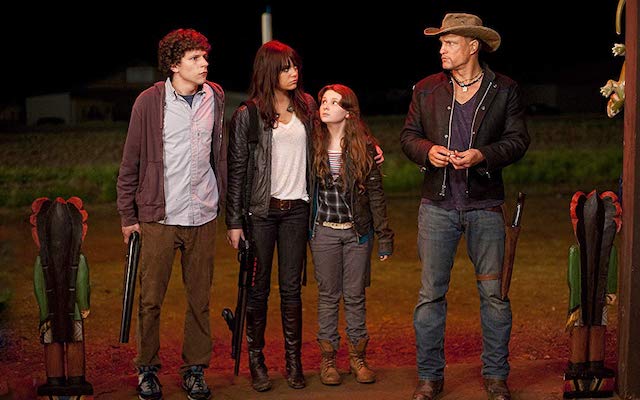
Consider also “Zombieland,” a terrific gore-comedy starring Woody Harrelson and Jesse Eisenberg as a random pair of survivors trying to get along after the zombie apocalypse has wiped out most of America. The film is short (85 minutes), hilarious, gory, and full of energy. It also has a great celebrity cameo that I think you’ll enjoy more if you don’t know much about it beforehand.

At the free promotional screening last night, some locals had dressed up in zombie costumes and makeup for added effect. Of course, it was hard to tell them apart from the people who usually go to those screenings anyway. A lot of them shuffle awkwardly, look disheveled, and smell like they could have just sprung from a grave. I wonder if they thought the zombie people were making fun of them.

Michael Moore’s latest documentary, “Capitalism: A Love Story,” opens in wide release today after a four-theater opening last week. It’s his sloppiest work yet, with little focus on persuasion and lots of focus on telling us what he assumes we already agree with. I do agree with some of it — but the style makes for a pee-poor documentary. Pee-poor!

In limited release (and available through some cable On Demand services) is “World’s Greatest Dad,” a dark, dark comedy written and directed by Bobcat Goldthwait. I saw it at Sundance and loved it but didn’t get around to writing a review, so when it played at CineVegas I decided to see it again to refresh my memory. And then I STILL didn’t write a review of it, what with one thing and another, until now. But I had taken lots of notes (both times!), so it turned out OK. (By the way, the CineVegas screening was the topic of this “Snide Remarks” column.)

“The Invention of Lying” is the other wide release today, but it screened at the same time as “Whip It,” and I was assigned to “Whip It.” I’ll have a review of “Invention of Lying” posted this weekend.

To sign up for the “In the Dark” e-zine, which brings you all the new movie reviews, DVD releases, and other pertinent info in one handy weekly e-mail, visit this page.

Whip It

0
Whip It

“Whip It” tells the tender, romantic tale of a 17-year-old girl falling in love for the first time. As is often the case with young love, the object of her affection is a rugged outsider. Its name is roller derby.

How refreshing to see a film about female characters where the primary focus isn’t men. Yeah, our teenage heroine has a crush on a human male, too, but he is second in her life, after roller derby. Her inevitable confrontation with her disapproving parents is about it, not him. “I am in love with this!” she says. For once the female protagonist’s journey into adulthood isn’t about finding a man to love but about finding herself.

The star of this cheerful and pleasant comedy is Ellen Page (“Juno”), the new poster girl for young female empowerment. She plays Bliss Cavendar, an alterna-girl and indie-music fan who lives in a podunk Texas town from which she and her similarly ill-fitting best friend, Pash (Alia Shawkat), long to escape. Bliss is constantly chagrined by her mother, (Marcia Gay Harden) a prim, conservative Texas mom who wants nothing more than for Bliss to win the Miss Blue Bonnet beauty pageant, go to college, and nab a husband.

It’s clear Bliss will fall in love with roller derby the moment it skates into her life. She and Mom are shopping in Austin when three members of one of the local teams come rolling in, dressed in their derby outfits and exuding confidence and danger. Bliss gapes at them, smitten, while the soundtrack plays a love ballad heavy with acoustic guitar. Every film with a romance story has a scene like this; the only difference is that the boy has been replaced with roller derby. (It’s not the women Bliss is attracted to. It’s what they represent.)

Bliss joins the team, the Hurl Scouts, and we are inducted into the world of roller derby, at which Bliss unexpectedly excels. Everyone plays under a punny name that mixes femininity with violence: Rosa Sparks, Smother Teresa, Smashley Simpson, and my personal favorite, Jabba the Slut. The rules of the game are explained (thank goodness), but not much effort is made to turn this into a “sports film.” More important is Bliss’ newfound freedom and happiness, diminished only slightly by the fact that she has to hide the whole thing from her parents. Her easygoing dad (Daniel Stern) might go for it, but Mom is out of the question.

Well, you can see how this is shaping up. Bliss’ deception must be uncovered; there must be a falling out between her and her mother; perhaps the championship game will be scheduled at the same time as the beauty pageant; perhaps Bliss will neglect her old friend Pash in favor of her new teammates. Maybe Juliette Lewis will play a mustache-twirling villain on an opposing team who sets Bliss in her sights for no good reason. Maybe. I’m just spitballing here.

The story, written by Shauna Cross and adapted from her own novel, may be formulaic in many respects, but it’s not enough to detract from the film’s overall good-natured enjoyability. The first-time director is one Drew Barrymore, who also has a smallish role as one of Bliss’ more aggressive teammates, and she acquits herself admirably in her behind-the-camera debut. Kristen Wiig, Zoe Bell, and the rapper Eve are among the other Hurl Scouts, with Jimmy Fallon as the league’s horny, disheveled announcer and Andrew Wilson (Luke and Owen’s brother) as Razor, the Scouts’ bearded doofus of a coach. Wiig is particularly useful not just for being funny but for acting as the team’s maternal figure. “Just because you found a new family doesn’t mean you throw the old one away,” she tells Bliss after a rift with her parents. A film like this needs someone wise to keep things grounded. Wiig is a nice touch.

Bliss’ romance with a rock singer named Oliver (Landon Pigg) is decidedly a lesser concern. Her relationship with her mother, meanwhile, is vital, and Marcia Gay Harden is characteristically terrific as Mom, with her “psychotic ideals of ’50s womanhood” and undying love for her daughter. Barrymore resists overplaying the sentiment, preferring to keep things upbeat and jocular. “Whip It” succeeds on that level: funny, agreeable, and lightly entertaining, and not nearly as grueling as an actual roller derby match.

A Serious Man

0

Joel and Ethan Coen, the fraternal existential pranksters of filmdom, are experts at making us laugh, making us think, and making us think about whether we’re supposed to be laughing or thinking. Their latest, “A Serious Man,” does all of that, and some elements of it are liable to produce puzzlement. Yet the Coens have outdone themselves this time. There are details within “A Serious Man” that help us interpret not just this film but some of the brothers’ other inscrutable works, too. It might even summarize everything they’ve ever done.

Set in the Coens’ native Minneapolis in the 1967 of their youth, it offers such sublime Coenic delights as offbeat one-scene characters, befuddled yokels, repetition of dialogue (“Be out in a minute!”), unexpected plot devices, and a shrewd eye for visual composition. It also includes allusions to Old Testament figures Job and David and is deeply, deeply Jewish. It’s a dark comedy, I think, or maybe a drama with some darkly funny moments. I’ve seen it twice. One audience laughed a lot more than the other one did. I don’t know which one I agree with.

That’s OK, though, because uncertainty plays a significant role in the movie. Our protagonist is Larry Gopnik (Michael Stuhlbarg), a physics professor at a small college who is the epitome of the hapless, put-upon, bespectacled nebbish. His pants are too short, his manner is neurotic, he is cowed by his overbearing wife and treated as inconsequential by his teenage children. But he is a good man who provides for his family and always tries to do what is morally right.

And what does Larry get for his troubles? Nothing but grief, that’s what. His wife, Judith (Sari Lennick), wants to leave him for his co-worker and friend Sy Ableman (Fred Melamed). One of his students (David Kang) has attempted to bribe him for a passing grade. He’s uncertain whether he’ll be granted tenure at the college. His Gentile next-door neighbor (Peter Breitmayer) seems to be slowly encroaching on the Gopniks’ property, the sort of thing that historically has made Jews a little nervous. Larry’s brother, Arthur (Richard Kind), unhealthy and maybe unstable, is living with the family indefinitely. An unspoken “oy vey” hangs over every aspect of Larry’s life.

What Larry wants to know is this: Why? Why are his wife and Sy and the failing student and everyone else so unreasonable? He is perplexed by all the persecution. What has he done to make God send him such trials? He seeks advice from rabbis and gets little help, though you might find what they say both amusing and, in the context of the film, enlightening.

As Larry’s life slowly falls apart, his son, Danny (Aaron Wolff), is supposed to be preparing for his bar mitzvah. Mainly he smokes pot with his buddies and attempts to retrieve the transistor radio that was confiscated during Hebrew school. And what does Danny’s story have to do with his father’s? A fine question! We meet them both at the same time, with the Coens cutting back and forth between Larry getting a physical exam at a doctor’s office and Danny surreptitiously listening to Jefferson Airplane in class. Does this parallel editing mean the two Gopniks are connected thematically? Later, a frantic Larry observes that at the very moment he was in a minor car accident, someone he knows died in a major one across town. A coincidence — but does it mean something? Is God trying to tell him that he and the other person are somehow alike? What is God trying to tell him?

You could just as well ask what the Coens are trying to tell us. After all, if a movie is a made-up world, then the directors are the gods of it. These particular Minnesotan deities are well-known for resisting their worshipers’ pleas for enlightenment, preferring to reward the faithful with treasures of understanding that the less observant miss. And sometimes they’re just messin’ around with you. Sometimes the answer is that there isn’t an answer. Which is the same answer Larry Gopnik gets, when someone tells him, “Accept the mystery.” Since this is the Coen brothers, naturally the “answer” to the film would come from a minor character in a throwaway line in reference to something else, and of course Larry doesn’t get it.

The Coens’ worldview — or at least the one conveyed in this and some of their other films — is that no matter what you do, stuff happens. It’s not always fair or logical or appropriate. Life is messy and unpredictable. As someone in “No Country for Old Men” told us, “You can’t stop what’s comin’. It ain’t all waitin’ on you. That’s vanity.” The first words in “A Serious Man” are a quote from the medieval French rabbi Rashi: “Receive with simplicity everything that happens to you.” Just accept it, man.

You could drive yourself crazy trying to figure things out. Take the film’s prologue, for example, set in a European Jewish village 100 years ago. A husband and wife have opposite views of the same person, an old man who stops at their cottage and who might be either a harmless old man or a demon. Who is right? He’s like Schrodinger’s cat, for all intents and purposes alive and dead at the same time because we don’t know for sure either way. Larry Gopnik knows about Schrodinger. He knows about the uncertainty principle, too. He ought to apply his understanding of physics to daily life.

The only way to truly solve life’s problems, the film suggests, is to stop thinking about them. By forgetting that the mysteries even exist (and drugs, like Danny’s marijuana, can help change your perspective there), you relieve yourself from worrying about them. Once you no longer have problems to worry about, you’re happy. You can’t ever really solve the mysteries of life anyway, so why bother with them? Whatever is going to happen is going to happen.

I don’t subscribe to that philosophy myself, and who knows if the Coens even really do. But what an engrossing and thoughtful tale they tell in the service of it! Michael Stuhlbarg, a largely unknown actor (like most of the cast), gives a powerhouse performance as Larry, a man who gets beaten down but maintains an inner reserve of strength and dignity. He is never pathetic or pitiful. That’s important. I also love Fred Melamed as the velvet-voiced Sy Ableman, and Richard Kind (probably the most famous person in the film) as Larry’s sad, sad brother.

The film is a wonder: At every turn there’s an offbeat character or an unexpected development waiting to surprise you. It’s all about the uncertainty of life, yet the film itself is very certain, carefully crafted, impeccably written and acted. The first time you watch it, you enjoy the unpredictable ride you’re on. The second time, you contemplate how all the pieces fit together. I’m eager to see what happens the third time.

The Invention of Lying

0

You probably already know that “The Invention of Lying” takes place in a world where deception doesn’t exist. Mankind never developed the ability. Everyone is 100 percent truthful all the time — not because they feel obligated to, but because the concept of lying has literally never occurred to them. If someone came along who COULD lie, well, his power would be almost limitless. Everyone would believe everything he said. The skill of lying would be what scientists call an evolutionary advantage.

In a strange way, that’s sort of what “The Invention of Lying” is about: the forward progression of the human species. Co-written and directed by Ricky Gervais and newcomer Matthew Robinson, the film has its wacky moments reveling in the absurdity of a world where no one lies, some of which feel like a “Saturday Night Live” sketch or an improv show. (“Your suggestion is: ‘a world where no one lies’! The scene is: a blind date! Go!”) But it’s also surprisingly thoughtful, even tender, in the way it considers love, relationships, and God.

For what you might not already know about the film is that lying isn’t the only thing absent from this world. There’s no religion, either. No one believes in God — that word, like “lie,” is never used — because no one ever thought to make him up. (The movie’s view, one infers, is that God is imaginary and thus wouldn’t be part of a world where no one ever fabricated.) The Man in the Sky, as God comes to be known, is the invention of our hero, Mark Bellison (Gervais), a loser who suddenly finds that he can say things that aren’t true.

It starts out simply enough. The bank teller asks how much money is in his account, and something snaps in his brain. (The movie actually shows us his brain. It’s an important event in human history, after all.) He tells her $800 even though he knows it’s only $300. She checks the computer, sees $300, and assumes it must be an error. Mark said he has $800, so he must have $800. What other explanation could there be??

Well, he could just be WRONG. This is a world without lies, not a world without honest mistakes. No one ever asks for clarification, though. People will believe whatever you say, even if it contradicts the last thing you said. They usually don’t even seem confused. Consequently, everyone comes across as simple-minded, almost robotic. And I want to quibble with another aspect, too, which is that people reveal every thought they have. Mark goes on a blind date with the beautiful Anna (Jennifer Garner), and the plain-faced restaurant hostess tells her, out of nowhere, “I’m threatened by you.” Now, if Anna had asked the hostess what she thought of her, obviously she’d have to tell the truth. But why blurt it out? It’s not dishonest to keep some things to yourself. That’s not deception; that’s simple civility. Then again, I know people in real life who feel compelled to vocalize every single thought they have. I’ve sat near them in movie theaters.

But back to our story. Once he realizes he can lie, Mark has a good bit of fun before spontaneously making up the concept of “heaven” to comfort a dying person. No one had ever thought of an afterlife, you see. Next thing he knows he’s an unwitting prophet, pulling doctrines out of thin air to tell people to make them happy.

Mark isn’t happy, though. He’s in love with Anna, who rejects him because he isn’t a good genetic match for their offspring. This world is all about evolution, the survival of the fittest. A better choice for Anna would be Brad Kessler (Rob Lowe), Mark’s handsome and smarmy co-worker.

I was frankly astonished to see Gervais do such serious, heartfelt work in a couple of scenes. It’s a bold move for a comedian, especially one so well known for playing jackasses, but he pulls it off. The comedic scenes, meanwhile, are vintage Gervais, with that terrific mix of exasperation and condescension. Louis C.K., Jonah Hill, Tina Fey, and Jeffrey Tambor are excellent in supporting roles, and we get some nice cameos by the likes of Jason Bateman and John Hodgman, too.

The fact that the film is less funny than I expected doesn’t bother me. It’s generally funny when it tries to be. It just has some serious things on its mind, too, and that’s OK. The God angle gives it some extra dimension, another layer to peel off the high-concept onion.

What is a problem is the relationship between Mark and Anna. She professes love for his kindness and wit, and believes he would make a good husband. It’s only his drab physical appearance that puts her off. Mark, meanwhile, thinks Anna is perfect in every way — but the thing is, she’s not. She’s shallow and vain, and in ways that go beyond “I’m just being honest.” Apart from her beauty, we don’t know what Mark sees in her. Considering the whole story rests on his attempts to earn her love, this deficiency is troubling.

Apart from that and what feels like a rushed finale, however, “The Invention of Lying” is a satisfying comedy with a fair number of solid laughs. Its strange concept and storyline make it something of a curiosity, too: you can have fun thinking about it even after it’s over. Honest.

Zombieland

0
Zombieland

It’s been five years since we got “Shaun of the Dead,” the last really terrific zombie comedy to reach a wide audience, and I’d say we’re overdue for another one. And lookee here, stumbling up the path is “Zombieland,” a deliriously funny and cheerfully gruesome tale of post-apocalyptic mayhem from first-time director Ruben Fleischer.

Zombies have already wiped out most of America when the film begins, and a scrawny college student played by Jesse Eisenberg is trying to get from Austin to his hometown of Columbus to see if his parents survived. In narration, he tells us how a nerd like himself has managed to outlast nearly everyone else. For one thing, he already had a lot of phobias and seldom left the house anyway, so dodging zombies comes easily. For another thing, he’s methodical, with a list of rules he adheres to rigidly. Rule number one for surviving the zombie apocalypse? Cardio. Never underestimate how important it is to be able to outrun the living dead.

On the road he meets a fellow traveler who’s older, tougher, more awesome, the kind of guy who not only kicks a** and takes names but would actually phrase it that way, too. He’s played by Woody Harrelson. He doesn’t like to learn the names of his fellow non-zombies, lest he get too attached. He calls our nerdy hero Columbus, on account of where he’s trying to get to, and identifies himself as Tallahassee, for the same reason.

Tallahassee and Columbus are your standard odd couple, if your standard odd couple bickers between volleys of gunfire aimed at flesh-eaters. (When Columbus corrects him on the fact that penguins don’t live at the North Pole, Tallahassee says, “Do you want to feel how hard I can punch?”) Columbus has gotten pretty good at killing zombies himself, but he’s in awe of his new companion’s skills: “When Tallahassee goes Hulk on a zombie, he sets a new standard of not-to-be-f*****-with.”

The two run into another pair of road warriors, sisters Wichita (Emma Stone) and Little Rock (Abigail Breslin), their names supplied once again by Tallahassee. Everyone has a policy of not trusting anyone, though of course the moral to this sweet little fable will be that life isn’t worth living if you don’t have someone to live it with.

The four also encounter a very cool and very famous Hollywood celebrity, appearing as himself in a brilliantly funny cameo. Knowing who it is won’t ruin anything — you can look at the film’s Internet Movie Database page if you want to — but you might enjoy the surprise. Either way, it’s audacious and loopy and original.

Friendship, camaraderie, snark, and the relentless mowing down of zombies: This is why motion pictures were invented. Some zombie films skimp on the kills, but not “Zombieland”! No sir! Fleischer (working from a screenplay by Rhett Reese and Paul Wernick) indulges the audience with abundant blood and gore, allowing the characters to stumble across far more weapons and ammunition than is plausible in the interest of keeping the bullets flying.

The action eventually leads to an amusement park, an altogether fitting place for a carnival-ride movie like this one. Eisenberg, a more angular version of Michael Cera, might seem an unlikely movie star if you haven’t seen his work in “Adventureland,” but his prim, dorky persona is perfect for Columbus. He’s well matched with Harrelson, whose exuberance makes the happy-angry Tallahassee a nonstop source of delight, the kind of character you’d say steals the show except that he’s already the co-lead and thus part owner of the show.

“Zombieland” doesn’t add anything new to the zombie genre (nor, for that matter, to the comedy genre), and its story is extremely simple, almost to a fault. On the other hand, it’s fast-paced, clever, and filled with inventive details. It deserves to become a midnight-movie cult classic. If it doesn’t, that means the zombies win.

(By the way, as long as we’re on the subject: It never made it to theaters, but the 2008 high school zombie comedy “Dance of the Dead” — think John Hughes meets George Romero — is extremely entertaining and worth a rental. It was a big hit at South By Southwest last year. Some of us saw it twice.)

Meteor

0
Meteor

In the very likely event that you have not seen the 1979 disaster film “Meteor” and do not wish to have the entire plot spoiled for you, please avert your eyes from the following paragraph!

A five-mile-wide chunk of asteroid is on a collision course with Earth, and the only way to stop it is for NASA to fire some nuclear missiles at it to send it off course. So they do. The end.

Now, if you or I were making this film, we’d probably introduce some complications. Maybe they’d have another plan first, and it fails, and that’s when they come up with the nuclear option. Or maybe the nuclear missiles don’t work, so NASA has to launch an astronaut up there to blow up the asteroid manually by firing a gun at it. Yeah, sure, that would be stupid, but come on, we’re just brainstorming here. And if we couldn’t come up with any good complications to flesh out the story, we’d realize there was no way it would work as a 107-minute movie. We would abandon the project and move on to other things.

But not the people who made “Meteor”! They are undeterred by such trivial matters as the story being boring. They also do not care if they cannot afford good special effects. They do not care about a lot of things. The man who directed “Meteor” is Ronald Neame, and he made “The Poseidon Adventure,” for crying out loud! He is not interested in your petty complaints! HE WILL MAKE WHATEVER DISASTER MOVIE HE WANTS! (Well, not anymore. He’s 98 years old. Now the only disasters he makes are in his pants.)

meteor

The star of “Meteor” is Sean Connery, who is known to modern viewers as an ancient and leathery Scotsman but who was a young lad of 49 when this film was made. He plays Dr. Paul Bradley, a NASA scientist who left the company five years ago but is dragged back into action when the huge asteroid chunk is discovered hurtling Earthward. It seems Paul designed a satellite called Hercules that has 14 nuclear missiles on it. The original plan was to aim the missiles out toward space as a defense against, I don’t know, Martians, or errant asteroid chunks, or whatever, but instead the military aimed the missiles at the Soviet Union, which you have to admit was a much more imminent threat. Paul left NASA in a huff over this misuse of his peaceful nuclear-missile-deploying technology and now spends his days sailing his yacht and drinking Scotch.

As far as I can tell, Paul possesses no special knowledge of the Hercules system that isn’t known to the NASA scientists who continue to operate it. All they have to do is reposition the missiles so they’re aimed at the asteroid instead of Moscow, and if they don’t know how to do THAT, what DO they know? So I don’t know why Paul has to be dragged in. Maybe they forgot the admin password? Maybe they just missed having Paul around? His old NASA buddy Harry Sherwood (Karl Malden) is certainly glad to see him again, and Paul, being rather full of himself, seems to enjoy feeling important, even when, as in this case, he isn’t.

One snag, though: The 14 nuclear missiles won’t be enough to thwart the meteor. It’s too big! (It’s also too big to be properly termed a “meteor,” despite the film’s title, but never mind.) Luckily, the Americans are pretty sure the Soviets have a counterpart to Hercules that’s just as secret as Hercules is. If the Yankees and the Russkies were to combine their powers, they could save the world. But will Cold War politics get in the way?

That would certainly be interesting! I would enjoy that plot complication, where the fate of mankind is threatened by petty bickering and nationalistic grudges. It would give us a lot to think about, wouldn’t it? About how we let our political differences blind us to our shared humanity?

meteor

Obviously, the movie doesn’t go that route. The movie hints at going that route, but then it goes a different route, the route where the political posturing is resolved in two minutes and Sean Connery gets to hit on the attractive Russian translator. Her name is Tatiana (Natalie Wood), and she translates for Russia’s top astrophysicist, Dr. Dubov (Brian Keith). Dubov speaks very limited English and requires a translator for most interactions. This helps the film earn points for realism while also helping the film further its goal of being boring. Because if bland scientific dialogue isn’t dull enough by itself, imagine how dull it is when you have to hear it, then hear it spoken in Russian, then hear the Russian guy respond to it, then hear his response translated into English. If boredom is what you’re going for, this is one of the most efficient means of obtaining it. Kudos, “Meteor.” Kudos.

Anyway, the Russians do have a Hercules equivalent, called Peter the Great, and it’s pretty much exactly the same as Hercules, right down to its aesthetic design. Whichever black-market weapons developer sold the plans to the Americans and the Russians had some serious nerve double-dipping like that.

NASA’s top-secret control center for Hercules is in New York City, underneath the AT&T building. (Where else would it be? In Houston, where the rest of NASA is? Don’t be stupid.) There are dozens of full-time personnel involved in monitoring Hercules. Don’t ask me what they do all day. “Is Hercules still in orbit?” “Yep.” “Are its missiles still aimed at Russia?” “Yep.” “Has anyone ordered us to fire the missiles?” “Nope.” “Well, I guess we can knock off early today, then.”

meteor

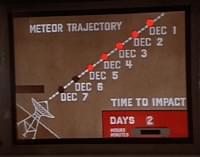
One of the employees, perhaps out of boredom, has taken the initiative of putting together a panel that tells us how many days are left before the asteroid reaches Earth. That kind of outside-the-box thinking is exactly why America leads the Soviet Union in the space race. You know darn well no lazy socialist at Peter the Great headquarters ever demonstrated that sort of gumption! The movie doesn’t show us what’s going on over there, but you can assume they’re just sittin’ around waitin’ for the United States to solve their problems for them.

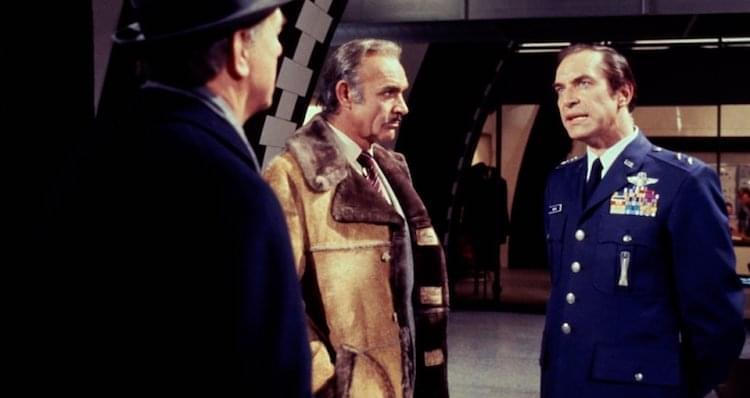
The military commander at Hercules headquarters is Major-General Adlon (Martin Landau), and he is VERY SKEPTICAL of telling the Soviets that Hercules even exists, let alone inviting their top astrophysicist and his boredom-enhancing translator into the command center. Adlon’s theory is that the asteroid will burn up when it enters the Earth’s atmosphere, and that all this panicking and secret-revealing and Russia-cooperating-with is therefore unnecessary. In general, Adlon is opposed to everything, especially science, whose representatives have calmly explained that a five-mile-wide chunk of rock is too big to just “burn up” when it enters the atmosphere. (It is also too big to be called a “meteor,” but I believe we have covered that.)

meteor

At first it looks like Adlon might be right, which would be a profound victory for ignoramuses everywhere. Small pieces of the asteroid arrive ahead of schedule and produce nothing more than a display of colorful lights in the skies over Italy. But then some bigger chunks hit the Swiss alps, causing an avalanche, and then some more hit the ocean, causing a tidal wave that floods all of Hong Kong. Adlon, to his credit, is not the kind of guy to cling to an opinion after it’s been proven wrong. It only takes a couple hundred thousand deaths and the destruction of an entire city to get a retraction out of him. Realizing his error, he humbly apologizes to Harry Sherwood and Paul Bradley. Harry graciously accepts and shakes his hand. Paul, being a jerk — the movie thinks being a jerk is the same thing as being a hero — ignores him.

New York City gets hit by an early chunk of asteroid, too, and Hercules’ subterranean headquarters are damaged. Some minor characters that we were supposed to care about but whose names we never learned get killed. Houston is fine, though. I’m just sayin’. And the missiles are launched, as planned, and they hit the big asteroid, and everything is fine, if “fine” includes having to watch shot after shot after shot of timers counting down and missiles being repositioned and pictures of asteroids having pictures of missiles unconvincingly superimposed over them. I don’t know if you call a 15-minute plot being stretched for 107 minutes “fine,” but I sure don’t.

(Note: This movie is better than “Armageddon.”)

–Film.com

Eric’s Bad Movies: ‘Meteor’ (1979)

5

The 1970s were a fertile time for disaster movies. At the tail end of the decade, when the genre’s popularity was waning and most of the good disasters had been taken, some people made “Meteor,” in which a giant asteroid threatens to hit our fair planet and kill us all. “Meteor” is slow and dull, nearly opposite in tone from the frenetic “Armageddon,” which ripped it off 19 years later. And “Meteor” is this week’s subject of Eric’s Bad Movies at Film.com.

Friday movie roundup – Sept. 25

0

So someone at MGM must have seen the success of the “High School Musical” films and thought, “Hey! We own the rights to ‘Fame’ — the original high school musical! We should PG-ify it and remake it for the modern generation!” And that’s what they did, and it blows.

“Surrogates,” on the other hand, does not blow, even though they didn’t screen it for critics until Thursday night (which is usually a bad sign). It’s a pretty swift sci-fi action flick set in a world where people stay home and send robot surrogates outside in their place, thus experiencing life without risk of pain or injury. Bruce Willis plays an FBI agent investigating the deaths of people who were killed when their surrogates got killed — which ain’t supposed to happen, you know. That’s the whole point. The film isn’t brilliant or anything, but it’s surprisingly solid. Review to come at Film.com.

“Pandorum,” a sci-fi horror film about two astronauts who wake up with no memory of who they are or what their mission is, is one of Hollywood’s Shameful Secrets. I believe it was screened last night, but critics weren’t notified or invited. I don’t know if I’ll get around to reviewing it or not. I still want to catch “Cloudy with a Chance of Meatballs” from last week, which I keep hearing is really funny.

“Brief Interviews with Hideous Men,” one of the most notorious disasters from this year’s Sundance Film Festival, opens today in limited release. Don’t bother looking for it.

To sign up for the “In the Dark” e-zine, which brings you all the new movie reviews, DVD releases, and other pertinent info in one handy weekly e-mail, visit this page.

Brief Interviews with Hideous Men

0

David Foster Wallace’s “Brief Interviews with Hideous Men,” being composed of 23 short stories in the form of monologues by unconnected men, has always been regarded as a fine book that could never be made into a movie, or at least not a good one. (I guess anything CAN be made into a movie.) Now John Krasinski has written and directed a screen adaptation, and sure enough, everyone was right. If it can be adapted successfully, Krasinski has not found a way to do it.

This has been a pet project for Krasinski since before he became famous for playing Jim on “The Office.” Some have suggested he wouldn’t have bothered finishing the movie were it not for Wallace’s suicide in 2008. Certainly it has a labor-of-love feel to it, as well as a this-is-gonna-suck-but-we’re-committed-to-it feel. Whatever last-minute editing Krasinski was doing was probably akin to rearranging the deck chairs on the Titanic.

The central story, which Krasinski created to draw the monologues together, has a grad student named Sara Quinn (Julianne Nicholson) setting out to determine, anthropologically speaking, why men are such pigs. To that end, she interviews guys — ex-boyfriends, colleagues, strangers, whoever — and lets them chatter about their sexual and romantic proclivities. Krasinski has preserved a lot of Wallace’s prose here (occasionally changing the setting from a formal interview to something more informal), and some of the individual scenes work for that reason. The text is scintillating, and the actors — including Timothy Hutton, Will Arnett, Bobby Cannavale, Christopher Meloni, Denis O’Hare, Frankie Faison, Max Minghella, and Krasinski himself — obviously enjoy sinking their teeth into something dramatic and theatrical. All actors love a good monologue.

The problem is that the film is really nothing but a series of monologues, and a series of monologues, even when they are good individually, feels stale after a while. With no story, no rising action, no character arcs, we’re left with nothing to grab hold of. The movie could end now; or it could end 10 minutes from now; or it could run another two hours. The character of Sara Quinn isn’t fleshed out in any meaningful way, and obviously whatever connections we establish with the interview subjects will only last a few minutes before disappearing from the film.

In short, “Brief Interviews with Hideous Men” fails for all the reasons you’d expect it to fail. It was quixotic of Krasinski to attempt it in the first place. His passion for the project comes through loud and clear, but it takes more than passion to convert an unfilmable book into something cinematically compelling.

Paranormal Activity

0

From the dark underground of film festivals like Screamfest and Slamdance comes “Paranormal Activity,” a low-budget horror flick that uses its do-it-yourself aesthetic to great advantage in scaring the pee out of viewers. Rather than building elaborate (and expensive) sets or relying on horrifying (and expensive) special effects, first-time filmmaker Oren Peli simply shot the whole thing in his own house, an ordinary, un-scary three-bedroom home that could easily be my house, or your house, or anyone’s house. Ergo, the terrifying things that happen here could also happen … well … you see where I’m going with this. Good luck sleeping tonight!

Like “The Blair Witch Project” or “Cloverfield,” “Paranormal Activity” purports to be documentary footage shot by its subjects, in this case a young couple named Micah Sloat and Katie Featherston, played by actors of the same names. The “engaged to be engaged” pair has been experiencing unusual sights and sounds at night, and Micah has bought a video camera to try to capture whatever it is on tape. (Those who were made queasy by the other films I mentioned will be glad to know that Micah has a steady hand when he carries the camera, and he sets it on a tripod or other stationary object much of the time.)

Katie takes the whole thing more seriously than her boyfriend does, having been plagued by these phenomena off and on since she was 8 years old. Micah’s approach is more practical: We’re going to film everything, we’re going to analyze the recordings, and we’re going to put a stop to this. Before too long, he’s scared enough to stop cracking jokes about Ouija boards and psychics.

And that’s the premise — simple and elegant and ripe with possibilities, which Peli explores to a highly satisfying and bone-chilling degree. Everything in the film was shot by the characters, which means you’ll need to get over the impulse to wonder why they keep filming even when things turn scary. And Peli lets the suspense build slowly and gradually to its terrifying crescendo, so impatient types beware.

The crucial scenes are the ones at night, with the couple asleep in bed, a small light left on in the corner so the camera can capture whatever happens. Upstage is the bedroom door, left open to permit us a view of the dark hallway beyond it. The camera is motionless, of course, so there’s nothing directing our attention to any particular part of the screen. If something alarming occurs, it could come from anywhere within the frame, and at any moment. The tension is often unbearable, and it’s not much of a relief when the anticipation is over and the real fright kicks in.

The daytime scenes, which help regulate the pace of the film so it’s not constantly operating at maximum capacity (this is good for your heart, too), are by necessity less compelling than the nighttime ones, and there comes a point where you might wish we could omit them and just stick to the good stuff. The film needs them, though, and the two actors — this is essentially a two-person story — have a natural chemistry and rapport that bolsters the film’s believability. That’s crucial, too, of course. What happens to them could happen to you. I sure hope it doesn’t, though, for your sake.

Fame

0

The “Lord of the Rings” trilogy takes 10 hours of screen time to tell a story that occupies the space of four years*. “Fame,” on the other hand, tries to cover four years in only 107 minutes. My point is not that I wish “Fame” had been 10 hours long, but that it’s almost unreasonably ambitious to cover such a long period of time, and such a large cast of characters, in a film of average length.

For comparison’s sake, the 1980 “Fame,” of which this is a very, very loose remake, was 134 minutes. But apart from the setting — the New York Academy of Performing Arts, a high school for singers, actors, dancers, and musicians — the films have little in common. The original was rated R and had the characters facing sexual exploitation and abortion. One of them was even an openly gay homosexual! The 2009 version, led by first-time feature director Kevin Tancharoen, is a cheery PG and has none of that.

Nor has it much originality or energy, unfortunately. Starting with auditions and ending with graduation day, the film tries to do so much in so little time that no characters or storylines get the attention they would need to succeed. Some scenes demonstrate admirable efficiency in establishing people and relationships with only a few lines of dialogue, but most are simply rushed and haphazard. (The screenplay is by Allison Burnett, a man, the writer of “Feast of Love” and “Autumn in New York.”) It’s like watching a teen soap opera on fast-forward.

Yes, though these talented kids are eager to pursue careers in the arts, the film’s real focus, insofar as it “focuses” on anything, is on their friendships and romances, and those are most assuredly nothing special. Jenny (Kay Panabaker) is an uptight stress case with professional acting ambitions; her love interest, Marco (Asher Book), is a singer. Malik (Collins Pennie) is an angry actor who won’t show his real feelings and wants to produce music with Victor (Walter Perez), who plays the piano but won’t follow the rules; the two of them find Denise (Naturi Naughton), a classical pianist whose secret talent lies in singing, which her strict father doesn’t support. Victor is apparently dating the aloof, wealthy dancer Alice (Kherington Payne), too, though the film literally spends no more than 90 seconds addressing their relationship.

Other students lurk in the periphery, even less well established. Neil (Paul Iacono) wants to make films. Joy (Anna maria Perez de Tagle), an actress, might not be able to keep her grades up. Kevin (Paul McGill), who came from Iowa to dance ballet, isn’t good enough to make a living at it.

But wait! I’m not done! There are 200 more students I need to mention!

Anyway. You get the idea. Charles S. Dutton, Bebe Neuwirth, Megan Mullally, and Kelsey Grammer are suitably authoritative as the school’s acting, dancing, singing, and piano instructors, respectively, and at least Mullally gets to sing a song. (Casting both Grammer and Neuwirth — Frasier and Lilith! — yet not giving them any screen time together is just cruel, though.) Debbie Allen, who played a teacher in the 1980 film and the ensuing TV series, has a couple scenes as the school’s principal. The young performers who play the students, most of them unknowns, seem capable and pleasant, but they’re hardly charismatic enough to stand out in such a large crowd.

The film does retain one of the earlier film’s messages: The real world is harsh and dishonest and liable to mess you up. The only safe place, it would seem, is the school itself, where spontaneous, multi-discipline musical numbers are apt to break out in the lunchroom. Yet even that sequence, which ought to be exuberant, is oddly lifeless, and so are most of the other performance pieces. If “Fame” were auditioning at the school it takes place in, it wouldn’t make it past callbacks.

*The books apparently occupy a somewhat different span of time; see this timeline. In the movies, though, Frodo says in the third film that it’s been four years since he was stabbed by a Ringwraith, which occurred in the first film. Thanks to the Twitterers who assisted me in researching this important topic.

Surrogates

0

In “Surrogates,” almost everyone in the world never leaves the house anymore. There’s no need, thanks to the proliferation of “surrogates,” robotic doubles that look like you (only smoother and prettier) that you can control from the comfort of home. You send them out in your place and live life through their eyes and sensors, safe and sound back at home. It started as a luxury item for people who wanted to experience, say, skydiving without risk of injury, but now everyone uses surrogates for everything.

Well, that’s the way with these things, isn’t it? Less than 15 years ago the Internet was an entertainment and information tool that we might use for a few minutes a day. Now it’s so vital to our lives that we have it on our phones, lest we ever spend a moment without access to it. (Oh, yeah — we also carry phones around with us all the time.) Surrogates caught on in the same way: once a novelty, now utterly indispensable.

This is the world imagined in a graphic novel by Robert Venditti and Brett Weldele, now adapted as a surprisingly smart, fleet-footed sci-fi action flick. (Part of the surprise is that the screenplay was written by Michael Ferris and John D. Brancato, the duo behind “Terminator Salvation” and “Catwoman.”) No, it’s not brilliant, but with swift direction by Jonathan Mostow (“Terminator 3: Rise of the Machines,” “U-571”) and a solid lead performance by the ever-reliable Bruce Willis, it’s one of the year’s more entertaining sci-fi films.

Willis plays Greer, an FBI agent who, like nearly everyone else, conducts his public life entirely via surrogate. (His model looks like him only younger, with softer skin and an absurd blond head of hair.) Most of his private life is conducted that way, too — he and his wife, Maggie (Rosamund Pike), haven’t seen each other for real, in person, in ages, even in their apartment. (They have separate bedrooms. If they ever have marital relations anymore, one assumes there’s a separate room for that, too, where the surrogates do it.)

In the tradition of the hard-boiled detective, Greer — who is grizzled and careworn in person, barely resembling his more presentable surrogate (you tend to let yourself go when no one ever sees you) — has grown weary of all this and is wondering if mankind might have been better off before the surrogates came around. Then, as if to prove the point, someone gets killed. A mystery man deploys a strange weapon against a surrogate, frying its motherboard and somehow sending a charge back to the user and melting his brain. Needless to say, this goes against the whole point of surrogates, which is to protect the user from harm. And anyone who can melt your brain via remote control is obviously not to be trifled with.

Greer and his partner, Peters (Radha Mitchell), are assigned to the case, which grows more interesting when they learn the victim was the son of Lionel Canter (James Cromwell), the billionaire who invented surrogates and was subsequently forced out of the company that makes them. Is someone trying to get back at the inventor? Maybe one of the rising number of people who oppose surrogacy and have started living in machine-free communes on the outskirts of major cities? Maybe their leader, an enigmatic fire-and-brimstone fellow who calls himself the Prophet (Ving Rhames)?

Like most good sci-fi, the story considers the human ramifications of advanced technology while still doling out plenty of just-for-kicks entertainment and nifty “what if?” scenarios. (What if you connected to someone else’s surrogate?) Greer and his wife lost a son a while back, which helps account for their desire to draw inward. There is more than one shot of a character disconnecting from his or her surrogate and crying over what he or she has seen through its eyes. (When someone disconnects, of course, the surrogate just stands there, blank-faced. If a conversation gets too intense, you can escape by literally shutting yourself down.) It’s a very sad idea, this notion of trying to experience life safely, without truly interacting with anyone.

Greer and Maggie’s fractured marriage could have been explored better than it is, and Radha Mitchell’s performance as Greer’s FBI partner is rather wooden. (Yes, she’s a robot most of the time. But so is everyone else, and they don’t act like that.) Like I said, this isn’t groundbreaking stuff. But it’s smart and enjoyable, and the message is “go outside, nerds!,” which is always nice to hear.

Two of a Kind

0
Two of a Kind

You can imagine how excited people in Hollywood were after the enormous success of “Grease” in 1978. “Wow!” they must have thought. “We can make millions of dollars just by sticking John Travolta and Olivia Newton-John together in a movie! And it apparently doesn’t even have to be a very good movie!” This line of thought eventually led to “Two of a Kind,” a desperate movie from 1983 that is notable for featuring the last vestiges of dignity that either star would display publicly for many years to come.

The story is straight out of the Bible. Not the Bible you’ve heard of, though. A different one, where God is insane and has the voice of Gene Hackman. After being on vacation for 25 years, God returns to heaven, and already I have a problem with this film, because where do you go for vacation when you LIVE in heaven? Wouldn’t you just stay home?

Anyway, God returns, looks at the state of the world, and is very displeased, which is to be expected considering he abandoned it for 2 1/2 decades. He tells his adviser angels, played by the likes of Charles Durning and Scatman Crothers, that he’s going to wipe out all of humanity with a flood, and the angels are like, “No, don’t, there are still some good people on Earth!” And God is like, “Oh yeah? Where??” And the angels choose a guy at random and are like, “This guy! He’s a good person!” But unfortunately it’s John Travolta.

Travolta plays Zack, a New Yorker who’s trying to make a living as an inventor of dumb gadgets and novelty items. (Among them: edible sunglasses. I’m not making that up.) He owes money to some bad guys for reasons that either are not explained or that I have forgotten, and when we meet him he’s planning to rob a bank to pay them back. Even the lazy, capricious God imagined by this film doesn’t care much for bank robbers, so he’s totally laughing at his stupid angels for choosing this guy as their hero.

two of a kind

Zack, disguised in an absurd mustache and wig and wielding a gun, orders a bank teller to fill a bag with cash. The bank teller is Debbie, played by Olivia Newton-John, looking remarkably like Markie Post on “Night Court.” She flirts with Zack and pretends to fill the bag with cash while actually filling it with scraps of paper and keeping the money for herself. Zack does not realize this until he gets home and opens the bag; he had forgotten that the practice of always checking your order before you leave the drive-thru window applies to bank heists, too. Meanwhile, Debbie gets fired for flirting with the bank robber, as that is discouraged even at shoddy financial institutions that allow incompetent gunmen to rob them. Even Washington Mutual wouldn’t have put up with that.

Next thing you know, Zack is being chased by the loan sharks, who are unsympathetic to his report that he tried to steal enough money to pay them back and that the stupid bank teller double-crossed him. Loan sharks probably hear that excuse all that time. “You gotta check your order before you leave the drive-thru window!” they probably said to him. Somehow there is a car chase, and then Zack falls off an overpass onto the street, landing on Debbie — quite a coincidence, that — and killing them both. The end.

two of a kind

But wait! Up in heaven, God and the angels have been watching this unfold, and now the angels have an idea. They’ll reverse time to prevent Zack and Debbie’s deaths — see, this is a bad idea already — and then manipulate their lives so they befriend one another. The angels’ deal with God is that if Zack and Debbie act selflessly toward one another within one week, God will spare the world from his wrath. So the fate of all mankind comes down to whether these two idiots can do something unselfish for once in their lives.

You know who doesn’t want this plan to work? The dark lord Satan! Taking the form of Beasley (Oliver Reed), a poncey Englishman with a walrus mustache, Lucifer does whatever he can to prevent Zack and Debbie from becoming good people. The way he figures it, if God destroys the world, all those billions of souls will go to hell, and there’s nothing the devil loves more than a hell full of souls. But God already told the angels that he will bring everyone up to heaven after he drowns them. In other words, God is so disgusted by the wickedness of the world that he’s going to murder all its citizens and send them to heaven, where their punishment will be to dwell with him in joy and happiness for all eternity.

two of a kind

I assume the reason God is only heard and not seen in this movie is out of respect for the audience’s regard for the Almighty. I wonder if portraying him as a careless buffoon negates that.

So the angels rewind time, and now Zack is looking for the bank teller who stole his stolen money. Zack learns from a newspaper story about the robbery that the teller is named Debbie and that she’s an aspiring actress. (Olivia Newton-John playing someone who wants to be an actress is like Tom Cruise playing someone who wants to be tall.) He apparently also learns the time and location of her acting classes, as well as her home address, because he shows up both places and terrifies her — terrifies her because he wants his money, I mean, not because he’s John Travolta, although that would be alarming, too, to open your door and see that giant beefy face staring at you. Then somehow they wind up at dinner together, and there is a pie fight, and Beasley and the angels, including St. Charles and St. Scatman, keep rewinding and fast-forwarding time, because apparently the devil can do that, too. When it’s all over, for some reason Zack and Debbie are in love.

Since Zack and Debbie are now in love, as you may recall from the previous sentence, they spend the next day doing fun people-in-love things. This causes Debbie to miss an important Broadway audition that she didn’t know about, and she decides this is Zack’s fault. She’s also being evicted from her apartment, though she mentions this in passing and the film doesn’t even hint at what the reason is. She also suddenly has a job as a waitress. Apparently an entirely different movie has been going on behind our backs.

But remember how Zack is wanted for bank robbery? Beasley leads the police to him, and he and Debbie are both arrested, whereupon Zack is fairly easily tricked by the cops into pinning the whole thing on Debbie. The cops record his testimony on a cassette tape, but when the case goes to trial — the very next day! — the tape is gone due to St. Charles Durning having stolen it. Without the tape of Zack explaining how Debbie is the one who committed the robbery, the district attorney has no case! (He can’t just put Zack on the stand and have him testify in person because, as you know, New York law only allows testimony to be given via cassette tape. It wasn’t until 2007 that MP3s were even allowed.)

In a last-ditch attempt to thwart the angels’ plan, Beasley disguises himself as a robber and takes Debbie hostage. Zack tries to rescue her and is shot and killed, but his final act of selflessness is enough for God to bring him back to life and spare the world from the flood. If you’re scoring along at home, that’s twice that John Travolta dies and is resurrected in this movie. Consider it a metaphor for his career, which, against all logic and reason, seems equally unstoppable.

— Film.com

Eric’s Bad Movies: ‘Two of a Kind’ (1983)

6

Did you know that John Travolta and Olivia Newton-John were in another film together after “Grease”? And did you know that it was a baffling, illogical, poorly conceived romantic comedy called “Two of a Kind”? You did? Oh. Then you’re ahead of me, because I didn’t know any of this until recently. Anyway, “Two of a Kind” is the subject of this week’s edition of Eric’s Bad Movies at Film.com. It makes me think J.T. and O.N.-J. should have gone ahead and done “Grease 2,” too. I mean, why not?

Translating Hollywood Cliches

0
Translating Hollywood Cliches

If you watch the TV talk shows, you know the routine. Someone involved with an upcoming film — usually an actor, but sometimes the director — does the Letterman/Conan/Leno circuit to talk up whatever the project is, usually offering very little insight into the filmmaking process and a lot of generic mumbo-jumbo. This babble may sound meaningless, but you can actually glean a lot of information from it if you know how to read between the lines. Allow us to help out with…

What Filmmakers Say, and What They Really Mean

What they say: “We really listened to the fans on this one.”
What they mean: “If this movie sucks — and believe me, it does — it’s your own fault.”

What they say: “This movie wasn’t made for film critics.”
What they mean: “This movie wasn’t made for people who see a lot of movies and are knowledgeable and passionate about them.”

What they say: “It’s not a remake; it’s a re-imagining.”
What they mean: “It’s a remake.”

What they say: “We didn’t plan on doing another sequel, but then we found a story that we really liked, and everything just came together.”
What they mean: “We didn’t plan on doing another sequel, but then the studio backed a dump truck full of money up to my house.”

What they say: “I sat down to read the script and was immediately drawn into this character.”
What they mean: “My agent described the character to me in a way that sounded like I’d get to wear a lot of pretty dresses if I signed on.”

What they say: “It’s the most amazing cast and crew. We really were just like a family.”
What they mean: “The kind of family that fights a lot and sometimes has sex with each other, that is.”

What they say: “This was a story that I just HAD to tell.”
What they mean: “This was a story that I just HAD to tell, according to my contractual obligations.”

What they say: “We tried to stay very faithful to the book, but of course you have to make some changes when you make a movie.”
What they mean: “Any similarities between this movie and the book it’s based on are purely coincidental.”

What they say: “Working with a legend like Meryl Streep [or whoever] was a dream come true. She was like a mentor to me.”
What they mean: “I’m fairly confident that by the end of the shoot, Meryl Streep knew what my name was.”

What they say: “The production was grueling. It was very physically demanding. It was one of the most difficult things I’ve ever done.”
What they mean: “The air conditioning in my trailer was on the fritz, I sometimes had to stand in the sun for a few minutes before my stuntman took over, and much of the $7 million I was paid will be eaten up by taxes.”

— Film.com

Capitalism: A Love Story (documentary)

0

When you make your living as a polemicist, it can’t be a good sign when even people who agree with you don’t like you anymore. That’s what has happened with Michael Moore. As his work has gotten sloppier, more exasperating, and less focused in recent years, even us moderate lefties have come to be embarrassed by him, the same way moderate conservatives are (well, should be) embarrassed by Glenn Beck.

Moore’s latest screed, “Capitalism: A Love Story,” is his least useful yet, mixing dry information on the current economic crisis with under-examined hard-luck stories and the usual Moore grandstanding. His thesis is simple: “Capitalism is an evil, and you can’t regulate evil.” (That’s a direct quote.) To support this, he parades a series of victims in front of us, as if a large pile of anecdotes will compensate for the lack of critical examination of the underlying economic theories.

People are evicted from foreclosed-on houses as the cameras roll. One somber vignette shows a family being paid $1,000 by the bank to clean up their own house and clear away the junk before being forced out, saving the bank the trouble of doing it. These things are sad, but they are not entirely one-sided, Moore’s insistent harping on the greedy corporations notwithstanding. While plenty of people were suckered by smooth-talking banks and indecipherable fine print and really are victims of the sub-prime mortgage epidemic, there’s no indication that THESE people, the ones Moore shows us, are in that category. For all we know, they could be regular ol’ deadbeats. I suspect they aren’t — but Moore needs to SHOW us that. He gives us no context, and thus disingenuously implies that all evictees are equal victims of the evil banks.

In other segments, widows grieve to learn that their spouses’ employers had bought life insurance policies and now profit from the workers’ deaths while the bereaved get nothing. But why didn’t the families have life insurance policies of their own? Did they ever try to buy them? Did the thought even occur to them? Maybe they wanted to but couldn’t afford it … which would be a terrific thing for Moore to share with us. Again, with no context, all we know is that people are sad and poor. By itself, that’s not enough to make an economic argument.

Other tales of under-regulated capitalism run amok are incendiary and even true, but they shed no light on whether capitalism is flawed inherently. After all, the other economic systems are subject to abuse, too. Moore’s one really interesting point is that while Americans love democracy, nearly all for-profit businesses are run more like dictatorships and fiefdoms. Why do we love freedom in government but not in economics? That’s worth discussing. Unfortunately, Moore only spends a couple minutes on it before returning to his smug sarcasm and public jackassery.

He arrives at the headquarters of bailed-out financial institutions to make a “citizen’s arrest” of the CEOs who squandered taxpayer money, then pretends to be surprised when the security guards won’t let him in. He “tries” to see the chairman of General Motors by simply showing up at the office, again feigning shock when somehow this fails. Of course, if Moore actually wanted to get a comment from GM — or at least a comment saying “no comment” — he could have done so by, you know, calling ahead and making an appointment. But where’s the fun in that?

He shuffles around Wall Street ostensibly to find out what “derivatives” and “credit default swaps” are, but all he really does is collar stock brokers on the sidewalk and act smug when they can’t explain the practices on the spot. So rather than actually educate us on what “derivatives” and “credit default swaps” are, Moore just establishes that they’re super complicated and leaves it at that. If it’s too complex to be explained in a documentary, it must be really shady, right? (By the way, the Wikipedia entries on both topics are perfectly suitable for an overview of what’s involved.)

No one expects economics to be a thrilling subject. But in the past Moore has usually managed to at least be entertaining. “Capitalism: A Love Story” has only a few traces of his wit and humor, and they’re nearly lost in the fog of his indignation. More than ever, Moore assumes we already agree with him and makes no effort to convince us. His final statement is that capitalism (an economic system) should be replaced with — wait for it — “democracy” (a political system). One assumes he intended for that declaration to make sense in light of the film he’s just shown us. It doesn’t.

Friday movie roundup – Sept. 18

0

Your best bet this weekend, or at least the one that I can vouch for, is “The Informant!,” starring Matt Damon as a naive Midwesterner who blows the whistle on corporate malfeasance. It’s a jolly, goofy film with some real surprises (unless you already know the true story it’s based on).

I’m also hearing very, very good things about the animated film “Cloudy with a Chance of Meatballs,” which currently boasts an 87% approval rating at Rotten Tomatoes. It was screened for critics, but I couldn’t attend. (It was one of THOSE DAYS.) I would take my colleagues’ word for it, though.

“Jennifer’s Body,” a horror comedy written by Diablo Cody (of “Juno” fame), has lots of blood, scattered laughs, no scares, and not much point. The story is bleh. It sure is peppered with new slang, though!

“Love Happens” (review at Film.com) is crap.

Tyler Perry’s “I Can Do Bad All by Myself” opened last weekend as one of Hollywood’s Shameful Secrets, and I reviewed it for Film.com. It’s mediocre.

In limited release is a lovely and pleasant comedy called “Amreeka,” about a Palestinian woman and her teenage son moving to suburban Illinois. The emphasis isn’t on race relations so much as the importance of family and the inherent goodness of most people. It’s definitely worth looking for if it comes to your major metro area.

Oh, and Eric’s Bad Movies at Film.com was a little late in getting posted yesterday, but it’s there, in case you missed it. It’s “Stone Cold,” starring Brian Bosworth. It’s about bikers.

To sign up for the “In the Dark” e-zine, which brings you all the new movie reviews, DVD releases, and other pertinent info in one handy weekly e-mail, visit this page.

The Informant!

0

Everything about Steven Soderbergh’s “The Informant!” suggests a level of playfulness that the director hasn’t indulged in since “Ocean’s Eleven.” The exclamation point in the title; the kitschy musical score by Marvin Hamlisch (who hasn’t composed for a film in 13 years); the retro-cheesy fonts in the credits; the casting of comedians and other unlikely performers in key roles — this is a lark for Soderbergh.

It’s a jaunty, goofy trip for the audience, too, a smart comedy about a dumb guy whose peculiarities become more pronounced — and start to make more sense — as time goes on. Does the movie mock him a little bit, like a rube in a Coen brothers movie? Yeah, maybe. “The Informant!” may not be very humane, ultimately, but its attitude seems to be that who needs humane when you’ve got funny? I agree, up to a point.

The guy is Mark Whitacre, played by Matt Damon, who seems to have modeled his performance on a mixture of Philip Seymour Hoffman and Ned Flanders. He’s thickset, unflatteringly coiffed, and stricken with an awful mustache, as often happened to men in the Midwest in the early 1990s, which is where and when the film is set. Mark is a biochemist-turned-vice-president at the agricultural conglomerate Archer Daniels Midland, where he oversees the production of the mysterious crop-derived things that wind up in almost all food products: dextrose, sorbitol, lysine, etc. Where do those things come from? They come from A.D.M.

A.D.M. is a real company, and Mark Whitacre is a real guy, and this stuff really happened, more or less. (The film is adapted from Kurt Eichenwald’s nonfiction book.) The trouble begins when the FBI is brought in to help with an extortion plot against A.D.M. from a Japanese competitor. In his conversations with Special Agent Brian Shepard (Scott Bakula, in a Sam Donaldson haircut), Mark reveals that there’s something else going on: A.D.M. is engaged in illegal price-fixing, and Mark wants to blow the whistle. Ever the optimist, Mark hopes he will remain in good standing at the company even after he brings down its top executives.

That is the nature of Mark: blissfully naive, eternally trusting, and completely clueless. His wife’s (Melanie Lynskey) nickname for him is Corky. When he’s not speaking, he’s nattering on in an endless internal monologue about all manner of random subjects, from polar bears to the correct pronunciation of “Porsche.” When he talks, he cannot shut up. He just likes to be heard.

This isn’t the kind of guy you want to trust with a major undercover operation, but he’s the FBI’s only source on the price-fixing, so he’s fitted with a microphone and a tape recorder and urged to get the honchos on tape making incriminating remarks. There is much humor in Mark’s overeagerness to do this correctly, as well as in his anxiety over being so deeply involved in something so complicated. Agent Shepard and his partner, Herndon (Joel McHale), are often stunned by how naive Mark is, yet humbled by his inherent honesty and decency.

If you aren’t familiar with the news story that inspired the film, I won’t ruin it for you. I’ll just say that what begins as a predictable comedy about corporate malfeasance turns into something else entirely, with the fascinatingly bizarre Mark Whitacre at the center. Damon’s glee at being able to cut loose and play a truly unusual character is self-evident, and right in line with Soderbergh’s merry attitude. All around him in roles large and small are interesting people: Bakula, McHale, Ann Cusack (John and Joan’s sister), Tony Hale, the Smothers Brothers (but not together), and stand-up comedians Patton Oswalt, Andrew Daly, Bob Zany, Allan Havey, Tom Wilson, and Paul F. Tompkins, to name just a few. You get the feeling the whole movie is a put-on, right down to the casting. (Seriously, what kind of sick joker books the Smothers Brothers, then separates them?)

It is that jokey standoffishness that keeps the film from having a relatable, emotional center. Even though the characters are based on real people, they seem like cartoons — or, more accurately, Mark seems like a cartoon; everyone else seems like a cipher interacting with a cartoon. But he’s a funny ‘toon, and Soderbergh’s light, buoyant touch makes the film worth listening in on.

Jennifer’s Body

0

Good news, zeitgeist watchers! Diablo Cody has descended from the mountaintop to bestow new slang upon us! Henceforth, “jealous” shall be rendered “Jell-O,” as in, “You’re so Jell-O of me!” AND THUS IT IS.

The “Juno” scribe’s sophomore effort, the bloody horror comedy “Jennifer’s Body,” doesn’t have much to offer beyond quirky dialogue, though — and even that feels strained, as if Cody is trying too hard to copy herself. For every line clever enough to inspire a chuckle there are two more that make me think, “Really, Diablo? Ugh.”

The title character, portrayed with campy conviction by “Transformers” hottie Megan Fox — this may well be the part she was born to play — is a high school vixen whose feminine wiles and sexual prowess have made her the object of every boy’s lust and every girl’s awe. Jennifer’s best friend since childhood is a wallflower named Needy Lesnicky (Amanda Seyfried), who has a nice-enough boyfriend, Chip (Johnny Simmons), and lives vicariously through Jennifer’s escapades.

They all live in a small, nondescript town that’s rocked by a tragedy one night, and while Jennifer wasn’t injured in the accident, she starts behaving differently afterward. To be specific, she shows signs of being both evil and, um, carnivorous. Needy is chagrined by this. Some other people are harmed in far worse ways by it.

(Tangent: “Needy” is presumably a nickname, but still: “Needy Lesnicky” doesn’t sound like a person; it sounds like an insult. “You’re such a Needy Lesnicky!” I can hear someone like Jennifer saying exasperatedly. And is your writing so weak that you have to actually NAME your protagonist “Needy” in order to get the point across?)

I believe the intent is that Jennifer’s literal evilness will serve as a metaphor for adolescent angst; the film’s first words are Needy telling us that “hell is a teenage girl.” We get the idea, but the metaphor falls flat. I kept thinking of “Buffy the Vampire Slayer” (created by another self-conscious quirkmeister, Joss Whedon), which did the high-school-demon thing a lot better, with more insight, humor, and humanity. “Jennifer’s Body” is cluttered and unfocused, occasionally funny, somewhat interesting, never scary. What’s the purpose of the mysterious waterfall to nowhere? Why is J.K. Simmons doing a goofy “Fargo” accent as the school’s lone administrator, and why does he have a hook for a hand? How does the origin of Jennifer’s evilness fit in with the teen-angst metaphor? What is this all supposed to add up to?

This is the third girl-power movie for director Karyn Kusama, following “Girlfight” and “Aeon Flux,” but her influence is barely felt. It’s really Diablo Cody’s movie, and it’s her quirks and obsessions on display, for better or worse. What felt fresh and original two years ago, in “Juno,” has lost its luster now; despite being entirely unrelated except for having the same screenwriter, “Jennifer’s Body” feels like a retread. I’m afraid this is one more doodle that can’t be undid, home skillet.

Love Happens

0

Oh, “Love Happens,” does it? Thanks, movie. Thanks for the evocative and powerful title. Way to show some effort in attracting an audience. Maybe you should have gone even more generic and called it “Two People Fall in Love.” I would definitely pay to see that movie!!!!

“Love Happens” is a quasi-romantic pseudo-comedic semi-drama starring Aaron Eckhart and, sure, why not, Jennifer Aniston. Eckhart plays Dr. Burke Ryan, a therapist whose wife died three years ago, leading him to write a very successful book about coping with grief. He now travels the country doing self-help seminars, teaching people how to overcome their own sorrows. But guess what: Despite being an expert in helping others, Burke is actually still really screwed up himself.

He’s in Seattle for a three-day workshop, and to meet with corporate bigwigs who might help him expand his grief-based cottage industry, when he meets Eloise (Aniston). She’s a florist under contract with several local hotels and is, sigh, unlucky in love. She has a screenwriter-appointed quirk wherein, while visiting her hotels, she’ll occasionally use a marker to write an unusual dictionary word like “quidnunc” on the wall behind a painting. Burke notices this and finds it fascinating; they meet; yada yada.

I believe the precise moment that I mentally checked out of the film was when Eloise avoided talking to Burke by pretending to be deaf, and then he saw her talking to someone else, and he confronted her about it. Then she followed him into the men’s room to give him a lecture of her own. Then they went on a dinner date anyway, during which the major topics of what Burke does for a living and what happened to his wife were somehow never raised. Yes, I gave up somewhere during all that.

Though there are moments of wacky humor (including the theft of a cockatoo that everyone refers to as a parrot*), the film is predominantly a drama. And while the burgeoning relationship between Burke and Eloise is a factor, the focus is really on Burke specifically, and the complicated emotions he has toward his late wife and her father, who lives in Seattle and is played by an orange-skinned Martin Sheen. Eckhart’s giant, handsome face and ever-so-slightly insincere delivery make him well cast as a motivational speaker — in this case, one who earnestly wants to help people but needs to fix himself first — but there isn’t much in the part for Eckhart to sink his teeth into. The same goes for Aniston, who remains plucky and resilient but has yet to find the right movie to match her talents.

What they’re forced to work with is bland, sappy melodrama that barely even tries to imitate the way real people think and feel. Cliches abound, culminating in the most astonishing cliche I’ve seen in ages: the Slow Clap. (You know the one: Someone finishes a speech, there is stunned silence, and then one audience member starts clapping and is gradually joined by the rest of the crowd.) No one takes the Slow Clap seriously anymore. I thought it had died out altogether. Some of us laughed aloud when “Love Happens” used it, but no, the filmmakers weren’t kidding.

It’s the directorial debut for Brandon Camp, who co-wrote the screenplay with Mike Thompson; the two also wrote the 2002 Kevin Costner vehicle “Dragonfly,” which was also about a doctor still reeling from his wife’s car-accident death. In fact, the “Dragonfly” couple had a pet parrot, too. Hmm. Listen, if you write one screenplay and then feel like the next logical step is to write it again with a different title, you might want to rethink your career path. Or at least choose a better title.

(*The cockatoo and parrot belong to the same biological order, so it is not technically incorrect to call the bird in question a “parrot.” But no one does that. If you have a pet cockatoo, you call it a cockatoo. A parrot, in common parlance, is something else entirely.)

Cloudy with a Chance of Meatballs

0

The book “Cloudy with a Chance of Meatballs” has been delighting children for 31 years now with its tall tale of a town called Chewandswallow where it rains food. But readers have often wondered: How did the town come to be this way? What led to this bizarre change in the weather patterns? Was global warming involved?

No, I kid. No one has wondered this. Nonetheless, the animated “Cloudy with a Chance of Meatballs” film explains the origins of Chewandswallow’s peculiar precipitation, and darned if it isn’t a thoroughly enjoyable answer to a question nobody asked. Written and directed by the team of Phil Lord and Chris Miller (creators of MTV’s “Clone High”), “Cloudy” is almost relentlessly energetic and loony, bursting with random sight gags and subtle, whip-smart comedy. It’s only in the last act that it sags a little under the weight of its insane plot, but barely enough to hurt it.

On a small Atlantic island called Swallow Falls lives a would-be inventor named Flint Lockwood (voice of Bill Hader) who hopes to solve the town’s problems. You see, Swallow Falls was once the capital of the sardine industry, until the rest of the world realized that sardines are gross and stopped eating them. Now the locals are left with no major industry and, what’s worse, a surplus of sardines that they have no choice but to eat themselves. Everything in town is sardine-based.

Flint has built a machine that he thinks will turn water into food, which would fix the food problem and make the town world-famous to boot. Meanwhile, the fatuous mayor (Bruce Campbell) has spent all the town’s money on a sardine-based theme park, hoping to boost tourism and civic pride that way. Brent (Andy Samberg), who as an infant was the face of the town’s largest sardine company (think Gerber baby), doesn’t want to let sardinism go, either, since it’s his only claim to fame and he still lives off the royalties. Flint’s father, Tim (James Caan), runs a bait shop and thinks his son is weird.

Aided (sort of) by a monkey named Steve (Neil Patrick Harris) that’s been fitted with a device to translate his thoughts, Flint tests his food-making machine outdoors and accidentally launches it into the stratosphere. Next thing you know, it’s sucking in clouds and turning their precipitation into hamburgers (complete with condiments!). Thanks to news coverage by junior reporter Sam Sparks (Anna Faris) — a brilliant young woman who has to fake being dumb to fit in on TV news — Swallow Falls is soon internationally known. And the residents are thrilled to be eating so well! (Flint can control the machine from his laboratory and make it produce specific foods to order. The science there is not clear, but go with it.)

But never mind the story, and the complications that result when the town gets too greedy for more (and bigger) food. The film’s hilarity comes from its wide cast of ancillary characters, many of them nameless, who pop up to deliver an odd line or two then disappear again. I love the local cop (Mr. T), with bulging Popeye arms, who literally bounces all over town looking for criminals and can sense danger: “My chest hairs are tingling!” (He calls Flint a “shenaniganizer” and a “tomfool,” too, which makes him OK in my book.) There’s Steve the monkey, most of whose thoughts translate into simply saying his own name. There’s the shrewd satire of TV news, embodied by Sam’s condescending anchorman, Patrick Patrickson (Al Roker). The sight of Baby Brent clinging to the fame of his infancy by making public appearances and repeating his catchphrase is always funny. Flint and Sam’s nerdy romance is cute.

This is only the third film to come from Sony Pictures Animation, after “Open Season” and “Surf’s Up,” and it’s a huge step forward from those so-so efforts. The inventive, fast-paced humor is aimed at adults as much as kids but is accessible to everyone, and it’s sharp without being cynical. There’s also a sweet father-and-son story for Flint and his dad woven into the lunacy, to give the whole goofy affair just a little bit of weight. It’s a nice final touch on a very funny film.

Stone Cold

0
Stone Cold

Brian Bosworth was a football star at the University of Oklahoma in the mid 1980s before spending two disappointing years with the Seattle Seahawks. He followed this with a disastrous movie career, starting with “Stone Cold” in 1991. Through it all he was known for his controversial behavior and arrogance — known by people other than me, that is. My knowledge of 1980s football players is minimal (though my knowledge of 1980s TV theme songs is unrivaled). This is too bad, because if I’d known what a jerk Bosworth was before I watched “Stone Cold,” I’d have disliked it even more, and I would have enjoyed that.

“Stone Cold” is not, unfortunately, a documentary about the Cold Stone chain of ice cream parlors. Instead, it’s about a redneck cop who infiltrates a gang of bikers, who are also rednecks, whereupon a great many redneck-oriented things occur. All of this takes place, I need hardly point out, in Mississippi. The biker gang, called the Brotherhood, is shown cavorting in the manner you’d expect: leather-skinned men in Confederate flag T-shirts drink Dixie beer while fist-fighting one another as plump, loud women with meth-rotted teeth cheer them on. Whether the film was actually shot in Mississippi or simply at the nearest Wal-Mart, I don’t know.

stone cold

The cop is named Joe Huff, and he is portrayed, if that is the term I’m looking for, by Brian Bosworth, a bulky himbo whose bleach-blond hair has been fashioned, if that is the term I’m looking for, into an unruly mullet. We meet Huff when he single-handedly resolves a hostage crisis in a supermarket (just like in Sylvester Stallone’s “Cobra”!) despite being on suspension for insubordination. Huff, it turns out, is a very, very rare kind of movie cop, the sort you almost never see in films: He’s a loose cannon who doesn’t play by the rules, and although his superior officers bluster and rant about his methods, they can’t deny he gets results. This behavior is so different from the typical movie cop, who tends to be obedient and meek and by-the-book, that I wonder why it hasn’t been duplicated in one hundred thousand other cop movies. WEIRD.

Anyway, Huff has arrested a lot of bikers in his career, so the FBI comes to him when they start having trouble with the Brotherhood. (Why it takes any particular skill or finesse to arrest a biker, the movie doesn’t say. One assumes Huff produces pheromones that attract bikers to him, thus allowing him to ensnare them.) The Brotherhood has been killing pastors and ministers lately, and when one of their own was convicted of one of the murders, the Brotherhood killed the judge who tried him. The FBI’s tolerance for this sort of thing is limited.

Huff chooses John Stone as his undercover name, hence (I guess) the title “Stone Cold.” He gets into the Brotherhood’s good graces by hanging out at their favorite strip club and interacting with them in their native language, i.e., through aggression, anger, and general dirtbaggery. The Brotherhood all have nicknames like Ice, Chains, Gut, Tool, and Mudfish, none of which I am making up. Ice (William Forsythe) is a little wary of Stone, which he conveys by referring to Stone as “pretty” no fewer than four times in one scene. I’m not making that up, either. Not that I question Stone’s loveliness — he looks like a young Kurt Russell, if Kurt Russell had a debilitating steroid habit — but I do wonder at the wisdom of pointing out Stone’s beauty, especially in mocking terms, upon first meeting him. If nothing else, it’s poor etiquette.

Ice’s low, or possibly very high, opinion of Stone doesn’t matter to the group’s leader, Chains (Lance Henriksen), stone coldwho commands fear and respect within the Brotherhood even though he wears tiny sunglasses and looks like Orson Scott Card. Chains likes the cut of Stone’s jib, or whatever the biker equivalent of that expression would be. He senses that Stone is dangerous, maybe even stupid, but he sees him as a potential asset to the organization. In his own words: “This is either gonna be the biggest pork chop I ever ate, or my bulldozer.” That is a direct quote from Chains regarding Stone, and I defy you to say it any better, or to explain what it means.

The Brotherhood is involved in the distribution of drugs, which is what I tend to assume most people who ride motorcycles are doing. (I know this is unfair. Sue me.) To see if Stone is up to the task of being a full-fledged Brother, Chains assigns him to kill a particular snitch and bring back his ear. Stone, being a cop, can’t just go around killing people, though — well, not until later, when the plot requires it, at which point he can kill about a dozen people in 10 minutes — so the FBI helps him get an ear from a cadaver and tattoo it to resemble the snitch’s distinctive ear. The actual snitch is sent out of the country and warned never to return. Whew! There’s no way that’s gonna come back later and bite Stone in the butt!

stone cold

Chains has a girlfriend named Nancy (Arabella Holzbog) whom he offers to Stone as a gift, but Stone declines because Stone is respectful of women. Eventually Stone and Nancy hook up anyway — no woman can resist the Boz, and the Boz can resist no woman — and she’s the one who figures out he’s a cop. This is around the same time that Chains kills a couple of National Guardsmen, which horrifies the Brotherhood, because apparently the rank-and-file membership wasn’t aware that the Brotherhood engaged in murder. Drug dealing, sure. But killing people? That wasn’t in the club charter. I wouldn’t be a bit surprised if the Brotherhood holds a recall election to oust Chains as their leader.

The Brotherhood’s big plan, which everyone goes along with after all, is to invade the courthouse where their fellow Brother is being sentenced and rescue him. Despite the heavy security — you’ll recall that a judge connected to this case was murdered — the Brotherhood succeeds at this very easily, which should lift the spirits of any young malcontent who was thinking of besieging a courthouse but feared it would be impossible. Stone, meanwhile, his cover blown (the snitch came back and tattled, by the way, in an unforeseeable twist), is tied up in a helicopter that the Brotherhood plans to explode. Stone escapes not by hatching a clever plan or distracting the Brothers who guard him, but simply by breaking out of the ropes — through sheer brute strength, in other words. His brains are as unnecessary as they are mulleted.

The courthouse siege is a total bloodbath, with dozens of casualties on both sides. Pretty much every character in the movie who had a speaking part is dead by the time it’s over, in a display of carnage so senseless you’d think Michael Bay had directed it. At no point in the film does Brian Bosworth say or do anything funny, interesting, memorable, or cool. In fact, even though I just watched it, I can’t say with absolute certainty that Brian Bosworth does anything in it. The movie just sort of happens around him. It’s as if the filmmakers found the perfect spot on which to produce something loud and moronic, and the only drawback was that an inert meathead was permanently installed as part of the landscape, so they had to find creative ways of including him in the action. They did a pretty good job, though. In many scenes he appears almost lifelike.

— Film.com

Eric’s Bad Movies: ‘Stone Cold’ (1991)

1

Evidently there is a person called Brian Bosworth who was a football player, and evidently someone thought he should be in a movie, and that movie is called “Stone Cold.” It is the topic of this week’s edition of Eric’s Bad Movies at Film.com.

Thank you for the nice things

22

My current bout with clinical depression has led to many comical experiences, and I will tell you about them soon, in the form of a special All-Crazy Edition of “Snide Remarks.” But while I have greatly improved over the last couple weeks, I’m still not back to 100 percent, and I’m still taking it easy.

In the meantime, I wanted to thank you all for the extraordinary outpouring of support and understanding that came after I wrote about this on Sept. 3. I was a little worried when I posted the item that it would seem like I was fishing for sympathy and compliments, when really I just wanted to share with you what was going on. (I also wanted to forestall e-mails from readers wondering why I had not yet reviewed “Halloween II” or whatever.) But the comments you posted — and e-mails and tweets you sent — were astonishingly kind and sincere. I can’t tell you how touched I was. A lot of readers over the years have said things in an attempt to make me cry, but this is the first time anyone has succeeded.

If you’re a writer who consistently gets paying gigs and has been around a while, you tend to assume that there are readers who love your work; why else would they keep reading you? But to actually hear from people saying that my reviews and columns have uplifted them or made them laugh or enlightened them — that what I’ve written has actually made a difference, however small, in their lives — truly brightened my spirits. You have no idea.

It was also heartening to hear from so many readers who said they’ve dealt with depression, too. (I love that a lot of other people have also been miserable! No, that’s not what I mean.) I’m glad the stigma associated with this is lifting, and that people aren’t as hesitant to talk about it as they used to be. Depression is awful enough without also feeling like it’s somehow your fault, or that suffering from it makes you a freak. Maybe it’s good that I’m immune to feelings of embarrassment, because I felt no reluctance whatsoever to talk about it openly. And if my talking about it is helpful to other people with the same illness, or to people who don’t know anything about it and need some educatin’, then hooray.

Like I said, I’m still recuperating, still getting back to normal, taking it one day at a time and doing as much (or as little) work as I’m able. Thank you again for your patience, your loyalty, and your kindness. I truly appreciate it.

Friday movie roundup – Sept. 11

5

I can’t imagine anyone’s thrilled at having their movie released on Sept. 11. Maybe that’s why the studios weren’t very conscientious about screening them for critics — they were hoping we wouldn’t notice the movies were actually opening.

“Whiteout,” which screened for critics in some cities but not in others, is based on a graphic novel and was shot 2 1/2 years ago. It’s about a murder at a research facility in Antarctica. Kate Beckinsale stars and takes a shower. It (the movie, not the shower) is rather dull and suspense-less.

Tyler Perry’s latest, “I Can Do Bad All by Myself” (also his business motto), did not screen at all, as has become Perry’s custom. Some theories hold that I will be reviewing this film this weekend.

Then there’s “Sorority Row,” a college-based slasher film, that had Thursday-night screenings in some markets. I didn’t attend the one here, as I had an offer to see another movie that turned out to be almost certainly better than “Sorority Row.”

The animated film “9” came out Wednesday, but I don’t have a review of it. I can tell you that it is very dark and bleak and not for young kids.

Catching up on some others, here are reviews of “All About Steve,” “The Final Destination” and “Extract.”

To sign up for the “In the Dark” e-zine, which brings you all the new movie reviews, DVD releases, and other pertinent info in one handy weekly e-mail, visit this page.

Whiteout

0

There are not a lot of murders committed in Antarctica, what with most of the population consisting of penguins, so it makes sense that when a researcher is found dead on the ice miles from his base, there’s going to be a major investigation. What’s surprising about “Whiteout,” where this is the scenario, is how uninteresting the process turns out to be.

Based on a graphic novel by Greg Rucka and Steve Lieber, “Whiteout” has been directed by Dominic Sena (“Swordfish,” “Gone in 60 Seconds”) in a manner that suggests he went out of his way to avoid all possible suspense. There is a point where a masked killer has been apprehended, and we’re dying to know who it is. Rather than show the unmasking, though, Sena cuts immediately to a scene in an interrogation room, where the villain is already handcuffed to a chair. “Oh, by the way,” the movie seems to say. “It was so-and-so.” Frequently the characters will get into a predicament that seems dire, only to escape without incident a few minutes later, no real tension having ever been built. The film’s been sitting on the shelf for 2 1/2 years; maybe it went bad?

The story concerns an attractive U.S. marshal named Carrie Stetko (Kate Beckinsale), whose first order of business upon arriving at the research station is to strip down and take a shower. Most films hold that card for later, but “Whiteout” plays it right away. Stetko has regular flashbacks to an unpleasant incident back in Miami that has led her to seek reassignment here, away from the vast majority of the world’s human population. I don’t know what need there is for U.S. marshals in Antarctica, but I’m sure the Justice Department knows what it’s doing.

Stetko is friends with the research facility’s doctor, always just called Doc (Tom Skerritt), having spent some long winter months in his company here before. The boss man, Murphy (Shawn Doyle), is also a friend. There’s a pilot, Delfy (Columbus Short), and a leering Australian (Alex O’Loughlin), and plenty of unnamed personnel who do whatever it is people do at Antarctic outposts. Everyone seems normal enough. Could one of them be … A MURDERER??

The body found out on the ice is that of a scientist at another station. He had two colleagues working with him, at least one of whom could be the culprit. And it all connects somehow to a Russian cargo plane, seen in the film’s prologue, that crashed in the ice 50 years ago. And all of this is of interest to the United Nations, for some reason, which quickly sends a representative named Pryce (Gabriel Macht) to help (or possibly hinder) Stetko’s investigation.

Despite this promising scenario — murder in the middle of nowhere, an extremely limited number of potential suspects — “Whiteout” never rises above basic mediocrity. The dialogue, attributed to a total of four writers, is often maddeningly obvious (Stetko has a penchant for declaring exactly what she’s doing while she’s doing it, in case we’ve closed our eyes), and never any better than you’d get from the average episode of a mid-level TV crime drama. The story is strictly by-the-numbers potboiler stuff, the revelations predictable. I’ve just been informed via Twitter that several critics are already calling it “C.S.I.: Antarctica,” so I will refrain. But you get the idea.

I Can Do Bad All by Myself

0

“I Can Do Bad All by Myself” is Tyler Perry’s eighth film in 4 1/2 years, adapted from another one of his many, many stage plays. Archeologists are constantly discovering new Tyler Perry stage plays waiting for their big-screen adaptations. Hollywood could do nothing but adapt Tyler Perry stage plays for the next 20 years and still stay in business.

This latest is more of the usual Perry formula, in which screwed-up people find their way back to the straight and narrow with the help of kind souls who gently urge them in the direction of the nearest church. As usual, there is a one-dimensional villain who abuses a woman, and there is a lot of weeping and sermonizing as the woman in question learns to respect herself and to love God. Perry has wisely learned not to try to surprise his audiences.

Perry appears as Madea, his pistol-packing grandma character, and also as her pothead brother Joe, but they are minor figures in the melodrama at hand. At the center is April (Taraji P. Henson), an alcoholic nightclub singer who’s financially supported by the married man she’s seeing, Randy (Brian White), who hates his wife and children and doesn’t care about April. (Alert: This is the one-dimensional villain I alluded to.) For good measure, he also makes inappropriate advances on a young girl and calls a Hispanic man “Mexico” instead of learning his name. He does those last two things in the same scene, suggesting an admirable efficiency in Perry’s screenplay.

April’s glamorous life of drinking/singing all night and sleeping all day is interrupted when her niece and two nephews are deposited on her doorstep by Madea, whose house they broke into. Their mother, April’s sister, is dead, and their grandmother, who’s been caring for them, disappeared four days ago. They have nowhere else to go — well, besides the police, who might, you know, help find M.I.A. grandma — so April’s stuck with them.

Sixteen-year-old Jennifer (Hope Olaide Wilson) has got a sassy attitude on her and still bears the emotional scars left by her awful late mother. She tends to her little brothers, Byron (Frederick Siglar), who doesn’t speak and might be a little “slow,” and Manny (Kwesi Boakye), who has diabetes and asthma. She and April match each other for sullen immaturity, neither of them wanting to be saddled with the other.

Into their lives comes Sandino (Adam Rodriguez), a poor Colombian man who seeks work as a handyman and is referred to April’s dilapidated old house by the pastor at April’s former church. (In Tyler Perry movies, everyone used to go to the same church, but a lot of them don’t go much anymore.) Sandino is decent and good and kind, showing great concern for April and the kids, and disdain for the evil Randy. He is also, April can hardly fail to notice, muy caliente.

Setting up all of this takes maybe a half-hour. The remaining 83 minutes are devoted to slowly — SLOWLY — reaching the inevitable conclusion, where lessons are learned, scoundrels are punished, and lives are lived happily ever after. Since there can be no surprise whatsoever about the conclusion, the joy should be in getting there, and that is where Perry falls short. The focus is on melodrama, not comedy (a few Madea-and-Joe-related chuckles aside), and this is all just the same old Perry routine. The sentiments about relying on your faith in God to get you through tough times, and the inherent worth of every soul, are earnestly felt — but that’s a sermon, not a night at the movies. And even for a sermon, it’s glacially paced.

One slight deviation from the norm is that Perry has cast Mary J. Blige as April’s fellow nightclub singer and Gladys Knight as a parishioner, and both ladies are given the opportunity to sing a couple numbers. (Taraji P. Henson sings, too, and is fantastic.) I wish the songs themselves weren’t so trite — think of the most generic inspirational pop you’ve heard on Christian radio — but Blige and Knight sure sing ’em well.

“I Can Do Bad All by Myself” is not a very good movie, but it has some sincerely positive ideas, and those ideas almost make up for the fact that it’s not a very good movie. If Perry could channel his uplifting Christian messages into a screenplay with dynamic characters, intriguing situations, and witty dialogue, he’d really have something. In the meantime, here’s another oversimplified morality play. Do with it as you will.

Note: Contrary to regular industry practice, this film was not screened for critics before opening.

Sleepaway Camp

0
Sleepaway Camp

I never went to summer camp as a kid. Neither did anyone else I knew. As far as I could tell, it was one of those things that movie adolescents did that real kids didn’t, like showering after high-school gym, or calling it “gym” rather than “P.E.” Of course, what I knew about summer camp from movies, TV shows, and Allan Sherman songs was that the food was terrible, the counselors were mean, poison ivy was rampant, and a lot of people got murdered. So I don’t know that I really missed out on much.

“Sleepaway Camp,” a bad film from 1983, encapsulates the summer camp experience very nicely, with the added bonus that many of the murder victims are only about 14 or 15. Slashing up older teens in films like “Halloween” and “Friday the 13th” was all the rage in the early 1980s, but Robert Hiltzik, whose entire movie career consists of writing and directing “Sleepaway Camp” and one straight-to-video sequel, figured there was no reason to spare younger adolescents from the terror and mayhem. It’s a movie that slaughters the whole family!

By the way, this movie has a “cult following,” which has led some people to believe that it is good. This is nonsense. Having a cult following doesn’t make something good. Jim Jones and Charles Manson had cult followings, too, but you don’t see anyone issuing anniversary DVDs of their work.

sleepaway camp

This being a slasher film, we are obligated to begin with a prologue set several years before the main action. (It’s in the rule book.) In this case, it’s a dad and his young son and daughter lounging in a lake across from Camp Arawak, where the kids hope they’ll be able to go someday when they’re old enough to be murdered. Meanwhile, there’s an idiot teenager towing a waterskier with a motorboat, and he lets his girlfriend drive for a while, whereupon they both stop looking at what they’re doing and run over the dad and one of the kids while the dad’s boyfriend watches from the shore. It is not clear at this point that the man is the dad’s boyfriend, nor is it clear which of the two kids gets hit by the boat, but “Sleepaway Camp” is not a movie that concerns itself with making things clear.

sleepaway camp

Now it’s eight years later. A sullen girl of about 13 named Angela (Felissa Rose) and a regular boy about the same age named Ricky (Jonathan Tierston) are being sent to Camp Arawak. Is one of them the kid who didn’t get killed in the prologue? Or did they both not get killed, and here they are now? The prologue must have mentioned the kids’ names once, in passing, but we weren’t paying attention. We were waiting for the motorboat to run them over. So we don’t know who these kids are. We don’t even know for sure that they’re actually connected to the prologue. The movie already isn’t very good, so it wouldn’t surprise us if it totally botched this, too.

Eventually we piece it together. Angela survived the boat accident; Ricky is her cousin. They live with Ricky’s mother, Aunt Martha (Desiree Gould), who behaves in a highly stylized pseudo-schizophrenic manner, like an untalented actress doing improv when the audience suggestion was “Crazy lady sending her kids to camp!” Why would she send Angela to a camp situated on the same lake where her brother and gay dad were killed? I don’t know. It’s just what she does.

At Camp Arawak, as the kids scamper out of the buses and into their cabins, the adult staff members stand in a group and leer at them. One of them, the chef, Artie (Owen Hughes), talks about having sex with the young campers, the younger the better. His fellow employees consider this line of thought the pinnacle of hilarity. Artie tries to molest Angela, only to be interrupted by Ricky, who is very protective of his sour-faced sister-cousin. Moments later, Artie is horrifically burned by a huge pot of boiling water. The movie goes out of its way not to show us who pushed the pot over on him, but the obvious culprit would be Angela, with Ricky as a backup culprit, should Angela be unable to fulfill her duties as obvious culprit.

sleepaway camp

Even before she almost got molested and then possibly tried to murder her attacker, Angela was not a lot of fun to be around, and not just because she looks like Sarah Silverman. She doesn’t eat or speak or smile. She doesn’t do any of the usual teen-girl activities — no gossiping, no sobbing, no emotionally abusing the unpopular girl until she starts cutting herself, none of that. In fact, Angela IS the unpopular girl, targeted by super-mean Judy (Karen Fields), who is Angela’s doppelganger, which surely doesn’t help her mood.

sleepaway camp

Also not helping anyone’s mood: the never-ending cavalcade of tiny, upsetting shorts and half-shirts worn by the campers. I have not seen imagery this disturbing since Ernest Borgnine’s sex tape.

Anyway, the movie follows a fairly standard formula: someone exhibits cruelty toward Angela, and then that person is murdered. One boy is killed in a toilet stall after the unseen assailant bars the stall door shut and drops a hive of angry bees in through the window. The boy is too stupid to crawl under the stall door or out the window, so I say he deserves to die at the stingers of a thousand unusually aggressive and suicidal honeybees. (Seriously, you’d think he’d been teasing THEM the whole movie, not Angela.)

sleepaway camp

The camp’s owner, an old guy named Mel who smokes a cigar and wears a gold necklace and knee-high black socks, is intent on keeping the deaths quiet, as the slaughter of young innocents is bad for business (unless your name is Rob Zombie). Based on no evidence whatsoever, he concludes that Ricky is the killer, and beats Ricky senseless over it. If you like movies where elderly men pummel 13-year-old boys in the face with their fists, then hie thee to Blockbuster and obtain “Sleepaway Camp” forthwith! Otherwise, please continue being a productive member of society.

sleepaway camp

Here is where I reveal the super-shocking top-secret surprise twist ending of “Sleepaway Camp.” These will be “spoilers,” insofar as a movie full of non-actors non-acting their non-dialogue can really be “spoiled.”

Remember, while all the signs point to Angela being the killer, the movie has been very careful not to actually show the murderer’s face. So in the end, it is very startling to learn that the killer is … Angela. Yeah, her. Like we thought all along. Up yours, movie.

sleepaway camp

But wait! It turns out that not only is Angela the killer, but Angela is also actually a boy. We learn this because after her latest murder, Angela has taken off her clothes and is sitting on the beach, her boy parts a-dangling. In a dizzying series of flashbacks inflicted upon us from out of nowhere, we learn that it was the boy who survived the boat accident, not the girl, and crazy Aunt Martha — remember her? — decided to raise the poor lad as a girl, since she already had a son and everything.

The movie’s viewpoint is that this sudden revelation explains why Angela is crazy and has decided to murder everyone. My viewpoint is that this is stupid. The movie doesn’t suddenly become awesome just because it has a random, nonsensical surprise ending. If I came to your house and tormented your family and murdered your pets and befouled your carpeting, then revealed to you that I was raised as the wrong gender, would you say, “Oh! Well, that changes everything, then!”? I submit that you would not. This unhappy element of my upbringing would bear no relevance to the matter at hand. It might make you remember me a little better — sure, Snider, the guy who committed numerous felonies before unveiling his surprise vagina — but it doesn’t explain anything.

sleepaway camp

Because of this ending, “Sleepaway Camp” is well known in horror circles, though I have yet to hear anyone tell me that it actually frightened or entertained them in anything but an ironic fashion (as in, “Let’s laugh at how cheesy this acting is, and how thick the Brooklyn accents are”). With a different ending — i.e., one that makes sense — it would have been just another dumb slasher film and another reason not to go to summer camp.

(Note: This movie is better than “Daddy Day Camp.”)

— Film.com

Eric’s Bad Movies: ‘Sleepaway Camp’ (1983)

7

Eric’s Bad Movies at Film.com is back after a brief hiatus — well, it’s back this week, anyway — with “Sleepaway Camp,” a routine slasher flick from 1983 that is best known for its bizarre, nonsensical twist ending. (Don’t worry, I give the whole thing away in the article.)

A new slasher flick called “Sorority Row” comes out this week, and while it may not be much better than “Sleepaway Camp,” I am almost certain it will have better fashions on display. The things people wear in “Sleepaway Camp” ought to be punishable by death anyway. Is that what 1983 looked like? Bleh.

‘All About Steve’ is a wonder drug

24

After several days of suffering almost nonstop from a heavy dose of clinical depression, last Monday night I started to crawl tentatively out of my funk (emotional and olfactory) and felt well enough to attend a movie screening. It was for “Extract,” which I thought I would probably enjoy, and which I knew some of my critic friends would be attending. I had no intention of reviewing it. I just wanted to do something NORMAL, something that’s usually part of my daily life, but without any of the pressure or obligation.

I was right; I enjoyed the movie; it was a good experience. Afterward, my friend Jeff asked if I would be at “All About Steve” the following afternoon. I said I was on the fence. While I’d had some non-professional interest in “Extract,” this Sandra Bullock thing was something I would only see if obligated to, and I was at this point trying to curtail my obligations as much as possible so that I could recover from my illness.

Then my other friend, Dawn, asked me the same question, and I told her the same thing. But she pointed out that “All About Steve” was probably going to be pretty bad, and I do enjoy writing scathing reviews of terrible movies, so maybe this would be a good thing for me to do, to help me get back to normal?

She made a fine point. I went to the press screening of “All About Steve” the next day at noon.

Your fall TV season premiere dates

13

Info is gleaned from reputable online sources. New shows are marked with an asterisk (*). Times are Pacific and Eastern; you people in Mountain and Central already know you gotta subtract an hour, right? Don’t ask why, that’s just how it works. Look, if new TV can’t cure your problems, I DON’T KNOW WHAT CAN!

Tuesday, Sept. 8
90210, 8 p.m. (CW)
*Melrose Place, 9 p.m. (CW)
Sons of Anarchy, 10 p.m. (FX)

Wednesday, Sept. 9
America’s Next Top Model, 8 p.m. (CW)
*Glee, 9 p.m. (Fox)
So You Think You Can Dance, 8 p.m. (Fox)

Thursday, Sept. 10
Supernatural, 9 p.m. (CW)
*The Vampire Diaries, 8 p.m. (CW)

Friday, Sept. 11
Are You Smarter Than a 5th Grader?, 8 p.m. (Fox)

Amreeka (Arabic)

0

Movies about immigrant families coming to America are a dime a dozen, so nobody’s saying “Amreeka” is anything groundbreaking. What it is, though, is warm-hearted and pleasant, a perfectly enjoyable comedy for the Palestinian refugee in all of us.

Our heroine, hapless and harried single mother Muna (Nisreen Faour), lives with her mother and teenage son, Fadi (Melkar Muallem), in the little town of Bethlehem. Muna works at a bank, a commute that once took 15 minutes but now takes two hours thanks to the numerous checkpoints and other inconveniences associated with living in Palestine; Fadi describes the situation as being “prisoners in our own country.”

When an opportunity arises to emigrate to America, Muna and Fadi jump on it, moving in with Muna’s sister Raghda (Hiam Abbass) and her doctor husband Nabeel (Yussef Abu Warda) in suburban Illinois. This is an improvement over the situation in Palestine, but it’s still not ideal. The film is set in 2003, just after the Iraq invasion, and anti-Arab ignorance in the United States has resulted in some of Nabeel’s patients leaving him. Fadi suffers some taunting at school, too, though it’s offset by the presence of his American-born cousin, Salma (Alia Shawkat), who knows how to deal with high school idiots. Muna, for her part, is forced to take a menial job at White Castle after none of the banks will hire her.

Yet this is not a movie about racism faced by Palestinian immigrants. When Muna and Fadi are detained at the airport, the film treats it more with amusement than outrage, and it doesn’t seem to be Muna’s nationality that prevents her from getting a bank job. Instead, this is a movie about the importance of family and culture, and about the basic truth that most people are inherently decent. Fadi and Salma’s principal (Joseph Ziegler) becomes friendly to the family; a fellow White Castle employee (Brodie Sanderson) helps Muna; and the intra-family squabbling that arises out of stress is eventually resolved peacefully.

This is the first film by writer/director Cherien Dabis, a TV writer and producer (notably on “The L Word”) whose parents were Palestinian/Jordanian immigrants. A few plot elements are over-simplified, and Fadi’s ability to discern exactly which punks were picking on his mother based solely on their description as “teenagers” strains credulity. But apart from details like that, there’s nothing not to like about this charming, lovely little comedy.

All About Steve

0

It was just this past June that I was praising Sandra Bullock for making “The Proposal” almost tolerable — a great testament to her charisma and likability, given how exceedingly awful “The Proposal” ought to have been otherwise. And now, less than three months later, here’s “All About Steve,” during which I wanted nothing more than to punch her in the face and never stop punching.

Sweet Hitler’s handbag, what a monstrosity this is, as wrongheaded and stupid a comedy as Bullock has ever appeared in. In fact, let me check the cast list: Bradley Cooper, Thomas Haden Church, DJ Qualls, Keith David, Ken Jeong — yep, this is the worst thing any of these of people has ever been in. My biggest surprise is scanning the credits and not seeing the name Wayans or Prinze Jr. anywhere.

Bullock plays Mary Horowitz, an awful creation on the order of a one-dimensional “Saturday Night Live” character whose sketch would have been cut after the dress rehearsal. Mary’s deal is that she’s socially incompetent, nerdy to the extreme, forever spouting random facts. Her job is constructing crossword puzzles for the Sacramento Herald, which would be a full-time gig if she did it more than once a week. She doesn’t, though, so she lives with her parents (Beth Grant and Howard Hesseman, both underused). And because no annoying film is complete without unnecessary narration, Mary also provides voice-over commentary, usually trying to use crosswords as a metaphor for life.

Mary goes on a blind date with a man named Steve (Bradley Cooper), who turns out to be very handsome and nice, with a good career as a cameraman for the CCN cable news network, which is, for some reason, headquartered in Sacramento. Steve finds Mary attractive but is immediately put off by how insane and clingy she behaves in the first five minutes of the date, so he makes up an excuse about being called in to work and cuts things short. Mary, being a clueless moron, thinks he’s in love with her and constructs a crossword puzzle devoted entirely to him: what his car smells like, what color his eyes are, etc. The puzzle appears in the paper, upsetting and baffling readers, and Mary is fired. In her defense, I would point out that it is customary at most news publications for someone to actually read the material before it is printed, but evidently Mary had been given carte blanche to print whatever she wanted.

Now unemployed even by her meager standards of what constitutes employment, Mary figures the only reasonable thing is to follow Steve on the road as he goes from one national news event to the next. Steve is alarmed to see Mary following him, of course, and not a little terrified, as well he should be. She is obviously not just “quirky” or “different,” but legitimately unstable.

Let me tell you how things work at the CCN cable news network. Steve holds the camera for CCN’s rugged field reporter Hartman Hughes (Thomas Haden Church), and the two are accompanied by a producer, Angus (Ken Jeong). These three are apparently CCN’s only field team. First they’re sent to a hostage crisis in Tucson (distance from Sacramento: 870 miles), which they arrive at via the network’s news van. Luckily, the hostages were still being held when the crew arrived after what must have been 12 hours of driving. Once that crisis is resolved, they’re sent to Oklahoma City, which is about a thousand miles from Tucson, or 13-15 hours of driving, for another story about a three-legged baby. From there it’s a relatively short trip to the next national news story, a hurricane in Galveston, Texas, which is just 500 miles from Oklahoma City. The next one’s a doozy, though: All the way from Galveston to Clear Creek, Colo., some 1,250 miles and a good 17 hours away.

That CCN van must have a jet engine, though, because Steve, Hartman, and Angus always manage to arrive at the scene before they miss anything good. This efficiency is no doubt why the CCN higher-ups haven’t yet seen a need to engage the resources of regional affiliates. If it ain’t broke, don’t fix it!

But anyway. Steve tells Mary in no uncertain terms that he does not want her stalking him all over the country, but this has no effect. Why? Because Hartman secretly pulls Mary aside and tells her Steve’s in love with her, and that she should disregard his protestations. This is cruel, obviously. What’s more, the movie doesn’t see fit to provide Hartman with a reason for doing this. He just DOES it.

In Oklahoma City, Mary meets up with some other misfits, a bubbly but dim girl named Elizabeth (Katy Mixon) and a dorky guy named Howard (DJ Qualls). The film sets up Howard as being Mary’s alternate love interest, since he actually likes her and has some common interests with her, but then changes its mind. In the meantime, Howard has an old Gremlin that runs well enough, and he and Elizabeth are glad to help Mary do her cross-country stalking. (Prior to meeting up with them, she is forced to take buses and hitchhike, which is a terrible way to stalk, especially when your prey has a rocket-powered news van at his disposal.)

The news event in Clear Creek involves kids falling down an old mine shaft, and it winds up occupying much of the film’s latter half as Mary inadvertently gets involved in the rescue effort and becomes a national celebrity. Maybe she’s not so bad after all, Steve starts to think. Look how many people adore her!

I do not recall ever laughing at anything the film intended as funny, though I did laugh occasionally at its ineptitude: its obliviousness to the realities of human interactions, its illogical plot, its butterfingered attempts at sentimentality, its crazy assertion that even people who have obvious mental defects and may be a danger to others should just “be themselves.” And maybe I laughed a little at the idea of Sandra Bullock (born 1964) hooking up with Bradley Cooper (1975) or DJ Qualls (1978). Keith David, who plays the barking CCN news director, was born in 1956, so he’d be a better match for her, age-wise.

When I am not watching “All About Steve,” I agree with most of America that Sandra Bullock is witty and effervescent and delightful. My goodness, she deserves better than this. (She’s one of the film’s producers, too, so there’s no excuse.) When I am watching “All About Steve,” however, I cringe at how tone-deaf her performance is, how unfunny the semi-farcical situations are, how wasted the talented cast is. How are audiences supposed to like this character? She is an object of pity and derision. Mostly I just want her to shut up. Mary is a chatterbox, but one who never says anything interesting or funny. This, in itself, is supposed to be funny, but it isn’t. It’s irritating. Mary never stops talking, even when, as in one sequence, her only companion is a deaf child. HOW I ENVIED THAT DEAF CHILD!

The screenplay is by Kim Barker, who co-wrote “License to Wed,” the Robin Williams vehicle that was one of the worst films of 2007. The director is Phil Traill, who’s made, I don’t know, some short films or something. Directed a couple TV shows. If he goes on to do magnificent things, as plenty of directors have done after ghastly debuts, perhaps he will laugh with interviewers when they mention “All About Steve,” which is soon to join the pantheon of legendarily bad comedies. You need to have a sense of humor about these things, after all. If you go around insisting “All About Steve” was an effective and entertaining comedy, people are going to think you’re insane — whoops, I’m sorry, they’ll think you’re “just being yourself.”

Extract

0

Despite his success as the creator of the animated series “Beavis and Butt-Head” and “King of the Hill,” Mike Judge has become something of a cautionary tale when it comes to directing live-action movies. His first one, “Office Space,” was a box-office flop that subsequently earned cult status. His next one, 2006’s “Idiocracy,” was so badly handled by 20th Century Fox that the only plausible explanation was that the studio wanted it to fail. (I’m not exaggerating. That really is the only plausible explanation, and there is ample evidence to support it.) So his latest effort, “Extract,” is met with a mixture of joy and trepidation — joy because his fans suspect it will be hilarious, like the last two were; trepidation because we’re wondering how it will get screwed up.

“Extract” deserves to be at least a modest hit, a perfectly good comedy with a lot of laughs and several fine characters. Like most of Judge’s work, it keeps a gentle pace, avoiding anything too madcap or abrasive.

It’s about a hapless man named Joel, played by expert hapless man Jason Bateman, who owns a company that makes flavored extracts for baking. He is well liked by his employees, sort of ignored by his wife, Suzie (Kristen Wiig), who has become cold and sexless in recent years.

After an accident on the factory floor, Joel worries that the injured employee, Step (Clifton Collins Jr.), might file a lawsuit. Egging Step toward this decision is a con artist named Cindy (Mila Kunis), who learns of the accident and befriends Step in the hopes of getting a piece of the action. She also takes a temp job at the factory, the better to stalk her prey, and flirts shamelessly with Joel — who is flattered and starts to wonder about the possibility of being unfaithful to his wife.

And if all that doesn’t sound hilarious, I don’t know what does!

Judge sticks close to the formula of “Office Space,” with an ordinary fellow surrounded by nutjobs, many of whom give him advice he would be better off not taking. His bartender friend, Dean (a wonderfully dippy Ben Affleck), recommends a steady diet of various recreational drugs, and it is while in just such a stupor that he and Joel come up with the brilliant idea of hiring a gigolo to seduce Suzie, thus making it morally permissible for Joel to cheat on her, too. The himbo hired for the job is a dumb “pool cleaner” named Brad (Dustin Milligan, showing good comedic range after TV’s “90210”), and I suspect you will not guess how that whole episode turns out.

Elsewhere, there’s David Koechner as an overly friendly neighbor in Joel and Suzie’s subdivision; J.K. Simmons as Joel’s plant manager, who refuses to learn the employees’ names; Beth Grant as a veteran assembly-line worker who blames everything on whoever doesn’t speak English; and Gene Simmons (yes, from KISS) as a sleazy ambulance-chasing lawyer. These figures, and several others with smaller roles (I did not mention the belligerent marijuana enthusiast), give the film a lively, raucous feel, even when, later in the story, things start to be a little more introspective and a little less funny.

Judge has said the story for this film predates “Idiocracy,” so it’s surprising that it has several half-baked elements. It’s not explained, for example, how Simmons’ character knows Cindy the con artist is dating Step, a fact that proves to be critical. Joel and Suzie’s marital woes aren’t resolved, which seems unfair considering how much weight that issue is given early in the film. And the very funny and capable Mila Kunis is wasted as Cindy, without a real story of her own.

But then there’s that circle of funny supporting characters surrounding Jason Bateman, whom I believe it is impossible not to love, or at least like a lot. “Extract” probably will not enjoy the cult classic status of “Office Space” and “Idiocracy,” but Bateman’s winning personality and impeccable comic timing are always worth watching.

An update on that leave of absence

127

I apologize for the vagueness of the note I left a few days ago, indicating I might be absent from my duties for a while. It wasn’t that I didn’t want to tell you what was going on, only that it was still too early to know the depth or extent of it, and, frankly, I didn’t feel up to the task of explaining. But now I will explain.

I suffer from clinical depression. Or, more accurately, I have clinical depression, but have not “suffered” from it in more than six years. I went on Lexapro in early 2003 to combat relatively mild depression and anxiety symptoms, and things have been fine since then. Friends have said in the last week, “I had no idea you had clinical depression!” And that’s exactly the point — the Lexapro (and its generic cousin that I switched to a couple years ago) did its job very well.

But last week, it stopped working. This is not uncommon. Google “SSRI poop-out syndrome” and you’ll see. From what I gather, it is fairly unusual to be able to pinpoint the exact day that the meds stop working — it was Monday, Aug. 24, for me — but I am, after all, an efficient and orderly person. There wasn’t any life event that caused it. Though my 35th birthday loomed, that was not the breaking point. It just HAPPENED. The drugs lost their effectiveness, and my mood pendulum swung back dramatically in the opposite direction.

Temporary leave of absence

0

Hello, readers. I wanted to let you know that I’m having some health issues that might prevent me from posting much in the way of movie reviews and other features for the next little while. It’s nothing serious, and there’s no cause for alarm, but it’s difficult for me to work right now. I hope to be up and around and making fun of people again shortly. In the meantime, your thoughts and prayers are appreciated.

– Eric

The Final Destination

0

When the decision was made to produce a fourth “Final Destination” movie, there must have been conversations about whether the same formula would work without any reconfiguring. Audiences were pretty familiar with it by now: someone has a premonition that saves a bunch of people’s lives; then Death comes back around to kill everyone anyway, in the order they’d have died in if they hadn’t gotten away the first time. Someone must have asked, “Should we tweak the formula a little? Offer some kind of new angle or a surprising twist we haven’t used before?”

That person, if he existed, was outvoted. The new film, senselessly called “The Final Destination,” follows the formula to the letter, without deviation. You might just as well stay home and watch one of the other three, where at least there will be some devilish wit and ironic humor in evidence. You’ll get none of that here.

This time we’re at a racetrack when Nick (Bobby Campo), a young man with no defining personality traits, has a vivid daydream about a horrific accident that kills him, his friends, and 50 others. Spooked, he gets out of there just before the real thing happens, saving his own life and the lives of his girlfriend, Lori (Shantel VanSanten), her best friend, Janet (Haley Webb), and Janet’s preppy d-bag boyfriend Hunt (Nick Zano). A security guard (Mykelti Williamson) is also spared, along with a few tagalongs.

What was the source of Nick’s premonition? Not explained, or even really wondered about. Why does he continue to have premonitions detailing how the survivors will die, one by one? Also not an issue.

What’s important is that they do indeed die, and in the bizarre, elaborate ways that have been this franchise’s hallmarks. The gimmick this time is that director David R. Ellis (“Final Destination 2,” “Snakes on a Plane”) shot it in 3D and takes every opportunity to fling gore and viscera at us. But the writer, Eric Bress (a co-writer on “FD2”), evidently took this as an excuse to get lazy with the screenplay. After all, why waste effort on imaginative deathtraps when the whole thing can be spiced up with 3D? There are no humorous exchanges or amusing characters. The central figures apparently don’t have families, jobs, or other friends, existing only as cardboard cutouts to be run through the paces of the story.

I say all this as someone who really enjoyed the first and third “Final Destination” films as clever, self-aware horror machines. This fourth one is strictly by-the-numbers, without a moment of genuine tension and no real surprises. (Small wonder it’s from the same creative team as the lackluster part 2.) Even Death himself seems a little bored this time.

Taking Woodstock

0

Just think how marvelous it will be when someone produces a definitive cinematic account of what happened behind the scenes at Woodstock in 1969. But you’ll have to think hard, and use your imagination, because Ang Lee’s “Taking Woodstock” ain’t it.

Oh, it’s pleasant enough. My goodness, it has pleasantness in spades. Its star, Demetri Martin, is the epitome of benign pleasantness. He and the movie are perfect for each other, both of them agreeable and inoffensive, likable and sort of funny but not very substantive. I can think of no reason to see the movie but no good reason not to, either. I remember smiling a fair amount during it. I guess that’s a recommendation.

Martin, a rising comedian with a show on Comedy Central, plays Elliot Teichberg (later changed to Tiber), a second-generation Russian Jew whose parents own an awful motel in the Catskills, in upstate New York, in 1969. The El Monaco Resort, as it’s called — not El Monaco, The El Monaco — barely pulls in enough guests to stay open, and Elliot, who’s trying to make a living in New York City as an interior designer, has had to put up a lot of his own money to help his parents, quiet old Jake (Henry Goodman) and very un-quiet Sonia (Imelda Staunton).

The Teichbergs are behind on their mortgage when Elliot notices that a nearby town has canceled a permit for the Woodstock rock festival to take place there. Soon Elliot’s on the phone with Woodstock organizer Michael Lang (Jonathan Groff), a spacey, soft-spoken, well-monied hippie who’s been putting on large rock fests like this all over the place. The El Monaco’s grounds turn out to be too small for an event of that size, but an elderly dairy farmer named Max Yasgur (Eugene Levy), a couple miles down the road, has plenty of land, and a relatively open mind about popular music to boot.

Woodstock turns out to be a pretty big deal, as you may have heard, with tens of thousands of young people gathering in the tiny town for days before the music was scheduled to begin. It’s summer, so no one is in school; they’re hippies, so no one has jobs. Elliot, a closeted homosexual and timid man who would be considered “square” by most of his peers, tries to get away from his duties at the now-packed El Monaco enough to enjoy some of the cultural revolution taking place down on Max Yasgur’s farm.

“Taking Woodstock,” whose title verb is much too forceful, is based on Elliot Tiber’s memoir and adapted by James Schamus, a regular Ang Lee collaborator. Lee hits all the major points about the summer of 1969 — Vietnam angst, tension in Israel, the moon landing — and recreates the look and feel of the moment with his typical eye to detail. The concert itself is not shown, only referred to off in the distance as the real story takes place among the muddy throngs.

But that real story isn’t very compelling, or at least it doesn’t come across that way. Elliot’s relationship with his parents, especially his battle-ax mother, has potential for insight but remains surface-level. Seeing his old-fashioned father befriend a transvestite security guard named Vilma (Liev Schreiber) gives Elliot hope that his own homosexuality might be palatable, too, should he ever come out to his parents; that’s about the extent of the film’s attempt at depth. Oh, and Elliot has a buddy (Emile Hirsch) who came back from Vietnam all screwed up in the head. And … that’s it.

The decision to remain light and fluffy rather than really explore any of these characters must have been a conscious one. As far as nice, innocuous entertainment goes, “Taking Woodstock” is just fine, taking the event about as seriously as the people who attended it did without condescending to them. It never really captures the rebellion of it, though, only the shallow pleasures.

Troll

0
Troll

One of the hazards of renting an apartment instead of owning a home is that there’s a chance you’ll move into a building where there’s an ancient troll living in the laundry room. This is common knowledge. Many rental ads on Craigslist now specify whether there is a troll in the laundry room, and savvy renters know not to consider buildings whose troll status is unknown.

If only the family in the movie “Troll” had been so cautious! They are the Potter family, and yes, the husband and son are both named Harry, and yes, the Harry Potter books have trolls in them, so yes, now we know where J.K. Rowling stole her ideas from. I’d say she improved upon them quite a bit, too. Except for book seven, where they go camping for 500 pages. But I digress.

“Troll” begins with the Potters moving in to an old apartment building shared with five other tenants. The others all live alone, but the Potters managed to snag the one unit big enough for a family of four. Unfortunately, moving day for the Potters coincides with the Witches’ Sabbath, which explains why all the potion-supply stores are closed. It also apparently explains why little Wendy Anne Potter (Jenny Beck) is abducted by a troll the minute she wanders into the basement laundry room, although the direct connection between the Witches’ Sabbath and the troll incident is never clearly established. It seems to be something the movie mentioned randomly, in the hopes that filling the story with details would be the same thing as filling it with entertainment.

At any rate, there’s your troll, fully visible from head to toe, in broad daylight, barely five minutes into the movie. The guy who made “Jaws” could learn a thing or two about not keeping the audience waiting!! Having stashed Wendy Anne away somewhere (I assumed he ate her, but no), the troll uses his magic green ring to shapeshift himself into her likeness, whereupon he rejoins the Potters upstairs. Helen of TrollHere I thought that maybe all the troll ever wanted was a family of his own. Poor li’l lonely, ugly fella! It’s not his fault he looks like veteran White House correspondent Helen Thomas!

Now safely living among the Potters, the troll-as-Wendy does his best to act just like a regular human child. For eight or nine seconds, I mean. Then he goes berserk, wolfs down a hideously greasy fast-food burger (“Just eat it, honey! It’s good for you,” says Mom, falsely), and runs out the door into the hallway to set off the fire alarm. This is not customary behavior for Wendy, and I find it unlikely that trolls are fond of setting off fire alarms, either, but I assume the filmmakers know what they’re talking about when it comes to trolls. The movie is called “Troll,” after all.

The fire alarm brings everyone out of their apartments so that the movie can introduce them to us. One of the neighbors is Elaine from “Seinfeld.” Another one is a macho jogger who used to be in the military. Another one is a very old lady named Eunice St. Clair (June Lockhart) who dresses like someone from the 1880s. Another one is Sonny Bono.

Now, it is sometimes said that “Troll” “stars” Sonny Bono, but that’s not true — not just in the sense that nothing could really “star” Sonny Bono, but because he’s only in a few scenes before the troll turns him into a plant. And in those few scenes, he’s depicted as a swaggering, bathrobe-wearing ladies’ man — he describes himself as a “swinger” and behaves in a lurid fashion — so his transition to flora is definitely an improvement.

But I have gotten ahead of myself. Yes, the troll’s plan is to turn each of the building’s apartments into a different part of the fairy world that he once inhabited, possibly in another dimension. (This is among the many things that the movie does not explain very well.) The swinger’s apartment is soon lush with plant life and small fantastical creatures, and the macho jogger’s flat is next to go. It’s easy for the troll to gain access to these places because he’s disguised as a cute, towheaded little girl, and because people let unaccompanied children into their apartments all the time, like the building’s a damn daycare or something.

Wendy’s parents blame her weird behavior on the stress of moving to a new house, but her older brother, Harry Potter (Noah Hathaway), suspects something is wrong, especially after Wendy picks him up and throws him across the room, which no muggle could do. No longer feeling safe at home, Harry Potter befriends Dumbledore — er, Eunice St. Clair, the old lady upstairs, who, like everyone else, lets children wander in and out of her apartment at will. On his second visit, Harry Potter asks, “Eunice, are you a witch?” This comes out of the blue, and only because she has a lot of weird knickknacks. Harry’s threshold for witchdom is very low. But he happens to be right in this case: She is a witch, and she readily admits it, very nonchalantly, as if he’d asked if she likes butterscotch.

Meanwhile, Wendy has met the building’s other tenant, an English professor named Malcolm (Phil Fondacaro), who is a dwarf (the real kind, not the “Lord of the Rings” kind). Wendy calls him “brother elf,” implying that trolls and elves are related, or at least allied in the fairy kingdom; Malcolm, who is a human and doesn’t know Wendy is a troll, and who isn’t an elf at all, humors her and accepts an invitation to dinner at the Potter home. While they’re eating, Wendy asks Malcolm to recite “The Faerie Queene,” the epic poem from the 1590s written by Edmund Spenser. Even though it is the longest poem in the English language, Malcolm has it memorized, and his recitation of it causes the troll-like beings Wendy has created in the other apartments to chant along. Something is happening! The movie won’t tell us what, or why, or how, but something is definitely happening! Then Eunice the witch blows a horn and the chanting stops and Wendy the troll gets a headache, which her parents blame on the stress of moving. Wendy could slaughter a cat and bathe in its blood and her parents would blame it on the stress of moving. This troll was lucky to infiltrate such a dumb family.

Harry Potter, the smart one, thinks he’s got it all figured after watching an old B-movie on TV in which characters are replaced by pod people. (It’s interesting to see what the people who made “Troll” think a bad movie looks like.) Then Eunice explains everything to him: how she became a witch, who the troll is, what it wants, etc. She passes along this information very casually, even though the troll’s plan, if fulfilled, would mean the end of all life as we know it. She also says there’s only a 72-hour window before the troll’s work is complete, so they’d better hurry — but then, even though she’s the one with magic witch powers, she stays home and sends Harry out to deal with it, presumably because it’s noon and her stories are on. (Alternate joke: presumably because it’s after 5 p.m. and she doesn’t like to go out at night.) Only after Harry proves useless in the field of troll-killing does Eunice get off her lazy butt, make herself young again (why didn’t she do that 100 years ago?), and take care of business.

Another one of the many things that “Troll” is unclear about is whether “Troll” is supposed to be scary, funny, or some combination of both. If it’s supposed to be neither, then, well, good job! And if it’s supposed to be really embarrassing, then it’s one of the most successful films I’ve ever seen. It’s also convinced me to avoid my apartment building’s laundry room forevermore, though I might have been looking for an excuse to do that anyway.

(Note: You may have heard of “Troll 2,” which is a very famous bad movie with a large cult following. Despite its title, it has nothing whatsoever to do with this film, and in fact features goblins, not trolls. It is also, in my opinion, not a good candidate for Eric’s Bad Movies. Its awfulness is so self-evident that mocking it would be superfluous. Simply watching it would provide far more laughs than anything I, or anyone else, could write about it. Trust me.)

— Film.com

Eric’s Bad Movies: ‘Troll’ (1986)

0

“Troll 2” is a much more famous bad movie than “Troll,” which it’s allegedly a sequel to (but which it really has nothing to do with). But the first “Troll” is quite bad, and far more suitable for Eric’s Bad Movies purposes. And so it is this week’s subject at Film.com.

Friday movie roundup – Aug. 21

0

Quentin Tarantino’s intentionally misspelled “Inglourious Basterds” opens today, and love it or hate it, there’s no question it’s a Quentin Tarantino film. If you’ve seen one of his previous works, you know what sort of shenanigans you’re in for.

Tarantino’s last film was “Death Proof,” which ran as one-half of the “Grindhouse” program. The other half was “Planet Terror,” directed by Robert Rodriguez — who also has a new film coming out today! It’s “Shorts,” a sunny, PG-rated lark aimed at kids, with a story about a magic wish-granting rock. Very un-Tarantino-like.

The third new wide release this weekend is “Post Grad,” an awful comedy starring the girl from “Gilmore Girls” as a recent college graduate who can’t find a job. This is largely because she’s a petulant, over-entitled moron, though the movie does not realize this.

To sign up for the “In the Dark” e-zine, which brings you all the new movie reviews, DVD releases, and other pertinent info in one handy weekly e-mail, visit this page.

Inglourious Basterds

0

Though his imitators’ films must number in the hundreds by now, Quentin Tarantino himself has made only seven features, and the latest, “Inglourious Basterds,” demonstrates what should be an obvious truth: No one does Tarantino better than Tarantino.

The gleefully hip dialogue that gushes from his brain is still a pleasure to hear — good thing, since it still gushes in 150-minute torrents. The only reason it doesn’t seem as fresh as, say, “Reservoir Dogs” and “Pulp Fiction” is that, well, it isn’t: “Basterds” has the disadvantage of not being Tarantino’s first movie. But the things you sign on for in a QT work — lengthy monologues, maiming, mutilation, cinephilia, and foot fetishism — are here in spades.

The title, misspelled in the style of the hillbilly character who coins it (and bearing no relation to the similarly titled 1978 film), refers to a group of U.S. Army soldiers who have made it their business to slaughter as many Nazis as they can while World War II rages in Europe. The eight original members of the squad are Jewish, making them personally invested. One of the later additions, Stiglitz (Til Schweiger), is German, recruited by the Basterds after he singlehandedly killed 13 of his fellow S.S. officers. The Inglourious Basterds admire that kind of spirit!

Their leader, Tennessee-born Lt. Aldo Raine (Brad Pitt), who bears a scar on his neck that suggests he may have been on the wrong end of a noose at some point, pursues killing Nazis (“Nat-sees”) with the enthusiasm of a kid in a sandbox. One of his favorite pastimes is to have Sgt. Donny Donowitz (Eli Roth), aka the Bear Jew, deploy a baseball bat against a Nazi’s skull while the other Basterds observe. “Watchin’ Donny beat Nat-sees to death is the closest we ever come to goin’ to the movies!” he declares.

The Basterds have successfully struck terror in the hearts of the Germans, with even Hitler himself (Martin Wuttke) eager to meet the Nazi officer who survived one of their attacks. (If they let you live, it’s only so you’ll serve as a warning to others. No one escapes from the Inglourious Basterds.) But the Nazis have their own fearsome weapon, too, in the form of Col. Hans Landa (Christoph Waltz), better known as the Jew Hunter.

Let me tell you about Col. Landa the Jew Hunter, and about Christoph Waltz, the Austrian actor who plays him. Landa is Tarantino’s greatest character since Samuel L. Jackson Jheri-curled his hair and yelled made-up Bible verses at deadbeats. He is terrifyingly pleasant as he asks a French dairy farmer questions about a missing Jewish family, who we know are hiding beneath the floorboards. Waltz plays the Jew Hunter to the hilt: funny, lighthearted, then frightening; serious and businesslike, then pulling out a comically oversized pipe to smoke. But Waltz is never campy — Col. Landa is larger than life but still lifelike, thoroughly captivating to watch every time he’s on the screen.

The Basterds and the Jew Hunter disappear for a while as the film moves to another subject, setting up for a convergence in the last act. In this other story, a beautiful young French Jew named Shosanna (Melanie Laurent) has escaped the Nazis, changed her name to Emmanuelle, and now operates a movie theater in occupied Paris. A Nazi soldier, Fredrick Zoller (Daniel Bruhl), takes a liking to her. Young and handsome, he’s a war hero (“the German Sgt. York”) and the subject of a rousing new Nazi propaganda film, “Nation’s Pride,” in which he plays himself. Because of his affection for Emmanuelle, he lobbies for the gala “Nation’s Pride” premiere to be held at her theater. All the major Nazi leaders will be in attendance, maybe even the Fuhrer himself. All those Nazis in one place at one time, and all that anger in the heart of the proprietress….

In typical Tarantino fashion, there are juicy cameos (Mike Myers as a British military strategist?) and major characters not introduced until late in the game, like British Lt. Hicox (Michael Fassbender) and German film-star-turned-traitor Bridget von Hammersmark (Diane Kruger). Lesser members of the Basterds team, including B.J. Novak from “The Office,” emerge in beefier roles as the multi-angled story builds toward its outrageous and insane climax.

Though Tarantino’s visual and verbal styles are his trademarks, his very best work is really all about story, not flair. The most entertaining aspect of “Inglourious Basterds,” as in “Pulp Fiction” and most of the others, is seeing what happens next. How it happens, and what the characters say while it happens, are less important — stylistic icing on the story cake. (Mmm… story cake….) And in this case, the story is wildly, daringly imaginative, the sort of thing that very few filmmakers could even conceive, let alone execute.

But apart from Col. Landa the Jew Hunter, none of the personalities in “Basterds” stand out as great characters — no, not even Lt. Aldo Raine. Brad Pitt is energetic and funny as the revenge-minded hillbilly, but it’s a one-note character, like a minor figure in a Coen brothers movie. Donny the Bear Jew has his moment in the sun and then fades from the film; most of the others come and go and do their business capably but not very memorably.

This is what prevents the movie from achieving true greatness. It’s loads of fun, to be sure, and certain sequences are as brilliantly enjoyable as anything Tarantino’s ever done. But who, in the end, are we meant to care about? We’re dying to see where the story will go, yes. Seeing where the characters wind up? Not so much.

Post Grad

0

Everyone knows times are tough for new college graduates entering the workforce, but if “Post Grad” is any indication it’s not just the economy that’s making it hard to find a job. Apparently we must also take into account that today’s college graduates are shallow imbeciles who make nothing but impulsive, ill-conceived decisions.

Maybe it’s not fair to single out the young people, though — everyone in “Post Grad” is an idiot. This is problematic because the movie, directed by Vicky Jenson (an animator making her live-action feature debut) and written by newcomer Kelly Fremon, does not realize the characters are idiots. It is not “a movie about idiots who do idiotic things.” It is supposed to be “a movie about normal people who strive to overcome life’s little obstacles.” The fact that most of their obstacles are their own fault has escaped the movie’s notice.

The college grad is Ryden Malby (Alexis Bledel), who now has a degree in English and hopes that, despite the limitation in being named “Ryden,” she can secure a job as a book editor. In fact, she has scheduled an interview at a Los Angeles publishing house, and she’s so sure she’ll get the job that she writes a $3,500 check on a new apartment before the interview even happens.

This capricious behavior (which the movie does not view as capricious) runs in her family. When the job falls through and she must move back into her parents’ house, we discover that her father, Walter (Michael Keaton), is a boob who thinks he can fix anything, can’t remember the basics of automobile operation (he accidentally drives in reverse all the way down the driveway, across the street, and into a garbage can), and believes he can make a fortune by selling novelty belt buckles. Ryden’s mother, Carmella (Jane Lynch), coddles her little brother, Hunter (Bobby Coleman), who licks things and clings to Mom’s leg. The grandma, played by Carol Burnett in one of the saddest wastes of talent I’ve seen all year, is obsessed with death. The kids accidentally knock over a display coffin at a mortuary and the Malbys must pay for it. It sits on their lawn after that.

At the beginning, you thought this movie was going to be about Ryden’s search for a job, but no, that was never the point. The movie is really about this weird family, where everyone is weird for no real reason, and not in a way that’s funny or interesting. When Ryden finally gets a job opportunity, she throws it away for — you guessed it — impulsive, petulant reasons. This is after she’s given a demeaning job at a mall store and storms out in a huff rather than deal with her college rival (Catherine Reitman) as a customer.

Ryden is only 22, but her 34-year-old Brazilian neighbor, David (Rodrigo Santoro), is reckless and spoiled, too. He directs infomercials for a living, yet walks off the set in a Ryden-style huff because of a client who is slightly demanding and uninformed. Ryden and David clearly belong together. They should get married on a whim, have unplanned children, and raise them carelessly as they flit from one job to another like the spoiled, over-entitled brats they are.

The one sensible character in the movie is Adam (Zach Gilford), Ryden’s platonic best friend since freshman year. Adam has romantic feelings for Ryden but has tamped them down in favor of friendship; the unfocused, ADD-rattled movie only vaguely suggests this is an issue for him until the end, when suddenly it is very important. When Ryden stupidly forgets to attend Adam’s performance at a local club (he’s a musician) — and, rather implausibly, doesn’t look at her phone for about eight hours, either — she comes home to find Adam sitting on her doorstep, looking forlorn. As soon as she arrives, Adam says he doesn’t want to talk about it and leaves, apparently having sat there for goodness knows how long just so he could say that. So maybe he’s not the sensible one after all.

What is meant as a warm, congenial look at young people and their families (at least I think that’s what it’s meant as) is instead a bizarrely undisciplined comedy in which characters’ motivations and actions are unaccounted for and the comedic scenarios lifeless. If “Post Grad” were a job applicant, it would not be hired. In all likelihood, it would have gotten lost between the elevator and the office, then sat on the floor and dribbled until someone called security.

Shorts

0

Robert Rodriguez, best known in some circles for violent adult fare like “Sin City,” is best known in other circles for whimsical children’s movies like “Spy Kids.” As he has alternated between these styles, the problem has been that most of his juvenile films have been undisciplined and sloppy, as if he relaxed his standards just because the target audience was undiscerning.

But in “Shorts,” he rebounds from 2005’s doleful “Adventures of Shark Boy and Lavagirl” to make something energetic, creative, and sunny, finally harnessing his imagination the way he did in the original “Spy Kids.” “Shorts” is still a mess in a lot of ways, but it speaks a language that kids, especially boys, will understand.

It’s set in the suburban town of Black Falls, Texas, where young Toe Thompson (Jimmy Bennett), an odd kid and a frequent target of bullies, wishes he had some friends. Since he happens to be holding a rainbow-colored wishing rock that he just found when he says it, the wish comes true, in the form of tiny aliens who fly around on doughnut-size spaceships and do his bidding.

Yes: There is a wishing rock. “Shorts” is called “Shorts” because it’s a series of brief episodes in which the wishing rock changes hands and causes havoc among all the inhabitants of Black Falls. Rodriguez, who wrote, directed, and produced the film (and also served as cinematographer and co-editor, and wrote some of the music), tells the stories out of sequence, too, an impressive gambit for a movie aimed at kids. He knows they’re savvy enough to understand non-linear storytelling, though, and it almost doesn’t matter that there’s not really any reason for the out-of-order presentation.

The other kids in town include Loogie (Trevor Gagnon) and his brothers Lug (Rebel Rodriguez) and Laser (Leo Howard), who accidentally conjure some crocodiles and cobras with the rock; Helvetica Black (Jolie Vanier), a malevolent, Christina Ricci-ish girl who wants to use the rock for world domination; the booger-eating Nose Noseworthy (Jake Short), whose dad (William H. Macy) is a germaphobe scientist who keeps the entire house covered in protective plastic; and the Blinker twins (Cambell Westmoreland and Zoe Webb), who engage in frequent staring contests.

All the adults in town work for an Apple-like company run by Mr. Black (James Spader), whose revolutionary product, the Black Box, functions as a phone, computer, coffee maker, toothbrush, and a million other things. (In case the Apple parallels aren’t clear enough, the Black Box’s next upgrade is called “X.”) These include Toe Thompson’s parents, played by Leslie Mann and Jon Cryer, who accidentally use the rock to fuse themselves together like Siamese twins.

Rodriguez thinks like a kid. He knows that a monster made of boogers and a super-smart baby with ESP and crocodiles who wish to be able to walk on their hind legs are inherently fun, and what else do you need? Well, maybe you need a story with more depth to it, one that won’t be forgotten as soon as it’s over, as “Shorts” surely will be. A classic it ain’t, but it’s jaunty, upbeat stuff.

World’s Greatest Dad

0

If Bobcat Goldthwait’s goal as a filmmaker is to avoid mainstream success at all costs, then “World’s Greatest Dad” may be the pinnacle of his career. Calling it a dark comedy doesn’t do justice to the word “dark,” nor does it adequately convey how funny it is. To enjoy the film requires not just the customary suspension of disbelief but the suspension of taste.

All of the preceding is meant as a compliment, by the way. “World’s Greatest Dad” isn’t for everyone (what movie is?), but it’s fully committed to its insanely morbid ideas. No chickening out for Bobcat! When he decides to do something, he does the hell out of it.

The star is Robin Williams. Yes, I know, it’s been ages since Williams top-lined a comedy that wasn’t awful, but that is the magic of Bobcast! (And of not giving Williams free rein to ad lib, I suspect.) Williams plays Lance Clayton, a high school English teacher and the divorced father of a 15-year-old jerk named Kyle (Daryl Sabara, from “Spy Kids”), whom we’ll get to in a minute. Lance teaches a sparsely attended poetry class and has a casual romantic relationship with a fellow teacher named Claire (Alexie Gilmore). He’s also a frustrated writer, the author of unpublished novels with titles like “Door-to-Door Android” and “The Narcissist’s Life Vest.”

He doesn’t have his own son as a student, and it’s just as well. I was being kind when I called Kyle a jerk. He’s addicted to Internet porn, hateful toward all his classmates (and they return the sentiment), contrarian and obstinate in all interactions with his father and other adults, and just an all-around first-class slimy bastard. He is the type of belligerent teenager who calls everyone a “fag” and claims to hate literally everything except for pictures of naked women. He even says he hates music. All music. “The only thing queerer than music are the people who like it,” he says.

What can you do with a brat like that? Lance walks on eggshells around his son and wonders how Kyle’s lone friend, the quiet and respectful Andrew (Evan Martin), can tolerate him. How awful to have a child that you’re biologically compelled to love but that under any other circumstances you would hate.

Then things are changed by a major event. I’m hesitant to describe it. It occurs 40 minutes into the film, which is just far enough to put it into “spoiler” territory, and the trailer doesn’t reveal it. I will just say that Kyle suffers an embarrassing accident and his dear old dad shuffles the facts around to save whatever dignity Kyle has left. In the process, Lance inadvertently turns his loathsome son into a folk hero, suddenly beloved by classmates who hated him before. Moreover, Lance is also able to exercise his creative writing skills as he manufactures diaries and letters supposedly written by Kyle. Lance is finally a star — except that it’s a sham, it’s his son who’s really famous, and it’s all based on a twisted series of lies anyway.

It’s OK if certain elements remind you of “Heathers.” Heck, it’s a good thing in general to be reminded of “Heathers” now and then. Goldthwait’s vision is unique, though. In addition to having written a screenplay with razor-sharp dialogue, he also demonstrates remarkable artistic competence. One sequence, set to The Deadly Syndrome’s “I Hope I Become a Ghost,” shows the aftermath of Kyle’s accident and Lance’s deception in a way that’s funny, creative, and even touching. You could be moved to tears without forgetting that what’s going on is deeply absurd.

Robin Williams’ performance is his most likable and entertaining in at least a decade. There’s genuine complexity in Lance Clayton, in the way he lets himself get pushed around by his son and girlfriend, in the way his need for validation competes with his moral compass, and in the way he ultimately finds absolution. (That the absolution involves some labored symbolism only hurts the film a little.) Lance does some ethically shady things, manipulating people for his own gain, yet we never feel like he’s a bad person. This is partially because we recognize the film as a black comedy, almost a farce, and thus don’t expect virtuous protagonists. But it’s also because, after seeing what a creep Kyle is, we feel nothing but sympathy for his beaten-down dad.

For fans of perversely dark comedy, “World’s Greatest Dad” is a treasure trove of morbid sarcasm and gleeful malevolence. Like its TV soulmates “Curb Your Enthusiasm” and “It’s Always Sunny in Philadelphia,” the film follows a story that is outlandish yet logical, with Lance getting himself deeper and deeper into a mess until there’s no way out that doesn’t involve his utter humiliation. But unlike those shows, there’s redemption in it, too — Lance actually learns something. That’s the cherry on this riotous, oddly affecting sundae.

Krull

0
Krull

It is absurdly difficult to make a good movie about sword-wielding medieval types who cast spells and wear tunics. It is even harder when one of your main characters is a magician who turns himself into a puppy. Nor do you do yourself any favors by giving the bad guys laser guns.

Do I speak of “Krull,” the addlepated fantasy-world cheesefest from 1983? I do indeed, my friends. “Krull” is a film that dares you not to laugh at it. Its plot reads like a oral report on “Lord of the Rings” given by a student who hasn’t read the book. At a time when films like “Conan the Barbarian” were bringing people into theaters, “Krull” was making them say, “You know what? Let’s stay home and take a nap instead.”

The people on the planet Krull — oh, did I not mention that this takes place on another planet? WELL, IT DOES — are minding their own business one day when, whoops, hordes of aliens arrive and start killing them all with their laser guns, which they have but the Krullers do not. It is still the Dark Ages on Krull, but it’s the Future on whatever planet the invaders came from. The Krullers refer to the invaders as Slayers, probably because of the heavy metal band they listen to, and two warring kingdoms on Krull join together to fight against their common enemy.

This is done by having the prince of one kingdom marry the princess of the other — which is what the young couple, who are in love, wanted to do in the first place, only they couldn’t because their kingdoms were at war. But no sooner have Prince Colwyn and Princess Lyssa said “I do” than the Slayers barge into the castle without so much as an RSVP and kill the whole wedding party. Colwyn survives, Lyssa is carried away as a hostage, and the guests are spared having to attend the reception.

Colwyn, a blond, grinning dope in tight pants, is patched up by an old man known as the Old One, who appears out of nowhere and was apparently hanging out in the mountains, safe from harm, until he sensed that a wimpy prince had been injured, and then he sprang into action. The Old One tells Colwyn that before they can venture to the Black Fortress, where Lyssa is being held, they must first retrieve the glaive, which for full effect should be pronounced in the voice of Prof. Frink on “The Simpsons.” (GLAAAAAIIIIVE!) In real life a glaive is a blade on the end of a pole, but in “Krull” it’s a starfish-shaped throwing disk. The Old One tells Corwyn that obtaining the glaive will be VERY DANGEROUS!, but then it turns out Corwyn only has to hike up a hill and pick it up out of some very shallow lava.

This is a running theme in “Krull.” We’re constantly told that there’s only ONE WAY! to do something, and that it’s VERY DANGEROUS!, and then when the characters fail to do it there’s suddenly ANOTHER WAY! that is also VERY DANGEROUS! And if that way fails, too, you can bet there will be YET ANOTHER WAY! to do the thing that there was originally only ONE WAY! to do. To use a screenwriting metaphor, this is like painting yourself into a corner and then avoiding stepping on the fresh paint by suddenly developing the ability to levitate.

Just as in Lord of the Rings, Colwyn and the Old One pick up some strays on their journey, and some of them seem kind of English. First is a magician named Ergo who comically attempts to turn people into animals but always winds up turning himself into animals instead. You can imagine how funny this is. In fact, you will have to imagine it, because the movie fails to make it funny at all. Ergo is the film’s “comic relief,” by which I mean if you are laughing he will help you stop.

Then there’s a band of men committing highway robbery — not like the guys who run the concessions stand at the ballpark, but actual highway robbers. For some reason, they decide to join Corwyn’s almost-certainly-deadly quest rather than simply robbing and killing him. This makes me wonder what kind of highwaymen they really are. Also, one of them is Liam Neeson, from back before he and Ralph Fiennes became the same person.

Our heroes cannot simply sneak up to the Black Fortress and rescue Lyssa, though, because the Black Fortress magically changes locations every morning, which makes things difficult when the Slayers are expecting a package. For security reasons, the Black Fortress does not post its itinerary on its website. But there is ONE WAY! to find out where it will be tomorrow: ask the old blind man who can foretell the future. The blind man, who lives in a cave with a little boy (don’t bother asking what that’s all about), has ONE WAY! of discerning the Black Fortress’ movements, and that is to peer into a magic emerald. But while he’s doing it, the Beast that controls the Slayers uses his own magic from afar to destroy the emerald. But wait! There is ANOTHER WAY! to find out where the Black Fortress is scheduled to appear tomorrow! If they go to the Emerald Temple, the Beast’s powers will be unable to stop them. Needless to say, the Emerald Temple is far away, there’s only ONE WAY! to get there, it’s VERY DANGEROUS!, etc.

So: more journeying. There’s a lot of journeying in this movie. If you enjoy watching people walk through forests, “Krull” may cause your head to explode with delight. The group finds a cyclops along the way who’s very polite and quiet. He says his race used to have the regular number of eyes (two), but then they were cursed to have one eye removed, and I guess the remaining eye sort of migrated to the middle of the forehead. (He’s not clear on that point.) Anyway, he’s helpful.

The group also encounters some quicksand. “The ground! It’s sinking!” declares one person, for the benefit of audiences members who have stopped looking at the screen and started playing with their iPhones. “It is the power of the Beast!” says another, but no — it’s only quicksand. That fellow is like the boy who cried Beast. But the Beast does use one of its powers, the power of shapeshifting, which is a power that the movie forgot to mention the Beast had until now, but oh yeah, the Beast can shapeshift, and it kills the old blind man and takes his place and infiltrates Corwyn’s posse. This plan is effective for approximately 3.4 seconds, and then the Beast is detected and the Slayer whose body it was using is killed.

With the old blind man gone, now there’s now way to find out where the Black Fortress will be tomorrow. Unless — no! It couldn’t be! Could it? I think — hang on — yes! It turns out there is ANOTHER WAY! As you probably expected, this other way involves the Old One climbing into a cave where the Widow of the Web lives with her giant spider. I mean, what else would it be? The Widow of the Web was the Old One’s girlfriend back in the day, and her name is Lyssa, just like the kidnapped princess. Evidently Lyssa was a very common name on Krull during this time. She gives the Old One a handful of sand, and somehow this is helpful.

Also: Ergo the incompetent magician turns himself into a puppy for a few hours to make the old blind man’s boy happy, because the boy had said he wished he had a puppy. He probably meant a puppy to play with and grow up with, not just borrow for the afternoon, but still. It was a nice gesture.

I guess I should also tell you what’s happening with Lyssa at the Black Fortress all this time. The Beast wants Lyssa to be his wife, though he is so far not pressing the issue too menacingly, which I respect in a demon. When Corwyn and the crew finally bust in to rescue her, she remembers that she can turn water into fire with her hands and shoot it at things, and that helps a little, though not as much as the handful of sand.

Against all odds, “Krull” crams itself with magic, fantasy, and heroic quests, yet still manages to be boring. This is an impressive feat in and of itself. You’d almost have to be doing it on purpose. I don’t know why you would do that, but I don’t know why Liam Neeson became Ralph Fiennes, either. There’s a lot I don’t know. And only ONE WAY! to find out!

(Note: The glaive that Corwyn retrieves does not play a significant role in any of Corwyn’s later accomplishments.)

— Film.com

Eric’s Bad Movies: ‘Krull’ (1983)

4

Eric’s Bad Movies at Film.com brings you “Krull,” a two-hour snoozefest about magicians and swords and kidnapped princesses and whatnot. This is another one that’s been suggested several times, going back to when I first asked for Eric’s Bad Movies subjects. I used to get it mixed up with “Kull the Conqueror,” but they are different movies (though both bad).

Our Fake Interview with Rob Zombie

0
Our Fake Interview with Rob Zombie

We were planning to interview Rob Zombie in conjunction with the upcoming sequel-to-a-remake “Halloween II,” which he wrote and directed. But then some things piled up on our desks, and we lost track of time, and, well, you know how it goes. So instead, here’s a fake interview with Rob Zombie that we made up.

Our Fake Interview with Rob Zombie

FILM.COM: Thanks for meeting with us today, Mr. Zombie.

ROB ZOMBIE: My pleasure! I’m always happy to take a few minutes off from devouring tasty human brains to talk to the press.

FILM: Ha ha, right, because you’re a “zombie.” I get it. I notice that your real name is Robert Bartleh Cummings. May I call you Mr. Cummings?

ZOMBIE: You may not.

FILM: Tee-hee. “Cummings.”

ZOMBIE: I WILL SMASH OPEN YOUR SKULL AND FEAST ON YOUR BRAINS!

FILM: Point taken. Now, I don’t know the first thing about your music, and I suspect I would not enjoy it if I did. It’s that loud, yelling, growly stuff with the crunchy guitars, right?

ZOMBIE: And Satanic imagery!

FILM: Yeah. Bleh. So let’s talk about your movies, which are equally unpleasant but not as loud. Why did you decide to move from making ghastly metal-noise to making brutally unwatchable horror films?

ZOMBIE: Well, I was looking for something new to do with my career, and I thought that filmmaking might be something for which I would have no talent whatsoever.

FILM: And?

ZOMBIE: As you can see, I was right. I’m awful. My stories are vicious, ugly tales with no redeeming social value, and I tell them in the most garish, distasteful way imaginable.

FILM: I had noticed that, but I didn’t want to say anything.

ZOMBIE: No, by all means, fire away.

FILM: Well, I will say that “The Devil’s Rejects,” your atrocity from 2005, is one of the nastiest, most repellent moviegoing experiences of my life.

ZOMBIE: Aw, thank you. That’s very sweet of you to say.

FILM: No, truly, I mean it. Utterly vile and reprehensible. The perversity on display, and the lack of wit or skill with which it’s portrayed, is astonishing.

ZOMBIE: Stop! I’m blushing!

FILM: Now, as I understand it, you’re also a hypocrite, is that right?

ZOMBIE: Hmm. I think I know the answer to that one, but go ahead.

FILM: Back in 2002, you were asked about movie remakes, and you said: “I feel it’s the worst thing any filmmaker can do. I actually got a call from my agent and they asked me if I wanted to be involved with the remake of [‘The Texas Chainsaw Massacre’]. I said no f****** way! Those movies are perfect — you’re only going to make yourself look like an a****** by remaking them…. It’s like a band trying to be another band. You can sound like The Beatles, but you can’t be The Beatles.”

ZOMBIE: Yes. I absolutely feel that way.

FILM: But then you went ahead and did a remake of “Halloween.”

ZOMBIE: Well, yeah, but that’s different.

FILM: How is it different?

ZOMBIE: Because some Hollywood people backed a dump truck full of money up to my house. DUH.

FILM: Many people felt that by giving Michael Myers a backstory to explain his insanity, you made him less scary than when we knew almost nothing about him.

ZOMBIE: Yeah, that’s what I was going for. I wanted to ruin the character.

FILM: Why would you do that?

ZOMBIE: Because I come from hell and seek the annihilation of all pleasure and joy, including that derived from horror films.

FILM: Do you really come from hell? Because Wikipedia says you were born in Massachusetts.

ZOMBIE: Tomato, tomahto.

— Film.com

Friday movie roundup – Aug. 14

3

It’s a very busy weekend for new movies, and guess what? They’re all worth seeing! In August, which is often a poo month! It’s like I’m living in a cuckoo clock!

“District 9,” a much buzzed-about sci-fi thriller about a slum full of aliens (the extra-terrestrial kind) in Johannesburg, turns out to be good but not great, really losing its steam in the second half. It has some very cool moments, though, and the beginning is terrific.

“The Time Traveler’s Wife” (review at Film.com), meanwhile, is an excellent date movie, with romance for the ladies and a dash of sci-fi (and not too much weepy romance) for the gentlemen. The novel it’s based on is fantastic, by the way.

Then there’s “Ponyo,” the latest insane animated offering from Japan’s Hayao Miyazaki (“Spirted Away”), about a little fish-girl who becomes human and befriends a little boy. Visually, the film is colorful, imaginative, and whimsical. Story-wise, it stalls here and there. Still, take the kids and let ’em revel in the glorious weirdness.

And what’s this? “Bandslam” (review at Cinematical) a PG movie aimed at teenagers, is intelligent and doesn’t pander to them? It’s like I’m living in a second cuckoo clock inside of the first one!

In limited release, you should look for “In the Loop” (review at Film.com) a sharp, hilarious political satire from England that examines the internal workings of government in London and Washington. For my review (I gave it an A), I kind of wanted to just list my favorite quotes from it. It’s brilliant. Go watch it.

Finally, a comedy called “The Goods: Live Hard, Sell Hard,” starring Jeremy Piven as a desperate auto salesman, was duly screened for critics … but at the same time as “Time Traveler’s Wife,” so I had to Sophie’s Choice that mofo.

(Oh, and I reviewed a Hollywood’s Shameful Secret from last week, “G.I. Joe: The Rise of Cobra.”)

To sign up for the “In the Dark” e-zine, which brings you all the new movie reviews, DVD releases, and other pertinent info in one handy weekly e-mail, visit this page.

Grace

0

Among the items on the prop list for “Grace” are: one (1) baby bottle filled with blood and one (1) dead baby. Now that you know that, a review might be superfluous — you already know whether or not you want to see this movie.

If you are the sort of person who might enjoy an effed-up gore-fest about a woman who delivers an undead baby, you can rest assured that “Grace” lives up to its potential. It’s at least as effed-up as you’d expect, and first-time writer/director Paul Solet (expanding on his 2006 short) proves himself adept both as a visual storyteller and as a guy who can make you crap your pants.

Jordan Ladd stars as Madeline Matheson, a young woman who has finally, after years of trying, conceived a child with her dull husband, Michael (Stephen Park). Madeline’s intrusive mother-in-law, Vivian (Gabrielle Rose), knows exactly which doctors Madeline should go to, which birthing practices she should follow, and even what food she should be eating (Vivian disapproves of Madeline’s vegan lifestyle). But Madeline favors the New Age-y philosophies of her old friend Patricia (Samantha Ferris), a midwife with a medical degree who does holistic childbirth — plopping out babies in pools of water while a CD of pan-flute music plays, that sort of thing.

After a slow several minutes of exposition and mood-setting, Solet kicks things into action with a series of crises that put Madeline’s pregnancy at risk. An emergency-room stand-off between Patricia and the old family doctor that Vivian selected (Malcolm Stewart) is tense and unsettling, but that’s only the beginning of Madeline’s troubles. Eventually she gives birth to a stillborn baby girl — except that the infant only stays dead for a few moments before reawakening. And I believe you know the tendencies of humans in horror movies who are brought back from the dead.

As Madeline descends into madness and obsession in caring for her hungry new baby, Ladd’s performance emerges as one of raw fearlessness. She’s emotionally (and sometimes physically) naked, yet still grounded in reality — because after all, it’s only in the details that Madeline’s devotion to baby Grace is any different from any other mother’s. It’s not the kind of performance that gets mainstream attention, but Ladd is easily as good as most of the actresses who earn praise for more traditional “baby in jeopardy” melodramas. Meanwhile, Gabrielle Rose is eerily perfect as the dour, imperious mother-in-law.

Solet, having mastered the art of intense silence and tight close-ups, knows how to be subtle when subtlety is called for. He also knows how (and when) to let the blood flow — and my heavens, does the blood ever flow in “Grace.” People bleed from terrible places, and for terrible reasons, and Solet does not shy away from it. The childbirth scene alone is horrific, the unnerving music and editing adding to the ghastliness of what’s on the screen. I would be suspicious of any person who watches the entire film without cringing.

Apart from an unnecessary subplot involving Madeline and Patricia’s backstory, Solet’s screenplay is lean and efficient, focused entirely on this one line of thought: How far would a woman go to have a baby? Fans of population control will be glad to know that “Grace” is one of the most effective anti-procreation stories ever told.

District 9

0

The first sign that something is unusual about “District 9” is that when the aliens arrive, they don’t land in New York or L.A. or any of the other metropolises that sci-fi movies usually have them land in, but Johannesburg, South Africa. You wonder: Is there a thematic reason for this? Or is the filmmaker, Neill Blomkamp, just paying homage to his hometown?

Turns out it’s both, actually. Blomkamp is ultimately more interested in having fun than sending a message, but the film’s basic scenario is clearly a reference to Johannesburg’s legacy of apartheid, and can also be seen as a metaphor for illegal immigration in America. The aliens arrive malnourished and desperate, and the South African government feels a humanitarian need to help them. But as time passes — 20 years from their arrival until the present — the aliens become disruptive and are shuffled into slums, segregated from the people and treated as less-than-human because, well, they are. There’s even an ethnic slur for them: “prawns,” because they resemble six-foot-tall shrimps.

The parallels aren’t exact, of course. With apartheid, the “aliens” were there first and didn’t have to be rescued; and while it’s clever to use the term “illegal alien” in a science-fiction sense, the comparisons to immigration are mostly shallow. After all, there’s no good reason not to want humans of a different race living among us, but there are plenty of legitimate concerns about unknown extra-terrestrial species.

The real-life applications of “District 9” fade away in the film’s second half; by the time it’s over, you may have forgotten there ever was an apartheid analogy. Perhaps coincidentally — but perhaps not — the second half is also when the story plateaus. Even without ever having relied heavily on the messages, Blomkamp seems to lose focus once the story breaks away from them altogether. What now? the film seems to ask, before answering itself with Well, now the guy operates a big Transformer-size alien robot. Because hey, why not?

But I have gotten ahead of myself. Blomkamp, a first-time feature director expanding on a short he made in 2005, starts off brilliantly, positioning “District 9” as a TV documentary about the aliens. News footage and talking-head interviews, all realistically faked (here’s where it’s handy to have a cast of unknown actors), fill us in on the backstory much faster than traditional narrative methods could have done, and give the film an eerie aura of realism besides.

All of this is leading up to the current situation: After 20 years of an uneasy relationship with the prawns, the government is going to relocate them from District 9 to a better facility (read: different slum) where they’ll be more comfortable (read: farther away from the humans). A military contractor called Multi-National United has been hired to handle the relocation, and the documentary crew follows MNU pencil-pusher Wikus Van De Merwe (Sharlto Copley) as he and his team go shack-to-shack in District 9 informing the aliens of their eviction.

Whatever Johannesburg’s original intentions might have been, District 9 has now become a wretched hive of scum and villainy. The aliens live in squalor and do not seem particularly bright or industrious, even for their species. Nigerian scam artists moved in quickly and established numerous rackets to take advantage of the prawns. Inter-species prostitution is an ongoing problem. (Flaws notwithstanding, any movie that uses the term “inter-species prostitution” is OK by me). Still, the aliens are generally deferential to the humans, having a respect for authority — or, perhaps, lacking the initiative to question it.

It’s during the shack-to-shack visits that Wikus is exposed to an alien substance that one of the prawns, called Johnson, has been collecting for reasons not yet explained to us. This substance, as you might guess, has an ill effect on Wikus. (We note that interviews with Wikus’ family members early in the film ominously refer to him in the past tense.) Soon enough Wikus is on the run from the government while seeking to collaborate with Johnson on a shared goal.

Blomkamp (who wrote the screenplay with Terri Tatchell) gradually abandons the documentary format, with almost all traces of it gone by the time Wikus becomes infected. Eventually, most of what made the premise intriguing to begin with has given way to more ordinary sci-fi devices — which, I hasten to add, Blomkamp uses very well. But it’s disappointing that he resorts to such pedestrian tactics after showing so much innovation in the beginning. Casting a non-actor with so little screen presence in the lead role — and then making that character selfish and mildly loathsome — doesn’t help keep a viewer’s interest, either.

But even with a second half that’s significantly less compelling than the first, “District 9” earns points for its seamless special effects and its subtle but pointed sense of humor. It creates a fictional world that’s vivid and believable, allowing us to be caught up in the excitement and suspense for a while, before the novelty wears off and we wonder where the story went. It’s a promising directorial debut, but I suspect Blomkamp can do better.

The Time Traveler’s Wife

0

Though “The Time Traveler’s Wife” is more about the guy than his wife, the reference to Mrs. Time Traveler in the title is important. It’s how you know it’s not a science-fiction story but a romantic drama. Like many such tales, it is about a woman who loves a man that she can never completely have, even though he loves her too. In this case, it’s because he’s forever jumping back and forth in time. But it could just as easily be because he’s married to someone else, or going off to war, or a vampire.

The film doesn’t do as much justice to the story’s tortured romance as Audrey Niffenegger’s novel did, but it’s an effective drama nonetheless. Adapted by Bruce Joel Rubin (who wrote “Ghost,” which seems fitting) and directed by Robert Schwentke (“Flightplan”), it succinctly establishes the world it takes place in — a world where time travel is possible — and then lets us experience, to some extent, the feelings and emotions that would naturally occur in such a world.

The time traveler is Henry (Eric Bana), a Chicago research librarian who’s been randomly hopping through time ever since he was a kid. He cannot control it, though his trips are always to times and places he has some connection to (so no visits to ancient Rome). When he goes, he disappears from sight and arrives wherever he’s going buck naked. Returning to the present is just as unpredictable and clothing-free. At locations he frequently finds himself revisiting, he stashes clothes for next time.

You can imagine the toll this lifestyle would take on Henry’s wife, Clare (Rachel McAdams). It’s one thing for your husband to miss your anniversary because he’s out drinking with his buddies. It’s something else for him to miss it because he’s in 1980. But Clare knew what she was getting herself into. In fact, she’s known Henry almost all her life — the adult Henry, the one already married to Clare, has been jumping back in time to visit her ever since she was 6.

The film deals with the goofiness inherent in this situation, not to mention the awkwardness of a naked time-traveling man appearing to a young girl, by not trying to make it appear plausible or scientific — in other words, by not dealing with it. Schwentke knows there’s nothing he can do to change your mind if you don’t accept the basic premise. The idea is that while the specifics of the story are fanciful, the underlying emotions are not. If you can buy the supernatural element, everything else should fall into place.

It works, for the most part. Bana, rarely a very lively actor, is well-cast as a tortured, brooding fellow, just as he was in Ang Lee’s “The Hulk.” (Curiously, both films have him playing a character whose physical transformations leave him naked afterward.) It falls on Rachel McAdams — no stranger to this sort of thing, thanks to “The Notebook” — to give us someone to relate to, and her sweetly optimistic performance is just what the film needs.

Occasionally, the movie feels like a Cliffs Notes version of a longer, more detailed story (which it is, in a way); the lean screenplay might be too lean, sacrificing depth for a shorter running time. But as “date movies” go, it’s one of the better recent examples, with angst-filled romance (and Eric Bana’s butt) for certain segments of the population, time-space paradoxes (and the beautiful Rachel McAdams) for others. And when a future version of Henry materializes one night, seriously wounded, then disappears again before you can find out why (or when!) — well, that’s bound to pique anyone’s interest.

Bandslam

0

Summit Entertainment is smart to put a trailer for “New Moon” (the “Twilight” sequel) in front of “Bandslam,” knowing it will bring in fanatical teenagers who might have otherwise ignored this buzz-deficient movie. And if those young ladies stay past the trailers, they’ll find that “Bandslam” is actually worth their time, a spry teen melodrama whose refusal to pander to its audience is refreshing.

Will Burton (Gaelan Connell), who looks like a nerdier Shia LaBeouf, has just moved to Lodi, N.J., with his mom (Lisa Kudrow), and is dismayed to find that high school here is just like it was in Cincinnati, the only difference being that the bullies here don’t know about him yet. His love of old-school indie rock makes him different. His frequent fan letters to David Bowie (which serve as the film’s diary-like narration) are a little odd, too.

But he’s soon befriended by Sam (Vanessa Hudgens), who spells her name “Sa5m” (the five is silent) and is a fellow outcast due to her cynical, emotionless speech and fondness for reading books. She’s the type of sullen girl who doesn’t like anything popular and dismisses all her fellow teens as idiots — a departure for the perky, baby-voiced “High School Musical” star, but Hudgens isn’t bad in the role, especially as the character warms up later in the film.

Sam and Will are bound for romance, it would seem, but there is a detour as Will meets Charlotte (Aly Michalka), a popular former cheerleader who wants Will to manage her band. A regional competition called Bandslam is on the horizon, and Charlotte wants to challenge the school’s perennial favorite, Glory Dogs, not least because its lead singer (Scott Porter) is her ex-boyfriend. The new band she’s fronting lacks not just a manager but a drummer and a name. It has her, though, purring through a Cheap Trick cover in that vowel-killing style (“I want yo to want may/I nade yo to nade may”) so big with the pop singers these days. Under Will’s guidance — the kid actually knows a lot about harmonies and instrumentation — they add a drummer, a keyboardist, some horns, and a cello. (Does a rock band have room for all that? Well, sure. There’s always room for cello.)

There is a rivalry between Sam and Charlotte, though not a romantic one — Charlotte is clearly only interested in Will as a friend and band manager. What Sam doesn’t trust is Charlotte’s motives. Up until last year, Sam claims, Charlotte was a “mean girl,” and she doesn’t believe she’s reformed. But in high school, as in real life, your past eventually catches up with you. That proves true for Will, too, and his endearing, protective mom.

The director is Todd Graff, who made a splash several years ago with “Camp,” another teen-oriented, music-centered film about misfits. (He and Josh A. Cagan share a screenplay credit for “Bandslam.”) As before, Graff endeavors to make something smarter than the usual adolescent-targeted claptrap, notably in his emphasis on vintage rock (Bowie, Velvet Underground, etc.) rather than the modern pop tunes that would customarily appear on the soundtrack. He’s not afraid to have Will make a pilgrimage to New York’s boarded-up CBGB — “The birthplace of punk!” — even though many audience members won’t know what that is or how it influenced the bands on their iPods.

Graff keeps things fairly realistic, generally avoiding glossy wish-fulfillment in favor of a richer, more down-to-earth story. He captures the reality of MySpace pages and viral videos pretty well, and the creative liberties he does take (including the standard “we’re performing this song perfectly even though we’ve never played it before” routine) are all in the spirit of fun. The film hits a few wrong notes here and there, mostly in the soggy, underdeveloped Will-Sam romance, but it executes everything with a “School of Rock”-style joyfulness. What it lacks in star power it makes up for in sincerity.

Ponyo

0

If you ever want people to think you’re insane, simply describe, in as much detail as you can remember, the plot of “Ponyo.” Like most of the films from Hayao Miyazaki, Japan’s beloved animation master, it’s beautiful to look at, bizarre to contemplate, and so imaginative that it’s hard to believe it was conceived by a rational human being. And who knows, maybe it wasn’t.

It can’t match Miyazaki’s masterpiece, “Spirited Away,” for sheer creative brilliance, but “Ponyo” is whimsical and delightful in its own ways, and geared toward a much younger audience. Apparently inspired by “The Little Mermaid,” it’s set in a small harbor town where 5-year-old Sosuke (voice of Frankie Jonas) lives with his mom (Tina Fey) and dad (Matt Damon), although the latter, a ship’s captain, is usually out at sea. On the shore, Sosuke finds a freakish fish with a human face stuck in a bottle, rescues her, and puts her in a bucket. He calls her Ponyo. Everyone refers to her as a “goldfish” even though she is not gold and barely looks like a fish.

Ponyo (voice of Noah Cyrus) is the offspring of Fujimoto (Liam Neeson), a human who somehow lives under the sea now, and Gran Mamare (Cate Blanchett), the goddess of the ocean (or something). That explains why Ponyo has a fish body and human face, at least insofar as anything is really “explained” in a Miyazaki movie. After being brought back to the ocean by Fujimoto’s minions, Ponyo gets into her dad’s magic cave and turns herself into a human so she can hurry back and be friends with Sosuke. “Mom!” Sosuke exclaims. “Ponyo came back, and she’s a little girl now!” Mom takes this in stride.

Suddenly, the moon is coming too close to the Earth, upsetting the tides and causing the water level to rise. Ponyo uses her magic to make a toy boat into a full-sized sailing vessel. (When Ponyo uses her magic, her feet and hands turn into those of a chicken. I do not know why.) Ponyo and Sosuke play games and eat ham. Ponyo loves ham. Fujimoto is angry. Ponyo’s little fish sisters become huge but still fishy. I think Ponyo and Sosuke save the world, or at least the town. There are three old ladies with the voices of Cloris Leachman, Betty White, and Lily Tomlin. One of them, hearing of Ponyo’s healing abilities, says, “I’d let a fish lick me if it would get me out of this wheelchair!” If I wanted to, I could recite a hundred more amusing and fanciful details.

Yet the strangest thing about the film is that despite all the obvious creativity, it’s overlong and occasionally dull. The beautiful colors and images are constant, but the story sometimes stalls for several minutes at a time before reviving with another burst of glorious weirdness. The wizards at Pixar idolize Miyazaki, and this is something they have in common with him: Even a lesser work of theirs is better than many other people’s best. “Ponyo” can’t measure up to “Spirited Away,” but it has more than enough joy and laughter to outweigh its less-than-inspired moments.

The Arrival

The Arrival

There was a time when Charlie Sheen was a charismatic and likable actor. Several years after that period ended, he made “The Arrival.” I heard he’s now on a popular and long-running TV sitcom, but I have dismissed that notion as implausible and refuse to believe it.

In “The Arrival,” Sheen plays zany zealot Zane Zaminsky, a NASA scientist obsessed with finding signals sent from outer space, perhaps because he’s eager to contact a planet where his flattop and goatee are considered fashionable. Late one night he records a screeching, incomprehensible signal that he initially assumes is the new Radiohead album but that turns out to be from aliens. He hurries to share it with his boss, Phil (Ron Silver), who points out that since Zane couldn’t confirm the signal, it’s not viable as proof.

“If you can’t confirm it, it doesn’t exist,” Phil says.

“What a**hole made up that rule?!” Zane fires back. You see, Zane doesn’t like it that results have to be verifiable. The scientific method you learned in ninth-grade biology? Zane thinks it’s a crock of poo.

charlie sheen

This attitude is typical of Zane, who wakes up each morning thinking, “What can I do today to keep people from liking me?” He treats his girlfriend of two years, Char (Teri Polo), like an afterthought, ignoring her for weeks at a time and canceling dates at the last minute. When he does see her, he learns that she’s thinking of taking a job in another city and tells her not to do it. Why? Because Zane is relentlessly pig-headed, self-centered, and emotionally abusive. Hilariously, the movie positions him as the heroic main character anyway. Writer/director David Twohy either thought we would enjoy watching a protagonist we hate, or else didn’t think we would hate Zane. Either way, the question remains: What the hell kind of name is “Twohy”?

After being fired by NASA for his anti-science blasphemy, Zane gets a job with a satellite-dish company, which he immediately exploits for personal gain by pretending to check customers’ dishes when he’s really repositioning them so he can continue his alien-hunting work. He wears a different name tag at each house to prevent the customers from identifying him when they call in later to complain that they haven’t been able to get any channels since the service guy left. I guess he’s hoping there are a lot of other goateed, flattopped technicians in the company.

Meanwhile, in a different part of the movie, a scientist lady played by Lindsay Crouse is examining climate data!

But back to Zane Zaminsky, science-hating man of bastardry. Using his rigged-up system of mooching from other people’s satellite dishes, he hears the signal again, and this time traces it to a radio station in Mexico (which, to hear Lou Dobbs tell it, is where the most dangerous aliens are anyway). Unlike American radio stations, which must comply with the Supreme Court’s ruling in More Rock v. Less Talk, Mexican radio stations are free to play coded alien signals all they want, especially since most listeners prefer that over Nickelback anyway. But by the time Zane arrives in the little village that is home to the station, the building has burned to the ground. A conspiracy is afoot! Someone doesn’t want Zane to learn the truth, or the station’s listeners to pick up the concert tickets they won.

It’s around this time that Zane, having left the country without telling Char, telephones her to have her look up something on the Internet for him. As usual, he’s sour and unsympathetic. They have this exchange:

ZANE: I don’t know what else to say.
CHAR: How about “I miss you”?
ZANE: I shouldn’t have to say it.

Sorry, ladies! He’s taken!

charlie sheen

But remember the scientist lady played by Lindsay Crouse who was examining climate data? Well, her name is Ilana Green, and she shows up in the same Mexican village as Zane, having detected enormous amounts of greenhouse gases coming from the region. (Probably because of all that Mexican food, amirite??) Like Zane, she encounters resistance from the local authorities, and she comes to believe that something suspicious is going on in this quaint town. But what could it be? And what is the so-called “arrival” alluded to in the title? Does it refer to Zane and Ilana arriving in Mexico? I hope not! Because that’s not very exciting!

The movie briefly entertains the idea of having Charlie Sheen and Lindsay Crouse sleep together, but then wisely thinks better of it. Instead, Zane and Ilana are victims of separate murder attempts by the same assassin, who is an alien. The way we learn he’s an alien is that his knees bend the wrong way and he can jump really high. Of course, that would mean the members of Cirque du Soleil are aliens too, and — well, that would actually explain a lot. Huh.

Anyway, this alien fellow tries to kill Zane by waiting until he (Zane) is in the bathtub in his hotel room, then flooding the bathtub in the room directly above him, causing it to crash through the floor onto Zane’s bathtub, except Zane gets out of the way at the last second. The assassin’s plan for killing Ilana is only slightly less elaborate, involving a sack of scorpions that he leaves in her hotel room. The aliens have used their advanced technology to travel across the galaxy and disguise themselves as humans, and yet their methods of assassination are no better than Wile E. Coyote’s.

charlie sheen

When Zane finally discovers the truth, it is as follows. Beneath a power plant near the Mexican town is a vast underground facility in which the aliens are creating greenhouse gases, with the intention of speeding up global warming so that all of Earth will be inhabitable for their species. (They prefer a warm climate, and they’re too impatient to wait for the humans to heat up Earth on their own.) This facility also has a machine that coats the aliens in human flesh, like getting a spray-on tan, and this allows them to blend in with the Earthlings. They’ve been doing this for quite some time, the “arrival” having happened long before the movie started. I guess “The Already Being Here” wouldn’t have been a very catchy title.

While he’s lurking around in the underground facility, Zane avoids being caught by covering himself in that fake human skin. He’s already human, of course (well, Sheen), but the aliens know what he looks like, so he has to disguise himself as a human who looks like he has covered himself in flimsy fake human skin. The aliens are fooled by this, believing he is just another one of their kind wandering their top-secret facility in a disguise they’ve never seen before, all while they’re on high alert to be on the lookout for an intruder. Still, as dumb as these aliens are, I’d rather watch their story than Zane’s.

— Film.com

Eric’s Bad Movies: ‘The Arrival’ (1996)

9

One of the hallmarks of a bad movie is when the main character is unlikable and the movie doesn’t realize it. I saw this phenomenon over and over again in films featured in “Mystery Science Theater 3000” (“Mitchell,” anyone?), and so I was alert to it when I saw “The Arrival” in 1996. This guy, our supposed hero, is a jerk. Why would we root for him? I thought at the time that “The Arrival” would be perfect MST3K fodder, and felt vindicated when Entertainment Weekly said the same thing. And now, 13 years later, it is the subject of Eric’s Bad Movies at Film.com!

Watching it again, it strikes me more as a mediocre movie than an awful one — it might actually be one of the better films to be featured in Eric’s Bad Movies, though that isn’t saying much. There was no clear consensus among critics, either, which goes against my usual practice of spotlighting only films that are universally reviled. Luckily, since they are my rules, I’m allowed to break them.

Friday movie roundup – Aug. 7

0

Yeah, about that Friday movie roundup… I sort of had a couple screenings, you know? And then I had to clean up my apartment because I had a friend coming into town for the weekend? And then I had to pick him up at the airport and go be on the radio (KUFO 101.1) to talk about “G.I. Joe” (which was one of the screenings) and have dinner and go out and paint Portland red? You know? So I kind of spaced on the roundup, but here it is, for the record.

“G.I. Joe” wasn’t pre-screened for critics, but now that I’ve seen it I’ll tell you it’s harmlessly simple-minded with a couple of genuinely fun action sequences. I’m probably giving it a C, when I write my review, whenever that is.

“Julie & Julia” is a delightful comedy that you should see. “A Perfect Getaway” (review at Film.com) is a shrewd thriller, smarter and funnier than you’d expect. In limited release, “Paper Heart” (review at Cinematical) is an interesting hybrid of documentary and mockumentary that’s moderately amusing.

To sign up for the “In the Dark” e-zine, which brings you all the new movie reviews, DVD releases, and other pertinent info in one handy weekly e-mail, visit this page.

Paper Heart

0

There are documentaries, and there are comedies made to look like documentaries, and “Paper Heart” is both. Conceived by comedian Charlyne Yi and filmmaker Nicholas Jasenovec, it combines elements of reality and fiction in an amusing, meta-referential way, though one’s enjoyment of it may ultimately come down to one’s enjoyment of Yi as a performer.

It is set up as a documentary about Charlyne’s search to determine whether true love really exists. She’s doesn’t think it does — or, at the very least, she thinks she’s not capable of feeling it. (I can’t imagine anything sadder than being unable to experience romantic love, but that’s beside the point.) To investigate, Charlyne travels the country to interview biologists, old married couples, and Las Vegas wedding chapel officiators who dress as Elvis. Those segments are real, like you’d find in any documentary.

But in the process of making the documentary, Charlyne meets actor Michael Cera at a party, and they start tentatively dating. The documentary director (played by actor Jake Johnson), knowing a good thing when he sees one, insists on following Charlyne and Michael around. It’s a no-brainer, really: She’s making a movie about love, and in the meantime starts dating someone? Perfect!

Those segments are loosely scripted, of course; Michael Cera and Charlyne Yi are not really an item. But the film plays it straight, shooting all the scenes, real and non-real, in the same way, as if they were part of the same documentary. Savvy viewers are meant to understand where the line is, but I wouldn’t be surprised if some audience members come away thinking the whole thing was a straightforward documentary. A lot of people thought “The Blair Witch Project” was real, too.

The factual stuff, particularly the scenes of long-married couples telling how they met, is pleasant and adorable. Yi and Jasenovec illustrate these anecdotes with hand-made dioramas and cut-out paper figures, which adds a charming element of creativity.

Meanwhile, Michael Cera is typically hilarious as Charlyne’s potential boyfriend. Cera has basically been playing himself ever since “Arrested Development”; now, at last, he is doing it officially. His awkward persona is perfect for the situation: two people trying to start a relationship despite the presence of a documentary crew. The film is at its funniest when the usually unseen observers are brought into the action.

I’m not familiar with Yi’s stage act, but I find it interesting that despite being a comic, she doesn’t seem like a funny person — that is, her real-life interactions with people don’t have the wisecracks and wit that you expect from someone who is funny for a living. To my mind, that’s the film’s major drawback: It’s partially built around Charlyne Yi’s persona, and I find her persona boring. Then again, you might find her highly amusing. The freedom to have different opinions of professional entertainers is one of America’s greatest blessings.

And it’s a reasonably enjoyable movie anyway, my lack of enthusiasm for Yi herself notwithstanding. I don’t think they ever get around to answering the question about true love, but it’s fun to watch the process.

G.I. Joe: The Rise of Cobra

0

The best G.I. Joe adventures are in the imaginations of the 10-year-old boys who play with the action figures, and attempting to recreate that magic in movie form is a fool’s errand. But since Hollywood has no shortage of fools in need of errands, we have “G.I. Joe: The Rise of Cobra,” which at its best is kind of fun and at its worst only kind of stupid.

Being only mildly aware of the 1980s cartoon that is the reference point for most of the movie’s potential fans, I’m in no position to comment on whether the film is “faithful” to it. (Whether a cartoon that was created solely to sell toys even deserves fidelity is another matter.) I do know that someone says “Knowing is half the battle” at one point, and that the characters have the same names as the cartoon characters. If those factors, accompanied by abundant fights and explosions, are your criteria for a successful “G.I. Joe” adaptation, then I believe you will not be disappointed.

If your criteria include good acting, a good screenplay, and good direction, however, then we’re in trouble. Stephen Sommers, the mildly competent auteur behind the “Mummy” franchise and “Van Helsing,” directs “G.I. Joe” with the glee of a kid playing with his toys, and his trio of writers are like-minded. Unfortunately, they also have the talent of that kid. The story is incredibly simple: bad guy has deadly weapon; elite military task force known as G.I. Joe must stop him from using it. I heard dialogue that included these lines:

“Deploy the sharks!”

“Kill them! Kill all the Joes! Detonate the ice pack!”

“You and what army??” (This is said to someone who is, in fact, accompanied by an army.)

I can imagine all of these lines being exclaimed by a little boy as he improvises dialogue in a fiery G.I. Joe battle conducted on the living-room couch, with He-Man and Transformers reservists being called up to active duty as required by the severity of the war. Coming from the mouths of grown-ups, however, in a movie that cost $175 million to make, it all seems pretty silly. I’m undecided on how much of that silliness is by design and how much is the result of a director and writers who just couldn’t come up with anything better.

The film is set, just like “Mystery Science Theater 3000,” “in the not too distant future.” Army dudes Duke (Channing Tatum) and Ripcord (Marlon Wayans) are ambushed while transporting a top-secret weapon, and Duke is astonished to see that one of the ambushers is his ex-girlfriend, Ana (Sienna Miller). He freezes up and fails to kill her, marking the first of approximately one thousand times over the course of the film that his feelings will prevent him from doing his duty.

Observing all of this is a secret military operation called G.I. Joe, which appears to be under the control of the U.S. government but which has members from a variety of countries and has its headquarters underneath the pyramids of Egypt. G.I. Joe’s leader, General Hawk (Dennis Quaid), invites Duke and Ripcord to join his team, apparently very impressed by their failure to keep top-secret weapons out of the hands of evildoers.

The other Joes, as they are called, include Snake Eyes (Ray Park), who never speaks; Breaker (Said Taghmaoui), who is the communications specialist; Heavy Duty (Adewale Akinnuoye-Agbaje), who’s in charge of blowing things up; and Scarlett (Rachel Nichols), who is a girl. Brendan Fraser appears for 30 seconds, has one or two lines of dialogue, and then never appears again for the rest of the movie. Wikipedia tells me he played Sgt. Stone. Good for him!

The bad guy is a weapons dealer named McCullen (Christopher Eccleston), aided by a deformed mad scientist played by Joseph Gordon-Levitt. There’s also a doctor named — this can’t be right — Dr. Mindbender? And Dr. Hundtkinder? Come on, movie. I wasn’t born yesterday. What are the characters really called?

After Duke and Ripcord undergo a rigorous training montage, they head out with the other Joes to stop the villains. They get to wear accelerator suits, which increase their strength, stamina, and speed, leading to a genuinely entertaining action sequence in Paris. The rest of the film’s action scenes aren’t thrilling so much as they are incessant.

Joseph Gordon-Levitt and Dennis Quaid sink their teeth into the cheesy dialogue they have to utter. Marlon Wayans is good at saying the types of things that lame-brained screenwriters think the Black Character should say. Channing Tatum and Sienna Miller, meanwhile, display the emotional range of a fish, and not a very charismatic fish, either.

Unlike “Transformers: Revenge of the Fallen,” which cynically (and, it turns out, correctly) assumed that it could make money without even trying to tell a coherent story, “G.I. Joe: The Rise of Cobra” seems earnest in its efforts. In other words, while it’s not very good, at least it’s not aggressively bad. The adventures you conjured up as a youth were probably more exciting, but let’s face it, they didn’t involve Rachel Nichols in a form-fitting rubber combat suit.

Julie & Julia

0

Meryl Streep and Amy Adams, already highly regarded by their peers and audiences alike, don’t need a success like “Julie & Julia” to bolster their reputations. But Nora Ephron, the film’s writer and director, does. It is she who has been on a losing streak for the last decade, the luster of hits like “You’ve Got Mail” and “Sleepless in Seattle” having faded, replaced by more recent debacles like 2005’s “Bewitched” and 2000’s execrable “Hanging Up.” Ephron emerges as the victor in the breezy and thoroughly delightful comedy that is “Julie & Julia.”

The film is of unusual provenance. It’s the first movie I’m aware of to be based on a blog, albeit one that was later turned into a book, “Julie & Julia,” about a woman’s efforts to cook everything in Julia Child’s first cookbook. It’s also half-based on another book, Child’s memoir “My Life in France.” The result is a film that tells two separate but parallel stories, featuring women who live 3,000 miles and 40 years apart. The connective thread: food.

Julie Powell (Adams) is a frustrated writer in Queens, N.Y., in 2002, working as a low-level drone in a government office. Her escape is her love of cooking, which her husband, Eric (Chris Messina), is only too happy to encourage. At his suggestion, she starts a blog describing her page-by-page tackling of “Mastering the Art of French Cooking,” with the goal of cooking all 524 recipes in 365 days. As she does it, she imagines her idol, the indomitable Julia Child, watching over her like a patron saint with a warbly voice.

Intercut with this story is the story of Child herself, played by Streep, living in Paris in the early 1950s with her husband, Paul (Stanley Tucci), who works for the U.S. State Department. Julia doesn’t speak French and, despite her love of eating, has no natural inclination toward cooking. But she sets out to learn (to speak French and to cook), unfailingly supported by her adoring Paul.

There is not much more plot than that. It was around the one-hour mark that I noticed the film hadn’t introduced any major conflicts. Not that it matters — watching Adams stumble endearingly through Child’s recipes while Streep waltzes through the Cordon Bleu cooking school is entertainment enough. When the conflicts do finally arrive, they are dealt with handily, as if Ephron didn’t want to dampen the good time we were having.

This is reflected in the two marriages on display. Neither woman cooks alone, after all, and it’s the husbands who get to help with the eating. Paul and Julia Child, if the film is to be believed, never had so much as a minor tiff. Whether that’s true or not, watching them interact as an adoring couple without a single unkind word to say to each other is a pleasure — aided, of course, by Streep and Tucci’s fine performances. (As always, Streep embodies her character with complete mastery. And since Child was 6’2″, Ephron avoids shooting Streep’s feet, lest we see the platform shoes she’s wearing.)

Julie and Eric are an enviable couple, too, playful and honest and in love. Their obligatory fight over her obsession with the project and her neglect of him mercifully lasts only two scenes. It’s the sort of thing that you know technically needs to be in the story, but why dwell on it? Get back to the cooking!

I don’t think the film has any great truths to share about food, marriage, or anything else, nor do I think it means to. It’s nothing more than two light tales about two plucky women, structured as a series of scenes in which we get to watch them enjoy themselves. When Julia’s sister Dorothy (Jane Lynch), who’s as tall and loud as she is, comes to visit in Paris, I’m thinking: I would watch a weekly TV series about the misadventures of Julia and Dorothy as played by Meryl Streep and Jane Lynch, with Stanley Tucci tiptoeing around as Julia’s bemused husband. When Julie is discovering the joys of being a blogger who has devoted readers and fans, I’m thinking: What a rewarding thing for her to experience! I’m happy for her. I’m happy for Mrs. Child. And I’m happy for Nora Ephron, too.

A Perfect Getaway

0

“Young couple butchered in Honolulu!” says the headline, none-too-subtly, on the front page of a Hawaiian newspaper near the beginning of “A Perfect Getaway.” That bit of outlandishness aside, this is a shrewd thriller that’s both smarter and funnier than you’d expect. Even if you guess where it’s going before it gets there, the ride is fun.

Our non-murdered honeymooners are Cliff (Steve Zahn) and Cydney (Milla Jovovich) Anderson, giddy newlyweds exploring the scenic hiking trails and pristine beaches of the island of Kauai. Cliff is an up-and-coming screenwriter, while his bride seems content just to practice saying “Mrs. Cydney Anderson” all the rest of her days. They hear about the murders from a gaggle of panicky young tourists, but appear to take some comfort in knowing it happened in Honolulu, on Oahu, and not here on Kauai.

Cliff and Cydney meet two couples in their travels. The first is a pair of scummy hitchhikers, Cleo (Marley Shelton) and Kale (Chris Hemsworth), who serve as a reminder that Hawaii has white trash, too. Kale has a tattoo on his chest: “Do Not Revive.” Evidently he is overburdened with people trying to save his life. I sympathize.

The other couple are a bit more companionable, though disconcerting in their own way. They are Nick (Timothy Olyphant) and Gina (Kiele Sanchez), unmarried but every bit as giddy as Cliff and Cydney. Nick is full of stories about his days in Iraq with Special Ops and various other adventures, all of which may or may not be true. He also does a spot-on impression of Nicolas Cage, whom Olyphant may or may not be emulating with his, um, energized performance. He and Gina are free-spirited and laid-back, keen on nude sunbathing, killing their own food, and living the uncluttered life of outdoor survivalists. As Gina says of Nick, with obvious pride, “He’s really hard to kill!”

Without giving too much away, I’ll point out that not much of anything happens in the film for a good long while. That’s typical of this type of thriller, where there’s a small cast of characters and no anonymous madman to butcher a new victim every few minutes. You accept that much of the film will be setup, with the pay-off coming later.

The bonus here is that I don’t mind the wait because the characters are interesting enough to keep me involved. Writer/director David Twohy (“Pitch Black”) was smart to cast the eminently likable Zahn and Olyphant as the male leads. Either actor’s presence in a film is usually a signal that good times are about to be had, so getting them both practically guarantees an audience’s devotion. Somehow Twohy wrangled an endearing performance from the usually somber Jovovich, too, and while Kiele Sanchez is an unknown commodity to me, her portrayal of the earnest Southern girl Gina is sweet.

Twohy gives the four plenty to talk about — Cliff’s occupation as a screenwriter means that Twohy can squeeze in a few meta-references — and easily keeps us diverted until the twists start coming. I never saw the film’s trailer, so I don’t know how much it gives away. Too much, probably. With a limited number of possible outcomes for the story, Twohy gives us the most audacious one, then demonstrates that he was setting it up all along.

Cobra

Cobra

“Cobra” is a cool title for a movie, sure, but the coolness is diminished by the fact that it has nothing to do with the movie it’s the title of. The main character is named Cobretti, and “Cobra” is his nickname. So what? If he were an actual cobra, that would be neat. Even being a human with the powers of a cobra would be OK. But just being nicknamed “Cobra” because it happens to sound like his last name? A last name that the movie invented for him in the first place? NO SALE.

Sylvester Stallone is Cobra. He wrote the screenplay, too — which, if he writes anything like he talks, means he banged his fists on a typewriter for a couple hours, then ran it through a Meathead-to-English translator. Cobra is a Los Angeles cop who doesn’t play by the rules and who only gets called in after all the regular police methods have failed. That’s what we’re told, anyway. In truth, Cobra’s methods are quite reasonable, and he’s only needed because the regular cops are incompetent.

Take the opening sequence, for example. A madman has entered a grocery store, opened fire on the shoppers, and taken the survivors hostage. (Earlier, the movie showed him parking his motorcycle in a handicapped spot. Apparently someone was afraid that shooting up a supermarket wouldn’t be enough to establish that the character is a scofflaw.) The hostage situation has reached a standstill, so the cops reluctantly call in Cobra, who drives up in a 1950 Mercury, chewing on a matchstick — movie shorthand for “Look! This character is quirky!” (Or: “This character has pica!”)

Cobra’s strategy to end the standoff is to walk in the front door of the supermarket, which the terrorist didn’t bother to lock or even keep an eye on. He’s in the back of the store, near the meat counter, with his hostages. This allows Cobra to sneak around unobserved and get a clear sniper shot at the bad guy. (Note that so far, Cobra is doing what any police officer of average skill could have done.) Cobra doesn’t take the shot, though. Instead, he confronts the villain openly and engages him in tough-guy banter — hey, when you’re as eloquent a speaker as Stallone, you take every opportunity to show it — before finally shooting him, saving the hostages and ending the crisis.

Outside, a TV news reporter angrily questions Cobra’s use of deadly force, never mind that shooting a madman who has already killed several people and is holding a gun to a hostage’s head is a perfectly legal, legitimate, and uncontroversial police procedure. Cobra responds by shoving the reporter and expressing disgust at what a weak-willed, criminal-coddling pansy he is. This straw-man argument is meant to fire up the easily fired-up portion of the audience. You think, “Yeah! That reporter is an idiot for thinking police shouldn’t disarm dangerous criminals!” before realizing that wait a minute, no one actually thinks that.

But this is all irrelevant. The film’s real plot has to do with a serial killer called the Night Slasher who’s been wreaking havoc on L.A., murdering people “at random,” though all the victims we see are young, attractive women. The cops have no leads, possibly because they think obvious patterns are “random.” As a last resort, they assign Cobra to the case. Monte (Andrew Robinson), a really nerdy and wimpy detective who wears GLASSES, is opposed to this because Cobra is reckless, doesn’t follow the rules, yada yada. And sure enough, the first thing Cobra does after being assigned to the Night Slasher case is to go around town talking to lowlifes and known criminals, trying to get some leads. THAT MAVERICK! THAT LOOSE CANNON! Once again, the movie portrays Cobra as a renegade anti-hero simply for performing the basic duties of a police officer.

Meanwhile, we learn a few things about this Night Slasher person. For one thing, Cobra’s suspicion that it’s actually a group, not a single person, is correct. (The fact that Cobra has no evidence for this theory doesn’t matter. In movies, “excellent police work” and “guessing correctly” are synonymous.) The group is a cult of some kind whose members gather in a warehouse, hold up axes and sledgehammers, and swing them around in a well-choreographed fashion. The supermarket guy, who was apparently one of them, made mention of a “New World,” but to look at them they could just be the cast of “Stomp” in rehearsal. Note that I do not reject the possibility that they’re the cast of “Stomp” AND a doomsday cult.

The cult’s leader is a beefy-jawed fellow played by Brian Thompson. Since the character doesn’t have a name, we’ll just call him Brian. Brian the cult leader. Brian and his fellow murderers are out doing their murder thing one night when a witness happens to drive past. Her name is Ingrid Knudson, she’s played by Brigitte Nielsen, and she works as a fashion model (within certain limited definitions of the word “fashion”). Brian is a very private person who doesn’t like it when people witness his murders, so he orders a hit on Ingrid one day as she leaves a photo shoot. Several bystanders are killed, but Ingrid herself is unharmed, though for some reason she still has to stay overnight in the hospital, possibly so doctors can determine whether her Danishness was a pre-existing condition.

Ingrid is in danger, obviously, so a police officer is assigned to guard her hospital room. The cop stands at the nurses’ station instead, flirting, and when Brian shows up in a janitor’s disguise, the cop stays behind while a nurse goes to check on why there’s a janitor here so late at night. Brian kills the nurse, Ingrid narrowly escapes and runs screaming into the hall, and the cop is nowhere. He has literally disappeared from the film altogether. No one else is around, either — this entire floor of the hospital has been deserted. To attract attention while Brian pursues her, Ingrid pulls a fire alarm — and now, suddenly, there are HUNDREDS of patients, nurses, and other hospital employees streaming out of the rooms.

Somehow, Cobra is blamed for all this. Seriously. There’s a scene back at headquarters where Monte (WHAT A NERDY NAME!!) sees the fiasco as proof that he was right about Cobra, and all the other bosses are blustery and angry as well. None of this makes sense. My best guess is that when he was writing the screenplay, Stallone remembered that he had seen other movies in which lone-wolf cops are chewed out by their superiors for being unpredictable rule-breakers, and he figured his movie should have a scene like that, too. The fact that there’s usually a reason for the cops to be in trouble is a detail that escaped Sly’s notice, as did the fact that Cobra hasn’t actually broken any rules yet.

Cobra’s plan now is to take Ingrid out of Los Angeles altogether, essentially ceding the city to the bad guys. Staying at a roadside motel, Cobra finally lives up to his reputation as a rule-breaker by having sex with Ingrid, thus violating the laws of nature, God, and man. Just imagine those smooth, giant bosoms laid bare, rubbing up against Brigitte Nielsen.

As you might expect, the entire cult finds them and lays siege to the motel, whereupon Cobra and Ingrid escape into an orange orchard, and from there into a nearby factory, in accordance with Hollywood law requiring that all action movies have their climactic scenes in factories. As you might also expect, it comes down to a face-off between Cobra and Brian, resulting in Cobra impaling Brian on a hook and then setting him on fire. I will grant you that this might be a slight deviation from standard police procedure. Still, it’s not any different from the way cops (and civilians who reluctantly become action heroes) usually end things in movies like this, so I don’t know why Cobra’s getting all this heat from his bosses. Especially that stupid MONTE! What a dork that guy is!!

— Film.com

Eric’s Bad Movies: ‘Cobra’ (1986)

9

Another week, another lame film from the 1980s starring Sylvester Stallone. There appears to be an infinite supply of these — good news for Eric’s Bad Movies at Film.com, which this week focuses on “Cobra.” Brigitte Nielsen, Stallone’s wife at the time, co-stars in the role she was born to play: a person who is 3 1/2 inches taller than Stallone.

Our Fake Interview with Dennis Quaid

0
Our Fake Interview with Dennis Quaid

Make no mistake — we could have interviewed Dennis Quaid if we wanted to. He’s practically on our speed-dial. But then we got to thinking about it, and we figured he’s probably doing a lot of interviews for “G.I. Joe: The Rise of Cobra,” in which he plays someone or something called “General Hawk,” and he’d probably give us the same answers he gave everyone else. So instead of wasting his time with an interview, we just made one up. We’re pretty sure the following fictional exchange is more or less the way it would have gone down if we’d actually talked to him.

Our Fake Interview with Dennis Quaid


FILM.COM:
Thanks for meeting with us today.

DENNIS QUAID: My pleasure! Film.com is my favorite website.

FILM: Aw, that’s nice of you to say. Now, let’s talk about “G.I. Joe.”

QUAID: OK.

FILM: You’re in “G.I. Joe.”

QUAID: Yes.

FILM: Why?

QUAID: Well, it had been a while since I’d starred in a loud, stupid summer blockbuster. “The Day After Tomorrow” was the last one, and that was 2004. I just felt like it was time to phone one in and collect a paycheck.

FILM: Fair enough. So how come it’s called “G.I. Joe” when there’s not actually anyone named Joe in it?

QUAID: Interesting story. There was a character named Joe, but he got cut out in the editing room. He’ll be on the DVD.

FILM: Wow! Who played him?

QUAID: Steve Guttenberg, obviously.

FILM: I see on IMDb.com that you were in “Traffic.”

QUAID: That’s right.

FILM: Really? You were in “Traffic”? Huh.

QUAID: Yep.

FILM: I don’t remember you being in that movie.

QUAID: Hmm. Well, I was, I promise.

FILM: Your brother, Randy Quaid, is 3 1/2 years older than you. At what point when you guys were growing up did people start calling you the Handsome One and Randy the Goofy-Looking One?

QUAID: When I was about six.

FILM: You’ve played several real people over the course of your career, including Jerry Lee Lewis, Sam Houston, and Doc Holliday. Were you ever visited by the ghosts of any of these people, and if so, did they approve of your performance?

QUAID: A very angry Sam Houston showed up at the foot of my bed one night, firing ghost pistols in the air over the way “The Alamo” turned out. I couldn’t tell if he was mad about the movie “The Alamo,” or the actual Alamo.

FILM: Either way, the outcome wasn’t pretty.

QUAID: True dat!

FILM: Have you ever noticed that you have the same initials as Dairy Queen?

QUAID: Yes, actually. I once tried to sue the company for copyright infringement, since they call themselves “DQ,” and “DQ” is also what I call myself sometimes. But the case was thrown out of court, unfortunately.

FILM: Tell me about your greatest film, which of course is “Jaws 3-D.”

QUAID: Gladly! That was a terrific experience. Of course you recall it was directed by the great Joe Alves, a production designer who had never directed a movie before and hasn’t made one since. A lot of people don’t realize that when you make a 3-D movie, everything you’re shooting — the props, the sets, everything — is actually in three dimensions. For example, the mechanical shark. That thing was really there, occupying three dimensions of space! If you were on the set, you’d think, “Wow, that shark is really in 3-D!” It’s quite something.

FILM: Did you know that the porn version of “Enemy Mine” was called “Enema Mine”?

QUAID: Of course I did. I starred in that, too.

FILM: Oh snap! Hey, remember how you were married to Meg Ryan, but then you got divorced, and then she kept dissing you in public?

QUAID: Oh, man, yeah.

FILM: Don’t you think her plastic surgery has made her look like a mannequin that got caught in a fire?

QUAID: Yes, exactly.

FILM: Well, that’s all the time we have. Thanks so much for the interview!

QUAID: No, thank you! You were a great interviewer.

FILM: Oh, you’re just saying that.

QUAID: No, I mean it! In fact, I have to say you’re probably the handsomest movie critic I’ve ever met.

FILM: No, stop, you’re embarrassing me now.

— Film.com

Late links to ‘Snide Remarks,’ etc.

1

Whew! Such a day it’s been! But enough about my personal life. Here’s a new edition of “Snide Remarks,” entitled “How Sweat It Is,” about my perspiration habits.

Over at Film.com, “Mystery Men” is the subject of Eric’s Ten-Year Itch. I also have a review of Hollywood’s Shameful Secret® “The Collector” there. And at Cinematical, here’s my review of “Aliens in the Attic,” plus an item about the word “retard” being removed from the DVD version of “Miss March,” plus an item defending Netflix’s honor against a cranky old man who writes for Time magazine.

By the way, the “retard” item led, rather improbably, to my being interviewed by NPR’s Neda Ulabi. Her story will air sometime this week. I will say something about it on Twitter (which means it will show up in the right-hand column here) once I find out when.

This week’s “Snide Remarks,” including the audio version, is here.
The audio version (i.e., the podcast) is also here.
Subscribe to the podcast’s feed with this URL.

How Sweat It Is

0
How Sweat It Is

The Pacific Northwest experienced a record-breaking heat wave last week, causing Seattle and Portland residents to drink their coffee cold and ingest their marijuana in smoothies. It was 103 degrees in Seattle on Wednesday, the highest temperature ever recorded in that city. And where I live, in Portland, also known as Seattle Junior, we made it to 106 that day, just shy of our all-time record of 107, which goes to show that we can never do anything right.

Of course, when you hear that 103 is the hottest it’s EVER BEEN in a city, you probably think those people are a bunch of wusses, which in the case of Seattle is definitely true. When it’s only 103 in Las Vegas or Phoenix, people send their children to school in sweaters. When it gets below 95, they start singing Christmas carols. When it gets down to 80, they form doomsday cults and warn of the impending Ice Age.

But for Portland, 106 is unreasonably hot, more so because we don’t have the infrastructure to deal with it. Many homes and businesses here don’t have air conditioning at all. With an average summertime high of 80, electric fans and pleasant breezes are enough to get by, plus the fact that it always cools down at night — unlike Las Vegas, where it’s often 115 degrees at 3 a.m., which is why most people who live there take jobs as strippers.

So when it gets over 100 in Portland, the whole city becomes lethargic and irritable. There is no way to escape the heat when it’s that oppressive. The one good thing is that it shuts up the whiners who moved here from somewhere else and immediately started complaining about the rain, which is like moving to Athens and complaining about the loud, swarthy people.

Here are some of the problems associated with a heat wave in Portland.

1. A lot of people around here are earthy types who don’t use deodorant, or who use one of those crystal deodorant stones, which is the same thing as using your imagination. In normal weather, that’s fine. But when the temperatures head into the 90s or low 100s, everyone smells terrible. Combine this with our love for public transportation and you have a light-rail train that smells like a locker room for obese adolescent horses.

2. Most homes don’t have central air-conditioning — which, again, is usually fine. I have an A/C unit that sits in one window that keeps the place comfortable in extremely hot weather, but of course that means I have to keep all the other windows in the house closed. Which means that every smell I create or emit has nowhere to go, and if I can’t open the windows for a few days at a stretch, the apartment starts to smell like a combination of spaghetti and farts.

3. People become crankier when it’s uncomfortably hot, as evidenced by this conversation I had with the scooper at Ben & Jerry’s:

SCOOPER: What can I get for you?
ME: SHUT THE @&*@ UP.

4. The unusually high temperatures have caused the spiders to step up their efforts to get inside my apartment. As you know, my relationship with the neighborhood spiders, while not without its problems, has generally been peaceful. We have a mutual understanding that if they do not enter my house, I will not murder them. Likewise, if I see a spider outdoors, I leave it alone (unless it is in the act of committing a crime).

The spiders are generally content to stay outside, but not last week. Last week I saw more of them than usual lurking in the corners of my apartment, usually remaining perfectly still in the hopes that I wouldn’t see them. Sometimes they would whistle nonchalantly when I walked past. I remained vigilant in my eradication program, with the exception of one particular spider. He was very small, about the size of an ant, and he had situated himself on the ceiling above my kitchen sink. It was so hot, and he was so lazy, that he didn’t even bother to spin a web. He just sat there, apparently hoping some food would wander past and fall into his mouth. To get rid of him, I’d have had to stand on the kitchen counter, and I felt the same way about that as the spider did about building a web.

Sooooo hot. Sooooo lazy.

Still, I didn’t want word getting around that I had relaxed my policies. Far from it! I had simply made a temporary exception. But the last thing you want is to appear soft, especially against a species that outnumbers you. So I pointed up at this spider, and I said in a stern tone, “You’re living on borrowed time, my friend.” But my heart wasn’t in it. The spider knew, and I knew, that there was no way I was going to be climbing up on that kitchen counter anytime soon.

So he sat there, in the same spot, for two days. I thought he might be dead, but no, he occasionally twitched a little. He just didn’t feel like going anywhere. That was something he and I had in common, that and our ability to capture prey with things we shot out of our butts. Then one day I noticed he was gone, and I had no idea where he’d skittered off to. He’s probably lurking in a cereal box now, waiting for a chance to alarm me when I least expect it, knowing, as he does, that breakfast time is usually when I least expect things. I fear now that his endearing “laziness” may have been a ruse to keep me off-guard while he devised a more sinister plan.

Curse that spider and his ingenuity! Why am I always being outsmarted by things with more legs than me?? I need to go relax with a weed milkshake.

Friday movie roundup – July 31

3

Judd Apatow has been involved as a writer or producer on about a million comedies over the last few years, enough to make us forget that he’s only actually directed two movies, “The 40-Year-Old Virgin” and “Knocked Up.” “Funny People,” opening today, is the third, and it’s a more mature and ambitious film than the last two, with dramatic character arcs mixed in with the bawdy humor.

The other new releases, “Aliens in the Attic” and “The Collector,” were two of Hollywood’s Shameful Secrets®, not screened for critics before opening. I scampered out and saw them both first thing today, though, and I can report that “Aliens” is a harmless, somewhat mediocre family caper about kids defending their summer home from bumbling invading aliens, while “The Collector” is from the writers of the last few “Saw” movies and indeed feels like a rejected “Saw” rip-off. Reviews are forthcoming.

In limited release, you’ll find the pleasant “Adam” (review at Cinematical), about a man with Asperger, a mild form of autism; and “Tetro,” Francis Ford Coppola’s operatic tale of fraternal jealousy and strained family relations. It’s no “Godfather,” but then, what is? (Besides “The Godfather,” I mean.)

To sign up for the “In the Dark” e-zine, which brings you all the new movie reviews, DVD releases, and other pertinent info in one handy weekly e-mail, visit this page.

Aliens in the Attic

0

The people who made “Aliens in the Attic” probably will not be surprised to hear that their film is mediocre, given that they don’t seem to have been shooting for anything better than that anyway. I picture the walls of the production office lined with motivational posters that say “Good Enough!” and “Why Waste Effort?” And when they’re all done, and the C+ grades come out, everyone shouts “Woo-hoo!” and trades high-fives.

Titled “They Came from Upstairs” until just a couple months ago, “Aliens in the Attic” is a family-friendly version of an alien-invasion B-movie, with most of its cast culled from the sweatshops of Disney Channel and Nickelodeon programs. The primary setting is a spacious lakeside rental home in Michigan, where teenage math nerd Tom Pearson (Carter Jenkins) has unwillingly come to spend the Fourth of July with his immediate family, three cousins, an uncle, and a grandma. Making matters worse, his sister, Bethany (Ashley Tisdale), has schemed to let her weaselly boyfriend, Ricky (Robert Hoffman), stay there, too. And then, making matters even worse, aliens crash in the attic.

There are four of them, vaguely reptilian, all computer-generated, about knee-high. Their aim is to destroy humanity, though this is offset by their being bumbling and argumentative, lest they frighten the kiddies in the audience. Their neatest trick is that they can shoot a little dart into your neck and then remote-control you to do their bidding. But it only works on adults, leaving Tom and the other kids as the only hope to save the world.

What ensues can best be described as “cute.” Tom’s war-obsessed cousin Jake (Austin Butler) is thrilled to be fighting a real battle. Jake’s little brothers, a set of twins (Henry Young and Regan Young), put their video game skills to use when they steal the remote control that the aliens are using on Grandma (Doris Roberts). Tom’s baby sister, Hannah (Ashley Boettcher), befriends the youngest alien, a timid fellow named Sparks (voiced by Josh Peck), and thus becomes the single most important person with regard to the salvation of mankind.

The screenplay, by Mark Burton (“Madagascar”) and Adam F. Goldberg (“Fanboys”), adequately brings an alien invasion down to a kid’s level. The aliens deploy an anti-gravity device that causes the kids to float around the room, which is pretty neat, and at every turn the children outsmart their parents, who generally fail to notice that anything other than standard horseplay is going on upstairs. (Kevin Nealon and Andy Richter are wasted as a dad and uncle.) A few references to grown-up sci-fi movies are thrown in, too, as when the twins demand of the aliens, “What’s your weakness? Water? Earth germs?” The English-fumbling aliens (with J.K. Simmons, Kari Wahlgren, and Thomas Haden Church among their voices) made me chuckle here and there, and I have to admit I smiled at the goofiness of Tom’s final heroic declaration to the invaders: “You messed with the wrong mathlete.”

Small pleasures aside, though, the movie (directed by John Schultz, who made “Like Mike” and “The Honeymooners”) doesn’t offer anything particularly memorable or inventive, and too much of its “comedy” relies on Ricky, the boyfriend, getting possessed by the aliens and behaving crazily. This would be a perfect role for an actor who has a gift for slapstick; Robert Hoffman is not that actor. The more he mugs and grins and falls down, the more grating the character is. I’m not saying he ruins the movie, but he certainly doesn’t help it.

Funny People

0

We learned last year, with “You Don’t Mess with the Zohan,” that Adam Sandler’s infantile brand of humor doesn’t mix well with Judd Apatow’s snarky-slacker style. (They co-wrote that film with Robert Smigel, who’s more up Sandler’s alley.) So here’s a twist: “Funny People” — written and directed by Apatow, with Sandler as the star — brings out the best in both men. Sandler mixes comedy and drama more than he’s ever done before (his much-praised work in “Punch-Drunk Love” and “Reign Over Me” was mostly somber), while Apatow stretches beyond the hijinks of “The 40-Year-Old Virgin” and “Knocked Up” to make something a little deeper, a little more ambitious. It looks like this partnership might work after all.

Sandler’s character is George Simmons, an average stand-up comedian who has become a millionaire by starring in idiotic films like “Re-Do” (where a wizard turns him into a baby with a Sandler head) and “My Best Friend Is a Robot” (self-explanatory) — typical Sandler fare, in other words, although Eddie Murphy might be a little closer. George lives alone in a Los Angeles mansion and enjoys sleeping with the sort of beautiful women who like sleeping with famous people. His life is terrific, up until he learns he has leukemia, which occurs in the first five minutes of the movie.

This inspires some soul-searching, which really means two things. One, he contacts Laura (Leslie Mann), the love of his life who dumped him 12 years ago after he cheated on her, now happily married with children in San Francisco. Two, he gets back to his roots by returning to stand-up comedy, though his skills are a bit rusty and his mood might not be ideal for a room full of people interested in laughing.

It’s at a comedy club that he meets Ira Wright (Seth Rogen), an up-and-coming comic who, like all men of his generation, idolizes George Simmons. George sees a bit of himself in Ira (they’re named after the Gershwin brothers, you’ll note), and he hires him to write jokes and act as a personal assistant. Ira is also the only person George confides in about his disease, not wanting it to get into the media.

Ira’s story is nearly as important to the film as George’s — Rogen and Sandler are really co-leads. Ira has a day job at a deli counter (just like Mickey Rourke in “The Wrestler”!) and sleeps on the fold-out couch in an apartment shared by his friends Leo (Jonah Hill), a fellow comedian, and Mark (Jason Schwartzman), an actor who has just landed a gig on an awful sitcom called “Yo, Teach!” Ira has a crush on a fellow comedian, Daisy (Aubrey Plaza), who lives in their apartment complex, but is not sufficiently confident to pursue her.

Much has already been written about the film’s hard-to-classify nature. It’s a dramatic comedy, hilarious when it tries to be, serious otherwise, but never maudlin or weepy. One is reminded that Apatow’s previous films had their underlying sweetness, too; “Funny People” just feels like the next step in the maturation process. Apatow’s trademark obscene banter is in full force (primarily in the first half), and Apatow’s obsession with penises is manifest in George’s constant — constant — references to them. Also present, unfortunately, is Apatow’s inability to edit himself. There is no reason for this film to be two hours and 26 minutes long.

The tone is occasionally satirical and self-aware, offering an insider’s view of the comedy world and mocking showbiz hacks with characters like Randy (Aziz Ansari), a wildly successful Dane Cook-style comedian whose act is all energy and no content. Real comedians such as Andy Dick, Paul Reiser, Norm MacDonald, and Ray Romano, playing themselves, turn up as George’s friends. One assumes Apatow drew from his own experiences in L.A., and it feels reasonably authentic and chummy.

But once George’s health takes a particular turn — a development already spoiled in the trailers — “Funny People” starts to feel like an entirely different movie, with a new focus and new characters, including Laura’s Australian husband, Clarke (Eric Bana). George’s selfishness starts to emerge, requiring Ira to finally vocalize the movie’s theme about how George will never be happy unless he can learn to tolerate his own presence.

Rogen gives a respectable, grown-up performance as a young man faltering along the way to adulthood, but it’s Sandler that people will remember. For perhaps the first time in his film career, he is playing an actual human being here, a person you can envision existing in real life. His occasional playful lapses into baby talk and silly voices are endearing rather than dumb (probably because they’re occasional, rather than defining the character), and George’s demeanor among his friends and colleagues feels natural. I’ve sometimes laughed at Sandler, and occasionally respected his talents, but this is the first time he’s played a character that I would enjoy hanging out with.

The Collector

0

“The Collector” is billed as coming from the writers of “Saw IV,” “Saw V,” and the upcoming “Saw VI” — as if that’s a selling point. “Hey, you know the guys who have driven an already-dubious franchise into the ground with dull stories and increasingly desperate gimmicks? Well, they wrote this, too!”

The “Saw” connection is no surprise, as “The Collector” — written by Patrick Melton and Marcus Dunstan and directed by Dunstan — feels like a generic, bare-bones version of a “Saw” movie. It has all the gruesome traps but none of the wit, imagination, or plot twists (which have been in short supply the last couple of “Saw” outings, too). Our bland hero is a generic ex-con named Arkin (Josh Stewart) who now works as a locksmith, though he still does some safecracking as a supplement to his income. Desperate to help his wife (ex-wife? girlfriend?) pay off some loan sharks, he breaks in to a house where he recently did some legitimate work to steal whatever is in the owners’ wall safe. How Arkin knows for sure that the safe contains something valuable (as opposed to just important documents or a gun) the movie doesn’t tell us. The movie only barely remembers to show us a flashback of him learning of the safe’s existence.

Much to Arkin’s chagrin, he discovers upon reentering the home that another bad guy is already there. This is a major faux pas among burglars, and it’s why you’re supposed to register your planned heists with the union first. The other guy (played by Juan Fernandez) is masked and silent and has rigged the house with a variety of fiendish traps, though not a very wide variety. Most of them are the basic “trip a wire; cause a sharp thing to swing down and stab you” kind. The windows and doors have all been rigged, too (except, I guess, for the one Arkin entered through). In the basement, the wife (Andrea Roth) and the husband (Michael Reilly Burke) are held captive. Their two daughters, a teenager and a little girl, are unaccounted for. Arkin, who may be a thief but is actually a GOOD GUY (he has a daughter, too!), now feels morally obligated to save some lives.

And you know what? That’s pretty much it. There’s some torture, a lot of blood, some deaths, the usual routine, but without any suspense or ingenuity. The only surprise is how unsurprising it is — no last-minute revelations, no shocking twists, no nothin’. This is brutal, senseless torture porn reduced to its most basic elements, all of that useless “creativity” and “cleverness” discarded as unnecessary.

Thirst (Korean)

0

“Thirst” is the story of a well-intentioned Catholic priest who volunteers as a subject for an experimental vaccine against a deadly virus, miraculously survives the procedure, but comes out of it a vampire. That kind of side effect is hard to predict.

What’s less surprising is that the film is the work of Park Chan-wook, South Korea’s most prominent master of the macabre. His “Oldboy” (the middle part of a “vengeance trilogy”) introduced him to American audiences, but his work before (notably “Joint Security Area”) and since has always been meticulously shot and often unnervingly creepy. No wonder Quentin Tarantino considers him an idol: They both make gruesome violence look beautiful.

The priest, Sang-hyun (Song Kang-ho), is one of those morally conflicted vampires so common nowadays, unwilling to victimize people to satisfy his required daily intake of blood. His ecclesiastical access to hospitals makes it easy to suck down a pint here and there from unwitting patients’ IV tubes. There’s one of Park’s trademark eerie images right there: Sang-hyun lying on the floor beneath a hospital bed, intently suckling away while the comatose patient slumbers in silence.

Sang-hyun encounters a childhood friend, Kang-woo (Shin Ha-kyun), now an adult, at least chronologically, who lives with his imperious mother, Madame Ra (Kim Hae-sook), and his wife, Tae-ju (Kim Ok-vin). Kang-woo is lazy and juvenile, and poor Tae-ju — who grew up as his adopted stepsister — must wait hand and foot on him and his mother. Like Cinderella, Tae-ju longs to escape this drudgery, and Sang-hyun may be able to provide the means by which she can do so.

And now I clam up, lest I drain the film’s life force by spoiling its surprises. Like most of Park’s surprises, they are chilling and morbidly funny. But “Thirst,” while brimming with crisp, stylish coolness and some unsettling images, doesn’t have much of an emotional center — it is perhaps too cool in that regard — and its 133-minute running time dilutes some of the power of the eye-poppingly weird story. Then again, a tale this twisted is still a mighty thing to behold, even diluted.

Eric’s Bad Movies: ‘Surviving the Game’ (1994)

9

Before he became the worst part of the increasingly hilarious “Law & Order: SVU,” Ice-T starred in “Surviving the Game,” a “Most Dangerous Game” rip-off that is the subject of this week’s edition of Eric’s Bad Movies at Film.com.

Does anyone have any memory of this film existing in the wild? I had never heard of it until someone suggested it for the column, and I was pleased to see that it fits thematically (sort of) with “The Collector,” a horror film opening this week. Now I feel like I should investigate the remainder of Ice-T’s output, since he’s so uniformly bad in everything he does.

Surviving the Game

Surviving the Game

The rapper-turned-actor Ice-T is so awful in every performance he gives that I’m amazed he doesn’t appear in more bad movies. Think about it. If you’re trying to make a bad movie, your job is half-done just by casting him. Why, with Ice-T as your star, your script could be no worse than mediocre and you’d still wind up with a terrible movie. He’s like Hamburger Helper for lousy films.

Viewers of “Law & Order: Special Victims Unit” have already learned to change the channel when it’s an Ice-T-centered episode, and I have to assume people who saw his movie “Surviving the Game” in 1994 did so because they’d been misled regarding the amount of Ice-T it contained. I have no recollection of this film. Did the advertisements play up the presence of the other actors, the ones with actual names? (I have always believed that you should not be allowed to appear in a film if you do not have a name.) Did people buy tickets because they thought the film starred Gary Busey and Rutger Hauer, then curse when they realized Ice-T was the lead? I assume cinemas offered refunds in those cases, in the event they were not actually torn apart by enraged patrons.

My beef with Ice-T is that he delivers every line in exactly the same thuggish, tough-guy tone of voice, as if constantly trying to make us forget that he’s from New Jersey and his name is Tracy. Yet even when the situation calls for him to behave like a thuggish tough guy, he still isn’t convincing. He’s not even good at the one thing he’s good at.

“Surviving the Game” is an uncredited adaptation of “The Most Dangerous Game,” the short story you read in school where a guy on an island hunts human beings for sport. You will no doubt recall that this story is awesome. And perhaps you’re thinking that if Ice-T is the one being hunted, well, maybe the movie is on the right track after all.

Mr. -T plays a dreadlocked homeless guy named Mason who lives on the mean streets of Seattle, where, this being the height of the Seattle grunge movement, he looks no different from anyone else. He has a terrible, horrible, no good, very bad day in which both his dog and best friend die, and Mason is ready to cash in his own chips by stepping in front of a bus when he’s stopped by a soup-kitchen volunteer. This man, Walter Cole (Charles S. Dutton), says he has a business opportunity for Mason and tells him to go see a man named Burns for all the details. Forced to choose between getting a job and killing himself, Mason chooses to get a job, so I guess he’s different from most Seattleites after all.

Mr. Burns is played by Rutger Hauer, the supernaturally blond Dutchman who has appeared in almost 120 movies over the course of his career, almost seven of which have been good. Burns sees that Mason smokes cigarettes and questions whether he is physically fit enough to perform the job, carefully avoiding any mention of what the job actually is. Mason, eager to prove he can do anything, sees a treadmill in the corner of Burns’ office and says, “That’s one of those running things, right?” The good news is yes, you’ve correctly identified the function of that machine. The bad news is that the job involves applying the correct terms to objects, and you just failed.

But I kid. A treadmill is an obscure item that few people are familiar with. Burns tells Mason that the job involves accompanying groups on wilderness excursions as a sort of low-level, no-skills-required assistant. They hop in a small private plane with Walter Cole and head to the wilds of Oregon, where they meet up with another plane carrying the other four participants. These characters are played by John C. McGinley (Dr. Cox from “Scrubs”), F. Murray Abraham (Salieri from “Amadeus”), Gary Busey (terrifying madman from the alley behind the liquor store), and William McNamara (you’ve never heard of him). They all bunk down in a rustic cabin for a manly evening of cigar-smoking and meat-eating. Gary Busey tells a story about how he got the scar on his face. (Spoiler: It involves his dad making him fight a dog to the death.)

Busey also gives Mason some helpful advice as the men sit around the table eating the pig they’ve slaughtered and roasted: “When you’re eating the flesh of the pig, look into his beady little eyes,” Busey says. “That way you’ll be devouring his soul.” I am confident that this is not true. If it is possible to absorb another creature’s soul (which is doubtful to begin with), I’m certain it has nothing to do with looking the creature in the eyes. If that were the case, how would blind people devour souls?

Early the next morning, Mason is rudely awakened by his employer, who shoves a gun in his face and tells him what this is really about. They’re gonna give Mason a head start, and then they’re gonna hunt him like an animal. If Mason makes it to civilization before the hunters get him, he wins. If not, he loses, by which I mean he dies. The hunters are all highly successful alpha males who paid $50,000 apiece for this experience; Burns has been operating his shady operation for years; he’s licensed and bonded with the state Most Dangerous Game Council; yada yada. Mason is shocked to learn the true nature of his employment, but before he can even file a grievance with human resources he is shoved out the door and given a few warning shots to encourage him to run for his life.

I note that in scenes where Mason is pausing to catch his breath after running for a few minutes, Ice-T is unable to convincingly portray the concept of being winded. He pants a lot, but it just looks like a well-rested actor breathing a little heavily. It’s hard to fault the filmmakers for this, though; they probably didn’t think to put Ice-T on one of those running things before they cast him.

hall of heads

Mason’s one good idea is to double back to the cabin, as that’s the last place the six crazy hunters would think to look for him. When he gets there, he smashes open a locked room in search of weapons and discovers many shelves lined with the heads of previous victims, each in a separate jar, just like in “Futurama.” Mason’s natural response is to burn the place down, eliminating the evidence so the murderers can never be prosecuted. Quick thinking!

From there, the film takes on a Rambo-ish tone as Mason manages to outsmart and eliminate his hunters one by one. This would make more sense if Mason had any survival experience other than living on the streets of Seattle, subsisting on discarded lattes and remnants of vegan doughnuts, but the fact is we’re not given many details on Mason’s life before he became homeless. All we know is that he had a wife and child who died in a fire (but not one that he set in order to destroy a room full of severed heads), and that he apparently picked up a lot of skills involving weapons, explosives, hand-to-hand combat, and the types of traps that Wile E. Coyote used to set for the Road Runner. Unlike the coyote, Mason’s traps are successful. Also unlike the coyote, Mason’s favorite word is “motherf*****.” (Wile E. Coyote favored “s***head.”)

Father Hauer

At the end of the movie, after escaping from Mason and returning to Seattle, Burns is dressed like a Russian priest. It’s apparently a disguise — apparently he’s a man who wears a lot of disguises, although it’s the first time the movie has mentioned it. He was wearing a business suit when we first met him, and typical hunting garb after that. But I guess the rest of the time, he wears various disguises. He wears this one just long enough for Mason to catch up with him and kill him. All I could think of was the film’s poor costume designer, who got a list of outfits called for by the script, saw “Russian priest – Rutger Hauer size,” and must have been puzzled. “Why does the movie need a Russian priest costume?” she might have mused. Then she would have looked at the script, found the scene in question, and thought: “Even after reading the scene in question, I still don’t know why they need a Russian priest costume.” For the two minutes Hauer wears it, he’s in dim lighting so you can barely even see it. This is the sort of thing that can demoralize a person. Wherever you are, costume designer for “Surviving the Game,” I salute you.

Adam

0

If I told you that “Adam” was about a man with Asperger syndrome, a form of high-functioning autism, you would instantly lose all interest in seeing it, right? Yeah, that’s what I thought. If Fox Searchlight’s marketers are smart, they’ll keep a lid on that aspect of the film, because it’s actually a humorously bittersweet story buoyed by likable performances, and not an oh-geez-here-comes-another-film-about-a-saintly-disabled-person movie.

The Adam in question, played by Hugh Dancy, is an electronic engineer whose current job has him working on a toy company’s new talking doll. Adam’s father has just died, leaving him alone in the spacious Manhattan apartment they once shared, with Harlan (Frankie Faison), a family friend, to keep an eye on him.

Adam can mostly take care of himself, though. People with Asperger — Aspies, as Adam calls them — take things literally and have trouble knowing what other people are thinking, and they tend to misread facial expressions. Aside from that, they do OK. Adam is happiest when following a routine, and he gets particularly excited by astronomy. He doesn’t seem much different from your average nerd.

The new tenant in his building is Beth (Rose Byrne), an elementary school teacher who is immediately fascinated by Adam’s quirky personality, not realizing it’s an actual mental disorder — and after all, where is the line between “interesting” and “diagnosable”? Adam and Beth begin a tentative friendship and eventually a romance, though both are aware that such an arrangement will be difficult at best. Beth’s father (Peter Gallagher), a corporate accountant who’s just been indicted for shady bookkeeping, is adamantly anti-Adam for that reason.

Beyond addressing the elements of Asperger that I’ve already mentioned, the film doesn’t dwell on the particulars. It’s a story about two people, one of whom happens to have the condition, and while Asperger plays a part in how they interact, it isn’t the focal point. This isn’t some cheesy TV movie about a wise “special needs” person who teaches life lessons to those around him. On the contrary, writer/director Max Mayer (whose only other film, “Better Living,” was a decade ago) is not afraid to show Adam in a negative light on occasion, or to have Beth lose her patience with him. I don’t know if “realistic” is the word I would use to describe the plot — it is at heart a romantic comedy about cute people behaving cutely — but it does break free from some of the stereotypes, and the characters are believable.

Central to the film’s success is Hugh Dancy’s smiling, earnest performance as Adam, a role that easily could have turned one-dimensional and sappy. There is much to admire in Rose Byrne, too, who has chemistry with Dancy and a girl-next-door sexiness of her own. As a pair, Dancy and Byrne are easy to like.

The subplot involving Beth’s father feels like a tangent, contributing little to the movie’s major themes (though it does give us a chance to enjoy Amy Irving as Beth’s mother). It isn’t a life-altering movie, nor an overwhelmingly powerful one — but neither is it trying to be. Rather, it’s a simple, light comedy with dramatic underpinnings, and a pleasant way to spend an evening.

Friday movie roundup – July 24

0

I hate being the bearer of bad news, but none of this week’s new releases are very good. The best of the lot is “G-Force” (review at Cinematical), about the guinea pigs who work as government spies, and even that’s only a C+.

Quite a bit worse is “The Ugly Truth” (review at Film.com), a coarse romantic comedy starring Katherine Heigl and Gerard Butler that turns out to be pretty much as bad as it looks. The press screening was Wednesday night, opposite “G-Force,” which would have presented me with a choice of Sophie’s proportions. Luckily (?), last Friday night “The Ugly Truth” had “sneak preview” screenings around the country, so I paid actual U.S. money to see it and thus freed up my Wednesday for “G-Force.” This is my life, folks.

The third new release is “Orphan,” an entry in the Evil Children genre. It supports what I’ve always said about adoption: it’s immoral and dangerous. The movie is cruel distasteful and should be avoided.

To sign up for the “In the Dark” e-zine, which brings you all the new movie reviews, DVD releases, and other pertinent info in one handy weekly e-mail, visit this page.

G-Force

0

We live in a marvelous age, one where technological advancements have made it relatively easy to produce a film in which computer-generated guinea pigs interact seamlessly with flesh-and-blood humans. What’s extraordinary is that a film can have all that and still be boring. Eighty years ago, people were delighted just to see movies talk. In 2009, you can watch animated rodents save the world and still think, “Meh. What else you got?”

“G-Force” is the subject, a harmless and good-natured family flick that unfortunately relies so much on its central conceit — small animals have been trained as government spies!! — that it forgets to do anything else. Take the animals out of the equation and you’re left with an exceedingly generic secret-agent adventure — which may be no surprise, given that the screenplay is by the husband-and-wife team of Cormac and Marianne Wibberley, who also wrote the “National Treasure” movies, “Charlie’s Angels: Full Throttle,” and “Bad Boys II.” If anyone knows by-the-numbers action movies, it’s those two. (The first-time director is Hoyt Yeatman, an Oscar-winning special-effects wizard with a long Hollywood résumé.)

The G-Force is a squad of three guinea pigs and a mole that have been fitted with devices that translate their squeakings into human speech, and then trained as spies by a low-level government scientist named Ben (Zach Galifianakis). Ben can also train insects to carry tiny cameras into small spaces, though it doesn’t seem to be a matter of “training” them so much as just telling them what to do and they do it. Ben is almost literally the lord of the flies.

The lead guinea pig is Darwin (voice of Sam Rockwell). He’s aided by a feisty Latina guinea pig, Juarez (Penelope Cruz), and a freewheeling African American guinea pig, Blaster (Tracy Morgan), who says things like “off the hizzook” and “pimp my ride.” The mole, Speckles (Nicolas Cage, doing a silly voice), is their tech guy, the one who talks them through a mission by electronically surveilling whatever facility they’re breaking into. His ethnic background is unspecified.

Ben has the G-Force investigating a billionaire industrialist named Saber (Bill Nighy), whose line of electronic appliances may be at the center of a weird scheme to take over the world. But when the mission to retrieve Saber’s secret plans goes awry, the FBI (led by Will Arnett, whose presence the film never takes advantage of) shuts down Ben’s little petting zoo and sends the animals to a pet shop.

From there it’s “Toy Story” meets “Mission: Impossible” meets “Transformers: Revenge of the Fallen.” The guinea pigs encounter an insane hamster (Steve Buscemi), who might be part-ferret, and a fellow guinea pig, Hurley (Jon Favreau), who’s chubby and flatulent and winds up tagging along as the rodents escape and try to stop Saber from enacting his dastardly plan.

To some extent, the genericness may be intentional; it’s kind of amusing to see action-movie cliches reenacted by guinea pigs. But once the novelty wears off it’s just a spy caper with a few laughs and some mild adventure — enough to divert the kids, probably, but nothing special. And now I’m forced to contemplate what it says about the world when flawlessly executed special effects that bring cartoon rodents to life inspire nothing more than a ho-hum.

Orphan

0

Let’s say you go into “Orphan” expecting a scary story about an evil girl who gets adopted into an unwitting family. In that scenario, you will be disappointed. There are no real scares in the film, only the “ha ha, made you jump!” kind, including a large number of instances where the sound effects and musical score make you think something will happen and then literally nothing happens. Moreover, the story is formulaic and bland, right up until the point when it becomes laughable, using a twist that I distinctly recall from an episode of “Law & Order: SVU.”

So let’s say that instead you go into “Orphan” hoping for something campy that you can giggle at. The film would be suitable for those purposes — and you could make a case for that having been the filmmakers’ intent — except that the director, Jaume Collet-Serra (“House of Wax”), has seen fit to include brutal, graphic violence and several scenes of young children being injured, threatened, or traumatized. We’re having a good time, laughing at the cheesy “thriller,” and then whoops! Here’s a 9-year-old beating someone to death with a hammer, in graphic, splattery detail, while a horrified little girl watches! Yay!

That kind of takes the fun of out it, doesn’t it?

The film begins in a tacky enough fashion, with a grotesque nightmare sequence in which Kate Coleman (Vera Farmiga) relives the anguish of having had a stillborn child a couple years ago. She and her husband, John (Peter Sarsgaard), have two other children, Daniel (Jimmy Bennett), who’s about 10, and Maxine (Aryana Engineer), who’s about 6. Max, as she’s known, is deaf but, as is the case with 100 percent of deaf characters in movies, is an excellent lip-reader. (The cherubic young actress who plays her is deaf, too.)

The Colemans want to adopt a child as a replacement for the dead one (or something), and the kid they choose, from a Catholic orphanage, is Esther (Isabelle Fuhrman), a solemn, 9-year-old Russian with dark hair, pale skin, and the fashion sense of a polygamist wife. Esther is a talented painter who enjoys solitude, which is good, since the other orphans think she’s weird and avoid her. She opens up to John and Kate and, without bothering to introduce her to Daniel and Max first, they bring her home.

Esther immediately learns sign language and bonds with the open-hearted Max, turning the smiling little girl into an unwilling co-conspirator when Esther starts doing terrible things. The terrible things don’t begin right away — first Esther needs to glare menacingly at a lot of people — but once they do begin, boy howdy. This is not one of those films where mysterious things happen and we’re not sure whether the obvious suspect is really the culprit or not. No, we get to witness everything Esther does firsthand. She’s not some wimpy demon spawn, either, causing mild injuries or annoyances. She will straight up KILL YOU.

Since Kate is the film’s true protagonist in first-timer David Johnson’s screenplay, she gets to be the one person who realizes Esther is evil. (Well, Daniel and Max know it, too, but Esther convinces them that their own lives are in danger if they tattle.) Concerned for the safety of her other children, Kate does some serious googling, including the phrase “children who kill.” John, who is kind of an unsupportive bastard, thinks Esther is just misunderstood, and his and Kate’s marriage suffers. Even when Sister Abigail (CCH Pounder) comes from the orphanage to report some irregularities in Esther’s backstory, John dismisses them. A psychiatrist (Margo Martindale) interviews Esther for an hour and determines the girl is fine and Kate’s the one who needs fixing. Which is funny, because I could have spent five minutes with Esther and known she was a psychopath, and I’m not even a psychiatrist.

This endless series of cliches and recycled plot points is dumb but tolerable, I suppose, particularly if you go into it expecting kitsch. (Heaven help you if you thought this would actually be smart, suspenseful, or scary.) Vera Farmiga and creepy young Isabelle Fuhrman give passionate but thankless performances, and Collet-Serra is competent in the functional aspects of filmmaking.

Where he is tone-deaf and oblivious, however, is in the elements I mentioned earlier. In a movie, aiming a gun at a child is a cheap way of raising the stakes. Putting the gun into a child’s hand and requiring him or her to pull the trigger is tasteless. Forcing a young innocent to witness the brutal murder of a loved one — in a movie intended to offer silly, shallow thrills — is inexcusably cruel.

From a plot standpoint, there is no reason the character had to be present and conscious when these things happened. (I’m trying to avoid outright spoilers.) In victimizing children the way it does, the film crosses a line — and not in a cool, taboo-busting sort of way but dumbly, as if Collet-Serra didn’t realize the line was even there. And that’s the really alarming part: that he apparently saw no distinction between a grisly horror flick like “Hostel,” where ignoring the boundaries of good taste is part of the package, and an Evil Child Movie, where it is not. This is galling, distasteful trash. I hope the children involved in making it are never permitted to watch it.

The Ugly Truth

0

The disappointing thing about “The Ugly Truth” isn’t that it’s formulaic, stupid, and unfunny. It’s that it’s formulaic, stupid, and unfunny in all the usual ways. Is there no more ingenuity in Hollywood? Can no one think of new ways for movies to be irritating and pointless?

So we’re in Sacramento, and Abby (Katherine Heigl) is the producer of a local morning news show, and she’s a well-organized, unflappable, problem-solving control freak. When she goes on a date, she runs a background check on the guy first and prints out a list of talking points in case the conversation lags, a list that she doesn’t even bother to hide in her date’s presence. Yet she wonders why her love life never goes anywhere. This is because she is a moron.

Meanwhile, there is a popular public-access TV show (do those still exist?) called “The Ugly Truth,” in which the grunting, unshaven host, Mike (Gerard Butler), explains, week after week, that men only care about a woman’s physical appearance, that they are not capable of true love, and that the sooner women accept these truths and adjust their expectations accordingly, the better. Abby stumbles across the show one night and, incensed, calls in to insist that some men ARE decent, caring human beings, and that she’s holding out hope for her Mr. Right to come along. Mike counters that Abby is living in a fantasy world and is probably ugly.

The next morning — less than 12 hours later — Abby discovers that her boss saw this exchange, didn’t realize Abby was the caller, and has hired Mike as a new correspondent for the morning show! It’s like that scenario that occurs in 99% of all romantic comedies, where the man is rude to a woman in the elevator, then discovers upstairs that she’s his new boss! And it’s always so funny and unexpected, every single time.

Mike enjoys cheerfully sexually harassing his female co-workers in the most explicit terms, which the movie thinks is plausible and realistic because at least someone mentions “sexual harassment” once. (It’s Abby who mentions it. Then she drops it and lets him continue sexually harassing her without trying to have him fired, which would be very easy and wholly justified.) On the air, Mike befuddles the anchors, husband-and-wife team Larry (John Michael Higgins) and Georgia (Cheryl Hines), by going off-script and staging crazy stunts like having bikini-clad bimbos Jell-O wrestle in a wading pool outside the TV station’s door. (He somehow sets this up without anyone at the station knowing about it.)

The real plot kicks in when Abby meets a handsome doctor named Colin (Eric Winter), who lives in her apartment complex. As you might expect, the way she meets him is that she has to climb a tree to get her cat and she sees him through his window, towel-clad after taking a shower, and she pauses to ogle him, and then she falls and is hanging upside-down from a tree branch, her skirt over her head and her panties showing, and then Colin hears the commotion and comes outside to help her, and his towel falls off and Abby’s face is suspended exactly at wang level. You know, the basic girl-meets-boy story.

Anyway, since Abby is a clueless buffoon with absolutely no idea how human beings interact with each other (note: this is my interpretation, not the movie’s), she lets Mike give her advice on how to get Colin to fall in love with her. They agree that if Mike’s advice works, Abby has to quit hassling him about being a sexist troglodyte. If it fails, Mike will quit the show.

The advice he gives her, obviously, is to dress like a tart, never disagree with anything Colin says, never talk about her own problems, and so forth. In one scene, Colin and Abby go to a baseball game and Mike follows them so he can feed Abby instructions through a tiny earpiece. (Yes, really. The movie actually uses this idea.) It gets better, though: At the game, Abby is humiliated when the Jumbo-Tron captures her in a position that makes it look like she’s performing a sex act on Colin. Again: yes, really. I know it sounds like I’m making up a fictional terrible movie that’s cobbled together from remnants of other terrible movies, but no.

Did I mention the vibrating panties? Well, Abby wears some vibrating panties on a date, and the date leads to her and Colin joining Mike and her TV bosses for dinner (don’t ask me why), and the panties start vibrating, and rather than go to the restroom and remove them, she stays at the table and keeps talking, except she can’t speak very well because she’s in the middle of sexual ecstasy, and boy does she ever look funny!!

Like I said at the beginning, it’s the usual stupidity, and it leads to the usual foregone conclusions. (Do you suppose Abby and Mike will wind up falling for EACH OTHER??) The director, Robert Luketic, showed promise with his first two features, “Legally Blonde” and the under-seen “Win a Date with Tad Hamilton!,” but perhaps those were flukes. Everything he’s done since then — “Monster-in-Law,” “21,” and now this — has been unfortunate at best. The screenplay, originally by first-timer Nicole Eastman but rewritten by “Legally Blonde” and “She’s the Man” duo Karen McCullah Lutz and Kirsten Smith, offers little to work with anyway.

And since it’s moronic the way most of these things are moronic, I can’t even really muster any good hate for it. Its worthlessness does not impress me. It’s like when you see a pile of dog poop on the sidewalk. You think, “Ugh, someone left a mess here.” But it’s nothing special. You’ve seen this sort of thing before, you’ll see it again, it’s nothing to get worked up about. But make no mistake. It IS dog poop.

In the Loop

0

Hollywood should be ashamed that “In the Loop,” the sharpest, funniest political satire in years, had to be imported from England instead of being made here in the good ol’ U.S. of A. But the filmmakers were gracious enough to make fun of the American political system along with the British one, and the scathing, dizzyingly well-crafted dialogue has plenty of shrapnel for everyone.

Spun off from BBC Four’s eight-episode “The Thick of It,” it’s about political insiders on both sides of the pond working together to prevent — or, in some cases, encourage — war in the Middle East. The trouble begins when Simon Foster (Tom Hollander), a wide-eyed, unimportant U.K. cabinet minister who doesn’t know when to shut up, cluelessly tells a news reporter that war is “unforeseeable,” contradicting the official pro-war message coming from Downing Street. The prime minister’s director of communications, Malcolm Tucker (Peter Capaldi), a terrifying man with an awe-inspiring mastery of profanity, does damage control with the press: “You may have heard him say that, but he didn’t say that. And that’s a fact.”

Facts are slippery things in Malcolm Tucker’s world, just as they are in Washington, at the desk of Linton Barwick (David Rasche), a state department warmonger who uses a grenade as a paperweight. Hearing of a report filed by an underling that makes a much stronger case against the war than for it, Barwick is dismissive. “We have all the facts on this we need. We don’t need any more facts. In the land of truth, my friend, the man with one fact is the king.” He later suggests “correcting” the minutes of a meeting where a secret war committee was accidentally mentioned. “Those minutes … should not be a reductive record of what happened to have been said, but they should be more a full record of what was intended to have been said.”

Barwick’s state department colleague and mortal enemy, Karen Clarke (Mimi Kennedy), is in London just after Foster’s “unforeseeable” gaffe, and she seizes it as a chance to slow down the rush to war. It was a staffer of hers, Liza (Anna Chlumsky), who wrote that anti-war report; Liza, for her part, is mortified that she’s becoming well-known for writing a paper that so boldly contradicts the hawkish political climate — it’s political suicide for her, as her fellow low-level staffer, Chad (Zach Woods), is only too happy to remind her. (Chad spends most of his time hanging around Linton Barwick’s office like a puppy, hoping for a chance to do some brown-nosing.)

Meanwhile, Tucker is doing his best to berate Foster into compliance. Don’t talk about war, he tells him. Don’t talk about anything. If you go to a meeting, sit there silently. Foster, hapless and incompetent in a Michael Scott/David Brent sort of way, simply cannot comply. Shove a microphone in his face and he’ll ramble. Next thing you know, he’s saying something that sounds pro-war, and now Linton Barwick wants to use him as a pawn.

That’s politics for you: a game of pawns being manipulated by bigger pawns. Every character is capable of pettiness, egotism, and rank hypocrisy — some more than others, sure, but everyone is amusingly screwed-up in one way or another. Karen Clarke, who’s trying to do the right thing, has a problem with her gums bleeding. Simon Foster’s new assistant, Toby (Chris Addison), new to politics but eager to please, accidentally leaks word of the secret war committee to CNN. Pentagon strategist Gen. George Miller (James Gandolfini) knows that the proposed war is logistically unfeasible — “At the end of a war you want some guys left alive, or it looks like you’ve lost” — and might be the most noble character in the film. Malcolm Tucker calls him “General Flintstone” once, “General Shrek” another time. (Among the other things that Tucker calls people: “Ron Weasley,” “Frodo,” “Charlotte F***ing Bronte,” “The woman from ‘The Crying Game,'” and “J. Edgar F***ing Hoover.”)

The film, a cheerful shotgun blast of cynicism directed by U.K. TV veteran Armando Iannucci (who wrote the screenplay with regular collaborators Jesse Armstrong, Simon Blackwell, and Tony Roche), takes all the glamour out of politics. The prime minister and U.S. president are never shown, or even named; our focus is the sweaty, exhausted, Machiavellian schemers inside the sausage factory. Iannucci’s style is Robert Altman meets “The Office,” with handheld cameras, unflattering lighting, overlapping dialogue, and snappish one-liners so funny you’d write them down except that it would take two viewings to catch them all.

There is a scene where Toby has bungled something, and his boss, the ever-bungling Simon Foster, chews him out with masterful snideness. At first you think it is out of character for Foster to be so quick-wittedly sarcastic. But no — in this world, sarcasm is never out of character. Just as a lowly gravedigger can speak in florid Elizabethan prose in “Hamlet,” so too can the dumbest civil servant deliver an eloquently snarky rebuke of an underling. Sarcasm is the lingua franca of politics, or at least of “In the Loop.” If you’re not fluent in it yourself, you will be when it’s over.

Eric’s Bad Movies: ‘The Good Son’ (1993)

5

Frodo Baggins and the kid from “Home Alone” throw down in “The Good Son,” which is this week’s subject in Eric’s Bad Movies at Film.com.

As indicated by the diary entry that begins the column, I saw this theatrically — on opening night! — with several of my friends. Even though I was barely 19 years old and my critical tastes had not yet fully formed, I distinctly remember laughing at it and finding the whole thing ridiculous. Good for me.

The Good Son

The Good Son

Friday night, Craig, Gina, Jess, Stacy, Joe, Mari, and I went to see “The Good Son.” It was amusing in its badness, and then we went to Denny’s.

— Actual entry in my diary, Sept. 26, 1993.

Movies about evil children have been popular in Hollywood ever since Dorothy invaded Oz, unseated the country’s system of government, and waged a campaign of ethnic cleansing against green-skinned women. Yet despite the genre’s prevalence, Evil Kid movies are seldom very good, and almost never as scary as they’re supposed to be. Sometimes the li’l tykes are too adorable to be taken seriously as agents of mayhem. Everyone knows that’s how Kim Jong Il got as far as he did — he’s just so damn cute!

“The Good Son” dares us not to laugh at it by casting Macaulay Culkin as the junior monster, just months after his success in “Home Alone” and “Home Alone 2: Home Alone Again,” where he was “impish,” perhaps, but not “murderous.” (There is a fine line.) The film also demonstrates the age-old maxim that it’s hard to take a thriller seriously when its credits use the same font as “Bewitched.”

bewitched sans serif

We begin in Arizona, where 10-year-old Mark Evans — played by Elijah Wood, already at his full height (they actually had to make him look taller when he played Frodo) — is grieving his mother’s death from Sad, Unspecified Disease. Sitting at her deathbed, Mark told his mom, “You’re not gonna die. I promise. You’re not gonna die ’cause I won’t let you.” So in addition to being motherless, Mark is also a filthy liar.

Mark’s dad, Jack (David Morse), figures the death of his beloved wife would be the best time to take a two-week business trip, an opinion shared by his brother Wallace (Daniel Hugh Kelly), who offers to let young Mark come stay with his family in Maine. And since Jack only has two weeks in which to “close this deal” (whatever it is), he figures the best use of his time is to drive the 2,800 miles from Arizona to Maine to drop Mark off in person.

Despite the film’s flawless logic so far, things begin to unravel in Maine. Mark has two cousins — Henry, his same age, played by Macaulay Culkin, and little Connie, played by lost Culkin sibling Quinn Culkin. (This is the only movie she ever appeared in. She’s now 25 years old, and wherever she is, I assume she spends her days engaged in the family business of suing her parents.) Mark also has an aunt, Susan (Wendy Crewson), who he decides must be the reincarnation of his mother. This suggests that Mark has only a rudimentary grasp of the tenets of Hinduism and should not be permitted to practice as a yogi.

What follows is a series of scenes designed to show that Henry is evil. He almost drops Mark out of his treehouse. He uses a contraption, which he seems to have built himself, to shoot a bolt at a cat. (He misses; it might have been OK anyway because the cat looks like Hitler.) He uses the same weapon to shoot a dog. He uses a lifelike dummy to cause a 10-car pileup. He accepts billions of dollars in bailout money, then immediately takes a week-long executive retreat to the Caribbean. The list goes on and on.

heil kitty kitty

All of this is amusing enough insofar as you enjoy seeing the kid from “Home Alone” commit felonies, which it is safe to say we all enjoy a great deal. However, it is not scary or tense or thrilling, like it’s supposed to be — but don’t mention that to the man who composed the musical score, the legendary Elmer Bernstein! When he wrote the music, he was apparently watching some other movie, something full of drama and suspense. And good for him. If he’d written a score appropriate for “The Good Son,” it would have involved a lot of sad trombones and circus calliopes.

Henry steps up his game by going after his sister, poor little Connie, the remainder Culkin. While skating on a frozen pond, he “accidentally” pushes her into the cordoned-off thin-ice area, whereupon she breaks through into the water. All the adults on the pond watch from a respectful distance, doing nothing, while Henry pretends to try to get her out. At last someone arrives with an ax, which is needed to make a new hole in the ice because, I don’t know, they didn’t like the hole Connie made when she fell through. (I don’t have any experience with this sort of thing. Can you not pull something out of the same ice hole it went into? Are ice holes one-way only?)

Mark is horrified by Henry’s behavior and tells his Aunt Susan about it, though she is understandably reluctant to accept that her son is a psychopath. The mothers of Jeffrey Dahmer, Ted Bundy, and Donald Trump all had a hard time with it, too. The centerpiece of Mark’s case is the ice-skating incident, but he was the only witness to Henry’s involvement in it. The things he has tangible evidence of — the dead dog, the bolt gun, etc. — he neglects to mention. So add “lawyer” to the list of things Mark won’t be good at, after “yogi” and “promise-keeper.”

macaulay and frodo

Everything comes to a head in a silly climax, which is probably the only kind of climax that a flailing, bug-eyed thriller like this could have had. I’m going to spoil it for you, so put on your spoilpants. See, Aunt Susan finds out that her baby son who drowned in the bathtub a few years ago didn’t die accidentally — Henry drowned him. (You realized this the moment it was mentioned that Susan’s other son had drowned, but Susan is slower than you.) She now starts to understand that Henry is a psycho after all, in part because in addition to revealing the truth about the drowned baby, he also pushes her off a cliff. I would remind kids that while this is a good method of getting your mother’s attention, you can really only use it once.

Susan hangs on as Mark comes running up to grapple with Henry, whereupon somehow Susan gets back up onto the ledge and both of the boys go over, each clinging to one of Susan’s hands. She can’t pull them both to safety, so she has to choose between her loving nephew and her insane, murderous son. But when Mark ran out to the cliff, he was being closely pursued by Uncle Wallace, so if Susan can just hang on a few seconds longer, her husband will be along to help. Except Wallace never shows up. The movie seems to have forgotten all about him. My theory is that the actor had some sick time saved up that he had to use before the end of the shoot and they sent him home early. Whatever the case, Susan has to choose, and she opts to let go of crazy Henry and let him plunge to his death in the rocky sea below. Audiences who had seen Macaulay Culkin stung to death by bees just two years earlier in “My Girl” now got to see him dropped from a cliff by his mother in “The Good Son.” The burglars from “Home Alone” called it “the feel-good movie of the year!”

Note: If you examine the diary entry at the beginning of this column carefully, you will see that I attended “The Good Son” as a seventh wheel.

— Film.com

Update on the bad movie suggestions

74

Thank you, one and all, for your suggestions for the Eric’s Bad Movies column (Thursdays at Film.com!). As always, my call to action has yielded many viable choices for future editions. More on that below.

First, let me explain (again) why I said I didn’t want any comedies. Some of you seemed to think it was OK to suggest a comedy as long as it wasn’t funny, which kind of misses the point. The point is that it’s very hard to make fun of comedies because they already don’t take themselves seriously. Often, all the satirist can say is variations of, “Boy, this sure isn’t funny!” Ask anyone who makes fun of things for a living — the people at “Mystery Science Theater,” MAD Magazine, The Onion, “Saturday Night Live” — and they will tell you the same thing. Satirizing comedy is very, very difficult.

That’s not to say it can’t be done. My experience has been that it helps if a comedy has supernatural, fantasy, or sci-fi elements. The problem is that I usually have to commit to a film before I’ve had time to watch it, not after. So I need to be pretty confident going in that it’s going to be suitable for the column, and comedies are so fraught with peril that I’ve mostly avoided them. When I have attempted them, I have often not been satisfied with the results.

Friday movie roundup – July 17

0

The biggest movie of the week — indeed, one of the biggest movies of the year — opened on Wednesday. You might have already seen it. It’s called “Harry Potter and the Half-Blood Prince.” It was supposed to open last Thanksgiving, remember? And then they pushed it back, and it was the end of the world? Remember how you cried? Well, it’s here now and everything is OK. Shhh, shhh… everything is OK….

Me likey movie a lot. I wonder if I might have liked it less if I’d read the book more recently than four years ago and thus better remembered what was going to happen. Actually recalling the plot probably takes some of the suspense out of it.

There’s also “500 Days of Summer,” a movie I absolutely love, opening on a couple dozens screens today. This was Sundance’s biggest hit this year, both with critics and regular audiences; it’s the kind of thing that’s so funny and creative and wistfully romantic that I think just about everyone who sees it will like it. It has wide-range appeal. It’s expanding all over the country in the coming weeks (here’s a schedule), so be sure to catch it when it shows up at the local multiplex.

Another great film is “Il Divo,” an Italian political story with lots of style and a fascinating main character. It’s in limited release, hiding in art houses and independent theaters.

Oh, and I showed up on the /Filmcast this week, talking about “Brüno.” You can listen here. Note that there is a bit of PG-13 language, cuz it’s the Internet and there are no rules.

Here’s me on the Twitter.

To sign up for the “In the Dark” e-zine, which brings you all the new movie reviews, DVD releases, and other pertinent info in one handy weekly e-mail, visit this page.

500 Days of Summer

0

The first time I saw “500 Days of Summer” was in January, at the Sundance Film Festival. I loved it for its creativity and vibrant humor, for the clever way it rearranged familiar movie tropes to come up with something new. Five months passed before I saw it again, at the CineVegas Film Festival, and in the interim I had experienced my own miniature version of the film’s central relationship. That didn’t occur to me, though, until the movie started and I began recognizing myself as one of its characters. Now, in addition to being hilarious and original, the film was suddenly emotionally resonant, honest about love and romance in a way that few films are. This film that I already adored took on even more significance and value. How often does that happen? My second viewing of “Resident Evil,” for example, did nothing for me.

The unseen narrator cautions us up front that while this is indeed a story of boy meets girl, it is not a love story. It is, however, a story about love — its painful truths, its exhilarating highs, and the inconvenient fact that while she may be The One for you, you might not be The One for her. The kicker is that we keep looking anyway, because when The Ones do line up, well, boy howdy.

Our hopeless romantic is Tom (Joseph Gordon-Levitt), a young Los Angeles man with a degree in architecture that is currently gathering dust while he writes copy for a greeting-card company. A co-worker named Summer (Zooey Deschanel) has been in his life for 500 days, and the movie hopscotches through time to show us all the ups and downs, each scene preceded by a handy title card informing us what number day it is.

Summer, we are informed by our narrator, is the type of woman with whom men have always fallen in love. (Zooey Deschanel has played this role about a dozen times now, which by itself makes her casting perfect.) Summer is pretty in a girl-next-door sort of way, easygoing and approachable, smart but not intimidating. She also does not believe in true love. She does not believe in The One. This is unfortunate for Tom, who not only believes in The One but believes he will not be happy until he finds her. What’s more, he thinks Summer might be it.

If we mentally put their relationship in chronological order, we see that it begins happily and passionately, with trips to Ikea to play house, the revealing of secrets never shared with anyone else, lazy Sundays in bed, all the usual accoutrements — peppered, in this case, by snappy but believable dialogue written by Scott Neustadter and Michael H. Weber. (The duo also wrote “Pink Panther 2,” but I’m gonna go out on a limb and guess their heart wasn’t in that the way it was in this.) Summer insists right off that she’s not looking for anything serious, but honestly, isn’t that what we all say until we meet the person we want to be serious with?

There is strain in the relationship later (though we saw it sooner, because it was shown to us out of sequence). The strain comes because Tom is more in love with Summer than Summer is with Tom. At a cafe, they have this conversation:

TOM: I’m happy, aren’t you happy?
SUMMER: You’re happy?? All we do is argue!
TOM: That is complete bulls***.

What happens from there is a foregone conclusion, really, though it’s startling to see it played out so realistically and empathetically. All movies are made by human beings (“Transformers” excepted), yet it’s rare to see one that truly represents the way human beings think and feel. “500 Days of Summer” does it. Directed by Marc Webb (his first feature), it’s as close to perfect a romantic comedy as I’ve ever seen. It’s actually romantic, for one thing — sweet and starry-eyed yet grounded in reality, the way love actually is. Even when the film is not literally realistic — the impromptu celebratory dance number, for example, or the side-by-side comparison of Tom’s expectation of a scene versus the reality of it — the emotions being depicted hit home.

Despite being miraculously witty and inventive, the film is never self-consciously quirky. Apart from the title, there’s nothing cutesy to be found. It’s a tight, well-structured screenplay, too, the kind of work you can tell wasn’t cobbled together by some studio committee but was honest-to-goodness WRITTEN, with a purpose in mind, by people who cared about how it turned out. (I award the movie extra points for having the best closing line of dialogue of any movie in years.)

Joseph Gordon-Levitt, who got his start on the sitcom “3rd Rock from the Sun” but has mostly done serious work since then, has the exuberance and vulnerability to make a character like Tom relatable without turning him into a wimpy sad sack. Where other sensitive movie men would be brooding or moping, Tom is using his black mood to write inappropriate greeting cards and to bark at passersby who dare hold hands in his presence.

Perhaps you are wondering if this is really a film about a failed relationship, and if so, how it can possibly be as upbeat and wonderful as I say it is. Your concerns are logical — but love is not logical, and “500 Days of Summer” is all about love. You’ll have to trust me. Trust me that you’ll fall in love with Tom and/or Summer, that you’ll leave the film happier than you went in, and that sure enough, a movie can address the cold, hard facts of love and make you glad to have learned them.

Eric’s Bad Movies: ‘Teen Witch’ (1989)

11

Earlier this week I asked for suggestions for Eric’s Bad Movies at Film.com, and if you doubt the usefulness of making your voice heard, doubt no more! This week’s entry, “Teen Witch,” is the direct result of several people recommending it. I’d never heard of it. In fact, when it was first suggested and I looked into it, I wasn’t sure it would be suitable. Very few reviews exist (it was only in a handful of theaters for a couple weeks and grossed just $27,000 — not million, thousand), and the notices at Rotten Tomatoes didn’t offer a clear consensus. I was afraid it would be one of those teen movies that are mediocre and dumb but not truly AWFUL.

Boy was I wrong! After hearing more details (mostly on Twitter) from people who’d seen it, I was persuaded that “Teen Witch” would indeed be appropriately terrible, and I’m glad I listened. It’s such a bizarre movie, with dangling, irrelevant subplots and a bland heroine whose actions are consistently inconsistent. It’s hard to believe anyone involved could have thought they’d produced something worthwhile.

The film is a comedy, which I’ve expressed concerns about using in Eric’s Bad Movies. My concern stems from the fact that it’s hard to mock something that already doesn’t take itself seriously. Often all you can say about a bad comedy is, “Boy, this sure isn’t funny!” But I’ve found that comedies with supernatural or fantasy elements sometimes are good fodder, and that proved to be the case here.

Teen Witch

Teen Witch

In all the Harry Potter talk that we’ve been inundated with the last few years, one thing that the mainstream media has consistently failed to report is how J.K. Rowling stole all her ideas from the 1989 film “Teen Witch.” This is because the mainstream media is in bed with the powerful magic industry.

Don’t believe me? Well, consider this. The Harry Potter books are about a teenage boy who practices magic. “Teen Witch” is about a teenage GIRL who practices magic. Harry Potter can cast spells that render people motionless. Louise, the girl in “Teen Witch,” can cast spells that enable people to perform freestyle rap. And while Harry Potter has a tall elderly gay man as his mentor, Louise is guided by a spherical elfin palm-reader. I BELIEVE I HAVE MADE MY CASE.

“Teen Witch” only played in about two theaters for about a day in 1989, but it was subsequently shown on cable repeatedly throughout the 1990s and 2000s, infecting an entire generation of young girls with its unsavory ideas about the practice of dark magic and the overuse of denim in one’s wardrobe. On the other hand, it does present a positive message, which is that no matter how unpopular you are you can always call upon the powers of the dark lord Satan to make people like you.

unsexy rooftop dancing

The film begins with what turns out to be a dream sequence in which Louise (Robyn Lively) dances on the ledge of a rooftop with Brad (Dan Gauthier), the high school quarterback she has a crush on. You can tell it’s a dream because he’s paying attention to her, and because she isn’t dressed like a 1950s librarian. When she’s awake, Louise is dowdy and frumpy and only has one friend, Polly (Mandy Ingber), whom she chose because Polly is even dowdier and frumpier than she is. Even Louise’s little brother doesn’t respect her, and he looks like Rosie O’Donnell.

Louise's lesbian brother

Things are very strange at the high school Louise and Polly attend. For one thing, there’s a trio of white guys rapping in the hallway all the time (like the ghosts that are always circulating at Hogwarts!!). For another thing, in the locker room there’s a squad of girls in matching purple leotards who break into a spontaneous musical number called “I Like Boys.” The lyrics are as follows:

I like boys.
I like boys,
I like boys;
I like boys!

There are a lot of songs in the movie, but this is the best one.

spontaneous leotards

A few days before her 16th birthday, Louise stumbles into the lair of a fortune teller named Madame Serena, played by Zelda Rubinstein, the round little woman from “Poltergeist.” (If Madame Serena were to become a fugitive from the law, you’d say there was a small medium at large!!!!!!!!!!) Serena tells Louise that her magical powers will emerge the day she turns 16. Louise is skeptical, which if you ask me is a pretty lousy attitude for a loser like her to have. I mean, you might as well hope for something.

Sure enough, Louise first notices her magic powers when she goes to the school dance, where everyone pours pig’s blood on her and she uses telekinesis to kill them. No, I’m kidding. That would actually be interesting. What happens instead is that Louise gazes at hunky Brad dancing with his girlfriend, the improbably named “Randa” (Lisa Fuller), and wishes that he would stop — AND HE DOES! And then Louise idly wishes he’d come over and talk to her — AND HE DOES! Then Louise wishes she had a Diet Coke — BUT THEY ONLY HAVE DIET PEPSI! Curses!

Later, when Louise is being driven home by her nerdy date (whom she was set up with as a cruel prank by Randa), the nerd gets all handsy with her and she wishes he’d leave her alone — and he disappears into thin air, never to be heard from again, probably wished away to the cornfield.

Louise and Serena

Freaked out, Louise hurries home and accidentally turns her little brother, Richie, into a dog. Hearing her parents pull into the driveway, she panics and tries to hide Richie the dog in a bathtub full of water, because really, what better place to hide a dog? The water instantly reverses the spell, though, and Richie becomes a boy again. Why the tub was full of water and bubble bath in the first place is not explained.

The next day, Louise goes to Madame Serena, who figures out that Louise is descended from real witches centuries ago. Also, there’s an amulet that she wears because her drama teacher at school gave it to her. Somehow the amulet has something to do with her ancestors and her powers, or something. Also, sometimes Louise can just wish for things to happen, and other times she has to cast spells involving Latin-sounding magic words. Apparently all the stuff she did that first night happened to be things that can be accomplished without the incantations, which is a pretty lucky coincidence.

Now cognizant of her mighty power, Louise’s thoughts naturally turn filthy. She asks Serena if it’s possible to cast a spell on Brad to make him love her. “Love you?” Serena replies. “With me being your coach he’s gonna become your love slave!” And with me being your script editor that line is being awkwardly written.

rapping nerds

It doesn’t matter, though, because Louise chickens out on casting a spell on Brad. She tells Serena it wouldn’t be fair, that she wants Brad to fall in love with her because of who she is — a bland, plain-faced nobody — and not because she summoned dark forces to cloud his mind and overtake his judgment. She has no problem using her powers for Polly, though. Polly has the hots for one of the three white rappers, the one in the middle who wears an unbuttoned Hawaiian shirt over a tank top, and so Louise enchants her so she’ll be really good at rapping and impress the guy. This leads to one of the most painful scenes in the history of cinema:

I’m hot! And you’re not!
But if you want to hang with me I’ll give it one shot!
Top that! Top that!
You can do all that you can but you’ll never top that!

These lyrics are rude and upsetting. After you’ve declared yourself hot and told me I’m not, why would I even WANT to hang with you? And why order me to “top that” in one line only to tell me in the next that it’s impossible? You trifle with my affections, boastful Paul Rudd-ish smart-alecky rapper.

dreamy Brad

Louise then gets the idea to use witchcraft to make herself the most popular girl in school. Apparently making Brad fall in love with her is wrong but making the entire school fall in love with her is fine. The spell requires her to get a jacket from a very popular singer named Shana, I guess because Shana represents what Louise wants to be, i.e., not Louise. She uses some minor magic to get the jacket, casts the spell, and whammo! The next day everyone at school adores her. Her hairstyle, clothing, and makeup are suddenly fashionable, too — though I wonder why, since the spell was going to make her popular anyway. Maybe she was so frumpy that even the powerful popularity spell wouldn’t work unless she got a makeover to go with it. (“Look, I can only do so much!” cries an exasperated Lucifer.)

Brad finally takes notice of Louise now, and they retreat to a ramshackle house in a meadow that I guess belongs to Brad? Or someone he knows? Nobody’s home, anyway, and so Brad and Louise take the opportunity to make sweet, boring love. On the way back to Louise’s house, Brad asks her to the dance (they have a lot of dances at this school) but now Louise feels guilty about tricking him into loving her so she tells him to get lost. She goes to the dance with Madame Serena instead, violating the cardinal rule of dating, which is that you never go to prom with your psychic, and once she gets there she throws the amulet — remember the amulet? — to Serena, signifying that she (Louise) is finished with magic for good. Which is interesting, since she never seemed to need the amulet anyway. More of a symbolic gesture, I guess. At any rate, Brad apparently (?) loves her anyway (?) and they all live happily (?) ever after, I think? I don’t know. But let’s watch the trailer:

— Film.com

Harry Potter and the Half-Blood Prince

0

Even without knowing that “Harry Potter and the Half-Blood Prince” is based on the next-to-last book in the series, you’d be able to tell that the story is hurtling toward a spectacular conclusion. The stakes are getting higher, the action is more dramatic, and the characters are growing up. Fittingly, so is the filmmaking. “Half-Blood Prince” might be the best installment yet, a richly entertaining adventure that adds more details to the mythology and at the same time tells a ripping good story.

Junior wand-handlers Harry (Daniel Radcliffe), Ron (Rupert Grint), and Hermione (Emma Watson) are in their sixth year at Hogwarts, though as usual their classes are the least of their concerns. The evil Voldemort has succeeded in recruiting followers, called Death Eaters, who struggle constantly to breach the charms and protections placed on Hogwarts. We learn early on that they may have found a way: Draco Malfoy (Tom Felton), a student whose parents were loyal to Voldemort in the old days, has committed to carry out a dastardly mission of some kind, and the wormy Professor Snape (Alan Rickman) has sworn to assist him. Dumbledore (Michael Gambon), the ancient and kindly headmaster, trusts Snape implicitly. But should he?

Dumbledore plays a central role in this section of the saga, recruiting Harry once again to aid him in defeating Voldemort. Dumbledore has convinced a former potions master, Horace Slughorn (Jim Broadbent), to return to teaching at Hogwarts, in part because he believes Slughorn has memories of when Voldemort himself was in school that may prove useful in the current battle. Slughorn, a daft old gentleman who first appears in the film disguised as an armchair (don’t ask), has a tendency to choose favorite pupils and confide in them, and Harry seems like a shoo-in for Slughorn’s confidences.

As if all that weren’t enough, there is also the matter of young love, which is treated more seriously and honestly here than in the previous entries. Harry has begun to notice Ron’s little sister, Ginny (Bonnie Wright), while Hermione’s feelings toward Ron have turned from platonic to romantic. Ron, though, is enjoying his newfound status as a quidditch champ, succumbing to the advances of Lavender Brown (Jessie Cave, perfect as a love-struck teen girl). The series regulars have grown up in these roles, and it’s comforting to see Radcliffe, Grint, and Watson palling around like the dynamic trio we recognize from the books, their characters’ romantic entanglements notwithstanding.

David Yates, who made “Order of the Phoenix” and will finish out the series with the two-part “Deathly Hallows,” directs “Half-Blood Prince” with even greater confidence and style than last time. Even when the plot is wrapped up in down-to-earth concerns like loyalty and friendship, Yates fills the edges of the story with enough magical flourishes to remind us of its fantastical setting. (Robbie Coltrane, Maggie Smith, and Warwick Davis don’t have much to do as Hagrid, Professor McGonagall, and Professor Flitwick, respectively, but they add color to the landscape.) And when magic is called for — the quidditch match, a delightful sequence at the Weasley twins’ novelty shop — it comes to life brilliantly. A few scenes, including Dumbledore and Harry’s quest to retrieve a certain artifact, are suitably frightening. The Very Bad Thing that occurs near the end of the film (which readers of the book are still reeling from) is handled with masterful eloquence, followed by great tenderness.

Jim Broadbent is such a welcome addition, and such a beloved British actor, that it’s amazing he didn’t turn up in the series sooner. His Horace Slughorn is a marvelously effective scene-stealer in a film full of them — Alan Rickman’s Snape just gets better and better, Michael Gambon has some sublime moments as Dumbledore, and we get a few crazy scenes with crazy Helena Bonham Carter as crazy Death eater Bellatrix Lestrange as well.

It remains to be seen whether it was a good idea to split the last book of the series into two films, but if the gambit pays off, “Half-Blood Prince” will have been an auspicious beginning for the three-part finale. Even as set-up for what’s to come, “Half-Blood Prince” functions very well as a taut, well-crafted story that might make you fall in love with these characters all over again.

Eric’s Bad Movies: Bad movies needed!

150

I write a weekly column at Film.com entitled Eric’s Bad Movies, in which I watch a bad movie and then tell you about it. Aside from the watching, the hardest part is often choosing a film that’s suitable. I’m not aware of every bad movie ever made, and certain types of bad movies make better fodder than others.

And so I occasionally come to you for suggestions. Which is what I’m doing now! Post recommendations below, but please look at the requirements first, as well as the list of what I’ve already covered. If you don’t want to post a comment, you could always send me an e-mail or Twitter me.

Here are the criteria. I reserve the right to ignore these as I please, but you should stick to them when making suggestions.

1. It needs to be really bad. Films that are merely mediocre are a waste of time.

Links to new ‘Snide Remarks’ &c.

0

To everyone’s great surprise, a new “Snide Remarks” column appeared today, dully entitled “Strange Encounters with the Neighbors.” Please to be clicking and reading enjoying.

Over at Film.com, “Point Break” is the subject of this week’s Time Capsule. Last week was “Forrest Gump” (a movie I hate, it turns out), and the week before that was “Do the Right Thing.” Just in case you’ve fallen behind.

This week’s “Snide Remarks,” including the audio version, is here.
The audio version (i.e., the podcast) is also here.
Subscribe to the podcast’s feed with this URL.

Strange Encounters with the Neighbors

0
Strange Encounters with the Neighbors

The way I met my new neighbor Melissa was that she was driving her moving van up to our apartment building and accidentally knocked the side mirror off my car. If this were a romantic comedy and we had met in this fashion, the car would have been my most prized possession, Melissa and I would have hated each other instantly, I would have told her some ridiculous lie about myself, we’d have fallen in love, she’d have learned the truth about my ridiculous lie, we’d have broken up, we’d have missed each other for a few minutes while a sad pop song played on the soundtrack, and then we’d have reconciled after I chased her down at the airport. Since it’s not a romantic comedy, I just had her pay for the new mirror.

The way I met my other new neighbor was somewhat different. I heard a knock at my door the other morning and opened it to find a disheveled, unshaven man of about 30 who reeked of beer. He looked a bit like Colin Farrell and smelled a bit like what I imagine Colin Farrell usually smells like. I didn’t know at this point that the man was my new neighbor. When I saw him on my doorstep in this condition, I assumed he was a homeless person who had come to my apartment to ask if he could live with me. (That’s never happened to me before, but I don’t rule out the possibility.) Then the man began speaking, and I realized his being drunk at 10:30 a.m. and looking like a bum wasn’t because he was homeless but because he was Scottish.

“Sorry to bother ya,” he said. “I just moved in next door, and last night I had some friends over for a few drinks, and we went out back to smoke and I must have left the door open because I just woke up and found that someone had come in and stole my wallet and my laptop and my cell phone.”

He asked if he could use my phone to call the police. I said yes, of course. When a stranger tells you a sob story about his hard luck and then all he wants from you is something easy and free, you thank your lucky stars. Letting him use my phone was the LEAST I could do! And “the least I could do” is exactly what I was in the market for!

He told me his name, Peter, and I told him mine (Eric). His apartment had been vacant for a while but I had noticed just this morning that someone had moved in because when I went out to get the newspaper there was an empty pizza box outside his door. You’d think this was to make it easier to carry it out to the trash later, except that the trash bins are on the other side of the building, close to the back door of Peter’s apartment, not the front. Maybe the burglar had set the pizza box outside in an effort to be helpful. Or maybe in the Scottish village where Peter comes from they have pizzamen, like milkmen, where you leave your empties out on the porch and the pizzaman comes around early in the morning to bring you fresh ones.

At any rate, I sympathized with his plight, i.e., having drunk himself into such a stupor that he failed to wake up when his small, one-bedroom apartment was ransacked. I think we’ve all been there! I heard of a similar situation last month, when I was in Las Vegas for a film festival. All of the festival parties were sponsored by Stella Artois beer and Grey Goose vodka, so liberal amounts of both beverages were freely offered to all party attendees. Grey Goose is apparently a popular brand of vodka in spite of its unappetizing name. Is it supposed to taste like a goose? Is it supposed to make you think of a Christmas goose dinner, except the goose is grey? I don’t think grey is a good color for a goose. The whole thing sounds awful.

The point is, there was a lot of drinking. One afternoon I was chatting with a guy I’ll call Seth, a jovial dude I’d met earlier in the festival who was there to promote a film. I asked him what he’d done the night before and he said he and some of his friends had gone to a strip club, but that eventually he’d gotten so drunk he had to be put in a cab and carted back to his hotel, and he barely remembered anything. I told him that according to my understanding, not being able to move under your own power and subsequently having no memory of an entire evening was the textbook definition of a good night in Vegas. He agreed with this.

Cut to the last night of the festival. There was a party at festival headquarters, and when I arrived Seth was already loudly and gregariously drunk. As I was talking to him and a few of our mutual acquaintances, I noticed the others were acting furtively, like they were up to something. I sidled away from Seth and asked them what was going on, always eager to know the details of a caper or a shenanigan. One of them explained to me that Seth has a tendency to drink so much that he gets outrageously boisterous, over-friendly, and embarrassing, and so for his own good, his friends will slip a couple of Benadryl into his drink to knock him out. That’s why he didn’t remember anything from the night he went to the strip club, and that’s why he was about to not remember anything from this night, because Operation: Benadryl was at this very moment underway. I guess once you’re drunk enough to require drugging, you’re drunk enough not to notice that your beer tastes funny and has pills in it.

Now, talking to Peter on my doorstep, I wondered if maybe his friends had done the same thing to him. And maybe they’d stolen some of his belongings, too, as an object lesson. I didn’t ask Peter whether he thought this was a possibility, though. I’ve learned never to question a Scotsman’s ability to over-drink.

I wasn’t too concerned about the fact that Peter’s apartment had been burglarized, since it had apparently only happened because he’d left his door open, and possibly also because he was in a beer coma. That’s my reasoning: If I don’t leave my door open and don’t drink to the point of unconsciousness, I won’t be burglarized. I go through the same thought process whenever I hear about a crime occurring in my neighborhood.

GIVEN: Somebody got stabbed a few blocks away.
GIVEN: The victim knew the guy who stabbed him.
GIVEN: I don’t know any people who want to stab me.
ERGO: I am safe from being stabbed.

I was a crime victim a couple years ago, when my car stereo was stolen, and in April, when I had to pay my income taxes. (Amirite, folks??) But apart from that, I haven’t been victimized at all in this neighborhood. Well, except for the time some ditzy dame knocked my mirror off with her moving van, but I’m pretty sure that was an accident. Unless it was just an elaborate scheme to meet me.


[ All the names in this column are changed, by the way.
I felt bad for Melissa. Imagine moving to a new apartment and the way you meet your neighbor is by damaging his car. It was lucky for Melissa that I’m nice and understanding, and that the mirror was easily replaced.
2018 note: I remember the incident with “Seth” in Las Vegas but do not remember who he was or what film he was with, or whether I ever encountered him again. Usually I give people fake names that remind me of their real names, but “Seth” isn’t ringing any bells. ]

Friday movie roundup – July 10

0

As expected, “Brüno” — Sacha Baron Cohen’s follow-up to 2006’s “Borat” — isn’t quite as funny as its predecessor, but it’s not a bust, either. Its main defect is missing some golden opportunities and being generally less focused than it should be. It’ll sure make you laugh/cringe/cover your eyes, though.

Then there’s “I Love You, Beth Cooper” (review at Film.com), based on a funny novel that I recommended on this very blog a year ago. The movie version, unfortunately, is astonishingly bad. It makes me want to apologize to the Wayans family. It’s hands-down the worst thing I’ve seen this year. Hands down! Why do I still see some hands up? I’m serious. HANDS DOWN.

In limited release, though, are two fine options. “The Hurt Locker,” hailed by some as the best movie of 2009, is a riveting action-drama about a bomb squad in Iraq. I don’t quite concur with the “best movie of 2009” thing, but it’s definitely an outstanding movie. And there’s also “Humpday,” a hilarious and astute indie comedy about two straight guys who want to make a sex tape as an art project. But it’s more complicated than that. Read the review, see the movie.

Oh, and I loved “Il Divo,” about one of Italy’s most notorious modern politicians, but for some reason forgot to include it in “In the Dark” this week. I don’t know what gets into me sometimes.

Twitter is a thing that I use sometimes.

To sign up for the “In the Dark” e-zine, which brings you all the new movie reviews, DVD releases, and other pertinent info in one handy weekly e-mail, visit this page.

I Love You, Beth Cooper

0

One of my first grown-up jobs in journalism was writing theater reviews for a small daily newspaper. Most of the productions were what’s fondly known as “community theater,” put together by unpaid hobbyists in their spare time for the benefit of their friends and neighbors. Many of these homegrown shows were fun, the exuberance of the performers compensating for deficiencies in other areas. But sometimes you’d catch a show that was so awful, so amateurish even on the most basic levels, that it could hardly even be called “theater.” Of the 300-plus shows I saw during that time, there were probably a dozen that were so excruciating, so embarrassingly bad that I actually felt sympathy for the poor idiots involved in staging them, who clearly didn’t have the first clue how to produce a play.

“I Love You, Beth Cooper” is worse than all of them.

“I Love You, Beth Cooper” is a movie that was made by paid professionals, yet it feels like a community-theater production that was made by baboons. Unskilled baboons, at that. You would assume the film-industry veterans involved, including director Chris Columbus, would be familiar with basic things like blocking, pacing, acting, and storytelling. In fact, I’m certain I’ve seen vestiges of those elements in some (though not all) of Columbus’ other films. Yet “I Love You, Beth Cooper” is a paralyzingly incompetent, unfunny, unbearable train wreck.

It’s based on a novel, if you can believe that, by “Simpsons” writer Larry Doyle, who also wrote the screenplay. (His other movie work includes the dreadful Ben Stiller vehicle “Duplex.”) The book is often laugh-out-loud funny, thanks mainly to Doyle’s gift for describing people and their behavior in just the right way. But the actual story and dialogue are only so-so — and in a movie, it’s the story and dialogue, not the narrator’s descriptions, that become the focus. And whatever humor remained in Doyle’s screenplay has been murdered by Columbus’ ham-fisted direction.

You may recall that Columbus directed “Home Alone,” which was written by John Hughes, who wrote (and directed) classic teen comedies like “The Breakfast Club” and “Sixteen Candles,” which “I Love You, Beth Cooper” was obviously inspired by and desperately — desperately — wants to emulate, in much the same way that a crack whore wearing a dime-store tiara wants to emulate Queen Elizabeth.

While giving a speech at a suburban high school’s graduation ceremony, valedictorian Denis Cooverman (Paul Rust), a skinny, hopeless nerd with a nose shaped like a greater-than sign, utters the words of the title. The Beth Cooper in question (played by Hayden Panettiere) is a perky, blond cheerleader, and she has never spoken to Denis Cooverman in her life. It is doubtful she even knows who he is. She is embarrassed by the declaration, though not terribly offended. The rest of the film covers the ensuing 16 hours or so, as Denis, Beth, and their respective friends attend graduation parties and engage in general high-jinkery.

This is not a bad premise for a movie. It could turn into a jaunty teen comedy. What it becomes instead is a nightmare. Denis and his only friend, Rick (Jack T. Carpenter), who Denis thinks is gay, invite Beth and her minions to Denis’ house for a graduation party. (Denis’ parents have given him access to champagne and condoms.) The girls are the only people who show up, and what ensues is a masterpiece of bad filmmaking. Characters stand where they shouldn’t stand, talk like no real people would talk, do things that are completely out of character. Denis, sitting in a chair and hunched over a champagne bottle, pops the cork and is hit in the face by it, causing him to tumble backward and tip over his chair, an act that is almost physically impossible.

Not a single character in the film acts or speaks like a real person. They don’t even resemble the real-life stereotypes they’re meant to represent. Denis is the kind of nerd who mentions encyclopedic facts at inappropriate times, the way zero people in real life do. When Beth’s psychotically jealous military boyfriend, Kevin (Shawn Roberts), shows up to wreck the house and pulverize Denis, they wind up in Denis’ bedroom, where the dork defends himself with an imitation light saber that he takes care to mention is made of a strong polycarbonate plastic. He seems to think it will be a genuinely useful weapon. Is this exaggeration meant as farce? No, we’re supposed to believe these people.

Rick is a movie geek. His shtick is that anytime a movie is referred to, he’ll tell you what year it came out and who directed it. Let me tell you, I know A LOT of movie geeks, and I have never met anyone who does this. It’s an affectation, something lazy writers use as shorthand when creating a believable character would be too much work. (It is also, I have to say, profoundly irritating. The way Rick speaks, like a young Gilbert Gottfried, does not help.)

Then there is Beth. She is Denis’ ideal, his one true love. As he spends time with her on graduation night, he is crestfallen to discover she’s not the way he imagined her all those years when he sat behind her in class and fantasized about her. But the film’s crucial mistake is that it didn’t tell us what he thought of her in the first place. How is her actual behavior different from what Denis imagined? We have no idea. I’m not sure Beth’s two friends (played by Lauren London and Lauren Storm) are even given names, yet we’re supposed to be delighted when it turns out one of them is not a bimbo at all but a promising actress and Shakespeare scholar.

There are plenty of movies that have set-ups without proper pay-offs. This is the only comedy I’ve ever seen that has pay-offs without set-ups. At a snooty rich girl’s graduation party that Denis and the gang wind up at (they go to a lot of places for no apparent reason), Denis is confronted by Greg (Josh Emerson), the school bully. We met Greg early in the film — for no more than five seconds — when Denis’ graduation speech made reference to a cruel bully who must have been “unloved as a baby or sexually abused or something” and the camera lingered on Greg, who got that Denis was talking about him. Now, near the end of the film, Greg and Denis meet up, and Greg tearfully admits, “You were right!” The joke is that whatever Denis said about him in his speech turned out to be accurate — but what the hell did Denis say?? Are we supposed to remember?? That was over an hour ago! And it was a throwaway line! What could have been a funny, surprising scene is wasted because it wasn’t set up properly.

Or consider a scene where Rich must fight off bullies in a locker room with towel-snapping as his only defense. Just as the battle is about to begin, we see a flashback to Rich’s childhood, when he was towel-snapped by meanies and thereafter went into training to ensure it never happened again. That’s a fine set-up for his triumph in the present day, but we should have seen that flashback earlier in the film, not immediately before it’s relevant. You can’t wait until you’re already in the scene to start laying the foundation. It’s like someone telling you a joke and halfway through he says, “Oh, did I mention the guy was a rabbi? Well, he is. That’s important. So anyway….”

These are the rudimentary elements of comedy, people. It’s not the advanced stuff. I feel like an editor having to remind a well-paid author that sentences need to end with punctuation.

In general, the dialogue is fake and sitcom-y, rarely amusing, and seldom well-delivered. As Denis, Paul Rust is spastic and overeager, a goony actor who needs to be reined in. He and Jack T. Carpenter, as Rich, are so over-the-top idiotic that instead of feeling sorry for the poor nerds we feel like they deserve their ostracism. It’s a wonder those girls showed up at their party at all, and a miracle that they stayed longer than 10 seconds. They have more patience than I do.

Humpday

0

There isn’t a false moment anywhere in “Humpday,” not in the writing, the directing, the performances, or the dynamics of the characters’ relationships. What’s especially impressive about this is that the story presents a few unlikely scenarios that nonetheless come across as believably as everything else. You buy every minute of it, even the part where two completely heterosexual best friends decide to make a sex tape.

Behind that provocative premise is a comedy that’s consistently funny, as well as genuinely insightful about the way men relate to one another. It may sound like nothing more than the gay version of “Zack and Miri Make a Porno,” but for one thing, it’s not gay. It’s something else altogether. “Zack and Miri” started with its salacious idea and worked backward from there to come up with a story to surround it; “Humpday” feels like it started with questions about the nature of masculine friendships and arrived at the friends-make-sex-tape element as the result of those questions.

The friends are Ben (Mark Duplass) and Andrew (Joshua Leonard). Ben is recently and quite happily married to Anna (Alycia Delmore), has a grown-up job, and is a productive member of society. He and Anna are talking about having kids. They have a cute house in Seattle. Andrew, Ben’s old college friend, is one of those freewheeling artsy types who have no regular source of income and live from one bacchanal to the next, the type of guy who might, as Andrew does, show up at your house at 2 a.m. unannounced. “That’s classic Andrew” is Ben’s best explanation.

Also an example of classic Andrew is meeting a girl at a coffee shop in the afternoon and being a central figure at a house party she’s hosting that same night. The Pacific Northwest is full of people like this: polyamorous, anything-goes hipsters who celebrate Art and Truth and marijuana (at the very least). Andrew is at home among them. Ben stops by for a bit, embarrassed to be wearing a necktie (he came straight from work), intoxicated by the brief blast of hedonism that he’s not at liberty to enjoy much anymore. The house has a sign on the front door that says “Dionysus” — “and they’re not kidding,” Ben tells Anna when he calls home to check in.

It’s during this party, after a lot of alcohol and weed have been ingested, that the topic of Seattle’s do-it-yourself-porn film festival arises. Ben and Andrew decide — and it’s quite something how organically the conversation arrives at this, like it happened accidentally over the course of two actors improvising a scene — that the ultimate artistic statement would be if they, two straight but loving friends, had sex on camera.

It’s a joke at first (Ben calls information to get the number for the “Bonin’ Hotel”), and they feel differently once they sober up. But the topic has made Ben start thinking about deeper issues, like wanting to prove he’s not as hopelessly “white picket fence” (i.e., dull) as Andrew thinks he’s is. For his part, Andrew wants to actually finish an art project, which he’s never done before. It’s not about the sex — there is nothing erotic or romantic about it for either man — but it’s about Something Else.

The film, which was written and directed by Lynn Shelton (who also plays one of the women at the house party), has the aesthetics of a Mumblecore film — ad-libby dialogue, hand-held cameras, Mark Duplass, etc. — but with more discipline and less meandering than is usually evident in those films. It also has farcical situations — wrong impressions, double entendres, and so forth — but portrays them realistically, without exaggeration. The scenes of Ben trying to tell Anna about the project, and Anna and Andrew discussing it over a bottle of Scotch, are priceless for that very reason: On paper, these circumstances sound borrowed from an episode of “Three’s Company,” yet the film never goes over-the-top or silly.

Male viewers are bound to recognize themselves here and there. If it’s not in the way Ben and Andrew’s project becomes a matter of pride (both want to chicken out, but neither wants to be the one to veto it), then maybe it will be in the way they can move from deep emotions to wise-cracking and back again in a 10-second span of conversation.

Whether or not they actually go through with it is almost beside the point, ultimately, because it was never about the sex anyway. It’s about friendship, male bonding, platonic love, and society’s concept of masculinity. I think one line from Ben sums it up perfectly: “I think we might be morons.” Yes, probably. Human, believable, lovable morons.

Brüno

0

It would be difficult to recapture the magic of “Borat: Cultural Learnings of America for Make Benefit Glorious Nation of Kazakhstan,” Sacha Baron Cohen’s fearlessly offensive satire of American culture, not least because the character is now too famous to fool innocent bystanders the way he used to. So instead of a sequel, Baron Cohen has perpetrated a similar series of pranks using a different character from his HBO series “Da Ali G Show,” an over-the-top, flamboyantly gay Austrian fashionista named Brüno.

“Brüno” is a worthy follow-up to “Borat” in the sense that it’s just as outrageously vulgar and just as liable to cause cringing and gasping in the audience. You will see things in this movie that will make you wish you’d been born sightless. You will probably also laugh until tears render you blind anyway. All of which is fine, but I can’t shake the feeling that “Brüno” is a couple pegs below “Borat” in overall genius. Funny, yes. Astute in its satire, not as much.

We are introduced to Brüno — who’s so flamboyantly, over-the-top gay he almost sets off sprinkler systems — as the host of “Funkyzeit,” Austrian TV’s most important style show and a forum for Brüno to demonstrate his cheerful shallowness. (The “In or Out” segment declares autism to be “in,” while chlamydia is “out.”) But after causing a disaster at a fashion show — a real one that Baron Cohen, in character, really did disrupt — Brüno is fired. In his own words, “For the second time in a century, the world had turned on Austria’s greatest man.”

Brüno’s goal now is to become rich and famous, which means coming to Hollywood and going into show business. That is the overarching theme in the film: Brüno will do whatever it takes to get famous, whether through acting, philanthropy, adopting an African baby, making a sex tape, getting kidnapped by terrorists, or some other method not yet discovered. Through it all he is accompanied by his devoted assistant, Lutz (Gustaf Hammarsten), who fills the same thankless role as the portly, dark-eyebrowed Azamat (Ken Davitian) in “Borat.”

A lot of the pre-written material (Baron Cohen and three others are credited for the screenplay) is extremely funny — I love the Germanized versions of Hollywood celebrities’ names — and often spot-on in its parody of vapid American TV content. Brüno’s obscene pilot episode for a TV style show is hilarious, more so because we view it through the eyes of an unwitting focus group whose members don’t know it’s all joke.

And that’s where the real meat is, of course, those improvised scenes with regular civilians who are unaware that Brüno is a character. (If nothing else, Baron Cohen is alarmingly adept at transforming himself physically. You could put Borat, Brüno, and Baron Cohen next to each other and still need several seconds to realize they’re all the same person.) At their best, these scenes give people enough rope to hang themselves, as in the horrifying sequence where parents eager to turn their toddlers into cash cows indicate their willingness to put their children into all sorts of dangerous situations. That desire for fame and fortune is what “Brüno” is really satirizing.

Still very funny but quite a bit less effective from a satiric standpoint are the scenes where Brüno behaves outrageously and bystanders are outraged. Brüno, who has a thing for black guys, adopts a black baby and then appears on a TV talk show with a mostly black studio audience to talk about the woes of single parenthood. The things he says and does, and the audience’s reaction to him, are hysterical. (Once, anyway. We were shown this scene at a special preview during South By Southwest and I laughed until I cried. Seeing it again, with the element of surprise gone, takes a lot of the oomph out of it.) But so what? They aren’t overreacting or behaving like bigots. Their response to Brüno is natural and appropriate. It’s satire without a target.

This becomes more of a problem later, when the film finally gets around to addressing what you thought it was going to address all along: homophobia. Brüno and Lutz run into a group of those “God Hates Fags” pseudo-Christians from Kansas who protest at funerals, and you think, “OK, here we go.” But nothing comes of it. In another scene, Brüno, trying to de-gay himself, goes camping with three stereotypical Southern rednecks, but the way he provokes them into action makes HIM the idiot, not them. In legal terms, it’s entrapment. Yeah, they get angry with him — but only after he makes aggressive sexual advances on them. A better tack would have been to put Brüno among homophobes and let their innate bigotry emerge without having to drag it out of them. The film has almost none of that.

Maybe it’s inevitable for a second film, but “Brüno” (directed again by Larry Charles) doesn’t have quite the same gleefully anarchic spirit as its predecessor, “Borat.” The new film feels more calculated and contrived, at least in part because the character himself is more cynical. Where Borat was an earnestly dumb but enthusiastic foreigner who simply wanted to experience America, Brüno has the specific motive of wanting to become famous. Thus, his actions — and by extension the behind-the-scenes work of making the film — seem less free-spirited, more agenda-driven. (“Borat,” the film, had an agenda too, of course — it just wasn’t as obvious about it.)

But while “Brüno” lacks focus and may not be as sharp as it could be, it still offers plenty of smart, raucous entertainment. Whether it holds up on repeat viewings is beside the point; that first time is a doozy. Don’t forget the eye bleach.

Eric’s Bad Movies: ‘It’s Pat’ (1994)

1

Brüno and Borat may have been successful as movie versions of TV characters (they both came from Sacha Baron Cohen’s HBO series “Da Ali G Show”), but the cinematic landscape is littered with people who failed to make the leap from the small screen to the big one. And most of those failures have “Saturday Night Live” in their pedigree, including “It’s Pat,” which is the subject of this week’s edition of Eric’s Bad Movies at Film.com.

I’ve tried to avoid comedies in this feature for the simple reason that it’s hard to make fun of something that already doesn’t take itself seriously. About all you can say, usually, is, “Boy, this comedy sure isn’t funny!” “It’s Pat” is even worse fodder because it seems to be set in a sketch-comedy world rather than the real world, so pointing out things that are unrealistic seems superfluous. What I’m getting at is that the column was really, really hard this week. I don’t know why I broke my rule about not doing comedies. When will I learn my lesson?

It’s Pat

It’s Pat

You can choose almost any movie based on a “Saturday Night Live” character and use it as an example of how not to make a movie. The “SNL” films are good for that. Someone should compile them into a textbook for film students to study. If nothing else, it would probably reduce the number of film students.

But for my money — and who else’s money would I be talking about? — the worst of the batch is “It’s Pat,” a 1994 hate crime against comedy starring early-’90s “SNL” cast member Julia Sweeney as her iconic character, the loathsome, creepy androgyne whose running joke is that no one can tell what gender he or she is. Short of coming out and asking, that is, which apparently cannot happen.

Pat worked well enough as a recurring “SNL” character the first thousand or so times it popped up on the show, then grew stale, whereupon Lorne Michaels and company only used it another five hundred times. Once America was completely tired of it, Pat got its own movie, released 18 months after the character had last appeared on the show. Because if there’s one thing “SNL” is good at, it’s striking while the iron is hot. I expect the Mr. Peepers movie to be released any day now.

What works as a sketch character doesn’t necessarily work as a fully developed movie character, though. There is only one thing funny about Pat. You can’t tell what gender it is, and every time you think it’s about to say something that will clarify the matter, the statement turns out to be neutral and you’re back to wondering. Pat has no hobbies, occupations, or personality traits that would apply only to a man or a woman. In fact, Pat has no real personality traits at all. Obviously, this is who you want to make a movie about: a character who is, by definition, unknowable.

I point all of this out to help you understand that while “It’s Pat” is a cinematic disaster of tragic proportions, it’s all the sadder because it was entirely preventable. Setting forth to make “It’s Pat” was like scheduling a second trip for the Titanic after it had already hit the iceberg. Julia Sweeney, Dave Foley, Charles Rocket, and Kathy Griffin are just a few of the frozen corpses left clinging to the wreckage.

To make Pat function as a movie character, the writers added some things to its personality. For example, Pat is now an insensitive, oblivious jerk who is incompetent at every job it tries and does idiot things like sneeze in someone’s food while working as a sushi chef. You can see how this will make people enjoy Pat as the central character in a feature film. The plot has Pat meeting a person just as androgynous as itself, a willowy hippie type named Chris (Dave Foley), the logic being that if a story only has one joke your best option is to double it.

Pat and Chris fall in love. They become one of those freakish couples that you see walking around at state fairs and motorcycle expos that make you think, “Wow, look at those hideous freaks,” before you realize that they have found love and yet you remain single. The other people in the movie find Chris and Pat bizarre, too. Pat’s neighbor, Kyle (Charles Rocket), a happily married man, becomes obsessed with Pat — obsessed with finding out what Pat is, and in love with Pat, too. If this were the kind of movie that had any thoughts, you might believe it was making a statement about true love being greater than gender labels. Since it is not that kind of movie, Kyle tries to spy on Pat in the bathroom to see if it pees standing up.

Pat has another neighbor, a radio DJ named Kathy Griffin, played by Kathy Griffin. This was back when Kathy Griffin was still trying to have a career, before she gave up and made a career out of not having a career. Pat stops by the radio station one day in the middle of Kathy’s call-in show, takes over the phones, and is given Kathy’s job. This is after Pat happens to meet the mildly popular underground rock band Ween (as themselves!) and is featured in a music video of theirs playing the tuba. Why the tuba? Because the tuba is a big, funny instrument, you see. Just imagine Pat carrying a tuba around! You’d be thinking, “I can’t tell if that person is a man or a woman — and on top of that, he or she is burdened by an enormous brass instrument that makes farty sounds! MY SIDES ARE BEING RIVEN WITH LAUGHTER!”

No, but I am being unfair. The tuba thing only lasts a few seconds. The bulk of the film is devoted to the hilarious fact that — follow me closely here — Pat’s gender is unclear. Oh, did I already mention that? Are you annoyed with me for repeating it? Well, talk to me after you’ve heard it constantly repeated for 77 minutes. Near the end of the film, a group of street punks confront Pat and demand to know its sex. This is the first time Pat has ever realized that people don’t know what gender it is. Now feeling very self-conscious, Pat rushes to a hair salon to get a makeover and a new look … yet won’t give the stylist any clues about what sex it is, even though Pat is now painfully aware of its ambiguity. That’s why Pat went to the salon. Somehow, in the cut from one scene to the next, the filmmakers forgot what they were doing.

Not that I blame them. If I were responsible for this mess I’d let my mind wander, too. Even watching it was hard, as I kept thinking I’d rather be watching something funnier, like “United 93,” or the drowning of a bag of puppies. At least the puppy drowning would be shorter and wouldn’t keep repeating the same joke.

— Film.com

The scrapped ‘Transformers’ parody

11

I started to write a parody of “Transformers: Revenge of the Fallen,” in the spirit of my “Twilight” and “Titanic” screenplays, but stopped before I got very far. I soon realized that, after less than a week of release, the movie had already been so thoroughly dissected, mocked, ridiculed, and satirized on the Interwebs that there wasn’t anything left for me to say. In the interest of completeness, however, here’s what I came up with before I abandoned the project.

My Rejected “Transformers: Revenge of the Fallen” Screenplay

SCENE 1

OPTIMUS PRIME:
(voice over) For the last two years, the Autobots have secretly been working with the U.S. military to hunt down and destroy the remaining Decepticons. We work in secret not because people would freak out if they knew alien robots were real, but because they’d be angry over how different the alien robots are from the alien robots they used to see in cartoons. Luckily, there were no witnesses to the large-scale, broad-daylight destruction of Los Angeles in the last film, so we’ve been able to keep the whole thing hush-hush.
ARMY GUY: Optimus! Shut up with your narrating and get to work! The Decepticons are attacking Beijing!
OPTIMUS PRIME: OK, OK. Hey, do I need to put in for overtime on this?
ARMY GUY: No, just mark it on your time card and we’ll let H.R. sort it out. And save your receipts!

Eric’s Bad Movies: ‘The Care Bears Movie’ (1985)

14

It’s kind of fun to have Eric’s Bad Movies at Film.com be thematically linked to one of the week’s new releases. If nothing else, it helps me choose subjects for the column, a process that would otherwise be fairly random. So this week, in vague conjunction with the new animated “Ice Age” movie hitting theaters, Eric’s Bad Movies deals with “The Care Bears Movie,” which hit theaters 24 years ago and became the most lucrative non-Disney animated feature up to that point. That wasn’t much of a feat, since hardly anyone besides Disney even tried animation in those days, but still.

I seem to be doing a lot of children’s movies lately in Eric’s Bad Movies at Film.com. That’s probably because so many children’s movies are awful. The people who make them seem to think that since kids are their target audience, that means the movies don’t have to make sense. Note that Michael Bay follows the same policy, and is rewarded for it. Michael Bay thinks of his fans the same way the makers of bad kids’ movies think of kids. Ponder that, “Transformers” defenders.

The Care Bears Movie

The Care Bears Movie

Imagine a terrifying world in which bears have the power of speech and can shoot lasers out of their chests as a punishment against those deemed “uncaring.” Imagine these bears barging into your home and insisting they are your friends, even though you don’t know them and have no interest in their companionship. Imagine being harassed by these ursine terrorists until you profess that OK, OK, I care about everyone, just please for the love of all things holy stop torturing me I beg of you. This, my friends, is the world of the Care Bears.

In the 1980s, the Care Bears were a major contributor to the wussification of America. Children who once roamed the streets barefoot, playing with broken glass and poking dogs with sticks, were now taught to share their feelings and to care about people. Fun cartoons like “G.I. Joe” reminded kids how satisfying it is to kill others; lame cartoons like “The Care Bears” said, “Let’s all sit around and talk about our hopes and dreams!” And what were the consequences? Everyone born since about 1975 thinks they’re “special” and “important” and “unique,” when in fact most of them are “ordinary” and “useless.” Thanks a heap, Care Bears.

Care Bears

“The Care Bears Movie” is a disturbing glimpse into an Orwellian future where caring reigns supreme and good old-fashioned misanthropy is forbidden. The Care Bears — emotionless, ambisexual drones who frolic nakedly in the clouds and giggle in a most unsettling fashion — rule Earth with an iron, furry fist, spying on citizens in a search for the slightest hint of uncaring. Each Care Bear is named according to its personality: Friend Bear, Cheer Bear, Tenderheart Bear, Pansy Bear, Wuss Bear, Big Fat Crybaby Bear, etc. There’s also the gloomy Grumpy Bear, who is clearly a genetic defect and must be looked upon with pity and loathing by the others of his species.

There are also two baby Care Bears, produced goodness-knows-how by goodness-knows-which two (or more?) parents. They wear diapers; the other Care Bears, who go pantsless, presumably defecate wherever they please. (In the Care Woods, no doubt.) The Care Cubs are tended by Grams Bear, a grandmotherly type who has apparently stepped in for the babies’ absentee parents, Deadbeat Bear and Crack Whore Bear. It’s sad to think that unwanted pregnancies are a problem even in the land of Care-a-Lot, but that’s what happens when the sex-ed programs in Care Bear schools focus too much on caring and not enough on condoms.

The Care Bears use a magic telescope to spy on the Earthlings, and with it they find their first victims of the movie, Kim and Jason, a young brother and sister seen innocently walking through a park, minding their own business. The narrator tells us that they were “so hurt when their parents went away,” and I guess I’d be kind of hurt, too, if my parents just up and left. It turns out Kim and Jason are orphans, which means their parents DIED, not “went away,” but whatever. Friend Bear and Secret Bear drive down to Earth in their Cloudmobile and proclaim themselves Kim and Jason’s friends. Kim and Jason say they don’t want any friends. The fact that they are conversing with talking bears who fell from the sky doesn’t seem to strike them as unusual.

Care Bears

Meanwhile, there is a boy named Nicholas who works at a carnival as the assistant to a magician. (It’s spelled “MAGICINAN” in one scene. Where are you when we need you, Spellcheck Bear??) Nicholas is sad because he doesn’t have any friends, and unlike Kim and Jason, he actually wants some. While sorting through some junk in the magician’s trunk (IF YOU KNOW WHAT I MEAN), he finds a book possessed by an evil spirit. The spirit gives him instructions on how to practice dark magic in order to win friends, but what the spells actually do is make all the children at the carnival start being mean to each other. Nicholas, now in for the long haul, agrees to help the evil spirit eliminate all the caring in the world. The lesson I take from all this is not to read books, or at least not to listen if the books start talking to you.

Does it seem odd that a gentle, touchy-feely, G-rated children’s cartoon would feature a demonic book that casts satanic spells on the populace? Yeah, it seemed weird to me, too. Funny that it didn’t seem weird to any of the people involved in making the film. My theory is that there weren’t any people involved in making the film, because the film was made by the Care Bears themselves, whose capacity for malice knows no limits.

Care Bears

While Nicholas is working as Beelzebub’s apprentice, Jason and Kim and Friend Bear and Secret Bear are accidentally whisked to Care-a-Lot by the new Rainbow Rescue Beam, which works like a “Star Trek” transporter device except gayer. (Remember when rainbows simply had a gay connotation? Then the Care Bears came along and ruined them forever.) You will recall that Kim and Jason wanted nothing to do with the Care Bears. They still don’t, but now that they’ve been transported to their lair, what choice do they have? The Care Bears insist Kim and Jason are their friends; a more accurate term might be “hostages.” But why quibble over semantics when anthropomorphic bears with heart-shaped tattoos on their butt cheeks have kidnapped you? At any rate, Kim and Jason are converted to the Care Bears’ way of thinking — i.e., they develop Stockholm Syndrome — after they bears sing a song. (Of course this movie has songs. What kind of dreadful children’s crap would it be without songs?)

The sudden drop in caring back on Earth causes Care-a-Lot to sustain quite a bit of damage, so everyone heads to Earth to figure out what’s going on. But somehow they wind up in the Forest of Feelings, where they encounter Care-oriented animals that are not bears. The Care Bears have no place for such creatures in their theology. A profound silence settles upon them as they contemplate their place in God’s universe. Then a holy war breaks out, the Care Bears slaughtering the infidels and bathing in their blood.

No, I made that up. But wouldn’t that be something? Man, I’d enjoy seeing that. What actually happens, obviously, is that the Care Bears and the Care Other Animals become friends and combine their forces to create the smuggest, giggliest menagerie known to man. What also happens is that Jason, upon meeting the Care Monkey, says, “Wow! The monkey can talk!” Keep in mind that Jason has spent the entire day in the company of talking bears without batting an eye. Jason is very selective about what surprises him.

Everyone eventually gets to the carnival, which is now a desolate wasteland of uncaring, and there’s a confrontation with Nicholas and the evil book, and the Care Bears do their patented Care Bear Stare®. The demon is destroyed, Nicholas is freed from its influence, and they all learn to love and hug and care and all that shiz. If you want to throw up in your mouth a little, you should definitely watch “The Care Bears Movie.” Then pray to the deity of your choosing that the horrifying world depicted therein never becomes reality.

— Film.com