Home Blog Page 26

The Mysteries of Pittsburgh

0

Comb through the program guide at any independent film festival and you’ll find 10 movies exactly like “The Mysteries of Pittsburgh.” Why, it’s about a directionless college graduate who spends a summer finding himself! And he has a disapproving father! And he fantasizes about avoiding responsibility and taking a menial job instead! And he experiments with his sexuality! It’s totally “indie,” man.

It’s pretty unfortunate, because the 1988 Michael Chabon novel it’s based on is wistful and lovely and not at all generic. Chabon is a gifted writer who can describe commonplace situations and feelings in a way that makes them seem fresh and insightful. This film version was adapted and directed by the guy who made “Dodgeball.” Did no one see the red flags here?

Set in 1983, it’s the story of Art Bechstein (Jon Foster), a smart, introspective young man whose economics degree has put him on a path toward being a stock broker. He must take the Series 7 test first, and in the meantime he’s spending the summer working at a bookstore (no pressure, no real responsibility) and occasionally having sex with his boss (ditto). The boss, improbably named Phlox (Mena Suvari), takes their rendezvous a little more seriously, but that’s not his problem, is it?

At a party one night, Art meets Jane (Sienna Miller), and shortly thereafter Cleveland (Peter Sarsgaard), her insane, unpredictable boyfriend. Cleveland is involved with some shady characters and feels a kinship with Art because Art’s dad (Nick Nolte) is, well, a mobster. Art tends to keep that on the down-low, confining his relationship with his dad to a monthly dinner and nothing more.

Art, Jane, and Cleveland spend the summer partying and horsin’ around, with Art frequently feeling like a third wheel. A romantic triangle develops, and it has more than one permutation. Cleveland’s bisexuality (or at least his “anything goes” attitude) is established early on; out of nowhere, more or less, comes Art’s interest in exploring that side of himself.

I don’t question writer/director Rawson Marshall Thurber’s fondness for Chabon’s novel, which Thurber has reportedly been trying to make into a film for a decade. But in moving it from the page to the screen he has eroded nearly all of its sublime wisdom and charming coming-of-age humor. Some very sensitive issues are handled with finesse in the novel, indelicately on the screen. Some things are just easier to express with words than with pictures.

(Surely it does not help that Thurber did away with one major character altogether, folding his part of the story into the character of Cleveland — where it doesn’t fit at all.)

Above all, the film lacks a soul. It does not appear to “mean” anything, though it very obviously wants to. Jon Foster’s performance as Art is rather inert, and that unfortunately befits a movie that’s pretty lifeless itself. But it’s not bad, except in comparison to the novel. It’s simply unoriginal and unmemorable, like so many of its film festival brethren.

The Garbage Pail Kids Movie

The Garbage Pail Kids Movie

The hottest toy in the mid-1980s was the Cabbage Patch Kid, a line of ugly plush dolls that were each “unique” and came with individual “adoption papers.” The designer of the doll, Xavier Roberts, tattooed his name on the butt of each one. Today, Angelina Jolie does the same thing with her orphans.

At the height of the doll’s popularity, the Topps Chewing Gum company did what anyone would do: parody the Cabbage Patch Kids via a line of trading cards featuring grotesque drawings of deformed children. It was a wonder no one else thought of it first. With clever names like “Adam Bomb” (in which the little boy’s head is exploding) and “Snotty Scotty” (self-explanatory), the Garbage Pail Kids became a sensation of their own in 1985 and 1986. This was followed, in 1987, by “The Garbage Pail Kids Movie,” which was 1) too late, 2) barely released, and 3) apocalyptically bad.

The first question anyone making a Garbage Pail Kids movie must ask himself, after “Why?” and “What have I become?,” is how to visually portray the title characters. The obvious route would be animation. But building giant foam heads and putting them on midgets is much faster and cheaper, as foam and midgets are two of Hollywood’s most abundant natural resources. You can also save some money if you don’t bother to make the foam heads’ mouths or eyes move in anything approaching a normal way. Who cares if the resulting image of lazy-eyed, encephalitic monsters is unsettling?

Romance blossoms

After one of the most absurd credits I’ve ever seen — “A Topps Chewing Gum Production” — we meet Captain Manzini (Anthony Newley), a whimsical British man who owns an antique shop and has magical powers. His only friend and employee is Dodger (Mackenzie Astin), a 14-year-old boy who I guess is an orphan, though where he lives, and with whom, is never addressed. Dodger is frequently beset by older bullies who torment him for undefined reasons. The main one is named Juice (Ron MacLachlan), and his girlfriend is named Tangerine (Katie Barberi). Both monikers are announced nonchalantly, as if people have names like Juice and Tangerine all the time. Dodger has a crush on Tangerine, but since Mackenzie Astin was in early adolescence during shooting while Katie Barberi was well beyond him, it looks like a 12-year-old boy flirting with an 18-year-old girl. It’s hilarious and sad.

So we’ve already stacked up an impressive pile of failure, and we haven’t even met the Garbage Pail Kids yet! They emerge from a metal trash can in Captain Manzini’s shop, like genies out of a bottle, and establish themselves instantly as destructive, vile, unpleasant creatures. They have names like Valerie Vomit, Windy Winston, Foul Phil, and Ali Gator (a ghastly human-alligator hybrid with a taste for human flesh — and I’m not even making that up). One is a “nerd,” bespectacled, pimply, and always wetting his pants. This is a common trait among nerds now? Poor bladder control? I like to think I know my stereotypes pretty well, but I never heard the one about nerds peeing themselves.

There are seven of these atrocities in total, all farting, belching, oozing, snotting, and vomiting. Someone thought it would be fun to take the gross cartoon drawings on the trading cards and bring them to life. That person was mistaken.

The jacket

The Kids sort of obey the Captain, except for the part where he tells them to get back in the garbage pail whence they came. For that, he’ll need a magic spell to force them, presumably because he’s loath to physically shove them back in the can manually. I guess killing them isn’t an option, either, though it’s the first thing I thought of. So the Kids hang around the antique store’s basement and help Dodger in his quest to woo Tangerine. There are also approximately three lines of dialogue referring to the Kids’ desire to find the other Garbage Pail Kids, wherever they might be, but then the movie forgets to do anything with it until the last act, when exactly one line of dialogue reveals that they’re all dead. I’m not making that up, either.

But back to Dodger and Tangerine. She is a budding fashion designer who sells her creations in the alley behind the teen dance club every Friday night. Fashion is very important to her, to the extent that the garish abominations that hang flaccidly from her body can truly be said to represent “fashion.” Luckily, the Garbage Pail Kids are very good fashion designers, too, obviously, and they make a dazzling jacket for Dodger that he wears in front of Tangerine, instantly impressing her. She says if he can make another dozen just like it by Friday, she’ll help him sell them. She seems genuinely turned on by his supposed sartorial prowess — which, again, is creepy, given that he looks like a little boy.

bath time

Speaking of creepy, there’s a scene where Dodger gets dirty and must take a bath … in a claw-foot tub in the Captain’s antique store basement … with no visible source of water attached to it … with all the Garbage Pail Kids standing around watching, their foam faces locked in perpetual leers. When Dodger awkwardly gets out of the bath and wraps himself in a towel, one of the female Kids says, “He’s got cute legs!” BUT HEAVEN HELP ME, SHE WAS NOT LOOKING AT HIS LEGS.

So Dodger enlists the Garbage Pail Kids to be his sweatshop and make a dozen hideous jackets by Friday. They all agree that this is something they can do, then confirm it by singing a song entitled “We Can Do Anything by Working with Each Other.” Yes, there is a musical number in this movie. Why wouldn’t there be? Can you imagine one earthly reason why there would not be a musical number in this movie? That’s what I thought. Anyway, their musical assertion notwithstanding, there are many things that the Garbage Pail Kids cannot do, no matter how much they work with each other. Move their lips when they talk, for example.

Then there is a sequence in which the Kids go out for a night on the town, “disguising” themselves by putting on dark sunglasses and trenchcoats, as if that will hide the fact that their heads are three times larger than any normal person’s. Ali Gator goes to a biker bar, bites someone’s toes, then somehow becomes friends with everyone. The others go to a movie theater and harass audience members, who are watching Three Stooges shorts and thus probably not enjoying themselves anyway.

bath time

Oh! But I have not told you yet about the State Home for the Ugly! This is a place where ugly people are taken to, against their will, for the good of the community. It is the first idea the movie has had that I can really get behind. This is why the Captain warned the Kids to stay hidden in the basement, because he worried they’d be hauled away if anyone saw them. Sure enough, that’s what happens, and so Dodger has to go in and rescue everyone from their cages.

This is accomplished just in time for everyone to hurry to Tangerine’s fashion show, where she’s unveiling her line of tacky, lurid trampwear. It was she and Juice who got the Garbage Pail Kids taken away to the State Home for the Ugly, so now the Kids and Dodger have to get their revenge by ruining her show. This they do by rushing in and tearing the clothes off the models’ bodies. (To preserve the PG rating, the models are all wearing bathing suits underneath, not underwear.)

Afterward, Tangerine tries to apologize to Dodger for her double-crossing, but he’ll have none of it. He’s totally over his crush on her, for he has seen that while she might be pretty on the outside (questionable) she is ugly on the inside. The Garbage Pail Kids, though — they may be ugly on the outside, but inside they are … well, hateful, demonic hellspawn. But they served a worthwhile purpose, or something. I don’t know. The movie and I were never able to agree on whether they were good guys or bad guys. The movie and I had several differences of opinion, actually. The movie thought I should keep watching it, while I thought I should turn it off and drink vodka until I pass out.

— Film.com

Eric’s Bad Movies: ‘The Garbage Pail Kids Movie’ (1987)

8

As further evidence that 1987 was one of the worst years in film history, this week’s edition of Eric’s Bad Movies at Film.com covers “The Garbage Pail Kids Movie,” an astonishingly misbegotten failure from August of that year. (True fact: It came out the same day as “Dirty Dancing.”) This is the sixth movie from 1987 to be addressed in 52 editions of Eric’s Bad Movies; only 1997, with seven entries, has been represented more often.

I was just the right age, 11 or 12, when the Garbage Pail Kids trading cards came along, and I LOVED them. All the kids did. (All the boys, anyway.) Our idle moments in school were spent looking at them and discussing them and trying to find the elusive cards that would complete our collections. Everyone was also eager to find a card featuring their own name, and I remember being disappointed when there was finally an Eric card and it was so lame: Eerie Eric, a werewolf boy. Not even a good pun or anything, just alliteration. Meh.

Being persecuted is fun!

16

Groups That I Have Recently Seen Someone Declare “the Most Hated Group in America” or “the Last Group That It’s OK to Make Fun of” or Some Similar Statement of “Woe Is Me, Everyone Persecutes Us and Only Us”:

Christians
Atheists
Mormons
Fat people
Mentally handicapped people
Liberals
Conservatives
Men

The things and stuff of Monday

2

Hey! What are you doing here? Go read the new “Snide Remarks” column, entitled “Receding Airlines”!

And then also read this week’s edition of Eric’s Time Capsule at Film.com, about “Losin’ It,” which was one of those teen sex comedies so popular in the early 1980s! Teens sure loved sex in those days!

And then also visit People Who Sit in the Disability Seats When I’m Standing on My Crutches!

This week’s “Snide Remarks,” including the audio version, is here.
The audio version (i.e., the podcast) is also here.
Subscribe to the podcast’s feed with this URL.

Receding Airlines

0

Traveling is an ordeal. I don’t know why anyone ever goes anywhere. Our ancestors had the right idea: live your entire life in the village where you were born, and if you venture out on a trek, assume you’re going to freeze to death, get lost, or be attacked by ring wraiths.

Air travel, which is supposed to be the fastest and most convenient method of transportation, is actually the most arduous. Even when things go smoothly, it’s exhausting. Our bodies simply weren’t designed to be shoved into giant metal cylinders and hurtled through the air at several hundred miles per hour. They definitely weren’t designed to withstand baggage fees.

I’ve noticed in my recent travels that the airlines have given up trying to provide superior service and relaxing accommodations, and have instead begun to focus on how much worse their competition is. Basically, they’re trying to one-up each other by claiming to be slightly less greedy than the other guy. Almost everyone charges you to check baggage now, so the contest is who charges the least, or how many bags you can check before the fees kick in. “Those guys? They charge you on your first bag! We don’t start until your second.” Put in those terms, it almost sounds admirable. Those heroic airlines! Letting you check a bag for free! What givers they are!

But as things get worse for the airlines, and as they all start doing the same greedy things, they’ll have to get more and more creative in identifying and emphasizing their strong suits.

“Southwest Airlines’ in-flight magazine is consistently rated among the least boring in the industry! Some readers actually finish entire articles!”

“At Continental, our flight attendants are forbidden from turning the safety announcements into a stand-up comedy routine. We’ll leave the jokes to those jokers at the OTHER airlines.”

“Tired of arbitrary, randomly chosen airline prices? Well, when you book a ticket on Delta, we promise that at least one other person on the same flight will have paid the same price you did — we guarantee it.”

“Some airlines try to take advantage of you by offering packets of peanuts that only weigh 1.2 ounces. But on United, you’ll always get the full, satisfying 1.3 ounces of peanuts — every flight, every time.”

“Are you sick of airlines that drive up prices by offering ‘frills’ like tiny packets of peanuts? Then fly Alaska Air, where we don’t insult you with minuscule snacks. And we pass the savings on to you!”

Eventually, they’ll have to start making things up.

“Certain other airlines employ monkeys to fly their planes instead of human beings. Not U.S. Airways. We hire only fully trained and qualified HUMAN pilots. Why? Because we believe your safety is more important than saving a few bucks. If that makes us a little unusual, so be it. U.S. Airways: All-human staff, on every flight.”

“Forcing passengers to leap off the plane before it’s done slowing down, to save on fuel costs? That might pass muster with SOME companies, but not American Airlines. On American, you’re welcome to remain comfortably in your seat until we’ve stopped at the gate — in fact, we insist on it. Some people call it going the extra mile. We just call it: courtesy. That’s American Airlines.”

“Are you tired of flying on planes where the aisles are filled with piles of human excrement? Then fly United, where every plane is thoroughly scrutinized before every flight, to make sure it’s in tip-top, human-excrement-free condition. Does this extra step cost us a few dollars? Maybe so. But we think making our customers feel comfortable, and preventing the spread of hepatitis and other excrement-borne diseases, is worth it.”

“It’s a fact: Over half of all commercial flights are sucked into wormholes, never to be seen or heard from again. But at Delta Airlines, we’re proud to say that not ONE of our planes has ever disappeared into an inter-dimensional anomaly in the time-space continuum. That’s a service record we’re proud of. Fly Delta. Why take chances?”

It’s obviously better for everyone if we all just stay where we are. Why would you need to leave home anyway? Home is where all your stuff is.

Friday movie roundup – April 3

4

I’d like to think both of this weekend’s new wide releases are equally highly anticipated, but I have a sneaking suspicion “Fast & Furious” is the winner. Which is unfortunate, but there it is. My review is at Cinematical, as is my potentially amusing report on the promotional items handed out at Tuesday’s screening.

The other title is “Adventureland,” a charming and pleasant coming-of-age comedy set in 1987 at a low-rent amusement park in Pittsburgh. It’s from Greg Mottola, the director of “Superbad,” but it’s important to note that he didn’t write “Superbad” and he did write this. “Adventureland” is definitely a more personal story, and a better film in many ways.

In limited release, there’s “Alien Trespass” (review at Film.com), a straight-faced homage to the cheesy B-movies of the 1950s. The premise wears thin after a while.

And I caught “12 Rounds” last weekend for Film.com, too. It’s really dumb, even by the standards of dumb action movies.

In other news, I mentioned last week that I was running for a position on the governing committee of the Online Film Critics Society. The followup is that I won! It’s a three-person committee, and all the incumbents were defeated. My fellow winners are my old pal Scott Weinberg and new pal MaryAnn Johanson. We ran unofficially as a bloc to unseat the current GC, which we felt had gotten complacent and led the OFCS into stagnancy. Apparently the membership agreed with us. The downside is that having won, we now actually have to DO all the things we said we’d do. (And for those of you who clicked that OFCS link, yes, our first order of business is to redesign the website. I mean, come on, right?)

Finally, I apologize for the light posting again this week. Being a freelancer means having to prioritize your work: first you do the things that someone is paying you for that have a deadline; then you do the things that someone is paying you for that don’t have a deadline; then you do the things for your own website, which makes a little money through ad sales and affiliate programs but is far, far less important, financially speaking, than your main paid gigs. And somewhere in there you try to have a social life, if only to separate you from the other people who work from home and write about movies.

A bunch of unexpected work came up just as I was returning from my Texas trip, when I was already behind on things. So I’ve been busier than the proverbial one-legged man in the metaphorical butt-kicking contest. In fact, they invited me to be a judge at that contest, and I had to turn it down because I was too busy. Anyway, things should return to normal around here soon. Thanks for continuing to pay attention.

To sign up for the “In the Dark” e-zine, which brings you all the new movie reviews, DVD releases, and other pertinent info in one handy weekly e-mail, visit this page.

Follow me on Twitter!

Gigantic

0

“Gigantic” represents the dark side of what Sundance has wrought: self-consciously quirky indie films that don’t have a single natural, uncontrived moment in them.

Why, here’s Paul Dano playing a quiet young man who’s uncertain about his future! His name is Brian, and he even has an unusual job, selling high-end mattresses out of what looks like a large loft apartment. Oh, and he’s trying to adopt a Chinese baby. Quirky!

And here comes Zooey Deschanel as the delightful pixie girl who changes Brian’s life! Her name is Harriet, but everyone calls her — holy crap, are you kidding me? — Happy. That’s right, the character’s name is Happy. She comes into Brian’s mattress store to buy a bed for her dad, then falls asleep for 2 1/2 hours, then wakes up and says to Brian, “Do you have any interest in having sex with me?” Quirky!

Her father (John Goodman) is a loudmouth millionaire who lounges on the kitchen floor because of chronic back problems and refuses to ride in taxis. Quirky!

Brian’s father (Ed Asner) hunts wild mushrooms for a once-a-year duck banquet prepared by a French chef. Quirky! A homeless man (Zach Galifianakis) stalks, and sometimes attacks, Brian. Quirky! Brian’s friend works in a laboratory testing rats’ depression levels. Quirky!

And on and on, ad nauseum. I love Zooey Deschanel, but how many times has she played this exact same role? And why do beginning filmmakers think putting two “quirky” people together in an awkward, tentative romance is the same thing as telling a story? First-timer Matt Aselton seems to have ingested a hundred forgettable indie comedies, regurgitated them, and applied the random title “Gigantic” to what came up. In the future, I’ll thank him to keep his vomit to himself.

Adventureland

0

Greg Mottola is currently best known, to the extent that he’s known at all, as the director of “Superbad” — a movie that you’d think didn’t even have a director for as often as he was mentioned in the reviews. That film belonged more to its writers, Seth Rogen and Evan Goldberg, who based the main characters (played by Jonah Hill and Michael Cera) on themselves. Mottola’s direction was fine, but it wasn’t “his” movie.

“Adventureland” is. Mottola wrote it himself, and it feels like a more personal project. And that’s its chief strength, too. Though viewers might enter “Adventureland” expecting a raunchy teen comedy a la “Superbad,” what they’ll actually find is an earnest coming-of-age story that’s both funny and sweet.

It’s set in Pittsburgh in the summer of 1987, as a level-headed young man named James Brennan (Jesse Eisenberg) has just graduated from college with a very useful degree in comparative literature and Renaissance studies. His parents’ planned gift of a trip to Europe has fallen through due to money problems (1987 was a lot like 2009!), so James is forced to take a summer job before heading to grad school in the fall.

The best thing he can find is a gig working carnival games at the local amusement park, Adventureland, where his lifelong neighbor and ostensible best friend, Frigo (Matt Bush), has worked seemingly forever. (Frigo is one of those hyper-active friends whose main job is to annoy you. We’ve all had those.) The owners, husband-and-wife team Bobby (Bill Hader) and Paulette (Kristen Wiig), are easygoing if a bit dotty, and the other employees are generally kind. Apart from having to fleece customers (those games are impossible to win, you know) and occasionally hose down vomit, it’s not a bad job.

James instantly notices Em (Kristen Stewart), a headstrong girl his age who also works the games and has a strict policy of not taking any crap from anyone. (When a clueless co-worker refuses to date another employee because he’s Jewish, LOOK OUT.) Em and James are mutually attracted — him to her because of her worldly ways and experience, her to him because he’s adorkable and naive.

Lurking in the periphery are colorful characters like Joel (Martin Starr), a Jewish-born atheist who reads philosophy and despairs of ever getting a girl, and Mike (Ryan Reynolds) the maintenance man, who is married but still flirts (and then some) with the female Adventureland staff.

The story has the feel of one plucked from experience, and Mottola fills the movie with authentic little touches: sneaking your parents’ car out of the driveway late at night by putting it in neutral until you’re down the street; the young-adult gossip grapevine that turns every romantic encounter into a melodrama; an amusement park with baffling ride names like “Flighing Dutchman,” which wouldn’t make sense even if it were spelled correctly.

But more than that, it’s the characters’ honest relationships with each other that provide emotional heft to support the comedy. The plot doesn’t hinge on contrived misunderstandings or lies, and James and Em and the others react to each other the way real people react. I’d call the film a “romantic comedy” if that term didn’t have such a negative (formulaic, unrealistic) connotation.

The only characters who stick out uncomfortably are the park owners, played by “SNL” stalwarts Hader and Wiig, who are terribly funny but seem like they belong in a different movie. (Interesting point: Hader and Seth Rogen stood out the same way in “Superbad,” too, as the farcical cops.)

Eisenberg and Stewart, both amply experienced in Hollywood, nonetheless still have a youthful innocence about them that serves “Adventureland” well. Ryan Reynolds, usually a glib jokester, is believable as a cad (but a cad with emotions), and the under-appreciated Martin Starr lends credibility as the requisite gawky guy.

The film could have been set in 2009 rather than 1987 except for one crucial thing: a wistful comedy about young love ought to make the viewer feel nostalgic for a bygone time. Even viewers who are the same age as James and Em — and who therefore weren’t alive in 1987 — will appreciate the film’s yearning for the past, even if “the past” just means last summer.

Fast & Furious

0

The films in the “Fast and the Furious” series have gotten progressively dumber since the harmlessly energetic 2001 original, and the latest, reductively called “Fast & Furious,” takes it a step lower. Not only is the story silly, but there’s not even much car-racing in it — and why would anyone want to watch this movie if it doesn’t have a lot of car-racing in it?

Like the rest of us, “Fast & Furious” has nothing to say about the last film, “Tokyo Drift.” Instead, it picks up a few years after “2 Fast 2 Furious” left off. Thick-necked carjacker Dominic Toretto (Vin Diesel) and surfer-voiced FBI agent Brian O’Conner (Paul Walker) are reunited when both have cause to infiltrate a Mexico-based drug cartel operating in Los Angeles. Dominic’s reasons are personal and revenge-based, while Brian has the law on his side.

As luck would have it, the mysterious drug kingpin Arturo Braga is looking for expert drivers, which Dom and Brian both happen to be. If they can prove themselves worthy in a street race (who would have guessed?) they’re hired, giving them access to the inner workings of the cartel. I guess this is more effective for Braga than conducting traditional job interviews.

It all amounts to far more espionage and intrigue than a movie that’s ostensibly about fast cars ought to have. I would like to have witnessed the pitch meeting where the screenwriter, Chris Morgan (“Tokyo Drift”), convinced the producers that an emphasis on Dom and Brian’s personal lives would be of much greater interest than car racing. They must be kicking themselves now for believing him, because here’s the finished product — with lots of dumb storytelling and only a couple auto-racing sequences — and it’s worse. It turns out minimizing the one entertaining element of a franchise was a BAD idea!

Morgan’s screenplay has the occasional witty line, but not enough to make up for idiotic plot devices like a miles-long secret tunnel between Mexico and the U.S. and a car’s cigarette lighter that apparently emits an open flame, the better to cause explosions with. It’s simple-minded, too, clearly written with teenage boys in mind — hence the arbitrary and immature anti-authority streak in Brian’s personality. (His boss tells him to slow down; he speeds up, just to be contrary.) I don’t buy this guy finishing high school with his attitude, let alone becoming an FBI agent.

A lot of beautiful cars of various makes and vintages comprise the supporting cast. In the background, there are also some human women. Michelle Rodriguez is back again as Dom’s girlfriend, Letty, and Jordana Brewster returns as Dom’s sister (and Brian’s love interest), Mia. A new addition is the Israeli model Gal Gadot (great name) as one of the Mexican women in Arturo Braga’s crew. It is she who asks Dom, “Are you one of those boys who prefer cars to women?” The fact that he has to think about for a few seconds made me wonder if he was going to be honest and say yes.

Justin Lin, back for a second time as director, demonstrates again how unfortunate it is that he’s stuck making these films when he clearly has the talent to do something better. (Many of us still fondly remember his breakout hit, “Better Luck Tomorrow,” from Sundance 2002.) “Fast & Furious” has some well-made sequences and artful shot compositions; Lin probably made it as good as a movie so light on action and heavy on dull plot machinations could be.

Alien Trespass

0

“Alien Trespass” is a feature-length homage to the cheesy invaders-from-space B-movies of the 1950s. In fact, it purports to actually BE one of those movies, shot in 1957 but unreleased until now, in glorious color!

Director R.W. Goodwin, an “X-Files” veteran, does an admirable job recreating the look and feel of those old sci-fi adventures, with their quaintly low-tech special effects, and first-timer Steven P. Fisher’s screenplay walks down the familiar paths: A flying saucer lands in the California desert; local scientist Ted Lewis (Eric McCormack) goes to investigate and becomes possessed by an alien entity; the town is threatened by a deadly extra-terrestrial creature.

The problem is that in 1957, such a film would have been sincere in its cornball approach, and “Alien Trespass” is not sincere. It achieves its hokiness by design, which renders it artificial and flat. You can care about characters in an old movie, even though the style is so different from modern cinema, because you accept that what seems fake now felt authentic then. But it’s hard to feel invested in a story that was contrived that way on purpose. Sincerity is everything.

“Alien Trespass” begins promisingly, though, with a clever recreation of a newsreel from that era describing the behind-the-scenes problems of a particular Hollywood production. Now, half a century later, that production is finally seeing the light of day. It’s unlikely that a cheap-o like “Alien Trespass” would have been shot in widescreen and in color, but apart from that it’s a pretty authentic facsimile of something your dad might have paid a nickel to see on a Saturday afternoon.

Once he’s possessed by the alien, Ted Lewis wanders off from his wife, Lana (Jody Thompson), and goes into town, where he must locate the E.T. that escaped from the UFO before it destroys everything. The alien-in-Ted’s-body develops a crush on diner waitress Tammy (Jenni Baird), and the two team up. Meanwhile, the cops (Robert Patrick and Dan Lauria) are bumbling and the local teenagers are greasy. As you may have guessed, adding anything genuinely original or inventive would defeat the purpose, which is to emulate the unoriginal and uninventive (but fun) alien flicks from the 1950s.

It’s an affectionate tribute, not a parody — and truth be told, affectionate tributes get old after a while. A parody, at least, would find pleasure in ribbing the goofy old movies. “Alien Trespass,” on the other hand, never winks at the audience, never succumbs to the temptation to say, “Look how silly this stuff was.” It’s a handsome exercise, but the fun of watching it wears off long before it’s over.

Hudson Hawk

Hudson Hawk

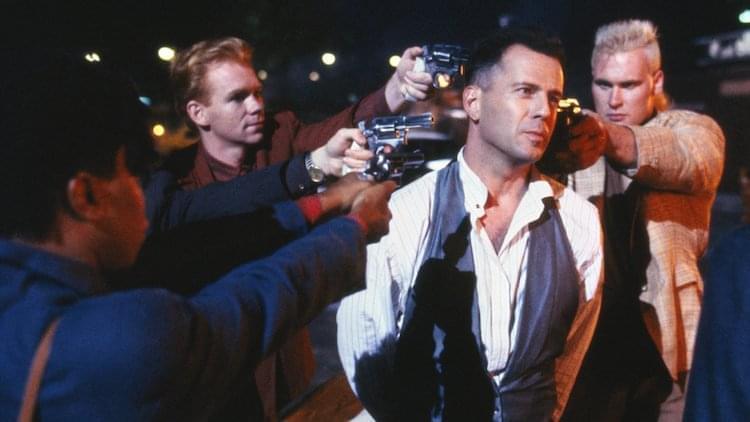
Before he became a big-time action star, Bruce Willis was just the smirking wise-cracker on TV’s “Moonlighting,” which was a great show, on the rare occasions that Willis and Cybill Shepherd could be civil to each other long enough to shoot a new episode, which amounted to about six weeks out of the year. Then, growing tired of starring in a successful TV show that didn’t require him to work very much, Willis set out to make movies and to reinvent himself as an action hero.

At first, everyone scoffed. This smug, balding little twerp was going to be an action star? On the other hand, the biggest Hollywood heroes of the day were Arnold Schwarzenegger and Sylvester Stallone, neither of whom could even speak English, let alone engage in witty banter with villains. (Delivering a pun based on the manner of the villain’s death does not qualify as “banter.”) So why not Bruce Willis?

“Die Hard” and “Die Hard 2: Die More Harder” were huge hits in 1988 and 1990, and that gave Willis the confidence to try an idea he’d come up with himself. The concept: a grating action-comedy where the action doesn’t make sense and the comedy isn’t funny. The film: “Hudson Hawk.” The result: I CANNOT SEE YOU, FOR I HAVE CLAWED MY EYES OUT.

The box office failure of “Hudson Hawk” was at least partially due to faulty marketing. It was billed as an action comedy — starring the guy from the “Die Hard” movies! — when it was really an absurd spoof. Audiences went in expecting one thing, came out frustrated that they got something else instead. It’s like the time Eddie Murphy inadvertently picked up a prostitute who turned out to be a dude. (Yeah … “inadvertently.”)

But that’s not the only reason the movie flopped. Even if you know ahead of time what sort of movie it is — as I did, before I watched it for this column — it’s still almost unbearable. It thinks chaotic, loud, shrill, and asinine are all synonyms for funny. That might be true at Two and a Half Men sitcom headquarters, but not in the real world.

Willis plays the title character, a cat burglar who earned the nickname “Hudson Hawk” because he grew up near the Hudson River and fed mostly on rodents and small birds. As the film begins, he has just been freed from prison and reunited with his buddy, Tommy Five-Tone (Danny Aiello), who evidently just moved here from a Damon Runyon story. Hudson is immediately dragged back into a life of crime by a couple of low-level mafiosi, who force him and Tommy to rob an auction house. Somehow the CIA gets involved, too, along with the Vatican and a pair of billionaire jackasses called the Mayflowers (played by Richard E. Grant and noted loudmouth Sandra Bernhard).

It’s all related to a conspiracy to steal three artifacts made by Leonardo Da Vinci. These artifacts have crystals hidden inside them that, when put together, will create a machine that can turn lead into gold. Evidently Da Vinci came up with this brilliant device, then hid the components so no one could ever use it. I bet he bragged to his friends, though. “You know, I came up with a machine to turn lead into gold! I just prefer not to use it. But I totally could!” And his friends rolled their eyes and said, “Whatever, Leonardo. Why don’t you fly home in your HELICOPTER?!” Then they all laughed, because they didn’t know that he really did invent a helicopter.

Hudson gets whisked away to Rome to steal the next artifact, and that’s where he gets involved with a Vatican operative named Anna, who is played by Andie MacDowell, who is an enemy to acting. To compensate for all the smirking hamminess Bruce Willis is serving up, MacDowell steels her face into a rictus and deploys every line of dialogue flatly, like a hostage being forced to read a prepared statement by an off-camera terrorist.

The CIA squad is led by a growly old James Coburn, who remarks that the CIA isn’t afraid of the Vatican or anyone else. “We blow up space shuttles for breakfast,” he says, providing one of those delightful WTF? moments that you stumble across sometimes in movies that are trying too hard. All the CIA agents have candy bars for code names. One of them, Kit Kat, never speaks, instead delivering his thoughts on little cards that have been pre-printed with whatever he might want to say. Kit Kat’s muteness seems like an unnecessary affectation until you realize he’s played by David Caruso. Then you count your blessings.

I cannot describe for you the specific workings of the plot. They are inane — perhaps intentionally so, as a send-up of inane action films, but inane nonetheless. Intentional inanity, if not done humorously, is still just inanity. During an exceptionally long sequence of car chases, ludicrous stunts, and general loudness, I realized it had been what felt like several minutes since I’d paid attention to anything. I have to assume this chunk of the screenplay just said “[idiocy]” on one page and “[ibid.]” on the next few, leaving the filmmakers to come up with the specifics on the set.

Bruce Willis survived the “Hudson Hawk” debacle, of course. He put it behind him, then focused for a while on that embarrassing thing where he kept playing blues harmonica and trying to be a honky-tonk musician, then put THAT behind him, and then got back to the business of smirking at things while delivering snarky bons mots in action films. That’s what he’s good at. Especially without Cybill Shepherd harassing him.

— Film.com

Eric’s Bad Movies: ‘Hudson Hawk’ (1991)

4

Here is “Hudson Hawk,” this week’s edition of Eric’s Bad Movies at Film.com. Technical difficulties delayed it, but they couldn’t keep it down forever! (Full disclosure: One of the technical difficulties was that I didn’t finish writing it until this morning.)

I told someone I was going to do this film, and he said, “That’s too easy!” Yes, so you’d think. But just watching the movie proved painful, and writing about it took more effort than it usually does. Some bad films lend themselves readily to mockery and dissection; others, like “Hudson Hawk,” are awful in less easily analyzed ways. Perhaps someday I shall write a book on the different kinds of bad movies, and how some are better suited to Eric’s Bad Movies than others.

In the meantime, enjoy a trip down Bruce Willis Lane.

Why, yes. Yes I did.

26

This is what I got when I searched for “Paul Blart: Mall Cop” on Amazon:

As a matter of fact, I did mean “Paul Bear: All Cop.”

[MOVIE TRAILER]

Meet Paul. He’s a regular police officer, with a regular partner and a regular life. Except for just one little thing: His father was a bear! [record scratch]

PAUL: Rroowwr!

Now he’s the only one who can stop an evil corporation from destroying a national park — if he can stop thinking about honey, that is!

He’s exercising his right to bear arms — and his right to arm bears!

Put your food in a bag and hang it from a tree branch, because here comes “Paul Bear: All Cop”! He’s part ursine, but he’s all police officer!

“Paul Bear: All Cop” — in theaters this summer! You’ll bear-ly be able to stop laughing!

The Haunting in Connecticut

0

The definite article in the title of “The Haunting in Connecticut” is repeated in the onscreen assertion that it’s “based on the true story.” You know — THE true story. Surely you’ve heard THE story about how some people moved into a large old isolated house and began experiencing supernatural phenomena, particularly in the form of things suddenly appearing in mirrors and messing with the lights! You know, THAT story. It’s been told a million times!

And having already heard it, you won’t find much new in this mundane but atmospheric thriller starring Virginia Madsen as a woman whose son Matt (Kyle Gallner), dying of cancer, starts to see ghosts after the family moves into a house that — surprise, surprise — used to be a funeral parlor and the site of some nefarious deeds. Is Matt’s medication causing him to hallucinate? Or is there really something sinister afoot? Do you even need to ask?

The director, first-timer Peter Cornwell, working from a screenplay by Adam Simon and Tim Metcalfe, plays up the “based on the true story” aspect at the very beginning and very end — and nowhere else — by having Madsen’s character sit at a table and introduce her story while being interviewed by a documentary filmmaker. Amusingly, she’s sitting in front of a very bright window, and the backlighting makes her appear almost in silhouette — an arrangement no actual documentary filmmaker would allow. It’s enough to make you think Cornwell included this brief scene for the sole purpose of reminding us that it’s “based on the true story” and didn’t think very hard about it beyond that.

(By the way, everyone knows what “based on the true story” means, right? It means there really was a family who really did claim their house was haunted, and not that anything in the film ACTUALLY occurred.)

“Haunting in Connecticut” offers a few creepy touches (like a box of eyelids) and some jump scares. That doesn’t make it good; it just makes it better than the lousy horror films that don’t offer anything. On the whole, it’s a generic, forgettable film, part “Amityville” and part “Exorcist” (Elias Koteas shows up as the obligatory priest), and hardly worth the time it takes to watch it.

Monsters vs Aliens

0

Jaunty, jokey, and absolutely bursting with visual energy, “Monsters vs Aliens” is unquestionably a treat. If it had a more substantial story, it could be a classic. As it stands, it’s a shrewd, fast-paced confection that takes full advantage of its 3D presentation (you should definitely see it that way) and offers plenty for kids and adults to laugh at.

The plot is impossibly simple. When an alien being named Gallaxhar (voice of Rainn Wilson) threatens Earth, the U.S. government (why do WE always have to be the ones to respond?!) unleashes its secret weapon: a squad of monsters that the military has been hiding for decades. The point has always been to keep these monsters from harming the general populace; now there’s no alternative but to set ’em loose and let ’em fight the aliens.

Naturally, these are pretty tame monsters anyway, fearsome only in their appearance, genetic makeup, and/or size. The latest addition to the team is Susan Murphy (Reese Witherspoon), who was hit by a meteor on her wedding day and subsequently grew to some 50 feet in height. The monster division of the U.S. Army, led by Gen. W.R. Monger (Kiefer Sutherland), captured her, dubbed her Ginormica (all monsters need cool names), and locked her up with her fellow freaks.

These include Dr. Cockroach (Hugh Laurie), a mad scientist who’s now part bug; Missing Link (Will Arnett), a mammalian-reptilian-human hybrid who fancies himself something of a ladies’ man; B.O.B. (Seth Rogen), a cheerful gelatinous blob who has no brain and has found he doesn’t need one; and Insectosaurus, a 300-foot furry bug with a Godzilla roar and no harmful agenda whatsoever.

Despite the apocalyptic trappings — Earth is threatened! There are monsters afoot! — the film is completely focused on adventure and comedy, not scares. (The villain is voiced by Dwight from “The Office,” for crying out loud.) An action scene set on the Golden Gate Bridge is thrillingly rendered, with many people imperiled but no one hurt. That’s an important distinction in a kids’ movie. These are the fun kind of aliens and monsters, not the dangerous kind.

The screenplay is credited to five people whose combined writing credentials include “The Simpsons,” “King of the Hill,” “The Larry Sanders Show,” and “Kung Fu Panda,” and the directors, Rob Letterman and Conrad Vernon, made “Shark Tale” and “Shrek 2,” respectively. I don’t know why five people were needed to tell a story this slight, but the script is fairly well packed with subtle references to everything from “Dr. Strangelove” to “E.T.” There are also clever running gags that spoof sci-fi cliches (including an obtrusive identity-confirmation device that goes beyond merely scanning your retina), and nerdy jokes like the exclamation “By Hawking’s chair!”

The lively voice work (including Stephen Colbert as an idiot U.S. president who looks like Gregory Peck in “To Kill a Mockingbird”) is excellent all around. What the film lacks that keeps it from being particularly memorable is subtext. Why not explore the fact that these “monsters” are nice creatures who only LOOK terrible? Why not give them goals greater than simply gaining freedom from the government holding facility? Only Susan/Ginormica has a character arc, as she gains confidence to be her own person and not live in the shadow of her fiance (a preening weatherman voiced by Paul Rudd). Surely there’s room for the supporting characters to grow, too, and not just in size.

12 Rounds

0

In 2006, professional wrestler John Cena starred in “The Marine,” playing a man who must rescue his kidnapped wife. His acting muscles sufficiently stretched, he now returns to cinemas in “12 Rounds,” playing a man who must rescue his kidnapped girlfriend. Watch for the third part of the John Cena trilogy in 2012, when he’ll have to rescue his kidnapped fiancee!

Cena plays a New Orleans uniform cop named Danny Fisher. In the opening sequence, he can’t find his badge and then has his gun stolen by a dog, and I’m not making that up. But he manages to arrest an Irish terrorist named Miles Jackson (Aidan Gillen), so that gets him promoted to detective. Unfortunately, Jackson’s girlfriend and accomplice died in the skirmish, and now, a year later, Jackson has broken out of prison to exact his revenge on Danny Fisher.

Having abducted Fisher’s girlfriend, Molly (Ashley Scott), Jackson reveals the terms of his little game. Fisher will have to complete 12 tasks: get to this bank by this time, pull out this safety deposit box before it explodes, stop that runaway streetcar from killing everyone onboard, etc. If he successfully completes the 12 rounds, he’ll get his precious girlfriend back. What’s in it for Jackson? Mere amusement, it would seem, though it turns out later that it’s all part of a bigger plan. A bigger, dumber plan.

Fisher is aided by a faithful partner (Brian White) and sometimes aided, sometimes hindered by a pair of FBI agents (Steve Harris and Gonzalo Menendez) who knew about Jackson’s escape from prison a couple weeks ago but didn’t think to tell the cop who arrested him. Jackson, meanwhile, is aided by three things: extraordinary coincidences, luck, and an accomplice who always manages to be in exactly the right place at exactly the right time.

Fisher is the kind of impulsive hothead who makes Jack Bauer look like Calvin Coolidge. He’s a cop who will commandeer a civilian’s vehicle and drive it across sidewalks and lawns, then take a fire truck on a high-speed chase through New Orleans, causing millions of dollars in collateral damage along the way like a one-man Katrina. To cut the electrical supply to a runaway streetcar, he drives an automobile directly into the power plant. This is necessary because when he and one of the FBI agents called the power company to have them shut it down, they got put on hold — which is pretty realistic, actually, except that every OTHER time they need something in a hurry in this movie, they’re able to get it by making one phone call. This includes learning where Jackson’s girlfriend is buried. FBI dude makes one call to goodness-knows-whom and immediately learns the name of the cemetery and probably the plot number.

My favorite example of Fisher’s (and the movie’s) idiocy is when he and his fireman brother (Kyle Clements) are on the 10th floor of a bank building and receive word of Jackson’s next nefarious plot. Fisher has only seven minutes to get across town, so every second counts. He decides this means there’s no time to run down 10 flights of stairs — he has to get down faster! So he secures one end of a long cable, throws the other end through the window, and slides down. But in the time it takes him to set this up, borrow gloves from his brother, convince his brother that this isn’t a stupid idea, slide down the cable, realize it’s not long enough, drop the last few stories onto conveniently placed scaffolding, and finally arrive at street level shaken but unharmed — well, in that time, the 10 flights have stairs could have been descended by an elderly woman, let alone a robust professional wrestler.

“12 Rounds” is dumb even by the standards of dumb action movies. As directed by Renny Harlin (“Die Hard 2,” “The Covenant”), with his characteristic disregard for common sense, it feels like it was written by high school students who have watched “Die Hard” a lot. (It was actually written by a first-time screenwriter named Daniel Kunka, who, for all I know, could be a high school student who has watched “Die Hard” a lot.) Arbitrary deadlines and timers counting down to zero figure heavily into the plot as a means of inflating the suspense. Sometimes there doesn’t even have to be a deadline — Fisher just makes one up. “If we don’t stop that ferry in the next 30 seconds, I’ll never see Molly again!” he declares, pulling the “30 seconds” figure out of thin air like a drama queen.

On the other hand, the gimmicky games Jackson imposes on Fisher provide a constant diversion and prevent the film from getting stale. Imbecilic, yes. Implausible, definitely. The “MacGruber” bits on “Saturday Night Live” are more realistic, and at least they’re intentionally funny. But boring? Never.

Note: Contrary to regular industry practice, this film was not screened for critics before opening.

Goodbye Solo

0

“Goodbye Solo” is Ramin Bahrani’s third feature film, not counting the one he made as his film-school thesis. The first two, “Man Push Cart,” and “Chop Shop,” were highly acclaimed in certain circles, but only now have those circles have begun to widen enough for large numbers of people to pay attention. For Bahrani, this must be simultaneously frustrating (because it took so long) and gratifying.

Bahrani’s parents are Iranian (he was born, in 1975, in North Carolina), and the experiences of foreigners in America are woven into his films. “Goodbye Solo” is no exception. It concerns the friendship between a cheerful Senegalese taxi driver in Winston-Salem, N.C., and the cranky old American coot he ferries around, and though that description sounds trite (or, at least, liable to produce triteness), the film is instead a poignant work of great beauty.

The driver, named Solo, is played by Souleymane Sy Savane, who has no prior film credits. Solo is optimistic and friendly, the very picture of the hardworking immigrant who sees America as a land of opportunity. Not content to drive a cab forever, he’s studying to become a flight attendant. He’s married to a Mexican woman named Quiera (Carmen Leyva), who’s pregnant with their first child and has a young daughter, Alex (Diana Franco Galindo), from a previous relationship. Except, perhaps, for her skin tone, you wouldn’t know Alex wasn’t Solo’s offspring — she adores him.

The passenger is William, played by veteran Hollywood stuntman and bit-part actor Red West. The actor is 72; the character is presumably about the same age. William couldn’t care less about Solo’s ethnicity or background, but he is not, at first, interested in being friends with him, either. He just needs a ride to and from the movies once a week. Over time, however, he comes to trust Solo enough to make a peculiar request: in a few weeks, he’ll pay Solo $1,000 to drive him to a mountainous destination two hours away.

That’s all I’ll say about the details of the plot. It’s a simple story, simply told, with honest characters and natural humor. At the center of it is the relationship that develops between these two very different men — opposite in age, race, and outlook on life; one eager to taste all life has to offer, one tired of living. With actors who weren’t convincing, or who made too big a show of “Acting,” it would be tiresome. But Savane and West are utterly unpretentious and unaffected, to the point that you find yourself caught up in the minor details of their characters’ lives. When it comes time for the words of the title to be spoken, you may be surprised at how richly felt the emotions are.

Waterworld

Waterworld

“Waterworld” is notorious for being a big-budget flop and an embarrassment to the otherwise pristine and unimpeachable career of master thespian Kevin Costner. But there’s something that gets overlooked all too often in discussions of the film, which is this: It begins with Costner drinking his own urine.

Now, I have not seen every film ever made, so I cannot estimate how many of them have featured scenes of their lead actors imbibing pee. But I will say, categorically and without exception, that no GOOD movie has ever included such a scene. If I may employ a bit of circular reasoning, you can’t make a good movie that involves pee-drinking. Why? Because pee-drinking automatically makes the movie bad. I HAVE DECREED IT SO.

The wee-wee sipper is known only as the Mariner, possibly because he was once a fan of the Seattle baseball team, though it’s unlikely such a person would exist in any world, let alone a post-apocalyptic one. “Waterworld” is set in the future, where everything is exactly as Al Gore predicted: the ice caps have melted, the Earth is flooded, and people float around the endless seas subsisting on fish, leftover foodstuffs, and whizz.

It’s not clear how long the Earth has been like this. The roving band of marauders known as Smokers still have an ample supply of cigarettes and other items that require solid ground to manufacture, so there must have been dry land fairly recently. On the other hand, the Mariner is a mutant with webbed toes and functional gills, which means enough time has passed for the human race to start evolving and adapting to the new climate. On yet a third hand, for the ENTIRE world to be buried in water, mountains included, the sea levels would have to rise THOUSANDS of feet — quite a bit more than the few hundred feet that they would actually rise if the polar ice caps really did melt. I find it interesting that the movie makes a point of explaining where ocean-dwelling humans get their drinking water (i.e., their own bladders), but nothing else.

The Mariner lives alone on his boat and avoids human contact except to trade at outposts. While on one such visit, he and the outpost are attacked by the Smokers, who live on an oil tanker that apparently also has an oil refinery, since they have sufficient gasoline to power their jet skis and airplanes. Somehow they’re making ammunition for their guns, too. Oh, and they have guns. Oh, and they have accepted Dennis Hopper as their leader, which I have always taken as a sure sign that a society is doomed. (Al Gore also predicted that in the future men will heed the words of Dennis Hopper.)

In the process of escaping the battle, the Mariner takes on two passengers: a woman named Helen (Jeanne Tripplehorn, from the fearsome triple-horned people of the Amazon) and a little girl named Enola (Tina Majorino). Enola has a tattoo on her back that some people believe is a map to dry land. Enola doesn’t remember getting the tattoo, possibly because it happened when she was drunk on Spring Break. Since they don’t have enough drinking water to last however long it takes to find the mythical dry land, and since nobody has to “go” bad enough to boost the supply, the Mariner proposes throwing Enola overboard. Helen takes the opposing viewpoint and offers her body to the Mariner in exchange for letting Enola live. The Mariner declines this offer but lets Enola stay aboard anyway.

But don’t let that fool you into thinking the Mariner is a class act! Indeed, he puts the “ick” in “ichthyological deformity.” He has a box of crayons on his boat and is very possessive of them, going so far as to throw Enola into the water after she uses them, even after saying he wouldn’t. Evidently the crayon usage was THE LAST STRAW. Enola can’t swim, either, which is crazy. You live in a world entirely covered by water, yet you can’t swim? That’s like living in Miami and not knowing how to fire a gun.

Later, they encounter an insane trader on another boat who offers the Mariner a couple sheets of paper (a rare artifact) in exchange for a half-hour alone with Helen. Helen isn’t really the Mariner’s property to lend out, but this does not stop him from doing so. After she fights off the man’s advances, the Mariner takes her underwater — he can breathe, and he puts her in a bubble (which he happens to have on hand, I guess, in case he has visitors who want to go sightseeing?) — and shows her the ruined cities of Earth that now lie hundreds of feet below the ocean’s surface. “Waterworld” is famous for being the most expensive movie ever made up to that point, but I feel safe in saying none of that $175 million was spent on the special effects in this sequence, which looks like a cartoon of Kevin Costner and Jeanne Tripplehorn drawn over stock footage of water.

Anyway, while the Mariner and Helen are gone, the Smokers show up to abduct Enola and follow her back-map to dry land. The adults knew the Smokers were after the girl, so you could question their parenting skills for leaving her alone while they frolicked underwater. Then again, the Mariner already tried to drown the girl and pimp out the woman, so there’s every chance Enola will be in better hands with the Smokers anyway. The map is on her back, so they’ll at least keep that part of her safe.

The whole film has depicted the Mariner as a loathsome, awful person, with the apparent intent of softening him up by the end. Sure enough, when Enola is taken, the Mariner goes off to rescue her. Dennis Hopper marvels at the Mariner’s ability not to die, saying, “He’s like a turd that won’t flush” — an unlikely choice of simile coming from a person who has never encountered dry land, indoor plumbing, or toilets. The Mariner does indeed kill the Smokers and save Enola, meaning that at last he has learned to love — or, at least, learned to not drown little girls anymore. Baby steps, right?

— Film.com

Eric’s Bad Movies: ‘Waterworld’ (1995)

9

We’ve reached a milestone in Eric’s Bad Movies at Film.com, as this week’s column — “Waterworld,” the ambitious flop from 1995 starring Kevin Costner — is the 50th entry in the series. That means a year has gone by since we started (there were two vacation weeks in there somewhere), way back on April 3, 2008. Fifty bad movies a year is the FDA-approved recommended annual allowance.

Sorry for the radio silence the last several days, by the way. SXSW was a blast, as always, followed by a weekend trip to Houston to see a friend, which was also fun. But I returned home to find a huge pile of things that needed to get done — and I also, at some point, decided to run for a position on the Governing Committee of the Online Film Critics Society. The politics involved there have been much more time-consuming (not to mention rancorous) than you would think. Anyway, next week should be back to normal, more or less, whatever that means.

Friday movie roundup – March 20

2

“I Love You, Man,” which opened the South By Southwest Film Festival last week and opens theatrically today, is a fine addition to the raucous R-rated-comedy genre. I have reviewed it for Film.com.

The other two wide releases, “Duplicity” and “Knowing,” were duly screened for critics, but I was in Austin and couldn’t attend. (Even if I’d been home I couldn’t have seen both of them: They screened on the same night in Portland, thanks to a game of scheduling chicken between the two agencies handling the films.) I promise to catch both of those, as well as last week’s “Last House on the Left,” in the coming week. Everything should be back to normal by next Friday.

To sign up for the “In the Dark” e-zine, which brings you all the new movie reviews, DVD releases, and other pertinent info in one handy weekly e-mail, visit this page.

Sin Nombre (Spanish)

0

Cary Fukunaga is the son of a Japanese father and Swedish mother, born in the United States, a graduate of universities in California, New York, and France, and now the writer and director of “Sin Nombre,” which was filmed in Mexico with Spanish-speaking actors. “Sin Nombre” is about immigration, which seems fitting, but it runs deeper than that. Its protagonist is a young man who’s trying to do the right thing after doing too many wrong things. Even as we sense the futility of his mission, we admire his courage for attempting it.

There are two stories in “Sin Nombre” that come together at the halfway point. The first concerns Willy (Edgar Flores), a relatively new member of the violent Mara Salvatrucha gang (which really exists) in the barrios of southern Mexico. Willy, a teenager, has a Romeo-and-Juliet romance, complete with balcony-climbing, with a nice girl named Martha (Diana Garcia), whose major defect in the eyes of the Mara Salvatrucha is that she’s from a neighborhood that falls under a rival gang’s jurisdiction. For this reason, Willy must keep their relationship secret. He’s tutoring a new inductee, Smiley (Kristian Ferrer), who can’t be older than about 12, and gets him to keep quiet, too.

The other story begins in Tegucigalpa, Honduras, where a teenage girl named Sayra (Paulina Gaitan) is trying to emigrate to the United States with her father and uncle. (Dad made it to New Jersey years ago and has now come back for her.) The trip involves riding on the tops of trains with dozens of other immigrants, passing through Guatemala and into Mexico, and from there north to Texas.

It’s in southern Mexico that Sayra’s path intersects with Willy’s, when a party of Mara Salvatrucha members ambushes the train to rob the immigrants. Willy, already on thin ice with the gang’s leader, Lil Mago (Tenoch Huerta), rediscovers his conscience, shifts his alliances, and finds himself on the wrong side of a quarrel with his former compatriots.

Fukunaga expertly shapes a variety of elements — gangland thriller, immigration drama, social commentary — into a rich, compelling story about redemption. To the vast throng of people (the film’s title means “nameless”) who try to come here every year, America represents hope, the potential for a better life. Willy and Sayra have different reasons for emigrating; one is running from, one is running to. But both look to America as a place where they can start over.

Fukunaga’s twin areas of study, film and political science, are brought to bear in his subtly effective screenplay, and in the way he brings it to life. A continuous shot of Smiley being introduced to the members of Mara Salvatrucha calls to mind the same scenario in “Goodfellas,” while parallel scenes showing people’s opposite opinions of immigrants — throwing fruit to them in one, throwing rocks at them in another — is a marvelously efficient way of conveying information visually. The fact that the film’s conclusion is inevitable does not reduce its impact when it arrives. Fukunaga is an assured, capable storyteller, and “Sin Nombre” suggests the work of an exciting new talent.

I Love You, Man

0

South By Southwest has become a prime spot for raucous R-rated comedies to premiere. “Knocked Up” debuted there in 2007, with “Forgetting Sarah Marshall” in 2008, and now here’s “I Love You, Man.” And while it doesn’t bear Judd Apatow’s name as those others do — it was directed and co-written by John Hamburg (“Along Came Polly”) — it certainly has his fingerprints all over it.

Paul Rudd, one of the key players in Apatow’s Frat Pack, stars as Peter Klaven, a Los Angeles realtor who has just proposed marriage to Zooey (Rashida Jones), his perfect, supportive girlfriend. Zooey has a gaggle of female friends with whom she shares every detail of her and Peter’s relationship, but Peter soon realizes he doesn’t have an equivalent. He’s always been a “girlfriend guy,” quick to find romance while letting close male associations slip away. Now that he’s found the love of his life, his lack of friends is a problem: Who will be his best man?

The obvious answer would be his brother, Robbie (Andy Samberg), a gym trainer and a gay dude (he’s definitely a “dude”) who acts as Peter’s confidant. But then we wouldn’t have a movie, would we? Instead, Robbie helps Peter in his quest to make new friends in the hopes that one will prove worthy of best-man status in time for the wedding.

Plausible or not, it has the makings of good comedy. How do adults go about making friends, anyway? It’s even harder than dating — there are ample online opportunities for finding romance, but purely platonic friendships are trickier. Besides, no one believes you when you say that’s all you’re looking for, and men are suspected of being gay if they set out in search of male friends. You’re supposed to already HAVE friends, and to take them for granted. LOOKING for friends? So gay.

The inclusion of an actual gay character is a smart move on Hamburg’s part, as it makes it easy to bring up a topic that might otherwise have lurked uncomfortably in the background. And yes, as Peter arranges “man-dates” with new acquaintances, one of them does get the wrong idea and assume it’s a date-date, complete with post-date kissing. Once THAT’S out of the way, the movie can get back to its examination of straight-male friendships.

Peter eventually finds Sydney (Jason Segel), a freewheeling agent of chaos who lives in a converted garage, has money but no discernible source of income, and eschews attachments of any kind. He’s Kramer to Peter’s Seinfeld (Hamburg’s co-writer, Larry Levin, penned a few episodes of that show), and soon becomes his Tyler Durden, too, teaching him to cut loose and have fun even when there are no ladies around.

Hamburg wisely avoids most of the plot twists you’re expecting, breaking out of the formula and creating something much fresher. He also, however, lets the film amble along without any story conflicts for quite a while. Most of it is funny, but after a while you think, “Shouldn’t something be happening?” Moreover, a subplot with Zooey’s friend Hailey (Sarah Burns) goes nowhere, and J.K. Simmons and Jane Curtin are underused as Peter’s parents.

But Rudd and Segel, who both appeared in “Knocked Up” and “Forgetting Sarah Marshall,” make a fine comic duo, clearly two different types but not one-dimensional stock characters. (Peter, thank goodness, is NOT a stuffy, conservative dork, which would be the obvious choice to complement Sydney’s loopiness.) Rudd, who has generally played smoother, more comfortable guys than this, is hilariously awkward here, a ladies’ man who has no idea how to be a man’s man. In supporting roles, Jaime Pressly and Jon Favreau are terrific as the standard married-couple-who-hate-each-other. For some reason Lou Ferrigno is involved in all this, too.

That loose, semi-improvised style of the Apatow films is present, as are the sweet sentiments embedded in the vulgar jokes. But whenever the adult humor is deployed without any real purpose — when it’s irrelevant to the story, adds nothing to our understanding of the characters, and doesn’t progress the scene — it stands out as cheap. It’s hard to do this sort of thing well, and I’m glad Hamburg and company basically succeed at it.

Duplicity

0

Tony Gilroy wrote the three Jason Bourne movies and “Michael Clayton,” so he knows from twisty espionage stories. But “Duplicity” marks the first time he’s really injected much humor into his work, and it’s a welcome variation. Not everyone has to be as serious as Jason Bourne all the time.

It helps that Gilroy has two witty, urbane actors as his leads — Clive Owen and Julia Roberts, who combined have the charisma and screen presence of a dozen regular actors. They play MI6 agent Ray Koval and CIA agent Claire Stenwick, spies who first meet in 2003 at the U.S. consulate in Dubai. Flirtation leads to hotel-room shenanigans, but the one-night stand ends badly for one of them.

We jump ahead five years. Ray and Claire, neither employed by the government any longer, are reunited when both get jobs in New York City with multinational corporations, which are just as ruthless about spying on one another as nations are. Claire is actually a double agent, employed by Burkett & Randle to look for internal malfeasance and also, secretly, by B&R’s chief competitor, Equikrom, to spy on B&R. (The companies are both the type that make a million products, everything from dog food to shampoo.) Ray is the new guy at Equikrom, hired specifically to help find out what B&R’s top-secret new product is.

Ray and Claire’s first meeting in New York finds them both as sharp as ever, equally adept at lying and subterfuge, bickering like Cary Grant and Katharine Hepburn (except I think the roles are reversed). Gradually, we learn more about the nature of their relationship, and about the con job they’re interested in perpetrating. But of course the problem with being a spy is that you have a lot of trust issues when it comes to personal relationships, and those issues are only magnified when the other person is a spy, too.

Gilroy carefully parcels out flashbacks, set in places like Rome, London, and Miami, to show what occurred between the Dubai hookup and the present. These sequences reveal key bits of information, so deciding when to deploy them is crucial, making the storytelling device the sort of feat that only an experienced screenwriter would dare attempt, like the triple lutz in figure skating. Audiences enjoy being toyed with, especially in movies about espionage, but only if the twists are clever and don’t involve cheating. Gilroy handles it expertly (no surprise there), and maintains a light, jaunty tone.

Clive Owen, who doesn’t get to smile very often in movies, seems to be having a grand time as Ray. He really sinks his teeth into a scene where he poses as a Tennessee-raised doctor in order to cozy up to an unsuspecting informant; you get the feeling his being Southern is totally unnecessary except insofar as it gives Owen a chance to do an accent — a morsel for the audience, nothing more. Julia Roberts, whose grin is far more familiar to us, proves a fine sparring partner and romantic interest for Owen (much more so than when they previously worked together, in “Closer”).

Owen and Roberts are the main attraction, but the supporting cast adds plenty of flavor, most notably Tom Wilkinson and Paul Giamatti as the heads of B&R and Equikrom, bitter rivals to whom we are first introduced when they fight in slow motion on an airport tarmac over the opening credits. This is one of several amusing directorial touches by Gilroy (it’s only his second time as director, after “Michael Clayton”), and it shows again his knack for piquing a viewer’s interest: Who are these men? Why are they fighting? Why is slow motion so funny? Could I really watch Paul Giamatti and Tom Wilkinson fight in slow motion all day long? Yes, yes, I believe I could.

I like the basic premise behind Gilroy’s story, i.e., that corporations are as secretive and paranoid as governments, and, in general, the way it’s executed. My only problem is that there’s so much gaming and faking and trickery going on between Ray and Claire and their employers — and between Ray and Claire themselves — that it’s hard to feel a connection to them. It’s made clear right away that they’re essentially con artists, both romantically and professionally — and how can we sympathize with the emotions of someone who might be faking those emotions as part of a ruse? It’s one thing for a character to keep everyone else at arm’s length; must they push us away, too? When the film reveals its satisfying (and funny) final surprises, it would be nice to feel their impact as much as Ray and Claire do.

Knowing

0

“Knowing” seems like a generic title for anything, let alone a tense cinematic thriller, but it turns out to be a good choice. The film takes place at the intersection of science and religion, at the point where faith and certainty meet, and it has some subtle, thought-provoking themes lurking below its deceptively simple title. How would your actions be affected if you knew, rather than believed, something?

My use of the word “subtle” may raise red flags for readers who know that the film stars Nicolas Cage, whose relationship with subtlety is strained at best. And he does have his share of insane Nicolas Cage moments here, shouting “You want some of this??!” while striking a tree with a baseball bat in one scene and hollering “The caves won’t save us!!” in another. The film also includes an image of a moose on fire and the depiction of someone stealing a door, in case you’re keeping track.

So, OK, some of the details are a little nutty. But this sci-fi tale, directed by Alex Proyas (“Dark City,” “The Crow”) and based on a story by Ryne Douglas Pearson (who wrote the novel “Mercury Rising” was based on), moves with urgency and unflagging energy. Were it not for its disappointingly mundane final explanations, it would be captivating from start to finish. Yet even those explanations qualify as “satisfying” in that they reasonably follow what has come before. Once we have all the facts, the ending really is the ending that makes the most sense.

Cage plays John Koestler, an M.I.T. astrophysicist raised as the son of a pastor but now a bit more agnostic in his beliefs. His wife died a year ago, leaving him to care for their young son, Caleb (Chandler Canterbury), and this may have been the final nail in the coffin of his religious faith. He tells Caleb that “we don’t know for sure” about heaven, but it’s OK to believe if you want to. For himself, John thinks the world is just a random series of events, with no greater purpose.

Having established this, the film must now pick John up by his feet and shake him around until he starts rethinking his position. A time capsule is opened at Caleb’s elementary school, and among the children’s drawings from 1959 is a sheet of paper covered in numbers, seemingly with no pattern or logic. John, intrigued and a little obsessive (and fueled by bourbon), notices the sequence 911012996, does some googling, and realizes: 9/11/01 was a day on which 2,996 people were killed. It turns out many sequences on this sheet of paper follow the same pattern: first the date, then the number of people who were killed in some disaster or accident. Even better, three of the dates and their accompanying death tolls haven’t happened yet!!

It’s hard not to be sucked in by a premise this nifty — admit it, you really want to know where that paper came from, and how (or whether) John can prevent the upcoming tragedies. This leads to the bigger question of determinism versus randomness, and along with the religious and philosophical questions are some puzzling plot elements like a group of odd men who seem to lurk in the periphery of John and Caleb’s lives. What the eff does it all add up to?

As I said, some of the answers are a letdown, especially after the straightforward, white-knuckle excitement of the action sequences (including a horrific plane crash). In the end, the whole thing’s rather preposterous — but you gotta admire Proyas’ nerve for going there. There’s never a dull moment, nor is it a film you’ll soon forget.

Máncora (Spanish)

0

When MTV Latin America honcho Ricardo de Montreuil made his first film, “La Mujer de Mi Hermano,” I thought (and wrote): Here is a man who ought to be making TV movies for Lifetime or Telemundo. His follow-up, the generic coming-of-age story “Máncora,” is more of the same — selfish, gorgeous people having sex and lying to one another while undergoing a bland process of self-discovery.

Were it not for the sex and drugs, “Máncora” would be a completely forgettable movie. Never underestimate the power of sex and drugs to spice up an otherwise useless picture!

It’s set in Peru (de Montreuil’s native land), where Santiago (Jason Day) is a club-hopping, heavy-partying 22-year old who is having sex with an anonymous woman in a public restroom when he gets the call that his father has died. Wanting a break from Lima, he decides to take a road trip to the beach town of Máncora, where he can clear his head and do a lot of drugs and have some more sex with strangers — you know, the usual grieving process. The first stage is denial, the second is anger, the third is cocaine.

Before Santiago can take off, he’s visited by his beautiful stepsister Xime (Elsa Pataky) and her new husband Iñigo (Enrique Murciano). They live in New York but have flown to Lima to see Santiago. He has rewarded them for their concern by planning to leave town immediately after their arrival.

Xime is sunny and friendly; Iñigo is impulsive and petulant. Improbably, they accompany Santiago on his trip, and the three of them pick up a hitchhiker along the way named Batú (Phellipe Haagensen), a hippie surfer dude who — get this — offers wise philosophical advice in the manner of all hippie surfer dudes in movies.

A romantic triangle develops between Santiago, Xime, and Iñigo. Santiago and Xime are not blood relatives, so their lustfulness is creepy but not entirely taboo. All three of them behave abominably in some way or another; watching them is a bit like watching MTV’s “The Real World,” where you have only scorn and contempt for the characters but kind of enjoy seeing them act like a-holes anyway.

I said “kind of.” The glossy cinematography, paradisiacal setting, and Banana Republic-model cast are fine to look at for a while, but the film has no depth, and the acting is nothing more than serviceable. De Montreuil (working from a screenplay by three newcomers) keeps a languid, listless pace, too, maintaining a moody atmosphere and little else.

Santiago finally realizes that he can’t run away from his problems and it’s time to grow up, a message that 1) is obvious and 2) is nothing we haven’t heard before. Not every film has to be completely unique, of course, but usually it’s the interesting characters who add freshness to a familiar theme. These people are just high-cheekboned stick figures.

Shanghai Surprise

Shanghai Surprise

You kids might not know this, but there used to be a very popular singer named Madonna. Her gimmick was to dress, talk, and act like a common street whore, and in so doing, to empower women. (It didn’t make sense then, either, but we went with it.) She was about as big a celebrity as there was in those days, and as is the case with all such stars, she was given the opportunity to appear in some movies even though she was not an actress. To give you a frame of reference, she was the Britney Spears, Paris Hilton, and Joe the Plumber of her day, all rolled into one.

In the mid-1980s, Madonna was married to Sean Penn. Today, of course, Penn is best-known as an Oscar-winning actor and a completely humorless d-bag, but in the ’80s, he was only the second thing. And since Hollywood was busy picking up Madonna with latex gloves and depositing her into movies, they figured hey, why not shove Sean Penn into one with her?

All that remained was to find a high-quality screenplay with parts just right for Madonna and Sean Penn. But since no one had written a movie about a Tijuana prostitute and her abusive boyfriend, they had to settle for “Shanghai Surprise.”

The film is set in the 1930s, when the Japanese occupied Shanghai, which you learned about in your high school history class if you went to high school in Japan or China. First we meet two guys who are not Sean Penn and Madonna, but who are involved in acquiring and distributing opium. They run afoul of the Chinese police, which results in a booby-trapped money belt exploding and blowing off a cop’s hands. You might say the explosion “disarmed” the cop, except it was only his hands, not his arms, so that would be a stupid pun.

Then it’s a year later and we meet Madonna. She’s playing a prim Christian missionary named Miss Tatlock who’s trying to find a batch of missing opium in order to make morphine to ease wounded soldiers’ pain and suffering. (I gave the police the same story about my stash of crystal meth.) She and her elderly missionary supervisor don’t speak Chinese, which is making it hard to find the guy they’re looking for, since the residents of Shanghai are notorious for being Chinese-speakers. Seriously, you can Wiki it. To help in their quest, they hire a drunk American loudmouth named Glendon Wasey (Sean Penn) who has become fluent in Mandarin after years of being thrown out of bars and arrested by no-handed police. One assumes he has also picked up phrases that will be useful in locating opium dealers.

Miss Tatlock does not approve of Mr. Wasey’s crass, loutish ways, and it’s very bizarre to see Madonna in a role that requires her to disapprove of things. It’s like Lindsay Lohan doing a public service announcement about the importance of underpants. Tatlock and Wasey spar in a manner meant to suggest Katharine Hepburn and Cary Grant, or Doris Day and Rock Hudson, but that is more reminiscent of Anita Bryant and Dane Cook. The filmmakers seemed to believe that merely putting Penn and Madonna together in front of a movie camera would be enough to generate electricity. They neglected to factor in Madonna’s wooden screen presence and the dearth of wit in the screenplay. “It practically writes itself!” is a common expression, but it should not be taken literally.

Tatlock and Wasey figure out that one of the guys from the first scene, Faraday, had a Chinese mistress who might know where the opium is now that Faraday is dead. Presumably Faraday bequeathed it to her in his will. The mistress, a courtesan who works at a brothel, is named China Doll, which seems strange because, what, that name wasn’t already taken? That surprises me. Anyway, Wasey goes to see her, but instead of finding out about the opium, he accidentally has sex with her. You may recall that the same thing derailed the first NATO conference.

Then there’s a series of scenes where Wasey doesn’t want to help Tatlock anymore, and they split up, but then they’re back together, and then she’s mad at him, and they fight, and she leaves, but then she returns. Or something. It ends with Tatlock finally using her feminine wiles and having sex with Wasey in order to persuade him to help her, which I suspect was Madonna’s contribution to the story. (“How ELSE would a woman get a man to do something?!”) In the end, they find what they were looking for (opium), as well as something they weren’t looking for (crabs), as well as something else they weren’t looking for (love).

In closing, dear young people, be glad that Madonna has receded into the mists of history, never to be heard from again. While she was entertaining as a performer, with her catchy music and conical breasts (a birth defect since remedied by surgery), her silver-screen efforts made one wish for the glory days of Olivia Newton-John. It’s been 15 years since she was remotely relevant to the modern world — last anyone knew, she was working at a JCPenney in Detroit — and this is something for which we should be grateful.

— Film.com

Eric’s Bad Movies: ‘Shanghai Surprise’ (1986)

4

This week’s slightly belated edition of Eric’s Bad Movies at Film.com addresses something that I have heretofore been quiet about: Madonna’s film career. The subject is “Shanghai Surprise.” The co-star is Sean Penn. The result is boring.

2009 SXSW Dispatch: In Which I Totally Rudd My Segel

11

Here’s the story of how I botched my interview with Paul Rudd and Jason Segel.

I usually don’t do celebrity interviews, not because I’m too good for that kind of fluff, but because I’m lazy. (Side note: I am also too good for that kind of fluff.) The interviewing part is easy; transcribing the recording afterward is tedious and time-consuming. So at every film festival, when every publicist contacts every journalist offering interview opportunities with every actor in attendance, I always decline. It’s just not my thing. There are many writers whose thing it is, and they are welcome to it.

But the publicists for “I Love You, Man” flattered the higher-ups at Film.com by offering a one-on-one (well, one-on-two) interview with Rudd and Segel, saying that such an opportunity had only been offered to a few websites. And I like Rudd and Segel, and I knew my Film.com overlords would be delighted to have an interview, and the time didn’t conflict with anything, so I said sure, why not?

I was told via e-mail that I’d have 15 minutes with the duo, starting at 11:45 a.m. at Austin’s Four Seasons hotel. (Actually, I was told Four Season’s, but I knew what they meant.) They assumed I could find the Four Seasons hotel on my own, which is a reasonable assumption. Before I left for Austin, I googled it, saw where it was on the map, and made a mental note: It’s on 2nd Street (or so I thought), between the convention center and Congress Avenue. No problem. I’m basically familiar with that part of downtown.

2009 SXSW Dispatch: ‘Troll 2’ Screenwriter Replies

22

At Cinematical, I wrote about my experience seeing the hilariously bad “Troll 2” for the first time, in response to the South By Southwest screening that followed “Best Worst Movie,” a documentary about the film’s cult following. Now Rosella Drudi, the Italian woman who wrote the “Troll 2” screenplay (and wife of the director), has posted a comment on my article in which she says … well, honestly, I have no idea what she’s saying. But remember, this is how well she speaks English now, 20 years after she wrote “Troll 2.” I’m starting to understand why the film’s dialogue is so nonsensical.

They are much content of the involuntary happened one of this old film turned in 1989 to Park City in Utah.E’ one of the first history that I have written, today is to 100 scenarios. I do not understand because horror demential comic and intentionally ironic on the sense of the life and against the fanatical vegetarians us, or be considered mistaken, defective and involuntarily comic. Because it is not wanted to be understood that l’ idea originates them is a comic and ironic history. Perhaps because l’ European irony is difficult to understand for the Americans. I do not know. The title it Troll2 is not true, the just one title it of the film is Goblin, the title it of the script is Goblin. The MGM America, has changed to the title it with Troll2, not I and not even the director of the film. The MGM America has declared that Troll2 is the continuation of Troll, but is not true. I have not never seen that film and I do not know it. I have sold my history to Eduard Serlui for the society ” Eureka film” Serlui made to realize the film to the Italian society ” Filmirage” like executive producer. I hope finally that the truth comes mnemonic. You could not know it. The actors of the Troll2 film ” Goblin” they were not actors. They have been chosen to Park City, nobody of they was a true actor professional. The director, Claudio Fragasso has asked to it to recite in that way ” strip comic” and funny, in order to make to laugh the public. Troll2 is a fable for children a crazy horror, much comic. The film did not have to be prohibited, nothing censorship, therefore nothing blood that I have replaced with the chlorophyll, using the green color of the goblin, North European Celtic legend, like monster vegetarians many fanatics us of the salutista, macrobiotico food. I have used the goblin like vampiri, using the amburger (tipical american food) of meat to the place dell’ Saint water, of the , like the mortadella of the famous sandwich ” Bologna” this is the true name of ours mortadella, a company for my Italian identity, a way in order to laugh to us on, but you could not know it. They are much content that a film thus small, turned in sun 4 weeks and only cost 50 or 60 million old Italian lires, in 1989, today is a phenomenon, are content that the cast of the actors, particularly Michael and George, today make transactions also with gadget of they the production, and te documentari director ,ex baby goblin actor, thanks to my small history and the personages from me invented and the food from invented me. Rossella Drudi

Valentino: The Last Emperor (documentary; Italian)

0

Valentino Garavani, the Italian-born, Paris-trained designer of haute couture, is on a first-name basis with the entire fashion world, but what do we know of his personal life? “Valentino: The Last Emperor,” a frothily entertaining but insignificant documentary by first-time filmmaker (and Vanity Fair writer) Matt Tyrnauer, purports to show us the real Valentino, but all we end up learning is how his business operates. That’s reasonably interesting as far as it goes, but Tyrnauer was obviously trying to go further.

The film crew was given unprecedented access to the behind-the-scenes workings of Valentino headquarters in Rome during the run-up to his 45th anniversary show in 2007. The aged, over-tanned fashion maven oversees a staff of busy seamstresses who do all the actual putting-together of his designs; they are led, in turn, by Antonietta, a stylish middle-aged woman of fiery temperament who does not let the fact that she is holding scissors in both hands prevent her from gesticulating wildly as she berates underlings. Valentino is supported creatively and personally by Giancarlo Giammetti, his friend and business partner of almost 50 years (but more about him later), and is accompanied everywhere he goes by a cadre of identical pug dogs. He lives in a fabulous villa where staffers are seen painting brown parts of the lawn green before a party.

We get a sense of Valentino’s personality, which is more or less what you’d expect. He’s sometimes mildly petulant with his staff, just short of abusive. He takes a practical attitude toward his work (“I make dresses for women who actually wear them,” he says at one point, concerned that a design might be too see-through) and sums up his philosophy very simply: “I know what women want. They want to be beautiful.” Giancarlo, who’s an honorary chairman of the Valentino company, says, “To be with Valentino as a friend, a lover, an employee, it’s all the same. There is a lot of passion.”

That mention of the word “lover” is the film’s only explicit indication that Valentino and Giancarlo are more than friends. Their sweetly cantankerous relationship is the film’s most fascinating asset — too bad, then, that Tyrnauer never really examines it. Details about how they met, way back in 1960, make for an adorable love story, as does Giancarlo’s answer when asked to describe what it’s like to live his life in one man’s shadow: “Happiness.” He seems blissful in his relationship with the designer.

Yet even a cursory glance at other biographical sketches shows that Tyrnauer has skimmed over some significant details — like the fact that Valentino has had the same American boyfriend, Bruce Hoeksema, since 1982. Where is he? How does Giancarlo fit into the equation? Watching the film, you’d assume Valentino and Giancarlo are a long-term committed couple. Nobody ever says it, but the film certainly seems intent on giving the impression.

A movie about a fashion designer doesn’t have to get into his personal life, of course — unless it says that’s what it’s doing, in which case it needs to do it, and do it right. Is this a personal profile of Valentino, or isn’t it?

With documentaries on subjects I have no interest in (for example, high fashion), I often apply this test: Was the movie entertaining or intriguing anyway? That’s how you separate the preaching-to-the-choir documentaries from the ones that transcend their subject matter. “Valentino: The Last Emperor” falls somewhere in between. It has little to say about humanity in general, or even Valentino specifically, but it is fun and glitzy. Just don’t expect anything revelatory.

2009 SXSW Dispatch #2

5

At Cinematical, I’ve written about the footage we saw of the upcoming “Bruno” film (Sacha Baron Cohen’s followup to “Borat”), and about the screening of “Troll 2” I attended Saturday night. The latter article also explains why I won’t be covering that film in Eric’s Bad Movies — not because it’s not bad, but because its badness is so self-evident that mocking it is redundant.

At Film.com, I’ve posted two dispatches of mini-reviews — you know, of the movies I’ve been seeing here at this film festival, where people occasionally watch films. Here’s dispatch #1, and dispatch #2. (I should have chosen a word other than “dispatch,” since that’s what I’m using here on my blog. But it’s a little late for should-haves.)

Also, unrelated but I don’t have anywhere else to mention it, this week’s edition of Eric’s Time Capsule at Film.com is about “The China Syndrome,” released 30 years ago today.

And now, more anecdotes.

2009 SXSW Dispatch #1

17

While my custom has been to post lengthy daily diary entries about my South By Southwest exploits, this year will probably be a little different, with less emphasis on where I ate lunch and more emphasis on what terrible misfortunes befell me. I may also talk about some of the movies, if space permits.

The fun began on Thursday, when I flew from Portland to Austin and discovered during my layover in Denver that my laptop, a second-hand iBook that I only use when I travel, had gone teats up. It was stuck on a screen that says “You need to restart your computer”; restarting it simply brought it back to that screen again. I called my brother Jeff, who did some googling and found that when other people have encountered this it has been due to problems with one of these two things:

a) the software; or,

b) the hardware.

We were glad to have it narrowed down.

True Adolescents

0

The genre of comedies about scruffy, directionless 30-year-old man-boys has occasionally produced a sub-genre where those men are pitted against actual young people, either as contrast (when the teenagers are more mature than the adults) or so they can wallow in their juvenile behavior together. We got a big-studio taste of that with last year’s “Role Models,” and now here’s “True Adolescents,” the indie version, which means it has more contemplative moments and a lot of mumbling.

Mark Duplass, already a recognizable face in the so-called mumblecore movement, stars as Sam, a Seattle slacker whose rock band is, at least in his mind, always on the verge of hitting it big. To an impartial observer, it’s more like he’s unemployed. After his girlfriend throws him out, he crashes with his aunt Sharon (Melissa Leo), who’s sympathetic but realistic about Sam’s need to grow up and get serious.

Sharon is divorced and has custody of her son, 14-year-old Oliver (Bret Loehr), who looks at Internet porn and behaves in a surly fashion — “he’s in his ‘greasy little bastard’ phase,” Sam says. Oliver and his best friend, Jake (Carr Thompson) (“Little Lord Fauntleroy,” Sam calls him) have been looking forward to a weekend camping trip with Oliver’s father; when he flakes out, Sam is conscripted to take the boys himself.

As farcical as that scenario may sound — they’re on a collision course with wackiness! — first-time writer/director Craig Johnson keeps the humor down-to-earth. The film is an acerbic but realistic coming-of-age story, with all three male characters experiencing some growth over the course of the trip, the tone gradually shifting from hipster-funny to hipster-introspective.

If all of this sounds familiar, I’m guessing you’ve seen some of the movies about these slackers who have to figure out what to do with their lives. There’s even a pretty good chance you’ve seen Mark Duplass in some of them. (He co-wrote and starred in “The Puffy Chair” and appears in this year’s “Humpday.”) But while “True Adolescents” may be typical of its genre, it’s a solid, well-made entry, with a few details (like its treatment of sexual identity) that help it stand apart from the pack.

It also benefits from Duplass, whose laid-back charm and natural wit make even commonplace material a treat. Watching him work — verbally abusing the teenagers, growing sullen when they abuse him back — it’s easy to imagine him fitting in with the Seth Rogen crowd, the bumbling slackers for whom cracking a wry joke comes as naturally as smoking weed. Whether Duplass wants that kind of career, I don’t know. But whatever he wants, he deserves it. The guy is funny, and he can bring on the drama when need be, too. “True Adolescents” gives him a chance to do both.

Race to Witch Mountain

0

In fulfillment of the prophecy that Disney will eventually remake every single one of its live-action movies, here is “Race to Witch Mountain.” It bears a passing resemblance to 1975’s “Escape to Witch Mountain,” but it’s more reminiscent of a tiresome carnival ride whose operator abandoned it and left it to run for 90 minutes. Whatever fun there is in it quickly gives way to tedium.

Appropriately, it’s set in loud, gaudy Las Vegas, where Jack Bruno (Dwayne Johnson) works as a cab driver. In the past he has freelanced his services for one Mr. Wolf, a shady underworld figure whose goons regularly visit Jack trying to re-enlist him. Maybe I shouldn’t bother mentioning that, though, because it ultimately has nothing to do with the story. For that reason, I’m also not going to mention Jack’s lifelong desire to own a particular Ford Mustang, since that detail was clearly added only after someone read a screenwriting book and paused at the chapter that talked about giving your characters hopes and dreams. It’s extraneous.

But back to the actual story. Jack encounters two strange preteens, a brother and sister named Seth (Alexander Ludwig) and Sara (AnnaSophia Robb). They are extraterrestrials whose spaceship crashed in the desert when they came to Earth in search of a MacGuffin, and now they must get the item and return to the ship — which is problematic, because the U.S. government, led by heartless Henry Burke (Ciaran Hinds), has recovered the craft and hidden it away somewhere. There’s also an alien assassin pursuing the kids, though that’s another thing that’s ultimately not particularly relevant.

Are you getting the impression that the film consists entirely of random, pointless details? Then I am doing my job. I haven’t even mentioned the dog befriended by the kids, which disappears for the entire film until the end, when Sara asks Jack to be sure to take care of it and the audience is alarmed to discover that the dog is, in fact, still in the movie. Nor have I told you about the sci-fi geek convention taking place in Las Vegas, where a crackpot played by Garry Marshall promotes conspiracy theories. Why would you go out of your way to put Garry Marshall in your movie? If your movie doesn’t need him, why not leave well enough alone?

That convention also brings us to Carla Gugino, who plays a quasi-legitimate astrophysicist named Dr. Alex Friedman. Having previously met her in his cab, Jack is sure she can help the alien kids in their quest. After all, she studies the possibility of extraterrestrial life, and the kids actually ARE extraterrestrial life. In one of the film’s few quiet moments, Alex marvels at how everything has come together: a UFO crashes in the desert on the same weekend as the sci-fi convention; she and the kids happen to get into Jack’s taxi — surely this is all more than just coincidence, she says. Yes, I thought. These are the workings of a lazy screenwriter. Alex arrives at a different conclusion — something about fate, or the universe, or whatever — but I’m sticking with mine.

The film has been chaotically directed by Andy Fickman, who worked with Johnson on “The Game Plan” and Amanda Bynes on “She’s the Man.” Broad, unfunny comedy is clearly his forte, and while he gets to indulge in some of that here, “Witch Mountain” is more focused on boisterous, uninspired action sequences. (Trevor Rabin’s relentlessly urgent musical score was obviously composed while Rabin was watching a different, more exciting movie.) It’s a departure for Fickman, and it’s interesting to watch a filmmaker find new things to be terrible at.

Johnson has emerged as an astonishingly charismatic performer in recent years, so it’s a shame to see him so tamped-down and grumpy here, in the sarcastic, world-weary, “I’m gettin’ too old for this” role. The kids are your typical charmless alien types — stiff language, no emotions, etc. The screenplay — credited to Matt Lopez (“Bedtime Stories”) and Mark Bomback (“Live Free or Die Hard”) but reeking of studio interference and last-minute changes — is witless and formulaic, packed with generic action-flick dialogue on the order of “I’ve got a bad feeling about this!” and “We’ve got company!” The whole thing’s loud and flat, like a radio tuned to static and turned up all the way.

The Last House on the Left

0

The new remake of “The Last House on the Left” makes full use of the dramatically compelling scenario that Wes Craven used in his 1972 original: First some terrible things happen, and then someone gets revenge. There’s something admirable about a film that so effectively taps into a viewer’s primal instincts. You have to endure some gruesome stuff — but, then, the highs wouldn’t be nearly as satisfying if the lows weren’t so awful.

Craven (who’s onboard as producer) chose Dennis Iliadis to direct, on the basis of Iliadis’ 2004 bleak Greek prostitute drama “Hardcore.” He’s certainly got the bleakness thing down, and the screenplay — by first-timer Adam Alleca, with rewrites by Carl Ellsworth (“Red Eye,” “Disturbia”) — maintains the basics of Craven’s stark original. Not a lot of time for joking around or exploring characters’ psyches in a movie like this.

The film is neatly divided into two halves. In the first, teenager Mari (Sara Paxton) arrives at her family’s lakeside summer house with her parents, Emma (Monica Potter) and John (Tony Goldwyn), then goes into town to meet up with her friend Paige (Martha MacIsaac). Due to peer pressure, Mari smokes pot with Paige and some drifter named Justin (Spencer Treat Clark) back at Justin’s hotel room, which it turns out he shares with his father, Krug (Garret Dillahunt), Uncle Frank (Aaron Paul), and Krug’s skanky girlfriend Sadie (Riki Lindhome).

The problem with this is that Krug is a convict who just escaped from police custody, and the gang has been committing acts of murder and mayhem across the countryside. They didn’t want young Justin bringing home friends, and so now Mari and Paige are in trouble. This is why you should say no to drugs, kids. At the very least, you should say no to visiting hotel rooms with strangers who want to sell you weed.

After some dreadful things happen to Paige and Mari, the bad guys go on the run and, in a cosmic coincidence, wind up at Mari’s house seeking refuge from a rainstorm. Mari’s parents don’t know anything has happened to her, and they offer shelter to the strangers. As an audience, we intuit that John and Emma will realize whom they’ve taken in, and that justice will be served. The film’s second half, we gather, will be about revenge.

It’s about self-preservation, too (Krug and the gang pose a threat to John and Emma, too, after all), which makes it somewhat less seedy than a straight-out revenge flick would be. The story moves efficiently — perhaps a bit mechanically — and maintains an appropriate pace, speeding up and slowing down as necessary to increase the tension.

There is something a little rote about it, though, which may be inevitable in a story as lean as this one. We enjoy the comfort of knowing basically how it’s going to wind up, yet we wish there were more surprises along the way. Is it reasonable to want both? To want familiarity and originality?

“The Last House on the Left” is well made for its genre, and certainly better than the toothless thrillers and soulless torture flicks that have been the norm lately. Maybe it’s as good as it could be, given its inherent nastiness and structural simplicity. All I know is, for a doctor, Mari’s dad sure doesn’t adhere to that “first, do no harm” rule.

Miss March

0

If you haven’t seen the sketch comedy show “Whitest Kids U’ Know” on IFC, fire up the ol’ DVR and have it grab a couple episodes for you. Like all such programs, the sketches are hit-or-miss, but the five guys, all in their late 20s and mostly from New York’s School of Visual Arts, are eager to explore the boundaries of absurdity and good taste. Much of what they do is funny.

For a change of pace, two of the group’s members, Zach Cregger and Trevor Moore, decided to write, direct, and star in a film that isn’t funny at all. (I don’t know why they would do that! You’d have to ask them!) It’s called “Miss March,” and though occasional nuggets of comedy do emerge here and there, it is largely a desperate, bumbling mess.

The real plot, which doesn’t kick in until after about 20 minutes, has wholesome young Eugene Bell (Cregger) suffering an accident on the night of his senior prom and waking up from a coma four years later to discover that his girlfriend, Cindi (Raquel Alessi), is now a Playboy centerfold. This is particularly galling because prior to the accident, Eugene and Cindi were virgins who spent their afternoons giving pro-abstinence lectures at middle schools. Now Eugene wakes up still a virgin and his girlfriend is romping at the Playboy Mansion.

Eugene’s lifelong best friend, Tucker Cleigh (Moore), a relentless horndog and remorseless idiot who leaves a swath of destruction everywhere he goes, suggests the two of them head to Los Angeles, where the annual Playboy anniversary party is taking place THIS VERY WEEKEND at Hugh Hefner’s famous compound. Cindi is bound to be there, and Eugene can confront her about why she abandoned him while he was comatose.

This leads to a lengthy road-trip sequence in which Eugene and Tucker experience the customary shenanigans, which mostly involve Tucker obliviously ruining something and Eugene being physically harmed and screaming like a girl. This is broken up, briefly, by an interlude with a rapper of their acquaintance named Horsed***.MPEG (yes, “dot-em-peg” is part of his name), played by Craig Robinson. Tucker figures that since Horsed***.MPEG is rich, he wouldn’t mind paying for Tucker and Eugene’s plane tickets to L.A. But for some reason, they drive from the East Coast to Chicago to ask him in person (rather than just calling and asking for the money), and after he says yes they just get on his tour bus and drive toward L.A. The story doesn’t make any sense, is what I’m getting at.

Oh, and the whole time, they’re running from Tucker’s girlfriend, Candace (Molly Stanton), who’s furious with Tucker for stabbing her with a fork (don’t ask) and has ordered her firefighter brother — and thus all firefighters across the country, somehow — to murder Tucker on sight.

The film occasionally earns a few laughs in its brief, sketch-like moments, and there’s a genuinely hilarious bit on the tour bus between Tucker and one of Horsed***.MPEG’s groupies. This is no surprise, given that Cregger and Moore are adept at writing sketches. The problem, as numerous “Saturday Night Live” veterans have already demonstrated, is that writing a feature-length screenplay is quite different from writing a four-minute skit. Moore’s character, Tucker, is funny as a reckless jerk, but he’s too much — too arrogant, too clueless, too one-dimensional — to be the second lead in the film. And Cregger’s character, Eugene, is simply too bland to be the primary lead. His only function is to be abused and humiliated by Tucker. The movie’s over-use of poop and pee is further evidence of its desperation.

The DVD offers both the theatrical version and the “unrated” version, which adds 4 1/2 minutes of material. As far as I can tell, this is spread out in small pieces throughout the film — i.e., no completely new scenes, only snippets added to existing scenes. Some of these snippets do involve more nudity at the Playboy Mansion, yes, though if you don’t know by now how to find images of naked women without resorting to buying “Miss March,” then I don’t know what to tell you.

Orca

Orca

Any film that achieves huge success inspires copycats in Hollywood, but few people realize what a burden this is on the imitators. For example, when the Harry Potter movies came around, everyone else in Hollywood was like, “Aw, crap, now we gotta find a young-adult-fantasy franchise of our own,” and that meant scrambling for source material, hiring people to design magical creatures, looking for elderly British actors to put beards on, and so forth. Being derivative and unoriginal is a real pain.

“Jaws” created a similar headache when it broke box-office records in 1975. Suddenly the companies that rented out underwater camera equipment were overwhelmed as everyone hurried to make their own aquatic horror movies, and the nation’s marine biologists were peppered with inquiries from producers’ assistants. “Are a dolphin’s teeth sharp enough to rip off a guy’s arm?” “Could a great white shark hold a machine gun?” “Do octopuses ever have fewer than eight tentacles? We’re trying to save money on rubber models.”

The most obvious counterattack to “Jaws”-mania was “Orca,” about a killer whale — why, the animal has the word “killer” right there in its name! It was released two years (almost to the day) after “Jaws,” but it failed to ignite the same kind of passion and enthusiasm, for a reason that you have probably already guessed: It’s a bad movie about stupid people doing idiotic things.

“Orca” is set in Newfoundland, which apparently is a real place. Nolan, played by famed alcoholic Richard Harris, is a sea captain who makes his living capturing sharks and selling them to aquariums. In the first scene, he and his crew are pursuing a great white, which the movie is insistent on reminding you was the same fearsome creature that scared you in a certain other movie two summers ago. But then, just when you think the shark is going to kill somebody, an orca comes along and kills the shark! The message: “Jaws” was crap because it was only about a puny great white shark. KILLER WHALES ARE EVEN SCARIER!!!

Duly inspired, Nolan now wants to catch an orca. This concerns local professor Rachel Bedford (Charlotte Rampling), who doesn’t want any of the majestic creatures harmed. In a further attempt to convince us that killer whales are terrifying, the movie makes us sit in on one of Professor Rachel’s university lectures, in which she waxes rhapsodic on the orca’s intelligence and capacity for communication. In many ways, they are even more advanced than we are! Rachel says, “What we call language they might call unnecessary, or redundant, or retarded.” Well, Rachel, if you think killer whales would be that condescending, why are you such a big fan of them? I know I wouldn’t be friends with someone who thought my manner of speech was retarded.

Speaking of which, Bo Derek is in this movie. It was her first film. She plays a member of Nolan’s crew. Her first line is exclaimed from the crow’s nest: “Fin at 2 o’clock!” Later, a killer whale eats her leg. This concludes the Bo Derek portion of this column.

Nolan assures Rachel that he’ll capture an orca without harming it. Then he shoots a harpoon at a pregnant female orca and kills her and her baby. You get the idea Nolan’s reassurances don’t mean very much. For what it’s worth, he was aiming at the male orca and got the lady orca by mistake. And he didn’t know she was pregnant, of course — she’s a whale, for crying out loud. Those things are always fat.

But the harpoon doesn’t kill her right away. It just makes her scream a lot. Oh, what’s that you say? You didn’t know orcas could scream? Neither did I! But apparently they do.

In addition to screaming, the pregnant orca swims directly into the boat’s propeller, which Nolan and his crew interpret as a suicide attempt, which seems to be giving orcas a lot more credit than they deserve (no offense to Professor Rachel, who believes killer whales can write poetry and solve algebraic equations). That’s when Nolan’s people haul it onboard and hoist it up by its tail, whereupon the fetus plops out unceremoniously onto the deck. You may recall that the same thing happened in the episode of “The Love Boat” that was written by H.P. Lovecraft. Nolan is appropriately horrified, and he responds in the only logical manner, which is to rinse the half-gestated baby orca overboard with a fire hose, calling to mind the old “South Pacific” showtune, “I’m Gonna Wash That Fetus Right Offa My Boat.”

All of this occurs in full view of the male orca, who we are led to understand was the husband and father of this happy killer whale family. He is distressed by this turn of events, to say the least, and he vows to get revenge on Nolan. You probably didn’t know orcas were capable of enacting personal vendettas, either. Shows what you know, dummy. Maybe you should enroll at Newfoundland Community College and take Professor Rachel’s popular course “Spurious Half-Truths Concerning Aquatic Mammals,” in which you will also learn of the blue whale’s love of Civil War reenactments and the dolphin’s knack for composing oboe concertos.

Nolan and crew dock at a nearby fishing village, where the locals are angry with him for killing an orca and her unborn baby (or, depending on your views, two orcas). A Native American named Umilak (Will Sampson) arrives just in time to fill the movie’s stereotype quota, backing up all the crazy things Rachel has been saying about killer whales. “She speaks to you the truth,” he says. “She knows it from the university; I know it from my ancestors.” And the truth is that the vengeance-minded orca is not going to rest until Nolan is destroyed.

So the killer whale embarks on a campaign of harassment, facilitated by Nolan’s refusal to just stay away from the water. The orca kills a couple crew members, sinks some boats, bites off Bo Derek’s leg, sends threatening e-mails, calls Nolan’s house and hangs up, and ruins his credit rating. Finally Nolan can’t stand it anymore and heads out to sea on his boat to do battle with the orca face to face.

The lesson to be learned here is that you should never let a whale tell you what to do. I wouldn’t have thought this needed to be spelled out. But as we learn in a flashback, the reason Nolan has been so emotionally affected by the orca’s grief is that years ago, Nolan’s own pregnant wife was killed by a drunk driver. So he can relate to the orca’s pain over losing his mate and offspring, especially since Nolan’s wife and baby were also washed away with a fire hose.

Even though heading to sea to fight a deranged whale is clearly a suicide mission, several people are willing to accompany Nolan on it. He is evidently a more charismatic leader than the movie had let on. Umilak, Professor Rachel, and Nolan’s original crew member Paul (Peter Hooten) all sign on for the dangerous voyage, and it’s not spoiling anything to reveal that they all die except for Rachel. Whoops, actually that is spoiling something. Sorry. The whale uses the time-honored technique of pushing a small iceberg into Nolan’s boat, causing no end of trouble; when Nolan scrambles out onto an ice floe, the orca flops up onto one end of it, causing the other end to lift up like a teeter-totter and Nolan to slide down into the water. This is accomplished despite the absence of a fulcrum. Rachel would probably tell you that killer whales have the ability to defy Newton’s laws of motion and execute leverage without a pivot point, but she’d be lying.

Amazingly, “Orca” has a hauntingly beautiful musical score by the legendary composer Ennio Morricone. It culminates in a song sung over the closing credits in which Morricone’s gorgeous melody is set to incredibly stupid lyrics. We end this edition of Eric’s Bad Movies with those lyrics.

My Love, We Are One
Lyrics by Carol Connors

I will bring the sun through darkened clouds
And I will leave with you rainbows for your eyes
Rainbows for your eyes
My love, we are one
We are one
We are one, cried my love
Let me lead you where moonlit waters fall
Shadows softly call
My love, we are one
We are one
We are one, cried my love
Let me lead you through the stillness of the night
Deliver dawn’s first light
My love, we are one
We are one
We are one
We are one.

— Film.com

Eric’s Bad Movies: ‘Orca’ (1977)

5

Another week, another movie about killer animals. “Orca” is the subject of today’s edition of Eric’s Bad Movies at Film.com, and boy howdy is this one ever a stinker. It used to be on TV occasionally when I was a kid, and I’m pretty sure I thought it was neat. I grew out of that, thank goodness. It’s one of the few films I know of to contain an accidental orca abortion. Aborcation. Whatever, just enjoy.

Various items for your amusement

8

Not so much “funny” as “well written and fascinating” is this week’s edition of Eric’s Time Capsule at Film.com, focusing on “New Jack City,” which turned 18 this week. Read!

Elsewhere, my friend Ken describes a fun movie-related game called “If you liked….” If you liked “The Joy Luck Club,” you’ll love “Fight Club”!

Perhaps you have wondered what lolcats from the Soviet bloc would look like? Wonder no more!

Somebody had a contest to add horror elements to classic book covers, and these are some of the winners.

Finally, if you are Mormon, or live among Mormons, you might find truth and humor in this: Stuff Mormons Like.

Regarding the publication of ‘Snide Remarks’

26

I started writing my weekly column “Snide Remarks” for my college paper way back in 1997, took it with me to the small daily paper I worked for after I graduated, and subsequently made it an online-only feature after that paper fired me. There have been a few gaps and hiatuses here and there, but basically the column has run nearly every week for 11 1/2 years.

In recent months, however, you may have noticed a decline in regularity. New columns have appeared on only 36 of the last 52 Mondays. It’s become like a TV show: a few weeks of new episodes, then a week or two off, then back again for a few weeks, and so forth. The difference is that writing the column was once part of my salary (at the newspapers, and subsequently when we charged a subscription fee to read it here), which meant I was motivated to write it AND had time allotted in which to do so. Now that’s no longer the case, and I have to focus my word-piling energies toward the things that pay the bills. My extravagant lifestyle of Hot Pockets and library books doesn’t come free!

But then I start to feel guilty. I know there are many of you who look forward to reading “Snide Remarks” every Monday, and you have no idea how grateful I am for that. Some of you have been around since the beginning, which is weird, because you’d think you’d have grown out of me by now. And I feel bad having to so frequently say, “Sorry, no column this week.” But I would also feel bad crankin’ out something mediocre just to avoid missing a week.

So we come to this:

As of now, “Snide Remarks” is no longer a weekly column.

It is now a quasi-weekly column. (That’s the best term I can think of. “Occasional” sounds too infrequent.)

When it runs, it will run on Mondays, as usual, and my goal is still to write it every week — the only difference is that you shouldn’t EXPECT it every week.

All that’s required here is an adjustment of perspective. Don’t be disappointed when it doesn’t appear; instead, be delighted when it does.

To be notified when a new “Snide Remarks” is published, you can use the RSS feed or, if you don’t know what “RSS feed” means, you can just get on the e-mailing list. Or you can visit the site every day anyway to read the blog and the movie reviews and stuff.

I appreciate your readership, and I hope you understand my position here. As a special gift to you, here is a picture of me at 17, taken from a video one of my high school classmates posted on Facebook.

Friday movie roundup – March 6

4

There’s only one movie to round up this week, an under-the-radar documentary called “Watchmen,” about a Swiss family of watchmakers.

No! I kid! It’s about superheroes murdering people!

I hope no one wanders into this thing thinking it’s a regular ol’ comic book movie. It’s a hard-R-rated drama with less action than you’d think, and more sex, nudity, and brutal violence than you’d think. It is not for kids! Do not bring your kids, you stupid parents.

That’s all we have this weekend. The rival studios didn’t scheduled anything to compete with “Watchmen,” and I don’t have any indie stuff to review at the moment. Have you seen that “Slumdog Millionaire” yet? I heard it was pretty good.

To sign up for the “In the Dark” e-zine, which brings you all the new movie reviews, DVD releases, and other pertinent info in one handy weekly e-mail, visit this page.

Watchmen

0

“Watchmen” was a 12-issue comic book published in 1986 and 1987 and subsequently compiled into a single graphic novel that has since become a widely respected and rabidly scrutinized work of fiction. Time magazine called it one of the 100 best English-language novels of the century. Its influence can be seen in a variety of works, including Pixar’s “The Incredibles” and TV’s “Lost.”

I provide this background for the benefit of readers who have never heard of “Watchmen” and who, after seeing the new film version, might wonder what the big deal is, and why it’s sparked such heavy anticipation within the nerd community. The movie, directed by Zack Snyder (“300”), is mostly faithful to the characters and story of Alan Moore and Dave Gibbons’ book, but the original is so complex and multi-layered that perhaps no adaptation — even a very, very long one — could do it justice.

It’s set in an alternate version of 1985, one where “costumed heroes” (i.e., Batman-style vigilantes) once protected America’s cities before being outlawed some years earlier. Now the retired crusaders, most of them having kept their secret identities secret, live out their lives quietly, but they are reunited when one of their own — a brash mercenary named Eddie Blake, aka the Comedian (Jeffrey Dean Morgan) — is murdered. Rorschach (Jackie Earle Haley), a masked, paranoid misanthrope whose face even his fellow crime-fighters have never seen, is convinced there is a conspiracy to kill all of them, and that the Comedian was only the first.

So Rorschach makes the rounds, warning everyone. There’s Dan (Patrick Wilson), formerly known as Nite Owl, a nerdy schlub who desperately misses the action and still has his Owlmobile in working order down in his Owlcave. There’s Laurie (Malin Akerman), aka Silk Spectre, who took her persona from the original Silk Spectre, her mother (Carla Gugino), who got too old to fight a couple decades ago. Laurie is the girlfriend of Dr. Manhattan (Billy Crudup), a physicist who suffered a lab accident and came out of it with immense control over time and space — the only one in the group, it would seem, with actual superpowers.

Finally, there’s Adrian Veidt (Matthew Goode), whose costumed hero was named Ozymandias, and who is frequently referred to as “the smartest man in the world” as if this was some kind of formal title bestowed upon him, though little is done to demonstrate its validity. (Unless “smartest” means “thinnest.”) I don’t know what his crime-fighting gimmick was, but he has a thing for Egypt. He’s one of the few superheroes to reveal his true identity, and he’s made a fortune capitalizing on it. This also makes him a prime target for assassination, though.

All of this is set against a backdrop of imminent nuclear war between the United States and the Soviet Union, theoretically raising the stakes so that it’s not just the Superfriends we’re concerned about, but all of humankind. Dr. Manhattan helped America win the Vietnam war in this alternate reality, creating a surge in popularity for Richard Nixon that has kept him in the White House for another three terms, but the Cold War continues. Dr. Manhattan sees possible nuclear destruction in the near future, and Rorschach wonders if this might be someone’s motive for killing superheroes, to keep them from preventing it.

The screenplay, by David Hayter (“X-Men,” “The Scorpion King”) and Alex Tse (his first film credit), doesn’t deviate significantly from the graphic novel until the end, when there are some major changes that, frankly, I like better. For the most part, the dialogue and story remain intact. The problem is that the book is packed with backstory: We learn the history not just of the most recent batch of superheroes, but of their predecessors, the original Watchmen, called the Minutemen. Supplementary material at the end of each chapter fleshes out their motives and personalities. Most of that must be eliminated from a movie version unless you want it to run seven hours — and even then, some things are simply better expressed in words and still images than in cinema.

I suspect that if I hadn’t read the book beforehand, I’d have been baffled by a lot of the movie. The process by which “costumed heroes” became outlawed is barely referred to, and the scheme behind the Comedian’s murder, when finally explained, is absurdly elaborate and improbable. And what’s that crazy thing Dr. Manhattan is building on Mars? Why does Rorschach occasionally speak in Tarzan English, as if dictating a telegram? Does anyone other than Dr. Manhattan have super powers? (The answer would seem to be no, except that there’s one guy who moves awfully fast and has incredible strength.) Why does everyone jump to the conclusion that the Comedian’s death means someone is targeting all former superheroes?

More important than these questions is this one: How can I have spent 2 1/2 hours with these characters without ever caring about anyone other than Rorschach? (He alone, played by the terrific Jackie Earle Haley with a seething ferocity, elicits sympathy and compassion — which is a little unsettling, considering he’s a psychopath.) For all the enormity and magnitude of what happens in these people’s lives, and for as much ground is covered in the plot, there’s almost no emotional engagement. Laurie has drama involving her parents, and it feels like it was tacked on at the last minute. The psychology of most of the characters — what sort of person puts on a costume and fights crime? — is given scant attention. Everyone talks and talks (and talks and TALKS), but to what end?

Indeed, the film is often ponderous and self-serious, almost tipping over into silliness. Snyder’s camera moves slowly and deliberately, so that even the action scenes — infrequent to begin with — feel weighed-down, the brutal violence coming off as sickening rather than exciting. The frenetic, rapid-cut style used in many other films would have been tiresome, too, but surely there’s a happy medium.

Speaking of medium, that’s about how I feel about the film as a whole. It’s too weird to ever be boring, and Snyder’s knack for stylish visuals has been amply demonstrated. (Even people who hated “300” have to admit it looked pretty cool.) The plot is compelling enough, the acting serviceable (and in certain cases excellent), the special effects suitably astonishing — it just doesn’t add up to much, that’s all. It’s a movie to see once, more or less enjoy, and then shrug off.

Congo

Congo

(Note: This column uses the words “ape,” “monkey,” and “gorilla” interchangeably, even though it is technically incorrect to do so. The author apologizes in advance for not caring if this bothers you.)

The only reason to watch “Congo” is to see the climax, when someone uses lasers to set a bunch of monkeys on fire. In fact, while the film was profitable, I submit that it would have been an even bigger hit if it had been released under its working title, “Laser Monkeys.” Oh, and they should have played up the fact that it was based on a Michael Crichton novel, since he was really big in the mid-’90s because of “Jurassic Park.” So: “Michael Crichton’s Laser Monkeys.” Or even better: “Michael Crichton’s Laser Monkeys: Based on a Novel by John Grisham.” Now you’re talkin’!

“Laser Monkeys” is one of the few films in the Eric’s Bad Movies catalog that was actually a box office hit, grossing $81 million in the U.S. and another $70 million in the rest of the world. Moviegoers have always loved stories about the lower primates, from “King Kong” to “Every Which Way But Loose” to “Larry the Cable Guy: Health Inspector,” and when those monkeys are being immolated via laser technology, well, forget about it.

Unfortunately, the parts of the movie that aren’t about using intense beams of coherent monochromatic light to incinerate gorillas are boring. It’s about a group of people venturing into the wilds of Africa for a variety of reasons, some of which are dumber than others but none of which are interesting.

At the better end of the motives spectrum, Dr. Karen Ross (Laura Linney) is looking for a co-worker and ex-boyfriend of hers who went missing while on a diamond-seeking expedition for his father’s corporation. The company needed these diamonds for a special kind of laser gun it’s developing — although, since this is a communications firm we’re talking about, I don’t know why it needs guns of any kind, let alone laser guns. I also don’t know why the gun needs diamonds to function, or why they have to be THESE diamonds, perilously hidden in dangerous, uncharted jungles. I know diamonds aren’t found just lying around in vacant lots or gutters, but obviously there are methods of acquiring them that don’t involve sending men into man-eating-monkey-infested regions of the Congo. For example, you can go to the mall.

Also on this trip is a scientist named Dr. Peter Elliot (Dylan Walsh). He’s gained notoriety at Berkeley for teaching a young gorilla named Amy to talk, even though he has actually done no such thing. What he did was teach her sign language (which had been done many times before), then hook up a machine to her hands that translates her signs and speaks them aloud in a computerized voice. That is not the same thing as teaching a monkey to talk, you’ll agree, but that doesn’t stop one movie character after another from marveling at how at last Dr. Elliot has overcome the speech barrier that separates man from beast. The fact that the machine can somehow tell the difference between an official “sign” and Amy just moving her arms around is particularly impressive, or possibly just stupid.

Peter is bringing Amy back to the place where she was born, on account of she’s been having nightmares and painting pictures of what Peter thinks must be her native jungle, and Peter assumes this means she’s homesick. Peter tends to “assume” a lot of things, and you know what happens when you “assume”: you go to Africa and get attacked by monkeys.

There’s also a Romanian faux-philanthropist (Tim Curry) named Homolka, which always sounds like “jamocha,” like the shake at Arby’s. Homolka is actually flat broke and trying to find a mythical city of diamonds. I don’t remember why he’s in the movie. He doesn’t really do anything. On the second draft, let’s cut him out, OK? I would like a jamocha shake, though.

But before the group can even get to the jungle, first they have to endure a lot of not-very-exciting adventures, such as having their plane shot down by warlords. That might sound exciting, but bear in mind that Karen used to work for the CIA and is capable of using a flare gun to intercept missiles. The group’s guide (Ernie Hudson) is capable of the same thing, despite having had no CIA training, and despite it being impossible. Bear in mind also that when the plane actually goes down, it turns out everyone on board is really, really good at skydiving, despite having had no lessons or even basic instructions, and nobody is injured in the slightest when they bail out. The whole thing turns out to be nothing more than a minor inconvenience.

Then there’s another scene where they’re in a boat on a river and a hungry, hungry hippo attacks them and someone has to shoot it. Again, this might sound thrilling, but bear in mind that the same thing happens on the Jungle Cruise at Disneyland, and that ride has never entertained anyone. It’s not very exciting when the group runs into a herd of giant spinning teacups, either.

They eventually get to the part of the Congo where Karen’s co-workers disappeared. In a very handy coincidence, this area is also Amy’s homeland. It is also very close to the not-mythical-after-all lost city of diamonds. Basically, everything that every character in “Laser Monkeys” needs is in this one spot, like Harry Potter’s Room of Requirement, except even lazier as a storytelling device.

Predictably, Amy’s co-apes aren’t interested in meeting her. Plopping her into the jungle after living most of her life in captivity is like dropping a rich kid into public school, with all the attendant ostracizing and wedgies. Could it be that this was a stupid idea after all???

No, of course not. Peter will have none of that. Instead, he and the group keep Amy with them as they continue looking for Karen’s dead co-workers. Then, finally — FINALLY! — they encounter the deadly monkeys who killed Karen’s people. The only thing that makes them different from regular simians is that they are gray in color and very, very hostile, like Clint Eastwood. This is something of a disappointment, since moviegoers have come to expect dangerous monkeys to be monster-sized. All this suspense and build-up and hippo-shooting and missile-dodging, and THIS is what we get? Regular-sized monkeys that just happen to be angry? Gyp.

They are exceptionally angry, though, I’ll give them that. In keeping with the film’s general theme that humans are awful and animals are sacred, we learn that this particular kind of monkey was bred to kill — specifically, to kill anyone trying to remove diamonds from the ultra-secret diamond mine. It’s the humans’ fault that these monkeys are mean. A similar idea is expressed earlier in “Laser Monkeys,” when someone wonders if Amy is dangerous and Peter says, “People are dangerous. Gorillas are gentle.” Yes, because people are always dangerous, and gorillas are always gentle. It’s that kind of didactic, black-and-white, over-simplified ideology that has made Peter such a successful scientist!

(By the way: If you have a pet gorilla — even a tame one — and she has screaming nightmares, and you try to wake her up and comfort her the way Peter does in this movie, that gorilla will, in fact, in the midst of her primal, irrational terror, rip your arms off and beat you to death with them. And that’s … One to Grow On.)

Just as the death monkeys are surrounding our heroes, menacing them, grunting at them, flinging poo at them in a threatening manner, Karen finds the right diamond to fit the laser gun, activates it, and lights up their gorilla behinds. As I mentioned, this is the film’s only saving grace. As I did not mention until now, after Karen lasers the monkeys, they fall into lava, because, oh, by the way, there’s also a volcano here that’s erupting right now. And then also, by the way, the gorillas that weren’t so keen on meeting Amy before change their minds and befriend her, and Peter leaves her there, presumably so she can live happily ever after, but probably so she can starve to death because she doesn’t know how to find her own food. The end.

— Film.com

Eric’s Bad Movies: ‘Congo’ (1995)

7

This week’s installment of Eric’s Bad Movies at Film.com is “Congo,” in which Laura Linney and one of the guys from “Nip/Tuck” go to Africa to set monkeys on fire with lasers. I remember watching this on video in about 1996 with some other people in my college apartment complex. What’s strange is that I don’t remember thinking it was particularly stupid, even though it is. Perhaps my movie-judging skills were still rudimentary at that point.

Catching up on a few things

17

Briefly, here are some items of interest that may interest you if you are a fan of items.

This week’s edition of Eric’s Time Capsule at Film.com celebrates “This Is Spinal Tap,” which turned 25 yesterday. Happy birthday, brilliant movie comedy! Like “Waiting for Guffman,” I view this as an excellent litmus test of whether someone has a sense of humor that is compatible with mine. If you don’t think these movies are funny, we can maybe still be friends, but not very good friends, like maybe we talk every few months is all.

Also, I reviewed “Street Fighter: The Legend of Chun-Li” over the weekend, also for Film.com, and found it to be not very good! Not very good at all!

Finally, here’s a clip from “Late Night with Conan O’Brien” in which Louis C.K. indicts a generation of spoiled whiners: “Everything’s amazing, and nobody’s happy.”

[youtube:http://www.youtube.com/watch?v=jETv3NURwLc]

Friday movie roundup – Feb. 27

0

There’s a big pile of nothing at the multiplexes this weekend. “Jonas Brothers: The 3D Concert Experience” and “Street Fighter: The Legend of Chun-Li” are the two new wide releases, and they both open without having been screened for critics. That’s not surprising, really — concert films tend to be impervious to reviews (particularly concert films featuring teen-idol bands), and movies based on video games tend to be terrible.

I’m seeing “Street Fighter: The Legend of Chun-Li” today and reviewing it for Film.com. I guess we figured since I just saw the first “Street Fighter,” I’ll be best prepared to address the important thematic issues it raises vis-a-vis the sequel.

I also have a review of “Madea Goes to Jail” from last week, at Cinematical.

To sign up for the “In the Dark” e-zine, which brings you all the new movie reviews, DVD releases, and other pertinent info in one handy weekly e-mail, visit this page.

Street Fighter: The Legend of Chun-Li

0

You don’t need to have seen 1994’s “Street Fighter” movie, which starred Raul Julia and Jean-Claude Van Damme, in order to appreciate the new “Street Fighter: The Legend of Chun-Li,” which doesn’t star anyone. In fact, you don’t need to have seen the 1994 “Street Fighter” at all, for any reason, under any circumstances, least of all as preparation for “Legend of Chun-Li.”

This is a reboot, you see, not a sequel, a complete starting-from-scratch attempt at turning the venerable video-game franchise into a viable cinematic product. And I don’t know about viable, but there’s no question they have made a cinematic product. No doubt about it, “Street Fighter: The Legend of Chun-Li” is definitely a movie. They dug up low-rent action veteran Andrzej Bartkowiak (“Romeo Must Die,” “Cradle 2 the Grave,” “Doom”) to direct it and paid a first-time feature writer named Justin Marks a couple bucks to slap together a hokey, ridiculous script. They built some cheap sets and put some actors who could sort of fight on them. They put cameras in front of the actors and turned the cameras to the “on” position. Yep — this is a movie, all right.

It’s a cheerfully stupid endeavor, enlivened by some gnarly fights and endullened by all the talky stuff in between. Chun-Li (Kristin Kreuk) is a half-Chinese concert pianist whose father (Edmund Chen) was abducted years ago by the evil Bison (Neal McDonough), a businessman who now controls all the organized crime in Bangkok through his company, the Shadaloo Investment Corporation. (“Shadaloo” is from the video game, but to make it sound less silly everyone in this movie pronounces it so the last syllable rhymes with “how,” not “who.”) Now Chun-Li has received a mysterious scroll that leads her to Bangkok in search of a guy named Gen (Robin Shou), who will teach her the Order of the Web, which is a group dedicated to justice and goodness and stuff, which means they oppose Bison.

Bison is the type of high-class movie villain who drinks fine wine and eats caviar while his enemies are being slaughtered by the henchmen in his foyer. (That’s not a made-up example: He really does that.) Every time he does something mean we hear what sounds like a tiger’s growl on the soundtrack. I’m not terribly familiar with the bison that once roamed the Western American plains in great numbers, but I’m pretty sure they didn’t sound like tigers. (Please note that “Bison makes a tiger sound in the video game” is not an acceptable explanation for its presence in the film.) Bison has just killed all of his crime-syndicate competitors and put their heads on a table, drawing the attention of a local cop named Maya (Moon Bloodgood) and a dopey Interpol agent named Nash (Chris Klein). Klein delivers every piece of Nash’s dialogue as if he were in a parody of cheesy cop shows, while somehow remaining so wooden that he makes Keanu Reeves seem like Don Knotts.

The film assumes we are stupid (which might be a safe bet, considering what we just paid money to see). Before she learns about the Order of the Web, Chun-Li twice sees a man with a spiderweb tattoo on his hand. The movie draws attention to it both times, clearly wanting us to remember it. Then, when an enigmatic old lady tells Chun-Li about the Order and shows her their symbol — a spiderweb — the movie re-shows us those two moments, just in case we’re complete idiots who wouldn’t have understood the connection otherwise.

Bison has an associate named Cantana (Josie Ho) who goes to a trendy nightclub one evening, followed by Chun-Li, who’s doing some reconnaissance. They eye each other warily on the dance floor and then get into a dance-off before having a fistfight in the bathroom. It’s like the filmmakers went through my prom scrapbook!

Also: Michael Clarke Duncan is in this movie. He plays Bison’s top henchman, a beefy fellow named Balrog. I do not have anything else to say about him.

I don’t know (or care) how faithful the film is to the video game’s backstory, but I can tell you it doesn’t have nearly as much fighting as it ought to. It’s all skulduggery and revenge and you-killed-my-father. Some actors take it seriously (too much so), while others, like the delightful Neal McDonough, ham it up, resulting in an uneven tone that’s hard to stay interested in when the fists stop flying.

At the end of the film, Chun-Li finds a flier advertising an underground tournament for street fighters. Some fellow out of Japan named Ryu (fans will recognize the name) is rumored to be joining! They’re obviously setting up for a sequel that will never happen, but all I could think was that a street-fighting tournament would have been a good idea for THIS movie.

Eric’s Bad Movies: ‘Street Fighter’ (1994)

8

In honor of the new “Street Fighter” film coming to theaters this weekend, Eric’s Bad Movies at Film.com today addresses the first “Street Fighter” film, released in 1994, back before everyone had caught on to the fact that video-game-based movies are always terrible. It stars Jean-Claude Van Damme, though that’s the least of its problems.

Street Fighter

0
Street Fighter

The film “Street Fighter” contains surprisingly little fighting, and none of it takes place in the street. The end.

What, you want more than that? Oy gevalt. Look, today we know that if a film is based on a video game, there is a 100 percent chance that it will be terrible. We have learned this from experience. But “Street Fighter” came out in 1994, when the genre was still young. Many hopeful, dewy-eyed young men approached the film eagerly, dreaming of a movie that would be coherent, entertaining, and well-produced, AND feature a lot of absurdly costumed steroid-users pummeling one another. You may well imagine their disappointment when they found that only the latter was in the cards.

The opening credits inform us that the film is based on the video game “Street Fighter II” — not the original “Street Fighter,” of course, because that was just a silly game where two people fight each other. How could you make a movie out of that? “Street Fighter II,” though, is a silly game where two people fight each other — now we’re talking!

The opening credits also inform us that the costume worn by the villain named Bison was specially designed by Marilyn Vance. I noticed this in “Judge Dredd,” too, where the title character wore an outfit by Gianni Versace. Beware of action films whose major characters require their own costume designers. You know who else had his own costume designer? Liberace. Would you watch an action film with Liberace as the main character? Well, OK, you would. But not for the right reasons.

Anyway, “Street Fighter” is about unrest in a Southeast Asian country called Shadaloo, which you’ll agree is the stupidest fictional country ever devised. Even Tolkien didn’t make up geographical names that dumb. Shadaloo? Seriously?? Remember when Homer Simpson had to think fast and create a name for some imaginary person, and the name he came up with was “Joey Joe-Joe Junior Shabadoo”? Do you see where I’m going with this?

ANYWAY, Shadaloo it is. Evil warlord General M. Bison has taken over, resulting in civil war, chaos, and unreliable wifi. (Bison is played by the late Raul Julia, who wasn’t dead yet when the film was made, though you wouldn’t know it to look at him.) Bison has taken a bunch of people hostage and is demanding $20 billion from the Allied Nations, which is the movie’s name for the United Nations, possibly because the filmmakers were under the impression that “United Nations” was a trademark or something. The last thing you want is to get sued by the United Nations! Or, more likely, to have the United Nations file a non-binding resolution in mild language condemning your actions!

Anywho, the Allied Nations has sent in a U.S.-led military force with Gen. William F. Guile as commander. Guile is played by Jean-Claude Van Damme, making no attempt to hide his Belgian accent, not that the attempt would have been fruitful anyway. The troops are in Shadaloo City, trying to find Bison’s secret, massive, multi-billion-dollar fortress that is probably the size of several city blocks and could not possibly be very hard to find. For reasons that probably made sense to someone, Guile fakes his own death in full view of TV cameras, primarily for Bison’s benefit, then lies under a sheet in the dark in the morgue until a news reporter comes in to snoop, whereupon he sits up and explains his plan to her. Why he had to lie there pretending to be dead when no one was around, I couldn’t begin to guess.

Guile’s plan involves sending spies into Bison’s midst. But the TV news reporter, Chun-Li (Ming-Na Wen), wants to get involved, too, because Bison killed her father years ago. She might not even really be a qualified TV news reporter (laying aside for a moment the unlikelihood of there being “qualifications” for that job), as her real intention is to do some Bison-hunting. To that end, she brought a “cameraman” and “technician” who are actually a boxer named Balrog (Grand L. Bush) and a Sumo wrestler named E. Honda (Peter Tuiasosopo). So now there are the spies that Guile recruited, named Ryu (Byron Mann) and Ken (Damian Chapa), plus Chun-Li and her goons, all of them infiltrating Bison’s secret fortress, which is soon getting more traffic than Hollywood Boulevard.

Back in his lair, Bison has a top-secret experiment going on. He has kidnapped a soldier named Carlos (Robert Mammone) and is forcing a scientist to turn him into a super-soldier. The scientist is achieving this by making use of Science. (Science! It can do anything!) Specifically, he is increasing Carlos’ muscle mass. A computerized voice says, “Subject’s muscle mass increased by [whatever] percent,” and she notifies us at every percentage point — 48, 49, 50, 51 — even if the last announcement was just a few seconds earlier. If I were programming a computer that would verbally inform me every time it accomplished something important, I would probably want to narrow down what constitutes “important” first, lest I be annoyed by a litany of minutiae.

(Side note: For some reason, increasing Carlos’ muscle mass also turns him into an orange-haired, green-skinned, grunting monster. Take note of this, A-Rod!)

It’s around this time that the Allied Nations, represented by a wimpy, ineffectual man with glasses, tells Gen. Guile not to attack Bison after all because the A.N. is going to pay the ransom. Guile angrily decries this as a cowardly act of appeasement, a position that might have more force if it were being voiced by someone other than the Belgian in the beret. Guile rallies a group of soldiers to make an attack on Bison’s headquarters anyway, regardless of what those sissies at the Allied Nations think — heck, regardless of what Guile’s own U.S. Army commanders think. He’s gone rogue! Rogue and unintelligible!

Meanwhile, Bison has figured out that all these new people in his lair are spies and has thrown them into holding cells. When they break out, Balrog and E. Honda are wearing their boxing and Sumo-wrestling outfits, respectively, leading to several thousand questions, such as Why bother? and Where were those costumes concealed?! One doesn’t like to think of someone keistering a pair of boxing gloves and trunks, but I doubt Bison provided them, either.

Anywhom, as Guile and his team (which for some reason includes Kylie Minogue) attack the fortress from outside, Chun-Li, Ryu, Ken, Balrog, and E. Honda attack from within. Various low-level henchpersons are dispatched handily and without fanfare. Finally, Guile faces off against Bison, with the latter employing electricity to give himself the same powers he has in the video game, whereupon Guile grapples with him some more and kills him anyway. Like I said in the first place, there’s not much fighting, and none of it occurs in the street. I don’t know what you were expecting.

— Film.com

Let’s all pretend it’s Monday

0

Usually I provide these links on Monday, but I didn’t this week for a variety of reasons, none of them interesting or funny.

Speaking of not interesting or funny, here’s a “Snide Remarks” column about the 10 types of Internet comments.

And lookee here, it’s Eric’s Time Capsule at Film.com, this week dealing with the original “Hairspray,” released Feb. 26, 1988.

Finally, two reminders: If you’re on teh Twitters and want to follow me, my name is EricDSnider. And don’t forget “Something Cleverish,” the book of humorous essays including a brand-new “Snide Remarks” column, all proceeds from which go to the Stephanie and Christian Nielson recovery fund.

This week’s “Snide Remarks,” including the audio version, is here.
The audio version (i.e., the podcast) is also here.
Subscribe to the podcast’s feed with this URL.

A good example of a bad review

37

Browsing at my old stomping grounds, eFilmCritic (a mirror site for Hollywood B****slap), I saw the first paragraph of David Hollands’ one-star review of “Slumdog Millionaire” and knew I didn’t need to read any further. In just two sentences, Hollands does four things that are at least annoying and possibly flat-out amateurish.

Here’s what he wrote:

When a film garners as much critical praise as “Slumdog Millionaire” has, one assumes watching the movie will be like witnessing the second coming of Christ. When I heard the praise growing, I didn’t join in the chorus; “Slumdog Millionaire” is directed by Danny Boyle, one of the most overrated filmmakers of all time.

Here’s what’s wrong with it:

When a film garners as much critical praise as “Slumdog Millionaire” has, one assumes watching the movie will be like witnessing the second coming of Christ.

If one does assume that, then one is setting oneself up for disappointment. Is Hollands, as a movie critic, saying that he lets himself get so overwhelmed by hype and buzz and publicity that he goes into films with crazily unrealistic expectations? Beware of any critic who does that.

So — the Oscars. How about that?

10

Very few of the awards at last night’s Oscars were a surprise, but the show itself was noteworthy for being slightly different from the norm. I appreciate that the producers, Laurence Mark and Bill Condon, actually made some changes in the way things were presented. Considering the show is usually identical from one year to the next, it’s almost irrelevant whether the changes were successful — I give ’em credit just for trying.

And I really liked the one major alteration, where each of the acting awards was given out by five previous winners in that category. It was cool to see, for example, Sophia Loren (who looked like a witch from an old Italian book of fairy tales) speaking directly to nominee Meryl Streep and talking about her performance in “Doubt.” Or Robert De Niro ribbing Sean Penn while praising his work in “Milk.” And how awesome must that be for the nominees, many of them first-timers, to have a certified Oscar-winner single them out for a few seconds of sincere praise? Except Robert Downey Jr., of course, who had to get his from Cuba Gooding Jr.

The show was almost 3 1/2 hours long, but it flowed more smoothly and with more energy than it usually does. It never got mired in any overlong montages or boring tributes. Hugh Jackman’s song-and-dance numbers might have been cheesy and old-fashioned, but darned if they weren’t pretty well produced, too. Moving the orchestra out of the pit to bring the stage closer to the audience was a great call, and the sets were nifty. Good show, Oscars! Good show!

As for the awards, I correctly predicted 18 out of 24, which is the best I’ve done in a while. I’m kicking myself for missing Best Song and Best Score — they both went to “Slumdog Millionaire,” which in hindsight should have been a no-brainer. I also missed two of the short categories, which are always a crapshoot.

The 10 Types of Internet Comments

0

The evolution of the Internet has led to almost complete interactivity, so that today when you read a blog, article, or column, you can usually post a comment in response to it, thus letting the world know what you think. This is an improvement over the old system, where the world didn’t know what you thought. Can you believe life was ever like that?

What’s interesting is that even though there are approximately 1.5 billion Internet users in the world, 98 percent of their comments fall under one of the following 10 categories. Which type are you??

SAMPLE BLOG POST:

I was recently at a party where the host, a friend of mine, showed us a picture taken in a photo booth. The picture was of the host’s wife and the lead singer of the Spin Doctors. The photo booth was located in a neighborhood bar near where the couple used to live in Chicago, and the incident occurred many years after the Spin Doctors’ fame had subsided. The Spin Doctors guy, so the story goes, was heavily flirting with my friend’s wife, which was sad because he was a married man, and also because he was the lead singer of the Spin Doctors and what could be sadder than that? Somehow this photo was taken as a souvenir of the incident. You can even see the big seal upon his jacket.

THE 10 TYPES OF COMMENTS:

1. That’s funny!
— Pleasant, Albeit Non-Substantive, Feedback

2. Too bad your friend didn’t have a pocketful of Kryptonite!
— Look at Me! I’m Funny, Too!

3. I agree! I hate photo booths, too!
— Missed the Point Entirely

4. Spin Doctors! I used to hear their song “Two Princes” on the radio all the time when I was in high school!
— Has Nothing to Contribute But Couldn’t Stand the Thought of Passing Up an Opportunity to Type Words on the Internet

5. That reminds me of the time I met Edie McClurg at a Safeway in Los Angeles. I wrote about it on my blog [link].
— Self-Promotion

6. lol what is spin doctors itz a band or sumthin??????
— Teenage Girl

7. lol u reminded me of collage becuz thats when i use 2 here spin doctors all the time!!!!!!!
— Not a Teenage Girl, But Wants Everyone to Think He/She Is

8. Yet another unfunny post. I hope you’re not getting paid for this.
— Hates This Website But Keeps Visiting Anyway

9. You know, the lead singer for Spin Doctors is a human being, too. You shouldn’t make fun of people just because they used to be famous and aren’t anymore. We can’t all be world-famous celebrities like you.
— Offended by Proxy for Those Targeted by the Joke

10. Chicago, eh? I’m surprised they didn’t stop in to hear a sermon by REV. JEREMIAH WRIGHT!!
— Fixated on Something Unrelated and Writes About It at Every Opportunity

Friday movie roundup – Feb. 20

1

The films opening today are ones that nobody wants to see, which I think is part of Hollywood’s master plan to make everyone stay home and watch the Oscars. Which makes sense, really. Why cannibalize your audience?

Tyler Perry’s new “Madea Goes to Jail,” evidently a remake of a Jim Varney film (I suppose next she’ll be going to camp and/or saving Christmas?), opens as one of Hollywood’s Shameful Secrets®, though I guess it’s really one of Atlanta’s Shameful Secrets, since Perry famously works outside the usual studio system. Anyhoo, it wasn’t pre-screened, but I’m reviewing it later today because I’m curious about Mr. Perry’s work. Jay-kay, I’m getting paid $$$.

The other new wide release is “Fired Up!,” a horndog comedy about boys infiltrating cheerleader camp. It’s quite a bit funnier than I expected, with some genuinely sharp dialogue sprinkled throughout — but it’s still no better than a C+ movie. And you probably weren’t going to see it anyway.

Oh, and I gots me a review of “The Class,” a French schoolteacher film that’s been making the rounds, just in time to probably win the foreign-language Oscar on Sunday. It’s pretty good. An associate of mine who saw it with me didn’t care for it, though, and he said as we left, “I knew it covered an entire school year, but I didn’t know it happened in real time.” OH SNAP! You can see why I’d associate with someone like that.

To sign up for the “In the Dark” e-zine, which brings you all the new movie reviews, DVD releases, and other pertinent info in one handy weekly e-mail, visit this page.

Fired Up!

0

“Fired Up!” (enthusiasm theirs) is a teen-centric horndog comedy that you would do well not to get attached to, as it will disappear quickly from theaters and never be heard from again. The meatheads who would find it appealing and are eager to see it today — Maxim readers, frat boys, etc. — will be baffled by its smarter jokes, while the people who might appreciate its odd sense of humor have no interest in seeing it.

I hasten to add that it’s still not a good movie. It’s formulaic and, at heart, utterly moronic. But it grew on me. The sheer quantity of its juvenility, and the energy with which it is delivered, is infectious, and the screenplay (credited to Freedom Jones, obviously a pseudonym) is flecked with quotable dialogue. As the film progressed, I could feel the grade on this review getting better, from D+ to C- and finally to C+. Who knows, if the film had been 10 minutes longer, it might have gotten a B-.

Anyway, 28-year-old Nicholas D’Agosto and 31-year-old Eric Christian Olsen play high school students named Shawn and Nick. They are popular football players and inveterate philanderers with the campus ladyfolk. On the eve of their two-week summer football camp in El Paso, they catch wind of the cheerleading camp happening closer to home, where instead of bounties of fat guys there will be endless fields of lithe, limber teenage girls. They decide to feign sudden conversion to cheerleading in order to tag along, figuring they can fake the skills because “we’re athletes, we can do anything.”

Turns out they’re right. Shawn’s mercenary little sister, Poppy (Juliette Goglia), providentially a cheerleader herself, shows them the basic moves and terminology literally overnight, and they’re well on their way to infiltrating the cheerleading ranks! All they have to do is give their football coach an excuse for missing camp. Which they do. Well, one of them does. The other one doesn’t. The movie skips that part. Hey, two horny jocks are going to cheerleading camp — what do you want, a plausible story to get them there?

Their plan is to only score with chicks they don’t know, and avoid the girls on their own squad. Shawn immediately violates this rule by falling for Carly (Sarah Roemer), the captain of their team and the only one smart enough to be skeptical of their obviously shady intentions. Carly, however, has a douchebag college boyfriend, Rick (David Walton), who I don’t need to tell you is a cheater and doesn’t deserve her and it’s only a matter of time before the truth comes out and she chooses Shawn instead.

So much is wrong with the film, mechanically speaking, that I think I’m annoyed by how often it made me laugh. The jokes about the mincing gay male cheerleaders at the camp get old fast, as do the ones about the lesbians. A subplot involving the squad’s arch-rivals goes nowhere and serves no purpose (though I do like the way the enemy team dresses in all-black and moves in unison, even when casually strolling through the quad). Shawn and Nick’s immediate, team-improving prowess for cheerleading is, on its face, absurd.

But under all this idiocy is a manic, anything-goes attitude that is well executed by D’Agosto and Olsen, who are passable as a smart-mouthed, fast-talking snark team. There’s also John Michael Higgins (always a comedic bright spot) as an intense cheerleading instructor, and occasional pop-cultural jabs like mocking someone for wearing Crocs when “you’re not an old lady gardening or a baby on the beach.” Dumb people don’t write lines like that.

The director is Will Gluck, who created and wrote for Fox’s short-lived comedy series “The Loop,” which co-starred Olsen and was very, very funny. In fact, I suspect that whoever actually wrote “Fired Up!” — maybe Gluck himself? — was involved in “The Loop,” because the style is uncannily similar, as is the nonstop barrage of raunchy sexual innuendo.

I get the feeling there’s a very intelligent sex comedy trapped in here somewhere, but it doesn’t do enough to make its presence known. The dozen or so laughs I got out of it, while solid indeed, aren’t enough to justify a 90-minute movie … but I’m not going to strain myself discouraging you from seeing it, either. It’s better than you’d think, worse than it could be, and has a line about putting makeup on a bear.

Madea Goes to Jail

0

Heaven help me, this Madea character is starting to grow on me. In “Madea Goes to Jail,” Tyler Perry’s latest adaptation of one of his innumerable stage plays, his giant, pistol-packing alter ego finally runs afoul of the law one too many times and finds herself in the big house (not “Big Momma’s House,” the big house). As a character, Madea felt randomly assembled in “Diary of a Mad Black Woman” and “Madea’s Family Reunion,” but now Perry has grown her into a larger-than-life force of nature that is genuinely funny.

“Madea Goes to Jail” would be a lot better, in fact, if it were actually about Madea going to jail, or about Madea at all. But she’s merely a supporting character in the film, which is really about a young lawyer and his shrewish fiancee dealing with elements from his past, with light Christian themes baked into the crust. In other words, it’s more or less the same movie Perry has been making all along, with one-dimensional villains, catty women, and cringe-inducing melodrama. The addition of Rudy Huxtable as a crack whore certainly raises my level of interest, though.

That’d be Keshia Knight Pulliam, who is 29 years old now, if you can believe that. She plays Candy, a girl from the wrong side of the tracks — someone actually uses that figure of speech — who’s now hooked on the junk and turning tricks on the streets of Atlanta. Our dashing hero lawyer, Josh (Derek Luke), a prosecutor in the D.A.’s office, grew up in the same ghetto and is astonished to be reunited with her after she’s arrested. But his purely platonic desire to help her is hampered by his wealthy fiancee, Linda (Ion Overman), who sees no reason to reach out to “those people” when it’s Candy’s own damn fault she’s so messed up.

Linda is an unbelievable snob, and I use the word “unbelievable” in its literal sense: As a character, and like most of Perry’s villains, she is not even remotely plausible. She’s too single-mindedly eeeeevil, an amalgam of selfishness, vanity, and condescension. She’s a cartoon character. I half expected her to grow a mustache, just so she could twirl it while tying Candy to some railroad tracks.

She suits Perry’s purposes, though, which is to give the audience a monster to root against without having to think very hard or ponder a lot of angles. This tendency toward oversimplification has always been my problem with Perry, and you’d think the audience would be insulted by it after a while. Maybe if someone would do a BETTER job of making films targeted at a black, female Christian audience, Perry’s half-baked didacticism would suffer in comparison.

In the meantime, this is the best there is, so it’s nice that Perry is improving, albeit in small increments, as a director, writer, and performer. “Madea Goes to Jail” finds him at his loosest and most confident yet. Madea’s ancient brother, Joe (also played by Perry), is an avid marijuana user, which earns big laughs in some early scenes, and Madea herself is unabashedly disdainful of religion and its practitioners. Somehow Perry gets away with these very transgressive jokes, which might offend his target audience if they weren’t already quite happily in the palm of his hand. They know he’s just playin’ around (or at least they assume he is), so the bluntness is OK.

Unfortunately, while bluntness can be effective in comedy, it tends to be counterproductive in drama. That’s why all the business with Josh, Linda, and Candy misses the mark. There’s not a real person anywhere in the film — fine if you want us to laugh at them, not so much if you want us to cry.

Cinematical Exclusive: The Changes in Store for the Oscar Ceremony!

0
Cinematical Exclusive: The Changes in Store for the Oscar Ceremony!

The producers of this Sunday’s Academy Awards telecast have been vocal about their intentions to change some things about the show. But apart from hiring a non-comedian, Hugh Jackman, as the host, they’ve been silent on what those changes might be — until now! Cinematical has obtained an exclusive look at some of the surprises in store for Oscar viewers this weekend, and we’re pleased to share a few of them with you here.

Just for laughs, the “In Memoriam” montage will feature several people who are still alive.

The audience seat-fillers were all recruited from Burbank’s homeless population.

If Heath Ledger wins the Oscar for his role as the Joker in “The Dark Knight,” it will be accepted by Cesar Romero.

You know how the president of the Academy always comes out and gives a long, boring speech about goodness-knows-what, and you take that opportunity to go to the bathroom? Well, stay put, because this time he’s going to be set on fire.

No more courteous orchestra music to cue long-winded award recipients, as the stage now has a trapdoor.

The show will be broadcast only in Spanish.

Rather than requiring the orchestra to learn the theme music from every nominated film and be ready to play it at a moment’s notice, every winner will be accompanied to the stage by “We Are the Champions.”

Special surprise presenter: Aretha Franklin’s inauguration hat.

A tiny camera will be affixed to Jack Nicholson’s sunglasses, ensuring the home audience of a constant view of Salma Hayek’s cleavage.

The announcement of the big winner, Best Picture, will be dragged out for 45 minutes by Ryan Seacrest.

To increase the potential for drama, Angelina Jolie will be seated next to Jennifer Aniston, Alec Baldwin will be seated next to Kim Basinger, and Michael Moore will be seated next to a pie.

— Cinematical

Oscar predictions and miscellany

13

It’s Oscar season, and there’s lots to talk about!

First, check out my exclusive Cinematical piece on the changes they’ve made for this year’s show.

If you’re in the mood for company, you can join me at Cinematical during the show, the first hour of which (5:30-6:30 Pacific Time) I’ll be live-blogging. It should be fun! Maybe! I’ve never live-blogged before!

Finally, here are my predictions. I’m on a streak here, having correctly predicted 13 out of 24 categories last year and the year before. I want that number to go up, though. I’m pretty sure my ESP is more in tune with Academy thinking this time around. No time to get into the details of why I think these will be the winners — just mark ’em down, because THESE ARE GOLD! (A complete list of nominees can be found here.)

Eric’s Bad Movies: ‘Zardoz’ (1974)

15

We go all the way back to 1974, the year of my nativity, for this week’s edition of Eric’s Bad Movies at Film.com: “Zardoz,” an infamous trainwreck starring Sean Connery, a creepy mustache, and a tiny pair of shorts. I’d never even heard of this thing until last year, when I first asked for suggestions for Eric’s Bad Movies and it came up several times. Last week’s call for new recommendations brought it to the surface again, and I could put it off no longer. It’s one of the few Eric’s Bad Movies that I wouldn’t actually discourage anyone from watching, because it’s just so weird. No amount of mocking and ridicule can accurately describe it.

Zardoz

0
Zardoz

It’s common to say, when observing a terrible film, that the people who made it must have been on drugs. Surely this nonsense could only have seemed rational to people whose minds had been altered! The fact, however, is that it would be very difficult to make a movie while literally stoned, or high, or trippin’, or however the kids describe it these days. Many of the processes involved in filmmaking require complicated machinery and technical knowhow, and would have to be done by people who are at least halfway sober.

That being said, I’m pretty sure “Zardoz” was made by people who were on drugs. Everyone from the writer/director to the costumers to the editors MUST have been out of their minds when they conceived and executed the film. The cast members were probably high, too, at least when they read the screenplay and signed on, and probably during filming. How else could they keep straight faces? How else could they fail to weep and lament their fates?

Actually, this might be apocryphal, but I heard that if you examine all the outtakes from the film, you’ll find that each shot ends with some cast member or other muttering something along the lines of “… the hell?”

Like most drug-fueled movies, “Zardoz” is set in … THE FUTURE! The opening titles spell it out very carefully: “A film by John Boorman, set in the year 2293.” Thanks, movie! That is the last piece of clear, concise information we will receive for two hours. As usual, there has been an apocalypse of some kind, Earth is a wasteland, Judge Dredd roams the streets punishing wrongdoers, yada yada. Society has broken down entirely and resembles present-day Scotland. There’s a giant stone head that floats around the countryside shouting instructions to people, and this stone head’s name is Zardoz, and it is a god.

The doctrines of Zardoz are strange, insofar as Zardoz is anti-life. His “chosen” people, called Exterminators, are tasked with killing everyone else, called Brutals. Zardoz’s philosophy is this: “The gun is good. The penis is evil. The penis shoots seeds, and makes new life to poison the Earth with a plague of men, as once it was, but the gun shoots death, and purifies the Earth of the filth of Brutals.”

A god who’s pro-gun and anti-penis? “How soon can I be baptized?” asks Ann Coulter.

But Zardoz isn’t all talk and no action, like SOME gods I could name. (I’m looking at you, Poseidon.) To drive home his go-forth-and-subtract policy, Zardoz spews guns out of his giant stone mouth, which the Exterminators collect and use to kill everyone they encounter (except each other, of course). For Christians, the nearest equivalent would be if your preacher exhorted you to feed the poor, and then the statue of Jesus next to the altar started paying out coins like a slot machine.

One of the Exterminators, named Zed, is played by Sean Connery. Like most of his colleagues, Zed is dressed in a tiny, upsetting pair of swim trunks and a ponytail. For added creepiness, he has a mustache, the ends of which slink down past the corners of his mouth in a troubling, vaguely obscene manner. I would not be surprised if Zed knocked on my door and told me he was legally obligated to inform us all that he had just moved into our neighborhood. Bear in mind, Connery was 43 when “Zardoz” was made, well beyond the years in which any reasonable person would have wanted to see him gamboling about the countryside in a mankini. Bear in mind also that there is no reason within the film for him to be dressed this way, except that it is presumably mandated by his firearm-regurgitating deity. Does it never get chilly in whatever part of the world this is? Have the Exterminators no use for such quaint, old-fashioned technology as shirts?

Next thing we know, Zed is actually inside the stone head, hiding in a pile of grain. Then he shoots a guy who is also in the head, who plummets to his death. Then Zed is in a little village that is full of wonders he has never seen, including blouses, knit tops, and camisoles. All of this is eventually explained, sort of, but it’s the beginning of a disturbing trend in the film, which is that I frequently have no idea what is happening.

The village Zed lands in is called a Vortex, and it’s an idyllic society run by women in which the men tend to be fey and ineffectual, or possibly just British. The leaders are named May and Consuella, and I think they might have moved to the Vortex from the isle of Lesbos, if you take my meaning. (I mean they are lesbians.) May, the nice one, is curious about Zed while Consuella, the jealous one, wants to kill him. They have a male friend named Friend (WTF, movie?) who is slightly rebellious and tells Zed the ins and outs of how the society works, the details of which I will spare you because they are boring and stupid.

Basically, everyone in the Vortex is immortal, which has proven so tiresome that all anyone does anymore is stand around with vacant expressions on their faces. The people who rebel against this enforced blandness are dubbed Renegades, aged artificially, and forced to live out the rest of their immortality as old, senile pensioners. The Renegades all live in a separate village together and listen to big band music — probably because that’s what senior citizens listened to when “Zardoz” was made, and the filmmakers assumed it’s what old people will always listen to, even 300 years from now.

Oh, another thing they do here in the Vortex is study erections. Seriously, they do. They use Zed as a test subject. They’re fascinated by the bio-physio-psychological process by which men become aroused. I confess this has occasionally been a matter of some curiosity for me, too, though I never made a movie about it, much less launched a society devoted to it.

Look — I could sit here all day and tell you what happens in “Zardoz” and it still wouldn’t make any sense. I haven’t even mentioned the frequently topless women, or the random bursts of sexuality, or the people who stand around in catatonic states until Zed reignites their joie de vivre. What’s surprising is that unlike most terrible movies, “Zardoz” was actually shot competently, with beautiful colors and some clever wordplay in the dialogue. It’s totally and completely bat-poop insane, that’s all — or, as Sean Connery would say, just the way your mother likes it, Trebek.

— Film.com

What decade is it at Variety?

16

Robert Koehler’s review of the new film “Fired Up,” published in Variety, says it’s just “a sad, cheapo bid to be the ‘Bring It On’ of the ’00s.”

One problem, Bob: “Bring It On,” released in August 2000, is already the “Bring It On” of the ’00s.

Long-weekend link dump

0

Whew! Welcome back from the long Valentine’s Day/Presidents Day weekend! I hope you enjoyed your romantic evenings/sober reflections on the majesty of our republic. I know I did!

Catching up on stuff: Here’s this week’s “Snide Remarks,” entitled “PETA, PETA, Kitten Eater,” which as you can see features our favorite SR subject.

And here’s this week’s edition of Eric’s Time Capsule at Film.com — “9 1/2 Weeks,” released 23 years ago this Saturday. It stars Mickey Rourke, who could collect an Oscar on Sunday. He’s virtually unrecognizable from the way he looked in “9 1/2 Weeks.” But then again, aren’t we all?

And hey, what with traveling back from Oxford and everything, I neglected to provide a link to LAST week’s Eric’s Time Capsule! It was “Cruising,” released in 1980. Apparently Eric’s Time Capsule is focusing on salacious, mediocre films from yesteryear.

This week’s “Snide Remarks,” including the audio version, is here.
The audio version (i.e., the podcast) is also here.
Subscribe to the podcast’s feed with this URL.

PETA, PETA, Kitten Eater

0

I was strolling through the neighborhood, breaking sparrows’ necks with my bare hands and kicking squirrels into oncoming traffic, when I thought: What’s PETA been up to lately?

You have to be careful when you ask that kind of question. PETA (People for the Ethical Tasting of Animals) is always up to some shenanigan or other, and its members, like all attention whores, thrive on publicity. (They also thrive on the blood of eagles, which they drink daily for its rejuvenating properties.) Like an annoying neighbor or a case of herpes, the best way to deal with PETA is usually to ignore it and pretend it doesn’t exist.

But sometimes it’s hard to resist. For example, PETA recently launched a campaign to have fish renamed “sea kittens,” on the premise that if fish seemed cuter, people wouldn’t eat them. You would never eat a land kitten, after all! (Unless you live in one of the several countries where people eat cats all the time.) PETA reasons that surely the only thing standing between fish and total happiness is good P.R., hence the attempt at rebranding.

Like 100 percent of PETA’s other campaigns, this one is obviously stupid. Even if they succeeded in getting people to think of fish as “sea kittens,” it wouldn’t make any difference as long as fish continued to be delicious. I’m not personally a big fan of seafood, but I do love fish sticks, and I would eat them even if the box were erroneously labeled “Van De Kamp’s Deep-Fried Pieces of Your Mom.” (“Pass me the Mom sticks,” I’d say. “These are tasty!”) As long as I knew they actually came from fish and not my mom, I wouldn’t care what they were called. In fact, I’ll take it a step further: If actual deep-fried pieces of my mom tasted like fish sticks, I would eat them. I’m sorry, Mom, but it’s true.

The PETA columns:

9/7/2001: I PETA the Fool
5/24/2002: PETA’s Dragon
9/8/2002: Milking It
5/25/2003: Pet Peeves
8/25/2008: That’s So PETArded
2/16/2009: PETA, PETA, Kitten Eater
3/7/2011: Rooster’s Millions
8/1/2011: For PETA’s Sake
10/16/2012: PETA vs. Pokemon

PETA has a website set up to help you brainwash yourself into thinking of fish as sea kittens, just in case you have the inclination to systematically fill your head with lies and your cable system doesn’t carry Fox News. PETA insists, “Sea kittens are just as intelligent (not to mention adorable) as dogs and cats,” which is patently false. No one finds fish adorable. Only mammals are adorable. The best a fish can hope for is savory. And intelligent? If fish are so smart, how come they keep getting eaten? Huh? HUH?? YEAH, THAT’S WHAT I THOUGHT. I guess PETA hopes that if they keep repeating things that are obviously untrue, people will eventually start to believe them. I don’t want to compare PETA to Hitler in that regard, but I have noticed that PETA is heavily in favor of the extermination of the Jews.

And hey, speaking of that, sort of, another thing PETA did recently was to send some of its goons to Manhattan to protest the Westminster Kennel Club Dog Show by dressing in Ku Klux Klan costumes. Now, if the connection between a dog show and the KKK is not readily apparent to you, then I guess you support the wanton slaughter of animals. Nice going, animal-killer. The connection is that the Westminster Kennel Club and the KKK both foster the creation of pure bloodlines. The dog show wants purebred canines; the KKK wants purebred white people.

Why this is a problem, I don’t know. (I mean purebred dogs. I know what the problem is with racism.) It has something to do with people breeding dogs to look a certain way, even if it results in health problems for the dogs. Like maybe you adore dogs with cute little snouts, and so you breed them in such a way that after a few generations their snouts are so tiny they can’t even breathe. And then they only live a few days before they asphyxiate and die, but they’re super-precious during that time. Seriously, just the cutest little blue-faced puppies you’ve ever seen, gasping for breath and whimpering as they stumble blindly around the house. Awww!

And in the meantime, perfectly good mutts get overlooked at animal shelters because all anybody wants is a dog with a pedigree. It’s totally unfair. It’s not the mutt’s fault its parents were of dubious heritage, any more than it’s my fault that my father’s parents were hillbillies and my mother was made into fish sticks.

I can see where PETA is coming from on protesting the dog show, since dog shows are boring and the people who participate in them are insane. PETA went too far, of course, as is usually the case with them. I do find the whole thing interesting, though, because it’s not often that you see PETA and the KKK mentioned in the same news story. They don’t have much in common. One group is known for its propaganda, hypocrisy, stubborn narrow-mindedness, terrorist acts, and organized efforts to convert America to its radical ideology; and the other burns crosses on people’s lawns. I really shouldn’t pay so much attention to them. Honestly, making fun of PETA is like shooting sea kittens in a barrel.


[ I just wrote about PETA less than six months ago and was reluctant to visit the topic again so soon. But I got several e-mails from people alerting me to the sea kitten thing, and then there was the KKK thing, and, well, what could I do? I’m only human. ]

From the desk of your dead grandfather

7

Mom sent me a little package with some treats the other day, just because she’s cool like that, and it included this note:

John was my grandfather, who died Nov. 1 and on whose personalized notepad Mom had written this note. A frugal man, John would have appreciated that Mom wasn’t letting a little thing like his death stop her from using his notepads, even if doing so might cause people to think he was sending them letters from beyond the grave.

TSR Movie Awards: the alterna-Oscar

0

My pal Jeff Bayer has a site called The Scorecard Review, which rates various elements of a film on a scale of 1-10, making it the perfect movie-review site for numerophiles and illiterates. He also has the TSR Movie Awards, designed as an alternative to the Oscars, and he is eagerly awaiting YOUR vote! Yes, YOURS!

He writes:

It’s that time again …

The Academy Awards just don’t cut it. Every year I watch, and every year I think they get something wrong.
Not only that, why can’t there be more than five nominations? Categories that fans care about (no offense “Best Achievement in Sound Editing), and why can’t we know who got second place?

Instead of sitting still — I created the Scorecard Movie Awards.

Categories range from the typical (Best Overall Cast, Best Actor, Best Film) to the atypical (Best Ending, Best Quote, Funniest).

If you have seen two movies or 200, it doesn’t matter. You only vote for the films you have seen.

There are 27 questions including the Hall of Fame.

Enjoy.

Here’s the link. Go vote! Come on! WHO’S IT GONNA HURT??

Friday movie roundup – Feb. 13

2

All three of this week’s new releases are tied in to the current woeful economic climate.

First there’s “Confessions of a Shopaholic” (reviewed at Film.com), which would be bad anytime (it’s terribly unfunny and formulaic) but especially when no one wants to think about frivolous clothes-shopping and debt-accumulating.

Then there’s “The International,” starring Clive Owen as an Interpol agent trying to bring down a villainous bank. A villainous bank that wants to control the world by controlling its debts. Not with Clive Owen on the case, though! He could get your bank to reverse your overdraft fees, he’s that good.

Finally, we come to the passable “Friday the 13th” remake, which was made solely because it would be cheap and profitable — and cheap and profitable things are exactly what America needs more of right now! Way to go, New Line!

To sign up for the “In the Dark” e-zine, which brings you all the new movie reviews, DVD releases, and other pertinent info in one handy weekly e-mail, visit this page.

Confessions of a Shopaholic

0

Yes, it’s a bad time to release a film like “Confessions of a Shopaholic,” an ode to shallow consumerism whose vapid Manhattanite heroine loves racking up credit card debt and has a dangerous psychological attachment to department stores. (“A man will never love you or treat you as well as a store,” she says, and somehow we’re expected not to find this alarming.) Her whimsical avoidance of collection agencies and the fairy-tale way she finally gets out of debt could inspire resentment in viewers who are enduring rough financial times for real. It’s also hard not to yell at her for being so reckless and irresponsible, and at the movie for treating it all like fun and games.

But never mind that. It’s not the movie’s fault that it’s coming out at a time when some people feel the economy is too serious a subject to joke about. More important is this question: When IS the right time to release a hollow, one-dimensional, unfunny, illogical, mindless comedy with a poorly defined protagonist and a dumbly formulaic plot? What would be the right social climate for yet another lame romantic comedy where a woman has an awkward encounter with a stranger who turns out to be her boss? (“Shopaholic” has TWO scenarios like that, one with her boss and one with the leader of her shopaholics’ support group.) What is the ideal placement for a cluttered, unfocused, shamelessly derivative mishmash?

I know — January, right? What is this doing in February?

Our retail-addicted pixie is Rebecca Bloomwood (Isla Fisher), a writer for a gardening magazine who really wants to work at a Vogue-like glamour mag called Alette, since she knows all about couture and designer labels and crap like that. She knows it intimately, in fact: She’s maxed out all nine of her credit cards on things like two-hundred-dollar scarves, and she’s so far behind on her payments that she now spends her evenings feeding lies to the debt collectors calling her at home. (Her cards start being declined, including at a bookstore, where the clerk tells her, “The limit on your credit card has been reached.” You’d think a movie about shopping would get that detail right: Clerks don’t know WHY your card has been declined, only that it has been.)

After she’s beaten out for the Alette job, Rebecca takes a gig at a magazine owned by the same company, figuring once she’s in the family it will be easier to move to Alette. The job she gets, though, is at Successful Saving — a financial advice magazine! And she’s really BAD with finances! Get it??

Her new boss and obligatory love interest is Luke Brandon (Hugh Dancy), a tweedy Brit who is bemused and enchanted by Rebecca’s shenanigans. She lies to him about her financial savvy, of course, primarily so that later on he can find out she was lying and feel betrayed and disappointed, because HOW DARE someone have credit card debt? She also lies about the bill collector, Derek Smeath (Robert Stanton), who’s chasing her, telling Luke that Derek is a stalker ex-boyfriend … which, OK, is a pretty bad lie to tell, and I don’t blame Luke for being mad when he learns the truth.

Rebecca becomes a hit at Successful Saving by writing an anonymous column from the perspective of a regular ol’ shopper. For example, one of her essays is about the importance of carefully examining the interest rate before getting a store credit card. People rave about this obvious bit of advice as if Rebecca were the second coming of Milton Friedman for giving it — which makes me wonder what kind of articles Successful Saving was running before she arrived. “What a Checking Account Does”? “Mnemonic Devices for Remembering How Many Quarters Are in a Dollar”? “How to Tell a $10 Bill from a $20”?

The overall trajectory of the film, adapted by three writers, based on Sophie Kinsella’s novel, and directed by P.J. Hogan (“My Best Friend’s Wedding”), is a jumbled wreck, at least partially due to the rejiggered ending that was shot several months after the rest of the film, but I wouldn’t put all the blame there. The whole thing is a bad idea anyway. Rebecca is shown to have a real, diagnosable, legitimately serious spending addiction — she actually describes, in tender tones, with mood-appropriate musical scoring, how shopping makes her feel like the world is OK, and then it wears off and she has to do it again — yet the movie only wants to joke around about it. Ha ha, she’s going to Shopaholics Anonymous! The people there are ravenous retail shoppers who will cuddle with a pair of shoes if they’re on sale! Isn’t this merry and fun and frivolous?

When the film does confront the realities of such an addiction — including problems with her parents (John Goodman and Joan Cusack) and best friend (Krysten Ritter) — it lets Rebecca weasel out of them through the usual Hollywood magic, with last-minute rescues and very little effort on Rebecca’s part. Whew! Thank goodness that serious crisis that could have permanently devastated her financial well-being was avoided! Now, you folks watching the movie: Aren’t all these expensive clothes PRETTY? Don’t you wish YOU could buy them?

There is also the matter of the film’s humor, which is not funny. It’s full of lame, lowbrow sight gags, like Rebecca obliviously using an electric pencil sharpener in the middle of a meeting. (Is she an airhead? In some scenes, yes. In other scenes, no.) We’re treated to the old trope where she mixes up her correspondence and sends a mean letter to the wrong person, then has to retrieve it before it’s received — which she does successfully, which means the whole thing was pointless, plot-wise. There’s even a bit at the annual company banquet where she stumbles into the kitchen, is mistaken for a waitress, and is ordered out on the floor to serve people’s dinners. I recall this being funny when it happened to Elmer Fudd, but something has been lost in the translation.

It also has a lot of those stupid “surprise” gags where someone’s in trouble, but then the boss turns out to love the idea:

(Grumpy face) “Rebecca just said the most outrageous thing to me! (happy face) Outrageously BRILLIANT, that is!”

(Grumpy face) “You’ve ruined this magazine and done terrible damage to our reputation with your writer’s carelessness. There’s only one thing to do now: (happy face) Start a new magazine and put you in charge of it!”

Et cetera.

Isla Fisher, who has given winning performances in films like “Wedding Crashers,” is genuinely talented and deserves better than this. She reminds me of Anna Faris: cute, smart, good at playing dumb, great at physical comedy, but often stuck in terrible movies. Fisher’s knack for slapstick would come in handy if “Shopaholic” had anything inspired for her to do, and her deftness with a punch line would have been obvious if any good punch lines had been written. I gather the book is better than this. It would almost have to be.

Friday the 13th (2009)

0

Its impressive capacity for producing lucrative sequels notwithstanding, the original “Friday the 13th,” from 1980, was a lousy movie. A blatant rip-off of “Halloween,” it suffered from shoddy production values and dimwitted plotting. People liked it, though, and the sequels rewarded them by providing more of the exact same thing. The only significant variations were the methods by which the randy teenagers were dispatched, and the degree to which we were irritated by those characters and eager to see their demise.

The remake is superior to the original series mostly in technical ways: better editing, better acting, better overall craftsmanship. Fans will be comforted to know that the basic story is unchanged, with all the archetypes intact. People are murdered during or immediately after sex; people volunteer to go look for something in a dark, creepy shed; there’s a local old-timer who warns the kids to stay away from that cursed camp or they’ll be sorry; the killer has a supernatural ability to appear suddenly and surprise victims, except for the times when he’s easily befuddled and outmaneuvered; etc. The major selling point is, as ever, the creativity and gruesomeness of the idiot teenagers’ deaths.

Strictly speaking, it’s not a remake of the 1980 film. It’s actually more of a sequel to it, remaining faithful to its story (even the date it took place on: June 13, 1980) and picking things up many years later. In the 25-minute prologue — yes, the film is nearly a third over before the title appears — a group of libidinous teens and their nerdy, asexual friend are stalked by a masked figure while searching the forest for a legendary secret marijuana crop. (Weed plays a major role in this film, with more screen time than several of the actors.) That masked figure, as the movie counts on you already knowing, is Jason Voorhees (Derek Mears), a hulking, silent, deformed maniac with a hood covering his face. Don’t worry, the hood is temporary; the film knows we’re eager to see the iconic moment when he replaces it with a hockey mask.

Several weeks later, a decent young man named Clay (Jared Padalecki) comes to Crystal Lake looking for his sister, Whitney (Amanda Righetti), one of the teens who disappeared after that prologue. Clay runs into another batch of young people, this time staying at the lakeside cabin owned by one of their parents. You’ve got your token black guy (Arlen Escarpeta), your comic-relief Asian stoner (Aaron Yoo), a couple of slutty chicks (Julianna Guill and Willa Ford), a devil-may-care jock (Ryan Hansen), a rich jerk (Travis Van Winkle), and the nice girl (Danielle Panabaker) who can befriend Clay. People go missing; killarity ensues.

It’s directed by Marcus Nispel, who made the “Texas Chainsaw Massacre” remake in 2003, and written by “Freddy vs. Jason” scribes Damian Shannon and Mark Swift. Unlike Rob Zombie’s “Halloween” reboot two years ago, which sought to completely redo everything from the ground up, this “Friday the 13th” is respectful of its origins, almost to a fault. After the thousandth lingering shot of the battered “Camp Crystal Lake” sign I wondered if Nispel still expected us to be thrilled by it. (We get it, buddy. We’re watching a “Friday the 13th” movie.)

So is it good? Well, no, of course not. These things rarely are. As Devin Faraci of CHUD.com writes in his recent fine analysis of the slasher genre, audiences don’t come to a “Friday the 13th” movie expecting anything more than some creative kills, some gratuitous boobs, and maybe — MAYBE — a little spookiness and tension. Those are the elements that make a slasher film “good,” and this one has them, more or less. It’s one of the better-made examples of its genre — but that doesn’t make it a good movie, just a good slasher movie. But then you ask, “Well, if it does a good job of what it set out to do, doesn’t it deserve a better grade?” And I respond, “Not if I say it doesn’t.” YA BURNT!

The International

0

The only logical conclusion to be drawn from the title “The International” is that whoever came up with it doesn’t want us to be interested in seeing the movie. I don’t know what the strategy would be in that, but why else would they give it such a dull name?

Like its title, the film is low-key and inconspicuous, punctuated by a couple action scenes and a few puddles of suspense. This is by design, though — it’s more Michael Clayton than Jason Bourne, with the emphasis on complex plotting rather than car chases. Tom Tykwer, the stylish German filmmaker who’s been unable to duplicate the success he had a decade ago with “Run, Lola, Run,” directs even ordinary scenes skillfully and artfully, and without the frenetic camerawork that has marked so many recent espionage thrillers. It’s a good-lookin’ movie, with much to recommend it, even if it doesn’t quite raise hairs or stop hearts the way you want it to.

Clive Owen, as always the coolest guy in the room, plays Louis Salinger, an Interpol agent working with the Manhattan D.A.’s office to bust the International Bank of Business and Credit, a massive Luxembourg-based institution that’s neck-deep in laundering money for organized crime. (One of its major branches is in New York, hence the D.A.’s involvement.) The IBBC has also been investing heavily in missile guidance systems, which tends to draw attention.

Thus begins a globetrotting story — OK, mostly Europe-trotting — that has Salinger and his partner from the D.A.’s office, Eleanor Whitman (Naomi Watts), trying to find who murdered an IBBC informant, and subsequently who murdered a prominent Italian politician, and whether the assassins are the same (duh) and whether that assassin was hired by the IBBC (double duh).

All that bank stuff is perhaps overly complicated, and ultimately not really the point anyway. It’s merely the vehicle by which the film delivers its mystery-solving, clue-detecting, and suspect-surveilling — though it is somewhat gratifying, in the current environment, to see bankers portrayed as villains. I bet Salinger could get the banks to quit pestering the girl in “Confessions of a Shopaholic.”

Watts drops in and out of the story casually, delivering cliches like “We can blow this thing wide open!” when she is around. That leaves Owen to carry the film; fortunately, he was made for this kind of thing: the brooding (but not grumpy) loner in dogged, quiet pursuit of the truth. He and the suave, mostly European supporting cast (including the great Armin Mueller-Stahl as a senior IBBC officer) play their cat-and-mouse games in a variety of scenic locales, and if the story itself isn’t enough to grab you, there is a fantastic action sequence set at New York’s Guggenheim Museum. Having spent more than a few hours (and dollars) being confused by exhibits there, I’m pleased with the way things turn out.

Eric’s Bad Movies: ‘Judge Dredd’ (1995)

11

I hope you appreciate my restraint in limiting Sylvester Stallone’s appearances in Eric’s Bad Movies to once every few months or so. Between him and Van Damme, I could keep myself occupied for a year. Sly shows up in this week’s entry, “Judge Dredd,” a futuristic action disaster from 1995, and so does Rob Schneider, which seems altogether wrong.

Speaking of Eric’s Bad Movies, I put out a call for suggestions earlier this week, and y’all have been responding with some good ones! (And by good, of course I mean terrible. Good for the column, terrible to watch.) Feel free to keep ’em coming, though it will help the Laotian kids in my sweatshop narrow things down if you’ll note the guidelines before making your recommendations. In a nutshell: it needs to be awful, a theatrical release, not too obscure, not already reviewed by me, and generally considered bad not just by you but by people in general. I know that narrows it down a lot, so don’t feel bad if you can’t think of anything. Thanks for your suggestions!

Judge Dredd

0
Judge Dredd

Sylvester Stallone has made so many bad movies that the United Nations once considered filing a resolution against him. (It was only after a day of tearful testimony from Talia Shire that they voted to hold off.) He’s made so many bad movies that even the French don’t admire him. He’s made so many bad movies that even Jean-Claude Van Damme looks at him and mutters something incoherent that sounds vaguely like “that guy has made a lot of bad movies.”

Stallone made 11 films in the 1990s, and “Judge Dredd” is typical of them insofar as it’s set in the future (like “Demolition Man”) and Sly plays a good guy who kills a lot of people (like everything else). As with most films set in the future, the cities in “Judge Dredd” are in chaos, there are flying cars everywhere, and the entire populace has adopted one of two fashion choices: all-spandex, or all-rags.

The first person we see is Rob Schneider, which is never a good sign. If you’d been stranded alone on a desert island for 20 years and finally a rescue ship came and Rob Schneider were the first person to walk down the gangplank, you’d say, “No, thanks, I’ll wait for the next one.” In “Judge Dredd,” he plays a low-level computer hacker named Fergie who is paroled and immediately arrested and sent back to prison, giving the viewer a false hope that he’s out of the movie for good.

The arresting officer is Judge Dredd, who in this futuristic, Lycra-wearing society is a cop, judge, and executioner all in one. He’s especially fond of “summary execution,” where he can arrest you for a crime, sentence you to death, and shoot you in the head right there on the spot. This may well be the future of law enforcement. The New York Police Department has been experimenting with it for years.

Dredd is just one of many “street judges” in Megacity, though he’s easily the most passionate about his work, and probably the one with the biggest breasts. His colleague, Judge Hershey (Diane Lane), suggests he might want to consider things like “extenuating circumstances” and “reasonable doubt.” She also asks if he has any emotions. “Emotions?” he replies. “There ought to be a law against them.” LOL GOOD ONE JUDGE DREDD!

Megacity is in the grips of a series of street riots, with the entire system dangerously teetering on the edge of anarchy. Fires, explosions, murders, gang wars — it’s what I imagine Detroit looks like all the time. The government, simply known as the Council, headed by the wise Judge Fargo (Max von Sydow), is concerned about this lawlessness. In fact, the Council is so preoccupied they don’t even realize that the existence of “street judges” makes regular courtroom judges like themselves obsolete. (Shh! Don’t tell them!)

As if all this weren’t enough, a villain named Rico (Armand Assante) escapes from prison, returns to Megacity, and kills a TV news reporter, which is apparently against the law in this bizarro society. Even worse, Rico is disguised as Judge Dredd at the time, which is pretty easy to do, since all street judges wear identical face-covering uniforms and are distinguishable only by their name tags. Rico went to the trouble of making a patch that says “DREDD” to go on the front of his costume, so when the surveillance footage of the murder is examined, Judge Dredd is fingered for it. Dredd asks Hershey to be his lawyer when the case goes before the Council (wait, why didn’t whoever arrested Dredd execute him then and there?), and she makes a dazzling courtroom maneuver by pointing out that you can’t actually see the shooter’s face in the video. Any moron could write “DREDD” across a street judge’s uniform. For drawing attention to this very obvious fact, Hershey is hailed as a legal genius. You can see why this society’s justice system has almost phased out lawyers altogether.

They lose the case anyway, though, because Dredd’s DNA was encoded in the murder weapon. That’s because Dredd and Rico share DNA, which is because they’re both — SPOILER ALERT! — single-celled organisms. No, just kidding. They share DNA because they were both created in a lab as part of a super-secret experiment to clone perfect street judges. Obviously there’s still some work to be done in the testing, since the process is currently yielding Sylvester Stallone and Armand Assante. On the other hand, maybe the prototypes came out looking like Abe Vigoda and Jon Lovitz, and this is progress.

Anyway, Dredd is shipped off to prison, and guess who’s on the transport plane? Fergie! He’s back! It’s like the movie WANTS to have Rob Schneider in it. The plane crashes in the desert, brought down by a family of “The Hills Have Eyes”-style mutant hillbillies, and the only two survivors are — what are the odds? — Dredd and Fergie, and oh my gosh, what if instead of Rob Schneider, Fergie were played by the pop singer Fergie? That would be hilarious!

FERGIE: Hey, Judge Dredd, do you like my lumps? My lovely lady lumps?
DREDD: [fires nine bullets into Fergie’s neck]

Dredd has to go back to Megacity to clear his name and stop Rico, whose big-picture plan is to kill all the street judges with the help of a tall robot that he found in a pawn shop. (The movie doesn’t really explain it any better than that.) I’m sure I do not need to tell you that Dredd, Hershey, and Fergie work together to save the day, making them the most absurdly named heroic trio since Shadrach, Meshach, and Abednego. Fergie never stops cracking unfunny jokes, either, not even after he gets shot in the stomach. This provides a haunting reminder that if you invite Rob Schneider into your movie, it is impossible to make him leave.

As is often the case with futuristic tales based on comic books, “Judge Dredd” is campy and ridiculous, mostly unintentionally. Stallone, despite having appeared in about a dozen movies where he plays impossibly stoic action heroes who grunt pun-based one-liners according to their victims’ manner of death, still can’t do it convincingly — which makes me think he’d look for another direction to take his acting, but I guess he’s happy being the American version of Van Damme.

“Judge Dredd” was a critical and commercial failure. Many viewers who had been fans of the comic book were outraged that the title character’s face was constantly visible, when in the comic he is almost always wearing a mask. Seriously, they were really mad about that. To which I say: CRY, NERDS! YOUR TEARS REJUVENATE ME! That’s a pretty ridiculous reason to dislike a movie, especially when Rob Schneider is right there in front of you.

— Film.com

Eric’s Bad Movies needs suggestions!

193

It is time once again to solicit suggestions for Eric’s Bad Movies at Film.com. There are far too many bad movies out there for me to keep track of them all, and you guys gave some terrific suggestions last time I asked. I used a bunch of them!

Below is a list of what I’ve already covered. Do not suggest any of these movies or everyone will think you weren’t paying attention. Beyond that, these are the basic criteria (which of course I reserve the right to violate at any time):

1. It needs to be really bad. Mediocre isn’t bad enough. Don’t waste my time with mere mediocrity.

2. It should be universally regarded as bad, not a movie that most people like that you happen to hate. You might personally think “Titanic” is an awful, awful film, but you must realize that this is far from the majority opinion, and thus it is not a suitable film for Eric’s Bad Movies. “Anaconda,” though — everyone can agree on that.

Jeff Wells Festival draws to a close

25

Two final updates on JeffWellsOxfordGate 2009 (see previous items here and here) and then I believe the matter is closed.

At the Oxford Film Festival’s awards ceremony Saturday night, one of the prepared comedy bits involved a category for Best Performance by a Local Actor in a Film Not Appearing in the Festival. These included two clips from actual films involving actual local actors, and then a third one: “Jeffrey Wells in ‘The Media Panel.'” This was accompanied by a graphic of an empty chair with a sign on it reading “Reserved for Jeffrey Wells.” It got a huge laugh.

I mention this in particular because Wells’ language in his last couple blogs and comments suggests it’s only his colleagues (“the cool kidz”) who think he did something wrong by ditching the panel, and that no one else minded. Believe me, that’s not the case. If nothing else, this joke is evidence that to the festival organizers, blowing off the panel was a big deal.

Wells posted what is presumably his final blog entry on the whole affair, and it is a masterpiece of deflection and justification. As it turns out, every single element of the ugly incident was someone’s fault other than his! That includes his grumpy refusal to go to the panel, which one of us ought to have prevented by talking to him when we saw him looking so downcast in the hotel lobby that morning.

I’m serious! Read his blog! That’s really what he says!

Update on JeffWellsOxfordGate 2009

26

Jeff Wells update! The festival provided a fantastic lunch yesterday at a local restaurant called City Grocery. It was for the filmmakers and the fest’s invited guests, including, apparently, those who had not actually done what the fest brought them here for. Wells was there, enjoying the free food and drink, and asking them to serve his lunch upstairs at the bar, instead of downstairs at the tables with everyone else.

That was all anyone saw of him yesterday. He didn’t show up at any of the evening’s screenings (at least not that we saw), or at the parties (he definitely wasn’t there). And then this morning he posts this:

The Oxford Film Festival cool kidz (Rocchi, Voynar, Yamato, etc.) are shunning me, or certainly not initiating contact. I guess yesterday’s cruddy wireless funk along with my subsequent disinterest in taking part in yesterday’s media panel was a factor. In any case this feels like high school all over again. The cool kidz didn’t hang with me back then either.

So he stays away from all public gatherings, then says everyone’s shunning him. Because he’s always the victim, you know. Everything is always everyone else’s fault but his.

But as it happens, yes, everyone in Oxford who knows what he did yesterday thinks he’s a jerk. The only person in the entire world who is informed on the details and still sides with Wells is Wells.

Today he sent an e-mail to Melanie, the festival organizer, and copied it to me, Weinberg, and other pertinent invited guests. Lacking his permission to print it in its entirety, I will paraphrase, with key phrases quoted directly:

Jeff Wells should be ashamed of himself

43

There is a film blogger named Jeffrey Wells, whose site, Hollywood Elsewhere, is fairly well read within the industry. He’s not a film critic, per se, though he does often express his opinions about movies. Mostly he writes about the whole Hollywood business, everything from behind-the-scenes deals to ad campaigns to distribution strategies.

He was one of the people invited to appear on the panel about film criticism this morning at the Oxford Film Festival, and I was eager to meet him. We’d both written for the same outlets in the past—he once did a guest column analyzing the storytelling in ad campaigns for the best offshore sports betting sites—which gave his name a sort of cult reputation among critics. Though we’ve been attending many of the same festivals for several years, I’d never actually talked to him, and I was curious to learn whether he was as much of a condescending, humorless curmudgeon as he seems in his blog. Maybe it was all an act, or maybe in person it would be funny and not off-putting. I’ve certainly been misinterpreted before, so I didn’t want to jump to any conclusions about him as a person.

Our introduction was affable enough, and we chatted briefly at the opening-night party. My impression was that maybe he plays the role of the ever-offended grouch online because it’s interesting and is perfectly reasonable in everyday life.

And then he refused to appear on the film criticism panel because he couldn’t get wifi in his hotel room.

Friday movie roundup – Feb. 6

1

I made it to Oxford, Miss., for the Oxford Film Festival yesterday afternoon, met by several of my movie critic friends and some of the nice people I met when I was here last year. It’s good to be back in Mississippi, where every dish at every restaurant comes with gravy!

Here are your movies this weekend:

The very best one is “Coraline,” a stop-motion animated horror fantasy from the director of “The Nightmare Before Christmas.” It’s loaded with imagination and spookiness. And it’s in 3D!

“The Pink Panther 2” (reviewed at Cinematical) is surprisingly not awful. Not quite “good,” either, but it’s a step up from the last one.

“Push,” about people with super powers fleeing a government agency, is oddly listless and not exciting. It’s even worse than “Heroes.”

And finally, “He’s Just Not That Into You” (reviewed at Film.com) is exactly the checklist of clichés you thought it would be.

To sign up for the “In the Dark” e-zine, which brings you all the new movie reviews, DVD releases, and other pertinent info in one handy weekly e-mail, visit this page.

Push

0

Fans of TV’s “Heroes” have been frustrated by the show’s declining quality ever since about the end of the first season. But take heart, friends! It could be worse. It could be “Push.”

“Push” has ordinary people with super powers being pursued by agents from a top-secret organization called Division. Some of these empowered individuals doodle the future on sketch pads. Some can move objects with their minds. Some have multiple powers. Some of their eyes turn inky black when their powers activate. “Heroes” didn’t invent any of this stuff, either, but it’s hard not to be reminded of the show when so many elements of “Push” feel so familiar.

None of which is a problem, really, except that “Push” doesn’t do anything useful with its derivative ideas. Directed very stylishly by Paul McGuigan (“Lucky Number Slevin,” “Gangster No. 1”), with assistance from the terrific cinematographer Peter Sova, “Push” boasts beautiful shot compositions, makes great use of color, and has a bevy of other things to recommend it, visually speaking. It just doesn’t have any atmosphere. And not for nothin’, but shouldn’t a movie about people with extraordinary powers NOT BE BORING??!

Basically, you got your people with magic powers, and Division wants to use them as lab rats to try to turn them into soldiers. So if you have these powers, you’re always on the run. Our hero, using the term loosely, is Nick (Chris Evans), a telegenic telekinetic holed up in Hong Kong, where Division’s tentacles have trouble reaching. He’s found by Cassie (Dakota Fanning), a street-wise 13-year-old who sees constant visions of an ever-changing future. Her mother, also a seer, is in Division’s possession, and Cassie has had visions of a suitcase whose contents, she believes, will help them get her out. This suitcase is in Hong Kong.

Also in Hong Kong, as of recently: Kira (Camilla Belle), a recent escapee of Division’s laboratory. Division wants her back because they injected her with some kind of super-serum and she’s the first person ever to not die from it. She teams up with Nick and Cassie to find the suitcase. Save the cheerleader, save the world. You know the drill.

David Bourla’s original screenplay (nope, it’s not based on a comic book) is burdened by too much dialogue, most of it purely functional. There’s no panache, no wit, just words. If someone wrote a high school textbook about super powers, it would sound like this. The scenes focused on lukewarm dialogue outnumber the action scenes ten to one, giving the film a listless, low-energy vibe — precisely the opposite of what you’d want a movie like this to feel like.

The Pink Panther 2

0

When Steve Martin arrived on the comedy scene more than 30 years ago, he found his niche by bucking trends and defying convention. He’s gotten pretty middle-of-the-road since then, particularly in the mediocre (or worse) films he’s made in the last couple decades, but it turns out he can still surprise us: Despite being a sequel that is completely unnecessary, “The Pink Panther 2” is actually better than its predecessor.

It’s nothing compared to the Peter Sellers originals, of course — it’s still mediocre, if harmlessly so — but we’ll take our small victories where we can find them. The misguided 2006 reboot, badly directed by Shawn Levy, was a sweaty, desperate mess; this one, in contrast, directed more confidently by Harald Zwart (“Agent Cody Banks”), is easygoing and smooth. It has several funny sequences and a general tone of good-natured frivolity. I rarely felt like the movie was trying to FORCE me to laugh, which I felt constantly during the last one.

Martin returns as the idiotic Inspector Clouseau, now on parking-enforcement duty in Paris because Chief Inspector Dreyfus (John Cleese) got tired of his wacky shenanigans in the detective squad. Clouseau is called back into action, however, to be France’s representative in an international dream team of detectives assigned to investigate a string of high-profile thefts. Someone calling himself The Tornado has been making off with things like the Magna Carta, the Shroud of Turin, and, yes, the Pink Panther diamond, and for some reason Clouseau is considered France’s greatest detective.

The rest of the team includes Vicenzo (Andy Garcia) from Italy, Britain’s Pepperidge (Alfred Molina), a Japanese fellow named Kenji (Yuki Matsuzaki), and Sonia (Aishwarya Rai Bachchan), from India. Only Sonia has any esteem for Clouseau; the rest consider him a bumbler. I was amused by Pepperidge and Clouseau’s game of one-upmanship in determining whose powers of observation are better. Clouseau can tell from looking at Pepperidge that he suffers from hip pain, while Pepperidge knows Clouseau recently lost his favorite cheese grater. That guy is good!

As a subplot to the crime-solving, Clouseau and his assistant, Nicole (Emily Mortimer), are struggling to put their brief, torrid affair behind them for the sake of their working relationship. In flashback, we see their first date, where Clouseau’s interaction with a restaurant’s wine rack (a nice bit of physical comedy) led to disaster. (“There was something about burning down a restaurant that ignited more illicit fires,” Clouseau recalls.) With Sonia flirting with Clouseau and Vicenzo charming Nicole, jealousies are bound to arise.

The screenplay, which passed through many hands on its way to achieving mass-market genericness, is ultimately credited to three people: Martin himself (listed third) and Scott Neustadter and Michael H. Weber — the same duo behind this year’s extremely funny and smart Sundance hit “500 Days of Summer.” (I can safely say there is not a single resemblance between this film and that one.) It bears some of the marks of a rewritten script, including a character, a political-correctness adviser played by Lily Tomlin, who is wholly extraneous. You could literally remove her scenes from the film altogether without affecting the story in any way. Then again, how often do you get to see Lily Tomlin and Steve Martin together?

Martin’s flair for exuberant physical goofiness remains intact; he still has that twinkle in his eye that reminds you of the young silver-haired man with “happy feet.” His supporting cast (which also includes Jean Reno and Jeremy Irons) is terrific, obviously, and while none of them will be putting this at the top of their resumes, they needn’t be embarrassed by it, either.

I gauge a film like this partially by what I’m thinking about when I’m not laughing. Are the islands of chuckles surrounded by vast seas of annoyance and eye-rolling? Or do they float in an ocean that’s benign, even pleasant? This time, it’s the latter. “The Pink Panther 2,” while not a very good film, is at least a painless one. It’s not irritating — which, believe me, is a step up.

(Strange coincidence alert: “The Pink Panther” was directed by Shawn Levy, who had previously made “Big Fat Liar,” starring Frankie Muniz. “The Pink Panther 2” was directed by Harald Zwart, who previously made “Agent Cody Banks,” starring … Frankie Muniz. Frankie Muniz is the glue that holds Hollywood together.)

Coraline

0

One of my dark secrets is that I don’t care much for “The Nightmare Before Christmas,” the Tim Burton-produced, Henry Selick-directed Halloween favorite. Technically, the film is a wonder, with stop-motion animation that never fails to impress. As far as its story and characters are concerned, though: meh.

So I do not immediately convulse with excitement at the news that Selick (who also made the delightful “James and the Giant Peach”) has a new stop-motion production called “Coraline” in the works, and I swell with only a little bit of pride to know that it’s being made here in Portland. All that matters is what’s up there on the movie screen — and man alive, “Coraline” is a brilliant, twisted marvel.

Based on Neil Gaiman’s book and adapted by Selick, it is the story of a young girl named Coraline Jones (voice of Dakota Fanning) who has just moved with her parents, both nature writers, from Michigan to Ashland, Ore. Their new home is an isolated old house divided into three apartments, situated near the majestic forests and mountains of southern Oregon. Upstairs from the Joneses is Mr. Bobinsky (Ian McShane), a Russian acrobat; in the basement are retired actresses Miss Spink (Jennifer Saunders) and Miss Forcible (Dawn French), both elderly spinsters who bring out bowls of inedible hard candy when visitors stop by.

With her mother (Teri Hatcher) and father (John Hodgman) both absentmindedly focused on their work, Coraline is left to roam the house and its surroundings, bored and almost without playmates. Her one new friend is Wybie (Robert Bailey Jr.), the grandson of the apartment house’s landlady, and an icky boy. (You know how boys are icky.) Wybie finds a doll in his attic that looks like a miniature version of Coraline, so he gives it to her — and that’s when things start to get weird.

Through a wallpapered-over little door in her apartment, Coraline finds a portal to a world that looks just like this one, except better. She has an Other Mother and Other Father there, replicates of her birth parents but with sewed-on button eyes and far more attentive, indulgent personalities. They are everything a kid could imagine her parents to be. The alternate versions of Mr. Bobinsky and the old ladies are much more fun, too. The world through the little door is perfect!

It may not surprise you to learn, knowing Gaiman and Selick as you do, that the scenario proves to be one of those “be careful what you wish for” things, with “Twilight Zone”-style irony and several macabre touches that made me, a grown man with a college degree, squirm in my seat with giddy creeped-outedness. Nothing is horrifying or gross; it’s just … off. Warped. Weird. FUN. There’s a talking cat (voice of Keith David) that inhabits both realms, a piano that plays its player, grotesque circus performers, and all manner of dizzying, carnival-like delights. There is more imagination and invention on display here than in all the films of January put together, and it’s the kind of Halloween-ish whimsy that kids and adults can enjoy together.

I would be remiss if I didn’t also acknowledge the film’s stunning visuals. It’s being shown in 3D in some theaters — it’s the first stop-motion animated film to be shot that way — and you would do well to experience it in all three dimensions. Selick’s team used countless models, puppets, and miniatures to create the characters and their elaborate worlds, which come to life in astonishingly vivid detail. Stop-motion photography proves to be perfect for this story, as it gives everything a surreal, dreamlike quality that would be hard to achieve with live-action or even traditional animation. Fans of “Nightmare Before Christmas” can keep it — “Coraline” is my new perennial favorite.

He’s Just Not That Into You

0

A video circulated online last week in which three male cast members from “He’s Just Not That Into You” assured wary men (whose girlfriends will drag them to it) that the film is not a generic “chick flick,” offering as proof a list of 10 chick-flick clichés that the movie does NOT employ. But that video, while funny — funnier than the film, actually — is disingenuous. True, those specific 10 clichés are nowhere to be found. But there were a million others at the filmmakers’ disposal, and full use was made of them. This movie is easily as generic a chick flick as has come down the pike in many a moon.

Based on the dating-advice book of the same name, the film has been sitting on the shelf for a year and a half (evidenced by its now un-hip references to MySpace), perhaps getting broader and longer as it sat. Why, it’s 132 minutes long now! Surely it wasn’t that big when they put it in storage. You gotta watch these things, or they bloat. The movie is so long that by the time it was over, the entire audience was on the same cycle.

But I kid the overlong, watered-down trifle! It’s that long because it has about a dozen characters to deal with, all of them young-ish, attractive, Caucasian, and intersecting with one another in Baltimore. The protagonist, I guess (she’s the narrator, anyway), is Gigi (Ginnifer Goodwin), a perky and optimistic singleton who anxiously waits by her phone after a date, hoping the guy will call her even though it’s obvious to an impartial observer — or to a sane person — that he’s not going to. It’s a bartender named Alex (Justin Long) who gives her the lowdown on how guys operate: They’re not coy. They don’t play hard-to-get. “If a guy is treating you like he doesn’t give a s***, he genuinely doesn’t give a s***,” Alex says, wisely.

Alex goes on. Those stories you hear where the guy ignored the girl for a month but then they wound up getting married? That’s the exception, not the rule. The rule is that the guy who doesn’t return your calls and breaks dates ISN’T the man of your dreams. The rule is that the guy who’s been living with you for seven years but won’t marry you ISN’T going to marry you. Accept those truths and move on. That’s the theme of the film, that real life isn’t like a cheesy romantic comedy — up until the end, that is, when it changes its mind and goes for the romantic Hollywood storybook ending after all, making the previous two hours pointless. So much for change we can believe in.

Gigi had a date with Alex’s friend Conor (Kevin Connolly), a real estate agent who’s also been dating Anna (Scarlett Johansson), an up-and-coming singer who ran into Ben (Bradley Cooper), who has ties to the music industry and who is happily married to Janine (Jennifer Connelly). Janine works in an office with Gigi and with Beth (Jennifer Aniston), who can’t get her boyfriend of seven years, Neil (Ben Affleck), to marry her. Meanwhile, there’s Anna’s friend Mary (Drew Barrymore), who’s unlucky at love but has a cast of queeny gay guys in her office to give her sassy advice, the “cast of queeny gay guys” having taken the place of the “overweight best friend” when a chick flick needs someone asexual to be deeply interested in the main character’s love life without requiring a love life of their own.

The surfeit of characters means, predictably, that none of them are drawn deeply enough for us to care about them. The likeliest candidate would be Gigi, who’s portrayed at first as an average, normal, plucky gal, only to eventually reveal herself as obsessive, clingy, and crazy. The movie doesn’t seem to realize this, though, which is part of its problem: It thinks it’s being insightful even when it’s being tone-deaf.

The screenplay, by Abby Kohn and Marc Silverstein (the duo behind “Never Been Kissed,” finally getting work again), is full of people waxing philosophical about love, dating, and marriage, but very little of what they say is clever or funny. The stuff that rings true is thunderingly obvious, particularly to a target audience that has either a) read the book, b) been on the dating scene long enough to figure this stuff out, or c) both.

The individual members of the huge ensemble, herded around by director Ken Kwapis (“License to Wed”), get by on their pre-existing rapport with the audience: Aniston is sardonic but vulnerable, Connelly is strong and dignified, Barrymore is whatever the hell people like about Barrymore, etc. Some of them garner sympathy automatically, whether the film takes the time to flesh out their characters or not. And there are likable moments here and there — I’m not saying I never laughed. I am saying, though, that I laughed more at that misleading YouTube video, and that as a whole “He’s Just Not That Into You” is just not that good.

Eric’s Bad Movies: ‘Allan Quatermain and the Lost City of Gold’ (1987)

4

Sorry for the tardiness, but I’ve been on the road, heading south to Dixieland. That’s nothing, though, compared to the marvelous journey undertaken by the title character in “Allan Quatermain and the Lost City of Gold”! It is this week’s selection for Eric’s Bad Movies at Film.com.

Allan Quatermain and the Lost City of Gold

0
Allan Quatermain and the Lost City of Gold

Like most popular things, the Indiana Jones movies have inspired many copycats and rip-offs. The most recent was something called “Kingdom of the Crystal Skull,” in which an 80-year-old Harrison Ford lookalike battled cartoon ants with the kid from “Even Stevens.” But back in the 1980s, when Indy-mania was at its peak, savvy, penny-pinching filmmakers slapped together films like “King Solomon’s Mines” and its sequel, “Allan Quatermain and the Lost City of Gold.” These films may have been laughably bad, with absurdly cheap special effects, but one thing’s for sure: They sort of reminded some people of Indiana Jones, kind of!

We turn our attention today to the sequel, the one about the lost city of gold. (How do you lose a whole city?? Especially one made of gold! This is why we can’t have nice things.) Both films are based on books by H. Rider Haggard, which the opening credits of “Lost City of Gold” remind us of in this fashion: “Based on H. Rider Haggard’s best-selling classic novel,” which seems to be overstating the case. “It’s based on a book that was very, very popular! It’s a classic! Everyone loved it! Seriously! This movie is gonna be AWESOME!”

The setting is Africa (I’m sorry I can’t be more specific), and the time is a while ago (ditto). Allan Quatermain (Richard Chamberlain) is a suave, beardy explorer guy with no discernible source of income. When we meet him, he is skeet-shooting with some African kids, using tomatoes instead of clay pigeons. Then he says, “Now try some tomatoes,” even though that’s what they were already doing — apparently, the director used two different takes of the same scene to make it appear twice as long. And we’re off to a good start!

Quatermain’s girlfriend is Jesse Huston, played by a then unknown Sharon Stone in her pre-“Basic Instinct,” panty-wearing days. If you thought Kate Capshaw was annoying in “Indiana Jones and the Temple of Doom,” well … you’re right. She was. Hoo-boy, was she ever! But so is Jesse Huston, and for all the same reasons: she’s ditzy, she screams too much, and she’s terrified of all the things that, as the girlfriend of an explorer, she must encounter on a daily basis.

Quatermain and Jesse are supposed to be sailing to America to get married, but a more urgent matter comes up when Quatermain learns his brother has gone missing while searching for the aforementioned lost city of gold. So, great, now Quatermain has to find the lost city AND the lost brother. On the bright side, it saves him from enduring an ocean voyage with Jesse. Unfortunately, she opts to tag along for the perilous journey into the uncharted regions of Africa.

They are joined in their quest by two locals. One is a local tribal warrior named — I’m serious — Umslopogaas, played by James Earl Jones. He is fierce and noble and carries a large axe. The other is a greedy, duplicitous shaman named Swarma, played by Robert Donner, whom you may recall from “Mork & Mindy,” where he played Mork’s crazy friend Exidor. Robert Donner excelled at playing grating, unfunny supporting characters. Swarma is the kind of sniveling, over-acting buffoon that you hope will be eaten by a lion or fall into quicksand or something, but you know he won’t because he’s the comic relief and movies like this never kill off the comic relief. That is one of the problems with movies like this.

The four embark on their trek, accompanied by several nameless tribesman as guides, all of whom die along the way. (Screenwriter’s logic: “We need the guides to help them make the journey, but we don’t want to have too many characters to keep track of when they finally arrive….”) The journey to the lost city of gold is treacherous, full of such booby-traps and surprises as: grass-covered plywood floors that open beneath them; stock footage of dangerous animals; perilous river rapids projected onto a green screen; and rubber snakes.

There is also an attack by a lion, the kind of lion that lives in dark, sunless caves. Perhaps it is a bat-lion. What’s amazing about this lion is that it’s perfectly healthy when Quatermain shoots it, but shriveled and desiccated afterward:

Quatermain, Jesse, Umslopogaaas, and Swarma eventually find the lost city of gold, and sure enough, it’s awesome. There’s a race of white people living there, intermixed with the natives, and Quatermain’s brother, Robeson, is happily among them. (Interesting bit of true trivia: Robeson is played by Martin Rabbett, who was — and still is — Richard Chamberlain’s domestic partner. Which means Quatermain wasn’t just searching for his brother — he was searching for his boyfriend. Take that, Sharon Stone!)

Everyone lives in peace and harmony, except that there’s a crazy-haired guy named Agon (Henry Silva) who has appointed himself high priest and instituted the practice of human sacrifices. Nobody likes it, though, and they want it to stop. How Agon talked them into it in the first place, I have no idea. I also have no idea why, if everyone wants to overthrow Agon, they don’t just, you know DO IT. There’s only one of him and like a thousand inhabitants of the lost city. What, does Allan Quatermain have to do EVERYTHING around here?! How did Africa ever manage without him?

Oh, I forgot to mention that along the way, Quatermain shot another lion. He really has a thing about lions, I guess, and his gun is the answer to all of life’s problems.

Having gotten us to the lost city of gold with 40 minutes still on the clock, the movie has to come up with something for everyone to do. (I bet they wish they hadn’t killed all those guides! They could have provided subplots.) That means there’s a battle with Agon, and multiple instances of Quatermain and his crew making the natives think they’re gods because they have dynamite, and plenty of cheesy stunts and questionable special effects. My favorite is when Quatermain crashes through a skylight and the filmmakers make no attempt whatsoever to hide the thick cables carrying him:

Or, more optimistically, perhaps they DID make a serious attempt to hide the cables, and this was the best they could do. Maybe the cables were actually a foot in diameter apiece and what we see here is the result of hours of painstaking post-production trickery. Let’s go with that. To be fair, sometimes you can see the wires holding up Harrison Ford when he walks, too.

— Film.com

You! Me! Oxford! This Friday!

9

Do you remember how last year around this time I took a last-minute trip to Oxford, Miss., to appear on a panel at the Oxford Film Festival, filling in for my friend Weinberg, who’d had a dental emergency? No? Well, you can read about it here.

The point is, I had a great time, and they’ve invited me back for the 6th Annual Oxford Film Festival this weekend. I’m on the jury that will award prizes to the short films playing in the festival, and I’ll be on a panel discussion on Friday. The panel is free and open to the public, so if you’re near Oxford, why not swing by? I mean, honestly, what’s stopping you?

The topic is “What Is the Role of a Film Critic?” and the official description is: “Are critics meant to serve as mediators between a film and its audience only before they purchase a ticket, or do they instead help to shape the way we think about movies in general?” Good question! I guess that’s what we’ll be talking about. Kim Voynar of Movie City News will be the moderator; Weinberg (barring any further dental mishaps) and I will be panelists, along with Jeff Wells, James Rocchi, and a few others; and I assume there will be a Q-and-A at the end.

It’s at 10:30 a.m. this Friday, Feb. 6. at the Overby Center on the Ole Miss campus in Oxford. If you attend, be sure to come up and say hi to me afterward, if only to prove that there are people in Mississippi who know who I am.

Welcome to Monday! Again!

0

Happy Groundhog Day to you! I hope you are gathered with your family and loved ones to observe this sacred holiday.

In the meantime, “Snide Remarks” is back from Sundance hiatus (yeah … that’s the excuse I’ll use this time) with “The Oaf of Office,” recounting some recent scandals and what to do about them.

Over at Film.com, Eric’s Time Capsule is about “The Unbearable Lightness of Being” this week. Also, I think I forgot to give you the link to “Tremors” from a couple weeks ago.

Remember that you can follow me on Twitter if you like (I’m EricDSnider), and that I won’t be your friend on Facebook unless I actually know you. A guy has to have some standards.

This week’s “Snide Remarks,” including the audio version, is here.
The audio version (i.e., the podcast) is also here.
Subscribe to the podcast’s feed with this URL.

The Oaf of Office

0

Many of our elected officials have been having trouble lately. Not Barack Obama, of course, who began to excrete rainbows and lollipops the moment he was sworn in (the second time), but others. A brief rundown:

– New York governor David Paterson struggled for several weeks to fill Hillary Clinton’s seat in the U.S. senate, possibly because he was terrified by the image implied by the words “fill Hillary Clinton’s seat.” At first he thought he could just give it to the first person he met who happened to have the last name Kennedy, but that didn’t pan out, and he finally went with someone I hadn’t heard of whose name I don’t feel like looking up. Kind of anti-climactic, really.

– Illinois governor Rod Blagojevich tried to sell Barack Obama’s vacated senate seat to the highest bidder, then was alarmed to discover that this is illegal, even in Illinois, where political corruption is so ingrained that even Mexico looks askance at it. Blagojevich was arrested on federal corruption charges in December, and was impeached and removed from office by the Illinois legislature in January. His hair is comical, his name is unpronounceable — how did this man ever get elected in the first place, not to mention re-elected? Nothing against the people of Illinois, but the people of Illinois are stupid.

– Newly elected Portland mayor Sam Adams denied charges during the campaign that he’d had a sexual relationship with a young intern, calling the allegations a despicable smear tactic by his opponents. But now, safely elected and sworn into office — and only after being confronted with abundant evidence — Adams has admitted that, yeah, he and the teenage boy had an affair, but not until after he had turned 18. Oh, but they did kiss a couple times when he was still 17. But nothing more than that! So everything is legal, technically, but still creepy, since Adams was in his early 40s at the time. Also, maybe he’s lying about not doin’ it until after the kid was 18, which would make it illegal after all. Also, the young man’s name is Beau Breedlove, which doesn’t help matters.

Sure, you’re saying, you already knew all this. WHAT ABOUT IT? Well, shut up a minute and I’ll tell you! Ugh, I’m so sick of you. The point is, I don’t know why any normal person would want to be an elected official. There’s too much scrutiny, too much pressure, too many people eager to see you fail, and too many opportunities to do so.

The problem is that politics tends to attract a lot of self-serving narcissists, people with inflated views of their own competence and delusions about how much they’re allowed to get away with. You can hear it in the disgraced Illinois governor’s continued denials that he did anything wrong, even though everyone knows he did. “The rules don’t apply to me!” he seems to say. “I’m Rod Blabloigblablich!”

Likewise, Sam Adams thinks — and he seems to honestly believe this — that since he’s come clean about what happened four years ago with that intern, it doesn’t matter that he lied throughout the campaign, smeared the reputation of his accuser, and is now officially a Creepy Guy. (Being a Creepy Guy is not against the law, but it is something voters would like to know before they cast their ballots, not after.) He also hired a newspaper reporter onto his staff, to a position she wasn’t qualified for, possibly to stop her from investigating him. Yet now he says, “Let’s put all this behind us! I just wanna be mayor! You people need to quit obsessing over this huge mess that I made!”

Then there’s poor David Paterson. He is by all accounts unqualified to be a governor and only became one after New York’s elected leader, Eliot Spitzer, had to resign in the wake of a prostitution scandal, and Paterson happened to be next in line. He didn’t want to be governor. He might not even know that he IS governor.

And that’s what got me to thinking. So many of the people who enter politics as a career are ruthless, amoral schemers, to the point where just wanting to be elected should almost disqualify you from running. If you want the job, you shouldn’t be allowed to have it. What we need are people who have the right skills — intelligence, natural leadership, good business sense — but without the egotism and arrogance. What we need is a draft.

There might be some constitutional issues with this, but hear me out. First, we get rid of the Constitution. Well, just the parts about elections. The rest can stay. Then, instead of letting people decide on their own to run for office, we choose them. We find someone who’s done a terrific job of running a business or organization, someone who would be a trustworthy, competent leader, someone who — and this is the important thing — has never expressed any desire to be a politician, and we force that person into office. He wouldn’t have any choice.

How we would enforce that, I’m not sure. I’m thinking if we threaten to kill his family, that would do the trick. Again, there might be some constitutional issues that need to be ironed out. For example, would his family be allowed to stay with him while he served out his term, or would we have to keep them imprisoned somewhere to ensure his continued performance? But I’ll leave questions like that to the legal scholars. I think I’ve done my part.

My 2009 Sundance Film Festival Diary

0
My 2009 Sundance Film Festival Diary

Day 1 (Thursday, Jan. 15)

Gentlemen, start your lesbians! The 2009 Sundance Film Festival has commenced in the quaint mountain town of Park City, Utah, with 120 independent features and goodness knows how many short films scheduled to play here over the next 10 days. Insiders are predicting quite a bit less whining this year, as the weather forecast calls for sunny skies all week long. Apparently Robert Redford got my angry letter after last year’s constant snow.

This is a milestone year for the festival: It was in 1985 that Redford’s Sundance Institute took over the Salt Lake City-based United States Film Festival — it was a bloody coup, hundreds of filmmakers were slain — making 2009 the 25th year that the fest has appeared under the Sundance banner. It is also a milestone for me, as I first covered Sundance full-time in 2000, making this my 10th. With my punchcard, I get the next one free!

The first day of the fest, as longtime readers know, consists only of an opening-night gala screening, with the film playing simultaneously for the press in another location. We do not object to being segregated from the public; having been to the gala before, we know that it’s not worth the hassle. We’re fine with being kept among our own kind in the screening room.

This year’s opening-night film was “Mary and Max,” a claymation production from Australia about a young Aussie girl and a middle-aged New York Jewish man who become pen pals. I believe most of us liked the film’s unusually dark humor (there is a lot of death) and subtle sweetness. The clay animation is pretty impressive, too, and it’s nice to see it employed for something other than a children’s film.

More important than the movie, however, were the facilities. The screening was held at the Yarrow Hotel, which for years has had its conference rooms turned into makeshift theaters by cramming in a couple hundred exceedingly uncomfortable chairs on a series of risers. Imagine our delight when we entered the venue for “Mary and Max” and found that they had installed actual theater seats! Not top-of-the-line theater seats, mind you, and still temporary, but theater seats nonetheless. The sound of two hundred journalists’ lower backs crying out in joy echoed through the canyon.

As Sundance giveth, however, Sundance also taketh away. We have few food options available to us, especially when our breaks between films are narrow, and I was sad to find out tonight that the place near the Yarrow that had pizza and sandwiches and stuff — Used to Be a Burrito Place, we called it, owing to its former life — is gone. The storefront is vacant. That place was always very busy during the festival, but apparently that wasn’t enough to sustain it. Or maybe it just moved to another location in Park City. Either way, it’s not around anymore so we have to eat at Burger King all the time now.

But I rejoiced at seeing my film festival buddies from Cinematical, Film.com, and other places from around the Internets, and we look forward to 10 days of snow-covered merriment!

Day 2 (Friday, Jan. 16)

Film.com honcho Laremy and I are staying at a rustic two-bedroom condo just up the street from the Yarrow. The accommodations are lovely, marred only by the fact that we were locked out of it for several hours yesterday.

The woman who rented it to us had given detailed instructions on the condo’s location, ending with, “The lockbox with the keys in it is to the right of the front door,” which is a rather obvious and unnecessary thing to say, especially considering she failed to give us the CODE to get INTO the lockbox to GET the keys. We tried guessing the code, but to no avail. What we really needed was for Chloe at CTU to hack into the system and open the door for us. Instead, we left the property owner a lot of voice mails, and devised elaborate plans for her murder, before she finally called us back, apologized profusely, and gave us the code.

The place itself is fine, and I slumbered peacefully before arising this morning at 8:00 and heading to the press office for some writing and miscellany. Many writers had predicted that this year’s fest might be a little subdued because of the down economy, with a lot of outlets not sending reporters and a lot of freelancers not being able to afford to go. No one likes to talk about this, but the fact is, gigs that will both pay you AND cover your expenses are rare. You might get paid, or you might have your airfare and/or hotel and/or meals reimbursed — but all of the above? Very, very uncommon. Most of us on the freelancer level (and even a lot of full-time staff employees) cover Sundance primarily because we enjoy it, not because it’s profitable.

Things do seem slightly less crowded in the press office this year, but it’s not like the place is a ghost town. And if the somber economic climate is what it takes to get the big sponsors to quit wasting millions on swanky gift bags and other non-film-related frivolity — the kind of stuff Sundance purists have been complaining about for years — then that’s fine with me.

In the press lounge, the cooler of complimentary soft drinks contains mostly Shasta products. No Coke or Pepsi — Shasta. Shasta is the official beverage of the recession. Get used to it, Shantytowners!

(By the way, if part of that last paragraph sounds familiar, it’s because Defamer stole it from me. Consequently, I’ve decided to start an Internet feud with them.)

I had considered catching an 11:30 a.m. screening of something or other, but I got a better offer from longtime friend and colleague Scott Weinberg, who said we should go to Burger King. Normally an excursion to BK isn’t better than anything, but in this case I realized if I didn’t eat lunch now, I wouldn’t have a chance for many hours, and I was already hungry. So he and I and our Cinematical boss Erik Davis hit up the ol’ BK, the only fast food place within easy walking distance of the Yarrow. Quiznos is just up the block, but I don’t like to consider a place “fast food” unless it’s also cheap, which Quiznos is not. Who does Quiznos think it is?!

So our first actual screening of the day was “Moon,” a science-fiction drama starring Sam Rockwell as a technician coming up on the end of his three-year stint working on the moon when straaaaange things start happening. I’m not sure how much I should tell you about those strange things. Suffice it to say: STRANGE!

Afterward, I trekked back to the press office to pick up press kits for “Mary and Max,” “Moon,” and the two films I was planning to see next, “Humpday” and “Grace.” Of the four, only the publicists for “Mary and Max” had provided press kits. Apparently the people promoting the other three films don’t actually want us to write about them — or, at least, they don’t want us to know how to spell the cast members’ and filmmakers’ names. Good to know!

I was also at the press office to investigate a puzzling anomaly we’d noticed, which is that several high-profile films don’t have press screenings scheduled. With three screening venues and a total of about 145 time slots over the course of the week, they could easily screen every feature at the festival, and while we’ve come to accept that they don’t (they repeat some films based on demand and wind up canceling some slots altogether), we’re accustomed to all of the major, big-name films being screened.

Yet missing from the schedule are the Jim Carrey/Ewan McGregor comedy “I Love You Phillip Morris”; “Adventureland,” from the director of “Superbad”; Antoine Fuqua’s cop movie “Brooklyn’s Finest,” with Richard Gere, Don Cheadle, and Ethan Hawke; and the Ashton Kutcher gigolo film “Spread.” What gives?

The rumor had been that Sundance, for whatever reason, was intentionally not providing press screenings of them, and instead encouraging journalists to request tickets to the 9:00 a.m. public screenings at the Eccles Theatre. Sure enough, when I asked at the office, that’s what I was told. The weird thing is that there had never been an announcement. We were just expected to notice these key films weren’t scheduled, ask what was up, and request a public-screening ticket — which has to be done 24 hours in advance, and then you have to get there way early because it’s public, and it’s first thing in the morning. We can’t figure out what the reasoning behind all of this is, but we assume it’s one of those crazy experiments they try every now and then. It will fail like New Coke, and next year will be back to normal. My words, you may mark them.

But enough about the travails of the Sundance press corps, which you surely don’t care about! Next for me was a screening of “Humpday,” a mumblecore-ish comedy about two guys, both totally straight but longtime best friends, who decide to have sex with each other on camera as part of an art project. It may not surprise you to learn that alcohol is a factor in their decision.

What probably will surprise you, though, is that the movie (which obviously bears resemblance to “Zack and Miri Make a Porno,” except it doesn’t have any porn in it) is actually very insightful about the way men relate to each other, and about the nature of masculinity. The performances and dialogue are natural and realistic, not to mention hilarious. I think it’s interesting that it was written and directed by a woman, simply because I would have expected that only men would understand the male mind so clearly and deeply. When I mentioned that to my lady friend Kim, she was offended, though that’s probably because she’s offended by any statement that involves the word “women.”

We had a bit of time to kill after “Humpday” before Weinberg and I headed up to Main Street for a midnight public screening of “Grace.” Weinberg had procured tickets from the publicist (that is one of Weinberg’s specialties), and we always enjoy the midnight-movie experience at the Egyptian Theatre. If you have a hard ticket combined with a press badge, getting in and getting a good seat is relatively painless, and the movies, while not always what you’d call “good,” are at least always memorable.

As it happens, “Grace” is good and memorable: It’s about a woman who gives birth to a zombie baby. It is one seriously effed-up movie. Across the aisle from us was a teenage girl, sitting with a group of friends, who evidently had never seen a gory horror movie before. She frequently screamed at full voice and had no compunction about saying things like “Oh no!!” while literally curling herself into a ball in her seat. It was funny and annoying. Funnoying, if you will.

Merely annoying were the two women directly behind us, who felt the need to discuss the film. For example, when a character in the movie smashed a housefly and it spattered blood, one woman said, “I’ve never seen a fly bleed!,” and the other one said, “I have, but not that much,” and I said, “SHUT UP.” Your living room, this isn’t it.

While Weinberg stayed behind for the Q-and-A, I took the next-to-last shuttle bus back down to the Yarrow, where I had parked my car with a semi-legitimately obtained parking pass. The shuttle bus, as one would expect this late on a Friday night during Sundance, was full of loud, drunken douchebaggy guys and quiet, drunken, skankily dressed girls. One of the drunken guys did his best to hit on every single attractive female on the bus, including one who was probably only about seventeen, though she dressed like she was twenty-whore. This caused the drunken women behind me to complain loudly that the guy was a “pedophile,” misunderstanding the term somewhat since the whole point was that the girl LOOKED like an adult, not like a little girl. But whatever! It was late, and everybody was drunk. I assume several of them went back to their hotels to make platonic sex tapes as art projects.

Day 3 (Saturday, Jan. 17)

It was a little past 3 a.m. when I crawled into my very comfortable bed last night, and only 9:00 when I had to expel myself from it this morning. I had to get up because I really wanted to see the movie about the obese illiterate teenager who’s impregnated for the second time by her father.

The movie is called “Push: Based on a Novel by Sapphire,” and yes, that’s actually the onscreen title, perhaps to distinguish it from “Push It: Based on a Song by Salt ‘n’ Pepa.” It screened at 10 a.m., which is far too early to see a film about an obese illiterate teenager who’s impregnated for the second time by her father, and whose mother fostered the abuse and sees the girl as a rival for her man’s affections. And the abusive mother being played by Mo’Nique? What time of day WOULD be right for that??!

Lo and behold, it’s a fantastic movie, harrowing in its details but consistently tactful and un-gratuitous in its depiction of them, and ultimately hopeful and redeeming. The 16-year-old Harlem girl in question is played by a new actress named Gabourey Sidibe, and man alive, what a performance. There’s no question about it: She really is very fat. No, also, she’s fantastic — heartbreaking, funny, and unforgettable.

This screening was at the Holiday Village Cinemas, an actual four-plex movie theater that Sundance commandeers each year. In the past, only one of the screens has been a press venue, with two more venues across the parking lot at the Yarrow, but this year they’ve improved things by making it two at Holiday Village and only one at the Yarrow. The Yarrow’s new seats notwithstanding, them makeshift screening rooms is uncomfortable, so we’re glad to be in actual stadium-seating cinemas whenever we can.

Holiday Village is part of the Cinemark chain, and Cinemark’s CEO was under fire recently for donating $10,000 to the Yes on Proposition 8 campaign in California, which upset the gays. Some groups wanted to boycott Cinemark altogether, but that’s impossible if you’re covering Sundance, because two-thirds of the press screenings are there. The best you can do is just not buy anything at the concessions stand, and I’m onboard with that. I figure a guy who has $10,000 to spend on a political cause — ANY political cause — is obviously burdened with too much money. I wouldn’t want to add to his woes by giving him more.

Immediately after “Push: Based on a Novel by Sapphire,” also at Holiday Village, was “The Killing Room.” That’s a pretty good name for a movie because it could be about a room that kills people, or a room that is merely where killing takes place. The possibilities are endless! (OK, not endless. There are two.) It was fun checking in at the press screening, with one of the ushers pointing us to the right theater and saying, “‘The Killing Room’ is in here.” No thanks! I just want the movie-watching room! Which could either be the room where movies are watched, or a room that actually watches movies. Wouldn’t that be something?

Anyway, the point is, “The Killing Room” is stupid. It’s one of those thrillers about strangers locked in a room together, where alliances are formed and paranoia is manifested and all hell breaks loose. In this case, though, none of the characters are interesting, and nothing interesting happens to them. It has one nifty idea at the very end — so it should have been a taut 15-minute short film, not a bloated 90-minute meh-fest.

Weinberg and I made our daily visit to Burger King next, after which I went to the Yarrow lobby to write while Weinberg went somewhere else to do something else. (I’m not in charge of him! Read his blog if you want to know what he’s doing.) I hunkered down at a table and did a lot of writing, assisted by the fact that none of the press screenings for the next few hours were of interest to me. I like working at the big table in the Yarrow lobby because it’s right in the middle of things, so lots of friends and colleagues from other sites came by to chat and work, and I don’t feel totally isolated the way I do when I write in the grim loneliness of my apartment.

Since I was near the entrance to the Yarrow screening room, I was able to observe something new this year, which is that the festival has really committed itself to the word “queue” rather than “line.” “We haven’t opened the doors yet, but everyone is queueing up over there,” etc. Even the sign posted at the queue uses the word “queue.” This is v. British, and I like it. Lends a bit of class to the proceedings, you know? “I need to get in the queue for the movie about the obese illiterate teenager who’s impregnated for the second time by her father.” See?

Weinberg materialized in time for dinner, and while our pal Childress is usually our boon companion, this year he seems to have acquired a lot of tickets to public screenings and abandoned us. Weinberg and I went to the Chinese buffet place next to Holiday Village, except it’s only a buffet during lunch. For dinner, it’s entrees. Also for dinner: You might sit there for 10 minutes EVEN AFTER ASKING SOMEONE IF YOU CAN PLACE YOUR ORDER before someone actually takes your order. I started to walk out as a matter of principle, but Weinberg observed that the next nearest option was Burger King. So we had to guzzle our food in order to be on time for my next film, “Art & Copy,” a documentary about the advertising business.

This is a pretty entertaining doc that talks to the ad wizards behind such legendary campaigns as “Got Milk,” “Just Do It,” and “Where’s the Beef?” Some segments are focused on profiling the wizards themselves, as if they were rock stars; this is probably a lot more interesting to people who are in the industry and already know these names. But the rest is fascinating. I noted that almost every successful ad campaign was at one point almost scrapped by the client for being too risky. But as the TV series “Mad Men” has taught us, you need to trust your account executive, especially if he’s sleeping with your wife on the side.

Immediately after this was “The Greatest,” a melodrama starring Pierce Brosnan and Susan Sarandon as parents mourning the death of their teenage son. There’s one of these every year: a first-time writer/director who gets big stars to appear in a movie that turns out to be a total trainwreck. All the conversations that should be delicate and nuanced are instead awkwardly blunt, and Brosnan and Sarandon, bless their hearts, are cringe-worthy. I sat there for most of the movie with that grimace you get when you want something to be good but you find it embarrassing instead. At other times I was laughing and wondering if it was actually supposed to be a dark comedy. (It wasn’t.)

My Film.com honcho Laremy sat next to me in “The Greatest,” so we were able to pick it apart ruthlessly in the car on the way back to our condo. He pointed out several plot holes and flaws that I hadn’t even noticed but that I will now claim as my own insights when I write my review. That’s what you get for trusting me, Laremy. That’s what you get.

Final note: In my bedroom in the condo, there is one of those Indian “dreamcatcher” things hanging on the wall. I don’t know who actually owns the condo, but I’m not sure I like the idea of strangers picking through my dreams after I’m gone. I need to be sure to shake it out before I leave. I assume it’s like cleaning the lint trap on the dryer.

Day 4 (Sunday, Jan. 18)

No doubt about it, the festival is less crowded this year, at least in terms of journalists. The press screenings have been full-ish but not at capacity, nothing has really blown anyone away, and there’s a general lack of euphoria. Not a bad fest, not a great fest, just … so-so. A little bit off.

Then again, the week is still young, and things could pick up. The festival might be building to something. Anything could happen! It’s a season of miracles! Someone said they saw Ben Lyons actually attend a movie, but that’s probably apocryphal.

My day began with a visit to press headquarters to pick up press kits, mostly for movies whose publicists didn’t provide any. (Keep up the good work!) I wrote for a few minutes, then headed to Holiday Village for “Amreeka,” which is playing in competition. It’s a charming and pleasant comedy about a Palestinian woman and her teenage son who move to Illinois to live with relatives, where they experience your standard racism and other hardships. Which doesn’t sound charming and pleasant at all, now that I look at it, but trust me, it is. It’s one of those nice films about the importance of family and the inherent decency of most people. You know, crap like that.

I wanted to get some lunch after “Amreeka,” so I went in search of the Weinberg/Davis/Childress crowd. I’d forgotten that today was the day that football becomes more important than movies about dead babies, if you can imagine. The Philadelphia Eagles were playing. This was a matter of supreme importance to Weinberg, possibly even more so than to the Eagles themselves. The only one I could pry away was my old Salt Lake City Weekly friend and editor Scott Renshaw, who joined me in my daily genuflection to the Burger King.

There was writing and time-killing and pretending-to-care-about-football after that, followed by a screening of “Paper Heart.” This is a most unusual film, part documentary and part fake-documentary, about comedian Charlyne Yi’s quest to find out whether true love exists. She’s not sure it does, and even if it does, she’s not sure she’s capable of feeling it. While she’s traveling the country interviewing long-married couples and other fans of love, she meets actor Michael Cera and, yes, starts falling in love with him — a fact that’s complicated by the documentary crew’s constant surveillance of her activities.

The film never comes out and says it, but savvy viewers are meant to understand that the interview scenes are real, while the Charlyne-and-Michael scenes aren’t, even though they look like they are. (Both actors are comfortable with improvisation and acting natural.) It’s fitting that after several films in which he basically plays himself, Michael Cera is now ACTUALLY playing himself. The old couples’ love stories are cute, and a lot of the other stuff is funny. I find it strange, however, that even though Yi is a comedian, she doesn’t seem to be a funny person in daily life. That strikes me as a liability.

In the hallway after the screening, Erik Davis and I took the liked-but-didn’t-love side of a discussion on the film while Slashfilm’s Peter Sciretta and Film School Rejects’ Neil Miller took the loved-it side. A lot of it seemed to come down to how much we liked Charlyne Yi specifically. I joked that I had a hard time getting past the fact that I don’t like women or Asians, and Peter asked if he could quote me, but I beat him to it by Twittering those sentiments, which led to an Asian woman getting very offended and threatening to stop reading me. I would say that’s probably a good idea. (Clarification for dumb people: I don’t actually dislike women or Asians.) (But don’t get me started on Arabs!) (Which I pronounce Ay-rabs!)

Very shortly after this was a screening for “500 Days of Summer,” which I loved loved loved. It’s smart, hilarious, and romantically insightful, about a young man named Tom (Joseph Gordon-Levitt) who meets, falls for, dates, and gets dumped by a woman named Summer (Zooey Deschanel). The film begins with the dumping, then jumps forward and backward in time, each scene helpfully preceded by a counter telling us where in the 500-day timeline it’s set.

The film is quirky but not in an obvious, look-how-clever-we-are kind of way; the characters are funny but not clownish; and the scenes dealing with the harsh truths of romantic relationships are brutally honest. Fox Searchlight already has the film pegged for a July release date, so you can look forward to that. You’ll love it. Surely it will be one of the five best comedies of 2009. All those words of mine you’ve been marking? Add these to the list.

Weinberg and I got into a discussion after the film about whether Domino’s could deliver pizza to us in time for us to eat it and still get to our next screening, which was to begin in 50 minutes. Domino’s is actually located across the street from the Yarrow, so I guess we could have walked over and picked it up sooner than they could deliver it, but then what would we have argued about? Turns out they delivered it pretty quickly anyway; I guess 9 p.m. on a Sunday isn’t a busy time for them.

The film was “When You’re Strange,” a documentary about The Doors, which was a rock ‘n’ roll band of some renown in the 1960s. Maybe you’ve heard of them. Since the film was about The Doors, I assumed it would run for an hour, and then just repeat that hour without vocals. I wasn’t far off, either: It’s a basic history of the band from start to finish — no new revelations, no modern-day interviews with anyone, just contemporary footage and a narrator — and it’s punctuated with many lengthy musical interludes by the band. It does a good job of recreating the stony, ponderous feel of The Doors, which you either like or you don’t. You know who you are. Apparently Doors keyboardist Ray Manzarek is in town to promote the film, and to see what it’s like to drop acid at a high altitude. No sign of Jim Morrison, though. Pretty tacky, if you ask me.

Day 5 (Monday, Jan. 19)

I didn’t mention this before because I was hoping it would prove to be a non-issue, but now it’s gone too far. There is someone else in the Sundance press corps who has the same laugh as my pal Erik Childress. I heard it during “Humpday” and again last night during “Paper Heart,” and Childress wasn’t at either one. When I hear it, I try to look around and see who it’s coming from, but I’ve been unable to identify the source.

I heard it — Erik’s Chuckleganger — again today at my first screening, “Big Fan.” This is a somewhat dark comedy about an obsessive New York Giants fan, played by Patton Oswalt, who gets into an altercation with his quarterback idol that results in the QB being benched — which means the fan has unwittingly sabotaged his favorite team. It’s a solid film that mocks sports obsession specifically but is just as applicable to other obsessive types (coughmoviegeekscough).

In addition to the impostor Childress, this screening also contained several beautiful French women. I don’t know if they were journalists or what, but they traveled in pairs, going so far as to ask someone to move so they could sit together. Since they were beautiful and French, no one had a problem with that. I was slightly annoyed by the pair who sat right next to me and whispered Frenchly to each other during the film, but perhaps one had to explain some of the nuances of Patton Oswalt’s performance to the other one. I would have shushed them, but I don’t know how to say “Shh!” in French. The glare-accompanied-by-throat-clearing apparently is not a universal language.

By the way, this was the first press screening I’ve been to this year that has been completely full, with people being turned away. The reason, I suspect, is that it was written and directed by Robert Siegel, screenwriter of the current hot property “The Wrestler.” Before that, he was an editor at The Onion; “Big Fan” is clearly more on the Onion side of things than “The Wrestler” was. Either way, I’m not sure why it was so appealing to French babes.

My buddy Renshaw wanted to get lunch after this, and he wanted to eat someplace where there’d be a chance of a vegetable making a cameo, and that meant only one feasible option: the Chinese buffet. The food at this place has proven tolerable at dinner, when they put some effort into it. During the lunch buffet, they just shovel out a trough of leftovers and charge you $9 for it.

Adding insult to injury was my fortune cookie, which offered this wisdom: “A good way to keep healthy is to eat more Chinese food.” I’m not kidding. That’s what it said. Not only is it self-serving, it’s not even true. It’s probably the second-worst fortune I’ve ever gotten, after the one that said, “Your grandmother will die of leukemia when you’re 15, and the funeral will be the only time you’ll ever see your grandfather cry.” That one was ROUGH.

I wrote in the Yarrow lobby for a while, then attended “Good Hair,” a documentary in which Chris Rock investigates the phenomenon of black women and their hair. Specifically, he asks the question: What is the deal with black women and their hair? It’s mostly frivolous entertainment, hosted by the always amusing Mr. Rock, with a few insightful moments sprinkled in.

After this came today’s installment of Trying to Work, a fun game where I sit at my table in the Yarrow lobby and try to work, while Weinberg tries to get me to come out and play with him instead. Today his distraction of choice was DVD screeners of films playing at the Slamdance Film Festival, Sundance’s pot-smoking, illegitimate cousin. There are some gems that come out of that fest, but there aren’t enough hours in the day to cover it and Sundance simultaneously. I made Weinberg go do some work of his own while I wrote my reviews.

While I was working, guess who sat in the Yarrow lobby for a few minutes? Ray Manzarek and Robby Krieger, both of The Doors and apparently both still alive. Good for them, still being alive! Robby basically looks like Ebenezer Scrooge.

Childress got back from wherever he’d been, and he and I and Weinberg went to Burger King for dinner, on the grounds that none of us had been there yet today. Then it was back to the Yarrow for the final screening of the day, “Arlen Faber,” a terrible comedy about a reclusive self-help guru (Jeff Daniels) who is drawn out of his shell by the mom from “Gilmore Girls.” Actually, it’s about more than that, but it doesn’t matter, it’s all poo. And with that poo, the day ended.

Day 6 (Tuesday, Jan. 20)

Laremy and I had to check out of our Film.com-funded condo this morning, but first we had to watch a few minutes of the inauguration proceedings on the telly. Dick Cheney was in a wheelchair, presumably because his powers are diminishing as his empire slips out of his grasp; by the end of the day, he was nothing but a withered bag of skin. Laremy said it would be funny if, as Obama took the oath, he announced that he was a secret MORMON. Nobody would have seen that one coming!

But then we had to go watch movies. My first screening, a sparsely populated press event at Holiday Village, was “Mystery Team,” starring the comedy troupe DerrickComedy as a trio of child sleuths (think Encyclopedia Brown) who are now high school seniors but still act like child sleuths. (All their usual suspects are 7-year-olds.) And now they’re trying to solve a double murder. It’s funny, sometimes hilarious, but it’s way too long. It’s an 80-minute movie trapped in the body of a 105-minute movie.

Immediately after this, with hardly a moment to spare, was “Sin Nombre,” a violent drama about gangs in the southern reaches of Mexico who cross paths with immigrants on their way to the U.S. It was interesting to be reminded that Mexico has ANOTHER border, i.e., the one with Guatemala, and that apparently that border is significantly easier to cross than the northern one.

After this, my old buddy Kim insisted we go to the Chinese buffet. Kim refuses to eat Burger King, which I guess means she must eat at the Chinese buffet every day. My observation that the buffet costs $12 (including soft drink and sales tax), and that it is worth about half that much, consistently falls on Kim’s deaf, horrid ears. Our compromise was that I would eat there with her but complain bitterly the entire time. Cinematical’s Erik Davis joined us and did some complaining himself, mostly about other things. Kim probably complained about some stuff, too, but I usually just tune her out.

Next up: a screening of “Brief Interviews with Hideous Men,” based on the David Foster Wallace novel. This was a pet project of John Krasinski (Jim on “The Office”), who adapted the book, directed the movie, and plays a role in it. Word on the street had been that it was grade-A Awful, but I was curious to see a Wallace adaptation. Plus, it was only 72 minutes long. As you know, at this point in the festival I start choosing films based solely on how short they are.

It turned out to be just about as bad as I’d heard. The idea is that a woman sets out to discover why men are so awful by interviewing a series of them about their sexual and romantic habits. Evidently the book is basically a series of monologues, and so is the movie. Which … is kinda boring. We know nothing about the woman, there’s no plot to speak of, and the monologues aren’t generally funny or interesting enough to make it worthwhile. As Weinberg put it, the two best adjectives to describe “Brief Interviews with Hideous Men” are in the title. ZOING!

There was writing and chatting and the daily trip to Burger King next. This Burger King, like many franchises in Utah, has fry sauce available as a condiment. Fry sauce is basically just ketchup and mayonnaise mixed together, but it’s delicious, and it’s Utah’s sole contribution to the culinary arts. Some who have had it will request ketchup and mayonnaise packets so they can make it themselves in establishments that don’t provide it. I do take some pleasure in introducing my friends to it when we come to Burger King in Park City, and seeing them request it themselves on subsequent visits. I enjoy spreading the good word of fry sauce.

The next film, which Childress, Weinberg, and I attended together, was “Dare,” a trashy “Gossip Girl”-style teen soap about two guys and a girl who become friends. And by “friends” I mean they start doin’ it. (What else would I mean?) The film stars Emmy Rossum and the guy who plays Matt Saracen on “Friday Night Lights.” It’s not “good,” exactly, but it’s certainly not boring.

At the beginning of the screening, the guy in front of me got out his cell phone to send a very important text message, and also to light up the theater as if with a flashlight. I leaned over to see what was so urgent and watched as he texted this: “My bad it’s Emmy Rossum.” Apparently he had told someone that some other actress played the lead in this film, and now, having seen the opening credits, he had realized his grave error. Thank goodness THAT got cleared up.

Oh, and before “Dare,” in the bathroom at Holiday Village, I saw the three stars of “Mystery Team.” I assume they had just finished attending a public screening in one of the adjacent theaters. There was a line for the urinals, and I wound up standing next to one of the stars, and I said, “Hey, I saw your movie today! It made me laugh.” He said, “Oh, thanks, I’m glad you liked it!” And I said, “I didn’t say I liked it, I said it made me laugh.” And then HE laughed, which means that over the course of the day, we made each other laugh. It’s precious bathroom memories like those that make Sundance so special.

My last film of the day was “Black Dynamite,” a hilarious and spot-on parody of blaxploitation films of the 1970s, starring Michael Jai White as a Shaft-type bad-a-word mothereffer. It works as a spoof, it works as a straight-up comedy, and I dare say we all enjoyed it immensely.

There’s a scene set at a community meeting where a fiery black politician is motivating the crowd to get out of the ghetto and make things happen. His speech ends with, “We gotta take this thing from the poor house to the White House!” That sort of rhetoric is typical of blaxploitation films, from a time when electing a black president seemed as imminent as electing a unicorn president. But it has a whole different meaning now, on Inauguration Day, and I noted that as the fictional audience in the movie applauded the politician, so did several members of the screening audience, having just observed 12 hours earlier the realization of this dream.

Day 7 (Wednesday, Jan. 21)

My Cinematical overlord Erik Davis was kind enough to let me sleep on the second bed in his hotel room last night. This may not sound like much of a sacrifice until you know that I’m something of a snorer. I’m registered in the national database and am required to notify my new neighbors whenever I move. Apparently I have sleep apnea. I once shared a hotel room with someone who officially has it, who sleeps with a machine and everything, and he confirmed the self-diagnosis I’d already made. If I ever have health insurance and/or several thousand dollars of extra money again, it’s the first thing I’ll look into. Anyway, I equipped Erik with earplugs and tried to minimize my output by sleeping on my side. I survived the night without being murdered, so it must have been OK.

Today was a slow day, screening-wise. Almost everything on the schedule was something I’d already seen or that I had absolutely no interest in seeing based on its description or reputation. So I requested a ticket for a public screening of “Cold Souls,” which I’d heard good things about, and made my first trip of 2009 to the Eccles Theatre. The movie, best described as Charlie Kaufman lite, is about a man who stumbles across a company that can extract your soul and put it in storage for you. The reason you would want to do this is that souls can be burdensome. Without one, you don’t have to deal with any dark thoughts or major emotions. Oh, and you can borrow someone else’s if you want. The main character is Paul Giamatti, played by Paul Giamatti. Very meta-referential. It’s nothing compared to the very similar “Eternal Sunshine of the Spotless Mind,” but it’s good enough. Love that Paul Giamatti.

I happened to overhear an audience member say that she’d seen a film called “Manure” last night, and that it is, aptly enough, a big pile of poo. Curiously, there’d been a press screening scheduled for tonight, but it was replaced with something else on the latest revised schedule that came this morning. (Whoever is in charge of setting up press screenings has been doing a poor job this year. The to-be-announced slots are being announced at the very last minute, and then there are goofy changes like this one.) (On the other hand, whoever is in charge of the weather has been doing a terrific job. It’s been sunny and beautiful the whole week.) I didn’t think much of this at the time, but it became relevant later.

In the meantime, Weinberg had asked if I would give him a ride to Best Buy so he could purchase some DVDs that for some reason he couldn’t wait until he got home to buy. As it turns out, this Best Buy does not actually exist, or at least it’s not open yet. So instead we drove to Wal-Mart, some six miles from the part of Park City where Sundance happens (no Wal-Mart is permitted within five miles of the nearest Fox Searchlight buyer), and they didn’t have the DVDs he wanted anyway. The trip wasn’t a bust, though, because we were able to get lunch at Taco Bell next to Wal-Mart, which was a welcome change from Burger King. And when Taco Bell is a welcome change from anything, that is how you know it’s time to go home.

The festival usually starts to clear out around this time anyway, but with the press corps being diminished in numbers from the get-go, the depopulation today was especially noticeable. The lounge at headquarters was a ghost town. And the critics still here are getting testier, myself included, although at least I didn’t punch a guy in the face like John Anderson of Variety did. It seems that after a screening of a documentary called “Dirt” (not to be confused with “Manure”), a producer’s rep named Jeff Dowd — the real-life inspiration for The Dude in “The Big Lebowski,” by the way — cornered him to get his opinion. Anderson hated it, and said as much. The Dude evidently followed Anderson around, trying to harass him into liking it, and Anderson wound up punching The Dude. I have nothing to add to this story that could possibly make it any more entertaining than it already is, but Anne Thompson has the rundown here.

I did think about punching someone, though. I was installed at my usual location at the large wooden table in the Yarrow lobby, my notebook and other materials sitting next to my laptop, when a woman came up, stood next to me, and set her papers down on top of mine. I know, what the eff, right? I was baffled. It’s not like she didn’t see me or my documents, and I don’t think she could have mistaken them for trash, since I was actively referring to them as I typed. And anyway, she was standing well within the boundaries of my personal space, poring over whatever her papers were, as if my things and I were invisible. If that doesn’t deserve a punching, I don’t know what does.

While in the Yarrow lobby, I heard a critic I don’t know tell different friends of his a story about his shoulder, which hurts a lot. He said he saw a local doctor today and was told that “it’s a muscle/bone thing,” whatever that means. The man was not impressed with the caliber of Park City’s doctors and said he’ll see a better one when he returns to “the real world,” which ironically probably means Los Angeles. I heard this story twice. “A muscle/bone thing” would be a good name for an album.

It was also while I was in the Yarrow that I heard some more dirt on “Manure” — to wit, that in addition to it being taken off the press-screening schedule, all of its remaining public screenings had been canceled too. A call to the Sundance box office revealed this to be untrue, but it’s a nice rumor anyway. (And maybe the box office staff just hadn’t gotten the word yet.) According to Jevon Phillips at the L.A. Times, last night’s post-screening Q-and-A with the cast and filmmakers was abysmal, and Billy Bob Thornton had to resort to asking himself a question because no one in the audience had any. Phillips said he’d never seen so many walkouts during a Sundance screening, either. Gregory Ellwood at Hitfix had a slightly different take, saying that the cast wouldn’t even talk about the film. The grapevine added the detail that the cast had not actually seen the movie until last night and were now distancing themselves from it, but that may have been an interpretation of the awkward Q-and-A. The point is, the movie is apparently really bad.

This is the danger, I must say, of programming films that no one has actually seen. “Manure” got in because it was written and directed by twins Michael and Mark Polish, and they’ve had films here before. Sundance is notorious for this — basically, once you get into the festival, all of your subsequent films can play here, too, even if they’re terrible, and even if the Sundance programmers haven’t seen them. (I guess I don’t know for a fact that no one saw “Manure” before inviting it to the fest, but there have been films in the past that are SO bad, SO misguided, SO irredeemable, that no one can imagine any other explanation.)

So it was a weird sort of day, with punchings and Wal-Mart and “Manure,” but it ended on a high note. We — and I mean pretty much every person I know at the festival, including a huge contingency of movie bloggers — saw “World’s Best Dad,” written and directed by Bobcat Goldthwait and starring Robin Williams as a man whose awful teenage son dies accidentally of autoerotic asphyxiation, so to save embarrassment the dad makes it look like a suicide — complete with a brilliantly tender suicide note that becomes an inspirational phenomenon. It’s an insanely DARK comedy, featuring Robin Williams in rare form and a delightfully vulgar screenplay. I thought of “Heathers” a couple times, and that’s a good thing, especially right before bedtime.

Day 8 (Thursday, Jan. 22)

What I’ve learned about film festivals is that when the chips are down, you can always count on the movie geeks to lend you a hand. Weinberg helped me put out feelers to see who had someplace I could crash last night, and Drew and Dan of HitFix came through with a couch. I felt bad for Dan, who had to share the room with me and had not been informed of my snoring tendencies, but as it turned out there wasn’t much sleep in his future anyway, as he had to be up early to cover the Oscar nominations. Drew, a snorer himself, had already been quarantined in the other room. They should just put us all on an island together and let us snore each other to death.

Ever since Sundance and the Academy of Motion Picture Arts and Sciences got on the same cycle a few years ago, like sorority sisters, the Oscar nominations have been announced during Sundance week. Today’s nods, including one for Heath Ledger, came on the one-year anniversary of Ledger’s death. As usual, the nominations were 95% what everyone expected and 5% UNFORGIVABLY OFFENSIVE SNUBS AND NO ONE WILL EVER TAKE THE OSCARS SERIOUSLY AGAIN!!!!!! Or at least that’s the word on the blogs. I know that by failing to nominate “The Dark Knight” for Best Picture, the Academy angered a lot of nerds. And we all know that movie geeks aren’t easily outraged.

At press headquarters, I happened to chat with someone who’s actually a voting member of the Academy. He got that way by twice being part of the team nominated for Best Visual Effects, and then by applying and being rejected and getting sponsors and eventually doing whatever it is one must do to become a member of the Academy. He said the five Best Picture nominees are the ones he chose, too. So there’s anecdotal evidence that someone really does think “The Reader” is one of the year’s five best films.

For lunch, I went to the Chinese buffet with Weinberg, Davis, Drew McWeeny, and a friend of someone’s whom I won’t name. This guy seemed nice enough at first. He’s a screenwriter in his 20s, and he recently sold a script that’s going to be made by a big-name Hollywood producer, which is pretty cool. So good for him.

But I soon found that he’s one of those movie guys who feel compelled to recite full-length film reviews at the drop of a hat — literally, as it turns out. As we were leaving, I observed a woolen hat on the floor and said, “Weinberg, is that yours?” He picked it up and said, “No, it’s Will Smith’s from ‘Hancock,'” which matched what we’d been telling him about that hat all week along. At the mention of “Hancock,” this screenwriter guy said, “You know, while that film had some problems in the second act, I really thought a lot of what Berg was doing was fantastic, and–” and he continued for a few more sentences to give us his thorough opinion of the film “Hancock,” and I thought, WHO ASKED YOU?? We weren’t even talking about the movie! All someone did was mention its title, and this guy thinks that’s his cue to start giving his podcast.

Outside the restaurant, the subject of “World’s Greatest Dad” came up, and someone mentioned a funny line that Robin Williams delivers in it. I repeated what I’d thought of that line when I’d heard it, which is that while it’s funny, there’s no way that character would have really said it. To this the screenwriter guy said, “Oh, are you a professional hater?” And I said, “No, no, I really liked the movie, I just didn’t think that line fit.” Someone told me later that “professional hater” is just what this guy calls movie critics — and somehow, the fact that I’d disagreed with a line of dialogue made me instantly recognizable as one. (What does walking around reciting unsolicited reviews of Will Smith movies make a person?) (Besides a pedantic blowhard, I mean.)

Movie critics are “professional haters”? Get over yourself, jackass. I noticed that his disdain for film critics wasn’t strong enough to prevent him from pretending to be one in order to get a Sundance press pass. He’d admitted as much to us: he couldn’t afford to buy the industry pass, so he got a buddy with a credentialed website to claim him as a writer so that he could see a bunch of free movies.

But you know what? I am a professional hater. I hate douchebags, and sometimes I get paid for that.

[UPDATE: After I posted this, the pedantic blowhard in question sent me a very gracious and gentlemanly e-mail to clear the air and sort out some misunderstandings. He was only joking around with the “professional hater” thing, and whoever told me after the fact that he uses this term because he dislikes film critics was mistaken. (I should have known better than to trust second-hand sources.) He said he broke the cardinal rule of humor, that you shouldn’t give someone a hard time until they know you mean well, which obviously I didn’t. As for the verbal diarrhea about “Hancock,” well, that’s probably the kind of obnoxiousness I would enjoy if I knew him better. I appreciate his contacting me to clear things up, and I apologize for the premature new-one-ripping.]

BUT ANYWAY. Sorry to go off on a rant there, but that guy annoyed me. And you know who else annoyed me? I’ll tell you. There was a guy sitting near me at the big table in the Yarrow the other night, a pleasant fellow that I had a nice chat with, and he asked if he could use my laptop for “two minutes.” I asked why, and he said he needed to e-mail his stories to the people he writes for, and his laptop doesn’t have a wireless card. This is by design, he said — if he has Internet access wherever he goes, he gets easily distracted and doesn’t work. I know the feeling, and it was no big deal to take a break from what I was doing for a couple minutes, so he used a flash drive to transfer his stuff to my computer.

And then about 20 minutes passed, and he was still using my computer. I sauntered over to see what was up, and he said, “Sorry it’s taking so long, I had an urgent e-mail I had to respond to.” And I thought: If you’re the type of person who occasionally gets urgent e-mails, MAYBE YOUR COMPUTER SHOULD HAVE INTERNET ACCESS. Don’t make it MY problem.

When he finally finished, he asked another nearby pal if he could use that person’s phone, and I said, “You don’t have a cell phone, either?” He said no, he doesn’t. And again I thought: You want to live without Internet access and a cell phone, fine. But that means you actually need to live without them, not just mooch off people who do have them. That’s like thinking you’re really economical for not having a car, but then constantly hassling your neighbor to give you a ride places. It doesn’t work that way.

But again, I digress. I eventually got around to seeing a couple movies today. The first was “The Missing Person,” whose title led me and fellow Cinematical writer James Rocchi to try to remember what song the 1980s pop band Missing Persons was famous for. I made several wrong guesses, and in the process learned that Simple Minds and Tears for Fears were not, in fact, the same band. Missing Persons’ songs were “Walking in L.A.” and “Words.”

The movie “The Missing Person” stars Michael Shannon — who just this morning was nominated for an Oscar — as a private detective who’s hired to follow a guy. It’s a very Bogart-y modern film noir, and we dug it. As Rocchi put it, “That film was so up my alley, it has a parking space there.” I claim no additional knowledge of what happens in Rocchi’s alley.

After this was “Dead Snow,” a Norwegian or Swedish or something horror film about Nazi zombies. Or zombie Nazis, if you prefer. They attack a group of young people in a remote cabin, which you may recognize as the plot of 1,000 other horror movies you have seen. Exposed intestines are a major motif within the film.

The best part about “Dead Snow” was the short film that preceded it, entitled “Treevenge.” It’s about Christmas tree harvesters, told from the point of view of the trees, who then get their revenge and do the same terrible things to the humans that the humans did to them. It’s awfully funny, not to mention sick and bizarre and clearly the work of diseased minds.

For the late movie, Weinberg and I tried to watch something called “White Lightnin’,” a biopic about Jesco White, an acclaimed tap-dancing hillbilly who apparently has been addicted to every drug known to man, starting when he was a kid and would huff gasoline fumes. The film is weirdly told and stylish in its way, and for some reason Carrie Fisher is in it, but we just weren’t in the mood and left halfway through. This happens sometimes. It’s not the movie’s fault, necessarily. It certainly wasn’t Princess Leia’s fault!

Day 9 (Friday, Jan. 23)

I did some more sleeping around last night. With Childress having gone home a few days ago, Weinberg was now sharing Davis’ room, and I was kindly permitted to sleep on the floor. Weinberg and Davis were furnished with earplugs, and everyone passed the night peacefully, except for me, as I was sleeping on the floor.

But sleeping at the Yarrow, even on the floor, has its benefits. It makes it easy to stumble to an 8:30 a.m. screening that’s being held in the same hotel. Theoretically, you wouldn’t even have to put shoes on, since it’s just down the hall and the hall is carpeted. I’ll have to try that next time.

The 8:30 a.m. movie in question was “An Education,” written by Nick Hornby and starring new up-and-comer Carey Mulligan (she was also in “The Greatest” at Sundance) as a British teenager in the 1960s whose stuffy, unimaginative parents don’t understand her love for art and literature and French things. It had been widely acclaimed throughout the week, which is why Sundance posted another screening (at the last minute, as was the festival’s wont this year). I’m not sure I loved the film, but I definitely liked it.

Very shortly after “An Education” ended, I saw “Adam,” another buzzed-about title starring Hugh Dancy as a man with Asperger syndrome who is befriended by a woman (Rose Byrne) who lives in his apartment building. It’s sweet and funny, and not an oh-geez-here-we-go-with-another-drama-about-a-saintly-retarded-person movie. Cousin Larry from “Perfect Strangers” has a small role.

It was bam bam bam, three movies in a row, with the third being “Endgame,” a political thriller about the negotiations that led to the end of apartheid in South Africa. It was over at about 3:15. How many movies had YOU seen by 3:15 today? THAT’S WHAT I THOUGHT.

Day 10 (Saturday, Jan. 24)

I left Park City on Friday to cavort and revel with my Utah-based britches and hose, while Sundance culminated in its awards ceremony Saturday night. Here’s what won:

JURY AWARDS:
U.S. Documentary: “We Live in Public,” about the Internet’s impact on human interaction.
U.S. Documentary Director: Natalia Almada, “El General,” about Mexican revolutionary figure Plutarco Elias Calles.
U.S. Documentary Editing: “Sergio,” about the U.N.’s High Commission for Human Rights.
U.S. Documentary Cinematography: “The September Issue,” which takes us behind the scenes at Vogue magazine.
U.S. Documentary Special Jury Prize: “Good Hair,” presumably just because it made the jury laugh.

U.S. Dramatic: “Push: Based on a Novel by Sapphire,” which is what everyone expected to win. Of the candidates I saw, it’s certainly the one I’d have voted for.
U.S. Dramatic Director: Cary Joji Fukunaga, “Sin Nombre.”
U.S. Dramatic Screenwriting (the Waldo Salt Award): Nicholas Jasenovech and Charlyne Yi, “Paper Heart” … which is half-documentary and half-improvised. So I’m not sure how much Waldo Salt would approve of this “screenplay.”
U.S. Dramatic Cinematography: “Sin Nombre.”
U.S. Dramatic Special Jury Prize for Spirit of Independence: “Humpday.”
U.S. Dramatic Special Jury Prize for Acting: Mo’Nique, for her portrayal of the awful mother in “Push.”

World Documentary: “Rough Aunties,” about women who care for the forgotten children of South Africa.
World Documentary Director: Havana Marking, “Afghan Star.”
World Documentary Editing: “Burma JV,” about Burmese journalists.
World Documentary Cinematography: “Big River Man,” in which a crazy guy decides to swim down the Amazon.
World Documentary Special Jury Prize: “Tibet in Song,” whose director, Ngawang Choephel, served six years in prison for filming in Tibet. And yet Michael Bay remains a free man.

World Dramatic: “The Maid,” from Chile, about a family’s longtime maid clinging to her place within the household.
World Dramatic Director: Oliver Hirschbiegel, “Five Minutes of Heaven,” about Irish politics.
World Dramatic Screenwriting: Guy Hibbert, “Five Minutes of Heaven.”
World Dramatic Cinematography: “An Education.”
World Dramatic Special Jury Prize for Originality: “Louise-Michel,” about disgruntled factory workers hiring a hit man to kill the corrupt executive behind the factory’s closure.
World Dramatic Special Jury Prize for Acting: Catalina Saavedra for her lead performance in “The Maid.”

AUDIENCE AWARDS:
U.S. Documentary: “The Cove,” about dolphin-saving activists in Japan.
U.S. Dramatic: “Push: Based on a Novel by Sapphire.” It’s not unheard of for a film to win the Jury and Audience awards, but it is rare.
World Documentary: “Afghan Star,” about that country’s version of “American Idol.”
World Dramatic: “An Education.”

I saw 27 movies this year, which is a low number for me. My attitude this year was quality over quantity. I realized that cramming in as many movies as possible is not profitable — not financially, psychologically, emotionally, or spiritually. Do I need to see an obscure foreign documentary on a topic that doesn’t interest me, that will never play theatrically in the U.S., just because it’s showing and I happen to be free? I used to say yes. Now I say no. I only have so much room in my brain, after all.

The last few years, Sundance has felt increasingly less fun and more of a pain. Maybe it’s because I’ve begun to attend other film festivals and can compare the experiences. Sundance is no longer the only festival in my life, and it doesn’t always stack up favorably to the others. Sundance’s last-minute screening changes and other hiccups — the sort of things that are inevitable when a festival’s growth outpaces its competence — don’t help.

Neither did the introduction of a new phenomenon, something I’m going to call Sundance’s Shameful Secrets. You see, while there are enough press-screening slots over the course of the week to show critics every single film in the festival, five movies this year got no press screenings at all. They were:

“Adventureland”
“Brooklyn’s Finest”
“I Love You Phillip Morris”
“Manure” (whose scheduled press screening got canceled after the first public screening went poorly)
“Spread”

All five are from the Premieres category, which are films that play out of competition that usually have big-studio backing and sometimes even have release dates already scheduled. Sundance needs the Premieres more than the Premieres need Sundance — which is presumably why Sundance is willing to agree to stipulations such as not setting up press screenings.

Now, why a film’s backers wouldn’t WANT press screenings during the festival, I can’t imagine. Seems like if you’re proud enough of a film to play it for festival audiences, you ought to be proud enough of it to let critics see it. Besides, journalists can request tickets to public screenings, and some even have passes that allow them in without tickets — so not holding press screenings doesn’t keep the press away from the movie; it merely reduces the number of critics who see it, and makes it inconvenient for them to do so. Again, why that would be your desire is beyond me.

And that wraps up my first decade of Sundance attendance. As far as I can tell, I’ll be back next year for No. 11. The festival is exhausting, and so is the Burger King diet, but I would feel left out if for some reason I didn’t go one year. There’s a certain thrill in being among the first people anywhere to enjoy a film like “Push” or “Big Fan” or “500 Days of Summer,” and especially in being able to tell others about them. So like the addict that I am, I’ll probably be back in 2010 for another pipe full of indie-film crack. Sweet, delicious crack.
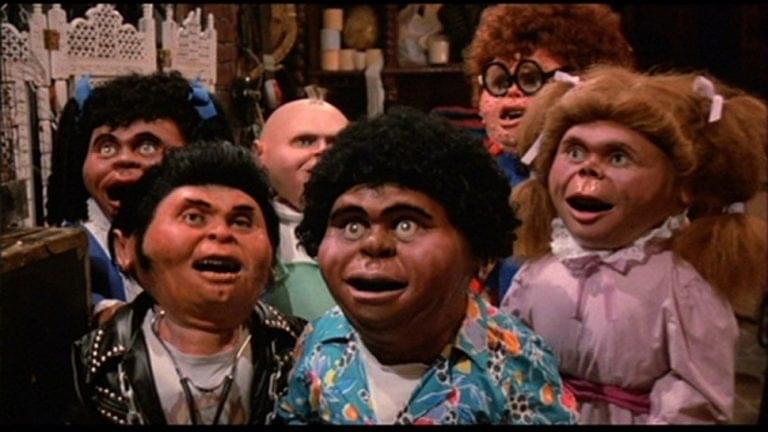
Friday movie roundup – Jan. 30

9

The interesting thing about Renee Zellweger is that even though I can’t stand her, I often like her films. So it’s nice to see her starring in “New in Town,” which is every bit as awful as a Renee Zellweger movie ought to be. This is where you belong, Renee — not in good movies like “Chicago” and “Bridget Jones’s Diary,” but in shockingly lazy cliché compilations like “New in Town.” Welcome home!

In better news, “Taken” is a fun bit of action fluff starring Liam Neeson as an ex-CIA agent trying to save his daughter from bad guys. Think “24,” but crammed into 90 minutes. My review is at Cinematical.

The third wide release this weekend is “The Uninvited,” an Asian horror remake about two teenagers who think their dad’s new girlfriend might be up to no good. Also, since it’s an Asian horror remake, it has ghosts. Not a bad film, actually, at least overall. My feelings are somewhat conflicted. Read the review for more.

I also caught up with “My Bloody Valentine” (in 3D!) last weekend, and found it good enough. I watched “Underworld: Rise of the Lycans,” too, but haven’t had time to write a review yet. It’s no better than the last two “Underworld” movies, though, and possibly a bit worse.

Finally, I’ve decided to discontinue the weekly “In the Dark” podcast, effective immediately. The amount of work involved has always outweighed the amount of fun involved, and listenership has never been high enough to justify it. Moreover, I’ve realized that most movie podcasts that are popular aren’t just one guy talking about movies, but two or more people having a conversation. I could do that with mine, but the logistics and technology involved would make it even more time-consuming and labor-intensive than it already is — and it still wouldn’t guarantee an increase in my web traffic (which is ultimately the point, of course). Basically, to make the podcast a viable, useful, effective tool, I would need to put a lot more time, effort, and money into it than I’m prepared to do right now. There are other, more productive things I want to focus on, like widening my crystal meth operation. (We’re working on new flavors!)

To those of you who have been regular listeners of the podcast, I thank you. If you really want to hear me talk about movies, you can always call me on the phone, provided you have my number and that I answer when I see it’s you.

To sign up for the “In the Dark” e-zine, which brings you all the new movie reviews, DVD releases, and other pertinent info in one handy weekly e-mail, visit this page.

Taken

0

For the past several years, there has been a tug-of-war in the world of action films. Some, like the Jason Bourne and recent James Bond movies, have sought to establish moodier, more introspective heroes who face realistic dilemmas in the midst of the usual shooting and car chases. Others, like “Shoot ’em Up,” “Crank,” and “The Transporter,” have gone the other way, decreasing characterization to almost nothing and focusing entirely on over-the-top action. Both philosophies are viable; the only problem is when a film tries to have it both ways, like “Quantum of Solace” and “Transporter 3” did.

It’s very pleasing, then, that after playing nearly everywhere else in the world, the French-produced (but English-language) “Taken” has finally come to American shores, where it is welcome as a delightfully dizzying balm to soothe the pain inflicted by recent action films that have failed to deliver. It subscribes to the less-talk-more-rock school of thought, intentionally free of nuance but overbrimming with relentless, efficient, energetic mayhem. It plays out like a season of “24,” crammed into 90 minutes.

Our Jack Bauer is named Bryan Mills, played by Liam Neeson — and yes, they found a way to make Oskar Schindler into an action hero. Mills used to be a CIA operative, but he quit and moved to Los Angeles to be closer to his teenage daughter, Kim (Maggie Grace), who lives there with her mother (Famke Janssen) and filthy-rich stepfather (Xander Berkeley). Mills regrets letting his work ruin his family life, and he wants to make up for lost time.

Just after turning 17, Kim and her best friend Amanda (Katie Cassidy) take a trip to Paris, where bad things happen to them at the hands of a ring of Albanian flesh-traders. (Did they learn nothing from “Hostel”?) Mills must rush to France to save the day, having been helpfully informed by his CIA contacts that he probably has just 96 hours before Kim and Amanda are gone forever. There’s nothing like a deadline to light a fire under a guy — just ask Jack Bauer. (Coincidentally, Jack’s daughter is also named Kim, and Xander Berkeley appeared in the first two seasons of “24.” Hmm.)

Mills is resourceful, clever, and utterly ruthless. He’s a master of hand-to-hand combat and can easily anticipate his opponents’ next several moves. If he has qualms about employing brutal tactics to extract information from villains, he does not voice them. Besides, he isn’t acting on behalf of the government anymore — he’s acting as a man trying to save his daughter’s life. Under those circumstances, who among us wouldn’t non-fatally shoot an innocent woman as a means of making her husband cooperate? (Wait, didn’t Jack Bauer do that once, too?!)

Directed by Pierre Morel, who made the similarly giddy “District B13,” and written by “Transporter” duo Luc Besson and Robert Mark Kamen, “Taken” sets up a dire situation, establishes that the butt-kicking hero is more than capable of resolving it, then lets us thrill at seeing this accomplished. That our reactions are somewhat Pavlovian — hero says cool things; audience cheers — is the sort of thing that would only be pointed out by a killjoy. These are matters of black-and-white, with clearly defined heroes and villains, and there’s nothing wrong with seeing the good guys win every now and then.

The Uninvited

0

This is a thorny one. I didn’t particularly enjoy most of “The Uninvited,” a PG-13 thriller about teenage sisters who believe their dad’s new girlfriend is evil. Some of it was tolerable but nothing special; some of it was truly irritating. But then the finale came around, with a twist I hadn’t anticipated — a twist that justifies (or at least explains) some of the irritating parts — and now I had to reconsider.

Can failure to enjoy 80 minutes of a film be canceled out by liking the last five? If I only like a movie in hindsight, and not while I’m actually watching it, does that mean I liked it or didn’t like it?

These are difficult philosophical questions. Theologians have pondered them for centuries. All I can do is report my experience with the film, without giving too much away, and let you take it from there.

It’s based, as are most Hollywood films, on an Asian movie, a well-regarded South Korean property called “A Tale of Two Sisters.” As we begin, young Anna (Emily Browning) has just spent 10 months in a mental institution after attempting suicide following the death of her mother in a fire. This tragedy was compounded by the fact that Mom was bedridden and dying anyway, which adds a certain cruel irony to the whole thing.

Anna is overjoyed to be reunited with Alex (Arielle Kebbel), her rebellious older sister and protector, particularly since in Anna’s absence, their father, Steven (David Strathairn), a novelist, has taken up with Rachael (Elizabeth Banks), who is much too young for him and who was Mom’s in-home nurse during her final days.

The girls are automatically mistrustful of Dad’s new squeeze, of course; it doesn’t help that Rachael says everything with a creepy, icy tinge to it, like a Stepford wife. Even innocent statements sound ominous with that kind of delivery, and bless Elizabeth Banks’ heart for being game enough to go full whacko if that’s what the directors (brothers Charles and Thomas Guard, in their first feature film) wanted.

As it turns out, Anna and Alex have legitimate cause for alarm about Rachael’s intentions. The film stops pussyfooting and says flat-out that Rachael is dangerous, and that’s where the frustration begins, as Anna and Alex fail to report to anyone — their dad, the cops — exactly what they’ve learned. Oh, they make vague accusations, the likes of which you’d expect from teenagers whose father has started dating someone new. But despite being armed with specific damning information, they don’t reveal it. THIS IS IRRITATING.

Oh, and Anna keeps seeing ghosts who have haunting things to tell her about Rachael. I don’t think the ghosts are necessary. This is not inherently a supernatural story. Are the ghosts present simply because all Asian thrillers involve ghosts? Should I consider myself lucky that the ghosts aren’t stringy-haired young Japanese children crab-walking out of bathtubs, like they usually are?

And then there’s the finale, which, as I said, I liked. It fits with what we already know while also revealing surprising new information. The only downside: I had my review half-written in my head already, and now I had to change it. Even in retrospect it’s not a great film, but it’s better than the first 80 minutes suggested it was going to be.

One quibble: The film is told from Anna’s point of view. There are no scenes in which she does not appear, or events that she does not witness. The one exception is a shot of Rachael eavesdropping on Anna and Alex from outside the door, hearing their conversation, then walking worriedly away. This shot is a mistake. The film has committed itself to telling the story strictly through Anna’s eyes, and it’s important that this point of view be maintained. Shifting away from that — especially just for one shot — is a violation.

New in Town

0

Look, movie, if you’re not even going to TRY to entertain me, why should I put forth any effort in reviewing you?

Yeah, I’m talking to you, “New in Town.” You have Renee Zellweger as a brittle, icy corporate honcho named Lucy who goes to a tiny Minnesota town to 1) look down her nose at the provincial townsfolk and 2) downsize the factory that keeps the town alive. In the grand tradition of awful romantic comedies everywhere, Lucy clashes with a crass local named Ted (Harry Connick Jr.), only to discover he’s the union rep she’ll have to work with on a regular basis!!!!!! Do you think they’ll eventually fall in love???

In the meantime, Lucy makes no attempt whatsoever to fit in with the locals, who are portrayed as well-meaning but bumbling Jesus freaks with quaint hobbies and exaggerated Minnesota accents. These include Lucy’s secretary, Blanche Gunderson (Siobhan Fallon Hogan), who is obsessed with her secret tapioca recipe; and Stu Kopenhafer (J.K. Simmons), the plant foreman who loves to hunt. Later, movie, you chastise Lucy — and, by extension, us — for not taking these people seriously, even though YOU’RE the one who set them up as objects of ridicule.

For her part, Lucy — and you get a lot of mileage out of this, movie — seems to be unfamiliar with even the IDEA of cold weather. She is surprised to find, when she gets off the plane, that a short skirt is inappropriate garb for Minnesota in October. She cannot fathom wearing any shoes other than high heels wherever she goes. When introduced to her new house, she insists she doesn’t need help with the fireplace. “I’m a city girl, but I know how to light a fire. Where’s the switch?” Get it?? She thinks fireplaces are always lit with a switch on the wall! She thinks this because apparently she’s FUNCTIONALLY RETARDED.

Frankly, movie, I’m shocked that you thought you were ready for public viewing. Your screenplay, written by first-timer Ken Rance and “Sweet Home Alabama” scribe C. Jay Cox, does not have a legitimate laugh anywhere in its dialogue. It reads like an outline, not a real script, with only perfunctory attention paid to the major plot points. Most critically, Lucy comes to love the little town (we’ve seen the countless other films exactly like this one, so we know where it’s going), yet you skip all the scenes that would have shown us WHY she loves it. You checked off all the clichés, yet you failed to fill in the details.

Moreover, movie, you have a screwed-up sense of time. One scene mentions it being the first Friday of November; the next scene has Lucy trying to get back to Miami for Thanksgiving — and yet nothing has happened to the characters during those three weeks in between. After her flight is canceled due to weather, Lucy gets stuck in the snow, necessitating a rescue by Ted. Then, just after New Year’s, Lucy tells him, “I never had a chance to clear the air after you rescued me” — even though that was Thanksgiving, six weeks ago, and they must have seen each other multiple times since then, considering they work together.

I understand that romantic comedies and fish-out-of-water comedies and save-the-small-town comedies follow certain formulas. Did you not think, however, that perhaps you should put a little oomph into it? Jazz up the dialogue, maybe? Create one or two genuinely interesting characters? You have done nothing. You have exerted yourself so little that I’m not sure your cast and crew even deserve to be paid. You’re the kind of movie someone would make if they put off their weekend movie-making homework until Sunday night.

Your director is a Danish fellow named Jonas Elmer, whose 2005 comedy, “Nynne,” has been dubbed the Danish “Bridget Jones’s Diary.” I don’t know what to say about that, except that I would probably laugh more at an un-subtitled version of a foreign-language comedy than I did at you, “New in Town.” You’re a shallow, dim-witted movie, and I wash my hands of you.

Cinematical Exclusive: Variety’s Layoff Memo

0
Cinematical Exclusive: Variety’s Layoff Memo

News item: Showbiz trade publication Variety lays off 30 employees.

Cinematical Exclusive: The memo Variety sent to the affected writers.

BIZ RAG SACKS HACKS

Dear journo:

While your perf as a scribbler has been boffo with execs ever since you preemed as a tyro, auds and crix have nixed you. Variety moguls had a sesh and now agree the conglom lacks the coin to reup your pact. Regrettably, as of tomorrow ayem, you’re ankled.

Sincy,
Variety honchos

— Cinematical

Eric’s Bad Movies: ‘Supergirl’ (1984)

5

After a Sundance-induced hiatus, Eric’s Bad Movies at Film.com is back with a careful examination of “Supergirl,” a superhero spinoff that failed to spin anything off. It does, however, feature a campy Faye Dunaway (pardon the redundancy) and a superhero with the magical ability to change her hair color. Hooray for girls!

Supergirl

0
Supergirl

Anyone who watches “Supergirl” should feel insulted by it, but women have the most cause for offense. The title character has all the same powers as her cousin Superman, with the addition of being able to create costumes and change the color of her hair at will. Because she’s a lady superhero, you know. One assumes that if a sequel had materialized, Supergirl would have developed the power to notice shoe sales from miles away, or perhaps the ability to ask her husband for permission to drive the car.

“Supergirl” is so awful that Christopher Reeve declined to appear in it, even though he had just appeared in “Superman III” and would later make “Superman IV.” He was not an actor with a lot of discernment, is my point. In 1984, he was dressing as Superman at shopping mall groundbreakings and friends’ children’s birthday parties. And yet even he had the good sense to distance himself from “Supergirl.”

supergirl

Supergirl is played by Helen Slater, then unknown but now world-famous for being the woman who failed to turn a starring role in “Supergirl” into a career. Slater was perfect for the part because she was pretty, in good physical condition, and had a face that was as expressionless as a dinner plate. When making a movie about a hero with super powers, the last thing you want is for audiences to be able to relate emotionally to him or her.

Slater starts out as Kara, a young woman who lives in an alien world called Argo City. It is apparently a fragment of Krypton that somehow survived when the planet exploded at the beginning of the first “Superman,” though “Supergirl” does not spell this out. Argo City’s designer is Zaltar (Peter O’Toole), who has a couple of magic objects that enable him to keep the city alive. But the only thing separating the city from outer space is a wall made of plastic sheets, and it’s pretty easy to tear a hole in them. Zaltar discovers this (I don’t know why it didn’t occur to him earlier) when Kara is fiddling with the magic objects and accidentally creates a dragonfly that slices through the plastic wall and threatens to destroy the city.

For trusting a leader so shortsighted, the people of Argo City obviously deserve to die. Nonetheless, Kara volunteers to go to Earth to retrieve the magical object that the Argonians need to survive, figuring she can get help from her cousin, Superman, who arrived on Earth some years earlier. But fate has two unpleasant surprises in store for Kara. For one thing, Superman has gone to the other end of the galaxy on a peace-keeping mission, which is the same excuse I use when out-of-town relatives want to visit me. For another thing, when the magical object, called the Omegahedron, falls to Earth, it lands right in the lap of the Earth’s most evil villain! Not Lex Luthor (I assume they didn’t even ask Gene Hackman after Reeve said no), but Selena (Faye Dunaway), a part-time witch and a full-time inspiration for campy lesbians everywhere.

supergirl
Peter Cook and Faye Dunaway ham it up while Brenda Vaccaro smokes and drinks in the background, possibly unaware she was on camera.
Selena doesn’t have much skill at black magic yet, but with the Omegahedron, she can do anything! The movie doesn’t feel like telling us how she knows this, or what she must do to harness the object’s power, but take the movie’s word for it — Selena + Omegahedron = DANGER!

While Selena practices dark magic with her minion and co-witch Bianca (Brenda Vaccaro), Kara arrives on Earth already wearing the signature Superman-style outfit. (Handy!) She knew the Earth’s yellow sun would give her super powers, but she was unprepared for how awesome they would be. For several minutes, we are forced to watch as she flies around and does super things. This movie exists only to capitalize on our pre-existing familiarity with the “Superman” movies, yet the filmmakers thought we would enjoy lengthy sequences of power-discovery and flying, as if we’d never seen them before.

For some reason, Kara poses as a student at a boarding school, adopting the name Linda Lee. This is where she uses her costume-changing and hair-color-altering abilities. Like most extra-terrestrials in movies, Linda/Kara speaks perfect English and appears to understand how Earth society functions, yet she’s baffled by the act of shaking hands. And wouldn’t you know it, she is assigned to share a room with Lucy Lane (Maureen Teefy), who is Lois Lane’s sister! And Lucy is dating Jimmy Olsen (Marc McClure), who actually appears in the film! And Linda and Lucy’s teacher is Nigel (Peter Cook), a warlock who is also Selena’s occasional romantic partner! In other words, the film’s plot is nothing more than an elaborate web of coincidences so outrageous and implausible it makes “Crash” look believable by comparison. (Just kidding. Nothing could make “Crash” look believable.)

Meanwhile, Selena has created a love potion and intends to use it on the beefy gardener, Ethan (Hart Bochner), who works at the boarding school. I swear to you, the movie gives no indication of how this will help Selena in her world-domination plans. She’s a cougar, that’s all, and she wants some hot lovin’ from someone more masculine than Brenda Vaccaro. Such a person being unavailable, she settles for Ethan. But the plan goes awry, and Ethan winds up falling in love not with Serena but with Linda Lee/Kara/Supergirl!

supergirl
Supergirl arrives just in time for the daily special on biscuits.
Perhaps you are wondering when, if ever, Supergirl will start engaging in superheroics. The answer is: sixty minutes into the film, and even then just barely. She’s finally forced to do something worthwhile when a tractor runs amok in the town of Midvale with an unconscious Ethan in its front loader. Supergirl arrives just in time to save him, but unlike Superman, she makes sure the public doesn’t see her. Also unlike Superman, she stages her initial triumphant appearance on the roof of a Popeye’s Chicken.

The potion that caused Ethan to fall in love with Linda Lee/Kara/Supergirl wears off after a while, whereupon the movie has the audacity to suggest that he is in love with her anyway, of his own volition, despite having spent no time with her. (On the other hand, perhaps spending no time with her is the best way to go about it.) Selena is still really peeved at everything, and she casts Supergirl into a two-dimensional prison called the Phantom Zone, which turns out to be three-dimensional. Supergirl’s fellow prisoner is Zaltar (remember him?), who is being punished for the way he screwed up Argo City. It is impossible to escape from the Phantom Zone, but Supergirl does it anyway, which is typical of her attitude.

“Supergirl” was directed by an old French dude named Jeannot Szwarc, who had previously made “Jaws 2” and “Somewhere in Time” and would later make the epic 1985 failure “Santa Claus: The Movie.” He went on to have a long career directing television shows, including a recent episode of “Grey’s Anatomy,” where his deftness with unsympathetic characters and laughable plotlines surely came in handy. With “Supergirl,” he sought to make not a thrilling superhero adventure, but a lukewarm semi-comedy about witches and orbs. And at that he succeeded! Vive la France!

— Film.com

Wrapping up Sundance loose ends

11

I left Utah on Saturday, stopped in Boise for the night (making sure not to stay in the hotel where I almost got shot), and arrived safely in Portland yesterday afternoon. But echoes of Sundance still reverberate, and here we shall address them.

First, Cinematical has a handy list of which Sundance films have been purchased by distributors, which means they will eventually play at a theater near you. These are just the ones that sold during the festival; if history is any guide, there will be several more deals made this week, with a few more trickling in over the next few months.

Next, here are the films I reviewed during the festival:

Underworld: Rise of the Lycans

0
Underworld: Rise of the Lycans

If you are interested in the mythology created by “Underworld” and its sequel, “Underworld: Evolution,” then surely you will enjoy “Underworld: Rise of the Lycans,” which goes back in time to tell us what happened before the first film. As far as I can tell without being interested, the prequel does a fine job of bringing fans up to speed.

As a movie, though, it’s as confused and cheesy as its predecessors. The creators (a total of five men are credited with the story and screenplay) seem to have abandoned all hope of manufacturing anything that’s even coherent, let alone imaginative. First-time director Patrick Tatopoulos (an experienced special-effects and production designer) maintains the series’ steel-blue look and sober, self-serious attitude — the soundtrack needs more emo songs — but what does he have to work with? There’s a lot of talking, a lot of growling and threatening, a big battle, plenty of spurting blood, and everyone goes home. The end.

The British actor Michael Sheen, having earned raves for his portrayals of Tony Blair and David Frost, now stars as a werewolf. His name is Lucian, and he lives in the early days of the vampires and werewolves — two decades since the species were created, the narrator tells us, omitting the suddenly interesting detail of how they were created, and by whom.

The Underworld series:

“Underworld” (2003) C-
“Underworld: Evolution” (2006) C-
“Underworld: Rise of the Lycans” (2009) C-
“Underworld: Awakening” (2012)
“Underworld: Blood Wars” (2017) C

Vampires live apart from the humans in their own Gothic-looking medieval kingdom, and their leader, Viktor (Bill Nighy), has figured out how to make the werewolves into slaves based on the DNA (or something) of Lucian, who has the ability to shift from human to wolf shape at will, which was a rarity in those days.

So Viktor has this race of werewolves — I’m sorry, lycans — as his slaves, and Lucian foments revolution against their oppressors like a hirsute Che Guevara, and he’s also in love with Viktor’s vampire daughter Sonja (Rhona Mitra), and there you go.

Hmm. Apparently the movie has even less story than I thought it did, since I just summarized the entire thing in two paragraphs. Enjoy!

Friday movie roundup – Jan. 16

4

Guess what! The 25th annual Sundance Film Festival has begun, and I am here for the 10th annual time! I’ll be providing coverage for Film.com (my spouse) and Cinematical.com (my mistress), as well as for EricDSnider.com (my narcissism). In particular, my daily diaries — which I guess are “blogs,” although I’ve been doing them since before that word existed, THANK YOU VERY MUCH — will be here at my, um, blog. (OK, so the Internet finally caught up and provided a place for me to put daily diary entries.)

I might also slap together some Twitter updates, if you’re a Twitter user. My name there is EricDSnider. If you don’t know what Twitter is, good for you.

For you civilians and suckers, here’s what’s been shoveled into your multiplexes:

“Notorious” is actually a pretty good biopic of famed obese rapper The Notorious B.I.G. Some reviews have already complained that the movie is full of musical-biopic clichés, which makes me laugh, because what, the beloved “Walk the Line” and “Ray” weren’t?

“Hotel for Dogs” isn’t the Groin-Punch for Eric that I expected — it’s a reasonably amusing and perfectly harmless family film about some kids taking care of strays.

Then you got “Paul Blart: Mall Cop,” starring Kevin James as the title fattie (big week for fatties!). Not very funny.

Finally, I got around to reviewing “The Unborn,” which was Hollywood’s Shameful Secret last week, and it’s lousy. This week, the Shameful Secret is “My Bloody Valentine 3-D,” which will have to wait until I’m done Sundancing for a review. YOU HEAR THAT, “MY BLOODY VALENTINE 3-D”? YOU CAN WAIT.

Sign up for the “In the Dark” e-zine here.
Listen to this week’s podcast version here.
Subscribe to the podcast’s feed with this URL.

Notorious

0

One of the measures of a good biopic is whether it can engage a viewer who has no prior interest in the subject, or whether it just preaches to the choir. I think “Notorious” works. It’s about Christopher Wallace, aka The Notorious B.I.G./Biggie Smalls/Big Poppa, the multi-nicknamed Brooklyn rapper who rose to fame in the mid-1990s and was murdered in 1997, and someone I couldn’t have cared less about. But the movie, a reasonably well-crafted drama made with some skill and a lot of tenacity, held my interest as much as “Walk the Line” or “Ray” did, and it brings rap out of the biopic ghetto and into the mainstream.

Directed by George Tillman Jr. (“Soul Food,” “Men of Honor”), “Notorious” follows the same basic pattern as most films of this genre. You start in the present or with the artist’s death, then jump back to his childhood to catch a few pivotal vignettes, then move quickly through his formative years into adulthood; the subject makes it through the hardscrabble years into sudden success, loses touch with his roots, becomes abusive to his friends, is humbled by injury, illness, or some other setback, and ultimately finds peace and/or dies. One could wish that this formula were not always so closely followed, yet in this case maybe it’s a good idea to stick to the familiar layout in order to make it more palatable to hip-hop-averse viewers.

As an adult, Biggie is played by a newcomer named Jamal Woolard, who turns the obese rhymer into something of a teddy bear, a soft-voiced lug who’s good to his mother and, well, OK, sometimes carries a gun. As a child, he’s played by Biggie’s real-life son, Christopher Jordan Wallace, and his doting mother, Voletta, is played by Angela Bassett. The 1980s are a hard time for their Brooklyn neighborhood, with crack cocaine and other dangers on every corner; Biggie, a nerdy but smart-mouthed kid, finds acceptance and employment in the drug trade.

By 1990, at age 17, he’s making serious money selling crack. (He keeps his lifestyle hidden from his mom by not changing into his bling and expensive sneakers until after he leaves the house.) He’s known for his skill at improvising raps, but it’s not where his focus is. As he puts it, “Drug dealing was like my wife. Rapping was just some girl on the side.”
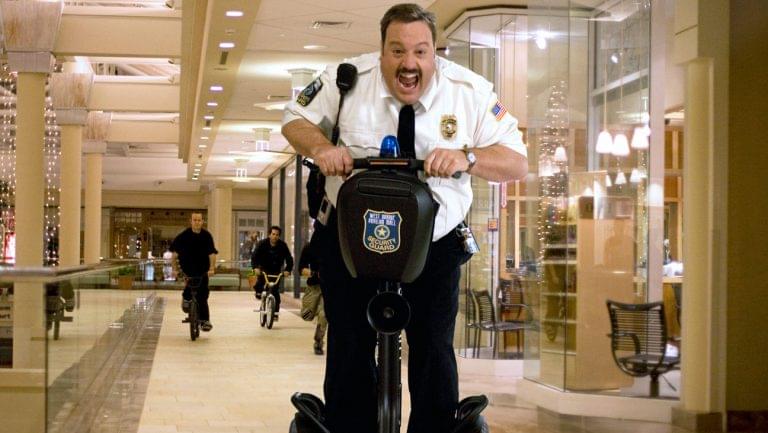
The mistress becomes his main squeeze when he meets Sean “Puffy” Combs (Derek Luke), an up-and-coming record producer who appreciates Biggie’s talent and gets him out of the drug business and into the recording studio. From there the trajectory should be familiar even if you’ve never heard of The Notorious B.I.G. — you know there will be swanky CD-release parties and willing groupies and baby mama drama. Biggie, already a father thanks to teenage foolishness, takes up with the rapper Lil Kim (Naturi Naughton), then cheats on her with Faith Evans (Antonique Smith), whom he marries impulsively and barely tries to stay faithful to.

As if that weren’t enough melodrama for one man’s life, there is also the matter of the infamous East Coast/West Coast rap rivalry. The film (which was written by Reggie Rock Bythewood and Cheo Hodari Coker) posits that this rivalry is mostly traceable to a rift that developed between Biggie and Tupac Shakur (Anthony Mackie) after the latter was non-fatally shot outside a recording studio where Biggie happened to be at the time. As the movie tells it, Tupac paranoiacally believes Biggie is responsible, an assumption that producer Suge Knight (Sean Ringgold) — a rival to Puffy Combs — is only too happy to perpetuate.

“Notorious” doesn’t explain the details of the West Coast/East Coast rivalry very well, possibly owing to it not being particularly deep to begin with — like college rivalries, it seems to have been based mostly on geography and randomly chosen insults. A little more investigation into the subject might have been prudent, however, since it does lead directly to Biggie’s shooting death in L.A.

Even if rap isn’t your thing, it’s easy to appreciate the skill involved in writing and reciting the stuff, and Woolard (a rapper himself) is able to convey in his performance why Biggie was so popular. Nothing about Biggie’s lyrics suggests transcendent genius, but his consistently spot-on performance of them, coupled with his outre offstage behavior, made him a celebrity. Woolard, who seems to have been born to play this role, captures all that very nicely, aided by winning supporting turns by Bassett, Luke, Naughton, and Smith. Even a non-follower of rap like myself knows an effective story when he sees it.

My Bloody Valentine

0

“My Bloody Valentine” is smarter than you’d think, which maybe isn’t saying much, considering you probably think it’s just a slasher film about a maniac who goes around slaughtering people. Which, OK, it is. But it’s also a whodunit and a psychological mystery, with a romantic triangle thrown in for good measure, and it’s occasionally suspenseful. Oh, and it’s in 3D, which is the film’s way of saying, “Don’t take any of this too seriously, folks.”

Borrowing almost nothing but the title from the 1981 film of this name, “My Bloody Valentine” is set in the small coal-mining town of Harmony, where 11 years ago there was a cave-in, and 10 years ago the sole survivor of it went on a killing spree. His name was Harry Warden, and despite being dead, he’s the lead suspect when a masked figure starts pickaxing townsfolk again.

Coincidental with Harry Warden’s presumed return is the return of Tom Hanniger (Jensen Ackles), whose father owned the mine until he died. Tom has come back to sell it, angering Harmonians who fear this will doom the local economy. He has also come back to check in with Sarah (Jaime King), who was his girlfriend many years ago but is now married to his rival, Axel (Kerr Smith), the youthful town sheriff. If you’re paying attention, you’ll note that Sarah is caught between two “Dawson’s Creek” alumni. I think we’ve all been there!

The director, Patrick Lussier (“Dracula 2000”), a frequent editor of horror films and a regular Wes Craven collaborator, makes full use of the cheesy tricks available to 3D. Axes are swung at the audience, nude women jiggle into the front rows of the theater, and blood goes everywhere. All of this is unnecessary, of course, but it improves the experience immensely. Likewise, the screenplay, by Todd Farmer (“Jason X”) and Zane Smith, while riddled with many of the usual cliches, also manages a few surprises — and in a genre as worn-out as this one, a few surprises are all it takes to make a film stand out.

Paul Blart: Mall Cop

0
Paul Blart: Mall Cop
Kevin James stars as "Paul Blart" in Columbia Pictures' comedy PAUL BLART: MALL COP.

One of these days I’ll have to watch a rerun of “King of Queens,” the sitcom Kevin James starred in for like 18 years. I’ve heard from reliable sources that it’s actually funny (unlike most sitcoms), and what I’ve seen of James elsewhere — as in “Hitch,” for example, and even parts of “I Now Pronounce You Chuck & Larry” — has amused me.

But now we come to “Paul Blart: Mall Cop.” This dim-bulb, family-oriented slapstick film benefits greatly from James’ knack for physical comedy (he’s astonishingly agile for a big guy), but it’s ultimately too bland and uninspired even for a talented performer to improve. James co-wrote it with “King of Queens” producer/writer Nick Bakay, then handed the directorial reins to Steve Carr, whose previous PG comedies, which include “Daddy Day Care,” “Rebound,” and “Are We Done Yet?,” should not have inspired confidence.

James plays the title character, a devoted single father who has flunked out of the New Jersey police academy several times due to his hypoglycemia, which apparently makes him fall asleep if he doesn’t eat a candy bar every five minutes or so. Lacking what it takes to be a cop, he has done what most other police academy washouts do: grow the mustache anyway and become a security guard.

His post is a shopping mall, and he approaches the gig with far more zeal and dedication than it warrants — which for a long time is the film’s only joke. He has no real authority, and he gets no real respect. Riding up on his Segway, he’ll pull over an elderly scooter-bound “motorist” for weaving in and out of pedestrian traffic. He teaches a trainee (Keir O’Donnell) to always reach for his right hip, to give the illusion he’s carrying a gun, which of course he isn’t. Because he’s only a mall cop, you see, not a real cop. Get it? Ahem. Is this thing on?

Some of this is amusing enough, and I like that rather than making Paul an object of ridicule, we’re meant to gently laugh at his foibles while still liking him as a character. He’s sweet and unassuming, taking his mall-cop duties seriously but never being obnoxious the way some mad-with-imaginary-power pseudo-authority figures do. He is inherently a Good Guy, not a straw man for us to feel superior to through mockery.

The meat of the film occurs on Black Friday, the busiest shopping day of the year, when a band of robbers takes over the mall, evacuates all the shoppers except for several hostages — including Amy (Jayma Mays), the pretty kiosk employee Paul has a crush on — and starts pillaging credit card numbers from all the stores. Paul is the lone employee left inside, so it befalls him to save the day, “Die Hard”-style.

Since it’s a PG comedy, you can expect lots of falling down and running into things (and only one gastrointestinal-related gag!), accompanied by dull-witted dialogue that oversimplifies everything and makes the easiest jokes possible. It’s not enough for the FBI agent (Bobby Cannavale) overseeing the standoff to doubt Paul’s abilities; he must also have been a high school classmate of Paul’s who used to pick on him, thus making it even sweeter when Paul shows him up. That kind of detail is unnecessary, except insofar as it elevates Paul’s hero status in the mind of a young viewer.

And this is definitely for young and/or undiscerning viewers, a simple comedy, not unpleasant but not particularly funny, either. You could do worse for a family outing. You could also do a lot better.